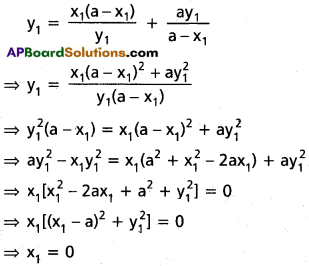
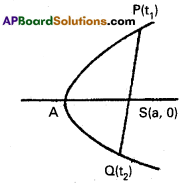
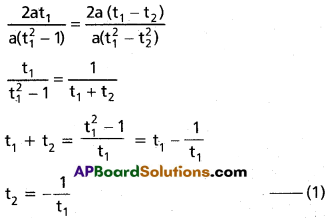
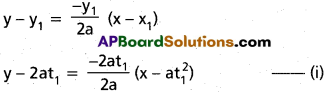
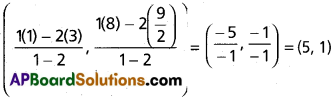
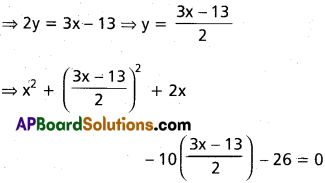
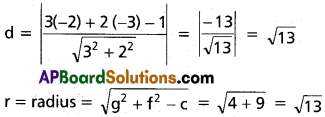
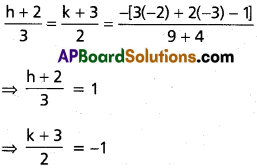
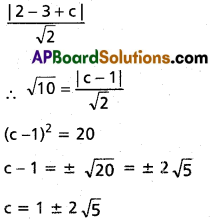
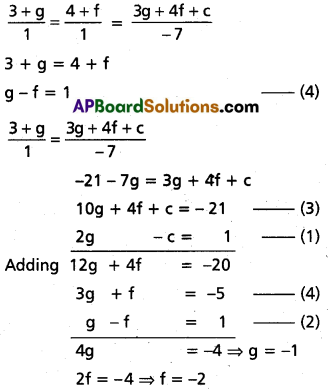
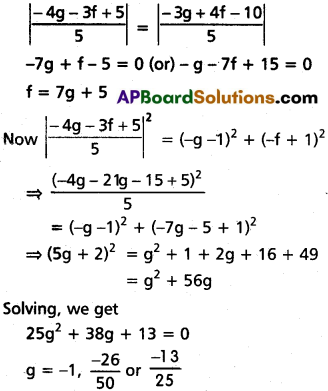
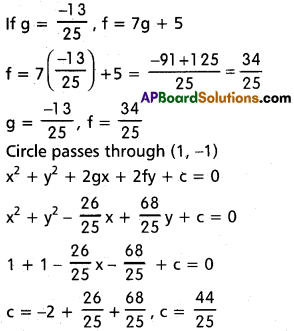
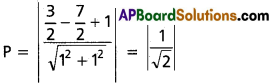
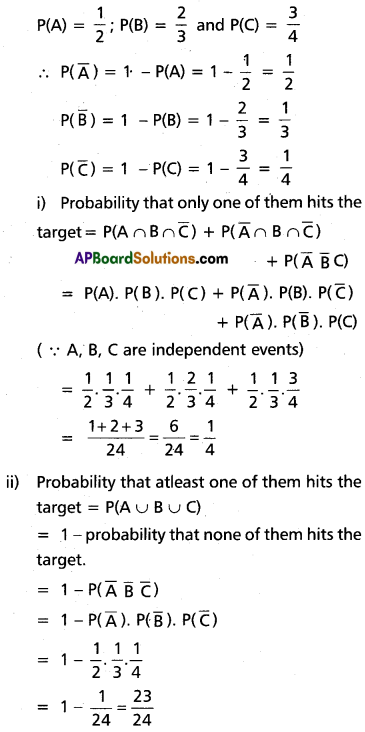
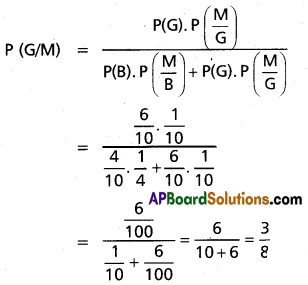
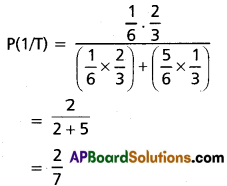
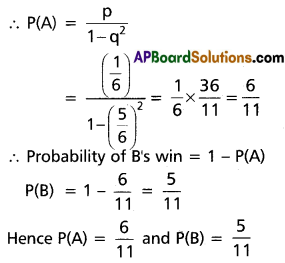
Inter 2nd Year Maths 2B Ellipse Solutions Ex 4(a)

Practicing the Intermediate 2nd Year Maths 2B Textbook Solutions Inter 2nd Year Maths 2B Ellipse Solutions Exercise 4(a) will help students to clear their doubts quickly.

Intermediate 2nd Year Maths 2B Ellipse Solutions Exercise 4(a)

I.

Question 1.
Find the equation of the ellipse with focus at (1, -1) e = \(\frac{2}{3}\) and directrix as x + y + 2 = 0.
Solution:
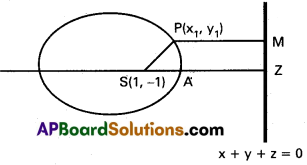
P(x1, y1) is any point on the ellipse.
Equation of the directrix is x + y + 2 = 0
Draw PM perpendicular to ZM, Join SP
By Definition of ellipse SP = e . PM
SP² = e². PM²
Inter 2nd Year Maths 2B Ellipse Solutions Ex 4(a) 1
9[(x1 – 1)² + (y1 + 1)²] = 2[x1 + y1 + 2]²
9[x²1 – 2x1 + 1 + y²1 + 2y1 + 1] = 2[x²1 + y²1 + 4 + 2x1y1 + 4x1 + 4y1]
9x²1 +9y²1 – 18x1 18y1 +18 = 2x²1 +2y²1 + 4x1y1 + 8x1 + 8y1 + 8
7x²1 – 4x1y1 + 7y²1 – 26x1 + 10y1 +10 = 0 focus of P (x1, y1) is
7x² – 4xy + 7y² – 26x + 10y + 10 = 0
This is the equation of the required Ellipse.
Inter 2nd Year Maths 2B Ellipse Solutions Ex 4(a) 2

Question 2.
Find the equation of the ellipse in the standard form whose distance between foci is 2 and the length of latus rectum is \(\frac{15}{2}\).
Solution:
Latus rectum = \(\frac{15}{2}\) ;
distance between foci = 2
\(\frac{2b^2}{2}\) = \(\frac{15}{2}\) ; 2ae = 2
ae = 1
⇒ b² = a² – a²e²
⇒ b² = a² – 1
⇒ \(\frac{15}{2}\)a = a² – 1
⇒ 4a² – 15a – 4 = 0
a = 4 or a = –\(\frac{1}{4}\)
b² = a² – 1
= 16 – 1
Equation of the ellipse is \(\frac{x^{2}}{16}+\frac{y^{2}}{15}\) = 1

Inter 2nd Year Maths 2B Ellipse Solutions Ex 4(a)

Question 3.
Find the equation of the ellipse in the standard form such that distance between foci is 8 and distance between directrices is 32.
Solution:
Distance between foci = 8.
Distance between directrices = 32.
2ae = 8, \(\frac{2a}{e}\) = 32
ae = 4, \(\frac{a}{e}\) = 16
(ae)\(\frac{a}{e}\) = 64
a² = 64
b² = a² – a² e²
= 64 – 16 = 48
Equation of the ellipse is
∴ \(\frac{x^{2}}{64}+\frac{y^{2}}{48}\) = 1

Question 4.
Find the eccentricity of the ellipse, (in standard form), if its length Solution:
Latus rectum = \(\frac{2b^2}{a}\)
Major axis = 2a
Given \(\frac{2b^2}{a}\) = \(\frac{1}{2}\) .2a.
2b² = a²
But b² = a² (1 – e²)
2a²(1 – e²) = a²
1 – e² = \(\frac{1}{2}\)
e² = \(\frac{1}{2}\) ⇒ e = \(\frac{1}{\sqrt{2}}\)

Inter 2nd Year Maths 2B Ellipse Solutions Ex 4(a)

Question 5.
The distance of a point on the ellipse x² + 3y² = 6 from its centre is equal to 2. Find the eccentric angles.
Solution:
Equation of the ellipse is x² + 3y² = 6
\(\frac{x^{2}}{6}+\frac{y^{2}}{2}\)
a = √6 , b = √2
Any point on the ellipse is
P (√6 cos θ, √2 sin θ)
Given CP = 2 ⇒ CP² = 4
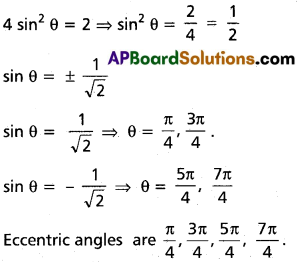
6 cos² θ + 2 sin² θ = 4
6(1 – sin² θ + 2 sin² θ = 4
6 – 6 sin² θ + 2 sin² θ = 4
Inter 2nd Year Maths 2B Ellipse Solutions Ex 4(a) 3

Question 6.
Find the equation of ellipse in the standard form, if it passes through the points (-2, 2) and (3, -1).
Solution:
Equation of the ellipse in standard form is
\(\frac{x^{2}}{a^{2}}+\frac{y^{2}}{b^{2}}\) = 1
passes through-(-2, 2); (3, -1)
\(\frac{4}{a^{2}}+\frac{4}{b^{2}}\) = 1 ……… (i)
\(\frac{9}{a^{2}}+\frac{1}{b^{2}}\) = 1 ……….(ii)
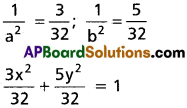
Solving (i) and (ii) we get
Inter 2nd Year Maths 2B Ellipse Solutions Ex 4(a) 4
3x² + 5y² = 32.

Question 7.
If the ends of major axis of an ellipse are (5, 0) and (-5, 0). Find the equation of the ellipse in the standard form if its focus lies on the line 3x – 5y – 9 = 0.
Solution:
(a, 0): (5, 0), (-a, 0) : (-5, 0)
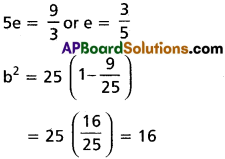
a = 5, b² = a² (1 – e²)
Focus lies on the line 3x – 5y – 9 = 0
3(ae) – 5 (0) – 9 = 0
3(5e) – 9 = 0
Inter 2nd Year Maths 2B Ellipse Solutions Ex 4(a) 5
Equation of the ellipse is
\(\frac{x^{2}}{25}+\frac{y^{2}}{16}\) ⇒ 16x² + 25y² = 400

Inter 2nd Year Maths 2B Ellipse Solutions Ex 4(a)

Question 8.
If the length of the major axis of an ellipse is three times the length of its minor axis then find the eccentricity of the ellipse.
Solution:
Major axis = 3 minor axes
2a = 3(2b) ⇒ a = 3b
a² = 9b² ⇒ a² = 9a² (1 – e²)
(1 – e²) = \(\frac{1}{9}\) ⇒ e² = 1 – \(\frac{1}{9}\) = \(\frac{8}{9}\)
e = \(\frac{2\sqrt{2}}{3}\)
Eccentricity of the ellipse = \(\frac{2\sqrt{2}}{3}\)

II.

Question 1.
Find the length of major axis, minor axis, latus rectum, eccentricity, co-ordinates of centre, foci and the equations of directrices of the following ellipse.
i) 9x² + 16y² = 144
ii) 4x² + y² – 8x + 2y + 1 =0
iii) x² + 2y² – 4x + 12y + 14 = 0
Solution:
Given equation is 9x² + 16y² = 144
\(\frac{x^{2}}{16}+\frac{y^{2}}{9}\) =1
∴ a = 4, b = 3
Length of major axis = 2a = 2. 4 = 8
Length of minor axis = 2b = 2. 3 = 6
Length of latus rectum = \(\frac{2b^{2}}{a}=\frac{2.9}{4}=\frac{9}{2}\)
Eccentricity = \(\sqrt{\frac{a^2-b^2}{a^2}}=\sqrt{\frac{16-9}{16}}=\frac{\sqrt{7}}{4}\)
Centre is C (0,0)
Foci are (± ae, 0) = (±√7, 0)
Equations of the directrices are x = ± \(\frac{a}{e}\)
x = ± 4.\(\frac{4}{\sqrt{7}}\) = ±\(\frac{16}{\sqrt{7}}\)
√7x = +16

(ii) Given equation is 4x² + y² – 8x + 2y + 1 =0
4(x² – 2x) + (y² + 2y) = -1
4(x – 1)² + (y + 1)² = 4 + 1 – 1 = 4
\(\frac{(x-1)^{2}}{2}+\frac{(y+1)^{2}}{2}\)= 1
Hence a < b ⇒ y – axis is major axis
a = 1, b = 2
Length of major axis = 2b = 4
Length of minor axis = 2a = 2
Length of latus rectum \(\frac{2a^{2}}{a}=\frac{2}{2}=1\)
Eccentricity = \(\sqrt{\frac{b^2-a^2}{b^2}}=\sqrt{\frac{4-1}{4}}=\frac{\sqrt{3}}{2}\)
Centre is C (-1, -1)
be = 2.\(\frac{\sqrt{3}}{2}\) = √3
Foci are (-1, 1 ±√3)
Equations of the directrices are y + 1 = ± \(\frac{b}{e}\)
= ± \(\frac{4}{\sqrt{3}}\)
√3y + √3 = ±4
√3y + √3 ± 4 = o

(iii) Given equation is x² + 2y² – 4x+ 12y + 14 = 0
x² – 4x + 2 (y² + 6y) = – 14
⇒ (x² – 4x + 4) + 2(y² + 6y + 9) = 4 + 18 – 14
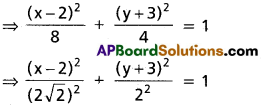
⇒ (x – 2)² + 2(y + 3)² = 8
Inter 2nd Year Maths 2B Ellipse Solutions Ex 4(a) 6
a = 2√2, b = 2, h = 2, k =-3
Length of major axis = 2a = 2(2 √2) = 4 √2
Length of minor axis = 2b = 2(2) = 4
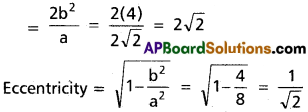
Length of latus rectum
Inter 2nd Year Maths 2B Ellipse Solutions Ex 4(a) 7
Centre = (h, k) = (2, – 3)
Foci = (h ± ae, k) = (2 ± 2, -3)
= (4, -3), (0, – 3)
Equations of the directrices are x- h = ± \(\frac{a}{e}\)
x – 2 = ±\(\frac{2 \sqrt{2}}{\left(\frac{1}{\sqrt{2}}\right)}\) x – 2 = ±4
i.e., x = 6, x = -2.

Inter 2nd Year Maths 2B Ellipse Solutions Ex 4(a)

Question 2.
Find the equation of the ellipse in the form \(\frac{(x-h)^2}{a^2}+\frac{(y-k)^2}{b^2}\) = 1, given the following data.
i) Centre (2, -1), one end of major axis (2, – 5), e = \(\frac{1}{3}\).
Solution:
Centre (2, -1) ⇒ h = 2, k = -1
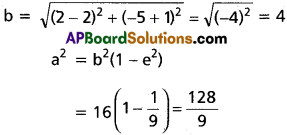
end of major axis (2, -5)
Inter 2nd Year Maths 2B Ellipse Solutions Ex 4(a) 8
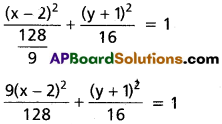
Equation of the ellipse is
Inter 2nd Year Maths 2B Ellipse Solutions Ex 4(a) 9
9(x – 2)² + 8(y + 1)² = 128
i.e., 9 (x – 2)² + 8 (y + 1)² = 128.

ii) Centre (4, -1), one end of major axis is (-1, -1) and passing through (8, 0).
Solution:
a = \(\sqrt{(4+1)^2+(-1+1)^2}\)
a = 5
passes through (8, 0)
Inter 2nd Year Maths 2B Ellipse Solutions Ex 4(a) 10
Required equation be
\(\frac{(x-4)^2}{25}\) + \(\frac{9}{25}\)(y + 1)² = 1
⇒ (x – 4)² + 9(y + 1)² = 25

iii) Centre (0, -3), e = \(\frac{2}{3}\), semi-minor axis = 5.
Solution:
b = 5
⇒ b² = a² – a²e²
⇒ 25 = a² – a². \(\frac{4}{9}\) = a²\(\frac{5}{9}\)
⇒ 45 = a²
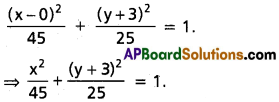
Inter 2nd Year Maths 2B Ellipse Solutions Ex 4(a) 11

iv) Centre (2, -1); e = \(\frac{1}{2}\); length of latus rectum 4.
Solution:
Equation of the ellipse is
\(\frac{9(x-2)^2}{64}+\frac{3(y+1)^2}{16}\) = 1
9(x – 2)² + 12(y + 1)² = 64.

Question 3.
Find the radius of the circle passing through the foci of an ellipse 9x² + 16y² = 144 and having least radius.
Solution:
Equation of the ellipse 9x² + 16y² = 144.
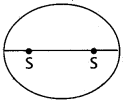
Inter 2nd Year Maths 2B Ellipse Solutions Ex 4(a) 12
\(\frac{x^2}{16}+\frac{y^2}{9}\) = 1
a² = 16, b² = 9
a = 4, b = 3
The circle passes through S and S¹ and has least radius.
If S S¹ is diameter.
a²e² = a² – a² (1 – e²) = a² – b² = 16 – 9 = 7
Equation of the required circle is x² + y² = 7.

Inter 2nd Year Maths 2B Ellipse Solutions Ex 4(a)

Question 4.
A man running on a race course notices that the sum of the distances of the two flag posts from him is always 10m and the distance between the flag posts is 8m. Find the equation of the race course traced by the man.
Solution:
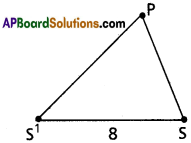
S and S¹ are the flags and P is the position of the man.
Inter 2nd Year Maths 2B Ellipse Solutions Ex 4(a) 13
Given SP + S¹P = 10 and SS¹ = 8
The path traced by the man is an ellipse whose foci are S and S¹.
2a = 10 ⇒ a = 5
SS¹ = 8 ⇒ 2ae = 8 ⇒ ae = 4
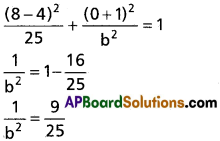
b² = a² (1 – e²) = 25 (1 – \(\frac{16}{25}\)) = 9
Equation of the ellipse is \(\frac{x^2}{a^2}+\frac{y^2}{b^2}\) = 1
\(\frac{x^2}{25}+\frac{y^2}{9}\) = 1.

III.

Question 1.
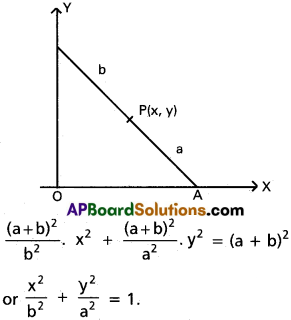
A line of fixed length (a + b) moves so that its ends are always on two perpendicular straight lines fixed. Prove that a marked point on the line, which divides this line into portions of lengths ‘a’ and ‘b’ describes an ellipse and also find the eccentricity of the ellipse when a = 8, b = 12.
Solution:
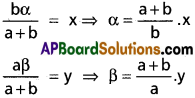
Take the perpendicular lines as co-ordinates axes. AB is the fixed line. Let OA = α, and OB = β so that equation of AB is \(\frac{x}{\alpha}+\frac{y}{\beta}\) = 1
Where α² + β² = (a + b)² ………….. (1)
P(x, y) divides AB in the ratio a = b
Co-ordinates of P are (\(\frac{b\alpha}{a+b}+\frac{a\beta}{a+b}\)) = (x, y)
Inter 2nd Year Maths 2B Ellipse Solutions Ex 4(a) 14
Substituing the values of α, β in (1) we get,
Inter 2nd Year Maths 2B Ellipse Solutions Ex 4(a) 15
P describes an ellipse.
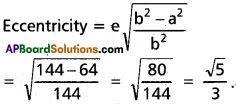
Given a = 8, b = 12, so that b > a
Inter 2nd Year Maths 2B Ellipse Solutions Ex 4(a) 16

Inter 2nd Year Maths 2B Ellipse Solutions Ex 4(a)

Question 2.
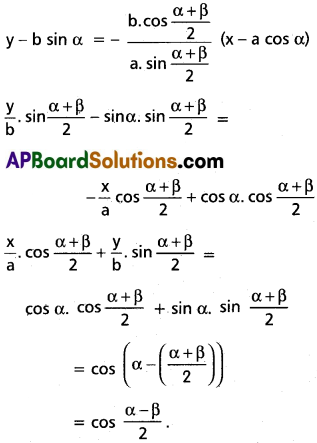
Prove that the equation of the chord joining the points α, β on the ellipse \(\frac{x^2}{a^2}+\frac{y^2}{b^2}\)
Inter 2nd Year Maths 2B Ellipse Solutions Ex 4(a) 17
Solution:
The given points on the ellipse are
P(a cos α, b sin α) and Q (a cos β, b sin β).
Inter 2nd Year Maths 2B Ellipse Solutions Ex 4(a) 18
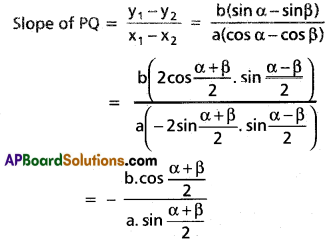
Equation of the chord PQ is
Inter 2nd Year Maths 2B Ellipse Solutions Ex 4(a) 19

Inter 2nd Year Maths 2B Parabola Solutions Ex 3(b)

Practicing the Intermediate 2nd Year Maths 2B Textbook Solutions Inter 2nd Year Maths 2B Parabola Solutions Exercise 3(b) will help students to clear their doubts quickly.

Intermediate 2nd Year Maths 2B Parabola Solutions Exercise 3(b)

I.

Question 1.
Find the equation of the tangent and normal to the parabola y² = 6x at the positive end of the latus rectum.
Solution:
(a, 2a) Here 4a = 6 ⇒ a = \(\frac{3}{2}\)
(\(\frac{3}{2}\), 3)
equation of tangent yy1 = 2a (x + x1)
yy1 = 3(x + x1)
3y = 3(x + \(\frac{3}{2}\))
2y – 2x – 3 = O’ is the equation of tangent
Slope of tangent is 1
Slope of normal is -1
Equation of normal is y – 3 = -1(x – \(\frac{3}{2}\))
2x + 2y – 9 = 0

Question 2.
Find the equation of the tangent and normal to the parabola x² – 4x – 8y + 12 = 0 at (4, \(\frac{3}{2}\))
Solution:
(x – 2)² – 4 – 8y + 12 = 0
⇒ (x – 2)² – 8y + 8 = 0
⇒ (x – 2)² = 8(y – 1); 4a = 8 ⇒ a = 2
Equation of tangents at (x1, y1) is
(x – 2) (x1 – 2) = 2a (y- 1 + y1 – 1)
⇒ (x – 2) (4 – 2) = 2(2) (y – 1 + \(\frac{3}{2}\) – 1)
⇒ 2(x – 2) = 4(\(\frac{2y-1}{2}\)
x – 2y – 1 = 0
Equation of normal will be
y – y1 = m(x – x1)
m – Slope of normal
Slope of tangent is \(\frac{1}{2}\)
Slope of normal is – 2
y – \(\frac{3}{2}\) = -2(x – 4)
2y – 3 = -4x + 16
4x + 2y – 19 = 0

Inter 2nd Year Maths 2B Parabola Solutions Ex 3(b)

Question 3.
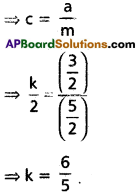
Find the value of k if the line 2y = 5x + k is a tangent to the parabola y² = 6x.
Solution:
Given line is 2y = 5x + k
⇒ y = (\(\frac{5}{2}\))x + (\(\frac{k}{2}\))
Comparing y = (\(\frac{5}{2}\))x + (\(\frac{k}{2}\)) with y = mx + c
We get m = \(\frac{5}{2}\), c = \(\frac{k}{2}\)
y = (\(\frac{5}{2}\))x + (\(\frac{k}{2}\)) is a tangent to y² = 6x
Inter 2nd Year Maths 2B Parabola Solutions Ex 3(b) 1

Question 4.
Find the equation of the normal to the parabola y² = 4x which is parellel to y – 2x + 5 = 0.
Solution:
Equation of the parabola is y² = 4x
∴ a = 1
The equation of the given line y – 2x + 5 = 0
Slope m = 2
The normal is parallel to the line y – 2x +5 = 0
Slope of the normal = 2
Equation of the normal at ‘t’ is
y + tx = 2at + at³
∴ Slope = -t = 2
⇒ t = -2
Equation of the normal is
y – 2x = 2.1 (-2) + 1(-2)³
= -4 – 8 = – 12
2x-y- 12 = 0.

Question 5.
Show that the line 2x – y + 2 = 0isa tangent to the parabola y² = 16x. Find the point of contact also. .
Solution:
Given line is 2x – y + 2 = 0
⇒ y = 2x + 2
Comparing with y = mx + c we get m = 2, c = 2
Comparing y² = 16x with y² = 4ax
We get 4a = 16 ⇒ a = 4
\(\frac{a}{m}=\frac{4}{2}\) = 2 = c
Point of contact = (\(\frac{a}{m^{2}},\frac{2a}{m}\)) = (\(\frac{4}{2^{2}},\frac{2(4)}{2}\))
= (1.4)

Question 6.
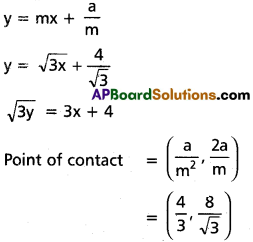
Find the equation of tangent to the parabola y2 = 16x inclined at an angle 60° with its axis and also find the point of contact.
Solution:
θ = 60°; m = tan 60° = √3
Inter 2nd Year Maths 2B Parabola Solutions Ex 3(b) 2

II.

Question 1.
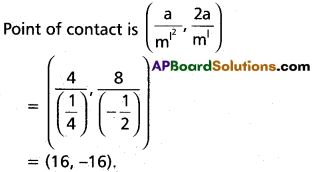
Find the equations of tangents to the parabola y² = 16x which are parallel and perpendicular respectively to the line 2x – y + 5 = 0, also find the co-ordinates of the points of contact also.
Solution:
Equation of the parabola is y² = 16x
The tangent is parallel to 2x – y + 5 = 0
Equation of the tangent can be taken as y = 2x + c
Condition for tangency is c = \(\frac{a}{m}=\frac{4}{2}\) = 2
Equation of the parallel tangent is y = 2x + 2
2x – y + 2 = 0
Point of contact is (\(\frac{a}{m^{2}},\frac{2a}{m}\)) = (\(\frac{4}{4},\frac{8}{2}\)) = (1, 4)
Slope of the perpendicular tangept is
m’ = –\(\frac{1}{m}=-\frac{1}{2}\)
Equation of the perpendicular tangent is
y = m’x + c’
= (-\(\frac{1}{2}\)) x + c’
where c’ = \(\frac{a}{m’}\) = \(\frac{4}{\left(-\frac{1}{2}\right)}\) = -8
Equation of the perpendicular tangent is
y = –\(\frac{1}{2}\)x – 8
2y = – x – 16
x + 2y + 16 = 0
Inter 2nd Year Maths 2B Parabola Solutions Ex 3(b) 4

Question 2.
If lx + my + n = 0 is a normal to the parabola y² = 4ax, then show that al³ + 2alm² + nm² = 0.
Solution:
Equation of the parabola is y² = 4ax
Equation of the normal is y + tx = 2at + at³
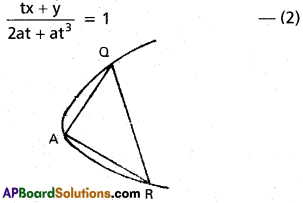
tx + y – (2at + at³) = 0 ……….. (1)
Equation of the given line is
lx + my + n = 0 …………. (2)
(1), (2) represent the same line.
Comparing the co-efficients
Inter 2nd Year Maths 2B Parabola Solutions Ex 3(b) 5
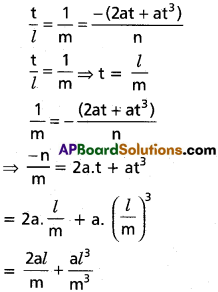
Multiplying with m³, we get
-nm² = 2alm² + al³
⇒ al³ + 2alm² + nm² = 0

Inter 2nd Year Maths 2B Parabola Solutions Ex 3(b)

Question 3.
Show that the equations of common tangents to the circle x² + y² = 2a² and the parabola y² = 8ax are y = ± (x + 2a).
Solution:
The equation of tangent to parabola
y² = 8ax is y = mx + \(\frac{2a}{m}\) ……….. (i)
m²x – my + 2a = 0
If (i) touches circle x² + y² = 2a², then the length of perpendicular from its centre (0, 0) to (i) must be equal to the radius a√2 of the circle.
\(\frac{2a}{\sqrt{m^{2} + m^{4}}}\) = a√2
or 4 = 2 (m4 + m²)
m4 + m² – 2 = 0
(m² + 2) (m² – 1) = 0 or m = ±1
Required tangents are
y = (1)x + \(\frac{2a}{(1)}\) , y = (-1) x + \(\frac{2a}{(-1)}\)
⇒ y = ±(x + 2a)

Question 4.
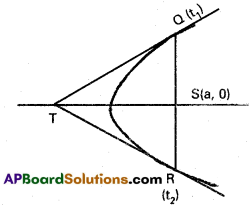
Prove that the tangents at the extremities of a focal chord of a parabola intersect at right angles on the directrix.
Inter 2nd Year Maths 2B Parabola Solutions Ex 3(b) 6
Solution:
Equation of the parabola is y² = 4ax
Equation of the tangent at Q(1) is
t1y = x + at²1
Equation of the tangent at R(t2) is t2y = x + at²2
Solving, point of intersection is T [at1t2, a(t1 + t2)]
Equation of the chord QR is
(t1 + t2)y = 2x + 2at1t2

Question 5.
Find the condition for the line y = mx + c to be a tangent to the parabola x² = 4ay.
Solution:
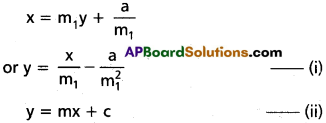
Equation of tangent to x² = 4ay in terms of ‘m1‘ [slope of tangent] is
Inter 2nd Year Maths 2B Parabola Solutions Ex 3(b) 7
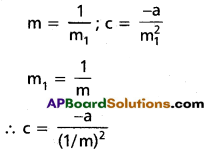
Comparing (i) and (ij), we get
Inter 2nd Year Maths 2B Parabola Solutions Ex 3(b) 8
c = – am² is required condition.

Question 6.
Three normals are drawn (k, 0) to the parabola y² = 8x one of the normal is the axis and the axis and the remaining two normals are perpendicular to each other, then find the value of k.
Solution:
Equation of any normal to the parabola is
y + xt = 2at + at³
This normal passes through (k, 0)
∴ kt = 2at + at³
at³ + (2a – k)t = 0
at² + (2a – k) = 0
Given m1 = 0, m2m3 = -1
(-t2) (-t3) = -1 ⇒ t2t3
\(\frac{2a-k}{a}\) = -1
2a – k = -a
k = 2a + a = 3a
Equation of the parabola is
y² = 8x
4a = 8
⇒ a = 2
k = 3a = 3(2) = 6.

Inter 2nd Year Maths 2B Parabola Solutions Ex 3(b)

Question 7.
Show that the locus of point of intersection of perpendicular tangents to the parabola y² = 4ax is the directrix x + a = 0.
Solution:
Equation of any tangent to the parabola can be taken as y = mx + \(\frac{a}{m}\)
This tangent passes through P(x1, y1)
y1 = mx1 + \(\frac{a}{m}\)
my1 = m²x1 + a
m²x1 – my1 + a = 0
Inter 2nd Year Maths 2B Parabola Solutions Ex 3(b) 9
The tangents are perpendicular
⇒ m1m2 = -1
\(\frac{a}{x_1}\) = -1
x1 = -a
Locus of P(x1, y1) is x = -a, the directrix of the parabola.

Question 8.
Two Parabolas have the same vertex and equal length of latus rectum such that their axes are at right angle. Prove that the common tangents touch each at the end of latus rectum.
Solution:
Inter 2nd Year Maths 2B Parabola Solutions Ex 3(b) 10
Equations of the parabolas can be taken as
y² = 4ax
and x² = 4ay
Equation of the tangent at (2at, at²) to
x² = 4ay is
2atx = 2a(y + at²)
y = tx – at²
This is a tangent to y² = 4ax
∴ The condition is c = \(\frac{a}{m}\)
-at² = \(\frac{a}{t}\)
t³ = -1 ⇒ t = -1
Equation of the tangent is y = -x – a
x + y + a = 0
Equation of the tangent at L’ (a, – 2a) is
y(-2a) = 2a(x + a)
x + y + a = 0
∴ Common tangent to the parabolas touches the parabola y² = 4ax at L (a, -2a) Equation of the tangent at L (-2a, a) to
x² = 4ay
x(-2a) = 2a(y + a)
x + y + a = 0
Common tangent to the parabolas touch the parabola at L’ (-2a, a)

Question 9.
Show that the foot of the perpendicular from focus to the tangent of the parabola y² = 4ax lies on the tangent at vertex.
Solution:
Equation of any tangent to the parabola is
y = mx + \(\frac{a}{m}\)
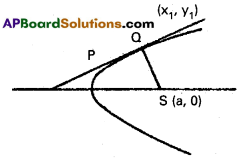
Q(x1, y1) is the foot of the perpendicular
∴ y1 = mx1 + \(\frac{a}{m}\) ……….. (1)
Slope of SQ = \(\frac{y_{1}}{x_{1}-a}\)
Inter 2nd Year Maths 2B Parabola Solutions Ex 3(b) 11
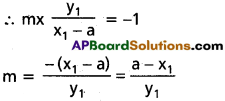
SQ and PQ are perpendicular
Inter 2nd Year Maths 2B Parabola Solutions Ex 3(b) 12
Substituting in (1) we get
Inter 2nd Year Maths 2B Parabola Solutions Ex 3(b) 13
Locus of Q (x1, y1) is x = 0 i.e., the tangent at the vertex of the parabola.

Inter 2nd Year Maths 2B Parabola Solutions Ex 3(b)

Question 10.
Show that the tangent at one extremity of a focal chord of a parabola is parallel to the normal at the other extremity.
Solution:
Inter 2nd Year Maths 2B Parabola Solutions Ex 3(b) 14
P(t1), Q(t2) are the ends of a focai chord.
Slope of PS = Slope of PQ
Inter 2nd Year Maths 2B Parabola Solutions Ex 3(b) 15
Equation of the tangent at P(t1) is
t1y = x + at²1
Slope of the tangent at P = \(\frac{1}{t_{1}}\) ………… (2)
Equation of the normal at Q(t2) is
y + xt2 = 2at2 + at³2
Slope of the normal at Q = -t2 ………… (3)
Frorn (1), (2)„ (3) we get slope of the tangent at P = slope of normal at Q
Slope of the tangent at P is parallel to the normal at Q.

III.

Question 1.
If the normal at the point t, on the parabola y² = 4ax meets it again at point t² then prove that t1t2 + t1² + 2 = 0.
Solution:
Equation of normal is
Inter 2nd Year Maths 2B Parabola Solutions Ex 3(b) 16
Equation of the line (i) again meets parabola at (at²2, 2at2)
∴ 2at2 – 2at1 = t1(at²2 – at²1)
–\(\frac{2}{t_{1}}\) = t1 + t2 ⇒ -2 = t²1 + t1t2
⇒ t²1 + t1t2 + 2 = 0

Question 2.
From an external point P tangents are drawn to the parabola y² = 4ax and these tangents make angles θ1, θ2 with its axis such that cot θ1 + cot θ2 is a constant ‘a’ show that P lies on a horizontal line.
Solution:
Equation of any tangent to the parabola is
y = mx + \(\frac{a}{m}\)
This tangent passes through P(x1, y1)
y1 = mx1 + \(\frac{a}{m}\) ⇒ my1 = m²x1 + a
m²x1 – my1 + a = 0
Suppose m1, m2 are the roots of the equation
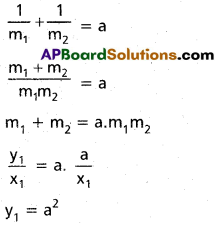
m1 + m2 = \(\frac{y_{1}}{x_{1}}\), m1m2 = \(\frac{a}{x_{1}}\)
Given cot θ1 + cot θ2 = a
Inter 2nd Year Maths 2B Parabola Solutions Ex 3(b) 17
Focus of P(x1; y1) is y = a² which is a horizontal line.

Inter 2nd Year Maths 2B Parabola Solutions Ex 3(b)

Question 3.
Show that the common tangent to the circle 2x² + 2y² = a² and the parabola 4ax intersect at the focus of the parabola y² = -4ax.
Solution:
Given circle is 2x² + 2y² = a²
with centre = (0, 0); Radius = \(\frac{a}{\sqrt{2}}\)
Given parabola is y² = 4ax a
Let y = mx + \(\frac{a}{m}\) be required tangent
But it touches 2x² + 2y² = a²
⇒ Perpendicular distance from (0, 0) = radius
Inter 2nd Year Maths 2B Parabola Solutions Ex 3(b) 18
Inter 2nd Year Maths 2B Parabola Solutions Ex 3(b) 19
Hence the focus of tangent of the parabola is y² = – 4ax.

Question 4.
The sum of the ordinates of two points on y² = 4ax is equal to the sum of the ordinates of two other points on the same curve. Show that the chord joining the first two points is parallel to the chord joining the other two points.
Solution:
Inter 2nd Year Maths 2B Parabola Solutions Ex 3(b) 20
Equation of the parabola is y² = 4ax
Equation of the chord joining P(t1) and Q(t2) is (t1 + t2)y = 2x + 2 at1t2
Slope of PQ = \(\frac{2}{t_{1}+t_{2}}\) ………… (1)
Equation of the chord joining R(t3) and S(t4) is (t3 + t4) y = 2x + 2at3t4
Slope of RS = \(\frac{2}{t_{3}+t_{4}}\) ………… (2)
Given 2at1 + 2at2 = 2at3 + 2at4
i.e., 2a(t1 + t2) = 2a(t3 + t4)
t1 + t2 = t3 + t4
From (1), (2), (3) we get slope of PQ = Slope of Rs
i.e., PQ and RS are parallel.

Inter 2nd Year Maths 2B Parabola Solutions Ex 3(b)

Question 5.
If a normal chord a point ‘t’ on the parabola y² = 4ax subtends a right angle at vertex, then prove that t = ± √2
Solution:
Equation of the parabola is y² = 4ax ………….. (1)
Equation of the normal at’t’ is
tx + y = 2at + at³
Inter 2nd Year Maths 2B Parabola Solutions Ex 3(b) 21
Homogenising (1) with the help of (2) combined equation of AQ, AR is
y² = \(\frac{4ax.(tx+y}{a(2t+t^{3})}\)
y²(2t + t³) = 4tx² + 4xy
4tx² + 4xy – (2t + t³)y² = 0
AQ, AR are perpendicular
Co-eff. of x² + Co.eff. of y² = 0
4t – 2t – t³ = 0
2t – t³ = 0
-t(t² – 2) = 0
t² – 2 = 0 ⇒ t² = 2
t = ± √2

Inter 2nd Year Maths 2B Parabola Solutions Ex 3(a)

Practicing the Intermediate 2nd Year Maths 2B Textbook Solutions Inter 2nd Year Maths 2B Parabola Solutions Exercise 3(a) will help students to clear their doubts quickly.

Intermediate 2nd Year Maths 2B Parabola Solutions Exercise 3(a)

I.

Question 1.
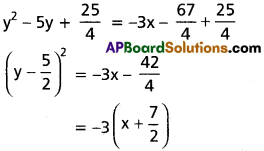
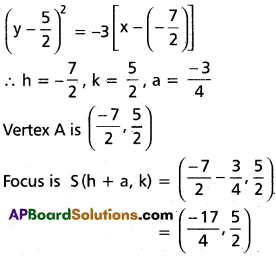
Find the vertex and focus of 4y² + 12x – 20y + 67 = 0.
Solution:
Given equation 4y² + 12x- 20y + 67 = 0
4y² – 20y = -12x – 67
y² – 5y = – 3x – \(\frac{67}{4}\)
Adding \(\frac{25}{4}\) on both sides
Inter 2nd Year Maths 2B Parabola Solutions Ex 3(a) 1
Inter 2nd Year Maths 2B Parabola Solutions Ex 3(a) 2

Question 2.
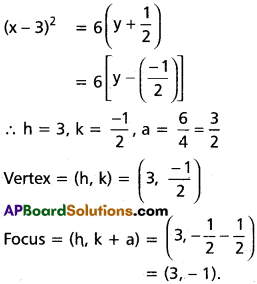
Find the vertex and focus of x2 -16x- 6y + 6 = 0.
Solution:
Given equation is
x² – 6x – 6y + 6 = 0
x² – 6x = 6y – 6
Adding 9 on both sides
x² – 6x + 9 = 6y + 3
Inter 2nd Year Maths 2B Parabola Solutions Ex 3(a) 3

Question 3.
Find the equations of axis and directrix of the parabola y² + 6y – 2x + 5 = 0.
Solution:
y² + 6y = 2x – 5
Adding ‘9’ on both sides we get,
y² + 6y + 9 = 2x – 5 + 9
[y – (-3)]² = 2x + 4
[y – (-3)]² = 2[x – (-2)]
Comparing with (y – k)² = 4a (x- h) we get,
(h, k) – (-2, -3), a = \(\frac{1}{2}\)
Equation of the axis y – k = 0 i.e. y + 3 = 0
Equation of the directrix x – h + a = 0
i.e., x – (-2) + \(\frac{1}{2}\) = 0
2x + 5 = 0.

Inter 2nd Year Maths 2B Parabola Solutions Ex 3(a)

Question 4.
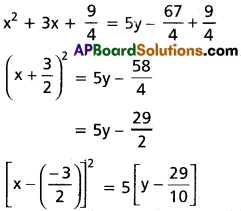
Find the equation of axis and directrix of the parabola 4x² + 12x – 20y + 67 = 0.
Solution:
4x² + 12x = 20y – 67
x² + 3x = 5y – \(\frac{67}{4}\)
Adding \(\frac{9}{4}\) on both sides we get
Inter 2nd Year Maths 2B Parabola Solutions Ex 3(a) 4
Comparing with (x – h)² = 4a(y – k)
(h, k) = (\(\frac{-3}{2},\frac{29}{10}\)) ; a = \(\frac{5}{4}\)
Equation of the axis x – h = 0, i.e., x + \(\frac{3}{2}\) = 0
2x + 3 = 0
Equation of the directrix, y – k + a = 0
y – \(\frac{29}{10}\) + \(\frac{5}{4}\) = 0
⇒ 20y – 33 = 0.

Question 5.
Find the equation of the parabola whose focus is S (1, -7) and vertex is A(1, -2).
Solution:
Let S = (1, -7), A(1, -2)
h = 1, k = -2, a = -2 + 7 = 5
Axis of the parabola is parallel to y-axis Equation of the parabola is
(x – h)² = -4a (y – k)
(x – 1)² = – 20(y + 2)
x² – 2x + 1 = – 20y – 40
⇒ x² – 2x + 20y + 41 = 0.

Question 6.
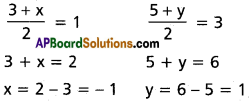
Find the equation of the parabola whose focus is S(3, 5) and vertex is A(1, 3).
Solution:
Equation of the axis y – 3 = \(\frac{3-5}{1-3}\) (x – 1)
= x – 1
x – y + 2 = 0
The directrix is perpendicular to the axis. Equation of the directrix is x + y + k = 0
Co-ordinates of Z be (x, y)
A is the midpoint of SZ
Co-ordinates of A are \(\frac{3+x}{2},\frac{5+y}{2}\)) = (1, 3)
Inter 2nd Year Maths 2B Parabola Solutions Ex 3(a) 5
Co-ordinates of Z are (-1, 1)
The directrix passes through Z (-1, 1)
-1 + 1 + k = 0 ⇒ k = 0
Equation of the directrix is x – y = 0
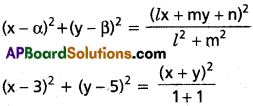
Equation of the parabola is
Inter 2nd Year Maths 2B Parabola Solutions Ex 3(a) 6
⇒ 2(x² – 6x + 9 + y2 – 10y + 25) = (x + y)²
⇒ 2x² + 2y² – 12x – 20y + 68 = x² + 2xy + y²
i.e., x² – 2xy + y² – 12x – 20y + 68 = 0.

Inter 2nd Year Maths 2B Parabola Solutions Ex 3(a)

Question 7.
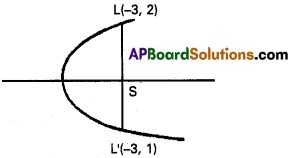
Find the equation of the parabola whose latus rectum is the line segment of joining the points (-3, 2) and (-3, 1).
Inter 2nd Year Maths 2B Parabola Solutions Ex 3(a) 7
Solution:
L (-3, 2) and L(-3, 1) are the ends of the latus rectum.
S is the midpoint of LL’
Co-ordinates of S are (-3, \(\frac{3}{2}\))
LL’ = \(\sqrt{(-3+3)^{2}+(2 – 1)^{2}}=\sqrt{0+1}\) = 1
4|a| = 1, ⇒ |a| = \(\frac{1}{4}\) ⇒ a = ± \(\frac{1}{4}\)

Case (i) a = –\(\frac{1}{4}\)
Co-ordinates of A are [-3 + \(\frac{1}{4}\), \(\frac{3}{2}\)]
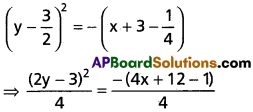
Equation of the parabola is
Inter 2nd Year Maths 2B Parabola Solutions Ex 3(a) 8
(2y – 3)² = -(4x + 11)

Case (ii) a = –\(\frac{1}{4}\)
Co-ordinates of A are [-3 – \(\frac{1}{4}\), \(\frac{3}{2}\)]
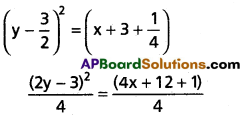
Equation of the parabola is
Inter 2nd Year Maths 2B Parabola Solutions Ex 3(a) 9
i.e., (2y – 3)² = 4x + 13.

Question 8.
Find the position (interior or exterior or on) of the following points with respect to the parabola y² = 6x,
i) (6, -6)
Solution:
Equation of the parabola is
y² = 6x
i.e., S ≡ y² – 6x
S11 = (-6)² – 6.6 = 36 – 36 = 0
∴ (6, – 6) lies on the parabola.

ii) (0,1)
S11 = 1² – 6.0 = 1 > 0
∴ (0, 1) lies outside the parabola.

iii) (2, 3)
S11 = 32 – 6.2
= 9 – 12
= – 3 < 0
∴ (2, 3) lies inside the parabola.

Question 9.
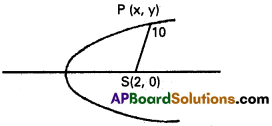
Find the co-ordinates of the point on the parabola y² = 8x whose focal distance is 10.
Solution:
Equation of the parabola is y² = 8x
4a = 8 ⇒ a = 2
Inter 2nd Year Maths 2B Parabola Solutions Ex 3(a) 10
Co-ordinates of the focus S are (2, 0)
Suppose P(x, y) is the point on the parabola.
Given SP = 10 ⇒ SP² = 100
(x – 2)² + y2 = 100
But y² = 8x
⇒ (x – 2)² + 8x = 100
⇒ x² – 4x + 4 + 8x – 100 = 0
⇒ x² + 4x – 96 = 0 ⇒ (x + 12) (x – 8) = 0
x + 12 = 0 or x – 8 = 0
x = -12, or 8

Case (i) x = 8
y² = 8.x = 8.8 = 64
y = ±8
Co-ordinates of the required points are (8, 8) and (8, -8)

Case (ii) x = -12
y² = 8(-12) = -96 < 0
y is not real.

Inter 2nd Year Maths 2B Parabola Solutions Ex 3(a)

Question 10.
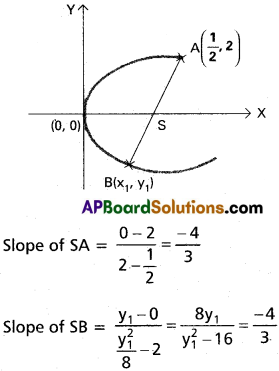
If (\(\frac{1}{2}\), 2) j is one extermity of a focal chord of the parabola y² = 8x. Find the co-ordinates of the other extremity.
Solution:
A = \(\frac{1}{2}\), 2); S = (2, 0)
B = (x1, y1) ⇒ (\(\frac{y^{2}_{2}}{8}\), y1)
ASB is a focal chord.
∴ Slopes of SA and BS are same.
Inter 2nd Year Maths 2B Parabola Solutions Ex 3(a) 11
24y1 = -4y²1 + 64
or 4y²1 + 24y1 – 64 = 0
⇒ y²1 + 6y1 – 16 = 0 ⇒ (y1 + 8) (y1 – 2) = 0
y1 = 2, -8
x1 = \(\frac{1}{2}\), 8; So (8, -8) other extremity.

Question 11.
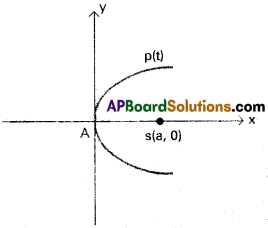
Prove that the parabola y2 – 4ax, (a > O) Nearest to the focus is its vertex.
Solution:
Let P(at², 2at) be the point on the parabola y² = 4ax, which is nearest to the
Inter 2nd Year Maths 2B Parabola Solutions Ex 3(a) 12
focus S(a, 0) then
fSp²= (at² – a)² + (2at – 0)²
f(t) = a²2(t² – 1)(2t) + 4a²(2t)
= 4a²t(t² – 1 + 2) = 4a²t(t² + 1)
For minimum value of f(t) = 0 ⇒ t = 0
f”(L) = 4a²(3t² +1) s
f(0) = 4a² > 0
∴ At t-= 0, f(t) is minimum Then P = (0, 0)
∴ The point on the parabola y² = 4ax, which is nearest to the focus is its vertex A(0, 0).

Question 12.
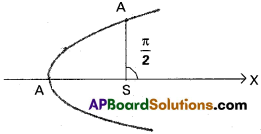
A comet moves in a Parabolic orbit with the sun as focus when the comet is 2 × 10⁷ K.M from the sun, the line from the sun to it makes an fmgle \(\frac{\pi}{2}\) with the axis of the orbit. Find how near the comet comes to the sun.
Inter 2nd Year Maths 2B Parabola Solutions Ex 3(a) 13
Solution:
Suppose the equation of the parabolic orbit of the comet is y² = 4ax
P is the position of the comet.
Given ∠XSP = \(\frac{\pi}{2}\)
SP is perpendicular to the axis of the parabola.
SP is the semi-latus rectum
2a = 2 × 10⁷
⇒ a = 107 km
A is the nearest point on the parabola from focus.
AS = a = 107 km
∴ The nearest point on the parabola is 107 km from the sun.

II.

Question 1.
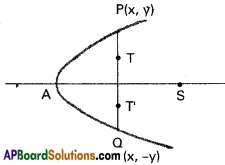
Find the locus of the points of trisection of double ordinate of a parabola y² = 4ax (a > 0).
Solution:
Equation of the parabola is y² = 4ax
P(x, y) and Q(x, -y) are the ends of the double ordinate.
Inter 2nd Year Maths 2B Parabola Solutions Ex 3(a) 14
T divides PQ in the ratio 1 : 2
Co-ordinates of T are (x, \(\frac{-y+2y}{3}\))
= (x, \(\frac{y}{3}\))
T divides PQ in the ratio 2 : 1
Co-ordinates of T are (x, \(\frac{-2y+y}{3}\))
= (x, –\(\frac{y}{3}\))
Suppose Co-ordinates of the required points
L and L’ be (x1, y1)
y1 = ± \(\frac{y}{3}\) ⇒ y²1 = \(\frac{y^{2}}{9}\)
y² = 9y²1
4ax1 = 9y²1
Locus of (x1, y1) is 9y² = 4ax.

Inter 2nd Year Maths 2B Parabola Solutions Ex 3(a)

Question 2.
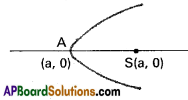
Find the equation of the parabola whose vertex and focus are on the positive X – axis at a distance of a and a’ from the origin respectively.
Solution:
Given Co-ordinates of A are (a, 0) and S are (a’, 0)
AS = a’ – a
Inter 2nd Year Maths 2B Parabola Solutions Ex 3(a) 15
Equation of the parabola is
y² = 4(a’ – a) (x – a).

Question 3.
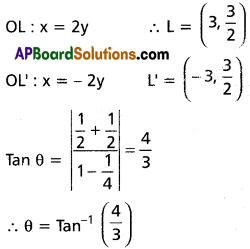
If L and L‘ are the ends of the latus rectum of the parabola x² = 6y, find the equations of OL and OL’ where ‘O’ is the origin. Also find the angle between them.
Solution:
x² = 6y
Curve is symmetric about Y – axis
Extremities of latus rectum are
(2a, a), (-2a, a)
4a = 6 ⇒ a = \(\frac{3}{2}\)
Inter 2nd Year Maths 2B Parabola Solutions Ex 3(a) 16

Question 4.
Find the equation of the parabola whose axis is parallel to X-axis and which passes through these points. (-2, 1) (1, 2), and (-1, 3)
Solution:
Axis is parallel to X – axis
General equation be
x = ay² + by + c
Passes through (-2, 1) (1, 2) (-1, 3)
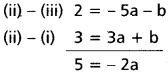
-2 = a + b + c ………. (i)
1 = 4a + 2b + c ……….. (ii)
-1 = 9a + 3b + c …………. (iii)
Inter 2nd Year Maths 2B Parabola Solutions Ex 3(a) 17
⇒ –\(\frac{5{2}\) = a
i.e., \(\frac{21}{2}\) = b
-10 = c
x = –\(\frac{5}{2}\)y² + \(\frac{21}{2}\)y – 10
5y² + 2x – 21y + 20 = 0

Question 5.
Find the equation of the parabola whose axis is parallel to Y – axis and which passes .through the points (4, 5), (-2, 11) and (-4, 21).
Solution:
General equation be y = ax² + bx + c passes through (4, 5), (-2, 11), (-4, 21) we get
5 = 16a + 4b + c ……… (i)
11 = 4a – 2b + c ……….. (ii)
21 = 16a – 4b + c ……….. (iii)
(ii) – (i) we get
6 = -12a – 6b
(iii) – (ii) 10 = 12a – 2b
Solving we get
b = -2, a = 1/2; c = 5
y = \(\frac{1}{2}\)x² – 2x + 5
x² – 2y – 4x + 10 = 0

III.

Question 1.
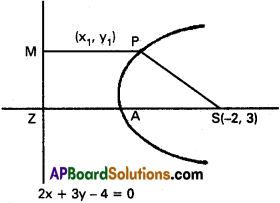
Find the equation of the parabola whose focus is (-2, 3) and directrix is the line 2x + 3y – 4 = 0. Also find the length of the latus rectum and the equation of the axis of the parabola.
Solution:
Inter 2nd Year Maths 2B Parabola Solutions Ex 3(a) 18
Suppose P(x1, y1) is any point on the parabola.
S(-2, 3) is the focus.
SP² = (x1 + 2)² + (y1 – 3)²
Equation of the directrix is 2x + 3y – 4 = 0
PM is the perpendicular from P on the directrix
PM = \(\frac{2x_{1}+3y_{1}-4}{\sqrt{4+9}}\)
From Def. of parabola SP = PM ⇒ SP² = PM²
(x1 + 2)² + (y1 – 3)² = \(\frac{(2x_{1}+3y_{1}-4)^{2}}{13}\)
⇒ 13(x²1 + 4x1 + 4 + y²1 – 6y1 + 9) = (2x1 + 3y1 – 4)²
⇒ 13x²1 + 13y²1 + 52x1 – 78y1 + 169
= 4x²1 + 9y²1 + 16 + 12x1y1 – 16x1 – 24y1
⇒ 9×21 – 12x1y1 + 4y²1 + 68x1 – 54y1 + 153 = 0
Locus of P(x1, y1) is
9x² – 12xy + 4y² + 68x- 54y + 153 = 0
Length of the latus rectum = 4a
Perpendicular distance from S on directrix
Inter 2nd Year Maths 2B Parabola Solutions Ex 3(a) 19
Length of the latus rectum = 4a = \(\frac{2}{\sqrt{3}}\)
The axis is perpendicular to the .directrix Equation of the directrix can be taken as
3x – 2y + k = 0
This line passes through S (-2, 3)
– 6 – 6 + k = 0 ⇒ k = 12
Equation of the axis is 3x – 2y + 12 = 0

Question 2.
Prove that the area of the triangle inscribed in the parabola y² = 4ax is \(\frac{1}{8a}\)|(y1 – y2) (y2 – y3) (y3 – y1)| sq. units where y1, y2, y3 are the ordinates of its vertices.
Solution:
Suppose P(at²1, 2at1), Q(at²2, 2at2),
R(at²3, 2at3) are the vertices of ∆PQR.
Area of ∆PQR = \(\frac{1}{2}\) | at²1 (2at2 – 2at3) + at²2 (2at3 – 2at1) + at²3(2at1 – 2at2)|
= \(\frac{1}{2}\) . 2a² |t²1 (t2 – t3) + t²2(t3 – t1) + t²3(t1 – t2)|
= a² |(t1 – t2) (t2 – t3) (t3 – t1)|
= \(\frac{1}{8a}\) |(2at1 – 2at2) (2at2 – 2at3) (2at3 – 2at1) |
= \(\frac{1}{8a}\) |(y1 – y2) (y2 – y3) (y3 – y1)|
Where P(x1, y1), Q(x2, y2), R(x3, y3) are the vertices of ∆PQR.

Inter 2nd Year Maths 2B Parabola Solutions Ex 3(a)

Question 3.
Find the co-ordinates of the vertex and focus, the equation of the directrix and axis of the -following parabolas.
(i) y² + 4x + 4y – 3 = 0
(ii) x² – 2x + 4y – 3 = 0
Solution:
i) y² + 4x + 4y – 3 = 0
⇒ y² + 4y = – 4x + 3
⇒ y² + 4y + 4 = – 4x +. 3 + 4
⇒ (y + 2)² = – 4x + 7
⇒ [y – (-2)]² = -4[x – \(\frac{7}{4}\)]
h = \(\frac{7}{4}\), k = -2, a = 1
Vertex A(h, k) = (\(\frac{7}{4}\), -2)
Focus (h-a, k) = (\(\frac{7}{4}\) – 1, -2)
= (\(\frac{3}{4}\), -2)
Equation of the directrix x – h – a = 0
x – \(\frac{7}{4}\) – 1 = 0
4x – 11 = 0
Equation of the axis is y – k = 0
y + 2 = 0

ii) x² – 2x + 4y – 3 = 0
⇒ x² – 2x = – 4y + 3
⇒ x – 2x + 1 = – 4y + 3 + 1
(x – 1)² = – 4y + 4
= – 4[y – 1 ]
(x – 1)² = – 4[y – 1]
h = 1; k = 1; a = 1
Vertex A(h, k) = (1, 1)
Focus (h, k – a) =(1, 1 -1)
= (1, 0)
Equation of the directrix
y – k – a = 0
y – 1 – 1 = 0
y – 2 = 0
Equation of the axis is,
x – h = 0
x – 1 = 0

Inter 2nd Year Maths 2B System of Circles Solutions Ex 2(b)

Practicing the Intermediate 2nd Year Maths 2B Textbook Solutions Inter 2nd Year Maths 2B System of Circles Solutions Exercise 2(b) will help students to clear their doubts quickly.

Intermediate 2nd Year Maths 2B System of Circles Solutions Exercise 2(b)

I.

Question 1.
Find the equation of the radical axis of the following circles,
i) x² + y² – 3x – 4y + 5 = 0, 3(x² + y²) – 7x + 8y – 11 = 0
Solution:
S ≡ x² + y² – 3x – 4y + 5 = 0
S ≡ 3x² + 3y² – 7x + 8y + 11 = 0
S – S’ = 0 is radical axis.
(x² + y² – 3x – 4y + 5)
Inter 2nd Year Maths 2B System of Circles Solutions Ex 2(b) 1

ii) x² + y² + 2x + 4y + 1 = 0, x² + y² + 4x + y = 0.
Solution:
S – S’ = 0 is radical axis.
(x² + y² + 2x + 4y + 1) – (x² +y² + 4x + y) = 0
⇒ -2x + 3y + 1 = 0
(or) 2x – 3y – 1 =0 required radical axis.

iii) x² + y² +4x + 6y – 7 = 0,
4(x² + y²) + 8x + 12y – 9 = 0.
Solution:
S – S’ = 0 is radical axis.
(x² + y² + 4x + 6y – 7) – (x² + y² + 2x + 3y – \(\frac{9}{4}\)) = o
⇒ 2x + 3y – \(\frac{19}{4}\) = 0 ⇒ 8x + 12y – 19 = 0

iv) x² + y² – 2x – 4y -1=0, x² + y² – 4x – 6y + 5 = 0.
Solution:
S – S’ = 0 radical axis
(x² + y² – 2x – 4y – 1) – (x² + y² – 4x – 6y + 5) = 0
2x + 2y – 6 = 0 (or) x + y – 3 = 0

Inter 2nd Year Maths 2B System of Circles Solutions Ex 2(b)

Question 2.
Find the equation of the common chord of the following pair of circles.
i) x² + y² – 4x – 4y + 3 = 0, x² + y² – 5x – 6y + 4 = 0.
Solution:
(x² + y² – 4x – 4y + 3) – (x² + y² – 5x – 6y + 4) = 0
x + 2y – 1 = 0 Equation of common chord.

ii) x² + y² + 2x + 3y + 1 = 0, x² + y² + 4x + 3y + 2 = 0.
Solution:
(x² + y² +2x + 3y + 1) – (x² + y² + 4x + 3y + 2) = 0
-2x – 1 = 0 equation of common chord is

iii) (x – a)² + (y – b)² = c², (x – b)² + (y – a)² = c² (a ≠ b)
Solution:
(x² + y² – 2xa – 2yb – c²) – (x² + y² – 2xb – 2ya – c²) = 0
-2x(a – b) – 2y(b – a) = 0
(or) x – y = 0

II.

Question 1.
Find the equation of the common tangent of the following.circles at their point of contact.
i) x² + y² + 10x – 2y + 22 = 0, x² + y² + 2x – 8y + 8 = 0.
Solution:
x² + y² + 10x – 2y + 22 = 0
x² + y² + 2x – 8y + 8 = 0
When circles touch each other then
S – S’ = 0 is required tangent (common)
∴ (x² + y² + 10x-2y + 22) – (x² + y² + 2x – 8y + 8) = 0
8x + 6y + 14 = 0 (or)
4x + 3y + 7 = 0

ii) x² + y² – 8y – 4 = 0; x² + y² – 2x – 4y = 0.
Solution:
When circles touch each other then
S – S’ = 0 is required common tangent.
(x² + y² – 8y – 4) – (x² + y² – 2x – 4y) = 0
2x – 4y – 4 = 0 (or) x – 2y – 2 = 0

Question 2.
Show that the circles x² + y² – 8x – 2y + 8 = 0 and x² + y² – 2x +, 6y + 6 = 0 touch each other and find the point of contact.
Solution:
C1 = (4, 1) C2 = (1, -3)
r1 = \(\sqrt{16+1-8}\) = 3 ; r2 = \(\sqrt{1+9-6}\) = 2
C1C2 = \(\sqrt{(4-1)^{2}+(1+3^{2})}\) = 5
r1 + r2 = C1 + C2 they touch each other externally
Inter 2nd Year Maths 2B System of Circles Solutions Ex 2(b) 2
∴ Point of contact is (\(\frac{11}{5} , \frac{-7}{5}\))

Question 3.
If the two circles x² + y² + 2gx + 2fy = 0 and x² + y² + 2g’x + 2f’y = 0 touch each other then show that f’g = fg’.
Solution:
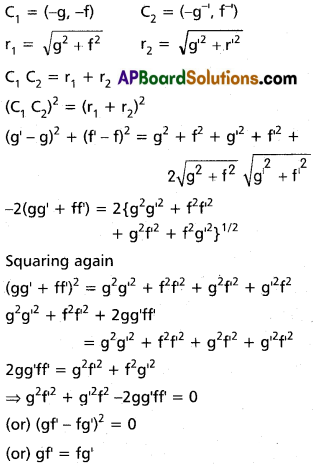
Inter 2nd Year Maths 2B System of Circles Solutions Ex 2(b) 3

Inter 2nd Year Maths 2B System of Circles Solutions Ex 2(b)

Question 4.
Find the radical centre of the following circles.
i) x² + y² – 4x – 6y + 5 = 0 ………… (i)
x² + y² – 2x – 4y – 1 = 0 ………… (ii)
x² + y² – 6x – 2y = 0 ………… (iii)
Solution:
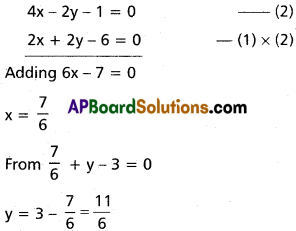
(i) – (ii) gives
– 2x – 2y + 6 = 0
x + y – 3 = 0 ………. (1)
(ii) – (iii) gives
Inter 2nd Year Maths 2B System of Circles Solutions Ex 2(b) 4
Point of intersection of (1) and (2) is radical centre will (7/6,11/6) we get by solving these two equations.

ii) x² + y² + 4x – 7 = 0,
2x² + 2y² + 3x + 5y – 9 = 0,
x² + y² + y = 0.
Solution:
S = x² + y² + 4x – 7 = 0 ……….. (i)
S1 = 2x² + 2y² + 3x + 5y – 9 = 0
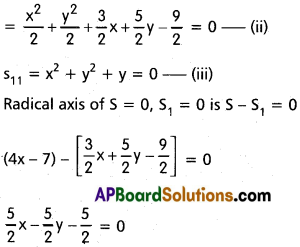
= x² + y² + \(\frac{3}{2}\)x + \(\frac{5}{2}\)y – \(\frac{9}{2}\) = 0 ………. (ii)
S11 = x² + y² + y = 0 ………. (iii)
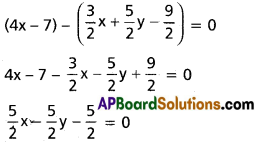
Radical axis of S = 0, S1 = 0 is S – S1 = 0
Inter 2nd Year Maths 2B System of Circles Solutions Ex 2(b) 5
5x – 5y – 5 = 0
x – y – 1 = 0 ………… (iv)
Radical axis of S = 0, S11 = 0 is S – S11 = 0
4x – y – 7 = 0 ……… (v)
x – y – 1 = 0………….. (vi)
Subtracting 3x – 6 = 0 ⇒ 3x = 6
x = \(\frac{6}{3}\) = 2
Substituting in (iv), 2 – y – 1 = 0
y = 1
Radical centre is P(2, 1)

III.

Question 1.
Show that the common chord of the circles x² + y² – 6x – 4y + 9 = 0 and x² + y² – 8x – 6y + 23 = 0 is the diameter of the second circle and also find its length.
Solution:
Common chord be
(x² + y² – 6x – 4y + 9) – (x² + y² – 8x – 6y + 23) = 0
2x + 2y – 14 = 0
x + y – 7 = 0 ………… (i)
Centre of circle (-4, -3)
(-4, -3) lies on line x + y – 7
Radius is {4² + 3² – 23}½ = √2
Diameter = 2√2

Question 2.
Find the equation and length of the common chord of the following circles.
i) x² + y² + 2x + 2y + 1 =0,
x² + y² + 4x + 3y + 2 = 0.
Solution:
x² + y² + 2x + 2y + 1 = 0
x² + y² + 4x + 3y + 2 = 0
Equation of common chord is
S – S’ = 0 (x² + y² + 2x + 2y + 1) – (x² + y² + 4x + 3y + 2) = 0
-2x – y – 1 = 0
2x + y + 1 = 0
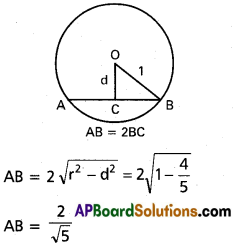
Centre of circle is (-1, -1)
Radius = \(\sqrt{1+1-1}\) = 1
Length of ⊥ from centre (-1, -1) to the chord is
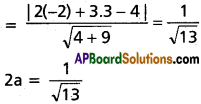
d = \(|\frac{2(-1)+(-1)+1}{\sqrt{2^{2}+1^{2}}}|=\frac{2}{\sqrt{5}}\)
Inter 2nd Year Maths 2B System of Circles Solutions Ex 2(b) 6

ii) x² + y² – 5x – 6y + 4 = 0, x² + y² – 2x – 2 = 0
Solution:
Common chord equation
(x² + y² – 5x- 6y + 4) – (x²+ y² – 2x – 2) = 0
-3x – 6y + 6 = 0
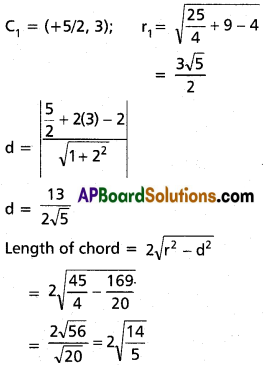
x + 2y – 2 = 0
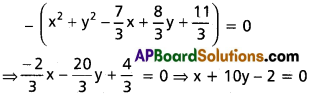
Inter 2nd Year Maths 2B System of Circles Solutions Ex 2(b) 7

Question 3.
Prove that the radical axis of the circles x² + y² + 2gx + 2fy + c = 0 and x² +y² + 2g’x + 2f’y + c‘ = 0 is the diameter of the latter circle (or the former bisects the circumference of the latter) if 2g'(g – g’) + 2f (f – f’) – c – c’.
Solution:
Radical axis is
(x² + y² + 2gx + 2fy + c) – (x² + y² + 2g’x + 2fy + c’) = 0
2(g – g’) x + 2(f – f’)y + c – c’ = 0 …………. (i)
Centre of second circle is (-g1, -f1)
Radius = \(\sqrt{g’^{2}+f’^{2}+c’}\)
Now (-g’, -f’) should lie on (i)
– 2g (g – g’) – 2f'(f – f’) + c – c’ = 0
(or) 2g (g – g’) + 2f'(f – f’) = c – c’

Question 4.
Show that the circles x² + y² + 2ax + c = 0 and x² + y² + 2by + c = 0 touch each other if 1/a² + 1/b² = 1/c.
Solution:
The centres of the circles C1 (-0, 0) and C2 (0, -b) respectively
Radius of 1st circle be \(\sqrt{a^{2}-c}\) = r1
Radius of 2nd circle be \(\sqrt{b^{2}-c}\) = r2
C1C2 = r1 + r2
(C1 C2)² = (r1 + r2
(a² + b²) = a² – c + b² – c + 2\(\sqrt{a^{2}-c}.\sqrt{a^{2}-c}\)
c = \(\sqrt{a^{2}-c}.\sqrt{a^{2}-c}\)
c² = (a² – c) (b² – c)
c² = -c (a² + b²) + a²b² + c²
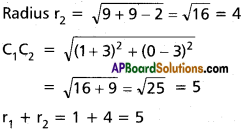
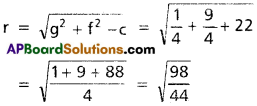
(or) c(a² + b²) = a²b² (or) \(\frac{1}{c}=\frac{1}{a^{2}}+\frac{1}{b^{2}}\)

Inter 2nd Year Maths 2B System of Circles Solutions Ex 2(b)

Question 5.
Show that the circles x² + y² – 2x = 0 and x² + y² + 6x – 6y + 2 = 0 touch each other. Find the coordinates of the point of contact. Is the point of contact external or internal?
Solution:
For the circle S = x² + y² – 2x = 0
Centre C1 = (1, 0) and Radius r1 .= \(\sqrt{1+0}\) = 1
For the circle S’ = x² + y² + 6x – 6y + 2 = 0
Centre C2 = (-3, 3) and
Inter 2nd Year Maths 2B System of Circles Solutions Ex 2(b) 8
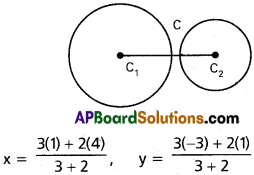
As C1C2 = r1 + r2 the two circles touch each other externally, the point of contact P divides line of centres internally in the ratio
r1 : r2 = 1 : 4
Hence point of contact
Inter 2nd Year Maths 2B System of Circles Solutions Ex 2(b) 9
The contact of the circle is external.

Question 6.
Find the equation of the circle which cuts the following circles orthogonally.
i) x² + y² + 4x – 7 = 0,
2x² + 2y² + 3x + 5y – 9 = 0,
x² + y² + y = 0.
Solution:
S = x² + y² + 4x – 7 = 0 ………… (i)
S1 = 2x² + 2y² + 3x + 5y – 9 = 0
Inter 2nd Year Maths 2B System of Circles Solutions Ex 2(b) 10
x – y – 1 = 0 ……. (iv)
Radical axis of S = 0, S11 = 0 is S – S11 = 0
4x – y – 7 = 0 ……….. (v)
Solving (iv) and (v)
We get 3x – 6 = 0
x = -2
Substute x value in (iv), 2 – y – 1 =0
y = 1
Radical centre is P(2, 1)
PT =’ Length of the tangent from P to S = 0
= \(\sqrt{4+1+8-7}\)
= √6
Equation of the circles cutting the given circles orthogonally
(x – 2)² + (y – 1)² = (√6)²
x² + 4 – 4x + y² + 1 – 2y = 6
x² + y² – 4x – 2y – 1 = 0

ii) x² + y² + 2x + 4y + 1 = 0,
2x² + 2y² + 6x + 8y – 3 = 0,
x² + y² – 2x + 6y – 3 = 0.
Solution:
Equations of the required circles are
S ≡ x² + y² + 2x + 4y + 1 = 0
S1 ≡ x² + y² + 3x + 4y – \(\frac{3}{2}\) = 0
S11 ≡ x² + y² – 2x + 6y – 3 = 0
Radical axis of S = 0, S1 = 0 is S – S1 =0
-x + \(\frac{5}{2}\) = 0 ⇒ x = \(\frac{5}{2}\)
Radical axis of S = 0, S11 = 0 is S – S11 = 0
4x – 2y + 4 = 0
⇒ 2x – y + 2 = 0
x = \(\frac{5}{2}\) ⇒ 5 – y + 2 = 0
⇒ y = 7
Radical centre is P (\(\frac{5}{2}\) , 7)
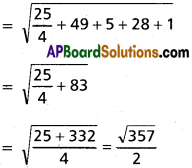
PT = Length of the tangent from P to S = 0
Inter 2nd Year Maths 2B System of Circles Solutions Ex 2(b) 11
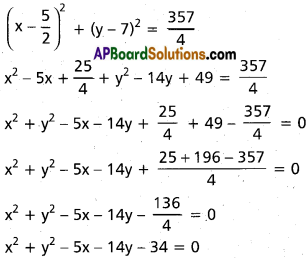
Equation of the circles cutting the given circles orthogonally
Inter 2nd Year Maths 2B System of Circles Solutions Ex 2(b) 12

iii) x² + y² + 2x + 17y + 4 = 0,
x² + y² + 7x + 6y + 11 = 0,
x² + y² – x + 22y + 3 = 0
Solution:
Equations of the required circles are
S ≡ x² + y² + 2x + 17y + 4 = 0 ……… (i)
S1 ≡ x² + y² + 7x + 6y + 11 = 0 ……… (ii)
S11 ≡ x² + y² – x + 22y + 3 = 0 ……… (iii)
Radical axis of S = 0, S1 = 0 is S – S1 = 0
-5x + 11 y – 7 = 0
5x – 11y + 7 = 0 ……… (iv)
Radical axis of S = 0, S11 = 0 is S – S11 =0
3x – 5y + 1 = 0 ………… (v)
Solving (iv) and (v)
Inter 2nd Year Maths 2B System of Circles Solutions Ex 2(b) 13
Radical centre is P(3, 2)
PT = Length of the tangeqt from P to S = 0
= \(\sqrt{9+4+6+34+4}\) = √57
Equation of the circle cutting the given circles cutting orthogonally
(x – 3)² + (y – 2)² = 57
x² – 6x + 9 + y² – 4y + 4 – 57 = 0
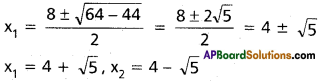
x² + y² – 6x – 4y – 44 = 0

Inter 2nd Year Maths 2B System of Circles Solutions Ex 2(b)

iv) x² + y² + 4x + 2y + 1 = 0,
2(x² + y²) + 8x + 6y – 3 = 0,
x² + y² + 6x – 2y – 3 = 0.
Solution:
Equations of the required circles are
S ≡ x² + y² + 4x + 2y + 1 = 0 ……….. (i)
S1 ≡ x² + y² + 4x + 3y – \(\frac{3}{2}\) = 0 ………… (ii)
S11 ≡ x² + y² + 6x – 2y – 3 = 0 ………. (iii)
(i) – (ii) gives radical axis of S = 0, S1 = 0 is
S – S1 = 0 ⇒ -y + \(\frac{5}{2}\) = 0 ⇒ y = \(\frac{5}{2}\)
Radical axis of S = 0, S11 = 0 is S – S11 = 0
– 2x + 4y + 4 = 0
x – 2y – 2 = 0
y = \(\frac{5}{2}\) ⇒ x – 5 – 2 = 0
x = 5 + 2 = 7
Radical centre is P (7, \(\frac{5}{2}\))
PT = Length of the tangent P to S = 0
Inter 2nd Year Maths 2B System of Circles Solutions Ex 2(b) 14
Equation of the required circle is
Inter 2nd Year Maths 2B System of Circles Solutions Ex 2(b) 15

Inter 2nd Year Maths 2B Circle Solutions Ex 1(e)

Practicing the Intermediate 2nd Year Maths 2B Textbook Solutions Inter 2nd Year Maths 2B Circle Solutions Exercise 1(e) will help students to clear their doubts quickly.

Intermediate 2nd Year Maths 2B Circle Solutions Exercise 1(e)

I.

Question 1.
Discuss the relative position of the following pair of circles.
i) x² + y² – 4x – 6y – 12 = 0
x² + y² + 6x + 18y + 26 = 0.
Solution:
Centres of the circles are A (2, 3), B(-3, -9)
radii are r1 = \(\sqrt{4+9+12}\) = 5
r2 = \(\sqrt{9+81-26}\) = 8
AB = \(\sqrt{(2+3)^{2}+(3+9)^{2}}\)
= \(\sqrt{25+144}\) = 13 = r1 + r2
∴ The circles touch externally.

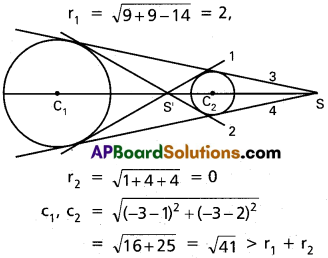
ii) x² + y² + 6x + 6y + 14 = 0,
x² + y² – 2x – 4y – 4 = 0.
Solution:
Centres are A (-3, -3), B (1, 2)
r1 = \(\sqrt{9+9-14}\) = 2,
r2 = \(\sqrt{1+4+4}\) = 3
AB = \(\sqrt{(-3-1)^{2}+(-3-2)^{2}}\)
= \(\sqrt{16+25}=\sqrt{41}\) > r1 + r2
∴ Each circle lies exterior to the other circle.

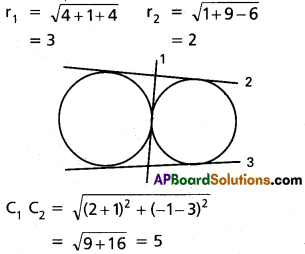
iii) (x – 2)² + (y + 1)² = 9, (x + 1)² + (y – 3)²= 4
Solution:
Centres are A( 2, -1), B(-1, 3)
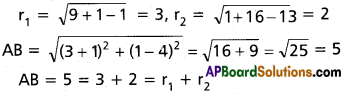
r1 = \(\sqrt{4+1+4}\) = 3, r2 = \(\sqrt{1+9-6}\) = 2
AB = \(\sqrt{(2+1)^{2}+(-1-3)^{2}}\)
= \(\sqrt{9+16}\)
= 5 = r1 + r2
∴ The circles touch each other externally.

iv) x² + y² – 2x + 4y – 4 = 0, x² + y² + 4x – 6y – 3 = 0
Solution:
Centres are A (1, -2), B (-2, 3)
r1 = \(\sqrt{1+4+4}\) = 3, r2 = \(\sqrt{4+9+3}\) = 4
AB = \(\sqrt{(1+2)^{2}+(-2-3)^{2}}=\sqrt{9+16}\)
= \(\sqrt{9+25}=\sqrt{34}\) < r1 + r2
r1 – r2 < AB < r2 + r1
∴ The circles intersect each other.

Inter 2nd Year Maths 2B Circle Solutions Ex 1(e)

Question 2.
Find the number of possible common tangents that exist for the following pairs of circles.
i) x² + y² + 6x + 6y + 14 = 0,
x² + y² – 2x – 4y – 4 = 0
Solution:
c1 ( -3, -3) c2 = (1, 2)
Inter 2nd Year Maths 2B Circle Solutions Ex 1(e) 1
The circles are externally No. of common tangents = 4

ii) x² + y² – 4x – 2y + 1 = 0;
x² + y² – 6x – 4y + 4 = 0.
Solution:
C1 (2, 1), C2 = (3, 2)
r1 = \(\sqrt{4+1-1}\) = 2
r2 = \(\sqrt{9+4-4}\) =3
Inter 2nd Year Maths 2B Circle Solutions Ex 1(e) 2
C1 C2 = \(\sqrt{(2-3)^{2}+(1-2)^{2}}=\sqrt{2}\)
C1 C2 < r1 + r2 intersect each other 2 tangents (direct)

iii) x² + y² – 4x + 2y – 4 = 0;
x² + y² + 2x – 6y + 6 = 0.
Solution:
C1 (2, -1) C2 = (-1, 3)
Inter 2nd Year Maths 2B Circle Solutions Ex 1(e) 3
C1 C2 = r1 + r2 touch each other externally; No. of common tangents = 3.

iv) x² + y² = 4; x² + y² – 6x – 8y + 16 = 0
Solution:
Inter 2nd Year Maths 2B Circle Solutions Ex 1(e) 4
Two circles touch each other.
2 – direct tangents
1 – transverse tangent (at common point)

v) x² + y² + 4x – 6y – 3 = 0
x² + y² + 4x – 2y + 4 = 0.
Solution:
C1 (-2, 3) C2 = (-2, 1)
r1 = \(\sqrt{4+9+3}\) = 4 r2 = \(\sqrt{4+1-4}\) = 1
C1 C2 = \(\sqrt{(-2+2)^{2}+(3-1)^{2}}\)
C1 C2 = 2 < 3 = r1 – r2
One circle is inside the other.
∴ No common tangent.

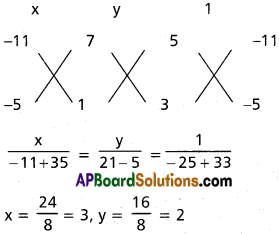
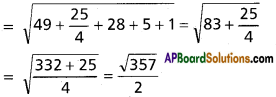
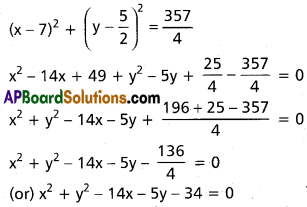
Question 3.
Find the internal centre of similitude for the circles x² + y² + 6x – 2y + 1 =0 and x² + y² – 2x – 6y + 9 = 0.
Solution:
Inter 2nd Year Maths 2B Circle Solutions Ex 1(e) 5
The internal centre of similitude S divides
C1 C2 internally in the ratio r1 : r2 = 3 : 1
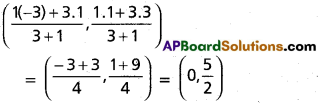
Co-ordinates of S¹ are
Inter 2nd Year Maths 2B Circle Solutions Ex 1(e) 6

Question 4.
Find the external centre of similitude for the circles x² + y² – 2x – 6y + 9 = 0 and x² + y² = 4.
Solution:
Centre of the circle C1 (1, 3) and C2 (0,0)
r1 = \(\sqrt{1+9-9}\), r2 = 2
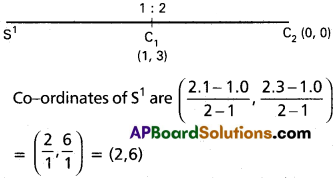
External centre of similitude S¹ divides C1 C2 externally in the ratio
r1 : r2 = 1 : 2
Inter 2nd Year Maths 2B Circle Solutions Ex 1(e) 7

II.

Question 1.
i) Show that the circles x² + y² – 6x – 2y + 1 = 0 ; x² + y² + 2x – 8y + 13 = 0 touch each other. Find the point of contact and the equation of common tangent at their point of contact.
Solution:
Equations of the circles are
S1 ≡ x² + y² – 6x – 2y + 1 =0
S2 ≡ x² + y² + 2x – 8y + 13 = 0
Inter 2nd Year Maths 2B Circle Solutions Ex 1(e) 8
∴ The circles touch each other externally.
The point of contact P divides AB – internally in the ratio r1 : r2 = 3 : 2
Co-ordinates of P are
(\(\frac{3(-1)+2.3}{5}\), \(\frac{3.4+2.1}{5}\) i.e., P(\(\frac{3}{5}\), \(\frac{14}{5}\))
Equation of the common tangent is S1 – S2 = 0
-8x + 6y – 12 = 0 (or) 4x – 3y + 6 = 0

ii) Show that x² + y² – 6x – 9y + 13 = 0, x² + y² – 2x – 16y = 0 touch each other. Find the point of contact and the equation of common tangent at their point of contact.
Solution:
Equations of the circles are
S1 ≡ x² + y² – 6x – 9y + 13 = 0
S2 ≡ x² + y² – 2x – 16y = 0
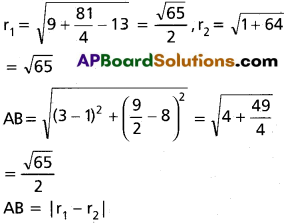
centres are A (3, \(\frac{9}{2}\)), B(1, 8)
Inter 2nd Year Maths 2B Circle Solutions Ex 1(e) 9
∴ The circles touch each other internally. The point of contact ‘P’ divides AB externally in the ratio r1 : r2 = \(\frac{\sqrt{65}}{2}\) : √65
= 1 : 2 Co-ordinates of P are
Inter 2nd Year Maths 2B Circle Solutions Ex 1(e) 10
P = (5, 1)
∴ Equation of the common tangent is
S1 – S2 = 0
– 4x + 7y +13 = 0
4x – 7y – 13 = 0

Inter 2nd Year Maths 2B Circle Solutions Ex 1(e)

Question 2.
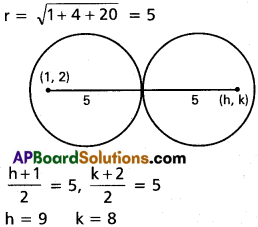
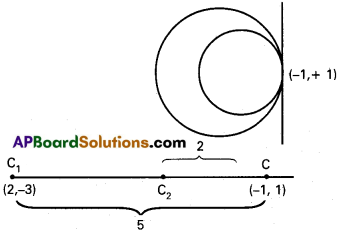
Find the equation of the circle which touches the circle x² + y² – 2x – 4y – 20 = 0 externally at (5, 5) with radius 5.
Solution:
x² + y² – 2x – 4y – 20 = 0 ,
C = (1, 2)
Inter 2nd Year Maths 2B Circle Solutions Ex 1(e) 11
Equation of circle be
(x – 9)² + (y – 8)²
x² + y² – 18x – 16y + 120 = 0
If (h, k) is the centre of the required circle (5, 5) is the mid-point of (1, 2) and (h, k).

Question 3.
Find the direct common tangents of the circles.
x² + y² + 22x – 4y – 100 = 0 and x² + y² – 22x + 4y + 100 = 0.
Solution:
C1 = (-11, 2) C2 = (11, -2)
r1 = \(\sqrt{121+4+100}\) = 15
r2 = \(\sqrt{121+4-100}\) = 5
Let y = mx + c be tangent
mx – y + c = 0
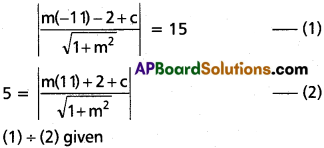
⊥ from (-11, 2) to tangent = 15
⊥ from (11 ,-2) to tangent = 5
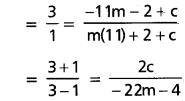
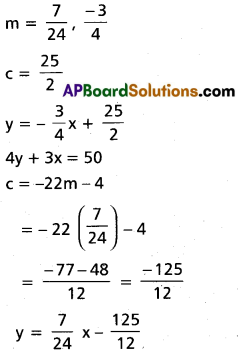
Inter 2nd Year Maths 2B Circle Solutions Ex 1(e) 12
Inter 2nd Year Maths 2B Circle Solutions Ex 1(e) 13
c = -22 m – 4
∴ y = mx – 22m – 4
This line is a tangent to the second circle
∴ \(\frac{|11m+2-22m-4|}{\sqrt{m^{2}+1}}\) = 5
Squaring and cross multiplying
25(1 + m²) = (11m + 2 – 22m – 4)²
96m² + 44m – 21 = 0
⇒ 96m² + 72m – 28m – 21 = 0
Inter 2nd Year Maths 2B Circle Solutions Ex 1(e) 14
⇒ 24y = 7x – 250
⇒ 7x – 24y – 250 = 0

Question 4.
Find the transverse common tangents of the circles x² + y² – 4x – 10y + 28 = 0 and x² + y² + 4x – 6y + 4 = 0.
Solution:
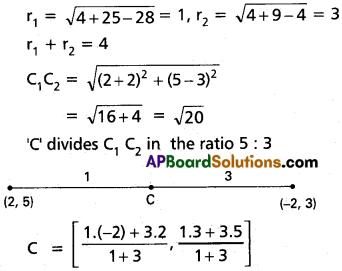
C1 = (2, 5), C2 = (-2, 3)
Inter 2nd Year Maths 2B Circle Solutions Ex 1(e) 15
= [\(\frac{4}{4}\), \(\frac{9}{2}\)] = [1, \(\frac{9}{2}\)]
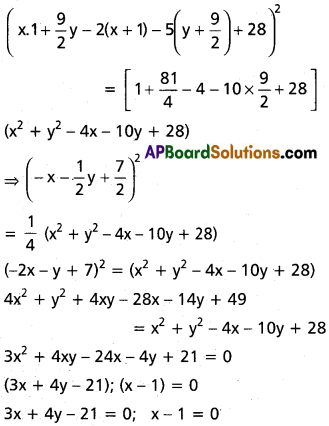
Equation of the pair transverse of the common tangents is
Inter 2nd Year Maths 2B Circle Solutions Ex 1(e) 16

Question 5.
Find the pair of tangents from (4, 10) to the circle x² + y² = 25.
Solution:
SS11 = S²1
(x² + y² – 25) (16 + 100 – 25)
= (4x + 10 y -25)²
91x² + 91y² – 2275
= [16x² + 100y² + 625 + 80xy – 200x – 500y]
75x² – 9y² – 80xy + 500y + 200x – 2900 = 0

Inter 2nd Year Maths 2B Circle Solutions Ex 1(e)

Question 6.
Find the pair of tangents drawn from (0,0) to x2 + y2 + 10x + 10y + 40 = 0.
Solution:
S.S11 = S²1
(x² + y² + 10x + 10y + 40) (40) = [5x + 5y + 40]²
8(x² + y² + 10x + 10y + 40) = (x + y + 8)²5
8x² + 8y² + 80x + 80y + 320
= 5x² + 5y² + 10xy + 80x + 80y + 320
3x² + 3y² – 10xy = 0

III.

Question 1.
Find the equation of the circle which touches x² + y² – 4x + 6y – 12 = 0 at (-1, 1) internally with a radius of 2.
Solution:
C1 = (2, -3)
r1 = \(\sqrt{4+9+12}\) = 5
Inter 2nd Year Maths 2B Circle Solutions Ex 1(e) 17
Let C2 = (h, k)
point of contact – (x, y) = (-1, 1)
since the two circles touch internally
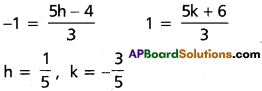
Inter 2nd Year Maths 2B Circle Solutions Ex 1(e) 18
Equation of a circle with centre (\(\frac{1}{5}\), \(\frac{-3}{5}\)) and radius 2 is given by
(x – \(\frac{1}{5}\))² + (y + \(\frac{1}{5}\))² = 4
5x² + 5y² – 2x + 6y – 18 = 0

Question 2.
Find all common tangents of the following pairs of circles.
(i) x² + y² = 9 and x² + y² – 16x + 2y + 49 = 0
Solution:
The circles are x² + y² = 9
x² + y² – 16x + 2y + 49 = 0
Centre are A (0, 0), B(8, -1)
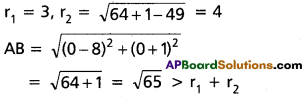
Inter 2nd Year Maths 2B Circle Solutions Ex 1(e) 19
The circles lie outside each other.
A (0, 0), B (8, -1)
External center of similitude S divides AB externally in this ratio 3 : 4
Co-ordinates of are (-24, + 3)
Suppose m is the slope of the direct common tangents
y – 3 = m(x + 24)
= mx + 24m
mx – y 4- (24m + 3) = 0 ………… (1)
This is a tangent to the circle x² + y² = 9
3 = \(\frac{|24m+3|}{\sqrt{m^{2}+1}}\)
9(m² +1 = 9(m² + 1) = 9(8m + 1)²
= 64m² + 16m + 1
63m² + 16m = 0
m(63m + 16) = 0
m = 0 or \(\frac{-16}{63}\).

Case (i): m = 0
Substituting in (1), equation of the tangent is
-y + 3 = 0
y – 3 = 0

Case (ii) : m = \(\frac{-16}{63}\).
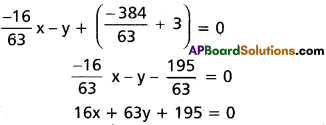
Equation of the tangent is
Inter 2nd Year Maths 2B Circle Solutions Ex 1(e) 20
Internal center of similitude S’ divides AB internally in the ratio 3 : 4
Co-ordinates of S’ are (\(\frac{24}{7}\), \(\frac{-3}{7}\))
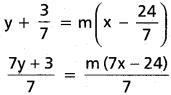
Equation of the transverse common tangent is
Inter 2nd Year Maths 2B Circle Solutions Ex 1(e) 21
7y + 3 = 7mx – 24m
7mx – 7y – (24m + 3) = 0 ………… (2)
This is a tangent to the circle x² + y² = 9
3 = \(\frac{|24m+3|}{\sqrt{49m^{2}+49}}=\frac{3}{\sqrt{7}} \frac{|28m+1|}{\sqrt{m^{2}+1}}\)
49 (m² + 1) = (8m + 1)²
49m² + 49 = 64m² +16m + 1
15m² + 16m – 48 = 0
(3m – 4) (5m + 12) = 0
m = \(\frac{4}{3}\) or \(\frac{-12}{5}\)

Case (i): Substituting in (2), equation of the tangent is
Inter 2nd Year Maths 2B Circle Solutions Ex 1(e) 22

Case (ii): m = \(\frac{-12}{5}\)
Equation of the transverse common tangent is ie
Inter 2nd Year Maths 2B Circle Solutions Ex 1(e) 23
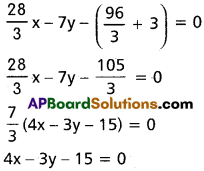
∴ Equation of direct common tangents are
y – 3 = 0; 16x + 63y + 195 = 0
Equation of transverse common tangents are
4x – 3y – 15 = 0 and 12x + 5y – 39 = 0

ii) x² + y² + 4x + 2y – 4 = 0 and x² + y² – 4x – 2y + 4 = 0
Solution:
r1 = \(\sqrt{4+1+4}\) = 3, r2 = \(\sqrt{4+1+4}\) = 1
External center of similitude S divides AB externally in the ratio 3 : 1
3 : 1 A (-2,-1), S’ B (2, 1) S
Co-ordinates of S are
(\(\frac{3.2-(-2)1}{3-1}\), \(\frac{3.1-1(-1)}{3-1}\)) = (4, 2)
Suppose m is the slope of the tangent Equation of the tangent can be taken as
y – 2 = m(x – 4)
= mx – 4m
mx – y + (2 – 4m) = 0 ………… (1)
This is a tangent to the circle
x² + y² + 4x + 2y – 4 = 0
Inter 2nd Year Maths 2B Circle Solutions Ex 1(e) 24
Squaring and cross-multiplication is
(1 – 2m)² = (m² + 1)
4m² – 4m + 1 = m² + 1
3m² – 4m = 0
m(3m-4) = 0
m,= 0 or = \(\frac{4}{3}\)
m = 0
Substituting in (1), equation of the tangent is y + 2 = 0 or y -2 = 0
m = \(\frac{4}{3}\)
Substituting in (1), equation of the tangent is
\(\frac{4}{3}\)x – y + (2 – \(\frac{16}{3}\)) = 0
⇒ \(\frac{4}{3}\)x – y –\(\frac{10}{3}\) = 0
4x – 3y – 10 = 0
Internal centre of similitude S’ divides AB internally in the ratio 3 : 1
Co-ordinates of S’ are
(\(\frac{6-2}{3+1}\), \(\frac{3-1}{3+1}\)x) = (1, \(\frac{1}{2}\))
Equation of the tangent can be taken as
y – \(\frac{1}{2}\) = m(x – 1)
= mx – m
mx – y + (\(\frac{1}{2}\) – m) = 0 ………. (2)
This is a tangent to the circle
x² + y² + 4x + 2y – 4 = 0
Inter 2nd Year Maths 2B Circle Solutions Ex 1(e) 25
Squaring and cross-multiply is
(1 – 2m)² = 4(m² + 1)
1 + 4m² – 4m = 4m² + 4
Here then value of m is a, so that the tangent is a vertical line, equation of the tangent is
x = \(\frac{1}{2}\)
x – 1 = 0
4m + 3 = 0
m = \(\frac{-3}{4}\)
Substituting in (2), equation of the tangent is
\(\frac{-3}{4}\)x – y + (\(\frac{1}{2}+\frac{3}{4}\)) = 0
-3x – 4y + 5 = 0
3x + 4y – 5 = 0
Equation of direct common tangents are
y – 2 = 0, 4x – 3y – 10 = 0
Equation of transvere common tangents are
x – 1 = 0, 3x + 4y – 5 = 0

Inter 2nd Year Maths 2B Circle Solutions Ex 1(e)

Question 3.
Find the pair of tangents drawn from (3, 2) to the circle x² + y² – 6x + 4y – 2 = 0.
Solution:
S.S11 = S²1
(x² + y² – 6x + 4y – 2)
(9+ 4 – 6 × 3 + 4 × 2 – 2)
= (3x + 2y – 3(x + 3) + 2(y + 2) – 2)²
(x² + y² – 6x + 4y – 2) = (4y – 7)²
x² + y² – 6x + 4y – 2 = 16y² – 56y + 49
x² – 15y² – 6x + 60y – 51 = 0

Question 4.
Find the pair of tangents drawn from (1, 3) to the circle x² + y² – 2x + 4y – 11 = 0 and also find the angle between them.
Solution:
S.S11 = S²1
(x² + y² – 2x + 4y -11) (1 + 9-2 + 12-11) = [x + 3y – 1 (x + 1) + 2 (y + 3)- 11]²
(x² + y² – 2x + 4y – 11)9 = [5y-6]²
9x² + 9y² – 18x + 36y – 99
25y²+ 36 – 60 y
9x² – 16y² – 18x + 96y – 135 = 0
Inter 2nd Year Maths 2B Circle Solutions Ex 1(e) 26

Question 5.
Find the pair of tangents from the origin to the circle x² + y² + 2gx + 2fy + c = 0 and hence deduce a condition for these tangents to be perpendicular.
Solution:
S.S11 = S²1
(x² + y² + 2gx + 2fy + c) (c) = [gx + fy + c]²
= g²x² +f²y²+ 2gfxy + 2gcx + 2fyc + c²
(gx + fy)² = c(x² + y²)
g²x² + f²y² + 2fg xy = cx² + cy²
(g² – c)x + 2fgxy + (f² – c)y² = 0
co-efficient of x² + co-efficient of y² = 0
g² – c + f² – c = 0
g² + f² = 2c

Inter 2nd Year Maths 2B Circle Solutions Ex 1(e)

Question 6.
From a point on the circle x² + y² + 2gx + 2fy + c = 0, two tangents are drawn to the circle x² + y² + 2gx + 2fy + c sin² α + (g² + f²) cos² α = 0 (0 < a < π/2). Prove that the angle between them is 2α.
Solution:
[x²1 + y²1 + 2gx1 + 2fy1 + c sin² α + (g² + f²) cos² α] (S)
= (xx1 + yy1 + g(x + x1) + f(y + y1) + c sin² α + (g² + f²) cos² α)²
[(-c + c sin² α)+ (g² + f²) cos² α]S
= (x (x1 + g) + y (y1 + f) + gx1 + fy1 + c sin² α + (g² + f²) cos² α)²
[cos² α (g² + f² – c)] S
= [x (x1 + g) + y (y1 + f) + gx1 + fy1 + c sin² α + (g² + f²)cos² α
Let g² + f² – c = r²
= [x (x1 + g) + y (y1 + f) + gx1 + fy1 + gx1 + fy1 + c + (cos² α).r²)²
Coefficient of x² is r² cos² α – (x1 + g)²
Coefficient of y² is r² cos2 α – (y1 + f)²
Coefficient of xy is
h. cos² α r² – 2 (x1 + g) (y1 + f)
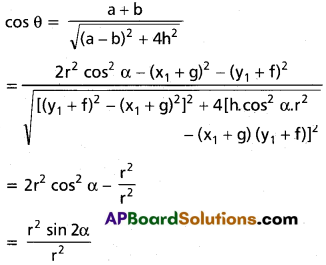
Inter 2nd Year Maths 2B Circle Solutions Ex 1(e) 27
cos θ = cos 2 α
θ = 2α
Hence proved.

Inter 2nd Year Maths 2B Circle Solutions Ex 1(d)

Practicing the Intermediate 2nd Year Maths 2B Textbook Solutions Inter 2nd Year Maths 2B Circle Solutions Exercise 1(d) will help students to clear their doubts quickly.

Intermediate 2nd Year Maths 2B Circle Solutions Exercise 1(d)

I.

Question 1.
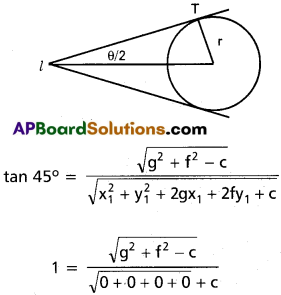
Find the condition that the tangents drawn from (0, 0) to S ≡ x² + y² + 2gx + 2fy + c = 0 be perpendicular to each other.
Solution:
If θ is the angle between the pair of tangents from P1 then tan \(\frac{\theta}{2}=\frac{r}{\sqrt{s_{11}}}\)
Inter 2nd Year Maths 2B Circle Solutions Ex 1(d) 1
g² + f² – c = c
g² + f² = 2c
This is the required condition.

Question 2.
Find the chord of contact of (0, 5) with respect to the circle x² + y² – 5x + 4y – 2 = 0
Solution:
Equation of the chord of contact is S1 = 0
i.e., xx1 + yy1 + g(x + x1) + f(y + y1) + c = 0
Equation of the circle is
S = x² + y² – 5x + 4y – 2 = 0
Equation of the chord of contact is
x. 0 + y. 5 – \(\frac{5}{2}\) (x + 0) + 2(y + 5) – 2 = 0
Multiplying with 2
10y – 5x + 4y + 20 – 4 = 0 – 5x + 14y +16 = 0
or 5x – 14y – 16 = 0

Question 3.
Find the chord of contact of (1, 1) to the circle x² + y² = 9.
Solution:
Equation of the circle is x² + y² = 9
Equation of the chord of contact is
x.1 + y. 1 =9
i.e. x + y = 9

Inter 2nd Year Maths 2B Circle Solutions Ex 1(d)

Question 4.
Find the polar of (1, 2) with respect to x² + y² = 7.
Solution:
Polar of P(x1, y1) w.r. to S = 0
xx1 + yy1 = a²
x + 2y – 7 = 0 is the polar equation.

Question 5.
Find the polar of (3, -1) with respect to 2x² + 2y² = 11.
Solution:
Equation of circle is 2x² + 2y² = 11
x² + y² = \(\frac{11}{2}\)
Equation of polar is xx1 + yy1 = a²
x(3) + y(-1) = \(\frac{11}{2}\)
Equation-of polar is 6x – 2y -11 = 0

Question 6.
Find the polar of (1, -2) with respect to x² + y² – 10x – 10y + 25 = 0
Solution:
Equation of the circle is
x² + y² – 10x – 10y + 25 = 0
Equation of the polar is S1 = 0
Polar of P(1, -2) is
x .1 + y(-2) – 5(x + 1) – 5(y – 2) + 25 = 0
⇒ x – 2y – 5x – 5 – 5y + 10 + 25 = 0
⇒ -4x – 7y + 30 = 0
∴ 4x + 7y – 30 = 0

Question 7.
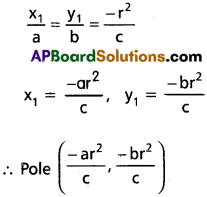
Find the pole of ax + by + c = 0 (c + 0) with respect to x² + y² = r².
Solution:
Let (x1, y1) be pole, the polar equation be
xx1 + yy1 – r² = 0 ………… (i)
ax + by + c = 0 ………….. (ii)
(i) and (ii) both are same (polar) equations.
Inter 2nd Year Maths 2B Circle Solutions Ex 1(d) 2

Question 8.
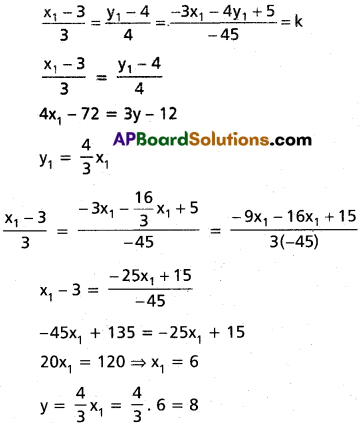
Find the pole of 3x + 4y – 45 = 0 with respect to x² + y² – 6x – 8y + 5 = 0.
Solution:
Equation of polar is
xx1 + yy1 – 3(x + x1) – 4(y + y1) + 5 = 0
x(x1 – 3) + y(y1 – 4) – 3x1 – 4y1 + 5 = 0 ……….. (i)
Polar equation is same 3x + 4y – 45 = 0 ……….. (ii)
Comparing (i) and (ii) we get
Inter 2nd Year Maths 2B Circle Solutions Ex 1(d) 3
Pole is (6, 8).

Question 9.
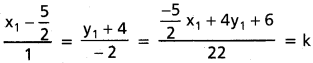
Find the pole of x – 2y + 22 = 0 with respect to x² + y² – 5x + 8y + 6 = 0.
Solution:
Polar equation is
xx1 + yy1 – \(\frac{5}{2}\)(x + x1) + 4(y + y1) + 6 = 0
(or) x(x1 – \(\frac{5}{2}\)) + y(y1 + 4) – \(\frac{5}{2}\)
x1 + 4y1 + 6 = 0 …………. (i)
x – 2y + 22 = 0 ………….. (ii)
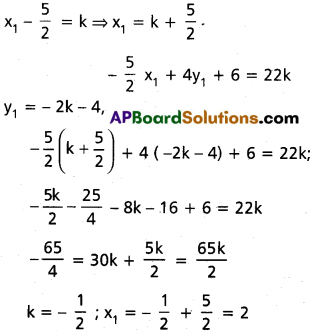
(i) and (ii) both are equations of the same line comparing it we get
Inter 2nd Year Maths 2B Circle Solutions Ex 1(d) 4
Inter 2nd Year Maths 2B Circle Solutions Ex 1(d) 5
y1 = -3
∴ Pole is (2, -3)

Question 10.
Show that the points (-6, 1) and (2, 3) are conjugate points with respect to the circle x² + y² – 2x + 2y + 1 =0.
Solution:
Polar equation w.r.t. (2, 3) is
2x + 3y – 1(x + 2) + 1(y + 3) + 1 = 0
x + 4y + 2 = 0 ………. (i)
Now (-6, 1) should satisfy equation (i) if it is conjugate point
(-6) + 4(1) + 2 = 0
∴ (-6, 1) and (2, 3) are conjugate w.r.t. circle.

Inter 2nd Year Maths 2B Circle Solutions Ex 1(d)

Question 11.
Show that the points (4, 2) (3, -5) are conjugate points with respect to the circle x² + y² – 3x – 5y + 1 = 0.
Solution:
Polar equation w.r.t. (4, 2) is
4x + 2y – \(\frac{3}{2}\)(x + 4) – \(\frac{5}{2}\)(y + 2) + 1 = 0 ………. (i)
Now (3, -5) should satisfy equation (i) if it is conjugate points.
4(3) – 5 × 2 – \(\frac{3}{2}\)(3 + 4) – \(\frac{5}{2}\)(-5 + 2) + 1
12 – 10 – \(\frac{21}{2}\) + \(\frac{15}{2}\) + 1 = 0
Hence given points are conjugate.

Question 12.
Find the value of k if kx + 3y – 1 = 0, 2x + y + 5 = 0 are conjugate lines with respect to the circle x² + y² – 2x – 4y – 4 = 0.
Solution:
Let pole be (x1, y1) polar equation w.r.t.
x² + y² – 2x – 4y – 4 = 0 be
xx1 + yy1 -1 (x + x1) – 2(y + y1) – 4 = 0
x(x1 – 1) + y(y1 – 2) – x1 – 2y1 – 4 = 0 …….. (i)
2x + y + 5 = 0 is polar so comparing with equation (i) we get
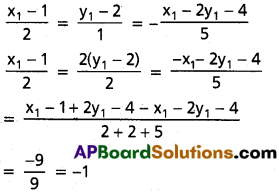
Inter 2nd Year Maths 2B Circle Solutions Ex 1(d) 6
x1 = -1, y1 = 1 Pole (-1, 1)
kx + 3y – 1 = 0 is polar so it should satisfy
(1, 1)
k(-1) + 3(1) – 1 = 0
-k + 2 = 0
k = 2

Question 13.
Find the value of k if x + y – 5 = 0, 2x + ky – 8 = 0 are conjugate with respect to the circle x² + y² – 2x – 2y – 1 = 0.
Solution:
If l1x + m1y + n1 = 0; l2x + m2y + n2 = 0 are conjugate, S = 0 then,
r²(l1l2 + m1m2)
= (l1g + m1f – n1) (l2g + m2f – n2)
l1 = 1, m1 = 1, n1 = -5
l2 = 2, m2 = k, n2 = – 8
g = -1, f = -1, r² = 3
∴ 3(1.2 + k) = (-1 -1 + 5) (-2 – k + 8)
6k = 18 – 6 = 12 ⇒ k = 2

Question 14.
Find the value of k if the points (1, 3) and (2, k) are conjugate with respect to the circle x² + y² = 35.
Solution:
Equation of the circle is x² + y² = 35
Polar of P(1, 3) is x. 1 + y. 3 = 35
x + 3y = 35
P(1, 3) and Q(2, k) are conjugate points The polar of P passes through Q
2 + 3k = 35
3k = 33
k = 11

Question 15.
Find the value of k if the points (4, 2) and (k, -3) are conjugate points with respect to the circle x² + y² – 5x + 8y + 6 = 0.
Solution:
Equation of the circle is x² + y² – 5x + 8y + 6 = 0
Polar of P(4, 2) is
x.4 + y.2 – \(\frac{5}{2}\)(x + 4) + 4(y + 2) + 6 = 0
8x + 4y – 5x – 20 + 8y + 16 + 12 = 0
3x + 12y + 8 = 0
P(4, 2), Q(k, -3) are conjugate points
Polar of P passes through Q
∴ 3k – 36 + 8 = 0
3k = 28 ⇒ k = \(\frac{28}{2}\)

II.

Question 1.
Find the angle between the tangents drawn from (3, 2) to the circle x² + y² – 6x + 4y – 2 = 0.
Solution:
Equation of the circle is
S ≡ x² + y² – 6x + 4y – 2 = 0
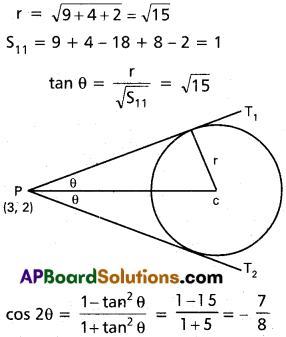
Inter 2nd Year Maths 2B Circle Solutions Ex 1(d) 7
Angle between the tangent at P = cos-1 (\(\frac{7}{8}\))

Inter 2nd Year Maths 2B Circle Solutions Ex 1(d)

Question 2.
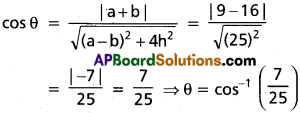
Find the angle between the pair of tangents dravyn from (1, 3) to the circle x² + y² – 2x + 4y – 11 = 0.
Solution:
Equation of the circle is
S1 ≡ x² + y² – 2x + 4y – 11 = 0
r = \(\sqrt{1+4+11}\) = 4
S11 =1 +9-2 + 12-11 = 9
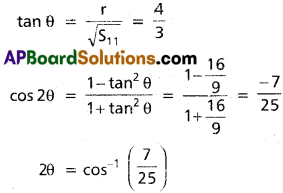
Inter 2nd Year Maths 2B Circle Solutions Ex 1(d) 8
Angle between the tangents = cos-1 (\(\frac{7}{25}\))

Question 3.
Find the angle between the pair of tangents drawn from (0,0) to the circle x² + y² – 14x + 2y + 25 = 0.
Solution:
Equation of the circle is
x² + y² – 14x + 2y + 25 = 0
r = \(\sqrt{49+1-25}\) = 5
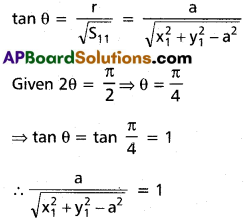
S11 = 0 + 0 – 0 + 0 + 25 = 25 ⇒ √S11 = 5
tan θ = \(\frac{r}{\sqrt{s_{11}}}\) = \(\frac{5}{5}\) = 1 ⇒ θ = \(\frac{\pi}{4}\)
Angle between the tangents = 2θ = \(\frac{\pi}{2}\)

Question 4.
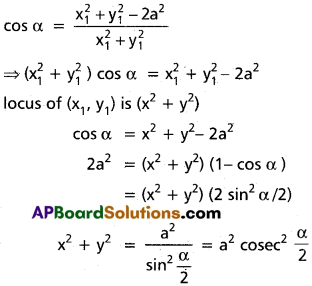
Find the locus of P if the tangents drawn from P to x² + y²= a² include an angle α.
Solution:
Equation of the circle is x² + y² = a²
r = radius = a
Suppose θ (x1, y1) is any point as the locus
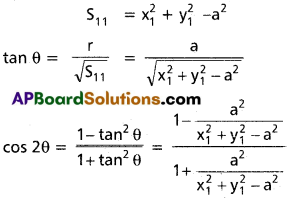
Inter 2nd Year Maths 2B Circle Solutions Ex 1(d) 9
Inter 2nd Year Maths 2B Circle Solutions Ex 1(d) 10

Question 5.
Find the locus of P if the tangents drawn from P to x2 + y2= a2 are perpendicular to each other.
Solution:
Equation of the circle is x² + y² = a²
r = a
Let P(x1, y1) be any point on the locus
S11 = x²1 + y²1 – a²
Inter 2nd Year Maths 2B Circle Solutions Ex 1(d) 11
Squaring and cross-multiplying
a² = x² + y² – a²
x² + y² = 2a²
Locus of P (x1, y1) is x² + y²= 2a²

Question 6.
Find the slope of the polar of (1, 3) with respect to the circle x² + y² – 4x – 4y – 4= 0. Also find the distance from the centre to it.
Solution:
Equation of the circle is x² + y² – 4x – 4y – 4 =0
Polar of P (1, 3) is
x.1 + y.3 – 2(x + 1) – 2(y + 3) – 4 = 0
x + 3y – 2x – 2 – 2y – 6 – 4 = 0
-x + y – 12 = 0
Slope of the polar is – \(\frac{a}{b}=\frac{1}{1}\) = 1
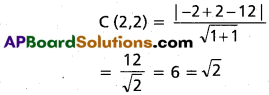
Distance from the centre
Inter 2nd Year Maths 2B Circle Solutions Ex 1(d) 12

Question 7.
If ax + by + c = 0 is the polar of (1, 1) with respect to the circle x² + y² – 2x + 2y +1=0 and H.C.F. of a, b, c is equal to one then find a² + b² + c².
Solution:
Equation of the circle is
x2+ y2-2x + 2y +1 = 0
Polar of (1, 1) w.r.to the circle is
x.1 + y.1 -(x + 1) + (y + 1) + 1 = 0
x + y – x – 1 + y + 1 + 1 = 0
2y + 1 = 0 …………. (1)
Given equation of the line ax + by + c = 0 ……….. (2)
Comparing (1) and (2)
\(\frac{a}{0}=\frac{b}{2}=\frac{c}{1}\) = k
a = 0, b = 2k, c = k
a² + b² + c² = 0 + 4k² + k² = 5k²
H.C.F of (a, b, c) = 1 ⇒ k = 1
a² + b² + c2 = 5(1)² = 5

III.

Question 1.
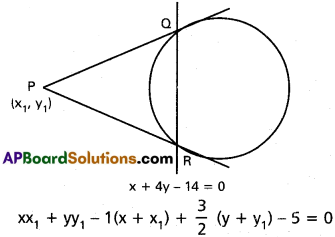
Find the coordinates of the point of in-tersection of tangents at the points where x + 4y – 14 = 0 meets the circle x² + y² – 2x + 3y – 5 = 0.
Solution:
Equation of the given circle is
x² + y² – 2x + 3y – 5 = 0
polar of P(x1, y1) is
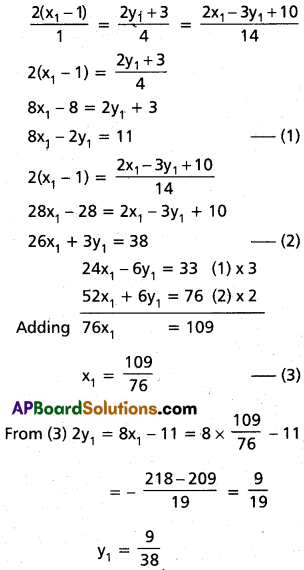
Inter 2nd Year Maths 2B Circle Solutions Ex 1(d) 13
2xx1 + 2yy1 – 2x – 2x1 + 3y + 3y1 – 10 = 0
2(x1 – 1)x + (2y1 + 3)y – (2x1 – 3y1 + 10) = 0 ……….. (1)
Equation of QR is x + 4y – 14 = 0 ……… (2)
Comparing (1) and (2)
Inter 2nd Year Maths 2B Circle Solutions Ex 1(d) 14
∴ Co-ordinates of p are (\(\frac{109}{76}\), \(\frac{9}{38}\))

Question 2.
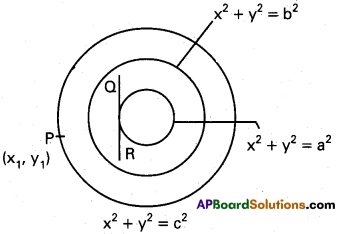
If the polar of the points on the circle x² + y² = a² with respect to the circle x² + y² = b² touches the circle x² + y² = c² then prove that a,b,c are in Geometrical progression.
Solution:
Inter 2nd Year Maths 2B Circle Solutions Ex 1(d) 15
P(x1, y1) is a point on the circle x² + y² = a²
∴ x²1 + y²1 = a² ……. (1)
Polar of P w.r.to the circle x²+ y² = b² is xx1 + yy1 = b²
There is a tangent to the circle x² + y² = c²
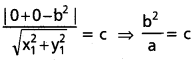
Inter 2nd Year Maths 2B Circle Solutions Ex 1(d) 16
Cross – multiplying we get b2 = ac
∴ a, b, c are in Geometric progression.

Inter 2nd Year Maths 2B Circle Solutions Ex 1(d)

Question 3.
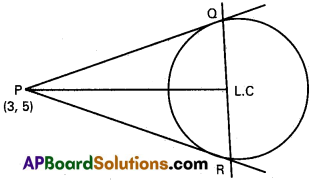
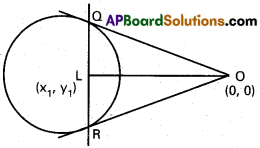
Tangents are drawn to the circle x² + y² = 16 from the point P(3, 5). Find the area of the triangle formed by these tangents and the chord of contact of P.
Solution:
Equation of the circle is x² + y² = 16
Inter 2nd Year Maths 2B Circle Solutions Ex 1(d) 17
Polar of P (3, 5) is 3x + 5y = 16
PL = Length of the perpendicular from P
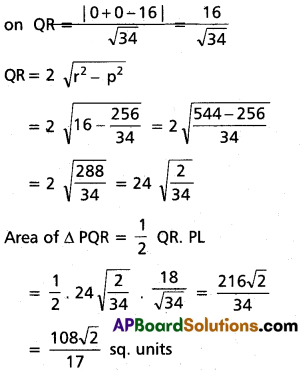
\(\frac{|9+25-16|}{\sqrt{9+25}}=\frac{18}{\sqrt{34}}\)
Centre of the circle = C (0, 0)
P = Length of the perpendicular from c
Inter 2nd Year Maths 2B Circle Solutions Ex 1(d) 18

Question 4.
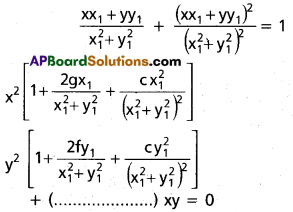
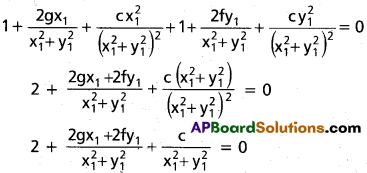
Find the locus of the point whose polars with respect to the circles x² + y² – 4x – 4y – 8 = 0 and x² + y² – 2x + 6y – 2 = 0 are mutually perpendicular.
Solution:
Suppose P(x, y) is any position the locus Equation of the circles are
x² + y² – 4x – 4y – 8 = 0 ………….. (1)
x² + y² – 2x + 6y – 2 = 0 …………. (2)
Equation of the polar of P w.r.to circle (1) is
xx1 + yy1 – 2(x + x1) – 2(y + y1) – 8 = 0
x(x1 – 2) + y(y1 – 2) – (2x1 +2y1 + 8) = 0 ………… (3)
Polar of P w.r. to circle (2) is
xx1 + yy1 – 1(x + x1) – 3(y + y1) – 2 = 0
xx1 + yy1 – x – x1 + 3y + 3y1 – 2 = 0
x(x1 – 1) + y(y1 + 3) – (x1 + 3y1 + 2) = 0 ………. (4)
(3) and (4) are perpendicular 0
⇒ a1a2 + b1b2
(x1 – 2) (x1 – 1) + (y1 – 2) (y1 + 3) = 0
1 – 3x1 + 2 + y²1 + y1 – 6 = Q
1 + y²1 – 3x1 + y1 – 4 = 0
Locus of p(x1, y1) is x² + y² – 3x+ y – 4 = 0

Inter 2nd Year Maths 2B Circle Solutions Ex 1(d)

Question 5.
Find the locus of the foot of the perpen¬dicular drawn from the origin to any chord of the circle S ≡ x² + y² + 2gx + 2fy + c = 0 which subtends a right angle at the origin.
Solution:
Inter 2nd Year Maths 2B Circle Solutions Ex 1(d) 19
Suppose L (x1, y1) is the foot of the per-pendicular from the origin on the chord QL
Slope a QL = \(\frac{y_{1}}{x_{1}}\)
Slope of QR = \(\frac{x_{1}}{y_{1}}\)
Equation of QR is y – y1 = \(\frac{x_{1}}{y_{1}}\)(x – x1)
yy1 – y²1 = -xx1 + x²1
xx1 + yy1 = x²1 + y²1
or \(\frac{xx_{1}+yy_{1}}{x_{1}^{2}+y_{1}^{2}}\) = 1 …………. (1)
Equation of the circle is
x² + y² + 2gx + 2fy + c = 0 …………. (2)
Hamogenising (2) with the help of (1), combined equation of
QQ, OR is x² + y² + (2gx + 2fy)
Inter 2nd Year Maths 2B Circle Solutions Ex 1(d) 20
OQ, OR are perpendicular
Co – eff. of x² + co- eff of y² = 0
Inter 2nd Year Maths 2B Circle Solutions Ex 1(d) 21
2(x²1 + y²1) + 2gx1 + 2fy1 + c =
Locus of L (x1, y1)is
2(x² + y²) + 2gx + 2fy + c = 0

Inter 2nd Year Maths 2B Circle Solutions Ex 1(c)

Practicing the Intermediate 2nd Year Maths 2B Textbook Solutions Inter 2nd Year Maths 2B Circle Solutions Exercise 1(c) will help students to clear their doubts quickly.

Intermediate 2nd Year Maths 2B Circle Solutions Exercise 1(c)

I.

Question 1.
Find the equation of the tangent at P of the circle S = 0 where P and S are given by
i) P = (7, -5), S ≡ x² + y² – 6x + 4y – 12
Solution:
Equation of the circle
S ≡ x² + y² – 6x + 4y – 12 = 0
Equation of the tangent at P(7, -5) is
S1 = xx1 + yy1 + g(x + x1) + f(y + y1) + c = 0
⇒ x. 7 + y(-5) – 3(x + 7) + 2(y – 5) – 12 = 0
⇒ 7x – 5y – 3x – 21 + 2y – 10 – 12 = 0
4x – 3y – 43 = 0

ii) P = (-1, 1), S ≡ x² + y² – 6x + 4y – 12
Solution:
Equation of the tangent at P is
x(-1) + y . 1 – 3(x – 1) + 2(y + 1) – 12 = 0
⇒ x + y – 3x + 3 + 2y + 2 – 12 = 0
⇒ -4x + 3y – 7 = 0
⇒ 4x – 3y + 7 = 0

iii) P = (-6, -9), S ≡ x² + y² + 4x + 6y – 39
Solution:
Equation of the tangent at P is S1 =0
(i.e.,) x(-6) + y(-9) + 2(x – 6) + 3(y – 9) – 39 = 0
⇒ -6x – 9y + 2x – 12 + 3y – 27 – 39 = 0
⇒ – 4x- 6y- 78 = 0
⇒ 4x + 6y + 78 = 0
⇒ 2x + 3y + 39 = 0

iv) P = (3, 4), S ≡ x² + y² – 4x – 6y + 11
Solution:
Equation of the tangent at P is S1 = 0
⇒ x(3) + y(4) – 2 (x + 3) – 3(y + 4) + 11 =0
3x + 4y – 2x – 6 – 3y – 12 + 11 =0
x + y – 7 = 0

Inter 2nd Year Maths 2B Circle Solutions Ex 1(c)

Question 2.
Find the equation of the normal at P of the circle S = 0 where P and S are given by
i) P = (3, -4), S ≡ x² + y² + x + y – 24
Solution:
Equation of the normal is
(x – x1) (y1 + f) – (y – y1) (x1 + g) = 0
(x – 3) (-4 + \(\frac{1}{2}\)) – (y + 4) (3 + \(\frac{1}{2}\)) = 0
–\(\frac{7}{2}\)(x – 3) – \(\frac{7}{2}\) (y + 4) = 0
⇒ (x – 3) + (y + 4) = 0
x – 3 + y + 4 = 0
x + y + 1 = 0

ii) P = (3, 5), S ≡ x² + y² – 10x – 2y + 6
Solution:
Equation of the normal is
(x – x1) (y1 + f) – (y – y1) (x1 + g) = 0
(x – 3) (5 – 1) – (y – 5) (3 – 5) = 0
4x – 12 + 2y – 10 = 0
4x + 2y – 22 = 0
or
2x + y – 11 = 0

iii) P = (1, 3), S ≡ 3(x² + y²) – 19x – 29 y + 76
Solution:
Equation of the circle is
x² + y² – \(\frac{19}{3}\)x – \(\frac{29}{3}\)y + \(\frac{76}{3}\) = 0
Equation of the normal is
(x – 1)(3 – \(\frac{29}{6}\)) – (y – 3) (1 – \(\frac{19}{6}\) ) = 0
– \(\frac{11}{6}\)(x – 1) + \(\frac{13}{6}\)(y – 3) = 0
11(x – 1) – 13(y – 3) = 0
11x – 11 – 13y + 39 = 0
11x – 13y + 28 = 0

iv) P = (1, 2), S ≡ x² + y² – 22x – 4y + 25
Solution:
Equation of the normal at P is
(x – 1) (2 – 2) – (y – 2) (1 – 11) = 0
10(y – 2) = 0 ⇒ y – 2 = 0
or y = 2

II.

Question 1.
Find the length of the chord intercepted by the circle x² + y² – x + 3y – 22 = 0 on the line y = x – 3
Solution:
Equation of the circle is
S ≡ x² + y² – x + 3y – 22 = 0
Centre C(\(\frac{1}{2}\), –\(\frac{3}{2}\))
Inter 2nd Year Maths 2B Circle Solutions Ex 1(c) 1
Equation of the line is y = x – 3 ⇒ x – y – 3 = 0
P distance from the centre
\(=\frac{\left|\frac{1}{2}+\frac{3}{2}-3\right|}{\sqrt{1+1}}=\frac{1}{\sqrt{2}}\)
Length of the chord = \(\sqrt{r^{2}-P^{2}}\)
Inter 2nd Year Maths 2B Circle Solutions Ex 1(c) 2

Question 2.
Find the length of the chord intercepted by the circle x² + y² – 8x – 2y – 8 = 0 on the line x + y + 1 = 0
Solution:
Equation of the circle is x² + y² – 8x – 2y – 8 = 0
Centre is C(4, 1), r = \(\sqrt{16+1+8}\) = 5
Equation of the Sine is x + y + 1 =0
P = distance from the centre = \(\frac{|4+1+1}{\sqrt{1+1}}\)
= \(\frac{6}{\sqrt{2}}=3\sqrt{2}\)
Length of the chord = 2\(\sqrt{r^{2}-P^{2}}\)
= 2\(\sqrt{25-18}\)
= 2\(\sqrt{7}\) units.

Inter 2nd Year Maths 2B Circle Solutions Ex 1(c)

Question 3.
Find the length of the chord formed by x² + y² = a² on the line x cos α + y sin α = p.
Solution:
Equation of the circle is x² + y² = a²
Centre C(0, 0), r = a
Equation of the line is
x cos α + y sin α – p = 0
P = distance from the centre
= \(\frac{|0+0-p|}{\sqrt{\cos ^2 \alpha+\sin ^2 \alpha}}\) = p
Length of the chord = 2\(\sqrt{r^{2}-p^{2}}\)

Question 4.
Find the equation of circle with centre (2, 3) and touching the line 3x – 4y + 1 =0.
Solution:
Inter 2nd Year Maths 2B Circle Solutions Ex 1(c) 3
Equation of circle (x – h)² + (y – k)² = r²
(x – 2)² + (y – 3)² = 1
x² + y² – 4x – 6y + 12 = 0

Question 5.
Find the equation of the circle with centre (-3, 4) and touching y – axis.
Inter 2nd Year Maths 2B Circle Solutions Ex 1(c) 4
Solution:
Centre of the circle is C(-3, 4)
The circle touches y – axis
r = x co – ordinates of c = |-3| = 3
Equation of the circle is (x + 3)² + (y – 4)² = 9
x² + 6x + 9 + y² – 8y + 16 – 9 = 0
x² + y² + 6x – 8y + 16 = 0

Question 6.
Find the equation of tangents of the circle x² + y² – 8x – 2y + 12 = 0 at the points whose ordinates are 1.
Solution:
Equation of the circle is
x² + y² – 8x – 2y + 12
Suppose co – ordinates of P are (x1, 1)
P is a point on the circle
1 + 1 – 8x1 – 2 + 12 = 0
1 – 8x1 + 11 = 0
Inter 2nd Year Maths 2B Circle Solutions Ex 1(c) 5
Co – ordinates of P are (4 + √5, 1) and Q(4 – √5, 1)
Equation of the tangent at P(4 + √5, 1) is
x(4 + √5) + y • 1 – 4(x + 4 + √5) – (y + 1) + 12 = 0
⇒ 4x + √5x + y – 4x – 16 – 4√5 – y – 1 + 12 = 0
⇒ √5x – 5 – 4√5 = 0 ⇒ √5 (x – √5 – 4) = 0
⇒ x – √5 – 4 = 0
x = 4 + √5
Equation of the tangent at Q(4 – √5, 1) is
⇒ x(4 – √5) + y. 1 – 4(x + 4 – √5) – (y + 1) + 12 = 0
⇒ 4x – √5x + y – 4x – 16 + 4√5 – y- 1 + 12 = 0
⇒ -√5x + 4√5 – 5 = 0
⇒ -√5 (x – 4 + √5) = 0
⇒ x – 4 + √5 = 0
x = 4 – √5

Inter 2nd Year Maths 2B Circle Solutions Ex 1(c)

Question 7.
Find the equation of tangents of the circle x² + y² – 10 = 0 at the points whose abscissae are 1.
Solution:
Equation of the circle is x² + y² = 10
Suppose co-ordinates of P are (1, y1)
1 + y²1 = ,10 ⇒ y²1 =9
y1 = ±3
Co-ordinates of P are (1, 3) and (1, -3)
Equation of the tangent at P(1, 3) is
x. 1 + y. 3 = 10
x + 3y – 10 = 0
Equation of the tangent of P(1, -3) is
x. 1 + y(-3) = 10 ⇒ x – 3y – 10 = 0

III.

Question 1.
If x² + y² = c² and \(\frac{x}{a}+\frac{y}{b}\) = 1 intersect at A and B, then find \(\overline{\mathrm{AB}}\). Hence deduce the condition, that the line touches the circle.
Solution:
x² + y² = c²
C = (0, 0) r = c
Inter 2nd Year Maths 2B Circle Solutions Ex 1(c) 6
Length of chord = 2\(\sqrt{r^{2}-d^{2}}\)
Inter 2nd Year Maths 2B Circle Solutions Ex 1(c) 7
Line touches circle when r² = d² or r = d
Length of the chord = 0
c = \(\sqrt{\frac{a^2 b^2}{a^2+b^2}}\)

Question 2.
The line y = mx + c and the circle x² + y² = a² intersect at A and B. If AB = 2λ, then show that c² =(1 + m²) (a² – λ²)
Solution:
C = (0, 0) r = a
Length of chord 2\(\sqrt{r^{2}-d^{2}}\)
2\(\sqrt{r^{2}-d^{2}}\) = 2λ
r² – d² = λ²
y = mx + c ⇒ mx – y + c = 0
d = \(\frac{|0-0+c|}{\sqrt{m^{2}+1}}\)
d² = \(\frac{c^{2}}{m^{2}+1}\)
r² – d² = λ² and r = a
a² – d² = λ²
a² – λ² = d² = \(\frac{c^{2}}{m^{2}+1}\)
∴ c² = (a² – λ²) (1 + m²) is the required condition.

Question 3.
Find the equation of the circle with centre (-2, 3) cutting a chord length 2 units on 3x + 4y + 4 = 0
Solution:
Equation of the line is 3x + 4y + 4 = 0
P = Length of the perpendicular
Inter 2nd Year Maths 2B Circle Solutions Ex 1(c) 8
Length of the chord = 2λ = 2 ⇒ λ = 1
If r is the radius of the circle then
r² = 2² + 1² – 4 + 1 = 5
Centre of the circle is (-2, 3)
Equation of the circle is (x + 2)² + (y – 3)² = 5
x² + 4x + 4 + y² – 6y + 9 – 5 = 0
i.e., x² + y² + 4x – 6y + 8 = 0

Question 4.
Find the equation of tangent and normal at (3, 2) of the circle x² + y² – x – 3y – 4 = 0.
Solution:
Equation of the circle is x² + y² – x – 3y – 4 = 0
Equation of the tangent at P (3, 2) is
x. 3 + y. 2 – \(\frac{1}{2}\)(x + 3) – \(\frac{3}{2}\)(y + 2) – 4 = 0
6x + 4y – x – 3 – 3y – 6 – 8 = 0
5x + y – 17 = 0
The normal is perpendicular to the tangent Equation of the normal can be taken as x – 5y + c = 0
The normal passes through P(3, 2)
3 – 10 + c = 0 ⇒ c = 7
Equation of the normal is x – 5y + 7 = 0

Inter 2nd Year Maths 2B Circle Solutions Ex 1(c)

Question 5.
Find the equation of the tangent and normal at (1, 1) to the circle 2x² + 2y² – 2x – 5y + 3 = 0.
Solution:
Equation of the circle is
2x² + 2y² – 2x – 5y + 3 = 0
x² + y² – x – \(\frac{5}{2}\)y – \(\frac{3}{2}\) = 0
Equation of the tangent at P(1, 1) is
x. 1 + y.1 – \(\frac{1}{2}\)(x + 1) – \(\frac{5}{4}\)(y + 1) + \(\frac{3}{2}\) = 0
4x + 4y – 2 (x + 1) – 5(y +1) + 6 = 0
4x + 4y – 2x – 2-5y- 5 + 6 = 0
2x – y – 1 = 0
Equation of the normal can be taken as
x + 2y + k = 0
The normal passes through P(1, 1)
⇒ 1 + 2 + k = 0 ⇒ k = -3
Equation of the normal is x + 2y – 3 = 0

Question 6.
Prove that the tangent at (3, -2) of the cjrcle x² + y² = 13 touches the circle x² + y² + 2x – 10y – 26 = 0 and find its point of contact.
Solution:
Equation of the circle is x² + y² = 13
Equation of the tangent at P(3, -2) is
x. 3 + y (-2) = 13
3x – 2y – 13 = 0
Equation of the second circle is
x² + y² + 2x – 10y – 26 = 0
Centre is C(-1, 5) r = \(\sqrt{1+25+26}\)
= √52 = 2√3
P = length of the perpendicular from
Inter 2nd Year Maths 2B Circle Solutions Ex 1(c) 9
= radius
∴ The tangent to the first circle also touches the second circle.
Equation of the circle is
x² + y² + 2x – 10y – 26 = 0
⇒ 3x – 2y – 13 = 0
Inter 2nd Year Maths 2B Circle Solutions Ex 1(c) 10
⇒ 13x² – 130 x + 325 = 0
x² – 10x + 25 = 0 ⇒ (x – 5)² = 0
x – 5 = 0 ⇒ x = 5
x = 5, y = 1 (5, 1) is point of contact

Question 7.
Show that the tangent at (-1, 2) of the circle x² + y² – 4x – 8y + 7 = 0 touches the circle x² + y² + 4x + 6y = 0 and also find its point of contact.
Solution:
Tangent at (-1, 2) to
x² + y² – 4x – 8y + 7 = 0 is
⇒ x(-1) + y(2) – 2(x – 1) – 4(y + 2) + 7 = 0
⇒ -3x – 2y + 1 = 0 (or) 3x + 2y – 1 = 0
If 3x + 2y – 1 = 0 is tangent to
x² + y² + 4x + 6y = 0, then radius of circle should be equal to perpendicular from centre to line 3x + 2y – 1 = 0
C: (-2, -3)
Inter 2nd Year Maths 2B Circle Solutions Ex 1(c) 11
d = r
Hence 3x + 2y – 1 = 0 is also tangent to x² + y² + 4x + 6y = 0
point of contact (foot of perpendicular)
Let (h, k) be foot of perpendicular
Inter 2nd Year Maths 2B Circle Solutions Ex 1(c) 12
h = 1, k = -1
(1, -1) is point of contact.

Question 8.
Find the equations of the tangents to the circle x² + y² – 4x + 6y – 12 = 0 which are parallel to x + y – 8 = 0. .
Solution:
Equation of the circle is
x² + y² – 4x + 6y – 12 = 0
Centre is C(2, -3); r = radius
= \(\sqrt{4+9+12}\) = 5
Equation of the given line is x + y – 8 = 0
The tangent is parallel to this line
Equation of the tangent can be taken as x + y + k = 0
Length of the perpendicular from
c = \(\frac{|2-3+k|}{\sqrt{1+1}}\)
⇒ |k – 1| = 5√2
⇒ k – 1 = ± 5√2
⇒ k = 1 ± 5√2
Equation of the required tangent is
x + y + 1 ± 5√2 = 0

Inter 2nd Year Maths 2B Circle Solutions Ex 1(c)

Question 9.
Find the equations of the tangents to the circle x² + y² + 2x – 2y – 3 = 0 which are perpendicular to 3x – y + 4 = 0.
Solution:
x² + y² + 2x – 2y – 3 = 0, C : (-1, 1)
r = \(\sqrt{1+1+3}\) = √5
y = –\(\frac{1}{3}\)x + k is line ⊥ to 3x – y + 4 = 0
x + 3y – 3k = 0
√5 = \(\frac{|-1+3+3k|}{\sqrt{1+9}}\)
Squaring on both sides
(3k + 2)² = 50
9k² + 12k + 4 – 50 = 0
9k² + 12k – 46 = 0
k = \(\frac{-12 \pm \sqrt{144+1656}}{18}=\frac{-12 \pm 30 \sqrt{2}}{18}\)
= \(\frac{6(-2 \pm 5 \sqrt{2})}{18}\) ⇒ 3k = -2 ± 5√2
Equation of the required tangent is
x + 3y – 2 ± 5√2 = 0

Question 10.
Find the equation of the tangents to the circle x² + y² – 4x – 6y + 3 = 0 which makes an angle 45° with X – axis.
Solution:
Equation of the circle is x² + y² – 4x – 6y + 3 = 0
Centre C(2, 3), r = \(\sqrt{4+9-3}\) = √10
Slope of the tangent m = tan 45° = 1
Equation of the tangent can be taken as
y = x + c
x – y + c = 0
Length of the perpendicular from centre =
Inter 2nd Year Maths 2B Circle Solutions Ex 1(c) 13
Equation of the tangents
x – y + 1 ± 2 √5 = 0

Question 11.
Find the equation of the circle passing through (-1, 0) and touching x + y – 7 = 0 at (3, 4).
Solution:
Suppose equation of the circle is
x² + y² + 2gx + 2fy + c = 0
It passes through A (-1, 0)
1 + 0 – 2g + 0 + c = 0
2g – c = 1 ……….. (1)
Equation of the tangent at P(3, 4) is
3x + 4y + g(x + 3) + f(y + 4) + c = 0
(3 + g)x + (4 + f)y + (3g + 4f + c) = 0 ………….. (2)
Given equation of the tangent is
x + y – 7 = 0 ……….. (3)
Comparing (2) and (3)
Inter 2nd Year Maths 2B Circle Solutions Ex 1(c) 14
From (1)- 2 – c = 1 ⇒ c = -3
Equation of the circle is
x² + y² – 2x – 4y – 3 = 0

Question 12.
Find the equations of the circles passing through (-1, 1), touching the lines 4x + 3y + 5 = 0 and 3x – 4y – 10 = 0.
Solution:
Suppose equation of the circle is
x² + y² + 2gx + 2fy + c = 0
Let centre be (-g, -f) 1 from centre to lines be equal (radius)
Inter 2nd Year Maths 2B Circle Solutions Ex 1(c) 15
Case (i):
If g = -1; f = -2
Circle is passing through (1, -1)
∴ x² + y² + 2gx + 2fy + c = 0
1 + 1 + 2g – 2f + c = 0
2 – 2 + 4 + c = 0 (or) c = – 4
Required equation of circle be
x² + y² – 2x + 4y – 4 = 0
Case (ii):
Inter 2nd Year Maths 2B Circle Solutions Ex 1(c) 16
∴ Required equation of circle be
25(x² + y²) – 26x +68y + 44 = 0

Inter 2nd Year Maths 2B Circle Solutions Ex 1(c)

Question 13.
Show that x + y + 1 =0 touches the circle x² + y² – 3x + 7y + 14 = 0 and find its point of contact.
Solution:
x² + y² – 3x + 7y + 14 = 0
Inter 2nd Year Maths 2B Circle Solutions Ex 1(c) 17
Perpendicular distance from centre on x + y + 1 = 0 if equals to radius, then x + y + 1 = 0 is tangent
Inter 2nd Year Maths 2B Circle Solutions Ex 1(c) 18
∴ x + y + 1 is tangent y = -x – 1
Substituting value of ‘y’ in equation
x² + y² – 3x + 7y + 14 = 0, We get
x² + (-x – 1)² – 3x + 7 (-x – 1) + 14 = 0
⇒ 2x² – 8x + 8 = 0
⇒ x² – 4x + 4 = 0 (or) x = 2
y – x – 1, y = -3
Point of contact is (2, -3)

Inter 2nd Year Maths 2B Circle Solutions Ex 1(b)

Practicing the Intermediate 2nd Year Maths 2B Textbook Solutions Inter 2nd Year Maths 2B Circle Solutions Exercise 1(b) will help students to clear their doubts quickly.

Intermediate 2nd Year Maths 2B Circle Solutions Exercise 1(b)

I.

Question 1.
Locate the position of the point P with respect to the circle S = 0 when
i) P(3, 4) and S ≡ x² + y² – 4x – 6y – 12 = 0
Solution:
S ≡ x² + y² – 4x – 6y – 12
P(3, 4) = (x1, y1)
S11 = 3² + 4² – 4.3 – 6.4 – 12
= 9 + 16 – 12 – 24 – 12
= – 23 < 0
P (3, 4) lies inside the circle

ii) P(1, 5) and S ≡ x² + y² – 2x – 4y + 3 = 0
Solution:
S11 = (1)² + (5)² – 2(-1) – 4(5) + 3 = 7
S11 > 0 [∴ P is outside the circle]

iii) P (4, 2) and S ≡ 2x² + 2y² – 5x – 4y – 3 = 0
Solution:
S11 = 2(4)² + 2(2)² – 5(4) – 4(2) – 3 = 9
S11 > 0 (P lies outside the circle)

iv) P(2, -1) and S ≡ x² + y² – 2x – 4y + 3 = 0
Solution:
S11 = (2)² + (-1)² – 2(2) – 4 (-1) + 3 = 8
S11 > 0 [P is outside the circle]

Question 2.
Find the power of the point P with respect to the circle S = 0 when
i) P = (5, -6), and S ≡ x² + y² + 8x + 12y + 15
Solution:
S11 = power of the point
= 25 + 36 + 40 – 72 + 15
= 116 – 72 = 44

ii) P = (-1, 1) and S ≡ x² + y² -6x + 4y – 12
Power of the point = S11
= 1+1+6 + 4-12 = 0

iii) P = (2, 3) and S ≡ x² + y² – 2x + 8y – 23
Power of the point = S11
= 4 + 9-4 + 24-23 = 10

iv) P = (2, 4) and S ≡ x² + y² – 4x – 6y – 12
Power of the point = 4 + 16 – 8 – 24 – 12
= -24.

Inter 2nd Year Maths 2B Circle Solutions Ex 1(b)

Question 3.
Find the length of tangent from P to the circle S = 0 when
i) P = (-2, 5) and S = x² + y² – 25
Solution:
Length of tangent = \(\sqrt{s_{11}}\)
= \(\sqrt{(-2)^{2}+(5)^{2}-25}\) = 2 units

ii) P = (0, 0), S = x² + y² – 14x + 2y + 25
Solution:
Length of the tangent = \(\sqrt{s_{11}}\)
= \(\sqrt{0+0-0+0+25}\) = 5 units

iii) P = (2, 5) and S ≡ x² + y² – 5x + 4y – 5
Solution:
Length of the tangent = \(\sqrt{s_{11}}\)
= \(\sqrt{4+25-10+20-5}\)
= \(\sqrt{34}\) units

II.

Question 1.
If the length of the tangent from (5, 4) to the circle x² + y² + 2ky = 0 is 1 then find k.
Solution:
Length of tangent
\(\sqrt{s_{11}}=\sqrt{(5)^{2}+(4)^{2}+8k}\)
But length of tangent = 1
∴ 1 = \(\sqrt{25+16+8k}\)
Squaring both sides we get 1 = 41 + 8k
k = – 5 units.

Question 2.
If the length of the tangent from (2, 5) to the circle x² + y² – 5x + 4y + k = 0 is √37 then find k.
Solution:
Length of tangent = \(\sqrt{s_{11}}\)
= \(\sqrt{(2)^2+(5)^2-5 \times 2+4 \times 5+k}\)
= 37 = 39 + k
k = -2 units.

Inter 2nd Year Maths 2B Circle Solutions Ex 1(b)

III.

Question 1.
If a point P is moving such that the lengths of tangents drawn from P to the circles x² + y² – 4x – 6y – 12 = 0 and x² + y² + 6x + 18y + 26 = 0 are in the ratio 2 : 3, then find the equation of the locus of P.
Solution:
P(x, y) is any point on the locus
S ≡ x² + y² – 4x – 6y – 12
Inter 2nd Year Maths 2B Circle Solutions Ex 1(b) 1
Locus of P is
5x² + 5y² – 60x – 126y – 212 = 0

Inter 2nd Year Maths 2B Circle Solutions Ex 1(b)

Question 2.
If a point P is moving such that the lengths of the tangents drawn from P to the circles x² + y² + 8x + 12y + 15 = 0 and x² + y² – 4x – 6y – 12 = 0 are equal then find the equation of the locus of P.
Inter 2nd Year Maths 2B Circle Solutions Ex 1(b) 2
Solution:
Equations of the circles are
S ≡ x² + y² + 8x + 12y + 15 = 0
S¹ ≡ x² + y² – 4x – 6y – 12 = 0
P (x1, y1) is any point on the locus and PT1 PT2 are the tangents from P to the two circles.
Given condition is PT1 = PT2 ⇒ P1T1² = PT2²
1 + y²1 + 8x1 + 12y1 + 15
= x²1 + y²1 – 4x1 – 6y1 – 12
12x1 + 18y1 + 27 = 0
(or) 4x1 + 6y1 + 9 = 0
Locus of P(x1, y1) is 4x + 6y + 9 = 0

Inter 2nd Year Maths 2B Circle Solutions Ex 1(a)

Practicing the Intermediate 2nd Year Maths 2B Textbook Solutions Inter 2nd Year Maths 2B Circle Solutions Exercise 1(a) will help students to clear their doubts quickly.

Intermediate 2nd Year Maths 2B Circle Solutions Exercise 1(a)

I.

Question 1.
Find the equation of the circle with centre C and radius r where.
i) C = (2, -3), r = 4
Solution:
The equation of the circle is
⇒ (x – h)² + (y – k)² = a²
⇒ (x – 2)² + (y + 3)² = 4²
x² – 4x + 4 + y² + 6y + 9 = 16
x² + y² – 4x + 6y – 3 = 0

ii) C = (-1, 2), r = 5
Solution:
The equation of the circle is
(x + 1)² + (y – 2)² = 5²
⇒ x² + 2x + 1 + y² – 4y + 4 = 25
⇒ x² + y² + 2x – 4y – 20 = 0

iii) C = (a, -b); r = a + b
Solution:
Equation of the circle is
(x – a)² + (y + b)² = r²
⇒ x² – 2xa + a² + y² + 2by + b² = (a + b)²
⇒ x² + y² – 2xa + 2by – 2ab = 0

iv) C = (-a, -b); r = \(\sqrt{a^{2}-b^{2}}=2\) (|a| > |b|)
Solution:
Equation of the circle is
(x + a)² + (y + b)² = [latex]\sqrt{a^{2}-b^{2}}=2[/latex]²
⇒ x² + y² + 2xa + 2yb + a² + b² = a² – b²
⇒ x² + y² + 2xa + 2yb + 2b² = 0

v) C = (cos α, sin α); r = 1
Solution:
Equation of the circle is
(x – cos α)² + (y – sin α)² = 1
x² + y² – 2x cos α – 2y sin α + sin² α + cos² α = 1
x² + y² – 2x cos α – 2y sin α = 0

vi) C = (-7, -3);r = 4
Solution:
Equation of the circle is
(x + 7)² + (y + 3)² = 4²
x² + y² + 14x + 6y +49 + 9=16
⇒ x² + y² + 14x + 6y + 42 = 0

vii) C = (-\(\frac{1}{2}\), -9), r = 5
Solution:
Equation of the circle is
(x + \(\frac{1}{2}\))² + (y + 9)² = 5²
x² + x + \(\frac{1}{4}\) + y² + 18y + 81 =25
x² + y² + x + 18y + 56 + \(\frac{1}{4}\) = 0
4x² + 4y² + 4x + 72y + 225 = 0

viii) C = (\(\frac{5}{2}\), \(\frac{4}{3}\)), r = 6
Solution:
Equation of the circle is
(x – \(\frac{5}{2}\))² + (y + \(\frac{4}{3}\))² = 6²
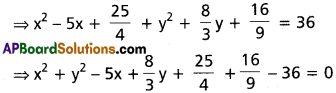
Inter 2nd Year Maths 2B Circle Solutions Ex 1(a) 1
Multiplying with 36
36x² + 36y² – 180x + 96y + 225 + 64 – 1296 = 0
⇒ 36x² + 36y² – 180x + 96y – 1007 = 0

ix) C = (1, 7), r = \(\frac{5}{2}\)
Solution:
Equation of the circle is
(x – 1)² + (y – 7)² = (\(\frac{5}{2}\))²
⇒ x² – 2x + 1 + y² – 14y + 49 = \(\frac{25}{4}\)
⇒ x² + y² – 2x – 14y + \(\frac{175}{4}\) = 0
4x² + 4y² – 8x – 56y + 175 = 0

x) C = (0, 0); r = 9
Solution:
Equation of the circle is
(x – 0)² + (y – 0)² = (9)²
x² + y² = 81

Inter 2nd Year Maths 2B Circle Solutions Ex 1(a)

Question 2.
Find the equation of the circle passing through the origin and having the centre at (-4, -3).
Solution:
Equation of the circle is
(x – h)² + (y – k)² = r²; (h, k) = (-4, -3)
(x + 4)² + (y + 3)² = r²
Circle passes through origin.
∴ (0 + 4)² + (0 + 3)² = r² ⇒ 25 = r²
Then required equation of circle be
(x + 4)² + (y + 3)² = 25
x² + y² + 8x + 6y = 0

Question 3.
Find the equation of the circle passing through (2, -1) having the centre at (2, 3).
Solution:
C = (2, 3), P = (2, -1)
Radius CP = \(\sqrt{(2 – 2)^{2} + (3 + 1)^{2}}\) = 4
Equation of circle be
(x – 2)² + (y – 3)² = 42
x² + y² – 4x – 6y – 3 = 0

Question 4.
Find the equation of the circle passing the through (- 2, 3) centre at (0, 0).
Solution:
C = (0, 0), P = (- 2, 3)
Radius = \(\sqrt{(0 + 2)^{2} + (0 – 3)^{2}}\)
= √13
Equation of circle be
(x – 0)² + (y – 0)² = (√13)²
x² + y² = 13

Question 5.
Find the equation of the circle passing through (3, 4) having and the centre at (-3, 4).
Solution:
Let the equation of the circle be
(x – h)² + (y – k)² – r²
Centre (h, k) = (-3, 4)
(x + 3)² + (y – 4)² = r²
Circle passes through (3, 4)
(3 + 3)² + (4 – 4)² = r²
r² = 36
Equation of the circle is
(x + 3)² + (y – 4)² = 36
x² + 6x + 9 + y² – 8y + 18 – 36 = 0
x² + y² + 6x – 8y – 11 =0

Question 6.
Find the value of ‘a’ if 2x² + ay² – 3x + 2y – 1 =0 represents a circle and also find its radius.
Solution:
General equation of second degree
ax² + 2hxy + by² + 2gx + 2fy + c = 0
Represents a circle, when
a = b, h= 0, g² + f² – c > 0 In
2x² + ay² – 3x + 2y -1 = 0
a = 2, above equation represents circle.
x² + y² – \(\frac{3}{2}\) x + y – \(\frac{1}{2}\) = 0
2g = –\(\frac{3}{2}\); 2f = 1; c = –\(\frac{1}{2}\)
c = (-g, -f) = (\(\frac{+3}{4}\), \(\frac{-1}{2}\))
Radius = \(\sqrt{g^{2} + f^{2} – c}\) = \(\sqrt{\frac{9}{16}+\frac{1}{4}+\frac{1}{2}}\)
= \(\frac{\sqrt{21}}{4}\) units

Inter 2nd Year Maths 2B Circle Solutions Ex 1(a)

Question 7.
Find the values of a, b if ax² + bxy + 3y² – 5x + 2y – 3 = 0 represents a circle. Also find the radius and centre of the circle.
Solution:
General equation of second degree
ax² + 2hxy + by² + 2gx + 2fy + c = 0
represents a circle a = b, h = 0
∴ ax² + bxy + 3y² – 5x + 2y – 3 = 0
represents, a circle.
When b = 0, a = 3
3x² + 3y² – 5x + 2y – 3 = 0
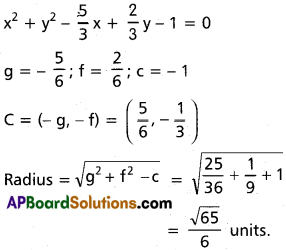
Inter 2nd Year Maths 2B Circle Solutions Ex 1(a) 2

Question 8.
If x² + y² + 2gx + 2fy -12 = 0 represents a circle with centre (2, 3), find g, f and its radius.
Solution:
Circle is x² + y² + 2gx + 2fy – 12 = 0
C = (-g, -f) C = (2, 3)
∴ g = -2, f = -3, c = – 12
Radius = \(\sqrt{g^{2} + f^{2} – c}\)
= \(\sqrt{4 + 9 + 12}\)
= 5 units

Question 9.
If x² + y² + 2gx + 2fy = 0 represents a circle with Centre (-4, -3) then find g,f and the radius of the circle.
Solution:
Circle is x² + y² + 2gx + 2fy – 12 = 0
⇒ C = (-g, -f) C = (-4, -3)
∴ g = 4, f = 3
Radius = \(\sqrt{g^{2} + f^{2} – c}\)
= \(\sqrt{16 + 9}\) = 5 units

Question 10.
If x² + y² – 4x + 6y + c = 0 represents a circle with radius 6 then find the value of c.
Solution:
Circle is x² + y² – 4x + 6y + c = 0
r = \(\sqrt{g^{2} + f^{2} – c}\) ; g = – 2, f = 3
6 = \(\sqrt{4 + 9 – c}\)
36 = 13 – c
or c = -23

Question 11.
Find the centre and radius of each of the circles whose equations are given below.
i) x² + y² – 4x – 8y – 41 = 0
Solution:
x² + y² – 4x – 8y – 41 = 0 ……….. (i)
x² + y² + 2gx + 2fy + c = 0 ……….. (ii)
Comparing (i) and (ii) we get
g = – 2, f = – 4, c = – 41
Radius = \(\sqrt{g^{2} + f^{2} – c}\)
= \(\sqrt{4 + 16 + 41}\)
= \(\sqrt{61}\) units
Centre = (-g, -f) = (2, 4)

ii) 3x² + 3y² – 5x- 6y + 4 = 0
Solution:
Equation of the circle is
3x² + 3y² – 5x – 6y + 4 = 0
x² + y² – \(\frac{5}{3}\)x – \(\frac{6}{3}\)y + \(\frac{4}{3}\) = 0 …………. (i)
x² + y² + 2gx + 2fy + c = 0 …………. (ii)
Comparing equations (i) and (ii) we get
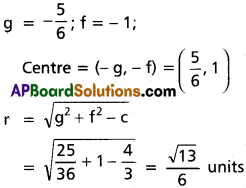
Inter 2nd Year Maths 2B Circle Solutions Ex 1(a) 3

iii) 3x² + 3y² + 6x – 12y – 1 = 0
Find the radius and centre of the circle.
Solution:
Equation of the circle is
3x² + 3y² + 6x – 12y – 1 = 0
x² + y² + \(\frac{6}{3}\)x – \(\frac{12}{3}\)y – \(\frac{1}{3}\) = 0
C = (-g, -f) = (-1, 2)
Radius = \(\sqrt{g^{2} + f^{2} – c}\)
= \(\sqrt{1 + 4 + \frac{1}{3}}\)
= \(\frac{4}{\sqrt{3}}\)

iv) x² + y² + 6x + 8y – 96 = 0
Solution:
Equation of the circle is
x² + y² + 6x + 8y – 96 = 0
C = (-g, -f) = (-3, -4)
Radius = \(\sqrt{g^{2} + f^{2} – c}\)
= \(\sqrt{9 + 16 + 96}\)
= \(\sqrt{121}\) = 11 units

v) 2x² + 2y² – 4x + 6y – 3 = 0 Sol. Equation of the circle is
Solution:
x² + y² – 2x + 3y-|- = 0 ………….. (i)
x² + y² + 2gx + 2fy + c = 0 …………… (ii)
Comparing (i) and (ii) we get
C = (1, –\(\frac{3}{2}\))
Radius = \(\sqrt{g^{2} + f^{2} – c}\)
= \(\sqrt{1 + \frac{9}{4} + \frac{3}{2}}=\frac{\sqrt{19}}{2}\) units

vi) 2x² + 2y² – 3x + 2y – 1 = 0
Solution:
Equation of the circle is
x + y – \(\frac{3}{2}\)x + y – \(\frac{1}{2}\) = 0
x² + y² + 2gx + 2fy + c = 0
Comparing we get
C = (-g, -f) = (\(\frac{3}{2}\), –\(\frac{1}{2}\))
r = \(\sqrt{g^{2} + f^{2} – c}\)
\(\sqrt{\frac{9}{16} + \frac{1}{4} + \frac{3}{2}}=\frac{\sqrt{21}}{4}\) units

vii) \(\sqrt{1 + m^{2}}\) (x² + y²) – 2cx – 2mcy = 0
Solution:
Equation of the circle is
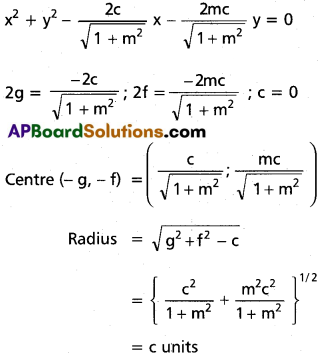
Inter 2nd Year Maths 2B Circle Solutions Ex 1(a) 4

viii) x² + y² + 2ax – 2by + b2 = 0
Solution:
Equation of the circle is
x² + y² + 2gx + 2fy + c = 0
C = (-g, -f) = (-a, b)
Radius = \(\sqrt{g^{2} + f^{2} – c}\)
= \(\sqrt{a^{2} + b^{2} – b^{2}}\) = a units

Inter 2nd Year Maths 2B Circle Solutions Ex 1(a)

Question 12.
Find the equations of the circles for which the points given below are the end points of a diameter.
i) (1, 2), (4, 6)
Solution:
Equation of the circle with (x1, y1), (x2, y2) as ends of a diameter is
(x – x1) (x – x2) + (y – y1) (y – y2) = 0
⇒ (x – 1) (x – 4) + (y – 2) (y – 6) = 0
⇒ x² – 5x + 4 + y² – 8y + 12 = 0
⇒ x² + y² – 5x – 8y + 16 = 0

ii) (-4, 3); (3, -4)
Solution:
Equation of circle with (x1, y1) and (x2, y2) are end points of diameter is
(x – x1) (x – x2) + (y – y1) (y – y2) = o
Required equation of circle be
(x + 4) (x – 3) + (y – 3) ( y + 4) = 0
x² + y² + x + y – 24 = 0

iii) (1, 2); (8, 6)
Solution:
Equation of the circle is
(x – x1) (x – x2) + (y – y1) (y – y2) = 0
(x – 1) (x – 8) + (y – 2) (y – 6) = 0
x² + y² – 9x – 8y + 20 = 0

iv) (4, 2); (1, 5)
Solution:
Equation of the circle is
(x – x1) (x – x2) + (y – y1) (y – y2) = 0
⇒ (x – 4) (x – 1) + (y – 2) (y – 5) = 0
x² + y² – 5x – 7y + 14 = 0

v) (7, -3); (3, 5)
Solution:
Equation of the circle is
(x – x1) (x – x2) + (y – y1) (y – y2) = 0
⇒ (x – 7)(x – 3) + (y + 3) (y – 5) = 0
x² + y² – 10x – 2y + 6 = 0

vi) (1, 1); (2, -1)
Solution:
Equation of the circle is
(x – x1) (x – x2) + (y – y1) (y – y2) = 0
⇒ (x – 1) (x – 2) + (y – 1) (y + 1) = 0
x² + y² – 3x +1=0

vii) (0, 0); (8, 5)
Solution:
Equation of the circle is
(x – x1) (x – x2) + (y – y1) (y – y2) = 0
⇒ (x – 0) (x – 8) + (y – 0) (y – 5) = 0
⇒ x² – 8x + y² – 5y = 0
x² + y² – 8x – 5y = 0

viii) (3, 1); (2, 7)
Solution:
Equation of the circle is
(x – x1) (x – x2) + (y – y1) (y – y2) = 0
(x – 3) (x – 2) + (y – 1) (y – 7) = 0
x²+ y² – 5x – 8y + 13 = 0

Question 13.
Obtain the parametric equation of each of the following circles.
i) x² + y² = 4
Solution:
Equation of the circle is x² + y² = 4
C (0, 0), r = 2
Parametric equations are
x = – g + r cos θ = 2 cos θ
y = – b + r sin θ = 2 sin θ, 0 ≤ θ < 2π

ii) 4(x² + y²) = 9
Solution:
Equation of the circle is 4(x² + y²) = 9
x² + y² = \(\frac{9}{4}\)
C(0, 0), r = \(\frac{3}{2}\)
Parametric equations are
x = \(\frac{3}{2}\) cos θ, y = \(\frac{3}{2}\) sin θ, 0 ≤ θ < 2π

iii) 2x² + 2y² = 7
Solution:
Equation of the circle is 2x² + 2y² = 7
x² + y² = \(\frac{7}{2}\)
C(0, 0), r = \(\sqrt{\frac{7}{2}}\)
Parametric equations are
x = \(\sqrt{\frac{7}{2}}\) cos θ, y = \(\sqrt{\frac{7}{2}}\) sin θ, 0 ≤ θ < 2π

iv) (x – 3)² + (y – 4)² = 8²
Solution:
Equation of the circle is (x – 3)² + (y – 4)² = 8²
Centre (3, 4), r = 8
Parametric equations are
x = 3 + 8 cos θ, y = 4 + 8 sin θ, 0 ≤ θ < 2π

v) x² + y² – 4x – 6y – 12 = 0
Solution:
Equation of the circle is
x² + y² – 4x – 6y – 12 = 0
Centre (2, 3), r = \(\sqrt{4 + 9 + 12}\) = 5
Parametric equations are
x = 2 + 5 cos θ, y = 3 + 5 sin θ, 0 ≤ θ < 2π

vi) x² + y² – 6x + 4y – 12 = 0
Solution:
Equation of the circle is x² + y² – 6x + 4y – 12 = 0
Centre (3, – 2), r = \(\sqrt{9 + 4 + 12}\) = 5
Parametric equations are
x = 3 + 5 cos θ, y = -2 + 5 sin θ, 0 ≤ θ < 2π

II.

Question 1.
If the abscissae of points A, B are the roots of the equation, x² + 2ax – b² = 0 and ordinates of A, B are roots of y² + 2py – q²= 0, then find the equation of a circle for which \(\overline{\mathrm{AB}}\) is a diameter.
Solution:
Equation of the circle is
(x – x1) (x – x2) + (y – y1) (y – y2) = 0
x² – x(x1 + x2) + x1x2 + y² – y (y1 + y2) + y1y2 = 0
x1, x2 are roots of x² + 2ax – b² = 0
y1, y2 are roots of y² + 2py – q² = 0
x1x2 = -2a,    y1y2 = -2p
x1x2 = -b², y1y2 = -q²
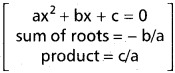
Inter 2nd Year Maths 2B Circle Solutions Ex 1(a) 5
Equation of circle be
x² – x(- 2a) – b² + y² – y(- 2p) – q² = 0
x² + 2xa + y² + 2py – b² – q² = 0

Inter 2nd Year Maths 2B Circle Solutions Ex 1(a)

Question 2.
i) Show that A (3, -1) lies on the circle x² + y² – 2x + 4y = 0. Also find the other end of the diameter through A.
Solution:
Equation of the circle is
x² + y² – 2x + 4y = 0 …………… (i)
A (3, -1); Let B (x1, y1)
Substituting A in equation (i)
(3)² + (-1)² – 2(3) + 4 (-1) = 0
∴ A lies on the circle
C (-g, -f)
C = (1, -2)

Inter 2nd Year Maths 2B Circle Solutions Ex 1(a) 6
C is the centre of circle
C is midpoint of AB
\(\frac{x_{1}+3}{2}\) = -1 \(\frac{y_{1}-1}{2}\) = -2
x1 = -1 y1 = -3
B(x1, y1) = (-1, -3)

ii) Show that A(-3, 0) lies on x² + y² + 8x + 12y + 15 = 0 and find the other end of diameter through A.
Solution:
If A (-3, 0) satisfy
x² + y² + 8x + 12y + 15 = 0
then (-3)² + (0)² – 8 × 3 + 12 × 0 +15
9 – 24 + 1 5 = 0
∴ (-3, 0) is one end of diameter.
A (-3, 0), C(-4, -6), B(x1, y1)
\(\frac{x_{1}+(-3)}{2}\) = -4 \(\frac{y_{1}+0}{2}\) = -6
x1 = -5 y1 = -12
∴ Other end of diameter is (-5, -12)

Question 3.
Find the equation of a circle which passes through (2, -3) and (-4, 5) and having the centre on 4x + 3y + 1 =0
Solution:
x² + y² +2gx + 2fy + c = 0 ……….. (i)
Equation (i) passes through (2, -3), (-4, 5)
∴ 4 + 9 + 4g – 6f + c = 0 …………. (ii)
16 + 25 – 8g + 10f + c = 0 …………. (iii)
Equation (iii) – (ii) we get
28 – 12g + 16f = 0
(or) 3g – 4f = 7
Centre lies on (-g, -f) lies on 4x + 3y + 1 = 0
then 4(-g) + 3(-f) + 1 = 0
3g – 4f – 7 = 0
Solving we get f = -1
g = 1
Now substituting f, g values in equation (ii) we get
4 + 9 + 4(1) – 6 (-1) + c = 0, c = -23
x² + y² + 2x – 2y – 23 = 0 is required equation of circle.

Question 4.
Find the equation of a circle which passes through (4, 1) (6, 5) and having the centre on 4x + 3y – 24 = 0
Solution:
Equation of circle be
x² + y² + 2gx + 2fy + c = 0 passes through (4, 1) and (6, 5) then
4² + 1² + 2g(4) + 2f(1) + c = 0 ………… (i)
6² + 5² + 2g(6) + 2f(5) + c = 0 ………… (ii)
Centre lie on 4x + 3y – 24 = 0
∴ 4(-g) + 3 (-f) – 24 = 0 ………… (iii)
(ii) – (i) we get
44 + 4g + 8f = 0 …………… (iv)
Solving (iii) and (iv) we get
f = -4, g = -3, c = 15
∴ Required equation of circle is
x² + y² – 6x – 8y +15 = 0

Question 5.
Find the equation of a circle which is concentric with x² + y² – 6x – 4y – 12 = 0 and passing through (-2, 14).
Solution:
x² + y² – 6x – 4y – 12 = 0 ……… (i)
C = (-g, -f)
= (3, 2)
Equation of circle concentric with (i) be
(x – 3)² + (y – 2)² = r²
Passes through (-2, 14)
∴ (-2 – 3)² + (14 – 2)² = r²
169 = r²
Required equation of circle be
(x – 3)² + (y – 2)² = 169
x² + y² – 6x – 4y – 156 = 0

Question 6.
Find the equation of the circle whose centre lies on the X – axis and passing through (-2, 3) and (4, 5).
Solution:
x² + y² + 2gx + 2fy + c = 0 ………… (i)
(-2, 3) and (4, 5) passes through (i)
4 + 9 – 4g + 6f + c = 0 ………….. (ii)
16 + 25 + ,8g + 10f + c = 0 ………… (iii)
(iii) – (ii) we get
28 + 12g + 4f = 0
f + 3g = -7
Centre lies on X – axis then f = 0
g = -, \(\frac{7}{3}\) f = 0, c = \(\frac{67}{3}\) -, we get by substituting g, f in equation (ii)
Required equation will be
3(x² + y²) – 14x – 67 = 0

Inter 2nd Year Maths 2B Circle Solutions Ex 1(a)

Question 7.
If ABCD is a square then show that the points A, B, C and D are concyclic.
Solution:
AB = a, AD = a
A (0, 0), B(0, a), D (a, 0)
Equation of circle is
x² + y² + 2gx + 2fy + c = 0
passes through A, B, D we get
A : 0 + 0 + 2g(0) + 2f(0) + c = 0
C = 0
B : 0 + a2 + 2g(0) + 2fa + 0 = 0
f = \(\frac{a}{2}\)
Similarly g = –\(\frac{a}{2}\)
Required equation of circle be
x² + y² – ax – ay = 0
Co-ordinates of C are (a, a)
a² + a² – a² – a² = 0
⇒ C lies on the circle passing through A, B, D.
∴ A, B, C, D are concyclic.
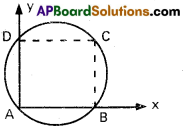
Inter 2nd Year Maths 2B Circle Solutions Ex 1(a) 7

III.

Question 1.
Find the equation of circle passing through each of the following three points.
i) (3, 4); (3, 2); (1, 4)
Solution:
Equation of circle
x² + y² + 2gx + 2fy + c = 0
Given points satisfy above equation then
9 +16 + 6g + 8f + c + = 0 ………….. (i)
9 + 4 + 6g + 4f + c = 0 ………….. (ii)
1 + 16 + 2g + 8f + c = 0 ………… (iii)
Subtracting (ii) – (i) we get
-12 – 4f = 0 (or) f = – 3
(ii) – (iii) we get
– 4 + 4g – 4f = 0
g – f = 1
9 = – 2
Now substituting g, f in equation (i) we get
25 + 6 (- 2) + 8 (- 3) + c = 0
we get c = 11
Required equation of circle be
x² + y² – 4x – 6y + 11 = 0

ii) (1, 2); (3, -4); (5, -6)
Solution:
Equation of circle is
x² + y² + 2gx + 2fy + c = 0
1 + 4 + 2g + 4f + c = 0 …………. (i)
9 + 16 + 6g — 8f + c = 0 …………. (ii)
25 + 36 + 10g – 12f + c = 0 …………. (iii)
Subtracting (ii) – (i) we get
20 + 4g – 12f = 0
(or) 5 + g – 3f = 0 …………. (iv)
Similarly (iii) – (ii), we get
36 + 4g – 4f = 0
(or) 9 + g – f = 0 …………. (v)
Solving (v) and (iv) we get
f = -2, g = -11, c = 25
Required equation of circle be
x² + y² – 22x – 4y + 25 = 0

iii) (2, 1); (5, 5); (-6, 7)
Solution:
Equation of circle is
x² + y² + 2gx + 2fy + c = 0
4 + 1 + 4g + 2f + c = 0 …………. (i)
25 + 25 + 10g + 10f + c = 0 …………. (ii)
36 + 49 – 12g + 14f + c = 0 …………. (iii)
Subtracting (ii) – (i)
45 + 6g + 8f = 0 …………. (iv)
Subtracting (iii) – (ii)
35 – 22g + 4f = 0 …………. (v)
Solving (iv) and (v) we get
g = \(\frac{1}{2}\); f = -6; c = 5
Required equation of circle be
x² + y² + x – 12y + 5 = 0

iv) (5, 7); (8, 1); (1, 3)
Solution:
Equation of circle is
x² + y² + 2gx + 2fy + c = 0
25 + 49 + 10g + 14f + c = 0 …………. (i)
64 + 1 + 16g + 2f + c = 0 …………. (ii)
1 + 9 + 2g + 6f + c = 0 …………. (iii)
Subtracting (ii) – (i)
-9 + 6g – 12f = 0 …………. (iv)
(or) 2g – 4f – 3 = 0
Subtracting (iii) – (ii)
– 55 – 14g + 4f = 0 ……….. (v)
Solving (v) and (iv) we get
g = \(\frac{-29}{6}\), f = \(\frac{-19}{6}\), c = \(\frac{56}{3}\)
∴ Required equation of circle is
x² + y² – \(\frac{-29}{3}\)x – \(\frac{-19}{3}\)y + \(\frac{56}{3}\) = 0
3(x² + y²) – 29x – 19y + 56 = 0

Inter 2nd Year Maths 2B Circle Solutions Ex 1(a)

Question 2.
i) Find the equation of the circle passing through (0, 0) and making intercepts 4,3 on X- axis and Y – axis respectively.
Solution:
x² + y² + 2gx + 2fy + c = 0
Circle is passing through
(0, 0), (4, 0) and (0, 3)
0 + 0 + 2g(0) + 2f(0) + c = 0
c = 0 ………… (i)
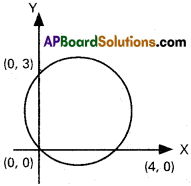
Inter 2nd Year Maths 2B Circle Solutions Ex 1(a) 8
16 + 0 + 8g + 2f . 0 + c = 0
g = -2 as c = 0
Similarly 0 + 9 + 2g. 0 + 6f + c = 0
f = –\(\frac{3}{2}\) as c = 0
Required equation of circle will be
x² + y² – 4x – 3y = 0
If intercepts are negative when circle passes through the points (0, 0) (-4, 0) (0, -3). Required equation of circle is x² + y² + 4x + 3y = 0

ii) Find the equation of the circle passing through (0, 0) and making intercept 6 units on X – axis and intercept 4 units on Y – axis.
Solution:
OA = 6 units,
OB = 4 units,
OD = 3 units, OE = 2 units.
∴ Co-ordinates of centre b(3, 2)
Radius OC = \(\sqrt{(0+3)^{2}+(0-2)^{2}}\) = √13
Equation of circle with (h, k) as centre r be radius is (x – h)² + (y – k)² = r²
∴ Required equation of circle be
(x – 3)² + (y – 2)² = 13
x² + y² – 6x – 4y = 0
If intercepts are negative when circle passes through the points (0, 0) (-6, 0) (0, -4)
Required equation of circle is x² + y² + 6x + 4y = 0
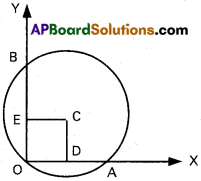
Inter 2nd Year Maths 2B Circle Solutions Ex 1(a) 9

Question 3.
Show that the following four points in each of the following are concyclic and find the equation of the circle on which they lie.
i) (1, 1), (-6, 0), (-2, 2), (-2, -8)
Solution:
Suppose the equation of the required circle is
x² + y² + 2gx + 2fy + c = 0 ………… (i)
This circle passes through A (1, 1)
1 + 1 + 2g + 2f + c = 0
⇒ 2g + 2f + c = -2 …………. (ii)
The circle passes through B (-6, 0)
36 + 0 – 12g + 0 + c = 0
– 12g + c = – 36 …………. (iii)
This circle passes through C (-2, 2)
4 + 4 – 4g + 4f + c = 0
– 4g + 4f + c = – 8 ………… (iv)
(iii) – (iv) gives – 8g – 4f = 0
⇒ 2g + f = 7
(i) – (ii) gives 14g + 2f = 34
7g + f = 17 ………….. (v)
Solving (iv) and (v) we get g = 2, f = 3
Putting g = 2, f = 3 in
4 + 6 + c = -2
c = – 12
Required circle is x² + y² + 4x + 6y – 12 = 0
Substituting (-2, -8) in this above equation, we get
4 + 64 – 8- 48 -12 = 68 – 68 = 0
(- 2, -8) satisfies the above equation
∴ A, B, C, D are concyclic.
Equation of the circle is
x² + y² + 4x + 6y – 12 = 0

ii) (1, 2); (3, -4); (5, -6); (19, 8)
Solution:
Equation of circle
x² + y² + 2gx + 2fy + c = 0
1 + 4 + 2g + 4f + c = 0 …………. (i)
9 + 16 + 6g – 8f + c = 0 …………. (ii)
25 + 36 + 10g – 12f + c = 0 …………. (iii)
Subtracting (ii) – (i) we get
20 + 4g – 12f = 0
5 + g – 3f = 0 …………. (iv)
Subtracting (iii) – (ii) we get
36 + 4g – 4f = 0
(or)
9 + g – f = 0 …………. (v)
Solving (iv) and (v) we get
f = -2, g = – 11, c = 25
Equation of circle will be
x² + y² – 22x – 4y + 25 = 0 ……… (vi)
(19, 8) substituting in equation (vi)
(19)² + 8² – 22 × 19 – 4 × 8 + 25 = 0
Hence (19, 8) lie on circle and four points are concyclic.

iii) (1, -6); (5, 2); (7, 0); (-1, -4)
Solution:
Equation of circle
x² + y² + 2gx + 2fy + c =0
1 + 36 + 2g- 12f + c = 0 ……….. (i)
25 + 4 + 10g + 4f + c = 0 …………. (ii)
49 + 14g + c = 0 …………… (iii)
Subtracting (ii) – (i) we get
-8 + 8g + 16f = 0
(or)
2f+ g – 1 = 0 ……… (iv)
Subtracting (iii) – (ii) we get
20 + 4g – 4f = 0 ………… (v)
(or)
5 + g – f = 0
Solving (iv) and (v) we get
f = 2, g = -3, c = -7
Equation of circle be
x² + y² – 6x + 4y- 7 = 0 …….. (vi)
(-1, -4) satisfies equation (vi)
∴ Four points are concyclic.

iv) (9, 1), (7, 9), (-2, 12), (6, 10)
Solution:
Equation of the circle is
x² + y² + 2gx + 2fy + c = 0
This circle passes through
A(9, 1), B(7, 9), C (-2, 12)
81 + 1 + 18g + 2f + c = 0 ………….. (i)
49 + 81 14g + 18f + c = 0 ………….. (ii)
4 + 144 – 4g + 24f + c = 0 ………….. (iii)
(ii) – (i) gives – 4g + 16f + 48 = 0
4g – 16f = 48
g – 4f = 12 ……….. (iv)
(ii) – (iii) gives 18g – 6f – 18 = 0
18g – 6f = 18 ………… (v)
36g – 12f = 36 ……….. (v) × 2
3g – 12f = 36 ………… (iv) × 3
Subtracting 33g = 0 ⇒ g = 0
Substituting in (iv) we get – 4f = 12
f = \(\frac{12}{-4}\) = -3
Substituting the values of g, f in (i)
18(0) + 2 (-3) + c + 82 = 0
c = 6 – 82 = -76
Equation of the required circle is
x² + y² – 6y – 76 = 0
x² + y² – 6y – 76 = 6² + 10² – 6(10) – 76
= 36 + 100 – 60 – 76
= 136 – 136 = 0
D(6, 10) lies on the circle passing through A, B, C.
∴ A, B, C and D are concylic.
Equation of the circle is x² + y² – 6y – 76 = 0

Inter 2nd Year Maths 2B Circle Solutions Ex 1(a)

Question 4.
If (2, 0), (0, 1), (4, 5) and (0, c) are concyclic, and then find c.
Solution:
x² + y² + 2gx + 2fy + c = 0
Satisfies (2, 0), (0, 1) (4, 5) we get
4 + 0 + 4g + c1 = 0 ………… (i)
0 + 1 + 2g. 0 + 2f + c1 = 0 ………….. (ii)
16 + 25 + 8g + 10f + c1 = 0 ……….. (iii)
(ii) – (i) we get
-3 – 4g + 2f = 0
4g – 2f = -3 ………. (iv)
(ii) – (iii) we get
-40 – 8g – 8f =0 (or)
g + f = – 5 ……… (v)
Solving(iv) and (v) we get
g = –\(\frac{13}{6}\), f = \(\frac{17}{6}\)
Substituting g and f values in equation (i) we get
4 + 4(-\(\frac{13}{6}\)) + c1 = 0
c1 = \(\frac{14}{3}\)
Now equation x² + y² – \(\frac{13}{3}\)x – \(\frac{17}{3}\)y + \(\frac{14}{3}\) = 0
Now circle passes through (0, c) then
c² – \(\frac{17}{3}\)c + \(\frac{14}{3}\)
3c² – 17c + 14 = 0
⇒ (3c – 14) (c – 1) = 0
(or)
c = 1 or \(\frac{14}{3}\).

Question 5.
Find the equation of the circum circle of the triangle formed by the straight lines given in each of the following:
i) 2x + y = 4; x + y = 6; x + 2y = 5
Solution:
AB: 2x + y = 4, AB : 2x + y = 4
BC : x + y = 6, AC : x + 2y = 5
B : (-2, 8), A : (1, 2)
AC: x + 2y = 5
BC : x + y = 6
C : (7, -1)
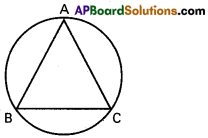
Inter 2nd Year Maths 2B Circle Solutions Ex 1(a) 10
Equation of circle
x² + y² + 2gx + 2fy + c = 0
passes through A, B, C
∴ 4 + 64 – 4g + 16f + c = 0 ……… (i)
1 + 4 + 2g + 4f + c = 0 ………… (ii)
49 + 1 + 14g – 2f + c = 0 ……….. (iii)
(i) – (ii) we get
21 – 2g + 4f = 0 ……….. (iv)
(iii) – (ii) we get
15 + 4g – 2f = 0 ……….. (v)
Solving (iv) and (v) we get f = – \(\frac{19}{2}\)
g = –\(\frac{17}{2}\); c = 50
We get substituting g, f in equation (i)
Required equation of circle be
x² + y² – 17x – 19y + 50 = 0

ii) x + 3y – 1 = 0; x + y + 1 = 0; 2x + 3y + 4 = 0
Solution:
AB : x + 3y – 1 = 0 AB : x + 3y – 1 = 0
BC : x + y +1 = 0 AC: 2x + 3y‘ + 4 = 0
B : (-2, 1) A: (-5, 2)
AC : 2x + 3y + 4 = 0
BC : x + y + 1 = 0
C : (1, -2)
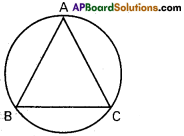
Inter 2nd Year Maths 2B Circle Solutions Ex 1(a) 11
Equation of circle x² + y² + 2gx + 2fy + c = 0
A, B, C are points on circumference.
25 + 4 – 10g + 4f + c = 0 ……….. (i)
4 + 1 – 4g + 2f + c = 0 ……… (ii)
∴ 1 + 4 + 2g – 4f + c = 0 ……… (iii)
Subtracting (iii) – (ii) we get
6g – 6f = 0 (or) g = f ……… (iv)
Subtracting (iii) – (i) we get
24 – 12g + 8f = 0 ……… (v)
Solving (iv) and (v) we get
g = 6, f = 6, c = 7
Required equation of circle be
x² + y² + 12x + 12y + 7

iii) 5x – 3y + 4 = 0; 2x + 3y – 5 = 0; x + y = 0.
Solution:
AB : 5x – 3y + 4 = 0
AC : 2x + 3y – 5 = 0
BC : x + y = 0
A : (\(\frac{1}{7}\), \(\frac{11}{7}\)) C : (-5, 5)
B : (-\(\frac{1}{2}\), \(\frac{1}{2}\))
Equation of circle is
x² + y² + 2gx + 2fy + c = 0
Points A, B, C are on circumference of circle
\(\frac{1}{49}\) + \(\frac{121}{49}\) + \(\frac{2}{7}\)g + \(\frac{22}{7}\)f + c = 0 ………. (i)
25 + 25 – 10g + 10f + c = 0 ………. (ii)
\(\frac{1}{4}\) + \(\frac{1}{4}\) – g + f + c ……….. (iii)
(Or)
1 – 2g + 2f + 2c = 0
(ii) — (iii) we get
(50 – \(\frac{1}{2}\) – 9g + 9f = 0
\(\frac{11}{2}\) – g + f = 0 ………… (iv)
(iii) – (i) we get
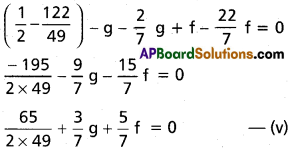
Inter 2nd Year Maths 2B Circle Solutions Ex 1(a) 12
Solving (iv) and (v) we get
g = \(\frac{40}{14}\); f = \(\frac{-37}{14}\); h = \(\frac{70}{14}\)
x² + y² + \(\frac{80}{2}\)x + \(\frac{74}{14}\)y + \(\frac{70}{14}\) = 0
Required equation of circle be
7(x² + y²) + 40x – 37y + 35 = 0

iv) x – y – 2 = 0;
2x – 3y + 4 = 0;
3x – y + 6 = 0
Solution:
AB : x – y – 2 = 0
B : (10, 8) A: (-4, -6)
BC : 2x – 3y + 4 = 0
AC : 3x – y + 6 = 0
C : (- 2, 0)
Equation of circle is
x² + y² + 2gx + 2fy + c = 0
Points A, B, C are on circumference of circle
100 + 64 + 20g + 16f + c = 0 ……… (i)
16 + 36 – 8g – 12f + c = 0 ……… (ii)
4 – 4g + c = 0 ……….. (iii)
Solving above equations we get
g = – 12, f = 8, c = – 52
Required equation of circle is
x² + y² – 24x + 16y – 52 = 0

Inter 2nd Year Maths 2B Circle Solutions Ex 1(a)

Question 6.
Show that the locus of the point of intersection of the lines x cos a + y sin a = a, x sin a – y cos a = b (a is a parameter) is a circle.
Solution:
Equations of the given lines are
x cos α + y sin α = a
x sin α -y cos α = b
Let P (x1, y1) be the point of intersection
x1 cos α + y1 sin α = a ………. (1)
x1 sin α – y1 cos α = b ……… (2)
Squaring and adding (1) and (2)
(x1cos α + y1sin α)² + (x1sin α – y1cos α)² = a² + b²
1 cos²α + y²1 sin²α + 2x1y1 cos α sin α + x²1 sin² α + y²1 cos² α – 2x1y1 cos α sin α = a² + b²
1 (cos²α +sin²α) + y²1 (sin² α + cos² α) = a² + b²
1 + y²1 = a² + b²
Locus of P(x1, y1) is the circle
x² + y² = a² + b²

Question 7.
Show that the locus of a point such that the ratio of distance of it from two given points is constant k (≠ ± 1) is a circle.
Solution:
Let P(x1, y1) be a point on the locus
Let A (a, 0), B(-a, 0) be two given points
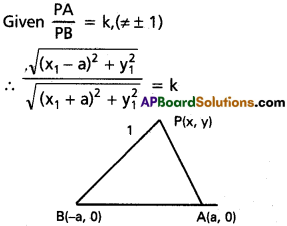
Inter 2nd Year Maths 2B Circle Solutions Ex 1(a) 13
By squaring and cross multiplying, we get
(x1 – a)² + y1² = k² [(x1 + a)2 + y12 ]
⇒ (1 – k²) (x²1 + y²1 + a²) + (-1 – k²) (2ax1) = 0
⇒ x²1 + y²1 – 2 \(\frac{(1+k^{2})}{1-k^{2}}\)ax + a² = 0
∴ Locus of P(x1, y1) is
x² + y² – 2\(\frac{1+k^{2}}{1-k^{2}}\)ax + a² = 0
which represents a circle. (Here k ≠± 1)

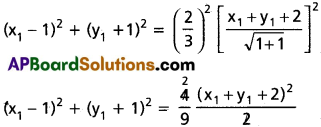
Inter 2nd Year Maths 2A Random Variables and Probability Distributions Solutions Ex 10(a)

Practicing the Intermediate 2nd Year Maths 2A Textbook Solutions Inter 2nd Year Maths 2A Random Variables and Probability Distributions Solutions Exercise 10(a) will help students to clear their doubts quickly.

Intermediate 2nd Year Maths 2A Random Variables and Probability Distributions Solutions Exercise 10(a)

I.

Question 1.
A p.d.f of a discrete random variable is zero except at the points x = 0, 1, 2. At these points it has the value P(0) = 3c3, P(1) = 4c – 10c2, P(2) = 5c – 1 for some c > 0. Find the value of c.
Solution:
P(X = 0) + P(X = 1) + P(X = 2) = 1
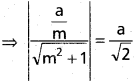
3c3 + 4c – 10c2 + 5c – 1 = 1
3c3 – 10c2 + 9c – 2 = 0
Put c = 1, then 3 – 10 + 9 – 2 = 12 – 12 = 0
c = 1 satisfies the above equation
c = 1 ⇒ P(X = 0) = 3 which is not possible
Dividing with c – 1, we get
3c2 – 7c + 2 = 0
(c – 2) (3c – 1) = 0
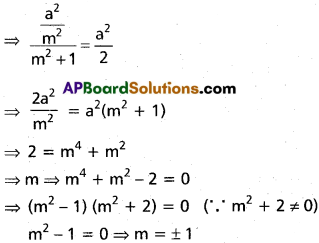
∴ c = 2 or c = \(\frac{1}{3}\)
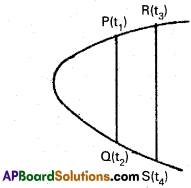
c = 2
⇒ P(X = 0) = 3 . 23 = 24 which is not possible
∴ c = \(\frac{1}{3}\)

Inter 2nd Year Maths 2A Random Variables and Probability Distributions Solutions Ex 10(a)

Question 2.
Find the constant C, so that F(x) = \(C\left(\frac{2}{3}\right)^x\), x = 1, 2, 3,……… is the p.d.f of a discrete random variable X.
Solution:
Inter 2nd Year Maths 2A Random Variables and Probability Distributions Solutions Ex 10(a) I Q2

Question 3.
Inter 2nd Year Maths 2A Random Variables and Probability Distributions Solutions Ex 10(a) I Q3
is the probability distribution of a random variable X. Find the value of K and the variance of X.
Solution:
Sum of the probabilities = 1
⇒ 0.1 + k + 0.2 + 2k + 0.3 + k = 1
⇒ 4k + 0.6 = 1
⇒ 4k = 1 – 0.6 = 0.4
⇒ k = \(\frac{0.4}{4}\) = 0.1
Mean = (-2) (0.1) + (-1) (k) + 0 (0.2) + 1 (2k) + 2(0.3) + 3k
= – 0.2 – k + 0 + 2k + 0.6 + 3k
= 4k + 0.4
= 4(0.1) + 0.4
= 0.4 + 0.4
= 0.8
μ = 0.8
Variance (σ2) = \(\sum_{i=1}^n x_i^2 P\left(x=x_i\right)-\mu^2\)
∴ Variance = 4(0.1) + 1(k) + 0(0.2) + 1 (2k) + 4 (0.3) + 9k – μ2
= 0.4 + k + 0 + 2k + 4(0.3) + 9k – μ2
= 12k + 0.4 + 1.2 – (0.8)2
= 12(0.1) + 1.6 – 0.64
= 1.2 + 1.6 – 0.64
= 2.8 – 0.64
= 2.16
∴ σ2 = 2.16

Question 4.
Inter 2nd Year Maths 2A Random Variables and Probability Distributions Solutions Ex 10(a) I Q4
is the probability distribution of a random variable X. Find the variance of X.
Solution:
Inter 2nd Year Maths 2A Random Variables and Probability Distributions Solutions Ex 10(a) I Q4.1

Inter 2nd Year Maths 2A Random Variables and Probability Distributions Solutions Ex 10(a)

Question 5.
A random variable X has the following probability distribution.
Inter 2nd Year Maths 2A Random Variables and Probability Distributions Solutions Ex 10(a) I Q5
Find (i) k (ii) the mean and (iii) P(0 < X < 5)
Solution:
Sum of the probabilities = 1
⇒ 0 + k + 2k + 2k + 3k + k2 + 2k2 + 7k2 + k = 1
⇒ 10k2 + 9k = 1
⇒ 10k2 + 9k – 1 = 0
⇒ 10k2 + 10k – k – 1 = 0
⇒ 10k(k + 1) – 1(k + 1) = 0
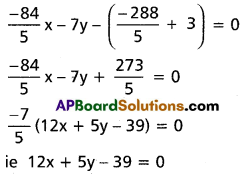
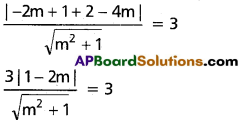
⇒ (10k – 1) (k + 1) = 0
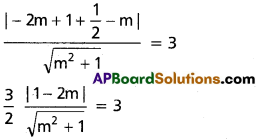
⇒ k = \(\frac{1}{10}\), -1 Since k > 0
∴ k = \(\frac{1}{10}\)

(i) k = \(\frac{1}{10}\)

(ii) Mean = \(\sum_{i=1}^n x_i P\left(x=x_i\right)\)
Mean (μ) = 0(0) + 1(k) + 2(2k) + 3(2k) + 4(3k) + 5(k2) + 6(2k2) + 7 (7k2 + k)
= 0 + k + 4k + 6k + 12k + 5k2 + 12k2 + 49k2 + 7k
= 66k2 + 30k
= 66(\(\frac{1}{100}\)) + 30(\(\frac{1}{10}\))
= 0.66 + 3
= 3.66

(iii) P(0 < x < 5)
P(0 < x < 5) = P(X = 1) + P(X = 2) + P(X = 3) + P(X = 4)
= k + 2k + 2k + 3k
= 8k
= 8(\(\frac{1}{10}\))
= \(\frac{4}{5}\)

II.

Question 1.
The range of a random variable X is {0, 1, 2}. Given that P(X = 0) = 3c3, P(X = 1) = 4c – 10c2, P(X = 2) = 5c – 1
(i) Find the value of c
(ii) P(X < 1), P(1 ≤ X < 2) and P(0 < X ≤ 3)
Solution:
P(X = 0) + P(X = 1) + P(X = 2) = 1
3c3 + 4c – 10c2 + 5c – 1 = 1
3c3 – 10c2 + 9c – 2 = 0
c = 1 satisfy this equation
c = 1 ⇒ P(X = 0) = 3 which is not possible
Dividing with c – 1, we get
3c2 – 7c + 2 = 0
(c – 2) (3c – 1) = 0
c = 2 or c = \(\frac{1}{3}\)
c = 2 ⇒ P(X = 0) = 3 . 23 = 24 which is not possible
∴ c = \(\frac{1}{3}\)

(i) P(X < 1) = P(X = 0)
= 3 . c3
= 3 . \(\left(\frac{1}{3}\right)^3\)
= 3 . \(\frac{1}{2}\)
= \(\frac{1}{9}\)

(ii) P(1 < X ≤ 2) = P(X = 2)
= 5c – 1
= \(\frac{5}{3}\) – 1
= \(\frac{2}{3}\)

(iii) P(0 < X ≤ 3) = P(X = 1) + P(X = 2)
= 4c – 10c2 + 5c – 1
= 9c – 10c2 – 1
= 9 . \(\frac{1}{3}\) – 10 . \(\frac{1}{9}\) – 1
= 3 – \(\frac{10}{9}\) – 1
= \(\frac{8}{9}\)

Inter 2nd Year Maths 2A Random Variables and Probability Distributions Solutions Ex 10(a)

Question 2.
The range of a random variable X is {1, 2, 3, …..} and P(X = k) = \(\frac{C^K}{K !}\), (k = 1, 2, 3, ……), Find the value of C and P(0 < X < 3)
Solution:
Sum of the probabilities = 1
Inter 2nd Year Maths 2A Random Variables and Probability Distributions Solutions Ex 10(a) II Q2

Inter 2nd Year Maths 2A Probability Solutions Ex 9(c)

Practicing the Intermediate 2nd Year Maths 2A Textbook Solutions Inter 2nd Year Maths 2A Probability Solutions Exercise 9(c) will help students to clear their doubts quickly.

Intermediate 2nd Year Maths 2A Probability Solutions Exercise 9(c)

I.

Question 1.
Three screws are drawn at random from a lot of 50 screws, 5 of which are defective. Find the probability of the event that all 3 screws are non-defective assuming that the drawing is (a) with replacement (b) without replacement.
Solution:
Let S be the sample space
∴ The total number of screws = 50
The number of defective screws is 5 and the remaining 45 screws are non-defective.
Let A be the event of getting a drawing of the 3 screws is non-defective.
(a) With replacement
Inter 2nd Year Maths 2A Probability Solutions Ex 9(c) I Q1
(b) Without replacement
Inter 2nd Year Maths 2A Probability Solutions Ex 9(c) I Q1.1

Question 2.
If A, B, C are three independent events of an experiment such that P(A ∩ BC ∩ CC) = \(\frac{1}{4}\), P(AC ∩ B ∩ CC) = \(\frac{1}{8}\), P(AC ∩ BC ∩ CC) = \(\frac{1}{4}\), then find P(A), P(B) and P(C).
Solution:
Since A, B, C are independent events.
Inter 2nd Year Maths 2A Probability Solutions Ex 9(c) I Q2
Inter 2nd Year Maths 2A Probability Solutions Ex 9(c) I Q2.1

Question 3.
There are 3 black and 4 white balls in one bag. 4 black and 3 white balls in the second bag. A die is rolled and the first bag is selected if it is 1 or 3 and the second bag for the rest. Find the probability of drawing a black ball from the bag thus selected.
Solution:
Probability of selecting first bag = \(\frac{2}{6}=\frac{1}{3}\)
Probability of selecting second bag = 1 – \(\frac{1}{3}\) = \(\frac{2}{3}\)
Probability of getting a black ball from first bag = \(\frac{3}{7}\)
Probability of getting a black ball from the second bag = \(\frac{4}{7}\)
Probability of drawing a black ball = \(\frac{1}{3} \cdot \frac{3}{7}+\frac{2}{3} \cdot \frac{4}{7}\) = \(\frac{11}{21}\)

Inter 2nd Year Maths 2A Probability Solutions Ex 9(c)

Question 4.
A, B, C are aiming to shoot a balloon, A will succeed 4 times out of 5 attempts. The chance of B shooting the balloon is 3 out of 4 and that of C is 2 out of 3. If three aim at the balloon simultaneously, then find the probability that atleast two of them hit the balloon.
Solution:
Inter 2nd Year Maths 2A Probability Solutions Ex 9(c) I Q4
Inter 2nd Year Maths 2A Probability Solutions Ex 9(c) I Q4.1

Question 5.
If A, B are two events, then show that \(P\left(\frac{A}{B}\right) P(B)+P\left(\frac{A}{B^C}\right) P\left(B^C\right)=P(A)\)
Solution:
Inter 2nd Year Maths 2A Probability Solutions Ex 9(c) I Q5

Question 6.
A pair of dice are rolled. What is the probability that they sum to 7, given that neither die shows a 2?
Solution:
Let A be the event that the sum of the two dice is 7, then
A = {(1, 6), (2, 5), (3, 4), (4, 3), (5, 2), (6, 1)}
Let B be the event that neither die shows a 2
B = {(1, 1), (1, 3), (1, 4), (1, 5), (1, 6)
(3, 1), (3, 3), (3, 4), (3, 5), (3, 6)
(4, 1), (4, 3), (4, 4), (4, 5), (4, 6)
(5, 1), (5, 3), (5, 4), (5, 5), (5, 6)
(6, 1), (6, 3), (6, 4), (6, 5), (6, 6)}
n(B) = 25
A ∩ B = {(1, 6), (3, 4), (4, 3), (6, 1)}
n(A ∩ B) = 4
Required probability
\(P\left(\frac{A}{B}\right)=\frac{P(A \cap B)}{P(B)}\)
= \(\frac{n(A \cap B)}{n(B)}\)
= \(\frac{4}{25}\)

Question 7.
A pair of dice are rolled. What is the probability that neither die shows a 2, given that they sum to 7?
Solution:
Let A be the event that the sum on two dice is 7
A = {(1, 6), (2, 5), (3, 4), (4, 3), (5, 2), (6, 1)}
∴ n(A) = 6
Let B be the event that neither die shows a 2
B = {(1, 1), (1, 3), (1, 4), (1, 5), (1, 6)
(3, 1), (3, 3), (3, 4), (3, 5), (3, 6)
(4, 1),(4, 3), (4, 4), (4, 5), (4, 6)
(5, 1), (5, 3), (5, 4), (5, 5), (5, 6)
(6, 1), (6, 3), (6, 4), (6, 5), (6, 6)}
A ∩ B = {(1, 6), (3, 4), (4, 3), (6, 1)}
n(A ∩ B) = 4
Required probability
\(P\left(\frac{B}{A}\right)=\frac{P(A \cap B)}{P(A)}\)
= \(\frac{n(A \cap B)}{n(A)}\)
= \(\frac{4}{6}\)
= \(\frac{2}{3}\)

Inter 2nd Year Maths 2A Probability Solutions Ex 9(c)

Question 8.
If A, B are any two events, in an experiment, and P(B) ≠ 1 Show that \(P\left(\frac{A}{B^C}\right)=\frac{P(A)-P(A \cap B)}{1-P(B)}\)
Hint: P(A ∩ BC) = P(A) – P(A ∩ B)
Solution:
By definition of condition probability
\(P\left(\frac{A}{B^C}\right)=\frac{P\left(A \cap B^C\right)}{P\left(B^C\right)}\)
= \(\frac{P(A)-P(A \cap B)}{1-P(B)}\)
∵ P(BC) = \(P(\bar{B})\) = 1 – P(B)

Question 9.
An urn contains 12 red balls and 12 green balls. Suppose two balls are drawn one after another without replacement. Find the probability that the second ball drawn is green given that the first ball drawn is red.
Solution:
Total number of balls in an urn n(S) = 24
Let E1 be the event of drawing a red ball in the first draw
P(E1) = \(\frac{{ }^{12} C_1}{24}=\frac{1}{2}\)
Now the number of balls remaining is 23
Let \(\frac{E_2}{E_1}\) be the events of drawing a green ball in the second drawn
P(E2/E1) = \(\frac{12}{23}\)
∴ Required probability
P(E1 ∩ E2) = P(E1) . P(E2/E1)
= \(\frac{1}{2} \times \frac{12}{23}\)
= \(\frac{6}{23}\)
∴ The probability of the second ball drawn is green given that the first ball drawn is red = \(\frac{6}{23}\)

Question 10.
A single die is rolled twice in succession. What is the probability that the number showing on the second toss is greater than that on the first rolling?
Solution:
A single die is rolled twice.
Let S be the sample space n(S) = 62 = 36
Let A be the event of getting the required event.
A = {(1, 2), (1, 3), (1, 4), (1, 5), (1, 6), (2, 3), (2, 4), (2, 5), (2, 6), (3, 4), (3, 5), (3, 6), (4, 5), (4, 6), (5, 6)}
n(A) = 15
∴ P(A) = \(\frac{n(A)}{n(S)}\) = \(\frac{15}{36}\) = \(\frac{5}{12}\)

Question 11.
If one card is drawn at random from a pack of cards then show that events of getting an ace and getting a heart are independent events.
Solution:
Suppose A is the event of getting an ace and B is the event of getting a heart.
∴ P(A) = \(\frac{4}{52}=\frac{1}{13}\)
P(B) = \(\frac{13}{52}=\frac{1}{14}\)
A ∩ B is the event of getting a Heart’s ace
P(A ∩ B) = \(\frac{1}{52}=\frac{1}{13} \cdot \frac{1}{4}\) = P(A) . P(B)
∴ A and B are independent events.

Question 12.
The probability that boy A will get a scholarship is 0.9 and that another boy B will get one is 0.8. What is the probability that atleast one of them will get the scholarship?
Solution:
Suppose E1 is the event of a boy ‘A’ getting a scholarship and E2 is the event of another boy B getting the scholarship.
Given P(E1) = 0.9, P(E2) = 0.8
E1 and E2 are independent events.
P(E1 ∩ E2) = P(E1) . P(E2)
= (0.9) (0.8)
= 0.72
The probability that atleast one of them will get a scholarship = P(E1 ∪ E2)
= P(E1) + P(E2) – P(E1 ∩ E2)
= 0.9 + 0.8 – 0.72
= 1.7 – 0.72
= 0.98

Inter 2nd Year Maths 2A Probability Solutions Ex 9(c)

Question 13.
If A, B are two events with P(A ∪ B) = 0.65 and P(A ∩ B) = 0.15, then find the value of P(AC) + P(BC).
Solution:
By addition theorem on probability
P(A ∪ B) = P(A) + P(B) – P(A ∩ B)
P(A) + P(B) = P(A ∪ B) + P(A ∩ B)
= 0.65 + 0.15
= 0.8
P(A) + P(B) = 0.8 ……..(1)
P(AC) = 1 – P(A) + 1 – P(B)
= 2 – [P(A) + P(B)]
= 2 – 0.8 [∵ by (1)]
= 1.2

Question 14.
If A, B, C are independent events, show that A ∪ B, and C are also independent events.
Solution:
∵ A, B, C are independent events.
⇒ A, B; B, C; C , A are also independent events
P(A ∩ B ∩ C) = P(A) P(B) P(C)
P(A ∩ C) = P(A) . P(C)
P(B ∩ C) = P(B) . P(C)
P(A ∩ B) = P(A) . P(B)
P[(A ∪ B) ∩ C] = P[(A ∩ C) ∪ (B ∩ C)]
= P(A ∩ C) + P(B ∩ C) – P[(A ∩ C) ∩ (B ∩ C)]
= P(A) . P(C) + P(B) . P(C) – P(A ∩ B ∩ C)
= P (A) . P(C) + P(B) . P(C) – P(A) . P(B) . P(C)
= [P(A) + P(B) – P(A) . P(B)] P(C)
= P(A ∪ B) . P(C)
∴ A ∪ B and C are independent events.

Question 15.
A and B are two independent events such that the probability of both the events occurring is \(\frac{1}{6}\) and the probability of both the events do not occur is \(\frac{1}{3}\). Find the probability of A.
Solution:
A and B are independent events.
Inter 2nd Year Maths 2A Probability Solutions Ex 9(c) I Q15
Inter 2nd Year Maths 2A Probability Solutions Ex 9(c) I Q15.1
Inter 2nd Year Maths 2A Probability Solutions Ex 9(c) I Q15.2

Question 16.
A fair die is rolled. Consider the events. A = {1, 3, 5}, B = {2, 3} and C = {2, 3, 4, 5}. Find
(i) P(A ∩ B), P(A ∪ B)
(ii) P(\(\frac{A}{B}\)), P(\(\frac{B}{A}\))
(iii) P(\(\frac{A}{C}\)), P(\(\frac{C}{A}\))
(iv) P(\(\frac{B}{C}\)), P(\(\frac{C}{B}\))
Solution:
A fair die is rolled
P(A) = \(\frac{3}{6}=\frac{1}{2}\)
P(B) = \(\frac{2}{6}=\frac{1}{3}\)
P(C) = \(\frac{4}{6}=\frac{2}{3}\)
n(S) = 61 = 6
Given A = {1, 3, 5}, B = {2, 3}, C = {2, 3, 4, 5}
(i) A ∩ B = {3}
P(A ∩ B) = P{3} = \(\frac{1}{6}\)
∴ P(A ∩ B) = \(\frac{1}{6}\)
(A ∪ B) = {1, 2, 3, 5}
n(A ∪ B) = 4
n(S) = 6
P(A ∪ B) = \(\frac{4}{6}=\frac{2}{3}\)
Inter 2nd Year Maths 2A Probability Solutions Ex 9(c) I Q16

Inter 2nd Year Maths 2A Probability Solutions Ex 9(c)

Question 17.
If A, B, C are three events in a random experiment, prove the following:
(i) P(\(\frac{A}{A}\)) = 1
Solution:
\(P\left(\frac{A}{A}\right)=\frac{P(A \cap A)}{P(A)}=\frac{P(A)}{P(A)}=1\)

(ii) \(\mathbf{p}\left(\frac{\phi}{A}\right)=0\)
Solution:
\(P\left(\frac{\phi}{A}\right)=\frac{P(\phi \cap A)}{P(A)}=\frac{0}{P(A)}=0\)

(iii) A ⊂ B ⇒ P(\(\frac{A}{C}\)) ≤ P(\(\frac{B}{C}\))
Solution:
Inter 2nd Year Maths 2A Probability Solutions Ex 9(c) I Q17(iii)

(iv) P(A – B) = P(A) – P(A ∩ B)
Solution:
A – B = {x / x ∈ A a x ∉ B}
A – B = A – (A ∩ B)
Inter 2nd Year Maths 2A Probability Solutions Ex 9(c) I Q17(iv)
P(A – B) = P[A – (A ∩ B)] = P(A) – P(A ∩ B)

(v) If A, B are mutually exclusive and P(B) > 0, then P(\(\frac{A}{B}\)) = 0.
Solution:
We know \(P\left(\frac{A}{B}\right)=\frac{P(A \cap B)}{P(B)}\)
= \(\frac{0}{\mathrm{P}(\mathrm{B})}\)
= 0 [∵ A, B are mutually exclusive events]
Hint: A, B are mutually exclusive then A ∩ B = φ ⇒ P(A ∩ B) = 0.

(vi) If A, B are mutually exclusive then P(A/BC) = \(\frac{\mathrm{P}(\mathrm{A})}{1-\mathrm{P}(\mathrm{B})}\); when P(B) ≠ 1.
Solution:
Given P(A ∩ B) = 0 (∵ A and B are mutually exchanging)
Inter 2nd Year Maths 2A Probability Solutions Ex 9(c) I Q17(vi)

(vii) If A, B are mutually exclusive and P(A ∪ B) ≠ 0, then \(P\left(\frac{A}{A \cup B}\right)=\frac{P(A)}{P(A)+P(B)}\)
Solution:
Hint: A ∩ (B ∪ C) = (A ∩ B) ∪ (A ∩ C)
Inter 2nd Year Maths 2A Probability Solutions Ex 9(c) I Q17(vii)

Question 18.
Suppose that a coin is tossed three times. Let A be “getting three heads” and B be the event of “getting a head on the first toss”. Show that A and B are dependent events.
Solution:
Let event A be “getting their heads”, and B be the event of “getting a head on the first toss” when a coin is tossed three times.
∴ A = {HHH}
n(A) = 1
P(A) = \(\frac{1}{8}\)
B = {HTT, HTH, HHT, HHH}
n(B) = 4
P(B) = \(\frac{4}{8}\)
A ∩ B = {HHH}
n(A ∩ B) = 1
P(A ∩ B) = \(\frac{1}{8}\)
P(A) . P(B) = \(\frac{1}{8} \cdot \frac{4}{8}=\frac{1}{16}\) ≠ P(A ∩ B)
∴ P(A ∩ B) ≠ P(A) . P(B)
Hence A, B are dependent events.

Question 19.
Suppose that an unbiased pair of dice is rolled. Let A denote the event that the same number shows on each die. Let B denote the event that the sum is greater than 7. Find (i) P(\(\frac{A}{B}\)) (ii) P(\(\frac{B}{A}\))
Solution:
Given a denote the event that the same number on pair of dice is rolled.
A = {(1, 1), (2, 2), (3, 3), (4, 4), (5, 5) (6, 6)}
n(A) = 6
P(A) = \(\frac{6}{36}=\frac{1}{6}\)
Given B denote the event that the sum is greater than 7 when pair of dice is rolled.
∴ B = {(2, 6), (3, 5), (4, 4), (5, 3), (6, 2), (3, 6), (4, 5), (5, 4), (6, 3), (4, 6), (5, 5), (6, 4), (5, 6), (6, 5), (6, 6)}
∴ n(B) = 15
P(B) = \(\frac{15}{36}\)
A ∩ B = {(4, 4), (5, 5), (6, 6)}
n(A ∩ B) = 3
P(A ∩ B) = \(\frac{3}{36}\)
Inter 2nd Year Maths 2A Probability Solutions Ex 9(c) I Q19

Question 20.
Prove that A and B are independent events if and only if \(P\left(\frac{A}{B}\right)=P\left(\frac{A}{B^C}\right)\)
Solution:
Let A and B be independent
Inter 2nd Year Maths 2A Probability Solutions Ex 9(c) I Q20
⇒ \(\frac{P(A \cap B)}{P(B)}=\frac{P(A)-P(A \cap B)}{1-P(B)}\)
⇒ P(A ∩ B) – P(B) P(A ∩ B) = P(A) P(B) – P(B) . P(A ∩ B)
⇒ P(A ∩ B) = P(A) . P(B)
∴ A, B are independent.
Hence, A, B are independent iff
\(P\left(\frac{A}{B}\right)=P\left(\frac{A}{B^C}\right)\)

Inter 2nd Year Maths 2A Probability Solutions Ex 9(c)

II.

Question 1.
Suppose A and B are independent events with P(A) = 0.6, P(B) = 0.7 then compute
(i) P(A ∩ B)
(ii) P(A ∪ B)
(iii) P(\(\frac{B}{A}\))
(iv) P(AC ∩ BC)
Solution:
Given A, B are independent events and
P(A) = 0.6, P(B) = 0.7
(i) P(A ∩ B) = P(A) . P(B)
= 0.6 × 0.7
= 0.42
(ii) P(A ∪ B) = P(A) + P(B) – P(A ∩ B)
= 0.6 + 0.7 – 0.42
= 1.3 – 0.42
= 0.88
(iii) P(\(\frac{B}{A}\)) = P(B) = 0.7
(iv) P(AC ∩ BC) = P(AC) . P(BC) (∵ AC & BC are also independent events)
= [1 – P(A)] [1 – P(B)]
= (1 – 0.6) (1 – 0.7)
= 0.4 × 0.3
= 0.12

Question 2.
The probability that Australia wins a match against India in a cricket game is given to be \(\frac{1}{3}\). If India and Australia play 3 matches, what is the probability that,
(i) Australia will lose all three matches?
(ii) Australia will win atleast one match?
Solution:
Suppose A is the event of Australia winning the match.
Given P(A) = \(\frac{1}{3}\)
∴ P(\(\overline{\mathrm{A}}\)) = 1 – P(A)
= 1 – \(\frac{1}{3}\)
= \(\frac{2}{3}\)
(i) Probability that Australia will loose all the three matches = P(\(\overline{\mathrm{A}}\))3
= \(\left(\frac{2}{3}\right)^3\)
= \(\frac{8}{27}\)
(ii) Probability that Australia will win atleast one match = 1 – P(\(\overline{\mathrm{A}}\))3
= 1 – \(\frac{8}{27}\)
= \(\frac{19}{27}\)

Question 3.
Three boxes numbered I, II, III contain balls as follows:
Inter 2nd Year Maths 2A Probability Solutions Ex 9(c) II Q3
One box is randomly selected and a ball is drawn from it. If the ball is red, then find the probability that it is from box II.
Solution:
Let B1, B2, B3 be the events of selecting the Ist, IInd and IIIrd boxes respectively.
Then P(B1) = P(B2) = P(B3) = \(\frac{1}{3}\)
Probability of selecting a red ball from the first box = \(\frac{3}{6}\) = P(R/B1)
Probability of selecting a red ball from the second box = \(\frac{1}{4}\) = P(R/B2)
Probability of selecting a red ball from the third box = \(\frac{3}{12}\) = P(R/B3)
Assuming that the ball is red, the probability it is from box II,
Inter 2nd Year Maths 2A Probability Solutions Ex 9(c) II Q3.1

Question 4.
A person secures a job in a construction company in which the probability that the workers go on strike is 0.65 and the probability that the construction job will be completed on time if there is no strike is 0.80. If the probability that the construction job will be completed on time even if there is a strike is 0.32, determine the probability that the constructed job will be completed on time.
Solution:
Let P(S) = Probability of the workers going on strike = 0.65
P(\(\bar{S}\)) = Probability on the workers go on strike
= 1 – P(S)
= 1 – 0.65
= 0.35
\(P\left(\frac{E}{S}\right)\) = Probability that the job completed if there is no strike = 0.32
\(\mathrm{P}\left(\frac{\mathrm{E}}{\overline{\mathrm{S}}}\right)\) = Probability that the job completed if there is a strike = 0.80
P(E) = Probability that the construction job will be completed on time
= P(S) \(P\left(\frac{E}{S}\right)\) + P(\(\bar{S}\)) \(\mathrm{P}\left(\frac{\mathrm{E}}{\overline{\mathrm{S}}}\right)\)
= (0.65) (0.32) + (0.35) (0.08)
= 0.2080 + 0.2800
= 0.4880

Inter 2nd Year Maths 2A Probability Solutions Ex 9(c)

Question 5.
For any two events A, B show that
P(A ∩ B) – P(A) P(B) = P(AC) P(B) – P(AC ∩ B) = P(A) P(BC) – P(A ∩ BC)
Solution:
R.H.S. I = P(AC) P(B) – P(AC ∩ B)
= [(1 – P(A)] P(B) – [P(B) – P(A ∩ B)]
= P(B) – P(A) P(B) – P(B) + P(A ∩ B)
= P(A ∩ B) – P(A) P(B)
= L.H.S
R.H.S. II = P(A) P(BC) – P(A ∩ BC)
= P(A) [1 – P[P(B)] – [P(A) – P(A ∩ B)]
= P(A) – P(A) P(B) – P(A) + P(A ∩ B)
= P(A ∩ B) – P(A) P(B)
= L.H.S
∴ L.H.S = R.H.S I = R.H.S II
Hence P(A ∩ B) – P(A) . P(B) = P(AC) P(B) – P(AC ∩ B) = P(A) P(BC) – P(A ∩ BC)

III.

Question 1.
Three Urns have the following composition of balls.
Urn I: 1 White, 2 black
Urn II: 2 White, 1 black
Urn III: 2 White, 2 balck
One of the Urn is selected at random and a ball is drawn. It turns out to be white. Find the probability that it comes from Urn III.
Solution:
Let Ei be the event of Choosing the Urn i = 1, 2, 3, and P(Ei) be the probability of choosing the Urn i = 1, 2, 3
Then P(E1) = P(E2) = P(E3) = \(\frac{1}{3}\)
Having choosen the Urn i, the probability of drawing a white ball, P(W/Ei), is given by
P(W/E1) = \(\frac{1}{3}\)
P(W/E2) = \(\frac{2}{3}\)
P(W/E3) = \(\frac{2}{4}\)
We have to find the probability P(E3/W) by Baye’s theorem.
Inter 2nd Year Maths 2A Probability Solutions Ex 9(c) III Q1

Question 2.
In a shooting test the probability of A, B, C hitting the targets are \(\frac{1}{2}\), \(\frac{2}{3}\) and \(\frac{3}{4}\) respectively. If all of their fire is at the same target. Find the probability that
(i) Only one of them hits the target
(ii) At atleast one of them hits the target
Solution:
The probabilities that A, B, C hit the targets are denoted by
Inter 2nd Year Maths 2A Probability Solutions Ex 9(c) III Q2

Question 3.
In a certain college, 25% of the boys and 10% of the girls are studying mathematics. The girls constitute 60% of the student’s strength. If a student selected at random is found studying mathematics. Find the probability that the student is a girl.
Solution:
The probability that a student selected to be a girl
P(G) = \(\frac{60}{100}=\frac{6}{10}\)
The probability that a student selected to be a boy
P(B) = \(\frac{40}{100}=\frac{4}{10}\)
The probability that a boy studying mathematics
P(M/B) = \(\frac{25}{100}=\frac{1}{4}\)
Similarly probability that a girl studying mathematics
P(M/G) = \(\frac{10}{100}=\frac{1}{10}\)
We have to find P(G/M) By Baye’s theorem
Inter 2nd Year Maths 2A Probability Solutions Ex 9(c) III Q3

Inter 2nd Year Maths 2A Probability Solutions Ex 9(c)

Question 4.
A person is known to speak the truth 2 out of 3 times. He throws a die and reports that it is 1. Find the probability that it is actually 1.
Solution:
P(T) = Probability that a person speaks truth 2 out of 3 times = \(\frac{2}{3}\)
P(F) = 1 – P(T)
= 1 – \(\frac{2}{3}\)
= \(\frac{1}{3}\)
After he reports that it is 1, it is true if it actually shows 1 otherwise false if does not show 1.
P(1) = \(\frac{1}{6}\) and P(T) = \(\frac{5}{6}\)
P(T/1) = P(reports true if it is 1) = \(\frac{2}{3}\)
P(F/T) = P(report False if it is T) = \(\frac{1}{3}\)
By Baye’s theorem
Inter 2nd Year Maths 2A Probability Solutions Ex 9(c) III Q4
∴ The probability that reports that it is 1 and actually it is 1 is \(\frac{2}{7}\).

Inter 2nd Year Maths 2A Probability Solutions Ex 9(b)

Practicing the Intermediate 2nd Year Maths 2A Textbook Solutions Inter 2nd Year Maths 2A Probability Solutions Exercise 9(b) will help students to clear their doubts quickly.

Intermediate 2nd Year Maths 2A Probability Solutions Exercise 9(b)

I.

Question 1.
If 4 fair coins are tossed simultaneously, then find the probability that 2 heads and 2 tails appear.
Solution:
4 coins are tossed simultaneously.
Total number of ways = 24 = 16
n(S) = 16
From 4 heads we must get 2 heads.
Number of ways of getting 2 heads = 4C2
= \(\frac{4.3}{1.2}\)
= 6
∴ n(E) = 6
P(E) = \(\frac{n(E)}{n(S)}=\frac{6}{16}=\frac{3}{8}\)
∴ Probability of getting 2 heads and 2 tails = \(\frac{3}{8}\)

Question 2.
Find the probability that a non-leap year contains
(i) 53 Sundays
(ii) 52 Sundays only
Solution:
A non-leap year contains 365 days 52 weeks and 1 day more.
(i) We get 53 Sundays when the remaining day is Sunday.
Number of days in the week = 7
∴ n(S) = 7
The number of ways getting 53 Sundays.
n(E) = 1
∴ P(E) = \(\frac{n(E)}{n(S)}=\frac{1}{7}\)
∴ Probability of getting 53 Sundays = \(\frac{1}{7}\)
(ii) Probability of getting 52 Sundays
P(\((\overline{\mathrm{E}})\)) = 1 – P(E)
= 1 – \(\frac{1}{7}\)
= \(\frac{6}{7}\)

Inter 2nd Year Maths 2A Probability Solutions Ex 9(b)

Question 3.
Two dice are rolled, what is the probability that none of the dice shows the number 2?
Solution:
The random experiment is rolling 2 dice.
n(S) = 62 = 36
Let E be the event of not getting 2
n(E) = 5 × 5 = 25
∴ P(E) = \(\frac{\mathrm{n}(E)}{\mathrm{n}(s)}=\frac{25}{36}\)

Question 4.
In an experiment of drawing a card at random from a pack, the event of getting a spade is denoted by A, and getting a pictured card (King, Queen, or Jack) is denoted by B. Find the probabilities of A, B, A ∩ B, and A ∪ B.
Solution:
A is the event of getting a spade from the pack
∴ P(A) = \(\frac{13}{52}=\frac{1}{4}\)
B is the event of getting a picture card
P(B) = \(\frac{4 \times 3}{52}=\frac{3}{13}\)
A ∩ B is the event of getting a picture card in spades.
n(A ∩ B) = 3, n(s) = 52
P(A ∩ B) = \(\frac{3}{52}\)
A ∪ B is the event of getting a spade or a picture card.
P(A ∪ B) = P(A) + P(B) – P(A ∩ B)
= \(\frac{1}{4}+\frac{3}{13}-\frac{3}{52}\)
= \(\frac{13+12-3}{52}\)
= \(\frac{11}{26}\)

Question 5.
In a class of 60 boys and 20 girls, half of the boys and half of the girls know cricket. Find the probability of the event that a person selected from the class is either a boy or a girl who knows cricket.
Solution:
Let A be the event that the selected person is a boy and B be the event that the selected person knows a cricket when a person is selected from the class and S be the sample space.
Now, n(S) = 80C1 = 80
n(A) = 60C1 = 60
n(B) = 40C1 = 40
n(A ∩ B) = 30C1 = 30
∴ P(A) = \(\frac{60}{80}\), P(B) = \(\frac{40}{80}\), P(A ∩ B) = \(\frac{30}{80}\)
∴ P(A ∪ B) = P(A) + P(B) – P(A ∩ B)
= \(\frac{60}{80}+\frac{40}{80}-\frac{30}{80}\)
= \(\frac{70}{80}\)
= \(\frac{7}{8}\)

Question 6.
For any two events A and B, show that P(AC ∩ BC) = 1 + P(A ∩ B) – P(A) – P(B).
Solution:
AC ∩ BC = \(\overline{A \cup B}\)
P(AC ∩ BC) = P(\(\overline{A \cup B}\))
= 1 – P(A ∪ B)
= 1 – [P(A) + P(B) – P(A ∩ B)]
= 1 + P(A ∩ B) – P(A) – P(B)

Inter 2nd Year Maths 2A Probability Solutions Ex 9(b)

Question 7.
Two persons A and B are rolling die on the condition that the person who gets 3 will win the game. If A starts the game, then find the probabilities of A and B respectively to win the game.
Solution:
p = Probability of getting 3 = \(\frac{1}{6}\)
q = 1 – p
= 1 – \(\frac{1}{6}\)
= \(\frac{5}{6}\)
Probability success (p) = \(\frac{1}{6}\)
Probability of failure (q) = \(\frac{5}{6}\)
A may win the game either in I trial or in trial or in V trial etc.
Probability of A win = p + q . q . p + q . q . q . q . p + ……..
Inter 2nd Year Maths 2A Probability Solutions Ex 9(b) I Q7

Question 8.
A, B, C are 3 newspapers from a city. 20% of the population read A, 16% read B, 14% read C, 8% both A and B, 5% both A and C, 4% both B and C, and 2% all the three. Find the percentage of the population who read atleast one newspaper.
Solution:
Given P(A) = \(\frac{20}{100}\) = 0.2
P(B) = \(\frac{16}{100}\) = 0.16
P(C) = \(\frac{14}{100}\) = 0.14
P(A ∩ B) = \(\frac{8}{100}\) = 0.08
P(B ∩ C) = \(\frac{4}{100}\) = 0.04
P(A ∩ C) = \(\frac{5}{100}\) = 0.05
P(A ∩ B ∩ C) = \(\frac{2}{100}\) = 0.02
Inter 2nd Year Maths 2A Probability Solutions Ex 9(b) I Q8
P(A ∪ B ∪ C) = P(A) + P(B) + P(C) – P(A ∩ B) – P(B ∩ C) – P(C ∩ A) + P(A ∩ B ∩ C)
= 0.2 + 0.16 + 0.14 – 0.08 – 0.04 – 0.05 + 0.02
= 0.52 – 0.17
= 0.35
Percentage of population who read atleast one newspaper = 0.35 × 100 = 35%

Question 9.
If one ticket is randomly selected from tickets numbered 1 to 30. Then find the probability that the number on the ticket is
(i) a multiple of 5 or 7
(ii) a multiple of 3 or 5
Solution:
(i) Number of ways drawing one ticket = n(S) = 30C1 = 30
Suppose A is the event of getting a multiple of 5 and B is the event of getting a multiple of 7.
A = {5, 10, 15, 20, 25, 30}
B = {7, 14, 21, 28}
A ∩ B = φ ⇒ A and B are mutually exclusive
P(A ∪ B) = P(A) + P(B)
= \(\frac{6}{30}+\frac{4}{30}\)
= \(\frac{1}{3}\)
Probability of getting a multiple of 5 or 7 = \(\frac{1}{3}\)
(ii) Suppose A is the event of getting a multiple of 3 and B is the event of getting a multiple of 5.
A = {3, 6, 9, 12, 15, 18, 21, 24, 27, 30}
B = {5, 10, 15, 20, 25, 30}
A ∩ B = {15, 30}
P(A) = \(\frac{10}{30}\)
P(B) = \(\frac{6}{30}\)
P(A ∩ B) = \(\frac{2}{30}\)
P(A ∪ B) = P(A) + P(B) – P(A ∩ B)
= \(\frac{10}{30}+\frac{6}{30}-\frac{2}{30}\)
= \(\frac{14}{30}\)
= \(\frac{7}{15}\)
Probability of getting a multiple of 3 or 5 = \(\frac{7}{15}\)

Question 10.
If two numbers are selected randomly from 20 consecutive natural numbers, find the probability that the sum of the two numbers is (i) an even number (ii) an odd number.
Solution:
(i) Let A be the event that the sum of the numbers is even when two numbers are selected out of 20 consecutive natural numbers.
In 20 consecutive natural numbers, we have 10 odd and 10 even natural numbers.
∵ The sum of two odd natural numbers is an even number and the sum of two even natural numbers is also an even number
Inter 2nd Year Maths 2A Probability Solutions Ex 9(b) I Q10
(ii) Probability that the sum of two numbers is an odd number
P(\(\overline{\mathrm{A}}\)) = 1 – P(A)
= 1 – \(\frac{9}{19}\)
= \(\frac{10}{19}\)

Inter 2nd Year Maths 2A Probability Solutions Ex 9(b)

Question 11.
A game consists of tossing a coin 3 times and noting its outcome. A boy wins if all tosses give the same outcome and lose otherwise. Find the probability that the boy loses the game.
Solution:
Let A be the event that the boy wins the game getting the same outcome when a coin is tossed 3 times and S be the sample space.
∴ n(S) = 23 = 8
A = {HHH, TTT}
n(A) = 2
P(A) = \(\frac{n(A)}{n(S)}=\frac{2}{8}=\frac{1}{4}\)
∴ The probability that the boy loses the game = P(\(\overline{\mathrm{A}}\))
= 1 – P(A)
= 1 – \(\frac{1}{4}\)
= \(\frac{3}{4}\)

Question 12.
If E1, E2 are two events with E1 ∩ E2 = φ then show that \(P\left(E_1^c \cap E_2^c\right)=P\left(E_1^c\right)-P\left(E_2\right)\)
Solution:
Given E1 ∩ E2 = φ
∴ P(E1 ∩ E2) = 0
\(P\left(E_1^c \cap E_2^c\right)=P\left(\overline{E_1 \cup E_2}\right)\)
= 1 – P(E1 ∪ E2)
= 1 – [P(E1) + P(E2) – P(E1 ∩ E2)]
= 1 – P(E1) – P(E2) + P(E1 ∩ E2)
= \(P\left(E_1^c\right)\) – P(E2) + 0
∴ \(P\left(E_1^c \cap E_2^c\right)=P\left(E_1^c\right)-P\left(E_2\right)\)

II.

Question 1.
A pair of dice rolled 24 times. A person wins by not getting a pair of 6’s on any of the 24 rolls. What is the probability of his winning?
Solution:
Random experiment is tossing two dice 24 times = 36 × 36 × ……. 36 = (36)24
∴ n(S) = (36)24
Let A be the event of not getting a pair of 6’s on any of the 24 rolls.
∴ number of ways favourable to an event A = 35 × 35 × ……. × 35 = (35)24
n(A) = (35)24
∴ P(A) = \(\frac{(35)^{24}}{(36)^{24}}=\left(\frac{35}{36}\right)^{24}\)

Question 2.
If P is a probability function, then show that for any two events A and B.
P(A ∩ B) ≤ P(A) ≤ P(A ∪ B) ≤ P(A) + P(B)
Solution:
For any sets A, B we have
Inter 2nd Year Maths 2A Probability Solutions Ex 9(b) II Q2
A ∩ B ≤ A ≤ A ∪ B
P(A ∩ B) ≤ P(A) ≤ P(A ∪ B)
By Addition theorem of probability
P(A ∪ B) = P(A) + P(B) – P(A ∩ B) ≤ P(A) + P(B) ……….(2)
From (1), (2) we get
P(A ∩ B) ≤ P(A) ≤ P(A ∪ B) ≤ P(A) + P(B)

Inter 2nd Year Maths 2A Probability Solutions Ex 9(b)

Question 3.
In a box containing 15 bulbs, 5 are defective. If 5 bulbs are selected at random from the box, find the probability of the event, that
(i) None of them is defective
(ii) Only one of them is defective
(iii) Atleast one of them is defective
Solution:
Out of 15 bulbs, 5 are defective
probability of selecting a defective bulb = P
= \(\frac{5}{15}\)
= \(\frac{1}{3}\)
We are selecting 5 bulbs
n(S) = 15C5
(i) None of them is defective.
All 5 bulbs must be selected from 10 good bulbs. This can be done in 10C5 ways.
P(A) = \(\frac{{ }^{10} C_5}{{ }^{15} C_5}=\frac{10.9 .8 .7 .6}{15.14 .13 .12 .11}=\frac{12}{143}\)
(ii) Only one of them is defective in 4 good and 1 defective ball.
This can be done in (10C4) (5C1) = \(\frac{10.9 .8 .7}{1.2 \cdot 3.4} \cdot 5\)
= 210 × 5
= 1050
Probability of selecting one defective = \(\frac{1050}{{ }^{15} C_5}\)
= \((1050) \frac{1.2 .3 .4 .5}{15.14 .13 .12 .11}\)
= \(\frac{50}{143}\)
(iii) Probability atleast one of them is defective = P(\(\overline{A}\))
= 1 – P(A)
= 1 – \(\frac{12}{143}\)
= \(\frac{131}{143}\)

Question 4.
A and B are seeking admission into I.I.T. If the probability for A to be selected is 0.5 and that both to be selected is 0.3. Is it possible that the probability of B being selected is 0.9?
Solution:
Given P(A) = 0.5; P(A ∩ B) = 0.3
P(A ∪ B) = P(A) + P(B) – P(A ∩ B)
= 0.5 + P(B) – 0.3
= 0.2 + P(B)
P(A ∪ B) ≤ 1
0.2 + P(B) ≤ 1
P(B) ≤ 0.8
∴ It is not possible to have P(B) = 0.9

Question 5.
The probability for a contractor to get a road contract is \(\frac{2}{3}\) and to got a building contract is \(\frac{5}{9}\). The probability to get atleast on contract is \(\frac{4}{5}\). Find the probability to get both contracts.
Solution:
Suppose A is the event of getting a road contract
B is the event of getting a building contract
Given P(A) = \(\frac{2}{3}\); P(B) = \(\frac{5}{9}\); P(A ∪ B) = \(\frac{4}{5}\)
P(A ∪ B) = P(A) + P(B) – P(A ∩ B)
P(A ∩ B) = P(A) + P(B) – P(A ∪ B)
= \(\frac{2}{3}+\frac{5}{9}-\frac{4}{5}\)
= \(\frac{30+25-36}{45}\)
= \(\frac{19}{45}\)
∴ Probability to get both contracts = \(\frac{19}{45}\)

Inter 2nd Year Maths 2A Probability Solutions Ex 9(b)

Question 6.
In a committee of 25 members, each member is proficient either in Mathematics or Statistics or in both. If 19 of these are proficient in Mathematics, and 16 in Statistics, find the probability that a person selected from the committee is proficient in both.
Solution:
When a person is chosen at random from the academy consisting of 25 members
Let A be the event that the person is proficient in Mathematics
B be the event that the person is proficient in Statistics and
S is the sample space.
Since 19 members are proficient in Mathematics and 16 members are proficient in Statistics.
P(A) = \(\frac{19}{25}\), P(B) = \(\frac{16}{25}\)
Since everyone is either proficient in Mathematics or Statistics or in both
A ∪ B = S
⇒ P(A ∪ B) = P(S)
⇒ P(A) + P(B) – P(A ∩ B) = P(S)
⇒ \(\frac{19}{25}+\frac{16}{25}\) – P(A ∩ B) = 1
⇒ P(A ∩ B) = \(\frac{19}{25}+\frac{16}{25}-1\) = \(\frac{10}{25}\)
∴ P(A ∩ B) = \(\frac{2}{5}\)

Question 7.
A, B, C are three horses in a race. The probability of A winning the race is twice that of B and the probability of B is twice that of C. What are the probabilities of A, B, and C winning the race?
Solution:
Let A, B, C be the events that horses A, B, and C win the race respectively.
Given P(A) = 2P(B), P(B) = 2P(C)
∴ P(A) = 2P(B) = 2[2P(C)] = 4P(C)
Since the horses A, B and C run the race,
A ∪ B ∪ C = S and A, B, C are mutually disjoint.
P(A ∪ B ∪ C) = P(A) + P(B) + P(C)
⇒ P(S) = 4P(C) + 2P(C) + P(C)
⇒ 1 = 7P(C)
⇒ P(C) = \(\frac{1}{7}\)
P(A) = 4P(C) = 4 × \(\frac{1}{7}\) = \(\frac{4}{7}\)
P(B) = 2P(C) = 2 × \(\frac{1}{7}\) = \(\frac{2}{7}\)
∴ P(A) = \(\frac{4}{7}\), P(B) = \(\frac{2}{7}\), P(C) = \(\frac{1}{7}\)

Question 8.
A bag contains 12 two rupee coins, 7 one rupee coins, and 4 half rupee coins. If 3 coins are selected at random find the probability that
(i) The sum of the 3 coins is maximum
(ii) The sum of the 3 coins is minimum
(iii) Each coin is of a different value
Solution:
In the bag, there are 12 two rupees, 7 one rupees, and 4 half rupee coins.
Total number of coins = 12 + 7 + 4 = 23
Number of ways drawing 3 coins 23C3
n(S) = 23C3
(i) We get the maximum amount if the coins are 2 rupee coins.
Number of drawing 3 two rupee coins = 12C3
n(E1) = 12C3
P(E1) = \(\frac{n\left(E_1\right)}{n(S)}=\frac{{ }^{12} C_3}{{ }^{23} C_3}\)
(ii) We get a minimum amount if 3 coins are taken from 4 half rupee coins.
Number of ways of drawing 3 half rupee coins = 4C3
n(E2) = 4C3
P(E2) = \(\frac{n\left(E_2\right)}{n(S)}=\frac{{ }^4 C_3}{{ }^{23} C_3}\)
(iii) Each coin is of different value we must draw one coin each.
This can be done in 12C1, 7C1, 4C1 ways
n(E3) = 12C1 × 7C1 × 4C1 = 12 × 7 × 4
P(E3) = \(\frac{n\left(E_3\right)}{n(S)}=\frac{12 \times 7 \times 4}{{ }^{23} C_3}\)

Inter 2nd Year Maths 2A Probability Solutions Ex 9(b)

Question 9.
The probabilities of three events A, B, C are such that P(A) = 0.3, P(B) = 0.4, P(C) = 0.8, P(A ∩ B) = 0.08, P(A ∩ C) = 0.28, P(A ∩ B ∩ C) = 0.09 and P(A ∪ B ∪ C) ≥ 0.75. Show that P(B ∩ C) lies in the interval [0.23, 0.48]
Solution:
P(A ∪ B ∪ C) ≥ 0.75
0.75 ≤ P(A ∪ B ∪ C) ≤ 1
⇒ 0.75 ≤ P(A) + P(B) + P(C) – P(A ∩ B) – P(B ∩ C) – P(C ∩ A) + P(A ∩ B ∩ C) ≤ 1
⇒ 0.75 ≤ 0.3 + 0.4 + 0.8 – 0.08 – 0.28 – P(B ∩ C) + 0.09 ≤ 1
⇒ 0.75 ≤ 1.23 – P(B ∩ C) ≤ 1
⇒ -0.75 ≥ P(B ∩ C) – 1.23 ≥ -1
⇒ 0.48 ≥ P(B ∩ C) ≥ 0.23
⇒ 0.23 ≤ P(B ∩ C) ≤ 0.48
∴ P(B ∩ C) lies in the interval [0.23, 0.48]

Question 10.
The probabilities of three mutually exclusive events are respectively given as \(\frac{1+3 P}{3}, \frac{1-P}{4}, \frac{1-2 P}{2}\). Prove that \(\frac{-1}{3} \leq P \leq \frac{1}{2}\)
Solution:
Three mutually exclusive events probabilities are given.
∴ 0 ≤ \(\frac{1+3 P}{3}\) ≤ 1
⇒ 0 ≤ 1 + 3P ≤ 3
⇒ -1 ≤ P ≤ 2
⇒ \(\frac{-1}{3} \leq P \leq \frac{2}{3}\) …….(1)
Also 0 ≤ \(\frac{1-\mathrm{P}}{4}\) ≤ 1
⇒ 0 ≤ 1 – P ≤ 4
⇒ -1 ≤ -P ≤ 3
⇒ 1 ≥ P ≥ -3
⇒ -3 ≤ P ≤ 1 …….(2)
Also 0 ≤ \(\frac{1-2 P}{2}\) ≤ 1
⇒ 0 ≤ 1 – 2P ≤ 2
⇒ -1 ≤ -2P ≤ 1
⇒ 1 ≥ 2P ≥ -1
⇒ -1 ≤ 2P ≤ 1
⇒ \(\frac{-1}{2} \leq P \leq \frac{1}{2}\) ………(3)
From (1), (2), (3) we have \(\frac{-1}{3} \leq P \leq \frac{1}{2}\)

Question 11.
On a Festival day, a man plans to visit 4 holy temples A, B, C, D in random order. Find the probability that he visits (i) A before B (ii) A before B and B before C.
Solution:
(i) It is nothing but arranging A, B, C, D in 4 chains so that A seats before B.
For this, first, we arrange C, D is the 4 chains it can be done in 4P2 = 12 ways and the remaining 2 seats A & B can be sit in only one way (A before B).
Also n(S) = 24
∴ The probability that he visit 4 temples, A before B = \(\frac{12 \times 1}{24}\) = \(\frac{1}{2}\)
(ii) Similarly to the above problem
First, we arrange D in any one of 4 chains it can be done in 4 ways. Then the remaining 3 seats A, B, C can sit in only one way (A before 3 and B before C)
Also n(A) = 4! = 24
The probability that he visit 4 temples, A before B and B before C = \(\frac{4 \times 1}{24}\) = \(\frac{1}{6}\)

Inter 2nd Year Maths 2A Probability Solutions Ex 9(b)

Question 12.
From the employees of a company, 5 persons are selected to represent them in the managing committee of the company. The particulars of 5 persons are as follows.
Inter 2nd Year Maths 2A Probability Solutions Ex 9(b) II Q12
A person is selected at random from this group to act as a spokesperson. Find the probability that the spokesperson will be either male or above 35 years.
Solution:
Let A be the event that the selected person is male and B be the event that the selected person is above 35 years when a person is selected at random from the group of 5 persons to act as a spokesperson and S be the sample space.
∴ n(S) = 5C1 = 5
n(A) = 3C1 = 3
P(A) = \(\frac{n(A)}{n(S)}\) = \(\frac{3}{5}\)
n(B) = 2C1 = 2
P(B) = \(\frac{n(B)}{n(S)}\) = \(\frac{2}{5}\)
n(A ∩ B) = 1C1 = 1
P(A ∩ B) = \(\frac{n(A \cap B)}{n(S)}\) = \(\frac{1}{5}\)
By Addition theorem on probability
P(A ∪ B) = P(A) + P(B) – P(A ∩ B)
= \(\frac{3}{5}+\frac{2}{5}-\frac{1}{5}\)
= \(\frac{4}{5}\)

Question 13.
Out of 100 students, two sections of 40 are 60 and formed. If you and your friend are among the 100 students, find the probability that
(i) You both enter the same section.
(ii) You both enter the different sections.
Solution:
Let S be the sample space
n(S) = no.of ways of doing 100 students into 2 sections of 40 and 60 = \(\frac{100 !}{40 ! 60 !}\)
(i) You both enter the same section:
First, you and your friend both enter the section the remaining 98 students and I can be divided into two sections (First section 38 and second section 60) is \(\frac{98 !}{38 ! 60 !}\)
You and your friend both enter section II and the remaining 98 students can be divided into two sections (First section 40 and second section 58) is \(\frac{98 !}{40 ! 58 !}\)
Inter 2nd Year Maths 2A Probability Solutions Ex 9(b) II Q13
= \(\frac{26}{165}+\frac{59}{165}\)
= \(\frac{17}{33}\)
(ii) You both enter the different sections:
The probability that the both in different sections = 1 – P(E)
= 1 – \(\frac{17}{33}\)
= \(\frac{16}{33}\)