AP 6th Class Science Notes Chapter 8 దుస్తులు ఎలా తయారవుతాయి

Students can go through AP Board 6th Class Science Notes 8th Lesson దుస్తులు ఎలా తయారవుతాయి to understand and remember the concept easily.

AP Board 6th Class Science Notes 8th Lesson దుస్తులు ఎలా తయారవుతాయి

→ వస్త్రాలలోని చిన్న తంతువుల వంటి నిర్మాణాలను దారాలు అంటారు.

→ దారాలు వస్త్రాలుగా మార్చబడతాయి. దుస్తులు తయారు చేయడానికి దారం నేస్తారు.

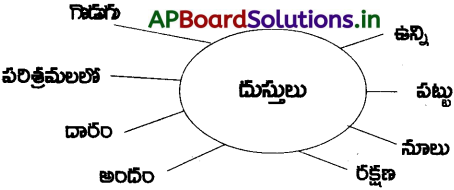
→ మొక్కలు మరియు జంతువుల నుండి పొందిన దారాలను సహజ దారాలు అంటారు.
ఉదా : పత్తి, ఉన్ని, జనపనార, పట్టు.

→ రసాయనాల నుండి పొందిన దారాలను కృత్రిమ దారాలు అంటారు.
ఉదా: పాలిస్టర్, టెర్లిన్, నైలాన్, రేయాన్.

→ పత్తి కాయ నుండి విత్తనాలను తొలగించే ప్రక్రియను జిన్నింగ్ లేదా వేరు చేయటం అంటారు.

→ పోగుల నుండి దారం తయారు చేయడాన్ని స్పిన్నింగ్ లేదా వడకటం అంటారు.

AP 6th Class Science Notes Chapter 8 దుస్తులు ఎలా తయారవుతాయి

→ దారాల నుండి దుస్తులు అల్లే ప్రక్రియను నేతనేయటం అంటారు.

→ నేయడం “మగ్గం” వంటి ప్రత్యేక పరికరాలపై జరుగుతుంది.

→ మగ్గాలు చేనేత మరియు పవర్‌లూమ్ అనే రెండు రకాలు కలవు.

→ జనపనారను గోనె సంచుల తయారీకి ఉపయోగించవచ్చు కాని బట్టలు తయారు చేయడానికి కాదు.

→ మనం కృత్రిమదారాల్ని కాల్చినట్లయితే అవి తీవ్రమైన వాసనను ఇస్తాయి.

→ కృత్రిమ దారాలైన పాలిస్టర్, పెట్రోలియం నుండి తయారు చేయబడుతుంది.

→ పాలిథీన్ సంచులు మట్టిలో కుళ్ళిపోవడానికి లక్షల సంవత్సరాల సమయం పడుతుంది.

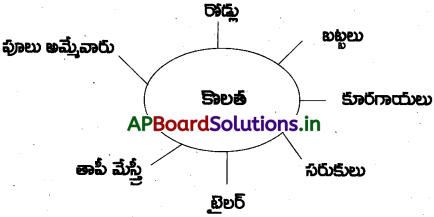
→ మనం వేర్వేరు వాతావరణ పరిస్థితుల నుండి మనలను రక్షించుకోవడానికి విభిన్న దుస్తులు ఉపయోగిస్తాము.

→ బట్టలు అందం మరియు హెూదా యొక్క చిహ్నంగా కూడా ఉంటాయి.

→ జనుము మొక్క యొక్క కాండం నుండి జనపనార లభిస్తుంది.

→ కాలికో అనేవి బుక్ బైండింగ్ మరియు బ్యానర్ల తయారీకి వాడే ఒక రకమైన దుస్తులు.

→ పురాతన రోజుల్లో మానవులు జంతువుల చర్మాలను, చెట్ల ఆకులు మరియు బెరడులను బట్టలుగా ఉపయోగించారు.

→ యుద్ధ సైనికుల బట్టలు లోహంతో తయారవుతాయి.

AP 6th Class Science Notes Chapter 8 దుస్తులు ఎలా తయారవుతాయి

→ ఒక్క పశ్చిమ బెంగాల్ మాత్రమే 50% పైగా ముడి జనపనారను ఉత్పత్తి చేస్తుంది.

→ 80% మహిళలు కొబ్బరి నార పరిశ్రమలలో పనిచేస్తున్నారు.

→ గోధుమ రంగు కొబ్బరి పీచును బ్రు, డోర్ మాట్, దుప్పట్లు మరియు బస్తాల తయారీకి ఉపయోగిస్తారు.

→ మన పర్యావరణాన్ని పరిరక్షించడానికి, పాలిథీన్ బ్యాగ్ కు బదులుగా బట్టల సంచులను ఉపయోగించాలి.

→ వస్త్రాలు : మానవులు ధరించే దుస్తులు.

→ దారపు పోగు : బట్టలోని సన్నని దారాలు.

→ దారాలు : జీవులు లేదా కృత్రిమ పదార్థం నుండి ఏర్పడిన సన్నని నిర్మాణాలు. ఇవి బట్టల తయారీకి తోడ్పడతాయి.

→ సహజ దారాలు : మొక్కలు లేదా జంతువుల నుండి పొందిన దారాలు.

→ కృత్రిమ దారాలు : రసాయనాలతో చేసిన దారాలు.

→ ఏరివేయటం (జిన్నింగ్) : పత్తి బంతి నుండి విత్తనాలను వేరు చేయడం.

→ వడకటం (స్పిన్నింగ్) : పోగులను మెలితిప్పి దారాలు తయారు చేయటం.

→ నేత నేయడం : పడుగు, పేక అనే రెండు వరుసల దారాలను కలిపి వస్త్రాలు తయారు చేయడాన్ని ‘నేత నేయడం’ అంటారు.

→ మగ్గం : దారాలతో దుస్తులను నేసే పరికరం.

→ పడుగు : నేతలో నిలువు వరుస దారాలను పడుగు అంటారు.

→ పేక : నేతలో అడ్డు వరుస దారాలను పేక అంటారు.

→ ముతక : నునుపు లేకపోవటం.

→ నానబెట్టటం : పదార్థాన్ని కొన్ని రోజులు నీటిలో ఉంచటం.

→ కొబ్బరి పీచు : కొబ్బరి పండ్ల నుండి వచ్చే దారాలు.

→ మెరుగుపర్చటం : వొక పదార్థాన్ని జోడించడం ద్వారా నాణ్యతను పెంచటం.

AP 6th Class Science Notes Chapter 8 దుస్తులు ఎలా తయారవుతాయి

→ కాలికో : బుక్ బైండింగ్ లో ఉపయోగించే ఒక రకమైన వస్త్రం.

→ చేనేత : చేతితో నేత వేసే వస్త్ర పరిశ్రమ.

→ దువ్వటం : దారాలు నిడివిగా తీసే ప్రక్రియ.

→ రంగులు వేయటం : నేతకు ముందు దారాలకు రంగులు వేసే ప్రక్రియ.

→ ఆర్మస్ : రాజులు మరియు సైన్యం ఉపయోగించే లోహపు జాకెట్.
AP 6th Class Science Notes Chapter 8 దుస్తులు ఎలా తయారవుతాయి 1

AP 6th Class Science Notes Chapter 7 కొలుద్దాం

Students can go through AP Board 6th Class Science Notes 7th Lesson కొలుద్దాం to understand and remember the concept easily.

AP Board 6th Class Science Notes 7th Lesson కొలుద్దాం

→ అడుగు, మూర, బార, జాన పొడవులను కొలవడానికి సంప్రదాయ పద్ధతులు.

→ పొడవుకు ప్రమాణం మీటరు. పొడవు యొక్క అతి చిన్న ప్రమాణం సెంటీమీటర్ / మిల్లీమీటర్ (సెం.మీ / మి.మీ) మరియు పొడవు యొక్క పెద్ద ప్రమాణం మీటర్ / కిలోమీటర్ (మీ / కి.మీ).

→ ఒక వస్తువు యొక్క ఉపరితలాన్ని దాని వైశాల్యం అంటారు.

→ చదరపు సెంటీమీటర్ (సెం.మీ) అనేది ఉపరితల వైశాల్యానికి ప్రమాణము.

→ ఘనపరిమాణం అనేది ఒక వస్తువు ఆక్రమించిన స్థలం యొక్క కొలత.

→ క్యూబిక్ మీటర్, క్యూబిక్ సెంటీమీటర్ అనేవి ఘనపరిమాణానికి ప్రమాణాలు.

→ ద్రవాల ఘనపరిమాణాన్ని లీటరు లేదా మిల్లీ లీటర్లలో కొలుస్తారు.

→ పొడవులను ఖచ్చితంగా కొలవడానికి మనకు ప్రామాణిక సాధనాలు అవసరం.

AP 6th Class Science Notes Chapter 6 అయస్కాంతంతో సరదాలు

→ వైశాల్యం అనేది ఒక వస్తువు ఆక్రమించిన ఉపరితలం యొక్క కొలత.

→ ప్లాటినం, ఇరిడియం లోహాలను కలిపి చేసిన నిర్దిష్ట పొడవు కలిగిన కడ్డి ఫ్రాన్స్ తయారు చేసింది. దీని పొడవును మీటర్కు ప్రామాణికంగా తీసుకొంటారు.

→ నిజమైన ప్రామాణిక స్కేల్ ఫ్రాన్స్ మ్యూజియంలో భద్రపరచబడింది.

→ మన దైనందిన జీవితంలో చెక్క, ఇనుము మరియు ప్లాస్టిక్ తో తయారైన వివిధ పరిమాణాల సాధారణ స్కేలు మరియు గుండ్రని టేపులను కొలతలకు ఉపయోగిస్తాము.

→ వస్తువుల పొడవును కొలిచేటప్పుడు స్కేల్ యొక్క సున్నా బిందువు వద్ద నుండి ప్రారంభించాలి.

→ బకెట్ యొక్క చుట్టుకొలత మరియు వంటపాత్ర చుట్టుకొలతలు వక్ర ఉపరితలాలకు ఉదాహరణ.

→ ప్రయోగశాలలో పాలు మరియు నూనె వంటి ద్రవాల పరిమాణాన్ని కొలవటానికి వారు కొలజాడీ లేదా కొల పాత్రలను ఉపయోగిస్తారు.

→ పెట్టె యొక్క ఘనపరిమాణం = పొడవు × వెడల్పు × ఎత్తు

→ ఒక ఘన సెం.మీ = 1 మి.లీ

→ కొలత : ఒక వస్తువు యొక్క పరిమాణం మరియు బరువును తెలుసుకోవడానికి ఉపయోగించే ప్రమాణం (లేదా) తెలియని వస్తు పరిమాణాలను తెలిసిన ప్రమాణాలలోనికి మార్చటాన్ని కొలత అంటారు.

→ ప్రమాణ కొలత : నిర్దిష్టంగా దేనినైనా కొలుచుటకు తీసుకొనే ప్రమాణం.

→ వైశాల్యం : ఒక వస్తువు ఆక్రమించిన ఉపరితలం.

→ సమతలం : క్రమమైన ఆకృతి ఉదాహరణకు వృత్తాకార, చతురస్రాకార, ఘనాకార గల వస్తువుల తలాన్ని సమతలం అంటారు.

→ గజం : ముక్కు చివర నుండి మధ్య వేళ్ల వరకు గల దూరాన్ని గజం అంటారు.

→ ఘనపరిమాణం : ఒక వస్తువు ఆక్రమించిన స్థలాన్ని ఘనపరిమాణం అంటారు. ఇది వస్తువు యొక్క పొడవు, వెడల్పు, ఎత్తుల లబ్దానికి సమానం.

AP 6th Class Science Notes Chapter 6 అయస్కాంతంతో సరదాలు

→ దీర్ఘ ఘనాకార వస్తువు : పొడవు, వెడల్పు, ఎత్తులు వేరువేరు కొలతలుగా గల వస్తువును దీర్ఘ ఘనాకార వస్తువు అంటారు.
ఉదా : అగ్గిపెట్టె, బీరువా మొ||

→ కొల పాత్ర : ద్రవాలు మరియు ఘనపదార్థాల పరిమాణాన్ని కొలవడానికి ఉపయోగించే పొడవైన బోలు (గాజు గొట్టం).

→ గ్రాఫ్ పేపర్ : సమాన విభజనలతో కూడిన కాగితం. దీనిని క్రమరహిత ఉపరితల శరీరాల వైశాల్యాన్ని కొలవడానికి ఉపయోగిస్తారు.

→ క్రమ ఉపరితలం : పొడవు మరియు వెడల్పు సులభంగా కొలవగల ఒక క్రమమైన ప్రాంతం.

→ క్రమరహిత ఉపరితలం : పొడవు మరియు వెడల్పు సులభంగా కొలవలేని ఒక క్రమరహిత ప్రాంతం.

→ జాన : బొటనవేలు చివర నుండి చిన్నవేలు చివర వరకు ఉన్న దూరం.

→ మూర : మోచేయి నుండి మధ్య వేలు కొనవరకు ఉండే దూరం. దీనిని సాధారణంగా పూల మాల, చిన్న దూరాలు కొలవటానికి వాడతారు.

→ చిర్రాగోనే : మన రాష్ట్రములో ఆడే ప్రసిద్ధ గ్రామీణ ఆట (కర్రా బిళ్ళా).

AP 6th Class Science Notes Chapter 6 అయస్కాంతంతో సరదాలు

→ అడుగు : 12 అంగుళాల పొడవును అడుగు అంటారు.

→ స్కేల్ : పొడవు మరియు వెడల్పును కొలవడానికి ఉపయోగించే సార్వత్రిక ప్రమాణం.

→ మీటర్ : 100 సెం.మీ పొడవును మీటర్ అంటారు. చిన్న పొడవులను, దుస్తులను మీటర్లో కొలుస్తారు.

AP 6th Class Science Notes Chapter 7 కొలుద్దాం

AP 6th Class Science Notes Chapter 6 అయస్కాంతంతో సరదాలు

Students can go through AP Board 6th Class Science Notes 6th Lesson అయస్కాంతంతో సరదాలు to understand and remember the concept easily.

AP Board 6th Class Science Notes 6th Lesson అయస్కాంతంతో సరదాలు

→ లోడ్ స్టోన్ ఒక సహజ అయస్కాంతం.

→ అయస్కాంతాలను వివిధ ఆకారాలలో తయారు చేస్తారు. దండాయస్కాంతం, గుర్రపునాడ అయస్కాంతం, వలయాకారపు అయస్కాంతం, బిళ్ల అయస్కాంతం మొదలయినవి.

→ అయస్కాంతం ఆకర్షించే పదార్థాలను అయస్కాంత పదార్థాలు అంటాం. అయస్కాంతం ఆకర్షించని పదార్థాలను అనయస్కాంత పదార్థాలు అంటాం.

→ అయస్కాంతానికి ఆకర్షించే గుణం కొనల వద్ద ఎక్కువగా ఉంటుంది. ఈ కొనలలో అయస్కాంతపు ధృవాలు ఉంటాయి.

→ ప్రతి అయస్కాంతానికి రెండు ధృవాలు ఉంటాయి. 1) ఉత్తర ధృవం 2) దక్షిణ ధృవం.

→ అయస్కాంతపు సజాతి ధృవాలు వికర్షించుకుంటాయి. విజాతి ధృవాలు ఆకర్షించుకుంటాయి.

→ స్వేచ్ఛగా వేలాడదీయబడిన దండాయస్కాంతం ఉత్తర, దక్షిణ దిక్కులను సూచిస్తుంది.

AP 6th Class Science Notes Chapter 6 అయస్కాంతంతో సరదాలు

→ అయస్కాంత దిక్సూచిని తయారు చేయడానికి అయస్కాంతాల దిశాధర్మము ఉపయోగించబడుతుంది.

→ అయస్కాంత దిక్సూచి అనేది దిశలను కనుగొనడానికి ఉపయోగించే ఒక పరికరం. దీనిని నావికులు సముద్ర ప్రయాణంలో వాడతారు.

→ అయస్కాంతానికి దగ్గరగా ఉండటం వల్ల ఒక అయస్కాంత పదార్థం అయస్కాంత ధర్మాన్ని పొందినట్లయితే దాన్ని అయస్కాంత ప్రేరణ అంటాం.

→ అయస్కాంతాలను వేడిచేసినప్పుడు, ఎత్తు నుంచి జార విడిచినప్పుడు మరియు సుత్తితో కొట్టినప్పుడు మొదలైన సందర్భాలలో తమ లక్షణాలను కోల్పోతాయి.

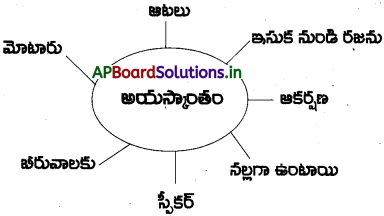
→ మేము రోజువారీ జీవితంలో స్పీకర్లు, ఎలక్ట్రిక్ మోటార్లు, డోర్ లాక్స్, పిన్ హెల్డర్స్, క్రేన్లు మొదలైన వివిధ రకాల పరికరాలలో అయస్కాంతాలు ఉపయోగిస్తాము.

→ విద్యుదయస్కాంత రైళ్లు విద్యుదయస్కాంత లెవిటేషన్ సూత్రంపై పనిచేస్తాయి.

→ అయస్కాంతం : ఇనుమును ఆకర్షించగల పదార్థం. ఇది తన చుట్టూ ఒక అయస్కాంత క్షేత్రాన్ని కలిగి ఉంటుంది.

→ అయస్కాంత పదార్థాలు : అయస్కాంతాలచే ఆకర్షించబడే పదార్థాలను అయస్కాంత పదార్థాలు అంటారు.

→ అనయస్కాంత పదార్థాలు : అయస్కాంతాలచే ఆకర్షించబడని పదార్థాలను అనయస్కాంత పదార్థాలు అంటారు.

→ ఉత్తర ధృవం : స్వేచ్ఛగా వ్రేలాడదీసిన అయస్కాంతం యొక్క ఉత్తర దిశను ఉత్తర ధృవం అంటారు.

→ దక్షిణ ధృవం : స్వేచ్ఛగా వ్రేలాడదీసిన అయస్కాంతం యొక్క దక్షిణ దిశను దక్షిణ ధృవం అంటారు.

→ అయస్కాంత దిక్సూచి : దిక్కులను కనుగొనే పరికరం.

→ సజాతి ధృవాలు : రెండు అయస్కాంతాల యొక్క ఒకే ధృవాలు, N – N లేదా S – S లను జాతి ధృవాలు అంటారు. ఇవి ఒకదానికొకటి వికర్షించుకొంటాయి.

→ విజాతి ధృవాలు : రెండు అయస్కాంతాల యొక్క వేర్వేరు ధ్రువాలు, N – S లేదా S – N లను విజాతి ధృవాలు అంటారు. ఇవి ఒకదానికొకటి ఆకర్షించుకొంటాయి.

AP 6th Class Science Notes Chapter 6 అయస్కాంతంతో సరదాలు

→ ఆకర్షణ : దగ్గరకు లాగబడే బలం.

→ వికర్షణ : వస్తువులు ఒకదానికొకటి దూరంగా నెట్టే బలాన్ని వికర్షణ అంటాము.

→ అయస్కాంత ప్రేరణ : అయస్కాంతానికి దగ్గరగా ఉండడం వల్ల ఒక అయస్కాంత పదార్థం అయస్కాంత ధర్మాన్ని పొందినట్లయితే దాన్ని అయస్కాంత ప్రేరణ అంటారు.

→ ధృవాలు : అయస్కాంతం యొక్క రెండు చివరలను ధృవాలు అంటారు. ఇక్కడ ఆకర్షక శక్తి బలంగా ఉంటుంది.

→ అయస్కాంతీకరణ : ఒక వస్తువును అయస్కాంతంగా మార్చే ప్రక్రియ.

→ అయస్కాంత లెవిటేషన్ : అయస్కాంత లెవిటేషన్ అనేది ఒక వస్తువును, అయస్కాంత క్షేత్రాల వికర్షణ బలంతో గాలిలో నిలుపుట.

AP 6th Class Science Notes Chapter 6 అయస్కాంతంతో సరదాలు 1

AP 6th Class Science Notes Chapter 4 నీరు

Students can go through AP Board 6th Class Science Notes 4th Lesson నీరు to understand and remember the concept easily.

AP Board 6th Class Science Notes 4th Lesson నీరు

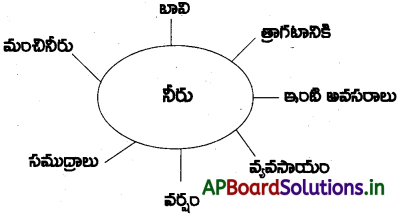
→ రోజు వారి పనులకు, వ్యవసాయం మరియు పారిశ్రామిక ప్రయోజనాల కోసం మనకు నీరు అవసరం.

→ కాలువలు, ట్యాంకులు, చెరువులు, నదులు మొదలైన వివిధ నీటి వనరుల నుండి మనకు నీరు లభిస్తుంది.

→ భూమి యొక్క ఉపరితలం 3/4వ వంతు నీటితో ఆక్రమించబడింది.

→ భూమిపై లభించే నీటిలో 3% మాత్రమే మంచినీరు.

→ మనం నీటి కోసం వర్షాలపై ఆధారపడతాము.

→ బావులలో లేదా ఇతర నీటి వనరులలో నీటి మట్టాలు వర్షాకాలంలో పెరిగి, వేసవి కాలంలో తగ్గుతాయి.

→ మంచు (ఘన రూపం), నీరు (ద్రవ రూపం) మరియు నీటి ఆవిరి (వాయు రూపం) అనే మూడు రూపాల్లో భూమిపై నీరు ఉండవచ్చు.

AP 6th Class Science Notes Chapter 4 నీరు

→ నీటిని నీటి ఆవిరిగా మార్చే ప్రక్రియను బాష్పీభవనం అంటారు.

→ నీటి వనరుల ఉపరితలాల నుండి ఎండకు నీరు నిరంతరం ఆవిరైపోతుంది.

→ బాష్పీభవనం ద్వారా గాలిలోకి ప్రవేశించే నీటి ఆవిరి ఆకాశంలో మేఘాలను ఏర్పరుస్తుంది.

→ నీటి ఆవిరి యొక్క చిన్న బిందువుల నుండి మేఘాలు ఏర్పడతాయి.

→ నీటి ఆవిరిని నీటిగా మార్చే ప్రక్రియను సాంద్రీకరణ అంటారు.

→ భూమి యొక్క ఉపరితలంపై ఉన్న నీటి బాష్పీభవనం మరియు ఘనీభవనం ప్రక్రియల వలన వర్షం పడుతుంది.

→ ఆకాశం నుండి నీరు వర్షం, మంచు, స్ట్రీట్ లేదా వడగళ్ళు రూపంలో నేలను చేరుతుంది. దీనిని అవపాతం అంటారు.

→ సముద్రం మరియు భూమి మధ్య నీటి ప్రసరణను నీటి చక్రం అంటారు.

→ కర్మాగారాలు, అటవీ నిర్మూలన మరియు కాలుష్యం ఇప్పుడు భూతాపానికి కారణమవుతున్నాయి.

→ గ్లోబల్ వార్మింగ్ నీటి చక్రానికి భంగం కలిగిస్తుంది మరియు తక్కువ వర్షపాతం లేదా ఎక్కువ వర్షపాతం కలిగిస్తుంది.

→ అధిక వర్షాలు వరదలకు కారణం కావచ్చు, ఎక్కువ వర్షాలు లేకపోవడం కరువుకు కారణం కావచ్చు.

→ భూమిపై లభించే నీటి పరిమాణం తక్కువ, కాబట్టి దీనిని జాగ్రత్తగా ఉపయోగించాల్సిన అవసరం ఉంది.

→ నీటి కొరతను నివారించే ఏకైక పద్దతి నీటి సంరక్షణ.

→ నీటి వనరులు : నీరు వ్యవసాయ, పారిశ్రామిక మరియు గృహనిర్మాణం వంటి వివిధ కార్యకలాపాలకు ఉపయోగపడుతుంది. ఈ నీరు లభించే ప్రాంతాలను నీటి వనరులు అంటారు.

AP 6th Class Science Notes Chapter 4 నీరు

→ బాష్పీభవనం : నీటిని, నీటి ఆవిరిగా మార్చే ప్రక్రియను బాష్పీభవనం అంటారు.

→ సాంద్రీకరణం : నీటి ఆవిరిని, నీటిగా మార్చే ప్రక్రియను సాంద్రీకరణం అంటారు.

→ అవపాతం : వాతావరణంలోని నీటి ఆవిరి ఘనీభవించి భూమిపై నీరు లేదా మంచుగా పడటం.

→ జలచక్రం : నీరు సముద్రము, వాతావరణం మరియు భూమి మధ్య ఒక వలయంలా తిరుగుతుంది. దీనినే జలచక్రం అంటారు.

→ మేఘం : నీరు లేదా మంచు స్ఫటికాల చిన్న బిందువులు అనేకం కలసి మేఘం ఏర్పడుతుంది.

→ నీటి ఆవిరి : నీటి వాయు రూపంను నీటి ఆవిరి అంటారు.

→ వాతావరణం : వాతావరణం భూమి చుట్టూ ఉండే వాయువుల మిశ్రమం.

→ ప్రవాహం : నీరు ఒక ప్రాంతం నుండి మరొక ప్రాంతానికి చేరటం.

→ నీటిబిందువులు : చిన్న పరిమాణంలో ఉండే నీటి తుంపరలు.

→ మంచు : ఘనీభవనం కారణంగా ఉదయం వేళలో వాతావరణంలో కనిపించే బిందువుల రూపంలోని నీరు.

→ వర్షం : మేఘాల నుండి పడే నీటి చుక్కలు.

→ వడగళ్ళు : వర్షంతో పాటు పడే మంచు (గడ్డకట్టిన నీరు).

→ చల్లని గాలి : తక్కువ వేగంతో వీచే గాలిని చల్లని గాలి అంటారు.

→ పవనం : వీచే గాలి కరవు

→ : తక్కువ వర్షాలు వలన పంటలు లేని స్థితి. వరదలు

→ : అధిక వర్షాల వలన ఏర్పడే నీటి ప్రవాహం.

→ వలస : తాత్కాలికంగా లేదా శాశ్వతంగా స్థిరపడటానికి ఒక ప్రదేశం నుండి మరొక ప్రదేశానికి ప్రజలు వెళ్ళటం.

→ రుతుపవనాలు : కాలాన్ని బట్టి నేల పైకి వీచే గాలులు.

→ నైరుతి రుతుపవనాలు : అరేబియా సముద్రం నుండి నైరుతి దిశగా భారతదేశానికి ప్రవహించే కాలానుగుణ గాలులు.

→ ఉత్తర-తూర్పు రుతుపవనాలు: నైరుతి రుతుపవనాలు భారతీయ ప్రధాన భూమి నుండి వెనక్కి వెళ్లినప్పుడు ప్రవహించే కాలానుగుణ గాలులు. ఇవి బలహీనమైన వర్షమును కలిగిస్తాయి.

AP 6th Class Science Notes Chapter 4 నీరు

→ మంచు : నీటి ఆవిరి నుండి నేరుగా ఘనీభవించి ఏర్పడే నీటి బిందువులు.

→ అటవీ నిర్మూలన : మన అవసరాల కోసం అడవులను నరకటం.

→ కాలుష్యం : పరిసరాలలోకి మోతాదుకు మించి హానికర పదార్థాల చేరిక.

→ భౌగోళిక వెచ్చదనం : కాలుష్యం వలన భూమి ఉష్ణోగ్రత పెరగడం.

→ విపత్తు : ప్రకృతి లేదా మానవ తప్పిదాల వలన కలిగే నష్టం.

→ టాక్సిన్స్ : ఆరోగ్యానికి నష్టం కలిగించే విష పదార్థం.

→ మంచినీరు : తక్కువ ఉప్పు సాంద్రత కలిగిన నీరు. ఇది రోజువారీ ప్రయోజనాల కోసం ఉపయోగించబడుతుంది.

AP 6th Class Science Notes Chapter 4 నీరు 1

AP 6th Class Science Notes Chapter 3 జంతువులు

Students can go through AP Board 6th Class Science Notes 3rd Lesson జంతువులు to understand and remember the concept easily.

AP Board 6th Class Science Notes 3rd Lesson జంతువులు

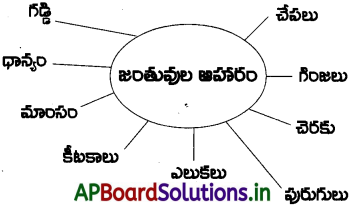
→ మన పరిసరాలలో నివసించే వివిధ రకాల జంతువులకు వారి స్వంత ఆహారపు అలవాట్లు ఉన్నాయి.

→ మన పరిసరాలలో ఆహారానికి మొక్కలు మరియు జంతువులు ప్రధాన వనరులు.

→ ప్రతి జంతువుకు ఆహారాన్ని పొందటానికి ప్రత్యేక శైలి ఉంది.

→ కొన్ని జీవులు పీల్చటం, నాకటము, ఏరుకోవటము, నమలటము, చీల్చటము, మింగడం ద్వారా ఆహారాన్ని సేకరిస్తాయి.

→ కొన్ని జంతువులు వేటాడి చంపి చీల్చుకు తింటాయి.

→ ఆహారాన్ని గుర్తించడానికి చాలా జంతువులు విస్తృతమైన జ్ఞానేంద్రియాలను ఉపయోగిస్తాయి. – వాసన, దృష్టి, వినికిడి, రుచి మరియు స్పర్శ ఆధారంగా ఆహారాన్ని సేకరిస్తాయి.

AP 6th Class Science Notes Chapter 3 జంతువులు

→ జీవులలో ఒకే రకమైన ఆహారాన్ని తీసుకోవడానికి వివిధ రకాలైన భాగాలను ఉపయోగించవచ్చు.

→ పక్షులు ఆహారాన్ని తినడానికి వివిధ రకాల ముక్కులను కలిగి ఉంటాయి.

→ జలగలు చర్మానికి అతుక్కుని పశువుల మరియు మానవుల రక్తాన్ని పీలుస్తాయి.

→ కప్ప దాని ఆహారాన్ని జిగురుగా ఉండే తన నాలుక ఉపయోగించి పొందుతుంది.

→ జంతువులను వాటి ఆహారం ఆధారంగా మూడు రకాలుగా విభజించారు. అవి శాకాహారులు, మాంసాహారులు మరియు సర్వ ఆహారులు.

→ పదునైన దంతాలు మరియు నాలుకను ఉపయోగించి కుక్కలు ఆహారాన్ని తింటాయి.

→ సింహం, పులి వంటి అడవి జంతువులకు పరిగెత్తడానికి బలమైన కాళ్లు, పట్టుకోవడానికి పదునైన పంజాలు మరియు మాంసాన్ని చీల్చటానికి పదునైన దంతాలు ఉన్నాయి.

→ ఆహార గొలుసు అంటే జంతువుల మధ్య గల ఆహారపు సంబంధాలు.

→ ఆహార గొలుసులో ఉత్పత్తిదారులు, ప్రాథమిక వినియోగదారులు, ద్వితీయ వినియోగదారులు మరియు తృతీయ వినియోగదారులు అని పిలువబడే ఆహార స్థాయిలు ఉంటాయి.

AP 6th Class Science Notes Chapter 3 జంతువులు

→ సూర్యరశ్మి నుండి ఆహారాన్ని తయారు చేసుకునే జీవులను ఉత్పత్తిదారులు అంటారు.

→ అన్ని జంతువులు వినియోగదారులే ఎందుకంటే అవి సొంతంగా ఆహారాన్ని తయారు చేసుకోవు.

→ ఆహార గొలుసు జీవుల మధ్య ఆహార సంబంధాలను సూచిస్తుంది. ఇతర జీవులను తినడం ద్వారా జీవులు శక్తిని మరియు పోషకాలను ఎలా పొందుతాయో ఆహార గొలుసు వివరిస్తుంది.

→ ఆహార గొలుసు ప్రకృతిలో విభిన్న జీవులు పరస్పరం ఆధారపడటాన్ని వివరిస్తుంది.

→ ఉత్పత్తిదారులు, వినియోగదారులు మరియు నేల మధ్య పదార్థాల రవాణాలో విచ్ఛిన్నకారులు సహాయపడతాయి.

→ పర్యావరణ వ్యవస్థలోని అనేక ఆహార గొలుసులు ఒకదానితో ఒకటి అనుసంధానించబడి ఆహార జాలకమును ఏర్పరుస్తాయి.

→ చాలా జంతువులు సమూహములుగా నివసిస్తున్నాయి. ఉదా : ఏనుగులు, చీమలు, తేనెటీగలు.

→ చీమల సమూహములో కార్మికులు, సైనికులు, ఆడ మరియు మగ చీమలు ఉంటాయి.

→ ఆహారపు అలవాట్లు : ఒక వ్యక్తి లేదా జంతువు తినే ఆహారం మరియు సేకరించే విధానం వారి ఆహారపు అలవాటు అవుతుంది.

→ శాకాహారులు : మొక్కలను ఆహారంగా తీసుకొనే జంతువులు.
ఉదా : ఆవు, జింక.

→ మాంసాహారులు . : జంతువులను ఆహారంగా తీసుకొనే జంతువులు.
ఉదా : తోడేలు, పులి, సింహం.

→ ఉభయాహారులు : మొక్క మరియు జంతువులను ఆహారంగా తీసుకొనే జీవులు.
ఉదా : కాకి, కోడి, మనిషి.

→ నెమరు వేయడం : మింగిన ఆహారాన్ని నోటిలోకి తిరిగి తెచ్చుకొని తీరుబడిగా నమలటము.
ఉదా : ఆవు, గేదె, ఒంటె.

→ ఆహారపు గొలుసు : ఆహారపు గొలుసు ఒక నిర్దిష్ట ఆవాసంలోని వివిధ జీవుల మధ్య ఆహార సంబంధాన్ని చూపిస్తుంది.

→ ఉత్పత్తిదారులు : తమ ఆహారాన్ని తామే తయారుచేసుకొనే జీవులు.
ఉదా : మొక్కలు.

AP 6th Class Science Notes Chapter 3 జంతువులు

→ వినియోగదారులు : ఆహారం కోసం ఇతర జీవులను తినే జీవులను “వినియోగదారులు” అంటారు.
ఉదా : జింక, పులి, సింహం.

→ విచ్ఛిన్నకారులు : చనిపోయిన జీవులను విచ్చిన్నం చేసే జీవులు.
ఉదా : సూక్ష్మ జీవులు (బ్యాక్టీరియా, శిలీంధ్రాలు).

→ ఆహార జాలకము : పరస్పర సంబంధము గల ఆహార గొలుసుల కలయికను ఆహార జాలకము అంటారు.

→ పెంపుడు జంతువులు : మీకు ఆనందాన్ని లేదా సంతోషాన్ని ఇవ్వడానికి మీరు మీ ఇంటిలో పెంచుకొనే జంతువులు.
ఉదా : కుక్క, పిల్లి.

→ ట్రాకింగ్ : ఏదైనా ఒక జీవిని అనుసరించటం లేదా జాడ కనుగొనే ప్రక్రియ.

→ పక్షి ముక్కు : పొడవుగా, దృఢంగా ఉండే పక్షి నోటి భాగం.

→ సరీసృపాలు : వెన్నెముక కలిగి నేలపై పాకే జంతువులు.
ఉదా : పాము, బల్లి.

→ సహజ పారిశుద్ధ్య కార్మికులు : వ్యర్థాలు, చనిపోయిన జీవులను తింటూ పరిసరాలను శుభ్రముగా ఉంచే జీవులు.
ఉదా : కాకి, రాబందులు, శిలీంధ్రాలు, సూక్ష్మజీవులు.

→ వన్య జీవులు : అడవి జంతువులు. ఇవి మచ్చిక చేసుకోని జంతువులు, స్వతంత్రంగా జీవిస్తాయి.
ఉదా : సింహం, తోడేలు మొ||నవి.

→ పెంపకం : జీవుల అవసరాలను తీర్చుతూ శ్రద్ధ వహించటాన్ని పెంపకం అంటారు.

→ పగటి సంచారులు : ప్రధానంగా పగటిపూట చురుకుగా ఉండే జీవులు. ఉదా: ఆవు, గొర్రె, మేక, కోడి, మనిషి.

→ నిశాచరులు : ప్రధానంగా రాత్రి సమయంలో చురుకుగా ఉండే జీవులు.
ఉదా : గుడ్లగూబ, గబ్బిలము, బల్లి.

→ పురుగుమందులు : పురుగుమందులు అనేవి రసాయన లేదా ఇతర విష పదార్థాలు. ఇవి తెగులును చంపడానికి లేదా నిరోధించడానికి ఉపయోగిస్తారు.
ఉదా : గ్లైసిల్.

→ కీటక నాశకాలు : కీటకాలను చంపడానికి ఉపయోగించే పదార్థాలు.
ఉదా : మలాథియాన్, పైరెత్రమ్.

→ సమూహము : ఒకే రకమైన జీవులు కలిసి జీవించడం లేదా కలిసి పెరగడం.

→ ప్రాథమిక వినియోగదారులు : ఆహారము కోసం ఉత్పత్తిదారులపై ఆధారపడే జీవులు.
ఉదా : జింక, ఆవు, మేక.

→ ద్వితీయ వినియోగదారులు : ఆహారము కోసం ప్రాథమిక వినియోగదారులపై ఆధారపడే జీవులు.
ఉదా : కోడి, తోడేలు, నక్క, చేప.

→ తృతీయ వినియోగదారులు : ఆహారము కోసం ద్వితీయ వినియోగదారులపై ఆధారపడే జీవులు.
ఉదా : పులి, సింహం.

→ నీటి స్కేటర్ : నీటి ఉపరితలంపై తేలియాడే చిన్న కీటకము.

→ తెగులు : మొక్కలకు కలిగే అనారోగ్య స్థితి.

AP 6th Class Science Notes Chapter 3 జంతువులు

→ తేనె : పువ్వులలో స్రవించే చక్కెర ద్రవం.

→ వేట : ఆహారం కోసం ఇతర జంతువులను వెంబడించి చంపడం.
ఉదా : పులి, సింహం.

→ ఆవరణ వ్యవస్థ : జీవులు నివసించే పరిసర ప్రాంతం.

→ అఫిడ్స్ : మొక్కల రసాలను పీల్చే కీటకాలు.

AP 6th Class Science Notes Chapter 3 జంతువులు 1

AP 6th Class Science Notes Chapter 1 మనకు కావలసిన ఆహారం

Students can go through AP Board 6th Class Science Notes 1st Lesson మనకు కావలసిన ఆహారం to understand and remember the concept easily.

AP Board 6th Class Science Notes 1st Lesson మనకు కావలసిన ఆహారం

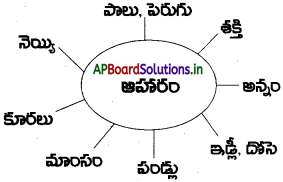
→ మన రోజువారీ జీవితంలో రకరకాల ఆహారాన్ని తీసుకుంటాము.

→ వంట తయారీ కోసం, మనకు వివిధ రకాల పదార్థాలు అవసరం.

→ ఆరోగ్యం మరియు శక్తి కోసం మనం ఆహారాన్ని తీసుకుంటాము.

→ మొక్కలు, జంతువులు మరియు ఇతర వనరుల నుండి మనకు ఆహార పదార్థాలు లభిస్తాయి.

→ మనం కాండం, వేర్లు, ఆకులు, పండ్లు మరియు పువ్వులు వంటి మొక్కల వివిధ భాగాలను ఆహారంగా ఉపయోగిస్తాము.

→ మనం మొక్కల నుండి ధాన్యాలు, కూరగాయలు మరియు పండ్లను పొందుతాము.

→ పాలు, మాంసం, గుడ్డు వంటి ఆహార పదార్థాలు జంతువుల నుండి లభిస్తాయి.

AP 6th Class Science Notes Chapter 1 మనకు కావలసిన ఆహారం

→ నీరు, ఉప్పు వంటి కొన్ని ఆహార పదార్థాలను ఇతర వనరుల నుండి పొందవచ్చు.

→ ఆహారం యొక్క రుచి దానిలో ఉపయోగించిన పదార్థాలు మరియు తయారీ విధానం మీద ఆధారపడి ఉంటుంది.

→ ఉడకబెట్టడం, ఆవిరి చేయడం, కిణ్వప్రక్రియ, వేయించుట వంటివి ఆహారాన్ని తయారు చేసే కొన్ని పద్దతులు.

→ ఆహార నిల్వ అనేది తయారు చేసిన ఆహారాన్ని చెడిపోవడాన్ని నివారించటం.

→ చెడిపోయిన ఆహారం అతిసారం, వాంతులు మొదలైన వాటికి కారణమవుతుంది.

→ మనం కొంతకాలం ఆహారాన్ని సంరక్షించడానికి ఆహార నిల్వ పదార్థాలను ఉపయోగిస్తాము.

→ ఉప్పు, నూనె, కారం పొడి, తేనె మరియు చక్కెర ద్రావణాన్ని ఆహారాన్ని సంరక్షించడానికి నిల్వ పదార్థాలుగా ఉపయోగిస్తారు.

→ బెంజోయేట్స్, నైట్రేట్స్, సల్ఫేట్స్ వంటి కొన్ని రసాయనాలను కూడా ఆహార నిల్వలకు ఉపయోగిస్తారు.

→ గడువుతేది తర్వాత ఆహార పదార్థాలు తినడం మన ఆరోగ్యాన్ని పాడు చేస్తుంది.

→ ఇంట్లో తయారుచేసిన ఆహారం ఎల్లప్పుడూ మంచిది, ఆరోగ్యకరమైనది మరియు పరిశుభ్రమైనది.

AP 6th Class Science Notes Chapter 1 మనకు కావలసిన ఆహారం

→ దినుసులు : ఆహారాన్ని తయారు చేయడానికి అవసరమైన పదార్థాలు.

→ వనరులు : మనకు కావలసిన ముడి పదార్థాలు ఎక్కడ నుండి లభ్యమవుతాయో వాటిని వనరులు అంటారు.

→ నిల్వ చేయు పదార్థాలు : ఆహారం పాడై పోకుండా నిరోధించే పదార్థం లేదా రసాయనం.

→ సుగంధ ద్రవ్యాలు : ఆహారానికి రుచిని, మంచి వాసనను ఇచ్చే పదార్థాలను సుగంధ ద్రవ్యాలు అంటారు.
ఉదా : మిరియాలు, లవంగాలు, జీలకర్ర.

→ మరిగించడం లేదా ఉడకబెట్టడం : ఆహారాన్ని మెత్తపర్చటానికి, నీరు ఆవిరి అయ్యే వరకు వేడి చేయడం.

→ ఆవిరితో ఉడికించటం (స్టీమింగ్) : ఆవిరిని ఉపయోగించి వంట చేసే పద్ధతి స్టీమింగ్.

→ పులియబెట్టుట లేదా కిణ్వ ప్రక్రియ : ఈ విధానంలో సేంద్రియ పదార్థం సరళమైన పదార్థంగా విచ్ఛిన్నమవుతుంది.

→ వంటకం లేదా రెసిపీ : ఆహార పదార్థ తయారీ విధానాన్ని వివరించే సూచనల జాబితా.

→ నిల్వ చేయటం : ఆహారాన్ని చెడిపోకుండా సురక్షితంగా ఉంచే ప్రక్రియ.

→ మెనూ చార్ట్ : భోజనంలో వడ్డించే వంటకాల జాబితా.

→ ప్రపంచ ఆహార దినం : అక్టోబర్ 16న ప్రపంచ ఆహార దినంగా జరుపుకుంటారు.

→ ఆసాఫోటిడా : ఇది పప్పు మరియు సాంబార్ తయారీలో ఉపయోగించే ఒక పదార్థం. పసుపు వంటి సుగంధ ద్రవ్యము.

→ తృణ ధాన్యాలు : జొన్న, రాగి, సజ్జ వంటి పంటలను తృణ ధాన్యాలు అంటారు. వీటిని వరి, గోధుమ మన వంటి ఆహార పంటలకు ప్రత్యామ్నాయంగా ఉపయోగిస్తారు.

→ పప్పుధాన్యాలు : కంది, మినుము, శనగ గింజలను పప్పుధాన్యాలుగా వాడతారు. పప్పుదినుసు మొక్కల ఎండిన విత్తనాలు.

→ వేయించుట : ఆహారాన్ని నూనెలో వేడి చేయటం.

→ వెజిటబుల్ కార్వింగ్ : కూరగాయలు మరియు పండ్లతో వివిధ రకాల నమూనాలు మరియు అలంకరణలను తయారు చేయడం.

→ సూక్ష్మక్రిములు : కంటికి కనబడని అతి చిన్న జీవులు. ఇవి కొన్నిసార్లు మానవులకు మరియు ఇతర జీవులకు వ్యాధులను కలిగిస్తాయి.

→ మన విరేచనాలు : బ్యాక్టీరియా వల్ల రోజుకు మూడు లేదా అంతకంటే ఎక్కువ వదులుగా మల విసర్జన జరగటం.

AP 6th Class Science Notes Chapter 1 మనకు కావలసిన ఆహారం

→ కాలుష్యం : మోతాదుకు మించి పరిసరాలలో హానికర పదార్థాల చేరిక.

→ సిరప్ : చక్కెర మరియు నీటితో చేసిన తీపి ద్రవం.

→ గడువు తేదీ : ఇది ఆహార వస్తువును ఉపయోగించటానికి గరిష్ఠ కాలాన్ని సూచిస్తుంది.

→ జంక్ ఫుడ్ : అనారోగ్యకరమైన మరియు తక్కువ పోషక విలువలు కలిగిన ప్యాకేజీ ఆహారం.

→ పరిశుభ్రత : ఆరోగ్యాన్ని కాపాడుకోవడానికి మరియు వ్యాధుల వ్యాప్తిని నివారించడానికి శుభ్రంగా ఉండటం.

AP 6th Class Science Notes Chapter 1 మనకు కావలసిన ఆహారం 1

AP 7th Class Science Notes 8th Lesson Wonders of Light

Students can go through AP Board 7th Class Science Notes 7th Lesson Reproduction in Plants to understand and remember the concept easily.

AP Board 7th Class Science Notes 8th Lesson Wonders of Light

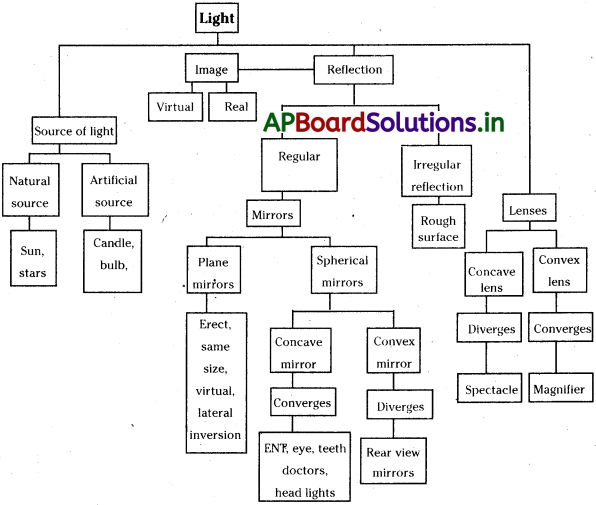
→ Light is a form of energy.

→ Objects that emit light are known as sources of light.
Ex : Sun, candle, tube light.

→ Sources like sun, stars emit light on their own. Such type of sources are called natural sources of light.

→ Sources that release light artificially are called man made sources of light or artificial sources of light.

→ Light is not a single ray, but a bundle of rays.
Ex : bulb, torch light, candle.

AP 7th Class Science Notes 8th Lesson Wonders of Light

→ This bundle of light rays are called beam of light rays. These are three types :

  1. Parallel beam of light rays
  2. Converging beam of light rays
  3. Diverging beam of light rays.

→ Light rays which travel parallel to each other are called Parallel beam of light rays.

→ “Light rays which travel from different directions to meet at a point are called as Con-verging beam of light rays”.

→ “Light rays which travel from a source moving in different directions are called as Diverging beam of light rays.”

→ The process of bouncing back of light rays into the same medium after falling on a smooth or rough surface from the light source is called “reflection of light”.

→ Objects are visible only when light falls on the objects and bounces back to the eye.

→ The process of bouncing back of light rays in the same medium after hitting the surface of an object is called reflection.

→ The Light rays that fall on the objects are called incident rays. The light rays that bounce back from the objects are called reflected rays.

→ Reflection from a smooth and shiny surface is called regular reflection. Clear images are formed in case of regular reflection.

AP 7th Class Science Notes 8th Lesson Wonders of Light

→ Reflection from an irregular or uneven surface is called irregular reflection or diffused reflection.

→ Images are not clear or sometimes cannot form the images at all in case of irregular reflection.

→ There are two laws of reflection :

  1. Angle of incidence is equal to Angle of reflection.
  2. The incident ray, reflected ray and normal to the surface are present in the same plane.
    Incident and reflected rays are on either side of normal.

→ Characteristics of image by plane mirror:

  1. Object distance is equal to image distance.
  2. Size of the object is equal to size of the image.
  3. The image formed is always virtual and erect.
  4. Laterally inverted image is formed, (left and right alternates)

→ The distance of the object from the mirror is called Object distance.

→ The distance of the image from the mirror is called Image distance.

→ The image which we get on screen is called real image.

→ The image which cannot get it on screen is called virtual image.

→ All the plane mirrors form virtual and erect image.

→ Formula for number of images formed between two mirrors .

→ Number of images (n) = 360°/θ -1, where 0 is the angle between the mirrors.

→ Periscope is an instrument used in submarines to see the objects or persons above the water level.

→ The mirrors which are the parts of spheres are called spherical mirrors.

AP 7th Class Science Notes 8th Lesson Wonders of Light

→ Spherical mirrors are of two types :

  1. Convex mirrors (Reflecting surface bent outward)
  2. Concave mirrors (Reflecting surface bent inward)

→ A concave mirror forms real and virtual images, erect and inverted images, smaller, same size and bigger images depending on the position of object in front of it.

→ A convex mirror always forms virtual, erect, smaller image irrespective of the position of the object.

→ Concave mirrors are used by ENT doctors as Head Mirrors,

→ Dentists also use concave mirrors to get a bigger image of the teeth.

→ Eye specialist using a special instrument called Ophthalmoscope. It is fitted with a concave mirror having a small hole near its center.

→ The surface of reflection in a torch light or the headlights of vehicles is concave.

→ Convex Mirrors are used as Rear-view mirrors and also used at the junctions of roads.

→ A piece of glass or any other transparent material with curved sides is called a lens.

→ Lens which is thick in center and thin at the edges is called convex lens.

→ Lens which is thin in the centre and thick at the edges is called concave lens.

→ Yellow light has been proven effective in protecting retina than blue light which causes damage to retina.

→ Natural sources of light : Sources which release’light energy on their own are called natural sources of light.

AP 7th Class Science Notes 8th Lesson Wonders of Light

→ Manmade sources of light : Sources which need the human involvement to release light energy are called manmade sources of light.

→ Reflection of light : The process of bouncing back of light rays into the same medium after falling on a smooth or rough surface from the light source is called “reflection of light”.

→ Incident ray : The light rays that fall on the objects are called incident rays.

→ Reflected ray : The light rays that bounce back from the objects are called reflected rays.

→ Regular reflection : Reflection from a smooth and shiny surface is called regular reflection.

→ Diffused reflection : Reflection from an irregular or uneven surface is called irregular reflection or diffused reflection.

→ Angle of incidence (I) : The angle made by incident ray with the normal is called angle of incidence (i).

→ Angle of reflection (r) : The angle made by the reflected ray with the normal is called the angle of reflection (r).

AP 7th Class Science Notes 8th Lesson Wonders of Light

→ Normal : Perpendicular line to the surface of the mirror at incident point is called normal to the surface.

→ Concave mirror : Concave mirrors is a spherical mirror with reflecting surface bent inward.

→ Convex mirror : Convex mirrors is a spherical mirror with reflecting surface bent outward.

→ Real image : The image which can get on a screen is called real image.

→ Virtual image : The image which cannot get it on screen is called virtual image.

→ Lens : A piece of glass or any other transparent material with curved sides is called a lens.

→ Dispersion : Splitting of white light into seven colours is called Dispersion.

AP 7th Class Science Notes 8th Lesson Wonders of Light

→ Safe browsing : Opening of authorized websites in computers is called safe browsing.

→ Convex lens : Lens which is thick in center and thin at the edges is called convex lens.

→ Concave lens : Lens which is thin in the centre and thick at the edges is called concave lens.

AP 7th Class Science Notes 8th Lesson Wonders of Light 1

AP 7th Class Science Notes 7th Lesson Reproduction in Plants

Students can go through AP Board 7th Class Science Notes 7th Lesson Reproduction in Plants to understand and remember the concept easily.

AP Board 7th Class Science Notes 7th Lesson Reproduction in Plants

→ Giving rise to new ones of their own kind is called reproduction.

→ Reproduction helps to increase their number and continue their existence.

→ All plants produce new ones like them. There is no existence for plants without reproduction.

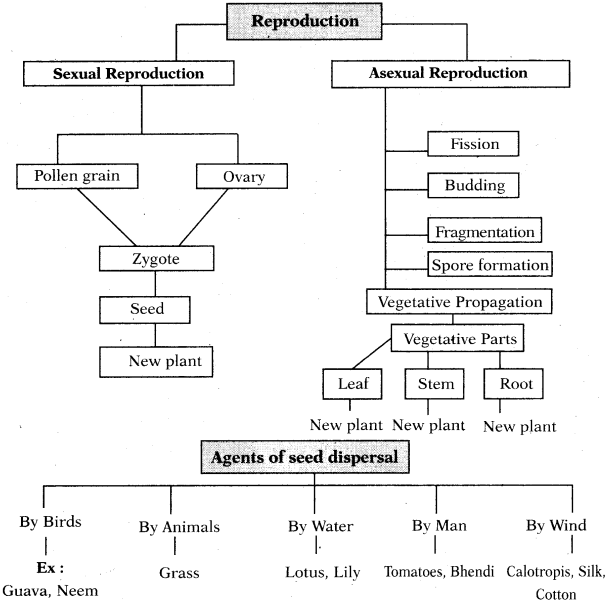
→ Reproduction with seeds is called sexual reproduction. Reproduction in plants without seeds is called asexual reproduction.

→ In some plants sexual reproduction occurs through some vegetative parts like stem, roots and leaf.

AP 7th Class Science Notes 7th Lesson Reproduction in Plants

→ Suckers, nodes, eyes and underground stems are some vegetative propagation methods. Ground layering, grafting are some artificial vegetative propagation methods.

→ Flower is the sexual part of plant it has calyx, corolla, stamens and pistil.

→ The flower which has four whorls are called complete flower.

→ In some plants androecium or gynoecium is present. Such flowers are called Unisexual flowers.

→ The flowers which have both androecium and gynoecium is called bisexual flowers.

→ Unisexual flowers that contain only androecium are called male flowers.

→ Unisexual flowers that contain only gynoecium are called female flowers.

→ Colour, smell and nectar of a flower helps to attract insects.

→ The process of transferring pollen grains from the anther to stigma, is known as polli-nation.

→ Pollination is two types.

  1. Self Pollination
  2. Cross Pollination.

→ Pollen grains reach the stigma of flower through insects, birds, air and water.

→ Fusion of male and female garnets to form zygote is called Fertilization.

→ Zygote is formed through the fertilization later it develops in embryo.

→ After fertilization the ovary ripens and grows into a fruit.

AP 7th Class Science Notes 7th Lesson Reproduction in Plants

→ Generally seeds dispersal through air, water and by animals.

→ All plants try to spread their seeds to distant places in increase the chance of survival and propagation.

→ Reproduction is the process which justifies the maximum life is immortal.

→ Reproduction : The process of giving rise to new ones of their own kind is called Reproduction.

→ Vegetative propagation : Propagation of plants through vegetative parts like stem, roots and leaf is called ’vegetative propagation’.

→ Unisexual flowers : Flowers with either androecium or gynoecium are called unisexual flowers.

→ Bisexual flowers : Flowers with both androecium and gynoecium are are called as bisexual flowers.

→ Androecium : The male reproductive part of the flower is called Androecium. It consists of stamens.

→ Gynoecium : The female reproductive part of the flower is called Gyno¬ecium. It consists of ovary , style and stigma.

→ Anther : Swollen structure at the top of the stamen is called An¬ther. It produces pollen grains.

→ Pollination : The process of transferring pollen grains from anther to stigma is called as Pollination.

→ Pollen grain : Male gametes of the plants are called pollen grains. They appear like smooth yellow powder. They are formed in the anther.

→ Ovary : A bulged structure seated on the thalamus is called Ovary. It’s a part of Gynoecium – the female reproductive part of the flower. It contains ovules.

AP 7th Class Science Notes 7th Lesson Reproduction in Plants

→ Fertilization : Fusion of male and female gametes to form zygote is called fertilization. This is the process of formation of zygote.

→ Zygote : Zygote is the cell formed due to fertilization. It develop into embryo and then baby.

→ Seed dispersal : Spreading of seeds from one place to other is called seed dispersal. It increases the chances of survival for the plants.

AP 7th Class Science Notes 7th Lesson Reproduction in Plants 1

AP 7th Class Science Notes 6th Lesson Electricity

Students can go through AP Board 7th Class Science Notes 6th Lesson Electricity to understand and remember the concept easily.

AP Board 7th Class Science Notes 6th Lesson Electricity

→ A cell is a device used to generate electricity.

→ Cell mainly consists of two components, electrolyte, and electrodes.

→ Electrolyte is a chemical component that conduct the electricity.

→ Electrodes are two types : positive and negative.

→ The positive electrode is called anode.

AP 7th Class Science Notes 6th Lesson Electricity

→ The negative electrode is called cathode.

→ Cell converts the chemical energy into electrical energy.

→ A group of cells is called a battery.

→ There are different types of electrical cells such as dry cell, lithium cell, button cell, alkaline cell etc.

→ Dry cells are used in torch lights, wall clocks, radios etc.

→ Lithium ion cells are rechargeable and used in mobile phones, laptops etc.

→ Switch is used to open or close a circuit.

→ Incandescent, fluorescent, CFL, LED bulbs etc. are different types of bulbs.

→ Electrical fuse is a safety device which is used to protect the electrical appliances from excess of electricity flow through them.

→ Miniature Circuit Breaker (MCB) is being used in place of electric fuses.

→ A simple electric circuit consisting of a battery, a bulb, a switch and connecting wires.

AP 7th Class Science Notes 6th Lesson Electricity

→ The diagrams which show the arrangement of electric component’s in a circuit are called circuit diagrams.

→ The common sequence of components in electric circuit diagram is as follows :

→ Positive terminal of. the cell → wire bulb wire → switch → wire → negative terminal of the cell.

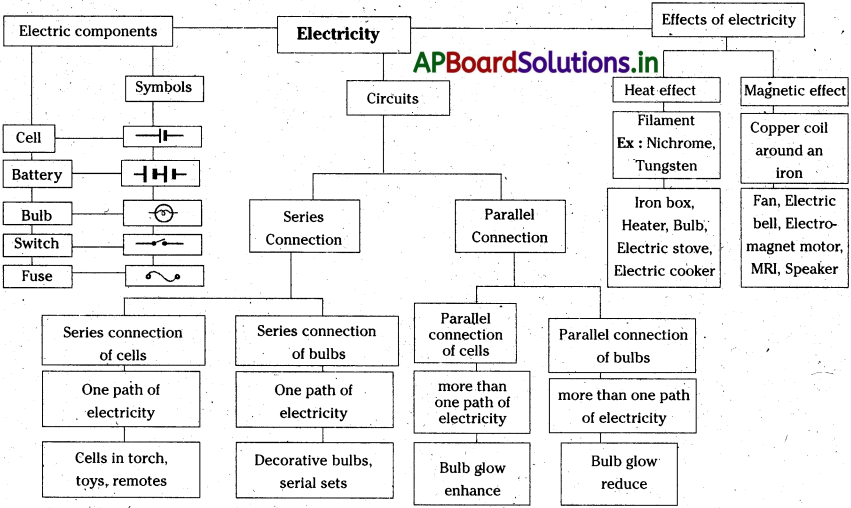
→ If the second terminal of the first device is connected to the first end of the second device such type of connection is called series connection.

→ If all the first terminals of all the devices are connected to one point and all the second terminals are connected to another point such type of connection is called parallel connection.

→ If a number of cells are connected in series the brightness of the bulb is enhanced. If one of the cells is removed, the circuit becomes open and the bulb will not glow.

→ If a number of cells are connected in parallel the brightness of the bulb remains same. Even if one of the cells is removed, the circuit remains same arid the bulb will glow as usual.

→ We can use series connection of cells in torch light, toys, remotes, wall clocks etc.

→ We can use parallel connection of cells for a long-lasting battery life.

→ The production of heat due to the flow of electricity through a wire is called ’Heating’ effect of electricity’.

→ Electric stove, electric room heater, electric iron box, electric kettle etc. are working on the principle of heating effect of electricity.

AP 7th Class Science Notes 6th Lesson Electricity

→ The coil of wire inside the above devices is called a filament which produces heat.

→ Generally a filament is made up of Nichrome.

→ The filament of an electric bulb, is made of Tungesten.

→ The production of nlagnetic force due to the flow of electricity through a wire is called magnetic effect of electricity.

→ The devices which act as magnets when electricity passes through them are called electromagnets.

→ Magnetic effects produced in a coil due to the passing of electricity in the coil is called magnetic effect of electricity.

→ Electric fan, electric bell, electric motor are working on the principle of magnetic effect Of electricity.

→ 1 kilo watt = 1000 watts.

→ 1 KWH = 1 unit of electricity

→ Electricity supplied to our houses comes from power stations and substations.

AP 7th Class Science Notes 6th Lesson Electricity

→ An electric shock occurs when a person comes into contact with an electrical source.

→ Electricity flows through a portion of the body causing a shock.

→ The ISI mark ensures the quality of appliances and safety of users.

→ cell : Electrical cell is a source of electric energy, (or) A cell is a device used to generate electricity.

→ Bulb : Bulb is a light source which converts electrical energy into light energy.

→ Battery : A group of cells is called a battery, (or) Battery is a source of electric energy.

→ Fuse : The safety device which is used in electrical appliances to protect from damages when excess of electricity flows through them is called a electric fuse.

→ Series : If the second terminal of the first device is connected to the first end of the second device such type of connection is called series connection.

→ Parallel : If all the first terminals of all the devices are connected to one point and all the second terminals are connected to another point such type of connection is called parallel connection.

→ Heating effect : The production of heat due to the flow of electricity through a wire is called heating effect of electricity.

→ Magnetic – effect : The production of magnetic force due to the flow of electricity through a wire is called magnetic effect of electricity.

→ Electromagnet : The devices which act as magnets when electricity passes o through them are called electromagnets.

AP 7th Class Science Notes 6th Lesson Electricity

→ MCB : Miniature Circuit Breaker isNa type of fuse which automatically turns off when electricity in a circuit exceeds the safe limit.

→ Electric shock : An electrit shock occurs when a person comes into contact with an electrical source and electricity flows through his body.

→ Fluorescent tube : Fluorescent tube light is a light source, which is commonly known as tube light.

→ CFL : Compact Fluorescent Lamp is a light source.

AP 7th Class Science Notes 6th Lesson Electricity 1

AP 7th Class Science Notes 5th Lesson Motion and Time

Students can go through AP Board 7th Class Science Notes 5th Lesson Motion and Time to understand and remember the concept easily.

AP Board 7th Class Science Notes 5th Lesson Motion and Time

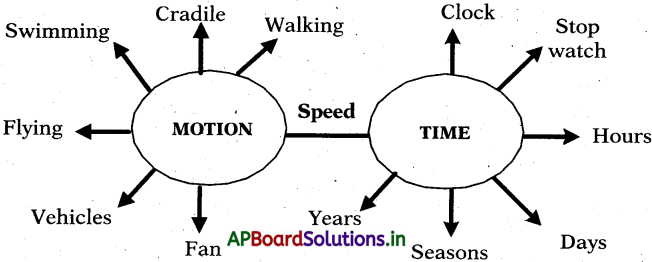
→ Motion is a common experience in our life.

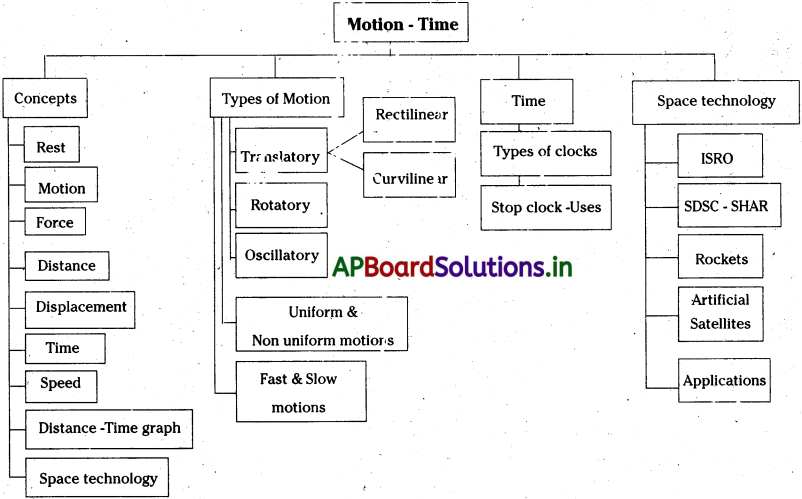
→ Force makes an object to move or tend to move. It is required, to change the object from rest into motion, to change its direction and even to change from motion to rest.

→ The total length of a path taken by an object to reach one place from the other is called distance.

→ Primary unit of distance is centimeter. S.I units of distance is metre. But kilometre is used to measure large distances.

→ The change in position of an object is called displacement. It is the shortest distance between the starting and final positions.

AP 7th Class Science Notes 5th Lesson Motion and Time

→ The measurable period between two incidents/ events is called time.

→ The basic unit of time is second. Larger units of time are minutes and hours.

→ An object is said to be in motion, if it changes its position with respect to surrounding and an object is said to be in rest, if it doesn’t change its position with respect to surroundings.

→ There are three, types of motion namely translatory motion, rotatory motion and oscil- iatory motion.

→ Speed of an object can be defined as the distance travelled by it in a unit time.

→ If all points of a moving object move through the same distance in same direction, then the motion is said to be translatory motion.

→ If a body in translatory motion moves along a straight, line then the motion is called rectilinear motion.

→ If a body in translatory motion move along a curved path, then the motion is called curvilinear motion.

→ If all the parts of a moving body follow a curved path with respect to a fixed centre or axis of rotation, it is said to be in rotatory motion.

→ Sometimes, an object may possess both translatory, and rotatory motions. For ex¬ample cycle tyre moving in a straight line.

→ The ‘to and fro’ motion of an object about a fixed point that always following the same path is called oscillatory or vibratory motion.

→ If a body covers equal distances in equal intervals of time, it is said to be in uniform motion.

AP 7th Class Science Notes 5th Lesson Motion and Time

→ If a body covers unequal distances in equal intervals of time, it is said to be in non¬uniform motion.

→ The distance travelled by an object in a. given interval of time can help us to decide whether it is faster or slower.

→ Speedometer helps us to know the speed of a vehicle.

→ Units of speed is meter per second (m/s)or kilometre per hour (Km/h)

→ 1 Km / h = 5/18 m/s

→ Rockets are devices that produce force or push needed to move an object forward. Rockets are used to launch space crafts and satellites. They are also used to shoot missiles.

→ ISRO : (Indian Space Research Organisation) formed in 1969.

→ SLV : Satellite Launch Vehicle.

→ ASLV : Augmented Satellite Launch Vehicle.

→ PSLV: Polar Satellite Launch Vehicle.

→ GSLV: Geosynchronous Satellite Launch Vehicle.

→ SDSC : Satish Dhawan Space Centre.

→ SHAR : Sriharikota High Altitude Range.

→ DOS : Department Of Space.

→ An artificial satellite is a manmade object, Iavnched to revolve around the Earth.

→ Artificial satellites are used in communication and navigation.

→ Motion : If an object changes its position with respect to its surroundings, it is said to be in motion.

→ Rest : An object is said to be at rest if there is no change in its position with respect to its surroundings.

→ Force : Force is a push, pull, or hit on any object that brings a change in its state of motion.

AP 7th Class Science Notes 5th Lesson Motion and Time

→ Distance : The total length of the path travelled by an object between two places is called distance.

→ Displacement : The change in position of an object is called displacement. It is the shortest distance between the starting and final positions.

→ Time : The measurable period between two incidents/ events is called time.

→ Translatory motion : If all points of a moving object move through the same distance in same direction, then the motion is said to be translatory motion.

→ Rotatory Motion : If all the parts of a moving body follow a curved path with respect to a fixed centre or .axis of rotation, it is said to be in rotatory motion.

→ Axis of Rotation : The imaginary line passing through the fixed centre around which the parts of the objects move in a curved path during rotatory motion is called axis of rotation.

→ Oscillatory Motion : The ‘to and fro’ motion of an object about a fixed point that always following the same path is called oscillatory or vibratory motion.

→ Uniform motion : If a body covers equal distances in equal intervals of time, it is said to be in uniform motion.

→ Non uniform motion : If a body covers unequal distances in equal intervals of time, it is said to be in non-uniform motion.

AP 7th Class Science Notes 5th Lesson Motion and Time

→ Speed : The distance travelled by an object in a unit time is called its speed.

→ Speedometer : Speedometer is an instrument that indicates the speed of a vehicle.

→ Odometer : An odometer is an instrument used for measuring the distance traveled by a vehicle.

→ Average Speed : Average speed is the ratio of total distance covered and total time taken by the body to cover the distance.

→ Rockets : Rockets are devices that produce force or push needed to move an object forward. They are used to launch spate crafts and satellites.

→ Artificial Satellite : An artificial satellite is a manmade object, launched to revolve around the Earth.

AP 7th Class Science Notes 5th Lesson Motion and Time 2
AP 7th Class Science Notes 5th Lesson Motion and Time 1

AP 7th Class Science Notes 4th Lesson Respiration and Circulation

Students can go through AP Board 7th Class Science Notes 4th Lesson Respiration and Circulation to understand and remember the concept easily.

AP Board 7th Class Science Notes 4th Lesson Respiration and Circulation

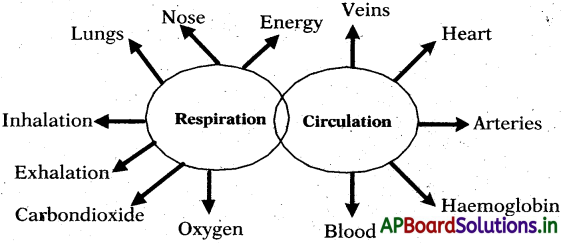
→ The process of inhaling and exhaling of air is called Breathing.

→ Respiration is essential for survival of living things.

→ The absorbed oxygen reaching every part of body and reacting with digested food to give energy is called respiration

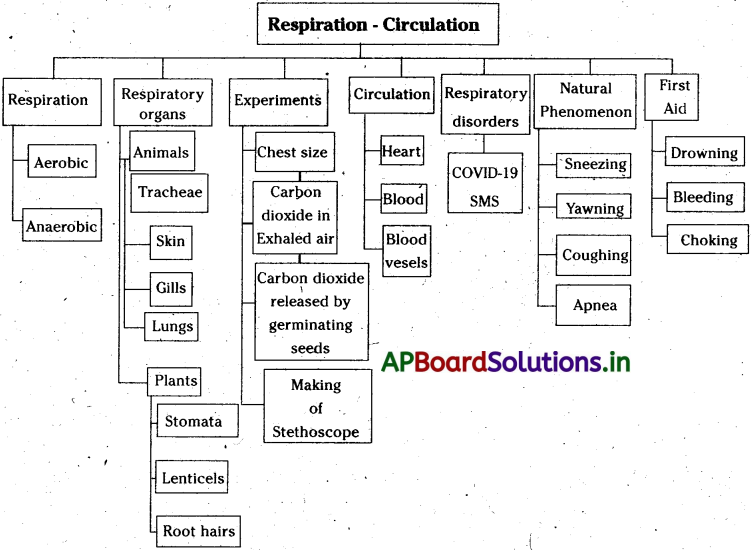
→ Respiration is of two types:
a) Aerobic respiration (in presence of oxygen)
b) Anaerobic respiration (in absence of oxygen)

→ Breathing rate and heartbeat rate varies under different conditions.

→ The pathway of respiration is nostrils, nasal cavity, larynx, wind pipe, bronchi, and lungs.

AP 7th Class Science Notes 4th Lesson Respiration and Circulation

→ The ribs and diaphragm play an important role in respiration.

→ Inhaled air has more oxygen and less carbon dioxide, where as exhaled air has lesser oxygen and more carbon dioxide.

→ Blood capillaries present in large numbers in the lungs absorb the inhaled oxygen and carry it to all parts of the body.

→ Hearts pumps the blood to all parts of the body through arteries and veins.

→ Plants respire through stomata of leaves and lenticels of stem. The roots also respire.

→ COVID – 19 is the latest universal respiratory disorder which can be prevented by sanitizing, using mask, and maintaining social distance.

→ There are a few natural involuntary phenomena related to the respiratory system like sneezing, yawning, coughing and apnea. These are not in our control.

→ Breathing : The process of inhalation and exhalation of air is called Breathing.

→ Inhalation : Intaking of air into the body is called inhalation. During the process of inhalation the air with more oxygen and less carbon dioxide enters the lungs through nostrils.

→ Exhalation : The process of breath out is called exhalation. During the process of exhalation the air with more carbon dioxide and less oxygen is sent out from the lungs.

AP 7th Class Science Notes 4th Lesson Respiration and Circulation

→ Respiration : The absorbed oxygen reaching every part of body and reacting with digested food to give energy is called respiration.

→ Oxygen : It is the element that have a key role in respiration, it helps to burn the food material and release the energy

→ Carbon dioxide : It is the gas that released in respiration

→ Gills : These are the respiratory organs in aquatic animals like fishes.

→ Tracheae : Respiration that take place via trachea is called Tracheal respiration. This is present in all insects.

→ Bronchi : The branches of wind pipe extending into the lungs and further branching into bronchioles

→ Lungs : Lungs are pink in colour spongy, elastic and sac like structures with many tiny air sacs

→ Stomata : The process of breathing takes place with the help of small openings in the leaves called stomata.

→ Lenticels : These are small pore like structures on the stem involves in breathing.

→ Blood Capillaries : Blood capillaries which are very thin narrow blood vessels that connect the arteries with the veins and distribute the blood to the body parts.

→ Blood vessel : These are tube like structures through which the blood flows in the body. There are three types of blood vessels in the human body.

AP 7th Class Science Notes 4th Lesson Respiration and Circulation

→ Tracheal system : Respiration that take place via trachea is called Tracheal respiration. This is present in all insects.

→ Haemoglobin : A red protein responsible for transporting oxygen in the blood of vertebrates

→ Arteries : They carry blood with more oxygen from heart to body parts.

→ Veins : They carry blood with more carbon dioxide from the body parts to the heart.

AP 7th Class Science Notes 4th Lesson Respiration and Circulation 1
AP 7th Class Science Notes 4th Lesson Respiration and Circulation 2

AP 6th Class Science Notes Chapter 2 మొక్కల గురించి తెలుసుకుందాం

Students can go through AP Board 6th Class Science Notes 2nd Lesson మొక్కల గురించి తెలుసుకుందాం to understand and remember the concept easily.

AP Board 6th Class Science Notes 2nd Lesson మొక్కల గురించి తెలుసుకుందాం

→ ఒక మొక్క యొక్క ముఖ్యమైన భాగాలు వేర్లు, కాండం మరియు ఆకులు.

→ తల్లివేరు వ్యవస్థ మరియు గుబురువేరు వ్యవస్థ మొక్కలలో కనిపించే రెండు రకాల వేరు వ్యవస్థలు.

→ ద్విదళ బీజం మొక్కలకు తల్లివేరు వ్యవస్థ ఉంటుంది. ఏకదళ బీజం మొక్కలకు గుబురు వేరు వ్యవస్థ ఉంటుంది.

→ వేరు మొక్కను నేలలో స్థిరపర్చి, నీరు మరియు ఖనిజాలను గ్రహిస్తుంది.

→ కొన్ని మొక్కలలో వేర్లు అదనపు బలాన్ని ఇస్తాయి.

→ కొన్ని గుబురు వేర్లు ఆహారాన్ని నిల్వ చేయడానికి సహాయపడతాయి.

AP 6th Class Science Notes Chapter 2 మొక్కల గురించి తెలుసుకుందాం

→ కాండం వ్యవస్థలో కాండం, ఆకులు, పువ్వులు మరియు పండ్లు ఉంటాయి. కాండం నీరు మరియు ఖనిజాలను వేర్ల నుండి మొక్కల పై భాగాలకు మరియు ఆహారాన్ని ఆకుల నుండి ఇతర భాగాలకు రవాణా చేస్తుంది.

→ బంగాళదుంప, పసుపు, వెల్లుల్లి, అల్లం మరియు చెరకు కాండంలో ఆహార పదార్థాలను నిల్వ చేస్తాయి.

→ పత్ర పీఠం, పత్ర వృంతము మరియు పత్రదళం ఒక ఆకు యొక్క భాగాలు.

→ జాలాకార మరియు సమాంతర ఈనెల వ్యాపనం ఆకులలో కనిపిస్తాయి.

→ తల్లి వేరు వ్యవస్థ కలిగిన మొక్కలు జాలాకార ఈనెల వ్యాపనంను, గుబురు వేర్లు కలిగిన మొక్కలు సమాంతర ఈనెల వ్యాపనం కల్గి ఉంటాయి.

→ ఆకులు ఆహారాన్ని తయారు చేయడంతో పాటు, వాయువుల మార్పిడి మరియు బాష్పోత్సేకంలో కూడా ఇవి సహాయపడతాయి.

→ పరాగసంపర్కం కోసం కీటకాలను ఆకర్షించడానికి పువ్వులో రంగురంగుల ఆకర్షక పత్రాలు ఉన్నాయి.

→ ప్రకృతికి అందం ఇచ్చే రంగురంగుల పువ్వుల కోసం మొక్కలను పెంచుదాం.

→ తల్లి వేరు : మధ్యలో ఒక ప్రధాన వేరు ఉండి దాని నుండి పార్శ్వ వేర్లు ఏర్పడే వేరు.

→ గుబురు వేర్లు : కాండం నుండి ఏర్పడే ఒకే మందం, పొడవు కలిగిన వేర్ల సమూహం.

→ ఏకదళ బీజ మొక్కలు : విత్తనంలో ఒకే ఒక బీజదళం మాత్రమే ఉండే మొక్కలు.

→ ద్విదళ బీజ మొక్కలు : విత్తనంలో రెండు బీజదళాలు ఉండే మొక్కలు.

→ కణుపు : కాండం యొక్క భాగం. ఇక్కడ ఆకు మరియు ఇతర భాగాలు ఉత్పత్తి అవుతాయి.

→ అగ్ర కోరకం : కాండం పై భాగాన ఉండే పెరుగుదల చూపే మొగ్గ.

→ పార్శ్వ కోరకం : ఆకు యొక్క అక్షం వద్ద పెరిగే మొగ్గ.

→ పత్రం : మొక్కలో ఉండే ముఖ్య భాగము పత్రం. దీనిద్వారా బాష్పోత్సేకం, కిరణజన్య సంయోగక్రియ జరుగుతాయి.

→ పత్ర వృంతము : కాండంతో ఆకును కలిపే కాడ వంటి నిర్మాణం.

→ పత్ర దళం : ఆకు యొక్క చదునైన ఆకుపచ్చ భాగం.

AP 6th Class Science Notes Chapter 2 మొక్కల గురించి తెలుసుకుందాం

→ జాలాకార ఈనెల వ్యాపనం : ద్విదళ ఆకులలో ఉన్న ఈ నెలు పత్రదళం అంతటా వలలాగా అమర్చబడి ఉండే ఈనెల అమరిక.

→ సమాంతర ఈనెల వ్యాపనం : ఏకదళ బీజం ఆకులలో ఉన్న ఈ నెలు ఒకదానికొకటి సమాంతరంగా అమర్చబడి ఉండే ఈనెల అమరిక.

→ పత్ర రంధ్రము : పత్రదళంలో గల చిన్న రంధ్రాలు.

→ బాష్పోత్సేకము : ఆకులు నీటిని, ఆవిరి రూపంలో విడుదల చేసే ప్రక్రియ.

→ కిరణజన్య సంయోగక్రియ : మొక్కలలో ఆహార తయారీ ప్రక్రియ.

→ పార్శ్వ వేర్లు : తల్లి వేరు వ్యవస్థలో ప్రధాన వేరు నుండి ప్రక్కకు పెరిగే చిన్న వేర్లు.

→ విత్తన ఆకులు : అంకురోత్పత్తి సమయంలో విత్తనం నుండి వెలువడే మొదటి ఆకులు.

→ బీజ దళం : విత్తనంలో గల పప్పు బద్దలు. ఆకులు ఏర్పడే వరకు పెరిగే మొక్కకు ఆహారం అందిస్తాయి.

→ దుంప వేర్లు : ఆహార పదార్థాలను నిల్వ చేయటం వలన లావుగా ఉండే వేర్లు.

→ కాండం వ్యవస్థ : మొక్కలలో భూమి పైన పెరిగే భాగం.

→ కాండం : మొక్క యొక్క ప్రధాన అక్షం కాండం. ఇది భూమి పైభాగాన పెరుగుతుంది.

→ కణుపు మద్యమం : రెండు వరుస కణుపుల మధ్య కాండ భాగం.

→ ఈనెలు : ఆకు పత్రదళంలో గల గీతల వంటి నిర్మాణాలు.

→ మధ్య ఈనె : పత్ర దళం మధ్యలో ఉన్న పొడవైన ఈనె.

AP 6th Class Science Notes Chapter 2 మొక్కల గురించి తెలుసుకుందాం

→ పార్శ్వ ఈనెలు : ఆకులోని మధ్య ఈనెల నుండి ఏర్పడే సన్నని నిర్మాణాలు.

→ ఈనెల వ్యాపనం : పత్ర దళంలో ఈనెల అమరిక.

→ మడ అడవులు : సముద్ర తీర ప్రాంత ఉప్పు నీటిలో పెరిగే చెట్లు.

→ పువ్వు : ఒక మొక్క యొక్క లైంగిక భాగం.

→ పూ ఆకర్షక పత్రాలు : పువ్వులో రంగురంగుల భాగాలు. వీటినే ఆకర్షక పత్రాలు అంటారు.

→ పరాగసంపర్కం : పువ్వు నుండి పువ్వుకు లేదా అదే పువ్వులో పుప్పొడి బదిలీ చేయబడడం.

→ వాయుగత వేర్లు : కొన్ని మొక్కలలో వేర్లు భూమి పైకి పెరుగుతాయి. వీటిని వాయుగత వేర్లు అంటారు.

AP 6th Class Science Notes Chapter 2 మొక్కల గురించి తెలుసుకుందాం 1