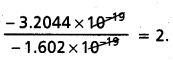
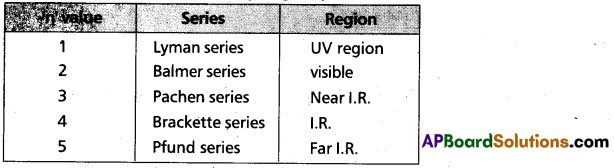
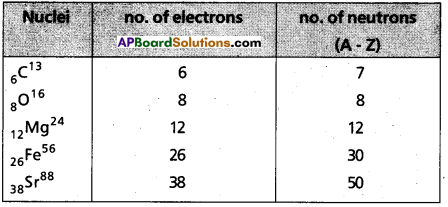
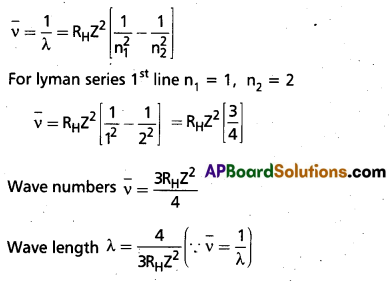
AP Inter 1st Year Chemistry Study Material Chapter 5 Stoichiometry

Andhra Pradesh BIEAP AP Inter 1st Year Chemistry Study Material 5th Lesson Stoichiometry Textbook Questions and Answers.

AP Inter 1st Year Chemistry Study Material 5th Lesson Stoichiometry

Very Short Answer Questions

Question 1.
How many number of moles of glucose are present in 540 gms of glucose?
Answer:
Formulae:
No. of moles = \(\frac{\text { Weight }}{\text { G.M. Wt }}\)
= \(\frac{540}{180}\)
= 3
Given
Weight of glucose = 540 gms
G.M. wt = 180 (C6H12O6)
No. of moles of glucose in 540 gms = 3 moles.

Question 2.
Calculate the weight of 0.1 mole of sodium carbonate.
Answer:
Formulae:
No. of moles = \(\frac{\text { Weight }}{\mathrm{GMWt}}\), 0.1 = \(\frac{\text { Weight }}{106}\)
Weight = 10.6 × 0.1 = 10.6 gms
Given
No. of moles = 0.1
G.M. Wt of Na2CO3 = 106

AP Inter 1st Year Chemistry Study Material Chapter 5 Stoichiometry

Question 3.
How many molecules of glucose are present in 5.23g of glucose (Molecular weight of glucose 180 u).
Answer:
Formulae:
No. of molecules = No. of moles × Avagadro no
No. of moles = \(\frac{\text { Weight }}{\text { GM Wt }}\) = \(\frac{5.23}{180}\) = 0.02906 moles
No. of molecules = 0.02906 × 6.023 × 1023
= 1.75 × 10²² molecules
Given
Wt of glucose = 5.23 gms
G.M. Wt = 180

Question 4.
Calculate the number of molecules present in 1.12 × 10⁻⁷ c.c. of a gas at STP (c.c. cubic centimeters = cm3).
Answer:
1 mole of any gas occupies 22400 cc of volume
1 mole of any gas contains 6.023 × 10²³ molecules
∴ 22400 cc of gas at STP contains 6.023 × 10²³ molecules
1.12 × 10⁻⁷ cc of a gas at STP contains ——–?
\(\frac{1.12 \times 10^{-7} \times 6.023 \times 10^{23}}{22400}\) = 3.015 × 10¹² molecules

Question 5.
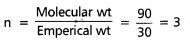
The empirical formula of a compound is CH2O. Its molecular weight is 90. Calculate the molecular formula of the compound. (A.P. Mar. ‘16) (Mar. 13)
Answer:
Formulae:
AP Inter 1st Year Chemistry Study Material Chapter 5 Stoichiometry 1
∴ Molecular formula = 3(CH2O) = Cr (NO3)3(aq) + Pb(s).
Given
Molecular wt = 90
Emperical formula = CH3O
∴ Emperical wt = 30

AP Inter 1st Year Chemistry Study Material Chapter 5 Stoichiometry

Question 6.
Balance the following equation by the oxidation number method
Cr(S) + Pb(NO3)2(aq) → Cr (NO3)3(aq) + Pb(s).
Answer:
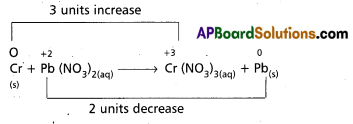
AP Inter 1st Year Chemistry Study Material Chapter 5 Stoichiometry 2
So the balanced equation is 2Cr + 3Pb(NO3)2 → 2Cr(NO3)3 + 3Pb

Question 7.
What volume of H2 at STP is required to reduce 0.795 g of CuO to give Cu and H2O.
Answer:
Balance equation is
CuO + H2 → Cu + H2O
79.5 gms → 1 mole H2 gas for reduction → 22.4 lit of volume at STP
∴ 79.5 gms of CuO require 22.4 lit of H2 at STP
Then 0.795 gms of CuO require ——-?
\(\frac{0.795 \times 22.4}{79.5}\) = 0.224 lit.

AP Inter 1st Year Chemistry Study Material Chapter 5 Stoichiometry

Question 8.
Calculate the volume of O2 at STP required to completely burn 100 ml of acetylene.
Answer:
Balanced chemical equation for combustion of acetylene is
2C2H2 + 5O2 → 4CO2 + 2H2O
2 moles of C2H2 require 5 moles of O2 for complete combustion at STP
2 × 22400 ml of C2H2 require 5 × 22400 ml of O2 at STP
Then 100 ml of C2H2 require ————?
\(\frac{100 \times 5 \times 22400}{2 \times 22400}\) = \(\frac{500}{2}\) = 250 ml

Question 9.
Now-a-days it is thought that oxidation is simply decrease in electron density and reduction is increase in electron density. How would you justify this?
Answer:
Oxidation : The process of removing electrons from an element is called oxidation. It is also called
as de-electronation.

  • Oxidation means decrease in electron density
    e.g. : 2Cl → Cl2 + 2\(e^{\ominus}\)
  • Oxidation process occurs at anode in the electrolysis process.
  • Reduction : The process of addition of electrons to an element is called reduction. It is also called as electronation.
  • Reduction means increase in electron density.
    e.g.: Mg2+ + 2e → Mg
  • Reduction process occurs of cathode in the electrolysis process.

Question 10.
What is a redox concept? Give an example.
Answer:
Redox reactions are the reactions in which reduction and oxidation both takes place.
e.g.:
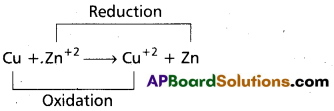
AP Inter 1st Year Chemistry Study Material Chapter 5 Stoichiometry 3

Question 11.
Calculate the mass per cent of the different elements present in sodium sulphate (Na2SO4).
Answer:
Given compound is sodium sulphate (Na2SO4)
Molecular weight of the compound = 2(23) + 1(32) + 4(16)
= 46 + 32 + 64
= 142

Step – I:
Mass percent of Na
142 gms of Na2SO4 → 46 gms of Na
100 gms of Na2SO4 → ?
\(\frac{100 \times 46}{142}\) = 32.39%

Step – II:
Mass percent of ‘S’
142 gms of Na2SO4 → 32 gms of ‘S’
100 gms of Na2SO4 → ?
\(\frac{100 \times 32}{142}\) = 22.53%

Step-III:
Mass percent of ‘0’
142 gms of Na2SO4 → 64 gms of oxygen
100 gms of Na2SO4 → ?
\(\frac{100 \times 64}{142}\) = 45.07%
∴ Mass percents of Na, S, O are 32.39, 22.53, 45.07.

Question 12.
What do you mean by significant figures?
Answer:
The meaningful digits which are known with certainty are called significant figures.

  • The uncertainty in the experimental (or) calculated values is indicated by mentioning the number of significant figures.

AP Inter 1st Year Chemistry Study Material Chapter 5 Stoichiometry

Question 13.
If the speed of light is 3.0 × 10⁸ ms-1. Calculate the distance covered by light in 2.00 ns.
Answer:
Given the speed of light 3 × 10⁸ m/sec.
i.e., 1 sec → 3 × 10⁸ m
In 2 nano seconds → ?
2 × 10⁻⁹ sec
\(\frac{2 \times 10^{-9} \times 3 \times 10^8}{1}\) = 6 × 10-1 = 0.6 m

Short Answer Questions

Question 1.
The approximate production of sodium carbonate per month is 424 × 108 g, while that of methyl alcohol is 320 × 106 g. Which is produced more in terms of moles?
Answer:
Given that weight of Na2CO3 produced per month = 424 × 106 gms
No. of moles of Na2CO3 = \(\frac{w t}{\text { GMwt }}\) = \(\frac{424 \times 10^6}{106}\) = 4 × 10⁶ moles per month
Given weight of CH3OH produced per month = 320 × 106 gms
No. of moles of CH3OH = = \(\frac{320 \times 10^6}{32}\) = 107 moles per month
Methyl Alcohol is produced more (per month) in terms of moles.

Question 2.
How much minimum volume of CO at STP is needed to react completely with 0.112 L of O2 at 1.5 atm pressure and 127°C to give CO2.
Answer:
Formula \(\frac{P_1 V_1}{T_1}\) = \(\frac{P_2 V_2}{T_2}\)
At STP
P1 = 1 atm
V1 = ?
T1 = 0°C = 273 K
Given P2 = 1.5 at m
V2 = 0.112 lit
T2 = 127°C = 400 K
\(\frac{1 \times V_1}{273}\) = \(\frac{1.5 \times 0.112}{400}\)
V1 = \(\frac{1.5 \times 0.112 \times 273}{400}\)
= 0.1147 lit
Chemical equation
2CO + O2 → 2CO2
2 moles of CO → 1 mole of O2 at STP
2 × 22.4 lit → 1 × 22.4 lit
? ← 0.1147 lit
\(\frac{0.1147 \times 2 \times 22.4}{22.4}\) = 0.2294 lit
The volume of CO required at STP = 0.2294 lit = 229.4 ml

Question 3.
Chemical analysis of a carbon compound gave the following percentage composition by weight of the elements present, carbon = 10.06%, hydrogen = 0.84%. chlorine = 89.10%. Calculate the empirical formula of the compound.
Answer:
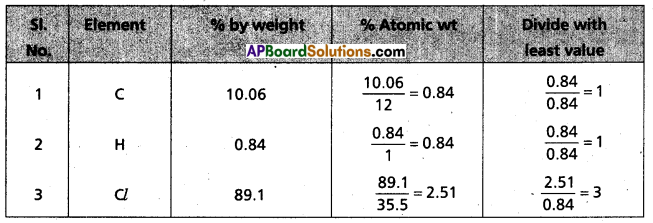
AP Inter 1st Year Chemistry Study Material Chapter 5 Stoichiometry 4
∴ Emperical formula of given compound = C1H1Cl3
= CHCl3

Question 4.
A carbon compound on analysis gave the following percentage composition, carbon 14.5%, hydrogen 1.8%, chlorine 64.46%, oxygen 19.24%. Calculate the empirical formula of the compound.
Answer:
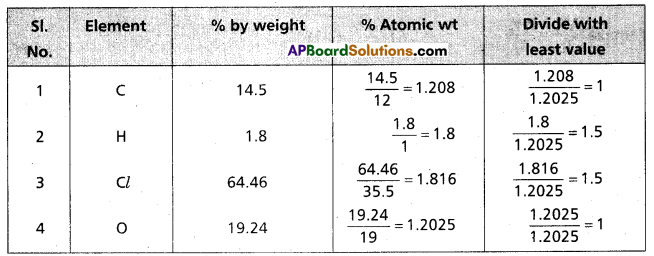
AP Inter 1st Year Chemistry Study Material Chapter 5 Stoichiometry 5
∴ The formula of the compound = C1 H1.5 Cl1.5 O1
Emperical formula of the compound = C2 H3 Cl3 O2

Question 5.
Calculate the empirical formula of a compound having percentage composition : Potassium (K) = 26.57, chromium (Cr) = 35.36; oxygen (0) 38.07. (Given the atomic weights of K. Cr and O as 39; 52 and 16 respectively).
Answer:
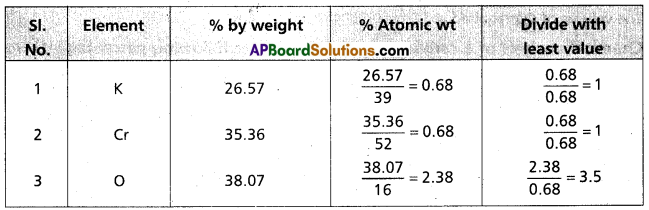
AP Inter 1st Year Chemistry Study Material Chapter 5 Stoichiometry 6
Formula of the compound = K1 Cr1 O3.5
Emperical formula of the compound = K2 Cr2 O7

Question 6.
A carbon compound contains 12.8% carbon, 2.1% hydrogen, 85.1% bromine. The molecular weight of the compound is 187.9. Calculate the molecular formula.
Answer:
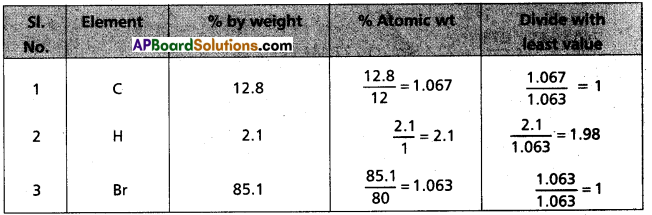
AP Inter 1st Year Chemistry Study Material Chapter 5 Stoichiometry 7
∴ Emperical formula of the compound = C1 H2 Br
Molecular formula = n (Emperical formula)
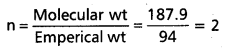
AP Inter 1st Year Chemistry Study Material Chapter 5 Stoichiometry 8
Given molecular wt = 187.9
Emperical wt = 94 (CH2 Br)
∴ Molecular formula = 2 (CH2Br)
= C2H4Br2

Question 7.
0.188 g of an organic compound having an empirical formula CH2Br displaced 24.2 cc. of air at 14 °C and 752 mm pressure. Calculate the molecular formula of the compound. (Aqueous tension at 14°C is 12mm).
Answer:
Given Emperical formula CH2Br
Wt. of compound = 0.188 gms
Volume of displaced air = 24.2 CC
Temperature = 14°C = 287 K
Pressure = 752 mm.
STP conditions
P1 = 760 mm
v1 = ?
T1 = 273 K
Given conditions
P2 = Pressure – aqueous tension
= 752 – 12mm = 740 mm
V2 = 24.2K
T2 = 287 K

Formula

\(\frac{P_1 V_1}{T_1}\) = \(\frac{P_2 V_2}{T_2}\) ⇒ \(\frac{760 \times V_1}{273}\) = \(\frac{740 \times 24.2}{287}\)
V1 = \(\frac{740 \times 24.2}{287} \times \frac{273}{760}\) = 22.414ml (or) 22.414 CC

∴ 0.188 gms of organic compound displaced 22.414 CC of air gms of organic compound displaced 22400 CC of air
\(\frac{22400}{22.414} \times 0.188\) = 188 ∴ Gram molecular wt of compound = 188
Molecular formula = n (Emperical formula)
= n (CH2Br)
n = \(\frac{\text { Molecular wt }}{\text { Emperical wt }}\) = \(\frac{188}{94}\) = 2 ∴ Molecular formula = C2 H4 Br2

Question 8.
Calculate the amount of 90% H2S04 required for the preparation of 420 kg HCl.
2 NaCl + H2SO4 → Na2SO4 + 2 HCl
Answer:
Given equation is
2NaCl + H2SO4 → 4 Na2SO4 + 2HCl
1 Mole H2SO4 → 2 Moles HCl
98 gms of H2SO4 → 2 × 36.5 = 73 gms of HCl
? → 420 × 103 gms of HCl
\(\frac{420 \times 10^3 \times 98}{73}\) = 563.84 × 10³ gms
For 100% H2SO4 → 563.84 × 10³
For 90% H2SO4 → 563.84 × 10³ × \(\frac{100}{90}\)
= 626.5 × 10³ gms of H2SO4
∴ 626.5 × 10³ gms of 90% H2SO4 is required to produce 420 × 103 gms of HCl

Question 9.
An astronaut receives the energy required in his body by the combustion of 34g of sucrose per hour. How much oxygen he has to carry along with him for his energy requirement in a day ?
Answer:
Given sucrose quantity required per hour = 34 gms
Sucrose quantity required per a day = 34 × 24 gms
Chemical equation of combustion of sucrose
C12 H22 O11 + 12O2 → 12CO2 + 11 H2O + Energy
1 mole sucrose → 12 moles of Oxygen
342 gms of sucrose → 12 × 32 gms of oxygen
34 × 24 gs of sucrose → ?
\(\frac{34 \times 24}{342}\) × 12 × 32 = 916.21 gms
∴ The astronaut require 916.21 gms of Oxygen per a day

Question 10.
What volume of CO2 is obtained at STP by heating 4g of CaCO3 ?
Answer:
Chemical Equation is
CaCO3 AP Inter 1st Year Chemistry Study Material Chapter 5 Stoichiometry 9 CaO + CO2
1 mole CaCO3 → 1 mole CO2 at STP
100 gms of CaCO3 → 22.4 lit of CO2 at STP
4gms of CaCO3 → ?
\(\frac{4 \times 22.4}{100}\) = 0.896 lit

Question 11.
When 50g of a sample of sulphur was burnt in air 4% of the sample was left over. Calculate the volume of air required at STP containing 21% oxygen by volume.
Answer:
Given that when a 50 gms of sample of sulphur was burnt 4% of the sample was left over.
∴ 50 gms of S → 48 gms of ‘S’ burnt.
Chemical equation is S + O2 → SO2
32 gm of ‘S’ 22.4 lit of O2 at STP
48 gms of S →
100 ml air contains 21 ml of oxygen
100 lit of air contains 21 lit of oxygen
33.6 lit of oxygen is present in \(\frac{33.6 \times 100}{21}\) = 160 lit
∴ The volume of air needed for combustion = 160 lit

Question 12.
Calculate the volume of oxygen gas required at STP conditions for the complete combustion of 10 cc of methane gas at 20°C and 770 mm pressure.
Answer:
Given 10 cc of methane (CH4) undergoes combustion at 20°C and 770 mm pressure
STP Conditions
P1 = 760 mm
V1 = ?
T1 = 273 k
Given conditions
P2 = 770 mm
V2 = 10 cc
T2 = 20°C = 293 k

AP Inter 1st Year Chemistry Study Material Chapter 5 Stoichiometry

Formulae
\(\frac{P_1 V_1}{T_1}\) = \(\frac{\mathrm{P}_2 \mathrm{~V}_2}{\mathrm{~T}_2}\)
\(\frac{760 \times V_1}{273}\) = \(\frac{770 \times 10}{293}\)
V1 = \(\frac{770 \times 10 \times 273}{293 \times 760}\) = 9.44 cc ∴ Volume of methane (CH4) at STP = 9.44 cc.

Chemical equation is
CH4 + 2O2 → CO2 + 2H2O
1 mole CH4 → 2 moles of oxygen
22,400 cc of CH4 → 2 × 22400 cc of oxygen
9.44 cc of CH4 → ?
\(\frac{9.44}{22400}\) × 2 × 22400 = 18.88 cc ∴ Volume of oxygen gas required STP = 18.88 cc.

Question 13.
Calculate the volume of H2 liberated at 27°C and 760 mm of Hg pressure by action by 0.6g of magnesium with excess of dil HCl.
Answer:
Chemical equation is
Mg + 2HCl → MgCl2 +H2
24 gms. of Mg → 1 mole of H2 at STP
= 22.4 lit at STP
0.6 gms. of Mg → ?
\(\frac{0.6 \times 22.4}{24}\) = 0.56 lit = 560 ml

Formula
\(\frac{P_1 V_1}{T_1}\) = \(\frac{P_2 V_2}{T_2}\)
\(\frac{760 \times V_1}{300}\) = \(\frac{760 \times 560}{273}\)
V1 = \(\frac{560 \times 300}{273}\) = 615.4 ml
∴ volume of H2 liberated at 27°C and 760 mm of presence = 615.4 ml = 0.6154 Lit.

Given conditions
P1 = 760 mm
V1 = ?
T1 = 27° mm

STP conditions
P2 = 760 mm
V2 = 560 ml
T2 = 0° C = 273 k

Question 14.
Explain the role of redox reactions in titrimetre processes and galvanic cells.
Answer:
a) Redox reactions in titrimetric quantitative analysis : In titrimetric analysis the substance of known concentration is called the titrant and the substance being titrated is called the titrand. The standard solution is generally added from a long graduated tube called burette. The process of adding the standard solution until the reaction is just complete is called titration. The substance to be estimated is titrated. The point at which the titrand just completely reacts is called the equivalence point (or) the theoretical point (or) stoichiometric end point. In the redox reactions the completion of the titration is detected by a suitable method like

  1. Observing a physical change, for example, the light pink colour of KMnO4 titrations.
  2. By using a reagent known as indicator which gives a clear visual change like colour change, formation of turbidity etc. The point at wh’ch this is observed is called the end point of the titration which should coincide with theoretical end point.

Examples:

  1. In Cr2\(\mathrm{O}_7^{2-}\) titrations dippenyl amine is used as indicator and at the end poirtt it produces intense blue colour due to oxidation by Cr2\(\mathrm{O}_7^{2-}\).
  2. In the titration of Cu+2 with I
    2Cu2+ (aq) + 4I (aq) → Cu2I2 (s) + I2 (aq)
    A redox reaction I2 gives a deep blue colour with starch solution.
  3. In the titration of I2 (aq) S2\(\mathrm{O}_3^{-2}\) as per the stoichiometric reduce equation.
    In this way redox reactions are taken as the basis for titrimetric analysis with Mn\(\mathrm{O}_4^{-}\), Cr2\(\mathrm{O}_7^{-2}\) etc., as oxidising agents and S2\(\mathrm{O}_3^{-}\) etc., as a reducing agents,

b) Redox Reactions – Galvanic cells : Redox reaction (i.e) cell reaction that takes place in gavamic cell is
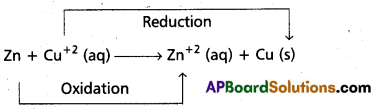
AP Inter 1st Year Chemistry Study Material Chapter 5 Stoichiometry 10
The process of transfer of electrons from Zn(s) to Cu+2 take place directly. To make this transfer indirectly, Zn rod is kept in ZnSO4 solution in one beaker and in the other beaker CuSO4 solution is taken and a copper rod is dipped in it. Now the redox reaction takes place in either of the beakers. Each beakers contains both oxidised and reduced forms of the respective species in the beakers containing CuSO4 solution & Cu rod at the interface Cu and Cu+2 and in the other beaker at the interface Zn and Zn+2. The two forms i.e., oxidised and reduced forms of a species participating in oxidation and reduction half reactions is called redox couple. Both the beakers contains each a redox couple. The oxidised form and reduced form are separated by a vertical line (or) a slash that represent an interface, e.g.: Zn (s) / Zn+2 (aq)

In the above arrangement, the two redox couples are represented by Zn+2 / Zn and Cu+2 / Cu.
halvamic cell is represented as : Zn/Zn2+//Cu+2/Cu.

Question 15.
Define and explain molar mass.
Answer:
Molar mass : The mass of one mole of any substance in gms is called its molar mass,
e.g. :

  1. Molar mass of sulphuric acid = 98 g
  2. Molar mass of hydrogen is one gram for gram atomic mass and two grams for gram molecular mass.

Question 16.
What are disproportionation reactions ? Give example. (T.S. Mar. ’16)
Answer:
Disproportionation Reaction : Reactions in which same element in the given form to undergo both oxidation and reduction simultaneously.

AP Inter 1st Year Chemistry Study Material Chapter 5 Stoichiometry 11
Here Cl2 undergoes both oxidation and reduction reactions. So, above reaction is disproportionation reaction.

Question 17.
What are comproportionation reactions ? Give example.
Answer:
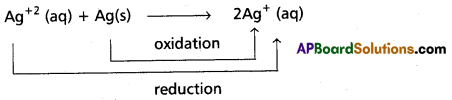
Comproportionation reactions : In these reactions, two species with the same element in two different oxidation states form a single product in which the element is in an intermediate oxidation state. Reverse of disproportionation is comproportionation.
e.g.:
AP Inter 1st Year Chemistry Study Material Chapter 5 Stoichiometry 12

Question 18.
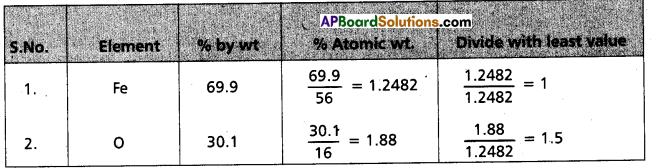
Determine the empirical formula of an oxide of iron which has 69.9% iron and 30.1% dioxygen by mass.
Answer:
AP Inter 1st Year Chemistry Study Material Chapter 5 Stoichiometry 13
∴ Formula of compound = Fe1O1.5
Emperical formula = Fe2O3

AP Inter 1st Year Chemistry Study Material Chapter 5 Stoichiometry

Question 19.
Calculate the mass of sodium acetate (CH3COONa) required to make 500 ml of 0.375 molar aqueous solution. Molar mass of sodium acetate is 82.0245 g mol-1.
Answer:
Formula
Molarity = \(\frac{\mathrm{Wt}}{\mathrm{GMwt}}\) × \(\frac{1000}{V(m l)}\)
Molarity = 0.375M
V = 500 ml
GMwt of CH3COONa = 82.0245
0.375 = \(\frac{W t}{82.0245}\) × \(\frac{1000}{500}\)
Wt = \(\frac{82.0245 \times 0.375}{2}\)
= 15.3795 gms
∴ Mass of CH3COONa required = 15.3795 gms

Question 20.
What is the concentration of sugar (C12H22O11) in mol L-1 if 20g are dissolved in enough water to make a final volume up to 2L ?
Answer:
Formula
Molarity = \(\frac{W t}{G M W t} \times \frac{1}{V(\text { lit })}\)
= \(\frac{20}{342} \times \frac{1}{2}\)
= 0.02924 M
Wt = 20 gms
GMWt = 342
[C12H22OH]
V = 2 lit

Question 21.
How many significant figures are present in the following ?

  1. 0.0025
  2. 208
  3. 5005
  4. 126,000
  5. 500.0
  6. 2.0034

Answer:

  1. 0.0025 has 2 significant figures
  2. 208 has 3 significant figures
  3. 5005 has 4 significant figures
  4. 126000 has 3 significant figures
  5. 500.0 has 4 significant figures
  6. 2.0034 has 5 significant figures

Question 22.
Round up the following upto three significant figures :

  1. 34.216
  2. 10.4107
  3. 0.04597
  4. 2808

Answer:

  1. 34.216 becomes 34.2
  2. 10.4107 becomes 10.4
  3. 0.04597 becomes 0.046
  4. 2808 becomes 281

Question 23.
Calculate the molarity of a solution of ethanol in water in which the mole fraction of ethanol is 0.040 (assume the density of water to be one)
Answer:
The relation between Molarity and mole fraction is given by

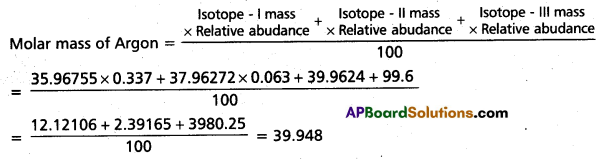
AP Inter 1st Year Chemistry Study Material Chapter 5 Stoichiometry 14
Given data, x2 = 0.040, M = ?
M1 = 18(H2O), M2 = 46 (C2H5OH), Cl = 1
0040 = \(\frac{M \times 18}{M(18-46)+1000 \times 1}\) = \(\frac{M \times 18}{-28 M+1000}\)
18 M = -0.040 × M × 28 + 0.040 × 1000
18 M = -1.12M + 40
(18 + 1.12)M = 40
19.12 M = 40
M = \(\frac{40}{19.12}\) = 2 09 M ∴ Molarity of Ethanol = 2.09 M

Given data
AP Inter 1st Year Chemistry Study Material Chapter 5 Stoichiometry 15

Question 24.
A welding fuel gas contains carbon and hydrogen only. Burning a small sample of it in oxygen gives 3.38 g carbon dioxide, 0.690 g of water and no other products. A volume of 10.0 L (measured at STP) of this welding gas is found to weigh 11.6 g. calculate
(i) empirical formula,
(ii) molar mass of the gas and
(iii) molecular formula.
Answer:
Assuming 1 gm. of gas is burnt
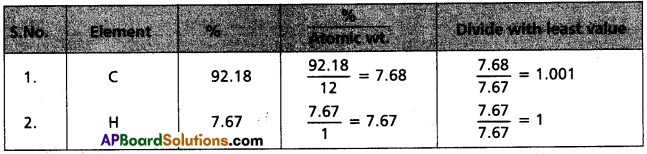
The weight % of ‘C’ = \(\frac{3.38 \times 12}{44}\) × 100 = 92.18%
The weight % of ‘H’ = \(\frac{0.69 \times 2}{18}\) = 7.67%
i)
AP Inter 1st Year Chemistry Study Material Chapter 5 Stoichiometry 16
Experical formula of compound = C1H1

ii) Given 10 lit of gas at STP weighs – 11.6 gas
22.44 lit of gas at STP weights = \(\frac{22.4 \times 11.6}{10}\) = 25.984
∴ Molecular weight of given gas = 25.984

iii) Molecular formula = n(emperical formula)
n = \(\frac{\text { Mol. wt }}{\text { Emp. wt }}\) = \(\frac{25.984}{13}\) = 2 ∴ Molecular formula = 2(CH) = C2H2.

Question 25.
Calcium carbonate reacts with aqueous HCl to give CaCl2 and CO2 according to the reaction CaCO3(5) + 2 HCl(aq) → CaCl2(aq) + CO2(g) + H2O (L). What mass of CaCO3 is required to react completely with 25 mL of 0.75 M HCl?
Answer:
Given chemical reaction
CaCO3(s) + 2HCl(aq) → CaCl2(aq) + CO2(g) + H2O(l)
Molarity = \(\frac{\mathrm{Wt}}{\mathrm{GMWt}} \times \frac{1000}{\mathrm{~V}(\mathrm{~m})}\)
0.75 = \(\frac{\mathrm{Wt}}{36.5} \times \frac{1000}{25}\)
M = 0.75 M
W = ?
Wt = \(\frac{0.75 \times 36.5 \times 25}{1000}\)
= 0.6844 gms of HCl
GMwt = 36.5
V = 25 ml
From the equation
1 mole of CaCO3 – 2 moles of HCl
100 gms of CaCO3 – 2 × 36.5 gms of HCl
? – 0.6844 gms of HCl
∴ Mass of CaCO3 = \(\frac{0.6844}{2 \times 36.5}\) × 100 = 0.937 5 gms

AP Inter 1st Year Chemistry Study Material Chapter 5 Stoichiometry

Question 26.
Chlorine is prepared in the laboratory by treating manganese dioxide (MnO2) with aqueous hydrochloric acid according to the reaction
4 HCl (aq) + MnO2(s) → 2 H2O (l) + MnCl2(aq) + Cl2(g)
How many grams of HCl react with 5.0 g of manganese dioxide?
Answer:
Given chemical reaction is
4HCl(aq) + MnO2(s) → MnCl2(aq) + 2H2O(l) + Cl2(g)
4 moles of HCl – 1 mole of MnO2
4 × 36.5 gms. of HCl – 87 gms. of MnO2
∴ Weight of HCl required = \(\frac{5 \times 4 \times 36.5}{87}\) = 8.39 gms.

Question 27.
To 50 ml of 0.1 N Na2CO3 solution 150 ml of H2O is added. Then calculate a normality of resultant solution.
Answer:
Formulae N1V1 = N2V2
0.1 × 50 = N2 × 200
N2 = \(\frac{0.1}{4}\)
= 0.025 N
N1 = 0.1 N
V1 = 50 ml
N2 = ?
V2 = 150 + 150 = 200 ml

Question 28.
Calculate the volume of 0.1 N H2SO4 required to neutralize 200 ml of 0.2 N NaOH solution. It is an acid base neutralisation reaction. Hence, at the neutralisation point. Number of equivalents of acid = Number of equivalents of base.
Answer:
Formula N1V1 = N2V2
0.1 × V1 = 0.2 × V2
V2 = 2 × 200
= 400 ml
N1 = 0.1 N
V1 = ?
V2 = 200 ml
N2 = 0.2 N

Question 29.
Calculate normality of H2SO4 solutions if 50 ml of it completely neutralises 250 ml of 0.1 N Ba(OH)2 solutions.
Solution:
Formulae N1V1 = N2V2
N × 50 = 0.1 × 250
N1 = 0.5 N
N1 = ?
V1 = 50 ml
N2 = 0.1 N
V2 = 250 ml

AP Inter 1st Year Chemistry Study Material Chapter 5 Stoichiometry

Question 30.
Calculate the volume of 0.1 M KMnO4 required to react with 100 ml of 0.1 M H2C2O4.2H2O solution in presence of H2SO4.
Answer:
Balanced chemical equation for the given data is
Formulae
\(\frac{M_1 V_1}{n_1}\) = \(\frac{M_2 V_2}{n_2}\)
\(\frac{0.1 \times V_1}{2}\) = \(\frac{0.1 \times 100}{8}\)
V1 = 40 ml

KMnO4
M1 = 0.1 M
V1 = ?
n1 = 2

Oxalic acid

M2 = 0.1 M
V2 = 100 ml
n2 = 5

Question 31.
Assign oxidation number to the underlined elements in each of the following species:
a) NaH2PO4
b) NaHSO4
c) H4P2O7
d) K2MnO4
e) CaO2
f) NaH4
g) H2S2O7
h) KAl(SO4)2.12 H2O
Answer:
a) NaH2PO4
1(+1) + 2(+1) + x + 4(-2) = 0
1 + 2 + x – 8 = 0
x – 5 = 0
x= + 5
Oxidation no. of ‘P in NaH2PO4 = + 5

b) NaHSO4
1(+1) + 1(+1) + x + 4(-2) = 0
1 + 1 + x – 8 = 0
x = +6
Oxidation no. of ‘S in NaHSO4 = + 6

c) H4P2O7
4(+1) + 2x + 7(-2) = 0
4 + 2x – 14 = 0
2x – 10 = 0.
x = +5
Oxidation no. of ‘P’ in H4P2O7 is +5

d) K2MnO4
2(+1) + x + 4(-2) = 0
2 + x – 8 = 0
x = + 6
Oxidation no of Mn is K2MnO4 = +6

e) CaO2
+ 2 + 2x = 0
2x = -2
x = -1
Oxidation no. of oxygen in CaO2 = -1

f) NaBH4
1(+1) + x + 4 (-1) = 0
1 + x – 4 = 0
x = +3
Oxidation no. of ‘B’ in NaBH4 = + 3
But B’ most probably exhibits – 3 oxidation state.

g) H2S2O7
2(1) + 2x + 7(-2) = 0
2 + 2x – 14 = 0
2x – 12 = 0
x = +6
Oxidation state of ‘S’ in H2S2O7 = + 6

h) K Al(SO4)2 12H2O :
General formula of above compound is K2SO4 Al2 (SO4)3 2 + H2O (Potash alum)
Consider Al2(SO4)3 from the above double salt
2x + 3 (-2) = 0
2x – 6 = 0
x = + 3

Question 32.
What are the oxidation number of the underlined elements in each of the following and how do you rationalise your results ?
a) KI3
b) H2SO4O6
c) Fe3O4
Answer:
a) KI3
It is formed by the combining KI, I2
∴ Oxidation no. of ‘I’ in KI = – 1
[1 + x = 0
x = – 1]
In I2 oxidation no. of. I = 0

b) H2S4O6
According to H2S4O6 structure
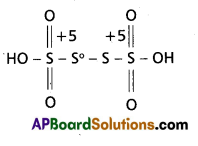
AP Inter 1st Year Chemistry Study Material Chapter 5 Stoichiometry 17
2(1) + 4x + 6(-2) = 0 ⇒ 4x – 10 = 0
x = 2.5
‘S’ average Ox. No = 2.5

c) Fe3O4
3x + 4(-2) = 0
3x – 8 = 0
x = \(\frac{8}{3}\)
In general Fe3O4 obtained by FeO + Fe2O3
∴ In FeO → x = + 2 [x – 2 = 0 ⇒ x = + 2]
In Fe2O3 → x = + 3 [2x – 6 = 0 ⇒ x = + 3]

Question 33.
Justify that the following reactions are redox reactions :
Answer:
a) CuO(s) + H2(g) → Cu(s) + H2O(g)
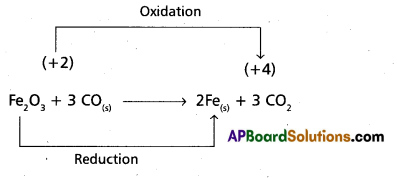
b) Fe2O3(s) + 3CO(g) → 2 Fe(s) + 3 CO2(g)
c) 4 BCl3(g) + 3 LiAlH4(s) → 2 B2H6(g) + 3 LiCl(s) + 3 AlCl3(s)
d) 2 K(s) + F2(g) → 2 K+F(s)
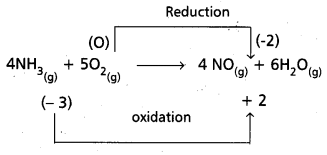
e) 4 NH3(g) + 5 O2(g) → 4 NO(g) + 6 H2O(g)
a)
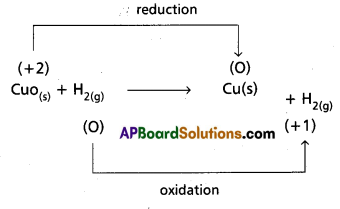
AP Inter 1st Year Chemistry Study Material Chapter 5 Stoichiometry 18
Hence it is a Redox reaction.

b)
AP Inter 1st Year Chemistry Study Material Chapter 5 Stoichiometry 19
Hence it is a Redox reaction.

c) \(4 \mathrm{BCl}_{3_{(g)}}\) + \(3 \mathrm{LiAlH}_{4_{(s)}}\) → \(2 \mathrm{~B}_2 \mathrm{H}_{6_{(g)}}\) + \(3 \mathrm{LiCl}_{(s)}\) + \(4 \mathrm{AlCl}_{3_{(\mathrm{s})}}\)
Here in the above reaction the oxidation states of all elements doesnot changed. So it is not a redox reaction.

d)
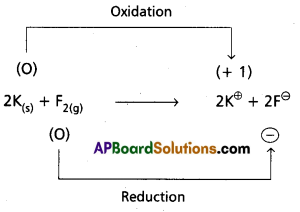
AP Inter 1st Year Chemistry Study Material Chapter 5 Stoichiometry 20
Hence it is a redox reaction.

e)
AP Inter 1st Year Chemistry Study Material Chapter 5 Stoichiometry 21
Hence it is a redox reaction.

AP Inter 1st Year Chemistry Study Material Chapter 5 Stoichiometry

Question 34.
Fluorine reacts with ice and results in the change
H2O(S) + F2(g) → HF(g) + HOF(g)
Justify that this reaction is a redox reaction.
Answer:
Given chemical equation
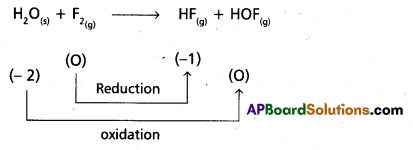
AP Inter 1st Year Chemistry Study Material Chapter 5 Stoichiometry 22
Hence it is a redox reaction.

Question 35.
Calculate the oxidation number of sulphur, chromium and nitrogen in H2SO5, Cr2\(O_7^{-2}\) and \(\mathrm{NO}_3^{-}\). Suggest structure of these compounds.
Answer:
a) H2SO5 Structure:
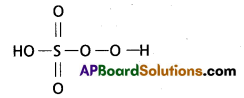
AP Inter 1st Year Chemistry Study Material Chapter 5 Stoichiometry 23
2(1) + x + 2(-1) + 3(-2) = 0 (One peroxy linkage)
2 + x – 2 – 6 = 0
x = +6

b) Cr2\(\mathrm{O}_7^{-2}\) Structure:
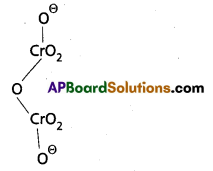
AP Inter 1st Year Chemistry Study Material Chapter 5 Stoichiometry 24
2(x) + 7(-2) = -2
2x – 14 = -2
x = +6

c) \(\mathrm{NO}_3^{-}\) Structure:
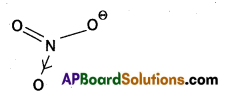
AP Inter 1st Year Chemistry Study Material Chapter 5 Stoichiometry 25
x + 3(-2) = -1
x – 6 = -1
x = +5

Question 36.
Write formulas for the following compounds: .
a) Mercury (II) chloride
b) Nickel (II) sulphate
c) Tin (IV) oxide
d) Thallium (I) sulphate
e) Iron (III) sulphate
f) Chromium (III) oxide
Answer:
Formula
a) Mercury (II) Chloride — HgCl2
b) Nickel (II) Sulphate — NiSO4
c) Tin (IV) Chloride — SnCl4
d) Thallium (I) Sulphate — Tl2SO4
e) Iron (III) Sulphate — Fe2(SO4)3
f) Chromium (III) Oxide — Cr2O3

AP Inter 1st Year Chemistry Study Material Chapter 5 Stoichiometry

Question 37.
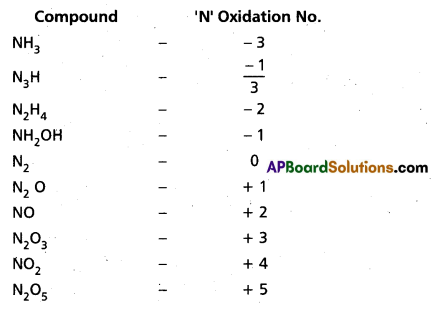
Suggest a list of the substances where carbon can exhibit oxidation states from -4 to +4 and nitrogen from -3 to +5.
Answer:
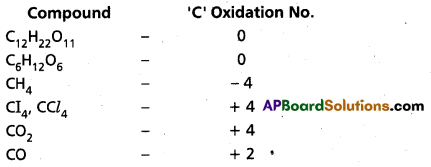
AP Inter 1st Year Chemistry Study Material Chapter 5 Stoichiometry 26
AP Inter 1st Year Chemistry Study Material Chapter 5 Stoichiometry 27

Question 38.
While sulphur dioxide and hydrogen peroxide can act as oxidising as well as reducing agents in their reactions, ozone and nitric acid act only as oxidants. Why ?
Answer:
SO3 and H2O2 both acts as oxidising as well as reducing agents.

  • Ozone acts as strong oxidising agent in acidic medium (Ozone acts as reducing agent also in some cases).
  • HNO3 acts as strong oxidising agent because in HNO3. He H+ ion readily released and the oxidation state of ‘N’ is +5 in HNO3. So it is a good oxidising agent.

Question 39.
Consider the reactions :
a) 6 CO2(g) + 6 H2O (l) → C6H12O6 (aq) + 6 O2(g)
b) O3 (g) + H2O2 (l) → H2O () + 2 O2 (g)
Why it is more appropriate to write these reactions as :
a) 6 CO2 (g) + 12 H2O(l) → C6H12O6(aq) + 6 H2O(l) + 6 O2(g)
b) O3(g) + H2O2(l) → H2O2(l) + O2(g) + O2(g)
Also suggest a technique to investigate the path of the above (a) and (b) redox reactions.
Answer:
a) 6CO2 + 12 H2O → C6H12O6 + 6 H2O + 6 O2
This equation is more appropriate writing equation of photosynthesis.
Because of evolution of oxygen from H2O but not from CO2.

b) O3(g) + H2O2(l) → H2O(l) + O2(g) + O2(g)
This is the more appropriate equation to write because in this reaction clearly mentioned that which is oxidised and which is reduced.

Question 40.
The compounds AgF2 is unstable compound. However, if formed, the compound acts as a very strong oxidising agent. Why ?
Answer:

  • AgF2 is an unstable compound.
  • If suppose it is formed it acts as good oxidising agent.

Reason :
AgF2 releases fluorine gas which is a powerful oxidising agent.
∴ AgF2 is a good oxidising agent.

Question 41.
Whenever a reaction between an oxidising agent and a reducing agent is carried out, a compound of lower oxidation state is formed if the reducing agent is in excess and a compound of higher oxidation state is formed if the oxidising agent is in excess. Justify this statement giving three illustrations.
Answer:
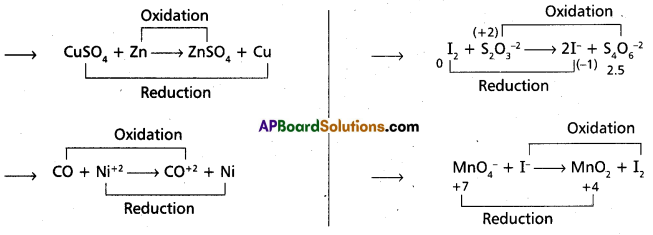
AP Inter 1st Year Chemistry Study Material Chapter 5 Stoichiometry 28
The above equations illustrates the given statement.

Question 42.
How do you count for the following observations ?
a) Though alkaline potassium permagnate and acidic potassium permanganate both are used as oxidants, yet in the manufacture of benzoic acid from toluene we use alcoholic potassium permanganate as an oxidant. Why ? Write a balanced redox equation for the reaction.
b) When concentrated sulphuric acid is added to an inorganic mixture containing chloride, we get colourless pungent smelling gas HCl, but if the mixture contains bromide then we get red vapour of bromine. Why ?
Answer:
a) Balanced equation of KMn04/H+ (Acidic medium)
Mn\(\mathrm{O}_4^{-}\) + 8 H+ + 5 e → Mn+2 + 4 H2O
Balanced equation of KMnO4/ H+ (Basic medium)
Mn\(\mathrm{O}_4^{-}\) + 2 H2O + 3 e → MnO2 + 4 OH

  • Toluene is oxidised to benzoic acid in alcoholic medium.
  • Toluene is easily oxidised in presence of alcoholic KMnO4
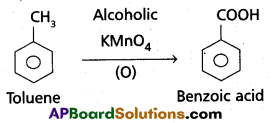
    AP Inter 1st Year Chemistry Study Material Chapter 5 Stoichiometry 29

b) When Conc. H2SO4 reacts with NaCl then HCl vapours are evolved.
2 NaCl + H2SO4 → Na2SO4 + 2 HCl
When Conc. H4SO4 reacts with KBr than HBr vapours are evolved which on further oxidation gives reddish brown Br2 vapours.
2 KBr + H2SO4 → Na2SO4 + 2 HBr
2MBr + H2SO4 → 2 H2O + SO2 + Br2 (Reddish brown)

Question 43.
Identify the substance oxidised, reduced, oxidising agent and reducing agent for each of the following reactions :
a) 2 AgBr (s) + C6H6O2 (aq) → 2 Ag (s) + 2 HBr (aq) + C6H6O2 (aq)
b) HCHO(l) + 2[Af(NH3)2]+(aq) + 3 OH(aq) → 2 Ag(s) + HCOO(aq) + 4 NH3(aq) + 2 H2O(l)
c) HCHO(l) + 2 Cu2+(aq) + 5 OH(aq) → Cu2O(s) + HCOO(aq) + 3 H2O(l)
d) N2H4 (l) + 2 H2O2(l) → N2(g) + 4 H2O(l)
e) Pb(s) + PbO2(s) + 2 H2SO4(aq) → 2 PbSO4(s) + 2 H2O(l)
Answer:
a) Given equation is
2 AgBr(s) + C6H6O2(aq)

  • 2 Ag(s) + 2 HBr(aq) + C6H4O2 (aq)
  • C6H6O2 oxidised to C6H4O2
  • Ag+Br reduced to Ag
  • Oxidising agent is Ag+
  • Reducing agent is C6H6O2

b) Given equation is HCHO(l) + \(2\left[\mathrm{Ag}\left(\mathrm{NH}_3\right)_2\right]_{(\mathrm{aq})}^{+}\) + \(3 \mathrm{OH}_{(\mathrm{aq})}^{-}\)

  • 2 Ag(s) + \(3 \mathrm{OH}_{\text {(aq) }}^{-}\) + 4NH3(aq) + 2 H2O(l)
  • HCHO oxidised to HCOO
  • [Ag(NH3)2]+ reduced to Ag
  • [Ag(NH3)2]+ is oxidising agent
  • HCHO is reducing agent

c) Given equation is
HCHO(l) + \(2 \mathrm{Cu}_{(\mathrm{aq})}^{+2}\) + 5OH → Cu2O(s) + \(\mathrm{HCOO}_{(a q)}^{-}\) + 3H2O(l)

  • HCHO oxidised to HCOO
  • Cu+2 reduced to Cu+(in Cu2O)
  • Oxidising agent is Cu+2 ions (In Fehling’s reagent)
  • Reducing agent is HCHO

d) Given equation is
N2H4(l) + 2K2O2(l) → N2(g) + 4H2O(l)

  • \(N^{-2}\) oxidised to N2
  • \(\mathrm{O}_2^{-2}\) reduced to O-2
  • Oxidising agent is H2O2
  • Reducing agent is N2H4
    Pb(s) + pbO4(s) + 2H2SO4(aq)

e)

  • 2PbSO4(s) + 2H2O
  • Pb oxidised to Pb+2
  • PbO2 reduced to Pb+2
  • Oxidising agent is PbO2
  • Reducing agent is Pb

Question 44.
Consider the reactions :
2S2\(\mathrm{O}_3^{-2}\) (aQ) + I2 (s) → S4\(\mathrm{O}_6^{-2}\) (aQ) + 2I (aQ)
S2\(\mathrm{O}_3^{-2}\) (aQ) + I2(s) + 5H2O(l) → 2S\(\mathbf{O}_4^{-2}\) (aq) + 4\(\mathrm{Br}_{(\mathrm{aq})}^{-}\)(aq) + 10\(H_{(aq)}^{+}\)
Why does the same reductant, thiosulphate react differently with iodine and bromine ?
Answer:

  • Thio sulphate ion is not a strong reducing agent.
  • I2 is not a strong oxidising agent.
  • The reaction between I2 and thio sulphate form tetrathionate (S4\(\mathrm{O}_6^{-2}\)) ion.

    AP Inter 1st Year Chemistry Study Material Chapter 5 Stoichiometry 30
  • The above reaction has high rate of reaction.
  • The reaction between Thiosulphate and Bromine involves the formation of sulphate ion.

    AP Inter 1st Year Chemistry Study Material Chapter 5 Stoichiometry 31
  • Br2 is some what better oxidising agent than I2.
    Hence the difference observed in the above reactions.

Question 45.
Justify giving reactions that among halogens, fluorine is the best oxidant and among hydrohalic compounds, hydroiodic acid is the best reductant.
Answer:
a)

  • The oxidising capacity of any substance depends on the net result of several contributing energy factors like enthalpy change in a reaction, standard Electrode potential.
  • With reference to Born-Haber type energy cycle the change in enthalpy value is greater for fluorine.
  • Greater the magnitude of negative change in enthalpy greater is the oxidising power.

Supporting reaction :

  • Fluorine reacts with carbon while the other elements of group do not combine even under drastic conditions.
    C + 2 F2 → CF4
  • Fluorine is also called as superhalogen.

b)

  • Hydrohalic compounds acts as reducing agents. Their stability order is
    HF >> HCl > HBr > HI
  • HI is least stable and acts as strons reducing agent among these halides.
    H2 + I2 \(\rightleftharpoons\) 2 HI

Question 46.
Why does the following reaction occur ?

AP Inter 1st Year Chemistry Study Material Chapter 5 Stoichiometry 32
What conclusion about the compound Na4XeO6(of which AP Inter 1st Year Chemistry Study Material Chapter 5 Stoichiometry 75 is a part) can be drawn from the reaction.
Answer:
Given equation is

AP Inter 1st Year Chemistry Study Material Chapter 5 Stoichiometry 34

  • In the above reaction ‘Xe’ under go reduction (+8 to +6)
  • F oxidised to F2 here perxenate ion acts as powerful oxidising agent.
  • Perxenates are stable in alkali solutions.
  • Na4XeO6 is a powerful oxidant.

AP Inter 1st Year Chemistry Study Material Chapter 5 Stoichiometry

Question 47.
Consider the reactions :
(a) H3PO2(aq) + 4 AgNO3(aq) + 2 H2O(1) → H3PO4(aq) + 4Ag(s) + 4HNO3(aq)
(b) H3PO2(aq) + 2 CuSO4(aq) + 2 H2O(1) → H3PO4(aq) + 2Cu(s) + H2SO4(aq)
(c) C6H5CHO(l) + 2[Ag (NH3)2]+(aq) + 3OH(aq) → C6H5COO(aq) + 2Ag(s) + 4NH3(aq) + 2H2O(l)
(d) C6H5CHO(l) + 2Cu2+(aq) + 5OH(aq) → No Change observed.
what inference do you draw about the behaviour of Ag+ and Cu2+ from these reactions ?
Answer:

  • H3PO2 is a strong reducing agent hence it reduce Ag+ to Ag and Cu+2 to Cu.
  • C6H5CHO is also a reducing agent it just reduced.
    Ag+ to Ag in tollen’s reagent but it does not reduced Cu+2 in alkaline solution.

Question 48.
Balance the following redox reactions by ion – electron method :
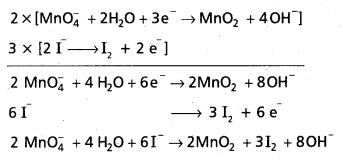
(a) Mn\(\mathrm{O}_4^{-}\) (aq) + I (aq) → MnO2(s) + I2 (s) (in basic medium)
(b) Mn\(\mathrm{O}_4^{-}\) (aq) + SO2 (g) → Mn2+ (aq) + HSO4 (aq) (in acidic solution)
(c) H2O2 (aq) + Fe2+ (aq) → Fe3+ (aq) + H2O(l) (in acidic solution)
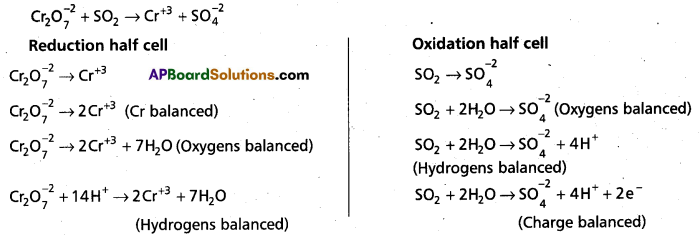
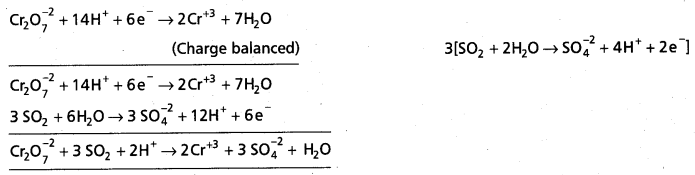
(d) Cr2\(\mathrm{O}_7^{2-}\)SO2 (g) → Cr3+ (aq) + S\(\mathrm{O}_4^{2-}\) (aq) (in acidic solution)
Answer:
a) Mn\(\mathrm{O}_{4 \text { (aq) }}^{-}\) + \(\mathbf{I}_{(\mathrm{aq})}^{-}\) → MnO2(s) + I2(s) (Basic medium)

Reduction half cell
\(\mathrm{MnO}_4^{-}\) → MnO2
\(\mathrm{MnO}_4^{-}\) → MnO2 + 2H2O (Oxygens balanced)
\(\mathrm{MnO}_4^{-}\) + 4H2O → MnO2 + 2H2O + 4OH
(Hydrogens balanced)
\(\mathrm{MnO}_4^{-}\) + 2H2O → MnO2 + 4OH
\(\mathrm{MnO}_4^{-}\) + 2H2O + 3e → MnO2 +4OH]
(Charge balanced)
2 × [Mn\(\mathrm{MnO}_4^{-}\) + 2H2O + 3e → MnO2 + 4OH-1]
3 × [2 I → I2 + 2e]
Oxidation half cell
I → I2
2 I → I2 (Iodines balanced)
2 I → I2 + 2 e (Charge balanced)
AP Inter 1st Year Chemistry Study Material Chapter 5 Stoichiometry 35
The above equation is balanced equation.

b)
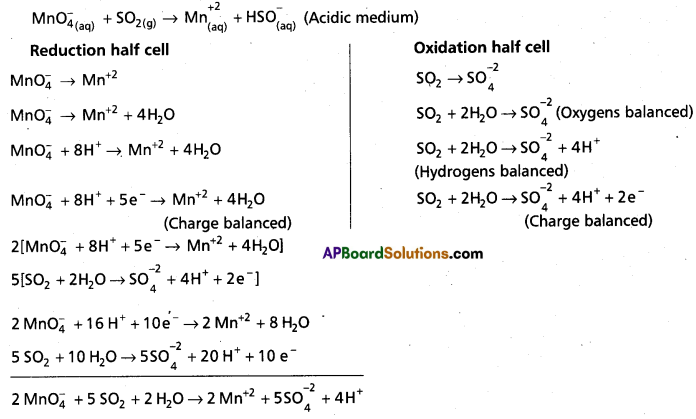
AP Inter 1st Year Chemistry Study Material Chapter 5 Stoichiometry 36
Above equation is balanced chemical equation.

c)
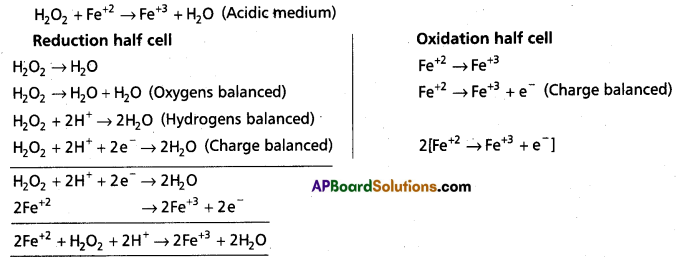
AP Inter 1st Year Chemistry Study Material Chapter 5 Stoichiometry 37

d)
AP Inter 1st Year Chemistry Study Material Chapter 5 Stoichiometry 38
AP Inter 1st Year Chemistry Study Material Chapter 5 Stoichiometry 39

Question 49.
Balance the following equations in basic medium by ion-electron method and oxidation number methods and identify the oxidising agent and the reducting agent
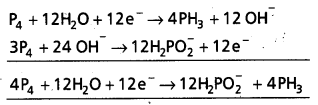
(a) P4(s) + OH(aq) → PH3(g) + HP\(\mathrm{O}_2^{-}\)
(b) N2H4(l) + Cl\(\mathrm{O}_3^{-}(\mathrm{aq})\)(aq) → NO(g) + Cl(g)
(c) Cl2O7 (g) + H2O2 (aq) → ClO2 (aq) + O2 (g) + H+
Answer:
a) P4 + OH → PH3 + HP\(\mathrm{O}_2^{-}\)
Reduction half cell
P4 → PH3
P4 → 4PH3
P4 + 12H2O → 4PH3 + 12 OH (H balanced)
P4 + 12H2O + 12e → 4PH3 + 12 OH
AP Inter 1st Year Chemistry Study Material Chapter 5 Stoichiometry 40

Oxidation half cell
P4 → H2P\(\mathrm{O}_2^{-}\)
P4 → 4H2P\(\mathrm{O}_2^{-}\) (‘P’ balanced)
P4 + 8H2O → 4H2\(\mathrm{PO}_2^{-}\) (Oxygen balanced)
P4 + 8H2O + 8 OH → 4H2\(\mathrm{PO}_2^{-}\) + 8H2O
(Hydrogen balanced)
P4 + 8OH → 4H2\(\mathrm{PO}_2^{-}\) + 4e
(Charge balanced)
Here P4 is oxidising agent as well reducing agent.

b)
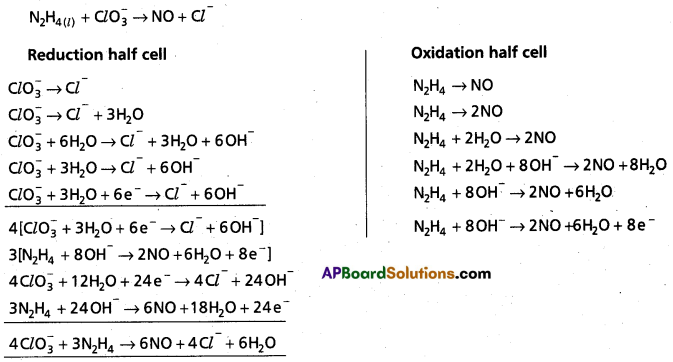
AP Inter 1st Year Chemistry Study Material Chapter 5 Stoichiometry 41
\(\mathrm{ClO}_3^{-}\) is oxidant
N2H4 is reductant

c)
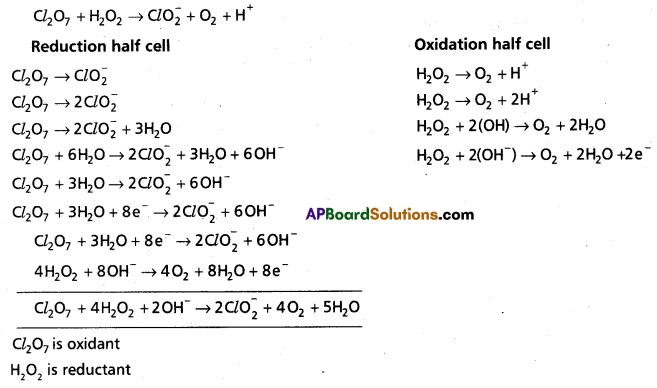
AP Inter 1st Year Chemistry Study Material Chapter 5 Stoichiometry 42

AP Inter 1st Year Chemistry Study Material Chapter 5 Stoichiometry

Question 50.
What sorts of informations can you draw from the following reaction ?
(CN)2(g) + 20H(aq → CN(aq) + CNO(aq) + H2O(1)
Answer:
(CN)2(g) + 2(OH) → \(\mathrm{CN}_{(\mathrm{aq})}^{-}\) + \(\mathrm{CNO}_{(\mathrm{aq})}^{-}\) + \(\mathrm{H}_2 \mathrm{O}_{(l)}\)
(CN)2 + 2e → 2 CN (Reduction)
(CN)2 + 2H2O → 2 CNO + 4H+ + 2e (Oxidation)
Here (CN2) undergo oxidation as well as reduction.
It is a dis proportionation reaction.

Question 51.
The Mn3+ ion is unstable in solution and undergoes disproportionation to give Mn2+. MnO2+ and H+ ion. Write a balanced ionic equation for the reaction.
Answer:
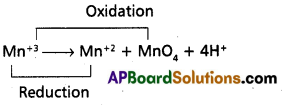
AP Inter 1st Year Chemistry Study Material Chapter 5 Stoichiometry 43

  • Above equation is a dis proportionation reaction
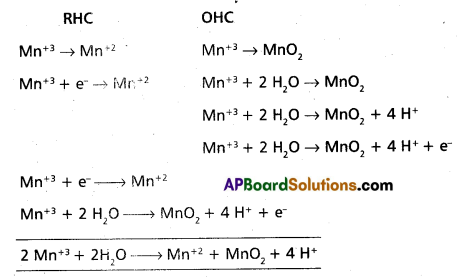
AP Inter 1st Year Chemistry Study Material Chapter 5 Stoichiometry 44

Question 52.
Consider the elements :
Cs, Ne, I and F
(a) Identify the element that exhibits only negative oxidation state.
(b) Identify the element that exhibits only positive oxidation state.
(c) Identify the element that exhibits both postive and negative oxidation states.
(d) Identify the element which exhibits neither the negative nor does the positive oxidation state.
Answer:
a) ‘F’ Exhibits negative oxidation state i.e. ‘-1’
b) ‘Cs’ Exhibits only positive oxidation state
c) ‘I’ Exhibits positive as well as negative oxidation states
d) ‘Ne’ doesnot exhibit any oxidation state in ground state
(Neither positive nor negative)

Question 53.
Chlorine is used to purify drinking water. Excess of chlorine is harmful. The excess of chlorine is removed by treating with sulphur dioxide. Present a balanced equation for this redox change taking place in water.
Answer:
Balanced equations for the given data is
Cl2 + SO2 + H2O → SO3 + 2H+ + Cl

Question 54.
Refer to the periodic table given in your book and now answer the following questions :
a) Select the possible non metals that can show disproportionation reaction.
b) Select three metals that can show disproportionation reaction.
Answer:
a) Non metals
Chlorine, Bromine, Oxygen, Sulphur, Phosphorous, Iodine undergo disproportionations
b) Metals Cr, Mn and pb undergo disproportionation.

Question 55.
In Ostwald’s process for the manufacture of nitric acid, the first step involves the oxidation of ammonia gas by oxygen gas to give nitric oxide gas and steam. What is the maximum weight of nitric oxide that can be obtained starting only with 10.00 g, of ammonia and 20.00 g of oxygen ?
Answer:
Chemical reaction is
4NH3 + 5O2 → 4NO + 6H2O
4 moles NH3 – 5 moles of O2
Given 10 gms of NH3
∴ No. of moles = \(\frac{10}{17}\) = 0.588 moles
Given 20 gms of NH3
∴ No. of moles = \(\frac{20}{32}\) = \(\frac{5}{8}\) = 0.4
4 moles of ammonia reacts with 5 moles of O2
0.588 moles of NH3 …. ?
\(\frac{0.588}{4}\) × 5 = 0.735 moles
5 moles of O2 reacts with 4 moles of NH3
0.4 moles of O2…. ?
\(\frac{0.4}{5}\) × 4 = \(\frac{1.6}{5}\) = 0.32

  • Here O2 is not present in sufficient amount NH3 has sufficient in amount

5 moles of O2 → 4 moles of NO.
5 × 32 gms of O2 → 4 × 30 gms of NO.
20 gms of O2 → ?
\(\frac{20 \times 4 \times 30}{5 \times 32}\) = \(\frac{20 \times 24}{32}\) = \(\frac{120}{8}\) = 15 gms

AP Inter 1st Year Chemistry Study Material Chapter 5 Stoichiometry

Question 56.
Arrange the following metals in the order in which they displace each other from the solution of their salts.
Al, Cu, Fe, Mg and Zn.
Answer:
According to electro chemical series electrode potentials of given elements as follows
Al – -1.66 V
Cul – + 0.34 V
Fe – -0.40 V
Mg – -2.37 V
Zn – -0.76 V
∴ The order of the above metals in which they displace each other from the solution of their salts. Mg > AZ > Zn > Fe > Cu

Long Answer Questions

Question 1.
Wtire the balanced ionic equation which represents the oxidation of iodide (I-) ion by permanganate ion in basic medium at give iodine (I) and managanese dioxide (MnO2)
Answer:
Basic equation is
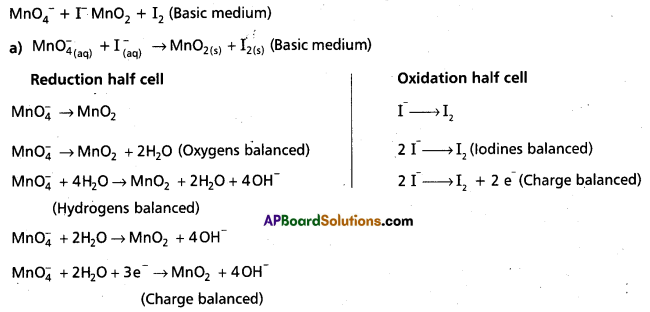
AP Inter 1st Year Chemistry Study Material Chapter 5 Stoichiometry 45
AP Inter 1st Year Chemistry Study Material Chapter 5 Stoichiometry 46
The above equation is balanced equation.

Question 2.
Write the balanced equation for the oxidation of suiphite ions to sulphate ions in acid medium by permanganate ion.
Answer:
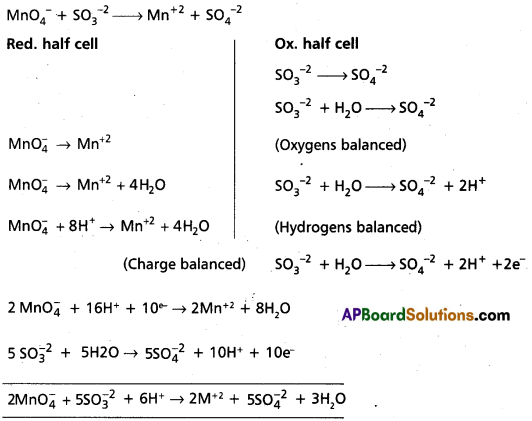
AP Inter 1st Year Chemistry Study Material Chapter 5 Stoichiometry 47

AP Inter 1st Year Chemistry Study Material Chapter 5 Stoichiometry

Question 3.
Oxalic acid is oxidised by permanganate ion is acid medium of Mn2+ balance the reaction by ion — electron method.
Answer:
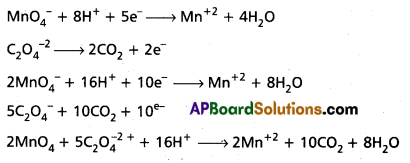
AP Inter 1st Year Chemistry Study Material Chapter 5 Stoichiometry 48

AP Inter 1st Year Chemistry Study Material Chapter 5 Stoichiometry

Question 4.
Phosphorus when heated with NaOH solution gives phosphine (PH3) and H2P\(\mathrm{O}_2^{-}\). Give the balanced equation.
Answer:
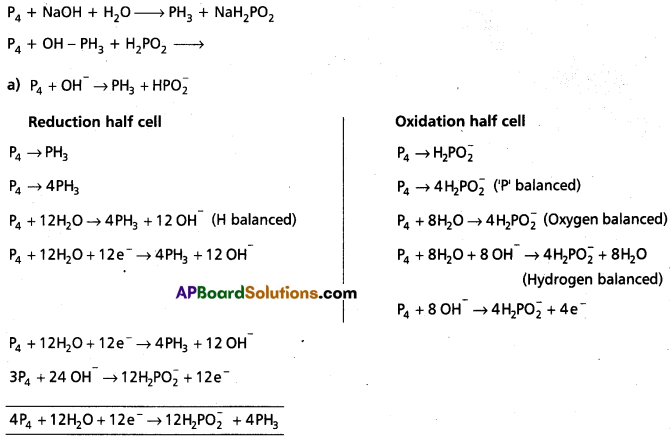
AP Inter 1st Year Chemistry Study Material Chapter 5 Stoichiometry 49
Here P4 is oxidising agent as well reducing agent.

Question 5.
Balance the following equation

AP Inter 1st Year Chemistry Study Material Chapter 5 Stoichiometry 50
Answer:
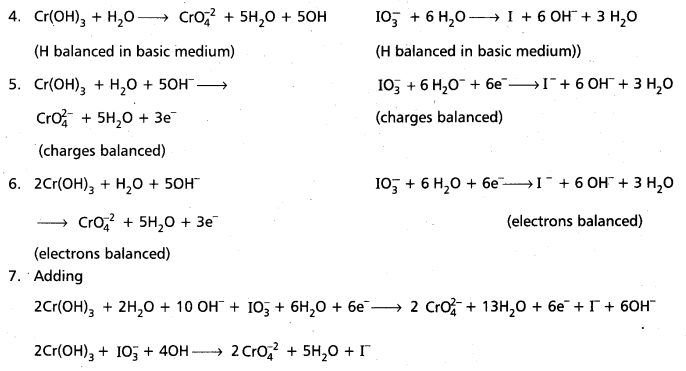
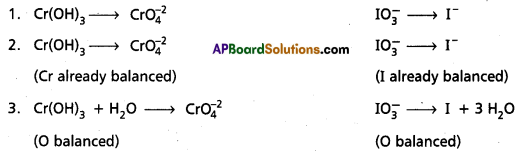
Oxidation half reaction Cr(OH)3 → \(\mathrm{CrO}_4^{2-}\)
(The ox. no of Cr changes from +3 to +6)
Reduction half reaction \(\mathrm{IO}_3^{-}\) → I (The ox. no. of ‘I’ changes from +5 to —1)
AP Inter 1st Year Chemistry Study Material Chapter 5 Stoichiometry 51
AP Inter 1st Year Chemistry Study Material Chapter 5 Stoichiometry 52

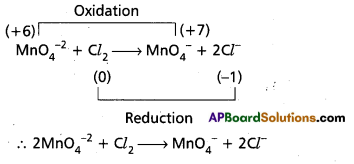
Question 6.
Balance the following equation by the oxidation number method.
Mn\(\mathrm{O}_4^{-2}\) + Cl2 → Mn\(\mathrm{O}_4^{-2}\) + Cl
Answer:
AP Inter 1st Year Chemistry Study Material Chapter 5 Stoichiometry 53

Question 7.
Exaplain the different types of redox reactions.
Answer:
Redox reaction : “The reaction that involves loss of electrons is called an oxidation reaction and that involving gain of electrons is called a reduction reaction. The overall reaction is called as oxidation – reduction reaction” or simply ‘redox reaction’.

Types of redox reactions:

a) Chemical combination reactions: In these reactions one species combine with another species to form product. In this conversion one species undergo oxidation and other species undergo reduction.
e.g.:
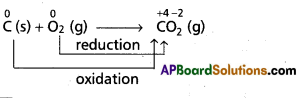
AP Inter 1st Year Chemistry Study Material Chapter 5 Stoichiometry 54
As the oxidation state of carbon increases from ‘0’ to ‘+4’ in the reaction. So, carbon undergoes oxidation.
Oxygen changes from ‘0’ to ‘-2’ oxidation state. So, it undergoes reduction. Therefore, the above overall combination reaction is redox reaction.

b) Decomposition reactions : Chemical compounds chemically split into two or more simpler substances during decomposition reactions. These are again redox reactions.
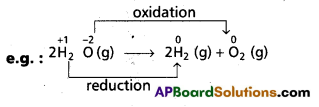
AP Inter 1st Year Chemistry Study Material Chapter 5 Stoichiometry 55
Here, water decomposes. H2 undergoes reduction from +1 to 0 in the reaction. Oxygen on the other hand changes its oxidation state from -2 to 0 (or) it undergoes oxidation.
Therefore, decomposition of H20 is a redox reaction.

c) Displacement reactions : In these reactions the place of one species in its compound is taken up by other species.
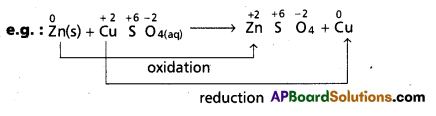
AP Inter 1st Year Chemistry Study Material Chapter 5 Stoichiometry 56
‘Zn’ displaces ‘Cu’ from CuSO4 solution. In this reaction Zn undergoes oxidation and Cu undergoes reduction. Therefore overall reaction is a redox reaction.

d) Disproportionation reactions : These reactions involve the same element in the given form to undergo both oxidation and reduction simultaneously.
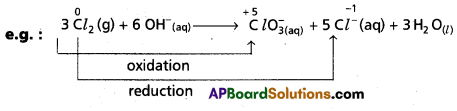
AP Inter 1st Year Chemistry Study Material Chapter 5 Stoichiometry 57
In the above reaction ‘Cl2‘ undergoes both oxidation and reduction. It is a special type of redox reaction.

e) Comproportionation reactions : Reverse of disproportionation is comproportionation. In comproportionation reactions, two species with the same element in two different oxidation states form a single product in which the element is in an intermediate oxidation state.
e.g.:
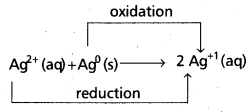
AP Inter 1st Year Chemistry Study Material Chapter 5 Stoichiometry 58

AP Inter 1st Year Chemistry Study Material Chapter 5 Stoichiometry

Question 8.
Calculate the amount of carbon dioxide that could be produced when
(i) 1 mole of carbon is burnt in air.
(ii) 1 mole of carbon is burnt in 16 g of dioxygen,
(iii) 2 moles of carbon are burnt in 16 g of dioxygen.
Answer:
i) C + O2 → CO2
1 mole of ‘C’ → 1 mole of CO2
∴ 44 gms of CO2

ii) C + O2 → CO2
Given 1 mole of O2 burnt in 16 gms of di oxygen

iii) C + O2 → CO2
2 moles of ‘C’ burnt in 16 gms of O2
∴ 1 mole of O2 → 44 gms of CO2
32 gms of O2 → 44 gms of CO2
16 gms of O2 → 22 gms of CO2

AP Inter 1st Year Chemistry Study Material Chapter 5 Stoichiometry

Question 9.
Dinitrogen and dihydrogen react with each other to produce ammonia according to the following chemical equation :
N2(g) + H2(g) → 2NH3 (g)
(i) Calculate the mass of ammonia produced if 2.00 × 10³ g dinitrogen reacts with 1.00 × 10³ g of dihydrogen.
(ii) Will any of the two reactants remain unreacted ?
(iii) If yes, which one and what would be its mass ?
Answer:
i) N2 + 3H2 → 2NH3
Given Nitrogen = 2 × 10³ gms
No. of moles = \(\frac{2000}{28}\) = 71.4285
Given hydrogen = 1 × 10³ gms
No. of moles = \(\frac{1000}{2}\) = 500 moles
N2 is limiting agent
∴28 gms of N2 → 2 × 17gms NH3
2000 gms of N2
\(\frac{2000 \times 17}{28}\) = 2428.57 gms

ii) Used amount of hydrogen
28 → 6 gms
100 gms → ?
\(\frac{1000 \times 6}{28}\) = 214.285 gms

iii) Remaining amount of hydrogens
= 1000 – 2140.285
= 785.715 gms

AP Inter 1st Year Chemistry Study Material Chapter 5 Stoichiometry

Question 10.
Assign oxidation number to the underlined elements in each of the following epecies :
(a) NaH2PO4
b) NaHSO4
c) H4P2O7
d) K2MnO4
(e) CaO2
(f) NaBH4
(g) H2S2O7
(h) KA1(SO4)2.12 H2O
Answer:
(a) NaH2PO4
1(+1) + 2(+1) + x + 4 (-2) = 0
1 + 2 + x – 8 = 0
x – 5 = 0
x = +5
Oxidation no. of ‘P’ in NaH2PO4 = + 5

b) NaHSO4
1(+1) +1(+1) + x + 4(-2) = 0
1 + 1 + x – 8 = 0
x = + 6
Oxidation no. of ‘S’ in NaHSO4 = + 6

c) H4P2O7
4(+1) + 2x + 7(-2) = 0
4 + 2x – 14 = 0
2x – 10 = 0
x = + 5
Oxidation no. of ‘P’ in H4P2O7 is +5

d) K2MnO4
2(+1) + x + 4(-2) = 0
2 + x + 8 = 0
x = + 6
Oxidation no of Mn is K2MnO4 = + 6

e) CaO2
+ 2 + 2x = 0.
2x = -2
x = -1
Oxidation no. of oxygen in CaO2 = -1

f) NaBH4
1(+1) + x+ 4(-1) = 0
1 + x – 4 = 0
x = +3
Oxidation no. of ‘B’ in NaBH4 = +3
But ‘B’ most probably exhibits -3 oxidation state.

g) H2S2O7
2(1) + 2x + 7(-2) = 0
2 + 2x – 14 = 0
2x – 12 = 0
x = +6
Oxidation state of ‘S’ in H2S2O7 = + 6

h) k Al(SO4)2 12H2O :
General formula of above compound is
k2SO4 Al2 (SO4) 24 H2O (Potash alum)
Consider Al2(SO4)3 from the above double salt
2x + 3(-2) = 0
2x – 6 = 0
x = +3

Question 11.
What are the oxidation number of the underlined elements in each of the following and how do you rationalise your results?
(a) H2S4O6
(b) Fe3O4
(c) CH3CH2OH
(d) CH3COOH
Answer:
a) 45 (b)

b) 45 (c)

c) CH3 CH2 – OH
C2H6O
2x + 6(1) + (-2) = 0
2x + 6 – 2 = 0
2x + 4 = 0
x = -2

d) CH3COOH
C2H4O2
2x + 4(+1) + 2(-2) = 0
2x + 4 – 4 = 0
x = 0

Solved Problems

Question 1.
Calculate molecular mass of glucose (C6H12O6) molecule.
Solution:
Molecular mass of glucose (C6H12O6)
= 6(12.011 u) + 12(1.008 u) + 6(16.00.u)
= (72.066 u) + (12.096 u) + (96.00 u)
= 180.162 u

Question 2.
A compound contains 4.07% hydrogen, 24.27% carbon and 71.65% chlorine. Its molar mass is 98.96 g. What are its empirical and molecular formulae ?
Solution:
Step 1.
Conversion of mass per cent to grams :
Since we are having mass percent, it is convenient to use 100 g of the compound as the starting material. Thus, in the 100 g sample of the above compound, 4.07 g hydrogen; 24.27 g carbon; and 71.65 g chlorine are present.

Step 2.
Convertion into number of moles of each element:
Divide the masses obtained above by respective atomic masses of various elements.
Moles of hydrogen = \(\frac{4.07 \mathrm{~g}}{1.008 \mathrm{~g} \mathrm{~mol}^{-1}}\) = 4.04
Moles of carbon = \(\frac{24.27 \mathrm{~g}}{12.01 \mathrm{~g} \mathrm{~mol}^{-1}}\) = 2.021 Moles of chlorine = \(\frac{71.65 \mathrm{~g}}{35.453 \mathrm{~g} \mathrm{~mol}^{-1}}\) = 2.021

Step 3.
Divide the mole value obtained above by the smallest number:
Since 2.021 is smallest value, division by it gives a ratio of 2:1:1 for H:C:Cl.

In case the ratios are not whole numbers, then they may be converted into whole number by multiplying by the suitable coefficient.

Step 4.
These numbers indicate the relative number of atoms of the elements. Write empirical formula by mentioning the numbers after writing the symbols of respective elements :
CH2Cl is thus, the empirical formula of the above compound.

Step 5.
Writing molecular formula :

a) Determine empirical formula mass.
Add the atomic masses of various atoms present in the empirical formula.
For CH2Cl, empirical formula mass is 12.01 + 2 × 1.008 + 35.453 = 49.48 g

b) Divide Molar mass by empirical formula mass

AP Inter 1st Year Chemistry Study Material Chapter 5 Stoichiometry 59
= 2 = (n)

c) Multiply empirical formula by n obtained above to get the molecular formula.
Empirical formula = CH2Cl, n = 2. Hence molecular formula is C2H4Cl2.

AP Inter 1st Year Chemistry Study Material Chapter 5 Stoichiometry

Question 3.
Calculate the amount of water (g) produced by the combustion of 16 g of methane.
Solution:
The balanced equation for combustion of methane is :
CH4(g) + 2O2(g) → CO2(g) + 2H2O(g)

  1. 16 g of CH4 corresponds to one mole.
  2. From the above equation, 1 mol of CH4(g) gives 2 mol of H2O(g).
    2 mol of water (H2O) = 2 × (2 + 16)
    = 2 × 18 = 36 g

1 mol H2O = 18g H2O ⇒ \(\frac{18 \mathrm{~g} \mathrm{H}_2 \mathrm{O}}{1 \mathrm{~mol} \mathrm{H}_2 \mathrm{O}}\) = 1
Hence 2 mol H2O × \(\frac{18 \mathrm{~g} \mathrm{H}_2 \mathrm{O}}{1 \mathrm{~mol} \mathrm{H}_2 \mathrm{O}}\)
= 2 × 18 g H2O = 36 g H2O

Question 4.
How many moles of methane are required to produce 22 g CO2(g) after combustion ?
Solution:
According to the chemical equation
CH4(g) + 2O2(g) → CO2(g) + 2H2O(g)
44 g CO2 (g) is obtained from 16 g CH4(g).
[∵ 1 mol CO2(g) is obtained from 1 mol of CH4(g)]
Mole of CO2(g)
= 22 g CO2(g) × \(\frac{1 \mathrm{~mol} \mathrm{CO}_2(\mathrm{~g})}{44 \mathrm{gCO}_2(\mathrm{~g})}\)
= 0.5 mol CO2(g)
Hence 0.5 mol CO2(g) would be obtained from 0.5 mol CH4(g) or 0.5 mol of CH4(g) would be required to produce 22g CO2(g).

Question 5.
50.0 kg of N2(g) anfd 10.0 kg of H2(g) are mixed to produce NH3(g). Calculate the NH3 (g) formed. Identify the limiting reagent in the production of NH3 in this situation.
Solution:
A balanced equation for the above reaction is written as follows :
Calculation of moles:
N2 + 3H2(g) ⇌ 2HN3(g)
Moles of N2
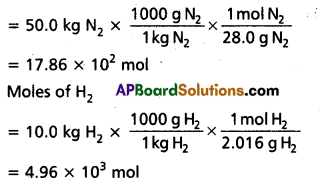
AP Inter 1st Year Chemistry Study Material Chapter 5 Stoichiometry 60

According to the above equation, 1 mol N2(g) requires 3 mol H2(g), for the reaction. Hence, for 17.86 × 10² mol N2, the moles of H2(g) required would be
17.86 × 10² mol N2 × \(\frac{3 \mathrm{~mol} \mathrm{H}_2(\mathrm{~g})}{1 \mathrm{molN}_2(\mathrm{~g})}\)
= 5.36 × 10³ mol H2

But we have only 4.96 × 10³ mol H2. Hence, dihydrogen is the limiting reagent in
this case. So NH3(g) would be formed only from that amount of available dihydrogen i.e.,
4.96 × 10³ mol.
Since 3 mol H2(g) gives 2 mol NH3(g)
4.96 × 10³ mol H2 (g) × \(\frac{2 \mathrm{~mol} \mathrm{NH}_3(\mathrm{~g})}{3 \mathrm{molH}_2(\mathrm{~g})}\)
= 3.30 × 10³ mol NH3 (g)
3.30 × 10³ mol NH3 (g) is obtained.

If they are to be converted to grams, it is done as follows :
1 mol NH3(g) = 17.0 g NH3(g)
3.30 × 10³ mol NH3 (g) × \(\frac{17.0 \mathrm{~g} \mathrm{NH}_3(\mathrm{~g})}{1 \mathrm{~mol} \mathrm{NH}_3(\mathrm{~g})}\)
= 3.30 × 103 × 17 g NH3 (g)
= 56.1 × 10³ g NH3 (g)
= 56.1 kg NH3

Question 6.
A solution ¡s prepared by adding 2 g of a substance A to 18 g water. Calculate the mass percent of the solute.
Solution:
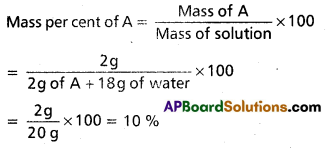
AP Inter 1st Year Chemistry Study Material Chapter 5 Stoichiometry 61

Question 7.
Calculate the molarity of NaOH in the solution prepared by dissolving 4 g in enough water to form 250 mL of the solution.
Solution:
Since molarity
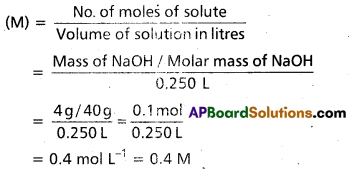
AP Inter 1st Year Chemistry Study Material Chapter 5 Stoichiometry 62
Note that molarity of a solution depends upon temperature because volume of a solution is temperature dependent.

AP Inter 1st Year Chemistry Study Material Chapter 5 Stoichiometry

Question 8.
The density of 3 M solution of NaCl is 1.25 g mL-1. Calculate molality of the solution.
Solution:
M = 3 mol L-1
Mass of NaCl in 1 L solution
= 3 × 58.5 = 175.5 g
Mass of
1 L solution = 1000 × 1.25 = 1250 g
(Since density = 1.25 gmL-1)
Mass of water of solution = 1250 – 175.5
= 1074.5 g = 1.0745 kg
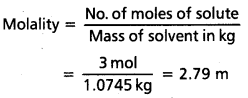
AP Inter 1st Year Chemistry Study Material Chapter 5 Stoichiometry 63

Often in a chemistry laboratory, a solution of a desired concentration is prepared by diluting a solution of known higher concentration. The solution of higher concentration is also known as stock solution. Note that molality of a solution does not change with temperature since mass remains unaffeoted with temperature.

Question 9.
Calculte the normality of oxalic acid solutions containing 6.3g of H2C2O4.2H2O in 500 ml of solutions.
Solution:
Weight of solute = 6.3 g
GEW of solute = \(\frac{126}{2}\) = 63
∴ Normality (N) = \(\frac{\omega}{\mathrm{GEW}} \times \frac{1000}{\mathrm{~V}(\mathrm{~mL})}\)
Normality (N) = \(\frac{6.3}{63} \times \frac{1000}{500}\) = 0.2 N

Question 10.
Calculate the mass of Na2CO3 required to prepare 250 ml of 0.5 N solution.
Solution:
Normality of required solution = 0.5 N
Volume of required solution = 250 ml
Equivalent wt.of. Na2CO3 = \(\frac{106}{2}\) = 53
Normality (N) = \(\frac{\mathrm{W}}{\mathrm{GEW}} \times \frac{1000}{\mathrm{~V}(\mathrm{~mL})}\)
wt. of solute = N × GEW × \(\frac{V(\mathrm{ml})}{1000}\)
= 0.5 × 53 × \(\frac{250}{1000}\) = \(\frac{53}{8}\) = 6.62 g

Question 11.
In the reactions given below, identify the species undergoing oxidation and reduction :
(i) H2S (g) + Cl2 (g) → 2HC (g) + S (s)
(ii) 3Fe3O4 (s) + 8Al (s) → 9Fe (s) + 4Al2O3 (s)
(iii) 2Na (s) + H2 (g) → 2NaH (s)
Solution:
(i) H2S is oxidised because a more electronegative element, chlorine is added to hydrogen (or a more electropositive element, hydrogen has been removed from S). Chlorine is reduced due to addition of hydrogen to it.

(ii) Aluminium is oxidised because oxygen is added to it. Ferrous ferric oxide (Fe3O4) is reduced because oxygen has been removed from it.

(iii) This reaction is very interesting. It may be said from the above definitions that the reaction is only a reduction reaction as it involves the addition of sodium (electropositive metal) or hydrogen whereas sodium undergoes oxidation and hydrogen undergoes reduction. It is to say that the above definitions for oxidation and reduction can not explain this and they have limitations like this. Therefore a new concept has to be considered for the oxidation and the reduction.

Question 12.
Justify that the reaction :
2Na (s) + H2 (g) → 2NaH (s) is a redox change.
Solution:
Since in the above reaction the compound formed is an ionic compound, which may also be represented as Na+H (s), this suggests that one half reaction in this process is :
2Na (s) → 2Na+ (g) + 2e and the other half reaction is H2 (g) + 2e→ 2H (g)
This splitting of the reaction under examination into two half reactions automatically reveals that here sodium is oxidised and hydrogen is reduced, therefore, the complete reaction is a redox change.

Question 13.
Using stock notation, represent the following compounds : HAuCl4, Tl2O, FeO, Fe2O3, Cul, CuO, MnO and MnO2.
Solution:
By applying various rules of calculating the oxidation number of the desired element in a compound, the oxidation number of each metallic element in its compound is as follows:
HAuCl4 → Au has 3
Tl2O → Tl has 1
FeO → Fe has 2
Fe2O3 → Fe has 3
Cul → Cu has 1
CuO → Cu has 2
MnO → Mn has 2
MnO2 → Mn has 4
Therefore, these compounds may be represented as :
HAu (III) Cl4, Tl2(I)O, Fe(II)O, Fe2(III)O3, Cu(I)I, Cu(II)O, Mn(II)O, Mn(IV)O2.

Question 14.
Justify that the reaction :
2Cu2O(S) + Cu2S(s) → 6Cu(s) + SO2(g) is a redox reaction. Identify the species oxidised/reduced, which acts as an oxidant and which acts as a reductant.
Solution:
Let us assign oxidation number to each of the species in the reaction under examination. This results into :

AP Inter 1st Year Chemistry Study Material Chapter 5 Stoichiometry 64
We therefore, conclude that in this reaction copper is reduced from +1 state to zero oxidation state and sulphur is oxidised from -2 state to +4 state. The above reaction is thus a redox reaction.

Further, Cu2O helps sulphur in Cu2S to increase its oxidation number, therefore Cu (I) is an oxidant; and sulphur of Cu2S helps copper both in Cu2S itself and Cu2O to decrease its oxidation number ; therefore, sulphur of Cu2S is reductant.

Question 15.
Which of the following species, do not show disproportionation reaction and why ? ClO, Cl\(\mathrm{O}_2^{-}\), ClO3 and ClO4. Also write reaction for each of the species that disproportionates.
Solution:
Among the oxoanions of chlorine listed above, ClO4 does not disproportionate because in this oxoanion chlorine is present in its highest oxidation state that is, +7. The disproportionation reactions for the other three oxoanions of chlorine areas follows :
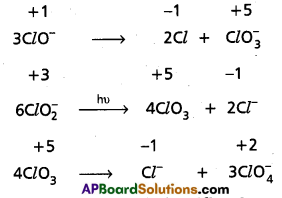
AP Inter 1st Year Chemistry Study Material Chapter 5 Stoichiometry 65

Question 16.
Suggest a scheme of classification of
the following redox reactions
(a) N2 (g) + O2 (g) → 2NO (g)
(b) 2Pb(NO3)2(s) → 2PbO(s) + 2NO2(g) + 1/2 O2(g)
(c) NaH(s) + H2O (l) → NaOH (aq) + H2(g)
(d) 2NO2(g) + 2OH(aq) → N\(\mathrm{O}_2^{-}\) (aq) + N\(\mathrm{O}_3^{-}\) (aq) + H2O(l)
Solution:
In reaction
(a) the compound nitric oxide is formed by the combination of the elemental substances, nitrogen and oxygen ; therefore, this is an example of combination redox reactions. The reaction.

(b) involves the breaking down of lead nitrate into three components, therefore, this is categorised under decomposition redox reaction. In reaction.

(c) hydrogen of water has been displaced by hydride ion into dihydrogen gas. There-fore, this may be called as displacement redox reaction.

(d) The reaction involves disproportionation of NO2 (+4 state) into NO2 (+3 state) and NO3 (+5 state). Therefore reaction (d) is an example of disproportionation redox reaction.

Question 17.
Why do the following reactiolns proceed differently ?
Pb3O4 + 8HCl → 3PbCl2 + Cl2 + 4H2O and
Pb3O4 + 4HNO3 → 2Pb(NO3)3 + PbO2 + 2H2O
Solution:
Pb3O4 is actually a stoichiometric mixture of 2 mol. of PbO and 1 mol. of PbO2. In PbO2, lead is present in +4 oxidation state, whereas the stable oxidation state of lead in PbO is +2. PbO2 thus can act as an oxidant (oxidising agent) and, therefore, can oxidise Cl ion of HCl into chlorine. We may also keep in mind that PbO is a basic oxide. Therefore, the reaction
Pb3O4 + 8HCl → 3PbCl2 + Cl2 + 4H2O can be splitted into two reactions namely :
2 PbO + 4HCl → 2PbCl2 + 2H2O (acid base reaction)
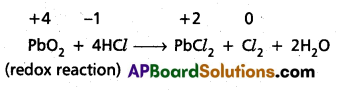
AP Inter 1st Year Chemistry Study Material Chapter 5 Stoichiometry 66

Question 18.
Write the net ionic equation for the reaction of potassium dichromate (VI) K2Cr2O7 with sodium sulphite, Na2SO3 in an acid solution to give chromium (III) ion and the sulphate ion.
Solution:
Step – 1 :
The skeletal ionic equation is :
Cr2\(\mathrm{O}_7^{2-}\) (aq) + S\(\mathrm{O}_3^{-2}\) (aq) → Cr3+ (aq) + S\(\mathrm{O}_4^{2-}\) (aq)

Step – 2 :
Assign oxidation numbers for Cr and S

AP Inter 1st Year Chemistry Study Material Chapter 5 Stoichiometry 67
This indicates that the dichromate ion is the oxidant (it oxidises sulphite ion to sulphate ion) and the sulphite ion is the reductant. (it reduces dichromate ion to chromium (III).

Step – 3 :
Calculate the increase and decrease of oxidation numbers of respective species and make them equal.

AP Inter 1st Year Chemistry Study Material Chapter 5 Stoichiometry 68
As reduction is total 6 units due to two Cr3+ formed, oxidation also must be 6 units. This is obtained by multiplying S\(\mathrm{O}_3^{-2}\) with 3.

Step – 4 :
Adjust the coefficients of the products accordingly

AP Inter 1st Year Chemistry Study Material Chapter 5 Stoichiometry 69

Step – 5 :
a) Add H+ ions in acid medium or H2O molecules in basic medium in the required number to hydrogen atoms deficient side.
b) Add H2O molecules in acid medium or OH ions in basic medium in the required number to oxygen atoms diffident side, (a) and (b) may be repeated any number of times by hit and trial method until hydrogen and oxygen atoms are same in number on both the sides of the redox reaction.
The given reaction is in acid medium
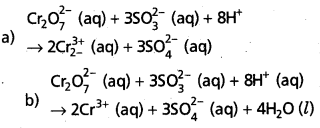
AP Inter 1st Year Chemistry Study Material Chapter 5 Stoichiometry 70

AP Inter 1st Year Chemistry Study Material Chapter 5 Stoichiometry

Question 19.
Permanganate ion reacts with bromide ion in basic medium to give manganese dioxide and bromate ion. Write the balanced ionic equation for the reaction.
Solution:
Step – 1 : The skeletal ionic equation is :
Mn\(\mathrm{O}_4^{-}\) (aq) + Br (aq) → MnO2 (s) + Br\(\mathrm{O}_3^{-}\) (aq)

Step – 2 : Assign oxidation numbers for Mn and Br.

AP Inter 1st Year Chemistry Study Material Chapter 5 Stoichiometry 71
This indicates that permanganate ion is the oxidant and bromide ion is the reductant.

Step – 3 :
Calculate the increase or decrease in the oxidation number per atom and for the entire molecule/ion in which it occurs. The number units of oxidations change must be equal to the number units of reduction change. If this is not observed then multiply the oxidising agent with the number of units of oxidation and the reducing agent with the number of units of reduction i.e., multiply oxidant MnO4 by 2 and reductant Br by I.
AP Inter 1st Year Chemistry Study Material Chapter 5 Stoichiometry 72
Know number of units oxidation number of units reduction.

Step – 4:
Adjust the coefficients of products accordingly.
2Mn\(\mathrm{O}_4^{-}\) (aq) + Br (aq) → 2MnO2 (s) + BrO3 (aq)

Step – 5 :
a) Add H+ ions in acid medium or H2O molecules in basic medium in the required number to hydrogen atoms deficient side.
b) Add H2O molecules in acid medium or OH ions in basic medium in the required number to oxygen atoms dificient side, (a) and (b) may be repeated any number of times by hit and trial method until hydrogen and oxygen atoms are same in number on both the sides of the redox reaction. This reaction is basic medium.
2Mn\(\mathrm{O}_4^{-}\) (aq) + Br (aq) + H2O (I)

  • 2MnO2 (s) + Br\(\mathrm{O}_3^{-}\) (aq) + 2OH (aq)

Question 20.
Permanganate (VII) ion, MnO4 in basic solution oxidises iodide ion. I to produce molecular iodine (I2) and manganese (IV) oxide (MnO2). Write a balanced ionic equation to represent this redox reaction.
Solution:
Step – 1 :
First we write the skeletal ionic equation, which is
Mn\(\mathrm{O}_4^{-}\) (aq) + I (aq) → MnO2 (s) + I2 (s)

Step – 2 :
The two half-reactions are :
-1        0
Oxidation half :
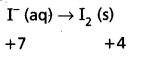
AP Inter 1st Year Chemistry Study Material Chapter 5 Stoichiometry 73
Reduction half : Mn\(\mathrm{O}_4^{-}\) (aq) → MnO2 (s)

Step – 3 :
To balance the I atoms in the oxidation half reaction, we rewrite it as:
2I (aq) → I2 (s)

Step – 4:
As the reaction takes place to basic medium, to balance the 0 atoms in the reduction half reaction, we add OH ions in required number.
Mn\(\mathrm{O}_4^{-}\) (aq) → MnO2 (s) + 2HO (I)
To balance the H atoms, we add two H2O molecules on the left.
Mn\(\mathrm{O}_4^{-}\) (aq) + 2H2O (aq) → MnO2 (s) + 2 HO (I)
Balance H and 0 atoms by bit and trial method even if it requires morethan once we haye to do it.
The resultant equation is :
Mn\(\mathrm{O}_4^{-}\) (aq) + 2H2O (I) → MnO2 (s) + 4OH (aq)
Note : While balanceing H atom 0 atoms do not disturb the coefficients of other species (oxidant and reduCtant and the products).

Step-5 :
In this step we balance the charges of the two half-reactions in the manner depicted as:
2I (aq) → I2 (s) + 2e
Mn\(\mathrm{O}_4^{-}\) (aq) + 2H2O (I) + 3e → MnO2 (s) + 4OH (aq)

Now to equalise the number of electrons, in the two half reactions we multiply the oxidation hatf-reaction by 3 and the reduction half-reaction by 2.
6I (aq) → 3I2 (s) + 6e
2MnO4 (aq) + 4H4O (I) + 6e → 2MnO2 (s) + 8OH(aq)

Step-6:
Add two half-reactions to obtain the net reaction and canceel the electrons on both sides.
6I (aq) + 2Mn\(\mathrm{O}_4^{-}\) (aq) + 4H2O (I) → 3I2 (s) + 2MnO2 (s) + 8 OH (aq)

Step – 7:
A final verification shows that the equation is balanced in respect of the number of atoms and charges on both sides.

Question 21.
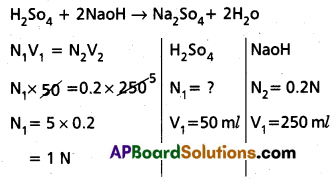
Calculate the normality of H2So4 solution. If 50 ml of it completely neutralised 250 ml of 0.2 N sodium hydroxide (NaoH) solution.
Answer:
AP Inter 1st Year Chemistry Study Material Chapter 5 Stoichiometry 74
∴ Normality of H2So4 solution = 1 N.
AP Inter 1st Year Chemistry Study Material Chapter 3 Chemical Bonding and Molecular Structure

Andhra Pradesh BIEAP AP Inter 1st Year Chemistry Study Material 3rd Lesson Chemical Bonding and Molecular Structure Textbook Questions and Answers.

AP Inter 1st Year Chemistry Study Material 3rd Lesson Chemical Bonding and Molecular Structure

Very Short Answer Questions

Question 1.
What is Octet rule?
Answer:
Every atom must possess 8 electrons in its outermost energy level for its stability. Atoms combine in two ways to get octets either by transfer of electrons (or) by mutual sharing of electrons. They can attain ns2 np6 configuration.
The tendency of an atom to achieve eight electrons in its outermost shell is known as the octet rule.

Question 2.
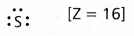
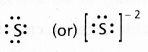
Write Lewis dot structures for S and S2-.
Answer:

  • Lewis dot structure for ‘s’ is
    AP Inter 1st Year Chemistry Study Material Chapter 3 Chemical Bonding and Molecular Structure 1
    Electronic configuration — 1s2 2s2 2p6 3s2 3p4
  • Lewis dot structure for s-2 is
    AP Inter 1st Year Chemistry Study Material Chapter 3 Chemical Bonding and Molecular Structure 2
    Electronic configuration of s-2 is 1s2 2s2 2p6 3s2 3p6

AP Inter 1st Year Chemistry Study Material Chapter 3 Chemical Bonding and Molecular Structure

Question 3.
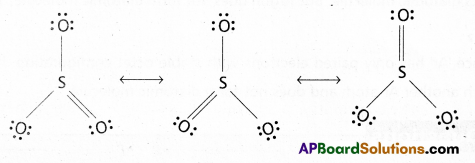
Write the possible resonance structures for SO3.
Answer:
The resonance structures of SO3 as follows
AP Inter 1st Year Chemistry Study Material Chapter 3 Chemical Bonding and Molecular Structure 3

Question 4.
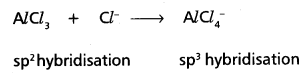
Predict the change, if any, in hybridization of Al atom in the following reaction
AlCl3 + Cl → \(\mathrm{AlCl}_4^{-}\).
Answer:
In AlCl3 Aluminium undergoes sp2 hybridisation
In \(\mathrm{AlCl}_4^{-}\) Aluminium undergoes sp3 hybridisation
AP Inter 1st Year Chemistry Study Material Chapter 3 Chemical Bonding and Molecular Structure 4

Question 5.
Which of the two ions Ca2+ or Zn2+ is more stable and why ?
Answer:

  • Ca+2 has electronic configuration 1s22s22p63s23p6. This configuration is noble gas (or) inert gas configuration.
  • Zn+2 has electonic configuration 1s22s22p63s23p64s03d10. This configuration is psuedo inert gas configuration.
    ∴ Ca+2 is more stable than Zn+2 ion.

Question 6.
Cl ion is more stable than Cl atom—Why ?
Answer:
The electronic configurations of Cl and Cl is :
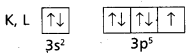
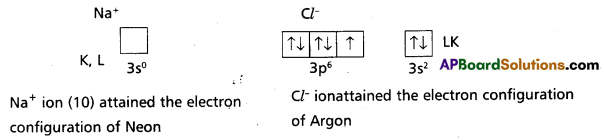
Cl = 1s2 2s2 2p6 3s2 3p5
Cl = 1s2 2s2 2p6 3s2 3p6.
This electronic configuration clearly shows that chlorine atom has 7 electrons in the outermost orbit. Whereas chloride has a stable octet electronic configuration (3s2 3p6). After gaining one electron, chloride ion attains the electronic configuration of Argon. Hence chloride ion has greater stability than chlorine atom.

Question 7.
Why argon does not form Ar2 molecule ?
Answer:
Ar2 represents diatomic molecule. But Argon does not form diatomic molecule. So it cannot represented as ‘Ar2‘.
Reason : Since Ar’ has only paired electrons with stable octet configuration. It cannot share its electrons with another Ar atom and does not form diatomic molecule.

Question 8.
What is the best possible arrangement of four bond pairs in the valence shell of an atom to minimise repulsions ?
Answer:
The best possible arrangement of four bond pairs in the valency shell of an atom to minimise repulsions is Tetrahedral. (Bond angle 109°.28′)
Eg. : Methane (CH4).

Question 9.
If A and B are two different atoms when does AB molecule become Covalent ?
Answer:

  1. If the difference in electronegativity values between A and B is less than 1.7, then covalent compound formation is possible (according to Allred – Rochow scale).
  2. If A and B are sharing one or more electron pairs mutually then AB will be a covalent compound.

AP Inter 1st Year Chemistry Study Material Chapter 3 Chemical Bonding and Molecular Structure

Question 10.
What is meant by localized orbitals?
Answer:
The molecular orbital with bonded electron cloud localised between the two nuclei of bonded atoms is called localized orbital, (or) The orbitals which are involved in bond formation are called localized orbitals.

Question 11.
How many Sigma and Pi bonds are present in
(a) C2H2 and
(b) C2H44?
Answer:
a) C2H2
H – C ≡ C – H
C2H2 contains 3 – sigma bonds and 2 – pi bonds.

b) C2H4
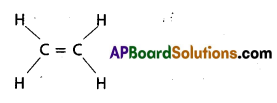
AP Inter 1st Year Chemistry Study Material Chapter 3 Chemical Bonding and Molecular Structure 5
C2H4 contains 5 – sigma bonds and 1-pi bond.

Question 12.
Is there any change in the hybridization of Boron and Nitrogen atoms as a result of the following reaction? BF3 + NH3 → F3BNH3
Answer:
a) Ammonia – Boron trifluoride formation (H3N → BF3):
Ammonia molecule contains Nitrogen atom with a lone pair of electrons (in sp3 orbital). BF3 has ‘B’ atom with an incomplete octet (with a vacant Pz orbital). Therefore, nitrogen of ammonia donates its lone pair to Boron and thus forms coordinate covalent bond. During this bond formation, the sp3 orbital of nitrogen having a lone pair overlaps the vacant ‘p’ orbital of Boron. The equation corresponding to the reaction is written as follows :
AP Inter 1st Year Chemistry Study Material Chapter 3 Chemical Bonding and Molecular Structure 6

b) Change in hybridised states N and B during [H3N → BF3] formation :
Boron in BF3 undergoes (sp2 hybridization with one vacant unhybrid ‘p’ orbital. This orbital also undergoes) hybridization in presence of NH3 so that the hybridised state of ‘B’ changes from sp2 to sp3. This vacant hybrid orbital is bonded to NH3 through dative bond. During this process there is no change in the hybridized state of Nitrogen in NH3.
AP Inter 1st Year Chemistry Study Material Chapter 3 Chemical Bonding and Molecular Structure 7

Question 13.
Give reasons for the following.
a) Why H2O Boiling point is more than H2S
b) Why H2O Boiling point is more than HF
Answer:
a) H2O has high boiling point than H2S
Reason:
In H2O inter molecular hydrogen bonding is present where as in case of H2S such bonding is absent.

b) H2O has high boiling point than HF
Reason:
In H2O and H2S inter molecular hydrogen bonding is present but in H2O the no. of hydrogen bonds are more than in HF.

AP Inter 1st Year Chemistry Study Material Chapter 3 Chemical Bonding and Molecular Structure

Short Answer Questions

Question 1.
Explain Kossel-Lewis approach to Chemical bonding.
Answer:
Kossel – Lewis Theory : This theory was also called as electronic theory of valency (or) chemical bond theory.
Postulates of Kossel – Lewis Theory : Kossel explained the formation of electrovalent bond while Lewis explained the formation of covalent bond. Their explanation of valency is mainly based on the inertness of noble gases.

Postulates:

  • The chemical inertness of noble gases is due to the presence of octet structure. Octet rule was stated as follows “An atom must possess eight electrons in the outermost energy level for its stability”.
  • Even though ‘He’ has only two electrons in the valency shell, it is highly stable and chemically inert.
  • Elements other than zero group are chemically reactive because of having less than 8 electrons in their outer most shells.
  • Every atom try to acquire the Eight electron configuration (octet) in its outer most shell. This can be possible by losing (or) sharing (or) gaining electrons.
  • According to Lewis the valency electrons are represented by dots. These are called Lewis symbols.
    AP Inter 1st Year Chemistry Study Material Chapter 3 Chemical Bonding and Molecular Structure 8
  • Lewis dot structures can be used to calculate the group valency of the element.
    Eg:
    AP Inter 1st Year Chemistry Study Material Chapter 3 Chemical Bonding and Molecular Structure 9 has four electrons.
    ∴ Valency of ‘c’ is ‘4’.

Question 2.
Write the general properties of Ionic Compounds.
Answer:

  1. Physical state : Due to close packing of ions, ionic compounds are crystalline solids.
  2. Melting and Boiling points : In ionic crystals the oppositely charged ions are bound by strong electrostatic force of attraction. To overcome these attractive force between ions, more thermal energy is required. Hence the melting and boiling points of ionic compounds are high.
  3. Solubility : Ionic compounds are soluble in polar solvents like water, liquid ammonia etc., but are insoluble in non – polar solvents like benzene, carbon disulphide etc.,
  4. Reactivity: Reactions between ionic compounds in aqueous solution are very fast due to strong attraction among ions.
    e.g. : When AgNO3 solution is added to NaCl solution, a white precipitate of AgCl is formed.
    AP Inter 1st Year Chemistry Study Material Chapter 3 Chemical Bonding and Molecular Structure 10
  5. Isomerism : Ionic bond is non-directional.
    So ionic compounds cannot exhibit isomerism.
  6. Electrical conductivity : Ionic substances conduct electricity in molten state and in aqueous solution. The ionic compounds are, therefore, electrolytes.

AP Inter 1st Year Chemistry Study Material Chapter 3 Chemical Bonding and Molecular Structure

Question 3.
State Fajan’s rules and give suitable examples.
Answer:
Fajan’s rules:

  1. Ionic nature of the bond increases with increase in the size of cation, e.g.: The ionic nature increases in the order
    Li+ < Na+ < K+ < Rb < Cs+
  2. The formation of ionic bond is favoured with the decrease of the size of anion.
    e.g.: CaF2 is more ionic than CaI2.
  3. If the charge on cation (or) anion (or) both is less, then they can form ionic bonds, e.g.: The ionic nature increases in the order
    AP Inter 1st Year Chemistry Study Material Chapter 3 Chemical Bonding and Molecular Structure 11
  4. Cations with inert gas configurations form ionic compounds while those cations with pseudo inert gas configurations favour covalent bond formation.
    e.g.: Na+ in Na+Cl has an inert gas configuration. So Na+Cl is ionic. But CuCl is more covalent because Cu+ has not acquired inert gas configuration in this compound, instead it has acquired pseudo inert gas configuration.
  5. The cation with inert gas configuration is more stable, e.g.: Ca2+ is more stable than Zn2+ ion.
  6. AP Inter 1st Year Chemistry Study Material Chapter 3 Chemical Bonding and Molecular Structure 12

Question 4.
What is Octet rule ? Briefly explain its significance and limitations.
Answer:
Octet rule: Every atom must possess 8 electrons in its outermost energy level for its stability. Atoms combine in two ways to get octet either by transfer of electrons (or) by mutual sharing of electrons. They can attain ns2 np6 configuration.
e.g.:

  1. Na loose one electron to get Ne configuration by possessing 8 electrons.
    Na : 1 s2 2s2 2p6 3s1 and Na+ : 1 s2 2s2 2p6.
  2. ‘Cl’ atom take one electron to get “Ar” configuration. Cl : 1s2 2s2 2p6 3s2 3p6.
    Here Na+ and Cl ions obey octet rule.
  3. In H2O molecule oxygen obey octet rule.

It is therefore, concluded that s2p6 configuration in the outer energy level constitutes a structure of maximum stability and therefore, of minimum energy.

The atoms of all elements when enter into chemical combination try to attain noble gas configuration (i.e.,) they try to attain 8 electrons in their outermost energy level which is of maximum stability and hence of minimum energy.
The tendency of an atoms to achieve eight electrons in their outermost shell is known as OCTET RULE.

Octet rule was the basis of electronic theory of valency.

Limitations : There are 3 types of exceptions to the octet rule. These are mentional below.

  • Central atoms containing incomplete octet.
    Eg : BeH2, BCl3 etc.,
  • Molecules containing odd number of electrons.
    AP Inter 1st Year Chemistry Study Material Chapter 3 Chemical Bonding and Molecular Structure 13
  • Central atoms possessing more than 8 electrons which istermed as expanded octet.
    Eg : SF6, H2SO4 etc.,
  • This theory does not explained about shape of molecules.
  • This theory does not explained about the formation of noble gas compounds like XeF2, XeOF2 etc.,

Question 5.
Write the resonance structures for NO2 and \(\mathrm{NO}_3^{-}\)
Answer:
Resonance structure of NO2
AP Inter 1st Year Chemistry Study Material Chapter 3 Chemical Bonding and Molecular Structure 14

Question 6.
Use Lewis symbols to show electron transfer between the following pairs of atoms to form cations and anions:
(a) K and S
(b) Ca and O
(c) Al and N.
Answer:
a) Between the atoms K and S
AP Inter 1st Year Chemistry Study Material Chapter 3 Chemical Bonding and Molecular Structure 15
b) Between Ca and O
AP Inter 1st Year Chemistry Study Material Chapter 3 Chemical Bonding and Molecular Structure 16
c) Between Al and N
AP Inter 1st Year Chemistry Study Material Chapter 3 Chemical Bonding and Molecular Structure 17

Question 7.
Explain why H2O has dipole moment while CO2 does not have.
Answer:

  • H2O molecule is a polar molecule and it has un symmetrical structure i.e. Angular (or) V – shape
  • CO2 molecule is non polar and it is linear molecule.
    AP Inter 1st Year Chemistry Study Material Chapter 3 Chemical Bonding and Molecular Structure 18
  • SO H2O has dipolemoment (μ = 1 ,835D) and CO2 does not have dipolemoment (μ = 0)

Question 8.
Define Dipole moment. Write its applications.
Answer:
Dipole moment : The product of magnitude of the charge and the distance between the two poles (bond length) is called dipole moment.

  • Dipole moment μ = q × d
    q = charge
    d = bond length
  • Units : Debye (D), 1 Debye = 3.34 × 10⁻³⁰ coulombs metres.

Applications : –

  • Dipole moment is used to calculate the percentage of ionic character in a molecule.
  • It is used to know the shape of the molecule.
  • Symmetry (symmetrical (or) non symmetrical) of the molecule can be known by dipole moment.

AP Inter 1st Year Chemistry Study Material Chapter 3 Chemical Bonding and Molecular Structure

Question 9.
Explain why BeF2 molecule has zero dipole moment although the Be-F bonds are polar.
Answer:

  • Even though Be-F bonds in BeF2 are polar, the dipole moment of BeF2 molecule is zero. Because BeF2 has linear shape.
    AP Inter 1st Year Chemistry Study Material Chapter 3 Chemical Bonding and Molecular Structure 19
  • Flere the vectrorial sum of the dipole moment of two Be-F bonds is zero. Hence dipole moment
    (μ) = 0.

Question 10.
Explain the structure of CH4 molecule.
Answer:
Formation of Methane molecule :

  1. The central atom of methane is carbon.
  2. The electronic configuration of carbon in ground state is AP Inter 1st Year Chemistry Study Material Chapter 3 Chemical Bonding and Molecular Structure 20 and on excitation it is AP Inter 1st Year Chemistry Study Material Chapter 3 Chemical Bonding and Molecular Structure 21 During excitation the 2s pair splits and the electron jumps into the adjacent vacant 2pz orbital.
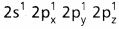
  3. The AP Inter 1st Year Chemistry Study Material Chapter 3 Chemical Bonding and Molecular Structure 22 undergo sp3 hybridisation giving four equivalent sp3 hybridised orbitals.
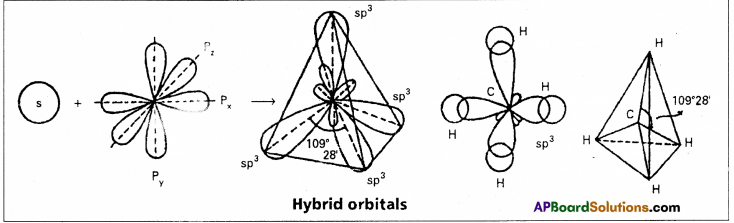

  4. Each sp3 hybrid orbital overlaps with the 1s orbitals of hydrogen forming \(\sigma_{s p^3-s}\) bond.
  5. In case of methane four \(\sigma_{s p^3-s}\) bonds are formed. The bonds are directed towards the four corners of a regular tetrahedron. The shape of methane molecule is tetrahedral with a bond angle 109°28’.
    AP Inter 1st Year Chemistry Study Material Chapter 3 Chemical Bonding and Molecular Structure 23

Question 11.
Explain Polar Covalent bond with a suitable example.
Answer:
The covalent bond which is formed by the mutual sharing of electron pairs between two dissimilar atoms is called polar covalent bond.

  • Dissimilar atoms means two atoms having different electronegativity values (or) atoms of different elements.
    Eg : HF, HCl, H2O, CO2 etc.,
    Formation of HCl :
    AP Inter 1st Year Chemistry Study Material Chapter 3 Chemical Bonding and Molecular Structure 24
  • In the above example H and Cl are two atoms of different elements having different electro negativities.
  • These two atoms (H, Cl) mutually share the electron pairs and form the polar covalent bond.

Question 12.
Explain the shape and bond angle In BCl3 molecule in terms of Valence Bond Theory.
Answer:
Boron trichloride molecule formation :

  1. The electronic configuration of ‘B’ in the ground state is AP Inter 1st Year Chemistry Study Material Chapter 3 Chemical Bonding and Molecular Structure 25
  2. On excitation the configuration is AP Inter 1st Year Chemistry Study Material Chapter 3 Chemical Bonding and Molecular Structure 26 Now there are three half filled orbitals are available for hybridisation.
  3. Now sp2 hybridisation takes place at boron atom giving three sp2 hybrid orbitals.
  4. Each of them with one unpaired electron forms a ‘σ’ bond with one chlorine atom. The overlapping is σsp2 – p (Cl atom has the unpaired electron in 2pz orbital). In boron trichloride there are three ‘σ’ bonds.
    AP Inter 1st Year Chemistry Study Material Chapter 3 Chemical Bonding and Molecular Structure 27

Question 13.
What are σ and π bonds ? Specify the differences between them.
Answer:
Definition of σ bond : “σ – bond is along the internuclear axis. It has a cylindrical symmetry”.
Definition of π bond : “A covalent bond formed by a sidewise overlap of ‘p’ orbitals of atoms that are already bonded through a σ – bond, and in which the electron clouds are present above and below the internuclear axis is known as π – bond”.

Sigma bond (σ)

  1. A ‘σ’ bond is formed by the axial overlap of two half filled orbitals belonging to the valence shells of the two combining atoms.
  2. The ‘σ’ bonding electron cloud is symmetric about the inter-nuclear axis.
  3. It is strong bond since the extent of overlap is much.
  4. It allows free rotation of atoms or groups about the bond.
  5. It can exist independently.
  6. It determines the shape of the molecule.
  7. There can be only one ‘σ’ bond between two atoms.
  8. Hybrid orbitaIs form only ‘σ’ bonds.

Pi — bond (π)

  1. A π-bond is formed by the lateral overlap of orbitals.
  2. The π-bonding electron cloud lies above and below the flame of the internuclear axis.
  3. It is a weaker than ‘σ’ bond, since the extent of overlap is less.
  4. π-bond restricts such free rotation.
  5. It is formed only after a ‘σ’ bond is formed.
  6. It does not determine the shape of the molecule.
  7. There can be one or two π-bonds between the atoms.
  8. Hybrid orbitals cannot form π-bonds.

AP Inter 1st Year Chemistry Study Material Chapter 3 Chemical Bonding and Molecular Structure

Question 14.
Even though nitrogen in ammonia is in sp3 hybridization, the bond angle deviate from 109°28. Explain.
Answer:
In NH3 molecule the central nitrogen atom shares its ‘3’ unpaired electrons with three hydrogen atoms to form 3σ bonds. Hence NH3 molecule contains one lone pair, three bond pairs.
AP Inter 1st Year Chemistry Study Material Chapter 3 Chemical Bonding and Molecular Structure 28
a) Because of the repulsion between the lone pair and the bond pairs the angle reduces to 107°.
b) According to VSEPR theory the geometry of the molecule is pyramidal with bond angle 107°.

Question 15.
Show how a double and triple bond are formed between carbon atoms in
(a) C2H4 and
(b) C2H2 respectively.
Answer:
Formation of double bond between the carbon atoms of C2H4 : –
C – Ground state electronic configuration 1s2 2s2 2p2
AP Inter 1st Year Chemistry Study Material Chapter 3 Chemical Bonding and Molecular Structure 29

  •  In ethylene two carbons undergo sp2 hybridisation.
  • One of sp2 hybrid orbital of carbon overlaps with sp2 hybrid orbital of another carbon atom to form C – C sigma bond.
  • The two other sp2 hybrid orbitals of each carbon overlap with ‘s’ orbital of hydrogen atoms to form C – H bonds.

The unhybridised orbital of one carbon atom overlap side wisely with the similar orbital to form weak π bond.

AP Inter 1st Year Chemistry Study Material Chapter 3 Chemical Bonding and Molecular Structure 30
Formation of triple bond between the carbon atoms of C2H2 : –
C – Ground state electronic configuration 1s2 2s2 2p2
AP Inter 1st Year Chemistry Study Material Chapter 3 Chemical Bonding and Molecular Structure 31

  • In acetylene two carbons undergoes sp hybridisation.
  • One of sp hybrid orbital of carbon overlaps with sp hybrid orbital of another carbon atom to form C – C sigma bond.
  • another sp hybrid orbitals of each carbon overlap with s orbital of hydrogen atoms to form C – H bonds.
  • The un hybridised orbitals of two carbon atom overlap side wisely to form two weak π bonds.
    AP Inter 1st Year Chemistry Study Material Chapter 3 Chemical Bonding and Molecular Structure 32

Question 16.
Explain the hybridization involved in PCl5 molecule. (T.S. Mar. ’16, ’15)
Answer:
1) In PCl5 the electron configuration of phosphorus is
AP Inter 1st Year Chemistry Study Material Chapter 3 Chemical Bonding and Molecular Structure 33

2) Phosphorus undergoes sp3d – hybridisation by intermixing of one s-orbital [3s], three p – orbitals [3px, 3py, 3pz] and one d – orbital.
These five hybrid orbitals overlap. The pz orbitals of chlorine atoms forming five \(\sigma_{s p^3 d-s}\) bonds. Out of these five p – Cl bonds three are coplanar and the remaining two are in the axial position. There by PCl5 acquires the trigonal bipyramidal shape. The molecule contains two bond angles 90° and 120°.
AP Inter 1st Year Chemistry Study Material Chapter 3 Chemical Bonding and Molecular Structure 34

Question 17.
Explain the hybridization involved in SF6 molecule.
Answer:
In this hybridisation one ‘s’ orbital, three ‘p’ orbitals and two ‘d’ orbitals of the excited atom combine to form six equivalent sp3d2 hybrid orbitals.
e.g. : SF6
AP Inter 1st Year Chemistry Study Material Chapter 3 Chemical Bonding and Molecular Structure 35
These six sp3 d2 hybrid orbitals overlap six 2pz orbitals of fluorine atoms to form six \(\sigma_{s p^3 d^2}\) bonds. The directions of the bonds give an octa-hedral shape to the molecule. The bond angle is 90° or 180° & 90°.
AP Inter 1st Year Chemistry Study Material Chapter 3 Chemical Bonding and Molecular Structure 36

AP Inter 1st Year Chemistry Study Material Chapter 3 Chemical Bonding and Molecular Structure

Question 18.
Explain the formation of Coordinate Covalent bond with one example.
Answer:
Co-ordinate covalent bond (dative bond) is a special type of covalent bond. It is proposed by Sidgwick. It is formed by the sharing of electrons between two atoms in which both the electrons of the shared electron pair are contributed by one atom and the other atom nearly participates in sharing.

The bond is represented as (“→”) an arrow starting from the donar atom and directed towards the acceptor atom.

Examples :
1) Ammonia – Boron trifluoride H3N : → BF3
Ammonia combines with boron trifluoride to give ammonium boron trifluoride.
AP Inter 1st Year Chemistry Study Material Chapter 3 Chemical Bonding and Molecular Structure 37
In ammonia nitrogen has a complete octet and also it has a lone pair of electrons. In BF3 the boron atom has a total of six electrons after sharing with fluorine. Nitrogen donates the electron pair to boron to form a co-ordinate covalent bond between ammonia and boron trifluoride.

2) Ammonium ion (\(\mathrm{NH}_4^{+}\))
AP Inter 1st Year Chemistry Study Material Chapter 3 Chemical Bonding and Molecular Structure 38

3) Hydronium ion (\(\mathrm{H}_3 \mathrm{O}^{+}\))
AP Inter 1st Year Chemistry Study Material Chapter 3 Chemical Bonding and Molecular Structure 39

Properties of co-ordinate covalent bond :

  1. The bond do not ionise in water.
  2. The compounds are generally soluble in organic solvents and are sparingly soluble in water.
  3. These compounds exhibit space isomerism because the bond is rigid and directional.
  4. The bond is semipolar in nature – so their volatility lies in between covalent and ionic bonds.

Question 19.
Which hybrid orbitals are used by Carbon atoms in the following molecules?
(a) CH3 -CH3
(b) CH3 – CH = CH2
(c) CH3 – CH2 – OH
(d) CH3 – CHO
Answer:
a) CH3 -CH3 (ethane)
The two carbons of ethane undergo sp3 hybridisation.
AP Inter 1st Year Chemistry Study Material Chapter 3 Chemical Bonding and Molecular Structure 40
Carbon – (1) – undergoes sp2 hyrbidisation
Carbon – (2) – undergoes sp2 hyrbidisation
Carbon – (3) – undergoes sp3 hyrbidisation
AP Inter 1st Year Chemistry Study Material Chapter 3 Chemical Bonding and Molecular Structure 41
Carbon (1) and (2) both undergo ‘sp3‘ hybridisation.
AP Inter 1st Year Chemistry Study Material Chapter 3 Chemical Bonding and Molecular Structure 42

Question 20.
What is Hydrogen bond ? Explain the different types of Hydrogen bonds with examples. (A.P., T.S. Mar. ’16)
Answer:
Hydrogen bond is a weak electrostatic bond formed between partially positive charged hydrogen atom and an highly electronegative atom of the same molecule or another molecule.

Hydrogen bond is formed when the Hydrogen is bonded to small, highly electronegative atoms like F, O and N. A partial positive charge will be on hydrogen atom and partial negative charge on the electronegative atom.

The bond dissociation energy of hydrogen bond is 40 KJ/mole. Hydrogen bond is represented with dotted lines (—–). Hydrogen bond is stronger than Vander Waals’ forces and weaker than covalent bond.
Hydrogen bonding is of two types.

(1) Intermolecular hydrogen bond and
(2) Intramolecular hydrogen bond.

1) Intermolecular hydrogen bond :
If the hydrogen bond is formed between two polar molecules it is called intermolecular hydrogen bond, i.e., the hydrogen bond is formed between hydrogen atom of one molecule and highly electronegative atom of another molecule is known as intermolecular hydrogen bond.
Ex. : Water (H2O) ; HF : NH3 ; p – nitrophenol, CH3COOH, ethyl alcohol etc.
AP Inter 1st Year Chemistry Study Material Chapter 3 Chemical Bonding and Molecular Structure 43
Water molecule forms oi. associated molecule through intermolecular hydrogen bond. Due to molecular association water possess high boiling point.
AP Inter 1st Year Chemistry Study Material Chapter 3 Chemical Bonding and Molecular Structure 44

m or p – nitrophenol :
AP Inter 1st Year Chemistry Study Material Chapter 3 Chemical Bonding and Molecular Structure 45

2) Intramolecular hydrogen bond:
If the hydrogen bond is formed within the molecule it is known as intramolecular hydrogen bond.
Ex. : o – nitrophenol; o – hydroxy benzaldehyde.
AP Inter 1st Year Chemistry Study Material Chapter 3 Chemical Bonding and Molecular Structure 46

Abnormal behaviour due to hydrogen bond:

  1. The physical state of substance may alter. They have high melting and boiling points.
  2. Ammonia has higher boiling point than HCl eventhough nitrogen and chlorine have same electronegativity values (3.0). Ammonia forms an associated molecule through intermolecular hydrogen bond.
  3. p – hydroxy benzaldehyde have higher boiling point than o- hydroxy benzaldehyde. This is due to intermolecular hydrogen bonding in para isomer.
  4. Ethyl alcohol is highly soluble in water due to association and co-association through intermolecular hydrogen bonding.

AP Inter 1st Year Chemistry Study Material Chapter 3 Chemical Bonding and Molecular Structure

Question 21.
Explain the formation of H2 molecule on the basis of Valence Bond theory.
Answer:
Postulates of valency bond theory:

  1. Covalent bond is formed by the overlap of an half filled atomic orbital of one atom with an half filled atomic orbital of the other atom involved in the bond formation.
  2. The electrons in these two orbitals involved in the overlap shall have opposite spins.
  3. Greater the overlap stronger the bond formed.
  4. The bonds are formed mostly in the direction in which the electron clouds are concentrated.
    AP Inter 1st Year Chemistry Study Material Chapter 3 Chemical Bonding and Molecular Structure 47

Formation of H2 molecule:
Hydrogen molecule is formed due to overlaping of s – s orbitals. When two Hydrogen atoms come together, is orbitals of the Hydrogen atoms overlap to form a strong ‘σ” bond. This is σs-s’
AP Inter 1st Year Chemistry Study Material Chapter 3 Chemical Bonding and Molecular Structure 48

Question 22.
Using Molecular Orbital Theory explain why the B2 molecule is paramagnetic ?
Answer:
Boron electronic configuration is – 1s2 2s2 2p1
The molecular orbital energy level sequence for B2 is
AP Inter 1st Year Chemistry Study Material Chapter 3 Chemical Bonding and Molecular Structure 49

  • Bond order = \(\frac{6-4}{2}\) = \(\frac{2}{2}\) = 1
  • In the above sequence unpaired electrons are present.
  • Presence of unpaired electrons leads to paramagnetic nature.
    ∴ B2 molecule is paramagnetic.

Question 23.
Write the important conditions necessary for linear combination of atomic orbitals.
Answer:

  1. The molecular orbitals are formed when the atomic orbitals combine linearly (i.e.,) when the atoms approach each other. The no. of molecular orbitals resulting are equal to the no.of atomic orbitals combining.
  2. Only such atomic orbitals which are of similar energies and symmetry with respect to the inter nuclear axis combine to form molecular orbitals.
  3. The total no. of molecular orbitals produced will be numerically equal to the no. of combining orbitals.
  4. The order of energies of bonding, anti bonding and non bonding orbitals can be written as bonding orbitals < non bonding orbitals < anti – bonding orbitals.

Question 24.
What is meant by the term Bond order? Calculate the bond orders in the following
(a) N2
(b) O2
(c) \(\mathrm{O}_2^{+}\) and
(d) \(\mathrm{O}_2^{-}\)
Answer:
Bond order : The half of the difference between the no.of bonding electrons and anti bonding electrons is known as bond order. ’
a) N2 : Molecular orbital energy level sequence.
AP Inter 1st Year Chemistry Study Material Chapter 3 Chemical Bonding and Molecular Structure 50
→ Bond Order = \(\frac{10-4}{2}\) = \(\frac{6}{2}\) = 3

b) O2 : Molecular orbital energy level sequence.
AP Inter 1st Year Chemistry Study Material Chapter 3 Chemical Bonding and Molecular Structure 51

AP Inter 1st Year Chemistry Study Material Chapter 3 Chemical Bonding and Molecular Structure

Question 25.
Of BF3 and NF3, dipole moment is observed for NF3 and not for BF3. Why ?
Answer:
Of BF3 and NF3 dipole moment is observed for NF3 and not for BF3.
Reasons:

  • BF3 molecule is non polar and is a symmetrical molecule. Symmetrical molecules have zero dipole moment.
  • NF3 molecule is polar and it is a unsymmetrical molecule so it has dipole moment.
  • BF3 molecule has trigonal planar structure.
    NF3 molecule has pyramidal shape.
  • NF3 has dipole moment µ = 0.8 × 10⁻³⁰ coloumb × meter.
    AP Inter 1st Year Chemistry Study Material Chapter 3 Chemical Bonding and Molecular Structure 52

Question 26.
Eventhough both NH3 and NF3 are Pyramidal, NH3 has a higher dipole moment compared to NF3. Why? (A.P. Mar.’16)
Answer:

  • Both NH3 and NF3 molecules have pyramidal shape and in two molecules N atom has lone pair of electrons.
  • Even though fluorine has more electronegativity than nitrogen the dipole moment of NH3 is greater than that of NF3
    µ (NH3) = 4.9 × 10⁻³⁰ coloumbs × meter.
    µ (NF3) = 0.8 × 10⁻³⁰ coloumbs × meter.
  • In case of NH3 the orbital dipole due to lone pair is in the same direction as the resultant dipole moment of N – H bonds.

Where as in case of NF3 the orbital dipole is in the direction opposite to the resultant dipole
moment of the three N – F bonds.
AP Inter 1st Year Chemistry Study Material Chapter 3 Chemical Bonding and Molecular Structure 53

Question 27.
How do you predict the shapes of the following molecules making use of VSEPR Theory ?
(a) XeF4
(b) BrF5
(c) ClF3 and
(d) IC\(l_4^{-}\)
Answer:
According to VSEPR theory the shape of the molecule can be predicted by counting no.of electron pairs (bond pairs, lone pairs) around the central atom.
a) XeF4:
In XeF4 No.of bond pairs present are ‘4’.
No.of lone pairs present are ‘2’.
According to VSEPR theory shape of molecule is square planar (Actual shape octahedral).
AP Inter 1st Year Chemistry Study Material Chapter 3 Chemical Bonding and Molecular Structure 54

b) BrF5 :
In BrF5 No.of bond pairs present are ‘5’
No.of lone pairs present are ‘1’
According to VSEPR theory shape of the molecule is square pyramid (actual shape octahedral)
AP Inter 1st Year Chemistry Study Material Chapter 3 Chemical Bonding and Molecular Structure 55
c) ClF3:
AP Inter 1st Year Chemistry Study Material Chapter 3 Chemical Bonding and Molecular Structure 56
In ClF3 No.of bond pairs present are ‘3’
No.of lone pairs present are ‘2’
According to VSEPR Theory shape of ClF3 Molecule is T – shape (Actual shape TBP)

d) IC\(l_4^{-}\):
In IC\(l_4^{-}\) No.of bond pairs present are ‘4’
No.of lone pairs present are ‘2’
According to VSEPR Theory shape of ICl\(l_4^{-}\) is square planar
(Actual shape octahedral)
AP Inter 1st Year Chemistry Study Material Chapter 3 Chemical Bonding and Molecular Structure 57

Long Answer Questions

Question 1.
Explain the formation of Ionic Bond with a suitable example.
Answer:
The electrostatic force that binds the oppositely charged ions which are formed by the transfer of electrons from one atom with low ionization potential to the other with high electron affinity is called ionic bond or electrovalent bond.
It is formed when the electronegativity difference between the two atoms is more tha 1.7.
Example :
Formation of sodium chloride in terms of orbital concept:
1) Na (Z = 11). The electronic configuration is 1s2 2s2 2p6 3s1.
This can be expressed as
AP Inter 1st Year Chemistry Study Material Chapter 3 Chemical Bonding and Molecular Structure 58

2) Cl (Z = 17). The electronic configuration is = 1s2 2s2 2p6 3s2 3p5
This can be expressed as
AP Inter 1st Year Chemistry Study Material Chapter 3 Chemical Bonding and Molecular Structure 59

3) The configurations after the transfer of electrons forming ions can be expressed as:
AP Inter 1st Year Chemistry Study Material Chapter 3 Chemical Bonding and Molecular Structure 60
In the formation of sodium chloride the 3s electron of sodium atom is transferred to the 3p2 orbital of chlorine atom. The Na+ ion and Cl ion so formed are now bound by strong coulombic electrostatic forces of attraction forming sodium chloride.

AP Inter 1st Year Chemistry Study Material Chapter 3 Chemical Bonding and Molecular Structure

Question 2.
Explain the factors favourable for the formation of Ionic Compounds.
Answer:
Factors favour the ionic bond formation:
a) Cation formation:

  1. Lower ionization energy: Lower ionization energy of an atom greater is the ease of formation of cation
    e.g. : The ionization energy of sodium is 117.9 kcal/mole and that of potassium is 100 kcal/mole So K+ ion can readily form than Na+ ion.
  2. Large size of the atom : Large atoms can easily lose the valence electrons. If the size large, the distance between the nucleus and the valence electrons is more and so the force of attraction is less. Therefore the electron can be removed easily from the atom forming cation.
  3. Ion with lower charge: Small magnitude of charge favours the formation of ions easily.
    e.g. : The ease of ion formation increases in the order Na+ > Mg2+ > Al3+.
  4. Cations with inert gas configuration : Ion possessing electronic configuration similar to zero group elements are more stable than those ions which do not have such configuration.
    eg.: Ca2+ (2, 8, 8) is more stable than Zn2+ (2, 8, 18) because the former has inert gas
    configuration.

b) Anion formation:

  1. High electron affinity: If the electron affinity of an element is high its anion can be easily formed.
    e.g.: Cl + e → Cl
  2. Smaller size of atom : Smaller the size of the atom lesser is the distance between the nucleus and the valence orbit. Hence the nuclear attraction on incoming electron is more. So the anion is readily formed.
  3. Lower charge : Ions with lower charge are more readily formed than those with higher charge.
    e.g.: Cl > O 2- > N3-
  4. The ions with inert gas electronic configuration are more readily formed than others with the same charge. .
    c) If the two bonded atoms differ by more than 1.70 in their EN values, the bond between them is ionic in nature.

Question 3.
Draw Lewis Structures for the following molecules.
(a) H2S
(b) SiCl4
(c) BeF2
(d) HCOOH
Answer:
Lewis structures:
AP Inter 1st Year Chemistry Study Material Chapter 3 Chemical Bonding and Molecular Structure 61

Question 4.
Write notes on
(a) Bond Angle
(b) Bond Enthalpy
(c) Bond length and
(d) Bond order.
Answer:
a) Bond angle : The angle between the orbitals containing bonding electron pairs around the central atom in a molecule (or) complex ion is known as Bond angle.

  • it is expressed in degrees.
  • It is determined experimentally by spectroscopic methods.
    Eg: In H2O (H — 0 — H) bond angle is 104.5° .

b) Bond Enthalpy : The amount of energy required to break one mole of bonds of a particular type between two atoms in a gaseous state is known as Bond Enthalpy.
Units: KJ/Mole.
Eg: H – H bond enthalpy in hydrogen is 435.8 KJ/mole
H2(g) → H(g) + H(g) ∆H = 435.8 KJ/mole

  • In case of poly atomic molecules average bond enthalpy is used.
    AP Inter 1st Year Chemistry Study Material Chapter 3 Chemical Bonding and Molecular Structure 62

c) Bond length : The distance between the nuclei of the atoms in a molecule is known as bond length.

  • Bond length is equal to the sum of the covalent radii of the two atoms that are bonded.
  • Units of Bond length A° (or) cm (or) m (or) pm
  • As the number of bonds between two atoms increases the bond length decrease.
    AP Inter 1st Year Chemistry Study Material Chapter 3 Chemical Bonding and Molecular Structure 63

d) Bond Order:
According to Lewis the bond order is given by the number of bonds between the two atoms in a covalent molecule.
Eg: Bond order of N2 – 3
Bond order of O2 – 2
Bond order of H2 – 1

  • In case of Iso electronic species and ions bond orders are same.
  • Bond order is useful in predecting stabilities of molecules.
  • Bond order increases bond enthalpy increases and Bond length decreases.

AP Inter 1st Year Chemistry Study Material Chapter 3 Chemical Bonding and Molecular Structure

Question 5.
Give an account of VSEPR Theory and its applications.
Answer:
VSEPR theory was proposed by Sidgwick and Powell and later extended by Gillespie and Nyholm. It was developed by Ronald and Nyholm.
This theory explains the shapes of simple molecules having electron pairs bonded or non-bonded. The repulsions among the electron pairs present in the valence shell of the central atom decides the shape of the molecules.

According to this theory :

a) The shape of the molecule is determined by repulsions between all of the electron pairs present in the valency shell of central atom.
b) The electron pairs orient in space so as to have minimum repulsions among them.
c) The magnitude of repulsions between bonding pairs of electrons depends on the electronegativity difference between the central atom and the other atoms.
d) The order of repulsions between various electron pairs is lone pair – lone pair > lone pair – bond pair > bond pair – bond pair.
e) The repulsive forces between different bonds is of the order triple bond > double bond > single bond.
f) The shapes of molecules can be predicted as.
AP Inter 1st Year Chemistry Study Material Chapter 3 Chemical Bonding and Molecular Structure 64
In NH3 molecule the central nitrogen atom shares its ‘3’ unpaired electrons with three hydrogen atoms to form 3σ bonds. Hence NH3 molecule contains one lone pair, three bond pairs.
AP Inter 1st Year Chemistry Study Material Chapter 3 Chemical Bonding and Molecular Structure 65
a) Because of the repulsion between the lone pair and the bond pairs the angle reduces to 107°.
b) According to VSEPR theory the geometry of the molecule is pyramidal with bond angle 107°.

Question 6.
How do you explain the geometry of the molecules on the basis of Valence bond Theory ?
Answer:
Postulates of valency bond theory :

  1. Covalent bond is formed by the overlap of an half filled atomic orbital of one atom with an half filled atomic orbital of the other atom involved in the bond formation.
  2. The electrons in these two orbitals involved in the overlap shall have opposite spins.
  3. Greater the overlap stronger the bond formed.
  4. The bonds are formed mostly in the direction in which the electron clouds are concentrated.
    AP Inter 1st Year Chemistry Study Material Chapter 3 Chemical Bonding and Molecular Structure 66

Formation of H2 molecule :
Hydrogen molecule is formed due to overlapping of s – s orbitals. When two Hydrogen atoms come together, 1s orbitals of the Hydrogen atoms overlap to form a strong “σ” bond. This is σs-s.
AP Inter 1st Year Chemistry Study Material Chapter 3 Chemical Bonding and Molecular Structure 67
Formation of Cl2 molecule :
The electronic configuration of Chlorine atom is AP Inter 1st Year Chemistry Study Material Chapter 3 Chemical Bonding and Molecular Structure 68 It has one half filled 3pz orbital. The pz orbital of one chlorine atom overlaps the pz orbital of the other chlorine atom and the two electrons of opposite spins pair up to form covalent bond. As the overlap along the internuclear axis is maximum a strong bond is formed. The bond is formed due to \(\sigma_{p-p}\) overlap.
AP Inter 1st Year Chemistry Study Material Chapter 3 Chemical Bonding and Molecular Structure 69

Formation of O2 molecule:
The electronic configuration of oxygen atom is AP Inter 1st Year Chemistry Study Material Chapter 3 Chemical Bonding and Molecular Structure 70 It has two half filled 2p orbitals i.e., 2py and 2pz.
The py orbital of one atom overlaps the py orbital of the second atom to form a ‘σ’ bond \(\sigma_{p_y}-p_y\).
The pz orbital in the two atoms will be at right angles to the internuclear axis. These two can have lateral overlap. The electron density of the bonded pair is distributed in two banana like regions lying on either side of the internuclear axis. Thus the oxygen molecule has a double bond. The molecule has one σp – p and one πp – p between the two atoms.
AP Inter 1st Year Chemistry Study Material Chapter 3 Chemical Bonding and Molecular Structure 71

Question 7.
‘What do you understand by Hybridisation? Explain different types of hybridization involving s and p orbitals. (Mar. ’13)
Answer:
Hybridisation is defined as the process of mixing of atomic orbitals of nearly equal energy of an atom to give the same number of new set of orbitals of equal energy and shapes.
Depending on the number and nature of orbitals involving hybridisation it is classified into different types. If ‘s’ and ‘p’ atomic orbitals are involved three types are possible namely sp3, sp2 and sp.

1. sp3 hybridisation : In this hybridisation one’s and three ‘p’ atomic orbitals of the excited atom combine to form four equivalent sp3 hybridised orbitals.
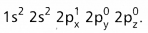
This hybridisation is known as tetrahedral or tetragonal hybridisation.

Each sp3 hybridised orbital possess 25% ‘s’ nature and 75% of ‘p’ nature. The shape of the molecule is tetrahedral with a bond angle 109°28′, e.g. : Formation of Methane molecule :

  1. The central atom of methane is carbon.
  2. The electronic configuration of carbon in ground state is AP Inter 1st Year Chemistry Study Material Chapter 3 Chemical Bonding and Molecular Structure 72 and on excitation it is AP Inter 1st Year Chemistry Study Material Chapter 3 Chemical Bonding and Molecular Structure 73 During excitation the 2s pair splits and the electron jumps into the adjacent vacant 2pz orbital.
  3. The AP Inter 1st Year Chemistry Study Material Chapter 3 Chemical Bonding and Molecular Structure 74 undergo sp3 hybridisation giving four equivalent sp3 hybridised orbitals.

  4. Each sp3 hybrid orbital overlaps with the 1s orbitals of hydrogen forming \(\sigma_{s p^3-s}\) bond.
  5. In case of methane four \(\sigma_{s p^3}-s\) bonds are formed. The bonds are directed towards the four corners of a regular tetrahedron. The shape of methane molecule is tetrahedral with a bond angle 109°28′.
    AP Inter 1st Year Chemistry Study Material Chapter 3 Chemical Bonding and Molecular Structure 75

2. sp2 hybridisation : In this hybridisation one ‘s’ and two p’ atomic orbitals of the excited atom
combine to form three equivalent sp2 hybridised orbitals.
This hybridisation is also known as trigorial hybridisation. In sp2 hybridisation each sp2 hybrid orbital has 33.33% ‘s’ nature and 66.66% ‘p’ nature. The shape of the molecule is trigonal with a bond angle 120°.
E.g.: Boron trichioride molecule formation:

  1. The electronic configuration of ‘B’ in the ground state is AP Inter 1st Year Chemistry Study Material Chapter 3 Chemical Bonding and Molecular Structure 76
  2. On excitation the configuration is AP Inter 1st Year Chemistry Study Material Chapter 3 Chemical Bonding and Molecular Structure 77 Now there are three half filled orbitals are available for hybridisation.
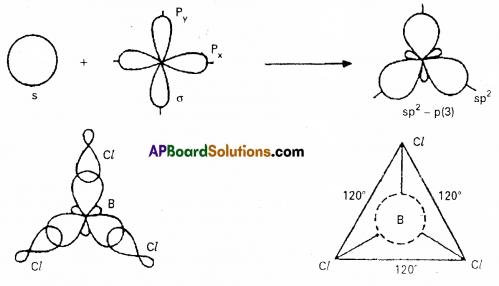
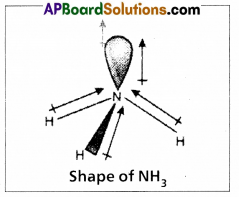
  3. Now sp2 hybridisation takes place at boron atom giving three sp2 hybrid orbitals.
  4. Each of them with one unpaired electron forms ‘σ’ bond with one chlorine atom. The overlapping is \(\sigma_{s p^2-p}\) (Cl atom has the unpaired electron in 2Pz orbital). In boron trichloride there are three ‘σ’ bonds.
    AP Inter 1st Year Chemistry Study Material Chapter 3 Chemical Bonding and Molecular Structure 78

3. sp hybridisation : In this hybridisation one ‘s and one ‘p’ atomic orbitals of the excited atom combine to form two equivalent sp hybridised orbitals.
This hybridisation is also known as diagonal hybridisation. In sp hybridisation each sp hybrid orbital has 50% ‘s’ character and 50% ‘p’ character. The shape of the molecule is linear or diagonal with a bond angle 180°.
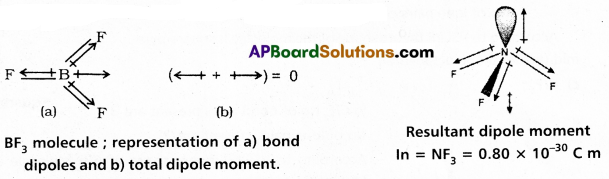
Ex. : Beryllium chloride molecule formation:

  1. Be atom has AP Inter 1st Year Chemistry Study Material Chapter 3 Chemical Bonding and Molecular Structure 79 electronic configuration.
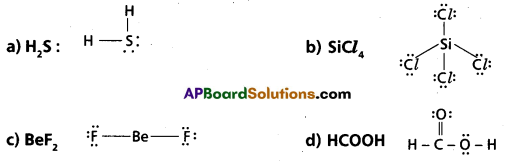
  2. In ground state it has no half filled orbitais. On excitation the configuration becomes \(1 s^2 2 s^1 2 P_x^1\)\(2 p_y^0 2 p_z^0\).
  3. Now sp hybridisation takes place at beryllium atom giving two sp hybrid orbitais. Each of them with one unpaired electron forms a ‘σ’ bond with one chlorine atom.
  4. The overlaping is σsp-p (Cl atom has the unpaired electron in 2pz orbital). In beryllium chloride there are two ‘σ’ bonds.
    AP Inter 1st Year Chemistry Study Material Chapter 3 Chemical Bonding and Molecular Structure 80

AP Inter 1st Year Chemistry Study Material Chapter 3 Chemical Bonding and Molecular Structure

Question 8.
Write the salient features of Molecular Orbital Theory.
Answer:
Molecular orbital theory:
Hund and Mulliken.

  1. Theory was proposed by
  2. Atomic orbitals (AO) of the bonded atoms combine loose their identity to form molecular orbitals (MO).
  3. The electrons in a molecule reside in molecular orbitals.
  4. Molecular orbital is the region around the nuclei where the probability of finding electon is maximum (or) the wave function of a molecule.
  5. The electrons of all the atoms in a molecule are revolving under the influence of all the nuclei in the molecule.
  6. The molecular orbitals are formed when the atomic orbitals combine linearly.
  7. The shape of the molecular orbitals depends on the shape of the atomic orbitals.
  8. Each molecular orbital can accommodate two electrons with opposite spins.
  9. The molecular orbitals are arranged in the increasing order of energy, and electrons are filled in the same order.
  10. Hund’s rule of maximum multiplicity is to be followed while filling molecular orbitals.
  11. Atomic orbitals with similar energy and symmetry can combine to give molecular orbitals.
  12. Molecular orbitals with energy lower than A.O are known as bonding molecular orbital; while those with higher energy are known as anti bonding molecular orbitals. Those which are not involved in combination are called non bonding orbitals.
    AP Inter 1st Year Chemistry Study Material Chapter 3 Chemical Bonding and Molecular Structure 81
  13. The order of energies of molecular orbital is : bonding < nonbonding < antibonding molecular orbitals.
  14. The bonding orbitals are designated a σ and π.
  15. The antibonding orbitals are designated σ* and π*.

Filling of electrons into molecular orbitals :
The sequence of energy levels of molecular orbitals is given by
AP Inter 1st Year Chemistry Study Material Chapter 3 Chemical Bonding and Molecular Structure 82
sequence is valid for oxygen and other heavier elements.
AP Inter 1st Year Chemistry Study Material Chapter 3 Chemical Bonding and Molecular Structure 83
This sequence is valid for lighter elements like B.CandN.
AP Inter 1st Year Chemistry Study Material Chapter 3 Chemical Bonding and Molecular Structure 84

Question 9.
Give the Molecular Orbital Energy diagram of
(a) N2 and
(b) O2. Calculate the respec- five bond order. Write the magnetic nature of N2 and O2 molecules.
Answer:
Molecular orbital energy level diagram (MOED) of ‘N2‘ ; Electronic configuration of nitrogen (z = 7) is 1s2 2s2 2p3. Since nitrogen atom has 7 electrons, the molecular orbitals of nitrogen molecule (N2) has 14 electrons which are distributed as below :
AP Inter 1st Year Chemistry Study Material Chapter 3 Chemical Bonding and Molecular Structure 85

AP Inter 1st Year Chemistry Study Material Chapter 3 Chemical Bonding and Molecular Structure 86

  • Bond order = \(\frac{8-2}{2}\) = 3 ( N ≡ N)
  • Absence of unpaired electrons showed that N2 molecule is diamagnetic.

MOED of O2:
Electronic configuration of Oxygen (Z = 8) is 1s2 2s2 2p4. Since Oxygen atom has 8 electrons, the molecular orbitais of Oxygen molecule (O2) has 16 electrons, which are distributed as below:
AP Inter 1st Year Chemistry Study Material Chapter 3 Chemical Bonding and Molecular Structure 87

AP Inter 1st Year Chemistry Study Material Chapter 3 Chemical Bonding and Molecular Structure 88

  • Bond order = \(\frac{10-6}{2}\) = 2 (O = O)
  • Presence of two unpaired 6 electrons \(\left(\pi_{2 p_y^1}^{\star}, \pi_{2 p_z^1}^{\star}\right)\) showed that O2 molecule is paramagnetic.

Solved Problems

Question 1.
Write the Lewis dot structure of CO molecule.
Solution:
Step 1. Count the total number of valence electrons of carbon and oxygen atoms. The outer (valence) shell configurations of carbon and oxygen atoms are: 2s2 2p2 and 2s2 2p4, respectively. The valence electrons available are 4 + 6 = 10.

Step 2. The skeletal structure of CO is written as: C O

Step 3. Draw a single bond (one shared electron pair) between C and O and complete the octet on O, the remaining two electrons are the lone pair on C.
AP Inter 1st Year Chemistry Study Material Chapter 3 Chemical Bonding and Molecular Structure 89
This does not complete the octet on carbon and hence we have to resort to multiple bonding (in this case a triple bond) between C and O atoms. This satisfies the octet rule condition for both atoms.
AP Inter 1st Year Chemistry Study Material Chapter 3 Chemical Bonding and Molecular Structure 90

Question 2.
Write the Lewis structure of the nitrite ion, \(\mathrm{NO}_2^{-}\).
Solution:
Step 1. Count the total number of valence electrons of the nitrogen atom, the oxygen atoms and the additional one negative charge (equal to one electron).
N(2s2 2p3), O (2s2 2p4)
5 + (2 × 6) + 1 = 18 electrons

Step 2. The skeletal structure of \(\mathrm{NO}_2^{-}\) is written as: O N O

Step 3. Draw a single bond (one shared electron pair) between the nitrogen and each of the oxygen atoms completing the octets on oxygen atoms. This, however, does not complete the octet on nitrogen if the remaining two electrons constitute lone pair on it.
AP Inter 1st Year Chemistry Study Material Chapter 3 Chemical Bonding and Molecular Structure 91

Hence we have to resort to multiple bonding between nitrogen and one of the oxygen atoms (in this case a double bond). This leads to the following Lewis dot structures.
AP Inter 1st Year Chemistry Study Material Chapter 3 Chemical Bonding and Molecular Structure 92

AP Inter 1st Year Chemistry Study Material Chapter 3 Chemical Bonding and Molecular Structure

Question 3.
Explain the structure of \(\mathrm{CO}_3^{2-}\) ion interms of resonance.
Solution:
The single Lewis structure based on the presence of two single bonds and one double bond between carbon and oxygen atoms is inadequate to represent the molecule accurately as it represents unequal bonds. According to the experimental findings, all carbon to oxygen bonds in CCO2 are equivalent.

Therefore the carbonate ion is best described as a resonance hybrid of the canonical forms I, II, and III shown below.
AP Inter 1st Year Chemistry Study Material Chapter 3 Chemical Bonding and Molecular Structure 93

Question 4.
Explain the structure of CO2 molecule.
Solution:
The experimentally determined carbon to oxygen bond length in CO2 is 115 pm. The lengths of a normal carbon to oxygen double bond (C = O) and carbon to oxygen triple bond(C ≡ O) are 121 pm and 110 pm respectively. The carbon-oxygen bond lengths in CO2 (115 pm) lie between the values for C = O and C ≡ O. Obviously, a single Lewis structure cannot depict this position and it becomes necessary to write more than one Lewis structures and to consider that the structure of CO2 is best described as a hybrid of the canonical or resonance forms I, II and III.
AP Inter 1st Year Chemistry Study Material Chapter 3 Chemical Bonding and Molecular Structure 94

Additional Problems

Question 1.
The experimental dipole moment of HCl is 1.03D and its bond length (distance) is 1.27Å. Calculate the % of ionic character of HCl.
Answer:
Calculated dipole moment = q × d
= 4.8 × 10-10 × 1.27 × 10-8 cm
= 6.09 Debye
% of ionic character = \(\frac{\mu_{\text {ods }}}{\mu_{\text {calc }}}\) × 100
= \(\frac{1.03}{6.09}\) × 100
= 16.9%

Question 2.
The dipole moment of H2S is 0.95D. Find the bond moment if the bond angle is 97° (Cos 48.5° = 0.662).
Answer:
\(\mu_{\text {obs }}\) = 2 (bond moment) \(\left(\cos \frac{\theta}{2}\right)\)
0.95 = 2 (bond moment) (Cos 48.5°)
0.95 = 2 × bond moment × 0.662
Bond moment = \(\frac{0.95}{2 \times 0.662}\) = 0.72D

AP Inter 1st Year Chemistry Study Material Chapter 1 Atomic Structure

Andhra Pradesh BIEAP AP Inter 1st Year Chemistry Study Material 1st Lesson Atomic Structure Textbook Questions and Answers.

AP Inter 1st Year Chemistry Study Material 1st Lesson Atomic Structure

Very Short Answer Questions

Question 1.
What is the charge, mass and charge to mass ratio of an electron ?
Answer:

  • Charge of an electron = – 1.602 × 10⁻¹⁹ coloumbs (or) -4.8 × 10⁻¹⁹ esu
  • Mass of an electron = 9.1 × 10⁻²⁸ gms
  • Charge to mass ratio of an electron \(\left(\frac{\mathrm{e}}{\mathrm{m}}\right)\) i.e., specific charge = 1.758 × 10¹¹ coloumbs/kg

Question 2.
Calculate the charge of one mole of electrons.
Answer:
One electron has charge – 1.602 × 10⁻¹⁹ coloumbs.
One mole of electrons has charge -6.023 × 1023 × 1.602 × 10-19
= 9.648846 × 104 = 96488.5 coloumbs.

AP Inter 1st Year Chemistry Study Material Chapter 1 Atomic Structure

Question 3.
Calculate the mass of one mole of electrons.
Answer:
Mass of electron = 9.1 × 10⁻³¹ kg (or) 9.1 × 10⁻²⁸ gms.
One mole of electrons has mass 6.023 × 1023 × 9.1 × 10-31 = 54.8 × 10-8 = 5.48 × 10⁻⁷ kg.

Question 4.
Calculate the mass of one mole of protons. ”
Answer:
One proton has mass 1.672 × 10⁻²⁷ kg
One mole protons has mass 6.023 × 1023 × 1.672 × 10-27
= 10.0704 × 10-4
= 1.00704 × 10⁻³ kg.

Question 5.
Calculate the mass of one mole of neutrons.
Answer:
One neutron has mass 1.675 × 10⁻²⁷ kg
One mole neutrons has mass 6.023 × 1023 × 1.675 × 10-27
= 10.088 × 10-4
= 1.0088 × 10⁻³ kg.

Question 6.
How many neutrons and electrons are present in the nuclei of 6C13, 8O16, 12Mg24, 26Fe56 and 38Sr88.
Answer:
AP Inter 1st Year Chemistry Study Material Chapter 1 Atomic Structure 1

AP Inter 1st Year Chemistry Study Material Chapter 1 Atomic Structure

Question 7.
What is a black body ?
Answer:
The body which is perfect absorber and emmiter of all type of radiations incident on it is called a black body.

Question 8.
Which part of electromagnetic spectrum does Balmer series belong?
Answer:
Balmer series (n = 2) belongs to visible region of electromagnetic spectrum.

Question 9.
What is an atomic orbital?
Answer:
In an atom, the region around the nucleus where the probability of finding the electron is maximum is known as atomic orbital.

  • From the value of magnitude of square of wave function (|\(\psi^2\)|) this region can be predicted.

Question 10.
When an electron is transferred in hydrogen atom from n = 4 orbit to n=5 orbit to which spectral series does this belong?
Answer:

  • By the absorption of energy electron jumps from n = 4 orbit to n = 5 orbit.
  • The electron present in n = 5 orbit emitts energy and return to n = 4 orbit. Hence the spectral lines series obtained in Brackett series (IR region)

Question 11.
How many “p” electrons are present in sulphur atom?
Answer:
Sulphur has electronic configuration – 1s2 2s2 2p6 3s2 3p4
∴ Sulphur has 10 ‘p’ electrons.

Question 12.
What are the values of principal quantum number (n) and azimuthal quantum number (l) for a 3d electron?
Answer:
For a 3d – electron principal quantum number (n) = 3 and
Azimuthal quantum number (l) = 2.

AP Inter 1st Year Chemistry Study Material Chapter 1 Atomic Structure

Question 13.
What is the complete symbol for the atom with the given atomic number (Z) and atomic mass (A)?
I) Z = 4, A = 9 ;
II) Z = 17, A = 35 ;
III) Z = 92, A = 233.
Answer:
I) Z = 4, A = 9 Complete symbol is 4Be9
II) Z = 17, A = 35 Complete symbol is 17Cl35
III) Z = 92, A = 233 complete symbol is 92U233.

Question 14.
Draw the shape of \(\mathrm{d}_{\mathrm{z}^2}\) orbital.
Answer:
AP Inter 1st Year Chemistry Study Material Chapter 1 Atomic Structure 2

Question 15.
Draw the shape of dx2 – y2 orbital.
Answer:
AP Inter 1st Year Chemistry Study Material Chapter 1 Atomic Structure 3

AP Inter 1st Year Chemistry Study Material Chapter 1 Atomic Structure

Question 16.
What is the frequency of radiation of wavelength 600nm?
Answer:
Formula:
\(v=\frac{c}{\lambda}\)
= \(\frac{3 \times 10^8}{6 \times 10^{-7}}\)
= \(\frac{1}{2} \times 10^{15}\)
= 0.5 × 1015 = 5 × 10¹⁴ sec-1
λ = 600 nm
= 600 × 10-9 m
= 6 × 10⁻⁷ m
C = 3 × 10⁸ m/sec.

Question 17.
What is Zeeman effect?
Answer:
The splitting up of spectral lines in presence of strong external magnetic field is called as Zeeman effect.

Question 18.
What is Stark effect?
Answer:
The splitting of spectral lines in presence of strong electric field is called as Stark effect.

Question 19.
To which element does the following electronic configuration correspond?
I) 1s22s2 2p63s23p1
II) 1s22s22p63s23p6
III) 1s22s22p5
IV) 1s22s22p2.
Answer:
I) 1s22s2 2p6 3s2 3p1 (Atomic no. (Z) = 13) – Aluminium.
II) 1 s22s22p63s23p6(Atomic no. (Z) = 18) – Argon.
III) 1s22s22p5 (Atomic no. (Z) = 9) – Fluorine.
IV) 1s22s22p2 (Atomic no. (Z) = 6) – Carbon.

Question 20.
Electrons are emitted with zero velocity from a metal surface when it is exposed to radiation of wavelength 4000 A. What is the threshold frequency (\(v_0\))?
Answer:
Formula:
hv = hv0 + \(\frac{1}{2} m v^2\)
hv = hv0 + \(\frac{1}{2} m(0)^2\)
hv = hv0
λ = 4000 A
= 4 × 103 × 10-10 = 4 × 10⁻⁷ m.
V = 0
C = 3 × 10⁸ m/sec.
⇒ v = v0
∴ v = \(\frac{\mathrm{C}}{\lambda}\) = \(\frac{3 \times 10^8}{4 \times 10^{-7}}\) = \(\frac{3}{4}\) × 1015
= 0.75 × 1015
= 7.5 × 10¹⁴ sec-1

Question 21.
Explain Pauli’s exclusion principle.
Answer:
Pauli’s exclusion principle:
According to this principle
“No two electrons in an atom can have the same set of four quantum numbers”. This can also be stated as “only two electrons may exist in the same orbital and these electrons must have opposite spins”.

This means that the two electrons can have the same value of three quantum numbers n, l and ml but have the opposite spin quantum number Ex : Consider ‘K’ shell of the atom having two electrons AP Inter 1st Year Chemistry Study Material Chapter 1 Atomic Structure 4
AP Inter 1st Year Chemistry Study Material Chapter 1 Atomic Structure 5

Question 22.
What is Aufbaus principle ?
Answer:
Aufbau’s principle:
This principle states
“In the ground state of the atoms, the orbitals are filled in order of their increasing energies”. In other words electrons first occupy the lowest energy orbital available to them and enter into higher energy orbitals only after the lower energy orbitals are filled.
The order in which the orbitals are filled as follows :
1s < 2s < 2p < 3s < 3p < 4s < 3d < 4p < 5s < 4d < 5p < 4f < 5d < 6p < 7s

AP Inter 1st Year Chemistry Study Material Chapter 1 Atomic Structure

Question 23.
What is Hund’s rule ?
Answer:
Hund’s rule: This rule deals with the filling of electrons in degenerate orbitals. It states “Pairing of electrons in the orbitals belonging to the same subshell (p, d or f) does not take place until each orbital belonging to that subshell has got one electron each (i.e.,) all the orbitals are singly occupied”.
Since there are three ’p’, five ‘d’ and seven ‘f’ orbitals, therefore the pairing of electrons will start in the p, d and f orbitals with the entry of 4th, 6th and 8th electrons respectively.
Ex : ‘8O’ electronic configuration is
AP Inter 1st Year Chemistry Study Material Chapter 1 Atomic Structure 6

Question 24.
Explain Heisenberg’s uncertainty principle.
Answer:
Heisenberg uncertainty principle : “Simultaneous and exact determination of the position and momentum of a sub-atomic particle, like electron moving with high speed is impossible.”
If Δx and Δp represents the uncertainties in the position and momentum respectively. Then according to Heisenberg
Δx. Δp ≥ \(\frac{\mathrm{h}}{4 \pi}\) ——- (1)

The product of uncertainties in position (Δx) and momentum (Δp) of an electron cannot be less than \(\frac{h}{4 \pi}\). It can be equal or greater than \(\frac{h}{4 \pi}\).
Since momentum = mass x velocity, the equation (1) can be written as
Δx × m (Δv) ≥ \(\frac{\mathrm{h}}{4 \pi}\) = Δx × Δv ≥ \(\frac{\mathrm{h}}{4 \pi \mathrm{m}}\)
If the position is determined accurately Δx = 0 and Δv = ∝. That means the inaccuracy in measuring the velocity is ∝. If velocity is determined accurately Δv = 0 and Δx = ∝.

Question 25.
What is the wavelength of an electron moving with a velocity of 2.0 × 10⁷m/s ?
Answer:
Formulae:
λ = \(\frac{h}{m v}\)
= \(\frac{6.625 \times 10^{-34}}{9.1 \times 10^{-31} \times 2 \times 10^7}\)
= 0.3640 × 10-34 × 10+24
= 0.3640 × 10¹⁰ m
= 0.3640 A
h = 6.625 × 10⁻³⁴ J.Sec
m = 9.1 × 10⁻³¹ kg
V = 2.0 × 10⁷ m/sec.

Question 26.
An atomic orbital has n = 2, what are the possible values of l and ml?
Answer:
For n = 2, l values are 0, 1
For l = 0 → ml = 0
For l = 1 → ml = -1, 0, +1.

AP Inter 1st Year Chemistry Study Material Chapter 1 Atomic Structure

Question 27.
Which of the following orbitals are possible? 2s, 1p, 3f, 2p.
Answer:
2s, 2p orbitals are possible among 2s, 1p, 3f, 2p and 1 p, 3f orbitals are not possible.

Question 28.
The static electric charge on the oil drop is – 3.2044 × 10⁻¹⁹ C. How many electrons are present on it?
Answer:
Given static electric charge on oil drop = – 3.2044 × 10⁻¹⁹ C
Charge of electron = – 1.602 × 10⁻¹⁹ C.
Number of electrons present =
AP Inter 1st Year Chemistry Study Material Chapter 1 Atomic Structure 7

Question 29.
Arrange the following type of radiation in increasing order of frequency:
(a) X – rays
(b) visible radiation
(c) microwave radiation and
(d) radiation from radio waves.
Answer:
Increasing order of frequency of given radiations is
Radio waves < Micro waves < Visible radiation < X – rays.

Question 30.
How many electrons in an atom may have n = 4 and ms = +1/2 ?
Answer:
For n = 4 → l values are 0, 1, 2, 3
l = 0 → s contains 1 electron with ms = + 1/2
l = 1 → p contains 3 electron with ms = + 1/2
l = 2 → d contains 5 electron with ms = + 1/2
l = 3 → f contains 7 electron with ms = + 1/2
∴ Total no.of electrons with ms = +1/2 for n = 4
= 1 + 3 + 5 + 7 = 16.

AP Inter 1st Year Chemistry Study Material Chapter 1 Atomic Structure

Question 31.
How many sub-shells are associated with n = 5 ?
Answer:
For n = 5
l values are 0, 1, 2, 3, 4
l = 0 → s – orbital
l = 1 → p — orbital
l = 2 → d – orbital
l = 3 → f – orbital
l = 4 → g — orbital
→ Five subshells are associated with n = 5.

Question 32.
Explain the particle nature of electromagnetic radiation.

Answer:

  • According to earlier days concepts light was supposed to be made of particles. This assumption was made by Newton in his corpuscular theory. He called the particles as corpuscales.
  • The particle nature of light explains the black body radiations and photo electric effect satisfactorily.
  • The particle nature of light could not satisfactorily explains the phenomenon of diffraction and Interferance.

Question 33.
Explain the significance of Heisenberg’s Uncertainty principle.
Answer:
Significance of Uncertainty Principle:

  1. This principle rules out the existence of definite paths or trajectories of electrons and other similar particles.
  2. This principle is significant only for motion of microscopic objects, and is negligible for that of macroscopic objects.
  3. In dealing with milligram size or heavier objects, the associated uncertainties are hardly of any real consequence.

Question 34.
What series of lines are observed in hydrogen spectra?
Answer:
The series of lines observed in hydrogen spectra are
AP Inter 1st Year Chemistry Study Material Chapter 1 Atomic Structure 8

Additional Answer Questions

Question 35.
How many newtrons and electrons are present in the nuclei of \({ }_6 C^{13}\), \({ }_8 \mathrm{O}^{16}\), \({ }_{12} \mathrm{Mg}^{24}\), \({ }_{26} \mathrm{Fe}^{56}\), \({ }_{38} \mathrm{Sr}^{88}\)
Answer:
AP Inter 1st Year Chemistry Study Material Chapter 1 Atomic Structure 9

Additional Problems

Question 36.
Calculate the wave no. and wave length of first line of lyman series.
Answer:
AP Inter 1st Year Chemistry Study Material Chapter 1 Atomic Structure 10

AP Inter 1st Year Chemistry Study Material Chapter 1 Atomic Structure

Question 37.
Calculate the wave no. of and wave length of first line of Balmer series.
Answer:
AP Inter 1st Year Chemistry Study Material Chapter 1 Atomic Structure 11

Short Answer Questions

Question 38.
What is the wavelength of light emitted when the electron in a hydrogen atom undergoes transition from an energy level with n = 5 to an energy level with n = 3 ?
Answer:
Formulae:
AP Inter 1st Year Chemistry Study Material Chapter 1 Atomic Structure 12
R = 1,09,677 cm-1
n1 = 3
n2 = 5.
\(\bar{v}\) = 7799.25 cm-1
λ = \(\frac{1}{\bar{v}}\) = \(\frac{1}{7799.25}\) = 1.2821 × 10⁻⁴ cm

Question 39.
An atom of an element contains 29 electrons and 35 neutrons. Deduce

  1. the number of protons and
  2. the electronic configuration of the element.

Answer:
Given no.of electrons ’29’, ∴ Z = 29

  1. So, no.of protons = 29
  2. Electronic configuration of the element (Z = 29)
    = 1s22s22p23s23p64s13d10 [anamalous electronic configuration]

Question 40.
Explain giving reasons, which of the following sets of quantum numbers are not possible.
a) n = 0, l = 0, ml = 0, ms = +\(\frac{1}{2}\)
b) n = 1, l = 0, ml = 0, ms = –\(\frac{1}{2}\)
c) n = 1, l = 1, ml = 0, ms = +\(\frac{1}{2}\)
d) n = 2, l = 1, ml = 0, ms = +\(\frac{1}{2}\)
e) n = 3, l = 3, ml = – 3, ms = +\(\frac{1}{2}\)
f) n = 3, l = 1, ml = 0, ms = +\(\frac{1}{2}\)
Answer:
Following set of quantum numbers are not possible.
a) n = 0, l = 0, ml = 0, ms = +\(\frac{1}{2}\)
Reason:
‘n’ is principal quantum number, whose values are from 1 to n. The value of ‘n’ never equal to zero. But given n = 0.

c) n = 1, l = 1, ml = 0, ms = +\(\frac{1}{2}\)
Reason:
Values of ‘l’ are from 0 to (n – 1).
If n = 1 then the value of ‘l’ is zero not equal to ‘1’.

e) n = 3, l = 3, ml = – 3, ms = +\(\frac{1}{2}\)
Reason:
If n = 3, possible values of ‘l’ are 0, 1, 2, but not equal to ‘3’.

Question 41.
Show that the circumference of the Bohr orbit for the hydrogen atom is an integral multiple of the de Broglie wavelength associated with the electron revolving around the orbit.
Answer:
Consider the Bohr’s angular momentum equation.
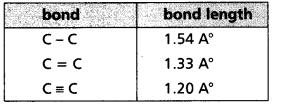
mvr = \(\frac{\mathrm{nh}}{2 \pi}\)
i.e The angular momentum of an electron is integral multiple of ‘\(\frac{\mathbf{h}}{2 \pi}\)‘
mvr = \(\frac{\mathrm{nh}}{2 \pi}\)
2πr = \(\frac{\mathrm{nh}}{\mathrm{mv}}\)
According to de-Broglie’s wavelength λ = \(\frac{h}{m v}\)
2πr = \(n\left(\frac{h}{m v}\right)\)
2πr = nλ.
Thus the circumference of the Bohr orbit is integral multiple of de-Broglie’s wave length.

Question 42.
The longest wavelength doublet absorption transition is observed at 589.0 and 589.6 nm. Calculate the frequency of each transition and energy difference between two excited states.
Answer:
Given largest wave length doublet absorption transition is observed at 589.0 and 589.6 nm.
∴ \(v_1=\frac{c}{\lambda_1}\)
= \(\frac{3 \times 10^8}{589 \times 10^{-9}}\) = 0.005093 × 10+7
= 5.093 × 10¹⁴ sec-1
λ1 = 589 × 10-9 m
∴ \(v_2=\frac{c}{\lambda_2}\)
= \(\frac{3 \times 10^8}{589.6 \times 10^{-9}}\)
= 0.005088 × 1017
= 5.088 × 10¹⁴ sec-1
λ1 = 5.089 × 10⁻⁹ m
Energy difference between two states = h[\(v_1\) – h\(v_2\)]
= h[\(v_1\) – \(v_2\)]
= 6.625 × 10⁻³⁴[5.093 × 10⁻¹⁴ – 5.088 × 10¹⁴]
= 6.625 × 10-34 × 0.005 × 1014
= 0.0331 × 10⁻²⁰ J.

AP Inter 1st Year Chemistry Study Material Chapter 1 Atomic Structure

Question 43.
What are the main features of quantum mechanical model of an atom?
Answer:
Important features of quantum mechanical model of atom:

  1. The energy of electrons in an atom is quantized (it can only have certain specific values).
  2. The existence of quantized electronic energý levels is a direct result of the wave like properties at electrons and are allowed solution at Schrodinger wave equation.
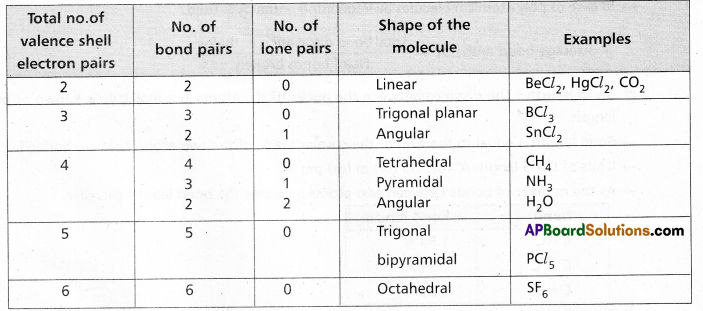
  3. All the information about the electron in an atom is contained in its orbital wave function ‘Ψ’ and quantum mechanics makes it possible to extract this information from “Ψ’.
  4. The path of the electron can never be determined accurately. Therefore, we find only the probability of the electron at different points in space, around an atom.
  5. The probability of finding an electroñat a point within an atom is proportional to the square of the orbital wave function i.e., \(|\Psi|^2\) at that point. \(|\Psi|^2\) is known as probability density and is always positive. From the value of \(|\Psi|^2\) at different points with in the atom, it is possible to predict the region around the nucleus where electron will most probably be found.

Question 44.
What is a nodal plane? How many nodal planes are possible for 2p – and 3d – orbitals?
Answer:
The plane at which the probability of finding the electron is zero is called as nodal plane.

  • For 2p orbitaIs one nodal plane is possible for each ‘p’ orbital.
  • For 3d orbitais two nodal planes are possible for each ‘d’ orbital.

Question 45.
The Lyman series occurs between 91.2 nm and 121.6 nm, the Balmer series occurs between 364.7 nm and 656.5 nm and the Paschen series occurs between 820.6 nm and 1876 nm. Identify the spectral regions to which these wavelengths correspond?
Answer:
In electromagnetic spectrum,
a) 91.2 – 121.6 nm (Lyman senes) corresponds to u.v. region.
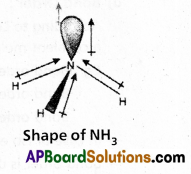
b) 364.7 – 656.5 nm (Balmer series) corresponds to visible region.
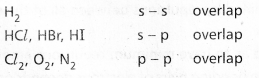
c) 820.6 – 1876 nm (Paschen series) corresponds to I.R. region.

AP Inter 1st Year Chemistry Study Material Chapter 1 Atomic Structure

Question 46.
How are the quantum numbers n, l, ml, for hydrogen atom obtained?
Answer:
Electronic configuration of hydrogen is 1s1
For ns1
Principal quantum no. (n) = 1
Azimuthal quantum no. (l) = 0
Magnetic quantum no. (ml) = 0
and Spin quantum no. (ms) = + 1/2

Question 47.
A line in Lyman series of hydrogen atom has a wavelength of 1.03 × 10⁻⁷ m. What is the initial energy level of the electron?
Answer:
Given λ= 1.03 × 10⁻⁷ m = 1.03 × 10⁻⁵ cm
n2 = 1 (for Lyman series)
We have, R = 109677 cm-1
AP Inter 1st Year Chemistry Study Material Chapter 1 Atomic Structure 13
⇒ n2 = 3 (i.e.,) original energy level of electron is 3.

Question 48.
If the position of the electron is measured within an accuracy of ±0.002 nm. Calculate the uncertainty in the momentum of the electron.
Answer:
Formulae:
Δx × Δp = \(\frac{h}{4 \pi}\)
Δp = \(\frac{h}{\Delta x \times 4 \pi}\)
= \(\frac{6.625 \times 10^{-34}}{4 \times 3.14 \times 2 \times 10^{-12}}\)
= 0.2637 × 10-22
= 2.637 × 10⁻²³ J/m.
Δx = 0.002 nm
= 2 × 10-3 × 109 m
= 2 × 10-12 m
h = 6.625 × 10⁻³⁴ J.sec.
∴ Uncertainity in momentum of electron = 2.637 × 10⁻²³ J/m.

Question 49.
If the velocity of the electron is 1.6 × 10⁶ m/s-1. Calculate de Brogue wavelength associated with this electron.
Answer:
Formulae:
λ = \(\frac{\mathrm{h}}{\mathrm{mv}}\)
= \(\frac{6.625 \times 10^{-34}}{9.1 \times 10^{-31} \times 1.6 \times 10^6}\)
= 0.455 × 10⁻⁹ m
= 0.455 nm.
v = 1.6 × 10⁶ m/sec
h = 6.625 × 10⁻³⁴ J.sec
m = 9.1 × 10⁻³¹ Kg.

AP Inter 1st Year Chemistry Study Material Chapter 1 Atomic Structure

Question 50.
Explain the difference between emission and absorption spectra. (A.P. Mar. ‘15)
Answer:
Emission spectrum

  1. It is produced by analysing the radiant energy emitted by an excited substance.
  2. It consists of bright lines on dark back ground.
  3. Produced due to the emission of energy by electrons.
  4. Emission spectra contains bright ineson dark back ground.

Absorption spectrum

  1. It is produced when white light is passed through a substance and the transmitted light is analysed by a spectrograph.
  2. It consists of dark lines on bright background.
  3. Produced due to the adsorption of energy by electrons.
  4. Absorption spectra contains dark lines on bright back ground.

Question 51.
The quantum numbers of electrons are given below. Arrange them in order of increasing energies.
a) n = 4, l = 2, ml = -2, ms = +\(\frac{1}{2}\)
b) n = 3, l = 2, ml = -1, ms = –\(\frac{1}{2}\)
c) n = 4, l = 1, ml = 0, ms = +\(\frac{1}{2}\)
d) n = 3, l = 1, ml = -1, ms = –\(\frac{1}{2}\)
Answer:
a) n = 4, l = 2, → 4d
b) n = 3, l = 2, → 3d
c) n = 4, l = 1, → 4p
d) n = 3, l = 1, → 3p
∴ 3p < 3d < 4p < 4d
According (n + l) values
Hence d < b < c < a is order of increasing energy.

AP Inter 1st Year Chemistry Study Material Chapter 1 Atomic Structure

Question 52.
The work function for Cesium atom is 1.9 eV. Calculate the threshold frequency of the radiation. If the Cesium element is irradiated with a wavelength of 500 nm, calculate the kinetic energy of the ejected photoelectron?
Answer:
Case-I
Photo electric effect equation is
hv = hv0 + 1/2 mv2
w = hv0
AP Inter 1st Year Chemistry Study Material Chapter 1 Atomic Structure 14
Case-II
Photo electric effect equation is
E = \(\frac{\mathrm{hc}}{\lambda}\)
= \(\frac{6.625 \times 10^{-34} \times 3 \times 10^8}{5 \times 10^{-7}}\)
= \(\frac{19.878 \times 10^{-26}}{5 \times 10^{-7}}\)
= 3.9756 × 10⁻¹⁹ J.

Given work function hv0 = 1.9 ev
= 1.9 × 1.602 × 10-19J.

Kinetic Energy (KE) = \(\frac{1}{2} m v^2\)
From Photo electric effect
\(\frac{1}{2} m v^2\) = hv – hv0
K.E. = 3.9756 × 10-19 × 1.602 × 10-19
= 3.9756 × 10⁻¹⁹ – 3.0438 × 10-19 = 0.9318 × 10-19 = 9.318 × 10⁻²⁰J.

Question 53.
Calculate the wavelength for the emission transition if it starts from the orbit having radius 1.3225 nm and ends at 211.6 pm. Name the series to which this transition belongs and the region of the spectrum.
Answer:
Given the radius of orbit from which it started = 1.35225 × 10⁻⁹ m = 1 3.225Å
In general radius of orbit = 0.529 × n2Å
n2 = \(\frac{13.225}{0.529}\) = 25
n2 = 25 ⇒ n = 5
Given that the
Radius of orbit at which the transition ended = 211.6 pm
= 211.6 × 10⁻¹²m
= 2.116A
Similarly as above
n2 = \(\frac{2.116}{0.529}\) = 4
n2 = 4 ⇒ n = 2
∴ transition takes place from n = 5 to n = 2 level
∴ spectral lines are obtained in Balmer series (visible region)

Question 54.
Explain the difference between orbit and orbital.
Answer:
Orbit

  1. A circular path which is present around the nucleus in which electrons revolve is called as orbit.
  2. Orbits are circular and are non directional paths.
  3. The maximum no.of electrons in any orbit is given by the formula 2n2 (n = orbit number).

Orbital

  1. The 3 – dimension space where the probability of finding the electron is maximum around the nucleus is called as orbital.
  2. These have definite shape and these are directional except’s orbital.
  3. Each orbital can occupy a maximum of two electrons.

AP Inter 1st Year Chemistry Study Material Chapter 1 Atomic Structure

Question 55.
Explain photoelectric effect.
Answer:
The ejection of electrons from a metal surface, when the radiations of suitable frequency strikes the metal surface is called photoelectric effect.

Explanation using Einstein’s quantum theory:

1) To explain photoelectric effect, Einstein utilised Quantum theory.
2) When a photon strikes metal surface, it uses some part of its energy to eject the electron from the metal atom. The remaining part of the total energy is given to the ejected electrons in the form of kinetic energy.
Hence we can write hv = W + KE ⇒ hv = hv0 + \(\frac{1}{2} m_e v^2\)
where hv = energy of photon,
v0 = Threshold frequency,
me = mass of electron
W = energy required to overcome the attractive forces on the electron in the metal (work function)
KE = kinetic energy of ejected electron,
V = Velocity of ejected electron.

3) If a photon of sufficient energy struck the metal surface and could eject the electron. But if a photon has insufficient energy, it cannot eject the electron from the metal.
eg. : A photon of violet light [high frequency] can eject the electrons from the surface of potassium but a photon of red light [low frequency] cannot eject the electrons.

Question 56.
Explain Rutherford’s nuclear model of an atom. What are its drawbacks?
Answer:
Rutherford’s Planetary model: Rutherford drew some conclusions regarding the structure of atom.

  1. Most of the space in the atom is empty (as most of the α – particles passed through the foil undeflected).
  2. A few — positive charges were deflected. The deflection must be due to enormous repulsive force showing that the positive charge of the atom is not spread throughout the atom as Thomson predicted. The positive charge is concentrated in a very small volume. Which is responsible for the deflection of α — particles.

On the basis of the above observations. Rutherford proposed the nuclear model. According to his model.

  1. The positive charge in the atom is concentrated in the small dense portion, called the NUCLEUS.
  2. The nucleus is surrounded by the electrons that move around it in circular paths called the ORBITS. Thus Rutherford’s model resembles the solar system.
  3. Electrons and the nucleus are held together by electrostatic forces of attraction.

Drawbacks of Rutherford model:

1. Rutherford’s atomic model of an atom is like a small scale solar system. This similarity suggests that electrons should move around the nucleus in well defined orbits. However, when a body is moving, it undergoes acceleration. According to electromagnetic theory, charged particles, when accelerated, should emit radiation. Therefore, an electron in an orbit will emit radiation, thus the orbit will continue to shrink. But this does not happen. Thus Rutherford’s model cannot explain the stability of the atom.

2. If we assume that electrons as stationary around the nucleus, the electrostatic attraction between the nucleus and the electrons would pull the electrons towards the nucleus to form a miniature version of Thomson’s model.

3. Rutherford model does not explain the electronic structure of the atom i.e., how the electrons are distributed around the nucleus and what are the energies of these electrons.
Before studying further developments that lead to the formulation of various atomic models, it is necessary to study about light and its nature.

Question 57.
Explain briefly the Planck’s quantum theory.
Answer:
The postulates. of Planck’s quantum theory are
a) The emission of radiation is due to vibrations of charged particles (electrons) in the body.
b) The emission is not continuous but in discrete packets of energy called quanta. This emitted radiation propagates in the form of waves.
c) The energy (E) associated with each quantum for a particular radiation of frequency V is given by E = hv, Here ‘h’ is Planck’s constant.
d) A body can emit or absorb either one quantum (hv) of energy or some whole number multiple of it. Thus energy can be emitted or absorbed as hv, 2hv, 3hv etc., but not fractional values. This is called quantisation of energy.
e) The emitted radiant energy is propagated in the form of waves.
f) Values of Planck’s constant in various units:
h = 6.6256 × 10⁻²⁷ erg.sec (or) g cm2s-1
= 6.6256 × 10⁻³⁴J.s (or) kg m2s-1 = 1.58 × 10⁻³⁴ cal.s.
Success of Planck’s quantum theory: This theory successfully explains the black body radiations. A black body is a perfect absorber and also a perfect radiator of radiations.

AP Inter 1st Year Chemistry Study Material Chapter 1 Atomic Structure

Question 58.
What are the postulates of Bohr’s model of hydrogen atom? Discuss the importance of this model to explain various series of line spectra In hydrogen atom. (T.S. Mar. ‘16)(A.P. Mar.’15. ‘13)
Answer:
Niels Bohr quantitatively gave the general features of hydrogen atom structure and it’s spectrum. His theory is used to evaluate several points in the atomic structure and spectra.
The postulates of Bohr atomic model for hydrogen as follows

Postulates : –

  • The electron in the hydrogen atom can revolve around the nucleus in a circular path of fixed radius and energy. These paths are called orbits (or) stationary states. These circular orbits are concentric (having same center) around the nucleus.
  • The energy of an electron in the orbit does not change with time.
  • When an electron moves from lower stationary state to higher stationary state absorption of energy takes place.
  • When an electron moves from higher stationary state to lower stationary state emission of energy takes place.
  • When an electronic transition takes place between two stationary states that differ in energy by ΔE is given by
    ΔE = E2 – E1 = hv
    ∴ The frequency of radiation absorbed (or) emitted v = \(\frac{E_2-E_1}{h}\) E1 and E2 are energies of lower, higher energy states respectively.
  • The angular momentum of an electron is given by mvr = \(\frac{\mathrm{nh}}{2 \pi}\)
    An electron revolve only in the orbits for which it’s angular momentum is integral multiple of \(\frac{\mathrm{h}}{2 \pi}\)

Line spectra of hydrogen, Bohr’s Theory:

  • In case of hydrogen atom line spectrum is observed and this can be explained by using Bohr’s Theory.
  • According to Bohr’s postulate when an electronic transition takes place between two stationary states that differ in energy is given by
    AP Inter 1st Year Chemistry Study Material Chapter 1 Atomic Structure 15
    AP Inter 1st Year Chemistry Study Material Chapter 1 Atomic Structure 16
  • In case of absorption spectrum nf > ni → energy is absorbed (+ve) energy is absorbed (+Ve)

AP Inter 1st Year Chemistry Study Material Chapter 1 Atomic Structure 17

  • In case of emission spectrum ni > nf → energy is emitted (- Ve)
  • Each spectral line in absorption (or) emission spectrum associated to the particular transition in hydrogen atom
  • In case of large no.of hydrogen atoms large no.of transitions possible they rsults in large no.of spectral lines.
    The series of lines observed in hydrogen spectra are
    AP Inter 1st Year Chemistry Study Material Chapter 1 Atomic Structure 18

Question 59.
Explain the success of Bohr’s theory for hydrogen atom.
Answer:
Succes of Bohrs Theory for hydrogen atom:

  • Bohr’s theory gave the information about the principal quantum number. Principal quantum number represents the stationary states. (n = 1, 2, 3 integral numbers)
  • Bohr’s theory gave the information about the radius of the stationary states (or) orbits.
    r = 0.529 × n2 A (or)
    r = 52.9 × n2 pm
    \(\left[r=\frac{n^2 h^2}{4 \pi^2 m e^2}\right]\) (for hydrogenation)
  • This theory gave the information about the energy of the electron of particular stationary state.
    En = -RH \(\left[\frac{1}{n^2}\right]\)n = 1, 2, 3,……
    RH = Ryd berg constant
    = 1,09,677 cm-1.
  • This theory explained the line spectra of hydrogenation.
  • This theory can also be applicable to the ions containing only one electron. Eg. : He+, Li+2, Be+3….
  • This theory can also gave information about velocity of electrons moving in the orbits.

Question 60.
What are the consequences that lead to the development of quantum mechanical model of an atom?
Answer:
Consequences that lead to development of quantum mechanical model of an atom are as follows.

  • Clàssical mechanics successfully explained the motion of macro scopic objects.
    Eg: Falling stone, Planets etc.,.
  • Classical mechanics failed to explain the motion of microscopic objects like electrons, atoms, molecules etc.
  • Classical mechanics ignores the concept of dual behaviour of matter and especially for sub atomic particles
    Quantum mechanics:
    The Branch of science deals with the dual behaviour of matter is called quantum mechanics.
  • This deals with the motions of microscopic objects like electron.

Important features of quantum mechanical model of atom:

  1. The energy of electrons in an atom is quantized (it can only have certain specific values).
  2. The existence of quantized electronic energy levels is a direct result of the wave like properties at electrons and are allowed solution at schrodinger wave equations.
  3. All the information about the electron in an atom is contained in its orbital wave function ‘\(\Psi^{\prime}\) and quantum mechanics makes it possible to extract this information from ‘\(\Psi^{\prime}\).
  4. The path of the electron can never be determined accurately. Therefore, we find only the probability of the electron at different points in space, around an atom.
  5. The probability of finding an electron at a point within an atom is proportional to the square of the orbital wave function i.e., \(|\Psi|^2\) at that point. \(|\Psi|^2\) is known as probability density and is always positive. From the value of \(|\Psi|^2\) at different points with in the atom, it is possible to
    predict the region around the nucleus where electron will most probably be found.

AP Inter 1st Year Chemistry Study Material Chapter 1 Atomic Structure

Question 61.
Explain the salient features of quantum mechanical model of an atom.
Answer:
Important features of quantum mechanical model of atom:

  1. The energy of electrons in an atom is quantized (it can only have certain specific values).
  2. The existence of quantized electronic energy levels is a direct result of the wave like properties at electrons and are allowed solution at schrodinger wave equations.
  3. All the information about the electron in an atom is contained in its orbital wave function ‘\(\Psi^{\prime \prime}\) and quantum mechanics makes it possible to extract this information from \(\Psi^{\prime \prime}\).
  4. The path of the electron can never be determined accurately. Therefore, we find only the probability of the electron at different points in space, around an atom.
  5. The probability of finding an electron at a point within an atom is proportional to the square of the
    orbital wave function i.e., \(|\Psi|^2\) at that point. \(|\Psi|^2\) is known as probability density and is always positive. From the value of \(|\Psi|^2\) at different points with in the atom, it is possible to predict the region around the nucleus where electron will most probably be found.

Question 62.
What are the limitations of Bohr’s model of an atom?
Answer:
Limitations:

  1. Spectra of multielectron atoms: Bohr’s theory could explain the spectra of Hydrogen and single electron species like He+, Li2+, Be3+, but it fails to explain the spectra of multielectron atoms.
  2. Fine structure: It fails to explain this fine structure of Hydrogen atom.
  3. Splitting up of spectral lines : The theory fails to explain Zeeman effect and Stark effect.
    The splitting up of spectral lines when an atom is subjected to strong magnetic field is called Zeeman effect.
    The splitting up of spectral lines when an atom is subjected to strong electric field is called Stark effect.
  4. Flat model: Bohr’s theory gives a flat model of the orbits. Bohr’s theory predicts definite orbits for electrons considering them as particles. But according to de Brogue electron has both wave nature and particle nature. Bohr’s theory cannot explain this dual role.
  5. It fails to support the uncertainty principle proposed by Heisenberg.
  6. It could not explain the ability of atoms to form molecules by chemical bonds.

Question 63.
What are the evidences in favour of dual behaviour of electron?
Answer:

  • The particle nature of light explains the phenomenon of blackbody radiations and photo electric effect but it could not explain about wave nature of light.
  • Wave nature of light explains the phenomenon of interference and diffraction.
  • So, light has dual nature i.e it behaves as a wave (or) as a stream of particles.
  • According to de-Broglie, light has dual behaviour i.e both particle and wave nature.
    de-Broglies gave the following relationship
    λ = \(\frac{\mathrm{h}}{\mathrm{mv}}\) = \(\frac{h}{p}\)
    λ = wave length
    P = momentum
  • Heisen bergs uncertainty principle also a consequence of dual behaviour of matter and radiation.
    Statement :— It is impossible to determine simultaneously, the exact momentum and exact position of a small particle like lectron.
    Δx × Δp ≥ \(\frac{h}{4 \pi}\)
    Δx = uncertainty in position
    Δp = uncertainty in momentum

AP Inter 1st Year Chemistry Study Material Chapter 1 Atomic Structure

Question 64.
How are the quantum numbers n, l and ml, arrived at? Explain the significance of these quantum numbers. (A.P. Mar. ‘16)(T.S. Mar. ‘15, ‘14)
Answer:

  • In general a large no.of orbitals are possible in an atom.
  • These orbitaIs are distinguished by their size, shape and orientation.
  • An orbital of smaller size means there is more chance to find electron near the nucleus.
  • Atomic orbitals are precisely distinguished by quantum numbers. Each orbital is designated by three major quantum numbers.

1) Principal quantum number (n)
2) Azimuthal quantum number (l)
3) Magnetic quantum number (m)

1) Principal quantum number : The principal quantum number was introduced by Neils Bohr. It reveals the size of the atom (main energy levels). With increase in the value of ‘n’ the distance between the nucleus and the orbit also increases.
It is denoted by the letter ‘n’. It can have any simple integer value 1, 2, 3, ……. but not zero. These are also termed as K, L, M, N etc.
The radius and energy of an orbit can be determined basing on ”n” value.
The radius of nth orbit is rn = \(\frac{n^2 h^2}{4 \pi^2 m e^2}\)
The energy of nth orbet is En = \(\frac{-2 \pi^2 m e^4}{n^2 h^2}\)

2) Azimuthal quantum number: It was proposed by Sommerfeld. it is also known as angular momentum quantum number or subsidiary quantum number.
it indicates the shapes of orbitals. It is denoted by ‘l’. The values of ‘l’ depend on the values of ‘n’, ‘l’ has values ranging from ‘0 to (n – 1) i.e.. l = 0, 1, 2,….. (n – 1). The maximum number of electrons present in the subshells s, p, d, f are 2, 6, 10, 14 respectively.
AP Inter 1st Year Chemistry Study Material Chapter 1 Atomic Structure 19
AP Inter 1st Year Chemistry Study Material Chapter 1 Atomic Structure 20

3) Magnetic quantum number: It was proposed by Lande. It shows the orientation of the orbitals in space. ‘p’ — orbital has three orientations. The orbital oriented along the x-axis is called px orbital, along the y-axis is called py -orbital and along the z-axis is called pz orbital. In a similar way d – orbital has five orientations. They are dxy, dyz, dzx, dx2 – y2 and dz2. It is denoted by ‘m’. Its values depends on azimuthal quantum number, ‘m’ can have all the integral values from -l to +l including zero. The total number of ‘m’ values are (2l + 1).
AP Inter 1st Year Chemistry Study Material Chapter 1 Atomic Structure 21

Question 65.
Explain the dual behaviour of matter. Discuss its significance to microscopic particles like electrons.
Answer:

  • The particle nature of light explains the phenomenon of blackbody radiations and photo electric effect but it couldnot explain about wave nature of light.
  • Wave nature of light explains the phenomenon of interference and diffraction.
  • So, light has dual nature i.e it behaves as a wave (or) as a stream of particles.
  • According to de-Broglie light has dual behaviour i.e both particle and wave nature.
    de-Broglies gave the following relationship
    λ = \(\frac{\mathrm{h}}{\mathrm{mv}}\) = \(\frac{h}{p}\)
    λ = wavelength
    P = momentum
  • Heisen bergs uncertainty principle also a consequence of dual behaviour of matter and radiation.
    Statement :— It is impossible to determine simultaneously, the exact momentum and exact position of a small particle like electron.
    Δx × Δp ≥ \(\frac{h}{4 \pi}\) = uncertainty in position
    Δx = uncertainty in position
    Δp = uncertainty in momentum

Significance of Uncertainty Principle:

  1. This principle rules out the existence of definite paths or trajectories of electrons and other similar
    particles.
  2. This principle is significant only for motion of microscopic objects and is negligible for that of macroscopic objects.
  3. In dealing with milligram size or heavier objects, the associated uncertainties are hardly of any real consequence.

Question 66.
What are various ranges of electromagnetic radiation ? Explain the characteristics of electromagnetic radiation.
(or)
Explain diagrammatically the boundary surfaces for three 2p orbitais and five 3d
Answer:
Electromagnetic radiation : When electrically charged particle is accelerated alternating electric and magnetic fields are produced and transmitted. These fields are transmitted in the form of waves called electromagnetic waves or electromagnetic radiation.

Important Characteristics of a wave:

1) These are produced by oscillating charged particles in a body.
2) These radiations can pass through vacuum also. So medium for transmission is not required.
3) Velocity (c) : It is defined as the linear distance travelled by the wave in one second.
Units : cm sec-1 (or) m see-1
All kinds of electromagnetic waves have the same velocity.
(3 × 10⁸ m sec-1 or 3 × 1010 cm sec-1)

4) Wavelength (λ) : It is defined as the distance between any two successive crests or troughs of wavez.
Units:A ; m ; cm ; nm or pm 1 A° = 10-10 m
1 nm = 10-9 m = 10-7 cm
1 pm = 10-12m.
AP Inter 1st Year Chemistry Study Material Chapter 1 Atomic Structure 22
5) Frequency (v): It is defined as the number of waves passing through a point in one second.
Units: Hertz (Hz); cycles sec-1 or sec-1.
v = \(\frac{c}{\lambda}\)

6) Wave number (\(\bar{v}\)): It is defined as the number of waves present in one unit length. It is equal
to the reciprocal of the wavelength.
\(\bar{v}=\frac{1}{\lambda}=\frac{v}{c}\)
Relation between wavelength and frequency :
c = v × λ ⇒ v = \(\frac{c}{\lambda}\)

7) Amplitude (A) is the height of the crest (or) depth of through of a wave, It determines intensity (or) brightness of the wave.
AP Inter 1st Year Chemistry Study Material Chapter 1 Atomic Structure 23

Question 67.
Define atomic orbital. Explain the shapes of s, p and d orbitals with the help of diagrams.
Answer:
Atomic orbital : A three dimensional space around the nucleus in an atom. Where the probability of finding an electron is maximum (i.e.,) \(\Psi^2\) is maximum is called an atomic orbital.

Shapes of orbitals:

a) s – orbital : Boundary surface diagram for ‘s’ orbital is spherical in shape, ‘s – orbitals are spherically symmetric (i.e.,) the probability of finding the electron at a given distance is equal in all directions.
AP Inter 1st Year Chemistry Study Material Chapter 1 Atomic Structure 24
b) p – orbitals : p – orbital consists of two sections called lobes that are either side of the plane that passes through the nucleus. The size, shape and energy of the three orbitals are identical. They differ only in the orientation. These are mutually perpendicular to each other and oriented along x, y and z axes. Each p-orbital is of dumb-bell shape.

c) d – orbitals: Five d-orbitals are designated as dxy, dyz, dzx, dx2 – y2 and dz2. The shapes of first four d – orbitals are similar to each other of double dumb-bell whereas that of the fifth one ddz2 is different from others, but all five d-orbitals are equivalent in energy.
AP Inter 1st Year Chemistry Study Material Chapter 1 Atomic Structure 25

Question 68.
Illustrate the reasons for the stability of completely filled and half filled subshells.
Answer:
Chromium and Copper shows anamalous electronic configurations
Cr – [Ar] 4s1 3d5
Cu – [Ar] 41 3d10

  • Cr — gets half filled 3d— shell electronic configuration.
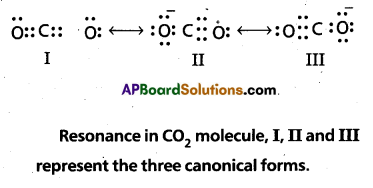
  • Cu — gets full filled 3d— shell electronic configuration.
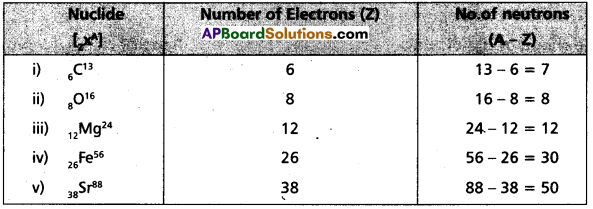
  • Half filled and full filled subshells are more stable than others.
    Causes of Stability of Completely filled and Half filled Sub-shells
    The completely filled and half filled sub-shells are stable due to the following reasons :

1. Symmetrical distribution of electrons : It is well known that symmetry leads to stability. The completely filled or half filled subshells have symmetrical distribution of electrons in them and are therefore more stable. Electrons in the same subshell (here 3d) have equal energy but different spatial distribution, Consequently, their shielding of one another is relatively small and the electrons are more strongly attracted by the nucleus.
AP Inter 1st Year Chemistry Study Material Chapter 1 Atomic Structure 26
AP Inter 1st Year Chemistry Study Material Chapter 1 Atomic Structure 27
2. Exchange Energy: The stabilizing effect arises whenever two or more electrons with the same spin are present in the degenerate orbitals of a subshell. These electrons tend to exchange their positions and the energy released due to this exchange is called exchange energy. The number of exchanges that can take place is maximum when the subshell is either half filled or completely filled.
As a result the exchange energy is maximum and so is the stability.
AP Inter 1st Year Chemistry Study Material Chapter 1 Atomic Structure 28
The extra stability of half-filled and completely filled subshell is due to:

  1. relatively small shielding,
  2. smaller coulombic repulsion energy and
  3. larger exchange energy.

Question 69.
Explain emission and absorption spectra. Discuss the general description of line spectra in hydrogen atom.
Answer:
Emission spectrum:

  1. It is produced by analysing the radiant energy emitted by an excited substance.
  2. It consists of bright lines on dark background.
  3. Produced due to the emission of energy by electrons.
  4. Emission spectra contains bright lines on dark background.

Absorption spectrum:

  1. It is produced when white light is passed through a substance and the transmitted light is analysed by a spectrograph.
  2. It consists of dark lines on bright background.
  3. Produced due to the adsorption of energy by electrons.
  4. Absorption spectra contains dark lines on bright background.
    Line spectra of Hydrogen — Bohrs Theory:

    • In case of hydrogen atom line spectrum is observed and this can be explained by using Bohr’s Theory.
    • According to Bohrs postulate when an electronic transition takes place between two stationary states that differ in energy is given by
      ΔE = Ef – Ei
      Ef = final orbit energy
      Ei = initial orbit energy

AP Inter 1st Year Chemistry Study Material Chapter 1 Atomic Structure 29
In terms of wave numbers
AP Inter 1st Year Chemistry Study Material Chapter 1 Atomic Structure 30
AP Inter 1st Year Chemistry Study Material Chapter 1 Atomic Structure 31

  • In case of absorption spectrum nf > ni → energy is absorbed (+ Ve)
  • In case of emission spectrum ni > nf → energy is emitted (- Ve)
  • Each spectral line in absorption (or) emission spectrum associated to the particular transition in hydrogen atom
  • In case of large no.of hydrogen atoms large no.of transitions possible they results in large no.of spectral lines.

The Spectral Lines for Atomic Hydrogen
AP Inter 1st Year Chemistry Study Material Chapter 1 Atomic Structure 32

Solved Problems

Question 1.
Calculate the num Notons, neutrons and electrons species?
Solution:
In this case, \({ }_{35}^{80} \mathrm{Br}\), Z = 35, 80, species is neutral
Number of protons = number of electrons = Z = 35
Number of neutrons = 80 – 35 = 45, Mass number (A) = number of protons (Z) + number of neutrons (n).

Question 2.
The number of electrons, protons and neutrons in a species are equal to 18, 16 and 16 respectively. Assign the proper symbol to the species.
Solution:
The atomic number is equal to number of protons =16. The element is sulphur (S).
Atomic mass number = number of protons + number of neutrons = 16 + 16 = 32
Species is not neutral as the number of protons is not equal to electrons. It is anion (negatively charged) with charge equal to excess electrons = 18 – 16 = 2.
Symbol is \(\frac{32}{16} \mathrm{~s}^{2-}\)
Note: Before using the notation AP Inter 1st Year Chemistry Study Material Chapter 1 Atomic Structure 33 find out whether the speclés is a neutral atom, acation or an anion, If it is a neutral atom, Atomic number (Z) = number of protons in the nucleus of an atom = number of electrons in a neutral atom is valid, i.e., number of protons = number of electrons = atomic number. If the species is an ion, determine whether the number of protons are larger (cation, positive ion) or smaller (anion, negative ion) than the number of electrons. Number of neutrons is always given by A-Z, whether the species is neutral or ion.

Question 3.
The Vividh Bharati station of All India Radio, Delhi, broadcasts on a frequency of 1,368 kHz (kilo hertz). Calculate the wavelength of the electro-magnetic radiation emitted by transmitter. Which part of the electromagnetic specturm does it belong to?
Solution:
The wavelength, λ, is equal to c/v. where c is the speed of electromagnetic radiation in vacuum and v is the frequency. Substituting the given values, we have
AP Inter 1st Year Chemistry Study Material Chapter 1 Atomic Structure 34

Question 4.
The wavelength range of the visible spectrum extends from violet (400 nm) to red (750 nm). Express these wave
lengths in frequencies (Hz). (1 nm = 10-9 m).
Solution:
Using c = v λ frequency of violet light.
V = \(\frac{\mathrm{c}}{\mathrm{v}}=\frac{3.00 \times 10^8 \mathrm{~ms}^{-1}}{400 \times 10^{-9} \mathrm{~m}}\)
= 7.50 × 10¹⁴ Hz
Frequency of red light
v = \(\frac{c}{v}=\frac{3.00 \times 10^8 \mathrm{~ms}^{-1}}{750 \times 10^{-9} \mathrm{~m}}\) = 4.00 × 10¹⁴ Hz
The range of visible spectrum is from
4.0 × 10¹⁴ to 7.5 × 10¹⁴Hz in terms of frequency units.

Question 5.
Calculate
(a) wave number and
(b) frequency of yellow radiation having wavelength 5000 A.
Solution:
(a) Calculation of wavenumber \((\bar{v})\)
λ = 5800 A = 5800 × 10-8 cm
= 5800 × 10-10m
\((\bar{v})\) = \(\frac{1}{\lambda}=\frac{1}{5800 \times 10^{-10} \mathrm{~m}}\)
= 1.724 × 10⁶m-1
= 1.724 × 104 cm-1

Question 6.
Calculate energy of one mole of photons of radiation whose frequency is 5 × 10¹⁴ Hz.
Solution:
Energy (E) of one photon is given by the expression
E = hv .
h = 6.626 × 10⁻³⁴ J s
v = 5 × 10¹⁴ s-1 (given)
E = (6.626 × 10⁻³⁴J s) × (5 × 10¹⁴ s-1)
= 3.313 × 10⁻¹⁹ J
Energy of one mole of photons
= (3.313 × 10⁻¹⁹J) × (6.022 × 10²³ mol-1)
= 199.51 kJ mol-1.

Question 7.
A 100 watt bulb emits monochromatic light of wavelength 400 nm. Calculate the number of photons emitted per second by the bulb.
Solution:
Power of the bulb = 100 watt
= 100 J s-1
Energy of one photon E = hv = hc/λ.
= \(\frac{6.626 \times 10^{-34} \mathrm{Js} \times 3 \times 10^8 \mathrm{~m} \mathrm{~s}^{-1}}{400 \times 10^{-19} \mathrm{~m}}\)
= 4.969 × 10⁻¹⁹J
Number of photons emitted
\(\frac{100 \mathrm{~J} \mathrm{~s}^{-1}}{4.969 \times 10^{-19} \mathrm{~J}}\) = 2.012 × 10²⁰ s-1

Question 8.
When electromagnetic radiation of wavelength 300 nm falls on the surface of sodium, electrons are emitted with a kinetic energy of 1.68 × 10⁵ J mol-1. What is the minimum energy needed to remove an electron from sodium? What is the maximum wavelength that will cause a photoelectron to be emitted?
Solution:
The energy (E) of a 300 nm photon is given by
hv = hc/λ.
= \(\frac{6.626 \times 10^{-34} \mathrm{Js} \times 3.0 \times 10^8 \mathrm{~m} \mathrm{~s}^{-1}}{300 \times 10^{-9} \mathrm{~m}}\)
= 6.626 × 10⁻¹⁹ J
The energy of one mole of photons
= 6.626 × 10-19 J × 6.022 × 1023 mol-1
= 3.99 × 10⁵ mol-1
The minimum energy needed to remove one mole of electrons from sodium
= (3.99 – 1.68) 105 J mol-1
= 2.31 × 10⁵ J mol-1
The minimum energy for one electron
= \(\frac{2.31 \times 10^5 \mathrm{~J} \mathrm{~mol}^{-1}}{6.022 \times 10^{23} \text { elelctrons } \mathrm{mol}^{-1}}\)
= 3.84 × 10⁻¹⁹J
This corresponds to the wavelength
∴ λ = \(\frac{\mathrm{hc}}{\mathrm{E}}\)
= \(\frac{6.626 \times 10^{-34} \mathrm{~J} \mathrm{~s} \times 3.0 \times 10^8 \mathrm{~m} \mathrm{~s}^{-1}}{3.84 \times 10^{-9} \mathrm{~J}}\)
= 517 nm
(This corresponds to green light)

Question 9.
The threshold frequency v0 for a metal is 7.0 × 10¹⁴ s-1. Calculate the kinetic energy of an electron emitted when radiation of frequency v = 1.0 × 10¹⁵ s-1 hits the metal.
Solution:
According to Einstein’s equation
Kinetic energy = 1/2 mev2 = h(v – v0)
= (6.626 × 10⁻³⁴ J s)
(1.0 × 10¹⁵ s-1 – 7.0 × 10¹⁴ s-1)
= (6.626 × 10⁻³⁴ J s)
(10.0 × 10¹⁴s-1 – 7.0 × 10¹⁴s-1)
= (6.626 × 10⁻³⁴ J s)
(3.0 × 10¹⁴s-1) = 1.988 × 10⁻¹⁹ J

Question 10.
What are the frequency and wave-length of a photon emitted during a transition from n = 5 state to the n = 2 state in the hydrogen atom?
Solution:
Since n1 = 5 and nf = 2, this transition gives rise to a spectral line in the visible region of the Balmer series. From ΔE = \(\mathrm{R}_{\mathrm{H}}\left(\frac{1}{\mathrm{n}_i^2}-\frac{1}{\mathrm{n}_{\mathrm{f}}^2}\right)\)
= 2.18 × 10⁻¹⁸J\(\left(\frac{1}{n_i^2}-\frac{1}{n_f^2}\right)\)
ΔE = 2.18 × 10⁻¹⁸J\(\left(\frac{1}{5^2}-\frac{1}{2^2}\right)\)
= -4.58 × 10⁻¹⁹ J.
It is an emission energy.
The frequency of the photon (taking energy in terms of magnitude) is given by
AP Inter 1st Year Chemistry Study Material Chapter 1 Atomic Structure 35

Question 11.
Calculate the energy associated with the first orbit of He+. What is the radius this orbit?
Solution:
AP Inter 1st Year Chemistry Study Material Chapter 1 Atomic Structure 36
The radius of the orbit is given by
AP Inter 1st Year Chemistry Study Material Chapter 1 Atomic Structure 37

Question 12.
What will be the wavelength of a ball of mass 0.1 kg moving with a velocity of 10 m s-1?
Solution:
According to de Brogue λ = \(\frac{h}{m V}=\frac{h}{p}\)
λ = \(\frac{\mathrm{h}}{\mathrm{mv}}\) = \(\frac{\left(6.626 \times 10^{-34} \mathrm{Js}\right)}{(0.1 \mathrm{~kg})\left(10 \mathrm{~m} \mathrm{~s}^{-1}\right)}\)
= 6.626 × 10⁻³⁴m (J = kg m2 s-2)

Question 13.
The mass of an electron is 9.1 × 10⁻³¹ kg. If its K.E. is 3.0 × 10⁻²⁵ J, calculate its wavelength.
Solution:
AP Inter 1st Year Chemistry Study Material Chapter 1 Atomic Structure 38

Question 14.
Calculate the mass of a photon with wavelength 3.6 A.
Solution:
λ = 3.6 A = 36 × 10-10 m
Velocity of photon = velocity of light
m = \(\frac{\mathrm{h}}{\lambda v}=\frac{6.626 \times 10^{-34} \mathrm{Js}}{\left(3.6 \times 10^{-10} \mathrm{~m}\right)\left(3 \times 10^8 \mathrm{~m} \mathrm{~s}^{-1}\right)}\)
= 6.135 × 10⁻²⁹kg

Question 15.
A microscope using suitable photons is employed to locate an electron in an atom within a distance of 0.1 A. What
is the uncertainty involved in the measurement of its velocity?
Solution:
∆x ∆p = \(\frac{h}{4 \pi}\) or ∆x m∆v = \(\frac{h}{4 \pi}\)
∆v = \(\frac{h}{4 \pi \Delta x m}\)
∆v = \(\frac{6.626 \times 10^{-34} \mathrm{Js}}{4 \times 3.14 \times 0.1 \times 10^{-10} \mathrm{~m} \times 9.1 \times 10^{31} \mathrm{kc}}\)
= 0.579 × 10⁷ m s-1 (1 J = 1 kg m2 s-2)
= 5.79 × 10⁶ ms-1

Question 16.
A golf ball has a mass of 40g and a speed of 45 m/s. If the speed can be measured within accuracy of 2%, calculate the uncertainty in the position.
Solution:
The uncertainty in the speed is 2%, i.e.,
4 × \(\frac{2}{100}\) = 0.9 ms-1
Using the λ = \(\frac{\mathrm{h}}{\mathrm{mv}}=\frac{\mathrm{h}}{\mathrm{p}}\)
Δx = \(\frac{h}{4 \pi m \Delta v}\)
= \(\frac{6.626 \times 10^{-34} \mathrm{Js}}{4 \times 3.14 \times 40 \mathrm{~g} \times 10^{-3} \mathrm{~kg} \mathrm{~g}^{-1}\left(0.9 \mathrm{~ms}^{-1}\right)}\)
= 1.46 × 10⁻³³ m
This is nearly \(\sim\) 1018 times smaller than the diameter of a typical atomic nucleus. As mentioned earlier for large particles, the uncertainty principle sets no meaningful limit to the precision of measurements.

Question 17.
What is the total number of orbitals associated with the principal quantum number n = 3?
Solution:
For n = 3, the possible values of 1 are 0, 1 and 2. Thus there is one 3s orbital (n = 3, l = 0 and ml = 0); there are three 3p orbitals
(n = 3, 1 = 1 and ml = -1, 0, +1); there are five 3d orbitais (n = 3, l = 2 and ml = -2, -1, 0, +1, +2).
Therefore, the total number of orbitals is 1 + 3 + 5 = 9
The same value can also be obtained by using the relation; number of orbitals = n2,
i.e. 32 = 9

Question 18.
Using s, p, d, f notations, describe the orbital with the following quantum numbers
(a) n = 2, l = 1,
(b) n = 4, l = 0,
(c) n = 5, l = 3,
(d) n = 3, l = 2
Solution:
AP Inter 1st Year Chemistry Study Material Chapter 1 Atomic Structure 39

Question 19.
Calculate its wave length of 1st line in Balmer series of hydrogen spectrum.
Solution:
Ryd berg’s equation \(\bar{v}\) = \(\frac{1}{\lambda}\) = \(\mathrm{R}_{\mathrm{H}}\left[\frac{1}{\mathrm{n}_1^2}-\frac{1}{\mathrm{n}_2^2}\right]\)
For the 1st line of Balmer series
n1 = 2, n2 = 3
R = 1,09,677 cm-1
\(\bar{v}\) = \(\frac{1}{\lambda}\) = 1,09,677\(\left[\frac{1}{2^2}-\frac{1}{3^2}\right]\)
= 1,09,677 × \(\frac{5}{36}\)
Wave no. \((\bar{v})\) = 15232.9 cm-1
Wave length λ = \(\frac{1}{\bar{v}}\) = \(\frac{1}{15232.9}\) = 6.5 × 10⁻⁵ cm-1

Question 20.
Calculate the shortest wave length in lyman series of hydrogen spectrum (RH = 1,09,677 cm-1).
Solution:
To calculate shortest wave length
AP Inter 1st Year Chemistry Study Material Chapter 1 Atomic Structure 40

Question 21.
What is the maximum no.of emission lines when the excited electron of a ‘H’ atom in n =6 drops to ground state.
Solution:
The no. of spectral lines found when an electron return from nth orbit to ground state.
= \(\frac{n(n-1)}{2}\) = \(\frac{6(6-1))}{2}\) = \(\frac{30}{2}\) = 15

Question 22.
Calculate the longest wavelength transition in the paschen series of He+.
Solution:
AP Inter 1st Year Chemistry Study Material Chapter 1 Atomic Structure 41

Question 23.
The no. of waves in the forth Bohr’s orbit of hydrogen is
a) 3
b) 4
c) 9
d) 12
Solution:
AP Inter 1st Year Chemistry Study Material Chapter 1 Atomic Structure 42

Question 24.
It the speed of the electron in 1st Bohr’s orbit of hydrogen is x, then the speed of the electron in the 3rd orbit of hydrogen is
Solution:
Given
Velocity of electron in 1st Bohr’s orbit of hydrogen = x
Velocity of electron in 3rd Bohr’s orbit of hydrogen = \(\frac{x}{n}\) = \(\frac{x}{3}\)

Question 25.
The ratio of radii of the fifth orbits of He+ and Li+2 will be
a) 2 : 3
b) 3 : 2
c) 4 : 1
d) 5 : 3
Solution:
Z2(li)=3
Z1 (He) = 2
\(\frac{r_1}{r_2}\) = \(\frac{Z_2}{Z_1}\) = \(\frac{3}{2}\) = 3 : 2

Question 26.
What is the lowest value of ‘n’ that allows ‘g’ orbitals to exist ?
Solution:
The lowest value of ‘n that allows ‘g’ orbitals to exist is ‘5’.

Question 27.
What is the orbital angular momentum of a d-electron
Solution:
Orbital angular momentum = \(\sqrt{l(l+1)} \frac{\mathrm{h}}{2 \pi}\)
For a d electron l = 2
= \(\sqrt{2(2+1)} \frac{h}{2 \lambda}\)
= \(\frac{\sqrt{6 h}}{2 \lambda}\)

Question 28.
What is the total spin and magnetic moment of an atom with atomic number 7’?
Solution:
Z = 7 (Nitrogen)
Electronic configuration is 1s2 2s2 2p3 (in ground state)
AP Inter 1st Year Chemistry Study Material Chapter 1 Atomic Structure 43

Question 29.
The quantum number of electrons are given below. Arrange in order of increasing energies.
AP Inter 1st Year Chemistry Study Material Chapter 1 Atomic Structure 44
Solution:
a) 4d
b) 3d
c) 4p
d) 3d
e) 3p
f) 4p
∴ Increasing order of energy
e < b = d < c = f < a

Question 30.
If the value of n + l = 7 then what should be the increasing order of energy of the possible subshells.
Solution:
Given
n + l = 7
AP Inter 1st Year Chemistry Study Material Chapter 1 Atomic Structure 45
∴ The increasing order of energy
4f < 5d < 6p < 7s
(According Aufbau principle)

Question 31.
Which of the following sets of quantum number is not permitted?
a) n = 3, l = 3, m = +1, s = +\(\frac{1}{2}\)
b) n = 3, l = 3, m = +2, s = –\(\frac{1}{2}\)
c) n = 3, l = 1, m = +2, s = –\(\frac{1}{2}\)
d) n = 3, l = 0, m = 0, s = +\(\frac{1}{2}\)
Solution:
Only d is permitted i.e., 3s1
In a, b n = l but n always > l
in c m = + 2 is not permitted
Because l = 1,’m’ has -1, 0, +1 values only.

Question 32.
Ground state electronic configuration of nitrogenators can be represented as
AP Inter 1st Year Chemistry Study Material Chapter 1 Atomic Structure 46
Solution:
(a) and (d) are correct representations.

Question 33.
Which of the following is possible
a) 3f
b) 4d
c) 2d
d) 3p
Solution:
4d and 3p are possible.

Inter 1st Year Maths 1B Applications of Derivatives Solutions Ex 10(h)

Practicing the Intermediate 1st Year Maths 1B Textbook Solutions Inter 1st Year Maths 1B Applications of Derivatives Solutions Exercise 10(h) will help students to clear their doubts quickly.

Intermediate 1st Year Maths 1B Applications of Derivatives Solutions Exercise 10(h)

I.

Question 1.
Find the points of local extrema (if any) and local extrema of the following functions each of whose domain is shown against the function.
i) f(x) – x², ∀ x ∈ R.
Solution:
f(x) = x²
f'(x) = 2x ⇒ f”(x) = 2
For maximum or minimum f'(x) = 0
2x = 0
x = 0
Now f”(x) = 2 > 0 ,
∴ f(x) has minimum at x = 0
Point of local minimum x = 0
Local minimum = 0.

ii) f(x) = sin x, [0, 4π)
Solution:
Given f(x) = sinx
⇒ f'(x) = cosx
⇒ f”(x) = -sinx
For max on min,
f'(x) = 0
cos x = 0
⇒ x = \(\frac{\pi}{2},\frac{3\pi}{2},\frac{5\pi}{2},\frac{7\pi}{2}\)

i) f”(\(\frac{\pi}{2}\)) = -sin\(\frac{\pi}{2}\) = -1 < 0
f(x) = sin \(\frac{\pi}{2}\) = 1
∴ Point of local maximum x = \(\frac{\pi}{2}\)
local maximum – 1

ii) f”(\(\frac{3\pi}{2}\)) = – sin \(\frac{3\pi}{2}\) = -1 > 0
f(x) = sin \(\frac{3\pi}{2}\) = -1
∴ Point of local minimum x = \(\frac{3\pi}{2}\)
local minimum x = -1

iii) f”(\(\frac{5\pi}{2}\)) = – sin \(\frac{5\pi}{2}\) = -1 > 0
f(x) = sin \(\frac{5\pi}{2}\) = 1
∴ Point of local maximum x = \(\frac{5\pi}{2}\)
local maximum = 1

iv) f”(\(\frac{7\pi}{2}\)) = – sin \(\frac{7\pi}{2}\) = -1 > 0
f(x) = sin \(\frac{7\pi}{2}\) = -1
∴ Point of local maximum x = \(\frac{7\pi}{2}\)
local maximum = 1

Inter 1st Year Maths 1B Applications of Derivatives Solutions Ex 10(h)

iii) f (x) = x³ – 6x² + 9x + 15 ∀ x ∈ R.
Solution:
f (x) = 3x² – 12x + 9 and f'(x) = 6x – 12
For maximum or minimum f(x) = 0
⇒ 3x² – 12x + 9 = 0
⇒ x² – 4x + 3 = 0
⇒ (x – 1) (x – 3) = 0
⇒ x = 1 or 3
Now f”(1) = 6(1) – 12 = – 6 < 0
∴ f(x) has maximum value at x = 1
Max. valueis f(1)= 1³ – 6(1)² + 9(1) + 15
= 1 – 6 + 9 + 15 = 19

f”(3) = 6(3) – 12 = 18 – 12 = 6 > 0
∴ f(x) has minimum value at x = 3
Min. value is f(3) = 33 – 6.32 + 9.3 + 15
= 27 – 54 + 27+ 15
= 15

iv) f(x) = \(\sqrt{1-x}\) ∀ x ∈ (0, 1)
Solution:
Inter 1st Year Maths 1B Applications of Derivatives Solutions Ex 10(h) 1
For max. or min. f'(x) = 0
Inter 1st Year Maths 1B Applications of Derivatives Solutions Ex 10(h) 2

v) f(x) = 1/x² + 2 ∀ x ∈ R
Solution:
Inter 1st Year Maths 1B Applications of Derivatives Solutions Ex 10(h) 3
∴ For maximum or minimum f (x) = 0
⇒ \(\frac{-2x}{(x^{2}+2)^{2}}\) = 0 ⇒ x = 0
f”(0) = \(\frac{2(0-2)}{(0+2^{3})}=\frac{-4}{8}=\frac{-1}{2}\) < 0
∴ f(x) has max. value at x = 0
Max. value is f(0) = \(\frac{1}{0+2}=\frac{1}{2}\)

vi) f(x) = x²- 3x ∀ x ∈ R
Solution:
f(x) = 3x² – 3 and f”(x) = 6x
∴ For maximum or minimum f(x) = 0
⇒ 3x² – 3 = 0
⇒ x² – 1 = 0
⇒ x = ± 1
Now f”(1) = 6(1) = 6 > 0
∴ f(x) has minimum at x = 1
Minimum value is f(1) = 1³ – 3(1) = -2
f”(-1) = 6(-1) = -6 < 0
∴ f(x) has maximum value at x = -1
Maximum value is f(-1) = (-1)³ – 3(-1)
= -1 + 3 = 2

vii) f(x) = (x -1) (x + 2)² ∀ x ∈ R
Solution:
f(x) = (x – 1) (x + 2)²
f(x) = (x – 1) 2(x + 2) + (x + 2)²
= 2(x – 1) (x + 2) + (x + 2)²
f”(x) = 2(x – 1) + 2(x + 2) + 2(x + 2)
= 2(3x + 3) = 6(x + 1)
∴ For maximum or minimum f'(x) = 0
2(x – 1) (x + 2) + (x + 2)² = 0
(x + 2) [2(x – 1) + (x + 2)] = 0
⇒ (x + 2) (3x) = 0
⇒ x = 0, x = -2
Now f”(0) = 6(0 + 1) = 6 > 0
∴ f(x) has min. value at x = 0
Min. value is f(0) = (0 – 1) (0 + 2)² = -4
f'(-2) = 6 (-2 + 1) = -6 < 0
∴ f(x) has max. value at x = -2
Max. value is f(-2) = (-2 -1) (-2 + 2)² = 0

viii) f(x) = \(\frac{x}{2}+\frac{2}{x}\) ∀ x ∈ (0, ∞)
Solution:
f'(x) = \(\frac{1}{2}-\frac{2}{x^{2}}\) and f”(x) = \(\frac{4}{x^{3}}\)
∴ For max. or min. f'(x) = 0
⇒ \(\frac{1}{2}-\frac{2}{x^{2}}\) = 0 ⇒ x² – 4 = 0 ⇒ x = ± 2
f”(2) = \(\frac{4}{2^{3}}\) = \(\frac{1}{2}\) > 0 (Since x > 0)
∴ f(x) has min. value at x = 2
Min. value is f(2) = \(\frac{2}{2}+\frac{2}{2}\) = 1 + 1 = 2.

ix) f(x) = – (x – 1)³ (x + 1)² ∀ x ∈ R
Solution:
f(x) = -(x – 1)³ (x + 1)² = (1 – x)³ (x + 1)²
f”(x) = (1 – x)³ 2(x + 1) + 3(1 – x)² (-1) (x + 1)²
= (1 – x)² (x + 1) {2(1 – x) – 3(x + 1)}
= (1 – x)² (x + 1) {2 – 2x – 3x – 3}
= (1 – x)² (x + 1) (-1 – 5x)
f”(x) = (1 – x)² (x + 1) (-5) + (1 – x)² (-1 – 5x) + (x + 1) (-1 -5x) 2(1 – x) (-1)
= -5 (1 -x)² (x+ 1) – (1 + 5x) (1 – x)² + (x + 1) (1 + 5x) 2(1 – x)
∴ For maximum or minimum f(x) = 0
(1 – x)² (x + 1) (-1 – 5x) = 0
⇒ x = ± 1 or -1/5
f”(1) = 0 – 0 + 0 ⇒ critical value at x = 0
f”(1 +1)² (-1) = 0 – (1 – 5) + 0 = 16 > 0
∴ f(x) has min. value at x = -1
Min. value = f(-1) = (1 + 1)³ (-1 + 1)² = 0
f”(- \(\frac{1}{5}\)) < o
⇒ f(x) has max. value at x = – \(\frac{1}{5}\)
Min. value is f (-\(\frac{1}{5}\)) = \(\frac{3456}{3125}\)

x) f(x) = x² e3x ∀ x ∈ R
Solution:
f'(x) = x² e3x .3 + e3x. 2x
For maximum or minimum f'(x) = 0
3x² e3x + 2e3x. x = 0
x² e3x (3x + 2) = 0
x = 0, x = \(\frac{-2}{3}\) and e = 0 is not possible
Now f”(x) = 3(x² e3x. 3 + e3x 2x)
+ e3x 2 + 2x e3x
f”(x) = 9x²e3x + 6x
e3x+ 2 e3x + 6xe3x
= 9x²e3x + 12xe3x + 2e3x
f”(0) = 2 > 0
∴ Point of local minimum = 0
local minimum = 0
f”(\(\frac{-2}{3}\)) = \(\frac{-2}{e^{2}}\) < 0
∴ point of local maximum = \(\frac{-2}{3}\)
local maximum = \(\frac{4}{9e^{2}}\)

Inter 1st Year Maths 1B Applications of Derivatives Solutions Ex 10(h)

Question 2.
Prove that the following functions do not have absoute maximum and absolute minimum.
i) ex in R
Solution:
f(x) = ex and f”(x) = ex
∴ For maxima or minima f'(x) = 0 ⇒ ex = 0
⇒ x value is not defined
Hence it has no maxima or minima.

ii) log x in (0, ∞)
Solution:
f(x) = \(\frac{1}{x}\) and f”(x) = – \(\frac{1}{x^{2}}\)
f (x) = 0 ⇒ x value is not defined
⇒ f(x) has no maxima or minima.

iii) x³ + x² + x + 1 in R
Solution:
f (x) = 3x² + 2x + 1 gives imaginary values.
⇒ It has no maximum or minimum values.

II.

Question 1.
Find the absolute maximum value and absoulte minimum value of the following functions on the domain specified against the function.
Solution:
f(x) = x³ on (-2, 2)
f(x) = 3x² and f'(x) – 6x
the value f(-2) = (-2)³ = – 8
Max Value f(2) = 2³ = 8

ii) f(x) = (x – 1)²+ 3 on [-3, 1]
Solution:
f(x) = 2(x – 1) and f'(x) = 2
Max. value f(-3) = (-3 – 1)² + 3 = 16 + 3 = 19
Min. value f(l) = 0 + 3 = 3

iii) f(x) = 2|x| on [-1, 6]
Solution:
f'(x) = \(\frac{2|x|}{x}\)
For max. or min., f'(x) = 0
\(\frac{2|x|}{x}\) = 0 ⇒ x = 0
f(0) = 0
f(-1) – 2|-1| = 2
f(6) = 2(6) = 12
Absolute minimum = 0
Absolute maximum = 12

iv) f(x) = sin x + cos x on [0, π]
Solution:
f'(x) cos x – sin x which exists at all x ∈ (0, π)
Now f'(x) = 0 ⇒ cos x – sin x = 0
⇒ tan x = 1
⇒ x = \(\frac{\pi}{4}\) ∈ (0, π)
Now f(0) = sin 0 + cos 0 = 1
f(\(\frac{\pi}{4}\)) = sin \(\frac{\pi}{4}\) + cos \(\frac{\pi}{4}\)
= \(\frac{1}{\sqrt{2}}+\frac{1}{\sqrt{2}}=\frac{2}{\sqrt{2}}=\sqrt{2}\)
f(π) = sin π + cos π = 0 – 1 = -1
∴ Minimum value : -1
Maximum value: √2

v) f(x) = x + sin 2x on [0, π]
Solution:
f(x) = x + sin 2x
f(x) = 1 + 2 cos 2x
f (x) = 0 ⇒ 2 cos 2x + 1 = 0
⇒ cos 2x = –\(\frac{1}{2}\) = cos \(\frac{2 \pi}{3}\)
⇒ 2x = \(\frac{2 \pi}{3}\)
⇒ x = \(\frac{\pi}{3}\) ∈ (0, 2π)
Now f(0) = 0 + sin 2(0) = 0
f(\(\frac{\pi}{3}\)) = \(\frac{\pi}{3}\) + sin 2.\(\frac{\pi}{3}\) = \(\frac{\pi}{3}+\frac{\sqrt{3}}{2}\)
f(2π) = 2π + sin 2. 2π = 2π + 0 = 2π
Minimum value = 0
Maximum value is = 2π

Question 2.
Use the first derivative test to find local extrema of f(x) = x³ – 12x on R.
Solution:
f(x) = x³ – 12x
f'(x) = 3x² – 12
f”(x) = 6x
For maximum or minimum, f'(x) = 0
3x² – 12 = 0
3x² = 12
x = ± 2
f”(2) = 12 > 0
Point of local minimum at x = 2
Local minimum = – 16
f”(-2) = -12 < 0
Point of local maximum at x = -1
Local maximum =16

Question 3.
Use the first derivative test to find local extrema of f(x) = x² – 6x + 8 on R.
Solution:
f(x) = x² – 6x + 8
f’(x) = 2x -6 ⇒ f”(x) = 2
For maximum or minimum f'(x) = 0
2x – 6 = 0
⇒ x = 3
f”(3) = 2 > 0
∴ Point of local minimum x = 3
Local minimum = -1

Inter 1st Year Maths 1B Applications of Derivatives Solutions Ex 10(h)

Question 4.
Use the second derivative test to find local extrema of the function
f(x) =x³ – 9x² – 48x + 72 on R.
Solution:
f(x) =x³ – 9x² – 48x + 72.
⇒ f'(x) = 3x² – 18x – 48
= 3(x – 8) (x + 2)
Thus the stationary point are – 2 & 8
f”(x) = 6x – 18 = 6(x – 3)
At x= 8, f”(8) = 30 > 0
∴ f (8) = (8)³ – 9(8)² – 48(8) + 72
= 512 – 576 – 384 + 72
= – 376
At x= -2, f”(-2) = – 30 < 0
f(-2) = (-2)³ – 9(-2)² – 48(-2)+72
= -8 – 36 + 96 + 72
= 124
Local minimum = -376
Local maximum = 124

Question 5.
Use the second derivative test to find local extrema of the function. f(x) = -x³ + 12x² – 5 on R.
Solution:
f(x) = -x³ + 12x² – 5
⇒ f'(x) = -3x² + 24x
= -3x(x – 8)
Thus the stationary point are 0, 8
f”(x) = – 6x + 24
At x= 0, f”(0) = 24 > 0.
f(0) = -5
At x= 8, f”(8) = -24 < 0
f(8) = -8³ + 12(8)² – 5
= -512 + 768 – 5 = 251
Local minimum = -5
Local maximum = 251

Question 6.
Find local maximum or local minimum of f(x) = -sin 2x – x defined on [-π/2, π/2].
Solution:
f(x) =-sin 2x – x
f'(x) = -2cos 2x – 1
f”(x) = 4 sin 2x
Thus the starting point are x = \(\frac{\pi}{3},\frac{-\pi}{3}\)
Inter 1st Year Maths 1B Applications of Derivatives Solutions Ex 10(h) 4
Local minimum = –\(\frac{\sqrt{3}}{2}-\frac{\pi}{3}\)
Local maximum = \(\frac{\sqrt{3}}{2}+\frac{\pi}{3}\)

Question 7.
Find the absolute maximum and absolute minimum of f (x) = 2x³ – 3x² – 36x + 2 on the interval [0, 5].
Solution:
f(x) = 2x³ – 3x² – 36x + 2
f(x) = 6x² – 6x – 36
f(x) = 12x – 6
for maxima or minima, f'(x) = 0
6x² – 6x – 36 = 0
x² – x – 6 = 0
x² -3x + 2x – 6 = 0
x(x – 3) + 2(x – 3) = 0
(x + 2) (x – 3) = 0
x = 3, -2
f”(3) = 30 > 0
f(x) has max/min value at x = 3
f(3) = 2(3)³ – 3(3)² – 36(3) + 2
= 54 – 27 – 108 + 2
= -79
Absolute minimum = – 79
Since 0 ≤ x ≤ 5
∴ f(0) = 0 – 0 – 0 + 2
= 2
∴ Absolute maximum = 2.

Inter 1st Year Maths 1B Applications of Derivatives Solutions Ex 10(h)

Question 8.
Find the absolute extremum of f(x) = 4x – \(\frac{x^{2}}{2}\) on [-2, \(\frac{9}{2}\)]
Solution:
f(x) = 4x – \(\frac{x^{2}}{2}\)
f'(x) =4 – x
f”(x) = – 1
for maxima or minima f'(x) = 0
4 – x = 0
x = 4
f”(4) = -1 < 0
∴ f has maximum value at x = 4
f(4) = 16 – \(\frac{16}{2}\) = 8
Since -2 ≤ x ≤ \(\frac{9}{2}\)
∴ f(-2) = -8 – \(\frac{4}{2}\)
= -8- 2 = -10
∴ Absolute minimum = -10
Absolute maximum = 8

Question 9.
Find the maximum profit that a company can make, if the profit function is given by P(x) = -41 + 72x – 18x²
Solution:
P(x) = – 41 + 72 x – 18x².
\(\frac{dp(x)}{dx}\) = 72 – 36x
for maxima or minima, \(\frac{dp}{dx}\) = 0
72 – 36x = 0
x = 2
\(\frac{d^{2}p}{dx^{2}}\) = -36 < 0
∴ The profit f(x) is maximum for x = 2
The maximum profit will be P(2) =
= -41 + 72(2) – 18(4)
= 31

Question 10.
The profit function P(x) of a company selling x items is given by P(x) = -x³ + 9x² – 15x – 13 where x represents thousands of units. Find the absolute maximum profits if the company can manufacture a maximum of 6000 units.
Solution:
P(x) = -x³ + 9x² – 15x – 13
\(\frac{dp(x)}{dx}\) = -3x² + 18x – 15
for maximum or minimum \(\frac{dp}{dx}\) = 0
-3x² + 18x – 15 = 0
x² – 6x + 5 = 0
x² – 5x – x + 5 = 0
x(x- 5) – 1(x- 5) = 0
(x – 1) (x – 5) = 0
x = 1, 5
P(1) = -1 + 9 – 15 – 13 = -10
P(5) = -125 + 225 – 75 – 13 = 12
∴ Maximum profit = 12.

III.

Question 1.
The profit function P(x) of a company selling x items per day is given by P(x) = (150 – x) x – 1000. Find the number of items that the company should manufacture to get maximum profit. Also find the maximum profit.
Solution:
Given that tbe profit function
P(x) = (150 – x)x -1000
for maximum or minimum \(\frac{dp}{dx}\) = 0
(150 – x(1) -x (-1) = 0
150 – 2x = 0
x = 75
Now \(\frac{d^{2}p}{dx^{2}}\) = -2 < 0
∴ The profit P(x) is maximum for x = 75
The company should sell 75 tems a day the maxma profit will be P (75) = 4625.

Question 2.
Find the absolute maximum and absolute minimum of f(x) = 8x³ + 81x² – 42x – 8 on [-8, 2].
Solution:
f(x) = 8x³ + 81x² – 42x – 8
f'(x) = 24x²+ 162x – 42
For maximum or minimum, f'(x) = 0
24x² + 162x – 42 = 0
4x² + 27x – 7 = 0
4x² + 28x – x – 7 = 0
4x(x + 7) – 1(x + 7) = 0
(x + 7) (4x – 1) = 0
x = – 7 or \(\frac{1}{4}\)

f(- 8) = 8(-8)³ + 81(-8)² – 42(-8) -8
= – 8(512) + 81(64) + 336 – 8
= -4096 + 5184 + 336 – 8
= 5520 – 4104
= 1416

f(2) = 8(2)³ + 81 (2)² – 42(2) – 8
= 64 + 324 – 84 – 8
= 296
Inter 1st Year Maths 1B Applications of Derivatives Solutions Ex 10(h) 5
f(-7) = 1246
Absolute maximum = 1416
Absolute minimum = \(\frac{-216}{16}\)

Question 3.
Find two positive integers whose sum is 16 and the sum of whose squares is minimum.
Solution:
Suppose x and y are the sum value
x + y =16
⇒ y = 16 – x
f(x) = x² + y² = x² + (16 – x)²
= x² + 256 + x² – 32x
f'(x) = 4x – 32
for maximum or minimum f'(x) = 0
⇒ 4x – 32 = 0
4x = 32 x = 8
f”(x) = 4 > 0
∴ f(x) is minimum when x = 8
y = 16 – x = 16 – 8 = 9
∴ Required number are 8, 8.

Inter 1st Year Maths 1B Applications of Derivatives Solutions Ex 10(h)

Question 4.
Find two positive integers x and y such that x + y = 60 and xy3 is maximum.
Solution:
x + y = 60 ⇒ y = 60 – x ………… (1)
Let p = xy³ = x(60 – x)³
\(\frac{dp}{dx}\) = x³(60 – x)²(-1) + (60-x)³
= -3x (60 – x)² + (60 – x)³
= (60 – x)² [-3x + 60 – x]
= (60 – x)² (60 – 4x) = 4(60 – x)² (15 – x)

\(\frac{d^{2}p}{dx^{2}}\) = 4[(60-x)² (-1) + (15-x) 2(60-x) (-1)]
= 4(60 – x) [-60 + x – 30 + 2x]
= 4(60 – x) (3x – 90)
= 12(60 – x) (x – 30)
For maximum or minimum \(\frac{dp}{dx}\) = 0
⇒ 4(60 – x)2 (15 -x) = 0
⇒ x = 60 or x = 15 ; x cannot be 60
∴ x = 15 ⇒ y = 60 – 15 = 45.
(\(\frac{d^{2}p}{dx^{2}}\))x = 15 = 12(60 – 15) (15 – 30) < 0
⇒ p is maximum
∴ Required numbers are 15, 45.

Question 5.
From a rectangular sheet of dimensions 30 cm x 80 cm four equal squares of side x cm are removed at the comers and the sides are then turned up so as to form an open rectangular box. Find the value of x, so that the volume of the box is the greatest?
Solution:
Length of the box = 80 – 2x = l
Breadth of the box = 30 – 2x = b
Inter 1st Year Maths 1B Applications of Derivatives Solutions Ex 10(h) 6
Height of the box = x = h
Volume = lbh = (80 – 2x) (30 – 2x). x
= x (2400 – 220 x + 4x²)
f(x) = 4x³ – 220 x² + 2400x
f'(x) = 12x² – 440x + 2400
= 4 [3x² – 110 x + 600]
f'(x) = 0
⇒ 3x² – 110 x +600 = 0
Inter 1st Year Maths 1B Applications of Derivatives Solutions Ex 10(h) 7
f(x) is maximum when x = \(\frac{20}{3}\)
Volume of the box is maximum when x = \(\frac{20}{3}\) cm

Question 6.
A window is in the shape of a rectangle surmounted by a semi-circle. If the peri-meter of the window is 20 feet, find the maximum area.
Solution:
Let length of the rectangle be 2x and breadth be y so that radius of the semi-circle is x.
Inter 1st Year Maths 1B Applications of Derivatives Solutions Ex 10(h) 8
Perimeter = 2x + 2y + π. x = 20
2y = 20 – 2x – πx.
y = 10 – x – \(\frac{\pi}{2}\). x
Area = 2xy + \(\frac{\pi}{2}\). x²
= 2x(10 – x – \(\frac{\pix}{2}\)) + \(\frac{\pi}{2}\)x²
= 20x – 2x² – πx² + \(\frac{\pi}{2}\) x²
f(x) = 20x – 2x² – \(\frac{\pi}{2}\) x²
f'(x) = 0 ⇒ 20 – 4x – πx = 0
(π + 4)x = 20
x = \(\frac{20}{\pi+4}\)
f”(x) = -4 – π < 0
f(x) is a maximum when x = \(\frac{20}{\pi+4}\)
Inter 1st Year Maths 1B Applications of Derivatives Solutions Ex 10(h) 9

Question 7.
If the curved surface of right circular a cylinder inscribed in a sphere of radius r is maximum, show that the height of the cylinder is √2r.
Solution:
Suppose r is the radius and h be the height of the cylinder.
Inter 1st Year Maths 1B Applications of Derivatives Solutions Ex 10(h) 10
From ∆OAB, OA² + AB² = OB²
r² + \(\frac{h^{2}}{4}\) = R² ; r² = R² – \(\frac{h^{2}}{4}\)
Curved surface area = 2πrh
Inter 1st Year Maths 1B Applications of Derivatives Solutions Ex 10(h) 11
f(h) is greatest when h = √2 R
i.e., Height of the cylinder = √2 R.

Inter 1st Year Maths 1B Applications of Derivatives Solutions Ex 10(h)

Question 8.
A wire of length l is cut into two parts which are bent respectively in the form of a square and a circle. What are the lengths of the pieces of the wire respe-ctively so that the sum of the areas is the least?
Solution:
Suppose x is the side of the square and r is the radius of the circle.
Inter 1st Year Maths 1B Applications of Derivatives Solutions Ex 10(h) 12
Given 4x + 2πr = l
4x = l – 2πr
r = \(\frac{1-2 \pi r}{4}\)
Sum of the area = x² + πr²
Inter 1st Year Maths 1B Applications of Derivatives Solutions Ex 10(h) 13
∴ f(r) is least when r = \(\frac{l}{ 2(\pi+4)}\)
Sum of the area is least when the wire is cut into pieces of length \(\frac{\pi l}{\pi+4}\) and \(\frac{4l}{\pi+4}\)

Inter 1st Year Maths 1B Applications of Derivatives Solutions Ex 10(g)

Practicing the Intermediate 1st Year Maths 1B Textbook Solutions Inter 1st Year Maths 1B Applications of Derivatives Solutions Exercise 10(g) will help students to clear their doubts quickly.

Intermediate 1st Year Maths 1B Applications of Derivatives Solutions Exercise 10(g)

I.

Question 1.
Without using the derivative, show that
i) The function f(x) = 3x + 7 is strictly increasing on R.
Solution:
Let x1, x2 ∈ R with x1 < x2
Then 3x1 < 3x2
Adding 7 on both sides
3x1 + 7 < 3x2 + 7
⇒ f(x1) < f(x2)
∴ x1 < x2 ⇒ f(x1) < f(x2) ∀ x1 x2 ∈ R
∴ The given function is strictly increasing on R

ii) The function f(x) = (\(\frac{1}{2}\))x is strictly decreasing on R.
Solution:
f(x) = (\(\frac{1}{2}\))x
Let x1, x2 ∈ R
Such that x1 < x2
⇒ (\(\frac{1}{2}\))x1 > (\(\frac{1}{2}\))x2
⇒ f(x1) > f(x2)
∴ f(x) is strictly decreasing on R.

iii) The function f(x) = e3x is strictly increasing on R.
Solution:
f(x) = e3x
Let x1, x2 ∈ R such that x1 < x2
We know that of a > b then ea > eb
Then e3x < e3x2
⇒ f(x1) < f(x2)
∴ f is strictly increasing on R.

iv) The function f(x) = 5. – 7x is strictly decreasing on R.
Solution:
f(x) = 5 – 7x
Let x1 x2 ∈ R
Such that x1 < x2
Then 7x1 < 7x2
-7x1 > -7x2
Adding 5 on bothsides
5 – 7x1 > 5 – 7x2
f(x1) > (x2)
∴ x1 < x2 ⇒ f(x1) > f(x2) V x1 x2 ∈ R.
The given function f is strictly decreasing on R.

Inter 1st Year Maths 1B Applications of Derivatives Solutions Ex 10(g)

Question 2.
Show that the function f(x) = sin x. Define on R is neither increasing nor decreasing on (0, π).
Solution:
f(x) = sin x
Since 0 < x < n
Consider 0 < x
f(0) < f(x)
sin 0 < sin x
0 < sin x ……….. (1)
Consider x < n
f(x) < f(π)
sin x < sin π 0 > sin x ………….. (2)
From (1) & (2); f(x) is neither increasing nor decreasing.

II.

Question 1.
Find the intervals in which the following functions are strictly increasing or strictly decreasing.
i) x² + 2x – 5
Solution:
Let f(x) = x² + 2x – 5
f'(x) = 2x + 2
f(x) is increasing if f'(x) > 0
⇒ 2x + 2 < 0 ⇒ x+ 1 > 0
x > -1
f(x) is increasing If x ∈ (-1, ∞)
f(x) is decreasing If f'(x) < 0
⇒ 2x + 2 < 0
⇒ x + 1 < 0
⇒ x < -1 f(x) is decreasing if x ∈ (-∞, -1).

ii) 6 – 9x – x².
Solution:
Let f(x) = 6 – 9x – x²
f'(x) = -9 – 2x
f(x) is increasing if f'(x) > 0
⇒ -9 -2x > 0
⇒ 2x + 9 < 0
x < \(\frac{-9}{2}\)
f(x) is increasing if x ∈ (-∞, \(\frac{-9}{2}\))
f(x) is decreasing if f'(x) < 0
⇒ 2x + 9 > 0
⇒ x > \(\frac{-9}{2}\)
f(x) is decreasing of x ∈ (\(\frac{-9}{2}\), ∞)

iii) (x + 1)³ (x – 1)³.
Solution:
Let f(x) = (x + 1)³ (x – 1)³
= (x² – 1)³
x6 – 1 – 3x4 + 3x ²
f'(x) = 6x5 – 12x³ + 6x
= 6(x5 – 2x³ + x)
= 6x(x4 – 2x² +1)
= 6x(x² – 1)²
f'(x) ≤ 0
⇒ 6x(x² – 1)² < 0
f(x) is decreasing when (-∞, -1) ∪ (-1, 0)
f'(x) > 0
f(x) is increasing when (0, 1) ∪ (1, ∞)

iv) x³(x – 2)²
Solution:
f'(x) = x³. 2(x – 2) + (x – 2)².3x²
= x² (x – 2) [2x + 3 (x- 2)]
= x² (x – 2) (2x + 3x – 6)
= x² (x – 2) (5x – 6) ∀ x ∈ R, x² ≥ 0
For increasing, f'(x) = 0
x²(x – 2) (5x – 6) > 0
x ∈ (-∞, \(\frac{6}{5}\)) ∪ (2, ∞)
For decreasing, f'(x) < 0
x²(x – 2) (5x – 6) < 0
x ∈ (\(\frac{6}{5}\), 2)

v) xex
Solution:
f'(x) = x . ex + ex. 1 = ex(x + 1)
ex is positive for all real values of x
f'(x)>0 ⇒ x + 1 > 6 ⇒ x > – 1
f(x) is increasing when x > – 1
f(x) < 0 ⇒ x + 1 < 0 ⇒ x < -1
f(x) is decreasing when x < – 1

vi) \(\sqrt{(25-4x^{2})}\)
Solution:
f(x) is real only when 25 – 4x² > 0
-(4x² – 25) > 0
-(2x + 5) (2x – 5) > 0
∴ x lies between –\(\frac{5}{2}\) and \(\frac{5}{2}\)
Domain of f = (-\(\frac{5}{2}\), \(\frac{5}{2}\))
f'(x) = \(\frac{1}{2 \sqrt{25-4 x^{2}}}\) (-8x)
= –\(\frac{4x}{\sqrt{25-4 x^{2}}}\)
f(x) is increasing when f'(x) > 0
⇒ \(\frac{-4x}{\sqrt{25-4 x^{2}}}\) > 0
i.e., x < o
f(x) is increasing when (-\(\frac{5}{2}\), 0)
f(x) is decreasing when f'(x) < 0
⇒ –\(\frac{4x}{\sqrt{25-4 x^{2}}}\) < 0
∴ x > 0
f(x) is decreasing when (0, \(\frac{5}{2}\)).

vii) ln (ln(x)); x > 1.
Solution:
f'(x) = –\(\frac{1}{lnx}•\frac{1}{x}\)
f(x) is decreasing when f'(x) > 0
\(\frac{1}{x.ln x}\) >0
⇒ x. In x > 0
ln x is real only when x > 0
∴ ln x < 0 = ln 1
i.e., x > 1
f(x) is increasing when x > 1 i.e., in (1, ∞)
f(x) is decreasing when f'(x) < 0 ⇒ ln x > 0 = ln 1
i.e., x < 1
f(x) is decreasing in (0, 1)

viii) x³ + 3x² – 6x + 12.
Solution:
f(x) = x³ + 3x² – 6x + 12
f(x) = 3x² + 6x – 6
= 3(x² + 2x – 2)
= 3((x + 1)² – 3)
= 3[(x + 1) + √3] [(x + 1) – √3]
= 3(x + (1 + √3) (x + (1 – √3 )
f (x) < 0
⇒ x = -(1+ √3 ) or -(1 – √3 )
x = -1 – √3 or √3 – 1
f(x) is decreasing in (-1 -√3 , √3 -1)
f (x) > 0
f(x) increasing when (-∞, -1 – √3 ) ∪ (√3 – 1, ∞)

Inter 1st Year Maths 1B Applications of Derivatives Solutions Ex 10(g)

Question 2.
Show that f(x) = cos²x is strictly increasing on (0, π/2).
Solution:
f(x) = cos² X
⇒ f(x) = 2 cos x (-sin x)
= -2 sin x cos x
= -sin 2x
Since 0 < x < \(\frac{\pi}{2}\)
⇒ 0 < 2x < π
Since ‘sin x’ is +ve between 0 and π
∴ f(x) is clearly -ve.
∴ f'(x) < 0
∴ f(x) is strictly decreasing.

Question 3.
Show that x + \(\frac{1}{x}\) is increasing on [1, ∞)
Solution:
Let f(x) = x + \(\frac{1}{x}\)
f'(x) = 1 – \(\frac{1}{x^{2}}\) = \(\frac{x^{2}-1}{x^{2}}\)
Since x ∈ [1, ∞) = \(\frac{x^{2}-1}{x^{2}}\) > 0
∴ f'(x) > 0
∴ f(x) is increasing.

Question 4.
Show that \(\frac{x}{1+x}\) < ln (1 + x) < x ∀ x > 0
Solution:
Let f(x) = ln(1 + x)- \(\frac{x}{1+x}\)
= ln(1 + x) – \(\frac{1+x-1}{1+x}\)
= ln(1 + x) – 1 + \(\frac{1}{1+x}\)
f'(x) = \(\frac{1}{1+x}\) – \(\frac{1}{(1+x)^{2}}\)
= \(\frac{1+x-1}{(1+x)^{2}}\)
= \(\frac{x}{(1+x)^{2}}\) > 0 since x > 0
f(x) is increasing when x > 0
∴ f(x) > f(0)
f(0) = ln 1 – \(\frac{0}{1+0}\) = 0 – 0 = 0
Since xe [1, ∞) =
ln (1 + x) – \(\frac{x}{1+x}\) > 0
⇒ ln (1 + x) > \(\frac{x}{1+x}\) ……… (1)
Let g(x) = x – ln (1 + x)
g'(x) = 1 – \(\frac{x}{1+x}=\frac{1+x-1}{1+x}\)
= \(\frac{x}{1+x}\) > 0 since x > 0
g(x) is increasing when x > 0
i.e., g(x) > g(0)
g(0) = 0 – ln (1) = 0 – 0 = 0
∴ x – ln (1 + x) > 0
x > ln(1 + x) ………….. (2)
From (1), (2) we get
\(\frac{x}{1+x}\) < ln (1 + x) < x ∀ x > 0

III.

Question 1.
Show that \(\frac{x}{1+x^{2}}\) < tan-1 x < x when x > 0.
Solution:
Let f(x) = tan-1 x – \(\frac{x}{1+x^{2}}\)
Inter 1st Year Maths 1B Applications of Derivatives Solutions Ex 10(g) 1
f(x) is increasing when x > 0
f(x) > f(0)
But f(0) = tan-1 0 – 0 = 0 – 0 = 0
i.e., f(x) > 0
Inter 1st Year Maths 1B Applications of Derivatives Solutions Ex 10(g) 2
g(x) is increasing when x > 0
g(x) > g(0)
g(0) = 0 – tan-1 0 = 0 – 0 = 0
∴ x – tan-1 x > 0
⇒ x > tan-1 x ………. (2)
From (1), (2) we get
\(\frac{x}{1+x^{2}}\) <tan-1 x< x for x > 0

Question 2.
Show that tan x > x for all (0, \(\frac{\pi}{2}\))
Solution:
Let f(x) = tan x – x
f'(x) = sec² x – 1 > 0 for every
x ∈ (0, \(\frac{\pi}{2}\))
f(x) is increasing for every x ∈ (0, \(\frac{\pi}{2}\))
i.e., f(x) > f(0)
f(0) = tan 0 – 0 = 0 – 0 = 0
∴ tan x – x > 0
⇒ tan x > x for every x ∈ (0, \(\frac{\pi}{2}\))

Inter 1st Year Maths 1B Applications of Derivatives Solutions Ex 10(g)

Question 3.
If x ∈ (0, \(\frac{\pi}{2}\)) then show that \(\frac{2x}{\pi}\) < sin x < x.
Solution:
Let f(x) = x – sin x
f(x) = 1- cos x > 0 for every x ∈ (0, \(\frac{\pi}{2}\))
f(x) is increasing for every x ∈ (0, \(\frac{\pi}{2}\))
⇒ f(x) > f(0)
f(0) = 0 – sin 0 = 0 – 0 = 0
∴ x – sin x > 0
⇒ x > sin x ………….. (1)
Let g(x) = sin x – \(\frac{2x}{\pi}\)
g'(x) = cos x – \(\frac{2}{\pi}\) > 0 for every x ∈ (0, \(\frac{\pi}{2}\))
g(x) is increasing in (0, \(\frac{\pi}{2}\))
g(x) > g(0)
g(0) = sin 0 – 0 = 0 – 0 = 0
∴ sin x – \(\frac{2x}{\pi}\) > 0
⇒ sin x > \(\frac{2x}{\pi}\) ………… (2)
From (1), (2) we get
\(\frac{2x}{\pi}\) < sin x < x for every x ∈ (0, \(\frac{\pi}{2}\))

Question 4.
If x e (0,1) then show that 2x < ln [latex]\frac{(1+x)}{(x-1)}[/latex] < 2x [1 + \(\frac{x^{2}}{2(1+x^{2})}\)] Solution:
Let f(x) = ln \(\frac{(1+x)}{1-x}\) – 2x
= ln (1 + x) – ln (1 – x) – 2x
Inter 1st Year Maths 1B Applications of Derivatives Solutions Ex 10(g) 3
f(x) is increasing ih (0, 1)
i.e., x > 0 ⇒ f(x) > f(0)
f(0) = ln 1 – 0 = 0 – 0 = 0
Inter 1st Year Maths 1B Applications of Derivatives Solutions Ex 10(g) 4
Inter 1st Year Maths 1B Applications of Derivatives Solutions Ex 10(g) 5
g(x) is increasing when x > 0
g(x) > g(0)
g(0) = 0 – ln 1 = 0 – 0 = 0
Inter 1st Year Maths 1B Applications of Derivatives Solutions Ex 10(g) 6
for x ∈ (0,1)

Question 5.
At what point the slopes of the tangents y = \(\frac{x^{3}}{6}-\frac{3x^{3}}{2}+\frac{11x}{2}\) + 12 increases?
Solution:
Equation of the curve is
y = \(\frac{x^{3}}{6}-\frac{3}{2}x^{2}+\frac{11x}{2}\) + 12
Inter 1st Year Maths 1B Applications of Derivatives Solutions Ex 10(g) 7
Slope = m = \(\frac{x^{2}}{c}-3x+\frac{11}{2}\)
\(\frac{dm}{dx}\) = \(\frac{2x}{2}\) -3 = x – 3
Slope increases ⇒ m > 0
x – 3 > 0
x > 3
The slope increases in (3, ∝)

Question 6.
Show that the functions ln \(\frac{(1+x)}{x}\) and \(\frac{x}{(1+x)ln(1+x)}\) are decrasing on (0, ∞).
Solution:
i)
Inter 1st Year Maths 1B Applications of Derivatives Solutions Ex 10(g) 8
Inter 1st Year Maths 1B Applications of Derivatives Solutions Ex 10(g) 9
∴ f(x) is decreasing for x ∈ (0, ∝)

ii) let f(x) = \(\frac{x}{(1+x)ln(1+x)}\)
Inter 1st Year Maths 1B Applications of Derivatives Solutions Ex 10(g) 10
∴ f(x) is decreasing for x ∈ (0, ∝)

Question 7.
Find the intervals in which the function f (x) = x3 – 3×2 + 4 is strictly increasing all x e R.
Solution:
f(x) = x³ – 3x² + 4
f'(x) = 3x² – 6x
f(x) is increasing if f'(x) > 0
3x² – 6x > 0
3x(x – 2) > 0
(x – 0)(x – 2) > 0
f(x) is increasing if x £ (-∞, 0) u (0, ∞)
f(x) is decreasing if f'(x) < 0
(x – 0) (x – 2) < 0
x ∈ (0, 2)

Inter 1st Year Maths 1B Applications of Derivatives Solutions Ex 10(g)

Question 8.
Find the intervals in which the function f(x) = sin4x + cos4x ∀ x ∈ [0, \(\frac{\pi}{2}\)] is increasing and decreasing.
Solution:
f(x) = sin4x + cos4x
f(x) = (sin²x)² + (cos²x)²
= (sin²x + cos²x)² – 2sin²x cos²x
= 1 – \(\frac{1}{2}\) sin² 2x
f'(x) = \(\frac{-1}{2}\) 2sin 2x. cos 2x(2)
= -2 sin 2x. cos 2x
= -sin 4x
Let 0 < x < \(\frac{\pi}{4}\)
∴ f(x) is decreasing if f'(x) < 0
⇒ -sinx < 0 ⇒ sinx > 0
∴ x ∈ (0, \(\frac{\pi}{4}\))
f(x) is increasing if f'(x) > 0
⇒ – sinx > 0
⇒ sinx < 0
∴ x ∈ (\(\frac{\pi}{4}\), \(\frac{\pi}{2}\))

Inter 1st Year Maths 1B Applications of Derivatives Solutions Ex 10(e)

Practicing the Intermediate 1st Year Maths 1B Textbook Solutions Inter 1st Year Maths 1B Applications of Derivatives Solutions Exercise 10(e) will help students to clear their doubts quickly.

Intermediate 1st Year Maths 1B Applications of Derivatives Solutions Exercise 10(e)

I.

Question 1.
At time t, the distance s of a particle moving in a straight line is given by s = -4t² + 2t. Find the average velocity between t = 2 sec and t = 8 sec.
Solution:
s = -4t² + 2t ds
v = \(\frac{ds}{dt}\) = -8t + 2 dt
Velocity at t = 2 is v = (\(\frac{ds}{dt}\))t=2
v = -16 + 2 = -14 units/sec.
Velocity at t = 8 is v = (\(\frac{ds}{dt}\))t=8
v = -64 + 2 = -62
Average velocity = \(\frac{-62-14}{2}\) = -38 units/sec.

Question 2.
If y = x4 then find the average rate of change of y between x = 2 and x = 4.
Solution:
y = x4 ⇒ \(\frac{dy}{dt}\) = 4x³
(\(\frac{dy}{dt}\))x=2 = 32
(\(\frac{dy}{dt}\))x=4 = 256
Average rate of change = \(\frac{256+32}{2}\) = 144.

Question 3.
A particle moving along a straight line has the relation s = t³ + 2t + 3, connecting the distance s describe by the particle in time t. Find the velocity and acceleration of the particle of t = 4 sec.
Solution:
s = t³ + 2t + 3
\(\frac{ds}{dt}\) = 3t² + 2, velocity v = \(\frac{ds}{dt}\) = 3t² + 2
Velocity at t = 4
⇒ (\(\frac{ds}{dt}\))t=4 = 48 + 2 = 50 units/sec
v = 3t² + 2
\(\frac{dv}{dt}\) = 6t ⇒ a = (\(\frac{dv}{dt}\))t=4 = 24 units/sec².

Inter 1st Year Maths 1B Applications of Derivatives Solutions Ex 10(e)

Question 4.
The distance – time formula for the motion of a particle along a straight line is s = t³ – 9t² + 24t – 18. Find when and where the velocity is zero.
Solution:
Given s = t³ – 9t² + 24t – 18
v = \(\frac{ds}{dt}\) = 3t² – 18t + 24
v = 0 ⇒ 3(t² – 6t + 8) = 0
∴ (t – 2) (t – 4) = 0
∴ t = 2 or 4
The velocity is zero after 2 and 4 seconds.

Case (i):
t = 2
s = t³ – 9t² + 24t – 18
= 8 – 36 + 48 – 18 = 56 – 54 = 2

Case (ii) :
t = 4 ; s = t³ – 9t² + 24t – 18
= 64 – 144 + 96 – 18
= 160 – 162 = -2
The particle is at a distance of 2 units from the starting point ‘O’ on either side.

Question 5.
The displacement s of a particle travelling in a straight line in t seconds is given by s = 45t + 11t² – t³. Find the time when the particle comes to rest.
Solution:
s = 45t + 11t² – t³
v = \(\frac{ds}{dt}\) = 45 + 22t – 3t²
If a particle becomes to rest
⇒ v = 0 ⇒ 45 + 22t – 3t² = 0
⇒ 3t² – 22t – 45 = 0
⇒ 3t² – 27t + 5t – 45 = 0
⇒ (3t + 5) (t – 9) = 0
∴ t = 9 or t = – \(\frac{5}{3}\)
∴ t = 9
∴ The particle becomes to rest at t = 9 seconds.

II.

Question 1.
The volume of a cube is increasing at the rate of 8 cm³/sec. How fast is the surface area increasing when the length of an edge is 12 cm?
Solution:
Suppose ‘a’ is the edge of the cube and v be the volume of the cube.
v = a³ ……………….. (1)
\(\frac{dv}{dt}\) = 8 cm³/sec.
a = 12 cm
Surface Area of cube. S = 6a²
\(\frac{ds}{dt}\) = 12a\(\frac{da}{dt}\) ………….. (2)
Inter 1st Year Maths 1B Applications of Derivatives Solutions Ex 10(e) 1

Question 2.
A stone is dropped into a quiet lake and ripples move in circles at the speed of 5 cm/sec. At the instant when the radius of circular ripple is 8 cm., how fast is the enclosed area increases?
Solution:
Suppose r is the value of the outer ripple and A be its area
Area of circle A = πr²
\(\frac{dA}{dt}\) = 2πr \(\frac{dr}{dt}\)
Given r = 8, \(\frac{dr}{dt}\) = 5
\(\frac{dA}{dt}\) = 2π (8) (5)
= 80π cm²/sec.

Inter 1st Year Maths 1B Applications of Derivatives Solutions Ex 10(e)

Question 3.
The radius of a circle is increasing at the rate of 0.7 cm/sec. What is the rate of increase of its circumference?
Solution:
\(\frac{dr}{dt}\) = 0.7 cm/sec
Circumference of a circle, c = 2πr
\(\frac{dc}{dt}\) = 2π \(\frac{dr}{dt}\)
= 2π(0.7)
= 1.4π cm/sec.

Question 4.
A balloon which always remains spherical on inflation is being inflated by pumping in 900 cubic centimeters of gas per second. Find the rate at which the radius of balloon increases when the radius in 15 cm.
Solution:
\(\frac{dv}{dt}\) = 900 c.c/sec
r = 15 cm
Volume of the sphere v = \(\frac{4}{3}\) πr³
Inter 1st Year Maths 1B Applications of Derivatives Solutions Ex 10(e) 2

Question 5.
The radius of an air bubble is increasing at the rate of \(\frac{1}{2}\) cm/sec. At what rate is the volume of the bubble increasing when the radius is 1 cm.?
Solution:
\(\frac{dr}{dt}=\frac{1}{2}\) cm/sec
radius r = 1 cm
Volume sphere v = \(\frac{4}{3}\) πr³
\(\frac{dv}{dt}\) = 4πr² \(\frac{dr}{dt}\)
= 4π(1)²\(\frac{1}{2}\)
= 2π cm³/sec.

Question 6.
Assume that an object is launched upward at 980 m/sec. Its position would be given by s = 4.9 t² + 980 t. Find the maximum height attained by the object.
Solution:
s = – 4.9 t² + 980 t
\(\frac{ds}{dt}\) = -9.8 t + 980
v = -9.8 t + 980
for max. height, v = 0
-9.8 t + 980 = 0
980 = 9.8 t
\(\frac{980}{9.8}\) = t
100 = t
s = -4.9(100)² +980(100)
s = -49000 + 98000
s = 49000 units.

Question 7.
Let a kind of bacteria grow in such a way that at time t sec. there are t(3/2) bacteria. Find the rate of growth at time t = 4 hours.
Solution:
Let g be the amount of growth of bacteria at t then g(t) = t3/2
The growth rate at time t is given by
g'(t) = \(\frac{3}{2}\)t1/2
given t = 4hr
g'(t) = \(\frac{3}{2}\) (4 × 60 × 60)1/2
= \(\frac{3}{2}\) (2 × 60) = 180

Inter 1st Year Maths 1B Applications of Derivatives Solutions Ex 10(e)

Question 8.
Suppose we have a rectangular aquarium with dimensions of length 8m, width 4 m and height 3 m. Suppose we are tilling the tank with water at the rate of 0.4 m³/sec. How fast is the height of water changing when the water level is 2.5 m?
Solution:
Length of aquarium l = 8 m
Width of aquarium b = 4 m
Height of aquarium h = 3
\(\frac{dv}{dt}\) = 0.4 m³/sec.
v = lbh
= 8(4)(3)
= 96
v = lbh
⇒ log v = log l + log b + log h
Inter 1st Year Maths 1B Applications of Derivatives Solutions Ex 10(e) 3
Note : Text book Ans. \(\frac{1}{80}\) will get when h = 3.

Question 9.
A container is in the shape of an inverted cone has height 8m and radius 6m at the top. If it is filled with water at the rate of 2m³/minute, how fast is the height of water changing when the level is 4m?
Solution:
Inter 1st Year Maths 1B Applications of Derivatives Solutions Ex 10(e) 4
h = 8m = OC
r = 6m = AB
\(\frac{dv}{dt}\) = 2 m³/minute
∆ OAB and OCD are similar angle then
\(\frac{CD}{AB}=\frac{OC}{OA}\)
\(\frac{r}{6}=\frac{h}{8}\)
r = h \(\frac{3}{4}\)
Volume of cone v = \(\frac{1}{3}\)πr²h
Inter 1st Year Maths 1B Applications of Derivatives Solutions Ex 10(e) 5

Question 10.
The total cost C(x) in rupees associated with the production of x units of an item is given by C(x) 0.007x³ – 0.003x² + 15x + 4000. Find the marginal cost when 17 units are produced.
Solution:
Let m represents the marginal cost, then
M = \(\frac{dc}{dx}\)
Hence
M = \(\frac{d}{dx}\)(0.007x³ – 0.003x² + 15x + 4000)
= (0.007) (3x²) – (0.003) (2x) + 15 /.
∴ The marginal cost at x = 17 is
(M)m=17 = (0.007) 867 – (0.003) (34) + 15
= 6.069-0.102+ 15
= 20.967.

Question 11.
The total revenue in rupees received from the sale of x units of a produce is given by R(x) = 13x² + 26x + 15. Find the marginal revenue when x = 7.
Solution:
Let m denotes the marginal revenue. Then
M = \(\frac{dR}{dx}\)
Similar R(x) = 13x² + 26x +15
∴ m = 26x + 26
The marginal revenue at x = 7
(M)x = 7 = 26(7) + 26
= 208.

Inter 1st Year Maths 1B Applications of Derivatives Solutions Ex 10(e)

Question 12.
A point P is moving on the curve y = 2x². The x co-ordinate of P is increasing at the rate of 4 units per second. Find the rate at which y co-ordinate is increasing when the point is (2, 8).
Solution:
Given y = 2x²
\(\frac{dy}{dx}\) = 4x. \(\frac{dx}{dt}\)
Given x = 2, \(\frac{dx}{dt}\) = 4.\(\frac{dy}{dt}\)
= 4(2).4 = 32
y co-ordinate is increasing at the rate of 32 units/sec.

Inter 1st Year Maths 1B Applications of Derivatives Solutions Ex 10(d)

Practicing the Intermediate 1st Year Maths 1B Textbook Solutions Inter 1st Year Maths 1B Applications of Derivatives Solutions Exercise 10(d) will help students to clear their doubts quickly.

Intermediate 1st Year Maths 1B Applications of Derivatives Solutions Exercise 10(d)

I. Find the angle between the curves given below.

Question 1.
x + y + 2 = 0 ; x² + y² – 10y = 0.
Solution:
x + y + 2 = 0 ⇒ x = -(y + 2)
x² + y² – 10y = 0
(y + 2)² + y² – 10y = 0
y² + 4y + 4 + y² – 10y = 0
2y² – 6y + 4 = 0
y² – 3y + 2 = 0
(y + 1) (y – 2) = 0
y = 1 or y – 2
x = – (y + 2)
y = 1 ⇒ x = -(1 + 2) = -3
y = 2 ⇒ x = -(2 + 2) = -4
The points of intersection are P(-3, 1) and Q(-4, 2), equation of the curve is
x² + y² – 10y = 0
Differentiating w.r.to x.
2x + 2y\(\frac{dy}{dx}\) – 10 \(\frac{dy}{dx}\) = 0
2\(\frac{dy}{dx}\)(y – 5) = -2x
\(\frac{dy}{dx}\) = –\(\frac{x}{y-5}\)
f'(x1) = –\(\frac{x}{y-5}\)
Equation of the line is x + y + 2 = 0
1 + \(\frac{dy}{dx}\) = 0 ⇒ \(\frac{dy}{dx}\) = -1
g'(x) = -1

Case (i):
At P(-3, 1), f'(x1) = \(\frac{3}{1-5}=-\frac{3}{4}\), g'(x1) = -1
Inter 1st Year Maths 1B Applications of Derivatives Solutions Ex 10(d) 1

Case (ii):
Inter 1st Year Maths 1B Applications of Derivatives Solutions Ex 10(d) 2

Question 2.
y² = 4x, x² + y² = 5.
Solution:
Eliminating y; we get x² + 4x = 5
x² + 4x – 5 = 0
(x – 1) (x + 5) = 0
x – 1 = 0 or x + 5 = 0
x = 1 or -5
Now y² = 4x
x = 1 ⇒ y² = 4
y = ±2
x = -5 ⇒ y is not real.
∴ Points of interstection of P(1, 2) and Q(1, -2) equation of the first curve is y² = 4x
2y.\(\frac{dy}{dx}\) = 4
\(\frac{dy}{dx}\) = \(\frac{4}{2y}\)
f(x) = \(\frac{2}{y}\)
Equation of the second curve is x² + y² = 5 dy
2x + 2y \(\frac{dy}{dx}\) = 0 dx
2.\(\frac{dy}{dx}\) = -2x
Inter 1st Year Maths 1B Applications of Derivatives Solutions Ex 10(d) 3

Inter 1st Year Maths 1B Applications of Derivatives Solutions Ex 10(d)

Question 3.
x² + 3y = 3 ; x² – y² + 25 = 0.
Solution:
x² = 3 – 3y; x² – y² + 25 = 0
3 – 3y – y² + 25 = 0
y² + 3y – 28 = 0
(y – 4) (y + 7) = 0
y – 4 = 0 (or) y + 7 = 0
y = 4 or – 7
x² = 3 – 3y
y = 4 ⇒ x² = 3 – 12 = – 9
⇒ x is not real
y = -7 ⇒ x² = 3 + 21 = 24
⇒ x = ± √24 = ± 2√6
Points of intersection are
P(2√6, -7), Q(-2√6, -7)
Equation of the first cur ve is x² + 3y = 3
3y = 3 – x²
3.\(\frac{dy}{dx}\) = -2x
\(\frac{dy}{dx}\) = –\(\frac{2x}{3}\) i.e, f'(x1) = –\(\frac{2x}{3}\)
Equation of the second curve is
x² – y² + 25 = 0
y² = x² + 25
2y.\(\frac{dy}{dx}\) = 2x ⇒ \(\frac{dy}{dx}=\frac{2x}{2y}=\frac{x}{y}\)
Inter 1st Year Maths 1B Applications of Derivatives Solutions Ex 10(d) 4
Inter 1st Year Maths 1B Applications of Derivatives Solutions Ex 10(d) 5

Question 4.
x² = 2(y + 1), y = \(\frac{8}{x^{2}+4}\).
Solution:
x² = 2(\(\frac{8}{x^{2}+4}\) + 1) = \(\frac{16+2x^{2}+8}{x^{2}+4}\)
x²(x² + 4) = 2x² + 24
x4 + 4x² – 2x² – 24 = 0
x4 + 2x² – 24 = 0
(x² + 6) (x² – 4) = 0
x² = -6 or x² = 4
x² = -6 ⇒ x is not real
x² = 4 ⇒ x = ±2
y = \(\frac{8}{x^{2}+4}=\frac{8}{4+4}=\frac{8}{8}\) = 1
∴ Points of intersection are P(2, 1) and Q(-2, 1)
Equation of the first curve is x² = 2(y + 1)
2x = 2.\(\frac{dy}{dx}\) ⇒ \(\frac{dy}{dx}\) = x
f'(x1) = x1
Equation of the second curve is y = \(\frac{8}{x^{2}+4}\)
Inter 1st Year Maths 1B Applications of Derivatives Solutions Ex 10(d) 6
∴ The given curves cut orthogonally
i.e., θ = \(\frac{\pi}{2}\)
At Q (-2, -1),f'(x1) = -2, g'(x1) = \(\frac{32}{64}=\frac{1}{2}\)
f'(x1) g'(x1) = -2 × \(\frac{1}{2}\) = -1
∴ The given curves cut orthogonally
⇒ θ = \(\frac{\pi}{2}\)

Inter 1st Year Maths 1B Applications of Derivatives Solutions Ex 10(d)

Question 5.
2y² – 9x = 0, 3x² + 4y = 0 (in the 4th quadrant).
Solution:
2y² – 9x = 0 ⇒ 9x = 2y²
x = \(\frac{2}{9}\)y²
3x² + 4y = 0
⇒ 3.\(\frac{4}{8}\) y4 + 4y = 0
\(\frac{4y^{2}+108y}{27}\) = 0
4y(y³ + 27) = 0
y = 0 or y³ = -27 ⇒ y = -3
9x = 2y² 2 × 9 ⇒ x = 2
Point of intersection (in 4th quadrant) is P(2, -3)
Equation of the first curve is 2y² = 9x
4y\(\frac{dy}{dx}\) = 9 ⇒ \(\frac{dy}{dx}=\frac{9}{4y}\)
f'(x1) = \(\frac{9}{4y}\)
At P(2, -3), f'(x1) = \(\frac{9}{-12}=-\frac{3}{4}\)
Equation of the second curve is
3x² + 4y = 0
4y = -3x²
4.\(\frac{dy}{dx}\) = -6x
Inter 1st Year Maths 1B Applications of Derivatives Solutions Ex 10(d) 7

Question 6.
y² = 8x, 4x² + y = 32
Solution:
4x² + 8x = 32 ⇒ x² + 2x = 8
x² + 2x – 8 = 0
(x – 2) (x + 4) = 0
x = 2 or -4
y² = 8x
x = -4 ⇒ y² is not real
x = 2 ⇒ y² = 16 ⇒ y = ±4
Point of intersection are P(2, 4), Q(2, -4)
Equation of the first curve is y² = 8x
2y.\(\frac{dy}{dx}\) = 8 ⇒ \(\frac{dy}{dx}=\frac{8}{2y}=\frac{4}{y}\)
f'(x1) = \(\frac{4}{y}\)
Equation of the second curve is
4x² + y² = 32
8x + 2y.\(\frac{dy}{dx}\) = 0
Inter 1st Year Maths 1B Applications of Derivatives Solutions Ex 10(d) 8

Question 7.
x²y = 4, y(x² + 4) = 8.
Solution:
x²y = 4 ⇒ x = \(\frac{4}{y}\)
y(x² + 4) = 8
y(\(\frac{4}{y}\) + 4y) = 8
y\(\frac{(4+4y)}{y}\) = 8
4y – 4 ⇒ y = 1
x² = 4 ⇒ x = ±2
Points of intersection are P(2, 1), Q(-2, 1)
x²y = 4 ⇒ y = \(\frac{4}{x^{2}}\)
\(\frac{dy}{dx}\) = –\(\frac{8}{x^{3}}\) ⇒ f'(x1) = –\(\frac{8}{x^{3}}\)
y(x² + 4) = 8 ⇒ y = \(\frac{8}{x^{2}+4}\)
Inter 1st Year Maths 1B Applications of Derivatives Solutions Ex 10(d) 9
Inter 1st Year Maths 1B Applications of Derivatives Solutions Ex 10(d) 10

Inter 1st Year Maths 1B Applications of Derivatives Solutions Ex 10(d)

Question 8.
Show that the curves 6x² – 5x + 2y = 0 and 4x² + 8y² = 3 touch each other at (\(\frac{1}{2}\), \(\frac{1}{2}\))
Solution:
Equation of the first curve is
6x² – 5x + 2y = 0
2y = 5x – 6x²
2.\(\frac{dy}{dx}\) = 5 – 12x
\(\frac{dy}{dx}=\frac{5-12x}{2}\)
Inter 1st Year Maths 1B Applications of Derivatives Solutions Ex 10(d) 11
Equation of the second curve is 4x² + 8y² = 3
Inter 1st Year Maths 1B Applications of Derivatives Solutions Ex 10(d) 12
∴ f'(x1) = g'(x1)
The given curves touch each other at P(\(\frac{1}{2}\), \(\frac{1}{2}\)).

Inter 1st Year Maths 1B Applications of Derivatives Solutions Ex 10(b)

Practicing the Intermediate 1st Year Maths 1B Textbook Solutions Inter 1st Year Maths 1B Applications of Derivatives Solutions Exercise 10(b) will help students to clear their doubts quickly.

Intermediate 1st Year Maths 1B Applications of Derivatives Solutions Exercise 10(b)

I.

Question 1.
Find the slope of the tangent to the curve
y = 3x4 – 4x at x = 4.
Solution:
Equation of the curve is y = 3x4 – 4x
\(\frac{dy}{dx}\) = 12x³ – 4 dx
At x = 4, slope of the tangent = 12 (4)³ – 4
= 12 × 64 – 4
= 768 – 4
= 764

Question 2.
Find the slope of the tangent to the curve
y = \(\frac{x-1}{x-2}\) x ≠ 2 at x = 10.
Solution:
Equation of the curve is
y = \(\frac{x-1}{x-2}\)
= \(\frac{x-2+1}{x-2}\)
= 1 + \(\frac{1}{x-2}\)
\(\frac{dy}{dx}\) = 0 + \(\frac{(-1)}{(x-2)^{2}}=\frac{1}{(x-2)^{2}}\)
At x = 10, slope of the tangent = \(\frac{1}{(10-2)^{2}}\)
= –\(\frac{1}{64}\)

Question 3.
Find the slope of the tangent to the curve y = x³ – x + 1 at the point whose x co-ordinate is 2.
Solution:
Equation of the curve is y = x³ – x + 1
\(\frac{dy}{dx}\) = 3x² – 1
x = 2
Slope of the tangent at (x – 2) is
3(2)² – 1 = 3 x 4 – 1
= 12 – 1 = 11

Inter 1st Year Maths 1B Applications of Derivatives Solutions Ex 10(b)

Question 4.
Find the slope of the tangent to the curve y = x³ – 3x + 2 at the point whose x co-ordinate is 3.
Solution:
Equation of the curve is y = x³ – 3x + 2
\(\frac{dy}{dx}\) = 3x² – 3
At x = 3, slope of the tangent = 3(3)² – 3
= 27 – 3 = 24

Question 5.
Find the slope of the normal to the curve
x = a cos³ θ, y = a sin³ θ at θ = \(\frac{\pi}{4}\).
Solution:
x = a cos³ θ
\(\frac{d x}{d \theta}\) = a(3 cos² θ) (-sin θ)
= -3a cos² θ. sin θ
y = sin³ θ
\(\frac{d y}{d \theta}\) = a (3 sin² θ) cos θ
= 3a sin² θ cos θ
Inter 1st Year Maths 1B Applications of Derivatives Solutions Ex 10(b) 1
At θ = \(\frac{\pi}{4}\), slope of the tangent = tan \(\frac{\pi}{4}\) = -1
Slope of the normal = – \(\frac{1}{m}\) = 1.

Question 6.
Find the slope of the normal to the curve
x = 1 – a sin θ, y = b cos θ at θ = \(\frac{\pi}{2}\).
Solution:
x = 1 – a sin θ
\(\frac{d x}{d \theta}\) = – a cos θ
y = b cos² θ dy
\(\frac{d y}{d \theta}\) = b(2 cos θ) (- sin θ) = -2b cos θ sin θ
Inter 1st Year Maths 1B Applications of Derivatives Solutions Ex 10(b) 2
\(\frac{2b}{a}\).sin θ
Slope of the normal = \(\frac{1}{m}=\frac{a}{2b \sin \theta}\)
At θ = \(\frac{\pi}{2}\), slope of the normal = \(\frac{-a}{2 b \sin \frac{\pi}{2}}\)
= \(\frac{-a}{2b.1}\)
= \(\frac{-a}{2b}\)

Question 7.
Find the points at which the tangent to the curve y = x3 – 3×2 – 9x + 7 is parallel to the x-axis.
Solution:
Equation of the curve is y = x³ – 3x² – 9x + 7
\(\frac{dy}{dx}\) = 3x² – 6x – 9 dx
The tangent is parallel to x-axis.
Slope of the tangent = 0
3x² – 6x – 9 = 0
x² – 2x – 3 = 0
(x – 3) (x + 1) = 0
x = 3 or -1
y = x³ – 3x² – 9x + 7
x = 3 ⇒ y = 27 – 27 – 27 + 7 = -20
x = -1, y = -1 – 3 + 9 + 7 = 12
The points required are (3, -20), (-1, 12).

Question 8.
Find a point on the curve y = (x – 2)² at which the tangent is parallel to the chord joining the points (2, 0) and (4, 4).
Solution:
Equation of the curve is y = (x – 2)²
\(\frac{dy}{dx}\) = 2(x – 2)
Slope of the chord joining A(2, 0) and B(4, 4)
= \(\frac{4-0}{4-2}=\frac{4}{2}\) = 2.
The tangent is parallel to the chord.
2(x – 2) = 2
x – 2 = 1
x = 3
y = (x – 2)² = (3 – 2)² = 1
The required point is P(3, 1).

Inter 1st Year Maths 1B Applications of Derivatives Solutions Ex 10(b)

Question 9.
Find the point on the curve
y = x³ – 11x + 5 at which the tangent is y = x – 11.
Solution:
Equation of the curve is y = x³ – 11x + 5
\(\frac{dy}{dx}\) = 3x² – 11
The tangent is y = x – 11
Slope of the tangent = 3x² – 11 = 1
3x² = 12
x² = 4
x = ±2

y = x – 11
x = 2 ⇒ y = 2 – 11 = -9
The points on the curve is P(2, -9).

Question 10.
Find the equations of all lines having slope 0 which are tangents to the curve y = \(\frac{1}{x^{2}-2x+3}\).
Solution:
Equation of the curve is y = \(\frac{1}{x^{2}-2x+3}\)
Inter 1st Year Maths 1B Applications of Derivatives Solutions Ex 10(b) 3
Given slope of the tangent = 0
Inter 1st Year Maths 1B Applications of Derivatives Solutions Ex 10(b) 4
Equation the point is P(1, \(\frac{1}{2}\))
Slope of the tangent = 0
Equation of the required tangent is
y – \(\frac{1}{2}\) = 0(x – 1)
⇒ 2y – 1 = 0

II.

Question 1.
Find the equations of tangent and normal to the following curves at the points indicated against.
i) y = x4 – 6x³ + 13x² – 10x + 5 at (0, 5).
Solution:
\(\frac{dy}{dx}\) = 4x³ – 18x² + 26x – 10
At x = 0,
Slope of the tangent = 0 – 0 + 0 -10 = -10
Equation of the tangent is y – 5 = -10(x – 0)
= -10x
10x + y – 5 = 0
Slope of the normal = – \(\frac{1}{m}=\frac{1}{10}\)
Equation of the normal is y – 5 = \(\frac{1}{10}\) (x – 0)
10y – 50 = x ⇒ x – 10y + 50 = 0

ii) y = x³ at (1, 1).
Solution:
\(\frac{dy}{dx}\) = 3x²
At (1, 1), slope of the tangent = 3 (1)² = 3
Equation of the tangent at P(1, 1) is
y – 1 = 3(x – 1)
= 3x – 3
3x – y – 2 = 0
Slope of the normal = – \(\frac{1}{m}=-\frac{1}{3}\)
Equation of the normal is y – 1 = \(-\frac{1}{3}\)(x – 1)
3y – 3 = -x + 1
x + 3y – 4 = 0

iii) y = x² at (0, 0).
Solution:
Equation of the curve is y = x²
\(\frac{dy}{dx}\) = 2x
At P(0, 0), slope of the tangent = 2.0 = 0
Equation of the tangent is y – 0 = 0 (x – 0)
⇒ y = 0
The normal is perpendicular to the tangent.
Equation of the normal is x = k.
The normal passes through (0, 0) ⇒ k = 0
Equation of the normal is x = 0.

iv) x = cos t, y = sin t at t = \(\frac{\pi}{4}\).
Solution:
\(\frac{dx}{dt}\) = -sin t, \(\frac{dy}{dt}\) = cos t
Inter 1st Year Maths 1B Applications of Derivatives Solutions Ex 10(b) 5
Equation of the tangent is
Inter 1st Year Maths 1B Applications of Derivatives Solutions Ex 10(b) 6
Slope of the normal = –\(\frac{1}{m}=\frac{-1}{-1}\) = 1
Equation of the normal is y \(\frac{1}{\sqrt{2}}\) = x – \(\frac{1}{\sqrt{2}}\)
i.e., x – y = 0

v) y = x² – 4x + 2 at (4, 2).
Solution:
Equation of the curve is y = x² – 4x + 2
\(\frac{dy}{dx}\) = 2x – 4
At P(4, 2), slope of the tangent =2.4 – 4
= 8 – 4 = 4
Equation of the tangent at P is
y – 2 = 4(x – 4)
= 4x – 16
4x – y – 14 = 0
Slope of the normal = –\(\frac{1}{m}=-\frac{1}{4}\)
Equation of the normal at P is
y – 2 = \(-\frac{1}{4}\) (x – 4)
⇒ 4y – 8 = -x + 4
⇒ x + 4y – 12 = 0

vi) y = \(-\frac{1}{1+x^{2}}\) at (0, 1)
Solution:
Equation of the curve is y = \(-\frac{1}{1+x^{2}}\)
\(\frac{dy}{dx}\) = \(-\frac{1}{(1+x^{2})^{2}}\)
At (0, 1), x = 0, slope of the tangent = 0
Equation of the tangent at P(0, 1) is
y – 1 = 0(x – 0)
y = 1
The normal is perpendicular to the tangent.
Equation of the normal can be taken at x = 10.
The normal passes through P(0, 1) ⇒ 0 = k
Equation of the normal at P is x = 0.

Inter 1st Year Maths 1B Applications of Derivatives Solutions Ex 10(b)

Question 2.
Find the equations of tangent and normal to the curve xy = 10 at (2, 5).
Solution:
Equation of the curve is xy = 10.
y = \(\frac{10}{x}\); \(\frac{dy}{dx}=\frac{10}{x^{2}}\)
At P(2, 5), f'(x1) = –\(\frac{10}{4}=-\frac{5}{2}\)
Equation of the tangent is
y – y1 = f'(x1) (x – x1)
y – 5 = – \(\frac{5}{2}\) (x – 2)
2y – 10 = -5x + 10
5x + 2y – 20 = 0
Equation of the normal is
y – y1 = \(\frac{1}{f'(x_{1})}\)(x – x1)
y – 5 = \(\frac{5}{2}\) (x – 2)
5y – 25 = 2x – 4
i.e., 2x – 5y + 21 = 0.

Question 3.
Find the equations of tangent and normal to the curve y = x³ + 4x² at (-1, 3).
Solution:
Equation of the curve is y = x³ + 4x²
\(\frac{dy}{dx}\) = 3x² + 8x
At P(-1, 3),
Slope of the tangent
= 3(-1)² + 8(-1)
= 3 – 8 = -5

Equation of the tangent at P(-1, 3) is
y – y1 = f'(x1) (x – x1)
y – 3 = -5(x + 1) = -5x – 5
5x + y + 2 = 0
Equation of the nonnal at P is
y – y1 = –\(\frac{1}{f'(x_{1})}\) (x – x1)
y – 3 = \(\frac{1}{5}\) (x + 1)
5y – 15 = x + 1
x – 5y + 16 = 0

Question 4.
If the slope of the tangent to the curve x² – 2xy + 4y = 0 at a point on it is –\(\frac{3}{2}\), then find the equations of tangent and normal at that point.
Solution:
Equation of the curve is
x² – 2xy + 4y = 0 ………… (1)
Differentiating w.r.to x
Inter 1st Year Maths 1B Applications of Derivatives Solutions Ex 10(b) 7
2x – 2y = -3x + 6; 5x – 2y = 6
2y = 5x – 6 ……. (2)
P(x, y) is a point on (1)
x² – x(5x – 6) + 2(5x – 6) = 0
x² – 5x² + 6x + 10x – 12 = 0
-4x² + 16x – 12 = 0
-4(x² – 4x + 3) = 0
x² + 4x + 3 = 0
(x – 1) (x – 3) = 0
x – 1 = 0 or x – 3 = 0
∴ x = 1 or x = 3

Case (i): x = 1
Substituting in (1)
1 – 2y + 4y = 0
2y = -1 ⇒ y = –\(\frac{1}{2}\)
The required point is P(1, –\(\frac{1}{2}\))
Equation of the tangent is
y + \(\frac{1}{2}\) = –\(\frac{3}{2}\)(x – 1)
\(\frac{2y+1}{2}=\frac{-3(x-1)}{2}\)
2y + 1 = -3x + 3
3x + 2y – 2 = 0
Equation of the normal isy + \(\frac{1}{2}=\frac{2}{3}\)(x – 1)
\(\frac{2y+1}{2}=\frac{2}{3}\) (x – 1)
6y + 3 = 4x – 4
4x – 6y – 7 = 0

Case (ii) : x = 3
Substituting in (1), 9 – 6y + 4y = 0
2y = 9 ⇒ y = \(\frac{9}{2}\)
∴ The required point is (3, \(\frac{9}{2}\))
Equation of the tangent is
y – \(\frac{9}{2}=-\frac{3}{2}\) (x – 3)
\(\frac{2y-9}{2}=\frac{-3(x-3)}{2}\)
2y – 9 = -3x + 9
3x + 2y- 18 = 0
Equation of the normal is y – \(\frac{9}{2}=\frac{2}{3}\) (x – 3)
\(\frac{2y-9}{2}=\frac{2(x-3)}{3}\)
6y – 27 = 4x – 12
i.e., 4x – 6y + 15 = 0.

Inter 1st Year Maths 1B Applications of Derivatives Solutions Ex 10(b)

Question 5.
If the slope of the tangent to the curve y = x log x at a point on it is \(\frac{3}{2}\), then find the equations of tangent and normal at that point.
Solution:
Equation of the curve is y = x log x
\(\frac{dy}{dx}\) = x. \(\frac{1}{x}\) + log x.1 = 1 + log x.
Given 1 + log x = \(\frac{3}{2}\)
loge x =\(\frac{1}{2}\) ⇒ x = e½ = √e
y = √e . log .√e = \(\frac{\sqrt{e}}{2}\)
The required point is P (√e, \(\frac{\sqrt{e}}{2}\))
Equation of the tangent is y \(\frac{\sqrt{e}}{2}=\frac{3}{2}\)(x – √e)
\(\frac{2 y-\sqrt{e}}{2}=\frac{3(x-\sqrt{e})}{2}\)
2y – √e = 3x – 3 √e
3x – 2y – 2√e = 0
Equation of the normal is
y – y1 = – \(\frac{1}{f'(x_{1})}\)(x – x1)
y – \(\frac{\sqrt{e}}{2}=-\frac{2}{3}\)(x – √e)
\(\frac{2 y-\sqrt{e}}{2}=-\frac{2}{3}\)(x – √e)
6y – 3√e = -4x + 4√e
i.e., 4x + 6y – 7√e =0

Question 6.
Find the tangent and normal to the curve y = 2e-x/3 at the point where the curve meets the Y-axis.
Solution:
Equation of the curve is y = 2e-x/3
Equation of Y-axis is x = 0
y = 2.e° = 2.1 = 2
Required point is P(0, 2)
\(\frac{dy}{dx}\) = 2(-\(\frac{1}{3}\)) . e-x/3
When x = 0, slope of the tangent = –\(\frac{2}{3}\) .e° = \(\frac{-2}{3}\)
Equation of the tangent at P is
y – y1 = f'(x1) (x – x1)
y – 2 = –\(\frac{2}{3}\) (x – 0)
3y – 6 = -2x
2x + 3y – 6 = 0
Equation of the normal is
y – y1 = –\(\frac{1}{f'(x_{1})}\) (x – x1
y – 2 = \(\frac{3}{2}\) (x – 0)
2y – 4 = 3x; 3x – 2y + 4 = 0

III.

Question 1.
Show that the tangent at P(x1, y1) on the curve √x + √y = √a is yy1 + xx1 = a½.
Solution:
Equation of the curve is √x + √y = √a
Differentiating w.r.to x
Inter 1st Year Maths 1B Applications of Derivatives Solutions Ex 10(b) 8
Slope of the tangent at P(x1 y1) = –\(\frac{\left(y_{1}\right)^{1 / 2}}{\left(x_{1}\right)^{1 / 2}}\)
Equation of the tangent at P is
Inter 1st Year Maths 1B Applications of Derivatives Solutions Ex 10(b) 9
= x1½ + y1½
x. x1 + y. y1 = a½
(P is a point on the curve)
Equation of the tangent at P is
y. y1 + x. x1 = a½

Inter 1st Year Maths 1B Applications of Derivatives Solutions Ex 10(b)

Question 2.
At what points on the curve x² – y² = 2, the slopes of the tangents are equal to 2?
Solution:
Equation of the curve is x² – y² = 2 ………. (1)
Differentiating w.r.to x
2x – 2y.\(\frac{dy}{dx}\) = 0 ⇒ \(\frac{dy}{dx}=\frac{x}{y}\)
Slope of the tangent = \(\frac{dy}{dx}\) = 2
∴ \(\frac{x}{y}\) = 2 ⇒ x = 2y
Substituting in (1), 4y² – y² = 2
3y² = 2
y ² = \(\frac{2}{3}\) ⇒ y = ± \(\sqrt{\frac{2}{3}}\)
x = 2y = ± 2 \(\sqrt{\frac{2}{3}}\)
∴ The required points are
Inter 1st Year Maths 1B Applications of Derivatives Solutions Ex 10(b) 10

Question 3.
Show that the curves x² + y² = 2 and 3x² + y² = 4x have a common tangent at the point (1, 1).
Solution:
Equation of the first curve is x² + y² = 2
Differentiating w.r.to x
Inter 1st Year Maths 1B Applications of Derivatives Solutions Ex 10(b) 11
At P (1, 1) slope of the tangent = \(\frac{-1}{1}\) = -1
Equation of the second curve is 3x² + y² = 4x.
Differentiating w.r.to x, 6x + 2y.\(\frac{dy}{dx}\) = 4
2y.\(\frac{dy}{dx}\) = 4 – 6x
\(\frac{dy}{dx}=\frac{4-6x}{2y}=\frac{2-3x}{y}\)
At P( 1, 1) slope of the tangent = \(\frac{2-3}{1}\) = –\(\frac{1}{1}\) = -1
The slope of the tangents to both the curves at P( 1, 1) are same and pass through the same point (1, 1)
∴ The given curves have a common tangent at P (1, 1)

Question 4.
At a point (x1, y1) on the curve x³ + y³ = 3axy, show that the tang;ent is
(x1² – ay1) x+ (y1² – ax1)y = ax1y1
Solution:
Equation of the curve is x³ + y³ = 3axy
Differentiating w. r. to x
Inter 1st Year Maths 1B Applications of Derivatives Solutions Ex 10(b) 12
Slope of the tangent P(x1, y1) = –\(\frac{\left(x_{1}^{2}-a y_{1}\right)}{\left(y_{1}^{2}-a x_{1}\right)}\)
Equation of the tangent at P(x1, y1) is
y(y – y1) = –\(\frac{\left(x_{1}^{2}-a y_{1}\right)}{\left(y_{1}^{2}-a x_{1}\right)}\)(x – x1)
y(y1² – ax1) – y1(y1² – ax1) = – x(x1² – ay1) + x1(x1² – ay1)
x1(x1² – ay1) + y1(y1² – ax1)
= x1(x1² – ay1) + y1(y1² – ax1)
= x1³ – ax1y1 + y1³ – ax1y1
= x1³ + y1³ – 2ax1y1
3ax1y1 – 2ax1y1 (P is a point on the curve)
= ax1y1

Question 5.
Show that the tangent at the point P (2, -2) on the curve y (1 – x) = x makes intercepts of equal length on the co-ordinate axes and the normal at P passes through the origin.
Solution:
Equation of the curve is
y (1 – x) = x
y = \(\frac{x}{1-x}\)
Differentiating w.r. to x
Inter 1st Year Maths 1B Applications of Derivatives Solutions Ex 10(b) 13
Equation of the tangent at P is
y + 2 = +(x – 2) = x – 2; x – y = 4
\(\frac{x}{4}-\frac{y}{4}\) ⇒ \(\frac{x}{4}-\frac{y}{(-4)}\) = 1
∴ a = 4, b = – 4
∴ The tangent makes equal intercepts on the co-ordinate axes but they are in opposite in sign. Equation of the normal at P is
y – y1 = \(\frac{1}{f'(x_{1})}\) (x – x1)
y + 2 = -(x – 2)= -x + 2
x + y = 0
There is no constant term in the equation.
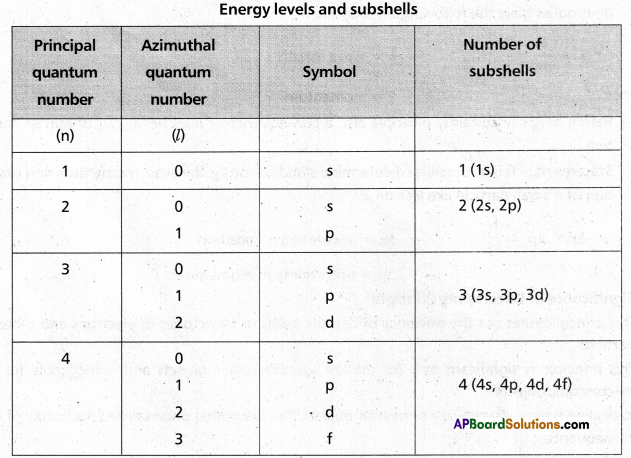
∴ The normal at P(2, -2) passes through the origin.

Question 6.
If the tangent at any point on the curve x2/3 + y2/3 = a2/3 intersects the coordinate axes in A and B then show that length AB is a constant.
Inter 1st Year Maths 1B Applications of Derivatives Solutions Ex 10(b) 14
Solution:
Equation of the curve is
x2/3 + y2/3 = a2/3
Differentiating w.r. to x
Inter 1st Year Maths 1B Applications of Derivatives Solutions Ex 10(b) 15
Equation of the tangent at P (x1, y1) is
Inter 1st Year Maths 1B Applications of Derivatives Solutions Ex 10(b) 16
AB = a = constant.

Inter 1st Year Maths 1B Applications of Derivatives Solutions Ex 10(b)

Question 7.
If the tangent at any point P on the curve xm yn = am+n (mn ≠ 0) meets the co-ordinate axes in A, B, then show that AP: PB is a constant.
Inter 1st Year Maths 1B Applications of Derivatives Solutions Ex 10(b) 17
Solution:
Equation of the curve is xm.yn = am+n
Differentiating w.r. to x
Inter 1st Year Maths 1B Applications of Derivatives Solutions Ex 10(b) 18
Slope of the tangent at P(x1, y1) = –\(\frac{my_{1}}{nx_{1}}\)
Equation of the tangent at P is
Inter 1st Year Maths 1B Applications of Derivatives Solutions Ex 10(b) 19
Co-ordinates of A are [\(\frac{m+n}{m}\).x1, o] and B are [0, \(\frac{m+n}{m}\).y1]
Let P divide AB in the ratio k : l
Co-ordinates of P are
Inter 1st Year Maths 1B Applications of Derivatives Solutions Ex 10(b) 20
Inter 1st Year Maths 1B Applications of Derivatives Solutions Ex 10(b) 21
Dividing (1) by (2) \(\frac{l}{k}=\frac{m}{n}\) ⇒ \(\frac{k}{l}=\frac{n}{m}\)
∴ P divides AB in the ratio n : m
i.e., AP : PB = n : m = constant.

Inter 1st Year Maths 1B Applications of Derivatives Solutions Ex 10(a)

Practicing the Intermediate 1st Year Maths 1B Textbook Solutions Inter 1st Year Maths 1B Applications of Derivatives Solutions Exercise 10(a) will help students to clear their doubts quickly.

Intermediate 1st Year Maths 1B Applications of Derivatives Solutions Exercise 10(a)

I.

Question 1.
Find ∆y and dy for the following functions for the values of x and ∆x which are shown against each of the functions,
i) y = x² + 3x + 6, x = 10, ∆x = 0.01.
Solution:
∆y = f(x + ∆x) – f(x)
= f(10.01)-f(10)
= E(10.01)² + 3(10.01) + 6] – [10² + 3(10) + 6]
= 100.2001 +30.03 + 6 – 100 – 30 – 6
= 0.2001 + 0.03
= 0.2301
y = x² + 3x + 6
dy = (2x + 3) dx
= (2.10 + 3) (0.01) = 0.23

ii) y = ex + x, x = 5 and ∆x = 0.02
Solution:
∆y = f(x + ∆x) – f(x)
= f(5 + 0.02) – f(5)
= f(5.02) – f(5)
= (e5.02 + 5.02) – (e5 + 5)
= e5.02 – e5 + 0.02
= e5 (e0.02 – 1) + 0.02
dy = f'(x) ∆x = (ex + 1) ∆x
= (e5 + 1) (0.02)

iii) y = 5x² + 6x + 6, x = 2 and ∆x = 0.001
Solution:
∆y’= f(x + ∆x) – f(x)
= f(2 +0.001) – f(2)
= f(2.001) – f(2)
= (5(2.001)² + 6(2.001) + 6) – (5(2)² + 6(2) +6)
= 20.0200 + 12.0060 + 6 – 20 – 12 – 6
= 0.026005
dy = f'(x) ∆x = (10x + 6) ∆x
= (26) (0.001) = 0.0260.

iv) y = 2 \(\frac{1}{x+2}\) x = 8 and ∆x = 0.02
Solution:
f(x) = \(\frac{1}{x+2}=\frac{1}{10}\) = 0.1000
f(x + ∆x) = \(\frac{1}{x+\Delta x+2}=\frac{1}{10+0.02}=\frac{1}{10.02}\) = 0.0998
∆y = f(x + ∆x) – f(x)
= \(\frac{1}{x+\Delta x+2}-\frac{1}{1+x}=\frac{1}{10.02}=\frac{1}{10}\)
= 0.0998 003992 – 0.1000 = – 0.0001996
dy = f'(x) ∆x = \(\frac{-1}{1+x^{2}}\) ∆x
= \(\frac{-1}{100}\)(0.02) = -0.0002

v) y = cos (x), x = 60° and ∆x = 1°
Solution:
∆y = f(x + ∆x) – f(x)
= cos (x + ∆x) – cos x
= cos (60° + 1°) – cos 60°
= cos 61° – cos 60°
= 0.4848 – \(\frac{1}{2}\) = 0.4848 – 0.5 = – 0.0152
dy = f'(x) ∆x
= — sin x ∆x
= – sin 60°(1°) = \(\frac{-\sqrt{3}}{2}\) (0.0174)
= – (0.8660) (0.0174) = – 0.0151.

Inter 1st Year Maths 1B Applications of Derivatives Solutions Ex 10(a)

II.

Question 1.
Find the approximations of the following.
i) √82
Solution:
82 = 81 + 1 = 81(1 + \(\frac{1}{81}\))
∴ x = 81, ∆x = 1, f(x) = 77
dy = f'(x). ∆x = \(\frac{1}{2\sqrt{x}}\). ∆x = \(\frac{1}{2\sqrt{81}}\).1
= \(\frac{1}{18}\) = 0.0555
f(x + δx) – f(x) ≅ dy
f(x + δx) ≅ f(x) + dy
= √81 + 0.0555
= 9 + 0.0555
i.e., √82 = 9.0555 = 9.056

ii) \(\sqrt[3]{65}\)
Solution:
Let x = 64, ∆x = 1, f(x) = \(\sqrt[3]{x}\)
f'(x) = \(\frac{1}{3}\)x-2/3
f(x + ∆x) ≅ f(x) + f'(x)∆x
\(\sqrt[3]{65}\) ≅ \(\sqrt[3]{x}\) + \(\frac{1}{3}\)x-2/3 ∆x
≅ \(\sqrt[3]{65}+\frac{1}{3}\)(4)-2/3(I)
≅ 4 + \(\frac{1}{3}\)(\(\frac{1}{16}\))
≅ 4 + \(\frac{1}{48}\)
≅ \(\frac{192+1}{48}\)
≅ \(\frac{193}{48}\) ≅ 4.0208

iii) \(\sqrt{25.001}\)
Solution:
Letx = 25, ∆x- 0.001
f(x) = √x
dy = f'(x) ∆x
= \(\frac{1}{2\sqrt{x}}\) ∆x = \(\frac{1}{2\sqrt{25}}\) (0.001) = \(\frac{0.001}{10}\) = 0.0001
f(x + ∆x) ≅ f(x) + dy
≅ √25 + 0.0001
≅ 5.0001

iv) \(\sqrt[3]{7.8}\)
Solution:
Let x = 8, ∆x = -0.2, f(x) = \(\sqrt[3]{x}\)
dy = f'(x). ∆x
= \(\frac{1}{3}\)x-2/3. ∆x = \(\frac{1}{3x^{2/3}}\) . ∆x
dy = \(\frac{1}{3(8)^{2/3}}\)(-0.2)
= – \(\frac{1}{3}\)
\(=-\frac{0.2}{3 \times 4}=-\frac{0.2}{12}\)
f(x + δx) – (x) ≅ dy
f(x + δx) ≅ f(x) + dy
= \(\sqrt[3]{8}\) – 0.0166
= 2 – 0.0166
= 1.9834
∴ \(\sqrt[3]{7.8}\) = 1.9834

v) sin (62°)
Solution:
Let x = 60°, ∆x = 2°, f(x) = sin x
dy = f'(x) ∆x
= cosx ∆x
= cos 60° ∆x
= \(\frac{1}{2}\) (2°)
= \(\frac{1}{2}\) 2(0.0174) = 0.0174

f(x + ∆x) ≅ f(x) + dy
≅ sin 60° + 0.0174
≅ \(\frac{\sqrt{3}}{2}\) + 0.0174
≅ 0.8660 + 0.0174
≅ 0.8834

vi) cos (60° 5′)
Solution:
Let x = 60°, Ax = 5′ = \(\frac{5}{60}\)×\(\frac{\pi}{180}=\frac{\pi}{2160}\)
= 0.001453
f(x) = cos x
dy = f'(x) ∆x = – sin x ∆x
= – sin 60° (0.001453)
= \(\frac{-\sqrt{3}}{2}\) (0.001453)
= – 0.8660 (0.001453)
= -0.001258

f(x + ∆x) ≅ f(x) + dy
≅ cos x + dy
≅ cos 60° + 0.001258
≅ 0.5 – 0.001258
≅ 0.4987.

vii) \(\sqrt[4]{17}\)
Solution:
Let x – 16, ∆x = 1, f(x) = \(\sqrt[4]{x}\) = x¼
dy = f'(x) ∆x
= \(\frac{1}{4}\) x¼-1 ∆x
= \(\frac{1}{4}\) x-3/4 ∆x
= \(\frac{1}{4}\) (16)-3/4 (I)
= \(\frac{1}{32}\) = 0.0312

f(x + ∆x) ≅ f(x) + dy
≅ \(\sqrt[4]{x}\) + 0.0312
≅ 2 + 0.0312
≅ 2.0312

Inter 1st Year Maths 1B Applications of Derivatives Solutions Ex 10(a)

Question 2.
If the increase in the side of a square is 4% then find the approximate percentage of increase in the area of the square.
Solution:
Let x be the side and A be the area of square
A = x²
Inter 1st Year Maths 1B Applications of Derivatives Solutions Ex 10(a) 1

Question 3.
The radius of a sphere is measured as 14 cm. Later it was found that there is an error 0.02 cm in measuring the radius. Find the approximate error in surface of the sphere.
Solution:
Let s be the surface of the sphere
r’ = 14, ∆r = 0.02
s = 4πr²
∆s = 4π 2r ∆r
∆s = 8π (14) (0.02)
= 2.24π
= 2.24 (3.14)
= 7.0336.

Question 4.
The diameter of a sphere is measured to be 40 cm. If an error of 0.02 cm is made in it, then find approximate errors in volume and surface area of the sphere.
Solution:
Let v be the value of sphere
v = \(\frac{4}{3}\) πr³ = \(\frac{4 \pi}{3}\)[latex]\frac{d}{2}[/latex]³
= \(\frac{4 \pi}{3} \frac{d^{3}}{8}=\frac{\pi d^{3}}{6}\)
∆v = \(\frac{\pi}{6}\)3d² ∆d
= \(\frac{\pi}{2}\) (40)² (0.02)
= π(1600) (0.01)
= 16π.

Surface Area s = 4πr²
s = 4π [latex]\frac{d}{2}[/latex]²
s = 4π\(\frac{d^{2}}{4}\)
s = πd²
∆s = π2d ∆d
= π2d (40) (0.02)
= 1.6π.

Inter 1st Year Maths 1B Applications of Derivatives Solutions Ex 10(a)

Question 5.
The time t, of a complete oscillation of a simple pendulum of length l is given by t = \(2 \pi \sqrt{\frac{1}{g}}\) where g is gravitational constant. Find the approximate percen-tage of error in t when the percentage of error l is 1%.
Sol. Given t = \(2 \pi \sqrt{\frac{1}{g}}\)
log t = log 2π + \(\frac{1}{2}\) {(log l – log)}
Inter 1st Year Maths 1B Applications of Derivatives Solutions Ex 10(a) 2

Inter 2nd Year Maths 2A De Moivre’s Theorem Solutions Ex 2(a)

Practicing the Intermediate 2nd Year Maths 2A Textbook Solutions Inter 2nd Year Maths 2A De Moivre’s Theorem Solutions Exercise 2(a) will help students to clear their doubts quickly.

Intermediate 2nd Year Maths 2A De Moivre’s Theorem Solutions Exercise 2(a)

I.

Question 1.
If n is an integer then show that (1 + i)2n + (1 – i)2n = 2n+1 cos \(\frac{n \pi}{2}\)
Solution:
Inter 2nd Year Maths 2A De Moivre’s Theorem Solutions Ex 2(a) I Q1
Inter 2nd Year Maths 2A De Moivre’s Theorem Solutions Ex 2(a) I Q1.1
Inter 2nd Year Maths 2A De Moivre’s Theorem Solutions Ex 2(a) I Q1.2

Inter 2nd Year Maths 2A De Moivre’s Theorem Solutions Ex 2(a)

Question 2.
Find the values of the following:
(i) (1 + i√3)3
Solution:
Let 1 + i√3 = r (cos θ + i sin θ)
Equating real and imaginary parts
r cos θ = 1 and r sin θ = √3
⇒ r2 (1) = 1 + 3 = 4
⇒ r = 2
cos θ = \(\frac{1}{2}\) and sin θ = \(\frac{\sqrt{3}}{2}\)
⇒ θ = \(\frac{\pi}{3}\)
Inter 2nd Year Maths 2A De Moivre’s Theorem Solutions Ex 2(a) I Q2(i)

(ii) (1 – i)8
Solution:
Inter 2nd Year Maths 2A De Moivre’s Theorem Solutions Ex 2(a) I Q2(ii)

(iii) (1 + i)16
Solution:
Inter 2nd Year Maths 2A De Moivre’s Theorem Solutions Ex 2(a) I Q2(iii)

(iv) \(\left(\frac{\sqrt{3}}{2}+\frac{i}{2}\right)^{5}-\left(\frac{\sqrt{3}}{2}-\frac{i}{2}\right)^{5}\)
Solution:
Inter 2nd Year Maths 2A De Moivre’s Theorem Solutions Ex 2(a) I Q2(iv)

Inter 2nd Year Maths 2A De Moivre’s Theorem Solutions Ex 2(a)

II.

Question 1.
If α, β are the roots of the equation x2 – 2x + 4 = 0 then for any n ∈ N show that αn + βn = 2n+1 cos(\(\frac{n \pi}{3}\))
Solution:
Inter 2nd Year Maths 2A De Moivre’s Theorem Solutions Ex 2(a) II Q1
Inter 2nd Year Maths 2A De Moivre’s Theorem Solutions Ex 2(a) II Q1.1

Question 2.
If cos α + cos β + cos γ = 0 = sin α + sin β + sin γ then show that
(i) cos 3α + cos 3β + cos 3γ = 3 cos(α + β + γ)
(ii) sin 3α + sin 3β + sin 3γ = 3 sin(α + β + γ)
(iii) cos(α + β) + cos(β + γ) + cos(γ + α) = 0
Solution:
Given that cos α + cos β + cos γ = 0 and sin α + sin β + sin γ = 0
From the hypothesis, we have
(cos α + cos β + cos γ) + i (sin α + sin β + sin γ) = 0
i.e., (cos α + i sin α) + (cos β + i sin β) + (cos γ + i sin γ) = 0
We know that if a + b + c = 0, then a3 + b3 + c3 = 3abc
Hence (cos α + i sin α)3 + (cos β + i sin β)3 + (cos γ + i sin γ)3 = 3 (cos α + i sin α) (cos β + i sin β) + (cos γ + i sin γ)
i.e., cos 3α + i sin 3α + cos 3β + i sin 3β + cos 3γ + i sin 3γ = 3[cos(α + β + γ) + i sin(α + β + γ)] …….(1)
On equating the real parts on both sides of equation (1) we get
(i) cos 3α + cos 3β + cos 3γ = 3 cos(α + β + γ)
On equation thenmaginary parts on both sides of equation (1) we get,
(ii) sin 3α + sin 3β + sin 3γ = 3 sin(α + β + γ)
(iii) Let a = cos α + i sin α then \(\frac{1}{a}\) = cos α – i sin α
b = cos β + i sin β and \(\frac{1}{b}\) = cos β – i sin β
c = cos γ + i sin γ and \(\frac{1}{c}\) = cos γ – i sin γ
Now \(\frac{1}{a}+\frac{1}{b}+\frac{1}{c}\) = (cos α + cos β + cos γ) – i (sin α + sin β + sin γ)
⇒ \(\frac{1}{a}+\frac{1}{b}+\frac{1}{c}\) = 0 – i(0)
⇒ \(\frac{1}{a}+\frac{1}{b}+\frac{1}{c}\) = 0
⇒ bc + ca + ab = 0
⇒ [cos(β + γ) + i sin(β + γ)] + [cos(γ + α) + i sin(γ + α)] + [cos(α + β) + i sin(α + β)] = 0
⇒ [cos(α + β) + cos(β + γ) + cos(γ + α)] + i [sin(α + β) + sin(β + γ) + sin(γ + α)] = 0
By equation real parts on both sides
cos (α + β) + cos (β + γ) + cos (γ + α) = 0

Inter 2nd Year Maths 2A De Moivre’s Theorem Solutions Ex 2(a)

Question 3.
If n is an integer and z = cis θ, (θ ≠ (2n + 1) π/2), then show that \(\frac{z^{2 n}-1}{z^{2 n}+1}\) = i tan nθ.
Solution:
z = cis θ = cos θ + i sin θ, θ ≠ (2n + 1) π/2
Inter 2nd Year Maths 2A De Moivre’s Theorem Solutions Ex 2(a) II Q3
(∵ i2 = -1)
= i tan(nθ)
= R.H.S

Question 4.
If (1 + x)n = a0 + a1x + a2x2 + ……… + anxn, then show that
(i) a0 – a2 + a4 – a6 + …….. = \(2^{n / 2} \cos \frac{n \pi}{4}\)
(ii) a1 – a3 + a5 – a7 + ……… = \(2^{n / 2} \sin \frac{n \pi}{4}\)
Solution:
Inter 2nd Year Maths 2A De Moivre’s Theorem Solutions Ex 2(a) II Q4
Inter 2nd Year Maths 2A De Moivre’s Theorem Solutions Ex 2(a) II Q4.1

Inter 2nd Year Maths 2A Complex Numbers Solutions Ex 1(c)

Practicing the Intermediate 2nd Year Maths 2A Textbook Solutions Inter 2nd Year Maths 2A Complex Numbers Solutions Exercise 1(c) will help students to clear their doubts quickly.

Intermediate 2nd Year Maths 2A Complex Numbers Solutions Exercise 1(c)

I.

Question 1.
Express the following complex numbers in modulus-amplitude form.
(i) 1 – i
Solution:
1 – i
Let 1 – i = r(cos θ + i sin θ)
Equating real and imaginary parts
r cos θ = 1, r sin θ = -1
⇒ θ lies in IV quadrant
Squaring and adding
r2 (cos2θ + sin2θ) = 1 + 1 = 2
⇒ r2 = 2
⇒ r = √2
tan θ = – 1
⇒ θ = \(-\frac{\pi}{4}\)
∴ 1 – i = √2(cos(\(-\frac{\pi}{4}\)) + i sin(\(-\frac{\pi}{4}\)))

(ii) 1 + i√3
Solution:
1 + i√3 = r (cos θ + i sin θ)
Equating real and imaginary parts
r cos θ = 1 ………(1)
r sin θ = √3 ……..(2)
θ lies in the I quadrant
Squaring and adding (1) and (2)
r2 (cos2θ + sin2θ) = 1 + 3
⇒ r2 = 4
⇒ r = 2
Dividing (2) by (1)
\(\frac{r \sin \theta}{r \cos \theta}\) = √3
⇒ tan θ = √3
⇒ θ = \(\frac{\pi}{3}\)
∴ 1 + i√3 = 2(cos \(\frac{\pi}{3}\) + i sin \(\frac{\pi}{3}\))

Inter 2nd Year Maths 2A Complex Numbers Solutions Ex 1(c)

(iii) -√3 + i
Solution:
-√3 + i = r(cos θ + i sin θ)
Equating real and imaginary parts
r cos θ = -√3 …….(1)
r sin θ = 1 …….(2)
⇒ θ lies in II quadrant
Squaring and adding (1), (2)
r2 (cos2θ + sin2θ) = 3 + 1 = 4
⇒ r2 = 4
⇒ r = 2
Dividing (2) by (1)
\(\frac{r \sin \theta}{r \cos \theta}=-\frac{1}{\sqrt{3}}\)
⇒ tan θ = \(-\frac{1}{\sqrt{3}}\) and θ lies in II quadrant
⇒ θ = 180° – 30° = 150° = \(\frac{5 \pi}{6}\)
∴ -√3 + i = 2(cos \(\frac{5 \pi}{6}\) + i sin \(\frac{5 \pi}{6}\))

(iv) -1 – i√3
Solution:
1 – i√3 = r (cos θ + i sin θ)
Equating real and imaginary parts
r cos θ = -1, r sin θ = -√3
Squaring and adding
r2 (cos2θ + sin2θ) = 1 + 3
⇒ r2 = 4
⇒ r = 2
∴ cos θ = \(-\frac{1}{2}\), sin θ = \(-\frac{\sqrt{3}}{2}\)
⇒ θ = -120° = \(-\frac{2 \pi}{3}\)
∴ -1 – i√3 = 2[cos(\(-\frac{2 \pi}{3}\)) + i sin(\(-\frac{2 \pi}{3}\))]

Question 2.
Simplify -2i(3 + i) (2 + 4i) (1 + i) and obtain the modulus of that complex number.
Solution:
-2i(3 + i) (2 + 4i) (1 + i)
= (-6i – 2i2) (2 + 2i + 4i + 4i2)
= (2 – 6i) (-2 + 6i)
= -4 + 12i – 36i2 + 12i
= 32 + 24i
= 8(4 + 3i)
Modulus = |8(4 + 3i)|
= 8\(\sqrt{(4)^{2}+(3)^{2}}\)
= 8(5)
= 40

Question 3.
(i) If z ≠ 0, find Arg z + Arg \((\bar{z})\).
Solution:
If z = x + iy, then Arg(z) = \(\tan ^{-1}\left(\frac{y}{x}\right)\)
and \((\bar{z})\) = x – iy, then Arg (z) = \(\tan ^{-1}\left(\frac{-y}{x}\right)\) = –\(\tan ^{-1}\left(\frac{y}{x}\right)\)
∴ Arg (z) + Arg \((\bar{z})\) = \(\tan ^{-1}\left(\frac{y}{x}\right)\) + (-\(\tan ^{-1}\left(\frac{y}{x}\right)\)) = 0

(ii) If z1 = -1 and z2 = -i, then find Arg(z1z2)
Solution:
z1 = -1
⇒ z1 = cos π + i sin π
⇒ Arg z1 = π
z2 = -i
⇒ z2 = \(\cos \left(-\frac{\pi}{2}\right)+i \sin \left(-\frac{\pi}{2}\right)\)
⇒ Arg z2 = \(-\frac{\pi}{2}\)
∴ Arg (z1z2) = Arg z1 + Arg z2
= π – \(\frac{\pi}{2}\)
= \(\frac{\pi}{2}\)

(iii) If z1 = -1, z2 = i then find Arg\(\left(\frac{\mathbf{z}_{1}}{\mathbf{z}_{2}}\right)\)
Solution:
z1 = -1 = cos π + i sin π
⇒ Arg z1 = π
z2 = i = cos \(\frac{\pi}{2}\) + i sin \(\frac{\pi}{2}\)
⇒ Arg z2 = \(\frac{\pi}{2}\)
∴ Arg\(\left(\frac{\mathbf{z}_{1}}{\mathbf{z}_{2}}\right)\) = Arg z1 – Arg z2
= π – \(\frac{\pi}{2}\)
= \(\frac{\pi}{2}\)

Inter 2nd Year Maths 2A Complex Numbers Solutions Ex 1(c)

Question 4.
(i) If (cos 2α + i sin 2α) (cos 2β + i sin 2β) = cos θ + i sin θ, then find the value of θ.
Solution:
cos θ + i sin θ
= (cos 2α + i sin 2α) (cos 2β + i sin 2β)
= cos 2α . cos 2β + i sin 2α . cos 2β + i cos 2α sin 2β + i2 sin 2α . sin 2β
= (cos 2α . cos 2β – sin 2α . sin 2β) + i(sin 2α cos 2β + cos 2α sin 2β)
= cos 2(α + β) + i sin 2(α + β)
∴ θ = 2(α + β)

(ii) If √3 + i = r (cos θ + i sin θ), then find the value of θ in radian measure.
Solution:
Given that
√3 + i = r(cos θ + i sin θ)
⇒ r cos θ = √3, r sin θ = 1
⇒ r2 (cos2θ + sin2θ) = 3 + 1
⇒ r2 = 4
⇒ r = 2
∴ cos θ = \(\frac{\sqrt{3}}{2}\) and sin θ = \(\frac{1}{2}\)
⇒ θ = \(\frac{\pi}{6}\)

(iii) If x + iy = cis α . cis β then find the value of x2 + y2.
Solution:
Given x + iy = cis α . cis β
⇒ x + iy = (cos α + i sin α) (cos β + i sin β)
⇒ x + iy = cos(α + β) + i sin(α + β)
Equating real and imaginary parts
x = cos(α + β) and y = sin(α + β)
∴ x2 + y2 = cos2(α + β) + sin2(α + β) = 1

(iv) If \(\frac{z_{2}}{z_{1}}\), (z1 ≠ 0) is an imaginary number, then find the value of \(\left|\frac{2 z_{1}+z_{2}}{2 z_{1}-z_{2}}\right|\)
Solution:
\(\frac{z_{2}}{z_{1}}\), (z1 ≠ 0) is purely imaginary.
We can suppose that \(\frac{z_{2}}{z_{1}}\) = iy, where y ∈ R – {0}
Inter 2nd Year Maths 2A Complex Numbers Solutions Ex 1(c) I Q1(iv)

(v) If (√3 + i)100 = 299 (a + ib), then show that a2 + b2 = 4.
Solution:
Inter 2nd Year Maths 2A Complex Numbers Solutions Ex 1(c) I Q1(v)

Question 5.
(i) If z = x + iy and |z| = 1, find the locus of z.
Solution:
Given z = x + iy
Also |z| = 1
⇒ |x + iy| = 1
⇒ \(\sqrt{x^{2}+y^{2}}=1\)
⇒ x2 + y2 = 1
∴ Locus of z is x2 + y2 = 1

(ii) If the amplitude of (z – 1) is \(\frac{\pi}{2}\), then find the locus of z.
Solution:
Given z = x + iy
z – 1 = x + iy – 1 = (x – 1) + iy
Since Amplitude (z – 1) is \(\frac{\pi}{2}\)
Real part of z – 1 is zero.
∴ x – 1 = 0
∴ Locus of z is x – 1 = 0

(iii) If the Arg \(\overline{\mathbf{z}}_{1}\) and Arg z2 are \(\frac{\pi}{5}\) and \(\frac{\pi}{3}\) respectively, find (Arg z1 + Arg z2)
Solution:
Arg \(\overline{\mathbf{z}}_{1}\) = \(\frac{\pi}{5}\)
⇒ Arg \(\overline{\mathbf{z}}_{1}\) = -Arg z1 = \(-\frac{\pi}{5}\)
Arg z2 = \(\frac{\pi}{3}\)
∴ Arg z1 + Arg z2 = \(-\frac{\pi}{5}+\frac{\pi}{3}\) = \(\frac{2 \pi}{15}\)

Inter 2nd Year Maths 2A Complex Numbers Solutions Ex 1(c)

(iv) If z = \(\frac{1+2 i}{1-(1-i)^{2}}\) then find Arg(z).
Solution:
Given z = \(\frac{1+2 i}{1-(1-i)^{2}}\)
= \(\frac{1+2 i}{1-(1-2 i+i)^{2}}\)
= \(\frac{1+2 i}{1+2 i}\)
= 1
= cos 0° + i sin 0°
∴ Arg (z) = 0°

II.

Question 1.
Simplify the following complex numbers and find their modulus.
(i) \(\frac{(2+4 i)(-1+2 i)}{(-1-i)(3-i)}\)
(ii) \(\frac{(1+i)^{3}}{(2+i)(1+2 i)}\)
Solution:
Inter 2nd Year Maths 2A Complex Numbers Solutions Ex 1(c) II Q1(i)
Inter 2nd Year Maths 2A Complex Numbers Solutions Ex 1(c) II Q1(ii)

Question 2.
(i) If (1 – i) (2 – i) ( 3 – i) …… (1 – ni) = x – iy then prove that 2 . 5 . 10 …….. (1 + n2) = x2 + y2.
Solution:
Given (1 – i) (2 – i) (3 – i) (1 – ni) = x – iy
|1 – i| |2 – i| |3 – i| …… |1 – ni| = |x – iy|
\(\sqrt{1+1} \sqrt{4+1} \sqrt{9+1} \ldots \sqrt{1+n^{2}}=\sqrt{x^{2}+y^{2}}\)
∴ 2 . 5 . 10 ……. (1 + n2) = x2 + y2

(ii) If the real part of \(\frac{z+1}{z+i}\) is 1, then find the locus of z.
Solution:
Inter 2nd Year Maths 2A Complex Numbers Solutions Ex 1(c) II Q2(ii)

(iii) If |z – 3 + i | = 4 determine the locus of z.
Solution:
Let z = x + iy
Given |z – 3 + i| = 4
⇒ |x + iy – 3 + i | = 4
⇒ (x – 3) + i(y + 1) = 4
⇒ \(\sqrt{(x-3)^{2}+(y+1)^{2}}\) = 4
⇒ (x – 3)2 + (y + 1)2 = 16
⇒ x2 – 6x + 9 + y2 + 2y + 1 = 16
⇒ x2 + y2 – 6x + 2y – 6 = 0
∴ The locus of z is x2 + y2 – 6x + 2y – 6 = 0

(iv) If |z + ai| = |z – ai| then find the locus of z.
Solution:
Let z = x + iy
Given |z + ai | = |z – ai|
⇒ |x + iy + ai| = |x + iy – ai|
⇒ |x + i(y + a)| = |x + i(y – a)|
⇒ \(\sqrt{x^{2}+(y+a)^{2}}=\sqrt{x^{2}+(y-a)^{2}}\)
⇒ x2 + (y + a)2 = x2 + (y – a)2
⇒ (y + a)2 – (y – a)2 = 0
⇒ 4ay = 0
⇒ y = 0
∴ The locus of z is y = 0

Inter 2nd Year Maths 2A Complex Numbers Solutions Ex 1(c)

Question 3.
If z = (x + iy) and if the point P in the Argand plane represents z, then describe geometrically the locus of P satisfying the equation.
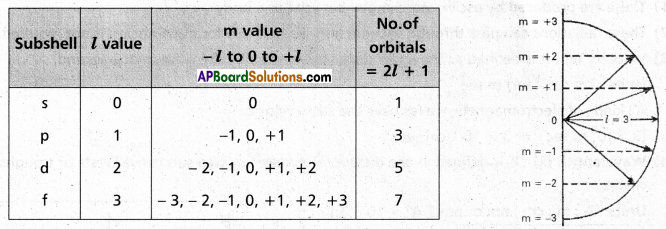
(i) |2z – 3| = 7
Solution:
|2z – 3| = 7
Let z = x + iy
Given |2z – 3| = 7
⇒ |2(x + iy) – 3| = 7
⇒ |(2x – 3) + i(2y)| = 7
⇒ \(\sqrt{(2 x-3)^{2}+(2 y)^{2}}\) = 7
⇒ 4x2 – 12x + 9 + 4y2 = 49
⇒ 4x2 + 4y2 – 12x – 40 = 0
⇒ x2 + y2 – 3x – 10 = 0
∴ The locus of z is x2 + y2 – 3x – 10 = 0
This equation represents a circle.
Centre = (\(\frac{3}{2}\), 0)
Radius = \(\sqrt{\frac{9}{4}-(-10)}\) = \(\frac{7}{2}\) units

(ii) |z|2 = 4 Re(z + 2)
Solution:
|z|2 = 4 Re (z + 2)
Given |z|2 = 4 Re (z + 2)
⇒ |x + iy|2 = 4 Re (x + iy + z)
⇒ (\(\sqrt{x^{2}+y^{2}}\)) = 4(x + 2)
⇒ x2 + y2 = 4x + 8
∴ The locus of z is x2 + y2 – 4x – 8 = 0
This equation represents a circle. Center = (2, 0)
Radius = \(\sqrt{4-(-8)}\) = 2√3 units.

(iii) |z + i|2 – |z – i|2 = 2
Solution:
Given |z + i|2 – |z –  i|2 = 2
⇒ |x + iy + i|2 – |x + iy – i|2 = 2
⇒ |x + i(y + 1)|2 – |x + i(y – 1)|2 = 2
⇒ \(\left[\sqrt{x^{2}+(y+1)^{2}}\right]^{2}\) – \(\left[\sqrt{x^{2}+(y-1)^{2}}\right]^{2}\) = 2
⇒ x2 + (y + 1 )2 – [x2 + (y – 1)2] = 2
⇒ x2 + (y + 1)2 – x2 – (y – 1)2 = 2
⇒ 4y = 2
⇒ 2y – 1 = 0
The locus of P is 2y – 1 = 0
This equation represents a straight line parallel to the x-axis.

(iv) |z + 4i| + |z – 4i| = 10
Solution:
Given |z + 4i| + |z – 4i| = 10
⇒ |x + iy + 4i| + |x + iy – 4i| = 10
⇒ |x + i(y + 4)| + |x + i(y – 4)| = 10
⇒ \(\sqrt{x^{2}+(y+4)^{2}}+\sqrt{x^{2}+(y-4)^{2}}\)
⇒ \(\sqrt{x^{2}+(y+4)^{2}}\) = 10 – \(\sqrt{x^{2}+(y-4)^{2}}\)
⇒ x2 + (y + 4)2 = 100 + x2 + (y – 4)2 – 20 \(\sqrt{x^{2}+(y-4)^{2}}\)
⇒ 16y – 100 = – 20\(\sqrt{x^{2}+(y-4)^{2}}\)
⇒ 4y – 25 = -5\(\sqrt{x^{2}+(y-4)^{2}}\)
⇒ (4y – 25)2 = 25[x2 + (y – 4)2]
⇒ 16y2 – 200y + 625 = 25x2 + 25y2 – 200y + 400
⇒ 25x2 + 9y2 = 225
∴ The locus of P is 25x2 + 9y2 = 225
⇒ \(\frac{x^{2}}{9}+\frac{y^{2}}{25}\) = 1
This equation represents an ellipse.
Center = (0, 0)
a2 = 9, b2 = 25
We know a2 – b2(1 – e2)
⇒ 9 = 25(1 – e2)
⇒ 1 – e2 = \(\frac{9}{25}\)
⇒ e = 1 – \(\frac{9}{25}\) = \(\frac{16}{25}\)
∴ Eccentricity = \(\frac{4}{5}\) and major axis parallel to y-axis.

Inter 2nd Year Maths 2A Complex Numbers Solutions Ex 1(c)

Question 4.
(i) If z1, z2 are two non-zero complex numbers satisfying |z1 + z2| = |z1| + |z2|, show that Arg z1 – Arg z2 = 0.
Solution:
Inter 2nd Year Maths 2A Complex Numbers Solutions Ex 1(c) II Q4(i)
Inter 2nd Year Maths 2A Complex Numbers Solutions Ex 1(c) II Q4(i).1
Inter 2nd Year Maths 2A Complex Numbers Solutions Ex 1(c) II Q4(i).2

(ii) z = x + iy and the point P represents z in the Argand plane and \(\left|\frac{z-a}{z+\bar{a}}\right|\) = 1, Re(a) ≠ 0, then find the locus of P.
Solution:
Let z = x + iy and a = α + iβ
\(\frac{z-a}{z+\bar{a}}=\frac{(x+i y)-(\alpha+i \beta)}{(x+i y)+(\alpha-i \beta)}\)
\(\left|\frac{z-a}{z+\bar{a}}\right|\) = 1
⇒ \(\frac{|z-a|}{|z+\bar{a}|}\) = 1
⇒ |z – a| = |z + \(\overline{\mathrm{a}}\)|
⇒ |(x – α)| + i(y – β)| = |(x + α) + i(y – β)|
⇒ \(\sqrt{(x-\alpha)^{2}+(y-\beta)^{2}}=\sqrt{(x+\alpha)^{2}+(y-\beta)^{2}}\)
⇒ (x – α)2 + (y – β)2 = (x + α)2 + (y – β)2
⇒ (x – α)2 = (x + α)2
⇒ (x + α)2 – (x – α)2 = 0
⇒ 4αx = 0
Re(a) ≠ 0
⇒ a ≠ 0
⇒ x = 0
Locus of P is x = 0 i.e., Y-axis

Inter 1st Year Maths 1B Applications of Derivatives Important Questions

Students get through Maths 1B Important Questions Inter 1st Year Maths 1B Applications of Derivatives Important Questions which are most likely to be asked in the exam.

Intermediate 1st Year Maths 1B Applications of Derivatives Important Questions

Question 1.
Find dy and ∆y of y = f(x) = x2 + x at x = 10 when ∆x = 0.1.
Solution:
As change in y – f(x) is given by ∆y = f(x + ∆x) – f(x), this change at x = 10 with ∆x = 0.1 is
∆y = f(10.1) – f(10)
= {(10.1)2 + 10.1} – {102 + 10}
= 2.11.
Since dy = f'(x) ∆x, dy at x = 10 with ∆x = 0.1 is dy = {(2)(10) + 1} 0.1 = 2.1
(since \(\frac{\mathrm{d} y}{\mathrm{dx}}\) = 2x + 1).

Inter 1st Year Maths 1B Applications of Derivatives Important Questions

Question 2.
Find ∆y and dy for the function y = cos (x) at x = 60° with ∆x = 1° .
Solution:
For the given problem ∆y and dy at x = 60° with ∆x = 1° are
∆y = cos (60° + 1°) – cos (60°) …………. (1)
and dy = -sin(60°) (1°) ………….. (2)
Cos (60°)= 0.5,
Cos (61°)= 0.4848,
Sin (60°) = 0.8660,
1° = 0.0174 radians
∴ ∆y = -0.0152 and
dy = -0.0150.

Question 3.
The side of a square is increased from 3 cm to 3.01 cm. Find the approximate increase in the area of the square.
Solution:
Let x be the side of a square and A be its area.
Then A = x2. …… (1)
Clearly A is a function of x. As the side is increased from 3 cm to 3.01 cm we can take x – 3 and ∆x = 0.01 to compute the approximate increase in the area of square. The approximate value of change in area is
∆A ≈ \(\frac{\mathrm{dA}}{\mathrm{dx}}\) ∆x
In view of equation (1), the equation (2) becomes
∆A ≈ 2x∆x
Hence the approximate increase in the area when the side is increased from 3 to 3.01 is
∆A ≈ 2(3)(0.01) = 0.06

Question 4.
If the radius of a sphere is increased from 7 cm to 7.02 cm then find the approximate increase in the volume of the sphere.
Solution:
Let r be the radius of a sphere and V be its volume. Then
V = \(\frac{4 \pi \pi^{2}}{3}\) …………….. (1)
Here V is a function of r. As the radius is increased from 7 cm to 7.02, we can take r = 7 cm and ∆r = 0.02 cm. Now we have to find the approximate increase in the volume of the sphere.
∴ ∆V ≈ \(\frac{\mathrm{dV}}{\mathrm{dr}}\) ∆r = 4πr2 ∆r.
Thus, the approximate increase in the volume of the sphere is \(\frac{4(22)(7)(7)(0.02)}{7}\) = 12.32 cm3.

Inter 1st Year Maths 1B Applications of Derivatives Important Questions

Question 5.
If y = f(x) = k xn then show that the approximate relative error (or increase) in y is n times the relative error (or increase) in x where n and k are constants.
Solution:
The approximate relative error (or increase) in y by the equation (2) of if a number A is very close to a number B but it is not equal to B then A is called an approximate value of B is (\(\frac{f^{\prime}(x)}{f(x)}\)) ∆x = \(\frac{k n x^{n-1}}{k x^{n}}\) ∆x = n(\(\frac{\Delta x}{x}\) = n)
Hence the approximate relative error in y = kxn is n times the relative error in x.

Question 6.
If the increase in the side of a square is 2% then find the approximate percentage of increase in its area.
Solution:
Let x be the side of a square and A be its area.
Then A = x2.
Approximate percentage error in area A
= (\(\frac{\frac{\mathrm{dA}}{\mathrm{dx}}}{\mathrm{A}}\)) × 100 × ∆x(by (3) of if a number
A is very close to a number B but it is not equal to B then A is called an approximate value of B with f = A)
= \(\frac{100(2 x) \Delta x}{x^{2}}\) = \(\frac{200 \Delta x}{x}\) = 2(2) = 4
(∵ \(\frac{\Delta x}{x}\) × 100 = 2

Question 7.
If an error of 0.01 cm is made in measuring the perimeter of a circle and the perimeter is measured as 44 cm then find the approximate error and relative error in its area.
Solution:
Let r, p and A be the radius, perimeter and area of the circle respectively. Given that p = 44 cm and ∆p = 0.01. We have to find approximation of ∆A and \(\frac{\Delta \mathrm{A}}{\mathrm{A}}\). Note that A = πr2 which is a function of r. As p and ∆p are given we have to transform A = πr2 into the form A = f(p). This can be achieved by using the relation, perimeter 2πr = p.
∴ A = π(\(\frac{p}{2 \pi}\))2 = \(\frac{p^{2}}{4 \pi}\)
Hence the approximate error in
A = \(\frac{d A}{d p}\)∆p = \(\frac{2 p}{4 \pi}\)∆p = \(\frac{P}{2 \pi}\)∆p
The approximate error in A when p = 44 and ∆p = 0.01 = \(\) (0.01) = 0.07
The approximate relative error
Inter 1st Year Maths 1B Applications of Derivatives Important Questions 1
= 0.0004545.

Inter 1st Year Maths 1B Applications of Derivatives Important Questions

Question 8.
Find the approximate value of \(\sqrt[3]{999}\)
Solution:
This problem can be answered by
f(x + ∆x) ≈ f(x) + f'(x) ∆x …………. (1)
with x = 1000 and ∆x = -1. The reason for taking x = 1000 is to make the calculation of f(x) simpler when f(x) = \(\sqrt[3]{x}\), Suppose
y = f(x) = \(\sqrt[3]{x}\)
The equation (1) becomes
f(x + ∆x) ≈ f(x) = \(\frac{1}{3 x^{\frac{2}{3}}}\) ∆x
Hence f(1000 – 1)
≈ f(1000) + \(\frac{1}{3(1000)^{2 / 3}}\) (-1) = 9.9967.

Question 9.
Find the slope of the tangent to the following curves at the points as indicated.
i) y = 5x2 at (-1, 5)
ii) y = \(\frac{1}{x – 1}\) (x ≠ 1) at [3, \(\frac{1}{2}\)]
iii) x = a secθ, y = a tanθ at θ = \(\frac{\pi}{6}\)
iv) (\(\frac{x}{a}\))n + (\(\frac{x}{b}\))n = 2 at (a, b)
Solution:
i) y = 5x2, then \(\frac{\mathrm{dy}}{\mathrm{dx}}\) = 10x
Slope of the tangent at the given points
(\(\frac{\mathrm{dy}}{\mathrm{dx}}\))(-1.5) -10(-1) = -10

ii) y = \(\frac{1}{x – 1}\)
\(\frac{\mathrm{dy}}{\mathrm{dx}}\) = \(\frac{-1}{(x-1)^{2}}\)
Slope of the tangent at the given point is
Inter 1st Year Maths 1B Applications of Derivatives Important Questions 2
Inter 1st Year Maths 1B Applications of Derivatives Important Questions 3

Inter 1st Year Maths 1B Applications of Derivatives Important Questions

Question 10.
Find the equations of the tangent and the normal to the curve y = 5x4 at the point (1, 5)
Solution:
y = 5x4 implies that \(\frac{\mathrm{dy}}{\mathrm{dx}}\) = 20x3
Slope of the tangent to the curve at (1, 5) is
(\(\frac{\mathrm{dy}}{\mathrm{dx}}\))(1, 5) = 20(1)5 = 20
Equation of the normal of (1, 5) is
y – 5 = 20 (x – 1) = 20x – 20
y = 20x – 15
Slope of the normal to the curve at (1, 5) is
–\(\frac{1}{m}\) = –\(\frac{1}{20}\)
Equation of the normal of (1, 5) is
y – 5 = –\(\frac{1}{20}\) (x – 1)
20 y – 100 = -x + 1
x + 20y = 101
(or) 20y = 101 – x

Question 11.
Find the equations of the tangent and the normal to the curve y4 = ax3. at (a, a).
Solution:
Given curve is y4 = ax3
Differentiating w.r.to. x
4y3 . \(\frac{\mathrm{dy}}{\mathrm{dx}}\) = 3ax2
\(\frac{\mathrm{dy}}{\mathrm{dx}}\) = \(\frac{3 a x^{2}}{4 y^{3}}\)
Slope of the tangent at (a, a) = \(\frac{3 a \cdot a^{2}}{4 a^{3}}\) = \(\frac{3}{4}\)
Slope of the normal at (a, a) = –\(\frac{1}{m}\) = –\(\frac{4}{3}\)
Equation of the tangent at (a, a) is
y – a = \(\frac{3}{4}\)(x – a)
4y – 4a = 3x – 3a
4y = 3x + a
Equation of the normal at (a, a) is 4
y – a = – \(\frac{4}{3}\)(x – a)
3y – 3a = -4x + 4a
3y + 4x = 7a

Question 12.
Find the equations of the tangent to the curve y = 3x2 – x3, where it meets the X-axis.
Solution:
Equation of the curve is y = 3x2 – x3
Equation of X – axis is y = 0
For points is intersection of the curve and X-axis
3x2 – x3 = 0 ⇒ x2 (3 – x) = 0
x = 0, x = 3
The curve crosses X-axis 0(0, 0) and A(3, 0)
y = -3x2 – x3
\(\frac{\mathrm{dy}}{\mathrm{dx}}\) = 6x – 3x2
At O(0, 0), slope of the tangent = (\(\frac{\mathrm{dy}}{\mathrm{dx}}\))(0, 0) = 0
Equation of the tangent at (0, 0) is y – 0, 0(x – 0) i.e., y = 0
i.e., x-axis is the tangent to the curve at O(0, 0)
At A(3, 0), slope of the tangent = (\(\frac{\mathrm{dy}}{\mathrm{dx}}\))(3, 0)
= 6.3 – 3.32
= 18 – 27
= -9
Equation of the tangent at A(3, 0) is
y – 0 = -9(x – 3) = -9x + 27
(or) 9x + y = 27

Inter 1st Year Maths 1B Applications of Derivatives Important Questions

Question 13.
Find the points at which the curve t y = sin x has horizontal tangents.
Solution:
y = sin x
Inter 1st Year Maths 1B Applications of Derivatives Important Questions 4
A tangent is horizontal if and anal its slope is
cos x = 0 ⇒ x = (2n + 1)\(\frac{\pi}{2}\), n ∈ Z
Hence the given curve has horizontal tangents at points (x0, y0)
⇔ x0 = (2n + 1) . \(\frac{\pi}{2}\) and
y0 = (-1)n for same n ∈ Z

Question 14.
Verify whether the curve y = f(x) = x1/3 has a vertical tangent at the point with x = 0.
Solution:
Inter 1st Year Maths 1B Applications of Derivatives Important Questions 5
The function has a verified tangent at the point whose x co-ordinate is 0.

Question 15.
Find whether the curve y = f(x)= x2/3 has a vertical tangent at x = 0.
Solution:
Inter 1st Year Maths 1B Applications of Derivatives Important Questions 6
Thus left handed be normal \(\frac{1}{h^{1 / 3}}\) as h → 0 is -∞
While the right handed limit is ∞.
Hence Inter 1st Year Maths 1B Applications of Derivatives Important Questions 7 does not exist. The vertical tangent does not exist.
At the point x = 0.

Inter 1st Year Maths 1B Applications of Derivatives Important Questions

Question 16.
Show that the tangent at any point 0 on the curve x = c sec θ, y = c tan θ is y sin θ = x – c cos θ.
Solution:
x = c sec θ, y = c tan θ
Inter 1st Year Maths 1B Applications of Derivatives Important Questions 8
Inter 1st Year Maths 1B Applications of Derivatives Important Questions 9

Question 17.
Show that the area of the triable formed by the tangent at any point on the curve xy = c (c ≠ 0) with the coordinate axis is constant.
Solution:
Observe that c ≠ 0
If c = 0 the equation xy = 0 represent the coordinate circle which is against the definite.
Let P (x1, y1) be a point on the curve xy = c
y = \(\frac{c}{x}\) = 1, \(\frac{\mathrm{dy}}{\mathrm{dx}}\) = – \(\frac{c}{x^{2}}\)
Equation of the tangent at (x1, y1) is
y – y1 = – \(\frac{c}{x^{2}}\) (x – x1)
x2y – x12 = -cx + cx1
cx + x12 . y = x12 + cx1
= cx1 + cx1 (x1y1 = c)
= 2cx1
\(\frac{c x}{2 c x_{1}}\) + \(\frac{x_{1}^{2} y}{2 c x_{1}}\) = 1
\(\frac{x}{2 x_{1}}\) + \(\frac{y}{\left(\frac{2 c}{x_{1}}\right)}\) = 1
Area of the triangle formed with co-ordinate axes
= \(\frac{1}{2}\) |OA . OB|
= \(\frac{1}{2}\) (2x1) (\(\frac{2 c}{x_{1}}\)) = 2c = constant

Inter 1st Year Maths 1B Applications of Derivatives Important Questions

Question 18.
Show that the equation of the tangent to the curve (\(\frac{x}{a}\))n + (\(\frac{y}{b}\))n = 2 (a ≠ 0, b ≠ 0) at the point (a, b) is \(\frac{x}{a}\) + \(\frac{y}{b}\) = 2
Solution:
Inter 1st Year Maths 1B Applications of Derivatives Important Questions 10
Equation of the tangent to the curve at the point (a, b) is
y – b = \(\frac{-b}{a}\) (x – a)
\(\frac{y}{b}\) – 1 = – \(\frac{x}{a}\) + 1
\(\frac{x}{a}\) + \(\frac{y}{b}\) = 2

Question 19.
Show that the length of the sub normal at point on the curve y2 = 4ax is a constant.
Solution:
Equation of the curve is y2 = 4ax
Differentiating w.r.to x
2y \(\frac{\mathrm{dy}}{\mathrm{dx}}\) = 4a
\(\frac{\mathrm{dy}}{\mathrm{dx}}\) = \(\frac{4a}{2y}\) = \(\frac{2a}{y}\)
Length of the sub-normal \(\left|\frac{y d y}{d x}\right|=\left|y \cdot \frac{2 a}{y}\right|\)
= 2a = constant

Question 20.
Show that the length of the Sub tangent at any point on the curve y = ax (a > 0) is a constant.
Solution:
Equation of the curve is y = ax
Differentiating w.r.to x
\(\frac{\mathrm{dy}}{\mathrm{dx}}\) = ax log a = y. log a
Length of the sub-tangent
= \(\left|\frac{y}{\left(\frac{d y}{d x}\right)}\right|\) = \(\left|\frac{y}{\left(\frac{d y}{d x}\right)}\right|\) = \(\frac{1}{\log a}\) constant

Inter 1st Year Maths 1B Applications of Derivatives Important Questions

Question 21.
Show that the square of the length of subtangent at any point on the curve by2 = (x + a)3 (b ≠ 0) varies with the length of the subnormal at that point.
Solution:
Differentiating by2 = (x + a)3
w.r.t x, we get
2by y’ = 3(x + a)2
∴ The length of the subnormal at any point (x, y) on the curve
= |y y’| = |\(\frac{3}{2 b}\)(x + a)2| ………………… (1)
The square of the length of subtangent
Inter 1st Year Maths 1B Applications of Derivatives Important Questions 11
∴ (length of the subnormal)2 ∝ (length of subnormal).

Question 22.
Find the value of k, so that the length of the subnormal at any point on the curve y = a1 – kxk is a constant.
Solution:
Differentiating y = a1 – kxk with respect to x,
we get y’ = ka1 – kxk – 1
Length of subnormal at any point P(x, y) on the curve
= |y y’| = |yka1 – kxk – 1|
= |k a1 – kxka1 – kxk – 1|
= |ka2-2kx2k-1|
In order to make these values a constant, we should have 2k – 1 = 0 i.e., k = \(\frac{1}{2}\).

Question 23.
Find the angle between the curves xy = 2 and x2 + 4y = 0.
Solution:
First we find the points of intersection of xy = 2 and x2 + 4y = 0
y = \(\frac{-x^{2}}{4}\)
But xy = 2 ⇒ x(\(\frac{-x^{2}}{4}\)) = 2 ⇒ x3 = -8
x = -2
y = \(\frac{-x^{2}}{4}\) = – \(\frac{4}{4}\) = -1
Point of intersection is P(-2, -1)
Inter 1st Year Maths 1B Applications of Derivatives Important Questions 12
= \(\left|\frac{-\frac{3}{2}}{\frac{1}{2}}\right|\) = 3
Φ = tan-1(3)

Inter 1st Year Maths 1B Applications of Derivatives Important Questions

Question 24.
Find the angle between the curve 2y = e\(\frac{-x}{2}\) and Y-axis.
Solution:
Equation of Y-axis is x = 0.
The point of intersection of the curve
2y = e\(\frac{-x}{2}\) and x = 0 is P(0, \(\frac{1}{2}\))
Let ψ be the angle between the given curves
2y = e\(\frac{-x}{2}\) at P with X – axis is given by
tan ψ = \(\left.\frac{\mathrm{dy}}{\mathrm{dx}}\right|_{\left(0, \frac{1}{2}\right)}=\left.\frac{-1}{4} \mathrm{e}^{\frac{-x}{2}}\right|_{\left(0, \frac{1}{2}\right)}=\frac{-1}{4}\)
Further, if Φ is the angle between the Y – axis and 2y = e\(\frac{-x}{2}\), then we have
tan Φ = |tan (\(\frac{\pi}{2}\) – ψ)| = |cot ψ| = 4
∴ The angle between the curve and the Y-axis is tan-1 4.

Question 25.
Show that the condition of the orthogonality of the curves ax2 + by2 = 1 and a1x2 + b1y2 = 1 is \(\frac{1}{a}\) – \(\frac{1}{b}\) = \(\frac{1}{a_{1}}\) – \(\frac{1}{b_{1}}\).
Solution:
Let the curves ax2 + by2 = 1 and a1x2 + b1y2 = 1 intersect at p(x1, y1) so that
ax12 + by12 = 1 and a1x12 + b1y12 = 1, from which we get,
\(\frac{x_{1}^{2}}{b_{1}-b}\) = \(\frac{y_{1}^{2}}{a_{1}-a}\) = \(\frac{1}{a b_{1}-a_{1} b}\) …………. (1)
Differentiating ax2 + by2 = 1 with respect to x,
we get \(\frac{\mathrm{dy}}{\mathrm{dx}}\) = \(\frac{-a x}{b y}\)
Hence, if mt is the slope of the tangent at P(x1, y1) to the curve
ax2 + by2 = 1, m1 = \(\frac{-a x_{1}}{b y_{1}}\)
Similarly, the slope (m2) of the tangent at P to
a1x2 + b1y2 = 1 is given by m2 = \(\frac{-a_{1} x_{1}}{b_{1} y_{1}}\)
Since the curves cut orthogonally we have m1m2 = -1,
i.e., \(\frac{\mathrm{a} a_{1} x_{1}^{2}}{\mathrm{~b} \mathrm{~b}_{1} y_{1}^{2}}\) = -1 or \(\frac{x_{1}^{2}}{y_{1}^{2}}=\frac{-b_{1}}{a a_{1}}\) ………………….. (2)
Now from (1) and (2), the condition for the orthogonality of the given curves is
\(\frac{b_{1}-b}{a-a_{1}}\) = \(\frac{b b_{1}}{a a_{1}}\)
or (b – a) a1b1 = (b1 – a1) ab
or \(\frac{1}{a}\) – \(\frac{1}{b}\) = \(\frac{1}{a_{1}}\) – \(\frac{1}{b_{1}}\)

Question 26.
Show that the curves y2 = 4(x + 1)and y2 = 36 (9 – x) intersect orthogonally. [Mar 11, May 06, 05]
Solution:
Solving y2 = 4(x + 1) and y2 = 36 (9 – x) for the points of intersection, we get
4(x + 1) = 36 (9 – x) 10x = 80 or x = 8
i.e., y2 = 4(x + 1) ⇒ y2 = 4(9) = 36 ⇒ y = ± 6
The points of intersection of the two curves are P(8, 6), Q(8, -6)
y2 = 4(x + 1) ⇒ \(\frac{\mathrm{dy}}{\mathrm{dx}}\) = \(\frac{2}{y}\)
y2 = 36 (9 – x) ⇒ \(\frac{\mathrm{dy}}{\mathrm{dx}}\) = \(\frac{-18}{y}\)
Slope of the tangent to the curve
y2 = 4(x + 1) at P is
m1 = \(\frac{2}{6}\) = \(\frac{1}{3}\)
Slope of the tangent to the curve
y2 = 36 (9 – x) at P is
m2 = \(\frac{-18}{6}\) = -3
m1m2 = \(\frac{1}{3}\) × -3 = -1
⇒ the curves intersect orthogonally at P.
We can prove, similarly,that the curves intersect orthogonally at Q also.

Inter 1st Year Maths 1B Applications of Derivatives Important Questions

Question 27.
Find the average rate of change of s = f (t) = 2t2 + 3 between t = 2 and t = 4.
Solution:
The average rate of change of s between t = 2 and t = 4 is \(\frac{f(4)-f(2)}{4-2}\) = \(\frac{35-11}{4-2}\) = 12.

Question 28.
Find the rate of change of area of a circle w.r.t. radius when r = 5 cm.
Solution:
Let A be the area of the circle with radius r.
Then A = πr2. Now, the rate of change of area A w.r.t. r is given by \(\frac{\mathrm{dA}}{\mathrm{dr}}\) = 2πr. When r = 5 cm.
\(\frac{\mathrm{dA}}{\mathrm{dr}}\) = 10 π.
Thus, the area of the circle is changing at the rate of 10 π cm2/cm.

Question 29.
The volume of a cube is increasing at a rate of 9 cubic centimeters per second. How fast is the surface area increasing when the length of the edge is 10 centimeters ?
Solution:
Let x be the length of the edge of the cube, V be its volume and S be its surface area. Then, V = x3 and S = 6x2. Given that rate of change of volume is 9 cm3/sec.
Therefore, \(\frac{\mathrm{dV}}{\mathrm{dt}}\) = 9 cm3/sec.
Now differentiating V w.r.t. t, we get,
Inter 1st Year Maths 1B Applications of Derivatives Important Questions 13

Inter 1st Year Maths 1B Applications of Derivatives Important Questions

Question 30.
A particle is moving in a straight line so that after t seconds its distance is s (in cms) from a fixed point on the line is given by s = f(t) = 8t + t3. Find (i) the velocity at time t = 2 sec (ii) the initial velocity (iii) acceleration at t = 2 sec.
Solution:
The distance s and time t are connected by the relation.
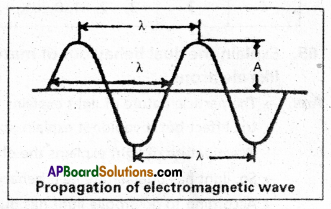
s = f(t) = 8t + t3 …………. (1)
∴ velocity (ν) = 8 + 3t2 ……………. (2)
and the acceleration is given by
a = \(\frac{\mathrm{d}^{2} \mathrm{~s}}{\mathrm{dt}^{2}}\) = 6t
i) The velocity at
t = 2 is 8 + 3 (4) = 20cm/sec.
ii) The initial velocity (t = 0) is 8 cm/sec.
iii) The acceleration at t = 2 is 6(2) = 12 cm/sec2

Question 31.
A container in the shape of an inverted cone has height 12 cm and radius 6 cm at the top. If it is filled with water at the rate of 12 cm3/sec., what is the rate of change in the height of water level when the tank is filled 8 cm ?
Solution:
Let OC be height to water level at t sec. The triangles OAB ad OCD are similar triangles.
Inter 1st Year Maths 1B Applications of Derivatives Important Questions 14
Let OC = h and CD = r. Given that AB = 6 cm, OA = 12 cm.
\(\frac{r}{6}\) = \(\frac{h}{12}\)
Inter 1st Year Maths 1B Applications of Derivatives Important Questions 15
Hence, the rate of change of water level is \(\frac{3}{4 \pi}\) cm/sec when the water level of the tank is 8 cm.

Question 32.
A particle is moving along a line according to s = f (t) = 4t3 – 3t2 + 5t -1 where s is measured in meters and t is measured in seconds. Find the velocity and acceleration at time t. At what time ‘ the acceleration is zero.
Solution:
Since f(t) = 4t3 – 3t2 + 5t – 1, the velocity at time t is
v = \(\frac{\mathrm{ds}}{\mathrm{dt}}\) = 12t2 – 6t + 5
and the acceleration at time t is a = \(\frac{\mathrm{d}^{2} \mathrm{~s}}{\mathrm{dt}^{2}}\) = 24t – 6.
The acceleration is 0 if 24t – 6 = 0
i.e., t = \(\frac{1}{4}\)
The acceleration of the particle is zero at
t = \(\frac{1}{4}\) sec.

Inter 1st Year Maths 1B Applications of Derivatives Important Questions

Question 33.
The quantity (in mg) of a drug in the blood at time t (sec) is given by q = 3(0.4)t. Find the instantaneous rate of change at t = 2 sec.
Solution:
Given that q = 3(0.4)t
∴ \(\frac{\mathrm{dQ}}{\mathrm{dx}}\) = 3(0.4)t loge(0.4) is the instaneous rate of change in q. Hence the instaneous rate of q at time t = 2 sec. is given by
\(\left(\frac{\mathrm{dQ}}{\mathrm{dx}}\right)_{t=2}\) = 3(0.4)2 loge (0.4).

Question 34.
Let a kind of bacteria grow by t3 (t in sec). At what time the rate of growth of the bacteria is 300 bacteria per sec ?
Solution:
Let g be the amount of growth of bacteria at t sec. Then
g(t) = t3 ………… (1)
The growth rate at time t is given by
g'(t) = 3t2
300 = 3t2 (given that growth rate is 300)
t = 10 sec.
∴ After t = 10 sec, the growth rate of bacteria should be 300 bacteria/sec.

Question 35.
The total cost C(x) in rupees associated with production of x units of an item is given by C(x) = 0.005 x3 – 0.02x2 + 30x + 500. Find the marginal cost when 3 units are produced (marginal cost is the rate of change of total cost).
Solution:
Let M represent the marginal cost. Then
M = \(\frac{\mathrm{dC}}{\mathrm{dx}}\)
Hence,
M = \(\frac{\mathrm{d}}{\mathrm{dx}}\)(0.005x3 – 0.02x2 + 30x + 500) dx
= 0.005(3x2) – 0.02(2x) + 30
∴ The Marginal cost at x = 3 is
(M)x = 3 = 0.005 (27) – 0.02 (6) + 30 = 30.015.
Hence the required marginal cost is Rs. 30.02 to produce 3 units.

Inter 1st Year Maths 1B Applications of Derivatives Important Questions

Question 36.
The total revenue in rupees received from the sale of x units of a product is given by R(x) = 3x2 + 36x + 5. Find the marginal revenue when x = 5 (marginal revenue is the rate of change of total revenue).
Solution:
Let m denote the marginal revenue. Then
m = \(\frac{\mathrm{dR}}{\mathrm{dx}}\) (since the total revenue is R(x))
Given that R(x) = 3x2 + 36x + 5
∴ m = 6x + 36
The marginal revenue at x = 5 is
[m = \(\frac{\mathrm{dR}}{\mathrm{dx}}\)]x = 5 = 30 + 36 = 66
Hence the required marginal revenue is Rs. 66.

Question 37.
Verify Rolle’s theorem for the function y = f(x) = x2 + 4 in [-3, 3].
Solution:
Here f(x) = x2 = 4. f is continuous on [-3, 3] as x2 + 4 is a polynomial which is continuous on any closed interval. Further f(3) = f(-3) = 13 and f is differentiable on [-3, 3].
∴ By Rolle’s theorem ∃ c ∈ (-3, 3) such that f'(c) = 0
The point c = 0 ∈ (-3, 3). Thus Rolle’s theorem is verified.

Question 38.
Verify Rolle’s theorem for the function f(x) = x(x + 3)e-x/2 in [-3, 0].
Solution:
Here f(-3) = 0 and f(0) = 0.
We have
f'(x) = \(\frac{\left(-x^{2}+x+6\right)}{2} e^{\frac{-x}{2}}\)
f'(x) = 0 ⇔ -x2 + x + 6 = 0 ⇔ x = -2 or 3. Of these two values -2 is in the open interval (-3, 0) which satisfies the conclusion of Rolle’s theorem.

Question 39.
Let f(x) = (x -1) (x – 2) (x – 3). Prove that there is more than one ‘c’ in (1, 3) such that f'(c) = 0. [Mar 13]
Solution:
Observe that f is continuous on (1, 3) differentiable in (1, 3) and f(1) = f(3) = 0.
f'(x) = (x – 1) (x – 2) + (x – 1) (x – 3) + (x – 2) (x – 3)
= 3x2 – 12x + 11
\(\frac{12 \pm \sqrt{144-132}}{6}\) = 2 ± \(\frac{1}{\sqrt{3}}\)
Both these roots lie in the open interval (1, 3) and are such that the derivative vanishes at these points.

Inter 1st Year Maths 1B Applications of Derivatives Important Questions

Question 40.
On the curve y = x2, find a point at which the tangent is parallel to the chord joining (0, 0) and (1, 1).
Solution:
The slope of the chord is \(\frac{1-0}{1-0}\) = 1.
The derivative is \(\frac{\mathrm{dy}}{\mathrm{dx}}\) = 2x.
We want x such that 2x = 1
i.e., x = \(\frac{1}{2}\)
we not that \(\frac{1}{2}\) is in the open interval (0, 1), as required in the Lagrange’s mean value theorem.
The corresponding point on the curve is (\(\frac{1}{2}\), \(\frac{1}{4}\)).

Question 41.
Show that f(x) = 8x + 2 is a strictly increasing function on R without using the graph of y = f(x).
Solution:
Let x1, x2 ∈ R with x1 < x2. Then 8x1 < 8x2. Adding 2 to both sides of this inequality, we have 8x1 + 2 < 8x2 + 2. i.e., f(x1) < f(x2).
Thus
x1 < x2 ⇒ f(x1) < f(x2) ∀ x1, x2 ∈ R.
Therefore, the given function f is strictly increasing on R.

Question 42.
Show that f (x) = ex is strictly increasing on R (without graph).
Solution:
Let x1, x2 ∈ R such that x1 < x2. we know that if a > b then ea > eb
∴ x1 < x2 ⇒ ex1 < ex2
i.e., f(x1) < f(x2).
Hence the given function f is a strictly increasing function.
Question 43.
Show that f(x) = – x + 2 is strictly decreasing on R.
Solution:
Let x1, x2 ∈ R x1 < x2.
Then x1 < x2
⇒ -x1 > -x2
⇒ -x1 + 2 > -x2 + 2
⇒ f(x1) > f(x2).
Therefore the given function f is strictly decreasing on R.

Inter 1st Year Maths 1B Applications of Derivatives Important Questions

Question 44.
Find the intervals on which
f(x) = x2 – 3x + 8 is increasing or decreasing ?
Solution:
Given fucntion is f(x) = x2 – 3x + 8.
Differentiating it w.r.t. x, we get f'(x) = 2x – 3
f(x) = 0 for x = 3/2.
Inter 1st Year Maths 1B Applications of Derivatives Important Questions 16
since f'(x) < 0 in (-∞, 3/2) the function f(x) is strictly decreasing on (-∞, \(\frac{3}{2}\)) Further since f'(x) > 0 in (\(\frac{3}{2}\), -∞), the function f(x) is a strictly increasing function (\(\frac{3}{2}\), -∞).

Question 45.
Show that f(x) = |x| is strictly decreasing on (-∞, 0) and strictly increasing on (0, ∞).
Solution:
The given function is f(x) = |x| i.e.,
Inter 1st Year Maths 1B Applications of Derivatives Important Questions 25
Thus f'(c) = 1 if c > 0, f'(c) = -1 if c < 0. Since f'(c) > 0 on (0, ∞), the function f(x) is strictly increasing on (0, ∞). Since f'(c) < 0 on (-∞, 0), the function f(x) is strictly decreasing on (-∞, 0).

Question 46.
Find the intervals on which the function f(x) = x3 + 5x2 – 8x + 1 is a strictly increasing function.
Solution:
Given that f(x) = x3 + 5x2 – 8x + 1.
∴ f'(x) = 3x2 + 10x – 8 = (3x – 2) (x + 4)
= 3(x – \(\frac{2}{3}\)) (x – (-4)).
f'(x) is negative in (-4, \(\frac{2}{3}\)) and positive in (-∞, -4) ∪ (\(\frac{2}{3}\), ∞) .
∴ The function is strictly deceasing in (-4, \(\frac{2}{3}\)) and is strictly decreasing in (-∞, -4)and (\(\frac{2}{3}\), ∞)

Inter 1st Year Maths 1B Applications of Derivatives Important Questions

Question 47.
Find the Intervals on which f(x) = xx (x > 0) is increasing and decreasing.
Solution:
Taking logarithms on both sides of f(x) = xx
we get
log (f(x)) = x log x. Differenetiating it w.r.t. x
we have \(\frac{1}{f(x)}\) f'(x)= 1 + log x
∴ f'(x) = xx( 1 + log x)
f'(x) = 0 ⇒ xx(1 + log x) = 0 ……………. (1)
⇒ 1 + log x = 0
⇒ x = 1/e
Inter 1st Year Maths 1B Applications of Derivatives Important Questions 17
Suppose x < 1/e log x < log (1/e) (since the base e > 1). i.e., log x < -1
1 + log x < 0 ⇒ xx (1 + log x) < 0. i.e., f'(x) < 0 Now suppose, x > 1/e. Then log x > log (1/e)
i.e., log x > – 1.
⇒ 1 + log x > 0
⇒ xx (1 + log x) > 0
⇒ f'(x) > 0
Hence, f is strictly decreasing on (o, 1/e) and it is strictly increasin on (1/e, ∞).

Question 48.
Determine the intervals in which f(x) = \(\frac{2}{(x-1)}\) + 18x ∀ x ∈ R \ {0} is strictly increasing and decreasing.
Solution:
Given that f(x) = \(\frac{2}{(x-1)}\) + 18x. Differenetiating
it w.r.t. x, we get
f'(x) = \(\frac{-1}{(x-1)^{2}}\) . 2 + 18 and f'(x) = 0
⇒ \(\frac{2}{(x-1)^{2}}\) = 18 ⇒ (x – 1)2 = 1/9.
∴ f'(x) = 0 if x – 1 = 1/3 or x- 1 = -(1/3).
i.e., x = 4/3 or x – 2/3.
The derivative of f(x) can be expressed as
f'(x) = \(\frac{18}{(x-1)^{2}}\) . (x – /3) (x – 4/3)
Inter 1st Year Maths 1B Applications of Derivatives Important Questions 18
∴ The given function f(x) is strictly increasing on (-∞, \(\frac{2}{3}\)) and (\(\frac{4}{3}\), ∞) and it is strictly decreasing on (\(\frac{2}{3}\), \(\frac{4}{3}\)).

Question 49.
Let f(x) = sin x – cos x be defined on [0, 2π]. Determine the intervals in which f(x) is strictly decreasing and strictly increasing.
Solution:
Given that f(x) = sin x – cos x.
∴ f'(x) = cos x + sin x
∴ f'(x) = \(\sqrt{2}\) . sin(x + π/4)
Let 0 < x < 3π/4. Then π/4 < x + π/4 < π. ∴ sin (x + π/4) > 0 i.e., f'(x) > 0.
Similarly it can be shown that f'(x) < 0 in (3π/4 . 7π/4) and f'(x) > 0 in (7π/4, 2π).
Inter 1st Year Maths 1B Applications of Derivatives Important Questions 19
Thus the function f(x) strictly increasing in (0, \(\frac{3\pi}{24}\) and (\(\frac{7\pi}{4}\), 2π) it is strictly decreasing in (\(\frac{3\pi}{4}\), \(\frac{7\pi}{4}\)).

Inter 1st Year Maths 1B Applications of Derivatives Important Questions

Question 50.
If 0 ≤ x ≤ \(\frac{\pi}{2}\) then show that x ≥ sinx.
Solution:
Let f(x) = x – sin x. Then f'(x) = 1 – cos x ≥ 0 ∀ x
∴ f is an increasing function for all x.
Now, f(0) = 0. Hence f(x) ≥ f(0) for all x ∈ (0, \(\frac{\pi}{2}\)). Therefore, x ≥ in x.

Question 51.
Let f : R → R be defined by f(x) = 4x2 – 4x + 11. Find the global minimum value and a point of global minimum.
Solution:
We have to look for a value c e R(domain) such that
f(x) ≥ f(c) ∀ x ∈ R
so that f(c) is the global minimum value of f. Consider
f(x) = 4x2 – 4x + 11 = (2x – 1)2 + 10 ≥ ∀ x ∈ R ……………(1)
Now, f(1/2) = 10
Also f(x) ≥ f(1/2) ∀ x ∈ R
Hence, f(1/2) = 10 is the global minimum value of f(x), and a point of global minimum is x = 1/2.

Question 52.
Let f : [-2, 2] → R be defined by f(x) = |x|. Find the global maximum of f(x) and a point of global minimum.
Solution:
We know that |x| = \(\left\{\begin{array}{ccc}
x & \text { if } & x \geq 0 \\
-x & \text { if } & x<0
\end{array}\right.\)
Therefore, from the graph of the function f on [-2, 2] clearly f(x) ≤ f(2) and f(x) ≤ f(-2) ∀ x ∈ [-2, 2].
Inter 1st Year Maths 1B Applications of Derivatives Important Questions 20
∴ f(2) = f(-2) = 2 is the global maximum of f(x), 2 and -2 are the points of global maximum.

Question 53.
Find the global maximum and global minimum of the function f : R → R defined by f (x) = x2.
Solution:
We have f(x) ≥ f(0) ∀ x ∈ R.
Hence th global minimum value of f(x) is 0 and a point of global minimum is x = 0.
Suppose f has global maximum at x0 ∈ R (x0 > 0). Then as per out assumption we have.
f(x0) ≥ f(x) ∀ x ∈ R
Inter 1st Year Maths 1B Applications of Derivatives Important Questions 21
Choose x1 = x0 + 1. Then x1 ∈ R and x0 < x1
∴ x02 < x12
Hence f(x0) < (fx1)
Thus we got f(x1) such that f(x0) > f(x0) which is a contradition to Therefore, f(x) has no global maximum on R.

Inter 1st Year Maths 1B Applications of Derivatives Important Questions

Question 54.
Find the stationary points of f(x) = 3x4 – 4x3 + 1, ∀ x ∈ R and state whether the function has local maxima or local minima at those points.
Solution:
Given that f(x) = 3x4 – 4x3 +1 and the domain of f is R. Differentiating the function w.r.t. x we have
f'(x) = 12x2(x – 1) ……………………… (1)
The stationary points are the roots of f (x) = 0 i.e., 12x2(x – 1) = 0. Hence x = 0 and x = 1 are the stationary points. Now, we test whether the stationary point x = 1 is a local extreme point or not. For.
f'(0.9) = 12(0.9)2 (0.9 – 1) ⇒ f'(0.9) is negative
f'(1.1) = 12(1.1)2 (1.1 – 1) ⇒ f'(1.1) is positive
and f(x) is defined in the neighbourhood i.e., (0.8, 1.2) of x = 1 with 8 = 0.2.
By theorem cis a point of local maximum if f(x) changes sign from positive to negative at x = c.
c is a point of local minimum if f'(x) changes sign from negative to positive at x = c.
The given function has local (relative) minimum at x = 1. Hence x = 1 is a local extreme point.
We will now test whether x = 0 is a local extreme point or not.
The function f(x) is defined in the neighbourhood of (-0.2, 0.2).
f'(-0.1) = 12(-0.1)2 (-0.1 – 1) ⇒ f'(-0.1) is negative
f'(-0.1) = 12(0.1)2 (0.1 -1) ⇒ f'(0.1) is negative
Thus, f(x) has no change in sign at x = 0. Therefore, the function f has no local maximum and no local minimum. Hence, x = 0 is not a local extreme point.

Question 55.
Find the points (if any) of local maxima and local minima of the function f (x) = x3 – 6x2 + 12x – 8 ∀ x ∈ R.
Solution:
Given function is f(x) = x3 – 6x2 + 12x – 8 and the domain of f is R.
Differentiating the given function w.r.t. x, we get
f'(x) = 3x2 – 12x + 12 i.e., f'(x) = 3(x – 2)2.
The stationary point of f(x) is x = 2, since 2 is a root of f'(x) = 0.
Choose δ = 0.2 The 0.2- neighbourhood of 2 is (1.8, 2.2). Now
f'(1.9) = 3(1.9 – 2)2 ⇒ f'(1.9) is positive
f'(2.1) = 3(2.1- 2)2 ⇒ f'(2.1) is positive
Thus f(x) does not change the sign at x = 2. By Theorem c is neither a point of local maximum nor a point of local minimum if f'(x) does not change sign at x = c.
x = 2 is neithere a local maximum nor a local minimum.

Inter 1st Year Maths 1B Applications of Derivatives Important Questions

Question 56.
Find the points of local minimum and local maximum of the function f(x) = sin 2x ∀ x ∈ [0, 2π]
Solution:
The given function is f(x) = sin 2x and domain is [0, 2π].
f'(x) = 2cos 2x …………… (1)
The critical points are the roots of 2 cos 2x = 0 and lying in the domain [0, 2π].
They are \(\frac{\pi}{4}\) and \(\frac{3\pi}{4}\) .
Now we apply the first derivative test at x = \(\frac{\pi}{4}\)
Clearly (\(\frac{\pi}{4}\) – 0.1 . \(\frac{\pi}{4}\) + 0.1) is a neighbourhood of \(\frac{\pi}{4}\) and the given f is defined on it.
Now
f'(\(\frac{\pi}{4}\) – 0.05) = 2 cos(\(\frac{\pi}{2}\) – 0.1) > 0
f'(\(\frac{\pi}{4}\) + 0.05) = 2 cos(\(\frac{\pi}{2}\) + 0.1) < 0
Thus f'(x) changes sign from positive to negative at x = \(\frac{\pi}{4}\). Therefore f has a local maximum.
Now we apply the first derivative test at x = \(\frac{3\pi}{4}\).
Clearly (\(\frac{3\pi}{4}\) – 0.1 . \(\frac{3\pi}{4}\) + 0.1) is a neighbourhood of \(\frac{3\pi}{4}\) and the given f is defined on it.
Now
f'(\(\frac{3\pi}{4}\) – 0.05) = 2 cos(\(\frac{3\pi}{4}\) – 0.1) < 0 f'(\(\frac{3\pi}{4}\) + 0.05) = 2 cos(\(\frac{3\pi}{4}\) + 0.1) > 0
Thus f'(x) changes sign from positive to negative at x = \(\frac{3\pi}{4}\). Therefore f has a local maximum at x = \(\frac{3\pi}{4}\).

Question 57.
Find the points of local extrema of the function f(x) = x3 – 9x2 – 48x + 6 ∀ x ∈ R Also find its local extrema.
Solution:
Given function is
f(x) = x3 – 9x2 – 48x + 6 …………… (1)
and the domain of the function is R.
Differentiating (1) w.r.t. x we get
f'(x) = 3x2 – 18x – 48 = 3(x – 8) (x + 2) ………….. (2)
Thus the stationary points are – 2 and 8.
Differentiating (2) w.r.t.x we get,
f'(x) = 6(x – 3) ………….. (3)
Let x1 = -2 and x2 = 8. Now we have to find f’ at each of these points to know the sign of second derivative.
At x1 = -2, f'(-2) = – 30. The sign of it is negative.
∴ x1 = – 2 is a point of local maximum of f and its local maximum value is f(-2) – 58.
Now, at x2 = 8 f'(8) = 30. Thus the sign of f”(x2) is positive. Therefore, x = 8 is a point of local minimum of f and its local minimum value is
f(8) = – 442.

Inter 1st Year Maths 1B Applications of Derivatives Important Questions

Question 58.
Find the points of local extrema of f(x) = x6 ∀ x ∈ R. Also find its local extrema.
Solution:
f(x) = x6 ………………….. (1)
Differentiating (1) w.r.t. x we get,
f'(x) = 6x5 ……………. (2)
and again differentiating (2) w.r.t. x we get
f'(x) = 30x4 …………………… (3)
The stationary point of f(x) is x = 0 only (since f'(x) = 0 only at x = 0).
Now f'(0) = 0. At x = 0, we can not conclude anything about the local extrema by the second derivative test. Therefore, we apply the first derivative test. As the domain of f is R, the function f is defined on (-0.2, 0.2) which is a neighbourhood of x = 0. Now
f'(-0.1) = 6(-0.1)5 < 0, f'(0, 1) = 6(0.1) 5 > 0.
Thus f'(x) changes sign form negative of positive at x = 0.
∴ x = 0 is a point of local minimum and its local minimum value is f(0) = 0.

Question 59.
Find the points of local extrema and local extrema for the function f(x) = cos 4x defined on (0, \(\frac{\pi}{2}\))
Solution:
Here f(x) = cos 4x ……………. (1)
and its domain is (0, \(\frac{\pi}{2}\))
∴ f’(x) = -4 sin 4x ………….. (2)
and f”(x) = -16 cos 4x ……………… (3)
The stationary points are the roots of
f'(x) = 0 and lying in the domain (o, \(\frac{\pi}{2}\)).
f'(x) = 0 ⇒ 4 sin 4x = 0
⇒ 4x = 0, π, 2π, 3π, 4π ………………….
⇒ x = 0, π/4, π/2, 3π/4, π …………………..
The point lying in the domain is x = \(\frac{\pi}{4}\) only.
Thus x = \(\frac{\pi}{4}\) is the stationary point of the given function. Now
f”(\(\frac{\pi}{4}\)) = -16 cos(π) = 16 > 0.
The function f has local minimum at x = \(\frac{\pi}{4}\) and its local minimum value is
f(\(\frac{\pi}{4}\)) = -1.

Question 60.
Find two positive number whose sum is 15 so that the sum of their squares is minimum.
Solution:
Suppose one numbers is x and the other number 15 – x. Let S be the sum of squares of these numbers. Then S = x2 + (15 – x)2 ………………… (1)
Note that the quantity S, to be minimized, is a function of x.
Differentiating (1) w.r.t. x, we get
\(\frac{\mathrm{dS}}{\mathrm{dx}}\) = 2x + 2(15 – x) (-1)
= 4x – 30 ………………. (2)
and again differentiating (2) w.r.t.x, we get
\(\frac{\mathrm{d}^{2} \mathrm{~S}}{\mathrm{dx}^{2}}\) = 4 ……………….. (3)
The stationary point can be obtained by solving \(\frac{\mathrm{dS}}{\mathrm{dx}}\) = 0 i.e., 4x – 30 = 0.
∴ x = 15/2 is the stationary point of (1).
Since \(\frac{\mathrm{d}^{2} \mathrm{~S}}{\mathrm{dx}^{2}}\) = 4 > 0, S is minimum at x = \(\frac{15}{2}\)
∴ The two numbers are \(\frac{15}{2}\), 15 – \(\frac{15}{2}\) i.e., \(\frac{15}{2}\) and \(\frac{15}{2}\).

Inter 1st Year Maths 1B Applications of Derivatives Important Questions

Question 61.
Find the maximum area of the rectangle that can be formed with fixed perimeter 20.
Solution:
Let x and y denote the length and the breadth of a rectangle respectively. Given that the perimeter of the rectangle is 20.
i.e., 2(x + y) = 20
i.e., x + y = 10 ……………. (1)
Let A denote the area of rectangle.
Then A = xy ………….. (2)
Which is to be minimized. Equation (1) can be expressed as
y = 10 – x …………… (3)
From (3) and (2), we have
A = x (10 – x)
A = 10x – x2 ……………… (4)
Differentiating (4) w.r.t. x we get
\(\frac{\mathrm{dA}}{\mathrm{dx}}\) = 10 – 2x ……………….. (5)
The stationary point is a root of 10 – 2x = 0
∴ x = 5 is the stationary point.
Differentiating (5) w.r.t. x, we get
\(\frac{\mathrm{d}^{2} \mathrm{~A}}{\mathrm{dx}^{2}}\) = -2
which is negative. Therefore by second derivative test the area A is maximized at x = 5 and hence y = 10 – 5 = 5, and the maximum area is A = 5(5) = 25.

Question 62.
Find the point on the graph y2 = x which is the nearest to the point (4, 0).
Solution:
Inter 1st Year Maths 1B Applications of Derivatives Important Questions 22
Let P(x, y) be any point on y2 = x and A(4, 0). We have to find P such that PA is minimum
Suppose PA = D. The quantity to be minimized is D.
D = (\(\sqrt{(x-4)^{2}+(y-0)^{2}}\)) ………………. (1)
P(x, y) lies on the curve, therefore
y2 = x …………………… (2)
From (1) and (2), we have
D = \(\sqrt{\left((x-4)^{2}+x\right)}\)
D = \(\sqrt{\left(x^{2}-7 x+16\right)}\) ……………………. (3)
Differentiating (3) w.r.t. x, we get
\(\frac{\mathrm{dD}}{\mathrm{dx}}\) = \(=\frac{2 x-7}{2} \cdot \frac{1}{\sqrt{x^{2}-7 x+16}}\)
Now \(\frac{\mathrm{dD}}{\mathrm{dx}}\) = 0
gives x = \(\frac{7}{2}\). Thus \(\frac{7}{2}\) is a stationary point of the function D. We apply the first derivative test to verify whether D is minimum at x = \(\frac{1}{2}\)
Inter 1st Year Maths 1B Applications of Derivatives Important Questions 23

Inter 1st Year Maths 1B Applications of Derivatives Important Questions

Question 63.
Prove that the radius of the right circular cylinder of greatest curved surface area which can be inscribed in a given cone is half of that of the cone.
Solution:
Let O be the centre of the circular base of the cone and its height be h. Let r be the radius of the circular base of the cone.
Then AO = h, OC = r.
Let a cylinder with radius x(OE) be inscribed in the given cone. Let its height be u.
Inter 1st Year Maths 1B Applications of Derivatives Important Questions 24
i.e., RO = QE = PD = u
Now the triangles AOC and QEC are similar.
Therefore,
\(\frac{\mathrm{QE}}{\mathrm{OA}}\) = \(\frac{\mathrm{EC}}{\mathrm{OC}}\)
i.e., \(\frac{u}{h}\) = \(\frac{r-x}{r}\)
∴ u = \(\frac{h(r-x)}{r}\) ………………… (1)
Let S denote the curved surface area of the chosen cylinder.Then
S = 2 π xu.
As the cone is fixed one, the values of r and h are constants. Thus S is function of x only. Now,
\(\frac{\mathrm{dS}}{\mathrm{dx}}\) = 2 πh (r – 2x)/r and \(\frac{\mathrm{d}^{2} \mathrm{~S}}{\mathrm{dx}^{2}}\) = -4πh/r.
The stationary point of S is a root of
\(\frac{\mathrm{dS}}{\mathrm{dx}}\) = 0
i.e., π(r – 2x)/r = 0
i.e., x = r/2
\(\frac{\mathrm{d}^{2} \mathrm{~S}}{\mathrm{dx}^{2}}\) < 0 for all x, Therefore (\(\frac{\mathrm{d}^{2} \mathrm{~S}}{\mathrm{dx}^{2}}\))x=r/2 < 0.
Hence, the radius of the cylinder of greatest curved surface area which can be inscribed in a given cone is r/2.

Question 64.
The profit function P(x) of a company, selling x items per day is given by P(x) = (150 – x)x – 1600. Find the number of items that the company should sell to get maximum profit. Also find the maximum profit.
Solution:
Given that the profit function is
P(x) = ( 150 – x)x – 1600 ………….. (1)
For maxima or minima \(\frac{\mathrm{dP}(\mathrm{x})}{\mathrm{dx}}\) = 0
∴ (150 – x) (1) + x (-1) = 0
i.e., x = 75
Now \(\frac{d^{2} P(x)}{d x^{2}}\) = -2 and \(\left[\frac{d^{2} P(x)}{d x^{2}}\right]_{x=75}\) < 0.
∴ The profit P(x) is maximum for x = 75.
∴ The company should sell 75 items a day to make maximum profit.
The maximum profit will be P(75) = 4025.

Question 65.
A manufacturer can sell x items at a price of rupees (5 – x/100) each. The cost price of x items is Rs. (x/5 + 500). Find the number of items that the manufacturer should sell to earn maximum profits.
Solution:
Let S(x) be the selling price of x items and C(x) be the cost price of x items. Then, we have
S(x) = {cost of each item}, x .
∴ S(x) = (5 – x/100) x = 5x – x2/100 and C(x) = x/5 + 500
Let P(x) denote the profit function. Then
P(x) = S(x) – C(x)
P(x) = (5x – x2/100) – (x/5 + 500)
– (24x/5) – (x2/100) – 500 …………….. (1)
For maxima or minima
\(\frac{\mathrm{dP}(\mathrm{x})}{\mathrm{d} x}\) = 0
i.e., 24/5 – x/50 = 0
The stationary point of P(x) is x = 240 and
\(\left[\frac{d^{2} P(x)}{d x^{2}}\right]\) = –\(\frac{1}{50}\) for all x.
Hence the manufacturer can earn maximum profit if he sells 240 items.

Inter 1st Year Maths 1B Applications of Derivatives Important Questions

Question 66.
Find the absolute extrement of f(x) = x2 defined on [-2, 2].
Solution:
The given function f(x) = x2 is continuous on [-2, 2]. It can be shown that it has only local minimum and the point of local minimum is 0. The absolute(global) maximum of f is the largest value of f(-2), f(0) and f(2) i.e., 4, 0, 4.
Hence, the absolute maximum value is 4. Similarly the absolute minimum is the least value of 4, 0, 4. Hence 0 is the absolute minimum value.

Question 67.
Find the absolute maximum of x40 – x20 on the interval [0, 1]. Find also its absolute maximum value.
Solution:
Let f(x) = x40 – x20 ∀ x ∈ [0,1] ………… (1)
The function f is continuous on [0,1 j and the interval [0,1] is closed.
From (1) we have
f'(x) = 40 x39 – 20 x19 = 20x19 (2x20 – 1).
Thus f'(x) = 0 at x = 0 or
x = \(\left(\frac{1}{2}\right)^{\frac{1}{20}}\)
Therefore, the critical points of f are and \(\left(\frac{1}{2}\right)^{\frac{1}{20}}\) and 0 is one of the end points of the domain. Therefore no local maximum exists at x = 0. Now
f'(x) = 40(39) x38 – 20(19) x18
= 20x18 (78 x20 – 19)
[f”(x)]x = \(\left(\frac{1}{2}\right)^{\frac{1}{20}}\) = 20 (1/2)(18/20)[39 – 19] > 0.
Therefore f has local minimum at
x = (1/2)(1/20)
and its value is \(f\left(\left(\frac{1}{2}\right)^{\frac{1}{20}}\right)\) = –\(\frac{1}{4}\)
Therefore the absolute maximum value of the function f is the largest value of f(0), f(1) and \(f\left(\left(\frac{1}{2}\right)^{\frac{1}{20}}\right)\) i.e., the largest value of {0, 0, –\(\frac{1}{4}\)}
Hence, the absolute maximum of f is 0 and the points of absolute maximum are 0 and 1. Further the absolute minimum is the least of 0, 0, -latex]\frac{1}{4}[/latex].
Hence the absolute minimum is -latex]\frac{1}{4}[/latex] and the point of absolute minimum is x = \(\left(\frac{1}{2}\right)^{\frac{1}{20}}\)