Inter 1st Year Maths 1A Matrices Solutions Ex 3(g)

Practicing the Intermediate 1st Year Maths 1A Textbook Solutions Inter 1st Year Maths 1A Matrices Solutions Exercise 3(g) will help students to clear their doubts quickly.

Intermediate 1st Year Maths 1A Matrices Solutions Exercise 3(g)

Examine whether the following systems of equations are consistent or inconsistent and if consistent find the complete solutions.

Question 1.
x + y + z = 4
2x + 5y – 2z = 3
x + 7y – 7z = 5
Solution:
Inter 1st Year Maths 1A Matrices Solutions Ex 3(g) Q1
ρ(A) = 2, ρ(AB) = 3
ρ(A) ≠ ρ(AB)
∴ The given system of equations are in consistent.

Inter 1st Year Maths 1A Matrices Solutions Ex 3(g)

Question 2.
x + y + z = 6
x – y + z = 2
2x – y + 3z = 9
Solution:
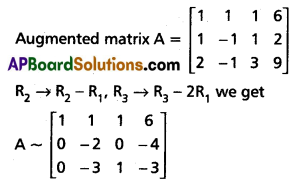
Inter 1st Year Maths 1A Matrices Solutions Ex 3(g) Q2
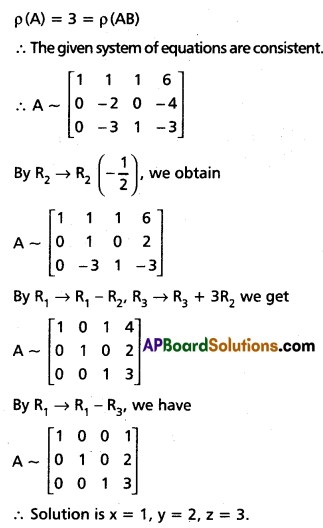
Inter 1st Year Maths 1A Matrices Solutions Ex 3(g) Q2.1

Question 3.
x + y + z = 1
2x + y + z = 2
x + 2y + 2z = 1
Solution:
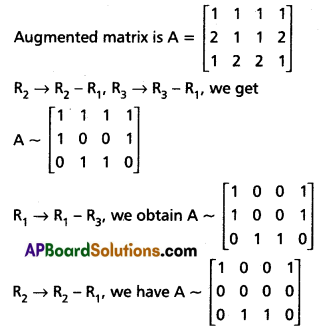
Inter 1st Year Maths 1A Matrices Solutions Ex 3(g) Q3
ρ(A) = 2 = ρ(AB) < 3
The given system of equations are consistent and have infinitely many solutions.
The solutions are given by [(x, y, z) 1x = 1, y + z = 0].

Question 4.
x + y + z = 9
2x + 5y + 7z = 52
2x + y – z = 0
Solution:
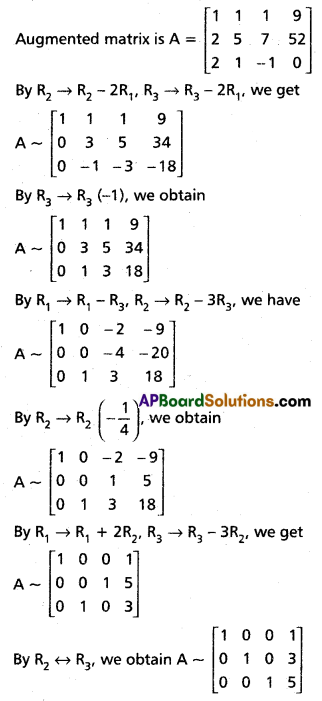
Inter 1st Year Maths 1A Matrices Solutions Ex 3(g) Q4
∴ ρ(A) = ρ(AB) = 3
The given system of equations are consistent have a unique solution.
∴ Solution is given by x = 1, y = 3, z = 5.

Inter 1st Year Maths 1A Matrices Solutions Ex 3(g)

Question 5.
x + y + z = 6
x + 2y + 3z = 10
x + 2y + 4z = 1
Solution:
Augmented matrix A = \(\left[\begin{array}{cccc}
1 & 1 & 1 & 6 \\
1 & 2 & 3 & 10 \\
1 & 2 & 4 & 1
\end{array}\right]\)
By R2 → R2 – R1, R3 → R3 – R2, we obtain
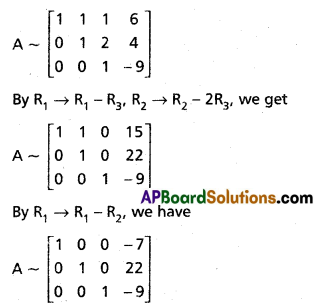
Inter 1st Year Maths 1A Matrices Solutions Ex 3(g) Q5
∴ ρ(A) = ρ(AB) = 3
The given system of equations are consistent.
They have a unique solution.
∴ Solution is given by x = -7, y = 22, z = -9.

Question 6.
x – 3y – 8z = -10
3x + y – 4z = 0
2x + 5y + 6z = 13
Solution:
The Augmented matrix
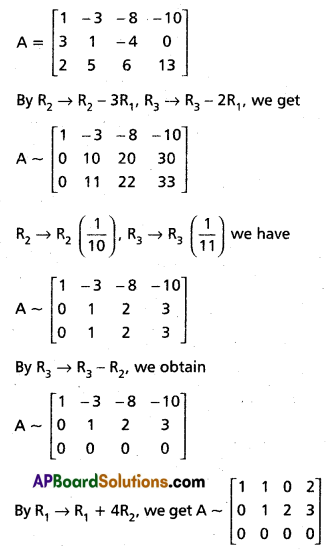
Inter 1st Year Maths 1A Matrices Solutions Ex 3(g) Q6
ρ(A) = ρ(AB) = 2 < 3
∴ The given system of equations are consistent have infinitely many solutions.
x + y = 2 and y + 2z = 3
Taking z = k, y = 3 – 2z = 3-2k
x = 2 – y
= 2 – (3 – 2k)
= 2 – 3 + 2k
= 2k – 1
∴ The solutions are given by x = -1 + 2k, y = 3 – 2k, z = k where ‘k’ is any scalar.

Question 7.
2x + 3y + z = 9
x + 2y + 3z = 6
3x + y + 2z = 8
Solution:
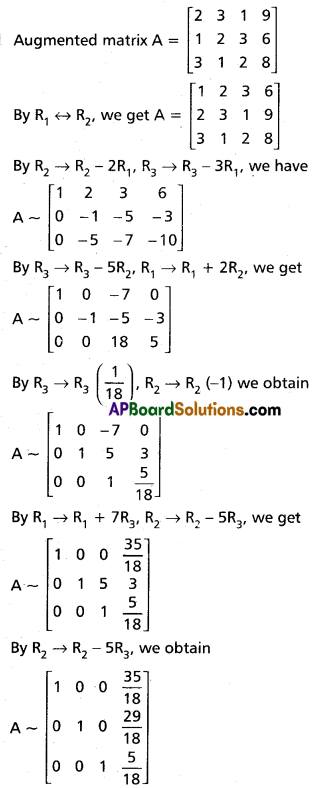
Inter 1st Year Maths 1A Matrices Solutions Ex 3(g) Q7
∴ ρ(A) = ρ(AB) = 3
The given system of equations are consistent have a unique solution.
∴ Solution is given by x = \(\frac{35}{18}\), y = \(\frac{29}{18}\), z = \(\frac{5}{18}\)

Inter 1st Year Maths 1A Matrices Solutions Ex 3(g)

Question 8.
x + y + 4z = 6
3x + 2y – 2z = 9
5x + y + 2z = 13
Solution:
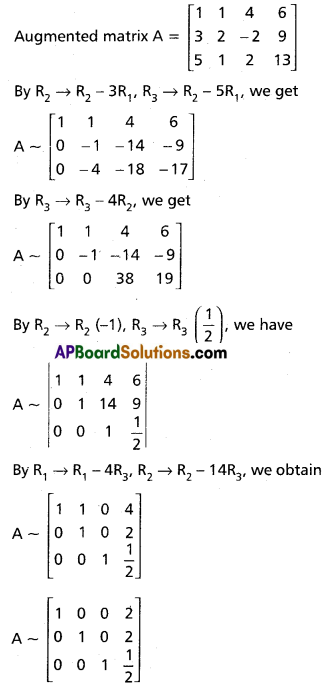
Inter 1st Year Maths 1A Matrices Solutions Ex 3(g) Q8
∴ ρ(A) = ρ(AB) = 3
∴ The given system of equations are consistent have a unique solution.
∴ Solution is given by x = 2, y = 2, z = \(\frac{1}{2}\)

Inter 1st Year Maths 1A Matrices Solutions Ex 3(f)

Practicing the Intermediate 1st Year Maths 1A Textbook Solutions Inter 1st Year Maths 1A Matrices Solutions Exercise 3(f) will help students to clear their doubts quickly.

Intermediate 1st Year Maths 1A Matrices Solutions Exercise 3(f)

I. Find the rank of each of the following matrices.

Question 1.
\(\left[\begin{array}{ll}
1 & 0 \\
0 & 0
\end{array}\right]\)
Solution:
Det A = \(\left|\begin{array}{ll}
1 & 0 \\
0 & 0
\end{array}\right|\) = 0 – 0 = 0
and |1| = 1 ≠ 0
∴ ρ(A) = 1

Inter 1st Year Maths 1A Matrices Solutions Ex 3(f)

Question 2.
\(\left[\begin{array}{ll}
1 & 0 \\
0 & 1
\end{array}\right]\)
Solution:
Det A = \(\left|\begin{array}{ll}
1 & 0 \\
0 & 1
\end{array}\right|\) = 1 – 0 = 1 ≠ 0
∴ ρ(A) = 2

Question 3.
\(\left[\begin{array}{ll}
1 & 1 \\
0 & 0
\end{array}\right]\)
Solution:
Det A = \(\left|\begin{array}{ll}
1 & 1 \\
0 & 0
\end{array}\right|\) = 0 – 0 = 0
|1| = 1 ≠ 0
∴ ρ(A) = 1

Question 4.
\(\left[\begin{array}{ll}
1 & 1 \\
1 & 0
\end{array}\right]\)
Solution:
Det A = \(\left|\begin{array}{ll}
1 & 1 \\
1 & 0
\end{array}\right|\) = 0 – 1 = -1 ≠ 0
∴ ρ(A) = 2

Inter 1st Year Maths 1A Matrices Solutions Ex 3(f)

Question 5.
\(\left[\begin{array}{ccc}
1 & 0 & -4 \\
2 & -1 & 3
\end{array}\right]\)
Solution:
\(\left|\begin{array}{cc}
1 & -4 \\
2 & 3
\end{array}\right|\) = 3 + 8 = -11 ≠ 0
∴ ρ(A) = 2

Question 6.
\(\left[\begin{array}{lll}
1 & 2 & 6 \\
2 & 4 & 3
\end{array}\right]\)
Solution:
\(\left|\begin{array}{ll}
2 & 6 \\
4 & 3
\end{array}\right|\) = 6 – 24 = -18 ≠ 0
∴ ρ(A) = 2

II.

Question 1.
\(\left[\begin{array}{lll}
1 & 0 & 0 \\
0 & 0 & 1 \\
0 & 1 & 0
\end{array}\right]\)
Solution:
Det A = \(\left|\begin{array}{lll}
1 & 0 & 0 \\
0 & 1 & 0 \\
0 & 0 & 1
\end{array}\right|\)
= 1(1 – 0) – 0(0 – 0) + 0(0 – 0)
= 1 – 0 + 0
= 1 ≠ 0
∴ ρ(A) = 3

Inter 1st Year Maths 1A Matrices Solutions Ex 3(f)

Question 2.
\(\left[\begin{array}{ccc}
1 & 4 & -1 \\
2 & 3 & 0 \\
0 & 1 & 2
\end{array}\right]\)
Solution:
Det A = \(\left|\begin{array}{ccc}
1 & 4 & -1 \\
2 & 3 & 0 \\
0 & 1 & 2
\end{array}\right|\)
= 1(6 – 0) – 2(8 + 1) + 0(0 + 3)
= 6 – 18
= -12 ≠ 0
∴ ρ(A) = 3

Question 3.
\(\left[\begin{array}{lll}
1 & 2 & 3 \\
2 & 3 & 4 \\
0 & 1 & 2
\end{array}\right]\)
Solution:
Det A = \(\left|\begin{array}{lll}
1 & 2 & 3 \\
2 & 3 & 4 \\
0 & 1 & 2
\end{array}\right|\)
= 1(6 – 4) – 2(4 – 3) + 0(8 – 9)
= 2 – 2 + 0
= 0
∴ ρ(A) ≠ 3, ρ(A) < 3
Take \(\left|\begin{array}{ll}
1 & 2 \\
2 & 3
\end{array}\right|\) = 3 – 4 = -1 ≠ 0
∴ ρ(A) = 2

Question 4.
\(\left[\begin{array}{lll}
1 & 1 & 1 \\
1 & 1 & 1 \\
1 & 1 & 1
\end{array}\right]\)
Solution:
Let A = \(\left[\begin{array}{lll}
1 & 1 & 1 \\
1 & 1 & 1 \\
1 & 1 & 1
\end{array}\right]\), det A = 0, ρ(A) ≠ 3
All 2 × 2 sub-matrix det. is zero
∴ ρ(A) ≠ 2
|1| = 1 ≠ 0
∴ ρ(A) = 1

Inter 1st Year Maths 1A Matrices Solutions Ex 3(f)

Question 5.
\(\left[\begin{array}{cccc}
1 & 2 & 0 & -1 \\
3 & 4 & 1 & 2 \\
-2 & 3 & 2 & 5
\end{array}\right]\)
Solution:
Take sub-matrix B = \(\left|\begin{array}{ccc}
1 & 2 & 0 \\
3 & 4 & 1 \\
-2 & 3 & 2
\end{array}\right|\)
= 1(8 – 3) – 2(6 + 2)
= 5 – 16
= -11 ≠ 0
Rank of the given matrix is 3.

Question 6.
\(\left[\begin{array}{cccc}
0 & 1 & 1 & -2 \\
4 & 0 & 2 & 5 \\
2 & 1 & 3 & 1
\end{array}\right]\)
Solution:
Take sub matrix A = \(\left[\begin{array}{lll}
0 & 1 & 1 \\
4 & 0 & 2 \\
2 & 1 & 3
\end{array}\right]\)
= -1(12 – 4) + 1(4 – 0)
= -8 + 4
= -4 ≠ 0
∴ ρ(A) = 3

Inter 1st Year Maths 1A Functions Solutions Ex 1(c)

Practicing the Intermediate 1st Year Maths 1A Textbook Solutions Inter 1st Year Maths 1A Functions Solutions Exercise 1(c) will help students to clear their doubts quickly.

Intermediate 1st Year Maths 1A Functions Solutions Exercise 1(c)

I.

Question 1.
Find the domains of the following real-valued functions.
(i) f(x) = \(\frac{1}{\left(x^{2}-1\right)(x+3)}\)
Solution:
f(x) = \(\frac{1}{\left(x^{2}-1\right)(x+3)}\) ∈ R
⇔ (x2 – 1) (x + 3) ≠ 0
⇔ (x + 1) (x – 1) (x + 3) ≠ 0
⇔ x ≠ -1, 1, -3
∴ Domain of f is R – {-1, 1, -3}

(ii) f(x) = \(\frac{2 x^{2}-5 x+7}{(x-1)(x-2)(x-3)}\)
⇔ (x – 1) (x – 2) (x – 3) ≠ 0
⇔ x ≠ 1, x ≠ 2, x ≠ 3
∴ Domain of f is R – {1, 2, 3}

(iii) f(x) = \(\frac{1}{\log (2-x)}\)
Solution:
f(x) = \(\frac{1}{\log (2-x)}\)
⇔ log (2 – x) ≠ 0 and 2 – x > 0
⇔ (2 – x) ≠ 1 and 2 > x
⇔ x ≠ 1 and x < 2
x ∈ (-∞, 1) ∪ (1, 2) (or) x ∈ (-∞, 2) – {1}
∴ Domain of f is {(-∞, 2) – {1}}

(iv) f(x) = |x – 3|
Solution:
f(x) = |x – 3| ∈ R
⇔ x ∈ R
∴ The domain of f is R

(v) f(x) = \(\sqrt{4 x-x^{2}}\)
Solution:
f(x) = \(\sqrt{4 x-x^{2}}\) ∈ R
⇔ 4x – x2 ≥ 0
⇔ x(4 – x) ≥ 0
⇔ x ∈ [0, 4]
∴ Domain of f is [0, 4]

Inter 1st Year Maths 1A Functions Solutions Ex 1(c)

(vi) f(x) = \(\frac{1}{\sqrt{1-x^{2}}}\)
Solution:
f(x) = \(\frac{1}{\sqrt{1-x^{2}}}\) ∈ R
⇔ 1 – x2 > 0
⇔ (1 + x) (1 – x) > 0
⇔ x ∈ (-1, 1)
∴ Domain of f is {x/x ∈ (-1, 1)}

(vii) f(x) = \(\frac{3^{x}}{x+1}\)
Solution:
f(x) = \(\frac{3^{x}}{x+1}\) ∈ R
⇔ 3x ∈ R, ∀ x ∈ R and x + 1 ≠ 0
⇔ x ≠ -1
∴ Domain of f is R – {-1}

(viii) f(x) = \(\sqrt{x^{2}-25}\)
Solution:
f(x) = \(\sqrt{x^{2}-25}\) ∈ R
⇔ x2 – 25 ≥ 0
⇔ (x + 5) (x – 5) ≥ 0
⇔ x ∈ (-∞, -5] ∪ [5, ∞)
⇔ x ∈ R – (-5, 5)
∴ Domain of f is R – (- 5, 5)

(ix) f(x) = \(\sqrt{x-[x]}\)
Solution:
f(x) = \(\sqrt{x-[x]}\) ∈ R
⇔ x – [x] ≥ 0
⇔ x ≥ [x]
⇔ x ∈ R
∴ Domain of f is R.

(x) f(x) = \(\sqrt{[x]-x}\)
Solution:
f(x) = \(\sqrt{[x]-x}\) ∈ R
⇔ [x] – x ≥ 0
⇔ [x] ≥ x
⇔ x ≤ [x]
⇔ x ∈ Z
∴ The domain of f is z (Where z denotes a set of integers)

Inter 1st Year Maths 1A Functions Solutions Ex 1(c)

Question 2.
Find the ranges of the following real-valued functions.
(i) log|4 – x2|
Solution:
Let y = f(x) = log|4 – x2|
f(x) ∈ R
⇔ 4 – x2 ≠ 0
⇔ x ≠ ±2
∵ y = log|4 – x2|
⇒ |4 – x2| = ey
∵ ey > 0 ∀ y ∈ R
∴ The range of f is R.

(ii) \(\sqrt{[x]-x}\)
Solution:
Let y = f(x) = \(\sqrt{[x]-x}\)
f(x) ∈ R
⇔ [x] – x ≥ 0
⇔ x ≤ [x]
⇔ x ∈ z
∴ Domain of f is z. Then range of f is {0}

(iii) \(\frac{\sin \pi[x]}{1+[x]^{2}}\)
Solution:
Let f(x) = \(\frac{\sin \pi[x]}{1+[x]^{2}}\) ∈ R
⇔ x ∈ R
∴ The domain of f is R
For x ∈ R, [x] is an integer,
sin π[x] = 0, ∀ x ∈ R [∵ sin nπ = 0, ∀ n ∈ z]
∴ Range of f is {0}

(iv) \(\frac{x^{2}-4}{x-2}\)
Solution:
Let y = f(x) = \(\frac{x^{2}-4}{x-2}\) ∈ R
⇔ y = \(\frac{(x+2)(x-2)}{x-2}\)
⇔ x ≠ 2
∴ The domain of f is R – {2}
Then y = x + 2, [∵ x ≠ 2 ⇒ y ≠ 4]
Then its range R – {4}

(v) \(\sqrt{9+x^{2}}\)
Solution:
Let y = f(x) = \(\sqrt{9+x^{2}}\) ∈ R
The domain of f is R
When x = 0, f(0) = √9 = 3
For all values of x ∈ R – {0}, f(x) > 3
∴ The range of f is [3, ∞)

Question 3.
If f and g are real-valued functions defined by f(x) = 2x – 1 and g(x) = x2 then find
(i) (3f – 2g)(x)
(ii) (fg) (x)
(iii) \(\left(\frac{\sqrt{f}}{g}\right)(x)\)
(iv) (f + g + 2) (x)
Solution:
(i) (3f – 2g)(x)
f(x) = 2x – 1, g(x) = x2
(3f – 2g) (x) = 3f(x) – 2g(x)
= 3(2x – 1) – 2x2
= -2x2 + 6x – 3

(ii) (fg) (x)
= f(x) . g(x)
= (2x – 1) (x2)
= 2x3 – x2

(iii) \(\left(\frac{\sqrt{f}}{g}\right)(x)\)
\(\frac{\sqrt{f(x)}}{g(x)}=\frac{\sqrt{2 x-1}}{x^{2}}\)

(iv) (f + g + 2) (x)
= f(x) + g(x) + 2
= (2x – 1) + x2 + 2
= x2 + 2x + 1
= (x + 1)2

Inter 1st Year Maths 1A Functions Solutions Ex 1(c)

Question 4.
If f = {(1, 2), (2, -3), (3, -1)} then find
(i) 2f
(ii) 2 + f
(iii) f2
(iv) √f
Solution:
Given f = {(1, 2), (2, -3), (3, -1)}
(i) 2f = {(1, 2 × 2), (2, 2(-3), (3, 2(-1))}
= {(1, 4), (2, -6), (3, -2)}

(ii) 2 + f = {(1, 2 + 2), (2, 2 + (-3)), (3, 2 + (-1)}
= {(1, 4), (2, -1), (3, 1)}

(iii) f2 = {(1, 22), (2, (-3)2), (3, (-1)2)}
= {(1, 4), (2, 9), (3, 1)}

(iv) √f = {(1, √2)}
∵ √-3 and √-1 are not real

II.

Question 1.
Find the domains of the following real-valued functions.
(i) f(x) = \(\sqrt{x^{2}-3 x+2}\)
Solution:
f(x) = \(\sqrt{x^{2}-3 x+2}\) ∈ R
⇔ x2 – 3x + 2 ≥ 0
⇔ (x- 1) (x – 2) ≥ 0
⇔ x ∈ (-∞, 1 ] ∪ [2, ∞]
∴ The domain of f is R – (1, 2)

(ii) f(x) = log(x2 – 4x + 3)
Solution:
f(x) = log(x2 – 4x + 3) ∈ R
⇔ x2 – 4x + 3 > 0
⇔ (x – 1) (x – 3) > 0
⇔ x ∈ (-∞, 1) ∪ (3, ∞)
∴ Domain of f is R – [1, 3]

Inter 1st Year Maths 1A Functions Solutions Ex 1(c)

(iii) f(x) = \(\frac{\sqrt{2+x}+\sqrt{2-x}}{x}\)
Solution:
f(x) = \(\frac{\sqrt{2+x}+\sqrt{2-x}}{x}\) ∈ R
⇔ 2 + x ≥ 0, 2 – x ≥ 0, x ≠ 0
⇔ x ≥ -2, x ≤ 2, x ≠ 0
⇔ -2 ≤ x ≤ 2, x ≠ 0
⇔ x ∈ [-2, 2] – {0}
Domain of f is [-2, 2] – {0}

(iv) f(x) = \(\frac{1}{\sqrt[3]{(x-2)} \log _{(4-x)} 10}\)
Solution:
f(x) = \(\frac{1}{\sqrt[3]{(x-2)} \log _{(4-x)} 10}\) ∈ R
⇔ 4 – x > 0, 4 – x ≠ 1 and x – 2 ≠ 0
⇔ x < 4, x ≠ 3, x ≠ 2
∴ Domain of f is (-∞, 4) – {2, 3}

(v) f(x) = \(\sqrt{\frac{4-x^{2}}{[x]+2}}\)
Solution:
f(x) = \(\sqrt{\frac{4-x^{2}}{[x]+2}}\) ∈ R
Case (i) 4 – x2 ≥ 0 and [x] + 2 > 0 (or) Case (ii) 4 – x2 ≤ 0 and [x] + 2 < 0
Case (i): 4 – x2 ≥ 0 and [x] + 2 > 0
⇔ (2 – x) (2 + x) ≥ 0 and [x] > -2
⇔ x ∈ [-2, 2] and x ∈ [-1, ∞]
⇔ x ∈ [-1, 2] ……..(1)
Case (ii): 4 – x2 ≤ 0 and [x] + 2 < 0
⇔ (2 + x) (2 – x) ≤ 0 and [x] < – 2
⇔ x ∈ (-∞, -2] ∪ [2, ∞] and x ∈ (-∞, -2)
⇔ x ∈ (-∞, -2) ……(2)
from (1) and (2),
Domain of f is (-∞, -2) ∪ [-1, 2]

(vi) f(x) = \(\sqrt{\log _{0.3}\left(x-x^{2}\right)}\)
Solution:
f(x) = \(\sqrt{\log _{0.3}\left(x-x^{2}\right)}\) ∈ R
Then log0.3(x – x2) ≥ 0
⇒ x – x2 ≤ (0.3)0
⇒ x – x2 ≤ 1
⇒ -x2 + x – 1 ≤ 0
⇒ x2 – x + 1 ≥ 0
This is true for all x ∈ R ……..(1)
and x – x2 ≥ 0
⇒ x2 – x ≤ 0
⇒ x(x – 1) ≤ 0
⇒ x ∈ (0, 1) …….(2)
From (1) and (2)
Domain of f is R ^ (0, 1) = (0, 1)
∴ The domain of f is (0, 1)

(vii) f(x) = \(\frac{1}{x+|x|}\)
Solution:
f(x) = \(\frac{1}{x+|x|}\) ∈ R
⇔ x + |x| ≠ 0
⇔ x ∈ (0, ∞)
∵ |x| = x, if x ≥ 0
|x| = -x, if x < 0
∴ The domain of f is (0, ∞)

Inter 1st Year Maths 1A Functions Solutions Ex 1(c)

Question 2.
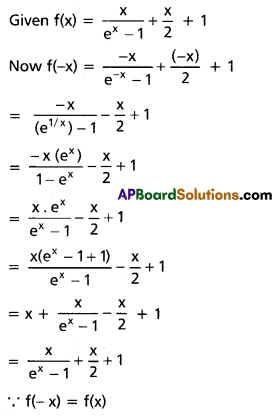
Prove that the real valued function f(x) = \(\frac{x}{e^{x}-1}+\frac{x}{2}+1\) is an even function on R \ {0}.
Solution:
f(x) ∈ R, ex – 1 ≠ 0
⇒ ex ≠ 1
⇒ x ≠ 0
Inter 1st Year Maths 1A Functions Solutions Ex 1(c) II Q2
⇒ f(x) is an even function on R – {0}

Question 3.
Find the domain and range of the following functions.
(i) f(x) = \(\frac{\tan \pi[x]}{1+\sin \pi[x]+\left[x^{2}\right]}\)
Solution:
f(x) = \(\frac{\tan \pi[x]}{1+\sin \pi[x]+\left[x^{2}\right]}\) ∈ R
⇔ x ∈ R, since [x] is an integer tan π[x] and sin π[x] each is zero for ∀ x ∈ R and f(x) ∈ R
Domain of f is R
Its range = {0}

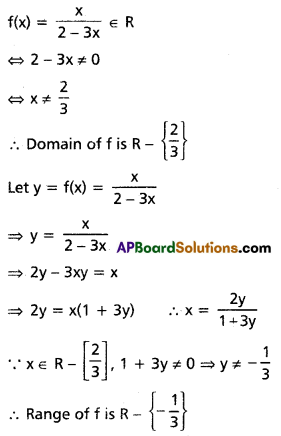
(ii) f(x) = \(\frac{x}{2-3 x}\)
Solution:
Inter 1st Year Maths 1A Functions Solutions Ex 1(c) II Q3(ii)

(iii) f(x) = |x| + |1 + x|
Solution:
f(x) = |x| + |1 + x| ∈ R
⇔ x ∈ R
∴ Domain of f is R
∵ |x| = x, if x ≥ 0
= -x, if x < 0
|1 + x| = 1 + x, if x ≥ -1
= -(1 + x) if x < -1
For x = 0, f(0) = |0| + |1 + 0| = 1
x = 1, f(1) = |1| + |1 + 1| = 1 + 2 = 3
x = 2, f(2) = |2| + |1 + 2| = 2 + 3 = 5
x = -2, f(-2) = |-2| + |1 + (-2)| = 2 + 1 = 3
x = -1, f(-1) = |-1| + |1 +(-1)| = 1 + 0 = 1
∴ The range of f is [1, ∞]

Inter 1st Year Maths 1A Functions Solutions Ex 1(b)

Practicing the Intermediate 1st Year Maths 1A Textbook Solutions Inter 1st Year Maths 1A Functions Solutions Exercise 1(b) will help students to clear their doubts quickly.

Intermediate 1st Year Maths 1A Functions Solutions Exercise 1(b)

I.

Question 1.
If f(x) = ex and g(x) = logex, then show that f o g = g o f and find f-1 and g-1.
Solution:
Given f(x) = ex and g(x) = logex
Now (f o g) (x) = f(g(x))
= f(logex) [∵ g(x) = \(\log _{e} x\)]
= \(e^{\left(\log _{e} x\right)}\)
= x
∴ (fog) (x) = x ………(1)
and (g o f) (x) = g(f(x))
= g(ex) [∵ f(x) = ex]
= loge (ex) [∵ g(x) = logex]
= x loge (e)
= x(1)
= x
∴ (g o f) (x) = x …….(2)
From (1) and (2)
f o g = g o f
Given f(x) = ex
Let y = f(x) = ex ⇒ x = f-1(y)
and y = ex ⇒ x = loge (y)
∴ f-1(y) = loge (y) ⇒ f-1(x) = loge (x)
Let y = g(x) = loge (x)
∵ y = g(x) ⇒ x = g-1(y)
∵ y = loge (x) ⇒ x = ey
∴ g-1(y) = ey ⇒ g-1(x) = ex
∴ f-1(x) = loge (x) and g-1(x) = ex

Inter 1st Year Maths 1A Functions Solutions Ex 1(b)

Question 2.
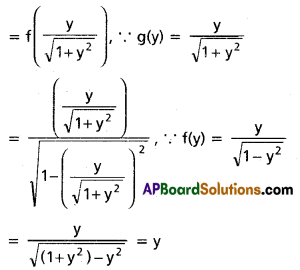
If f(y) = \(\frac{y}{\sqrt{1-y^{2}}}\), g(y) = \(\frac{y}{\sqrt{1+y^{2}}}\) then show that (fog) (y) = y
Solution:
f(y) = \(\frac{y}{\sqrt{1-y^{2}}}\) and g(y) = \(\frac{y}{\sqrt{1+y^{2}}}\)
Now, (fog) (y) = f(g(y))
Inter 1st Year Maths 1A Functions Solutions Ex 1(b) I Q2
∴ (fog) (y) = y

Question 3.
If f : R → R, g : R → R are defined by f(x) = 2x2 + 3 and g(x) = 3x – 2, then find
(i) (fog)(x)
(ii) (gof) (x)
(iii) (fof) (0)
(iv) go(fof) (3)
Solution:
f : R → R, g : R → R and f(x) = 2x2 + 3; g(x) = 3x – 2
(i) (f o g) (x) = f(g(x))
= f(3x – 2) [∵ g(x) = 3x – 2]
= 2(3x- 2)2 + 3 [∵ f(x) = 2x2 + 3]
= 2(9x2 – 12x + 4) + 3
= 18x2 – 24x + 8 + 3
= 18x2 – 24x + 11

(ii) (gof) (x) = g(f(x))
= g(2x2 + 3) [∵ f(x) = 2x2 + 3]
= 3(2x2 + 3) – 2 [∵ g(x) = 3x – 2]
= 6x2 + 9 – 2
= 6x2 + 7

(iii) (fof) (0) = f(f(0))
= f(2(0) + 3) [∵ f(x) = 2x2 + 3]
= f(3)
= 2(3)2 + 3
= 18 + 3
= 21

(iv) g o (f o f) (3)
= g o (f (f(3)))
= g o (f (2(3)2 + 3)) [∵ f(x) = 2x2 + 3]
= g o (f(21))
= g(f(21))
= g(2(21)2 + 3)
= g(885)
= 3(885) – 2 [∵ g(x) = 3x – 2]
= 2653

Inter 1st Year Maths 1A Functions Solutions Ex 1(b)

Question 4.
If f : R → R, g : R → R are defined by f(x) = 3x – 1, g(x) = x2 + 1, then find
(i) (f o f) (x2 + 1)
(ii) f o g (2)
(iii) g o f (2a – 3)
Solution:
f : R → R, g : R → R and f(x) = 3x – 1 ; g(x) = x2 + 1
(i) (f o f) (x2 + 1)
= f(f(x2 + 1))
= f[3(x2 + 1) – 1] [∵ f(x) = 3x – 1]
= f(3x2 + 2)
= 3(3x2 + 2) – 1
= 9x2 + 5

(ii) (f o g) (2)
= f(g(2))
= f(22 + 1) [∵ g(x) = x2 + 1]
= f(5)
= 3(5) – 1
= 14 [∵ f(x) = 3x – 1]

(iii) (g o f) (2a – 3)
= g(f(2a – 3))
= g[3(2a – 3) – 1] [∵ f(x) = 3x – 1]
= g(6a – 10)
= (6a – 10)2 + 1 [∵ g(x) = x2 + 1]
= 36a2 – 120a + 100 + 1
= 36a2 – 120a + 101

Question 5.
If f(x) = \(\frac{1}{x}\), g(x) = √x for all x ∈ (0, ∞) then find (g o f) (x).
Solution:
f(x) = \(\frac{1}{x}\), g(x) = √x, ∀ x ∈ (0, ∞)
(g o f) (x) = g(f(x))
= g(\(\frac{1}{x}\)) [∵ f(x) = \(\frac{1}{x}\)]
= \(\sqrt{\frac{1}{x}}\)
= \(\frac{1}{\sqrt{x}}\) [∵ g(x) = √x]
∴ (gof) (x) = \(\frac{1}{\sqrt{x}}\)

Question 6.
f(x) = 2x – 1, g(x) = \(\frac{x+1}{2}\) for all x ∈ R, find (g o f) (x).
Solution:
f(x) = 2x – 1, g(x) = \(\frac{x+1}{2}\) ∀ x ∈ R
(g o f) (x) = g(f(x))
= g(2x – 1) [∵ f(x) = 2x – 1]
= \(\frac{(2 x-1)+1}{2}\)
= x [∵ g(x) = \(\frac{x+1}{2}\)]
∴ (g o f) (x) = x

Inter 1st Year Maths 1A Functions Solutions Ex 1(b)

Question 7.
If f(x) = 2, g(x) = x2, h(x) = 2x for all x ∈ R, then find (f o (g o h)) (x).
Solution:
f(x) = 2, g(x) = x2, h(x) = 2x, ∀ x ∈ R
[f o (g o h) (x)]
= [f o g (h(x))]
= f o g (2x) [∵ h(x) = 2x]
= f[g(2x)]
= f((2x)2) [∵ g(x) = x2]
= f(4x2) = 2 [∵ f(x) = 2]
∴ [f o (g o h) (x)] = 2

Question 8.
Find the inverse of the following functions.
(i) a, b ∈ R, f : R → R defined by f(x) = ax + b, (a ≠ 0).
Solution:
a, b ∈ R, f : R → R and f(x) = ax + b, a ≠ 0
Let y = f(x) = ax + b
⇒ y = f(x)
⇒ x = f-1(y) ……..(i)
and y = ax + b
⇒ x = \(\frac{y-b}{a}\) ……..(ii)
From (i) and (ii)
f-1(y) = \(\frac{y-b}{a}\)
⇒ f-1(x) = \(\frac{x-b}{a}\)

(ii) f : R → (0, ∞) defined by f(x) = 5x
Solution:
f : R → (0, ∞) and f(x) = 5x
Let y = f (x) = 5x
y = f(x) ⇒ x = f-1(y) ……(i)
and y = 5x ⇒ log5 (y) = x ……..(ii)
From (i) and (ii)
f-1(y) = log5(y) ⇒ f-1(x) = log5 (x)

(iii) f : (0, ∞) → R defined by f(x) = log2 (x).
Solution:
f : (0, ∞) → R and f(x) = log2 (x)
Let y = f(x) = log2 (x)
∵ y = f(x) ⇒ x = f-1(y) ……..(i)
and y = log2(x) ⇒ x = 2y
From (i) and (ii)
f-1(y) = 2y ⇒ f-1(x) = 2x

Inter 1st Year Maths 1A Functions Solutions Ex 1(b)

Question 9.
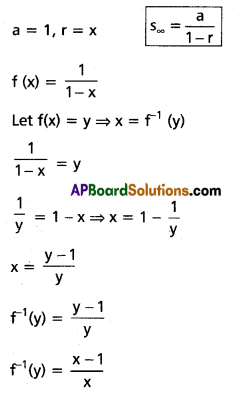
If f(x) = 1 + x + x2 + …… for |x| < 1 then show that f-1(x) = \(\frac{x-1}{x}\)
Solution:
f(x) = 1 + x + x2 + ……..
Inter 1st Year Maths 1A Functions Solutions Ex 1(b) I Q9

Question 10.
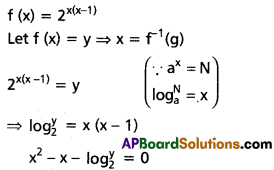
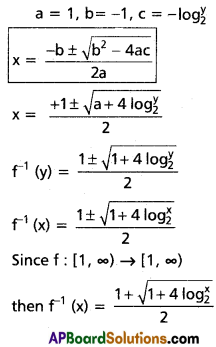
If f : [1, ∞) ⇒ [1, ∞) defined by f(x) = \(2^{x(x-1)}\) then find f-1(x).
Solution:
Inter 1st Year Maths 1A Functions Solutions Ex 1(b) I Q10
Inter 1st Year Maths 1A Functions Solutions Ex 1(b) I Q10.1

II.

Question 1.
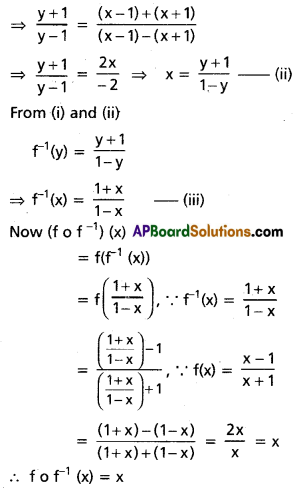
If f(x) = \(\frac{x-1}{x+1}\), x ≠ ±1, then verify (f o f-1) (x) = x.
Solution:
Given f(x) = \(\frac{x-1}{x+1}\), x ≠ ±1
Let y = f(x) = \(\frac{x-1}{x+1}\)
∵ y = f(x) ⇒ x = f-1(y) ……(i)
and y = \(\frac{x-1}{x+1}\)
Inter 1st Year Maths 1A Functions Solutions Ex 1(b) II Q1

Question 2.
If A = {1, 2, 3}, B = {α, β, γ}, C = {p, q, r} and f : A → B, g : B → C are defined by f = {(1, α), (2, γ), (3, β)}, g = {(α, q), (β, r), (γ, p)}, then show that f and g are bijective functions and (gof)-1 = f-1 o g-1.
Solution:
A = {1, 2, 3}, B = {α, β, γ},
f : A → B and f = {(1, α), (2, γ), (3, β)}
⇒ f(1) = α, f(2) = γ, f(3) = β
∵ Distinct elements of A have distinct f – images in B, f: A → B is an injective function.
Range of f = {α, γ, β} = B(co-domain)
∴ f : A → B is a surjective function.
Hence f : A → B is a bijective function.
B = {α, β, γ}, C = {p, q, r}, g : B → C and g : {(α, q), (β, r), (γ, p)}
⇒ g(α) = q, g(β) = r, g(γ) = p
∴ Distinct elements of B have distinct g – images in C, g : B → C is an injective function.
Range of g = {q, r, p} = C, (co-domain)
∴ g : B → C is a surjective function
Hence g : B → C is a bijective function
Now f = {(1, α), (2, γ), (3, β)}
g = {(α, q), (β, r), (γ, p)}
g o f = {(1, q), (2, p), (3, r)}
∴ (g o f)-1 = {(q, 1), (r, 3), (p, 2)} ………(1)
g-1 = {(q, α), (r, β), (p, γ)}
f-1 = {(α, 1), (γ, 2),(β, 3)}
Now f-1 o g-1 = {(q, 1), (r, 3), (p, 2)} …….(2)
From eq’s (1) and (2)
(gof)-1 = f-1 o g-1

Inter 1st Year Maths 1A Functions Solutions Ex 1(b)

Question 3.
If f : R → R, g : R → R defined by f(x) = 3x – 2, g(x) = x2 + 1, then find
(i) (g o f-1) (2)
(ii) (g o f)(x – 1)
Solution:
f : R → R, g : R → R and f(x) = 3x – 2
f is a bijective function ⇒ its inverse exists
Let y = f(x) = 3x – 2
∵ y = f(x) ⇒ x = f-1(y) …….(i)
and y = 3x – 2
⇒ x = \(\frac{y+2}{3}\) ……..(ii)
From (i) and (ii)
f-1(y) = \(\frac{y+2}{3}\)
⇒ f-1(x) = \(\frac{x+2}{3}\)
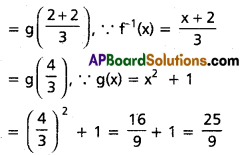
Now (gof-1) (2)
= g(f-1(2))
Inter 1st Year Maths 1A Functions Solutions Ex 1(b) II Q3
∴ (g o f-1) (2) = \(\frac{25}{9}\)

(ii) (g o f) (x -1)
= g(f(x – 1))
= g(3(x – 1) – 2) [∵ f(x) = 3x – 2]
= g(3x – 5)
= (3x – 5)2 + 1 [∵ g(x) = x2 + 1]
= 9x2 – 30x + 26
∴ (g o f) (x – 1) = 9x2 – 30x + 26

Question 4.
Let f = {(1, a), (2, c), (4, d), (3, b)} and g-1 = {(2, a), (4, b), (1, c), (3, d)} then show that (gof)-1 = f-1 o g-1
Solution:
f = {(1, a), (2, c), (4, d), (3, b)}
∴ f-1 = {(a, 1), (c, 2), (d, 4), (b, 3)}
g-1 = {(2, a), (4, b), (1, c), (3, d)}
∴ g = {(a, 2), (b, 4), (c, 1), (d, 3)}
(g o f) = {(1, 2), (2, 1), (4, 3), (3, 4)}
∴ (gof)-1 = {(2, 1), (1, 2), (3, 4), (4, 3)} ……….(1)
f-1 o g-1 = {(2, 1), (4, 3), (1, 2), (3, 4)} ……..(2)
From eq’s (1) and (2), we observe (gof)-1 = f-1 o g-1

Question 5.
Let f : R → R, g : R → R be defined by f(x) = 2x – 3, g(x) = x3 + 5 then find (f o g)-1 (x).
Solution:
f : R → R, g : R → R and f(x) = 2x – 3 and g(x) = x3 + 5
Now (fog) (x) = f(g(x))
= f(x3 + 5) [∵ g(x) = x2 + 5]
= 2(x3 + 5) – 3 [∵ f(x) = 2x – 3]
= 2x3 + 7
∴ (f o g) (x) = 2x3 + 7
Let y = (f o g) (x) = 2x3 + 7
∵ y = (fog)(x)
⇒ x = (fog)-1 (y) …….(1)
and y = 2x3 + 7
⇒ x3 = \(\frac{y-7}{2}\)
⇒ x = \(\left(\frac{y-7}{2}\right)^{\frac{1}{3}}\) …..(2)
From eq’s (1) and (2),
(f o g)-1 (y) = \(\left(\frac{y-7}{2}\right)^{\frac{1}{3}}\)
∴ (f o g)-1 (x) = \(\left(\frac{x-7}{2}\right)^{\frac{1}{3}}\)

Inter 1st Year Maths 1A Functions Solutions Ex 1(b)

Question 6.
Let f(x) = x2, g(x) = 2x. Then solve the equation (f o g) (x) = (g o f) (x)
Solution:
Given f(x) = x2 and g(x) = 2x
Now (f o g) (x) = f(g(x))
= f(2x) [∵ g(x) = 2x]
= (2x)2
= 22x [∵ f(x) = x2]
∴ (f o g) (x) = 22x ……(1)
and (g o f) (x) = g(f(x))
= g(x2) [∵ f(x) = x2]
= \((2)^{x^{2}}\) [∵ g(x) = 2x]
∴ (g o f) (x) = \((2)^{x^{2}}\)
∵ (f o g) (x) = (g o f) (x)
⇒ 22x = \((2)^{x^{2}}\)
⇒ 2x = x2
⇒ x2 – 2x = 0
⇒ x(x – 2) = 0
⇒ x = 0, x = 2
∴ x = 0, 2

Question 7.
If f(x) = \(\frac{x+1}{x-1}\), (x ≠ ±1) then find (fofof) (x) and (fofofof) (x).
Solution:
f(x) = \(\frac{x+1}{x-1}\), (x ≠ ±1)
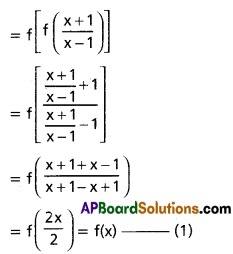
(i) (fofof) (x) = (fof) [f(x)]
= (fof) \(\left(\frac{x+1}{x-1}\right)\) [∵ f(x) = \(\left(\frac{x+1}{x-1}\right)\)]
Inter 1st Year Maths 1A Functions Solutions Ex 1(b) II Q7

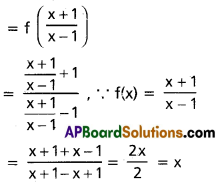
(ii) (fofofof) (x) = f[(f o f o f) (x)]
= f [f(x)] {from (1)}
Inter 1st Year Maths 1A Functions Solutions Ex 1(b) II Q7.1
In the above problem if a number of f is even its answer is x and if a number of f is odd its answer is f(x).

Inter 1st Year Maths 1A Functions Solutions Ex 1(a)

Practicing the Intermediate 1st Year Maths 1A Textbook Solutions Inter 1st Year Maths 1A Functions Solutions Exercise 1(a) will help students to clear their doubts quickly.

Intermediate 1st Year Maths 1A Functions Solutions Exercise 1(a)

I.

Question 1.
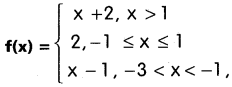
If the function f is defined by
Inter 1st Year Maths 1A Functions Solutions Ex 1(a) I Q1
then find the values of
(i) f(3)
(ii) f(0)
(iii) f(-1.5)
(iv) f(2) + f(-2)
(v) f(-5)
Solution:
(i) f(3)
For x > 1, f(x) = x + 2
∴ f(3) = 3 + 2 = 5

(ii) f(0)
For -1 ≤ x ≤ 1, f(x) = 2
∴ f(0) = 2

(iii) f(-1.5)
For -3 < x < -1, f(x) = x – 1
∴ f(-1.5) = -1.5 – 1 = -2.5

(iv) f(2) + f(-2) For x > 1, f(x) = x + 2
∴ f(2) = 2 + 2 = 4
For -3 < x < -1, f(x) = x – 1
∴ f(-2)= -2 – 1 = -3
f(2) + f(-2) = 4 + (-3) = 1

(v) f(-5) is not defined, since domain of x is {X/X ∈ (-3, ∞)}

Inter 1st Year Maths 1A Functions Solutions Ex 1(a)

Question 2.
If f: R{0}R is defined by f(x) = \(x^{3}-\frac{1}{x^{3}}\); then show that f(x) + \(f\left(\frac{1}{x}\right)\) = 0.
Solution:
Given f(x) = \(x^{3}-\frac{1}{x^{3}}\) ……(i)
Now \(f\left(\frac{1}{x}\right)=\left(\frac{1}{x}\right)^{3}-\frac{1}{\left(\frac{1}{x}\right)^{3}}=\frac{1}{x^{3}}-x^{3}\) ……(2)
Add (1) and (2)
\(f(x)+f\left(\frac{1}{x}\right)=\left(x^{3}-\frac{1}{x^{3}}\right)+\left(\frac{1}{x^{3}}-x^{3}\right)\) = 0
∴ f(x) + \(f\left(\frac{1}{x}\right)\) = 0

Question 3.
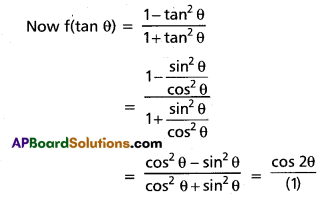
If f : R → R is defined by f(x) = \(\frac{1-x^{2}}{1+x^{2}}\), then show that f(tan θ) = cos 2θ.
Solution:
Given f(x) = \(\frac{1-x^{2}}{1+x^{2}}\)
Inter 1st Year Maths 1A Functions Solutions Ex 1(a) I Q3
∴ f(tan θ) = cos 2θ

Question 4.
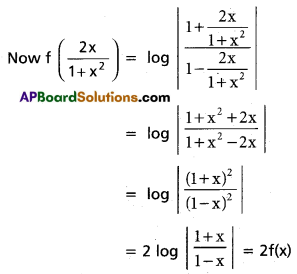
If f : R\{±1} → R is defined by f(x) = \(\log \left|\frac{1+x}{1-x}\right|\), then show that \(f\left(\frac{2 x}{1+x^{2}}\right)\) = 2f(x)
Solution:
f : R\{±1} → R and f(x) = \(\log \left|\frac{1+x}{1-x}\right|\)
Inter 1st Year Maths 1A Functions Solutions Ex 1(a) I Q4
∴ \(f\left(\frac{2 x}{1+x^{2}}\right)\) = 2f(x)

Inter 1st Year Maths 1A Functions Solutions Ex 1(a)

Question 5.
If A = {-2, -1, 0, 1, 2} and f : A → B is a surjection defined by f(x) = x2 + x + 1, then find B.
Solution:
A = {-2, -1, 0, 1, 2} and f : A → B, f(x) = x2 + x + 1
f : A → B is a surjection
f(-2) = (-2)2 + (-2) + 1
= 4 – 2 + 1
= 3
f(-1) = (-1)2 + (-1) + 1
= 1 – 1 + 1
= 1
f(0) = 02 + 0 + 1
= 0 + 0 + 1
= 1
f(1) = 12 + 1 + 1
= 1 + 1 + 1
= 3
f(2) = 22 + 2 + 1
= 4 + 2 + 1
= 7
∴ B = f(A) = {3, 1, 7}

Question 6.
If A = {1, 2, 3, 4} and f : A → R is a function defined by f(x) = \(\frac{x^{2}-x+1}{x+1}\), then find the range of f.
Solution:
A= {1, 2, 3, 4}
Inter 1st Year Maths 1A Functions Solutions Ex 1(a) I Q6
∴ Range of f = f(A) = \(\left\{\frac{1}{2}, 1, \frac{7}{4}, \frac{13}{5}\right\}\)

Question 7.
If f(x + y) = f(xy) ∀ x, y ∈ R then prove that f is a constant function.
Solution:
Given f(x + y) = f(x y), x, y ∈ R
take x = y = 0
⇒ f(0) = f(0) ………(1)
Let x = 1, y = 0
⇒ f(1) = f(0) ……..(2)
Let x = 1, y = 1
⇒ f(2) = f(1) ………(3)
from (1), (2), (3)
f(0) = f(1) = f(2)
⇒ f(0) = f(2)
Similarly f(3) = f(0)
f(4) = f(0)
and so on
f(n) = f(0)
∴ f is a constant function

Inter 1st Year Maths 1A Functions Solutions Ex 1(a)

II.

Question 1.
If A = {x | -1 ≤ x ≤ 1}, f(x) = x2, g(x) = x3, which of the following are surjections?
(i) f : A → A
(ii) g : A → A
Solution:
(i) ∵ A = {x | -1 ≤ x ≤ 1} and f(x) = x2
This implies f(x) is a function from A to A
(i.e.,) f : A → A
Now let y ∈ A
If f(x) = y then x2 = y
x = √y
So, if y = -1 then x = √-1 ∉ A
∴ f : A → A is not a surjection.

(ii) ∵ A = {x | -1 ≤ x ≤ 1} and g(x) = x3
⇒ g : A → A
Let y ∈ A. Then g(x) = y
⇒ x3 = y
⇒ x = \((y)^{1 / 3}\) ∈ A
So if y = -1 then x = -1 ∈ A
y = 0, then x = 0 ∈ A
y = 1, then x = 1 ∈ A
∴ g : A → A is a surjections.

Question 2.
Which of the following are injections or surjections or bijections? Justify your answers.
(i) f : R → R defined by f(x) = \(\frac{2 x+1}{3}\)
Solution:
f(x) = \(\frac{2 x+1}{3}\)
Let x1, x2 ∈ R
∵ f(x1) = f(x2)
⇒ \(\frac{2 x_{1}+1}{3}=\frac{2 x_{2}+1}{3}\)
⇒ 2x1 + 1 = 2x2 + 1
⇒ 2x1 = 2x2
⇒ x1 = x2
∵ f(x1) = f(x2) ⇒ x1 = x2, ∀ x1, x2 ∈ R
So f(x) = \(\frac{2 x+1}{3}\), f : R → R is an injection
If y ∈ R (co-domain) then y = \(\frac{2 x+1}{3}\)
⇒ x = \(\frac{3 y-1}{2}\)
Then f(x) = \(\frac{2 x+1}{3}=\frac{2\left(\frac{3 y-1}{2}\right)+1}{3}=y\)
∴ f is a surjection
∴ f : R → R defined by f(x) = \(\frac{2 x+1}{3}\) is a bijection

(ii) f : R → (0, ∞) defined by f(x) = 2x
Solution:
Let x1, x2 ∈ R
∵ f(x1) = f(x2)
⇒ \(2^{x_{1}}=2^{x_{2}}\)
⇒ x1 = x2
∴ f(x1) = f(x2) ⇒ x1 = x2 ∀ x1, x2 ∈ R
∴ f(x) = 2x, f : R → (0, ∞) is injection
If y ∈ (0, ∞) and y = 2x ⇒ x = log2 (y)
Then f(x) = 2x
= \(2^{\log _{2}(y)}\)
= y
∴ f is a surjection
Hence f is a bijection.

Inter 1st Year Maths 1A Functions Solutions Ex 1(a)

(iii) f : (0, ∞) → R defined by f(x) = logex
Solution:
Let x1, x2 e (0, ∞)
f(x1) = f(x2)
⇒ \(\log _{e}\left(x_{1}\right)=\log _{e}\left(x_{2}\right)\)
⇒ x1 = x2
∵ f(x1) = f(x2)
⇒ x1 = x2 ∀ x1, x2 ∈ (0, ∞)
∴ f(x) is injection.
Let y ∈ R.
y = logex ⇒ x = ey
Then f(x) = logex
= loge(ey)
= y . logee
= y(1)
= y
∴ f is a surjection.
∴ f is a bijection.

(iv) f : [0, ∞) → [0, ∞) defined by f(x) = x2.
Solution:
Let x1, x2 ∈ [0, ∞) (i.e.,) domain of f.
Now f(x1) = f(x2)
⇒ \(x_{1}^{2}=x_{2}^{2}\)
⇒ x1 = x2
∵ x1, x2 ≥ 0
∴ f(x) = x2, f : {0, ∞) → {0, ∞) is injection
Let y ∈ (0, ∞), co-domain of f
Let y = x2 ⇒ x = √y, ∵ y ≥ 0
Then f(x) = x2
= \((\sqrt{y})^{2}\)
= y
∴ f is surjection.
Hence f is a bijection.

(v) f : R → [0, ∞) defined by f(x) = x2.
Solution:
Let x1, x2 ∈ R.
f(x1) = f(x2)
⇒ \(x_{1}^{2}=x_{2}^{2}\)
⇒ x1 = ±x2, ∵ x1, x2 ∈ R
Hence f is not injection
Let y ∈ [0, ∞)
y = x2
⇒ x = ±√y, where y ∈ [0, ∞)
Then f(x) = x2
= \((\sqrt{y})^{2}\)
= y
∴ f is surjection
Hence f is not a bijection

(vi) f : R → R defined by f(x) = x2.
Solution:
Let x1, x2 ∈ R, (domain of f)
∴ f(x1) = f(x2)
⇒ \(x_{1}^{2}=x_{2}^{2}\)
⇒ x1 = ±x2, ∵ x1, x2 ∈ R
∴ f(x) is not injection
For elements that belong to (-∞, 0) codomain of f has no pre-image in f.
∴ f is not a surjection
Hence f is neither injection nor surjection.

Inter 1st Year Maths 1A Functions Solutions Ex 1(a)

Question 3.
Is g = {(1, 1) (2, 3) (3, 5) (4, 7)} is a function from A = {1, 2, 3, 4} to B = {1, 3, 5, 7}. If this is given by the formula g(x) = ax + b, then find a and b.
Solution:
A = {1, 2, 3, 4}; B = {1, 3, 5, 7}
g : {(1, 1), (2, 3), (3, 5), (4, 7)}
∵ g(1) = 1, g(2) = 3, g(3) = 5, g(4) = 7
So for each element a ∈ A, there exists a unique b ∈ B such (a, b) ∈ g
∴ g : A → B is a function
Given g(x) = ax + b, ∀ x ∈ A
g(1) = (a) + b = 1
⇒ a + b = 1 ……..(1)
g(2) = 2a + b = 3
⇒ 2a + b = 3 …….(2)
Solve (1) and (2)
a = 2, b = -1

Question 4.
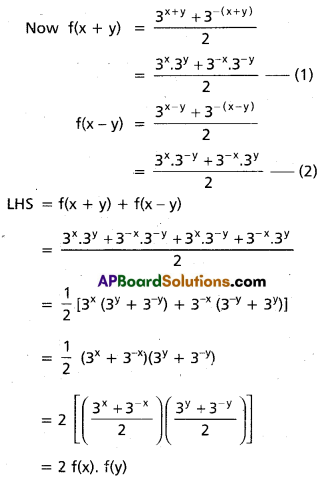
If the function f : R → R defined by f(x) = \(\frac{3^{x}+3^{-x}}{2}\), then show that f(x + y) + f(x – y) = 2f(x) f(y).
Solution:
f : R → R and f(x) = \(\frac{3^{x}+3^{-x}}{2}\)
Inter 1st Year Maths 1A Functions Solutions Ex 1(a) II Q4
∴ f(x + y) + f(x – y) = 2 f(x).f(y)

Question 5.
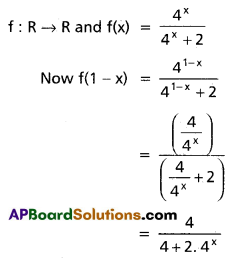
If the function f : R → R defined by f(x) = \(\frac{4^{x}}{4^{x}+2}\), then show that f(1 – x) = 1 – f(x) and hence reduce the value of \(f\left(\frac{1}{4}\right)+2 f\left(\frac{1}{2}\right)+f\left(\frac{3}{4}\right)\)
Solution:
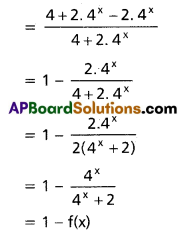
Inter 1st Year Maths 1A Functions Solutions Ex 1(a) II Q5
Inter 1st Year Maths 1A Functions Solutions Ex 1(a) II Q5.1
∴ f(1 – x) = 1 – f(x)

Question 6.
If the function f : {-1, 1} → {0, 2), defined by f(x) = ax + b is a surjection, then find a and b.
Solution:
f : {-1, 1} → {0, 2} and f(x) = ax + b is a surjection
Given f(-1) = 0 and f(1) = 2 (or) f(-1) = 2, f(1) = 0
Case (i):
f(-1) = 0 and f(1) = 2
a(-1) + b = 0 ⇒ -a + b = 0 ……..(1)
a(1) + b = 2 ⇒ a + b = 2 ……(2)
Solve eq’s (1) and (2), we get a = 1, b = 1
Case (ii):
f(-1) = 2 and f(1) = 0
a(-1) + b = 2 ⇒ -a + b = 2 ……(3)
a(1) + b = 0 ⇒ a + b = 0 ……….(4)
Solve eq’s (3) and (4), we get a = -1, b = 1
Hence a = ±1 and b = 1

Inter 1st Year Maths 1A Functions Solutions Ex 1(a)

Question 7.
If f(x) = cos (log x), then show that \(f\left(\frac{1}{x}\right) \cdot f\left(\frac{1}{y}\right)-\frac{1}{2}\left[f\left(\frac{x}{y}\right)+f(x y)\right]=0\)
Solution:
Given f(x) = cos(log x)
\(f\left(\frac{1}{x}\right)=\cos \left(\log \left(\frac{1}{x}\right)\right)\)
= cos(log 1 – log x)
= cos(-log x)
= cos (log x) (∵ log 1 = 0)
Similarly
\(f\left(\frac{1}{y}\right)\) = cos (log y)
\(f\left(\frac{x}{y}\right)=\cos \log \left(\frac{x}{y}\right)\)
= cos (log x – log y)
and f(x y) = cos log (x y) = cos (log x + log y)
\(f\left(\frac{x}{y}\right)\) + f(x y) = cos (log x – log y) + cos (log x + log y)
= 2 cos (log x) cos (log y)
[∵ cos (A – B) + cos (A + B) = 2 cos A . cos B]
LHS = \(f\left(\frac{1}{x}\right) \cdot f\left(\frac{1}{y}\right)-\frac{1}{2}\left[f\left(\frac{x}{y}\right)+f(x y)\right]\)
= cos (log x) cos (log y) – \(\frac{1}{2}\) [2 cos (log x) cos (log y)]
= 0

AP Inter 1st Year Commerce Study Material Chapter 5 Partnership

Andhra Pradesh BIEAP AP Inter 1st Year Commerce Study Material 5th Lesson Partnership Textbook Questions and Answers.

AP Inter 1st Year Commerce Study Material 5th Lesson Partnership

Essay Answer Questions

Question 1.
Define Partnership. Discuss its merits and limitations. [Mar. 2019; May 17 – T.S. M Mar. 15 – A.P. & T.S.]
Answer:
Partnership is an association of two or more persons who pool their financial and managerial resources and agree to carry on a business with profit motive. The persons who are entering into partnership individually called ‘Partners’ and collectively known as ‘Firm’.

Partnership – Definition :
Partnership is “the relation between two or more persons who have agreed to share the profits of a business carried on by all or any one of them acting for all” – Section 4 of the Indian Partnership Act, 1932.

Merits:
1) Easy to form :
A partnership can be formed easily without many legal formalities. Since it is not compulsory to get the firm registered, a simple agreement, either in oral, writing or implied is sufficient to create a partnership firm.

2) Availability of larger resources :
A partnership firm consists of more than one person, it may be to pool more resources as compared to sole proprietorship.

3) Better decisions :
In partnership firm each partner has a right to take part in the management of the business. All important decisions are taken in consultation with and with the consent of all partners. Thus, collective wisdom prevails and there is less scope for reckless and hasty decisions.

4) Flexibility:
The partnership firm is a flexible organisation. Changes in the business can be adopted easily. At any time the partners can change the size or nature of business or area of its operation after taking the necessary consent of all the partners.

5) Sharing of risks:
The losses of the firm are shared by all the partners equally or as per the agreed ratio.

6) Protection of interest:
In partnership form of business organisation, the rights of each partner and his/her interests are fully protected. If a partner is dissatisfied with any decision, he can ask for dissolution of the firm or can withdraw from the partnership.

7) Secrecy :
Business secrets of the firm are known to the partners only. It is not required to disclose any information to the outsiders. It is also not mandatory to publish the annual accounts of the Partnership firm.

Limitations:
1) Unlimited liability :
The partners liability is unlimited. This is the most important drawback of partnership. The partners are personally liable for the debts and obligations of the firm. In other words, their personal property can also be utilised for payment of firm’s liabilities.

2) Limited capital:
Since the total number of partners cannot exceed 20, the capacity to raise funds remains limited as compared to a joint stock company where there is no limit on the number of share holders.

3) Non-transferability of share :
In partnership firm, the partners cannot transfer his share of interest to other without consent of remaining partners.

4) Possibility of conflicts:
Differences and disputes among the partners are common. These conflicts harm to the firm. Difference of opinion may give rise to quarrels and lead to dissolution of the firm.

Question 2.
Is registration of Partnership compulsory under the Partnership Act, 1932? Explain the procedure required for registration of a firm.
Answer:
Partnership is an association of two or more persons who pool their financial and managerial resources and agree to carry on a business, and share its profits or losses. The persons who form a partnership are individually known as ‘Partners’ and collectively a firm or partnership firm.

The Indian Partnership Act, 1932 does not make it compulsory for a firm to be registered; but there are certain disabilities which attach to an unregistered firm. These disabilities make its virtually compulsory for a firm to be registered. Registration can take place at any time.

The procedure for registration of a firm is as follows:

  1. The firm will have to apply to the Registrar of Firms of the state concerned in the prescribed form.
  2. The firm will have to apply to the Registrar of firms of the state concerned in the prescribed form. For this, a form containing the following particulars, accompanied by a fee of ₹3/- has to be sent to the Registrar of Firms.
    a) The name of the firm
    b) Location of the firm
    c) Names of other places where the firm carries on business
    d) The name in full and addresses of the partners
    e) The date on which various partners joined the firm.
    f) The duration of the firm
  3. The duly filled in form must be signed by all the partners. The filled in form along with prescribed registration fee must be deposited in the office of the Registrar of Firms.
  4. The Registrar will scrutinise the application, and if he is satisfied that all formalities relating to registration have been duly complied with, he will put the name of the firm in his register and issue the Certificate of Registration.

AP Inter 1st Year Commerce Study Material Chapter 5 Partnership

Question 3.
Discuss different types of Partners. [Mar. 2019; May 17 – A.P. Mar. 17 – T.S.]
Answer:
A Partnership firm can have different types of partners with different roles and liabilities. Some of them may take part in the management while other may contribute capital.
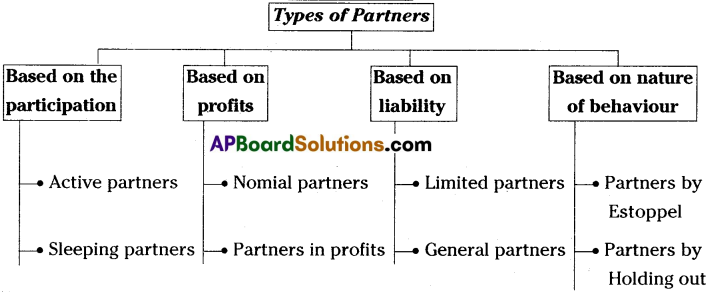
AP Inter 1st Year Commerce Study Material Chapter 5 Partnership 1

1) Active Partners or Working Partners:
The partners who actively participate in the day-to-day operations of the business are known as active partners or working partners.

2) Sleeping Partners :
The partners, who simply provide capital and do not participate in the management activities of the firm are called sleeping partners.

3) Nominal Partners :
Nominal partners allow the firm to use their name as partner. They neither invest any capital nor participate in the day-to-day operations. They are not entitled to share the profits of the firm. However they are liable to third parties for all the acts of the firm.

4) Partners in Profits :
A person who shares the profits of the business without being liable for the losses is known as partner in profits. This is applicable only to the minors who are admitted to the benefits of the firm and their liability is limited to their capital contribution.

5) Limited Partners :
The partners whose liability is limitied in a firm are called limited partners. They are also known as special partners.

6) General Partners :
The partners having unlimited liability are called general – partners. According to Indian Partnership Act, 1932 the liability of the partner is unlimited. So they are general partners (excpet minor partner).

7) Partner by Estoppel:
A person, who behaves in the public is such a way as to give an impression that he/she is a partner of the firm, is called partner by Estoppel. Such partners are not entitled to share the profits of the firm, but are, fully liable if somebody suffers because of his/her false representation.

8) Partner by Holding out:
Sometimes, the firm may use the name of a person in its activities, creating a sense in the public that he is also a partner. If that person accepts the same, he becomes automatically responsible to the third parties. Such person is known as “Partner by Holding out”.

4. What is Partnership Deed? And also explain its contents. [Mar. 2018 – T.S.]
Answer:
Partnership is an association of two or more persons who pool their financial and managerial resources and agree to carry on a business, and share its profits or losses. Partnership was established among partners through an agreement. Such agreement may be in the form of oral or written. If partnership agreement is in registration it is known as Partnership Deed.

Partnership Deed is a document containing the terms and conditions of a partnership. It is an agreement in writing signed by the partners duly stamped and registered. The Partnership deed defines certain rights, duties and obligations of partners and governs relations among them in the conduct of business affairs of the firm.

The Partnership deed must not contain any term which is contrary to the provisions of the Partnership Act. Each partner should have a copy of the deed.

The following points are generally included in the deed.

Partnership Deed – Contents

  1. Name of the firm
  2. Nature of the business
  3. Names and addresses of partners
  4. Location of business
  5. Duration of partnership, if decided
  6. Amount of capital to be contributed by each partner
  7. Profit and loss sharing ratio
  8. Duties, powers and obligations of partners
  9. Salaries and withdrawals of the partners
  10. Preparation of accounts and their auditing
  11. Procedure for dissolution of the firm
  12. Procedure for settlement of disputes

Short Answer Questions

Question 1.
Define Partnership and state its important features. [Mar. 17 – A.P.]
Answer:
Partnership is an agreement between two or more persons to carry on business with profit motive, carried on by all or any one of them acting for all.

Partnership – Definition :
“Partnership is the relation existing between persons competent to make contract, who agree to carry on a lawful business in common with a view to private gain.” – L.H. Haney

“The relation between persons who have agreed to share the profits of a business carried on by all of them acting for all.” – Indian Partnership Act, 1932, Section 4

Partnership Firm – Features:
The following are the important features of partnership organisation.

  1. Formation
  2. Unlimited liability
  3. Existence of lawful business
  4. Principal agent relationship
  5. Voluntary registration

1) Formation :
The partnership form of business organisation is governed by the provision of Indian Partnership Act, 1932. It comes into existence through a legal agreement where in the terms and conditions governing the relationship among partners. Partnership formation is very easy.

2) Unlimited Liability :
The liability of partner is unlimited, joint and several. Personal assets may be used for repaying debts in cases the business assets are insufficient. All the partners are responsible for the debts and they contribute in proportion to their share in business and as such are Habile to that extent.

3) Existence of lawful business:
The business to be carried on by a partnership must always be lawful. Any agreement to indugle in sumuggling, black marketing, etc. cannot be called partnership business in the eyes of law.

4) Principal agent relationship :
Each partner is an agent of the firm. He can act on behalf of the firm. He is responsible for his own acts and also the acts on behalf of the other partners. There must be an agency relationship between the partners.

5) Voluntary registration :
The registration of a partnership firm is not compulsory. But an unregistered firm suffers from some limitations which make it virtually compulsory to be registered.

Question 2.
Discuss the registration procedure of partnership.
Answer:
The Indian Partnership Act, 1932 does not make it compulsory for a firm to be registered; but there are certain disabilities which attach to an unregistered firm. These disabilities make it virtually compulsory for a firm to be registered. Registration can take place at any time. The procedure for registration of a firm is as follows:

  1. The firm will have to apply to the Rigistrar of Firms of the state concerned in the prescribed form.
  2. The firm will have to apply to the Registrar of Firms of the state concerned in the prescribed form. For this, a form containing the following particulars, accompanied by a fee of Rs. 3/- has to be sent to the Registrar of Firms.
    a) The name of the firm
    b) Location of the firm
    c) Names of other places where the firm carries on business
    d) The name in full and addresses of the partners
    e) The date on which various partners joined the firm
    f) The duration of the firm
  3. The duly filled in form must be signed by all the partners. The filled in form along with prescribed registration fee must be deposited in the office of the Registrar of Firms.
  4. The Registrar will scrutinise the application, and if he is satisfied that all formalities relating to registration have been duly complied with, he will put the name of the firm in his register and issue the Certificate of Registration.

AP Inter 1st Year Commerce Study Material Chapter 5 Partnership

Question 3.
Briefly explain the rights of partners.
Answer:
The rights and duties of the partners of a firm are usually governed by the partnership agreement among the partners. In case the Partnership Deed does not specify them, then the partners will have rights and duties as laid down in the Indian Partnership Act, 1932.

Rights of Partners :

  1. Every partner has a right to take part in the management of the business.
  2. Right to be consulted and expressed his opinion on any matter related to the firm.
  3. Partner has a right to inspect the books of accounts or to copy them.
  4. Right to have an equal share in the profits or losses of the firm, unless and otherwise agreed by the partners.
  5. Right to receive interest on loan and advances made by partner to the firm.
  6. Right to the partnership property unless and otherwise mentioned in the partnership deed.
  7. Every partner has power or authority, in an emergency, to do any such acts, for the purpose of protecting the firm from losses.
  8. Right to prevent the introduction of a new partner without consent of other partners.
  9. Right to act an agent of the partnership firm in the ordinary course of business.
  10. Right to be indemnified for the expenses incurred and losses sustained by partner to the firm.

Question 4.
Briefly explain the duties of partners.
Answer:
Generally, the Partnership Deed contains rights and duties of the partners. If deed is not prepared, the provisions of the Partnership Act will apply. Also when deed is in silent on any point, the relevant provisions of the act will apply.

Duties of Partners

  1. Every partner has to attend diligently to his duties in the conduct of the business.
  2. Should act in a just and faithful manner towards other partner and partners.
  3. Should bound to share the losses of the firm equally unless and otherwise agreed upon by all partners.
  4. No partner shall carry on any business competing with the firm. If he does so, he has to render to the firm any profits arising out of such business.
  5. Must maintain true and correct accounts relating to the firm’s business.
  6. No partner should make secret profits by way of commission or otherwise from the firm’s business.
  7. Every partner is bound to keep and render true and proper accounts of the firm to his copartners.
  8. No partner is allowed to assign or transfer his rights and interest in the firm to an ‘ outsider without the consent of other partners.

Question 5.
Explain the ways of dissolution of a Partnership Firm.
Answer:
The partnership is established through an agreement among partners. The partnership firm is established through partnership. A distinction should be made between the “Dissolution of partnership” and “Dissolution of firm”.

Dissolution of Partnership:
Dissolution of partnership implies the termination of the original partnership agreement or change in contractual relationship among partners. A partnership is dissolved by the insolvency, retirement, incapacity, death, expulsion, etc. of a partner or on the expiry/ completion of the term of partnership.

A partnership can be dissolved without dissolving the firm.
In dissolution of partnership, the business of the firm does not come to an end. The remaining partners continue the business by entering into a new agreement. On the Other hand, dissolution of firm implies dissolution between all the partners. Thus, business of the partnership firm comes to an end. The remaining partners continue the business by entering into a new agreement.

Dissolution of Firm:
Dissolution of firm implies dissolution between all the partners. The business of the partnership firm comes to an end. Its assets are realised and the creditors are paid off. Thus, dissolution of firm always involves dissolution of partnership but the dissolution of partnership does not necessarily mean dissolution of the firm.

Dissolution of the firm takes place under certain circumstances.
1) Dissolution by agreement:
A partnership firm may be dissolved with the mutual consent of all the partners or in accordance with the terms of the agreement.

2) Dissolution by notice :
In case partnership-at-will, a firm may be dissolved, if any partner gives a notice in writing to other partners indicating his intention to dissolve the firm.

3) Contingent dissolution :
A firm may be dissolved on the expiry of the firm, completion of the venture, death of a partner, adjudication of a partner as insolvent.

4) Compulsory dissolution:
A firm stands automatically dissolved if all partners or all but one partner are declared insolvent, or business becomes unlawful.

5) Dissolution through Court:
Court may order the dissolution of a firm, when any partner becomes members unsound, permanently incapable of performing his duties, guilty of misconduct, wilfully and persistently commits breach of the partnership agreement, unauthorised transfers the whole of his interest or share in the firm to a third person.

Very Short Answer Questions

Question 1.
Partnership Firm
Answer:
Partnership is an association of two or more persons who pool their financial and managerial resources and agree to carry on a business, and share its profits or losses. Partnership was established among partners through an agreement. Such agreement may be in the form of oral or written. If partnership agreement is in registration, it is known as partnership deed.

Question 2.
Partnership Deed [May 17 -A.P.]
Answer:
Partnership Deed is a document containing the terms and conditions of a partnership. It is an agreement in writing signed by the partners duly stamped and registered. The partnership deed defines certain rights, duties and obligations of partners and gov- erj^s relations among them in the conduct of business affairs of the firm.

Question 3.
Active Partner [Mar. 2018, -A.P. & T.S.]
Answer:
The partners who actively participate in the day-to-day operations of the business are knovyn as active partners or working partners.

Question 4.
Sleeping Partner
Answer:
The partners, who simply provide capital and do not participate in the management activities of the firm are called sleeping partners.

Question 5.
Partner by Estoppel
Answer:
A person who behaves in the public in such a way as to give an impression that he/she is a partner of the firm is called partner by estoppel. Such partners are not entitled to share the profits of the firm, but are fully liable if somebody suffers because of his/her false representation.

AP Inter 1st Year Commerce Study Material Chapter 5 Partnership

Question 6.
Prartner by Holding out
Answer:
Sometimes, the firm may use the name of a person in its activities, creating a sense in the public that he is also a partner. If that person accepts the same, he becomes automatically responsible to the third parties. Such person is known as “Partner by Holding Out”.

AP Inter 1st Year Civics Study Material Chapter 7 Justice

Andhra Pradesh BIEAP AP Inter 1st Year Civics Study Material 7th Lesson Justice Textbook Questions and Answers.

AP Inter 1st Year Civics Study Material 7th Lesson Justice

Long Answer Questions

Question 1.
Define Justice and describe various types of Justice.
Answer:
Introduction:
Justice is a dynamic concept in contemporary society. It has received the attention of several political philosophers, social reformers, economic thinkers, and psychological experts. They have considered the basic instinct of individuals belonging to the various sections residing in several parts of the world. Besides, almost all states, irrespective of their political and economic doctrines, have been striving to achieve justice and establish a society based on justice.

Meaning :
The word “Justice” is derived from the Latin word “Jus” which means “to bind”

Definitions :
We may advance some of the definitions of Justice in the following lines.
1. Plato:
“Justice is giving to every man his due. It is a combination of reason, courage, appetite and will in terms of the state”.

2. Aristotle:
“Justice is no other than each and every individual in society discharging his moral duties.”

3. Caphalous :
“Justice means speaking the truth and paying one’s debts.”

4. Polymarchus :
“Justice means to help friends and harm enemies.”

5. Barker :
“Justice means a combination and coordination of political values.”

Types of Justice
There are different types of Justice. They relate to Natural, Social, Political, and Legal spheres. Let us analyse these types of Justice.

1. Natural Justice :
Natural Justice is based on the notion that every person in the world possesses some rights for availing the natural resources. Natural resources provide support to the life of each and every creature on earth. As the human beings are the only rational creatures, it is their responsibility to see that natural resources have to be judiciously exploited. Human beings must keep in mind the requirements of future generations in this regard.

2. Social Justice :
Social Justice envisages a balance between rights of individuals and social control. It facilitates the fulfillment of the legitimate expectations of the individuals under the existing laws. It ensures several benefits and extends protection to the individuals against the interference or encroachment from others in society. It is consistent with the unity and the integrity of the nation. It fulfills the needs of the society.

Social Justice enforces the principle of equality before law. It also ensures eradication of social evils like poverty, unemployment, starvation, disease, etc. It also extends protection to the downtrodden and weaker sections of society. Ultimately it provides those conditions essential for the all round development of individuals.

3. Political Justice :
Political Justice symbolises politicl equality. It implies provision of political rights to all the adult citizens in a state. It facilitates free and fair participation of the citizens in the governance of the country. It is manifested to the full extent in times of elections. It allows the citizens for their active participation in day-to-day administration. It is based on the premise that everyone is counted as one and none for more than one. It may be noted that political justice prevails in the State when the following conditions are prevalent

  1. Rule of law
  2. Independent Judiciary
  3. Popular elections to the representative bodies
  4. Political parties
  5. Freedom of press and assembly
  6. Democratic rule etc.

4. Economic Justice :
Economic Justice refers to the absence of economic discrimination between individuals on irrational and unnatural grounds. It stands for the equal treatment of individuals irrespective of differences in the income, money, wealth, property etc. In its positive aspect, it implies payment of adequate emoluments to the workers strongly abhorring disparities in the distribution of wealth and incomes. It does not allow exploitation of the weaker sections. It sees that nobody is deprived of the basic necessities of life. It hints out that everyone must be provided with adequate food, clothing, shelter and other minimum needs. It conceives just economic order in the society. It supports the principle “from each according to his ability, to each according to his needs.”

5. Legal Justice:
Legal Justice is manifested in the laws of the state. It is supplemented by customs of the society. It is embodied in the Constitution and legislative enactments in a state. It determines the legal contours of Justice. Legal Justice basically has two implications. Firstly, it implies that there is just application of the laws in society on the basis of rule of law. There will be no discrimination between individuals in the applications of laws. Secondly, laws are made in consonance with the principles of natural justice.

Question 2.
What is meant by Justice? How is it evolved?
Answer:
Meaning :
The word “Justice is derived from a Latin word “JUS” which means ” to bind”.

It refers to the formulation and implementation of rules and regulations endorsed by the constitution and the judicial organisations.

Development of Justice :
In ancient India, Justice, being associated with dharma as enunciated in Hindu scriptures, was considered to be the duty of the King. The King used to maintain a just social order based on dharma. It was the primary duty of the King to maintain justice by punishing the wrong doers and rewarding the virtuous persons.

Justice normally means giving each person his due. However, its understanding differs from person to a person. Justice is viewed from the human aspect of every individual. Immanuel Kant, a German philosopher, stated that human beings possess dignity. When all persons ‘are endowed with dignity, they will be entitled to adequate opportunities for developing their talents and for pursuing their goals. Thus, Justice demands that each individual should be given equal consideration.

In Medieval age St. Augustine derived the concept of Justice from Plato. He emphasized on the proper relations between individuals for the harmonious working of society. Thomas Aquinas was considered as the first political philosopher who separated Justice from religion. By 16th century, the concept of justice got completely secularized. The social contractualist like Hobbes identified Justice with the orders of the sovereign.

His successors John Locke, Rousseau, Emmanuel Kant, and others regarded Justice as a synthesis of liberty and equality. The advocates of Natural law developed the idea of individual justice. The Socialists conceived justice from economic point of view. While the conventionalists explained the concept of justice from individual perspective, the modernists viewed it from social perspective.

There is no single precise definition to the concept of justice. It was defined and discussed by various writers in different ways basing on the place, time context, culture, etc. It is considered as the sum total of the principles and beliefs advanced for the survival of the society. These principles and beliefs in turn led to the making of rights, freedoms and laws.

AP Inter 1st Year Civics Study Material Chapter 7 Justice

Question 3.
Write an essay on Social Justice.
Answer:
Social Justice is generally equated with the notion of equality. Equality is an indisputable and inherent element of social justice. The term ‘social justice’ has wider meaning. ‘Social justice’ connotes fairness, mutual obligation and responsibility in a society. It firmly believes that everyone is responsible to the others. Everyone must be provided adequate opportunities. Social Justice, in brief, aims at achieving a just society by eliminating injustice. It prevails when people have the belief of sharing the things in the society. They must be entitled to equitable treatment, human rights and fair allocation of common resources.

In this context modem political scientists like John Rawls and David Miller gave two prominent statements.

John Rawls advanced the theory of social justice commonly known as “Justice or Fariness”. To him, social justice implies equal access to the liberties, rights and opportunities as well as taking care of the interests of the deprived and disadvantaged sections of the society. He maintained that what is just or unjust in the human activities is determined on the basis of utility of such activities. He stated that social justice enables human beings equal access to civil liberties and human rights to lead a happy and healthy life. He emphasised that disadvantaged groups in society will be taken care of through the extension of social justice.

John Rawls concept of social justice is built around the idea of a social contract whereby all people sign a covenant for following and obeying certain rules for the betterment of the society as a whole. These rules or principles specify the basic rights and obligations involving the main political and social institutions. They regulate the allocation of benefits arising from social co-operation.

David Miller pointed out that social justice is concerned with the distribution of good (advantages) and bad (disadvantages) in society. He further analysed more specifically how these things are distributed in the society. According to him, social justice is concerned with the allocation of resources among people by social and political institutions. People, through social justice, receive many benefits in the fields of education, employment, wealth, health, welfare, transport etc.

Short Answer Questions

Question 1.
Explain the major concepts of Justice.
Answer:
Meaning :
The word “Justice” is derived from a Latin word “JUS” which means “to bind”.

Definition :
“Justice means speaking the truth and paying one’s debts”. – Caphalous

Major Concepts of Justice :
There are two major concepts of Justice. They are i) Numerial concept ii) Geometrical concept. They may be explained as follows :

1. Numerical concept:
Numerical concept of justice regards that everyone has equal share. The ancient Greek city states adopted this concept in public matters. The rulers of these city states filled up various offices with as many persons as maximum possible to demonstrate equality. They have not considered special knowledge, qualifications etc., for holding public offices. Jeremy Bentham, a famous British political philosopher, advocated this concept in modem times. He stated thus : “Everyone is to count for one, nobody for more than one.” Many modem liberal democratic states have been functioning on the basis of this concept.

2. Geometrical concept:
Geometrical concept is based on the notion of proportionate equality. It advocates equal share to equals and unequal share to unequals. It means that the distribution of power and patronage in public offices should be allocated in proportion to the worth or contribution of the individuals. Plato and Aristotle favoured this concept. Aristotle stated this concept in the following words: “If flutes are to be distributed, they should be distributed only among those who have the capacity of flute playing.” Efforts were made for allocating of benefits and responsibilities on equal basis keeping in view the worth of the recipients.

AP Inter 1st Year Civics Study Material Chapter 7 Justice

Question 2.
How is justice evolved?
Answer:
In ancient India, Justice, being associated with dharma as enunciated in Hindu scriptures, was considered to be the duty of the King. The King used to maintain a just social order based on dharma. It was the primary duty of the King to maintain justice by punishing the wrong doers and rewarding the virtuous persons.

Justice normally means giving each person his due. However, its understanding differs from person to a person. Justice is viewed from the human aspect of every individual. Immanuel Kant, a German philosopher, stated that human beings possess dignity. When all persons ‘are endowed with dignity, they will be entitled to adequate opportunities for developing their talents and for pursuing their goals. Thus, Justice demands that each individual should be given equal consideration.

In Medieval age St. Augustine derived the concept of Justice from Plato. He emphasized on the proper relations between individuals for the harmonious working of society. Thomas Aquinas was considered as the first political philosopher who separated Justice from religion. By 16th century, the concept of justice got completely secularized. The social contractualist like Hobbes identified Justice with the orders of the sovereign. His successors John Locke, Rousseau, Emmanuel Kant and others regarded Justice as a synthesis of liberty and equality.

The advocates of Natural law developed the idea of individual justice. The Socialists conceived justice from economic point of view. While the conventionalists explained the concept of justice from individual perspective, the modernists viewed it from social perspective.

There is no single precise definition to the concept of justice. It was defined and discussed by various writers in different ways basing on the place, time context, culture etc. It is considered as the sum total of the principles and beliefs advanced for the survival of the society. These principles and beliefs in turn led to the making of rights, freedoms and laws.

Question 3.
Describe any three types of Justice.
Answer:
1. Natural Justice :
Natural Justice is based on the notion that every person in the world possesses some rights for availing the natural resources. Natural resources provide support to the life of each and every creature on earth. As the human beings are the only rational creatures, it is their responsibility to see that natural resources have to be judiciously exploited. Human beings must keep in mind the requirements of future generations in this regard.

2. Social Justice :
Social Justice envisages a balance between rights of individuals and social control. It facilitates the fulfillment of the legitimate expectations of the individuals under the existing laws. It ensures several benefits and extends protection to the individuals against the interference or encroachment from others in society. It is consistent with the unity and the integrity of the nation. It fulfills the needs of the society.

Social Justice enforces the principle of equality before law. It also ensures eradication of social evils like poverty, unemployment, starvation, disease etc. It also extends protection to the downtrodden and weaker sections of society. Ultimately it provides those conditions essential for the all round development of individuals.

3. Political Justice:
Political Justice symbolises political equality. It implies provision of political rights to all the adult citizens in a state. It facilitates free and fair participation of the citizens in the governance of the country. It is manifested to the full extent in times of elections. It allows the citizens for their active participation in day-to-day administration. It is based on the premise that everyone is counted as one and none for more than one. It may be noted that political justice prevails in the State when the following conditions are prevalent

  1. Rule of law
  2. Independent Judiciary
  3. Popular elections to the representative bodies
  4. Political parties
  5. Freedom of press and assembly
  6. Democratic rule etc.

Question 4.
Point out any three sources of Justice.
Answer:
Meaning :
The word “Justice” is derived from a Latin word “JUS” which means “to bind”.

Definition :
“Justice means speaking the truth and paying one’s debts” – Caphalous Sources of Justice:

Earnest Barker gives four sources of Justice. They are mentioned as below.

  1. Nature
  2. Ethics
  3. Religion
  4. Economic elements

1. Nature:
The Greek stoics perceived nature to be a source of Justice. Their perception of nature was a combination of moral philosophy and religious beliefs. For them nature, God and reason were inseparable entities. They pointed out that men who lived according to nature shared similar views of reason and God. They viewed that nature embodies three things. They are

1. Man should be free, 2. Man should be treated equally, 3. Man should be associated with his fellow beings by the common element of reason. These three things in turn have remained as a basis for liberty, equality and fraternity in society in course of time.

2. Ethics :
Idealist thinkers like Plato, Emanuel Kant, Thomas Hilly Green, Earnest Barker and other propounded that justice originated from ethical practices. They pointed out that values accepted by the society over a period of time have intum become the impersonal source of positive Justice. The state enforced this positive justice in course of time.

3. Religion :
Religion is regarded as another source of Justice. This source has been in force since medieval age. The church authorities held the notion that it was God who propounded the notions of justice, right and wrong. God, through church, initiated the concept of justice as the rule of the theory of might. Thomas Acqinas a philosopher turned saint believed that the Church is the manifestation of religion. According to him, life based on laws is the best one. The king must lead the people in right directions. He must exercise his authority in compliance to the church authority.

4. Economic elements :
Economic elements are also treated as a source of justice. These elements attained significance with the advent of industrial revolution which led to glaring economic disparities between different sections of society. Industrial revolution, inspite of its tremendous achievements, led to the growth of miseries, poverty and immorality in society. It forced the people to have a strong zeal of enterprise. Adam Smith, David Ricardo, Thomas Robert Malthus and other classical economists analysed justice in terms of economic factors.

Later, revolutionary thinkers like Karl Marx and Frederich Engles strongly advocated the role of economic elements as a basis to the justice. These thinkers began to prove the deficiencies in capitalist society. They argued that justice prevails only when economic equality is achieved through a classless society. But their

AP Inter 1st Year Civics Study Material Chapter 7 Justice

Question 5.
How is social Justice pursued?
Answer:
Social justice remains a mirage in a society having glaring disparities between different sections. Justice can’t be understood in absolute terms. Justice along with equality is a strong desire of every one in modem society. A society dominated by unjust relations between different sections can not achieve progress. In such a society the disadvantaged and deprived sections develop frustration in their day to day life. This leads to mutual conflicts between the majority poor and a few affluent persons. Hence a just society which ensures basic minimum facilities to all to lead happy and secure life is a must. In such a society adequate opportunities will be provided to various sections for realizing their goals.

Though many agree with the veiw that the State should lend a helping hand to the disadvantaged sections of the society to attain some degree of parity with others, there remains a disagreement over the methods pursued for achieving the goal. Extensive debate has taken place in the contemporary society. Such a debate revolved on the topic of inviting open competition through Free State organisation or private enterprises. But the fact lies in between the two. Both state and private involvement are necessary for achieving social justice in a state.

Very Short Answer Questions

Question 1.
Define Justice.
Answer:
“Justice is giving to every man his due. It is a combination of reason, courage, appetite and will in terms of the state” -Plato

Question 2.
What is Distributive Justice? [A.P. 19, 18]
Answer:
Distributive justice implies the distribution of goods and wealth of citizens by the state on merit basis. Aristotle stated that Justice is a sort of proportion. He regarded it as the most powerful instrument against revolutions. But modern writers like John Rawls denied Aristotle’s view. He pointed out that inequalities are inherent in the society. He remarked that inequalities must be balanced by some restrictive arrangements in the political system.

Question 3.
What is Corrective Justice?
Answer:
Corrective justice comprises restoring each person the lost rights due to the infringement of his rights by others. Aristotle viewed this justice as essentially negative which is concerned with voluntary commercial transactions like hire, sale and furnishing of property. In brief, corrective justice embodies moral excellence of individuals.

AP Inter 1st Year Civics Study Material Chapter 7 Justice

Question 4.
How are economic elements considered as a source of Justice?
Answer:
Economic elements are considered to be one of the important sources of Justice. These elements attained significance with the advent of industrial revolution which led to the vast economic disparities between different sections of the people.

Question 5.
What do you mean by Political Justice?
Answer:
Political Justice symbolises political equality. It implies provision of political rights to all the adult citizens in a state. It facilitates free and fair participation of the citizens in the governance of the country. It is manifested to the full extent in times of elections. It allows the citizens for their active participation in day-to-day administration. It is based on the premise that everyone is counted as one and none for more than one. It may be noted that political justice prevails in the State when the following conditions are prevalent 1. Rule of law 2. Independent Judiciary 3. Popular elections to the representative bodies 4. Political parties 5. Freedom of press and assembly 6. Democratic rule etc.

Question 6.
What is meant by Social Justice? [A.P. & T.S. Mar. 15]
Answer:
Social Justice envisages a balance between rights of individuals and social control. It facilitates the fulfillment of the legitimate expectations of the individuals under the existing laws. It ensures several benefits and extends protection to the individuals against the interference or encroachment from others in society. It is consistent with the unity and the integrity of the nation. It fulfills the needs of the society.

Social Justice enforces the principle of equality before law. It also ensures eradication of social evils like poverty, unemployment, starvation, disease etc. It also extends protection to the downtrodden and weaker sections of society. Ultimately it provides those conditions essential for the all round development of individuals.

Question 7.
What are the implications of Legal Justice?
Answer:
Legal Justice has two implications

  • It implies that there is just application of the laws in the society on the basis of rule of law.
  • Laws are made in accordance with the principle of Natural Justice.

Question 8.
What are the views of John Rawls on Social Justice? [A.P. Mar 18]
Answer:
John Rawls Admitted that:

  • Social Justice implies equal access to the liberties, rights and opportunities to the deprived sections of the society.
  • Social Justice is built around the idea of a social contract committed by the people for obeying certain rules.

Question 9.
Point out the views of David Miller on Social Justice?
Answer:
David Miller pointed out that social justice is concerned with the distribution of good (advantages) and bad (disadvantages) in society. He further analysed more specifically how these things are distributed in society. According to him, social justice is concerned with the allocation of resources among people by social and political institutions. People, through social justice, receive many benefits in the fields of education, employment, wealth, health, welfare, transport etc. However social justice has some negative repercussions. These relate to the interference of government in the private life and prescription of compulsory military service to individuals.

Miller’s theory applied to both public and private spheres. His theory regards social justice as a social virtue that speaks of what a person possesses and what he will owe to others in society.

AP Inter 1st Year Civics Study Material Chapter 7 Justice

Question 10.
In what respect is religion considered as a source of Justice?
Answer:
Religion is regarded as another source of Justice. This source has been in force since medieval age. The church authorities held the notion that it was God who propounded the notions of justice, right and wrong. God, through church, initiated the concept of justice as the rule of the theory of might. Thomas Acqinas a philosopher turned saint believed that the Church is the manifestation of religion. According to him, life based on laws is the best one. The king must lead the people in right directions. He must exercise his authority in compliance to the church authority.

AP Inter 1st Year Physics Study Material Chapter 4 Motion in a Plane

Andhra Pradesh BIEAP AP Inter 1st Year Physics Study Material 4th Lesson Motion in a Plane Textbook Questions and Answers.

AP Inter 1st Year Physics Study Material 4th Lesson Motion in a Plane

Very Short Answer Questions

Question 1.
The vertical component of a vector is equal to its horizontal component. What is the angle made by the vector with x-axis?
Answer:
The horizontal component is equal to the vertical component of a vector.
AP Inter 1st Year Physics Study Material Chapter 4 Motion in a Plane 1
F cos θ = F sin θ.
Tan θ = 1 .
θ = tan-1(1) = 45°.

Question 2.
A vector V makes an angle 0 with the horizontal. The vector is rotated through an angle 0. Does this rotation change the vector V ?
Answer:
Yes, it changes the vector.

AP Inter 1st Year Physics Study Material Chapter 4 Motion in a Plane

Question 3.
Two forces of magnitudes 3 units and 5 units act at 60° with each other. What is the magnitude of their resultant ? [A.P. Mar. 15]
Answer:
Let P = 3 units, Q = 5 units, θ = 60°
Resultant (R) = \(\sqrt{p^2+Q^2+2 P Q \cos \theta}\)
= \(\sqrt{3^2+5^2+2 \times 3 \times 5 \times \cos 60^{\circ}}\)
= \(\sqrt{9+25+30 \times \frac{1}{2}}=\sqrt{49}\) = 7 units

Question 4.
A = \(\vec{i}+\vec{j}\). What is the angle between the vector and X-axis ? [T.S., A.P. Mar. 17; Mar. 14, 13]
Answer:
A = \(\vec{i}+\vec{j}\)
cos α = \(\frac{A x}{|A|}\) (∵ Ax = 1)
= \(\frac{1}{\sqrt{1^2+1^2}}=\frac{1}{\sqrt{2}}\)
α = cos-1 \(\left(\frac{1}{\sqrt{2}}\right)\) = 45°

Question 5.
When two right angled vectors of magnitude 7 units and 24 units combine, what is the magnitude of their resultant ? [A.P. Mar. 16]
Answer:
θ = 90°, P = 7 units, Q = 24 units
R = \(\sqrt{P^2+Q^2+2 P Q \cos \theta}\)
R = \(\sqrt{7^2+24^2+2 \times 7 \times 24 \times \cos 90^{\circ}}=\sqrt{49+576}=\sqrt{625}\) = 25 units.

Question 6.
If p = 2i + 4j + 14k and Q = 4i + 4j + 10k find the magnitude of P + Q. [T.S. – Mar. ‘16, ‘15]
Answer:
P = 2i + 4j + 14k, Q = 4i + 4j + 10k,
\(\overrightarrow{\mathrm{P}}+\overrightarrow{\mathrm{Q}}\) = 2i + 4j + 14k + 4i + 4j + 10k
= 6i + 8j + 24k
|\(\overrightarrow{\mathrm{P}}+\overrightarrow{\mathrm{Q}}\)| = \(\sqrt{6^2+8^2+24^2}=\sqrt{676}\)

AP Inter 1st Year Physics Study Material Chapter 4 Motion in a Plane

Question 7.
Can a vector of magnitude zero have non-zero components?
Answer:
No, the components of a vector of magnitude zero have non-zero components..

Question 8.
What is the acceleration projectile at the top of its trajectory?
Answer:
The acceleration of a projectile at the top of its trajectory is vertically downwards.

Question 9.
Can two vectors of unequal magnitude add up to give the zero vector? Can three unequal vectors add up to give the zero vector?
Answer:
No, two vectors of unequal magnitude cannot be equal to zero. According to triangle law, three unequal vectors in equilibrium can be zero.

Short Answer Questions

Question 1.
State parallelogram law of vectors. Derive an expression for the magnitude and direction of the resultant vector. [T.S. – Mar. 16; Mar. 14, 15]
Answer:
Statement: If two vectors acting d a point are represented by the adjacent sides of a parallelogram in magnitude and direction, then their resultant is represented by the diagonal of the parallelogram in magnitude and direction dawn from the same vector.
AP Inter 1st Year Physics Study Material Chapter 4 Motion in a Plane 3
Explanation L Let two forces \(\overrightarrow{\mathrm{P}}\) and \(\overrightarrow{\mathrm{Q}}\) point O. Let θ be the angle between two nrces. Let the side O = \(\overrightarrow{\mathrm{P}}\) and OB = \(\overrightarrow{\mathrm{Q}}\). The parallelogram OACB is completed. The points O and C are joined. Now OC = \(\overrightarrow{\mathrm{R}}\)

AP Inter 1st Year Physics Study Material Chapter 4 Motion in a Plane

Resultant magnitude :
In fig \(\overrightarrow{O A}=\vec{p}, \overrightarrow{O B}=\vec{Q}, \overrightarrow{O C}=\vec{R}\)
In the triangle COD. OC2 = OD2 + CD2
0C2 = (OA + AD)2 + CD2 (: OD = OA + AÐ)
OC2 = OA2 + AD2 + 2OA. AD + CD622
OC2 = OA2 + AC2 + 2OA. AD …………… (1)
From ∆le CAD, AD2 + CD2 = AC2
From ∆le CAD, cos θ = \(\frac{A D}{A C}\)
AD = AC cos θ ……………. (2)
∴ R2 = P2 + Q2 + 2 PQ cosθ
R = \(\sqrt{\mathrm{P}^2+\mathrm{Q}^2+2 \mathrm{PQ} \cos \theta}\) ………….. (3)

Resultant direction:
Let (L be the angle made by the resultant vector \(\overrightarrow{\mathrm{R}}\) with \(\overrightarrow{\mathrm{P}}\)
Then tan α = \(\frac{C D}{O D}\)
tan α = \(\frac{C D}{O A+A D}\) ……………… (4)
In the triangle CAD, sinO = \(\frac{C D}{A C}\)
CD = AC sin θ
CD = Q sin θ ……………… (5)
∴ tan α = \(\frac{\mathrm{Q} \sin \theta}{\mathrm{P}+\mathrm{Q} \cos \theta}\) (∵ AD = Q COS θ)
α = tan-1 \(\left(\frac{Q \sin \theta}{P+Q \cos \theta}\right)\) ……………….. (6)

Question 2.
What is relative motion ? Explain It.
Answer:
Relative velocity is defined as the velocity of one body with respect to another body.
AP Inter 1st Year Physics Study Material Chapter 4 Motion in a Plane 2
Let us consider two observers A and B are making measurements of an event P in space from two frames of reference as shown in figure. At the beginning let the two origins of the two reference frames coincide and are on the same line.

Let the observer B is moving with a constant velocity VBA with respect to A. Now we can connect the positions of the event P as measured by A with the position of P as measured by B.

As B is moving with constant velocity at the time of observation of event P, the frame B has moved a distance XBA with respect to A.
XPA = XPB + XBA …………….. (1)
“The position of P as measured by observer A is equal to the position of P as measured by B plus the position of B as measured by A”.
eq (1) can also be written as VPA = VPB + VBA …………….. (2)

Question 3.
Show that a boat must move at an angle with respect to river water in order to cross the river in minimum time.
Answer:
If the boat has to move along the line AB, the resultant velocity of VBE should be directed along AB and the boat reaches the point B directly. For this to happen, the boat velocity with respect to water VBW should be directed such that it makes an angle a with the line AB upstream as shown in the figure.
AP Inter 1st Year Physics Study Material Chapter 4 Motion in a Plane 4
\(\frac{V_{W E}}{V_{B W}}\) = sin α ⇒ α = sin-1 \(\left(\frac{V_{\mathrm{WE}}}{\mathrm{V}_{\mathrm{BW}}}\right)\)
and VBE = \(\sqrt{V_{B W}^2-V_{W E}^2}\)
The minimum time taken by the boat to cross the river
t = \(\frac{A B}{V_{B E}}\)
t = \(\frac{A B}{\sqrt{V_{B W}^2-V_{W E}^2}}\)

Question 4.
Define unit vector, null vector and position vector.
Answer:
Unit Vector : A vector having unit magnitude is called unit vector.
\(\hat{A}=\frac{A}{|A|}\) where \(\hat{A}\) is unit vector.
AP Inter 1st Year Physics Study Material Chapter 4 Motion in a Plane 5
Null vector : A vector having zero magnitude is called null vector.
Position vector : The position of a particle is described by a position vector which is drawn from the origin of a reference frame. The position vector helps to locate the particle in space.
The position of a particle P is represented by
\(\overrightarrow{O P}=\vec{r}=x \vec{i}+y \vec{j}+z \vec{k}\)

AP Inter 1st Year Physics Study Material Chapter 4 Motion in a Plane

Question 5.
If \(|\vec{a}+\vec{b}|=|\vec{a}-\vec{b}|\) prove that the angle between \(\vec{a}\) and \(\vec{b}\) is 90°.
Answer:
\(|\vec{a}+\vec{b}|=|\vec{a}-\vec{b}|\)
\(\sqrt{a^2+b^2+2 a b \cos \theta}=\sqrt{a^2+b^2-2 a b \cos \theta}\)
2 ab cos θ = – 2ab cos θ
4 ab cos θ = 0
cos θ = 0 but 4ab ≠ 0
∴ θ = 90°
Hence angle between \(\vec{a}\) and \(\vec{b}\) is 90°.

Question 6.
Show that the trajectory of an object thrown at certain angle with the horizontal is a parabola. [A.P. Mar. 18, 16, 15; T.S. Mar. 18, 15]
Answer:
Consider a body is projected with an initial velocity (u) making an angle 0 with the horizontal. The body does not experience acceleration in horizontal direction. The velocity of the projectile can be resolved in to (i) u cos θ, horizontal component (ii) u sin θ, vertical component. The horizontal component of velocity remains constant through out the motion. Only its vertical component changes due to acceleration due to gravity (g).
AP Inter 1st Year Physics Study Material Chapter 4 Motion in a Plane 6
The distance travelled along OX in time t is given by
x = u cos θ × t
t = \(\frac{x}{u \cos \theta}\) ………………. (1)
The distance travelled along oy in time t is given by
AP Inter 1st Year Physics Study Material Chapter 4 Motion in a Plane 7
Y = Ax – Bx2 Where A and B are constants.
This is the equation of parabola.
∴ The trajectory of a projectile is parabola.

Question 7.
Explain the terms the average velocity and instantaneous velocity. When are they equal ?
Answer:
Average velocity :
The average velocity of the particle is defined as the ratio of displacement (∆x) to the time interval ∆t
\(\bar{v}=\frac{\Delta x}{\Delta t}=\frac{x_2-x_1}{t_2-t_1}\)
Average velocity is independent of the path followed by the particle between the initial and final positions. It gives the result of the motion.

Instantaneous velocity:
The velocity of a particle at a particular instant of time is known as instantaneous velocity.
AP Inter 1st Year Physics Study Material Chapter 4 Motion in a Plane 8
The instantaneous velocity may be positive (or) negative in straight line motion.
In uniform motion the instantaneous velocity of a body is equal to the average velocity.

AP Inter 1st Year Physics Study Material Chapter 4 Motion in a Plane

Question 8.
Show that the maximum height and range of a projectile are \(\frac{U^2 \sin ^2 \theta}{2 g}\) and \(\frac{U^2 \sin 2 \theta}{g}\) respectively where the terms have their regular meanings. [Mar. 14]
Answer:
Maximum height:
When the projectile is at the maximum height, its vertical component of velocity vy = 0
Initial velocity (u) = u sin θ
Distance (s) = H = maximum height
Acceleration (a) = – g
using v2 – u2 = 2as,
0 – u2 sin2 θ = – 2gH
∴ H = \(\frac{u^2 \sin ^2 \theta}{2 g}\)
AP Inter 1st Year Physics Study Material Chapter 4 Motion in a Plane 9
Horizontal range (R) .
The horizontal distance travelled by the projectile from the point of projection during the time of flight is called range. . .
Range (R) = Horizontal velocity × Time of flight
R = u cos θ × T = u cos θ × \(\frac{2 u \sin \theta}{g}\)
R = \(\frac{u^2 \times 2 \sin \theta \cos \theta}{\mathrm{g}}\)
R = \(\frac{u^2 \sin 2 \theta}{g}\)
If θ = 45°, RMax = \(\frac{u^2}{g}\)

Question 9.
If the trajectory of a body is parabolic in one reference frame, can it be parabolic in another reference frame that moves at constant velocity with respect to the first reference frame ? If the trajectory can be other than parabolic, what else can it be ?
Answer:
No, when a stone is thrown from a moving bus, the trajectory of the stone is parabolic in one reference frame. That is when a man observes out side foot path.
In another frame of reference, the trajectory is a vertical straight line.

AP Inter 1st Year Physics Study Material Chapter 4 Motion in a Plane

Question 10.
A force 2i + j – k newton d’ts on a body which is initially at rest. At the end of 20 seconds the velocity of the body is 4i + 2j – 2k ms-1. What is the mass of the body ?
Answer:
F = (2i + j – k) N
t = 20 sec, u = 0
v = (4i + 2j – 2k) m/s
a = \(\frac{v-u}{t}=\frac{(4 i+2 j-2 k)-0}{20}\)
a = \(\frac{2 i+j-k}{10}\) m/s2
F = ma
mass (m) = \(\frac{\mathrm{F}}{\mathrm{a}}\)
= \(\frac{2 i+j-k}{\left(\frac{2 i+k}{10}\right)}\)
m = 10 kg

Problems

Question 1.
Ship A is 10 km due west of ship B. Ship A is heading directly north at a speed of 30 km/h. while ship B is heading in a direction 60° west of north at a speed of 20 km/h.
i) Determine the magnitude of the velocity of ship B relative to ship A.
ii) What will be their distance of closest approach ?
Answer:
i) VA = 30 kmph, VB = 20 kmp, θ = 60°
Relative velocity of ship B w.r.to ship A is
AP Inter 1st Year Physics Study Material Chapter 4 Motion in a Plane 10

Question 2.
If θ is the angle of projection, R the range, h the maximum height of the floor. Then show that (a) tan θ = 4h/R and (b) h = gT2/8
Answer:
AP Inter 1st Year Physics Study Material Chapter 4 Motion in a Plane 44

AP Inter 1st Year Physics Study Material Chapter 4 Motion in a Plane

Question 3.
A projectile is fired at an angle of 60° to the horizontal with an initial velocity of 800 m/s:
i) Find the time of flight of the projectile before it hits the ground.
ii) Find the distance it travels before it hits the ground (range)
iii) Find the time of flight for the projectile to reach its maximum height.
Answer:
θ = 60°, u = 800 m/s
AP Inter 1st Year Physics Study Material Chapter 4 Motion in a Plane 12

Question 4.
For a particle projected slantwise from the ground, the magnitude of its position vector with respect to the point of projection, when it is at the highest point of the path is found to be \(\sqrt{2}\) times the maximum height reached by it. Show that the angle of projection is tan-1 (2)
Answer:
Range (R) = \(\frac{u^2 \times 2 \sin \theta \cos \theta}{\mathrm{g}}\)
= \(\frac{\mathrm{u}^2 \sin 2 \theta}{\mathrm{g}}\) ………… (1)
Maximum height (h) = \(\frac{u^2 \sin ^2 \theta}{2 g}\) ……………….. (2)
Given R = \(\sqrt{2}\) h
\(\frac{u^2 \times 2 \sin \theta \cos \theta}{g}=\sqrt{2} \times \frac{u^2 \sin ^2 \theta}{2 g}\)
tan θ = 2 \(\sqrt{2}\)
θ = tan-1 (2\(\sqrt{2}\))

AP Inter 1st Year Physics Study Material Chapter 4 Motion in a Plane

Question 5.
An object is launched from a cliff 20m above the ground at an angle of 30° above the horizontal with an initial speed of 30 m/s. How far horizontally does the object travel before landing on the ground ? (g = 10 m/s2)
Answer:
h = 20m, θ = 30°, u = 30m/s,
g = 10m/s2
h = -(u sin θ) t + \(\frac{1}{2}\) gt2
20 = – 30 sin 30° × t + \(\frac{1}{2}\) × 10 × t2
20 = – 30 × \(\frac{1}{2}\) × t + \(\frac{1}{2}\) × 10 × t2
4 = – 3t + t2
t2 – 3t – 4 = 0
(t – 4) (t + 1) = 0
t = 4 sec (or) t = -1 sec
AP Inter 1st Year Physics Study Material Chapter 4 Motion in a Plane 13
∴ Range (R) = u cos θ × t
= 30 cos 30° × 4
= 30 × \(\frac{\sqrt{3}}{2}\) × 4
R = 60\(\sqrt{3}\) m

Question 6.
O is a point on the ground chosen as origin. A body first suffers a displacement of 10 \(\sqrt{2}\) m North-East, next 10 m North and finally North-West. How far it is from the origin ?
Answer:
Given OB = 10 \(\sqrt{2}\) m, BC = 10m.
AP Inter 1st Year Physics Study Material Chapter 4 Motion in a Plane 14
∴ Total displacement (OD) = | OF | + |FE| + || ED ||
OD = 10 + 10 + 10
OD = 30m

AP Inter 1st Year Physics Study Material Chapter 4 Motion in a Plane

Question 7.
From a point on the ground a particle is projected with initial velocity u, such that its horizontal range is maximum. Find the magnitude of average velocity during its ascent.
Answer:
S = \(\sqrt{\left(\frac{R}{2}\right)^2+\left(\frac{R}{4}\right)^2}=\sqrt{\frac{R^2}{4}+\frac{R^2}{16}}\)
= \(\sqrt{\frac{4 R^2+R^2}{16}}=\frac{\sqrt{5} R}{4}\)
AP Inter 1st Year Physics Study Material Chapter 4 Motion in a Plane 15

Question 8.
A particle is projected from the ground with some initial velocity making an angle of 45° with the horizontal. It reaches a height of 7.5 m above the ground while it travels a horizontal distance of 10m from the point of projection. Find the initial speed of projection, (g = 10m/s2)
Answer:
θ = 45°, g = 10 m/s2
Horizontal distance (x) = 10m.
Vertical distance (y) = 7.5 m.
AP Inter 1st Year Physics Study Material Chapter 4 Motion in a Plane 16

Additional Problems

Question 1.
State, for each of the following vector quantities, if it is a scalar are vector : volume, mass, speed, acceleration, density, number of mass, velocity, angular frequency. Displacement, angular velocity.
Answer:
Scalars, volume, mass, speed, density, number of moles, angular frequency vectors, acceleration, velocity, displacement, angular velocity.

AP Inter 1st Year Physics Study Material Chapter 4 Motion in a Plane

Question 2.
Pick out the two scalar quantities in the following list  angular momentum, work, current, linear momentum, electric field, average velocity, magnetic moment, relative velocity.
Answer:
Work and current are scalar quantities in the given list.

Question 3.
Pick out the only vector quantity in the following list : Temperature, pressure, impulse time, power, total path length, energy, gravitational potential, coefficient of friction, charge.
Answer:
Since, Impulse = change in momentum = force × time. A momentum and force are vector quantities hence impulse is a vector quantity.

Question 4.
State with reasons, whether the following algebraic operations with scalar and vector physical quantities are meaningful :
a) adding any two scalars,
b) adding a scalar to a vector of the same dimensions,
c) multiplying any vector by any scalar,
d) multiplying any two scalars,
e) adding any two vectors,
f) adding a component of a vector to the same vector.
Answer:
a) No, because only the scalars of same dimensions can be added.
b) No, because a scalar cannot be added to a vector.
c) Yes, when acceleration \(\vec{A}\) is multiplied by mass m, we get a force \(\vec{F}=m \vec{A}\), which is a meaningful operation.
d) Yes, when power P is multiplied by time t, we get work done = Pt, which is a useful operation.
e) No, because the two vectors of same dimensions can be added.
f) Yes, because both are vectors of same dimensions.

AP Inter 1st Year Physics Study Material Chapter 4 Motion in a Plane

Question 5.
Read each statement below carefully and state with reasons, if it is true of false :
a) The magnitude of a vector is always a scalar,
b) each component of a vector is always a scalar,
c) the total path length is always equal to the magnitude of the displacement vector of a particle,
d) the average speed of a particle (defined as total path length divided by the time taken to cover the path) is either greater or equal to the magnitude of average velocity of the particle over the same interval of time,
e) Three vectors not lying in a plane can never add up to give a null vector.
Answer:
a) True, because magnitude is a pure number.
b) False, each component of a vector is also a vector.
c) True only if the particle moves along a straight line in the same direction, otherwise false.
d) True; because the total path length is either greater than or equal to the magnitude of the displacement vector.
e) True, as they cannot be represented by three sides of a triangle taken in the same order.

Question 6.
Establish the following vector inequalities geometrically or otherwise :
(a) |a + b| ≤ |a| + |b|
(b) |a + b| ≥ ||a| – |b||
(c) |a  – b| ≤ |a| + |b|
(d) |a – b| ≥ ||a| – |b||
When does the equality sign above apply ?
Answer:
Consider two vectors \(\vec{A}\) and \(\vec{B}\) be represented by the sides \(\vec{OP}\) and \(\vec{OQ}\) of a parallelogram OPSQ. According to parallelogram law of vector addition; (\(\vec{A}+\vec{B}\)) will be represented by \(\vec{OS}\) as shown in figure. Thus OP = \(|\vec{A}|\), OQ = PS = \(|\vec{B}|\) and OS = \(|\vec{A}+\vec{B}|\)
AP Inter 1st Year Physics Study Material Chapter 4 Motion in a Plane 17

a) To prove |\(\vec{A}+\vec{B}\) | ≤ \(|\vec{A}|\) + \(|\vec{B}|\)
we know that the length of one side of a triangle is always less than the sum of the lengths of the other two sides. Hence from ∆OPS, we have OS < OP + PS or OS < OP + OQ or|\(\vec{A}+\vec{B}\)|< |\(\vec{A}+\vec{B}\)| ………………. (i) If the two vectors \(\vec{A}\) and \(\vec{B}\) are acting along a same straight line aind in same directions, then \(|\vec{A}+\vec{B}|=|\vec{A}|+|\vec{B}|\) …………….. (ii) combining the conditions mentioned in (i) and (ii) we get \(|\vec{A}+\vec{B}|=|\vec{A}|+|\vec{B}|\) b) To prove \(|\vec{A}+\vec{B}| \geq\|\vec{A}|+| \vec{B}\|\) From ∆OPS, we have OS + PS> OP or OS > |OP – PS| or OS > (OP – OQ) ………………. (iii)
(∵ PS = OQ)
The modulus of (OP – PS) has been taken because the LH.S is always positive but the R.H.S may be negative if OP < PS. Thus from (iii) we have \(|\vec{A}+\vec{B}|>\|\vec{A}|-| \vec{B}\|\) ………………. (iv)
If the two vectors \(\vec{A}\) and \(\vec{B}\) are acting along a straight line in opposite directions, then
\(|\vec{A}+\vec{B}|=\vec{A}-\vec{B}\) ……………. (v)
combining the conditions mentioned in (iv) and (v) we get
\(|\vec{A}+\vec{B}| \geq \vec{A}-\vec{B}\)

c)
AP Inter 1st Year Physics Study Material Chapter 4 Motion in a Plane 18
combining the conditions mentioned in (vi) and (vii) we get
\(|\vec{A}-\vec{B}| \leq|\vec{A}|+|\vec{B}|\)

d) To prove \(\overrightarrow{\mathrm{A}}-\overrightarrow{\mathrm{B}} \geq|| \overrightarrow{\mathrm{A}}|-| \overrightarrow{\mathrm{B}} \mid\)
From ∆OPR, we note that OR + PR > OP or OR > |OP – PR| or OR > |OP – OT| ………………. (viii)
(∵ OT = PR)
The modulus of (OP – OT) has been taken because L.H.S. is positive and R.H.S. may be negative of OP < OT From (viii), \(|\vec{A}-\vec{B}|>|| \vec{A}|-| \vec{B} \|\) …………….. (ix)
If the two vectors \(\vec{A}\) and \(\vec{B}\) are acting along the straight line in the same direction, then \(|\vec{A}-\vec{B}|\)
= \(|\vec{A}|-|\vec{B}|\) ………………. (x)
Combining the conditions mentioned in (ix) and (x) we get
\(\vec{A}-\vec{B} \geq \vec{A}-\vec{B}\)

AP Inter 1st Year Physics Study Material Chapter 4 Motion in a Plane

Question 7.
Given a + b + c + d = 0. Which of the following statements are correct:
a) a, b, c and d must each be a null vector,
b) The magnitude of (a + c) equals the magnitude of (b + d),
c) The magnitude of a can never be greater than the sum of the magnitudes of b, c, and d,
AP Inter 1st Year Physics Study Material Chapter 4 Motion in a Plane 19
d) b + c must lie in the plane of a and d if a and d are not collinear, and in the line of a and d, if they are collinear ?
Answer:
AP Inter 1st Year Physics Study Material Chapter 4 Motion in a Plane 20
AP Inter 1st Year Physics Study Material Chapter 4 Motion in a Plane 21

Question 8.
Three girls skating on a circular ice ground of radius 200 m start from a point P on the edge of the ground and reach a point Q diametrically opposite to P following different paths as shown in Fig. 4.20. What is the magnitude of the displacement vector for each ? For which girl is this equal to the actual length of path skate ?
Answer:
Displacement for each girl = \(\vec{PQ}\)
∴ Magnitude of the displacement of each girl = PQ
= diameter of circular ice ground
AP Inter 1st Year Physics Study Material Chapter 4 Motion in a Plane 22
= 2 × 200 = 400 m
For girl B, the magnitude of displacement is equal to the actual length of path skated.

Question 9.
A cyclist starts from the centre O of a circular park of radius km, reaches the edge p of the pa’rk, then cycles along the circumference, and returns to the centre along QO as shown in Fig. 4.21. If the round trip takes 10 min, what is the
(a) net displacement,
(b) average velocity and
(c) average speed of the cyclist ?
Answer:
a) Here, net displacement = zero
AP Inter 1st Year Physics Study Material Chapter 4 Motion in a Plane 23

AP Inter 1st Year Physics Study Material Chapter 4 Motion in a Plane

Question 10.
On an open ground, a motorist follows a track that turns to his left by an angle of 60° after every 500m. Starting from a given turn, specify the displacement of the motorist at the third, sixth and eighth turn. Compare the magnitude of the displacement with the total path length covered by the motorist in each case.
Answer:
In this problem, the path is regular hexagon ABCDEF of side length 500m let the motorist start from A.
Third turn : The motor cyclist will take the third turn at D. Displacement vector at D = \(\overrightarrow{A D}\) Magnitude of this displacement
= 500 + 500 = 1000 m
Total path length from A to D
= AB + BC + CD = 500 + 500 + 500 = 1500 m.
Sixth turn : The motor cyclist takes the sixth turn at A. So displacement vector is null vector – Total path length
= AB + BC + CD + DE + EF + FA = 6 × 500 = 3000 m.
AP Inter 1st Year Physics Study Material Chapter 4 Motion in a Plane 24
Eighth turn : The motor cyclist takes the eighth turn at C. The displacement vector = \(\overrightarrow{\mathrm{AC}}\), which is represented by the diagonal of the parallelogram ABCG.
So, |\(\overrightarrow{\mathrm{AC}}\)|
= \(\sqrt{(500)^2+(500)^2+2 \times 500 \times 500 \times \cos 60^{\circ}}\)
= \(\sqrt{(500)^2+(500)^2+250000}\)
= 866.03 m
tan β = \(\frac{500 \sin 60^{\circ}}{500+500 \sin 60^{\circ}}=\frac{500 \times \sqrt{3} / 2}{500(1+1 / 2)}\)
= \(\frac{1}{\sqrt{3}}\) = tan 30° or β = 30°
It means \(\overrightarrow{\mathrm{AC}}\) makes an angle 30° with the initial direction.
Total path length = 8 × 500 = 4000 m.

Question 11.
A passenger arriving in a new town wishes to go from the station to a hotel located 10 km away on a straight road from the station. A dishonest cabman takes him along a circuitous path 23 km long and reaches the hotel in 28 min. What is (a) the average speed of the taxi, (b) the magnitude of average velocity ? Are the two equal ?
Answer:
Here, actual path length travelled, S = 23 km, displacement = 10 km, time taken, t = 28min = 28/60h
a) Average speed of a taxi
= \(\frac{\text { actual path length }}{\text { time taken }}=\frac{23}{28 / 60}\)
= 49.3 km/hr
b) Magnitude of average velocity
= \(\frac{\text { displacement }}{\text { time taken }}=\frac{10}{(28 / 60)}\)
= 21.4 km/hr
The average speed is not equal to the magnitude of the average velocity. The two are equal for the motion of taxi along a straight path in one direction.

AP Inter 1st Year Physics Study Material Chapter 4 Motion in a Plane

Question 12.
Rain is falling vertically with a speed of 30 ms-1. A woman rides a bicycle with a- speed of 10 m s-1 in the north to south direction. What is the direction in which she should hold her umbrella ?
Answer:
The rain is falling along OA with speed 30 ms-1 and woman rider is moving along OS with speed 10 ms-1 i.e OA = 30 ms-1 & OB = 10ms-1. The woman rider can protect herself from the rain if she holds her umbrella in the direction of relative velocity of rainfall of woman. To draw apply equal and opposite velocity of woman on the rain i.e impress the velocity 10 ms-1 due to North on which is represented by OC. Now the relative velocity of rain w.r.t woman will be represented by diagonal OD of parallelogram OADL. if ∠AOD = θ, then
AP Inter 1st Year Physics Study Material Chapter 4 Motion in a Plane 45
= tan 18°26′ or β = 18°26′ with vertical in forward direction.

Question 13.
A man can swim with a speed of 4.0 km/h in still water. How long does he take to cross a river 1.0 km wide if the river flows steadily at 3.0 km/h and he makes his strokes normal to the river current ? How far down the river does he go when he reaches the other bank ?
Answer:
Time to cross the river, t = \(\frac{\text { width of river }}{\text { speed of man }}\)
= \(\frac{1 \mathrm{~km}}{4 \mathrm{~km} / \mathrm{h}}=\frac{1}{4}\)h = 15min
Distance moved along the river in time
t = vr × t = 3 km/h × \(\frac{1}{4}\) h = 750 m.

Question 14.
The ceiling of a long hall is 25m high. What is the maximum horizontal distance that a ball thrown with a speed of 40 m s-1 can go without hitting the ceiling of the hall ?
Answer:
Here, u = 40 ms-1, H = 25 m; R = ?
Let θ be the angle of projection with the horizontal direction to have the maximum range, with maximum height 25m.
AP Inter 1st Year Physics Study Material Chapter 4 Motion in a Plane 26

Question 15.
A cricketer can throw a ball to a maximum horizontal distance of 100m. How much high above the ground can the cricketer throw the same ball ?
Answer:
Let u be the velocity of projection of the ball. The ball will cover maximum horizontal distance when angle of projection with horizontal, θ = 45°. Then, Rmax = u2/g Here u2/g = 100m ………………………….. (i)
In order to study the motion of the ball along vertical direction, consider a point on the surface of earth as the origin and vertical upward direction as the positive direction of Y – axis. Taking motion of the ball along vertical upward direction we have.
uy = u, ay = -g, vy = 0, t = ? y0 = 0, y = ?
As uy = uy + ayt
∴ 0 = u + (-g)t or t = u/g
Also y = y0 + uyt + \(\frac{1}{2}\) a0t2
∴ y = 0 + u(u/g) + \(\frac{1}{2}\) (-g) u2 /g2
= \(\frac{\mathrm{u}^2}{\mathrm{~g}}-\frac{1}{2} \frac{\mathrm{u}^2}{\mathrm{~g}}\)
= \(\frac{1}{2} \frac{\mathrm{u}^2}{\mathrm{~g}}=\frac{100}{2}\)= 50m [from (i)]

AP Inter 1st Year Physics Study Material Chapter 4 Motion in a Plane

Question 16.
A stone tied to the end of a string 80 cm long is whirled in a horizontal circle with a constant speed. If the stone makes 14 revolutions in 25s. What is the magnitude and direction of acceleration of the stone ?
Answer:
Here, r = 80 cm = 0.8 m ; v = 14/25s-1
∴ ω = 2πV
= 2 × \(\frac{22}{7} \times \frac{14}{25}=\frac{88}{25}\) rad s-1
The centripetal accerlation, a = ω2r
= \(\left(\frac{88}{25}\right)^2\) × 0.80
= 9.90 m/s2
The direction of centripetal acceleration is along the string directed towards the centre of circular path.

Question 17.
An aircraft executes a horizontal loop of radius 1.00 km with a steady speed of 900 km/h. Compare its centripetal acceleration with the acceleration due to gravity.
Answer:
Here, r = 1 km = 1000 m; v = 900 kmh-1
= 900 × (1000) m × (60 × 60 s)-1
= 250 ms-1
Centripetal acceleration, a = \(\frac{v^2}{r}\)
= \(\frac{(250)^2}{1000}\)
Now, a/g = \(\frac{(250)^2}{1000} \times \frac{1}{9.8}\) = 6.38.

Question 18.
Read each statement below carefully and state, with reasons, if it is true of false :
a) The net acceleration of a particle in circular motion is always along the radius of the circle towards the centre.
b) The velocity vector of a particle at a point is always along the tangent to the path of the particle at that point.
c) The acceleration vector of a particle in uniform circular motion averaged over one cycle is a null vector
Answer:
a) False, the net acceleration of a particle is towards the centre only in the case of a uniform circular motion.
b) True, because while leaving the circular path, the particle moves tangentially to the circular path.
c) True, the direction of acceleration vector in a uniform circular motion is directed towards the centre of circular path. It is constantly changing with time, the resultant of all these vectors will be a zero vector.

AP Inter 1st Year Physics Study Material Chapter 4 Motion in a Plane

Question 19.
The position of a particle is given by r = 3.0 t \(\overline{\mathrm{i}}\) – 2.0t2 \(\overline{\mathrm{j}}\) + 4.0 \(\overline{\mathrm{k}}\) m where t is in seconds and the co-efficients have the proper units for r to be in metres, (a) Find the v and a of the particle ? (b) What is the magnitude and direction of velocity of the particle at t = 2.0 s ?
Answer:
AP Inter 1st Year Physics Study Material Chapter 4 Motion in a Plane 27
∴ θ = 69.5° below the x – axis

Question 20.
A particle starts from the origin at t = 0 s with a velocity of 10.0 \(\overline{\mathrm{j}}\) m/s and moves in the x – y plane with a constant acceleration of (8.0i + 2.0\(\overline{\mathrm{j}}\)) m s-2. (a) At what time is the x – coordinate of the particle 16 m? What is the y – coordinate of the particle at that time ? (b) What is the speed of the particle at the time ?
Answer:
Here, \(\vec{u}\) = 10.0 \(\overline{\mathrm{j}}\) ms-1 at t = 0
\(\vec{a}=\frac{\overrightarrow{d v}}{d t}=(8.0 \hat{i}+2.0 \hat{j}) \mathrm{ms}^{-2}\)
So \(d \vec{v}=(8.0 \hat{i}+2.0 \hat{j}) d t\)
Integrating it with in the limits of motion i.e. as time changes from 0 to t, velocity changes is from u to v, we have
AP Inter 1st Year Physics Study Material Chapter 4 Motion in a Plane 28
Integrating it within the conditions of motion i.e as time changes from 0 to t, displacement is from 0 to r, we have
AP Inter 1st Year Physics Study Material Chapter 4 Motion in a Plane 29

AP Inter 1st Year Physics Study Material Chapter 4 Motion in a Plane

Question 21.
\(\overline{\mathrm{i}}\) and \(\overline{\mathrm{j}}\) are unit vectors along x – and y – axis respectively. What is the magnitude and direction of the vectors \(\overline{\mathrm{i}}\) + \(\overline{\mathrm{j}}\) and \(\overline{\mathrm{i}}\) – \(\overline{\mathrm{j}}\) ? What are the components of a vector A = 2 \(\overline{\mathrm{i}}\) + 3 \(\overline{\mathrm{j}}\) along the directions of \(\overline{\mathrm{i}}\) + \(\overline{\mathrm{j}}\) and \(\overline{\mathrm{i}}\) – \(\overline{\mathrm{j}}\)? [You may use graphical method]
Answer:
a) Magnitude of \((\hat{i}+\hat{j})=|\hat{i}+\hat{j}|\)
= \(\sqrt{(1)^2+(1)^2}=\sqrt{2}\)
AP Inter 1st Year Physics Study Material Chapter 4 Motion in a Plane 30

b) Here, \(\vec{B}=2 \hat{i}+3 \hat{j}\)
To find the component vectors of \(\overrightarrow{\mathrm{A}}\) along the vectors \((\hat{i}+\hat{j})\) we first find the unit vector along the vector \((\hat{i}+\hat{j})\). Let be the unit vector along the direction of vector \((\hat{i}+\hat{j})\).
AP Inter 1st Year Physics Study Material Chapter 4 Motion in a Plane 31
AP Inter 1st Year Physics Study Material Chapter 4 Motion in a Plane 32

Question 22.
For any arbitrary motion in space, which of the following relations are true :
a) vaverage = (1/2) (v (t1) + v(t2))
b) vaverage = [r (t2) – r(t1)] / (t2 – t1)
c) v(t)average = v(0) + a t
d) r (t) = r (0) + v(0) t + (1/2) a t2
e) aaverage = [v (t2) – v(t1)] / (t2 – t1)
(The ‘average’ stands for average of the quantity over the time interval t1 to t2)
Answer:
The relations (b) and (e) are true; others are false because relations (a), (c) and (d) hold only for uniform acceleration.

AP Inter 1st Year Physics Study Material Chapter 4 Motion in a Plane

Question 23.
Read each statement below carefully arid state, with reasons and examples, if it is true or fa1 e :
A scalar quantity is one that
a) is conserved in a process
b) can never take negative values
c) must be dimensionless
d) does not vary from one point to another in space
e) has the same value for observers with different orientations of axes.
Answer:
a) False, because energy is not conserved during inelastic collisions.
b) False, because the temperature can be negative.
c) False, because the density has dimensions.
d) False, because gravitational potential vary from point to point in space.
e) True, because the value of scalar does not change with orientation of axes.

Question 24.
An aircraft is flying at a height of 3400 m above the ground. If the angle subtended at a ground observation point by the aircraft positions 10.0 s apart is 30°, what is the speed of the aircraft ?
Answer:
In figure O is the observation point at the ground. A and B are the positions of aircraft for which ∠AOB = 30°. Draw a perpendicular OC on AB. Here OC = 3400m and ∠AOC = ∠COB = 15°
AP Inter 1st Year Physics Study Material Chapter 4 Motion in a Plane 33
Time taken by aircraft from A to B is 10s
In ∆AOC, AC = OC tan 15° = 3400 × 0.2679
= 910.86m
AB = AC + CB = AC + AC = 2AC
= 2 × 910.86 m
Speed of the aircraft, v = \(\frac{\text { distance } A B}{\text { time }}\)
= \(\frac{2 \times 910.86}{10}\)
= 182.17 ms-1 = 182.2 ms-1

Question 25.
A vector has magnitude and direction. Does K have a location in space ? Can it vary with time? Will two equal vectors a and b at different locations in space necessarily have identical physical effects ? Give examples in support of your answer. .
Answer:
i) A vector in general has no difinite location in space because a vector remains uneffected whenever it is displaced anywhere in space provided its magnitude and direction do not change. However a position vector has a definite location in space.
ii) A vector can vary with time eg the velocity vector of an accelerated particle varies with time.
iii) Two equal vectors at different locations in space do not necessarily have some physical effects. For example two equal forces acting at two different points on a body with can cause the rotation of a body about an axis will not produce equal turning effect.

AP Inter 1st Year Physics Study Material Chapter 4 Motion in a Plane

Question 26.
A vector has both magnitude and direction. Does it mean that any thing that has magnitude and direction is necessarily a vector ? The rotation of a body can be specified by the direction of the axis of rotation, and the angle of rotation about the axis. Does that make any rotation a vector ?
Answer:
No. There are certain physical quantities which have both magnitude and direction, but they are not vectors as they do not follow the laws of vectors addition, which is essential for vectors. The finite rotation of a body about an axis is not a vector because the finite rotations do not abey the laws of vectors addition. However, the small rotation of a body is a vector quantity as it obey the law of vector addition.

Question 27.
Can you associate vectors with (a) the length of a wire bent into a loop, (b) a plane area, (c) a sphere ? Explain.
Answer:
a) We cannot associate a vector with the length of a wire bent into a loop.
b) We can associate a vector with a plane area. Such a vector is called area vector and its direction is represented by outward drawn normal to the area.
c) we can not associate a vector with volume of sphere however a vector can be associated with the area of sphere.

Question 28.
A bullet fired at an angle of 30° with the horizontal hits the ground 3.0 km away. By adjusting its angle of projection, can one hope to hit a target 5.0 km away ? Assume the muzzle speed to be fixed, and neglect air resistance.
Answer:
Horizontal range R = \(\frac{\mathrm{u}^2 \sin 2 \theta}{\mathrm{g}}\)
3 = \(\frac{u^2 \sin 60^{\circ}}{g}=\frac{u^2}{g} \sqrt{3} / 2\) or \(\frac{\mathrm{u}^2}{\mathrm{~g}}=2 \sqrt{3}\)
Since the muzzle velocity is fixed, therefore, Max, horizontal range.
Rmax = \(\frac{u^2}{g}=2 \sqrt{3}\) = 3.464m.
So, the bullet cannot hit the target.

AP Inter 1st Year Physics Study Material Chapter 4 Motion in a Plane

Question 29.
A fighter plane flying horizontally at an altitude of 1.5 km with speed 720 km/h passes directly overhead an anti-aircraft gun. At what angle from the vertical should the gun be fired for the shell with muzzle speed 600 m s-1 to hit the plane ? At what minimum altitude should the pilot fly the plane to avoid being hit ? (Take g = 10m s-2).
Answer:
In Fig. 0 be the position of gun and A be the position of plane. The speed of the plane,
v = \(\frac{720 \times 1000}{60 \times 60}\) = 200 ms-1
The speed of the shell, u = 600 m/s
Let the shell will hit the plane at B after time t if fired at an angle 0 with the vertical from O then the horizontal distance travelled by shel in time t is the same as the distance covered by plane.
i.e. ux × t = vt or u sin θ t = vt .
or sin θ = \(\frac{v}{u}=\frac{200}{600}\) = 0.3333 = sin 19.5°. or θ = 19.5°.
AP Inter 1st Year Physics Study Material Chapter 4 Motion in a Plane 34
The plane will not be hit by the bullet from the gun if it is flying at a minimum height which is maximum height (H) attained by bullet after firing from gun.
Here H = \(\frac{u^2 \sin ^2(90-\theta)}{2 g}=\frac{u^2 \cos ^2 \theta}{g}\)
= \(\frac{(600)^2 \times(\cos 19.5)^2}{2 \times 10}\)
= 16000 m
= 16 km

Question 30.
A cyclist is riding with a speed of 27 . km/h. As he approaches a circular turn on the road of radius 80m, he applies brakes and reduces his speed at the constant rate of 0.50 m/s every second. What is the magnitude and direction of the net acceleration of the cyclist on the circular turn ?
Answer:
Here v = 27 km/h-1 = 27 × (1000 m) × (60 × 60s)-1 = 7.5 ms-1, r = 80m centripetal acceleration
AP Inter 1st Year Physics Study Material Chapter 4 Motion in a Plane 35
Let the cyclist applies the brakes at the point P of the Circular turn, then tangential acceleration aT will act opposite to velocity. Acceleration along the tangent, aT = 0.5 ms-2 Angle between both the acceleration is 90° Therefore, the magnitude of the resultant acceleration.
a = \(\sqrt{a c^2+a_T^2}\)
= \(\sqrt{(0.7)^2+(0.5)^2}\)
= 0.86 ms-2
Let the resultant acceleration make an angle β with the tangent i.e. the direction of velocity of the cyclist, then,
tan β = \(\frac{\mathrm{a}_{\mathrm{c}}}{\mathrm{a}_{\mathrm{T}}}=\frac{0.7}{0.5}\) = 1.4
or β = 54° 28′

AP Inter 1st Year Physics Study Material Chapter 4 Motion in a Plane

Question 31.
a) Show that for a projectile the angle between the velocity and the x-axis as a function of time is given by
b) Shows that the projection angle θ for a projectile launched from the origin is given by θ(t) = tan-1 \(\left[\begin{array}{cc}
v_{\theta y} & -g t \\
v_{0 x}
\end{array}\right]\)
θ0 = tan-1 \(\left(\frac{4 h_m}{R}\right)\)
Where the symbols have their usual meaning
AP Inter 1st Year Physics Study Material Chapter 4 Motion in a Plane 36
Answer:
a) Let vox and voy be the initial component velocity of the projectile at O along OX direction and OY direction respectveIy, where OX is horizantal and oy is vertical

Let the projectile go from o to p in time t and vx, vy be the component velocity of projectile at P along horizantal and vertical directions respectively. Then vy = voy – gt. and vx = vox
If θ is the angle which the resultant velocity \(\overrightarrow{\mathrm{v}}\) makes with horizontal direction, then
tan θ = \(\frac{v y}{v x}=\frac{v_{o y}-g t}{v_{o x}}\) or
θ = tan-1 \(\left[\frac{v_{\mathrm{oy}}-g t}{v_{o x}}\right]\)

b) In angular projection, maximum vertical height,
AP Inter 1st Year Physics Study Material Chapter 4 Motion in a Plane 37

Textual Examples

Question 1.
Rain is falling vertically with a speed of 35 m s-1. Winds starts blowing after sometime with a speed of 12 m s-1 in east to west direction. In which direction should a boy waiting at bus stop hold his umbrella?
AP Inter 1st Year Physics Study Material Chapter 4 Motion in a Plane 38
Answer:
The velocity of the rain and the wind are represented by the vectors vr and vw in Fig. a e in the direction specified by the problem. Using the rule of vector addition, we see that the resultant of vr and vw is R as shown in the figure. The magnitude of R is
R = \(\sqrt{v_{\mathrm{r}}^2+v_{\mathrm{w}}^2}=\sqrt{35^2+12^2}\) m s-1 = 37 m s-1
The direction θ that R makes with the vertical is given by
tan θ = \(\frac{v_w}{v_r}=\frac{12}{35}\) = 0343
Or, θ = tan-1 (0.343) = 19°
Therefore, the boy should hold his umbrella in the vertical plane at an a glass about 19° with vertical towards the east.

AP Inter 1st Year Physics Study Material Chapter 4 Motion in a Plane

Question 2.
Fine, the magnitude and direction of the resultant of two vectors A and B in terms of their magnitudes and angle θ between them.
AP Inter 1st Year Physics Study Material Chapter 4 Motion in a Plane 39
Answer:
Let OP and OQ represent the two vectors A and B making an angle θ (fig.). Then using the parallelogram method of vector addition, OS represents the vector R :
R = A + B
SN is normal to OP and PM is normal to OS.
From the geometry of the figure,
OS2 = ON2 + SN2
but ON = OP + PN = A + B cos θ
SN = B sin θ
OS2 = (A + B cos θ)2 + (B sin θ)2
or, R2 = A2 + B2 + 2AB cos θ
R = \(\sqrt{A^2+B^2+2 A B \cos \theta}\) …………….. (1)
In ∆ OSN, SN = OS sin α = R sin α, and in ∆ PSN, SN = PS sin θ = B sin θ
Therefore, R sin θ = B sin θ
AP Inter 1st Year Physics Study Material Chapter 4 Motion in a Plane 40
Equation (1) gives the magnitude of the resultant and Eqs. 5 & 6 its direction. Equation ((1) a) is known as the Law of ‘ cosines and Eq. (4) as the Law of sines.

Question 3.
A motorboat is racing towards north at 25 km/h and the water current in that region is 10 km/h in the direction of 60° east of south. Find the resultant velocity of the boat.
Answer:
The vector vb representing the velocity of the motorboat and the vector vc representing the water current are shown in Fig. in directions specified by the problem. Using the parallelogram method of addition, the resultant R is obtained in the direction shown in the figure.
AP Inter 1st Year Physics Study Material Chapter 4 Motion in a Plane 41
We can obtain the magnitude of R using the Law of cosine :
AP Inter 1st Year Physics Study Material Chapter 4 Motion in a Plane 42

AP Inter 1st Year Physics Study Material Chapter 4 Motion in a Plane

Question 4.
The position of a particle is given by r =\(3.0 t \overline{\mathrm{i}}+2.0 \overline{\mathrm{j}}^2 \mathrm{j}+5.0 \overline{\mathrm{K}}\) where t is in seconds and the coefficients have the proper units for r to he in metres. (a) Find v(t) and a(t) of the particle. (b) Find the magnitude and direction of v(t) at t = 1.0 s.
Answer:
v(t) = \(\frac{d r}{d t}=\frac{d}{d t}\left(3.0 t \hat{i}+2.0 t^2 \hat{j}+5.0 \hat{k}\right)\)
= \(3.0 \hat{\mathrm{i}}+4.0 t \hat{\mathrm{j}}\)
a(t) = \(\frac{d v}{d t}=+4.0 \hat{\mathrm{j}}\)
a = 4.0 ms-2 along y-direction
At t = 1.0 s, v = \(3.0 \hat{\mathrm{i}}+4.0 \hat{\mathrm{j}}\)
It’s magnitude is v = \(\sqrt{3^2+4^2}\) = 5.0 m s-1 and direction is
θ = tan-1\(\left(\frac{v_{\mathrm{y}}}{v_{\mathrm{x}}}\right)\) = tan-1 \(\left(\frac{4}{3}\right)\) ≅ 53° with x-axis.

Question 5.
A particle starts from origin at t = 0 with a velocity 5.0 \(\hat{\mathrm{i}}\) m/s and moves in x-y plane under action of a force which produces a constant acceleration of (3.0 \(\hat{\mathrm{i}}\) + 2.0\(\hat{\mathrm{j}}\)) m/s2.
(a) What is the y- coordinate of the particle at the instant its x-co-ordinate is 84 m ?
(b) What is the speed of the particle at this time?
Answer:
The position of the particle is given by
r(t) = v0t + \(\frac{1}{2}\) at2
= \(5.0 \hat{i} t+(1 / 2)(3.0 \hat{i}+2.0 \hat{j}) t^2\)
= \(\left(5.0 t+1.5 t^2\right) \hat{i}+1.0 t^2 \hat{j}\)
Therefore, x(t) = 5.0t + 1.5 t2
y(t) = + 1.0t2
Givn x(t) = 84m, t =?
5.0 t + 1.5 t2 = 84 ⇒ t = 6s
At t = 6 s, y = 1.0 (6)2 = 36.0 m
Now the velocity v = \(\frac{\mathrm{dr}}{\mathrm{dt}}\)
= (5.0 + 3.0t)\(\hat{\mathrm{i}}+2.0 \mathrm{t} \hat{\mathrm{j}}\)
At t = 6s, v = \(23.0 \hat{i}+12.0 \hat{j}\)
speed = |v| = \(\sqrt{23^2+12^2}\) ≅ 26 m s-1

AP Inter 1st Year Physics Study Material Chapter 4 Motion in a Plane

Question 6.
Rain is falling vertically with a speed of 35 m s-1. A woman rides a bicycle with a speed of 12 m s-1 in east to west direction. What is the direction in which she should hold her umbrella?
Answer:
In Fig. vr represents the velocity of rain and vb, the velocity of the bicycle, the woman is riding. Both these velocities are with respect to the ground. Since the woman is riding a bicycle, the velocity of rain as experienced by
AP Inter 1st Year Physics Study Material Chapter 4 Motion in a Plane 43
her is the velocity of rain relative to the velocity of the bicycle she is riding. That is
vrb = vr – vb
This relative velocity vector as shown in Fig. makes an angle θ with the vertical. It is given by
tan θ = \(\frac{v_{\mathrm{b}}}{v_{\mathrm{r}}}=\frac{12}{35}\) = 0.343 or, θ ≅ 19°
Therefore, the woman should hold her umbrella at an angle of about 19° with the vertical towards the west.

Note carefully the difference between this example and the Example 1. In Example 1, the boy experiences the resultant (vector sum) of two velocities while in this example, the woman experiences the velocity of rain relative to the bicycle (the vector difference of the two velocities).

Question 7.
Galileo, in his book Two new sciences, stated that “for elevations which exceed or fall short of 45° by equal amounts, the ranges are equal”. Prove this statement.
Answer:
For a projectile launched with velocity v0 at an angle θ0, the range is given by
R = \(\frac{v_0^2 \sin 2 \theta_0}{g}\)
Now, for angles, (45° + α) and (45° – α), 2θ0 is (90° + 2α) and (90° – 2α), respectively. The values of sin (90° + 2α) and sin (90° – 2α), are the same, equal to that of cos 2a. Therefore, ranges are equal for elevations which exceed or fall short of 45° by equal amounts α.

Question 8.
A hiker stands on the edge of a cliff 490 m above the ground and throws a stone horizontally with an initial speed of 15 ms-1. Neglecting air resistance, find the time taken by the stone to reach the ground and the speed with which it hits the ground. (Take g = 9.8m s-2).
Answer:
We choose the origin of the x , and y – axis at the edge of the cliff and t = 0 s at the instant the stone is thrown. Choose the positive direction of x-axis to be along the initial velocity and the positive direction of y-axis to be the vertically upward direction. The x, and y- components of the motion can be treated independently. The equations of motion are :
x (t) = x0 + υ0xt
y (t) = y0 + υ0y t + (1/2) ay t2
Here, x0 = y0 = 0, υ0y = 0, ay = – g = -9.8m s-2, υ0x = 15 m s-1.
The stone hits the ground when y(t) = – 490 m.
– 490 m = – (1/2) (9.8) t2.
This gives t = 10 s.
The velocity components are υx = υ0x and υy = υ0y – g t
so that when the stone hits the ground :
u0x = 15 m s-1
u0y = 0 – 9.8 × 10 = -98 m s-1
Therefore, the speed of the stone is
\(\sqrt{v_x^2+v_y^2}=\sqrt{15^2+98^2}\) = 99 m s-1.

AP Inter 1st Year Physics Study Material Chapter 4 Motion in a Plane

Question 9.
A cricket ball is thrown at a speed of 28 m s-1 in a direction 30° above the horizontal. Calculate (a) the maximum height, (b) the time taken by the ball to return to the same level and (c) the distance from the thrower to the point where the ball returns to the same level.
Answer:
a) The maximum height is given by
hm = \(\frac{\left(v_0 \sin \theta_0\right)^2}{2 g}=\frac{\left(28 {in} 30^{\circ}\right)^2}{2(9.8)}\) m
= \(\frac{14 \times 14}{2 \times 9.8}\) = 10.0 m
(u0 sin0o)2 (28 in 30°)2 . hm ~ 2g “ 2(9.8) m

b) The time taken to return to the same level is
Tf = (2 υ0 sinθ0)/g = (2 × 28 × sin30°)/9.8
= 28 / 9.8 s = 2.9 s

c) The distance from the thrower to the point where the ball returns to the same level is
R = \(\frac{\left(v_0^2 \sin 2 \theta_0\right)}{g}=\frac{28 \times 28 \times \sin 60^{\circ}}{9.8}\)
= 69 m

Question 10.
An insect trapped in a circular groove of radius 12 cm moves along the groove steadily and completes 7 revolutions in 100 s, (a) What is the angular speed and the linear speed of the motion ? (b) Is the acceleration vector a constant vector ? What is its magnitude ?
Answer:
This is an example nf uniform circular motion. Here R = 12 cm. The angular speed ω is given by
ω = 2π/T = 2π × 7/100 = 0.44 rad/s ,
The linear speed υ is :
υ = ω R = 0.44 s-1 × 12 cm = 5.3 cm s-1
The direction of velocity v is along the tangent to the circle at every point. The acceleration is directed towards the centre of the circle. Since this direction changes continuously, acceleration here is not a constant vector. However, the magnitude of acceleration is constant :
a – ω2 R = (0.44 s-1)2 (12 cm)
= 2.3 cm s-2

Inter 1st Year Maths 1A Trigonometric Ratios up to Transformations Solutions Ex 6(c)

Practicing the Intermediate 1st Year Maths 1A Textbook Solutions Inter 1st Year Maths 1A Trigonometric Ratios up to Transformations Solutions Exercise 6(c) will help students to clear their doubts quickly.

Intermediate 1st Year Maths 1A Trigonometric Ratios up to Transformations Solutions Exercise 6(c)

I.

Question 1.
Simplify the following.
(i) cos 100° cos 40° + sin 100° sin 40°
Solution:
cos 100° cos 40° + sin 100° sin 40° = cos(100° – 40°)
= cos 60°
= \(\frac{1}{2}\)

(ii) \(\frac{\cot 55 \cot 35}{\cot 55+\cot 35}\)
Solution:
\(\frac{\cot 55 \cot 35}{\cot 55+\cot 35}\) = cot(55 + 35)
= cot 90
= 0

(iii) \(\tan \left[\frac{\pi}{4}+\theta\right] \cdot \tan \left[\frac{\pi}{4}-\theta\right]\)
Solution:
\(\tan \left[\frac{\pi}{4}+\theta\right] \cdot \tan \left[\frac{\pi}{4}-\theta\right]\)
\(\left[\frac{1+\tan A}{1-\tan A}\right]\left[\frac{1-\tan A}{1+\tan A}\right]\) = 1

(iv) tan 75° + cot 75°
Solution:
tan 75° + cot 75°
= 2 + √3 + 2 – √3
= 4

(v) sin 1140° cos 390° – cos 780° sin 750°
Solution:
sin 1140° cos 390° – cos 780° sin 750°
= sin(3 × 360° + 60°) cos(360°+ 30°) – cos(2 × 360° + 60°) sin(2 × 360° + 30)
= sin 60° cos 30° – cos 60° sin 30°
= sin(60° – 30°)
= sin 30°
= \(\frac{1}{2}\)

Inter 1st Year Maths 1A Trigonometric Ratios up to Transformations Solutions Ex 6(c)

Question 2.
(i) Express \(\frac{\sqrt{3} \cos 25+\sin 25}{2}\) as a sine of an angle.
Solution:
\(\frac{\sqrt{3} \cos 25+\sin 25}{2}\)
= \(\frac{\sqrt{3}}{2}\) cos 25° + \(\frac{1}{2}\) sin 25°
= sin 60° cos 25° + cos 60° sin 25°
= sin (60° + 25°)
= sin 85°

(ii) Express (cos θ – sin θ) as a cosine of an angle.
Solution:
cos θ – sin θ
Divide & multiply with √2
\(\frac{1}{\sqrt{2}}\) √2 (cos θ – sin θ)
= √2 \(\frac{1}{\sqrt{2}}\) cos θ – sin θ \(\frac{1}{\sqrt{2}}\)
= √2 [cos \(\frac{\pi}{4}\) cos θ – sin \(\frac{\pi}{4}\) sin θ]
= √2 \(\cos \left[\frac{\pi}{4}+\theta\right]\)

(iii) Express tan θ in terms of tan α, If sin (θ + α) = cos (θ + α).
Solution:
tan θ in term of tan α, if sin(θ + α) = cos (θ + α)
given sin(θ + α) = cos(θ + α)
sin θ cos α + cos θ sin α = cos θ cos α – sin θ sin α and cos θ cos α
\(\frac{\sin \theta \cos \alpha}{\cos \theta \cos \alpha}+\frac{\cos \theta \sin \alpha}{\cos \theta \cos \alpha}=\frac{\cos \theta \cos \alpha}{\cos \theta \cos \alpha}\) – \(\frac{\sin \theta \sin \alpha}{\cos \theta \cos \alpha}\)
tan θ + tan α = 1 – tan θ tan α
tan θ + tan θ tan α = 1 – tan α
tan θ (1 + tan α) = 1 – tan α
tan θ = \(\frac{1-\tan \alpha}{1+\tan \alpha}\)

Inter 1st Year Maths 1A Trigonometric Ratios up to Transformations Solutions Ex 6(c)

Question 3.
(i) If tan θ = \(\frac{\cos 11^{\circ}+\sin 11^{\circ}}{\cos 11^{\circ}-\sin 11^{\circ}}\) and θ is the third quadrant find θ.
Solution:
Given tan θ = \(\frac{\cos 11^{\circ}+\sin 11^{\circ}}{\cos 11^{\circ}-\sin 11^{\circ}}\)
= \(\frac{1+\tan 11^{\circ}}{1-\tan 11^{\circ}}\)
= tan (45° + 11°)
= tan (56°)
tan θ = tan 56° = tan (180° + 50°) = tan 236°
∴ θ = 236°

(ii) If 0° < A, B < 90°, such that cos A = \(\frac{5}{13}\) and sin B = \(\frac{4}{5}\), find the value of sin(A – B).
Solution:
Inter 1st Year Maths 1A Trigonometric Ratios up to Transformations Solutions Ex 6(c) I Q3(ii)

(iii) What is the value of tan 20° + tan 40° + √3 tan 20° tan 40°?
Solution:
consider 20° + 40° = 60°
tan (20° + 40°) = tan 60°
\(\frac{\tan 20^{\circ}+\tan 40^{\circ}}{1-\tan 20^{\circ} \tan 40^{\circ}}\) = √3
tan 20° + tan 40° = √3 – √3 tan 20° tan 40°
tan 20° + tan 40° + √3 tan 20° tan 40° = √3

(iv) Find the value of tan 56° – tan 11° – tan 56° tan 11°.
Solution:
consider 56° – 11° = 45°
tan (56° – 11) = tan 45°
\(\frac{\tan 56^{\circ}-\tan 11^{\circ}}{1+\tan 56^{\circ} \tan 11^{\circ}}\) = 1
tan 56° – tan 11 ° = 1 + tan 56° tan 11°
tan 56° – tan 11° – tan 56° tan 11° = 1

(v) Evaluate \(\sum \frac{\sin (A+B) \sin (A-B)}{\cos ^{2} A \cos ^{2} B}\); if none of cos A, cos B, cos C is zero.
Solution:
Inter 1st Year Maths 1A Trigonometric Ratios up to Transformations Solutions Ex 6(c) I Q3(v)

(vi) Evaluate \(\sum \frac{\sin (C-A)}{\sin C \sin A}\) if none of sin A, sin B, sin C is zero.
Solution:
Inter 1st Year Maths 1A Trigonometric Ratios up to Transformations Solutions Ex 6(c) I Q3(vi)

Inter 1st Year Maths 1A Trigonometric Ratios up to Transformations Solutions Ex 6(c)

Question 4.
Prove that
(i) cos 35° + cos 85° + cos 155° = 0
Solution:
cos 35° + cos 85° + cos 155°
= -cos 85° + 2 cos\(\left(\frac{35+155}{2}\right)\) cos\(\left(\frac{35-155}{2}\right)\)
= -cos 85° + 2 cos 85° \(\left(\frac{1}{2}\right)\)
= -cos 85° + cos 85°
= 0

(ii) tan 72° = tan 18° + 2 tan 54°
Solution:
cos A – tan A = \(\frac{1}{\tan A}\) – tan A
= \(\frac{1-\tan ^{2} A}{\tan A}\)
= \(\frac{2\left(1-\tan ^{2} A\right)}{2 \tan A}\)
= \(\frac{2}{\tan 2 A}\)
= 2 cot 2A
cot A = tan A + 2 cot 2A
put A = 18
cot 18° = tan 18° + 2 cot 36°
cot (90° – 72°) = tan 18° + 2 cot (90° – 54°)
tan 72° = tan 18° + 2 tan 54°

(iii) sin 750° cos 480° + cos 120° cos 60° = \(\frac{-1}{2}\)
Solution:
sin 750° = sin (2 × 360° + 30°)
= sin 30°
= \(\frac{1}{2}\)
cos 480° = cos (360° + 120°)
= cos 120°
= \(\frac{-1}{2}\)
L.H.S. = sin 750° cos 480° + cos 120° cos 60°
= \(\frac{1}{2}\left(\frac{-1}{2}\right)+\left(\frac{-1}{2}\right)\left(\frac{1}{2}\right)\)
= \(\frac{-1}{4}-\frac{1}{4}\)
= \(\frac{-1}{2}\)

(iv) cos A + cos(\(\frac{4 \pi}{3}\) – A) + cos(\(\frac{4 \pi}{3}\) + A) = o
Solution:
cos A + cos(\(\frac{4 \pi}{3}\) – A) + cos(\(\frac{4 \pi}{3}\) + A)
= cos A + 2 cos \(\frac{4 \pi}{3}\) cos A (∵ cos(A + B) + cos(A – B) = 2 cos A cos B)
= cos A + 2\(\left(\frac{-1}{2}\right)\) cos A
= cos A – cos A
= 0

(v) cos2θ + cos2(\(\frac{2 \pi}{3}\) + θ) + cos2(\(\frac{2 \pi}{3}\) – θ)
Solution:
Inter 1st Year Maths 1A Trigonometric Ratios up to Transformations Solutions Ex 6(c) I Q4(v)

Inter 1st Year Maths 1A Trigonometric Ratios up to Transformations Solutions Ex 6(c)

Question 5.
Evaluate
(i) \(\sin ^{2} 82 \frac{1}{2}^{\circ}-\sin ^{2} 22 \frac{1^{\circ}}{2}\)
Solution:
Inter 1st Year Maths 1A Trigonometric Ratios up to Transformations Solutions Ex 6(c) I Q5(i)
Inter 1st Year Maths 1A Trigonometric Ratios up to Transformations Solutions Ex 6(c) I Q5(i).1

(ii) \(\cos ^{2} 112 \frac{1}{2}^{\circ}-\sin ^{2} 52 \frac{1}{2}^{\circ}\)
Solution:
Inter 1st Year Maths 1A Trigonometric Ratios up to Transformations Solutions Ex 6(c) I Q5(ii)

(iii) \(\sin ^{2}\left[\frac{\pi}{8}+\frac{A}{2}\right]-\sin ^{2}\left[\frac{\pi}{8}-\frac{A}{2}\right]\)
Solution:
Inter 1st Year Maths 1A Trigonometric Ratios up to Transformations Solutions Ex 6(c) I Q5(iii)

(iv) \(\cos ^{2} 52 \frac{1}{2}^{\circ}-\sin ^{2} 22 \frac{1}{2}^{\circ}\)
Solution:
Inter 1st Year Maths 1A Trigonometric Ratios up to Transformations Solutions Ex 6(c) I Q5(iv)

Inter 1st Year Maths 1A Trigonometric Ratios up to Transformations Solutions Ex 6(c)

Question 6.
Find the minimum and maximum values of
(i) 3 cos x + 4 sin x
Solution:
a = 4, b = 3, c = 0
Minimum value = \(c-\sqrt{a^{2}+b^{2}}=\sqrt{16+9}=-5\)
Maximum value = \(c+\sqrt{a^{2}+b^{2}}=\sqrt{16+9}=5\)

(ii) sin 2x – cos 2x
Solution:
a = 1, b = -1, c = 0
minimum value = \(c-\sqrt{a^{2}+b^{2}}=-\sqrt{1+1}\) = -√2
maximum value = \(c+\sqrt{a^{2}+b^{2}}=\sqrt{1+1}=\sqrt{2}\)

Question 7.
Find the range of
(i) 7 cos x – 24 sin x + 5
Solution:
Inter 1st Year Maths 1A Trigonometric Ratios up to Transformations Solutions Ex 6(c) I Q7(i)

(ii) 13 cos x + 3√3 sin x – 4
Solution:
Inter 1st Year Maths 1A Trigonometric Ratios up to Transformations Solutions Ex 6(c) I Q7(ii)

II.

Question 1.
(i) If cos α = \(\frac{-3}{5}\) and sin β = \(\frac{7}{25}\), where \(\frac{\pi}{2}\) < α < π and 0 < β < \(\frac{\pi}{2}\), then find the values of tan(α + β) and sin(α + β).
Solution:
Inter 1st Year Maths 1A Trigonometric Ratios up to Transformations Solutions Ex 6(c) II Q1(i)
Inter 1st Year Maths 1A Trigonometric Ratios up to Transformations Solutions Ex 6(c) II Q1(i).1

(ii) If 0 < A < B < \(\frac{\pi}{4}\) and sin (A + B) = \(\frac{24}{25}\) and cos (A – B) = \(\frac{4}{5}\), then find the value of tan 2A.
Solution:
Inter 1st Year Maths 1A Trigonometric Ratios up to Transformations Solutions Ex 6(c) II Q1(ii)

(iii) If A + B, A are acute angles such that sin (A + B) = \(\frac{24}{25}\) and tan A = \(\frac{3}{4}\), then find the value of cos B.
Solution:
sin (A + B) = \(\frac{24}{25}\) and (A + B) is acute angle
Inter 1st Year Maths 1A Trigonometric Ratios up to Transformations Solutions Ex 6(c) II Q1(iii)
Inter 1st Year Maths 1A Trigonometric Ratios up to Transformations Solutions Ex 6(c) II Q1(iii).1

Inter 1st Year Maths 1A Trigonometric Ratios up to Transformations Solutions Ex 6(c)

(iv) If tan α – tan β = m and cot α – cot β = n, then prove that cot (α – β) = \(\frac{1}{m}-\frac{1}{n}\)
Solution:
Inter 1st Year Maths 1A Trigonometric Ratios up to Transformations Solutions Ex 6(c) II Q1(iv)

(v) If tan (α – β) = \(\frac{7}{24}\) and tan α = \(\frac{4}{3}\), where α and β are in the first quadrant prove that α – β = \(\frac{\pi}{2}\).
Solution:
Inter 1st Year Maths 1A Trigonometric Ratios up to Transformations Solutions Ex 6(c) II Q1(v)
Inter 1st Year Maths 1A Trigonometric Ratios up to Transformations Solutions Ex 6(c) II Q1(v).1

Question 2.
(i) Find the expansion of sin (A + B – C).
Solution:
sin (A + B – C) = sin [(A + B) – C]
= sin (A + B). cos C – cos (A + B) sin C
= (sin A cos B + cos A sin B) cos C – (cos A cos B – sin A sin B) sin C
= sin A cos B cos C + cos A sin B cos C – cos A cos B sin C + sin A sin B sin C

(ii) Find the expansion of cos (A – B – C).
Solution:
cos (A – B – C) = cos {(A – B) – C}
= cos (A – B) cos C + sin (A – B) sin C
= (cos A cos B + sin A sin B) cos C + (sin A cos B – cos A sin B) sin C
= cos A cos B cos C + sin A sin B cos C + sin A cos B sin C – cos A sin B sin C

(iii) In a ΔABC, A is obtuse. If sin A = \(\frac{3}{5}\) and sin B = \(\frac{5}{13}\), then show that sin C = \(\frac{16}{65}\)
Solution:
Given sin A = \(\frac{3}{5}\)
cos2A = 1 – sin2A
= 1 – \(\frac{9}{25}\)
= \(\frac{16}{25}\)
cos A = ±\(\frac{4}{5}\)
A is obtuse ⇒ 90° < A < 180°
A tan in II quadrant ⇒ cos A is negative
∴ cos A = \(\frac{-4}{5}\),
Given sin β = \(\frac{5}{13}\)
cos2β = 1 – sin2β
= 1 – \(\frac{25}{169}\)
= \(\frac{144}{169}\)
cos β = ±\(\frac{5}{13}\)
β is acute ⇒ cos β is possible
sin β = \(\frac{12}{13}\)
A + B + C = 180°
C = 180° – (A + B)
sin C = sin (180° – (A + B))
= sin (A + B)
= sin A cos B + cos A sin B
= \(\left(\frac{3}{5}\right)\left(\frac{12}{13}\right)+\left(\frac{-4}{5}\right)\left(\frac{5}{13}\right)\)
= \(\frac{36-20}{65}\)
= \(\frac{16}{65}\)
∴ sin C = \(\frac{16}{65}\)

Inter 1st Year Maths 1A Trigonometric Ratios up to Transformations Solutions Ex 6(c)

(iv) If \(\frac{\sin (\alpha+\beta)}{\sin (\alpha-\beta)}=\frac{a+b}{a-b}\), then prove that tan β = ab tan α
Solution:
Inter 1st Year Maths 1A Trigonometric Ratios up to Transformations Solutions Ex 6(c) II Q2(iv)

III.

Question 1.
(i) If A – B = \(\frac{3 \pi}{4}\), then show that (1 – tan A) (1 + tan B) = 2.
Solution:
A – B = \(\frac{3 \pi}{4}\)
tan (A – B) = tan \(\frac{3 \pi}{4}\)
\(\frac{\tan A-\tan B}{1+\tan A \tan B}\) = -1
tan A – tan B = -1 – tan A tan B
1 = -tan A + tan B – tan A tan B
2 = 1 – tan A + tan B – tan A tan B
2 = (1 – tan A) – tan B (1 – tan A)
(1 – tan A) (1 – tan B) = 2

(ii) If A + B + C = \(\frac{\pi}{2}\) and none of A, B, C is an odd multiple of \(\frac{\pi}{2}\), then prove that
(a) cot A + cot B + cot C = cot A cot B cot C
(b) tan A tan B + tan B tan C + tan C tan A = 1 and hence, show that \(\sum \frac{\cos (B+C)}{\cos B \cos C}\) = 2
Solution:
Inter 1st Year Maths 1A Trigonometric Ratios up to Transformations Solutions Ex 6(c) III Q1(ii)
Inter 1st Year Maths 1A Trigonometric Ratios up to Transformations Solutions Ex 6(c) III Q1(ii).1

Question 2.
(i) Prove that sin2α + cos2(α + β) + 2 sin α sin β cos(α + β) is independent of α.
Solution:
sin2α + cos2(α + β) + 2 sin α cos (α + β)
= sin2α + cos(α + β) (cos(α + β) + 2 sin α sin β)
= sin2α + cos(α + β) (cos α cos β – sin α sin β + 2 sin α sin β)
= sin2α + cos(α + β) (cos α cos β + sin α sin β)
= sin2α + cos(α + β) cos(α – β)
= sin2α + cos2β – sin2α
= cos2β

Inter 1st Year Maths 1A Trigonometric Ratios up to Transformations Solutions Ex 6(c)

(ii) Prove that cos2(α – β) + cos2β – 2 cos(α – β) cos α cos β is independent of β.
Solution:
cos2(α – β) + cos2β – 2 cos (α – β) cos α cos β
= cos2(α – β) + cos2β – cos (α – β) [cos (α + β) + cos (α – β)]
= cos2(α – β) + cos2β – cos (α – β) cos (α + β) – cos2(α – β)
= cos2β – [cos2β – sin2α]
= cos2β – cos2β + sin2α
= sin2α

AP Inter 1st Year Zoology Study Material Chapter 1 Diversity of Living World

Andhra Pradesh BIEAP AP Inter 1st Year Zoology Study Material Lesson 1 Diversity of Living World Textbook Questions and Answers.

AP Inter 1st Year Zoology Study Material Lesson 1 Diversity of Living World

Very Short Answer Type Questions

Question 1.
Define the term metabolism. Give any one example.
Answer:
The sum total of all the chemical reactions occurring in the bodies of organisms constitutes metabolism.
Ex: Photosynthesis is one of the metabolic processes in living organisms.

Question 2.
How do you differentiate between growth in a living organism and a non-living object?
Answer:
Growth is one of the fundamental characteristics of living beings growth in living beings is growth from the inside, whereas growth in non-living things is by the accumulation of material on the surface.

Question 3.
What is biogenesis?
Answer:
Life comes only from life is called biogenesis. Living organisms produce young ones of their kind using molecules of heredity.

AP Inter 1st Year Zoology Study Material Chapter 1 Diversity of Living World

Question 4.
Define the term histology. What is it otherwise called?
Answer:
Histology is the study of the microscopic structure of different tissues. It is also called Micro anatomy.

Question 5.
Distinguish between embryology and ethology.
Answer:
Embryology: It is the study of events that lead to fertilization, cleavages, early growth, and differentiation of a zygote into an embryo.
Ethology: The study of animal behaviour based on systematic observation, with special attention to physiological, ecological, and evolutionary aspects is called ethology.

Question 6.
In a given area, remains of animals that lived in the remote past are excavated for study. Which branch of science is it called?
Answer:
The branch of science Palaeontology deals with that. In a given area, remains of animals that lived in the remote past (fossilized remains) are excavated for study.

Question 7.
Zoos are tools for ‘classification’ Explain.
Answer:
Zoos are places where wild animals are taken out of their natural habitat and are placed in protected environments under human care. This enables us to learn about the animal’s external features, habits, behaviour, etc. These observations enable us to systematize the organism and position it in the animal world.

Question 8.
Where and how do we preserve skeletons of animals dry specimens etc?
Answer:
The Skeletons and dry specimens are preserved in Museums and are usually stuffed and preserved.

Question 9.
What is trinominal nomenclature? Give an example.
Answer:
The trinominal nomenclature is the extension of the binominal system of nomanclature. It permits the designation of subspecies with a three-worded name called ‘trinomen’.
Ex: Homo Sapiens Sapiens, Corvus splendns spelendns.

Question 10.
What is meant by tautonymy? Give two examples.
Answer:
The practice of naming animals or organisms, in which the generic name and species name are the same, is called Tautonymy.
Ex: Axis axis – spotted dear
Naja naja – The Indian Cobra

AP Inter 1st Year Zoology Study Material Chapter 1 Diversity of Living World

Question 11.
Differentiate between Protostomia and Deuterostomia.
Answer:
Protostomia (Gr. mouth first) are the organisms in which blastopore develops into the mouth.
Deuterostomia (Gr. second mouth) are the organisms in which blastopore develops into the anus, the mouth is formed later.

Question 12.
‘Echinoderms are enterocoelomates’. Comment.
Answer:
The animals of phyla Echinodermata have a true coelom, which is an ‘enterocoel’. It is formed from the archenteron.

Question 13.
What does ICZN stand for?
Answer:
ICZN stands for ‘International Code of Zoological Nomenclature which specifies the mandatory rules to be followed for the naming of animals by the International congress (ICZ) in 1898.

Question 14.
Give the names of any four protostomian phyla.
Answer:
The phylum Platyhelminthes, Nematoda, Annelida, Arthropoda, and Mollusca are the protostomian phyla.

Question 15.
Nematoda is a protostomian but not a coelomate justify the statement.
Answer:
Animals of group Nematoda are protostomian but they have no true coelom/secondary body cavity as it is not lined by mesodermal epithelial layers. Pseudocoel is a remnant of the embryonic blastocoel. Hence they are protostonian. Pseudocoelomata, but not coelomates.

Question 16.
What is ecological diversity? Mention the different types of ecological diversities.
Answer:
Diversity at a higher level of organization, i.e., at the ecosystem level is called ‘Ecological diversity.
The other ecological diversities are Alpha, Beta, and Gama diversities.

Question 17.
Define species richness.
Answer:
The more the number of species in an area (unit area) the more species richness.

Question 18.
Mention any two products of medicinal importance obtained from Nature.
Answer:
Anticancer drugs Vinblastin from the plant Vinco rosa and Digitalin from the plant for gloves are obtained from nature.

Question 19.
Invasion of an Alien species leads to the extinction of native species. Justify this with two examples.
Answer:
When alien species are introduced into a habitat, they turn invasive and establish themselves at the cost of the native species.
Ex: Nail perch introduced into lake Victoria, in east Africa led to the extinction of 200 species of Cichlid fish in the lake. The illegal introduction of exotic African catfish for aquaculture purposes in posing a threat to the native catfish.

AP Inter 1st Year Zoology Study Material Chapter 1 Diversity of Living World

Question 20.
List out any four sacred groves in India.
Answer:
The following are the Sacred Groves in India.

  1. Khasi and Jaintia Hills – Meghalaya
  2. Aravalli Hills – Rajasthan and Gujarat
  3. Western Ghat region – Karnataka and Maharashtra
  4. Sarguja, Bastar – Chhattisgarh
  5. Chanda – Madhya Pradesh

Question 21.
Write the full form of IUCN. In which book threatened species are enlisted.
Answer:
IUCN – International Union for the Conservation of Nature and Natural Resources.
All the threatened species are enlisted in the Red Data Book Published by IUCN.

Short Answer Type Questions

Question 1.
Explain the phylogenetic system of biological classification.
Answer:
Phylogenetic classification is an evolutionary classification based on how a common ancestry was shared. Cladistic classification summarizes the ‘genetic distance’ between all species in this ‘Phylogenetic tree’. In Cladistic classification characters such as analogous characters (characters shared by a pair of organisms due to convergent evolution e.g. wings in sparrows and patagia (wing-like structures) in flying squirrels) and homologous characters (characters shared by a pair of organisms, inherited from a common ancestor e.g. wing of sparrows and finches) are taken into consideration. Ernst Haeckel introduced the method of representing Phylogeny by ‘tree’ branching diagrams.

Question 2.
Explain the hierarchy of classification.
Answer:
Human beings are not only interested in knowing more about different kinds of organisms and their diversities, but also the relationships among them. This branch of study is referred to as systematics. Systematics is the branch of science that deals with the vast diversity of life. It also reveals the trends and evolutionary relationships of different groups of organisms. These relationships establish the phylogeny of organisms. A key part of systematics is taxonomy. The taxonomic hierarchy includes seven obligate categories namely kingdom, phylum, class, order, family, genus, and species, and other intermediate categories such as subkingdom, grade, division, subdivision, subphylum, superclass, subclass, superorder, suborder, superfamily, subfamily, subspecies, etc.

Question 3.
What is meant by classification? Explain the need for classification.
Answer:
Classification is defined as the process by which anything is grouped into convenient categories based on some easily observable characteristics. It is impossible to study all living organisms. So, it is necessary to devise some means to make this possible. This process is called classification. The scientific term used for these categories is ‘TAXA’. Taxa can indicate categories at different levels, e.g. Animalia, Chordata, Mammalia, etc. represent taxa at different levels.

Hence based on characteristics, all living organisms can be classified into different taxa: This process of classification is called taxonomy. External and internal structures, along with the structure of cells, developmental processes, and ecological information of organisms are essential and they form the basis of modern taxonomic studies, Hence characterization, identification, nomenclature, and classification are the processes that are basic to taxonomy. To understand the interrelationships among the diversified animal groups, a systematic classification is necessary.

AP Inter 1st Year Zoology Study Material Chapter 1 Diversity of Living World

Question 4.
Define species. Explain the various aspects of ‘species’.
Answer:
Species: Species is the ‘basic unit’ of classification. Species is a Latin word meaning ‘kind’ or ‘appearance’. John Ray in his book ‘Historia Generalis Plantarum’ used the term ‘species’ and described it on the basis of common descent (origin from common ancestors) as a group of morphologically similar organisms. Linnaeus considered species, in his book ‘Systema Naturae’, as the basic unit of classification. Buffon, in his book ‘Natural History, proposed the idea of the evolution of species which is the foundation for the biological concept of evolution. This biological concept of species (dynamic nature of species) became more popular with the publication of the book “The Origin of Species” by Charles Darwin.

Buffon’s biological concept of species explains that species is an interbreeding group of similar individuals sharing the common ‘gene pool’ and producing fertile offspring. Species is considered as a group of individuals which are:

  1. Reproductively isolated from the individuals of other species – a breeding unit.
  2. Sharing the same ecological niche – an ecological unit.
  3. Showing similarity in the karyotype – a genetic unit.
  4. Having similar structure and functional characteristics – an evolutionary unit.

Question 5.
What is genetic diversity and what are the different types of genetic diversity?
Answer:
Genetic diversity is the diversity of genes within a species. A single species may show high diversity at the genetic levels over its distributional range. For e.g. Rauwolfia vomitoria, a medical plant growing in the Himalayas ranges shows great genetic variation, which might be in terms of potency and concentration of the active chemical (reserpine extracted from it is used in treating high blood pressure) that the plant produces. India has more than 50,000 different strains of rice and 1,000 varieties of mangoes. Genetic diversity increases with environmental variability and is advantageous for its survival.

Question 6.
What are the reasons for greater biodiversity in the tropics?
Answer:
Reasons for greater biodiversity in the tropics:
Reason 1: Tropical latitudes have remained relatively undisturbed for millions of years and thus had a long ‘evolutionary time’. The as long duration available in this region for speciation led to species diversification. (Note: The temperate regions were subjected to frequent glaciations in the past).

Reason 2: Tropical climates are relatively more constant and predictable than that temperate regions. A constant environment promotes niche specialization (how an organism responds, and behaves with the environment and with other organisms of its biotic community) and this leads to greater species diversity.

Reason 3: Solar energy, resources like water, etc., are available in abundance in this region. They contribute to higher productivity in terms of food production, leading to greater diversity.

Question 7.
What is the ‘evil quartet’?
Answer:
The following are the ‘four major causes (The Evil Quartet) for accelerated rates of species extinction in the world.
Habitat loss and Fragmentation: These are the most important reasons for the loss of biodiversity.

  • Deforestation leads to species extinction in forests.
    e.g: tropical rainforests once covered 14% of the earth’s land surface now not more than 4%.
  • Conversion of forest land to agricultural land.
    e.g: the amazon rainforest, called the lungs of our planet, harbouring innumerable species is cut and cleared to cultivate soybeans or convert to grasslands for raising beef cattle.
  • Pollution enhances the degradation of habitats and threatens the survival of many species as pollutants change the quality of the environment.
  • Fragmentation of habitat leads to population decline.
    e.g: mammals and birds requiring large territories and certain animals with migratory habits are badly affected.

AP Inter 1st Year Zoology Study Material Chapter 1 Diversity of Living World

Question 8.
Explain in brief ‘Biodiversity Hot Spots’.
Answer:
Biodiversity hot spots: A Biodiversity hot spot is a Biogeographic Region that is both a significant reservoir of biodiversity and is threatened with destruction.
The concept of biodiversity originated from Norman Myers. There ate about 34 biodiversity hot spots in the world. As these regions are threatened by destruction habitat loss is accelerated.
e.g.: (I) the Western Ghats and Srilanka
(II) Indo Burma
(III) Himalayas in India.

Ecologically unique and biodiversity-rich regions are legally protected as in

  • Biosphere Reserves – 14
  • National Parks – 90
  • Sanctuaries – 448

Biosphere Reserves: An area that is set aside, minimally disturbed for the conservation of the resources of the biosphere is the ‘Biosphere reserve. The latest biosphere reserve (17th biosphere reserve in India) is Seshachalam hills.

National Parks: A National Park is a natural habitat strictly reserved for the protection of natural life. National Parks, across the country, offer a fascinating diversity of terrain, flora, and fauna. Some important National Parks in India are – Jim Corbett National Park (the first National Park in India located in Uttarakhand), Kaziranga National Park (Assam), Kasu Brahmananda Reddy National Park, MahavirHarinaVanasthali National Park (AP). Keoladeo Ghana National Park (Rajasthan), etc.

Sanctuaries: Specific endangered faunal species are well protected in wildlife sanctuaries which permits eco-tourism (as long as animal life is undisturbed). Some, important Sanctuaries in India (AP) include-Koringa Sanctuary, Eturnagaram Sanctuary, and Papikondalu Sanctuary.

Question 9.
Explain the ‘Rivet Popper’ hypothesis.
Answer:
What if we lose a few species? Will it affect man’s life? Paul Ehrlich experiments Rivet popper, hypothesis, taking an aeroplane as an ecosystem, explains how the removal of one by one ‘rivets’ (species of an ecosystem) of various parts can slowly damage the plane (ecosystem)-shows how important a ‘species’ is in the overall functioning of an ecosystem. Removing a rivet from a seat or some other relatively minor important parts may not damage the plane, but the removal of a rivet from a part supporting the wing can result in a crash. Likewise, the removal of a ‘critical species’ may affect the entire community and thus the entire ecosystem.

Question 10.
Write short notes on In-situ conservation.
Answer:
In-situ conservation (On-site conservation): In-situ conservation is the process of protecting an animal species in its natural habitat. The benefit is that it maintains recovering populations in the surrounding where they have developed their distinctive properties. Conservationists identified certain regions by the name ‘Biodiversity hot spots’ for maximum protection as they are characterized by very high levels of species richness & high degree of endemism. By definition ‘A biodiversity hot spot’ is a ‘Biogeographic Region’ with a significant reservoir of biodiversity that is under threat of extinction from humans. They are Earth’s biologically ‘richest’ and ‘most threatened’ Terrestrial Ecoregions.

AP Inter 1st Year Botany Study Material Chapter 12 Histology and Anatomy of Flowering Plants

Andhra Pradesh BIEAP AP Inter 1st Year Botany Study Material 12th Lesson Histology and Anatomy of Flowering Plants Textbook Questions and Answers.

AP Inter 1st Year Botany Study Material 12th Lesson Histology and Anatomy of Flowering Plants

Very Short Answer Questions

Question 1.
The transverse section of a plant material shows the following anatomical features.
a) The vascular bundles are conjoint, scattered, and surrounded by sclerenchyma matous bundle sheaths.
b) Phloem parenchyma is absent. What will you identify it as?
Answer:
Monocot Stem.

Question 2.
Why are xylem and phloem called complex tissues?
Answer:
Xylem and phloem are permanent tissues having more than one type of cells and work together. So-called complex tissues.

Question 3.
How is the study of plant anatomy useful to us?
Answer:
First of all the study of plant Anatomy helps us understand the way a plant functions, carrying out its routine activities like transpiration, photosynthesis, growth and repair. Second, it helps botanists and agriculture scientists to understand the disease and cure for the plants. Anatomy is way to understand the larger system of Ecology on this planet.

Question 4.
Protoxylem is the first formed xylem. If the protoxylem lies rodialy next to pholem what kind of arrangement of xylem would you call it? Where do you find it?
Answer:
Radial vascular Bundle. They are found in Roots.

Question 5.
What is the function of phloem parenchyma?
Answer:
Phloem parenchyma stores food material and other substances like resins, latex and mucilage.

AP Inter 1st Year Botany Study Material Chapter 12 Histology and Anatomy of Flowering Plants

Question 6.
a) What is present on the surface of the leaves which helps the plant to prevent loss of water but is absent in roots?
b) What is the epidermal cell modification in plants which prevents water loss?
Answer:
(a) Cuticle
(b) Trichomes.

Question 7.
Which part of the plant would show the following?
(a) Radical vascular bundle (b) Polyarch xylem (c)Well developed pith (d) Exarch xylem
Answer:
a) Root
b) Monocot Root
c) Monocot Root
d) Roots

Question 8.
What, are the cells that make the leaves curl in plants during water stress? Give an example.
Answer:
Bulliform cells. Ex : Monocot leaf (grass).

Question 9.
What constitutes the Vascular combial ring?
Answer:
Intrafascicular cambium + Interfascicular cambium constitutes cambial ring.

Question 10.
Give one basic functional difference between phellogen and phelloderm.
Answer:
Phellogen is also called cork cambium which appears in cortex and produces cork and phelloderm. The cells in the phellogen are thin walled, rectangular.

Phelloderm :
The cells which are formed towards inside from phellogen constitutes phelloderm or secondary cortex. The cells are parenchymatous.

Question 11.
If one debarks a tree, what parts of the plant are removed?
Answer:
Periderm and secondary phloem.

Short Answer Type Questions

Question 1.
State the location and function of different types of meristems.
Answer:
Based on the position, meristems are classified into three types.
A) Apical Meristems :
The meristems that are present at the tip of the root and at the tip of the stem or branches are called Apical Meristems. They help in the linear growth of the plant body.

B) Intercalary Meristems :
The Meristems that are present in between mature tissues are known as Intercalary Meristems. They occur in grasses. They also contribute to the formation of the primary plant body.

C) Lateral Meristems :
The meristems that occur in the mature regions of roots and shoots of many plants are called lateral meristems. They help in increase in thickness of the plant organs (Root, Stem). Ex : Vascular cambium, cork cambium.

Question 2.
Cut a transverse section of young stem of a plant from your garden and observe it under the microscope. How would you ascertain whether it is a monocot stem or a dicot stem? Give Reasons.
Answer:
The transverse section of a young stem which was observed under Microscope shows some characters to indicate that it is either Monocot or Dicot. They are ;

Dicot stemMonocot Stem
1. Epidermis have trichomes.1. Trichomes are absent.
2. Hypodermis is collenchymatous.2. Hypodermis is sclerenchymatous.
3. General cortex and endodermis are present.3. General cortex and endodermis are absent.
4. Ground tissue is absent.4. Ground tissue present.
5. Vascular bundles are limited in number and are arranged in a ring (Eustele).5. Vascular bundles are numerous, scattered, irregularly in the ground tissue (attactostele).
6. Vascular Bundles are top shaped.6. Vascular bundles are oval shaped.
7. Vascular Bundles are collateral, conjoint, open type.7. Vascular bundles are collateral, conjoint and closed type.
8. Xylem vessels are more.8. Xylem vessels are few.
9. Protoxylem lacuna is absent.9. Protoxylem lacuna is present.
10. Xylem vessels are in a row.10. Xylem vessels are in the form of ‘V’ shape.
11. Medulla, Medullary rays are present.11. Medulla, Medullary rays are absent.
12. Phloem parenchyma is present.12. Phloem parenchyma is absent.

With the above differences. We can observe the stem, whether it belongs to Dicot or Monocot stem.

AP Inter 1st Year Botany Study Material Chapter 12 Histology and Anatomy of Flowering Plants

Question 3.
What is periderm? How does periderm formation take place in the dicot stems?
Answer:
Phellogen, phellem and phelloderm are collectively known as “Periderm”.

Periderm :
Due to the formation secondary vascular tissues inside the stele, a pressure is cortex on the epidermis causing it to rupture. In the mean while, a secondary protective layer is formed called ‘periderm’ from the cortex. The secondary growth in the cortex begins with the appearence of a meristematic layer of cells from the middle part of the cortex.

This is called “Phellogen or cork cambium”. The cells of the phellogen divide periclinally and cuts of new cells on either side. The cells produced towards outside are called cork cells or phellem and the cells produced towards inside are called “secondary cortex cells or phelloderm”. The phellogen (cork cambium), phellum (cork) and phelloderm (secondary cortex) together constitute “periderm”.

Question 4.
A transverse section of the trunk of a tree, shows concentric rings which are known as annual rings. How are these rings formed? What is the significance of these rings?
Answer:
Annual rings :
In temperate regions and cold regions the activity of the cambium is influenced by the seasonal variations. During the favourable season, i.e., in spring, when more leaves and flowers are formed, the plant requires large amounts of water and mineral salts. Hence the wood formed in this period shows more number of xylem vessels with wider lumens.

This is known as spring wood or early wood. The colour of this wood is light. During the unfavourable season i.e., in autumn, the plants are less active and do not require more water and mineral salts. Hence the wood produced in this period shows less number of xylem vessely with narrow lumens. This is known as autumn wood or late wood. It is dark coloured. In this way two types of secondary xylem (wood) are produced in one year. They appear in the form of dark and light coloured circles alternately in a mature tree trunk. These are called annual rings or growth rings or seasonal rings.

By counting the number of annual rings, the approximate age of trees can be estimated. This branch of science is known as “dendrochronology or growth ring analysis”. For Ex : The age of sequoid dendron, presently growing in America, is estimated to be about 3500 years. In tropical countries like India, annual rings do not appear clearly, as the seasonal variations are not sharp. Hence these are called growth marks.

Question 5.
What is the difference between lenticels and stomata?
Answer:

LenticelsStomata
1. Lenticels are portions of the periderm (Bark) with numerous Intercellular spaces.1. Stomata occur in the Epidermis of leaves and younger stems.
2. Lenticels does not have Guard cells.2. Stoma has Guard cells.
3. Lenticels are present on the outer layer of woody or Hard stem.3. Stoma are present on the lower surface of the leaf.
4. They are used for removal of waste.4. They are involved in gaseous exchange, removal of extra water and waste.

Question 6.
Write the precise function of
(a) Sieve tube (b) Interfasicular cambium (c) Collenchyma (d) Sclerenchyma.
Answer:
a) Sieve tube :
They are the more advanced type of conducting cells are and found in phloem of Angiosperms. They are elongated cells, arranged end to end and functioning to conduct food materials through out the plant. They are a nucleate living cells.

b) Interfasicular cambium :
The parenchymatous cells present between vascular Bundles, become meristamatic and form a cambium called Interfascicular cambium.

c) Collenchyma :

  1. It is a living mechanical tissue cellwall is composed of cellulose, hemicellulose and pectin.
  2. Collenchyma cells with chloroplasts perform photosynthesis.
  3. They provide mechanical support to the growing parts of the plants such as young stem and petiole of a leaf.

d) Sclerenchyma :
It is Dead mechanical tissue. Cell wall is made up of lignin. Intercellular spaces are absent.

  1. Fibres are useful in textile and jute industries. ,
  2. Fibres give mechanical support to the plant parts.
  3. Sclerids give mechanical support to the plant parts.

Question 7.
The stomatal pore is guarded by two kidney shaped guard cells. Name the epidermal cells surrounding the guard cells. How does a guard cell differ from an epidermal cell? Use a diagram to illustrate your answer.
Answer:
Stomata are structures present in the epidermis of leaves. Each stomata is composed of two bean shaped cells known as guard cells. The outer walls of guard cells are thin and the inner walls are thick. The guard cells possess chloroplasts and regulate the opening and closing of stomata. Sometimes a few epidermal cells, become specialized in their shape and size are called subsidiary cells. Differences between Guard cell and Epidermal cells.

Guard cellsEpidermal cells
1. They are bean or kidney shaped.1. They are Barrel shaped.
2. They possess chloroplasts.2. They lack chloroplasts.
3. They are smaller.3. They are bigger.
4. Cell walls of Guard cells are not uniform and Thicker.4. Epidermal cells are uniformly thin.

AP Inter 1st Year Botany Study Material Chapter 12 Histology and Anatomy of Flowering Plants 1

Question 8.
Point out the differences in the anatomy of leaf of peepal (Ficus religiosa) and Maize (Zea mays). Draw the diagrams and label the differences.
Answer:

Dicot leafMonocot leaf
1. Stomata are more in the lower epidermis than in the upper epidermis.1. Stomata are equally distributed on both the sides.
2. Bulliform cells are absent.2. Bulliform cells are present in the upper epidermis.
3. Mesophyll is differentiated into palisade and spongy tissue.3. Mesophyll is undifferentiated.
4. Bundle sheath extensions are generally parenchymatous.4. Bundle sheath extensions are generally sclerenchymatous.
5. They are dark green on the upper surface, less green on the lower surface. (Dorsiventral)
AP Inter 1st Year Botany Study Material Chapter 12 Histology and Anatomy of Flowering Plants 2
5. They are in same colour on both the surfaces. (Isobilateral)
AP Inter 1st Year Botany Study Material Chapter 12 Histology and Anatomy of Flowering Plants 3

Question 9.
Cork cambium forms tissues that form the cork. Do you agree with this statement? Explain.
Answer:
Yes, cork cambium or phellogen is formed during secondary growth of Dicot stem. Cork cambium or phellogen cuts off on both sides. The cells produced towards outerside differentiates into cork or phellem and the inner cells differentiates into secondary cortex or phelloderm. The cork cells are impervious to water due to deposition of suberin in the cell wall.

AP Inter 1st Year Botany Study Material Chapter 12 Histology and Anatomy of Flowering Plants

Question 10.
Name the three basic tissue systems in the flowering plants. Give the tissue names under each system.
Answer:
In flowering plants, there are three tissue systems are present namely.

  1. Epidermal tissue system
  2. Ground tissue system
  3. Vascular tissue system.

1) Epidermal tissue system :
It consists of epidermis, cuticle, stomata, unicellular hairs and Multicellular trichomes.

2) Ground tissue system :
It consists of simple tissues like parenchyma, collenchyma and sclerenchyma. These cells are present in cortex, pericycle, pith, Medullary rays, Hypodermis, Endodermis layers. In leaves, the ground tissue consist of thin walled chloroplast containing cells called Mesophyll.

3) Vascular tissue system :
It consists of complex tissues, the xylem and the phloem.

Long Answer Type Questions

Question 1.
Explain the process of secondary growth in the stems of woody Angiosperms with the help of schematic diagrams. What is its significance?
Answer:
Formation of cambium ring :
In the primary structure of dicto stem, the stele shows vascular bundles in the form of a ring. Each vascular bundle consists of cambium in between the xylem and phloem. This is called Inter fascicular cambium. In between the vascular bundles, there are medullary rays. From the cells of medullary rays intrafascicular cambium is formed. The Inter fascicular and intrafascicular cambia fuse to form a continuous cambial ring called “vascular cambium”.

Activity of the vascular cambial ring :
The cells of vascular cambium divide repeatedly by periclinal method and produce new cells on both the sides. The cells which are produced outside develop into secondary phloem and those produced to the inner side develop into secondary xylem (wood). Generally more secondary xylem is produced than the secondary phloem. The secondary xylem consists of xylem vessels, tracheids, xylem fibres and xylem parenchyma. The secondary phloem consists of sieve tubes, companion cells, phloem fibres and phloem parenchyma.

In the cambium two types of initiating cells are found. They are 1. Fusiform initials and 2. Ray initials. The fusiform initials give rise to the secondary xylem and the secondary phloem. The ray initials produce phloem rays (bast rays) to the outside and xylem rays (wood rays) to the inside. They are helpful in lateral conduction and storage. They are called secondary medullary rays.

Annual rings :
In temperate regions and cold regions the activity of the Cambium is influenced by the seasonal variations. During the favourable season, i.e., in spring, when more leaves and flowers are formed, the plant requires large amounts of water and mineral salts. Hence the wood formed in this period shows more number of xylem vessels with wider lumens. This is known as spring wood or early wood. The colour .of this wood is light during the unfavourable season ie., in autumn, the plants are less active and do not requirfe more water and mineral salts.

Hence the wood produced in the period shows less number of xylem vessels with narrow lumens. This is knwon as Autumn wood or late wood. It is dark coloured. In this way two types of secondary xylem (wood) are produced in one year. They appear in the form of dark and light coloured circles alternately in a mature tree trunk. These are called Annual rings or growth rings or seasonal rings.

By counting the number of annual rings, the approximate age of trees can be estimated. This branch of science is known as “dendrochronology or growth ring analysisFor example the age of sequoid dendron, presently growing in America, is estimated to be about 3500 years, in tropical countries like India, annual rings do not appear clearly, as the seasonal variations are not sharp. Hence these are called growth marks.

Heart wood and sapwood :
With the increase in the age of the tree, the wood undergoes a number of hysical and chemical changes. The older wood gradually loses water and stores food substances and becomes infilterated with various organic compounds such as oils, gums, resins, tannins, colouring agents and aromatic substances. Hence the older xylem present in the centre appears dark in colour. This is called heart wood or duramen.

It is very hard highly durable. Heart wood cannot conduct water and salts because of the growth of tyloses in the lumens of xylem vessels. The heart wood gives mechanical strength to the tree.

The newly formed secondary xylem is found in the peripheral part of the tree trunk. This is called sapwood or alburnum. It is light in colour and is active in conducting water, mineral salts and storage of food materials. As time passes on, the sap wood gradually changes into heart wood. Hence the sap wood remains uniformly thick.

Periderm :
As the secondary xylem and secondary phloem are formed inside the stele, a pressure is exerted on the epidermis, causing its rupture. Mean while a secondary protective layer formed from the middle or inner part of the cortex become meristematic and acts as phellogen or cork cambium. These cells divide periclinally and cuts of new cells towards outside called cork or phellem and towards inside called secondary cortex or phelloderm. The phellogen, phellem and phelloderm together constitute periderm.

At certain regions, the phellogen cuts off closely arranged parenchymatous cells on the outer side instead of cork cells, called complementary cells. These cells soon rupture the epidermis forming a lens-shaped oepnings called lenticels. They permit the exchange of gases between the outer atmosphere and the internal tissues.
AP Inter 1st Year Botany Study Material Chapter 12 Histology and Anatomy of Flowering Plants 4

Question 2.
Draw illustrations to bring out the anatomical differences between
a) Monocot root and Dicot root
b) Monocot stem and Dicot stem.
Answer:
a) Monocot root and Dicot root

Monocot RootDicot Root
1. Cortex is relatively bigger.1. Cortex is smaller.
2. Pericycle is often multilayered.2. Pericycle is single layered.
3. Pericycle produces only lateral roots.3. Pericycle gives rise to lateral roots and also produces vascular cambium during secondary growth.
4. Vascular bundles are more than six in number.4. Vascular bundles range from two to six in number.
5. Xylem is ployarch.5. Xylem is monarch to tetrarch.
6. Medulla is very big.6. Medulla is very small or absent.
7. Secondary growth is absent.7. Secondary growth occurs.

b) Monocot stem and Dicot stem.

Monocot StemDicot Stem
1. Trichomes are absent.1. Trichomes are present.
2. Hypodermis is made up of sclerenchymatous cells.2. Hypodermis is made up of collenchymatous cells.
3. Endodermis and pericycle are absent.3. Endodermis and pericycle are present.
4. General cortex is absent.4. General cortex is present.
5. Ground tissue is present.5. Ground tissue is absent.
6. Vascular bundles are numerous and arranged in a scattered manner (atactostele).6. Vascular bundles are few in number and arranged as a circular ring (eustele).
7. Vascular bundle is oval in shape.7. Vascular bundle is top shaped or wedge shaped.
8. Vascular bundle is enclosed by fibrous sheath.8. Vascular bundle is not enclosed by firbrous sheath.
9. Vascular bundle is closed.9. Vascular bundle is open.
10. Xylem vessels are few in number.10. Xylem vessels are more in number.
11. Protoxylem lacunae are present.11. Protoxylem lacunae are absent.
12. Medulla and medullary rays are absent.12. Medulla and medullary rays are present.
13. Pith cavities are present.13. Pith cavities are absent.
14. Vessels are in ‘Y’ shape.14. Vessels are in serial order.
15. Phloem parenchyma is absent.15. Phloem parenchyma is present.

AP Inter 1st Year Botany Study Material Chapter 12 Histology and Anatomy of Flowering Plants

Question 3.
What are simple tissues? Describe various types of simple tissues.
Answer:
Tissues which are made up of only one type of cells are called simple tissues. They are of three types. They are parenchyma, Collenchyma and Sclerenchyma.
AP Inter 1st Year Botany Study Material Chapter 12 Histology and Anatomy of Flowering Plants 5
1) Parenchyma :
It is living tissue. It occupies the major part of the plant body and the cells are isodiametric. They may be spherical, oval, polygonal or elongated in shape. Their walls are thin and made up of cellulose. They have small intercellular spaces. It performs photosynthesis, storage, secretion, Healing of wounds secretion, Buoyancy by storing air etc.

2) Collenchyma :
It is simple living mechanical tissue, occurs below the epidermis of Dicot plants. It consists of cells which are thickened at the corners due to deposition of cellulose, hemicellulose and pectin. The cells are oval or spherical or polygonal in shape and contain chloroplasts. Intercellular spaces are absent. They may be angular or lacunar or Lemellar type. They help in assimilation and provide mechanical support to young stems and petiole of a leaf.

3) Sclerenchyma :
It is a dead Mechanical tissue, consists of long, narrow cells with thick and lignified cell walls having pits. They are usually dead cells and without protoplasts. Based on the form, structure, it may be either fibres or sclereids. The fibres are thick walled, elongated and pointed cells, gives mechanical support and also used in Jute Industries. The sclereids are spherical, oval or cylindrical, highly thickened dead cells, found in the fruit walls of nuts, pulp of fruits like guava and sapota, seed coats of legumes and leaves of tea. They also provide Mechanical support to organs.

Question 4.
What are complex tissues? Describe various types of complex tissues
Answer:
Tissues which are made up of more than one type of cells and work together as a unit are called complex tissues. They are of two types namely xylem and phloem.
AP Inter 1st Year Botany Study Material Chapter 12 Histology and Anatomy of Flowering Plants 6

Xylem :
It is a conducting tissue, helps in conduction of water and minerals form roots to stem and leaves. It is composed of four elements namely tracheids, vessels, xylem fibres and xylem parenchyma.

Tracheids are elongated or tube like cells with thick and lignified walls and tapered ends. These are dead and are without protoplasm. Vessels are long cylindrical tube like structures, made of many cells with lignified walls and a large central cavity. Vessels are interconnected through perforations in their walls. They are, also dead cells. Both Tracheids and vessels are the main water transporting channels. Xylem fibres are long, with thick walls and narrow lumens, gives mechanial strength, xylem parenchyma cells are living and thin walled cells, made up of cellulose. They store food materials in the form of starch of fat.

Phloem :
It is a complex tissue, helps in conduction of food materials. It is composed of sieve tube elements, companion cells, phloem parenchyma and phloem fibres. Sieve tube elements are long tube like structures and are associated with companion cells. Their end walls are performted in a sieve like manner to form the sieve plates. A mature sieve element shows a peripheral cytoplasm and a large vacuole but lacks a nucleus. The companion cells are specialised parenchymatous cells which are connected to sieve tube by pit fields the companion cells help in maintaining the pressure gradient in the sieve tubes.

Phloem parenchyma is made up of cylindrical cells which have dense cytoplasm and nucleus. The cell wall is composed of cellulose and has pits. It stores food material and other substances like resins, Latex and Mucilage. Phloem fibres are long elongated unbranched cells with pointed apices. The cell wall is thick and is made up of lignin. Phloem fibres of jute flax and hemp are used commerically.

Question 5.
Describe the internal structure of dorsiventral leaf with the help of labelled diagram.
Answer:
Transverse section of a dorsiventral leaf (dicot leaf) shows 3 important parts. They are

  1. Epidermis,
  2. Mesophyll and
  3. Vascular byndles.

1. Epidermis :
Epidermis is present on the both the upper surface (adaxial) and the lower surface Cabaxial) of the leaf. The epidermis present on the adaxial surface is called upper epidermis and on the abaxial surface is called lower epidermis. The epidermis is made up of one row of barrel shaped cells, which are arranged compactly without intercellular spaces. The cells are filled with vacuolated and nucleated protoplast. On outerside of the epidermis a waxy layer called Cuticle is present.

Stomata are present, more on the lower surface than on the upper surface. Each stoma is surrounded by two kidney shaped guard cells. They are chlorophyllous and regulate the opening and closing of stomata. Epidermis shows multicellular uniseriate hairs. The cells of leaf hairs are filled with water. They protect the inner tissues by absorbing the heat and prevents evaporation of water from the leaf surface. The stomata help in the gaseous exchange and also promote transpiration.

2. Mesophyll :
The ground tissue that extends between the upper and lower epidermal layers is called the mesophyll. It is composed of thin walled parenchyma with chloroplasts. It is chiefly concerned with the synthesis of carbohydrates. In dicot leaves mesophyll is differentiated into two parts namely,
i) Palisade parenchyma and
ii) Spongy parenchyma.

i) Palisade parenchyma :
Part of the mesophyll found beneath the upper epidermis is called ‘palisade tissue’. It shows elongated, columnar cells arranged in 1-3 vertical rows. Narrow intercellular spaces are present between the cells. In these cells, large numbers of chloroplasts are found nearer to the cell wall. Palisade tissue is primarily concerned with the manufacture of carbohydrates in the presence of sunlight.

ii) Spongy parenchyma :
Part of the mesophyll found towards the lower epidermis is called spongy tissue. It shows 3-5 rows of irregular shaped cells that are arranged loosely with large intercellular spaces. Some intercellular spaces present in the vicinity of the stomata are very large, forming air chambers (air cavities). In thise cells, number of chloroplasts is less. That is why the upper surface of leaf is dark green and the lower surface is light green in colour. Spongy tissue has a primary role in gaseous exchange, apart from the synthesis of food materials.

3. Vascular bundles :
Vascular bundles are extended in the mesophyll in the form of veins. They help in supplying water, mineral salts and food materials all over the leaf surface. Veins also provide mechanical strength to the leaf.
AP Inter 1st Year Botany Study Material Chapter 12 Histology and Anatomy of Flowering Plants 7

The vascular bundles are conjoint, collateral and closed. The xylem is present on the upper side and phloem on the lower side. Cambium is absent between them. Xylem shows vessles, tracheids, parenchyma and fibres. Phloem shows sieve tubes companion cells and phloem parenchyma.

Each vascular bundle is surrounded by a layer of specialised mesophyll cells that are arranged closely and compactly without intercellular spaces. This layer is called bundle sheath or border parenchyma. The bundle sheath cells divide and grow towards the upper and lower epidermal layers. These are called bundle sheath extensions. They help in the conduction of food materials form the mesophyll to the vascular bundles.

Question 6.
Describe the internal structure of an isobilateral leaf with the help of labelled diagram.
Answer:
The internal structure of a monocot leaf (isobilateral leaf) shows 3 main parts, namely 1. Epidermis, 2. Mesophyll and 3. Vascular bundles.
AP Inter 1st Year Botany Study Material Chapter 12 Histology and Anatomy of Flowering Plants 8

1) Epidermis :
Epidermis is present on both the upper surface (adaxial) and the lower surface (obaxial) of the leaf. The epidermis is made up of barrel shaped cells which are arranged compactly without intercellular spaces. The cells are filled with vacuolated cytoplasm and possess a single nucleus but chloroplasts are absent. Epidermal hairs are absent. Epidermis is externaly covered by a waxy layer called cuticle. The number of stomata on both the sides is almost equal. In some monocots like grasses some cells of upper epidermis are enlarged and specialised, called Bulliform cells or Motor cells. They are thin walled and are filled with water. They help in rolling and unrolling of the leaf. The epidermis gives protection to the inner tissues, regulates the transpiration and helps in gaseous exchange.

2) Mesophyll :
It is present between the upper and lower epidermal layers. It is made up of several layers of columnar cells or spongy cells, that are loosely arranged showing intercellular spaces. They contain chloroplasts. The mesophyll is the cheief photosynthetic tissue of the leaf.

3) Vascular bundles :
Numerous vascular bundles are present in the mesophyll in the form of veins. The vascular bundles are conjoint, collateral and closed. Xylem is present towards upper side and phloem towards lower side.

Each vascular bundle is enclosed by a layer of specialised mesophyll cells called border parenchyma or bundle sheath. Sometimes, bundle sheath is composed of dead sclerenchymatous tissue. The bundle sheath cells divide and grow towards both the sides of the vascular bundle. They are called bundle sheath extensions. They help in the conduction of materials from the mesophyll to the vascular bundle. They also give mechanical strength to the leaf.

Question 7.
Distinguish between the following :
a) Exarch and endarch condition of protoxylem.
b) Stele and vascular bundle.
c) Protoxylem and metaxylem.
d) Interfasicular cambium and Intrafasicular cambium.
e) Open and closed vascular bundles.
f) Stem hair and root hair.
g) Heat wood and sap wood.
h) Spring wood and Autumn wood.
Answer:
a)

ExarchEndarch
If the protoxylem lies towards periphery and metaxylem lies towards the centre is called Exarch condition.
Ex : Roots.
If the Protoxylem lies towards the centre and metaxylem lies towards periphery is called Endarch condition.
Ex : Stems.

b)

SteleVascular Bundle
Stele is the central part of the Internal structure of stems or Roots constitutes pericycle, vascular Bundles, Medulla.Xylem and phleom are arranged on the same radius or on different radius called vascular Bundle.

c)

ProtoxylemMetaxylem
The first formed xylem with narrow lumen is called protoxylem.The later formed xylem with broader lumen is called Metaxylem.

d)

Interfascicular cambiumIntrafascicular cambium
The cells of medullary rays adjoining intrafascicular cambium become meristematic and form interfascicular cambium.The cambium present between xylem and phloem of a vascular bundle is called Intrafascicular cambium.

e)

Open Vascular BundleClosed Vascular Bundle
If cambium is present between xylem and phloem of vascular bundle then it is called open vascular bundle.
Ex : Dicot stem.
If cambium is absent between xylem and phloem of a vascular bundle, then it is called closed vascular bundle.
Ex : Monocot stem.

f)

Stem HairRoot Hair
1. They are multicellular or unicellular, separated from epidermal cells by walls.1. They are unicellular. They are not separated from epidermal cells by wails
2. They check the rate of transpiration.2. They help in absorption of water from the soil.

g)

Heart woodSap wood
1. The older xylem present in the centre, appears dark in colour is called Heart wood.1. The newly formed xylem found in the peripheral part of the plant, light in colour is called sap wood.
2. It does not conduct water.2. It is active in conducting water.
3. It is highly durable.3. It is less Durable and more permeable.
4. It is older and harder part.4. It is younger and softer part.

h)

Spring woodAutumn wood
1. Xylem formed in springs season and have wider lumes is called spring wood.1. Xylem formed in autumns season with narrow lumen is called Autumn wood.
2. It is light in colour.2. It is dark in colour.
3. Formed early in a year.3. Formed after the early wood.
4. Produced more in amount.4. Produced less in amount.
5. Less dense.5. More dense.

AP Inter 1st Year Botany Study Material Chapter 12 Histology and Anatomy of Flowering Plants

Question 8.
What is stomatal apparatus? Describe the structure of stomata with a labelled diagrams.
Answer:
The stomatal aparture, Guard cells and the subsidiary cells together called “Stomatal apparatus”.

Structure of Stomata :
Stomata are the structures present in the epidermis of leaves. Stomata regulate the process of transpiration and gaseous exchange. Each stoma is composed of two bean-shaped Guard cells. In grasses, the guard cells are dumbbell shaped. The outer walls of guard cells are thin and inner walls are highly thickened.

The guard cells possess chloroplasts and regulate the opening and closing of stomata. Some times, a few epidermal cells become specialised in their shape and size and are known as subsidiary cells. The stomatal aperture, guard cells and the subsidiary cells are together called stomatal apparatus.
AP Inter 1st Year Botany Study Material Chapter 12 Histology and Anatomy of Flowering Plants 1

Question 9.
Describe the T.S of a dicot stem.
Answer:
The structure of young dicot stem can be clearly understood by observing the transverse section of stem of Helianthus annus (sunflower). It shows three major zones, namely epidermis, cortex and stele.

1. Epidermis :
It is the outer most layer of rectangular or tubular cells arranged compactly without any intercellular spaces. On outer surface of epidermis, a waxy layer called Cuticle is found. The cuticle is chemically composed of a substance cutin. The cell walls of epidermis also show the presence of cutin. Stomata are present in the epidermis. Multicellular trichomes develop on the epidermis. The cuticle and the trichomes check the evaporation of water and protect the stem from high temperature.

The epidermal layer gives protection to the inner tissues and also prevents the evaporation of water from the plant body. Through stomata, the epidermis allows the exchange of gases and promotes transpiration. Trichomes prevent entry of pathogens.

2. Cortex :
The part extending between the epidermis and the stele is known as cortex. The cortex is smaller than the stele. It shows three sub-zones, namely, i) Hypodermis ii) General Cortex and iii) Endodermis.

i) Hypodermis :
This is the outermost part of cortex and composed of 3-6 rows of collenchy matous cells. It is found beneath the epidermis and helps in providing tensile strength (elasticity) to the stem. The cells are arranged compactly without intercellular spaces and show excessively thickened corners. The cells are filled with active vacuolated cytoplasm possessing chloroplasts. Thus, the hypodermis also helps in the assimilation of food materials. It also gives mechanical strength.

ii) General Cortex :
It is found beneath the hypodermal layer and is made up of 5 – 10 rows of thin walled, living parenchyma cells with or without intercellular spaces. These cells may be isodiametric or oval or spherical. The outer layers of cells contain chloroplasts and in the inner layers leucoplasts are found. The general cortex is primarily concerned with the assimilation and storage of food materials.

iii) Endodermis :
The inner most layer of cortex is called endodermis. The cells are barrel shaped, compactly arranged without intercellular spaces. The endodermis cells contain vacuolated protoplasts and show starch grains. So it is also known as ‘Starch Sheath’.

3) Stele :
The central conducting cylinder is called the ‘Stele’. It occupies a major part of the stem. It Is composed of 4 parts.
i) Pericycle ii) Vascular bundles iii) Pith or Medulla and iv) Medullary rays.
i) Pericycle:
It is present in the form of a discontinuous ring and is made up of 3-5 rows of the thick walled, dead, lignified cells which gives mechanical strength to the stele. It appears as semilunar patches of sclerenchyma above the vascular bundles with intervening masses of parenchyma.

ii) Vascular bundles :
About 15-20 vascular bundles are arranged in the form of a ring. This arrangement is called eustele. Each vascular bundle is wedge or top shaped. In the vascular bundels xylem and phloem are arranged on the same radius. A meristematic layer of cells called cambium is present in between the xylem and phloem. So they are called conjoint, collateral, open vascular bundles. Xylem is at the lower side and phloem at the upper side of the vascular bundle.

Xylem consists of vessels and xylem parenchyma. There may befewtracheidsand xylem fibres. The metaxylem is towards the pericycle and protoxylem towards the pith. This is called endarch xylem. Phloem consists of sieve tubes companion cells and phloem parenchyma. Xylem and phloem are vascular tissues which conduct water, mineral salts and organic solutes respectively.

iii) Medulla :
It is the central part of the stele and filled with thin walled parenchymatous cells, showing intercellular spaces. It is well-developed, extensive and occupies a large part of the stele. The chief function of the medulla is to store food materials.

iv) Medullary rays :
The cells of the medulla extend to the periphery in between the vascular bundles. These cells are horizontal rows of thin walled, living and elongate radially, forming primary medullary rays.

The medullary rays connect the stele with the cortex and are helpful in lateral conduction.
AP Inter 1st Year Botany Study Material Chapter 12 Histology and Anatomy of Flowering Plants 9

Question 10.
Describe the T.S of a Monocot stem.
Answer:
The structure of monocot stem can be understood well by observing the T.S of stem of Zea mays. It shows 4 distinct parts., namely

  1. Epidermis,
  2. Hypodermis,
  3. Ground tissue and
  4. Vascular bundles.

Epidermis :
It is the outermost layer composed of rectangular or tubular living cells arranged closely and compactly without intercellular spaces. The cells contain vacuolated protoplasts with a single nucleus but chloroplasts are absent. A waxy layer called ‘cuticle’ is deposited on the external surface of the epidermis. Cuticle prevents the evaporation of water from the plant body. Trichomes are absent. Numerous stomata are found in the epidermis through which exchange of gases occurs.

Epidermis gives protection to the inner tissues, helps in the exchange of gases and also prevents the evaporation of water.

Hypodermis :
A distinct cortex is absent in Monocot stems. However a thick walled hypodermis is found beneath the epidermis. The cells of hypodermis are sclerenchymatous and are arranged compactly in 3 – 4 rows, without any intercellular spaces. It gives mechanical strength to the stem.

Ground tissue :
A major part of the stem is formed by an extensive soft, parencymatous tissue called the ground tissue. The peripheral layer consists of smaller cells while the inner layers show bigger cells. The cells of peripheral layers are chlorenchymatous and are concerned with assimilation of food

Vascular bundles :
Numerous vascular bundles are found scattered irregularly in the ground tissue. This kind of arrangement is called ‘atactostele1. It is considered an on advanced character. The inner vascular bundles are bigger in size and far apart from one another. The outer vascular bundles are smaller and are close to one another and found In one or two circles.

Each vascular bundle is oval in shape and shows xylem and phloem together on the same radius. There is no cambium between xylem and phloem. Hence the vascular bundles are called conjoint, collateral and closed. Xylem is at the lower side and phloem at the upper side of the vascular bundle. Each vascular bundle is enclosed by a sheath of sclenrenchymatous fibres. Hence it is called fibro vascular bundle.

Xylem consists of tracheids, vessels, fibres and parenchyma. Xylem vessels are few in number (4) and are arranged in “Y” shape. One or two protoxylem cells are crushed forming lysigeneous cavity called protoxylem lacunae which store water phloem consists of sieve tubes and companion cells. Phloem parenchyma is absent Medulla, Medullary rays and pericycle are also absent.
AP Inter 1st Year Botany Study Material Chapter 12 Histology and Anatomy of Flowering Plants 10

Question 11.
Describe the internal structure of a Dicot Root.
Answer:
The transverse section of primary dicto root can be divided into 3 zones. They are : Epidermis, Cortex and Stele.

1) Epidermis :
Epidermis is the outermost layer made up of thin walled, non-cutinised, rectangular living cells. The epidermal cells are arranged compactly without intercellular spaces. The cuticle and stomata are absent. Some epidermal cells produce tubular extensions called root hairs. Due to presence of root hairs the root epidermis is called is as epiblema or rhizodermis or piliferous layer.

The cells that give rise to root hairs are comparatively smaller than the other cells and are called trichoblasts. Root hairs help in the absorption of capillary water. The epidermis gives protection to the inner tissues and plays major role in the absorption.

2) Cortex :
The tissue extended between epidermis and stele is called ‘cortex’. Generally in roots materials. The inner layers of cells are concerned with storage of food materials. In monocot stem endodermis is absent. the cortex is bigger than the stele. Cortex can be differentiated into three parts :

  1. Exodermis,
  2. General cortex and
  3. Endodermis.

i) Exodermis :
It is the outermost layer of cortex and composed of two to three rows of thick walled suberised cells. When the epidermal layer is removed, the exodermis acts as the protective layer. It also prevents the exit of water from the cortex. It can be observed in mature part of the root.

ii) General cortex :
It is present beneath the exodermis and is composed of several rows of thin walled, living parenchyma cells. The cells are round or oval in shape and loosely arranged showing intercellular spaces. They contain leucoplasts which store the food materials. The general cortex helps in the lateral conduction of water from the epidermis to the xylem vessels present in the stele.

iii) Endodermis :
It is the innermost layer of cortex and is made up of a single row of barrel shaped cells. The cells are compactly arranged without having any intercellular spaces. The radial and transverse walls of the endodermal cells show casparian strips that are formed by the deposition of lignin and suberin which prevent the movement of water. Therefore the endodermis acts as a barrier between the cortex and the stele.

In endodermis, some cells situated opposite to the protoxylem elements are thin walled without casparian bands. These cells are called passage cells. They help in the translocation of water and mineral salts from the cortex into the stele.

3) Stele :
The central conducting cylinder is known as ‘stele’. It is smaller than the cortex. The stele is comprised of three parts, viz., pericycle, Vascular bundles and Medulla.
AP Inter 1st Year Botany Study Material Chapter 12 Histology and Anatomy of Flowering Plants 11

i) Pericycle :
The layer of cells surrounding the stele is known as ‘pericycle’. It is usually uniseriate and composed of thin walled, rectangular, living cells which show active cell division. The pericycle gives rise to lateral roots. Some cells of the pericycle can dedifferentiate into secondary cambium which results in the secondary growth of the root.

ii) Vascular bundles :
Standards of primary xylem and phloem are found alternately on separate radii. These are called separate or radial vascular bundles’. Xylem is exarch showing protoxylem elements towards the pericycle and metaxylem elements towards the medulla. The number of vascular bundles is identified in relation to the number of xylem groups. Usually in dicot roots, four xylem bundles alternating with four phloem bundles are found. This is called ‘tetrach condition’.

There is no cambium between the vascular tissues. The ground tissue that extends between the xylem and phloem strands is called conjunctive tissue. It is usually parenchymatous. It helps in the storage of food materials. It porduces secondary cambium during secondary growth.

Medulla or Pith :
In roots, the development of xylem is centripetal and produces metaxylem towards the inner side. Sometimes, as in dicot root these metaxylem elements come closer from all sides and replace the medulla. Hence in dicot roots the medulla is very small or may be completely absent. When present, it is parenchymatous and helps in the storage of food and water.

Question 12.
Describe the internal structure of a Monocot Root.
Answer:
The internal structure of Monocot root shows 3 zones. They are :

  1. Epidermis
  2. Cortex and
  3. Stele.

1) Epidermis :
It is the outermost layer formed by thin walled, rectangular cells, which are compactly arranged without intercellular spaces. Cuticle and stomata are absent. Some epidermal cells (trichoblasts) produce tubular extensions called root hairs. They absorb capillary water from the soil. The epidermis of root is also known as rhizodermis or epiblema or piliferous layer.

2) Cortex :
It is a wide and extensive tissue present between the epidermis and stele. It is bigger than the stele. It can be divided into three sub-zones. They are :
a) Exodermis
b) General cortex and
c) Endodermis.

a) Exodermis :
It is the outer part of the cortex and composed of one to two rows of thick walled, dead, suberised calls. In mature roots, when the outer epidermis is removed, the exodermis acts as a protective layer. It helps in preventing the exit of water from the root tissues.

b) General Cortex :
It is formed below the exodermis layer. It is composed of several rows of thin walled living cells that are arranged loosely showing intercellular spaces. The cells of cortex help in the storage of food materials and lateral conduction of water from the epidermis to the stele.

c) Endodermis :
The innermost layer of cortex and is composed of single layer of barrel shaped cells that are arranged compactly without intercellular spaces. The radical and transverse walls are wrapped by ligno-suberised bands called casparian bands.

Some cells situated opposite to the protoxylem cells are thin walled and without casparian bands. These are known as passage cells which help in the entry of water from the cortex into the stele.

3) Stele :
The central conducting cylinder. It is very prominent and bigger in size. The stele shows Pericycle, Vascular bundles and Medulla.
AP Inter 1st Year Botany Study Material Chapter 12 Histology and Anatomy of Flowering Plants 12

i) Pericycle :
The layer of cells found beneath the endodermis is known as pericycle. The cells are thin walled, parenchymatous, rectangular and compact without intercellular spaces. The cells are meristematic and divide actively producing lateral roots. In old and mature roots, the pericycle is sclerenchymatous and gives mechanical strength.

ii) Vascular bundles :
Bundles of xylem and phloem are found separately on different radii, one alternating with the other, at the peripheral boundary of the stele. These are known as radial’ or separate vascular bundles. The xylem is exarch and polyarch. More than six xylem bundles.

The ground tissue formed between the xylem and phloem stands is known as ‘conjunctive tissue’. It is usually parenchymatous. It helps in storage of food materials and provides mechanical strength.

iii) Medulla or Pith :
The wide central part of the stele is called ‘medulla or pith’. It is made up of thin walled parenchyma which primary helps in the storage of food. In some monocot roots, the medulla is composed of thick walled lignified dead cells and helps in giving mechanical strength.

Intext Questions

Question 1.
Name the various kinds of cell layers which constitute the bark.
Answer:
Periderm and secondary phloem.

Question 2.
Every 50 years, for 200 years, a nail was drilled into a tree, to the same depth and at exactly 1m above the soil surface (assuming the ground level has not changed). What will be the pattern of the four nails on the tree? Do you know the reason for your answer? If yes, give the reason?
Answer:
The pattern of four nails depends on the seasonal variations and growth of the tree.

Question 3.
Why is wood made of xylem and not of phloem?
Answer:
The walls of the xylem cells are thickened with lignin, this strengthens the walls and also makes them waterproof. Xylem also contributes greatly to the mechanical strength of the plant. Hence wood is mostly made up of secondary xylem.

AP Inter 1st Year Botany Study Material Chapter 12 Histology and Anatomy of Flowering Plants

Question 4.
A student estimated the age of a tree to be about 300 years. How did he anatomically estimate the age of this tree?
Answer:
By counting the number of annual rings.

Question 5.
Assume that you have removed the duramen part of a tree. Will the tree survive or die?
Answer:
The tree survives even if the duramen part of trunk is removed because of the presence of functional wood called sap wood.

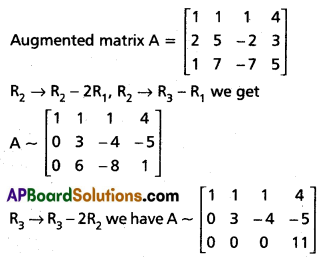
AP Inter 1st Year Botany Study Material Chapter 7 Sexual Reproduction in Flowering Plants

Andhra Pradesh BIEAP AP Inter 1st Year Botany Study Material 7th Lesson Sexual Reproduction in Flowering Plants Textbook Questions and Answers.

AP Inter 1st Year Botany Study Material 7th Lesson Sexual Reproduction in Flowering Plants

Very Short Answer Questions

Question 1.
Name the component cells of the “egg apparatus” in an embryo sac.
Answer:
One egg cell and two synergids.

Question 2.
Name the part of gynoecium that determines the compatible nature of pollen grain.
Answer:
Stigma.

Question 3.
Name the common functions that cotyledons and nucellus perform.
Answer:
Cotyledons and nucellus are often fleshy and full of reserve food materials.

Question 4.
Name the parts of pistil which develop into fruit and seeds.
Answer:
Ovary of the pistil develops into fruit and ovule of the pistil develops into seed.

Question 5.
In case of polyembryony, if an embryo develops from the synergid and another from the nucellus which is haploid and which is diploid?
Answer:
In case of polyembryony, the embryo develops from synergid is haploid and the embryo develops from nucellus is Diploid.

AP Inter 1st Year Botany Study Material Chapter 7 Sexual Reproduction in Flowering Plants

Question 6.
Can an unfertilised, apomictic embryo sac give rise to a diploid embryo? If yes, then how?
Answer:
Yes. Unfertilised apomictic embryosac give rise to a diploid embryo. The diploid Egg cell is formed without Meiosis and develop into the embryo without fertilisation.

Question 7.
Which are the three cells found in a pollen grain when it is shed at the three celled stage?
Answer:
Two male gametes and one vegetative cell.

Question 8.
What is self-incompatibility?
Answer:
Incompatibility of pollengrains to germinate on the stigma of the same flower is called self – incompatibility of self sterility.

Question 9.
Name the type of pollination in self incompatible plants.
Answer:
Cross pollination is seen in self-incompatible plants.
Ex : Abutilon.

Question 10.
Draw the diagram of a mature embryo sac and show its 8-nucleate, 7 – celled, nature. Show the following parts : antiopodals, synergids, egg, central cell, polar nuclei.
Answer:
AP Inter 1st Year Botany Study Material Chapter 7 Sexual Reproduction in Flowering Plants 1
(a) Parts of the ovule showing a large megaspore mother cell, a dyad and a tetrad of megaspores.
(b) 2, 4 and 8-nucleate stages of embryo sac and a mature embryo sac
(c) A diagrammatic representation of the mature embryo sac.

Question 11.
Which is the triploid tissue in a fertilized ovule? How is the triploid condition achieved?
Answer:
Endosperm. It is formed by the fusion of 2nd male gamete with Diploid secondary nucleus to form PEN which changes into endosperm.

AP Inter 1st Year Botany Study Material Chapter 7 Sexual Reproduction in Flowering Plants

Question 12.
Are pollination and fertilisation necessary in apomixis? Give reasons.
Answer:
Pollination and fertilization are not necessary in Apomixis. The diploid egg cell is formed without meiosis and develops into embryo without fertilisation. It is an assured reproduction in the absence of pollinators.

Question 13.
How is pollination carried out in water plants?
Answer:
In vallisnaria, pollination occurs on the water surface (Epihydrophily). Inzoostera, pollination occurs under water (Hypohydrophily). In water hyacinth and water lily, the pollination occurs by Insects.

Question 14.
What is the function of the two male gametes produced by each pollen grain in angiosperms.
Answer:
Of the two male gametes produced by each pollen grain, one male gamete fuses with the egg to form Diploid zygote (Syngamy). The second male gamete fuses with the secondary nucleus to form primary endosperm nucleus (Tripple fusion).

Question 15.
Name the parts of an angiosperm flower in which development of male and female gametophyte take place.
Answer:
Microspore develops into Male gametophyte and Megaspore develops into female gametophyte.

Question 16.
What is meant by monosporic development of female gametophyte?
Answer:
The method of embryosac formation from a single Megaspore is called as Monosporic type of Embryo sac.

Question 17.
Mention two strategies evolved to prevent self-pollination in flowers.
Answer:
Herkogamy and Heterostyly strategies evolved to prevent self-pollination in flowers.
1) Herkogamy :
The anther and the stigma are placed at different positions so that anthers cannot come in contact with the stigma of the same flower.
Ex : Hibiscus, Gloriosa

2) Heterostyly :
Styles of the flowers of the same species are in different heights.
Ex : Lythrum

Question 18.
Why do you think the zygote is dormant for some time in a fertilized ovule ?
Answer:
In a fertilised ovule, Endosperm develops before embryo development, the primary endosperm nucleus divides repeatedly and forms a triploid endosperm tissue. The cells of this tissue are filled with reserve food materials and are used for the nutrition of the developing embryo. Thats why, the zygote is dormant for some time.

Question 19.
If one can induce parthenocarpy through the application of growth substances, which fruits would you select to induce parthenocarpy and why?
Answer:
Banana and Grapes are parthenocarpy fruits. These fruits are useful in juice and Jam industries because of more pulp.

Question 20.
What is meant by scutellum? In Which type of seeds is it present?
Answer:
The single cotyledon of a monocot embryo is known as scutellum. It is situated towards one side of the embryonal axjs.
Ex : Grass seeds.

AP Inter 1st Year Botany Study Material Chapter 7 Sexual Reproduction in Flowering Plants

Question 21.
Defien with examples endospermic and non-endospermic seeds.
Answer:

Endospermic seedsNon-endospermic seeds
The mature seeds with endosperm are called as endospermic seeds.
Ex : Castor and coconut.
The mature seeds without endosperm are called as non-endospermic seeds.
Ex : Pea, groundnut, beans.

Short Answer Type Questions

Question 1.
List three strategies that a bisexual chasmogamous flower can evolve to prevent self pollinaltion (autogamy).
Answer:
A) Dichogamy :
“Pollen release and stigma receptivity are not synchronised”. In sunflower, the pollen is released before the stigma becomes receptive (protandry). In Datura, Solanum, the stigma becomes receptive much before the release of pollen (Protogyny) leads to cross pollination.

B) Herkogamy:
The Male (anther) and female (stigma) sex organs are placed at different positions (Hibiscus) or in different directions (Gloriosa), called Herkogamy. In these plants, the pollen can not come in contact with the stigma of the same flower leads to cross pollination.

C) Self-sterility :
It is a genetic mechanism which prevents the self pollen from fertilising the ovules by inhibiting pollen germination or pollen tube growth in the pistil.
E.g. : Abutilon.

Question 2.
Given below are the events that are observed in an artifical hybridization programme. Arrange the in the correct sequential order in which they are followed in the hybridization programme.
a) Re-bagging
b) Selection of parent
c) Bagging
d) Dusting the pollen on stigma
e) Emasculation
f) Collection of pollen from male.
Answer:
a) Selection of parents.
b) Emasculation
c) Bagging
d) Collection of pollen from male
e) Dusting the pollen on stigma
f) Re-bagging.

Question 3.
What is polyembryony and how can it be commercially exploited?
Answer:
Occurrence of more than one embryo in a seed is called polyembryony.

In many citrus and Mango varieties, some of the nucellar cells surrounding the embryo sac start dividing, protrude into the embryosac and develop into embryos. In such species, each ovule contains many embryos.

Polyembryony plays a main role in plant breeding and horticulture. The plantlets obtained from
these embryos are virus free has more vigour.

Hybrid varieties of several food and vegetable crops are being extensively cultivated. Cultivation of Hybrids has tremendously increased productivity.

Question 4.
Are parthenocarpy and apomixis different phenomena? Discuss their benefits.
Answer:
Yes. Apomixis and parthenocarpy are different phenomenon.

Significance of Apomixis :

  1. During Apomixis, chromosomal seggregation and recombinations does not occur. So characters are stable for several generations.
  2. It simplifies commercial Hybridised production because isolation would not be necessary to produce F, or maintain or Multiply parental generation.
  3. Adventive embryony is being used in produced uniform root – Stock and virus free scion material.

Significance of parthenocarpy :

  1. The fruit production without fertilization of the ovary is called parthenocarpy. This phenomenon is applied for the commercial production of seedless fruits.
    E.g. : Banana, Grapes.
  2. This is more useful to juice industries. .

Question 5.
Why does the zygote begin to divide only after the division of Primary endosperm cell (PEC)?
Answer:
The primary endosperm cell divides repeatedly and forms a triploid endosperm tissue. The cells of this tissue are filled with reserve food materials and are used for nutrition of the developing embryo. Embryo develops at the Micropylar end of the embryosac where zygote is situated. Most zygotes divide only after certain amount of endosperm is formed. This is an adaptation to provide assured nutrition to the developing embryo.

Question 6.
The generative cell of two-celled pollen divides in the pollen tube but not in a three-celled pollen. Give reasons.
Answer:
Pollengrain, at maturity divides periclinally and produce two unequal cells. The larger cell is vegetative cell, has abundant food reserve and a large irregularly shaped nucleus. The smaller cell is generative cell and floats in the cytoplasm of vegetative cell which is spindle shaped with dense cytoplasm and a nucleus. In over 60% of angiosperms, pollengrains are shed at this 2‘celied stage. In the remaining, species, the generative cell divides mitotically to give rise to the 2 male gametes before pollen grains are shed (3 celled stage).

The pollen grain germinates on the stigma to produce a pollen tube through one of the germpores. The contents of the pollen grain moves into the pollen tube. Pollen tube grows through the tissues of the stigma and style and reaches the ovary.

In plants, when pollen grains are shed at 2 celled stage, the generative cell divides and forms two male gametes, during the growth of the pollen tube in the stigma.

AP Inter 1st Year Botany Study Material Chapter 7 Sexual Reproduction in Flowering Plants

Question 7.
Discuss the various types of pollen tube entry into ovary with the help of diagrams.
Answer:
Pollen tube enters into the ovule by any one of the three ways.
1) Porogamy :
Pollen tube enters into ovule through Micropyle and then enters into embryosac by destroying one of the synergids.
E.g. : Ottelia, Hibiscus.

2) Chalazagamy :
Pollen tube enters into ovule through chalaza.
E.g. : Casuarina.

3) Mesogamy :
Pollen tube enters into ovule through the integuments.
E.g. : Cucurbita.
AP Inter 1st Year Botany Study Material Chapter 7 Sexual Reproduction in Flowering Plants 2

(a) Entry of Pollen tube through Micropyle
(b) Entry of Pollen tube through Chalaza
(c) Entry of Pollen tube through Integuments.

Question 9.
Differentiate between microsporogenesis and megasporogenesis. Which type of cell division occurs during these events? Name the structures formed at the end of these two events.
Answer:

MicrosporogenesisMegasporogenesis
1. The sporogenous tissue divides Meiotically to form Microspore tetrads is called Microsporogenesis.1. The process of formation of megaspores from the Megaspore Mother cell is called Megasporogenesis.

In both these events Meiosis occurs. At the end of these events. Microspores and Megaspores are formed.

Question 10.
What is bagging technique? How is it useful in a plant breeding programme?
Answer:
Covering the emasculated flower with a bag made of butter paper is called Bagging.

In Artificial hybridisation technique, after the selection of parents, Anthers are to be removed from bisexual flower of a female parent is called Emasculation. After this, these emasculated flowers have to be covered with a bag of suitable size, generally made of butter paper. It is to be done to prevent contamination of the stigma with unwanted pollen. This process is called Bagging. Bagging technique is useful in producing new cultivar.

Question 11.
What is triple fusion? Where and how does it take place? Name the nuclei involved in triple fusion.
Answer:
Fusion of second male gamete with secondary nucleus (fusion of product of two polar nuclei) is called Triple fusion.

It occurs in the embryosac. Pollen tube with two male gametes enters into embryosac by destroying one of the synergids.

The tip of the pollen tube dissolves and releases two male gametes in the vicinity of the egg. In tripple fusion, one male gamete and secondary nucleus (two polar nuclei) are involved.

Question 12.
Differentiate between
a) Hypocotyl and Epicotyl
b) Coleoptile and Coleorhiza
c) Integument and testa
d) Perisperm and Pericarp.
Answer:
a)

HypocotylEpicotyl
1. The cylindrical portion of embryonal axis below the level of cotyledons is called Hypocotyl.1. The portion of embryonal axis above the level of cotyledons is called epicotyl.
2. It is smooth.2. It is covered by tiny hairs.

b)

ColeoptileColeorhiza
The epicotyl has a shoot apex and a few leaf primordia enclosed in a hollow foliar structure called coleoptile.The embryonal axis has the radicle and root cap is enclosed in an undifferentiated sheath called coleorhiza.

c)

IntegumentTesta
Protective envelope around the ovule is called Integument.After fertilization, the outer integument, of the ovule develops into Testa (outer seed coat).

d)

PerispermPericarp
Remmant of nucellus is called perisperm.
Ex : Black pepper.
The outer wall of a fruit is called pericarp.

Question 13.
What is meant by emasculation? When and why does a plant breeder employ this technique?
Answer:
“Removal of Anthers from the bisexual flower of a female parent, when the flower is in Bud condition, with the help of a forceps” is called emasculation. This technique is employed, when only the desired pollengrains are used for pollination arid the stigma is protected from contamination.

AP Inter 1st Year Botany Study Material Chapter 7 Sexual Reproduction in Flowering Plants

Question 14.
What is apomixis? What is its importance?
Answer:
Production of seeds without fertilisation is called Apomixis. It is a form of asexual Reproduction that mimics sexual reproduction. In some species, the diploid egg cell is formed, with out Meiosis and develops into embryo without fertilization. It is an assured reproduction in the absence of pollinators such as in extreme environments.

Importance :

  1. Apomixis do not involve meiosis. Hence reggregation and recombination of chromosomes do not occur. Thus Apomixis help in preserving desirable characters for Indefinite periods.
  2. Apomixis, simplified commercial hybrid seed production.

Question 15.
Describe briefly different types of agents of pollination.
Answer:
The various agencies helpful in pollination can be grouped into two broad categories : biotic and abiotic. Majority of plants use biotic agents for pollination.

I. Abiotic pollinating agents :
It includes non-living agnets like air and water.
a) Anemophily :
Transfer of pollen grains through wind is known as anemophily. It is the most common type of abiotic pollination method. Wind pollinated flowers are small, stigmas are feathery and non-sticky.
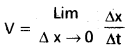
Ex : Widn pollination is a quite common in grasses.

b) Hydrophily :
Transfer of pollen grains trhough the agnecy of water is known as hydrophily. It is of two types.

1) Hypohydrophily :
In this type the pollination of flowers occurs below the water level, it is found in submerged plants like Zosterra and sea grasses.

2) Epi-hydrophiiy :
Here, the pollination of flower occurs at the surface of water.
Ex : Vallisneria and Hydrilla.

II. Biotic pollinating agents :
It includes living organisms such as insects, birds, bats and snail.
a) Entomophily :
Pollination thorugh the agncy of insects is known as entomophily.
Ex : Bees, beetles, wasps etc.

b) Ornithophily :
Pollination thorugh the agency of birds is kriown as ornithophily.
Ex : Sun birds and humming birds.

c) Cheiropterophily :
Pollination through the agency of bats is known as Cheiropterophily.

d) Therophily :
Pollination through the agency of squirrels is known as Therophily.

e) Ophiophily :
Pollination through the agency of snakes is known as ophiophily.

Question 16.
Write briefly about the different types of ovules.
Answer:
The ovule is a megasporangium with one or two integuments. In Angiosperms three main types of ovules are present. They are :

1) Orthotropous ovule :
It is traight ovule with micropyle, chalaza and funiculus arranged in one stright line. It is a primitive type of ovule.
Ex : Polygonum, Piperaceae.

2) Anatropous ovule :
It is a inverted type of ovule. Due to unilateral growth of funicle, the whole body of the ovule is inverted through 180°. As a result the micropyle comes close to the base of the funicle. The most common type of ovule found in several families.
Ex : Healianthus, Tridax.

3) Campylotropous ovule : In this type of body of the ovule is bent more or less at right angles to the funicle. The microphyle part of the ovule become curved, without any curvature in the embryosac.
Ex : Fabaceae, Brasicaceae.
AP Inter 1st Year Botany Study Material Chapter 7 Sexual Reproduction in Flowering Plants 3

Question 17.
Vivipary automatically limits the number of offsprings in a litter. How?
Answer:
Vivipary is defined as the seeds germinate while they are still attached to the mother plant. Plants which grows in Marshy places are called Mangrooves. In these plants, seeds when fall on Marshy places, can not germinate because of high salinity and more water conditions. So in those plants, seeds germinate when they are in mother plant to raise their generations. The seeds of Mangrooves can not germinate even on litter because of unfavourable conditions. So the number of offsprings will dicrease.

Question 18.
Does self incompatibility impose any restrictions on autogamy? Give reasons and suggest the method of pollination in such plants.
Answer:
Self Sterility :
In some bisexual flowers, if the pollengrains fall on the stigma of the same flower, germination does not occur. But the same pollen grains germinates when they fall on the stigma of other flowers of the same species. It is a genetic mechanism to prevent self pollination.
E.g. : Abutilon, Passiflora. In these plants cross pollination only occurs. In some plants, the pollen grains become poisonous and make the flower wither if self pollination occurs. E.g. : Orchids.

Question 19.
Explain the role of tapetum in the formation of pollen grain wall.
Answer:
The inner walls of Tapetal layer breaks and releases their protoplasts into the inner space of the Anther. There, they mix with each other and form periplasmodium. It covers the Microspore Mother cells, help in the formation of outer wall (exine) of pollen grain. Moreover, the ubisch bodies of Tapetum chemically made of carotenes and carotenoids which are equallent to sporopollenin of pollengrain.

Long Answer type Questions

Question 1.
Starting with the zygote, draw the diagrams of the different stages of embryo development in a dicot.
Answer:
AP Inter 1st Year Botany Study Material Chapter 7 Sexual Reproduction in Flowering Plants 4

Question 2.
What are the possible types of pollinations in chasmogamous flowers? Give reasons.
Answer:
Chasmogamy :
The pollination that occurs in opened flowers is called chasmogamy. It is the most common type of pollination in all types of flowers. There are two types of chasmagamy.

  1. Self pollination
  2. Cross pollination.

1) Self Pollination :
The transfer of pollengrians from Anther to stigma of the same flower is called autogamy or self-pollination. It is found in both cleistogamous and chasmogamous flowers.

2) Cross pollination Or allogamy :
The transfer of pollengrains from Anther to stigma of another flower is called cross pollination. It is of 2 types,
a) Geitonogamy
b) Xenogamy.

a) Geitonogamy :
The transfer of pollengrains from anther to the stigma of another flower of the same plant. It is functionally Gross pollination involving a pollinating agent, genetically, it is similar to autogamy. Since the pollengrains come from the same plant.

b) Xenogamy :
The transfer of pollengrains from the flower of one plant to the stigma of another plant. This is the only type of pollination which brings genetically different types of pollengrains to the stigma.

Question 3.
With a neat, labelled diagram, describe the parts of a mature angiosperm embryo sac. Mention the role of synergids.
Answer:
Megaspore is the Mothercell for the development of female gametophyte (embryosac). The nucleus of the functional Megaspore divides mitotically to form two nuclei, which move to the opposite poles forming 2 nucleate embryo sac. Two more Mitotic nuclear divisions occur in two nuclei results the formation of 8 nucleate embrayo sac. After this stage, cell walls are laid down leading to the organization of the typical femaie gametophyte or embryo sac.

Six of the eight nuclei are surrounded by cell walls and organised into cells. Three cells present towards the micropylar end grouped together, constitute the egg apparatus. The egg apparatus, inturn consists of two synergids and one egg cell. The synergids have special cellular thickenings at the micropylar tip called filliform apparatus which play an importent role in guiding the pollen tubes into the synergid.
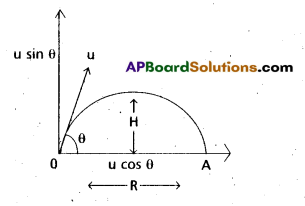
Three cells of the chalazal end are called the antipodals. The large central cell is formed by the fusion of 2 polar nuclei. Thus a typical angiospermic embryosac, at maturity consists of 8 nuclei and 7 cells. This embryosac is formed from the single megaspore, so called Monosporic embryo sac.
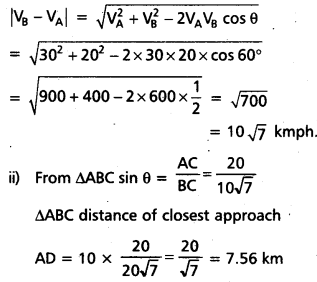
Role of synergids :
Filiform apparatus in synergids help in guiding the pollen tubes towards the embryo sac.
AP Inter 1st Year Botany Study Material Chapter 7 Sexual Reproduction in Flowering Plants 5
(a) Parts of the ovule showing a large megaspore mother cell, a dyad and a tetrad of megaspores.
(b) 2, 4 and 8-nucleate stages of embryo sac and a mature embryo sac.
(c) A diagrammatic representation of the mature embryo sac.

AP Inter 1st Year Botany Study Material Chapter 7 Sexual Reproduction in Flowering Plants

Question 4.
Draw the diagram of a microsporangium and label is wall layers. Write briefly about the wall layers.
Answer:
AP Inter 1st Year Botany Study Material Chapter 7 Sexual Reproduction in Flowering Plants 6
(a) Transverse section of a young anther
(b) Enlarged view of one microsporangium showing wall layersl

A typical angiospermic anther is bilobed with each lobe having two theca. The anther is a four sided structure consisting of four microsporangia located at the corners, two in each lobe.

In a transverse section, a typical microsporangium is circular in out line and is surrounded by four wall layers, the
a) epidermis
b) endothecium
c) wall layers
d) tapetum.

a) Epidermis :
The epidermis is one called thick, the cells present between the pollen sacs are the thin walled and their region is called as stomium which is useful for the dehiscence of pollen sacs.

b) Endothecium :
It is present below the epidermis and expands radically with fibrous thickenings, at maturity these cells loose water and contract and help in the dehiscence of pollen sacs.

c) Wall layers :
Beneath the Endothecium, there are thin walled cells, arranged in one to five layers, which also help in dehiscence of Anther.

d) Tapetum :
The innermost wall layer is Tapetum, the cells are large, with thin cell walls, abundant cytoplasm and have more than one nuclei. Tapetum is a nutritive tissue which nourishes the developing pollen grains.

The centre of the microsporengium consists of sporogeneous tissue, which undergo meiotio divisions to form microspore tetrads. This process is known as Microsporogenesis.

Question 5.
Embryo sacs of some apomictic species appear normal but contain diploid cells. Suggest a suitable explanation for the condition.
Answer:
Replacement of the normal sexual reproduction by asexual reproduction without fertilisation is called apomixis. It does not mention Meiosis. Replacement of the seed by a plant, or replacement of the flower by bulbils are types of apomixis. Apomitically produced offsprings are genetically identical to the parent plant. In flowering plants, apomixis is used in a restricted sense to mean aganosperms i.e., asexual reproduction through seeds. In some plant families, apomixis is common.
Ex : Astha ceae, Poaceae.

In some species, the diploid egg cell is formed without reduction division and develops into embryo without fertilisation. It is an asexual reproduction in the absence of pollinators such as in extreme environments. In some species like citrus, some of the nuclear cells surrounding the embryosac start dividing and develop into embryos.

In Allium, Antenraria, the megaspore mother cell does not enter Meiosis and produces diploid embryosac through Mitotic divisions.

In Hieracium species, the Megaspore mother cell undergoes meiosis to form a letraol. At this stage, the nucellar cell at the chalazal end becomes activated and starts developing into aposposons unreduced embryosac which only matures.

Importance :
Apomixis do not involve meiosis. Hence segregation and recombination of chromosomes do not occur. It helps in the pereserving desirable characters for Indefinite periods.

Finally it states that, Embryosacs of some opomitic species appear normal but produce diploid cells.

AP Inter 1st Year Botany Study Material Chapter 7 Sexual Reproduction in Flowering Plants

Question 6.
Describe the process of Fertilization in angiosperms.
Answer:
Fusion of male and female gametes is called Fertilization. In Angiosperms, Female gamete (Egg) is embeded in ovule. Pollengrians are carried upto stigma by some agents, germinate and produce pollentubes. They enter into ovule and releases male gametes near the Egg in Embryo sac.

In Angiosperms, Fertilization completes in 5 steps they are
A) Entry of pollentube into the ovule : Pollentube enter into the ovule by any one of three ways. They are
1) Porogamy :
Pollentube enters into the ovule through micropyle and then into embryo sac by destroying one of the svnergids.
Ex : Ottelia, Hibiscus

2) Chalazogermy :
Pollentube enters in to theo vule through chalaza.
Ex : Casuarina

3) Mesogamy :
pollentube enters into the ovule through the integuments.
Ex : Cucurbita,
AP Inter 1st Year Botany Study Material Chapter 7 Sexual Reproduction in Flowering Plants 2
(a) Entry of Pollen tube through Micropyle
(b) Entry of Pollen tube through Chalaza
(c) Entry of Pollen tube through Integuments.

B) Entry of pollentube into the embryo sac :
After entering into the ovule by anyone of the three methods, pollentube enter into the embryosac by destroying one of the synergids or by space present between the Egg and synergids. Filliform apparatus in synergids helps in entering into the embryo sac.

C) Discharge of Male gametes :
Due to the dissolution of the tip of the pollentube or by pore formed at the tip of the pollentube, two male gametes are released near the Egg in embryo sac.

D) Syngamy :
One male gamete fuses with the Egg forming diploid zysote. It was discovered by strasberger in 1884.

E) Triple Fusion :
Second male gamete fuses with the secondary nucleus forming triploid primary endosperm nucleus. In this, one haploid male gamete fuses with diploid secondary nucleus forming Triploid primary endosperm nucleus. So called Triple fusion. It was first discovered by Nawaschin in hilium and fertilillaria.