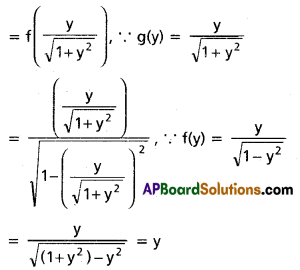
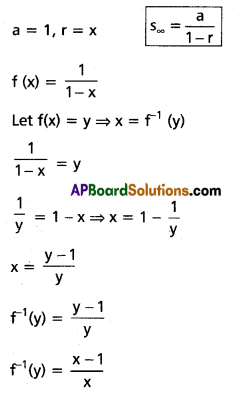
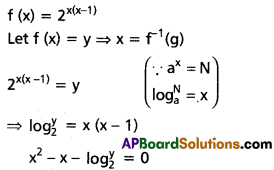
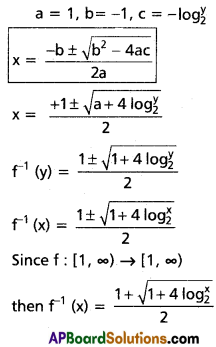
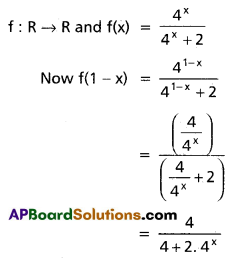
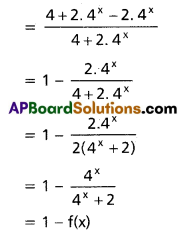
Inter 1st Year Maths 1A Trigonometric Ratios up to Transformations Solutions Ex 6(a)

Practicing the Intermediate 1st Year Maths 1A Textbook Solutions Inter 1st Year Maths 1A Trigonometric Ratios up to Transformations Solutions Exercise 6(a) will help students to clear their doubts quickly.

Intermediate 1st Year Maths 1A Trigonometric Ratios up to Transformations Solutions Exercise 6(a)

I. Convert the following into the simplest form.

Question 1.
(i) tan(θ – 14π)
Solution:
= tan(14π – θ)
= tan(2 . (7π) – θ)
= tan θ

(ii) \(\cot \left(\frac{21 \pi}{2}-\theta\right)\)
Solution:
\(\cot \left(\frac{21 \pi}{2}-\theta\right)\)
= \(\cot \left(10 \pi+\left(\frac{\pi}{2}-\theta\right)\right)\)
= \(\cot \left(\frac{\pi}{2}-\theta\right)\)
= tan θ

(iii) cosec(5π + θ)
Solution:
cosec(5π + θ) = cosec(2π + (3π + θ))
= cosec(3π + θ)
= cosec(2π + (π + θ))
= cosec(π + θ)
= -cosec θ

(iv) sec(4π – θ?)
Solution:
sec(4π – θ)
= sec(2π + (2π – θ))
= sec(2π – θ)
= sec θ

Inter 1st Year Maths 1A Trigonometric Ratios up to Transformations Solutions Ex 6(a)

Question 2.
Find the value of each of the following.
(i) sin(-405°)
Solution:
sin(-405°) = -sin(360° + 45)
= -sin 45°
= \(-\frac{1}{\sqrt{2}}\)

(ii) \(\cos \left(-\frac{7 \pi}{2}\right)\)
Solution:
\(\cos \left(-\frac{7 \pi}{2}\right)\)
= -cos 630°
= -cos(360° + 270°)
= -cos 270°
= -cos(180° + 90°)
= -cos 90°
= 0

(iii) sec(2100°)
Solution:
sec(2100°) = sec (5 × 360° + 300°)
= sec 300°
= sec(360 – 60°)
= sec 60°
= 2

(iv) cot(-315°)
Solution:
cot(-315°) = -cot 315°
= -cot(360° – 45°)
= -cot 45°
= 1

Question 3.
Evaluate.
(i) cos2 45° + cos2 135° + cos2 225° + cos2 315°
Solution:
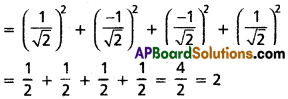
Inter 1st Year Maths 1A Trigonometric Ratios up to Transformations Solutions Ex 6(a) I Q3(i)

(ii) \(\sin ^{2} \frac{2 \pi}{3}+\cos ^{2} \frac{5 \pi}{6}-\tan ^{2} \frac{3 \pi}{4}\)
Solution:
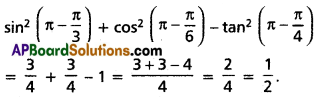
Inter 1st Year Maths 1A Trigonometric Ratios up to Transformations Solutions Ex 6(a) I Q3(ii)

(iii) cos 225° – sin 225° + tan 495° – cot 495°
Solution:
cos (180° + 45°) – sin(180° + 45°) + tan(360° + 135°) – cot(360° + 135°)
= -cos 45° + sin 45° – tan 135° + cot 135°
= \(-\frac{1}{\sqrt{2}}+\frac{1}{\sqrt{2}}+1-1\)
= 0

(iv) (cos θ – sin θ) if (a) θ = \(\frac{7 \pi}{4}\) (b) θ = \(\frac{11 \pi}{3}\)
Solution:
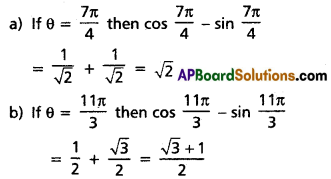
Inter 1st Year Maths 1A Trigonometric Ratios up to Transformations Solutions Ex 6(a) I Q3(iv)

Question 4.
(i) If sin θ = \(\frac{-1}{3}\) and θ does not lie in the third quadrant, find the values of (a) cos θ (b) cot θ
Solution:
∵ sin θ = \(\frac{-1}{3}\) and sin θ is negative and θ does not lie in the IIIrd quadrant.
⇒ θ lies in IV quadrant.
∴ In the IV quadrant, cos θ is positive and cot θ is negative.
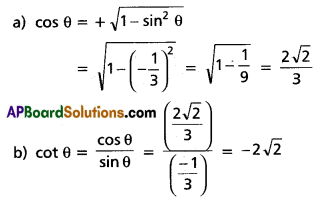
Inter 1st Year Maths 1A Trigonometric Ratios up to Transformations Solutions Ex 6(a) I Q4(i)

(ii) If cos θ = t (0 < t < 1) and θ does not lie in the first quadrant, find the values of (a) sin θ (b) tan θ.
Solution:
cos θ = t, (0 < t < 1)
⇒ cos θ is positive and θ does not lie in the first quadrant.
⇒ θ lies in IV quadrant.
(a) sin θ = \(-\sqrt{1-\cos ^{2} \theta}=-\sqrt{1-t^{2}}\)
(b) tan θ = \(\frac{\sin \theta}{\cos \theta}=\frac{-\sqrt{1-t^{2}}}{t}\)

(iii) Find the value of sin 330°. cos 120° + cos 210°. sin 300°.
Solution:
sin 330°. cos 120° + cos 210°. sin 300°
= sin(360° – 30°) . cos(180° – 60°) + cos(180° + 30°) . sin(360° – 60°)
= (-sin 30°) (-cos 60°) + (-cos 30°) (-sin 60°)
= sin 30° cos 60° + cos 30° sin 60°
= sin(30° + 60°) [∵ sin A cos B + cos A sin B = sin(A + B)]
= sin (90°)
= 1

(iv) If cosec θ + cot θ = \(\frac{1}{3}\), find cos θ and determine the quadrant in which θ lies.
Solution:
cosec θ + cot θ = \(\frac{1}{3}\)
⇒ cosec θ – cot θ = 3 (∵ cosec2θ – cot2θ = 1)
∴ 2 cosec θ = \(\frac{1}{3}\) + 3 = \(\frac{10}{3}\)
∴ cosec θ = \(\frac{5}{3}\) and sin θ = \(\frac{3}{5}\)
2 cot θ = \(\frac{1}{3}\) – 3 = \(\frac{-8}{3}\)
∴ cot θ = \(\frac{-4}{3}\), tan θ = \(\frac{-3}{4}\)
cos θ = (cot θ) . sin θ = \(\left(\frac{-4}{3}\right)\left(\frac{3}{5}\right)=\frac{-4}{5}\)
∵ sin θ is +ve and cos θ is -ve
⇒ θ lies in II quadrant.

Inter 1st Year Maths 1A Trigonometric Ratios up to Transformations Solutions Ex 6(a)

Question 5.
(i) If sin α + cosec α = 2. Find the value of sinnα + cosecnα, n ∈ z.
Solution:
Given sin α + cosec α = 2
Squaring on both sides
sin2α + cosec2α + 2 = 4
sin2α + cosec2α = 2
sin α + cosec α = 2
Cubing on both sides
sin3α + cosec3α + 3 sin α . cosec α (sin α + cosec α) = 8
sin3α + cosec3α + 3(2) = 8
sin3α + cosec3α = 8 – 6
sin3α + cosec3α = 2
similarly sinnα + cosecnα = -2

(ii) If sec θ + tan θ = 5. Find the quadrant in which θ lies and find the value of sin θ.
Solution:
sec θ + tan θ = 5
⇒ sec θ – tan θ = \(\frac{1}{5}\) (∵ sec2θ – tan2θ = 1)
2 sec θ = 5 + \(\frac{1}{5}\) = \(\frac{26}{5}\)
sec θ = \(\frac{26}{10}=\frac{13}{5}\)
Aquir 2 tan θ = 5 – \(\frac{1}{5}\) = \(\frac{24}{5}\)
tan θ = \(\frac{24}{10}=\frac{12}{5}\)
Now sin θ = \(\frac{\tan \theta}{\sec \theta}=\frac{\frac{12}{5}}{\frac{13}{5}}=\frac{12}{13}\)
tan θ is +ve, sec θ is +ve
⇒ θ lies in the first quadrant.

II.

Question 1.
Prove that
(i) \(\frac{\cos (\pi-A) \cdot \cot \left(\frac{\pi}{2}+A\right) \cos (-A)}{\tan (\pi+A) \tan \left[\frac{3 \pi}{2}+A\right] \sin (2 \pi-A)}\) = cos A
Solution:
\(\frac{\cos (\pi-A) \cdot \cot \left(\frac{\pi}{2}+A\right) \cos (-A)}{\tan (\pi+A) \tan \left[\frac{3 \pi}{2}+A\right] \sin (2 \pi-A)}\)
= \(\frac{-\cos A(-\tan A) \cos A}{\tan A(-\cot A)(-\sin A)}\)
= cos A

(ii) \(\frac{\sin (3 \pi-A) \cos \left(A-\frac{\pi}{2}\right) \tan \left(\frac{3 \pi}{2}-A\right)}{{cosec}\left(\frac{13 \pi}{2}+A\right) \sec (3 \pi+A) \cot \left(A-\frac{\pi}{2}\right)}\) = cos4A
Solution:
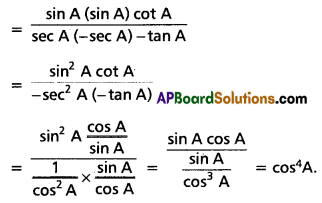
Inter 1st Year Maths 1A Trigonometric Ratios up to Transformations Solutions Ex 6(a) II Q1(ii)

(iii) sin 780° sin 480° + cos 240°. cos 300° = \(\frac{1}{2}\)
Solution:
sin(2(360°) + 60°) . sin(360° + 120°) + cos(270° – 30°) . cos(360° – 60°)
= sin 60° . sin 120° – sin 30° . cos 60°
= \(\frac{\sqrt{3}}{2} \cdot \frac{\sqrt{3}}{2}-\frac{1}{2} \cdot \frac{1}{2}\)
= \(\frac{3}{4}-\frac{1}{4}\)
= \(\frac{1}{2}\)

(iv) \(\frac{\sin 150^{\circ}-5 \cos 300^{\circ}+7 \tan 225^{\circ}}{\tan 135^{\circ}+3 \sin 210^{\circ}}\) = -2
Solution:
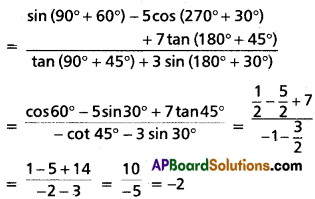
Inter 1st Year Maths 1A Trigonometric Ratios up to Transformations Solutions Ex 6(a) II Q1(iv)

(v) cot(\(\frac{\pi}{20}\)) . cot(\(\frac{3\pi}{20}\)) . cot(\(\frac{5\pi}{20}\)) . cot(\(\frac{7\pi}{20}\)) . cot(\(\frac{9\pi}{20}\)) = 1
Solution:
L.H.S. = cot(\(\frac{\pi}{20}\)) . cot(\(\frac{3\pi}{20}\)) . cot(\(\frac{5\pi}{20}\)) . cot(\(\frac{7\pi}{20}\)) . cot(\(\frac{9\pi}{20}\))
= cot (9°) cot (27°) cot (45°) cot (63°) cot (81°)
= cot (9°) cot (27°) (1) cot (90° – 27°) cot (90° – 9°)
= cot (9°) cot (27°) tan 27° tan 9°
= (tan 9° cot 9°) (tan 27° cot 27°)
= (1) (1)
= 1

Inter 1st Year Maths 1A Trigonometric Ratios up to Transformations Solutions Ex 6(a)

Question 2.
Simplify.
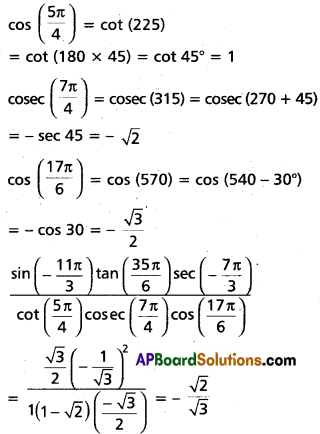
(i) \(\frac{\sin \left(-\frac{11 \pi}{3}\right) \tan \left(\frac{35 \pi}{6}\right) \sec \left(-\frac{7 \pi}{3}\right)}{\cot \left(\frac{5 \pi}{4}\right) {cosec}\left(\frac{7 \pi}{4}\right) \cos \left(\frac{17 \pi}{6}\right)}\)
Solution:
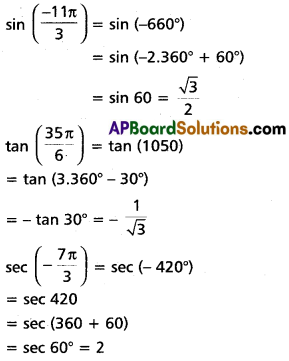
Inter 1st Year Maths 1A Trigonometric Ratios up to Transformations Solutions Ex 6(a) II Q2(i)
Inter 1st Year Maths 1A Trigonometric Ratios up to Transformations Solutions Ex 6(a) II Q2(i).1

(ii) If tan 20° = p, prove that \(\frac{\tan 610^{\circ}+\tan 700^{\circ}}{\tan 560^{\circ}-\tan 470^{\circ}}=\frac{1-p^{2}}{1+p^{2}}\)
Solution:
Given tan 20° = p
L.H.S. = \(\frac{\tan 610^{\circ}+\tan 700^{\circ}}{\tan 560^{\circ}-\tan 470^{\circ}}\)
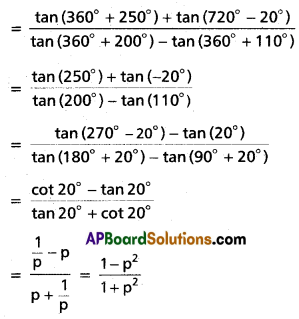
Inter 1st Year Maths 1A Trigonometric Ratios up to Transformations Solutions Ex 6(a) II Q2(ii)

(iii) If α, β are complementary angles such that b sin α = a, then find the value of (sin α cos β – cos α sin β).
Solution:
∵ α, β are complementary angles
⇒ α + β = 90°
⇒ β = 90° – α
Now sin α cos β – cos α sin β
= sin (α – β)
= sin [(α – (90° – α)]
= sin [2α – 90°]
= -sin (90° – 2α)
= -cos 2α
= -(1 – 2 sin2α) (∵ cos 2α = 1 – 2 sin2α)
= \(-1+2\left(\frac{a}{b}\right)^{2}\) (∵ sin α = \(\frac{a}{b}\))
= \(\frac{-b^{2}+2 a^{2}}{b^{2}}\)
= \(\frac{2 a^{2}-b^{2}}{b^{2}}\)

Inter 1st Year Maths 1A Trigonometric Ratios up to Transformations Solutions Ex 6(a)

Question 3.
(i) If cos A = cos B = \(-\frac{1}{2}\), A does not lie in the second quadrant and B does not lie in the third quadrant, then find the value of \(\frac{4 \sin B-3 \tan A}{\tan B+\sin A}\)
Solution:
∵ cos A = \(-\frac{1}{2}\) and A does not lie in second quadrant.
⇒ A lies in the third quadrant, (∵ cos A is -ve)
and cos B = \(-\frac{1}{2}\) and B does not lie in third quadrant.
⇒ B lies in second quadrant.
∵ cos A = \(-\frac{1}{2}\) and A lies in third quadrant.
⇒ A = 240°
∵ cos B = \(-\frac{1}{2}\) and B lies in second quadrant.
⇒ B = 120°
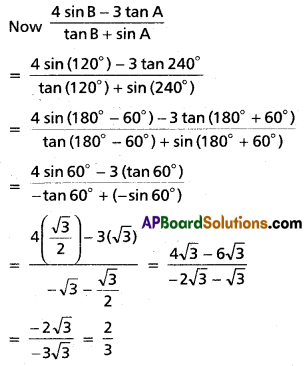
Inter 1st Year Maths 1A Trigonometric Ratios up to Transformations Solutions Ex 6(a) II Q3(i)

(ii) If 8 tan A = -15 and 25 sin B = -7 and neither A nor B is in the fourth quadrant, then show that sin A cos B + cos A sin B = \(\frac{-304}{425}\)
Solution:
8 tan A = -15 ⇒ tan A = \(\frac{-15}{8}\)
25 sin B = -7 ⇒ sin B = \(-\frac{7}{25}\)
Given neither A nor B is in the fourth quadrant.
Clearly, A is the second quadrant B is the third quadrant
sin A cos B + cos A sin B = \(\left(\frac{15}{17}\right)\left(\frac{-24}{25}\right)+\left(\frac{-8}{17}\right)\left(\frac{-7}{25}\right)\)
= \(\frac{-360}{425}+\frac{56}{425}\)
= \(\frac{-304}{425}\)

(iii) If A, B, C, D are angles of a cyclic quadrilateral, then prove that
(a) sin A – sin C = sin D – sin B
(b) cos A + cos B + cos C + cos D = 0
Solution:
∵ A, B, C, D are angles of a cyclic quadrilateral.
⇒ A + C = 180° and B + D = 180° ……..(1)
C = 180° – A and D = 180° – B
(a) L.H.S. = sin A – sin C
= sin A – sin(180° – A)
= sin A – sin A
= 0
R.H.S. = sin D – sin B
= sin(180°- B) – sin B
= sin B – sin B
= 0
∴ L.H.S. = R.H.S.
i.e., sin A – sin C = sin D – sin B
(b) L.H.S. = cos A + cos B + cos C + cos D
= cos A + cos B + cos(180° – A) + cos(180° – B)
= cos A + cos B – cos A – cos B
= 0
∴ cos A + cos B + cos C + cos D = 0

Inter 1st Year Maths 1A Trigonometric Ratios up to Transformations Solutions Ex 6(a)

Question 4.
(i) If a cos θ – b sin θ = c, then show that a sin θ + b sin θ = \(\pm \sqrt{a^{2}+b^{2}-c^{2}}\).
Solution:
a cos θ – b sin θ = c
let a sin θ + b cos θ = x
by squaring and adding
(a cos θ – b sin θ)2 + (a sin θ + b cos θ)2 = c2 + x2
a2 cos2θ + b2 sin2θ – 2ab sin θ cos θ + a2 sin2θ + b2 cos2θ + 2ab sin θ cos θ = c2 + x2
a2 + b2 = c2 + x2
a2 + b2 – c2 = x2
x = \(\pm \sqrt{a^{2}+b^{2}-c^{2}}\)
∴ a sin θ + b cos θ = \(\pm \sqrt{a^{2}+b^{2}-c^{2}}\)

(ii) If 3 sin A + 5 cos A = 5, then show that 5 sin A – 3 cos A = ±3.
Solution:
3 sin A + 5 cos A = 5
Let 5 sec A – 3 cos A = x
by squaring and adding
(3 sin A + 5 cos A)2 + (5 sin A – 3 cos A)2 = 52 + x2
9 sin2 A + 25 cos2 A + 30 sin A cos A + 25 sin2 A + 9 cos2 A – 30 sin A cos A = 25
9 + 25 = 25 + x2
x2 = 9
x = ±3
∴ 5 sin A – 3 cos A = ±3

(iii) If tan2θ = (1 – e2), show that sec θ + tan3θ . cosec θ = (2 – e2)3/2.
Solution:
tan2θ = 1 – e2
sec2θ = 1 + tan2θ = 2 – e2
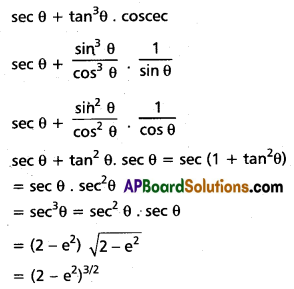
Inter 1st Year Maths 1A Trigonometric Ratios up to Transformations Solutions Ex 6(a) II Q4(iii)

III. Prove the following.

Question 1.
(i) \(\frac{(\tan \theta+\sec \theta-1)}{(\tan \theta-\sec \theta+1)}=\frac{1+\sin \theta}{\cos \theta}\)
Solution:
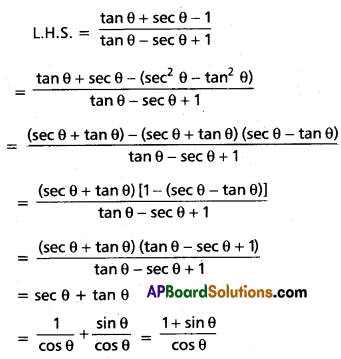
Inter 1st Year Maths 1A Trigonometric Ratios up to Transformations Solutions Ex 6(a) III Q1(i)

(ii) (1 + cot θ – cosec θ) (1 + tan θ + sec θ) = 2.
Solution:
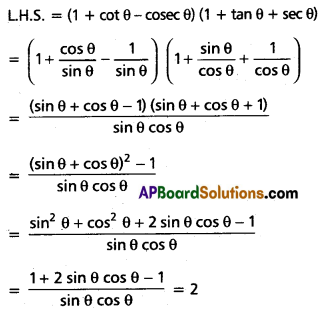
Inter 1st Year Maths 1A Trigonometric Ratios up to Transformations Solutions Ex 6(a) III Q1(ii)

(iii) 3(sin θ – cos θ)4 + 6(sin θ + cos θ)2 + 4(sin6θ + cos6θ) = 13.
Solution:
(sin θ – cos θ)2 = sin2θ + cos2θ – 2 sin θ . cos θ
= 1 – 2 sin θ cos θ
(sin θ – cos θ)4 = (1 – 2 sin θ cos θ)2
= 1 + 4 sin2θ cos2θ – 4 sin θ cos θ ……(1)
(sin θ + cos θ)2 = sin2θ + cos2θ + 2 sin θ cos θ
= 1 + 2 sin θ cos θ …….(2)
sin6θ + cos6θ = (sin2θ +cos2θ)3 – 3 sin2θ cos2θ (sin2θ + cos2θ)
= 1 – 3 sin2θ cos2θ ……..(3)
L.H.S. = 3(1 + 4 sin2θ cos2θ – 4 sin θ cos θ) + 6(1 + 2 sin θ cos θ) + 4(1 – 3 sin2θ cos2θ)
= 3 + 12 sin2θ cos2θ – 12 sin θ cos θ + 6 + 12 sin θ cos θ + 4 – 12 sin2θ cos2θ
= 3 + 6 + 4
= 13
= R.H.S.

Inter 1st Year Maths 1A Trigonometric Ratios up to Transformations Solutions Ex 6(a)

Question 2.
(i) Prove that (sin θ + cosec θ)2 + (cos θ + sec θ)2 – (tan2θ + cot2θ) = 7.
Solution:
L.H.S. = (sin θ + cosec θ)2 + (cos θ + sec θ)2 – (tan2θ + cot2θ)
= (sin2θ + cosec2θ + 2 sin θ cosec θ) + (cos2θ + sec2θ + 2 cos θ sec θ) – (tan2θ + cot2θ)
= (sin2θ + cos2θ) + (1 + cot2θ) + (1 + tan2θ) + 4 – tan2θ – cot2θ
= 1 + 1 + 1 + 4
= 7

(ii) cos4α + 2 cos2α \(\left(1-\frac{1}{\sec ^{2} \alpha}\right)\) = (1 – sin4α)
Solution:
L.H.S. = cos4α + 2 cos2α \(\left(1-\frac{1}{\sec ^{2} \alpha}\right)\)
= cos4α + 2 cos2α (1 – cos2α)
= cos2α [cos2α + 2 sin2α]
= (1 – sin2α) [cos2α + sin2α + sin2α]
= (1 – sin2α) (1 + sin2α)
= 1 – sin4α

(iii) \(\frac{(1+\sin \theta-\cos \theta)^{2}}{(1+\sin \theta+\cos \theta)^{2}}=\frac{1-\cos \theta}{1+\cos \theta}\)
Solution:
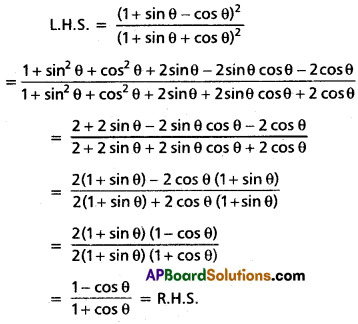
Inter 1st Year Maths 1A Trigonometric Ratios up to Transformations Solutions Ex 6(a) III Q2(iii)

(iv) If \(\frac{2 \sin \theta}{(1+\cos \theta+\sin \theta)}\) = x, then find the value of \(\frac{(1-\cos \theta+\sin \theta)}{(1+\sin \theta)}\)
Solution:
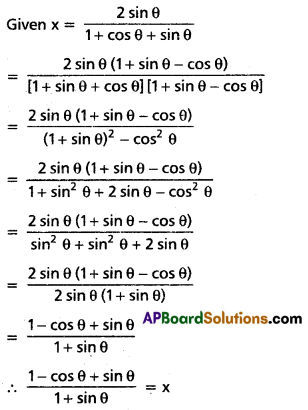
Inter 1st Year Maths 1A Trigonometric Ratios up to Transformations Solutions Ex 6(a) III Q2(iv)

Inter 1st Year Maths 1A Trigonometric Ratios up to Transformations Solutions Ex 6(a)

Question 3.
Eliminate θ from the following.
(i) x = a cos3θ; y = b sin3θ
Solution:
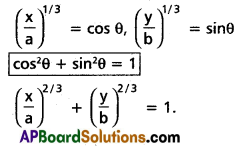
Inter 1st Year Maths 1A Trigonometric Ratios up to Transformations Solutions Ex 6(a) III Q3(i)

(ii) x = a cos4θ; y = b sin4θ
Solution:
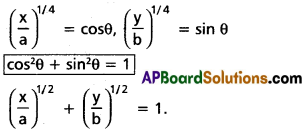
Inter 1st Year Maths 1A Trigonometric Ratios up to Transformations Solutions Ex 6(a) III Q3(ii)

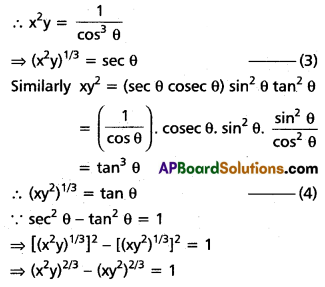
(iii) x = a(sec θ + tan θ); y = b(sec θ – tan θ)
Solution:
\(\frac{x}{a}\) = sec θ + tan θ; \(\frac{y}{b}\) = (sec θ – tan θ)
\(\frac{x}{a} \times \frac{y}{b}\) = (sec θ + tan θ) (sec θ – tan θ)
\(\frac{x y}{a b}\) = sec2θ – tan2θ
\(\frac{x y}{a b}\) = 1
xy = ab

(iv) x = cot θ + tan θ; y = sec θ – cos θ
Solution:
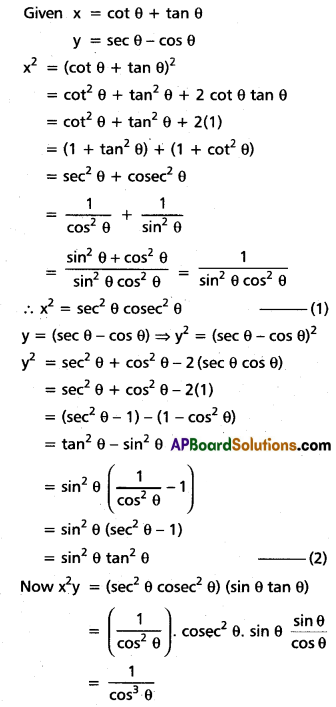
Inter 1st Year Maths 1A Trigonometric Ratios up to Transformations Solutions Ex 6(a) III Q3(iv)
Inter 1st Year Maths 1A Trigonometric Ratios up to Transformations Solutions Ex 6(a) III Q3(iv).1

Inter 1st Year Maths 1A Products of Vectors Solutions Ex 5(c)

Practicing the Intermediate 1st Year Maths 1A Textbook Solutions Inter 1st Year Maths 1A Products of Vectors Solutions Exercise 5(c) will help students to clear their doubts quickly.

Intermediate 1st Year Maths 1A Products of Vectors Solutions Exercise 5(c)

I.

Question 1.
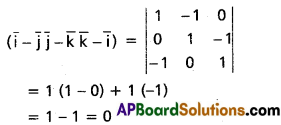
Compute \([\overline{\mathbf{i}}-\overline{\mathbf{j}} \overline{\mathbf{j}}-\overline{\mathbf{k}} \overline{\mathbf{k}}-\overline{\mathbf{i}}]\)
Solution:
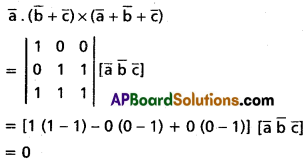
Inter 1st Year Maths 1A Products of Vectors Solutions Ex 5(c) I Q1

Question 2.
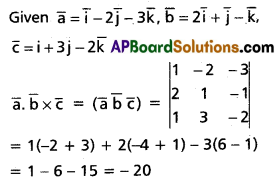
If \(\overline{\mathbf{a}}=\overline{\mathbf{i}}-2 \overline{\mathbf{j}}-3 \overline{\mathbf{k}}, \overline{\mathbf{b}}=2 \overline{\mathbf{i}}+\overline{\mathbf{j}}-\overline{\mathbf{k}}\), \(\bar{c}=\bar{i}+3 \bar{j}-2 \bar{k}\), then compute \(\overline{\mathbf{a}} \cdot(\overline{\mathbf{b}} \times \overline{\mathbf{c}})\).
Solution:
Inter 1st Year Maths 1A Products of Vectors Solutions Ex 5(c) I Q2

Inter 1st Year Maths 1A Products of Vectors Solutions Ex 5(c)

Question 3.
If \(\bar{a}\) = (1, -1, -6), \(\bar{b}\) = (1, -3, 4) and \(\bar{c}\) = (2, -5, 3), then compute the following
(i) \(\overline{\mathbf{a}} \cdot(\bar{b} \times \bar{c})\)
(ii) \(\overline{\mathbf{a}} \times(\overline{\mathbf{b}} \times \overline{\mathbf{c}})\)
(iii) \((\overline{\mathbf{a}} \times \overline{\mathbf{b}}) \times \overline{\mathbf{c}}\)
Solution:
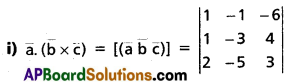
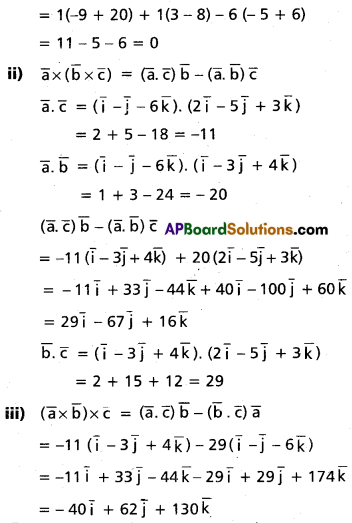
Inter 1st Year Maths 1A Products of Vectors Solutions Ex 5(c) I Q3
Inter 1st Year Maths 1A Products of Vectors Solutions Ex 5(c) I Q3.1

Question 4.
Simplify the following.
(i) \((\bar{i}-2 \bar{j}+3 \bar{k}) \times(2 i+j-\bar{k}) \cdot(\bar{j}+\bar{k})\)
(ii) \((2 \bar{i}-3 \bar{j}+\bar{k}) \cdot(\bar{i}-\bar{j}+2 \bar{k}) \cdot(2 \bar{i}+\bar{j}+\bar{k})\)
Solution:
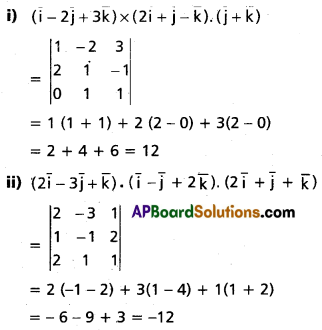
Inter 1st Year Maths 1A Products of Vectors Solutions Ex 5(c) I Q4

Question 5.
Find the volume of the parallelopiped having coterminous edges.
\(\overline{\mathbf{i}}+\overline{\mathbf{j}}+\overline{\mathbf{k}}, \overline{\mathbf{i}}-\overline{\mathbf{j}}\) and \(\overline{\mathbf{i}}+\mathbf{2} \overline{\mathbf{j}}-\overline{\mathbf{k}}\)
Solution:
Let \(\overline{\mathrm{a}}=\overline{\mathrm{i}}+\overline{\mathrm{j}}+\overline{\mathrm{k}}, \overline{\mathrm{b}}=\overline{\mathrm{i}}-\overline{\mathrm{j}}\) and \(\overline{\mathrm{c}}=\overline{\mathrm{i}}+2 \overline{\mathrm{j}}-\overline{\mathrm{k}}\)
Volume of the parallelopiped = \([(\bar{a} \bar{b} \bar{c})]\)
= \(\left|\begin{array}{ccc}
1 & 1 & 1 \\
1 & -1 & 0 \\
1 & 2 & -1
\end{array}\right|\)
= 1(1 – 0) – 1(-1 – 0) + 1(2 + 1)
= 1 + 1 + 3
= 5 cubic units.

Question 6.
Find t for which the vectors \(\mathbf{2} \overline{\mathbf{i}}-\mathbf{3} \overline{\mathbf{j}}+\overline{\mathbf{k}}\), \(\bar{i}+2 \mathbf{j}-3 \bar{k}\) and \(\bar{j}-t \bar{k}\) are coplanar.
Solution:
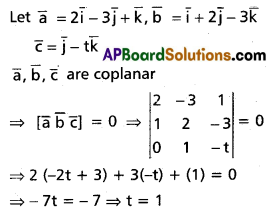
Inter 1st Year Maths 1A Products of Vectors Solutions Ex 5(c) I Q6

Inter 1st Year Maths 1A Products of Vectors Solutions Ex 5(c)

Question 7.
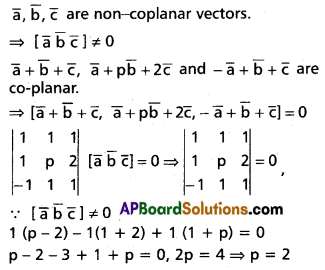
For non-coplanar vectors, \(\bar{a}\), \(\bar{b}\) and \(\bar{c}\) determine p for which the vector \(\overline{\mathbf{a}}+\overline{\mathbf{b}}+\overline{\mathbf{c}}, \overline{\mathbf{a}}+\mathbf{p} \overline{\mathbf{b}}+\mathbf{2} \overline{\mathbf{c}}\) and \(-\overline{\mathbf{a}}+\overline{\mathbf{b}}+\overline{\mathbf{c}}\) are coplanar.
Solution:
Inter 1st Year Maths 1A Products of Vectors Solutions Ex 5(c) I Q7

Question 8.
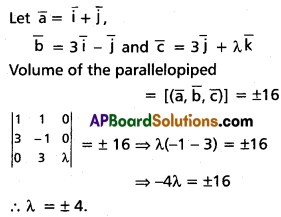
Determine λ, for which the volume of the parallelopiped having coterminous edges \(\bar{i}+\bar{j}\), \(3 \overline{\mathbf{i}}-\overline{\mathbf{j}}\) and \(3 \bar{j}+\lambda \bar{k}\) is 16 cubic units.
Solution:
Inter 1st Year Maths 1A Products of Vectors Solutions Ex 5(c) I Q8

Question 9.
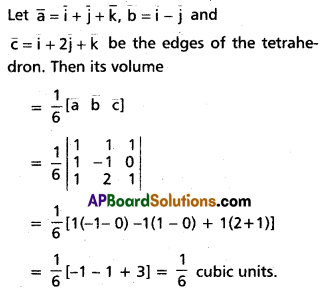
Find the volume of the tetrahedron having the edges \(\overline{\mathbf{i}}+\overline{\mathbf{j}}+\overline{\mathbf{k}}, \quad \mathbf{i}-\overline{\mathbf{j}}\) and \(\bar{i}+2 \bar{j}+\bar{k}\).
Solution:
Inter 1st Year Maths 1A Products of Vectors Solutions Ex 5(c) I Q9

Question 10.
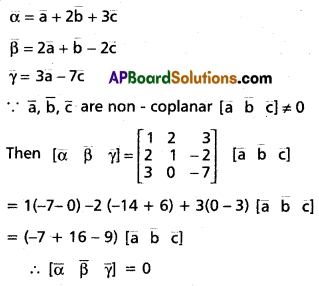
Let \(\bar{a}\), \(\bar{b}\) and \(\bar{c}\) be non-coplanar vectors and \(\bar{\alpha}=\bar{a}+2 \bar{b}+3 c, \quad \bar{\beta}=2 \bar{a}+\bar{b}-2 c\) and \(\bar{\gamma}=3 \bar{a}-7 \bar{c}\), then find \(\left[\begin{array}{lll}
\bar{\alpha} & \bar{\beta} & \bar{\gamma}
\end{array}\right]\).
Solution:
Inter 1st Year Maths 1A Products of Vectors Solutions Ex 5(c) I Q10

Question 11.
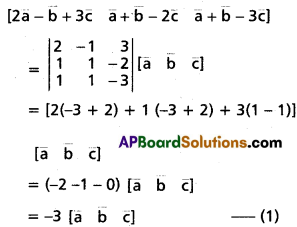
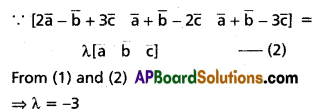
Let \(\bar{a}\), \(\bar{b}\) and \(\bar{c}\) be non-coplanar vectors. If \(|2 \bar{a}-\bar{b}+3 \bar{c}|, \bar{a}+\bar{b}-2 \bar{c},|\bar{a}+\bar{b}-3 \bar{c}|\) = \(\lambda[\overline{\mathbf{a}} \overline{\mathbf{b}} \overline{\mathbf{c}}]\), then find the value of λ.
Solution:
Inter 1st Year Maths 1A Products of Vectors Solutions Ex 5(c) I Q11
Inter 1st Year Maths 1A Products of Vectors Solutions Ex 5(c) I Q11.1

Question 12.
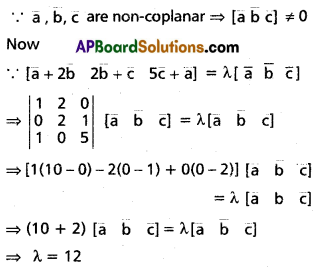
Let \(\bar{a}\), \(\bar{b}\) and \(\bar{c}\) be non-coplanar vectors, if \(\left[\begin{array}{lll}
\bar{a}+2 \bar{b} & 2 \bar{b}+\bar{c} & 5 \bar{c}+\bar{a}
\end{array}\right]\) = \(\lambda\left[\begin{array}{lll}
\bar{a} & \bar{b} & \bar{c}
\end{array}\right]\), then find λ.
Solution:
Inter 1st Year Maths 1A Products of Vectors Solutions Ex 5(c) I Q12

Inter 1st Year Maths 1A Products of Vectors Solutions Ex 5(c)

Question 13.
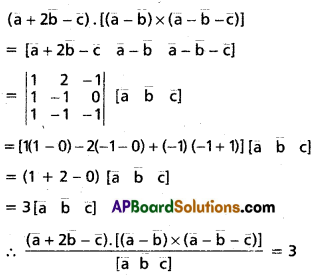
If \(\bar{a}\), \(\bar{b}\) and \(\bar{c}\) are non-coplanar vectors, then find the value of \(\frac{(\bar{a}+2 \bar{b}-\bar{c}) \cdot[(\bar{a}-\bar{b}) \times(\bar{a}-\bar{b}-\bar{c})]}{[\bar{a} \bar{b} \bar{c}]}\)
Solution:
Inter 1st Year Maths 1A Products of Vectors Solutions Ex 5(c) I Q13

Question 14.
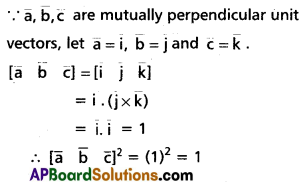
If \(\bar{a}\), \(\bar{b}\) and \(\bar{c}\) are mutually perpendicular unit vectors, then find the value of \(\left[\begin{array}{lll}
\bar{a} & \bar{b} & \bar{c}
\end{array}\right]^{2}\).
Solution:
Inter 1st Year Maths 1A Products of Vectors Solutions Ex 5(c) I Q14

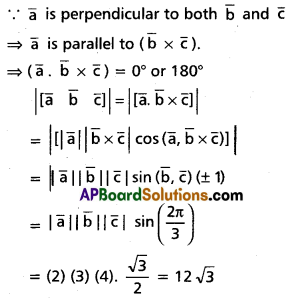
Question 15.
\(\overline{\mathbf{a}}, \overline{\mathbf{b}}, \overline{\mathbf{c}}\) are non-zero vectors and \(\overline{\mathbf{a}}\) is perpendicular to both \(\overline{\mathbf{b}}\) and \(\overline{\mathbf{c}}\). If \(|\overline{\mathbf{a}}|\) = 2, \(|\overline{\mathbf{b}}|\) = 3, \(|\overline{\mathbf{c}}|\) = 4 and \((\bar{b}, \bar{c})=\frac{2 \pi}{3}\), then find \(|[\bar{a} \bar{b} \bar{c}]|\).
Solution:
Inter 1st Year Maths 1A Products of Vectors Solutions Ex 5(c) I Q15

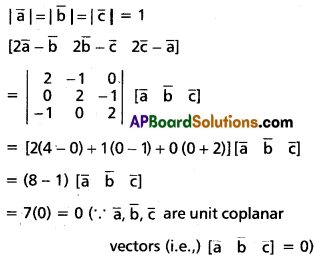
Question 16.
If \(\overline{\mathbf{a}}, \overline{\mathbf{b}}, \overline{\mathbf{c}}\) are unit coplanar vectors, then find \(\left[\begin{array}{lll}
2 \bar{a}-\bar{b} & 2 \bar{b}-\bar{c} & 2 \bar{c}-\bar{a}
\end{array}\right]\)
Solution:
Inter 1st Year Maths 1A Products of Vectors Solutions Ex 5(c) I Q16

II.

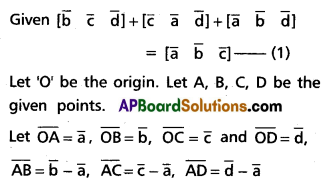
Question 1.
If \(\left[\begin{array}{lll}
\bar{b} & \bar{c} & \bar{d}
\end{array}\right]+\left[\begin{array}{lll}
\bar{c} & \bar{a} & \bar{d}
\end{array}\right]+\left[\begin{array}{lll}
\bar{a} & \bar{b} & \bar{d}
\end{array}\right]\) = \(\left[\begin{array}{lll}
\overline{\mathbf{a}} & \overline{\mathbf{b}} & \overline{\mathbf{c}}
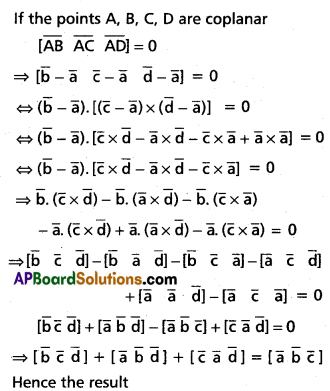
\end{array}\right]\) then show that the points with position vectors \(\overline{\mathbf{a}}, \overline{\mathbf{b}}, \overline{\mathbf{c}}\) and \(\bar{d}\) are coplanar.
Solution:
Inter 1st Year Maths 1A Products of Vectors Solutions Ex 5(c) II Q1
Inter 1st Year Maths 1A Products of Vectors Solutions Ex 5(c) II Q1.1

Inter 1st Year Maths 1A Products of Vectors Solutions Ex 5(c)

Question 2.
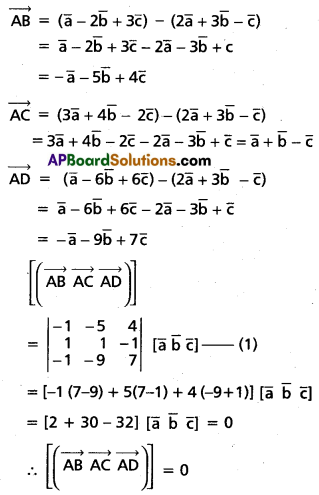
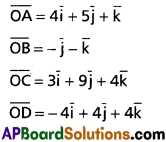
If \(\overline{\mathbf{a}}, \overline{\mathbf{b}}\) and \(\overline{\mathbf{c}}\) non-coplanar vectors, then prove that the four points with position vectors \(2 \bar{a}+3 \bar{b}-\bar{c}\), \(\overline{\mathrm{a}}-2 \overline{\mathrm{b}}+3 \overline{\mathrm{c}}, 3 \overline{\mathrm{a}}+4 \overline{\mathrm{b}}-2 \overline{\mathrm{c}}\) and \(\bar{a}-6 \bar{b}+6 \bar{c}\) are coplanar.
Solution:
Suppose A, B, C, D are the given points.
Inter 1st Year Maths 1A Products of Vectors Solutions Ex 5(c) II Q2
The vectors \(\overrightarrow{\mathrm{AB}}, \overrightarrow{\mathrm{AC}}, \overrightarrow{\mathrm{AD}}\) are coplanar.
The given points A, B, C, D are coplanar.

Question 3.
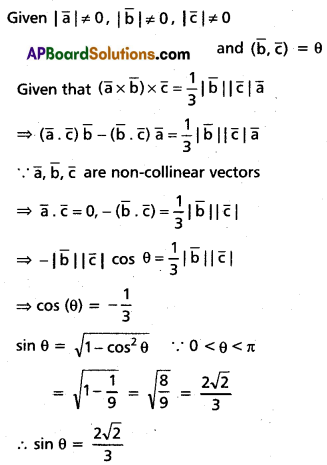
\(\overline{\mathbf{a}}, \overline{\mathbf{b}}\) and \(\overline{\mathbf{c}}\) are non-zero and non- collinear vectors and θ ≠ 0, is the angle between \(\overline{\mathbf{b}}\) and \(\overline{\mathbf{c}}\). If \((\overline{\mathbf{a}} \times \overline{\mathbf{b}}) \times \overline{\mathbf{c}}\) = \(\frac{1}{3}|\bar{b}||\bar{c}|\bar{a}|\), then find sin θ.
Solution:
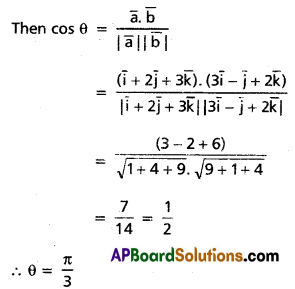
Inter 1st Year Maths 1A Products of Vectors Solutions Ex 5(c) II Q3

Question 4.
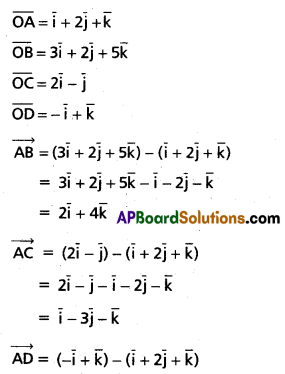
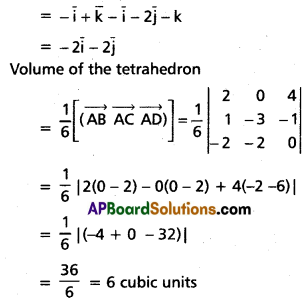
Find the volume of the tetrahedron whose vertices are (1, 2, 1), (3, 2, 5), (2, -1, 0) and (-1, 0, 1).
Solution:
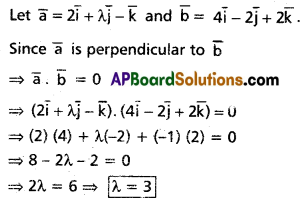
Let ‘O’ be the given A, B, C, D be the vertices of the ten tetrahedrons. Then
Inter 1st Year Maths 1A Products of Vectors Solutions Ex 5(c) II Q4
Inter 1st Year Maths 1A Products of Vectors Solutions Ex 5(c) II Q4.1

Question 5.
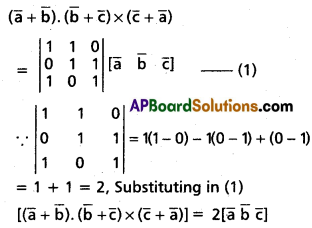
Show that \((\bar{a}+\bar{b}) \cdot(\bar{b}+\bar{c}) \times(\bar{c}+\bar{a})\) = \(2\left[\begin{array}{lll}
\bar{a} & \bar{b} & \bar{c}
\end{array}\right]\)
Solution:
Inter 1st Year Maths 1A Products of Vectors Solutions Ex 5(c) II Q5

Question 6.
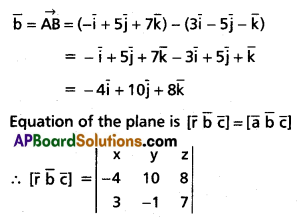
Show that equation of the plane passing through the points with position vectors. \(3 \bar{i}-5 \bar{j}-\overline{\mathbf{k}},-\overline{\mathbf{i}}+5 \bar{j}+7 \overline{\mathbf{k}}\) and parallel to the vector \(3 \overline{\mathbf{i}}-\overline{\mathbf{j}}+7 \overline{\mathbf{k}}\) is 3x + 2y – z = 0.
Solution:
The given plane passes through the points A, B (i.e.,) \(3 \bar{i}-5 \bar{j}-\overline{\mathbf{k}},-\overline{\mathbf{i}}+5 \bar{j}+7 \overline{\mathbf{k}}\) and parallel to the vector \(3 \overline{\mathbf{i}}-\overline{\mathbf{j}}+7 \overline{\mathbf{k}}\)
Inter 1st Year Maths 1A Products of Vectors Solutions Ex 5(c) II Q6
= x(70 + 8) – y(-28 – 24) + z(4 – 30)
= 78x + 52y – 26z
= 26(3x + 2y – z)
\(\left[\begin{array}{lll}
\bar{a} & \bar{b} & \bar{c}
\end{array}\right]\) = \(\left|\begin{array}{rrr}
3 & -5 & -1 \\
-4 & 10 & 8 \\
3 & -1 & 7
\end{array}\right|\)
= 3(70 + 8) + 5(-28 – 24) – 1(4 – 30)
= 234 – 260 + 26
= 0
Equation of the required plane is 26(3x + 2y – z) = 0
i.e., 3x + 2y – z = 0

Inter 1st Year Maths 1A Products of Vectors Solutions Ex 5(c)

Question 7.
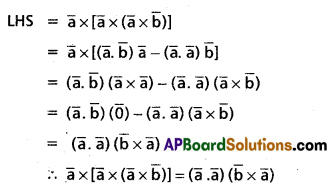
Prove that \(\overline{\mathbf{a}} \times[\overline{\mathbf{a}} \times(\overline{\mathbf{a}} \times \overline{\mathbf{b}})]\) = \((\overline{\mathbf{a}} \cdot \overline{\mathbf{a}})(\overline{\mathbf{b}} \times \overline{\mathbf{a}})\)
Solution:
Inter 1st Year Maths 1A Products of Vectors Solutions Ex 5(c) II Q7

Question 8.
If \(\overline{\mathbf{a}}, \overline{\mathbf{b}}, \overline{\mathbf{c}}\) and \(\bar{d}\) are coplanar vectors, then show that \((\bar{a} \times \bar{b}) \times(\bar{c} \times \bar{d})=0\).
Solution:
\(\overline{\mathbf{a}}, \overline{\mathbf{b}}, \overline{\mathbf{c}}\) and \(\bar{d}\) are coplanar
⇒ \(\overline{\mathbf{a}} \times \overline{\mathbf{b}}\) is perpendicular to the plane π.
similarly \(\bar{c} \times \bar{d}\) is perpendicular to the plane π.
\(\bar{a} \times \bar{b}\) and \(\bar{c} \times \bar{d}\) are parallel vectors.
⇒ \((\bar{a} \times \bar{b}) \times(\bar{c} \times \bar{d})\) = 0.

Question 9.
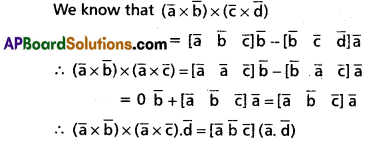
Show that \((\overline{\mathrm{a}} \times \overline{\mathrm{b}}) \times(\overline{\mathrm{a}} \times \overline{\mathrm{c}}) \cdot \overline{\mathrm{d}}=[\overline{\mathrm{a}} \overline{\mathrm{b}} \overline{\mathrm{c}}](\overline{\mathrm{a}} \cdot \overline{\mathrm{d}})\).
Solution:
Inter 1st Year Maths 1A Products of Vectors Solutions Ex 5(c) II Q9

Question 10.
Show that \(\bar{a} \cdot[(\bar{b}+\bar{c}) \times(\bar{a}+\bar{b}+\bar{c})]=0\)
Solution:
Inter 1st Year Maths 1A Products of Vectors Solutions Ex 5(c) II Q10

Question 11.
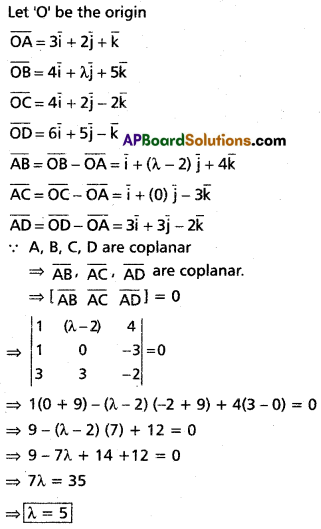
Find λ in order that the four points A(3, 2, 1), B(4, λ, 5), C(4, 2, -2) and D(6, 5, -1) be coplanar.
Solution:
Inter 1st Year Maths 1A Products of Vectors Solutions Ex 5(c) II Q11

Question 12.
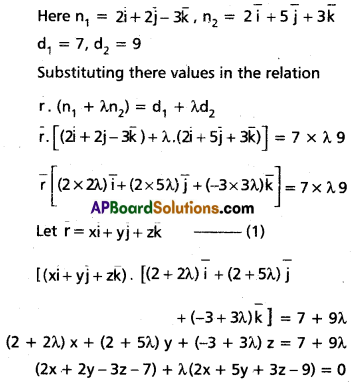
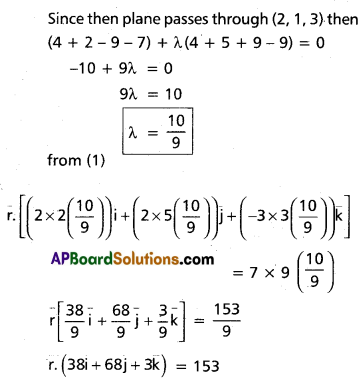
Find the vector equation of the plane passing through the intersection of planes \(\bar{r} \cdot(2 \bar{i}+2 \bar{j}-3 \bar{k})=7, \bar{r} \cdot(2 \bar{i}+5 \bar{j}+3 \bar{k})=9\) and through the point (2, 1, 3)
Solution:
Inter 1st Year Maths 1A Products of Vectors Solutions Ex 5(c) II Q12
Inter 1st Year Maths 1A Products of Vectors Solutions Ex 5(c) II Q12.1

Question 13.
Find the equation of the plane passing through (a, b, c) and parallel to the plane \(\bar{r} \cdot(\bar{i}+\bar{i}+\bar{k})=2\).
Solution:
Given equation plane is \(\bar{r} \cdot(\bar{i}+\bar{i}+\bar{k})=2\)
Let \(\bar{r}=x \bar{i}+y \bar{j}+z \bar{k}\)
∴ \(\bar{r} \cdot(\bar{i}+\bar{i}+\bar{k})=2\)
\((x \bar{i}+y \bar{j}+z \bar{k}) \cdot(i+j+k)=2\)
x + y + z = 2
Required plane equation is x + y + z = k …….(1)
Equation (1) passes through (a, b, c)
∴ a + b + c = k
Substitute ‘k’ in equation (1)
∴ x + y + z = a + b + c

Inter 1st Year Maths 1A Products of Vectors Solutions Ex 5(c)

Question 14.
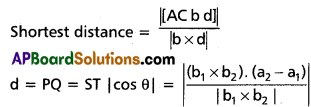
Find the shortest distance between the lines \(\bar{r}=6 \bar{i}+2 \bar{j}+2 \bar{k}+\lambda, \bar{i}-2 \bar{j}+2 \bar{k}\) and \(\bar{r}=-4 \bar{j}-\bar{k}+\mu=3 \bar{j}-2 \bar{j}-2 \bar{k}\).
Solution:
The first line passes through point A(6, 2, 2) and is parallel to the vector b = i – 2j + 2k.
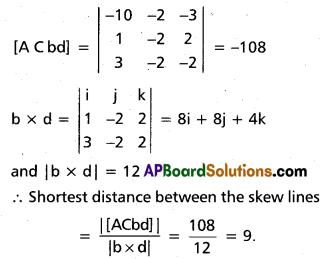
Second line passes through the point C(-4, 0, -1) and is parallel to the vector d = 3i – 2j – 2k
Inter 1st Year Maths 1A Products of Vectors Solutions Ex 5(c) II Q14
Inter 1st Year Maths 1A Products of Vectors Solutions Ex 5(c) II Q14.1

Question 15.
Find the equation of the plane passing through the line of intersection of the planes \(\bar{r} \cdot(\bar{i}+\bar{j}+\bar{k})=1\) and \(\bar{r} \cdot(2 \bar{i}+3 \bar{i}-\bar{k})+4=0\) and parallel to X-axis.
Solution:
Given the equation of planes are
Inter 1st Year Maths 1A Products of Vectors Solutions Ex 5(c) II Q15
Since it is parallel to X-axis.

Question 16.
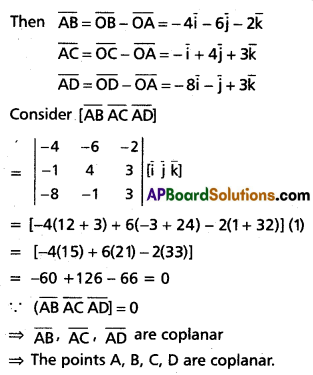
Prove that the four points \(4 \bar{i}+5 \bar{j}+\bar{k}\), \(-(\overline{\mathbf{j}}+\overline{\mathbf{k}}), 3 \overline{\mathbf{i}}+9 \overline{\mathbf{j}}+4 \overline{\mathbf{k}}\) and \(-4 \bar{i}+4 \bar{j}+4 \bar{k}\) are coplanar.
Solution:
Let ‘O’ be the origin. A, B, C, D be the given points. Then
Inter 1st Year Maths 1A Products of Vectors Solutions Ex 5(c) II Q16
Inter 1st Year Maths 1A Products of Vectors Solutions Ex 5(c) II Q16.1

Question 17.
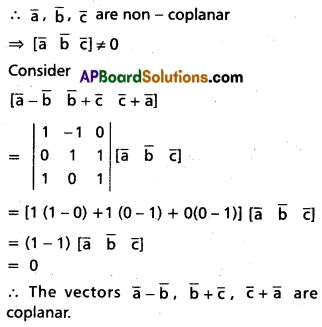
If \(\bar{a}, \bar{b}, \bar{c}\) are non – copianar, then show that the vectors \(\overline{\mathbf{a}}-\overline{\mathbf{b}}, \overline{\mathbf{b}}+\overline{\mathbf{c}}\), \(\overline{\mathbf{c}}+\overline{\mathbf{a}}\) are coplanar.
Solution:
Inter 1st Year Maths 1A Products of Vectors Solutions Ex 5(c) II Q17

Inter 1st Year Maths 1A Products of Vectors Solutions Ex 5(c)

Question 18.
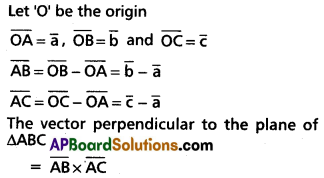
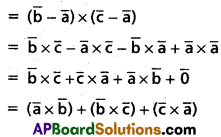
If \(\overline{\mathbf{a}}, \overline{\mathbf{b}}, \overline{\mathbf{c}}\) are the position vectors of the points A, B and C respectively, then prove that the vector \(\overline{\mathbf{a}} \times \overline{\mathbf{b}}+\overline{\mathbf{b}} \times \overline{\mathbf{c}}+\overline{\mathbf{c}} \times \overline{\mathbf{a}}\) is perpendicular to the plane of ∆ABC.
Solution:
Inter 1st Year Maths 1A Products of Vectors Solutions Ex 5(c) II Q18
Inter 1st Year Maths 1A Products of Vectors Solutions Ex 5(c) II Q18.1

III.

Question 1.
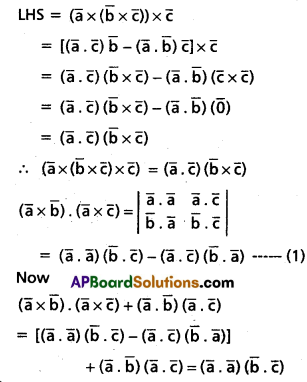
Show that \((\bar{a} \times(\bar{b} \times \bar{c}) \times \bar{c})=(\bar{a} \cdot \bar{c})(\bar{b} \times \bar{c})\) and \((\overline{\mathbf{a}} \times \overline{\mathbf{b}}) \cdot(\overline{\mathbf{a}} \times \overline{\mathbf{c}})+(\overline{\mathbf{a}} \cdot \overline{\mathbf{b}})(\overline{\mathbf{a}} \cdot \overline{\mathbf{c}})\) = \((\overline{\mathbf{a}} \cdot \overline{\mathbf{a}})(\overline{\mathbf{b}} \cdot \overline{\mathbf{c}})\)
Solution:
Inter 1st Year Maths 1A Products of Vectors Solutions Ex 5(c) III Q1

Question 2.
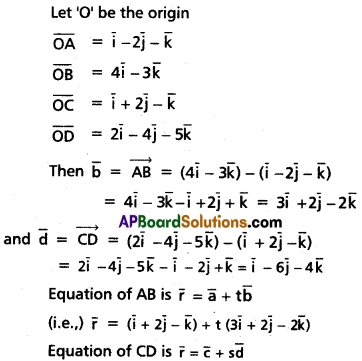
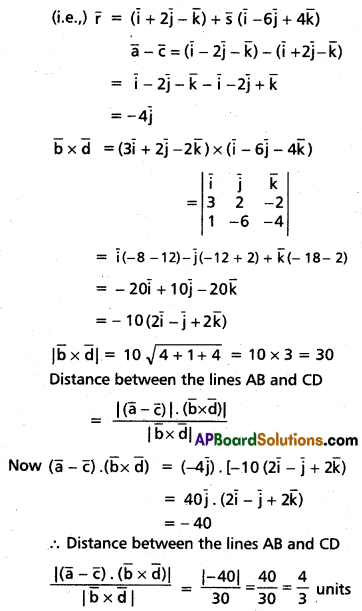
If A = (1, -2, -1), B = (4, 0, -3), C = (1, 2, -1) and D = (2, -4, -5), find the distance between AB and CD.
Solution:
Inter 1st Year Maths 1A Products of Vectors Solutions Ex 5(c) III Q2
Inter 1st Year Maths 1A Products of Vectors Solutions Ex 5(c) III Q2.1

Question 3.
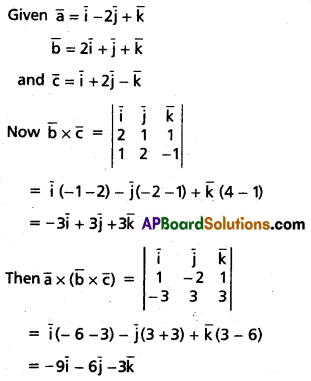
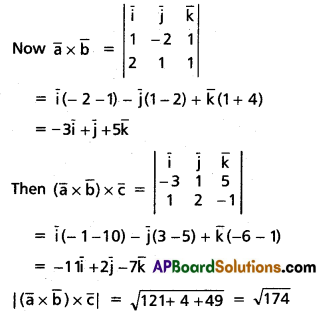
If \(\overline{\mathbf{a}}=\overline{\mathbf{i}}-2 \overline{\mathbf{j}}+\overline{\mathbf{k}}, \overline{\mathbf{b}}=2 \overline{\mathbf{i}}+\overline{\mathbf{j}}+\overline{\mathbf{k}}\) and \(\overline{\mathbf{c}}=\overline{\mathbf{i}}+2 \overline{\mathbf{j}}-\overline{\mathbf{k}}\), find \(\bar{a} \times(\bar{b} \times \bar{c})\) and \(|(\overline{\mathbf{a}} \times \overline{\mathbf{b}}) \times \overline{\mathbf{c}}|\).
Solution:
Inter 1st Year Maths 1A Products of Vectors Solutions Ex 5(c) III Q3
Inter 1st Year Maths 1A Products of Vectors Solutions Ex 5(c) III Q3.1

Inter 1st Year Maths 1A Products of Vectors Solutions Ex 5(c)

Question 4.
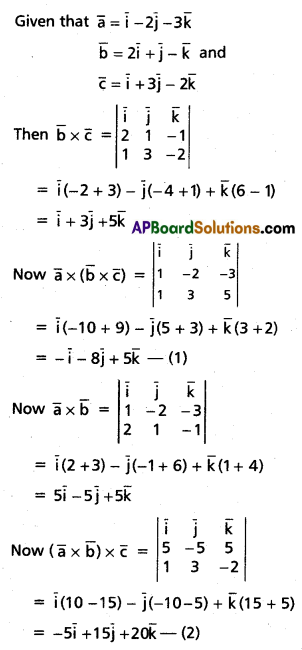
If \(\overline{\mathbf{a}}=\overline{\mathbf{i}}-2 \overline{\mathbf{j}}-3 \overline{\mathbf{k}}, \overline{\mathbf{b}}=2 \overline{\mathbf{i}}+\overline{\mathbf{j}}-\overline{\mathbf{k}}\) and \(\bar{c}=\bar{i}+3 \bar{j}-2 \bar{k}\), verift that \(\overline{\mathbf{a}} \times(\overline{\mathbf{b}} \times \overline{\mathbf{c}}) \neq(\overline{\mathbf{a}} \times \overline{\mathbf{b}}) \times \overline{\mathbf{c}}\)
Solution:
Inter 1st Year Maths 1A Products of Vectors Solutions Ex 5(c) III Q4
From (1) and (2), we get
\(\overline{\mathbf{a}} \times(\overline{\mathbf{b}} \times \overline{\mathbf{c}}) \neq(\overline{\mathbf{a}} \times \overline{\mathbf{b}}) \times \overline{\mathbf{c}}\)
i.e., vector multiplication is not associative.

Question 5.
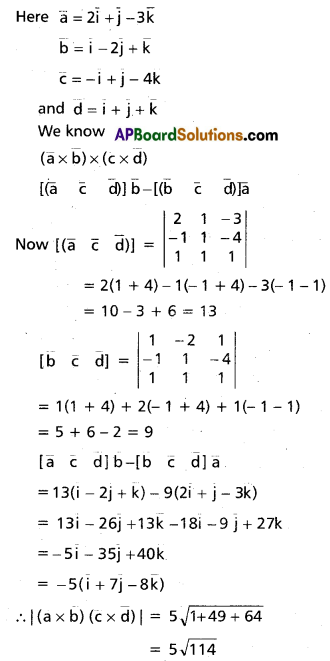
If \(\overline{\mathbf{a}}=2 \overline{\mathbf{i}}+\overline{\mathbf{j}}-3 \overline{\mathbf{k}}, \overline{\mathbf{b}}=\overline{\mathbf{i}}-\mathbf{2} \mathbf{j}+\overline{\mathbf{k}}\), \(\bar{c}=-\bar{i}+\bar{j}-4 \bar{k}\) and \(\overline{\mathbf{d}}=\overline{\mathbf{i}}+\overline{\mathbf{j}}+\overline{\mathbf{k}}\), then compute \(|(\overline{\mathrm{a}} \times \overline{\mathrm{b}}) \times(\overline{\mathrm{c}} \times \overline{\mathrm{d}})|\)
Solution:
Inter 1st Year Maths 1A Products of Vectors Solutions Ex 5(c) III Q5

Question 6.
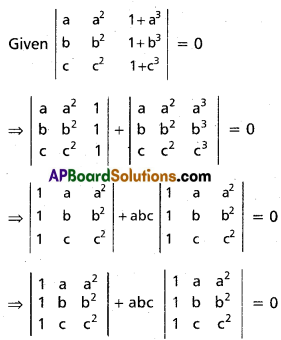
If A = (1, a, a2), B = (1, b, b2) and C = (1, c, c2) are non-coplanar vectors and \(\left|\begin{array}{lll}
a & a^{2} & 1+a^{3} \\
b & b^{2} & 1+b^{3} \\
c & c^{2} & 1+c^{3}
\end{array}\right|\) = 0, then show that abc + 1 = 0
Solution:
\(\bar{A}, \bar{B}, \bar{C}\) are non-coplanar vectors.
∆ = \(\left|\begin{array}{lll}
1 & a & a^{2} \\
1 & b & b^{2} \\
1 & c & c^{2}
\end{array}\right|\) ≠ 0 ………..(1)
Inter 1st Year Maths 1A Products of Vectors Solutions Ex 5(c) III Q6
∆ + (abc) ∆ = 0; ∆(1 + abc) = 0
∆ ≠ 0 ⇒ 1 + abc = 0

Inter 1st Year Maths 1A Products of Vectors Solutions Ex 5(c)

Question 7.
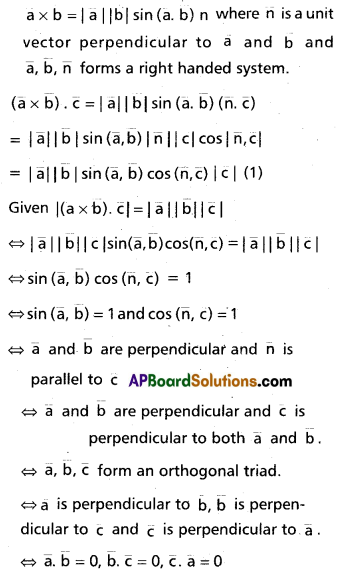
If \(\overline{\mathbf{a}}, \overline{\mathbf{b}}, \overline{\mathbf{c}}\) are non-zero vectors, then \(|(\overline{\mathbf{a}} \times \mathbf{b} \cdot \overline{\mathbf{c}})|=|\overline{\mathbf{a}}||\mathbf{b}||\overline{\mathbf{c}}|\) \(\Leftrightarrow \overline{\mathbf{a}} \cdot \overline{\mathbf{b}}=\overline{\mathbf{b}} \cdot \overline{\mathbf{c}}=\overline{\mathbf{c}} \cdot \overline{\mathbf{a}}=\mathbf{0}\)
Solution:
Inter 1st Year Maths 1A Products of Vectors Solutions Ex 5(c) III Q7

Question 8.
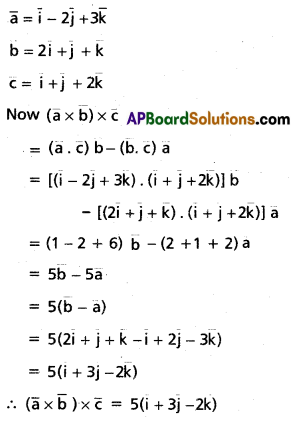
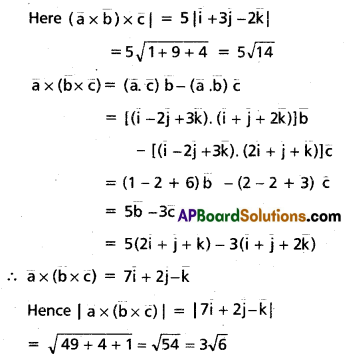
If \(\overline{\mathbf{a}}=\overline{\mathbf{i}}-\mathbf{2} \overline{\mathbf{j}}+3 \overline{\mathbf{k}}, \quad \mathbf{b}=2 \overline{\mathbf{i}}+\overline{\mathbf{j}}+\overline{\mathbf{k}}\), \(\bar{c}=\overline{\mathbf{i}}+\overline{\mathbf{j}}+2 \overline{\mathbf{k}}\) then find \(|(\bar{a} \times \bar{b}) \times \bar{c}|\) and \(|\overline{\mathbf{a}} \times(\mathbf{b} \times \mathbf{c})|\).
Solution:
Inter 1st Year Maths 1A Products of Vectors Solutions Ex 5(c) III Q8
Inter 1st Year Maths 1A Products of Vectors Solutions Ex 5(c) III Q8.1

Question 9.
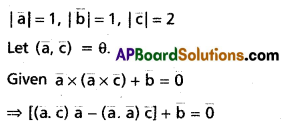
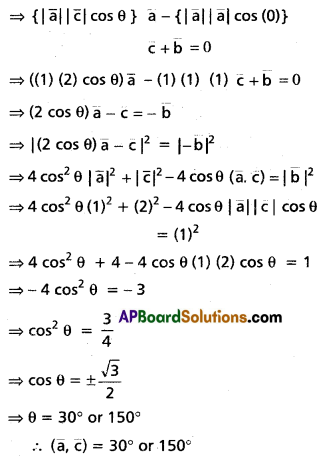
If \(|\bar{a}|=1,|\bar{b}|=1,|\bar{c}|=2\) and \(\bar{a} \times(a \times \bar{c})+\bar{b}=0\) then find the angle between \(\bar{a}\) and \(\bar{c}\).
Solution:
Inter 1st Year Maths 1A Products of Vectors Solutions Ex 5(c) III Q9
Inter 1st Year Maths 1A Products of Vectors Solutions Ex 5(c) III Q9.1

Question 10.
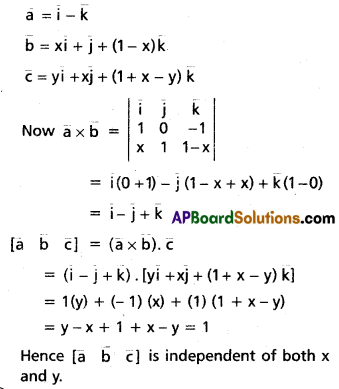
Let \(\overline{\mathbf{a}}=\overline{\mathbf{i}}-\overline{\mathbf{k}}, \quad \overline{\mathbf{b}}=\mathbf{x} \overline{\mathbf{i}}+\overline{\mathbf{j}}+(\mathbf{1}-\mathbf{x}) \overline{\mathbf{k}}\) and \(\bar{c}=y \bar{i}+x \bar{j}+(1+x-y) \bar{k}\), prove that the scalar triple product \(\left[\begin{array}{lll}
\bar{a} & \bar{b} & \bar{c}
\end{array}\right]\) is independent of both x and y.
Solution:
Inter 1st Year Maths 1A Products of Vectors Solutions Ex 5(c) III Q10

Question 11.
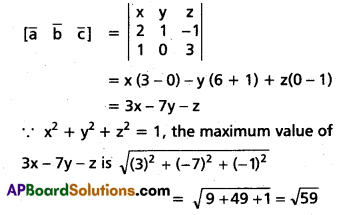
Let \(\overline{\mathbf{b}}=\mathbf{2} \overline{\mathbf{i}}+\overline{\mathbf{j}}-\overline{\mathbf{k}}, \overline{\mathbf{c}}=\overline{\mathbf{i}}+\mathbf{3} \overline{\mathbf{k}}\). If \(\overline{\mathrm{a}}\) is a unit vector then find the maximum value of \(\left[\begin{array}{lll}
\overline{\mathbf{a}} & \overline{\mathbf{b}} & \bar{c}
\end{array}\right]\).
Solution:
Let \(\bar{a}=x \bar{i}+y \bar{j}+z \bar{k}\) and x2 + y2 + z2 = 1
∵ \(\overline{\mathrm{a}}\) unit vector
Inter 1st Year Maths 1A Products of Vectors Solutions Ex 5(c) III Q11

Inter 1st Year Maths 1A Products of Vectors Solutions Ex 5(c)

Question 12.
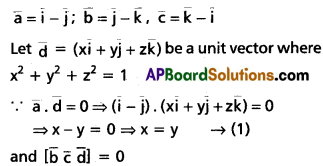
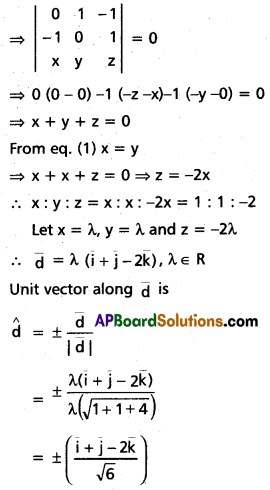
Let \(\overline{\mathrm{a}}=\overline{\mathrm{i}}-\overline{\mathrm{i}}, \overline{\mathrm{b}}=\overline{\mathrm{i}}-\overline{\mathrm{k}}, \overline{\mathrm{c}}=\overline{\mathrm{k}}-\overline{\mathrm{i}}\) Find unit vector \(\bar{d}\) such that \(\overline{\mathrm{a}} \cdot \overline{\mathrm{d}}=0=[\bar{b} \overline{\mathrm{c}} \overline{\mathrm{d}}]\)
Solution:
Inter 1st Year Maths 1A Products of Vectors Solutions Ex 5(c) III Q12
Inter 1st Year Maths 1A Products of Vectors Solutions Ex 5(c) III Q12.1

Inter 1st Year Maths 1A Products of Vectors Solutions Ex 5(b)

Practicing the Intermediate 1st Year Maths 1A Textbook Solutions Inter 1st Year Maths 1A Products of Vectors Solutions Exercise 5(b) will help students to clear their doubts quickly.

Intermediate 1st Year Maths 1A Products of Vectors Solutions Exercise 5(b)

I.

Question 1.
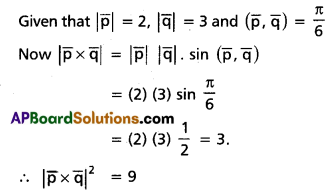
If \(|\overline{\mathbf{p}}|=2,|\overline{\mathbf{q}}|=3\) and \((\bar{p}, \bar{q})=\frac{\pi}{6}\), then find \(|\bar{p} \times \bar{q}|^{2}\).
Solution:
Inter 1st Year Maths 1A Products of Vectors Solutions Ex 5(b) I Q1

Question 2.
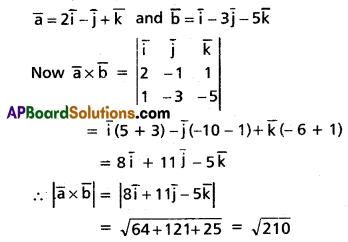
If \(\overline{\mathbf{a}}=2 \overline{\mathbf{i}}-\overline{\mathbf{j}}+\overline{\mathbf{k}}\) and \(\overline{\mathbf{b}}=\overline{\mathbf{i}}-3 \overline{\mathbf{j}}-5 \overline{\mathbf{k}}\), then find \(|\overline{\mathbf{a}} \times \overline{\mathbf{b}}|\).
Solution:
Inter 1st Year Maths 1A Products of Vectors Solutions Ex 5(b) I Q2

Inter 1st Year Maths 1A Products of Vectors Solutions Ex 5(b)

Question 3.
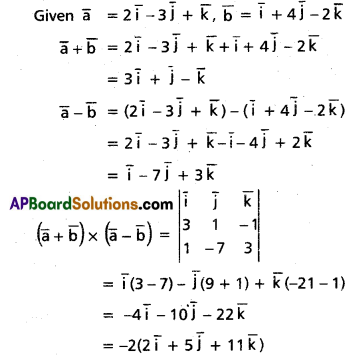
If \(\bar{a}=2 \bar{i}-3 \bar{j}+\overline{\mathbf{k}}\) and \(\bar{b}=\bar{i}+4 \bar{j}-2 \bar{k}\), then find \((\overline{\mathbf{a}}+\overline{\mathbf{b}}) \times(\overline{\mathbf{a}}-\overline{\mathbf{b}})\).
Solution:
Inter 1st Year Maths 1A Products of Vectors Solutions Ex 5(b) I Q3

Question 4.
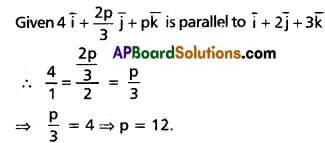
If \(4 \bar{i}+\frac{2 p}{3} \bar{j}+p \bar{k}\) is parallel to the vector \(\overline{\mathbf{i}}+2 \overline{\mathbf{j}}+3 \overline{\mathbf{k}}\), find p.
Solution:
Inter 1st Year Maths 1A Products of Vectors Solutions Ex 5(b) I Q4

Question 5.
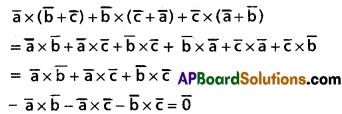
Compute \(\overline{\mathbf{a}} \times(\overline{\mathbf{b}}+\overline{\mathbf{c}})+\overline{\mathbf{b}} \times(\overline{\mathbf{c}}+\overline{\mathbf{a}})+\overline{\mathbf{c}} \times(\overline{\mathbf{a}}+\overline{\mathbf{b}})\)
Solution:
Inter 1st Year Maths 1A Products of Vectors Solutions Ex 5(b) I Q5

Question 6.
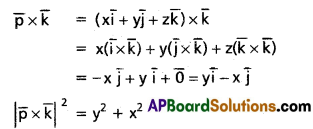
If \(\overline{\mathbf{p}}=\mathbf{x} \overline{\mathbf{i}}+\mathbf{y} \overline{\mathbf{j}}+\mathbf{z} \overline{\mathbf{k}}\), find the value of \(|\overline{\boldsymbol{p}} \times \overline{\mathbf{k}}|^{2}\)
Solution:
Inter 1st Year Maths 1A Products of Vectors Solutions Ex 5(b) I Q6

Question 7.
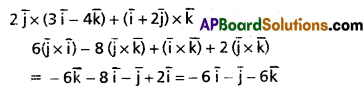
Compute \(2 \bar{j} \times(3 \bar{i}-4 \bar{k})+(\bar{i}+2 \hat{j}) \times \bar{k}\).
Solution:
Inter 1st Year Maths 1A Products of Vectors Solutions Ex 5(b) I Q7

Inter 1st Year Maths 1A Products of Vectors Solutions Ex 5(b)

Question 8.
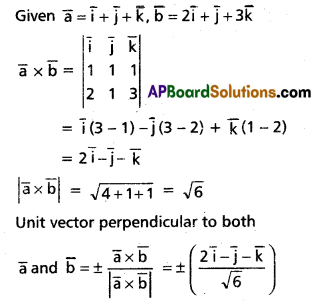
Find a unit vector perpendicular to both \(\overline{\mathbf{i}}+\overline{\mathbf{j}}+\overline{\mathbf{k}}\) and \(2 \bar{i}+\bar{j}+3 \bar{k}\).
Solution:
Inter 1st Year Maths 1A Products of Vectors Solutions Ex 5(b) I Q8

Question 9.
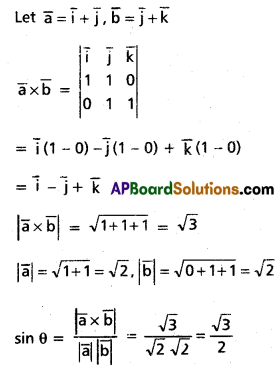
If θ is the angle between the vectors \(\overline{\mathbf{i}}+\overline{\mathbf{j}}\) and \(\overline{\mathbf{j}}+\overline{\mathbf{k}}\), then find sin ?.
Solution:
Inter 1st Year Maths 1A Products of Vectors Solutions Ex 5(b) I Q9

Question 10.
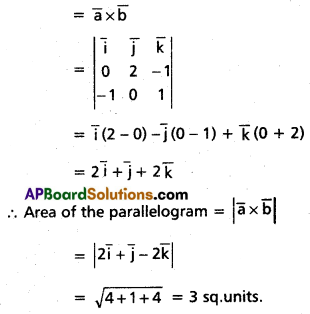
Find the area of the parallelogram having \(\bar{a}=2 \bar{j}-\bar{k}\) and \(\overline{\mathbf{b}}=-\overline{\mathbf{i}}+\overline{\mathbf{k}}\) as adjacent sides.
Solution:
Vector area of the parallelogram having \(\bar{a}=2 \bar{j}-\bar{k}\) and \(\overline{\mathbf{b}}=-\overline{\mathbf{i}}+\overline{\mathbf{k}}\) as adjacent sides.
Inter 1st Year Maths 1A Products of Vectors Solutions Ex 5(b) I Q10

Question 11.
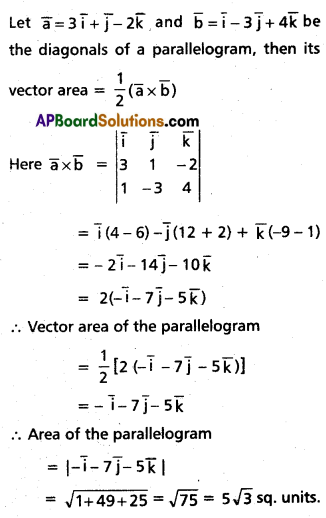
Find the area of the parallelogram, whose diagonals are \(3 \overline{\mathbf{i}}+\overline{\mathbf{j}}-2 \overline{\mathbf{k}}\) and \(\bar{i}-3 \bar{j}+4 \bar{k}\).
Solution:
Inter 1st Year Maths 1A Products of Vectors Solutions Ex 5(b) I Q11

Question 12.
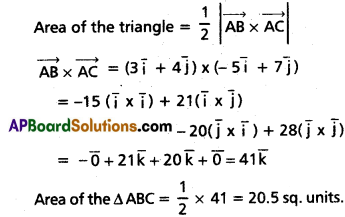
Find the area of the triangle having \(3 \bar{i}+4 \bar{j}\) and \(-5 \bar{i}+7 \bar{j}\) as two of its sides.
Solution:
Inter 1st Year Maths 1A Products of Vectors Solutions Ex 5(b) I Q12

Inter 1st Year Maths 1A Products of Vectors Solutions Ex 5(b)

Question 13.
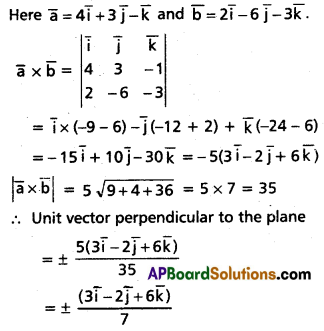
Find unit vector perpendicular to the plane determined by the vectors \(\bar{a}=4 \bar{i}+3 \bar{j}-\bar{k}\) and \(\overline{\mathbf{b}}=2 \tilde{i}-6 \overline{\mathbf{j}}-3 \overline{\mathbf{k}}\).
Solution:
Inter 1st Year Maths 1A Products of Vectors Solutions Ex 5(b) I Q13

Question 14.
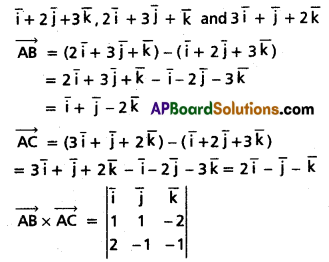
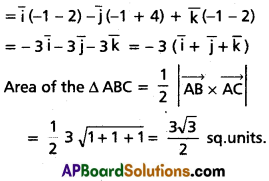
Find the area of the triangle whose vertices are A(1, 2, 3), B(2, 3, 1) and C(3, 1, 2).
Solution:
Suppose \(\bar{i}, \bar{j}, \bar{k}\) are unit vectors along the co-ordinate axes.
Position vectors of A, B, C are
Inter 1st Year Maths 1A Products of Vectors Solutions Ex 5(b) I Q14
Inter 1st Year Maths 1A Products of Vectors Solutions Ex 5(b) I Q14.1

II.

Question 1.
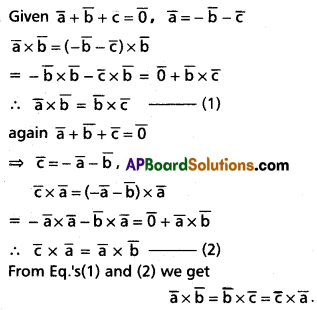
If \(\overline{\mathbf{a}}+\overline{\mathbf{b}}+\overline{\mathbf{c}}=\overline{\mathbf{0}}\), then prove that \(\overline{\mathbf{a}} \times \overline{\mathbf{b}}=\overline{\mathbf{b}} \times \overline{\mathbf{c}}=\overline{\mathbf{c}} \times \overline{\mathbf{a}}\).
Solution:
Inter 1st Year Maths 1A Products of Vectors Solutions Ex 5(b) II Q1

Question 2.
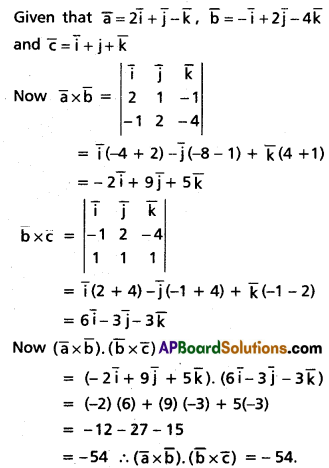
If \(\overline{\mathbf{a}}=2 \bar{i}+\bar{j}-\bar{k}, \quad \bar{b}=-\bar{i}+2 \bar{j}-4 \bar{k}\) and \(\overline{\mathbf{c}}=\overline{\mathbf{i}}+\mathbf{j}+\overline{\mathbf{k}}\), then find \((\bar{a} \times \bar{b}) \cdot(\bar{b} \times \bar{c})\).
Solution:
Inter 1st Year Maths 1A Products of Vectors Solutions Ex 5(b) II Q2

Question 3.
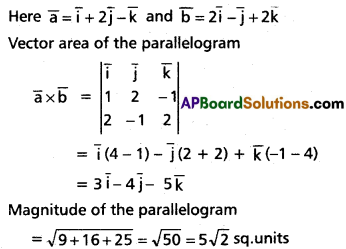
Find the vector area and the area of the parallelogram having \(\overline{\mathbf{a}}=\overline{\mathbf{i}}+2 \overline{\mathbf{j}}-\overline{\mathbf{k}}\) and \(\overline{\mathbf{b}}=2 \overline{\mathbf{i}}-\overline{\mathbf{j}}+\mathbf{2} \overline{\mathbf{k}}\) as adjacent sides.
Solution:
Inter 1st Year Maths 1A Products of Vectors Solutions Ex 5(b) II Q3

Question 4.
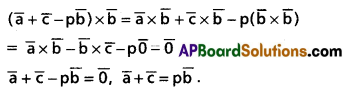
If \(\overline{\mathbf{a}} \times \overline{\mathbf{b}}=\overline{\mathbf{b}} \times \overline{\mathbf{c}} \neq \overline{\mathbf{0}}\), show that, \(\overline{\mathbf{a}}+\overline{\mathbf{c}}=\mathbf{p} \overline{\mathbf{b}}\), where p is some scalar.
Solution:
Inter 1st Year Maths 1A Products of Vectors Solutions Ex 5(b) II Q4

Inter 1st Year Maths 1A Products of Vectors Solutions Ex 5(b)

Question 5.
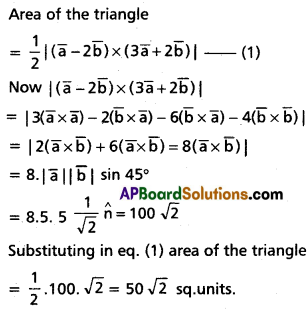
Let \(\overline{\mathbf{a}}\) and \(\overline{\mathbf{b}}\) be vectors, satisfying \(|\overline{\mathbf{a}}|=|\overline{\mathbf{b}}|=5\) and \((\bar{a}, \bar{b})=45^{\circ}\). Find the area of the triangle having \(\overline{\mathbf{a}}-\mathbf{2} \overline{\mathbf{b}}\) and \(3 \bar{a}+2 \bar{b}\) as two of its sides.
Solution:
Inter 1st Year Maths 1A Products of Vectors Solutions Ex 5(b) II Q5

Question 6.
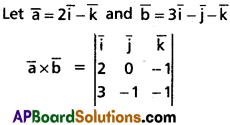
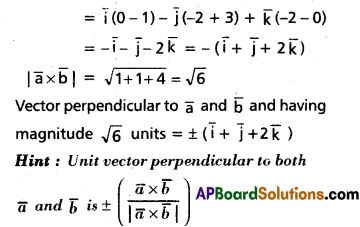
Find the vector having magnitude ?6 units and perpendicular to both \(\mathbf{2} \overline{\mathbf{i}}-\overline{\mathbf{k}}\) and \(\mathbf{3} \overline{\mathbf{i}}-\overline{\mathbf{j}}-\overline{\mathbf{k}}\).
Solution:
Inter 1st Year Maths 1A Products of Vectors Solutions Ex 5(b) II Q6
Inter 1st Year Maths 1A Products of Vectors Solutions Ex 5(b) II Q6.1

Question 7.
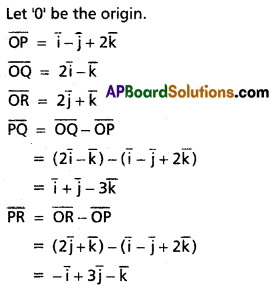
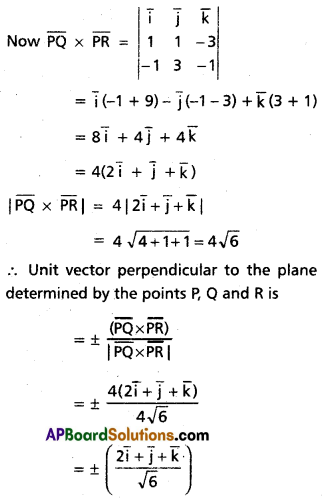
Find a unit vector perpendicular to the plane determined by the points P(1, -1, 2), Q(2, 0, -1) and R(0, 2, 1).
Solution:
Inter 1st Year Maths 1A Products of Vectors Solutions Ex 5(b) II Q7
Inter 1st Year Maths 1A Products of Vectors Solutions Ex 5(b) II Q7.1

Question 8.
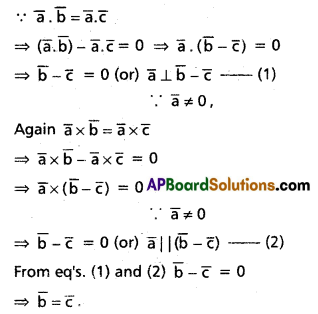
If \(\overline{\mathbf{a}} \cdot \overline{\mathbf{b}}=\overline{\mathbf{a}} \cdot \overline{\mathbf{c}}\) and \(\overline{\mathbf{a}} \times \overline{\mathrm{b}}=\overline{\mathrm{a}} \times \overline{\mathrm{c}}, \overline{\mathbf{a}} \neq 0\), then show that \(\overline{\mathbf{b}}=\overline{\mathbf{c}}\).
Solution:
Inter 1st Year Maths 1A Products of Vectors Solutions Ex 5(b) II Q8

Inter 1st Year Maths 1A Products of Vectors Solutions Ex 5(b)

Question 9.
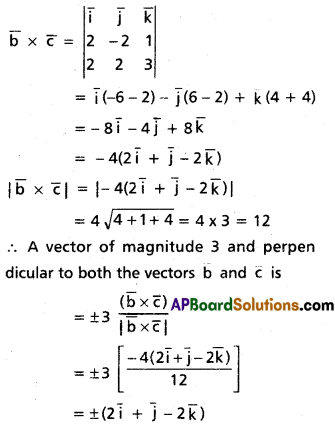
Find a vector of magnitude 3 and perpendicular to both the vector \(\overline{\mathbf{b}}=2 \bar{i}-2 \bar{j}+\bar{k}\) and \(\bar{c}=2 \bar{i}+2 \bar{j}+3 \bar{k}\).
Solution:
Inter 1st Year Maths 1A Products of Vectors Solutions Ex 5(b) II Q9

Question 10.
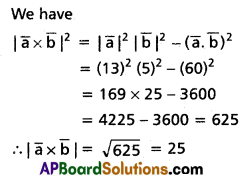
If \(|\overline{\mathbf{a}}|\) = 13, \(|\overline{\mathbf{b}}|\) = 5 and \(\overline{\mathbf{a}} \cdot \overline{\mathbf{b}}=\mathbf{6 0}\), then find \(|\overline{\mathbf{a}} \times \overline{\mathbf{b}}|\).
Solution:
Inter 1st Year Maths 1A Products of Vectors Solutions Ex 5(b) II Q10

Question 11.
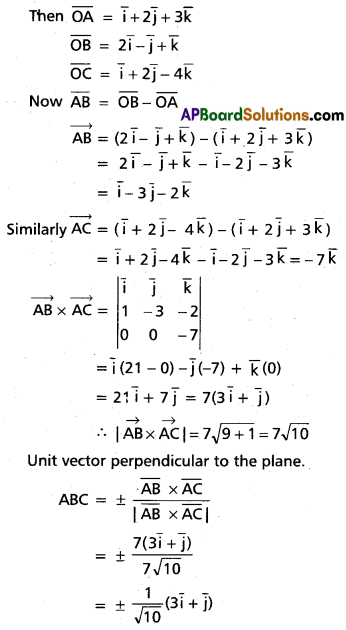
Find a unit vector perpendicular to the plane passing through the points (1, 2, 3), (2, -1, 1) and (1, 2, -4).
Solution:
Let ‘O’ be the origin and let A, B, C be the given points.
Inter 1st Year Maths 1A Products of Vectors Solutions Ex 5(b) II Q11

III.

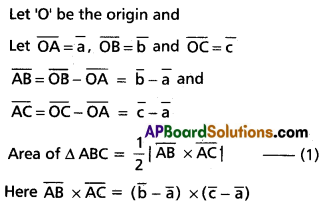
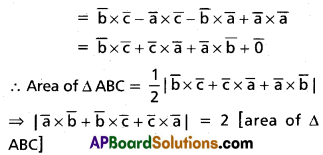
Question 1.
If \(\overline{\mathbf{a}}\), \(\overline{\mathbf{b}}\) and \(\overline{\mathbf{c}}\) represent the vertices A, B and C respectively of ∆ABC, then prove that \(|(\overline{\mathbf{a}} \times \overline{\mathbf{b}})+(\overline{\mathbf{b}} \times \overline{\mathbf{c}})+(\overline{\mathbf{c}} \times \overline{\mathbf{a}})|\) is twice the area of ∆ABC.
Solution:
Inter 1st Year Maths 1A Products of Vectors Solutions Ex 5(b) III Q1
Inter 1st Year Maths 1A Products of Vectors Solutions Ex 5(b) III Q1.1

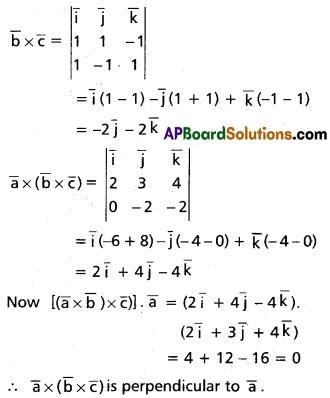
Question 2.
If \(\overline{\mathbf{a}}=2 \overline{\mathbf{i}}+3 \overline{\mathbf{j}}+4 \overline{\mathbf{k}}, \overline{\mathbf{b}}=\overline{\mathbf{i}}+\overline{\mathbf{j}}-\overline{\mathbf{k}}\) and \(\overline{\mathbf{c}}=\overline{\mathbf{i}}-\overline{\mathbf{j}}+\overline{\mathbf{k}}\), then compute \(\overline{\mathbf{a}} \times(\overline{\mathbf{b}} \times \overline{\mathbf{c}})\) and verify that it is perpendicular to \(\bar{a}\).
Solution:
Inter 1st Year Maths 1A Products of Vectors Solutions Ex 5(b) III Q2

Question 3.
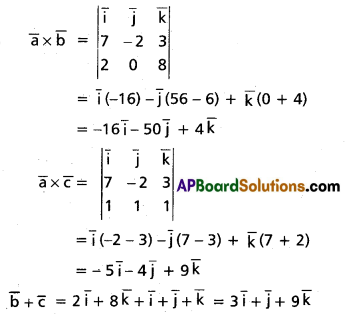
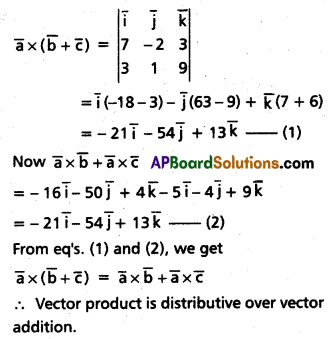
If \(\overline{\mathbf{a}}=7 \overline{\mathbf{i}}-2 \overline{\mathbf{j}}+3 \overline{\mathbf{k}}, \overline{\mathbf{b}}=2 \overline{\mathbf{i}}+8 \overline{\mathbf{k}}\) and \(\overline{\mathbf{c}}=\overline{\mathbf{i}}+\overline{\mathbf{j}}+\overline{\mathbf{k}}\) then compute \(\overline{\mathbf{a}} \times \mathbf{b}, \overline{\mathbf{a}} \times \overline{\mathbf{c}}\) and \(\bar{a} \times(\bar{b}+\bar{c})\). Verify whether cross product is distributive over vector addition.
Solution:
Inter 1st Year Maths 1A Products of Vectors Solutions Ex 5(b) III Q3
Inter 1st Year Maths 1A Products of Vectors Solutions Ex 5(b) III Q3.1

Inter 1st Year Maths 1A Products of Vectors Solutions Ex 5(b)

Question 4.
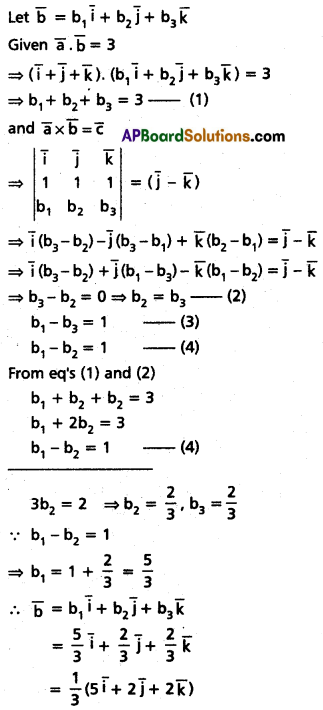
If \(\overline{\mathbf{a}}=\overline{\mathbf{i}}+\overline{\mathbf{j}}+\overline{\mathbf{k}}, \overline{\mathbf{c}}=\overline{\mathbf{j}}-\overline{\mathbf{k}}\), then find vector \(\overline{\mathbf{b}}\) such that \(\overline{\mathbf{a}} \times \overline{\mathbf{b}}=\overline{\mathbf{c}}\) and \(\bar{a} \cdot \bar{b}=3\).
Solution:
Inter 1st Year Maths 1A Products of Vectors Solutions Ex 5(b) III Q4

Question 5.
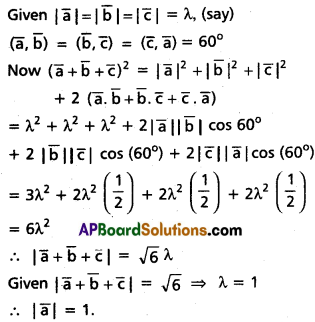
\(\overline{\mathbf{a}}, \overline{\mathbf{b}}, \overline{\mathbf{c}}\) are three vectors of equal magnitudes and each of them is inclined at an angle of 60° to the others. If \(|\bar{a}+\bar{b}+\bar{c}|=\sqrt{6}\), then find \(|\overline{\mathbf{a}}|\).
Solution:
Inter 1st Year Maths 1A Products of Vectors Solutions Ex 5(b) III Q5

Question 6.
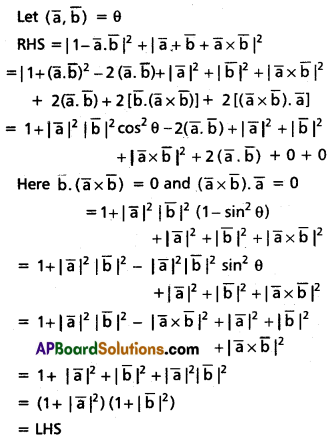
For any two vectors \(\bar{a}\) and \(\bar{b}\), show that \(\left(1+|\bar{a}|^{2}\right)\left(1+|\bar{b}|^{2}\right)\) = \(|\mathbf{1}-\overline{\mathbf{a}} \cdot \overline{\mathbf{b}}|^{2}+|\overline{\mathbf{a}}+\overline{\mathbf{b}}+\overline{\mathbf{a}} \times \overline{\mathbf{b}}|^{2}\)
Solution:
Inter 1st Year Maths 1A Products of Vectors Solutions Ex 5(b) III Q6

Question 7.
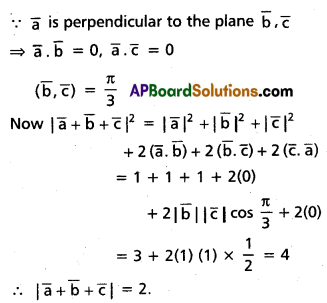
If \(\overline{\mathbf{a}}, \overline{\mathbf{b}}, \overline{\mathbf{c}}\) are unit vectors such that \(\overline{\mathbf{a}}\) is perpendicular to the plane of \(\overline{\mathbf{b}}, \overline{\mathbf{c}}\) and the angle between \(\overline{\mathbf{b}}\) and \(\overline{\mathbf{c}}\) is \(\frac{\pi}{3}\), then find \(|\bar{a}+\bar{b}+\bar{c}|\).
Solution:
Given that \(|\bar{a}|=|\bar{b}|=|\bar{c}|=1\)
Inter 1st Year Maths 1A Products of Vectors Solutions Ex 5(b) III Q7

Inter 1st Year Maths 1A Products of Vectors Solutions Ex 5(b)

Question 8.
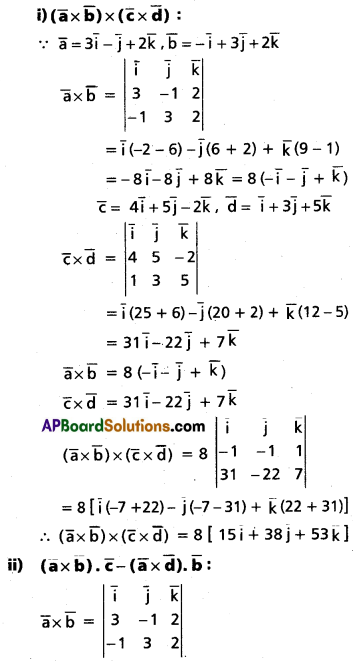
\(\overline{\mathbf{a}}=3 \overline{\mathbf{i}}-\overline{\mathbf{j}}+2 \overline{\mathbf{k}}, \overline{\mathbf{b}}=-\overline{\mathbf{i}}+3 \overline{\mathbf{j}}+2 \overline{\mathbf{k}}\), \(\bar{c}=4 \bar{i}+5 \bar{j}-2 \bar{k}\) and \(\bar{d}=\bar{i}+3 \bar{j}+5 \bar{k}\) then compute the following.
(i) \((\overline{\mathbf{a}} \times \overline{\mathbf{b}}) \times(\bar{c} \times \bar{d})\) and
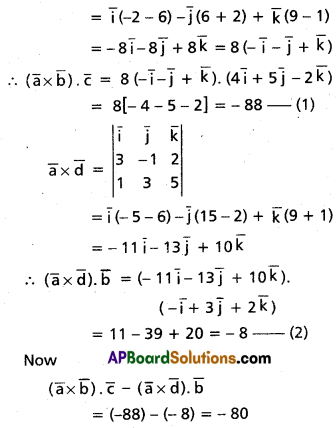
(ii) \((\overline{\mathbf{a}} \times \overline{\mathbf{b}}) \cdot \overline{\mathbf{c}}-(\overline{\mathbf{a}} \times \overline{\mathbf{d}}) \cdot \overline{\mathbf{b}}\)
Solution:
Inter 1st Year Maths 1A Products of Vectors Solutions Ex 5(b) III Q8
Inter 1st Year Maths 1A Products of Vectors Solutions Ex 5(b) III Q8.1

Inter 1st Year Maths 1A Products of Vectors Solutions Ex 5(a)

Practicing the Intermediate 1st Year Maths 1A Textbook Solutions Inter 1st Year Maths 1A Products of Vectors Solutions Exercise 5(a) will help students to clear their doubts quickly.

Intermediate 1st Year Maths 1A Products of Vectors Solutions Exercise 5(a)

I.

Question 1.
Find the angle between the vectors \(\bar{i}+2 \bar{j}+3 \bar{k}\) and \(3 \bar{i}-\bar{j}+2 \bar{k}\).
Solution:
Let \(\overline{\mathrm{a}}=\overline{\mathrm{i}}+2 \overline{\mathrm{j}}+3 \overline{\mathrm{k}}\) and \(\overline{\mathrm{b}}=3 \overline{\mathrm{i}}-\overline{\mathrm{j}}+2 \overline{\mathrm{k}}\) and ‘θ’ be the angle between them (i.e.,) \((\bar{a}, \bar{b})\) = θ
Inter 1st Year Maths 1A Products of Vectors Solutions Ex 5(a) I Q1

Question 2.
If the vectors \(\mathbf{2} \overline{\mathbf{i}}+\lambda \overline{\mathbf{j}}-\overline{\mathbf{k}}\) and \(4 \bar{i}-2 \bar{j}+2 \bar{k}\) are perpendicular to each other, then find λ.
Solution:
Inter 1st Year Maths 1A Products of Vectors Solutions Ex 5(a) I Q2

Inter 1st Year Maths 1A Products of Vectors Solutions Ex 5(a)

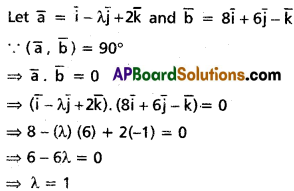
Question 3.
For what values of λ, the vectors \(\overline{\mathbf{i}}-\lambda \overline{\mathbf{j}}+2 \overline{\mathbf{k}}\) and \(8 \overline{\mathbf{i}}+6 \overline{\mathbf{j}}-\overline{\mathbf{k}}\) are at right angles?
Solution:
Inter 1st Year Maths 1A Products of Vectors Solutions Ex 5(a) I Q3

Question 4.
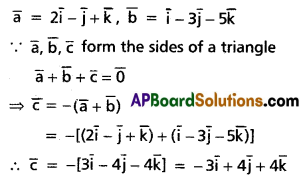
\(\overline{\mathbf{a}}=2 \overline{\mathbf{i}}-\overline{\mathbf{j}}+\overline{\mathbf{k}}, \overline{\mathbf{b}}=\overline{\mathbf{i}}-3 \overline{\mathbf{j}}-5 \overline{\mathbf{k}}\). Find the vector C such that \(\overline{\mathbf{a}}\), \(\overline{\mathbf{b}}\) and \(\overline{\mathbf{c}}\) form the sides of a triangle.
Solution:
Inter 1st Year Maths 1A Products of Vectors Solutions Ex 5(a) I Q4

Question 5.
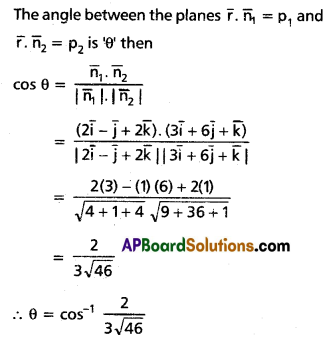
Find the angle between the planes \(\bar{r} \cdot(2 \bar{i}-\bar{j}+2 \bar{k})=3\) and \(\overline{\mathrm{r}} \cdot(3 \overline{\mathrm{i}}+6 \bar{j}+\bar{k})=4\).
Solution:
Inter 1st Year Maths 1A Products of Vectors Solutions Ex 5(a) I Q5

Question 6.
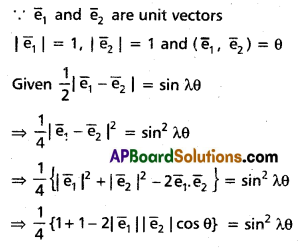
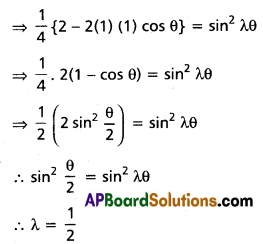
Let \(\overline{\mathbf{e}}_{1}\) and \(\overline{\mathbf{e}}_{2}\) be unit vectors makingangle θ. If \(\frac{1}{2}\left|\bar{e}_{1}-\bar{e}_{2}\right|=\sin \lambda \theta\), then find λ.
Solution:
Inter 1st Year Maths 1A Products of Vectors Solutions Ex 5(a) I Q6
Inter 1st Year Maths 1A Products of Vectors Solutions Ex 5(a) I Q6.1

Inter 1st Year Maths 1A Products of Vectors Solutions Ex 5(a)

Question 7.
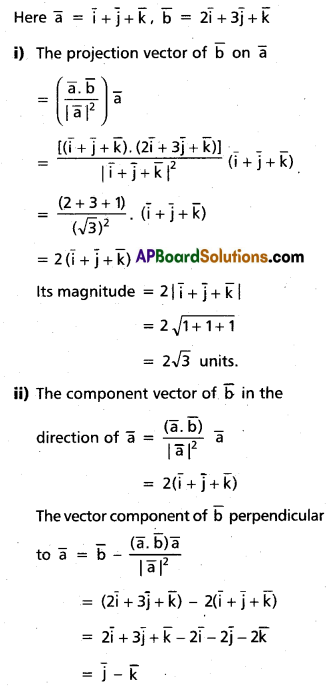
Let \(\overline{\mathbf{a}}=\overline{\mathbf{i}}+\overline{\mathbf{j}}+\overline{\mathbf{k}}\) and \(\overline{\mathbf{b}}=\mathbf{2} \overline{\mathbf{i}}+3 \overline{\mathbf{j}}+\overline{\mathbf{k}}\). Find
(i) The projection vector of \(\overline{\mathbf{b}}\) on \(\overline{\mathbf{a}}\) and its magnitude.
(ii) The vector components of \(\overline{\mathbf{b}}\) in the direction of a and perpendicular to \(\overline{\mathbf{a}}\).
Solution:
Inter 1st Year Maths 1A Products of Vectors Solutions Ex 5(a) I Q7

Question 8.
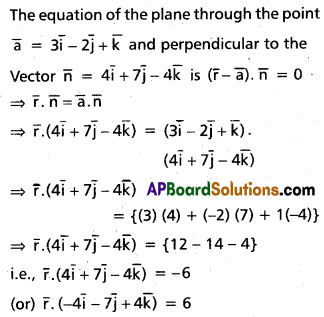
Find the equation of the plane through the point (3, -2, 1) and perpendicular to the vector (4, 7, -4).
Solution:
Inter 1st Year Maths 1A Products of Vectors Solutions Ex 5(a) I Q8

Question 9.
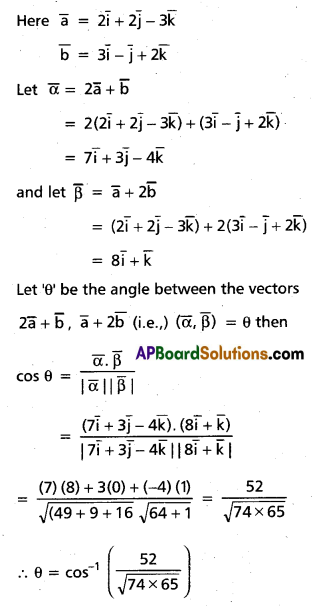
If \(\overline{\mathbf{a}}=2 \bar{i}+2 \bar{j}-3 \bar{k}\); \(\overline{\mathbf{b}}=3 \overline{\mathbf{i}}-\overline{\mathbf{j}}+2 \overline{\mathbf{k}}\), then find the angle between \(2 \overline{\mathbf{a}}+\overline{\mathbf{b}}\) and \(\bar{a}+2 \bar{b}\).
Solution:
Inter 1st Year Maths 1A Products of Vectors Solutions Ex 5(a) I Q9

II.

Question 1.
Find unit vector parallel to the XOY- plane and perpendicular to the vector \(4 \bar{i}-3 \bar{j}+\bar{k}\).
Solution:
Any vector parallel to XOY-plane will be of the form \(p \bar{i}+q \bar{j}\)
∴ The vector parallel to the XOY-plane and perpendicular to the vector \(4 \bar{i}-3 \bar{j}+\bar{k}\) is \(3 \bar{i}+4 \bar{j}\)
Its magnitude = \(|3 \bar{i}+\overline{4 j}|=\sqrt{9+16}=5\)
∴ Unit vector parallel to the XOY-plane and perpendicular to the vector \(4 \bar{i}-3 \bar{j}+\bar{k}\) is \(\pm \frac{(3 \overline{\mathrm{i}}+4 \overline{\mathrm{j}})}{5}\)

Inter 1st Year Maths 1A Products of Vectors Solutions Ex 5(a)

Question 2.
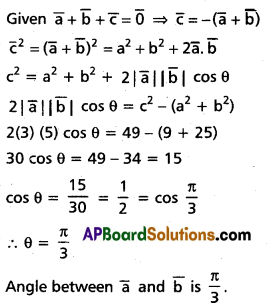
If \(\overline{\mathbf{a}}+\overline{\mathbf{b}}+\overline{\mathrm{c}}=0,|\overline{\mathbf{a}}|=3,|\overline{\mathbf{b}}|=5\) and \(|\bar{c}|=7\), then find the angle between \(\overline{\mathbf{a}}\) and \(\overline{\mathbf{b}}\).
Solution:
Inter 1st Year Maths 1A Products of Vectors Solutions Ex 5(a) II Q2

Question 3.
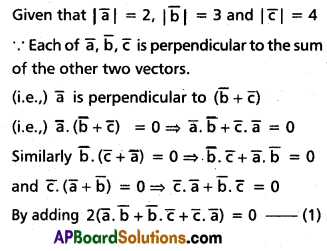
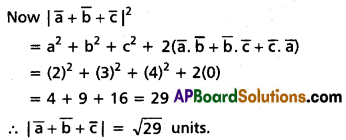
If \(|\overline{\mathbf{a}}|\) = 2, \(|\overline{\mathbf{b}}|\) = 3 and \(|\overline{\mathbf{c}}|\) = 4 and each of \(\overline{\mathbf{a}}, \overline{\mathbf{b}}, \overline{\mathbf{c}}\) is perpendicular to the sum of the other two vectors, then find the magnitude of \(\overline{\mathbf{a}}+\overline{\mathbf{b}}+\overline{\mathbf{c}}\).
Solution:
Inter 1st Year Maths 1A Products of Vectors Solutions Ex 5(a) II Q3
Inter 1st Year Maths 1A Products of Vectors Solutions Ex 5(a) II Q3.1

Question 4.
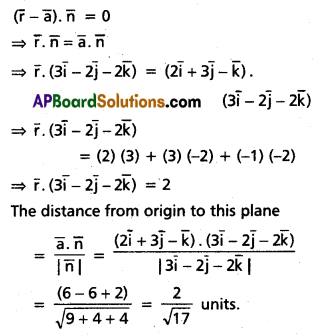
Find the equation of the plane passing through the point \(\overline{\mathbf{a}}=\mathbf{2} \overline{\mathbf{i}}+3 \bar{j}-\overline{\mathbf{k}}\) and perpendicular to the vector \(3 \bar{i}-2 \bar{j}-2 \bar{k}\) and the distance of this plane from the origin.
Solution:
Equation of the plane passing through the point \(\overline{\mathbf{a}}=\mathbf{2} \overline{\mathbf{i}}+3 \bar{j}-\overline{\mathbf{k}}\) and perpendicular to the vector \(\bar{n}=3 \bar{i}-2 \bar{j}-2 \bar{k}\) is
Inter 1st Year Maths 1A Products of Vectors Solutions Ex 5(a) II Q4

Inter 1st Year Maths 1A Products of Vectors Solutions Ex 5(a)

Question 5.
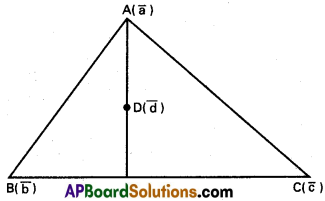
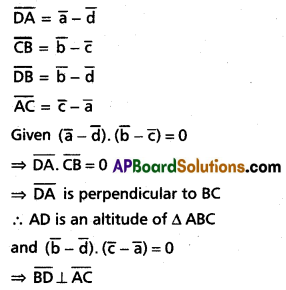
\(\overline{\mathbf{a}}, \overline{\mathbf{b}}, \overline{\mathbf{c}}\) and \(\overline{\mathbf{d}}\) are the position vectors of four coplanar points such that \((\mathbf{a}-\overline{\mathbf{d}}) \cdot(\bar{b}-\bar{c})=(\bar{b}-\bar{d}) \cdot(\bar{c}-\bar{a})=0\). Show that the point \(\bar{d}\) represents the orthocentre of the triangle with \(\bar{a}\), \(\bar{b}\) and \(\bar{c}\) as its vertices.
Solution:
Position vectors of A, B, C, D are \(\bar{a}\), \(\bar{b}\), \(\bar{c}\) and \(\bar{d}\) respectively.
Inter 1st Year Maths 1A Products of Vectors Solutions Ex 5(a) II Q5
Inter 1st Year Maths 1A Products of Vectors Solutions Ex 5(a) II Q5.1
⇒ BD is perpendicular to AC
∴ BD is another altitude of ∆ABC.
Altitudes AD and BD intersect at D.
∴ D is the orthocentre of ∆ABC.

III.

Question 1.
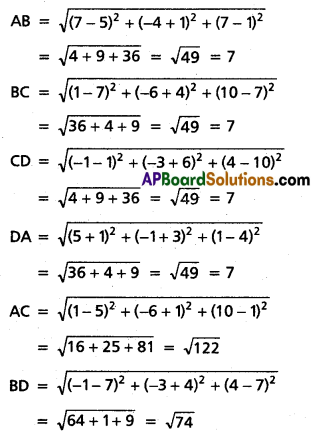
Show that the points (5, -1, 1), (7, -4, 7), (1, -6, 10) and (-1, -3, 4) are the vertices of a rhombus.
Solution:
Let A(5, -1, 1), B(7, -4, 7), C(1, -6, 10) and D(-1, -3, 4) are the given points.
Inter 1st Year Maths 1A Products of Vectors Solutions Ex 5(a) III Q1
∵ AB = BC = CD = DA = 7 units
AC ≠ BD
∴ A, B, C, D points are the vertices of a rhombus.

Inter 1st Year Maths 1A Products of Vectors Solutions Ex 5(a)

Question 2.
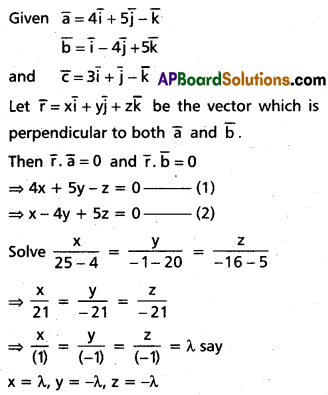
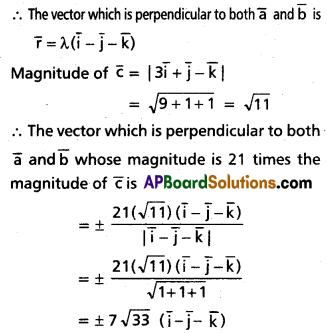
Let \(\bar{a}=4 \bar{i}+5 \bar{j}-\bar{k}, \quad \bar{b}=\bar{i}-4 \bar{j}+5 \bar{k}\) and \(\overline{\mathbf{c}}=\mathbf{3} \overline{\mathbf{i}}+\overline{\mathbf{j}}-\overline{\mathbf{k}}\). Find the vector which is perpendicular to both \(\overline{\mathbf{a}}\) and \(\overline{\mathbf{b}}\) and whose magnitude is twenty one times the magnitude of \(\overline{\mathbf{c}}\).
Solution:
Inter 1st Year Maths 1A Products of Vectors Solutions Ex 5(a) III Q2
Inter 1st Year Maths 1A Products of Vectors Solutions Ex 5(a) III Q2.1

Question 3.
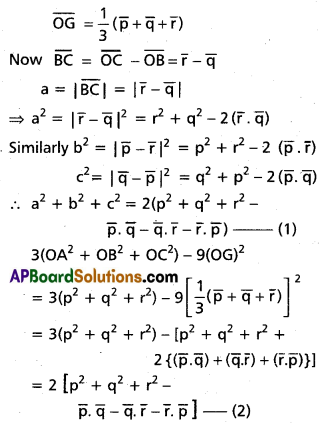
G is the centroid of ΔABC and a, b, c are the lengths of the sides BC, CA and AB respectively prove that a2 + b2 + c2 = 3 (OA2 + OB2 + OC2) – 9(OG)2 where O is any point.
Solution:
Given that \(\overline{\mathrm{BC}}=\overline{\mathrm{a}}, \overline{\mathrm{CA}}=\overline{\mathrm{b}}, \overline{\mathrm{AB}}=\overline{\mathrm{c}}\)
Let ‘O’ be the origin and let \(\overline{\mathrm{OA}}=\overline{\mathrm{p}}, \overline{\mathrm{OB}}=\overline{\mathrm{q}} \text { and } \overline{\mathrm{OC}}=\overline{\mathrm{r}}\)
Then P.V. of the centroid of ΔABC is
Inter 1st Year Maths 1A Products of Vectors Solutions Ex 5(a) III Q3
From (1) and (2)
∴ a2 + b2 + c2 = 3(OA2 + OB2 + OC2) – 9(OG)2.

Inter 1st Year Maths 1A Products of Vectors Solutions Ex 5(a)

Question 4.
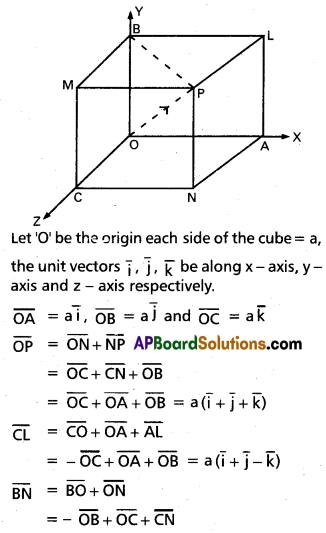
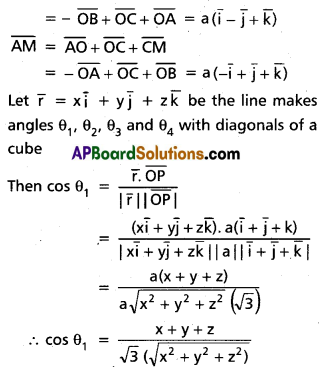
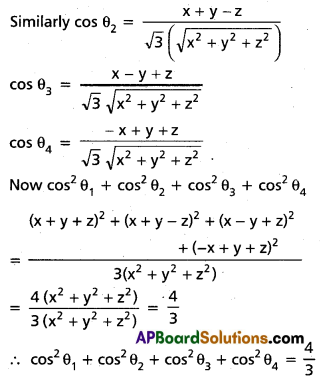
A line makes angles θ1, θ2, θ3, and θ4 with the diagonals of a cube. Show that cos2θ1 + cos2θ2 + cos2θ3 + cos2θ4 = \(\frac{4}{3}\).
Solution:
Inter 1st Year Maths 1A Products of Vectors Solutions Ex 5(a) III Q4
Inter 1st Year Maths 1A Products of Vectors Solutions Ex 5(a) III Q4.1
Inter 1st Year Maths 1A Products of Vectors Solutions Ex 5(a) III Q4.2

Inter 1st Year Maths 1A Addition of Vectors Solutions Ex 4(b)

Practicing the Intermediate 1st Year Maths 1A Textbook Solutions Inter 1st Year Maths 1A Addition of Vectors Solutions Exercise 4(b) will help students to clear their doubts quickly.

Intermediate 1st Year Maths 1A Addition of Vectors Solutions Exercise 4(b)

I.

Question 1.
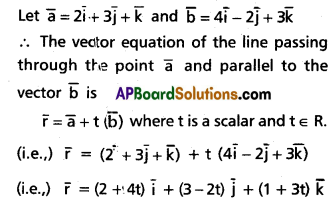
Find the vector equation of the line passing through the point \(2 \bar{i}+3 \bar{j}+\bar{k}\) and parallel to the vector \(4 \bar{i}-2 \bar{j}+3 \bar{k}\).
Solution:
Inter 1st Year Maths 1A Addition of Vectors Solutions Ex 4(b) I Q1

Question 2.
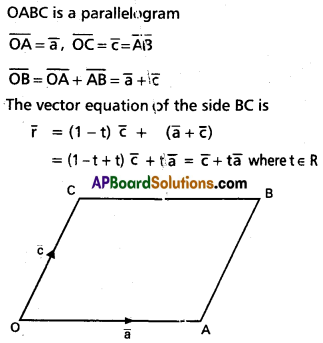
OABC is a parallelogram. If \(\overline{O A}=\bar{a}\) and \(\overline{O C}=\bar{c}\), find the vector equation of the side BC.
Solution:
Inter 1st Year Maths 1A Addition of Vectors Solutions Ex 4(b) I Q2

Inter 1st Year Maths 1A Addition of Vectors Solutions Ex 4(b)

Question 3.
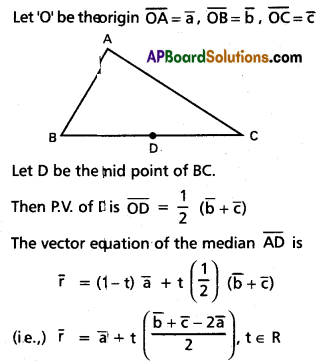
If \(\overline{\mathbf{a}}, \overline{\mathbf{b}}, \overline{\mathbf{c}}\) are the position vectors of the vertices A, B and C respectively of ∆ABC, theind the vector equation of the median through the vertex A.
Solution:
Inter 1st Year Maths 1A Addition of Vectors Solutions Ex 4(b) I Q3

Question 4.
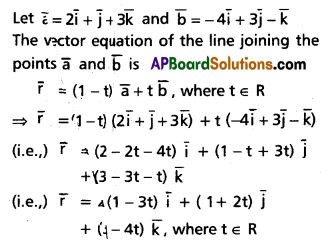
Find the vertor equation of the line joining the points \(2 \bar{i}+\bar{j}+3 \bar{k}\) and \(-4 \bar{i}+3 \bar{j}-\bar{k}\).
Solution:
Inter 1st Year Maths 1A Addition of Vectors Solutions Ex 4(b) I Q4

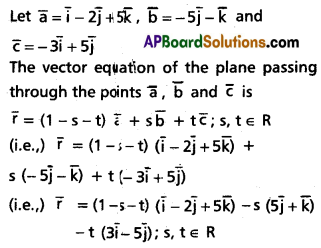
Question 5.
Find the vector equation of the plane passing through the points \(\overline{\mathbf{i}}-2 \overline{\mathbf{j}}+5 \overline{\mathbf{k}},-5 \overline{\mathbf{j}}-\overline{\mathbf{k}} \text { and }-3 \overline{\mathbf{i}}+5 \overline{\mathbf{j}}\).
Solution:
Inter 1st Year Maths 1A Addition of Vectors Solutions Ex 4(b) I Q5

Inter 1st Year Maths 1A Addition of Vectors Solutions Ex 4(b)

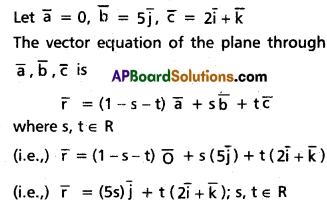
Question 6.
Find the vector equation of the plane through the points (0, 0, 0), (0, 5, 0) and (2, 0, 1).
Solution:
Inter 1st Year Maths 1A Addition of Vectors Solutions Ex 4(b) I Q6

II.

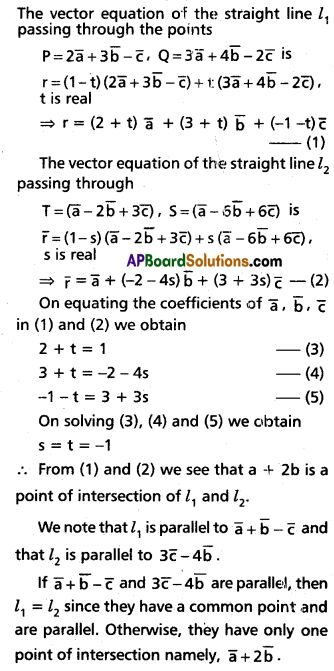
Question 1.
If \(\overline{\mathbf{a}}, \overline{\mathbf{b}}, \overline{\mathbf{c}}\) are noncoplanar find the point of intersection of the line passing through the points \(2 \bar{a}+3 \bar{b}-\bar{c}\), \(3 \bar{a}+4 \bar{b}-2 \bar{c}\) with the line joining the points \(\bar{a}-2 \bar{b}+3 \bar{c}, \bar{a}-6 \bar{b}+6 \bar{c}\).
Solution:
Inter 1st Year Maths 1A Addition of Vectors Solutions Ex 4(b) II Q1

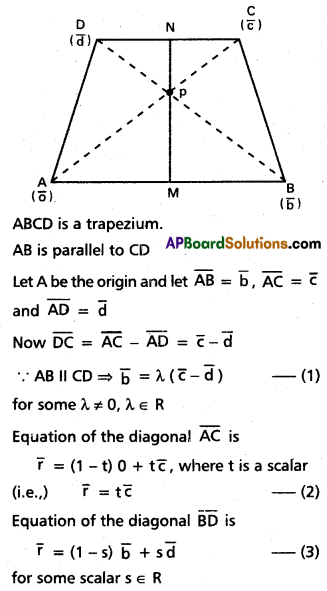
Question 2.
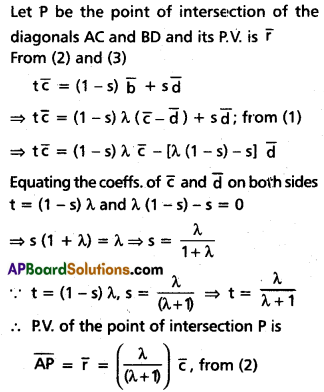
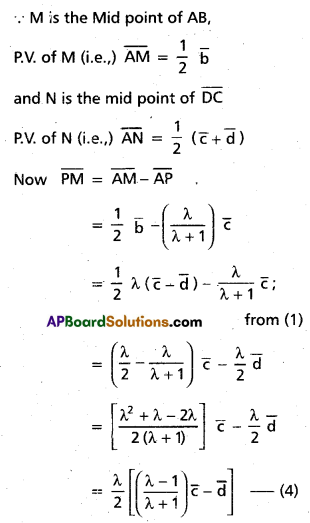
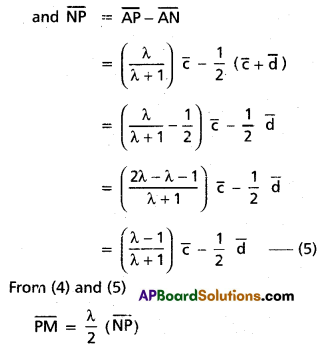
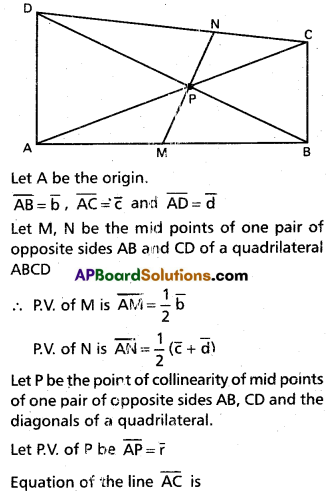
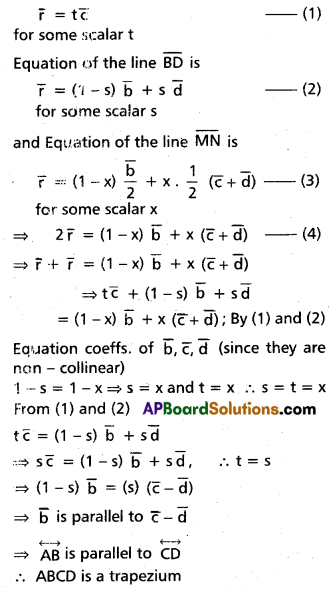
ABCD is a trapezium in which AB and CD are parallel. Prove by vector methods, that the mid points of the sides AB, CD and the intersection of the diagonals are collinear.
Solution:
Inter 1st Year Maths 1A Addition of Vectors Solutions Ex 4(b) II Q2
Inter 1st Year Maths 1A Addition of Vectors Solutions Ex 4(b) II Q2.1
Inter 1st Year Maths 1A Addition of Vectors Solutions Ex 4(b) II Q2.2
Inter 1st Year Maths 1A Addition of Vectors Solutions Ex 4(b) II Q2.3
⇒ M, P, N are collinear
Hence the midpoints of parallel sides of a trapezium and the point of intersection of the diagonals are collinear.

Inter 1st Year Maths 1A Addition of Vectors Solutions Ex 4(b)

Question 3.
In a quadrilateral ABCD, if the midpoints of one pair of opposite sides and the point of intersection of the diagonals are collinear, using vector methods, prove that the quadrilateral ABCD is a trapezium.
Solution:
Inter 1st Year Maths 1A Addition of Vectors Solutions Ex 4(b) II Q3
Inter 1st Year Maths 1A Addition of Vectors Solutions Ex 4(b) II Q3.1

III.

Question 1.
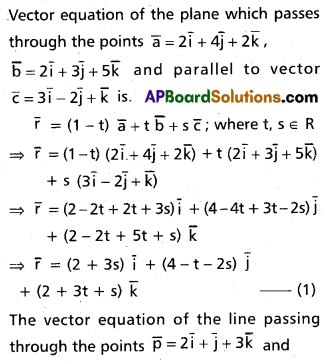
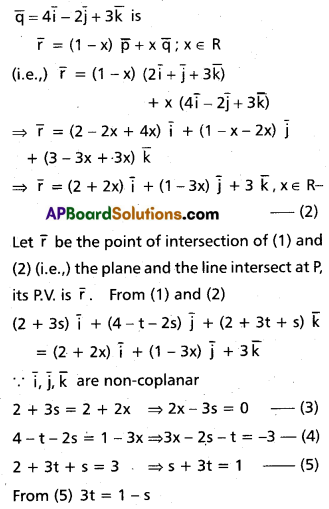
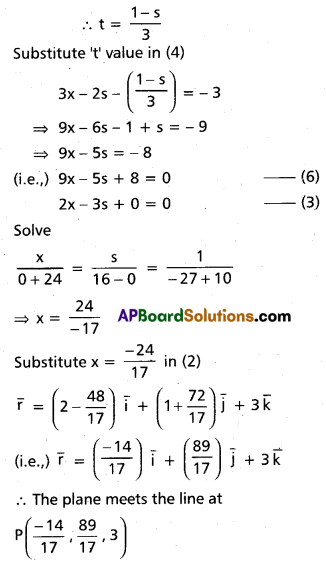
Find the vector equation of the plane which passes through the points \(2 \bar{i}+4 \bar{j}+2 \bar{k}, 2 \bar{i}+3 \bar{j}+5 \bar{k}\) and parallel to the vector \(3 \overline{\mathbf{i}}-2 \overline{\mathbf{j}}+\overline{\mathbf{k}}\). Also find the point where this plane meets the line joining the points \(2 \overline{\mathbf{i}}+\overline{\mathbf{j}}+3 \overline{\mathbf{k}}\) and \(4 \bar{i}-2 \bar{j}+3 \bar{k}\).
Solution:
Inter 1st Year Maths 1A Addition of Vectors Solutions Ex 4(b) III Q1
Inter 1st Year Maths 1A Addition of Vectors Solutions Ex 4(b) III Q1.1
Inter 1st Year Maths 1A Addition of Vectors Solutions Ex 4(b) III Q1.2

Inter 1st Year Maths 1A Addition of Vectors Solutions Ex 4(b)

Question 2.
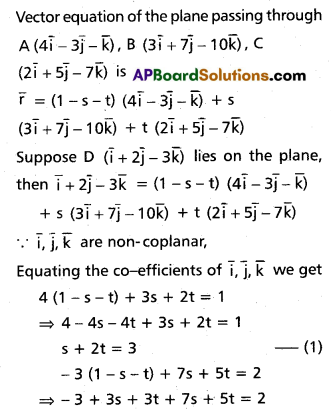
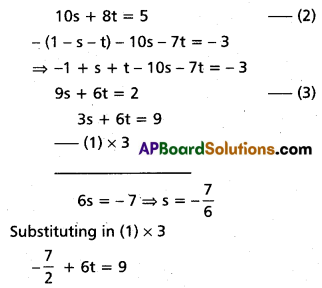
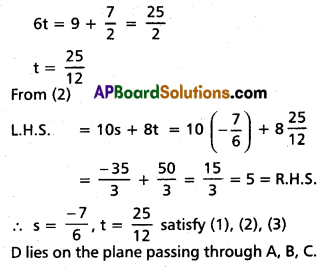
Find the vector equation of the plane passing through points \(4 \overline{\mathbf{i}}-3 \overline{\mathbf{j}}-\overline{\mathbf{k}}\), \(3 \overline{\mathbf{i}}+7 \overline{\mathbf{j}}-10 \overline{\mathbf{k}}\) and \(2 \bar{i}+5 \bar{j}-7 \bar{k}\), and show that the point \(\overline{\mathbf{i}}+2 \bar{j}-3 \overline{\mathbf{k}}\) lies in the plane.
Solution:
Inter 1st Year Maths 1A Addition of Vectors Solutions Ex 4(b) III Q2
Inter 1st Year Maths 1A Addition of Vectors Solutions Ex 4(b) III Q2.1
Inter 1st Year Maths 1A Addition of Vectors Solutions Ex 4(b) III Q2.2

Inter 1st Year Maths 1A Matrices Solutions Ex 3(i)

Practicing the Intermediate 1st Year Maths 1A Textbook Solutions Inter 1st Year Maths 1A Matrices Solutions Exercise 3(i) will help students to clear their doubts quickly.

Intermediate 1st Year Maths 1A Matrices Solutions Exercise 3(i)

Solve the following systems of homogeneous equations.

Question 1.
2x + 3y – z = 0, x – y – 2z = 0, 3x + y + 3z = 0
Solution:
The Coefficient matrix is \(\left[\begin{array}{ccc}
2 & 3 & -1 \\
1 & -1 & -2 \\
3 & 1 & 3
\end{array}\right]\)
det of \(\left[\begin{array}{ccc}
2 & 3 & -1 \\
1 & -1 & -2 \\
3 & 1 & 3
\end{array}\right]=\left[\begin{array}{ccc}
2 & 3 & -1 \\
1 & -1 & -2 \\
3 & 1 & 3
\end{array}\right]\)
= 2(-3 + 2) – 3(3 + 6) – 1(1 + 3)
= -2 – 27 – 4
= -33 ≠ 0, ρ(A) = 3
Hence the system has the trivial solution x = y = z = 0 only.

Inter 1st Year Maths 1A Matrices Solutions Ex 3(i)

Question 2.
3x + y – 2z = 0, x + y + z = 0, x – 2y + z = 0
Hint: If the determinant of the coefficient matrix ≠ 0 then the system has a trivial solution (i.e.) ρ(A) = 3.
Solution:
The coefficient matrix is \(\left[\begin{array}{ccc}
3 & 1 & -2 \\
1 & 1 & 1 \\
1 & -2 & 1
\end{array}\right]\)
\(\left|\begin{array}{ccc}
3 & 1 & -2 \\
1 & 1 & 1 \\
1 & -2 & 1
\end{array}\right|\)
= 3(1 + 2) – 1(1 – 1) – 2(-2 – 1)
= 9 + 6
= 15 ≠ 0, ρ(A) = 3
Hence the system has the trivial solutions x = y = z = 0 only.

Inter 1st Year Maths 1A Matrices Solutions Ex 3(i)

Question 3.
x + y – 2z = 0, 2x + y – 3z = 0, 5x + 4y – 9z = 0
Solution:
The coefficient matrix is \(\left[\begin{array}{rrr}
1 & 1 & -2 \\
2 & 1 & -3 \\
5 & 4 & -9
\end{array}\right]\) = A (say)
|A| = \(\left|\begin{array}{rrr}
1 & 1 & -2 \\
2 & 1 & -3 \\
5 & 4 & -9
\end{array}\right|\)
= 1(-9 + 12) – 1(-18 + 15) – 2(8 – 5)
= 3 + 3 – 6
= 0
∴ Rank of A = 2 as the submatrix \(\left[\begin{array}{ll}
1 & 1 \\
2 & 1
\end{array}\right]\) is non-singular, ρ(A) < 3
Hence the system has a non-trivial solution.
A = \(\left[\begin{array}{lll}
1 & 1 & -2 \\
2 & 1 & -3 \\
5 & 4 & -9
\end{array}\right]\)
R2 → R2 – 2R1, R3 → R3 – 3R1
A ~ \(\left[\begin{array}{ccc}
1 & 1 & -2 \\
0 & -1 & 1 \\
0 & -1 & -1
\end{array}\right]\)
The system of equation is equivalent to the given system of equations are x + y – 2z = 0, -y + z = 0
Let z = k
⇒ y = k, x = k
∴ x = y = z = k for real number k.

Inter 1st Year Maths 1A Matrices Solutions Ex 3(i)

Question 4.
x + y – z = 0, x – 2y + z = 0, 3x + 6y – 5z = 0
Solution:
Coefficient matrix A = \(\left[\begin{array}{ccc}
1 & 1 & -1 \\
1 & -2 & 1 \\
3 & 6 & -5
\end{array}\right]\)
R2 → R2 – R1, R3 → R3 – 3R1
A ~ \(\left[\begin{array}{ccc}
1 & 1 & -1 \\
0 & -3 & 2 \\
0 & 3 & -2
\end{array}\right]\)
⇒ det A = 0 as R2, R3 are identical.
and rank (A) = 2 as the submatrix \(\left[\begin{array}{cc}
1 & 1 \\
0 & -3
\end{array}\right]\) is non-singular.
Hence the system has a non-trivial solution, ∵ ρ(A) < 3
The system of equations equivalent to the given system of equations are
x + y – z = 0
3y – 2z = 0
Let z = k
⇒ y = \(\frac{2 k}{3}\)
x = \(\frac{k}{3}\)
∴ x = \(\frac{k}{3}\), y = \(\frac{2 k}{3}\), z = k for any real number of k.

Inter 1st Year Maths 1A Matrices Solutions Ex 3(h)

Practicing the Intermediate 1st Year Maths 1A Textbook Solutions Inter 1st Year Maths 1A Matrices Solutions Exercise 3(h) will help students to clear their doubts quickly.

Intermediate 1st Year Maths 1A Matrices Solutions Exercise 3(h)

Solve the following systems of equations.
(i) by using Cramer’s rule and matrix inversion method, when the coefficient matrix is non-singular.
(ii) by using the Gauss-Jordan method. Also, determine whether the system has a unique solution or an infinite number of solutions, or no solution, and find the solutions if exist.

Question 1.
5x – 6y + 4z = 15
7x + 4y – 3z = 19
2x + y + 6z = 46
Solution:
(i) Cramer’s rule:
Δ = \(\left|\begin{array}{ccc}
5 & -6 & 4 \\
7 & 4 & -3 \\
2 & 1 & 6
\end{array}\right|\)
= 5(24 + 3) + 6(42 + 6) + 4(7 – 8)
= 135 + 288 – 4
= 419
Δ1 = \(\left|\begin{array}{ccc}
15 & -6 & 4 \\
19 & 4 & -3 \\
46 & 1 & 6
\end{array}\right|\)
= 15(24 + 3) + 6(114 + 138) + 4(19 – 184)
= 405 + 1512 – 660
= 1917 – 660
= 1257
Δ2 = \(\left|\begin{array}{ccc}
5 & 15 & 4 \\
7 & 19 & -3 \\
2 & 46 & 6
\end{array}\right|\)
= 5(114 + 138) – 15(42 + 6) + 4(322 – 38)
= 1260 – 720 + 1136
= 1676
Δ3 = \(\left|\begin{array}{ccc}
5 & -6 & 15 \\
7 & 4 & 19 \\
2 & 1 & 46
\end{array}\right|\)
= 5(184 – 19) + 6(322 – 38) + 15(7 – 8)
= 825 + 1704 – 15
= 2529 – 15
= 2514
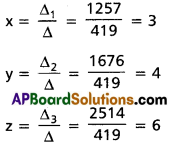
Inter 1st Year Maths 1A Matrices Solutions Ex 3(h) Q1(i)
Solution is x = 3, y = 4, z = 6.

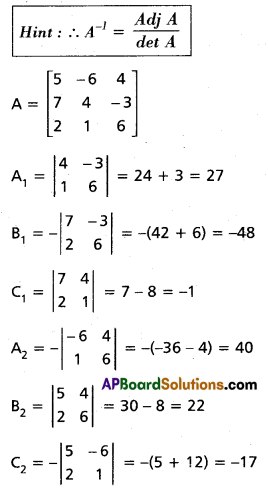
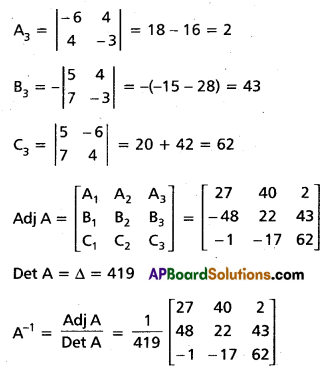
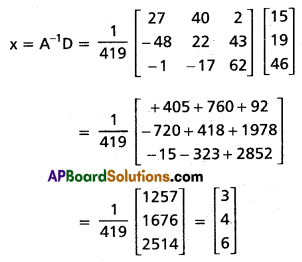
(ii) Matrix inversion method:
Inter 1st Year Maths 1A Matrices Solutions Ex 3(h) Q1(ii)
Inter 1st Year Maths 1A Matrices Solutions Ex 3(h) Q1(ii).1
Inter 1st Year Maths 1A Matrices Solutions Ex 3(h) Q1(ii).2
Solution is x = 3, y = 4, z = 6

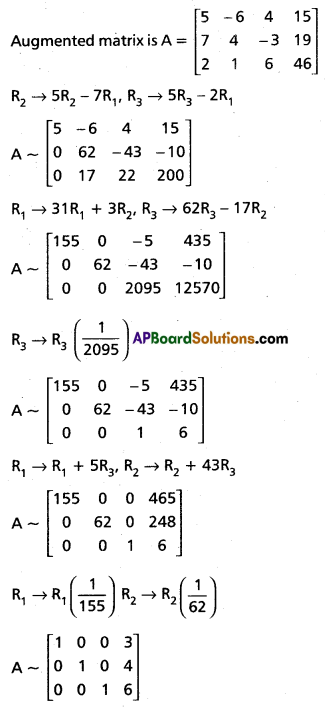
(iii) Gauss-Jordan method:
Inter 1st Year Maths 1A Matrices Solutions Ex 3(h) Q1(iii)
∴ Unique solution exists.
Solution is x = 3, y = 4, z = 6.

Inter 1st Year Maths 1A Matrices Solutions Ex 3(h)

Question 2.
x + y + z = 1
2x + 2y + 3z = 6
x + 4y + 9z = 3
Solution:
(i) Cramer’s rule:
Δ = \(\left|\begin{array}{lll}
1 & 1 & 1 \\
2 & 2 & 3 \\
1 & 4 & 9
\end{array}\right|\)
= 1(18 – 12) – 1(18 – 3) + 1(8 – 2)
= 6 – 15 + 6
= -3
Δ1 = \(\left|\begin{array}{lll}
1 & 1 & 1 \\
6 & 2 & 3 \\
3 & 4 & 9
\end{array}\right|\)
= 1(18 – 12) – 1(54 – 9) + 1(24 – 6)
= 6 – 45 + 18
= -21
Δ2 = \(\left|\begin{array}{lll}
1 & 1 & 1 \\
2 & 6 & 3 \\
1 & 3 & 9
\end{array}\right|\)
= 1(54 – 9) – 1(18 – 3) + 1(6 – 6)
= 45 – 15
= 30
Δ3 = \(\left|\begin{array}{lll}
1 & 1 & 1 \\
2 & 2 & 6 \\
1 & 4 & 3
\end{array}\right|\)
= 1(6 – 24) – 1(6 – 6) + 1(8 – 2)
= -18 – 0 + 6
= -12
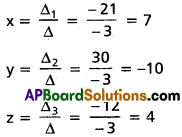
Inter 1st Year Maths 1A Matrices Solutions Ex 3(h) Q2(i)
Solution is x = 7, y = -10, z = 4

(ii) Matrix inversion method:
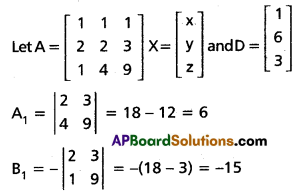
Inter 1st Year Maths 1A Matrices Solutions Ex 3(h) Q2(ii)
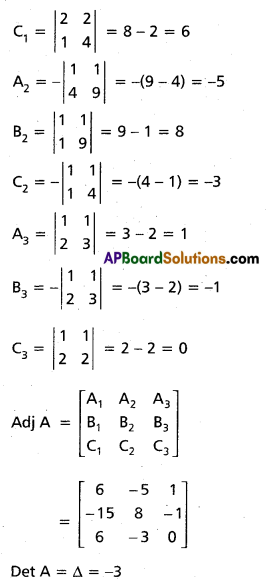
Inter 1st Year Maths 1A Matrices Solutions Ex 3(h) Q2(ii).1
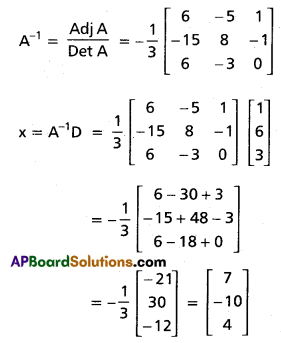
Inter 1st Year Maths 1A Matrices Solutions Ex 3(h) Q2(ii).2
∴ Solution is x = 7, y = -10, z = 4

(iii) Gauss-Jordan method:
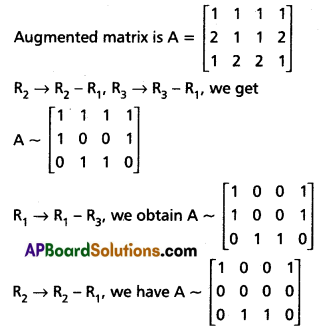
Augmented matrix is A = \(\left[\begin{array}{llll}
1 & 1 & 1 & 1 \\
2 & 2 & 3 & 6 \\
1 & 4 & 9 & 3
\end{array}\right]\)
R2 → R2 – 2R1, R3 → R3 – R1
Inter 1st Year Maths 1A Matrices Solutions Ex 3(h) Q2(iii)
Unique solution exists.
∴ Solution is x = 7, y = -10, z = 4

Inter 1st Year Maths 1A Matrices Solutions Ex 3(h)

Question 3.
x – y + 3z = 5
4x + 2y – z = 0
-x + 3y + z = 5
Solution:
(i) Cramer’s rule:
Δ = \(\left|\begin{array}{ccc}
1 & -1 & 3 \\
4 & 2 & -1 \\
-1 & 3 & 1
\end{array}\right|\)
= 1(2 + 3) + 1(4 – 1) + 3(12 + 2)
= 5 + 3 + 42
= 50
Δ1 = \(\left|\begin{array}{ccc}
5 & -1 & 3 \\
0 & 2 & -1 \\
5 & 3 & 1
\end{array}\right|\)
= 5(2 + 3) + 1(0 + 5) + 3(0 – 10)
= 25 + 5 – 30
= 0
Δ2 = \(\left|\begin{array}{ccc}
1 & 5 & 3 \\
4 & 0 & -1 \\
-1 & 5 & 1
\end{array}\right|\)
= 1(0 + 5) – 5(4 – 1) + 3(20 – 0)
= 5 – 15 + 60
= 50
Δ3 = \(\left|\begin{array}{ccc}
1 & -1 & 5 \\
4 & 2 & 0 \\
-1 & 3 & 5
\end{array}\right|\)
= 1(10 – 0) + 1(20 – 0) + 5(12 + 2)
= 10 + 20 + 70
= 100
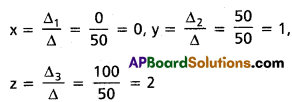
Inter 1st Year Maths 1A Matrices Solutions Ex 3(h) Q3(i)
∴ Solution is x = 0, y = 1, z = 2.

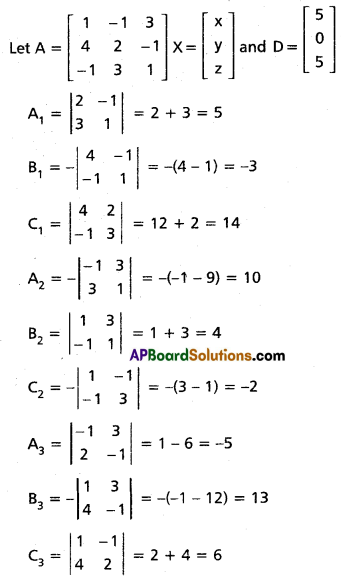
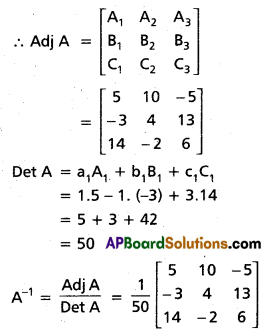
(ii) Matrix inversion method:
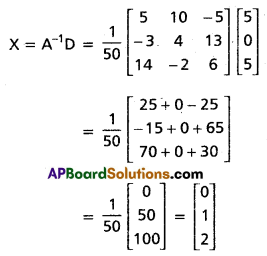
Inter 1st Year Maths 1A Matrices Solutions Ex 3(h) Q3(ii)
Inter 1st Year Maths 1A Matrices Solutions Ex 3(h) Q3(ii).1
Inter 1st Year Maths 1A Matrices Solutions Ex 3(h) Q3(ii).2
Solution is x = 0, y = 1, z = 2

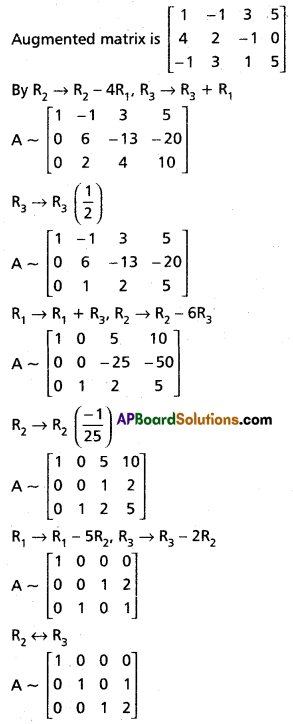
(iii) Gauss Jordan method:
Inter 1st Year Maths 1A Matrices Solutions Ex 3(h) Q3(iii)
Unique solution exists.
∴ Solution is x = 0, y = 1, z = 2

Inter 1st Year Maths 1A Matrices Solutions Ex 3(h)

Question 4.
2x + 6y + 11 = 0
6x + 20y – 6z + 3 = 0
6y – 18z + 1 = 0
Solution:
(i) Cramer’s rule:
Δ = \(\left|\begin{array}{ccc}
2 & 6 & 0 \\
6 & 20 & -6 \\
0 & 6 & -18
\end{array}\right|\)
= 2(-360 + 36) – 6(-108 – 0)
= -648 + 648
= 0
∴ Cramer’s rule and matrix inversion method cannot be used.
∵ Δ = 0

(ii) Gauss Jordan method:
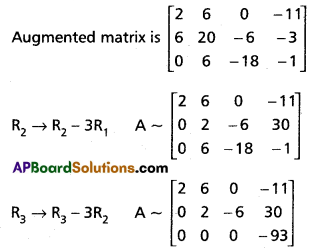
Inter 1st Year Maths 1A Matrices Solutions Ex 3(h) Q4(ii)
ρ(A) = 2, ρ(AB) = 3
ρ(A) ≠ ρ(AB)
∴ The given system of equations does not have a solution.

Inter 1st Year Maths 1A Matrices Solutions Ex 3(h)

Question 5.
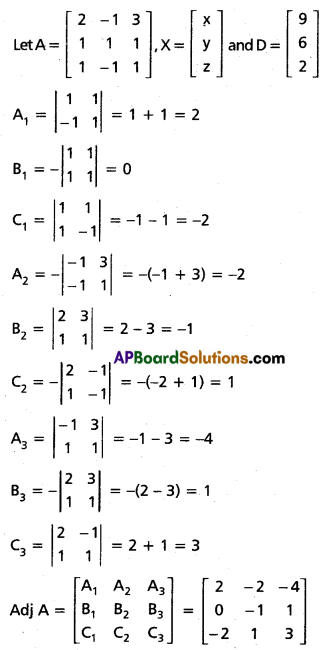
2x – y + 3z = 9
x + y + z = 6
x – y + z = 2
Solution:
(i) Cramer’s rule:
Δ = \(\left|\begin{array}{ccc}
2 & -1 & 3 \\
1 & 1 & 1 \\
1 & -1 & 1
\end{array}\right|\)
= 2(1 + 1) + 1(1 – 1) + 3(-1 – 1)
= 4 + 0 – 6
= -2
Δ1 = \(\left|\begin{array}{ccc}
9 & -1 & 3 \\
6 & 1 & 1 \\
2 & -1 & 1
\end{array}\right|\)
= 9(1 + 1) + 1(6 – 2) + 3(-6 – 2)
= 18 + 4 – 24
= -2
Δ2 = \(\left|\begin{array}{lll}
2 & 9 & 3 \\
1 & 6 & 1 \\
1 & 2 & 1
\end{array}\right|\)
= 2(6 – 2) – 9(1 – 1) + 3(2 – 6)
= 8 – 0 – 12
= -4
Δ3 = \(\left|\begin{array}{ccc}
2 & -1 & 9 \\
1 & 1 & 6 \\
1 & -1 & 2
\end{array}\right|\)
= 2(2 + 6) + 1(2 – 6) + 9(-1 – 1)
= 16 – 4 – 18
= -6
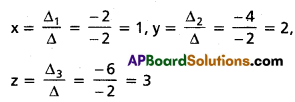
Inter 1st Year Maths 1A Matrices Solutions Ex 3(h) Q5(i)
Solution is x = 1, y = 2, z = 3.

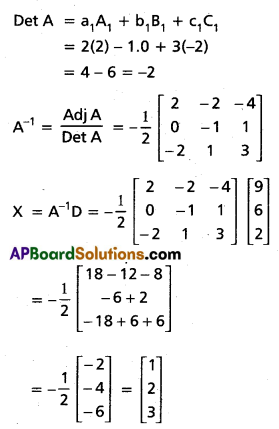
(ii) Matrix inversion method:
Inter 1st Year Maths 1A Matrices Solutions Ex 3(h) Q5(ii)
Inter 1st Year Maths 1A Matrices Solutions Ex 3(h) Q5(ii).1
Solution is x = 1, y = 2, z = 3.

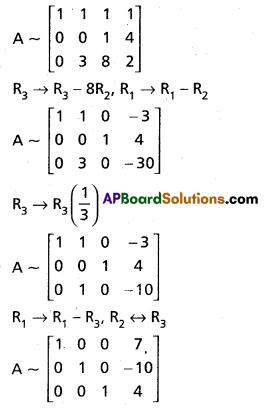
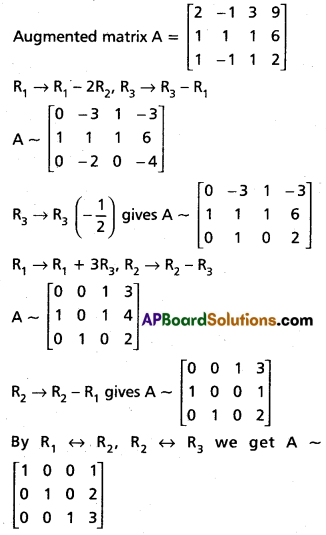
(iii) Gauss-Jordan method:
Inter 1st Year Maths 1A Matrices Solutions Ex 3(h) Q5(iii)
∴ The given equations have a unique solution.
Solution is x = 1, y = 2, z = 3

Inter 1st Year Maths 1A Matrices Solutions Ex 3(h)

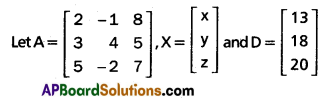
Question 6.
2x – y + 8z = 13
3x + 4y + 5z = 18
5x – 2y + 7z = 20
Solution:
(i) Cramer’s rule:
Δ = \(\left|\begin{array}{ccc}
2 & -1 & 8 \\
3 & 4 & 5 \\
5 & -2 & 7
\end{array}\right|\)
= 2(28 + 10) + 1(21 – 25) + 8(-6 – 20)
= 76 – 4 – 208
= -136
Δ1 = \(\left|\begin{array}{ccc}
13 & -1 & 8 \\
18 & 4 & 5 \\
20 & -2 & 7
\end{array}\right|\)
= 13(28 + 10) + 1(126 – 100) + 8(-36 – 80)
= 494 + 26 – 928
= -408
Δ2 = \(\left|\begin{array}{lll}
2 & 13 & 8 \\
3 & 18 & 5 \\
5 & 20 & 7
\end{array}\right|\)
= 2(126 – 100) – 13(21 – 25) + 8(60 – 90)
= 52 + 52 – 240
= -136
Δ3 = \(\left|\begin{array}{ccc}
2 & -1 & 13 \\
3 & 4 & 18 \\
5 & -2 & 20
\end{array}\right|\)
= 2(80 + 36) + 1(60 – 90) + 13(-6 – 20)
= 232 – 30 – 338
= -136
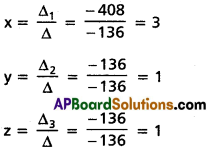
Inter 1st Year Maths 1A Matrices Solutions Ex 3(h) Q6(i)
∴ Solution is x = 3, y = 1, z = 1

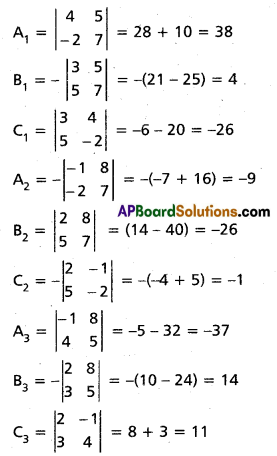
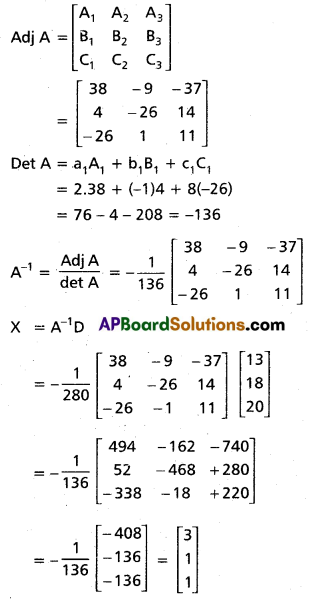
(ii) Matrix inversion method:
Inter 1st Year Maths 1A Matrices Solutions Ex 3(h) Q6(ii)
Inter 1st Year Maths 1A Matrices Solutions Ex 3(h) Q6(ii).1
Inter 1st Year Maths 1A Matrices Solutions Ex 3(h) Q6(ii).2
∴ Solution is x = 3, y = 1, z = 1

(iii) Gauss Jordan method:
Inter 1st Year Maths 1A Matrices Solutions Ex 3(h) Q6(iii)
∴ The given equations have a unique solution and Solution is x = 3, y = 1, z = 1.

Inter 1st Year Maths 1A Matrices Solutions Ex 3(h)

Question 7.
2x – y + 3z = 8
-x + 2y + z = 4
3x + y – 4z = 0
Solution:
(i) Cramer’s rule:
Δ = \(\left|\begin{array}{ccc}
2 & -1 & 3 \\
-1 & 2 & 1 \\
3 & 1 & -4
\end{array}\right|\)
= 2(-8 – 1) + 1(4 – 3) + 3(-1 – 6)
= -18 + 1 – 21
= -38
Δ1 = \(\left|\begin{array}{ccc}
8 & -1 & 3 \\
4 & 2 & 1 \\
0 & 1 & -4
\end{array}\right|\)
= 8(-8 – 1) + 1(-16 – 0) + 3(4 – 0)
= -72 – 16 + 12
= -76
Δ2 = \(\left|\begin{array}{ccc}
2 & 8 & 3 \\
-1 & 4 & 1 \\
3 & 0 & -4
\end{array}\right|\)
= 2(-16 – 0) – 8(4 – 3) + 3(-0 – 12)
= -32 – 8 – 36
= -76
Δ3 = \(\left|\begin{array}{ccc}
2 & -1 & 8 \\
-1 & 2 & 4 \\
3 & 1 & 0
\end{array}\right|\)
= 2(0 – 4) + 1(0 – 12) + 8(-1 – 6)
= -8 – 12 – 56
= -76
Inter 1st Year Maths 1A Matrices Solutions Ex 3(h) Q7(i)
∴ Solution is x = 2, y = 2, z = 2.

(ii) Matrix inversion method:
Inter 1st Year Maths 1A Matrices Solutions Ex 3(h) Q7(ii)
Inter 1st Year Maths 1A Matrices Solutions Ex 3(h) Q7(ii).1
Solution is x = 2, y = 2, z = 2

(iii) Gauss Jordan method:
Inter 1st Year Maths 1A Matrices Solutions Ex 3(h) Q7(iii)
Inter 1st Year Maths 1A Matrices Solutions Ex 3(h) Q7(iii).1
∴ The given equations have a unique solution and solution is x = 2, y = 2, z = 2.

Inter 1st Year Maths 1A Matrices Solutions Ex 3(h)

Question 8.
x + y + z = 9
2x + 5y + 7z = 52
2x + y – z = 0
Solution:
(i) Cramer’s rule:
Δ = \(\left|\begin{array}{ccc}
1 & 1 & 1 \\
2 & 5 & 7 \\
2 & 1 & -1
\end{array}\right|\)
= 1(-5 – 7) – 1(-2 – 14) + 1(2 – 10)
= -12 + 16 – 8
= -4
Δ1 = \(\left|\begin{array}{ccc}
9 & 1 & 1 \\
52 & 5 & 7 \\
0 & 1 & -1
\end{array}\right|\)
= 9(-5 – 7) – 1(-52 – 0) + 1(52 – 0)
= -108 + 52 + 52
= -4
Δ2 = \(\left|\begin{array}{ccc}
1 & 9 & 1 \\
2 & 52 & 7 \\
2 & 0 & -1
\end{array}\right|\)
= 1(-52 – 0) – 9(-2 – 14) + 1(0 – 104)
= -52 + 144 – 104
= -12
Δ3 = \(\left|\begin{array}{ccc}
1 & 1 & 9 \\
2 & 5 & 52 \\
2 & 1 & 0
\end{array}\right|\)
= 1(0 – 52) – 1(0 – 104) + 9(2 – 10)
= -52 + 104 – 72
= -20
Inter 1st Year Maths 1A Matrices Solutions Ex 3(h) Q8(i)

(ii) Matrix inversion method:
Inter 1st Year Maths 1A Matrices Solutions Ex 3(h) Q8(ii)
Inter 1st Year Maths 1A Matrices Solutions Ex 3(h) Q8(ii).1
Solution is x = 1, y = 3, z = 5

(iii) Gauss Jordan method:
Inter 1st Year Maths 1A Matrices Solutions Ex 3(h) Q8(iii)
∴ The given equations have a unique solution and solution is x = 1, y = 3, z = 5.

Inter 1st Year Maths 1A Matrices Solutions Ex 3(g)

Practicing the Intermediate 1st Year Maths 1A Textbook Solutions Inter 1st Year Maths 1A Matrices Solutions Exercise 3(g) will help students to clear their doubts quickly.

Intermediate 1st Year Maths 1A Matrices Solutions Exercise 3(g)

Examine whether the following systems of equations are consistent or inconsistent and if consistent find the complete solutions.

Question 1.
x + y + z = 4
2x + 5y – 2z = 3
x + 7y – 7z = 5
Solution:
Inter 1st Year Maths 1A Matrices Solutions Ex 3(g) Q1
ρ(A) = 2, ρ(AB) = 3
ρ(A) ≠ ρ(AB)
∴ The given system of equations are in consistent.

Inter 1st Year Maths 1A Matrices Solutions Ex 3(g)

Question 2.
x + y + z = 6
x – y + z = 2
2x – y + 3z = 9
Solution:
Inter 1st Year Maths 1A Matrices Solutions Ex 3(g) Q2
Inter 1st Year Maths 1A Matrices Solutions Ex 3(g) Q2.1

Question 3.
x + y + z = 1
2x + y + z = 2
x + 2y + 2z = 1
Solution:
Inter 1st Year Maths 1A Matrices Solutions Ex 3(g) Q3
ρ(A) = 2 = ρ(AB) < 3
The given system of equations are consistent and have infinitely many solutions.
The solutions are given by [(x, y, z) 1x = 1, y + z = 0].

Question 4.
x + y + z = 9
2x + 5y + 7z = 52
2x + y – z = 0
Solution:
Inter 1st Year Maths 1A Matrices Solutions Ex 3(g) Q4
∴ ρ(A) = ρ(AB) = 3
The given system of equations are consistent have a unique solution.
∴ Solution is given by x = 1, y = 3, z = 5.

Inter 1st Year Maths 1A Matrices Solutions Ex 3(g)

Question 5.
x + y + z = 6
x + 2y + 3z = 10
x + 2y + 4z = 1
Solution:
Augmented matrix A = \(\left[\begin{array}{cccc}
1 & 1 & 1 & 6 \\
1 & 2 & 3 & 10 \\
1 & 2 & 4 & 1
\end{array}\right]\)
By R2 → R2 – R1, R3 → R3 – R2, we obtain
Inter 1st Year Maths 1A Matrices Solutions Ex 3(g) Q5
∴ ρ(A) = ρ(AB) = 3
The given system of equations are consistent.
They have a unique solution.
∴ Solution is given by x = -7, y = 22, z = -9.

Question 6.
x – 3y – 8z = -10
3x + y – 4z = 0
2x + 5y + 6z = 13
Solution:
The Augmented matrix
Inter 1st Year Maths 1A Matrices Solutions Ex 3(g) Q6
ρ(A) = ρ(AB) = 2 < 3
∴ The given system of equations are consistent have infinitely many solutions.
x + y = 2 and y + 2z = 3
Taking z = k, y = 3 – 2z = 3-2k
x = 2 – y
= 2 – (3 – 2k)
= 2 – 3 + 2k
= 2k – 1
∴ The solutions are given by x = -1 + 2k, y = 3 – 2k, z = k where ‘k’ is any scalar.

Question 7.
2x + 3y + z = 9
x + 2y + 3z = 6
3x + y + 2z = 8
Solution:
Inter 1st Year Maths 1A Matrices Solutions Ex 3(g) Q7
∴ ρ(A) = ρ(AB) = 3
The given system of equations are consistent have a unique solution.
∴ Solution is given by x = \(\frac{35}{18}\), y = \(\frac{29}{18}\), z = \(\frac{5}{18}\)

Inter 1st Year Maths 1A Matrices Solutions Ex 3(g)

Question 8.
x + y + 4z = 6
3x + 2y – 2z = 9
5x + y + 2z = 13
Solution:
Inter 1st Year Maths 1A Matrices Solutions Ex 3(g) Q8
∴ ρ(A) = ρ(AB) = 3
∴ The given system of equations are consistent have a unique solution.
∴ Solution is given by x = 2, y = 2, z = \(\frac{1}{2}\)

Inter 1st Year Maths 1A Matrices Solutions Ex 3(f)

Practicing the Intermediate 1st Year Maths 1A Textbook Solutions Inter 1st Year Maths 1A Matrices Solutions Exercise 3(f) will help students to clear their doubts quickly.

Intermediate 1st Year Maths 1A Matrices Solutions Exercise 3(f)

I. Find the rank of each of the following matrices.

Question 1.
\(\left[\begin{array}{ll}
1 & 0 \\
0 & 0
\end{array}\right]\)
Solution:
Det A = \(\left|\begin{array}{ll}
1 & 0 \\
0 & 0
\end{array}\right|\) = 0 – 0 = 0
and |1| = 1 ≠ 0
∴ ρ(A) = 1

Inter 1st Year Maths 1A Matrices Solutions Ex 3(f)

Question 2.
\(\left[\begin{array}{ll}
1 & 0 \\
0 & 1
\end{array}\right]\)
Solution:
Det A = \(\left|\begin{array}{ll}
1 & 0 \\
0 & 1
\end{array}\right|\) = 1 – 0 = 1 ≠ 0
∴ ρ(A) = 2

Question 3.
\(\left[\begin{array}{ll}
1 & 1 \\
0 & 0
\end{array}\right]\)
Solution:
Det A = \(\left|\begin{array}{ll}
1 & 1 \\
0 & 0
\end{array}\right|\) = 0 – 0 = 0
|1| = 1 ≠ 0
∴ ρ(A) = 1

Question 4.
\(\left[\begin{array}{ll}
1 & 1 \\
1 & 0
\end{array}\right]\)
Solution:
Det A = \(\left|\begin{array}{ll}
1 & 1 \\
1 & 0
\end{array}\right|\) = 0 – 1 = -1 ≠ 0
∴ ρ(A) = 2

Inter 1st Year Maths 1A Matrices Solutions Ex 3(f)

Question 5.
\(\left[\begin{array}{ccc}
1 & 0 & -4 \\
2 & -1 & 3
\end{array}\right]\)
Solution:
\(\left|\begin{array}{cc}
1 & -4 \\
2 & 3
\end{array}\right|\) = 3 + 8 = -11 ≠ 0
∴ ρ(A) = 2

Question 6.
\(\left[\begin{array}{lll}
1 & 2 & 6 \\
2 & 4 & 3
\end{array}\right]\)
Solution:
\(\left|\begin{array}{ll}
2 & 6 \\
4 & 3
\end{array}\right|\) = 6 – 24 = -18 ≠ 0
∴ ρ(A) = 2

II.

Question 1.
\(\left[\begin{array}{lll}
1 & 0 & 0 \\
0 & 0 & 1 \\
0 & 1 & 0
\end{array}\right]\)
Solution:
Det A = \(\left|\begin{array}{lll}
1 & 0 & 0 \\
0 & 1 & 0 \\
0 & 0 & 1
\end{array}\right|\)
= 1(1 – 0) – 0(0 – 0) + 0(0 – 0)
= 1 – 0 + 0
= 1 ≠ 0
∴ ρ(A) = 3

Inter 1st Year Maths 1A Matrices Solutions Ex 3(f)

Question 2.
\(\left[\begin{array}{ccc}
1 & 4 & -1 \\
2 & 3 & 0 \\
0 & 1 & 2
\end{array}\right]\)
Solution:
Det A = \(\left|\begin{array}{ccc}
1 & 4 & -1 \\
2 & 3 & 0 \\
0 & 1 & 2
\end{array}\right|\)
= 1(6 – 0) – 2(8 + 1) + 0(0 + 3)
= 6 – 18
= -12 ≠ 0
∴ ρ(A) = 3

Question 3.
\(\left[\begin{array}{lll}
1 & 2 & 3 \\
2 & 3 & 4 \\
0 & 1 & 2
\end{array}\right]\)
Solution:
Det A = \(\left|\begin{array}{lll}
1 & 2 & 3 \\
2 & 3 & 4 \\
0 & 1 & 2
\end{array}\right|\)
= 1(6 – 4) – 2(4 – 3) + 0(8 – 9)
= 2 – 2 + 0
= 0
∴ ρ(A) ≠ 3, ρ(A) < 3
Take \(\left|\begin{array}{ll}
1 & 2 \\
2 & 3
\end{array}\right|\) = 3 – 4 = -1 ≠ 0
∴ ρ(A) = 2

Question 4.
\(\left[\begin{array}{lll}
1 & 1 & 1 \\
1 & 1 & 1 \\
1 & 1 & 1
\end{array}\right]\)
Solution:
Let A = \(\left[\begin{array}{lll}
1 & 1 & 1 \\
1 & 1 & 1 \\
1 & 1 & 1
\end{array}\right]\), det A = 0, ρ(A) ≠ 3
All 2 × 2 sub-matrix det. is zero
∴ ρ(A) ≠ 2
|1| = 1 ≠ 0
∴ ρ(A) = 1

Inter 1st Year Maths 1A Matrices Solutions Ex 3(f)

Question 5.
\(\left[\begin{array}{cccc}
1 & 2 & 0 & -1 \\
3 & 4 & 1 & 2 \\
-2 & 3 & 2 & 5
\end{array}\right]\)
Solution:
Take sub-matrix B = \(\left|\begin{array}{ccc}
1 & 2 & 0 \\
3 & 4 & 1 \\
-2 & 3 & 2
\end{array}\right|\)
= 1(8 – 3) – 2(6 + 2)
= 5 – 16
= -11 ≠ 0
Rank of the given matrix is 3.

Question 6.
\(\left[\begin{array}{cccc}
0 & 1 & 1 & -2 \\
4 & 0 & 2 & 5 \\
2 & 1 & 3 & 1
\end{array}\right]\)
Solution:
Take sub matrix A = \(\left[\begin{array}{lll}
0 & 1 & 1 \\
4 & 0 & 2 \\
2 & 1 & 3
\end{array}\right]\)
= -1(12 – 4) + 1(4 – 0)
= -8 + 4
= -4 ≠ 0
∴ ρ(A) = 3

Inter 1st Year Maths 1A Functions Solutions Ex 1(c)

Practicing the Intermediate 1st Year Maths 1A Textbook Solutions Inter 1st Year Maths 1A Functions Solutions Exercise 1(c) will help students to clear their doubts quickly.

Intermediate 1st Year Maths 1A Functions Solutions Exercise 1(c)

I.

Question 1.
Find the domains of the following real-valued functions.
(i) f(x) = \(\frac{1}{\left(x^{2}-1\right)(x+3)}\)
Solution:
f(x) = \(\frac{1}{\left(x^{2}-1\right)(x+3)}\) ∈ R
⇔ (x2 – 1) (x + 3) ≠ 0
⇔ (x + 1) (x – 1) (x + 3) ≠ 0
⇔ x ≠ -1, 1, -3
∴ Domain of f is R – {-1, 1, -3}

(ii) f(x) = \(\frac{2 x^{2}-5 x+7}{(x-1)(x-2)(x-3)}\)
⇔ (x – 1) (x – 2) (x – 3) ≠ 0
⇔ x ≠ 1, x ≠ 2, x ≠ 3
∴ Domain of f is R – {1, 2, 3}

(iii) f(x) = \(\frac{1}{\log (2-x)}\)
Solution:
f(x) = \(\frac{1}{\log (2-x)}\)
⇔ log (2 – x) ≠ 0 and 2 – x > 0
⇔ (2 – x) ≠ 1 and 2 > x
⇔ x ≠ 1 and x < 2
x ∈ (-∞, 1) ∪ (1, 2) (or) x ∈ (-∞, 2) – {1}
∴ Domain of f is {(-∞, 2) – {1}}

(iv) f(x) = |x – 3|
Solution:
f(x) = |x – 3| ∈ R
⇔ x ∈ R
∴ The domain of f is R

(v) f(x) = \(\sqrt{4 x-x^{2}}\)
Solution:
f(x) = \(\sqrt{4 x-x^{2}}\) ∈ R
⇔ 4x – x2 ≥ 0
⇔ x(4 – x) ≥ 0
⇔ x ∈ [0, 4]
∴ Domain of f is [0, 4]

Inter 1st Year Maths 1A Functions Solutions Ex 1(c)

(vi) f(x) = \(\frac{1}{\sqrt{1-x^{2}}}\)
Solution:
f(x) = \(\frac{1}{\sqrt{1-x^{2}}}\) ∈ R
⇔ 1 – x2 > 0
⇔ (1 + x) (1 – x) > 0
⇔ x ∈ (-1, 1)
∴ Domain of f is {x/x ∈ (-1, 1)}

(vii) f(x) = \(\frac{3^{x}}{x+1}\)
Solution:
f(x) = \(\frac{3^{x}}{x+1}\) ∈ R
⇔ 3x ∈ R, ∀ x ∈ R and x + 1 ≠ 0
⇔ x ≠ -1
∴ Domain of f is R – {-1}

(viii) f(x) = \(\sqrt{x^{2}-25}\)
Solution:
f(x) = \(\sqrt{x^{2}-25}\) ∈ R
⇔ x2 – 25 ≥ 0
⇔ (x + 5) (x – 5) ≥ 0
⇔ x ∈ (-∞, -5] ∪ [5, ∞)
⇔ x ∈ R – (-5, 5)
∴ Domain of f is R – (- 5, 5)

(ix) f(x) = \(\sqrt{x-[x]}\)
Solution:
f(x) = \(\sqrt{x-[x]}\) ∈ R
⇔ x – [x] ≥ 0
⇔ x ≥ [x]
⇔ x ∈ R
∴ Domain of f is R.

(x) f(x) = \(\sqrt{[x]-x}\)
Solution:
f(x) = \(\sqrt{[x]-x}\) ∈ R
⇔ [x] – x ≥ 0
⇔ [x] ≥ x
⇔ x ≤ [x]
⇔ x ∈ Z
∴ The domain of f is z (Where z denotes a set of integers)

Inter 1st Year Maths 1A Functions Solutions Ex 1(c)

Question 2.
Find the ranges of the following real-valued functions.
(i) log|4 – x2|
Solution:
Let y = f(x) = log|4 – x2|
f(x) ∈ R
⇔ 4 – x2 ≠ 0
⇔ x ≠ ±2
∵ y = log|4 – x2|
⇒ |4 – x2| = ey
∵ ey > 0 ∀ y ∈ R
∴ The range of f is R.

(ii) \(\sqrt{[x]-x}\)
Solution:
Let y = f(x) = \(\sqrt{[x]-x}\)
f(x) ∈ R
⇔ [x] – x ≥ 0
⇔ x ≤ [x]
⇔ x ∈ z
∴ Domain of f is z. Then range of f is {0}

(iii) \(\frac{\sin \pi[x]}{1+[x]^{2}}\)
Solution:
Let f(x) = \(\frac{\sin \pi[x]}{1+[x]^{2}}\) ∈ R
⇔ x ∈ R
∴ The domain of f is R
For x ∈ R, [x] is an integer,
sin π[x] = 0, ∀ x ∈ R [∵ sin nπ = 0, ∀ n ∈ z]
∴ Range of f is {0}

(iv) \(\frac{x^{2}-4}{x-2}\)
Solution:
Let y = f(x) = \(\frac{x^{2}-4}{x-2}\) ∈ R
⇔ y = \(\frac{(x+2)(x-2)}{x-2}\)
⇔ x ≠ 2
∴ The domain of f is R – {2}
Then y = x + 2, [∵ x ≠ 2 ⇒ y ≠ 4]
Then its range R – {4}

(v) \(\sqrt{9+x^{2}}\)
Solution:
Let y = f(x) = \(\sqrt{9+x^{2}}\) ∈ R
The domain of f is R
When x = 0, f(0) = √9 = 3
For all values of x ∈ R – {0}, f(x) > 3
∴ The range of f is [3, ∞)

Question 3.
If f and g are real-valued functions defined by f(x) = 2x – 1 and g(x) = x2 then find
(i) (3f – 2g)(x)
(ii) (fg) (x)
(iii) \(\left(\frac{\sqrt{f}}{g}\right)(x)\)
(iv) (f + g + 2) (x)
Solution:
(i) (3f – 2g)(x)
f(x) = 2x – 1, g(x) = x2
(3f – 2g) (x) = 3f(x) – 2g(x)
= 3(2x – 1) – 2x2
= -2x2 + 6x – 3

(ii) (fg) (x)
= f(x) . g(x)
= (2x – 1) (x2)
= 2x3 – x2

(iii) \(\left(\frac{\sqrt{f}}{g}\right)(x)\)
\(\frac{\sqrt{f(x)}}{g(x)}=\frac{\sqrt{2 x-1}}{x^{2}}\)

(iv) (f + g + 2) (x)
= f(x) + g(x) + 2
= (2x – 1) + x2 + 2
= x2 + 2x + 1
= (x + 1)2

Inter 1st Year Maths 1A Functions Solutions Ex 1(c)

Question 4.
If f = {(1, 2), (2, -3), (3, -1)} then find
(i) 2f
(ii) 2 + f
(iii) f2
(iv) √f
Solution:
Given f = {(1, 2), (2, -3), (3, -1)}
(i) 2f = {(1, 2 × 2), (2, 2(-3), (3, 2(-1))}
= {(1, 4), (2, -6), (3, -2)}

(ii) 2 + f = {(1, 2 + 2), (2, 2 + (-3)), (3, 2 + (-1)}
= {(1, 4), (2, -1), (3, 1)}

(iii) f2 = {(1, 22), (2, (-3)2), (3, (-1)2)}
= {(1, 4), (2, 9), (3, 1)}

(iv) √f = {(1, √2)}
∵ √-3 and √-1 are not real

II.

Question 1.
Find the domains of the following real-valued functions.
(i) f(x) = \(\sqrt{x^{2}-3 x+2}\)
Solution:
f(x) = \(\sqrt{x^{2}-3 x+2}\) ∈ R
⇔ x2 – 3x + 2 ≥ 0
⇔ (x- 1) (x – 2) ≥ 0
⇔ x ∈ (-∞, 1 ] ∪ [2, ∞]
∴ The domain of f is R – (1, 2)

(ii) f(x) = log(x2 – 4x + 3)
Solution:
f(x) = log(x2 – 4x + 3) ∈ R
⇔ x2 – 4x + 3 > 0
⇔ (x – 1) (x – 3) > 0
⇔ x ∈ (-∞, 1) ∪ (3, ∞)
∴ Domain of f is R – [1, 3]

Inter 1st Year Maths 1A Functions Solutions Ex 1(c)

(iii) f(x) = \(\frac{\sqrt{2+x}+\sqrt{2-x}}{x}\)
Solution:
f(x) = \(\frac{\sqrt{2+x}+\sqrt{2-x}}{x}\) ∈ R
⇔ 2 + x ≥ 0, 2 – x ≥ 0, x ≠ 0
⇔ x ≥ -2, x ≤ 2, x ≠ 0
⇔ -2 ≤ x ≤ 2, x ≠ 0
⇔ x ∈ [-2, 2] – {0}
Domain of f is [-2, 2] – {0}

(iv) f(x) = \(\frac{1}{\sqrt[3]{(x-2)} \log _{(4-x)} 10}\)
Solution:
f(x) = \(\frac{1}{\sqrt[3]{(x-2)} \log _{(4-x)} 10}\) ∈ R
⇔ 4 – x > 0, 4 – x ≠ 1 and x – 2 ≠ 0
⇔ x < 4, x ≠ 3, x ≠ 2
∴ Domain of f is (-∞, 4) – {2, 3}

(v) f(x) = \(\sqrt{\frac{4-x^{2}}{[x]+2}}\)
Solution:
f(x) = \(\sqrt{\frac{4-x^{2}}{[x]+2}}\) ∈ R
Case (i) 4 – x2 ≥ 0 and [x] + 2 > 0 (or) Case (ii) 4 – x2 ≤ 0 and [x] + 2 < 0
Case (i): 4 – x2 ≥ 0 and [x] + 2 > 0
⇔ (2 – x) (2 + x) ≥ 0 and [x] > -2
⇔ x ∈ [-2, 2] and x ∈ [-1, ∞]
⇔ x ∈ [-1, 2] ……..(1)
Case (ii): 4 – x2 ≤ 0 and [x] + 2 < 0
⇔ (2 + x) (2 – x) ≤ 0 and [x] < – 2
⇔ x ∈ (-∞, -2] ∪ [2, ∞] and x ∈ (-∞, -2)
⇔ x ∈ (-∞, -2) ……(2)
from (1) and (2),
Domain of f is (-∞, -2) ∪ [-1, 2]

(vi) f(x) = \(\sqrt{\log _{0.3}\left(x-x^{2}\right)}\)
Solution:
f(x) = \(\sqrt{\log _{0.3}\left(x-x^{2}\right)}\) ∈ R
Then log0.3(x – x2) ≥ 0
⇒ x – x2 ≤ (0.3)0
⇒ x – x2 ≤ 1
⇒ -x2 + x – 1 ≤ 0
⇒ x2 – x + 1 ≥ 0
This is true for all x ∈ R ……..(1)
and x – x2 ≥ 0
⇒ x2 – x ≤ 0
⇒ x(x – 1) ≤ 0
⇒ x ∈ (0, 1) …….(2)
From (1) and (2)
Domain of f is R ^ (0, 1) = (0, 1)
∴ The domain of f is (0, 1)

(vii) f(x) = \(\frac{1}{x+|x|}\)
Solution:
f(x) = \(\frac{1}{x+|x|}\) ∈ R
⇔ x + |x| ≠ 0
⇔ x ∈ (0, ∞)
∵ |x| = x, if x ≥ 0
|x| = -x, if x < 0
∴ The domain of f is (0, ∞)

Inter 1st Year Maths 1A Functions Solutions Ex 1(c)

Question 2.
Prove that the real valued function f(x) = \(\frac{x}{e^{x}-1}+\frac{x}{2}+1\) is an even function on R \ {0}.
Solution:
f(x) ∈ R, ex – 1 ≠ 0
⇒ ex ≠ 1
⇒ x ≠ 0
Inter 1st Year Maths 1A Functions Solutions Ex 1(c) II Q2
⇒ f(x) is an even function on R – {0}

Question 3.
Find the domain and range of the following functions.
(i) f(x) = \(\frac{\tan \pi[x]}{1+\sin \pi[x]+\left[x^{2}\right]}\)
Solution:
f(x) = \(\frac{\tan \pi[x]}{1+\sin \pi[x]+\left[x^{2}\right]}\) ∈ R
⇔ x ∈ R, since [x] is an integer tan π[x] and sin π[x] each is zero for ∀ x ∈ R and f(x) ∈ R
Domain of f is R
Its range = {0}

(ii) f(x) = \(\frac{x}{2-3 x}\)
Solution:
Inter 1st Year Maths 1A Functions Solutions Ex 1(c) II Q3(ii)

(iii) f(x) = |x| + |1 + x|
Solution:
f(x) = |x| + |1 + x| ∈ R
⇔ x ∈ R
∴ Domain of f is R
∵ |x| = x, if x ≥ 0
= -x, if x < 0
|1 + x| = 1 + x, if x ≥ -1
= -(1 + x) if x < -1
For x = 0, f(0) = |0| + |1 + 0| = 1
x = 1, f(1) = |1| + |1 + 1| = 1 + 2 = 3
x = 2, f(2) = |2| + |1 + 2| = 2 + 3 = 5
x = -2, f(-2) = |-2| + |1 + (-2)| = 2 + 1 = 3
x = -1, f(-1) = |-1| + |1 +(-1)| = 1 + 0 = 1
∴ The range of f is [1, ∞]

Inter 1st Year Maths 1A Functions Solutions Ex 1(b)

Practicing the Intermediate 1st Year Maths 1A Textbook Solutions Inter 1st Year Maths 1A Functions Solutions Exercise 1(b) will help students to clear their doubts quickly.

Intermediate 1st Year Maths 1A Functions Solutions Exercise 1(b)

I.

Question 1.
If f(x) = ex and g(x) = logex, then show that f o g = g o f and find f-1 and g-1.
Solution:
Given f(x) = ex and g(x) = logex
Now (f o g) (x) = f(g(x))
= f(logex) [∵ g(x) = \(\log _{e} x\)]
= \(e^{\left(\log _{e} x\right)}\)
= x
∴ (fog) (x) = x ………(1)
and (g o f) (x) = g(f(x))
= g(ex) [∵ f(x) = ex]
= loge (ex) [∵ g(x) = logex]
= x loge (e)
= x(1)
= x
∴ (g o f) (x) = x …….(2)
From (1) and (2)
f o g = g o f
Given f(x) = ex
Let y = f(x) = ex ⇒ x = f-1(y)
and y = ex ⇒ x = loge (y)
∴ f-1(y) = loge (y) ⇒ f-1(x) = loge (x)
Let y = g(x) = loge (x)
∵ y = g(x) ⇒ x = g-1(y)
∵ y = loge (x) ⇒ x = ey
∴ g-1(y) = ey ⇒ g-1(x) = ex
∴ f-1(x) = loge (x) and g-1(x) = ex

Inter 1st Year Maths 1A Functions Solutions Ex 1(b)

Question 2.
If f(y) = \(\frac{y}{\sqrt{1-y^{2}}}\), g(y) = \(\frac{y}{\sqrt{1+y^{2}}}\) then show that (fog) (y) = y
Solution:
f(y) = \(\frac{y}{\sqrt{1-y^{2}}}\) and g(y) = \(\frac{y}{\sqrt{1+y^{2}}}\)
Now, (fog) (y) = f(g(y))
Inter 1st Year Maths 1A Functions Solutions Ex 1(b) I Q2
∴ (fog) (y) = y

Question 3.
If f : R → R, g : R → R are defined by f(x) = 2x2 + 3 and g(x) = 3x – 2, then find
(i) (fog)(x)
(ii) (gof) (x)
(iii) (fof) (0)
(iv) go(fof) (3)
Solution:
f : R → R, g : R → R and f(x) = 2x2 + 3; g(x) = 3x – 2
(i) (f o g) (x) = f(g(x))
= f(3x – 2) [∵ g(x) = 3x – 2]
= 2(3x- 2)2 + 3 [∵ f(x) = 2x2 + 3]
= 2(9x2 – 12x + 4) + 3
= 18x2 – 24x + 8 + 3
= 18x2 – 24x + 11

(ii) (gof) (x) = g(f(x))
= g(2x2 + 3) [∵ f(x) = 2x2 + 3]
= 3(2x2 + 3) – 2 [∵ g(x) = 3x – 2]
= 6x2 + 9 – 2
= 6x2 + 7

(iii) (fof) (0) = f(f(0))
= f(2(0) + 3) [∵ f(x) = 2x2 + 3]
= f(3)
= 2(3)2 + 3
= 18 + 3
= 21

(iv) g o (f o f) (3)
= g o (f (f(3)))
= g o (f (2(3)2 + 3)) [∵ f(x) = 2x2 + 3]
= g o (f(21))
= g(f(21))
= g(2(21)2 + 3)
= g(885)
= 3(885) – 2 [∵ g(x) = 3x – 2]
= 2653

Inter 1st Year Maths 1A Functions Solutions Ex 1(b)

Question 4.
If f : R → R, g : R → R are defined by f(x) = 3x – 1, g(x) = x2 + 1, then find
(i) (f o f) (x2 + 1)
(ii) f o g (2)
(iii) g o f (2a – 3)
Solution:
f : R → R, g : R → R and f(x) = 3x – 1 ; g(x) = x2 + 1
(i) (f o f) (x2 + 1)
= f(f(x2 + 1))
= f[3(x2 + 1) – 1] [∵ f(x) = 3x – 1]
= f(3x2 + 2)
= 3(3x2 + 2) – 1
= 9x2 + 5

(ii) (f o g) (2)
= f(g(2))
= f(22 + 1) [∵ g(x) = x2 + 1]
= f(5)
= 3(5) – 1
= 14 [∵ f(x) = 3x – 1]

(iii) (g o f) (2a – 3)
= g(f(2a – 3))
= g[3(2a – 3) – 1] [∵ f(x) = 3x – 1]
= g(6a – 10)
= (6a – 10)2 + 1 [∵ g(x) = x2 + 1]
= 36a2 – 120a + 100 + 1
= 36a2 – 120a + 101

Question 5.
If f(x) = \(\frac{1}{x}\), g(x) = √x for all x ∈ (0, ∞) then find (g o f) (x).
Solution:
f(x) = \(\frac{1}{x}\), g(x) = √x, ∀ x ∈ (0, ∞)
(g o f) (x) = g(f(x))
= g(\(\frac{1}{x}\)) [∵ f(x) = \(\frac{1}{x}\)]
= \(\sqrt{\frac{1}{x}}\)
= \(\frac{1}{\sqrt{x}}\) [∵ g(x) = √x]
∴ (gof) (x) = \(\frac{1}{\sqrt{x}}\)

Question 6.
f(x) = 2x – 1, g(x) = \(\frac{x+1}{2}\) for all x ∈ R, find (g o f) (x).
Solution:
f(x) = 2x – 1, g(x) = \(\frac{x+1}{2}\) ∀ x ∈ R
(g o f) (x) = g(f(x))
= g(2x – 1) [∵ f(x) = 2x – 1]
= \(\frac{(2 x-1)+1}{2}\)
= x [∵ g(x) = \(\frac{x+1}{2}\)]
∴ (g o f) (x) = x

Inter 1st Year Maths 1A Functions Solutions Ex 1(b)

Question 7.
If f(x) = 2, g(x) = x2, h(x) = 2x for all x ∈ R, then find (f o (g o h)) (x).
Solution:
f(x) = 2, g(x) = x2, h(x) = 2x, ∀ x ∈ R
[f o (g o h) (x)]
= [f o g (h(x))]
= f o g (2x) [∵ h(x) = 2x]
= f[g(2x)]
= f((2x)2) [∵ g(x) = x2]
= f(4x2) = 2 [∵ f(x) = 2]
∴ [f o (g o h) (x)] = 2

Question 8.
Find the inverse of the following functions.
(i) a, b ∈ R, f : R → R defined by f(x) = ax + b, (a ≠ 0).
Solution:
a, b ∈ R, f : R → R and f(x) = ax + b, a ≠ 0
Let y = f(x) = ax + b
⇒ y = f(x)
⇒ x = f-1(y) ……..(i)
and y = ax + b
⇒ x = \(\frac{y-b}{a}\) ……..(ii)
From (i) and (ii)
f-1(y) = \(\frac{y-b}{a}\)
⇒ f-1(x) = \(\frac{x-b}{a}\)

(ii) f : R → (0, ∞) defined by f(x) = 5x
Solution:
f : R → (0, ∞) and f(x) = 5x
Let y = f (x) = 5x
y = f(x) ⇒ x = f-1(y) ……(i)
and y = 5x ⇒ log5 (y) = x ……..(ii)
From (i) and (ii)
f-1(y) = log5(y) ⇒ f-1(x) = log5 (x)

(iii) f : (0, ∞) → R defined by f(x) = log2 (x).
Solution:
f : (0, ∞) → R and f(x) = log2 (x)
Let y = f(x) = log2 (x)
∵ y = f(x) ⇒ x = f-1(y) ……..(i)
and y = log2(x) ⇒ x = 2y
From (i) and (ii)
f-1(y) = 2y ⇒ f-1(x) = 2x

Inter 1st Year Maths 1A Functions Solutions Ex 1(b)

Question 9.
If f(x) = 1 + x + x2 + …… for |x| < 1 then show that f-1(x) = \(\frac{x-1}{x}\)
Solution:
f(x) = 1 + x + x2 + ……..
Inter 1st Year Maths 1A Functions Solutions Ex 1(b) I Q9

Question 10.
If f : [1, ∞) ⇒ [1, ∞) defined by f(x) = \(2^{x(x-1)}\) then find f-1(x).
Solution:
Inter 1st Year Maths 1A Functions Solutions Ex 1(b) I Q10
Inter 1st Year Maths 1A Functions Solutions Ex 1(b) I Q10.1

II.

Question 1.
If f(x) = \(\frac{x-1}{x+1}\), x ≠ ±1, then verify (f o f-1) (x) = x.
Solution:
Given f(x) = \(\frac{x-1}{x+1}\), x ≠ ±1
Let y = f(x) = \(\frac{x-1}{x+1}\)
∵ y = f(x) ⇒ x = f-1(y) ……(i)
and y = \(\frac{x-1}{x+1}\)
Inter 1st Year Maths 1A Functions Solutions Ex 1(b) II Q1

Question 2.
If A = {1, 2, 3}, B = {α, β, γ}, C = {p, q, r} and f : A → B, g : B → C are defined by f = {(1, α), (2, γ), (3, β)}, g = {(α, q), (β, r), (γ, p)}, then show that f and g are bijective functions and (gof)-1 = f-1 o g-1.
Solution:
A = {1, 2, 3}, B = {α, β, γ},
f : A → B and f = {(1, α), (2, γ), (3, β)}
⇒ f(1) = α, f(2) = γ, f(3) = β
∵ Distinct elements of A have distinct f – images in B, f: A → B is an injective function.
Range of f = {α, γ, β} = B(co-domain)
∴ f : A → B is a surjective function.
Hence f : A → B is a bijective function.
B = {α, β, γ}, C = {p, q, r}, g : B → C and g : {(α, q), (β, r), (γ, p)}
⇒ g(α) = q, g(β) = r, g(γ) = p
∴ Distinct elements of B have distinct g – images in C, g : B → C is an injective function.
Range of g = {q, r, p} = C, (co-domain)
∴ g : B → C is a surjective function
Hence g : B → C is a bijective function
Now f = {(1, α), (2, γ), (3, β)}
g = {(α, q), (β, r), (γ, p)}
g o f = {(1, q), (2, p), (3, r)}
∴ (g o f)-1 = {(q, 1), (r, 3), (p, 2)} ………(1)
g-1 = {(q, α), (r, β), (p, γ)}
f-1 = {(α, 1), (γ, 2),(β, 3)}
Now f-1 o g-1 = {(q, 1), (r, 3), (p, 2)} …….(2)
From eq’s (1) and (2)
(gof)-1 = f-1 o g-1

Inter 1st Year Maths 1A Functions Solutions Ex 1(b)

Question 3.
If f : R → R, g : R → R defined by f(x) = 3x – 2, g(x) = x2 + 1, then find
(i) (g o f-1) (2)
(ii) (g o f)(x – 1)
Solution:
f : R → R, g : R → R and f(x) = 3x – 2
f is a bijective function ⇒ its inverse exists
Let y = f(x) = 3x – 2
∵ y = f(x) ⇒ x = f-1(y) …….(i)
and y = 3x – 2
⇒ x = \(\frac{y+2}{3}\) ……..(ii)
From (i) and (ii)
f-1(y) = \(\frac{y+2}{3}\)
⇒ f-1(x) = \(\frac{x+2}{3}\)
Now (gof-1) (2)
= g(f-1(2))
Inter 1st Year Maths 1A Functions Solutions Ex 1(b) II Q3
∴ (g o f-1) (2) = \(\frac{25}{9}\)

(ii) (g o f) (x -1)
= g(f(x – 1))
= g(3(x – 1) – 2) [∵ f(x) = 3x – 2]
= g(3x – 5)
= (3x – 5)2 + 1 [∵ g(x) = x2 + 1]
= 9x2 – 30x + 26
∴ (g o f) (x – 1) = 9x2 – 30x + 26

Question 4.
Let f = {(1, a), (2, c), (4, d), (3, b)} and g-1 = {(2, a), (4, b), (1, c), (3, d)} then show that (gof)-1 = f-1 o g-1
Solution:
f = {(1, a), (2, c), (4, d), (3, b)}
∴ f-1 = {(a, 1), (c, 2), (d, 4), (b, 3)}
g-1 = {(2, a), (4, b), (1, c), (3, d)}
∴ g = {(a, 2), (b, 4), (c, 1), (d, 3)}
(g o f) = {(1, 2), (2, 1), (4, 3), (3, 4)}
∴ (gof)-1 = {(2, 1), (1, 2), (3, 4), (4, 3)} ……….(1)
f-1 o g-1 = {(2, 1), (4, 3), (1, 2), (3, 4)} ……..(2)
From eq’s (1) and (2), we observe (gof)-1 = f-1 o g-1

Question 5.
Let f : R → R, g : R → R be defined by f(x) = 2x – 3, g(x) = x3 + 5 then find (f o g)-1 (x).
Solution:
f : R → R, g : R → R and f(x) = 2x – 3 and g(x) = x3 + 5
Now (fog) (x) = f(g(x))
= f(x3 + 5) [∵ g(x) = x2 + 5]
= 2(x3 + 5) – 3 [∵ f(x) = 2x – 3]
= 2x3 + 7
∴ (f o g) (x) = 2x3 + 7
Let y = (f o g) (x) = 2x3 + 7
∵ y = (fog)(x)
⇒ x = (fog)-1 (y) …….(1)
and y = 2x3 + 7
⇒ x3 = \(\frac{y-7}{2}\)
⇒ x = \(\left(\frac{y-7}{2}\right)^{\frac{1}{3}}\) …..(2)
From eq’s (1) and (2),
(f o g)-1 (y) = \(\left(\frac{y-7}{2}\right)^{\frac{1}{3}}\)
∴ (f o g)-1 (x) = \(\left(\frac{x-7}{2}\right)^{\frac{1}{3}}\)

Inter 1st Year Maths 1A Functions Solutions Ex 1(b)

Question 6.
Let f(x) = x2, g(x) = 2x. Then solve the equation (f o g) (x) = (g o f) (x)
Solution:
Given f(x) = x2 and g(x) = 2x
Now (f o g) (x) = f(g(x))
= f(2x) [∵ g(x) = 2x]
= (2x)2
= 22x [∵ f(x) = x2]
∴ (f o g) (x) = 22x ……(1)
and (g o f) (x) = g(f(x))
= g(x2) [∵ f(x) = x2]
= \((2)^{x^{2}}\) [∵ g(x) = 2x]
∴ (g o f) (x) = \((2)^{x^{2}}\)
∵ (f o g) (x) = (g o f) (x)
⇒ 22x = \((2)^{x^{2}}\)
⇒ 2x = x2
⇒ x2 – 2x = 0
⇒ x(x – 2) = 0
⇒ x = 0, x = 2
∴ x = 0, 2

Question 7.
If f(x) = \(\frac{x+1}{x-1}\), (x ≠ ±1) then find (fofof) (x) and (fofofof) (x).
Solution:
f(x) = \(\frac{x+1}{x-1}\), (x ≠ ±1)
(i) (fofof) (x) = (fof) [f(x)]
= (fof) \(\left(\frac{x+1}{x-1}\right)\) [∵ f(x) = \(\left(\frac{x+1}{x-1}\right)\)]
Inter 1st Year Maths 1A Functions Solutions Ex 1(b) II Q7

(ii) (fofofof) (x) = f[(f o f o f) (x)]
= f [f(x)] {from (1)}
Inter 1st Year Maths 1A Functions Solutions Ex 1(b) II Q7.1
In the above problem if a number of f is even its answer is x and if a number of f is odd its answer is f(x).

Inter 1st Year Maths 1A Functions Solutions Ex 1(a)

Practicing the Intermediate 1st Year Maths 1A Textbook Solutions Inter 1st Year Maths 1A Functions Solutions Exercise 1(a) will help students to clear their doubts quickly.

Intermediate 1st Year Maths 1A Functions Solutions Exercise 1(a)

I.

Question 1.
If the function f is defined by
Inter 1st Year Maths 1A Functions Solutions Ex 1(a) I Q1
then find the values of
(i) f(3)
(ii) f(0)
(iii) f(-1.5)
(iv) f(2) + f(-2)
(v) f(-5)
Solution:
(i) f(3)
For x > 1, f(x) = x + 2
∴ f(3) = 3 + 2 = 5

(ii) f(0)
For -1 ≤ x ≤ 1, f(x) = 2
∴ f(0) = 2

(iii) f(-1.5)
For -3 < x < -1, f(x) = x – 1
∴ f(-1.5) = -1.5 – 1 = -2.5

(iv) f(2) + f(-2) For x > 1, f(x) = x + 2
∴ f(2) = 2 + 2 = 4
For -3 < x < -1, f(x) = x – 1
∴ f(-2)= -2 – 1 = -3
f(2) + f(-2) = 4 + (-3) = 1

(v) f(-5) is not defined, since domain of x is {X/X ∈ (-3, ∞)}

Inter 1st Year Maths 1A Functions Solutions Ex 1(a)

Question 2.
If f: R{0}R is defined by f(x) = \(x^{3}-\frac{1}{x^{3}}\); then show that f(x) + \(f\left(\frac{1}{x}\right)\) = 0.
Solution:
Given f(x) = \(x^{3}-\frac{1}{x^{3}}\) ……(i)
Now \(f\left(\frac{1}{x}\right)=\left(\frac{1}{x}\right)^{3}-\frac{1}{\left(\frac{1}{x}\right)^{3}}=\frac{1}{x^{3}}-x^{3}\) ……(2)
Add (1) and (2)
\(f(x)+f\left(\frac{1}{x}\right)=\left(x^{3}-\frac{1}{x^{3}}\right)+\left(\frac{1}{x^{3}}-x^{3}\right)\) = 0
∴ f(x) + \(f\left(\frac{1}{x}\right)\) = 0

Question 3.
If f : R → R is defined by f(x) = \(\frac{1-x^{2}}{1+x^{2}}\), then show that f(tan θ) = cos 2θ.
Solution:
Given f(x) = \(\frac{1-x^{2}}{1+x^{2}}\)
Inter 1st Year Maths 1A Functions Solutions Ex 1(a) I Q3
∴ f(tan θ) = cos 2θ

Question 4.
If f : R\{±1} → R is defined by f(x) = \(\log \left|\frac{1+x}{1-x}\right|\), then show that \(f\left(\frac{2 x}{1+x^{2}}\right)\) = 2f(x)
Solution:
f : R\{±1} → R and f(x) = \(\log \left|\frac{1+x}{1-x}\right|\)
Inter 1st Year Maths 1A Functions Solutions Ex 1(a) I Q4
∴ \(f\left(\frac{2 x}{1+x^{2}}\right)\) = 2f(x)

Inter 1st Year Maths 1A Functions Solutions Ex 1(a)

Question 5.
If A = {-2, -1, 0, 1, 2} and f : A → B is a surjection defined by f(x) = x2 + x + 1, then find B.
Solution:
A = {-2, -1, 0, 1, 2} and f : A → B, f(x) = x2 + x + 1
f : A → B is a surjection
f(-2) = (-2)2 + (-2) + 1
= 4 – 2 + 1
= 3
f(-1) = (-1)2 + (-1) + 1
= 1 – 1 + 1
= 1
f(0) = 02 + 0 + 1
= 0 + 0 + 1
= 1
f(1) = 12 + 1 + 1
= 1 + 1 + 1
= 3
f(2) = 22 + 2 + 1
= 4 + 2 + 1
= 7
∴ B = f(A) = {3, 1, 7}

Question 6.
If A = {1, 2, 3, 4} and f : A → R is a function defined by f(x) = \(\frac{x^{2}-x+1}{x+1}\), then find the range of f.
Solution:
A= {1, 2, 3, 4}
Inter 1st Year Maths 1A Functions Solutions Ex 1(a) I Q6
∴ Range of f = f(A) = \(\left\{\frac{1}{2}, 1, \frac{7}{4}, \frac{13}{5}\right\}\)

Question 7.
If f(x + y) = f(xy) ∀ x, y ∈ R then prove that f is a constant function.
Solution:
Given f(x + y) = f(x y), x, y ∈ R
take x = y = 0
⇒ f(0) = f(0) ………(1)
Let x = 1, y = 0
⇒ f(1) = f(0) ……..(2)
Let x = 1, y = 1
⇒ f(2) = f(1) ………(3)
from (1), (2), (3)
f(0) = f(1) = f(2)
⇒ f(0) = f(2)
Similarly f(3) = f(0)
f(4) = f(0)
and so on
f(n) = f(0)
∴ f is a constant function

Inter 1st Year Maths 1A Functions Solutions Ex 1(a)

II.

Question 1.
If A = {x | -1 ≤ x ≤ 1}, f(x) = x2, g(x) = x3, which of the following are surjections?
(i) f : A → A
(ii) g : A → A
Solution:
(i) ∵ A = {x | -1 ≤ x ≤ 1} and f(x) = x2
This implies f(x) is a function from A to A
(i.e.,) f : A → A
Now let y ∈ A
If f(x) = y then x2 = y
x = √y
So, if y = -1 then x = √-1 ∉ A
∴ f : A → A is not a surjection.

(ii) ∵ A = {x | -1 ≤ x ≤ 1} and g(x) = x3
⇒ g : A → A
Let y ∈ A. Then g(x) = y
⇒ x3 = y
⇒ x = \((y)^{1 / 3}\) ∈ A
So if y = -1 then x = -1 ∈ A
y = 0, then x = 0 ∈ A
y = 1, then x = 1 ∈ A
∴ g : A → A is a surjections.

Question 2.
Which of the following are injections or surjections or bijections? Justify your answers.
(i) f : R → R defined by f(x) = \(\frac{2 x+1}{3}\)
Solution:
f(x) = \(\frac{2 x+1}{3}\)
Let x1, x2 ∈ R
∵ f(x1) = f(x2)
⇒ \(\frac{2 x_{1}+1}{3}=\frac{2 x_{2}+1}{3}\)
⇒ 2x1 + 1 = 2x2 + 1
⇒ 2x1 = 2x2
⇒ x1 = x2
∵ f(x1) = f(x2) ⇒ x1 = x2, ∀ x1, x2 ∈ R
So f(x) = \(\frac{2 x+1}{3}\), f : R → R is an injection
If y ∈ R (co-domain) then y = \(\frac{2 x+1}{3}\)
⇒ x = \(\frac{3 y-1}{2}\)
Then f(x) = \(\frac{2 x+1}{3}=\frac{2\left(\frac{3 y-1}{2}\right)+1}{3}=y\)
∴ f is a surjection
∴ f : R → R defined by f(x) = \(\frac{2 x+1}{3}\) is a bijection

(ii) f : R → (0, ∞) defined by f(x) = 2x
Solution:
Let x1, x2 ∈ R
∵ f(x1) = f(x2)
⇒ \(2^{x_{1}}=2^{x_{2}}\)
⇒ x1 = x2
∴ f(x1) = f(x2) ⇒ x1 = x2 ∀ x1, x2 ∈ R
∴ f(x) = 2x, f : R → (0, ∞) is injection
If y ∈ (0, ∞) and y = 2x ⇒ x = log2 (y)
Then f(x) = 2x
= \(2^{\log _{2}(y)}\)
= y
∴ f is a surjection
Hence f is a bijection.

Inter 1st Year Maths 1A Functions Solutions Ex 1(a)

(iii) f : (0, ∞) → R defined by f(x) = logex
Solution:
Let x1, x2 e (0, ∞)
f(x1) = f(x2)
⇒ \(\log _{e}\left(x_{1}\right)=\log _{e}\left(x_{2}\right)\)
⇒ x1 = x2
∵ f(x1) = f(x2)
⇒ x1 = x2 ∀ x1, x2 ∈ (0, ∞)
∴ f(x) is injection.
Let y ∈ R.
y = logex ⇒ x = ey
Then f(x) = logex
= loge(ey)
= y . logee
= y(1)
= y
∴ f is a surjection.
∴ f is a bijection.

(iv) f : [0, ∞) → [0, ∞) defined by f(x) = x2.
Solution:
Let x1, x2 ∈ [0, ∞) (i.e.,) domain of f.
Now f(x1) = f(x2)
⇒ \(x_{1}^{2}=x_{2}^{2}\)
⇒ x1 = x2
∵ x1, x2 ≥ 0
∴ f(x) = x2, f : {0, ∞) → {0, ∞) is injection
Let y ∈ (0, ∞), co-domain of f
Let y = x2 ⇒ x = √y, ∵ y ≥ 0
Then f(x) = x2
= \((\sqrt{y})^{2}\)
= y
∴ f is surjection.
Hence f is a bijection.

(v) f : R → [0, ∞) defined by f(x) = x2.
Solution:
Let x1, x2 ∈ R.
f(x1) = f(x2)
⇒ \(x_{1}^{2}=x_{2}^{2}\)
⇒ x1 = ±x2, ∵ x1, x2 ∈ R
Hence f is not injection
Let y ∈ [0, ∞)
y = x2
⇒ x = ±√y, where y ∈ [0, ∞)
Then f(x) = x2
= \((\sqrt{y})^{2}\)
= y
∴ f is surjection
Hence f is not a bijection

(vi) f : R → R defined by f(x) = x2.
Solution:
Let x1, x2 ∈ R, (domain of f)
∴ f(x1) = f(x2)
⇒ \(x_{1}^{2}=x_{2}^{2}\)
⇒ x1 = ±x2, ∵ x1, x2 ∈ R
∴ f(x) is not injection
For elements that belong to (-∞, 0) codomain of f has no pre-image in f.
∴ f is not a surjection
Hence f is neither injection nor surjection.

Inter 1st Year Maths 1A Functions Solutions Ex 1(a)

Question 3.
Is g = {(1, 1) (2, 3) (3, 5) (4, 7)} is a function from A = {1, 2, 3, 4} to B = {1, 3, 5, 7}. If this is given by the formula g(x) = ax + b, then find a and b.
Solution:
A = {1, 2, 3, 4}; B = {1, 3, 5, 7}
g : {(1, 1), (2, 3), (3, 5), (4, 7)}
∵ g(1) = 1, g(2) = 3, g(3) = 5, g(4) = 7
So for each element a ∈ A, there exists a unique b ∈ B such (a, b) ∈ g
∴ g : A → B is a function
Given g(x) = ax + b, ∀ x ∈ A
g(1) = (a) + b = 1
⇒ a + b = 1 ……..(1)
g(2) = 2a + b = 3
⇒ 2a + b = 3 …….(2)
Solve (1) and (2)
a = 2, b = -1

Question 4.
If the function f : R → R defined by f(x) = \(\frac{3^{x}+3^{-x}}{2}\), then show that f(x + y) + f(x – y) = 2f(x) f(y).
Solution:
f : R → R and f(x) = \(\frac{3^{x}+3^{-x}}{2}\)
Inter 1st Year Maths 1A Functions Solutions Ex 1(a) II Q4
∴ f(x + y) + f(x – y) = 2 f(x).f(y)

Question 5.
If the function f : R → R defined by f(x) = \(\frac{4^{x}}{4^{x}+2}\), then show that f(1 – x) = 1 – f(x) and hence reduce the value of \(f\left(\frac{1}{4}\right)+2 f\left(\frac{1}{2}\right)+f\left(\frac{3}{4}\right)\)
Solution:
Inter 1st Year Maths 1A Functions Solutions Ex 1(a) II Q5
Inter 1st Year Maths 1A Functions Solutions Ex 1(a) II Q5.1
∴ f(1 – x) = 1 – f(x)

Question 6.
If the function f : {-1, 1} → {0, 2), defined by f(x) = ax + b is a surjection, then find a and b.
Solution:
f : {-1, 1} → {0, 2} and f(x) = ax + b is a surjection
Given f(-1) = 0 and f(1) = 2 (or) f(-1) = 2, f(1) = 0
Case (i):
f(-1) = 0 and f(1) = 2
a(-1) + b = 0 ⇒ -a + b = 0 ……..(1)
a(1) + b = 2 ⇒ a + b = 2 ……(2)
Solve eq’s (1) and (2), we get a = 1, b = 1
Case (ii):
f(-1) = 2 and f(1) = 0
a(-1) + b = 2 ⇒ -a + b = 2 ……(3)
a(1) + b = 0 ⇒ a + b = 0 ……….(4)
Solve eq’s (3) and (4), we get a = -1, b = 1
Hence a = ±1 and b = 1

Inter 1st Year Maths 1A Functions Solutions Ex 1(a)

Question 7.
If f(x) = cos (log x), then show that \(f\left(\frac{1}{x}\right) \cdot f\left(\frac{1}{y}\right)-\frac{1}{2}\left[f\left(\frac{x}{y}\right)+f(x y)\right]=0\)
Solution:
Given f(x) = cos(log x)
\(f\left(\frac{1}{x}\right)=\cos \left(\log \left(\frac{1}{x}\right)\right)\)
= cos(log 1 – log x)
= cos(-log x)
= cos (log x) (∵ log 1 = 0)
Similarly
\(f\left(\frac{1}{y}\right)\) = cos (log y)
\(f\left(\frac{x}{y}\right)=\cos \log \left(\frac{x}{y}\right)\)
= cos (log x – log y)
and f(x y) = cos log (x y) = cos (log x + log y)
\(f\left(\frac{x}{y}\right)\) + f(x y) = cos (log x – log y) + cos (log x + log y)
= 2 cos (log x) cos (log y)
[∵ cos (A – B) + cos (A + B) = 2 cos A . cos B]
LHS = \(f\left(\frac{1}{x}\right) \cdot f\left(\frac{1}{y}\right)-\frac{1}{2}\left[f\left(\frac{x}{y}\right)+f(x y)\right]\)
= cos (log x) cos (log y) – \(\frac{1}{2}\) [2 cos (log x) cos (log y)]
= 0