AP Board 10th Class Physical Science Notes Chapter 3 Refraction of Light at Plane Surfaces

Students can go through AP State Board 10th Class Physical Science Notes Chapter 3 Refraction of Light at Plane Surfaces to understand and remember the concept easily.

AP State Board Syllabus 10th Class Physical Science Notes Chapter 3 Refraction of Light at Plane Surfaces

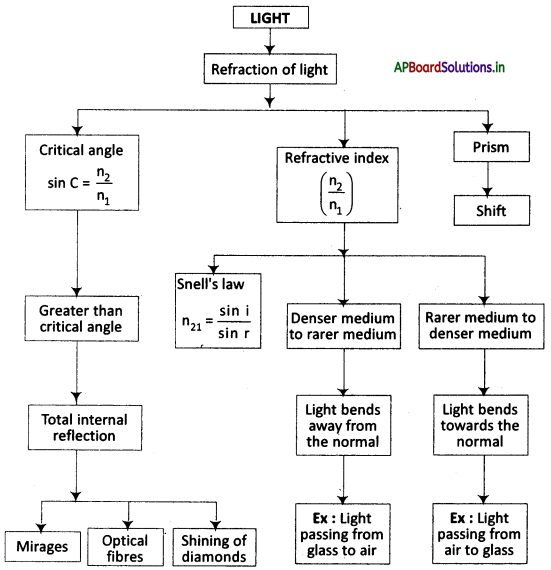
→ The process of changing speed when light travels from one medium to another medium is called the refraction of light.

→ Absolute refractive index = \(\frac{\text { Speed of light in vacuum }}{\text { Speed of light in medium }}\) ⇒ n = \(\frac{\mathrm{c}}{\mathrm{v}}\)

→ Relative refractive index, n21 = \(\frac{v_{1}}{v_{2}}=\frac{n_{2}}{n_{1}}\)

→ Snell’s law is given by, n1 sin i = n2 sin r.

→ The angle of incidence at which the light ray travels from denser to rarer medium grazes along the interface is called the critical angle of that interface.
sin C = \(\frac{n_{2}}{n_{1}}\)
where n1 is the refractive index of the denser medium and n2 is the refractive index of the rarer medium.

→ If the angle of incidence is greater than the critical angle, the light ray is reflected into the denser medium at the interface. This phenomenon is called total internal reflection.

→ Example of denser medium: Glass.

→ Example of a rarer medium: Air.

→ When the light travels from rarer to a denser medium, it bends towards the normal.

→ When the light travels from a denser to a rarer medium, it bends away from the normal.

→ Optical fibers work on the principle of total internal reflection.

→ Mirages are formed due to total internal reflection.

AP Board Solutions AP Board 10th Class Physical Science Notes Chapter 3 Refraction of Light at Plane Surfaces

→ The refractive index increases with height.

→ Total internal reflection is the main cause for the brilliance of diamonds.

→ Light travels at a speed of 3 × 10⁸ m/s.

→ The Refractive index depends on the following factors :

  • Nature of material
  • The wavelength of light used.

→ When the refractive index of glass is \(\frac{3}{2}\), then the speed of light in glass is equal to 2 × 10⁸ m/s.

→ Laws of refraction :

  1. The incident ray, the refractive ray, and the normal interface of two transparent media at the point of incidence lie in the same plane.
  2. During refraction, the light follows Snell’s law.

→ A coin kept at the bottom of a vessel filled with water appears to be raised and a lemon kept in the water of glass tumbler appears to be bigger than its size due to refraction of light.

→ Fermat’s principle states that the light ray always travels in a path that needs the shortest possible time to cover the distance between the two points.

→ Speed of light changes at the interface of two media.

→ The angle between the incident and normal ray is called the angle of incidence.

→ The angle between normal and refracted ray is called the angle of refraction.

→ The angle between normal and emergent rays is called the angle of emergence.

→ The formation of mirage is the best example where the refractive index of a medium varies throughout the medium.

AP Board Solutions AP Board 10th Class Physical Science Notes Chapter 3 Refraction of Light at Plane Surfaces

→ Refraction: The process of changing speed when light travels from one medium to another is called the refraction of light.

→ Incident ray: The ray which is an incident on a surface is called an incident ray.

→ Refracted ray: The ray which refracted from a surface is called refracted ray.

→ The angle of Incidence: The angle between the incident ray and normal ray is called the angle of incidence.

→ The angle of Refraction: The angle between refracted ray and normal ray is called the angle of refraction.

→ Absolute refractive index: The ratio of the speed of light in a vacuum to the speed of light in the medium.

→ Relative refractive index: It is the ratio of the refractive index of the second medium to the refractive index of the first medium.

→ Snell’s law: It is the ratio of the sine of the angle of incidence to the sine of the angle of refraction.

→ Critical Angle: The angle of incidence at which the light ray travels from denser to rarer medium grazes along the interface is called the critical angle of that interface.

→ Total internal reflection: When the angle of incidence is greater than the critical angle, the light ray is reflected into the denser medium at the interface. This phenomenon is called total internal reflection.

→ Mirage: Mirage is an optical illusion where it appears that water is collected on the road at a distant place but when we get there, the road is dry.

→ Shift: The distance between incident and emergent parallel rays is called shift.

→ Optical Fibre: An optical fiber is a very thin fiber made of glass (or) plastic having a radius of about a micrometer (10-6 m).

→ Medium: A substance through which light passes is called medium. The medium has more optical density.

→ Denser Medium: The medium which has less optical density.

→ Interface: A point where two things meet and interact is called an interface.

AP Board Solutions AP Board 10th Class Physical Science Notes Chapter 3 Refraction of Light at Plane Surfaces

→ Fermat’s principle: The light ray always travels in a path that needs the shortest possible time to cover the distance between the two given points.

→ The angle of emergence: The angle between normal and emergent rays is called the angle of emergence.

→ Light pipe: A bunch of optical fibers is called a light pipe.

→ Mass density: Mass per unit volume is called mass density.

→ Ray: The straight-line path along which the light travels in a homo¬geneous medium is called a ray. It is represented by an arrowhead on a straight line, the arrowhead gives the direction of propagation of light.

→ Beam: A number of rays combined together are called a beam
AP Board 10th Class Physical Science Notes Chapter 3 Refraction of Light at Plane Surfaces Notes 1

AP Board Solutions AP Board 10th Class Physical Science Notes Chapter 3 Refraction of Light at Plane Surfaces

Williboard Snell Van Royen (1580 – 1626):

  • He was a Dutch astronomer and mathematician.
  • His name has been attached to the law of refraction of light.
  • In 1815, he planned and carried into practice a new method of finding the radius of the earth by determining the distance of one point from the parallel of latitude of another by means of triangulation.
  • He was famous for bis Snell’s law related to the refraction of light.
AP Board 9th Class Physical Science Notes Chapter 1 Motion

Students can go through AP State Board 9th Class Physical Science Notes Chapter 1 Motion to understand and remember the concept easily.

AP State Board Syllabus 9th Class Physical Science Notes Chapter 1 Motion

→ Right and left, day and night, up and down, larger and shorter are relative terms with respect to the position, and point of view of the observer

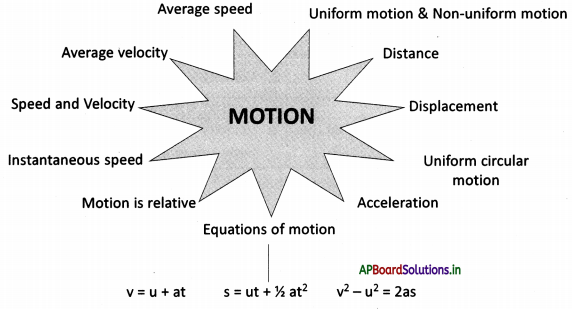
→ Motion is relative to the observer.

→ A body is said to be In motion when Its position is changing continuously with time relative to the observer.

→ Distance is the length of the path traversed by an object in a given time Interval.

→ Displacement is the shortest distance covered by the object in a specified direction. Its unit in the SI system is ‘meter’.

→ Distance is a scalar quantity, whereas displacement is a vector quantity.

→ Average speed is the distance covered in unit time.

→ Average velocity is the displacement of an object per unit of time.

→ The speed at any instant is called instantaneous speed.

→ Distance -vs- time graph is more useful to study the motion of an object along a straight line, (time on X-axis, distance on Y-axis)

→ The slope of the curve in the D -t graph, at any point gives the speed of the object at that instant.

AP Board Solutions AP Board 9th Class Physical Science Notes Chapter 1 Motion

→ If a body moves in a curved path, the tangent drawn at a point on the curve gives the direction of velocity at that instant.

→ The motion of the body is said to be uniform when its velocity is constant.

→ D -t graph for a body that is in uniform motion in a straight line.

→ The motion of the body is said to be non-uniform when its velocity changes from time to time.

→ Acceleration is the rate of change of velocity a = \(\frac{\Delta v}{\Delta t}\)

→ The SI unit of acceleration is m/sec2.

→ If the rate of change of velocity is negative, then it is called deceleration (Retardation) denoted by ‘-a’.

→ Equations of uniform accelerated motion are
v = u + at …………………(1)
s = ut + \(\frac{1}{2}\) at2 ……………..(2)
v2 – u2 = 2as ……………..(3)

→ Relative: That exists or that has a particular quality only when compared with something else. Ex: The position of the sun is relative to the earth.

AP Board Solutions AP Board 9th Class Physical Science Notes Chapter 1 Motion

→ Distance: The length between any two points in a given direction.

→ Displacement: Displacement is the shortest distance covered by the object in a specified direction.

→ Average speed: The distance covered in unit time is called average speed.
Average speed = \(\frac{\text { Total distance }}{\text { Time taken }}\)

→ Average velocity: The displacement of an object per unit time is called average velocity.
Average velocity = \(\frac{\text { Displacement }}{\text { Time taken }}\)

→ Instantaneous speed: Speed at an instant is instantaneous speed which gives the idea of how fast the position of the body changes.

→ Speed: Speed = \(\frac{\text { Distance }}{\text { Time }}\)

→ Velocity: Velocity = \(\frac{\text { Displacement }}{\text { Time }}\)

→ Uniform motion: The motion of the body is said to be uniform when its velocity is constant.

→ Acceleration : Acceleration is the rate of change of velocity.
Acceleration a = \(\frac{\Delta \mathrm{v}}{\Delta \mathrm{t}}\). The SI unit of acceleration is m/sec2.

→ Uniform acceleration: The motion of an object along a straight line with constant acceleration.
(OR)
Equal chances of velocity occur In equal Intervals of time.

AP Board Solutions AP Board 9th Class Physical Science Notes Chapter 1 Motion

→ Rectilinear motion: The motion of a body along a straight line is called rectilinear motion.

→ Deceleration: It is the decreasing velocity of the object.
AP Board 9th Class Physical Science Notes Chapter 1 Motion 1

→ Aristotle:

  • Aristotle was born in 384 BC and died in 322 BC.
  • He was a Greek ancient philosopher.
  • Aristotle saw ultimate reality in physical objects, knowable through experience.

AP Board 9th Class Social Studies Notes Chapter 24 Traffic Education

Students can go through AP State Board 9th Class Social Studies Notes Chapter 24 Traffic Education to understand and remember the concept easily.

AP State Board Syllabus 9th Class Social Studies Notes Chapter 24 Traffic Education

→ Due to the increase in population, industrialization, urbanization, and globalization, there was a heavy increase in vehicular traffic.

→ The movement of any object from one place to another is the traffic like wire movement of any vehicle from one place to another place on the road is road traffic.

→ Traffic education is the education that describes traffic rules and regulations in a clear and simple way.

→ Students, employees, laborers, teachers, doctors, and all are affected by traffic jams.

→ To avoid accidents, one must know the prescribed rules and regulations.

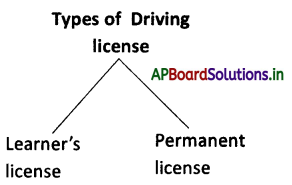
→ Permanent license: Permanent license will be issued only after having a valid learner’s license.

→ Road surface markings are used on paved roads to provide guidance and information to drivers and pedestrians.

→ A traffic light, traffic signal, or stoplight is a signatory device position at a road intersection to indicate when it is safe to drive through.

AP Board Solutions AP Board 9th Class Social Studies Notes Chapter 24 Traffic Education

→ India has the second-largest road network in the world 4* Riders should wear properly fitted and secured helmet

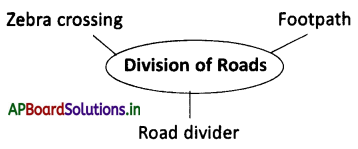
→ Walk on the footpath: If a footpath is not available and the road is narrow, walk on the right side of the road watching the oncoming traffic.

→ Use zebra lines for crossing roads.

→ Vehicle registration: Vehicle registration is the compulsory registration of a vehicle with a government authority

→ Breath analyzer: An instrument into which a sample of a motorist’s breath is taken as a test for alcohol content.

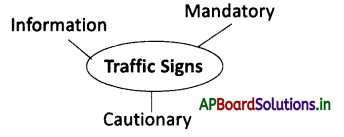
→ Mandatory signs: Required by law or rules compulsory.

→ Traffic education: Traffic means the moments of vehicles, people, etc. Knowledge of this is known as traffic education.

AP Board Solutions AP Board 9th Class Social Studies Notes Chapter 24 Traffic Education

→ Driving license: An official document or certificate authorizing a person to drive a motor vehicle.
AP Board 9th Class Social Studies Notes Chapter 24 Traffic Education 1

AP Board 9th Class Social Studies Notes Chapter 24 Traffic Education 2

AP Board 9th Class Social Studies Notes Chapter 24 Traffic Education 3

AP Board 9th Class Social Studies Notes Chapter 23 Disaster Management

Students can go through AP State Board 9th Class Social Studies Notes Chapter 23 Disaster Management to understand and remember the concept easily.

AP State Board Syllabus 9th Class Social Studies Notes Chapter 23 Disaster Management

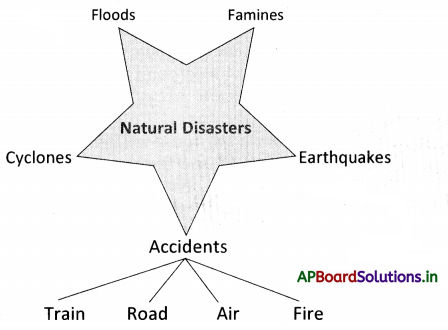
→ Heavy rains lead to large destruction.

→ The disasters that are caused because of human negligence or deliberately by an individual or a group can be termed as Human-made.

→ Road, rail and air accidents are some of the disasters that one faces every day.

→ In India, about eighty thousand people are killed in road crashes every year.

→ Railway transportation appeared at earlier times to be safe due to slower speeds, shorter trips, and lower density traffic.

→ Across the world including India, air accidents have increased.

→ Fire is a phenomenon of combustion manifested in intense heat and light in the form of a glow or flames.

→ Mahatma Gandhi preached ahimsa or non-violence and truth as the tools for peaceful resolution of issues between people, communities, or countries.

AP Board Solutions AP Board 9th Class Social Studies Notes Chapter 23 Disaster Management

→ Terrorism has become common in certain areas of the world, including parts of India.

→ Citizen safety is the concern of all. Different measures are adopted by various agencies to create awareness of safety.

→ World community The term is used primarily in political and humanitarian contexts to describe an international aggregate of nation-states of widely varying types.

→ Terrorism: The use of violence and intimidation in the pursuit of political aims.

→ Human-Induced Disaster: A disastrous event caused directly and principally by one or more identifiable deliberate or negligent human action.

→ Vigilant: Always being careful to notice things, especially possible danger.

→ Hijacking: To take control of an aircraft or other vehicle during a journey using violence.

→ Disaster: Great harm

AP Board Solutions AP Board 9th Class Social Studies Notes Chapter 23 Disaster Management

→ Railway crossing: The metal tracks on which trains run.
AP Board 9th Class Social Studies Notes Chapter 23 Disaster Management 1

AP Board 9th Class Social Studies Notes Chapter 22 Women Protection Acts

Students can go through AP State Board 9th Class Social Studies Notes Chapter 22 Women Protection Acts to understand and remember the concept easily.

AP State Board Syllabus 9th Class Social Studies Notes Chapter 22 Women Protection Acts

→ Most women can’t dare to move freely.

→ Girls and women should be aware of the laws, meant for their protection.

→ Violation of children’s and women’s rights is continuing in our society in various forces.

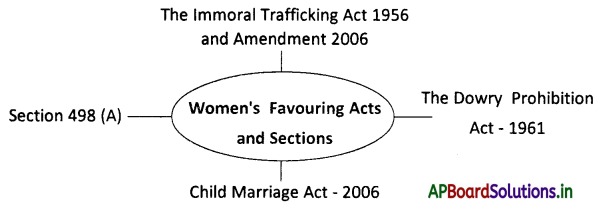
→ It is treated as child marriage if the contract between any two people of which either one or both parties is a child.

→ The dowry and gifts are to be returned after the cancellation of the marriage.

→ Seek assistance in case of any harassment and domestic violence using toll-free number Bhumika Help Line 1800 425 2908.

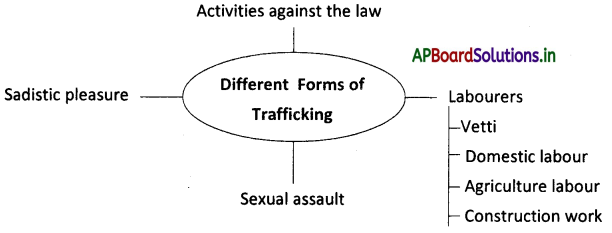
→ Trafficking and selling of girls for prostitution or encouraging them to enter into prostitution is a punishable crime.

→ If anyone participates in sexual intercourse other than the spouse is also punishable under the law. If any person gives or takes or abets dowry he/she shall be punishable with imprisonment and fine.

AP Board Solutions AP Board 9th Class Social Studies Notes Chapter 22 Women Protection Acts

→ Our Constitution provides the right to live in a dignified manner to all citizens.

→ Lakhs of women and children are being injured during domestic violence and undergo treatment but the majority don’t reveal about it.

→Lok Adalat means people’s court

→ All are equal before the law.

→ It is necessary to have a thorough understanding and awareness for the better implementation of the acts.

→ Dowry: Property or money brought by a bride to her husband on their marriage.

→ Domestic violence: Violence or physical abuse directed towards a spouse or domestic partner, usual violence by men against women.

→ Lok Ada tat: Lok Adalat is a system of alternative dispute resolution developed in India. It roughly means people’s court.

→ Sexual Assault: A statutory offense that provides that is a crime to knowingly cause another person to engage in an unwanted sexual act by force or threat.

AP Board Solutions AP Board 9th Class Social Studies Notes Chapter 22 Women Protection Acts

→ Forced Prostitution: Forced prostitution, also known as involuntary prostitution, is the act of performing the sexual activity in exchange for money due to coercion by a third party.
AP Board 9th Class Social Studies Notes Chapter 22 Women Protection Acts 1

AP Board 9th Class Social Studies Notes Chapter 22 Women Protection Acts 2

→ Seek assistance in case of any harassment and domestic violence using toll-free number Bhumika Help Line 1800 425 2908 and stop child marriages. Friends, relatives, neighbors, teachers can inform the village secretary and Tehsildar to stop child marriages.

→ Prevention of a Child Marriage – A Case Study:
Raviralla Kavitha is a girl of twelve years. Her father is Nancharaiah. They belong to the Rangareddy village of Mahaboobnagar district. Kavitha is studying in class VII in an Upper Primary School. As her marriage is fixed, she is not attending school. This was informed to Mamidipudi Venkata Rangaiah Foundation. The volunteers of MVF went to her home along with the members of Child Marriages Prevention Samithi and discussed child marriage in presence of the village elders.

→ Later on, the MVF volunteers went to the local priest. He repeated that when the parents of Kavitha came to him for the request of fixing the date, he demanded the Date of Birth certificate or ration card, they did not show any of them and they could not come back to him. The volunteers came to know in the inquiry that the bridegroom Damerla China Satyam, age 23, S/o Ramaiah didn’t complete the primary education also.

→ After two days, when the MVF volunteers went to Kavitha’s home, they were busy with marriage arrangements. They explained to them not to perform a marriage at an early age which is meant for study and she was still a minor. Kavitha’s father said, “you say many things but we have another daughter. How can I arrange the marriages?”. As they were not convinced, the volunteers went to Thasildar, Sub Inspector of Police, CDPO, and informed the same. They enquired about this in presence of villagers but the parents said in a rude way, “who are you to stop our daughter’s marriage? At that time a few people belong to the bridegroom came there and said,” we have finished all the arrangements. Why do you stop now? “S.l. Explained to them,” Celebrating Child Marriages is an offense. Encouraging child marriage is also a crime. After counseling to the parents of the bride and bridegroom, they agreed to cancel the Child Marriage and they are sending Kavitha to school regularly.

AP Board 9th Class Social Studies Notes Chapter 21 Human Rights and Fundamental Rights

Students can go through AP State Board 9th Class Social Studies Notes Chapter 21 Human Rights and Fundamental Rights to understand and remember the concept easily.

AP State Board Syllabus 9th Class Social Studies Notes Chapter 21 Human Rights and Fundamental Rights

→ Rights are reasonable claims of persons. These claims are protected by law.

→ Rights become significant in the context of democratic systems.

→ Democracy safeguards not just the majority but also the minorities.

→ The UDHR is a document to which many of the modern states are signatory too implying that they will uphold all the basic human rights mentioned there.

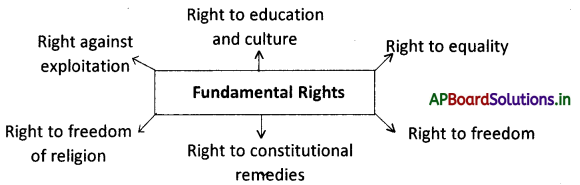
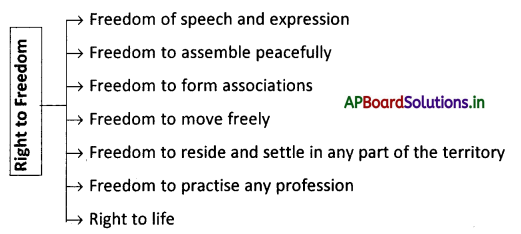
→ Fundamental Rights find a place in Part 3 of the Constitution of India.

→ A writ is an authority given to the court to issue directions to the government to protect and enforce any constitutional right.

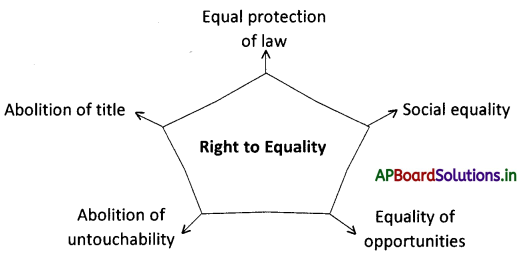
→ The Constitution says that the government “shall not deny to any person equality before the law or equal protection of the laws.”

→ The State shall not discriminate against any citizen on grounds only of religion, race, caste, sex, and place of birth, or any of them.

→ The Constitution guarantees equality of opportunity for all citizens in matters relating to employment or appointment to any office under the state.

AP Board Solutions AP Board 9th Class Social Studies Notes Chapter 21 Human Rights and Fundamental Rights

→ NHRC is vested with the authority to make an inquiry, Suo Motu (on its own initiative), or on a petition presented to it by a victim or any person on his / her behalf.

→ People have the right to come together or assemble for many reasons such as to hold meetings about their rights, to discuss their problems or business, to exchange ideas and share views, etc.

→ In 2002, the right to primary education became a part of the right to life.

→ The Constitution states, “no child below the age of 14 shall be employed to work in any factory or mines or engaged in any other hazardous employment”

→ According to the Constitution, the government does not have any religion.

→ To make fundamental rights meaningful to everybody the courts under the exercise of judicial review have encouraged the people to file Public Interest Litigation or PIL.

→ The Fundamental Rights provided in Constitution have been amended from time to time.

→ The Universal Declaration of human rights was passed by the UN GeneralAssembly in 1948.

AP Board Solutions AP Board 9th Class Social Studies Notes Chapter 21 Human Rights and Fundamental Rights

→ In 1993, the Government of India passed an act of the legislature to protect human rights.
AP Board 9th Class Social Studies Notes Chapter 21 Human Rights and Fundamental Rights 1
AP Board 9th Class Social Studies Notes Chapter 21 Human Rights and Fundamental Rights 2

AP Board 9th Class Social Studies Notes Chapter 21 Human Rights and Fundamental Rights 3

AP Board 9th Class Social Studies Notes Chapter 20 Democracy: An Evolving Idea

AP State Board Syllabus 9th Class Social Studies Notes Chapter 20 Democracy: An Evolving Idea

→ The evolution of democracy has had many ups and downs.

→ The meaning of democracy broadened and it developed many new layers and shades.

→ Democracy means a system in which those in government get their authority from the people and have to answer the people.

→ The elected government functionaries are answerable to the people in different ways.

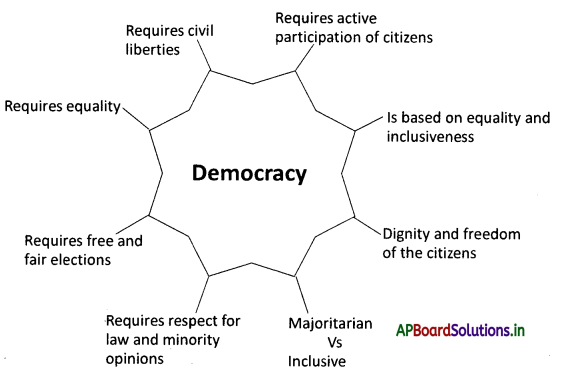
→ Democracy is based on equality and inclusiveness.

→ Democracy requires the active participation of citizens.

→ People can participate in decision-making only if people are free to know, to discuss, to form independent opinions and express them and form associations to press for their views.

→ In a democracy, it is very important that are free and fair elections.

AP Board Solutions AP Board 9th Class Social Studies Notes Chapter 20 Democracy: An Evolving Idea

→ A democratic government rules within limits set by constitutional law and citizen’s rights.

→ Democracy stands much superior to any other form of government in promoting dignity and freedom of the individual

→ Most societies across the world were historically male-dominated societies.

→ Expectations from democracy also function as the criteria for judging any democratic country.

→ Union of Soviet Socialist Republic or USSR: Union of Soviet Socialist Republics.

→ Public discussions: Free and open discussion of some question of public interest.

→ Civil liberties: One’s freedom to exercise one’s rights as guaranteed under the laws of the country.

→ Social and economic equality: Social equality is a social state of affairs in which all people are within a specific society. Economic equalitarianism is a state of economic affair in which equality of outcome has been manufactured for all the participants of a society.

AP Board Solutions AP Board 9th Class Social Studies Notes Chapter 20 Democracy: An Evolving Idea

→ Internal conflicts: A struggle within the character or within a group.
AP Board 9th Class Social Studies Notes Chapter 20 Democracy An Evolving Idea 1

Students can go through AP State Board 9th Class Social Studies Notes Chapter 20 Democracy: An Evolving Idea to understand and remember the concept easily.

AP Board 10th Class Social Studies Notes Chapter 7 People and Settlement

Students can go through AP State Board 10th Class Social Studies Notes Chapter 7 People and Settlement to understand and remember the concept easily.

AP State Board Syllabus 10th Class Social Studies Notes Chapter 7 People and Settlement

→ The way we organize ourselves and our living spaces in a place is called a settlement – that is, the geographic space where we live and work.

→ For about 1.8 lakh years humans lived in bands as hunter-gatherers. They did not practice agriculture.

→ Only 10,000 years ago, some bands took to the deliberate production of food- agriculture.

→ As hunter-gatherers, they were nomadic but as agriculturists, they were increasingly sedentary.

→ As agriculture progressed, people organized their life around patterns observed in nature.

→Rulers began to encourage craftspersons to settle in urban areas. Urban settlements i. e., towns where people did not work in agriculture expanded.

→ The way we organize ourselves and our living spaces in a place is called a settlement – that is, the geographic space where we live and work.

→ For about 1.8 lakh years humans lived in bands as hunter-gatherers. They did not practice agriculture.

→ Only 10,000 years ago, some bands took to the deliberate production of food- agriculture.

→ As hunter-gatherers, they were nomadic but as agriculturists, they were increasingly sedentary.

→ As agriculture progressed, people organized their life around patterns observed in nature.

→ Rulers began to encourage craftspersons to settle in urban areas. Urban settlements i.e., towns where people did not work in agriculture expanded.

→ Many goods were produced for the market and sold to traders who carried them to far-off places.

AP Board Solutions AP Board 10th Class Social Studies Notes Chapter 7 People and Settlement

→ In 1951 the population of Delhi was about 20,00,000 and during the last 60 years, it has grown 8 times.

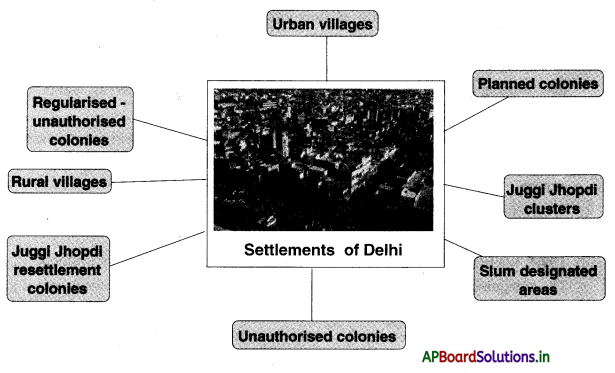
→ There were different types of slum areas or areas of the poor in the city. They were unauthorized colonies at first.

→ Later some were made valid settlements as designated slums, resettlement colonies, regularized unauthorized colonies.

→ Every city usually has a master plan to design and allocate different types of areas like housing areas, markets, schools, industrial areas, office areas, parks and recreational areas, and so on.

→ People who migrate to the city looking for work occupy land without necessary permission and build on it in the way they can afford with no help or facility from anyone.

→ They remain unauthorized for long period. When the plan is finally announced these areas may be demarked for a different purpose.

→ This leads to difficult conflict situations. People face the constant threat of eviction.

→ The compensation given is insufficient to relocate back to native places or afford a residence in planned areas of the city.

→ People again occupy a new location that is not notified. Thus settlements have been growing in an unplanned manner.

→ Which places attract settlements depend on basic concepts like the site, situation, and the history of the place.

→ Site refers to topography, altitude, water characteristics, types of soils, security, shelter from natural forces, and so on.

→ Over the centuries, Visakhapatnam’s population has grown significantly.

→ The villages that are best connected have the most vibrant markets and fairs.

→ As settlements become more and more diversified in their characteristics, they also become more and more complex.

AP Board Solutions AP Board 10th Class Social Studies Notes Chapter 7 People and Settlement

→ In India, nearly 350 million is one-third of the population live in cities and towns. People have been increasingly taking up non-agriculture work and living in cities and towns is called ’Urbanisation’.

→ Though there has been an increase in urbanization, the necessity of providing basic infrastructure that can support this growth is missing.

→ Increasing urbanization resulting in many problems like water shortage, problems of sewage, waste disposal, transportation, and many other things.

→ Settlement: The way in which people organize themselves and their living spaces in a place

→ Site: A place where a building, town, etc. was, is, or will be located

→ Situation: The situation describes the connections with other places

→ Urban: Of relating to, or located In a city (or) characteristic of the city or city life

→ Rural: A rural area is a geographical area with a low population density that is located outside cities and towns

→ Agglomeration: The act of process of gathering into a mass/A confused or jumbled mass

→ Hierarchy: A body of persons having authority

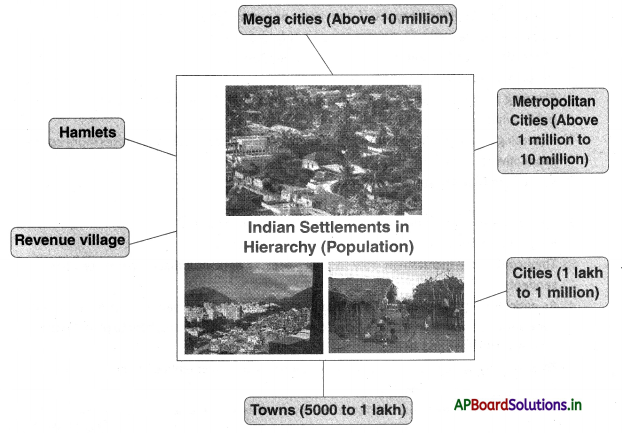
→ Megacities: Cities having more than 10 million people

→ Aerotropolis: An Aerotropolis is an urban plan in which the layout, infrastructure, and economy Is centered on an airport, existing as an airport city

→ Urbanization: People have been increasingly taking up non-agriculture work and living in cities and towns, this is called urbanization

→ Metropolitan çity: Cities having a population between 1 million to 10 millions

→ Nomadic: People kept moving from place to place

→ Hunter-gatherers: Early humans who hunted animals for meat, hide, and other uses and gathered food from plants, trees

→ Sedentary: Unlike nomadic, staying In one place.

AP Board Solutions AP Board 10th Class Social Studies Notes Chapter 7 People and Settlement

→ Urban settlement: Towns where people did not work in agriculture

→ Slum: An area of the city that is very poor and the houses there are dirty and in bad condition

→ Unauthorized: The colonies that were arranged without the official colonies permission or not being notified in the plan

→ Regularlsed colonies: The unauthorized colonies, at a later time are approved by the officials and made as valid settlements

→ Master plan: A plan to design and allocate different types of areas like housing areas, markets, schools, industrial areas, office areas, parks, and recreational areas, and so on

→ Planned colony: A colony with a properly implemented master plan usually has all facilities in place

→ Demarcation: Government announces areas for different purposes and the constructions in that area are expected to follow such an order

→ Establishment: People who migrate to the city looking for work occupy the land of slum without necessary permission and build on it in the way they can afford with no help or facility from anyone

→ Hamlet: A group of houses within the revenue village

→ Reven tie village: A village with defined borders

→ Towns: All the urban areas having a population between 5000 to 1 lakh

AP Board Solutions AP Board 10th Class Social Studies Notes Chapter 7 People and Settlement

→ Cities/class of cities: Urban areas having a population between 1 lakh and 1 million.
AP Board 10th Class Social Studies Notes Chapter 7 People and Settlement 1
AP Board 10th Class Social Studies Notes Chapter 7 People and Settlement 2

AP Board 9th Class Social Studies Notes Chapter 19 Expansion of Democracy

Students can go through AP State Board 9th Class Social Studies Notes Chapter 19 Expansion of Democracy to understand and remember the concept easily.

AP State Board Syllabus 9th Class Social Studies Notes Chapter 19 Expansion of Democracy

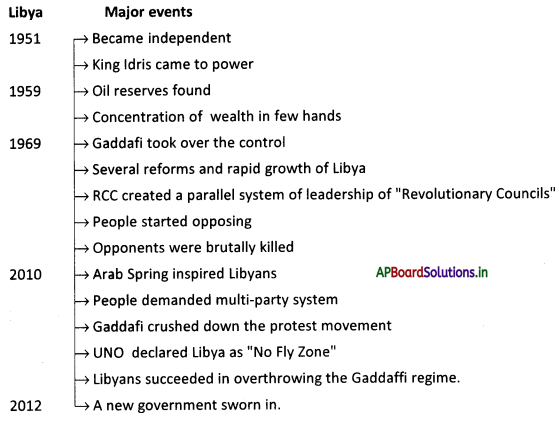
→ Libya was a poor country. It was colonized by Italy and became free in 1951.

→ Later power was transferred to King Idris. In 1959 vast resources of petroleum were found in Libya.

→ The king and a few powerful families cornered most of this (sale of oil) new wealth.

→ In the year 1969, Gaddafi and a group of 70 young army officers took over the control of Libya.

→ Monarchy was abolished. “Socialist Libyan Arab Republic” was established under the leadership of “Revolutionary Command Council.”

→ Libya developed in all aspects.

→ Though it was a republic everything was controlled by Gaddafi and the RCC.

→ People revolted; UNO gave support; USA, USSR, and Britain extended their help, and finally, Gaddafi regime was overthrown and a new democratic government was sworn in on 14th Nov. 2012.

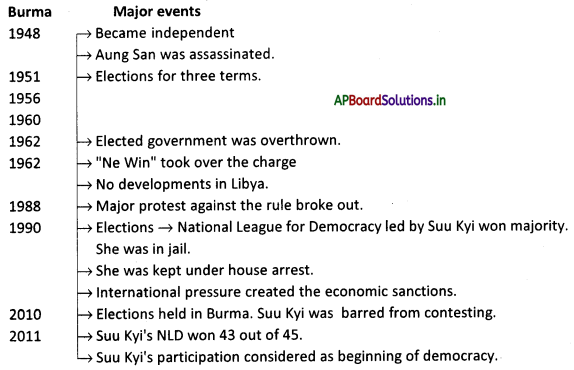
→ Myanmar got independence from British rule.

→ Aung San, a leader of the Burman ethnic group was assassinated.

→ The army generals have been ruling the country since then.

→ Unlike Libya, Burma did not see any development and became an impoverished country.

→ Nation League for Democracy (NLD) led by “Suu Kyi” won a majority (80%) of the seats though she was in prison.

AP Board Solutions AP Board 9th Class Social Studies Notes Chapter 19 Expansion of Democracy

→ There was also international pressure created through sanctions.

→ An election was held in 2010. Suu Kyi was banned from contesting the 2010 election and was released from her house arrest only after the elections.

→ In 2011 Suu Kyi’s National League of Democracy contested and have won 43 out of 45 parliamentary seats that were vacant. This is considered the beginning of democracy in Burma.

→ In the 20th century, democracy became the slogan of anti-colonial struggles in Asia.

→ Some of the countries were able to attain independence but many of them could not build stable democracies, e.g.: Libya, Burma, and Myanmar.

→ In some countries, communism gained popularity and was broken also. Example – USSR which was disintegrated and CIS formed.

→ Thus we can conclude that a democracy that respects the freedom and rights of all people may be the best way to solve the complete problems the countries face today.

→ Nomadic animal herders: People who wander from place to place in search of livelihood along with animals like, sheep, goats, etc.

→ Urbanization: 1) Migration of people from villages to cities.
2) Increase in the number of cities.

→ Political corruption: Making money through illegal ways or cheating others by the political leaders.

→ House arrest: Basing on the judicial judgment if a person is forbidden or prohibited to come out of his house and no other person is allowed to meet him, can be termed as house arrest.

→ Dictatorship: If sovereignty vests in the hands of one single person, it is called “Dictatorship”.

AP Board Solutions AP Board 9th Class Social Studies Notes Chapter 19 Expansion of Democracy

→ Monarchy: It is a political system ¡n which a king or a queen, instead of an elected person rules the country.

→ Feudalism: It is a social system under which the political power was with large warrior landlords who controlled the villages and peasants.
AP Board 9th Class Social Studies Notes Chapter 19 Expansion of Democracy 1

AP Board 9th Class Social Studies Notes Chapter 19 Expansion of Democracy 2

→ Nobel Prize Acceptance
Suu Kyi was awarded Nobel Prize for Peace in 1991, while still under house arrest. It was her son who delivered the speech. Let us read an extract from the speech:

“… she would begin by saying that she accepts the Nobel Prize for Peace not in her own name but in the name of all the people of Burma.
Theirs is the prize and theirs will be the eventual victory in Burma’s long struggle for peace, freedom, and democracy.

… I personally believe that by her own dedication and personal sacrifice she has come to be a worthy symbol through whom the plight of all the people of Burma may be recognized. The plight of those in the countryside and towns, living in poverty and destitution, those in prison, battered and tortured; the plight of the young people, the hope of Burma, dying of malaria in the jungles to which they have fled; that of the Buddhist monks, beaten and dishonored.”

…. Aung San Suu Kyi says, “The quest for democracy in Burma is the struggle of people to live whole, meaningful lives as free and equal members of the world community. It is part of the unceasing human endeavor to prove that the spirit of man can transcend the flaws of his nature.”

AP Board 9th Class Social Studies Notes Chapter 18 Impact of Colonialism in India

Students can go through AP State Board 9th Class Social Studies Notes Chapter 18 Impact of Colonialism in India to understand and remember the concept easily.

AP State Board Syllabus 9th Class Social Studies Notes Chapter 18 Impact of Colonialism in India

→ Adivasis used forests for their domestic purposes, for building their houses, never cut the entire forests. They used to cut the old trees and plant new trees. So the forests were protected

→ Large quantities of wood were needed to meet the growing requirements during British rule.

→ Forest departments were established

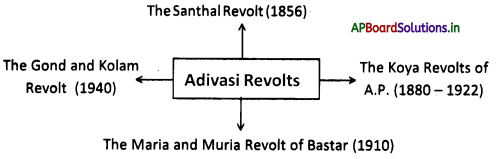
→ Adivasis revolted against the forest departments, police and moneylenders.

→ During British rule, our industries or goods were not protected But the British goods were protected by levying tax on Indian goods.

→ During the 1st World War, the import of foreign goods into India fell sharply and industrialization started in India.

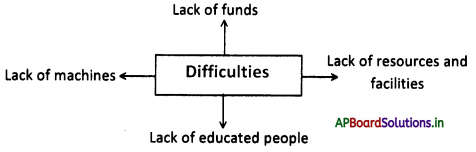
→ The Indian industry faced many difficulties. It was very tough for Indian industry to compete with British goods.

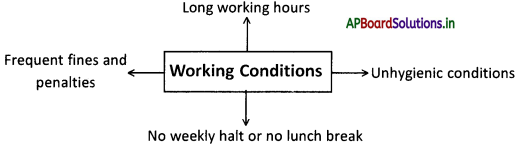
→ Working conditions of labour were bad, no fixed wages, no weekly off, long working hours, fines and penalties were common.

→ Labour struggled against their oppressive working conditions.

AP Board Solutions AP Board 9th Class Social Studies Notes Chapter 18 Impact of Colonialism in India

→ Labour organizations like Girni Kamgar, the Mazdoor Mahajan were established in the first quarter of the 20th century. The labour officers were appointed But the labourers did not agree to this. They wanted their own organizations to solve their problems.

→ Reserved forest: The products of which are not used now and kept under government for the future.

→ Protected forest: The forests that are under the protection

→ Auctioning: A public meeting where goods are sold to the person who offers the highest money for the goods.

→ Social Workers: Social workers are persons who are at the service of the people or society.

→ Industrialist: Industrialists are the persons who establish industries and promote them.
AP Board 9th Class Social Studies Notes Chapter 18 Impact of Colonialism in India 1

AP Board Solutions AP Board 9th Class Social Studies Notes Chapter 18 Impact of Colonialism in India

→ Difficulties of Indian Industries:
AP Board 9th Class Social Studies Notes Chapter 18 Impact of Colonialism in India 2

→ Working conditions of labour:
AP Board 9th Class Social Studies Notes Chapter 18 Impact of Colonialism in India 3

AP Board 10th Class Social Studies Notes Chapter 6 The People

Students can go through AP State Board 10th Class Social Studies Notes Chapter 6 The People to understand and remember the concept easily.

AP State Board Syllabus 10th Class Social Studies Notes Chapter 6 The People

→ The population is a pivotal element in social studies.

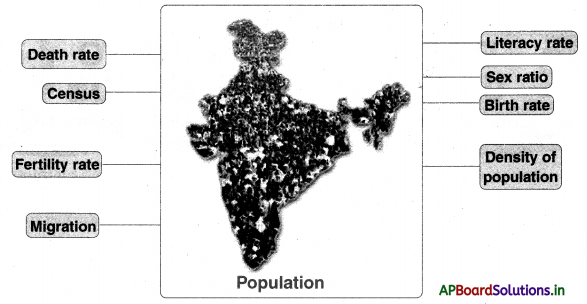
→ A census is a procedure of systematically acquiring and recording information about the members of a given population.

→ The census shows us the age structure, the sex ratio, the literacy rate, and life expectancy.

→ The numbers, distribution, and composition of the population are always changing. The birth rate is the number of live births per thousand persons in a year.

→ Population change can be expressed in two ways:

  1. as absolute numbers and
  2. as a percentage change.

→ The total fertility rate is the number of children that are likely to be born to a woman if she were to live to the end of her childbearing years and bear children in accordance with the current pattern.

→ Migration is the movement of people across regions and territories.

AP Board Solutions AP Board 10th Class Social Studies Notes Chapter 6 The People

→ India is one of the most densely populated countries in the world.

→ Population growth: Increase In the number of people who inhabit a territory or state.

→ Population density: It is a measurement of population per unit area or unit volume.

→ Sex ratio: It Is the ratio of males to females In a population.

→ Fertility rate: It is a term used to refer to the capability of people in a given region to give birth.

→ Population distribution: It is the pattern or arrangement of how people live in a particular area.

→ Infanticide: The crime of killing an infant.

→ literacy rate: It is the ability to read and write one’s own name and further for knowledge and interest.

AP Board Solutions AP Board 10th Class Social Studies Notes Chapter 6 The People

→ Census: The procedure of systematically acquiring and recording information about the members of a given population.
AP Board 10th Class Social Studies Notes Chapter 6 The People 1

AP Board 9th Class Social Studies Notes Chapter 17 Colonialism in Latin America, Asia and Africa

Students can go through AP State Board 9th Class Social Studies Notes Chapter 17 Colonialism in Latin America, Asia and Africa to understand and remember the concept easily.

AP State Board Syllabus 9th Class Social Studies Notes Chapter 17 Colonialism in Latin America, Asia and Africa

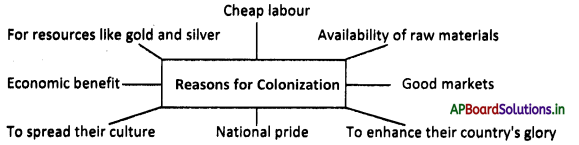
→ Some 600years ago the people of the world traveled very little. The Europeans wanted to discover sea routes to India, China, etc.

→ All European power, especially Spain, Portugal Denmark, England, and France sent expeditions to find out sea routes.

→ Columbus discovered America, Vasco da Gama discovered the sea route to India.

→ Latin Americas were brought under the control of Spain and Portugal So many resources were traded with.

→ Revolts broke out and the President of the USA formulated ‘the Munroe Doctrine.

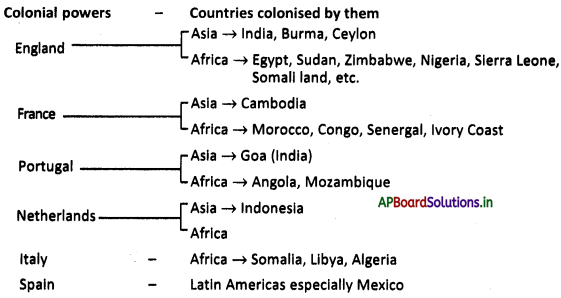
→ England was successful in colonizing most of India by 1757 and by 1857 India came to be directly ruled by the queen of English.

→ Unlike India, China was not fully colonized Opium wars were fought and the opium trade was accepted in China. But it was forced to accept trade with all colonial powers with equal rights. China was cut into spheres of influence.

→ The Dutch were successful in colonizing Indonesia. They ruled till the end of World War II.

→ Different African countries were colonized by different European powers.

→ Congo came to be ruled by Belgium. South Africa was an

→ Colonialism: Colonialism is a practice by which a powerful country directly controls less powerful countries and uses its resources to increase its own power and wealth.

AP Board Solutions AP Board 9th Class Social Studies Notes Chapter 17 Colonialism in Latin America, Asia and Africa

→ Latin America: South America along with Central America is known as Latin America.

→ Ottoman Empire: The Turkist empire during the middle ages

→ Exploration: The act of traveling through a place in order to find out about it.

→ Apartheid: Racial discrimination followed in South Africa is known as Apartheid.

→ Haciendas: Haciendas were vast estates in South America that contained silver and copper mines, agricultural land, and also factories.

→ Munroe Doctrine: The Munroe doctrine is formulated by the President of the USA James Munroe according to which no European power would be allowed to build colonies in the American countries and the US would not interfere in the affairs of Europe or colonies in other continents.

AP Board Solutions AP Board 9th Class Social Studies Notes Chapter 17 Colonialism in Latin America, Asia and Africa

→ Opium wars: Opium wars were the wars fought between China and England.
AP Board 9th Class Social Studies Notes Chapter 17 Colonialism in Latin America, Asia and Africa 1

AP Board 9th Class Social Studies Notes Chapter 17 Colonialism in Latin America, Asia and Africa 2