AP Board 8th Class Social Studies Notes Chapter 7 Money and Banking

Students can go through AP State Board 8th Class Social Studies Notes Chapter 7 Money and Banking to understand and remember the concept easily.

AP State Board Syllabus 8th Class Social Studies Notes Chapter 7 Money and Banking

→ In a barter system, goods are directly exchanged for each other without the use of money.

→ If we use money, there will be no problem in exchanging commodities. Any commodity or service can be exchanged for money.

→ Over time, people preferred scarce and attractive metals as a medium of exchange.

→ Coins became the acceptable form of money by traders and people.

→ Paper money is also called Hundis. It also has its defects.

→ Banking is a business activity where money deposits are collected from the public and these deposits can be transferred from one person to another.

→ Deposits refer to the money that people keep in the bank.

→ Nowadays cheques are widely used for making payments and receiving money.

AP Board Solutions AP Board 8th Class Social Studies Notes Chapter 7 Money and Banking

→ Banking activity is being done with computers with the internet and other electronic means of communication which is called electronic banking or internet banking.

→ Deposits are the way through which money saved by people comes into the bank.

→ Banks give loans and advances to different sections of the public.

→ Different people can obtain loans for different requirements under some rules and conditions of the bank.

→ Barter: Exchange goods or services for other goods and services

→ Forms of Money: Coins, notes, Hundis, receipts, bills, etc.

→ Deposits: Put down in a specific account.

→ Savings: A reduction in money expenditure for future purposes.

→ Loan: A sum of money that is Pent to someone.

→ Interest: Money paid for the use of money that is being lent

AP Board Solutions AP Board 8th Class Social Studies Notes Chapter 7 Money and Banking

→ Cheque: A written order to a bank to pay a stated sum from an account to a specified person.
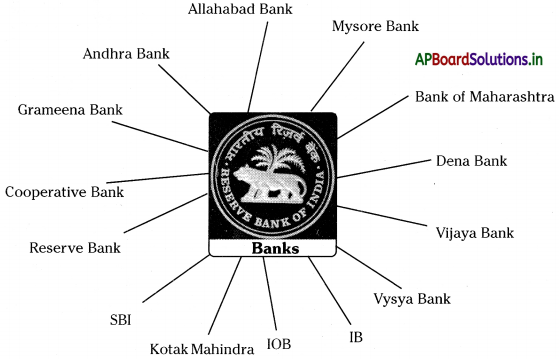
AP Board 8th Class Social Studies Notes Chapter 7 Money and Banking 1

AP Board 10th Class Physical Science Notes Chapter 7 Classification of Elements- The Periodic Table

Students can go through AP State Board 10th Class Physical Science Notes Chapter 7 Classification of Elements- The Periodic Table to understand and remember the concept easily.

AP State Board Syllabus 10th Class Physical Science Notes Chapter 7 Classification of Elements- The Periodic Table

→The group of three elements in ascending order of their atomic weights in which the molecular weight of a middle element is the average of the first and third element is called a triad.

→ Elements are arranged in ascending order of their atomic weights, then every eighth element from starting element has similar properties. This is called an octave.

→ The horizontal rows and vertical columns of a periodic table are called periods and groups respectively.

→ The systematic arrangement of elements in a table in horizontal rows and vertical columns is called a periodic table.

→ Mendeleev’s periodic law: The physical and chemical properties of the elements are periodic functions of their atomic weights.

→ Atomic weight = Equivalent weight × valency.

→ Moseley’s periodic law: The physical and chemical properties of elements are periodic functions of their atomic numbers.

→ If differentiating electron enters s sub-shell, they are called s-block elements.

→ If differentiating electron enters p, d, and f shells they are called p-block, d-block, and f-block elements respectively.

→ The Group of elements is called the element family or chemical family.

→ Elements having atomic numbers 58 to 71 are called lanthanides.

→ Elements having atomic numbers 90 to 103 are called actinides.

→ Metalloids or semi-metals are elements that have properties that are intermediate between the properties of metals and non-metals.

→ Elements are classified on the basis of similarities in their properties.

→ Dobereiner grouped the elements into Triads and Newlands gave the law of octaves.

AP Board Solutions AP Board 10th Class Physical Science Notes Chapter 7 Classification of Elements- The Periodic Table

→ Modern periodic law: The physical and chemical properties of the elements are periodic functions of their electronic configurations.

→ Anomalous in the arrangement of elements based on increasing atomic mass could be removed when the elements were arranged in order of increasing atomic number, a fundamental property of the element discovered by Moseley.

→ Elements in the modern periodic table are arranged in 18 groups and 7 periods.

→ Elements are classified into s, p, d, f blocks depending upon which sub-shell the differentiating electron enters in the atom of the given element.

→ All the d-block elements (except the Zn group) are known as transition elements and all the f-block elements (both Lanthanides, Actinides) are known as inner transition elements.

→ Half of the distance between nuclei of two atoms in solids is called atomic size.

→ Atomic size is measured in a picometer.
1 pm = 10-12 m.

→ Atomic radii of metals are called metallic radii.

→ The half of the distance between the two atoms in a covalent molecule is called the covalent radius.

→ The size of the positive ion is less than the neutral atom.

→ The size of the negative ion is greater than the neutral atom.

→ The energy required to remove an electron from the outermost orbit or shell of a neutral gaseous atom is called ionization energy (or) first ionization energy.

AP Board Solutions AP Board 10th Class Physical Science Notes Chapter 7 Classification of Elements- The Periodic Table

→ The energy required to remove the electron from unipositive ion is called 2nd ionization energy.

→ The electron affinity of an atom is defined as the energy liberated when an electron is added to its neutral gaseous atom.

→ The energy liberated when an electron is added to a uni-negative ion is called the 2nd electron affinity of that element.

→ The relative tendency of its atom to attract electrons towards itself when it is bounded to the atom of another element is called electronegativity of the element.

→ Triad: A group of three elements in which the atomic weight of a middle element is the average of first and third elements with similar properties.

→ Octave: When elements are arranged in the ascending order of their atomic weight, every element starting from a given element resembles in its properties to that of the starting element are called octaves.

→ Periodic Law: Law that regards the properties of elements in the periodic table.

→ Periodic table: The charts of elements arranged ¡n a systematic order of increasing order of atomic weight or atomic number is called periodic table,

→ Periods: The horizontal rows in the periodic table are called periods.

→ Groups: The vertical columns in the periodic table are called groups.

→ Lanthanides: Elements from 58Ce to 71Lu possess almost the same properties as 57La. So they are called lanthanides.

AP Board Solutions AP Board 10th Class Physical Science Notes Chapter 7 Classification of Elements- The Periodic Table

→ Actinides: Elements from 90Th to 103Lr are called actinides.

→ Element family: The elements that belong to the same group in the periodic table having similar properties are called element families.

→ Metalloids: The elements which have both metallic and non-metallic properties are called metalloids.

→ Periodicity: The properties of elements in a group of a periodic table have similar properties, that is called periodicity.

→ Atomic radius: The half of distance between two nuclei in solids and half of distance between two atoms participated in a chemical bond. Simply we can give the distance between the nucleus and outermost orbital.

→ Ionization energy: The energy required to remove an electron from the outermost orbit or shell of a neutral gaseous atom is called ionization energy.

→ Electron affinity: The electron affinity of an element is the energy liberated when an electron is added to a neutral gaseous atom.

→ Electronegativity: The relative tendency of the element of an atom to attract electrons towards itself when it is bonded to another atom of another element.

→ Electropositivity (or): The tendency of metals to lose electrons is called Electro- Electropositive character positive character.

→ Mendeleev’s periodic law: The properties of elements are the periodic functions of their atomic weights.

→ Modern periodic law: The properties of elements are the periodic functions of their atomic numbers.

→ Alkali metal family: Group IA elements are called the alkali metal family.

→ Alkali earth metal family: Group lIA elements are called the alkali earth metal family.

AP Board Solutions AP Board 10th Class Physical Science Notes Chapter 7 Classification of Elements- The Periodic Table

→ Chalcogen family: The elements in group (16) form ores with elements.

→ Noble gases: The elements of the group (18) (VIII-A) which are least active.

→ Electron gain enthalpy: Electron affinity of the element is also called electron gain enthalpy.

→ Transition elements: d-block elements are called transition elements.

→ Inner transition elements: Lanthanoids and Actinoids (f block elements) are called inner transition elements.

→ Metallic radius: Half of the distance between adjacent nuclei of atoms in solid.

→ Covalent distance: Half of the distance between atoms in a covalent bond.

→ Valence (or) Valency: The combining power of elements with respect to hydrogen or oxygen.

→ Metals: The elements with three or fewer electrons in the outer shell are called metals.

→ Non-metals: The elements with five or more electrons in the outermost shell are called non-metals.

AP Board Solutions AP Board 10th Class Physical Science Notes Chapter 7 Classification of Elements- The Periodic Table

→ Pico meter: The unit of atomic size.
1 pm = 10-12 m.
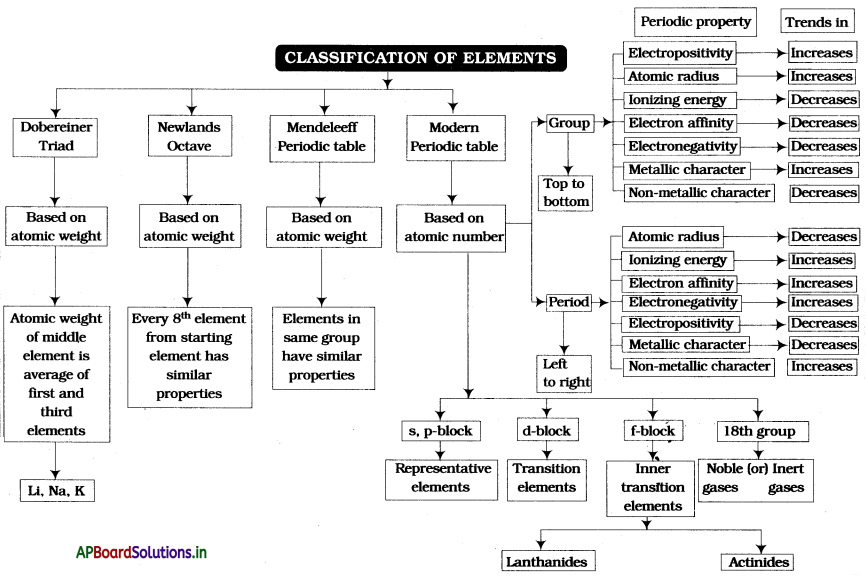
AP Board 10th Class Physical Science Notes Chapter 7 Classification of Elements- The Periodic Table 1

→ Dmitri Ivanovich Mendeleev (8 Feb. 1834 – 2 Feb. 1907):

  • Dmitri Ivanovich Mendeleev was a Russian chemist and Inventor.
  • He formulated periodic law, created his own version of the periodic table of elements.
  • He used the periodic table to correct the properties of some already discovered elements.
  • And also predict the properties of elements yet to be discovered

AP Board 8th Class Social Studies Notes Chapter 6 Minerals and Mining

Students can go through AP State Board 8th Class Social Studies Notes Chapter 6 Minerals and Mining to understand and remember the concept easily.

AP State Board Syllabus 8th Class Social Studies Notes Chapter 6 Minerals and Mining

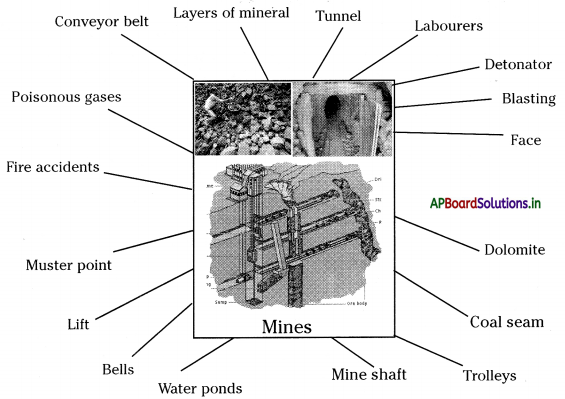
→ Anything which we obtain naturally from under the earth is a mineral.

→ Environmentalists differentiate between two kinds of resources- renewable and non-renewable resources.

→ Andhra Pradesh is very rich in mineral resources.

→ Krishna, Godavari basin has great potential for mineral oil and gas.

→ Minerals can be taken out for use by humans through a process of mining.

→ Minerals usually occur deep in the earth.

→ A New National Mineral Policy was announced in 1993.

AP Board Solutions AP Board 8th Class Social Studies Notes Chapter 6 Minerals and Mining

→ As a result, there has been a boom in mining.

→ There are extensive coal deposits in Khammam, Karimnagar, Adilabad, and Warangal. These mines are operated by Singareni Collieries Company Limited (SCCL).

→ Mangampeta in YSR Kadapa District has one of the largest – reserves of barytes mineral in the world.

→ Andhra Pradesh Mineral Development Corporation is a Govt, company.

→ In the open mines, almost all work is done by machines.

→ Minerals: Anything which we obtain naturally from under the earth is a mineral.

→ Underground mining: Building underground tunnels to mine minerals that lie very deep is called underground mining.

→ Open-pit mining: Making a large pit and extracting minerals is called open-pit mining or open cast mining.

→ Renewable resources: Renewable resources are those which can be regenerated like wood.

→ Non-renewable resources: The resources which are not possible to regenerate.

→ Coal: It is a fuel mineral. It is called Black gold.

AP Board Solutions AP Board 8th Class Social Studies Notes Chapter 6 Minerals and Mining

→ Barytes: It is a mineral that is widely used in extracting natural gas and oil.
AP Board 8th Class Social Studies Notes Chapter 6 Minerals and Mining 1

AP Board 8th Class Social Studies Notes Chapter 5 Forests: Using and Protecting Them

Students can go through AP State Board 8th Class Social Studies Notes Chapter 5 Forests: Using and Protecting Them to understand and remember the concept easily.

AP State Board Syllabus 8th Class Social Studies Notes Chapter 5 Forests: Using and Protecting Them

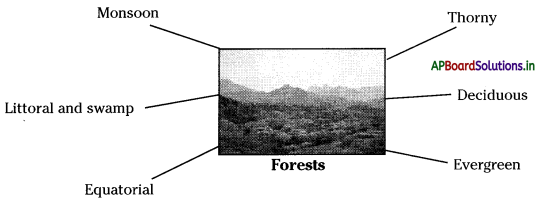
→ Different people use forests differently.

→ Human beings, trees, plants, grasses, animals, birds, insects, fishes, and other countless beings use forests.

→ Forests can be classified on the basis of different criteria.

→ About 64,000 sq. km of the state are declared as forest by the government.

→ Every year about 100 sq. km of forests are lost in our state.

→ Even today 60% of tribal people in our state live in forests.

→ During the last 200 years, the tribal people gradually lost their control and rights over the forest.

→ The British government restricted the traditional customary rights of the tribals and forest users by classifying forests as reserved and protected forests.

AP Board Solutions AP Board 8th Class Social Studies Notes Chapter 5 Forests: Using and Protecting Them

→ Joint Forest Management (J.F.M.) was introduced by the central government and it was changed to Community Forest Management (C.F.M.) in Andhra Pradesh.

→ At last Forest Rights Act was introduced in 2006 which recognized and restored the rights of tribals on forests.

→ Afforestation: The process of planting trees on an area of land in order to form a forest.

→ Deforestation: Clearing an area of trees.

→ Forest management: Forests are managed by the people who live in them.

→ Forest Rights Act: This was introduced in 2006. The rights of tribals on forests are restored again.

→ Reserve Forest: The forest in which no one could enter.

→ Forest tract: A large area of land covered with forest.

AP Board Solutions AP Board 8th Class Social Studies Notes Chapter 5 Forests: Using and Protecting Them

→ Tribal people: The people relating to a tribe.
AP Board 8th Class Social Studies Notes Chapter 5 Forests Using and Protecting Them 1

AP Board 8th Class Social Studies Notes Chapter 4 The Polar Regions

Students can go through AP State Board 8th Class Social Studies Notes Chapter 4 The Polar Regions to understand and remember the concept easily.

AP State Board Syllabus 8th Class Social Studies Notes Chapter 4 The Polar Regions

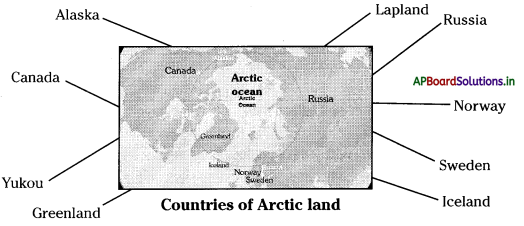
→ The region which lies near the poles is called the polar region.

→ The boundary of the polar region is known as the ‘Arctic Circle’.

→ The Tundra region has a unique type of vegetation known as ‘Tundra Vegetation’.

→ In this region, it is extremely cold. Since the Sun does not go high up in the sky, it is never very warm.

→ Most of the region is treeless.

→ The most commonly accepted meaning of “Eskimos” is “Snowshoe-netter”.

→ Hunting seals and fishing are the primary occupations of the Eskimos.

→ Their food is related to the nature of the atmosphere.

AP Board Solutions AP Board 8th Class Social Studies Notes Chapter 4 The Polar Regions

→ Their houses are known as “Igloos”.

→ The Eskimos believe that spirits control the things like life, health, sickness, starvation, and death.

→ They had no relations with the rest of the world.

→ The pattern of relationships between the Eskimos and outsiders has been described as “boom and bust”.

→ Arctic Circle: The 66\(\frac{1}{2}\)N latitude on the globe is known as Arctic Circle.

→ Tundra Vegetation: The Tundra region gets very little sunlight, it has a unique type of vegetation known as the ‘Tundra Vegetation’.

→ Icebergs: During summer the lakes fill up, and huge chunks of ice break off and float into the ocean as icebergs.

→ Eskimos: The people who live in scattered settlements in Greenland, Canada, Alaska, and Síberia.

AP Board Solutions AP Board 8th Class Social Studies Notes Chapter 4 The Polar Regions

→Kayaks: Kayaks are small canoe-like boats made of animal skins stretched over a wooden frame.

→Igloo: ‘Igloo’ means house in the language of Eskimos.
AP Board 8th Class Social Studies Notes Chapter 4 The Polar Regions 1

AP Board 8th Class Social Studies Notes Chapter 3 Earth Movements and Seasons

Students can go through AP State Board 8th Class Social Studies Notes Chapter 3 Earth Movements and Seasons to understand and remember the concept easily.

AP State Board Syllabus 8th Class Social Studies Notes Chapter 3 Earth Movements and Seasons

→ Human beings live along with a large community of plants and animals.

→ It snows heavily in the northern countries during winter.

→ In the region of the north pole, the sun is visible during the nighttime also.

→ The sun illuminates one-half of the earth at any given movement.

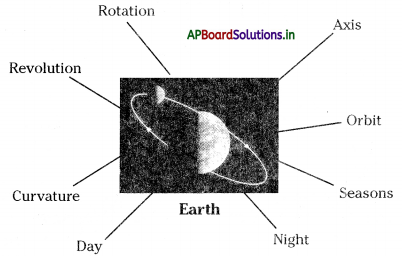
→ Rotation helps the entire earth to get heat and light on a daily basis.

→ The earth revolves around the sun while rotating around its own axis.

→ There are 3 temperature belts on the earth-Torrid, Temperate and Frigid Zones.

→ The duration of the day and night at the poles is six months each.

→ The sun does not rise high in the sky but only stays just above the sunrise point. It is also called the horizon.

→ The polar region is called the ‘Land of the midnight sun”.

AP Board Solutions AP Board 8th Class Social Studies Notes Chapter 3 Earth Movements and Seasons

→ The top of the axis keeps pointing to the pole star and this is called the polarity of the axis.

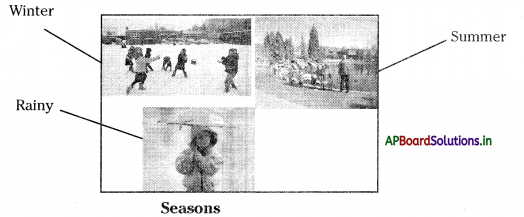
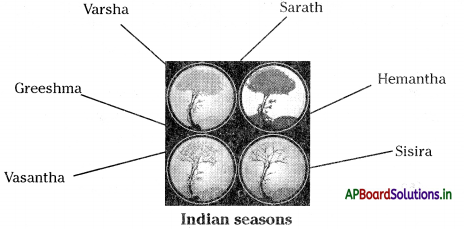
→ Seasons are quite opposite in the northern and southern hemispheres.

→ Seasons: Seasons occur on the earth due to the differences in temperatures.

→ The curvature of the Earth: Earth The earth’s surface being curved.

→ Earth’s Tilt: Move into a sloping position. The Earth’s tilt at 23 1/2°.

→ Snow Fall: In the extreme north and on high altitudes there is snowfall instead of rainfall.

→ Temperature belts: There are three temperature belts on the earth.

  • Tropical belt
  • Temperate belt
  • Polar belt

AP Board Solutions AP Board 8th Class Social Studies Notes Chapter 3 Earth Movements and Seasons

→ ‘Horizon: In the north pole, the sun does not rise high in the sky but only stays just above the sunrise point. This is called the Horizon.
AP Board 8th Class Social Studies Notes Chapter 3 Earth Movements and Seasons 1
AP Board 8th Class Social Studies Notes Chapter 3 Earth Movements and Seasons 2
AP Board 8th Class Social Studies Notes Chapter 3 Earth Movements and Seasons 3

AP Board 10th Class Physical Science Notes Chapter 6 Structure of Atom

Students can go through AP State Board 10th Class Physical Science Notes Chapter 6 Structure of Atom to understand and remember the concept easily.

AP State Board Syllabus 10th Class Physical Science Notes Chapter 6 Structure of Atom

→ Light can be characterized by its wavelength and frequency (v) and these quantities related to the speed of light as c = vλ

→ A spectrum is a group of wavelengths.

→ Electromagnetic energy (light) can have only certain discrete energy values which are given by the equation E = hv.

→ Electrons in an atom can gain energy by absorbing a particular frequency of light and can lose energy by emitting a particular frequency of light.

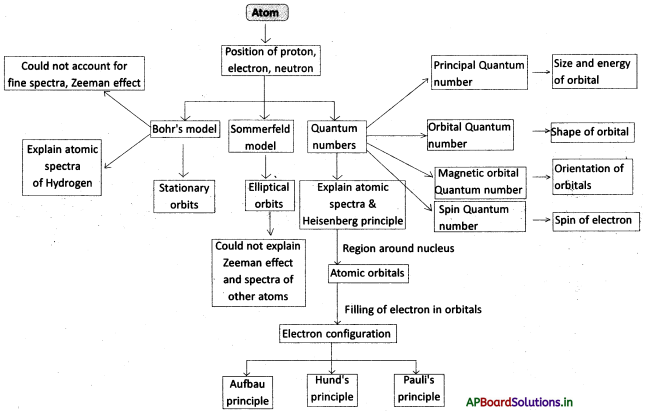
→ Bohr’s model of an atom: Electrons are present in stationary states. The electron moves to a higher energy level If it absorbs energy in the form of electromagnetic energy or moves to a lower energy state by emitting energy in the form of electromagnetic energy of appropriate frequency.

→ Atomic line spectra arise because of the absorption/emission of certain frequencies of light energy.

→ It is not possible to measure the position and velocity of an electron simultaneously.

AP Board Solutions AP Board 10th Class Physical Science Notes Chapter 6 Structure of Atom

→ The space around the nucleus where the probability of finding electrons is maximum is called orbital.

→ The three quantum numbers n, l, m describe the energy, shape and orientation respectively of an atomic orbital.

→ Spin is an intrinsic property of an electron.

→ The arrangement of electrons in shells, sub-shells and orbitals in an atom is called the electron configuration.

→ According to Pauli’s exclusion principle, no two electrons of the same atom can have the entire four quantum numbers same.

→ Aufbau principle: The lowest energy orbitals are filled first.

→ Hund’s rule: The orbitals of equal energy (degenerate) are occupied with one electron each before the pairing of electrons starts.

→ As long as an electron revolves in a stationary orbit it neither loses nor gains energy.

→ A rainbow is a natural spectrum appearing in the sky.

→ Light is considered an electromagnetic wave.

→ Electromagnetic waves are produced when an electric charge vibrates.

→ The electromagnetic wave has a speed of light, i.e. 3 × 10⁸ ms-1.

→ The relation between frequency and velocity of light is c = vλ.

→ An atom or molecule having the lowest possible energy is said to be in-ground state otherwise it is said to be in an excited state.

→ An atom or molecule in an excited state can emit light to lower its energy in order to get stability.

→ Sodium vapour lamp emits light of the wavelengths 589.0 nm to 589.6 nm.

→ Line spectrum is also known as discrete spectrum.

→ The atomic spectrum of a hydrogen atom is a line spectrum.

→ Stationary states are also called energy levels.

→ Sommerfeld proposed elliptical orbits.

→ The Quantum mechanical model of an atom was developed by Erwin Schrodinger.

AP Board Solutions AP Board 10th Class Physical Science Notes Chapter 6 Structure of Atom

→ The principal quantum number explains the size.

→ As n increases, the orbitals become larger and the electrons in those orbitals are farther from the nucleus.

→ The number of electrons in a shell is 2n2.

→ Orbital quantum number (l) gives the shape of the orbital.

→ l takes values from 0 to n – 1.

→ The splitting of spectral lines in a magnetic field is called the Zeeman effect.

→ The splitting of spectral lines in an electric field is called the Stark effect.

→ The orientation of the orbital with an external magnetic field determines the magnetic orbital quantum number.

→ The magnetic orbital quantum number takes values from – l to l.

→ Orbitals of the same energy are called Degenerate orbitals.

→ Wave: Surging movement of water, electricity, etc.

→ Spectrum: A spectrum is a group of wavelengths or frequencies.

→ Intensity: The amount of energy per unit volume is called intensity.

→ Discrete energy: Definite energy s called discrete energy.

→ Line spectrum: The colours correspond to certain discrete wavelengths of light and are called Line spectrum. It Is also known as discrete spectrum.

→ Orbital: The region of space around the nucleus where the probability of finding an electron is maximum is called an orbital.

→ Quantum numbers: The numbers indicate the probability of finding the electron in the space around the nucleus.

→ Shell (or) orbit: The path of an electron around the nucleus is called shell or orbit.

→ Sub-shells: Atomic orbitals are also called sub-shells.

AP Board Solutions AP Board 10th Class Physical Science Notes Chapter 6 Structure of Atom

→ The shape of orbital electron spin: Electron has two types of spins. One is clockwise spin and the other is anti-clockwise spin,

→ Electronic configuratIon: The distribution of electrons in various atomic orbitals called electronic configuration.

→ Pauli’s exclusion principle: No two electrons of the same atom can have all four quantum numbers the same.

→ Aufbau principle: The electrons should be placed in the lowest available orbital until the total number of electrons added is equal to the atomic number.

→ Hund’s rule: This rule states that electron pairing in orbitals starts only when all available empty orbitals of the same energy are singly occupied.

→ Dispersion: The splitting of light into different colours (VIBGYOR) is called dispersion.

→ Electromagnetic wave: When an electric field and magnetic field are perpendicular to each other and at right angles to the direction of propagation of the wave is formed. Such a wave is called an electromagnetic wave.

→ Electromagnetic spectrum: The entire, range of electromagnetic wave frequencies is known as the electromagnetic spectrum.

→ Emission spectrum: When a light beam emitted by a source ¡s dispersed to get the spectrum Is called an emission spectrum.

→ Continuous spectrum of emission: When light is dispersed from a source spectrum of continuously distributed colours is obtained on a dark background is called a continuous spectrum of emission.

→ Line spectrum of emission: When a light ¡s dispersed with a sharp bright line on a dark background, such a spectrum is called a tine spectrum of emission.

→ Stationary orbits: Orbits of fixed energy are called stationary orbits of energy levels.

→ Heisenberg’s Principle of Uncertainty: It is not possible to find the exact position and velocity of an electron simultaneously and accurately.

→ Principal Quantum Number (n): The quantum number which explains the size and energy of orbitals is called principal quantum number.

→ Angular Momentum Quantum Number (l): The quantum number which defines the shape of the orbital occupied by the electron and the orbital angular momentum of the electron in motion (m).

→ Magnetic orbital quantum number (ml): The orientation of orbital with an external magnetic field determines the magnetic orbital quantum number.

AP Board Solutions AP Board 10th Class Physical Science Notes Chapter 6 Structure of Atom

→ Spin quantum number (s): It gives spin of the electrons about their own axis.

→ c = vλ: The frequency (v), wavelength (λ) and velocity of light (c) related as follows c = vλ

→ E = hv: Electromagnetic energy can have only certain discrete energy values which is given by the equation E = hv where h = Planck’s constant
v = frequency of radiation

→ Visible spectrum: The spectrum which visible to our eyes s called the visible spectrum.

→ Duplet configuration: ns2 configuration is called duet configuration.

→ Octet configuration: If the element has eight electrons in the outermost orbital, It is called Octet configuration.

→ Zeeman effect: Splitting of spectral lines in a magnetic field is called the Zeeman effect.

→ Stark effect: Splitting of spectral lines In electric field Is called Stark effect.

→ Degenerate orbitals: OrbitaIs of the same energy is called degenerate orbitals.
AP Board 10th Class Physical Science Notes Chapter 6 Structure of Atom 1
→ Prince Louis Victor DeBroglie:

  • de Broglie, a French theoretical physicist born in 1892, received the Nobel Prize in 1929 ¡or his work on the wave nature of electrons.
  • He proposed dual nature 01 electron which is very much used in the determination of characterisation 01 electron and structure 0f atom.
  • He gave the wavelength (λ) material wave as I = \(\frac{\mathbf{h}}{\mathbf{m v}}\)

AP Board Solutions AP Board 10th Class Physical Science Notes Chapter 6 Structure of Atom

→ Neils Henrik David Bohr

  • Neils Henrik David Bohr was a Danish physicist.
  • He made foundational contributions to understanding atomic structure and quantum theory.
  • He received the Nobel Prize in Physics for those foundational contributions in 1522.
  • Bohr was also a philosopher and a promoter.

→ Max Karl Ernst Ludwig Planck:

  • Max Karl Ernst Ludwig Planck was a German theoretical physicist.
  • He originated quantum theory, which won him the Nobel Prize n Physics in 1918.
  • Planck made many contributlon6 to Theoretical physics, but his lame rests primarily on his role as originator of the quantum theory.
  • This theory revolutionized human understanding of atomic and subatomic processes.

AP Board 8th Class Social Studies Notes Chapter 2 Energy from the Sun

Students can go through AP State Board 8th Class Social Studies Notes Chapter 2 Energy from the Sun to understand and remember the concept easily.

AP State Board Syllabus 8th Class Social Studies Notes Chapter 2 Energy from the Sun

→ Solar energy is obtained from sunlight.

→ Temperature varies from place to place on the earth.

→ Temperature and rainfall affect life in very critical ways.

→ Greenhouses are built to grow plants with artificial protection.

→ Light, heat, UV rays, radio waves, and X-rays are some aspects of the Sun’s energy.

→ Solar radiation is radiant electromagnetic energy emitted by the Sun.

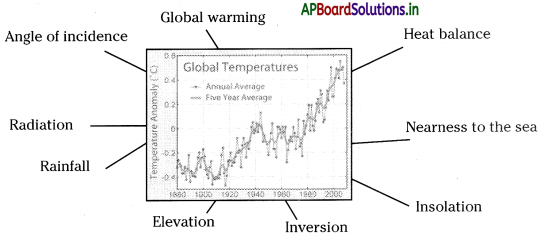
→ The incoming solar radiation is known as insulation.

→ The temperature distribution over land and oceans is much different and varying.

→ The earth’s heat balance enables mankind to live on it.

→ Scientists have recorded the highest and lowest temperatures on the earth.

AP Board Solutions AP Board 8th Class Social Studies Notes Chapter 2 Energy from the Sun

→ Six maximum, the minimum thermometers can be used for measuring the temperature of a place.

→ Different places have different temperatures.

→ Temperature differs on the top of a mountain and changes as we go north or south from the equator. Places near and far from the sea have different temperatures.

→ Two types of climates are there: Moderate and extreme climates.

→ Atmosphere: The gases that surrounded the earth.

→ Equatorial regions: The places or areas near the equator.

→ Condensation: Water from humid air collecting as droplets on a cold surface.

→ Solar Radiation: Energy sent out by the sun as electromagnetic waves or subatomic particles.

→ Insolation: The solar radiation received on the surface of the Earth is called insulation.

→ The angle of Incidence: Falling of sun’s rays 90° on the equator and slantingly towards the poles.

→ Heat Balance: The Earth with its atmosphere radiates back some of its insolation. This balances the temperature on the earth.

→ Maximum Temperature: The highest temperature of a certain area during a day.

→ Minimum Temperature: The lowest temperature of a certain area during a day.

→ Temperature inversion: Temperature distribution depends on some factors. If it happens against these factors, it is called temperature inversion (sometimes).

AP Board Solutions AP Board 8th Class Social Studies Notes Chapter 2 Energy from the Sun

→ Global Warming: An increase of CO2 in the atmosphere increases global temperatures. This ¡s called Global Warming.
AP Board 8th Class Social Studies Notes Chapter 2 Energy from the Sun 1

AP Board 8th Class Social Studies Notes Chapter 1 Reading and Analysis of Maps

Students can go through AP State Board 8th Class Social Studies Notes Chapter 1 Reading and Analysis of Maps to understand and remember the concept easily.

AP State Board Syllabus 8th Class Social Studies Notes Chapter 1 Reading and Analysis of Maps

→ A map is used by geographers to show features that we consider important.

→ Maps have a long history behind them.

→ The Sumerians, the Babylonians, the Greeks, the Arabs, and the Chinese prepared maps in the ancient period.

→ The science of map-making is Cartography.

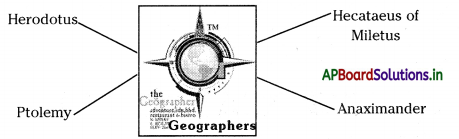
→ Al Idrisi, Ptolemy, Anaximander, Hecataeus of Miletus, and Herodotus were world-famous geographers and cartographers.

→ Gerardus Mercator devised a method for showing the correct shapes and directions of continents but with distortion of sizes and distances – Mercator’s projection.

→ The foundation of map-making in India was laid during the Vedic period.

→ Ancient Indian Scholars divided the known world into seven “wipes”.

→ Mahabharata conceived a round world surrounded by water.

→ The European colonial powers sent the scientific expeditions to the colonies with map makers.

→ Mt. Everest is named after Sir George Everest.

→ Maps were in great demand during times of war.

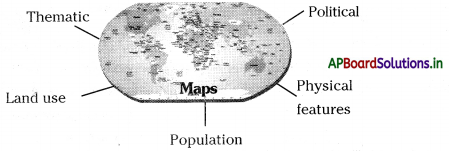
→ Maps were made and used for a variety of purposes.

AP Board Solutions AP Board 8th Class Social Studies Notes Chapter 1 Reading and Analysis of Maps

→ Thematic maps focus on only one aspect.

→ We have to use different kinds of symbols, colors, and patterns to show everything related to that map.

→ The population can also be shown through shaded maps.

→ The symbols used by the map makers are known as conventional symbols.

→ Relief feature means the high and low places on the surface of the earth.

→ Contours are lines on a map joining places of the same height measured from the sea level. They are also called Isolines.

→ An atlas is a collection of maps.

→ Projection: A forecast based on present trends

→ Symbols: Things or persons that represent something else.

AP Board Solutions AP Board 8th Class Social Studies Notes Chapter 1 Reading and Analysis of Maps

→ Geographer: The person who studies the physical features of the earth and of human activity as it relates to these

→ Contour: isolines — lines on a map joining places of the same height, measured from the sea level.

→ Cartography: The science of maps.

→ Survive: To continue to live or exist

→ Conquer: Overcome and take control of a place or its people by military force.

→ Destination: The place to which someone or something is going or being sent.

→ Depict: Represent by a drawing, painting, or other art forms.

→ Significance: Importance

→ Perspective: The art of representing solid objects on a flat surface so as to give the impression of height, width, depth, and relative distance.

→ Perspective: The art of representing solid objects on a flat surface so as to give the impression of height, width, depth, and relative distance.

→ Exploration: Travelling through an unfamiliar area in order to learn about it.

AP Board Solutions AP Board 8th Class Social Studies Notes Chapter 1 Reading and Analysis of Maps

→ Enthusiasm: Great enjoyment, interest, or approval.

→ Maritime: Relating to shipping or other activity taking place at sea.

→ Curvature: The fact of being curved or the degree to which something is curved.

→ Distort: Pull or twist out of shape.

→ Impetus: The force or energy with which a body moves.

→ Indicate: Point out/Show.
AP Board 8th Class Social Studies Notes Chapter 1 Reading and Analysis of Maps 1
AP Board 8th Class Social Studies Notes Chapter 1 Reading and Analysis of Maps 2
AP Board 8th Class Social Studies Notes Chapter 1 Reading and Analysis of Maps 3

AP 10th Class Maths Bits Chapter 11 Trigonometry with Answers

Practice the AP 10th Class Maths Bits with Answers Chapter 11 Trigonometry on a regular basis so that you can attempt exams with utmost confidence.

AP SSC 10th Class Maths Bits 1st Lesson Chapter 11 Trigonometry with Answers

Question 1.
Find the value of cos 12° – sin 78°
Answer:
0
Explanation:
cos 12°- sin(90°- 12°)
⇒ cos 12° – cos 12° = 0

Question 2.
If x = cosec θ + cot θ and y = cosec θ – cot θ, then write the relation between ‘x’ and ‘y’
Answer:
xy = 1
Explanation:
xy = (cosec θ + cot θ) (cosec θ – cot θ)
⇒ cosec2 θ – cot2 θ = 1

Question 3.
Write a formula to cos (A – B).
Answer:
cos A cos B + sin A sin B

Question 4.
The value of cos (90 – θ).
Answer:
sin θ

Question 5.
In Δ ABC sin C = \(\frac {3}{5}\),then find cos A.
Answer:
\(\frac {3}{5}\)

Question 6.
Complete the value tan2 θ – sec2 θ.
Answer:
-1
Explanation:
-(sec2 θ – tan2 θ) = – 1

AP 10th Class Maths Bits Chapter 11 Trigonometry with Answers

Question 7.
The value of sec (90 – A).
Answer:
cosec A

Question 8.
If cosec θ + cot θ = 5, then cosec θ – cot θ.
Answer:
\(\frac {1}{5}\)

Question 9.
If x = 2 sec θ; y = tan θ,then the value of x2 – y2.
Answer:
4
Explanation:
sec2 θ = \(\left(\frac{x}{2}\right)^{2}\),tan2 θ = \(\left(\frac{y}{2}\right)^{2}\)
⇒ sec2 θ – tan2 θ = \(\frac{x^{2}}{4}-\frac{y^{2}}{4}\)
⇒ 4 = x2 – y2

Question 10.
If √3 tan θ = 1,then the value of θ.
A.
30°

Question 11.
The value of (sec 60)(cos 60).
Answer:
1

Question 12.
How much the value of sin (60 + 30)?
Answer:
1

AP 10th Class Maths Bits Chapter 11 Trigonometry with Answers

Question 13.
If sec θ + tan θ = \(\frac{1}{2}\) then find sec θ – tan θ.
Answer:
2

Question 14.
The value of cos(90 – θ).
Answer:
sin θ

Question 15.
Simplify: tan 26°. tan 64°
Answer:
1
Explanation:
tan 26° . tan 64°
⇒ tan 26° . tan (90° – 26°)
⇒ tan 26° . cot 26° = 1

Question 16.
How much value of the angle ‘θ’ in the figure?
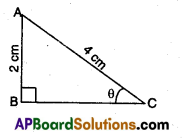
AP 10th Class Maths Bits Chapter 11 Trigonometry with Answers 1
Answer:
30°
Explanation:
sin θ = \(\frac{\mathrm{AB}}{\mathrm{AC}}=\frac{2}{4}=\frac{1}{2}\) = sin 30°
∴θ = 30°

Question 17.
Find the value of \(\frac{1-\tan ^{2} 45^{\circ}}{1+\tan ^{2} 45^{\circ}}\).
Answer:
0
Explanation:
\(\frac{1-\tan ^{2} 45^{\circ}}{1+\tan ^{2} 45^{\circ}}\) = \(\frac{1-1}{1+1}=\frac{0}{2}\) = 0

Question 18.
If sin x = \(\frac{5}{7}\), then find the value of cosec x.
Answer:
\(\frac{7}{5}\)
Explanation:
sin x = \(\frac{5}{7}\) ⇒ cosec x = \(\frac{7}{5}\)

AP 10th Class Maths Bits Chapter 11 Trigonometry with Answers

Question 19.
Given ∠A = 75°, ∠B = 30°,then find the value of tan (A – B).
Answer:
1
Explanation:
tan (75° – 30°) = tan 45° = 1

Question 20.
If sec θ + tan θ = \(\frac{1}{3}\),then find the value of sec θ – tan θ.
Answer:
3
Explanation:
⇒ sec θ + tan θ = \(\frac{1}{3}\)
⇒ sec θ – tan θ = 3

Question 21.
If cosec θ + cot θ = 2,then find the value of cos θ.
Answer:
\(\frac{3}{5}\)
Explanation:
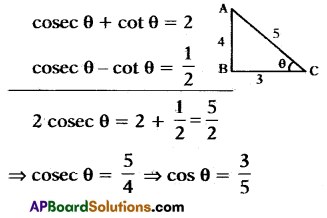
AP 10th Class Maths Bits Chapter 11 Trigonometry with Answers 2

Question 22.
If cos (A + B) = 0, cos B = \(\frac{\sqrt{3}}{2}\),then
how much value of A?
Answer:
60°
Explanation:
cos (A + B) = 0, cos B = \(\frac{\sqrt{3}}{2}\)
⇒ cos B = cos 30°
⇒ A + B = 90°
⇒ A + 30° = 90°
∴ A = 90°- 30° = 60°

Question 23.
If sec θ – tan θ = 3, then find the value of sec θ + tan θ.
Answer:
\(\frac{1}{3}\)

Question 24.
If sin 2θ = cos 3θ, then how the value of θ.
Answer:
18°
Explanation:
sin 2θ = cos 3θ
⇒ 2θ + 3θ = 90°
⇒ 5θ = 90°
θ = 18°

AP 10th Class Maths Bits Chapter 11 Trigonometry with Answers

Question 25.
If cos θ = \(\frac{3}{5}\), then find the value of sin θ.
Answer:
\(\frac{4}{5}\)
Explanation:
cos θ = \(\frac{3}{5}\) ⇒ sin θ = \(\frac{4}{5}\)

Question 26.
Simplify : cos 60° + sin 30°.
Answer:
1
Explanation:
cos 60° + sin 30° = \(\frac{1}{2}+\frac{1}{2}=\frac{2}{2}\) = 1

Question 27.
If sec A + tan A = \(\frac{1}{5}\), then find the value of sec A – tan A.
Answer:
5

Question 28.
sin (90 – A) = \(\frac{1}{2}\) , then how much the value A?
A.
60°

Question 29.
If cot A = \(\frac{5}{12}\), then find the value of sin A + cos A.
Answer:
\(\frac{17}{13}\)

Question 30.
Write any value which is not possible for sin x?
Answer:
\(\frac{5}{4}\)
Explanation:
sin x = \(\frac{5}{4}\) > 1, so it is not possible.

AP 10th Class Maths Bits Chapter 11 Trigonometry with Answers

Question 31.
If sin θ = cos θ (0 < θ < 90), then the value of tan θ + cot θ.
Answer:
2
Explanation:
sin θ = cos θ
⇒ 0 = 45°
⇒ tan 45° + cot 45° = 2

Question 32.
If sec θ + tan θ = 3, then find the value of sec θ – tan θ.
Answer:
\(\frac{1}{3}\)

Question 33.
In ΔABC; AB = c, BC = a, AC = b and ∠BAC = 0, then calculate the value of area of ΔABC is ………………(θ is acute)
Answer:
\(\frac{1}{2}\) bc sin θ

Question 34.
Write the value of tan θ in terms of cosec θ.
Answer:
\(\frac{1}{\sqrt{\operatorname{cosec}^{2} \theta-1}}\)

Question 35.
Observe the following:
(I) sin2 20° + sin2 70° = 1
(II) log2 (sin 90°) = 1
Which one is CORRECT?
Answer:
(I) only

Question 36.
Simplify : tan 36°. tan 54° + sin 30°
Answer:
\(\frac{3}{2}\)
Explanation:
tan 36° . tan (90 – 36°) + sin 30°
⇒ tan 36° . cot 36° + \(\frac{1}{2}\)
⇒ 1 + \(\frac{1}{2}=\frac{3}{2}\)

AP 10th Class Maths Bits Chapter 11 Trigonometry with Answers

Question 37.
If sin A = \(\frac{24}{25}\), then find the value of sec A.
Answer:
\(\frac{25}{7}\)

Question 38.
Which one of the following is NOT defined?
sin 90°, cos 0°, sec 90°, cos 90°.
Answer:
sec 90°
Explanation:
sec 90° is not defined

Question 39.
Simplify:\(\sqrt{\frac{1-\cos ^{2} A}{1+\cot ^{2} A}}\)
Answer:
sin2A
Explanation:
\(\sqrt{\frac{\sin ^{2} A}{\operatorname{cosec}^{2} A}}\) = \(\sqrt{\sin ^{4} A}\) = sin2A

Question 40.
If cot θ – cosec θ = p, then find cot θ + cosec θ.
Answer:
\(\frac{-1}{\mathrm{p}}\)

Question 41.
Express tan θ in terms of cos θ.
Answer:
\(\frac{\sqrt{1-\cos ^{2} \theta}}{\cos \theta}\)

Question 42.
Who was introduced Trigonometry?
Answer:
Hipparchus

AP 10th Class Maths Bits Chapter 11 Trigonometry with Answers

Question 43.
\(\frac{\sin ^{4} \theta-\cos ^{4} \theta}{\sin ^{2} \theta-\cos ^{2} \theta}\) equal to
Answer:
1
Explanation:
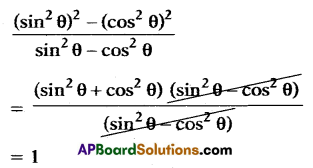
AP 10th Class Maths Bits Chapter 11 Trigonometry with Answers 3

Question 44.
sin247° + sin243° equal to
Answer:
1

Question 45.
sin 2A equal to
Answer:
2sin A cos A

Question 46.
sin 30° + cos 60° equal to
Answer:
1

Question 47.
sec4A – sec2A equal to
Answer:
tan4 A – tan2 A
Explanation:
sec4 A – sec2A
⇒1 + tan4 A – (1 + tan2 A)
⇒ tan4 A – tan2 A

Question 48.
Find the value of \(\frac{\tan ^{2} \theta}{1+\tan ^{2} \theta}\).
Answer:
sin2 θ

AP 10th Class Maths Bits Chapter 11 Trigonometry with Answers

Question 49.
2sin 45°. cos 45° equal to
Answer:
1

Question 50.
sin 81° equal to
Answer:
cos 9°
1

Question 51.
tan θ = \(\frac{1}{\sqrt{3}}\), then find cos θ.
Answer:
\(\frac{\sqrt{3}}{2}\)

Question 52.
If cos θ = \(\frac{1}{2}\); then find cos\(\frac{\theta}{2}\)
Answer:
\(\frac{\sqrt{3}}{2}\)
Explanation:
cos θ = \(\frac{1}{2}\)
⇒ cos θ = cos 60° ⇒ θ = 60°
⇒ cos\(\frac{\theta}{2}\) ⇒ cos 30° = \(\frac{\sqrt{3}}{2}\)

Question 53.
\(\frac{\cos \theta}{1-\tan \theta}+\frac{\sin \theta}{1-\cot \theta}\) equal to
Answer:
cos θ + sin θ

Question 54.
cos 300° equal to
Answer:
\(\frac{1}{2}\)
Explanation:
cos (270° + 30°) = sin 30° =\(\frac{1}{2}\)

AP 10th Class Maths Bits Chapter 11 Trigonometry with Answers

Question 55.
\(\frac{\sin \theta}{\sqrt{1-\sin ^{2} \theta}}\) equal to
Answer:
tan θ
Explanation:
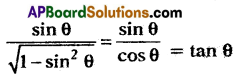
AP 10th Class Maths Bits Chapter 11 Trigonometry with Answers 4

Question 56.
(1 + tan2 θ)cos2 θ equal to
Answer:
1

Question 57.
If 3 tan θ = 1; then find θ.
Answer:
30°

Question 58.
\(\frac{\sqrt{\sec ^{2} \theta-1}}{\sec \theta}\) equal to
Answer:
sin θ
Explanation:
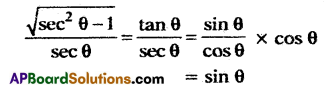
AP 10th Class Maths Bits Chapter 11 Trigonometry with Answers 5

Question 59.
\(\frac{1}{\sqrt{1+\tan ^{2} \theta}}\) equal to
Answer:
cos θ

Question 60.
Find the value of cosec 60° × cos 90°.
Answer:
0

AP 10th Class Maths Bits Chapter 11 Trigonometry with Answers

Question 61.
sec2 θ + cosec2 θ equal to
Answer:
sec2 θ.cosec2 θ
Explanation:
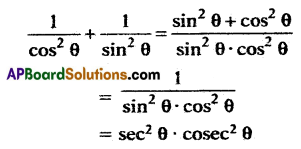
AP 10th Class Maths Bits Chapter 11 Trigonometry with Answers 6

Question 62.
sec2 33° – cot2 57° equal to
Answer:
1

Question 63.
If sin θ = \(\frac{11}{15}\), then find cos θ.
Answer:
\(\frac{2 \sqrt{26}}{15}\)

Question 64.
equal to \(\frac{\tan \theta}{\sqrt{1+\tan ^{2} \theta}}\)
Answer:
sin θ

Question 65.
If sin θ = \(\frac{\mathbf{a}}{\mathbf{b}}\); cos θ = \(\frac{\mathbf{c}}{\mathbf{d}}\); then find tan θ.
Answer:
\(\frac{\mathrm{ad}}{\mathrm{bc}}\)
Explanation:
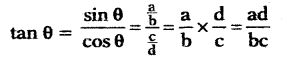
AP 10th Class Maths Bits Chapter 11 Trigonometry with Answers 7

Question 66.
tan (A+B) equal to
Answer:
\(\frac{\tan A+\tan B}{1-\tan A \cdot \tan B}\)

Question 67.
If sin A = \(\frac{1}{\sqrt{2}}\) ; then find tan A.
Answer:
1

AP 10th Class Maths Bits Chapter 11 Trigonometry with Answers

Question 68.
sin\(\frac{\pi}{6}\) + cos\(\frac{\pi}{3}\) equal to
Answer:
1

Question 69.
Find the value of cos 75°.
Answer:
sin 15°
Explanation:
cos 75° = cos (90° – 15°) = sin 15°

Question 70.
If sin 0 = \(\frac{1}{2}\); then find cos \(\frac{3 \theta}{2}\).
Answer:
\(\frac{1}{\sqrt{2}}\)

Question 71.
\(\frac{1}{\sec ^{2} A}+\frac{1}{\operatorname{cosec}^{2} A}\) equal to
Answer:
1
Explanation:
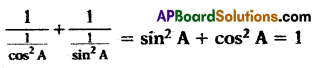
AP 10th Class Maths Bits Chapter 11 Trigonometry with Answers 8

Question 72.
sin 240° equals to
Answer:
–\(\frac{\sqrt{3}}{2}\)
Explanation:
sin 240° = sin (270° – 30°)
= -cos 30°= \(\frac{-\sqrt{3}}{2}\)

AP 10th Class Maths Bits Chapter 11 Trigonometry with Answers

Question 73.
If sec θ + tan θ = \(\frac{1}{5}\) ,then find sin θ.
Answer:
\(\frac{12}{13}\)

Question 74.
tan 240° equal to
Answer:
√3

Question 75.
Find the value of
sin 60° cos 30°+ cos 60°. sin 30°.
Answer:
1
Explanation:
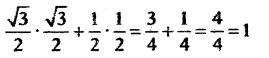
AP 10th Class Maths Bits Chapter 11 Trigonometry with Answers 9

Question 76.
\(\frac{1}{1-\sin \theta}+\frac{1}{1+\sin \theta}\) equal to
Answer:
2sec2 θ
Explanation:

AP 10th Class Maths Bits Chapter 11 Trigonometry with Answers 10

Question 77.
tan 0° equal to
Answer:
0

Question 78.
\(\frac{\sqrt{1+\tan ^{2} \theta}}{\sqrt{1+\cot ^{2} \theta}}\) equal to
Answer:
tan θ

AP 10th Class Maths Bits Chapter 11 Trigonometry with Answers

Question 79.
\(\frac{\sin 18^{\circ}}{\cos 72^{\circ}}\) equal to
Answer:
1

Question 80.
If sin θ = cos θ, then find θ.
Answer:
45°

Question 81.
In right triangle ΔABC; ∠B= 90°; tan C = \(\frac{5}{12}\) , then find the length of hypotenuse.
Answer:
13
Explanation:
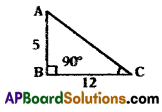
AP 10th Class Maths Bits Chapter 11 Trigonometry with Answers 11
By Py thagoras theorem,
AC2 = AB2 + BC2
AC2 = 52 + 122
= 25 + 144= 169
⇒ AC = hypotenuse = 13

Question 82.
If A, B are acute angles ;
sin(A – B)= \(\frac{1}{2}\); cos (A + B) = \(\frac{1}{2}\), then find B.
Answer:
15° (or) \(\frac{\pi}{12}\)
Explanation:
sin (A – B) = \(\frac{1}{2}\) = sin30°
A – B = 30°
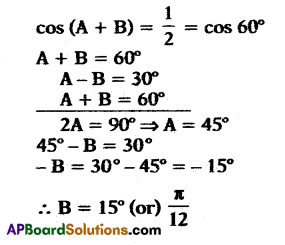
AP 10th Class Maths Bits Chapter 11 Trigonometry with Answers 12

Question 83.
cos (270° – θ) equal to
Answer:
-sin θ

Question 84.
Find the value of
cos 0° + sin 90° + √2sin 45°.
Answer:
3
Explanation:
1 + 1 + √2.\(\frac{1}{\sqrt{2}}\) = 1 + 1 + 1 = 3

AP 10th Class Maths Bits Chapter 11 Trigonometry with Answers

Question 85.
If tan θ = \(\frac{1}{\sqrt{3}}\); then find cos θ.
Answer:
\(\frac{\sqrt{3}}{2}\)
Explanation:
tan θ = \(\frac{1}{\sqrt{3}}\) = tan 30°
⇒ θ = 30°
∴ cos θ = cos 30° = \(\frac{\sqrt{3}}{2}\)

Question 86.
Equal to cosec (90 + θ).
Answer:
sec θ

Question 87.
sin θ. sec θ equals to
Answer:
tan θ

Question 88.
Find the value of 3sin2 45°+2cos2 60°.
Answer:
2
Explanation:
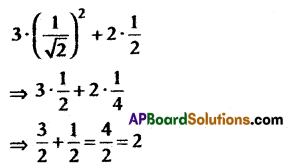
AP 10th Class Maths Bits Chapter 11 Trigonometry with Answers 13

Question 89.
Find the value of tan2 30° + 2 cot2 60°.
Answer:
1
Explanation:
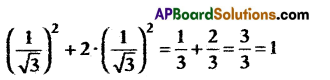
AP 10th Class Maths Bits Chapter 11 Trigonometry with Answers 14

Question 90.
Find the value of secA.\(\sqrt{1-\sin ^{2} A}\)
Answer:
1

AP 10th Class Maths Bits Chapter 11 Trigonometry with Answers

Question 91.
If 5 sin A= 3; then find sec2 A – tan2 A.
Answer:
1
Explanation:
sin A = \(\frac{3}{5}\) ⇒ sec2A = tan2A = 1

Question 92.
Find the value of cos 240°.
Answer:
–\(\frac{1}{2}\)

Question 93.
If sin θ. cosec θ = x; then find x.
Answer:
1

Question 94.
sin(45°+ θ) – cos(45°- θ).
Answer:
0

Question 95.
Find the value of cos2 17° – sin2 73°.
Answer:
0
Explanation:
cos2 17°- sin2 73°
= cos2 (90 – 73) – sin2 73°
= sin2 73° – sin2 73° = 0

Question 96.
Find the value of sin2 60° – sin2 30°.
Answer:
\(\frac{1}{2}\)

AP 10th Class Maths Bits Chapter 11 Trigonometry with Answers

Question 97.
ten θ is not defined when θ is equal to
Answer:
90°

Question 98.
Find the value of sin 45° + cos 45°.
Answer:
√2
Explanation:
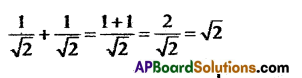
AP 10th Class Maths Bits Chapter 11 Trigonometry with Answers 15

Question 99.
Simplify: \(\frac{1-\sec ^{2} A}{\operatorname{cosec}^{2} A-1}\)
Answer:
– tan4A

Question 100.
Find the value of sin θ. cosec θ+ cos θ. sec θ + tan θ. cot θ.
Answer:
3
Explanation:
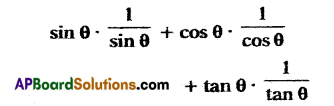
AP 10th Class Maths Bits Chapter 11 Trigonometry with Answers 16
= 1 + 1 + 1 = 3

Question 101.
If A = 30°, then sin 2A equals to
Answer:
\(\frac{\sqrt{3}}{2}\)

Question 102.
If sec θ = 3k and tan θ = \(\frac{3}{\mathbf{k}}\), then find the value of (k2 – \(\frac{1}{\mathbf{k}^{2}}\))
Answer:
\(\frac{1}{9}\)
Explanation:
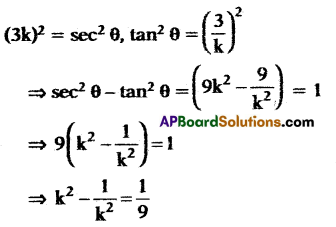
AP 10th Class Maths Bits Chapter 11 Trigonometry with Answers 17

Question 103.
If tan θ + sec θ = 8, then find sec θ – tan θ.
Answer:
\(\frac{1}{8}\)

AP 10th Class Maths Bits Chapter 11 Trigonometry with Answers

Question 104.
If sin θ = \(\frac{12}{13}\), then find tan θ.
Answer:
\(\frac{12}{5}\)

Question 105.
In a right angled ΔABC, right angle at C if tan A = \(\frac{8}{15}\), then find the value of cosec2 A – 1.
Answer:
\(\frac{225}{64}\)
Explanation:
tan A = \(\frac{8}{15}\),
cosec 2 A – 1 = cot2A = \(\left(\frac{15}{8}\right)^{2}=\frac{225}{64}\)

Question 106.
Find the value of \(\frac{2 \tan 30^{\circ}}{1+\tan ^{2} 30^{\circ}}\)
Answer:
sin 60°

Question 107.
If sin A = ;\(\frac{1}{\sqrt{2}}\) then find tan A
Answer:
1

Question 108.
In ΔABC, sin \(\left(\frac{B+C}{2}\right)\) equal to .
Answer:
A. cos\(\frac{A}{2}\)

Question 109.
tan 26°. tan 64° equal to
Answer:
1
Explanation:
tan 26° . tan 64°
= tan 26° . tan (90° – 26°)
= tan 26° . cot 26° = 1

Question 110.
cos2 θ equal to
Answer:
1 – sin2 θ

AP 10th Class Maths Bits Chapter 11 Trigonometry with Answers

Question 111.
If tan A = \(\frac{3}{4}\) then find sec2 A – tan2 A.
Answer:
1

Question 112.
sin4 θ – cos4 θ equal to
Answer:
2sec2 θ – 1

Question 113.
\(\frac{\sqrt{1-\cos ^{2} \theta}}{\cos \theta}\) equal to
Answer:
tan θ
Explanation:
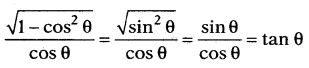
AP 10th Class Maths Bits Chapter 11 Trigonometry with Answers 18

Question 114.
sin(90 – Φ) equal to
Answer:
cos Φ

Question 115.
sec θ – tan θ = \(\frac{1}{n}\), then find sec θ + tan θ.
Answer:
n

Question 116.
x = 2 cosec θ, y = 2 cot θ; find x2 – y2.
Answer:
4

Question 117.
tan θ is not defined if θ.
Answer:
90°

AP 10th Class Maths Bits Chapter 11 Trigonometry with Answers

Question 118.
sec θ is not defined if θ.
Answer:
90°

Question 119.
tan2 Φ – sec2 Φ equal to
Answer:
-1

Question 120.
\(\left|\begin{array}{ll}
\tan \theta & \sec \theta \\
\sec \theta & \tan \theta
\end{array}\right|\)
Answer:
1
Explanation:
\(\left|\tan ^{2} \theta-\sec ^{2} \theta\right|=|-1|\) = 1

Question 121.
sin 225° equal to
Answer:
\(\frac{-1}{\sqrt{2}}\)

Question 122.
cos (x – y) equal to
Answer:
cos x cos y + sin x sin y

Question 123.
\(\frac{\sec 35^{\circ}}{\operatorname{cosec} 55^{\circ}}\) equal to
Answer:
1
Explanation:
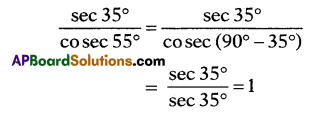
AP 10th Class Maths Bits Chapter 11 Trigonometry with Answers 19

AP 10th Class Maths Bits Chapter 11 Trigonometry with Answers

Question 124.
\(\frac{1}{\sec ^{2} A}+\frac{1}{\operatorname{cosec}^{2} A}\) equal to
Answer:
1

Question 125.
sin (-θ) equal to
Answer:
-sin θ

Question 126.
cosec (270 – θ) equal to
Answer:
-sec θ

Question 127.
sec (90 + θ) equal to
Answer:
-cosec θ

Question 128.
tan (360 – θ) equal to
Answer:
-tan θ

Question 129.
cos (-θ) equal to
Answer:
cos θ

Question 130.
sin (180 – θ) equal to
Answer:
sin θ

AP 10th Class Maths Bits Chapter 11 Trigonometry with Answers

Question 131.
cos (270 – θ) equal to
Answer:
-sin θ

Question 132.
Find the maximum value of cos θ.
Answer:
1

Question 133.
Find the minimum and maximum values of tan θ.
Answer:
(- ∞ ,∞ )

Question 134.
sin 420° equal to
Answer:
\(\frac{\sqrt{3}}{2}\)

Question 135.
sec 240° equal to
Answer:
-2

Question 136.
cos 0° + sin 90° + √3 cosec 60° equal to
Answer:
4
Explanation:
1 + 1 + 3 . \(\frac{2}{\sqrt{3}}\) = 4

Question 137.
sec θ + tan θ = \(\frac{1}{2}\); then find sin θ.
Answer:
\(\frac{12}{13}\)

AP 10th Class Maths Bits Chapter 11 Trigonometry with Answers

Question 138.
sin 45°.cos 45° + √3 sin 60° equal to
Answer:
2

Question 139.
tan 30° + cot 30° equal to
Answer:
\(\frac{4}{\sqrt{3}}\)

Question 140.
tan (A – B) equal to
Answer:
\(\frac{\tan A-\tan B}{1+\tan A \tan B}\)

Question 141.
If sin A = \(\frac{3}{5}\); then find sin (90 + A).
Answer:
\(\frac{4}{5}\)
Explanation:
sin A = \(\frac{3}{5}\), sin (90 + A) = cos A = \(\frac{4}{5}\)

Question 142.
Find the value of cos 1°.cos 2°.cos 3°……………, cos 180°.
Answer:
0
Explanation:
cos 1° × cos 2° × cos 3° × …………….. × cos 90° × ……….. × cos 180°
cos 1° × cos 2° × cos 3° × …………. × 0 × …………. × (- 1) = 0

Question 143.
Find the value of cos217° – sin2 73°.
Answer:
0

Question 144.
If cosec θ + cot θ = 2; then find cosec θ – cot θ.
Answer:
\(\frac{1}{2}\)

AP 10th Class Maths Bits Chapter 11 Trigonometry with Answers

Question 145.
cosec 60°. sec 60° equal to
Answer:
\(\frac{4}{\sqrt{3}}\)

Question 146.
sin (A – B) equal to
Answer:
sin A cos B – cos A sin B

Question 147.
If tan (15°+ B)= √3 ; then find B.
Answer:
45°
Explanation:
tan (15° + B) = √3 = tan 60°
15 + B = 60 ⇒B = 60°- 15° = 45°

Question 148.
Simplify: \(\frac{\sin (90-\theta) \sin \theta}{\tan \theta}\) – 1
Answer:
-sin2 θ

Question 149.
sin 450° equal to
Answer:
1

Question 150.
cos 150° equal to
Answer:
–\(\frac{\sqrt{3}}{2}\)

Question 151.
If sin θ = \(\frac{1}{2}\) ; then find cot θ.
Answer:
√3

AP 10th Class Maths Bits Chapter 11 Trigonometry with Answers

Question 152.
Find the value of sin 29° – cos 61°
Answer:
0

Question 153.
If tan θ = 1; then find cos θ.
Answer:
\(\frac{1}{\sqrt{2}}\)

Question 154.
cos (A + B) equal to
Answer:
cos A cos B – sin A sin B

Question 155.
Express tan θ, in terms of sin θ.
Answer:
\(\frac{\sin \theta}{\sqrt{1-\sin ^{2} \theta}}\)

Question 156.
sin θ + sin2 θ = 1, then find cos2 θ + cos4 θ.
Answer:
1

Question 157.
in ΔABC,write tan(\(\frac{B+C}{2}\))equal to
Answer:
Cot (\(\frac{\mathrm{A}}{2},\))
Explanation:
A + B + C = 180°
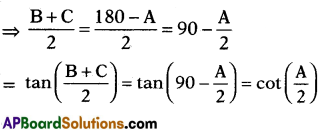
AP 10th Class Maths Bits Chapter 11 Trigonometry with Answers 20

AP 10th Class Maths Bits Chapter 11 Trigonometry with Answers

Question 158.
(cos A + sin A)2 + (cos A – sin A)2 equal to
Answer:
2

Question 159.
cos(180 – θ) equal to
Answer:
– cos θ

Question 160.
Find the value of (cosec θ – cot θ).
Answer:
\(\frac{1-\cos \theta}{\sin \theta}\)
Explanation:
cosec θ – cot θ
= \(\frac{1}{\sin \theta}-\frac{\cos \theta}{\sin \theta}=\frac{1-\cos \theta}{\sin \theta}\)

Question 161.
sin2 75° + cos2 75° equal to
Answer:
1

Question 162.
If cos θ. sin θ = \(\frac{1}{2}\) ; then find tan θ.
Answer:
1
Explanation:
cos θ . sin θ = cos 45° . sin 45°
= \(\frac{1}{\sqrt{2}} \cdot \frac{1}{\sqrt{2}}=\frac{1}{2}\)
Then tan 45° = 1.

Question 163.
For which value of cosine equal to sin 81°.
Answer:
cos 9°.

Question 164.
sin 750° equal to
Answer:
\(\frac{1}{2}\)

AP 10th Class Maths Bits Chapter 11 Trigonometry with Answers

Question 165.
\(\frac{\sin \theta-2 \sin ^{3} \theta}{2 \cos ^{3} \theta-\cos \theta}\) equal to
Answer:
tan θ
Explanation:
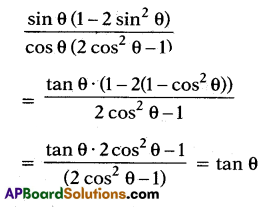
AP 10th Class Maths Bits Chapter 11 Trigonometry with Answers 21

Question 166.
If sin(A+B) = 1; sin B = \(\frac{1}{2}\) ; then find A.
Answer:
60°
Explanation:
sin (A + B) = 1 = sin 90°
A + B = 90°
sin B = sin 30° ⇒ B = 30°
A + 30° = 90° ⇒ A = 60°

Question 167.
If tan θ = √3 , then find sec θ.
Answer:
2
Explanation:
tan θ = √3 = tan 60° ⇒ θ = 60°
sec 60° = 2

Question 168.
Find the value of
cos 0°+ sin 90° + √3 cosec 60°.
Answer:
4

Question 169.
\(\sqrt{\sec ^{2} \theta+\operatorname{cosec}^{2} \theta}\) equal to
Answer:
sec θ . cosec θ
Explanation:
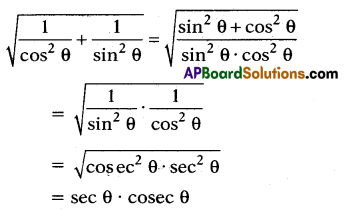
AP 10th Class Maths Bits Chapter 11 Trigonometry with Answers 22

Question 170.
Find the value of
cos 60°. cos 30° – sin 60°. sin30°.
Answer:
0

Question 171.
cot2θ – \(\frac{1}{\sin ^{2} \theta}\) equal to
Answer:
-1
Explanation:
cot2 θ – cosec2 θ = – 1

AP 10th Class Maths Bits Chapter 11 Trigonometry with Answers

Question 172.
π radians equal into degrees.
Answer:
180°

Question 173.
sin (A + B). cos(A – B) + sin (A – B). cos (A + B) equal to
Answer:
sin 2A

Question 174.
If cos (A+B) = 0, cos B = \(\frac{\sqrt{3}}{2}\) ;then find A.
Answer:
60°

Question 175.
cos6 θ + sin6 θ equal to .
Answer:
1 – 3 sin2 θ.cos2 θ
Explanation:
cos6 θ + sin6 θ = (cos2 θ)3 + (sin2 θ)3
a3 + b3 = (a + b) – 3ab (a + b)
= (sin2 θ + cos2 θ)3
– 3 sin2 θ cos2 θ (sin2 θ + cos2 θ)
= 1 – 3 sin2 θ cos2 θ (1)
= 1 – 3 sin2 θ cos2 θ

Question 176.
sin 225° equal to
Answer:
–\(\frac{1}{\sqrt{2}}\)

Question 177.
sin 180° equal to
Answer:
0

Question 178.
If x = 2 cosec θ; y = 2 cot θ; then find x2 – y2.
Answer:
4
Explanation:
\(\frac{\mathrm{x}}{2}\) = cosec θ, \(\frac{\mathrm{y}}{2}\) = cot θ
cosec2 θ – cot2 θ = \(\left(\frac{x}{2}\right)^{2}-\left(\frac{y}{2}\right)^{2}\)
1 = \(\frac{x^{2}}{4}-\frac{y^{2}}{4}\)
x2 – y2 = 4

AP 10th Class Maths Bits Chapter 11 Trigonometry with Answers

Question 179.
cos θ. tan θ equal to
Answer:
sin θ
Explanation:
cos θ = \(\frac{\sin \theta}{\cos \theta}\) = sin θ

Question 180.
If cot2 θ = 3; then find cosec θ.
Answer:
2
Explanation:
cot θ = √3 = cot 30° ⇒ θ = 30°
∴ cosec 30° = 2.

Question 181.
If sec θ = cosec θ; then find the value of θ.
Answer:
\(\frac{\pi}{4}\)

Question 182.
\(\frac{\tan \theta \cdot \sqrt{1-\sin ^{2} \theta}}{\sqrt{1-\cos ^{2} \theta}}\) equal to
Answer:
1
Explanation:
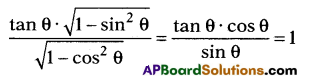
AP 10th Class Maths Bits Chapter 11 Trigonometry with Answers 23

Question 183.
cos(x – y) equal to
Answer:
cos x cos y + sin x sin y

Question 184.
Simplify : cosec 31° – sec 59°
Answer:
0
Explanation:
cosec 31° – sec (90° – 31°)
[∵ sec (90 – θ) = cosec θ]
= cosec 31° – cosec 31°
= 0

Question 185.
(sec 45° + tan 45°) (sec 45° – tan 45°) equal to
Answer:
1

AP 10th Class Maths Bits Chapter 11 Trigonometry with Answers

Question 186.
If sin θ = \(\frac{\mathbf{a}}{\mathbf{b}}\); cos θ = \(\frac{\mathbf{c}}{\mathbf{d}}\), then find cot θ.
Answer:
\(\frac{\mathrm{bc}}{\mathrm{ad}}\)

Question 187.
\(\sqrt{\operatorname{cosec}^{2} \theta-\cot ^{2} \theta}\) equal to
Answer:
1

Question 188.
sin2 45° + cos2 45° + tan2 45° equal to
Answer:
2
Explanation:
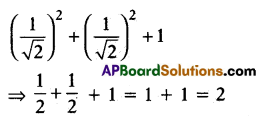
AP 10th Class Maths Bits Chapter 11 Trigonometry with Answers 24

Question 189.
sec (360° – θ) equal to
Answer:
sec θ

Question 190.
tan θ. cot θ = sec θ. x ; then find x.
Answer:
cos θ
Explanation:
tan θ . cot θ = sec θ . x
\(\frac{\sin \theta}{\cos \theta} \cdot \frac{\cos \theta}{\sin \theta}=\frac{x}{\cos \theta}\)
cos θ = x

Question 191.
If 4 sin 30°. sec 60° = x tan 45°; then find x.
Answer:
4
Explanation:
4 . sin 30° – sec 60° = x . tan 45°
4 . \(\frac{1}{2}\) . 2 = x . 1
⇒ x = 4

Question 192.
In the following which are in geometric progression?
A) sin 30°, sin 45°, sin 60°
B) sec 30°, sec 45°, sec 60°
C) tan 30°, tan 45°, tan 60°
D) cos 45°, cos 60°, cos 90°
Answer:
C) tan 30°, tan 45°, tan 60°

AP 10th Class Maths Bits Chapter 11 Trigonometry with Answers

Question 193.
(1 + tan2 A) (1 – sin2 A)
equal to
Answer:
1
Explanation:
sec2 A × cos2 A = 1

Question 194.
Find the value of
cos 60° cos 30° + sin 60°. sin 30°.
Answer:
\(\frac{\sqrt{3}}{2}\)
Explanation:
\(\frac{1}{2} \cdot \frac{\sqrt{3}}{2}+\frac{\sqrt{3}}{2} \cdot \frac{1}{2}\)
= \(\frac{\sqrt{3}}{4}+\frac{\sqrt{3}}{4}=\frac{2 \sqrt{3}}{4}=\frac{\sqrt{3}}{2}\)

Question 195.
\(\frac{1-\tan ^{2} 30^{\circ}}{1+\tan ^{2} 30^{\circ}}\) equal to
Answer:
\(\frac{1}{2}\)

Question 196.
cos(\(\frac{3 \pi}{2}\) + θ) equal to
Answer:
sin θ
Explanation:
cos (270 + θ) = sin θ

Question 197.
\(\sqrt{1+\cot ^{2} \theta}\) equal to
Answer:
cosec θ

Question 198.
If tan θ + cot θ = 2; then find tan2 θ + cot2 θ.
Answer:
2
Explanation:
tan θ + cot θ = 2
⇒ tan2 θ + cot2 θ + 2 . tan θ . cot θ = 4
⇒ tan2 θ + cot2 θ = 4 – 2 = 2

Question 199.
If sec θ = \(\frac{13}{12}\), then find sin θ.
Answer:
\(\frac{5}{13}\)

AP 10th Class Maths Bits Chapter 11 Trigonometry with Answers

Question 200.
How much the value of
(sin θ + cos θ)2 + (sin θ – cos θ)2 ?
Answer:
2
Explanation:
(a + b)2 + (a – b)2 = 2(a2 + b2)
= 2 (sin2 θ + cos2 θ) = 2

Question 201.
(1 + tan θ)2 equal to
Answer:
sec2 θ + 2 tan θ

Question 202.
sin(A – B) = \(\frac{1}{2}\); cos (A+B) = \(\frac{1}{2}\). So
find A.
Answer:
45°
Explanation:
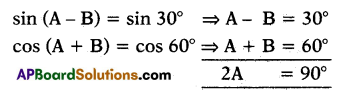
AP 10th Class Maths Bits Chapter 11 Trigonometry with Answers 25
⇒ A = 45°

Question 203.
Find the value of tan 135°.
Answer:
-1

Question 204.
Find the value of \(\sqrt{1+\sin A} \cdot \sqrt{1-\sin A}\)
Answer:
cos A
Explanation:
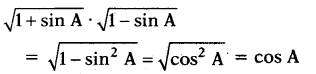
AP 10th Class Maths Bits Chapter 11 Trigonometry with Answers 26

Question 205.
Find the value of tan 60° – tan 30°.
Answer:
\(\frac{2 \sqrt{3}}{3}\)
Explanation:
tan 60° – tan 30°
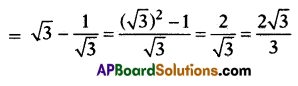
AP 10th Class Maths Bits Chapter 11 Trigonometry with Answers 27

Question 206.
In ΔABC, a = 3; b = 4; c = 5, then find cos A.
Answer:
4/5
Explanation:
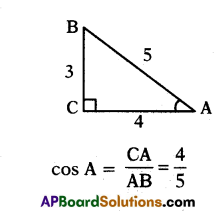
AP 10th Class Maths Bits Chapter 11 Trigonometry with Answers 28

AP 10th Class Maths Bits Chapter 11 Trigonometry with Answers

Question 207.
sin3 θ cos θ.cos3 θ sin θ equals to
Answer:
sin θ cos θ

Question 208.
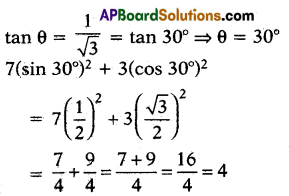
If tan θ \(\frac{1}{\sqrt{3}}\) , then find the value of 7 sin2 θ + 3 cos2 θ.
Answer:
4
Explanation:
AP 10th Class Maths Bits Chapter 11 Trigonometry with Answers 29

Question 209.
cot (270° – θ) equal to
Answer:
tan θ

Question 210.
(1 + tan2 60°)2 equals to
Answer:
16
Explanation:
[1 + (√3)2]2 = (1 + 3)2 = 42 = 16

Question 211.
sin (270° + θ) equal to
Answer:
– cos θ

Question 212.
If tan2 60° + 2 tan2 45° = x tan 45°, then find x.
Answer:
5
Explanation:
(√3)2 + 2(1)2 = x . 1
⇒ 3 + 2 = x ⇒ x = 5

Question 213.
cos2 0° + cos2 60° equal to
Answer:
5/4

AP 10th Class Maths Bits Chapter 11 Trigonometry with Answers

Question 214.
Simplify : sin4 θ – cos4 θ
Answer:
2sin2 θ – 1

Question 215.
If α + β = 90° and α = 2β, then find cos2 β + sin2 β.
Answer:
1
Explanation:
α = 90 – β
⇒ 90 – β = 2β ⇒ 3β = 90° ⇒ β = 30°
∴ cos2 30° + sin2 30° = (\(\frac{\sqrt{3}}{2}\))2 + (\(\frac{1}{2}\))2
= \(\frac{3}{4}+\frac{1}{4}=\frac{4}{4}\) = 1

Question 216.
If sin θ = \(\frac{\mathbf{a}}{\mathbf{b}}\) , then find cos θ.
Answer:
\(\frac{\sqrt{b^{2}-a^{2}}}{b}\)

Question 217.
2sin θ = sin2 θ is true for the value of θ is
Answer:

Question 218.
If sin θ = \(\frac{\mathbf{a}}{\mathbf{b}}\) , then find tan θ.
Answer:
\(\frac{a}{\sqrt{b^{2}-a^{2}}}\)

Question 219.
\(\frac{\sin \theta}{1+\cos \theta}\) is equal to
Answer:
\(\frac{1-\cos \theta}{\sin \theta}\)

Question 220.
If sin θ = cos θ, then find the value of 2 tan θ + cos2 θ.
Answer:
\(\frac{5}{2}\)
Explanation:
sin θ = cos θ ⇒ θ = 45°
2 tan 45° + cos2 45° = 2 + \(\frac{1}{2}=\frac{5}{2}\)

AP 10th Class Maths Bits Chapter 11 Trigonometry with Answers

Question 221.
If sin x = cos x, 0 ≤ x ≤ 90°, then find x.
Answer:
45°

Question 222.
How much the maximum value of sin θ?
Answer:
1

Question 223.
In the figure find tan x.
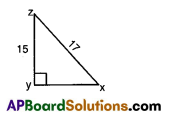
AP 10th Class Maths Bits Chapter 11 Trigonometry with Answers 30
Answer:
\(\frac{15}{8}\)

Question 224.
sin A = cos B, then find A + B.
Answer:
90°

Question 225.
If cosec θ + cot θ = 3, then find cosec θ – cot θ.
Answer:
\(\frac{1}{3}\)

Question 226.
If tan 2A = cot (A – 18°) where 2A is an acute angle, then find A.
Answer:
36°
Explanation:
90 – 2A = A – 18°
⇒ 3A = 108° ⇒ A = 36°

Question 227.
sec 0° equal to
Answer:
1

Question 228.
cosec 300° equal to
Answer:
\(\frac{-2}{\sqrt{3}}\)

AP 10th Class Maths Bits Chapter 11 Trigonometry with Answers

Question 229.
cos 240° equal to
Answer:
\(\frac{-1}{2}\)

Question 230.
\(\frac{\operatorname{cosec}^{2} \theta}{\cot \theta}\) – cot θ equal to
Answer:
tan θ

Question 231.
Find the minimum value of cos θ.
Answer:
-3

Question 232.
If sec θ = cosec θ; then find the value of θ in radians.
Answer:
\(\frac{\pi^{\mathrm{c}}}{4}\)
Explanation:
sec θ = cosec θ ⇒ θ = 45° = \(\frac{\pi^{\mathrm{c}}}{4}\)

Question 233.
Reciprocal of cot A.
Answer:
tan A

Question 234.
sin \(\frac{\pi^{\mathrm{c}}}{4}\) + cos 45° equal to
Answer:
√2

Question 235.
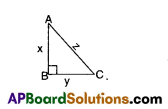
AP 10th Class Maths Bits Chapter 11 Trigonometry with Answers 31
Answer:
\(\frac{\mathrm{x}}{\mathrm{z}}\)

Question 236.
If cosec θ = \(\frac{25}{7}\), then find cot θ.
Answer:
\(\frac{24}{7}\)

AP 10th Class Maths Bits Chapter 11 Trigonometry with Answers

Question 237.
If sin (A + B) = \(\frac{\sqrt{3}}{2}\); cos B = \(\frac{\sqrt{3}}{2}\) , then find A.
Answer:
30°

Question 238.
tan 750° equal to
Answer:
\(\frac{1}{\sqrt{3}}\)
Question 239.
(1 – sec2 θ) (1 – cosec2 θ) equal to
Answer:
1

Question 240.
If cosec θ – cot θ = 4, then find cosec θ + cot θ.
Answer:
\(\frac{1}{4}\)

Question 241.
\(\sqrt{\tan ^{2} \theta+\cot ^{2} \theta+2}\) equal to
Answer:
tan θ + cot θ
Explanation:
= \(\sqrt{1+\tan ^{2} \theta+1+\cot ^{2} \theta}\)
= \(\sqrt{\sec ^{2} \theta+\operatorname{cosec}^{2} \theta}\)
= tan θ + cot θ

Question 242.
If cos θ = \(\frac{3}{5}\); then cos (-θ) equal to
Answer:
\(\frac{3}{5}\)

Question 243.
\(\frac{\sqrt{\operatorname{cosec}^{2} \theta-1}}{\operatorname{cosec} \theta}\)
equal to
Answer:
cos θ

Question 244.
If 5 sin A = 3, then find sec2 A – tan2 A.
Answer:
1

AP 10th Class Maths Bits Chapter 11 Trigonometry with Answers

Question 245.
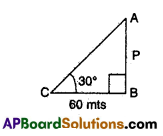
In the figure, find AB.
AP 10th Class Maths Bits Chapter 11 Trigonometry with Answers 32
Answer:
20√3 (or) \(\frac{60}{\sqrt{3}}\)

Question 246.
If cot θ = x; then find cosec θ.
Answer:
\(\sqrt{\mathrm{x}_{1}^{2}+1}\)
Explanation:
cot θ = x ⇒ cosec θ = \(\sqrt{x^{2}+1}\)

Question 247.
\(\sqrt{\operatorname{cosec}^{2} \theta-\sin ^{2} \theta-\cos ^{2} \theta}\) equal to
Answer:
cot θ

Question 248.
Find the value of \(\frac{1}{\sec \theta-\tan \theta}\)
Answer:
sec θ + tan θ

Question 249.
sin (A + B) equal to
Answer:
sin A cos B + cos A sin B

Question 250.
\(\sqrt{(\sec \theta+1)(\sec \theta-1)}\) equal to
Answer:
tan θ

Question 251.
Find the value of tan 5° × tan 30° × 4 tan 85°.
Answer:
\(\frac{4}{\sqrt{3}}\)

AP 10th Class Maths Bits Chapter 11 Trigonometry with Answers

Question 252.
cos 110°.cos 70° – sin 110°.sin 70° equal to ,
Answer:
-1
Explanation:
cos A . cos B – sin A . sin B
= cos (A + B)
= cos (110 + 70) = cos 180° = – 1

Question 253.
Find the value of tan 1°.tan 2°.tan 3°………….tan 89°.
Answer:
1

Question 254.
If cos θ = -cos θ; then Write θ in radian measure.
Answer:
\(\frac{\pi^{\mathrm{c}}}{3}\)

Question 255.
sec A = cosec B, then write A and B are ……….. angles.
Answer:
Complementary.

Question 256.
Find the value of tan 75°.
Answer:
2 + √3

Question 257.
\(\sqrt{\sec ^{2} \theta-\tan ^{2} \theta+\cot ^{2} \theta}\) equal to
Answer:
cosec θ

Question 258.
sin 240° + sin 120° equal to
Answer:
0

Question 259.
Find the value of
sec 70°. sin 20° + cos 20°. cosec 70°.
Answer:
2

AP 10th Class Maths Bits Chapter 11 Trigonometry with Answers

Question 260.
If sec A + tan A = \(\frac{1}{3}\); then find sec A – tan A.
Answer:
3

Question 261.
(sec2 θ – 1)(1 – cosec2 θ)equal to
Answer:
-1

Question 262.
cos θ equal to
Answer:
\(\frac{\cot \theta}{\operatorname{cosec} \theta}\)

Question 263.
The radius of a circle is ‘r’; an arc of length ‘L’ is making an angle θ, at the centre of the circle, then find θ.
Answer:
L/r

Question 264.
cos (A – B) = \(\frac{1}{2}\); sin B = \(\frac{1}{\sqrt{2}}\), find measure of A.
Answer:
105°

Question 265.
If sec θ + tan θ = 4; then find cos θ.
Answer:
\(\frac{8}{17}\)

Question 266.
sec (360° – θ) equals to
Answer:
sec θ

AP 10th Class Maths Bits Chapter 11 Trigonometry with Answers

Question 267.
If A is acute and tan A = \(\frac{1}{\sqrt{3}}\); then find sin ‘A’.
Answer:
\(\frac{1}{2}\)

Question 268.
(1 +cot2 45°)2 equal to
Answer:
4

Question 269.
\(\frac{\tan 45^{\circ}}{\operatorname{cosec} 30^{\circ}}+\frac{\sec 60^{\circ}}{\cot 45^{\circ}}\) equal to
Answer:
2\(\frac{1}{2}\)

Question 270.
\(\sqrt{\frac{\sec x+\tan x}{\sec x-\tan x}}\) equal to
Answer:
sec x + tan x

Question 271.
\(\frac{\sin ^{4} A-\cos ^{4} A}{\sin ^{2} A-\cos ^{2} A}\) equal to
Answer:
1

Question 272.
If the angle in a triangle are in the ratio of 1:2:3, then find the smallest angle in radins.
Answer:
π/6

Question 273.
If sin θ + cos θ = √2; then find the value of ‘θ’.
Answer:
45°

Question 274.
If cosec θ = 2 and cot θ = √3 P; where θ is an acute angle, then find the value of ‘P’.
Answer:
1

AP 10th Class Maths Bits Chapter 11 Trigonometry with Answers

Question 275.
If cos 2θ = sin 4θ; here 2θ and 4θ are acute angles, then find the value of θ.
Answer:
15°
Explanation:
2θ + 4θ = 90°
⇒ 6θ = 90°⇒ θ = \(\frac{90^{\circ}}{6}\) = 15°

Question 276.
If sin 45°.cos 45°+cos 60° = tan θ, then find the value of θ.
Answer:
45°

Question 277.
If P, Q and R are interior angles of a ΔPQR, then tan \(\left(\frac{\mathbf{P}+\mathbf{Q}}{2}\right)\) equals
Answer:
cot (\(\frac{\mathrm{R}}{2}\))

Question 278.
If tan θ = 1, then find the value of \(\frac{5 \sin \theta+4 \cos \theta}{5 \sin \theta-4 \cos \theta}\)
Answer:
9
Explanation:
tan θ = 1 = tan 45° ⇒ θ = 45°
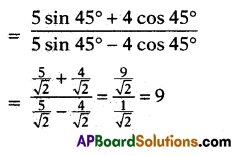
AP 10th Class Maths Bits Chapter 11 Trigonometry with Answers 33

Question 279.
If sec 2A = cosec (A – 27°), where 2A is an acute angle, then find the measure of ∠A.
Answer:
39°
Explanation:
90 – 2A = A – 27°
⇒ 117° = 3A ⇒ A = \(\frac{117^{\circ}}{3}\) = 39°

Question 280.
If sin C = \(\frac{3}{5}\); then find cos A.
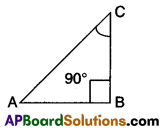
AP 10th Class Maths Bits Chapter 11 Trigonometry with Answers 34
Answer:
3/5

Question 281.
Expressing tan θ, interms of sec θ.
Answer:
\(\sqrt{\sec ^{2} \theta-1}\)

AP 10th Class Maths Bits Chapter 11 Trigonometry with Answers

Question 282.
If sin θ. cos θ = k; then find sin θ + cos θ.
Answer:
\(\sqrt{1+2 \mathrm{k}}\)

Question 283.
If \(\frac{1}{2}\) tan2 45° = sin2 A and ’A’ is acute, then find the value of ‘A’.
Answer:
45°

Question 284.
Find the value of (\(\frac{11}{\cot ^{2} \theta}-\frac{11}{\cos ^{2} \theta}\))
Answer:
-11
Explanation:
11 (tan2 θ – sec2 θ) = 11 (-1) = -11

Question 285.
Find the maximum value of \(\frac{1}{\sec \theta}\)
0° ≤ θ ≤ 90°.
Answer:
1

Question 286.
If π < θ < \(\frac{3 \pi}{2}\), then θ lies in which quadrant?
Answer:
Third quadrant

Question 287.
If cos θ = \(\frac{\sqrt{3}}{2}\) and’θ’is acute, then find the value of 4sin2 θ + tan2 θ.
Answer:
4/3

Question 288.
If tan θ = \(\frac{7}{8}\), then find the value of \(\frac{(1+\sin \theta)(1-\sin \theta)}{(1+\cos \theta)(1-\cos \theta)}\) ,
Answer:
\(\frac{64}{49}\)

Question 289.
When 0° ≤ 0 ≤ 90°; find the maximum value of sin θ + cos θ.
Answer:
√2

AP 10th Class Maths Bits Chapter 11 Trigonometry with Answers

Question 290.
In ΔABC, ∠B = 90° ; ∠C = θ. From the figure find tan θ.
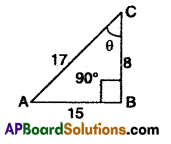
AP 10th Class Maths Bits Chapter 11 Trigonometry with Answers 35
Answer:
\(\frac{15}{8}\)

Question 291.
If sin (x – 20°) = cos(3x – 10°), then find x’.
Answer:
15°

Question 292.
If sin (A – B)= \(\frac{1}{2}\); cos (A + B)= \(\frac{1}{2}\),
then find ‘B’.
Answer:
15°

Question 293.
If 5 tan θ = 4, then find die value of
\(\frac{5 \sin \theta-3 \cos \theta}{5 \sin \theta+3 \cos \theta}\)
Answer:
\(\frac{1}{7}\)

Question 294.
If 4 cos2 θ – 3 = 0, then find the value of sin θ.
Answer:
\(\frac{1}{2}\)

Choose the correct answer satisfying the following statements.
Question 295.
Statement (A): sin2 67° + cos2 67° = 1
Statement (B) : For any value of θ,
sin2 θ + cos2 θ = 1
i) Both A and B are true
ii) A is true, B is false
iii) A is false, B is true
iv) Both A and B are false.
Answer:
i) Both A and B are true
Explanation:
sin2 θ + cos2 θ = 1
⇒ sin2 67° + cos2 67° = 1
Hence, (i) is the correct option.

Question 296.
Statement (A): If cos A + cos2 A = 1,
then sin2 A + sin4 A = 2
Statement (B): 1 – sin2 A = cos2 A, for any value of A.
i) Both A and B are true
ii) A is true, B is false
iii) A is false, B is true
iv) Both A and B are false.
Answer:
iii) A is false, B is true
Explanation:
cos A + cos2 A = 1
cos A = 1 – cos2 A = sin2 A
∴ sin2 A + sin4 A = cos A + cos2 A = 1
⇒ sin2 A + sin4 A = 1
Hence, (iii) is the correct option.

AP 10th Class Maths Bits Chapter 11 Trigonometry with Answers

Question 297.
Statement (A):
The value of sec2 10° – cot2 80° is 1.
Statement (B):
The value of sin 30° = \(\frac{1}{2}\)
i) Both A and B are true
ii) A is true, B is false
iii) A is false, B is true
iv) Both A and B are false.
Answer:
i) Both A and B are true
Explanation:
We have sec2 10° – cot2 80°
= sec2 10°-cot2 (90°- 10°)
= sec2 10° – tan2 10° = 1
Also, sin 30° = \(\frac{1}{2}\).
Hence, (i) is the correct option.

Question 298.
Statement (A) : The value of sin θ cos (90 – θ) + cos θ sin(90 – θ) ‘ equal to 1.
Statement (B): tan θ = sec(90 – θ)
i) Both A and B are true
ii) A is true, B is false
iii) A is false, B is true
iv) Both A and B are false.
Answer:
ii) A is true, B is false
Explanation:
sin θ cos (90 – θ) + Cos θ sin (90 – θ)
= sin θ . sin θ + cos θ – cos θ
= sin2 θ + cos2 θ = 1 and tan θ = cot (90 – θ)
Hence, (ii) is the correct option.

Question 299.
Statement (A) : The value of sin θ = \(\frac{4}{3}\) is not possible.
Statement (B): Hypotenuse is the largest side in any right angled triangle.
i) Both A and B are true
ii) A is true, B is false
iii) A is false, B is true
iv) Both A and B are false.
Answer:
i) Both A and B are true
Explanation:
sin 2 = \(\frac{\mathrm{P}}{\mathrm{H}}=\frac{4}{3}\)
Here, perpendicular is greater than the hypotenuse which is not possible in any right triangle.
Hence, (i) is the correct option.

Question 300.
Statement (A) : In a right angled triangle, if tan θ = \(\frac{3}{4}\), the greatest side of
the triangle is 5 units.
Statement (B) : (Greatest side hypotenuse)2 = (perpendicular)2 – (base)2
i) Both A and B are true
ii) A is true, B is false
iii) A is false, B is true
iv) Both A and B are false.
Answer:
i) Both A and B are true
Explanation:
Both A and B are correct and B is the correct explanation of the A.
Greatest side = \(\sqrt{(3)^{2}+(4)^{2}}\) = 5 units.
Hence, (i) is the correct option.

Question 301.
Statement (A) : In a right angled triangle, if cos θ \(\frac{1}{2}\) = and sin θ = \(\frac{\sqrt{3}}{2}\) then tan θ = √3
‘Statement (B) : tan θ = \(\frac{\sin \theta}{\cos \theta}\)
i) Both A and B are true
ii) A is true, B is false
iii) A is false, B is true
iv) Both A and B are false.
Answer:
i) Both A and B are true
Explanation:
Both A and B are correct and B is the correct explanation of the A.
tan θ = \(\frac{\sqrt{3}}{2}\) × 2 = √3
Hence, (i) is the correct option.

Question 302.
Statement (A) : sin 47° cos 43°.
Statement (B) : sin θ = cos(90 + θ),
where θ is an acute angle.
i) Both A and B .are true
ii) A is true, B is false
iii) A is false, B is true
iv) Both A and B are false.
Answer:
ii) A is true, B is false
Explanation:
A is correct, but B is not correct,
sin θ = cos (90 – θ)
sin 47° = cos (90 – 47)
= cos 43°
Hence, (ii) is the correct option.

❖ Study the given information and answer to the following questions.
In ΔABC, right angled at B.
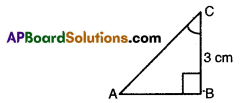
AP 10th Class Maths Bits Chapter 11 Trigonometry with Answers 36
AB + AC = 9 cm and BC = 3 cm

Question 303.
The value of cot C is
Answer:
\(\frac{3}{4}\)
Explanation:
cot C = \(\frac{\mathrm{BC}}{\mathrm{AB}}=\frac{3}{4}\)
[∴ In ΔABC, By Pythagoras theorem,
AC2 = AB2 + BC2
AB = 4 cm, AC = 5 cm]

AP 10th Class Maths Bits Chapter 11 Trigonometry with Answers

Question 304.
The value of sec C is
Answer:
\(\frac{5}{3}\)
Explanation:
sec C = \(\frac{A C}{B C}=\frac{5}{3}\)

Question 305.
sin2 C + cos2 C is equal to
Answer:
1
In figure, ΔABC has a right angle at B. If AB = BC = 1cm and AC = √2 cm.
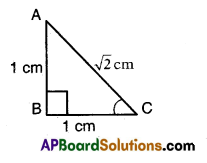
AP 10th Class Maths Bits Chapter 11 Trigonometry with Answers 37
Explanation:
sin C= \(\frac{4}{5}\) ;cosC = \(\frac{3}{5}\)
L.H.S. = sin2 C + cos2 C
= \(\left(\frac{4}{5}\right)^{2}+\left(\frac{3}{5}\right)^{2}\)
= \(\frac{16+9}{25}\) = 1 = R.H.S.

Question 306.
Find sin C.
Answer:
\(\frac{1}{\sqrt{2}}\)
Explanation:
sin C = \(\frac{\mathrm{AB}}{\mathrm{AC}}=\frac{1}{\sqrt{2}}\)

Question 307.
Find cos C.
Answer:
\(\frac{1}{\sqrt{2}}\)
Explanation:
cos C =\(\frac{\mathrm{BC}}{\mathrm{AC}}=\frac{1}{\sqrt{2}}\)

Question 308.
Find tan C.
Answer:
1
The length of a pendulum is 80 cm. Its end describes an arc of length 16 cm.
Explanation:
tan C = \(\frac{\mathrm{AB}}{\mathrm{BC}}=\frac{1}{1}\) = 1

Question 309.
To find the length of the arc which formula is useful?
Answer:
l = r0

Question 310.
Calculate the angle of arc makes at centre.
Answer:
θ = \(\frac{1}{r}=\frac{16}{80}=\frac{1}{5}\)
In ΔPQR, right angled at Q,
PR + QR = 25 cm and PQ = 5 cm

AP 10th Class Maths Bits Chapter 11 Trigonometry with Answers

Question 311.
Determine the value of “QR”.
Answer:
QR = 12 cm

Question 312.
Determine the value of “PR”.
Answer:
PR = 13 cm

Question 313.
Find the value of sin P.
Answer:
\(\frac{12}{13}\) cm

Question 314.
Find the value of cos P.
Answer:
\(\frac{5}{13}\) cm

Question 315.
Find the value of tan P.
Answer:
\(\frac{12}{5}\) cm

Question 316.
In ΔABC, ∠B = 90°, AB = 3 cm and BC = 4 cm, then match the column.
A) sin C [ ] i) 3/5
B) tanA [ ] ii) 4/5
C) cos C [ ] iii) 5/3
D) sec A [ ] iv) 4/3
Answer:
A – (i), B – (iv), C – (ii), D – (iii)

Question 317.
Match the following.
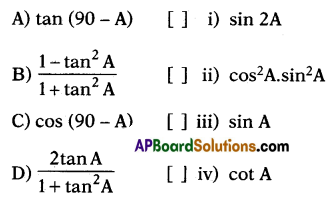
AP 10th Class Maths Bits Chapter 11 Trigonometry with Answers 38
Answer:
A – (iv), B- (ii), C – (iii), D – (i)

AP 10th Class Maths Bits Chapter 11 Trigonometry with Answers

Question 318.
Match the following.
AP 10th Class Maths Bits Chapter 11 Trigonometry with Answers 39
Answer:
A – (ii), B- (i), C – (iii), D – (iv)

Question 319.
If sin θ = \(\frac{7}{25}\), then
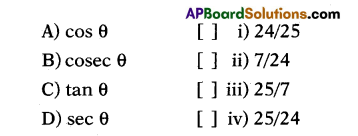
AP 10th Class Maths Bits Chapter 11 Trigonometry with Answers 40
Answer:
A – (i), B- (iii), C – (ii), D – (iv)

Question 320.
Match the following.
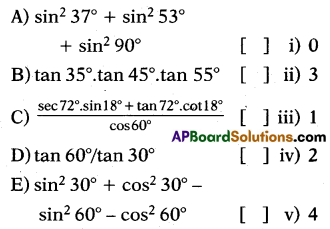
AP 10th Class Maths Bits Chapter 11 Trigonometry with Answers 41
Answer:
A – (iv), B – (iii), C – (v), D – (ii), E – (i)

Question 321.
What is the value of
sec 16°- cosec 74° – cot 74° • tan 16° ?
Answer:
1 (one)

Question 322.
If x = 2019°, then what is the value of sin2 x + cos2 x ?
Solution:
If x = 2019°, then
sin2x + cos2x = sin22019° + cos22019° = 1 [∵ sin2θ + cos2θ = 1]

Question 323.
If x is in first quadrant and sin x = cos x, then what is the value of x?
Solution:
Given, sin x = cos x
We know, sin (90°- θ) = cos θ
So, cos x = sin(90° – x)
⇒ sin x = sin(90° – x)
[note : If sin A = sin B, then A = B]
⇒ x = 90° – x
⇒2x = 90°
∴ x = 45°

AP Board 9th Class Physical Science Notes Chapter 2 Laws of Motion

Students can go through AP State Board 9th Class Physical Science Notes Chapter 2 Laws of Motion to understand and remember the concept easily.

AP State Board Syllabus 9th Class Physical Science Notes Chapter 2 Laws of Motion

→ Aristotle concluded that the natural state of an object is to be at rest.

→ According to Galileo, an object in motion will remain in the same motion as long as no external force is applied to it.

→ Sir Isaac Newton proposed his three fundamental laws which explain the connection between force and a change in motion.

→ The first law of Motion: Every object will remain at rest or in a state of uniform motion unless compelled to change its state by the action of a net force.

→ The tendency of matter that resists changes in its state of motion or rest is known as inertia.

→ As the mass is more, inertia is more.

→ Mass is a property of an object that specifies how much inertia the object has. SI unit of mass is the kilogram (kg).

→ The second law of Motion: The rate of change of momentum of a body is directly proportional to the net force acting on it and it takes place in the direction of the net force.

→ The linear momentum of a body is the product of its mass and velocity.
Momentum p = mass (m) × velocity (v)
SI unit of momentum is Kg-m /sec or Ns.

→ The net force Fnet = ma. SI unit of force is Kg-m/sec2 or ‘Newton’.

→ One ‘Newton’ is the force which when acting on a body of mass 1 kg, produces an acceleration of lm/sec2.
1 Newton = 1 kg × 1 ms-2

AP Board Solutions AP Board 9th Class Physical Science Notes Chapter 2 Laws of Motion

→ Third Law of Motion: If an object exerts a force on the other object, the second object also exerts a force on the first one which is equal in magnitude but opposite in direction.

→ There exists no single isolated force, according to Newton’s third law of motion.

→ Flying a bird, swimming of a fish, launching a rocket, etc. are examples of Newton’s third law of motion.

→ The Law of conservation of momentum states in the absence of a net external force on the system, the momentum of the system remains unchanged.

→ A system is said to be isolated when the net external force acting on it is zero.

→ In an isolated system, the total momentum is conserved.

→ Laws of motion: Sir Isaac Newton proposed his fundamental laws which explain the connection between force and a change in motion. These three laws are popularly called Newton’s laws of motion.

→ Inertia: Inertia is a property of matter that resists changes in its state of motion or rest. It depends on the mass of the object.

→ Mass: The quantity of matter present in a body is known as its mass.

→ Linear momentum: Momentum of a body ¡s the product of its mass and velocity.
Momentum p = m × v

→ Newton used the word “mass in motion” to represent the meaning of momentum.

→ Conservation of momentum: Law of conservation of momentum states in the absence of net external force on the system. The momentum of the system remains unchanged.

→ Impulse: The product of net force and interaction time is called the impulse of the net force. It is equivalent to the change in momentum that an object experiences during an interaction.

AP Board Solutions AP Board 9th Class Physical Science Notes Chapter 2 Laws of Motion

→ Impulsive force: Forces exerted over a limited time are called impulsive forces.
AP Board 9th Class Physical Science Notes Chapter 2 Laws of Motion 1

→ Galileo Galilei:
Galileo Galilei was born on 15 February 1564 in Pisa, Italy. Galileo has been called the “father of modern science”.
In 1589, in his series of essays, he presented his theories about falling objects using an inclined plane to slow down the rate of descent.

Galileo was also a remarkable craftsman. He developed a series of telescopes whose optical performance was much better than that of Galileo Galilei’s other telescopes available during those days. Around 1640, he designed the first pendulum clock. In his book ‘StarryMessenger’ on his astronomical discoveries, Galileo claimed to have seen mountains on the moon, the MilkyWaymade up of tiny stars, and four small bodies orbiting Jupiter. In his books

‘Discourse on Floating Bodies’and ‘Letters on the sunspots, he disclosed his observations of sunspots. : Using his own telescopes and through his observations on Saturn and Venus, Galileo ‘ argued that lithe planets must orbit the Sun and not the earth, contrary to what was ‘ believed at that time.

AP Board 10th Class Physical Science Notes Chapter 5 Human Eye and Colourful World

Students can go through AP State Board 10th Class Physical Science Notes Chapter 5 Human Eye and Colourful World to understand and remember the concept easily.

AP State Board Syllabus 10th Class Physical Science Notes Chapter 5 Human Eye and Colourful World

→ The human eye uses light and enables us to see the object. It has a lens in its structure.

→ The eye is a natural optical device using which a human being could see objects around him. It forms an inverted, real image on a light-sensitive surface called the retina.

→ The minimum distance at which objects can be seen most distinctly without strain is called the least distance of distinct vision (or) distance of clear vision.

→ The range of vision of human beings is 25 cm to infinity.

→ The minimum distance between the objects and the eye so that a clear image is formed on the retina is called the least distance for clear vision or near the point of the eye. This distance is 25 cm for the human eye.

→ Rods and cones are the cells in the retina which are light sensitive. Rods respond to the intensity of light. Cones respond to the illumination.

→ There are 125 million cells – rods and cones. The cells generate signals which are transmitted to the brain through the optical nerves.

AP Board Solutions AP Board 10th Class Physical Science Notes Chapter 5 Human Eye and Colourful World

→ The retina is the light-sensitive surface of the eye in which an image is formed. It is equivalent to the photographic film in a camera. It contains rods and cones.

→ The ability of the ciliary muscles to adjust the curvature and thereby the focal length to get a clear view of objects is called accommodation.

→ The maximum distance between the objects and the eye so that a clear image is formed on the retina is called the near the point of the eye also.

→ The maximum angle, at which we are able to see the whole object is called the angle of vision.

→ The angle of vision for a healthy human being is about 60°. It varies from person to person and with age.

→ The value of the minimum distance of clear vision is about 25 cm.

→ The eyeball is nearly spherical in shape.

→ The farthest point up to which the eye can see objects clearly is called the far point of the eye. For a normal eye, it is infinity.

→ The maximum variation in the power of the lens so that, the far-off and nearby objects are viewed is called the power of accommodation. For a person having normal vision, it is about 4 diopters.

→ The time for which the impression or sensation (of an object) continues in the eye is called the persistence of vision. It is about \(\frac{1}{16}\)th part of a second.

→ The motion picture is done to create a clear impression of an event. The event is projected at the rate of 24 frames per second.

→ Cones with specific colours are in the retina. If some cones are absent, the distinction of colours is not possible. In such a case, the process is said to be colour blind.

→ Some persons have difficulty seeing the objects in dim light during the night. This defect of the eye is called night blindness.

→ A person with myopia can see nearer objects clearly but cannot see distant objects clearly.

→ Myopia (or) nearsightedness is caused by

  • excessive curvatures of the eye|
  • elongation or increase in the size of the eye lens.

It can be corrected by using spectacles with a concave lens of suitable focal length.

→ A person with hypermetropia (farsightedness) can see distant objects clearly but cannot see nearer objects distinctly.

→ Hypermetropia is caused by

  • increase in the focal length of the eye lens
  • shortening or decrease in the size of the eye lens.

It is corrected by using spectacles made from convex lenses of suitable focal lengths.

→ Most of the old persons suffer from long-sightedness. In this defect, the power of accommodation of the eye decreases with ageing.

→ The phenomenon of the splitting of white light into component colours when passing through a glass prism is called dispersion of light.

→ The band of colour components of a light beam obtained on a white screen when white light passes through a prism is called the spectrum.

→ A rainbow is a natural spectrum of sunlight in the form of bows appearing in the sky when the sun shines on raindrops after the rain. The raindrops act like small prisms.

→ When the light rays pass through the atmosphere having layers of different densities and refractive indices, then refraction of light takes place. This refraction of light by the earth’s atmosphere is called atmospheric refraction.

AP Board Solutions AP Board 10th Class Physical Science Notes Chapter 5 Human Eye and Colourful World

→ Scattering of light is a phenomenon of change in the direction of light on striking a particle like an atom, a molecule, dust particles, water droplets, etc. It explains phenomenon like ‘blue colour of the sky’ the reddening of the sun at sunrise and sunset, etc.

→ The bending of light passing through the earth’s atmosphere is called atmospheric refraction.

→ As we move about the surface of the earth, the density of air goes on decreasing.

→ Light travels from rarer to denser medium. Rays always bend towards the normal.

→ Stars twinkle on account of atmospheric refraction.

→ Sun appears to rise two minutes earlier and two minutes later due to the atmospheric refraction.

→ Very small particles scatter light of a shorter wavelength better than a longer wavelength.

→ The scattering of longer wavelengths of light increases as the size of the particles increases.

→ Longer particles scatter light of all wavelengths.

→ The refractive index of prism (n) = \(\frac{\sin \left[\frac{(A+D)}{2}\right]}{\sin \frac{A}{2}}\)

→ Sir C.V. Raman explained the phenomenon of scattering in gases and liquids.

→ Raman found experimentally that the frequency of scattered light by the liquids is greater than the frequency of incident light. This is called Raman Effect.

→ By using the Raman effect scientists determine the shapes of the molecules.

→ The formula for the speed of the wave (v) = Frequency (v) × Wavelength (λ)

→ Least distance of distinct vision: The minimum distance of the near object (point) from the eye for clear vision without strain is called the least distance of distinct vision.

→ The angle of vision: The maximum angle at which we are able to see the whole object is called the angle of vision.

→ Accommodation of eye lens: The process of adjusting the focal length of the eye lens is called the accommodation of the eye lens.

→ Myopia: it is the defect of the people who cannot see objects at a long distance is called Myopia.

AP Board Solutions AP Board 10th Class Physical Science Notes Chapter 5 Human Eye and Colourful World

→ Hypermetropia: The defect of the people who cannot see objects at a near distance is called Hypermetropia.

→ Presbyopia: It is a vision defect when the ability of accommodation of the eye usually decreases with ageing.

→ Power of lens: It is the reciprocal of focal length.
Power of lens (P) = \(\frac{1}{f(\text { in } m)}\) (or) P = \(\frac{100}{f(\text { in } cm)}\)

→ Prism: A block of glass or other transparent material usually having triangular bases. Prisms have several uses in optical systems.
(OR)
A polyhedron with two parallel congruent polygons as bases and parallelograms for all other faces. A triangular prism has triangular bases.

→ The angle of prism or Refracting angle of prism: The angle between the two refracting of the prism surfaces.
(OR)
The angle between the two refracting surfaces of the prism is called the angle (or) refracting angle of the prism.

→ The angle of minimum: The angle between the incident ray and emergent ray is deviation called the angle of deviation. The lowest deviation produced by a prism in the i-d graph is called the angle of minimum deviation.

→ Dispersion: The splitting of white light into colours (VIBGYOR) when it passes through prism ¡s called dispersion.

→ Scattering: Atoms or molecules which are exposed to light absorb light energy and radiate some part of the light energy in different directions. This process is called scattering.

→ Scatter: Spread; go in various directions.

→ Vision: Sight

→ Medium: A substance through which light passes. Ex: air, glass, etc.

→ Luminous body: The bodies which emit light and act as a source of light.

→ Erect: Upright

→ Focal length (f): The distance between the pole of the mirror and principal focus.

AP Board Solutions AP Board 10th Class Physical Science Notes Chapter 5 Human Eye and Colourful World

→ Refraction: Bending of light rays at the refracting surface when the light travels from one medium to other.

→ Non-luminous object: An object that does not give out light of its own.

→ Transparent: A material that allows the light falling on it to pass through.

→ Translucent: A material that allows only some of the light falling on it to pass through.

→ Opaque: A material Ch dc not allow any light to pass through It.
AP Board 10th Class Physical Science Notes Chapter 5 Human Eye and Colourful World 1

→ Galileo Galilei (1564 – 1642):

  • Galileo Galilei was born in Puja, ItaIy in 1564.
  • He invented the tripod microscope, built a telescope.
  • While gazing through the telescope, Galileo observed and drew what he saw. The moons phases, the milky way, clusters of stars and phenomena that seemed to confirm his idea that the Earth was not the centre of the universe. Contrary to the popular Ptolemaic system, Galileo hypothesized that the Earth was one of many heavenly bodies that comprise our solar system.
  • Although Galileo Is remembered for both of his experiments with gravity and for his astronomical observations, his invention of the telescope is probably his most significant contribution.
  • Other significant areas of Galileo’s influence include mechanics, microscopy and magnetism.