Inter 1st Year Maths 1B Transformation of Axes Solutions Ex 2(a)

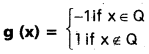
Practicing the Intermediate 1st Year Maths 1B Textbook Solutions Inter 1st Year Maths 1B Transformation of Axes Solutions Exercise 2(a) will help students to clear their doubts quickly.

Intermediate 1st Year Maths 1B Transformation of Axes Solutions Exercise 2(a)

I.

Question 1.
When the origin is shifted to (4, -5) by the translation of axes, find the coordinates of the following points with reference to new axes.
i) (0, 3), ii) (-2, 4) iii) (4, -5)
Solution:
i) New origin = (4, -5); h = 4, k = -5
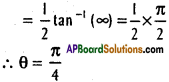
Old co-ordinates are (0, 3)
x = 0, y = 3
x’ = x – h = 0 – 4 = -4
y’=y-k = 3 + 5 = 8
New co-ordinates are (—4, 8)

ii) Old co-ordinates are (-2, 4)
x = -2, y = 4
x’ = x- h = -2 – 4 = -6
y’=y-k=4 + 5 = 9
New co-ordinates are (-6, 9)

iii) Old co-ordinates are (4, -5)
x = 4, y = -5
x’ = x – h = 4- 4 = 0
y = y – k = -5 + 5 = 0
New co-ordinates are (0,0)

Question 2.
The origin is shifted to (2, 3) by the translation of axes. If the coordinates of a point P changes as follows, find the coordinates of P in the original system.
i) (4, 5) ii) (-4, 3), iii) (0, 0)
Solution:
i) New co-ordinates are (4, 5)
x’ = 4, y’ = 5
x = x’ + h = 4 + 2 = 6
y = y’ + k = 5 + 3 = 8
Old co-ordinates are (6, 8)

ii) New co-ordinates are (-4, 3)
x’ = – 4, y’ = 3
x = x’ + h = -4 + 2 = -2
y = y’ + k = 3 + 3 = 6
Old co-ordinates are (-2, 6)

iii) New co-ordinates are (0, 0)
x’ = 0, y’ = 0
x = x’ + h = 0 + 2 = 2
y = y’ + k = 0 + 3 = 3
Old co-ordinates are (2, 3)

Inter 1st Year Maths 1B Transformation of Axes Solutions Ex 2(a)

Question 3.
Find the, point to which the origin is to be shifted so that the point (3, 0) may change to (2, -3).
Solution:
(x, y) = (3, 0)
(x’, y’) = (2, -3)
Let (h, k) be the shifting origin.
h = x – x’= 3- 2 = 1
k = y – y’ = 0 + 3 = 3
∴ (h, k) = (1, 3)

Question 4.
When the origin is shifted to (-1, 2) by the translation of axes, find the transformed equations of the following.
i) x² + y² + 2x – 4y.+ 1 = 0
ii) 2x² + y² – 4x + 4y = 0
Solution:
i) The given equation is
x² + y² + 2x – 4y + 1 = 0
Origin is shifted to (-1, 2)
h = -1, k = 2
Equation of transformations are
x = x’ + h, y = y’ + k
i.e., x = x’ – 1, y = y’ + 2
The new equation is
(x’ – 1)² + (y’ + 2)² + 2(x’ – 1) – 4(y’ + 2) + 1 = 0
⇒ (x’)² + 1 – 2x’ + (y’)² + 4 + 4y’ + 2x’ – 2 -4y’ – 8 + 1 = 0
(x’)² + (y’)² -4 = 0
The transformed equation is x² + y² – 4 = 0

ii) Old equation is
2x² + y² – 4x + 4y = 0
New equation is 2(x’ – 1)² + (y’ + 2)² —4(x’ – 1) + 4(y’ + 2) = 0
2[(x’)² + 1 – 2x’] + (y’)² + 4 + 4y’ – 4x’ + 4 + 4y’ + 8 = 0
2(x’)² + 2 – 4x’ + (y’)² + 4 + 4y’ – 4x’ + 4 + 4y’ + 8 = 0
2(x’)² + (y’)² – 8x’ + 8y’ + 18 = 0
The transformed equation is
2x² + y² – 8x + 8y+18 = 0

Question 5.
The point to which the origin is shifted and the transformed equation are given below. Find the original equation.
i) (3,-4);x² + y² = 4
ii) (-1, 2); x² + 2y² + 16 = 0
Solution:
i) Given shifting origin = (3, – 4) = (h, k)
x’ = x – h,
= x – 3

y’ = y – k
= y + 4

The original equation of (x’)² + (y’)² = 4 is
(x – 3)² + (y + 4)2 = 4
x² – 6x + 9 + y² + 8y + 16 = 4
x² + y² – 6x + 8y + 21 =0

ii) Given shifting origin = (h, k) = (-1,2)
x’ = x – h,
= x + 1

y’ = y – k
y = y – 2

The original equation of
x’² + 2y’² + 16 = 0 is
(x + 1)² + 2(y – 2)² + 16 = 0
x² + 2x + 1 + 2y² – 8y + 8 + 16 = 0
x² + 2y² + 2x – 8y + 25 = 0

Inter 1st Year Maths 1B Transformation of Axes Solutions Ex 2(a)

Question 6.
Find the point to which the origin is to be shifted so as to remove the first degree terms from the equation.
4x² + 9y² – 8x + 36y + 4 = 0
Solution:
The given equation is
4x² + 9y² – 8x + 36y + 4 = 0
a = 4 g = -4
b = 9 f = 18
Inter 1st Year Maths 1B Transformation of Axes Solutions Ex 2(a) 1
Origin should be shifted to (1, -2)

Question 7.
When the axes are rotated through an angle 30°, find the new coordinates of the following points,
i) (0, 5) ii) (-2, 4) hi) (0, 0)
Solution:
i) Given 0 = 30°
Old co-ordinates are (0, 5)
i.e., x = 0, y = 5
x‘ = x. cos θ + y. sin θ
= 0. cos 30° + 5. sin 30° = \(\frac{5}{2}\)
= – x sin θ + y cos θ
= – 0. sin 30° + 5 cos 30° =
New co-ordinates are \(\left(\frac{5}{2}, \frac{5 \sqrt{3}}{2}\right)\)

ii) Old co-ordinates are (-2, 4)
x= -2, y = 4
x’ = x cos θ + y sin θ
= (-2). cos 30°+ 4. sin 30°
= -2. \(\frac{\sqrt{3}}{2}\) + 4. \(\frac{1}{2}\) = – √3 +2
y’ = -x sin θ + y cos θ
= – (-2) sin 30° + 4 cos 30°
= 2 . \(\frac{1}{2}\) + 4. \(\frac{\sqrt{3}}{2}\)
= 1 + 2 √3
New co-ordinates are (- √3 + 2, 1 + 2√3)

iii) Given (x, y) = (0,0) and 0 = 30°
x = (0, y) ⇒ x = x’. cos 30° – y’ sin 30°
= 0. \(\frac{\sqrt{3}}{2}\) – 0. \(\frac{1}{2}\) =0
y = x’. sin 30° + y’.cos 30°
= 0.\(\frac{1}{2}\) + 0.\(\frac{\sqrt{3}}{2}\) = 0
New co-ordinates of the point are (0, 0)

Question 8.
When the axes are rotated through an angle 60°, the new co-ordinates of three points are the following
i) (3, 4) ii) (-7, 2) iii) (2, 0) Find their original coordinates.
Solution:
i) Given 0 = 60°
New co-ordinates are (3, 4)
x’ = 3, y’ = 4
x = x’ cos θ – y’ sin θ
= 3. cos 60° – 4. sin 60°
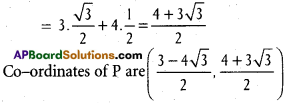
\(=3 \cdot \frac{1}{2}-\frac{4 \cdot \sqrt{3}}{2}=\frac{3-4 \sqrt{3}}{2}\)
y = x’ sin θ + y’ cos θ
= 3 sin 60° + 4. cos 60°
Inter 1st Year Maths 1B Transformation of Axes Solutions Ex 2(a) 2

ii) New co-ordinates are (-7, 2)
x’= -7, y’ = 2
x = x’ cos θ – y’ sin θ
= (-7) cos 60° – 2. sin 60°
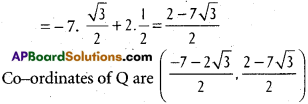
\(=-7 \cdot \frac{1}{2}-2 \cdot \frac{\sqrt{3}}{2}=\frac{-7-2 \sqrt{3}}{2}\)
y = x’ sin θ + y’. cos θ
= – 7. sin 60° + 2. cos 60°
Inter 1st Year Maths 1B Transformation of Axes Solutions Ex 2(a) 3

iii) New co-ordinates are (2, 0)
x’ = 2, y’ = 0
x = x’ cos θ – y’ sin θ
= 2. cos 60° – 0. sin 60°
= 2.\(\frac{1}{2}\) – 0.\(\frac{\sqrt{3}}{2}\) =1 – 0 = 1
y = x’ sin θ + y’ cos θ
= 2. sin 60° + 0. cos 60°
= 2.\(\frac{\sqrt{3}}{2}\) + 0.\(\frac{1}{2}\) = √3
Co-ordinates of R are (1, √3)

Inter 1st Year Maths 1B Transformation of Axes Solutions Ex 2(a)

Question 9.
Find the angle through which the axes are to be rotated so as to remove the xy term in the equation.
x² + 4xy + y² – 2x + 2y – 6 = 0.
Solution:
Compare the equation
x² + 4xy + y² – 2x + 2y – 6 = 0
with ax² + 2hxy + by² + 2gx + 2fy + c = 0
a = 1, h = 2, b = 1, g = -1, f = 1, c = -6
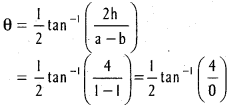
Let ‘θ’ be the angle of rotation of axes, then
Inter 1st Year Maths 1B Transformation of Axes Solutions Ex 2(a) 4
Inter 1st Year Maths 1B Transformation of Axes Solutions Ex 2(a) 5

II.

Question 1.
When the origin is shifted to the point (2, 3), the transformed equation of a curve is x² + 3xy – 2y² + 17x – 7y – 11= 0. Find the original equation of the curve.
Solution:
Equations of transformation are
x = x’ + h, y = y’ + k
x’ = x – h = x – 2, y’ = y – 3
Transformed equation is
x² + 3xy – 2y² + 17x – 7y – 11 = 0
Original equation is
(x – 2)² + 3(x – 2) (y – 3) – 2(y – 3)² + 17(x – 2) – 7(y – 3) – 11 = 0
⇒ x² – 4x + 4 + 3xy – 9x – 6y + 18 – 2y² + 12y – 18 + 17x – 34 – 7y + 21 -11 = 0
⇒ x² + 3xy – 2y² + 4x – y – 20 = 0
This is the required original equation.

Question 2.
When the axes are rotated through an angle 45°, the transformed equation of acurveis 17x² – 16xy + 17y² = 225. Find the original equation of the curve.
Solution:
Angle of rotation = θ = 45
x’ = x cos θ + y sin θ = x cos 45 + y sin 45 = \(\frac{x+y}{\sqrt{2}}\)
y’ = – x sin θ + y cos θ = – x sin 45 + y cos 45 = \(\frac{-x+y}{\sqrt{2}}\)

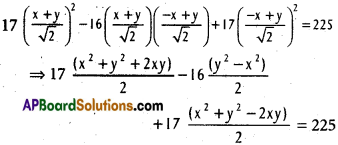
The original equation of
17x’²- 16x’y’ + 17y’² = 225 is
Inter 1st Year Maths 1B Transformation of Axes Solutions Ex 2(a) 6
⇒ 17x² + 17y² + 34xy – 16y² + 16x² + 17x² + 17y² – 34xy = 450
⇒ 50x² + 18y² = 450
∴ x² + y² = 9 is the original equation.

Question 3.
When the axes are rotated through an angle a, find the transformed equation of x cos a + y sin a = p. iMM&mmn
Solution:
The given equation is x cos α + y sin α = p
∵ The axes are rotated through an angle α
x = x’ cos α – y’ sin α
y = x’ sin α + y’ cos α

The given equation transformed to
(x’ cos α – y’ sin α) cos α +
(x’ sin α + y’ cos α) sin α = p
⇒ x’ (cos² α + sin² α) = p
⇒ x’ = p
The equation transformed to x = p

Question 4.
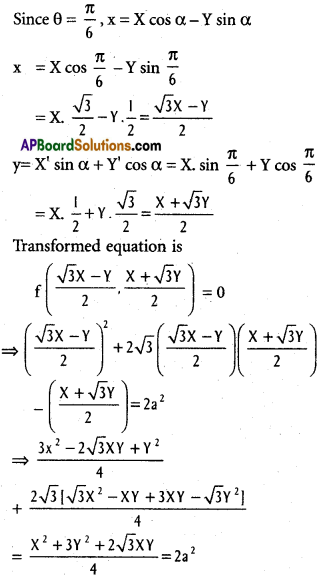
When the axes are rotated through an angle n/6. Find the transformed equation of x² + 2 √3xy – y² = 2a².
Solution:
Inter 1st Year Maths 1B Transformation of Axes Solutions Ex 2(a) 7
⇒ 3X² – 2√3 XY + Y² + 2√3|√3X² +2XY – √3Y²|- (x² +3Y² +2√3XY) =8a²
⇒ 3X² -2V3XY +Y² +6X² + W3XY – 6Y² – X² – 3Y² – 2√3 XY = 8a²
⇒ 8X² – 8Y² = 8a² ⇒ X² – Y² = a²
The transformed equation is x² – y² = a²

Inter 1st Year Maths 1B Transformation of Axes Solutions Ex 2(a)

Question 5.
When the axes are rotated through an angle \(\frac{\pi}{4}\), find the transformed equation of 3x² + 10xy + 3y² = 9.
Solution:
Given equation is
3x² + 10xy + 3y² – 9 = 0 ………….. (1)
Angle of rotation of axes = θ = \(\frac{\pi}{4}\)
Let (X, Y) be the new co-ordinates of (x, y)
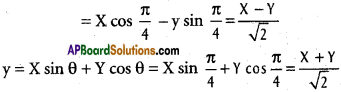
x = X cos θ – Y sin θ
Inter 1st Year Maths 1B Transformation of Axes Solutions Ex 2(a) 8
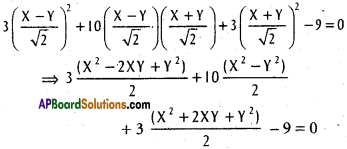
Transformed equation of (1) is
Inter 1st Year Maths 1B Transformation of Axes Solutions Ex 2(a) 9
⇒ 3X² – 6XY + 3Y² + 10X² – 10Y² + 3X² + 6XY + 3Y² – 18 = 0
∴ 16X² – 4Y² -18 = 0
∴ 8X² – 2Y² = 9
∴ 8X² – 2Y² = 9
The transformed equation is 8x² – 2y² = 9

Inter 1st Year Maths 1B Locus Solutions Ex 1(a)

Practicing the Intermediate 1st Year Maths 1B Textbook Solutions Inter 1st Year Maths 1B Locus Solutions Exercise 1(a) will help students to clear their doubts quickly.

Intermediate 1st Year Maths 1B Locus Solutions Exercise 1(a)

I.

Question 1.
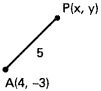
Find the equation of the locus of a point that is at a distance 5 from A (4, – 3).
Solution:
A (4, -3) is the given point P(x, y) is any point on the locus.
Inter 1st Year Maths 1B Locus Solutions Ex 1(a) 1
Given condition is CP = 5
CP² = 25
(x – 4)² + (y + 3)² = 25
x² – 8x + 16 + y² + 6y + 9 – 25 = 0
Equation of the locus of P is x²+ y² – 8x + 6y = 0.

Question 2.
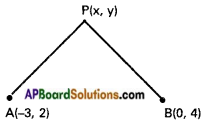
Find the equation of locus of a point which is equidistant from the points A(-3, 2) and B(0, 4).
Solution:
A (-3, 2), B (0,4) are the given points
P (x, y) is any point on the locus
Inter 1st Year Maths 1B Locus Solutions Ex 1(a) 2
Given condition is PA = PB
PA² = PB²
(x+3)² + (y – 2)² = (x – 0)² + (y – 4)²
x² + 6x + 9 + y² – 4y + 4 = x² + y² – 8y +16
6x + 4y = 3 is the equation of the locus.

Question 3.
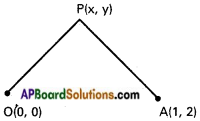
Find the equation of locus of a point P such that the distance of P from the origin is twice the distance of P from A (1, 2).
Solution:
O(0,0), A (1,2) are the given points
P (x, y) is any point on the locus
Inter 1st Year Maths 1B Locus Solutions Ex 1(a) 3

Given condition is OP = 2AP
OP² = 4 AP²
x² + y² = 4 [(x – 1)² + (y – 2)²]
= 4 (x² – 2x + 1 + y² – 4y + 4)
x² + y² = 4x² + 4y² – 8x – 16y + 20
Equation to the locus of P is
3x² + 3y² – 8x – 16y + 20 = 0.

Inter 1st Year Maths 1B Locus Solutions Ex 1(a)

Question 4.
Find the equation of locus of a point which is equidistant from the coordi¬nate axes.
Solution:
P(x, y) is any point on the locus.
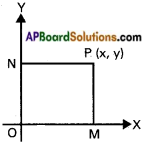
PM and PN are perpendiculars from P on X and Y – axes.
Inter 1st Year Maths 1B Locus Solutions Ex 1(a) 4
Given PM = PN ⇒ PM² = PN²
y² = x²
Locus of P is x² – y² = 0

Question 5.
Find the equation of locus of a point equidistant from A (2, 0) and the Y- axis.
Solution:
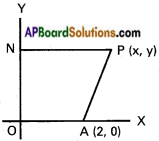
A (2,0) is the given point.
P (x, y) is any point on the locus.
Inter 1st Year Maths 1B Locus Solutions Ex 1(a) 5

Draw PN perpendicular to Y – axis.
Given condition is PA = PN
PA² = PN²
(x – 2)² + (y – 0)² = x²
x² – 4x + 4 + y² = x²
Locus of P is y² – 4x + 4 = 0

Question 6.
Find the equation of locus of a point P, the square of whose distance from the origin is 4 times its y coordinate.
Inter 1st Year Maths 1B Locus Solutions Ex 1(a) 6
Solution:
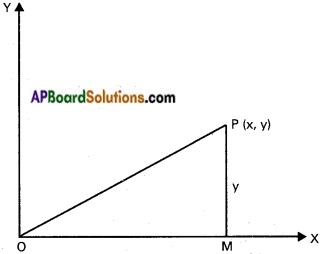
P(x, y) is any point on the locus
Given condition is OP² = 4y ⇒ x² + y² = 4y
Equation of the locus of P is x² + y² – 4y = 0

Inter 1st Year Maths 1B Locus Solutions Ex 1(a)

Question 7.
Find the equation of locus of a point ‘P’ such that PA² + PB² = 2c², where A = (a, 0), B = (-a, 0) and 0 < |a| < |c|.
Solution:
Let P (x, y) be a point in locus.
A = (a, 0); B = (-a, 0)
Given condition is PA² + PB² = 2c²
(x – a)² + (y – 0)² + (x + a)² + (y – 0)² = 2c²
x² – 2ax + a² + y² + x² + 2ax + a² + y² = 2c²
2x² + 2y² = 2c² – 2a²
∴ x² + y² = c² – a² is the locus.

II.

Question 1.
Find the equation of locus of P, if the line segment joining (2, 3) and (-1, 5) subtends a right angle at P.
Solution:
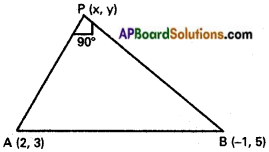
A(2,3), B (-1, 5) are the given points.
P(x, y) is any point on the locus.
Inter 1st Year Maths 1B Locus Solutions Ex 1(a) 7
Given condition is, ∠APB = 90°
AP² + PB² = AB²
(x – 2)² + (y – 3)² + (x + 1)² + (y – 5)² = (2 + 1)² + (3 – 5)²
x² – 4x + 4 + y² – 6y + 9 + x² + 2x + 1+ y² – 10y + 25 = 9 + 4
2x² + 2y² – 2x – 16y + 26 = 0
Locus of P is x² + y² – x – 8y + 13 = 0
(x, y) ≠ (2,3) and (x, y) ≠ (-1, 5)

Question 2.
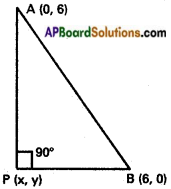
The ends of the hypotenuse of a right angled triangle are (0, 6) and (6, 0). Find the equation of locus of its third vertex.
Solution:
A(0,6), B (6,0) are the ends of the hypotenuse,
P (x, y) is the third vertex.
∴ The given condition is ∠APB = 90°
Inter 1st Year Maths 1B Locus Solutions Ex 1(a) 8
AP² + PB² = AB²
(x – 0)² + (y – 6)² + (x – 6)² + (y – 0)² = (6 – 0)² + (0 – 6)²
x² + y² – 12y + 36 + x² – 12x + 36 + y² = 36 + 36
2x² + 2y² -12x -12y = 0
Locus of P is x² + y² – 6x – 6y = 0
(x, y) ≠ (0,6) and (x, y) ≠ (6,0).

Question 3.
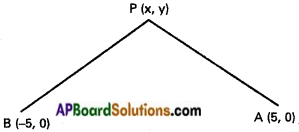
Find the equation of the locus of a point, the difference of whose distances from (-5, 0) and (5, 0) is 8.
Solution:
A(5,0), B(-5,0) are the given points.
Inter 1st Year Maths 1B Locus Solutions Ex 1(a) 9
P(x, y) is any point on the locus.
Given condition is |PA – PB| = 8
PA – PB = 8 ………..(1)
PA² – PB² = [(x – 5)² + (y – 0)²] – [(x + 5)² + (y – 0)²]
= x² – 10x + 25 + y² – x² – 10x – 25 – y²
= – 20x
(PA + PB) (PA – PB) = -20x
(PA + PB) 8 = -20x
PA + PB = –\(\frac{5}{2}\)x …………..(2)
Adding (1) and (2),
2PA = –\(\frac{5x}{2}\) + 8 = \(\frac{-5 x+16}{2}\)
4PA = – 5x + 16
16PA² = (- 5x + 16)²
16 [(x – 5)² + y²] = (- 5x + 16)²
16 [x² – 10x + 25 + y²] = [- 5x + 16]²
16x² + 16y²2 – 160x + 400 = 25x² + 256 – 160x
9x² – 16y² = 144
Dividing with 144, locus of P is
\(\frac{9 x^{2}}{144}-\frac{16 y^{2}}{144}=1\) i.e., \(\frac{x^{2}}{16}-\frac{y^{2}}{9}=1\)

Question 4.
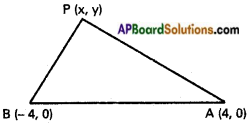
Find the equation of locus Of P, if A=(4,0), B = (- 4,0) and |PA- PB| =4.
Solution:
A = (4, 0), B = (-4, 0) are the given points.
P (x, y) is any point on the locus.
The given condition is |PA – PB| = 4 …………… (1)
PA² – PB²= [(x- 4)² + (y – 0)²] – [(x + 4)² + y²]
= x² – 8x+ 16 + y² – x² – 8x – 16 – y²
= -16x
Inter 1st Year Maths 1B Locus Solutions Ex 1(a) 10

(PA + PB) (PA – PB) = -16x
(PA + PB) 4 = – 16x
PA + PB = – 4x ………….. (2)
Adding (1) and (2),
2PA = 4 – 4x
PA = 2 – 2x
PA² = (2 – 2x)²
(x – 4)² + (y – 0)² = (2 – 2x)²
x² – 8x + 16 + y² = 4 + 4x² – 8x
3x² – y² = 12
Dividing with 12, locus of P is \(\frac{3 x^{2}}{12}-\frac{y^{2}}{12}=1\)
i.e., \(\frac{x^{2}}{4}-\frac{y^{2}}{13}=1\)

Inter 1st Year Maths 1B Locus Solutions Ex 1(a)

Question 5.
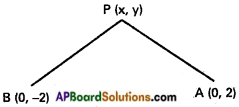
Find the equation of the locus of a point, the sum of whose distances from (0, 2) and (0, -2) is 6.
Solution:
A (0,2), B (0, -2) are the given points.
Inter 1st Year Maths 1B Locus Solutions Ex 1(a) 11
P(x, y) is any point on the locus.
Given condition is PA + PB = 6 ……….. (1)
PA² – PB² = [(x – 0)² + (y – 2)²] – [(x – 0)² + (y + 2)²]
= x² + y² – 4y + 4 – x² – y² – 4y – 4 = – 8y
(PA + PB) (PA – PB) = -8y
6(PA – PB) = – 8y
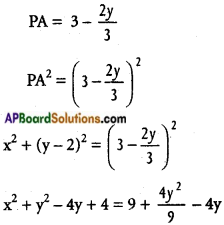
PA – PB = –\(\frac{8y}{6}\)
PA-PB = –\(\frac{4y}{3}\) ……. (2)
Adding (1) and (2), 2PA = 6 –\(\frac{4y}{3}\)
Inter 1st Year Maths 1B Locus Solutions Ex 1(a) 12
9x² + 9y² + 36 = 81 + 4y²
9x² + 5y² = 45
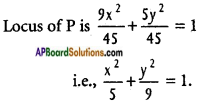
Dividing with 45,
Inter 1st Year Maths 1B Locus Solutions Ex 1(a) 13

Question 6.
Find the equation (rf the locus of P, if A= (2,3), B = (2, -3) and PA + PB = 8.
Solution:
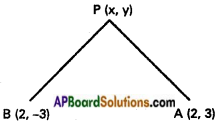
A (2, 3), B (2, -3) are the given points.
Inter 1st Year Maths 1B Locus Solutions Ex 1(a) 14
P(x, y) is any point on the locus.
Given condition is PA + PB = 8 ……….. (1)
PA² – PB² = [(x – 2)² + (y – 3)²] – [(x – 2)² + (y + 3)²]
= (x – 2)² + (y – 3)² – (x – 2)² – (y + 3)² = (y – 3)² – (y + 3)² = -12y
(PA + PB) (PA – PB) = -12y
8(PA – PB) = -12y
PA – PB = \(\frac{-12 y}{8}\)
PA – PB = \(\frac{-3 y}{2}\) ……….. (2)
Adding (1) and (2),
2PA = 8 – \(\frac{3 y}{2}\) = \(\frac{16 -3y}{2}\)
4PA = 16 – 3y
16PA² = (16 – 3y)²
16 [(x – 2)² + (y – 3)²] = (16 – 3y)²
16(x² – 4x + 4 + y² – 6y + 9) = (16 – 3y)²
16x² + 16y² – 64x – 96y + 208 = 256 + 9y² – 96y
16x² + 7y² – 64x – 48 = 0
Locus of P is 16x² + 7y² – 64x – 48 = 0.

Question 7.
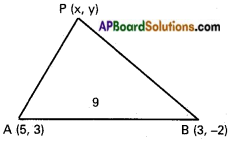
A(5, 3) and B (3, -2) are two fixed points. Find the equation of the locus of P, so that the area of triangle PAB is 9.
Solution:
A(5, 3), B(3, -2) are the given points.
P(x, y) is any point on the locus.
Inter 1st Year Maths 1B Locus Solutions Ex 1(a) 15
Given condition is ∆PAB = 9
\(\frac{1}{2}\)|5(-2, -y) + 3(y – 3) + x(3 + 2)|=9
|-10 – 5y + 3y – 9 + 5x| = 18
5x – 2y – 19 = ± 18
5x – 2y – 19 = 18 or 5x – 2y – 19 = – 18
5x – 2y – 37 = 0 or 5x – 2y – 1 = 0
Locus of P is (5x- 2y- 37) (5x- 2y- 1) = 0

Inter 1st Year Maths 1B Locus Solutions Ex 1(a)

Question 8.
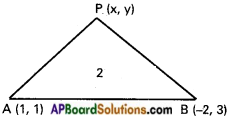
Find the equation of the locus of a point, which forms a triangle of ar5a 2 with the points A(l, 1) and B (-2, 3).
Solution:
A (1, 1), B(-2, 3) are the given points.
Inter 1st Year Maths 1B Locus Solutions Ex 1(a) 16
P(x, y) is any point on the locus.
Given condition is ∆PAB = 2
\(\frac{1}{2}\)|1(3 – y) – 2 (y – 1) + x (1 – 3)| = 2
|3 – y – 2y + 2 – 2x| = 4
-2x – 3y + 5 = ± 4
-2x – 3y + 5 = 4 or – 2x – 3y + 5 = – 4
2x + 3y – 1 = 0 or 2x + 3y – 9 = 0
Locus of P is (2x + 3y – 1) (2x + 3y – 9) = 0.

Question 9.
If the distance from ‘P’ to the points (2, 3) and (2, -3) are in the ratio 2 : 3, then find the equation of locus of P.
Solution:
Let P (x, y) be a point on locus.
Given points A = (2, 3), B = (2, -3)
Given condition is
PA : PB = 2 : 3
⇒ 3PA = 2PB
⇒ 9PA² = 4PB²
⇒ 9[(x – 2)² + (y – 3)²] = 4[(x – 2)² + (y + 3)²]
⇒ 9[x² – 4x + 4 + y² – 6y + 9] = 4 [x² – 4x + 4 + y² + 6y + 9]
∴ 5x² + 5y² – 20 x – 78 y + 65 = 0 is the equation of locus.

Inter 1st Year Maths 1B Locus Solutions Ex 1(a)

Question 10.
A (1, 2), B (2, -3) and C (-2, 3) are three points. A point ‘P’ moves such that PA² + PB² = 2PC². Show that the equation to the locus of ‘P’ is 7x – 7y + 4 = 0.
Solution:
Let P (x, y) be a point on locus.
Given points A = (1, 2), B = (2) -3) and C = (-2, 3)
Given condition is PA² + PB² = 2 PC²
⇒ (x – 1)² + (y – 2)² + (x – 2)² + (y + 3)² = 2 [(x + 2)² + (y-3)²]
⇒ 2x² + 2y² – 6x + 2y + 18 = 2x² + 2y² + 8x – 12y + 26
⇒ 14x – 14y + 8 = 0
∴ 7x – 7y + 4 = 0 is the equation of locus.

SOLVED PROBLEMS

Question 1.
Find the equation of the locus of a point which is at a distance 5 from (-2, 3) in the xoy plane.
Solution:
Let the given point be A = (-2, 3) and P(x, y) be a point on the plane.
The geometric condition to be satisfied by P to be on the locus is that
AP = 5 …………… (1)
Expressing this condition algebraically, we get
\(\sqrt{(x+2)^{2}+(y-3)^{2}}=5\)
i.e., x² + 4x + 4 + y² – 6y + 9 = 25
i.e., x² + y² + 4x – 6y – 12 = 0 ……………. (2)
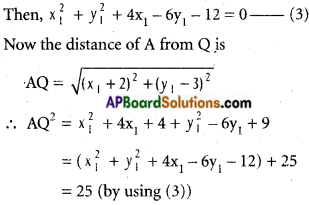
Let Q(x1, y1) satisfy (2).
Inter 1st Year Maths 1B Locus Solutions Ex 1(a) 17
Hence AQ = 5.
This means that Q(x1, y1) satisfies the geometric condition (1).
∴ The required equation of locus is
x² + y² + 4x – 6y – 12 = 0.

Question 2.
Find the equation of locus of a point P, if the distance of P from A(3,0) is twice the distance of P from B(-3, 0).
Solution:
Let P(x, y) be a point on the locus. Then the geometric condition to be satisfied by P is
PA = 2PB …………. (1)
i.e., PA² = 4PB²
i.e., (x – 3)² + y² = 4 [(x + 3)² + y²]
i.e., x² – 6x + 9 + y² = 4 [x² + 6x + 9 + y²]
i.e., 3x² + 3y² + 30x + 27 = 0
i.e., x2 + y2 + lOx + 9 = 0 ………….. (2)
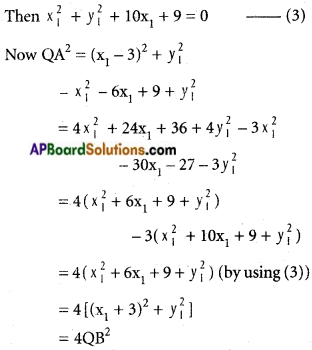
Let Q(x1, y1) satisfy (2).
Inter 1st Year Maths 1B Locus Solutions Ex 1(a) 18
∴ QA = 2QB.
This means that Q(x1, y1) satisfies (1).
Hence, the required equation of locus is
x² + y² + 10x + 9 = 0.

Inter 1st Year Maths 1B Locus Solutions Ex 1(a)

Question 3.
Find the locus of the third vertex of a right angled triangle, the ends of whose hypotenuse are (4, 0) and (0, 4).
Solution:
Let A = (4, 0) and B = (0, 4).
Let P(x, y) be a point such that PA and PB are
perpendicular. Then PA² + PB² = AB².
i.e., (x – 4)² + y² + x² + (y – 4)² = 16 + 16
i.e., 2x² + 2y² – 8x – 8y = 0
or x² + y² – 4x – 4y = 0
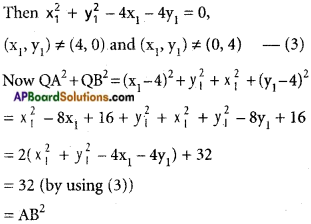
Let Q(x1, y1) satisfy (2) and Q be different from A and B.
Inter 1st Year Maths 1B Locus Solutions Ex 1(a) 19
Hence QA² + QB² = AB², Q ≠ A and Q ≠ B.
This means that Q(x1, y1) satisfies (1).
∴ The required equation of locus is (2), which is the circle with \(\overline{\mathrm{AB}}\) as diameter, deleting the points A and B.
Though A and B satisfy equation (2), they do not satisfy the required geometric condition.

Question 4.
Find the equation of the locus of P, if the ratio of the distances from P to A(5, -4) and B(7, 6) is 2 : 3.
Solution:
Let P(x, y) be any point on the locus.
The geometric condition to be satisfied by P
is\(\frac{AP}{PB}\) = \(\frac{2}{3}\).
i.e., 3AP = 2PB ………. (1)
i.e., 9AP² = 4PB²
i.e., 9[(x – 5)² + (y + 4)²] = 4[(x – 7)² + (y – 6)²]
i.e., 9[x² + 25 – 10x + y² + 16 + 8y] = 4[x² + 49 – 14x +y² + 36 – 12y]
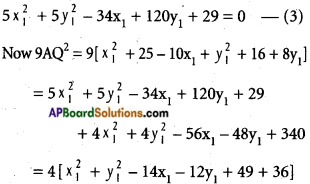
i.e, 5x² + 5y² – 34x + 120y + 29 = 0 ……… (2)
Let Q(x1 y1) satisfy (2). Then
Inter 1st Year Maths 1B Locus Solutions Ex 1(a) 20
(by using (3))
– 4 [(x1 – 7)² + (y1 – 6)²] = 4PB²
Thus 3AQ = 2PB. This means that Q(x1, y1) satisfies (1).
Hence, the required equation of locus is
5(x² + y²) – 34x + 120y + 29 = 0.

Inter 1st Year Maths 1B Locus Solutions Ex 1(a)

Question 5.
A(2, 3) and B(-3, 4) are two given points. Find the equation of locus of P so that the area of the triangle PAB is 8.5.
Solution:
Let P(x, y) be a point on the locus.
The geometric condition to be satisfied by P is that.
area of ∆PAB = 8.5 ……….. (1)
i.e., \(\frac{1}{2}\)|x(3 – 4) + 2(4 – y) – 3(y – 3)| = 8.5
i.e., |-x + 8-2y-3y+9| = 17
i.e., |-x- 5y + 17| = 17
i.e., -x- 5y + 17 = 17 or-x-5y + 17 = -17
i.e., x + 5y = 0 or x + 5y = 34
∴ (x + 5y) (x + 5y – 34) = 0
i.e., x² + 10xy + 25y² – 34x – 170y = 0 …………. (2)
Let Q(x1, y1) satisfy (2). Then
x1 + 5y1 = 0 or x1 + 5y1 = 34 ………… (3)
Now, area of ∆QAB
= \(\frac{1}{2}\)|x1(3-4) + 2(4-y1) – 3(y1 – 3)|
= \(\frac{1}{2}\) |-x1 + 8 – 2y1 – 3y1 + 9|
= \(\frac{1}{2}\) |-x1 – 5y1 + 17|
= \(\frac{17}{2}\) =8.5 (by using (3))
This means that Q(x1, y1) satisfies (1).
Hence, the required equation of locus is
(x + 5y) (x + 5y – 34) = 0 or
x² + 10xy + 25 – y² – 34x- 170y = 0.

Inter 1st Year Maths 1A Properties of Triangles Important Questions

Students get through Maths 1A Important Questions Inter 1st Year Maths 1A Properties of Triangles Important Questions which are most likely to be asked in the exam.

Intermediate 1st Year Maths 1A Properties of Triangles Important Questions

Question 1.
In ∆ABC, if a = 3, b = 4 and sinA = \(\frac{3}{4}\), find angle B.
Solution:
By sine Rule \(\frac{a}{\sin A}\) = \(\frac{b}{\sin B}\)
⇒ sin B = \(\frac{\text { b. } \sin A}{a}\) = \(\frac{4}{3}\) (\(\frac{3}{4}\)) = 1
⇒ sin B = 1 ⇒ B = 90°

Inter 1st Year Maths 1A Properties of Triangles Important Questions

Question 2.
If the lengths of the sides of a triangle are 3, 4, 5 find the circumradius of the triangle.
Solution:
∴ 32 + 42 = 52
∴ The triangle is right angled and its hypotenuse = 5 = circum diameter.
∴ Circum radius = \(\frac{1}{2}\) (hypotenu) = \(\frac{5}{2}\) cms.

Question 3.
If a = 6, b = 5, c = 9, then find angle A.
Solution:
∵ cos A = \(\frac{\mathrm{b}^{2}+c^{2}-a^{2}}{2 b c}\)
= \(\frac{5^{2}+9^{2}-6^{2}}{2(5)(9)}\) = \(\frac{25+81-36}{2(5)(9)}\)
= \(\frac{70}{90}\) = \(\frac{7}{9}\)
∴ A = cos-1(\(\frac{7}{9}\))

Question 4.
If ∆ABC, show that ∆ (b + c) cos A = 2s.
Solution:
L.H.S. = (b + c) cos A + (c + a) cos B + (a + b) cos C
= (b cos A + a cos B) + (c cos B + b cos C) + (a cos C + c cos A)
= c + a + b = 2S = R.H.S.

Inter 1st Year Maths 1A Properties of Triangles Important Questions

Question 5.
If the sides of a triangle are 13, 14, 15, then find the circum diameter.
Solution:
Let a = 13, b = 14, c = 15
Then 2s = a + b + c = \(\frac{13+14+15}{2}\) = \(\frac{42}{2}\)
∴ s = 21
s – a = 21 – 13 = 8
s – b = 21 – 14 = 7
s – c = 21 – 15 = 6
Now ∆ = \(\sqrt{s(s-a)(s-b)(s-c)}\)
= \(\sqrt{21 \times 8 \times 7 \times 6}\)
= \(\sqrt{21 \times 21 \times 16}\) = 21 × 4 = 84
∵ ∆ = \(\frac{a b c}{4 R}\) ⇒ 4R = \(\frac{a b c}{\Delta}\)
= \(\frac{13 \times 14 \times 15}{84}\) = \(\frac{65}{2}\)
∴ R = \(\frac{65}{8}\)
∴ Circum diameter(2R) = 2 × \(\frac{65}{8}\) = \(\frac{65}{4}\)cms.

Question 6.
In a ∆A B C, if (a + b + c) (b + c – a) = 3 be, find A.
Solution:
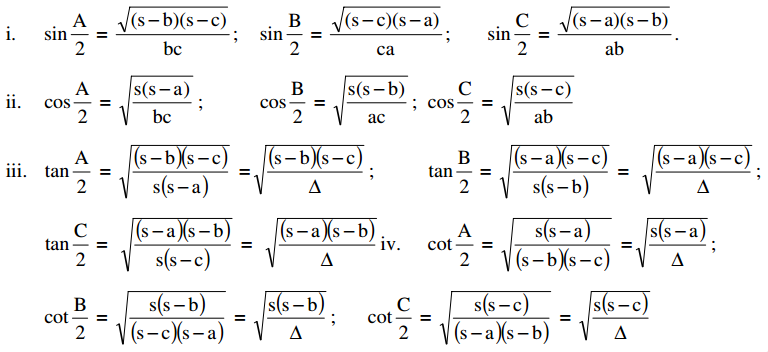
(2s – sa) = 3bc ⇒ \(\frac{s(s-a)}{b c}\) = \(\frac{3}{4}\)
⇒ cos2 \(\frac{A}{2}\) = \(\frac{3}{4}\) ⇒ cos \(\frac{A}{2}\) = \(\frac{1}{2}\) = cos 30°
∴ \(\frac{A}{2}\) = 30° = A = 60°

Question 7.
If a = 4, b = 5, c = 7, find cos \(\frac{B}{2}\).
Solution:
2s = a + b + c = 4 + 5 + 7 = 16
⇒ s = 8 and s – b = 8 – 5 = 3
Now cos \(\frac{B}{2}\) = \(\sqrt{\frac{s(s-b)}{a c}}\) = \(\sqrt{\frac{8 \times 3}{4 \times 7}}\) = \(\sqrt{\frac{6}{7}}\)

Question 8.
In ∆ ABC, find b cos2 \(\frac{C}{2}\) + c cos2 \(\frac{B}{2}\).
Solution:
b cos2 \(\frac{C}{2}\) + c cos 2 \(\frac{B}{2}\) = b[latex]\frac{s(s-c)}{a b}[/latex] + c[latex]\frac{s(s-b)}{c a}[/latex]
= \(\frac{s(s-c)}{a}\) + \(\frac{s(s-b)}{a}\) = \(\frac{\mathrm{s}}{\mathrm{a}}\)[s – c + s – b]
= \(\frac{\mathrm{s}}{\mathrm{a}}\) • a = s

Question 9.
If tan \(\frac{A}{2}\) = \(\frac{5}{6}\) and tan \(\frac{C}{2}\) = \(\frac{2}{5}\), determine the relation between a, b, c.    [Mar 05]
Solution:
tan \(\frac{A}{2}\) • tan \(\frac{C}{2}\) = \(\frac{5}{6}\) • \(\frac{2}{5}\)
\(\sqrt{\frac{(s-b)(s-c)}{s(s-a)}} \sqrt{\frac{(s-a)(s-b)}{s(s-c)}}\) = \(\frac{2}{6}\)
⇒ \(\frac{s-b}{s}\) = \(\frac{1}{3}\) ⇒ 3s – 3b = s ⇒ 2s = 3b
⇒ a + b + c = 3b ⇒ a + c = 2b Hence a, b, c are in A.P.

Question 10.
If cot \(\frac{A}{2}\) = \(\frac{b+c}{a}\), find angle B.
Solution:
cot \(\frac{A}{2}\) = \(\frac{b+c}{a}\) ⇒ \(\frac{\cos \frac{A}{2}}{\sin \frac{A}{2}}\) = \(\frac{\cos \left(\frac{B-C}{2}\right)}{\sin \frac{A}{2}}\) (by Mollweide rule)
⇒ \(\frac{A}{2}\) = \(\frac{B-C}{2}\)
⇒ A = B – C ⇒ A + C = B ⇒ A + B + C = 2B
∴ 2B = 180° ⇒ B = 90°

Inter 1st Year Maths 1A Properties of Triangles Important Questions

Question 11.
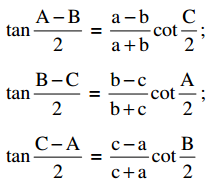
If tan (\(\frac{C-A}{2}\)) = k cot \(\frac{B}{2}\), find k.
Solution:
Comparing with tan (\(\frac{C-A}{2}\)) = \(\frac{c-a}{c+a}\) cot \(\frac{B}{2}\), (by tangent law)
we get that k = \(\frac{c-a}{c+a}\)

Question 12.
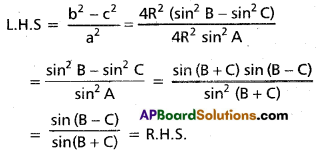
In ∆ABC, show that \(\frac{b^{2}-c^{2}}{a^{2}}\) = \(\frac{\sin (B-C)}{\sin (B+C)}\).
Solution:
Inter 1st Year Maths 1A Properties of Triangles Important Questions 1

Question 13.
Show that a2 cot A + b2 cot B + c2 cot C = \(\frac{a b c}{R}\).    [Mar 14]
Solution:
L.H.S. = a2 cot A + b2 cot B + c2 cot C
= 4R2 sin2 A. \(\frac{\cos A}{\sin A}\) + 4R2 sin2B. \(\frac{\cos B}{\sin B}\) + 4R2 sin2C. \(\frac{\cos C}{\sin C}\) (by sine rule)
= 2R2 (2 sin A cos A + 2 sin B cos B + 2 sin C cos C)
= 2R2 (sin 2A + sin 2B + sin 2C) .
= 2R2 (4 sin A sin B sin C) (from transformations)
= \(\frac{1}{R}\) (2R sin A) (2R sin B) (2R sin C)
= \(\frac{abc}{R}\) = R.H.S

Question 14.
Show that (b – c)2 cos2 \(\frac{A}{2}\) + (b + c)2 sin2 \(\frac{A}{2}\) = a2.
Solution:
L.H.S. = (b2 + c2 – 2bc) cos2 \(\frac{A}{2}\) + (b2 + c2 + 2bc) sin2 \(\frac{A}{2}\)
= (b2 + c2) [cos2 \(\frac{A}{2}\) + sin2 \(\frac{A}{2}\)] – 2bc (cos2 \(\frac{A}{2}\) – sin2 \(\frac{A}{2}\))
= b2 + c2 – 2bc cos A = a2

Inter 1st Year Maths 1A Properties of Triangles Important Questions

Question 15.
Prove that a (b cos C – c cos B) = b2 – c2     [Mar 07]
Solution:
L.H.S. = ab cos C – ca cos B
= (\(\frac{a^{2}+b^{2}-c^{2}}{2}\)) – (\(\frac{c^{2}+a^{2}-b^{2}}{2}\)) (by cosine rule)
= \(\frac{1}{2}\)[a2 + b2 – c2 – c2 – a2 + b2]
= b2 – c2 = R.H.S.

Question 16.
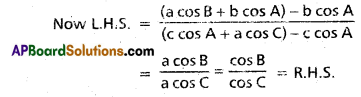
Show that \(\frac{c-b \cos A}{b-c \cos A}\) = \(\frac{\cos B}{\cos C}\).
Solution:
From projection rule c = a cos B – b cos A and b = c cos A + a cos C
Inter 1st Year Maths 1A Properties of Triangles Important Questions 2

Question 17.
In ∆ABC, if \(\frac{1}{a+c}\) + \(\frac{1}{b+c}\) = \(\frac{3}{a+b+c}\) show that C = 60°.
Solution:
\(\frac{1}{a+c}\) + \(\frac{1}{b+c}\) = \(\frac{3}{a+b+c}\)
⇒ \(\frac{b+c+a+c}{(a+c)(b+c)}\) = \(\frac{3}{a+b+c}\)
⇒ 3(a + c) (b + c) = (a + b + 2c) (a + b + c)
⇒ 3(ab + ac + bc + c2) = (a2 + b2 + 2ab) + 3c(a + b) + 2c2
⇒ ab = a2 + b2 – c2
⇒ 2ab cos C (from cosine rule)
⇒ cos C = \(\frac{1}{2}\) ⇒ C = 60°

Question 18.
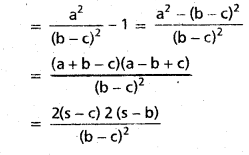
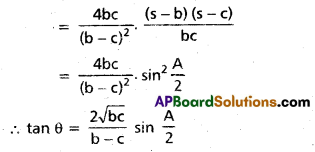
If a = (b – c) sec θ, prove that tan θ = \(\frac{2 \sqrt{b c}}{b-c}\) sin \(\frac{A}{2}\).    [Mar 16]
Solution:
a = (b – c) sec θ ⇒ sec θ = \(\frac{a}{b-c}\)
tan2 θ = sec2 θ – 1
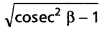
Inter 1st Year Maths 1A Properties of Triangles Important Questions 3
Inter 1st Year Maths 1A Properties of Triangles Important Questions 4

Question 19.
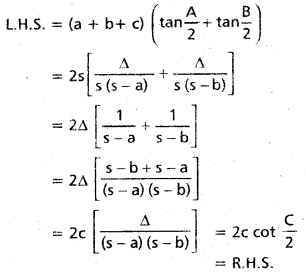
In ∆ABC, show that (a + b + c) (tan \(\frac{A}{2}\) + tan \(\frac{B}{2}\)) = 2c cot \(\frac{C}{2}\).
Solution:
Inter 1st Year Maths 1A Properties of Triangles Important Questions 5

Inter 1st Year Maths 1A Properties of Triangles Important Questions

Question 20.
Show that b2 sin 2C + c2 sin 2B = 2bc sin A.
Solution:
L.H.S. = b2 sin 2C + c2 sin 2B
= 4R2 sin2 B (2 sin C cos C) + 4R2 sin2 C (2 sin B cos B)
= 8R2 sin B sin C (sin B cos C + cos B sin C)
= 8R2 sin B sin C sin (B + C)
= 2(2R sin B) (2R sin C) sin A
= 2bc sin A = R.H.S.

Question 21.
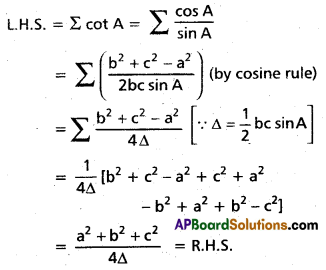
Prove that cot A + cot B + cot C = \(\frac{a^{2}+b^{2}+c^{2}}{4 \Delta}\)    [Mar 15]
Solution:
Inter 1st Year Maths 1A Properties of Triangles Important Questions 6

Question 22.
Show that a cos2 \(\frac{A}{2}\) + b cos2 \(\frac{B}{2}\) + c cos 2 \(\frac{C}{2}\) = s + \(\frac{\Delta}{R}\).
Solution:
L.H.S. = Σ a cos2 \(\frac{A}{2}\) = \(\frac{1}{2}\) Σ a (1 + cos A)
= \(\frac{1}{2}\) Σ (a + a cos A) = \(\frac{1}{2}\) (a + b + c) + \(\frac{1}{2}\) Σ (2R sin A cos A)
= \(\frac{1}{2}\) (2s) + \(\frac{R}{2}\) Σ sin 2A
= s + \(\frac{R}{2}\) (sin 2A + sin 2B + sin 2C)
= s + \(\frac{R}{2}\) (4 sin A sin B sin C)
= s + \(\frac{1}{R}\) (2R2 sin A sin B sin C)
= s + \(\frac{\Delta}{R}\) (∵ ∆ = 2R2 sin A sin B sin C)
= R.H.S.

Question 23.
In ∆ ABC, if a cos A = b cos B, prove that the triangle is either isosceles or right angled.
Solution:
a cos A = b cos B
⇒ 2R sin A cos A = 2R sin B cos B
⇒ sin 2A = sin 2B (or) = sin (180° – 2B)
Hence 2A = 2B or 2A = 180° – 2B
⇒ A = B or A = 90° – B ⇒ A = B or A + B = 90°
⇒ C = 90°
∴ The triangle is isosceles or right angled.

Question 24.
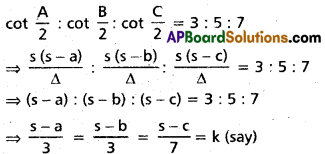
If cot \(\frac{A}{2}\) : cot \(\frac{B}{2}\) : cot \(\frac{C}{2}\) = 3 : 5 : 7, show that a : b : c = 6 : 5 : 4.
Solution:
Inter 1st Year Maths 1A Properties of Triangles Important Questions 7
Then s – a = 3k, s – b = 5k, s – c = 7k
Adding 3s – (a + b + c) = 3k + 5k+ 7k
⇒ 3s – 2s = 15k ⇒ s = 15k
Now a = 12k, b = 10k, c = 8k
∴ a : b : c = 12k : 10k : 8k = 6 : 5 : 4

Question 25.
Prove that a3 cos (B – C) + b3 cos (C – A) + c3 cos(A – B) = 3abc.
Solution:
L.H.S. = Σ a3 cos (B – C)
= Σ a2 (2R sin A) cos (B – C)
= R Σ a2 [2 sin (B + C) cos (B- C)]
= R Σ a2 (sin 2B + sin 2C)
= R Σ a2 (2 sin B cos B + 2 sin C cos C)
= Σ [a2(2R sin B) cos B + a2(2R sin C) cos C] Σ (a2 b cos B + a2c cos C)
= (a2b cos B + a2c cos C) + (b2c cos C + b2 a cos A) + (c2 a cos A + c2b cos B)
= ab (a cos B + b cos A) + bc (b cos C + c cos B) + ca (c cos A + a cos C)
= ab(c) + bc(a) + ca(b) = 3 abc = R.H.S

Inter 1st Year Maths 1A Properties of Triangles Important Questions

Question 26.
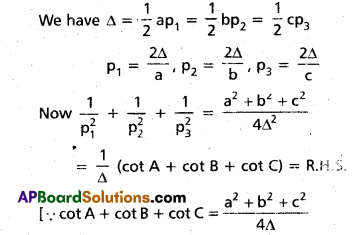
If p1, p2, p3 are the altitudes of the ∆ A, B, C show that \(\frac{1}{p_{1}^{2}}+\frac{1}{p_{2}^{2}}+\frac{1}{p_{3}^{2}}\) = \(\frac{\cot A+\cot B+\cot C}{\Delta}\)
Solution:
Since p1, p2, p3 are the altitudes of ∆ ABC,
Inter 1st Year Maths 1A Properties of Triangles Important Questions 8

Question 27.
The angle of elevation of the top point P of the vertical tower PQ of height h from a point A is 45° and from a point B is 60°, where B is a point at a distance 30 meters from the point A measured along the line AB which makes an angle 30° with AQ. Find the height of the tower.
Solution:
Inter 1st Year Maths 1A Properties of Triangles Important Questions 9
PQ = h, ∠PAQ = 45°
∠BAQ = 30° and ∠PBC = 60°
Also AB = 30 mts.
∴ ∠BAP = ∠APB = 15°.
This gives BP = AB = 30 and h = PC + CQ = BP sin 60° + AB sin 30°
= 15 \(\sqrt{3}\) + 15 = 15(\(\sqrt{3}\) +1) metres.

Question 28.
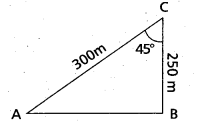
Two trees A and B are on the same side of a river. From a point C in the river the distances of the trees A and B are 250m and 300m respectively. If the angle C is 45°, find the distance between the trees (use \(\sqrt{2}\) = 1.414).
Solution:
Inter 1st Year Maths 1A Properties of Triangles Important Questions 10
From the triangle ABC, using the cosine rule
AB2 = 2502 + 3002 – 2(250) (300) cos 45°
= 100 (625 + 900 – 750\(\sqrt{2}\)) = 46450.
∴ AB = 215.5m. (approximately).

Question 29.
In A ABC, prove that \(\frac{1}{r_{1}}\) + \(\frac{1}{r_{2}}\) + \(\frac{1}{r_{3}}\) = \(\frac{1}{r}\).
Solution:
L.H.S. = \(\frac{1}{r_{1}}\) + \(\frac{1}{r_{2}}\) + \(\frac{1}{r_{3}}\) = \(\frac{s-a}{\Delta}\) + \(\frac{s-b}{\Delta}\) + \(\frac{s-c}{\Delta}\)
= \(\frac{3 s-(a+b+c)}{\Delta}\) = \(\frac{3 s-2 s}{\Delta}\) = \(\frac{s}{\Delta}\) = \(\frac{1}{r}\)
= R.H.S

Question 30.
Show that rr1r 2r3 = ∆2
Solution:
L.H.S. = rr1r 2r3 = \(\frac{\Delta}{s} \cdot \frac{\Delta}{s-a} \cdot \frac{\Delta}{s-b} \cdot \frac{\Delta}{s-c}\)
= \(\frac{\Delta^{4}}{\Delta^{2}}\) = ∆2 = R.H.S

Question 31.
In an equilateral triangle, find the value of \(\frac{r}{R}\).
Solution:
\(\frac{r}{R}\) = \(\frac{4 R \sin \frac{A}{2} \sin \frac{B}{2} \sin \frac{C}{2}}{R}\)
= 4 sin3 30° (∵ A = B = C = 60°)
= 4 . (\(\frac{1}{2}\))3 = \(\frac{1}{2}\)

Inter 1st Year Maths 1A Properties of Triangles Important Questions

Question 32.
The perimeter of ∆ ABC is 12 cm. and its in radius is 1 cm. Then find the area of the triangle.
Solution:
Given that 2s = 12 ⇒ s = 6 cm.
and r = 1 cm
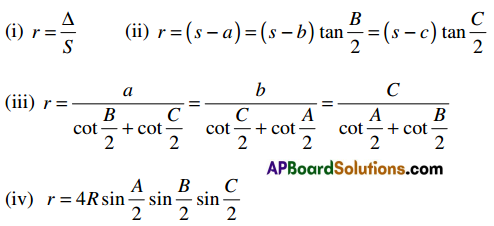
Area of ∆ ABC = ∆ = rs = (1) (6) = 6 sq.cms.

Question 33.
Show that rr1 = (s – b) (s – c).
Solution:
L.H.S. = rr1
= [(s – b) tan \(\frac{B}{2}\)] [(s – c) cot \(\frac{B}{2}\)]
= (s – b) (s – c) = R.H.S.
ans:

Question 34.
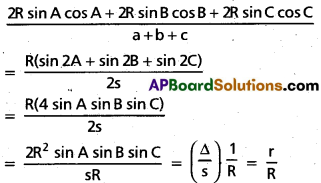
Express \(\frac{a \cos \mathbf{A}+\mathbf{b} \cos \mathbf{B}+\cos \mathbf{C}}{\mathbf{a}+\mathbf{b}+\mathbf{c}}\) in terms of R and r.
Solution:
Inter 1st Year Maths 1A Properties of Triangles Important Questions 11

Question 35.
In ∆ABC, ∆ = 6sq.cm and s = 1.5 cm, find r.
Solution:
r = \(\frac{\Delta}{s}\) = \(\frac{6}{1.5}\) = 4 cm.

Question 36.
Show that rr1 cot\(\frac{A}{2}\) = ∆.
Solution:
rr1 cot\(\frac{A}{2}\) = \(\frac{\Delta}{s}\) (s tan \(\frac{A}{2}\)) cot \(\frac{A}{2}\) = ∆

Question 37.
If a = 13, b = 14, c = 15, find r1.
Solution:
2s = a + b +c = 42
⇒ s = 21
s – a = 8, s – b = 7, s – c = 6
2 = 21 × 8 × 7 × 6
⇒ ∆ = 7 × 12 = 84 sq. units
∴ r1 = \(\frac{\Delta}{s-b}\) = \(\frac{84}{8}\) = 10.5 units

Question 38.
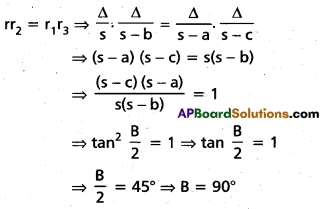
If rr2 = r1r3, then find B.
Solution:
Inter 1st Year Maths 1A Properties of Triangles Important Questions 12

Question 39.
In a ∆ABC, show that the sides a, b, c are in A.P if and only if r1, r2, r3 are in H.P.
Solution:
r1, r2, r3 are in A.P.
⇔ \(\frac{1}{r_{1}}\), \(\frac{1}{r_{2}}\), \(\frac{1}{r_{3}}\) are in A.P.
⇔ \(\frac{s-a}{\Delta}\), \(\frac{s-b}{\Delta}\), \(\frac{s-c}{\Delta}\) are in A.P.
⇔ s – a, s – b, s – c are in A.P.
⇔ -a, -b, -c are in A.P.
⇔ a, b. c, are in A.R

Inter 1st Year Maths 1A Properties of Triangles Important Questions

Question 40.
If A = 90°, show that 2(r + R) = b + c.
Solution:
L.H.S = 2r + 2R
= 2(s – a) tan \(\frac{A}{2}\) + 2R.1
= 2(s – a) tan 45°+ 2RsinA
(∵A = 90°)
= (2s – 2a). 1 + a
= b + c = R.H.S.

Question 41.
If (r2 – r1) (r3 – r1) = 2r2r3, show that A = 90°.
Solution:
(r2 – r1) (r3 – r1) = 2r2r3
Inter 1st Year Maths 1A Properties of Triangles Important Questions 13
⇒ 2(bc – ca – ab + a2) = b2 + c2 + a2 + 2bc – 2ca – 2ab
⇒ 2a2 = b2 + c2 + a2
⇒ b2 + c2 = a2
Hence △ABC is right angled and A = 90°.

Question 42.
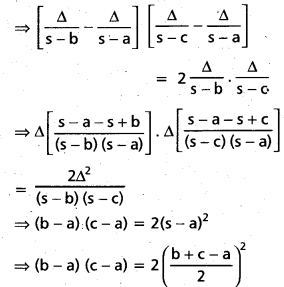
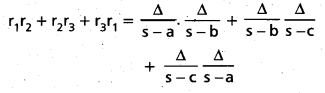
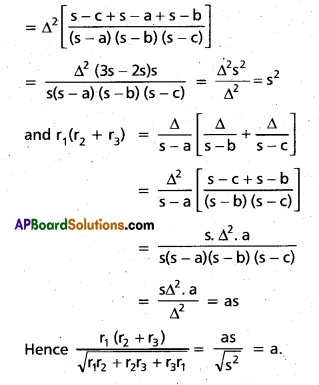
Prove that \(\frac{r_{1}\left(r_{2}+r_{3}\right)}{\sqrt{r_{1} r_{2}+r_{2} r_{3}+r_{3} r_{1}}}\) = a
Solution:
Inter 1st Year Maths 1A Properties of Triangles Important Questions 14
Inter 1st Year Maths 1A Properties of Triangles Important Questions 15

Question 43.
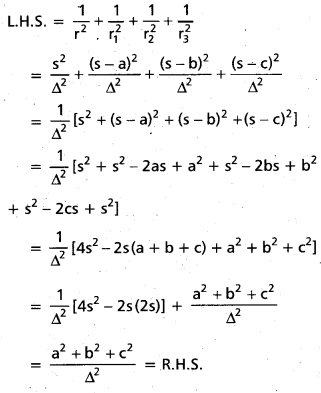
Show that \(\frac{1}{r^{2}}+\frac{1}{r_{1}^{2}}+\frac{1}{r_{2}^{2}}+\frac{1}{r_{3}^{2}}\) = \(\frac{a^{2}+b^{2}+c^{2}}{\Delta^{2}}\)
Solution:
Inter 1st Year Maths 1A Properties of Triangles Important Questions 16

Question 44.
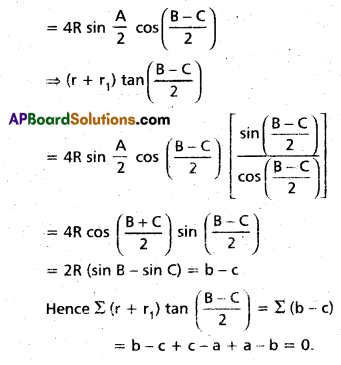
Prove that Σ(r + r1) tan \(\left(\frac{B-C}{2}\right)\) = 0
Solution:
r + r1 = 4R sin \(\frac{A}{2}\) sin \(\frac{B}{2}\) sin \(\frac{C}{2}\) + 4R sin \(\frac{A}{2}\) cos \(\frac{B}{2}\) cos \(\frac{C}{2}\)
= 4R sin\(\frac{A}{2}\)[sin \(\frac{B}{2}\) sin \(\frac{C}{2}\) + cos \(\frac{B}{2}\) cos \(\frac{C}{2}\)]
Inter 1st Year Maths 1A Properties of Triangles Important Questions 17

Question 45.
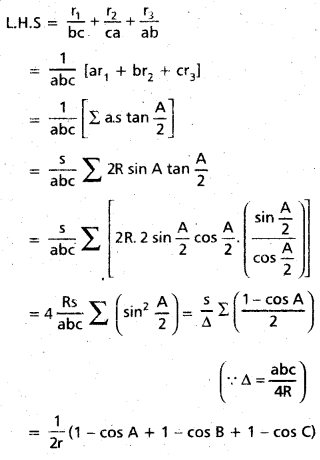
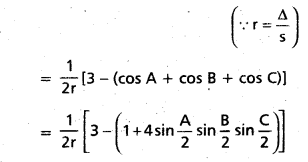
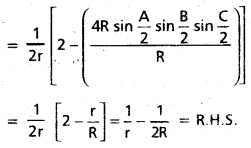
Show that \(\frac{r_{1}}{b c}+\frac{r_{2}}{c a}+\frac{r_{3}}{a b}=\frac{1}{r}-\frac{1}{2 R}\) .    [May 07]
Solution:
Inter 1st Year Maths 1A Properties of Triangles Important Questions 18
Inter 1st Year Maths 1A Properties of Triangles Important Questions 19
Inter 1st Year Maths 1A Properties of Triangles Important Questions 20

Inter 1st Year Maths 1A Properties of Triangles Important Questions

Question 46.
If r: R: r1 = 2 : 5 : 12. then prove that the triangle ¡s right angled at A.
Solution:
r : R : r1 = 2 : 5 : 12 then r = 2k. R = 5k and r1 = 12K
r1 – r = 12k – 2k = 10k = 2(5k) = 2R
⇒ 4R sin \(\frac{A}{2}\)[cos \(\frac{B}{2}\) cos \(\frac{C}{2}\) – sin \(\frac{B}{2}\) sin \(\frac{C}{2}\)] = 2R
⇒ 2 sin\(\frac{A}{2}\) cos\(\left(\frac{B+C}{2}\right)\) = 1
⇒ 2 sin \(\frac{A}{2}\) = \(\frac{1}{2}\) [cos \(\left(\frac{B+C}{2}\right)\) = sin \(\frac{A}{2}\)]
⇒ sin \(\frac{A}{2}\) = \(\frac{1}{\sqrt{2}}\) = sin 45°
⇒ \(\frac{A}{2}\) = 45° ⇒ A = 90°
Hence the triangle is right angled at A.

Question 47.
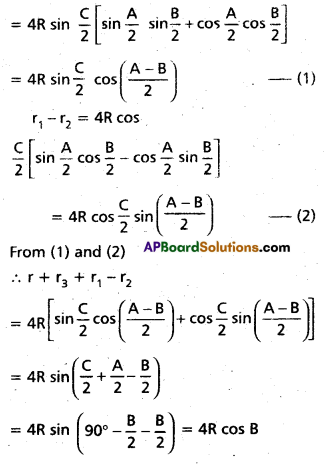
Show that r + r3 + r1 – r2 = 4R cos B.
Solution:
r + r3
Inter 1st Year Maths 1A Properties of Triangles Important Questions 21

Question 48.
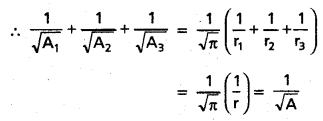
If A, A1, A2, A3 are the areas of incircle and excircles of a triangle respectively, then prove that \(\frac{1}{\sqrt{A_{1}}}+\frac{1}{\sqrt{A_{2}}}+\frac{1}{\sqrt{A_{3}}}=\frac{1}{\sqrt{A}}\) .
Solution:
r, r1, r2, r3 are the in radius and ex-radii of the circles whose areas are A, A1, A2, A3 respectively, then
A = itr2, A1 = πr12, A2 = πr22, A3 = πr32
Inter 1st Year Maths 1A Properties of Triangles Important Questions 22

Question 49.
Show that (r1 + r2) sec2 \(\frac{C}{2}\) = (r2 + r3) sec2 \(\frac{A}{2}\) = (r3 + r1) sec2 \(\frac{B}{2}\).
Solution:
r1 + r2 = 4R cos \(\frac{C}{2}\) [sin\(\frac{A}{2}\) cos\(\frac{B}{2}\) + cos \(\frac{A}{2}\) sin \(\frac{B}{2}\)]
= 4R cos\(\frac{C}{2}\) sin\(\left(\frac{A+B}{2}\right)\)
= 4R cos2\(\frac{C}{2}\) ___________ (1)
⇒ (r1 + r2) sec2\(\frac{C}{2}\) = 4R
Similarly, we can show that
(r2 + r3) sec2\(\frac{A}{2}\) = (r3 + r1) sec2\(\frac{B}{2}\) = 4R
∴ (r1 + r2)sec2\(\frac{C}{2}\) = (r2 + r3)
sec2\(\frac{A}{2}\) = (r3 + r1) sec2\(\frac{B}{2}\) = 4R

Question 50.
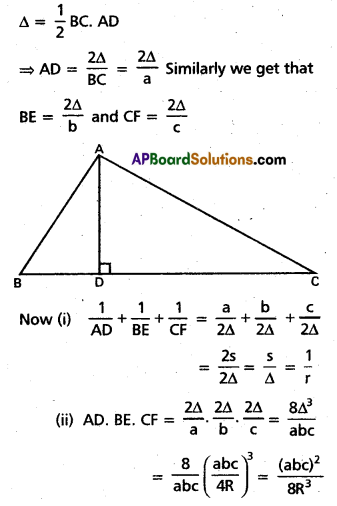
In ∆ABC, if AD, BE, CF are the perpendiculars drawn from the vertices A, B, C to the opposite sides, show that
i) \(\frac{1}{A D}+\frac{1}{B E}+\frac{1}{C F}=\frac{1}{r}\) and
ii) AD. BE. CF = \(\frac{(a b c)^{2}}{8 R^{3}}\)
Solution:
Since AD ⊥r to BC,
Inter 1st Year Maths 1A Properties of Triangles Important Questions 23

Question 51.
In ∆ ABC, if r1 = 8, r2 = 12, r3 = 24, find a, b, c.
Solution:
∵ \(\frac{1}{r}\) = \(\frac{1}{r_{1}}\) + \(\frac{1}{r_{2}}\) + \(\frac{1}{r_{3}}\)
⇒ \(\frac{1}{r}\) = \(\frac{1}{8}\) + \(\frac{1}{12}\) + \(\frac{1}{24}\)
⇒ \(\frac{1}{r}\) = \(\frac{3+2+1}{24}\) ⇒ r = 4
But ∆2 = rr1r2r3 = 4 × 8 × 12 × 24
= (8 × 12)2
⇒ ∆ = 96 sq. cm
∵ r = \(\frac{\Delta}{\mathrm{s}}\) ⇒ 4 = \(\frac{96}{s}\) ⇒ s = 24
∵ r1 = \(\frac{\Delta}{s-a}\)
⇒ δ = \(\frac{96}{s-a}\) ⇒ s – a = \(\frac{96}{8}\) ⇒ 24 – a
= 12 ⇒ a = 12
Similarly s – b = \(\frac{96}{12}\) ⇒ 24 – b = 8 ⇒ b = 16
s – c = \(\frac{96}{24}\) ⇒ 24 – c = 4 ⇒ c = 20

Inter 1st Year Maths 1A Properties of Triangles Important Questions

Question 52.
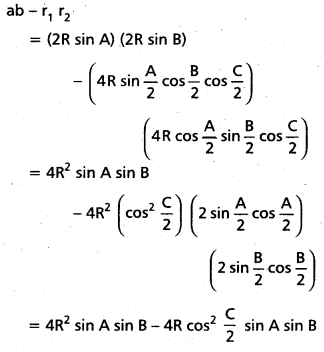
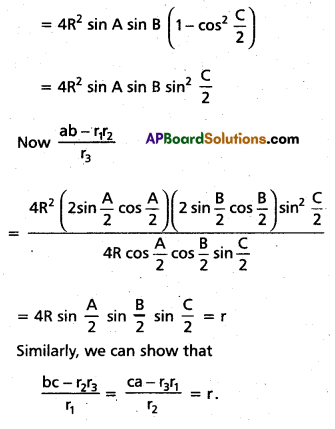
Show that \(\frac{a b-r_{1} r_{2}}{r_{3}}\) = \(\frac{b c-r_{2} r_{3}}{r_{1}}\) = \(\frac{c a-r_{3} r_{1}}{r_{2}}\)   [May 08; Mar 08]
Solution:
Inter 1st Year Maths 1A Properties of Triangles Important Questions 24
Inter 1st Year Maths 1A Properties of Triangles Important Questions 25

Inter 1st Year Maths 1A Hyperbolic Functions Important Questions

Students get through Maths 1A Important Questions Inter 1st Year Maths 1A Hyperbolic Functions Important Questions which are most likely to be asked in the exam.

Intermediate 1st Year Maths 1A Hyperbolic Functions Important Questions

Question 1.
Prove that for any x ∈ R, sinh (3x) = 3 sinh x + 4sinh x
Answer:
LHS = sinh (3x)
= sinh (2x + x)
= sinh (2x) . cosh(x) + cosh (2x) . sinh (x) = (2sinh x cosh x)cosh x (1 +2sinh2 x)sinh x
= 2 sinh x (cosh2 x) + (1 + 2 sinh2 x) sinh x
= 2 sinh x (1 + sinh2 x) + (1 + 2 sinh2 x) sinh x
∵ cosh2 x – sinh2 x = 1
= 3 sinh x + 4 sinh3 x
∴ sinh (3x) = 3 sinh x + 4 sinh3 x

Inter 1st Year Maths 1A Hyperbolic Functions Important Questions

Question 2.
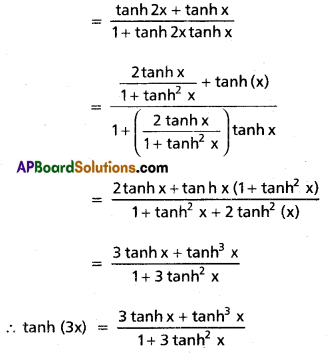
Prove that for any x ∈ R, tanh 3x = \(\frac{3 \tanh x+\tanh ^{3} x}{1+3 \tanh ^{2} x}\)
Answer:
tanh 3x = tan (2x + x)
Inter 1st Year Maths 1A Hyperbolic Functions Important Questions 1

Question 3.
If cosh x = \(\frac{5}{2}\), find the values of
i) cosh (2x) and
ii) sinh (2x)
Answer:
cosh (x) = \(\frac{5}{2}\)
(i) cosh (2x) = 2 cosh2 (x) – 1
= 2(\(\frac{5}{2}\))2 – 1 = \(\frac{25}{2}\) – 1 = \(\frac{23}{2}\)

ii) sinh2 (2x) = cosh2 (2x) – 1
= (\(\frac{23}{2}\))2 – 1 = \(\frac{529-4}{2}\) = \(\frac{525}{4}\)
∴ sinh (2x) = ±\(\sqrt{\frac{525}{4}}\) = ±\(\frac{5 \sqrt{21}}{2}\)

Question 4.
If coshx = sec θ then prove that tan h2\(\frac{x}{2}\) = tan2\(\frac{\theta}{2}\)
Answer:
tan h2\(\frac{x}{2}\) = \(\frac{\cosh x-1}{\cosh x+1}\)
= \(\frac{\sec \theta-1}{\sec \theta+1}\) = \(\frac{1-\cos \theta}{1+\cos \theta}\) = tan2\(\frac{\theta}{2}\)

Inter 1st Year Maths 1A Hyperbolic Functions Important Questions

Question 5.
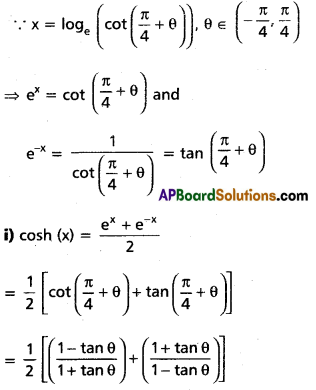
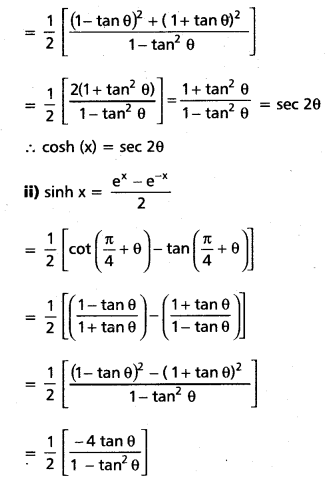
If θ ∈ (-\(\frac{\pi}{4}\), \(\frac{\pi}{4}\)) and x = loge(cot(\(\frac{\pi}{4}\) + θ) then prove that
i) cosh x = sec 2θ and
ii) sinh x = -tan 2θ
Answer:
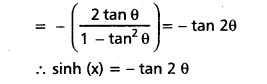
Inter 1st Year Maths 1A Hyperbolic Functions Important Questions 2
Inter 1st Year Maths 1A Hyperbolic Functions Important Questions 3
Inter 1st Year Maths 1A Hyperbolic Functions Important Questions 4

Question 6.
If sinh x = 5, show that x = loge (5 + \(\sqrt{26}\))
Answer:
∴ sinh (x) = 5
⇒ x = sinh-1 (5)
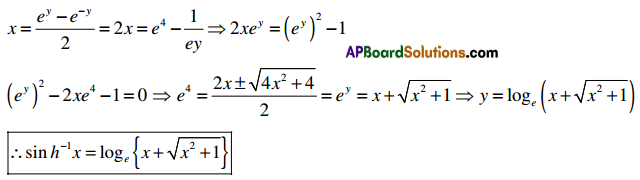
= loge (5 + \(\sqrt{5^{2}+1}\))
= loge (5 + \(\sqrt{26}\))
[sin-1 (x) = loge (x + \(\sqrt{x^{2}+1}\)) for all x ∈ R]

Inter 1st Year Maths 1A Hyperbolic Functions Important Questions

Question 7.
Show that tanh-1(\(\frac{1}{2}\)) = \(\frac{1}{2}\) loge3 (A.P) [Mar 15; May 07, 05; Mar 08, 05]
Answer:
∵tanh-1 (x) = \(\frac{1}{2}\)loge(\(\frac{1+x}{1-x}\)) for all x ∈ (-1, 1)
∵ tanh-1 (\(\frac{1}{2}\)) = \(\frac{1}{2}\)loge(\(\frac{1+\frac{1}{2}}{1-\frac{1}{2}}\))
= \(\frac{1}{2}\)loge(3)

Inter 1st Year Maths 1A Inverse Trigonometric Functions Important Questions

Students get through Maths 1A Important Questions Inter 1st Year Maths 1A Inverse Trigonometric Functions Important Questions which are most likely to be asked in the exam.

Intermediate 1st Year Maths 1A Inverse Trigonometric Functions Important Questions

Question 1.
Find the values of the following.
i) sin-1(-\(\frac{1}{2}\))
Solution:
sin-1(-\(\frac{1}{2}\)) = -sin-1(\(\frac{1}{2}\)) = –\(\frac{\pi}{6}\)

ii) cos-1(-\(\frac{\sqrt{3}}{2}\))
Solution:
cos-1(-\(\frac{\sqrt{3}}{2}\)) = π – cos-1(\(\frac{\sqrt{3}}{2}\))
= π – \(\frac{\pi}{6}\) = \(\frac{5\pi}{6}\)

Inter 1st Year Maths 1A Inverse Trigonometric Functions Important Questions

iii) tan-1(\(\frac{1}{\sqrt{3}}\))
Solution:
tan-1(\(\frac{1}{\sqrt{3}}\)) = \(\frac{\pi}{6}\)

iv) cot-1(-1)
Solution:
cot-1(-1) = π – cot-1 (1) = π – \(\frac{\pi}{4}\)
= \(\frac{3\pi}{4}\)

v) sec-1(-\(\sqrt{2}\))
Solution:
sec-1(-\(\sqrt{2}\)) = π – sec-1(\(\sqrt{2}\))
= π – \(\frac{\pi}{4}\) = \(\frac{3\pi}{4}\)

vi) cosec-1(\(\frac{2}{\sqrt{3}}\))
Solution:
cosec-1(\(\frac{2}{\sqrt{3}}\)) = sin-1(\(\frac{\sqrt{3}}{2}\)) = \(\frac{\pi}{3}\)

Question 2.
Find the values of the following.
i) sin-1(sin \(\frac{4\pi}{3}\))
Solution:
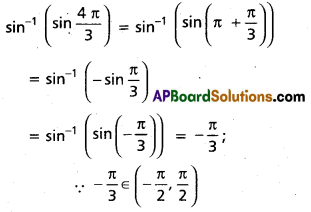
Inter 1st Year Maths 1A Inverse Trigonometric Functions Important Questions 1

ii) cos-1(cos \(\frac{4\pi}{3}\))
Solution:
cos-1(cos \(\frac{4\pi}{3}\))
= cos-1 (cos (π + \(\frac{\pi}{3}\)))
= cos-1 (-cos \(\frac{\pi}{3}\))
= π – cos-1 (cos \(\frac{\pi}{3}\)) = π – \(\frac{\pi}{3}\) = \(\frac{2\pi}{3}\);
∵ \(\frac{2\pi}{3}\) ∈ (0, π)

Inter 1st Year Maths 1A Inverse Trigonometric Functions Important Questions

iii) tan-1(tan \(\frac{4\pi}{3}\))
Solution:
tan-1(tan \(\frac{4\pi}{3}\)) = tan-1(tan(π + \(\frac{\pi}{3}\)))
= tan-1(tan \(\frac{\pi}{3}\)) = \(\frac{\pi}{3}\);
∵ \(\frac{\pi}{3}\) ∈ (-\(\frac{\pi}{2}\), \(\frac{\pi}{2}\))

Question 3.
Find the values of the following
i) sin(cos-1 \(\frac{5}{13}\))
Solution:
sin(cos-1 \(\frac{5}{13}\)) = sin (sin-1 \(\frac{12}{13}\)) = \(\frac{12}{13}\)

ii) tan (sec-1 \(\frac{25}{7}\))
Solution:
tan (sec-1 \(\frac{25}{7}\)) = tan (tan-1 \(\frac{24}{7}\)) = \(\frac{24}{7}\)

iii) cos (tan-1 \(\frac{24}{7}\))
Solution:
cos (tan-1 \(\frac{24}{7}\)) = cos (cos-1 \(\frac{7}{25}\)) = \(\frac{7}{25}\)

Inter 1st Year Maths 1A Inverse Trigonometric Functions Important Questions

Question 4.
Find the values of the following
i) sin2 (tan-1 \(\frac{3}{4}\))
Solution:
sin (tan-1 \(\frac{3}{4}\)) = sin (sin-1 \(\frac{3}{5}\)) = \(\frac{3}{5}\)
∴ sin2 (tan-1 \(\frac{3}{4}\)) = (\(\frac{3}{5}\))2 = \(\frac{9}{25}\)

ii) sin (\(\frac{\pi}{2}\) – sin-1(-\(\frac{4}{5}\)))
Solution:
sin (\(\frac{\pi}{2}\) – sin-1(-\(\frac{4}{5}\))
= sin (\(\frac{\pi}{2}\) – sin-1(\(\frac{4}{5}\))
= cos (sin-1 \(\frac{4}{5}\))
= cos (cos-1 \(\frac{3}{5}\)) = \(\frac{3}{5}\)

iii) cos (cos-1(-\(\frac{2}{3}\)) – sin-1(\(\frac{2}{3}\)))
Solution:
cos (cos-1(-\(\frac{2}{3}\)) – sin-1(\(\frac{2}{3}\)))
= cos (π – cos-1\(\frac{2}{3}\) – sin-1(\(\frac{2}{3}\)))
= cos (π – (cos-1\(\frac{2}{3}\) + sin-1\(\frac{2}{3}\)))
= cos (π – \(\frac{\pi}{2}\)) = cos (\(\frac{\pi}{2}\)) = 0

Inter 1st Year Maths 1A Inverse Trigonometric Functions Important Questions

iv) sec2(cot-1 3) + cosec2 (tan-1 2)
Solution:
Let cot-1 (3) = α and tan-1 (2) = β
Then cot α = 3 and tan β = 2
⇒ tan α = \(\frac{1}{3}\) and cot β = \(\frac{1}{2}\)
Now sec2(cot-1 3) + cosec2 (tan-1 2)
= sec2 α + cosec2 β
= (1 + tan2α) + (1 + cot2 β)
= 1 + (\(\frac{1}{3}\))2 + 1 + (\(\frac{1}{2}\))2
= 2 + \(\frac{1}{9}\) + \(\frac{1}{4}\)
= \(\frac{72+4+9}{36}\) = \(\frac{85}{36}\)

Question 5.
Find the value of cot-1 \(\frac{1}{2}\) + cot-1 \(\frac{1}{3}\)
Solution:
cot-1 \(\frac{1}{2}\) + cot-1 \(\frac{1}{3}\)
= tan-1 (2) + tan-1 (3)
∵ x = 3, y = 2, xy > 1
= π + tan-1 (\(\frac{2+3}{1-(2)(3)}\))
= π + tan-1 (\(\frac{5}{-5}\))
= π + tan-1 (-1)
= π – \(\frac{\pi}{4}\) = \(\frac{3\pi}{4}\)

Question 6.
Prove that sin-1 \(\frac{4}{5}\) + sin-1 \(\frac{7}{25}\) = sin-1 \(\frac{117}{125}\) [Mar 16]
Solution:
Method (i):
Let sin-1(\(\frac{4}{5}\)) = α and sin-1 \(\frac{7}{25}\) = β
Then sin α = \(\frac{4}{5}\) and sin β = \(\frac{7}{25}\) and α, β ∈ (0, \(\frac{\pi}{2}\))
So that cos α = \(\frac{3}{5}\) and cos β = \(\frac{24}{25}\) and α + β ∈ (0, π)
Now
cos(α + β) = cos α cos β – sin α sin β
= \(\frac{3}{5}\) . \(\frac{24}{25}\) – \(\frac{4}{5}\) . \(\frac{7}{25}\)
= \(\frac{72-28}{125}\) = \(\frac{44}{125}\) > 0
⇒ (α + β) ∈ (0, \(\frac{\pi}{2}\))
Now sin(α + β) = sin α cos β – cos α sin β
= \(\frac{4}{5}\) . \(\frac{24}{25}\) – \(\frac{3}{5}\) . \(\frac{7}{25}\)
= \(\frac{96+21}{125}\) = \(\frac{117}{125}\)
⇒ (α + β) = sin (\(\frac{117}{125}\))
∴ sin-1 (\(\frac{4}{5}\)) + sin-1 (\(\frac{7}{25}\)) = sin-1 (\(\frac{117}{125}\)

Inter 1st Year Maths 1A Inverse Trigonometric Functions Important Questions

Method (ii) :
We know that
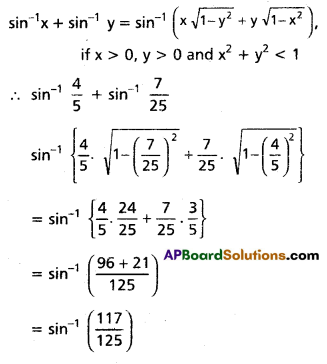
Inter 1st Year Maths 1A Inverse Trigonometric Functions Important Questions 2

Question 7.
If x ∈ (-1, 1), prove that 2 tan-1x = tan-1(\(\frac{2 x}{1-x^{2}}\))
Solution:
∵ x ∈ (-1, 1) and let tan-1 x = α
Then tan α = x and \(\frac{-\pi}{4}\) < \(\frac{\pi}{4}\)
Now tan-1 (\(\frac{2 x}{1-x^{2}}\)) = tan-1 (\(\frac{2 \tan \alpha}{1-\tan ^{2} \alpha}\))
= tan-1 (tan 2α)
= 2α,
since 2α ∈ (-\(\frac{-\pi}{2}\), \(\frac{-\pi}{2}\))
∴ tan-1(\(\frac{2 x}{1-x^{2}}\)) = 2 tan-1 (x)

Question 8.
Prove that sin-1 \(\frac{4}{5}\) + sin-1 \(\frac{5}{13}\) + sin-1 \(\frac{16}{25}\) = \(\frac{\pi}{2}\)
Solution:
Let sin-1 \(\frac{4}{5}\) = α and sin-1 \(\frac{5}{13}\) = β
Then α, β are acute angles and sin α = \(\frac{4}{5}\), sin β = \(\frac{5}{13}\)
So that cos α = \(\frac{3}{5}\) and cos β = \(\frac{12}{13}\)
Now
cos (α + β) = cos α cos β – sin α sin β
= \(\frac{3}{5}\) . \(\frac{12}{13}\) – \(\frac{4}{5}\) . \(\frac{5}{13}\)
= \(\frac{16}{65}\)
∴ α + β = cos-1 (\(\frac{16}{65}\))
⇒ sin-1 \(\frac{4}{5}\) + sin-1 \(\frac{5}{13}\) = cos-1(\(\frac{16}{65}\)) __________ (1)
LHS
= (sin-1\(\frac{4}{5}\) + sin-1 \(\frac{5}{13}\)) + sin-1(\(\frac{16}{65}\))
= cos-1 \(\frac{16}{65}\) + sin-1 \(\frac{16}{65}\) = \(\frac{\pi}{2}\) [By (1)]
LHS = RHS

Inter 1st Year Maths 1A Inverse Trigonometric Functions Important Questions

Question 9.
Prove that cot-1 9 + cosec-1 \(\frac{\sqrt{41}}{4}\) = \(\frac{\pi}{4}\)
Solution:
Let cot-1 (9) = α and cosec-1 \(\frac{\sqrt{41}}{4}\) = β
⇒ cot α = 9 and cosec β = \(\frac{\sqrt{41}}{4}\)
⇒ tan α = \(\frac{1}{9}\) and cot β = Inter 1st Year Maths 1A Inverse Trigonometric Functions Important Questions 11
= \(\sqrt{\frac{41}{16}-1}\) = \(\sqrt{\frac{25}{16}}\) = \(\frac{5}{4}\)
∴tan α = \(\frac{1}{9}\) and tan β = \(\frac{4}{5}\)
Now tan(α + β) = \(\frac{\tan \alpha+\tan \beta}{1-\tan \alpha \tan \beta}\)
= \(\frac{\frac{1}{9}+\frac{4}{5}}{1-\left(\frac{1}{9}\right)\left(\frac{4}{5}\right)}\)
= \(\left(\frac{5+36}{45-4}\right)\) = 1
⇒ tan (α + β) = tan \(\frac{\pi}{4}\)
⇒ α + β = \(\frac{\pi}{4}\)
⇒ cot-1 (9) + cosec-1 (\(\frac{\sqrt{41}}{4}\)) = \(\frac{\pi}{4}\)

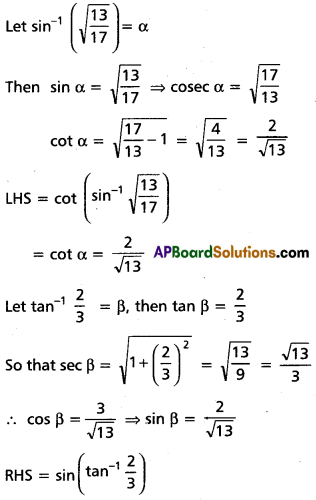
Question 10.
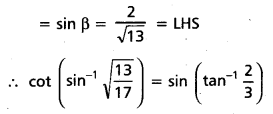
Show that cot (sin-1 \(\sqrt{\frac{13}{17}}\)) = sin (tan-1 \(\frac{2}{3}\))
Solution:
Inter 1st Year Maths 1A Inverse Trigonometric Functions Important Questions 3
Inter 1st Year Maths 1A Inverse Trigonometric Functions Important Questions 4

Question 11.
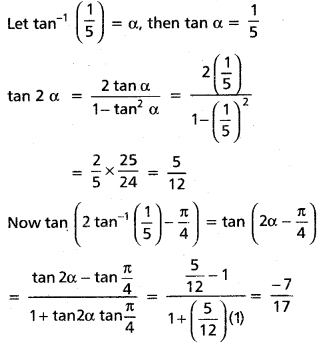
Find the value of tan (2 tan-1(\(\frac{1}{5}\)) – \(\frac{\pi}{4}\))
Solution:
Inter 1st Year Maths 1A Inverse Trigonometric Functions Important Questions 5

Inter 1st Year Maths 1A Inverse Trigonometric Functions Important Questions

Question 12.
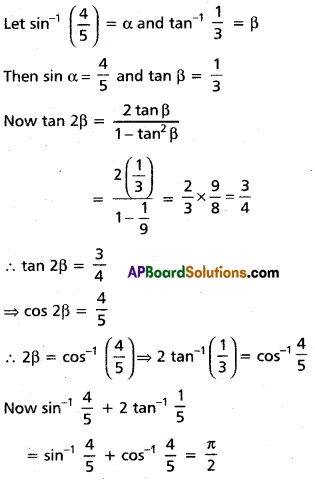
Prove that sin-1 \(\frac{4}{5}\) + 2 tan-1 \(\frac{1}{3}\) = \(\frac{\pi}{2}\)
Solution:
Inter 1st Year Maths 1A Inverse Trigonometric Functions Important Questions 6

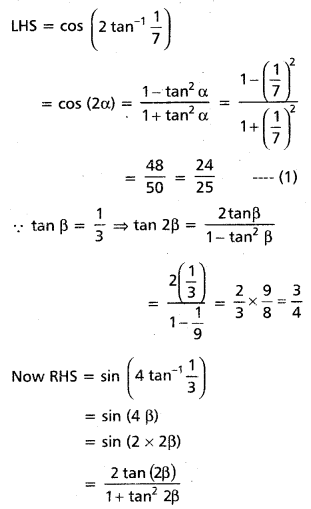
Question 13.
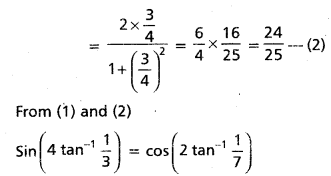
Prove that cos (2 tan-1 \(\frac{1}{7}\)) = sin (4 tan-1 \(\frac{1}{3}\))
Solution:
Let tan-1 \(\frac{1}{7}\)) = α and tan-1 \(\frac{1}{3}\) = β
Then tan α = \(\frac{1}{7}\) and tan β = \(\frac{1}{3}\)
Now
Inter 1st Year Maths 1A Inverse Trigonometric Functions Important Questions 7
Inter 1st Year Maths 1A Inverse Trigonometric Functions Important Questions 8

Inter 1st Year Maths 1A Inverse Trigonometric Functions Important Questions

Question 14.
If sin-1 x + sin-1y + sin-1z = π, then prove that x4 + y4 + z4 + 4x2y2z2 = 2 (x2y2 + y2z2 + z2x2)
Solution:
Let sin-1x = A, sin-1 y = B and sin-1(z) = c
then A + B + C = π ________(1) and
sin A = x, sin B = y and sin C = z
Now A + B = π – C’
= cos (A + B) = cos( π – C’)
= cos A cos B – sin A sin B = -cos C
⇒ \(\sqrt{1-x^{2}} \sqrt{1-y^{2}}\) – xy = – \(\sqrt{1-z^{2}}\)
⇒ \(\sqrt{1-x^{2}} \sqrt{1-y^{2}}\) = xy – \(\sqrt{1-z^{2}}\)
On squaring both sides we get
(1 – x2)(1 – y2) = x2y2 + (1 – z2) – 2xy \(\sqrt{1-z^{2}}\)
⇒ 2xy\(\sqrt{1-z^{2}}\) = x2 + y2 – z2
Again on squaring both sides, we get
(2xy \(\sqrt{1-z^{2}}\))2 (x2 + y2 – z2)2
⇒ 4x2y2(1 – z2) = x4 + y4 + z4 + 2x2y2 – 2y2z2 – 2z2x2
⇒ 4x2y2 – 4x2y2z2 = x4 + y4 + z4 + 2x2y2 – 2y2z2 — 2z2x2
⇒ x4 + y4 + z4 + 4x2y2z2 = 2x2y2 + 2y2z2 + 2z2x2

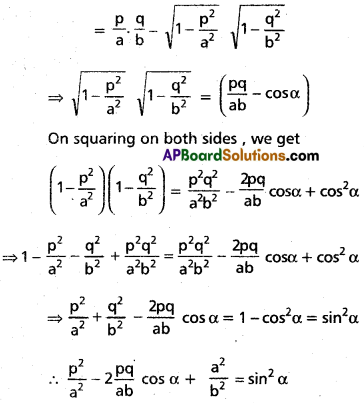
Question 15.
If cos-1\(\frac{p}{a}\) + cos-1\(\frac{q}{b}\) = α, then prove that \(\frac{p^{2}}{a^{2}}\) – \(\frac{2 p q}{a b}\) cos α + \(\frac{q^{2}}{b^{2}}\) = sin2 α
Solution:
Let cos-1\(\frac{p}{a}\) = α and cos-1\(\frac{q}{b}\) = β
then cosα = \(\frac{p}{a}\) and cos β = \(\frac{q}{b}\) and
A + B = α (given)
Now
cos α = cos(A + B)
= cosA cosB – sinA sinB
Inter 1st Year Maths 1A Inverse Trigonometric Functions Important Questions 9

Question 16.
Solve are sin(\(\frac{5}{x}\)) + arc sin \(\frac{12}{x}\) = \(\frac{\pi}{2}\); (x > 0)
Solution:
Given that
sin-1 (\(\frac{5}{x}\)) + sin-1 \(\frac{12}{x}\) = \(\frac{\pi}{2}\); x > 0
Let sin-1 \(\frac{5}{x}\) = α and sin-1 \(\frac{12}{x}\) = β
then sin α = \(\frac{5}{x}\) and sin β = \(\frac{12}{x}\), x > 0
Now α + β = \(\frac{\pi}{2}\)
⇒ α = \(\frac{\pi}{2}\) – β
sin α = sin(\(\frac{\pi}{2}\) – β) ⇒ sin α = cos β
= \(\frac{5}{x}\) = \(\sqrt{1-\left(\frac{12}{x}\right)^{2}}\)
⇒ \(\frac{25}{x^{2}}\) = 1 – \(\frac{144}{x^{2}}\)
⇒ \(\frac{169}{x^{2}}\) = 1 ⇒ x2 = 169 ⇒ x = ± 13
⇒ x = 13 (∵ x > 0)

Inter 1st Year Maths 1A Inverse Trigonometric Functions Important Questions

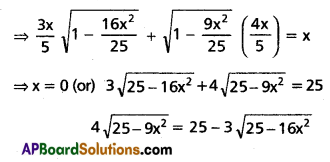
Question 17.
Solve sin-1 (\(\frac{3x}{5}\)) + sin-1 (\(\frac{4x}{5}\)) = sin-1(x)
Solution:
Let sin-1 (\(\frac{3x}{5}\)) = α, sin-1 (\(\frac{4x}{5}\)) = β and sin-1(x) = γ
Then sin α = \(\frac{3x}{5}\), sin β = \(\frac{3x}{5}\) and sin γ = x
⇒ cos α = \(\sqrt{1-\frac{9 x^{2}}{25}}\), cos β = \(\sqrt{1-\frac{16 x^{2}}{25}}\) and cos γ = \(\sqrt{1-x^{2}}\)
Now α + β = γ
⇒ sin (α + β) = sin γ
⇒ sinα cos β + cos α sin β = sin γ
Inter 1st Year Maths 1A Inverse Trigonometric Functions Important Questions 10
Squaring on both sides
16(25 – 9x2) = 625 – 150\(\sqrt{25-16 x^{2}}\) + 9(25 – 16x2)
⇒ 400 – 144x2 = 625 – 150\(\sqrt{25-16 x^{2}}\) + 225 – 144x2
⇒ 150\(\sqrt{25-16 x^{2}}\) = 225 + 225
⇒ \(\sqrt{25-16 x^{2}}\) = 3
⇒ 25 – 16x2 = 9
⇒ 16x2 = 16 ⇒ x = ± 1
∴ x = 0, + 1, – 1.
All these values of x satisfy the given equation.

Question 18.
Solve sin<sup>-1</sup> x + sin<sup>-1</sup> 2x = \(\frac{\pi}{3}\)
Solution:
Given that sin<sup>-1</sup> x + sin<sup>-1</sup> 2x = \(\frac{\pi}{3}\)
⇒ cos (sin<sup>-1</sup>x + sin<sup>-1</sup> 2x) = cos(\(\frac{\pi}{3}\))
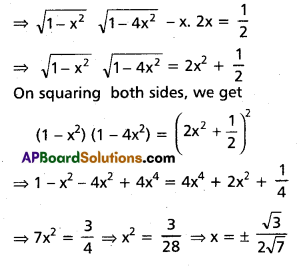
Inter 1st Year Maths 1A Inverse Trigonometric Functions Important Questions 12
But when x = –\(\frac{\sqrt{3}}{2 \sqrt{7}}\),. both sin<sup>-1</sup>x and sin<sup>-1</sup>(2x) are negative. The given equation does not satisfy.
Hence x = \(\frac{\sqrt{3}}{2 \sqrt{7}}\) is the only solution.

Question 19.
If sin [2 cos-1 {cot (2 tan-1 x)}] = 0, find x
Solution:
sin [2cos-1 {cot (2 tan-1 x)}] = 0
⇔ 2 cos-1 [cot (2tan-1 x)] = 0 or π or 2π
(since the range of cos-1 is (0, π)
⇔ cos-1 [cot (2 tan-1 x)] = 0 or \(\frac{\pi}{2}\) or π
⇒ cot (2 tan-1 x) = 1 or 0 or -1
⇒ 2 tan-1 x = ±\(\frac{\pi}{4}\) or ±\(\frac{\pi}{2}\) (or) ±\(\frac{3\pi}{4}\)
∴ tan-1 (x) = ±\(\frac{\pi}{8}\) (or) ±\(\frac{\pi}{4}\) (or) ± \(\frac{3\pi}{8}\)
x = ± (\(\sqrt{2}\) – 1) (or) ±1 (or) ± (\(\sqrt{2}\) + 1)

Inter 1st Year Maths 1A Inverse Trigonometric Functions Important Questions

Question 20.
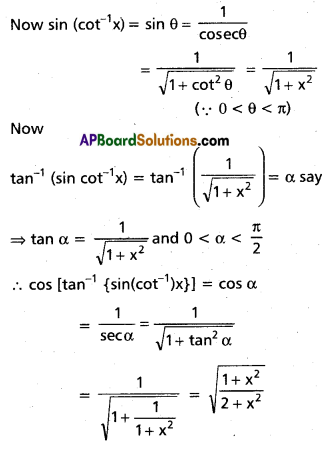
Prove that cos-1 [tan-1 (sin (cot-1x)}] = \(\sqrt{\frac{x^{2}+1}{x^{2}+2}}\)
Solution:
Let cot-1 (x) = θ,
then cot θ = x and 0 < x < π
Inter 1st Year Maths 1A Inverse Trigonometric Functions Important Questions 13

Inter 1st Year Maths 1A Products of Vectors Important Questions

Students get through Maths 1A Important Questions Inter 1st Year Maths 1A Products of Vectors Important Questions which are most likely to be asked in the exam.

Intermediate 1st Year Maths 1A Products of Vectors Important Questions

Question 1.
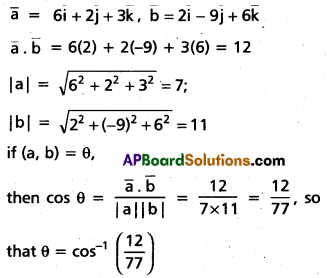
If \(\bar{a}\) = 6\(\bar{i}\) + 2\(\bar{j}\) + 3\(\bar{k}\) and \(\bar{b}\) = 2\(\bar{i}\) – 9\(\bar{j}\) + 6\(\bar{k}\), then find \(\bar{a}\) . \(\bar{b}\) and the angle between \(\bar{a}\) and \(\bar{b}\).
Solution:
Inter 1st Year Maths 1A Products of Vectors Important Questions 1

Question 2.
If a = i + 2j – 3k, b = 3i – j + 2k then show that a + b and a – b are perpendicular to each other. (A.P) (Mar. ’15, May ’11)
Solution:
a + b = (1 + 3)i + (2 – 1)j+ (-3 + 2) k
= 4i + j – k
Similarly a – b = – 2i + 3j – 5k
(a + b). (a – b) = 4(-2) + 1(3) + (-1)(-5) = 0
Hence (a + b) and (a – b) are mutually perpendicular.

Inter 1st Year Maths 1A Products of Vectors Important Questions

Question 3.
Let \(\bar{a}\) and \(\bar{b}\) be non- zero, non-collinear vectors. If |\(\bar{a}\) + \(\bar{b}\) | = | \(\bar{a}\) – \(\bar{b}\) |, then find the angle between \(\bar{a}\) and \(\bar{b}\).
Solution:
| \(\bar{a}\) + \(\bar{b}\) |2 = | a – b |2.
⇒ |\(\bar{a}\)|2 + |\(\bar{b}\)|2 + 2 (\(\bar{a}\). \(\bar{b}\))
⇒ |\(\bar{a}\)|2 + |\(\bar{b}\)|2 – 2 (\(\bar{a}\). \(\bar{b}\))
⇒ 4(\(\bar{a}\) . \(\bar{b}\)) = 0 ⇒ \(\bar{a}\) . \(\bar{b}\) = 0
⇒ Angle between \(\bar{a}\) and \(\bar{b}\) is 90°.

Question 4.
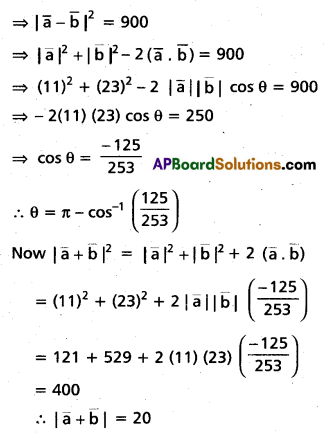
If |\(\bar{a}\)| = 11, |\(\bar{b}\)| = 23 and | \(\bar{a}\) – \(\bar{b}\) | = 30, then find the angle between the vectors \(\bar{a}\), \(\bar{b}\) and also find | \(\bar{a}\) + \(\bar{b}\) |.
Solution:
Given that | \(\bar{a}\) | = 11, | \(\bar{b}\) | = 23 and | \(\bar{a}\) – \(\bar{b}\) | = 30, Let (\(\bar{a}\), \(\bar{b}\)) = θ.
Inter 1st Year Maths 1A Products of Vectors Important Questions 2

Question 5.
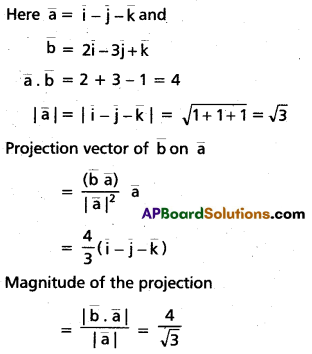
If \(\bar{a}\) = \(\bar{i}\) – \(\bar{j}\) – \(\bar{k}\) and \(\bar{b}\) = 2\(\bar{i}\) – 3\(\bar{j}\) + \(\bar{k}\), then find the projection vector of \(\bar{b}\) on \(\bar{a}\) and its magnitude.
Solution:
Inter 1st Year Maths 1A Products of Vectors Important Questions 3

Question 6.
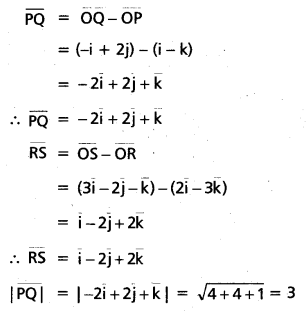
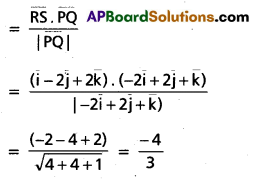
If P, Q, R and S are points whose position vectors are \(\bar{i}\) – \(\bar{k}\), –\(\bar{i}\) +2\(\bar{j}\), 2\(\bar{i}\) – 3\(\bar{k}\) and 3\(\bar{i}\) – 2\(\bar{j}\) – \(\bar{k}\) respectively, then find the component of \(\overline{\mathbf{R S}}\) on \(\overline{\mathbf{P Q}}\).
Solution:
Let ‘O’ be the origin.
\(\overline{\mathrm{OP}}\) = \(\overline{\mathbf{i}}\) – \(\overline{\mathbf{k}}\), \(\overline{\mathrm{OQ}}\) = –\(\overline{\mathbf{i}}\) + 2\(\overline{\mathbf{j}}\), \(\overline{\mathrm{OR}}\) = 2\(\overline{\mathbf{i}}\) – 3\(\overline{\mathbf{k}}\) and \(\overline{\mathrm{OR}}\) = 3\(\overline{\mathbf{i}}\) – 2\(\overline{\mathbf{j}}\) – \(\overline{\mathbf{k}}\)
Inter 1st Year Maths 1A Products of Vectors Important Questions 4
The component of \(\overline{\mathrm{RS}}\) and \(\overline{\mathrm{PQ}}\)
Inter 1st Year Maths 1A Products of Vectors Important Questions 5

Question 7.
If the vectors λ\(\overline{\mathbf{i}}\) – 3\(\overline{\mathbf{j}}\) + 5\(\overline{\mathbf{k}}\) and 2 λ\(\overline{\mathbf{i}}\) – λ\(\overline{\mathbf{j}}\) + \(\overline{\mathbf{k}}\) are perpendicular to each other, find λ. (T.S) (Mar. ’16)
Solution:
Since the vectors are perpendicular
⇒ (λ\(\overline{\mathbf{i}}\) – 3\(\overline{\mathbf{j}}\) + 5\(\overline{\mathbf{k}}\)) . (2λ\(\overline{\mathbf{i}}\) – λ\(\overline{\mathbf{j}}\) – \(\overline{\mathbf{k}}\)) = 0
⇒ λ(2λ) + (-3)(-λ) + 5(-1) = 0
⇒ 2λ2 + 3λ – 5 = 0
⇒ (2λ + 5)(λ – 1) = 0
∴ λ = 1 (or) \(\frac{-5}{2}\)

Inter 1st Year Maths 1A Products of Vectors Important Questions

Question 8.
Let \(\overline{\mathbf{a}}\) = 2\(\overline{\mathbf{i}}\) + 3\(\overline{\mathbf{j}}\) + \(\overline{\mathbf{k}}\), \(\overline{\mathbf{b}}\) = 4\(\overline{\mathbf{i}}\) + \(\overline{\mathbf{j}}\) and \(\overline{\mathbf{c}}\) = \(\overline{\mathbf{i}}\) – 3\(\overline{\mathbf{j}}\) – 7\(\overline{\mathbf{k}}\). Find the vector \(\overline{\mathbf{r}}\) such that \(\overline{\mathbf{r}}\) . \(\overline{\mathbf{a}}\) = 9, \(\overline{\mathbf{r}}\) . \(\overline{\mathbf{b}}\) = 7 and \(\overline{\mathbf{r}}\) . \(\overline{\mathbf{c}}\) = 6.
Solution:
Let \(\overline{\mathbf{r}}\) = x\(\overline{\mathbf{i}}\) + y\(\overline{\mathbf{j}}\) + z\(\overline{\mathbf{k}}\)
∴ \(\overline{\mathbf{r}}\) . \(\overline{\mathbf{a}}\) = 9 ⇒ 2x + 3y + z = 9
\(\overline{\mathbf{r}}\) . \(\overline{\mathbf{b}}\) = 7 ⇒ 4x + y = 7 and \(\overline{\mathbf{r}}\) . \(\overline{\mathbf{c}}\) = 6 ⇒ x – 3y – 7z = 6
By solving these equations, we get x = 1, y = 3 and z = -2
∴ \(\overline{\mathbf{r}}\) = \(\overline{\mathbf{i}}\) + 3\(\overline{\mathbf{j}}\) – 2\(\overline{\mathbf{k}}\)

Question 9.
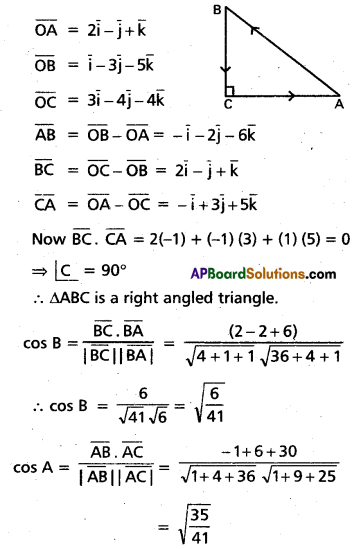
Show that the points 2\(\overline{\mathbf{i}}\) – \(\overline{\mathbf{j}}\) + \(\overline{\mathbf{k}}\), \(\overline{\mathbf{i}}\) – 3\(\overline{\mathbf{j}}\) – 5\(\overline{\mathbf{k}}\) and 3\(\overline{\mathbf{i}}\) – 4\(\overline{\mathbf{j}}\) – 4\(\overline{\mathbf{k}}\) are the vertices of a right angle triangle. Also, find the other angles.
Solution:
Let ‘O’ be the origin and A, B, C be the given points, then
Inter 1st Year Maths 1A Products of Vectors Important Questions 6

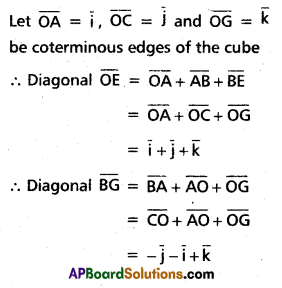
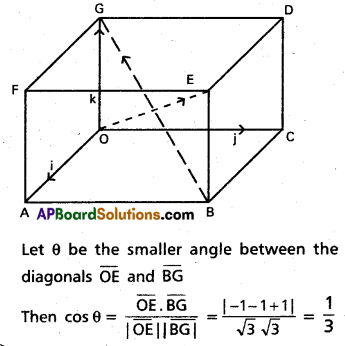
Question 10.
Prove that the angle θ between any two diagonals of a cube is given by cos θ = \(\frac{1}{3}\). (May ’11)
Solution:
Let us suppose that the cube is a unit cube
Inter 1st Year Maths 1A Products of Vectors Important Questions 7
Inter 1st Year Maths 1A Products of Vectors Important Questions 8

Question 11.
Let \(\overline{\mathbf{a}}\), \(\overline{\mathbf{b}}\), \(\overline{\mathbf{c}}\) be non—zero mutually orthogonal vectors, if x \(\overline{\mathbf{a}}\) + y\(\overline{\mathbf{b}}\) + z = 0, then x = y = z = 0.
Solution:
x\(\overline{\mathbf{a}}\) + y\(\overline{\mathbf{b}}\) + z\(\overline{\mathbf{c}}\) = 0
⇒ \(\overline{\mathbf{a}}\) • (x\(\overline{\mathbf{a}}\) + y\(\overline{\mathbf{b}}\) + z\(\overline{\mathbf{c}}\)) = 0
⇒ x(\(\overline{\mathbf{a}}\) • \(\overline{\mathbf{a}}\)) = 0
⇒ x = 0 (∵ \(\overline{\mathbf{a}}\) • \(\overline{\mathbf{a}}\) ≠ 0)
Similarly y = 0, z = 0.

Question 12.
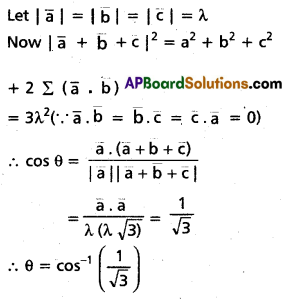
Let \(\overline{\mathbf{a}}\), \(\overline{\mathbf{b}}\) and \(\overline{\mathbf{c}}\) be mutually orthogonal vectors of equal magnitudes. Prove that the vector \(\overline{\mathbf{a}}\) + \(\overline{\mathbf{b}}\) + \(\overline{\mathbf{c}}\) is equally inclined to each of \(\overline{\mathbf{a}}\), \(\overline{\mathbf{b}}\) and \(\overline{\mathbf{c}}\), the angle of inclination being cos-1\(\left(\frac{1}{\sqrt{3}}\right)\).
Solution:
Inter 1st Year Maths 1A Products of Vectors Important Questions 9
Similarly, it can be proved that \(\overline{\mathbf{a}}\) + \(\overline{\mathbf{b}}\) + \(\overline{\mathbf{c}}\) inclines at an angle of cos-1\(\left(\frac{1}{\sqrt{3}}\right)\) with \(\overline{\mathbf{b}}\) and \(\overline{\mathbf{c}}\).

Question 13.
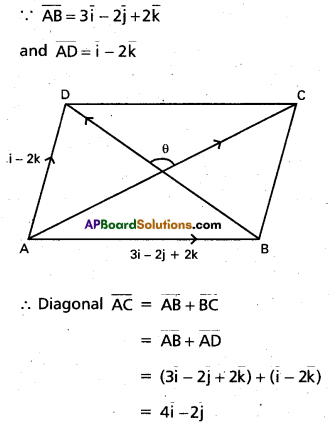
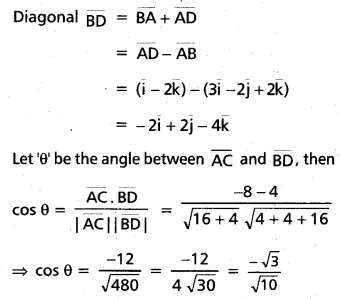
The vectors \(\overline{\mathbf{A B}}\) = 3\(\bar{i}\) – 2\(\bar{j}\) + 2\(\bar{k}\) and \(\overline{\mathbf{A D}}\) = \(\bar{i}\) – 2\(\bar{k}\) represent the adjacent sides of a parallelogram ABCD. Find the angle between the diagonals.
Solution:
Inter 1st Year Maths 1A Products of Vectors Important Questions 10
Inter 1st Year Maths 1A Products of Vectors Important Questions 11

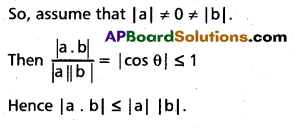
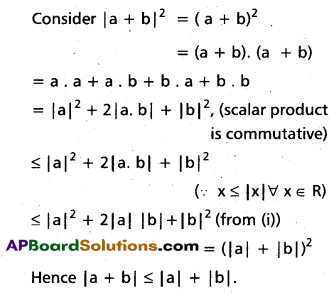
Question 14.
For any two vectors a and b, show that
i) |a • b| (Cauchy – Schwartz inequality)
ii) || a + b | ≤ ||a|| + ||b| (triangle inequality
Solution:
i)
If a = 0 or b = 0, the inequalities hold trivially.
Inter 1st Year Maths 1A Products of Vectors Important Questions 12
ii)
Inter 1st Year Maths 1A Products of Vectors Important Questions 13

Question 15.
Find the cartesian equation of the plane passing through the point (-2, 1, 3) and perpendicular to the vector 3\(\bar{i}\) + \(\bar{j}\) + 5\(\bar{k}\).
Solution:
Let A = -2\(\bar{i}\) + \(\bar{j}\) + 3\(\bar{k}\) and \(\bar{r}\) = x\(\bar{i}\) + y\(\bar{j}\) + z\(\bar{k}\) be any point in the plane
∴ \(\overline{\mathrm{AP}}\) = (x + 2)\(\bar{i}\) + (y – 1)\(\bar{j}\) + (z – 3)\(\bar{k}\)
∴ \(\overline{\mathrm{AP}}\) is perpendicular to 3\(\bar{i}\) + \(\bar{j}\) + 5\(\bar{k}\)
⇒ (x + 2)3 + (y – 1)1 + (z – 3)5 = 0
⇒ 3x + y + z – 10 = 0

Inter 1st Year Maths 1A Products of Vectors Important Questions

Question 16.
Find the cartesian equation of the plane through the point A (2, -1, -4) and parallel to the plane 4x – 12y – 3z – 7 = 0.
Solution:
The equation of the plane parallel to
4x – 12y – 3z – 7 = 0 be
4x -12y – 3z = p
∴ If passes through the point A(2, -1, -4)
⇒ 4(2) – 12(-1) – 3(-4) = p
⇒ p = 32
∴ The equation of the required plane is
4x – 12y – 3z = 32

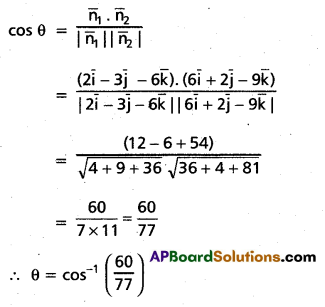
Question 17.
Find the angle between the planes 2x – 3y – 6z = 5 and 6x + 2y – 9z = 4.
Solution:
Equation to the planes is 2x – 3y – 6z = 5
⇒ \(\overline{\mathbf{r}}\) .(2\(\overline{\mathbf{i}}\) – 3\(\overline{\mathbf{j}}\) – 6\(\overline{\mathbf{k}}\)) = 5 ———- (1)
and 6x + 2y – 9z = 4 —— (2)
∴ The angle between the planes \(\overline{\mathbf{r}} \cdot \overline{\mathbf{n}}_{1}\) = p, and \(\overline{\mathbf{r}} \cdot \overline{\mathbf{n}}_{2}\) = q is θ, then
Inter 1st Year Maths 1A Products of Vectors Important Questions 14

Question 18.
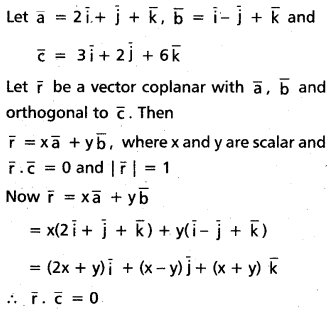
Find unit vector orthogonal to the vector 3\(\bar{i}\) + 2\(\bar{j}\) +6\(\bar{k}\) and coplanar with thevectors 2\(\bar{i}\) + \(\bar{j}\) + \(\bar{k}\) and \(\bar{i}\) – \(\bar{j}\) + \(\bar{k}\).
Solution:
Inter 1st Year Maths 1A Products of Vectors Important Questions 15
⇒ (2x + y)3 + (x – y)2 + (x + y)6 = 0
⇒ 6x + 3y + 2x – 2y + 6x + 6y = 0
⇒ 14x + 7y = 0
⇒ y = -2x —— (1)
∵ |\(\overline{\mathbf{r}}\)| = 1
⇒ (2x + y)2 + (x – y)2 + (x + y)2 = 1
⇒ 4x2 + 4xy + 9 + 2(x2 + y2) = 1
⇒ 6x2 + 4x (-2x) + 3(-2x)2 = 1 (By using (1))
⇒ 10x2 = 1

Question 19.
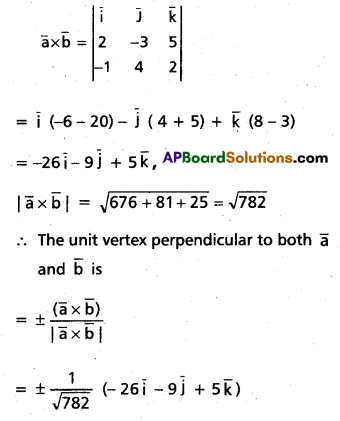
If \(\overline{\mathbf{a}}\) = 2\(\overline{\mathbf{i}}\) – 3\(\overline{\mathbf{j}}\) + 5\(\overline{\mathbf{k}}\), \(\overline{\mathbf{b}}\) = –\(\overline{\mathbf{i}}\) + 4\(\overline{\mathbf{j}}\) + 2\(\overline{\mathbf{k}}\), then find \(\overline{\mathbf{a}}\) × \(\overline{\mathbf{b}}\) and unit vector perpendicular to both \(\overline{\mathbf{a}}\) and \(\overline{\mathbf{b}}\).
Solution:
\(\overline{\mathbf{a}}\) = 2\(\overline{\mathbf{i}}\) – 3\(\overline{\mathbf{j}}\) + 5\(\overline{\mathbf{k}}\) and \(\overline{\mathbf{b}}\) = –\(\overline{\mathbf{i}}\) + 4\(\overline{\mathbf{j}}\) + 2\(\overline{\mathbf{k}}\)
Inter 1st Year Maths 1A Products of Vectors Important Questions 16

Question 20.
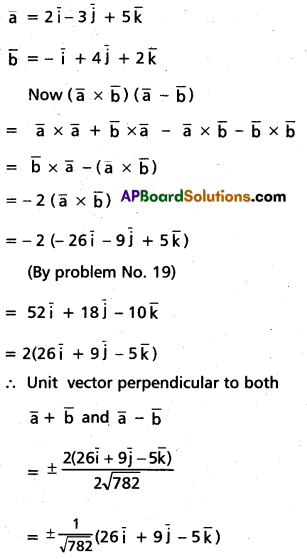
If \(\bar{a}\) = 2\(\bar{i}\) – 3\(\bar{j}\) + 5\(\bar{k}\), \(\bar{b}\) = –\(\bar{i}\) + 4\(\bar{j}\) + 2\(\bar{k}\), then find (\(\bar{a}\) + \(\bar{b}\)) × (\(\bar{a}\) – \(\bar{b}\)) and unit vector perpendicular to both \(\bar{a}\) + \(\bar{b}\) and \(\bar{a}\) – \(\bar{b}\).
Solution:
Inter 1st Year Maths 1A Products of Vectors Important Questions 17

Inter 1st Year Maths 1A Products of Vectors Important Questions

Question 21.
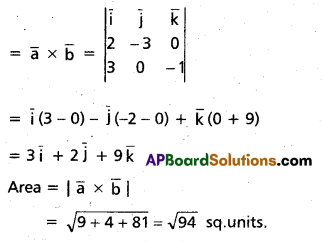
Find the area of the parallelogram for which the vectors \(\bar{a}\) = 2\(\bar{i}\) – 3\(\bar{j}\) and \(\bar{b}\) = 3\(\bar{i}\) – \(\bar{k}\) are adjacent sides. (Mar. ; May ‘08)
Solution:
The vector area of the given parallelogram
Inter 1st Year Maths 1A Products of Vectors Important Questions 18

Question 22.
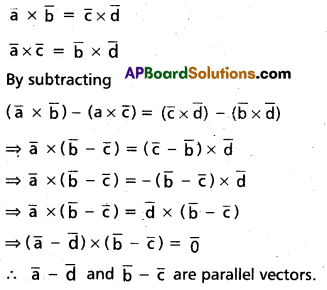
If \(\overline{\mathbf{a}}\), \(\overline{\mathbf{b}}\), \(\overline{\mathbf{c}}\) and \(\overline{\mathbf{d}}\) are vectors such that \(\overline{\mathbf{a}}\) × \(\overline{\mathbf{b}}\) = \(\overline{\mathbf{c}}\) × \(\overline{\mathbf{d}}\) and \(\overline{\mathbf{a}}\) × \(\overline{\mathbf{c}}\) = \(\overline{\mathbf{b}}\) × \(\overline{\mathbf{d}}\) then show that the vectors \(\overline{\mathbf{a}}\) – \(\overline{\mathbf{d}}\) and \(\overline{\mathbf{b}}\) – \(\overline{\mathbf{c}}\) are parallel.
Solution:
Inter 1st Year Maths 1A Products of Vectors Important Questions 19

Question 23.
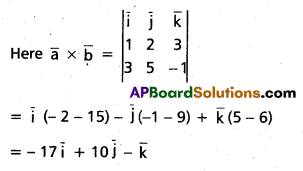
If \(\overline{\mathbf{a}}\) = \(\overline{\mathbf{i}}\) + 2\(\overline{\mathbf{j}}\) + 3\(\overline{\mathbf{k}}\) and \(\overline{\mathbf{b}}\) = 3\(\overline{\mathbf{i}}\) + 5\(\overline{\mathbf{j}}\) – \(\overline{\mathbf{k}}\) are two sides of a triangle, then find
its area.
Solution:
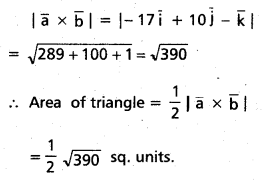
Area of the triangle = \(\frac{1}{2}|\bar{a} \times \bar{b}|\)
Inter 1st Year Maths 1A Products of Vectors Important Questions 20
Inter 1st Year Maths 1A Products of Vectors Important Questions 21

Question 24.
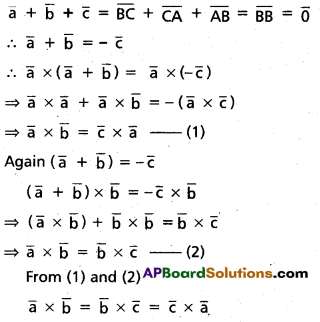
In Δ ABC, if \(\overline{\mathrm{BC}}\) = \(\bar{a}\), \(\overline{\mathrm{CA}}\) = \(\bar{b}\), \(\overline{\mathrm{AB}}\) = \(\bar{c}\) then show that \(\bar{a}\) × \(\bar{b}\) = \(\bar{b}\) × \(\bar{c}\) = \(\bar{c}\) × \(\bar{a}\).
Solution:
Inter 1st Year Maths 1A Products of Vectors Important Questions 22

Question 25.
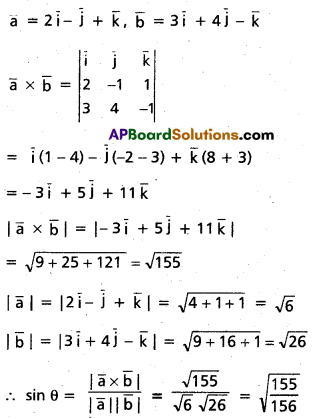
Let \(\bar{a}\) = 2\(\bar{i}\) – \(\bar{j}\) + \(\bar{k}\) and \(\bar{b}\) = 3\(\bar{i}\) + 4\(\bar{j}\) – \(\bar{k}\). If θ is the angle between \(\bar{a}\) and \(\bar{b}\) then find sin θ.
Solution:
Inter 1st Year Maths 1A Products of Vectors Important Questions 23

Inter 1st Year Maths 1A Products of Vectors Important Questions

Question 26.
Let \(\bar{a}\), \(\bar{b}\) and \(\bar{c}\) be such that \(\bar{c}\) ≠ 0,
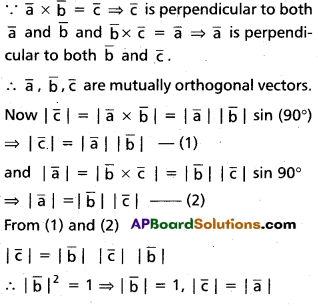
\(\bar{a}\) × \(\bar{b}\) = \(\bar{c}\), \(\bar{b}\) × \(\bar{c}\) = \(\bar{a}\). Show that \(\bar{a}\), \(\bar{b}\), \(\bar{c}\) are pair wise orthogonal vectors and |\(\bar{b}\)| = 1, |\(\bar{c}\)| = |\(\bar{a}\)|.
Solution:
Inter 1st Year Maths 1A Products of Vectors Important Questions 24

Question 27.
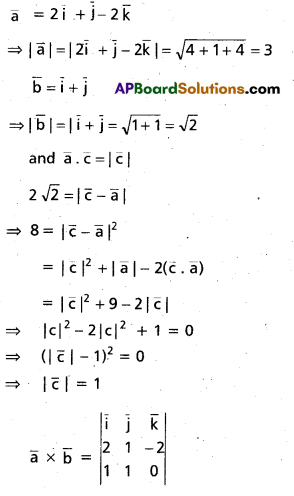
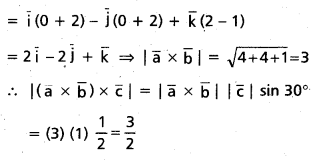
Let \(\overline{\mathbf{a}}\) = 2\(\overline{\mathbf{i}}\) + \(\overline{\mathbf{j}}\) – 2\(\overline{\mathbf{k}}\) ; \(\overline{\mathbf{b}}\) = \(\overline{\mathbf{i}}\) + \(\overline{\mathbf{j}}\). If \(\overline{\mathbf{c}}\) is a vector such that \(\overline{\mathbf{a}}\) . \(\overline{\mathbf{c}}\) = |\(\overline{\mathbf{c}}\)|, |\(\overline{\mathbf{c}}\) – \(\overline{\mathbf{a}}\)| = \(2 \sqrt{2}\) and the angle between \(\overline{\mathbf{a}}\) × \(\overline{\mathbf{b}}\) = \(2 \sqrt{2}\) and the angle between \(\overline{\mathbf{a}}\) × \(\overline{\mathbf{b}}\) and \(\overline{\mathbf{c}}\) is 30°, then find the value of |(\(\overline{\mathbf{a}}\) × \(\overline{\mathbf{b}}\)) × \(\overline{\mathbf{c}}\)|
Solution:
Inter 1st Year Maths 1A Products of Vectors Important Questions 25
Inter 1st Year Maths 1A Products of Vectors Important Questions 26

Question 28.
Let \(\overline{\mathbf{a}}\), \(\overline{\mathbf{b}}\) be two non-collinear unit vectors. If \(\bar{\alpha}\) = \(\overline{\mathbf{a}}\) – (\(\overline{\mathbf{a}}\) • \(\overline{\mathbf{b}}\))\(\overline{\mathbf{b}}\) and \(\bar{\beta}\) =
= \(\overline{\mathbf{a}}\) × \(\overline{\mathbf{b}}\), then show that |\(\overline{\boldsymbol{\beta}}\)| = |\(\bar{\alpha}\)|.
Solution:
Inter 1st Year Maths 1A Products of Vectors Important Questions 27

Question 29.
A non-zero vector \(\bar{a}\) is parallel to the line of intersection of the plane determined by the vectors \(\bar{i}\), \(\bar{i}\) + \(\bar{j}\) and the plane determined by the vectors \(\bar{i}\) – \(\bar{j}\), \(\bar{i}\) + \(\bar{k}\). Find the angle between \(\bar{a}\) and the vector \(\bar{i}\) – 2\(\bar{j}\) + 2\(\bar{k}\).
Solution:
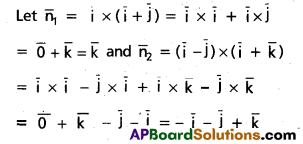
Let l be the line of intersection of the planes determined by the pairs \(\bar{i}\), \(\bar{i}\) + \(\bar{j}\) and \(\bar{i}\) – \(\bar{j}\), \(\bar{i}\) + \(\bar{k}\)
Inter 1st Year Maths 1A Products of Vectors Important Questions 28
∴ \(\bar{n}_{1}\) is perpendicular to l and \(\bar{n}_{2}\) is also perpendicular to l.
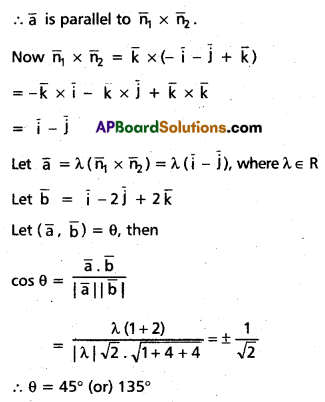
∴ \(\bar{a}\) is parallel to the line l, follows that \(\bar{a}\) is perpendicularto both \(\bar{n}_{1}\), and \(\bar{n}_{2}\)
Inter 1st Year Maths 1A Products of Vectors Important Questions 29

Question 30.
Let \(\overline{\mathbf{a}}\) = 4\(\overline{\mathbf{i}}\) + 5\(\overline{\mathbf{j}}\) – \(\overline{\mathbf{k}}\), \(\overline{\mathbf{b}}\) = \(\overline{\mathbf{i}}\) – 4\(\overline{\mathbf{j}}\) + 5\(\overline{\mathbf{k}}\) and \(\overline{\mathbf{c}}\) = 3\(\overline{\mathbf{i}}\) + \(\overline{\mathbf{j}}\) – \(\overline{\mathbf{k}}\). Find the vector \(\bar{\alpha}\) which is perpendicular to both \(\overline{\mathbf{a}}\) and \(\overline{\mathbf{b}}\) and \(\bar{\alpha} \cdot \mathbf{c}\) = 21.
Solution:
Inter 1st Year Maths 1A Products of Vectors Important Questions 30

Question 31.
For any vector a, show that |a × i|2 + |a × j|2 + |a × k|2 = 2|a|2.
Solution:
Let a = x i + y j + z k.
Then a × i = -yk + zj.
∴ |a × i|2 = y2 + z2
Similarly |a × j|2 = z2 + x2 and |a × k|2 = x2
+ y2
∴ |a × i|2 + |a × j|2 + |a × k|2 = 2(x2 + y2 + z2) = 2|a|2

Inter 1st Year Maths 1A Products of Vectors Important Questions

Question 32.
If \(\overline{\mathbf{a}}\) is a non-zero vector and \(\overline{\mathbf{b}}\), \(\overline{\mathbf{c}}\) are two vector such that \(\overline{\mathbf{a}}\) × \(\overline{\mathbf{b}}\) = \(\overline{\mathbf{a}}\) × \(\overline{\mathbf{c}}\) and \(\overline{\mathbf{a}}\) • \(\overline{\mathbf{b}}\) = \(\overline{\mathbf{a}}\) • \(\overline{\mathbf{c}}\), then prove that \(\overline{\mathbf{b}}\) = \(\overline{\mathbf{c}}\).
Solution:
Inter 1st Year Maths 1A Products of Vectors Important Questions 31

Question 33.
Prove that the vectors \(\bar{a}\) = 2\(\bar{i}\) – \(\bar{j}\) + \(\bar{k}\), \(\bar{b}\) = \(\bar{i}\) – 3\(\bar{j}\) – 5\(\bar{k}\) and \(\bar{c}\) = 3\(\bar{i}\) – 4\(\bar{j}\) – 4\(\bar{k}\) are coplanar.
Solution:
Inter 1st Year Maths 1A Products of Vectors Important Questions 32

Question 34.
Find the volume of the parallelopiped whose cotersminus edges are represented by the vectors 2\(\bar{i}\) – 3\(\bar{j}\) + \(\bar{k}\), \(\bar{i}\) – \(\bar{j}\) + 2\(\bar{k}\) and 2\(\bar{i}\) + \(\bar{j}\) – \(\bar{k}\).
Solution:
Let \(\bar{a}\) = 2\(\bar{i}\) – 3\(\bar{j}\) + \(\bar{k}\)
Inter 1st Year Maths 1A Products of Vectors Important Questions 33

Question 35.
If the vectors \(\bar{a}\) = 2\(\bar{i}\) – \(\bar{j}\) + \(\bar{k}\), \(\bar{b}\) = \(\bar{i}\) + 2\(\bar{j}\) – 3\(\bar{k}\) and \(\bar{c}\) = 3\(\bar{i}\) + p\(\bar{j}\) + 5\(\bar{k}\) are coplanar, then find p.
Solution:
Inter 1st Year Maths 1A Products of Vectors Important Questions 34

Question 36.
Show that
\(\overline{\mathbf{i}}\) × (\(\overline{\mathbf{a}}\) × \(\overline{\mathbf{i}}\)) + \(\overline{\mathbf{j}}\) × (\(\overline{\mathbf{a}}\) × \(\overline{\mathbf{j}}\)) + k × (\(\overline{\mathbf{a}}\) × \(\overline{\mathbf{k}}\)) = 2\(\overline{\mathbf{a}}\) for any vector \(\overline{\mathbf{a}}\).
Solution:
Inter 1st Year Maths 1A Products of Vectors Important Questions 35

Question 37.
Prove that for any three vectors \(\overline{\mathbf{a}}\), \(\overline{\mathbf{b}}\), \(\overline{\mathbf{c}}\), [\(\overline{\mathbf{b}}\) + \(\overline{\mathbf{c}}\) \(\overline{\mathbf{c}}\) + \(\overline{\mathbf{a}}\) \(\overline{\mathbf{a}}\) + \(\overline{\mathbf{b}}\)] = 2[\(\overline{\mathbf{a}}\) \(\overline{\mathbf{b}}\) \(\overline{\mathbf{c}}\)]
Solution:
Inter 1st Year Maths 1A Products of Vectors Important Questions 36

Question 38
For any three vectors \(\overline{\mathbf{a}}\), \(\overline{\mathbf{b}}\), \(\overline{\mathbf{c}}\) prove that [\(\overline{\mathbf{b}}\) × \(\overline{\mathbf{c}}\) \(\overline{\mathbf{c}}\) × \(\overline{\mathbf{a}}\) \(\overline{\mathbf{a}}\) × \(\overline{\mathbf{b}}\)] = [\(\overline{\mathbf{a}}\) \(\overline{\mathbf{b}}\) \(\overline{\mathbf{c}}\)]2
Solution:
Inter 1st Year Maths 1A Products of Vectors Important Questions 37

Question 39.
Let \(\overline{\mathbf{a}}\), \(\overline{\mathbf{b}}\) and \(\overline{\mathbf{c}}\) be unit vectors such that \(\overline{\mathbf{b}}\) is not parallel to \(\overline{\mathbf{c}}\) and \(\overline{\mathbf{a}}\) × (\(\overline{\mathbf{b}}\) × \(\overline{\mathbf{c}}\)) = \(\frac{1}{2} \bar{b}\). Find the angles made by \(\overline{\mathbf{a}}\) with each of \(\overline{\mathbf{b}}\) and \(\overline{\mathbf{c}}\).
Solution:
Inter 1st Year Maths 1A Products of Vectors Important Questions 38
Since \(\overline{\mathbf{b}}\) and \(\overline{\mathbf{c}}\) are non—collinear vectors. Equating corresponding coeffs. on both sides
Inter 1st Year Maths 1A Products of Vectors Important Questions 39
Inter 1st Year Maths 1A Products of Vectors Important Questions 40

Question 40.
Let \(\overline{\mathbf{a}}\) = \(\overline{\mathbf{i}}\) + \(\overline{\mathbf{j}}\) + \(\overline{\mathbf{k}}\), \(\overline{\mathbf{b}}\) = 2\(\overline{\mathbf{i}}\) – \(\overline{\mathbf{j}}\) + 3\(\overline{\mathbf{k}}\), \(\overline{\mathbf{c}}\) = \(\overline{\mathbf{i}}\) – \(\overline{\mathbf{j}}\) and \(\overline{\mathbf{d}}\) = 6\(\overline{\mathbf{i}}\) + 2\(\overline{\mathbf{j}}\) + 3\(\overline{\mathbf{k}}\). Express \(\overline{\mathbf{d}}\) interms of \(\overline{\mathbf{b}}\) × \(\overline{\mathbf{c}}\), \(\overline{\mathbf{c}}\) × \(\overline{\mathbf{a}}\) and \(\overline{\mathbf{a}}\) × \(\overline{\mathbf{b}}\)  (May. ’12)
Solution:
Inter 1st Year Maths 1A Products of Vectors Important Questions 41
Then from the above problem,
Inter 1st Year Maths 1A Products of Vectors Important Questions 42

Inter 1st Year Maths 1A Products of Vectors Important Questions

Question 41.
For any four vectors \(\overline{\mathbf{a}}\), \(\overline{\mathbf{b}}\), \(\overline{\mathbf{c}}\) and \(\overline{\mathbf{d}}\) prove that
(\(\overline{\mathbf{b}}\) × \(\overline{\mathbf{c}}\)) . (\(\overline{\mathbf{a}}\) × \(\overline{\mathbf{d}}\)) + (\(\overline{\mathbf{c}}\) × \(\overline{\mathbf{a}}\)) . (\(\overline{\mathbf{b}}\) × \(\overline{\mathbf{d}}\)) + (\(\overline{\mathbf{a}}\) × \(\overline{\mathbf{b}}\)) . (\(\overline{\mathbf{c}}\) × \(\overline{\mathbf{d}}\)) = 0.
Solution:
Inter 1st Year Maths 1A Products of Vectors Important Questions 43

Question 42.
Find the equation of the plane passing through the points A = (2, 3, -1), B = (4, 5, 2) and C = (3, 6, 5).
Solution:
Let ‘O’ be the origin
Inter 1st Year Maths 1A Products of Vectors Important Questions 44
Let P be any point on the plane passing through the points A, B, C.
Inter 1st Year Maths 1A Products of Vectors Important Questions 45
Hence, equation of the required plane is
Inter 1st Year Maths 1A Products of Vectors Important Questions 46

Question 43.
Find the equation of the plane passing through the point A (3, -2, -1) and parallel to the vector \(\bar{b}\) = \(\bar{i}\) – 2\(\bar{j}\) + 4\(\bar{k}\) and \(\bar{c}\) = 3\(\bar{i}\) + 2\(\bar{j}\) – 5\(\bar{k}\).
Solution:
The required plane passes through A = (3, -2, -1) and is parallel to the vectors
\(\bar{b}\) = \(\bar{i}\) – 2\(\bar{j}\) + 4\(\bar{k}\) and \(\bar{c}\) = 3\(\bar{i}\) + 2\(\bar{j}\) – 5\(\bar{k}\). Hence if P is a point in the plane, then AP, b and C are coplanar and [AP b c] = 0.
Inter 1st Year Maths 1A Products of Vectors Important Questions 50
i.e., 2x + 17y + 8z + 36 = 0 is the equation of the required plane.

Question 44.
Find the vector equation of the plane passing through the intersection of the planes r. (i + j + k) = 6 and r. (2i + 3j+ 4k) = -5 and the point (1, 1, 1).
Solution:
Inter 1st Year Maths 1A Products of Vectors Important Questions 48
Substituting this value of λ in equation (1), we get
Inter 1st Year Maths 1A Products of Vectors Important Questions 49

Question 45.
Find the distance of a point (2, 5, -3) from the plane r. (6i – 3j + 2k) = 4.
Solution:
Here a = 2i + 5j – 3k, N = 6i – 3j + 2k and d = 4.
∴ The distance of the point (2, 5, -3) from the given plane is
Inter 1st Year Maths 1A Products of Vectors Important Questions 51

Question 46.
Find the angle between the line \(\frac{x+1}{2}\) = \(\frac{y}{3}\) = \(\frac{z-3}{6}\) and the plane 10x + 2y – 11z = 3.
Solution:
Let φ be the angle between the given line and the normal to the plane.
Converting the given equations into vector form, we have
r = (-i + 3k) + λ(2i + 3j + 6k)
and r. (10i + 2j – 11k) = 3
Here b = 2i + 3j + 6k and n = 10i + 2j – 11k
Inter 1st Year Maths 1A Products of Vectors Important Questions 52

Inter 1st Year Maths 1A Products of Vectors Important Questions

Question 47.
For any four vectors a, b, c and d, (a × b) × (c × d) = [a c d]b – [b c d]a and (a × b) × (c × d) = [a b d]c – [a b c]d.
Solution:
Let m = c × d
∴ (a × b) × (c × d) = (a × b) × m
= (a.m)b – (b.m)a
= (a. (c × d))b – (b. (c × d))a
= [a c d]b – [b c d]a.
Again Let a × b = n.
Then(a × b) × (c × d) = n × (c × d)
= (n .d)c – (n.c)d
= ((a × b). d) c – ((a × b). c)d
= [a b d]c – [a b c]d.

Question 48.
Find the shortest distance between the skew line r = (6i + 2j + 2k) + t(i – 2j + 2k) and r = (-4i – k) + s (3i – 2j – 2k).
Solution:
The first line passes through the point
A(6, 2, 2) and is parallel to the vector b = i – 2j + 2k. Second line passes through the point C(-4, 0, -1) and is parallel to the vector d = 3i – 2j – 2k
Inter 1st Year Maths 1A Products of Vectors Important Questions 53

Question 49.
The angle ¡n a semi circle is a right angle. (May ’08)
Solution:
Let O be the centre and AOB be the diameter of the given šemi circle. Let P be a point on the semi circle. With reference to O as the origin, if the position vectors of A and P are taken as \(\overline{\mathrm{a}}\) and \(\overline{\mathrm{p}}\),then
Inter 1st Year Maths 1A Products of Vectors Important Questions 54

Question 50.
The altitude of a triangle are concurrent.
ii) The perpendicular bisectors of the sides of a triangle are concurrent.
Solution:
i) In the given triangle ABC, let the altitudes from A, B drawn to BC. CA respectively intersect them at D, E. Assume that AD and BE intersect at O, join CO and produce it to meet AB at F. With reference to O, let the position vectors of A, B and C be a, b and c respectively.
Inter 1st Year Maths 1A Products of Vectors Important Questions 55
From Fig. we have
Inter 1st Year Maths 1A Products of Vectors Important Questions 56

ii) In the given ABC, let the mid-points of BC, CA and AB be D, E and F respectively. Let the perpendicular bisectors drawn to BC and CA at D and E meet at O. Join OF. With respect to O, let the position vectors of A, B and C be \(\bar{a}\), \(\bar{b}\) and \(\bar{c}\) respectively.
Inter 1st Year Maths 1A Products of Vectors Important Questions 57
Inter 1st Year Maths 1A Products of Vectors Important Questions 58
On adding equations (1) and (2), we obtain
Inter 1st Year Maths 1A Products of Vectors Important Questions 59

Question 51.
Show that the vector area of the quadrilateral ABCD having diagonals \(\overline{\mathbf{A C}}\), \(\overline{\mathbf{B D}}\) is \(\frac{1}{2}(\overline{A C} \times \overline{B D})\)
Solution:
If the point of intersection of the diagonals AC, BD of the given quadrilateral ABCD is assumed as Q, the vector area of the quadrilateral ABCD.
Inter 1st Year Maths 1A Products of Vectors Important Questions 60
= Sum of the vector areas of ΔQAB, ΔQBC, ΔQCD and ΔQDA.
Inter 1st Year Maths 1A Products of Vectors Important Questions 61

Inter 1st Year Maths 1A Products of Vectors Important Questions

Question 52.
For any vectors a, b and c (a × b) × c = (a.c) b – (b.c) a (AP) (Mar. 15 May ‘06; June ’04)
Solution:
Equation (1) is evidently true if a and b are parallel.
Now suppose that a and b are non-parallel.
Let O denote the origin. Choose points A and B such that \(\overline{\mathrm{OA}}\) = \(\overline{\mathbf{a}}\) and \(\overline{\mathrm{OB}}\) = \(\overline{\mathbf{b}}\). Since \(\overline{\mathbf{a}}\) and \(\overline{\mathbf{b}}\) are non-parallel, the points O, A and B are non-collinear. Hence they determine a plane.
Let i denote the unit vector along \(\overline{\mathrm{OA}}\).
Let j be a unit vector in the OAB plane perpendicular to i. Let k = i × j. Then
Inter 1st Year Maths 1A Products of Vectors Important Questions 62

Question 53.
For any four vectors a, b, c and d(a × b). (c × d) = \(\left|\begin{array}{cc}
a \cdot c & a \cdot d \\
b . c & b . d
\end{array}\right|\) and in particular (a × b)2 = a2b2 – (a. b)2.
Solution:
Inter 1st Year Maths 1A Products of Vectors Important Questions 63

Question 54.
In the above fou rmula if \(\overline{\mathbf{a}}\), \(\overline{\mathbf{b}}\), \(\overline{\mathbf{c}}\) and \(\overline{\mathbf{d}}\)(\(\overline{\mathbf{a}}\) × \(\overline{\mathbf{b}}\)). (\(\overline{\mathbf{c}}\) × \(\overline{\mathbf{d}}\)) = (\(\overline{\mathbf{a}}\) . \(\overline{\mathbf{c}}\))(\(\overline{\mathbf{b}}\) . \(\overline{\mathbf{d}}\)) – (\(\overline{\mathbf{a}}\) . \(\overline{\mathbf{d}}\))(\(\overline{\mathbf{b}}\) . \(\overline{\mathbf{c}}\)) = \(\left|\begin{array}{ll}
\overline{\mathbf{a}} \cdot \overline{\mathbf{c}} & \overline{\mathbf{a}} \cdot \overline{\mathbf{d}} \\
\overline{\mathbf{b}} \cdot \overline{\mathbf{c}} & \bar{b} \cdot \overline{\mathbf{d}}
\end{array}\right|\).
Solution:
Inter 1st Year Maths 1A Products of Vectors Important Questions 64
Since this is a scalar, this is also called the scalar product of four vectors.

Inter 1st Year Maths 1A Addition of Vectors Important Questions

Students get through Maths 1A Important Questions Inter 1st Year Maths 1A Addition of Vectors Important Questions which are most likely to be asked in the exam.

Intermediate 1st Year Maths 1A Addition of Vectors Important Questions

Question 1.
Find unit vector in the direction of vector a = 2i + 3j + k. (Mar. 14)
Solution:
The unit vector in the direction of a vector a is given by \(\hat{a}\) = \(\frac{1}{|a|} a\)
Now |a| = \(\sqrt{2^{2}+3^{2}+1^{2}}\) = \(\sqrt{14}\).
∴ \(\hat{a}\) = \(\frac{1}{\sqrt{14}}\)(2i + 3j + k)
= \(\frac{2}{\sqrt{14}} i\) + \(\frac{3}{\sqrt{14}} \mathrm{j}\) + \(\frac{1}{\sqrt{14}} k\)

Question 2.
Find a vector in the direction of vector a = i – 2j that has magnitude 7 units.
Solution:
The unit vector in the direction of the given vector a is
\(\hat{a}\) = \(\frac{1}{|\mathrm{a}|} \mathrm{a}\) = \(\frac{1}{\sqrt{5}}(i-2 j)\) = \(\frac{1}{\sqrt{5}} \mathrm{i}\) – \(\frac{2}{\sqrt{5}} \mathrm{j}\)
Therefore, the vector having a magnitude equal to 7 and in the direction of a is
7a = 7\(\left(\frac{1}{\sqrt{5}} \mathrm{i}-\frac{2}{\sqrt{5}} \mathrm{j}\right)\) = \(\frac{7}{\sqrt{5}} \mathrm{i}\) – \(\frac{14}{\sqrt{5}} j\)

Inter 1st Year Maths 1A Addition of Vectors Important Questions

Question 3.
Find the unit vector in the direction of the sum of the vectors.
a = 2i + 2j – 5k and b = 2i + j + 3k.
Solution:
The sum of the given vectors is
a + b (= c, say) = 4i + 3j – 2k and
|c| = \(\sqrt{4^{2}+3^{2}+(-2)^{2}}\) = \(\sqrt{29}\).
∴ \(\hat{c}\) = \(\frac{a+b}{|a+b|}\) = \(\frac{4 i+3 j-2 k}{\sqrt{29}}\)

Question 4.
Write direction ratios of the vector a = i + j – 2k and hence calculate its direction cosines.
Solution:
Note that direction ratios a, b, c of a vector r = xi + yj + zk are just the respective components x. y and z of the vector. So, for the given vector, we have a = 1, b = 1, c = – 2, Further, if l, m and n the direction cosines of the given vector, then
l = \(\frac{a}{|r|}\) = \(\frac{1}{\sqrt{6}}\), m = \(\frac{b}{|r|}\) = \(\frac{1}{\sqrt{6}}\),
n = \(]\frac{c}{|r|}\) = \(\frac{2}{\sqrt{6}}\) as |r| = \(\sqrt{6}\).
Thus, the direction cosines are
(\(\frac{1}{\sqrt{6}}\), \(\frac{1}{\sqrt{6}}\), \(-\frac{2}{\sqrt{6}}\)).

Question 5.
Consider two points P and Q with position vectors OP = 3a – 2b and OQ = a + b. Find the position vector of a point R which divides the line joining P and Q in the ratio 2 :1,
(i) internally and
(ii) externally.
Solution:
i) The position vector of the point R dividing the join of P and Q internally in the ratio 2 : 1 is
OR = \(\frac{2(a+b)+(3 a-2 b)}{2+1}\) = \(\frac{5 a}{3}\)

ii) The position vector of the point R dividing the join of P and Q externally in the ratio 2 : 1 is
OR = \(\frac{2(a+b)-(3 a-2 b)}{2-1}\) = 4b – a.

Question 6.
Show that the points A (2i – j + k), B(i – 3j – 5k), C(3i – 4j – 4k) are the vertices of a right angled triangle.
Solution:
We have AB = (1 – 2)i + (-3 + 1)j + (-5 – 1)
k = -i – 2j – 6k
BC = (3 – 1)i + (-4 + 3)j + (-4 + 5)k
= 2i – j + k. and CA = (2 – 3)i + (-1 + 4)j + (1 +4)k = -i + 3j + 5k.
we have |AB|2 = |BC|2 + |CA|2.

Inter 1st Year Maths 1A Addition of Vectors Important Questions

Question 7.
Let A. B, C, D be four points with position vectors \(\overline{\mathbf{a}}\) + 2\(\overline{\mathbf{b}}\), 2\(\overline{\mathbf{a}}\) – \(\overline{\mathbf{b}}\), \(\overline{\mathbf{a}}\) and 3\(\overline{\mathbf{a}}\) + \(\overline{\mathbf{b}}\) respectively. Express the vectors \(\overline{\mathbf{A C}}\), \(\overline{\mathbf{D A}}\), \(\overline{\mathbf{B A}}\) and \(\overline{\mathbf{B C}}\) interms of \(\overline{\mathbf{a}}\) and \(\overline{\mathbf{b}}\).
Solution:
The position vectors of A, B, C, D with respect to the origin O are
Inter 1st Year Maths 1A Addition of Vectors Important Questions 1

Question 8.
Let ABCDEF be a regular hexagon with centre O. Show that \(\overline{\mathbf{A B}}\) + \(\overline{\mathbf{A C}}\) + \(\overline{\mathbf{A D}}\) + \(\overline{\mathbf{A E}}\) + \(\overline{\mathbf{A F}}\) = 3\(\overline{\mathbf{A D}}\) = 6\(\overline{\mathbf{A O}}\) (Mar. ’16, ’15)
Solution:
Let ABCDEF be a regular hexagon with centre O.
Then \(\overline{\mathbf{A B}}\) = \(\overline{\mathbf{B C}}\) = \(\overline{\mathbf{C D}}\) = \(\overline{\mathbf{D E}}\) = \(\overline{\mathbf{E F}}\) = \(\overline{\mathbf{F A}}\)
Inter 1st Year Maths 1A Addition of Vectors Important Questions 2

Question 9.
In ΔABC, If \(\overline{\mathbf{a}}\), \(\overline{\mathbf{b}}\), \(\overline{\mathbf{c}}\) are position vectors of the vertices A, B and C respectively, then prove that the position vector of the centroid G is \(\frac{1}{3}(\bar{a}+\bar{b}+\bar{c})\).
Solution:
Let G be the centroid of ΔABC and AD is the median through the vector A.
Then AG : GD = 2 : 1. Let ‘O’ be the origin \(\overline{\mathrm{OA}}\) = \(\bar{a}\), \(\overline{\mathrm{OB}}\) = \(\bar{b}\), \(\overline{\mathrm{OC}}\) = \(\bar{c}\) ∵ D is Mid point of BC, the P.V. of D is \(\overline{O D}\) = \(\frac{1}{2}(\bar{b}+\bar{c})\)
Inter 1st Year Maths 1A Addition of Vectors Important Questions 3
G divides the median AD in the ratio 2 : 1
∴ The P.V. of G is
Inter 1st Year Maths 1A Addition of Vectors Important Questions 4

Question 10.
In ΔABC, if ‘O’ is the circum centre and H is the orthocentre, then show that
i) \(\overline{O A}\) + \(\overline{O B}\) + \(\overline{O C}\) = \(\overline{O H}\)
ii) \(\overline{H A}\) + \(\overline{H B}\) + \(\overline{H C}\) = 2\(\overline{H O}\)
Solution:
Let D be the midpoint of BC

i) Take’O’as the origin, let \(\overline{O A}\) = \(\bar{a}\) \(\overline{O B}\) = \(\bar{b}\) and \(\overline{O C}\) = \(\bar{c}\)
Inter 1st Year Maths 1A Addition of Vectors Important Questions 5
(∵ AH =2 R cos A, OD = R cos A, R is the circum radius of Δ ABC and hence AH = 2 (OD))

ii) \(\overline{\mathrm{HA}}\) + \(\overline{\mathrm{HB}}\) + \(\overline{\mathrm{HC}}\) = \(\overline{\mathrm{HA}}\) +2\(\overline{\mathrm{HD}}\)
= \(\overline{\mathrm{HA}}\) + 2(\(\overline{\mathrm{HO}}\) + \(\overline{\mathrm{OD}}\))
= \(\overline{\mathrm{HA}}\) + 2\(\overline{\mathrm{HO}}\) + 2\(\overline{\mathrm{OD}}\)
= \(\overline{\mathrm{HA}}\) + 2\(\overline{\mathrm{HO}}\) + \(\overline{\mathrm{AH}}\) = 2\(\overline{\mathrm{HO}}\)

Question 11.
Let \(\bar{a}\), \(\bar{b}\), \(\bar{c}\) and \(\bar{d}\) be the position vectors of A, B,C and D respectively which are the vertices of a tetrahedron. Then Prove that the lines joining the vertices to the centroids of the opposite faces are concurrent (this point is called the centroid or the centre of the tetrahe dron)
Solution:
Let ‘O’ be the origin of reference
Let G1, G2, G3 and G4 be the centroids of ΔBCD, ΔCAD, ΔABD and ΔABC, respectively then OG1 = \(\frac{\overline{\mathrm{b}}+\overline{\mathrm{c}}+\overline{\mathrm{d}}}{3}\)
Inter 1st Year Maths 1A Addition of Vectors Important Questions 6
Consider the point P that divides AG1 in the ratio 3 : 1
Inter 1st Year Maths 1A Addition of Vectors Important Questions 7
Similarly we can show that the P.vs. of the points dividing BG2, CG3 and DG4 in the ratio 3 : 1 are equal to \(\frac{1}{4}\) (\(\overline{\mathrm{a}}\) + \(\overline{\mathrm{b}}\) + \(\overline{\mathrm{c}}\) + \(\overline{\mathrm{d}}\)). Therefore P lies on each of AG1, BG2, CG3 and DG4.

Question 12.
Let OABC be a parallelogram and D the mid point of OA. Prove that the segment CD trisects the diagonal OB and is trisected by the diagonal OB.
Solution:
Let \(\overline{\mathrm{OA}}\) = \(\bar{a}\), \(\overline{\mathrm{OC}}\) = \(\bar{b}\), So that
\(\overline{\mathrm{OB}}\) = \(\bar{a}\) + \(\bar{b}\), \(\overline{\mathrm{OD}}\) = \(\frac{1}{2}\)(\(\bar{a}\))
Inter 1st Year Maths 1A Addition of Vectors Important Questions 8
Let M be the intersection of OB and CD.
Let OM : MB = k : 1 and CM : MD = l : 1
Inter 1st Year Maths 1A Addition of Vectors Important Questions 9
∴ l = 2 and k = \(\frac{1}{2}\)
∴ CD trisects OB and OB trisects CD

Inter 1st Year Maths 1A Addition of Vectors Important Questions

Question 13.
Let \(\bar{a}\), \(\bar{b}\) be non – collinear vectors, if \(\bar{\alpha}\) = (x + 4y)\(\bar{a}\) + (2x + y + 1)\(\bar{b}\) and \(\bar{\beta}\) = (y – 2x + 2)\(\bar{a}\) + (2x – 3y – 1)\(\bar{b}\) are such that 3\(\bar{\alpha}\) = \(\bar{\beta}\), then find x andy.
Solution:
Given 3\(\bar{\alpha}\) = 2\(\bar{\beta}\)
⇒ 3(x + 4y)\(\bar{a}\) + 3(2x + y + 1)\(\bar{b}\) = 2(y – 2x + 2)\(\bar{a}\) + 2(2x – 3y – 1)\(\bar{b}\)
On comparing the coeffs. of \(\bar{a}\) and \(\bar{b}\), we get
3x + 12y = 2y – 4x + 4 ⇒ 7x + 10y = 4 ——–— (1)
and 6x + 3y + 3 = 4x – 6y – 2 ⇒
2x + 9y = -5 ——–—(2)
Solve (1) and (2), we get
x = 2 and y = -1

Question 14.
Show that the points whose position vectors are
-2\(\bar{a}\) + 3\(\bar{b}\) + 5\(\bar{c}\), \(\bar{a}\) + 2\(\bar{b}\) + 3\(\bar{c}\), 7\(\overline{\mathrm{a}}\) + \(\overline{\mathrm{c}}\) are non – collinear when \(\bar{a}\), \(\bar{b}\), \(\bar{c}\) are non – coplanar vectors.
Solution:
Let O be the origin and let P, Q, R be the P.Vs. of the given points
Inter 1st Year Maths 1A Addition of Vectors Important Questions 10
⇒ The points P, Q, R are collinear.

Question 15.
If the points whose position vectors are 3\(\bar{i}\) – 2\(\bar{j}\) – \(\bar{k}\), 2\(\bar{i}\) + 3\(\bar{j}\) – 4\(\bar{k}\), –\(\bar{i}\) + \(\bar{j}\) + 2\(\bar{k}\) and 4\(\bar{i}\) + 5\(\bar{j}\) + λ\(\bar{k}\) are coplanar, then show that λ = \(\frac{-146}{7}\)
Solution:
Let ‘O’ be the origin and Let A, B, C and D be the given points. Then
Inter 1st Year Maths 1A Addition of Vectors Important Questions 11
Equating the corresponding coeffs.
-x – 4y = 1, 5x + 3y = 7, -3x + 3y = λ + 1
Solving x + 4y + 1 = 0 and 5x + 3y – 7 = 0
Inter 1st Year Maths 1A Addition of Vectors Important Questions 12

Question 16.
In the two dimensional plane, Prove by using vector methods, the equation of the line whose intercepts on the
axes are ‘a’ and ’b’ is \(\frac{x}{a}\) + \(\frac{y}{b}\) = 1.
Solution:
Let A = (a, 0), B = (0, b)
∴ A = a\(\overline{\mathbf{i}}\), B = b\(\overline{\mathbf{j}}\)
The equation of the line is
\(\overline{\mathbf{r}}\) = (1 – t)a\(\overline{\mathbf{i}}\) + t(b\(\overline{\mathbf{j}}\))
If \(\overline{\mathbf{r}}\) = x\(\overline{\mathbf{i}}\) + y\(\overline{\mathbf{j}}\), then x = (1 – t)a and y = t b
By eliminating ‘t’
x = \(\left(1-\frac{y}{b}\right) a\)
⇒ \(\frac{x}{a}\) + \(\frac{y}{b}\) = 1

Question 17.
Using the vector equation of the straight line passing through two points, prove that the points whose position vectors are \(\overline{\mathbf{a}}\), \(\overline{\mathbf{b}}\) and (3\(\overline{\mathbf{a}}\) – 2\(\overline{\mathbf{b}}\)) are collinear.
Solution:
The vector equation of the st. line passing through two pt.s \(\overline{\mathbf{a}}\) and \(\overline{\mathbf{b}}\) is
\(\overline{\mathbf{r}}\) = (1 – t) \(\overline{\mathbf{a}}\) + t\(\overline{\mathbf{b}}\) ; for some t ∈ R
This line also passes through the pt. which
P.v. is 3\(\overline{\mathbf{a}}\) – 2\(\overline{\mathbf{b}}\) then
3\(\overline{\mathbf{a}}\) – 2\(\overline{\mathbf{b}}\) = (1 – t)\(\overline{\mathbf{a}}\) + t\(\overline{\mathbf{b}}\)
Equating the corresponding coeffs,
1 – t = 3 and t = -2
∴ The three given points are collinear.

Inter 1st Year Maths 1A Addition of Vectors Important Questions

Question 18.
Find the equation of the line parallel to the vector 2\(\overline{\mathbf{i}}\) – \(\overline{\mathbf{j}}\) + 2\(\overline{\mathbf{k}}\) and which passes through the point A whose position vector is 3\(\overline{\mathbf{i}}\) + \(\overline{\mathbf{j}}\) – \(\overline{\mathbf{k}}\). If P is a point on this line such that AP = 15, find the position vector of R
Solution:
The vector equation of the line passing through the point A whose P.v is
Inter 1st Year Maths 1A Addition of Vectors Important Questions 13
Inter 1st Year Maths 1A Addition of Vectors Important Questions 14

Question 19.
Show that the line joining the pair of points 6\(\overline{\mathbf{a}}\) – 4\(\overline{\mathbf{b}}\) + 4\(\overline{\mathbf{c}}\) and the line joining the pair of points –\(\overline{\mathbf{a}}\) – 2\(\overline{\mathbf{b}}\) – 3\(\overline{\mathbf{c}}\), \(\overline{\mathbf{a}}\) + 2\(\overline{\mathbf{b}}\) – 5\(\overline{\mathbf{c}}\) intersect at the point -4\(\overline{\mathbf{c}}\) when \(\overline{\mathbf{a}}\), \(\overline{\mathbf{b}}\), \(\overline{\mathbf{c}}\) are non-coplanar vectors. (T.S) (Mar. ’16)
Solution:
The vector equation o+ the-line joining the pair of points \(\bar{q}\) = 6\(\bar{a}\) – 4\(\bar{b}\) + 4\(\bar{c}\), and \(\bar{p}\) = -4\(\bar{c}\) is \(\bar{r}\) = (1 – t)\(\bar{p}\) + t\(\bar{q}\) for t ∈ R
Inter 1st Year Maths 1A Addition of Vectors Important Questions 15
Let \(\bar{r}\) be the point of intersection of (1) and (2) then equating the coeffs of \(\bar{a}\), \(\bar{b}\) and \(\bar{c}\), we get
6t = 2s – 1 ⇒ 6t – s = -1 ——- (3)
– 4t = 4s – 2 ⇒ 4t + 4s = 2 —— (4)
-4 + 8t = -2s – 3 ⇒ 8t + 2s = 1 —— (5)
From (3) and (4)
Inter 1st Year Maths 1A Addition of Vectors Important Questions 16
From (1) s = \(\frac{1}{2}\)
Substitute t = 0 and s = \(\frac{1}{2}\) in (5)
8(0) + 2(\(\frac{1}{2}\)) = 1 ⇒ 1 = 1
Hence the lines (1) and (2) point of intersection put t = 0 in (1)
(i.e) \(\bar{r}\) = -4\(\bar{c}\)
∴ The two lines intersect at the point whose P.v. is -4\(\bar{c}\)

Question 20.
Find the point of intersection of the line \(\bar{r}\) = 2\(\bar{a}\) + \(\bar{b}\) + t(\(\bar{b}\) – \(\bar{c}\)) and the plane \(\bar{r}\) = \(\bar{a}\) + x(\(\bar{b}\) + \(\bar{c}\)) + y(\(\bar{a}\) + 2\(\bar{b}\) – \(\bar{c}\)) where \(\bar{a}\), \(\bar{b}\), \(\bar{c}\) are non — coplanar vectors.
Solution:
Let \(\bar{r}\) be the P.v. of the point P, the intersection of the line and the plane.
Then
2\(\bar{a}\) + \(\bar{b}\) + t(\(\bar{b}\) – \(\bar{c}\)) = \(\bar{a}\) + x(\(\bar{b}\) + \(\bar{c}\)) + y(\(\bar{a}\) + 2\(\bar{b}\) – \(\bar{c}\))
∵ \(\bar{a}\), \(\bar{b}\), \(\bar{c}\) are non – coplanar vectors.
Equation th coeffs. of \(\bar{a}\), \(\bar{b}\), \(\bar{c}\)
2 = 1 + y ⇒ y = 1
1 + t = x + 2y
⇒ 1 + t = x + 2(1)
⇒ t – x = 1 ——— (1)
and -t = x – y
x + t = y
⇒ x + t = 1 ——— (2)
From (1),(2) t = 1, x = 0, y = 1
∴ Point of intersection is
\(\bar{r}\) = 2\(\bar{a}\) + \(\bar{b}\) + 1(\(\bar{b}\) – \(\bar{c}\))
⇒ \(\bar{r}\) = 2\(\bar{a}\) + \(\bar{b}\) + 1(\(\bar{b}\) – \(\bar{c}\))
⇒ \(\bar{r}\) = 2\(\bar{a}\) + 2\(\bar{b}\) – \(\bar{c}\)
∴ P.v. of the point of intersection is 2\(\bar{a}\) + 2\(\bar{b}\) – \(\bar{c}\)

Inter 1st Year Maths 1A Matrices Important Questions

Students get through Maths 1A Important Questions Inter 1st Year Maths 1A Matrices Important Questions which are most likely to be asked in the exam.

Intermediate 1st Year Maths 1A Matrices Important Questions

Question 1.
If A = \(\left[\begin{array}{ccc}
2 & 3 & -1 \\
7 & 8 & 5
\end{array}\right]\) and B = \(\left[\begin{array}{ccc}
1 & 0 & 1 \\
2 & -4 & -1
\end{array}\right]\) then find A + B.
Solution:
The matrices A and B both are of the same order 2 × 3. Hence A + B is defined. Now
Inter 1st Year Maths 1A Matrices Important Questions 1

Question 2.
If \(\left[\begin{array}{ccc}
x-1 & 2 & y-5 \\
z & 0 & 2 \\
1 & -1 & 1+a
\end{array}\right]\) = \(\left[\begin{array}{ccc}
1-x & 2 & -y \\
2 & 0 & 2 \\
1 & -1 & 1
\end{array}\right]\) then find the values of x, y, z and a.
Solution:
From the equality of matrices
x – 1 = 1 – x ⇒ 2x = 2 ⇒ x = 1
y – 5 = -y ⇒ 2y = 5 ⇒ y = \(\frac{5}{2}\) ⇒ z = 2
z = 2
1 + a = 1 ⇒ a = 1 – 1 ⇒ a = 0

Inter 1st Year Maths 1A Matrices Important Questions

Question 3.
Find the trace of A if A = \(\left[\begin{array}{ccc}
1 & 2 & -\frac{1}{2} \\
0 & -1 & 2 \\
-\frac{1}{2} & 2 & 1
\end{array}\right]\) (Mar. ’04)
Solution:
The elements of the principal diagonal of A are 1,-1, 1.
Hence the trace of A is 1 + (-1) + 1 =1

Question 4.
If A = \(\left[\begin{array}{cc}
4 & -5 \\
-2 & 3
\end{array}\right]\) then find -5A.
Solution:
-5A = -5\(\left[\begin{array}{cc}
4 & -5 \\
-2 & 3
\end{array}\right]\) = \(\left[\begin{array}{cc}
-20 & 25 \\
10 & -15
\end{array}\right]\)

Question 5.
Find the additive inverse of A, where
A = \(\left[\begin{array}{ccc}
i & 0 & 1 \\
0 & -i & 2 \\
-1 & 1 & 5
\end{array}\right]\)
Solution:
The additive inverse of A is -A = (-1)A
∴ Additive inverse of A
Inter 1st Year Maths 1A Matrices Important Questions 2

Question 6.
If A = \(\left[\begin{array}{ccc}
2 & 3 & 1 \\
6 & -1 & 5
\end{array}\right]\) and B = \(\left[\begin{array}{ccc}
1 & 2 & -1 \\
0 & -1 & 3
\end{array}\right]\) then find the matrix X such that A + B – X = 0. What is the order of the matrix X ?
Solution:
Given, A + B – X = 0 ⇒ X = A + B
= \(\left[\begin{array}{ccc}
2 & 3 & 1 \\
6 & -1 & 5
\end{array}\right]\) + \(\left[\begin{array}{ccc}
1 & 2 & -1 \\
0 & -1 & 3
\end{array}\right]\)
∴ X = \(\left[\begin{array}{ccc}
3 & 5 & 0 \\
6 & -2 & 8
\end{array}\right]\) ∴ Order of X is 2 × 3.

Inter 1st Year Maths 1A Matrices Important Questions

Question 7.
If A = \(\left[\begin{array}{lll}
0 & 1 & 2 \\
2 & 3 & 4 \\
4 & 5 & 6
\end{array}\right]\) and B = \(\left[\begin{array}{ccc}
1 & -2 & 0 \\
0 & 1 & -1 \\
-1 & 0 & 3
\end{array}\right]\) then find A – B and 4B – 3A.
Solution:
Inter 1st Year Maths 1A Matrices Important Questions 3

Question 8.
If A = \(\left[\begin{array}{ll}
1 & 2 \\
3 & 4
\end{array}\right]\), B = \(\left[\begin{array}{ll}
3 & 8 \\
7 & 2
\end{array}\right]\) and 2X + A = B then find ‘X’. (A.P.) (Mar. ’15, ’11)
Solution:
2X + A = B ⇒ 2X = B – A
Inter 1st Year Maths 1A Matrices Important Questions 4

Question 9.
Two factories I and II produce three varieties of pens namely. Gel, Ball and Ink pens. The sale in rupees of these varieties of pens by both the factories in the month of September and October in a year are given by the following matrices A and B.
September sales (in Rupees)
Inter 1st Year Maths 1A Matrices Important Questions 5
i) Find the combined sales in September and October for each factory in each variety.
ii) Find the decrease in sales from September to October.
Solution:
i) Combined sales in September and October for each factory in each variety is given by
Inter 1st Year Maths 1A Matrices Important Questions 6
ii) Decrease in sales from September to October is given by
Inter 1st Year Maths 1A Matrices Important Questions 7

Question 10.
Construct a 3 × 2 matrix whose elements are defined by aij = \(\frac{1}{2}|\mathbf{i}-3 \mathbf{j}|\). (T.S) (Mar. ’15)
Solution:
In general 3 × 2 matrix is given by
Inter 1st Year Maths 1A Matrices Important Questions 8

Question 11.
If A = \(\left[\begin{array}{lll}
0 & 1 & 2 \\
1 & 2 & 3 \\
2 & 3 & 4
\end{array}\right]\) and B = \(\left[\begin{array}{cc}
1 & -2 \\
-1 & 0 \\
2 & -1
\end{array}\right]\) then find AB and BA.
Solution:
The number of columns of A = 3 = the number of rows of B.
Hence AB is defined and
Inter 1st Year Maths 1A Matrices Important Questions 9
Since the number of columns of B = 2 ≠ 3 = the number of rows of A.
∴ BA is not defined.

Inter 1st Year Maths 1A Matrices Important Questions

Question 12.
If A = \(\left[\begin{array}{ccc}
1 & -2 & 3 \\
2 & 3 & -1 \\
-3 & 1 & 2
\end{array}\right]\) and B = \(\left[\begin{array}{lll}
1 & 0 & 2 \\
0 & 1 & 2 \\
1 & 2 & 0
\end{array}\right]\) then examine whether A and B commute with respect to multiplication of matrices.
Solution:
Both A and B are square matrices of order 3. Hence both AB and BA are define and are matrices of order 3.
Inter 1st Year Maths 1A Matrices Important Questions 10
which shows that AB ≠ BA
Therefore A and B do not commute with respect to multiplication of matrices.

Question 13.
If A = \(\left[\begin{array}{cc}
\mathbf{i} & 0 \\
\mathbf{0} & -\mathbf{i}
\end{array}\right]\) then show that A2 = -I where i2 = -1.
Solution:
Inter 1st Year Maths 1A Matrices Important Questions 11

Question 14.
If A = \(\left[\begin{array}{cc}
\cos \theta & \sin \theta \\
-\sin \theta & \cos \theta
\end{array}\right]\) then show that A2 – 4A – 5I = 0 then show that for all the positive integers n.
An = \(\left[\begin{array}{cc}
\cos n \theta & \sin n \theta \\
-\sin n \theta & \cos n \theta
\end{array}\right]\)
Solution:
We solve this problem by using the principle of mathematical induction consider the statement P(n) : An = \(\left[\begin{array}{cc}
\cos n \theta & -\sin n \theta \\
-\sin n \theta & \cos n \theta
\end{array}\right]\)
Since A = \(\left[\begin{array}{cc}
\cos \theta & -\sin \theta \\
\sin \theta & \cos \theta
\end{array}\right]\)
⇒ A1 = \(\left[\begin{array}{cc}
\cos \theta & \sin \theta \\
-\sin \theta & \cos \theta
\end{array}\right]\), P(n) is true for n = 1
Suppose that the given statement P(n) is true for n = k, k ≥ 1.
∴ Then Ak = \(\left[\begin{array}{cc}
\cos k \theta & \sin k \theta \\
-\sin k \theta & \cos k \theta
\end{array}\right]\) .
Consider Ak+1 = Ak.A
Inter 1st Year Maths 1A Matrices Important Questions 14
∴ Therefore P (n) is true for n = k + 1.
Hence, by mathematical induction, P(n) is true for all positive integral values of n.

Inter 1st Year Maths 1A Matrices Important Questions

Question 15.
If A = \(\left[\begin{array}{lll}
1 & 2 & 2 \\
2 & 1 & 2 \\
2 & 2 & 1
\end{array}\right]\) then show that A2 – 4A – 5I = 0. (A.P.) (Mar. ’16)
Solution:
Inter 1st Year Maths 1A Matrices Important Questions 15
Inter 1st Year Maths 1A Matrices Important Questions 16

Question 16.
If A = \(\left[\begin{array}{ccc}
-2 & 1 & 0 \\
3 & 4 & -5
\end{array}\right]\) and B = \(\left[\begin{array}{cc}
1 & 2 \\
4 & 3 \\
-1 & 5
\end{array}\right]\) then find A + B.
Solution:
A + B = \(\left[\begin{array}{ccc}
-2 & 1 & 0 \\
3 & 4 & -5
\end{array}\right]\) + \(\left[\begin{array}{ccc}
1 & 4 & -1 \\
2 & 3 & 5
\end{array}\right]\)
= \(\left[\begin{array}{ccc}
-1 & 5 & -1 \\
5 & 7 & 0
\end{array}\right]\)

Question 17.
If A = \(\left[\begin{array}{cc}
-1 & 2 \\
0 & 1
\end{array}\right]\) then find AA’. Do A and A’ commute with respect to multiplication of matrices ?
Solution:
Inter 1st Year Maths 1A Matrices Important Questions 17
Since AA’ ≠ A’A, A and A’ do not commute with respect to multiplication of matrices.

Question 18.
If A = \(\left[\begin{array}{ccc}
0 & 4 & -2 \\
-4 & 0 & 8 \\
2 & -8 & x
\end{array}\right]\) is a skew symmetric matrix, find the value of x.
Solution:
A is a skew symmetric matrix and x is an element of the diagonal. Hence x = 0.

Inter 1st Year Maths 1A Matrices Important Questions

Question 19.
For any n × n matrix A, prove that A can be uniquely expressed as a sum of a symmetric matrix and a skew symmetric matrix.
Solution:
For A square matrix of order n, A + A’ is symmetric and A – A’ is a skew symmetric matrix and
A = \(\frac{1}{2}\)(A + A’) + \(\frac{1}{2}\)(A – A’)
To prove uniqueness, let B be a symmetric matrix and C be a skew-symmetric matrix, such that
A = B + C
Then A’ = (B + C)’ = B’ + C’
= B + (-C) = B – C
and hence B = \(\frac{1}{2}\)(A + A’)
C = \(\frac{1}{2}\)(A – A’)

Question 20.
Show that
Inter 1st Year Maths 1A Matrices Important Questions 18 (Mar. ’05)
Solution:
Inter 1st Year Maths 1A Matrices Important Questions 19

Question 21.
Without expanding the determinant show that (AP) (Mar. ’15)
Inter 1st Year Maths 1A Matrices Important Questions 20
Solution:
Inter 1st Year Maths 1A Matrices Important Questions 21

Question 22.
Show that \(\left|\begin{array}{lll}
1 & a^{2} & a^{3} \\
1 & b^{2} & b^{3} \\
1 & c^{2} & c^{3}
\end{array}\right|\) = (a – b)(b – c)(c – a)(ab + bc + ca)
Solution:
Inter 1st Year Maths 1A Matrices Important Questions 22
Inter 1st Year Maths 1A Matrices Important Questions 23
= -(a – b)(b – c)(c – a) [(c2 + ca + a2) – (b + c + a) (c + a)]
= -(a – b)(b – c)(c – a)[c2 + ca + a2 – b(c + a) — (c + a)2]
= -(a – b)(b – c)(c – a)[c2 + ca + a2 – bc – ab – c2 – 2ca – a2]
= -(a – b) (b – c) (c – a) [-ab – bc – ca]
= (a – b)(b – c)(c – a) (ab + bc + ca)
∴ \(\left|\begin{array}{lll}
1 & a^{2} & a^{3} \\
1 & b^{2} & b^{3} \\
1 & c^{2} & c^{3}
\end{array}\right|\) = (a – b)(b – c)(c – a)(ab + bc + ca)

Question 23.
If ω is complex (non real) cube root of 1 then show that \(\left|\begin{array}{ccc}
1 & \omega & \omega^{2} \\
\omega & \omega^{2} & 1 \\
\omega^{2} & 1 & \omega
\end{array}\right|\) = 0 (Mar. ’14, ’11)
Solution:
Inter 1st Year Maths 1A Matrices Important Questions 24

Inter 1st Year Maths 1A Matrices Important Questions

Question 24.
Show that
Inter 1st Year Maths 1A Matrices Important Questions 25
= (a + b + c)3. (May. ’11)
Solution:
Inter 1st Year Maths 1A Matrices Important Questions 26
Inter 1st Year Maths 1A Matrices Important Questions 27

Question 25.
Show that the determinant of a skew-symmetric matrix of order three is always zero.
Solution:
Let us consider a skew-symmetric matrix of order 3 × 3, say
Inter 1st Year Maths 1A Matrices Important Questions 28

Question 26.
Find the value of x if
Inter 1st Year Maths 1A Matrices Important Questions 29
(T.S) (Mar. ’15
Mar. ’06)
Solution:
Inter 1st Year Maths 1A Matrices Important Questions 30
⇒ (x – 2)(30 – 24) – (2x – 3)(10 – 6) + (3x – 4)(4 – 3) = 0
⇒ 6x – 12 – 8x + 12 + 3x – 4 = 0
x – 4 = 0 ∴ x = 4
Question 27.
Find the adjoint and the inverse of the matrix A = \(\left[\begin{array}{cc}
1 & 2 \\
3 & -5
\end{array}\right]\).
Solution:
|A| = \(\left|\begin{array}{cc}
1 & 2 \\
3 & -5
\end{array}\right|\) = -5 – 6 = -11 ≠ 0
Hence A is invertible.
The cofactor matrix of A = \(\left[\begin{array}{cc}
-5 & -3 \\
-2 & 1
\end{array}\right]\)
Inter 1st Year Maths 1A Matrices Important Questions 52

Question 28.
Find the adjoint and the inverse of the matrix A = \(\left[\begin{array}{lll}
1 & 3 & 3 \\
1 & 4 & 3 \\
1 & 3 & 4
\end{array}\right]\)
Solution:
|A| = \(\left[\begin{array}{lll}
1 & 3 & 3 \\
1 & 4 & 3 \\
1 & 3 & 4
\end{array}\right]\)
= 1(16 – 9) – 3(4 – 3) + 3(3 – 4)
= 7 – 3 – 3
= 1 ≠ 0
∴ A is invertible.
The factor of A is B = \(\left[\begin{array}{ccc}
7 & -1 & -1 \\
-3 & 1 & 0 \\
-3 & 0 & 1
\end{array}\right]\)
Inter 1st Year Maths 1A Matrices Important Questions 54

Inter 1st Year Maths 1A Matrices Important Questions

Question 29.
Show that A = \(\left[\begin{array}{lll}
1 & 2 & 1 \\
3 & 2 & 3 \\
1 & 1 & 2
\end{array}\right]\) is non singular and find A-1
Solution:
Let A = \(\left[\begin{array}{lll}
1 & 2 & 1 \\
3 & 2 & 3 \\
1 & 1 & 2
\end{array}\right]\)
det A = 1(4 – 3) – 2(6 – 3) + 1(3 – 2)
= 1 – 6 + 1 – 4
The cofactors of elements of A are
A11 = +(4 – 3) = 1,
A12 = -(6 – 3) = -3,
A13 = +(3 – 2) = 1,
A21 = -(4 – 1) = -3,
A22 = +(2 -1) = 1,
A23 = -(1 – 2) = 1,
A31 = + (6 – 2) = 4,
A32 = -(3 – 3) = 0,
A33 = +(2 – 6) = -4
Inter 1st Year Maths 1A Matrices Important Questions 31

Question 30.
Find the rank of A = \(\left[\begin{array}{lll}
0 & 1 & 2 \\
1 & 2 & 3 \\
3 & 2 & 1
\end{array}\right]\) using elementary transformations.
Solution:
Inter 1st Year Maths 1A Matrices Important Questions 32
The last matrix is singular and \(\left[\begin{array}{ll}
1 & 0 \\
0 & 1
\end{array}\right]\) is a non singular submatrix of it. Hence its rank is 2.
∴ Rank (A) = 2.

Question 31.
Find the rank A = \(\left[\begin{array}{cccc}
1 & 2 & 0 & -1 \\
3 & 4 & 1 & 2 \\
-2 & 3 & 2 & 5
\end{array}\right]\) using elementary transformations.
Solution:
Inter 1st Year Maths 1A Matrices Important Questions 33

Question 32.
Apply the test of rank to examine whether the following equations are consistent.
2x – y + 3z = 8, —x + 2y + z = 4, 3x + y – 4z = 0 and, ¡f consistent, find the complete solution.
Solution:
The augmented matrix is
Inter 1st Year Maths 1A Matrices Important Questions 34
Inter 1st Year Maths 1A Matrices Important Questions 35
Hence rank (A) = rank [AD] = 3
The system has a unique solution.
We write the equivalent system of the equations from (F) : i.e.,
-x + 2y + z = 4
3y + 5z = 16
-38z = -76
∴ z = 2, y = 2, x = 2 is the solution.

Inter 1st Year Maths 1A Matrices Important Questions

Question 33.
Show that the following system of equations is consistent and solve it completely x + y + z = 3, 2x + 2y – z = 3, x + y – z = 1.
Solution:
Let A = \(\left[\begin{array}{ccc}
1 & 1 & 1 \\
2 & 2 & -1 \\
1 & 1 & -1
\end{array}\right]\), X = \(\left[\begin{array}{l}
x \\
y \\
z
\end{array}\right]\) and D = \(\left[\begin{array}{l}
3 \\
3 \\
1
\end{array}\right]\)
Then the given equations can be written as
AX = D
Augmented Matrix
[AD] = \(\left[\begin{array}{cccc}
1 & 1 & 1 & 3 \\
2 & 2 & -1 & 3 \\
1 & 1 & -1 & 1
\end{array}\right]\)
Applying R2 → R2 – 2R1, R3 → R3 – R1,
~ \(\left[\begin{array}{cccc}
1 & 1 & 1 & 3 \\
0 & 0 & -3 & -3 \\
0 & 0 & -2 & -2
\end{array}\right]\)
Applying R3 → 3R3 – 2R2
~ \(\left[\begin{array}{cccc}
1 & 1 & 1 & 3 \\
0 & 0 & -3 & -3 \\
0 & 0 & 0 & 0
\end{array}\right]\)
Clearly all the submatrices of order 3 × 3 of the above matrix are singular.
Hence rank of A ≠ 3, and rank of [AD] ≠ 3
Now consider the submatrix \(\left[\begin{array}{cc}
1 & 1 \\
0 & -3
\end{array}\right]\) of both
A and AD is non-singular.
Hence Rank (A) = 2 = Rank [AD]
∴ The system of equations is consistent and has infinitely many solutions.
From the above [AD] matrix
x + y + z = 3
-3z = -3 ⇒ z = 1
and x + y = 2
Hence x = k, y = 2 – k, z = 1, k ∈ R is a solution set.

Question 34.
Solve the following simultaneous linear equations by using ‘Cramers rule.
3x + 4y + 5z = 18
2x – y + 8z = 13
5x – 2y + 7z = 20
Solution:
Let A = \(\left[\begin{array}{ccc}
3 & 4 & 5 \\
2 & -1 & 8 \\
5 & -2 & 7
\end{array}\right]\) ; X = \(\left[\begin{array}{l}
x \\
y \\
z
\end{array}\right]\), D = \(\left[\begin{array}{l}
18 \\
13 \\
20
\end{array}\right]\)
i.e., AX = D
Δ = det A = \(\left|\begin{array}{ccc}
3 & 4 & 5 \\
2 & -1 & 8 \\
5 & -2 & 7
\end{array}\right|\)
= 3(-7 + 16) – 4(14 – 40) + 5(-4 + 5)
= 27 + 104 + 5
= 136 ≠ 0
Inter 1st Year Maths 1A Matrices Important Questions 36
Hence by Cramer’s rule
x = \(\frac{\Delta_{1}}{\Delta}\) = \(\frac{408}{136}\) = 3
y = \(\frac{\Delta_{2}}{\Delta}\) = \(\frac{136}{136}\) = 1
z = \(\frac{\Delta_{3}}{\Delta}\) = \(\frac{136}{136}\) = 1
∴ The solution of the given system of equation is x = 3, y = z = 1.

Inter 1st Year Maths 1A Matrices Important Questions

Question 35.
Solve 3x + 4y + 5z = 18; 2x – y + 8z = 13 and 5x – 2y + 7z = 20 by using ‘Matrix inversion method’. (A.P) (Mar. ‘15, ’08)
Solution:
Let A = \(\left[\begin{array}{ccc}
3 & 4 & 5 \\
2 & -1 & 8 \\
5 & -2 & 7
\end{array}\right]\), X = \(\left[\begin{array}{l}
x \\
y \\
z
\end{array}\right]\), B = \(\left[\begin{array}{l}
18 \\
13 \\
20
\end{array}\right]\)
Given equations can be written as AX = B
By matrix inversion method X = A-1B is the solution.
det A = 3(-7 + 16) – 4(14 – 40) + 5(-4 + 5)
= 27 + 104 + 5
= 136
The cofactors of elements of A are
A11 = +(-7 + 16) = 9,
A12 = -(-14 – 40) = 26,
A13 = +(-4 + 5) = 1,
A21 = -(28 + 10) = -38,
A22 = +(21 – 25) = -4,
A23 = -(-6 – 20) = 26,
A31 = +(32 + 5) = 37,
A32 = -(24 – 10) = -14,
A33 = (-3 – 8) = -11
Inter 1st Year Maths 1A Matrices Important Questions 37
∴ x = 3, y = 1, z = 1 is the solution.

Question 36.
Solve the following equations by Gauss-Jordan method.
3x + 4y + 5z = 18,
2x – y + 8z = 13,
5x – 2y + 7z = 20.
Solution:
The augmented matrix is
Inter 1st Year Maths 1A Matrices Important Questions 38
Hence the solution is x = 3, y = 1, z = 1

Question 37.
Solve the following system of equations by Gauss-Jordan method,
x + y + z = 3,
2x + 2y – z = 3,
x + y – z = 1.
Solution:
The matrix equation is AX = D, where
A = \(\left[\begin{array}{ccc}
1 & 1 & 1 \\
2 & 2 & -1 \\
1 & 1 & -1
\end{array}\right]\), X = \(\left[\begin{array}{l}
x \\
y \\
z
\end{array}\right]\), D = \(\left[\begin{array}{l}
3 \\
3 \\
1
\end{array}\right]\)
The augmented matrix is
[AD] = \(\left[\begin{array}{cccc}
1 & 1 & 1 & 3 \\
2 & 2 & -1 & 3 \\
1 & 1 & -1 & 1
\end{array}\right]\)
Inter 1st Year Maths 1A Matrices Important Questions 39
Hence the following is the system of equations equivalent to the given system of equation: x + y + z = 3, -3z = -3
Hence z = 1, x + y = 2
∴ The solution set is
x = k, y = 2 – k, z = 1 where k ∈ R.

Question 38.
By using Gauss-Jordan method, show that the following system has no solution 2x + 4y – z = 0, x + 2y + 2z = 5,
3x + 6y – 7z = 2.
Solution:
Inter 1st Year Maths 1A Matrices Important Questions 40
Hence the given system of equations is equivalent to the following system of equations 2x + 4y – z = 0, 5z = 10 ⇒ z = 2 and 0(x) + 0(y) + 0(z) = 130.
Clearly no x, y, z satisfy the last equation.
∴ Given system of equations has no solution.

Question 39.
Find the non-trivial solutions, If any, for the following system of equations
2x + 5y + 6z = 0, x – 3y + 8z = 0, 3x + y -4z = 0.
Solution:
The coefficient matrix A = \(\left[\begin{array}{ccc}
2 & 5 & 6 \\
1 & -3 & -8 \\
3 & 1 & -4
\end{array}\right]\)
On interchanging R1 and R2, we get
A ~ \(\left[\begin{array}{ccc}
1 & -3 & 8 \\
2 & 5 & 6 \\
3 & 1 & -4
\end{array}\right]\)
R2 → R2 – 2R1, R3 → R3 – 3R1 we get
Inter 1st Year Maths 1A Matrices Important Questions 41
det A = 0 as R2 and R3 are identical. Clearly rank (A) = 2, as the sub-matrix
\(\left[\begin{array}{cc}
1 & -3 \\
0 & 1
\end{array}\right]\) is non-singular.
Hence the system has non-trivial solution. The following system of equations is equivalent to the given system of equations
x – 3y – 8z = 0
y + 2z = 0
On giving an arbitrary value k to z, we obtain the solution set is ‘
x = 2k, y = -2k, z = k, k ∈ R, for k ≠ 0.
We obtain non-trivial solutions.

Inter 1st Year Maths 1A Matrices Important Questions

Question 40.
Find whether the following system of linear homogeneous equations has a non-trivial solution. (T.S) (Mar. ’16)
x – y + z = 0,
x + 2y – z = 0,
2x + y + 3z = 0
Solution:
The coefficient matrix is \(\left[\begin{array}{ccc}
1 & -1 & 1 \\
1 & 2 & -1 \\
2 & 1 & 3
\end{array}\right]\)
Its determinant is 9 ≠ 0.
Hence the system has the trivial solution
x = y = z = 0 only.

Question 41.
Theorem : Matrix multiplication is associative. i.e., If conformability is assured for the matrices A, B and C, then
(AB)C = A(BC). (July ‘01, Inst. ’93, Oct.’83)
Solution:
Proof : Let A = (aij)m × n, B = (bjk)n × p’
C = (Ckl)p × q
Inter 1st Year Maths 1A Matrices Important Questions 42

Question 42.
Theorem : Matrix multiplication is distri-butive over matrix addition i.e., If con-formability is assured for the matrices A, B and C, then. (Oct. ’99, inst. ’98)
i) A(B + C) = AB + AC
ii) (B + C)A = BA + CA
Proof:
Inter 1st Year Maths 1A Matrices Important Questions 43
Similarly we cna prove that
(B + C)A = BA + CA.

Question 43.
Theorem : If A is any matrix, then (AT)T = A. (Nov. ’80)
Solution:
Inter 1st Year Maths 1A Matrices Important Questions 44

Question 44.
Theorem: If A and B are two matrices of same type, then (A + B)T = AT + BT. (July ‘01)
Proof:
Inter 1st Year Maths 1A Matrices Important Questions 45

Question 45.
Theorem: If A and B are two matrices for which conformability for multiplication is assured, then (AB)T = BTAT.
Solution:
Proof:
Inter 1st Year Maths 1A Matrices Important Questions 46

Inter 1st Year Maths 1A Matrices Important Questions

Question 46.
Theorem : If A and B are two invertible matrices of same type then AB is also invertible and (AB)-1 = B-1A-1.
Solution:
Proof:
A is invertible matrix ⇒ A-1 exists and AA-1 = A-1A = I
B is an invertible matrix ⇒ B-1 exists and
BB-1 = B-1B = I
Now (AB)(B-1A-1) = A(BB-1) A-1
= AIA-1 = AA-1 = 1
(B-1A-1)(AB) = B-1(A-1A)B = B-1IB
= B-1B = I
∴ (AB) (B-1A-1) = (B-1A-1) (AB) = I
∴ AB is invertible and (AB)-1 = B-1A-1.
Question 47.
Theorem : If A is an invertible matrix then A’ is also invertible and (AT)-1 = (A-1). (Nov. ’98)
Solution:
Proof : A is an invertible matrix ⇒ A-1 exists
and AA-1 = A-1A = I
(AA-1)’ = (A-1A)’ = I’
⇒ (A-1)’A’ = A’. (A-1) = I .
⇒ By def. (A’)-1 = (A-1)’.

Question 48.
Theorem: If A \(\left[\begin{array}{lll}
a_{1} & b_{1} & c_{1} \\
a_{2} & b_{2} & c_{2} \\
a_{3} & b_{3} & c_{3}
\end{array}\right]\) is a non-singular matrix then A is invertible and
Inter 1st Year Maths 1A Matrices Important Questions 55.
Proof:
Let A = \(\left[\begin{array}{lll}
a_{1} & b_{1} & c_{1} \\
a_{2} & b_{2} & c_{2} \\
a_{3} & b_{3} & c_{3}
\end{array}\right]\) be a non-singular matrix.
∴ det A ≠ 0
Inter 1st Year Maths 1A Matrices Important Questions 47
Inter 1st Year Maths 1A Matrices Important Questions 48

Question 49.
A certain bookshop has 10 dozen chemistry books, 8 dozen physics books, 10 dozen economics books. Their selling prices are Rs. 80, Rs. 60 and Rs. 40 each respectively. Using matrix algebra, find the total value of the books in the shop.
Solution:
Number of books
Inter 1st Year Maths 1A Matrices Important Questions 49
Selling price (in rupees)
Inter 1st Year Maths 1A Matrices Important Questions 50
Total value of the books in the shop.
Inter 1st Year Maths 1A Matrices Important Questions 51
= [120 × 80 + 96 × 60 + 120 × 40]
= [9600 + 5760 + 4800]
= [20160] (in rupees)

Inter 1st Year Maths 1A Mathematical Induction Important Questions

Students get through Maths 1A Important Questions Inter 1st Year Maths 1A Mathematical Induction Important Questions which are most likely to be asked in the exam.

Intermediate 1st Year Maths 1A Mathematical Induction Important Questions

Question 1.
Use mathematical induction to prove the statement 13 + 23 + 33 + … + n3 = \(\frac{n^{2}(n+1)^{2}}{4}\), ∀ n ∈ N
Solution:
Let p(n) be the statement:
13 + 23 + 33 + … + n3 = \(\frac{n^{2}(n+1)^{2}}{4}\) and let S(n) be the sum on the L.H.S.
Since S(1) = 13 = 13 = \(\frac{1^{2}(1+1)^{2}}{4}\) = 1 = 13
∴ The formula is true for n = 1.
Assume that the statement p(n) is true for n = k
(i.e.,) S(k) = 13 + 23 + 33 + … + k3 = \(\frac{k^{2}(k+1)^{2}}{4}\)
We show that the formula is true for n = k + 1
(i.e.,) We show that S(k + 1) = \(\frac{(k+1)^{2}(k+2)^{2}}{4}\)
We observe that
S(k + 1) = 13 + 23 + 33 + … + k3 + (k + 1)3
= S(k) + (k + 1)3
= \(\frac{k^{2}(k+1)^{2}}{4}\) + (k + 1)3
Inter 1st Year Maths 1A Mathematical Induction Important Questions 1
∴ The formula holdes for n = k + 1
∴ By the principle of mathematical induction p(n) is true for all n ∈ N
(i.e.,) the formula
13 + 23 + 33 + … + k3 = \(\frac{n^{2}(n+1)^{2}}{4}\) is true for all n ∈ N.

Inter 1st Year Maths 1A Mathematical Induction Important Questions

Question 2.
Use mathematical induction to prove the statement
\(\sum_{k=1}^{n}(2 k-1)^{2}\) = \(\frac{n(2 n-1)(2 n+1)}{3}\) for all n ∈ N.
Solution:
Let p(n) be the statement:
12 + 32 + 52 + … + (2n – 1)2 = \(\frac{n(2 n-1)(2 n+1)}{3}\) for all n ∈ N
Let S(n) be the sum on the L.H.S.
∴ s(1) = 12 = \(\frac{1(2-1)(2+1)}{3}\) = 1
∴ The formula is true for n = 1
Assume that the statement p(n) is true for n = k
(i.e.,) S(k) = 12 + 32 + 52 + … + (2k – 1)2 = \(\frac{k(2 k-1)(2 k+1)}{3}\)
We show that the formula is true for n = k + 1 (i.e.,) we show that S(k + 1) = \(\frac{(k+1)(2 k+1)(2 k+3)}{3}\)
We observe that
S(k + 1) = 12 + 32 + 52 + ….. + (2k – 1)2 + (2k + 1)2
= S(k) + (2k + 1)2
Inter 1st Year Maths 1A Mathematical Induction Important Questions 2
∴ The formula holds for n = k + 1
∴ By the principle of mathematical induction
p(n) is true ∀ n ∈ N.
i.e., \(\sum_{k=1}^{n}(2 k-1)^{2}\) = \(\frac{n(2 n-1)(2 n+1)}{3}\) for all n ∈ N.

Question 3.
Use mathematical induction to prove the statement 2 + 3.2 + 4.22 + … upto n terms = n.2n, ∀ n ∈ N. (May ’07)
Solution:
Let p(n) be the statement:
2 + 3.2 + 4.22 + … + (n + 1) . 2n-1 = n.2n and let S(n) be the sum on the L.H.S.
∵ S(1) = 2 = (1) . 21
∵ The statement is true for n = 1
Assume that the statement p(n) is true for n = k.
(i.e.,) S(k) = 2 + 3.2 + 4.22 + … + (k + 1).2k-1 = k . 2k
We show that the formula is true for n = k + 1 (i.e.,) we show that S(k + 1) = (k + 1). 2k + 1
We observe that
S(k + 1)= 2 + 3.2 + 4.22 + …(k + 1)2k + 1 + (k + 2) . 2k
= S(k) + (k + 2) . 2k
= k. 2k + (k + 2) . 2k
= (k + k + 2) 2k
= 2(k + 1) . 2k = 2k + 1 (k + 1)
∴ The formula holds for n = k + 1
∴ By the principle of mathematical induction, p(n) is true for all n ∈ N
(i.e.,) the formula
2 + 3.2 + 4.22 + … + (n + 1)2n – 1
= n.2n ∀ n ∈ N (i.e.,) the formula

Question 4.
Show that ∀ n ∈ N, \(\frac{1}{1.4}\) + \(\frac{1}{4.7}\) + \(\frac{1}{7.10}\) + …….. upto n terms = \(\frac{n}{3 n+1}\) (Mar. ’05)
Solution:
1, 4, 7, … are in A.R, whose nth term is
1 + (n – 1)3 = 3n – 2
4, 7, 10, … are in A.R, whose nth term is
4 + (n – 1)3 = 3n + 1
∴ The nth term of the given sum is
\(\frac{1}{(3 n-2)(3 n+1)}\)
Let p(n) be the statement:
\(\frac{1}{1.4}\) + \(\frac{1}{4.7}\) + \(\frac{1}{7.10}\) + ….. + \(\frac{1}{(3 n-2)(3 n+1)}\) = \(\frac{n}{3 n+1}\)
and S(n) be the sum on the L.H.S
Since S(1) = \(\frac{1}{1.4}\) = \(\frac{1}{3(1)+1}\) = \(\frac{1}{4}\)
∴ p(1) is true.
Assume the statement p(n) is true for n = k
(i.e)S(k) = \(\frac{1}{1.4}\) + \(\frac{1}{4.7}\) + \(\frac{1}{7.10}\) + …….. + \(\frac{1}{(3 k-2)(3 k+1)}\) = \(\frac{k}{3 k+1}\)
We show that the statement s p(n) is true for n = k + 1
(i.e) we show that S(k + 1) = \(\frac{k+1}{3 k+4}\)
We observe that
Inter 1st Year Maths 1A Mathematical Induction Important Questions 3
∴ The statement holds for n = k + 1.
∴ By the principle of mathematical induction, p(n) is true ∀ n ∈ N.
(ie.) \(\frac{1}{1.4}\) + \(\frac{1}{4.7}\) + \(\frac{1}{7.10}\) + ……. + \(\frac{1}{(3 n-2)(3 n+1)}\) = \(\frac{n}{3 n+1}\) for all n Σ N.

Inter 1st Year Maths 1A Mathematical Induction Important Questions

Question 5.
Use mathematical induction to prove that 2n – 3 ≤ 22n – 2 for all n ≥ 5, n ∈ N.
Solution:
Let P(n) be the statement:
2n – 3 ≤ 2n – 2, ∀ n ≥ 5, n ∈ N.
Here we note that the basis of induction is 5.
Since 2.5 – 3 ≤ 25 – 2, the statement is true for n = 5.
Assume the statement is true for n = k, k ≥ 5.
i.e., 2K – 3 ≤ 2k – 2, for k ≥ 5.
We show that the statement is true for
n = k + 1, k ≥ 5
i.e., [2(k + 1) – 3] ≤ 2(k + 1) – 2, for k ≥ 5.
We observe that [2(k + 1) – 3]
= (2k – 3) + 2
≤ 2, (By inductive hypothesis)
≤ 2k – 2 + 2k – 2 for k ≥ 5
= 2.2k – 2
= 2(k + 1) – 2
∴ The statement P(n) is true for
n = k + 1, k ≥ 5.
∴ By the principle of mathematical induction, the statement is true for all n ≥ 5, n ∈ N.

Question 6.
Use Mathematical induction to prove that (1 + x)n > 1 + nx for n ≥ 2, x > -1, x ≠ 0.
Solution:
Let the statement P (n) be : (1 + x)n > 1 + nx
Here we note that the basis of induction is 2 and that x ≠ 0, x > -1
⇒ 1 + x > 0.
Since (1 + x)2 = t + 2x + x2 > 1 + 2x, the statement is true for n = 2.
Assume that the statement is true for n = k, k ≥ 2.
i.e., (1 + x)k > 1 + k x for k ≥ 2.
We show that the statement is true for n = k + 1,
i.e., (1 + x)k + 1 > + (k + 1)x.
We observe that (1 + x)k + 1
= (1 + x)k . (1 + x)
> (1 + kx) . (1 + x), (By inductive hypothesis)
= 1 + (k + 1)x + kx2
> 1 + (k + 1)x, (since kx2 > 0)
∴ The statement is true for n = k + 1.
∴ By the principle of mathematical induction, the statement P(n) is true for all n ≥ 2.
i.e.,(1 + x)n > 1 + nx, ∀ n ≥ 2, x > -1, x ≠ 0.

Question 7.
If x and y are natural numbers and x ≠ y, using mathematical induction, show that xn – yn is divisible by x – y for all n ∈ N. (June ’04)
Solution:
Let p(n) be the statement:
xn – yn is divisible by (x – y)
Since x1 – y1 = x – y is divisible by (x – y)
∴ The statement is true for n = 1
Assume that the statement is true for n = k
(i.e) xk – yk is divisible by x – y
Then xk – yk = (x – y)p, for some integer p  (1)
We show that the statement is true for n = k + 1. (i.e) we show that xk + 1 – yk + 1 is divisible by x – y from (1), we have
xk – yk = (x – y) p
⇒ xk = (x – y)p + yk
∴ xk + 1 = (x – y)p x + yk . x
⇒ xk + 1 – yk + 1 = (x – y) p x + yk x – yk + 1
= (x – y)p x + yk(x – y)
= (x – y)[px + yk],
(where px + yk is an integer)
∴ xk + 1 – yk + 1 is divisible by (x – y)
∴ The statement p(n) is true for n = k + 1
∴ By mathematical induction, p (n) is true for all n ∈ n
(i.e) xk – yk is divisible by (x – y) for all n Σ N.

Question 8.
Using mathematical induction, show that xm + ym is divisible by x + y, if m is an odd natural number and x, y are natural numbers.
Solution:
Since m is an odd natural number,
Let m = 2n + 1 where n is a non-negative integer.
∴ Let p(n) be the statement:
x2n + 1 + y2n + 1 is divisible by (x + y)
Since x1 + y1 = x + y is divisible by x + y
∴ The statement is true for n = 0 and since x2.1 + 1 + y2.1 + 1 = x3 + y3 = (x + y)(x2 – xy + y2) is divisible by x + y, the statement is true for n = 1.
Assume that the statement p(n) is true for n = k (i.e.) x2k + 1 + y2k + 1 is divisible by x + y. Then x2k + 1 + y2k + 1 = (x + y) p,
Where p is an integer ———— (1)
We show that the statement is true for
n = k + 1 (ie.) We show that
x2k + 3 + y2k + 3 is divisible by (x + y)
From (1)
x2k + 1 + y2k + 1 = (x + y)p
∴ x2k + 1 = (x + y) p – y2k + 1
∴ x2k + 1 . x2 = (x + y) p x2 – y2k + 1 . x2
∴ x2k + 3 = (x + y) p x2 – y2k + 1 . x2
∴ x2k + 3 + y2k + 3 = (x + y) p. (x2) – y2k + 1.x2 + y2k + 3
= (x + y) p.x2 – y2k + 1 (x2 – y2)
= (x + y)p x2 – y2k + 1 . (x + y)(x – y)
= (x + y)[p . x2 – y2k + 1(x – y)]
Here p x2 – y2k + 1 (x – y) is an integer.
∴ x2k + 3 + y2k + 3 is divisible by (x + y)
∴ The statement is true for n = k + 1
∴ By the principle of mathematical induction, p(n) is true for all n
(i.e.,) x2n + 1 + y2n + 1 is divisible by (x + y), for all non-negative integers.
(i.e.,) xm + ym is divisible by (x + y), if m is an odd natural number.

Inter 1st Year Maths 1A Mathematical Induction Important Questions

Question 9.
Show that 49n +16n – 1 is divisible by 64 for all positive integers n. (May ’05)
Solution:
Let p(n) be the statement:
49n + 16n – 1 is divisible by 64
Since 491 + 16(1) – 1 = 64 is divisible by 64
The statement is true for n = 1
Assume that the statement p(n) is true for n = k
(i.e.,) 49k + 16k – 1 is divisible by 64
Then (49k + 16k – 1) = 64t, for some t ∈ N ——– (1)
we show that the statement is true for
n = k + 1.
(i.e.,) we show that
49k + 1 + 16 (k + 1) – 1 is divisible by 64
From (1), we have
49k + 16k – 1 = 64t
∴ 49k = 64t – 16k + 1
∴ 49k . 49 = (64t – 16k + 1). 49
(64t – 16k + 1)49 + 16(k + 1) – 1
∴ 49k + 1 + 16(k + 1) – 1
= (64t – 16 K + 1)49 + 16(k + 1) – 1
∴ 49k + 1 + 16(k + 1) – 1 = 64(49t – 12k + 1)
here (49t — 12k + 1) is an integer
∴ 49k + 1 + 16(k + 1) – 1 is divisible by 64
∴ The statement is true for n = k + 1
∴ By the principle of mathematical induction,
∴ p(n) is true for all n ∈ N.
(i.e.,) 49n + 16n – 1 is divisible by 64, ∀ n ∈ N.

Question 10.
Use mathematical induction to prove that 2.4(2n + 1) + 3(3n + 1) is divisible by 11, ∀ n ∈ N.
Solution:
Let p(n) be the statement.
2.4(2n + 1) + 3(3n + 1) is divisible by 11
since 2.4(2.1 + 1) + 3(3.1 + 1) = 2.43 + 34
= 2(64) + 81
= 209 = 11 × 19 is divisible by 11
∴ The statement p(1) is true
Assume that the statement p(n) is true for n = k
(i.e.,) 24(2k + 1) + 3(3k + 1) is divisible by 11
Then 2.4(2k + 1) + 3(3k + 1) = (11)t, for some integer t ——– (1)
we show that the statement P(n) is true for n = K + 1
(i.e.,) we show that 2.4(2k + 3) + 3(3k + 4) is divisible by 11.
From (1), we have
2.4(2k + 1) + 3(3k + 1) = 11t
∴ 2.4(2k + 1) = 11t – 3(3k + 1)
∴ 2.4(2k + 1) . 42 = (11t – 3(3k + 1))
2.4(2k + 3) + 3(3k + 4) = (11t – 3(3k + 1)) 16 + 3(3k + 4)
= (11t)(16) + 3(3k + 1)[27 – 16]
= 11[16t + 33k + 1]
Here 16t + 3(3k + 1) is an integer
∴ 2.4(2k + 3) + 3(3k + 4) is divisible by 11
∴ The statement p(n) is true for n = k + 1.
∴ By the principle of mathematical induction, p(n) is true for all n ∈ N.
(i.e.,) 2.4(2n + 1) + 3(3n + 1) is divisible by 11, ∀ n ∈ N.

Inter 1st Year Maths 1A Functions Important Questions

Students get through Maths 1A Important Questions Inter 1st Year Maths 1A Functions Important Questions which are most likely to be asked in the exam.

Intermediate 1st Year Maths 1A Functions Important Questions

I.
Question 1.
If f: R – {0} → R is defined by f(x) = x + \(\frac{1}{x}\), then prove that (f(x))2 = f(x2) + f(1).
Solution:
f : R – {0} → R and
f(x) = x + \(\frac{1}{x}\)
Now f(x2) + f(1) = (x2 + \(\frac{1}{x^{2}}\)) + (1 + \(\frac{1}{1}\))
= x2 + 2 + \(\frac{1}{x^{2}}\) = (x + \(\frac{1}{x}\))2 = (f(x))2
∴ (f(x))2 = f(x2) + f(1)

Inter 1st Year Maths 1A Functions Important Questions

Question 2.
If the function f is defined by
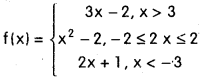
Inter 1st Year Maths 1A Functions Important Questions 1
then find the values, if exist, of f(4), f(2.5), f(-2), f(-4), f(0), f(-7).  (Mar. ’14)
Solution:
Domain of f is(-∞, -3) ∪ [-2, 2] ∪ (3, ∞)
i) Since f(x) = 3x – 2 for x > 3
f(4) = 3(4) – 2 = 10

ii) 2.5 does not belong to domain off, hence
f(2.5) is not desired.

iii) ∵ f(x) = x2 – 2 for -2 ≤ x ≤ 2
f(-2) = (-2)2 – 2 = 4 – 2 = 2

iv) ∵ f(x) = 2x + 1 for x < -3
f(-4) = 2(-4) + 1 = – 8 + 1 = -7

v) ∵ f(x) = x2 – 2, for -2 ≤ x ≤ 2
f(0)= (0)2 – 2 = 0 – 2 = -2

vi) ∵ f(x) = 2x + 1 for x < -3
f(-7) = 2(-7) + 1 = -14 + 1 = -13

Question 3.
If A = {0, \(\frac{\pi}{6}\), \(\frac{\pi}{4}\), \(\frac{\pi}{3}\), \(\frac{\pi}{2}\)} and f : A → B is a surjection defined by f(x) = cos x, then find B.  (A.P. Mar. ’16, ’11; May ’11)
Solution:
∵ f : A → B is a sujection defined by
f(x) = cos x
B = Range of f = f(A)
= {f(0), f(\(\frac{\pi}{6}\)), f(\(\frac{\pi}{4}\)), f(\(\frac{\pi}{3}\)), f(\(\frac{\pi}{2}\))}
= {cos 0, cos \(\frac{\pi}{6}\), cos \(\frac{\pi}{4}\), cos \(\frac{\pi}{3}\), cos \(\frac{\pi}{2}\)}
= {1, \(\frac{\sqrt{3}}{2}\), \(\frac{1}{\sqrt{2}}\), \(\frac{1}{2}\), 0}

Question 4.
Determine whether the function f: R → R defined by f(x) = \(\frac{e^{|x|}-e^{-x}}{e^{x}+e^{-x}}\) is an injection or a surjection or a bijection.
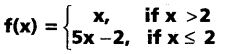
Solution:
f(x) = \(\frac{e^{|x|}-e^{-x}}{e^{x}+e^{-x}}\)
f(0) = \(\frac{e^{0}-e^{-0}}{e^{0}+e^{-0}}\) = \(\frac{1-1}{1+1}\) = 0
f(-1) = \(\frac{e^{1}-e^{1}}{e^{-1}+e^{1}}\) = 0
∵ f(0) = f(-1)
⇒ f is not an injection.
Let y = f(x) = \(\frac{e^{|x|}-e^{-x}}{e^{x}+e^{-x}}\)
When y = 1, there is no x ∈ R such that f(x) = 1
⇒ f is not a surjection
if there is such x ∈ R then
\(\frac{e^{|x|}-e^{-x}}{e^{x}+e^{-x}}\) = 1
⇒ e|x| – e-x = ex + e-x, clearly x ≠ 0
for x > 0, this equation gives
ex – e-x = ex + e-x ⇒ -e-x = e-x which is not possible
for x < 0, this equation gives
e-x – e-x = ex + e-x
⇒ e-x = ex which is also not possible.

Inter 1st Year Maths 1A Functions Important Questions

Question 5.
Determine whether the function f: R → R defined by
Inter 1st Year Maths 1A Functions Important Questions 2
is an injection or a surjection or a bijection
Solution:
∵ f(x’) = x for x > 2
⇒ f(3) = 3
∵ f(x) = 5x – 2, for x ≤ 2
⇒ f(1) = 5(1) – 2 = 3
∵ 1 and 3 have same f-image.
Hence f is not an injection.
Let y ∈ R then y > 2 (or) y ≤ 2.
If y > 2 take x = y ∈ R so that
f(x) = x = y
If y ≤ 2 take x = \(\frac{y+2}{5}\) ∈ R and
x = \(\frac{y+2}{5}\) < 1
∴ f(x) = 5x – 2 = 5\(\left[\frac{y+2}{5}\right]\) – 2 = y
∴ f is a surjection
∵ f is not an injection ⇒ It is not a bijection.

Question 6.
Find the domain of definition of the function y(x), given by the equation 2x + 2y = 2.
Solution:
2x = 2 – 2y < 2 (∵ 2y > 0)
⇒ log2 2x < log22
⇒ x < 1
∴ Domain = (-∞, 1)

Question 7.
It f: R → R is defined as f(x + y) = f(x)+ f(y) ∀ x, y ∈R and f(1) = 7, then find \(\sum_{r=1}^{n} f(r)\).
Solution:
Consider f(2) = f(1 + 1) = f (1) + f (1) = 2f(1)
f(3) =f(2 + 1) = f(2) + f(1) = 3f(1)
Similarly f(r) = rf(1)
∴ \(\sum_{r=1}^{n} f(r)\) = f(1) + f(2) + ….. + f(n)
= f(1) + 2f(1)+ ….. + nf(1)
= f(1) (1 + 2 + ….. + n)
= \(\frac{7 n(n+1)}{2}\)

Question 8.
If f(x) = \(\frac{\cos ^{2} x+\sin ^{4} x}{\sin ^{2} x+\cos ^{4} x}\) ∀ x ∈ R then show that f(2012) = 1.)
Solution:
f(x) = \(\frac{\cos ^{2} x+\sin ^{4} x}{\sin ^{2} x+\cos ^{4} x}\)
= \(\frac{1-\sin ^{2} x+\sin ^{4} x}{1-\cos ^{2} x+\sin ^{4} x}\)
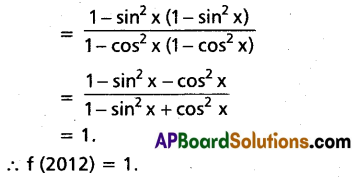
Inter 1st Year Maths 1A Functions Important Questions 3

Question 9.
If f : R → R, g : R → R are defined by f(x) = 4x – 1 and g(x) = x2 + 2 then find
i) (gof)(x)
ii) (gof)\(\left(\frac{a+1}{4}\right)\)
iii) (fof)(x)
iv) go(fof)(0)  (Mar. ’05)
Solution:
Given f : R → R and g : R → R and
f(x) = 4x – 1 and g(x) = x2 + 2

(i) (gof) (x) = g (f(x))
= g (4x – 1), ∵ f(x) = 4x – 1
= (4x – 1)2 + 2, ∵ g(x) = x2 + 2
= 16x2 – 8x + 1 + 2
= 16x2 – 8x + 3

(ii) (gof)\(\left(\frac{a+1}{4}\right)\) = \(g\left(f\left(\frac{a+1}{4}\right)\right)\)
= \(g\left(4\left(\frac{a+1}{4}\right)-1\right)\)
= g(a)
= a2 + 2

(iii) (fof)(x) = f(f(x))
= f(4x – 1), ∵ f(x) = 4x – 1
= 4(4x – 1) – 1
= 16x – 4 – 1 = 16x – 5

Inter 1st Year Maths 1A Functions Important Questions

(iv) (fof)(0) = f(f(0))
= f(4 × 0 – 1)
= f(-1)
= 4(-1) – 1 = -5
Now go(fof)(0)
= g(-5) = (-5)2 + 2 = 27

Question 10.
If f: [0, 3] → [0, 3] is defined by
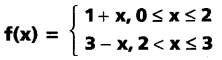
Inter 1st Year Maths 1A Functions Important Questions 4
then show that f[0,3] ⊆ [0, 3] and find fof.
Solution:
0 ≤ x ≤ 2 ⇒ 1 ≤ 1 + x ≤ 3 ——— (1)
2 < x ≤ 3 ⇒ -3 ≤ -x ≤ -2
⇒ 3 – 3 ≤ 3 – x ≤ 3 – 2
⇒ 0 ≤ 3 – x < 1 ——- (2)
from (1) and (2).
f[0, 3] ⊆ [0, 3]
When 0 ≤ x ≤ 1, we have
(fof) (x) = f(f(x))
= f(1 + x) = 1 + (1 + x) = 2 + x
[∵ 1 ≤ 1 + x ≤ 2]
When 1 < x ≤ 2, we have
(fof) (x) = f(f(x))
= f(1 + x)
= 3 – (1 + x)
= 2 – x, [∵ 2 < 1 + x ≤ 3]
When 2 < x ≤ 3, we have
(fof) (x) = f(f(x))
= f(3 – x)
= 1 + (3 – x)
= 4 – x, [∵ 0 ≤ 3 – x < 1]
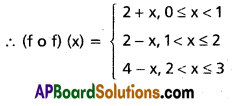
Inter 1st Year Maths 1A Functions Important Questions 5

Question 11.
If f, g : R → R are defined
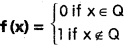
Inter 1st Year Maths 1A Functions Important Questions 6
and Inter 1st Year Maths 1A Functions Important Questions 7
then find (fog)(π) + (gof)(e).
Solution:
(fog)(π) = f(g(π)) = f(0) = 0
(gof)(e) = g(f(e)) = g (1) = -1
∴ (fog)(π) + (gof) (e) = -1.

Question 12.
Let A = {1, 2, 3), B = {a, b, c}, C = (p, q, r}
If f: A → B, g: B → C are defined by
f = {(1, a), (2, c), (3, b)},
g = {(a, q), (b, r), (c, p)} then
show that f-1og-1 = (gof)-1
Solution:
Given that
f = {(1, a), (2, c), (3, b)} and
g = {(a, q), (b, r), (c, p)}
then g f = {(1, q), (2, p), (3, r)}
⇒ (gof)-1 = {(q, 1), (p, 2), (r, 3)}
⇒ g-1 = {(q, a), (r, b), (p, c)} and
f-1 = {(a, 1), (c, 2), (b, 3)}
f-1 g-1 = {(q, 1), (r, 3), (p, 2)}
⇒ (gof)-1 = f-1og-1

Inter 1st Year Maths 1A Functions Important Questions

Question 13.
If f: Q → Q, is defined by f(x) = 5x + 4 for all x ∈ Q, show that f is a bijection and find f-1.(A.P Mar. ’16, May ’12, ’05)
Solution:
Let x1, x2 ∈ Q
Now f(x1) = f(x2)
⇒ 5x1 + 4 = 5x2 + 4
⇒ 5x1 = 5x2
⇒ x1 = x2
∴ f is an injection.
Let y ∈ Q then x = \(\frac{y-4}{5}\) ∈ Q and
f(x) = f\(\left(\frac{y-4}{5}\right)\) = 5\(\left(\frac{y-4}{5}\right)\) + 4 = y
∴ f is a surjection.
Hence f is a bijection
∴ f-1 : Q → Q is also bijection
We have (fof-1)(x) = I(x)
⇒ f(f-1(x)) = x, ∵ f(x) = 5x + 4
⇒ 5f-1(x) + 4 = x
⇒ f-1(x) =\(\frac{x-4}{5}\) for ∀ x ∈ Q

Question 14.
Find the domains of the following real valued functions.

i) f(x) = \(\frac{1}{6 x-x^{2}-5}\)
Solution:
f(x) = \(\frac{1}{6 x-x^{2}-5}\) = \(\frac{1}{(x-1)(5-x)}\) ∈ R
⇔ (x – 1) (5 – x) ≠ 0
⇔ x ≠ 1, 5
∴ Domain of f is R – {1, 5}

ii) f(x) = \(\frac{1}{\sqrt{x^{2}-a^{2}}}\), (a > 0)  (A.P.) (Mar. ’15)
Solution:
f(x) = \(\frac{1}{\sqrt{x^{2}-a^{2}}}\) ∈ R
⇔ x2 – a2 > 0
⇔ (x + a)(x – a) > 0
⇔ x ∈ (-∞, -a) ∪ (a, ∞)
∴ Domain of f is (-∞, -a) ∪ (a, ∞) = R – [-a, a]

Inter 1st Year Maths 1A Functions Important Questions

iii) f(x) = \(\sqrt{(x+2)(x-3)}\)
Solution:
f(x) = \(\sqrt{(x+2)(x-3)}\) ∈ R
⇔ (x + 2)(x – 3) ≥ 0
⇔ x ∈ (-∞, -2) ∪ [3, ∞)
∴ Domain of f is
(-∞, -2] ∪ [3, ∞) = R – (-2, 3)

iv) f(x) = \(\sqrt{(x-\alpha)(\beta-x)}\) (0 < α < β)
Solution:
f(x) = \(\sqrt{(x-\alpha)(\beta-x)}\) ∈R
⇔ (x – α) (β – α) ≥ 0
⇔ α ≤ x ≤ β ; (∵ α < β)
⇔ x ∈ [α, β]
∴ Domain of f is [α, β]

v) f(x) = \(\sqrt{2-x}\) + \(\sqrt{1+x}\)
Solution:
f(x) = \(\sqrt{2-x}\) + \(\sqrt{1+x}\) + x ∈ R
⇔ 2 – x ≥ 0 and 1 + x ≥ 0
⇔ 2 ≥ x and x ≥ -1
⇔ -1 ≤ x ≤ 2
⇔ x ∈ [-1, 2]
∴ Domain of f is [-1, 2].

vi) f(x) = \(\sqrt{x^{2}-1}\) + \(\frac{1}{\sqrt{x^{2}-3 x+2}}\)
Solution:
f(x) = \(\sqrt{x^{2}-1}\) + \(\frac{1}{\sqrt{x^{2}-3 x+2}}\) ∈ R
⇔ x2 – 1 ≥ 0 and x2 – 3x + 2 > 0
⇔ (x + 1)(x – 1) ≥ 0 and (x – 1)(x – 2) > 0
⇔ x ∈ (-∞, -1] ∪ [1, ∞) and x ∈ (-∞, 1)u(2, ∞)
⇔ x ∈ (R – (-1, 1)) ∩ (R – [1, 2])
⇔ x ∈ R – {(-1, 1) ∪ [1,2]}
⇔ x ∈ R – (-1, 2]
⇔ x ∈ (-∞, -1] ∪ (2, ∞)
∴ Domain of f is (-∞, -1) ∪ (2, ∞) = R – (-1, 2]

vii) f(x) = \(\frac{1}{\sqrt{|x|-x}}\)
Solution:
f(x) = \(\frac{1}{\sqrt{|x|-x}}\) ∈ R
⇔ |x| – x > 0
⇔ |x| > x
⇔ x ∈ (-∞, 0)
∴ Domain of f is (-∞, 0)

viii) f(x) = \(\sqrt{|x|-x}\)
Solution:
\(\sqrt{|x|-x}\) ∈ R
⇔ |x| – x ≥ 0
⇔ |x| ≥ x
⇔ x ∈ R
∴ Domain of f is R

Question 15.
If f = ((4, 5), (5, 6), (6, -4)} and g = ((4, -4), (6, 5), (8, 5)} then find
(i) f + g
(ii) f – g
(iii) 2f + 4g
(iv) f + 4
(v) fg
(vi) \(\frac{\mathbf{f}}{\mathbf{g}}\)
(vii) |f|
(viii) \(\sqrt{f}\)
(ix) f2
(x) f3
Solution:
Given that f = ((4, 5), (5, 6), (6, -4)}
g {(4, —4), (6, 5), (8, 5)}
Domain of f = {4, 5, 6} = A
Domain of g = (4, 6, 8} = B
Domain of f ± g = A ∩ B = {4, 6}
i) f + g = {4, 5 + (-4), (6, -4 + 5)}
= {(4, 1), (6, 1)}

ii) f – g = {(4, 5 – (-4)), (6, -4, -5)}
= {(4, 9), (6, -9)}

iii) Domain of 2f = A = {4, 5, 6}
Domain of 4g = B = {4, 6, 8}
Domain of 2f + 4g = A ∩ B = {4, 6}
∴ 2f = {(4, 10), (5, 12), (6, -8)}
4g = {(4, —16), (6, 20), (8, 20)}
∴ 2f + 4g = {(4, 10 + (-16), 6, -8 + 20)}
= {(4, -6), (6, 12)}

iv) Domain of f + 4 = A= {4, 5, 6}
f + 4 ={4, 5 + 4), (5, 6 +4), (6, -4 + 4)}
= ((4, 9), (5, 10), (6, 0)}

Inter 1st Year Maths 1A Functions Important Questions

v) Domain of fg = A ∩ B = {4, 6}
fg = {(4, (5) (-4), (6, (-4) (5))}
= {(4, -20), (6, -20)}

vi) Domain of \(\frac{f}{g}\) = {4, 6}
∴ \(\frac{f}{g}\) = {(4, \(\frac{-5}{4}\)), (6, \(\frac{-4}{5}\))}

vii) Domain of |f| = {4, 5, 6}
∴ |f| = {(4, |5|), (5, |6|), (6, |-4|)}
= {(4, 5), (5, 6), (6, 4))

viii) Domain of \(\sqrt{f}\) = {4, 5}
∴ \(\sqrt{f}\) = {(4, \(\sqrt{5}\)), (5, \(\sqrt{6}\))}

ix) Domain of f2 = {4, 5, 6} = A
∴ f2 = ((4, (5)2) (5, (6)2, (6, (-4)2)}
f2 = {(4, 25), (5, 36), (6, 16)}

x) Domain of f3 = A = {4, 5, 6}
∴ f3 = {(4, 53), (5, 63), (6, (-4)3}
= {(4, 125) (5, 216) (6, -64)}

Question 16.
Find the domains and ranges of the following real valued functions.
i) f(x) = \(\frac{2+x}{2-x}\)
ii) f(x) = \(\frac{x}{1+x^{2}}\)
iii) f(x) = \(\sqrt{9-x^{2}}\)  (A.P.)(Mar. ’15)
Solution:
i) f(x) = \(\frac{2+x}{2-x}\) ∈ R
⇔ 2 – x ≠ 0 x ⇔ x ∈ R -{2}
∴ Domain of f is R – {2}
Let f(x) = \(\frac{y}{1}\) = \(\frac{2+x}{2-x}\).
Apply componendo and dividendo rule
⇒ \(\frac{y+1}{y-1}\) = \(\frac{(2+x)+(2-x)}{(2+x)-(2-x)}\)
⇒ \(\frac{y+1}{y-1}\) = \(\frac{4}{2 x}\)
⇒ x = \(\frac{2(y-1)}{y+1}\)
Clearly x is not defined for y + 1 = 0
(i.e.,) y = -1
∴ Range of f is R – {-1}.

ii) f(x) = \(\frac{x}{1+x^{2}}\)
Solution:
f(x) = \(\frac{x}{1+x^{2}}\) ∈ R
∵ ∀ x ∈ R, x2 + 1 ≠ 0
Domain of f is R
Let f(x) = y = \(\frac{x}{1+x^{2}}\)
⇒ x2y – x + y = 0
⇒ x = \(\frac{-(-1) \pm \sqrt{1-4 y^{2}}}{y}\) is a real number.
iff 1 – 4y2 ≥ 0; y ≠ 0
⇔ (1 – 2y)(1 + 2y) ≥ 0 and y ≠ 0
⇔ y ∈ \(\left[-\frac{1}{2} ; \frac{1}{2}\right]\) – {0}
Also x = 0 ⇒ y = 0
∴ Range of f = \(\left[-\frac{1}{2}, \frac{1}{2}\right]\)

iii) f(x) = \(\sqrt{9-x^{2}}\)
Solution:
f(x) = \(\sqrt{9-x^{2}}\) ∈ R
⇔ 9 – y2 ≥ 0
⇔ x ∈ [-3, 3]
∴ Domain of f is [-3, 3]
Let f(x) = y = \(\sqrt{9-x^{2}}\)
⇒ x = \(\sqrt{9-y^{2}}\) ∈ R
⇔ 9 – y2 ≥ 0 ⇔ (3 + y)(3 – y) ≥ 0
∴ -3 ≤ y ≤ 3
But f(x) attains only non negative values
∴ Range of f = [0, 3].

Inter 1st Year Maths 1A Functions Important Questions

Question 17.
If f(x) = x2 and g(x) = |x|, find the following functions.
i) f + g
ii) f – g
iii) fg
iv) 2f
v) f2
vi) f + 3
Solution:
Given f(x) = x2
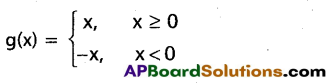
Inter 1st Year Maths 1A Functions Important Questions 8
Domain of f = Domain of g = R
Hence domain of all the functions (i) to (vi) is R
Inter 1st Year Maths 1A Functions Important Questions 9
iv) 2f(x) = 2 f(x) = 2x2

v) f2(x) = (f(x))2 = (x2)2 = x4

vi) (f + 3)(x) = f(x) + 3 = x2 + 3.

Question 18.
Determine whether the following functions are even or odd.
i) f(x) = ax – a-x + sin x
Solution:
Given f(x) = ax – a-x + sin x
∴ f(- x) = a-x – ax + sin (-x)
= a-x – ax – sin x
= – (ax – ax – sin x) = – f(x)
∴ f(x) is an odd function.

ii) f(x) = x\(\left(\frac{e^{x}-1}{e^{x}+1}\right)\)
Solution:
f(x) = x\(\left(\frac{e^{x}-1}{e^{x}+1}\right)\)
Inter 1st Year Maths 1A Functions Important Questions 10
∴ f is an even function.

Inter 1st Year Maths 1A Functions Important Questions

iii) f(x) = log (x + \(\sqrt{x^{2}+1}\))
Solution:
Given f(x) = log (x + \(\sqrt{x^{2}+1}\))
Then f(-x) = log (-x + \(\sqrt{(-x)^{2}+1}\))
= log (\(\sqrt{x^{2}+1}\) – x)
Inter 1st Year Maths 1A Functions Important Questions 11
∴ f is an odd function.

Question 19.
Find the domains of the following real valued functions.
i) f(x) = \(\frac{1}{\sqrt{[x]^{2}-[x]-2}}\)
Solution:
f(x) = \(\frac{1}{\sqrt{[x]^{2}-[x]-2}}\) ∈ R
⇔ [x]2 – [x] – 2 > 0
⇔ ([x] + 1) ([x] – 2) > 0
⇔ [x] < -1, (or) [x] > 2
But [x] < -1 ⇒ [x] = -2, -3, -4, ……..
⇒ x < -1 [x] > 2 ⇒ [x] = 3, 4, 5, ……
⇒ x ≥ 3
∴ Domain of f = (-∞, -1) ∪ [3, ∞]
= R – [-1, 3)

ii) f(x) = log (x – [x])
f(x) = log (x – [x]) ∈ R
⇔ x – [x] > 0
⇔ x > [x]
⇔ x is a non integer
∴ Domain of f is R – Z

iii) f(x) = \(\sqrt{\log _{10}\left(\frac{3-x}{x}\right)}\)
Solution:
f(x) = \(\sqrt{\log _{10}\left(\frac{3-x}{x}\right)}\) ∈ R
⇔ log10\(\left(\frac{3-x}{x}\right)\) ≥ 0 and \(\frac{3-x}{x}\) > 0
⇔ \(\frac{3-x}{x}\) ≥ 10° = 1 and 3 – x > 0, x > 0
⇔ 3 – x ≥ x and 0 < x < 3
⇔ x ≤ \(\frac{3}{2}\) and 0 < x < 3
⇔ x ∈ (-∞, \(\frac{3}{2}\)] ∩ (0, 3) = (0, \(\frac{3}{2}\)]
∴ Domain of f is (0, \(\frac{3}{2}\)]

iv) f(x) = \(\frac{\sqrt{3+x}+\sqrt{3-x}}{x}\)
Solution:
f(x) = \(\frac{\sqrt{3+x}+\sqrt{3-x}}{x}\) ∈ R
⇔ 3 + x ≥ 0, 3 – x ≥ 0 and x ≠ 0
⇔ x ≥ -3, x ≤ 3 and x ≠ 0
⇔ -3 ≤ x ≤ 3, and x ≠ 0
⇔ x ∈ [-3, 3] and x ≠ 0
⇔ x ∈ [-3, 3] – {0}
∴ Domain of f is [-3, 3] – {0}

Question 20.
If f : A → B and g : B → C are two injective functions then the mapping gof : A → C is an injection.
Solution:
f : A → B and g: B → C are one—one.
∴ gof : A → C
To prove that g o f is one — one function
Let a1, a2 ∈ A ∴ f(a1), f(a2) ∈ B and g(f(a1)), g(f(a2)) ∈ C i.e., (gof) (a1), gof(a2) ∈ C
Now (gof) (a1) = gof (a2)
⇒ g(f(a1)) = g(f(a2))
⇒ f(a1) = f(a2) (∵ g is one -one)
⇒ a1 = a2 (∵ f is one-one)
Hence gof: A → C is a one-one function.
Note : The converse of the above theorem is not true.
If f : A → B, g: B → C and go f is one-one then both f and g need not be one-one.
For, consider
A = {1, 2}, B = {p, q, r), C = {s, t}
Let f = {(1, p), (2, q)} and
g = {(p, s), (q, t), (r, t)}
Now gof = {(1, s), (2, t)} ⇒ gof is one—one
from A to C
Observe that g: B → C is not one—one.

Inter 1st Year Maths 1A Functions Important Questions

Question 21.
If f : A → B and g : B → C are two onto (surjective) functions then the mapping gof : A → C is a surjection. (May. ’08)
Solution:
f : A → B and g : B → C are onto.
∴ gof : A → C
To prove that gof is onto. Let c be any element of C.
Since g : B → C is an onto function there exists an element b ∈ B such that g(b) = c
Since f : A → B is an onto function, there exists an element a ∈ A such that f(a) = b
Now g(b) = c ⇒ g [f(a)] c = (gof) (a) = c
Thus for any element c ∈ C there is an element a ∈ A such that (gof) (a) = c
∴ gof : A → C is a surjection

Question 22.
If f : A → B and g : B → C are two bijective functions then the mapping gof : A → C is a bijection. (Mar. ’16, May ’12)
Solution:
f and g are injections gof: A → C is an injection.
f and g are surjections= gof : A → C is a surjection.
Hence it follows that if f and g are bijections,
gof is also a bijection.
Note : The converse of the above theorem is not true.

Question 23.
If f : A → B and g : B → C are such that gof is a surjection, then g is necessarily a surjection.
Solution:
Let c ∈ C. Since gof is a surjection, from A to
C there exists an element a ∈ A such that (gof) (a) = c, i.e., g(f(a)) = c
Since g: B → C and f(a) ∈ B, ∀ c ∈ C there exists an element belonging to B.
Hence g is a surjection.

Question 24.
If f : A → B and g : B → C and h : C → D are functions then ho(gof) = (hog)of (Mar. ’12, ’08)
Solution:
f : A → B and g : B → C gof : A → C
Now gof : A → C and h : C → D
⇒ ho(gof) : A → D
Similarly (hog) of : A → D
Thus ho (gof) and (hog) of both exist and have the same domain A and co-domain D.
Let a be an element of A.
Now [ho(gof)](a) = h[(gof)(a)] = h[g(f(a))]
= (hog) [f(a)] = [(hog)of] (a)
∴ ho(gof) = (hog)of
Note : Thus composition of mappings is associative.

Question 25.
Let f : A → B, IA and IB are identity functions on A and B respectively. Then for IA = f = IB of Mar.’12, ’08
Solution:
∵ IA : A → A and f : A → B are functions foIA is a function from A to B. Hence foIA and f are definded on same domain A.
i) Let a ∈ A then (foIA)(a) = f(IA(a))
= f(a)
[∵ IA(a) = a, ∀ a ∈ A]
∴ foIA = f ————- (1)

ii) ∵ f : A → B, IB : B → B are functions, IB of is a function from A to B
∴ The functions IB of and f are defined on the same domain A.
Let a ∈ A, then (IB of)(a)
= IB(f (a)) = f(a)
∵ f : A → B, we have f(a) ∈ B
∴ IB of = f ———– (2)
From(1) & (2) foIA = IBof = f

Inter 1st Year Maths 1A Functions Important Questions

Question 26.
Let A and B be two non-empty sets. If f : A → B is a bijection, then f-1 : B → A is also a bijection.
Solution:
f : A → B is a bijection.
∴ f-1 : B → A is a unique function.
(i) To prove that f-1 is one—one:
Let b1 and b2 be any two different elements of B. i.e., b1 ≠ b2.
Then, we have to prove that
f-1(b1) ≠ F-1(b2)
Let f-1(b1) = a1 and f-1(b2) = a2
such that a1, a2 ∈ A
Then b1 = f(a1) and b2 = f(a2)
Now b1 ≠ b2 ⇒ f(a1) ≠ f(a2)
⇒ a1 ≠ a2 (∵ f is a bijection)
⇒ f-1(b1) ≠ f-1(b2)
∴ f-1 is one—one.

(ii) To prove that f-1 is onto:
Let ‘a’ be an element of A.
Then there exists an element b ∈ B such that f(a) = b (or) f-1(b) = a
(or) a = f-1(b)
Thus ‘a’ is the f-1 – image of the element b ∈ B
Hence f-1 is onto.
∴ f : B → A is a bijection.

Question 27.
If f : A → B is a bijection, then f-1of = IA and fof-1 = IB
(A.P) (Mar. 15,12, ’07; May ’07, ‘06)
Solution:
f : A → B is a bijection ⇒ f-1 : B → A is also a bijection.
By definition, fof-1 : B → B and f-1of : A → A are bijection
Also IA : A → A and IB : B → B
To prove that f-1of = IA
Let a ∈ A
Since f : A → B there exists a unique element
b ∈ B such that f(a) = b
a = f-1 (b) (∵ f is a bijection)
∴ (f-1of) (a) = f-1[f(a)]
= f-1(b) = a = IA (a)
f-1 of = IA
Similarly it can be shown that fof-1 = IB

Question 28.
If f : A → B and g : B → A are two functions such that gof = IA and fog = IB then g = f-1.
Solution:
(i) To prove that f is one—one:
Let a1, a2 ∈ A.
Since f: A → B, f(a1), f(a2) ∈ B
Now f(a1) = f(a2)
⇒ g[f(a1)] = g[f(a2)]
⇒ (gof)(a1) = gof(a2)
⇒ IA (a1) = IA (a2)
∴ a1 = a2 = ∴ f is one — one

(ii) To prove that f is onto :
Let b be an element of B
∴ b = IB fog(b)
⇒ b = f{(g(b)} ⇒ f{g(b)} = b
i.e., there exists a pre-image g(b) ∈ A for b, under the mapping f. ∴ f is onto
Thus f is one-one, onto and hence
f-1 : B → A exists and is also one — one and onto.

(iii) To prove g = f-1:
Now g : B → A and f-1 : B → A
Let a ∈ A and b be the f – image of a, where b ∈ B
∴ f(a) = b ⇒ a =f-1(b)
Now g(b) = g[f(a)] (gof) (a)
= IA(a) = a = f-1(b)
∴ g = f-1

Inter 1st Year Maths 1A Functions Important Questions

Question 29.
If f : A → B and g : B → C are bijective functions, then (gof)-1 = f-1og-1(AP) (Mar. ‘16’14, ‘11; May ‘11)
Solution:
f : A → B, g : B → C are bijections
⇒ gof : A → C is a bijection
Also g-1 : C → B and f-1 : B → A are bijections
⇒ f-1og-1 : C → A is a bijection.
Let c be any element of C.
Then ∃ an element b ∈ B such that g(b) = c
⇒ b = g-1(c)
Also ∃ an element a A such that f(a) = b
⇒ a = f-1(b)
Now (gof) (a) = g(f(a) = g(b) = c
⇒ a = f-1(b)
Now (gof) (a) = g(f(a) = g(b) = c
⇒ a = (gof)-1 (c) ⇒ (gof) (c) = a
Also (f-1og-1) (c) ⇒ f-1 (g-1 (c)) = f-1 (b) = a
∴ From (1) and (2);
(gof)-1 (c) = (f-1og-1(c))
⇒ (gof)-1 = f-1og-1

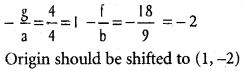
Inter 1st Year Maths 1A Properties of Triangles Formulas

Use these Inter 1st Year Maths 1A Formulas PDF Chapter 10 Properties of Triangles to solve questions creatively.

Intermediate 1st Year Maths 1A Properties of Triangles Formulas

→ Sine Rule :
In ΔABC \(\frac{a}{\sin A}=\frac{b}{\sin B}=\frac{c}{\sin C}\) = 2R where R is the circumradius of ΔABC.

→ Cosine Rule :
a2 = b2 + c2 – 2bc. cos A ;
b2 = c2 + a2 – 2ca.cos B;
c2 = a2 + b2 – 2ab. cos C.

→ cos A = \(\frac{b^{2}+c^{2}-a^{2}}{2 b c}\),
cos B = \(\frac{c^{2}+a^{2}-b^{2}}{2 c a}\),
cos C = \(\frac{a^{2}+b^{2}-c^{2}}{2 a b}\)

→ a = b cos C + c cos B,b = c cos A + a cos C and c = a cos B + b cos A (Projection rule)

→ tan \(\frac{B-C}{2}=\frac{b-c}{b+c}\) cot\(\frac{A}{2}\) (Napier’s analogy or tangent rule)

  • sin\(\frac{A}{2}\) = \(\sqrt{\frac{(s-b)(s-c)}{b c}}\)
  • cos\(\frac{A}{2}\) = \(\sqrt{\frac{s(s-a)}{b c}}\)
  • tan\(\frac{A}{2}\) = \(\sqrt{\frac{(s-b)(s-c)}{s(s-a)}}=\frac{\Delta}{s(s-a)}\)

→ Δ = area of ΔABC = \(\frac{1}{2}\) bc sin A = \(\frac{1}{2}\) ca sin B = \(\frac{1}{2}\) ab sin C
= \(\sqrt{s(s-a)(s-b)(s-c)}=\frac{a b c}{4 R}\)
= 2R2 sin A sin B sin C

  • r = \(\frac{\Delta}{s}\)
  • r1 = \(\frac{\Delta}{s-a}\)
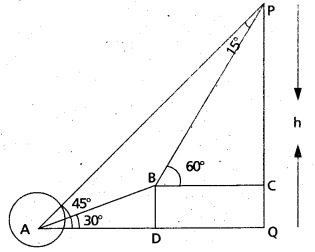
  • r2 = \(\frac{\Delta}{s-b}\)
  • r3 = \(\frac{\Delta}{s-c}\)

Inter 1st Year Maths 1A Properties of Triangles Formulas

→ r = 4 R sin \(\frac{A}{2}\) sin \(\frac{B}{2}\) sin \(\frac{C}{2}\); r1 = 4Rsin \(\frac{A}{2}\) cos \(\frac{B}{2}\) cos \(\frac{C}{2}\)
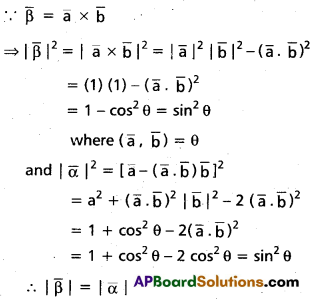
→ r = (s – a) tan \(\frac{A}{2}\);
r1 = s tan \(\frac{A}{2}\) = (s – c) cot \(\frac{B}{2}\) = (s – b) cot \(\frac{C}{2}\)

Mollweide rule:
In ΔABC \(\frac{a+b}{c}=\frac{\cos \left(\frac{A-B}{2}\right)}{\sin \frac{C}{2}}\)
\(\frac{b+c}{a}=\frac{\cos \left(\frac{B-C}{2}\right)}{\sin \frac{A}{2}}\)
\(\frac{c+a}{b}=\frac{\cos \left(\frac{C-A}{2}\right)}{\sin \frac{B}{2}}\)

Sine rule :
In ΔABC, \(\frac{\mathrm{a}}{\sin \mathrm{A}}=\frac{\mathrm{b}}{\sin \mathrm{B}}=\frac{\mathrm{c}}{\sin \mathrm{C}}\) = 2R Where R is the circum – radius.
⇒ a = 2R sin A, b = 2R sin B, c = 2R sin C
a : b : c = sin A : sin B : sin C.

Cosine rule :
In ΔABC,
a2 = b2 + c2 – 2bc cos A
b2 = c2 + a2 – 2ac cos B
c2 = a2 + b2 – 2ab cos C
or
cos A = \(\frac{\mathrm{b}^{2}+\mathrm{c}^{2}-\mathrm{a}^{2}}{2 \mathrm{bc}}\)
cos B = \(\frac{c^{2}+a^{2}-b^{2}}{2 c a}\)
cos C = \(\frac{a^{2}+b^{2}-c^{2}}{2 a b}\) ⇒ cos A : cos B : cos C
= a(b2 + c2 – a2) : b(c2 + a2 – b2) : c(a2 + b2 – c2)

Projection rule :
In ΔABC

  • a = b cos C + c cos B,
  • b = c cos A + a cos C,
  • c = s cos B + b cos A

Mollwiede’s rule :
In ΔABC

  • \(\frac{a-b}{c}=\frac{\sin \frac{A-B}{2}}{\cos \frac{C}{2}}\)
  • \(\frac{a+b}{c}=\frac{\cos \frac{A-B}{2}}{\sin \frac{C}{2}}\)

Similarly the other two can be written by symmetry.

Inter 1st Year Maths 1A Properties of Triangles Formulas

Tangent rule (or) Napier’s analogy :
In ΔABC
Inter 1st Year Maths 1A Properties of Triangles Formulas 1

Half angle formulae :
Inter 1st Year Maths 1A Properties of Triangles Formulas 2

cot A = \(\frac{\mathrm{b}^{2}+\mathrm{c}^{2}-\mathrm{a}^{2}}{4 \Delta}\)
cot B = \(\frac{c^{2}+a^{2}-b^{2}}{4 \Delta}\)
cot C = \(\frac{a^{2}+b^{2}-c^{2}}{4 \Delta}\)

→ Area of ΔABC 1s given by

  • Δ = \(\frac{1}{2}\)ab sin C = \(\frac{1}{2}\)bc sin A = \(\frac{1}{2}\) ca sin B
  • Δ = \(\sqrt{s(s-a)(s-b)(s-c)}\).
  • Δ = \(\frac{a b c}{4 R}\)
  • Δ = 2R2 sin A sin B sin C
  • Δ = rs
  • Δ = \(\sqrt{\mathrm{rr}_{1} \mathrm{r}_{2} \mathrm{r}_{3}}\)

→ If ‘r’ is radius of in circle and r1, r2, r3 are the radii of ex-circles opposite to the vertices A, B, C of ΔABC respectively then
i. r = \(\frac{\Delta}{\mathrm{s}}\), r1 = \(\frac{\Delta}{\mathrm{s-a}}\), r2 = \(\frac{\Delta}{\mathrm{s-b}}\), r3 = \(\frac{\Delta}{\mathrm{s-c}}\)

→ r = 4R sin\(\frac{\mathrm{A}}{2}\)sin\(\frac{\mathrm{B}}{2}\) sin\(\frac{\mathrm{C}}{2}\)

  • r1 = 4R sin\(\frac{\mathrm{A}}{2}\)cos\(\frac{\mathrm{B}}{2}\)cos\(\frac{\mathrm{C}}{2}\)
  • r2 = 4R cos\(\frac{\mathrm{A}}{2}\)sin\(\frac{\mathrm{B}}{2}\) cos\(\frac{\mathrm{C}}{2}\)
  • r3 = 4R cos\(\frac{\mathrm{A}}{2}\)cos\(\frac{\mathrm{B}}{2}\) sin\(\frac{\mathrm{C}}{2}\)

→ r = (s – a)tan\(\frac{A}{2}\) = (s – b)tan\(\frac{B}{2}\) = (s – c)tan\(\frac{C}{2}\)

  • r1 = s tan\(\frac{A}{2}\) = (s – b)cot\(\frac{C}{2}\) = (s – c)cot\(\frac{B}{2}\)
  • r2 = s tan\(\frac{B}{2}\) = (s – c)cot\(\frac{A}{2}\) = (s – a)cot\(\frac{c}{2}\)
  • r1 = s tan\(\frac{A}{2}\) = (s – a)cot\(\frac{B}{2}\) = (s – b)cot\(\frac{A}{2}\)

→ \(\frac{1}{r}=\frac{1}{r_{1}}+\frac{1}{r_{2}}+\frac{1}{r_{3}}\)

→ rr1r2r3 = Δ2

→ r1r2 + r2r3 + r3r1 = s2

→ r(r1 + r2 + r3) = ab + bc + ca – s2

Inter 1st Year Maths 1A Properties of Triangles Formulas

→ (r1 – r)(r2 + r3) = a2

→ (r2 – r)(r3 + r1) = b2

→ (r3 – r)(r1 + r2) = c2

→ a = (r2 + r3)\(\sqrt{\frac{r r_{1}}{r_{2} r_{3}}}\)

→ b = (r3 + r1)\(\sqrt{\frac{r r_{2}}{r_{3} r_{1}}}\)

→ c = (r1 + r2)\(\sqrt{\frac{r r_{3}}{r_{1} r_{2}}}\)

→ r1 – r = 4Rsin2\(\frac{A}{2}\)

→ r2 – r = 4Rsin2\(\frac{B}{2}\)

→ r3 – r = 4Rsin2\(\frac{C}{2}\)

→ r1 + r2 = 4R cos2\(\frac{C}{2}\)

→ r2 + r3 = 4R cos2\(\frac{A}{2}\)

→ r3 + r1 = 4R cos2\(\frac{B}{2}\)

→ r1 + r2 + r3 = 4R

→ r + r2 + r3 – r1 = 4R cos A

→ r + r1 + r3 – r2 = 4R cos B

→ r + r1 + r2 – r3 = 4R cos C

→ In an equilateral triangle of side ‘a’
area = \(\frac{\sqrt{3} a^{2}}{4}\)
R = a/√3
r = R/2
r1 = r2 + r3 = 3R/2
r : R : r1 = 1 : 2 : 3

Inter 1st Year Maths 1A Properties of Triangles Formulas

In circle:
The circle that touches the three sides of a triangle ABC internally is called the “in circle” or inscribed” of its triangle. The centre of the circle is called Incentre denoted by I the radius of the circle is denoted by inradius denoted by Y

→ In a triangle ABC
Inter 1st Year Maths 1A Properties of Triangles Formulas 3

Excircle:
The circle that touches the side BC (opposite to angle A) internally and the other two sides AB and AC externally is called Excircle. The centre of this circle is called excentre opposite to ‘A’. denoted by I1. The radius of this circle is called ex-radius, denoted by r1

|||ly exradius opposite to angle B is denoted by r2. The centre of this excircle is denoted by I2 exradius opposite to angle C is denoted by r3. The centre of this ex-circle is denoted by I3

In a triangle ABC

  • r1 = \(\frac{\Delta}{s-a}\)
  • r2 = \(\frac{\Delta}{s-b}\)
  • r3 = \(\frac{\Delta}{s-c}\)

→ r1 = s tan A/2

→ r2 = s tan B/2

→ r2 = s tan C/2

→ r1 = (s – c)cot\(\frac{B}{2}\)
= (s- b)cot\(\frac{C}{2}\)

→ r1 = (s – a)cot\(\frac{C}{2}\)
= (s – c)cot\(\frac{A}{2}\)

→ r1 = (s – a)cot\(\frac{B}{2}\)
= (s – c)cot\(\frac{A}{2}\)

→ r1 = \(\frac{a}{\tan \frac{B}{2}+\tan \frac{C}{2}}\)

→ r2 = \(\frac{b}{\tan \frac{C}{2}+\tan \frac{A}{2}}\)

→ r3 = \(\frac{c}{\tan \frac{A}{2}+\tan \frac{B}{2}}\)

→ r1 = 4Rsin\(\frac{A}{2}\)cos\(\frac{B}{2}\)cos\(\frac{C}{2}\)

→ r2 = 4Rcos\(\frac{A}{2}\)sin\(\frac{B}{2}\)cos\(\frac{C}{2}\)

→ r3 = 4Rcos\(\frac{A}{2}\)cos\(\frac{B}{2}\)sin\(\frac{C}{2}\)

Inter 1st Year Maths 1A Hyperbolic Functions Formulas

Use these Inter 1st Year Maths 1A Formulas PDF Chapter 9 Hyperbolic Functions to solve questions creatively.

Intermediate 1st Year Maths 1A Hyperbolic Functions Formulas

→ ex = 1 + \(\frac{x}{1 !}+\frac{x^{2}}{2 !}+\frac{x^{3}}{3 !}+\ldots+\frac{x^{n}}{n !}\)+ … ∞

→ sinhx = \(\frac{e^{x}-e^{-x}}{2}\)
and coshx = \(\frac{e^{x}+e^{-x}}{2}\)

→ tanh x = \(\frac{\sinh x}{\cosh x}\),

→ coth x = \(\frac{1}{\tanh x}\),

→ sech x = \(\frac{1}{\cosh x}\)

→ cosech x = \(\frac{1}{\sinh x}\), if x ≠ 0

Inter 1st Year Maths 1A Hyperbolic Functions Formulas

→ cosh2x – sinh2x – 1, sech2x – 1 – tanh2x, cosech2x = coth2x – 1

Function y = f(x)Domain (x)Range (y)
sinh xRR
cosh xR(1, ∞)
tanh xR(1, 1)
coth xR- {0}(-∞, -1) ∪ (1, ∞)
sech xR(0, 1]
cosech xR – {0}R – {0}

→ sinh-1x = loge [x + \(\sqrt{x^{2}+1}\) ] for all x ∈ R

→ cosh-1x = loge [x + \(\sqrt{x^{2}-1}\)] for all x ∈ (1, ∞)

→ tanh-1x = \(\frac{1}{2}\)loge\(\left(\frac{1+x}{1-x}\right)\), |x| < 1 (i.e) for all x ∈ (-1, -1)

→ coth-1x = \(\frac{1}{2}\)loge\(\left(\frac{1+x}{1-x}\right)\), |x| > 1 (i.e) for all x ∈ (-∞, -1) (1, ∞)

→ sech-1x = loge\(\left(\frac{1+\sqrt{1+x^{2}}}{x}\right)\) for all x ∈ (0, 1)

→ cosech-1x = loge\(\left(\frac{1-\sqrt{1+x^{2}}}{x}\right)\), if x < 0 (i.e,) x ∈ (-∞, 0) and
= loge\(\left(\frac{1+\sqrt{1+x^{2}}}{x}\right)\), if x > 0 (i.e,) x ∈ (0, ∞)

→ sinh (x + y) = sinh x cosh y + cosh x sinh y

→ cosh (x + y)= cosh x cosh y + sinh x sinh y

→ sinh (x – y) = sinh x cosh y – cosh x sinh y

→ cosh (x – y) = cosh x cosh y – sinh x sinh y

→ tanh (x + y) = \(\frac{\tanh x+\tanh y}{1+\tanh x \tanh y}\)

→ tanh (x – y) = \(\frac{\tanh x-\tanh y}{1-\tanh x \tanh y}\)

→ sinh 2x = 2 sinh x cosh x = \(\frac{2 \tanh x}{1-\tanh ^{2} x}\)

Inter 1st Year Maths 1A Hyperbolic Functions Formulas

→ cosh 2x = cosh2x + sinh2x
= 2 cosh2x – 1 = 1 + 2 sinh2 x = \(\frac{1+\tanh ^{2} x}{1-\tanh ^{2} x}\)

→ tanh 2x = \(\frac{2 \tanh x}{1+\tanh ^{2} x}\)

→ sinh 3x = 3sinh x + 4sinh3 x

→ cosh 3x = 4cosh3 x – 3cosh x

→ tanh 3x = \frac{3 \tanh x+\tanh ^{3} x}{1+3 \tanh ^{2} x}

→ Inverse hyperbolic functions:

Function y = f(x)Domain (x)Range (y)
(i) sinh-1(x)IRIR
(ii) cosh-1(x)[1, ∞)[0, ∞)
(iii) tanh-1(x)(-1, 1)IR
(iv) coth-1(x)R –[-1, 1]R- {0}
(v) sech-1(x)(0, 1][0, ∞)
(vi) cosech-1(x)R- {0}R – {0}

→ sin hx = \(\frac{e^{x}-e^{-x}}{2}\)

→ cos hx = \(\frac{e^{x}+e^{-x}}{2}\)

→ tan hx = \(\frac{e^{x}-e^{-x}}{e^{x}+e^{-x}}\)

→ cosec hx = \(\frac{2}{e^{x}-e^{-x}}\)

→ sec hx = \(\frac{2}{e^{x}+e^{-x}}\)

→ cot hx = \(\frac{e^{x}+e^{-x}}{e^{x}-e^{-x}}\)

→ cos h2x – sinh2x = 1

→ 1 – tanh2x = sech2x

→ cot h2x – 1 = cosech2x

Inter 1st Year Maths 1A Hyperbolic Functions Formulas

→ Prove that sinh-1x = log{x + \(\sqrt{x^{2}+1}\)}
Proof:
Let sinh-1x = y ⇒ x = sinh y
Inter 1st Year Maths 1A Hyperbolic Functions Formulas 1

→ Prove that cosh-1x = loge(x – \(\sqrt{x^{2}-1}\)
proof:
Let cosh-1x = y ⇒ x = cosh y
Inter 1st Year Maths 1A Hyperbolic Functions Formulas 2

→ Prove that Tan-1x = \(\frac{1}{2}\)loge\(\left(\frac{4 x}{1-x}\right)\)
proof:
Let tanh-1x = y ⇒ x = tanh y
Inter 1st Year Maths 1A Hyperbolic Functions Formulas 3

→ sech-1x = log\(\left\{\frac{1+\sqrt{1-x^{2}}}{x}\right\}\)

→ cosech-1x = log\(\left(\frac{1-\sqrt{1+x^{2}}}{x}\right)\) x < 0 = log\(\left\{\frac{1-\sqrt{1+x^{2}}}{x}\right\}\) x > 0

→ sin h(x + y) = sin hx cos hy + cos hx sin hy

→ sinh(x – y) = sin hx cos hy + cos hx sin hy

→ cosh(x + y) = cos hx cos hy + sin hx sin hv

→ cosh(x – y) = cos hx cos hy – sin hx sin hy

→ sin h2x = 2 sin hx cos hx = \(\)

→ cos h2x = cosh2x + sinh2x = 2cosh2x – 1 = 1 + 2sinh2x = \(\frac{1+{Tanh}^{2} x}{1-{Tanh}^{2} x}\)

→ Tanh(x + y) = \(\frac{\text { Tanhx+Tanhy }}{1-\text { TanhxTanhy }}\)

→ Tanh(x – y) = \(\frac{\text { Tanhx-Tanhy }}{1+\text { TanhxTanhy }}\)

→ coth(x + y) = \(\frac{\cot h x \cot h y+1}{\cot h y+\cot h x}\)

→ coth(x – y) = \(\frac{\cot h x \cot h y-1}{\cot h y-\cot h x}\)

→ Tanh2x = \(\frac{2 \tan h x}{1+\tanh ^{2} x}\)

→ cot h2x = \(\frac{\operatorname{coth}^{2} x+1}{2 \cot h x}\)