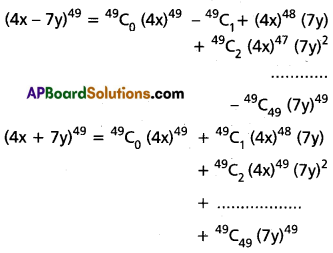
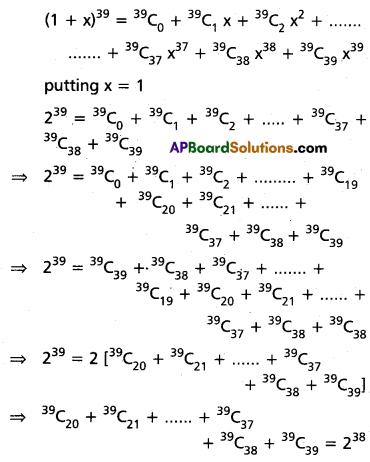
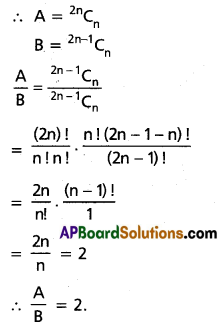
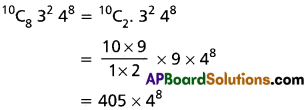
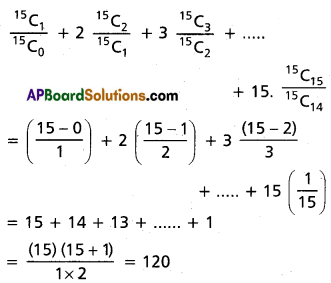
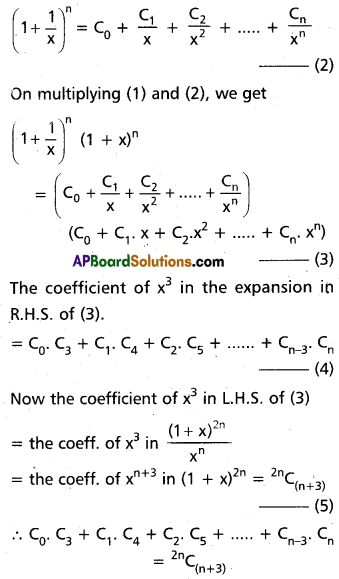
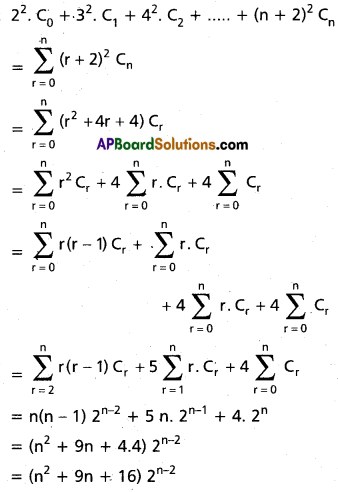
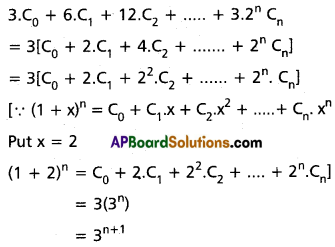
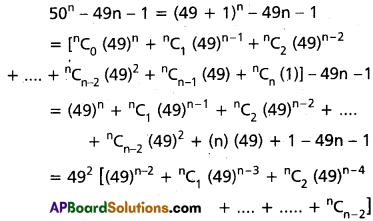
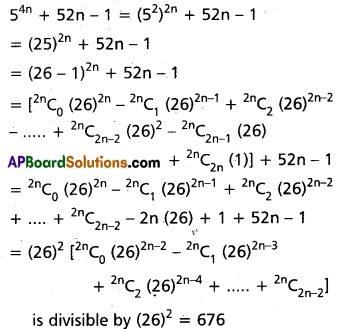
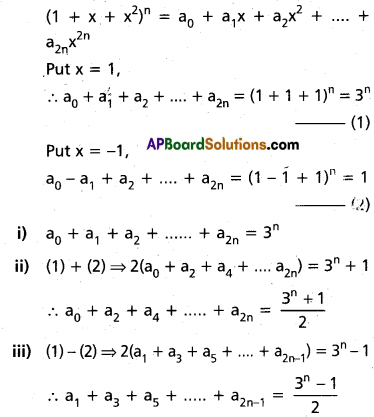
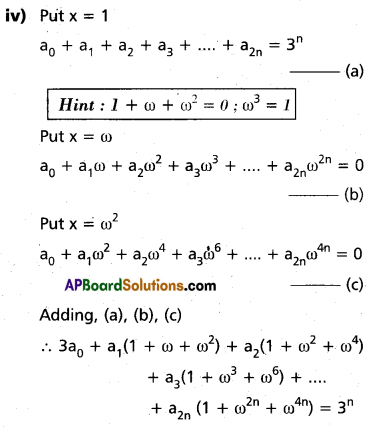
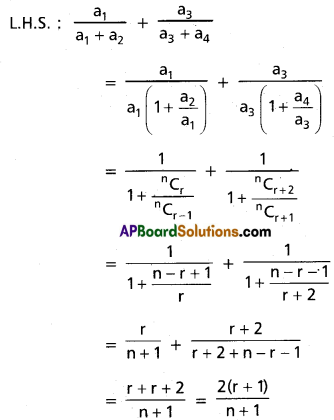
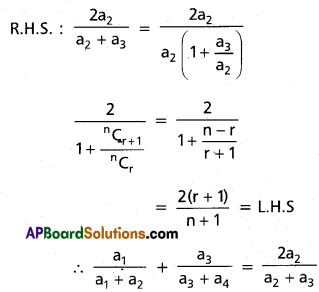
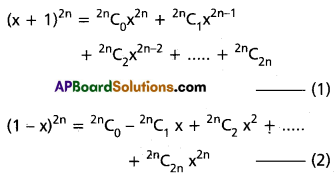
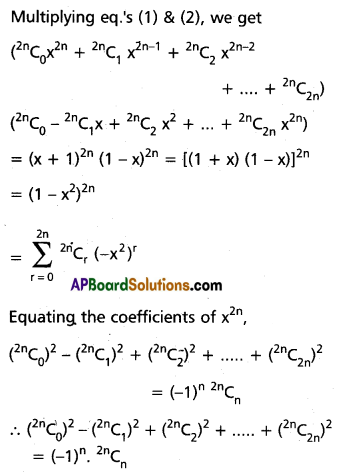
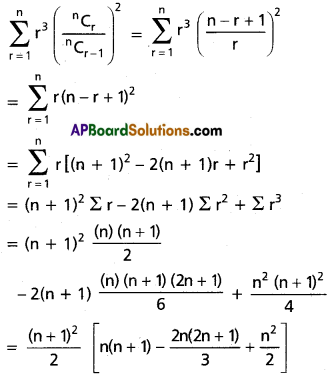
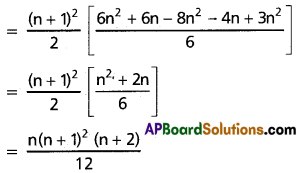
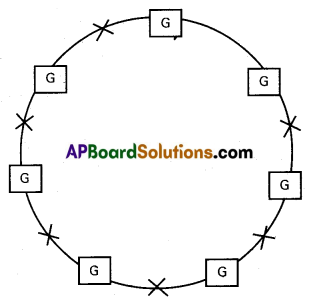
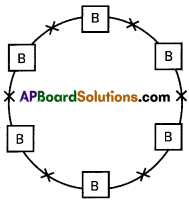
AP Inter 2nd Year Chemistry Important Questions Chapter 12(a) Alcohols, Phenols, and Ethers

Students get through AP Inter 2nd Year Chemistry Important Questions Lesson 12(a) Alcohols, Phenols, and Ethers which are most likely to be asked in the exam.

AP Inter 2nd Year Chemistry Important Questions Lesson 12(a) Alcohols, Phenols, and Ethers

Very Short Answer Questions

Question 1.
Explain why propanol has higher boiling point than that hydrocarbon-butane.
Answer:
Propanol has higher boiling point (391K) than that hydrocarbon butane (309K).
Reason : In propanol strong intermolecular hydrogen bonding is present between the molecules. But in case of butane weak vander waal’s force of attractions are present.

Question 2.
Alcohols are comparatively more soluble in water than hydrocarbons of comparable molecular masses. Explain this fact.
Answer:
Alcohols are comparatively more soluble in water than hydrocarbons of comparable molecular masses.
Explanation:

  • Alcohols and water are both polar solvents. Alcohol is dissolves in water, due to formation of hydrogen bonding with water molecules.
  • Hydro carbons are non polar and these donot form hydrogen bonds with water molecules. So alcohols are soluble in water where as hydrocarbons are not soluble in water.

AP Inter 2nd Year Chemistry Important Questions Chapter 12(a) Alcohols, Phenols, and Ethers

Question 3.
Name the reagents used in the following reactions.

  1. Oxidation of primary alcohol to carboxylic acid
  2. Oxidation of primary alcohol to aldehyde.

Answer:

  1. The reagents used for the oxidation of 1° – alcohols to carboxylic acid are acidified K2Cr2O7 (or) Acidic/alkaline KMnO4 (or) Neutral KMnO4.
  2. The reagents used for the oxidation of 1°- alcohols to aldehyde are pyridine chloro chromate (PCC) in CH2Cl2.

Question 4.
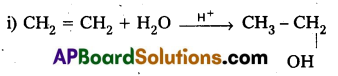
Write any one method for the preparation of ethyl alcohol.
Answer:
From Alkenes : Alcohols can be prepared from alkenes by hydration or hydroboration oxidation.
AP Inter 2nd Year Chemistry Important Questions Chapter 12(a) Alcohols, Phenols, and Ethers 1

Question 5.
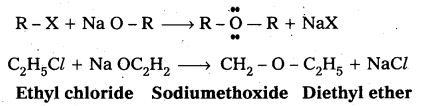
What is Williamsons synthesis ? Give example. (IPE – 2016 (AP) (TS), 2015 (AP))
Answer:
Williamsons synthesis : Reaction of alkyl halide with sodium alkoxide to give ether is called Williamson’s synthesis.
AP Inter 2nd Year Chemistry Important Questions Chapter 12(a) Alcohols, Phenols, and Ethers 2

Question 6.
Write the equations for the following reactions.

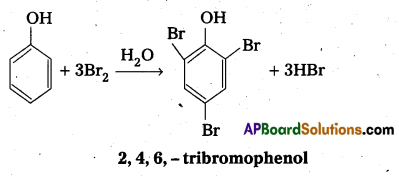
  1. Bromination of phenol to 2, 4, 6-tribromophenol
  2. Benzyl alcohol to benzoic acid.

Answer:

  1. Bromination of phenol to 2, 4, 6 tribromophenol.
    AP Inter 2nd Year Chemistry Important Questions Chapter 12(a) Alcohols, Phenols, and Ethers 3
  2. Benzyl alcohol to benzoic acid converted as follows.
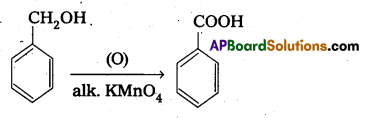
    AP Inter 2nd Year Chemistry Important Questions Chapter 12(a) Alcohols, Phenols, and Ethers 4

AP Inter 2nd Year Chemistry Important Questions Chapter 12(a) Alcohols, Phenols, and Ethers

Question 7.
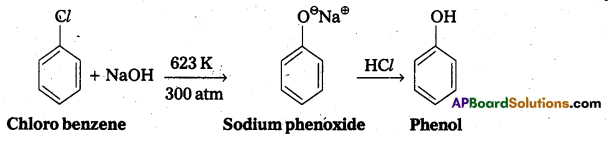
Give the reagents used for the preparation of phenol from chlorobenzene.
Answer:
Phenol is prepared from chlorobenzene as follows. Reagents required are

  1. NaOH, 623K, 300 atm,
  2. HCl.

Chemical reaction:
AP Inter 2nd Year Chemistry Important Questions Chapter 12(a) Alcohols, Phenols, and Ethers 5

Question 8.
what is Esterification ? Give equation.
Answer:
Esterification : Alcohols react with carboxylic acids or acid halides or acid anhydrides to form esters.
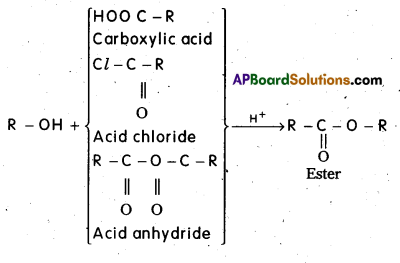
AP Inter 2nd Year Chemistry Important Questions Chapter 12(a) Alcohols, Phenols, and Ethers 6

Question 9.
What is Dehydration ? Give equation.
Answer:
Dehydration : Alcohols undergo dehydration in the presence of dehydrating agents like cone H2SO4, (or) H3PO4 etc and form alkenes. The relative ease of dehydration of alcohols follows the following order. Tertiary alcohol > Secondary alcohol > primary alcohol.
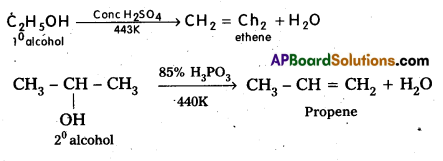
AP Inter 2nd Year Chemistry Important Questions Chapter 12(a) Alcohols, Phenols, and Ethers 7

Question 10.
What is Reimer Tiemann reaction ? Give equation.
Answer:
Reimer-Tiemann reaction : Phenol reacts with chloroform in presence of NaOH to form salicylaldehyde (O-Hydroxy benzaldehyde). This reaction is known as Reimer-Tiemann reaction.
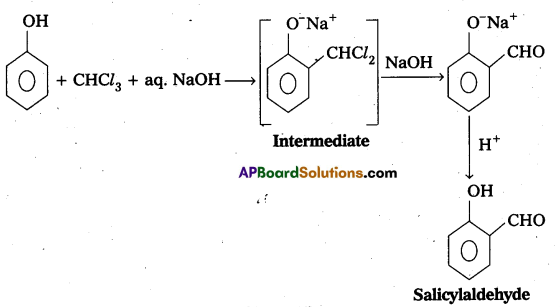
AP Inter 2nd Year Chemistry Important Questions Chapter 12(a) Alcohols, Phenols, and Ethers 8

Question 11.
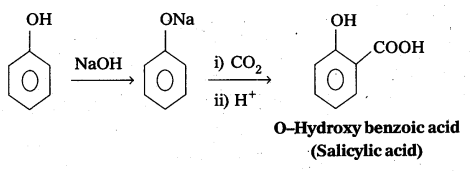
What is Kolbe’s reaction ? Give equation.
Answer:
Kolbe’s reaction : Phenol reacts with sodium hydroxide to form sodium phenoxide. This undergoes electrophillic substitution with CO2 to form salicylic acid.
AP Inter 2nd Year Chemistry Important Questions Chapter 12(a) Alcohols, Phenols, and Ethers 9

Question 12.
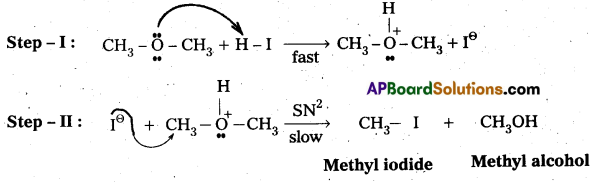
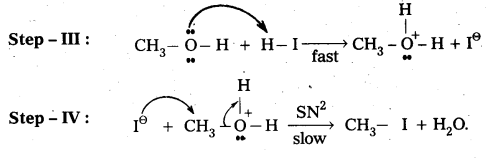
Write the mechanism of the reaction of HI with methoxymethane.
Answer:
Case – I : When methoxy methane reacts with cold.dil. HI then methyl alcohol and methyl iodide are formed.
Mechanisms:
AP Inter 2nd Year Chemistry Important Questions Chapter 12(a) Alcohols, Phenols, and Ethers 10
Case-II: When methoxy methane reacts with hot.conc.HI then only methyl iodide is formed.
Mechanisms:
AP Inter 2nd Year Chemistry Important Questions Chapter 12(a) Alcohols, Phenols, and Ethers 11

AP Inter 2nd Year Chemistry Important Questions Chapter 12(a) Alcohols, Phenols, and Ethers

Question 13.
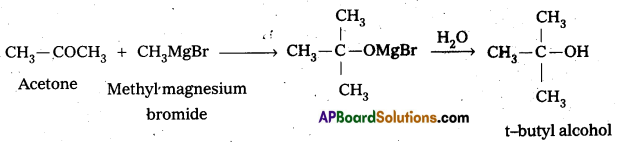
Identify the reactant needed to form t-butylalcohol from acetone.
Answer:
When acetone reacts with methyl magnesium bromide followed by the hydrolysis forms t-butylalcohol.
AP Inter 2nd Year Chemistry Important Questions Chapter 12(a) Alcohols, Phenols, and Ethers 13

Question 14.
Write the Oxidation reaction of phenol.
Answer:
Phenol undergo oxidation with chromicacid and forms a conjugated diketone known as benzoquinone.
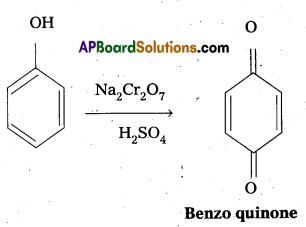
AP Inter 2nd Year Chemistry Important Questions Chapter 12(a) Alcohols, Phenols, and Ethers 14

Short Answer Questions

Question 1.
Give the equations for the preparation of phenol from Cumene. (TS Mar. ’17) (Mar. ’14)
Answer:
Phenol is prepared from Cumene as follows.

  1. Oxidation of Cumene to Cumene hydroperoxide.
  2. Cumene hydroperoxide on acidic hydrolysis to form phenol.
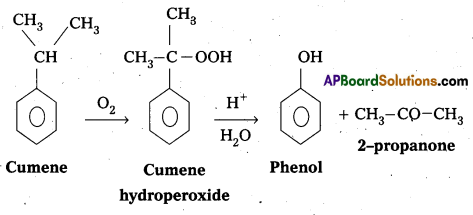
    AP Inter 2nd Year Chemistry Important Questions Chapter 12(a) Alcohols, Phenols, and Ethers 15

Question 2.
Explain the acidic nature of phenols and compare with that of alcohols. (AP Mar. ’17)Board Model Paper
Answer:
The reaction of phenol with sodium metal and with aq.NaOH indicates the acidic nature of phenol.
i) Phenol reacts with sodium metal to form sodium phenoxide.
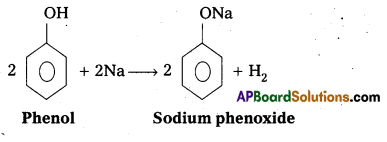
AP Inter 2nd Year Chemistry Important Questions Chapter 12(a) Alcohols, Phenols, and Ethers 16

ii) Phenol reacts with aq.NaOH and forms sodium phenoxide
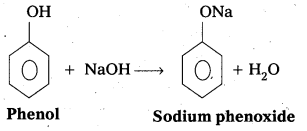
AP Inter 2nd Year Chemistry Important Questions Chapter 12(a) Alcohols, Phenols, and Ethers 17

  • In phenol hydroxyl group is attached to the Sp2 hydridised carbon of benzene ring which acts as electron with drawing group. The formed phenoxide ion from phenol is more stabilised due to delocalisation of negative charge.

Comparison of acidic character of Phenol and Ethanol:

  • The reaction of phenol with aq. NaOH indicates that phenols are stronger acids than alcohols.
  • The hydroxyl group attached to an aromatic ring is more acidic than in hydroxyl group is attached to an alkyl group.
  • Phenol forms stable phenoxide ion stabilised by resonance but ethoxide ion is not.
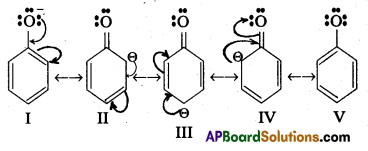
    AP Inter 2nd Year Chemistry Important Questions Chapter 12(a) Alcohols, Phenols, and Ethers 18

Question 3.
Write the products formed by the reduction and oxidation of phenol.
Answer:
a) Reduction of phenol: Phenol undergo reduction in presence of zinc dust to form benzene.
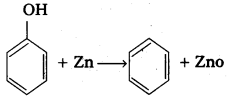
AP Inter 2nd Year Chemistry Important Questions Chapter 12(a) Alcohols, Phenols, and Ethers 19
b) Oxidation of phenol : Phenol undergo oxidation with chromic acid and forms a conjugated diketone known as benzoquinone.
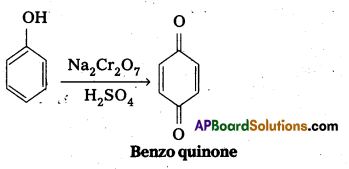
AP Inter 2nd Year Chemistry Important Questions Chapter 12(a) Alcohols, Phenols, and Ethers 20

Question 4.
Explain why in anisole electrophilic substitution takes place at ortho and para positions and not at meta position.
Answer:
Anisole is an aryl alkyl ether. In anisole the group -OCH3 influences +R effect. This increases the electron density in the benzene ring and it leads to the activation of benzene ring towards electrophilic substitution reactions.

In Anisole eletron density is more at O—and P—positions but not at M—position. So O—and P-products are mainly formed during electrophillic substitution reactions.
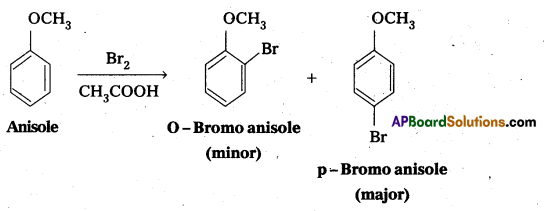
AP Inter 2nd Year Chemistry Important Questions Chapter 12(a) Alcohols, Phenols, and Ethers 21

AP Inter 2nd Year Chemistry Important Questions Chapter 12(a) Alcohols, Phenols, and Ethers

Question 5.
Explain whý phenol with bromine water forms 2,4, 6-tribromophenol while on reaction with bromine in CS2 at low temperatures forms para—bromophenol as the major product.
Answer:
a) Phenol undergoes Bromination in presence of CS2 to form p—bromophenol as major product.
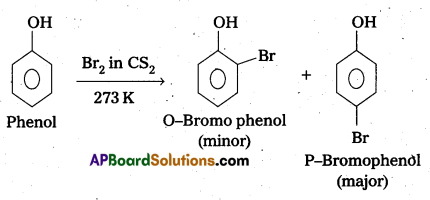
AP Inter 2nd Year Chemistry Important Questions Chapter 12(a) Alcohols, Phenols, and Ethers 22
b) Phenol undergoes bromination in aqueous medium form 2,4,6 -tribromo phenol (white ppt).
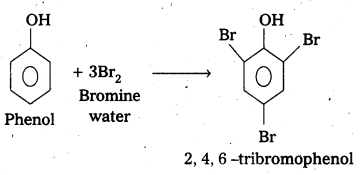
AP Inter 2nd Year Chemistry Important Questions Chapter 12(a) Alcohols, Phenols, and Ethers 23

Explanation : In bromination of phenol, the polarisation of Br2 molecule takes place even in the absence of Lewis acid. This is due to the highly activating effect of -OH group attached to the benzene ring.

Question 6.
Explain the acidic nature of phenol.
Answer:
The reaction of phenol with sodium metal and with aq.NaOH indicates the acidic nature of phenol.
i) Phenol reacts with sodium metal to form sodium phenoxide.
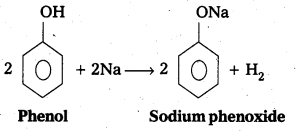
AP Inter 2nd Year Chemistry Important Questions Chapter 12(a) Alcohols, Phenols, and Ethers 24

ii) Phenol reacts with aq.NaOH and forms sodium phenoxide.
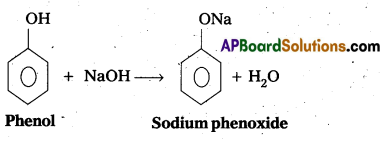
AP Inter 2nd Year Chemistry Important Questions Chapter 12(a) Alcohols, Phenols, and Ethers 25

  • In phenol hydroxyl group is attached to the Sp2 hydridised carbon of benzene ring which acts as electron with drawing group. The fõrmed phenoxide ion from phenol is more stabilised due to delocalisation of negative charge.

Question 7.
Explain the electrophilic substitution reaction of Anisole.
Answer:
Electrophilic substitution in Anisole:
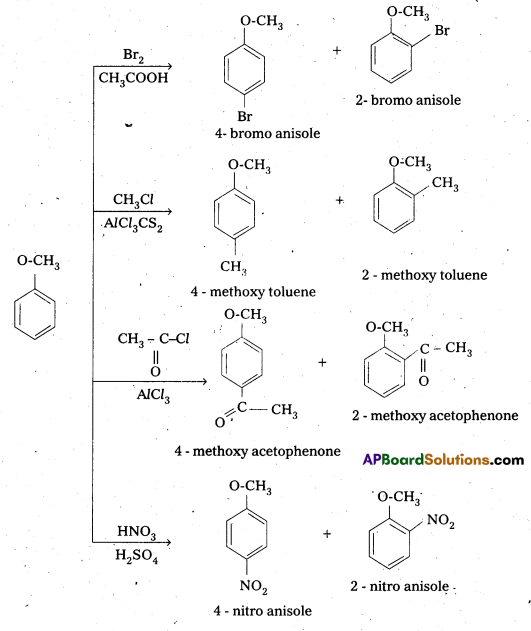
AP Inter 2nd Year Chemistry Important Questions Chapter 12(a) Alcohols, Phenols, and Ethers 26
In all the above reactions p – isomer is the major product.

Question 8.
Write equations of the below given reactions:
i) Alkylatlon of anisole
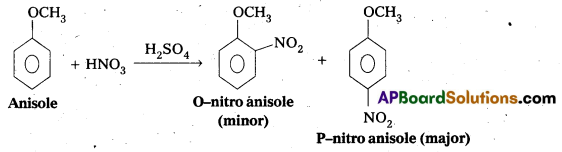
ii) Nitration of anisole
iii) Friedel—Crafts acetylation of anisole
Answer:
i) Friedel crafts alkylation of anisole:
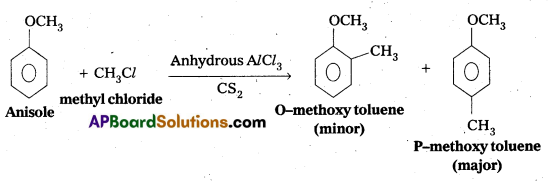
AP Inter 2nd Year Chemistry Important Questions Chapter 12(a) Alcohols, Phenols, and Ethers 27

ii) Nitration of anisole:
AP Inter 2nd Year Chemistry Important Questions Chapter 12(a) Alcohols, Phenols, and Ethers 28

iii) Friedel – Crafts acetylation of anisole
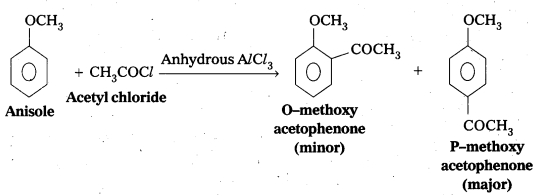
AP Inter 2nd Year Chemistry Important Questions Chapter 12(a) Alcohols, Phenols, and Ethers 29

Question 9.
Illustrate hydroboration-oxidation reaction with a suitable example.
Answer:
When alkenes undergo addition reaction with diborane to form tri alkyl boranes. These followed by the oxidation by alkaline H2O2 to form alcohols. This reaction is called as hydroboration-oxidation reaction.
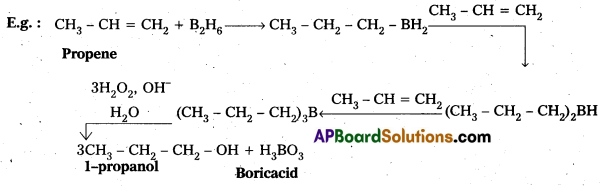
AP Inter 2nd Year Chemistry Important Questions Chapter 12(a) Alcohols, Phenols, and Ethers 30

Question 10.
Write any two methods for the preparation of phenol. (IPE 2014)
Answer:
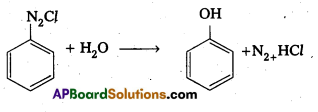
Preparation of Phenol : Phenol can be prepared from halobenzene, benzene diazonium chloride and cumene etc.
i) From halobenzene
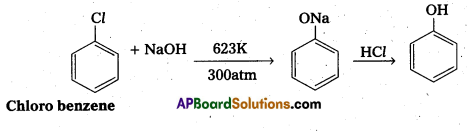
AP Inter 2nd Year Chemistry Important Questions Chapter 12(a) Alcohols, Phenols, and Ethers 31

ii) from Benzene diazonium chloride
AP Inter 2nd Year Chemistry Important Questions Chapter 12(a) Alcohols, Phenols, and Ethers 32

AP Inter 2nd Year Chemistry Important Questions Chapter 12(a) Alcohols, Phenols, and Ethers

Question 11.
Write the structures of the following compounds.
i) 2 Methyl butan -1 – o1
ii) 2, 3 – diethyl phenol
iii) 1 – ethoxy propane
iv) Cyclohexyl methanol
Answer:
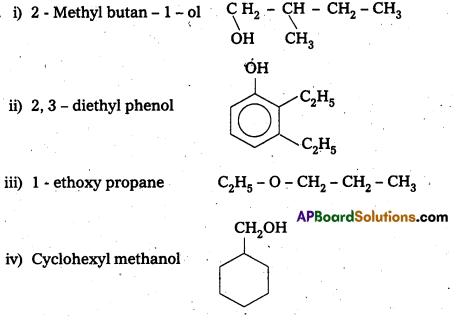
AP Inter 2nd Year Chemistry Important Questions Chapter 12(a) Alcohols, Phenols, and Ethers 33

AP Inter 2nd Year Chemistry Important Questions Chapter 10 Chemistry In Everyday Life

Students get through AP Inter 2nd Year Chemistry Important Questions 10th Lesson Chemistry In Everyday Life which are most likely to be asked in the exam.

AP Inter 2nd Year Chemistry Important Questions 10th Lesson Chemistry In Everyday Life

Very Short Answer Questions

Question 1.
What are drugs ?
Answer:
Drug : The chemicals of low molecular masses ranging from 100 to 500 U that react with macromolecular targets to produce biological response are called drugs.
E.g. : Morphine, Codeine, Heroin etc.,

Question 2.
When are the drugs called medicines ?
Answer:
When the biological response of a drug is therapeutic and useful then the chemical substances (drugs) are called medicines.

AP Inter 2nd Year Chemistry Important Questions Chapter 10 Chemistry In Everyday Life

Question 3.
Define the term chemotherapy.
Answer:
Chemotherapy: The use of medicines (chemical substances) in the treatment of diseases is called chemotherapy.
In chemotherapy diagnosis, prevention and treatment of diseases are involved.

Question 4.
What are antagonists and agonists ?
Answer:

  1. Antagonists : The drugs that bind to the receptor site and inhibit its natural function are called antagonists. ’
    • These are useful when blocking of message is required.
  2. Agonists : The drugs that mimic the natural messenger by switching on receptors are called agonists.
    • These are useful when there is lack of natural chemical messenger.

Question 5.
What are antacids ? Give example. [IPE – 2014, 2016 (TS)] [Mar. 14]
Answer:
Antacids : Chemicals that remove the excess of acid in the stomach and maintain the pH to normal level are antacids.
E.g. : Omeprozole, Lansoprozole etc.

Question 6.
What are antihistamines ? Give example. [IPE 2014]
Answer:
Antihistamines : Chemicals that prevent the interaction of histamines with receptors of the stomach wall thus producing less amount of acid are antihistamines.
E.g. : Dimetapp, Terfenadine (Seldane).

Question 7.
What are tranquilizers ? Give example. [IPE 2015 (TS)]
Answer:
Tranquilizers : The drugs which are used in the management (or) treatment of psychoes and neuroses are called tranquilizers. ‘
E.g.: Luminal, Seconal, Barbituric acid etc.

AP Inter 2nd Year Chemistry Important Questions Chapter 10 Chemistry In Everyday Life

Question 8.
What are analgesics ? How are they classified ?
Answer:
Analgesics : These are to reduce or totally abolish pain without causing impairment of consciousness, mental confusion, incoordination, paralysis, disturbances of nervous system etc.
Analgesics are classified as

  1. Narcotic analgesics : These are most potent and clinically useful agents causing depression of central nervous system and at the same time act as strong analgesics. E.g. : Morphine, Codeine etc.
  2. Non-narcotic analgesics : These drugs are analgesics but they have no addictive
    properties. Their analgesic use is limited to mild aches and pains. .
    E.g.: Aspirin, Ibuprofen etc.

Question 9.
What are antimicrobials ?
Answer:
Antimicrobials : The chemical substances which destroy (or) prevent the development (or) inhibit the pathogenic action of microbes such as bacteria, fungi, virus are called antimicrobials.
E.g.: Lysozyme, Lactic acid etc.

Question 10.
What are antibiotics ? Give example. [A.P. Mar. 16]
Answer:
Antibiotics: The chemical substances produced by micro organisms and inhibit the growth or destroy microorganisms are called antibiotics.
(Or)
The substance produced totally or partly by chemical synthesis which in low concentration inhibits the growth (or) destroy microorganism by intervening in their metabolic process are called antibiotics.
E.g.: Penicillin, Chloramphenicol etc.

Question 11.
What are antiseptics ? Give example. [A.P. Mar. 15]
Answer:
Antiseptics : The chemical compounds that kill (or) prevent the growth of micro organism are called antiseptics.
Antiseptics are the chemical substances applied on the living tissues such as wounds, cuts, ulcers and diseased skin surfaces.
E.g.: Dettol, Bithional etc.

Question 12.
What are disinfectants ? Give example. [A.P. Mar. 17]
Answer:
Disinfectants : The chemical compounds used for killing (or) preventing the growth of microorganism are called disinfectants.
i) These are applied to inanimate objects like floors, drainage systems etc.
E.g.:

  1. 4% aqueous solution of formaldehyde called formalin is a disinfectant
  2. 0.3 ppm chlorine aqueous solution is disinfectant.
  3. SO2 in very low concentration is disinfectant.

AP Inter 2nd Year Chemistry Important Questions Chapter 10 Chemistry In Everyday Life

Question 13.
What is the difference between antiseptics and disinfectants ?
Answer:
Antiseptics are the chemical substances applied on the living tissues such as wounds, cuts, ulcers and diseased skin surfaces.
Disinfectants are applied to inanimate objects such as floors, drainage system, instruments etc.

Question 14.
What are antifertility drugs ? Give example.
Answer:
Antifertility drugs: These are birth control pills and contain a mixture of synthetic estrogen and progesterone derivatives.
E.g. : Norethindrone, Ethynylestradiol (novestrol)

Question 15.
What are artificial sweetening agents ? Give example. [IPE – 2016 (A.P.), (T.S.)]
Answer:
The chemical substances which are used instead of sucrose (or) sugar are called artificial sweetening agents.
E.g. : Aspartame, Alitame, saccharin.
These decrease the calorific intake and at the same time several times sweeter than sucrose.

Question 16.
Why is the use of aspartame limited to cold foods and drinks ?
Answer:
Aspartame is unstable at cooking temperature so it’s use is limited to cold foods and soft drinks.

Question 17.
What problem does arise in using alitame as artificial sweetener ?
Answer:
While using alitame as artificial sweetener, the control of sweetness of food is difficult. Alitame is a high potency sweetner.

AP Inter 2nd Year Chemistry Important Questions Chapter 10 Chemistry In Everyday Life

Question 18.
Why do soaps not work in hard water ?
Answer:
In hard water Ca, Mg-dissolved salts are present. Ca+2, Mg+2 ions form insoluble Ca, Mg, soaps respectively when sodium (or) potassium soaps are dissolved in hard water.
AP Inter 2nd Year Chemistry Important Questions Chapter 10 Chemistry In Everyday Life 22

  1. These insoluble soaps separate as scum in water and are useless as cleansing agent. ’ These are problematic to good washing because the ppt adheres into the fibres of cloth
    as gummy mass.
  2. Hair washed with hard water looks dull.
  3. Dye does not absorb evenly on cloth washed with soap using hard water due to this gummy mass.

Question 19.
What are synthetic detergents ?
Answer:
The cleansing agents which are having all the properties of soaps but donot contain any soap are called synthetic detergents.
Synthetic detergents can be used both in soft and hard water as they give foam even in hard water.
E.g.: Sodium dodecyl benzene sulphonate.

Question 20.
What is the difference between a soap and a synthetic detergent ?
Answer:

  1. Generally soaps are sodium or potassium salts of long chain fattyacids.
  2. Synthetic detergents are cleansing agents having all the properties of soaps and donot cpntain any soap.
  3. Soaps donot work in hard water but synthetic detergents can be used both in soft and hard water as they give foam even in hard water. Some of the detergents give foam even in ice cold water.

Question 21.
What are food preservatives ? Give example. [A.P. Mar. 17 – IPE 2016 (T.S)]
Answer:
The chemical substances which prevent the spoilage of food due to microbial growth are called food preservatives.
E.g.: Sodium benzoate, Salt of sorbic acid etc.

Question 22.
How are synthetic detergents better than soaps ?
Answer:
Soaps donot work in hard water but synthetic detergents can be used both in soft and hard water as they give foam even in hard water. Some of the detergents give foam even in ice cold water.

AP Inter 2nd Year Chemistry Important Questions Chapter 10 Chemistry In Everyday Life

Question 23.
Name a substance which can be used as an antiseptic as well as disinfectant.
Answer:
Phenol is used as antiseptic as well as disinfectant.

  1. 0.2% phenol is antiseptic
  2. 1% phenol is disinfectant.

Question 24.
Why chemicals are added to food ?
Answer:
Chemicals are added to food for i) preservation ii) enhancing their appeal iii) adding nutritive value in them.

Question 25.
Name different categories of food additives.
Answer:
The following are the categories of food additives.

  1. Food colours
  2. Flavours and sweetners
  3. Fat Emulsifiers and stabilising agents
  4. Anti oxidants
  5. Flour improvers – antistaling agents and bleaches
  6. Preservatives
  7. Nutritional supplements such as minerals, vitamins and amino acids.

Question 26.
Why do we require artificial sweetening agents ?
Answer:

  1. Artificial sweetening agents are very useful to diabetic persons.
  2. These decrease the calorific intake and at the same time several times sweeter than sucrose.
  3. These are harmless.

Question 27.
Name the sweetening agent used in the preparation of sweets for a diabetic patient.
Answer:
The sweetening agent used in the preparation of sweets for a diabetic patient is saccharin (or) sucralose. It is stable at cooking temperature.

AP Inter 2nd Year Chemistry Important Questions Chapter 10 Chemistry In Everyday Life

Question 28.
Name two most familiar antioxidants used as food additives.
Answer:
The most familiar antioxidants are butylated hydroxy toluene (BHT) and butylated hydroxy anisole (BHA).

Question 29.
What is saponification ?
Answer:
The process of formation of soaps containing sodium salts by heating esters of fatty acid with aq. NaOH solution is called saponification.

Question 30.
What are the main constituents of dettol ?
Answer:
Dettol (antiseptic) is a mixture of chloroxylenol and terpineol.

Question 31.
What is tincture of iodine ? What is its use ?
Answer:
Tincture of iodine (antiseptic) is a mixture of 2 – 3% Iodine solution in alcohol-water.

Question 32.
What are enzymes and receptors ?
Answer:
Enzymes : The proteins which perform the role of biological catalysts in the body are called enzymes.
Receptors : The proteins which are crucial to communication system in the body are called receptors.

Question 33.
Which forces are involved in holding the drug to the active site of enzymes ?
Answer:
The forces involved in holding the drugs to the active site of enzymes are ionic bonds, vander waal’s forces, hydrogen bonds, dipole-dipole interactions etc.

AP Inter 2nd Year Chemistry Important Questions Chapter 10 Chemistry In Everyday Life

Question 34.
What are enzyme inhibitors ?
Answer:
The drugs which inhibits the catalytic activity of enzymes and can block the binding site of the enzyme and prevent the binding of substrate are called enzyme inhibitors.

Question 35.
While antacids and antiallergic drugs interfere with the function of histamines why do not these interfere with the function of each other ?
Answer:
Antacids and antiallergic drugs donot interfere with the function of each other because they work on different receptors in the body.

Question 36.
What are antipyretics ? Give example.
Answer:
The medicines which reduce body temperature during fever are called antipyretics.
E.g.: Paracetamol

Short Answer Questions

Question 1.
What are analgesics ? How are they classified ? Give examples.
Answer:
Analgesics : These are to reduce or totally abolish pain without causing impairment of consciousness, mental confusion, incoordination, paralysis, disturbances of nervous system etc. Analgesics are classified as

  1. Narcotic analgesics : These are most potent and clinically useful agents causing depression of central nervous system and at the same time act as strong analgesics.
    E.g. : Morphine, Codeine etc.
  2. Non-narcotic analgesics : These drugs are analgesics but they have no addictive properties. Their analgesic use is limited to mild aches and pains.
    E.g. : Aspirin, Ibuprofen etc.

Question 2.
What are different types of microbial drugs ? Give one example for each.
Answer:
Antimicrobials : The chemical substances which destroy or prevent the development (or) inhibit the pathogenic action of microbes such as bacteria, fungi, virus are called antimicrobials.
E.g.: Lysozyme, Lactic acid etc.,
Different types of antimicrobial drugs are antibiotics, antiseptics, disinfectants.

  1. Antibiotics : The chemical substances produced by micro organisms and inhibit the growth or destroy microorganisms are called antibiotics.
    (Or)
    The substance produced totally or partly by chemical synthesis in low concentration inhibits the growth (or) destroy microorganism by intervening in their metabolic process are called antibiotics.
  2. Antiseptics: The chemical compounds that kill (or) prevent the growth of micro organism are called antiseptics.
    Antiseptics are the chemical substances applied on the living tissues such as wounds, cuts, ulcers and diseased skin surfaces.
  3. Disinfectants : The chemical compounds used for killing (or) preventing the growth of microorganism are called disinfectants.
    These are applied to inanimate objects like floors, drainage systems etc.
    E.g. :

    • 4% aqueous solution of formaldehyde called formalin is a disinfectant
    • 0.3 ppm chlorine aqueous solution is disinfectant.
    • SO2 in very low concentration is disinfectant.

AP Inter 2nd Year Chemistry Important Questions Chapter 10 Chemistry In Everyday Life

Question 3.
Write notes on antiseptics and disinfectants. [T.S. Mar. 17]
Answer:
Antiseptics : The chemical compounds that kill (or) prevent the growth of micro organism are called antiseptics.
Antiseptics are the chemical substances applied on the living tissues such as wounds, cuts, ulcers and diseased skin surfaces.
E.g.: Dettol, Bithional etc.
Phenol is used as antiseptic as well as disinfectant. 0.2% phenol is antiseptic.
Dettol (antiseptic) is a mixture of chloroxylenol and terpineol.
Tincture of iodine (antiseptic) is a mixture of 2 – 3% Iodine solution in alcohol-water.

Disinfectants : The chemical compounds used for killing (or) preventing the growth of microorganism are called disinfectants.
These are applied to inanimate objects like floors, drainage systems etc.
E.g.:

  1. 4% aqueous solution of formaldehyde called formalin is a disinfectant.
  2. 0.3 ppm chlorine aqueous solution is disinfectant.
  3. SO2 in very low concentration is disinfectant.

Phenol is used as antiseptic as well as disinfectant. 1% phenol is disinfectant.

Question 4.
How do antiseptics differ from disinfectants ? Does the same substance be used as both ? Give one example for each.
Answer:
Antiseptics are the chemical substances applied on the living tissues such as wounds, cuts, ulcers and diseased skin surfaces.
Disinfectants are applied to inanimate objects such as floors, drainage system, instruments etc.
Phenol is used as antiseptic as well as disinfectant.
i) 0.2% phenol is antiseptic.
ii) 1% phenol is disinfectant.

  1. Examples of Antiseptics :
    • Dettol (antiseptic) is a mixture of chloroxylenol and terpineol.
    • Tincture of iodine (antiseptic) is a mixture of 2.3% Iodine solution in alcohol-water.
  2.  Examples of disinfectants :
    • 4% aqueous solution of formaldehyde called formalin is a disinfectant.
    • 0.3 ppm chlorine aqueous solution is disinfectant.
    • SO2 in very low concentration is disinfectant.

AP Inter 2nd Year Chemistry Important Questions Chapter 10 Chemistry In Everyday Life

Question 5.
Explain the following terms with suitable examples.
i) Cationic detergents
ii) Anionic detergents
iii) Non-ionic detergents
Answer:
Synthetic detergents are classified into three types.
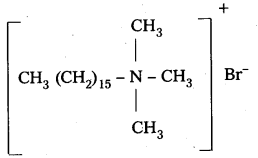
i) Cationic detergents : These are synthetic detergents.
a) Cationic detergents are quarternary ammonium salts of amines with acetates, chlorides (or) bromides as anions.
AP Inter 2nd Year Chemistry Important Questions Chapter 10 Chemistry In Everyday Life 23
b) Cationic part possess a long hydrocarbon chain and a positive charge on nitrogen atom. Hence these are called cationic detergents.
E.g.: Cetyl trimethyl ammonium bromide
It is used in hair conditioners.

ii) Anionic Detergents : These are synthetic detergents.
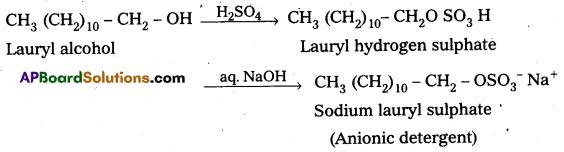
a) Anionic detergents are sodium salts of sulphonated long chain alcohols (or) hydrocarbons.
b) Anionic detergents are formed by the treatment of long chain alcohols with cone. H2SO4 followed by the neutralisation with alkali.
E.g.: Sodium lauryl sulphate.
AP Inter 2nd Year Chemistry Important Questions Chapter 10 Chemistry In Everyday Life 24
These are used for house hold work and in tooth pastes.

iii) Non-ionic detergents : These are synthetic detergents.
a) Non-ionic detergents donot contain any ion in their constitution..
b) The detergent formed by the reaction of stearic acid with poly ethylene glycol is an example of non ionic detergent.
AP Inter 2nd Year Chemistry Important Questions Chapter 10 Chemistry In Everyday Life 25
Non-ionic detergents are used in liquid dish washing purpose.

Question 6.
What are biodegradable and non-bio degradable detergents ? Give one example for each.
Answer:
i) Biodegradable detergents :

  • The detergents which are degraded (or) decomposed by micro organisms are called biodegradable detergents. Biodegradable detergents have less branching.
  • These do not cause water pollution.
    E.g. : n-dodecyle benzene sulphonate, soap (non synthetic)

ii) Non Biodegradable detergents :

  • The detergents which are not decomposed (Or) degraded by microbes (or) micro organisms are called non-biodegradable detergents. These have more branching.
  • These cause water pollution.
    E.g.: ABS detergent.

AP Inter 2nd Year Chemistry Important Questions Chapter 10 Chemistry In Everyday Life

Question 7.
What are broad spectrum and narrow spectrum antibiotics ? Give one example for each.
Answer:
The range of bacteria (or) other micro organisms that are effected by a certain antibiotic is expressed as its spectrum of action.
Broad spectrum antibiotics : Antibiotics which kill (or) inhibit a wide range of gram¬positive and gram-negative bacteria are called broad spectrum antibiotics.

Narrow spectrum antibiotics: Antibiotics which are effective mainly against gram-positive (or) gram-negative bacteria are called narrow spectrum antibiotics.
E.g.: Penicillin – G is a narrow spectrum antibiotic.

Limited spectrum antibiotics : Antibiotics which are effective mainly against a single organism (or) disease are called as limited spectrum antibiotics.

Question 8.
Name different types of soaps.
Answer:
The following are the different types of soaps.

  1. Toilet soaps
  2. Soaps that float in water
  3. Medicated soaps
  4. Shaving soaps
  5. Laundry soaps
  6. Soap powders and scouring soaps etc.

AP Inter 2nd Year Chemistry Important Questions Chapter 10 Chemistry In Everyday Life

Question 9.
Write notes on antioxidants in food.
Answer:
Antioxidants :

  • Antioxidants are important and necessary food additives.
  • Antioxidants help in food preservation by retarding the action of oxygen on food.
  • Antioxidants are more reactive towards oxygen than the food material which they protect.
  • The most familiar antioxidants are Butylated hydroxy toluene (BHT) and Butylated hydroxy anisole (BHA).
  • The addition of BHA to butter increases its shelf life from months to years.
  • BHT and BHA along with citric acid are added to produce more antioxidant effect.
  • SO2 and sulphites are useful anti oxidants for wine and beer, sugar syrups and cut, peeled (or) dried fruits and vegetables.

AP Inter 2nd Year Chemistry Important Questions Chapter 9 Biomolecules

Students get through AP Inter 2nd Year Chemistry Important Questions 9th Lesson Biomolecules which are most likely to be asked in the exam.

AP Inter 2nd Year Chemistry Important Questions 9th Lesson Biomolecules

Very Short Answer Questions

Question 1.
Define Carbohydrates.
Answer:
The compounds which are primarily produced by plants and form a very large group of naturally occuring organic compounds are called Carbohydrates.
Eg: Glucose, Fructose, Starch. Carbohydrates are the polyhydroxy aldehydes (or) ketones.

Question 2.
Name the different types of carbohydrates on the basis of their hydrolysis. Give one example for each.
Answer:
On the basis of the hydrolysis, carbohydrates are classified as

  1. Monosaccharides, Eg : Glucose, fructose AP Inter 2nd Year Chemistry Important Questions Chapter 9 Biomolecules 1 No saccharides

  2. Oligosaccharides, Eg : Sucrose, maltose AP Inter 2nd Year Chemistry Important Questions Chapter 9 Biomolecules 1 two monosaccharides
  3. Polysaccharides, Eg : Starch, cellulose AP Inter 2nd Year Chemistry Important Questions Chapter 9 Biomolecules 1 large number of monosaccharides.

AP Inter 2nd Year Chemistry Important Questions Chapter 9 Biomolecules

Question 3.
How is Glucose prepared ? [IPE – 2014]
Answer:
Glucose is prepared by the hydrolysis of starch in presence of a little acid.
AP Inter 2nd Year Chemistry Important Questions Chapter 9 Biomolecules 2

Question 4.
Why are sugars classified as reducing and non-reducing sugars ?
Answer:

  • Carbohydrates that reduce Fehling’s reagent, Tollen’s reagent are called reducing sugars.
    Eg: Glucose.
  • Carbohydrates that doesnot reduce Fehling’s reagent, Tollen’s reagent are called non reducing sugars.
    Eg : Sucrose.

Question 5.
What do you understand by invert sugars ?
Answer:
During the hydrolysis of sucrose there is a change in the sign of rotation, from dextro (+) to laevo (-) and the product is named as invert sugar.

Question 6.
What do you mean by essential amino acids ? Give two examples for non essential amino acids ? [IPE 2014] [T.S. Mar. 16]
Answer:
Essential amino acids : The amino acids which cannot be synthesized in the body and must be obtained through diet are known as essential aminoacids.
Eg : valine, leucine etc.
Examples of non essential amino acids are Alanine, Glycine, Aspartic acid.

AP Inter 2nd Year Chemistry Important Questions Chapter 9 Biomolecules

Question 7.
What is zwitter ion ? Give an example. [IPE 2015 (AP)]
Answer:
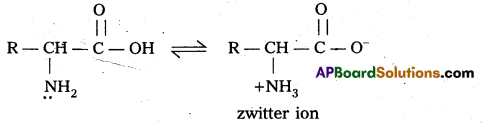
Zwitter ion: In aqueous solution of amino acids, the carboxyl group can lose a proton and amino acid can accept that proton to form a dipolar ion. This ion is called as zwitter ion.
AP Inter 2nd Year Chemistry Important Questions Chapter 9 Biomolecules 3

Question 8.
What are reducing sugars ?
Answer:
Carbohydrates that reduce Fehling’s reagent, Tollen’s reagent are called reducing sugars.
Eg: glucose.

Question 9.
What are proteins ? Give an example.
Answer:
Proteins : A poly peptide with more than hundred amino acid residues, having molecular mass higher than 10,000 units is called a protein.
Eg : keratin, myosin, insulin.

Question 10.
What are the components of a nucleic acid ?
Answer:

  • Nucleic acids are long chain polymers of nucleotides i.e., poly nucleotides.
  • Nucleic acids are constituted by pentose sugar, phosphoric acid, and nitrogenous hetero cyclic base (purine (or) pyrimidine).

AP Inter 2nd Year Chemistry Important Questions Chapter 9 Biomolecules

Question 11.
What are essential and non – essential amino acids ? Give one example for each. [IPE – 2016 (TS)]
Answer:

  • Essential amino acids : The amino acids that cannot be synthesised by the body and must be supplied in the diet are called essential amino acids.
    Eg : valine, leucine, phenyl alanine etc.
  • Non-essential amino acids : Other amino acids synthesised by the tissues of the body are called non-essential amino acids..
    Eg: Glycine, alanine etc.

Question 12.
Differentiate between globular and fibrous proteins.
Answer:
Globular proteins

  1. In this proteins the chains of poly peptides coil around to give a spherical shape.
  2. hese are soluble in water.
  3. Eg : Insulin

Fibrous proteins

  1. In this proteins the poly peptides run parallel and are held together by hydrogens and disulphite – bonding.
  2. These are insoluble in water.
  3. Eg: keratin

Question 13.
Why are vitamin A and vitamin C essential to us ? Give their important sources.
Answer:
Vitamin A and Vitamin C are essential to us.
Explanation :

  • Deficiency of vitamin A causes night blindness, redness in eyes, xerophthalnia.
  • Deficiency of vitamin C causes pernicious anaemia (RBC deficient in haemoglobin).

Sources:

  • Vitamin – A : Fish liver oil, carrots, butter and milk.
  • Vitamin – C : Citrous fruits, amla, green leafy vegetables

AP Inter 2nd Year Chemistry Important Questions Chapter 9 Biomolecules

Question 14.
What do you understand from the names (a) aldo pentose and (b) ketoheptose ?
Answer:
a) Aldo pentose : If a monosaccharide contains 5 carbon atoms with aldehyde group then it is known as aldo pentose.
b) Ketoheptose : If a monosaccharide contain seven carbons with a ketone group then it is called ketoheptose.

Question 15.
What are anomers ?
Answer:
Anomers : The two isomeric structures of a compound which differ in configuratiofi at C-l only are called Anomers.

Question 16.
What are amino acids ? Give two examples.
Answer:
The organic compounds which contain amino (-NH2) functional group and carboxyl (-COOH) functional group are called amino acids.
Eg : Glycine, Alanine etc.

Question 17.
What are fibrous proteins ? Give examples.
Answer:
When the poly peptide chains run parallel and are held together by hydrogen and disulphide bonds then fibre – like structure is formed. These are called fibrous proteins. These are insoluble in water.
Eg : keratin, myosin.

AP Inter 2nd Year Chemistry Important Questions Chapter 9 Biomolecules

Question 18.
What are globular proteins ? Give examples.
Answer:
When the chains of polypeptides coil around to give a spherical shape then globular proteins are formed. These are usually soluble in water.
Eg : insulin and albumins.

Short Answer Questions

Question 1.
Explain the denaturation of proteins.
Answer:
The phenomenon of disorganization of native protein structure is known as denaturation. Denaturation results in the loss of secondary, tertiary and quaternary structure of proteins. This involves a change in physical, chemical and biological properties of protein molecules.
Agents of denaturation:
Physical agents – Heat, violent shaking, X – rays, UV – radiation.
Chemical gents – Acids, alkalies, organic solvents, urea, salts of heavy metals.

Question 2.
What are enzymes ? Give examples ?
Answer:
The group of complex proteinoid organic compounds, elaborated by living organism which catalyse specific organic reactions are called enzymes.
Eg.: Lipases, Rennin, Maltase, Invertase etc. Practically all biological processes such as digestion, respiration etc., are carried on through the agency of enzymes.
Enzymes may be defined as biocatalysts synthesised by living cells.
The functional unit of enzyme is known as holo enzyme made up at apo enzyme (protein part) and co enzyme (non-protein part).
AP Inter 2nd Year Chemistry Important Questions Chapter 9 Biomolecules 4

Question 3.
Write notes on vitamins.
Answer:
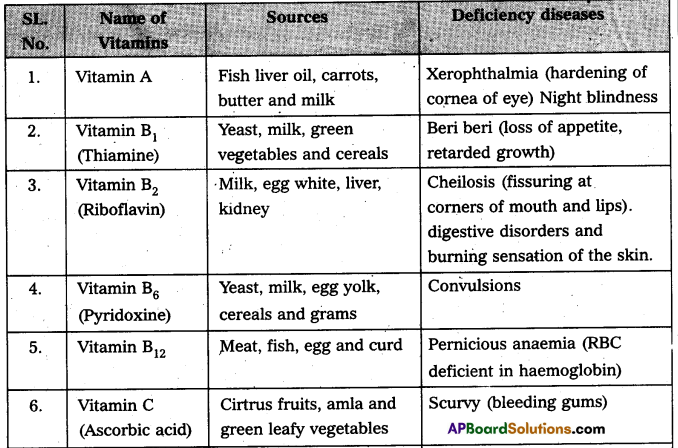
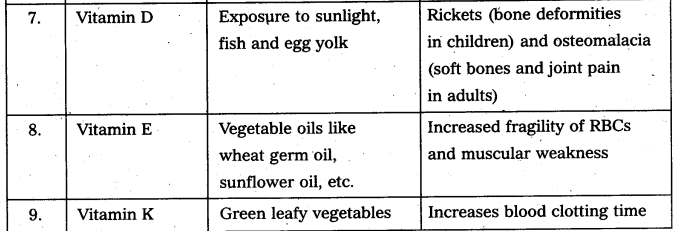
Vitamin is defined as an “accessory food factor which is essential for growth and healthy maintenance of the body.”
Classification : Vitamins are broadly classified into two major groups.
a) the fat soluble Eg : vitamin A, D, E and K.
b) water soluble Eg : vitamin B – complex and C.
AP Inter 2nd Year Chemistry Important Questions Chapter 9 Biomolecules 5
AP Inter 2nd Year Chemistry Important Questions Chapter 9 Biomolecules 6

AP Inter 2nd Year Chemistry Important Questions Chapter 9 Biomolecules

Question 4.
What are harmones ? Give one example for each. [IPE – 2016 (TS)] [Mar. 14]

  1. steroid hormones
  2. Poly peptide hormones and
  3. amino acid derivatives.

Answer:
Hormones: Hormone is defined as an “organic compound synthesised by the ductless glands of the body and carried by the blood stream to another part of the body for its function”.
Eg : testosterone, oestrogen.

  1. Example for steroid hormones : Testosterone, oestrogen
  2. Example for poly peptide hormones: Insulin
  3. Example for Amino acid derivative : Thyroidal hormones thyroxine.

Question 5.
Write the importance of carbohydrates.
Answer:
Importance of carbohydrates:

  • Carbohydrates are essential for life of plants.
  • Carbohydrates are used as storage molecules as starch in plants.
  • Cell wall of plants is made up of cellulose.
  • Carbohydrates are also essential for life of animals. Carbohydrates are used as storage molecules as glycogen in animals.
  • Carbohydrate source honey is used for a long time as an instant source of energy.

AP Inter 2nd Year Chemistry Important Questions Chapter 9 Biomolecules

Question 6.
Give the sources of the following vitamins and name the diseases caused by their- deficiency [T.S. Mar. 17] [IPE AP & TS (Mar. 15) BMP, 2016 (AP]
(a) A
(b) D
(c) E and
(d) K
Answer:
Vitamin : A
Sources : Fish oils, liver, kidney
Deficiency diseases : Night blindness, Redness in eyes.

Vitamin : D
Sources : Fish oils, butter, milk, egg
Deficiency diseases : Rickets in children, osteomalacia in adults

Vitamin : E
Sources : Wheat germ oil, egg yolk, green vegetables
Deficiency diseases : Sterility

Vitamin : K
Sources : Green vegetables, Intestinal flora.
Deficiency diseases : Blood coagulation is prevented

Question 7.
Write notes on proteins. [IPE – 2016 (TS)]
Answer:
Proteins are polypeptide chains of amino acids.
Classification of Proteins : Proteins can be classified into two types on the basis of their molecular shape.
a) Fibrous Proteins : These are fibre like proteins, the polypeptide chains are parallel which are held together by hydrogen and disulphide bonds. These are insoluble in water.
Ex : Keratin present in hair, wool, silk etc., and myosin present in muscles.

b) Globular proteins: In these proteins, the polypeptide chains coil around to give a spherical shape. These are soluble in water.
Ex : insulin and albumin.

The structure of proteins is explained in four different levels
a) Primary structure
b) Secondary structure
c) Tertiary structure
d) Quaternary structure

Denaturation of proteins : A protein in a biological system with a specific structure and biological activity is called a native protein. The process in which a protein loses its activity when subjected to heating, change in pH, addition of reagents is called denaturation of protein. Denaturation may be reversible or irreversible.
Ex : Coagulation of egg white on boiling is an irresersible denaturation.
Renaturation is the reverse process of denaturation.

AP Inter 2nd Year Chemistry Important Questions Chapter 9 Biomolecules

Question 8.
Write about polysaccharides with starch and cellulose as examples.
Answer:
Polysaccharides : The saccharides which on hydrolysis to form large number of monosaccharides are called polysaccharides.
Eg : Starch and cellulose

Starch :

  • Starch is the most important dietary source for human beings.
  • Vegetables, roots, cereals are important sources of starch.
  • It is a polymer ofα – glucose.
  • It is constituted by two components Amylose and amylopectin.

Amylose :

  • It constitutes 15 – 20% of starch.
  • Amylose is water soluble component.
  • Amylose is a branched chain with 200 – 1000 α – D – glucose units held by C – 1 to C – 4 glycosidic linkage.

Amylopectin :

  • Amylopectin constitutes 80 – 85% of starch.
  • It is a branched chain polymer of a – glucose units in which chain is formed by C. – 1 to C – 4 glycosidic linkage whereas branching occurs by C – 1 to C – 6 glycosidic linkage.

Cellulose :

  • Cellulose occurs in plants and it is the most abundant organic substance.
  • It is a major constituent of cell wall of plant cells.
  • Cellulose is a straight chain polysaccharide composed only of β – D – glucose units . which are joined by glycosidic linkage between C – 1 of one glucose and C – 4 of the next glucose.

Question 9.
Write notes on the functions of different hormones in the body. [IPE 2014]
Answer:
Functions of Hormones:

  • Hormones help to maintain the balance of biological activities in the body.
  • Insulin maintains the blood glucose level within the limit.
  • Growth hormones and sex hormones play role in growth and development.
  • Low level of thyroxine (produced from thyroid gland) causes hypothyroidism. High level of thyroxine causes hyper thyroidism.
  • Gluco corticoids control the carbohydrate metabolism, modulates the inflammatory reactions.
  • The mineralo corticoids control the level of excretion of water and salt by the kidney.
  • Adrenal cortex does not function properly then results in Addison’s disease.
  • Hormones released by gonads are responsible for development of secondary sex characters.
  • Testosterone is responsible for development of secondary sex hormone produced in male.
  • Estradiol is the main female sex hormone responsible for development of secondary female characterstics like control of menstrual cycle.
  • Progesterone is responsible for preparing the uterus for implantation of fertiised egg.

AP Inter 2nd Year Chemistry Important Questions Chapter 9 Biomolecules

Question 10.
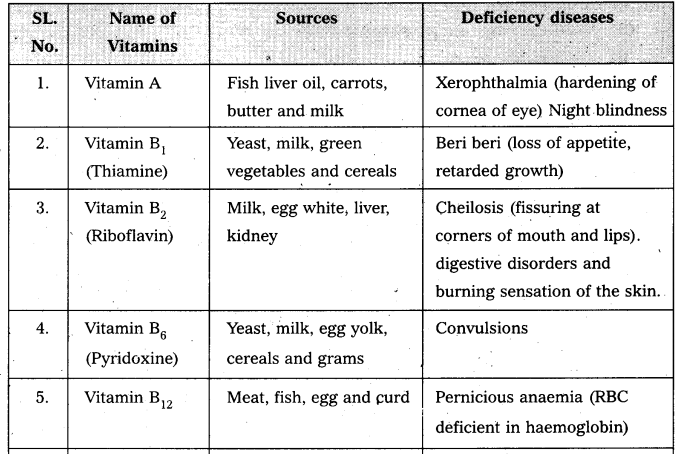
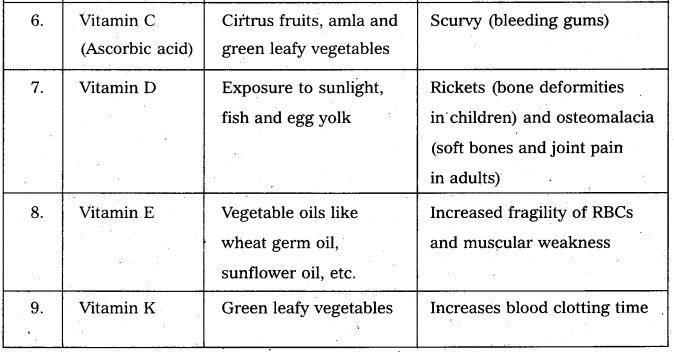
Write the sources of vitamin and diseases due to vitamin deficIency. [AP Mar. 20]
Answer:
AP Inter 2nd Year Chemistry Important Questions Chapter 9 Biomolecules 7
AP Inter 2nd Year Chemistry Important Questions Chapter 9 Biomolecules 8

AP Inter 2nd Year Chemistry Important Questions Chapter 6(d) Group-18 Elements

Students get through AP Inter 2nd Year Chemistry Important Questions Lesson 6(d) Group-18 Elements which are most likely to be asked in the exam.

AP Inter 2nd Year Chemistry Important Questions Lesson 6(d) Group-18 Elements

Very Short Answer Questions

Question 1.
List out the uses of Neon.
Answer:
Uses of Ne:

  1. Ne is used in discharge tubes and fluorescent bulbs for advertisement display purposes.
  2. ‘Ne’ – bulbs are used in botanical gardens and in greenhouses.

Question 2.
Write any two uses of argon.
Answer:
Uses of Ar:

  1. ‘Ar’ is used to create an inert atmosphere in a high-temperature metallurgical process.
  2. ‘Ar’ is used in filling electric bulbs.

AP Inter 2nd Year Chemistry Important Questions Chapter 6(d) Group-18 Elements

Question 3.
In modern diving apparatus, a mixture of He ánd O2 is used – Why? (IPE 2016 (AP))
Answer:
In modem diving apparatus, a mixture of He and O2 is used because He is very low soluble in blood.

Question 4.
Helium is heavier than hydrogen. Yet helium is used (instead of H2) in filling balloons for meteorological observations – Why?
Answer:
‘He’ is a non—inflammable and light gas. Hence it is used in filling balloons for meterological observations.

Question 5.
How is XeO3 prepared? (IPE May – 2015(AP), 2014)
Answer:
XeF6 on hydrolysis produce XeO3.
XeF6 + 3H2O → XeO3 + 6HF

Question 6.
Give the preparation of
a) XeOF4 and
b) XeO2F2. (TS Mar. 17; IPE 2014)
Answer:
Partial hydrolysis of XeF6 gives oxy fluorides XeOF4 and XeO2F2
XeF6 + H2O → XeOF4 + 2HF
XeF6 + 2H2O → XeO2F2 + 4HF

Question 7.
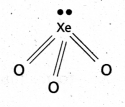
Explain the structure of XeO3. (TS Mar. 17; IPE 16, 15’ 14 (TS))
Answer:
Structure of XeO3:

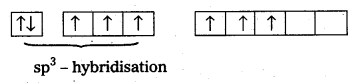
  1. Central atom is Xe’.
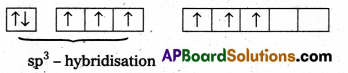
  2. ‘Xe undergoes sp3 hybridisation in 3rd excited state.
    AP Inter 2nd Year Chemistry Important Questions Chapter 6(c) Group-17 Elements 1
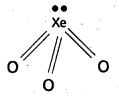
  3. ‘Xe’ forms 3σ-bonds and 3π-bonds with three oxygens.
  4. Shape of molecule is pyramidal with bond angle 103°.
    AP Inter 2nd Year Chemistry Important Questions Chapter 6(c) Group-17 Elements 2

AP Inter 2nd Year Chemistry Important Questions Chapter 6(d) Group-18 Elements

Question 8.
Explain the shape of XeF4 on the basis of VSEPR theory.
Answer:
Shape of XeF4:

  1. Central atom in XeF4 is
    AP Inter 2nd Year Chemistry Important Questions Chapter 6(c) Group-17 Elements 3
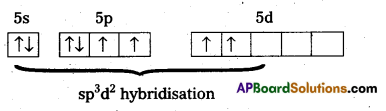
  2. Xe undergoes sp3d2 hybridisation in its 2nd excited state.
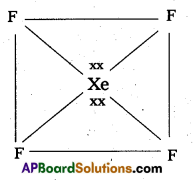
  3. Shape of the molecule is squãre planar with bond angle 90° and bond length 1.95A
    AP Inter 2nd Year Chemistry Important Questions Chapter 6(c) Group-17 Elements 4
  4. Xe – forms four σ-bonds by the overlap of sp3d2 – 2pz(F) orbitals.

Question 9.
Which noble gas is radio active ? How is it formed?
Answer:
Radon (Rn) is radio active noble gas. Radon is obtained as decay product of 86R226.
86Ra22686Rn222 + 2He4

Question 10.
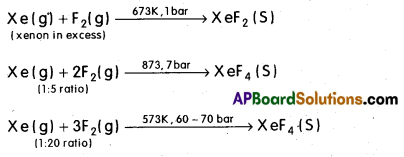
How are XeF2, XeF4, XeF6 prepared? Give equation.
Answer:
AP Inter 2nd Year Chemistry Important Questions Chapter 6(c) Group-17 Elements 5

Question 11.
Noble gases are inert – explain.
Answer:
Noble gases are chemically inert:

  1. Noble gases have stable electronic configuration octet configuration except He.
  2. Noble gases have high Ionisation energy values and have large positive values of electron gain enthalpy.

Question 12.
Write the name and formula of the first noble gas compound prepared by Bertlett.
Answer:
The first noble gas compound prepared by Bertlett is XePtF6. Name of the compound is xenon hexa fluoro platinate.

Question 13.
Why do noble gases form compounds with fluorine and oxygen only?
Answer:
Noble gases form compounds with flourine and oxygen only.
Reason: Oxygen and Fluorine are most electronegative elements.

AP Inter 2nd Year Chemistry Important Questions Chapter 6(d) Group-18 Elements

Short Answer Questions

Question 1.
Explain the structures of
a) XeF2 and
b) XeF4. (AP Mar. ‘17, IPE 16, 15, ‘14 (TS)) (TS Mar. ’14)
Answer:
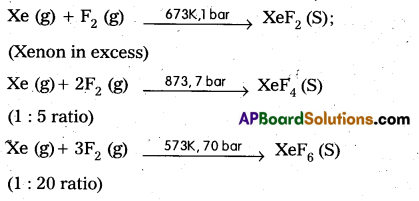
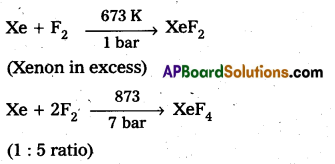
Xenon forms the binary fluorides XeF2, XeF4, XeF6 as follows. These are formed by direct combination of Xe and F2.
AP Inter 2nd Year Chemistry Important Questions Chapter 6(c) Group-17 Elements 6

Structure of XeF2:

  1. In XeF2 central atom is ‘Xe’.
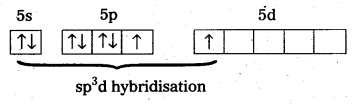
  2. ‘Xe’ undergoes sp3d hybridisation in its 1st excited state.
    AP Inter 2nd Year Chemistry Important Questions Chapter 6(c) Group-17 Elements 7
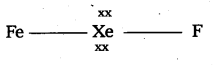
  3. Shape of molecule is linear.
  4. Xe form two σ-bonds with two fluorines.
    AP Inter 2nd Year Chemistry Important Questions Chapter 6(c) Group-17 Elements 8

b) Structure of XeF4:

  1. Central atom in XeF4 is ‘Xe’.
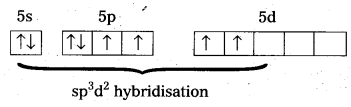
  2. Xe undergoes sp3d2 hybridisation in it’s 2nd excited state.
    AP Inter 2nd Year Chemistry Important Questions Chapter 6(c) Group-17 Elements 9
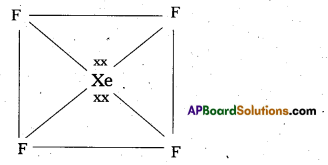
  3. Shape of the molecule is square planar with bond angle 90° and bond length 1.95A
    AP Inter 2nd Year Chemistry Important Questions Chapter 6(c) Group-17 Elements 10
  4. Xe forms four σ-bonds by the overlap of sp3d2 – 2pz (F) orbitals.

Question 2.
Explain the structures of
a) XeF6 and
b) XeOF4 (IPE Mar & May – 2015, 14)
Answer:
Structure òf XeF6 is ‘Xe’.

  1. Central atom in XeF6 is ‘Xe’.
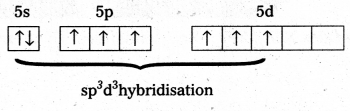
  2. Xe undergoes sp3d3 hybridisation in it’s 3rd excited state.
    AP Inter 2nd Year Chemistry Important Questions Chapter 6(c) Group-17 Elements 11
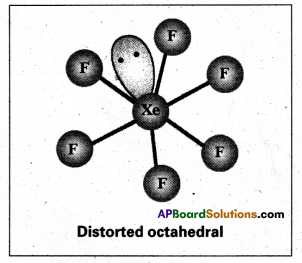
  3. Shape of molecule is distorted octahedral.
    AP Inter 2nd Year Chemistry Important Questions Chapter 6(c) Group-17 Elements 12

b) Structure of XeOF4:

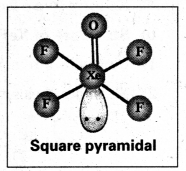
  1. In XeOF4 molecule ‘Xe’ undergoes sp3d2 hybridisation.
  2. Shape of the molecule is square pyramid.
  3. There is one Xe-O double bond containing.
    AP Inter 2nd Year Chemistry Important Questions Chapter 6(c) Group-17 Elements 13
    pπ = dπ overlapping.
    Partial hydrolysis of XeF6 gives XeOF4
    XeF6 + H2O → XeOF4 + 2HF
    XeOF4 is a colourless volatile liquid. It has a square pyramidal shape.

AP Inter 2nd Year Chemistry Important Questions Chapter 6(d) Group-18 Elements

Question 3.
Explain the structure of
a) XeO3 and
b) XeO4 (T.S. Mar. ‘16)
Answer:
a) Structure of XeO3:

  1. Central atom is ‘Xe’
  2. ‘Xe’ undergoes sp3 hybridisation in 3rd excited state.
    AP Inter 2nd Year Chemistry Important Questions Chapter 6(c) Group-17 Elements 14
  3. ‘Xe forms 3σ-bonds and 3π-bonds with three oxygens.
  4. Shape of molecule is pyramidal with bond angle 103°.
    AP Inter 2nd Year Chemistry Important Questions Chapter 6(c) Group-17 Elements 15

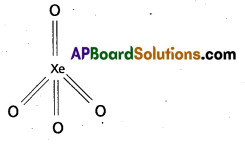
b) Structure of XeO4:
Xe is in sp3 hybridisation four singma bonds and four dπ – pπ bonds. Shape of XeO4 is tetrahedral.
AP Inter 2nd Year Chemistry Important Questions Chapter 6(c) Group-17 Elements 16

Question 4.
Write the preparations of Xenon flourides.
Answer:
Xenon flourides : Xenon forms three binary fluorides, Xe F2, XeF4, and XeF6 by the direct reaction of Xenon with fluorine under suitable conditions.
AP Inter 2nd Year Chemistry Important Questions Chapter 6(c) Group-17 Elements 17
XeF6 can also be prepared by the interaction of XeF4 and O2F2 at 143 K.
XeF4 + O2F2 → XeF6 + O2

Question 5.
Write the preparations of Xenon Oxides.
Answer:
Xenon Oxides: Xenon forms two oxides XeO3 and XeO4 with oxygen.
These oxides are formed by the hydrolysis of xenon fluorides.
6XeF4 + 12 H2O → 4 Xe + 2 XeO3 + 24 HF + 3O2
XeF6 + 3 H2O → XeO3 + 6 HF

Question 6.
Give the formulae and describe the structures of a noble gas species, isostructural with
a) \(\mathrm{ICl}_4^{-}\)
b) \(\mathbf{I B r}_2^{-}\)
c) \(\mathrm{BrO}_3^{-}\)
Answer:
a) \(\mathrm{ICl}_4^{-}\) is also structural with XeF4 and it has square planar shape.
b) \(\mathbf{I B r}_2^{-}\) is also structural with XeF2 and it has linear shape.
c) \(\mathrm{BrO}_3^{-}\) is iso-structural with XeO4 and it has tetrahedral šhape.

AP Inter 2nd Year Chemistry Important Questions Chapter 6(d) Group-18 Elements

Question 7.
Write any two uses of Helium.
Answer:
Uses of Helium:

  1. It is non inflammable and very light gas. Hence it is used in the balloons of Meteorological observations.
  2. It is used in gas cooled nuclear reactors and used as cryogenic agent.
  3. It is used as diluent for oxygen in modern diving apparatus.

Inter 2nd Year Maths 2A Partial Fractions Solutions Ex 7(d)

Practicing the Intermediate 2nd Year Maths 2A Textbook Solutions Inter 2nd Year Maths 2A Partial Fractions Solutions Exercise 7(d) will help students to clear their doubts quickly.

Intermediate 2nd Year Maths 2A Partial Fractions Solutions Exercise 7(d)

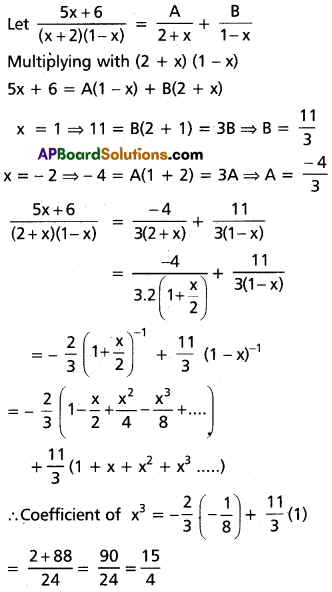
Question 1.
Find the coefficient of x3 in the power series expansion of \(\frac{5 x+6}{(x+2)(1-x)}\) specifying the region in which the expansion is valid.
Solution:
Inter 2nd Year Maths 2A Partial Fractions Solutions Ex 7(d) Q1

Inter 2nd Year Maths 2A Partial Fractions Solutions Ex 7(d)

Question 2.
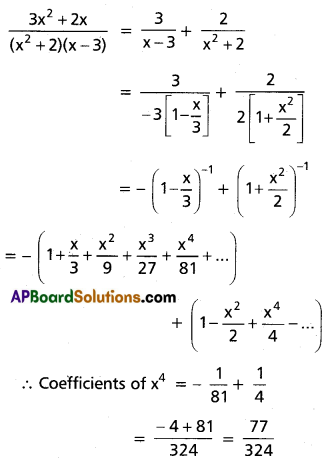
Find is the coefficient of x4 in the power series expansion of \(\frac{3 x^2+2 x}{\left(x^2+2\right)(x-3)}\) specifying the interval in which the expansion is valid.
Solution:
Let \(\frac{3 x^2+2 x}{\left(x^2+2\right)(x-3)}=\frac{A}{x-3}+\frac{B x+C}{x^2+2}\)
Multiplying with (x2 + 2) (x – 3)
3x2 + 2x = A(x2 + 2) + (Bx + C) (x – 3)
x = 3
⇒ 27 + 6 = A(9 + 2)
⇒ 33 = 11A
⇒ A = 3
Equating the coefficients of x2
3 = A + B
⇒ B = 3 – A = 3 – 3 = 0
Equating the constants,
2A – 3C = 0
⇒ 3C = 2A = 6
⇒ C = 2
Inter 2nd Year Maths 2A Partial Fractions Solutions Ex 7(d) Q2

Question 3.
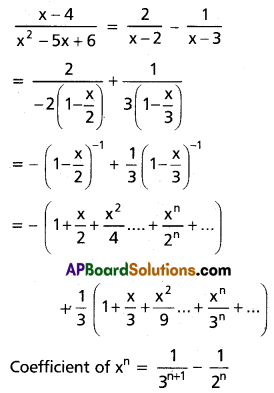
Find the coefficient of xn in the power series expansion of \(\frac{x-4}{x^2-5 x+6}\) specifying the region in which the expansion is valid.
Solution:
Let \(\frac{x-4}{x^2-5 x+6}=\frac{A}{x-2}+\frac{B}{x-3}\)
Multiplying with (x – 2) (x – 3)
x – 4 = A(x – 3) + B(x – 2)
x = 2
⇒ -2 = A(2 – 3) = -A
⇒ A = 2
x = 3
⇒ -1 = B(3 – 2) = B
⇒ B = -1
Inter 2nd Year Maths 2A Partial Fractions Solutions Ex 7(d) Q3

Inter 2nd Year Maths 2A Partial Fractions Solutions Ex 7(d)

Question 4.
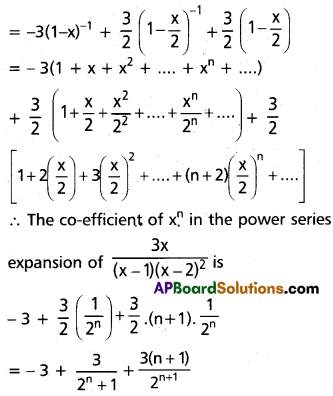
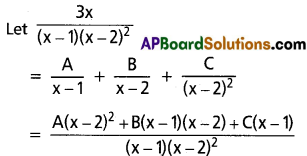
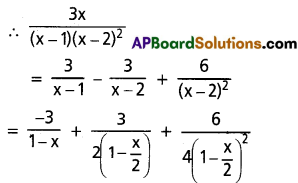
Find the coefficient of xn in the power series expansion of \(\frac{3 x}{(x-1)(x-2)^2}\)
Solution:
Inter 2nd Year Maths 2A Partial Fractions Solutions Ex 7(d) Q4
∴ 3x = A(x – 2)2 + B(x – 1) (x – 2) + C(x – 1) ……..(1)
putting x = 1,
3 = A(1 – 2)2
⇒ A = 3
putting x = 2,
6 = C(2 – 1)
⇒ C = 6
Now equating the co-efficient of x2 terms in (1)
0 = A + B
⇒ B = -A
⇒ B = -3
Inter 2nd Year Maths 2A Partial Fractions Solutions Ex 7(d) Q4.1
Inter 2nd Year Maths 2A Partial Fractions Solutions Ex 7(d) Q4.2

Inter 2nd Year Maths 2A Partial Fractions Solutions Ex 7(c)

Practicing the Intermediate 2nd Year Maths 2A Textbook Solutions Inter 2nd Year Maths 2A Partial Fractions Solutions Exercise 7(c) will help students to clear their doubts quickly.

Intermediate 2nd Year Maths 2A Partial Fractions Solutions Exercise 7(c)

Resolve the following into partial fractions.

Question 1.
\(\frac{x^2}{(x-1)(x-2)}\)
Solution:
Let \(\frac{x^2}{(x-1)(x-2)}=1+\frac{A}{x-1}+\frac{B}{x-2}\)
Multiplying with (x – 1) (x – 2)
x2 = (x – 1) (x – 2) + A(x – 2) + B(x – 1)
Put x = 1, 1 = A(-1) ⇒ A = -1
Put x = 2, 4 = B(1) ⇒ B = 4
∴ \(\frac{x^2}{(x-1)(x-2)}=1-\frac{1}{x-1}+\frac{4}{x-2}\)

Inter 2nd Year Maths 2A Partial Fractions Solutions Ex 7(c)

Question 2.
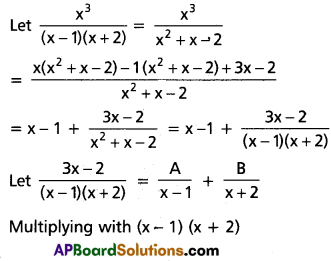
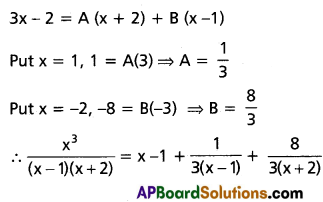
\(\frac{x^3}{(x-1)(x+2)}\)
Solution:
Inter 2nd Year Maths 2A Partial Fractions Solutions Ex 7(c) Q2
Inter 2nd Year Maths 2A Partial Fractions Solutions Ex 7(c) Q2.1

Question 3.
\(\frac{x^3}{(2 x-1)(x-1)^2}\)
Solution:
Let \(\frac{x^3}{(2 x-1)(x-1)^2}\) = \(\frac{1}{2}+\frac{A}{2 x-1}+\frac{B}{x-1}+\frac{C}{(x-1)^2}\)
Multiplying with 2(2x – 1) (x – 1)2
2x3 = (2x – 1) (x – 1)2 + 2A(x – 1)2 + 2B(2x – 1) (x – 1) + 2C(2x – 1)
Put x = \(\frac{1}{2}\),
⇒ 2(\(\frac{1}{8}\)) = 2A(\(\frac{1}{4}\))
⇒ A = \(\frac{1}{2}\)
Put x = 1,
⇒ 2(1) = 2C(1)
⇒ C = 1
Put x = 0,
0 = (-1) (1) + 2A(1) + 2B(-1) (-1) + 2C(-1)
⇒ 2A + 2B – 2C = 1
⇒ 2B = 1 + 2C – 2A
⇒ 2B = 1 + 2 – 1 = 2
⇒ B = 1
∴ \(\frac{x^3}{(2 x-1)(x-1)^2}\) = \(\frac{1}{2}+\frac{1}{2(2 x-1)}+\frac{1}{(x-1)}+\frac{1}{(x-1)^2}\)

Inter 2nd Year Maths 2A Partial Fractions Solutions Ex 7(c)

Question 4.
\(\frac{x^3}{(x-a)(x-b)(x-c)}\)
Solution:
Let \(\frac{x^3}{(x-a)(x-b)(x-c)}\) = \(1+\frac{A}{x-a}+\frac{B}{x-b}+\frac{C}{x-c}\)
Multiplying with (x – a)(x – b) (x – c),
x3 = (x – a)(x – b) (x – c) + A(x – b) (x – c) + B(x – a) (x – c) + C(x – a) (x – b)
Put x = a,
a3 = A(a – b) (a – c)
⇒ A = \(\frac{a^3}{(a-b)(a-c)}\)
Put x = b,
b3 = B(b – a) (b – c)
⇒ B = \(\frac{b^3}{(b-a)(b-c)}\)
Put x = c, c3 = C(c – a) (c – b)
⇒ C = \(\frac{c^3}{(c-a)(c-b)}\)
∴ \(\frac{x^3}{(x-a)(x-b)(x-c)}\) = \(1+\frac{a^3}{(a-b)(a-c)(x-a)}+\frac{b^3}{(b-a)(b-c)(x-b)}\) + \(\frac{c^3}{(c-a)(c-b)(x-c)}\)

Inter 2nd Year Maths 2A Partial Fractions Solutions Ex 7(b)

Practicing the Intermediate 2nd Year Maths 2A Textbook Solutions Inter 2nd Year Maths 2A Partial Fractions Solutions Exercise 7(b) will help students to clear their doubts quickly.

Intermediate 2nd Year Maths 2A Partial Fractions Solutions Exercise 7(b)

Resolve the following into partial fractions.

Question 1.
\(\frac{2 x^2+3 x+4}{(x-1)\left(x^2+2\right)}\)
Solution:
Let \(\frac{2 x^2+3 x+4}{(x-1)\left(x^2+2\right)}=\frac{A}{x-1}+\frac{B x+C}{x^2+2}\)
Multiplying with (x – 1) (x2 + 2)
2x2 + 3x + 4 = A(x2 + 2) + (Bx + C) (x – 1)
x = 1
⇒ 2 + 3 + 4 = A(1 + 2)
⇒ 9 = 3A
⇒ A = 3
Equating the coefficients of x2
2 = A + B
⇒ B = 2 – A = 2 – 3 = -1
Equating constants
4 = 2A – C
⇒ C = 2A – 4 = 6 – 4 = 2
∴ \(\frac{2 x^2+3 x+4}{(x-1)\left(x^2+2\right)}=\frac{3}{x-1}+\frac{-x+2}{x^2+2}\)

Inter 2nd Year Maths 2A Partial Fractions Solutions Ex 7(b)

Question 2.
\(\frac{3 x-1}{\left(1-x+x^2\right)(x+2)}\)
Solution:
Let \(\frac{3 x-1}{\left(1-x+x^2\right)(x+2)}=\frac{A}{2+x}+\frac{B x+C}{1-x+x^2}\)
Multiplying with (2 + x) (1 – x + x2)
3x – 1 = A(1 – x + x2) (Bx + C) (2 + x)
x = -2
⇒ -7 = A(1 + 2 + 4) = 7A
⇒ A = -1
Equating the coefficients of x2
0 = A + B ⇒ B = -A = 1
Equating the constants
-1 = A + 2C
⇒ 2C = -1 – A = -1 + 1 = 0
⇒ C = 0
∴ \(\frac{3 x-1}{\left(1-x+x^2\right)(2+x)}=-\frac{1}{2+x}+\frac{x}{1-x+x^2}\)

Question 3.
\(\frac{x^2-3}{(x+2)\left(x^2+1\right)}\)
Solution:
Let \(\frac{x^2-3}{(x+2)\left(x^2+1\right)}=\frac{A}{x+2}+\frac{B x+C}{x^2+1}\)
Multiplying with (x + 2) (x2 + 1)
x2 – 3 = A(x2 + 1) + (Bx + C) (x + 2)
x = -2
⇒ 4 – 3 = A(4 + 1)
⇒ 1 = 5A
⇒ A = \(\frac{1}{5}\)
Equating the coefficients of x2
1 = A + B
⇒ B = 1 – A = 1 – \(\frac{1}{5}\) = \(\frac{4}{5}\)
Equating the constants
-3 = A + 2C
⇒ 2C = -3 – A
⇒ 2C = -3 – \(\frac{1}{5}\)
⇒ 2C = \(-\frac{16}{5}\)
⇒ C = \(-\frac{8}{5}\)
∴ \(\frac{x^2-3}{(x+2)\left(x^2+1\right)}=\frac{1}{5(x+2)}+\frac{4 x-8}{5\left(x^2+1\right)}\)

Inter 2nd Year Maths 2A Partial Fractions Solutions Ex 7(b)

Question 4.
\(\frac{x^2+1}{\left(x^2+x+1\right)^2}\)
Solution:
Let \(\frac{x^2+1}{\left(x^2+x+1\right)^2}=\frac{A x+B}{x^2+x+1}+\frac{C x+D}{\left(x^2+x+1\right)^2}\)
Multiplying with (x2 + x + 1)2
x2 + 1 = (Ax + B) (x2 + x + 1) + (Cx + D)
Equating the coefficients of x3,
A = 0
Equating the coefficients of x2,
A + B = 1 ⇒ B = 1
Equating the coefficients of x,
A + B + C = 0
⇒ 1 + C = 0
⇒ C = -1
Equating the constants,
B + D = 1
⇒ D = 1 – B = 1 – 1 = 0
∴ Ax + B = 1, Cx + D = -x
∴ \(\frac{x^2+1}{\left(x^2+x+1\right)^2}=\frac{1}{x^2+x+1}-\frac{x}{\left(x^2+x+1\right)^2}\)

Question 5.
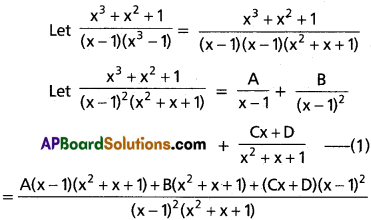
\(\frac{x^3+x^2+1}{(x-1)\left(x^3-1\right)}\)
Solution:
Inter 2nd Year Maths 2A Partial Fractions Solutions Ex 7(b) Q5
∴ x3 + x2 + 1 = A(x – 1) (x2 + x + 1) + B(x2 + x + 1) + (Cx + D) (x – 1)2 …….(2)
Put x = 1 in (2)
1 + 1 + 1 = A(0) + B(1 + 1 + 1) + (C(1) + D) (0)
⇒ 3B = 3
⇒ B = 1
Equating the coefficients of x3 in (2)
1 = A + C ………(3)
Equating the coefficients of x2 in (2)
1 = A(1 – 1) + B(1) + C(-2) + D(1)
⇒ 1 = B – 2C + D
∵ B = 1,
⇒ 1 = 1 – 2C + D
⇒ 2C = D ………(4)
Put x = 0 in (2)
1 = A(-1)(1) + B(1) + D(-1)2
⇒ -A + B + D = 1
⇒ -A + 1 + D = 1
⇒ A = D ………(5)
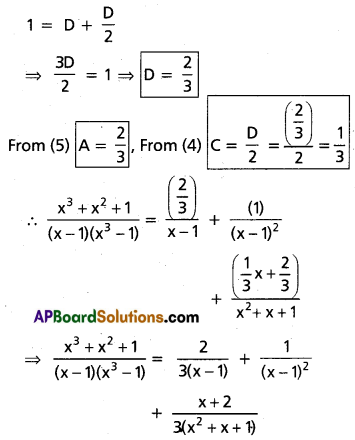
From (3), (4) and (5)
Inter 2nd Year Maths 2A Partial Fractions Solutions Ex 7(b) Q5.1

Inter 2nd Year Maths 2A Partial Fractions Solutions Ex 7(a)

Practicing the Intermediate 2nd Year Maths 2A Textbook Solutions Inter 2nd Year Maths 2A Partial Fractions Solutions Exercise 7(a) will help students to clear their doubts quickly.

Intermediate 2nd Year Maths 2A Partial Fractions Solutions Exercise 7(a)

Resolve the following into partial fractions.

I.

Question 1.
\(\frac{2 x+3}{(x+1)(x-3)}\)
Solution:
Let \(\frac{2 x+3}{(x+1)(x-3)}=\frac{A}{x+1}+\frac{B}{x-3}\)
Multiplying with (x + 1) (x – 3)
2x + 3 = A(x – 3) + B(x + 1)
x = -1 ⇒ 1 = A(-4) ⇒ A = \(-\frac{1}{4}\)
x = 3 ⇒ 9 = B(4) ⇒ B = \(\frac{9}{4}\)
\(\frac{2 x+3}{(x+1)(x-3)}=\frac{-1}{4(x+1)}+\frac{9}{4(x-3)}\)

Inter 2nd Year Maths 2A Partial Fractions Solutions Ex 7(a)

Question 2.
\(\frac{5 x+6}{(2+x)(1-x)}\)
Solution:
Let \(\frac{5 x+6}{(2+x)(1-x)}=\frac{A}{2+x}+\frac{B}{1-x}\)
Multiplying with (2 + x) (1 – x)
5x + 6 = A(1 – x) + B(2 + x)
Put x = -2,
-10 + 6 = A(1 + 2)
⇒ A = \(-\frac{4}{3}\)
Put x = 1,
5 + 6 = B(2 + 1)
⇒ B = \(\frac{11}{3}\)
∴ \(\frac{5 x+6}{(2+x)(1-x)}=-\frac{4}{3(2+x)}+\frac{11}{3(1-x)}\)

II.

Question 1.
\(\frac{3 x+7}{x^2-3 x+2}\)
Solution:
\(\frac{3 x+7}{x^2-3 x+2}=\frac{3 x+7}{(x-1)(x-2)}=\frac{A}{x-1}+\frac{B}{x-2}\)
Multiplying with x2 – 3x + 2
3x + 7 = A(x – 2) + B(x – 1)
x = 1 ⇒ 10 = -A ⇒ A = -10
x = 2 ⇒ 13 = B ⇒ B = 13
∴ \(\frac{3 x+7}{x^2-3 x+2}=\frac{-10}{x-1}+\frac{13}{x-2}\)

Question 2.
\(\frac{x+4}{\left(x^2-4\right)(x+1)}\)
Solution:
\(\frac{x+4}{\left(x^2-4\right)(x+1)}=\frac{A}{x+1}+\frac{B}{x+2}+\frac{C}{x-2}\)
Multiplying with (x2 – 4) (x + 1)
x + 4 = A(x2 – 4) + B(x + 1) (x – 2) + C(x + 1) (x + 2)
x = -1
⇒ 3 = A(1 – 4)
⇒ 3 = -3A
⇒ A = -1
x = -2
⇒ 2 = B(-2 + 1) (-2 – 2)
⇒ 2 = 4B
⇒ B = \(\frac{1}{2}\)
x = 2
⇒ 6 = C(2 + 1)(2 + 2)
⇒ 6 = 12C
⇒ C = \(\frac{1}{2}\)
∴ \(\frac{x+4}{\left(x^2-4\right)(x+1)}=-\frac{1}{x+1}+\frac{1}{2(x+2)}\) + \(\frac{1}{2(x-2)}\)

Question 3.
\(\frac{2 x^2+2 x+1}{x^3+x^2}\)
Solution:
Let \(\frac{2 x^2+2 x+1}{x^3+x^2}=\frac{2 x^2+2 x+1}{x^2(x+1)}=\frac{A}{x}+\frac{B}{x^2}+\frac{C}{x+1}\)
Multiplying with x2(x + 1)
2x2 + 2x + 1 = Ax(x + 1) + B(x + 1) + Cx2
Put x = 0, 1 = B
Put x = -1, 2 – 2 + 1 = C(1) ⇒ C = 1
Equating the coefficients of x2,
2 = A + C
⇒ A = 2 – C = 2 – 1 = 1
∴ \(\frac{2 x^2+2 x+1}{x^3+x^2}=\frac{1}{x}+\frac{1}{x^2}+\frac{1}{x+1}\)

Inter 2nd Year Maths 2A Partial Fractions Solutions Ex 7(a)

Question 4.
\(\frac{2 x+3}{(x-1)^3}\)
Solution:
\(\frac{2 x+3}{(x-1)^3}\)
Put x – 1 = y ⇒ x = y + 1
⇒ \(\frac{2 x+3}{(x-1)^3}=\frac{2(y+1)+3}{y^3}=\frac{2 y+5}{y^3}\)
⇒ \(\frac{2 x+3}{(x-1)^3}\) = \(\frac{2}{y^2}+\frac{5}{y^3}=\frac{2}{(x-1)^2}+\frac{5}{(x-1)^3}\)
∴ \(\frac{2 x+3}{(x-1)^3}=\frac{2}{(x-1)^2}+\frac{5}{(x-1)^3}\)

Question 5.
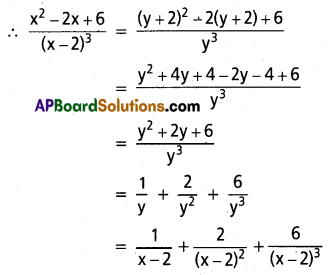
\(\frac{x^2-2 x+6}{(x-2)^3}\)
Solution:
Let x – 2 = y then x = y + 2
Inter 2nd Year Maths 2A Partial Fractions Solutions Ex 7(a) II Q5

III.

Question 1.
\(\frac{x^2-x+1}{(x+1)(x-1)^2}\)
Solution:
Let \(\frac{x^2-x+1}{(x+1)(x-1)^2}=\frac{A}{x+1}+\frac{B}{x-1}+\frac{C}{(x-1)^2}\)
Multiplying with (x + 1) (x – 1)2
x2 – x + 1 = A(x – 1)2 + B(x + 1) (x – 1) + C(x + 1)
Put x = -1,
1 + 1 + 1 = A(4)
⇒ A = \(\frac{3}{4}\)
Put x = 1,
1 – 1 + 1 = C(2)
⇒ C = +\(\frac{1}{2}\)
Equating the coefficients of x2,
A + B = 1
⇒ B = 1 – A
⇒ B = 1 – \(\frac{3}{4}\) = \(\frac{1}{4}\)
∴ \(\frac{x^2-x+1}{(x+1)(x-1)^2}=\frac{3}{4(x+1)}+\frac{1}{4(x-1)}\) + \(\frac{1}{2(x-1)^2}\)

Question 2.
\(\frac{9}{(x-1)(x+2)^2}\)
Solution:
Let \(\frac{9}{(x-1)(x+2)^2}=\frac{A}{x-1}+\frac{B}{x+2}+\frac{C}{(x+2)^2}\)
Multiplying with (x – 1) (x + 2)2
9 = A(x + 2)2 + B(x – 1) (x + 2) + C(x – 1)
x = 1
⇒ 9 = 9A
⇒ A = 1
x = -2
⇒ 9 = -3C
⇒ C = -3
Equating the coefficients of x2
A + B = 0 ⇒ B = -A = -1
∴ \(\frac{9}{(x-1)(x+2)^2}=\frac{1}{x-1}-\frac{1}{x+2}-\frac{3}{(x+2)^2}\)

Question 3.
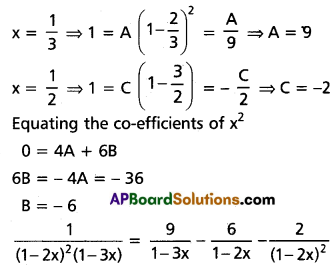
\(\frac{1}{(1-2 x)^2(1-3 x)}\)
Solution:
Let \(\frac{1}{(1-2 x)^2(1-3 x)}=\frac{A}{1-3 x}+\frac{B}{1-2 x}+\frac{C}{(1-2 x)^2}\)
Multiplying with (1 – 2x)2 (1 – 3x)
1 = A(1 – 2x)2 + B(1 – 3x) (1 – 2x) + C(1 – 3x)
Inter 2nd Year Maths 2A Partial Fractions Solutions Ex 7(a) III Q3

Question 4.
\(\frac{1}{x^3(x+a)}\)
Solution:
Let \(\frac{1}{x^3(x+a)}=\frac{A}{x}+\frac{B}{x^2}+\frac{C}{x^3}+\frac{D}{x+a}\) = \(\frac{A \cdot x^2(x+a)+B(x)(x+a)+C(x+a)+D x^3}{x^3(x+a)}\)
∴ 1 = A (x2) (x + a) + Bx (x + a) + C(x + a) + Dx3 ……..(1)
Put x = 0 in (1)
1 = A(0) + B(0) + C(0 + a) + D(0)
⇒ 1 = C(a)
⇒ C = \(\frac{1}{a}\)

Inter 2nd Year Maths 2A Partial Fractions Solutions Ex 7(a)

Question 5.
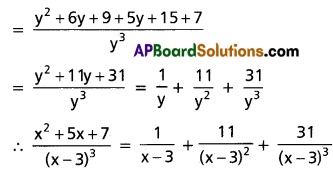
\(\frac{x^2+5 x+7}{(x-3)^3}\)
Solution:
Let x – 3 = y ⇒ x = y + 3
\(\frac{x^2+5 x+7}{(x-3)^3}=\frac{(y+3)^2+5(y+3)+7}{y^3}\)
Inter 2nd Year Maths 2A Partial Fractions Solutions Ex 7(a) III Q5

Question 6.
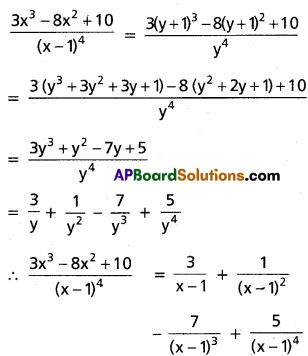
\(\frac{3 x^3-8 x^2+10}{(x-1)^4}\)
Solution:
Put x – 1 = y ⇒ x = y + 1
Inter 2nd Year Maths 2A Partial Fractions Solutions Ex 7(a) III Q6

Inter 2nd Year Maths 2A Binomial Theorem Solutions Ex 6(c)

Practicing the Intermediate 2nd Year Maths 2A Textbook Solutions Inter 2nd Year Maths 2A Binomial Theorem Solutions Exercise 6(c) will help students to clear their doubts quickly.

Intermediate 2nd Year Maths 2A Binomial Theorem Solutions Exercise 6(c)

Question 1.
Find an approximate value of the following corrected to 4 decimal places.
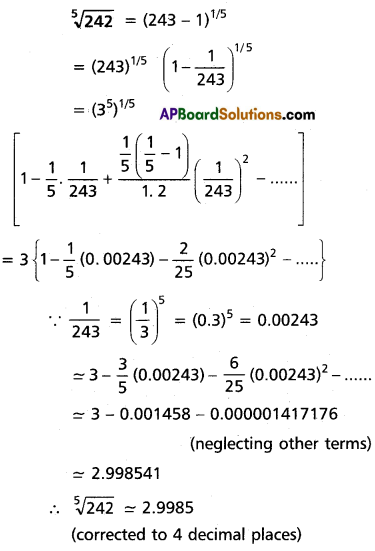
(i) \(\sqrt[5]{242}\)
Solution:
Inter 2nd Year Maths 2A Binomial Theorem Solutions Ex 6(c) Q1(i)

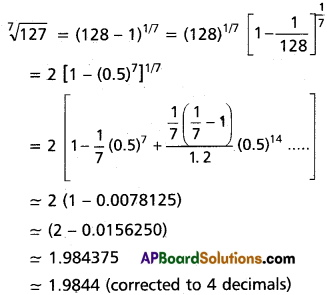
(ii) \(\sqrt[7]{127}\)
Solution:
Inter 2nd Year Maths 2A Binomial Theorem Solutions Ex 6(c) Q1(ii)

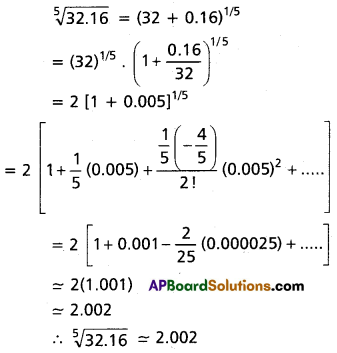
(iii) \(\sqrt[5]{32.16}\)
Solution:
Inter 2nd Year Maths 2A Binomial Theorem Solutions Ex 6(c) Q1(iii)

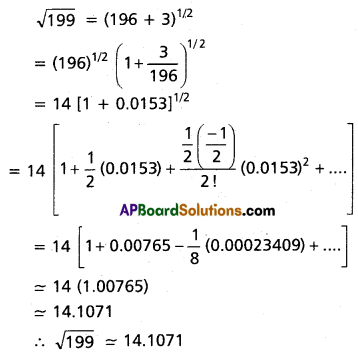
(iv) \(\sqrt{199}\)
Solution:
Inter 2nd Year Maths 2A Binomial Theorem Solutions Ex 6(c) Q1(iv)

Inter 2nd Year Maths 2A Binomial Theorem Solutions Ex 6(c)

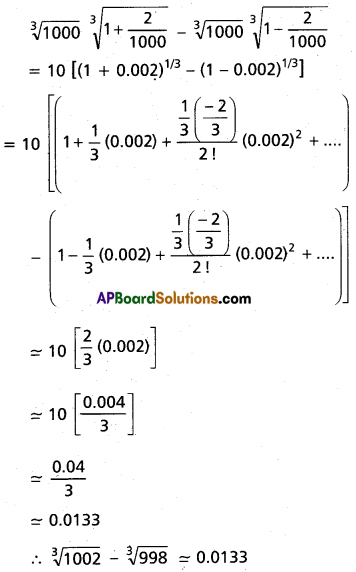
(v) \(\sqrt[3]{1002}-\sqrt[3]{998}\)
Solution:
Inter 2nd Year Maths 2A Binomial Theorem Solutions Ex 6(c) Q1(v)

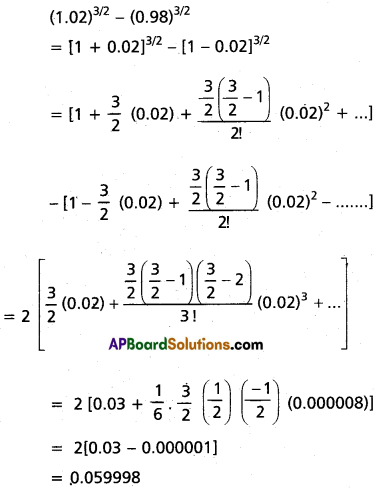
(vi) \((1.02)^{3 / 2}-(0.98)^{3 / 2}\)
Solution:
Inter 2nd Year Maths 2A Binomial Theorem Solutions Ex 6(c) Q1(vi)

Question 2.
If |x| is so small that x2 and higher powers of x may be neglected then find the approximate values of the following.
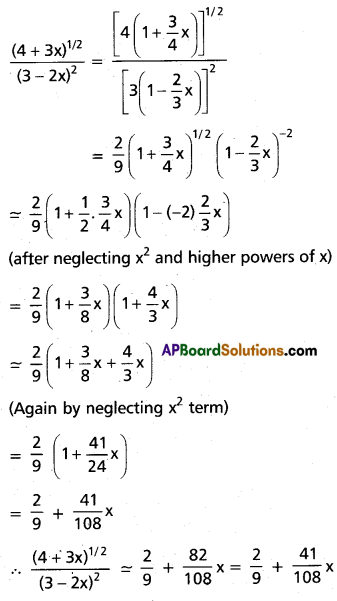
(i) \(\frac{(4+3 x)^{1 / 2}}{(3-2 x)^2}\)
Solution:
Inter 2nd Year Maths 2A Binomial Theorem Solutions Ex 6(c) Q2(i)

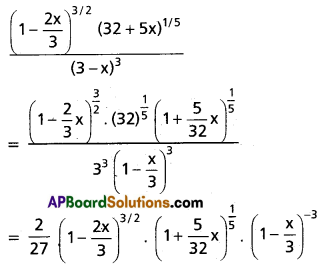
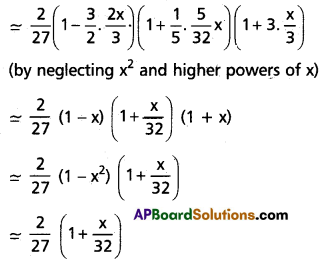
(ii) \(\frac{\left(1-\frac{2 x}{3}\right)^{3 / 2}(32+5 x)^{1 / 5}}{(3-x)^3}\)
Solution:
Inter 2nd Year Maths 2A Binomial Theorem Solutions Ex 6(c) Q2(ii)
Inter 2nd Year Maths 2A Binomial Theorem Solutions Ex 6(c) Q2(ii).1

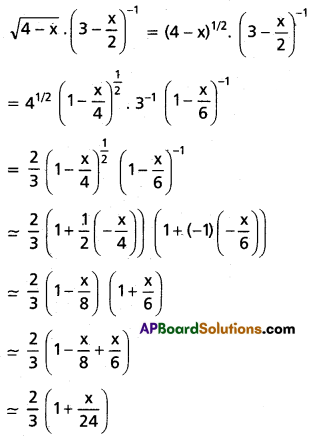
(iii) \(\sqrt{4-x}\left(3-\frac{x}{2}\right)^{-1}\)
Solution:
Inter 2nd Year Maths 2A Binomial Theorem Solutions Ex 6(c) Q2(iii)

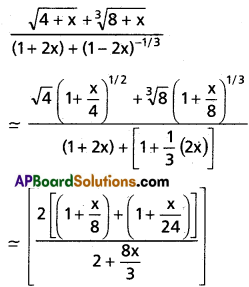
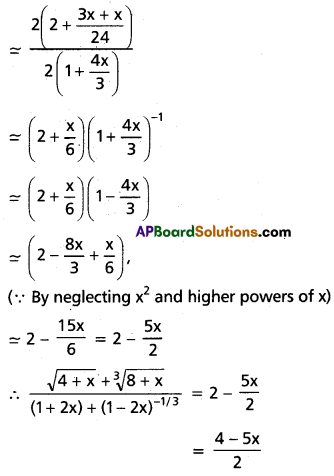
(iv) \(\frac{\sqrt{4+x}+\sqrt[3]{8+x}}{(1+2 x)+(1-2 x)^{-1 / 3}}\)
Solution:
Inter 2nd Year Maths 2A Binomial Theorem Solutions Ex 6(c) Q2(iv)
Inter 2nd Year Maths 2A Binomial Theorem Solutions Ex 6(c) Q2(iv).1

Inter 2nd Year Maths 2A Binomial Theorem Solutions Ex 6(c)

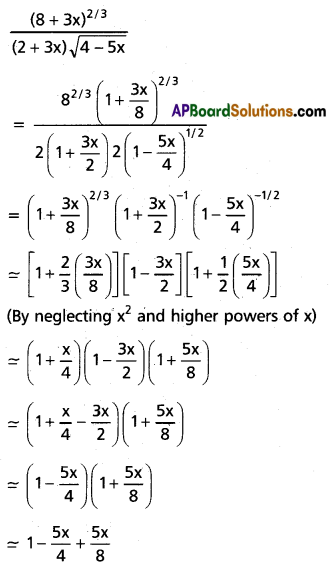
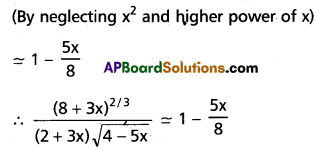
(v) \(\frac{(8+3 x)^{2 / 3}}{(2+3 x) \sqrt{4-5 x}}\)
Solution:
Inter 2nd Year Maths 2A Binomial Theorem Solutions Ex 6(c) Q2(v)
Inter 2nd Year Maths 2A Binomial Theorem Solutions Ex 6(c) Q2(v).1

Question 3.
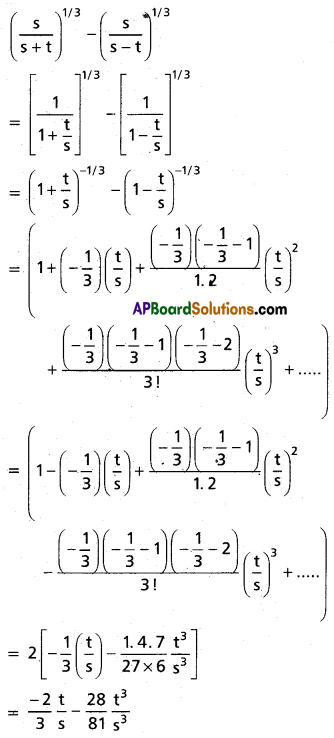
Suppose s and t are positive and t is very small when compared to s. Then find an approximate value of \(\left(\frac{s}{s+t}\right)^{1 / 3}-\left(\frac{s}{s-t}\right)^{1 / 3}\)
Solution:
Since t is very small when compared with s, \(\frac{t}{s}\) is very very small.
Inter 2nd Year Maths 2A Binomial Theorem Solutions Ex 6(c) Q3

Question 4.
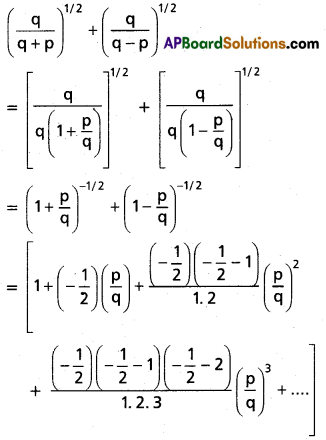
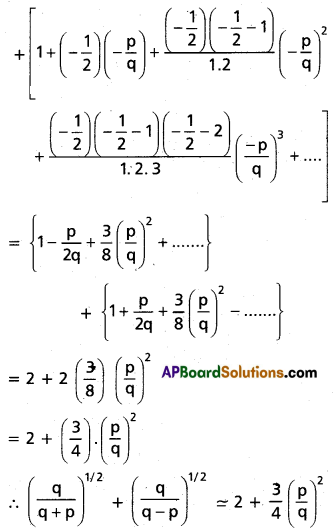
Suppose p, q are positive and p is very small when compared to q. Then find an approximate value of \(\left(\frac{q}{q+p}\right)^{1 / 2}+\left(\frac{q}{q-p}\right)^{1 / 2}\)
Solution:
Inter 2nd Year Maths 2A Binomial Theorem Solutions Ex 6(c) Q4
Inter 2nd Year Maths 2A Binomial Theorem Solutions Ex 6(c) Q4.1

Inter 2nd Year Maths 2A Binomial Theorem Solutions Ex 6(c)

Question 5.
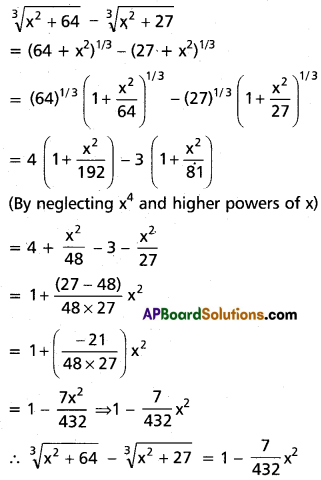
By neglecting x4 and higher powers of x, find an approximate value of \(\sqrt[3]{x^2+64}-\sqrt[3]{x^2+27}\)
Solution:
Inter 2nd Year Maths 2A Binomial Theorem Solutions Ex 6(c) Q5

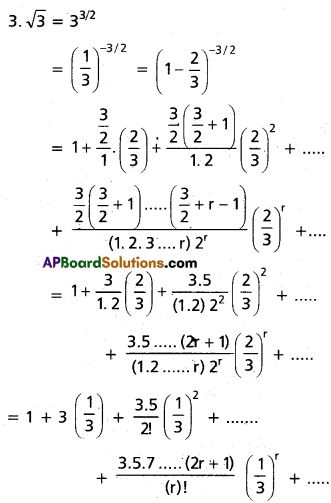
Question 6.
Expand 3√3 in increasing powers of \(\frac{2}{3}\).
Solution:
Inter 2nd Year Maths 2A Binomial Theorem Solutions Ex 6(c) Q6

Inter 2nd Year Maths 2A Binomial Theorem Solutions Ex 6(b)

Practicing the Intermediate 2nd Year Maths 2A Textbook Solutions Inter 2nd Year Maths 2A Binomial Theorem Solutions Exercise 6(b) will help students to clear their doubts quickly.

Intermediate 2nd Year Maths 2A Binomial Theorem Solutions Exercise 6(b)

I.

Question 1.
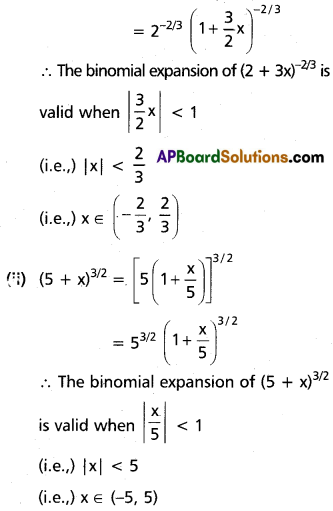
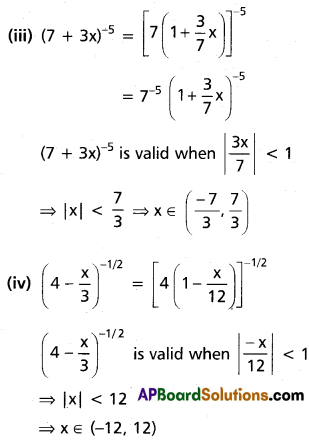
Find the set of values of x for which the binomial expansions of the following are valid.
(i) (2 + 3x)-2/3
(ii) (5 + x)3/2
(iii) (7 + 3x)-5
(iv) \(\left(4-\frac{x}{3}\right)^{-1 / 2}\)
Solution:
(i) (2 + 3x)-2/3 = \(\left[2\left(1+\frac{3}{2} x\right)\right]^{-2 / 3}\)
Inter 2nd Year Maths 2A Binomial Theorem Solutions Ex 6(b) I Q1
Inter 2nd Year Maths 2A Binomial Theorem Solutions Ex 6(b) I Q1.1

Inter 2nd Year Maths 2A Binomial Theorem Solutions Ex 6(b)

Question 2.
Find the
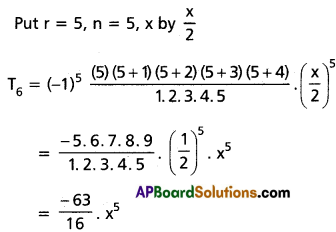
(i) 6th term of \(\left(1+\frac{x}{2}\right)^{-5}\)
Solution:
Inter 2nd Year Maths 2A Binomial Theorem Solutions Ex 6(b) I Q2(i)
Inter 2nd Year Maths 2A Binomial Theorem Solutions Ex 6(b) I Q2(i).1

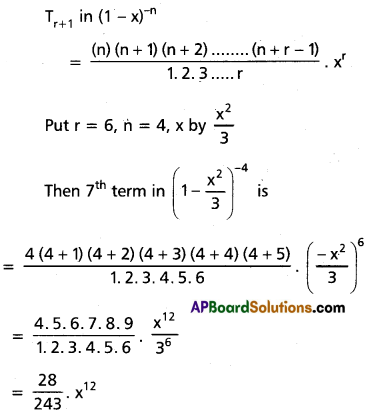
(ii) 7th term of \(\left(1-\frac{x^2}{3}\right)^{-4}\)
Solution:
Inter 2nd Year Maths 2A Binomial Theorem Solutions Ex 6(b) I Q2(ii)

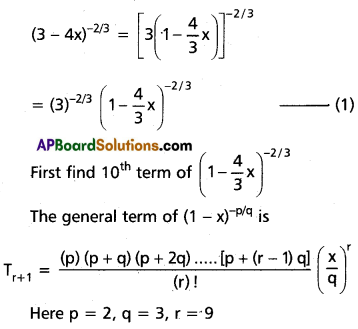
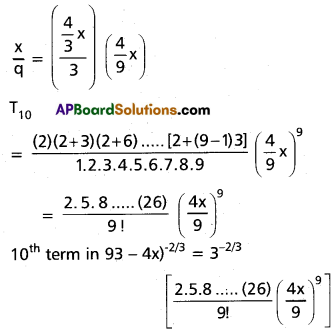
(iii) 10th term of (3 – 4x)-2/3
Solution:
Inter 2nd Year Maths 2A Binomial Theorem Solutions Ex 6(b) I Q2(iii)
Inter 2nd Year Maths 2A Binomial Theorem Solutions Ex 6(b) I Q2(iii).1

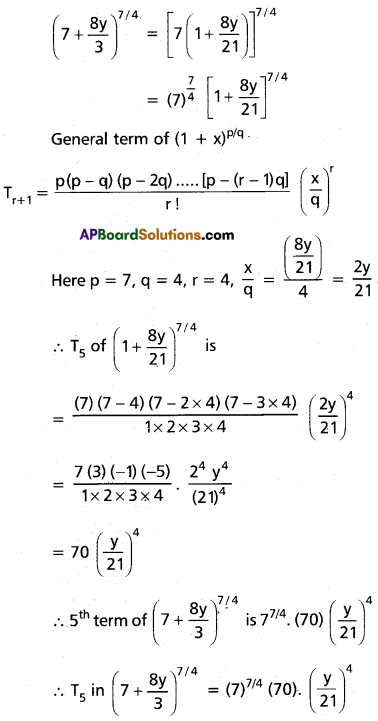
(iv) 5th term of \(\left(7+\frac{8 y}{3}\right)^{7 / 4}\)
Solution:
Inter 2nd Year Maths 2A Binomial Theorem Solutions Ex 6(b) I Q2(iv)

Question 3.
Write down the first 3 terms in the expansion of
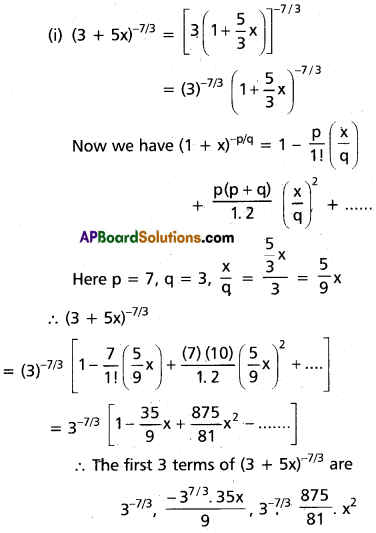
(i) (3 + 5x)-7/3
Solution:
Inter 2nd Year Maths 2A Binomial Theorem Solutions Ex 6(b) I Q3(i)

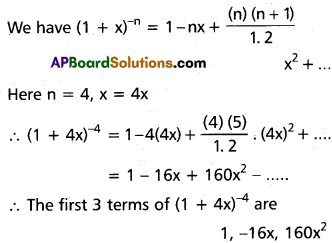
(ii) (1 + 4x)-4
Solution:
Inter 2nd Year Maths 2A Binomial Theorem Solutions Ex 6(b) I Q3(ii)

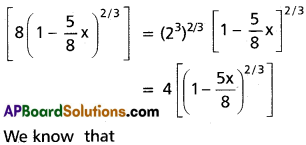
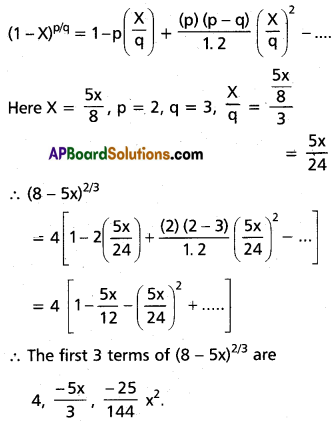
(iii) (8 – 5x)2/3
Solution:
Inter 2nd Year Maths 2A Binomial Theorem Solutions Ex 6(b) I Q3(iii)
Inter 2nd Year Maths 2A Binomial Theorem Solutions Ex 6(b) I Q3(iii).1

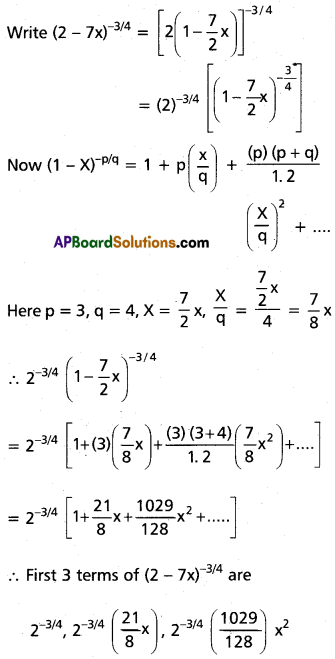
(iv) (2 – 7x)-3/4
Solution:
Inter 2nd Year Maths 2A Binomial Theorem Solutions Ex 6(b) I Q3(iv)

Inter 2nd Year Maths 2A Binomial Theorem Solutions Ex 6(b)

Question 4.
Find the general term (r + 1)th term in the expansion of
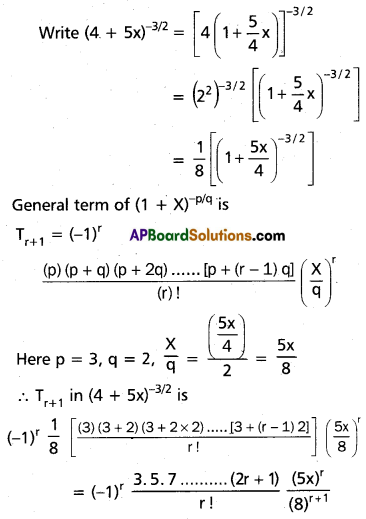
(i) (4 + 5x)-3/2
Solution:
Inter 2nd Year Maths 2A Binomial Theorem Solutions Ex 6(b) I Q4(i)

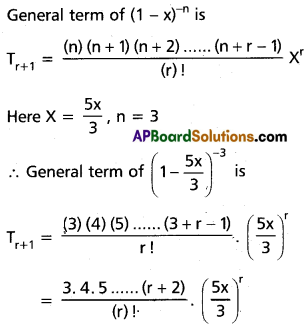
(ii) \(\left(1-\frac{5 x}{3}\right)^{-3}\)
Solution:
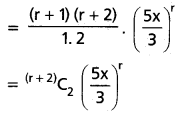
Inter 2nd Year Maths 2A Binomial Theorem Solutions Ex 6(b) I Q4(ii)
Inter 2nd Year Maths 2A Binomial Theorem Solutions Ex 6(b) I Q4(ii).1

(iii) \(\left(1+\frac{4 x}{5}\right)^{5 / 2}\)
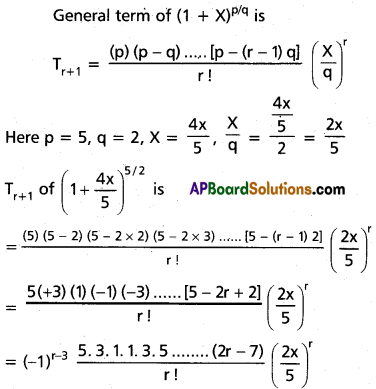
Solution:
Inter 2nd Year Maths 2A Binomial Theorem Solutions Ex 6(b) I Q4(iii)

(iv) \(\left(3-\frac{5 x}{4}\right)^{-1 / 2}\)
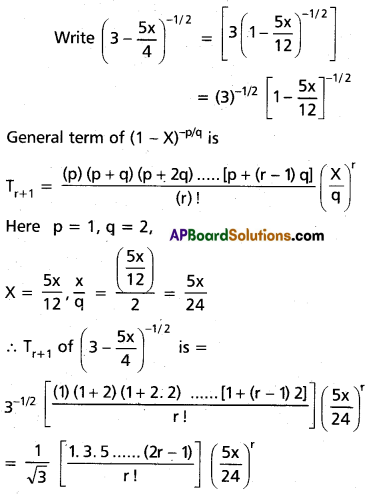
Solution:
Inter 2nd Year Maths 2A Binomial Theorem Solutions Ex 6(b) I Q4(iv)

II.

Question 1.
Find the coefficient of x10 in the expansion of \(\frac{1+2 x}{(1-2 x)^2}\)
Solution:
Inter 2nd Year Maths 2A Binomial Theorem Solutions Ex 6(b) II Q1

Question 2.
Find the coefficient of x4 in the expansion of (1 – 4x)-3/5
Solution:
Inter 2nd Year Maths 2A Binomial Theorem Solutions Ex 6(b) II Q2

Inter 2nd Year Maths 2A Binomial Theorem Solutions Ex 6(b)

Question 3.
(i) Find the coefficient of x5 in \(\frac{(1-3 x)^2}{(3-x)^{3 / 2}}\)
Solution:
Inter 2nd Year Maths 2A Binomial Theorem Solutions Ex 6(b) II Q3(i)
Inter 2nd Year Maths 2A Binomial Theorem Solutions Ex 6(b) II Q3(i).1

(ii) Find the coefficient of x8 in \(\frac{(1+x)^2}{\left(1-\frac{2}{3} x\right)^3}\)
Solution:
Inter 2nd Year Maths 2A Binomial Theorem Solutions Ex 6(b) II Q3(ii)
Inter 2nd Year Maths 2A Binomial Theorem Solutions Ex 6(b) II Q3(ii).1

(iii) Find the coefficient of x7 in \(\frac{(2+3 x)^3}{(1-3 x)^4}\)
Solution:
Inter 2nd Year Maths 2A Binomial Theorem Solutions Ex 6(b) II Q3(iii)

Question 4.
Find the coefficient of x3 in the expansion of \(\frac{\left(1+3 x^2\right)^{3 / 2}}{(3+4 x)^{1 / 3}}\)
Solution:
Inter 2nd Year Maths 2A Binomial Theorem Solutions Ex 6(b) II Q4
Inter 2nd Year Maths 2A Binomial Theorem Solutions Ex 6(b) II Q4.1

III.

Question 1.
Find the sum of the infinite series
(i) \(1+\frac{1}{3}+\frac{1.3}{3.6}+\frac{1.3 .5}{3.6 .9}+\ldots\)
Solution:
Inter 2nd Year Maths 2A Binomial Theorem Solutions Ex 6(b) III Q1(i)

(ii) \(1-\frac{4}{5}+\frac{4.7}{5.10}-\frac{4.7 .10}{5.10 .15}+\ldots \ldots\)
Solution:
Inter 2nd Year Maths 2A Binomial Theorem Solutions Ex 6(b) III Q1(ii)
Inter 2nd Year Maths 2A Binomial Theorem Solutions Ex 6(b) III Q1(ii).1

(iii) \(\frac{3}{4}+\frac{3.5}{4.8}+\frac{3.5 .7}{4.8 .12}+\ldots\)
Solution:
Inter 2nd Year Maths 2A Binomial Theorem Solutions Ex 6(b) III Q1(iii)

(iv) \(\frac{3}{4.8}-\frac{3.5}{4.8 .12}+\frac{3.5 .7}{4.8 .12 .16}-\ldots \ldots\)
Solution:
Inter 2nd Year Maths 2A Binomial Theorem Solutions Ex 6(b) III Q1(iv)
Inter 2nd Year Maths 2A Binomial Theorem Solutions Ex 6(b) III Q1(iv).1

Inter 2nd Year Maths 2A Binomial Theorem Solutions Ex 6(b)

Question 2.
If t = \(\frac{4}{5}+\frac{4.6}{5.10}+\frac{4.6 .8}{5.10 .15}+\ldots \ldots \ldots \infty\), then prove that 9t = 16.
Solution:
Inter 2nd Year Maths 2A Binomial Theorem Solutions Ex 6(b) III Q2
Inter 2nd Year Maths 2A Binomial Theorem Solutions Ex 6(b) III Q2.1

Question 3.
If x = \(\frac{1.3}{3.6}+\frac{1.3 .5}{3.6 .9}+\frac{1.3 .5 .7}{3.6 .9 .12}+\ldots \ldots\) then prove that 9x2 + 24x = 11.
Solution:
Inter 2nd Year Maths 2A Binomial Theorem Solutions Ex 6(b) III Q3
⇒ 3x + 4 = 3√3
Squaring on both sides
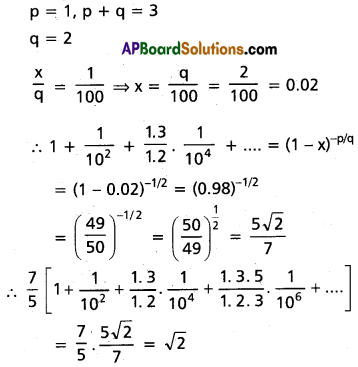
(3x + 4)2 = (3√3)2
⇒ 9x2 + 24x + 16 = 27
⇒ 9x2 + 24x = 11

Question 4.
If x = \(\frac{5}{(2 !) \cdot 3}+\frac{5 \cdot 7}{(3 !) \cdot 3^2}+\frac{5 \cdot 7 \cdot 9}{(4 !) \cdot 3^3}+\ldots\) then find the value of x2 + 4x.
Solution:
Inter 2nd Year Maths 2A Binomial Theorem Solutions Ex 6(b) III Q4

Question 5.
Find the sum of the infinite series \(\frac{7}{5}\left(1+\frac{1}{10^2}+\frac{1.3}{1.2} \cdot \frac{1}{10^4}+\frac{1.3 .5}{1.2 .3} \cdot \frac{1}{10^6}+\ldots .\right)\)
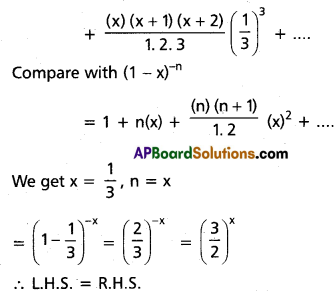
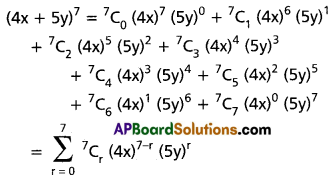
Solution:
Inter 2nd Year Maths 2A Binomial Theorem Solutions Ex 6(b) III Q5
Inter 2nd Year Maths 2A Binomial Theorem Solutions Ex 6(b) III Q5.1

Inter 2nd Year Maths 2A Binomial Theorem Solutions Ex 6(b)

Question 6.
Show that \(1+\frac{x}{2}+\frac{x(x-1)}{2.4}+\frac{x(x-1)(x-2)}{2.4 .6}+\ldots .\) = \(1+\frac{x}{3}+\frac{x(x+1)}{3.6}+\frac{x(x+1)(x+2)}{3.6 .9}+\ldots\)
Solution:
Inter 2nd Year Maths 2A Binomial Theorem Solutions Ex 6(b) III Q6
Inter 2nd Year Maths 2A Binomial Theorem Solutions Ex 6(b) III Q6.1

Inter 2nd Year Maths 2A Binomial Theorem Solutions Ex 6(a)

Practicing the Intermediate 2nd Year Maths 2A Textbook Solutions Inter 2nd Year Maths 2A Binomial Theorem Solutions Exercise 6(a) will help students to clear their doubts quickly.

Intermediate 2nd Year Maths 2A Binomial Theorem Solutions Exercise 6(a)

I.

Question 1.
Expand the following using the binomial theorem.
(i) (4x + 5y)7
Solution:
Inter 2nd Year Maths 2A Binomial Theorem Solutions Ex 6(a) I Q1(i)

(ii) \(\left(\frac{2}{3} x+\frac{7}{4} y\right)^5\)
Solution:
Inter 2nd Year Maths 2A Binomial Theorem Solutions Ex 6(a) I Q1(ii)

(iii) \(\left(\frac{2 p}{5}-\frac{3 q}{7}\right)^6\)
Solution:
Inter 2nd Year Maths 2A Binomial Theorem Solutions Ex 6(a) I Q1(iii)
\(\sum_{r=0}^6(-1)^{r \cdot 6} C_r\left(\frac{2 p}{5}\right)^{6-r}\left(\frac{3 q}{7}\right)^r\)

(iv) (3 + x – x2)4
Solution:
Inter 2nd Year Maths 2A Binomial Theorem Solutions Ex 6(a) I Q1(iv)

Inter 2nd Year Maths 2A Binomial Theorem Solutions Ex 6(a)

Question 2.
Write down and simplify
(i) 6th term in \(\left(\frac{2 x}{3}+\frac{3 y}{2}\right)^9\)
Solution:
6th term in \(\left(\frac{2 x}{3}+\frac{3 y}{2}\right)^9\)
The general term in \(\left(\frac{2 x}{3}+\frac{3 y}{2}\right)^9\) is
Inter 2nd Year Maths 2A Binomial Theorem Solutions Ex 6(a) I Q2(i)

(ii) 7th term in (3x – 4y)10
Solution:
7th term in (3x – 4y)10
The general term in (3x – 4y)10 is
Inter 2nd Year Maths 2A Binomial Theorem Solutions Ex 6(a) I Q2(ii)

(iii) 10th term in \(\left(\frac{3 p}{4}-5 q\right)^{14}\)
Solution:
10th term in \(\left(\frac{3 p}{4}-5 q\right)^{14}\)
General term in \(\left(\frac{3 p}{4}-5 q\right)^{14}\) is
Inter 2nd Year Maths 2A Binomial Theorem Solutions Ex 6(a) I Q2(iii)
Inter 2nd Year Maths 2A Binomial Theorem Solutions Ex 6(a) I Q2(iii).1

(iv) rth term in \(\left(\frac{3 a}{5}+\frac{5 b}{7}\right)^8\) (1 ≤ r ≤ 9)
Solution:
rth term in \(\left(\frac{3 a}{5}+\frac{5 b}{7}\right)^8\)
The general term in \(\left(\frac{3 a}{5}+\frac{5 b}{7}\right)^8\) is
Inter 2nd Year Maths 2A Binomial Theorem Solutions Ex 6(a) I Q2(iv)

Question 3.
Find the number of terms in the expansion of
(i) \(\left(\frac{3 a}{4}+\frac{b}{2}\right)^9\)
Solution:
The number of terms in (x + a)n is (n + 1), where n is a positive integer.
Hence number of terms in \(\left(\frac{3 a}{4}+\frac{b}{2}\right)^9\) are 9 + 1 = 10

(ii) (3p + 4q)14
Solution:
Number of terms in (3p + 4q)14 are 14 + 1 = 15

(iii) (2x + 3y + z)7
Solution:
Number of terms in (a + b + c)n are \(\frac{(n+1)(n+2)}{2}\), where n is a positive integer.
Hence number of terms in (2x + 3y + z)7 are = \(\frac{(7+1)(7+2)}{2}=\frac{8 \times 9}{2}\) = 36

Inter 2nd Year Maths 2A Binomial Theorem Solutions Ex 6(a)

Question 4.
Find the number of terms with non-zero coefficients in (4x – 7y)49 + (4x + 7y)49.
Solution:
Inter 2nd Year Maths 2A Binomial Theorem Solutions Ex 6(a) I Q4
∴ The number of terms with non-zero coefficient in (4x – 7y)49 + (4x + 7y)49 is 25.

Question 5.
Find the sum of the last 20 coefficients in the expansions of (1 + x)39.
Solution:
Inter 2nd Year Maths 2A Binomial Theorem Solutions Ex 6(a) I Q5
∴ The sum of the last 20 coefficients in the expansion of (1 + x)39 is 238.

Question 6.
If A and B are coefficients of xn in the expansion of (1 + x)2n and (1 + x)2n-1 respectively, then find the value of \(\frac{A}{B}\)
Solution:
Given A and B are the coefficient of xn in the expansion of (1 + x)2n and (1 + x)2n-1 respectively.
Inter 2nd Year Maths 2A Binomial Theorem Solutions Ex 6(a) I Q6

II.

Question 1.
Find the coefficient of
(i) x-6 in \(\left(3 x-\frac{4}{x}\right)^{10}\)
Solution:
Inter 2nd Year Maths 2A Binomial Theorem Solutions Ex 6(a) II Q1(i)
Inter 2nd Year Maths 2A Binomial Theorem Solutions Ex 6(a) II Q1(i).1

(ii) x11 in \(\left(2 x^2+\frac{3}{x^3}\right)^{13}\)
Solution:
Inter 2nd Year Maths 2A Binomial Theorem Solutions Ex 6(a) II Q1(ii)

(iii) x2 in \(\left(7 x^3-\frac{2}{x^2}\right)^9\)
Solution:
Inter 2nd Year Maths 2A Binomial Theorem Solutions Ex 6(a) II Q1(iii)
Inter 2nd Year Maths 2A Binomial Theorem Solutions Ex 6(a) II Q1(iii).1

(iv) x-7 in \(\left(\frac{2 x^2}{3}-\frac{5}{4 x^5}\right)^7\)
Solution:
Inter 2nd Year Maths 2A Binomial Theorem Solutions Ex 6(a) II Q1(iv)

Question 2.
Find the term independent of x in the expansion of
(i) \(\left(\frac{\sqrt{x}}{3}-\frac{4}{x^2}\right)^{10}\)
Solution:
Inter 2nd Year Maths 2A Binomial Theorem Solutions Ex 6(a) II Q2(i)

(ii) \(\left(\frac{3}{\sqrt[3]{x}}+5 \sqrt{x}\right)^{25}\)
Solution:
Inter 2nd Year Maths 2A Binomial Theorem Solutions Ex 6(a) II Q2(ii)

(iii) \(\left(4 x^3+\frac{7}{x^2}\right)^{14}\)
Solution:
The general term in \(\left(4 x^3+\frac{7}{x^2}\right)^{14}\) is
Inter 2nd Year Maths 2A Binomial Theorem Solutions Ex 6(a) II Q2(iii)
For term independent of x,
put 42 – 5r = 0
⇒ r = \(\frac{42}{5}\) which is not an integer.
Hence term independent of x in the given expansion is zero.

(iv) \(\left(\frac{2 x^2}{5}+\frac{15}{4 x}\right)^9\)
Solution:
Inter 2nd Year Maths 2A Binomial Theorem Solutions Ex 6(a) II Q2(iv)

Inter 2nd Year Maths 2A Binomial Theorem Solutions Ex 6(a)

Question 3.
Find the middle term(s) in the expansion of
(i) \(\left(\frac{3 x}{7}-2 y\right)^{10}\)
Solution:
The middle term in (x + a)n when n is even and is \(\frac{T_{n+1}}{2}\), when n is odd, we have two middle terms, i.e., \(\frac{T_{n+1}}{2}\) and \(\frac{T_{n+3}}{2}\)
∵ n = 10 is even,
we have only one middle term (i.e.,) \(\frac{10}{2}\) + 1 = 6th term.
Inter 2nd Year Maths 2A Binomial Theorem Solutions Ex 6(a) II Q3(i)

(ii) \(\left(4 a+\frac{3}{2} b\right)^{11}\)
Solution:
Here n = 11 is an odd integer,
we have two middle terms, i.e., \(\frac{n+1}{2}\) and \(\frac{n+3}{2}\) terms
= 6th and 7th terms are middle terms.
T6 in \(\left(4 a+\frac{3}{2} b\right)^{11}\) is \({ }^{11} C_5(4 a)^6\left(\frac{3}{2} b\right)^5\)
Inter 2nd Year Maths 2A Binomial Theorem Solutions Ex 6(a) II Q3(ii)

(iii) (4x2 + 5x3)17
Solution:
(4x2 + 5x3)17 = [x2(4 + 5x)]17 = x34(4 + 5x)17 ……..(1)
Consider (4 + 5x)17
∵ n = 17 is an odd positive integer, we have two middle terms.
They are \(\left(\frac{17+1}{2}\right)^{\text {th }}\) and \(\left(\frac{17+3}{2}\right)^{\text {th }}\) (i.e.,) 9th and 10th terms are middle terms.
Inter 2nd Year Maths 2A Binomial Theorem Solutions Ex 6(a) II Q3(iii)

(iv) \(\left(\frac{3}{a^3}+5 a^4\right)^{20}\)
Solution:
Here n = 20 is an even positive integer, we have only one middle term
Inter 2nd Year Maths 2A Binomial Theorem Solutions Ex 6(a) II Q3(iv)

Question 4.
Find the numerically greatest term(s) in the expansion of
(i) (4 + 3x)15 when x = \(\frac{7}{2}\)
Solution:
Inter 2nd Year Maths 2A Binomial Theorem Solutions Ex 6(a) II Q4(i)
Inter 2nd Year Maths 2A Binomial Theorem Solutions Ex 6(a) II Q4(i).1

(ii) (3x + 5y)12 when x = \(\frac{1}{2}\), y = \(\frac{4}{3}\)
Solution:
Inter 2nd Year Maths 2A Binomial Theorem Solutions Ex 6(a) II Q4(ii)
Inter 2nd Year Maths 2A Binomial Theorem Solutions Ex 6(a) II Q4(ii).1
Inter 2nd Year Maths 2A Binomial Theorem Solutions Ex 6(a) II Q4(ii).2

(iii) (4a – 6b)13 when a = 3, b = 5
Solution:
Inter 2nd Year Maths 2A Binomial Theorem Solutions Ex 6(a) II Q4(iii)
Inter 2nd Year Maths 2A Binomial Theorem Solutions Ex 6(a) II Q4(iii).1
Inter 2nd Year Maths 2A Binomial Theorem Solutions Ex 6(a) II Q4(iii).2
Inter 2nd Year Maths 2A Binomial Theorem Solutions Ex 6(a) II Q4(iii).3

(iv) (3 + 7x)n when x = \(\frac{4}{5}\), n = 15
Solution:
Inter 2nd Year Maths 2A Binomial Theorem Solutions Ex 6(a) II Q4(iv)
Inter 2nd Year Maths 2A Binomial Theorem Solutions Ex 6(a) II Q4(iv).1

Inter 2nd Year Maths 2A Binomial Theorem Solutions Ex 6(a)

Question 5.
Prove the following.
(i) 2 . C0 + 5 . C1 + 8 . C2 + ……… + (3n+2) . Cn = (3n + 4) . 2n-1
Solution:
Inter 2nd Year Maths 2A Binomial Theorem Solutions Ex 6(a) II Q5(i)

(ii) C0 – 4 . C1 + 7 . C2 – 10 . C3 + ……… = 0, if n is an even positive integer.
Solution:
Inter 2nd Year Maths 2A Binomial Theorem Solutions Ex 6(a) II Q5(ii)

(iii) \(\frac{C_1}{2}+\frac{C_3}{4}+\frac{C_5}{6}+\frac{C_7}{8}+\ldots \ldots=\frac{2^n-1}{n+1}\)
Solution:
Inter 2nd Year Maths 2A Binomial Theorem Solutions Ex 6(a) II Q5(iii)

(iv) \(C_0+\frac{3}{2} \cdot C_1+\frac{9}{3} \cdot C_2+\frac{27}{4} \cdot C_3\) + ……… + \(\frac{3^n}{n+1} \cdot C_n=\frac{4^{n+1}-1}{3(n+1)}\)
Solution:
Inter 2nd Year Maths 2A Binomial Theorem Solutions Ex 6(a) II Q5(iv)
Inter 2nd Year Maths 2A Binomial Theorem Solutions Ex 6(a) II Q5(iv).1

(v) C0 + 2 . C1 + 4 . C2 + 8 . C3 + ….. + 2n . Cn = 3n
Solution:
Inter 2nd Year Maths 2A Binomial Theorem Solutions Ex 6(a) II Q5(v)

Question 6.
Find the sum of the following.
(i) \(\frac{{ }^{15} C_1}{{ }^{15} C_0}+2 \frac{{ }^{15} C_2}{{ }^{15} C_1}+3 \frac{{ }^{15} C_3}{{ }^{15} C_2}\) + …….. + \(15 \frac{{ }^{15} C_{15}}{{ }^{15} C_{14}}\)
Solution:
Inter 2nd Year Maths 2A Binomial Theorem Solutions Ex 6(a) II Q6(i)

(ii) C0 . C3 + C1 . C4 + C2 . C5 + …….. + Cn-3 . Cn
Solution:
We know that
(1 + x)n = C0 + C1 x + C2 x2 + ……. + Cn . xn ……….(1)
On replacing x by \(\frac{1}{x}\), we get
Inter 2nd Year Maths 2A Binomial Theorem Solutions Ex 6(a) II Q6(ii)

(iii) 22 . C0 + 32 . C1 + 42 . C2 + ……… + (n + 2)2 Cn
Solution:
Inter 2nd Year Maths 2A Binomial Theorem Solutions Ex 6(a) II Q6(iii)

(iv) 3C0 + 6C1 + 12C2 + ……… + 3 . 2n . Cn
Solution:
Inter 2nd Year Maths 2A Binomial Theorem Solutions Ex 6(a) II Q6(iv)

Question 7.
Using the binomial theorem, prove that 50n – 49n – 1 is divisible by 492 for all positive integers n.
Solution:
Inter 2nd Year Maths 2A Binomial Theorem Solutions Ex 6(a) II Q7
= 492 [a positive integer]
Hence 50n – 49n – 1 is divisible by 492 for all positive integers of n.

Question 8.
Using the binomial theorem, prove that 54n + 52n – 1 is divisible by 676 for all positive integers n.
Solution:
Inter 2nd Year Maths 2A Binomial Theorem Solutions Ex 6(a) II Q8
∴ 54n + 52n – 1 is divisible by 676, for all positive integers n.

Inter 2nd Year Maths 2A Binomial Theorem Solutions Ex 6(a)

Question 9.
If (1 + x + x2)n = a0 + a1 x + a2 x2 + ……… + a2n x2n, then prove that
(i) a0 + a1 + a2 + ……… + a2n = 3n
(ii) a0 + a2 + a4 + …… + a2n = \(\frac{3^n+1}{2}\)
(iii) a1 + a3 + a5 + ……… + a2n-1 = \(\frac{3^n-1}{2}\)
(iv) a0 + a3 + a6 + a9 + ……….. = 3n-1
Solution:
Inter 2nd Year Maths 2A Binomial Theorem Solutions Ex 6(a) II Q9
Inter 2nd Year Maths 2A Binomial Theorem Solutions Ex 6(a) II Q9.1
Inter 2nd Year Maths 2A Binomial Theorem Solutions Ex 6(a) II Q9.2

Question 10.
If (1 + x + x2 + x3)7 = b0 + b1x + b2x2 + ………. b21 x21, then find the value of
(i) b0 + b2 + b4 + …….. + b20
(ii) b1 + b3 + b5 + ………. + b21
Solution:
Inter 2nd Year Maths 2A Binomial Theorem Solutions Ex 6(a) II Q10

Question 11.
If the coefficient of x11 and x12 in the binomial expansion of \(\left(2+\frac{8 x}{3}\right)^n\) are equal, find n.
Solution:
The general term of \(\left(2+\frac{8 x}{3}\right)^n\) is \(T_{r+1}={ }^n C_r(2)^{n-r}\left(\frac{8 x}{3}\right)^r\)
Inter 2nd Year Maths 2A Binomial Theorem Solutions Ex 6(a) II Q11

Question 12.
Find the remainder when 22013 is divided by 17.
Solution:
We know 24 = 16
The remainder when 24 is divided by 17 is 1
22013 = (24)503 . 21
∴ The remainder when 22013 is divided by 17 is (-1)503 . 2 = (-1) . 2 = -2

Question 13.
If the coefficients of (2r + 4)th term and (3r + 4)th term in the expansion of (1 + x)21 are equal, find r.
Solution:
Inter 2nd Year Maths 2A Binomial Theorem Solutions Ex 6(a) II Q13

III.

Question 1.
If the coefficients of x9, x10, x11 in the expansion of (1 + x)n are in A.P., then prove that n2 – 41n + 398 = 0.
Solution:
The coefficients of x9, x10, x11 in (1 + x)n are
Inter 2nd Year Maths 2A Binomial Theorem Solutions Ex 6(a) III Q1
⇒ (n – 9) (n – 21) = 11(n – 19)
⇒ n2 – 9n – 21n + 189 = 11n – 209
⇒ n2 – 41n + 398 = 0

Inter 2nd Year Maths 2A Binomial Theorem Solutions Ex 6(a)

Question 2.
If 36, 84, 126 are three successive binomial coefficients in the expansion of (1 + x)n, find n.
Solution:
Let nCr-1, nCr, nCr+1 are three successive binomial coefficients in (1 + x)n.
Then nCr-1 = 36; nCr = 84 and nCr+1 = 126
Inter 2nd Year Maths 2A Binomial Theorem Solutions Ex 6(a) III Q2

Question 3.
If the 2nd, 3rd and 4th terms in the expansion of (a + x)n are respectively 240, 720, 1080, find a, x, n.
Solution:
Inter 2nd Year Maths 2A Binomial Theorem Solutions Ex 6(a) III Q3
Inter 2nd Year Maths 2A Binomial Theorem Solutions Ex 6(a) III Q3.1

Question 4.
If the coefficients of rth, (r + 1)th and (r + 2)nd terms in the expansion of (1 + x)n are in A.P. then show that n2 – (4r + 1)n + 4r2 – 2 = 0.
Solution:
Coefficient of Tr = nCr-1
Inter 2nd Year Maths 2A Binomial Theorem Solutions Ex 6(a) III Q4

Question 5.
Find the sum of the coefficients of x32 and x-18 in the expansion of \(\left(2 x^3-\frac{3}{x^2}\right)^{14}\)
Solution:
Inter 2nd Year Maths 2A Binomial Theorem Solutions Ex 6(a) III Q5
Inter 2nd Year Maths 2A Binomial Theorem Solutions Ex 6(a) III Q5.1

Question 6.
If P and Q are the sums of odd terms and the sum of even terms respectively in the expansion of (x + a)n then prove that
(i) P2 – Q2 = (x2 – a2)n
(ii) 4PQ = (x + a)2n – (x – a)2n
Solution:
Inter 2nd Year Maths 2A Binomial Theorem Solutions Ex 6(a) III Q6

Question 7.
If the coefficients of 4 consecutive terms in the expansion of (1 + x)n are a1, a2, a3, a4 respectively, then show that \(\frac{a_1}{a_1+a_2}+\frac{a_3}{a_3+a_4}=\frac{2 a_2}{a_2+a_3}\)
Solution:
Given a1, a2, a3, a4 are the coefficients of 4 consecutive terms in (1 + x)n respectively.
Let a1 = nCr-1, a2 = nCr, a3 = nCr+1, a4 = nCr+2
Inter 2nd Year Maths 2A Binomial Theorem Solutions Ex 6(a) III Q7
Inter 2nd Year Maths 2A Binomial Theorem Solutions Ex 6(a) III Q7.1

Inter 2nd Year Maths 2A Binomial Theorem Solutions Ex 6(a)

Question 8.
Prove that (2nC0)2 – (2nC1)2 + (2nC2)2 – (2nC3)2 + ……… + (2nC2n)2 = (-1)n 2nCn
Solution:
Inter 2nd Year Maths 2A Binomial Theorem Solutions Ex 6(a) III Q8
Inter 2nd Year Maths 2A Binomial Theorem Solutions Ex 6(a) III Q8.1

Question 9.
Prove that (C0 + C1)(C1 + C2)(C2 + C3) ………… (Cn-1 + Cn) = \(\frac{(n+1)^n}{n !}\) . C0 . C1 . C2 ……… Cn
Solution:
Inter 2nd Year Maths 2A Binomial Theorem Solutions Ex 6(a) III Q9

Question 10.
Find the term independent of x in \((1+3 x)^n\left(1+\frac{1}{3 x}\right)^n\)
Solution:
Inter 2nd Year Maths 2A Binomial Theorem Solutions Ex 6(a) III Q10

Question 11.
Show that the middle term in the expansion of (1 + x)2n is \(\frac{1.3 .5 \ldots(2 n-1)}{n !}(2 x)^n\)
Solution:
The expansion of (1 + x)2n contains (2n + 1) terms.
middle term = 2nCn xn
Inter 2nd Year Maths 2A Binomial Theorem Solutions Ex 6(a) III Q11

Question 12.
If (1 + 3x – 2x2)10 = a0 + a1x + a2x2 + …….. + a20 x20 then prove that
(i) a0 + a1 + a2 + ……… + a20 = 210
(ii) a0 – a1 + a2 – a3 + ……….. + a20 = 410
Solution:
(1 + 3x – 2x2)10 = a0 + a1x + a2x2 + ……… + a20 x20
Inter 2nd Year Maths 2A Binomial Theorem Solutions Ex 6(a) III Q12

Question 13.
If (3√3 + 5)2n+1 = x and f = x – [x] where ([x] is the integral part of x), find the value of x.f.
Solution:
Inter 2nd Year Maths 2A Binomial Theorem Solutions Ex 6(a) III Q13

Inter 2nd Year Maths 2A Binomial Theorem Solutions Ex 6(a)

Question 14.
If R, n are positive integers, n is odd, 0 < F < 1 and if (5√5 + 11)n = R + F, then prove that
(i) R is an even integer and
(ii) (R + F) . F = 4n
Solution:
(i) Since R, n are positive integers, 0 < F < 1 and (5√5 + 11)n = R + F
Let (5√5 – 11)n = f
Now, 11 < 5√5 < 12
⇒ 0 < 5√5 – 11 < 1
⇒ 0 < (5√5 – 11)n < 1
⇒ 0 < f < 1
Inter 2nd Year Maths 2A Binomial Theorem Solutions Ex 6(a) III Q14
Inter 2nd Year Maths 2A Binomial Theorem Solutions Ex 6(a) III Q14.1

Question 15.
If I, n are positive integers, 0 < f < 1 and if (7 + 4√3 )n = I + f, then show that
(i) I is an odd integer and
(ii) (I + f) (1 – f) = 1
Solution:
Given I, n are positive integers and
(7 + 4√3)n = I + f, 0 < f < 1
Let 7 – 4√3 = F
Now 6 < 4√3 < 7
⇒ -6 > -4√3 > -7
⇒ 1 > 7 – 4√3 > 0
⇒ 0 < (7 – 4√3)n < 1
∴ 0 < F < 1
I + f + F = (7 + 4√3)n + (7 – 4√3)n
Inter 2nd Year Maths 2A Binomial Theorem Solutions Ex 6(a) III Q15
= 2k where k is an integer.
∴ I + f + F is an even integer.
⇒ f + F is an integer since I is an integer.
But 0 < f < 1 and 0 < F < 1
⇒ 0 < f + F < 2
∴ f + F = 1 ………..(1)
⇒ I + 1 is an even integer.
∴ I is an odd integer.
(I + f) (I – f) = (I + f) F …..[By (1)]
= (7 + 4√3)n (7 – 4√3)n
= [(7 + 4√3) (7 – 4√3)]n
= (49 – 48)n
= 1

Inter 2nd Year Maths 2A Binomial Theorem Solutions Ex 6(a)

Question 16.
If n is a positive integer, prove that \(\sum_{r=1}^n r^3\left(\frac{{ }^n C_r}{{ }^n C_{r-1}}\right)^2=\frac{(n)(n+1)^2(n+2)}{12}\)
Solution:
Inter 2nd Year Maths 2A Binomial Theorem Solutions Ex 6(a) III Q16
Inter 2nd Year Maths 2A Binomial Theorem Solutions Ex 6(a) III Q16.1

Question 17.
Find the number of irrational terms in the expansion of (51/6 + 21/8)100.
Solution:
General term
Tr+1 = \({ }^{100} C_r\left(5^{1 / 6}\right)^{100-r}\left(2^{1 / 8}\right)^r\) = \({ }^{100} C_r 5^{\frac{100-r}{6}} \cdot 2^{\frac{r}{8}}\)
\(\frac{100-r}{6}\) is an integer in the span
or 0 ≤ r ≤ 100 if r = 4, 10, 16, 22, 28, 34, 40, 46, 52, 58, 64, 70, 76, 82, 88, 94, 100
\(\frac{r}{8}\) is an integer in the span of 0 ≤ r ≤ 100
if r = 8, 16, 24, 32, 40, 48, 56, 64, 72, 80, 88, 96, \(\frac{100-r}{6}\), \(\frac{r}{8}\) both an integers
If r = 16, 40, 64, 88
∴ The number of rational terms in the expansion of (51/6 + 21/8)r is 4.
∴ The number of irrational terms in the expansion of (51/6 + 21/8)r is 101 – 4 = 97 terms.

Inter 2nd Year Maths 2A Permutations and Combinations Solutions Ex 5(c)

Practicing the Intermediate 2nd Year Maths 2A Textbook Solutions Inter 2nd Year Maths 2A Permutations and Combinations Solutions Exercise 5(c) will help students to clear their doubts quickly.

Intermediate 2nd Year Maths 2A Permutations and Combinations Solutions Exercise 5(c)

I.

Question 1.
Find the number of ways of arranging 7 persons around a circle.
Solution:
Number of persons, n = 7
∴ The number of ways of arranging 7 persons around a circle = (n – 1)!
= 6!
= 720
Hint: The no. of circular permutations of n dissimilar things taken all at a time is (n – 1)!

Question 2.
Find the number of ways of arranging the chief minister and 10 cabinet ministers at a circular table so that the chief minister always sits in a particular seat.
Solution:
Total number of persons = 11
The chief minister can be occupied a separate seat in one way and the remaining 10 seats can be occupied by the 10 cabinet ministers in (10)! ways.
∴ The number of required arrangements = (10)! × 1
= (10)!
= 36,28,800

Inter 2nd Year Maths 2A Permutations and Combinations Solutions Ex 5(c)

Question 3.
Find the number of ways to prepare a chain with 6 different coloured beads.
Solution:
Hint: The number of circular permutations like the garlands of flowers, chains of beads, etc., of n things = \(\frac{1}{2}\)(n – 1)!
The number of ways of preparing a chain with 6 different coloured beads = \(\frac{1}{2}\)(6 – 1)!
= \(\frac{1}{2}\) × 5!
= \(\frac{1}{2}\) × 120
= 60

II.

Question 1.
Find the number of ways of arranging 4 boys and 3 girls around a circle so that all the girls sit together.
Solution:
Treat all the 3 girls as one unit. Then we have 4 boys and 1 unit of girls. They can be arranged around a circle in 4! ways. Now, the 3 girls can be arranged among themselves in 3! ways.
∴ The number of required arrangements = 4! × 3!
= 24 × 6
= 144

Question 2.
Find the number of ways of arranging 7 gents and 4 ladies around a circular table if no two ladies wish to sit together.
Solution:
First, arrange the 7 gents around a circular table in 6! ways.
Then we can find 7 gaps between them. The 4 ladies can be arranged in these 7 gaps in 7P4 ways.
Inter 2nd Year Maths 2A Permutations and Combinations Solutions Ex 5(c) II Q2
∴ The number of required arrangements = 6! × 7P4
= 720 × 7 × 6 × 5 × 4
= 6,04,800

Question 3.
Find the number of ways of arranging 7 guests and a host around a circle if 2 particular guests wish to sit on either side of the host.
Solution:
Number of guests = 7
Treat the two particular guests along with the host as one unit. Then we have 5 guests and one unit of 2 particular guests along with the host.
They can be arranged around a circle in 5! ways.
The two particular guests can be arranged on either side of the host in 2! ways.
∴ The number of required arrangements = 5! × 2!
= 120 × 2
= 240

Inter 2nd Year Maths 2A Permutations and Combinations Solutions Ex 5(c)

Question 4.
Find the number of ways of preparing a garland with 3 yellow, 4 white, and 2 red roses of different sizes such that the two red roses come together.
Solution:
Treat that 2nd rose of different sizes as one unit. Then we have 3 yellow, 4 white, and one unit of red roses.
Then they can be arranged in garland form in \(\frac{1}{2}\) (8 – 1)! = \(\frac{1}{2}\) (7!) ways.
Now 2 red roses in one unit can be arranged among themselves in 2! ways.
∴ The number of ways of preparing a garland = \(\frac{1}{2}\) (7!) × (2!)
= \(\frac{1}{2}\) × 5040 × 2
= 5040

III.

Question 1.
Find the number of ways of arranging 6 boys and 6 girls around a circular table so that
(i) all the girls sit together
(ii) no two girls sit together
(iii) boys and girls sit alternately
Solution:
(i) Treat all 5 girls as one unit. Then we have 6 boys and 1 unit of girls. They can be arranged around a circular table in 6! ways.
Now, the 6 girls can be arranged among themselves in 6! ways.
∴ The number of required arrangements = 6! × 6!
= 720 × 720
= 5,18,400

(ii) First arrange the 6 boys around a circular table in 5! ways. Then we can find 6 gaps between them.
The 6 girls can be arranged in these 6 gaps in 6! ways.
Inter 2nd Year Maths 2A Permutations and Combinations Solutions Ex 5(c) III Q1
∴ The number of required arrangements = 5! × 6!
= 120 × 720
= 86,400

(iii) Here the number of girls and number of boys are the same.
Inter 2nd Year Maths 2A Permutations and Combinations Solutions Ex 5(c) III Q1.1
Hence the arrangements of boys and girls sit alternatively in the same as the arrangements of no two girls sitting together or arrangements of no two boys sitting together.
First, arrange the 6 girls around a circular table in 5! ways. Then we can find 6 gaps between them.
The 6 boys can be arranged in these 6 gaps in 6! ways.
∴ The number of required arrangements = 5! × 6!
= 120 × 720
= 86,400

Question 2.
Find the number of ways of arranging 6 red roses and 3 yellow roses of different sizes into a garland. In how many of them
(i) all the yellow roses are together
(ii) no two yellow roses are together
Solution:
Hint: The number of circular permutations like the garlands of flowers, chains of beads, etc., of n things = \(\frac{1}{2}\)(n – 1)!
Total number of roses = 6 + 3 = 9
∴ The number of ways of arranging 6 red roses and 3 yellow roses of different sizes into a garland = \(\frac{1}{2}\)(9 – 1)!
= \(\frac{1}{2}\) × 8!
= \(\frac{1}{2}\) × 40,320
= 20,160
(i) Treat all the 3 yellow roses as one unit. Then we have 6 red roses and one unit of yellow roses. They can be arranged in garland form in (7 – 1)! = 6! ways.
Now, the 3 yellow roses can be arranged among themselves in 3! ways.
But in the case of garlands, clockwise arrangements look alike.
∴ The number of required arrangements = \(\frac{1}{2}\) × 6! × 3!
= \(\frac{1}{2}\) × 720 × 6
= 2160

(ii) First arrange the 6 red roses in garland form in 5! ways. Then we can find 6 gaps between them.
The 3 yellow roses can be arranged in these 6 gaps in 6P3 ways.
But in the case of garlands, clockwise and anti-clockwise arrangements look alike.
∴ The number of required arrangements = \(\frac{1}{2}\) × 5! × 6P3
= \(\frac{1}{2}\) × 120 × 6 × 5 × 4
= 7200

Inter 2nd Year Maths 2A Permutations and Combinations Solutions Ex 5(c)

Question 3.
A round table conference is attended by 3 Indians, 3 Chinese, 3 Canadians, and 2 Americans. Find a number of ways of arranging them at the round table so that the delegates belonging to the same country sit together.
Solution:
Since the delegates belonging to the same country sit together, first arrange the 4 countries in a round table in 3! ways.
Now, 3 Indians can be arranged among themselves in 3! ways,
3 Chinese can be arranged among themselves in 3! ways,
3 Canadians can be arranged among themselves in 3! ways,
and 2 Americans can be arranged among themselves in 2! ways.
∴ The number of required arrangements = 3! × 3! × 3! × 3! × 2!
= 6 × 6 × 6 × 6 × 2
= 2592

Question 4.
A chain of beads is to be prepared using 6 different red coloured beads and 3 different blue coloured beads. In how many ways can this be done so that no two blue-coloured beads come together?
Solution:
First, arrange the 6 red-coloured beads in the form of a chain of beads in (6 – 1)! = 5! ways.
Then there are 6 gaps between them. The 3 blue coloured beads can be arranged in these 6 gaps in 6P3 ways.
Then the total number of circular permutations = 5! × 6P3
But in the case of a chain of beads, clockwise and anti-clockwise arrangements look alike.
∴ The number of required arrangements = \(\frac{1}{2}\) × 5! × 6P3
= \(\frac{1}{2}\) × 120 × 6 × 5 × 4
= 7200

Inter 2nd Year Maths 2A Permutations and Combinations Solutions Ex 5(c)

Question 5.
A family consists of a father, a mother, 2 daughters, and 2 sons. In how many different ways can they sit at a round table if the 2 daughters wish to sit on either side of the father?
Solution:
Total number of persons in a family = 6
Treat the 2 daughters along with a father as one unit. Then we have a mother, 2 sons, and one unit of daughters along with the father in a family.
They can be seated around a table in (4 – 1)! = 3! ways.
The 2 daughters can be arranged on either side of the father in 2! ways.
∴ The number of required arrangements = 3! × 2!
= 6 × 2
= 12