AP Inter 2nd Year Civics Study Material Chapter 11 Elections and Representation

Andhra Pradesh BIEAP AP Inter 2nd Year Civics Study Material 11th Lesson Elections and Representation Textbook Questions and Answers.

AP Inter 2nd Year Civics Study Material 11th Lesson Elections and Representation

Long Answer Questions

Question 1.
Write an essay on the Election System in India.
Answer:
Elections are very important for the political system of modem democratic states. Modem democratic states have representative governments. People participate in the process of government through their elected representatives. The election system is a political device through which the modern state creates among its citizens a sense of involvement and participation in public affairs.

Features of the Indian Election System :
The following features of the Indian Election system highlight its good structure nature.

1. Direct Election of Representatives:
The Constitution provides for a direct election of the representatives of the people. Members of the Lok Sabha, the State Legislative Assemblies, Municipalities, and Village Panchayats are directly elected by the people. These legislative bodies are the real centres of people’s power in the Indian democratic system.

2. Indirect Election for some Institutions :
However, the Constitution also provides for an indirect election in respect of the Rajya Sabha, State Legislative Councils, and the President and the Vice President of India. These are elected indirectly and in accordance with a system of proportional representation vote.

3. Universal Adult Franchise :
The constitution provides for a uniform Franchise to all the citizens. The right to vote was granted to all the citizens of 18 years of age without any discrimination on the basis of caste, religion, gender, education, property and place of birth. All the citizens whose names appear in the electoral lists, are eligible to exercise their vote in elections.

4. Reservation of seats for SCs and STs :
With a view to safeguard the interests of the people belonging to the Scheduled Castes and Scheduled Tribes, the Constitution provided the reservation of seats for them. Article 330 of the Constitution provides the reservation of seats to these classes in the Lok Sabha and Article 332 lays down this provision in respect of elections to every state Assembly. In the reserved constituencies, persons belonging to SC and ST only can contest in the elections.

5. Provision for Nominations :
The Constitution, under its Article 337, lays down that the President may, if he is of the opinion that the Anglo-Indian community is not adequately represented in the Lok Sabha, nominate not more than two members of the community to the Lok Sabha. Likewise, the Governor can also nominate not more than one person from this Anglo – Indian community to the State Legislative Assembly.

6. Regular revision of Electoral Rolls:
The Election Commission revises and prepares the electoral rolls enumerating the names of the eligible voters for every ten years. Besides this, the Election Commission can order the revision of electoral rolls before any election. Provision also exists for a regular annual revision of electoral lists. Only those persons whose names appear in the electoral rolls of the constituency can exercise their franchise on the Election Day.

7. Territorial and Single Member Constituencies :
Indian Election System provides for the creation of single-member territorial constituencies. All the voters living in a particular and defined territory constitute one constituency. Each territorial constituency elects one representative. Each state is divided into as many territorial constituencies as is the number of seats of its Legislative Assemblies and Parliamentary Constituencies and each constituency elects one representative.

8. Delimitation of Constituencies :
After every census the boundaries of the constituencies are delimited. This work is done by a three member Delimitation Commission. This commission can change the boundaries of constituencies, and its decision is final. This cannot be challenged before any court of law.

9. Secret Ballot:
Secret voting enables the voters to exercise their votes in accordance with their wishes and opinions. Special steps are taken in elections for maintaining secrecy and for checking impersonation in voting. This system is essential for making elections free and fair.

10. Introduction of Voting Machines :
The Election Commission has introduced the using of electronic voting machines (EVMs) for casting of votes by people and counting of votes in India.

11. Relative Majority of Votes System :
In the election, the candidate who secures more votes than every other contestant in his constituency is declared elected as representative to the Lok Sabha or the State Legislative Assemblies. In this system, valid votes are taken into consideration for counting.

12. Independent Machinery for the conduct of Elections in India:
According to the Article 324 of the Constitution, the conduct of elections in India is the responsibility of the Election Commission. It is the Constitutional body which is conducting the elections freely, fairly, impartially and independently.

AP Inter 2nd Year Civics Study Material Chapter 11 Elections and Representation

Question 2.
Explain the Functions of Election Commission in India.
Answer:
Article 324(1) of the constitution provides the Election Commission to supervise and conduct the elections to parliament, state legislatures, the offices of the Preside ans the Vice-President of India.

Composition :
The Election Commission of India consists of the Chief Election Commissioner and Two other Commissioners.

Appointment :
The Chief Election Commissioner and other commissioners are appointed by the president of India.

Tenure :
The Chief Election Commissioner and other commissioners hold office for a period of 6 years or until they attain the age of 65 years whichever is earlier.

Removal:
The Chief Election Commissioner and other commissioners can be removed by the president on the basis of a resolution passed to that effect by both the Houses of Parliament with special majority either on the ground of proved misbehaviour or in capacity.

Salary and Allowances :
The Chief Election Commissioner and two other commissioners shall receive salary and Allowances which are similar to that of a Judge of the Supreme Court.

Powers and Functions of Election Commission:
The Constitution of India in its Articles 324-328 enumerates the powers and functions of the Election Commission. These can be mentioned here under.

  1. It prepares all periodically revised electoral rolls.
  2. It makes every effort to ensure that the voters’ list is free of errors like non-existence of names of registered voters or existence of names of that non-eligible or non¬existent.
  3. It notifies the dates and schedules of election and scrutinizes nomination papers.
  4. During this entire process, the Election Commission has the power to take decisions to ensure a free and fair poll.
  5. It can postpone or cancel the election in the entire country or a specific State or constituency on the grounds that the atmosphere is vitiated and therefore, a free and fair election may not be possible.
  6. The Commission also implements a model code of conduct for parties and candidates. It can order a re-poll in a specific constituency.
  7. It can also order a recount of votes when it feels that the counting process has not been fully fair and just.
  8. The Election Commission accords recognition to political parties and allots symbols to each of them.
  9. It advices the President whether elections can be held in a state under President’s rule in order to extend the period of emergency after one year.
  10. It advices the Governor on matters relating to the disqualifications of the,members of Stage Legislature.

Question 3.
What is Representation? How many types of representative systems are there in India?
Answer:
Representation:
In Democracy people elect members to the Legislatures. The elected members are the representatives of the people. They represent the people in the Legislature. This process is called representation.

Types of Representative systems in India:
Many methods are in practice for electing the representatives of Legislative bodies in India. They may be explained under the following heads :

i) Direct Method :
This is widely practiced and easy method. The voter takes part in the election directly and casts his vote to the condidate of his choice. The elected representatives serve for a fixed term.
Ex : The members of Lok Sabha and State Legislative Assemblies are being elected through this method.

ii) In Direct Method :
In this method the voters elect their representatives indirectly. Accordingly, first voters (Primary electors) elect the Intermediatoiy electors known as secondary Electors. These secondary electors in turn, elect the Representatives on behalf of the first voters. The sequence is
Voters → Intermediatory voters → Representatives
Or
Primary voters → Secondary voters Representatives
(Members of Electoral College)

Ex: In India, voters elect the members of Legislative Assemblies in the states, who in turn, elect the members of Upper house, Popularly known as the RAJYA SABHA in the centre in accordance with the provisions, Rules and Regulations in force. They also elect the members of Legislative council and form a part and parcel of electoral college for electing the President of India.

iii) Territorial Representation:
Under Territorial Representation, the country will be divided into geographical units called “Constituencies”. Voters in every constituency elect their representatives in periodically held elections, i.e., for every five years.
Ex : a) Representatives of Local bodies.
b) Members of State Legislative Assemblies and
c) Members of Lok Sabha

iv) Functional Representation:
Under this method people are divided into functional groups, such as for example Doctors, Lawyers, Engineers, Teachers, Graduates, Capitalists, Workers etc. representatives from each functional group will be returned to legislative bodies. It is hoped that these representatives will ventilate all the problems related to their occupations.
Ex: In India

  • The president of India nominates 12 members to the Rajya Sabha having special knowledge or practical experience in respect of matters such as literature, science, arts and social service.
  • 1/3 of the total members of the state legislative council shall be elected by the electorate consisting of the members of local bodies such as Municipalities, Zillaparishads etc.
  • 1/12 of the total members of state legislative council are elected by the electorate consisting of university graduates.
  • 1/12 of the total members of state legislative council are elected by the electorate consisting of secondary school teachers or those in higher educational institutions.
  • 1/6th of the total members of state legislative council are nominated by the governor on the basis of their special knowledge in literature, science, arts, co-operative movement or social service.

v) Proportional Representation :
Under this system each party gets representation strictly in Accordance with its voting strength, it means majority of electors would have majority of the representatives, but a minority of electors would have minority of representatives. There are two methods in proportional representation. These are
A) Single Transferable Vote System :
The election of President, Vice President and members of Rajya Sabha etc. in India is based on this system.
The main features of this system are

  1. Each voter will have only one vote.
  2. But the voter has to distribute this vote according to his preference (First preference, second preference etc).
  3. The condidate to be declared elected should secure the required QUOTA of votes.
  4. Provision for transfer of votes.

QUOTA :
Under this system as stated above, A candidate in order to be declared elected need not secure majority votes. But he requires only quota of votes. For determining quota, two methods are followed.
A) Hare and Andrae method of fixing quota :
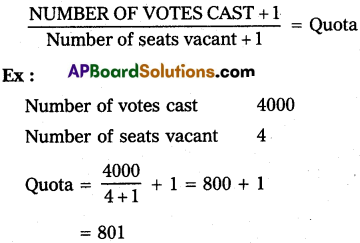
AP Inter 2nd Year Civics Study Material Chapter 11 Elections and Representation 1
Ex:
Number of votes cast – 14000
Number of seats vacant – 14
Quota – 1400 votes

B) Drop method:
AP Inter 2nd Year Civics Study Material Chapter 11 Elections and Representation 2

Question 4.
Do you think that Indian Election System needs to be Reformed.
Answer:
The overall health of a representative form of Government depends, to a very large extent, on the fairness and effectiveness of the electoral process. In order to strengthen the foundatipns of our democratic polity, several reforms need to be undertaken in the electoral system. The system should provide equal opportunities to all citizens and help to build an egalitarian society. This would call for a careful review and reforms of existing features governing legislative, administrative and institutional dimensions of the electoral system in the country.

Within the broad framework of the existing constituency system of elections, geographies delimitation, multi-party system with right to individual to contest, the main issues that need to be examined include plugging loopholes in the present Representation of People Act and Anti-Defection Act.

The various committees and commissions which were appointed to examine our electoral system, election machinery as well as election process have recommended various reforms that have to be introduced in our electoral system. These can be mentioned briefly here under.

  1. The donation of companies to the political parties should be strictly banned.
  2. The accounts of the political parties are to be audited by the Election commission periodically.
  3. The number of members of the Election commission shall be raised.
  4. The limit on election expenditure of the candidates must be proper, practical and realistic.
  5. The announcement of new policies, projects and programmes by the party in power during elections should be banned.
  6. The members of the election commission should be appointed by the president on the advice of the prime minister, leader of the opposition in the Lok Sabha and the chief justice of India.
  7. The government should meet the election expenditure of the candidates.
  8. The election commission should be authorised to invalidate the election of a candidate if it was proved that he had used government machinery during elections.
  9. Notification should be issued to the voters and electronic voting machines should be introduced after fool-proof arrangements.
  10. The candidate who secures 51 percent of the polled votes shall be declared as winner.

Short Answer Questions

Question 1.
Write a Short Note on Electoral Functions.
Answer:
The electoral functions are different for the individual voter and for the political system. For the individual voter, elections may be regarded as a means of political participation and to some extent, of policy choice, although for many voters. Even in democratic societies, elections may be a customary at to which little significance is attached. For the political system, elections are important devices for assuring legitimacy and for system maintenance and support building. Hence, the electoral functions may be considered into four broad categories. They are :
a) Political choice
b) Political participation
c) Support-building and system – maintenance, and
d) Linkage functions.

a) Political choice :
The elections may be used or interpreted as a plebiscite, a referendum, or a mandate. They are the instruments for choosing the leaders and also determining the will of the people. They are devices for controlling political leaders. Control of leaders involves some degree of control of governmental choice and policies. They provide the means for the peaceful and orderly transfer of power.

b) Political participation :
The major electoral function is to provide opportunities and channels for political participation. This function of elections is a central one as political participation is essential in the democratic system. The participation strengthens the democratic system.

c) Support-building and system – maintenance :
The elections support the political system by providing legitimacy, political stability, integration and identification. The elections, are therefore a contributing rather than a controlling factor of a political system. Rosenau uses the term support-building as function of elections and hence, all other functions could be subsumed under it.

d) Linkage functions :
Elections are important agencies of political communication between the people and the government in the sense of political linkages. They provide a chance for the people to have more direct contact with their leaders.

AP Inter 2nd Year Civics Study Material Chapter 11 Elections and Representation

Question 2.
Discuss the Election process in India.
Answr:
The electoral process in India is operationalized in several stages which can be explained as under.
1. Delimitation of Constituencies :
The first step of conducting the elections can be described as the delimitation of constituencies which is done by a Delimitation Commission appointed after every census by the President. This happens for every 10 years. Generally, a constituency which elects a member of the Lok Sabha consists of six or seven State Legislative Assembly constituencies. The decisions of the Delimitation commission are final and cannot be challenged in any court.

2. Recognition of Political Parties :
Political parties have to be registered with the Election Commission. According to certain criteria, set by the Election Commission regarding the length of political activity and success in elections, parties are categorized by the Commission as National or State parties, or simply declared registered-unrecognized parties. National parties are given a symbol that is for their use only, throughout the country. State parties have the sole use of a symbol in the state in which they are recognized as such Registered- unrecognized parties can choose a symbol from a selection of ‘free’ symbols.

3. Photo Identity Cards :
In an attempt to improve the accuracy of the electoral roll and prevent electoral fraud, the Election Commission ordered the making of photo identity cards for all voters in the country in Aug, 1993. To take advantage of latest technological innovations, the Commission issued revised guidelines for Election Photo Identity Card (EPIC) Program in May 2000.

4. Electoral Rolls :
An important step in the conduct of elections is to get prepared constituency-wise electoral rolls which record the names of the eligible voters. The electoral rolls are revised after each census, before every election or after regular intervals.

5. Notification and Appointment of Returning Officers :
When general elections are to be held, the President of India sends a communication to the Election Commission and the latter, after consulting Central and State Governments, announces the poll calendar, i.e., the dates for filing the nomination papers, scrutiny of nomination papers and withdrawal of nominations by the candidates. The Election Commission then appoints Returning Officers for various constituencies. The Regional Election Commissioners help the Election Commission in the smooth conduct of elections.

6. Filing of Nomination Papers :
The candidates who wish to contest in the elections have to file their nomination papers with the Returning Officer in their respective I constituencies. Such candidates must submit their nominations in a given formats prescribed by the Election Commission. If the contestant is a party candidate, the name has to be proposed by a voter and seconded by another voter. In the case of non-party contestant, the candidate has to be subscribed by 10 registered electors of the constituency as proposers.

7. Scrutiny of Nominations :
After the last date for the filing of the nominations, all the nomination papers are duly scrutinized by the Returning Officers in the presence of the candidates or his nominee. The scrutiny is conducted for determining whether the nomination papers have been filed properly, the candidates possess the required qualifications, and they have complied with all rules and regulations. Later, the Returning Officer decides all cases and notifies the names of those candidates whose nomination papers are found in order.

8. Withdraw of Nominations:
After scrutiny, the candidates are allowed to voluntarily withdraw their nominations within a fixed date and time as fixed by the Election Commission. For this purpose a candidate has to apply in writing to the Returning Officers.

9. Election Campaign :
The next stage in the electoral process involves the election campaign. The contestants and parties get engaged in the election campaign. Each party issues an Election manifesto which states its policies, programmes and promises.

10. Electronic Voting Machines (EVMs) :
An electronic voting machine is a simple electronic device used to record votes in place of ballot papers and boxes which were used earlier in conventional voting system. The advantages of the EVM over the traditional ballot paper system are given here.
a) It eliminates the possibility of invalid and doubtful votes.
b) It makes the process of counting of votes much faster than the conventional system.
c) It reduces to a great extent the quantity of paper used, thus saving a large number of trees.
d) It reduces cost printing as only one sheet of Ijallot papers required for each polling station.

11. Polling of Votes:
Polling personnel are appointed and polling booths are set up in different localities. Each polling booth, on an average caters to about a more than thousand voters. The voting is a secret one.

12. Supervising Elections by Observers :
The Election Commission appoints a.lafge number of Election Observers to ensure that the campaign is conducted fairly, and that people are free to vote as they choose. Election Observers keep a check on the amount that each candidate and party spends on the election.

13. Media Coverage:
In order to bring as much transparency as possible to the electoral process, the media are encouraged and provided with facilities to cover the election.

14. Counting of votes and Declaration of Results :
After the process of polling of votes, on a fixed day and time, the Returning Officer and his staff members open the voting machines in the presence of the agents. Then each candidate verifies his votes polled recorded in the EVM. A candidate who gets more valid votes than the other contesting candidate in very constituency is declared elected. These results declared on the basis of relative majority of vote victory system. The Returning Officer makes an announcement of the results in this regard.

15. Election Petitions :
Any elector or candidate can file an election petition if he or she thinks there has been malpractice during the election. An election petition is not an ordinary civil suit, but treated as a contest in which the whole constituency is involved. Election petitions are tried by the High Court of the state concerned and if upheld can even lead to the restaging of the election in that constituency.

Question 3.
Write a short note on composition and Functions of Election Commission. [(AP. Mar. 16) Mar. 18]
Answer:
Composition :
The Election Commission of India consists of the Chief Election Commissioner and two other commissioners. They are appointed by the President of India.

Functions of Election Commission :

  1. It prepares all periodically revised electoral rolls.
  2. It makes every effort to ensure that the voters’ list is free of errors like non-existence of names of registered voters or existence of names of that non-eligible or non-existent.
  3. It notifies the dates and schedules of election and scrutinizes nomination papers.
  4. During this entire process, the Election Commission has the power to take decisions to ensure a free and fair poll.
  5. It can postpone or cancel the election in the entire country or a specific State or constituency on the grounds that the atmosphere is vitiated and therefore, a free and fair election may not be possible.
  6. The Commission also implements a model code of conduct for parties and candidates. It can order a re-poll in a specific constituency.
  7. It can also order a recount- of votes when it feels that the counting process has not been fully fair and just.
  8. The Election Commission accords recognition to political parties and allots symbols to each of them.
  9. It advices the President whether elections can be held in a state under President’s rule in order to extent the period of emergency after one year.
  10. It advices the Governor on matters relating to the disqualifications of the members of State Legislature.

Question 4.
What is Representation? What do you know about Territorial Repre-sentation.
Answer:
Representation:
In democracy, people elect members to the Legislatures. The elected members are the representatives of the people. They represent the people in the Legislature. This process is called representation.

Territorial Representation :
In the territorial or geographical representation system, the total electorate of the country is divided into territorial units called constituencies which elect one or more representatives. The constituencies are more or less equal in size and population. All voters living in a particular Constituency take part in the election of representatives. Where one representative is elected from a constituency it is known as a single-member constituency. Where more than one representative is elected, it is known as multi-member constituency. Most of the modem states, including India, have followed single¬members constituencies for the elections to the lower houses of the legislature.

Question 5.
Estimate the pros and cons of FPTP system in India.
Answer:
In our country we have been following a special method of elections. The entire country is dividend into 550 constituencies, each constituency elects one representative and the candidate who secures the highest number of votes in that constituency is declared elected. It is important to note that in this system whoever has more votes than all other candidates is declared elected.

The winning candidate need not secure a majority of votes. This method is called the First Past the Post system (FPTP). In the election race, the candidate who is ahead of others, who crosses the Wining post first of all, is the winner. This method is also- called the Plural System. This is the method of election prescribed by the Constitution.

In India this FPTP System is popular and successful because of its simplicity. The entire election system is extremely simple to understand even for common voters who may have no specialized knowledge about politics and elections. There is also a clear choice presented to the voters at the time of elections. Voters may either give greater importance to the party or the candidate or balance the two.

The FPTP system generally gives the largest party or coalition some extra bonus seats, more than their share of votes would allow. Thus, this system makes it possible for parliamentary government to function smoothly and effectively by facilitating the formation of a stable government. Finally, the FPTP System encourages voters from different social groups to come together to win an election in a locality. Above all, the FPTP System has proved to be simple and familiar to the ordinary voters. It has helped larger parties to win clear majorities at the centre and state levels.

Question 6.
Write a Note on the Electoral Reforms. [Mar. 17]
Answer:
The Electoral Reforms will ensure the free and fair elections in the country. The successful functioning of Indian democracy depends on the electoral reforms.

Some Electoral Reform proposed :

  1. The donation of companies to the political parties should be strictly banned.
  2. The accounts of the political parties are to be audited by the Election commission periodically.
  3. The number of members of the Election commission shall be raised.
  4. The limit on election expenditure of the candidates must be proper, practical and realistic.
  5. The announcement of new policies, projects and programmes by the party in power during elections should be banned.
  6. The membersof the election commission should be appointed by the president on the advice of the prime minister, leader of the opposition in the Lok Sabha and the chief justice of India.
  7. The government should meet the election expenditure of the candidates.
  8. The election commission should be authorised to invalidate the election of a candidate if it was proved that he had used government machinery during elections.
  9. Notification should be issued to the voters and electronic voting machines should be introduced after fool-proof arrangements.
  10. The candidate who secure 51 percent of the polled votes shall be declared as winner.

Question 7.
What is meant by proportional representation system.
Answer:
Under this system each party gets representation strictly in accordance with its voting strength. It means majority of electors would have majority of the representatives, but a minority of electors would have minority of representatives.

There are two methods in proportional representation. These are

A) Single Transperable Vote System :
The election of President, Vice President and members of Rajya Sabha etc in India is based on this system.

The main features of this system are.

  1. Each voter will have only one vote.
  2. But the voter has to distribute this vote according to his preference (First preference, second preference etc.).
  3. The candidate to be declared elected should secure the required QUOTA of votes.
  4. Provision for transper of votes.

QUOTA :
Under this system as stated above, A candidate in order to be declared elected need not secure majority votes. But he requires only quota of votes. For determining quota, two methods are followed :
A) Hare and Andrae method fixing Quota :
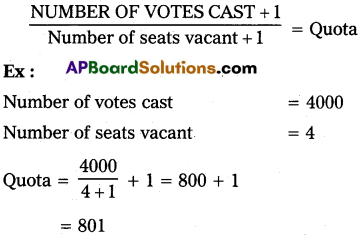
AP Inter 2nd Year Civics Study Material Chapter 11 Elections and Representation 1
Ex:
Number of votes Cast = 14000
Number of seats-vacant =14
Quota = 1400 votes

B) Drop method :
AP Inter 2nd Year Civics Study Material Chapter 11 Elections and Representation 3

Very Short Answer Questions

Question 1.
Relations between democracy and elections.
Answer:
Elections are the Central institution of democratic representative governments. In democracy, elections are periodic. Elected officials are accountable to the people, and they must return to the voters at prescribed intervals to seek their mandate to cantinue in office. This means that officials .in a democracy must accept the risk of being voted out of office. In democratic system the elections are also indusive.

The definition of citizen and voter must be large enough to include a large proportion of the adult population. Democratic elections are definitive. They determine the leadership of the government. Subject to the laws and constitution of the country, popularly elected representatives hold the reins of power.

Question 2.
Electronic voting machines. [Mar. 18, 16]
Answer:
An Electronic voting machine is a simple electronic device used to record votes in place of ballot papers and boxes which were used earlier in conventional voting system. The advantages of the EVM over the traditional ballot paper system are give below.

  • It eliminates the possibility of invalid and doubtful votes.
  • It makes the process of counting of votes much faster that the conventional system.
  • It reduces to a great extent the quantity of paper used, thus saving a large number of trees.
  • It reduces cost printing as only one sheet of ballot papers required for each polling station.

AP Inter 2nd Year Civics Study Material Chapter 11 Elections and Representation

Question 3.
Territorial Representation.
Answer:
In the territorial or geographical representation system, the total electorate of the Country is divided into territorial units called constituencies which elect one or more representatives. The constituencies are more or less equal in size and populatiqn. All voters living in a particular constituency take, part in the election of representatives. Where one representative is elected from a constituency it is known as a single-member constituency.

Where more than one representative is elected, it is known as multi-member constituency. Most of the modem states, including India, have followed single. Members constituencies for the elections to the lower houses of the legislature.

Question 4.
Functional Representation. [Mar. 17]
Answer:
It is based on occupation. People engaged in the same kind of occupation have more things in common than people living in the same locality. Doctors, farmers, industrial workers, traders, journalists, lawyers, teachers etc., have more in common than those who live as neighbours. One man cannot represent all traders, Hence, representation should be on functional basis. A legislature representing such different occupational groups would be a proper forum where different interests would be projected and pleaded for. But it is not possible to provide representation to each and every occupation which are innumerable in number and the classification of profession is a touch task.

Question 5.
Composition of Election commission of India.
Answer:
Article 324 of the constitution has made the following provisions with regard to the composition of election Commission. Since its inception 1950 and till 15th Oct, 1989, the election commission functioned as a single member body consisting of the Chief Election Commissioner. On 16th October, 1989 the President of India appointed two more election Commissioners to cope up with the increased work of the Election Commission. Thereafter, the Election Commission started functioning as a multimember body consisting of 3 Election Commissioners.

Question 6.
Electoral Reforms.
Answer:
The various commitees and commissions have recommended various reforms that have to be introduced in our electoral system, election machinery and election process. These can be mentioned briefly here under.

  1. Lowering of voting age
  2. Deputation to Election commission
  3. Electronic voting machines
  4. Prohibition on the sale of liquor
  5. Number of proposers

Question 7.
Election offences.
Answer:
Some of the electoral offences as given below.

  1. Promoting enmity between classes or grounds of religion, race, community or language.
  2. Convening, holding or attending any public meeting during 48 hours before the end of poll.
  3. Causing disturbance at election meetings.
  4. Printing of election pamphlets, posters etc., without printers / publishers names and addresses.
  5. Violation of maintenance of secrecy of vote.
  6. Influencing of voting by officials connected with conduct of elections and police personnel.
  7. Disorderly conduct and disturbance in or near a polling station, indulging use of loud speakers etc.
  8. Canvassing within 100 meters of a polling station on the day of poll.
  9. Misconduct at the polling station or failure to obey the lawful direction of the presiding officer.
  10. Illegal hiring or procuring of vehicles for conveying voters to and from polling stations.
  11. Unlawful removal of ballot papers / EVMs from the polling stations.
  12. Booth capturing.

Question 8.
Corrupt practices in elections.
Answer:
Following are some important corrupt practices during the elections. They are.

  1. Briling a person to induce him/her to stand or not to stand as a candidate.
  2. Interference with free exercise of anybody’s electoral right.
  3. Threat with injury of any kind, including social ostracism, excommunication, divine displeasure or spiritual censure.
  4. Appeal on grounds of religion, caste, community or Language or the use of religious or national symbols.
  5. Publication of false statement about personal character and conduct of any
  6. Hiring or procuring of vehicles for free conveyance of voters.
  7. Incurring of election expenditure by a candidate in excess of the prescribed limit.
  8. Booth capturing.

Question 9.
Role of the Election Commission in India. [Mar. 17]
Answer:
Over the years, the Election Commission of India has emerged as an independent authority which has asserted its powers to ensure fairness in the election process. It has acted in an importial and unbaised manner in order to protect the sancity of the electoral process. The record of EC also shows that every improvement in the functioning of institutions does not require legal or constitutional change.

It is widely agreed that the Election Commission is more independent and assertive now than it was till twenty five years ago. This is not because the powers and constitutional protection of the Election commission have increased. The Election Commission has started using more effectively the powers it always had in the constitution.

In the past sixty five years, sixteen Lok Sabha Elections have been held. Many more state assembly elections and bye-elections have been conducted by the Election Commis-sion.

AP Inter 2nd Year Civics Study Material Chapter 11 Elections and Representation

Question 10.
Representation.
Answer:
In democracy people elect members to the legislatures. The elected members are the representatives of the people. They represent the people in the legislature. This process is called representation.

AP Inter 2nd Year Chemistry Important Questions Chapter 7 d and f Block Elements & Coordination Compounds

Students get through AP Inter 2nd Year Chemistry Important Questions 7th Lesson d and f Block Elements & Coordination Compounds which are most likely to be asked in the exam.

AP Inter 2nd Year Chemistry Important Questions 7th Lesson d and f Block Elements & Coordination Compounds

Very Short Answer Questions

Question 1.
What are transition elements? Give examples.
Answer:
Transition elements are the elements which contains partially filled d-subshells in their ionic state (or) in their elementary state. Eg : Mn, Co, Ag etc.

Question 2.
Write the general electronic configuration of transition elements.
Answer:
General electronic configuration of transition elements is (n – 1)d1-10 ns1-2.

AP Inter 2nd Year Chemistry Important Questions Chapter 7 d and f Block Elements & Coordination Compounds

Question 3.
Why are Mn2+ compounds more stable than Fe2+ towards oxidation to their +3 state ?
Answer:
Mn+2 has electronic configuration [Ar] 4s0 3d5.
Fe+2 has electronic configuration [Ar] 4s0 3d6.

  • Mn+2 has half filled d-subshell which is more stable.
    Hence Mn+2 compounds are more stable than Fe+2 toward oxidation to their +3 state.

Question 4.
Why Zn2+ is diamagnetic whereas Mn2+ is paramagnetic ?
Answer:

  • Zn+2 electronic configuration is [Ar] 4s03d10. It has no unpaired electrons. So it is dia magnetic.
  • Mn+2 electronic configuration is [Ar] 4s03d5. It has five unpaired electrons so it is paramagnetic.

Question 5.
Write ‘spin only’ formula to calculate the magnetic moment of transition metal ions.
Answer:
Spin only formula to calculate the magnetic moment of transition metal ions is
μ = \(\sqrt{n(n+2)}\) BM BM = Bohr Magneton.

AP Inter 2nd Year Chemistry Important Questions Chapter 7 d and f Block Elements & Coordination Compounds

Question 6.
Claculate the ‘spin only’ magnetic moment of \(\mathrm{Fe}^{2+}(\mathrm{aq})\) ion. (Board Model Paper) (AP Mar. ’17)
Answer:
Fe+2 ion has electronic configuration [Ar] 4s03d6.
It has four unpaired electrons n = 4.
Spin only magnetic moment μ = \(\sqrt{n(n+2)}\) BM = \(\sqrt{4(4+2)}\) = \(\sqrt{24}\) BM = 4.89 BM

Question 7.
Aqueous Cu2+ ions are blue in colour, where as aqueous Zn2+ ions are colourless. Why ?
Answer:

  • Electronic configuration of Cu+2 ion is [Ar] 4s03d9. It contains one unpaired electron due to presence of this unpaired electron aq. Cu+2 ions are blue in colour.
  • Electronic configuration of Zn+2 ion is [Ar] 4s03d10. It contains no unpaired electrons, due to absence of unpaired electrons aq. Zn+2 ions are colourless.

Question 8.
What are complex compounds ? Give examples.
Answer:
Complex compounds : Transition metal atoms or ions form a large number of compounds in which anions or neutral groups are bound to metal atom or ion through co-ordinate covalent bonds. Such, compounds are called co-ordination compounds (or) complex compounds.
Eg. : [Fe(CN)6]4-, [Co(NH3)6]3+

Question 9.
What is an alloy? Give example.
Answer:
Alloy : An intimate mixture having physical properties similar to that of the metal formed by a metal with other metals or metalloids or sometimes a non metal is called as an alloy.
Eg.: Invar — 64% Fe, 35% Ni, Mn 8cc in traces
Nichrome — 60% Ni,, 25% Fe, 15% Cr.

Question 10.
What is lanthanoid contraction ? (IPE 2016(TS))
Answer:
The slow decrease of atomic and ionic radii in lanthanides with increase in atomic number is called lanthanide contraction.

AP Inter 2nd Year Chemistry Important Questions Chapter 7 d and f Block Elements & Coordination Compounds

Question 11.
What is mischmetall ? Give its composition and uses. (AP Mar. ’16)
Answer:
Mischmetall is an alloy which consists of a lanthanoid metal (~ 95%) and iron (~ 5%) and traces of S, C, Ca and Al.

  • It is used in Mg- based alloy to produce bullets, shell and lighter flint.

Question 12.
What is a coordination polyhedron ?
Answer:
The spatial arrangement of the ligands which are directly bonded to the central atom or ions defines the geometry about the central atom is called co-ordination polyhedron.
Eg.: Octahedral, tetrahedral etc.

Question 13.
What is a ligand ? (TS Mar. ’18) (IPE 2014)
Answer:
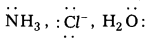
Ligand : A co-ordinating entity which is bound to the central atom by donating electron pairs is called a ligand. Eg.: Cl, NH3, CN etc.

Question 14.
What is a chelate ligand ? Give example.
Answer:
The ligands which can form two co-ordinate covalent bonds through two donor atoms are called bidentate ligands. These bidentate ligands are also called chelate ligands.
Eg.: C2\(\mathrm{O}_4^{-2}\), \(\mathrm{CO}_3^{-2}\) etc.

Question 15.
What is an ambidentate ligand ? Give example. (TS Mar. ’18) (IPE 2016(AP))
Answer:
A unidentate ligand containing two possible donor atoms can co-ordinate through either of donor atoms. Such ligands are called ambidentate ligands. Eg : \(\mathrm{NO}_2^{-}\)

Question 16.
[Cr(NH3)6]3+ is paramagnetic while [Ni(CN)4]2- is diamagnetic. Why ?
Answer:

  • [Cr(NH3)6]3+ is paramagnetic due to the presence of three unpaired electrons.
  • [Ni(CN)4]2- is diamagnetic due to the absence of unpaired electrons.

AP Inter 2nd Year Chemistry Important Questions Chapter 7 d and f Block Elements & Coordination Compounds

Question 17.
Which metal in the first series of transition metals exhibits +1 oxidation state most frequently and why ?
Answer:
Copper exhibits +1 oxidation state most frequently because Cu+ has electronic configuration [Ar] 4s03d10 which has a fulfilled d-subshell which is more stable.

Question 18.
Why do transition elements exhibit more than one Oxidation state (variable oxidation states) ?
Answer:
Transition elements exhibits more than one oxidation state.
Reason :

  • The energy difference between (n – 1) d subshell and ns subshell is very low. So both of these subshells complete to lose the electrons.

Question 19.
CuSO4.5H2O is blue in colour where as anhydrous CuSO4 is colourless. Why ? (IPE 2014)
Answer:
CuSO4.5H2O is blue in colour whereas anhydrous CuSO4 is colourless because in the absence of ligand, crystal field splitting doesnot occurs.

Question 20.
Give the formula the following complexes.
a) Potassium hexacyano ferrate (III)
b) Tetra carbonyl nickel (O) (IPE 2016 (TS))
Answer:
a) K3 [Fe (CN)6]
b) [Ni(CO)4]

Question 21.
Scandium is a transition element. But Zinc is not. Why ? (IPE 2014)
Answer:
Scandium has electronic configuration [Ar] 4s23d1.
Zinc has electronic configuration [Ar] 4s23d10.
Scandium has one unpaired d-electron where as Zinc has zero unpaired d-electrons so Scandium is transition element but Zinc is not.

Question 22.
What are interstitial compounds ? (IPE 2015)
Answer:
Interstitial compounds are non-stichiometric compounds which are formed when non-metals like H, C, N etc., are heated with transition elements. In these compounds the non-metal atoms occupy the interstitial species of metal atoms. Ex : TiH0.54

Question 23.
In what way is the electronic configuration of transition elements different from non transition elements ?
Answer:

  • The general electronic configuration of transition elements is (n – 1) d1-10 ns1-2.
  • The general electronic configuration of non-transition elements is (n – 1)d10 ns2.

Question 24.
Even though silver has d10 configuration, it is regarded as transition element. Why ?
Answer:
The outer electronic configuration of silver is – 4d105s1. It is having general electronic configuration of a transition element (n – 1) d1-10 ns1-2.
So silver is a transition element.

Question 25.
Though Sc is a transition element, it does not exhibit variable oxidation state. Why ?
Answer:
Scandium has electronic configuration [Ar] 4s23d1. It has only one unpaired d-electron. So it does not exhibits variable oxidation state. It exhibits +3 stable oxidation state.

AP Inter 2nd Year Chemistry Important Questions Chapter 7 d and f Block Elements & Coordination Compounds

Question 26.
Why is it difficult to obtain M3+ oxidation state in Ni, Cu and Zn ?
Answer:

  • Ni has electronic configuration [Ar] 4s23d8.
    Ni+2 has electronic configuration [Ar] 4s03d8.
    It is difficult to remove an electron from 3d8. So, Ni+3 is difficult to obtain. (Ni has high negative enthalpy of hydration).
  • Cu has electronic configuration [Ar] 4s13d10.
    Cu+ has electronic configuration [Ar] 3d10.
    It is difficult to remove the electrons from 3d10 (stable). So, Cu+3 is difficult to obtain.
  • Zn has electronic configuration [Ar] 4s23d10.
    Zn+2 has electronic configuration [Ar] 4s03d10.
    It is difficult to remove the electron from 3d10 (stable). So Zn+3 is difficult to obtain.

Question 27.
Cu+2 forms halides like CuF2, CuCl2 and CuBr2 but not CuI2. Why ?
Answer:
Cu+2 forms halides like CuF2, CuCl2 and CuBr2 but not CuI2 because Cu+2 oxidises I to I2.
2Cu+2 + 4I → Cu2I2 + I2.

Question 28.
Why is Cr2+ reducing and Mn3+ oxidizing even though both have the same d4 electronic configuration ?
Answer:
Cr+2 is reducing as its configuration changes from d4 to d3, the latter having a half filled t2g level. On the other hand the change from Mn+2 to Mn+3 results in the half filled (d5) configuration which has extra stability.

Question 29.
What is meant by ‘disproportionation’ ? Give an example of disproportionation reaction in aqueous solution.
Answer:
The reactions in which only one element undergo both oxidation as well as reduction are called disproportionation reactions.

  • When a particular oxidation state becomes less stable relative to other oxidation states, one lower, one higher, it is said to undergo disproportionation.
    Eg: Cu+ ion is not stable in aqueous solution because it undergo disproportionation in aqueous solution.

AP Inter 2nd Year Chemistry Important Questions Chapter 7 d and f Block Elements & Coordination Compounds 7

Question 30.
Why do the transition metals readily form alloys?
Answer:
Because of similar atomic or ionic radii and similar characterstic properties of transition elements alloys are readily formed by these elements.

Question 31.
How do the Ionic character and acidic nature vary among the oxides of first transition series?
Answer:

  • As the oxidation number of a metal increases ionic character decreases in case of transition elements. Eg: Mn2O7 is a covalent green oil.
  • In CrO3 and V2O5 the acidic character is predominant.
  • V2O5 is however amphoteric though mainlý acidic V2O5 reacts with alkali as well as acids to give \(\mathrm{VO}_4^{-3}\) and \(\mathrm{VO}_4^{-3}\).
  • CrO is basic.
  • Mn2O7 gives HMnO4 and CrO3 gives H2CrO4 and H2Cr2O7.

AP Inter 2nd Year Chemistry Important Questions Chapter 7 d and f Block Elements & Coordination Compounds

Question 32.
What are the different oxidation s.tates exhibited by the lanthanoids?
Answer:

  • Lanthanoids exhibits +2, +3 states majorly. Sometimes +2 and +4 states exhibited in solid compounds.
  • The common oxidation state of lanthanoids is +3.

Question 33.
What is difference between a double salt and a complex compound?
Answer:
Double salts dissociate into simple ions completely when dissolved in water while complex compounds dissociate to give complex ion and the counter ions.

Question 34.
What is meant by coordination number.
Answer:
Co-ordination Number is the number of ligands present around a central metal atom or ion in a complex Ex : The co-ordination number of Co in [Co(NH3)3 Cl3] is six.

Question 35.
Using IUPAC norms write the systematic names of the following.

  1. [CO(NH3)6]Cl3
  2. [Pt(NH3)2Cl(NH2CH3)]Cl
  3. [Ti(H2O)6]3+ and
  4. [NiCl4]2-

Answer:

  1. Hexa amine cobalt (III) chloride
  2. Diamine chloride (methyl amine) platinum (II) chloride
  3. Hexa aquo titanium (III) ion
  4. Tetra chloro nickelate (III) ion

Question 36.
Calculate the magnetic moment of a divalent ion in aqueous solution if its atomic number is 25. (IPE 2016 (AP)) (AP Mar. ’16)
Solution:
With atomic number 25, the divalent ion in aqueous solution will have d5 configuration (five unpaired electrons). The magnetic moment, μ is
μ = \(\sqrt{5(5+2)}\) = 5.92 BM

Short Answer Questions

Question 1.
Write the characteristic properties of transition elements.
Answer:
Transition elements exhibits typical characteristic properties.

  • Electronic configurations.
  • Para and ferro magnetic properties.
  • Alloy forming ability.
  • Complex forming ability.
  • Interstitial compounds.
  • Variable oxidation states.
  • Formation of coloured hydrated ions.
  • Catalytic property.
  • Metallic character.

AP Inter 2nd Year Chemistry Important Questions Chapter 7 d and f Block Elements & Coordination Compounds

Question 2.
What is lanthanoid contraction ? What are the consequences of lanthanoid contraction ? (AP Mar. ’17) (IPE Mar. 15 (TS), 14 B.I.E)
Answer:
Lanthanoid contraction : The overall decrease in atomic and ionic radii from lanthanum to leutetium is observed in the lanthanoids. This phenomenon is called lanthanoid contraction. It is due to the fact that with every additional proton in the nucleus, the corresponding electron goes into a 4f-subshell. This is too diffused to screen the nucleus as effectively as the more localised inner shell. Hence, the attraction of the nucleus for the outermost electrons increases steadily with the atomic number.

Consequences of Lanthanoid Contraction : The important consequences of lanthanoid contraction are as follows :

i) Basic character of oxides and hydroxides : Due to the lanthanoid contraction, the covalent nature of La-OH bond increases and thus, the basic character of oxides and hydroxides decreases from La(OH)3 to Lu(OH)3.

ii) Similarity in the size of elements of second and third transition series : Because of lanthanoid contraction, elements which follow the third transition series are considerably smaller than would otherwise be expected. The normal size increases from Sc → Y → La and disappears after lanthanides. Thus, pairs of elements such as Zr/Hf, Nb/Ta and Mo/w are almost identical in size.
Due to almost similar size, such pairs have very similar properties which makes their separation difficult.

iii) Separation of lanthanoids : Due to lanthanoid contraction, there is a difference in some properties of lanthanoid like solubility, degree of hydration and complex formation. These difference enable the separation of lanthanoids by ion exchange method.

Question 3.
Explain Werner’s theory of coordination compounds with suitable examples. (Mar. ’14) (TS Mar. ’15) (IPE – May. 2015 (TS), ’14 B.I.E)
Answer:
Werner’s theory :
Postulates :

1) Every complex compound has a central metal atom (or) ion.

2) The central metal shows two types of valencies namely primary valency and secondary valency.

A) Primary valency : The primary valency is numerically equal to the oxidation state of the metal. Species or groups bound by primary valencies undergo complete ionization. These valencies are identical with ionic bonds and are non-directional. These valencies are represented by discontinuous lines (….)
Eg. : CoCl3 contains Co3+ and 3Cl ions. There are three Primary Valencies or three ionic bonds.

B) Secondary Valency : Each metal has a characteristic number of Secondary Valencies. They are directed in space around the central metal.
The number of Secondary Valencies is called Coordination number (C.N.) of the metal. These valencies are directional in nature.
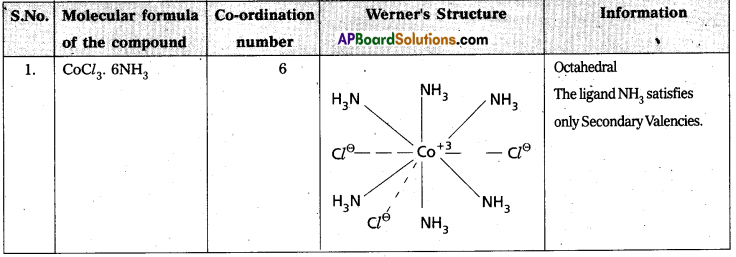
For example in CoCl3. 6NH3
Three Cl ions are held by Primary Valencies and 6NH3 molecules are held by Secondary Valencies. In CuSO4.4NH3 complex \(\mathrm{SO}_4^{2-}\) rion is held by two Primary Valencies and 4NH3 molecules are held by Secondary Valencies.

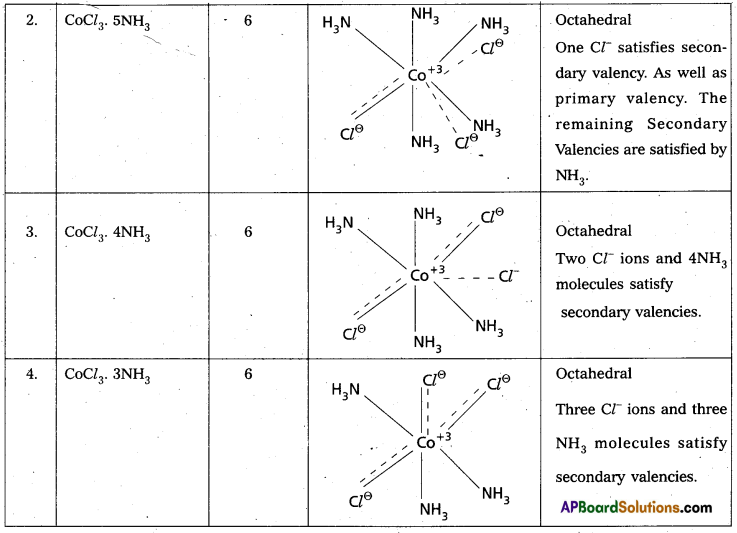
3) Some negative ligands, depending upon the complex, may satisfy both primary and secondary valencies. Such ligands, in a complex, which satisfy both primary as well as secondary valencies do not ionize.

4) The primary valency of a metal is known as its outer sphere of attraction or ionizable valency while the Secondary valencies are known as the inner sphere of attraction or coordination sphere. Groups bound by secondary valencies do not undergo ionization in the complex.
Example to Clarify Werner’s Theory

AP Inter 2nd Year Chemistry Important Questions Chapter 7 d and f Block Elements & Coordination Compounds 1
AP Inter 2nd Year Chemistry Important Questions Chapter 7 d and f Block Elements & Coordination Compounds 2

AP Inter 2nd Year Chemistry Important Questions Chapter 7 d and f Block Elements & Coordination Compounds

Question 4.
Using IUPAC norms write the formulas for the following.

  1. Tetrahydroxozincate (II)
  2. Hexaaminecobalt (III) sulphate
  3. Potassium tetrachloropalladate (II) and
  4. Potassium tri(oxalato) chromate (III) (IPE – May. 2015 (AP, TS), 14)

Answer:

  1. Tetrahydroxozincate (II) ion – [Zn(OH)4]-2
  2. Hexa amine cobalt (III) sulphate – [Co(NH3)6]2 (SO4)3
  3. Potassium tetrachioro palladate (II) – K2[PdCl4]
  4. Potassium tri(oxalato) chromate (III) – K3[Cr(C2O4)3]

Question 5.
What are homoleptic and heteroleptic complexes ? Give one example for each.
Answer:
Homoleptic complexes : These are the complexes in which a metal is bound by only ore kind of ligands, eg. : [Co(NH3)6]3+
Heteroleptic complexes: These are the complexes in which a metal is bound by more than one kind of ligands, eg. : [Co(NH3)4Cl2]+

Question 6.
Give the geometrical shapes of the following complex entities

  1. [CO(NH3)6]3+
  2. [Ni(CO)4]
  3. [Pt Cl4]2- and
  4. [Fe(CN)6]4-.

Answer:

  1. Geometrical shape of [CO(NH3)6]3+ is octahedral.
  2. Geometrical shape of [Ni(CO)4] is tetrahedral.
  3. Geometrical shape of [PtCl4]2- is square planar.
  4. Geometrical shape of [Fe(CN)6]-4 is octahedral.

Question 7.
Using IUPAC norms write the systematic names of the following.

  1. K4[Fe(CN)6]
  2. [Cu(NH3)4]SO4
  3. [Ti (H2O)6]3+ and
  4. [NiCl4]2-.

Answer:

  1. K4[Fe(CN)6] – Potassium hexa cyanao ferrate (II)
  2. [Cu(NH3)4]SO4 – Tetra amine copper (II) sulphate
  3. [Ti (H2O)6]3+ and – Hexa aquo titanium (III) ion
  4. [NiCl4]2- – Tetra chloro nickelate (II) ion

Question 8.
Explain the terms
(i) Ligand
(ii) Coordination number
(iii) Coordination entity
(iv) Central metaf atom/ion.
Answer:
i) Ligand : The ions, or molecules bound to the central atom/ion in the coordination entity are called ligands. These may be

a) simple ions such as Cl
b) small molecules such as H2O or NH3
c) large molecules such as H2N.CH2CH2NH2 or N(CH2CH2NH2)3 or even
d) macro-molecules, such as proteins.

On the basis of the numberof donor atoms available for coordination, the ligands can be classified as :

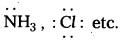
a) Unidentate : One donor atom, Eg. AP Inter 2nd Year Chemistry Important Questions Chapter 7 d and f Block Elements & Coordination Compounds 3 etc.
b) Bidentate : Two donor atoms, Eg.: H2NCH2CH2NH2
(ethane-1, 2-diamine or en), C2\(\mathrm{O}_4^{2-}\) (oxalate), etc.
c) Polydentate : More than two donor atoms, Eg. : N(CH2CH2NH2)3 EDTA, etc.

ii) Coordination number : The coordination number (CN) of metal ion in a complex can be defined as the number of ligands or donor atoms to which the metal is directly bonded.
Eg : In [Ptcl6]2-, CN of Pt = 6, In [Ni(NH3)4]2+, CN of Ni = 4.

iii) Coordination entity: A central metal atoms or ions bonded to a fixed number of molecules or ions (ligands) is known as coordination entity. For example [CoCl3(NH3)3]. Ni(CO)4], etc.

iv) Central metal atom/ion : In a coordination entity, the atom/ion to which a fixed no. of ions/groups are bound in a definite geometrical arrangement around it is called central metal atom or ion. Eg : K4[Fe(CN)6] ‘Fe’ is central metal.

Question 9.
Explain the terms

  1. Unidentate ligand
  2. Bidentate ligand
  3. Polydentate ligand and
  4. Ambidentate ligand giving one example for each.

Answer:

  1. Unidentate : The negative ion or neutral molecule having only one donor atom is called unidentate ligand
    Eg : AP Inter 2nd Year Chemistry Important Questions Chapter 7 d and f Block Elements & Coordination Compounds 4 etc.
  2. Bidentate (or didentate) : The ions or molecules having two donor atoms are called
    AP Inter 2nd Year Chemistry Important Questions Chapter 7 d and f Block Elements & Coordination Compounds 5
  3. Polydentate ligands : Ligands having more than one donor atom in the coordinating group and are capable of forming two or more coordinate bonds with same central atom simultaneously are called poly dentate ligands. Eg : C2\(\mathrm{O}_4^{-2}\).
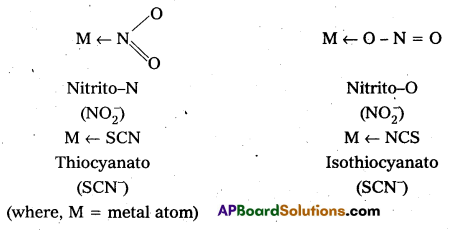
  4. Ambidentate: Ligand which can ligate through two different atoms is called ambidentate ligand. Eg : \(\mathrm{NO}_2^{-}\), \(\mathrm{SCN}^{-}\) ions. \(\mathrm{NO}_2^{-}\) ion can coordinate either through nitrogen or through oxygen to a central metal atom/ion. Similarly, \(\mathrm{SCN}^{-}\) ion can coordinate through the sulphur or nitrogen atom.
    AP Inter 2nd Year Chemistry Important Questions Chapter 7 d and f Block Elements & Coordination Compounds 6

AP Inter 2nd Year Chemistry Important Questions Chapter 7 d and f Block Elements & Coordination Compounds

Question 10.
Explain the colour and para magnetic property of transition elements.
Answer:
Transition elements having unpaired electrons in d-orbitals are coloured. The colour is due to d-d transitions of electrons. Electrons are excited from lower set of d-orditals to higher set of d- orbitals by absorbing energy from visible light and emits complementary colour which is the colour of the ion. Transition elements are ions having atleast one unpaired electron in d-orbitals are para magnetic. The extent of para magnetic property is expressed in terms of magnetic moment (μ). μ = \(\sqrt{n(n+2)}\) where n is number of unpaired electrons present in d- orbitals.

Question 11.
Explain different types of isomerism exhibited by Co-ordination compounds, giving suitable examples.
Answer:
Isomerism in Co-ordination compounds : Isomers are compounds that have the same chemical formula but different arrangement of atoms. Two principal types of isomerism are known among co-ordination compounds namely stereo isomerism and structural isomerism.

a) Stereoisomerim : Stereoisomerism is a form of isomerism in which two substances have the same composition and structure but differ in the relative spatial positions of the ligands. This can be sub divided into two classes namely.
i) Geometrical isomerism and
ii) optical isomerism

b) Structural isomerism :
i) Linkage isomerism
ii) Co-ordination isomerism
iii) Ionisation isomerism
iv) Hydrate isomerism

a) (i) Geometrical isomerism :

  • Geometrical isomerism arises in Co-ordination complexes due to different possible geometric arrangements of the ligands.
  • This isomerism found in complexes with Co-ordination numbers 4 and 6.
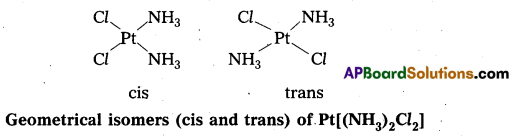
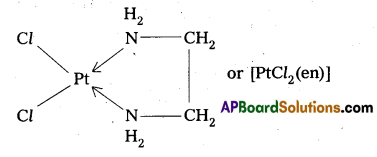
  • In a square planar complex of formula [Mx2L2] the two ligands may be arranged in adjacent to each other in a cis isomer (or) opposite to each other in a trans isomer.
    AP Inter 2nd Year Chemistry Important Questions Chapter 7 d and f Block Elements & Coordination Compounds 8
  • Square planar complex of type [MAB XL] shows three isomers two-cis and one trans. (A, B, X, L are unidentate ligands is square planar complex).
  • Geometrical isomerism is not possible in tetrahedral geometry.
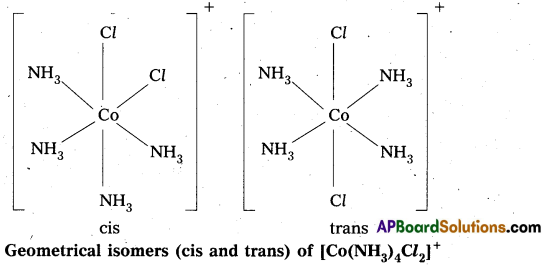
  • In octahedral complex of formula [MX2L4] in which two ligands X may be oriented cis or trans to each other.
    AP Inter 2nd Year Chemistry Important Questions Chapter 7 d and f Block Elements & Coordination Compounds 9
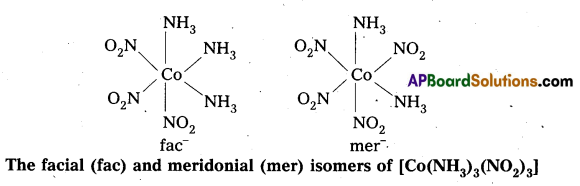
  • Another type of geometrical isomerism occurs in octahedral Co-ordination compounds of type [Ma3b3] if three donor atoms of the same ligands occupy adjacent positions at the comers of an octahedral face then it is facial (fac) isomer. When the positions occupied are around the meridian of the octahedran then it is meridonial (mer) isomer.
    AP Inter 2nd Year Chemistry Important Questions Chapter 7 d and f Block Elements & Coordination Compounds 10

a(ii) Optical isomerism : Optical isomerism arises when two isomers of a compound exist such that one isomer is a mirror image of the other isomer. Such isomers are called optical isomers or enantiomers. The molecules or ions that cannot be superimposed are called chiral.

The two forms are called dextro (d) and laevo (l) depending upon the direction they rotate the plane of polarised light in a polarimeter (d rotates to the right, l to the left). Optical isomerism is common in octahedral complexes involving bidentate ligands.

b(i) Linkage isomerism: Linkage isomerism arises in Co-ordination compound containing ambidentate ligand. A simple example is provided by complexes containing the thiocyanate ligand-NCS, which may bind through the nitrogen to give M-NCS or through sulphur to give M-SCN.
eg. : [Mn(CO)5SCN] and [Mn(CO)5NCS]

(ii) Co-ordinate isomerism : This type isomerism arises from the interchange of ligands between cationic and anionic entities of different metal ions present in a complex.
eg. : [CO(NH3)6] [Cr(CN)6] and [Co(CN)6] [Cr(NH3)6]

(iii) Ionisation isomerism: This form of isomerism arises when the counter ion in a complex salt is itself a potential ligand and can displace a ligand which can then become the counter ion.
eg. : [Co(NH3)5SO4] Br and [Co(NH3)5Br]SO4

(iv) Hydrate isomerism : This form of isomerism is known as ‘hydrate isomerism since water is involved as a solvent. Hydrate isomers differ by whether or not a hydrate molecule is directly bonded to the metal ion or merely present as free solvent molecules in the crystal lattice.

Question 12.
What is meant by chelate effect ? Give example.
Answer:
When a didentate or a polydentate ligand contains donor atoms positioned in such a way that when they coordinate with the central metql ion, a 5-or 6-membered ring is formed, the effect is known as chelate effect. Example
AP Inter 2nd Year Chemistry Important Questions Chapter 7 d and f Block Elements & Coordination Compounds 11

Question 13.
Discuss the nature of bonding and magnetic behaviour in the following co-ordination entities on the basis of valence bond theory.
(i) [Fe(CN)6]4-
(ii) [FeF6]3-
(iii) [Co(C2O4)3]3- and
(iv) [CoF6]3-
Answer:
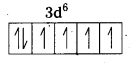
i) [Fe(CN)6]4- : In this complex Fe is present as Fe2+.
Fe = [Ar] 3d64s2
Outer configuration of Fe2+ = 3d64s0
AP Inter 2nd Year Chemistry Important Questions Chapter 7 d and f Block Elements & Coordination Compounds 12
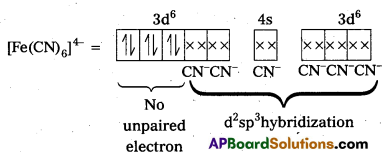
CN being strong field ligand, pair up the unpaired d electrons Thus, two 3d-orbital are now available for CN ions.
AP Inter 2nd Year Chemistry Important Questions Chapter 7 d and f Block Elements & Coordination Compounds 13
Since, all the electrons are paired, the complex is diamagnetic. Moreover (n – 1) d-orbitals are involved in bonding, so, it is an inner orbital or low spin complex.

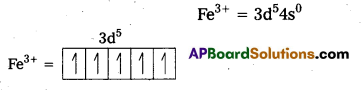
ii) [FeF6]3- : In this complex, the oxidation state of Fe is + 3.
AP Inter 2nd Year Chemistry Important Questions Chapter 7 d and f Block Elements & Coordination Compounds 14
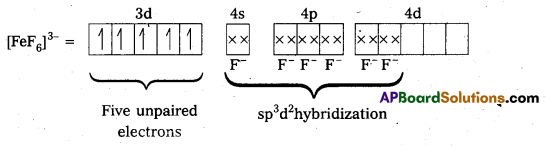
F- is not a strong field ligand. It is a weak field ligand, so no pairing occurs. Thus, 3d- orbitals are not available to take part in bonding.
AP Inter 2nd Year Chemistry Important Questions Chapter 7 d and f Block Elements & Coordination Compounds 15
Because of the presence of five unpaired electrons, the complex is paramagnetic. Moreover, nd-orbitals are involved in bonding, so it is an outer orbital or high spin complex.

iii) [Co(C2O4)3]3- : In this complex, the oxidation state of Co is + 3.
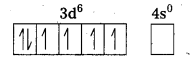
Outer configuration of Co = 3d7 4s2
Co3+ = 3d64s0
AP Inter 2nd Year Chemistry Important Questions Chapter 7 d and f Block Elements & Coordination Compounds 16
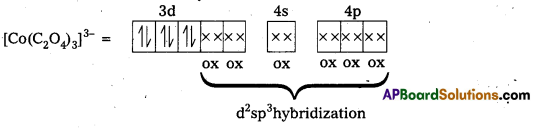
Oxalate ion being a strong field ligand pair up the 3d electrons, thus two out of the five 3d-orbitals are available for oxalate ions.
AP Inter 2nd Year Chemistry Important Questions Chapter 7 d and f Block Elements & Coordination Compounds 17
Since, all the electrons are paired, this complex is diamagnetic. It is an inner orbital complex because of the involvement of (n – 1) d-orbital for bonding,

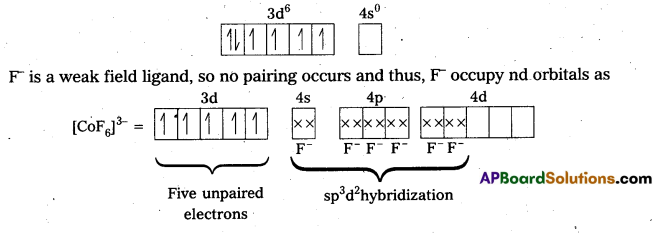
iv) [CoF6]3- : In this complex, Co is present as Co3+
Outer configuration of Co3+ = 3d6 4s0
AP Inter 2nd Year Chemistry Important Questions Chapter 7 d and f Block Elements & Coordination Compounds 18
Because of the presence of four unpaired electrons, the complex is paramagnetic. Since, nd orbitals take part in bonding, it is an outer orbital complex or high spin complex.

AP Inter 2nd Year Chemistry Important Questions Chapter 7 d and f Block Elements & Coordination Compounds

Question 14.
What is spectrochemical series ? Explain the difference between a weak field ligand and a strong field ligand.
Answer:
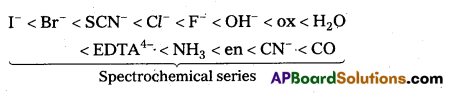
The arrangement of ligands in order of their increasing field strengths, i.e., increasing crystal field splitting energy (CFSE) values is called spectrochemical series.
AP Inter 2nd Year Chemistry Important Questions Chapter 7 d and f Block Elements & Coordination Compounds 19

The ligands with a small value of CFSE (Δ0) are called weak field ligands. For such ligands Δ0 < P where P is the pairing energy. Whereas the ligands with a large value of CFSE are called strong field ligands. In case of such ligands Δ0 > R

When ligands approach a transition metal ion, the d-orbitals split into two sets (t2g and eg), one with lower energy and the other with higher energy. The difference of energy between the two sets of orbitals is called crystal field splitting energy, Δ0 for octahedral field and Δt for tetrahedral field.

If Δ0 < P (pairing energy), the 4th electron enters one of the eg orbitals giving the configuration \(t_{2 g}^3 e_g^1\) thereby forming high spin complex. Such ligands for which Δ0 < P are known as weak field ligands.
If Δ0 > P, the 4th electron pairs up in one of the t2g orbitals giving the configuration \(t_{2 g}^3 e_g^1\), thus forming low spin complexes. Such ligands for which Δ0 > P are called strong field ligands.

Question 15.
Explain the terms
(i) Ligand
(ii) Coordination number
(iii) Coordination entity
(iv) Central metal atom/ion.
Answer:
i) Ligand : The ions or molecules bound to the central atom/ion in the coordination entity are called ligands. These may be
a) simple ions such as Cl
b) small molecules such as H2O or NH3
c) large molecules such as H2NCH2CH2NH2 or N(CH2CH2NH2)3 or even
d) macro-molecules, speh as proteins.
On the basis of the number of donor atoms available for coordination, the ligands can be classified as :

a) Unidentate : One donor atom, Eg.: AP Inter 2nd Year Chemistry Important Questions Chapter 7 d and f Block Elements & Coordination Compounds 20 etc.
b) Bidentate : Two donor atoms, Eg.: H2NCH2CH2NH2
(ethane-1, 2-diamine or en), C2\(\mathrm{C}_2 \mathrm{O}_4^{2-}\) (oxalate), etc.
c) Polydentate: More than, two donor atoms, Eg.: N(CH2CH2NH2)3 EDTA etc.

ii) Coordination number: The coordination number (CN) of metal ion in a complex can be defined as thê number of ligands or donor atoms to which the metal is directly bonded.
Eg: In [PtCl6]2-, CN of Pt = 6, In [Ni(NH3)4]2+, CN of Ni = 4.

iii) Coordination entity : A central metal atoms or ion bonded to a fixed number of molecules or ions (ligands) is known as coordination entity. For example [COCl3(NH3)3]. Ni(CO)4], etc.

iv) Central metal atom/ion: In a coordination entity, the atom/ion to which a fixed no. of ions/groups are bound in a definite geometrical arrangement around it is called central metal atom or ion. Eg: K4[Fe(CN)6] ‘Fe’ is central metal.

AP Inter 2nd Year Chemistry Important Questions Chapter 8 Polymers

Students get through AP Inter 2nd Year Chemistry Important Questions 8th Lesson Polymers which are most likely to be asked in the exam.

AP Inter 2nd Year Chemistry Important Questions 8th Lesson Polymers

Very Short Answer Questions

Question 1.
What are polymers ? Give example.
Answer:
Polymer : A large molecular weight complex compound which is formed by the repeated combination of simple units (monomers) is called polymer. E.g.: Nylon 6, 6, Buna-S,. rubber etc.

Question 2.
What is polymerization ? Give an example of polymerization reaction. [IPE 2014 Mar. 14]
Answer:
Polymerization: The process of formation of polymers from respective monomers is called polymerization.
(or)
A large molecular weight complex compound which is formed by the repeated combination of simple units is called polymer. This process is called polymerisation.
E.g. : Formation of polyethene from ethene and reaction of hexamethylene diamine and adipic acid leading to the formation of Nylon 6, 6 are examples of two different types of polymerisation reactions.

AP Inter 2nd Year Chemistry Important Questions Chapter 8 Polymers

Question 3.
What is addition polymer ? Give example. [IPE Mar. 2015 (TS)]
Answer:
Addition Polymer: The polymer which is formed by the addition of molecules of monomers of same type (or) different type containing double bonds is called addition polymer.
E.g. : Polyethene, poly acrylonitrile.

Question 4.
What is condensation polymer ? Give example.
Answer:
Condensation polymer : The polymer which is formed by the condensation reaction between molecules having more than one functional group is called condensation polymer.
E.g. : Nylon 6, 6, Poly ethylene terephthalate.

Question 5.
What are homopolymers ? Give example.
Answer:
Homopolymers : The polymers which are formed by the polymerisation of a single monomeric species are known as homopolymers.
E.g.: Polyethene, Poly styrene.

Question 6.
What are copolymers ? Give example. [IPE 2014]
Answer:
Copolymers: A polymer which is formed by the polymerisation of two (or) more chemically different types of monomer units is called copolymer.
E.g.: Butadiene – Styrene polymer (Buna-S)

Question 7.
What are elastomers. Give example.
Answer:
Elastomers : There are rubber like solids with elastic properties. In elastomers the polymer chains are held together by the weak enter molecular forces.
E.g. : Buna – S, Buna – N etc.

AP Inter 2nd Year Chemistry Important Questions Chapter 8 Polymers

Question 8.
What are fibres ? Give example.
Answer:
Fibres : Fibres are the thread forming solids which possess high tensile strength.
E.g. : Nylon 6, 6, polyesters.

Question 9.
What are thermoplastic polymers ? Give example.
Answer:
Thermoplastic Polymers: These are the linear (or) slightly branched long chain molecules capable of softening on heating and hardening on cooling.
E.g. : Polystyrene, polythene.

Question 10.
What are thermosetting polymers ? Give example.
Answer:
Thermo setting polymers: These polymers are cross linked (or) heavily branched molecules which on heating undergo extensive cross linking in moulds and again become infusible.
E.g. : Bakelite, urea-formaldehyde resin etc.

Question 11.
What is Ziegler – Natta catalyst ?
Answer:
A mixture of Tri alkyl aluminium and titanium chloride is called Ziegler – Natta catalyst
E.g. : (C2H5)3 Al + TiCl4

Question 12.
What are the repeating monomeric units of Nylon 6 and Nylon 6, 6 ?
Answer:
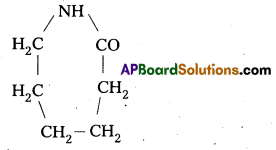
The repeating monomeric units of Nylon – 6 is Capro lactum.
Inter 2nd Year Chemistry Important Questions Chapter 8 Polymers 29
The repeating monomeric units of Nylon 6, 6 are hexamethylene diamine and Adipic acid.
H2N-(CH2)6 – NH2
Hexamethylene

HOOC – (CH2)4 – COOH
Adipic acid

AP Inter 2nd Year Chemistry Important Questions Chapter 8 Polymers

Question 13.
What is the difference between Buna – N and Buna – S ?
Answer:
Buna – N : Buna – N is the copolymer which is formed by the polymerisation of 1, 3 – Butadiene and acrylonitrile.
Inter 2nd Year Chemistry Important Questions Chapter 8 Polymers 30
Buna – S : Buna – S is the copolymer which is formed by the polymerisation of 1, 3 – Butadiene and Styrene.
Inter 2nd Year Chemistry Important Questions Chapter 8 Polymers 31

Question 14.
What is PDI (Poly Dispersity Index) ?
Answer:
Poly Dispersity Index (PDI) : The ratio between weight average molecular mass (\(\overline{\mathrm{M}}_{\mathrm{w}}\)) and the number average molecular mass (\(\overline{\mathrm{M}}_{\mathrm{n}}\)) of a polymer is called Poly Dispersity Index (PDI).

Question 15.
What is vulcanization of rubber ? [A.P. Mar. 17] [IPE – 2016 (TS)]
Answer:
Vulcanization of rubber : The process of heating the raw rubber with sulphur (or) with sulphur compounds to improve it’s physical properties is called vulcanization of rubber.

Question 16.
What is biodegradable polymer ? Give one example of a biodegradable polyester ?
Answer:
Biodegradable polymers : The polymers degradable by enzymatic hydrolysis and to some extent by oxidation are called biodegradable polymers.
Eg.: Nylon – 2, Nylon – 6, PHBV, Polyglycolic acid, Polylactic acid etc.

AP Inter 2nd Year Chemistry Important Questions Chapter 8 Polymers

Question 17.
What is PHBV ? How is it useful to man ? [IPE Mar – 2015 (TS), B.I.E, 2016 (TS)]
Answer:
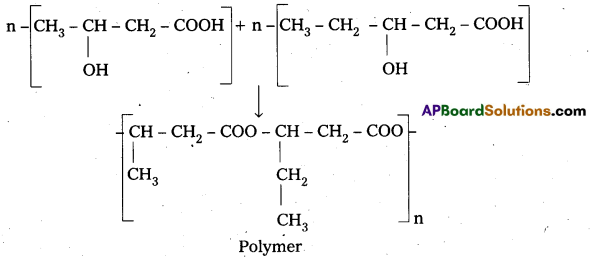
Poly β – hydroxy butyrate – CO – β – hydroxy Valerate (PHBV) : It is a Copolymer of 3 -hydroxy butanoic acid and 3 – hydroxy pentanoic acid.
Inter 2nd Year Chemistry Important Questions Chapter 8 Polymers 32
Properties & Uses : The properties of PHBV vary according to the ratio of both the acids, 3-hydroxy butanoic acid provides stiffness and 3-hydroxy pentanoic acid imparts flexibility to copolymer.
It is used in medicine for making capsules.
PHBV also undergoes degradation by bacteria.

Short Answer Questions

Question 1.
Write the names and structures of the monomers of the following polymers. [A.P. Mar. 17]
i) Buna – S
ii) Buna – N
iii) Dacron
iv) Neoprene
Ans:
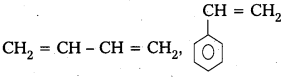
i) Buna – S
Monomers : 1, 3 – Butadiene, Styrene
Structure :
Inter 2nd Year Chemistry Important Questions Chapter 8 Polymers 33

ii) Buna-N
Monomers : 1, 3 – Butadiene, Acrylonitrile
Structure : CH2 = CH – CH = CH2, CH2 = CH – CN

iii) Dacron
Monomers : Ethylene glycol, Terephthalic acid
Structure : HOCH2 – CH2OH, HOOC Inter 2nd Year Chemistry Important Questions Chapter 8 Polymers 34 COOH

iv) Neoprene .
Monomers : 2 – chloro – 1, 3 – Butadiene
Structure :
Inter 2nd Year Chemistry Important Questions Chapter 8 Polymers 35

Question 2.
Define thermoplastics and thermosetting polymers with two examples of each.
Answer:
Thermoplastic Polymers: These are the linear (or) slightly branched long chain molecules capable of softening on heating and hardening on cooling. E.g.: Polystyrene, polythene.
Thermo setting polymers: These polymers are cross linked (or) heavily branched molecules which on heating undergo extensive cross linking in moulds and again become infusible.
Eg.: Bakelite, urea-formaldehyde, resin etc.

AP Inter 2nd Year Chemistry Important Questions Chapter 8 Polymers

Question 3.
Distinguish between the terms homo polymer and co polymer. Give one example of each.
Answer:
Homopolymers : The polymers which are formed by the polymerisation of a single monomeric species are known as homopolymers.
E.g.: Polyethene, Poly styrene.
Copolymers: A polymer which is formed by the polymerisation of two (or) more chemically different types of monomer units is called copolymer.
E.g.: Butadiene – Styrene polymer (Buna-S)

Question 4.
Explain the purpose of vulcanization of rubber. [T.S. Mar. 17]
Answer:

  1. Natural rubber becomes soft at high temperatures and brittle at low temperatures. It shows high water absorption capacity.
  2. Natural rubber is soluble in non-polar solvents and is non-resistant to oxidising agents.
  3. To improve these physical properties rubber can be vulcanised.
  4. The process of heating the raw rubber with sulphur (or) with sulphur compounds to improve it’s physical properties is called vulcanisation of rubber.
  5. The vulcanized rubber has improved properties like elasticity, minimum water absorbing tendency, high resistance to chemical oxidation as well as organic solvents.

Question 5.
Write the names and structures of the monomers used for getting the following polymers [A.P. Mar. 17; Mar. 14]
i) Polyvinyl chloride
ii) Teflon
iii) Bakelite
iv) Polystyrene.
Answer:
i) Polyvinyl chloride .
Monomer: Vinyl chloride
Structure : CH2 = CH – Cl

ii) Teflon
Monomer: Tetrafluoro ethylene
Structure : CF2 = CF2

iii) Bakelite [IPE 2015 (AP), 2014, B.M.P, 2016 (AP)
Monomers : Phenol, Formaldehyde
Structure :
Inter 2nd Year Chemistry Important Questions Chapter 8 Polymers 36

iv) Polystyrene
Monomer : Styrene
Structure :
Inter 2nd Year Chemistry Important Questions Chapter 8 Polymers 37q

Question 6.
Name the different types of molecular masses of polymers.
Answer:
The different types of important molecular masses of polymers are

  1. Number average molecular mass (\(\overline{\mathbf{M}}_{\mathrm{n}}\))
  2. Weight average molecular mass (\(\overline{\mathbf{M}}_{\mathrm{w}}\))

Question 7.
What is natural rubber ? How does it exhibit elastic properties ?
Answer:

  1. Natural rubber is a polymer and possesses elastic properties.
  2. It is an elastomer and it is manufactured from rubber latex. Latex is a colloidal dispersion of rubber in water.
  3. Natural rubber may be considered as a linear polymer of isoprene. It is also called as cis-1, 4-Poly isoprene.
  4. The cis poly isoprene molecule consists of various chains held together by weak vander waals interactions and has a colloid structure. Thus it stretches like a spring and exhibits elastic properties.

AP Inter 2nd Year Chemistry Important Questions Chapter 8 Polymers

Question 8.
Give the structure of nylon 2 – nylon 6 ?
Answer:
Nylon 2 – Nylon 6 :
It is an alternating polyamide copolymer of glycine Inter 2nd Year Chemistry Important Questions Chapter 8 Polymers 38 and amino caproic acid (H2N – (CH2)5 – COOH). It is a biodegradable polymer.
Structure of Nylon 2 – Nylon – 6
Inter 2nd Year Chemistry Important Questions Chapter 8 Polymers 39

Question 9.
Explain copolymerization with an example. [IPE Mar – 2015 (AP), B.I.E.]
Answer:
Copolymers: A polymer which is formed by the polymerisation of two (or) more chemically different types of monomer units is called copolymer. E.g.: Butadiene-Styrene polymer(Buna-S) The process of formation of copolymer is called copolymerisation.
E.g. : Buna – S : Buna – S is the copolymer which is formed by the polymerisation of 1, 3 – Butadiene and Styrene.
Inter 2nd Year Chemistry Important Questions Chapter 8 Polymers 40

Question 10.
What are LDP and HDP ? How are they formed ?
Answer:
Polythenes are two types :

  1. LDP (Low Density Polythene),
  2. HDP (High Density Polythene)

1) Low Density Polythene : LDP is formed by the polymerisation of ethene under high pressure of 1000 to 2000 atm. at a pressure of 350 to 570K in the presence of traces of dioxygen (or) a peroxide initiator.
Properties :
a) This is obtained through the free radical additon.
b) LDP is chemically inert and tough.
c) LDP is flexible and a poor conductor of electricity.
Uses:
a) It is used in the insulation of electric cables.
b) It is used in the manufacture of pipes in agriculture irrigation.

2) High Density Polythene : HDP is formed by the polymerisation of ethene in a hydro carbon solvent in presence of Ziegler Natta catalyst at a temperature of 333K to 343 K and under a pressure of 6 – 7 atm.
Properties :
a) HDP consists of linear molecules and has high density due to close packing.
b) It is chemically inert and more tough, hard.
Uses:
a) It is used in manufacture of house hold articles like buckets, dustbins etc.
b) It is used in manufacture of pipes.

AP Inter 2nd Year Chemistry Important Questions Chapter 8 Polymers

Question 11.
What are natural and synthetic polymers ? Give two examples of each type.
Answer:
Natural polymers : The polymers which are obtained from natural sources such as plants and animals are called natural polymers.
E.g. : Starch, cellulose, rubber etc.

Synthetic polymers : The polymers which are artificially prepared i.e., man-made are called synthetic polymers.
These have wide applications in daily life as well as in industry.
E.g. : Plastics, Nylon 6, 6, synthetic rubbers.

Inter 2nd Year Maths 2A Permutations and Combinations Solutions Ex 5(d)

Practicing the Intermediate 2nd Year Maths 2A Textbook Solutions Inter 2nd Year Maths 2A Permutations and Combinations Solutions Exercise 5(d) will help students to clear their doubts quickly.

Intermediate 2nd Year Maths 2A Permutations and Combinations Solutions Exercise 5(d)

I.

Question 1.
Find the number of ways of arranging the letters of the word.
(i) INDEPENDENCE
(ii) MATHEMATICS
(iii) SINGING
(iv) PERMUTATION
(v) COMBINATION
(vi) INTERMEDIATE
Solution:
(i) The word INDEPENDENCE contains 12 letters in which there are 3 N’s are alike, 2 D’s are alike, 4 E’s are alike and rest are different.
∴ The number of required arrangements = \(\frac{(12) !}{4 ! 3 ! 2 !}\)

(ii) The word MATHEMATICS contains 11 letters in which there are 2 M’s are alike, 2 A’s are alike, 2 T’s are alike and rest are different.
∴ The number of required arrangements = \(\frac{(11) !}{2 ! 2 ! 2 !}\)

(iii) The word SINGING contains 7 letters in which there are 2 I’s are alike, 2 N’s are alike, 2 G’s are alike and rest is different.
∴ The number of required arrangements = \(\frac{7 !}{2 ! 2 ! 2 !}\)

(iv) The word PERMUTATION contains 11 letters in which there are 2 T’s are alike and rest are different.
∴ The number of required arrangements = \(\frac{(11) !}{2 !}\)

(v) The word COMBINATION contains 11 letters in which there are 2 O’s are alike, 2 I’s are alike, 2 N’s are alike and rest are different.
∴ The number of required arrangements = \(\frac{(11) !}{2 ! 2 ! 2 !}\)

(vi) The word INTERMEDIATE contains 12 letters in which there are 2 I’s are alike, 2 Ts are alike, 3 E’s are alike and rest are different.
∴ The number of required arrangements = \(\frac{(12) !}{2 ! 2 ! 3 !}\)

Inter 2nd Year Maths 2A Permutations and Combinations Solutions Ex 5(d)

Question 2.
Find the number of 7-digit numbers that can be formed using 2, 2, 2, 3, 3, 4, 4.
Solution:
In the given 7 digits, there are three 2 ‘s, two 3’s and two 4’s.
∴ The number of 7 digited numbers that can be formed using the given digits = \(\frac{7 !}{3 ! 2 ! 2 !}\)

II.

Question 1.
Find the number of 4-letter words that can be formed using the letters of the word RAMANA.
Solution:
The given word RAMANA has 6 letters in which there are 3 A’s alike and the rest are different.
Using these 6 letters, 3 cases arise to form 4 letter words.
Case I: All different letters R, A, M, N
Number of 4 letter words formed = 4! = 24
Case II: Two like letters A, A and two out of R, M, N
The two different letters can be choosen from 3 letters in 3C2 = 3 ways.
∴ Number of 4 letters word formed = 3 × \(\frac{4 !}{2 !}\)
= 3 × 12
= 36
Case III: Three like letters A, A, A and one out of R, M, N.
One letter can be choosen from 3 different letters in 3C1 = 3 ways.
∴ Number of 4 letter words formed = 3 × \(\frac{4 !}{3 !}\)
= 3 × 4
= 12
∴ Total number of 4 letter words formed from the word RAMANA = 24 + 36 + 12 = 72

Question 2.
How many numbers can be formed using all the digits 1, 2, 3, 4, 3, 2, 1 such that even digits always occupy even places?
Solution:
In the given 7 digits, there are two 1’s, two 2’s, two 3’s and one 4.
The 3 even places can be occupied by the even digits 2, 4, 2 in \(\frac{3 !}{2 !}\). (Even place is shown by E)
Inter 2nd Year Maths 2A Permutations and Combinations Solutions Ex 5(d) II Q2
The remained odd places can be occupied by the odd digits 1, 3, 3, 1 in \(\frac{4 !}{2 ! 2 !}\) ways.
∴ The number of required arrangements = \(\frac{3 !}{2 !} \times \frac{4 !}{2 ! \times 2 !}\)
= 3 × 6
= 18

Inter 2nd Year Maths 2A Permutations and Combinations Solutions Ex 5(d)

Question 3.
In a library, there are 6 copies of one book, 4 copies each of two different books, 5 copies each of three different books and 3 copies each of two different books. Find the number of ways of arranging all these books in a shelf in a single row.
Solution:
Total number of books in a library = 6 + (4 × 2) + (5 × 3) + (3 × 2) = 35
∴ The number of required arrangements = \(\frac{(35) !}{6 !(4 !)^2(5 !)^3(3 !)^2}\)

Question 4.
A book store has ‘m’ copies each of, ‘n’ different books. Find the number of ways of arranging the books in a shelf in a single row.
Solution:
Total number of books in a book store are = m × n = mn
∴ The number of required arrangements = \(\frac{(m n) !}{(m !)^n}\)

Question 5.
Find the number of 5-digit numbers that can be formed using the digits 0, 1, 1, 2, 3.
Solution:
‘O’ can also be taken as one digit,
the number of 5 digited number formed = \(\frac{5 !}{2 !}\) = 60
Among them, the numer that starts with zero is only 4 digit number.
The number of numbers start with zero = \(\frac{4 !}{2 !}\) = 12
Hence the number of 5 digit numbers that can be formed by using all the given digits = 60 – 12 = 48

Question 6.
In how many ways can the letters of the word CHEESE be arranged so that no two E’s come together?
Solution:
The given word contains 6 letters in which one C, one H, 3 E’s and one S.
Since no two E’s come together, first arrange the remaining 3 letters in 3! ways. Then we can find 4 gaps between them.
The 3 E’s can be arranged in these 4 gaps in \(\frac{{ }^4 P_3}{3 !}\) = 4 ways.
∴ The number of required arrangements = 3! × 4 = 24

III.

Question 1.
Find the number of ways of arranging the letters of the word ASSOCIATIONS. In how many of them
(i) all the three S’s come together
(ii) The two A’s do not come together
Solution:
Hint: The number of linear permutations of ‘n’ things in which ‘p’ alike things of one kind, ‘q’ alike things of 2nd kind, ‘r’ alike things of 3rd kind and the rest are different is \(\frac{n !}{p ! q ! r !}\)
The given word ASSOCIATIONS has 12 letters in which there are 2 A’s are alike, 3 S’s are alike, 2 O’s are alike 2 I’s are alike and rest are different.
∴ They can be arranged = \(\frac{(12) !}{2 ! 3 ! 2 ! 2 !}\)
(i) Treat the 3 S’s as one unit. Then we have 9 + 1 = 10 entities in which there are 2A’s are alike, 20’s are alike, 2 I’s are alike and rest are different.
They can be arranged in \(\frac{(10) !}{2 ! 2 ! 2 !}\) ways.
The 3 S’s among themselves can be arranged in \(\frac{3 !}{3 !}\) = 1 way
∴ The number of required arrangements = \(\frac{(10) !}{2 ! 2 ! 2 !}\)

(ii) Since 2 A’s do not come together, first arrange the remaining 10 letters in which there are 3 S’s are alike, 2 O’s are alike 2 I’s are alike and rest are different in \(\frac{(10) !}{3 ! 2 ! 2 !}\) ways.
Then we can find 11 gaps between them. The 2 A’s can be arranged in these 11 gaps in \(\frac{{ }^{11} P_2}{2 !}\) ways.
∴ The number of required arrangements = \(\frac{(10) !}{3 ! 2 ! 2 !} \times \frac{{ }^{11} P_2}{2 !}\)

Inter 2nd Year Maths 2A Permutations and Combinations Solutions Ex 5(d)

Question 2.
Find the number of ways of arranging the letters of the word MISSING so that the two S’s are together and the two I’s are together.
Solution:
In the given word MISSING contains 7 letters in which there are 2 I’s are alike, 2 S’s are alike and the rest are different.
Treat the 2 S’s as one unit and 2 I’s as one unit. Then we have 3 + 1 + 1 = 5 entities. These can be arranged in 5! ways.
The 2 S’s can be arranged among themselves in \(\frac{2 !}{2 !}\) = 1 ways and the 2 I’s can be arranged among themselves in \(\frac{2 !}{2 !}\) = 1 way.
∴ The number of required arrangements = 5! × 1 × 1 = 120

Question 3.
If the letters of the word AJANTA are permuted in all possible ways and the words thus formed are arranged in dictionary order, find the ranks of the words
(i) AJANTA
(ii) JANATA
Solution:
The dictionary order of the letters of the word AJANTA is A A A J N T
(i) In the dictionary order first comes that words begin with the letter A.
If we fill the first place with A, we may set the word AJANTA.
Second place can be filled with A, and the remaining 4 places can be filled in 4! = 24 ways.
On proceeding like this, we get
A A – – – – – = 4! = 24
A J A A – – – = 2! = 2
A J A N A – = 1 = 1
AJANTA = 1 = 1
∴ Rank of the word AJANTA = 24 + 2 + 1 + 1 = 28

(ii) In the dictionary order first comes that words begin with the letter A.
If we fill the first place with A, the remaining 5 letters can be arranged in \(\frac{5 !}{2 !}\) ways (since there 2 A’s remain)
On proceeding like this, we get
A – – – – – – = \(\frac{5 !}{2 !}\) = 60
J A A – – – – = 3! = 6
J A N A A – – = 1 = 1
J A N A T A = 1 = 1
∴ Rank of the word JANATA is = 60 + 6 + 1 + 1 = 68.

Inter 2nd Year Maths 2A Random Variables and Probability Distributions Solutions Ex 10(b)

Practicing the Intermediate 2nd Year Maths 2A Textbook Solutions Inter 2nd Year Maths 2A Random Variables and Probability Distributions Solutions Exercise 10(b) will help students to clear their doubts quickly.

Intermediate 2nd Year Maths 2A Random Variables and Probability Distributions Solutions Exercise 10(b)

I.

Question 1.
In the experiment of tossing a coin n times, if the variable X denotes the number of heads and P(X = 4), P(X = 5), P(X = 6) are in arithmetic progression then find n.
Solution:
X follows binomial distribution with p = \(\frac{1}{2}\), q = \(\frac{1}{2}\) (∵ a coin is tossed)
Hint: a, b, c are in A.P.
⇒ 2b = a + c (or) b – a = c – a
Given, P(X = 4), P(X = 5), P(X = 6) are in A.P.
Inter 2nd Year Maths 2A Random Variables and Probability Distributions Solutions Ex 10(b) I Q1
⇒ 2 × 30(n – 4) = 5[30 + n2 – 9n + 20]
⇒ 12n – 48 = n2 – 9n – 50
⇒ n2 – 21n + 98 = 0
⇒ n2 – 14n – 7n + 98 = 0
⇒ n(n – 14) – 7(n – 14) = 0
⇒ (n – 7) (n – 14) = 0
⇒ n = 7 or 14

Question 2.
Find the minimum number of times a fair coin must be tossed so that the probability of getting at least one head is at least 0.8.
Solution:
Let n be the number of times a fair coin tossed
X denotes the number of heads getting
X follows binomial distribution with parameters n and p = \(\frac{1}{2}\)
Given P(X ≥ 1) ≥ 0.8
⇒ 1 – P(X = 0) ≥ 0.8
⇒ P(X = 0) ≤ 0.2
⇒ \({ }^n C_o\left(\frac{1}{2}\right)^n \leq 0.2\)
⇒ \(\left(\frac{1}{2}\right)^n \leq \frac{1}{5}\)
The Maximum value of n is 3

Inter 2nd Year Maths 2A Random Variables and Probability Distributions Solutions Ex 10(b)

Question 3.
The probability of a bomb hitting a bridge is \(\frac{1}{2}\) and three direct hits (not necessarily consecutive) are needed to destroy it. Find the minimum number of bombs required so that the probability of the bridge being destroyed is greater than 0.9.
Solution:
Let n be the minimum number of bombs required and X be the number of bombs that hit the bridge, then
X follows binomial distribution with parameters n and p = \(\frac{1}{2}\)
Now P(X ≥ 3) > 0.9
⇒ 1 – P(X < 3) > 0.9
⇒ P(X < 3) < 0.1
⇒ P(X = 0) + P(X = 1) + P (X = 2) < 0.1
Inter 2nd Year Maths 2A Random Variables and Probability Distributions Solutions Ex 10(b) I Q3
By trial and error, we get n ≥ 9
∴ The least value of n is 9
∴ n = 9

Question 4.
If the difference between the mean and the variance of a binomial variate is \(\frac{5}{9}\) then, find the probability for the event of 2 successes, when the experiment is conducted 5 times.
Solution:
Given n = 5
Let p be the parameters of the Binomial distribution
Mean – Variance = \(\frac{5}{9}\)
Inter 2nd Year Maths 2A Random Variables and Probability Distributions Solutions Ex 10(b) I Q4
∴ Probability of the event of 2 success = \(\frac{80}{243}\)

Question 5.
One in 9 ships is likely to be wrecked when they are set on the sail, when 6 ships are on the sail, find the probability for
(i) Atleast one will arrive safely
(ii) Exactly, 3 will arrive safely
Solution:
p = probability of ship to be wrecked = \(\frac{1}{9}\)
q = 1 – p
= 1 – \(\frac{1}{9}\)
= \(\frac{8}{9}\)
Number of ships = n = 6
Inter 2nd Year Maths 2A Random Variables and Probability Distributions Solutions Ex 10(b) I Q5

Inter 2nd Year Maths 2A Random Variables and Probability Distributions Solutions Ex 10(b)

Question 6.
If the mean and variance of a binomial variable X are 2.4 and 1.44 respectively, find P(1 < X ≤ 4).
Solution:
Mean = np = 2.4 ………(1)
Variance = npq = 1.44 ……….(2)
Dividing (2) by (1)
\(\frac{n p q}{n p}=\frac{1.44}{2.4}\)
⇒ q = o.6 = \(\frac{3}{5}\)
p = 1 – q
= 1 – 0.6
= 0.4
= \(\frac{2}{5}\)
Substituting in (1)
n(0.4) = 2.4
⇒ n = 6
P(1 < X ≤ 4) = P(X = 2) + P(X = 3) + P(X = 4)
= \({ }^6 C_2 q^4 \cdot p^2+{ }^6 C_3 q^3 \cdot p^3+{ }^6 C_4 q^2 \cdot p^4\)
Inter 2nd Year Maths 2A Random Variables and Probability Distributions Solutions Ex 10(b) I Q6

Question 7.
It is given that 10% of the electric bulbs manufactured by a company are defective. In a sample of 20 bulbs, find the probability that more than 2 are defective.
Solution:
p = probability of defective bulb = \(\frac{1}{10}\)
q = 1 – p
= 1 – \(\frac{1}{10}\)
= \(\frac{9}{10}\)
n = Number of bulbs in the sample = 20
P(X > 2) = 1 – P(X ≤ 2)
= 1 – [P(X = 0) + P(X = 1) + P(X = 2)]
Inter 2nd Year Maths 2A Random Variables and Probability Distributions Solutions Ex 10(b) I Q7

Question 8.
On average, rain falls on 12 days every 30 days, find the probability that, the rain will fall on just 3 days of a given week.
Solution:
Given p = \(\frac{12}{30}=\frac{2}{5}\)
q = 1 – p
= 1 – \(\frac{2}{5}\)
= \(\frac{3}{5}\)
n = 7, r = 3
P(X = 3) = nCr . qn-r . pr
= \({ }^7 C_3\left(\frac{3}{5}\right)^4\left(\frac{2}{5}\right)^3\)
= \(\text { 35. }\left(\frac{3}{5}\right)^4\left(\frac{2}{5}\right)^3\)
= \(\frac{35 \times 2^3 \times 3^4}{5^7}\)

Question 9.
For a binomial distribution with mean 6 and variance 2, find the first two terms of the distribution.
Solution:
Let n, p be the parameters of a binomial distribution
Mean (np) = 6 ……..(1)
and variance (npq) = 2 ……..(2)
then \(\frac{n p q}{n p}=\frac{2}{6}\)
⇒ q = \(\frac{1}{3}\)
∴ p = 1 – q
= 1 – \(\frac{1}{3}\)
= \(\frac{2}{3}\)
From (1) np = 6
n(\(\frac{2}{3}\)) = 6
∴ n = 9
The first two terms of the distribution are
P(X = 0) = \({ }^9 C_0\left(\frac{1}{3}\right)^9=\frac{1}{3^9}\)
and P(X = 1) = \({ }^9 C_1\left(\frac{1}{3}\right)^8\left(\frac{2}{3}\right)=\frac{2}{3^7}\)

Inter 2nd Year Maths 2A Random Variables and Probability Distributions Solutions Ex 10(b)

Question 10.
In a city, 10 accidents take place in a span of 50 days. Assuming that the number of accidents follows the Poisson distribution, find the probability that there will be 3 or more accidents in a day.
Solution:
Average number of accidents per day
λ = \(\frac{10}{50}=\frac{1}{5}\) = 0.2
The probability that there win be 3 or more accidents in a day
P(X ≥ 3) = \(\sum_{\mathrm{K}=3}^{\infty} \mathrm{e}^{-\lambda} \cdot \frac{\lambda^{\mathrm{K}}}{\mathrm{K} !}, \lambda=0.2\)

II.

Question 1.
Five coins are tossed 320 times. Find the frequencies of the distribution of a number of heads and tabulate the result.
Solution:
5 coins are tossed 320 times
Probability of getting a head on a coin
p = \(\frac{1}{2}\), n = 5
Probability of having x heads
Inter 2nd Year Maths 2A Random Variables and Probability Distributions Solutions Ex 10(b) II Q1
Inter 2nd Year Maths 2A Random Variables and Probability Distributions Solutions Ex 10(b) II Q1.1

Question 2.
Find the probability of guessing at least 6 out of 10 answers in (i) True or false type examination (ii) multiple choice with 4 possible answers.
Solution:
(i) Since the answers are in True or false type
probability of success p = \(\frac{1}{2}\), q = \(\frac{1}{2}\)
probability of guessing at least 6 out of 10
P(X = 6) = \({ }^{10} \mathrm{C}_6\left(\frac{1}{2}\right)^{10-6} \cdot\left(\frac{1}{2}\right)^6\)
= \({ }^{10} \mathrm{C}_6\left(\frac{1}{2}\right)^{10}\)

(ii) Since the answers are multiple-choice with 4 possible answers
Probability of success p = \(\frac{1}{4}\), q = \(\frac{3}{4}\)
Probability of guessing at least 6 out of 10
P(X = 6) = \({ }^{10} C_6\left(\frac{3}{4}\right)^{10-6}\left(\frac{1}{4}\right)^6\)
= \({ }^{10} C_6 \cdot \frac{3^4}{4^{10}}\)

Inter 2nd Year Maths 2A Random Variables and Probability Distributions Solutions Ex 10(b)

Question 3.
The number of persons joining a cinema ticket counter in a minute has Poisson distribution with parameter 6. Find the probability that
(i) no one joins the queue in a particular minute
(ii) two or more persons join the queue in a minute.
Solution:
Here λ = 6
(i) Probability that no one joins the queune in a particular minute
P(X = 0) = \(\frac{\mathrm{e}^{-\lambda} \lambda^0}{0 !}=\mathrm{e}^{-6}\)

(ii) Probability that two or more persons join the queue in a minute
Inter 2nd Year Maths 2A Random Variables and Probability Distributions Solutions Ex 10(b) II Q3

AP Inter 2nd Year Zoology Study Material Chapter 5(a) Human Reproductive System

Andhra Pradesh BIEAP AP Inter 2nd Year Zoology Study Material Lesson 5(a) Human Reproductive System Textbook Questions and Answers.

AP Inter 2nd Year Zoology Study Material Lesson 5(a) Human Reproductive System

Very Short Answer Questions

Question 1.
Where are the testes located in man? Name the protective coverings of each testis.
Answer:
The testes are male primary sex organs suspended outside the abdominal cavity within a pouch called scrotumr. Each testis is enclosed in a fibrous envelope called ‘tunica albuginea’.

Question 2.
Name the canals that connect the cavities of scrotal sac and abdominal cavity. Name the structures that keep the testes in position.
Answer:
The cavity of scrotal sac is connected to the abdominal cavity through the ‘inguinal canal’. Testes are held in position in the scrotum by the ‘gubemaculum’, a fibrous cord.

Question 3.
What are the functions of Sertoli cells of the seminiferous tubules and the Leydig cells in man?
Answer:
i) Sertoli cells :
Also known as ‘nourishing cells’ helps in the nourishment of spermatozoa and produce a hormone ‘inhibin’, which inhibits the secretion of FSH.

ii) Leydig cells :
Produce Testosterone that controls the secondary sexual characters and spermatogenesis.

Question 4.
Name the copulatory structure of man. What are the three columns of tissues in it?
Answer:
The penis is the copulatory structure of man. It is made up of the three columns of tissue; Two upper ‘Corpora Cavernosa’ on the dorsal aspect and one ‘Corpus Spongiosum’ on the ventral side.

Question 5.
Define Spermiogenesis and Spermiation.
Answer:
Spermiogenesis :
The process in which haploid spermatids are transformed into spermatozoa or sperms.

Spermiation :
The process in which sperm head becomes embedded in the Sertoli cells and finally released from the seminiferous tubules.

AP Inter 2nd Year Zoology Study Material Chapter 5(a) Human Reproductive System

Question 6.
Name the yellow mass of cells accumulated in the empty follicle after ovulation. Name the hormone secreted by it and what is its function?
Answer:
The yellow mass of cells accumulated in the empty follicles after ovulation is called ‘Corpus luteum’ (yellow body). It secretes a hormone called Progesterone which has three major functions’.

i) For regular menstrual cycle.
ii) For the formation of thick endometrium in uterus.
iii) Maintenance of pregnancy after fourth month.

Question 7.
Define gestation period. What is the duration of gestation period in the human beings?
Answer:
The period during which embryo development takes place in uterus is called gestation period. In humans the gestation period is 266 days (38 weeks) from the fertilization of egg or 40 weeks from the start of last menstrual cycle.

Question 8.
What is implantation, with reference to embryo?
Answer:
The blastocyte invades the endometrium of uterus and get implanted into the uterine mucosa till the whole of it comes to lie within the thickness of the endometrium, the process is called ‘implantation1. It begins on the 6th day after fertilization.

Question 9.
Distinguish between hypoblast and epiblast.
Answer:

HypoblastEpiblast
The cell layer on the inner surface of the embryonic disc of blastocyte is called hypoblast.The remaining part of the embryonic disc of blastocyte is called epiblast.

Question 10.
Write two major functions, each of testis and ovary?
Answer:
Functions of Testis :
a) Testis is a cytogenic gland, which produces sperms.
b) Leydig cells of testes produce a male sex hormone called ‘Testosterone’ Which controls the development of secondary sexual characters and spermatogenesis.

Functions of Ovaries :
a) Ovaries are primary female sex organs, producing on ovum during each menstrual cyle.
b) They produce female hormones; Estrogen and Progesterone.

Question 11.
Draw a labelled diagram of a sperm.
Answer:
AP Inter 2nd Year Zoology Study Material Chapter 5(a) Human Reproductive System 1

Question 12.
What are the major components of the seminal fluid?
Answer:
Seminal fluid is an alkaline, viscous fluid that contains fructose, proteins, citric acid, inorganic phosphorus, potassium and prostaglandins. It is produced by seminal vesicles present postero inferior to the urinary bladder in the pelvis.

Question 13.
What is menstrual cycle? Which hormones regulate menstrual cycle?
Answer:
The reproductive cycle in the female primates like monkeys, apes and humans, is called ‘menstrual cycle’. The cycle is regulated by majority four hormones. They are

  1. Luteinising hormone (LH),
  2. ollicular stimulating hormone (FSH),
  3. Estrogen and
  4. Progesterone.

Question 14.
What is parturition? Which hormones are involved in inducing parturition?
Answer:
The process of delivery of the foetus, starting from labour (a series of strong, rhythemic uterine contractions that push the foetus the placenta outside the body) is called parturition. The hormone, oxytocin is responsible for the contraction of uterus during parturition.

AP Inter 2nd Year Zoology Study Material Chapter 5(a) Human Reproductive System

Question 15.
How many eggs do you think were released by the ovary of a female dog which gave birth to six puppies?
Answer:
The dog might have produced single ovary but it might be fertilised by six different sperms. After fertilization the synkaryon or zygotic nucleus undergoes divisions and forms six euqal or unequal zygotes, those giving birth to six puppies.

Question 16.
What is neurulation?
Answer:
The process of formation of neural tube from neural plate in embryo, as part of organogenesis, is called neurulation.

Question 17.
What is capacitation of sperms?
Answer:
Capacitation of sperm refers to the physiological changes that the spermatozoa undergoes to be able to penetrate and fertilize an egg.

Question 18.
What is compaction in human development?
Answer:
The process in which morula becomes embryo by reducing unequal cleavage smaller and larger blastomeres and forming a superficial flat cell layer trophoblast and inner cell mass embryo proper.

Question 19.
Distinguish between involution and ingression in the human development.
Answer:

InvolutionIngression
It is the process by which future mesodermal cells converge through the primitive groove and reach epiblast and endoderm.It is the process in which future endodermal cells from the epiblast, replaces the and forms the endoderm hypoblast of the embryo.

Question 20.
What are the four extra embryonic membranes?
Answer:
The four extra embryonic membranes are

  1. Chronic membrane
  2. Amnionic membrane
  3. Allantoic membrane
  4. Yolk sac.

Short Answer Questions

Question 1.
Describe microscopic structure of testis of man.
Answer:
The testes or testicles area pair of oval pinkish male primary sex organs suspended outside the abdominal cavity within a pouch called ‘scrotum’. The low temperature (2 – 2.5°C) is maintained in the scrotum to promote spermatogenesis.

Each testis is enclosed in a fibrous envelope, ’tunica albuginea’. The envelope extends inward to form septa that partition the testis into lobules. There are nearly 250 testicular lobules in each testis. Each lobule contains 1 to 3 highly coiled ’seminiferous tubules’. A pouch of serous membrane, called ‘tunica vaginalis’ covers the testis.

Each seminiferous tubule is lined by ‘germinal epithelium’ which consists of undifferentiated male germ cells called ‘spermatogonial mother cells’ and nourishing cells called ‘Sertoli cells’. These cells provide nutrition to spermatozoa and also produce inhibin, that inhibits the secretion of FSH. The region outside the seminiferous tubules contain Leydig cells. These cells produce androgens, the most important is ‘Testosterone’. It controls the development of secondary sexual characters and spermatogenesis. The seminiferous tubules open into ‘vasa efferentia’ through ‘rete testis’. Rete testis is a network of tubules in the testis carrying spermatozoa from seminiferous tubules to vasa efferentia.

AP Inter 2nd Year Zoology Study Material Chapter 5(a) Human Reproductive System

Question 2.
Describe the microscopic structure of ovary of woman.
Answer:
Ovaries are the primary female sex organs that produce the ‘female garnets’ or ‘ova’ and several steroid hormones (ovarian hormones). A pair of ovaries is located one on each side of the lower abdomen. The double layered fold of peritoneum connecting the ovary with the wall of abdominal cavity is known as the ‘mesovarium’.

The ovaries are covered on the outside by a’ layer of simple cuboidal epithelium called ‘germinal (ovarian) epithelium. This is actually the visceral peritoneum that envelopes the ovaries. Under this layer there is a dense connective tissue capsule, the ‘tunica albuginea’. The ovarian stroma is distinctly divided into an outer cortex and an inner’ medulla. The cortex is dense and granular due to the presence of numerous ovarian follicles in various stages of development. The medulla is a loose connective tissue with abundant blood vessels, lymphatic vessels and nerve fibers.

Question 3.
Describe the Graafian follicle in woman.
Answer:
During ‘oogenesis’, the formed garnet mother cells or oogonia in each foetal ovary are called primary oocytes. Each primary oocyte gets sorrounded by a flattened layer of follicular cells. It is called ‘primordial follicle’. The follicles become cuboidal and proliferate to produce stratified epithelium made up of cells called granulosa cells. Follicles at this stage of development are called ’primary follicles’. A homogenous membrane, the ‘zona pellucida’ appears between primary oocyte and granulosa cells. The innermost layer of granulosa cells are firmly attached to zona pellucida forming ‘corona radiata’.

A cavity appears in membrane granulosa, it increases in size, wall of follicle becomes thin. As the follicle-expands the stromal cells sorrounding the granulosa become condensed to forma covering called inner theca interna’ and outer ’theca externa’. Now these follicles are called ‘secondary follicles’.

The cells of theca interna secrete a hormone called Oestrogen. At this stage, the primary oocyte within the secondary follicles grows in size and completes ‘meiosi§ I’ forming a large haploid ‘Secondary oocyte’ and a small ‘first polar body’. Then the 2nd meoitic division starts but stops at metaphase. The secondary follicle further changes into the nature follicle called ‘Grafian follicle’. The rupture of graafian follicle by LH results in the release of ovum, a process called ovulation.

Question 4.
Draw a labelled diagram of the male reproductive system.
Answer:
AP Inter 2nd Year Zoology Study Material Chapter 5(a) Human Reproductive System 2

Question 5.
Draw a labelled diagram of the female reproductive system.
Answer:
AP Inter 2nd Year Zoology Study Material Chapter 5(a) Human Reproductive System 3

Question 6.
Describe the structure of seminiferous tubule.
Answer:
Seminiferous tubules are present in the lobules of testes. Each seminiferous tubule is lined by the germinal epithelium which consists of undifferentiated male germ cells called spermatogonial mother cells and nourishing cells’ called ‘Sertoli cells’. The spermatogenia produce primary spermatocytes which undergo meoitic division finally leading to the formation of Spermatozoa or sperms (spermatogenesis).
AP Inter 2nd Year Zoology Study Material Chapter 5(a) Human Reproductive System 4
AP Inter 2nd Year Zoology Study Material Chapter 5(a) Human Reproductive System 5

Sertoli cells provide nutrition to spermatozoa and produce a hormone ‘inhibiri which Sertoli cells provide nutrition to spermatozoa and produce a hormone ‘inhibiri which inhibits the secretion of FSH. The regions outside the seminiferous tubules called interstitial spaces, contain Leydig cells. Leydig cells produce androgens, mainly Testosterone that controls the development of secondary sexual characters and spermatogenesis. The seminiferous tubules open into ‘vasa efferentia’ through the ‘rete testis’.

Question 7.
What is Spermatogenesis? Briefly describe the process of Spermatogenesis in man.
Answer:
During puberty, in the testis the immature male germ cells, spermatogonia produce sperms by spermatogenesis. The spermatogonial stem cells in seminiferous tubules multiply by repeated mitotic divisions and develops> into primary spermatocytes with 46 chromosomes. A primary spermatocyte undergoes first meiotic division to produce 2 equal sized haploid ‘secondary spermatocyte’ which have only 23 chromosomes. These undergo second meotic division to produce four haploid ’spermatidis’ which intum transform into spermatozoa (sperms) by the process called spermoigenesis. After spermiogenesis, sperm heads become embedded is Sertoli cells, and are finally released from the seminiferous tubules by the process ‘spermiation’.
AP Inter 2nd Year Zoology Study Material Chapter 5(a) Human Reproductive System 6

Spermatogenesis starts at the age of puberty due to increase in the secretion of gonadotropin releasing hormone (GnRH), produced from hypothalamus. The increased levels of GnRH intum stimulates pituitary gland to produce two gonadotropins.
a) Lutenising Hormone (LH)
b) Follicular Stimulating Hormone (FSH)

LH acts on Leydig cells and stimulates the secretion of androgens. Androgens inturn stimulate the process of spermato-genesis. FSH acts on Sertoli cells and stimulates secretion of some factors which help in the process of Spermio-genesis.

AP Inter 2nd Year Zoology Study Material Chapter 5(a) Human Reproductive System

Question 8.
What is Oogenesis? Give a brief account of Oogenesis in a woman.
Answer:
The process of formation of mature female gamqtds called ‘Oogenesis’. It is initiated during the embryonic development stage when a couple of million garnet mother cells (oogonia) are formed within each foetal ovary and do not multiply thereafter. These cells start division and stop the process at prophase I qf the meiosis-I. At this stage they are called primary oocytes.
AP Inter 2nd Year Zoology Study Material Chapter 5(a) Human Reproductive System 7

Each primary Oocyte is sorrounded by a flattened layer of follicular cells, it is called orimary follicle. These follicular cells become cuboidal and proliferate to produce a stratified epithelium called membrana granulosa. These cells are called granulosa cells. Follicles at this stage are called primary follicles. A homogenous membrane, the ‘zona pellucida’, appears between primary oocyte and granulosa cells.

A cavity appears within the membrana granulosa increases in size and the wall of follicle becomes thin. The oocyte lies eccentrically in the follicle sorrounded by granulosa cells. As the follicle expands the stromal cells sorrounding membrana granulosa become condensed to form a inner covering ‘theca interna’ and outer covering ‘theca externa’. Now these are called ‘secondary follicles’.

The cells of theca interna later secrete a hormone called ’oestrogen1. The primary oocyte within the graafian undergoes two meoitic divisons, finally changing into a Graafian follicle’. The Graafian follicle is at first very small, later it enlarges, becomes so big that it not only reaches the surface of ovary, but also forms a bulging in this situation. Ultimately the follicle ruptures releasing the ovum.

Question 9.
Draw a labelled diagram of Graafian follicle.
Answer:
AP Inter 2nd Year Zoology Study Material Chapter 5(a) Human Reproductive System 8

Question 10.
In our society women are often blamed for giving birth to daughters. Can you explain why this is not correct?
Answer:
The sex of a child depends on the male parent but not on female parent. The sex of the baby has been decided at the time of fertilization itself. The chromosome pattern in human female is XX and that in the male is XY. Therefore all the haploid garnets produced by the female (ova) have the sex chromosome X, whereas the male garnets (sperms) have either X chromosome or Y chromosome. 50 percent of sperms carry the X chromosome while th^ other 50 percent carry the Y chromosome.

After fusion of the male and female garnets the zygote would carry either XX or XY depending on what type of sperm fertilised the ovum. The zygote carrying ‘XX would develop into a female child and that with XY would form a male child. So, the sex of a child depends on the male parent (heterogametic parent) but not on mother.
AP Inter 2nd Year Zoology Study Material Chapter 5(a) Human Reproductive System 9

Question 11.
Describe the accessory glands associated with male reproductive system of man.
Answer:
The male accessory glands are :
a) Seminal vesicles
b) Prostate gland
c) Bulbourethral glands

a) Seminal vesicles :
The seminal vesicles are a pair of simple tubular glands present postero-inferior to the urinary bladder in the pelvis. Each seminal vesicle opens into cprresponding vas deferens thus enters into prostate gland. The secretion of the seminal vesicles constitutes about 60 percent of the volume of seminal fluid. It is an alkaline, viscous fluid that contains fructose, proteins, citric acid, inorganic phosphorous, potassium and prostaglandins. Fructose is main energy source for the sperm and prostaglandins aid fertilization by causing mucous lining of the cervix to be more receptive to sperm as well as by aiding the movement of sperm towards the ovum.

b) Prostate gland :
Prostate gland is located directly beneath the urinary bladder. The gland sorrounds the ‘prostatic urethra’ and sends its secretions through several prostatic ducts. In man, the prostate contributes 15-30 percent of the semen. The prostate secretion activates spermatozoa and provides nutrition.

c) Bulbourethral glands :
They are also called ‘cowper’s glands’, are located beneath the prostate gland at the beginning of the internal portion of the penis. They add an alkaline fluid to semen during the process of ejaculation. The fluid secreted by these glands lubricates the urethra. It also functions as a flushing agent, that washes out the acidic urinary residues that remaindn urethra, before the semen is ejaculated.

Question 12.
Describe the placenta in a women.
Answer:
Placenta is a structural and functional unit of both chorionic villi and uterine tissue and it develops between the embryo (foetus) and the mother. The maternal and foetal blood do not mix with each other. They are seperated by the placental membrane.

The placenta consists of two essential portions : a maternal part of the placenta derived from the endometrium of the uterus and foetal membranes of the foetal part of the placenta.

The maternal components of the Placenta are : .

  1. Uterine epithelium
  2. terine connective tissue
  3. Uterine capillary endothelium.

The foetal components of the Placenta are :

  1. Foetal capillary endothelium
  2. Foetal connective tissue
  3. Foetal chorionic epithelium.

The Placenta of human is called chorioallantoic placenta’as allantois fuse with chorion in the process of vascularisation. Placenta is discoidal as the Villi are restricted to the dorsal surface of blastodisc. Placenta is haemochorial as the maternal blood comes into direct contact with foetal chorion. During parturition the placenta is cast off with the loss of embryonic membranes and the encapsulating maternal tissues (decidua) causing extensive haemorrhage and there by bleeding. So, it is also called deciduate placenta.

Functions of placenta :

  1. Supplies Oxygen and nutrients to the embryo.
  2. Removes CO2 and excretory materials produced by embryo.
  3. Secretes Progesterone which is essential for maintenance of pregnancy after 4th month.
  4. Secretes Oestrogens (mainly estradiol) that reach maternal blood and promote uterine growth and development of mammary glands.
  5. Secretes Human Chorionic Gonadotropin (HCG) that is similar to luteinizing hormone is its action. This hormone is also used as indicator in the detection of pregnancy is early stages.
  6. Somatomammotropin secreted by placenta has an anti-insulin effect on the mother leading to increased plasma levels of glucose and aminoacids in the maternal circulation. In this way it increases the availability of these materials to the foetus.

Long Answer Questions

Question 1.
Describe female reproductive system of a woman with the help of a labelled diagram.
Answer:
The female reproductive system consists of a pair of ovaries along with a pair of oviducts, uterus, vagina and the external genetalia located in the pelvic region. These parts of the system along with a pair of mammary glands are integrated structurally and functionally to support the processes of ovulation, fertilization, pregnancy, birth and child care.
AP Inter 2nd Year Zoology Study Material Chapter 5(a) Human Reproductive System 10

1) Ovaries :
Ovaries are the primary female sex organs that produce the female gametes (ova) and several steroid hormones (ovarian hormones). A pair of ovaries is located on each side of lower abdomen. The double layered fold of peritoneum connecting the ovary with the wall of abdominal cavity is known as the meso ovarium.

The Ovaries are covered by a layer of’germinal (ovarian) epithelium. Underneath this layer, there is a dense connective tissue capsule called, ‘tunica albuginea’. The ovarian stroma is distinctly divided into an outer cortex and an inner medulla. The cortex appears more dense and granular due to numerous ovarian follicles. The medulla is a loose connective tissue with abundant blood vessels, lymphatic vessels and nerve fibres.

2) Fallopian tubes (oviducts) :
Each fallopian tube extends from the periphery of each ovary to the uterus and it bears a funnel shaped infundibulum, with finger like projections called ‘fimbriae’, which help in collection of ovum after ‘ovulation’.

The infundibulum leads to a wider part of the oviduct called ‘ampulla’. The last part of the oviduct, ‘isthmus’ has a narrow lumen and it joins the uterus. Fallopian tube is the site of fertilization. It conducts the ovum or zygote towards the uterus by peristalsis. The fallopian tube is attached to the abdominal wall by a peritoneal fold called ‘meso salpinx’.

3) Uterus :
The uterus is a single and it is also called womb. It is a large, muscular, highly vascular and inverted pear-shaped structure present in the pelvis between the bladder and rectum. The lower narrow part through which the uterus opens into the vagina is called ’cervix’. The cavity of the cervix is called ‘cervical canal’ which along with the vagina forms the ‘birth canal’.

The wall of the uterus has three layers of tissue. The external thin membranous ‘perimetrium’, the middle thick layer of ‘myometrium’ and inner glandulas lining layer”chlled ‘endometrium’. The endometrium undergoes cyclic changes during menstrual cycle while myometrium exhibits strong contractions during parturition.

4) Vagina :
The vagina is a large, median, fibromuscular tube that extends from the cervix to the vestibule (the space between labia minora). It is lined by non- keratinised stratified squamous epithelium. It is highly vascular and opens into the vestibule by the vaginal orifice.

5) Vulva:
Vulva or pudendum refers to the external genitals of the female. The vestibule has two apertures – the upper external urethral orifice of the urethra and the lower vaginal orifice of vagina. Vaginal orifice is covered by a mucous membrane ‘hymen’. vestibule is bound by two pairs of fleshly folds of tissue called inner ‘labia minora’ and outer larger ‘labia majora’. Clitoris is a sensitive, erectile structure, that lies at the upper junction of the two labia minora above the urethral opening. There is a cushion of fatty tissue covered by skin and pubic hair present above the labia major, called mons pubis.

Accessory reproductive glands of female : These include; .

a) Bartholin’s glands :
These are two glands located slightly posterior and to the left and right of the opening of the vagina! They secrete mucus to lubricate the vagina and are homologous to the bulbourethral glands of the male reproductive system.

b) Skene’s glands :
These are located on the anterior wall of vagina, around the lower end of the urethra. They secrete a lubricating fluid when stimulated. The skene’s glands are homologous to the prostate gland of the male reproductive system.

c) Mammary glands :
These are paired structures that contain glandular tissue and fat. The alveoli cells present in the mammary lobes of each glandular tissue secrete milk, which is stored in cavities of alveoli. The alveoli open into mammary tubes and then to mammary ducts, from there to mammary ampulla and finally connected to lactiferous duct through which milk is sucked out by the baby.

AP Inter 2nd Year Zoology Study Material Chapter 5(a) Human Reproductive System

Question 2.
Describe male reproductive system of a man. Draw a labelled diagram of it.
Answer:
The male reproductive system or male genital system consists of a number of sex organs that are a part of the human reproductive process. The sex organs which are located in the pelvic region include a pair of testes, accessory ducts, glands and external genitalia.

1) Testes:
The testes are a pair of oval pinkish male sex organs suspended in abdominal cavity within a pouch called scrotum. The scrotum helps in maintaining the low temperature of the testes (2-2.5°C) necessary for spermatogenesis. The cavity of- scrotal sac is connected to the abdominal cavity through the ’inguinal canal’ Testes is held in position in the scrotum of the ‘gubemaculum’, a fibrous cord that connects the testis with the bottom of scrotum and a ‘spermatic Cord’, formed by the vas deferens, nerves, blood vessels and other tissues that run from abdomen down to each testicle, through inguinal cartal.

Each testis is enclosed in a fibrous envelope, ’tunica albuginea’, which extends inwards into testis and divide it into lobules. Each lobule contains 1 to 3 highly coiled seminiferous tubules. A pouch of serous membrane ‘tunica vaginalis’ covers the testis.
AP Inter 2nd Year Zoology Study Material Chapter 5(a) Human Reproductive System 11

Miniferous tubules :
Each seminiferous tubule is lined by ‘germinal epithelium’ which consists of undifferentiated male gum cells called ’spermatogonial mother cells’ and it also bears ‘nourishing cells’ called ‘sertoli cells’.

→ Spermatogonial cells (or) primary spermatocytes undergo meiotic division, producing spermatozoa or sperms by a process spermatogenesis.

→ Sertoli cells provide nutrition to spermatozoa and produce a hormone ‘inhibin’, which inhibits secretion of FSH.

The region outside the tubules, contain interstitial cells of ‘Leydig cells’. They produce androgens, the most important in testosterone. It controls the development of secondary sexual characters and spermatogenesis. The seminiferous tubules open into vasa efferntia through the rete testis. Rete testis is a network of tubules is of the testis carrying spermatozoa from the seminiferous tubules to the vasa efferentia,

2) Epididymis :
The vasa efferntia leave the testis and open into a narrow, tightly coiled tube called ‘epididymis’ located along the posterior surface of each testis. The epididymis provides a storage space for sperms and gives them time tofrnature.

It is differentiated into three regions.

  1. Caput epididymis
  2. Corpus epididymis
  3. Cauda epididymis

The caput epididymis receives spermatozoa via the vasa efferntia of the mediastinum testis. It is mass of a connective tissue at the back of the testis that encloses the rete testis. . .

3) Vasa deferentia :
The vas deferens or ductus deferent is a long, narrow mascular tube. The mucosa of the ductus deferens consists of a pseudo stratified columnar epithelium and lamina propia. It starts from the tail of epididymis, passes through the inguinal canal into the abdomen and loops over the urinary bladder. It receives a duct from seminal vesicle.

The vas deferens and the duct of the seminal vesicle units to form a ‘short ejaculatory duct’ or ‘ductus ejaculatorius’ . The two ducts, carrying spermatozoa and the fluid secreted by the seminal vesicles, converge in the centre of prostate and open into urethra, which transports the sperms to outside.

4) Urethra :
In male, Urethra is the shared terminal duct of the reproductive and urinary systems. The urethra originates from urinary bladder and extends through the penis to its external opening called ‘urethral meatus’. The urethra provides an exit for urine as well as semen during ejaculation.

5) Penis :
Urethra opens into the major copulatory organ of male, the ‘penis’. The penis and scrotum constitute the male external genitalia. The penis serves as a urinal duct and intromittent organ the transfers spermatozoa to the vagina of a female.

The penis is made up of three columns of tissue : two upper Corpora cavernosa on the dorsal aspect and one Corpus spongiosum on the ventral side. Skin and a subcutaneous layer encloses all three columns, which consists of special tissue that helps in erection of penis. The enlarged and bulbous end of penis is called ‘glans penis’, which is covered by a loose fold of skin (foreskin) called prepuce.

Male accessory glands : Male accessory glands are :
a) Seminal vesicles (b) Prostate glands (c) Bulbourethral glands

a) Seminal vesicles:
These are a pair of simple tubular glands present postero-inferior to the urinary bladder in the pelvis. Each seminal vesicle enters prostate gland through vas deferens. The vesicles produce seminal fluid rich is fructose, proteins, citric acid, in organic phosphorus, potassium and prostaglandins. All these serve sperm cells.

b) Prostate gland :
It is located directly beneath the urinary bladder. The gland surrounds the ‘Prostatic urethra’, and sends its secretions through prostatic ducts. The prostatic secretion activates spermatozoa and provides nutrition. In man, the prostate contributes 15-30% of the semen.

c) Bulbourethral glands :
These are also called cowper’s glands located beneath the prostate gland at the beginning of the internal portion of the penis. They add an alkaline fluid to semen and the fluid secreted by them lubricates urethra. It acts as flushing agent washing out the acidic urinary residues that remain in the urethra, before the semen is ejaculated.

Question 3.
Write an essay on different events that occur during development of a human.
Answer:
During the development of zygote into a human, a series of events takes place in mother’s womb. They are :

I. Fertilisation
II. Gastrulation
III. Organogenesis
IV. Placenta formation
V. Pregnancy and Parturition.

I. Fertilisation:
It is the formation of zygote by fusing ovum with sperms. Sperm makes it way through corona radiata and zona pellucida. Acrosin released from acrosome of sperm dis¬solves zona pellucida of ovum and easiers penetration of sperm into ovum. The entry of sperm, induces the comple- tion of meiosis of ovum. The nuclear union results in the formation of synkaryon (zygotic nucleus).
AP Inter 2nd Year Zoology Study Material Chapter 5(a) Human Reproductive System 12

After fertilisation the events that follow are :
1) Cleavage :
After the fertilisation, the first phase of embryonic development in cleavage of zygote as it moves through the isthmus of the oviduct towards the uterus. The daughter cells are called blastomeres.

2) Morula :
Morula is a solid mass of cells and is developed in the fallopian tube and reaches the uterus for further development. The morula passes through a process called compaction, after which the embryo has a superficial flat cell layer and inner cell mass. The outer superficial layer becomes the ‘trophoblast’ that serves to attach the embryo to the uterine wall and the inner cell mass constitutes formative cells, which give rise to the ’embryo proper’, also called the ’embryoblast’.

3) Blastocyst:
Some fluid passes into the morula from uterine cavity thus seperating the inner cell mass from trophoblast. As the quantity of fluid increases, the morula acquires a cyst shape. The cells of trophoblast become flattened and the inner cell mass attaches to the innerside of trophoblast on one side only. The morula now becomes a ‘blastocyst’.

The cavity of the blastocyst is the blastocoeV or ‘segmentation cavity’ or ‘primary body cavity’. The side of blastocyst to which the inner cell mass is attached is called ’embryonic’ or animal pole1, while the opposite side is the ‘abembryonic pole’. The cells of the trophoblast above the region of inner cell mass are called ‘cells of rauber’.

4) Implantation :
The zona pellicida around the blastocoel disappears and cells of trophoblast stick to the uterine endometrium. The trophoblast invades endometrium and gets implanted into if, called ‘interstitial implantation’, which .starts on the 6th day after fertilisation. After the implantation, the uterine endometrium is differentiated into ‘decidua’.

a) The portion of the decidua where the placenta is to be formed is called the ‘decidua basalis’.
b) The part of the decidua that seperates the embryo from the uterine lumen is called the ’decidua capsularis’.
c) The part lining the rest of the uterine cavity is called the decidua perietalis.

At the end of pregnancy the decidua is shed off, along with the placenta and membranes.
AP Inter 2nd Year Zoology Study Material Chapter 5(a) Human Reproductive System 13

5) Formation of Bilaminar Embryonic disc :
The inner cell mass of blastocyst forms into a disc called ’embryonic disc’. Then the ‘cells of Rauber’ disapearts, some cells get seperated by delamination and eventually forms a layer of cells, that further develops into the hypoblast, which is the future extra embryonic endoderm. The remaining part of the disc is called ‘epiblast’. Now the embryonic disc is called ‘bilaminar embryonic disc’.

The hypoblast layer below the trophoblast encloses a cavity called ‘yolk sac’ or i ’umblical vesicle’. Gradually the embryonic disc becomes oval.

II. Gastrulation :
Gastrulation involves proliferation, differentiation of movement of cells with in the embryo. Along the longitudinal axis of the embryonic disc, a primitive streak is formed. A longitudinal furrow, ‘primitive groove’ forms along the middle of primitive streak. On either side of it are the ‘primitive folds’. Anteriorly primitive streak has a shallow primitive pit. The thickened part of streak is called ‘primitive knot’ or ‘primitive node’ or ‘Hansen’s node’.

1) Trilaminar Embryo:
The furture epidermal cells from epiblast, forms the endoderm of embryo. The remaining epiblast is known as ‘ectoderm’. The invasion of epiblast cells into space between the epiblast and hypoblast is called gastrulation. The process of gastrulation converts the bilaminar embryonic disc to trilaminar embryonic disc.

2) Extra embryonic membranes :
Now four extra embryonic or foetal membranes are formed. They are chorion, amnion, allantios and yolk sac.

  1. Between the amnion and the embryo, there is an ‘amniotic cavity’ filled with aminiotic fluid, that acts as shock absorber and also prevents embryo from shock.
  2. Allantios and chorion are fused to form ‘chorio allantoic membrane’ which constitute placenta.
  3. Yolk sac encloses a fluid cavity, it has no nutritive value.

III. Organogenesis :
In involves series of stages.
1) Formation of Notochord and Neural tube :
The chora mesodermal cells converge and involute through Hensen’s node and extends forward as ‘notochordal process’. This later transforms into a solid rod – ‘notochord’. The notochord mesoderm induces the overlying endodermal cells to form neural cells which further changes into a neural tube by a process called neurlation.

2) Differentiation of Mesoderm and Formation of Coelom:
The longitudinal column of mesoderm adjacent to neural tube on either side is called ‘epimere’ and the mesoderm around the gut is ‘hypomere’. The mesoderm in between these two is ‘mesomere’. The ‘somites’ of epimere differentiate into myotome, sclerotome and dermatome.

  1. Sclerotome – forms the vertebral column
  2. Dermatome – forms the dermis of the skin
  3. Myotome – forms the voluntary muscles of the body

The hypomere splits into outer somatic a.ij inner splanchnic mesodermal layers.

Intra embryonic coelom is formed in between these two layers, which given rise to oericardial, pleural and peritoneal cavities.

IV. Placenta famation :
The chorionic villi and uterine tissue interdigitate with each, other to form a structural and functional unit called ‘placenta’ between the foetus and the mother. The maternal and foetal blood are seperated by ‘placental membrane.

Functions of Placenta :

  1. Supplies O2 and nutrients to the embryo.
  2. Removes CO2 and waste materials from embryo.
  3. Progesterone secreted by it essential for maintenance of pregnancy.
  4. Oestrogen secreted by it promotes uterine growth.
  5. hCG produced is used as a test to detect pregnancy.
  6. Somato mammotropin increases glucose levels of plasma.

V Pregnancy and Parturition :
Pregnancy :
It is the intra uterine development of embryo and foetus. In humans it is 266 days (38 weeks) from the fertilization of egg.

Events during pregnancy:
Human gestation can be divided into 3 trimesters of three months each. The events are :
One month – Embryo’s heart is formed
Second month – Foetus develops limbs and digits
Third month – Major organs are formed
Fifth month – First movements and appearance of hair and head.
Six months – Body is covered with fine hair, eye lids seperate and eye lashes are formed.
Nine months – Foetus is fully developed.

Parturition :
The process of delivery of foetus after labour is called parturition and is favoured by hormone oxytocin that causes stronger uterine contractions. This leads to the expulsion of baby out of the uterus through the birth canal.

Inter 2nd Year Maths 2A Permutations and Combinations Solutions Ex 5(e)

Practicing the Intermediate 2nd Year Maths 2A Textbook Solutions Inter 2nd Year Maths 2A Permutations and Combinations Solutions Exercise 5(e) will help students to clear their doubts quickly.

Intermediate 2nd Year Maths 2A Permutations and Combinations Solutions Exercise 5(e)

I.

Question 1.
If nC4 = 210, find n.
Solution:
nCr = \(\frac{n !}{(n-r) ! r !}\) = \(\frac{n(n-1)(n-2) \ldots \ldots[n-(r-1)]}{1.2 .3 \ldots \ldots \ldots . . . r}\)
Solution:
nC4 = 210
⇒ \(\frac{n(n-1)(n-2)(n-3)}{1.2 .3 .4}=10 \times 21^n C_{2 r-1}\)
⇒ n(n – 1) (n – 2) (n – 3) = 10 × 21 × 1 × 2 × 3 × 4
⇒ n(n – 1) (n – 2) (n – 3) = 10 × 7 × 3 × 2 × 3 × 4
⇒ n(n – 1) (n – 2) (n – 3) = 10 × 9 × 8 × 7
⇒ n = 10

Question 2.
If 12Cr = 495, find the possible values of r.
Solution:
Hint: nCr = nCn-r
12Cr = 495
= 5 × 99
= 11 × 9 × 5
= \(\frac{12 \times 11 \times 9 \times 5 \times 2}{12 \times 2}\)
= \(\frac{12 \times 11 \times 10 \times 9}{1.2 .3 .4}\)
= 12C4 or 12C8
∴ r = 4 or 8

Inter 2nd Year Maths 2A Permutations and Combinations Solutions Ex 5(e)

Question 3.
If 10 . nC2 = 3 . n+1C3, find n.
Solution:
10 . nC2 = 3 . n+1C3
⇒ 10 × \(\frac{n(n-1)}{1.2}=\frac{3(n+1)(n-1)}{1.2 .3}\)
⇒ 10 = n + 1
⇒ n = 9

Question 4.
If nPr = 5040 and nCr = 210, find n and r.
Solution:
Hint: nPr = r! nCr and nPr = n(n – 1) (n – 2) ……. [n – (r – 1)]
nPr = 5040, nCr = 210
r! = \(\frac{{ }^n P_r}{{ }^n C_r}=\frac{5040}{210}=\frac{504}{21}\) = 24 = 4!
∴ r = 4
nPr = 5040
nP4 = 5040
= 10 × 504
= 10 × 9 × 56
= 10 × 9 × 8 × 7
= 10P4
∴ n = 10
∴ n = 10, r = 4

Question 5.
If nC4 = nC6, find n.
Solution:
nCr = nCs ⇒ r = s or r + s = n
nC4 = nC6
∴ n = 4 + 6 = 10, (∵ 4 ≠ 6)

Question 6.
If 15C2r-1 = 15C2r+4, find r.
Solution:
15C2r-1 = 15C2r+4
2r – 1 = 2r + 4 or (2r – 1) + (2r + 4) = 15
(2r – 1) + (2r + 4) = 15
⇒ 4r + 3 = 15
⇒ 4r = 12
⇒ r = 3
∴ 2r – 1 = 2r + 4
⇒ -1 = 4 which is impossible
∴ r = 3

Inter 2nd Year Maths 2A Permutations and Combinations Solutions Ex 5(e)

Question 7.
If 17C2t+1 = 17C3t-5, find t.
Solution:
17C2t+1 = 17C3t-5
2t + 1 = 3t – 5 or (2t + 1) + (3t – 5) = 17
⇒ 1 + 5 = t or 5t = 21
⇒ t = 6 or t = \(\frac{21}{5}\) which is not an integer
∴ t = 6

Question 8.
If 12Cr+1 = 12C3r-5, find r.
Solution:
12Cr+1 = 12C3r-5
⇒ r + 1 = 3r – 5 or (r + 1) + (3r – 5) = 12
⇒ 1 + 5 = 2r or 4r – 4 = 12
⇒ 2r = 6 or 4r = 16
⇒ r = 3 or r = 4
∴ r = 3 or 4

Question 9.
If 9C3 + 9C5 = 10Cr then find r.
Solution:
nCr = nCn-r
10Cr = 9C3 + 9C5
9C3 + 9C5 = 9C3 + 9C5 = 10C6 or 10C4 = 10Cr (given)
⇒ r = 4 or 6

Question 10.
Find the number of ways of forming a committee of 5 members from 6 men and 3 ladies.
Solution:
Total number of persons = 6 + 3 = 9
∴ Number of ways of forming a committee of 5 members from 6 men and 3 ladies = 9C5
= \(\frac{9 \times 8 \times 7 \times 6 \times 5}{5 \times 4 \times 3 \times 2 \times 1}\)
= 126

Inter 2nd Year Maths 2A Permutations and Combinations Solutions Ex 5(e)

Question 11.
In question no. 10, how many committees contain atleast two ladies?
Solution:
Since a committee contains atleast 2 ladies, the members of the committee may be of the following two types.
(i) 3 men, 2 ladies
(ii) 2 men, 3 ladies
The number of selections in the first type = 6C3 × 3C2
= 20 × 3
= 60
The number of selections in the second type = 6C2 × 3C3
= 15 × 1
= 15
∴ The required number of ways of selecting the committee containing atleast 2 ladies = 60 + 15 = 75.

Question 12.
If nC5 = nC6, then find 13Cn.
Solution:
nC5 = nC6
⇒ n = 6 + 5 = 11
13Cn = 13C11 = 13C2
= \(\frac{13 \times 12}{1 \times 2}\)
= 78

II.

Question 1.
Prove that for 3 ≤ r ≤ n, (n-3)Cr . (n-3)C(r-1) + 3 . (n-3)C(r-2) + 3 . (n-3)C(r-3) = nCr
Solution:
Inter 2nd Year Maths 2A Permutations and Combinations Solutions Ex 5(e) II Q1

Question 2.
Find the value of 10C5 + 2 . 10C4 + 10C3
Solution:
Hint: nCr + nCr-1 = (n+1)Cr
Inter 2nd Year Maths 2A Permutations and Combinations Solutions Ex 5(e) II Q2

Inter 2nd Year Maths 2A Permutations and Combinations Solutions Ex 5(e)

Question 3.
Simplify 34C5 + \(\sum_{r=0}^4{ }^{(38-r)} C_4\)
Solution:
Inter 2nd Year Maths 2A Permutations and Combinations Solutions Ex 5(e) II Q3

Question 4.
In a class, there are 30 students. If each student plays a chess game with each of the other students then find the total number of chess games played by them.
Solution:
Number of students in a class = 30
Since each student plays a chess game with each of the other students, the total number of chess games played by them = 30C2 = 435

Question 5.
Find the number of ways of selecting 3 girls and 3 boys out of 7 girls and 6 boys.
Solution:
The number of ways of selecting 3 girls and 3 boys Out of 7 girls and 6 boys = 7C3 × 6C3
= 35 × 20
= 700

Question 6.
Find the number of ways of selecting a committee of 6 members out of 10 members always including a specified member.
Solution:
Since a specified member is always included in a committee, the remaining 5 members can be selected from the remaining 9 members in 9C5 ways.
∴ Required number of ways selecting a committee = 9C5 = 126

Question 7.
Find the number of ways of selecting 5 books from 9 different mathematics books such that a particular book is not included.
Solution:
Since a particular book is not included in the selection, the 5 books can be selected from the remaining 8 books in 8C5 ways.
∴ The required number of ways of selecting 5 books = 8C5 = 56

Inter 2nd Year Maths 2A Permutations and Combinations Solutions Ex 5(e)

Question 8.
Find the number of ways of selecting 3 vowels and 2 consonants from the letters of the word EQUATION.
Solution:
The word EQUATION contains 5 vowels and 3 consonants.
The 3 vowels can be selected from 5 vowels in 5C3 = 10 ways.
The 2 consonants can be selected from 3 consonants in 3C2 = 3 ways.
∴ The required number of ways of selecting 3 vowels and 2 consonants = 10 × 3 = 30

Question 9.
Find the number of diagonals of a polygon with 12 sides.
Solution:
The number of diagonals of a polygon with sides = \(\frac{n(n-3)}{2}\)
= \(\frac{12(12-3)}{2}\)
= 54

Question 10.
If n persons are sitting in a row, find the number of ways of selecting two persons, who are sitting adjacent to each other.
Solution:
The number of ways of selecting 2 persons out of n persons sitting in a row, who are sitting adjacent to each other = n – 1

Inter 2nd Year Maths 2A Permutations and Combinations Solutions Ex 5(e)

Question 11.

Find the number of ways of giving away 4 similar coins to 5 boys if each boy can be given any number (less than or equal to 4) of coins.
Solution:
The 4 similar coins can be divided into different groups as follows.
(i) One group containing 4 coins
(ii) Two groups containing 1, 3 coins respectively
(iii) Two groups containing 2, 2 coins respectively
(iv) Two groups containing 3, 1 coins respectively
(v) Three groups containing 1, 1, 2 coins respectively
(vi) Three groups containing 1, 2, 1 coins respectively
(vii) Three groups containing 2, 1, 1 coins respectively
(viii) Four groups containing 1, 1, 1, 1 coins respectively
these groups can given away to 5 boys in = \({ }^5 C_1+2 \times{ }^5 C_2+{ }^5 C_2+{ }^5 C_3 \times \frac{3 !}{2 !}+{ }^5 C_4\)
= 5 + 20 + 10 + 30 + 5
= 70 ways

III.

Question 1.
Prove that \(\frac{{ }^{4 n} C_{2 n}}{{ }^{2 n} C_n}=\frac{1.3 .5 \ldots \ldots(4 n-1)}{\{1.3 .5 \ldots \ldots(2 n-1)\}^2}\)
Solution:
Inter 2nd Year Maths 2A Permutations and Combinations Solutions Ex 5(e) III Q1

Question 2.
If a set A has 12 elements, find the number of subsets of A having
(i) 4 elements
(ii) Atleast 3 elements
(iii) Atmost 3 elements
Solution:
Number of elements in set A = 12
(i) Number of subsets of A with exactly 4 elements = 12C4 = 495

(ii) The required subset contains atleast 3 elements.
The number of subsets of A with exactly 0 elements is 12C0
The number of subsets of A with exactly 1 element is 12C1
The number of subsets of A with exactly 2 elements is 12C2
Total number of subsets of A formed = 212
∴ Number of subsets of A with atleast 3 elements = (Total number of subsets) – (number of subsets contains 0 or 1 or 2 elements)
= 212 – (12C0 + 12C1 + 12C2)
= 4096 – (1 + 12 + 66)
= 4096 – 79
= 4017

(iii) The required subset contains atmost 3 elements
i.e., it may contain 0 or 1 or 2 or 3 elements.
The number of subsets of A with exactly 0 elements is 12C0
The number of subsets of A with exactly 1 element is 12C1
The number of subsets of A with exactly 2 elements is 12C2
The number of subsets of A with exactly 3 elements is 12C3
∴ Number of subsets of A with atmost 3 elements = 12C0 + 12C1 + 12C2 + 12C3
= 1 + 12 + 66 + 220
= 299

Inter 2nd Year Maths 2A Permutations and Combinations Solutions Ex 5(e)

Question 3.
Find the number of ways of selecting a cricket team of 11 players from 7 batsmen and 6 bowlers such that there will be atleast 5 bowlers in the team.
Solution:
Since the team consists of at least 5 bowlers, the selection may be of the following types.
Inter 2nd Year Maths 2A Permutations and Combinations Solutions Ex 5(e) III Q3
The number of selections in the first type = 7C6 × 6C5
= 7 × 6
= 42
The number of selections in the second type = 7C5 × 6C6
= 21 × 1
= 21
∴ The required number of ways selecting the cricket team = 42 + 21 = 63

Question 4.
If 5 vowels and 6 consonants are given, then how many 6-letter words can be formed with 3 vowels and 3 consonants?
Solution:
No. of vowels given = 5
No.of consonants given = 6
We have to form a 6-letter word with 3 vowels and 3 consonants from given letters.
3 vowels can select from 5 in 5C3 ways.
3 consonants can select from 6 in 6C3 ways.
Total No. of words = 5C3 × 6C3 × 6! = 1,44,000

Question 5.
There are 8 railway stations along a railway line. In how many ways can a train be stopped at 3 of these stations such that no two of them are consecutive?
Solution:
Number of ways of selecting 3 stations out of 8 = 8C3 = 56
Number of ways of selecting 3 out of 8 stations such that 3 are consecutive = 6
Number of ways of selecting 3 out of 8 stations such that 2 of them are consecutive = 2 × 5 + 5 × 4
= 10 + 20
= 30
∴ Number of ways for a train to be stopped at 3 of 8 stations such that no two of them are consecutive = 56 – (6 + 30) = 20

Inter 2nd Year Maths 2A Permutations and Combinations Solutions Ex 5(e)

Question 6.
Find the number of ways of forming a committee of 5 members out of 6 Indians and 5 Americans so that always the Indians will be in majority in the committee.
Solution:
Since the committee contains the majority of Indians, the members of the committee may be of the following types.
Inter 2nd Year Maths 2A Permutations and Combinations Solutions Ex 5(e) III Q6
The number of selections in type I = 6C5 × 5C0 = 6 × 1 = 6
The number of selections in type II = 6C4 × 5C1 = 15 × 5 = 75
The number of selections in type III = 6C3 × 5C2 = 20 × 10 = 200
∴ The required number ways of selecting a committee = 6 + 75 + 200 = 281.

Question 7.
A question paper is divided into 3 sections A, B, C Containing 3, 4, 5 questions respectively. Find the number of ways of attempting 6 questions choosing at least one from each section.
Solution:
First Method: The selection of a question may be of the following
Inter 2nd Year Maths 2A Permutations and Combinations Solutions Ex 5(e) III Q7
Total No. of ways of attempting 6 questions
Inter 2nd Year Maths 2A Permutations and Combinations Solutions Ex 5(e) III Q7.1
Second Method:
Required No.of attempting 6 questions = Total no. of arrangements – selection except question from C – selection except Q from A – selection except Q from B
= 12C67C69C66C6
= 805

Question 8.
Find the number of ways in which 12 things be
(i) divided into 4 equal groups
(ii) distributed to 4 persons equally.
Solution:
(i) The number of ways in which 12 things be divided into 4 equal groups = \(\frac{12 !}{3 ! 3 ! 3 ! 3 ! 4 !}\) = \(\frac{12 !}{(3 !)^4 4 !}\)
(ii) The number of ways in which 12 things be distributed to 4 persons equally = \(\frac{12 !}{3 ! 3 ! 3 ! 3 !}\) = \(\frac{12 !}{(3 !)^4}\)

Inter 2nd Year Maths 2A Permutations and Combinations Solutions Ex 5(e)

Question 9.
A class contains 4 boys and g girls. Every Sunday, five students with atleast 3boys go for a picnic. A different group is being sent every week. During the picnic, the class teacher gives each girl in the group a doll. If the total number of dolls distributed is 85, find g.
Solution:
No. of boys = 4
No. of girls = g
Since there should be atleast 3 boys it can be done in 2 ways as shown in the table
Inter 2nd Year Maths 2A Permutations and Combinations Solutions Ex 5(e) III Q9
The number of girls in G1 = [4C3 × gC2] × 2
Since each group contains 2 girls
The number of girls in G2 = [4C3 × gC2] × 1
Since each group contains 1 girl.
Given no. of dolls distributed = 85
⇒ [4C3 × gC2] × 2 + [4C4 × gC1] × 1 = 85
⇒ 4 . \(\frac{g(g-1)}{2}\) × 2 + 1 . g . 1 = 85
⇒ 4g2 – 4g + g – 85 = 0
⇒ 4g2 – 3g – 85 = 0
⇒ 4g2 – 20g + 17g – 85 = 0
⇒ 4g(g – 5) + 17(g – 5) = 0
⇒ (g – 5)(4g + 17) = 0
Since g ≠ \(\frac{-17}{4}\)
∴ g = 5
Hence No. of girls = 5

AP Inter 2nd Year Physics Important Questions Chapter 3 Wave Optics

Students get through AP Inter 2nd Year Physics Important Questions 3rd Lesson Wave Optics which are most likely to be asked in the exam.

AP Inter 2nd Year Physics Important Questions 3rd Lesson Wave Optics

Short Answer Questions

Question 1.
Explain Doppler effect in light. Distinguish between red shift and blue shift. [T.S. Mar. 16]
Answer:
Doppler effect in light : The change in the apparent frequency of light, due to relative motion between source of light and observer. This phenomenon is called Doppler effect.

The apparent frequency of light increases when the distance between observer and source of light is decreasing and the apparent frequency of light decreases, if the distance between source of light and observer increasing.
Doppler shift can be expressed as = \(\frac{\Delta v}{v}=\frac{-v_{\text {radial }}}{c}\)
Applications of Doppler effect in light:

  1. It is used in measuring the speed of a star and speed of galaxies.
  2. Measuring the speed of rotation of the sun.

Red shift: The apparent increase in wave length in the middle of the visible region of the spectrum moves towards the red end of the spectrum is called red shift.

Blue shift: When waves are received from a source moving towards the observer, there is an apparent decrease in wave length, this is called blue shift.

AP Inter 2nd Year Physics Important Questions Chapter 3 Wave Optics

Question 2.
Derive the expression for the intensity at a point where interference of light occurs. Arrive at the conditions for maximum and zero intensity. [A.P. Mar. 16; T.S. Mar. 15]
Answer:
Let y1 and y2 be the displacements of the two waves having same amplitude a and <|> is the phase difference between them.
AP Inter 2nd Year Physics Important Questions Chapter 3 Wave Optics 1
y1 = a sin ωt …………… (1)
y2 = a sin (ωt + Φ) …………….. (2)
The resultant displacement y = y1 + y2
y = a sin ωt + a sin (ωt + Φ)
y = a sin ωt + a sin ωt cos Φ + a cos ωt sin Φ
y = a sin ωt [1 + cos Φ] + cos ωt (a sin Φ)
Let R cos θ = a(1+ cos Φ) ……………….. (4)
R sin θ = a sin Φ ………………. (5)
y = R sin ωt. cos θ + R cos ωt. sin θ
y = R sin (ωt + θ) ………………… (6)
where R is the resultant amplitude at P, squaring equations (4) and (5), then adding
R2 [cos2 θ + sin2 θ] = a2[l + cos2 Φ + 2 cos Φ + sin2 Φ]
R2 [1] = a2 [1 + 1 + 2 cos Φ]
I = R2 = 2a2 [1 + cos Φ] = 2a2 × 2 cos2 \(\frac{\phi}{2}\);
I = 4a2 cos2 \(\frac{\phi}{2}\) …………. (7)

i) Minimum intensity (Imax)
cos2 \(\frac{\phi}{2}\) = 1
Φ = 2nπ Where n = 0, 1, 2, 3 ……….
Φ = 0, 2π, 4π, 6π
∴ Imax = 4a2.

ii) Minimum intensity (Imin)
cos2 \(\frac{\theta}{2}\) = 1
Φ = (2n + 1)π Where n = 0, 1, 2, 3 ……….
Φ = π, 3π, 5π, 7π …………..
∴ Imin = 0

Question 3.
Does the principle of conservation of energy hold for interference and diffraction phenomena? Explain briefly. [Mar. 14]
Answer:
Yes, law of conservation of energy is obeyed. In case of constructive interference, intensity becomes maximum. Hence bright fringes are formed on the screen where as in the case of destructive interference, intensity becomes minimum. Hence dark fringes are formed on the screen.

This establishes that in the interference and diffraction pattern, the intensity of light is simply being redistributed i.e., energy is being transferred from dark fringe to bright fringe. No energy is being created (or) destroyed in the process. Hence energy is redistributed.

Thus the principle of conservation of energy is being obeyed in the process of interference and diffraction.

AP Inter 2nd Year Physics Important Questions Chapter 3 Wave Optics

Question 4.
How do you determine the resolving power of your eye ? [A.P. Mar. 17]
Answer:
Make black strips of equal width separated by white strips. All the black strips having same width, while the width of white strips should increase from left to right.
AP Inter 2nd Year Physics Important Questions Chapter 3 Wave Optics 2
Now watch the pattern with one eye. By moving away (or) closer to the wall, find the position where you can just see some two black strips as separate strips.

All black strips to the left of this strips would merge into one another and would not be distinguishable on the other hand, the black strips to the right of this would be more and more clearly visible.

Note the width d of the white strips and measure the distance D of the wall from eye.
Then resolution of your eye = \(\frac{\mathrm{d}}{\mathrm{D}}\)

Question 5.
Explain polarisation of light by reflection and arrive at Brewster’s law from it.
Answer:
Polarisation of light by reflection : When unpolarized light is incident on the boundary of a denser medium, at a particular angle of incidence the reflected light is completely plane polarised. This incident angle is called Brewster’s angle (iB).

Brewster’s law:
When light is incident on a transparent surface at Brewster s angle, then reflected and refracted rays are at right angles to each other.
From snell’s law, refractive index,
∴ iB + r = \(\frac{\pi}{2}\) ⇒ r = \(\frac{\pi}{2}\) – iB
AP Inter 2nd Year Physics Important Questions Chapter 3 Wave Optics 3
n = \(\frac{\sin \mathrm{i}_B}{\sin \mathrm{r}}=\frac{\sin \mathrm{i}_B}{\sin \left(\frac{\pi}{2}-\mathrm{i}_B\right)}=\frac{\sin \mathrm{i}_B}{\cos \mathrm{i}_B}\) = tan iB
n = taniB, This is known as Brewster’s law.
Brewster’s law – statement: The refractive index of a denser medium is equal to tangent of the polarising angle.

AP Inter 2nd Year Physics Important Questions Chapter 3 Wave Optics

Question 6.
Discuss the intensity of transmitted light when a polaroid sheet is rotated between two crossed polaroids. [T.S. Mar. 17; Mar. 12]
Answer:
Let I0 be the intensity of polarised light after passing through the first polariser P1. Then the intensity of light after passing through second polariser P2 will be I = I0cos2θ.
Where θ is the angle between pass axes P1 and P2. Since P1 and P2 are crossed the angle between the pass axes of P2 and P3 will be (\(\frac{\pi}{2}\) – θ)
Hence the intensity of light emerging from P3 will be
I = I0cos2θ . cos2(\(\frac{\pi}{2}\) – θ)
= I0cos2θ . sin2θ
I = \(\frac{\mathrm{I}_0}{4}\) sin2
∴ The transmitted intensity will be maximum when θ = \(\frac{\pi}{4}\).

Long Answer Questions

Question 1.
Distinguish between Coherent and Incoherent addition of waves. Develop the theory of constructive interferences.
Answer:
Coherent sources : The two sources which maintain zero (or) any constant phase relation between themselves are known as Coherent sources.
AP Inter 2nd Year Physics Important Questions Chapter 3 Wave Optics 4
Incoherent sources : If the phase difference changes with time, the two sources are known as incoherent sources.
Theory of constructive and destructive interference :
Let the waves of two coherent sources be
y1 = a sin ωt ………………….. (1)
y2 = a sin (ωt + Φ) …………….. (2)
where a is amplitude and Φ is the phase difference between two displacements.
According to superposition principle, y = y1 + y2
y = a sin ωt + a sin (ωt + Φ) = a sin ωt + a sin ω cos Φ + a cos ωt sin Φ
y = a sin ωt [1 + cos Φ] + cos ωt [a sin Φ] ………………….. (3)
Let A cos θ = a(1 + cos Φ], ………………. (4)
A sin θ = a sin Φ ……………… (5)
Substituting equations (4) and (5) in equation (3)
y = A sin ωt. cos θ + A cos ωt sin θ
y = A sin (ωt + θ) …………………… (6)
Where A is resultant amplitude. Squaring equations (4) and (5), then adding
A2[cos2 θ + sin2 θ] = a2[1 + cos2 Φ + 2 cos Φ + sin2 Φ]
A2 [1] = a2 [1 + 1 + 2 cos Φ]
I = A2 = 2a2 [1 + cos Φ]
I = 2a2 × 2 cos2 \(\frac{\phi}{2}\)
I = 4a2 cos2 \(\frac{\phi}{2}\)
I = 4I0 cos2 \(\frac{\phi}{2}\) …………….. (7) [∵ I0 = a2]

Case (i) For constructive interference: Intensity should be maximum.
cos \(\frac{\phi}{2}\) = 1 ⇒ Φ = 2nπ
Where n = 0, 1, 2, 3 ⇒ Φ = 0, 2π, 4π, 6π ………….. Imax = 4I0
Case (ii) For destructive interference: Intensity should be minimum
i.e., cos Φ = 0 ⇒ Φ = (2n + 1) π ; where π = 0, 1, 2, 3 ; Φ = π, 3π, 5π ⇒ Imin = 0.

AP Inter 2nd Year Physics Important Questions Chapter 3 Wave Optics

Question 2.
Describe Young’s experiment for observing interference and hence arrive at the expression for ‘fringe width’.
Answer:
Interference: The modification of intensity obtained by the super position of two (or) more light waves is called interference.
Description :
AP Inter 2nd Year Physics Important Questions Chapter 3 Wave Optics 5

  1. Thomas Young experimentally observed the phenomenon of interference of light using two coherent sources.
  2. A small pin hole ‘S’ illuminated by monochromatic source of light which produces a spherical wave.
  3. S1 and S2 are two narrow pin holes equidistant from S.
  4. Screen is placed at a distance D.
  5. The points at which any two crests (or) any two troughs are superimposed, constructive interference takes place bright fringe will be observed on the screen.
  6. The points at which crest of one wave and trough of another wave are superimposed, destructive interference takes place dark fringe will be observed on the screen.
  7. Thus on the screen alternately bright and dark frings are observed.

Expression for fringe width :
1. It is the distance between two successive bright (or) dark fringes, denoted by β.
AP Inter 2nd Year Physics Important Questions Chapter 3 Wave Optics 6

The path difference (δ) = d sin θ
2. If θ is very small then from figure sin θ ≈ tan θ = \(\frac{x}{D}\)

3. For bright fringes path difference S2P – S1P = nλ
∴ d sin θ = nλ
d × \(\frac{x}{D}\) = nλ
x = \(\frac{\mathrm{n} \lambda \mathrm{D}}{\mathrm{d}}\) ……………. (1) where n = 0, 1, 2, 3 …………….

This equation represents the position of bright fringe.
When n = 0, x0 = 0.
n = 1, x1 = \(\frac{\lambda \mathrm{D}}{\mathrm{d}}\) and n = 2, x2 = \(\frac{2\lambda \mathrm{D}}{\mathrm{d}}\)
The distance between any two consecutive bright fringes is
x2 – x1 = \(\frac{2 \lambda D}{d}-\frac{\lambda D}{d} \Rightarrow \beta=\frac{\lambda D}{d}\) ………… (2)

4. For dark fringes path difference S2P – S1P = (2n + 1) \(\frac{\lambda}{2}\) ∴ d sin θ = (2n + 1) \(\frac{\lambda}{2}\)
d × \(\frac{x}{D}\) = (2n + 1) \(\frac{\lambda}{2}\) ⇒ x = \(\frac{(2 n+1) \lambda D}{2 d}\) ………….. (3) where n = 0, 1, 2, 3…………
This equation (3) represents, position of dark fringe.
When n = 0, x0 = \(\frac{\lambda D}{2 d}\) ⇒ n = 1, x1 = \(\frac{3 \lambda D}{2 d}\); n = 2, x2 = \(\frac{5 \lambda D}{2 d}\) ………….
The distance between any two consecutive dark fringes is x2 – x1 = \(\frac{5 \lambda \mathrm{D}}{2 \mathrm{~d}}-\frac{3 \lambda \mathrm{D}}{2 \mathrm{~d}}=\frac{5 \lambda \mathrm{D}-3 \lambda \mathrm{D}}{2 \mathrm{~d}}\)
β = \(\frac{\lambda \mathrm{D}}{\mathrm{d}}\) …………………….. (4)
Hence fringe width is same for bright and dark fringes.

Problems

Question 1.
What speed should a galaxy move with respect to us so that the sodium line at 589.0 nm is observed at 589.6 nm ? .
Solution:
Since vλ = c, \(\frac{\Delta v}{v}=\frac{\Delta \lambda}{\lambda}\)
(for small changes in v and λ). For
∆λ = 589.6 – 589.0 = + 0.6 nm
we get [usmg Equation \(\frac{\Delta v}{v}=\frac{v_{\text {radial }}}{c}\)]
\(\frac{\Delta v}{v}=-\frac{\Delta \lambda}{\lambda}=-\frac{v_{\text {radial }}}{\dot{c}}\)
or, υradial ≅ + c(\(\frac{0.6}{589.0}\)) = +3.06 × 10⁵ m s-1
= 306 km/s
Therefore, the galaxy is moving away from us.

AP Inter 2nd Year Physics Important Questions Chapter 3 Wave Optics

Question 2.
Unpolarised light is incident on a plane glass surface. What should be the angle of the incidence so that the reflected and refracted rays are perpendicular to each other ?
Solution:
For i + r to be equal to π/2, we should have tan iB = μ = 1.5. This gives iB = 57°. This is the Brewster’s angle for air to glass interface.

Question 3.
What is the Brewster angle for air to glass transition ? (Refractive index of glass = 1.5.)
Solution:
Here, ip = ? μ = 1.5; As tan ip = μ = 1.5
∴ ip = tan-1 (1.5); ip = 56.3

Question 4.
In Young’s double-slit experiment using monochromatic light of wavelength λ, the intensity of light at a point on the screen where path difference is λ, is K units. What is the intensity of light at a point where path difference is λ/3 ?
Solution:
Let I1 = I2 = I. If Φ is phase difference between the two light waves, then resultant intensity,
IR = I1 + I2 + \(2 \sqrt{\mathrm{I}_1 \mathrm{I}_2}\) . cos Φ
When path difference = λ, Phase difference Φ = 0°
∴ IR = I + I + 2\(\sqrt{\text { II }}\) . cos 0° = 4I = k
When path difference = \(\frac{\lambda}{3}\), phase difference Φ = \(\frac{2 \pi}{3}\) rad
∴ IR = I + I + 2\(\sqrt{\text { II }}\) cos \(\frac{2 \pi}{3}\) ⇒ I’R = 2I + 2I(\(\frac{-1}{2}\)) = I = \(\frac{\mathrm{k}}{4}\)

AP Inter 2nd Year Physics Important Questions Chapter 3 Wave Optics

Question 5.
Assume that light of wavelength 6000Å is coming from a star. What is the limit of resolution of a telescope whose objective has a diameter of 100 inch ?
Solution:
A 100 inch telescope implies that 2a = 100 inch = 254 cm. Thus if,
λ = 6000 Å = 6 × 10⁻⁵ cm
then ∆θ ≈ \(\frac{0.61 \times 6 \times 10^{-5}}{127}\)
= 2.9 × 10⁻⁷ radians.

Question 6.
In a Youngs double-slit experiment, the slits are separated by 0.28 mm and the screen is placed 1.4 m away. The distance between the central bright fringe and the fourth bright fringe is measured to be 1.2 cm. Determine the wavelength of light used in the experiment.
Solution:
d = 0.28 mm = 0.28 × 10⁻³ m, D = 1.4 m, β = 1.2 × 10⁻² m, n = 4
Since, β = \(\frac{\mathrm{D}}{\mathrm{d}}\) nλ ⇒ \(\frac{\beta}{n} \cdot \frac{d}{D}\) ⇒ λ = \(\frac{1.2 \times 10^{-2} \times 2.8 \times 10^{-2}}{4 \times 1.4}\)
⇒ λ = 600 × 10-9 m
⇒ λ = 600 nm.

Textual Examples

Question 1.
What speed should a galaxy move with respect to us so that the sodium line at 589.0 nm is observed at 589.6 nm ?
Solution:
Since vλ = c, \(\frac{\Delta \mathrm{v}}{\mathrm{v}}=\frac{\Delta \lambda}{\lambda}\)
(for small changes in v and λ). For
∆λ = 589.6 – 589.0 = + 0.6 nm
we get [usmg Equation \(\frac{\Delta v}{v}=\frac{v_{\text {radial }}}{c}\)]
\(\frac{\Delta v}{v}=-\frac{\Delta \lambda}{\lambda}=-\frac{v_{\text {radial }}}{\dot{c}}\)
or, υradial ≅ + c(\(\frac{0.6}{589.0}\)) = +3.06 × 10⁵ m s-1
= 306 km/s
Therefore, the galaxy is moving away from us.

AP Inter 2nd Year Physics Important Questions Chapter 3 Wave Optics

Question 2.
(a) When monochromatic light is incident on a surface separating, two media, the reflected and refracted light both have the same frequency as the incident frequency. Explain why ?
(b) When light travels from a rarer to a denser medium, the speed decreases. Does the reduction in speed imply a reduction in the energy carried by the light wave ?
(c) In the wave picture of light, intensity of light is determined by the square of the amplitude of the wave. What determines the intensity of light in the photon picture of light.
Solution:
a) Reflection and refraction arise through interaction of incident light with the atomic constituents of matter. Atoms may be viewed as oscillators, which take up the frequency of the external agency (light) and undergo forced oscillations. The frequency of light emitted by a charged oscillator equals its frequency of oscillation. Thus, the frequency of scattered light equals the frequency of incident light.

b) No. energy carried by a wave depends on the amplitude of the wave, not on the speed of wave propagation.

c) For a given frequency, intensity of light in the photon picture is determined by the number of photons crossing ah unit area per unit time.

Question 3.
Two slits are made one millimetre apart and the screen is placed one metre away. What is the fringe separation when blue*: green light of wavelength 500 nm is used ?
Solution:
Fringe spacing = \(\frac{\mathrm{D} \lambda}{\mathrm{d}}=\frac{1 \times 5 \times 10^{-7}}{1 \times 10^{-3}}\) m
= 5 × 10⁻⁴ m = 0.5 mm

Question 4.
What is the effect on the interference fringes in a Young’s double-slit experiment due to each of the following operations :
(a) the screen is moved away from the plane of the slits;
(b) the (monochromatic) source is replaced by another (monochro-matic) source of shorter wavelength;
(c) the separation between the two slits is increased;
(d) the source slit is moved Closer to the double-slit plane;
(e) the width of the source slit is increased;
(f) the monochromatic source is replaced by a source of white light ?
(In each operation, take all parameters, other than the one specified, to remain unchanged.)
Solution:
a) Angular separation of the fringes remains constant (= λ/d). The actual separation of the fringes increases in proportion to the distance of the screen from the plane of the two slits.

b) The separation of the fringes (and also angular separation) decreases. See, however, the condition mentioned in (d) below.

c) The separation of the fringes (and also angular separation) decreases. See however, the condition mentioned in (d) below.

AP Inter 2nd Year Physics Important Questions Chapter 3 Wave Optics

d) Let s be the size of the source and S its distance from the plane of the two slits. For interference fringes to be seen, the condition s/S < λ/d should be satisfied; otherwise, interference patterns produced by different parts of the source overlap and no fringes are seen. Thus, as S decreases (i.e., the source slit is brought closer), the interference pattern gets less and less sharp, and when the source is brought too close for this condition to be valid, the fringes disappear. Till this happens, the fringe separation remains fixed.

e) Same as in (d). As the source slit which increases, fringe pattern gets less and less sharp. When the source slit is so wide that the condition s/S ≤ λ/d is not satisfied, the interference pattern disappears.

f) The interference patterns due to different component colours of white light overlap (incoherently). The central bright fringes for different colours are at the same position. Therefore, the central fringe is white. For a point P for which S2P – S1P = λb/2, where λb (≈ 4000 Å) represents the wavelength for the blue colour, the blue component will be absent and the fringe will appear red in colour. Slightly farther away where S2Q – S1Q = λb = λr/2 where λr (≈ 8000 Å) is the wavelength for the red colour, the fringe will be predominantly blue.
Thus, the fringe closest on either side of the central white fringe is red and the farthest will appear blue. After a few fringes, no clear fringe pattern is seen.

Question 5.
In Textual Example 3, what should the width of each slit be to obtain 10 maxima of the double slit pattern within the central maximum of the single slit pattern ?
Solution:
We want aθ = λ, θ = \(\frac{\lambda}{\mathrm{a}}\)
10 \(\frac{\lambda}{\mathrm{d}}\) = 2\(\frac{\lambda}{\mathrm{a}}\), a = \(\frac{\mathrm{d}}{5}\) = 0.2 mm

Question 6.
Assume that light of wavelength 6000 Å is coming from a star. What is the limit of resolution of a telescope whose objective has a diameter of 100 inch ?
Solution:
A 100 inch telescope implies that 2a =100 inch = 254 cm.
Thus if,
λ = 6000 Å = 6 × 10⁻⁵ cm
then
∆θ ≈ \(\frac{0.61 \times 6 \times 10^{-5}}{127}\)
≈ 2.9 × 10⁻⁷ radians.

AP Inter 2nd Year Physics Important Questions Chapter 3 Wave Optics

Question 7.
For what distance is ray optics a good approximation when the aperture is 3 mm wide and the wavelength is 500 nm ?
Solution:
ZF = \(\frac{\mathrm{a}^2}{\lambda}=\frac{\left(3 \times 10^{-3}\right)^2}{5 \times 10^{-7}}\) = 18 m

Question 8.
Discuss the intensity of transmitted light when a polaroid sheet is rotated between two crossed polaroids ?
Solution:
Let I0 be the intensity of polarised light after passing through the first polariser P1. Then the intensity of light after passing through second polariser P2 will be I = I0cos2θ,
where θ is the angle between pass axes of P1 and P2. Since P2 and P3 are crossed the angle between the pass axes of P2 and P3 will be (π/2 – θ). Hence the intensity of light emerging from P3 will be
I = I0cos2θ cos2 (\(\frac{\pi}{2}\) – θ)
= I0 cos2 θ sin2 θ = (I0/4) sin2
Therefore, the ‘transmitted intensity will be maximum when θ = π/4.

Question 9.
Unpolarised light is incident on a plane glass surface. What should be the angle of the incidence so that the reflected and refracted rays are perpendicular to each other ?
Solution:
For i + r to be equal to π/2, we should have tan iB = μ = 1.5. This gives iB = 57°. This is the Brewster’s angle for air to glass interface.

AP Inter 2nd Year Physics Important Questions Chapter 14 Nuclei

Students get through AP Inter 2nd Year Physics Important Questions 14th Lesson Nuclei which are most likely to be asked in the exam.

AP Inter 2nd Year Physics Important Questions 14th Lesson Nuclei

Very Short Answer Questions

Question 1.
The half-life of 58Co is 72 days. Calculate Its average life. [Board model Paper]
Answer:
Thalf = 0.693 × TMean ⇒ TMean = \(\frac{T_{\text {half }}}{0.693}=\frac{72}{0.693}\) = 103.8 days.

Question 2.
Why do all electrons emit during p-decay not have the same energy?
Answer:
When a neutron is converted into a proton, an electron and neutron are emitted along with it.
\({ }_1^1 \mathrm{n} \longrightarrow{ }_1^1 \mathrm{H}+{ }_{-1}^0 \mathrm{e}+\mathrm{v}\)
In β – decay proton remains in the nucleus, but electrons and neutrons are emitted with constant energy.
The energy of the neutron is not constant. So, all electrons do not have the same energy.

AP Inter 2nd Year Physics Important Questions Chapter 14 Nuclei

Question 3.
Neutrons are the best projectiles to produce nuclear reactions. Why?
Answer:
Neutrons are uncharged particles. So they do not get deflected by the electric and magnetic fields. Hence Neutrons are considered as best projectiles in nuclear reaction.

Question 4.
Neutrons cannot produce ionization. Why ?
Answer:
Because neutrons are uncharged particles and cannot produce ionization.

Question 5.
What are delayed neutrons ?
Answer:
Neutrons are emitted in the fission products after, sometime are called delayed neutrons.

Question 6.
What are thermal neutrons ? What is their importance ?
Answer:
Neutrons having kinetic energies approximately 0.025 eV are called as slow neutrons or thermal neutrons. 235U undergoes fission only when bombarded with thermal neutrons.

AP Inter 2nd Year Physics Important Questions Chapter 14 Nuclei

Question 7.
What is the value of neutron multiplication factor in a controlled reaction and in an uncontrolled chain reaction ?
Answer:
In controlled chain reaction K = 1
In uncontrolled chain reaction K > 1

Question 8.
What is the role of controlling rods in a nuclear reactor ?
Answer:
In nuclear reactor, controlling rods are used to absorb the neutrons. Cadmium, boron materials are used in the form of rods in reactor. These control the fission rate.

Question 9.
Why are nuclear fusion reactions called thermo nuclear reactions ?
Answer:
Nuclear fusion occurs at very high temperatures. So it is called as thermo nuclear reaction.

Question 10.
Define Becquerel and Curie.
Answer:
Becquerel: 1 disintegration or decay per second is called Becquerel. It is SI unit of activity.
1 disintegration or decay
i.e., Becquerel = \(\frac{1 \text { disintegration or decay }}{\text { second }}\)
Curie : 3.7 × 10¹⁰ decays per second is called Curie.
1 Curie : 1 Ci = \(\frac{3.7 \times 10^{10} \text { decays }}{\text { second }}\) = 3.7 × 10¹⁰Bq.

Question 11.
What is a chain reaction ?
Answer:
Chain reaction : The neutrons produced in the fission of a nucleus can cause fission in other neighbouring nuclei producing more and more neutrons to continue the fission until the whole fissionable material is disintegrated. This is called chain reaction.

AP Inter 2nd Year Physics Important Questions Chapter 14 Nuclei

Question 12.
What is the function of moderator in a nuclear reactor ?
Answer:
They are used to slow down the fast moving neutrons produced during the fission process.
e.g.: Heavy water, Beryllium.

Question 13.
What is the energy released in the fusion of four protons to form a helium nucleus ?
Answer:
26.7 MeV energy is released.

Short Answer Questions

Question 1.
Write a short note on the discovery of neutron.
Answer:

  1. Bothe and Becker found that when beryllium is bombarded with a – particles of energy 5 MeY which emitted a highly penetrating radiation.
  2. The equation for above process can be written as
    \({ }_4^9 \mathrm{Be}+{ }_2^4 \mathrm{He} \rightarrow{ }_6^{13} \mathrm{C}\) + γ – (radiation energy)
  3. The radiations are not effected by electric and magnetic fields.
  4. In 1932, James Chadwick, had subjected nitrogen and argon to the beryllium radiation. He interpreted the experimental results by assuming that the radiation is of a new kind of particles which has no charge and its mass is equal to proton. These neutral particles were named as neutrons. Thus the neutron was discovered.
  5. The experimental results can be represented by the following equation.
    \({ }_4^9 \mathrm{Be}+{ }_2^4 \mathrm{He} \rightarrow{ }_6^{12} \mathrm{C}+{ }_0^1 \mathrm{n}+\mathrm{Q}\)
    AP Inter 2nd Year Physics Important Questions Chapter 14 Nuclei 1

Question 2.
What are nuclear forces ? Write their properties.
Answer:
The forces which hold the nucleons together in nucleus are called nuclear forces.
Properties of Nuclear forces:

  1. Nuclear forces are attractive forces between proton and proton (P – N, proton and neutron (P – N) and neutron and neutron (N – N).
  2. Nuclear forces are independent of charge. It was found that force between proton and proton is same as force between neutron and neutron.
  3. These forces are short range forces i.e., these forces will act upto a small distance only. Generally the range of nuclear forces is upto few Fermi (10-15 m).
  4. These forces are non central forces, i.e., they do not act along the line joining the two nucleons.
  5. These forces are exchange forces. The force between two nucleons is due to exchange of n-mesons.
  6. These forces are spin dependent. These forces are strong when the spin of two nucleons are in same direction and they are weak when they are in opposite direction.
  7. Nuclear forces are saturated forces i.e., the force between nucleons will extend upto the immediate neighbouring nucleons only.
  8. These are the strongest forces in nature. They are nearly 1038 times stronger than gravitational forces and nearly 100 times stronger than Coulombic forces.

AP Inter 2nd Year Physics Important Questions Chapter 14 Nuclei

Question 3.
Define half life period and decay constant for a radioactive substance. Deduce the relation between them.
Answer:
Half life period (T) : Time taken for the number of radio active nuclei to disintegrate to half of its original number of nuclei is called Half life period.

Decay constant (λ) : The ratio of the rate of radioactive decay to the number of nuclei present at that instant.
It is a proportional constant and is denoted by ‘λ’.
∴ λ = \(\frac{-\left(\frac{d N}{d t}\right)}{N}\)

Relation between half the period and decay constant:

  1. The radioactive decay law N = N0 e-λt states that the number of radioactive nuclei in a radioactive sample decreases exponentially with time. Here A is called decay constant.
  2. If N0 is the number of nuclei at t = 0 and N is the radioactive nuclei at any instant of time’t’.
  3. Substituting N = \(\frac{\mathrm{N}_0}{2}\) at t = T in N = N0 e-λt
  4. \(\frac{\mathrm{N}_0}{2}\) = N0 e-λT
    eλT = 2
    λT= ln 2
    T = \(\frac{\ln 2}{\lambda}=\frac{2.303 \log _{10}^2}{\lambda}\)
    ∴ T = \(\frac{0.693}{\lambda}\)

Question 4.
What is nuclear fission ? Give an example to illustrate it.
Answer:
Nuclear fission : The process of dividing a heavy nucleus into two or more smaller and stable nuclei due to nuclear reaction is called nuclear fission.
Ex: The fission reaction is \({ }_{92}^{235} \mathrm{U}+{ }_0^1 \mathrm{n} \rightarrow{ }_{56}^{141} \mathrm{Ba}+{ }_{36}^{92} \mathrm{Kr}+3{ }_0^1 \mathrm{n}+\mathrm{Q}\)
Where Q is the energy released.
Q = (Total mass of reactants – Total mass of product) C2
= [(Mass of \({ }_{92}^{235} \mathrm{U}\) + Mass of \({ }_0^1 \mathrm{n}\)) – (Mass of \({ }_{56}^{141} \mathrm{Ba}\) + Mass of \({ }_{36}^{92} \mathrm{Kr}\) + Mass of three neutrons)] C2
= (235.043933 – 140.9177 – 91.895400 – 2 × 1.008665) amu × C2.
= 0.2135 × 931.5 MeV = 198.9 MeV = 200 MeV

AP Inter 2nd Year Physics Important Questions Chapter 14 Nuclei

Question 5.
What is nuclear fusion ? Write the conditions for nuclear fusion to occur.
Answer:
Nuclear fusion : The process of combining lighter nuclei to produce a larger nucleus is known as nuclear fusion.
E.g : Hydrogen nuclei (1H1) are fused together to form heavy Helium (2He4) along with 25.71 MeV energy released.
Conditions for nuclear fusion :

  1. Nuclear fusion occurs at very high temperatures such as 107 kelvin and very high pressures. These are obtained under the explosion of an atom bomb.
  2. Higher density is also desirable so that collisions between light nuclei occur quite frequently.

Question 6.
Distinguish between nuclear fission and nuclear fusion.
Answer:
Nuclear fission

  1. In this process heavy nucleus is divided into two fragments along with few neutrons.
  2. These reactions will takes place even at room temperature.
  3. To start fission atleast one thermal neutron from outside is compulsory.
  4. Energy released per unit mass of participants is less.
  5. In this process neutrons are liberated.
  6. This reaction can be controlled.
    Ex: Nuclear reactor.
  7. Atom bomb works on principle of fission reaction.
  8. The energy released in fission can be used for peaceful purpose.
    Ex: Nuclear reactor and Atomic power stations.

Nuclear fusion

  1. In this process lighter nuclei will join together to produce heavy nucleus.
  2. These reactions will takes place at very high temperature such as 107 Kelwin.
  3. No necessary of external neutrons.
  4. Energy released per unit mass of participants is high. Nearly seven times more than fission reaction.
  5. In this process positrons are liberated.
  6. There is no control on fusion reaction.
  7. Hydrogen bomb works on the principle of fusion reaction.
  8. The energy released in fusion cannot be used for peaceful purpose.

Long Answer Questions

Question 1.
Define mass defect and binding energy. How does binding energy per nucleon vary with mass number ? What is its significance ?
Answer:
1. Mass defect (∆M) : The difference in mass of a nucleus and its constituents is called the mass defect. The nuclear mass M is always less than the total mass, Em, of its constituents.
Mass defect, (∆M) = [Zmp + (A – Z)mn – M]

2. Binding energy: The energy required to break the nucleus into its constituent nucleons is called the binding energy.
Binding Energy, (Eb) = ∆MC2 = [Zmp + (A – Z)mn – M] 931.5 MeV
Nuclear binding energy is an indication of the stability of the nucleus.
Nuclear binding energy per nucleon Ebn = \(\frac{E_{\mathrm{b}}}{\mathrm{A}}\)

3. The following graph represents how the binding energy per nucleon varies with the mass number A.
AP Inter 2nd Year Physics Important Questions Chapter 14 Nuclei 2
4. From the graph that the binding energy is highest in the range 28 < A < 138. The binding energy of these nuclei is very close to 8.7 MeV

5. With the increase in the mass number the binding energy per nucleon decreases and consequently for the heavy nuclei like Uranium it is 7.6 MeV

6. In the region of smaller mass numbers, the binding energy per nucleon curve shows the characteristic minima and maxima.

7. Minima are associated with nuclei containing an odd number of protons and neutrons such as \({ }_3^6 \mathrm{Li},{ }_5^{10} \mathrm{~B},{ }_7^{14} \mathrm{~N}\) and the maxima are associated with nuclei having an even number of protons and neutrons such as \({ }_2^4 \mathrm{He},{ }_6^{12} \mathrm{C},{ }_8^{16} \mathrm{O}\).

Significance:
8. The curve explains the relationship between binding energy per nucleon and stability of the nuclei.

9. Uranium has a relatively low binding energy per nucleon as 7.6 MeV Hence to attain greater stability Uranium breaks up into intermediate mass nuclei resulting in a phenomenon called fission.

10. On the other hand light nuclei such as hydrogen combine to form heavy nucleus to form helium for greater stability, resulting in a phenomenon called fusion.

11. Iron is the most stable having binding energy per nucleon 8.7 MeV, and it neither undergoes fission per fusion.

AP Inter 2nd Year Physics Important Questions Chapter 14 Nuclei

Question 2.
What is radioactivity ? State the law of radioactive decay. Show that radioactive decay is exponential in nature. [T.S. Mar. 16]
Answer:
1. Radioactivity : The nuclei of certain elements disintegrate spontaneously by emitting alpha (α), beta (β) and gamma (δ) rays. This phenomenon is called Radioactivity or Natural radioactivity.

2. Law of radioactivity decay : “The rate of radioactive decay \(\left(\frac{d N}{d t}\right)\) (or) the number of
nuclei decaying per unit time at any instant, is directly proportional to the number of nuclei (N) present at that instant is called law of radioactivity decay”.

3. Radioactive decay is exponential in nature : Consider a radioactive substance. Let the number of nuclei present in the sample at t = 0, be N0 and let N be the radioactive nuclei remain at an instant t.
\(\frac{\mathrm{dN}}{\mathrm{dt}}\) ∝ N ⇒ \(\frac{\mathrm{dN}}{\mathrm{dt}}\) = – λN
dN = – λ Ndt …………………….. (1)
The proportionality constant λ is called decay constant or disintegration constant. The negative sign indicates the decrease in the number of nuclei.

4. From eq. (1) \(\frac{\mathrm{dN}}{\mathrm{N}}\) = – λ dt ……………… (2)

5. Integrating on both sides
\(\int \frac{\mathrm{dN}}{\mathrm{N}}=-\lambda \int \mathrm{dt}\)
ln N = – λt + C …………….. (3)
Where C = Integration constant.

6. At t = O; N = N0. Substituting in eq. (3), we get ln N0 = C
∴ ln N = -λt + ln N0
ln N – ln N0 = – λt
ln (\(\frac{\mathrm{N}}{\mathrm{N}_0}\)) = – λt
∴ N = N0 e-λt
The above equation represents radioactive decay law.

7. It states that the number of radioactive nuclei in a radioactive sample decreases exponentially with time.

Sample Problems

Question 1.
The half life of radium is 1600 years. How much time does lg of radium take to reduce to 0.125g. [IPE 2016 (TS)]
Answer:
Half – life of radium = 1600 years;
\(\frac{N}{N_0}=\frac{1}{2^n} \Rightarrow \frac{0.125}{1}=\frac{1}{2^n} \Rightarrow \frac{125}{1000}=\frac{1}{2^n} \Rightarrow \frac{1}{8}=\frac{1}{2^n} \Rightarrow \frac{1}{2^3}=\frac{1}{2^n} \Rightarrow n=3\)
∴ Time taken = Half life × no. of Half lives = 1600 × 3 = 4800 years

AP Inter 2nd Year Physics Important Questions Chapter 14 Nuclei

Question 2.
Plutonium decays with a half-life of 24,000 years. If plutonium is stored for 72,000 years, what fraction of it remains ?
Answer:
Half life of plutonium, T = 24000 years; Stored time of plutonium, t = 72000 years
no. of half lives, n = \(\frac{t}{T}=\frac{72000}{24000}\) = 3; Fraction of plutonium remains = \(\frac{N}{N_0}=\frac{1}{2^n}=\frac{1}{2^3}=\frac{1}{8}\)

Question 3.
Explain the principle and working of a nuclear reactor with the help of a labelled diagram. [A.P. & T.S. Mar. 17, A.P. Mar. 16 15, Mar. 14]
Answer:
Principle : A nuclear reactor works on the principle of achieving controlled chain reaction in natural Uranium 238U enriched with 235U, consequently generating large amounts of heat.
A nuclear reactor consists of (1) Fuel (2) Moderator (3) Control rods (4) Radiation shielding (5) Coolant.
AP Inter 2nd Year Physics Important Questions Chapter 14 Nuclei 3
1. Fuel and clad : In reactor the nuclear fuel is fabricated in the form of thin and long cylindrical rods. These group of rods treated as a fuel assembly. These rods are surrounded by coolant, which is used to transfer of heat produced in them. A part of the nuclear reactor which is used to store the nuclear fuel is called the core of the reactor. Natural uranium, enriched uranium, plutonium and uranium – 233 are used as nuclear fuels.

2. Moderator : The average energy of neutrons released in fission process is 2 MeV. They are used to slow down the velocity of neutrons. Heavy water or graphite are used as moderating materials in reactor.

3. Control Rods : These are used to control the fission rate in reactor by absorbing the neutrons. Cadmium and boron are used as controlling the neutrons, in the form of rods.

4. Shielding : During fission reaction beta and gamma rays are emitted in addition to neutrons. Suitable shielding such as steel, lead, concrete etc., are provided around the reactor to absorb and reduce the intensity of radiations to such low levels that do not harm the operating personnel.

5. Coolant : The heat generated in fuel elements is removed by using a suitable coolant to flow around them. The coolants used are water at high pressures, molten sodium etc.

Working : Uranium fuel rods are placed in the aluminium cylinders. The graphite moderator is placed in between the fuel cylinders. To control the number of neutrons, a number of control rods of cadnium or beryllium or boron are placed in the holes of graphite block. When a few 235U nuclei undergo fission fast neutrons are liberated. These neutrons pass through the surrounding graphite moderator and loose their energy to become thermal neutrons. These thermal neutrons are captured by 235U. The heat generated here is used for heating suitable coolants which is turn heat water and produce steam. This steam is made to rotate steam turbine and there by drive a generator of production for electric power.

AP Inter 2nd Year Physics Important Questions Chapter 14 Nuclei

Question 4.
Explain the source of stellar energy. Explain the carbon – nitrogen cycle, proton – proton cycle occuring in stars.
Answer:
Scientists proposed two types of cyclic processes for the sources of energy in the sun and stars. The first is known as carbon-nitrogen cycle and the second is proton-proton cylce.

1. Carbon-Nitrogen Cycle : According to Bethe carbon-nitrogen cycle is mainly responsible for the production of solar energy. This cycle consists of a chain of nuclear reactions in which hydrogen is converted into Helium, with the help of Carbon and Nitrogen as catalysts. The nuclear reactions are as given below.
AP Inter 2nd Year Physics Important Questions Chapter 14 Nuclei 7

2. Proton – Proton Cycle: A star is formed by the condensation of a large amount of matter at a point in space. Its temperature rises to 2,00,000°C as the matter contracts under the influence of gravitational attraction. At this temperature the thermal energy of the protons is sufficient to form a deuteron and a positron. The deuteron then combines with another proton to form lighter nuclei of helium \({ }_2^3 \mathrm{He}\). Two such helium nuclei combine to form a helium nucleus latex]{ }_2^4 \mathrm{He}[/latex] and two protons releasing a total amount of energy 25.71 MeV The nuclear fusion reactions are given below.
AP Inter 2nd Year Physics Important Questions Chapter 14 Nuclei 4

Problems

Question 1.
Compare the radii of the nuclei of mass numbers 27 and 64.
Solution:
A1 = 27; Asub>2 = 64
\(\frac{\mathrm{R}_1}{\mathrm{R}_2}=\left[\frac{\mathrm{A}_1}{\mathrm{~A}_2}\right]^{1 / 3}\) [∵ R = R0A1/3]
\(\frac{\mathrm{R}_1}{\mathrm{R}_2}=\left[\frac{27}{64}\right]^{\frac{1}{3}}=\frac{3}{4}\)
∴ R1 : R2 = 3 : 4

Question 2.
Find the energy required to split \({ }_8^{16} \mathrm{O}\) nucleus into four α-particles. The mass of an a-particle is 4.002603u and that of oxygen is 15.994915u.
Solution:
The energy required to split O = [Total mass of the products – Total mass of the reactants] c2
Mass of four \({ }_2^4 \mathrm{He}\) – Mass of \({ }_8^{16} \mathrm{O}\)] × c2
= [(4 X 4.002603) – 15.994915] u × c2
= [16.010412 – 15.994915] u × c2
= (0.015497) 931.5 MeV = 14.43 MeV

AP Inter 2nd Year Physics Important Questions Chapter 14 Nuclei

Question 3.
A certain substance decays to 1/232 of its initial activity in 25 days. Calculate its half-life.
Solution:
Fraction of substance decays
= \(\frac{\text { Quantity remains }}{\text { Initial quantity }}\)
= \(\frac{1}{2^n}=\frac{1}{32}=\frac{1}{2^5}\)
∴ n = 5
Duration of time = 25 days
We know (n) = \(\frac{\text { Duration of time }}{\text { Half life time }}\)
∴ Half life time = \(\frac{\text { Duration of time }}{\mathrm{n}}\)
\(\frac{25}{5}\) = 5 days

Question 4.
One gram of radium is reduced by 2 milli- gram in 5 years by a-decay. Calculate the half¬life of radium.
Solution:
Initial (original) mass (N0) = 1 gram
Reduced mass – 2 mg = 0.002 grams
Final mass (N)= 1 – 0.002 = 0.998 grams
t = 5 years
e-λt = \(\frac{\mathrm{N}}{\mathrm{N}_0}\) ⇒ eλt = \(\frac{\mathrm{N}_0}{\mathrm{~N}}\) ⇒ λt = loge[latex]\frac{\mathrm{N}_0}{\mathrm{~N}}[/latex]
λt = 2.303 log [latex]\frac{\mathrm{N}_0}{\mathrm{~N}}[/latex]
λt = 2.303 log [latex]\frac{1}{0.998}[/latex]
= 2.303 log (1.002)
= 2.303 × 0.000868
= 0.001999
λ = \(\frac{0.001999}{5}\) = 0.0003998
T = \(\frac{0.693}{\lambda}=\frac{0.693}{0.0003998}\) = 1733.3 years

Question 5.
If one microgram of \({ }_92^{235} \mathrm{U}\) is completely destroyed in an atomhomb, how much energy will be released ?
Solution:
m = 1 μg = 1 × 10⁻⁶ g = 1 × 10-6 × 10-3 kg
= 10-9 kg
c = 3 × 10⁸ m/s
E = mc2 = 1 × 10-9 × 9 × 106 = 9 × 10⁷ J

AP Inter 2nd Year Physics Important Questions Chapter 14 Nuclei

Question 6.
200 MeV energy is released when one nucleus of 235U undergoes fission. Find the number of fissions per second required for producing a power of 1 megawatt.
Solution:
E = 200 MeV
P = 1 × 10⁶ W
P = \(\frac{\mathrm{nE}}{\mathrm{t}} \Rightarrow \frac{\mathrm{n}}{\mathrm{t}}=\frac{\mathrm{P}}{\mathrm{E}}=\frac{10^6}{200 \times 10^6 \times 1.6 \times 10^{-19}}\)
= \(\frac{1}{32}\) × 1018
∴ P = 0.03125 × 1018
= 3.125 × 10⁶

Textual Examples

Question 1.
Given the mass of iron nucleus as 55.85u and A = 56, find the nuclear density ?
Solution:
mFe = 55.85, u = 9.27 × 10⁻²⁶ kg
Nuclear density = \(\frac{\text { mass }}{\text { volume }}\)
= \(\frac{9.27 \times 10^{-26}}{(4 \pi / 3)\left(1.2 \times 10^{-15}\right)^3} \times \frac{1}{56}\)
= 2.29 × 10¹⁷ kg m-3
The density of matter in neutron stars (an astrophysical object) is comparable to this density. This shows that matter in these objects has been compressed to such an extent that they resemble a big nucleus.

Question 2.
Calculate the energy equivalent of 1 g of substance.
Solution:
Energy, E = 10-3 × (3 × 108)2 J
E = 10-3 × 9 × 1016 = 9 × 10¹³ J
Thus, if one gram of matter is converted to energy, there is a release of an enormous amount of energy.

AP Inter 2nd Year Physics Important Questions Chapter 14 Nuclei

Question 3.
Find the energy equivalent of one atomic mass unit, first in Joules and then in MeV. Using this, express the mass defect of \({ }_8^{16} \mathrm{O}\) in MeV/c2.
Solution:
1 u = 1.6605 × 10⁻²⁷ kg
To convert it into energy units, we multiply it by c2 and find, that energy. equivalent
= 1.6605 × 10-27 × 2.9979 × 108 kg m2/s2
= 1.4924 × 10⁻¹⁰ J
= \(\frac{1.4924 \times 10^{-10}}{1.602 \times 10^{-19}}\) eV
= 0.9315 × 10⁹ eV = 931.5 MeV
or, 1 u = 931.5 MeV/c2.
For \({ }_8^{16} \mathrm{O}\), ∆M = 0.13691 u = 0.13691 × 931.5 MeV/c2 = 127.5 MeV/c2
The energy needed to separate \({ }_8^{16} \mathrm{O}\) into hs constituents is thus 127.5 MeV/c2.

Question 4.
The half-life of \({ }_{92}^{238} \mathrm{U}\) undergoing a – decay is 4.5 × 10⁹ years. What is the activity of 1 g sample of \({ }_{92}^{238} \mathrm{U}\) ?
Solution:
T1/2 = 4.5 × 10⁹ y
= 4.5 × 109 y × 3.16 × 107 s/y.
= 1.42 × 10¹⁷ s
One k mol of any isotope contains Avogadro’s number of atoms, and so 1 g of \({ }_{92}^{238} \mathrm{U}\) contains
\(\frac{1}{238 \times 10^{-3}}\) k mol × 6.025 × 1026 atoms/kmol
= 25.3 × 10²⁰ atoms.
The decay rate R is
R = λN
= \(\frac{0.693}{\mathrm{~T}_{1 / 2}}\) N = \(\frac{0.693 \times 25.3 \times 10^{20}}{1.42 \times 10^{17}}\) S-1
= 1.23 × 10⁴ S-1
= 1.23 × 10⁴ Bq

AP Inter 2nd Year Physics Important Questions Chapter 14 Nuclei

Question 5.
Tritium has a half-life of 12.5 y undergoing beta decay. What fraction of sample of pure tritium will remain undecayed after 25 y.
Solution:
By definition of half-life, half of the initial i sample will remain undecayed after 12.5 y. In the next 12.5 y, one-half of these nuclei would have decayed. Hence, one fourth of the sample of the initial pure s tritium will remain undecayed.

Question 6.
We are given the following atomic masses:
\({ }_{92}^{238} \mathrm{U}\) = 238.05079 u
\({ }_{2}^{4} \mathrm{He}\) = 4.00260 u
\({ }_{90}^{234} \mathrm{Th}\) = 234.04363 u
\({ }_{1}^{1} \mathrm{H}\) = 1.00783 u
\({ }_{91}^{237} \mathrm{Pa}\) = 237.05121 u
Here the symbol Pa is for the element protactinium (Z = 91).
a) Calculate the energy released during the alpha decay of \({ }_{92}^{238} \mathrm{U}\).
b) Show that \({ }_{92}^{238} \mathrm{U}\) cannot spontaneously emit a proton.
Solution:
a) The alpha decay of \({ }_{92}^{238} \mathrm{U}\) is given by
AP Inter 2nd Year Physics Important Questions Chapter 14 Nuclei 6
The energy released in this process is given by
Q = (MU – MTh – MHe) c2
Substituting the atomic masses as given in the data, we find
Q = (238.05079 – 234.04363 – 4.00260)u × c2
= (0.00456 u) c2
= (0.00456 u) (931.5 MeV/u)
= 4.25 MeV

AP Inter 2nd Year Physics Important Questions Chapter 14 Nuclei

b) If \({ }_{92}^{238} \mathrm{U}\) spontaneously emits a proton, the decay process would be
\({ }_{92}^{238} \mathrm{U} \rightarrow{ }_{91}^{237} \mathrm{~Pa}+{ }_1^1 \mathrm{H}\)
The Q for this process to happen is
= (MU – MPa – MH)c2
(238.05079 – 237.05121 – 1.00783) u × c2
=(- 0.00825 u) c2
= – (0.00825 u) (931.5 MeV/u)
= -7.68 MeV
Thus, the Q of the process is negative and therefore it cannot proceed spontaneously. We will have to supply an energy of 7.68 MeV to a \({ }_{92}^{238} \mathrm{U}\) nucleus to make it emit a proton.

AP Inter 2nd Year Chemistry Study Material Chapter 5 General Principles of Metallurgy

Andhra Pradesh BIEAP AP Inter 2nd Year Chemistry Study Material 5th Lesson General Principles of Metallurgy Textbook Questions and Answers.

AP Inter 2nd Year Chemistry Study Material 5th Lesson General Principles of Metallurgy

Very Short Answer Questions

Question 1.
What is the role of depressant in froth floatation?
Answer:
By using depressants in the froth floatation process, it is possible to separate a mixture of two sulphide ores.
Eg: In the ore containing ZnS and PbS, the depressant used is NaCN. It prevents ZnS from coming to the froth but allows PbS to come with the froth.

Question 2.
Between C and CO, which is a better reducing agent at 673K.
Answer:

  • Out of C and CO, Carbon nonoxide (CO) is a better reducting agent at 673K.
  • At 983K (or) above coke(C) is better reducing agent.
  • The above observations are form Ellingham diagram.

AP Inter 2nd Year Chemistry Study Material Chapter 5 General Principles of Metallurgy

Question 3.
Name the common elements present in the anode mud in the eletrolytic refining of copper.
Answer:

  • The common elements present in the anode mud in eletrolytic refining of copper are less reactive valuable metals, silver (Ag), gold (Au) and platinum (Pt) etc….
  • These elements donot lose eletrons at anode and collect under the anode as anode mud.

Question 4.
State the role of silica in the metallurgy of copper.
Answer:
The role of silica in the metallurgy of copper is to àcts as an acidic flux. Silica reacts with the impurities of iron and form slag.
FeO (Gangue) + SiO2 (flux) → FeSiO3 (Slag)

Question 5.
Explain “poling. [A.P. Mar.16, 15]
Answer:
When the metals are having the metal oxides as impurities this method is employed. The impure metal is melted and is then covered by carbon powder. Then it is stirred with green wood poles. The reducing gases formed from the green wood and the carbon, reduce the oxides to the metal.
Eg: Cu & Sn metals are refined by this method.

Question 6.
Decribe a method for the refining of nickel.
Answer:
Mond’s process:

  • In Mond’s process, nickel is heated in a stream of carbon monoxide forming a volatile complex, nickel tetra carbonyl.
    AP Inter 2nd Year Chemistry Study Material Chapter 5 General Principles of Metallurgy 1
  • Nickel tetra carbornyl is strongly heated to decompose and gives the pure Nickel
    AP Inter 2nd Year Chemistry Study Material Chapter 5 General Principles of Metallurgy 2

AP Inter 2nd Year Chemistry Study Material Chapter 5 General Principles of Metallurgy

Question 7.
How is cast iron different from pig iron ?
Answer:

  • Cast iron is formed by melting pig iron with scrap iron and coke in presence of blast of hot air. It contains carbon content 3%(approximately). It is extremely hard and brittle.
  • Pig iron is formed from blast furnace. It contains carbon 4% (approximately). It contains small quantities of impurities S, P, Si, Mu etc….

Question 8.
What is the difference between a mineral and an ore ?
Answer:
Minerals : The naturally occuring chemical compounds of metal in the earth’s crust are called minerals.
Ore : The mineral from which metal can be extracted economically is called ore.

Question 9.
Why copper matte is put in silica lined converter ?
Answer:
Copper matte conains Cu2 sand FeS. In this mixture FeS is gangue. For removing the gangue, silica present in the lining of the Bessemer’s converter acts as acidic flux and forms slag.
2FeS (gangue) + 3O2 → 2FeO + 2SO2
FeO (gangue) + SiO2 (flux) → FeSiO3 (Slag)

Question 10.
What is the role of cryolite in the metallurgy of aluminium? [T.S. Mar. 16, 15]
Answer:
By adding the cryolite to the pure Alumina, the melting point of pure Alumina is lowered (which is very high 2324K) and eletrical conductivity of pure alumina is increased.

Question 11.
How is leaching carried out in the case of low grade copper ores?
Answer:
In case of low grade ores of copper, hydrometallurgy technique is used for extraction. Here leaching process can be done by using acids (or) bacteria, The solution containing Cu+2 is treated with scrap iron (or) H2.
Cu+2(aq) + H2(g) → Cu(S) + 2H+(aq)

AP Inter 2nd Year Chemistry Study Material Chapter 5 General Principles of Metallurgy

Question 12.
Why is zinc not extracted from zinc oxide through reduction using CO?.
Answer:
Zinc is not extracted from zinc oxide through reduction by using CO.
Explanation:
2Zn + O2 → 2ZnO, ∆G° = -650 IcI
2C0 + O2 → 2CO, ∆G° = -450 kJ
2ZnO + 2CO → 2Zn, 2CO2, ∆G° = 200 kJ
∆G° = Positive indicatis that the reaction is not feasible.

Question 13.
Give the composition of the following alloys. [A.P. & T.S. Mar. 19, 17] [Mar. 14]
a) Brass
b) Bronze
c) German Silver
Answa:
a) Composition of Brass : 60 – 80% Cu, 20 – 40% Zn .
b) Composition of Bronze : 75 – 90% Cu, 10 – 25% Sn
c) Composition of German silver : 50 – 60% Cu, 10 – 30% Ni, 20 – 30% Zn.

Question 14.
Explain the terhts gangue and slag.
Answer:
Gangue : The ore is contaminated with the minerals of earth crust and undesired chemical compounds. These are known as gangue (or) matrix.
Slag: The fused material obtained during the refining (or) smelting of metals by combining the flux with gangue is called slag.
Eg : FeO (gangue) + SiO2 (flux) → FeSiO3 (Slag)

Question 15.
How is Ag or Au obtained by leaching from the respective ores ?
Answer:
Ag and Au are leached with a dilute solution of NaCN (or) KCN in presence of 02(air). From the leached solution the metal is obtained through displacement by Zinc. .
4M(s) + 8eN(aq) + 2H2O(aq) + O2(g) → 4[M(CN)2](aq) + 4OH(aq)
2[M(CN)2 ](aq) + Zn(s) → [Zn(CN)4]2-(aq) + 2M(s)

Question 16.
What are the limitations of Ellingham diagram ?
Answer:
Limitations of Ellingham diagram :

  • Ellingham diagram is based only on the thermodynamic concepts. It does not explain the kinetics of the reduction process. The graph simply indicates whether a reacton is possible or not but not the kinetics of the reaction.
  • The interpretation of ∆G° is depends on K [ ∆G° = -RTl.nK]
    It is presumed that the reactants and products are in equilibrium. .
    MxO + Ared ⇌ xM + AOox
    This is not always true because the reactant or product may be solid.

AP Inter 2nd Year Chemistry Study Material Chapter 5 General Principles of Metallurgy

Question 17.
Write any two ores with formulae of the following metals :
(a) Aluminium
(b) Zinc
(c) Iron
(d) copper
Answer:
a) Ores of Aluminium : Bauxite – Al2 O3. 2H2O
Cryolite – Na3AlF6
b) Ores of Zinc : Zinc blende – Zns
Calamine – ZnCO3
c) Ores of Iron : Haematite – Fe2O3
Magnetite – Fe3O4
d) Ores of copper : Copper pyrites – CuFeS2
Copper glance – Cu2S.

Question 18.
What is matte ? Give its composition.
Answer:
During the extraction of ‘Cu’ from copper pyrites the product of the blast furnace consists mostly of Cu2S and a little of FeS. This product is known as “Matte”. It is collected from the outlet at the bottom of the fumance.

Question 19.
What is blister copper ? Why is it so called ? [T.S. Mar. 18]
Answer:
During the extraction of ‘Cu’ from copper pyrites when the matte is charged into a Bessemer converter then cuprous oxide combine with cuprous sulphide and forms Cu metal.
2CU2O + Cu2S → 6Cu + SO2
The ‘Cu’ meted is cooled.
The obtained copper metal is impure and is known as “Blister copper” (98% pure).
The solid fied copper has blistered appearance due to evolution of SO2 Hence it is called blister copper.

Question 20.
Explain magnetic separation of impurities from an ore.
Answer:
Electro-magnetic method : The method is used if the gangue or the ore particles are magnetic in nature. The finely powdered ore is dropped on a belt moving on two strong electromagnetic rollers. The magnetic and the non-magnetic substances form two separate heaps.

For example, let the ore particles be magnetic and then the non-magnetic material will be the gangue. The non-magnetic material forms a heap nearer to the magnetic roller.
Eg : Haematite and magnetite hae magnetic ore particles. Cassiterite or Tin stone has Wolframite as magnetic impurity.

Question 21.
What is flux ? Give an example.
Answer:
Flux : An outside substance added to ore to lower its melting point is known as flux.

  • Flux combines with gangue and forms easily fusible slag.
    gangue + flux → slag
    Eg: FeO (gangue) + SiO2 (flux) → FeSiO3 (Slag

AP Inter 2nd Year Chemistry Study Material Chapter 5 General Principles of Metallurgy

Question 22.
Give two uses each of the following metals :
(a) Zinc
(b) Copper
(c) Iron
(d) Aluminium
Answer:
a) Uses of Zinc :

  • Zinc is used in large quantities in batteries
  • Zinc is used for galvanising iron.
  • Zinc is used in manufacturing alloys.
    Eg: Brass, German silver,

b) Uses of copper :

  • Copper is used in manufacturing of water pipes and steam pipes.
  • Copper is used in making wires used in electrical industry.
  • Copper is used in manufacturing of alloys.
    Eg : Brass, Bronze. .

c) Uses of Iron:

  • Cast iron is used in casting stoves, railway siéepers- gutter pipers, toys etc.
  • It is used in manufacturing of wrought iron and steel.
  • Wrought iron is used in making anchors, wires, bolts, chains etc.

d) Uses of Aluminium :

  • Aluminium foils are used as wrappers for chacolates.
  • Aluminium is fine dust used in paints and lacquers.
  • Aluminium is used in photo frames.
  • Aluminium is used in extraction of Cr and Mn from their oxides.

Question 23.
Between C and CO, which is a better reducing agent for ZnO ?.
Answer:
Case – I : [Coke as reducing agent]
ZnO + C → Zn + CO, ∆G° become lesser as the T is more then 1120K
Case – II : [CO as reducing agent]
ZnO + CO2 → Zn + CO, ∆G° becomes lesser when the T is more then 1323K.

  • The value of ∆G° is negative for a reaction to occur.
  • In the equation (1) ∆G° becomes negative at low temperature- so equation (1) is feasible i. r. C is a better reducing agent for ZnO.

Question 24.
Give the uses of
a) Cast iron
b) Wrought iron
c) Nickel steel
d) Stainless steel
Answer:
a) Uses of Cast iron :

  • Cast iron is used for casting stoves, railway sleepers, gutter pipes, toys etc.
  • It is used in manufacturing of wrought iron and steel.

b) Uses of wrought iron :

  • Wrought iron is used in making anchors, wires.
  • Wrought iron is used in making chains and agricultural implements.

c) Uses of Nickel steel:

  • Nickel steel is used for making cables, automobiles and aeroplane parts.
  • Nickel steel is used for making pendulum, measuring tapes, chrome steel for cutting tools and crashing machines.

d) Uses of stainless steel:

  • Stainless steel is used in manufacturing of cycles, automobiles.
  • Stainless steel is used in manufacturing of utensils, pens etc.

AP Inter 2nd Year Chemistry Study Material Chapter 5 General Principles of Metallurgy

Question 25.
How is aluminium useful in the extraction of chromium and manganese from their oxides ?
Answer:

  • ’AT’ is used as reducing agent.
  • 4 By Alumino thermite process Cr, Mn are extracted from their oxides.
  • The reactions are highly exothermic.
    Cr2O3 + 2Al → 2Cr + Al2O3
    3Mn3O4 + 8Al → 4Al2O3 + 9Mn

Short Answer Questions

Question 1.
Copper can be extracted by hydrometallurgy but not zinc – explain.
Answer:
Copper can be extracted by hydromefallurgy but not zinc.
Explanation:

  • E0 Value of Zn+2/Zn = -0.762V is less than that of E0 value of Cu+2/Cu = 0.337V .
  • From the above data zinc is a stronger reducing agent and can easily displace the Cu+2 ions present in the complex.
    [Cu(CN)2] + Zn (Soluble complex → [Zn(CN)2] + Cu (Precipitate)
  • Zinc can be isolated by hydrometallurgy only when stronger reducing agents than zinc are present.
  • So zinc cannot be extracted by hydrometallurgy.

Question 2.
Why is the extraction of copper form pyrites more difficult then that from its oxide ore through reduction?
Answer:
The extraction of copper from pyrites is more difficult than that from its oxide ore through reduction.
Explanation:
Pyrites (Cu2S) Cannot be reduced by carbon(or) hydrogent because the standard free energy of formation (∆G°) of Cu2S is greater then those of CS2 and H2S.
AP Inter 2nd Year Chemistry Study Material Chapter 5 General Principles of Metallurgy 3
The ∆G° of copper oxide is less than that of CO2.
∴ The sulphide ore is first converted to oxide by roasting and then reduced.
AP Inter 2nd Year Chemistry Study Material Chapter 5 General Principles of Metallurgy 4

Question 3.
Explain zone refining.
Answer:
Zone refining:

  • Zone refining is based on the principle that the impurities are more soluble in the melt than in the solid state of the metal.
  • A circular mobile heater is fixed at one end of a rod of impure metal.
  • The molten zone moves along with the heater moves forward the pure metal crystallises out of the melt and the impurities pass into the adjacent molten zone.
  • The above process is repeated several times and the heater is moved in the same direction form one end to the other end. At one end impurities get concentrated. This end is cut off.
  • This method is very useful for producing semiconductor grade metals of very high purity. Eg : Ge, Si, B, Ga etc…
    AP Inter 2nd Year Chemistry Study Material Chapter 5 General Principles of Metallurgy 5

Question 4.
Write down the chemical reactions taking place in the extraction of zinc from zinc blende.
Answer:
In the extraction of zinc from zinc blende the following chemical reactions taking place.
i) Roasting : The process of strong heating the zinc blende in presence of air is roasting.
AP Inter 2nd Year Chemistry Study Material Chapter 5 General Principles of Metallurgy 6
ii) Reduction : Zinc oxide obtained by roasting undergo reduction with coke.
AP Inter 2nd Year Chemistry Study Material Chapter 5 General Principles of Metallurgy 7

AP Inter 2nd Year Chemistry Study Material Chapter 5 General Principles of Metallurgy

Question 5.
Write down the chemical reactions taking place in different zones in the blast furnace during the extraction of iron.
Answer:
The chemical reactions taking place in different zones in the blast furnace during the extraction of iron are
AP Inter 2nd Year Chemistry Study Material Chapter 5 General Principles of Metallurgy 8

Question 6.
How is alumina separated from silica in the bauxite ore associated with silica ? Give equations.
Answer:
Serpeck’s process is used for the purification of white Bauxite i.e., Bauxite containing silica as impurity.
In this process bauxite is mixed with coke and is then heated to 2075K in a current of nitrogen. Silica is reduced to silicon and escapes as a vapour.
AP Inter 2nd Year Chemistry Study Material Chapter 5 General Principles of Metallurgy 9
Aluminium nitride formed in the above step is hydrolysed to form aluminium hydroxide.
AlN + 3H2O → AZ(OH)3 ↓ + NH3
Al(OH)3 PPt is washed, dried and then ignited to from purified bauxite.
AP Inter 2nd Year Chemistry Study Material Chapter 5 General Principles of Metallurgy 10

Question 7.
Giving examples to differentiate roasting and calcination. [T.S. Mar. 19, 18, 16, 15; A.P. Mar. 16, 15]
Answer:
Roasting: Removal of the volatile components of a mineral by heating mineral either alone (or) mixed with some other substances to a high temperature in the presence of air is called Roasting.

  • It is applied to the sulphide ores.
  • SO2 gas is producted along with metal oxide.
    Eg : 2ZnS + 3O2 AP Inter 2nd Year Chemistry Study Material Chapter 5 General Principles of Metallurgy 11 2ZnO + 2SO2

Calcination: Removal of the volatile components of a mineral by heating in the absence of air is called calcination.

  •  It is applied to carbonates and bicarbonates.
  • CO2 gas is produced along with metal oxide.
    Eg: CaCO3 AP Inter 2nd Year Chemistry Study Material Chapter 5 General Principles of Metallurgy 11 CaO + CO2
    ZnCO3 AP Inter 2nd Year Chemistry Study Material Chapter 5 General Principles of Metallurgy 11 ZnO + CO2

AP Inter 2nd Year Chemistry Study Material Chapter 5 General Principles of Metallurgy

Question 8.
The Value of ∆G° for the formation of Cr2O3 is – 540kJ mol-1 and that of Al2O3 is – 827kJ mol-1. Is the reduction of Cr2O3 Possible with Al?
Answer:
From the given data the following are the thermo chemical equations
\(\frac{4}{3}\) Cr(s) + O2(g) → \(\frac{2}{3}\) Cr2O2(s), ∆G° – 540 KJ ……………….. (1)
\(\frac{4}{3}\) Al(s) + O2(g) → \(\frac{2}{3}\) Al2O3(s), ∆G° – 827 KJ ……………….. (2)
Equation (1) – Equation (2)
\(\frac{2}{3}\) Cr2O3(s) + \(\frac{4}{3}\) Al(s) → \(\frac{2}{3}\) Al2O3(s) + \(\frac{4}{3}\) Cr(s), ∆G° – 287 KJ
∆G° = -ve, So the reaction is feasible
Hence the reduction of Cr2O3 is possible with ‘Al’.

Question 9.
What is the role of graphite rod in the electrometallurgy of aluminium ? [A.P. Mar. 16]
Answer:

  • In the electrolytic reduction of alumina by Hall – Heroult process graphite rod acts as anode.
  • At anode, O2 gas is liberated which reacts with the carbon of anode to form CO2 gas. So these graphite rods are consumed slowly and need to be replaced from time to time.
    Al2O3 ⇌ 2Al+3 + 3O-2
    Cathode : Al+3 + 3e → Al
    Anode : 3O-2 → 3[O] + 6e
    C(s) + O2(g) → CO2(g)

Question 10.
Outline the principles of refining of metals by the following methods.
(a) Zone refining
(b) Electrolytic refining
(c) Poling
(d) Vapour phase refining.
Answer:
a) Zone refining :

  • Zone refining is based on the principle that the impurities are more soluble in the melt than in the solid state of the metal. .
  • A circular mobile heater is fixed at one end of a rod of impure metal.
  • The molten zone moves along with the heater moves forward the pure metal crystallises out of the melt and the impurities pass into the adjacent molten zone.
  • The above process is repeated several times and the heater is moved in the same direction form one end to the other end. At one end impurities get concentrated. This end is cut off.
  • This method is very useful for producing semiconductor grade metals of very high purity.
    Eg : Ge, Si, B, Ga etc..
    AP Inter 2nd Year Chemistry Study Material Chapter 5 General Principles of Metallurgy 12

b) Electrolytic refining : This process is used for less reactive metals like Cu, Ag, AZ, Au etc.

  • In this process anode is made by impure metal and a thin strip of pure metal acts as cathode. .
  • On electrolysis metal dissolves from anode and pure metal gets deposited at cathode.
    M → Mn+ + ne
    Impure
    Mn+ + ne → M (Cathode) Pure metal
    Impurities settle down below anode in the form of anode mud.

c) Poling : When the metals are having the metal oxides as impurities this method is employed. The impure metal is melted and is then covered by carbon powder. Then it is stirred with green wood poles. The reducing gases formed from the green wood and the carbon, reduce the oxides to the metal.
Eg : Cu & Sh metals are refined by this method.

d) Vapour phase refining: In this method the metal is converted into its volatile compound and collected. It is then decomposed to give pure metal. .

  1. The metal should form a volatile compound with an available reagent.
  2. The volatile compound should be easily decomposable. So the the recovery is easy.
    E.g : Mond’s process :
  3. In Mond’s process, nickel is heated in a stream of carbon monoxide forming a volatile complex, nickel tetra carbonyl.
    AP Inter 2nd Year Chemistry Study Material Chapter 5 General Principles of Metallurgy 13
  4. Nickel tetra carbomyl is strongly heated to decompose and gives the pure Nickel
    AP Inter 2nd Year Chemistry Study Material Chapter 5 General Principles of Metallurgy 14

AP Inter 2nd Year Chemistry Study Material Chapter 5 General Principles of Metallurgy

Question 11.
Predict the conditions under which Al might be expected to reduce MgO.
Answer:
The Equations for the formation of two oxides are
\(\frac{4}{3}\)Al(S) + O2(g) → 2Mg(S) + \(\frac{2}{3}\) O2(g) \(\frac{4}{3}\) 2MgO(S)
From the Ellingham diagram the two curves of these oxides formation intersect each otherat a certain point. The corresponding value of ∆G° becomes zero for the reduction of MgO by aluminium metal,
2MgO(S) + \(\frac{4}{3}\) Al(S) ⇌ 2Mg(S) + \(\frac{2}{3}\) Al2O3(S)

  • From the above information the reduction of MgO by Al metal cannot occur below this temperature (1665 K) instead, Mg can reduce  Al2O3 to Al below 1665 K.
  • Al-Metal can reduce MgO to Mg above 1665K because ∆G° for Al2O3 is less compared to that of MgO.
    AP Inter 2nd Year Chemistry Study Material Chapter 5 General Principles of Metallurgy 15

Question 12.
Explain the purification of sulphide ore by froth floatation method. [A.P. Mar.’19, 17, 15; T.S. Mar. 15]
Answer:
Froth floatation method :
This method is used to concentrate sulphide ores.
AP Inter 2nd Year Chemistry Study Material Chapter 5 General Principles of Metallurgy 16

  • In this process a suspension of the powdered ore is made with water.
  • A rotating paddle is used to agitate the suspension and air is blown into the suspension in presence of an oil.
  • Froth is formed as a result of blown of air, which carries the mineral particles.
  • To the above slurry froth collectors and stabilizers are added.
  • Collectors like pine oil enhance non-wettability of the mineral particles.
  • Froth stabilizers like cresol stabilize the froth.
  • The mineral particles wet by oil and gangue particles wet by water.
  • The broth is light and is skimmed off. The ore particles are then obtained from the froth. By using depressants in froth floatation process, it is possible to separate a mixture of two suplhide ores.
    Eg : In the ore containing ZnS and PbS, the depressant used is NaCN. It prevents ZnS from coming to the froth but allows PbS to come with the froth.

Question 13.
Explain the process of leaching of alumina from bauxite. [T.S. Mar. 17]
Answer:
The principal ore of aluminium, bauxite, usually contains SiO2, iron oxides and titanium oxide (TiO2) as impurities, concentration is carried out by digesting the powdered ore with a concentrated solution of NaOH at 473 – 523 K and 35 – 36 bar pressure. The way. Al2O3 is leached out as sodium aluminate (and SiO2 too as sodium silicate) leaving the other impurities behind :
Al2O3 (S) + 2NaOH(aq) + 3H2O(l) → 2 Na[Al(OH)4](aq)
The aluminate is alkaline in nature and is neutralised by passing CO2 gas and hydrated Al2O3 is precipitated. At this stage, the solution is seeded with freshly prepared samples of hydrated Al2O3 which induces the precipitation of Al2O3 xH2O
2 Na[Al(OH)4](aq) + CO2(g) → Al2O3 xH2O(s) + 2NaHCO3(aq)
The sodium silicate remains in the solution and the insoluble hydrated alumina is filtered, dried and heated to give pure Al2O3:
AP Inter 2nd Year Chemistry Study Material Chapter 5 General Principles of Metallurgy 17

AP Inter 2nd Year Chemistry Study Material Chapter 5 General Principles of Metallurgy

Question 14.
What is Ellingham diagram ? What information can be known from this in the reduction of oxides ?
Answer:
The graphical representation of Gibbs energy which provides a sound basis for considering the choice of reducing agent in the reduction of oxides. This graphical representation is known as Ellingham diagram.

  • This diagram helps us in predicting the feasibility of thermal reduction of an ore.
  • The Criterion of feasibility of a reaction is that at a given temperature, Gibbs energy of the reaction must be negative.
  •  Ellingham diagram normally consists plots of ∆G° vs T for formation of oxides of elements.
  • The graph indicates whether a reaction is possible or not, i.e., the tendency of reduction with a reducing agent is indicated with a reducing agent is indicated.
  • The reducing agent forms its oxide when the metal oxide is reduced. The role of reducing agent is to make the sum of ∆G° values of the two reactions negative.
  • Out of C and CO, Carbon monoxide (CO) is a better reducting agent at 673K.
  • At 983K (or) above coke(C) is better reducing agent.
  • The above observations are form Ellingham diagram.
    Zinc is not extracted from zinc oxide through reduction by using CO.

Explanation :

  • 2Zn + O2 → 2ZnO, ∆G° =-650 kJ
  • 2CO + O2 → 2CO2, ∆G° = -450 kJ
  • 2ZnO + 2CO → 2Zn, 2CO2, ∆G° = 200 kJ
    ∆G° = Positive indicatis that the reaction is not feasible.
    The above fact is explained on the basis of Ellingham diagram.
    AP Inter 2nd Year Chemistry Study Material Chapter 5 General Principles of Metallurgy 18

Question 15.
How is copper extracted from copper pyrites?
Answer:
Extraction of copper from copper pyrites :
Copper pyrite is the main source of copper metal. Various steps involved in the extraction of copper discussed below.
Step – I:
Concentration of ore by froth floatation process :
The ore is first crushed in ball mills. The finely divided ore is suspended in water. A little pine oil is added and the mixture is vigorously agitated by a current of air. The froth formed carries the ore particles almost completely. The gangue sinks to the bottom of the tank. The froth is separated and about 95% concentrated ore is obtained.

Step -II:
Roasting : To remove the volatile impurities like As (or) Sb, the ore is roasted in a free supply of air. A mixture of sulphides of copper and iron are obtained and these are partially oxidised to respective oxides.
Cu2S. Fe2S3 + O2 → Cu2S + 2FeS + SO2
2Cu2S + 3O2 → 2Cu2O + 2SO2
2FeS + 3O2 → 2FeO + 2SO2

Step -III:
The roasted ore is mixed with a little coke and sand (Silica) and smelted in a blast furnace and fused. A blast of air, necessary for the combustion of coke, is blown through the tuyeres present at the base of the furnace. The oxidation of the sulphides of copper and iron will be completed further. A slag of iron silicate is formed according to the reactions given below :
2FeS + 3O2 → 2FeO + 2SO2
FeO + SiO2 → Fe SiO3 Ferrous Silicate (Slag)
Cu2O + FeS → Cu2S + FeO

Step -IV : After smelting the copper ore in blast furnace, the product of the blast furnace consists mostly of Cu2S and a little of ferrous sulphide. This product is known as “Matte.” It is collected from the outlet at the bottom of the furnace. After then the following processes are carried out for getting the pure copper.

Bessemerization : The matte is charged into a Bessemer converter. A bessemer converter is a pear-shaped furnace. It is made of steel plates. The furnace is given a basic lining with lime or magnesium oxide (obtained from dolomite or magnesite). The converter is held in position by trunnions and can be tilted in any position. A hot blast of air and sand is blown through the tuyeres present near the bottom. Molten metal, the product in the furnace, collects at the bottom of the converter.

Reactions that took place in blast furnace go to completion. Almost all of iron is eliminated as a slag. Cuprous oxide combines with cuprous sulphide and forms Cu metal.
2Cu2O + Cu2S → 6Cu + SO2
The molten metal is cooled in sand moulds. S02 escapes. The impure copper metal is known as “Blister copper” and is about 98% pure.
AP Inter 2nd Year Chemistry Study Material Chapter 5 General Principles of Metallurgy 19
Step -V:
Refining : The Blister copper is purified by electrolysis. The impure copper metal is made into plates. They are suspended into lead – lined tanks containing Copper (II) Sulphate solution. Thin plates of pure copper serve as cathode. The cathode plates are coated with graphite. On electrolysis, pure copper is deposited at the cathode. The copper obtained is almost 100% pure Cu.

AP Inter 2nd Year Chemistry Study Material Chapter 5 General Principles of Metallurgy

Question 16.
Explain the extraction of Zinc form Zinc blende.
Answer:
“Zinc blende (ZnS)” is an important source for ‘Zn’ metal.
Extraction of Zinc : Zinc blende ore is treated in the following stages.
i) Crushing : The ore is crushed to a fine powder in ball mills.

ii) Concentration of the ore : The ore is concentrated first by gravity process. The crushed ore is washed with a stream of water on a Wilfley’s table. The tables have a corrugated top and are under a rocking motion. Due to this motion, the lighter gangue particles are washed away by the steam. The heavier ore particles settle to the bottom of the table.

The partially concentrated ore is further concentrated by froth floatation process. The ore particles go with the froth.

The concentrated ore is subjected further to electromagnetic separation, if iron oxide is present in the gangue. Iron oxide is magnetic and so forms a heap nearer to the magnetic pole.

iii) Roasting: The concentrated ore thus obtained is roasted in rotary shelf burner which is provided with horizontal shelves and raking arms. The ore is added at the top and zinc oxide is collected from the bottom. The following reactions take place.
2ZnS + 3O2 → 2ZnO + 2SO2
ZnS + 2O2 → ZnSO4
2ZnSO4 → 2ZnO + 2SO2 + O2.
iv) Reduction : Three methods are in practice for the reduction of the oxide to the metal., The most commonly used method is the Belgian process. In this process the roasted ore is mixed with coal or coke intimately and is taken in fireclay or earthem ware retorts. The retorts are made of fireclay which are bottle shaped tubes. These are closed at one end. The other end is connected to air cooled earthem ware condenser. A large number of retorts are placed in tiers in a large furnace and heated in 1100°C by burning the gas. ‘Prolongs’ made of sheet iron are attached to the condensers. The metal condenses in these earthem ware condensers and the prolongs. The metal powder collected is mixed with some zinc oxide and is known as “zinc dust”. Some of the zinc metal is collected in the fused state. This is solidified in moulds. This metal is called “zinc spelter”.
ZnO + C → Zn + CO
ZnO + CO → Zn + CO2
Electrolytic refining : Very pure zinc is obtained by electrolysis. The electrolyte is zinc sulphate solution containing a little H2SO4. Impure zinc is made the anode and the pure zinc plates are made the cathode.

Question 17.
Explain smelting process in the extraction of copper.
Answer:
The roasted ore is mixed with a little coke and sand (Silica) and smelted in a blast furnace and fused. A blast of air, necessary for the combustion of coke, is blown through the tuyeres present at the base of the furnace. The oxidation of the sulphides of copper and iron will be completed further. A slag of iron silicate is formed according to the reactions given below :
2FeS + 3O2 → 2FeO + 2SO2
FeO + SiO2 → Fe SiO3
Ferrous Silicate (Slag)
Cu2O + FeS → Cu2S + FeO

Question 18.
Explain electrometallurgy with an example.
Answer:
Electro metallurgy : Metallurgy involving the use of electric arc furnaces, electrolysis and other electrical operations is called electrometallurgy.
In the reduction of a molten metal salt, electrolysis is used. These methods are based on electro chemical principles.
These are expained by the equation
∆G° = -n FE°
n = no. of electrons
E° = Electrode potential.
Electrolytic Reduction of Alumina : Pure Alumina (Al2O3) is a bad conductor of electricity and it has high melting point (2050°C). So it cannot be electrolysed. Alumina is electrolysed by dissolving in fused cryolite to increase the conductivity and small amount of Fluorspar is added to reduce its melting point. Thus the electrolyte is a fused mixture of Alumina, Cryolite and Fluorspar.
Electrolysis is carried out in an iron tank lined inside with graphite (carbon) which functions as cathode. A number of carbon rods (or) copper rods suspended in the electrolyte functions as Anode.
AP Inter 2nd Year Chemistry Study Material Chapter 5 General Principles of Metallurgy 20
An electric current of 100 amperes at 6 to 7 volts is passed through the electrolyte. Heat produced by the current keeps the mass in fused state at 1175 to 1225K. The following reactions take place in the electrolytic cell under these conditions.
Na3AlF6 → 3NaF + AlF3
Cryolite
4AlF3 → 4Al3+ + 12F
At cathode : 4Al3+ + 12e → 4Al
At anode : 12F → 6F2 + 12e
F2 formed at the anode reacts with alumina and forms Aluminium fluoride.
2Al2O3 + 6F2 → 4AlF3 + 3O2
Aluminium, produced at the cathode, sinks to the bottom of the cell. It is removed from time to time through topping hole.

AP Inter 2nd Year Chemistry Study Material Chapter 5 General Principles of Metallurgy

Question 19.
Explain briefly the extraction of aluminium from bauxite.
Answer:
Extraction of Aluminium from Bauxite:
For the purpose of extraction of Al, Bauxite is the best source.
purification of Bauxite : Bauxite containing Fe2O3 as impurity is known as red Bauxite.
Bauxite containing SiO2 as impurity is known as white Bauxite and can be purified by “Serpeck’s Process”. Red Bauxite is purified by Bayer’s process and Hall’s process.
Bayer’s Process : Red bauxite, is roasted and digested in concentrated NaOH at 423 K. Bauxite dissolves in NaOH to form sodium meta aluminate while impurity Fe2O3 does not dissolve which can be removed by filtration.
Al2O3.2H2O + 2NaOH → 2NaAlO2 + 3H2O
The solution which contains sodium meta aluminate is diluted and crystals of AZ(OH)3, are added which serves as seeding orgent. Sodium meta aluminate undergoes hydrolysis to precipitate Al(OH)3.
2NaAlO2 + 4H2O → 2NaOH + 2Al(OH)3
Al(OH)3 is filtered and ignited at 1200°C to get anhydrous alumina.
2Al(OH)3 AP Inter 2nd Year Chemistry Study Material Chapter 5 General Principles of Metallurgy 11 Al2O3 + 3H2O
Halls’ Process: Red Bauxite is fused with sodium carbonate to form sodium meta aluminate which is extracted with water. The impurity Fe2O3 is filtered out.
Al2O3 + Na2CO3 → 2NaAlO2 + CO2
Into the solution of sodium meta aluminate, CO2 gas is passed to precipitate Al(OH)3.
AP Inter 2nd Year Chemistry Study Material Chapter 5 General Principles of Metallurgy 26
The precipitated Al(OH)3 is ignited at 1200°C to get anhydrous alumina.
2Al(OH)3 → Al2O3 + 3H2O
Serpeck’s Process: Powdered bauxite is mixed with coke and heated to 2075 K in a current of nitrogen gas. Aluminium Nitride is formed while Si02 is reduced to SiO2 which escapes out.
AP Inter 2nd Year Chemistry Study Material Chapter 5 General Principles of Metallurgy 27
Aluminium nitride is hydrolysed to get aluminium hydroxide which on ignition gives anhydrous alumina.
AlN + 3H2O → Al(OH)3 ↓ + NH3
2Al(OH)3 AP Inter 2nd Year Chemistry Study Material Chapter 5 General Principles of Metallurgy 11 3 Al2O3 + 3H2O

Electrolytic Reduction of Alumina : Pure Alumina (Al2O3) is a bad conductor of electricity and it has high melting point (2050°C). So it cannot be electrolysed. Alumina is electrolysed by dissolving in fused cryolite to increase the conductivity and small amount of Fluorspar is added to reduce its melt¬ing point. Thus the electrolyte is a fused mixture of Alumina, Cryolite and Fluorspar.
AP Inter 2nd Year Chemistry Study Material Chapter 5 General Principles of Metallurgy 28
Electrolysis is carried out in an iron tank lined inside with graphite (carbon) which functions as cathode. A number of carbon rods (or) copper rods suspended in the electrolyte functions as Anode.
Na3AlF6 → 3NaF + AlF3
Cryolite
4AlF3 → 4Al3+ + 12F
At cathode : 4Al3+ + 12e → 4Al
At anode : 12F → 6F2 + 12e
F2 formed at the anode reacts with alumina and forms Aluminium fluoride.
2Al2O3 + 6F2 → 4AlF3 + 3O2
Aluminium, produced at the cathode, sinks to the bottom of the cell. It is removed from time to time through topping hole.

Purification of Aluminium : (Hoope’s Process)
The impurities present are Si, Cu, Mn etc.,
The electrolytic cell used for refining of aluminium consists of iron tank lined inside with carbon. This acts as anode. The tank contains three layers of fused masses. The bottom layer contains impure aluminium. Middle layer contains mixture of AlF3, NaF and BaF2 saturated with Al2O3. Top layer contains pure aluminium and graphite rods kept in it act as cathode.
AP Inter 2nd Year Chemistry Study Material Chapter 5 General Principles of Metallurgy 29
On passing current aluminium ions from the middle layer are discharged at the cathode as pure aluminium. Equivalent amount of aluminium from the bottom layer passes into middle layer.

Long Answer Questions

Question 1.
The choice of a reducing agent in a particular case depends on thermo-dynamic factor, •lain with two examples.
Answer:
The choice of a reducing agent in a particular case depends on thermodynamic factor. This fact can be explained by considering the following examples.

  • Out of C and CO, Carbon nonoxide (CO) is a better reducting agent at 673K.
  • At 983K (or) above coke(C) is better reducing agent.
  • The above observations are form Ellingham diagram.
  • Zinc is not extracted from zinc oxide through reduction using CO.

Explanation :
2Zn + O2 → 2ZnO, ∆G° = -650 kJ
2CO + O2 → 2CO2, ∆G° = -450 kJ
2ZnO + 2CO → 2Zn + 2CO2, ∆G° = 200 kJ
∆G° = Positive indicatis that the reaction is not feasible.
The extraction of copper from pyrites is more difficult than that from its oxide ore through reduction. ‘ .
Explanation : Pyrites (Cu2S) Cannot be reduced by carbon (or) hydrogent because the standard free energy of formation (∆G°) of Cu2S is greater then those of CS2 and H2S.
AP Inter 2nd Year Chemistry Study Material Chapter 5 General Principles of Metallurgy 21
The ∆G° of copper oxide is less than that of CO2.
∴ The sulphide ore is first converted to oxide by roasting and then reduced. Roasting
AP Inter 2nd Year Chemistry Study Material Chapter 5 General Principles of Metallurgy 22
The following are the conditions that Al might be expected to reduce MgO. The Equations for the formation of two oxides are
\(\frac{4}{3}\)Al(S) + O2(g) → \(\frac{2}{3}\) Al2O3(S)
2Mg(S) + O2(g) → 2MgO(S)
From the Ellingham diagram the two curves of these oxides formation intersect each other at a certain point. The corresponding value of ∆G° becomes zero for the reduction of MgO by aluminium metal,
2MgO(S) + \(\frac{4}{3}\)Al(S) → 2Mg(S) + \(\frac{2}{3}\) Al2O3(S)

  • From the above information the reduction of MgO by Al metal cannot occur below this temperature (1665 K) instead, Mg can reduce Al2O3 to Al below 1665 K.
  • Al-Metal can reduce MgO to Mg above 1665 K because ∆G° for Al2O3 is less compared to that of MgO.
    AP Inter 2nd Year Chemistry Study Material Chapter 5 General Principles of Metallurgy 23

AP Inter 2nd Year Chemistry Study Material Chapter 5 General Principles of Metallurgy

Question 2.
Discuss the extraction of Zinc from Zinc blend
Answer:
“Zinc blende (ZnS)” is an important source for ‘Zn’metal.
Extraction of’Zinc : Zinc blende ore is treated in the following states.
i) Crushing : The ore is crushed to a fine powder in ball mills.
ii) Concentration of the ore : The ore is concentrated first by gravity process. The crushed ore is washed with a stream of water on a Wilfley’s table. The tables have a corrugated top and are under a rocking motion. Due to this motion, the lighter gangue particles are washed away by the steam. The heavier ore particles settle to the bottom of the table.

The partially concentrated ore is further concentrated by froth floatation process. The ore particles go with the froth.

The concentrated ore is subjected further to electromagnetic separatioh, if iron oxide is present in the gangue. Iron oxide is magnetic and so forms a heap nearer to the magnetic pole.

iii) Roasting: The concentrated ore thus obtained is roasted in rotary shelf burner which is provided with horizontal shelves and raking arms. The ore is added at the top and zinc oxide is collected from the bottom. The following reactions take place.
2ZnS + 3O2 → 2ZnO + 2SO2
ZnS + 2O2 → ZnSO4
2ZnSO4 → 2ZnO + 2SO2 + O2
iv) Reduction : Three methods are in practice for the reduction of the oxide to the metal. The most commonly used method is the Belgian process. In this process the roasted ore is mixed with coal or coke intimately and is taken in fireclay or earthern ware retorts. The retorts are made of fireclay which are bottle shaped tubes. These are closed at one end. The other end is connected to air cooled earthern ware condenser. A large number of retorts are placed in tiers in a large furnace and heated in 1I00°C by burning the gas. ‘Prolongs’ made of sheet iron are attached to the condensers. The metal condenses in these earthern ware condensers and the prolongs. The metal powder collected is mixed with some zinc oxide and is known as “zinc dust”. Some of the zinc metal is collected in the fused state. This is solidified in moulds. This metal is called “zinc spelter”.
ZnO + C → Zn + CO
ZnO + CO → Zn + CO2
Electrolytic refining : Very pure zinc is obtained by electrolysis. The electrolyte is zinc sulphate solution containing a little H2SO4. Impure zinc is made the anode and the pure zinc plates are made the cathode.

Question 3.
Explain the reactions occuring in the blast furnace in the extraction of iron.
Answer:
In the Blast furnace, reduction of iron oxides takes place in different temperature ranges. Hot air is blown from the bottom of the furnace and coke is burnt to give temperature upto about 2200K in the lower portion itself. The burning of coke therefore supplies most of the heat required in the process. The CO and heat moves to upper part of the furnace. In upper part, the temperature is 1o%er and the iron oxides (Fe2O3 and Fe3O4) coming from the top are reduced in steps to FeO. Thus, he reduction reactions taking place in the lower temperature range and in the higher temperature range, depend on the points of corresponding intersections in the ∆rG° vs T plots.

These reactions can be summarised as follows:
At 500 – 800 K (lower temperature range in the blast furnace)
3 Fe2O3 + CO → 2 Fe3O4 + CO2
Fe3O4 + 4 CO → 3 Fe + 4 CO2
Fe2O3 + CO → 2 FeO + CO2
At 900 – 1500 K (higher temperature range in the blast furnace)
C + CO2 → 2 CO
FeO + CO → Fe + CO2
Lime stone is also decomposed to CaO which removes silicate impurity of the ore as CaSiO3 slag. The slag is in molten state and separates out from iron.
AP Inter 2nd Year Chemistry Study Material Chapter 5 General Principles of Metallurgy 24
The iron obtained from Blast furnace contains about 4% carbon and many impurities in smaller amount (e.g., S, P, Si, Mn). This is known as pig iron. Cast iron is different from and is made by melting pig iron with scrap iron and coke using hot air blast. It has slightly lower carbon content (about 3%) and is extremely hard and brittle.
Fe2O3 3 C → 2 Fe + 3 CO

AP Inter 2nd Year Chemistry Study Material Chapter 5 General Principles of Metallurgy

Question 4.
Discuss the extraction of copper from copper pyrites.
Answer:
Extraction of copper from copper pyrites:
Copper pyrite is the main source of copper metal. Various steps involved in the extraction of copper discussed below.
Step – I:
Concentration of ore by froth floatation process:
The ore is first crushed in ball mills. The finely divided ore is suspended in water. A little pine oil is added and the mixture is vigorously agitated by a current of air. The froth formed carries the ore particles almost completely. The gangue sinks to the bottom of the tank. The froth is separated and about 95% concentrated ore is obtained.

Step – II: Roasting :
To remove the volatile impurities like As (or) Sb, the ore is roasted in a free supply of air. A mixture of sulphides of copper and iron are obtained and these are partially oxidised to respective oxides.
Cu2S. Fe2S3 + O2 → Cu2S + 2FeS + SO2
2Cu2S + 3O2 → 2Cu2O + 2SO2
2FeS + 3O2 → 2FeO + 2SO2

Step – III :
The roasted ore is mixed with a little coke and sand (Silica) and smelted in a blast furnace and fused. A blast of air, necessary for the combustion of coke, is blown through the tuyeres present at the base of the furnace. The oxidation of the sulphides of copper and iron will be completed further. A slag of iron silicate is formed according to the reactions given below :
2FeS + 3O2 → 2FeO + 2SO2
FeO + SiO2 → Fe SiO3
Ferrous Silicate (Slag)
Cu2O + FeS → Cu2S + FeO
Step -IV:
After smelting the copper ore in blast furnace, the product of the blast furnace consists mostly of Cu2S and a little of ferrous sulphide. This product is known as “Matte.” It is collected from the outlet at the bottom of the furnace . After then the following processes are carried out for getting the pure copper.

1. Bessemerization: The matte is charged into a Bessemer converter. A bessemer converter is a pear-shaped furnace. It is made of steel plates. The furnace is given a basic lining with lime or magnesium oxide (obtained from dolomite or magnesite). The converter is held in position by trunnions and can be tilted in any position. A hot blast of air and sand is blown through the tuyeres present near the bottom. Molten metal, the product in the furnace, collects at the bottom of the converter.

Reactions that took place in blast furnace go to completion. Almost all of iron is eliminated as a slag. Cuprous oxide combines with cuprous sulphide and forms Cu metal.
2Cu2O + Cu2S → 6Cu + SO2
AP Inter 2nd Year Chemistry Study Material Chapter 5 General Principles of Metallurgy 25
The molten metal is cooled in sand moulds. S02 escapes. The impure copper metal is known as “Blister copper” and is about 98% pure.

Step -V:
Refining : The Blister copper is purified by electrolysis. The impure copper metal is made into plates. They are suspended into lead – lined tanks containing Copper (II) Sulphate solution. Thin plates of pure copper serve as cathode. The cathode plates are coated with graphite. On electrolysis, pure copper is deposited at the cathode. The copper obtained is almost 100% pure Cu.

AP Inter 2nd Year Chemistry Study Material Chapter 5 General Principles of Metallurgy

Question 5.
Explain the various steps involved in the extraction of almninium from bauxite.
Answer:
Extraction of Aluminium from Bauxite:
For the purpose of extraction of Al, Bauxite is the best source.
purification of Bauxite : Bauxite containing Fe2O3 as impurity is known as red Bauxite.
Bauxite containing SiO2 as impurity is known as white Bauxite and can be purified by “Serpeck’s Process”. Red Bauxite is purified by Bayer’s process and Hall’s process.
Bayer’s Process : Red bauxite, is roasted and digested in concentrated NaOH at 423 K. Bauxite dissolves in NaOH to form sodium meta aluminate while impurity Fe2O3 does not dissolve which can be removed by filtration.
Al2O3.2H2O + 2NaOH → 2NaAlO2 + 3H2O
The solution which contains sodium meta aluminate is diluted and crystals of AZ(OH)3, are added which serves as seeding orgent. Sodium meta aluminate undergoes hydrolysis to precipitate Al(OH)3.
2NaAlO2 + 4H2O → 2NaOH + 2Al(OH)3
Al(OH)3 is filtered and ignited at 1200°C to get anhydrous alumina.
2Al(OH)3 AP Inter 2nd Year Chemistry Study Material Chapter 5 General Principles of Metallurgy 11 Al2O3 + 3H2O
Halls’ Process: Red Bauxite is fused with sodium carbonate to form sodium meta aluminate which is extracted with water. The impurity Fe2O3 is filtered out.
Al2O3 + Na2CO3 → 2NaAlO2 + CO2
Into the solution of sodium meta aluminate, CO2 gas is passed to precipitate Al(OH)3.
AP Inter 2nd Year Chemistry Study Material Chapter 5 General Principles of Metallurgy 26
The precipitated Al(OH)3 is ignited at 1200°C to get anhydrous alumina.
2Al(OH)3 → Al2O3 + 3H2O
Serpeck’s Process: Powdered bauxite is mixed with coke and heated to 2075 K in a current of nitrogen gas. Aluminium Nitride is formed while Si02 is reduced to SiO2 which escapes out.
AP Inter 2nd Year Chemistry Study Material Chapter 5 General Principles of Metallurgy 27
Aluminium nitride is hydrolysed to get aluminium hydroxide which on ignition gives anhydrous alumina.
AlN + 3H2O → Al(OH)3 ↓ + NH3
2Al(OH)3 AP Inter 2nd Year Chemistry Study Material Chapter 5 General Principles of Metallurgy 11 3 Al2O3 + 3H2O

Electrolytic Reduction of Alumina : Pure Alumina (Al2O3) is a bad conductor of electricity and it has high melting point (2050°C). So it cannot be electrolysed. Alumina is electrolysed by dissolving in fused cryolite to increase the conductivity and small amount of Fluorspar is added to reduce its melt¬ing point. Thus the electrolyte is a fused mixture of Alumina, Cryolite and Fluorspar.
AP Inter 2nd Year Chemistry Study Material Chapter 5 General Principles of Metallurgy 28
Electrolysis is carried out in an iron tank lined inside with graphite (carbon) which functions as cathode. A number of carbon rods (or) copper rods suspended in the electrolyte functions as Anode.
Na3AlF6 → 3NaF + AlF3
Cryolite
4AlF3 → 4Al3+ + 12F
At cathode : 4Al3+ + 12e → 4Al
At anode : 12F → 6F2 + 12e
F2 formed at the anode reacts with alumina and forms Aluminium fluoride.
2Al2O3 + 6F2 → 4AlF3 + 3O2
Aluminium, produced at the cathode, sinks to the bottom of the cell. It is removed from time to time through topping hole.

Purification of Aluminium : (Hoope’s Process)
The impurities present are Si, Cu, Mn etc.,
The electrolytic cell used for refining of aluminium consists of iron tank lined inside with carbon. This acts as anode. The tank contains three layers of fused masses. The bottom layer contains impure aluminium. Middle layer contains mixture of AlF3, NaF and BaF2 saturated with Al2O3. Top layer contains pure aluminium and graphite rods kept in it act as cathode.
AP Inter 2nd Year Chemistry Study Material Chapter 5 General Principles of Metallurgy 29
On passing current aluminium ions from the middle layer are discharged at the cathode as pure aluminium. Equivalent amount of aluminium from the bottom layer passes into middle layer.

Textual Examples

Question 1.
Suggest a condition under which magnesium could reduce alumina.
Answer:
The two equations are :
a) \(\frac{4}{3}\) Al + O2 → \(\frac{2}{3}\) Al2O3
b) 2 Mg + O2 → 2MgO
At the point of intersection of the Al2O3 and MgO curves (marked. “A” in Ellingham diagram), the ∆G becomes ZERO for the reaction :
\(\frac{2}{3}\) Al2O3 + 2Mg → 2MgO + \(\frac{4}{3}\) Al
Below that point magnesium can reduce alumina.

Question 2.
Although thermodynamically feasible, in practice, magnesium metal is not used for the reduction of alumina in the metallurgy of aluminium. Why ?
Answer:
Temperatures below the point of intersection of Al2O3 and MgO curves, magnesium can reduce alumina. But the process will be uneconomical.

AP Inter 2nd Year Chemistry Study Material Chapter 5 General Principles of Metallurgy

Question 3.
Why is the reduction of a metal oxide easier if the metal formed is in liquid state at the temperature of reduction ?
Solution:
The entropy is higher if the metal is in liquid state than when it is in solid state. The value of entropy change (∆S) of the reduction process is more on +ve side when the metal formed is in liquid state and the metal oxide being reduced is in solid state. Thus the value of ∆Gbecomes more on negative side and the reduction becomes easier.

Question 4.
At a site, low grade copper ores are available and zinc and iron scraps are also available. Which of the two scraps would be more suitable for reducing the leached copper ore and why ?
Solution:
Zinc being above iron in the electrochemical series (more reactive metal is zinc), the reduction will be faster in case zinc scraps are used. But zinc is costlier metal than iron. So using iron scraps will be advisable and advantageous.

Intext Questions

Question 1.
Which of the ores mentioned in Table can be concentrated by magnetic separation method ?
Answer:
Ores in which one of the components (either the impurity or the actual ore) is magnetic can be concentrated.
E.g.: ores containing iron (haematite, magnetite, siderite and iron pyrites).
AP Inter 2nd Year Chemistry Study Material Chapter 5 General Principles of Metallurgy 30
AP Inter 2nd Year Chemistry Study Material Chapter 5 General Principles of Metallurgy 31

Question 2.
What is the significance of leaching in the extraction of aluminium ?
Answer:
Leaching is significant as it helps in removing the impurities like SiO2, Fe2O3 etc. from the bauxite ore.

Question 3.
The reaction, Cr2O3 + 2 Al → Al2O3 + 2 Cr (∆G = -421 kJ) is thermodynamically feasible as is apparent from the Gibbs energy value. Why does it not take place at room temperature?
Answer:
Certain amount of activation energy is essential even for such reactions which are thermodynamically feasible, therefore heating is required.

AP Inter 2nd Year Chemistry Study Material Chapter 5 General Principles of Metallurgy

Question 4.
Is it true that under certain conditions Mg can reduce Al2O3 and Al can reduce MgO ? What are those conditions ?
Answer:
Yes, below 1350°C Mg can reduce Al2O3 and above 1350°C, Al can reduce MgO. This can be inferred from ∆G vs T plots.
AP Inter 2nd Year Chemistry Study Material Chapter 5 General Principles of Metallurgy 32

Inter 2nd Year Maths 2A Probability Formulas

Use these Inter 2nd Year Maths 2A Formulas PDF Chapter 9 Probability to solve questions creatively.

Intermediate 2nd Year Maths 2A Probability Formulas

→ An experiment that can be repeated any number of times under essentially identical conditions and associated with a set of known results is called a random experiment or trial if the result of any single repetition of the experiment is certain and is any one of the associated set.

→ A combination of elementary events in a trial is called an event.

→ The list of all elementary events in a trail is called list of exhaustive events.

→ Elementary events are said to be equally likely if they have the same chance of happening.

Inter 2nd Year Maths 2A Probability Formulas

→ If there are n exhaustive equally likely elementary events in a trail and m of them are
favourable to an event A, then \(\frac{m}{n}\) is called the probability of A. It is denoted by P(A).

→ P(A) = \(\frac{\text { Number of favourable cases (outcomes) with respect } A}{\text { Number of all cases (outcomes) of the experiment }}\)

→ The set of all possible outcomes (results) in a trail is called sample space for the trail. It is denoted by ‘S’. The elements of S are called sample points.

→ Let S be a sample space of a random experiment. Every subset of S is called an event.

→ Let S be a sample space. The event Φ is called impossible event and the event S is called certain event in S.

→ Two events A, B in a sample space S are said to be disjoint or mutually exclusive if A ∩ B = Φ

→ Two events A, B in a sample space S are said to be exhaustive if A ∪ B = S.

→ Two events A, B in a sample space S are said to be complementary if A ∪ B = S, A ∩ B = Φ. The complement B of A is denoted by Ā (or) Ac.

→ Let S be a finite sample space. A real valued function P: p(s) → R is said to be a probability function on S if (i) P(A) ≥ 0 ∀ A ∈ p(s) (ii) p(s) = 1

→ A, B, ∈ p(s), A ∩ B = Φ ⇒ P (A ∪ B) = P(A) + P(B). Then P is called probability function and for each A ∈ p(s), P(A) is called the probability of A.

Inter 2nd Year Maths 2A Probability Formulas

→ If A is an event in a sample space S, then 0 ≤ P(A) ≤ 1.

→ If A is an event in a sample space S, then the ratio P(A) : P̄(Ā) is called the odds favour to A and P̄(A): P(A) is called the odds against to A.

→ If A, B are two events in a sample space S, then P(A ∪ B) = P(A) + P(B) – P(A ∩ B)

→ If A, B are two events in a sample space, then P(B – A) = P(B) – P(A ∩ B) and P(A – B) = P(A) – P(A ∩ B) .

→ If A, B, C are three events in a sample space S, then
P(A ∪ B ∪ C) = P(A) + P(B) + P(C) – P(A ∩ B) – P(B ∩ C) – P(C ∩ A) + P(A ∩ B ∩ C).

→ If A, B are two events in a sample space then the event of happening B after the event A happening is called conditional event It is denoted by B/A.

→ If A, B are two events in a sample space S and P(A) ≠ 0, then the probability of B after the event A has occured is called conditional probability of B given A. It is denoted by P\(\left(\frac{B}{A}\right)\)

→ If A, B are two events in a sample space S such that P(A) ≠ o then \(P\left(\frac{B}{A}\right)=\frac{n(A \cap B)}{n(A)}\)

→ Let A, B be two events in a sample space S such that P(A) ≠ 0, P(B) ≠ 0, then

  • \(P\left(\frac{A}{B}\right)=\frac{P(A \cap B)}{P(B)}\)
  • \(P\left(\frac{B}{A}\right)=\frac{P(A \cap B)}{P(A)}\)

→ Multiplication theorem on Probability: If A and B are two events of a sample space 5 and P(A) > 0, P(B) > 0 then P(A n B) = P(A), P(B/A) = P(B). P(A/B).

→ Two events A and B are said to be independent if P(A ∩ B) = P(A). P(B). Otherwise A, B are said to be dependent.

Inter 2nd Year Maths 2A Probability Formulas

→ Bayes’ theorem : Suppose E1, E2 ……… En are mutually exclusive and exhaustive events of a Random experiment with P(Ei) > 0 for ī = 7, 2, ……… n in a random experiment then we have

\(p\left(\frac{E_{k}}{A}\right)\) = \(\frac{P\left(E_{k}\right) P\left(\frac{A}{E_{k}}\right)}{\sum_{i=1}^{n} P\left(E_{i}\right) P\left(\frac{A}{E_{i}}\right)}\) for k = 1, 2 …… n.

Random Experiment:
If the result of an experiment is not certain and is any one of the several possible outcomes, then the experiment is called Random experiment.

Sample space:
The set of all possible outcomes of an experiment is called the sample space whenever the experiment is conducted and is denoted by S.

Event:
Any subset of the sample space ‘S’ is called an Event.

Equally likely Events:
A set of events is said to be equally likely if there is no reason to expect one of them in preference to the others.

Exhaustive Events:
A set of events is said to be exhaustive of the performance of the experiment always results in the occurrence of at least one of them.

Mutually Exclusive Events:
A set of events is said to the mutually exclusive if happening of one of them prevents the happening of any of the remaining events.

Classical Definition of Probability:
If there are n mutually exclusive equally likely elementary events of an experiment and m of them are favourable to an event A then the probability of A denoted by P(A) is defined as min.

Inter 2nd Year Maths 2A Probability Formulas

Axiomatic Approach to Probability:
Let S be finite sample space. A real valued function P from power set of S into R is called probability function if
P(A) ≥ 0 ∀ A ⊆ S
P(S) = 1, P(Φ) = 0;
(3) P(A ∪ B) = P(A) + P(B) if A ∩ B = Φ. Here the image of A w.r.t. P denoted by P(A) is called probability of A.

Note:

  • P(A) + P(A̅) = 1
  • If A1 ⊆ A2, then P(A1) < P(A2) where A1, A2 are any two events.

Odds in favour and odds against an Event:
Suppose A is any Event of an experiment. The odds in favour of Event A is P(A̅) : P(A). The odds against of A is P(A̅) : P(A).

Addition theorem on Probability:
If A, B are any two events in a sample space S, then P(A ∪ B) = P(A) + P(B) – P(A ∩ B).
If A and B are exclusive events

  • P(A ∪ B) = P(A) + P(B)
  • P(A ∪ B ∪ C) = P(A) + P(B) + P(C) – P(A ∩ B) P(A ∩ C) – P(B ∩ C) + P(A ∩ B ∩ C).

Conditional Probability:
If A and B are two events in sample space and P(A) ≠ 0. The probability of B after the event A has occurred is called the conditional probability of B given A and is denoted by P(B/A).
P(B/A) = \(\frac{\mathrm{n}(\mathrm{A} \cap \mathrm{B})}{\mathrm{n}(\mathrm{A})}=\frac{\mathrm{P}(\mathrm{A} \cap \mathrm{B})}{\mathrm{P}(\mathrm{A})}\)
Similarly
n(A ∩ B) = \(\frac{\mathrm{n}(\mathrm{A} \cap \mathrm{B})}{\mathrm{n}(\mathrm{B})}=\frac{\mathrm{P}(\mathrm{A} \cap \mathrm{B})}{\mathrm{P}(\mathrm{B})}\)

Independent Events:
The events A and B of an experiment are said to be independent if occurrence of A cannot influence the happening of the event B.
i.e. A, B are independent if P(A/B) = P(A) or P(B/A) = P(B).
i.e. P(A ∩ B) = P(A) . P(B).

Multiplication Theorem:
If A and B are any two events in S then
P(A ∩ B) = P(A) P(B/A) if P(A)≠ 0.
P (B) P(A/B) if P(B) ≠ 0.
The events A and B are independent if
P(A ∩ B) = P(A) P(B).
A set of events A1, A2, A3 … An are said to be pair wise independent if
P(Ai n Aj) = P(Ai) P(Aj) for all i ≠ J.

Inter 2nd Year Maths 2A Probability Formulas

Theorem:
Addition Theorem on Probability. If A, B are two events in a sample space S
Then P(A ∪ B) = P(A) + P(B) – P(A ∩ B)
Proof:
FRom the figure (Venn diagram) it can be observed that
(B – A) ∪ (A ∩ B) = B, (B – A) ∩ (A ∩ B) = Φ
Inter 2nd Year Maths 2A Probability Formulas 1
∴ P(B) = P[(B – A) ∪ (A ∩ B)]
= P(B – A) + P(A ∩ B)
⇒ P(B – A) = P(B) – P(A ∩ B) ………(1)

Again from the figure, it can be observed that
A ∪ (B – A) = A ∪ B, A ∩ (B – A) = Φ
∴ P(A ∪ B) = P[A ∪ (B – A)]
= P(A) + P(B – A)
= P(A) + P(B) – P(A ∩ B) since from (1)
∴ P(A ∪ B) = P(A) + P(B) – P(A ∩ B)

Theorem:
Multiplication Theorem on Probability.
Let A, B be two events in a sample space S such that P(A) ≠ 0, P(B) ≠ 0, then
i) P(A ∩ B) = P(A)P\(\left(\frac{B}{A}\right)\)
ii) P(A ∩ B) = P(B)P\(\left(\frac{A}{B}\right)\)
Proof:
Let S be the sample space associated with the random experiment. Let A, B be two events of S show that P(A) ≠ 0 and P(B) ≠ 0. Then by def. of confidential probability.
P\(\left(\frac{B}{A}\right)=\frac{P(B \cap A)}{P(A)}\)
∴ P(B ∩ A) = P(A)P\(\left(\frac{B}{A}\right)\)
Again, ∵P(B) ≠ 0
\(\left(\frac{\mathrm{A}}{\mathrm{B}}\right)=\frac{\mathrm{P}(\mathrm{A} \cap \mathrm{B})}{\mathrm{P}(\mathrm{B})}\)
∴ P(A ∩ B) = P(B) . P\(\left(\frac{\mathrm{A}}{\mathrm{B}}\right)\)
∴ P(A ∩ B) = P(A) . P\(\left(\frac{B}{A}\right)\) = P(B).P\(\left(\frac{\mathrm{A}}{\mathrm{B}}\right)\)

Inter 2nd Year Maths 2A Probability Formulas

Baye’s Theorem or Inverse probability Theorem
Statement:
If A1, A2, … and An are ‘n’ mutually exclusive and exhaustive events of a random experiment associated with sample space S such that P(Ai) > 0 and E is any event which takes place in conjunction with any one of Ai then
P(Ak/E) = \(\frac{P\left(A_{k}\right) P\left(E / A_{k}\right)}{\sum_{i=1}^{n} P\left(A_{i}\right) P\left(E / A_{i}\right)}\), for any k = 1, 2, ………. n;
Proof:
Since A1, A2, … and An are mutually exclusive and exhaustive in sample space S, we have Ai ∩ Aj = for i ≠ j, 1 ≤ i, j ≤ n and A1 ∪ A2 ∪…. ∪ An = S.

Since E is any event which takes place in conjunction with any one of Ai, we have
E = (A1 ∩ E) ∪ (A2 ∩ E) ∪ …………….. ∪(An ∩ E).

We know that A1, A2, ……… An are mutually exclusive, their subsets (A1 ∩ E), (A2 ∩ E) , … are also
mutually exclusive.

Now P(E) = P(E ∩ A1) + P(E ∩ A2) + ………. + P(E ∩ An) (By axiom of additively)
= P(A1)P(E/A1) + P(A2)P(E/A2) + ………… + P(An)P(E/An)
(By multiplication theorem of probability)
= \(\sum_{i=1}^{n}\)P(Ai)P(E/Ai) …………..(1)

By definition of conditional probability
P(Ak/E) = \(\frac{P\left(A_{k} \cap E\right)}{P(E)}\) for
= \(\frac{P\left(A_{k}\right) P\left(E / A_{k}\right)}{P(E)}\)
(By multiplication theorem)
= \(\frac{P\left(A_{k}\right) P\left(E / A_{k}\right)}{\sum_{i=1}^{n} P\left(A_{I}\right) p\left(E / A_{i}\right)}\) from (1)
Hence the theorem

AP Inter 2nd Year Commerce Study Material Chapter 1 Entrepreneurship

Andhra Pradesh BIEAP AP Inter 2nd Year Commerce Study Material 1st Lesson Entrepreneurship Textbook Questions and Answers.

AP Inter 2nd Year Commerce Study Material 1st Lesson Entrepreneurship

Essay Answer Questions

Question 1.
Explain the characteristics of entrepreneurs.
Answer:
The following are some of the important characteristics that every successful entrepreneur must possess.
1) Innovation:
Innovation is an important characteristic of an entrepreneur in modem business. The entrepreneur makes arrangements for introducing innovations which help in increasing production on the one hand and reducing costs on the other.

2) Risk-taking :
Risk-taking is another feature of an entrepreneur. He has to pay to all the other factors of production in advance. There are chances that he may be rewarded with a handsome profit or he may suffer a heavy loss. Therefore, risk bearing is the final responsibility of an entrepreneur.

3) Decision making :
An entrepreneur has to take decisions with regard to the establishment of business its management and coordination of various resources. Every activity of the business requires decision-making. The entrepreneur has to take decisions every day which have an impact on the working of the enterprise.

4) Leadership :
An entrepreneur has to be a leader because he is such a person who organise direct, control the functions of the organisation. His personality will influence the working of his subordinates who can praise and appreciate him. An entrepreneur in his role as a leader, not only guide and counsels his persons but he motivates them to achieve goals quickly and efficiently.

5) Organisation of production :
Art entrepreneur procures various factors of production like land, labour, capital, raw materials etc. For manufacturing a product or brining out a service. He assess the viability of different production process and selects one which is most suitable.

6) Planning :
An entrepreneur is the person who plans each and everything in the business. A planning is a process which involves thinking before doing an entrepreneur decides the following : What to do? When to do? How to do? Who do a particular task?

7) Work hard :
Willingness to work hard distinguishes a successful entrepreneur from an unsuccessful one. Most of the successful entrepreneurs work hard endlessly, especially in the beginning and the same becomes their whole life.

8) Desire for high achievement and highly optimistic :
The entrepreneurs should have strong desire to achieve high goals in business. The successful entrepreneurs are not disturbed by present problems and are optimistic for future that situation will become favourable to business in future.

9) Independence :
The successful entrepreneurs do not like to be guided by others and like to be independent in the matters of their business.

10) Foresight:
The entrepreneurs should have a good foresight i.e., they visualize the likely changes take place in market, consumer attitude, technological developments etc., and take timely action accordingly.

Question 2.
Explain the functions of entrepreneurs. [A.P. Mar. 17]
Answer:
An entrepreneur performs all the functions necessary right from the generation of an idea and upto setting up an enterprise. The following are the functions of entrepreneur.

1) Formation of new producing organisation :
The function of an entrepreneur is to rationally combine the factors of production into a new producing organisation.

2) Decision making :
An entrepreneur as a decision maker takes various decisions regarding ascertaining the objective of the enterprise, sources of finance, product mix, pricing policies, promotion strategies, appropriate technology or new equipment.

3) Innovation:
Innovation is the main function of an entrepreneur. Innovation means doing new things or doing of things that are already being done in a new way. An entrepreneur puts science and technology to economic use. Innovative entrepreneurs are essential for rapid industrialisation and economic development.

4) Management:
An entrepreneur performs managerial functions such formulation of production plans, providing raw materials, physical facilities, production facilities, organizing and managing sales.

5) Risk bearing :
An entrepreneur undertakes the responsibility for loss that may arise due to unforeseen contingencies in future. He guarantees interest to creditors, wages to labour and rent to land holders.

6) Supervision, control and direction :
J.S.Mill mentions superintendence, control and direction as entrepreneurial functions. Supervision involves assembling the means, turnout maximum output at minimum cost and supervise the work. The entrepreneur has to regulate and control the flow of goods, the use of finance and machinery. He also has to control and direct the activities of the employees.

7) Planning:
Planning is the first step in the direction of setting up of an enterprise. The entrepreneur prepares a scheme of the proposed project in a formal systematic approach. The authorities, if satisfied fully with the requirements, grants legal sanction of the project.

According to Kilby, an entrepreneur performs the following major four functions.

  1. Exchange functions
  2. Administrative functions
  3. Management and control functions
  4. Technological functions

AP Inter 2nd Year Commerce Study Material Chapter 1 Entrepreneurship

Question 3.
Explain the types of entrepreneurs.
Answer:
Entrepreneurs can be found among various sections of the society viz., farmers, artisoris, workers etc. In a study of American Agriculture, Danhof has classified entrepreneurs into four categories. They are :
a) Innovating entrepreneurs
b) Adoptive or initiative entrepreneurs
c) Fabian entrepreneurs and
d) Drone entrepreneurs.

a) Innovating entrepreneurs :
Schumpeter’s entrepreneur was of this type. He introduces new products, new methods of production and open new markets. The entrepreneurs are aggressive in nature. Innovating entrepreneurs experiments and converts attractive possibilities into practice.

b) Adaptive or initiative entrepreneur:
Entrepreneur of this type are found in under-developed countries. This type of entrepreneurs instead of innovating new things, they just adopt the successful innovations innovated by others. However, some of the innovations made by others, may not suit the needs of underdeveloped countries. In such cases, the initiative innovators may make some changes in the innovations made by innovative entrepreneur so as to suit their requirements.

c) Fabian entrepreneur:
These entrepreneurs neither fall in innovative entrepreneur category nor in adoptive entrepreneur category. These are very cautions people. These entrepreneurs are regid and fundamental in approach. They follow the foot steps of their successors. They are shy to introduce new methods and ideas. Fabian entrepreneurs are no risk takers.

d) Drone entrepreneur :
Drone entrepreneurs are lazy in adopting new methods, but Drone entrepreneurs are more rigid than Fabian entrepreneurs. They resist changes. They are laggards. They may close down their business but they dont adopt for changes. Drone entrepreneurs refuse to adopt changes.

Question 4.
Explain the relation between entrepreneur and entrepreneurship. [A.P. Mar. 17]
Answer:
Entrepreneur is the person, entrepreneurship is the process and enterprise is the creation of the person and output of the process. Though the term entrepreneur is often used interchangeably with entrepreneurship, yet they are conceptually different. The relationship between the two is just like the two sides of the same coin.

The following points highlights the relationship between entrepreneur and entre-preneurship.

  1. Entrepreneur is a person : Entrepreneurship is a process.
  2. Entrepreneur is organiser : Entrepreneurship is the organisation.
  3. Entrepreneur is innovator : Entrepreneurship is innovation.
  4. Entrepreneur is risk bearer : Entrepreneurship is risk bearing.
  5. Entrepreneur is motivator : Entrepreneurship is motivation.
  6. Entrepreneur is creator : Entrepreneurship is the creation.
  7. Entrepreneur is visualiser : Entrepreneurship is vision.
  8. Entrepreneur is the leader : Entrepreneurship is leadership.
  9. Entrepreneur is imitator : Entrepreneurship is imitation.

Question 5.
Explain the role of entrepreneurship in economic development.
Answer:
The role of entrepreneurship in economic development varies from economy to economy depending upon its material resources, industrial climate and the responsiveness of the political system to the entrepreneurial functions. India is a developing economy aims to decentralise industries to mitigate the regional imbalances in levels of economic development.

Small-scale entrepreneurship in such industrial structure plays an important role to achieve balanced regional development. It is clearly believed that small scale industries provide immediate large scale employment, ensure a more equitable distribution of national income and facilitate an effective resource mobilisation of capital and skills which might otherwise remain unutilised.

Role of entrepreneurship in economic development:

  1. Entrepreneurship promotes capital formation by mobilising the idle savings of the public.
  2. It provides large scale employment and helps to reduce unemployment problem.
  3. Entrepreneurship promotes balanced regional development.
  4. It helps to reduce concentration of economic power.
  5. Entrepreneurship stimulates the equitable distribution of wealth, income and even political power in the interest of the country.
  6. Entrepreneurship encourages effective resource mobilisation of capital and skill which might otherwise remain unutilised and idle.
  7. It also induces backward and forward linkages which stimulate the process of economic development.
  8. Entrepreneurship also promote country’s export trade. It is an important ingradient to economic development.

Question 6.
Explain the opportunities for entrepreneurship in Andhra Pradesh.
Answer:
Andhra Pradesh, with its rich and abundant natural resources base as well as diverse agricultural and forest wealth provides tremendous opportunities for entrepreneurs in the state. The various opportunities for entrepreneurs in A.P. are as follows.

1) Information technology:
Government of A.P. has declared Information Technology (IT) industry as an essential service under the Essential Services Maintenance Act and the industry have been exempted from power cuts. It aims to transform the state into a knowledge society and make available the benefits of IT to all citizens, especially those in rural areas. People with innovative ideas would be encouraged to set up their own IT and IT enabled services units in the state.

2) Automobiles :
A broad base of automotive equipment manufacturers and a large pool of highly trained, skilled and disciplined man power make Andhra Pradesh the desired location for automobile industries. There are more than 100 automotive component manufacturing companies in the state. The industry is highly potential and there is a plenty of demand for automobile components, hence the entrepreneurs in the state may grab the opportunities.

3) Drugs and pharmaceuticals:
The state offers excellent opportunities for the growth of pharmaceutical industry due to availability trained and skilled manpower, good infrastructure as well as research and development facilities. Hyderabad accounts for around one-third of Indias total bulk production, is considered as the drug capital of the country. It provides plenty of opportunities for entrepreneurs as govt, taken a decision for the establishment of pharma city near Visakhapatnam.

4) Mines and Minerals:
Andhra Pradesh is the second largest store house of minerals resources in India. It includes vast deposits of coal, limestone, slabs, oil and natural gas,, manganese, iron ore etc. A wide range of these minerals use in fertilisers, ceramics, abrasives, glass, foundry, oil well drilling filters and pigments. Besides the state has immense potential of untapped and under tapped minerals and provides opportunities for entrepreneurs.

5) Agriculture and Forestry :
Agriculture is the main occupation for the people in A.R Rice is the major crop in the state. Other important crops are lower bajra, pulses, cluster etc. Entrepreneurs may have many opportunities to establish units based on these products. Entrepreneurs make use of recently announced industrial policy of A.R and explore the possibilities of establishing agro based units.

6) Tourism:
A.P is truly a land of beauty and it represents Indian culture and heritage. Beaches, wild life and forests, forts, historical monuments, national parks, holy temples with architectural beauty. It provide many opportunities to entrepreneurs to start ventures related to tourism services.

7) Fisheries:
The state has stretched over the coastal area of Bay of Bengal. A vast coastal area is the main reason for sea food. The aqua culture around the coastal proved to be a rich source for sea food, which occupies a major share in exports from the state. The entrepreneurs may examine the various opportunities and explore the possibilities of setting units based on the sea foods and export the same.

Short Answer Questions

Question 1.
Explain the meaning of entrepreneur.
Answer:
The word entrepreneur is derived from the French verb ‘entrepredre’, which means to undertake. An entrepreneur may be referred to such a single person or group of persons who promote a new enterprise by collecting various factors of production and bearing the risks arising out of such venture.

AP Inter 2nd Year Commerce Study Material Chapter 1 Entrepreneurship

Question 2.
Write one definition of entrepreneur.
Answer:
According to Peter F.Drucker an entrepreneur is one who “searches for change, responds to it and exploits opportunities and the innovation is the specified tool of an entrepreneur”.

Question 3.
Write one definition of entrepreneurship.
Answer:
In a conference on entrepreneurship held in United States, the term entrepreneurship was defined as “Entrepreneurship is an attempt to create value through recognition of business opportunity, the management of risk-taking appropriate to the opportunity and through the-communication and management skills to mobilise human, financial and material resources necessary to bring a project to function”.

Question 4.
Explain the any one characteristic of an entrepreneur. [A.P. Mar. 17]
Answer:
The following are the some of the important characteristics that every successful entrepreneur must possess.

1) Innovation:
Innovation is an important characteristic of an entrepreneur in modem business. The entrepreneur makes arrangements for introducing innovations which help in increasing production on the one hand and reducing costs on the other.

2) Risk-taking :
Risk taking is another feature of an entrepreneur. He has to pay to all the other factors of production in advance. There are chances that he may be rewarded with a handsome profit or he may suffer a heavy loss. Therefore, the risk bearing is the final responsibility of an entrepreneur.

Question 5.
Explain the any one function of an entrepreneur.
Answer:
An entrepreneur performs all the functions necessary right from the generation of an idea and upto setting up an enterprise. The following are the functions of entrepreneur.

Decision making :
An entrepreneur as a decision maker takes various decisions regarding the following :

  1. Ascertaining the objective of the enterprise
  2. Sources of finance
  3. Product mix
  4. Pricing policies
  5. Promotion strategies
  6. Appropriate technology or new equipments etc.

AP Inter 2nd Year Commerce Study Material Chapter 1 Entrepreneurship

Question 6.
Write the types of entrepreneurs. [A.P. Mar. 17]
Answer:
Entrepreneurs are classified into four types. They are :

  1. Innovating entrepreneurs.
  2. Initiative entrepreneurs.
  3. Fabian entrepreneurs.
  4. Drone entrepreneurs.