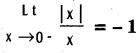
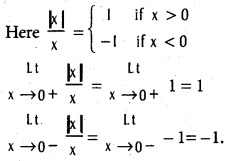
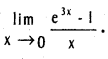
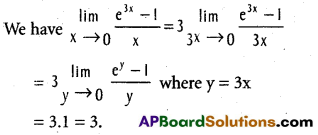
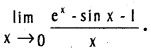
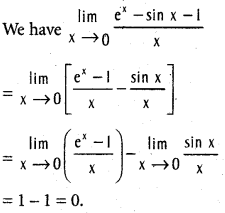
Inter 1st Year Maths 1B Differentiation Important Questions

Students get through Maths 1B Important Questions Inter 1st Year Maths 1B Differentiation Important Questions which are most likely to be asked in the exam.

Intermediate 1st Year Maths 1B Differentiation Important Questions

Question 1.
If f(x) = x2 (x ∈ R), prove that f is differentiable on R and find its derivative.
Solution:
Given that f(x) = x2
for x, h ∈ R, f(x + h) – f(x)(x + h)2 – x2
= x2 + h2 + 2hx – x2
= 2hx + h2 = h(2x + h)
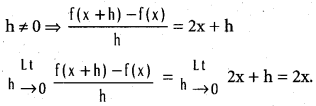
Inter 1st Year Maths 1B Differentiation Important Questions 1
∴ f is differentiable on R and f'(x) = 2x for each x ∈ R

Inter 1st Year Maths 1B Differentiation Important Questions

Question 2.
Suppose f(x) = \(\sqrt{x}\) (x > 0). Prove that f is differentiable on (0, ∞) and find f(x).
Solution:
Let x ∈ (0, ∞) h ≠ 0 and |h| < 0
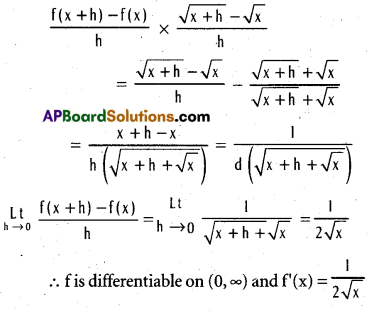
Inter 1st Year Maths 1B Differentiation Important Questions 2

Question 3.
If f(x) = \(\frac{1}{x^{2}+1}\) (x ∈ R), prove that f is differentiable on R and find f'(x).
Solution:
Let x ∈ R and h ≠ 0
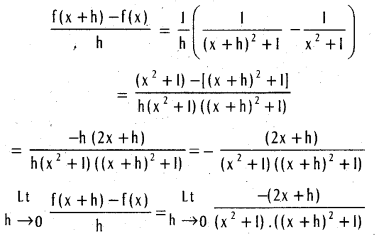
Inter 1st Year Maths 1B Differentiation Important Questions 3
= –\(\frac{2 x}{\left(x^{2}+1\right)^{2}}\)
∴ f is differentiable and f'(x) = –\(\frac{2 x}{\left(x^{2}+1\right)^{2}}\) for each x ∈ R .

Question 4.
If f(x) = sin x (x ∈ R), then show that f is differentiable on R and f'(x) = cosx.
Solution:
Let x ∈ R and h ≠ 0
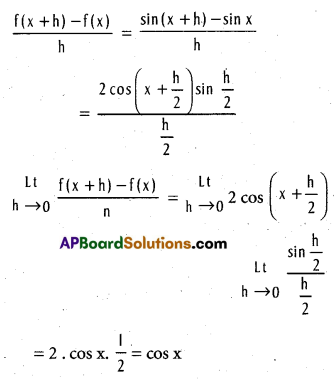
Inter 1st Year Maths 1B Differentiation Important Questions 4
∴ f is differentiable on R and f'(x) = cos x for each x ∈ R.

Inter 1st Year Maths 1B Differentiation Important Questions

Question 5.
Show that f(x) = |x| (x ∈ R) is not differentiable at zero and is differentiable at any x ≠ 0.
Solution:
Given f(x) = |x|
∴ f(x) = x if x ≥ 0
if h ≠ 0
\(\frac{f(0+h)-f(0)}{h}\) = \(\frac{f(h)}{h}\) = \(\left\{\begin{array}{r}
1 \text { if } h>0 \\
-1 \text { if } h<0
\end{array}\right.\)
f'(0+) = 1, f'(0) = -1
∴ is not differentiable at zero it can be easily proved that f is differentiable at any x ≠ 0 and that f'(x) = \(\left\{\begin{array}{l}
1 \quad \text { if } x>0 \\
-1 \text { if } x<0
\end{array}\right.\)

Question 6.
Check whether the following function is differentiable at zero f(x) = \(\left\{\begin{array}{l}
3+x \text { if } x \geq 0 \\
3-x \text { if } x<0
\end{array}\right.\)
Solution:
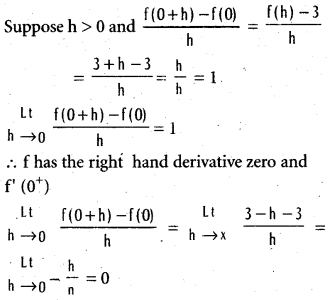
Inter 1st Year Maths 1B Differentiation Important Questions 5
f has the left hand derivative at zero and f'(0) = -1
∴ f'(0+) ≠ f'(0)
f(x) is not differentiable at zero.

Inter 1st Year Maths 1B Differentiation Important Questions

Question 7.
Show that the derivative of a constant function on an interval is zero.
Solution:
let f be a constant function on an interval I.
f(x) = C ∀ x ∈ I for some constant.
Let a ∈ I, for h ≠ 0 \(\frac{f(a+h)-f(a)}{h}\) = \(\frac{c-c}{h}\) = 0
for sufficiently small (h)
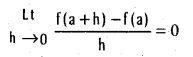
Inter 1st Year Maths 1B Differentiation Important Questions 6
∴ f is differentiable 0 and f'(0).

Question 8.
Suppose for all x, y ∈ R f(x + y) = f(x). f(y) and f'(0) exists. Then show that f(x) exists and equals to f(x) f'(0)for all x ∈ R.
Solution:
Let x ∈ R, for h ≠ 0, we have
\(\frac{f(x+h)-f(x)}{h}\) = \(\frac{f(x) f(h)-f(x)}{h}\)
= f(x) \(\frac{[f(h)-1]}{h}\) ………………….. (1)
f(0) = f(0 + 0) = f(0) f(0) ⇒ f(0) (1 —f(0)) = 0
∴ f(0) = 0 or f(0) = 1
Case (1) : Suppose f(0) = 0
f(x) = f(x + 0) = f(x) f(0) = 0 ∀ x ∈ R
∴ f(x) is a constant function = f'(x) = 0 for all x ∈ R
∴ f'(x) = 0 = f(x) . f'(0)

Case (ii): Suppose f(0) = 1
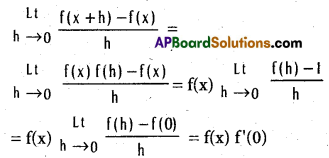
Inter 1st Year Maths 1B Differentiation Important Questions 7
∴ f is differentiable and f'(x) = f'(x) f'(0).

Question 9.
If f(x) = (ax + b)n, (x > –\(\frac{b}{a}\)), then find f'(x).
Sol:
Let u = ax + b so that y = un
f'(x) = \(\frac{\mathrm{d}}{\mathrm{dx}}\) (un) \(\frac{\mathrm{du}}{\mathrm{dx}}\)
= n.un-1a.
= an(ax+b)n – 1

Question 10.
Find the derivative of f(x) = ex (x2 + 1)
Solution:
Let u = ex, V = x2 + 1
\(\frac{\mathrm{du}}{\mathrm{dx}}\) = ex, \(\frac{\mathrm{dv}}{\mathrm{dx}}\) = 2x
f'(x) = u(x) v'(x) + u'(x) . v(x)
= ex2x + (x2 + 1) ex
= ex(2x + x2 + 1)
= ex(x + 1)2

Inter 1st Year Maths 1B Differentiation Important Questions

Question 11.
If y = \(\frac{a-x}{a+x}\) (x ≠ -a), find \(\frac{\mathrm{d} y}{\mathrm{dx}}\).
Solution:
Let u = a – x and v = a + x so that y = \(\frac{\mathrm{u}}{\mathrm{v}}\)
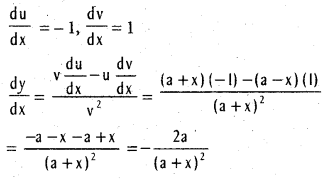
Inter 1st Year Maths 1B Differentiation Important Questions 8

Question 12.
If f(x) = e2x . log x (x > 0), then find f'(x).
Solution:
Let u = e2x, v = log x so that
\(\frac{\mathrm{du}}{\mathrm{dx}}\) = 2 . e2x , \(\frac{\mathrm{dv}}{\mathrm{dx}}\) = 1
f(x) = u.v
f'(x) = u . \(\frac{\mathrm{dv}}{\mathrm{dx}}\) + y . \(\frac{\mathrm{du}}{\mathrm{dx}}\)
= e2x . \(\frac{1}{x}\) + log x (2e2x)
= e2x (\(\frac{1}{x}\) + 2 logx)

Question 13.
If f(x) = \(\sqrt{\frac{1+x^{2}}{1-x^{2}}}\) (|x| < 1), then find f'(x)
Solution:
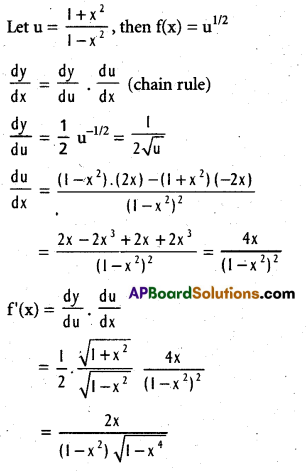
Inter 1st Year Maths 1B Differentiation Important Questions 9

Question 14.
If f(x) = x2, 2x log x (x > 0), find f'(x).
Solution:
u = x2, v = 2x, w = logx
\(\frac{\mathrm{du}}{\mathrm{dx}}\) = 2x, \(\frac{\mathrm{dv}}{\mathrm{dx}}\) = 2x . log2, \(\frac{\mathrm{dw}}{\mathrm{dx}}\) = \(\frac{1}{x}\)
f'(x) = uv . \(\frac{\mathrm{dw}}{\mathrm{dx}}\) + vw . \(\frac{\mathrm{du}}{\mathrm{dx}}\) + uw . \(\frac{\mathrm{dv}}{\mathrm{dx}}\)
= x22x . \(\frac{1}{x}\) + 2x . logx(2x) + x2 . logx . 2x log2
= x . 2x (logx2 + xlogx (log 2) + 1)

Inter 1st Year Maths 1B Differentiation Important Questions

Question 15.
If y = \(\left|\begin{array}{l}
f(x) g(x) \\
\phi(x) \psi(x)
\end{array}\right|\) then show that \(\frac{\mathrm{dy}}{\mathrm{dx}}\) = \(\left|\begin{array}{l}
f^{\prime}(x) g^{\prime}(x) \\
\phi(x) \psi(x)
\end{array}\right|\) + \(\left|\begin{array}{l}
f(x) g \backslash(x) \\
\phi^{\prime}(x) \Psi(x)
\end{array}\right|\)
Solution:
Given y = \(\left|\begin{array}{l}
f(x) g(x) \\
\phi(x) \psi(x)
\end{array}\right|\)
= f(x) ψ(x) – Φ(x) g(x)
\(\frac{\mathrm{dy}}{\mathrm{dx}}\) = f(x) ψ'(x) + ψ(x) f'(x) – [Φ(x). g'(x) + g(x). Φ'(x)]
= [f(x) ψ'(x) – g(x) Φ’x)] + [f'(x) ψ(x) – Φ(x).g'(x)]
= \(\left|\begin{array}{l}
f(x) g(x) \\
\phi^{\prime}(x) \psi^{\prime}(x)
\end{array}\right|\) + \(\left|\begin{array}{cc}
f^{\prime}(x) & g^{\prime}(x) \\
\phi(x) & \psi(x)
\end{array}\right|\)

Question 16.
If f(x) = 7x2+3x (x > 0), then find f'(x).
Solution:
Let u = x3 + 3x ⇒ \(\frac{\mathrm{du}}{\mathrm{dx}}\) = 3x2 + 3 = 3(x2 + 1)
f(X) = 7u
f'(x) = \(\frac{d f}{d u}\) . \(\frac{\mathrm{du}}{\mathrm{dx}}\) (7u . l0g 7) [3(x2 + 1)]
= 3(x2 + 1) 7x2+3x log 7

Question 17.
If f(x) = x ex sin x, then find f(x).
Solution:
Let u = x ,v = ex, w = sin x
\(\frac{\mathrm{dy}}{\mathrm{dx}}\) = 1, \(\frac{\mathrm{dv}}{\mathrm{dx}}\) = ex . \(\frac{\mathrm{dw}}{\mathrm{dx}}\) = cos x
f(x) = u.v.w
f'(x) = uv . \(\frac{\mathrm{dw}}{\mathrm{dx}}\) + uw \(\frac{\mathrm{dv}}{\mathrm{dx}}\) + vw \(\frac{\mathrm{du}}{\mathrm{dx}}\)
= xex cos x + x . sinx ex + ex sin x.

Inter 1st Year Maths 1B Differentiation Important Questions

Question 18.
If f(x) = sin (log x), (x > 0), find f'(x).
Solution:
Let u = logx, y = f(x) so that y = sin u
\(\frac{\mathrm{dy}}{\mathrm{dx}}\) = \(\frac{d y}{d u}\) . \(\frac{\mathrm{du}}{\mathrm{dx}}\)
\(\frac{\mathrm{dy}}{\mathrm{dx}}\) = cos u, \(\frac{\mathrm{du}}{\mathrm{dx}}\) = \(\frac{1}{x}\)
f'(x) = \(\frac{1}{x}\) . cos u = \(\frac{1}{x}\) cos (log x)

Question 19.
If f(x) =(x3 + 6x2 + 12x – 13)100; find f'(x).
Solution:
u = x3 + 6x2 + 12x – 13
⇒ \(\frac{\mathrm{du}}{\mathrm{dx}}\) = 3x2 + 12x + 12
= 3(x2 + 4x + 4)
= 3(x + 2)2
f(x) = u100
f'(x) = 100 . u99 . \(\frac{\mathrm{du}}{\mathrm{dx}}\)
= 100 (x3 + 6x2 + 12x – 13)99 . 3(x + 2)2
= 300 (x + 2)2 (x3 + 6x2 + 12x – 13)99

Question 20.
Find the derivative of f(x) = \(\frac{x \cos x}{\sqrt{1+x^{2}}}\)
Solution:
Let u = x cos x, and v = \(\sqrt{1+x^{2}}\) so that
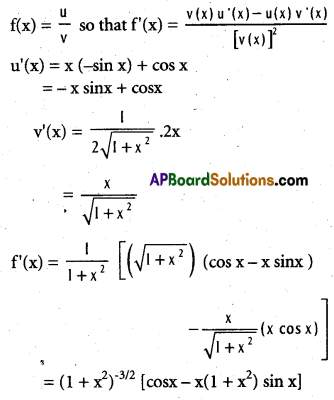
Inter 1st Year Maths 1B Differentiation Important Questions 10

Question 21.
li f(x) = log (secx + tan x), find f'(x). [Mar 14, May 11]
Solution:
Let u = sec x + tan x and y = log u
\(\frac{\mathrm{dy}}{\mathrm{dx}}\) = \(\frac{1}{u}\), \(\frac{\mathrm{du}}{\mathrm{dx}}\) = sec x. tan x + sec2 x
= sec x (sec x + tan x)
\(\frac{\mathrm{dy}}{\mathrm{dx}}\) = \(\frac{\mathrm{dy}}{\mathrm{dx}}\) . \(\frac{\mathrm{du}}{\mathrm{dx}}\)
= \(\frac{1}{\sec x+\tan x}\) . sec x(sec x + tan x) = sec x

Inter 1st Year Maths 1B Differentiation Important Questions

Question 22.
If y = sin-1\(\sqrt{x}\), find \(\frac{\mathrm{dy}}{\mathrm{dx}}\)
Solution:
u = \(\sqrt{x}\), y = sin-1 x.
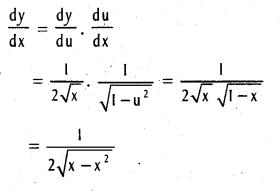
Inter 1st Year Maths 1B Differentiation Important Questions 11

Question 23.
If y = sec (\(\sqrt{\tan x}\)), find \(\frac{\mathrm{dy}}{\mathrm{dx}}\).
Solution:
u = \(\sqrt{\tan x}\), v = tanx
Then y = sec u, u = \(\sqrt{\mathrm{v}}\), v = tan x
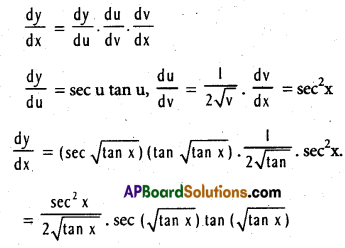
Inter 1st Year Maths 1B Differentiation Important Questions 12

Question 24.
If y = \(\frac{x \sin ^{-1} x}{\sqrt{1-x^{2}}}\), find \(\frac{\mathrm{dy}}{\mathrm{dx}}\).
Solution:
Let u = x sin-1x, v = \(\sqrt{1-x^{2}}\)
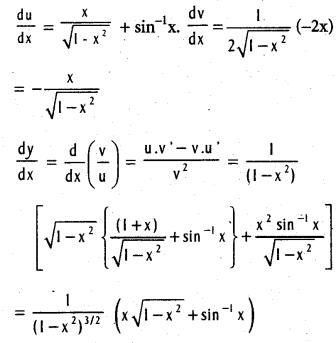
Inter 1st Year Maths 1B Differentiation Important Questions 13

Inter 1st Year Maths 1B Differentiation Important Questions

Question 25.
If y = log (cosh 2x), find \(\frac{\mathrm{dy}}{\mathrm{dx}}\).
Solution:
Let u = cosh 2x, so that y = log u
\(\frac{\mathrm{dy}}{\mathrm{dx}}\) = \(\frac{1}{u}\); \(\frac{\mathrm{du}}{\mathrm{dx}}\) = 2 sin h2x
\(\frac{\mathrm{dy}}{\mathrm{dx}}\) = \(\frac{d y}{d u}\) . \(\frac{\mathrm{du}}{\mathrm{dx}}\)
= 2 sin h 2x . \(\cosh 2 x\) = 2 tan h 2x

Question 26.
If y = log (sin (log x)), find \(\frac{\mathrm{dy}}{\mathrm{dx}}\).
Solution:
Let v = log x, u = sin v so that y = log u.
\(\frac{\mathrm{dy}}{\mathrm{dx}}\) = \(\frac{1}{u}\); \(\frac{d u}{d v}\) = cos u; \(\frac{\mathrm{dv}}{\mathrm{dx}}\) = \(\frac{1}{x}\)
\(\frac{\mathrm{dy}}{\mathrm{dx}}\) = \(\frac{d y}{d u}\) . \(\frac{d u}{d v}\) . \(\frac{\mathrm{dv}}{\mathrm{dx}}\)
= \(\frac{1}{\sin (\log x)}\) . cos (logx) \(\frac{1}{x}\) = \(\frac{\cot (\log x)}{x}\)

Question 27.
If y = (cot-1x3)2, find \(\frac{\mathrm{dy}}{\mathrm{dx}}\).
Solution:
u = cot-1x3, u = x3, y = u2
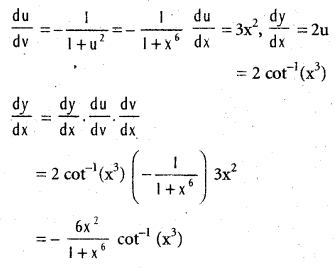
Inter 1st Year Maths 1B Differentiation Important Questions 14

Inter 1st Year Maths 1B Differentiation Important Questions

Question 28.
If y = cosec-1(e2x+1), find \(\frac{\mathrm{dy}}{\mathrm{dx}}\).
Solution:
u = e2x+1, y = cosec-1u
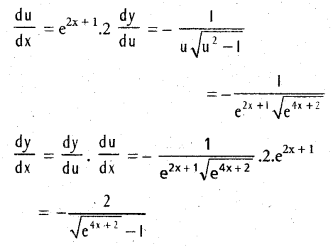
Inter 1st Year Maths 1B Differentiation Important Questions 15

Question 29.
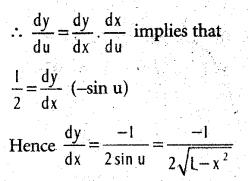
If y = tan-1 (cos \(\sqrt{x}\)), find \(\frac{\mathrm{dy}}{\mathrm{dx}}\).
Solution:
v = \(\sqrt{x}\) and u = cos v, y = tan-1u
\(\frac{\mathrm{dv}}{\mathrm{dx}}\) = \(\frac{1}{2 \sqrt{x}}\), \(\frac{d u}{d v}\) = – sin u; \(\frac{\mathrm{dy}}{\mathrm{dx}}\) = \(\frac{1}{1+u^{2}}\)
= – sin \(\sqrt{x}\) = \(\frac{1}{1+\cos ^{2}(\sqrt{x})}\)
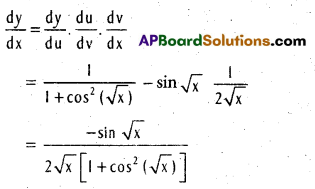
Inter 1st Year Maths 1B Differentiation Important Questions 16

Question 30.
If y = Tan-1 \(\sqrt{42}\) for 0 < |x| < 1, find \(\frac{\mathrm{dy}}{\mathrm{dx}}\). [May, Mar 12]
Solution:
Put x2 = cos 2θ
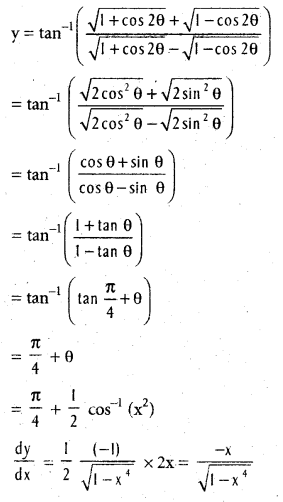
Inter 1st Year Maths 1B Differentiation Important Questions 17

Inter 1st Year Maths 1B Differentiation Important Questions

Question 31.
If y = x2exsin x, find \(\frac{\mathrm{dy}}{\mathrm{dx}}\).
Solution:
log y = log x2. ex. sin x
= log x2 + log ex + log sin x
= 2 log x + log ex + log sin x
Differentiating w.r.to by sin x
\(\frac{1}{y}\) . \(\frac{\mathrm{dy}}{\mathrm{dx}}\) = \(\frac{2}{x}\) + 1 + \(\frac{1}{sin x}\) . cos x
\(\frac{\mathrm{dy}}{\mathrm{dx}}\) = y(\(\frac{2}{x}\) + 1 + cot x)

Question 32.
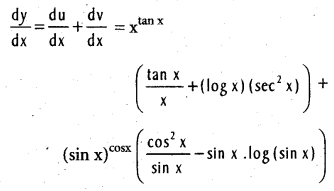
If y = xtanx + (sin x)cos x, find \(\frac{\mathrm{dy}}{\mathrm{dx}}\) [Mar. 14, 11]
Solution:
Let u = xtanx and v = (sin x)cos x
log u logx tanx = (tan x) log x
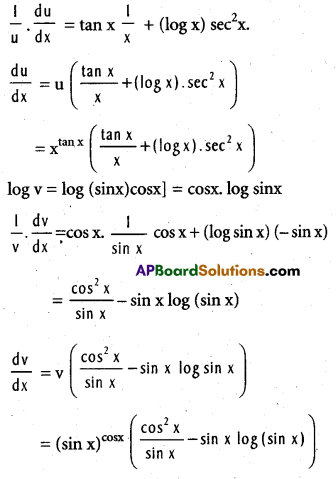
Inter 1st Year Maths 1B Differentiation Important Questions 18
Inter 1st Year Maths 1B Differentiation Important Questions 19

Question 33.
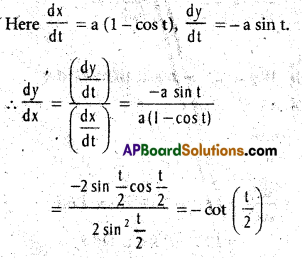
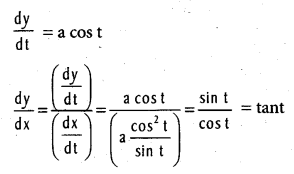
If x = a(cos t + log tan (\(\frac{t}{2}\))), y = a sin t, find \(\frac{\mathrm{dy}}{\mathrm{dx}}\).
Solution:
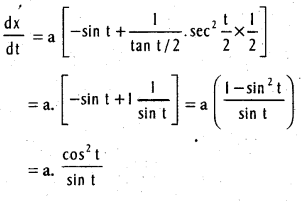
Inter 1st Year Maths 1B Differentiation Important Questions 20
Inter 1st Year Maths 1B Differentiation Important Questions 21

Inter 1st Year Maths 1B Differentiation Important Questions

Question 34.
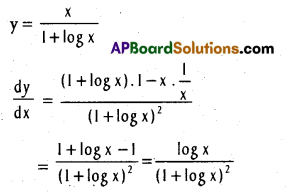
If xy = ex-y, than show that \(\frac{\mathrm{dy}}{\mathrm{dx}}\) = \(\frac{\log x}{(1+\log x)^{2}}\)    [May 07]
Solution:
xy = ex-y
log xy = log ex-y
y log x = (x – y) (log e = 1)
y(1 + log x) = x
Inter 1st Year Maths 1B Differentiation Important Questions 22

Question 35.
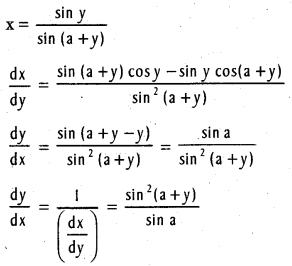
If siny = x sin (a + y), then show that \(\frac{\mathrm{dy}}{\mathrm{dx}}\) = \(\frac{\sin ^{2}(a+y)}{\sin a}\) (a is not a multiple of π)
Solution:
Inter 1st Year Maths 1B Differentiation Important Questions 23

Question 36.
If y = x4 + tan x, then find y”.
Solution:
y = x4 + tan x
\(\frac{\mathrm{dy}}{\mathrm{dx}}\) = 4x3 + sec2 x
\(\frac{d^{2} y}{d x^{2}}\) = 12x2 + 2 sec x (sec x tan x)
= 12x2 + 2 sec2x . tan x

Inter 1st Year Maths 1B Differentiation Important Questions

Question 37.
If f(x) = sinx, sin 2x sin 3x, find f”(x).
Solution:
f(x) = \(\frac{1}{2}\) sin 2x(2 sin 3x sin x)
= \(\frac{1}{2}\) (sin 2x) (cos 2x – cos4x)
= \(\frac{1}{4}\) (2 sin 2x cos 2x – 2 sin 2x cos 4x)
= \(\frac{1}{4}\) (sin2x + sin4x – sin6x)
Therefore,
f'(x)= \(\frac{1}{4}\)[2 cos 2x+ 4cos 4x – 6cos 6x]
Hence,
f”(x) = \(\frac{1}{4}\) (-4 sin 2x – 16 sin 4x + 36 sin 6x)
= 9 sin 6x – 4 sin 4x – sin 2x.

Question 38.
Show that y = x + tan x satisfies cos2x \(\frac{d^{2} y}{d x^{2}}\) + 2x = 2y.
Solution:
y = x + tan x implies that y’ = 1 + sec2 x
That is, y’ cos2x = 1 + cos2x.
Differentiating both sides of the above equation we get
y” cos2x + y’ . 2 cos x (-sin x) = 2 cos x (- sin x)
∴ y” cos2 x = 2(y’ – 1) sin x cos x
= 2 sec2x sin x cos x = 2 tan x = 2(y – x)
This proves the result.

Question 39.
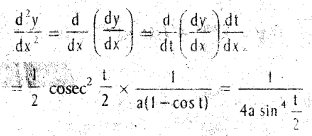
If x = a(t – sin t),y = a(1 + cost), find \(\frac{d^{2} y}{d x^{2}}\).
Solution:
Inter 1st Year Maths 1B Differentiation Important Questions 24
Inter 1st Year Maths 1B Differentiation Important Questions 25

Inter 1st Year Maths 1B Differentiation Important Questions

Question 40.
Find the second order derivative of y = tan-1(\(\frac{2 x}{1-x^{2}}\))
Solution:
Put x = tan θ, Then
y = tan-1 (\(\frac{2 \tan \theta}{1-\tan ^{2} \theta}\))
= tan-1 (tan 2θ)
= 2θ = 2 tan-1x
∴ \(\frac{\mathrm{dy}}{\mathrm{dx}}\) = \(\frac{2}{1+x^{2}}\) and \(\frac{d^{2} y}{d x^{2}}\) = \(\frac{-4 x}{\left(1+x^{2}\right)^{2}}\).

Question 41.
If y = sin (sin x), show that y” + (tan x) y’ + y cos2x = 0.
Solution:
y = sin (sin x) implies that .
y’ = cos x . cos (sin x) and
y” = -cos2x sin (sin x) – sin x cos (sin x)
= – y cos2x – sin x (\(\frac{y^{\prime}}{\cos x}\))
= -y cos2x – y’ tan x
∴ y” + (tan x)y’ + y cos2 x = 0.

Question 42.
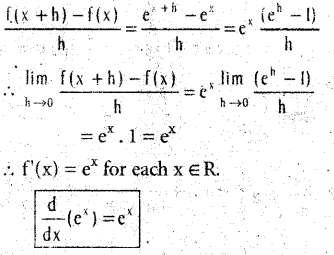
If f(x) = ex(x ∈ R), then show that f(x) = ex by first principle.
Solution:
From f(x) = ex we have for h ≠ 0
Inter 1st Year Maths 1B Differentiation Important Questions 26

Inter 1st Year Maths 1B Differentiation Important Questions

Question 43.
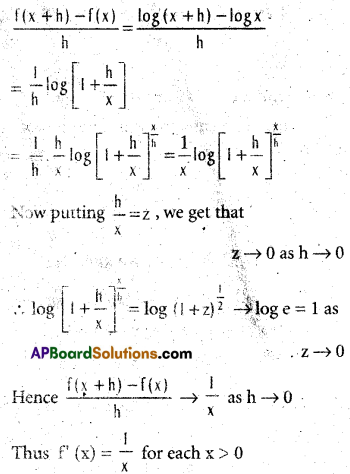
If f(x) = log x (x > 0), then show that f(x) = \(\frac{1}{x}\) by first principle.
Solution:
Now for h ≠ 0
Inter 1st Year Maths 1B Differentiation Important Questions 27
\(\frac{d}{dx}\) (log x) = \(\frac{1}{x}\)

Question 44.
If 1(x) = ax (x ∈ R) (a > 0), then show that f'(x) = ax log a by first principle.
Solution:
For h ≠ 0
\(\frac{f(x+h)-f(x)}{h}\) = \(\frac{a^{x+h}-a^{x}}{h}\) = ax [latex]\frac{a^{h}-1}{h}[/latex]
We know that \(\frac{a^{h}-1}{h}\) → log a as h → 0
Hence f'(x) = ax . log a.
\(\frac{d}{d x}\) = (ax) = ax log a

Question 45.
If y = Tan-1 \(\sqrt{\frac{1-x}{1+x}}\) (|x| < 1), we shall find \(\frac{\mathrm{dy}}{\mathrm{dx}}\).
Solution:
Substituting x cos u (u ∈ (0, π)) in y, we get
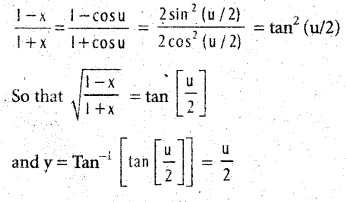
Inter 1st Year Maths 1B Differentiation Important Questions 28
Inter 1st Year Maths 1B Differentiation Important Questions 29
observe that Tan-1x, \(\sqrt{\frac{1-x}{1+x}}\) and cos u are the functions that stand for f(x), g(x) and h(u) respectively, mentioned in the method.

Inter 1st Year Maths 1B Differentiation Important Questions

Question 46.
If y = Tan-1[latex]\frac{2 x}{1-x^{2}}[/latex] (|x| < 1) then we shall \(\frac{\mathrm{dy}}{\mathrm{dx}}\).
Solution:
Substituting x = tan u
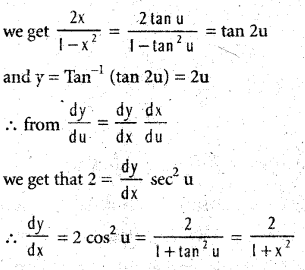
Inter 1st Year Maths 1B Differentiation Important Questions 30

Question 47.
If x = a cos3t, y = a sin3t, find \(\frac{\mathrm{dy}}{\mathrm{dx}}\).
Solution:
Here \(\frac{\mathrm{dy}}{\mathrm{dx}}\) = 3a cos2t (-sin t) and
\(\frac{d y}{d t}\) = 3a sin2t. cost.
∴ \(\frac{\mathrm{dy}}{\mathrm{dx}}\) = \(\frac{\frac{\mathrm{dy}}{\mathrm{dt}}}{\frac{\mathrm{dx}}{\mathrm{dt}}}\) = -tan t

Question 48.
If y = et +cost, x = log t + sin t find \(\frac{\mathrm{dy}}{\mathrm{dx}}\)
Solution:
Here \(\frac{\mathrm{dy}}{\mathrm{dx}}\) = et – sin t and \(\frac{d x}{d t}\) = \(\frac{1}{t}\) + cos t
∴ \(\frac{\mathrm{dy}}{\mathrm{dx}}\) = \(\frac{t\left(e^{t}-\sin t\right)}{(1+t \cos t)}\)

Inter 1st Year Maths 1B Differentiation Important Questions

Question 49.
To find the derivative of f(x) = x\(\sin ^{\frac{1}{x}}\) with respect to g(x) = sin-1x, we have to compute \(\frac{d f}{d g}\)
Solution:
Now f(x) = x\(\sin ^{\frac{1}{x}}\) implies that
log f(x) = sin-1x . log x so that
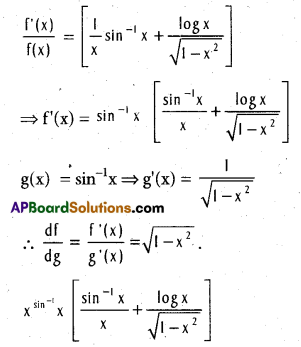
Inter 1st Year Maths 1B Differentiation Important Questions 31

Question 50.
If x3 + y3 – 3axy = 0, find \(\frac{\mathrm{dy}}{\mathrm{dx}}\).
Solution:
Let the given equation define the function.
y = 1(x) that is x3 + (f(x))3 – 3axf(x) = 0
Differentiating both sides of this equation with respect to x, we get
3x2 + 3 (f(x))2 f'(x) – [3a. f(x) + 3axf'(x)] = 0
Hence 3x2 + 3y2 f'(x) – [3ay + 3ax f'(x)] = 0
∴ f'(x) = \(\frac{\mathrm{dy}}{\mathrm{dx}}\) = \(\frac{a y-x^{2}}{y^{2}-a x}\)

Question 51.
If 2x2 – 3xy + y2 + x + 2y – 8 = 0, find \(\frac{\mathrm{dy}}{\mathrm{dx}}\).
Solution:
Treating y as a function of x and then differentiating with respect to x,
we get 4x – 3y – 3xy’ + 2yy’ + 1 + 2y’ = 0
∴ \(\frac{\mathrm{dy}}{\mathrm{dx}}\) = y’ = \(\frac{3 y-4 x-1}{2 y-3 x+2}\)

Inter 1st Year Maths 1B Differentiation Important Questions

Question 52.
If y = xx (x > 0), we shall find \(\frac{\mathrm{dy}}{\mathrm{dx}}\).
Solution:
Taking logarithms on both the sides of
y = xx we obtain log y = x log x
Differentiating with respect to x,
We get \(\frac{y^{\prime}}{y}\) = x . \(\frac{1}{x}\) + log x = 1 + log x
∴ \(\frac{\mathrm{dy}}{\mathrm{dx}}\) = y’ = y(1 + log x) = xx (1 + log x)

Question 53.
If y = (tan x)sin x [o < x < \(\frac{\pi}{2}\) ] compute \(\frac{\mathrm{dy}}{\mathrm{dx}}\).
Solution:
Taking logarthms on both sides of
y= (tan x)sin x, we get
log y = sin x . log (tan x)
Differentiating with respect to x, we get
\(\frac{y^{\prime}}{y}\) = \(\frac{\sin x}{\tan x}\) . sec2x + cosx . log (tan x)
= sec x + cos x . log (tan x)
Hence \(\frac{\mathrm{dy}}{\mathrm{dx}}\) = (tan x)sin x [sec x + cos x log (tan x)]

Inter 1st Year Maths 1B Limits and Continuity Important Questions

Students get through Maths 1B Important Questions Inter 1st Year Maths 1B Limits and Continuity Important Questions which are most likely to be asked in the exam.

Intermediate 1st Year Maths 1B Limits and Continuity Important Questions

Question 1.
Evaluate Inter 1st Year Maths 1B Limits and Continuity Important Questions 1
Solution:
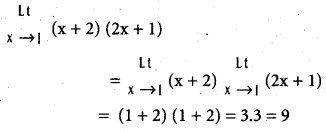
Inter 1st Year Maths 1B Limits and Continuity Important Questions 2

Question 2.
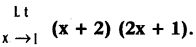
Compute Inter 1st Year Maths 1B Limits and Continuity Important Questions 3
Solution:
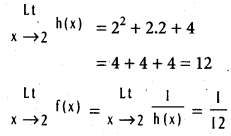
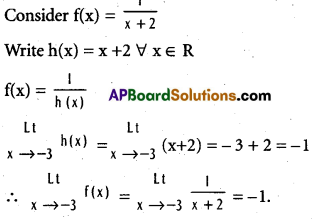
Write f(x) = \(\frac{x-2}{x^{3}-8}\) x ≠ 2 so that
f(x) = \(\frac{x-2}{x^{3}-8}\) = \(\frac{1}{x^{2}+2 x+4}\)
Write h(x) = x2 + 2x + 4 so that
Inter 1st Year Maths 1B Limits and Continuity Important Questions 4

Inter 1st Year Maths 1B Limits and Continuity Important Questions

Question 3.
Find Inter 1st Year Maths 1B Limits and Continuity Important Questions 5
Solution:
Inter 1st Year Maths 1B Limits and Continuity Important Questions 6

Question 4.
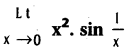
Compute Inter 1st Year Maths 1B Limits and Continuity Important Questions 7.
Solution:
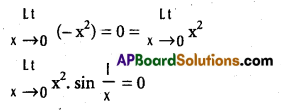
For x ≠ 0, we know that -1 ≤ sin \(\frac{1}{x}\) ≤ 1
∴ -x2 ≤ x2 . sin \(\frac{1}{x}\) ≤ x2
Inter 1st Year Maths 1B Limits and Continuity Important Questions 8

Question 5.
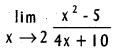
Find Inter 1st Year Maths 1B Limits and Continuity Important Questions 9.
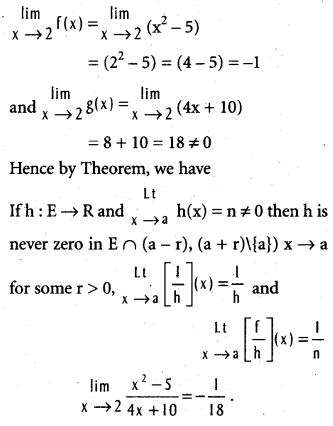
Solution:
We define f : R → R by f(x) = x2 – 5 and g : R → R by g(x) = 4x + 10.
Inter 1st Year Maths 1B Limits and Continuity Important Questions 10

Inter 1st Year Maths 1B Limits and Continuity Important Questions

Question 6.
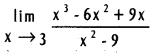
Find Inter 1st Year Maths 1B Limits and Continuity Important Questions 11.
Solution:
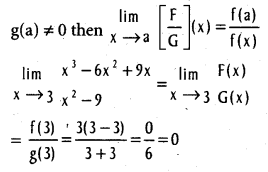
Write F(x) = x3 – 6x2 + 9x
= x(x – 3)2 = (x – 3)
f(x) where f(x) = x(x – 3)
Write G(x) = x2 – 9 = (x – 3) (x + 3)
= (x – 3) g(x) where g(x) = x + 3
∴ \(\frac{F(x)}{G(x)}=\frac{(x-3) f(x)}{(x-3) g(x)}=\frac{f(x)}{g(x)}\)
and g(3) = 6 ≠ 0.
If F and G are polynomials such that f(x) = (x – a)k, G(x) = (x – a)k g(x) for some k ∈ N and for some polynomials f(x) and g(x) with
Inter 1st Year Maths 1B Limits and Continuity Important Questions 12

Question 7.
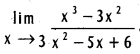
Find Inter 1st Year Maths 1B Limits and Continuity Important Questions 13.
Solution:
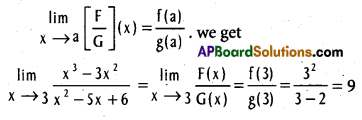
We write F(x) = x3 – 3x2 = x2(x – 3) = (x – 3)
f(x) where f(x) = x2,
and G(x) = x2 – 5x + 6 = (x – 3)(x – 2)
= (x – 3) g(x) where g(x) = x – 2,
with g(3) = 3 – 2 = 1 ≠ 0.
∴ by applying Theorem g(a) ≠ 0
Inter 1st Year Maths 1B Limits and Continuity Important Questions 14

Question 8.
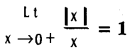
Show that Inter 1st Year Maths 1B Limits and Continuity Important Questions 15 and Inter 1st Year Maths 1B Limits and Continuity Important Questions 16 (x ≠ 0).
Solution:
Inter 1st Year Maths 1B Limits and Continuity Important Questions 17

Inter 1st Year Maths 1B Limits and Continuity Important Questions

Question 9.
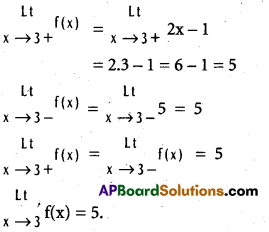
Let f : R → R be defined by
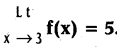
f(x) = \(\begin{cases}2 x-1 & \text { if } x<3 \\ 5 & \text { if } x \geq 3\end{cases}\) show that Inter 1st Year Maths 1B Limits and Continuity Important Questions 18.
Solution:
Inter 1st Year Maths 1B Limits and Continuity Important Questions 19

Question 10.
Show that Inter 1st Year Maths 1B Limits and Continuity Important Questions 20.
Solution:
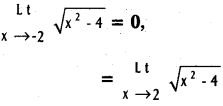
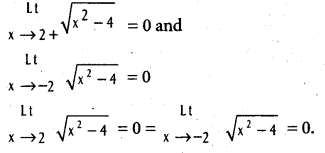
Observe that \(\sqrt{x^{2}-4}\) is not defined over (-2, 2)
Inter 1st Year Maths 1B Limits and Continuity Important Questions 21

Question 11.
Inter 1st Year Maths 1B Limits and Continuity Important Questions 22
Solution:
Inter 1st Year Maths 1B Limits and Continuity Important Questions 23

Inter 1st Year Maths 1B Limits and Continuity Important Questions

Question 12.
Show that Inter 1st Year Maths 1B Limits and Continuity Important Questions 24.
Solution:
Inter 1st Year Maths 1B Limits and Continuity Important Questions 25

Question 13.
Find Inter 1st Year Maths 1B Limits and Continuity Important Questions 26
Solution:
For 0 < |x| < 1, we have
Inter 1st Year Maths 1B Limits and Continuity Important Questions 27
Inter 1st Year Maths 1B Limits and Continuity Important Questions 28

Question 14.
Compute Inter 1st Year Maths 1B Limits and Continuity Important Questions 29
Solution:
For 0 < |x| < 1 Inter 1st Year Maths 1B Limits and Continuity Important Questions 30

Inter 1st Year Maths 1B Limits and Continuity Important Questions

Question 15.
Show that Inter 1st Year Maths 1B Limits and Continuity Important Questions 31
Solution:
Inter 1st Year Maths 1B Limits and Continuity Important Questions 32

Question 16.
Compute [Mar 13] Inter 1st Year Maths 1B Limits and Continuity Important Questions 33 (a > 0, b > 0, b ≠ 1).
Solution:
Inter 1st Year Maths 1B Limits and Continuity Important Questions 34

Question 17.
Compute Inter 1st Year Maths 1B Limits and Continuity Important Questions 35, b ≠ 0, a ≠ b.
Solution:
Inter 1st Year Maths 1B Limits and Continuity Important Questions 36

Question 18.
Compute Inter 1st Year Maths 1B Limits and Continuity Important Questions 37
Solution:
Inter 1st Year Maths 1B Limits and Continuity Important Questions 38

Question 19.
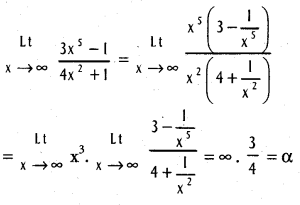
Compute Inter 1st Year Maths 1B Limits and Continuity Important Questions 39
Solution:
Inter 1st Year Maths 1B Limits and Continuity Important Questions 40

Question 20.
Evaluate Inter 1st Year Maths 1B Limits and Continuity Important Questions 41
Solution:
Inter 1st Year Maths 1B Limits and Continuity Important Questions 42

Inter 1st Year Maths 1B Limits and Continuity Important Questions

Question 21.
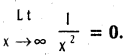
Show that Inter 1st Year Maths 1B Limits and Continuity Important Questions 43
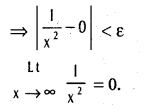
Solution:
Given ε > 0, choose ∞ = \(\frac{1}{\sqrt{\varepsilon}}\) > 0
x > ∞ ⇒ x > \(\frac{1}{\sqrt{\varepsilon}}\) ⇒ x2 > \(\frac{1}{\varepsilon}\) ⇒ \(\frac{1}{x^{2}}\) < ε
Inter 1st Year Maths 1B Limits and Continuity Important Questions 44

Question 22.
Show that Inter 1st Year Maths 1B Limits and Continuity Important Questions 45
Solution:
Given k > 0, let ∞ = log k.
x > ∞ ⇒ ex ⇒ e = k
Inter 1st Year Maths 1B Limits and Continuity Important Questions 45

Question 23.
Compute Inter 1st Year Maths 1B Limits and Continuity Important Questions 46
Solution:
Inter 1st Year Maths 1B Limits and Continuity Important Questions 47

Question 24.
Evaluate Inter 1st Year Maths 1B Limits and Continuity Important Questions 48.
Solution:
Inter 1st Year Maths 1B Limits and Continuity Important Questions 49

Inter 1st Year Maths 1B Limits and Continuity Important Questions

Question 25.
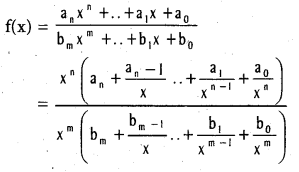
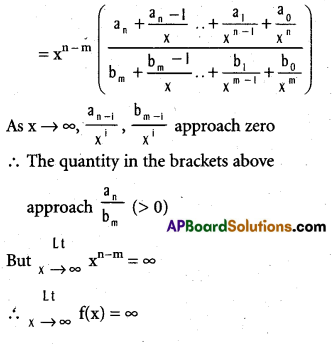
If f(x) \(\frac{a_{n} x^{n}+\ldots+a_{1} x+a_{0}}{b_{m} x^{m}+\ldots+b_{1} x+b_{0}}\) when an > 0, bm > 0, then show that Inter 1st Year Maths 1B Limits and Continuity Important Questions 50 f(x) = ∞ if n > m.
Solution:
Inter 1st Year Maths 1B Limits and Continuity Important Questions 51
Inter 1st Year Maths 1B Limits and Continuity Important Questions 52

Question 26.
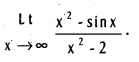
Compute Inter 1st Year Maths 1B Limits and Continuity Important Questions 53
Solution:
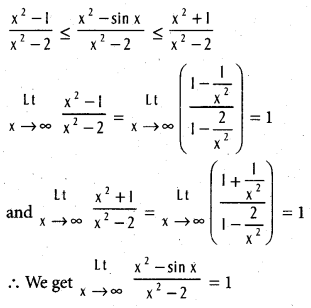
-1 ≤ sinx ≤ 1 ⇒ -1 ≤ -sinx ≤ 1
x2 – 1 ≤ x2 – sinx ≤ x2 + 1
Since x → ∞, suppose that the x2 – 2 > 0
Inter 1st Year Maths 1B Limits and Continuity Important Questions 54

Question 27.
Show that f(x) = [x] (x ∈ R is continuous at only those real numbers that are not integers.
Solution:
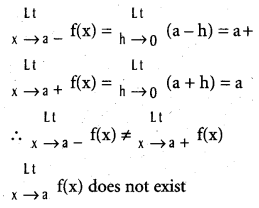
Case i) : If a ∈ z, f(a) = (a) = a
Inter 1st Year Maths 1B Limits and Continuity Important Questions 55
∴ f is not continuous at x = a ∈ z.

Inter 1st Year Maths 1B Limits and Continuity Important Questions

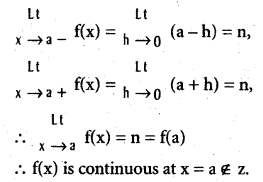
Case ii) : If a ∉ z, then ∃ n ∈ z such that n < a < n + 1 then f(a) = (a) = n.
Inter 1st Year Maths 1B Limits and Continuity Important Questions 56

Question 28.
If f : R → R is such that f(x + y) = f(x) + f(y) for all x, y ∈ R then f is continuous on R if it is continuous at a single point in R.
Solution:
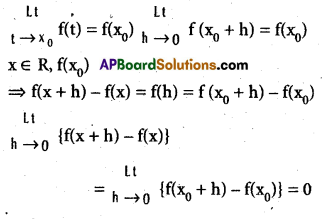
Let f be continuous at x0 ∈ R
Inter 1st Year Maths 1B Limits and Continuity Important Questions 57
∴ f is continuous at x.
Since x ∈ R is arbitrary, f is continuous on R.

Question 29.
Check the continuity of the function f given below at 1 and 2.
f(x) = \(\left\{\begin{array}{cl}
x+1 & \text { if } x \leq 1 \\
2 x & \text { if } 1<x<2 \\
1+x^{2} & \text { if } x \geq 2
\end{array}\right.\)
Solution:
Inter 1st Year Maths 1B Limits and Continuity Important Questions 58
∴ f is continuous at x = 1
Inter 1st Year Maths 1B Limits and Continuity Important Questions 59
f is not continuous at x = 2.

Question 30.
Show that the function f defined on R by f(x) = Cos x2, x ∈ R is continuous function.
Solution:
We define h : R → R by h(x) = x2 and
g : R → R by g(x) = cosx.
Now, for x ∈ R
have (goh)(x) = g(h(x)) = g(x2)
= cos x2 = f(x)
Since g and h continuous on their respective domains, by Theorem
Let A, B, ⊆ R.
Let f : A → R be continuous on A and let
g : B → R be continuous on B.
If f(A) ⊆ B then the composite function
gof : A → R is continous on A.
It follows that a continuous function on R.

Inter 1st Year Maths 1B Limits and Continuity Important Questions

Question 31.
Show that the function f defined on R by f(x) = |1 + 2x + |x||, x ∈ R is a continuous function.
Solution:
We define g : R → R by
g(x) = 1 + 2x + |x|, x ∈ R,
and h : R → R by h(x) = |x|, x ∈ R. Then
(hog) (x) = h(g(x)) = h(1 + 2x + |x|)
= |1 + 2x + |x|| = f(x).

Inter 1st Year Maths 1B The Plane Important Questions

Students get through Maths 1B Important Questions Inter 1st Year Maths 1B The Plane Important Questions which are most likely to be asked in the exam.
Intermediate 1st Year Maths 1B The Plane Important Questions

Question 1.
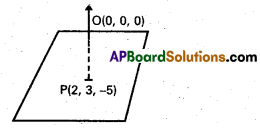
Find the equation of the plane if the foot of the perpendicular from origin to the plane is (2, 3, -5).
Solution:
O (0, 0, 0), P (2, 3, -5) are the given points D.Rs of OP are 2, 3, -5
OP is normal to the plane and it passes through p (2, 3,-5)
Inter 1st Year Maths 1B The Plane Important Questions 1
Equation of the plane is
2(x – 2) + 3(y – 3) – 5(z + 5)
2x – 4 + 3y – 9 – 5z – 25 = 0
2x + 3y – 5z – 38 = 0

Question 2.
Find the equation to the plane through the points (0, -1, -1) (4, 5, 1) and (3, 9, 4).
Solution:
A (0, -1, -1), B (4, 5, 1), C (3, 9, 4) are the given points.
Equation of the plane through A can be take as
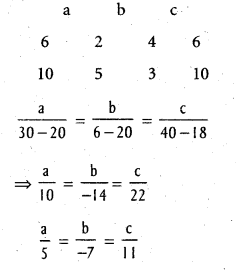
a (x – 0) + b(y + 1) + c (z + 1) = 0 ………………… (1)
The plane passes through B (4, 5, 1), C (3, 9, 4)
4a + 6b + 2c = 0 ………………. (2)
3a + 10b + 5c = 0 ……………… (3)
Inter 1st Year Maths 1B The Plane Important Questions 2
Substituting in (1) equation of the plane ABC is
5x – 7 (y + 1) + 11 (z + 1) = 0
5x – 7y – 7 + 11z + 11 = 0
5x – 7y + 11z + 4 = 0

Inter 1st Year Maths 1B The Plane Important Questions

Question 3.
Find the equation to the plane parallel to the ZX plane and passing through (0, 4, 4).
Solution:
Equation of ZX plane is y = 0
Equation of the parallel plane is y = k
This plane passes through P(0, 4, 4) = 4 = K
The equation the required plane is y = 4.

Question 4.
Find the equation of the plane through the point, (α, β, γ) and parallel to the plane ax + by + cz = 0.
Solution:
Equation of the given plane is ax + by + cz = 0
Equation of the parallel plane is ax + by+ cz = K
This plane passes through P(α, β, γ)
aα + bβ + cγ = K
∴ Equation of the required plane is
ax + by + cz = aα + bβ + cγ
i.e., a(x – α) + b(y – β) + c(z – γ) = 0

Question 5.
Find the angle between the plane 2x – y + z = 6 and x + y + 2z = 7. [Mar 11]
Solution:
Equation of the planes are
2x – y + z = 6
x + y + 2z = 7
If θ is the angle between the planes, then
cos θ = \(\frac{\left|a_{1} a_{2}+b_{1} b_{2}+c_{1} c_{2}\right|}{\sqrt{a_{1}^{2}+b_{1}^{2}+c_{1}^{2}} \sqrt{a_{2}^{2}+b_{2}^{2}+c_{2}^{2}}}\)
= \(\frac{|2.1+(-1) .1+1.2|}{\sqrt{4+1+1} \sqrt{1+1+4}}\) = \(\frac{3}{6}\) = \(\frac{1}{2}\)
= cos π/3
∴ θ = π/3

Inter 1st Year Maths 1B The Plane Important Questions

Question 6.
Find the equation of the plane passing through (2, 0, 1) and (3, -3, 4) and perpendicular to x – 2y + z = 6.
Solution:
Equation of the plane passing through (2, 0, 1) can be taken as
a(x – 2) + by + c(z – 1) = 0 ……………… (1)
This plane passes through B(3, -3, 4)
a – 3b + 3c = 0 ……………… (2)
The plane (1) is perpendicular to x- 2y + z = 6
a – 2b + c = 0 ………………… (3)
Inter 1st Year Maths 1B The Plane Important Questions 3
Substituting in (1), equation of the required plane is
3(x – 2) + 2y + 1 (z – 1) = 0
3x – 6 + 2y + z – 1 = 0
3x + 2y + z – 7 = 0
3x + 2y + z = 7.

Question 7.
Let us reduce the equation of the plane x + 2y – 2z – 9 = 0 to the normal form and hence find the direction cosines of the normal to the plane and the length of the perpendicular drawn from the origin to the given plane.
Solution:
The equation of the given plane is
x + 2y – 2z – 9 = 0
Bringing the constant term to R.H.S.
x + 2y – 2z = 9 ………………. (1)
Square root of the sum of the squares of the coefficients of x, y, z in (1) is
\(\sqrt{1^{2}+2^{2}+2^{2}}\) = ±3
dividing (1) by 3, we observe that
p = ± (\(\frac{-9}{3}\)) = ±3
±\(\frac{1}{3}\)x ±\(\frac{2}{y}\)y ±\(\frac{2}{3}\)z = ±3
Choosing the sign of the equation so that the constant on the right is positive, we get,
\(\frac{x}{3}\) + \(\frac{2}{3}\)y – \(\frac{2}{3}\)z = 3 ………………. (2)
(2) represents the equation of the plane in the normal form. Hence d.c.’s of the normal to the plane are (\(\frac{1}{2}\), \(\frac{2}{3}\), –\(\frac{2}{3}\)) and the length of the perpendicular from the origin to the plane is 3.

Inter 1st Year Maths 1B The Plane Important Questions

Question 8.
Suppose a plane makes intercepts 2, 3, 4 on the X, Y, Z – axes respectively. The equation of the plane whose X, Y, Z intercepts are a, b, c is \(\frac{x}{a}\) + \(\frac{y}{b}\) + \(\frac{z}{c}\) = 1.
Solution:
From the equation of the plane is
\(\frac{x}{2}\) + \(\frac{y}{3}\) + \(\frac{z}{4}\) = 1.
i.e., 6x + 4y + 3z = 12

Question 9.
Consider the plane whose equation is x – 3y + 2z = 9.
Solution:
Dividing by 9, \(\frac{x}{9}\) + \(\frac{y}{-3}\) + \(\frac{z}{9 / 2}\) = 1
Comparing this with \(\frac{x}{a}\) + \(\frac{y}{b}\) + \(\frac{z}{c}\) = 1
a = X-intercept = 9
b = Y-intercept = 3
c = Z-intercept = \(\frac{9}{2}\)

Inter 1st Year Maths 1B Direction Cosines and Direction Ratios Important Questions

Students get through Maths 1B Important Questions Inter 1st Year Maths 1B Direction Cosines and Direction Ratios Important Questions which are most likely to be asked in the exam.

Intermediate 1st Year Maths 1B Direction Cosines and Direction Ratios Important Questions

Question 1.
If P (2, 3, -6), Q (3, -4, 5) are two points, find the d.c.s of \(\overrightarrow{\mathrm{OP}}\), \(\overrightarrow{\mathrm{QO}}\) and \(\overrightarrow{\mathrm{PQ}}\) where O is the origin.
Solution:
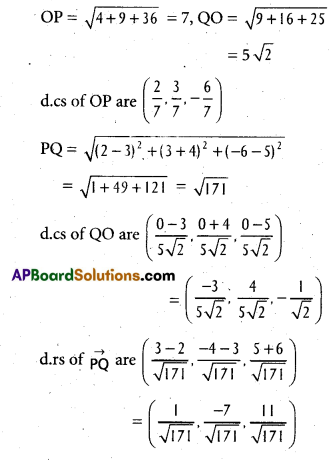
Inter 1st Year Maths 1B Direction Cosines and Direction Ratios Important Questions 1

Question 2.
Find the d.c.s of a line that makes equal angles with the axes.
Solution:
Suppose the line makes angle a with the axes d.cs of the line are (cos α, cos α, cos α)
But l2 + m2 + n2 = 1
cos2 α + cos2 α + cos2 α = 1
3 cos2 α = 1 ⇒ cos α = \(\frac{1}{3}\)
cos α = ± \(\frac{1}{\sqrt{3}}\)
d.cs of the required line are
(± \(\frac{1}{\sqrt{3}}\), ± \(\frac{1}{\sqrt{3}}\), ± \(\frac{1}{\sqrt{3}}\))
Hence there are 8 such directions which reduce to 4 lines.

Inter 1st Year Maths 1B Direction Cosines and Direction Ratios Important Questions

Question 3.
If the d.cs of a line are (\(\frac{1}{c}\), \(\frac{1}{c}\), \(\frac{1}{c}\)) find c.
Solution:
We know that l2 + m2 + n2 = 1
\(\frac{1}{c^{2}}\) + \(\frac{1}{c^{2}}\) + \(\frac{1}{c^{2}}\) = 1, \(\frac{3}{c^{2}}\) = 1 ⇒ c2 = 3
c = ± \(\sqrt{3}\)

Question 4.
Find the direction cosines of two lines which are connected by the relations l + m + n = 0 and mn – 2nl – 2lm = 0. [Mar 11]
Solution:
Given l + m + n = 0 ………………… (1)
mn – 2nl – 2lm = 0 ………………….. (2)
From (1)l = -(m + n)
Substituting in (2)
mn ± 2n (m + n) + 2m (m + n) = 0
mn + 2mn + 2n2 + 2m2 + 2mn = 0
2m2 + 5mn + 2n2 = 0
(2m + n) (m + 2n) = 0
2m = -n or m = -2n
Case (i): 2m1 = -n1
From lr = -m1 – n1
= -m1 + 2m1 = m1
\(\frac{l_{1}}{1}\) = \(\frac{m_{1}}{1}\) = \(\frac{x_{1}}{-2}\)
D.Rs of the first line are 1, 1, -2
D.Cs of this line are \(\frac{1}{\sqrt{6}}\), \(\frac{1}{\sqrt{6}}\), –\(\frac{2}{\sqrt{6}}\)
Case (ii): m2 = -2n2
From (l) l2 = -m2 – n2 = +2n2 – n2 = n2
\(\frac{l_{2}}{1}\) = \(\frac{m_{2}}{-2}\) = \(\frac{n_{2}}{1}\)
d.cs of the second line are 1, -2, 1
d.cs of this line are \(\frac{1}{\sqrt{6}}\), \(\frac{-2}{\sqrt{6}}\), \(\frac{1}{\sqrt{6}}\)

Inter 1st Year Maths 1B Direction Cosines and Direction Ratios Important Questions

Question 5.
A ray makes angles \(\frac{\pi}{3}\), \(\frac{\pi}{3}\) with \(\overrightarrow{\mathrm{OX}}\) and \(\overrightarrow{\mathrm{OY}}\) respectively. Find the angle made by it with \(\overrightarrow{\mathrm{OZ}}\).
Solution:
We know that l2 + m2 + n2 = 1
cos2α + cos2β + cos2γ = 1
i.e., cos2 \(\frac{\pi}{3}\) + cos2 \(\frac{\pi}{3}\) + cos2 γ = 1
\(\frac{1}{4}\) + \(\frac{1}{4}\) + cos2 γ = 1
cos2 γ = 1 – \(\frac{1}{2}\) = \(\frac{1}{2}\)
cos γ = ± \(\frac{1}{\sqrt{2}}\)
γ = cos-1 (± \(\frac{1}{\sqrt{2}}\))
= \(\frac{\pi}{4}\) or \(\frac{3\pi}{4}\).

Question 6.
Find the d.r.s and d.c.s of the line joining the points (4, -7, 3), (6, -5, 2).
Solution:
d.c.s of the lines are (6 – 4, -5 + 7, 2 – 3)
= (2, 2, -1)
Dividing with \(\sqrt{4+4+1}\) = 3
d.cs of the line are ± (\(\frac{2}{3}\), \(\frac{2}{3}\), –\(\frac{1}{3}\)

Question 7.
If the d.c.s of a line are proportional the (1, -2, 1) find its d.c.s.
Solution:
d.rs of the line are (1, -2, 1 )
Dividing with \(\sqrt{6}\)
d.cs of the line are ± (\(\frac{1}{\sqrt{6}}\), –\(\frac{2}{\sqrt{6}}\), \(\frac{1}{\sqrt{6}}\))

Inter 1st Year Maths 1B Direction Cosines and Direction Ratios Important Questions

Question 8.
Show that the line joining the points P(0, 1, 2) and Q (3, 4, 8) is parallel to the line joining the points R (-2. \(\frac{3}{2}\). – 3) and S (\(\frac{5}{2}\), 6, 6).
Solution:
DR’s of PQ are (3 – 0, 4 – 1, 8 – 2) = (3, 3, 6)
DR’s of RS are (\(\frac{5}{2}\) + 2, 6 – \(\frac{3}{2}\), 6 + 3)
= (\(\frac{9}{2}\), \(\frac{9}{2}\), 9)
d.r’s of PQ and RS are proportional since \(\frac{2}{3}\) (\(\frac{9}{2}\), \(\frac{9}{2}\), 9) = (3, 3, 6)
∴ PQ is parallel to RS.

Question 9.
Show that the line joining the points A (2, 3, -1) and B(3, 5, -3) is perpendicular to the Line joining C(1, 2, 3) and D(3, 5, 7).
Solution:
d.rs of AB are (3 – 2, 5 – 3, -3 + 1)
= (1, 2, -2)
d.rs of CB are (3 – 1, 5 – 2, 7 – 3) = (2, 3, 4)
a1a2 + b1b2 + c1c2 = 1.2 + 2.3 – 2.4
= 2 + 6 – 8 = 0
∴ AB and CD are perpendicular.

Question 10.
For what value of x the line joining A(4, 1, 2) B (5, x, 0) is perpendicular to the line joining C(1, 2, 3) and D(3, 5, 7) ?
Solution:
d.r’s of AD are (1, x-1, -2)
d.rs of CD are (2, 3, 4)
AB and CD are perpendicular
a1a2 + b1b2 + c1c2 = 0
1.2 – 3(x – 1) + 4 (-2) = 0
2 + 3x – 3 – 8 = 0
3x = 9
⇒ x = 3

Inter 1st Year Maths 1B Direction Cosines and Direction Ratios Important Questions

Question 11.
Show that the points A (1, 2, 3), B (4, 0, 4), C(-2, 4, 2) are collinear.
Solution:
d.rs of \(\overline{\mathrm{AB}}\) are 4 – 1, 0 – 2, 3 – 4
i.e., 3, -2, -1
d.rs of \(\overline{\mathrm{BC}}\) are -2 – 4, 4 – 0, 2 – 4
i.e., -6, 4, -2
d.rs of AB and BC are proportional and B is a common point. A, B, C are collinear.

Question 12.
A (1, 8, 4), B (0, -11, 4), C (2, -3, 1) are three points and D is the foot of the perpendicular from A to BC. Find the co-ordinates of D.
Solution:
Suppose divides BC in the ratio m = n
Co-ordinates of D are
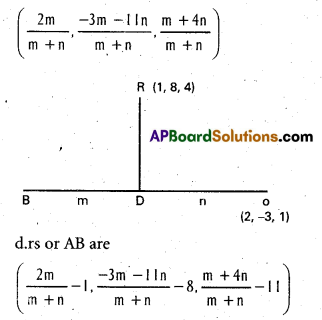
Inter 1st Year Maths 1B Direction Cosines and Direction Ratios Important Questions 2
(\(\frac{2 m-m-n}{m+n}\), \(\frac{-3 m-11 n-8 m-8 n}{m+n}\), \(\frac{m+4 n-4 m-4 n}{m+n}\))
\(\frac{m-n}{m+n}\), \(\frac{-11 m-19 n}{m+n}\), \(\frac{-3 m}{m+n}\)
d.rs of BC are (2 – 0, -3 + 11, 1 – 4) = (2, 8, -3)
AB and BC are perpendicular
\(\frac{2(m-n)}{m+n}\) + 8\(\frac{(-11 m-19 n)}{m+n}\) + \(\frac{(-3)(-3 m)}{m+n}\) = 0
2m – 2n – 88m – 152n + 9m = 0
-77m – 154n = 0
77m = -154n
m = -2n
co-ordinates of are
(\(\frac{-4 n}{-n}\), \(\frac{6 n-11 n}{-n}\), \(\frac{-2 n+4 n}{-n}\))
= (4, 5, -2)

Inter 1st Year Maths 1B Direction Cosines and Direction Ratios Important Questions

Question 13.
Lines \(\overrightarrow{\mathrm{OA}}\), \(\overrightarrow{\mathrm{OB}}\) are drawn from O with direction cosines proportional to (1, -2, -1), (3, -2, 3). Find the direction cosines of the normal to the plane AOB.
Solution:
Suppose l, m, n are the d.cs of the normal.
It is perpendicular to every line in the plane AOB
l – 2m – n = 0
3l – 2m + 3n = 0
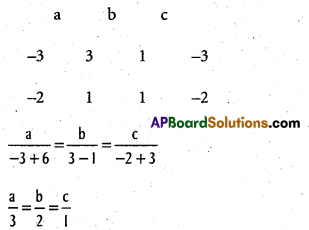
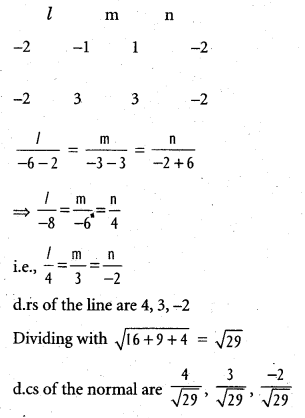
Inter 1st Year Maths 1B Direction Cosines and Direction Ratios Important Questions 3

Question 14.
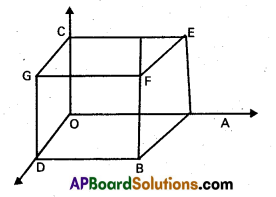
Find the angle between the diagonals of a cube.
Inter 1st Year Maths 1B Direction Cosines and Direction Ratios Important Questions 4
Solution:
Let ‘O’ one of the vertices of the cube taken as origin and the three sides OA, OB, OC are taken as co-ordinate axes. Let OA = OB = OC = a the four diagonals are \(\overrightarrow{\mathrm{OF}}\), \(\overrightarrow{\mathrm{AG}}\), \(\overrightarrow{\mathrm{DE}}\) and \(\overrightarrow{\mathrm{BC}}\)
The co-ordinates of the vertices of the cube are 0(0, 0, 0), A(a, 0, 0), B(0, a, 0), C(0,0, a), F(a, a, 0), D(a, a, 0), E(a, 0, a), G(0, a, a)
D.Rs of OF are (a-0, a – 0, a – 0) = (a, a, a)
D.Rs of AG are (0 – 9, a – 0, a – 0) = (-a, a, a)
If O is the angle between the diagonals OF and AG then
cos θ = \(\frac{|a(-a)+a \cdot a+a \cdot a|}{\sqrt{a^{2}+a^{2}+a^{2}} \cdot \sqrt{a^{2}+a^{2}+a^{2}}}\)
= \(\frac{a^{2}}{3 a^{2}}\) = \(\frac{1}{3}\)
θ = Cos-1 (\(\frac{1}{3}\))y
Similarly, the angle between any pair of diagonals can be shown to be cos-1 (\(\frac{1}{3}\))

Inter 1st Year Maths 1B Direction Cosines and Direction Ratios Important Questions

Question 15.
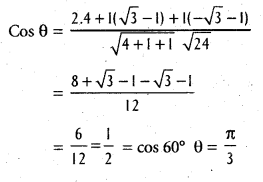
Show that the line whose d.c’s are proportional to (2, 1, 1) (4, \(\sqrt{3}\) -1, –\(\sqrt{3}\) – 1) are inclined to one another at angle \(\frac{\pi}{3}\).
Solution:
The d.cs of the given lines are (2, 1, 1), (4, \(\sqrt{3}\) – 1, –\(\sqrt{3}\) – 1) 42 + (\(\sqrt{3}\) – 1)2 + (-\(\sqrt{3}\) – 1)2
= 16 + 3 + 1 – 2\(\sqrt{3}\) + 3 + 1 + 2\(\sqrt{3}\)
= 24
Inter 1st Year Maths 1B Direction Cosines and Direction Ratios Important Questions 5

Inter 1st Year Maths 1B Three Dimensional Coordinates Important Questions

Students get through Maths 1B Important Questions Inter 1st Year Maths 1B Three Dimensional Coordinates Important Questions which are most likely to be asked in the exam.

Intermediate 1st Year Maths 1B Three Dimensional Coordinates Important Questions

Question 1.
Show that the points A(-4, 9, 6), B(-1, 6, 6) and C(0, 7, 10) from a right angled isosceles triangle.
Solution:
A(-4, 9, 6), B(-1, 6, 6), C(0, 7, 10) are the vertices of ∆ABC.
AB = \(\sqrt{(-4+1)^{2}+(9-6)^{2}+(6-6)^{2}}\)
= \(\sqrt{9+9}\)
= \(\sqrt{18}\)
BC = \(\sqrt{(-1-0)^{2}+(6-7)^{2}+(6-10)^{2}}\)
= \(\sqrt{1+1+16}\) = \(\sqrt{18}\)
CA = \(\sqrt{(0+4)^{2}+(7-9)^{2}+(10-6)^{2}}\)
= \(\sqrt{16+4+16}\) = \(36\)
AB = BC and AB2 + BC2 = CA2
ABC is a right angled isosceles triangle.

Inter 1st Year Maths 1B Three Dimensional Coordinates Important Questions

Question 2.
Show that locus of the point whose distance from Y-axis is thrice its distance from (1, 2, -1) is 8x2 + 9y2 + 8z2 – 18x – 36y + 18z + 54 = 0.
Solution:
Let P (x, y, z) be any point on the locus PM – distance from Y – axis = \(\sqrt{x^{2}+z^{2}}\)
A(1, 2, -1) is the given point
Given condition is PM = 3 . PA
PM2 = 9PA2
x2 + z2 = 9[(x – 1)2 + (y – 2)2 + (z + 1)2]
= 9x2 – 18x + 9 + 9y2 – 36y + 36 + 9z2 + 18z + 9
Locus of P is 8x2 + 9y2 + 8z2 – 18x – 36y + 18z + 54 = 0
P satisfies the equation
8x2 + 9y2 + 8z2 – 18x – 36y + 18z + 54 = 0

Question 3.
A, B, C are three points on \(\overrightarrow{o x}\), \(\overrightarrow{o y}\), \(\overrightarrow{o z}\) respectively at distances a, b, e. (a ≠ 0, b ≠ 0, c ≠ 0) from the origin 0. Find the co-ordinates of the point which is equidistant from A, B, C and O.
Solution:
A is a point on ox ⇒ co-ordinates of A are (a, 0, 0)
Similarly co-ordinates of B are (0, b, 0) and co-ordinates of C are (0, 0, c)
P(x, y, z) is the required point
PO = PA = PB = PC
PO2 = PA2 = PB2 = PC2
PO2 = PA2
x2 + y2 + z2 = (x – a)2 + y2 + z2
x2 – x2 + a2 – 2ax = 0
2ax = a2 ⇒ x = \(\frac{a^{2}}{2 a}\) = \(\frac{a}{2}\)
PO2 = PB2 ⇒ y = b/2
PO2 = PC2 ⇒ z = c/2
Co-ordinates of P are (\(\frac{a}{2}\), \(\frac{b}{2}\), \(\frac{c}{2}\) )

Inter 1st Year Maths 1B Three Dimensional Coordinates Important Questions

Question 4.
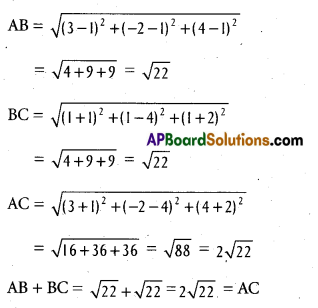
Show that the points A (3, -2, 4) B(1, 1, 1) and C(-1, 4, -2) are collinear.
Solution:
A(3, -2, 4), B(1, 1, 1), C(-1, 4, -2) are the given points
Inter 1st Year Maths 1B Three Dimensional Coordinates Important Questions 1
A, B, C are collinear.

Question 5.
Find the ratio in which YZ-plane divides the line joining A(2, 4, 5) and B(3, 5, -4). Also find the point of intersection
Solution:
Suppose the line AB meets YZ plane in P
Let P divide AB in the ratio k : 1
Co-ordinates of P are
\(\left(\frac{3 k+2}{k+1}, \frac{5 k+4}{k+1}, \frac{-4 k+5}{k+1}\right)\)
P is a point on YZ plane
⇒ x co-ordinates of p = 0
\(\frac{3 k+2}{k+1}\) = 0 ⇒ 3k + 2 = 0
k = –\(\frac{2}{3}\)
YZ plane divides AB is the ratio -2 : 3
Substituting the value of k in co-ordinates of p, co-ordinates of p are
\(\left[0, \frac{5\left(-\frac{2}{3}\right)+4}{-\frac{2}{3}+1} \cdot \frac{(-4)\left(-\frac{2}{3}\right)+5}{-\frac{2}{3}+1}\right]\)
(0, 2, 23)

Question 6.
Show that the points A(3, -2, 4), B(1, 1, 1) and C(-1, 4, -2) are collinear.
Solution:
Suppose the point P divides AD in the ratio k : 1
Co-ordinates of P are \(\left(\frac{k+3}{k+1}, \frac{k-2}{k+1}, \frac{k+4}{k+1}\right)\)
If A, B, C are collinear, C lies on AB
P must coincide with C for same value of k
\(\frac{k+3}{k+1}\) = -1 ⇒ k + 3 = -k – 1
2k = 4 ⇒ k = -2
Substituting k = -2 in co—ordinates of P we get
\(\left(\frac{-2+3}{-2+1}, \frac{-2-2}{-2+1}, \frac{-2+4}{-2+1}\right)\)
= (-14, -2) = c
A, B, C are collinear.

Inter 1st Year Maths 1B Three Dimensional Coordinates Important Questions

Question 7.
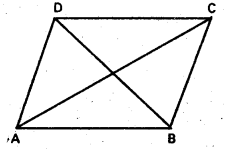
Find the fourth vertex of the parallelogram whose consecutive vertices are (2, 4, -1), (3, 6, -1) are (4, 5, 1) [Mar 11]
Solution:
Inter 1st Year Maths 1B Three Dimensional Coordinates Important Questions 2
ABCD is a parallelogram
where A = (2, 4, -1), B = (3, 6, -1) C = (4, 5, 1)
Suppose D(x, y, z) is the fourth vertex
A B C D is a parallellelogram
Mid point of AC = Mid point of BD
Inter 1st Year Maths 1B Three Dimensional Coordinates Important Questions 3
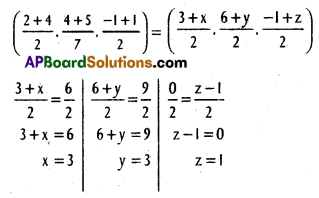
∴ Co-ordinates of the fourth vertex are = D (3, 3, 1)

Question 8.
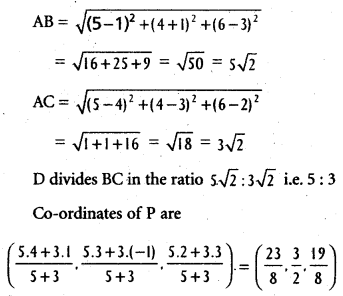
A(5, 4, 6), B(1, -1, 3), C(4, 3, 2) are three points. Find the co-ordinates of the point in which the bisector of ∠BAC meets the side \(\overline{B C}\).
Solution:
We know that if AB is the bisector of ∠BAC
Divides BC in the ratio AB : AC
Inter 1st Year Maths 1B Three Dimensional Coordinates Important Questions 4

Inter 1st Year Maths 1B Three Dimensional Coordinates Important Questions

Question 9.
If (x1, y1, z1) and (x2, y2, z2) are two vertices and (α, ß, γ) is the centroid of a triangle, find the third vertex of the triangle.
Solution:
Let A = (x1, y1, z1) and B = (x2, y2, z2) be the two vertices of the triangle ABC.
Inter 1st Year Maths 1B Three Dimensional Coordinates Important Questions 5
Let G = (α, β, γ) be the centroid.
If C = (x3, y3, z3) is the third vertex, then we have
(\(\frac{x_{1}+x_{2}+x_{3}}{3}\), \(\frac{y_{1}+y_{2}+y_{3}}{3}\), \(\frac{z_{1}+z_{2}+z_{3}}{3}\)) = (α, β, γ)
⇒ x1 + x2 + x3 = 3α; y1 + y2 + y3 = 3β; z1 + z2 + z3 = 3γ.
⇒ x3 = 3α – x1 – x2; y3 = 3β – y1 – y2; z3 = 3γ – z1 – z2.
∴ The third vertex
C = (3α – x1 – x2, 3β – y1 – y2, 3γ – z1 – z2).

Question 10.
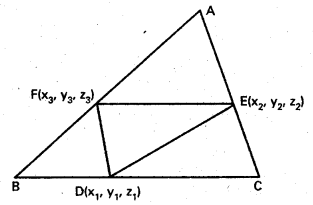
If D(x1, y1, z1), E(x2, y2, z2) and F(x3, y3, z3) are the midpoints of the sides BC, CA and AB respectively of a triangle, find its vertices A, B and C.
Solution:
It is given that D is the mid point of the side BC, E is the mid point of the side CA and F is the mid point of the side AB.
Inter 1st Year Maths 1B Three Dimensional Coordinates Important Questions 6
∴ DEP is the triangle formed out of the mid points of the three sides.
Consider the parallelogram AEDF. Let A = (h, k, s).
Mid point of AD = Mid point of EF
⇒ (\(\frac{h+x_{1}}{2}\), \(\frac{k+y_{1}}{2}\), \(\frac{s+z_{1}}{2}\)) = (\(\frac{x_{2}+x_{3}}{2}\), \(\frac{y_{2}+y_{3}}{2}\), \(\frac{z_{2}+z_{3}}{2}\))
⇒ h = x2 + x3 – x1; k = y2 + y3 – y1; s = z2 + z3 – z1
∴ Vertex A
= (x2 + x3 – x1, y2 + y3 – y1, z2 + z3 – z1)
Similarly, the vertices B and C can be obtained as
B = (x3 + x1 – x2, y3 + y1 – y2, z3 + z1 – z2)
C = (x1 + x2 – x3, y1 + y2 – y3, z1 + z2 – z3).

Inter 1st Year Maths 1B Three Dimensional Coordinates Important Questions

Question 11.
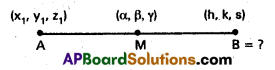
If M(α, β, γ) is the mid point of the line segment joining the points A(x1, y1, z1) and B, then find B.
Solution:
Inter 1st Year Maths 1B Three Dimensional Coordinates Important Questions 7
Let B(h, k, s) be the point required.
It is given that M is the mid point of AB.
∴ We have (α, β, γ) = (\(\frac{x_{1}+h}{2}\), \(\frac{y_{1}+k}{2}\), \(\frac{z_{1}+s}{2}\))
⇒ 2α = x1 + h; 2β = y1 + k; 2γ = z1 + s
⇒ h = 2α – x1; k = 2β – y1; s = 2γ – z1
∴ Point Bis (2α – x1, 2β – y1, 2γ – z1).

Question 12.
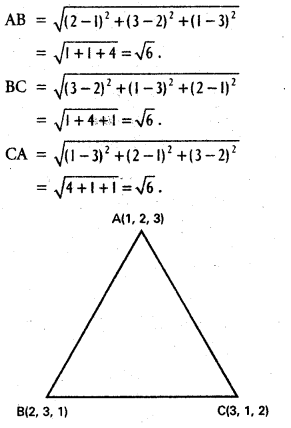
If H, G, S and I respectively denote orthocentre, centroid, circumcentre and in-centre of a triangle formed by the points (1, 2, 3), (2, 3, 1) and (3, 1, 2), then find H, G, S, I.
Solution:
Inter 1st Year Maths 1B Three Dimensional Coordinates Important Questions 8
Since AB = BC = CA, ABC is equilateral triangle.
We know that orthocentre, centroid, circumcentre and incentre of equilateral triangle are the same (i.e., all the four points coincide). Now, centroid .
G = (\(\frac{1+2+3}{3}\), \(\frac{2+3+1}{3}\), \(\frac{3+1+2}{3}\))
= (2, 2 ,2)
∴ H = (2, 2, 2), S = (2, 2, 2), I = (2, 2, 2).

Inter 1st Year Maths 1B Three Dimensional Coordinates Important Questions

Question 13.
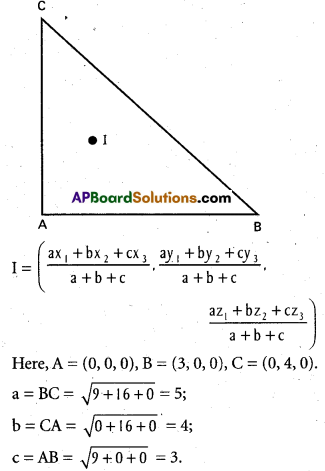
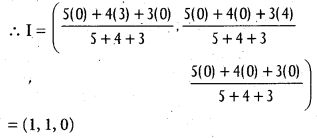
Find the incentre of the triangle formed by the points (0, 0, 0), (3, 0, 0) and (0, 4, 0).
Solution:
If a, b, care the side of the triangle ABC, where
A = (x1, y1, z1), B = (x2, y2, z2), C = (x3, y3, z3) are the vertices, then the in-centre of the triangle is given by
Inter 1st Year Maths 1B Three Dimensional Coordinates Important Questions 9
Inter 1st Year Maths 1B Three Dimensional Coordinates Important Questions 10

Question 14.
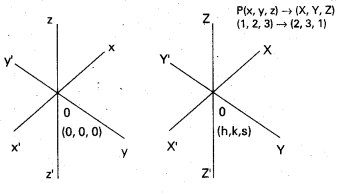
If the point (1, 2, 3) is changed to the point (2, 3, 1) through translation of axes, find the new origin.
Solution:
Let (x, y. z) be the co-ordinates of any point P w.r.t. the co-ordinate frame Oxyz and (X, Y, Z) be the co-ordinates of P w.r.t the new frame of reference O’XYZ.
Inter 1st Year Maths 1B Three Dimensional Coordinates Important Questions 11
Let O’ (h, k, s) be the new origin so that
x = X + h, y = Y + k and z = Z + s.
⇒ (h, k, s) (x – X, y – Y, z – Z)
⇒ (h, k, s) = (1 – 2, 2 – 3, 3 – 1)
= (-1, -1, 2).
∴ O’ = (-1, -1, 2) is the new origin.

Inter 1st Year Maths 1B Three Dimensional Coordinates Important Questions

Question 15.
Find the ratio in which the point P(5, 4, -6) divides the line segment joining the points (3, 2, -4) and B(9, 8, -10). Also, find the harmonic conjugate of P.
Solution:
Inter 1st Year Maths 1B Three Dimensional Coordinates Important Questions 12
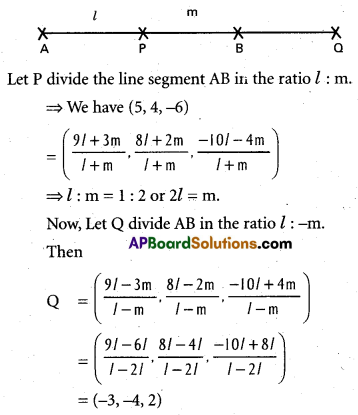
∴ Q(-3, -4, 2) is the harmonic conjugate of P(5, 4, -6).

Inter 1st Year Maths 1B Pair of Straight Lines Important Questions

Students get through Maths 1B Important Questions Inter 1st Year Maths 1B Pair of Straight Lines Important Questions which are most likely to be asked in the exam.

Intermediate 1st Year Maths 1B Pair of Straight Lines Important Questions

Question 1.
Does the equation x2 + xy + y2 = 0 represent a pair of lines?
Solution:
a = 1, b = 1, h = \(\frac{1}{2}\), ⇒ h2 = \(\frac{1}{4}\), ab = 1
h2 = ab < 0 i.e., h2 < ab.
∴ The given equation does not represent a pair of lines

Inter 1st Year Maths 1B Pair of Straight Lines Important Questions

Question 2.
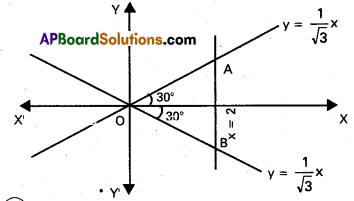
Find the nature of the triangle of formed by the lines x2 – 3y2 = 0 and x = 2.
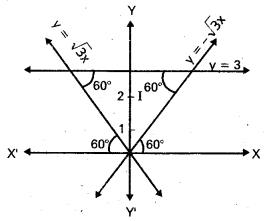
Solution:
Combined equation of OA and OB is
x2 – 3y2 = 0
(x + \(\sqrt{3}\) y) (x – \(\sqrt{3}\) y) = 0
x + \(\sqrt{3}\) y = 0 and x – \(\sqrt{3}\) y = 0
i.e., y = \(\frac{1}{\sqrt{3}}\) x, y = –\(\frac{1}{\sqrt{3}}\) x are equally inclined to the X—axis, the inclination being 30°
∴ ∠OAB – ∠OBA = 60°
∴ The triangle is equilateral
Inter 1st Year Maths 1B Pair of Straight Lines Important Questions 1

Question 3.
Find the centroid of the triangle formed by the lines 12x2 – 20xy + 7y2 = 0 and 2x – 3y + 4 = 0.
Solution:
Combined equation of OA and OB is
12x2 – 20xy + 7y2 = 0 ………………….. (1)
Equation of AB is 2x – 3y + 4 = 0
2x = 3y – 4
Substituted in (1)
3(3y – 4)2 – 1oy (3y – 4) + 7y2 = 0
3(9y2 + 16 – 24y) – 30y2 + 40y + 7y2 = 0
27y2 +48 – 72y – 30y2 + 40y + 7y2 = 0
4y2 – 32y + 48 = 0
y2 – 8y + 12 = 0
(y – 2) (y – 6) = 0 ⇒ y = 2 or 6
x = \(\frac{3 y-4}{2}\)
y = 2 ⇒ x = \(\frac{6-4}{2}\) = 1
y = 6 ⇒ x = \(\frac{18-4}{2}\) = 7
7 2
∴ Vertices and O (0, 0), A (1, 2), B( 7, 6)
Centroid of OAB is
(\(\frac{0+1+7}{3}\), \(\frac{0+2+6}{3}\)) = (\(\frac{8}{3}\), \(\frac{8}{3}\))

Inter 1st Year Maths 1B Pair of Straight Lines Important Questions

Question 4.
Prove that the lines represented by the equations x2 – 4xy + y2 = 0 and x + y = 3 form an equilateral triangle.
Solution:
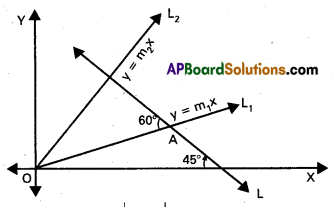
Since the straight line L: x + y = 3 makes 45° with the negative direction of the X-axis, none of the lines which makes 60° with the line L is vertical. If ‘m’ is the slope of one such straight line, then
Inter 1st Year Maths 1B Pair of Straight Lines Important Questions 2
\(\sqrt{3}\) = tan 60° = \(\left|\frac{m+1}{1-m}\right|\) and so, m satisfies the equation (m + 1)2 = 3(m – 1)2
(or) m2 – 4m + 1 = 0 …………………….. (1)
But the straight line having slope’m1 and passing through the origin is
y = mx ……………………. (2)
So the equation of the pair of lines passing through the origin and inclined at 60° with the line L is obtained by eliminating’m’ from the equations (1) and (2). Therefore the combined equation of this pair of lines is
(\(\frac{y}{x}\))2 – 4(\(\frac{y}{x}\)) + 1 = 0 (i.e.,) x2 – 4xy + y2 = 0
Which is the same as the given pair of lines. Hence, the given triad of lines form an equilateral triangle.

Question 5.
Show that the product of the perpendicular distances from a point (α, β) to the pair of straight lines ax2 + 2hxy + by2 = 0 is \(\frac{\left|a \alpha^{2}+2 h \alpha \beta+b \beta^{2}\right|}{\sqrt{(a-b)^{2}+4 h^{2}}}\). [May 11, 07; Mar. 07, 04]
Solution:
Let ax2 + 2hxy + by2 = (l1x + m1y) (l2x + m2y)
Then the separate equations of the lines represented by the equation
ax2 + 2hxy + by2 = 0 are
L1 : l1x + m1y = 0 and L2 : l1x + m1y = 0
Also, we have l1l2 = a; m1m2 = b and
l1m2 + l2m1 = 2h
d1 = length of the perpendicular from (α, β) to L1 = \(\frac{\left|l_{1} \alpha+\mathrm{m}_{1} \beta\right|}{\sqrt{l_{1}^{2}+\mathrm{m}_{1}^{2}}}\)
d2 = length of the perpendicular from (α, β) to L2 = \(\frac{\left|l_{2} \alpha+m_{2} \beta\right|}{\sqrt{l_{2}^{2}+m_{2}^{2}}}\)
Then, the product of the lengths of the perpendiculars from (α, β) to the given pair of lines = d1d2
= \(\frac{\left\|\left(l_{1} \alpha+m_{1} \beta\right)\left(l_{2} \alpha+m_{2} \beta\right)\right\|}{\sqrt{\left(l_{1}^{2}+m_{1}^{2}\right)\left(l_{2}^{2}+m_{2}^{2}\right)}}\)
= \(=\frac{\left|a \alpha^{2}+2 h \alpha \beta+b \beta^{2}\right|}{\sqrt{(a-b)^{2}+4 h^{2}}}\)

Inter 1st Year Maths 1B Pair of Straight Lines Important Questions

Question 6.
Let ax2 + 2hxy + by2 = 0 represent a pair of straight lines. Then show that the equation of the pair of straight lines.
i) Passing through (x0, y0) and parallel to the given pair of lines is
a(x – x0)2 + 2h(x – x0) (y – y0) + b(y – y0)2 = 0 and
ii) Passing through (x0, y0) and perpendicular to the given pair of lines is
b(x – x0)2 – 2h(x – x0) (y – y0) + a(y – y0)2 = 0
Solution:
Let ax2 + 2hxy + by2 = (l1x + m1y) (l2x + m2y).
Then the lines L1 and L2 are represented by the given equation are respectively
l1x + m1y = 0 and l2x + m2y = 0.
Also we have l1l2 = a, m1m2 = b and
l1m2 + l2m1 = 2h

(i) The straight lines passing through (x0, y0) and parallel to L1 and L2 are respectively
l1x + m1y = l1x0 + m1y0 (or)
l1(x – x0) + m1(y – y0) = 0 and
l2(x -x0) + m2(y – y0) = 0.
Therefore, their combined equation is
[l1(x – x0) + m1(y – y0)] [l2(x – x0)+ m2(y – y0)] = 0
(or) a(x – x0)2 + 2h(x – x0) (y – y0) + b(y – y0)2 = 0

(ii) The straight lines passing through (x0, y0) and perpendicular to the pair L1 and L2 are respectively.
m1x – l1y = m1x0 – l1y0 (or)
m1(x – x0) – l1(y – y0) = 0 and
m2(x – x0) – l2(y – y0) = 0.
Hence their combined equation is
[m1(x – x0) – l1(y – y0)] [m2(x – x0) – l2(y – y0)] = 0
(i.e.,) b(x – x0)2 – 2h(x – x0) (y – y0) + a(y – y0)2 = 0
[Note : The pair of lines passing through the origin and perpendicular to the pair of lines given by ax2 + 2hxy + by2 = 0 is bx2 – 2hxy + ay2 = 0].

Inter 1st Year Maths 1B Pair of Straight Lines Important Questions

Question 7.
Show that the area of the triangle formed by the lines ax2 + 2hxy + by2 = 0 and lx + my + n = 0 is \(\left|\frac{n^{2} \sqrt{h^{2}-a b}}{a m^{2}-2 h / m+b l^{2}}\right|\)
Solution:
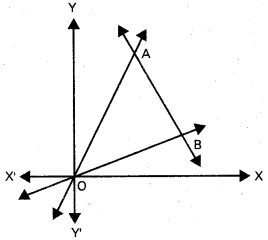
Let \(\overleftrightarrow{\mathrm{OA}}\) and \(\overleftrightarrow{\mathrm{OB}}\) be the pair of straight lines represented by the equation
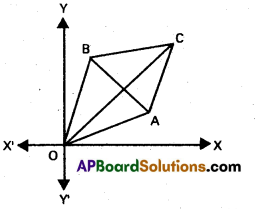
ax2 + 2hxy + by2 = 0 (see figure) and \(\overleftrightarrow{\mathrm{AB}}\) be the line lx + my + n = 0
Let ax2 + 2hxy + by2 = (l1x + m1y) (l2x + m2y) and\(\overleftrightarrow{\mathrm{OA}}\) and \(\overleftrightarrow{\mathrm{OB}}\) be the lines.
l1x + m1y = 0 and l2x + m2y = 0 respectively.
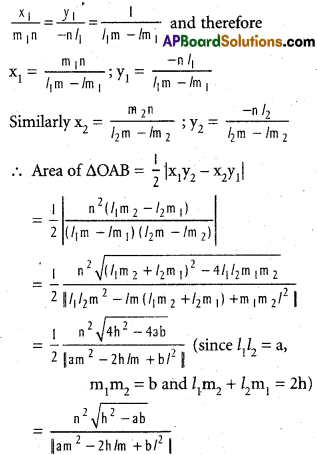
Inter 1st Year Maths 1B Pair of Straight Lines Important Questions 3
Let A = (x1, y1) and B = (x2, y2).
Then l1x1 + m1y1 = 0 and l1x1 + m1y1 + n = 0.
So, by the rule of cross-multiplication, we obtain
Inter 1st Year Maths 1B Pair of Straight Lines Important Questions 4

Question 8.
Two equal sides of an isosceles triangle are 7x – y + 3 = 0 and x + y – 3 = 0 and its third side passes through the point (1,0). Find the equation of the third side.
Solution:
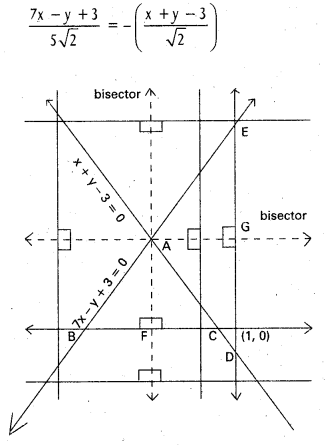
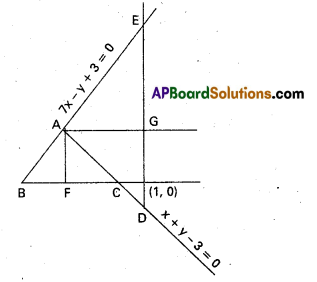
Let the lines 7x – y + 3 – 0 and x + y – 3 = 0 intersect at A. If we draw lines (not passing through A) perpendicular to each of the bisectors of the angles at A, we get isosceles triangles, equal sides being along the given lines.
(∆ABF ≅ ∆AFC and ∆ADG ≅ ∆AGE)
Of them, we require those triangles whose third sides pass through (1, 0).
The equations of the bisectors of the angles between 7x – y + 3 = 0 and x + y – 3 = 0 are
Inter 1st Year Maths 1B Pair of Straight Lines Important Questions 5
⇒ 7x – y + 3 = ± 5(x + y – 3)
⇒ x – 3y + 9 = 0 and 3x + y – 3 = 0.
The third sides will be those lines perpendicular to the bisectors and intersecting at (1, 0).
Inter 1st Year Maths 1B Pair of Straight Lines Important Questions 6
The side perpendicular to x – 3y + 9 = 0 and passing through (1, 0) is 3x + y – 3 =0. The other one is (x – 1) -3(y – 0) = 0 i.e., x – 3y – 1 = 0. Therefore 3x + y- 3 = 0 and x- 3y— 1 = 0 are the required ones. [In the Figure ∆ABC and ∆ADE are isosceles with \(\overline{B C}\) and \(\overline{D E}\) as third sides].

Question 9.
Find the angle between the straight lines represented by 2x2 + 5xy + 2y2 – 5x – 7y + 3 = 0.
Solution:
a = 2, b = 2, h = \(\frac{5}{2}\)
cos θ = \(\frac{|a+b|}{\sqrt{(a-b)^{2}+4 h^{2}}}=\frac{|2+2|}{\sqrt{(2-2)^{2}+4 \cdot \frac{25}{4}}}\) = \(\frac{4}{5}\)
θ = cos-1 (\(\frac{4}{5}\))

Question 10.
Find the equation of the pair of lines passing through the origin and parallel to the pair of lines 2x2 + 3xy – 2y2 – 5x + 5y – 3 = 0
Solution:
Equation of the given pair of lines is
2x2 + 3xy – 2y2 – 5x + 5y – 3 = 0
Equation of the pair of parallel lines passing through the origin is ax2 + 2hxy + by2 = 0 is 2x2 + 3xy – 2y2 = 0

Inter 1st Year Maths 1B Pair of Straight Lines Important Questions

Question 11.
Find the equation of the pair of lines passing through the origin and perpendicular to the pair of lines ax2 + 2hxy + by2 + 2gx + 2fy + c = 0
Solution:
Equation to the pair of lines parallel to the given lines and passing through the origin is ax2 + 2hxy + by2 = 0
Equation of the pair of lines perpendicular to the given lines and passing through the origin is bx2 – 2hxy + ay2 = 0

Question 12.
If x2 + xy – 2y2 + 4x – y + k = 0 represents a pair of straight lines, find k.
Solution:
a = 1, b = -2, c = k; f = –\(\frac{1}{2}\), g = 2, h = \(\frac{1}{2}\)
The condition is
abc + 2fgh – af2 – bg2 – ch2 = 0
2k + 2(-\(\frac{1}{2}\)) . 2\(\frac{1}{2}\) – 1.\(\frac{1}{4}\) + 2.\(\frac{4}{a}\) – k\(\frac{1}{4}\) = 0
-8k – 4 – 1 + 8 – k = 0
9k = 27 ⇒ k = 3

Question 13.
Prove that the equation 2x2 + xy – 6y2 + 7y – 2 = 0 represents a pair of straight lines.
Solution:
a = 2
b = -6
c = -2
f = \(\frac{7}{2}\)
g = 0
h = \(\frac{1}{2}\)
abc + 2fgh – af2 – bg2 – ch2
= 2(-6) (-2) + 2.\(\frac{7}{2}\) 0\(\frac{1}{2}\) – 2(\(\frac{7}{2}\))2 + 6.0 + 2.(\(\frac{1}{2}\))2
= 24 – \(\frac{49}{2}\) + \(\frac{1}{2}\) = 0
h2 – ab = \(\frac{1}{4}\) + 12 > 0,
g2 – ac = 0 + 4 = 4 > 0
f2 – bc = \(\frac{49}{4}\) – 12 = \(\frac{1}{4}\) > 0
The given equation represents a pair of line.

Inter 1st Year Maths 1B Pair of Straight Lines Important Questions

Question 14.
Prove that the equation 2x2 + 3xy – 2y2 – x + 3y – 1 = 0 represents a pair of perpendicular straight lines.
Solution:
a = 2
b = -2
c = -1
f = \(\frac{3}{2}\)
g = –\(\frac{1}{2}\)
h = \(\frac{3}{2}\)
abc + 2fgh – af2 – bg2 – ch2
= 2(-2) (-1) + 2.\(\frac{3}{2}\) (-\(\frac{1}{2}\)).\(\frac{3}{2}\) – 2(\(\frac{9}{4}\)) + 2.\(\frac{1}{4}\) + \(\frac{1.9}{2}\)
= 4.-\(\frac{9}{4}\) – 2.\(\frac{9}{4}\) + \(\frac{1}{2}\) + \(\frac{9}{4}\)
= \(\frac{9}{2}\) – \(\frac{9}{2}\) = 0
h2 – ab = \(\frac{9}{4}\) + 4 = \(\frac{25}{4}\) > 0,
g2 – ac = \(\frac{1}{4}\) + 2 > 0
f2 – bc = \(\frac{9}{4}\) – 2 = \(\frac{1}{4}\) > 0
a + b = 2 – 2 = 0
The given equation represents a pair of perpendicular line.

Question 15.
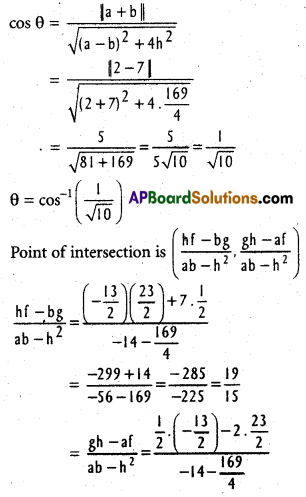
Show that the equation 2x2 – 13xy – 7y2 + x + 23y – 6 = 0 represents a pair of straight lines. Also find the angle between them and the co-ordinates of the point of intersection of the lines.
Solution:
Here a = 2
b = -7
c = -6
f = \(\frac{23}{2}\)
g = \(\frac{1}{2}\)
h = –\(\frac{13}{2}\)
abc + 2fgh – af2 – bg2 – ch2
= 2(-7) (-6) + 2.\(\frac{23}{2}\) . \(\frac{23}{2}\) . (-\(\frac{13}{2}\)) – 2\(\frac{529}{4}\) + 7.\(\frac{1}{4}\) + 6 . \(\frac{169}{4}\)
= \(\frac{1}{4}\) (336 – 299 – 1058 + 7 + 1014)
= \(\frac{1}{4}\) (1357 – 1357) = 0
h2 – ab = \(\frac{169}{4}\) + 14 > 0,
g2 – ac = \(\frac{1}{4}\) + 12 > 0,
f2 – bc = \(\frac{529}{4}\) – 42 > 0
The given equation represents a pair of lines
Inter 1st Year Maths 1B Pair of Straight Lines Important Questions 7
= \(\frac{-13-92}{-56-169}\) = \(\frac{-105}{-225}\) = \(\frac{7}{15}\)
Point of intersection is P (\(\frac{19}{15}\), \(\frac{7}{15}\))

Question 16.
Find that value of λ for which the equation λx2 – 10xy + 12y2 + 5x – 16y -3 = 0 represents a pair of straight lines.
Solution:
Here a = λ
b = 12
c = -3
f = -8
g = \(\frac{5}{2}\)
h = -5
The given equation represents a pair of lines
abc + 2fgh – af2 – bg2 – ch2 = 0
-36λ + 2(-8)\(\frac{5}{2}\) (-5) – λ . 64 – 12 . \(\frac{25}{4}\) + 3 . 25 = 0
-36λ + 200 – 64λ – 75 + 75 = 0
100λ = 200
⇒ λ = 2 ⇒ a = 2
h2 – ab = 25 – 24 = 1 > 0
f2 – bc = 64 + 36 = 100 > 0
g2 – ac = \(\frac{25}{4}\) + 6 = \(\frac{49}{4}\) > 0
∴ The given equation represents a pair of lines for λ = 2.

Inter 1st Year Maths 1B Pair of Straight Lines Important Questions

Question 17.
Show that die pairs of straight lines 6x2 – 5xy – 6y2 = 0 and 6x2 – 5xy – 6y2 + x + 5y – 1 = 0 form a square.
Solution:
H ≅ 6x2 – 5xy – 6y2 = (3x + 2y) (2x – 3y)
and S ≅ 6x2 – 5xy – 6y2 + x + 5y – 1
= (3x + 2y- 1) (2x – 3y + 1).
∴ H = 0 represents the lines 3x + 2y = 0 and 2x – 3y = 0 which are perpendicular and S = 0 represents the lines 3x + 2y – 1 = 0, 2x – 3y + 1 = 0 which are also perpendicular. These two pairs of perpendicular lines, therefore, determine a rectangle.
Also the distance between the pair of opposite sides 3x + 2y = 0 and 3x + 2y – 1 = 0 is \(\frac{1}{\sqrt{13}}\) and this is the same as the distance between the other pair of opposite sides 2x – 3y = 0 and 2x – 3y + 1 = 0 of the rectangle. Hence the rectangle is a square.

Question 18.
Show that the equation 8x2 – 24xy + 18y2 – 6x + 9y – 5 = 0 represents a pair of parallel straight lines and find the distance between them.
Solution:
S = 8x2 – 24xy + 18y2 – 6x + 9y – 5
= 2(2x – 3y)2 – 3(2x – 3y) – 5
= [2(2x – 3y) – 5] [(2x – 3y) + 1]
= (4x – 6y – 5) (2x – 3y + 1) = 0
The lines are 4x – 6y – 5 = 0 and 2x – 3y + 1 = 0
\(\frac{a_{1}}{a_{2}}\) = \(\frac{4}{2}\), \(\frac{b_{1}}{b_{2}}\) = \(\frac{-6}{-3}\) = 2
\(\frac{a_{1}}{a_{2}}\) = \(\frac{b_{1}}{b_{2}}\)
∴ The given equation represents a pair of parallel lines.
Distance between the lines
= 2\(\sqrt{\frac{g^{2}-a c}{a(a+b)}}\) = 2\(\sqrt{\frac{9+40}{8(8+18)}}\) = \(\frac{2.7}{2 \sqrt{52}}\) = \(\frac{7}{\sqrt{52}}\)

Inter 1st Year Maths 1B Pair of Straight Lines Important Questions

Question 19.
If the pair of lines represented by ax2 + 2hxy + by2 = 0 and ax2 + 2hxy + by2 + 2gx + 2fy + c = 0 form a rhombus, prove that (a – b) fg + h(f2 – g2) = 0.
Solution:
Combined equation of OA and OB is ax2 + 2hxy + by2 = 0
Combined equation of AC, BC is ax2 + 2hxy + by2 + 2gx + 2fy + c = 0
Point of intersection is C(\(\frac{h f-b g}{a b-h^{2}}\), \(\frac{g h-a f}{a b-h^{2}}\))
Equation of the diagonal is y = \(\frac{g h-a f}{h f-b g}\) . x
y(hf – bg) = x(gh – af)
(gh – af) x – (hf- bg) y = 0
Inter 1st Year Maths 1B Pair of Straight Lines Important Questions 8
A and B are points on both this pair of lines.
Combined equation of AB is
2gx + 2fy + c = 0
OACB is a rhombus
OC and AB are perpendicular
2g(gh – af) – 2f(.hf – bg) = 0
hg2 – afg – hf2 + bfg = 0
(a – b) fg + h(f2 – g2) = 0

Question 20.
If two of the sides of a parallelogram are represented by ax2 + 2hxy + by2 = 0 and px + qy = 1 is one of its diagonals, prove that the other diagonal is y(bp – hq) = x(aq – hp).
Solution:
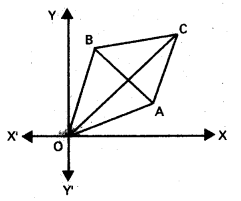
Let OACB be the parallelogram two of whose sides \(\overleftrightarrow{O A}\), \(\overleftrightarrow{O B}\) are represented by the equation H ≡ ax2 + 2hxy + by2 = 0. Since the other pair of sides \(\overleftrightarrow{A C}\) and \(\overleftrightarrow{B C}\) are respectively parallel to \(\overleftrightarrow{O B}\) and \(\overleftrightarrow{O A}\), their combined equation will be of the form S ≡ ax2 + 2hxy + by2 + 2gx + 2fy + c = 0. Then the equation of the diagonal \(\overleftrightarrow{A B}\) is 2gx + 2fy + c = 0. But this line is given to be px + qy = 1 (or) -pcx – qcy + c = 0 where c ≠ 0
Inter 1st Year Maths 1B Pair of Straight Lines Important Questions 9

Inter 1st Year Maths 1B Pair of Straight Lines Important Questions

Therefore 2g = – pc, 2f = – qc …………….. (1)
The vertex C of the parallelogram = (\(\frac{h f-b g}{a b-h^{2}}\), \(\frac{g f-a f}{a b-h^{2}}\))
∴ Equation of the diagonal \(\overleftrightarrow{O C}\) is
(gh – af) x = (hf- bg)y
i.e., c(-ph + aq) x = c(-hq + bp)y (By 1)
(or) (aq – hp) x = (bp – hq) y (since c ≠ 0)

Inter 1st Year Maths 1B The Straight Line Important Questions

Students get through Maths 1B Important Questions Inter 1st Year Maths 1B The Straight Line Important Questions which are most likely to be asked in the exam.

Intermediate 1st Year Maths 1B The Straight Line Important Questions

Question 1.
Find the equation of the straight line passing through the point (2, 3) and making non-zero intercepts on the axes of co-ordinates whose sum is zero. [Mar 12]
Solution:
Equation of the line in the intercept form is
\(\frac{x}{a}\) + \(\frac{y}{b}\) = 1
Given b = -a
Equation of the line is \(\frac{x}{a}\) – \(\frac{y}{a}\) = 1
⇒ x – y = a
This line passes through (2, 3)
2 – 3 = a ⇒ a = -1
Equation of the line is
x – y = -1 or x – y + 1 = 0

Inter 1st Year Maths 1B The Straight Line Important Questions

Question 2.
Find the equation of the straight line passing through the points (at12, 2at1 ) and (at22, 2at1 ).
Solution:
Equation of the given points.
(x – x1) (y – y2) = (y – y1) (x1 – x2)
( x -at12) (2at1 – 2at2)
= (y – 2at1) (at, — at2)
(x – at12) .2a(t1 – t2) = (y – 2at1) a. (t12 – t22)
2x – 2at12 = y(t1 + t2) – 2at12 + 2at1t2 = 0
2x – (t1 + t2)y + 2at1t2 = 0

Question 3.
Find the equation of the straight line passing through A (-1, 3) and i) parallel ii) perpendicular to the straight line passing through B(2, – 5) and C(4, 6). [Mar 11]
Solution:
Slope of BC = \(\frac{-5-6}{2-4}\) = \(\frac{-11}{-2}\) = \(\frac{11}{2}\)
i) The required line is parallel to BC and passes through A(- 1, 3)
Equation of the parallel line is
y – 3 = \(\frac{11}{2}\)(x + 1)
2y – 6 = 11x + 11
11x – 2y + 17 = 0

ii) The required line is perpendicular to BC.
Slope of the required line = –\(\frac{1}{m}\) = –\(\frac{2}{11}\)
This line passes through A (-1, 3)
Equation of the required line is
y – 3 = –\(\frac{2}{11}\)(x + 1)
11y – 33 = -2x – 2
2x + 11y – 31 = 0

Inter 1st Year Maths 1B The Straight Line Important Questions

Question 4.
Prove that the points (1, 11), (2, 15) and (-3, -5) are collinear and find the equation of the straight line containing them.
Solution:
A(1, 11), B(2, 15) and C (-3, -5) are the given points.
Equation of AB is
(y – y1) (x1 – x2) = (x – x1) (y1 – y2)
(y – 11) (1 -2) = (x – 1) (11 – 15)
-(y – 11) = -4 (x – 1)
-y + 11 = – 4x + 4
4x – y + 7 = 0
C (-3, -5) .
4x – y + 7 = 4(-3) + 5 + 7
= -12 + 12 = 0
C lines on AB ⇒ A, B, C are collinear.
Equation of the line containing them is 4x – y + 7 = 0

Question 5.
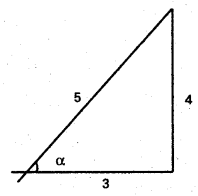
A straight line passing through A(1, -2) makes an angle tan-1 \(\frac{4}{3}\) with the positive direction of the X – axis in the anticlock-wise sense. Find the points on the straight line whose distance from A is 5.
Solution:
Inter 1st Year Maths 1B The Straight Line Important Questions 1
Given α = tan-1 \(\frac{4}{3}\) ⇒ tan α = \(\frac{4}{3}\)
Inter 1st Year Maths 1B The Straight Line Important Questions 2
cos α = \(\frac{3}{5}\), sin α = \(\frac{4}{5}\)
(x1, y1) = (1, -2) = x1 = 1, y1 = -2
Case i) .
r = 5
x = x1 + r cos α = 1 + 5 . \(\frac{4}{5}\) = 1 + 4 = 5
y = y1 + r sin α= – 2 + 5 . \(\frac{3}{5}\) = -2 + 3 = 1
Co-ordinates of B are (5, 1)

Case ii) r = -5
x = x1 + r cos α = 1 – 5 . \(\frac{4}{5}\) = 1 – 4 = -3
y = y1 + r sin α = -2 – 5 . \(\frac{3}{5}\) = -2 – 3 = -5
Co-ordinates of C are (- 3, – 5)

Question 6.
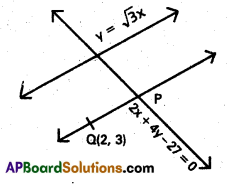
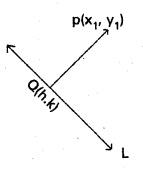
A straight line parallel to the line y = \(\sqrt{3} x\) passes through Q(2, 3) and cuts the line 2x + 4y – 27 = 0 at P. Find the length of PQ.
Solution:
PQ is parallel to the straight line y = \(\sqrt{3} x\)
tan α = \(\sqrt{3}\) = tan 60°
α = 60°
Q(2, 3) is a given point
Inter 1st Year Maths 1B The Straight Line Important Questions 3
Co-ordinates of any point P are
(x1 + r cos α, y1 + r sin α)
(2 + r cos 60°, 3 + r sin 60°)
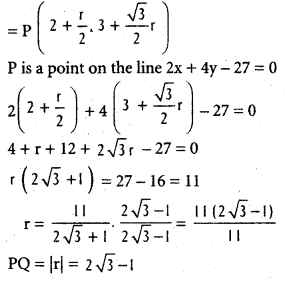
Inter 1st Year Maths 1B The Straight Line Important Questions 4

Inter 1st Year Maths 1B The Straight Line Important Questions

Question 7.
Transform the equation
3x + 4y+ 12 = 0 into
i) slope—intercept form
ii) Intercept form and
in) normal form
Solution:
The given equation is 3x + 4y + 12=0
i) Slope-intercept form
4y = -3x – 12
y = (-\(\frac{3}{4}\))x + (-3)
Slope = –\(\frac{3}{4}\) , y – intercept = -3.

ii) Intercept form
-3x – 4y = 12
–\(\frac{3 x}{12}\) – \(\frac{4 y}{12}\) = 1
\(\frac{x}{(-4)}\) + \(\frac{y}{(-3)}\) = 1
x – intercept = -4, y – intercept = -3

iii) Normal form
-3x – 4y = 12
Dividing with \(\sqrt{9+16}\) = 5
(-\(\frac{3}{5}\))x + (-\(\frac{4}{5}\))y = \(\frac{12}{5}\)
Let cos α = \(\frac{-3}{5}\) and sin α = –\(\frac{4}{5}\)
p = \(\frac{12}{5}\) so that
x cos α + y sin α = p
α lies in third quadrant so that
α = π + tan-1(\(\frac{4}{3}\))

Question 8.
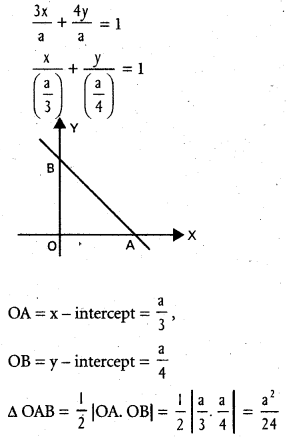
If the area of the triangle formed by the straight line x = 0, y = 0 and 3x + 4y = a (a > 0) is 6, find the value of a. [May 11]
Solution:
Equation of the line is 3x + 4y = a
Inter 1st Year Maths 1B The Straight Line Important Questions 5
Given \(\frac{a^{2}}{2 a}\) = 6 ⇒ a2 = 144
a = ±12
But a > 0
a = 12

Inter 1st Year Maths 1B The Straight Line Important Questions

Question 9.
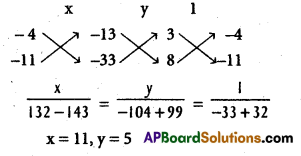
Find the value of k, if the lines 2x – 3y + k = 0, 3x – 4y -13 = 0 and 8x – 11y – 33 = 0 are concurrent.
Solution:
Let L1, L2, L3 be the straight lines whose equations are respectively
2x – 3y + k = 0 ………………. (1)
3x – 4y – 13 = 0 ……………….. (2)
8x – 11y – 33 = 0 ………………. (3)
Solving (2) and (3) for x and y
Inter 1st Year Maths 1B The Straight Line Important Questions 6
Point of the lines (2) and (3) is (11, 5)
The given lines L1, L2, L3 are concurrent
∴ L1 contain (11, 5)
∴ 2(11) – 3(5) + k = 0
k = -7

Question 10.
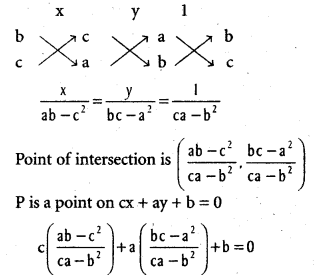
If the straight lines ax + by + c = 0, bx + cy + a = 0 and cx + ay + b = 0 are concurrent, then prove that a3 + b3 + c3 = 3abc.
Solution:
The equation of the given lines are
ax + by +c = 0 ………………… (1)
bx + cy + a = 0 ……………….. (2)
cx + ay + b = 0 ……………….. (3)
Solving (1) and (2) point of intersection is got by
Inter 1st Year Maths 1B The Straight Line Important Questions 7
c(ab – c2) +a (bc – a2) + b(ca – b2) = 0
abc – c3 + abc – a3 + abc – b3 = 0
∴ a3 + b3 + c3 = 3abc.

Question 11.
A variable straight line drawn through the point of intersection of the straight lines \(\frac{x}{a}\) + \(\frac{y}{b}\) = 1 and \(\frac{x}{b}\) + \(\frac{y}{a}\) = 1 meets the co-ordinate axes at A and B. Show that the locus of the mid point of \(\overline{\mathrm{AB}}\) is 2(a + b) xy = ab(x + y)
Solution:
Equations of the given lines are \(\frac{x}{a}\) + \(\frac{y}{b}\) = 1
and \(\frac{x}{b}\) + \(\frac{y}{a}\) = 1
Solving the point of intersection P(\(\frac{a b}{a+b}\), \(\frac{a b}{a+b}\))
Q (x0, y0) is any point on the locus
⇔ The line with x – intercept 2x0, y – intercept 2y0, passes through P
⇔ P lies on the straight line \(\frac{x}{2 x_{0}}\) + \(\frac{y}{2 y_{0}}\) = 1
i.e., \(\frac{a b}{a+b}\)(\(\frac{1}{2 x_{0}}\) + \(\frac{1}{2 y_{0}}\)) = 1
⇒ \(\frac{a b}{a+b}\) . \(\frac{x_{0}+y_{0}}{2 x_{0} y_{0}}\) = 0
ab(x0 + y0) = 2(a + b) x0y0
Q(x0, y0) lies on the curve
2(a + b)xy = ab(x + y)
Locks the mid of point of
AB is 2(a + b)xy = ab(x +y)

Inter 1st Year Maths 1B The Straight Line Important Questions

Question 12.
If a, b, c are in arithmetic progression, then show that the equation ax + by + c = 0 represents a family of concurrent lines and find the point of concurrency.
Solution:
a, b, c are in A.P.
2b = a + c
a – 2b + c = 0
a.1 + b(-2) + c = 0
Each number of family of straight lines
ax + by + c = 0
passes through the fixed point (1,-2)
∴ Set of lines ax + by + c = 0 for parametric values of a, b and c is a family of concurrent lines.
∴ Point of concurrency is (1, -2).

Question 13.
Find the value of k, if the angle between the straight lines 4x – y + 7 = 0 and kx – 5y – 9 = 0 is 45°.
Solution:
Inter 1st Year Maths 1B The Straight Line Important Questions 8
Squaring and cross multiplying
2(4k + 5)2 = 17(k2 + 25)
2(16k2 + 40k + 25) = 17k2 + 425
32k2 + 80k + 50 = 17k2 + 425
15k2 + 80k – 375 = 0
3k2 + 16k – 75 = 0
(k – 3) (3k + 25) = 0
k = 3 or -25/3

Question 14.
Find the equation of the straight line passing through (x0, y0) and (i) parallel (ii) perpendicular to the straight line
ax + by + c = 0.
Solution:
Equation of the given line is ax + by + c = 0
i) Equation of the parallel line is ax + by = k ………………… (1)
This line passes through P(x0, y0) ⇒ ax0 + by0 = k ……………… (2)
Subtracting (2) from (1) equation of the required line is a(x – x0) + b(y – y0) = 0

ii) Equation of the perpendicular line is bx – ay = k.
This line passes through P(x0, y0) ⇒ bx0 – ay0 = k
Subtracting, equation of the required line is b(x – x0) – a(y – y0) = 0

Inter 1st Year Maths 1B The Straight Line Important Questions

Question 15.
Find the equation of the straight line perpendicular to the line 5x – 2y = 7 and passing through the point of intersection of the lines 2x + 3y = 1 and 3x + 4y = 6.
Solution:
Given lines are L1 = 2x + 3y – 1 = 0
L2 = 3x + 4y – 6 = 0
Equation of the line passing through the intersection of L1 = 0, L2 = 0 is
L1 + kL2 = 0
(2x + 3y – 1) + k(3x + 4y – 6) = 0
(2 + 3k)x + (3 + 4k)y – (1 + 6k) = 0 …………………. (1)
This line is perpendicular to 5x – 2y = 7 ………………… (2)
a1a2 + b1b2 = 0
5(2 + 3k) – 2(3 + 4k) = 0
10 + 15k – 6 – 8k = 0
7k = -4 ⇒ k = – 4/7
Substituting in (1) equation of the required lines
(2 – \(\frac{12}{7}\))x + (3 – \(\frac{16}{7}\))x – (1 – \(\frac{24}{7}\)) = 0
\(\frac{2}{7}\)x + \(\frac{5}{7}\)y + \(\frac{17}{7}\) = 0 ⇒ 2x + 5y + 17 = 0

Question 16.
If 2x – 3y – 5 = 0 is the perpendicular bi-sector of the line segment joining (3, – 4) and (α, β) find α + β.
Solution:
(α, β) is the reflection of (3, -4) is the line
2x – 3y – 5 = 0
\(\frac{\alpha-3}{2}\) = \(\frac{\beta+4}{-3}\) = \(\frac{-2(6+12-5)}{4+9}\) = -2
α – 3 = -4 ⇒ α = -1
β + 4 = 6 ⇒ β = 2
α + β = -1 + 2 = 1

Inter 1st Year Maths 1B The Straight Line Important Questions

Question 17.
If the four straight lines ax + by + p = 0, ax + by + q = 0, cx + dy + r = 0 and cx + dy + s = 0 form a parallelogram, show that the area of the parallelogram so formed is \(\left|\frac{(p-a)(r-s)}{b c-a d}\right|\).
Solution:
Let L1, L2, L3, L4 be the lines given by
L1 = ax + by + p = 0
L2 = ax + by + q = 0
L3 = cx + dy + r = 0
L4 = cx + dy + s = 0
L1 and L2 are parallel: L3 and L4 are parallel
Area of the parallelogram = \(\frac{\mathrm{d}_{1} \mathrm{~d}_{2}}{\sin \theta}\)
d1 = distance between L1 and L2 = \(\frac{|p-a|}{\sqrt{a^{2}+b^{2}}}\)
d2 = distance between L3 and L4 = \(\frac{|r-s|}{\sqrt{c^{2}+d^{2}}}\)
Inter 1st Year Maths 1B The Straight Line Important Questions 9

Question 18.
The hypotenuse of a right angled isosceles triangle has its ends at the points (1, 3) and (-4, 1). Find the equations of the legs of the triangle.
Sol:
LetA =(1, 3)and B = (-4, 1) and ABC b a right isosceles triangle with \(\stackrel{\leftrightarrow}{A B}\) as hypotenuse.
We require, therefore, the equations of
\(\stackrel{\leftrightarrow}{A C}\) and \(\stackrel{\leftrightarrow}{B C}\)
Slope of \(\stackrel{\leftrightarrow}{A B}\) is \(\frac{1-3}{-4-1}\) = \(\frac{2}{5}\)
Since the slope of \(\stackrel{\leftrightarrow}{A B}\) is \(\), neither \(\frac{2}{5}\) nor \(\stackrel{\leftrightarrow}{A C}\) is vertical.
Inter 1st Year Maths 1B The Straight Line Important Questions 10
Taking the slope of \(\stackrel{\leftrightarrow}{A C}\) as \(\frac{7}{3}\), the slope of \(\stackrel{\leftrightarrow}{B C}\) would be –\(\frac{3}{7}\). Therefore, the equations of \(\stackrel{\leftrightarrow}{A C}\) and \(\stackrel{\leftrightarrow}{B C}\) are respectively.
y – 3 = \(\frac{7}{3}\) (x – 1) and y – 1 = – \(\frac{3}{7}\) (x + 4),
which become 7x – 3y + 2 = 0 and 3x + 7y + 5 = 0
If the lines drawn through A and B respectively parallel to \(\stackrel{\leftrightarrow}{B C}\) and \(\stackrel{\leftrightarrow}{A C}\) meet at D, then ∆ABD is also right isosceles, having \(\stackrel{\leftrightarrow}{A B}\) as its hypotenuse.
Therefore, the equations of \(\stackrel{\leftrightarrow}{A D}\) and \(\stackrel{\leftrightarrow}{B D}\) are respectively,
3(x – 1) + 7(y – 3) = 0 and 7(x + 4) – 3(y – 1) = 0
⇒ 3x + 7y – 24 = 0 and 7x – 3y + 31 = 0.
Therefore, the two pairs of legs required are
7x – 3y + 2 = 0, 3x + 7y + 5 = 0 and
3x + 7y – 24 = 0, 7x – 3y + 31 = 0.
Note : ADBC is square.

Inter 1st Year Maths 1B The Straight Line Important Questions

Question 19.
A line is such that its segment between the lines 5x – y + 4 = 0 and 3x + 4y – 4 = 0 is . bisected at the point (1, 5). Obtain its equation.
Solution:
Let the required line meet 3x + 4y – 4 = 0 at A and 5x – y + 4 = 0 at B, so that AB is the segment between the given lines, with its mid-point at C = (1, 5).
The equation 5x – y + 4 = 0 can be written as
y = 5x + 4 so that any point on \(\stackrel{\leftrightarrow}{B X}\) is (t, 5t + 4) for all real t.
∴ B = (t, 5t + 4) for some t. Since (1, 5) is the mid-point of \(\stackrel{\leftrightarrow}{A B}\)
A = [2 – t, 10 – (5t + 4)]
= [2 – t, 6 – 5t]
Since A lies on 3x + 4y – 4 = 0,
3(2 – 1) + 4(6 – 5t) – 4 = 0
⇒ -23t + 26 = 0
⇒ t = \(\frac{26}{23}\)
Inter 1st Year Maths 1B The Straight Line Important Questions 11
equation of \(\stackrel{\leftrightarrow}{A B}\) is y – 5 = \(\frac{107}{3}\) (x – 1)
⇒ 3y – 15 = 107x – 107
⇒ 107x – 3y – 92 = 0.

Question 20.
An equilateral triangle has its incentre at the origin and one side as x + y – 2 = 0. Find the vertex opposite to x + y – 2 = 0.
Solution:
Let ABC be the equilateral triangle and
x + y – 2 = 0 represent side \(\stackrel{\leftrightarrow}{B C}\).
Since O is the incentre of the triangle, \(\stackrel{\leftrightarrow}{A D}\) is the bisector of ∠BAC .
Since the triangle is equilateral, \(\stackrel{\leftrightarrow}{A D}\) is the perpendicular bisector of \(\stackrel{\leftrightarrow}{B C}\).
Since O is also the centroid, AO : OD = 2 : 1. [The centroid, circumcentre incentre and orthocentre coincide]
Let D = (h, k).
Since D is the foot of the perpendicular from O onto \(\stackrel{\leftrightarrow}{B C}\), D is given by
Inter 1st Year Maths 1B The Straight Line Important Questions 12
∴ x1 = -2, y1 = -2.
∴ A = (-2, -2), the required vertex.

Inter 1st Year Maths 1B The Straight Line Important Questions

Question 21.
Find the orthocentre of the triangle whose vertices are (-5,-7) (13, 2) and (-5, 6)
Solution:
Let A(-5, -7), B(13,2) and C (-5, 6) be the vertices of a triangle. Let \(\stackrel{\leftrightarrow}{A D}\) be the perpendicular drawn from A to \(\stackrel{\leftrightarrow}{B C}\) and \(\stackrel{\leftrightarrow}{B E}\) be the perpendicular drawn from B to \(\stackrel{\leftrightarrow}{A C}\).
Inter 1st Year Maths 1B The Straight Line Important Questions 13
Now slope of \(\stackrel{\leftrightarrow}{B C}\) = \(\frac{6-2}{-5-13}\) = \(\frac{-2}{9}\)
Since \(\stackrel{\leftrightarrow}{A D}\) ⊥ \(\stackrel{\leftrightarrow}{B C}\) , slope of \(\stackrel{\leftrightarrow}{A D}\) = \(\frac{9}{2}\) and so, the equation of \(\stackrel{\leftrightarrow}{A D}\) is
9x – 2y = – 45 + 14 = -31 ………………… (1)
Equation of \(\stackrel{\leftrightarrow}{A C}\) is x = -5 which is a vertical line and therefore equation of \(\stackrel{\leftrightarrow}{B E}\) is y = 2. ……………… (2)
Point of intersection of the lines (1) and (2) is (-3, 2) which is the orthocentre of ∆ ABC.

Question 22.
If the equations of the sides of a triangle are 7x + y – 10 = 0, x – 2y + 5 = 0 and x + y + 2 = 0, find the orthocentre of the triangle.
Solution:
Let ∆ ABC be the given triangle
Let the equations x – 2y + 5 = 0 ……………… (1)
7x + y – 10 = 0 ……………… (2)
and x + y + 2 = 0 ……………….. (3)
represent the sides \(\overleftrightarrow{\mathrm{AB}}\), \(\overleftrightarrow{\mathrm{BC}}\), and \(\overleftrightarrow{\mathrm{CA}}\)
Inter 1st Year Maths 1B The Straight Line Important Questions 14
Let \(\overleftrightarrow{\mathrm{AD}}\) and \(\overleftrightarrow{\mathrm{BE}}\) be the altitudes drawn from A and B respectively to the sides \(\overleftrightarrow{\mathrm{BC}}\) & \(\overleftrightarrow{\mathrm{CA}}\)
Solving the equations (1) and (3), we obtain A =(-3,1).
Since \(\overleftrightarrow{\mathrm{AD}}\) ⊥ \(\overleftrightarrow{\mathrm{BC}}\), the equations of \(\overleftrightarrow{\mathrm{AD}}\) is
x – 7y = -3 – 7 = -10 …………………… (4)
Solving the equation (1) and (2), we obtain B = (1, 3).
Since \(\overleftrightarrow{\mathrm{BE}}\) ⊥ \(\overleftrightarrow{\mathrm{AC}}\) , the equation of BE is
x – y = 1 – 3 = -2 …………… (5)
Point of intersection of the lines (4) and (5) is H(\(\frac{-2}{3}\), \(\frac{4}{3}\)) which is the orthocentre of ∆ ABC.

Inter 1st Year Maths 1B The Straight Line Important Questions

Question 23.
Find the circumcentre of the triangle whose vertices are (1, 3), (-3, 5) and (5, -1).
Solution:
Let the vertices of the triangle be
A(1, 3), B(-3, 5) and (5,-1).
The midpoints of the sides \(\overline{\mathrm{BC}}\), \(\overline{\mathrm{CA}}\) are respectively D(1, 2) and E(3, 1).
Let S be the point of intersection of the perpendicular bisectors of the sides \overline{\mathrm{BC}} and \overline{\mathrm{CA}}
Inter 1st Year Maths 1B The Straight Line Important Questions 15
Since the slope of \(\overleftrightarrow{\mathrm{BC}}\) = \(\frac{5+1}{-3-5}\) = \(\frac{-3}{4}\), the slope \(\overleftrightarrow{\mathrm{SD}}\) is \(\frac{4}{3}\) and therefore its equation is 4x – 3y = 4 – 6 = -2 …………….. (1)
Slope of \(\overleftrightarrow{\mathrm{AC}}\) = \(\frac{3+1}{1-5}\) = -1 ⇒ Slope of –\(\sqrt{3x}\) = 1
∴ Equation of \(\overleftrightarrow{\mathrm{SE}}\) is x – y = 3 – 1 = 2 ………………….. (2),
Solving the equations (1) and (2),we obtain S = (-8, -10) which is the circumcentre of ∆ ABC.

Question 24.
Find the circumcentre of the triangle whose sides are 3x – y – 5 = 0, x + 2y – 4 = 0 and 5x + 3y + 1 = 0. [May 11, 05; Mar. 06]
Solution:
Let the given equations 3x – y – 5 = 0, x + 2y – 4 = 0 and 5x + 3y + 1 = 0 represent the sides \(\overleftrightarrow{\mathrm{BC}}\), \(\overleftrightarrow{\mathrm{CA}}\) and \(\overleftrightarrow{\mathrm{AB}}\) respectively of ∆ ABC.
Solving the above equations two by two, we obtain the vertices A(-2, 3), B(1, -2) and (2, 1) of the given triangle.
The midpoints of the sides \(\overline{\mathrm{BC}}\) and \(\overline{\mathrm{CA}}\) are respectively D = (\(\frac{3}{2}\), \(\frac{-1}{2}\)) and E = (0, 2).
Inter 1st Year Maths 1B The Straight Line Important Questions 16
Equation of \(\overleftrightarrow{\mathrm{SD}}\) the perpendicular bisector of \(\overline{\mathrm{BC}}\) is x + 3y = 0 and the equation of \(\overleftrightarrow{\mathrm{SE}}\) the perpendicular bisector of \(\overline{\mathrm{AC}}\) is 2x – y + 2 = 0. Solving these two equations, we obtain the point of intersection of the lines \(\overleftrightarrow{\mathrm{SD}}\) and \(\overleftrightarrow{\mathrm{SE}}\) which is S(\(\frac{-6}{7}\), \(\frac{2}{7}\)) the circumcentre of ∆ ABC.

Inter 1st Year Maths 1B The Straight Line Important Questions

Question 25.
Find the incentre of the triangle formed by the straight lines y = \(\sqrt{3}\)x, y = –\(\sqrt{3}\)x and y = 3.
Solution:
Inter 1st Year Maths 1B The Straight Line Important Questions 17
The straight lines y = \(\sqrt{3x}\) and y = –\(\sqrt{3x}\) respectively make angles 60° and 120° with the positive direction of X – axis.
Since y = 3 is a horizontal line, the triangle formed by the three given lines is equilateral. So in-centre is same and centroid.
Vertices of the triangle and O(0, 0), A(\(\sqrt{3}\), 3) and D(\(\sqrt{3}\), 3).
∴ Incentre is (\(\frac{0+\sqrt{3}-\sqrt{3}}{3}\), \(\frac{0+3+3}{3}\)) = (0, 2)

Question 26.
Find the equation of the straight line whose distance from the origin is 4, If the normal ray from the origin to the straight line makes an angle of 135° with the positive direction of the x-axis.
Solution:
The equation of the given line is
x cos α + y sin α = p where p = 4 and α = 135°
∴ x(\(\frac{-1}{\sqrt{2}}\)) + y(\(\frac{1}{\sqrt{2}}\)) = 4 ⇒ or x – y + 4\(\sqrt{2}\) = 0

(i). Transform the equation x + y + 1 = 0 in to normal from.
Solution:
x + y + 1 = 0
⇔ (\(\frac{-1}{\sqrt{2}}\))n + (\(\frac{-1}{\sqrt{2}}\)) y = \(\frac{1}{\sqrt{2}}\)
⇔ x cos \(\frac{5\pi}{42}\) + y sin \(\frac{5\pi}{4}\) = \(\frac{1}{\sqrt{2}}\)
Hence the normal form of the equation of the given straight line is x cos \(\frac{5\pi}{4}\) + y sin \(\frac{5\pi}{4}\) = \(\frac{1}{\sqrt{2}}\) and the distance of the line from the origin is = \(\frac{1}{\sqrt{2}}\)

ii) A straight line passing through A(1, -2) makes and angle Tan-1\(\frac{4}{3}\) with the positive direction of the x – axis in the anti-clock wise sense. Find the points of the straight line whose distance from A is 5.
Solution:
The paramatic equation of the lines A (1, -2)
Slope is \(\frac{4}{3}\) (∵ tan θ = \(\frac{4}{3}\))
are x = 1 + r cos θ = 1 + r(\(\frac{3}{5}\)) and y
= -2 + r sinθ
= -2 + r (\(\frac{4}{5}\))
The points on the above line a + a distance of (r) = 5 correspond to r = ±5 in the above equation and are
∴ (4, 2) and (-2, -6)

Inter 1st Year Maths 1B The Straight Line Important Questions

Question 27.
Trans form the equation 3x + 4y + 12 = 0 in to (i) slope – intercept from (ii) intercept form (iii) normal form.
Solution:
(i) slop – intercept form
3x + 4y + 12 = 0
⇔ 4y = -3x – 12
⇔ y = (\(\frac{-3}{4}\)) x + (-3)
∴ Slope = (\(\frac{-3}{4}\)) and y – intercept = -3,

ii) Intercept form :
3x = 4y + 12 = 0
⇔ \(\frac{-3y}{12}\) – \(\frac{-4y}{12}\) = 1
⇔ \(\frac{x}{(-4)}\) + \(\frac{y}{(-3)}\) = 1
∴ x-intercept of the line is -4, and tan y-intercept is -3.

iii) Normal form
3x = 4y + 12 = 0
⇔ -3x + -4y – 12 = 0
⇔ (\(\frac{-3}{5}\))x + (\(\frac{-4}{5}\))y = \(\frac{12}{5}\)
⇔ x cos α + y sin α = p ⇒ p\(\frac{12}{5}\) and cos α = \(\frac{-3}{5}\), sin α = \(\frac{-4}{5}\) determine the angle α in (0, 2π).

Question 28.
Find the angle between the lines 2x + y + 4 = 0 and y – 3x = 7.
Solution:
The angle between the given lines
= cos-1 \(\frac{-6+1}{\sqrt{5 \times 10}}\)
= cos-1 [latex]\frac{5}{\sqrt{2}}[/latex] = cos-1(\(\frac{1}{\sqrt{2}}\)) = \(\frac{\pi}{4}\)

Inter 1st Year Maths 1B The Straight Line Important Questions

Question 29.
Find Q(h,k) in the foot of the perpendicular from p(x1, y1) on the straight lines ax + by + c = 0 then (h – x1) ; a = (k – y1); b = -(ax1 + by1 + c); (a2 + b2)
Solution:
Equation of \(\stackrel{\leftrightarrow}{P Q}\) which is normal to the given straight line
L : ax + by + c = 0
bx – ay = bx1 – ay1
Inter 1st Year Maths 1B The Straight Line Important Questions 18
∴ Q ∈ \(\stackrel{\leftrightarrow}{P Q}\) we have
bh – ak = bx1 – ay1
∴ b(h – x1) = a(k – y1)
or (h – x1) a = (k – y1); b.
But, this implus that h = aλ + x1, and k = bλ + y1
for some λ ∈ R. sine Q(h, k) in point on L.
a(aλ + x1) + b(bλ + y1) + c = 0
i.e., λ = \(\frac{\left(a x_{1}+b y_{1}+c\right.}{\left(a^{2}+b^{2}\right)}\)
∴ (h – x1) ; a = (k – y1); b
= – (ax1 + by1 + c); (a2 + b2)

Question 30.
Find the distance between the parallel straight lines 3x + 4y – 3 = 0 and 6x + 8y -1 = 0.
Solution:
The equation of the given straight lines is 3x + 4y – 3 = 0 and 6x + 8y – 1 = 0.
formula : \(\frac{c_{1}-c_{2}}{\sqrt{a^{2}+b^{2}}}\) = \(\frac{-6+1}{\sqrt{6^{2}+8^{2}}}\) = \(\frac{5}{10}\) = \(\frac{1}{2}\)

Question 31.
Find the condition for the points (a, o) (h, k) and (o, b) when ab ≠ 0 to be collinear. [Mar 10]
Solution:
The equation of the line passing through (a, o) and (o, b) is \(\frac{x}{a}\) + \(\frac{y}{b}\) = 1
The given points are collinear ⇒ (h, k) lies on the above line ⇒ \(\frac{h}{a}\) + \(\frac{k}{b}\) = 1
⇒ hb + ka = ab

Inter 1st Year Maths 1B The Straight Line Important Questions

Question 32.
Find the area of the triangle formed by the straight lines x cos a + y sin a = p and the axes of co-ordinates. [Mar 10]
Solution:
The area of the triangle formed by the line ax + by + c = 0
and the co-ordinate axes is \(\frac{c^{2}}{2|a b|}\)
∴ Area of the triangle = \(\frac{p^{2}}{2|\cos \alpha \cdot \sin \alpha|}\)
= \(\frac{p^{2}}{|\sin 2 \alpha|}\)

Inter 1st Year Maths 1B Transformation of Axes Important Questions

Students get through Maths 1B Important Questions Inter 1st Year Maths 1B Transformation of Axes Important Questions which are most likely to be asked in the exam.

Intermediate 1st Year Maths 1B Transformation of Axes Important Questions

Question 1.
When the origin is shifted to (2, 3) by the translation of axes, the coordinates of a point p are changed as (4, -3). Find the coordinates of P in the original system.
Solution:
(h, k) = (2, 3) ⇒ h = 2, k = 3
(x’, y’) = (4, 3) ⇒ x = 4, y = -3
x = x’ + h = 4 + 2 = 6, y = y’ + k = -3 + 3 = 0
original Co-ordinates are (6, 0)

Inter 1st Year Maths 1B Transformation of Axes Important Questions

Question 2.
Find the point to which the origin is to be shifted by the translation of axes so as to remove the first-degree terms from the equation
ax2 + 2hxy + by2 + 2gx + 2fy + c = 0, where h2 ≠ ab.
Solution:
Let the origin be shifted to (α, β) by the translation of axes.
Then x = x’ + α,
y = y’ + β
On substituting these in the given equation, we get
a(x’ + α)2 + 2h(x’ + α) (y’ + β) + b(y’ + β)2 + 2g(x’ + α) + 2f(y’ + β) + c = 0
Which gives
ax’2 + 2hx’y’ + by2 + 2x'(α + β + g) + 2y'(hα + bβ + f) + aα2 + 2hαβ + bβ2 + 2gα + 2fβ + c = 0 ……….. (1)
If equation (1) has to be free from the first degree terms, then we have
aα + hβ + g = 0 and hα + bβ +1 = 0
Solving these equations for a and 13, we get
α =\(\frac{h f-b g}{a b-h^{2}}\) , β = \(\frac{g h-a f}{a b-h^{2}}\)
Therefore, the origin is to be shifted to
\(\left(\frac{h f-b g}{a b-h^{2}}, \frac{g h-a f}{a b-h^{2}}\right)\)

Question 3.
Find the point to which the origin is to be shifted by the translation of axes so as to remove the first degree terms from the equation
ax2 + by2 + 2gx + 2fy + c = 0, where a ≠ 0, b ≠ 0.
Solution:
Here the given equation does not contain xy term. Hence writing h = 0 in the result of
Problem 12, the required point is \(\left(\frac{-g}{a}, \frac{-f}{b}\right)\)

Inter 1st Year Maths 1B Transformation of Axes Important Questions

Question 4.
If the point P changes to (4, -3) when the axes are rotated through an angle of 135°, find the coordinates of P with respect to the original system.
Solution:
Here (x’, y’) = (4, -3); θ = 135°
Let (x, y) be the coordinates of P, then
x = x’ cos θ – y’ sin θ
= 4cos 135° – (-3) sin 135°
Inter 1st Year Maths 1B Transformation of Axes Important Questions 1
Therefore, the coordinates of P with respect to the original system are (\(\frac{-1}{\sqrt{2}}\), \(\frac{7}{\sqrt{2}}\))

Question 5.
Show that the axes are to be rotated through an angle of \(\frac{1}{2}\) Tan-1(\(\frac{2 h}{a-b}\)) so as to remove the xy term from the equation ax2 + 2hxy + by2 = 0, if a ≠ b and through the angle \(\frac{\pi}{4}\), if a = b. [Mar 13, 06]
Solution:
If the axes are rotated through an angle ‘θ’,
then
x = x’ cos θ – y’ sin θ
y = x’ sin θ + y’ cos θ
Therefore the given equation transforms as
a(x’ cos θ – y’ sin θ)2 + 2h(x’ cosθ – y’ sinθ) (x’ sinθ + y’ cosθ) + b(x’ sin θ + y’ cos θ)2 = o
To remove x’y’ term from the equation, the coefficient of x’y’ term must be zero.
So, (b – a) sin θ cos θ + h(cos2θ – sin2θ) = 0
i.e., h cos 2θ = \(\frac{a-b}{2}\) sin 2θ
i.e., tan 2θ = \(\frac{2 h}{a-b}\), if a ≠ b and h cos 2θ = 0, if a = b
Therefore θ = \(\frac{1}{2}\) Tan-1(\(\frac{2 h}{a-b}\)), if a ≠ b and θ = \(\frac{\pi}{4}\), If a = b

Inter 1st Year Maths 1B Transformation of Axes Important Questions

Question 6.
When the origin is shifted to (-2, -3) and the axes are rotated through an angle 45° find the transformed equation of 2x2 + 4xy – 5y2 + 20x – 14 = 0.
Solution:
Here (h, k) = (-2, -3), h = -2, k = -3
θ = 45°
Let (x’, y’) be the new co-ordinates of any point (x, y) is the plane after transformation
x = x’ cos θ – y’ sin θ + h = -2 + x’ cos 45° – y’ sin 45°.
= -2 + \(\frac{x^{\prime}-y^{\prime}}{\sqrt{2}}\)
y = x’ si nθ + y’ cos θ + k = x’ sin 45° + y’ cos
45° – 3 = -3 + \(\frac{x^{\prime}+y^{\prime}}{\sqrt{2}}\)
The transformed equation is
Inter 1st Year Maths 1B Transformation of Axes Important Questions 2
⇒ (x’ – y’)2 + 8 – 4\(\sqrt{2}\) (x’ – y’) + 2(x’2 – y’2) – 6\(\sqrt{2}\) (x’ – y’) – 4\(\sqrt{2}\) (x’ + y’) + 24 = 0
⇒ –\(\frac{5}{2}\) (x’ – y’)2 – 45 + 15\(\sqrt{2}\) (x’ + y’) + 10\(\sqrt{2}\) (x’ – y’) – 40 – 11\(\sqrt{2}\) (x’ + y’) + 66 – 14 = 0
⇒ x’2 + y’2 – 2x’y’ + 2x’2 – 2y’2 – \(\frac{5}{2}\) (x’2 + y’2 + 2x’y’) – 1 = 0
\(\frac{1}{2}\) x’2 – \(\frac{7}{2}\) y’2 – 7x’y’ – 1 = 0
i.e., x’2 – 7y’2 – 14x’y’ – 2 = 0
The transformed equation is (dropping dashes)
x2 – 7y2 – 14xy – 2 = 0

Question 7.
When the origin is shifted to (-2, 3) by translation of axes, let us find the co-ordinates of (1, 2) with respect to new axes.
Solution:
Here (h, k) = (-2, 3)
Let (x, y) = (1, 2) be shifted to (x’ y’) by the translation of axes.
Then (x’, y’) = (x – h, y – k)
= (1 – (-2), 2 – 3) = (3, -1)

Inter 1st Year Maths 1B Transformation of Axes Important Questions

Question 8.
When the origin is shifted to (3, 4) by the translation of axes, let us find the transformed equation of 2x2 + 4xy + 5y2 = 0.
Solution:
Here (h, k) = (3, 4)
on substituting x = x’ + 3 and y = y’ + 4 in the given equation.
as per note the equation f(x, y) = 0 of the curve is transformed as f(x’ + h, y’ + k) = 0]
we get
2(x’ + 3) + 4(x’ + 3) (y’ + 4) + 5(y’ + 4)2 = o
Simplifying this equation, we get
2x’2 + 4x’y’ + 5y’2 + 28x’ + 52y’ + 146 = 0
This equation can be written (dropping dashes) as
2x2 + 4xy + 5y2 + 28x + 52y + 146 = 0

Inter 1st Year Maths 1B Locus Important Questions

Students get through Maths 1B Important Questions Inter 1st Year Maths 1B Locus Important Questions which are most likely to be asked in the exam.

Intermediate 1st Year Maths 1B Locus Important Questions

Question 1.
Find the equation of the locus of a point which is at a distance 5 from (-2, 3) in the xoy plane.
Solution:
Let the given point be A = (-2, 3) and P(x, y) be a point on the plane.
The geometric condition to be satisfied by P to be on the locus is that
AP = 5 …………… (1)
Expressing this condition algebraically, we get
\(\sqrt{(x+2)^{2}+(y-3)^{2}}\) = 5
i.e., x2 + 4x + 4 + y2 – 6y + 9 = 25
i.e., x2 + y2 + 4x – 6y – 12 = 0 …………….. (2)
Let Q(x1, y1) satisfy (2).
Then, x12 + y12 + 4x1 – 6y1 – 12 = 0 …………. (3)
Now the distance of A from Q is
AQ = \(\sqrt{\left(x_{1}+2\right)^{2}+\left(y_{1}-3\right)^{2}}\)
∴ AQ2 = x12 + 4x1 + 4 + y12 – 6y1 + 9
= (x12 + y12 + 4x1 – 6y1 – 12) + 25
= 25 (by using (3))
Hence AQ = 5.
This means that Q(x1, y1) satisfies the geometric condition (1).
∴ The required equation of locus is
x2 + y2 + 4x – 6y – 12 = 0.

Question 2.
Find the equation of locus of a point P, if the distance of P from A(3, 0) is twice the distance of P from B(-3, 0).
Solution:
Let P(x, y) he a point on the locus. Then the geometric condition to be satisfied by P is
PA = 2PB …………….. (1)
i.e., PA2 = 4PB2
i.e., (x – 3)2 + y2 = 4[(x + 3)2 + y2]
i.e., x2 – 6x + 9 + y2 = 4(x2 + 6x + 9 + y2]
i.e., 3x2 + 3y2 + 30x + 27 = 0
i.e., x2 + y2 + 10x + 9 = 0 ………………. (2)
i.e., Q(x1, y1) satisfy (2).
Then x12 + y12 + 10x1 + 9 = 0 …………….. (3)
Now QA2 = (x1 – 3)2 + y12
= x12 – 6x1 + 9 + y12
= 4x12 + 24x1 + 36 + 4y12 – 3x12 – 30x1 – 27 – 3y12
= 4(x12 + 6x1 + 9 + y12) – 3(x12 + 10x1 + 9 + y12)
= 4(x12 + 6x1 + 9 + y12) (by using(3))
= 4 [(x1 + 3)2 + y12]
= 4QB2
∴ QA = 2QB.
This means that Q(x1, y1) satisfies (1).
Hence, the required equation of locus is
x2 + y2 + 10x + 9 = 0.

Question 3.
Find the locus of the third vertex of a right angled triangle, the ends of whose hypotenuse are (4, 0) and (0, 4).
Solution:
Let A = (4, 0) and B = (0, 4).
Let P(x, y) be a point such that. PA and PB are perpendicular. Then PA2 + PB2 = AB2.
i.e., (x – 4)2 + y2 + x2 + (y – 4)2 = 16 + 16
i.e., 2x2 + 2y2 – 8x – 8y = 0
or x2 + y2 – 4x – 4y = 0
Let Q(x1, y1) satisfy (2) and Q be different from A and B.
Then x12 + y12 — 4x1 – 4y1 = 0,
(x1, y1) ≠ (4, 0) and (x1, y1) ≠ (0, 4) ……………… (3)
Now QA2 + QB2 = (x1 – 4)2 + y12 + x12 + (y1 – 4)2
= x12 – 8x1 + 16 + y12 + x12 + y12 – 8y1 + 16
= 2(x12 + y12 – 4x1 – 4y1) + 32
= 32 (by using (3))
= AB2
Hence QA2 + QB2 = AB2, Q ≠ A and Q ≠ B.
This means that Q(x1, y1) satisfies (1).
∴ The required equation of locus is (2),which is the circle with \(\overline{\mathrm{AB}}\) as diameter, deleting the points A and B.
Though A and B satisfy equation (2), they do not satisfy the required geometric condition.

Question 4.
Find the equation of the locus of P, if the ratio of the distances from P to A(5, -4) and B(7, 6) is 2 : 3. [Mar 14]
Solution:
Let P(x, y) be any point on the locus.
The geometric condition to be satisfied by P
is \(\frac{\mathrm{AP}}{\mathrm{PB}}\) = \(\frac{1}{2}\)
i.e., 3AP = 2PB …………….. (1)
i.e., 9AP2 = 4PB2
i.e., 9[(x – 5)2 + (y + 4)2] = 4[(x – 7)2 + (y – 6)2]
i.e., 9[x2 + 25 – 10x + y2 + 16 + 8y]
= 4[x2 + 49 – 14x + y2 + 36 – 12y]
i.e., 5x2 + 59 – 34x + 120y + 29 = 0 ……………….. (2)
Let Q(x1, y1) satisfy (2). Then
5x12 + 5y12 – 34x1 + 120y1 + 29 = 0 ……………….. (3)
Now 9AQ2 = 9[x12 + 25 – 10x1 + y12 + 16 + 8y1]
= 5x12 + 5y12 – 34x1 + 120y1 + 29 + 4x12 + 4y12 – 56x1 – 48y1 + 340
= 4[x12 + y12 – 14x1 – 12y1 + 49 + 36] (by using (3))
= 4[(x1 – 7)2 + (y1 – 6)2] = 4PB2
Thus 3AQ = 2PB. This means that Q(x1, y1) satisfies (1).
Hence, the required equation of locus is
5(x2 + y2) – 34x + 120y + 29 = 0.

Question 5.
A(2, 3) and B(-3, 4) are two given points. Find the equation of locus of P so that the area of the triangle PAB is 8.5. [Mar 11]
Solution:
Let P(x, y) be a point on the locus.
The geometric condition to be satisfied by P is that,
area of ∆PAB = 8.5 …………………(1)
i.e., \(\frac{1}{2}\)|x(3 – 4) + 2(4 – y) – 3(y – 3)| = 8.5
i.e., |-x + 8 – 2y – 3y + 9| = 17
i.e., |-x – 5y + 17| = 17
i.e., -x – 5y + 17 = 17 or -x – 5y + 17 = -17
i.e., x + 5y = 0 or x + 5y = 34
∴ (x + 5y) (x + 5y – 34) = 0
i.e., x2 + 10xy + 25y2 – 34x – 170y = 0 …………… (2)
Let Q(x1, y1) satisfy (2). Then
x1 + 5y1 = 0 or x1 + 5y1 = 34 ……………………. (3)
Now, area of ∆QAB
= \(\frac{1}{2}\)|x1(3 – 4) + 2(4 – y1) – 3(y1 – 3)|
= \(\frac{1}{2}\)|-x1 + 8 – 2y1 – 3y1 + 9|
= \(\frac{1}{2}\) |-x1 – 5y1 + 17|
= \(\frac{17}{2}\) = 8.5 (by using (3))
This means that Q(x1, y1) satisfies (1).
Hence, the required equation of locus is
(x + 5y)(x + 5y – 34) = 0 or
x2 + 10xy + 25y2 – 34x – 170y = 0.

Inter 1st Year Maths 1B Applications of Derivatives Formulas

Use these Inter 1st Year Maths 1B Formulas PDF Chapter 10 Applications of Derivatives to solve questions creatively.

Intermediate 1st Year Maths 1B Applications of Derivatives Formulas

→ Error in y = Δy = f(x + Δx) – f(x)

→ Differential in y = dy = f’ (x) Δx

→ Relative error in y = \(\frac{\Delta y}{y}\)

→ Percentage error in y = \(\frac{\Delta y}{y}\) × 100

Circle:
if’ r’ is the radius, x is the diameter, p is the perimeter (circumference) and A is the area of a circle then
Inter 1st Year Maths 1B Applications of Derivatives 1

  • A = πr or A = \(\frac{\pi x^{2}}{4}\)
  • x = 2r
  • p = 2πr (or) p = πx

Sector :
If ‘r’ is the radius, l is the length of arc and ‘θ’ is the angle then
Inter 1st Year Maths 1B Applications of Derivatives 2

  • Area = A = \(\frac{1}{2}\)r (or) A = \(\frac{1}{2}\)r2θ
  • Perimeter = p = l + 2r (or) p = r (θ + 2)
  • l = rθ

Cylinder :
If ‘r’ is the radius, h is the height then
Inter 1st Year Maths 1B Applications of Derivatives 3

  • Lateral surface area = 2πrh
  • Total surface area = S = 2πrh + 2πr2
  • Volume = V = πr2h

Cone:
Inter 1st Year Maths 1B Applications of Derivatives 4
r is base radius, h is the height, ‘l’ is the slant height, a is the vertical angle then

  • l2 = r2 + h2
  • tan \(\frac{\alpha}{2}=\frac{r}{h}\)
  • Lateral surface area = πrl (or) πr\(\sqrt{r^{2}+h^{2}}\)
  • Total surface area = S = πrl + πr2 (or) S = πr \(\sqrt{r^{2}+h^{2}}\) + πr2
  • Volume = V = \(\frac{1}{3}\)πr2h

Simple pendulum:
If ‘l’ is the length, T is the period of oscillation of a simple pendulum and g is the acceleration due to gravity then T = 2π\(\sqrt{\frac{l}{g}}\)

Sphere :
‘r’ is the radius,

  • Surface area = S = 4πr
  • Volume = V = \(\frac{4}{3}\) πr3

Cube :
Let ‘x’ is the side

  • Surface area = S = 6x2
  • Volume = V = x3

→ Slope of the tangent = f'(x)

→ Equation of the tangent is (a, b) is y – b = f'(a) (x – a)

→ Equation of the normal at (a, b) is y – b = –\(\frac{1}{f^{\prime}(a)}\) (x – a)

→ Length of the tangent = \(\left|\frac{f(a) \sqrt{1+\left(f^{\prime}(a)\right)^{2}}}{f^{\prime}(a)}\right|\)

→ Length of the normal = \(\left|f(a) \sqrt{1+\left[f^{*}(a)\right]^{2}}\right|\)

Inter 1st Year Maths 1B Applications of Derivatives Formulas

→ Length of the sub-tangent = \(\left|\frac{f(a)}{f^{\prime}(a)}\right|\)

→ Length of the sub-normal = |f(a).f'(a)|

Angle between the curves is tan Φ = \(\left|\frac{m_{1}-m_{2}}{1+m_{1} m_{2}}\right|\)

→ If m1 = m2, the curves touch each other and have a common tangent

→ If m1m2 = -1, the curves cut orthogonally

→ If a particle starts from a fixed point and moves a distance ‘s’ along a straight line during time ‘t’, then
v = velocity of the particle at the time t = \(\frac{\mathrm{ds}}{\mathrm{dt}}\)
a = acceleration of the particle at the time t = \(\frac{\mathrm{d}^{2} \mathrm{~s}}{\mathrm{dt}^{2}}\) = v\(\frac{\mathrm{dv}}{\mathrm{ds}}\)

  • If v > 0, then the particle is moving away from the straight point.
  • If v < 0, then the particle is moving towards the straight point.
  • If v = 0, then the particle comes to rest.

→ Let O be a fixed in a plane and OX be a fixed ray in the same plane. Let P be the position of a particle on a curve C, at time ‘f and ∠XOP = θ.

  • ω = Angular velocity of the particle around ‘O’ = \(\frac{\mathrm{d} \theta}{\mathrm{dt}}\)
  • Angular acceleration of the particle around ‘O’ = \(\frac{\mathrm{d}^{2} \theta}{\mathrm{dt}{ }^{2}}\) (Where θ is in radian measure).

→ Increasing and Decreasing functions: A function f(x) is

  • Increasing if f'(x) > 0
  • Decreasing if f'(x) < 0′
  • f(x) is stationary if f’ (x) = 0

→ A function f(x) has local maxima or local minima only at stationary points.

  • f(x) has local maximum of f’(x) = 0, f”(x) < 0 f(x) has local minimum if
  • f’(x) = 0, f”(x) > 0
    Absolute maximum = max. {local maxima}
    Absolute minimum = Min {local minima}.

Tangent To A Curve:
Definition :
Let y = f(x) be a curve and P be a point on the curve. If Q is a point on the curve other than P, then PQ is called a secant line of the curve. If the secant line \(\overline{P Q}\) approaches the same limiting position as Q approaches P along the curve from either side then the limiting position is called the tangent line to the curve at the point P. The point P is called the point of contact of the tangent line to the curve.
Inter 1st Year Maths 1B Applications of Derivatives Formulas 5
The tangent at a point to a curve, if it exists, is unique. Therefore, there exists at most one tangent at a point to a curve.

Inter 1st Year Maths 1B Applications of Derivatives Formulas

Geometrical Interpretation Of Derivative:
Let P be a point on the curve y = f(x). Then the slope of the tangent to the curve at P is equal to \(\left(\frac{d y}{d x}\right)_{P}\) i.e., (f'(x))p
Inter 1st Year Maths 1B Applications of Derivatives Formulas 6
Gradent The slope of the tangent at a point to a curve is called the gradient of the curve at that point.

The gradient of the curve y = f(x) at P is \(\left(\frac{d y}{d x}\right)_{P}\)

Note:

  • If \(\left(\frac{d y}{d x}\right)_{P}\) = o then the tangent to the curve at P is parallel to the x – axis. The tangent, in this case, is called a horizontal tangent.
  • If \(\left(\frac{d y}{d x}\right)_{P}\) = +∞ or -∞ i.e., if \(\left(\frac{d y}{d x}\right)_{P}\) = 0 then the tangent to the curve at P is perpendicular to x – axis. The tangent, in this case, is called a vertical tangent.
  • If \(\left(\frac{d y}{d x}\right)_{P}\) does not exist then there exists no tangent to the curve at P.

Equation of Tangent:
The equation of the tangent at the point P(x1, y1) to the curve y = f(x) is y – y1 = m(x – x1)
where m = \(\left(\frac{d y}{d x}\right)_{P}\)

Note:

  • x – intercept of the tangent = x1 – \(\frac{y_{1}}{m}\) = x1 – y1m
  • y – intercept of the tangent = y1 – mx1 = y1 – x1m

Normal To A Curve
Let P be a point in the curve y = f(x). The line passing through P and perpendicular to the tangent at P to the curve is called the normal to the curve at P.
Inter 1st Year Maths 1B Applications of Derivatives Formulas 7
The slope of the normal to the curve y = f(x) at P is m’ = \(\frac{1}{m}=-\left(\frac{d x}{d y}\right)_{P}\) where m = \(\left(\frac{d y}{d x}\right)_{P}\) ≠ 0

The equation of the normal at p(x1, y1) to the curve y = f(x) is
y – y1 = \(\frac{-1}{m}\)(x – x1) where m = \(\left(\frac{d y}{d x}\right)_{P}\)
i.e., y – y1 = \(\left(\frac{d y}{d x}\right)_{P}\)(x – x1)

Infinitesimals:
Let x be a finite variable quantity and be a minute change in x. Such a quanitity , which is very small when compared to x and which is smaller than any pre-assigned small quantity, is called an infinitesimal or an infinitesimal of first order. If δX is an infinitesimal then (δX)2 , (δX)3 , …….. are called infinitesimals respectively of 2nd order, 3rd order….

If A is a finite quantity and is an infinitesimal then A. δX , A. (δX)2 , A. (δX)3, ………. are also infinitesimals and they are infinitesimals respectively of first order, second order, third order
Definition: A quantity α = α(x) is called an infinitesimal as x → a if \({Lt}_{x \rightarrow a} α(x)\) = 0

Theorem:
Let y = f (x) be a differentiable function at x and be a small change in x. Then f'(x) and \(\frac{δ}{δ x}\) differ by an infinitesimal G(δx) as δx → 0 , where δy = f (x + δx) – f (x).

Inter 1st Year Maths 1B Applications of Derivatives Formulas

Differential
Definition: If y = f (x) is a differentiable function of x then f ’(x)S is called the differential of f. It is denoted by df or dy.
dy = f'(x)δx or df = f'(x)δx.
Note: δf = df i.e., error in f is approximately equal to differential of f

Approximations:
We have δf = f (x + δx) – f (x) ………………(1)
⇒ df ≅ f (x + δx) – f (x)
⇒ f’ (x)δx ≅ f (x + δx) – f (x)
⇒ f (x + δx) ≅ f (x) + f’ (x)δx
If we know the value of f at a point x, then the approximate value of f at a very nearby point x + δX can be calculated with the help of above formula.

Errors
Definition: Let y=f(x) be a function defined in a nbd of a point x. Let δx be a small change in x and δy be the corresponding change in y.
If δx is considered as an error in x, then

  • δf is called the absolute error or error in y,
  • \(\frac{δy}{y}\) is called the relative error (or proportionate error) in y,
    \(\frac{δy}{y}\) × 100 is called the percentage error in y corresponding to the error ox in x.

Lengths Of Tangent, Normal, Subtangent And Sub Normal
Definition :
Let y = f (x) be a differentiable curve and P be a point on the curve.
Let the tangent and normal at P to the curve meet the x – axis in T and N respectively. Let M be the projection of P on the x – axis. Then
(i) PT is called the length of the tangent,
(ii) PN is called the length of the normal
(iii) TM is called the length of the subtangent,
(iv) MN is called and length of the subnormal at the point P.

Inter 1st Year Maths 1B Applications of Derivatives Formulas 8

Let P(x1, y1) be a point on the curve y = f (x). Then

  • The length of the tangent to the curve at P is \(\left|\frac{y_{1}}{m} \sqrt{1+m^{2}}\right|\)
  • the length of the normal to the curve at P is |y1\(\sqrt{1+m^{2}}\)|
  • the length of the subtangent to the curve at P is \(\left|\frac{y_{1}}{m}\right|\)
    the length of the subnormal to the curve at P is |y1m| where m = \(\left(\frac{d y}{d x}\right)_{P}\)

Angle between two curves:
If two curves intersect at P then the angle between the tangents to the curves at P is called the angle between the curves at P.
Inter 1st Year Maths 1B Applications of Derivatives Formulas 9

Angle between the curves:
Let y = f (x) and y = g(x) be two differentiable curves intersecting at a point P. Let m1 = [ f'(x)]P , m2 = [g'(x)]P be the slopes of the tangents to the curves at P. If θ is the acute angle between the curves at P then tan θ = \(\left|\frac{m_{1}-m_{2}}{1+m_{1} m_{2}}\right|\)

Note:

  • If m1 = m2 then θ = 0. In this case the two curves touch each other at P. Hence the curves have a common tangent and a common normal at P.
  • If m1m2 = -1then θ = \(\frac{\pi}{2}\). In this case the curves cut each other orthogonally at P.
  • If m1 = 0 and \(\frac{1}{m_{2}}\) = 0 then the tangents to the curves are parallel to the coordinate axes.
  • Therefore the angle between the curves is θ = \(\frac{\pi}{2}\)

Rate of Changes:
Let y = f(x) be defined on an interval (a,b). let δy be change in y corresponding to a change δx in x.
Then , \(\frac{\Delta y}{\Delta x}\) is called average rate of change of y. if \(\underset{δx \rightarrow 0}{L t} \frac{\Delta y}{\Delta x}\) exists finitely, the this limit (i.e., \(\frac{d y}{d x}\)) is called rate of change of y with respect to x .

Note:
\(\left(\frac{d y}{d x}\right)_{a t \mathrm{x}=\mathrm{c}}\) represents the rate of change of y with respect to x at x = c.

Inter 1st Year Maths 1B Applications of Derivatives Formulas

Rectilinear Motion:
Let a particle start at a point O on a line L and move along the line. After a time of t units, let the particle be at P and OP = s. Since s is dependent on time t, we write s=s(t). s is called the displacement of the particle during time t.
The rate of change of displacement s is called the velocity of the particle and it is denoted by v = \(\frac{d s}{d t}\).
The rate of change of velocity is called acceleration. It is denoted by a.
a = \(\frac{d v}{d t}=\frac{d}{d t}\left(\frac{d s}{d t}\right)=\frac{d^{2} s}{d t^{2}}\)

Angular Velocity:
At time t, let P be the position of a moving point, Q be the position of the point after an interval δt. Let ∠xop = 6 and ∠POQ = δθ
Inter 1st Year Maths 1B Applications of Derivatives Formulas 10
The angular velocity of P at O is\(\underset{x \rightarrow 0}{L t} \frac{δθ}{δt}=\frac{dθ}{d t}\)
Angular velocity w\(\frac{d \theta}{d t}\)
The angular acceleration of P at O is \(\frac{d \omega}{d t}=\frac{d}{d t}\left(\frac{d \theta}{d t}\right)=\frac{d^{2} \theta}{d t^{2}}\)

Maxima And Minima
Monotonic Functions Over An Internal
Definition: A function f :[a, b] → R is said to be
(i) Monotonically increasing (or non – decreasing) on [a, b] if x1 < x2 ⇒ f (x1) ≤ f (x2) ∀ x1,x2 ∈ [a, b]
(ii) Monotonically decreasing (or non – increasing) on [a, b] if x1 < x2 ⇒ (x1) ≥ f (x2) ∀ x1,x2 ∈ [a, b]
(iii) strictly increasing on [a, b] if x1 < x2 ⇒ (x1) < f (x2) ∀ x1,x2 ∈ [a, b]
(iv) strictly decreasing on [a, b] if x1 < x2 ⇒ (x1) > f (x2) ∀ x1,x2 ∈ [a, b]
(v) a monotonic function on [a, b] if f is either monotonically increasing or monotonically decreasing on [a, b].
Inter 1st Year Maths 1B Applications of Derivatives Formulas 11

Theorem:
Let f be a function defined in a nbd of a point a and f be differentiable at a. Then

  • f'(a) > 0 ⇒ f is locally increasing at a.
  • f >(a) < 0 ⇒ f is locally decreasing at a. Note: Let f be continuous on [a, b] and differentiable on (a, b). Then (i) f'(x) ≥ 0 ∀ x ∈ (a,b) ⇒ f (x) is increasing on [a, b]. (ii) f'(x) ≤ 0 ∀ x ∈ (a,b) ⇒ f (x) is decreasing on [a, b].
  • f'(x) > 0 ∀ x ∈ (a,b) ⇒ f (x) is strictly increasing on [a, b].
  • f'(x) < 0 ∀ x ∈ (a,b) ⇒ f (x) is strictly decreasing on [a, b].
  • f'(x) = 0 ∀ x ∈ (a,b) ⇒ f (x) is a constant function on [a,b].

Inter 1st Year Maths 1B Applications of Derivatives Formulas

Greatest And Least Values
Definition: Let f be a function defined on a set A and l ∈ f (A). Then l is said to be
(i) the maximum value or the greatest value of f in A if f (x) ≤ l ∀ x ∈ A .
(ii) the minimum value or the least value of f in A if f (x ) ≥ l ∀ x ∈ A

Local Maximum And Local Minimum Values
Let f be a function defined in a nbd of a point ‘a’ then f is said to have
(i)a local maximum (value) or a relative maximum at a if ∃ a δ > 0 such that f (x) < f (a) ∀ x ∈ (a – δ, a) ∪ (a, a + δ) . In this case a is called a point of local maximum of f and f (a) is its local maximum value.
Inter 1st Year Maths 1B Applications of Derivatives Formulas 12

(ii) a local minimum (value) or relative minimum at a if 3 a 5> 0 such that f (x) > f (a) ∀ x ∈ (a – δ, a) ∪ (a, a + δ). In this case a is called a point of local minimum and f (a) is its local minimum value.
Inter 1st Year Maths 1B Applications of Derivatives Formulas 13

Theorem:
Let f be a differentiable function in a nbd of a point a. The necessary condition for f to have local maximum or local minimum at a is f ‘(a) = 0.

First Derivative Test
Let f be a differentiable function in a nbd of a point a and f'(a) = 0. Then

  • f (x) has a relative maximum at x =a if ∃ a δ > 0 such that
    x ∈ (a – δ, a) ⇒ f'(x) > 0 and x ∈ (a, a + δ) ⇒ f'(x) < 0 .
  • f(x) has a relative minimum at x= a if 3 a 8> 0 such that
    x ∈ (a – δ, a) ⇒ f'(x) < 0 and x ∈ (a, a +δ) ⇒ f'(x) < 0 .
  • f (x) has neither a relative maximum nor a minimum at x=a if f'(x) has the same sign for all x ∈ (a – δ, a) ∪ (a, a + δ) .

Second Derivative Test
Let f (x) be a differentiable function in a nbd of a point ‘a’ and let f”(a) exist.

  • If f'(a) = 0 and f”(a) < 0 then f (x) has a relative maximum at f (x) and the maximum value at a is f (a).
  • If f'(a) = 0 and f”(a) > 0 then f (x) has a relative minimum at f (x) and the minimum value at a is f (a).

Absolute Maxima And Absolute Minima
Let f be a function defined on [a, b]. Then

  • Absolute maximum of f on [a, b] = Max.{ f (a), f (b) and all relative maximum values of f in (a, b)}.
  • Absolute minimum of f on [a, b] = Min.{ f (a), f (b) and all relative minimum values of f in (a,b)}.

Note :

  • maximum and minimum values are called extrimities.
  • If f'(a) = 0 , then f is said to be stationary at a and f(a) is called the stationary value of f. and (a, f(a)) is called a stationary point of f.

Inter 1st Year Maths 1B Applications of Derivatives Formulas

Mean Value Theorems
Rolle’sTheorem :If a function f : [a, b] → R is such that

  • It is continuous on [a, b]
  • It is derivable on (a, b) and i
  • f(a) = f(b) then there exists at least one C ∈ (a,b) such that f ‘(C) = 0.

Lagrange’s mean -value theorem or first mean – value theorem :
If a function f : [a, b] → R is such that

  • It is continuous on [a, b].
  • It is derivable on (a, b) then there exists at least one C ∈ (a,b) such that \(\frac{f(b)-f(a)}{b-a}\) = f ‘(C)

Inter 1st Year Maths 1B Differentiation Formulas

Use these Inter 1st Year Maths 1B Formulas PDF Chapter 9 Differentiation to solve questions creatively.

Intermediate 1st Year Maths 1B Differentiation Formulas

→ f'(x) = \({Lt}_{h \rightarrow 0} \frac{f(x+h)-f(x)}{h}\)

→ Δy = f(x + Δx) – f(x)

→ \(\frac{d}{d x}\) (u ± v) = \(\frac{d u}{d x} \pm \frac{d v}{d x}\)

→ \(\frac{d}{d x}\)(uv) = u\(\frac{d v}{d x}\) + v\(\frac{d u}{d x}\)

→ \(\frac{d}{d x}\)(uvw) = uv\(\frac{d w}{d x}\) + uw\(\frac{d v}{d x}\) + vw\(\frac{d u}{d x}\)

→ \(\frac{d}{d x}\left(\frac{u}{v}\right)=\frac{v \frac{d u}{d x}-u \frac{d v}{d x}}{v^{2}}\)

→ \(\frac{d}{d x}\)(xn) = nxn-1

→ \(\frac{d}{d x}\)(x) = 1

→ \(\frac{d}{d x}\)(sin x) = cos x

→ \(\frac{d}{d x}\)(cos x) = -sin x

→ \(\frac{d}{d x}\)(tan x) = sec2x

→ \(\frac{d}{d x}\)(cot x) = -cosec2x

Inter 1st Year Maths 1B Differentiation Formulas

→ \(\frac{d}{d x}\)(sec x) = sec x tan x

→ \(\frac{d}{d x}\)(cosec x) = -cosec x cot x

→ \(\frac{d}{d x}\)(sin-1x) = \(\frac{1}{\sqrt{1-x^{2}}}\)

→ \(\frac{d}{d x}\)(cos-1x) = –\(\frac{1}{\sqrt{1-x^{2}}}\)

→ \(\frac{d}{d x}\)(tan-1x) = \(\frac{1}{1+x^{2}}\)

→ \(\frac{d}{d x}\)(cot-1x) = –\(\frac{1}{1+x^{2}}\)

→ \(\frac{d}{d x}\)(sec-1x) = \(\frac{1}{|x| \sqrt{x^{2}-1}}\)

→ \(\frac{d}{d x}\)(cosec-1x) = \(\frac{-1}{|x| \sqrt{x^{2}-1}}\)

→ \(\frac{d}{d x}\)(ex) = ex

→ \(\frac{d}{d x}\)(ax) = axlog a

→ \(\frac{d}{d x}\)(log x) = \(\frac{1}{x}\)

→ \(\frac{d}{d x}\)|x| = \(\frac{|x|}{x}\)

→ \(\frac{d}{d x}\)(log |x|) = \(\frac{1}{x}\)

→ \(\frac{d}{d x}\)(xx) = xx(1 + log x)

→ \(\frac{d}{d x}\)(sinh x) = cosh x

→ \(\frac{d}{d x}\)(cosh x) = sinh x

→ \(\frac{d}{d x}\)(tanh x) = sech2x

→ \(\frac{d}{d x}\)(coth x) = -cosech2x

→ \(\frac{d}{d x}\)(sech x) = -sech x tanh x

→ \(\frac{d}{d x}\)(cosech x) =-cosech x coth x

→ \(\frac{d}{d x}\)(sinh-1x) = \(\frac{1}{\sqrt{1+x^{2}}}\)

→ \(\frac{d}{d x}\)(cosh-1x) = \(\frac{1}{\sqrt{x^{2}-1}}\)

→ \(\frac{d}{d x}\)(tanh-1x) = \(\frac{1}{1-x^{2}}\)

→ \(\frac{d}{d x}\)coth-1x) = \(\frac{1}{1-x^{2}}\)

Inter 1st Year Maths 1B Differentiation Formulas

→ \(\frac{d}{d x}\)(sech-1x) = \(\frac{-1}{|x| \sqrt{1-x^{2}}}\)

→ \(\frac{d}{d x}\)(cosech-1x) = \(\frac{-1}{|x| \sqrt{x^{2}+1}}\)

→ \(\frac{\mathrm{d} y}{\mathrm{dx}}=\frac{\mathrm{d} y}{\mathrm{du}} \cdot \frac{\mathrm{d} u}{\mathrm{dx}}\)

→ \(\frac{d}{d x}\left(\frac{1}{x^{n}}\right)=\frac{-n}{x^{n+1}}\)

Parametric Differentiation
If x =g (t) and y =h (t) are two functions of t then y may be expressed as a function of x, say y = f(x), by eliminating the real variable t. Such a variable t is called a parameter. Also, x and y are said to be defined parametrically. The equations x =g (t), y =h (t) are called the parametric equations of y = f(x).

The process of finding \(\frac{d y}{d x}\) when x and y are defined parametrically, is called parametric differentiation.

Theorem:
Let x = g(t) and y = h(t) be two differentiable functions of t such that g-1 exists.
Then \(\frac{d y}{d x}=\left(\frac{d y}{d t}\right) /\left(\frac{d x}{d t}\right)\)

Implicit Differentiation
Let y be an implicit function of x defined by a relation of the type f(x, y) = 0. Then the method of finding the derivative \(\frac{d y}{d x}\) of such an implicitly defined function is called implicit differentiation.
In this method, we differentiate f(x, y) = 0 w.r.t x (treating y as a function of x) to get an equation of the type F(x,y, \(\frac{d y}{d x}\)) = 0.
By solving this equation we find \(\frac{d y}{d x}\).

Logarithmic Differentiation
If a given function is of the form y = f(x) g(x) where f(x) and g(x) are differentiable functions of x, we apply logarithms to transform it into a suitable form so as to find . This method of finding \(\frac{d y}{d x}\) is called logarithmic differentiation.
This method is also useful in finding the derivatives of functions which are products of a number of functions.

Theorem:
If y = f(x) g(x) where f(x) and g(x) are differentiable functions then \(\frac{d y}{d x}\) = f (x)g(x)[\(\frac{g(x)}{f(x)}\)f'(x) + g'(x)log f(x)]
Proof:
y = f(x)g(x), f(x) > 0
logy = g(x) log f(x)

Differentiating both sides w.r.t x,
Inter 1st Year Maths 1B Differentiation Formulas 1

Method of Substitution:
In the case of inverse trigonometric functions with typical arguments direct differentiation of the function to find the derivative may become quite tedious and cumbersome. In such cases the derivative can be easily found by using proper trigonometric substitutions and transformations. The application of this method is illustrated in the following examples.

Derivative Of One Function W.R.T Another Function
Let f(x) and g(x) be two differentiable functions with a common domain of differentiability then the derivative of u = f(x) w.r.t v = g(x) is given by
\(\frac{d u}{d v}=\left(\frac{d u}{d x}\right) /\left(\frac{d v}{d x}\right)=\frac{f^{\prime}(x)}{g^{\prime}(x)}\)

Inter 1st Year Maths 1B Differentiation Formulas

Second Order Derivatives:
If y = f(x) is a differentiable function of x then its derivative f ‘(x) is a function of x. If f ‘(x) is a differentiable function then its derivative is called the second order derivative of f(x). It is denoted by f ”(x) and f”(x) = \({Lt}_{h \rightarrow 0} \frac{f^{\prime}(x+h)-f^{\prime}(x)}{h}\)
f ”(x) is also denoted by f”(x) = \({Lt}_{h \rightarrow 0} \frac{f^{\prime}(x+h)-f^{\prime}(x)}{h}\) or \(\frac{d^{2} f}{d x^{2}}\) or D2y or y” or y2.

Derivatives of Inverse Trignometric Functions
If y = sin-1x, x ∈ (-1, 1) then \(\frac{d y}{d x}=\frac{1}{\sqrt{1-x^{2}}}\)
Proof:
y = sin-1x ⇒ x = sin y
Inter 1st Year Maths 1B Differentiation Formulas 2

Theorem:
y = cos-1x, x ∈(-1, 1) then \(\frac{d y}{d x}=\frac{-1}{\sqrt{1-x^{2}}}\)

Theorem:
y = Tan-1x, x ∈(-1, 1) then \(\frac{d y}{d x}=\frac{1}{1+x^{2}}\)
Proof:
y = Tan-1x ⇒ x = tan y where x ∈ R and y ∈ \(\left(\frac{-\pi}{2}, \frac{\pi}{2}\right)\)
x = tan y ⇒ \(\frac{d y}{d x}\) = sec2y = 1 + tan2y = 1 + x2 > 0
∴ \(\frac{d y}{d x}=\left(\frac{d x}{d y}\right)^{-1}=\frac{1}{1+x^{2}}\), x ∈ R

Theorem:
y = Cot-1x, x ∈ R then \(\frac{d y}{d x}=\frac{-1}{1+x^{2}}\)

Theorem:
y = Sec-1x, x ∈ (-∞, -1) ∪ (1, ∞) then \(\frac{d y}{d x}=\frac{1}{|x| \sqrt{x^{2}-1}}\)

Theorem:
\(\frac{d}{d x}\)(Cosec-1x) = \(\frac{-1}{|x| \sqrt{x^{2}-1}}\), |x| > 1

Derivatives of Hyperbolic Functions

1. \(\frac{d}{d x}\)(sinh x) = cosh x, x ∈ R
\(\frac{d}{d x}\)(sinh x) = \(\frac{d}{d x}\left(\frac{e^{x}-e^{-x}}{2}\right)\)
= \(\frac{1}{2}\)[\(\frac{d}{d x}\)(ex) – \(\frac{d}{d x}\)(e-x] = \(\frac{1}{2}\)[ex + e-x]
= cosh x, exists for all x.

2. \(\frac{d}{d x}\)(cosh x) = sinh x, x ∈ R
\(\frac{d}{d x}\)(cosh x) = \(\frac{d}{d x}\left(\frac{e^{x}+e^{-x}}{2}\right)\)
= \(\frac{1}{2}\)[\(\frac{d}{d x}\)(ex) + \(\frac{d}{d x}\)(e-x] = \(\frac{1}{2}\)[ex – e-x] = sinh x, ∀x

3. \(\frac{d}{d x}\)(tanh x) = sech2x, x ∈ R
Inter 1st Year Maths 1B Differentiation Formulas 3

4. \(\frac{d}{d x}\)(Coth x) = -cosec2x, x ∈ R
Inter 1st Year Maths 1B Differentiation Formulas 4
= \(\frac{-1}{\sinh ^{2} x}\) = -cosech2x exists for all x ≠ 0

Inter 1st Year Maths 1B Differentiation Formulas

Derivatives of Inverse Hyperbolic Functions:
1. \(\frac{d}{d x}\)(sinh-1x) = \(\frac{1}{\sqrt{1+x^{2}}}\), x ∈ R
Let y = sinh-1x, x, y ∈ R
Then x = sinh y, sinh y is differentiable for all y ∈ R
\(\frac{d x}{d y}\) = cosh y and cosh y > 0 ∀ x ∈ R
\(\frac{d y}{d x}=\left(\frac{d x}{d y}\right)^{-1}=\frac{1}{\cosh y}=\frac{1}{\sqrt{1+\sinh ^{2} y}} .=\frac{1}{\sqrt{1+x^{2}}}\) exists
\(\frac{d}{d x}\)(sinh-1x) = \(\frac{1}{\sqrt{1+x^{2}}}\), x ∈ R

2. \(\frac{d}{d x}\)(cosh-1x) = \(\frac{1}{\sqrt{x^{2}-1}}\), x ∈ (1, ∞)

3. \(\frac{d}{d x}\)(tanh-1x) = \(\frac{1}{1-x^{2}}\), |x| < 1
Let y = Tanh-1x, x ∈ (-1, 1), y ∈ R
Then x = tanhy. Tanh y is differetniable on R
∴ \(\frac{d x}{d y}\) = sech2 ⇒ \(\frac{d y}{d x}=\frac{1}{{sech}^{2} y}=\frac{1}{1-\tanh ^{2} y}=\frac{1}{1-x^{2}}\) exists for all x ∈ (-1, 1)

4. \(\frac{d}{d x}\)(coth-1x) = \(\frac{1}{1-x^{2}}\), |x| > 1

5. \(\frac{d}{d x}\)(sech-1x) = \(\frac{-1}{x \sqrt{1-x^{2}}}\), x ∈ (0, 1)

6. \(\frac{d}{d x}\)(cosech-1x) = \(\frac{-1}{x \sqrt{1+x^{2}}}\), x ≠ 0
Let y = cosech-1x, x ∈ R – {0}, y ∈ R- {0}.
Then x = cosech y, cosech y is differentiable on R – {0}.
Inter 1st Year Maths 1B Differentiation Formulas 5

Partial Differentiation
Let u = f (x, y) be a function of two independent varaibles x and y.
(i) If \({Lt}_{h \rightarrow 0} \frac{f(x+h, y)-f(x, y)}{h}\) exists then the limit is called the partial derivatie of u with respect to x. It is denoted by \(\frac{\partial u}{\partial x}\) or ux or \(\frac{\partial f}{\partial x}\) or fx.

(ii) If \({Lt}_{k \rightarrow 0} \frac{f(x, y+k)-f(x, y)}{k}\) exists then the limit is called the partial derivative of u with respect to x. It is denoted by \(\frac{\partial u}{\partial y}\) or ux or \(\frac{\partial f}{\partial y}\) or fx.
∴ \(\frac{\partial u}{\partial x}={Lt}_{h \rightarrow 0} \frac{f(x+h, y)-f(x, y)}{h}\) and \(\frac{\partial u}{\partial y}=\underset{k \rightarrow 0}{L t} \frac{f(x, y+k)-f(x, y)}{k}\)

Note :

  • The partial derivative of u w.r.t. x is the ordinary derivative of u w.r.t. x treating the other variable y (and its functions) as constant
  • The partial derivative of u w.r.t. y is the ordinary derivative of u w.r.t. y treating the other variable x (and its functions) as constant.

Differentiation of Composite Functions
1. If V = g(U) and U = f(x, y) then (i) \(\frac{\partial V}{\partial x}=\frac{d V}{d U} \cdot \frac{\partial U}{\partial x}\) (ii) \(\frac{\partial V}{\partial y}=\frac{d V}{d U} \cdot \frac{\partial U}{\partial y}\)

2. If Z = f(x, y) and x = g(t); y = h(t) then \(\frac{d Z}{d t}=\frac{\partial Z}{\partial x} \cdot \frac{d x}{d t}+\frac{\partial Z}{\partial y} \frac{d y}{d t}\) is called the total differential coefficient of Z w.r.t. t.

3. If f(x, y) = c where c is constant, then \(\frac{d y}{d x}=-\frac{\partial f}{\partial x} / \frac{\partial f}{\partial y}\).

Partial Derivatives Of Second Order:
Definition : If U = f(x, y) then \(\frac{\partial \mathbf{U}}{\partial \mathrm{x}}, \frac{\partial \mathbf{U}}{\partial \mathbf{y}}\) are called the partial derivatives of first order and they are functions of x, y. The partial derivatives of \(\frac{\partial U}{\partial x}\) and \(\frac{\partial U}{\partial y}\), if they exist, are called the second order partial derivatives . They are denoted by
Inter 1st Year Maths 1B Differentiation Formulas 6

Homogeneous Functions:
A function u = f (x, y) is said to be a homogeneous function of degree n in the variables in x and y if f(kx, ky) = knf(x, y) for all k or f (x, y) = xn f\(\left(\frac{y}{x}\right)\) or f (x, y) = yn f\(\left(\frac{y}{x}\right)\).

Euler’S Theorem:
If u = f (x, y) is a homogeneous function of degree n in the variables x,y then x\(\frac{\partial \boldsymbol{U}}{\partial x}\) + y \(\frac{\partial \boldsymbol{U}}{\partial y}\) = nU
Proof:
Since u = f (x, y) is a homogeneous function of degree n, we have U = xng (y / x) where g (y / x) is function of y/x.
\(\frac{\partial \boldsymbol{U}}{\partial x}\) = xn.g'(y / x)\(\left(\frac{-y}{x^{2}}\right)\) + nxn-1 .g (y / x) ………(1)
and \(\frac{\partial \boldsymbol{U}}{\partial y}\) = xn .g'(y / x) \(\left(\frac{1}{x}\right)\)
x\(\frac{\partial \boldsymbol{U}}{\partial x}\) + y\(\frac{\partial \boldsymbol{U}}{\partial y}\) = x(x\(\left(\frac{-y}{x^{2}}\right)\)) + nxng(y/x) + yxn-1.g’9y/x)
= n.xn.g (y / x) == nU.

Note :
If U = f (x, y, z) is a homogeneous function of degree n in x,y,z then
x\(\frac{\partial U}{\partial x}\) + y\(\frac{\partial U}{\partial y}\) + z\(\frac{\partial U}{\partial z}\) = nU

Inter 1st Year Maths 1B Differentiation Formulas

Theorem:
If U = f (x, y) is a homogeneous function of degree n in x,y then x2\(\frac{\partial^{2} U}{\partial x^{2}}\) + 2xy\(\frac{\partial^{2} U}{\partial x \partial y}\) + y2\(\frac{\partial^{2} U}{\partial y^{2}}\) = n(n – 1)U .
Proof:
Since U = f (x, y) is a homogeneous function of degree n, by Euler’s theorem, we have
Inter 1st Year Maths 1B Differentiation Formulas 7

Inter 1st Year Maths 1B The Plane Formulas

Use these Inter 1st Year Maths 1B Formulas PDF Chapter 7 The Plane to solve questions creatively.

Intermediate 1st Year Maths 1B The Plane Formulas

Definition: If F(x, y, z) is a polynomial of degree one, then the surface represented by F(x, y, z).= 0 is called a first degree

→ If A, B, C are three non-collinear points in space, then there exists exactly only one plane through A,

→ If a plane contains two points A and B, then the plane also contains the line \(\overleftrightarrow{A B}\).

→ If two planes intersect, then their intersection is a line.

→ If a plane π and a line L are perpendicular at a point P, then π contains every line that passes through P and is perpendicular to L.

→ Equation of a plane in the normal form is lx + my + nz = p. Hence (l, m, n) are D.C’s of the normal to the plane, and p( > 0) is the perpendicular distance of the plane from the origin.

→ If (a, b, c) & (0,0,0), then the equation ax + by + cz + d = 0 is called the general form of the equation of a plane.

→ Equation of the plane n which contains the point A(x0, y0, z0) and perpendicular to the line L with direction ratios (a, b, c) is a(x – xQ) + b(y – y0) + c(z – z ) = 0.

Inter 1st Year Maths 1B The Plane Formulas

→ Equation of the plane passing through three non-collinear point A(x1, y1; z1), B(x2, y2, z2) and C(x3 y3, z3) is \(\left|\begin{array}{ccc}
x-x_{1} & y-y_{1} & z-z_{1} \\
x_{2}-x_{1} & y_{2}-y_{1} & z_{2}-z_{1} \\
x_{3}-x_{1} & y_{3}-y_{1} & z_{3}-z_{i}
\end{array}\right|\) = 0

→ Equation of the plane in the intercept form is \(\frac{x}{a}+\frac{y}{b}+\frac{z}{c}\) = 1.

→ The angle between the planes a1x + b1y + c1z + d1 = 0 and a2x + b2y + c2z + d2 = 0 is cos-1 \(\frac{\left|a_{1} a_{2}+b_{1} b_{2}+c_{1} c_{2}\right|}{\sqrt{a_{1}^{2}+b_{1}^{2}+c_{1}^{2}} \sqrt{a_{2}^{2}+b_{2}^{2}+c_{2}^{2}}}\)

→ The perpendicular distance of the plance ax + by + cz + d = 0 from the point P(x0 , y0 , z0) is \(\frac{\left|a x_{0}+b y_{0}+c z_{0}+d\right|}{\sqrt{a^{2}+b^{2}+c^{2}}}\)

→ The distance between the parallel planes ax + by + cz + d1 = 0 and ax + by + cz + d2 = 0 is \(\frac{\left|d_{1} \cdot d_{2}\right|}{\sqrt{a^{2}+b^{2}+c^{2}}}\)

Planes:
Definition:
A surface in space is said to be a plane surface or a plane if all the points of the straight line joining any two points of the surface lie on the surface.

Theorem:
The equation of the plane passing through a point (x1, y1, z1) and perpendicular to a line whose direction ratios are a, b, c is a( x – x1)+b( y – y1)+c( z – z1) = 0

Theorem:
The equation of the plane passing through a point (x1, y1, z1) is a( x – x1)+b( y – y1)+c (z – z1) = 0 where a,b,c are constants.

Theorem:
The equation of the plane containing three points (x1, y1, z1), (x2, y2, z2), (x3, y3, z3) is \(\left|\begin{array}{ccc}
x-x_{1} & y-y_{1} & z-z_{1} \\
x_{2}-x_{1} & y_{2}-y_{1} & z_{2}-z_{1} \\
x_{3}-x_{1} & y_{3}-y_{1} & z_{3}-z_{1}
\end{array}\right|\) = 0

Normal Form of A Plane:
Theorem:
The equation of the plane which is at a distance of p from the origin and whose normal has the direction cosines (l, m, n) is lx + my + nz = p (or) x cos α+ y cos β + z cos γ = p.

Note:
Equation of the plane through the origin is lx + my + nz = 0
Note: The equation of the plane ax +by+cz+d=0 in the normal form is
Inter 1st Year Maths 1B The Plane Formulas 1
where Σa2 = a2 + b2 + c2

Inter 1st Year Maths 1B The Plane Formulas

Perpendicular Distance From A Point to A Plane:
The perpendicular distance from the origin to the plane ax + by + cz + d = 0 is \(\frac{|d|}{\sqrt{a^{2}+b^{2}+c^{2}}}\)

Theorem
The perpendicular distance from P(x1, y1, z1) to the plane ax + by + cz + d = 0 is \(\frac{\left|a x_{1}+b y_{1}+c z_{1}+d\right|}{\sqrt{a^{2}+b^{2}+c^{2}}}\)

Theorem
Intercept form of the plane
The equation of the plane having a,b,c as x, y, z- intercepts respectively is \(\frac{x}{a}+\frac{y}{b}+\frac{z}{c}\) = 1

Theorem
The intercepts of the plane ax + by + cz + d = 0 are respectively \(\frac{-d}{a}, \frac{-d}{b}, \frac{-d}{c}\)

Angle Between Two Planes:
Definition: The angle between the normals to two planes is called the angle between the planes.

Theorem:
If θ is the angle between the planes a1x + b1 y + c1z + d1 = 0, a2x + b2y + c2z + d2 = 0 then cos θ = \(\frac{a_{1} a_{2}+b_{1} b_{1}+c_{1} c_{2}}{\sqrt{a_{1}^{2}+b_{1}^{2}+c_{1}^{2}} \sqrt{a_{2}^{2}+b_{2}^{2}+c_{2}^{2}}}\)

Note:

  • If θ is acute then cos θ = \(\frac{a_{1} a_{2}+b_{1} b_{1}+c_{1} c_{2}}{\sqrt{a_{1}^{2}+b_{1}^{2}+c_{1}^{2}} \sqrt{a_{2}^{2}+b_{2}^{2}+c_{2}^{2}}} \mid\)
  • The planes a1x + b1 y + c1z + d1 = 0, a2x + b2y + c2z + d2 = 0 are
    • parallel iff \(\frac{a_{1}}{a_{2}}=\frac{b_{1}}{b_{2}}=\frac{c_{1}}{c_{2}}\)
    • Perpendicular iff . a1a2 + b1b2 + c1c2 = 0
  • The given planes are perpendicular
    ⇔ θ = 90° ⇔ cos θ = 0 ⇒ a1a2 + b1b2 + c1c2 = 0

Theorem:
The equation of the plane parallel to the plane ax + by + cz + d = 0 is ax + by + cz + k = 0 where k is a constant.

Theorem:
The distance between the parallel planes ax + by + cz + d1 = 0, ax + by + cz + d2 = 0 is \(\frac{\left|d_{1}-d_{2}\right|}{\sqrt{a^{2}+b^{2}+c^{2}}}\)