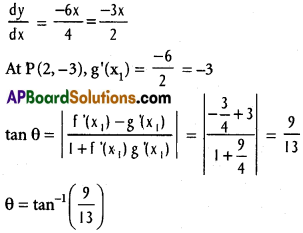
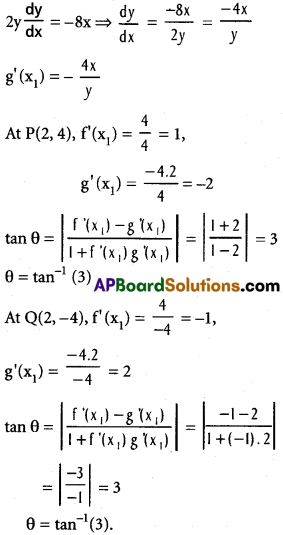
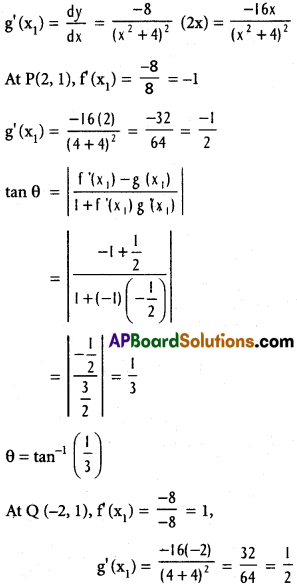
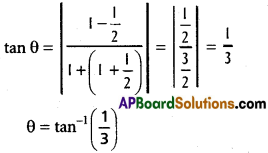
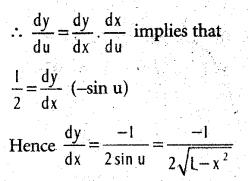
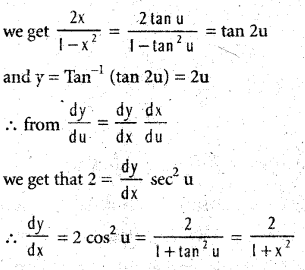
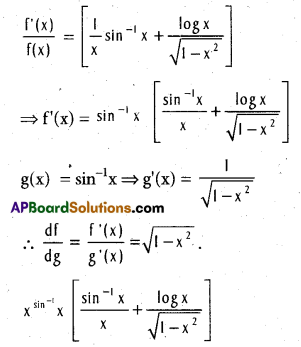
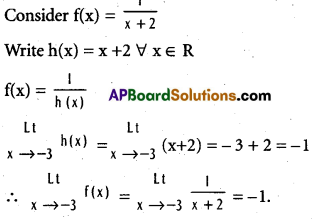
Inter 1st Year Maths 1B Applications of Derivatives Solutions Ex 10(e)

Practicing the Intermediate 1st Year Maths 1B Textbook Solutions Inter 1st Year Maths 1B Applications of Derivatives Solutions Exercise 10(e) will help students to clear their doubts quickly.

Intermediate 1st Year Maths 1B Applications of Derivatives Solutions Exercise 10(e)

I.

Question 1.
At time t, the distance s of a particle moving in a straight line is given by s = -4t² + 2t. Find the average velocity between t = 2 sec and t = 8 sec.
Solution:
s = -4t² + 2t ds
v = \(\frac{ds}{dt}\) = -8t + 2 dt
Velocity at t = 2 is v = (\(\frac{ds}{dt}\))t=2
v = -16 + 2 = -14 units/sec.
Velocity at t = 8 is v = (\(\frac{ds}{dt}\))t=8
v = -64 + 2 = -62
Average velocity = \(\frac{-62-14}{2}\) = -38 units/sec.

Question 2.
If y = x4 then find the average rate of change of y between x = 2 and x = 4.
Solution:
y = x4 ⇒ \(\frac{dy}{dt}\) = 4x³
(\(\frac{dy}{dt}\))x=2 = 32
(\(\frac{dy}{dt}\))x=4 = 256
Average rate of change = \(\frac{256+32}{2}\) = 144.

Question 3.
A particle moving along a straight line has the relation s = t³ + 2t + 3, connecting the distance s describe by the particle in time t. Find the velocity and acceleration of the particle of t = 4 sec.
Solution:
s = t³ + 2t + 3
\(\frac{ds}{dt}\) = 3t² + 2, velocity v = \(\frac{ds}{dt}\) = 3t² + 2
Velocity at t = 4
⇒ (\(\frac{ds}{dt}\))t=4 = 48 + 2 = 50 units/sec
v = 3t² + 2
\(\frac{dv}{dt}\) = 6t ⇒ a = (\(\frac{dv}{dt}\))t=4 = 24 units/sec².

Inter 1st Year Maths 1B Applications of Derivatives Solutions Ex 10(e)

Question 4.
The distance – time formula for the motion of a particle along a straight line is s = t³ – 9t² + 24t – 18. Find when and where the velocity is zero.
Solution:
Given s = t³ – 9t² + 24t – 18
v = \(\frac{ds}{dt}\) = 3t² – 18t + 24
v = 0 ⇒ 3(t² – 6t + 8) = 0
∴ (t – 2) (t – 4) = 0
∴ t = 2 or 4
The velocity is zero after 2 and 4 seconds.

Case (i):
t = 2
s = t³ – 9t² + 24t – 18
= 8 – 36 + 48 – 18 = 56 – 54 = 2

Case (ii) :
t = 4 ; s = t³ – 9t² + 24t – 18
= 64 – 144 + 96 – 18
= 160 – 162 = -2
The particle is at a distance of 2 units from the starting point ‘O’ on either side.

Question 5.
The displacement s of a particle travelling in a straight line in t seconds is given by s = 45t + 11t² – t³. Find the time when the particle comes to rest.
Solution:
s = 45t + 11t² – t³
v = \(\frac{ds}{dt}\) = 45 + 22t – 3t²
If a particle becomes to rest
⇒ v = 0 ⇒ 45 + 22t – 3t² = 0
⇒ 3t² – 22t – 45 = 0
⇒ 3t² – 27t + 5t – 45 = 0
⇒ (3t + 5) (t – 9) = 0
∴ t = 9 or t = – \(\frac{5}{3}\)
∴ t = 9
∴ The particle becomes to rest at t = 9 seconds.

II.

Question 1.
The volume of a cube is increasing at the rate of 8 cm³/sec. How fast is the surface area increasing when the length of an edge is 12 cm?
Solution:
Suppose ‘a’ is the edge of the cube and v be the volume of the cube.
v = a³ ……………….. (1)
\(\frac{dv}{dt}\) = 8 cm³/sec.
a = 12 cm
Surface Area of cube. S = 6a²
\(\frac{ds}{dt}\) = 12a\(\frac{da}{dt}\) ………….. (2)
Inter 1st Year Maths 1B Applications of Derivatives Solutions Ex 10(e) 1

Question 2.
A stone is dropped into a quiet lake and ripples move in circles at the speed of 5 cm/sec. At the instant when the radius of circular ripple is 8 cm., how fast is the enclosed area increases?
Solution:
Suppose r is the value of the outer ripple and A be its area
Area of circle A = πr²
\(\frac{dA}{dt}\) = 2πr \(\frac{dr}{dt}\)
Given r = 8, \(\frac{dr}{dt}\) = 5
\(\frac{dA}{dt}\) = 2π (8) (5)
= 80π cm²/sec.

Inter 1st Year Maths 1B Applications of Derivatives Solutions Ex 10(e)

Question 3.
The radius of a circle is increasing at the rate of 0.7 cm/sec. What is the rate of increase of its circumference?
Solution:
\(\frac{dr}{dt}\) = 0.7 cm/sec
Circumference of a circle, c = 2πr
\(\frac{dc}{dt}\) = 2π \(\frac{dr}{dt}\)
= 2π(0.7)
= 1.4π cm/sec.

Question 4.
A balloon which always remains spherical on inflation is being inflated by pumping in 900 cubic centimeters of gas per second. Find the rate at which the radius of balloon increases when the radius in 15 cm.
Solution:
\(\frac{dv}{dt}\) = 900 c.c/sec
r = 15 cm
Volume of the sphere v = \(\frac{4}{3}\) πr³
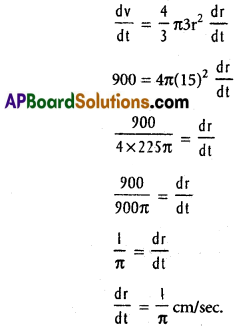
Inter 1st Year Maths 1B Applications of Derivatives Solutions Ex 10(e) 2

Question 5.
The radius of an air bubble is increasing at the rate of \(\frac{1}{2}\) cm/sec. At what rate is the volume of the bubble increasing when the radius is 1 cm.?
Solution:
\(\frac{dr}{dt}=\frac{1}{2}\) cm/sec
radius r = 1 cm
Volume sphere v = \(\frac{4}{3}\) πr³
\(\frac{dv}{dt}\) = 4πr² \(\frac{dr}{dt}\)
= 4π(1)²\(\frac{1}{2}\)
= 2π cm³/sec.

Question 6.
Assume that an object is launched upward at 980 m/sec. Its position would be given by s = 4.9 t² + 980 t. Find the maximum height attained by the object.
Solution:
s = – 4.9 t² + 980 t
\(\frac{ds}{dt}\) = -9.8 t + 980
v = -9.8 t + 980
for max. height, v = 0
-9.8 t + 980 = 0
980 = 9.8 t
\(\frac{980}{9.8}\) = t
100 = t
s = -4.9(100)² +980(100)
s = -49000 + 98000
s = 49000 units.

Question 7.
Let a kind of bacteria grow in such a way that at time t sec. there are t(3/2) bacteria. Find the rate of growth at time t = 4 hours.
Solution:
Let g be the amount of growth of bacteria at t then g(t) = t3/2
The growth rate at time t is given by
g'(t) = \(\frac{3}{2}\)t1/2
given t = 4hr
g'(t) = \(\frac{3}{2}\) (4 × 60 × 60)1/2
= \(\frac{3}{2}\) (2 × 60) = 180

Inter 1st Year Maths 1B Applications of Derivatives Solutions Ex 10(e)

Question 8.
Suppose we have a rectangular aquarium with dimensions of length 8m, width 4 m and height 3 m. Suppose we are tilling the tank with water at the rate of 0.4 m³/sec. How fast is the height of water changing when the water level is 2.5 m?
Solution:
Length of aquarium l = 8 m
Width of aquarium b = 4 m
Height of aquarium h = 3
\(\frac{dv}{dt}\) = 0.4 m³/sec.
v = lbh
= 8(4)(3)
= 96
v = lbh
⇒ log v = log l + log b + log h
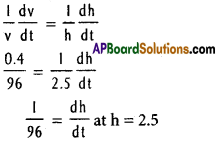
Inter 1st Year Maths 1B Applications of Derivatives Solutions Ex 10(e) 3
Note : Text book Ans. \(\frac{1}{80}\) will get when h = 3.

Question 9.
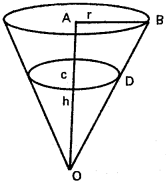
A container is in the shape of an inverted cone has height 8m and radius 6m at the top. If it is filled with water at the rate of 2m³/minute, how fast is the height of water changing when the level is 4m?
Solution:
Inter 1st Year Maths 1B Applications of Derivatives Solutions Ex 10(e) 4
h = 8m = OC
r = 6m = AB
\(\frac{dv}{dt}\) = 2 m³/minute
∆ OAB and OCD are similar angle then
\(\frac{CD}{AB}=\frac{OC}{OA}\)
\(\frac{r}{6}=\frac{h}{8}\)
r = h \(\frac{3}{4}\)
Volume of cone v = \(\frac{1}{3}\)πr²h
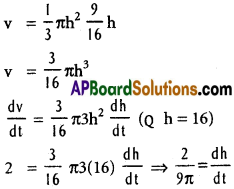
Inter 1st Year Maths 1B Applications of Derivatives Solutions Ex 10(e) 5

Question 10.
The total cost C(x) in rupees associated with the production of x units of an item is given by C(x) 0.007x³ – 0.003x² + 15x + 4000. Find the marginal cost when 17 units are produced.
Solution:
Let m represents the marginal cost, then
M = \(\frac{dc}{dx}\)
Hence
M = \(\frac{d}{dx}\)(0.007x³ – 0.003x² + 15x + 4000)
= (0.007) (3x²) – (0.003) (2x) + 15 /.
∴ The marginal cost at x = 17 is
(M)m=17 = (0.007) 867 – (0.003) (34) + 15
= 6.069-0.102+ 15
= 20.967.

Question 11.
The total revenue in rupees received from the sale of x units of a produce is given by R(x) = 13x² + 26x + 15. Find the marginal revenue when x = 7.
Solution:
Let m denotes the marginal revenue. Then
M = \(\frac{dR}{dx}\)
Similar R(x) = 13x² + 26x +15
∴ m = 26x + 26
The marginal revenue at x = 7
(M)x = 7 = 26(7) + 26
= 208.

Inter 1st Year Maths 1B Applications of Derivatives Solutions Ex 10(e)

Question 12.
A point P is moving on the curve y = 2x². The x co-ordinate of P is increasing at the rate of 4 units per second. Find the rate at which y co-ordinate is increasing when the point is (2, 8).
Solution:
Given y = 2x²
\(\frac{dy}{dx}\) = 4x. \(\frac{dx}{dt}\)
Given x = 2, \(\frac{dx}{dt}\) = 4.\(\frac{dy}{dt}\)
= 4(2).4 = 32
y co-ordinate is increasing at the rate of 32 units/sec.

Inter 1st Year Maths 1B Applications of Derivatives Solutions Ex 10(d)

Practicing the Intermediate 1st Year Maths 1B Textbook Solutions Inter 1st Year Maths 1B Applications of Derivatives Solutions Exercise 10(d) will help students to clear their doubts quickly.

Intermediate 1st Year Maths 1B Applications of Derivatives Solutions Exercise 10(d)

I. Find the angle between the curves given below.

Question 1.
x + y + 2 = 0 ; x² + y² – 10y = 0.
Solution:
x + y + 2 = 0 ⇒ x = -(y + 2)
x² + y² – 10y = 0
(y + 2)² + y² – 10y = 0
y² + 4y + 4 + y² – 10y = 0
2y² – 6y + 4 = 0
y² – 3y + 2 = 0
(y + 1) (y – 2) = 0
y = 1 or y – 2
x = – (y + 2)
y = 1 ⇒ x = -(1 + 2) = -3
y = 2 ⇒ x = -(2 + 2) = -4
The points of intersection are P(-3, 1) and Q(-4, 2), equation of the curve is
x² + y² – 10y = 0
Differentiating w.r.to x.
2x + 2y\(\frac{dy}{dx}\) – 10 \(\frac{dy}{dx}\) = 0
2\(\frac{dy}{dx}\)(y – 5) = -2x
\(\frac{dy}{dx}\) = –\(\frac{x}{y-5}\)
f'(x1) = –\(\frac{x}{y-5}\)
Equation of the line is x + y + 2 = 0
1 + \(\frac{dy}{dx}\) = 0 ⇒ \(\frac{dy}{dx}\) = -1
g'(x) = -1

Case (i):
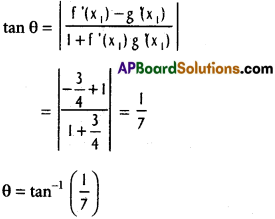
At P(-3, 1), f'(x1) = \(\frac{3}{1-5}=-\frac{3}{4}\), g'(x1) = -1
Inter 1st Year Maths 1B Applications of Derivatives Solutions Ex 10(d) 1

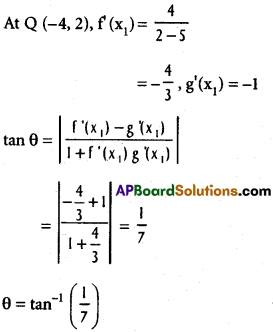
Case (ii):
Inter 1st Year Maths 1B Applications of Derivatives Solutions Ex 10(d) 2

Question 2.
y² = 4x, x² + y² = 5.
Solution:
Eliminating y; we get x² + 4x = 5
x² + 4x – 5 = 0
(x – 1) (x + 5) = 0
x – 1 = 0 or x + 5 = 0
x = 1 or -5
Now y² = 4x
x = 1 ⇒ y² = 4
y = ±2
x = -5 ⇒ y is not real.
∴ Points of interstection of P(1, 2) and Q(1, -2) equation of the first curve is y² = 4x
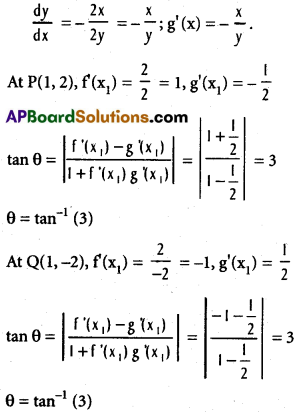
2y.\(\frac{dy}{dx}\) = 4
\(\frac{dy}{dx}\) = \(\frac{4}{2y}\)
f(x) = \(\frac{2}{y}\)
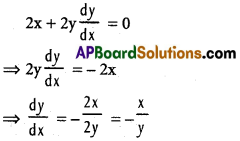
Equation of the second curve is x² + y² = 5 dy
2x + 2y \(\frac{dy}{dx}\) = 0 dx
2.\(\frac{dy}{dx}\) = -2x
Inter 1st Year Maths 1B Applications of Derivatives Solutions Ex 10(d) 3

Inter 1st Year Maths 1B Applications of Derivatives Solutions Ex 10(d)

Question 3.
x² + 3y = 3 ; x² – y² + 25 = 0.
Solution:
x² = 3 – 3y; x² – y² + 25 = 0
3 – 3y – y² + 25 = 0
y² + 3y – 28 = 0
(y – 4) (y + 7) = 0
y – 4 = 0 (or) y + 7 = 0
y = 4 or – 7
x² = 3 – 3y
y = 4 ⇒ x² = 3 – 12 = – 9
⇒ x is not real
y = -7 ⇒ x² = 3 + 21 = 24
⇒ x = ± √24 = ± 2√6
Points of intersection are
P(2√6, -7), Q(-2√6, -7)
Equation of the first cur ve is x² + 3y = 3
3y = 3 – x²
3.\(\frac{dy}{dx}\) = -2x
\(\frac{dy}{dx}\) = –\(\frac{2x}{3}\) i.e, f'(x1) = –\(\frac{2x}{3}\)
Equation of the second curve is
x² – y² + 25 = 0
y² = x² + 25
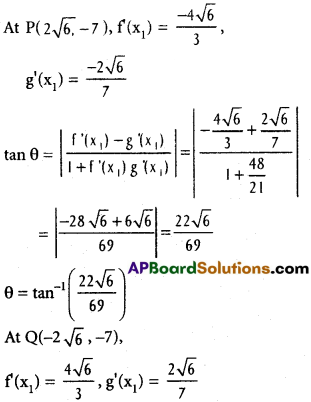
2y.\(\frac{dy}{dx}\) = 2x ⇒ \(\frac{dy}{dx}=\frac{2x}{2y}=\frac{x}{y}\)
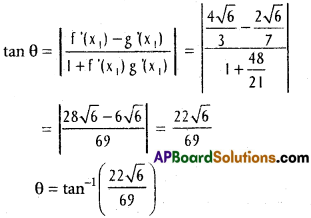
Inter 1st Year Maths 1B Applications of Derivatives Solutions Ex 10(d) 4
Inter 1st Year Maths 1B Applications of Derivatives Solutions Ex 10(d) 5

Question 4.
x² = 2(y + 1), y = \(\frac{8}{x^{2}+4}\).
Solution:
x² = 2(\(\frac{8}{x^{2}+4}\) + 1) = \(\frac{16+2x^{2}+8}{x^{2}+4}\)
x²(x² + 4) = 2x² + 24
x4 + 4x² – 2x² – 24 = 0
x4 + 2x² – 24 = 0
(x² + 6) (x² – 4) = 0
x² = -6 or x² = 4
x² = -6 ⇒ x is not real
x² = 4 ⇒ x = ±2
y = \(\frac{8}{x^{2}+4}=\frac{8}{4+4}=\frac{8}{8}\) = 1
∴ Points of intersection are P(2, 1) and Q(-2, 1)
Equation of the first curve is x² = 2(y + 1)
2x = 2.\(\frac{dy}{dx}\) ⇒ \(\frac{dy}{dx}\) = x
f'(x1) = x1
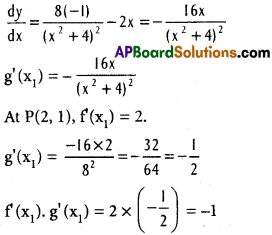
Equation of the second curve is y = \(\frac{8}{x^{2}+4}\)
Inter 1st Year Maths 1B Applications of Derivatives Solutions Ex 10(d) 6
∴ The given curves cut orthogonally
i.e., θ = \(\frac{\pi}{2}\)
At Q (-2, -1),f'(x1) = -2, g'(x1) = \(\frac{32}{64}=\frac{1}{2}\)
f'(x1) g'(x1) = -2 × \(\frac{1}{2}\) = -1
∴ The given curves cut orthogonally
⇒ θ = \(\frac{\pi}{2}\)

Inter 1st Year Maths 1B Applications of Derivatives Solutions Ex 10(d)

Question 5.
2y² – 9x = 0, 3x² + 4y = 0 (in the 4th quadrant).
Solution:
2y² – 9x = 0 ⇒ 9x = 2y²
x = \(\frac{2}{9}\)y²
3x² + 4y = 0
⇒ 3.\(\frac{4}{8}\) y4 + 4y = 0
\(\frac{4y^{2}+108y}{27}\) = 0
4y(y³ + 27) = 0
y = 0 or y³ = -27 ⇒ y = -3
9x = 2y² 2 × 9 ⇒ x = 2
Point of intersection (in 4th quadrant) is P(2, -3)
Equation of the first curve is 2y² = 9x
4y\(\frac{dy}{dx}\) = 9 ⇒ \(\frac{dy}{dx}=\frac{9}{4y}\)
f'(x1) = \(\frac{9}{4y}\)
At P(2, -3), f'(x1) = \(\frac{9}{-12}=-\frac{3}{4}\)
Equation of the second curve is
3x² + 4y = 0
4y = -3x²
4.\(\frac{dy}{dx}\) = -6x
Inter 1st Year Maths 1B Applications of Derivatives Solutions Ex 10(d) 7

Question 6.
y² = 8x, 4x² + y = 32
Solution:
4x² + 8x = 32 ⇒ x² + 2x = 8
x² + 2x – 8 = 0
(x – 2) (x + 4) = 0
x = 2 or -4
y² = 8x
x = -4 ⇒ y² is not real
x = 2 ⇒ y² = 16 ⇒ y = ±4
Point of intersection are P(2, 4), Q(2, -4)
Equation of the first curve is y² = 8x
2y.\(\frac{dy}{dx}\) = 8 ⇒ \(\frac{dy}{dx}=\frac{8}{2y}=\frac{4}{y}\)
f'(x1) = \(\frac{4}{y}\)
Equation of the second curve is
4x² + y² = 32
8x + 2y.\(\frac{dy}{dx}\) = 0
Inter 1st Year Maths 1B Applications of Derivatives Solutions Ex 10(d) 8

Question 7.
x²y = 4, y(x² + 4) = 8.
Solution:
x²y = 4 ⇒ x = \(\frac{4}{y}\)
y(x² + 4) = 8
y(\(\frac{4}{y}\) + 4y) = 8
y\(\frac{(4+4y)}{y}\) = 8
4y – 4 ⇒ y = 1
x² = 4 ⇒ x = ±2
Points of intersection are P(2, 1), Q(-2, 1)
x²y = 4 ⇒ y = \(\frac{4}{x^{2}}\)
\(\frac{dy}{dx}\) = –\(\frac{8}{x^{3}}\) ⇒ f'(x1) = –\(\frac{8}{x^{3}}\)
y(x² + 4) = 8 ⇒ y = \(\frac{8}{x^{2}+4}\)
Inter 1st Year Maths 1B Applications of Derivatives Solutions Ex 10(d) 9
Inter 1st Year Maths 1B Applications of Derivatives Solutions Ex 10(d) 10

Inter 1st Year Maths 1B Applications of Derivatives Solutions Ex 10(d)

Question 8.
Show that the curves 6x² – 5x + 2y = 0 and 4x² + 8y² = 3 touch each other at (\(\frac{1}{2}\), \(\frac{1}{2}\))
Solution:
Equation of the first curve is
6x² – 5x + 2y = 0
2y = 5x – 6x²
2.\(\frac{dy}{dx}\) = 5 – 12x
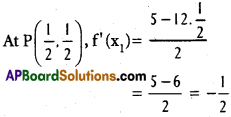
\(\frac{dy}{dx}=\frac{5-12x}{2}\)
Inter 1st Year Maths 1B Applications of Derivatives Solutions Ex 10(d) 11
Equation of the second curve is 4x² + 8y² = 3
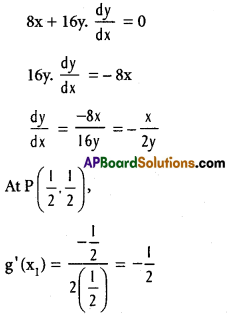
Inter 1st Year Maths 1B Applications of Derivatives Solutions Ex 10(d) 12
∴ f'(x1) = g'(x1)
The given curves touch each other at P(\(\frac{1}{2}\), \(\frac{1}{2}\)).

Inter 1st Year Maths 1B Applications of Derivatives Solutions Ex 10(b)

Practicing the Intermediate 1st Year Maths 1B Textbook Solutions Inter 1st Year Maths 1B Applications of Derivatives Solutions Exercise 10(b) will help students to clear their doubts quickly.

Intermediate 1st Year Maths 1B Applications of Derivatives Solutions Exercise 10(b)

I.

Question 1.
Find the slope of the tangent to the curve
y = 3x4 – 4x at x = 4.
Solution:
Equation of the curve is y = 3x4 – 4x
\(\frac{dy}{dx}\) = 12x³ – 4 dx
At x = 4, slope of the tangent = 12 (4)³ – 4
= 12 × 64 – 4
= 768 – 4
= 764

Question 2.
Find the slope of the tangent to the curve
y = \(\frac{x-1}{x-2}\) x ≠ 2 at x = 10.
Solution:
Equation of the curve is
y = \(\frac{x-1}{x-2}\)
= \(\frac{x-2+1}{x-2}\)
= 1 + \(\frac{1}{x-2}\)
\(\frac{dy}{dx}\) = 0 + \(\frac{(-1)}{(x-2)^{2}}=\frac{1}{(x-2)^{2}}\)
At x = 10, slope of the tangent = \(\frac{1}{(10-2)^{2}}\)
= –\(\frac{1}{64}\)

Question 3.
Find the slope of the tangent to the curve y = x³ – x + 1 at the point whose x co-ordinate is 2.
Solution:
Equation of the curve is y = x³ – x + 1
\(\frac{dy}{dx}\) = 3x² – 1
x = 2
Slope of the tangent at (x – 2) is
3(2)² – 1 = 3 x 4 – 1
= 12 – 1 = 11

Inter 1st Year Maths 1B Applications of Derivatives Solutions Ex 10(b)

Question 4.
Find the slope of the tangent to the curve y = x³ – 3x + 2 at the point whose x co-ordinate is 3.
Solution:
Equation of the curve is y = x³ – 3x + 2
\(\frac{dy}{dx}\) = 3x² – 3
At x = 3, slope of the tangent = 3(3)² – 3
= 27 – 3 = 24

Question 5.
Find the slope of the normal to the curve
x = a cos³ θ, y = a sin³ θ at θ = \(\frac{\pi}{4}\).
Solution:
x = a cos³ θ
\(\frac{d x}{d \theta}\) = a(3 cos² θ) (-sin θ)
= -3a cos² θ. sin θ
y = sin³ θ
\(\frac{d y}{d \theta}\) = a (3 sin² θ) cos θ
= 3a sin² θ cos θ
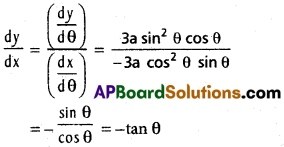
Inter 1st Year Maths 1B Applications of Derivatives Solutions Ex 10(b) 1
At θ = \(\frac{\pi}{4}\), slope of the tangent = tan \(\frac{\pi}{4}\) = -1
Slope of the normal = – \(\frac{1}{m}\) = 1.

Question 6.
Find the slope of the normal to the curve
x = 1 – a sin θ, y = b cos θ at θ = \(\frac{\pi}{2}\).
Solution:
x = 1 – a sin θ
\(\frac{d x}{d \theta}\) = – a cos θ
y = b cos² θ dy
\(\frac{d y}{d \theta}\) = b(2 cos θ) (- sin θ) = -2b cos θ sin θ
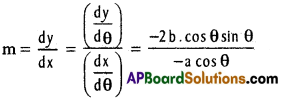
Inter 1st Year Maths 1B Applications of Derivatives Solutions Ex 10(b) 2
\(\frac{2b}{a}\).sin θ
Slope of the normal = \(\frac{1}{m}=\frac{a}{2b \sin \theta}\)
At θ = \(\frac{\pi}{2}\), slope of the normal = \(\frac{-a}{2 b \sin \frac{\pi}{2}}\)
= \(\frac{-a}{2b.1}\)
= \(\frac{-a}{2b}\)

Question 7.
Find the points at which the tangent to the curve y = x3 – 3×2 – 9x + 7 is parallel to the x-axis.
Solution:
Equation of the curve is y = x³ – 3x² – 9x + 7
\(\frac{dy}{dx}\) = 3x² – 6x – 9 dx
The tangent is parallel to x-axis.
Slope of the tangent = 0
3x² – 6x – 9 = 0
x² – 2x – 3 = 0
(x – 3) (x + 1) = 0
x = 3 or -1
y = x³ – 3x² – 9x + 7
x = 3 ⇒ y = 27 – 27 – 27 + 7 = -20
x = -1, y = -1 – 3 + 9 + 7 = 12
The points required are (3, -20), (-1, 12).

Question 8.
Find a point on the curve y = (x – 2)² at which the tangent is parallel to the chord joining the points (2, 0) and (4, 4).
Solution:
Equation of the curve is y = (x – 2)²
\(\frac{dy}{dx}\) = 2(x – 2)
Slope of the chord joining A(2, 0) and B(4, 4)
= \(\frac{4-0}{4-2}=\frac{4}{2}\) = 2.
The tangent is parallel to the chord.
2(x – 2) = 2
x – 2 = 1
x = 3
y = (x – 2)² = (3 – 2)² = 1
The required point is P(3, 1).

Inter 1st Year Maths 1B Applications of Derivatives Solutions Ex 10(b)

Question 9.
Find the point on the curve
y = x³ – 11x + 5 at which the tangent is y = x – 11.
Solution:
Equation of the curve is y = x³ – 11x + 5
\(\frac{dy}{dx}\) = 3x² – 11
The tangent is y = x – 11
Slope of the tangent = 3x² – 11 = 1
3x² = 12
x² = 4
x = ±2

y = x – 11
x = 2 ⇒ y = 2 – 11 = -9
The points on the curve is P(2, -9).

Question 10.
Find the equations of all lines having slope 0 which are tangents to the curve y = \(\frac{1}{x^{2}-2x+3}\).
Solution:
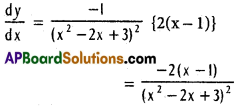
Equation of the curve is y = \(\frac{1}{x^{2}-2x+3}\)
Inter 1st Year Maths 1B Applications of Derivatives Solutions Ex 10(b) 3
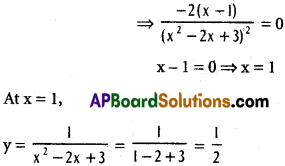
Given slope of the tangent = 0
Inter 1st Year Maths 1B Applications of Derivatives Solutions Ex 10(b) 4
Equation the point is P(1, \(\frac{1}{2}\))
Slope of the tangent = 0
Equation of the required tangent is
y – \(\frac{1}{2}\) = 0(x – 1)
⇒ 2y – 1 = 0

II.

Question 1.
Find the equations of tangent and normal to the following curves at the points indicated against.
i) y = x4 – 6x³ + 13x² – 10x + 5 at (0, 5).
Solution:
\(\frac{dy}{dx}\) = 4x³ – 18x² + 26x – 10
At x = 0,
Slope of the tangent = 0 – 0 + 0 -10 = -10
Equation of the tangent is y – 5 = -10(x – 0)
= -10x
10x + y – 5 = 0
Slope of the normal = – \(\frac{1}{m}=\frac{1}{10}\)
Equation of the normal is y – 5 = \(\frac{1}{10}\) (x – 0)
10y – 50 = x ⇒ x – 10y + 50 = 0

ii) y = x³ at (1, 1).
Solution:
\(\frac{dy}{dx}\) = 3x²
At (1, 1), slope of the tangent = 3 (1)² = 3
Equation of the tangent at P(1, 1) is
y – 1 = 3(x – 1)
= 3x – 3
3x – y – 2 = 0
Slope of the normal = – \(\frac{1}{m}=-\frac{1}{3}\)
Equation of the normal is y – 1 = \(-\frac{1}{3}\)(x – 1)
3y – 3 = -x + 1
x + 3y – 4 = 0

iii) y = x² at (0, 0).
Solution:
Equation of the curve is y = x²
\(\frac{dy}{dx}\) = 2x
At P(0, 0), slope of the tangent = 2.0 = 0
Equation of the tangent is y – 0 = 0 (x – 0)
⇒ y = 0
The normal is perpendicular to the tangent.
Equation of the normal is x = k.
The normal passes through (0, 0) ⇒ k = 0
Equation of the normal is x = 0.

iv) x = cos t, y = sin t at t = \(\frac{\pi}{4}\).
Solution:
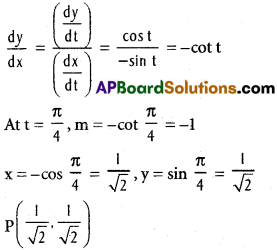
\(\frac{dx}{dt}\) = -sin t, \(\frac{dy}{dt}\) = cos t
Inter 1st Year Maths 1B Applications of Derivatives Solutions Ex 10(b) 5
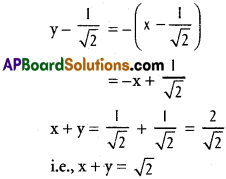
Equation of the tangent is
Inter 1st Year Maths 1B Applications of Derivatives Solutions Ex 10(b) 6
Slope of the normal = –\(\frac{1}{m}=\frac{-1}{-1}\) = 1
Equation of the normal is y \(\frac{1}{\sqrt{2}}\) = x – \(\frac{1}{\sqrt{2}}\)
i.e., x – y = 0

v) y = x² – 4x + 2 at (4, 2).
Solution:
Equation of the curve is y = x² – 4x + 2
\(\frac{dy}{dx}\) = 2x – 4
At P(4, 2), slope of the tangent =2.4 – 4
= 8 – 4 = 4
Equation of the tangent at P is
y – 2 = 4(x – 4)
= 4x – 16
4x – y – 14 = 0
Slope of the normal = –\(\frac{1}{m}=-\frac{1}{4}\)
Equation of the normal at P is
y – 2 = \(-\frac{1}{4}\) (x – 4)
⇒ 4y – 8 = -x + 4
⇒ x + 4y – 12 = 0

vi) y = \(-\frac{1}{1+x^{2}}\) at (0, 1)
Solution:
Equation of the curve is y = \(-\frac{1}{1+x^{2}}\)
\(\frac{dy}{dx}\) = \(-\frac{1}{(1+x^{2})^{2}}\)
At (0, 1), x = 0, slope of the tangent = 0
Equation of the tangent at P(0, 1) is
y – 1 = 0(x – 0)
y = 1
The normal is perpendicular to the tangent.
Equation of the normal can be taken at x = 10.
The normal passes through P(0, 1) ⇒ 0 = k
Equation of the normal at P is x = 0.

Inter 1st Year Maths 1B Applications of Derivatives Solutions Ex 10(b)

Question 2.
Find the equations of tangent and normal to the curve xy = 10 at (2, 5).
Solution:
Equation of the curve is xy = 10.
y = \(\frac{10}{x}\); \(\frac{dy}{dx}=\frac{10}{x^{2}}\)
At P(2, 5), f'(x1) = –\(\frac{10}{4}=-\frac{5}{2}\)
Equation of the tangent is
y – y1 = f'(x1) (x – x1)
y – 5 = – \(\frac{5}{2}\) (x – 2)
2y – 10 = -5x + 10
5x + 2y – 20 = 0
Equation of the normal is
y – y1 = \(\frac{1}{f'(x_{1})}\)(x – x1)
y – 5 = \(\frac{5}{2}\) (x – 2)
5y – 25 = 2x – 4
i.e., 2x – 5y + 21 = 0.

Question 3.
Find the equations of tangent and normal to the curve y = x³ + 4x² at (-1, 3).
Solution:
Equation of the curve is y = x³ + 4x²
\(\frac{dy}{dx}\) = 3x² + 8x
At P(-1, 3),
Slope of the tangent
= 3(-1)² + 8(-1)
= 3 – 8 = -5

Equation of the tangent at P(-1, 3) is
y – y1 = f'(x1) (x – x1)
y – 3 = -5(x + 1) = -5x – 5
5x + y + 2 = 0
Equation of the nonnal at P is
y – y1 = –\(\frac{1}{f'(x_{1})}\) (x – x1)
y – 3 = \(\frac{1}{5}\) (x + 1)
5y – 15 = x + 1
x – 5y + 16 = 0

Question 4.
If the slope of the tangent to the curve x² – 2xy + 4y = 0 at a point on it is –\(\frac{3}{2}\), then find the equations of tangent and normal at that point.
Solution:
Equation of the curve is
x² – 2xy + 4y = 0 ………… (1)
Differentiating w.r.to x
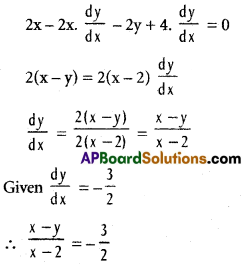
Inter 1st Year Maths 1B Applications of Derivatives Solutions Ex 10(b) 7
2x – 2y = -3x + 6; 5x – 2y = 6
2y = 5x – 6 ……. (2)
P(x, y) is a point on (1)
x² – x(5x – 6) + 2(5x – 6) = 0
x² – 5x² + 6x + 10x – 12 = 0
-4x² + 16x – 12 = 0
-4(x² – 4x + 3) = 0
x² + 4x + 3 = 0
(x – 1) (x – 3) = 0
x – 1 = 0 or x – 3 = 0
∴ x = 1 or x = 3

Case (i): x = 1
Substituting in (1)
1 – 2y + 4y = 0
2y = -1 ⇒ y = –\(\frac{1}{2}\)
The required point is P(1, –\(\frac{1}{2}\))
Equation of the tangent is
y + \(\frac{1}{2}\) = –\(\frac{3}{2}\)(x – 1)
\(\frac{2y+1}{2}=\frac{-3(x-1)}{2}\)
2y + 1 = -3x + 3
3x + 2y – 2 = 0
Equation of the normal isy + \(\frac{1}{2}=\frac{2}{3}\)(x – 1)
\(\frac{2y+1}{2}=\frac{2}{3}\) (x – 1)
6y + 3 = 4x – 4
4x – 6y – 7 = 0

Case (ii) : x = 3
Substituting in (1), 9 – 6y + 4y = 0
2y = 9 ⇒ y = \(\frac{9}{2}\)
∴ The required point is (3, \(\frac{9}{2}\))
Equation of the tangent is
y – \(\frac{9}{2}=-\frac{3}{2}\) (x – 3)
\(\frac{2y-9}{2}=\frac{-3(x-3)}{2}\)
2y – 9 = -3x + 9
3x + 2y- 18 = 0
Equation of the normal is y – \(\frac{9}{2}=\frac{2}{3}\) (x – 3)
\(\frac{2y-9}{2}=\frac{2(x-3)}{3}\)
6y – 27 = 4x – 12
i.e., 4x – 6y + 15 = 0.

Inter 1st Year Maths 1B Applications of Derivatives Solutions Ex 10(b)

Question 5.
If the slope of the tangent to the curve y = x log x at a point on it is \(\frac{3}{2}\), then find the equations of tangent and normal at that point.
Solution:
Equation of the curve is y = x log x
\(\frac{dy}{dx}\) = x. \(\frac{1}{x}\) + log x.1 = 1 + log x.
Given 1 + log x = \(\frac{3}{2}\)
loge x =\(\frac{1}{2}\) ⇒ x = e½ = √e
y = √e . log .√e = \(\frac{\sqrt{e}}{2}\)
The required point is P (√e, \(\frac{\sqrt{e}}{2}\))
Equation of the tangent is y \(\frac{\sqrt{e}}{2}=\frac{3}{2}\)(x – √e)
\(\frac{2 y-\sqrt{e}}{2}=\frac{3(x-\sqrt{e})}{2}\)
2y – √e = 3x – 3 √e
3x – 2y – 2√e = 0
Equation of the normal is
y – y1 = – \(\frac{1}{f'(x_{1})}\)(x – x1)
y – \(\frac{\sqrt{e}}{2}=-\frac{2}{3}\)(x – √e)
\(\frac{2 y-\sqrt{e}}{2}=-\frac{2}{3}\)(x – √e)
6y – 3√e = -4x + 4√e
i.e., 4x + 6y – 7√e =0

Question 6.
Find the tangent and normal to the curve y = 2e-x/3 at the point where the curve meets the Y-axis.
Solution:
Equation of the curve is y = 2e-x/3
Equation of Y-axis is x = 0
y = 2.e° = 2.1 = 2
Required point is P(0, 2)
\(\frac{dy}{dx}\) = 2(-\(\frac{1}{3}\)) . e-x/3
When x = 0, slope of the tangent = –\(\frac{2}{3}\) .e° = \(\frac{-2}{3}\)
Equation of the tangent at P is
y – y1 = f'(x1) (x – x1)
y – 2 = –\(\frac{2}{3}\) (x – 0)
3y – 6 = -2x
2x + 3y – 6 = 0
Equation of the normal is
y – y1 = –\(\frac{1}{f'(x_{1})}\) (x – x1
y – 2 = \(\frac{3}{2}\) (x – 0)
2y – 4 = 3x; 3x – 2y + 4 = 0

III.

Question 1.
Show that the tangent at P(x1, y1) on the curve √x + √y = √a is yy1 + xx1 = a½.
Solution:
Equation of the curve is √x + √y = √a
Differentiating w.r.to x
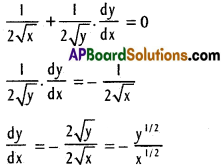
Inter 1st Year Maths 1B Applications of Derivatives Solutions Ex 10(b) 8
Slope of the tangent at P(x1 y1) = –\(\frac{\left(y_{1}\right)^{1 / 2}}{\left(x_{1}\right)^{1 / 2}}\)
Equation of the tangent at P is
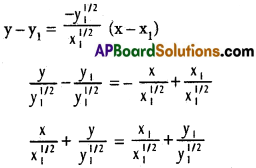
Inter 1st Year Maths 1B Applications of Derivatives Solutions Ex 10(b) 9
= x1½ + y1½
x. x1 + y. y1 = a½
(P is a point on the curve)
Equation of the tangent at P is
y. y1 + x. x1 = a½

Inter 1st Year Maths 1B Applications of Derivatives Solutions Ex 10(b)

Question 2.
At what points on the curve x² – y² = 2, the slopes of the tangents are equal to 2?
Solution:
Equation of the curve is x² – y² = 2 ………. (1)
Differentiating w.r.to x
2x – 2y.\(\frac{dy}{dx}\) = 0 ⇒ \(\frac{dy}{dx}=\frac{x}{y}\)
Slope of the tangent = \(\frac{dy}{dx}\) = 2
∴ \(\frac{x}{y}\) = 2 ⇒ x = 2y
Substituting in (1), 4y² – y² = 2
3y² = 2
y ² = \(\frac{2}{3}\) ⇒ y = ± \(\sqrt{\frac{2}{3}}\)
x = 2y = ± 2 \(\sqrt{\frac{2}{3}}\)
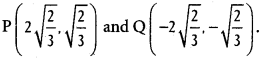
∴ The required points are
Inter 1st Year Maths 1B Applications of Derivatives Solutions Ex 10(b) 10

Question 3.
Show that the curves x² + y² = 2 and 3x² + y² = 4x have a common tangent at the point (1, 1).
Solution:
Equation of the first curve is x² + y² = 2
Differentiating w.r.to x
Inter 1st Year Maths 1B Applications of Derivatives Solutions Ex 10(b) 11
At P (1, 1) slope of the tangent = \(\frac{-1}{1}\) = -1
Equation of the second curve is 3x² + y² = 4x.
Differentiating w.r.to x, 6x + 2y.\(\frac{dy}{dx}\) = 4
2y.\(\frac{dy}{dx}\) = 4 – 6x
\(\frac{dy}{dx}=\frac{4-6x}{2y}=\frac{2-3x}{y}\)
At P( 1, 1) slope of the tangent = \(\frac{2-3}{1}\) = –\(\frac{1}{1}\) = -1
The slope of the tangents to both the curves at P( 1, 1) are same and pass through the same point (1, 1)
∴ The given curves have a common tangent at P (1, 1)

Question 4.
At a point (x1, y1) on the curve x³ + y³ = 3axy, show that the tang;ent is
(x1² – ay1) x+ (y1² – ax1)y = ax1y1
Solution:
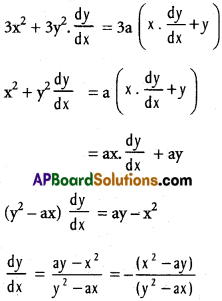
Equation of the curve is x³ + y³ = 3axy
Differentiating w. r. to x
Inter 1st Year Maths 1B Applications of Derivatives Solutions Ex 10(b) 12
Slope of the tangent P(x1, y1) = –\(\frac{\left(x_{1}^{2}-a y_{1}\right)}{\left(y_{1}^{2}-a x_{1}\right)}\)
Equation of the tangent at P(x1, y1) is
y(y – y1) = –\(\frac{\left(x_{1}^{2}-a y_{1}\right)}{\left(y_{1}^{2}-a x_{1}\right)}\)(x – x1)
y(y1² – ax1) – y1(y1² – ax1) = – x(x1² – ay1) + x1(x1² – ay1)
x1(x1² – ay1) + y1(y1² – ax1)
= x1(x1² – ay1) + y1(y1² – ax1)
= x1³ – ax1y1 + y1³ – ax1y1
= x1³ + y1³ – 2ax1y1
3ax1y1 – 2ax1y1 (P is a point on the curve)
= ax1y1

Question 5.
Show that the tangent at the point P (2, -2) on the curve y (1 – x) = x makes intercepts of equal length on the co-ordinate axes and the normal at P passes through the origin.
Solution:
Equation of the curve is
y (1 – x) = x
y = \(\frac{x}{1-x}\)
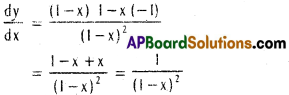
Differentiating w.r. to x
Inter 1st Year Maths 1B Applications of Derivatives Solutions Ex 10(b) 13
Equation of the tangent at P is
y + 2 = +(x – 2) = x – 2; x – y = 4
\(\frac{x}{4}-\frac{y}{4}\) ⇒ \(\frac{x}{4}-\frac{y}{(-4)}\) = 1
∴ a = 4, b = – 4
∴ The tangent makes equal intercepts on the co-ordinate axes but they are in opposite in sign. Equation of the normal at P is
y – y1 = \(\frac{1}{f'(x_{1})}\) (x – x1)
y + 2 = -(x – 2)= -x + 2
x + y = 0
There is no constant term in the equation.
∴ The normal at P(2, -2) passes through the origin.

Question 6.
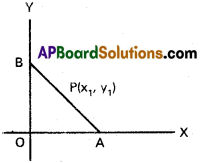
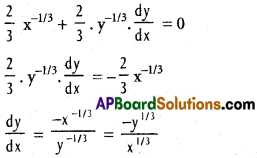
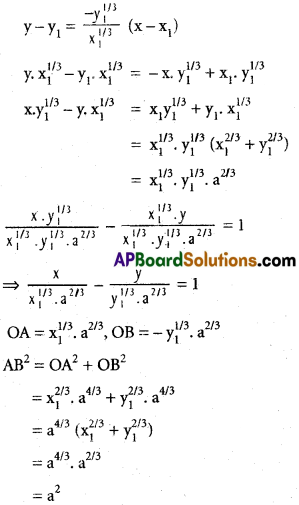
If the tangent at any point on the curve x2/3 + y2/3 = a2/3 intersects the coordinate axes in A and B then show that length AB is a constant.
Inter 1st Year Maths 1B Applications of Derivatives Solutions Ex 10(b) 14
Solution:
Equation of the curve is
x2/3 + y2/3 = a2/3
Differentiating w.r. to x
Inter 1st Year Maths 1B Applications of Derivatives Solutions Ex 10(b) 15
Equation of the tangent at P (x1, y1) is
Inter 1st Year Maths 1B Applications of Derivatives Solutions Ex 10(b) 16
AB = a = constant.

Inter 1st Year Maths 1B Applications of Derivatives Solutions Ex 10(b)

Question 7.
If the tangent at any point P on the curve xm yn = am+n (mn ≠ 0) meets the co-ordinate axes in A, B, then show that AP: PB is a constant.
Inter 1st Year Maths 1B Applications of Derivatives Solutions Ex 10(b) 17
Solution:
Equation of the curve is xm.yn = am+n
Differentiating w.r. to x
Inter 1st Year Maths 1B Applications of Derivatives Solutions Ex 10(b) 18
Slope of the tangent at P(x1, y1) = –\(\frac{my_{1}}{nx_{1}}\)
Equation of the tangent at P is
Inter 1st Year Maths 1B Applications of Derivatives Solutions Ex 10(b) 19
Co-ordinates of A are [\(\frac{m+n}{m}\).x1, o] and B are [0, \(\frac{m+n}{m}\).y1]
Let P divide AB in the ratio k : l
Co-ordinates of P are
Inter 1st Year Maths 1B Applications of Derivatives Solutions Ex 10(b) 20
Inter 1st Year Maths 1B Applications of Derivatives Solutions Ex 10(b) 21
Dividing (1) by (2) \(\frac{l}{k}=\frac{m}{n}\) ⇒ \(\frac{k}{l}=\frac{n}{m}\)
∴ P divides AB in the ratio n : m
i.e., AP : PB = n : m = constant.

Inter 1st Year Maths 1B Applications of Derivatives Solutions Ex 10(a)

Practicing the Intermediate 1st Year Maths 1B Textbook Solutions Inter 1st Year Maths 1B Applications of Derivatives Solutions Exercise 10(a) will help students to clear their doubts quickly.

Intermediate 1st Year Maths 1B Applications of Derivatives Solutions Exercise 10(a)

I.

Question 1.
Find ∆y and dy for the following functions for the values of x and ∆x which are shown against each of the functions,
i) y = x² + 3x + 6, x = 10, ∆x = 0.01.
Solution:
∆y = f(x + ∆x) – f(x)
= f(10.01)-f(10)
= E(10.01)² + 3(10.01) + 6] – [10² + 3(10) + 6]
= 100.2001 +30.03 + 6 – 100 – 30 – 6
= 0.2001 + 0.03
= 0.2301
y = x² + 3x + 6
dy = (2x + 3) dx
= (2.10 + 3) (0.01) = 0.23

ii) y = ex + x, x = 5 and ∆x = 0.02
Solution:
∆y = f(x + ∆x) – f(x)
= f(5 + 0.02) – f(5)
= f(5.02) – f(5)
= (e5.02 + 5.02) – (e5 + 5)
= e5.02 – e5 + 0.02
= e5 (e0.02 – 1) + 0.02
dy = f'(x) ∆x = (ex + 1) ∆x
= (e5 + 1) (0.02)

iii) y = 5x² + 6x + 6, x = 2 and ∆x = 0.001
Solution:
∆y’= f(x + ∆x) – f(x)
= f(2 +0.001) – f(2)
= f(2.001) – f(2)
= (5(2.001)² + 6(2.001) + 6) – (5(2)² + 6(2) +6)
= 20.0200 + 12.0060 + 6 – 20 – 12 – 6
= 0.026005
dy = f'(x) ∆x = (10x + 6) ∆x
= (26) (0.001) = 0.0260.

iv) y = 2 \(\frac{1}{x+2}\) x = 8 and ∆x = 0.02
Solution:
f(x) = \(\frac{1}{x+2}=\frac{1}{10}\) = 0.1000
f(x + ∆x) = \(\frac{1}{x+\Delta x+2}=\frac{1}{10+0.02}=\frac{1}{10.02}\) = 0.0998
∆y = f(x + ∆x) – f(x)
= \(\frac{1}{x+\Delta x+2}-\frac{1}{1+x}=\frac{1}{10.02}=\frac{1}{10}\)
= 0.0998 003992 – 0.1000 = – 0.0001996
dy = f'(x) ∆x = \(\frac{-1}{1+x^{2}}\) ∆x
= \(\frac{-1}{100}\)(0.02) = -0.0002

v) y = cos (x), x = 60° and ∆x = 1°
Solution:
∆y = f(x + ∆x) – f(x)
= cos (x + ∆x) – cos x
= cos (60° + 1°) – cos 60°
= cos 61° – cos 60°
= 0.4848 – \(\frac{1}{2}\) = 0.4848 – 0.5 = – 0.0152
dy = f'(x) ∆x
= — sin x ∆x
= – sin 60°(1°) = \(\frac{-\sqrt{3}}{2}\) (0.0174)
= – (0.8660) (0.0174) = – 0.0151.

Inter 1st Year Maths 1B Applications of Derivatives Solutions Ex 10(a)

II.

Question 1.
Find the approximations of the following.
i) √82
Solution:
82 = 81 + 1 = 81(1 + \(\frac{1}{81}\))
∴ x = 81, ∆x = 1, f(x) = 77
dy = f'(x). ∆x = \(\frac{1}{2\sqrt{x}}\). ∆x = \(\frac{1}{2\sqrt{81}}\).1
= \(\frac{1}{18}\) = 0.0555
f(x + δx) – f(x) ≅ dy
f(x + δx) ≅ f(x) + dy
= √81 + 0.0555
= 9 + 0.0555
i.e., √82 = 9.0555 = 9.056

ii) \(\sqrt[3]{65}\)
Solution:
Let x = 64, ∆x = 1, f(x) = \(\sqrt[3]{x}\)
f'(x) = \(\frac{1}{3}\)x-2/3
f(x + ∆x) ≅ f(x) + f'(x)∆x
\(\sqrt[3]{65}\) ≅ \(\sqrt[3]{x}\) + \(\frac{1}{3}\)x-2/3 ∆x
≅ \(\sqrt[3]{65}+\frac{1}{3}\)(4)-2/3(I)
≅ 4 + \(\frac{1}{3}\)(\(\frac{1}{16}\))
≅ 4 + \(\frac{1}{48}\)
≅ \(\frac{192+1}{48}\)
≅ \(\frac{193}{48}\) ≅ 4.0208

iii) \(\sqrt{25.001}\)
Solution:
Letx = 25, ∆x- 0.001
f(x) = √x
dy = f'(x) ∆x
= \(\frac{1}{2\sqrt{x}}\) ∆x = \(\frac{1}{2\sqrt{25}}\) (0.001) = \(\frac{0.001}{10}\) = 0.0001
f(x + ∆x) ≅ f(x) + dy
≅ √25 + 0.0001
≅ 5.0001

iv) \(\sqrt[3]{7.8}\)
Solution:
Let x = 8, ∆x = -0.2, f(x) = \(\sqrt[3]{x}\)
dy = f'(x). ∆x
= \(\frac{1}{3}\)x-2/3. ∆x = \(\frac{1}{3x^{2/3}}\) . ∆x
dy = \(\frac{1}{3(8)^{2/3}}\)(-0.2)
= – \(\frac{1}{3}\)
\(=-\frac{0.2}{3 \times 4}=-\frac{0.2}{12}\)
f(x + δx) – (x) ≅ dy
f(x + δx) ≅ f(x) + dy
= \(\sqrt[3]{8}\) – 0.0166
= 2 – 0.0166
= 1.9834
∴ \(\sqrt[3]{7.8}\) = 1.9834

v) sin (62°)
Solution:
Let x = 60°, ∆x = 2°, f(x) = sin x
dy = f'(x) ∆x
= cosx ∆x
= cos 60° ∆x
= \(\frac{1}{2}\) (2°)
= \(\frac{1}{2}\) 2(0.0174) = 0.0174

f(x + ∆x) ≅ f(x) + dy
≅ sin 60° + 0.0174
≅ \(\frac{\sqrt{3}}{2}\) + 0.0174
≅ 0.8660 + 0.0174
≅ 0.8834

vi) cos (60° 5′)
Solution:
Let x = 60°, Ax = 5′ = \(\frac{5}{60}\)×\(\frac{\pi}{180}=\frac{\pi}{2160}\)
= 0.001453
f(x) = cos x
dy = f'(x) ∆x = – sin x ∆x
= – sin 60° (0.001453)
= \(\frac{-\sqrt{3}}{2}\) (0.001453)
= – 0.8660 (0.001453)
= -0.001258

f(x + ∆x) ≅ f(x) + dy
≅ cos x + dy
≅ cos 60° + 0.001258
≅ 0.5 – 0.001258
≅ 0.4987.

vii) \(\sqrt[4]{17}\)
Solution:
Let x – 16, ∆x = 1, f(x) = \(\sqrt[4]{x}\) = x¼
dy = f'(x) ∆x
= \(\frac{1}{4}\) x¼-1 ∆x
= \(\frac{1}{4}\) x-3/4 ∆x
= \(\frac{1}{4}\) (16)-3/4 (I)
= \(\frac{1}{32}\) = 0.0312

f(x + ∆x) ≅ f(x) + dy
≅ \(\sqrt[4]{x}\) + 0.0312
≅ 2 + 0.0312
≅ 2.0312

Inter 1st Year Maths 1B Applications of Derivatives Solutions Ex 10(a)

Question 2.
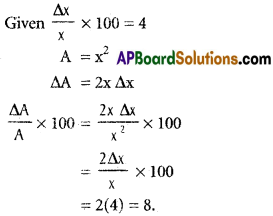
If the increase in the side of a square is 4% then find the approximate percentage of increase in the area of the square.
Solution:
Let x be the side and A be the area of square
A = x²
Inter 1st Year Maths 1B Applications of Derivatives Solutions Ex 10(a) 1

Question 3.
The radius of a sphere is measured as 14 cm. Later it was found that there is an error 0.02 cm in measuring the radius. Find the approximate error in surface of the sphere.
Solution:
Let s be the surface of the sphere
r’ = 14, ∆r = 0.02
s = 4πr²
∆s = 4π 2r ∆r
∆s = 8π (14) (0.02)
= 2.24π
= 2.24 (3.14)
= 7.0336.

Question 4.
The diameter of a sphere is measured to be 40 cm. If an error of 0.02 cm is made in it, then find approximate errors in volume and surface area of the sphere.
Solution:
Let v be the value of sphere
v = \(\frac{4}{3}\) πr³ = \(\frac{4 \pi}{3}\)[latex]\frac{d}{2}[/latex]³
= \(\frac{4 \pi}{3} \frac{d^{3}}{8}=\frac{\pi d^{3}}{6}\)
∆v = \(\frac{\pi}{6}\)3d² ∆d
= \(\frac{\pi}{2}\) (40)² (0.02)
= π(1600) (0.01)
= 16π.

Surface Area s = 4πr²
s = 4π [latex]\frac{d}{2}[/latex]²
s = 4π\(\frac{d^{2}}{4}\)
s = πd²
∆s = π2d ∆d
= π2d (40) (0.02)
= 1.6π.

Inter 1st Year Maths 1B Applications of Derivatives Solutions Ex 10(a)

Question 5.
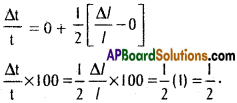
The time t, of a complete oscillation of a simple pendulum of length l is given by t = \(2 \pi \sqrt{\frac{1}{g}}\) where g is gravitational constant. Find the approximate percen-tage of error in t when the percentage of error l is 1%.
Sol. Given t = \(2 \pi \sqrt{\frac{1}{g}}\)
log t = log 2π + \(\frac{1}{2}\) {(log l – log)}
Inter 1st Year Maths 1B Applications of Derivatives Solutions Ex 10(a) 2

Inter 2nd Year Maths 2A De Moivre’s Theorem Solutions Ex 2(a)

Practicing the Intermediate 2nd Year Maths 2A Textbook Solutions Inter 2nd Year Maths 2A De Moivre’s Theorem Solutions Exercise 2(a) will help students to clear their doubts quickly.

Intermediate 2nd Year Maths 2A De Moivre’s Theorem Solutions Exercise 2(a)

I.

Question 1.
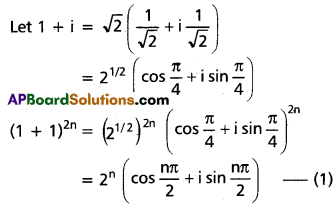
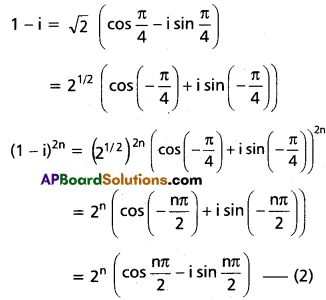
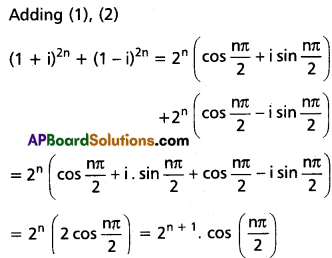
If n is an integer then show that (1 + i)2n + (1 – i)2n = 2n+1 cos \(\frac{n \pi}{2}\)
Solution:
Inter 2nd Year Maths 2A De Moivre’s Theorem Solutions Ex 2(a) I Q1
Inter 2nd Year Maths 2A De Moivre’s Theorem Solutions Ex 2(a) I Q1.1
Inter 2nd Year Maths 2A De Moivre’s Theorem Solutions Ex 2(a) I Q1.2

Inter 2nd Year Maths 2A De Moivre’s Theorem Solutions Ex 2(a)

Question 2.
Find the values of the following:
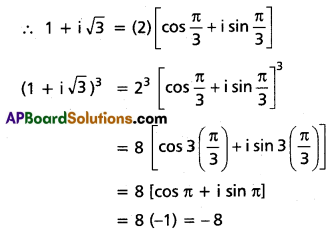
(i) (1 + i√3)3
Solution:
Let 1 + i√3 = r (cos θ + i sin θ)
Equating real and imaginary parts
r cos θ = 1 and r sin θ = √3
⇒ r2 (1) = 1 + 3 = 4
⇒ r = 2
cos θ = \(\frac{1}{2}\) and sin θ = \(\frac{\sqrt{3}}{2}\)
⇒ θ = \(\frac{\pi}{3}\)
Inter 2nd Year Maths 2A De Moivre’s Theorem Solutions Ex 2(a) I Q2(i)

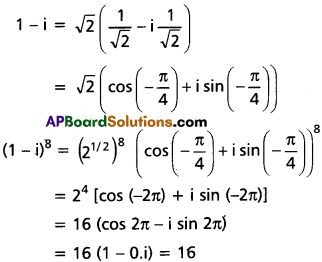
(ii) (1 – i)8
Solution:
Inter 2nd Year Maths 2A De Moivre’s Theorem Solutions Ex 2(a) I Q2(ii)

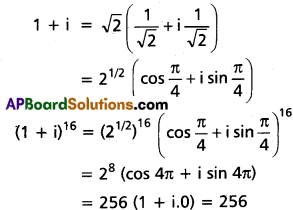
(iii) (1 + i)16
Solution:
Inter 2nd Year Maths 2A De Moivre’s Theorem Solutions Ex 2(a) I Q2(iii)

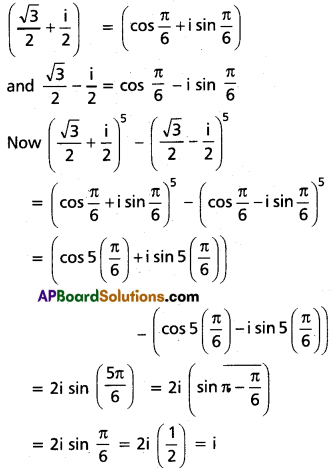
(iv) \(\left(\frac{\sqrt{3}}{2}+\frac{i}{2}\right)^{5}-\left(\frac{\sqrt{3}}{2}-\frac{i}{2}\right)^{5}\)
Solution:
Inter 2nd Year Maths 2A De Moivre’s Theorem Solutions Ex 2(a) I Q2(iv)

Inter 2nd Year Maths 2A De Moivre’s Theorem Solutions Ex 2(a)

II.

Question 1.
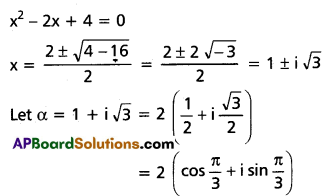
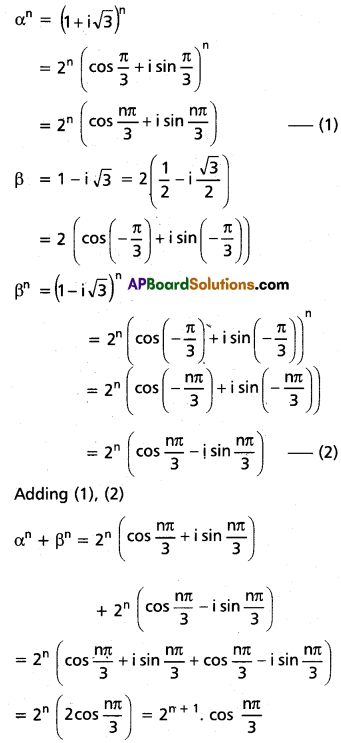
If α, β are the roots of the equation x2 – 2x + 4 = 0 then for any n ∈ N show that αn + βn = 2n+1 cos(\(\frac{n \pi}{3}\))
Solution:
Inter 2nd Year Maths 2A De Moivre’s Theorem Solutions Ex 2(a) II Q1
Inter 2nd Year Maths 2A De Moivre’s Theorem Solutions Ex 2(a) II Q1.1

Question 2.
If cos α + cos β + cos γ = 0 = sin α + sin β + sin γ then show that
(i) cos 3α + cos 3β + cos 3γ = 3 cos(α + β + γ)
(ii) sin 3α + sin 3β + sin 3γ = 3 sin(α + β + γ)
(iii) cos(α + β) + cos(β + γ) + cos(γ + α) = 0
Solution:
Given that cos α + cos β + cos γ = 0 and sin α + sin β + sin γ = 0
From the hypothesis, we have
(cos α + cos β + cos γ) + i (sin α + sin β + sin γ) = 0
i.e., (cos α + i sin α) + (cos β + i sin β) + (cos γ + i sin γ) = 0
We know that if a + b + c = 0, then a3 + b3 + c3 = 3abc
Hence (cos α + i sin α)3 + (cos β + i sin β)3 + (cos γ + i sin γ)3 = 3 (cos α + i sin α) (cos β + i sin β) + (cos γ + i sin γ)
i.e., cos 3α + i sin 3α + cos 3β + i sin 3β + cos 3γ + i sin 3γ = 3[cos(α + β + γ) + i sin(α + β + γ)] …….(1)
On equating the real parts on both sides of equation (1) we get
(i) cos 3α + cos 3β + cos 3γ = 3 cos(α + β + γ)
On equation thenmaginary parts on both sides of equation (1) we get,
(ii) sin 3α + sin 3β + sin 3γ = 3 sin(α + β + γ)
(iii) Let a = cos α + i sin α then \(\frac{1}{a}\) = cos α – i sin α
b = cos β + i sin β and \(\frac{1}{b}\) = cos β – i sin β
c = cos γ + i sin γ and \(\frac{1}{c}\) = cos γ – i sin γ
Now \(\frac{1}{a}+\frac{1}{b}+\frac{1}{c}\) = (cos α + cos β + cos γ) – i (sin α + sin β + sin γ)
⇒ \(\frac{1}{a}+\frac{1}{b}+\frac{1}{c}\) = 0 – i(0)
⇒ \(\frac{1}{a}+\frac{1}{b}+\frac{1}{c}\) = 0
⇒ bc + ca + ab = 0
⇒ [cos(β + γ) + i sin(β + γ)] + [cos(γ + α) + i sin(γ + α)] + [cos(α + β) + i sin(α + β)] = 0
⇒ [cos(α + β) + cos(β + γ) + cos(γ + α)] + i [sin(α + β) + sin(β + γ) + sin(γ + α)] = 0
By equation real parts on both sides
cos (α + β) + cos (β + γ) + cos (γ + α) = 0

Inter 2nd Year Maths 2A De Moivre’s Theorem Solutions Ex 2(a)

Question 3.
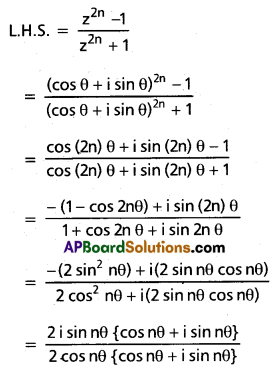
If n is an integer and z = cis θ, (θ ≠ (2n + 1) π/2), then show that \(\frac{z^{2 n}-1}{z^{2 n}+1}\) = i tan nθ.
Solution:
z = cis θ = cos θ + i sin θ, θ ≠ (2n + 1) π/2
Inter 2nd Year Maths 2A De Moivre’s Theorem Solutions Ex 2(a) II Q3
(∵ i2 = -1)
= i tan(nθ)
= R.H.S

Question 4.
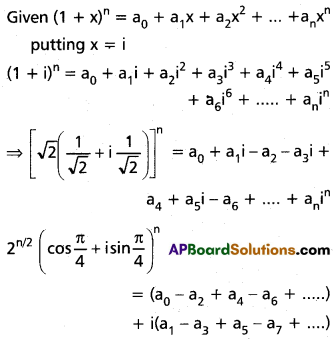
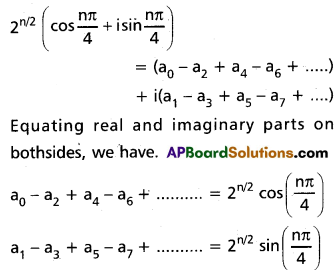
If (1 + x)n = a0 + a1x + a2x2 + ……… + anxn, then show that
(i) a0 – a2 + a4 – a6 + …….. = \(2^{n / 2} \cos \frac{n \pi}{4}\)
(ii) a1 – a3 + a5 – a7 + ……… = \(2^{n / 2} \sin \frac{n \pi}{4}\)
Solution:
Inter 2nd Year Maths 2A De Moivre’s Theorem Solutions Ex 2(a) II Q4
Inter 2nd Year Maths 2A De Moivre’s Theorem Solutions Ex 2(a) II Q4.1

Inter 2nd Year Maths 2A Complex Numbers Solutions Ex 1(c)

Practicing the Intermediate 2nd Year Maths 2A Textbook Solutions Inter 2nd Year Maths 2A Complex Numbers Solutions Exercise 1(c) will help students to clear their doubts quickly.

Intermediate 2nd Year Maths 2A Complex Numbers Solutions Exercise 1(c)

I.

Question 1.
Express the following complex numbers in modulus-amplitude form.
(i) 1 – i
Solution:
1 – i
Let 1 – i = r(cos θ + i sin θ)
Equating real and imaginary parts
r cos θ = 1, r sin θ = -1
⇒ θ lies in IV quadrant
Squaring and adding
r2 (cos2θ + sin2θ) = 1 + 1 = 2
⇒ r2 = 2
⇒ r = √2
tan θ = – 1
⇒ θ = \(-\frac{\pi}{4}\)
∴ 1 – i = √2(cos(\(-\frac{\pi}{4}\)) + i sin(\(-\frac{\pi}{4}\)))

(ii) 1 + i√3
Solution:
1 + i√3 = r (cos θ + i sin θ)
Equating real and imaginary parts
r cos θ = 1 ………(1)
r sin θ = √3 ……..(2)
θ lies in the I quadrant
Squaring and adding (1) and (2)
r2 (cos2θ + sin2θ) = 1 + 3
⇒ r2 = 4
⇒ r = 2
Dividing (2) by (1)
\(\frac{r \sin \theta}{r \cos \theta}\) = √3
⇒ tan θ = √3
⇒ θ = \(\frac{\pi}{3}\)
∴ 1 + i√3 = 2(cos \(\frac{\pi}{3}\) + i sin \(\frac{\pi}{3}\))

Inter 2nd Year Maths 2A Complex Numbers Solutions Ex 1(c)

(iii) -√3 + i
Solution:
-√3 + i = r(cos θ + i sin θ)
Equating real and imaginary parts
r cos θ = -√3 …….(1)
r sin θ = 1 …….(2)
⇒ θ lies in II quadrant
Squaring and adding (1), (2)
r2 (cos2θ + sin2θ) = 3 + 1 = 4
⇒ r2 = 4
⇒ r = 2
Dividing (2) by (1)
\(\frac{r \sin \theta}{r \cos \theta}=-\frac{1}{\sqrt{3}}\)
⇒ tan θ = \(-\frac{1}{\sqrt{3}}\) and θ lies in II quadrant
⇒ θ = 180° – 30° = 150° = \(\frac{5 \pi}{6}\)
∴ -√3 + i = 2(cos \(\frac{5 \pi}{6}\) + i sin \(\frac{5 \pi}{6}\))

(iv) -1 – i√3
Solution:
1 – i√3 = r (cos θ + i sin θ)
Equating real and imaginary parts
r cos θ = -1, r sin θ = -√3
Squaring and adding
r2 (cos2θ + sin2θ) = 1 + 3
⇒ r2 = 4
⇒ r = 2
∴ cos θ = \(-\frac{1}{2}\), sin θ = \(-\frac{\sqrt{3}}{2}\)
⇒ θ = -120° = \(-\frac{2 \pi}{3}\)
∴ -1 – i√3 = 2[cos(\(-\frac{2 \pi}{3}\)) + i sin(\(-\frac{2 \pi}{3}\))]

Question 2.
Simplify -2i(3 + i) (2 + 4i) (1 + i) and obtain the modulus of that complex number.
Solution:
-2i(3 + i) (2 + 4i) (1 + i)
= (-6i – 2i2) (2 + 2i + 4i + 4i2)
= (2 – 6i) (-2 + 6i)
= -4 + 12i – 36i2 + 12i
= 32 + 24i
= 8(4 + 3i)
Modulus = |8(4 + 3i)|
= 8\(\sqrt{(4)^{2}+(3)^{2}}\)
= 8(5)
= 40

Question 3.
(i) If z ≠ 0, find Arg z + Arg \((\bar{z})\).
Solution:
If z = x + iy, then Arg(z) = \(\tan ^{-1}\left(\frac{y}{x}\right)\)
and \((\bar{z})\) = x – iy, then Arg (z) = \(\tan ^{-1}\left(\frac{-y}{x}\right)\) = –\(\tan ^{-1}\left(\frac{y}{x}\right)\)
∴ Arg (z) + Arg \((\bar{z})\) = \(\tan ^{-1}\left(\frac{y}{x}\right)\) + (-\(\tan ^{-1}\left(\frac{y}{x}\right)\)) = 0

(ii) If z1 = -1 and z2 = -i, then find Arg(z1z2)
Solution:
z1 = -1
⇒ z1 = cos π + i sin π
⇒ Arg z1 = π
z2 = -i
⇒ z2 = \(\cos \left(-\frac{\pi}{2}\right)+i \sin \left(-\frac{\pi}{2}\right)\)
⇒ Arg z2 = \(-\frac{\pi}{2}\)
∴ Arg (z1z2) = Arg z1 + Arg z2
= π – \(\frac{\pi}{2}\)
= \(\frac{\pi}{2}\)

(iii) If z1 = -1, z2 = i then find Arg\(\left(\frac{\mathbf{z}_{1}}{\mathbf{z}_{2}}\right)\)
Solution:
z1 = -1 = cos π + i sin π
⇒ Arg z1 = π
z2 = i = cos \(\frac{\pi}{2}\) + i sin \(\frac{\pi}{2}\)
⇒ Arg z2 = \(\frac{\pi}{2}\)
∴ Arg\(\left(\frac{\mathbf{z}_{1}}{\mathbf{z}_{2}}\right)\) = Arg z1 – Arg z2
= π – \(\frac{\pi}{2}\)
= \(\frac{\pi}{2}\)

Inter 2nd Year Maths 2A Complex Numbers Solutions Ex 1(c)

Question 4.
(i) If (cos 2α + i sin 2α) (cos 2β + i sin 2β) = cos θ + i sin θ, then find the value of θ.
Solution:
cos θ + i sin θ
= (cos 2α + i sin 2α) (cos 2β + i sin 2β)
= cos 2α . cos 2β + i sin 2α . cos 2β + i cos 2α sin 2β + i2 sin 2α . sin 2β
= (cos 2α . cos 2β – sin 2α . sin 2β) + i(sin 2α cos 2β + cos 2α sin 2β)
= cos 2(α + β) + i sin 2(α + β)
∴ θ = 2(α + β)

(ii) If √3 + i = r (cos θ + i sin θ), then find the value of θ in radian measure.
Solution:
Given that
√3 + i = r(cos θ + i sin θ)
⇒ r cos θ = √3, r sin θ = 1
⇒ r2 (cos2θ + sin2θ) = 3 + 1
⇒ r2 = 4
⇒ r = 2
∴ cos θ = \(\frac{\sqrt{3}}{2}\) and sin θ = \(\frac{1}{2}\)
⇒ θ = \(\frac{\pi}{6}\)

(iii) If x + iy = cis α . cis β then find the value of x2 + y2.
Solution:
Given x + iy = cis α . cis β
⇒ x + iy = (cos α + i sin α) (cos β + i sin β)
⇒ x + iy = cos(α + β) + i sin(α + β)
Equating real and imaginary parts
x = cos(α + β) and y = sin(α + β)
∴ x2 + y2 = cos2(α + β) + sin2(α + β) = 1

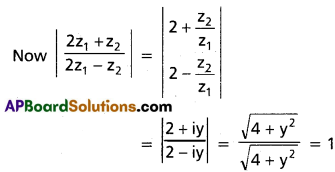
(iv) If \(\frac{z_{2}}{z_{1}}\), (z1 ≠ 0) is an imaginary number, then find the value of \(\left|\frac{2 z_{1}+z_{2}}{2 z_{1}-z_{2}}\right|\)
Solution:
\(\frac{z_{2}}{z_{1}}\), (z1 ≠ 0) is purely imaginary.
We can suppose that \(\frac{z_{2}}{z_{1}}\) = iy, where y ∈ R – {0}
Inter 2nd Year Maths 2A Complex Numbers Solutions Ex 1(c) I Q1(iv)

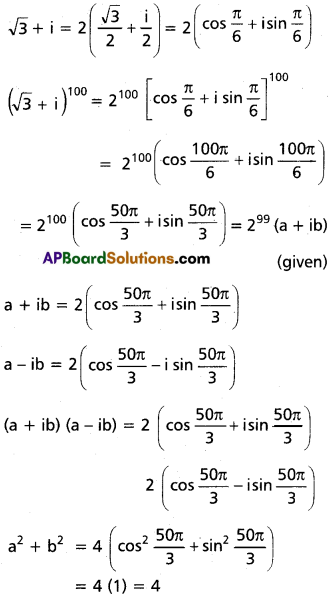
(v) If (√3 + i)100 = 299 (a + ib), then show that a2 + b2 = 4.
Solution:
Inter 2nd Year Maths 2A Complex Numbers Solutions Ex 1(c) I Q1(v)

Question 5.
(i) If z = x + iy and |z| = 1, find the locus of z.
Solution:
Given z = x + iy
Also |z| = 1
⇒ |x + iy| = 1
⇒ \(\sqrt{x^{2}+y^{2}}=1\)
⇒ x2 + y2 = 1
∴ Locus of z is x2 + y2 = 1

(ii) If the amplitude of (z – 1) is \(\frac{\pi}{2}\), then find the locus of z.
Solution:
Given z = x + iy
z – 1 = x + iy – 1 = (x – 1) + iy
Since Amplitude (z – 1) is \(\frac{\pi}{2}\)
Real part of z – 1 is zero.
∴ x – 1 = 0
∴ Locus of z is x – 1 = 0

(iii) If the Arg \(\overline{\mathbf{z}}_{1}\) and Arg z2 are \(\frac{\pi}{5}\) and \(\frac{\pi}{3}\) respectively, find (Arg z1 + Arg z2)
Solution:
Arg \(\overline{\mathbf{z}}_{1}\) = \(\frac{\pi}{5}\)
⇒ Arg \(\overline{\mathbf{z}}_{1}\) = -Arg z1 = \(-\frac{\pi}{5}\)
Arg z2 = \(\frac{\pi}{3}\)
∴ Arg z1 + Arg z2 = \(-\frac{\pi}{5}+\frac{\pi}{3}\) = \(\frac{2 \pi}{15}\)

Inter 2nd Year Maths 2A Complex Numbers Solutions Ex 1(c)

(iv) If z = \(\frac{1+2 i}{1-(1-i)^{2}}\) then find Arg(z).
Solution:
Given z = \(\frac{1+2 i}{1-(1-i)^{2}}\)
= \(\frac{1+2 i}{1-(1-2 i+i)^{2}}\)
= \(\frac{1+2 i}{1+2 i}\)
= 1
= cos 0° + i sin 0°
∴ Arg (z) = 0°

II.

Question 1.
Simplify the following complex numbers and find their modulus.
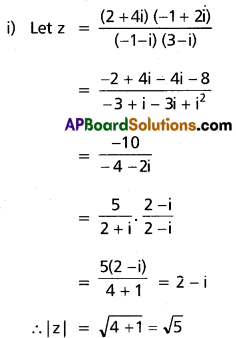
(i) \(\frac{(2+4 i)(-1+2 i)}{(-1-i)(3-i)}\)
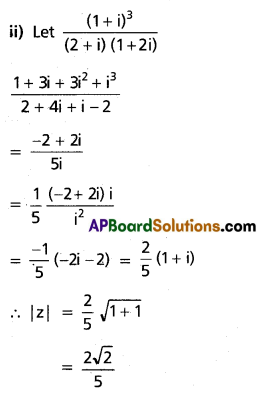
(ii) \(\frac{(1+i)^{3}}{(2+i)(1+2 i)}\)
Solution:
Inter 2nd Year Maths 2A Complex Numbers Solutions Ex 1(c) II Q1(i)
Inter 2nd Year Maths 2A Complex Numbers Solutions Ex 1(c) II Q1(ii)

Question 2.
(i) If (1 – i) (2 – i) ( 3 – i) …… (1 – ni) = x – iy then prove that 2 . 5 . 10 …….. (1 + n2) = x2 + y2.
Solution:
Given (1 – i) (2 – i) (3 – i) (1 – ni) = x – iy
|1 – i| |2 – i| |3 – i| …… |1 – ni| = |x – iy|
\(\sqrt{1+1} \sqrt{4+1} \sqrt{9+1} \ldots \sqrt{1+n^{2}}=\sqrt{x^{2}+y^{2}}\)
∴ 2 . 5 . 10 ……. (1 + n2) = x2 + y2

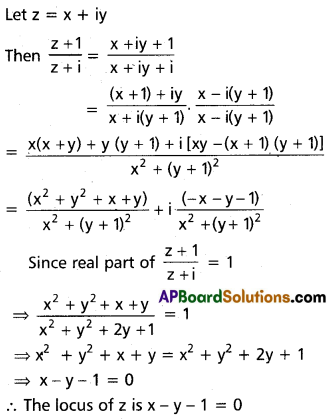
(ii) If the real part of \(\frac{z+1}{z+i}\) is 1, then find the locus of z.
Solution:
Inter 2nd Year Maths 2A Complex Numbers Solutions Ex 1(c) II Q2(ii)

(iii) If |z – 3 + i | = 4 determine the locus of z.
Solution:
Let z = x + iy
Given |z – 3 + i| = 4
⇒ |x + iy – 3 + i | = 4
⇒ (x – 3) + i(y + 1) = 4
⇒ \(\sqrt{(x-3)^{2}+(y+1)^{2}}\) = 4
⇒ (x – 3)2 + (y + 1)2 = 16
⇒ x2 – 6x + 9 + y2 + 2y + 1 = 16
⇒ x2 + y2 – 6x + 2y – 6 = 0
∴ The locus of z is x2 + y2 – 6x + 2y – 6 = 0

(iv) If |z + ai| = |z – ai| then find the locus of z.
Solution:
Let z = x + iy
Given |z + ai | = |z – ai|
⇒ |x + iy + ai| = |x + iy – ai|
⇒ |x + i(y + a)| = |x + i(y – a)|
⇒ \(\sqrt{x^{2}+(y+a)^{2}}=\sqrt{x^{2}+(y-a)^{2}}\)
⇒ x2 + (y + a)2 = x2 + (y – a)2
⇒ (y + a)2 – (y – a)2 = 0
⇒ 4ay = 0
⇒ y = 0
∴ The locus of z is y = 0

Inter 2nd Year Maths 2A Complex Numbers Solutions Ex 1(c)

Question 3.
If z = (x + iy) and if the point P in the Argand plane represents z, then describe geometrically the locus of P satisfying the equation.
(i) |2z – 3| = 7
Solution:
|2z – 3| = 7
Let z = x + iy
Given |2z – 3| = 7
⇒ |2(x + iy) – 3| = 7
⇒ |(2x – 3) + i(2y)| = 7
⇒ \(\sqrt{(2 x-3)^{2}+(2 y)^{2}}\) = 7
⇒ 4x2 – 12x + 9 + 4y2 = 49
⇒ 4x2 + 4y2 – 12x – 40 = 0
⇒ x2 + y2 – 3x – 10 = 0
∴ The locus of z is x2 + y2 – 3x – 10 = 0
This equation represents a circle.
Centre = (\(\frac{3}{2}\), 0)
Radius = \(\sqrt{\frac{9}{4}-(-10)}\) = \(\frac{7}{2}\) units

(ii) |z|2 = 4 Re(z + 2)
Solution:
|z|2 = 4 Re (z + 2)
Given |z|2 = 4 Re (z + 2)
⇒ |x + iy|2 = 4 Re (x + iy + z)
⇒ (\(\sqrt{x^{2}+y^{2}}\)) = 4(x + 2)
⇒ x2 + y2 = 4x + 8
∴ The locus of z is x2 + y2 – 4x – 8 = 0
This equation represents a circle. Center = (2, 0)
Radius = \(\sqrt{4-(-8)}\) = 2√3 units.

(iii) |z + i|2 – |z – i|2 = 2
Solution:
Given |z + i|2 – |z –  i|2 = 2
⇒ |x + iy + i|2 – |x + iy – i|2 = 2
⇒ |x + i(y + 1)|2 – |x + i(y – 1)|2 = 2
⇒ \(\left[\sqrt{x^{2}+(y+1)^{2}}\right]^{2}\) – \(\left[\sqrt{x^{2}+(y-1)^{2}}\right]^{2}\) = 2
⇒ x2 + (y + 1 )2 – [x2 + (y – 1)2] = 2
⇒ x2 + (y + 1)2 – x2 – (y – 1)2 = 2
⇒ 4y = 2
⇒ 2y – 1 = 0
The locus of P is 2y – 1 = 0
This equation represents a straight line parallel to the x-axis.

(iv) |z + 4i| + |z – 4i| = 10
Solution:
Given |z + 4i| + |z – 4i| = 10
⇒ |x + iy + 4i| + |x + iy – 4i| = 10
⇒ |x + i(y + 4)| + |x + i(y – 4)| = 10
⇒ \(\sqrt{x^{2}+(y+4)^{2}}+\sqrt{x^{2}+(y-4)^{2}}\)
⇒ \(\sqrt{x^{2}+(y+4)^{2}}\) = 10 – \(\sqrt{x^{2}+(y-4)^{2}}\)
⇒ x2 + (y + 4)2 = 100 + x2 + (y – 4)2 – 20 \(\sqrt{x^{2}+(y-4)^{2}}\)
⇒ 16y – 100 = – 20\(\sqrt{x^{2}+(y-4)^{2}}\)
⇒ 4y – 25 = -5\(\sqrt{x^{2}+(y-4)^{2}}\)
⇒ (4y – 25)2 = 25[x2 + (y – 4)2]
⇒ 16y2 – 200y + 625 = 25x2 + 25y2 – 200y + 400
⇒ 25x2 + 9y2 = 225
∴ The locus of P is 25x2 + 9y2 = 225
⇒ \(\frac{x^{2}}{9}+\frac{y^{2}}{25}\) = 1
This equation represents an ellipse.
Center = (0, 0)
a2 = 9, b2 = 25
We know a2 – b2(1 – e2)
⇒ 9 = 25(1 – e2)
⇒ 1 – e2 = \(\frac{9}{25}\)
⇒ e = 1 – \(\frac{9}{25}\) = \(\frac{16}{25}\)
∴ Eccentricity = \(\frac{4}{5}\) and major axis parallel to y-axis.

Inter 2nd Year Maths 2A Complex Numbers Solutions Ex 1(c)

Question 4.
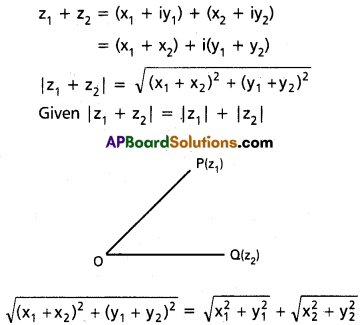
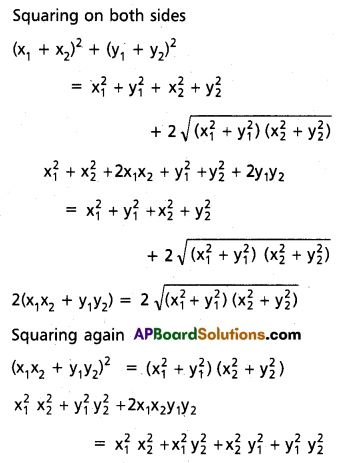
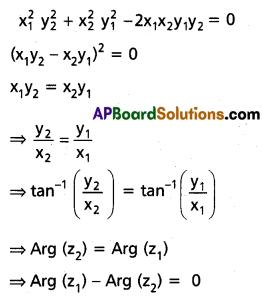
(i) If z1, z2 are two non-zero complex numbers satisfying |z1 + z2| = |z1| + |z2|, show that Arg z1 – Arg z2 = 0.
Solution:
Inter 2nd Year Maths 2A Complex Numbers Solutions Ex 1(c) II Q4(i)
Inter 2nd Year Maths 2A Complex Numbers Solutions Ex 1(c) II Q4(i).1
Inter 2nd Year Maths 2A Complex Numbers Solutions Ex 1(c) II Q4(i).2

(ii) z = x + iy and the point P represents z in the Argand plane and \(\left|\frac{z-a}{z+\bar{a}}\right|\) = 1, Re(a) ≠ 0, then find the locus of P.
Solution:
Let z = x + iy and a = α + iβ
\(\frac{z-a}{z+\bar{a}}=\frac{(x+i y)-(\alpha+i \beta)}{(x+i y)+(\alpha-i \beta)}\)
\(\left|\frac{z-a}{z+\bar{a}}\right|\) = 1
⇒ \(\frac{|z-a|}{|z+\bar{a}|}\) = 1
⇒ |z – a| = |z + \(\overline{\mathrm{a}}\)|
⇒ |(x – α)| + i(y – β)| = |(x + α) + i(y – β)|
⇒ \(\sqrt{(x-\alpha)^{2}+(y-\beta)^{2}}=\sqrt{(x+\alpha)^{2}+(y-\beta)^{2}}\)
⇒ (x – α)2 + (y – β)2 = (x + α)2 + (y – β)2
⇒ (x – α)2 = (x + α)2
⇒ (x + α)2 – (x – α)2 = 0
⇒ 4αx = 0
Re(a) ≠ 0
⇒ a ≠ 0
⇒ x = 0
Locus of P is x = 0 i.e., Y-axis

Inter 1st Year Maths 1B Applications of Derivatives Important Questions

Students get through Maths 1B Important Questions Inter 1st Year Maths 1B Applications of Derivatives Important Questions which are most likely to be asked in the exam.

Intermediate 1st Year Maths 1B Applications of Derivatives Important Questions

Question 1.
Find dy and ∆y of y = f(x) = x2 + x at x = 10 when ∆x = 0.1.
Solution:
As change in y – f(x) is given by ∆y = f(x + ∆x) – f(x), this change at x = 10 with ∆x = 0.1 is
∆y = f(10.1) – f(10)
= {(10.1)2 + 10.1} – {102 + 10}
= 2.11.
Since dy = f'(x) ∆x, dy at x = 10 with ∆x = 0.1 is dy = {(2)(10) + 1} 0.1 = 2.1
(since \(\frac{\mathrm{d} y}{\mathrm{dx}}\) = 2x + 1).

Inter 1st Year Maths 1B Applications of Derivatives Important Questions

Question 2.
Find ∆y and dy for the function y = cos (x) at x = 60° with ∆x = 1° .
Solution:
For the given problem ∆y and dy at x = 60° with ∆x = 1° are
∆y = cos (60° + 1°) – cos (60°) …………. (1)
and dy = -sin(60°) (1°) ………….. (2)
Cos (60°)= 0.5,
Cos (61°)= 0.4848,
Sin (60°) = 0.8660,
1° = 0.0174 radians
∴ ∆y = -0.0152 and
dy = -0.0150.

Question 3.
The side of a square is increased from 3 cm to 3.01 cm. Find the approximate increase in the area of the square.
Solution:
Let x be the side of a square and A be its area.
Then A = x2. …… (1)
Clearly A is a function of x. As the side is increased from 3 cm to 3.01 cm we can take x – 3 and ∆x = 0.01 to compute the approximate increase in the area of square. The approximate value of change in area is
∆A ≈ \(\frac{\mathrm{dA}}{\mathrm{dx}}\) ∆x
In view of equation (1), the equation (2) becomes
∆A ≈ 2x∆x
Hence the approximate increase in the area when the side is increased from 3 to 3.01 is
∆A ≈ 2(3)(0.01) = 0.06

Question 4.
If the radius of a sphere is increased from 7 cm to 7.02 cm then find the approximate increase in the volume of the sphere.
Solution:
Let r be the radius of a sphere and V be its volume. Then
V = \(\frac{4 \pi \pi^{2}}{3}\) …………….. (1)
Here V is a function of r. As the radius is increased from 7 cm to 7.02, we can take r = 7 cm and ∆r = 0.02 cm. Now we have to find the approximate increase in the volume of the sphere.
∴ ∆V ≈ \(\frac{\mathrm{dV}}{\mathrm{dr}}\) ∆r = 4πr2 ∆r.
Thus, the approximate increase in the volume of the sphere is \(\frac{4(22)(7)(7)(0.02)}{7}\) = 12.32 cm3.

Inter 1st Year Maths 1B Applications of Derivatives Important Questions

Question 5.
If y = f(x) = k xn then show that the approximate relative error (or increase) in y is n times the relative error (or increase) in x where n and k are constants.
Solution:
The approximate relative error (or increase) in y by the equation (2) of if a number A is very close to a number B but it is not equal to B then A is called an approximate value of B is (\(\frac{f^{\prime}(x)}{f(x)}\)) ∆x = \(\frac{k n x^{n-1}}{k x^{n}}\) ∆x = n(\(\frac{\Delta x}{x}\) = n)
Hence the approximate relative error in y = kxn is n times the relative error in x.

Question 6.
If the increase in the side of a square is 2% then find the approximate percentage of increase in its area.
Solution:
Let x be the side of a square and A be its area.
Then A = x2.
Approximate percentage error in area A
= (\(\frac{\frac{\mathrm{dA}}{\mathrm{dx}}}{\mathrm{A}}\)) × 100 × ∆x(by (3) of if a number
A is very close to a number B but it is not equal to B then A is called an approximate value of B with f = A)
= \(\frac{100(2 x) \Delta x}{x^{2}}\) = \(\frac{200 \Delta x}{x}\) = 2(2) = 4
(∵ \(\frac{\Delta x}{x}\) × 100 = 2

Question 7.
If an error of 0.01 cm is made in measuring the perimeter of a circle and the perimeter is measured as 44 cm then find the approximate error and relative error in its area.
Solution:
Let r, p and A be the radius, perimeter and area of the circle respectively. Given that p = 44 cm and ∆p = 0.01. We have to find approximation of ∆A and \(\frac{\Delta \mathrm{A}}{\mathrm{A}}\). Note that A = πr2 which is a function of r. As p and ∆p are given we have to transform A = πr2 into the form A = f(p). This can be achieved by using the relation, perimeter 2πr = p.
∴ A = π(\(\frac{p}{2 \pi}\))2 = \(\frac{p^{2}}{4 \pi}\)
Hence the approximate error in
A = \(\frac{d A}{d p}\)∆p = \(\frac{2 p}{4 \pi}\)∆p = \(\frac{P}{2 \pi}\)∆p
The approximate error in A when p = 44 and ∆p = 0.01 = \(\) (0.01) = 0.07
The approximate relative error
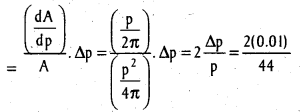
Inter 1st Year Maths 1B Applications of Derivatives Important Questions 1
= 0.0004545.

Inter 1st Year Maths 1B Applications of Derivatives Important Questions

Question 8.
Find the approximate value of \(\sqrt[3]{999}\)
Solution:
This problem can be answered by
f(x + ∆x) ≈ f(x) + f'(x) ∆x …………. (1)
with x = 1000 and ∆x = -1. The reason for taking x = 1000 is to make the calculation of f(x) simpler when f(x) = \(\sqrt[3]{x}\), Suppose
y = f(x) = \(\sqrt[3]{x}\)
The equation (1) becomes
f(x + ∆x) ≈ f(x) = \(\frac{1}{3 x^{\frac{2}{3}}}\) ∆x
Hence f(1000 – 1)
≈ f(1000) + \(\frac{1}{3(1000)^{2 / 3}}\) (-1) = 9.9967.

Question 9.
Find the slope of the tangent to the following curves at the points as indicated.
i) y = 5x2 at (-1, 5)
ii) y = \(\frac{1}{x – 1}\) (x ≠ 1) at [3, \(\frac{1}{2}\)]
iii) x = a secθ, y = a tanθ at θ = \(\frac{\pi}{6}\)
iv) (\(\frac{x}{a}\))n + (\(\frac{x}{b}\))n = 2 at (a, b)
Solution:
i) y = 5x2, then \(\frac{\mathrm{dy}}{\mathrm{dx}}\) = 10x
Slope of the tangent at the given points
(\(\frac{\mathrm{dy}}{\mathrm{dx}}\))(-1.5) -10(-1) = -10

ii) y = \(\frac{1}{x – 1}\)
\(\frac{\mathrm{dy}}{\mathrm{dx}}\) = \(\frac{-1}{(x-1)^{2}}\)
Slope of the tangent at the given point is
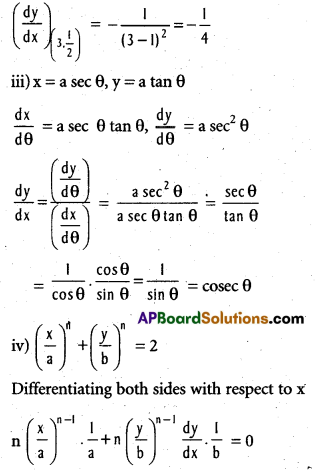
Inter 1st Year Maths 1B Applications of Derivatives Important Questions 2
Inter 1st Year Maths 1B Applications of Derivatives Important Questions 3

Inter 1st Year Maths 1B Applications of Derivatives Important Questions

Question 10.
Find the equations of the tangent and the normal to the curve y = 5x4 at the point (1, 5)
Solution:
y = 5x4 implies that \(\frac{\mathrm{dy}}{\mathrm{dx}}\) = 20x3
Slope of the tangent to the curve at (1, 5) is
(\(\frac{\mathrm{dy}}{\mathrm{dx}}\))(1, 5) = 20(1)5 = 20
Equation of the normal of (1, 5) is
y – 5 = 20 (x – 1) = 20x – 20
y = 20x – 15
Slope of the normal to the curve at (1, 5) is
–\(\frac{1}{m}\) = –\(\frac{1}{20}\)
Equation of the normal of (1, 5) is
y – 5 = –\(\frac{1}{20}\) (x – 1)
20 y – 100 = -x + 1
x + 20y = 101
(or) 20y = 101 – x

Question 11.
Find the equations of the tangent and the normal to the curve y4 = ax3. at (a, a).
Solution:
Given curve is y4 = ax3
Differentiating w.r.to. x
4y3 . \(\frac{\mathrm{dy}}{\mathrm{dx}}\) = 3ax2
\(\frac{\mathrm{dy}}{\mathrm{dx}}\) = \(\frac{3 a x^{2}}{4 y^{3}}\)
Slope of the tangent at (a, a) = \(\frac{3 a \cdot a^{2}}{4 a^{3}}\) = \(\frac{3}{4}\)
Slope of the normal at (a, a) = –\(\frac{1}{m}\) = –\(\frac{4}{3}\)
Equation of the tangent at (a, a) is
y – a = \(\frac{3}{4}\)(x – a)
4y – 4a = 3x – 3a
4y = 3x + a
Equation of the normal at (a, a) is 4
y – a = – \(\frac{4}{3}\)(x – a)
3y – 3a = -4x + 4a
3y + 4x = 7a

Question 12.
Find the equations of the tangent to the curve y = 3x2 – x3, where it meets the X-axis.
Solution:
Equation of the curve is y = 3x2 – x3
Equation of X – axis is y = 0
For points is intersection of the curve and X-axis
3x2 – x3 = 0 ⇒ x2 (3 – x) = 0
x = 0, x = 3
The curve crosses X-axis 0(0, 0) and A(3, 0)
y = -3x2 – x3
\(\frac{\mathrm{dy}}{\mathrm{dx}}\) = 6x – 3x2
At O(0, 0), slope of the tangent = (\(\frac{\mathrm{dy}}{\mathrm{dx}}\))(0, 0) = 0
Equation of the tangent at (0, 0) is y – 0, 0(x – 0) i.e., y = 0
i.e., x-axis is the tangent to the curve at O(0, 0)
At A(3, 0), slope of the tangent = (\(\frac{\mathrm{dy}}{\mathrm{dx}}\))(3, 0)
= 6.3 – 3.32
= 18 – 27
= -9
Equation of the tangent at A(3, 0) is
y – 0 = -9(x – 3) = -9x + 27
(or) 9x + y = 27

Inter 1st Year Maths 1B Applications of Derivatives Important Questions

Question 13.
Find the points at which the curve t y = sin x has horizontal tangents.
Solution:
y = sin x
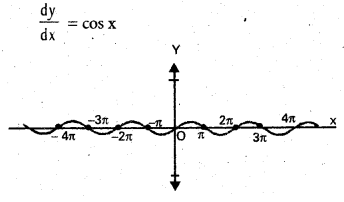
Inter 1st Year Maths 1B Applications of Derivatives Important Questions 4
A tangent is horizontal if and anal its slope is
cos x = 0 ⇒ x = (2n + 1)\(\frac{\pi}{2}\), n ∈ Z
Hence the given curve has horizontal tangents at points (x0, y0)
⇔ x0 = (2n + 1) . \(\frac{\pi}{2}\) and
y0 = (-1)n for same n ∈ Z

Question 14.
Verify whether the curve y = f(x) = x1/3 has a vertical tangent at the point with x = 0.
Solution:
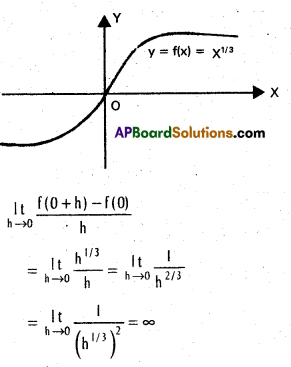
Inter 1st Year Maths 1B Applications of Derivatives Important Questions 5
The function has a verified tangent at the point whose x co-ordinate is 0.

Question 15.
Find whether the curve y = f(x)= x2/3 has a vertical tangent at x = 0.
Solution:
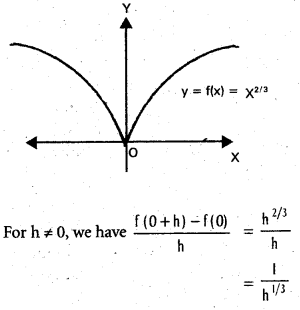
Inter 1st Year Maths 1B Applications of Derivatives Important Questions 6
Thus left handed be normal \(\frac{1}{h^{1 / 3}}\) as h → 0 is -∞
While the right handed limit is ∞.
Hence Inter 1st Year Maths 1B Applications of Derivatives Important Questions 7 does not exist. The vertical tangent does not exist.
At the point x = 0.

Inter 1st Year Maths 1B Applications of Derivatives Important Questions

Question 16.
Show that the tangent at any point 0 on the curve x = c sec θ, y = c tan θ is y sin θ = x – c cos θ.
Solution:
x = c sec θ, y = c tan θ
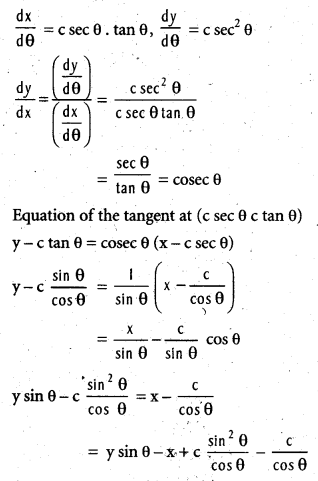
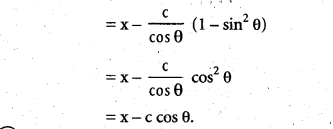
Inter 1st Year Maths 1B Applications of Derivatives Important Questions 8
Inter 1st Year Maths 1B Applications of Derivatives Important Questions 9

Question 17.
Show that the area of the triable formed by the tangent at any point on the curve xy = c (c ≠ 0) with the coordinate axis is constant.
Solution:
Observe that c ≠ 0
If c = 0 the equation xy = 0 represent the coordinate circle which is against the definite.
Let P (x1, y1) be a point on the curve xy = c
y = \(\frac{c}{x}\) = 1, \(\frac{\mathrm{dy}}{\mathrm{dx}}\) = – \(\frac{c}{x^{2}}\)
Equation of the tangent at (x1, y1) is
y – y1 = – \(\frac{c}{x^{2}}\) (x – x1)
x2y – x12 = -cx + cx1
cx + x12 . y = x12 + cx1
= cx1 + cx1 (x1y1 = c)
= 2cx1
\(\frac{c x}{2 c x_{1}}\) + \(\frac{x_{1}^{2} y}{2 c x_{1}}\) = 1
\(\frac{x}{2 x_{1}}\) + \(\frac{y}{\left(\frac{2 c}{x_{1}}\right)}\) = 1
Area of the triangle formed with co-ordinate axes
= \(\frac{1}{2}\) |OA . OB|
= \(\frac{1}{2}\) (2x1) (\(\frac{2 c}{x_{1}}\)) = 2c = constant

Inter 1st Year Maths 1B Applications of Derivatives Important Questions

Question 18.
Show that the equation of the tangent to the curve (\(\frac{x}{a}\))n + (\(\frac{y}{b}\))n = 2 (a ≠ 0, b ≠ 0) at the point (a, b) is \(\frac{x}{a}\) + \(\frac{y}{b}\) = 2
Solution:
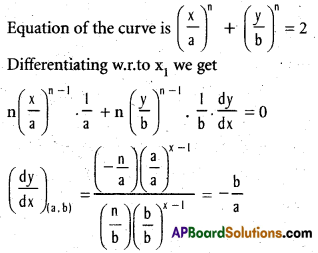
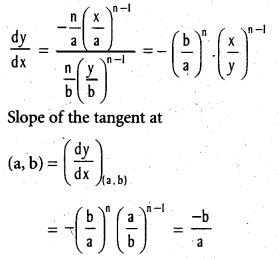
Inter 1st Year Maths 1B Applications of Derivatives Important Questions 10
Equation of the tangent to the curve at the point (a, b) is
y – b = \(\frac{-b}{a}\) (x – a)
\(\frac{y}{b}\) – 1 = – \(\frac{x}{a}\) + 1
\(\frac{x}{a}\) + \(\frac{y}{b}\) = 2

Question 19.
Show that the length of the sub normal at point on the curve y2 = 4ax is a constant.
Solution:
Equation of the curve is y2 = 4ax
Differentiating w.r.to x
2y \(\frac{\mathrm{dy}}{\mathrm{dx}}\) = 4a
\(\frac{\mathrm{dy}}{\mathrm{dx}}\) = \(\frac{4a}{2y}\) = \(\frac{2a}{y}\)
Length of the sub-normal \(\left|\frac{y d y}{d x}\right|=\left|y \cdot \frac{2 a}{y}\right|\)
= 2a = constant

Question 20.
Show that the length of the Sub tangent at any point on the curve y = ax (a > 0) is a constant.
Solution:
Equation of the curve is y = ax
Differentiating w.r.to x
\(\frac{\mathrm{dy}}{\mathrm{dx}}\) = ax log a = y. log a
Length of the sub-tangent
= \(\left|\frac{y}{\left(\frac{d y}{d x}\right)}\right|\) = \(\left|\frac{y}{\left(\frac{d y}{d x}\right)}\right|\) = \(\frac{1}{\log a}\) constant

Inter 1st Year Maths 1B Applications of Derivatives Important Questions

Question 21.
Show that the square of the length of subtangent at any point on the curve by2 = (x + a)3 (b ≠ 0) varies with the length of the subnormal at that point.
Solution:
Differentiating by2 = (x + a)3
w.r.t x, we get
2by y’ = 3(x + a)2
∴ The length of the subnormal at any point (x, y) on the curve
= |y y’| = |\(\frac{3}{2 b}\)(x + a)2| ………………… (1)
The square of the length of subtangent
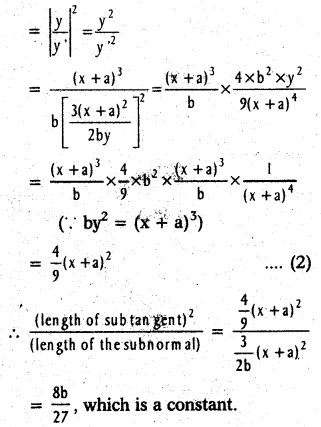
Inter 1st Year Maths 1B Applications of Derivatives Important Questions 11
∴ (length of the subnormal)2 ∝ (length of subnormal).

Question 22.
Find the value of k, so that the length of the subnormal at any point on the curve y = a1 – kxk is a constant.
Solution:
Differentiating y = a1 – kxk with respect to x,
we get y’ = ka1 – kxk – 1
Length of subnormal at any point P(x, y) on the curve
= |y y’| = |yka1 – kxk – 1|
= |k a1 – kxka1 – kxk – 1|
= |ka2-2kx2k-1|
In order to make these values a constant, we should have 2k – 1 = 0 i.e., k = \(\frac{1}{2}\).

Question 23.
Find the angle between the curves xy = 2 and x2 + 4y = 0.
Solution:
First we find the points of intersection of xy = 2 and x2 + 4y = 0
y = \(\frac{-x^{2}}{4}\)
But xy = 2 ⇒ x(\(\frac{-x^{2}}{4}\)) = 2 ⇒ x3 = -8
x = -2
y = \(\frac{-x^{2}}{4}\) = – \(\frac{4}{4}\) = -1
Point of intersection is P(-2, -1)
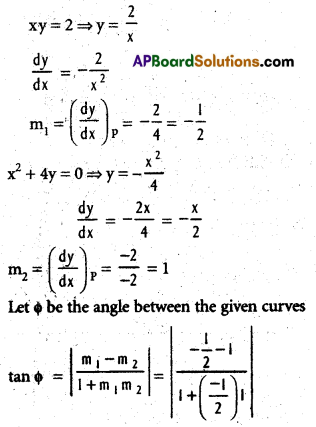
Inter 1st Year Maths 1B Applications of Derivatives Important Questions 12
= \(\left|\frac{-\frac{3}{2}}{\frac{1}{2}}\right|\) = 3
Φ = tan-1(3)

Inter 1st Year Maths 1B Applications of Derivatives Important Questions

Question 24.
Find the angle between the curve 2y = e\(\frac{-x}{2}\) and Y-axis.
Solution:
Equation of Y-axis is x = 0.
The point of intersection of the curve
2y = e\(\frac{-x}{2}\) and x = 0 is P(0, \(\frac{1}{2}\))
Let ψ be the angle between the given curves
2y = e\(\frac{-x}{2}\) at P with X – axis is given by
tan ψ = \(\left.\frac{\mathrm{dy}}{\mathrm{dx}}\right|_{\left(0, \frac{1}{2}\right)}=\left.\frac{-1}{4} \mathrm{e}^{\frac{-x}{2}}\right|_{\left(0, \frac{1}{2}\right)}=\frac{-1}{4}\)
Further, if Φ is the angle between the Y – axis and 2y = e\(\frac{-x}{2}\), then we have
tan Φ = |tan (\(\frac{\pi}{2}\) – ψ)| = |cot ψ| = 4
∴ The angle between the curve and the Y-axis is tan-1 4.

Question 25.
Show that the condition of the orthogonality of the curves ax2 + by2 = 1 and a1x2 + b1y2 = 1 is \(\frac{1}{a}\) – \(\frac{1}{b}\) = \(\frac{1}{a_{1}}\) – \(\frac{1}{b_{1}}\).
Solution:
Let the curves ax2 + by2 = 1 and a1x2 + b1y2 = 1 intersect at p(x1, y1) so that
ax12 + by12 = 1 and a1x12 + b1y12 = 1, from which we get,
\(\frac{x_{1}^{2}}{b_{1}-b}\) = \(\frac{y_{1}^{2}}{a_{1}-a}\) = \(\frac{1}{a b_{1}-a_{1} b}\) …………. (1)
Differentiating ax2 + by2 = 1 with respect to x,
we get \(\frac{\mathrm{dy}}{\mathrm{dx}}\) = \(\frac{-a x}{b y}\)
Hence, if mt is the slope of the tangent at P(x1, y1) to the curve
ax2 + by2 = 1, m1 = \(\frac{-a x_{1}}{b y_{1}}\)
Similarly, the slope (m2) of the tangent at P to
a1x2 + b1y2 = 1 is given by m2 = \(\frac{-a_{1} x_{1}}{b_{1} y_{1}}\)
Since the curves cut orthogonally we have m1m2 = -1,
i.e., \(\frac{\mathrm{a} a_{1} x_{1}^{2}}{\mathrm{~b} \mathrm{~b}_{1} y_{1}^{2}}\) = -1 or \(\frac{x_{1}^{2}}{y_{1}^{2}}=\frac{-b_{1}}{a a_{1}}\) ………………….. (2)
Now from (1) and (2), the condition for the orthogonality of the given curves is
\(\frac{b_{1}-b}{a-a_{1}}\) = \(\frac{b b_{1}}{a a_{1}}\)
or (b – a) a1b1 = (b1 – a1) ab
or \(\frac{1}{a}\) – \(\frac{1}{b}\) = \(\frac{1}{a_{1}}\) – \(\frac{1}{b_{1}}\)

Question 26.
Show that the curves y2 = 4(x + 1)and y2 = 36 (9 – x) intersect orthogonally. [Mar 11, May 06, 05]
Solution:
Solving y2 = 4(x + 1) and y2 = 36 (9 – x) for the points of intersection, we get
4(x + 1) = 36 (9 – x) 10x = 80 or x = 8
i.e., y2 = 4(x + 1) ⇒ y2 = 4(9) = 36 ⇒ y = ± 6
The points of intersection of the two curves are P(8, 6), Q(8, -6)
y2 = 4(x + 1) ⇒ \(\frac{\mathrm{dy}}{\mathrm{dx}}\) = \(\frac{2}{y}\)
y2 = 36 (9 – x) ⇒ \(\frac{\mathrm{dy}}{\mathrm{dx}}\) = \(\frac{-18}{y}\)
Slope of the tangent to the curve
y2 = 4(x + 1) at P is
m1 = \(\frac{2}{6}\) = \(\frac{1}{3}\)
Slope of the tangent to the curve
y2 = 36 (9 – x) at P is
m2 = \(\frac{-18}{6}\) = -3
m1m2 = \(\frac{1}{3}\) × -3 = -1
⇒ the curves intersect orthogonally at P.
We can prove, similarly,that the curves intersect orthogonally at Q also.

Inter 1st Year Maths 1B Applications of Derivatives Important Questions

Question 27.
Find the average rate of change of s = f (t) = 2t2 + 3 between t = 2 and t = 4.
Solution:
The average rate of change of s between t = 2 and t = 4 is \(\frac{f(4)-f(2)}{4-2}\) = \(\frac{35-11}{4-2}\) = 12.

Question 28.
Find the rate of change of area of a circle w.r.t. radius when r = 5 cm.
Solution:
Let A be the area of the circle with radius r.
Then A = πr2. Now, the rate of change of area A w.r.t. r is given by \(\frac{\mathrm{dA}}{\mathrm{dr}}\) = 2πr. When r = 5 cm.
\(\frac{\mathrm{dA}}{\mathrm{dr}}\) = 10 π.
Thus, the area of the circle is changing at the rate of 10 π cm2/cm.

Question 29.
The volume of a cube is increasing at a rate of 9 cubic centimeters per second. How fast is the surface area increasing when the length of the edge is 10 centimeters ?
Solution:
Let x be the length of the edge of the cube, V be its volume and S be its surface area. Then, V = x3 and S = 6x2. Given that rate of change of volume is 9 cm3/sec.
Therefore, \(\frac{\mathrm{dV}}{\mathrm{dt}}\) = 9 cm3/sec.
Now differentiating V w.r.t. t, we get,
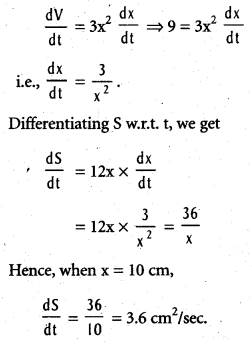
Inter 1st Year Maths 1B Applications of Derivatives Important Questions 13

Inter 1st Year Maths 1B Applications of Derivatives Important Questions

Question 30.
A particle is moving in a straight line so that after t seconds its distance is s (in cms) from a fixed point on the line is given by s = f(t) = 8t + t3. Find (i) the velocity at time t = 2 sec (ii) the initial velocity (iii) acceleration at t = 2 sec.
Solution:
The distance s and time t are connected by the relation.
s = f(t) = 8t + t3 …………. (1)
∴ velocity (ν) = 8 + 3t2 ……………. (2)
and the acceleration is given by
a = \(\frac{\mathrm{d}^{2} \mathrm{~s}}{\mathrm{dt}^{2}}\) = 6t
i) The velocity at
t = 2 is 8 + 3 (4) = 20cm/sec.
ii) The initial velocity (t = 0) is 8 cm/sec.
iii) The acceleration at t = 2 is 6(2) = 12 cm/sec2

Question 31.
A container in the shape of an inverted cone has height 12 cm and radius 6 cm at the top. If it is filled with water at the rate of 12 cm3/sec., what is the rate of change in the height of water level when the tank is filled 8 cm ?
Solution:
Let OC be height to water level at t sec. The triangles OAB ad OCD are similar triangles.
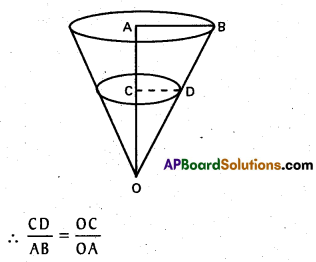
Inter 1st Year Maths 1B Applications of Derivatives Important Questions 14
Let OC = h and CD = r. Given that AB = 6 cm, OA = 12 cm.
\(\frac{r}{6}\) = \(\frac{h}{12}\)
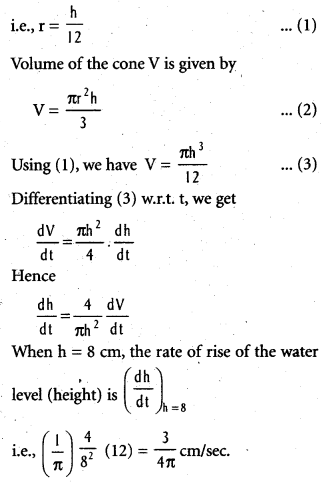
Inter 1st Year Maths 1B Applications of Derivatives Important Questions 15
Hence, the rate of change of water level is \(\frac{3}{4 \pi}\) cm/sec when the water level of the tank is 8 cm.

Question 32.
A particle is moving along a line according to s = f (t) = 4t3 – 3t2 + 5t -1 where s is measured in meters and t is measured in seconds. Find the velocity and acceleration at time t. At what time ‘ the acceleration is zero.
Solution:
Since f(t) = 4t3 – 3t2 + 5t – 1, the velocity at time t is
v = \(\frac{\mathrm{ds}}{\mathrm{dt}}\) = 12t2 – 6t + 5
and the acceleration at time t is a = \(\frac{\mathrm{d}^{2} \mathrm{~s}}{\mathrm{dt}^{2}}\) = 24t – 6.
The acceleration is 0 if 24t – 6 = 0
i.e., t = \(\frac{1}{4}\)
The acceleration of the particle is zero at
t = \(\frac{1}{4}\) sec.

Inter 1st Year Maths 1B Applications of Derivatives Important Questions

Question 33.
The quantity (in mg) of a drug in the blood at time t (sec) is given by q = 3(0.4)t. Find the instantaneous rate of change at t = 2 sec.
Solution:
Given that q = 3(0.4)t
∴ \(\frac{\mathrm{dQ}}{\mathrm{dx}}\) = 3(0.4)t loge(0.4) is the instaneous rate of change in q. Hence the instaneous rate of q at time t = 2 sec. is given by
\(\left(\frac{\mathrm{dQ}}{\mathrm{dx}}\right)_{t=2}\) = 3(0.4)2 loge (0.4).

Question 34.
Let a kind of bacteria grow by t3 (t in sec). At what time the rate of growth of the bacteria is 300 bacteria per sec ?
Solution:
Let g be the amount of growth of bacteria at t sec. Then
g(t) = t3 ………… (1)
The growth rate at time t is given by
g'(t) = 3t2
300 = 3t2 (given that growth rate is 300)
t = 10 sec.
∴ After t = 10 sec, the growth rate of bacteria should be 300 bacteria/sec.

Question 35.
The total cost C(x) in rupees associated with production of x units of an item is given by C(x) = 0.005 x3 – 0.02x2 + 30x + 500. Find the marginal cost when 3 units are produced (marginal cost is the rate of change of total cost).
Solution:
Let M represent the marginal cost. Then
M = \(\frac{\mathrm{dC}}{\mathrm{dx}}\)
Hence,
M = \(\frac{\mathrm{d}}{\mathrm{dx}}\)(0.005x3 – 0.02x2 + 30x + 500) dx
= 0.005(3x2) – 0.02(2x) + 30
∴ The Marginal cost at x = 3 is
(M)x = 3 = 0.005 (27) – 0.02 (6) + 30 = 30.015.
Hence the required marginal cost is Rs. 30.02 to produce 3 units.

Inter 1st Year Maths 1B Applications of Derivatives Important Questions

Question 36.
The total revenue in rupees received from the sale of x units of a product is given by R(x) = 3x2 + 36x + 5. Find the marginal revenue when x = 5 (marginal revenue is the rate of change of total revenue).
Solution:
Let m denote the marginal revenue. Then
m = \(\frac{\mathrm{dR}}{\mathrm{dx}}\) (since the total revenue is R(x))
Given that R(x) = 3x2 + 36x + 5
∴ m = 6x + 36
The marginal revenue at x = 5 is
[m = \(\frac{\mathrm{dR}}{\mathrm{dx}}\)]x = 5 = 30 + 36 = 66
Hence the required marginal revenue is Rs. 66.

Question 37.
Verify Rolle’s theorem for the function y = f(x) = x2 + 4 in [-3, 3].
Solution:
Here f(x) = x2 = 4. f is continuous on [-3, 3] as x2 + 4 is a polynomial which is continuous on any closed interval. Further f(3) = f(-3) = 13 and f is differentiable on [-3, 3].
∴ By Rolle’s theorem ∃ c ∈ (-3, 3) such that f'(c) = 0
The point c = 0 ∈ (-3, 3). Thus Rolle’s theorem is verified.

Question 38.
Verify Rolle’s theorem for the function f(x) = x(x + 3)e-x/2 in [-3, 0].
Solution:
Here f(-3) = 0 and f(0) = 0.
We have
f'(x) = \(\frac{\left(-x^{2}+x+6\right)}{2} e^{\frac{-x}{2}}\)
f'(x) = 0 ⇔ -x2 + x + 6 = 0 ⇔ x = -2 or 3. Of these two values -2 is in the open interval (-3, 0) which satisfies the conclusion of Rolle’s theorem.

Question 39.
Let f(x) = (x -1) (x – 2) (x – 3). Prove that there is more than one ‘c’ in (1, 3) such that f'(c) = 0. [Mar 13]
Solution:
Observe that f is continuous on (1, 3) differentiable in (1, 3) and f(1) = f(3) = 0.
f'(x) = (x – 1) (x – 2) + (x – 1) (x – 3) + (x – 2) (x – 3)
= 3x2 – 12x + 11
\(\frac{12 \pm \sqrt{144-132}}{6}\) = 2 ± \(\frac{1}{\sqrt{3}}\)
Both these roots lie in the open interval (1, 3) and are such that the derivative vanishes at these points.

Inter 1st Year Maths 1B Applications of Derivatives Important Questions

Question 40.
On the curve y = x2, find a point at which the tangent is parallel to the chord joining (0, 0) and (1, 1).
Solution:
The slope of the chord is \(\frac{1-0}{1-0}\) = 1.
The derivative is \(\frac{\mathrm{dy}}{\mathrm{dx}}\) = 2x.
We want x such that 2x = 1
i.e., x = \(\frac{1}{2}\)
we not that \(\frac{1}{2}\) is in the open interval (0, 1), as required in the Lagrange’s mean value theorem.
The corresponding point on the curve is (\(\frac{1}{2}\), \(\frac{1}{4}\)).

Question 41.
Show that f(x) = 8x + 2 is a strictly increasing function on R without using the graph of y = f(x).
Solution:
Let x1, x2 ∈ R with x1 < x2. Then 8x1 < 8x2. Adding 2 to both sides of this inequality, we have 8x1 + 2 < 8x2 + 2. i.e., f(x1) < f(x2).
Thus
x1 < x2 ⇒ f(x1) < f(x2) ∀ x1, x2 ∈ R.
Therefore, the given function f is strictly increasing on R.

Question 42.
Show that f (x) = ex is strictly increasing on R (without graph).
Solution:
Let x1, x2 ∈ R such that x1 < x2. we know that if a > b then ea > eb
∴ x1 < x2 ⇒ ex1 < ex2
i.e., f(x1) < f(x2).
Hence the given function f is a strictly increasing function.

Question 43.
Show that f(x) = – x + 2 is strictly decreasing on R.
Solution:
Let x1, x2 ∈ R x1 < x2.
Then x1 < x2
⇒ -x1 > -x2
⇒ -x1 + 2 > -x2 + 2
⇒ f(x1) > f(x2).
Therefore the given function f is strictly decreasing on R.

Inter 1st Year Maths 1B Applications of Derivatives Important Questions

Question 44.
Find the intervals on which
f(x) = x2 – 3x + 8 is increasing or decreasing ?
Solution:
Given fucntion is f(x) = x2 – 3x + 8.
Differentiating it w.r.t. x, we get f'(x) = 2x – 3
f(x) = 0 for x = 3/2.
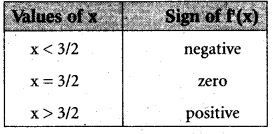
Inter 1st Year Maths 1B Applications of Derivatives Important Questions 16
since f'(x) < 0 in (-∞, 3/2) the function f(x) is strictly decreasing on (-∞, \(\frac{3}{2}\)) Further since f'(x) > 0 in (\(\frac{3}{2}\), -∞), the function f(x) is a strictly increasing function (\(\frac{3}{2}\), -∞).

Question 45.
Show that f(x) = |x| is strictly decreasing on (-∞, 0) and strictly increasing on (0, ∞).
Solution:
The given function is f(x) = |x| i.e.,
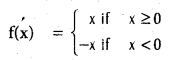
Inter 1st Year Maths 1B Applications of Derivatives Important Questions 25
Thus f'(c) = 1 if c > 0, f'(c) = -1 if c < 0. Since f'(c) > 0 on (0, ∞), the function f(x) is strictly increasing on (0, ∞). Since f'(c) < 0 on (-∞, 0), the function f(x) is strictly decreasing on (-∞, 0).

Question 46.
Find the intervals on which the function f(x) = x3 + 5x2 – 8x + 1 is a strictly increasing function.
Solution:
Given that f(x) = x3 + 5x2 – 8x + 1.
∴ f'(x) = 3x2 + 10x – 8 = (3x – 2) (x + 4)
= 3(x – \(\frac{2}{3}\)) (x – (-4)).
f'(x) is negative in (-4, \(\frac{2}{3}\)) and positive in (-∞, -4) ∪ (\(\frac{2}{3}\), ∞) .
∴ The function is strictly deceasing in (-4, \(\frac{2}{3}\)) and is strictly decreasing in (-∞, -4)and (\(\frac{2}{3}\), ∞)

Inter 1st Year Maths 1B Applications of Derivatives Important Questions

Question 47.
Find the Intervals on which f(x) = xx (x > 0) is increasing and decreasing.
Solution:
Taking logarithms on both sides of f(x) = xx
we get
log (f(x)) = x log x. Differenetiating it w.r.t. x
we have \(\frac{1}{f(x)}\) f'(x)= 1 + log x
∴ f'(x) = xx( 1 + log x)
f'(x) = 0 ⇒ xx(1 + log x) = 0 ……………. (1)
⇒ 1 + log x = 0
⇒ x = 1/e
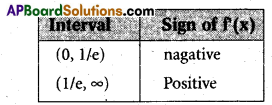
Inter 1st Year Maths 1B Applications of Derivatives Important Questions 17
Suppose x < 1/e log x < log (1/e) (since the base e > 1). i.e., log x < -1
1 + log x < 0 ⇒ xx (1 + log x) < 0. i.e., f'(x) < 0 Now suppose, x > 1/e. Then log x > log (1/e)
i.e., log x > – 1.
⇒ 1 + log x > 0
⇒ xx (1 + log x) > 0
⇒ f'(x) > 0
Hence, f is strictly decreasing on (o, 1/e) and it is strictly increasin on (1/e, ∞).

Question 48.
Determine the intervals in which f(x) = \(\frac{2}{(x-1)}\) + 18x ∀ x ∈ R \ {0} is strictly increasing and decreasing.
Solution:
Given that f(x) = \(\frac{2}{(x-1)}\) + 18x. Differenetiating
it w.r.t. x, we get
f'(x) = \(\frac{-1}{(x-1)^{2}}\) . 2 + 18 and f'(x) = 0
⇒ \(\frac{2}{(x-1)^{2}}\) = 18 ⇒ (x – 1)2 = 1/9.
∴ f'(x) = 0 if x – 1 = 1/3 or x- 1 = -(1/3).
i.e., x = 4/3 or x – 2/3.
The derivative of f(x) can be expressed as
f'(x) = \(\frac{18}{(x-1)^{2}}\) . (x – /3) (x – 4/3)
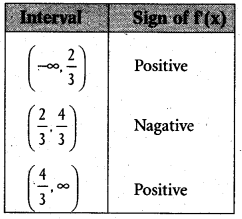
Inter 1st Year Maths 1B Applications of Derivatives Important Questions 18
∴ The given function f(x) is strictly increasing on (-∞, \(\frac{2}{3}\)) and (\(\frac{4}{3}\), ∞) and it is strictly decreasing on (\(\frac{2}{3}\), \(\frac{4}{3}\)).

Question 49.
Let f(x) = sin x – cos x be defined on [0, 2π]. Determine the intervals in which f(x) is strictly decreasing and strictly increasing.
Solution:
Given that f(x) = sin x – cos x.
∴ f'(x) = cos x + sin x
∴ f'(x) = \(\sqrt{2}\) . sin(x + π/4)
Let 0 < x < 3π/4. Then π/4 < x + π/4 < π. ∴ sin (x + π/4) > 0 i.e., f'(x) > 0.
Similarly it can be shown that f'(x) < 0 in (3π/4 . 7π/4) and f'(x) > 0 in (7π/4, 2π).
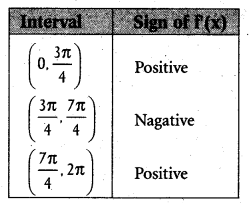
Inter 1st Year Maths 1B Applications of Derivatives Important Questions 19
Thus the function f(x) strictly increasing in (0, \(\frac{3\pi}{24}\) and (\(\frac{7\pi}{4}\), 2π) it is strictly decreasing in (\(\frac{3\pi}{4}\), \(\frac{7\pi}{4}\)).

Inter 1st Year Maths 1B Applications of Derivatives Important Questions

Question 50.
If 0 ≤ x ≤ \(\frac{\pi}{2}\) then show that x ≥ sinx.
Solution:
Let f(x) = x – sin x. Then f'(x) = 1 – cos x ≥ 0 ∀ x
∴ f is an increasing function for all x.
Now, f(0) = 0. Hence f(x) ≥ f(0) for all x ∈ (0, \(\frac{\pi}{2}\)). Therefore, x ≥ in x.

Question 51.
Let f : R → R be defined by f(x) = 4x2 – 4x + 11. Find the global minimum value and a point of global minimum.
Solution:
We have to look for a value c e R(domain) such that
f(x) ≥ f(c) ∀ x ∈ R
so that f(c) is the global minimum value of f. Consider
f(x) = 4x2 – 4x + 11 = (2x – 1)2 + 10 ≥ ∀ x ∈ R ……………(1)
Now, f(1/2) = 10
Also f(x) ≥ f(1/2) ∀ x ∈ R
Hence, f(1/2) = 10 is the global minimum value of f(x), and a point of global minimum is x = 1/2.

Question 52.
Let f : [-2, 2] → R be defined by f(x) = |x|. Find the global maximum of f(x) and a point of global minimum.
Solution:
We know that |x| = \(\left\{\begin{array}{ccc}
x & \text { if } & x \geq 0 \\
-x & \text { if } & x<0
\end{array}\right.\)
Therefore, from the graph of the function f on [-2, 2] clearly f(x) ≤ f(2) and f(x) ≤ f(-2) ∀ x ∈ [-2, 2].
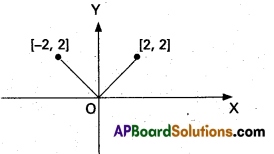
Inter 1st Year Maths 1B Applications of Derivatives Important Questions 20
∴ f(2) = f(-2) = 2 is the global maximum of f(x), 2 and -2 are the points of global maximum.

Question 53.
Find the global maximum and global minimum of the function f : R → R defined by f (x) = x2.
Solution:
We have f(x) ≥ f(0) ∀ x ∈ R.
Hence th global minimum value of f(x) is 0 and a point of global minimum is x = 0.
Suppose f has global maximum at x0 ∈ R (x0 > 0). Then as per out assumption we have.
f(x0) ≥ f(x) ∀ x ∈ R
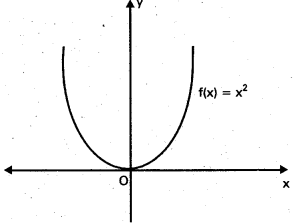
Inter 1st Year Maths 1B Applications of Derivatives Important Questions 21
Choose x1 = x0 + 1. Then x1 ∈ R and x0 < x1
∴ x02 < x12
Hence f(x0) < (fx1)
Thus we got f(x1) such that f(x0) > f(x0) which is a contradition to Therefore, f(x) has no global maximum on R.

Inter 1st Year Maths 1B Applications of Derivatives Important Questions

Question 54.
Find the stationary points of f(x) = 3x4 – 4x3 + 1, ∀ x ∈ R and state whether the function has local maxima or local minima at those points.
Solution:
Given that f(x) = 3x4 – 4x3 +1 and the domain of f is R. Differentiating the function w.r.t. x we have
f'(x) = 12x2(x – 1) ……………………… (1)
The stationary points are the roots of f (x) = 0 i.e., 12x2(x – 1) = 0. Hence x = 0 and x = 1 are the stationary points. Now, we test whether the stationary point x = 1 is a local extreme point or not. For.
f'(0.9) = 12(0.9)2 (0.9 – 1) ⇒ f'(0.9) is negative
f'(1.1) = 12(1.1)2 (1.1 – 1) ⇒ f'(1.1) is positive
and f(x) is defined in the neighbourhood i.e., (0.8, 1.2) of x = 1 with 8 = 0.2.
By theorem cis a point of local maximum if f(x) changes sign from positive to negative at x = c.
c is a point of local minimum if f'(x) changes sign from negative to positive at x = c.
The given function has local (relative) minimum at x = 1. Hence x = 1 is a local extreme point.
We will now test whether x = 0 is a local extreme point or not.
The function f(x) is defined in the neighbourhood of (-0.2, 0.2).
f'(-0.1) = 12(-0.1)2 (-0.1 – 1) ⇒ f'(-0.1) is negative
f'(-0.1) = 12(0.1)2 (0.1 -1) ⇒ f'(0.1) is negative
Thus, f(x) has no change in sign at x = 0. Therefore, the function f has no local maximum and no local minimum. Hence, x = 0 is not a local extreme point.

Question 55.
Find the points (if any) of local maxima and local minima of the function f (x) = x3 – 6x2 + 12x – 8 ∀ x ∈ R.
Solution:
Given function is f(x) = x3 – 6x2 + 12x – 8 and the domain of f is R.
Differentiating the given function w.r.t. x, we get
f'(x) = 3x2 – 12x + 12 i.e., f'(x) = 3(x – 2)2.
The stationary point of f(x) is x = 2, since 2 is a root of f'(x) = 0.
Choose δ = 0.2 The 0.2- neighbourhood of 2 is (1.8, 2.2). Now
f'(1.9) = 3(1.9 – 2)2 ⇒ f'(1.9) is positive
f'(2.1) = 3(2.1- 2)2 ⇒ f'(2.1) is positive
Thus f(x) does not change the sign at x = 2. By Theorem c is neither a point of local maximum nor a point of local minimum if f'(x) does not change sign at x = c.
x = 2 is neithere a local maximum nor a local minimum.

Inter 1st Year Maths 1B Applications of Derivatives Important Questions

Question 56.
Find the points of local minimum and local maximum of the function f(x) = sin 2x ∀ x ∈ [0, 2π]
Solution:
The given function is f(x) = sin 2x and domain is [0, 2π].
f'(x) = 2cos 2x …………… (1)
The critical points are the roots of 2 cos 2x = 0 and lying in the domain [0, 2π].
They are \(\frac{\pi}{4}\) and \(\frac{3\pi}{4}\) .
Now we apply the first derivative test at x = \(\frac{\pi}{4}\)
Clearly (\(\frac{\pi}{4}\) – 0.1 . \(\frac{\pi}{4}\) + 0.1) is a neighbourhood of \(\frac{\pi}{4}\) and the given f is defined on it.
Now
f'(\(\frac{\pi}{4}\) – 0.05) = 2 cos(\(\frac{\pi}{2}\) – 0.1) > 0
f'(\(\frac{\pi}{4}\) + 0.05) = 2 cos(\(\frac{\pi}{2}\) + 0.1) < 0
Thus f'(x) changes sign from positive to negative at x = \(\frac{\pi}{4}\). Therefore f has a local maximum.
Now we apply the first derivative test at x = \(\frac{3\pi}{4}\).
Clearly (\(\frac{3\pi}{4}\) – 0.1 . \(\frac{3\pi}{4}\) + 0.1) is a neighbourhood of \(\frac{3\pi}{4}\) and the given f is defined on it.
Now
f'(\(\frac{3\pi}{4}\) – 0.05) = 2 cos(\(\frac{3\pi}{4}\) – 0.1) < 0 f'(\(\frac{3\pi}{4}\) + 0.05) = 2 cos(\(\frac{3\pi}{4}\) + 0.1) > 0
Thus f'(x) changes sign from positive to negative at x = \(\frac{3\pi}{4}\). Therefore f has a local maximum at x = \(\frac{3\pi}{4}\).

Question 57.
Find the points of local extrema of the function f(x) = x3 – 9x2 – 48x + 6 ∀ x ∈ R Also find its local extrema.
Solution:
Given function is
f(x) = x3 – 9x2 – 48x + 6 …………… (1)
and the domain of the function is R.
Differentiating (1) w.r.t. x we get
f'(x) = 3x2 – 18x – 48 = 3(x – 8) (x + 2) ………….. (2)
Thus the stationary points are – 2 and 8.
Differentiating (2) w.r.t.x we get,
f'(x) = 6(x – 3) ………….. (3)
Let x1 = -2 and x2 = 8. Now we have to find f’ at each of these points to know the sign of second derivative.
At x1 = -2, f'(-2) = – 30. The sign of it is negative.
∴ x1 = – 2 is a point of local maximum of f and its local maximum value is f(-2) – 58.
Now, at x2 = 8 f'(8) = 30. Thus the sign of f”(x2) is positive. Therefore, x = 8 is a point of local minimum of f and its local minimum value is
f(8) = – 442.

Inter 1st Year Maths 1B Applications of Derivatives Important Questions

Question 58.
Find the points of local extrema of f(x) = x6 ∀ x ∈ R. Also find its local extrema.
Solution:
f(x) = x6 ………………….. (1)
Differentiating (1) w.r.t. x we get,
f'(x) = 6x5 ……………. (2)
and again differentiating (2) w.r.t. x we get
f'(x) = 30x4 …………………… (3)
The stationary point of f(x) is x = 0 only (since f'(x) = 0 only at x = 0).
Now f'(0) = 0. At x = 0, we can not conclude anything about the local extrema by the second derivative test. Therefore, we apply the first derivative test. As the domain of f is R, the function f is defined on (-0.2, 0.2) which is a neighbourhood of x = 0. Now
f'(-0.1) = 6(-0.1)5 < 0, f'(0, 1) = 6(0.1) 5 > 0.
Thus f'(x) changes sign form negative of positive at x = 0.
∴ x = 0 is a point of local minimum and its local minimum value is f(0) = 0.

Question 59.
Find the points of local extrema and local extrema for the function f(x) = cos 4x defined on (0, \(\frac{\pi}{2}\))
Solution:
Here f(x) = cos 4x ……………. (1)
and its domain is (0, \(\frac{\pi}{2}\))
∴ f’(x) = -4 sin 4x ………….. (2)
and f”(x) = -16 cos 4x ……………… (3)
The stationary points are the roots of
f'(x) = 0 and lying in the domain (o, \(\frac{\pi}{2}\)).
f'(x) = 0 ⇒ 4 sin 4x = 0
⇒ 4x = 0, π, 2π, 3π, 4π ………………….
⇒ x = 0, π/4, π/2, 3π/4, π …………………..
The point lying in the domain is x = \(\frac{\pi}{4}\) only.
Thus x = \(\frac{\pi}{4}\) is the stationary point of the given function. Now
f”(\(\frac{\pi}{4}\)) = -16 cos(π) = 16 > 0.
The function f has local minimum at x = \(\frac{\pi}{4}\) and its local minimum value is
f(\(\frac{\pi}{4}\)) = -1.

Question 60.
Find two positive number whose sum is 15 so that the sum of their squares is minimum.
Solution:
Suppose one numbers is x and the other number 15 – x. Let S be the sum of squares of these numbers. Then S = x2 + (15 – x)2 ………………… (1)
Note that the quantity S, to be minimized, is a function of x.
Differentiating (1) w.r.t. x, we get
\(\frac{\mathrm{dS}}{\mathrm{dx}}\) = 2x + 2(15 – x) (-1)
= 4x – 30 ………………. (2)
and again differentiating (2) w.r.t.x, we get
\(\frac{\mathrm{d}^{2} \mathrm{~S}}{\mathrm{dx}^{2}}\) = 4 ……………….. (3)
The stationary point can be obtained by solving \(\frac{\mathrm{dS}}{\mathrm{dx}}\) = 0 i.e., 4x – 30 = 0.
∴ x = 15/2 is the stationary point of (1).
Since \(\frac{\mathrm{d}^{2} \mathrm{~S}}{\mathrm{dx}^{2}}\) = 4 > 0, S is minimum at x = \(\frac{15}{2}\)
∴ The two numbers are \(\frac{15}{2}\), 15 – \(\frac{15}{2}\) i.e., \(\frac{15}{2}\) and \(\frac{15}{2}\).

Inter 1st Year Maths 1B Applications of Derivatives Important Questions

Question 61.
Find the maximum area of the rectangle that can be formed with fixed perimeter 20.
Solution:
Let x and y denote the length and the breadth of a rectangle respectively. Given that the perimeter of the rectangle is 20.
i.e., 2(x + y) = 20
i.e., x + y = 10 ……………. (1)
Let A denote the area of rectangle.
Then A = xy ………….. (2)
Which is to be minimized. Equation (1) can be expressed as
y = 10 – x …………… (3)
From (3) and (2), we have
A = x (10 – x)
A = 10x – x2 ……………… (4)
Differentiating (4) w.r.t. x we get
\(\frac{\mathrm{dA}}{\mathrm{dx}}\) = 10 – 2x ……………….. (5)
The stationary point is a root of 10 – 2x = 0
∴ x = 5 is the stationary point.
Differentiating (5) w.r.t. x, we get
\(\frac{\mathrm{d}^{2} \mathrm{~A}}{\mathrm{dx}^{2}}\) = -2
which is negative. Therefore by second derivative test the area A is maximized at x = 5 and hence y = 10 – 5 = 5, and the maximum area is A = 5(5) = 25.

Question 62.
Find the point on the graph y2 = x which is the nearest to the point (4, 0).
Solution:
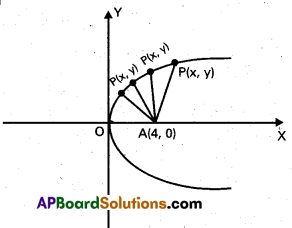
Inter 1st Year Maths 1B Applications of Derivatives Important Questions 22
Let P(x, y) be any point on y2 = x and A(4, 0). We have to find P such that PA is minimum
Suppose PA = D. The quantity to be minimized is D.
D = (\(\sqrt{(x-4)^{2}+(y-0)^{2}}\)) ………………. (1)
P(x, y) lies on the curve, therefore
y2 = x …………………… (2)
From (1) and (2), we have
D = \(\sqrt{\left((x-4)^{2}+x\right)}\)
D = \(\sqrt{\left(x^{2}-7 x+16\right)}\) ……………………. (3)
Differentiating (3) w.r.t. x, we get
\(\frac{\mathrm{dD}}{\mathrm{dx}}\) = \(=\frac{2 x-7}{2} \cdot \frac{1}{\sqrt{x^{2}-7 x+16}}\)
Now \(\frac{\mathrm{dD}}{\mathrm{dx}}\) = 0
gives x = \(\frac{7}{2}\). Thus \(\frac{7}{2}\) is a stationary point of the function D. We apply the first derivative test to verify whether D is minimum at x = \(\frac{1}{2}\)
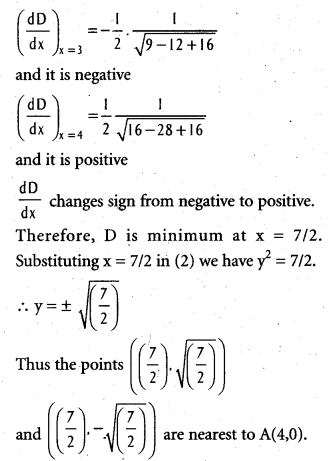
Inter 1st Year Maths 1B Applications of Derivatives Important Questions 23

Inter 1st Year Maths 1B Applications of Derivatives Important Questions

Question 63.
Prove that the radius of the right circular cylinder of greatest curved surface area which can be inscribed in a given cone is half of that of the cone.
Solution:
Let O be the centre of the circular base of the cone and its height be h. Let r be the radius of the circular base of the cone.
Then AO = h, OC = r.
Let a cylinder with radius x(OE) be inscribed in the given cone. Let its height be u.
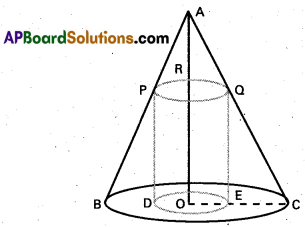
Inter 1st Year Maths 1B Applications of Derivatives Important Questions 24
i.e., RO = QE = PD = u
Now the triangles AOC and QEC are similar.
Therefore,
\(\frac{\mathrm{QE}}{\mathrm{OA}}\) = \(\frac{\mathrm{EC}}{\mathrm{OC}}\)
i.e., \(\frac{u}{h}\) = \(\frac{r-x}{r}\)
∴ u = \(\frac{h(r-x)}{r}\) ………………… (1)
Let S denote the curved surface area of the chosen cylinder.Then
S = 2 π xu.
As the cone is fixed one, the values of r and h are constants. Thus S is function of x only. Now,
\(\frac{\mathrm{dS}}{\mathrm{dx}}\) = 2 πh (r – 2x)/r and \(\frac{\mathrm{d}^{2} \mathrm{~S}}{\mathrm{dx}^{2}}\) = -4πh/r.
The stationary point of S is a root of
\(\frac{\mathrm{dS}}{\mathrm{dx}}\) = 0
i.e., π(r – 2x)/r = 0
i.e., x = r/2
\(\frac{\mathrm{d}^{2} \mathrm{~S}}{\mathrm{dx}^{2}}\) < 0 for all x, Therefore (\(\frac{\mathrm{d}^{2} \mathrm{~S}}{\mathrm{dx}^{2}}\))x=r/2 < 0.
Hence, the radius of the cylinder of greatest curved surface area which can be inscribed in a given cone is r/2.

Question 64.
The profit function P(x) of a company, selling x items per day is given by P(x) = (150 – x)x – 1600. Find the number of items that the company should sell to get maximum profit. Also find the maximum profit.
Solution:
Given that the profit function is
P(x) = ( 150 – x)x – 1600 ………….. (1)
For maxima or minima \(\frac{\mathrm{dP}(\mathrm{x})}{\mathrm{dx}}\) = 0
∴ (150 – x) (1) + x (-1) = 0
i.e., x = 75
Now \(\frac{d^{2} P(x)}{d x^{2}}\) = -2 and \(\left[\frac{d^{2} P(x)}{d x^{2}}\right]_{x=75}\) < 0.
∴ The profit P(x) is maximum for x = 75.
∴ The company should sell 75 items a day to make maximum profit.
The maximum profit will be P(75) = 4025.

Question 65.
A manufacturer can sell x items at a price of rupees (5 – x/100) each. The cost price of x items is Rs. (x/5 + 500). Find the number of items that the manufacturer should sell to earn maximum profits.
Solution:
Let S(x) be the selling price of x items and C(x) be the cost price of x items. Then, we have
S(x) = {cost of each item}, x .
∴ S(x) = (5 – x/100) x = 5x – x2/100 and C(x) = x/5 + 500
Let P(x) denote the profit function. Then
P(x) = S(x) – C(x)
P(x) = (5x – x2/100) – (x/5 + 500)
– (24x/5) – (x2/100) – 500 …………….. (1)
For maxima or minima
\(\frac{\mathrm{dP}(\mathrm{x})}{\mathrm{d} x}\) = 0
i.e., 24/5 – x/50 = 0
The stationary point of P(x) is x = 240 and
\(\left[\frac{d^{2} P(x)}{d x^{2}}\right]\) = –\(\frac{1}{50}\) for all x.
Hence the manufacturer can earn maximum profit if he sells 240 items.

Inter 1st Year Maths 1B Applications of Derivatives Important Questions

Question 66.
Find the absolute extrement of f(x) = x2 defined on [-2, 2].
Solution:
The given function f(x) = x2 is continuous on [-2, 2]. It can be shown that it has only local minimum and the point of local minimum is 0. The absolute(global) maximum of f is the largest value of f(-2), f(0) and f(2) i.e., 4, 0, 4.
Hence, the absolute maximum value is 4. Similarly the absolute minimum is the least value of 4, 0, 4. Hence 0 is the absolute minimum value.

Question 67.
Find the absolute maximum of x40 – x20 on the interval [0, 1]. Find also its absolute maximum value.
Solution:
Let f(x) = x40 – x20 ∀ x ∈ [0,1] ………… (1)
The function f is continuous on [0,1 j and the interval [0,1] is closed.
From (1) we have
f'(x) = 40 x39 – 20 x19 = 20x19 (2x20 – 1).
Thus f'(x) = 0 at x = 0 or
x = \(\left(\frac{1}{2}\right)^{\frac{1}{20}}\)
Therefore, the critical points of f are and \(\left(\frac{1}{2}\right)^{\frac{1}{20}}\) and 0 is one of the end points of the domain. Therefore no local maximum exists at x = 0. Now
f'(x) = 40(39) x38 – 20(19) x18
= 20x18 (78 x20 – 19)
[f”(x)]x = \(\left(\frac{1}{2}\right)^{\frac{1}{20}}\) = 20 (1/2)(18/20)[39 – 19] > 0.
Therefore f has local minimum at
x = (1/2)(1/20)
and its value is \(f\left(\left(\frac{1}{2}\right)^{\frac{1}{20}}\right)\) = –\(\frac{1}{4}\)
Therefore the absolute maximum value of the function f is the largest value of f(0), f(1) and \(f\left(\left(\frac{1}{2}\right)^{\frac{1}{20}}\right)\) i.e., the largest value of {0, 0, –\(\frac{1}{4}\)}
Hence, the absolute maximum of f is 0 and the points of absolute maximum are 0 and 1. Further the absolute minimum is the least of 0, 0, -latex]\frac{1}{4}[/latex].
Hence the absolute minimum is -latex]\frac{1}{4}[/latex] and the point of absolute minimum is x = \(\left(\frac{1}{2}\right)^{\frac{1}{20}}\)

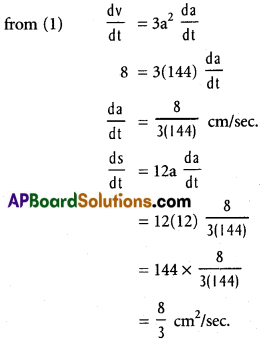
Inter 1st Year Maths 1B Differentiation Important Questions

Students get through Maths 1B Important Questions Inter 1st Year Maths 1B Differentiation Important Questions which are most likely to be asked in the exam.

Intermediate 1st Year Maths 1B Differentiation Important Questions

Question 1.
If f(x) = x2 (x ∈ R), prove that f is differentiable on R and find its derivative.
Solution:
Given that f(x) = x2
for x, h ∈ R, f(x + h) – f(x)(x + h)2 – x2
= x2 + h2 + 2hx – x2
= 2hx + h2 = h(2x + h)
Inter 1st Year Maths 1B Differentiation Important Questions 1
∴ f is differentiable on R and f'(x) = 2x for each x ∈ R

Inter 1st Year Maths 1B Differentiation Important Questions

Question 2.
Suppose f(x) = \(\sqrt{x}\) (x > 0). Prove that f is differentiable on (0, ∞) and find f(x).
Solution:
Let x ∈ (0, ∞) h ≠ 0 and |h| < 0
Inter 1st Year Maths 1B Differentiation Important Questions 2

Question 3.
If f(x) = \(\frac{1}{x^{2}+1}\) (x ∈ R), prove that f is differentiable on R and find f'(x).
Solution:
Let x ∈ R and h ≠ 0
Inter 1st Year Maths 1B Differentiation Important Questions 3
= –\(\frac{2 x}{\left(x^{2}+1\right)^{2}}\)
∴ f is differentiable and f'(x) = –\(\frac{2 x}{\left(x^{2}+1\right)^{2}}\) for each x ∈ R .

Question 4.
If f(x) = sin x (x ∈ R), then show that f is differentiable on R and f'(x) = cosx.
Solution:
Let x ∈ R and h ≠ 0
Inter 1st Year Maths 1B Differentiation Important Questions 4
∴ f is differentiable on R and f'(x) = cos x for each x ∈ R.

Inter 1st Year Maths 1B Differentiation Important Questions

Question 5.
Show that f(x) = |x| (x ∈ R) is not differentiable at zero and is differentiable at any x ≠ 0.
Solution:
Given f(x) = |x|
∴ f(x) = x if x ≥ 0
if h ≠ 0
\(\frac{f(0+h)-f(0)}{h}\) = \(\frac{f(h)}{h}\) = \(\left\{\begin{array}{r}
1 \text { if } h>0 \\
-1 \text { if } h<0
\end{array}\right.\)
f'(0+) = 1, f'(0) = -1
∴ is not differentiable at zero it can be easily proved that f is differentiable at any x ≠ 0 and that f'(x) = \(\left\{\begin{array}{l}
1 \quad \text { if } x>0 \\
-1 \text { if } x<0
\end{array}\right.\)

Question 6.
Check whether the following function is differentiable at zero f(x) = \(\left\{\begin{array}{l}
3+x \text { if } x \geq 0 \\
3-x \text { if } x<0
\end{array}\right.\)
Solution:
Inter 1st Year Maths 1B Differentiation Important Questions 5
f has the left hand derivative at zero and f'(0) = -1
∴ f'(0+) ≠ f'(0)
f(x) is not differentiable at zero.

Inter 1st Year Maths 1B Differentiation Important Questions

Question 7.
Show that the derivative of a constant function on an interval is zero.
Solution:
let f be a constant function on an interval I.
f(x) = C ∀ x ∈ I for some constant.
Let a ∈ I, for h ≠ 0 \(\frac{f(a+h)-f(a)}{h}\) = \(\frac{c-c}{h}\) = 0
for sufficiently small (h)
Inter 1st Year Maths 1B Differentiation Important Questions 6
∴ f is differentiable 0 and f'(0).

Question 8.
Suppose for all x, y ∈ R f(x + y) = f(x). f(y) and f'(0) exists. Then show that f(x) exists and equals to f(x) f'(0)for all x ∈ R.
Solution:
Let x ∈ R, for h ≠ 0, we have
\(\frac{f(x+h)-f(x)}{h}\) = \(\frac{f(x) f(h)-f(x)}{h}\)
= f(x) \(\frac{[f(h)-1]}{h}\) ………………….. (1)
f(0) = f(0 + 0) = f(0) f(0) ⇒ f(0) (1 —f(0)) = 0
∴ f(0) = 0 or f(0) = 1
Case (1) : Suppose f(0) = 0
f(x) = f(x + 0) = f(x) f(0) = 0 ∀ x ∈ R
∴ f(x) is a constant function = f'(x) = 0 for all x ∈ R
∴ f'(x) = 0 = f(x) . f'(0)

Case (ii): Suppose f(0) = 1
Inter 1st Year Maths 1B Differentiation Important Questions 7
∴ f is differentiable and f'(x) = f'(x) f'(0).

Question 9.
If f(x) = (ax + b)n, (x > –\(\frac{b}{a}\)), then find f'(x).
Sol:
Let u = ax + b so that y = un
f'(x) = \(\frac{\mathrm{d}}{\mathrm{dx}}\) (un) \(\frac{\mathrm{du}}{\mathrm{dx}}\)
= n.un-1a.
= an(ax+b)n – 1

Question 10.
Find the derivative of f(x) = ex (x2 + 1)
Solution:
Let u = ex, V = x2 + 1
\(\frac{\mathrm{du}}{\mathrm{dx}}\) = ex, \(\frac{\mathrm{dv}}{\mathrm{dx}}\) = 2x
f'(x) = u(x) v'(x) + u'(x) . v(x)
= ex2x + (x2 + 1) ex
= ex(2x + x2 + 1)
= ex(x + 1)2

Inter 1st Year Maths 1B Differentiation Important Questions

Question 11.
If y = \(\frac{a-x}{a+x}\) (x ≠ -a), find \(\frac{\mathrm{d} y}{\mathrm{dx}}\).
Solution:
Let u = a – x and v = a + x so that y = \(\frac{\mathrm{u}}{\mathrm{v}}\)
Inter 1st Year Maths 1B Differentiation Important Questions 8

Question 12.
If f(x) = e2x . log x (x > 0), then find f'(x).
Solution:
Let u = e2x, v = log x so that
\(\frac{\mathrm{du}}{\mathrm{dx}}\) = 2 . e2x , \(\frac{\mathrm{dv}}{\mathrm{dx}}\) = 1
f(x) = u.v
f'(x) = u . \(\frac{\mathrm{dv}}{\mathrm{dx}}\) + y . \(\frac{\mathrm{du}}{\mathrm{dx}}\)
= e2x . \(\frac{1}{x}\) + log x (2e2x)
= e2x (\(\frac{1}{x}\) + 2 logx)

Question 13.
If f(x) = \(\sqrt{\frac{1+x^{2}}{1-x^{2}}}\) (|x| < 1), then find f'(x)
Solution:
Inter 1st Year Maths 1B Differentiation Important Questions 9

Question 14.
If f(x) = x2, 2x log x (x > 0), find f'(x).
Solution:
u = x2, v = 2x, w = logx
\(\frac{\mathrm{du}}{\mathrm{dx}}\) = 2x, \(\frac{\mathrm{dv}}{\mathrm{dx}}\) = 2x . log2, \(\frac{\mathrm{dw}}{\mathrm{dx}}\) = \(\frac{1}{x}\)
f'(x) = uv . \(\frac{\mathrm{dw}}{\mathrm{dx}}\) + vw . \(\frac{\mathrm{du}}{\mathrm{dx}}\) + uw . \(\frac{\mathrm{dv}}{\mathrm{dx}}\)
= x22x . \(\frac{1}{x}\) + 2x . logx(2x) + x2 . logx . 2x log2
= x . 2x (logx2 + xlogx (log 2) + 1)

Inter 1st Year Maths 1B Differentiation Important Questions

Question 15.
If y = \(\left|\begin{array}{l}
f(x) g(x) \\
\phi(x) \psi(x)
\end{array}\right|\) then show that \(\frac{\mathrm{dy}}{\mathrm{dx}}\) = \(\left|\begin{array}{l}
f^{\prime}(x) g^{\prime}(x) \\
\phi(x) \psi(x)
\end{array}\right|\) + \(\left|\begin{array}{l}
f(x) g \backslash(x) \\
\phi^{\prime}(x) \Psi(x)
\end{array}\right|\)
Solution:
Given y = \(\left|\begin{array}{l}
f(x) g(x) \\
\phi(x) \psi(x)
\end{array}\right|\)
= f(x) ψ(x) – Φ(x) g(x)
\(\frac{\mathrm{dy}}{\mathrm{dx}}\) = f(x) ψ'(x) + ψ(x) f'(x) – [Φ(x). g'(x) + g(x). Φ'(x)]
= [f(x) ψ'(x) – g(x) Φ’x)] + [f'(x) ψ(x) – Φ(x).g'(x)]
= \(\left|\begin{array}{l}
f(x) g(x) \\
\phi^{\prime}(x) \psi^{\prime}(x)
\end{array}\right|\) + \(\left|\begin{array}{cc}
f^{\prime}(x) & g^{\prime}(x) \\
\phi(x) & \psi(x)
\end{array}\right|\)

Question 16.
If f(x) = 7x2+3x (x > 0), then find f'(x).
Solution:
Let u = x3 + 3x ⇒ \(\frac{\mathrm{du}}{\mathrm{dx}}\) = 3x2 + 3 = 3(x2 + 1)
f(X) = 7u
f'(x) = \(\frac{d f}{d u}\) . \(\frac{\mathrm{du}}{\mathrm{dx}}\) (7u . l0g 7) [3(x2 + 1)]
= 3(x2 + 1) 7x2+3x log 7

Question 17.
If f(x) = x ex sin x, then find f(x).
Solution:
Let u = x ,v = ex, w = sin x
\(\frac{\mathrm{dy}}{\mathrm{dx}}\) = 1, \(\frac{\mathrm{dv}}{\mathrm{dx}}\) = ex . \(\frac{\mathrm{dw}}{\mathrm{dx}}\) = cos x
f(x) = u.v.w
f'(x) = uv . \(\frac{\mathrm{dw}}{\mathrm{dx}}\) + uw \(\frac{\mathrm{dv}}{\mathrm{dx}}\) + vw \(\frac{\mathrm{du}}{\mathrm{dx}}\)
= xex cos x + x . sinx ex + ex sin x.

Inter 1st Year Maths 1B Differentiation Important Questions

Question 18.
If f(x) = sin (log x), (x > 0), find f'(x).
Solution:
Let u = logx, y = f(x) so that y = sin u
\(\frac{\mathrm{dy}}{\mathrm{dx}}\) = \(\frac{d y}{d u}\) . \(\frac{\mathrm{du}}{\mathrm{dx}}\)
\(\frac{\mathrm{dy}}{\mathrm{dx}}\) = cos u, \(\frac{\mathrm{du}}{\mathrm{dx}}\) = \(\frac{1}{x}\)
f'(x) = \(\frac{1}{x}\) . cos u = \(\frac{1}{x}\) cos (log x)

Question 19.
If f(x) =(x3 + 6x2 + 12x – 13)100; find f'(x).
Solution:
u = x3 + 6x2 + 12x – 13
⇒ \(\frac{\mathrm{du}}{\mathrm{dx}}\) = 3x2 + 12x + 12
= 3(x2 + 4x + 4)
= 3(x + 2)2
f(x) = u100
f'(x) = 100 . u99 . \(\frac{\mathrm{du}}{\mathrm{dx}}\)
= 100 (x3 + 6x2 + 12x – 13)99 . 3(x + 2)2
= 300 (x + 2)2 (x3 + 6x2 + 12x – 13)99

Question 20.
Find the derivative of f(x) = \(\frac{x \cos x}{\sqrt{1+x^{2}}}\)
Solution:
Let u = x cos x, and v = \(\sqrt{1+x^{2}}\) so that
Inter 1st Year Maths 1B Differentiation Important Questions 10

Question 21.
li f(x) = log (secx + tan x), find f'(x). [Mar 14, May 11]
Solution:
Let u = sec x + tan x and y = log u
\(\frac{\mathrm{dy}}{\mathrm{dx}}\) = \(\frac{1}{u}\), \(\frac{\mathrm{du}}{\mathrm{dx}}\) = sec x. tan x + sec2 x
= sec x (sec x + tan x)
\(\frac{\mathrm{dy}}{\mathrm{dx}}\) = \(\frac{\mathrm{dy}}{\mathrm{dx}}\) . \(\frac{\mathrm{du}}{\mathrm{dx}}\)
= \(\frac{1}{\sec x+\tan x}\) . sec x(sec x + tan x) = sec x

Inter 1st Year Maths 1B Differentiation Important Questions

Question 22.
If y = sin-1\(\sqrt{x}\), find \(\frac{\mathrm{dy}}{\mathrm{dx}}\)
Solution:
u = \(\sqrt{x}\), y = sin-1 x.
Inter 1st Year Maths 1B Differentiation Important Questions 11

Question 23.
If y = sec (\(\sqrt{\tan x}\)), find \(\frac{\mathrm{dy}}{\mathrm{dx}}\).
Solution:
u = \(\sqrt{\tan x}\), v = tanx
Then y = sec u, u = \(\sqrt{\mathrm{v}}\), v = tan x
Inter 1st Year Maths 1B Differentiation Important Questions 12

Question 24.
If y = \(\frac{x \sin ^{-1} x}{\sqrt{1-x^{2}}}\), find \(\frac{\mathrm{dy}}{\mathrm{dx}}\).
Solution:
Let u = x sin-1x, v = \(\sqrt{1-x^{2}}\)
Inter 1st Year Maths 1B Differentiation Important Questions 13

Inter 1st Year Maths 1B Differentiation Important Questions

Question 25.
If y = log (cosh 2x), find \(\frac{\mathrm{dy}}{\mathrm{dx}}\).
Solution:
Let u = cosh 2x, so that y = log u
\(\frac{\mathrm{dy}}{\mathrm{dx}}\) = \(\frac{1}{u}\); \(\frac{\mathrm{du}}{\mathrm{dx}}\) = 2 sin h2x
\(\frac{\mathrm{dy}}{\mathrm{dx}}\) = \(\frac{d y}{d u}\) . \(\frac{\mathrm{du}}{\mathrm{dx}}\)
= 2 sin h 2x . \(\cosh 2 x\) = 2 tan h 2x

Question 26.
If y = log (sin (log x)), find \(\frac{\mathrm{dy}}{\mathrm{dx}}\).
Solution:
Let v = log x, u = sin v so that y = log u.
\(\frac{\mathrm{dy}}{\mathrm{dx}}\) = \(\frac{1}{u}\); \(\frac{d u}{d v}\) = cos u; \(\frac{\mathrm{dv}}{\mathrm{dx}}\) = \(\frac{1}{x}\)
\(\frac{\mathrm{dy}}{\mathrm{dx}}\) = \(\frac{d y}{d u}\) . \(\frac{d u}{d v}\) . \(\frac{\mathrm{dv}}{\mathrm{dx}}\)
= \(\frac{1}{\sin (\log x)}\) . cos (logx) \(\frac{1}{x}\) = \(\frac{\cot (\log x)}{x}\)

Question 27.
If y = (cot-1x3)2, find \(\frac{\mathrm{dy}}{\mathrm{dx}}\).
Solution:
u = cot-1x3, u = x3, y = u2
Inter 1st Year Maths 1B Differentiation Important Questions 14

Inter 1st Year Maths 1B Differentiation Important Questions

Question 28.
If y = cosec-1(e2x+1), find \(\frac{\mathrm{dy}}{\mathrm{dx}}\).
Solution:
u = e2x+1, y = cosec-1u
Inter 1st Year Maths 1B Differentiation Important Questions 15

Question 29.
If y = tan-1 (cos \(\sqrt{x}\)), find \(\frac{\mathrm{dy}}{\mathrm{dx}}\).
Solution:
v = \(\sqrt{x}\) and u = cos v, y = tan-1u
\(\frac{\mathrm{dv}}{\mathrm{dx}}\) = \(\frac{1}{2 \sqrt{x}}\), \(\frac{d u}{d v}\) = – sin u; \(\frac{\mathrm{dy}}{\mathrm{dx}}\) = \(\frac{1}{1+u^{2}}\)
= – sin \(\sqrt{x}\) = \(\frac{1}{1+\cos ^{2}(\sqrt{x})}\)
Inter 1st Year Maths 1B Differentiation Important Questions 16

Question 30.
If y = Tan-1 \(\sqrt{42}\) for 0 < |x| < 1, find \(\frac{\mathrm{dy}}{\mathrm{dx}}\). [May, Mar 12]
Solution:
Put x2 = cos 2θ
Inter 1st Year Maths 1B Differentiation Important Questions 17

Inter 1st Year Maths 1B Differentiation Important Questions

Question 31.
If y = x2exsin x, find \(\frac{\mathrm{dy}}{\mathrm{dx}}\).
Solution:
log y = log x2. ex. sin x
= log x2 + log ex + log sin x
= 2 log x + log ex + log sin x
Differentiating w.r.to by sin x
\(\frac{1}{y}\) . \(\frac{\mathrm{dy}}{\mathrm{dx}}\) = \(\frac{2}{x}\) + 1 + \(\frac{1}{sin x}\) . cos x
\(\frac{\mathrm{dy}}{\mathrm{dx}}\) = y(\(\frac{2}{x}\) + 1 + cot x)

Question 32.
If y = xtanx + (sin x)cos x, find \(\frac{\mathrm{dy}}{\mathrm{dx}}\) [Mar. 14, 11]
Solution:
Let u = xtanx and v = (sin x)cos x
log u logx tanx = (tan x) log x
Inter 1st Year Maths 1B Differentiation Important Questions 18
Inter 1st Year Maths 1B Differentiation Important Questions 19

Question 33.
If x = a(cos t + log tan (\(\frac{t}{2}\))), y = a sin t, find \(\frac{\mathrm{dy}}{\mathrm{dx}}\).
Solution:
Inter 1st Year Maths 1B Differentiation Important Questions 20
Inter 1st Year Maths 1B Differentiation Important Questions 21

Inter 1st Year Maths 1B Differentiation Important Questions

Question 34.
If xy = ex-y, than show that \(\frac{\mathrm{dy}}{\mathrm{dx}}\) = \(\frac{\log x}{(1+\log x)^{2}}\)    [May 07]
Solution:
xy = ex-y
log xy = log ex-y
y log x = (x – y) (log e = 1)
y(1 + log x) = x
Inter 1st Year Maths 1B Differentiation Important Questions 22

Question 35.
If siny = x sin (a + y), then show that \(\frac{\mathrm{dy}}{\mathrm{dx}}\) = \(\frac{\sin ^{2}(a+y)}{\sin a}\) (a is not a multiple of π)
Solution:
Inter 1st Year Maths 1B Differentiation Important Questions 23

Question 36.
If y = x4 + tan x, then find y”.
Solution:
y = x4 + tan x
\(\frac{\mathrm{dy}}{\mathrm{dx}}\) = 4x3 + sec2 x
\(\frac{d^{2} y}{d x^{2}}\) = 12x2 + 2 sec x (sec x tan x)
= 12x2 + 2 sec2x . tan x

Inter 1st Year Maths 1B Differentiation Important Questions

Question 37.
If f(x) = sinx, sin 2x sin 3x, find f”(x).
Solution:
f(x) = \(\frac{1}{2}\) sin 2x(2 sin 3x sin x)
= \(\frac{1}{2}\) (sin 2x) (cos 2x – cos4x)
= \(\frac{1}{4}\) (2 sin 2x cos 2x – 2 sin 2x cos 4x)
= \(\frac{1}{4}\) (sin2x + sin4x – sin6x)
Therefore,
f'(x)= \(\frac{1}{4}\)[2 cos 2x+ 4cos 4x – 6cos 6x]
Hence,
f”(x) = \(\frac{1}{4}\) (-4 sin 2x – 16 sin 4x + 36 sin 6x)
= 9 sin 6x – 4 sin 4x – sin 2x.

Question 38.
Show that y = x + tan x satisfies cos2x \(\frac{d^{2} y}{d x^{2}}\) + 2x = 2y.
Solution:
y = x + tan x implies that y’ = 1 + sec2 x
That is, y’ cos2x = 1 + cos2x.
Differentiating both sides of the above equation we get
y” cos2x + y’ . 2 cos x (-sin x) = 2 cos x (- sin x)
∴ y” cos2 x = 2(y’ – 1) sin x cos x
= 2 sec2x sin x cos x = 2 tan x = 2(y – x)
This proves the result.

Question 39.
If x = a(t – sin t),y = a(1 + cost), find \(\frac{d^{2} y}{d x^{2}}\).
Solution:
Inter 1st Year Maths 1B Differentiation Important Questions 24
Inter 1st Year Maths 1B Differentiation Important Questions 25

Inter 1st Year Maths 1B Differentiation Important Questions

Question 40.
Find the second order derivative of y = tan-1(\(\frac{2 x}{1-x^{2}}\))
Solution:
Put x = tan θ, Then
y = tan-1 (\(\frac{2 \tan \theta}{1-\tan ^{2} \theta}\))
= tan-1 (tan 2θ)
= 2θ = 2 tan-1x
∴ \(\frac{\mathrm{dy}}{\mathrm{dx}}\) = \(\frac{2}{1+x^{2}}\) and \(\frac{d^{2} y}{d x^{2}}\) = \(\frac{-4 x}{\left(1+x^{2}\right)^{2}}\).

Question 41.
If y = sin (sin x), show that y” + (tan x) y’ + y cos2x = 0.
Solution:
y = sin (sin x) implies that .
y’ = cos x . cos (sin x) and
y” = -cos2x sin (sin x) – sin x cos (sin x)
= – y cos2x – sin x (\(\frac{y^{\prime}}{\cos x}\))
= -y cos2x – y’ tan x
∴ y” + (tan x)y’ + y cos2 x = 0.

Question 42.
If f(x) = ex(x ∈ R), then show that f(x) = ex by first principle.
Solution:
From f(x) = ex we have for h ≠ 0
Inter 1st Year Maths 1B Differentiation Important Questions 26

Inter 1st Year Maths 1B Differentiation Important Questions

Question 43.
If f(x) = log x (x > 0), then show that f(x) = \(\frac{1}{x}\) by first principle.
Solution:
Now for h ≠ 0
Inter 1st Year Maths 1B Differentiation Important Questions 27
\(\frac{d}{dx}\) (log x) = \(\frac{1}{x}\)

Question 44.
If 1(x) = ax (x ∈ R) (a > 0), then show that f'(x) = ax log a by first principle.
Solution:
For h ≠ 0
\(\frac{f(x+h)-f(x)}{h}\) = \(\frac{a^{x+h}-a^{x}}{h}\) = ax [latex]\frac{a^{h}-1}{h}[/latex]
We know that \(\frac{a^{h}-1}{h}\) → log a as h → 0
Hence f'(x) = ax . log a.
\(\frac{d}{d x}\) = (ax) = ax log a

Question 45.
If y = Tan-1 \(\sqrt{\frac{1-x}{1+x}}\) (|x| < 1), we shall find \(\frac{\mathrm{dy}}{\mathrm{dx}}\).
Solution:
Substituting x cos u (u ∈ (0, π)) in y, we get
Inter 1st Year Maths 1B Differentiation Important Questions 28
Inter 1st Year Maths 1B Differentiation Important Questions 29
observe that Tan-1x, \(\sqrt{\frac{1-x}{1+x}}\) and cos u are the functions that stand for f(x), g(x) and h(u) respectively, mentioned in the method.

Inter 1st Year Maths 1B Differentiation Important Questions

Question 46.
If y = Tan-1[latex]\frac{2 x}{1-x^{2}}[/latex] (|x| < 1) then we shall \(\frac{\mathrm{dy}}{\mathrm{dx}}\).
Solution:
Substituting x = tan u
Inter 1st Year Maths 1B Differentiation Important Questions 30

Question 47.
If x = a cos3t, y = a sin3t, find \(\frac{\mathrm{dy}}{\mathrm{dx}}\).
Solution:
Here \(\frac{\mathrm{dy}}{\mathrm{dx}}\) = 3a cos2t (-sin t) and
\(\frac{d y}{d t}\) = 3a sin2t. cost.
∴ \(\frac{\mathrm{dy}}{\mathrm{dx}}\) = \(\frac{\frac{\mathrm{dy}}{\mathrm{dt}}}{\frac{\mathrm{dx}}{\mathrm{dt}}}\) = -tan t

Question 48.
If y = et +cost, x = log t + sin t find \(\frac{\mathrm{dy}}{\mathrm{dx}}\)
Solution:
Here \(\frac{\mathrm{dy}}{\mathrm{dx}}\) = et – sin t and \(\frac{d x}{d t}\) = \(\frac{1}{t}\) + cos t
∴ \(\frac{\mathrm{dy}}{\mathrm{dx}}\) = \(\frac{t\left(e^{t}-\sin t\right)}{(1+t \cos t)}\)

Inter 1st Year Maths 1B Differentiation Important Questions

Question 49.
To find the derivative of f(x) = x\(\sin ^{\frac{1}{x}}\) with respect to g(x) = sin-1x, we have to compute \(\frac{d f}{d g}\)
Solution:
Now f(x) = x\(\sin ^{\frac{1}{x}}\) implies that
log f(x) = sin-1x . log x so that
Inter 1st Year Maths 1B Differentiation Important Questions 31

Question 50.
If x3 + y3 – 3axy = 0, find \(\frac{\mathrm{dy}}{\mathrm{dx}}\).
Solution:
Let the given equation define the function.
y = 1(x) that is x3 + (f(x))3 – 3axf(x) = 0
Differentiating both sides of this equation with respect to x, we get
3x2 + 3 (f(x))2 f'(x) – [3a. f(x) + 3axf'(x)] = 0
Hence 3x2 + 3y2 f'(x) – [3ay + 3ax f'(x)] = 0
∴ f'(x) = \(\frac{\mathrm{dy}}{\mathrm{dx}}\) = \(\frac{a y-x^{2}}{y^{2}-a x}\)

Question 51.
If 2x2 – 3xy + y2 + x + 2y – 8 = 0, find \(\frac{\mathrm{dy}}{\mathrm{dx}}\).
Solution:
Treating y as a function of x and then differentiating with respect to x,
we get 4x – 3y – 3xy’ + 2yy’ + 1 + 2y’ = 0
∴ \(\frac{\mathrm{dy}}{\mathrm{dx}}\) = y’ = \(\frac{3 y-4 x-1}{2 y-3 x+2}\)

Inter 1st Year Maths 1B Differentiation Important Questions

Question 52.
If y = xx (x > 0), we shall find \(\frac{\mathrm{dy}}{\mathrm{dx}}\).
Solution:
Taking logarithms on both the sides of
y = xx we obtain log y = x log x
Differentiating with respect to x,
We get \(\frac{y^{\prime}}{y}\) = x . \(\frac{1}{x}\) + log x = 1 + log x
∴ \(\frac{\mathrm{dy}}{\mathrm{dx}}\) = y’ = y(1 + log x) = xx (1 + log x)

Question 53.
If y = (tan x)sin x [o < x < \(\frac{\pi}{2}\) ] compute \(\frac{\mathrm{dy}}{\mathrm{dx}}\).
Solution:
Taking logarthms on both sides of
y= (tan x)sin x, we get
log y = sin x . log (tan x)
Differentiating with respect to x, we get
\(\frac{y^{\prime}}{y}\) = \(\frac{\sin x}{\tan x}\) . sec2x + cosx . log (tan x)
= sec x + cos x . log (tan x)
Hence \(\frac{\mathrm{dy}}{\mathrm{dx}}\) = (tan x)sin x [sec x + cos x log (tan x)]

Inter 1st Year Maths 1B Limits and Continuity Important Questions

Students get through Maths 1B Important Questions Inter 1st Year Maths 1B Limits and Continuity Important Questions which are most likely to be asked in the exam.

Intermediate 1st Year Maths 1B Limits and Continuity Important Questions

Question 1.
Evaluate Inter 1st Year Maths 1B Limits and Continuity Important Questions 1
Solution:
Inter 1st Year Maths 1B Limits and Continuity Important Questions 2

Question 2.
Compute Inter 1st Year Maths 1B Limits and Continuity Important Questions 3
Solution:
Write f(x) = \(\frac{x-2}{x^{3}-8}\) x ≠ 2 so that
f(x) = \(\frac{x-2}{x^{3}-8}\) = \(\frac{1}{x^{2}+2 x+4}\)
Write h(x) = x2 + 2x + 4 so that
Inter 1st Year Maths 1B Limits and Continuity Important Questions 4

Inter 1st Year Maths 1B Limits and Continuity Important Questions

Question 3.
Find Inter 1st Year Maths 1B Limits and Continuity Important Questions 5
Solution:
Inter 1st Year Maths 1B Limits and Continuity Important Questions 6

Question 4.
Compute Inter 1st Year Maths 1B Limits and Continuity Important Questions 7.
Solution:
For x ≠ 0, we know that -1 ≤ sin \(\frac{1}{x}\) ≤ 1
∴ -x2 ≤ x2 . sin \(\frac{1}{x}\) ≤ x2
Inter 1st Year Maths 1B Limits and Continuity Important Questions 8

Question 5.
Find Inter 1st Year Maths 1B Limits and Continuity Important Questions 9.
Solution:
We define f : R → R by f(x) = x2 – 5 and g : R → R by g(x) = 4x + 10.
Inter 1st Year Maths 1B Limits and Continuity Important Questions 10

Inter 1st Year Maths 1B Limits and Continuity Important Questions

Question 6.
Find Inter 1st Year Maths 1B Limits and Continuity Important Questions 11.
Solution:
Write F(x) = x3 – 6x2 + 9x
= x(x – 3)2 = (x – 3)
f(x) where f(x) = x(x – 3)
Write G(x) = x2 – 9 = (x – 3) (x + 3)
= (x – 3) g(x) where g(x) = x + 3
∴ \(\frac{F(x)}{G(x)}=\frac{(x-3) f(x)}{(x-3) g(x)}=\frac{f(x)}{g(x)}\)
and g(3) = 6 ≠ 0.
If F and G are polynomials such that f(x) = (x – a)k, G(x) = (x – a)k g(x) for some k ∈ N and for some polynomials f(x) and g(x) with
Inter 1st Year Maths 1B Limits and Continuity Important Questions 12

Question 7.
Find Inter 1st Year Maths 1B Limits and Continuity Important Questions 13.
Solution:
We write F(x) = x3 – 3x2 = x2(x – 3) = (x – 3)
f(x) where f(x) = x2,
and G(x) = x2 – 5x + 6 = (x – 3)(x – 2)
= (x – 3) g(x) where g(x) = x – 2,
with g(3) = 3 – 2 = 1 ≠ 0.
∴ by applying Theorem g(a) ≠ 0
Inter 1st Year Maths 1B Limits and Continuity Important Questions 14

Question 8.
Show that Inter 1st Year Maths 1B Limits and Continuity Important Questions 15 and Inter 1st Year Maths 1B Limits and Continuity Important Questions 16 (x ≠ 0).
Solution:
Inter 1st Year Maths 1B Limits and Continuity Important Questions 17

Inter 1st Year Maths 1B Limits and Continuity Important Questions

Question 9.
Let f : R → R be defined by
f(x) = \(\begin{cases}2 x-1 & \text { if } x<3 \\ 5 & \text { if } x \geq 3\end{cases}\) show that Inter 1st Year Maths 1B Limits and Continuity Important Questions 18.
Solution:
Inter 1st Year Maths 1B Limits and Continuity Important Questions 19

Question 10.
Show that Inter 1st Year Maths 1B Limits and Continuity Important Questions 20.
Solution:
Observe that \(\sqrt{x^{2}-4}\) is not defined over (-2, 2)
Inter 1st Year Maths 1B Limits and Continuity Important Questions 21

Question 11.
Inter 1st Year Maths 1B Limits and Continuity Important Questions 22
Solution:
Inter 1st Year Maths 1B Limits and Continuity Important Questions 23

Inter 1st Year Maths 1B Limits and Continuity Important Questions

Question 12.
Show that Inter 1st Year Maths 1B Limits and Continuity Important Questions 24.
Solution:
Inter 1st Year Maths 1B Limits and Continuity Important Questions 25

Question 13.
Find Inter 1st Year Maths 1B Limits and Continuity Important Questions 26
Solution:
For 0 < |x| < 1, we have
Inter 1st Year Maths 1B Limits and Continuity Important Questions 27
Inter 1st Year Maths 1B Limits and Continuity Important Questions 28

Question 14.
Compute Inter 1st Year Maths 1B Limits and Continuity Important Questions 29
Solution:
For 0 < |x| < 1 Inter 1st Year Maths 1B Limits and Continuity Important Questions 30

Inter 1st Year Maths 1B Limits and Continuity Important Questions

Question 15.
Show that Inter 1st Year Maths 1B Limits and Continuity Important Questions 31
Solution:
Inter 1st Year Maths 1B Limits and Continuity Important Questions 32

Question 16.
Compute [Mar 13] Inter 1st Year Maths 1B Limits and Continuity Important Questions 33 (a > 0, b > 0, b ≠ 1).
Solution:
Inter 1st Year Maths 1B Limits and Continuity Important Questions 34

Question 17.
Compute Inter 1st Year Maths 1B Limits and Continuity Important Questions 35, b ≠ 0, a ≠ b.
Solution:
Inter 1st Year Maths 1B Limits and Continuity Important Questions 36

Question 18.
Compute Inter 1st Year Maths 1B Limits and Continuity Important Questions 37
Solution:
Inter 1st Year Maths 1B Limits and Continuity Important Questions 38

Question 19.
Compute Inter 1st Year Maths 1B Limits and Continuity Important Questions 39
Solution:
Inter 1st Year Maths 1B Limits and Continuity Important Questions 40

Question 20.
Evaluate Inter 1st Year Maths 1B Limits and Continuity Important Questions 41
Solution:
Inter 1st Year Maths 1B Limits and Continuity Important Questions 42

Inter 1st Year Maths 1B Limits and Continuity Important Questions

Question 21.
Show that Inter 1st Year Maths 1B Limits and Continuity Important Questions 43
Solution:
Given ε > 0, choose ∞ = \(\frac{1}{\sqrt{\varepsilon}}\) > 0
x > ∞ ⇒ x > \(\frac{1}{\sqrt{\varepsilon}}\) ⇒ x2 > \(\frac{1}{\varepsilon}\) ⇒ \(\frac{1}{x^{2}}\) < ε
Inter 1st Year Maths 1B Limits and Continuity Important Questions 44

Question 22.
Show that Inter 1st Year Maths 1B Limits and Continuity Important Questions 45
Solution:
Given k > 0, let ∞ = log k.
x > ∞ ⇒ ex ⇒ e = k
Inter 1st Year Maths 1B Limits and Continuity Important Questions 45

Question 23.
Compute Inter 1st Year Maths 1B Limits and Continuity Important Questions 46
Solution:
Inter 1st Year Maths 1B Limits and Continuity Important Questions 47

Question 24.
Evaluate Inter 1st Year Maths 1B Limits and Continuity Important Questions 48.
Solution:
Inter 1st Year Maths 1B Limits and Continuity Important Questions 49

Inter 1st Year Maths 1B Limits and Continuity Important Questions

Question 25.
If f(x) \(\frac{a_{n} x^{n}+\ldots+a_{1} x+a_{0}}{b_{m} x^{m}+\ldots+b_{1} x+b_{0}}\) when an > 0, bm > 0, then show that Inter 1st Year Maths 1B Limits and Continuity Important Questions 50 f(x) = ∞ if n > m.
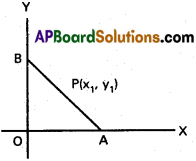
Solution:
Inter 1st Year Maths 1B Limits and Continuity Important Questions 51
Inter 1st Year Maths 1B Limits and Continuity Important Questions 52

Question 26.
Compute Inter 1st Year Maths 1B Limits and Continuity Important Questions 53
Solution:
-1 ≤ sinx ≤ 1 ⇒ -1 ≤ -sinx ≤ 1
x2 – 1 ≤ x2 – sinx ≤ x2 + 1
Since x → ∞, suppose that the x2 – 2 > 0
Inter 1st Year Maths 1B Limits and Continuity Important Questions 54

Question 27.
Show that f(x) = [x] (x ∈ R is continuous at only those real numbers that are not integers.
Solution:
Case i) : If a ∈ z, f(a) = (a) = a
Inter 1st Year Maths 1B Limits and Continuity Important Questions 55
∴ f is not continuous at x = a ∈ z.

Inter 1st Year Maths 1B Limits and Continuity Important Questions

Case ii) : If a ∉ z, then ∃ n ∈ z such that n < a < n + 1 then f(a) = (a) = n.
Inter 1st Year Maths 1B Limits and Continuity Important Questions 56

Question 28.
If f : R → R is such that f(x + y) = f(x) + f(y) for all x, y ∈ R then f is continuous on R if it is continuous at a single point in R.
Solution:
Let f be continuous at x0 ∈ R
Inter 1st Year Maths 1B Limits and Continuity Important Questions 57
∴ f is continuous at x.
Since x ∈ R is arbitrary, f is continuous on R.

Question 29.
Check the continuity of the function f given below at 1 and 2.
f(x) = \(\left\{\begin{array}{cl}
x+1 & \text { if } x \leq 1 \\
2 x & \text { if } 1<x<2 \\
1+x^{2} & \text { if } x \geq 2
\end{array}\right.\)
Solution:
Inter 1st Year Maths 1B Limits and Continuity Important Questions 58
∴ f is continuous at x = 1
Inter 1st Year Maths 1B Limits and Continuity Important Questions 59
f is not continuous at x = 2.

Question 30.
Show that the function f defined on R by f(x) = Cos x2, x ∈ R is continuous function.
Solution:
We define h : R → R by h(x) = x2 and
g : R → R by g(x) = cosx.
Now, for x ∈ R
have (goh)(x) = g(h(x)) = g(x2)
= cos x2 = f(x)
Since g and h continuous on their respective domains, by Theorem
Let A, B, ⊆ R.
Let f : A → R be continuous on A and let
g : B → R be continuous on B.
If f(A) ⊆ B then the composite function
gof : A → R is continous on A.
It follows that a continuous function on R.

Inter 1st Year Maths 1B Limits and Continuity Important Questions

Question 31.
Show that the function f defined on R by f(x) = |1 + 2x + |x||, x ∈ R is a continuous function.
Solution:
We define g : R → R by
g(x) = 1 + 2x + |x|, x ∈ R,
and h : R → R by h(x) = |x|, x ∈ R. Then
(hog) (x) = h(g(x)) = h(1 + 2x + |x|)
= |1 + 2x + |x|| = f(x).

Inter 1st Year Maths 1B The Plane Important Questions

Students get through Maths 1B Important Questions Inter 1st Year Maths 1B The Plane Important Questions which are most likely to be asked in the exam.

Intermediate 1st Year Maths 1B The Plane Important Questions

Question 1.
Find the equation of the plane if the foot of the perpendicular from origin to the plane is (2, 3, -5).
Solution:
O (0, 0, 0), P (2, 3, -5) are the given points D.Rs of OP are 2, 3, -5
OP is normal to the plane and it passes through p (2, 3,-5)
Inter 1st Year Maths 1B The Plane Important Questions 1
Equation of the plane is
2(x – 2) + 3(y – 3) – 5(z + 5)
2x – 4 + 3y – 9 – 5z – 25 = 0
2x + 3y – 5z – 38 = 0

Question 2.
Find the equation to the plane through the points (0, -1, -1) (4, 5, 1) and (3, 9, 4).
Solution:
A (0, -1, -1), B (4, 5, 1), C (3, 9, 4) are the given points.
Equation of the plane through A can be take as
a (x – 0) + b(y + 1) + c (z + 1) = 0 ………………… (1)
The plane passes through B (4, 5, 1), C (3, 9, 4)
4a + 6b + 2c = 0 ………………. (2)
3a + 10b + 5c = 0 ……………… (3)
Inter 1st Year Maths 1B The Plane Important Questions 2
Substituting in (1) equation of the plane ABC is
5x – 7 (y + 1) + 11 (z + 1) = 0
5x – 7y – 7 + 11z + 11 = 0
5x – 7y + 11z + 4 = 0

Inter 1st Year Maths 1B The Plane Important Questions

Question 3.
Find the equation to the plane parallel to the ZX plane and passing through (0, 4, 4).
Solution:
Equation of ZX plane is y = 0
Equation of the parallel plane is y = k
This plane passes through P(0, 4, 4) = 4 = K
The equation the required plane is y = 4.

Question 4.
Find the equation of the plane through the point, (α, β, γ) and parallel to the plane ax + by + cz = 0.
Solution:
Equation of the given plane is ax + by + cz = 0
Equation of the parallel plane is ax + by+ cz = K
This plane passes through P(α, β, γ)
aα + bβ + cγ = K
∴ Equation of the required plane is
ax + by + cz = aα + bβ + cγ
i.e., a(x – α) + b(y – β) + c(z – γ) = 0

Question 5.
Find the angle between the plane 2x – y + z = 6 and x + y + 2z = 7. [Mar 11]
Solution:
Equation of the planes are
2x – y + z = 6
x + y + 2z = 7
If θ is the angle between the planes, then
cos θ = \(\frac{\left|a_{1} a_{2}+b_{1} b_{2}+c_{1} c_{2}\right|}{\sqrt{a_{1}^{2}+b_{1}^{2}+c_{1}^{2}} \sqrt{a_{2}^{2}+b_{2}^{2}+c_{2}^{2}}}\)
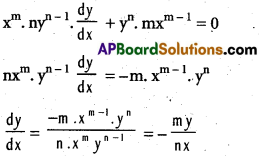
= \(\frac{|2.1+(-1) .1+1.2|}{\sqrt{4+1+1} \sqrt{1+1+4}}\) = \(\frac{3}{6}\) = \(\frac{1}{2}\)
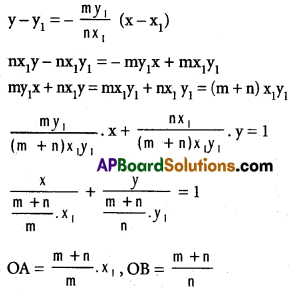
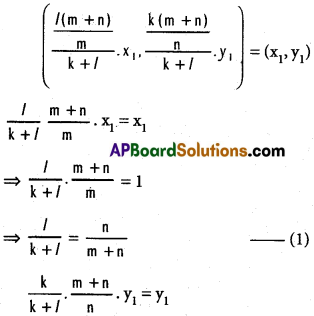
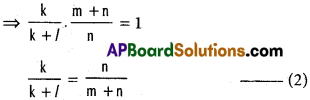
= cos π/3
∴ θ = π/3

Inter 1st Year Maths 1B The Plane Important Questions

Question 6.
Find the equation of the plane passing through (2, 0, 1) and (3, -3, 4) and perpendicular to x – 2y + z = 6.
Solution:
Equation of the plane passing through (2, 0, 1) can be taken as
a(x – 2) + by + c(z – 1) = 0 ……………… (1)
This plane passes through B(3, -3, 4)
a – 3b + 3c = 0 ……………… (2)
The plane (1) is perpendicular to x- 2y + z = 6
a – 2b + c = 0 ………………… (3)
Inter 1st Year Maths 1B The Plane Important Questions 3
Substituting in (1), equation of the required plane is
3(x – 2) + 2y + 1 (z – 1) = 0
3x – 6 + 2y + z – 1 = 0
3x + 2y + z – 7 = 0
3x + 2y + z = 7.

Question 7.
Let us reduce the equation of the plane x + 2y – 2z – 9 = 0 to the normal form and hence find the direction cosines of the normal to the plane and the length of the perpendicular drawn from the origin to the given plane.
Solution:
The equation of the given plane is
x + 2y – 2z – 9 = 0
Bringing the constant term to R.H.S.
x + 2y – 2z = 9 ………………. (1)
Square root of the sum of the squares of the coefficients of x, y, z in (1) is
\(\sqrt{1^{2}+2^{2}+2^{2}}\) = ±3
dividing (1) by 3, we observe that
p = ± (\(\frac{-9}{3}\)) = ±3
±\(\frac{1}{3}\)x ±\(\frac{2}{y}\)y ±\(\frac{2}{3}\)z = ±3
Choosing the sign of the equation so that the constant on the right is positive, we get,
\(\frac{x}{3}\) + \(\frac{2}{3}\)y – \(\frac{2}{3}\)z = 3 ………………. (2)
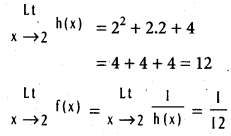
(2) represents the equation of the plane in the normal form. Hence d.c.’s of the normal to the plane are (\(\frac{1}{2}\), \(\frac{2}{3}\), –\(\frac{2}{3}\)) and the length of the perpendicular from the origin to the plane is 3.

Inter 1st Year Maths 1B The Plane Important Questions

Question 8.
Suppose a plane makes intercepts 2, 3, 4 on the X, Y, Z – axes respectively. The equation of the plane whose X, Y, Z intercepts are a, b, c is \(\frac{x}{a}\) + \(\frac{y}{b}\) + \(\frac{z}{c}\) = 1.
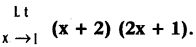
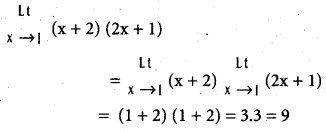
Solution:
From the equation of the plane is
\(\frac{x}{2}\) + \(\frac{y}{3}\) + \(\frac{z}{4}\) = 1.
i.e., 6x + 4y + 3z = 12

Question 9.
Consider the plane whose equation is x – 3y + 2z = 9.
Solution:
Dividing by 9, \(\frac{x}{9}\) + \(\frac{y}{-3}\) + \(\frac{z}{9 / 2}\) = 1
Comparing this with \(\frac{x}{a}\) + \(\frac{y}{b}\) + \(\frac{z}{c}\) = 1
a = X-intercept = 9
b = Y-intercept = 3
c = Z-intercept = \(\frac{9}{2}\)

Inter 1st Year Maths 1B Direction Cosines and Direction Ratios Important Questions

Students get through Maths 1B Important Questions Inter 1st Year Maths 1B Direction Cosines and Direction Ratios Important Questions which are most likely to be asked in the exam.

Intermediate 1st Year Maths 1B Direction Cosines and Direction Ratios Important Questions

Question 1.
If P (2, 3, -6), Q (3, -4, 5) are two points, find the d.c.s of \(\overrightarrow{\mathrm{OP}}\), \(\overrightarrow{\mathrm{QO}}\) and \(\overrightarrow{\mathrm{PQ}}\) where O is the origin.
Solution:
Inter 1st Year Maths 1B Direction Cosines and Direction Ratios Important Questions 1

Question 2.
Find the d.c.s of a line that makes equal angles with the axes.
Solution:
Suppose the line makes angle a with the axes d.cs of the line are (cos α, cos α, cos α)
But l2 + m2 + n2 = 1
cos2 α + cos2 α + cos2 α = 1
3 cos2 α = 1 ⇒ cos α = \(\frac{1}{3}\)
cos α = ± \(\frac{1}{\sqrt{3}}\)
d.cs of the required line are
(± \(\frac{1}{\sqrt{3}}\), ± \(\frac{1}{\sqrt{3}}\), ± \(\frac{1}{\sqrt{3}}\))
Hence there are 8 such directions which reduce to 4 lines.

Inter 1st Year Maths 1B Direction Cosines and Direction Ratios Important Questions

Question 3.
If the d.cs of a line are (\(\frac{1}{c}\), \(\frac{1}{c}\), \(\frac{1}{c}\)) find c.
Solution:
We know that l2 + m2 + n2 = 1
\(\frac{1}{c^{2}}\) + \(\frac{1}{c^{2}}\) + \(\frac{1}{c^{2}}\) = 1, \(\frac{3}{c^{2}}\) = 1 ⇒ c2 = 3
c = ± \(\sqrt{3}\)

Question 4.
Find the direction cosines of two lines which are connected by the relations l + m + n = 0 and mn – 2nl – 2lm = 0. [Mar 11]
Solution:
Given l + m + n = 0 ………………… (1)
mn – 2nl – 2lm = 0 ………………….. (2)
From (1)l = -(m + n)
Substituting in (2)
mn ± 2n (m + n) + 2m (m + n) = 0
mn + 2mn + 2n2 + 2m2 + 2mn = 0
2m2 + 5mn + 2n2 = 0
(2m + n) (m + 2n) = 0
2m = -n or m = -2n
Case (i): 2m1 = -n1
From lr = -m1 – n1
= -m1 + 2m1 = m1
\(\frac{l_{1}}{1}\) = \(\frac{m_{1}}{1}\) = \(\frac{x_{1}}{-2}\)
D.Rs of the first line are 1, 1, -2
D.Cs of this line are \(\frac{1}{\sqrt{6}}\), \(\frac{1}{\sqrt{6}}\), –\(\frac{2}{\sqrt{6}}\)
Case (ii): m2 = -2n2
From (l) l2 = -m2 – n2 = +2n2 – n2 = n2
\(\frac{l_{2}}{1}\) = \(\frac{m_{2}}{-2}\) = \(\frac{n_{2}}{1}\)
d.cs of the second line are 1, -2, 1
d.cs of this line are \(\frac{1}{\sqrt{6}}\), \(\frac{-2}{\sqrt{6}}\), \(\frac{1}{\sqrt{6}}\)

Inter 1st Year Maths 1B Direction Cosines and Direction Ratios Important Questions

Question 5.
A ray makes angles \(\frac{\pi}{3}\), \(\frac{\pi}{3}\) with \(\overrightarrow{\mathrm{OX}}\) and \(\overrightarrow{\mathrm{OY}}\) respectively. Find the angle made by it with \(\overrightarrow{\mathrm{OZ}}\).
Solution:
We know that l2 + m2 + n2 = 1
cos2α + cos2β + cos2γ = 1
i.e., cos2 \(\frac{\pi}{3}\) + cos2 \(\frac{\pi}{3}\) + cos2 γ = 1
\(\frac{1}{4}\) + \(\frac{1}{4}\) + cos2 γ = 1
cos2 γ = 1 – \(\frac{1}{2}\) = \(\frac{1}{2}\)
cos γ = ± \(\frac{1}{\sqrt{2}}\)
γ = cos-1 (± \(\frac{1}{\sqrt{2}}\))
= \(\frac{\pi}{4}\) or \(\frac{3\pi}{4}\).

Question 6.
Find the d.r.s and d.c.s of the line joining the points (4, -7, 3), (6, -5, 2).
Solution:
d.c.s of the lines are (6 – 4, -5 + 7, 2 – 3)
= (2, 2, -1)
Dividing with \(\sqrt{4+4+1}\) = 3
d.cs of the line are ± (\(\frac{2}{3}\), \(\frac{2}{3}\), –\(\frac{1}{3}\)

Question 7.
If the d.c.s of a line are proportional the (1, -2, 1) find its d.c.s.
Solution:
d.rs of the line are (1, -2, 1 )
Dividing with \(\sqrt{6}\)
d.cs of the line are ± (\(\frac{1}{\sqrt{6}}\), –\(\frac{2}{\sqrt{6}}\), \(\frac{1}{\sqrt{6}}\))

Inter 1st Year Maths 1B Direction Cosines and Direction Ratios Important Questions

Question 8.
Show that the line joining the points P(0, 1, 2) and Q (3, 4, 8) is parallel to the line joining the points R (-2. \(\frac{3}{2}\). – 3) and S (\(\frac{5}{2}\), 6, 6).
Solution:
DR’s of PQ are (3 – 0, 4 – 1, 8 – 2) = (3, 3, 6)
DR’s of RS are (\(\frac{5}{2}\) + 2, 6 – \(\frac{3}{2}\), 6 + 3)
= (\(\frac{9}{2}\), \(\frac{9}{2}\), 9)
d.r’s of PQ and RS are proportional since \(\frac{2}{3}\) (\(\frac{9}{2}\), \(\frac{9}{2}\), 9) = (3, 3, 6)
∴ PQ is parallel to RS.

Question 9.
Show that the line joining the points A (2, 3, -1) and B(3, 5, -3) is perpendicular to the Line joining C(1, 2, 3) and D(3, 5, 7).
Solution:
d.rs of AB are (3 – 2, 5 – 3, -3 + 1)
= (1, 2, -2)
d.rs of CB are (3 – 1, 5 – 2, 7 – 3) = (2, 3, 4)
a1a2 + b1b2 + c1c2 = 1.2 + 2.3 – 2.4
= 2 + 6 – 8 = 0
∴ AB and CD are perpendicular.

Question 10.
For what value of x the line joining A(4, 1, 2) B (5, x, 0) is perpendicular to the line joining C(1, 2, 3) and D(3, 5, 7) ?
Solution:
d.r’s of AD are (1, x-1, -2)
d.rs of CD are (2, 3, 4)
AB and CD are perpendicular
a1a2 + b1b2 + c1c2 = 0
1.2 – 3(x – 1) + 4 (-2) = 0
2 + 3x – 3 – 8 = 0
3x = 9
⇒ x = 3

Inter 1st Year Maths 1B Direction Cosines and Direction Ratios Important Questions

Question 11.
Show that the points A (1, 2, 3), B (4, 0, 4), C(-2, 4, 2) are collinear.
Solution:
d.rs of \(\overline{\mathrm{AB}}\) are 4 – 1, 0 – 2, 3 – 4
i.e., 3, -2, -1
d.rs of \(\overline{\mathrm{BC}}\) are -2 – 4, 4 – 0, 2 – 4
i.e., -6, 4, -2
d.rs of AB and BC are proportional and B is a common point. A, B, C are collinear.

Question 12.
A (1, 8, 4), B (0, -11, 4), C (2, -3, 1) are three points and D is the foot of the perpendicular from A to BC. Find the co-ordinates of D.
Solution:
Suppose divides BC in the ratio m = n
Co-ordinates of D are
Inter 1st Year Maths 1B Direction Cosines and Direction Ratios Important Questions 2
(\(\frac{2 m-m-n}{m+n}\), \(\frac{-3 m-11 n-8 m-8 n}{m+n}\), \(\frac{m+4 n-4 m-4 n}{m+n}\))
\(\frac{m-n}{m+n}\), \(\frac{-11 m-19 n}{m+n}\), \(\frac{-3 m}{m+n}\)
d.rs of BC are (2 – 0, -3 + 11, 1 – 4) = (2, 8, -3)
AB and BC are perpendicular
\(\frac{2(m-n)}{m+n}\) + 8\(\frac{(-11 m-19 n)}{m+n}\) + \(\frac{(-3)(-3 m)}{m+n}\) = 0
2m – 2n – 88m – 152n + 9m = 0
-77m – 154n = 0
77m = -154n
m = -2n
co-ordinates of are
(\(\frac{-4 n}{-n}\), \(\frac{6 n-11 n}{-n}\), \(\frac{-2 n+4 n}{-n}\))
= (4, 5, -2)

Inter 1st Year Maths 1B Direction Cosines and Direction Ratios Important Questions

Question 13.
Lines \(\overrightarrow{\mathrm{OA}}\), \(\overrightarrow{\mathrm{OB}}\) are drawn from O with direction cosines proportional to (1, -2, -1), (3, -2, 3). Find the direction cosines of the normal to the plane AOB.
Solution:
Suppose l, m, n are the d.cs of the normal.
It is perpendicular to every line in the plane AOB
l – 2m – n = 0
3l – 2m + 3n = 0
Inter 1st Year Maths 1B Direction Cosines and Direction Ratios Important Questions 3

Question 14.
Find the angle between the diagonals of a cube.
Inter 1st Year Maths 1B Direction Cosines and Direction Ratios Important Questions 4
Solution:
Let ‘O’ one of the vertices of the cube taken as origin and the three sides OA, OB, OC are taken as co-ordinate axes. Let OA = OB = OC = a the four diagonals are \(\overrightarrow{\mathrm{OF}}\), \(\overrightarrow{\mathrm{AG}}\), \(\overrightarrow{\mathrm{DE}}\) and \(\overrightarrow{\mathrm{BC}}\)
The co-ordinates of the vertices of the cube are 0(0, 0, 0), A(a, 0, 0), B(0, a, 0), C(0,0, a), F(a, a, 0), D(a, a, 0), E(a, 0, a), G(0, a, a)
D.Rs of OF are (a-0, a – 0, a – 0) = (a, a, a)
D.Rs of AG are (0 – 9, a – 0, a – 0) = (-a, a, a)
If O is the angle between the diagonals OF and AG then
cos θ = \(\frac{|a(-a)+a \cdot a+a \cdot a|}{\sqrt{a^{2}+a^{2}+a^{2}} \cdot \sqrt{a^{2}+a^{2}+a^{2}}}\)
= \(\frac{a^{2}}{3 a^{2}}\) = \(\frac{1}{3}\)
θ = Cos-1 (\(\frac{1}{3}\))y
Similarly, the angle between any pair of diagonals can be shown to be cos-1 (\(\frac{1}{3}\))

Inter 1st Year Maths 1B Direction Cosines and Direction Ratios Important Questions

Question 15.
Show that the line whose d.c’s are proportional to (2, 1, 1) (4, \(\sqrt{3}\) -1, –\(\sqrt{3}\) – 1) are inclined to one another at angle \(\frac{\pi}{3}\).
Solution:
The d.cs of the given lines are (2, 1, 1), (4, \(\sqrt{3}\) – 1, –\(\sqrt{3}\) – 1) 42 + (\(\sqrt{3}\) – 1)2 + (-\(\sqrt{3}\) – 1)2
= 16 + 3 + 1 – 2\(\sqrt{3}\) + 3 + 1 + 2\(\sqrt{3}\)
= 24
Inter 1st Year Maths 1B Direction Cosines and Direction Ratios Important Questions 5

Inter 1st Year Maths 1B Three Dimensional Coordinates Important Questions

Students get through Maths 1B Important Questions Inter 1st Year Maths 1B Three Dimensional Coordinates Important Questions which are most likely to be asked in the exam.

Intermediate 1st Year Maths 1B Three Dimensional Coordinates Important Questions

Question 1.
Show that the points A(-4, 9, 6), B(-1, 6, 6) and C(0, 7, 10) from a right angled isosceles triangle.
Solution:
A(-4, 9, 6), B(-1, 6, 6), C(0, 7, 10) are the vertices of ∆ABC.
AB = \(\sqrt{(-4+1)^{2}+(9-6)^{2}+(6-6)^{2}}\)
= \(\sqrt{9+9}\)
= \(\sqrt{18}\)
BC = \(\sqrt{(-1-0)^{2}+(6-7)^{2}+(6-10)^{2}}\)
= \(\sqrt{1+1+16}\) = \(\sqrt{18}\)
CA = \(\sqrt{(0+4)^{2}+(7-9)^{2}+(10-6)^{2}}\)
= \(\sqrt{16+4+16}\) = \(36\)
AB = BC and AB2 + BC2 = CA2
ABC is a right angled isosceles triangle.

Inter 1st Year Maths 1B Three Dimensional Coordinates Important Questions

Question 2.
Show that locus of the point whose distance from Y-axis is thrice its distance from (1, 2, -1) is 8x2 + 9y2 + 8z2 – 18x – 36y + 18z + 54 = 0.
Solution:
Let P (x, y, z) be any point on the locus PM – distance from Y – axis = \(\sqrt{x^{2}+z^{2}}\)
A(1, 2, -1) is the given point
Given condition is PM = 3 . PA
PM2 = 9PA2
x2 + z2 = 9[(x – 1)2 + (y – 2)2 + (z + 1)2]
= 9x2 – 18x + 9 + 9y2 – 36y + 36 + 9z2 + 18z + 9
Locus of P is 8x2 + 9y2 + 8z2 – 18x – 36y + 18z + 54 = 0
P satisfies the equation
8x2 + 9y2 + 8z2 – 18x – 36y + 18z + 54 = 0

Question 3.
A, B, C are three points on \(\overrightarrow{o x}\), \(\overrightarrow{o y}\), \(\overrightarrow{o z}\) respectively at distances a, b, e. (a ≠ 0, b ≠ 0, c ≠ 0) from the origin 0. Find the co-ordinates of the point which is equidistant from A, B, C and O.
Solution:
A is a point on ox ⇒ co-ordinates of A are (a, 0, 0)
Similarly co-ordinates of B are (0, b, 0) and co-ordinates of C are (0, 0, c)
P(x, y, z) is the required point
PO = PA = PB = PC
PO2 = PA2 = PB2 = PC2
PO2 = PA2
x2 + y2 + z2 = (x – a)2 + y2 + z2
x2 – x2 + a2 – 2ax = 0
2ax = a2 ⇒ x = \(\frac{a^{2}}{2 a}\) = \(\frac{a}{2}\)
PO2 = PB2 ⇒ y = b/2
PO2 = PC2 ⇒ z = c/2
Co-ordinates of P are (\(\frac{a}{2}\), \(\frac{b}{2}\), \(\frac{c}{2}\) )

Inter 1st Year Maths 1B Three Dimensional Coordinates Important Questions

Question 4.
Show that the points A (3, -2, 4) B(1, 1, 1) and C(-1, 4, -2) are collinear.
Solution:
A(3, -2, 4), B(1, 1, 1), C(-1, 4, -2) are the given points
Inter 1st Year Maths 1B Three Dimensional Coordinates Important Questions 1
A, B, C are collinear.

Question 5.
Find the ratio in which YZ-plane divides the line joining A(2, 4, 5) and B(3, 5, -4). Also find the point of intersection
Solution:
Suppose the line AB meets YZ plane in P
Let P divide AB in the ratio k : 1
Co-ordinates of P are
\(\left(\frac{3 k+2}{k+1}, \frac{5 k+4}{k+1}, \frac{-4 k+5}{k+1}\right)\)
P is a point on YZ plane
⇒ x co-ordinates of p = 0
\(\frac{3 k+2}{k+1}\) = 0 ⇒ 3k + 2 = 0
k = –\(\frac{2}{3}\)
YZ plane divides AB is the ratio -2 : 3
Substituting the value of k in co-ordinates of p, co-ordinates of p are
\(\left[0, \frac{5\left(-\frac{2}{3}\right)+4}{-\frac{2}{3}+1} \cdot \frac{(-4)\left(-\frac{2}{3}\right)+5}{-\frac{2}{3}+1}\right]\)
(0, 2, 23)

Question 6.
Show that the points A(3, -2, 4), B(1, 1, 1) and C(-1, 4, -2) are collinear.
Solution:
Suppose the point P divides AD in the ratio k : 1
Co-ordinates of P are \(\left(\frac{k+3}{k+1}, \frac{k-2}{k+1}, \frac{k+4}{k+1}\right)\)
If A, B, C are collinear, C lies on AB
P must coincide with C for same value of k
\(\frac{k+3}{k+1}\) = -1 ⇒ k + 3 = -k – 1
2k = 4 ⇒ k = -2
Substituting k = -2 in co—ordinates of P we get
\(\left(\frac{-2+3}{-2+1}, \frac{-2-2}{-2+1}, \frac{-2+4}{-2+1}\right)\)
= (-14, -2) = c
A, B, C are collinear.

Inter 1st Year Maths 1B Three Dimensional Coordinates Important Questions

Question 7.
Find the fourth vertex of the parallelogram whose consecutive vertices are (2, 4, -1), (3, 6, -1) are (4, 5, 1) [Mar 11]
Solution:
Inter 1st Year Maths 1B Three Dimensional Coordinates Important Questions 2
ABCD is a parallelogram
where A = (2, 4, -1), B = (3, 6, -1) C = (4, 5, 1)
Suppose D(x, y, z) is the fourth vertex
A B C D is a parallellelogram
Mid point of AC = Mid point of BD
Inter 1st Year Maths 1B Three Dimensional Coordinates Important Questions 3
∴ Co-ordinates of the fourth vertex are = D (3, 3, 1)

Question 8.
A(5, 4, 6), B(1, -1, 3), C(4, 3, 2) are three points. Find the co-ordinates of the point in which the bisector of ∠BAC meets the side \(\overline{B C}\).
Solution:
We know that if AB is the bisector of ∠BAC
Divides BC in the ratio AB : AC
Inter 1st Year Maths 1B Three Dimensional Coordinates Important Questions 4

Inter 1st Year Maths 1B Three Dimensional Coordinates Important Questions

Question 9.
If (x1, y1, z1) and (x2, y2, z2) are two vertices and (α, ß, γ) is the centroid of a triangle, find the third vertex of the triangle.
Solution:
Let A = (x1, y1, z1) and B = (x2, y2, z2) be the two vertices of the triangle ABC.
Inter 1st Year Maths 1B Three Dimensional Coordinates Important Questions 5
Let G = (α, β, γ) be the centroid.
If C = (x3, y3, z3) is the third vertex, then we have
(\(\frac{x_{1}+x_{2}+x_{3}}{3}\), \(\frac{y_{1}+y_{2}+y_{3}}{3}\), \(\frac{z_{1}+z_{2}+z_{3}}{3}\)) = (α, β, γ)
⇒ x1 + x2 + x3 = 3α; y1 + y2 + y3 = 3β; z1 + z2 + z3 = 3γ.
⇒ x3 = 3α – x1 – x2; y3 = 3β – y1 – y2; z3 = 3γ – z1 – z2.
∴ The third vertex
C = (3α – x1 – x2, 3β – y1 – y2, 3γ – z1 – z2).

Question 10.
If D(x1, y1, z1), E(x2, y2, z2) and F(x3, y3, z3) are the midpoints of the sides BC, CA and AB respectively of a triangle, find its vertices A, B and C.
Solution:
It is given that D is the mid point of the side BC, E is the mid point of the side CA and F is the mid point of the side AB.
Inter 1st Year Maths 1B Three Dimensional Coordinates Important Questions 6
∴ DEP is the triangle formed out of the mid points of the three sides.
Consider the parallelogram AEDF. Let A = (h, k, s).
Mid point of AD = Mid point of EF
⇒ (\(\frac{h+x_{1}}{2}\), \(\frac{k+y_{1}}{2}\), \(\frac{s+z_{1}}{2}\)) = (\(\frac{x_{2}+x_{3}}{2}\), \(\frac{y_{2}+y_{3}}{2}\), \(\frac{z_{2}+z_{3}}{2}\))
⇒ h = x2 + x3 – x1; k = y2 + y3 – y1; s = z2 + z3 – z1
∴ Vertex A
= (x2 + x3 – x1, y2 + y3 – y1, z2 + z3 – z1)
Similarly, the vertices B and C can be obtained as
B = (x3 + x1 – x2, y3 + y1 – y2, z3 + z1 – z2)
C = (x1 + x2 – x3, y1 + y2 – y3, z1 + z2 – z3).

Inter 1st Year Maths 1B Three Dimensional Coordinates Important Questions

Question 11.
If M(α, β, γ) is the mid point of the line segment joining the points A(x1, y1, z1) and B, then find B.
Solution:
Inter 1st Year Maths 1B Three Dimensional Coordinates Important Questions 7
Let B(h, k, s) be the point required.
It is given that M is the mid point of AB.
∴ We have (α, β, γ) = (\(\frac{x_{1}+h}{2}\), \(\frac{y_{1}+k}{2}\), \(\frac{z_{1}+s}{2}\))
⇒ 2α = x1 + h; 2β = y1 + k; 2γ = z1 + s
⇒ h = 2α – x1; k = 2β – y1; s = 2γ – z1
∴ Point Bis (2α – x1, 2β – y1, 2γ – z1).

Question 12.
If H, G, S and I respectively denote orthocentre, centroid, circumcentre and in-centre of a triangle formed by the points (1, 2, 3), (2, 3, 1) and (3, 1, 2), then find H, G, S, I.
Solution:
Inter 1st Year Maths 1B Three Dimensional Coordinates Important Questions 8
Since AB = BC = CA, ABC is equilateral triangle.
We know that orthocentre, centroid, circumcentre and incentre of equilateral triangle are the same (i.e., all the four points coincide). Now, centroid .
G = (\(\frac{1+2+3}{3}\), \(\frac{2+3+1}{3}\), \(\frac{3+1+2}{3}\))
= (2, 2 ,2)
∴ H = (2, 2, 2), S = (2, 2, 2), I = (2, 2, 2).

Inter 1st Year Maths 1B Three Dimensional Coordinates Important Questions

Question 13.
Find the incentre of the triangle formed by the points (0, 0, 0), (3, 0, 0) and (0, 4, 0).
Solution:
If a, b, care the side of the triangle ABC, where
A = (x1, y1, z1), B = (x2, y2, z2), C = (x3, y3, z3) are the vertices, then the in-centre of the triangle is given by
Inter 1st Year Maths 1B Three Dimensional Coordinates Important Questions 9
Inter 1st Year Maths 1B Three Dimensional Coordinates Important Questions 10

Question 14.
If the point (1, 2, 3) is changed to the point (2, 3, 1) through translation of axes, find the new origin.
Solution:
Let (x, y. z) be the co-ordinates of any point P w.r.t. the co-ordinate frame Oxyz and (X, Y, Z) be the co-ordinates of P w.r.t the new frame of reference O’XYZ.
Inter 1st Year Maths 1B Three Dimensional Coordinates Important Questions 11
Let O’ (h, k, s) be the new origin so that
x = X + h, y = Y + k and z = Z + s.
⇒ (h, k, s) (x – X, y – Y, z – Z)
⇒ (h, k, s) = (1 – 2, 2 – 3, 3 – 1)
= (-1, -1, 2).
∴ O’ = (-1, -1, 2) is the new origin.

Inter 1st Year Maths 1B Three Dimensional Coordinates Important Questions

Question 15.
Find the ratio in which the point P(5, 4, -6) divides the line segment joining the points (3, 2, -4) and B(9, 8, -10). Also, find the harmonic conjugate of P.
Solution:
Inter 1st Year Maths 1B Three Dimensional Coordinates Important Questions 12
∴ Q(-3, -4, 2) is the harmonic conjugate of P(5, 4, -6).