Inter 2nd Year Maths 2A Permutations and Combinations Solutions Ex 5(b)

Practicing the Intermediate 2nd Year Maths 2A Textbook Solutions Inter 2nd Year Maths 2A Permutations and Combinations Solutions Exercise 5(b) will help students to clear their doubts quickly.

Intermediate 2nd Year Maths 2A Permutations and Combinations Solutions Exercise 5(b)

I.

Question 1.
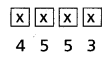
Find the number of 4-digited numbers that can be formed using the digits 1, 2, 4, 5, 7, 8 when repetition is allowed.
Solution:
The number of 4 digited numbers that can be formed using the digits 1, 2, 4, 5, 7, 8 when repetition is allowed = 64 = 1296
Inter 2nd Year Maths 2A Permutations and Combinations Solutions Ex 5(b) I Q1

Question 2.
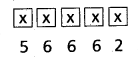
Find the number of 5-letter words that can be formed using the letters of the word RHYME if each letter can be used any number of times.
Solution:
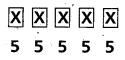
The number of 5 letter words that can be formed using the letters of the word RHYME if each letter can be used any number of times = 55 = 3125
Inter 2nd Year Maths 2A Permutations and Combinations Solutions Ex 5(b) I Q2

Inter 2nd Year Maths 2A Permutations and Combinations Solutions Ex 5(b)

Question 3.
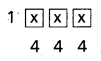
Find the number of functions from a set A containing 5 elements into a set B containing 4 elements.
Solution:
Set A contains 5 elements.
Set 8 contains 4 elements.
Hint: The total number of functions from set A containing m elements to set B containing n elements is nm.
For the image of each of the 5 elements of the set, A has 4 choices.
∴ The number of functions from set A containing 5 elements into a set B containing 4 elements = 4 × 4 × 4 × 4 × 4 (5 times)
= 45
= 1024

II.

Question 1.
Find the number of palindromes with 6 digits that can be formed using the digits
(i) 0, 2, 4, 6, 8
(iii) 1, 3, 5, 7, 9
Solution:
Palindromes mean first digit, sixth digit and second digit, fifth digit and third digit, and the fourth digit are the same numbers.
That is we have filled the first three digits only and then the remaining digits are the same.
Inter 2nd Year Maths 2A Permutations and Combinations Solutions Ex 5(b) II Q1
(i) Given numbers are 0, 2, 4, 6, 8
For the required 6-digit palindromes first digit can be filled 4 ways except ‘0’.
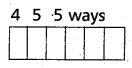
The second digit can be filled in 5 ways and the third can be filled in 5 ways.
∴ The number of 6-digit palindromes using the digits 0, 2, 4, 6, 8 are 4 × 52 = 100
Inter 2nd Year Maths 2A Permutations and Combinations Solutions Ex 5(b) II Q1.1
(ii) Given numbers are 1, 3, 5, 7, 9
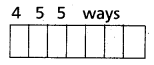
For the required 6-digit palindromes first digit can be filled in 5 ways, the second digit can be filled in 5 ways and the third digit can be filled in 5 ways.
∴ The number of 6-digit palindromes using the digits 1, 3, 5, 7, 9 are 53 = 125

Question 2.
Find the number of 4-digit telephone numbers that can be formed using the digits 1, 2, 3, 4, 5, 6 with atleast one digit repeated.
Solution:
The number of 4 digited numbers formed using the digits 1, 2, 3, 4, 5, 6 when repetition is allowed = 64
The number of 4 digited numbers formed using the digits 1, 2, 3, 4, 5, 6 when repetition is not allowed = 6P4
The number of 4 digited telephone numbers in which atleast one digit is repeated = 646P4
= 64 – 6 × 5 × 4 × 3
= 1296 – 360
= 936

Inter 2nd Year Maths 2A Permutations and Combinations Solutions Ex 5(b)

Question 3.
Find the number of bijections from a set A containing 7 elements onto itself.
Solution:
Hint: The number of bijections from set A with n elements to set B with the same number of elements in A is n!
Let A = [a1, a2, a3, a4, a5, a6, a7]
For a bijection, the element a1 has 7 choices
for its image, the element a2 has 6 choices
for its image, the element a3 has 5 choices
for its image, the element a4 has 4 choices
for its image, the element a5 has 3 choices
for its image, the element a6 has 2 choices
for its image and the element, a7 has 1 choice for its image.
∴ The number of bijections from set A with 7 elements onto itself = 7!
= 7 × 6 × 5 × 4 × 3 × 2 × 1
= 5040

Question 4.
Find the number of ways of arranging ‘r’ things in a line using the given ‘n’ different things in which atleast one thing is repeated.
Solution:
The number of ways of arranging, r things in a line using the given n different things
(i) when repetition is allowed is nr
(ii) when repetition is not allowed is nPr
∴ The number of ways of arranging ‘r’ things in a line using the ‘n1 different things in which atleast one thing is repeated = nrnPr

Question 5.
Find the number of 5-letter words that can be formed using the letters of the word NATURE that begin with N when repetition is allowed.
Solution:
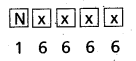
First, we can fill up the first place with N in one way.
Inter 2nd Year Maths 2A Permutations and Combinations Solutions Ex 5(b) II Q5
The remaining 4 places can be filled with any one of the 6 letters in 6 × 6 × 6 × 6 = 64 ways.
∴ The number of 5 letter words that can be formed using the letters of the word NATURE that begin with N when repetition is allowed = 1 × 64 = 1296

Inter 2nd Year Maths 2A Permutations and Combinations Solutions Ex 5(b)

Question 6.
Find the number of 5-digit numbers divisible by 5 that can be formed using the digits 0, 1, 2, 3, 4, 5 when repetition is allowed.
Solution:
The unit place of 5 digited numbers which can be divisible by 5 using the given digits can be filled by either 0 or 5 in two ways.
The first place can be filled in any one of the given digits except ‘0’ in 5 ways.
The remaining 3 places can be filled by any one of the given digits in 6 × 6 × 6 ways (∵ repetition is allowed)
Inter 2nd Year Maths 2A Permutations and Combinations Solutions Ex 5(b) II Q6
∴ The number of 5 digited numbers divisible by 5 that can be formed using the given digits when repetition is allowed = 2 × 5 × 6 × 6 × 6 = 2160 ways.

Question 7.
Find the number of numbers less than 2000 that can be formed using the digits, 1, 2, 3, 4 if repetition is allowed.
Solution:
All the single digited numbers, two digited numbers, three digited numbers and the four digited numbers started with 1 are the numbers less than 2000 using the digits 1, 2, 3, 4.
The number of single digited numbers formed using the given digits = 4
Inter 2nd Year Maths 2A Permutations and Combinations Solutions Ex 5(b) II Q7
The number of two digited numbers formed using the given digits when repetition is allowed = 4 × 4 = 16
Inter 2nd Year Maths 2A Permutations and Combinations Solutions Ex 5(b) II Q7.1
The number of three digited numbers formed using the given digits = 4 × 4 × 4 = 64
Inter 2nd Year Maths 2A Permutations and Combinations Solutions Ex 5(b) II Q7.2
The number of 4 digited numbers started with 1 formed using the given digits = 4 × 4 × 4 = 64
Inter 2nd Year Maths 2A Permutations and Combinations Solutions Ex 5(b) II Q7.3
∴ The total number of numbers less than 2000 that can be formed using the digits 1, 2, 3, 4 if repetition is allowed = 4 + 16 + 64 + 64 = 148

III.

Question 1.
9 different letters of an alphabet are given. Find the number of 4 letter words that can be formed using these 9 letters which have
(i) no letter is repeated
(ii) At atleast one letter is repeated
Solution:
The number of 4 letter words can be formed using the 9 different letters of an alphabet when repetition is allowed = 94
(i) The number of 4 letter words can be formed using the 9 different letters of an alphabet in which no letter is repeated = 9P4
= 9 × 8 × 7 × 6
= 3024
(ii) The number of 4 letter words can be formed using the 9 different letters of an alphabet in which atleast one letter is repeated = 949P4
= 6561 – 3024
= 3537

Inter 2nd Year Maths 2A Permutations and Combinations Solutions Ex 5(b)

Question 2.
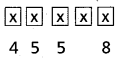
Find the number of 4-digit numbers which can be formed using the digits 0, 2, 5, 7, 8 that are divisible by (i) 2 (ii) 4 when repetition is allowed.
Solution:
(i) First place can be filled by either 2 or 5 or 7 or 8 in 4 ways.
Inter 2nd Year Maths 2A Permutations and Combinations Solutions Ex 5(b) III Q2
Second place can be filled by any one of the given digits in 5 ways.
Third place can be filled by any one of the given digits in 5 ways.
Last place (or units place) can be filled by either 0 or 2 or 8 in 3 ways.
∴ The number of 4 digited divisible by 2 numbers that can be formed using the digits 0, 2, 5, 7, 8 when repetition is allowed = 4 × 5 × 5 × 3 = 300
(ii) Since a number is divisible by 4, the last two places should be filled with one of the 00, 08, 20, 28, 52, 72, 80, 88 in 8 ways.
The first place can be filled 4 ways except 0. Second place can be filled in 5 ways.

Question 3.
Find the number of 4-digit numbers that can be formed using the digits 0, 1, 2, 3, 4, 5 which are divisible by 6 when repetition of the digits is allowed.
Solution:
Since a number is divisible by 4, the last two places should be filled with one of the 00, 04, 12, 20, 24, 32, 40, 44 = 8 ways
Inter 2nd Year Maths 2A Permutations and Combinations Solutions Ex 5(b) III Q3
The first place can be filled in any one of the given digits except ‘0’ in 4 ways. The remaining 2 places can be filled by anyone the given digits in 5 × 5 ways.
∴ The number of 5 digited numbers that can be formed using the digits 0, 1, 2, 3, 4 that are divisible by 4 when repetition is allowed = 4 × 52 × 8 = 800

Inter 2nd Year Maths 2A Theory of Equations Solutions Ex 4(d)

Practicing the Intermediate 2nd Year Maths 2A Textbook Solutions Inter 2nd Year Maths 2A Theory of Equations Solutions Exercise 4(d) will help students to clear their doubts quickly.

Intermediate 2nd Year Maths 2A Theory of Equations Solutions Exercise 4(d)

I.

Question 1.
Find the algebraic equation whose roots are 3 times the roots of x3 + 2x2 – 4x + 1 = 0
Solution:
Given equation is f(x) = x3 + 2x2 – 4x + 1 = 0
We require an equation whose roots are 3 times the roots of f(x) = 0
i,e., Required equation is f(\(\frac{x}{3}\)) = 0
⇒ \(\left(\frac{x}{3}\right)^{3}+2\left(\frac{x}{3}\right)^{2}-\frac{4 x}{3}+1=0\)
⇒ \(\frac{x^{3}}{27}+\frac{2}{9} x^{2}-\frac{4}{3} x+1=0\)
Multiplying with 27, required equation is x3 + 6x2 – 36x + 27 = 0

Question 2.
Find the algebraic equation whose roots are 2 times the roots of x5 – 2x4 + 3x3 – 2x2 + 4x + 3 = 0
Solution:
Given equation is f(x) = x5 – 2x4 + 3x3 – 2x2 + 4x + 3 = 0
We require an equation whose roots are 2 times the roots of f(x) = 0
Required equation is f(\(\frac{x}{2}\)) = 0
⇒ \(\left(\frac{x}{2}\right)^{5}-2\left(\frac{x}{2}\right)^{4}+3\left(\frac{x}{2}\right)^{3}-2\left(\frac{x}{2}\right)^{2}+4\left(\frac{x}{2}\right)\) + 3 = 0
⇒ \(\frac{x^{5}}{32}-2 \cdot \frac{x^{4}}{16}+3 \cdot \frac{x^{3}}{8}-2 \cdot \frac{x^{2}}{4}+4 \cdot \frac{x}{2}+3=0\)
Multiplying with 32, the required equation is
⇒ x5 – 4x4 + 12x3 – 16x2 + 64x + 96 = 0

Inter 2nd Year Maths 2A Theory of Equations Solutions Ex 4(d)

Question 3.
Find the transformed equation whose roots are the negative of the roots of x4 + 5x3 + 11x + 3 = 0
Solution:
Given f(x) = x4 + 5x3 + 11x + 3 = 0
We want an equation whose roots are -α1, -α2, -α3, -α4
Required equation f(-x) = 0
⇒ (-x)4 + 5(-x)3 + 11(-x) + 3 = 0
⇒ x4 – 5x3 – 11x + 3 = 0

Question 4.
Find the transformed equation whose roots are the negatives of the roots of x7 + 3x5 + x3 – x2 + 7x + 2 = 0
Solution:
Given f(x) = x7 + 3x5 + x3 – x2 + 7x + 2 = 0
We want an equation whose roots are -α1, -α2, ………., -αn
Required equation is f(-x) = 0
⇒ (-x)7 + 3(-x)5 + (-x)3 – (-x)2 + 7(-x) + 2 = 0
⇒ -x7 – 3x5 – x3 – x2 – 7x + 2 = 0
⇒ x7 + 3x5 + x3 + x2 + 7x – 2 = 0

Question 5.
Find the polynomial equation whose roots are the reciprocals of the roots of x4 – 3x3 + 7x2 + 5x – 2 = 0
Solution:
Given equation is f(x) = x4 – 3x3 + 7x2 + 5x – 2 = 0
Required equation is f(\(\frac{1}{x}\)) = 0
i.e., \(\frac{1}{x^{4}}-\frac{3}{x^{3}}+\frac{7}{x^{2}}+\frac{5}{x}-2=0\)
Multiplying with x4
⇒ 1 – 3x + 7x2 + 5x3 – 2x4 = 0
⇒ 2x4 – 5x3 – 7x2 + 3x – 1 = 0

Question 6.
Find the polynomial equation whose roots are the reciprocals of the roots of x5 + 11x4 + x3 + 4x2 – 13x + 6 = 0
Solution:
Given equation is f(x) = x5 + 11x4 + x3 + 4x2 – 13x + 6 = 0
Required equation is f(\(\frac{1}{x}\)) = 0
\(\frac{1}{x^5}+\frac{11}{x^4}+\frac{1}{x^3}+\frac{4}{x^2}-\frac{13}{x}+6=0\)
Multiplying by x5
⇒ 1 + 11x + x2 + 4x3 – 13x4 + 6x5 = 0
⇒ 6x5 – 13x4 + 4x3 + x2 + 11x + 1 = 0

Inter 2nd Year Maths 2A Theory of Equations Solutions Ex 4(d)

II.

Question 1.
Find the polynomial equation whose roots are the squares of the roots of x4 + x3 + 2x2 + x + 1 = 0
Solution:
Given equation is f(x) = x4 + x3 + 2x2 + x + 1 = 0
Required equation f(√x) = 0
⇒ x2 + x√x + 2x + √x + 1 = 0
⇒ √x(x + 1) = -(x2 + 2x + 1)
Squaring both sides,
⇒ x(x + 1)2 = (x2 + 2x + 1)2
⇒ x(x2 + 2x + 1) = x4 + 4x2 + 1 + 4x3 + 4x + 2x2
⇒ x3 + 2x2 + x = x4 + 4x3 + 6x2 + 4x + 1
⇒ x4 + 3x3 + 4x2 + 3x + 1 = 0

Question 2.
Form the polynomial equation whose roots are the squares of the roots of x3 + 3x2 – 7x + 6 = 0
Solution:
Given equation is f(x) = x3 + 3x2 – 7x + 6 = 0
Required equation is f(√x) = 0
⇒ x√x + 3x – 7√x + 6 = 0
⇒ √x(x – 7) = -(3x + 6)
Squaring on both sides,
⇒ x(x – 7)2 = (3x + 6)2
⇒ x(x2 – 14x + 49) = 9x2 + 36 + 36x
⇒ x3 – 14x2 + 49x – 9x2 – 36x – 36 = 0
⇒ x3 – 23x2 + 13x – 36 = 0

Inter 2nd Year Maths 2A Theory of Equations Solutions Ex 4(d)

Question 3.
Form the polynomial equation whose roots are cubes of the roots of x3 + 3x2 + 2 = 0
Solution:
Given equation is x3 + 3x2 + 2 = 0
Put y = x3 so that x = y1/3
∴ y + 3y2/3 + 2 = 0
∴ 3y2/3 = -(y + 2)
Cubing on both sides,
27y2 = -(y + 2)3 = -(y3 + 6y2 + 12y + 8)
∴ y3 + 6y2 + 12y + 8 = 0
⇒ y3 + 33y2 + 12y + 8 = 0
Required equation is x3 + 33x2 + 12x + 8 = 0

III.

Question 1.
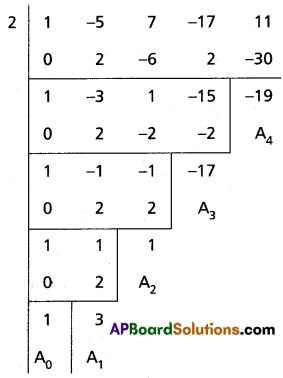
Find the polynomial equation whose roots are the translates of those of the equation x4 – 5x3 + 7x2 – 17x + 11 = 0 by -2.
Solution:
Given equation is f(x) = x4 – 5x3 + 7x2 – 17x + 11 = 0
The required equation is f(x + 2) = 0
(x + 2)4 – 5(x + 2)3 + 7(x + 2)2 – 17(x + 2) + 11 = 0
Inter 2nd Year Maths 2A Theory of Equations Solutions Ex 4(d) III Q1
Required equation is x4 + 3x3 + x2 – 17x – 19 = 0

Question 2.
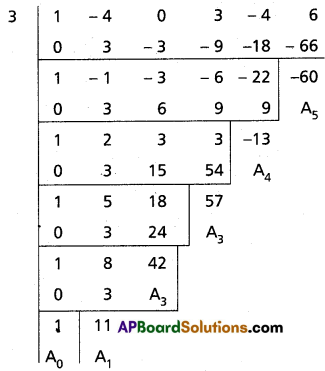
Find the polynomial equation whose roots are the translates of those of x5 – 4x4 + 3x2 – 4x + 6 = 0 by -3.
Solution:
Given equation is f(x) = x5 – 4x4 + 3x2 – 4x + 6 = 0
Required equation is f(x + 3) = 0
(x + 3)5 – 4(x + 3)4 + 3(x + 3)2
Inter 2nd Year Maths 2A Theory of Equations Solutions Ex 4(d) III Q2
Required equation is x5 + 11x4 + 42x3 + 57x2 – 13x – 60 = 0

Question 3.
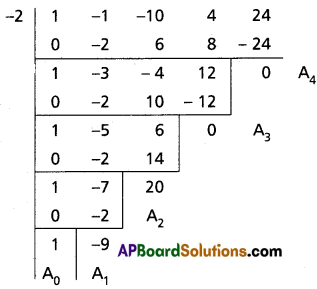
Find the polynomial equation whose roots are the translates of the roots of the equation x4 – x3 – 10x2 + 4x + 24 = 0 by 2.
Solution:
Given f(x) = x4 – x3 – 10x2 + 4x + 24 = 0
Required equation is f(x – 2) = 0
(x – 2)4 – (x – 2)3 – 10(x – 2)2 + 4(x – 2) + 24 = 0
Inter 2nd Year Maths 2A Theory of Equations Solutions Ex 4(d) III Q3
Required equation is x4 – 9x3 + 20x2 = 0

Inter 2nd Year Maths 2A Theory of Equations Solutions Ex 4(d)

Question 4.
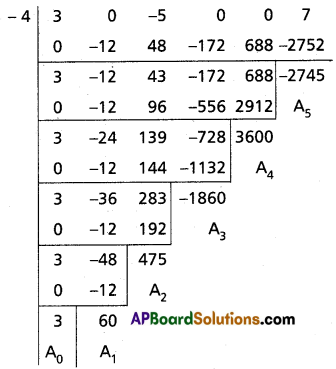
Find the polynomial equation whose roots are the translates of the equation 3x5 – 5x3 + 7 = 0 by 4.
Solution:
Given f(x) = 3x5 – 5x3 + 7 = 0
Required equation is f(x – 4) = 0
3(x – 4)5 – 5(x – 4)3 + 7 = 0
Inter 2nd Year Maths 2A Theory of Equations Solutions Ex 4(d) III Q4
Required equation is x5 – 60x4 + 475x3 – 1860x2 + 3600x – 2745 = 0

Question 5.
Transform each of the following equations into ones in which of the coefficients of the second highest power of x is zero and also find their transformed equations.
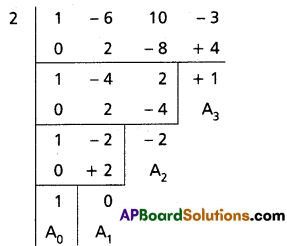
(i) x3 – 6x2 + 10x – 3 = 0
Solution:
Given equation is x3 – 6x2 + 10x – 3 = 0
To remove the second term diminish the roots by \(-\frac{a_1}{n a_0}=\frac{6}{3}=2\)
Inter 2nd Year Maths 2A Theory of Equations Solutions Ex 4(d) III Q5(i)
Required equation is x3 – 2x + 1 = 0

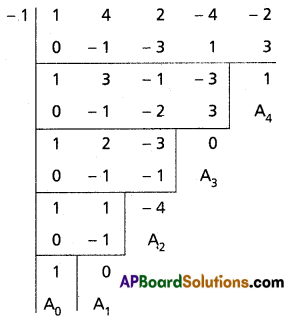
(ii) x4 + 4x3 + 2x2 – 4x – 2 = 0
Solution:
Given equation is x4 + 4x3 + 2x2 – 4x – 2 = 0
Diminishing the roots by \(-\frac{a_1}{n a_0}=\frac{-4}{4}=-1\)
Inter 2nd Year Maths 2A Theory of Equations Solutions Ex 4(d) III Q5(ii)
Required equation is x4 – 4x2 + 1 = 0

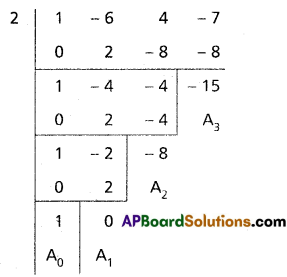
(iii) x3 – 6x2 + 4x – 7 = 0
Solution:
Given equation is x3 – 6x2 + 4x – 7 = 0
Diminishing the roots by \(-\frac{a_1}{n a_0}=\frac{6}{3}=2\)
Inter 2nd Year Maths 2A Theory of Equations Solutions Ex 4(d) III Q5(iii)
Required equation is x3 – 8x – 15 = 0

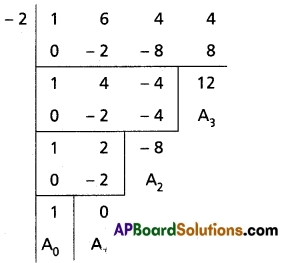
(iv) x3 + 6x2 + 4x + 4 = 0
Solution:
Given equation is x3 + 6x2 + 4x + 4 = 0
To remove the second term diminish the roots by \(\frac{-a_1}{n a_0}=-\frac{6}{3}=-2\)
Inter 2nd Year Maths 2A Theory of Equations Solutions Ex 4(d) III Q5(iv)
Required equation is x3 – 8x + 12 = 0

Inter 2nd Year Maths 2A Theory of Equations Solutions Ex 4(d)

Question 6.
Transform each of the following equations into ones in which the coefficients of the third highest power of x are zero.
Hint: To remove the rth term in an equation f(x) = 0 of degree n diminish the roots by ‘h’ such that \(f^{(n-r+1)}(h)=0\)
(i) x4 + 2x3 – 12x2 + 2x – 1 = 0
Solution:
Let f(x) = x4 + 2x3 – 12x2 + 2x – 1
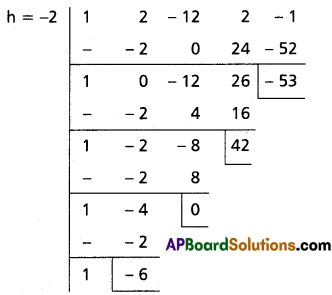
To remove the 3rd term, diminish the roots by h such that f”(h) = 0
f'(x) = 4x3 + 6x2 – 24x + 2
f”(x) = 12x2 + 12x – 24
f”(h) = 0
⇒ 12h2 + 12h – 24 = 0
⇒ h2 + h – 2 = 0
⇒ (h + 2) (h – 1) = 0
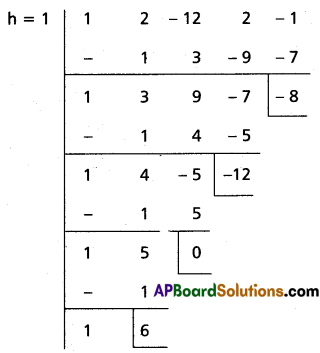
⇒ h = -2 or 1
Case (i):
Inter 2nd Year Maths 2A Theory of Equations Solutions Ex 4(d) III Q6(i)
Transformed equation is x4 – 6x3 + 42x – 53 = 0
Case (ii):
Inter 2nd Year Maths 2A Theory of Equations Solutions Ex 4(d) III Q6(i).1
Transformed equation is x4 – 6x3 – 12x – 8 = 0
∴ The required equation is x4 – 6x3 + 42x – 53 = 0
or x4 + 6x3 – 12x – 8 = 0

(ii) x3 + 2x2 + x + 1 = 0
Solution:
Let f(x) = x3 + 2x2 + x + 1
To remove the 3rd term, diminish the roots by h such that f'(h) = 0, f'(x) = 3x2 + 4x + 1
f'(h) = 0
⇒ 3h2 + 4h + 1 = 0
⇒ (3h + 1) (h + 1)
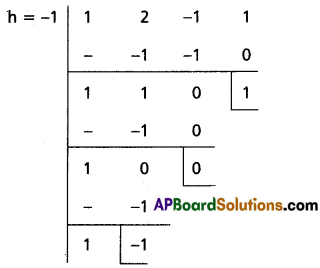
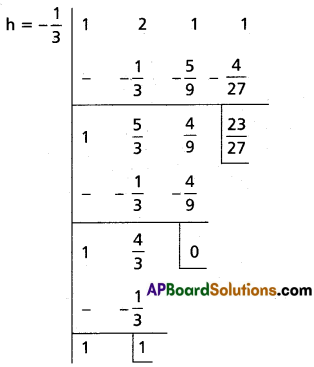
⇒ h = -1, \(-\frac{1}{3}\)
Case (i):
Inter 2nd Year Maths 2A Theory of Equations Solutions Ex 4(d) III Q6(ii)
Transformed equation is x3 – x2 + 1 = 0
Case (ii):
Inter 2nd Year Maths 2A Theory of Equations Solutions Ex 4(d) III Q6(ii).1
Transformed equation is x3 + x2 + \(\frac{23}{27}\) = 0
⇒ 27x3 + 27x2 + 23 = 0
∴ The required equation is x3 – x2 + 1 = 0 or 27x3 + 27x2 + 23 = 0

Inter 2nd Year Maths 2A Theory of Equations Solutions Ex 4(d)

Question 7.
Solve the following equations.
(i) x4 – 10x3 + 26x2 – 10x + 1 = 0
Solution:
This is a standard reciprocal equation.
Dividing with x2
\(x^2-10 x+26-\frac{10}{x}+\frac{1}{x^2}=0\)
\(\left(x^2+\frac{1}{x^2}\right)-10\left(x+\frac{1}{x}\right)+26=0\) …….(1)
put a = x + \(\frac{1}{x}\)
\(x^2+\frac{1}{x^2}=\left(x+\frac{1}{x}\right)^2-2\) = a2 – 2
Substituting in (1)
a2 – 2 – 10a + 26 = 0
⇒ a2 – 10a + 24 = 0
⇒ (a – 4)(a – 6) = 0
⇒ a = 4 or 6
Case (i): a = 4
x + \(\frac{1}{x}\) = 4
⇒ x2 + 1 = 4x
⇒ x2 – 4x + 1 = 0
⇒ x = \(\frac{4 \pm \sqrt{16-4}}{2}=\frac{4 \pm 2 \sqrt{3}}{2}\)
⇒ x = 2 ± √3
Case (ii): a = 6
x + \(\frac{1}{x}\) = 6
⇒ x2 + 1 = 6x
⇒ x2 – 6x + 1 = 0
⇒ x = \(\frac{6 \pm \sqrt{36-4}}{2}\)
⇒ x = \(\frac{2(3 \pm 2 \sqrt{2)}}{2}\)
⇒ x = 3 ± 2√2
∴ The roots are 3 ± 2√2, 2 ± √3

(ii) 2x5 + x4 – 12x3 – 12x2 + x + 2 = 0
Solution:
Given f(x) = 2x5 + x4 – 12x3 – 12x2 + x + 2 = 0
This is an odd-degree reciprocal equation of the first type.
∴ -1 is a root.
Dividing f(x) with x + 1
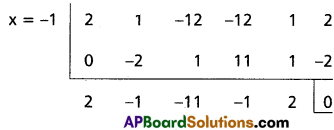
Inter 2nd Year Maths 2A Theory of Equations Solutions Ex 4(d) III Q7(ii)
Dividing f(x) by (x + 1), we get
2x4 – x3 – 11x2 – x + 2 = 0
Dividing by x2
\(2 x^2-x-11-\frac{1}{x}+\frac{2}{x^2}=0\)
\(2\left(x^2+\frac{1}{x^2}\right)-\left(x+\frac{1}{x}\right)-11=0\) ……..(1)
Put a = x + \(\frac{1}{x}\) so that
\(x^2+\frac{1}{x^2}=a^2-2\)
Substituting in (1), the required equation is
⇒ 2(a2 – 2) – a – 11 = 0
⇒ 2a2 – 4 – a – 11 = 0
⇒ 2a2 – a – 15 = 0
⇒ (a – 3) (2a + 5) = 0
⇒ a = 3 or \(-\frac{5}{2}\)
Case (i): a = 3
x + \(\frac{1}{x}\) = 3
⇒ x2 + 1 = 3x
⇒ x2 – 3x + 1 = 0
⇒ x = \(\frac{3 \pm \sqrt{9-4}}{2}=\frac{3 \pm \sqrt{5}}{2}\)
Case (ii): a = \(-\frac{5}{2}\)
⇒ \(x+\frac{1}{x}=-\frac{5}{2}\)
⇒ \(\frac{x^2+1}{x}=-\frac{5}{2}\)
⇒ 2x2 + 2 = -5x
⇒ 2x2 + 5x + 2 = 0
⇒ (2x + 1) (x + 2) = 0
⇒ x = \(-\frac{1}{2}\), -2
∴ The roots are -1, \(-\frac{1}{2}\), -2, \(\frac{3 \pm \sqrt{5}}{2}\)

Inter 2nd Year Maths 2A Theory of Equations Solutions Ex 4(c)

Practicing the Intermediate 2nd Year Maths 2A Textbook Solutions Inter 2nd Year Maths 2A Theory of Equations Solutions Exercise 4(c) will help students to clear their doubts quickly.

Intermediate 2nd Year Maths 2A Theory of Equations Solutions Exercise 4(c)

I.

Question 1.
Form the polynomial equation whose roots are
(i) 2 + 3i, 2 – 3i, 1 + i, 1 – i
Solution:
The required equation is [x – (2 + 3i)] [x – (2 – 3i)] [x – (1 + i)][x – (1 – i)] = 0
⇒ [(x – 2) – 3i)] [(x – 2) + 3i] [(x – 1) – i] [(x – 1) + i] = 0
⇒ [(x – 2)2 – 9i2] [(x – 1)2 – i2] = 0
⇒ (x2 – 4x + 4 + 9) (x2 – 2x + 1 + 1) = 0
⇒ (x2 – 4x + 13) (x2 – 2x + 2) = 0
⇒ x4 – 4x3 + 13x2 – 2x3 + 8x2 – 26x + 2x2 – 8x + 26 = 0
⇒ x4 – 6x3 + 23x2 – 34x + 26 = 0

(ii) 3, 2, 1 + i, 1 – i
Solution:
Required equation is (x – 3) (x – 2) [x – (1 + i)] [ x – (1 – i)] = 0
⇒ (x2 – 5x + 6) [(x – 1) – i] [(x – 1) + i] = 0
⇒ (x2 – 5x + 6) [(x – 1)2 – i2] = 0
⇒ (x2 – 5x + 6) (x2 – 2x + 1 + 1) = 0
⇒ (x2 – 5x + 6) (x2 – 2x + 2) = 0
⇒ x4 – 5x3 + 6x2 – 2x3 + 10x2 – 12x + 2x2 – 10x + 12 = 0
⇒ x4 – 7x3 + 18x2 – 22x + 12 = 0

(iii) 1 + i, 1 – i, -1 + i, -1 – i
Solution:
Required equation is [x – (1 + i)] [x – (1 – i)] [x – (-1 + i)] [x – (-1 – i)] = 0
⇒ [(x – 1) – i][(x – i) + i] [(x + 1) – i] [(x + 1) + i] = 0
⇒ [(x – 1)2 – i2] [(x + 1)2 – i2] = 0
⇒ (x2 – 2x + 1 + 1) (x2 + 2x + 1 + 1) = 0
⇒ (x2 – 2x + 2) (x2 + 2x + 2) = 0
⇒ x4 – 2x3 + 2x2 + 2x3 – 4x2 + 4x + 2x2 – 4x + 4 = 0
⇒ x4 + 4 = 0

(iv) 1 + i, 1 – i, 1 + i, 1 – i
Solution:
Required equation is [x – (1 + i)] [x – (1 – i)] [x – (1 + i)] [x – (1 – i)] = 0
⇒ [(x – 1) – i]2 [(x – 1) + i]2 = 0
⇒ [(x – 1)2 – i2] = 0
⇒ (x2 – 2x + 1 + 1)2 = 0
⇒ x4 + 4x2 + 4 – 4x3 + 4x2 – 8x = 0
⇒ x4 – 4x3 + 8x2 – 8x + 4 = 0

Inter 2nd Year Maths 2A Theory of Equations Solutions Ex 4(c)

Question 2.
Form the polynomial equation with rational coefficients whose roots are
(i) 4√3, 5 + 2i
Solution:
For the polynomial equation with rational coeffs. the roots are conjugate surds and conjugate complex numbers.
4√3, 5 + 2i
Let α = 4√3 then β = -4√3, and γ = 5 + 2i then δ = 5 – 2i
α, β, γ, δ are the roots
α + β = 0, αβ = -48
γ + δ = 10, γδ = 25 + 4 = 29
The required equation is [x2 – (α + β)x + αβ] [x2 – (γ + δ)x + γδ] = 0
⇒ (x2 – 48) (x2 – 10x + 29) = 0
⇒ x4 – 10x3 + 29x2 – 48x2 + 480x – 1932 = 0
⇒ x4 – 10x3 – 19x2 + 480x – 1932 = 0

(ii) 1 + 5i, 5 – i
Solution:
For the polynomial equation with rational coeffs. the roots are conjugate surds and conjugate complex numbers.
Let α = 1 + 5i then β = 1 – 5i,
and γ = 5 + i then δ = 5 – i
α + β = 2, αβ = 26
γ + δ = 10, γδ = 26
The required equation is [x2 – (α + β)x + αβ] [x2 – (γ + δ)x + γδ] = 0
⇒ (x2 – 2x + 26) (x2 – 10x + 26) = 0
⇒ x4 – 12x3 + 72x2 – 312x + 676 = 0

(iii) i – √5
Solution:
For the polynomial equation with rational coeffs. the roots are conjugate surds and conjugate complex numbers.
Let α = i – √5, β = i + √5, γ = -i – √5, δ = -i + √5 are the roots
α + β = 2i, αβ = -6
γ + δ = -2i, γδ = -6
The required equation is [x2 – (α + β)x + αβ][x2 – (γ + δ)x + γδ] = 0
⇒ (x2 – 2ix – 6) (x2 + 2ix – 6) = 0
⇒ [(x2 – 6) – 2ix] [(x2 – 6) + 2ix] = 0
⇒ (x2 – 6)2 + 4x2 = 0
⇒ x4 + 36 – 12x2 + 4x2 = 0
⇒ x4 – 8x2 + 36 = 0

(iv) -√3 + i√2
Solution:
Let α = -√3 + i√2, β = -√3 – i√2, γ = √3 – i√2, γ = √3 + i√2
α + β = -2√3
αβ = (-√3)2 – (i√2)2
= 3 – i2 (2)
= 5
γ + δ = 2√3
γδ = 5
The required equation is [(x2 – (α + β)x + αβ)] [(x2 – (γ + δ)x + γδ)] = 0
⇒ (x2 + 2√3x + 5) (x2 – 2√3x + 5) = 0
⇒ (x2 + 5)2 – (2√3x)2 = 0
⇒ x4 + 25 + 10x2 – 12x2 = 0
⇒ x4 – 2x2 + 25 = 0

Inter 2nd Year Maths 2A Theory of Equations Solutions Ex 4(c)

II.

Question 1.
Solve the equation x4 + 2x3 – 5x2 + 6x + 2 = 0 given that 1 + i is one of its roots.
Solution:
Let 1 + i be one root ⇒ 1 – i be another root
The equation having roots 1 ± i is x2 – 2x + 2 = 0
∴ x2 – 2x + 2 is a factor of x4 + 2x3 – 5x2 + 6x + 2 = 0
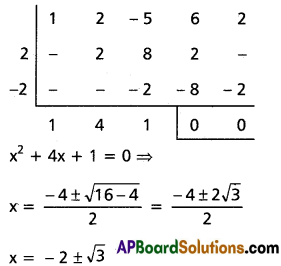
Inter 2nd Year Maths 2A Theory of Equations Solutions Ex 4(c) II Q1
∴ The roots of the given equation are 1 ± i, -2 + √3

Question 2.
Solve the equation 3x3 – 4x2 + x + 88 = 0 which has 2 – √-7 as a root.
Solution:
Let 2 – √-7 (i.e) 2 – √7i is one root
⇒ 2 + √7i is another root.
The equation having roots 2 ± √7i is x2 – 4x + 11 = 0
∴ x2 – 4x + 11 is a factor of the given equation.
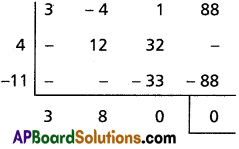
Inter 2nd Year Maths 2A Theory of Equations Solutions Ex 4(c) II Q2
3x + 8 = 0
⇒ x = \(-\frac{8}{3}\)
∴ The roots of the given equation are 2 ± √7i, \(-\frac{8}{3}\)

Inter 2nd Year Maths 2A Theory of Equations Solutions Ex 4(c)

Question 3.
Solve x4 – 4x2 + 8x + 35 = 0, given that 2 + i√3 is a root.
Solution:
Let 2 + i√3 be one root
⇒ 2 – i√3 is another root.
The equation having roots 2 ± i√3 is x2 – 4x + 7 = 0
∴ x2 – 4x + 7 is a factor of x4 – 4x2 + 8x + 35
Inter 2nd Year Maths 2A Theory of Equations Solutions Ex 4(c) II Q3
∴ The roots of the given equation are 2 ± i√3, -2 ± i

Question 4.
Solve the equation x4 – 6x3 + 11x2 – 10x + 2 = 0, given that 2 + √3 is a root of the equation.
Solution:
2 + √3 is one root
⇒ 2 – √3 is another root.
The equation having the roots of 2 ± √3 is x2 – 4x + 1 = 0
∴ x2 – 4x + 1 is a factor of x4 – 6x3 + 11x2 – 10x + 2 = 0
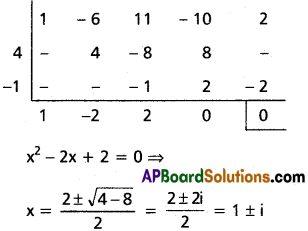
Inter 2nd Year Maths 2A Theory of Equations Solutions Ex 4(c) II Q4
∴ The roots of the required equation are 2 ± √3, 1 ± i

Question 5.
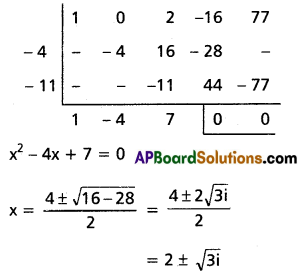
Given that -2 + √-7 is a root of the equation x4 + 2x2 – 16x + 77 = 0, solve it completely.
Solution:
-2 – √-7 (i.e) -2 + i√7 is one root
⇒ -2 – i√7 is another root.
The equation having the roots of -2 ± i√7 is x2 + 4x + 11 = 0
∴ x2 + 4x + 11 is a factor of x4 + 2x2 – 16x + 77
Inter 2nd Year Maths 2A Theory of Equations Solutions Ex 4(c) II Q5
∴ The roots of the required equation are -2 ± i√7, 2 ± √3i

Inter 2nd Year Maths 2A Theory of Equations Solutions Ex 4(c)

Question 6.
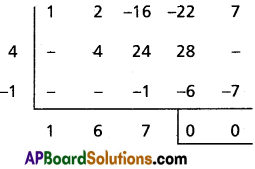
Solve the equations x4 + 2x3 – 16x2 – 22x + 7 = 0, given that 2 – √3 is a root of it.
Solution:
2 + √3 is a root ⇒ 2 – √3 is also a root.
The equation having roots 2 ± √3 is
x2 – (2 + √3 + 2 – √3)x + (2 + √3) (2 – √3) = 0
⇒ x2 – 4x + 1 = 0
Inter 2nd Year Maths 2A Theory of Equations Solutions Ex 4(c) II Q6
x2 + 6x + 7 = 0
⇒ x = \(\frac{-6 \pm \sqrt{36-28}}{2}\)
⇒ x = -3 ± √2
∴ Roots are 2 ± √3, -3 ± √2

Question 7.
Solve the equation 3x5 – 4x4 – 42x3 + 56x2 + 27x – 36 = 0 given that √2 + √5 is one of its roots.
Solution:
√2 + √5 is a root
⇒ -√2 – √5, -√2 + √5, -√2 – √5 are also roots.
The equation haying roots √2 + √5 is
x2 – (√2 + √5 + √2 – √5) + (√2 + √5) (√2 – √5) = 0
⇒ x2 – 2√2x – 3 = 0
The equation having roots -√2 ± √5 is
x2 – (-√2 + √5 – √2 – √5) + (√2 + √5)(-√2 – √5) = 0
⇒ x2 + 2√x – 3 = 0
The equation having roots ±√2 ± √5 is (x2 + 2√2x – 3) (x2 – 2√2x – 3) = 0
⇒ (x2 – 3)2 – (2√2x)2 = 0
⇒ x4 – 6x2 + 9 – 8x2 = 0
⇒ x4 – 14x2 + 9 = 0
∴ 3x5 – 4x4 – 42x3 + 56x2 + 27x – 36 = 0
⇒ 3x(x4 – 14x2 + 9) – 4(x4 – 14x2 + 9) = 0
⇒ (x4 – 14x2 + 9) (3x – 4) = 0
⇒ x = ±√2 ± √5 or 4/3
∴ The roots are ±√2 ± √5, 4/3

Inter 2nd Year Maths 2A Theory of Equations Solutions Ex 4(c)

Question 8.
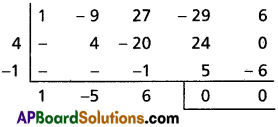
Solve the equation x4 – 9x3 + 27x2 – 29x + 6 = 0, given that one root of it is 2 – √3.
Solution:
2 – √3 is one root ⇒ 2 + √3 is another root.
The equation having the roots of 2 ± √3 is x2 – 4x + 1 = 0
∴ x2 – 4x + 1 is a factor of the given equation.
Inter 2nd Year Maths 2A Theory of Equations Solutions Ex 4(c) II Q8
x2 – 5x + 6 = 0
⇒ (x – 2) (x – 3) = 0
⇒ x = 2, 3
∴ The roots of the required equations are 2 ± √3, 2, 3

Question 9.
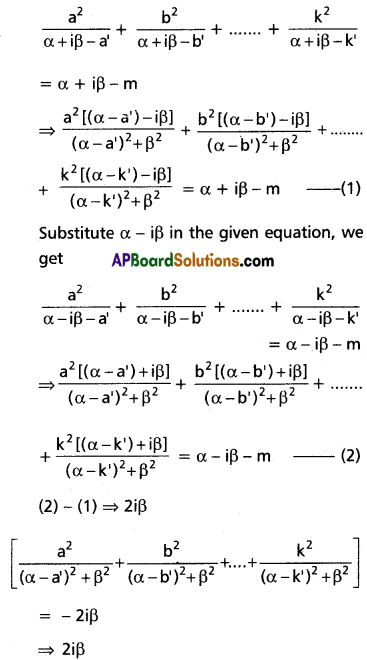
Show that the equation \(\frac{a^{2}}{x-a^{\prime}}+\frac{b^{2}}{x-b^{\prime}}+\frac{c^{2}}{x-c^{\prime}}+\ldots+\frac{k^{2}}{x-k^{\prime}}\)= x – m Where a, b, c ….k, m, a’, b’, c’…. k’ are all real numbers, cannot have a non-real root.
Solution:
Let α + iβ be the root of the given equation.
Suppose if β ≠ 0, then α – iβ is also a root of the given equation.
Substitute α + iβ in the given equation, and we get
Inter 2nd Year Maths 2A Theory of Equations Solutions Ex 4(c) II Q9
\(\left[\frac{a^{2}}{\left(\alpha-a^{\prime}\right)^{2}+\beta^{2}}+\frac{b^{2}}{\left(\alpha-b^{\prime}\right)^{2}+\beta^{2}}+\ldots \frac{k^{2}}{\left(\alpha-k^{\prime}\right)^{2}+\beta^{2}}+1\right]\)
= 0
⇒ β = 0
This is a contradiction.
∴ The given equation cannot have non-real roots.

Inter 2nd Year Maths 2A Theory of Equations Solutions Ex 4(b)

Practicing the Intermediate 2nd Year Maths 2A Textbook Solutions Inter 2nd Year Maths 2A Theory of Equations Solutions Exercise 4(b) will help students to clear their doubts quickly.

Intermediate 2nd Year Maths 2A Theory of Equations Solutions Exercise 4(b)

I.

Question 1.
Solve x3 – 3x2 – 16x + 48 = 0, given that the sum of two roots is zero.
Solution:
Let α, β, γ are the roots of x3 – 3x2 – 16x + 48 = 0
α + β + γ = 3
Given α + β = 0 (∵ Sum of two roots is zero)
∴ γ = 3
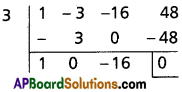
i.e. x – 3 is a factor of x3 – 3x2 – 16x + 48 = 0
Inter 2nd Year Maths 2A Theory of Equations Solutions Ex 4(b) I Q1
x2 – 16 = 0
⇒ x2 = 16
⇒ x = ±4
∴ The roots are -4, 4, 3

Inter 2nd Year Maths 2A Theory of Equations Solutions Ex 4(b)

Question 2.
Find the condition that x3 – px2 + qx – r = 0 may have the sum of its roots zero.
Solution:
Let α, β, γ be the roots of x3 – px2 + qx – r = 0
α + β + γ = p ………(1)
αβ + βγ + γα = q ………..(2)
αβγ = r ………..(3)
Given α + β = 0 (∵ Sum of two roots is zero)
From (1), γ = p
∴ γ is a root of x3 – px2 + qx – r = 0
γ3 – pγ2 + qγ – r = 0
But γ = p
p3 – p(p2) + q(p) – r = 0
p3 – p2 + qp – r = 0
∴ qp = r is the required condition.

Question 3.
Given that the roots of x3 + 3px2 + 3qx + r = 0 are in
(i) A.P., show that 2p3 – 3qp + r = 0
(ii) G.P., show that p3r = q3
(iii) H.P., show that 2q3 = r(3pq – r)
Solution:
Given equation is x3 + 3px2 + 3qx + r = 0
(i) The roots are in A.P.
Suppose a – d, a, a + d are the roots
Sum = a – d + a + a + d = -3p
⇒ 3a = -3p
⇒ a = -p ……….(1)
∵ ‘a’ is a root of x3 + 3px2 + 3qx + r = 0
⇒ a3 + 3pa2 + 3qa + r = 0
But a = -p
⇒ p3 + 3p(-p)2 + 3q(-p) + r = 0
⇒ 2p3 – 3pq + r = 0 is the required condition

(ii) The roots are in G.P.
Suppose the roots be \(\frac{a}{R}\), a, aR
Given (\(\frac{a}{R}\)) (a) (aR) = -r
⇒ a = -r
⇒ a = (-r)1/3
∵ ‘a’ is a root of x3 + 3px2 + 3qx + r = 0
⇒ (-r1/3)3 + 3p(-r1/3)2 + 3q(-r1/3) + r = 0
⇒ -r + 3pr2/3 – 3qr1/3 + r = 0
pr2/3 = qr1/3
⇒ pr1/3 = q
⇒ p1/3r = q is the required condition

(iii) The roots of x3 + 3px2 + 3qx + r = 0 are in H.P.
x3 + 3px2 + 3qx + r = 0 ……..(1)
Let y = \(\frac{1}{x}\) so that \(\frac{1}{y^{3}}+\frac{3 p}{y^{2}}+\frac{3 q}{y}+r\) = 0
Roots of ry3 + 3qy2 + 3py + 1 = 0 are in A.P.
ry3 + 3qy2 + 3py + 1 = 0 ……..(2)
Suppose a – d, a, a + d be the roots of (2)
Sum = a – d + a + a + d = \(-\frac{3 q}{r}\)
3a = \(-\frac{3 q}{r}\)
a = \(-\frac{q}{r}\) ………(1)
∵ ‘a’ is a root of ry3 + 3qy2 + 3py + 1 = 0
⇒ ra3 + 3qa2 + 3pa + 1 = 0
But a = \(-\frac{q}{r}\)
⇒ \(r\left(-\frac{q}{r}\right)^{3}+3 q\left(-\frac{q}{r}\right)^{2}+3 p\left(-\frac{q}{r}\right)+1=0\)
⇒ \(\frac{-q^{3}}{r^{2}}+\frac{3 q^{3}}{r^{2}}-\frac{3 p q}{r}+1=0\)
⇒ -q3 + 3q3 – 3pqr + r2 = 0
⇒ 2q3 = r(3pq – r) is the required condition.

Inter 2nd Year Maths 2A Theory of Equations Solutions Ex 4(b)

Question 4.
Find the condition that x3 – px2 + qx – r = 0 may have the roots in G.P.
Solution:
Let \(\frac{a}{R}\), a, aR be the roots of x3 – px2 + qx – r = 0
The product of the roots = \(\frac{a}{R}\) . a . aR = a3
product of the roots = r
⇒ a = r1/3
∵ a is a root of x3 – px2 + qx – r = 0
⇒ a3 – pa2 + qa – r = 0
But a = r1/3
⇒ (r1/3)3 – p(r1/3)2 + q(r1/3) – r = 0
⇒ r – p . r2/3 + q . r1/3 – r = 0
⇒ p . r2/3 = qr1/3
By cubing on both sides
⇒ p3r2 = q3r
⇒ p3r = q3 is the required condition

II.

Question 1.
Solve 9x3 – 15x2 + 7x – 1 = 0, given that two of its roots are equal.
Solution:
Suppose α, β, γ are the roots of 9x3 – 15x3 + 7x – 1 = 0
α + β + γ = \(\frac{15}{9}=\frac{5}{3}\)
αβ + βγ + γα = \(\frac{7}{9}\)
αβγ = \(\frac{1}{9}\)
Given α = β (∵ two of its roots are equal)
2α + γ = \(\frac{5}{3}\)
⇒ γ = \(\frac{5}{3}\) – 2α
α2 + 2αγ = \(\frac{7}{9}\)
⇒ α2 + 2α (\(\frac{5}{3}\) – 2α) = \(\frac{7}{9}\)
⇒ α2 + \(\frac{2 \alpha(5-6 \alpha)}{3}=\frac{7}{9}\)
⇒ 9α2 + 6α(5 – 6α) = 7
⇒ 9α2 + 30α – 36α2 = 7
⇒ 27α2 – 30α + 7 = 0
⇒ (3α – 1)(9α – 7) = 0
⇒ α = \(\frac{1}{3}\) or \(\frac{7}{9}\)
Inter 2nd Year Maths 2A Theory of Equations Solutions Ex 4(b) II Q1
The roots are \(\frac{1}{3}\), \(\frac{1}{3}\), 1

Inter 2nd Year Maths 2A Theory of Equations Solutions Ex 4(b)

Question 2.
Given that one root of 2x3 + 3x2 – 8x + 3 = 0 is double of another root, find the roots of the equation.
Solution:
Suppose α, β, γ are the roots of 2x3 + 3x2 – 8x + 3 = 0
α + β + γ = \(-\frac{3}{2}\) ……..(1)
αβ + βγ + γα = -4 ……..(2)
αβγ = \(-\frac{3}{2}\)
Given α = 2β (∵ one root is double the other)
Substituting in (1)
3β + γ = \(-\frac{3}{2}\)
⇒ γ = \(-\frac{3}{2}\) – 3β …….(4)
Substituting in (2)
αβ + γ(α + β) = -4
⇒ 2β2 + 3βγ = -4
⇒ 2β2 + 3β(\(-\frac{3}{2}\) – 3β) = -4
⇒ 2β2 – \(\frac{3 \beta(3+6 \beta)}{2}\) = -4
⇒ 4β2 – 9β – 18β2 = -8
⇒ 14β2 + 9β – 8 = 0
⇒ (2β – 1)(7β + 8) = 0
⇒ 2β – 1 = 0 or 7β + 8 = 0
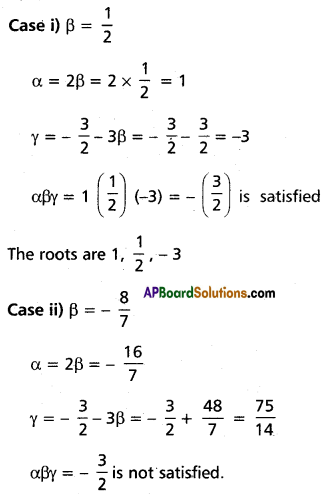
⇒ β = \(\frac{1}{2}\) or β = \(-\frac{8}{7}\)
Inter 2nd Year Maths 2A Theory of Equations Solutions Ex 4(b) II Q2
∴ The roots are \(\frac{1}{2}\), 1 and -3

Question 3.
Solve x3 – 9x2 + 14x + 24 = 0, given that two of the roots are in the ratio 3 : 2.
Solution:
Suppose α, β, γ are the roots of x3 – 9x2 + 14x + 24 = 0
α + β + γ = 9 ………(1)
αβ + βγ + γα = 14 ……….(2)
αβγ = -24 ……….(3)
∵ two roots are in the ratio 3 : 2
Let α : β = 3 : 2
⇒ β = \(\frac{2 \alpha}{3}\)
Substituting in (1)
\(\frac{5 \alpha}{3}\) + γ = 9
⇒ γ = 9 – \(\frac{5 \alpha}{3}\) ………(4)
Substituting in (2)
⇒ \(\frac{2}{3}\) α2 + γ(α + β) = 14
⇒ \(\frac{2}{3} \alpha^{2}+\left(9-\frac{5 \alpha}{3}\right) \cdot \frac{5 \alpha}{3}\) = 14
⇒ 2α2 + 5α(9 – \(\frac{5 \alpha}{3}\)) = 42
⇒ 2α2 + 5α \(\frac{(27-5 \alpha)}{3}\) = 42
⇒ 6α2 + 135α – 25α2 = 126
⇒ 19α2 – 135α + 126 = 0
⇒ 19α2 – 114α – 21α + 126 = 0
⇒ 19α(α – 6) – 21(α – 6) = 0
⇒ (19α – 21)(α – 6) = 0
⇒ 19α – 21 = 0 or α – 6 = 0
⇒ α = \(\frac{21}{19}\) or α = 6
Case (i): α = 6
β = \(\frac{2 \alpha}{3}\)
= \(\frac{2}{3}\) × 6
= 4
γ = 9 – \(\frac{5 \alpha}{3}\)
= 9 – \(\frac{5}{3}\) × 6
= 9 – 10
= -1
α = 6, β = 4, γ = -1 satisfy αβγ = -24
∴ The roots are 6, 4, -1

Case (ii): α = \(\frac{21}{19}\)
β = \(\frac{2}{3} \times \frac{21}{19}=\frac{14}{19}\)
γ = 9 – \(\frac{5 \alpha}{3}\)
= 9 – \(\frac{5}{3} \cdot \frac{21}{19}\)
= \(\frac{136}{19}\)
These values do not satisfy αβγ= -24
∴ The roots are 6, 4, -1.

Inter 2nd Year Maths 2A Theory of Equations Solutions Ex 4(b)

Question 4.
Solve the following equations, given that the roots of each are in A.P.
(i) 8x3 – 36x2 – 18x + 81 = 0
Solution:
Given the roots of 8x3 – 36x2 – 18x + 81 = 0 are in A.P.
Let the roots be a – d, a, a + d
Sum of the roots = \(\frac{36}{8}\)
⇒ a – d + a + a + d = \(\frac{9}{2}\)
⇒ 3a = \(\frac{9}{2}\)
⇒ a = \(\frac{3}{2}\)
∴ (x – \(\frac{3}{2}\)) is a factor of 8x3 – 36x2 – 18x + 81 = 0
Inter 2nd Year Maths 2A Theory of Equations Solutions Ex 4(b) II Q4(i)
⇒ 8x2 – 24x – 54 = 0
⇒ 4x2 – 12x – 27 = 0
⇒ 4x2 – 18x + 6x – 27 = 0
⇒ 2x(2x – 9) + 3(2x – 9) = 0
⇒ (2x + 3) (2x – 9) = 0
⇒ x = \(-\frac{3}{2}, \frac{9}{2}\)
∴ The roots are \(-\frac{3}{2}, \frac{3}{2}, \frac{9}{2}\)

(ii) x3 – 3x2 – 6x + 8 = 0
Solution:
The roots of x3 – 3x2 – 6x + 8 = 0 are in A.P
Suppose a – d, a, a + d be the roots
Sum = a – d + a + a + d = 3
⇒ 3a = 3
⇒ a = 1
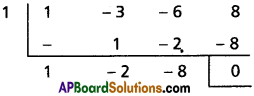
∴ (x – 1) is a factor of x3 – 3x2 – 6x + 8 = 0
Inter 2nd Year Maths 2A Theory of Equations Solutions Ex 4(b) II Q4(ii)
⇒ x2 – 2x – 8 = 0
⇒ x2 – 4x + 2x – 8 = 0
⇒ x(x – 4)+ 2(x – 4) = 0
⇒ (x – 4) (x + 2) = 0
⇒ x = 4, -2
∴ The roots are -2, 1, 4

Question 5.
Solve the following equations, given that the roots of each are in G.P.
(i) 3x3 – 26x2 + 52x – 24 = 0
Solution:
Given equation is 3x3 – 26x2 + 52x – 24 = 0
The roots are in G.P.
Suppose \(\frac{a}{r}\), a, ar are the roots.
Product = \(\frac{a}{r}\) . a . ar = \(-\left(-\frac{24}{3}\right)\)
⇒ a3 = 8
⇒ a = 2
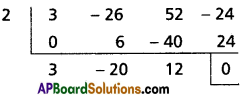
∴ (x – 2) is a factor of 3x3 – 26x2 + 52x – 24
Inter 2nd Year Maths 2A Theory of Equations Solutions Ex 4(b) II Q5(i)
Hint: 3 × 12 = 3 ×6 × 2 = (-18)(-2)
⇒ 3x2 – 20x + 12 = 0
⇒ 3x2 – 18x – 2x + 12 = 0
⇒ 3x(x – 6) – 2(x – 6) = 0
⇒ (3x – 2) (x – 6) = 0
⇒ x = \(\frac{2}{3}\), 6
∴ The roots are \(\frac{2}{3}\), 2, 6.

(ii) 54x3 – 39x2 – 26x + 16 = 0
Solution:
Given equation is 54x3 – 39x2 – 26x + 16 = 0
The roots are in G.P.
Suppose \(\frac{a}{r}\), a, ar be the roots.
Product = \(\frac{a}{r}\) . a . ar = \(-\frac{16}{54}\)
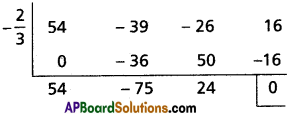
Inter 2nd Year Maths 2A Theory of Equations Solutions Ex 4(b) II Q5(ii)
Hint: 18 × 8 = 9 × 2 × 8 = (-9) (-16)
⇒ 54x2 – 75x + 24 = 0
⇒ 18x2 – 25x + 8 = 0
⇒ 18x2 – 9x – 16x + 8 = 0
⇒ 9x(2x – 1) – 8(2x- 1) = 0
⇒ (9x – 8) (2x – 1) = 0
⇒ x = \(\frac{8}{9}, \frac{1}{2}\)
∴ The roots are \(\frac{8}{9},-\frac{2}{3}, \frac{1}{2}\)

Inter 2nd Year Maths 2A Theory of Equations Solutions Ex 4(b)

Question 6.
Solve the following equations, given that the roots of each are in H.P.
(i) 6x3 – 11x2 + 6x – 1 = 0
Solution:
Given equation is 6x3 – 11x2 + 6x – 1 = 0 …….(1)
Put y = \(\frac{1}{x}\) so that \(\frac{6}{\mathrm{y}^{3}}-\frac{11}{\mathrm{y}^{2}}+\frac{6}{\mathrm{y}}-1\) = 0
⇒ 6 – 11y + 6y2 – y3 = 0
⇒ y3 – 6y2 + 11y – 6 = 0 ………(2)
Roots of (1) are in H.P.
⇒ Roots of (2) are in A.P.
Let a – d, a, a + d be the roots of (2)
Sum = a – d + a + a + d = 6
⇒ 3a = 6
⇒ a = 2
Product = a(a2 – d2) = 6
⇒ 2(4 – d2) = 6
⇒ 4 – d2 = 3
⇒ d2 = 1
⇒ d = 1
a – d = 2 – 1 = 1,
a = 2
a + d = 2 + 1 = 3
The roots of (2) are 1, 2, 3
The roots of (1) are 1, \(\frac{1}{2}\), \(\frac{1}{3}\)

(ii) 15x3 – 23x2 + 9x – 1 = 0
Solution:
Given equation is 15x3 – 23x2 + 9x – 1 = 0 …….(1)
Put y = \(\frac{1}{x}\) so that \(\frac{15}{y^{3}}-\frac{23}{y^{2}}+\frac{9}{y}-1\) = 0
⇒ 15 – 23y + 9y2 – y3 = 0
⇒ y3 – 9y2 + 23y – 15 = 0 ………(2)
Roots of (1) are in H.P. So that roots of (2) are in A.P.
Let a – d, a, a + d be the roots of (2)
Sum = a – d + a + a + d = 9
⇒ 3a = 9
⇒ a = 3
Product = a(a2 – d2) = 15
⇒ 3(9 – d2) = 15
⇒ 9 – d2 = 5
⇒ d2 = 4
⇒ d = 2
a – d = 3 – 2 = 1
a = 3
a + d = 3 + 2 = 5
Roots of (2) are 1, 3, 5
Hence roots of (1) are 1, \(\frac{1}{3}\), \(\frac{1}{5}\)

Inter 2nd Year Maths 2A Theory of Equations Solutions Ex 4(b)

Question 7.
Solve the following equations, given that they have multiple roots.
(i) x4 – 6x3 + 13x2 – 24x + 36 = 0
Solution:
(i) Let f(x) = x4 – 6x3 + 13x2 – 24x + 36
⇒ f'(x) = 4x3 – 18x2 + 26x – 24
⇒ f'(3) = 4(27) – 18(9) + 26(3) – 24
⇒ f'(3) = 108 – 162 + 78 – 24
⇒ f'(3) = 0
f(3) = 81 – 162 + 117 – 72 + 36 = 0
Hint: Choose the value of x from the factors of the G.C.D of constant terms in f(x) and f'(x).
∴ x – 3 is a factor of f'(x) and f(x)
∴ 3 is the repeated foot of f(x)
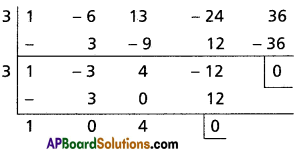
Inter 2nd Year Maths 2A Theory of Equations Solutions Ex 4(b) II Q7(i)
x2 + 4 = 0
⇒ x = ±2i
∴ The roots of the given equation are 3, 3, ±2i

(ii) 3x4 + 16x3 + 24x2 – 16 = 0
Solution:
Let f(x) = 3x4 + 16x3 + 24x2 – 16
f(x) = 12x3 + 48x2 + 48x
= 12x(x2 + 4x + 4)
= 12x (x + 2)2
f'(-2) = 0
f(-2) = 3(16) + 16(-8) + 24(4) – 16 = 0
∴ x + 2 is a factor of f'(x) and f(x)
∴ -2 is a multiple root of f(x) = 0
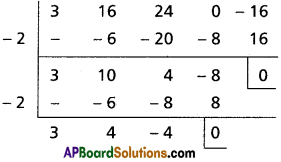
Inter 2nd Year Maths 2A Theory of Equations Solutions Ex 4(b) II Q7(ii)
3x2 + 4x – 4 = 0
⇒ 3x2 + 6x – 2x – 4 = 0
⇒ 3x(x + 2) – 2(x + 2) = 0
⇒ (x + 2) (3x – 2) = 0
⇒ x = -2, \(\frac{2}{3}\)
∴ The roots of the given equation are -2, -2, -2, \(\frac{2}{3}\)

III.

Question 1.
Solve x4 + x3 – 16x2 – 4x + 48 = 0, given that the product of two of the roots is 6.
Solution:
Suppose α, β, γ, δ are the roots of
x4 + x3 – 16x2 – 4x + 48 = 0 ………..(1)
Sum of the roots = -1
⇒ α + β + γ + δ = -1
and Product of the roots = αβγδ = 48
∵ Product of two roots is 6
Let αβ = 6
From (1), γδ = \(\frac{48}{\alpha \beta}=\frac{48}{6}\) = 8
Let α + β = p and γ + δ = q
The equation having roots α, β is x2 – (α + β) x + αβ = 0
⇒ x2 – px + 6 = 0 ………..(2)
The equation having the roots γ, δ is x2 – (γ + δ) x + γδ = 0
⇒ x2 – qx + 8 = 0 ……….(3)
∴ From (1), (2) and (3)
x4 + x3 – 16x2 – 4x + 48 = (x2 – px + 6) (x2 – qx + 8)
= x4 – (p + q) x3 + (pq + 14) x2 – (8p + 86q) x + 48
Comparing the like terms,
p + q = -1
8p + 6q = 4 ⇒ 4p + 3q = 2
Solving, q = -6
∴ p = -1 + 6 = 5
Substitute the value of p in eq. (2),
x2 – 5x + 6 = 0 ⇒ x = 2, 3
Substitute/the value of q in eq. (3),
x2 + 6x + 8 = 0 ⇒ x = -2, – 4
∴ The roots of the given equation are -4, -2, 2, 3

Inter 2nd Year Maths 2A Theory of Equations Solutions Ex 4(b)

Question 2.
Solve 8x4 – 2x3 – 27x2 + 6x + 9 = 0 given that two roots have the same absolute value, but are opposite in signs.
Solution:
Suppose α, β, γ, δ are the roots of the equation
8x4 – 2x3 – 27x2 + 6x + 9 = 0
⇒ \(x^{4}-\frac{1}{4} x^{3}-\frac{27}{8} x^{2}+\frac{3}{4} x+\frac{9}{8}=0\) …………(1)
Sum of the roots = α + β + γ + δ = \(\frac{1}{4}\) and
Product of the roots = αβγδ = \(\frac{9}{8}\)
Given β = -α
⇒ α + β = 0
∴ 0 + γ + δ = \(\frac{1}{4}\)
⇒ γ + δ = \(\frac{1}{4}\)
Let αβ = p, γδ = q, so that pq = \(\frac{9}{8}\)
The equation having the roots α, β is x2 – (α + β)x + αβ = 0
⇒ x2 + p = 0 ……….(2)
The equation having the roots γ, δ is x2 – (γ + δ)x + γδ = 0
⇒ x2 – \(\frac{1}{4}\) x + q = 0 ……..(3)
From (1), (2) and (3)
\(x^{4}-\frac{1}{4} x^{3}-\frac{27}{8} x^{2}+\frac{3}{4} x+\frac{9}{8}\) = (x2 + p) \(\left(x^{2}-\frac{1}{4} x+q\right)\)
= \(x^{4}-\frac{1}{4} x^{3}+(p+q) x^{2}-\frac{p}{4} x+p q\)
Comparing the coefficients of x and constants
\(\frac{-p}{4}=\frac{3}{4}\) ⇒ p = -3
pq = \(\frac{9}{8}\)
⇒ q = \(\frac{9}{8} \times \frac{-1}{3}=\frac{-3}{8}\)
Substitute the value of p in eq. (2),
x2 – 3 = 0 ⇒ x = ±√3
Substitute the value of q in eq. (3),
\(x^{2}-\frac{1}{4} x-\frac{3}{8}=0\)
⇒ 8x2 – 2x – 3 = 0
⇒ (2x + 1) (4x – 3) = 6
⇒ x = \(-\frac{1}{2}, \frac{3}{4}\)
∴ The roots of the given equation are -√3, \(-\frac{1}{2}, \frac{3}{4}\), √3

Question 3.
Solve 18x3 + 81x2 + 121x + 60 = 0 given that one root is equal to half the sum of the remaining roots.
Solution:
Suppose α, β, γ are the roots of 18x3 + 81x2 + 121x + 60 = 0
sum = α + β + γ = \(\frac{-81}{18}=\frac{-9}{2}\) ……….(1)
αβ + βγ + γα = \(\frac{121}{18}\) …………(2)
αβγ = \(\frac{-60}{18}=\frac{-10}{3}\) ………(3)
∵ One root is equal to half of the sum of the remaining two,
Let α = \(\frac{1}{2}\) (β + γ)
Substitute in (1)
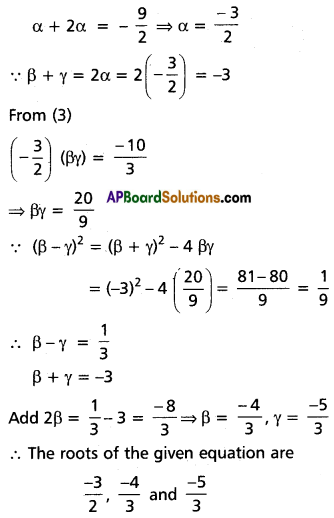
Inter 2nd Year Maths 2A Theory of Equations Solutions Ex 4(b) III Q3

Question 4.
Find the condition in order that the equation ax4 + 4bx3 + 6cx2 + 4dx + e = 0 may have a pair of equal roots.
Solution:
Let α, α, β, β are the roots of the equation.
ax4 + 4bx3 + 6cx2 + 4dx + e = 0
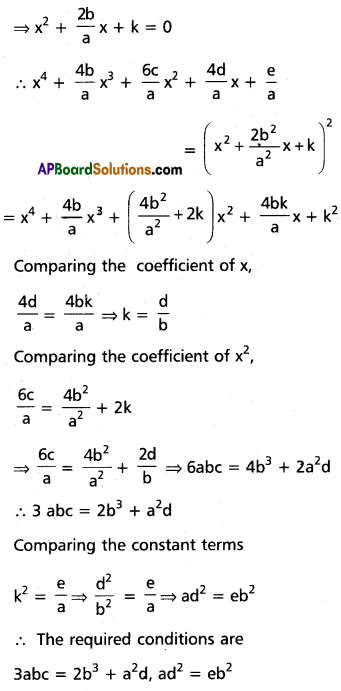
⇒ \(x^{4}+\frac{4 b}{a} x^{2}+\frac{6 c}{a} x^{2}+\frac{4 d}{a} x+\frac{e}{a}=0\)
Sum of the roots, 2(α + β) = \(-\frac{4 b}{a}\)
⇒ α + β = \(-\frac{2 b}{a}\)
⇒ αβ = k (say)
Equation having roots α, β is x2 – (α + β) x + αβ = 0
Inter 2nd Year Maths 2A Theory of Equations Solutions Ex 4(b) III Q4

Question 5.
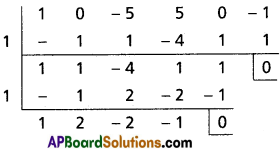
(i) Show that x5 – 5x3 + 5x2 – 1 = 0 has three equal roots and find this root.
Solution:
Let f(x) = x5 – 5x3 + 5x2 – 1
f'(x) = 5x4 – 15x2 + 10x = 5x(x3 – 3x + 2)
f'(1) = 5(1) (1 – 3 + 2) = 0
f(1) = 1 – 5 + 5 – 1 = 0
x – 1 is a factor of f'(x) and f(x)
∴ 1 is a repeated root of f(x).
Inter 2nd Year Maths 2A Theory of Equations Solutions Ex 4(b) III Q5(i)
x3 + 2x2 – 2x – 1 = 0
⇒ 1 is a root of the above equation (∵ sum of the coefficients is zero)
∴ 1 is the required root.

(ii) Find the repeated roots of x5 – 3x4 – 5x3 + 27x2 – 32x + 12 = 0
Solution:
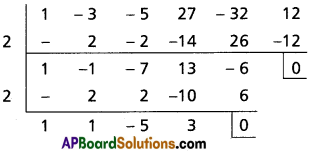
Let f(x) = x5 – 3x4 – 5x3 + 27x2 – 32x + 12
f'(x) = 5x4 – 12x3 – 15x2 + 54x – 32
f'(2) = 5(2)4 – 12(2)3 – 15(2)2 + 54(2) – 32
= 80 – 96 – 60 + 108 – 32
= 0
f(2) = (2)5 – 3(2)4 – 5(2)3 + 27(2)2 – 32(2) + 12
= 32 – 48 – 40 + 108 – 64 + 12
= 152 – 152
= 0
∴ x – 2 is a common factor of f'(x) and f(x)
2 is a multiple root of f(x) = 0
Inter 2nd Year Maths 2A Theory of Equations Solutions Ex 4(b) III Q5(ii)
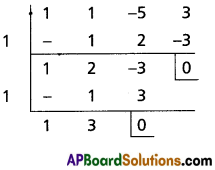
Let g(x) = x3 + x2 – 5x + 3
g'(x) = 3x2 + 2x – 5 = (3x + 5) (x – 1)
g(1) = 1 + 1 – 5 + 3 = 0
∴ x – 1 is a common factor of g'(x) and g(x)
∴ 1 is a multiple root of g(x) = 0
Inter 2nd Year Maths 2A Theory of Equations Solutions Ex 4(b) III Q5(ii).1
x + 3 = 0 ⇒ x = -3
∴ The roots are 2, 2, 1, 1, -3

Inter 2nd Year Maths 2A Theory of Equations Solutions Ex 4(b)

Question 6.
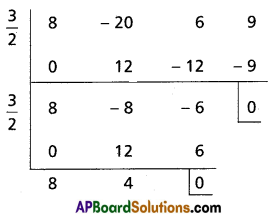
Solve the equation 8x3 – 20x2 + 6x + 9 = 0 given that the equation has multiple roots.
Solution:
Let f(x) = 8x3 – 20x2 + 6x + 9
f'(x) = 24x2 – 40x + 6
= 2 (12x2 – 20x + 3)
= 2[12x2 – 18x – 2x + 3]
= 2[6x(2x – 3) – 1(2x – 3)]
= 2(2x – 3) (6x – 1)
f'(x) = 0
⇒ x = \(\frac{3}{2}\), x = \(\frac{1}{6}\)
\(f\left(\frac{3}{2}\right)=8\left(\frac{3}{2}\right)^{3}-20\left(\frac{3}{2}\right)^{2}+6\left(\frac{3}{2}\right)+9\)
= 27 – 45 + 9 + 9
= 0
Hence x – \(\frac{3}{2}\) is a factor of f(x) and f'(x)
∴ \(\frac{3}{2}\) is a multiple root of f(x) = 0
Inter 2nd Year Maths 2A Theory of Equations Solutions Ex 4(b) III Q6
8x – 4 = 0
⇒ x = \(\frac{4}{8}=\frac{1}{2}\)
∴ The roots of the equation f(x) = 0 are \(\frac{3}{2}, \frac{3}{2}, \frac{1}{2}\)

Inter 2nd Year Maths 2A Theory of Equations Solutions Ex 4(a)

Practicing the Intermediate 2nd Year Maths 2A Textbook Solutions Inter 2nd Year Maths 2A Theory of Equations Solutions Exercise 4(a) will help students to clear their doubts quickly.

Intermediate 2nd Year Maths 2A Theory of Equations Solutions Exercise 4(a)

I.

Question 1.
Form polynomial equations of the lowest degree, with roots as given below.
(i) 1, -1, 3
Solution:
Equation having roots α, β, γ is (x – α) (x – β) (x – γ) = 0
Sol. Required equation is (x – 1) (x + 1) (x – 3) = 0
⇒ (x2 – 1) (x – 3) = 0
⇒ x3 – 3x2 – x + 3 = 0

(ii) 1 ± 2i, 4, 2
Solution:
In an equation, imaginary roots occur in conjugate pairs.
Equation having roots α, β, γ, δ is (x – α) (x – β) (x – γ) (x – δ) = 0
Required equation is [x – (1 + 2i)] [x – (1 – 2i)] (x – 4) (x – 2) = 0
(x – (1 + 2i)] [x – (1 – 2i)] = [(x – 1) – 2i] [(x – 1) + 2i]
= (x – 1)2 – 4i2
= (x – 1)2 + 4
= x2 – 2x + 1 + 4
= x2 – 2x + 5
(x – 4) (x – 2) = x2 – 4x – 2x + 8 = x2 – 6x + 8
Required equation (x2 – 2x + 5) (x2 – 6x + 8) = 0
⇒ x4 – 2x3 + 5x2 – 6x3 + 12x2 – 30x + 8x2 – 16x + 40 = 0
⇒ x4 – 8x3 + 25x2 – 46x + 40 = 0

Inter 2nd Year Maths 2A Theory of Equations Solutions Ex 4(a)

(iii) 2 ± √3, 1 ± 2i
Solution:
Required equation is [x – (2 + √3)] [x – (2 – √3)] [x – (1 + 2i)] [ x – (1 – 2i)] = 0
[x – (2 + √3)] [x – (2 – √3)]
= [(x – 2) – √3] [(x – 2) + √3]
= (x – 2)2 – 3
= x2 – 4x + 4 – 3
= x2 – 4x + 1
[x – (1 + 2i)] [x – (1 – 2i)] = [(x – 1) – 2i] [(x – 1) + 2i]
= (x – 1)2 – 4i2
= x2 – 2x + 1 + 4
= x2 – 2x + 5
Substituting in (1), the required equation is
(x2 – 4x + 1) (x2 – 2x + 5) = 0
⇒ x4 – 4x3 + x2 – 2x3 + 8x2 – 2x + 5x2 – 20x + 5 = 0
⇒ x4 – 6x3 + 14x2 – 22x + 5 = 0

(iv) 0, 0, 2, 2, -2, -2
Solution:
Required equation is (x – 0) (x – 0) (x – 2) (x – 2) (x + 2) (x + 2) = 0
⇒ x2 (x – 2)2 (x + 2)2 = 0
⇒ x2 (x2 – 4)2 = 0
⇒ x2 (x4 – 8x2 + 16) = 0
⇒ x6 – 8x4 + 16x2 = 0

(v) 1 ± √3, 2, 5
Solution:
Required equation is [x – (1 + √3)] [x – (1 – √3)][(x – 2) (x – 5)] = 0 ………(1)
[x – (1 + √3)] [x – (1 – √3)] = [(x – 1) – √3] [(x – 1) + √3]
= (x – 1)2 – 3
= x2 – 2x + 1 – 3
= x2 – 2x – 2
(x – 2) (x – 5) = x2 – 2x – 5x + 10 = x2 – 7x + 10
Substituting in (1), the required equation is
(x2 – 2x – 2) (x2 – 7x + 10) = 0
⇒ x4 – 2x3 – 2x2 – 7x3 + 14x2 + 14x + 10x2 – 20x – 20 = 0
⇒ x4 – 9x3 + 22x2 – 6x – 20 = 0

Inter 2nd Year Maths 2A Theory of Equations Solutions Ex 4(a)

(vi) 0, 1, \(-\frac{3}{2}\), \(-\frac{5}{2}\)
Solution:
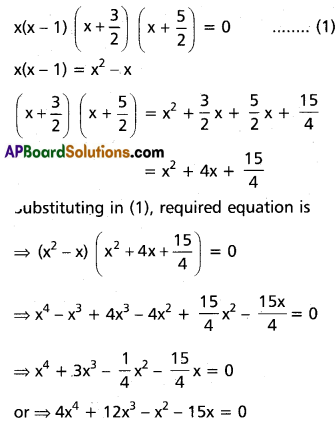
Required equation is
Inter 2nd Year Maths 2A Theory of Equations Solutions Ex 4(a) I Q1(vi)

Question 2.
If α, β, γ are the roots of 4x3 – 6x2 + 7x + 3 = 0, then find the value of αβ + βγ + γα.
Solution:
α, β, γ are the roots of 4x3 – 6x2 + 7x + 3 = 0
α + β + γ = \(-\frac{a_{1}}{a_{0}}=\frac{6}{4}\)
αβ + βγ + γα = \(\frac{a_{2}}{a_{0}}=\frac{7}{4}\)
αβγ = \(-\frac{a_{3}}{a_{0}}=-\frac{3}{4}\)
∴ αβ + βγ + γα = \(\frac{7}{4}\)

Question 3.
If 1, 1, α are the roots of x3 – 6x2 + 9x – 4 = 0, then find α.
Solution:
1, 1, α are roots of x3 – 6x2 + 9x – 4 = 0
Sum = 1 + 1 + α = 6
⇒ α = 6 – 2 = 4

Question 4.
If -1, 2 and α are the roots of 2x3 + x2 – 7x – 6 = 0, then find α.
Solution:
-1, 2, α are roots of 2x3 + x2 – 7x – 6 = 0
Sum = -1 + 2 + α = \(-\frac{1}{2}\)
⇒ α = \(-\frac{1}{2}\) – 1 = \(-\frac{3}{2}\)

Question 5.
If 1, -2 and 3 are roots of x3 – 2x2 + ax + 6 = 0, then find a.
Solution:
1, -2 and 3 are roots of x3 – 2x2 + ax + 6 = 0
⇒ 1(-2) + (-2)3 + 3 . 1 = a
⇒ a = -2 – 6 + 3 = -5

Inter 2nd Year Maths 2A Theory of Equations Solutions Ex 4(a)

Question 6.
If the product of the roots of 4x3 + 16x2 – 9x – a = 0 is 9, then find a.
Solution:
α, β, γ are the roots of 4x3 + 16x2 – 9x – a = 0
αβγ = 9
⇒ \(\frac{a}{4}\) = 9
⇒ a = 36

Question 7.
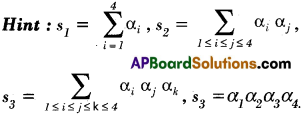
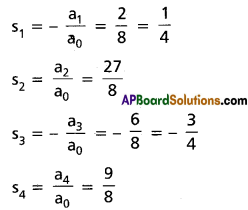
Find the values of s1, s2, s3, and s4 for each of the following equations.
(i) x4 – 16x3 + 86x2 – 176x + 105 = 0
(ii) 8x4 – 2x3 – 27x2 + 6x + 9 = 0
Inter 2nd Year Maths 2A Theory of Equations Solutions Ex 4(a) I Q7
Solution:
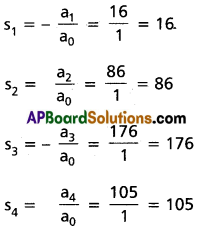
(i) Given equation is x4 – 16x3 + 86x2 – 176x + 105 = 0
We know that
Inter 2nd Year Maths 2A Theory of Equations Solutions Ex 4(a) I Q7.1
(ii) Equation is 8x4 – 2x3 – 27x2 + 6x + 9 = 0
Inter 2nd Year Maths 2A Theory of Equations Solutions Ex 4(a) I Q7.2

II.

Question 1.
If α, β and 1 are the roots of x3 – 2x2 – 5x + 6 = 0, then find α and β.
Solution:
α, β and 1 are the roots of x3 – 2x2 – 5x + 6 = 0
Sum = α + β + 1 = 2
⇒ α + β = 1
product = αβ = -6
(α – β)2 = (α + β)2 – 4αβ
= 1 + 24
= 25
α – β = 5, α + β = 1
Adding
2α = 6
⇒ α = 3
α + β = 1
⇒ β = 1 – α
= 1 – 3
= -2
∴ α = 3 and β = -2

Inter 2nd Year Maths 2A Theory of Equations Solutions Ex 4(a)

Question 2.
If α, β and γ are the roots of x3 – 2x2 + 3x – 4 = 0, then find
(i) Σα2β2
(ii) Σαβ(α + β)
Solution:
Since α, β, γ are the roots of x3 – 2x2 + 3x – 4 = 0 then
α + β + γ = 2
αβ + βγ + γα = 3
αβγ = 4
(i) Σα2β2 = α2β2 + β2γ2 + γ2α2
= (αβ + βγ + γα)2 – 2αβγ(α + β + γ)
= 9 – 2 . 2 . 4
= 9 – 16
= -7

(ii) Σαβ(α + β) = α2β + β2γ + γ2α + αβ2 + βγ2 + γα2
= (αβ + βγ + γα) (α + β + γ) – 3αβγ
= 2 . 3 – 3 . 4
= 6 – 12
= -6

Question 3.
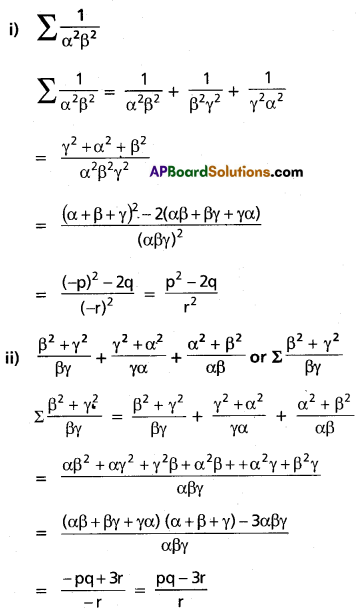
If α, β and γ are the roots of x3 + px2 + qx + r = 0, then find the following.
(i) \(\sum \frac{1}{\alpha^{2} \beta^{2}}\)
(ii) \(\frac{\beta^{2}+\gamma^{2}}{\beta \gamma}+\frac{\gamma^{2}+\alpha^{2}}{\gamma \alpha}+\frac{\alpha^{2}+\beta^{2}}{\alpha \beta}\) or \(\Sigma \frac{\beta^{2}+\gamma^{2}}{\beta \gamma}\)
(iii) (β + γ – 3α) (γ + α – 3β) (α + β – 3γ)
(iv) Σα3β3
Solution:
α, β and γ are the roots of x3 + px2 + qx + r = 0,
α + β + γ = -p
αβ + βγ + γα = q
αβγ = -r
Inter 2nd Year Maths 2A Theory of Equations Solutions Ex 4(a) II Q3

(iii) (β + γ – 3α) (γ + α – 3β) (α + β – 3γ) = (α + β + γ – 4α) (α + β + γ – 4β) (α + β + γ – 4γ)
= (-p – 4α) (-p – 4β) (-p – 4γ)
= -(p + 4α) (p + 4β) (p + 4γ)
= -(p3 + 4p2 (α + β + γ) + 16p (αβ + βγ + γα) + (64αβγ)
= -(p3 – 4p3 + 16pq – 64r)
= 3p3 – 16pq + 64r

(iv) Σα3β3 = α3β3 + β3γ3 + γ3α3
(αβ + βγ + γα)2 = α2β2 + β2γ2 + γ2α2 + 2αβγ (α + β + γ)
⇒ q2 = α2β2 + β2γ2 + γ2α2 + 2pr
⇒ α2β2 + β2γ2 + γ2α2 = q2 – 2pr
∴ α3β3 + β3γ3 + γ3α3 = (α2β2 + β2γ2 + γ2α2) (αβ + βγ + γα) – αβγ Σα2β
= (q2 – 2pr) . q + r[(αβ + βγ + γα) (α + β + γ) – 3αβγ]
= q3 – 2pqr + r(-pq + 3r)
= q3 – 2pqr – pqr + 3r2
= q3 – 3pqr + 3r2

Inter 2nd Year Maths 2A Theory of Equations Solutions Ex 4(a)

III.

Question 1.
If α, β, γ are the roots of x3 – 6x2 + 11x – 6 = 0, then find the equation whose roots are α2 + β2, β2 + γ2, γ2 + α2.
Solution:
1st Method:
Let α, β, γ are the roots of the equation x3 – 6x2 + 11x – 6 = 0
∴ α + β + γ = 6, αβ + βγ + γα = 11
Let y = α2 + β2 = α2 + β2 + γ2 – γ2
⇒ y = (α + β + γ)2 – 2(αβ + βγ + γα) – x2
⇒ y = 36 – 22 – x2
⇒ x2 = 14 – y
⇒ x = \(\sqrt{14-y}\)
Substitute x = \(\sqrt{14-y}\) in x3 – 6x2 + 11x – 6 = 0
⇒ (\(\sqrt{14-y}\))3 – 6(\(\sqrt{14-y}\))2 + 11(\(\sqrt{14-y}\)) – 6 = 0
⇒ (14 – y) \(\sqrt{14-y}\) – 6(14 – y) + 11 \(\sqrt{14-y}\) – 6 = 0
⇒ -6(14 – y + 1) = \(\sqrt{14-y}\) [-11 – 14 + y]
⇒ -6(15 – y) = (\(\sqrt{14-y}\)) (y – 25)
Squaring on both sides
i.e., [-6(15 – y)]2 = [\(\sqrt{14-y}\)(y – 25)]2
⇒ 36(225 – 30y + y2) = (14 – y)(y2 – 50y + 625)
⇒ 8100 – 1080y + 36y2 = 14y2 – 700y + 8750 – y3 + 50y2 – 625y
⇒ 8100 – 1080y + 36y2 = -y3 + 64y2 – 1325y + 8750
⇒ y3 – 28y2 + 245y – 650 = 0
∴ The required equation is x3 – 28x2 + 245x – 650 = 0
2nd Method:
Let α, β, γ are the roots of x3 – 6x2 + 11x – 6 = 0
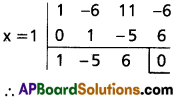
It is an odd-degree reciprocal equation of class two.
∴ x – 1 is a factor of x3 – 6x2 + 11x – 6
Inter 2nd Year Maths 2A Theory of Equations Solutions Ex 4(a) III Q1
∴ x3 – 6x2 + 11x – 6 = (x – 1) (x2 – 5x + 6) = (x – 1) ( x – 2) (x – 3)
∴ The roots of x3 – 6x2 + 11x – 6 = 0 are α = 1, β = 2, γ = 3
Now α2 + β2 = 12 + 22 = 5
β2 + γ2 = 22 + 32 = 13
γ2 + α2 = 32 + 12 = 10
Therefore the cubic equation with roots α2 + β2, β2 + γ2, γ2 + α2 is (x – 5) (x – 13) (x – 10) = 0
⇒ x3 – (5 + 13 + 10) x2 + (65 + 130 + 50)x – 650 = 0
⇒ x3 – 28x2 + 245x – 650 = 0

Inter 2nd Year Maths 2A Theory of Equations Solutions Ex 4(a)

Question 2.
If α, β, γ are the roots of x3 – 7x + 6 = 0, then find the equation whose roots are (α – β)2, (β – γ)2, (γ – α)2
Solution:
1st Method:
Let α, β, γ are the roots of the equation x3 – 7x + 6 = 0 …….(1)
α + β + γ = 0, αβγ = -6
Let y = (α – β)2 = (α + β)2 – 4αβ
⇒ y = (-γ)2 – 4(\(\frac{6}{\gamma}\))
⇒ y = γ2 + \(\frac{24}{\gamma}\)
⇒ y = x2 + \(\frac{24}{x}\)
⇒ xy = x3 + 24
⇒ xy = 7x – 6 + 24 [from (1)]
⇒ x(y – 7) = 18
⇒ x = \(\frac{18}{y-7}\)
Substituting x = \(\frac{18}{y-7}\) in x3 – 7x + 6 = 0
(\(\frac{18}{y-7}\))3 – 6(\(\frac{18}{y-7}\)) + 6 = 0
⇒ (18)3 – 7(18) (y – 7)2 + 6(y – 7)3 = 0
⇒ 5832 – 126(y2 – 14y + 49) + 6(y3 – 21y2 + 147y – 343) = 0
⇒ 972 – 21(y2 – 14y + 49) + (y3 – 21y2 + 147y – 343) = 0
⇒ y3 – 42y2 + 441y – 400 = 0
∴ The equation with roots (α – β)2, (β – γ)2, (γ – α)2 is x3 – 42x2 + 441x – 400 = 0
2nd Method:
α, β, γ are the roots of x3 – 7x + 6 = 0
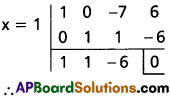
By trial and error method x = 1 satisfies this equation.
∴ x – 1 is a factor of x3 – 7x + 6
Inter 2nd Year Maths 2A Theory of Equations Solutions Ex 4(a) III Q2
∴ x3 – 7x + 6 = (x – 1) (x2 + x – 6) = (x – 1)(x + 3)(x – 2)
∵ α, β, γ are the roots of x3 – 7x + 6 = 0
α = 1, β = -3, γ = 2,
Now (α – β)2 = [1 – (-3)]2 = (4)2 = 16
(β – γ)2 = [-3 – 2]2 = 25
(γ – α)2 = [2 – 1]2 = 1
∴ The cubic equation whose roots are (α – β)2, (β – γ)2, (γ – α)2 is (x – 16) (x – 25) (x – 1) = 0
⇒ x3 – (16 + 25 + 1) x2 + (400 + 25 + 16)x – 400 = 0
⇒ x3 – 42x2 + 441x – 400 = 0

Inter 2nd Year Maths 2A Theory of Equations Solutions Ex 4(a)

Question 3.
If α, β, γ are the roots of x3 – 3ax + b = 0, prove that Σ(α – β) (α – γ) = 9a.
Solution:
α, β, γ are the roots of x3 – 3ax + b = 0
∴ α + β + γ = 0, αβ + βγ + γα = -3a, αβγ = -b
Σ(α – β) (α – γ) = Σ[α2 – α(β + γ) + βγ]
= Σ[α2 + α2 + βγl
= 2(α2 + β2 + γ2) + (βγ + γα + αβ)
= 2(α + β + γ)2 – 4(αβ + βγ + γα) + (αβ + βγ + γα)
= 0 – 4(-3a) + (-3a)
= 9a

AP Inter 2nd Year Chemistry Important Questions Chapter 6(b) Group-16 Elements

Students get through AP Inter 2nd Year Chemistry Important Questions Lesson 6(b) Group-16 Elements which are most likely to be asked in the exam.

AP Inter 2nd Year Chemistry Important Questions Lesson 6(b) Group-16 Elements

Very Short Answer Questions

question 1.
Write any two compounds, in which oxygen shows an oxidation state different from -2. Give the oxidation states of oxygen in them.
Answer:
OF2 and O2 F2 are two compounds in which oxygen shows an oxidation state different from -2.

  • In OF2 the oxidation state of oxygen is +2.
  • In O2F2 the oxidation state of oxygen is +1.

Question 2.
Why H2O a liquid while H2S Is a gas? ( IPE May – 2014)
Answer:
H2O is liquid due to the presence of intermolecular hydrogen bonding. While H2S is gas because it is not having such type of bonding.

AP Inter 2nd Year Chemistry Important Questions Chapter 6(b) Group-16 Elements

Question 3.
H2O is neutral while H2S is acidic — explain.
Answer:
H2O is neutral while H2S is acidic.
Reason: The O-H bond dissociation enthalpy is greater than the S — H bond dissociation enthalpy.

Question 4.
Explain the structures of SF4 and SF6.
Answer:
Structure of SF4:

  • In SF4 ‘S’ undergoes sp3d hybridisation.
  • It has trigonal bipyramidal structure in which one of the equitorial positions is occupied by a lone pair of electrons. This geometry is also known as see – saw geometry.
    Structure of SF6:
  • In SF6, ‘S’ undergoes sp3d2 hybridisation,
  • It has octahedral structure.

Question 5.
Give one example each for
a) a neutral oxide
b) a peroxide
c) a super oxide
Answer:
a) CO, N2O are neutral oxides.
b) Na2O2, BaO2 are peroxides.
c) KO2, RhO2 are super oxides.

AP Inter 2nd Year Chemistry Important Questions Chapter 6(b) Group-16 Elements

Question 6.
What is tailing of mercury? How is it removed? (IPE Mar – 2015 (TS))
Answer:
Mercury loses it’s lustreness, meniscus and consequently sticks to the walls of glass vessel when it reacts with ozone. This phenomenon is called tailing of mercury
2Hg + O3 → Hg2O + O2
It is removed by shaking it with water which dissolves Hg2O.

Question 7.
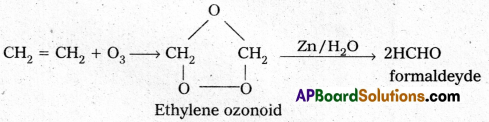
How does ozone react with Ethylene?
Answer:
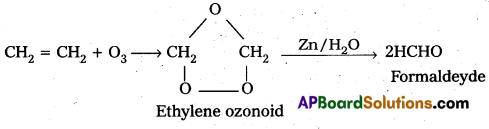
Ethylene reacts with ozone to form Ethylene ozonoid followed by the hydrolysis to form formaldehyde.
AP Inter 2nd Year Chemistry Important Questions Chapter 6(b) Group-16 Elements 1

Question 8.
Which form of sulphur shows paramagnetism?
Answer:
In vapour state sulphur partly exists as S2 molecule which has two unpaired electrons in the antibonding π (π*)orbitals like O2. Hence it exhibits paramagnetism.

Question 9.
Why are group — 16 elements called chalçogens ?
Answer:
Chalcogens means mineral forming (or) ore forming elements. Most of elements exist in earth crust as oxides, sulphides, selinides, telurids etc. So Group – 16 elements are called as chalcogens.

Question 10.
Write any two uses each for O3 and H2SO4.
Answer:
Uses of O3:

  • Ozone is used in sterilisation of water.
  • Ozone is used in manufacture of artificial silk and camphor etc.
  • Ozone is used to identify unsaturation in carbon compounds.

Uses of H2SO4:

  • H2SO4 is used in the manufacture of fertilisers.
  • H2SO4 is used in petrol refining.
  • H2SO4 is used in detergent industry.

AP Inter 2nd Year Chemistry Important Questions Chapter 6(b) Group-16 Elements

Short Answer Questions

Question 1.
Write a. short note on the allotropy of sulphur.
Answer:
The important allotropes of sulphur are
a) yellow rhombic (α. sulphur).
b) Monoclinic (β – sulphur).

The stable from is α-sulphur (at room temperature).
Rhombic sulphur (α – Sulphur):

  • Colour : Yellow.
  • Melting point : 3858K.
  • Specific gravity: 2.06.
  • It is insoluble in water and partially soluble in alcohol, benzene etc., and readily soluble in CS2.

Monoclinic sulphur (β – Sulphur):

  • Melting point: 392K
  • Specific gravity: 1.98.
  • It is soluble in Cs2.
  • Rhombic sulphur transforms to monoclinic sulphur by heating above 369K. This temperature is called transition temperature.

Question 2.
Which is used for drying ammonia?
Answer:
For drying ammonia quick lime (CaO) is used.

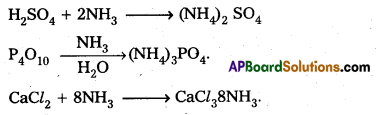
  • For drying ammonia conc. H2SO4 , P4O10 and anhydrous CaCl2 cannot be used because they react with ammonia and forms (NH4)2SO4, (NH4)3PO4 and CaCl2. 8NH3

AP Inter 2nd Year Chemistry Important Questions Chapter 6(b) Group-16 Elements 2

Question 3.
Explain the conditions favourable for the formation of SO3 from SO2 in the contact process of H2SO4.
Answer:
Le Chatlier’s principle — Application to produce SO3:
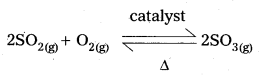
The oxidation of SO2 to SO3 in the presence of a catalyst is a reversible reaction. The thermochemical equation for the conversion is written as
AP Inter 2nd Year Chemistry Important Questions Chapter 6(b) Group-16 Elements 3

The equation reveals the following points:

  1. 3 volumes of the reactants convert into 2 volumes of SO3. i.e., a decrease of volume accompanies the reaction.
  2. the reaction is an exothermic change.
  3. the catalyst may be present to increase the SO3 yields.

According to Le Chattier’s principle,

i. a decrêase in volume of the system is favoured at high pressures. But in practice only about 2 bar pressure is used. The reason for not using high pressures is acid resisting towers which can withstand high pressures cannot be built.

ii. exothermic changes are favoured at low temperatures. It is not always convenient in the industry to work at low temperatures. In such situations an optimum temperature is maintained. At this temperature considerable amounts of the product are obtained, in the manufacture of H2SO4, the optimum temperature suitable for the conversion of SO2 into SO3 is experimentally found to be 720K.

iii. The rate of formation of SO3 is enhanced by the use of a catalyst. (V2O5 (or) Pt – asbestos).
Favourable Conditions:
Temperature: 720K
Pressure :2 bar
Catalyst : V2O5 (or) platinized asbestos.

Question 4.
Which oxide of sulphur can act as both oxidizing and reducing agent? Give one example each.
Answer:
Sulphur dioxide (SO2) acts as both oxidising as well as reducing agent.
SO2 as Oxidising agent:
Sodium sulphide oxidises to hypo with SO2.
2Na2S + 3SO2 → 2Na2S2O3 + S
SO2 as Reducing agent:
SO2 reduces Fe+3 ions to Fe+2 ions.
2Fe+3 + SO2 + 2H2O → 2Fe2+ + \(\mathrm{SO}_4^{-2}\) + 4H+

AP Inter 2nd Year Chemistry Important Questions Chapter 6(b) Group-16 Elements

Long Answer Questions

Question 1.
Explain in detail the manufacture of sulphuric acid by contact process. ( IPE 2016 (TS))
Answer:
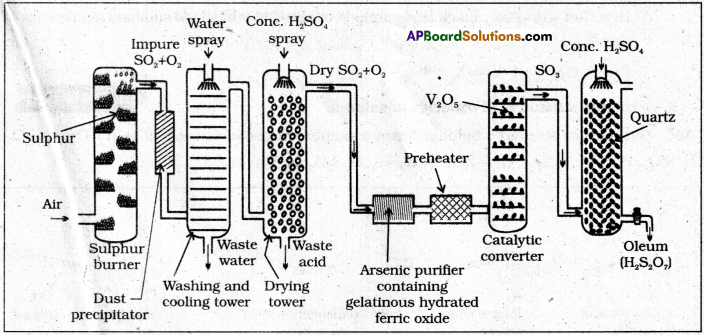
Manufacture of H2SO4 by contact process:
Manufacturing of H2SO4 involves three main steps.

Step-I:
SO2 production : The required SO2 for this process is obtained by burning S(or) Iron
pyrites in oxygen.
S + O2 → SO2
4FeS2 + 15O2 → 2Fe2O3 + 8SO3

Step—2
SO3 formation: SO2 is oxidised in presence of catalyst with atmospheric air to form SO3.
AP Inter 2nd Year Chemistry Important Questions Chapter 6(b) Group-16 Elements 4
Le Chatliers principle — Application to produce SO3 ;
The oxidation of SO2 to SO3 in the presence of a catalyst is a reversible reaction. The
thermochemical equation for the conversion is written as
AP Inter 2nd Year Chemistry Important Questions Chapter 6(b) Group-16 Elements 5

The equation reveals the following points:

  1. 3 volumes of the reactants convert into 2 volumes of SO3. i.e., a decrease of volume accompanies the reaction.
  2. The reaction is an exothermic change.
  3. The catalyst may be present to increase the SO3 yields.

According to Le Chatlier’s principle,

  1. a decrease in volume of the system is favoured at high pressures. But in practice only about 2 bar pressure is used. The reason for not using high pressures is acid resisting towers which can withstand high pressures cannot be built.
  2. exothermic changes are favoured at low temperatures. It is not always convenient in the industry to work at low temperatures. in such situations an optimum temperature is maintained. At this temperature considerable amounts of the product are obtained. In the manufacture of H2SO4, the optimum temperature suitable for the conversion of SO2 into SO3 is experimentally found to be 720K.
  3. The rate of formation of SO3 is enhanced by the use of a catalyst. (V2 O5 (or) Pt – asbestos).
    Favourable Conditions:
    Temperature: 720K :
    Pressure : 2 bar
    Catalyst : V2O5 (or) platinized asbestos.
    AP Inter 2nd Year Chemistry Important Questions Chapter 6(b) Group-16 Elements 6

Step-3

  • Formation of H2SO4: SO3 formed in the above step absorbed in 98% H2SO4 to get oleum (H2S2O7). This oleum is diluted to get desired concentration of H2SO4.
    SO3 + H2SO4 → H2S2O7
    H2S2O7 + H2O → H2SO4

AP Inter 2nd Year Chemistry Important Questions Chapter 6(b) Group-16 Elements

Question 2.
How is ozone prepared from oxygen? Explain its reaction with
a) C2H4
b) KI
c) Hg
d) PbS. (T.S. & A.P. Mar. ’17) (A.P.Mar. ’16) (Mar. ’14)
Answer:
Preparation of Ozone:
A slow dry stream of oxygen under silent electric discharge to form ozone (about 10%). The product obtained is known as ozonised oxygen.
3O2 → 2O3 ΔH° = 142kJ/mole .

  • The formation of ozone is an endothermic reaction.
  • It is necessary to use silent electric discharge in the preparation of O3 to prevent its decomposition

a) Reaction with C2H4 : Ethylene reacts with ozone to form Ethylene ozonoid followed by the hydrolysis to for formaldehyde.
AP Inter 2nd Year Chemistry Important Questions Chapter 6(b) Group-16 Elements 7
b) Reaction with KI : Moist KI is oxidised to Iodine in presence of ozone.
2KI + H2O + O3 → 2KOH + I2 + O2
c) Reaction with Hg: Mercury loses it’s lustreness, meniscus and consequently sticks to the walls of glass vessel when it reacts with ozone. This phenomenon is called tailing of mercury.
2Hg + O3 → Hg2O + O2
It is removed by shaking it with water which dissolves Hg2O.
d) Reaction with PbS : Black lead sulphide oxidised to white lead sulphate in presence of ozone.
PbS + 4O3 → PbSO4 + 4O2.

Question 3.
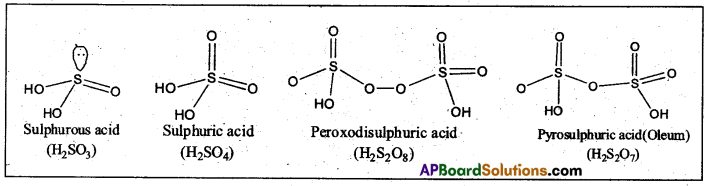
Write the structures of oxoacids of sulphur. (IPE 2016 (TS))
Answer:
Oxoacids of sulphur: Sulphur forms a number of oxoacids such as H2SO3. H2S2O3, H2S2O4, H2S2O5, H2S2O6 (x = 2 to 5), H2SO4, H2S2O7, H2SO5, H2S2O8.
AP Inter 2nd Year Chemistry Important Questions Chapter 6(b) Group-16 Elements 8

Question 4.
Write any two oxidation and any two reduction properties of ozone with equations.
Answer:
Oxidation properties:

  1. Ozone oxidises moist potassium idodide and liberates I2.
    2KI + H2O + O3 → 2KOH + I2 + O2
  2. Ozone oxidises black lead sulphide to white lead sulphate. PbS + 4O3 → PbSO4 + 4O2

Reduction properties:

  1. Ozone reduces H2O2 to H2O.        H2O2 + O3 → H2O + 2O2
  2. Ozone reduces Ag2O to Ag.         Ag2O + O3 → 2Ag + 2O2

AP Inter 2nd Year Chemistry Important Questions Chapter 5 General Principles of Metallurgy

Students get through AP Inter 2nd Year Chemistry Important Questions 5th Lesson General Principles of Metallurgy which are most likely to be asked in the exam.

AP Inter 2nd Year Chemistry Important Questions 5th Lesson General Principles of Metallurgy

Very Short Answer Questions

Question 1.
What is the role of depressant in froth floatation?
Answer:
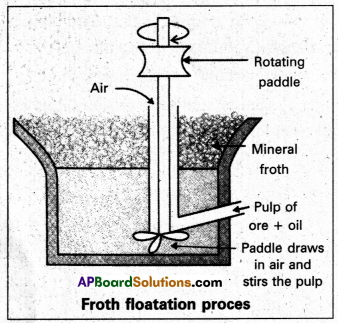
By using depressants in froth floatation process, it is possible to separate a mixture of two sulphide ores.
Eg: In the ore containing ZnS and PbS, the depressant used is NaCN. It prevents ZnS from coming to the froth but allows PbS to come with the froth.

Question 2.
Explain “poling”. (AP Mar. ’16, ’15; IPE ’16, 15 (AP))
Answer:
When the metals are having the metal oxides as impurities this method is employed. The impure metal is. melted and is then covered by carbon powder. Then it is stirred with green wood poles. The reducing gases formed from the green wood and the carbon, reduce the oxides to the metal.
Eg : Cu & Sn metals are refined by this method.

AP Inter 2nd Year Chemistry Important Questions Chapter 5 General Principles of Metallurgy

Question 3.
Decribe a method for the refining of nickel.
Answer:
Mond’s process:

  • In Mond’s process, nickel is heated in a stream of carbon monoxide forming a volatile complex, nickel tetra carbonyl.
    AP Inter 2nd Year Chemistry Important Questions Chapter 5 General Principles of Metallurgy 1
  • Nickel tetra carbonyl is strongly heated to decompose and gives the pure Nickel.
    AP Inter 2nd Year Chemistry Important Questions Chapter 5 General Principles of Metallurgy 2

Question 4.
What is the role of cryolite in the metallurgy of aluminium ? (IPE 2015 (TS), BMP, 2016 (TS))
Answer:
By adding the cryolite to the pure Alumina, the melting point of pure Alumina is lowered (which is very high 2324K) and electrical conductivity of pure alumina is increased.

Question 5.
Give the composition of the following alloys (IPE ’16, ’14 (TS)) (AP & TS Mar. ’17)
a) Brass
b) Bronze
c) German Silver
Answer:
a) Composition of Brass : 60 – 80% Cu, 20 – 40% Zn
b) Composition of Bronze : 75 – 90% Cu, 10 – 25% Sn
c) Composition of German silver : 50 – 60% Cu, 10 – 30% Ni, 20 – 30% Zn.

AP Inter 2nd Year Chemistry Important Questions Chapter 5 General Principles of Metallurgy

Question 6.
What is matte ? Give its composition.
Answer:
During the extraction of ’Cu’ from copper pyrites the product of the blast furnace consists mostly of Cu2S and a little of FeS. This product is known as “Matte”. It is collected from the outlet at the bottom of the furnace.

Question 7.
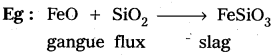
What is flux ? Give an example.
Answer:
Flux : An outside substance added to. ore to lower its melting point is known as flux.

  • Flux combines with gangue and forms easily fusible slag.
    gangue + flux → slag
    AP Inter 2nd Year Chemistry Important Questions Chapter 5 General Principles of Metallurgy 3

Question 8.
How is aluminium useful in the extraction of chromium and manganese from their oxides ?
Answer:

  • ‘Al’ is used as reducing agent.
  • By Alumino thermite process Cr, Mn are extracted from their oxides.
  • The reactions are highly exothermic.

Cr2O3 + 2Al → 2Cr + Al2O3
3Mn3O4 + 8Al → 4Al2O3 + 9Mn

AP Inter 2nd Year Chemistry Important Questions Chapter 5 General Principles of Metallurgy

Question 9.
What is a mineral ?
Answer:
The chemical compound from which a metal can be extracted is called a mineral. Bauxite, crayolite are the minerals of aluminium.

Question 10.
What is an ore ?
Answer:
An ore is a mineral from which the metal can be extracted easily and economically. Bauxite is the ore of aluminium.

Question 11.
What is a ore. Give the ores of Al, Zn, Fe, Cu.
Answer:
The mineral from which metal can be extracted economically is called ore.
Aluminium ores : Bauxite = Al2 O3. 2H2O; Cryolite = Na3Al F6
Zinc ores : Zinc blende = Zns; Calamine = ZnCO3
Copper ores : Cuprite: CuO; Copper pyrites = Cu2S
Iron ores : Haematite = Fe2O3 Magnetite = Fe3O4

Question 12.
What is the role of SiO2 in the extraction of copper.
Answer:
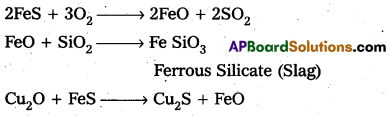
In the extraction of copper SiO2 acts as flux. It combines with FeO and removes as slag.
FeO + SiO2 (flux) → FeSiO3 (Slag)

Short Answer Questions

Question 1.
Outline the principles of refining of metals by the following methods.
(a) Zone refining
(b) Electrolytic refining
(c) Poling
(d) Vapour phase refining.
Answer:
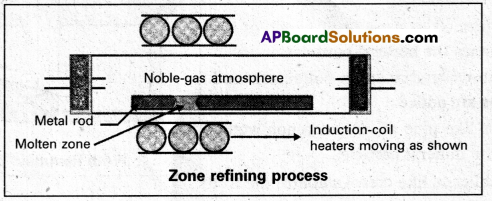
a) Zone refining :

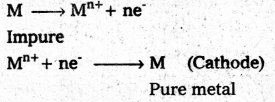
  • Zone refining is based on the principle that the impurities are more soluble in the melt than in the solid state of the metal.
  • A circular mobile heater is fixed at one end of a rod of impure metal.
  • The molten zone moves along with the heater moves forward the pure metal crystallises out of the melt and the impurities pass into the adjacent molten zone.

AP Inter 2nd Year Chemistry Important Questions Chapter 5 General Principles of Metallurgy 4

  • The above process is repeated several times and the heater is moved in the same direction form one end to the other end. At one end impurities get concentrated. This end is cut off.
  • This method is very useful for producing semiconductor grade metals of very high purity.
    Eg : Ge, Si, B, Ga etc…

b) Electrolytic refining: This process is used for less reactive metals like Cu, Ag, AZ, Au etc.

  • In this process anode is made by impure metal and a thin strip of pure metal acts as cathode.
  • On electrolysis metal dissolves from anode and pure metal gets deposited at cathode.

AP Inter 2nd Year Chemistry Important Questions Chapter 5 General Principles of Metallurgy 5
Impurities settle down below anode in the form of anode mud.

c) Poling : When the metals are having the metal oxides as impurities this method is employed. The impure metal is melted and is then covered by carbon powder. Then it is stirred with green wood poles. The reducing gases formed from the green wood and the carbon, reduce the oxides to the metal. Eg : Cu & Sn metals are refined by this method.

d) Vapour phase refining: In this method the metal is converted into its volatile compound and coll Ted. It is then decomposed to give pure metal.

  1. The metal should form a volatile compound with an available reagent.
  2. The volatile compound should be easily decomposable. So the recovery is easy.
    E.g : Mond’s process :

    • In Mond’s process, nickel is heated in a stream of carbon monoxide forming a volatile complex, nickel tetra carbonyl,
      AP Inter 2nd Year Chemistry Important Questions Chapter 5 General Principles of Metallurgy 6
    • Nickel tetra carbonyl is strongly heated to decompose and gives the pure Nickel.
      AP Inter 2nd Year Chemistry Important Questions Chapter 5 General Principles of Metallurgy 7

AP Inter 2nd Year Chemistry Important Questions Chapter 5 General Principles of Metallurgy

Question 2.
Explain the purification of sulphide ore by froth floatation method. (Mar ’15) (A.P. Mar. ’17)
Answer:
Froth floatation method :

  • This method is used to concentrate sulphide ores.
  • In this process a suspension of the powdered ore is made with water.
  • A rotating paddle is used to agitate the suspension and air is blown into the suspension in presence of an oil.
  • Froth is formed as a result of blown of air, which carries the mineral particles.
    AP Inter 2nd Year Chemistry Important Questions Chapter 5 General Principles of Metallurgy 8
  • To the above slurry froth collectors and stabilizers are added.
  • Collectors like pine oil enhance non-wettability of the mineral particles.
  • Froth stabilizers like cresol stabilize the froth.
  • The mineral particles wet by oil and gangue particles wet by water.
  • The broth is light and is skimmed off. The ore particles are then obtained from the froth. By using depressants in froth floatation process, it is possible to separate a mixture of two suplhide ores. Eg: In the ore containing ZnS and PbS, the depressant used is NaCN. It prevents ZnS from coming to the froth but allows PbS to come with the froth.

Question 3.
What is Ellingham diagram ? What information can be known from this in the reduction of oxides ?
Answer:
The graphical representation of Gibbs energy which provides a sound basis for considering the choice of reducing agent in the reduction of oxides. This graphical representation is known as Ellingham diagram.
This diagram helps us in predicting the feasibility of thermal reduction of an ore.
AP Inter 2nd Year Chemistry Important Questions Chapter 5 General Principles of Metallurgy 9

  • The Criterion of feasibility of a reaction is that at a given temperature, Gibbs energy of the reaction must be negative.
  • Ellingham diagram normally consists plots of ΔG° vs T for formation of oxides of elements.
  • The graph indicates whether a reaction is possible or not, i.e., the tendency of reduction with a reducing agent is indicated.
  • The reducing agent forms its oxide when the metal oxide is reduced. The role of reducing agent is to make the sum of ΔG° values of the two reactions negative.
  • Out of C and CO, Carbon monoxide (CO) is a better reducing agent at 673K.
  • At 983K (or) above coke(C) is better reducing agent.
  • The above observations are from Ellingham diagram.
    Zinc is not extracted from zinc oxide through reduction by using CO.

Explanation :
2Zn + O2 → 2ZnO, ΔG° = -650 kJ
2CO + O2 → 2CO2, ΔG° = -450 kJ
2ZnO + 2CO → 2Zn, 2CO2, ΔG° = 200 kJ
ΔG° = Positive indicates that the reaction is not feasible.
The above fact is explained on the basis of Ellingham diagram.

AP Inter 2nd Year Chemistry Important Questions Chapter 5 General Principles of Metallurgy

Question 4.
Give examples to differentiate roasting and calcination. (IPE ’14, B.M.P. 2016) (A.P. & T.S. Mar. ’16, ’15)
Answer:
Roasting: Removal of the volatile components of a mineral by heating mineral either alone (or) mixed with some other substances to a high temperature in the presence of air is called Roasting.

  • It is applied to the sulphide ores.
  • SO2 gas is producted along with metal oxide.
    AP Inter 2nd Year Chemistry Important Questions Chapter 5 General Principles of Metallurgy 10

Calcination: Removed of the volatile components of a mineral by heating in the absence of air is called calcination.

  • It is applied to carbonates and bicarbonates.
  • CO2 gas is produced along with metal oxide.

AP Inter 2nd Year Chemistry Important Questions Chapter 5 General Principles of Metallurgy 11

Question 5.
How is copper extracted from copper pyrites ?
Answer:
Extraction of copper from copper pyrites :
Copper pyrite is the main source of copper metal. Various steps involved in the extraction of copper are discussed below.

Step -I:

Concentration of ore by froth floatation process :
The ore is first crushed in ball mills. The finely divided ore is suspended in water. A little pine oil is added and the mixture is vigorously’ agitated by a current of air. The froth formed carries the ore particles almost completely. The gangue sinks to the bottom of the tank. The froth is separated and about 95% concentrated ore is obtained.

Step -II:

Roasting : To remove the volatile impurities like As (or) Sb, the ore is roasted in a free supply of air. A mixture of sulphides of copper and iron are obtained and these are partially oxidised to respective oxides.
Cu2S. Fe2S3 + O2 → Cu2S + 2FeS + SO2
2Cu2S + 3O2 → 2Cu2O + 2SO2
2FeS + 3O2 → 2FeO + 2SO2

Step -III: .

The roasted ore is mixed with a little coke and sand (Silica) and smelted in a blast furnace and fused. A blast of air, necessary for the combustion of coke, is blown through the tuyeres present at the base of the furnace.’ The oxidation of the sulphides of copper and iron will be completed further. A slag of iron silicate is formed according to the reactions given below :
AP Inter 2nd Year Chemistry Important Questions Chapter 5 General Principles of Metallurgy 12

Step -IV :

After smelting the copper ore in blast furnace, the product of the blast furnace consists mostly of Cu2S and a little of ferrous sulphide. This product is known as “Matte.” It is collected from the outlet at the bottom of the furnace. After then the following processes are carried out for getting the pure copper.

Bessemerization : The matte is charged into a Bessemer converter. A bessemer converter is a pear-shaped furnace. It is made of steel plates. The furnace is given a basic lining with lime or magnesium oxide (obtained from dolomite or magnesite). The converter is held in position by trunnions and can be tilted in any position. A hot blast of air and sand is blown through the tuyeres present near the bottom. Molten metal, the product in the furnace, collects at the bottom of the converter.

Reactions that took place in blast furnace go to completion. Almost all of iron is eliminated slag. Cuprous oxide combines with cuprous sulphide and forms Cu metal.
2Cu2O + Cu2S → 6Cu + SO2
The molten metal is cooled in sand moulds. SO2 escapes. The impure copper metal is known as ‘Blister copper” and is about 98% pure.
AP Inter 2nd Year Chemistry Important Questions Chapter 5 General Principles of Metallurgy 13

Step -V:

Refining: The Blister copper is purified by electrolysis. The impure copper metal is made into plates. They are
suspended into lead — lined tanks containing Copper (II) Sulphate solution. Thin plates of pure copper serve as
cathode. The cathode plates are coated with graphite. On electrolysis, pure copper is deposited at the cathode. The
copper obtained is almost 100% pure Cu.

AP Inter 2nd Year Chemistry Important Questions Chapter 5 General Principles of Metallurgy

Question 6.
Explain the process of leacing of aluminium from bauxite.
Answer:
Extraction of Aluminium from Bauxite:
For the purpose of extraction of Al, Bauxite is the best source.
Purification of Bauxite: Bauxite containing Fe2O3 as impurity is known as Red Bauxite.
Bauxite containing SiO2 as impurity is known as White Bauxite and can be purified by “Set-peck’s Process. Red Bauxite is purified by Bayer’s process and Hall’s process.

Bayer’s Process: Red bauxite is roasted and digested in concentrated NaOH at 423 K. Bauxite dissolves in NaOH to form sodium meta aluminate while impurity Fe2O3 does not dissolve which can be removed by filtration.
Al2O3.2H2O + 2NaOH → 2NaAlO2 + 3H2O
The solution which contains sodium meta aluminate is diluted and crystals of Al(OH)3, are added which serves as seeding orgent. Sodium meta aluminate undergoes hydrolysis to precipitate Al(OH)3.
2NaAlO2 + 4H2O → 2NaOH + 2Al(OH)3
Al(OH)3 is filtered and ignited at 1200°C to get anhydrous alumina.
AP Inter 2nd Year Chemistry Important Questions Chapter 5 General Principles of Metallurgy 14
Halls’ Process: Red Bauxite is fused with sodium carbonate to form sodium meta aluminate
which is extracted with water. The impurity Fe2O3 is filtered out.
Al2O3 + Na2CO3 → 2NaAlO2 + CO2
Into the solution of sodium meta aluminate, CO2 gas is passed to precipitate Al(OH)3.
AP Inter 2nd Year Chemistry Important Questions Chapter 5 General Principles of Metallurgy 15
The precipitated Al(OH)3 is ignited at 1200°C to get anhydrous alumina.
2Al(OH)3 → Al2O3 + 3H2O

Serpeck’s Process: Powdered bauxite is mixed with coke and heated to 2075 K in a current of nitrogen gas. Aluminium Nitride is formed while SiO2 is reduced to Si which escapes out.
AP Inter 2nd Year Chemistry Important Questions Chapter 5 General Principles of Metallurgy 16
Aluminium nitride is hydrolysed to get aluminium hydroxide which on ignition gives anhydrous alumina.
AP Inter 2nd Year Chemistry Important Questions Chapter 5 General Principles of Metallurgy 17
Electrolytic Reduction of Alumina: Pure Alumina (Al2O3) is a bad conductor of electricity and it has high melting point (2050°C). So it cannot be electrolysed. Alumina is electrolysed by dissolving in fused cryolite to increase the conductivity and small amount of Fluorspar is added to reduce its melting point. Thus the electrolyte is a fused mixture of Alumina, Cryolite and Fluorspar.
AP Inter 2nd Year Chemistry Important Questions Chapter 5 General Principles of Metallurgy 18
Electrolysis is carried out in an iron tank lined inside with graphite (carbon) which functions as cathode. A number of carbon rods (or) copper rods suspended in the electrolyte functions as anode.

An electric current of 100 amperes at 6 to 7 volts is passed through the electrolyte. Heat produced by the current keeps the mass in fused state at 1175 to 1225K. The following reactions take place in the electrolytic cell under these conditions.
Na3AlF6 → 3NaF + AlF3
Cryolite
4AlF3 → 4Al3+ + 12F
At cathode : 4Al3+ + 12e → 4Al
At anode : 12F → 6F2 + 12e
F2 formed at the anode reacts with alumina and forms Aluminium fluoride.
2Al2O3 + 6F2 → 4AlF3 + 3O2
Aluminium, produced at the cathode, sinks to the bottom of the cell. It is removed from time to time through topping hole.

Purification of Aluminium: (Hoope’s Process)

The impurities present are Si, Cu, Mn etc.,
The electrolytic cell used for refining of aluminium consists of iron tank lined inside with
carbon. This acts as anode. The tank contains three layers of fused masses. The bottom layer
contains impure aluminium. Middle layer contains mixture of AlF3, NaF and BaF2 saturated with Al2O3. Top layer contains pure aluminium and graphite rods kept in it act as cathode.
AP Inter 2nd Year Chemistry Important Questions Chapter 5 General Principles of Metallurgy 19
On passing current aluminium ions from the middle layer are discharged at the cathode as pure aluminium. Equivalent amount of aluminium from the bottom layer passes into middle layer.

Question 7.
Explain the reactions occuring in the blast furnace in the extraction of iron.
Answer:
In the Blast furnace, reduction of iron oxides takes place in different temperature ranges. Hot air is blown from the bottom of the furnace and coke is burnt to give temperature upto about 2200K in the lower portion itself, The burning of coke therfore supplies most of the heat required in the process. The CO and heat moves to upper part of the furnace. In upper part, the temperature is lower and the iron oxides (Fe2O3 and Fe3O4) coming from the top are reduced in steps to FeO. Thus, the reduction reactions taking place in the lower temperature range and in the higher temperature range, depend on the points of corresponding intersections in the ΔrGθ vs T plots. These reactions can be summarised as follows:
AP Inter 2nd Year Chemistry Important Questions Chapter 5 General Principles of Metallurgy 20

At 500 — 800 K (lower temperature range in the blast furnace)
3 Fe2O3 + CO → 2 Fe3O4 + CO2
Fe3O4 + 4CO → 3 Fe + 4 CO2.
Fe2O3 + CO → 2 FeO + CO2
At 900- 1500 K (higher temperature range in the blast furnace)
C + CO2 → 2 CO
FeO + CO → Fe + CO2
Lime stone is also decomposed to CaO which removes silicate impurity of the ore as CaSiO3 slag. The slag is in molten state and separåtes out from iron.

The iron obtained from blast furnace contains about 4% carbon and many impurities in smaller amount (e.g., S, P, Si, Mn). This is known as pig iron. Cast iron is different from and is made by melting pig iron with scrap iron and coke using hot air blast. It has slightly lower carbon content (about 3%) and is extremely hard and brittle.
Fe2O3 + 3 C → 2 Fe + 3 CO

AP Inter 2nd Year Chemistry Important Questions Chapter 4 Surface Chemistry

Students get through AP Inter 2nd Year Chemistry Important Questions 4th Lesson Surface Chemistry which are most likely to be asked in the exam.

AP Inter 2nd Year Chemistry Important Questions 4th Lesson Surface Chemistry

Very Short Answer Questions

Question 1.
What is adsorption ? Give one example.
Answer:
Adsorption : The accumulation (or) concentration of a substance on the surface rather than in the bulk of solid (or) liquid is known as adsorption.
Eg : Adsorption of gases like O2, H2, Cl2 etc., on charcoal.

Question 2.
What is absorption ? Give one example.
Answer:
Absorption : The uniform distribution of a substance through out the bulk of the solid substance is known as absorption.
Eg : Chalk stick dipped in ink.

AP Inter 2nd Year Chemistry Important Questions Chapter 4 Surface Chemistry

Question 3.
What is desorption ?
Answer:
Desorption : The process of removing an adsorbed substance from a surface on which it is adsorbed is called desorption.

Question 4.
What is sorption ? (or) What is the name given to the phenomenon when both absorption and adsorption take place together ?
Answer:
The process in which both adsorption and absorption takes place simultaneously is called sorption.

Question 5.
Give any two applications of adsorption.
Answer:
Applications of adsorption :
a) Separation of inert gases : Different noble gases adsorb at different temperatures on coconut charcoal. By this principle (adsorptipn) mixture of noble gas is separated by adsorption on coconut charcoal.

b) Gas masks : Gas mask is a device which consists of activated charcoal (or) mixture of adsorbents is used by coal miners to adsorb poisonous gases during breathing.

Question 6.
What is an adsorption isotherm ? Write the equation of Freundlich adsorption isotherm.
Answer:
Adsorption Isotherm : The variation in the amount of gas adsorbed by the adsorbent with pressure at constant temperature can be expressed by means of a curve known as adsorption isotherm.

  • Freundlich adsorption isotherm equation is \(\frac{\mathrm{x}}{\mathrm{m}}\) = k. P1/n
    x = mass of the gas adsorbed
    m = mass of the adsorbent
    P, k and n are constants.

AP Inter 2nd Year Chemistry Important Questions Chapter 4 Surface Chemistry

Question 7.
Define “promoters” and “poisons” in the phenomenon of catalysis. ‘
Answer:
Promoters: The substances which enhance the activity of catalyst are known as promoters.
Poisons : The substances which decrease the activity of a catalyst are known as poisons.

Question 8.
What is homogeneous catalysis ? How is it different from heterogeneous catalysis ?
Answer:
Homogeneous Catalysis : The catalysis in which reactants and catalyst are in same phase is called Homogeneous catalysis.

  • In case of heterogeneous catalysis, catalyst and reactants are present in different phases where as in case of homogeneous catalysis catalyst and reactants are present in same phase.

Question 9.
What are enzymes ? What is their role in human body ?
Answer:
Enzymes are complex nitrogenous organic compounds which are produced by living plants and animals.

  • These act as specific catalysts in biological reactions.
  • These catalyse the numerous reactions that occur in the bodies of animals and plants to maintain the life process.

Question 10.
Name any two enzyme catalyzed reactions. Give the reactions.
Answer:
1) Inversion of Cane Sugar :

AP Inter 2nd Year Chemistry Important Questions Chapter 4 Surface Chemistry 12

2) Decomposition of urea into ammonia and CO2 :

AP Inter 2nd Year Chemistry Important Questions Chapter 4 Surface Chemistry 13

AP Inter 2nd Year Chemistry Important Questions Chapter 4 Surface Chemistry

Question 11.
What is critical micelle concentration (CMC) and kraft temperature (Tk) ?
Answer:
The formation of micelles takes place only above a particular temperature called Kraft temperature (Tk) and above a particular concentration called Critical micelle concentration (CMC).

Question 12.
What is Peptization ?
Answer:
Peptization : The process of converting a precipitate into colloidal sol by shaking it with the dispersion medium in the presence of a small amount of electrolyte is called Peptization.

Question 13.
What is Brownian movement.
Answer:
Brownian movement: This is a kinetic property of colloidal solution.
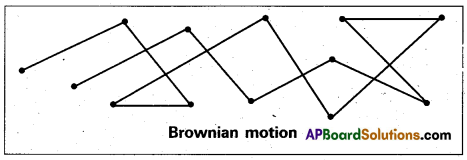
AP Inter 2nd Year Chemistry Important Questions Chapter 4 Surface Chemistry 14
When a colloidal solution is examined by ultramicroscope, the colloidal particles are seemed to be moving in a rapid zig-zag motion.
This rapid motion of colloidal particles is called Brownian movement.
This motion is due to unequal bombardment of colloidal particles by molecules of dispersion medium. Smaller the colloidal particles the more rapid is the Brownian movement.

Question 14.
What is Tyndall effect ?
Answer:
Tyndall effect : When light enters a colloidal solution, it is scattered by the large sized colloidal dispersed phase particles. Therefore when light passes through a solution we will be able to see the path of the light as a luminous beam. This is called Tyndall effect.

This is an optical property exhibited by colloidal solution. This phenomenon is clearly seen with a microscope placed at right angles to the path of light. Colloidal particles become self luminous due to absorption of light. A true solution does not show Tyndall effect.

Question 15.
What is electrokinetic potential or zeta potential ?
Answer:
In a colloidal sol the charges of opposite signs on the fixed and diffused parts of the double layer results in a difference in potential between these layers. The potential difference between the fixed layer and the diffused layer of opposite charge is called electro kinetic potential (or) zeta potential.

Question 16.
What is electrophoresis ?
Answer:
When electric potential is applied across two platinum electrodes dipping in a colloidal solution, the colloidal particles move towards one or the other electrode. The movement of colloidal particles under an applied emf is called “electrophoresis”.

AP Inter 2nd Year Chemistry Important Questions Chapter 4 Surface Chemistry

Question 17.
What is coagulation ?
Answer:
The stability of the lyophilic sols is due to the presence of charge on the colloidal particles. If this charge is neutralised the particles will come nearer to each other to form aggregates (or coagulate) and settle down under the force of gravity. This process of settling downward colloidal particles is called coagulation (or) flocculation (or) precipitation.

Question 18.
State Hardy – Schulze rule.
Answer:
Greater the valence of the coagulating ion added, the greater is its power to cause coagulation. This is known as Hardy-Schulze rule.

Question 19.
What is protective colloid ?
Answer:
Lyophilic colloids used for the prevention of coagulation of lyophobic colloids are called protective colloids.

  • Lyophilic colloids protect the lyophobic colloids. .

Question 20.
What is an emulsion ? Give two examples. (AP Mar. 17)
Answer:
Emulsion : The colloidal system in which a dispersion of finely divided droplets of a liquid in another liquid medium is called emulsion. Eg : Milk, Vanishing cream, Cold cream.

AP Inter 2nd Year Chemistry Important Questions Chapter 4 Surface Chemistry

Question 21.
What is an emulsifying agent ?
Answer:
Emulsifying agent: The third substance which is added in small amounts to an emulsion to stabilize the emulsion is called emulsifying agent.

Question 22.
Name any two applications of colloidal solutions.
Answer:
Applications of colloidal solutions :
Rubber: Plant latex is a colloidal solution of rubber particles which are negatively charged. Rubber is obtained from latex by coagulation.
Industrial Products: Paints, inks, synthetic plastics, rubber, graphite, lubricants, cement, etc., are all colloidal in nature.

Question 23.
Define the terms adsorbate and adsorbent.
Answer:
The substance which is adsorbed is called adsorbate. The substance on whose surface the adsorption takes place is called adsorbent.

Question 24.
What is Gold number ?
Answer:
The number of milligrams of a protective colloid required to prevent the coagulation of 10ml Gold sol when 1 ml of 10% NaCl solution is added is called Gold number.

Short Answer Questions

Question 1.
What are different types of adsorption ? Give any four differences between characteristics of these different types. (IPE Mar & May 2015 (AP), (TS), 2016 (TS))
Answer:
Adsorption process is divided into two types.

  1. Physisorption
  2. Chemisorption.

Distinguishing characteristics of Physisorption and Chemisorption are given in the following table:

Physisorption

  1. This process is weak, due to Vander Waals forces.
  2. The process is reversible.
  3. This is a quick process i.e., takes place quickly.
  4. The process decreases with increase of temperature.
  5. This is a multilayered process.
  6. The process depends mainly on the nature of the adsorbent.

Chemisorption

  1. This process is strong, due to chemical forces.
  2. The process is irreversible.
  3. This is a slow process.
  4. The process increases with increase of temperature.
  5. This is a unilayered process.
  6. The process depends both on the nature of adsorbent and adsorbate.

AP Inter 2nd Year Chemistry Important Questions Chapter 4 Surface Chemistry

Question 2.
What is catalysis ? How is catalysis classified? Give two examples for each type of catalysis. (IPE 2015 (AP), 14, BMP. 2016 (AP))
Answer:
Catalysis : A substance which alters the rate of a chemical reaction without itšelf being consumed in the process, is called a catalyst.
The action of catalyst in altering the rate of a chemical reaction is called catalysis
Types of catalysis : Catalysis is classified into two týpes as
a) Homogeneous catalysis and
b) Heterogeneous catalysis.

Homogeneous catalysis: The catalytic process in which the catalyst is present in the same phase as that of reactants, is known as homogeneous catalysis.

AP Inter 2nd Year Chemistry Important Questions Chapter 4 Surface Chemistry 20
Heterogeneous catalysis : The catalytic process in which the catalyst is present in a phase different from that of the reàctants is known as heterogeneous catalysis.
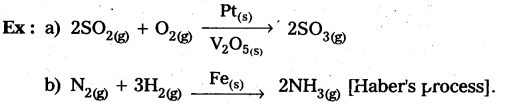
AP Inter 2nd Year Chemistry Important Questions Chapter 4 Surface Chemistry 21

Question 3.
How can the constants k and n of the Freundlich adsorption equation be calculatéd?
Answer:
Freundlich adsorption isotherm equation is
\(\frac{x}{m}\) = k. P1/n ⇒ x/m = Extent of adsorption ⇒ P = Pressure
k and n are constants which depend on the nature of the adsorbent and the gas at a particular temperature.
Applying logarithm to the above equation
log \(\frac{x}{m}\) = log k + \(\frac{1}{n}\) log P.
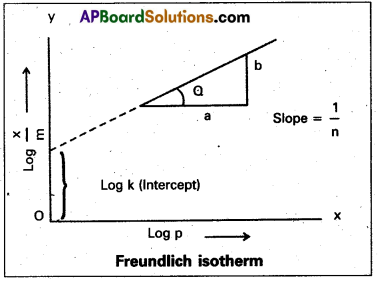
AP Inter 2nd Year Chemistry Important Questions Chapter 4 Surface Chemistry 22

  • A graph is plotted taking log \(\frac{x}{m}\) on y – axis and log P on x – axis. If the graph is a straight line then Freundlich isotherm is valid.
  • The slope of the straight line gives \(\frac{1}{n}\) value.
  • The intercept on the y-axis gives value of log k.
  • \(\frac{1}{n}\) has values between 0 and 1.
    When \(\frac{1}{n}\) = 0, \(\frac{x}{m}\) = constant, the adsorption is independent of pressure.
    \(\frac{1}{n}\) = 1, \(\frac{x}{m}\) = kP i.e., \(\frac{x}{m}\) ∝ p.

Question 4.
How are colloids classified on thé basis of interaction between dispersed phase and dispersion medium?
Answer:
Lyophilic colloid : The colloidal solution in which the dispersed phase has great affinity to the dispersion medium is called a Lyophilic colloid or Lyophilic solution.
Ex: Starch solution.

The starch paste when dissolved in hot water, with stirring, the starch solution is formed. The starch particles (dispersed phase) has great affinity to water molecules (dispersion medium). So starch solution is a lyophilic solution or lyophilic colloid.

Lyophobic colloid : The colloidal solution in which there exists not much affinity between the dispersed phase and dispersion medium, it is called a Lyophobic colloid or Lyophobic solution.
Ex: Gold solution.

Gold rods are placed in water containing alkali. Electric arc is applied between gold rods. The gold particles dissolves in water, to give gold solution.
Gold particles (dispersed phase) have not much affinity towards water (dispersion medium). So this is a Lyophobic solution or Lyophobic colloid.

AP Inter 2nd Year Chemistry Important Questions Chapter 4 Surface Chemistry

Question 5.
Explain any 2 methods for the preparation of colloids.
Answer:
Method – 1: Bredig’s arc Method : This process consists of dispersion and condensation colloids of Gold, Platinum, Silver arc prepared by this method. In this method an electric arc is struck between the electrodes of the metal immersed in the dispersion medium. The heat produced vapourises the metal which then condensed to colloidal size.

Method – 2 : Colloids can be prepared by chemical reactions like double decomposition, oxidation, reduction and hydrolysis.
Double decomposition : As2O3 + 3H2S → AS2S3 (sol) + 3H2O
Oxidation : SO2 + 2H2S → 3S(sol) + 2H2O
Reduction : 2 AuCl3 + 3 HCHO + 3 H2O → 2 Au (sol) + 3HCOOH + 6HCl
Hydrolysis : FeCl3 + 3H2O → Fe (OH)3 (sol) + 3HCl

Question 6.
Discuss the use of colloids in
i) Purification of drinking water
ii) Tanning
iii) Medicines.
Answer:
i) Purification of drinking water: The water obtained from natural sources often contains suspended impurities. Alum is added to such water to coagulate the suspended impurities and make water fit for drinking purposes.

ii) Tanning : Animal skins are colloidal in nature. When a skin, which has positively charged particles, is soaked in tannin, which contains negatively charged colloidal particles, mutual coagulation takes place. This results in the hardening of skin (leather). This process is termed as tanning. Chromium salts are also used in place of tannin.

iii) Medicines : Most of the medicines are colloidal in nature. For example argyrol is a silver sol used as an eye lotion. Colloidal antimony is used in curing kalaazar. Colloidal gold is used as intramuscular injection. Milk of magnesia an emulsion, is used for stomach disorders. Colloidal medicines are more effective because they have large surface area and are therefore easily assimilated.

Question 7.
What do you mean by activity and selectivity of catalysts?
Answer:
Activity:
The ability of a catalyst in increasing the rate of reaction is defined as activity of catalyst.

  • The activity of a catalyst depends upon the strength of chemisorption to a large extent.
  • The reactants must get adsorbed reasonably strongly onto the catalyst to become reactive.
    Eg: The catalystic activity increases from Group – 5 to Group – 11 for hydrogenation reactions.
    The maximum activity being shown by 7 – 9 group metals.
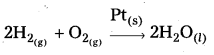
    AP Inter 2nd Year Chemistry Important Questions Chapter 4 Surface Chemistry 23

Selectivity:
The selectivity of a catalyst is its ability to direct a reacti6n to form specific products. The following reactions indicate the selectivity of heterogeneous catalysis.

  • Starting with H2 and CO, and using different catalysts, we get different products,

    AP Inter 2nd Year Chemistry Important Questions Chapter 4 Surface Chemistry 24

The action of a catalyst is highly sélective in nature. A substance which acts as a catalyst in one reaction may fail to catalyse another reaction.

AP Inter 2nd Year Chemistry Important Questions Chapter 4 Surface Chemistry

Question 8.
What are emulsions? How are they classified? Describe the applications of emulsion. ( AP Mar. 2017; IPE 2016 (TS))
Answer:
Emulsion : The colloidal system in which a dispersion of finely divided droplets of a liquid in another liquid medium is called emulsion.
Ex: Milk.
In Milk, the droplets of liquid fat are dispersed in water. This is an example for oil in water type emulsion.
Classification of emulsions: Emulsions are classified into two classes. These are
a) Oil in Water (O/W) and
b) Water in Oil (W/O), (O = Oil; W = Water).

These emulsions are classified as such depending on which is dispersed phase and which is dispersion medium.

a) Oil in Water (O/W) type emulsions : In this type of emulsions, the dispersed phase is oil and the dispersion medium is water.
Ex: Milk, liquid, fat (oil) in water.
Vanishing cream; fat in water.

b) Water In Oil (W/O) type emulsions : In this type of emulsions, the dispersed phase is water and the dispersion medium is oil.
Ex : Stiff greases : water in lubrication oils
Cod liver oil : water in cod liver oil

Applications of Emulsions : Emulsions are useful

  • In the digestion of fats in intestines.
  • In washing processes of clothes and crockery.
  • In the preparation of lotions, creams, ointments in pharmaceutical and cosmetics.
  • In the extraction of metals (froth floatation).
  • In the conversion of cream into butter by churning.
  • To break oil and water emulsions in oil wells.
  • In the preparation of oily type of drugs for easy adsorption to the body.

Question 9.
What is adsorption? Explain different types of adsorptions with suitable examples.
Answer:
The process of concentration of molecules of a gas (or) liquid on the surface of another substance is called adsorption. Adsorption is of two types,
(a) Physical adsorption
(b) Chemical adsorption.

a) Physical adsorption: It is also called Vander waals adsorption. A very weak Vander forces of attraction exists between adsorbate and adsorbent. It is multi layered and non-selective.
Ex: Adsorption of inert gases on activated coconut charcoal.

b) Chemical adsorption: It is also called chemisorption. A very strong chemical forces of attraction exists between adsorbate and adsorbent. It is mono-layered and highly selective.
Ex: Adsorption of H2 gas on nickel surface.

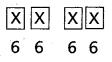
AP Inter 2nd Year Chemistry Important Questions Chapter 3(b) Chemical Kinetics

Students get through AP Inter 2nd Year Chemistry Important Questions Lesson 3(b) Chemical Kinetics which are most likely to be asked in the exam.

AP Inter 2nd Year Chemistry Important Questions Lesson 3(b) Chemical Kinetics

Very Short Answer Questions

Question 1.
What is Rate of a reaction ?
Solution:
Rate of reaction : The rate [speed or velocity] of a reaction is the change in concentration of reactants or products per unit time.
Rate = \(\frac{\Delta x}{\Delta t}\) Where, Δx is the change in concentration, At is the time interval.
The rate of reaction is always positive and it decreases as the reaction proceeds.
For the reaction, R → P, rate may be expressed as
AP Inter 2nd Year Chemistry Important Questions Chapter 3(b) Chemical Kinetics 1

Question 2.
What is Rate equation (or) Rate expression (or) Rate Law ?
Answer:
Rate equation or Rate expression or Rate Law is the mathematical expression in which aA + bB → cC + dD reaction rate is given in terms of molar concentration of reactants. Where a, b, e and d are the stoichiometric coefficients of reactants and products.
The rate expression for this reaction is Rate ∝ [A]x [B]y
Exponents x and y may or may not equal to stiochiometric coefficients a and b.
Rate = K [A]x [B]y Where K is proportionality constant called rate constant.

AP Inter 2nd Year Chemistry Important Questions Chapter 3(b) Chemical Kinetics

Question 3.
Write the differences between Order and Molecularity of a reaction. (IPE 2014, BIE) (A.P. Mar. ’18)
Solution:
Differences between Order and Molecularity of a reaction :

Order of reaction

  1. Order is the sum of powers of concentration terms of reactants in the rate law.
    aA + bB → cC + dD Rate = K [A]x [B]y
    x + y is the total order of the reaction. x and y may or may not be equal to a and b respectively.
    Ex : 2H2O2 → 2H2O + O2 is an example for first order reaction.
  2. It is determined by experiment.
  3. It may be zero, positive, fractional 0, 1, 2, 1.5 etc.,

Molecularity of reaction

i) Molecularity is the no. of reacting species taking part in an elementary reaction.
Ex:
i) NH4NO2 → N2 + 2H2O
(Unimolecular)
Ex : ii) 2HI → H2 + I2 (Bimolecular)
Ex: iii) 2NO + O2 → 2NO2 (Trimolecular)

ii) It is determined by reaction mechanism.

iii) It cant be zero, fractional or negative. It is always a whole number.

AP Inter 2nd Year Chemistry Important Questions Chapter 3(b) Chemical Kinetics

Question 4.
The rate constant of a first order reaction (K) is 5.5 × 10⁻¹⁴ sec-1. Find the half life. (IPE 2015(AP))
Solution:
Half life for a first order reaction is, t1/2 = \(\frac{0.693}{\mathrm{~K}}\)
t1/2 = \(\frac{0.693}{5.5 \times 10^{-14} \mathrm{~S}^{-1}}\) = 1.26 × 10¹³S

Question 5.
What is Zero Order reaction ?
Solution:
Zero Order reaction: The rate of reaction is independent of the concentration of reactants.
For the reaction R → P, Rate = –\(\frac{\mathrm{d}[\mathrm{R}]}{\mathrm{dt}}\) = k[R]
[R] – Concentration of reactant
K – First order rate constant
Ex:
1) Decomposition of NH3 on hot Pt surface ; AP Inter 2nd Year Chemistry Important Questions Chapter 3(b) Chemical Kinetics 3
2) Decomposition of HI on Gold surface is a zero order reaction AP Inter 2nd Year Chemistry Important Questions Chapter 3(b) Chemical Kinetics 4

Question 6.
What is First Order reaction ? Give example. (IPE 2014)
Solution:
First Order reaction: The rate of reaction which depends only on one concentration term.
For the reaction R → P, Rate = \(-\frac{d[R]}{d t}\) = k[R]
[R] – Concentration of reactant
K – First order rate constant
Ex:

  1. Decomposition of N2O5 N2O5 (g) → 2NO2(g) + 1/2 O2 (g)
  2. Decomposition of N2O N2O(g) → N2(g) + 1/2 O2(g).

Question 7.
What are pseudo first order reactions ? Give one example.
Answer:
First order reactions whose molecularity is more than one are called pseudo first order reactions.
AP Inter 2nd Year Chemistry Important Questions Chapter 3(b) Chemical Kinetics 5
Order = 1
molecularity = 2

Question 8.
What is Half life of a reaction ?
Solution:
Half life of a reaction: The time in which the concentration of a reactant is reduced to one half of its initial concentration is called half life period. It is represented by t1/2.
t1/2 of nth order reaction is given by t1/2 ∝ [R0]1-n
Where R0 is initial concentration
t1/2 = \(\frac{\left[R_{0}\right]}{2 k}\) for a zero order reaction; t1/2 = \(\frac{0.693}{k}\) for first order reaction

AP Inter 2nd Year Chemistry Important Questions Chapter 3(b) Chemical Kinetics

Question 9.
Define the speed or rate of a reaction.
Answer:
The change in the concentration of a réactant (or) product in unit time is called speed or rate of a reaction.
(or)
The decrease in the concentration of a reactant (or) increase in the concentration of product per unit time.

Question 10.
Define Order of a reaction. Illustrate your answer with an example. (IPE 2015; T.S. Mar. ’15)
Answer:
Order of a reaction : The sum of the powers of the concentration terms of the reactants present in the rate equation is called order of a reaction.

  • Order of a reaction can be 0, 1, 2, 3 and even a fraction.

Eg:

  1. N2O5 → N2O4 + \(\frac{1}{2}\)O2
    rate ∝ [N2O5]
    ∴ It is a first order reaction.
  2. 2N2 → 2N2 + O2
    rate ∝ [N2O]2
    ∴ It is 2nd first order reaction.

Question 11.
What are elementary reactions?
Answer:
The reactions taking place in one step are called elementary reactions.

Question 12.
Give two examples for zero Order reactions.
Answer:
Examples for zero order reactions
AP Inter 2nd Year Chemistry Important Questions Chapter 3(b) Chemical Kinetics 6

Question 13.
Write the integrated equation for a first order reaction in terms of [R], [R0] and ‘t’.
Answer:
[R] = Concentration of reaction after time T
[R0] = Initial concentrations of reactant
∴ k = \(\frac{2.303}{t}\)log\(\frac{\left[R_0\right]}{[R]}\)
This is the integrated equation for a first order reaction

AP Inter 2nd Year Chemistry Important Questions Chapter 3(b) Chemical Kinetics

Question 14.
Give two examples for gaseous first order reactions.
Answer:
The following are the examples for gaseous first order reactions
AP Inter 2nd Year Chemistry Important Questions Chapter 3(b) Chemical Kinetics 7

Question 15.
What is a second order reaction? Give one example.
Solution:
Second order reaction : The reactions in which the rate of reaction depends on changing concentration of two substances is called second order reaction.
Ex : Alkaline hydrolysis of ester.

Question 16.
A reaction has a half – life of 10 minutes. Calculate the rate constant for the first order reaction. (IPE 2016 (TS)
Solution:
In case of first order reaction t1/2 = \(\frac{0.693}{k}\)
∴ k = \(\frac{0.693}{\mathrm{t}_{1 / 2}}\) = \(\frac{0.693}{10}\) = 0.0693 min-1

Question 17.
In a first order reaction, the concentration of the reactant is reduced from 0.6 mol/L to 0.2 mol/L in 5 min. Calculate the rate constant (k).
Solution:
a = 0.6mol L-1; a – x = 0.2 mol L-1; t = 5 min.
Since it is a first order reaction.
k = \(\frac{2.303}{\mathrm{t}}\) log10 \(\frac{a}{(a-x)}\)
k = \(\frac{2.303}{t}\) log \(\frac{0.6}{0.2}\) = 0.2197 min-1

Short Answer Questions

Question 1.
Define and explain the order of a reaction. How is it obtained experimentally ?
Answer:
Order of a reaction : The sum of the powers of the concentration terms of the reactants present in the rate equation is called order of a reaction.

  • Order of a reaction can be 0, 1, 2, 3, and even a fraction.

Eg:

1) N2O5 → N2O4 + \(\frac{1}{2}\)O2
rate ∝ [N2O5]
∴ It is a first Order reaction.

2) 2N2 → 2N2 + O2
rate ∝ [N2O]2
∴ It is 2nd order reaction

  • Order of a reaction can be determined experimentally.

Half-Time (t1/2) method: The time required for the initial concentration (a) of the reactant to become half its value (a/2) during the progress of the reaction is called half-time (t1/2) of the reaction.
A general expression for the half life, (t1/2) is given by
t1/2 ∝ \(\frac{1}{a^{n-1}}\)

Therefore, for a given reaction two halftime values (t’1/2 and t”1/2) with initial concentrations a’ and a” respectively are determined experimentally and the order is established from the equation.
\(\left(\frac{\mathrm{t}_{1 / 2}^{\prime}}{\mathrm{t}_{1 / 2}^{\prime}}\right)\) = \(\left(\frac{a^n}{a^{\prime}}\right)^{n-1}\)
Where ‘n’ is the order of the reaction.

AP Inter 2nd Year Chemistry Important Questions Chapter 3(b) Chemical Kinetics

Question 2.
Describe the salient features of the collision theory of reaction rates of bimolecular reactions.
Answer:
Collision theory of reaction rate bimolecular reactions salient features.

  • The reaction molecules are assumed to be hard spheres.
  • The reaction is postulated to occur when molecules collide with each other.
  • The number of collisions per second per unit volume of the reaction mixture is known as collision frequency (Z).
  • For a bimolecular elementary reaction.

A + B → products
Rate = ZAB. e-Ea/RT ; ZAB = collision frequency.

  • All collisions do not lead to product formation.
  • The collisions with sufficient kinetic energy (Threshold energy) are responsible for product formation. These are called as effective collisions.
  • To account for effective collisions a factor p called to probability factor or steric factor is introduced.
    Rate = P ZAB. e-Ea/RT

Question 3.
What is “moleculartiy” of a reaction ? How is it different from the ‘order’ of a reaction ? Name one bimolecular and one trimolecular gaseous reactions.
Answer:
The number of reacting species (atoms, ions or molecules) taking parts in an elementary reaction, which must colloid simultaneously to bring about a chemical reaction is called molecularity of a reaction.
NH4NO2 → N2 + 2H2O (Unimolecular)
2HI → H2 + I2 (Bimolecular)
2NO + O2 → 2NO2 (Trimolecular)

  • Molecularity has only integer values (1, 2, 3, ….)
  • It has non zero, non fraction values while order has zero, 1, 2, 3, ….. and fractional values.
  • It is determined by reaction mechanism, order is determined experimentally.

Question 4.
What is half-life (t1/2) of a reaction ? Derive the equations for the ‘half-life’ value of zero and first order reactions.
Answer:
The time required for the initial concentration of the reactants to become half of it’s value during the progress of the reaction is called half life (t1/2) of reaction.
Eg : The radio active of C-14 is exponential with a half life of 5730 years.
Half life of zero order reaction :
AP Inter 2nd Year Chemistry Important Questions Chapter 3(b) Chemical Kinetics 8

AP Inter 2nd Year Chemistry Important Questions Chapter 3(b) Chemical Kinetics

Question 5.
Explain the terms
a) Activation energy (Ea)
b) Collision frequency (Z)
c) Probability factor (P) with respect to Arrhenius equation.
Answer:
a) Activation Energy: The energy required to form an intermediate called activated complex (C) during a chemical reaction is called activation energy.
AP Inter 2nd Year Chemistry Important Questions Chapter 3(b) Chemical Kinetics 9

b) Collision frequency: The number of collisions per second per unit volume of the reaction mixture is called collision frequency (Z). For a bimolecular elementary reactions
A + B → products

c) Probability factor (P) with respect to Arrhenius equation : To account for effective collisions a factor p called to probability factor or steric factor is introduced.
AP Inter 2nd Year Chemistry Important Questions Chapter 3(b) Chemical Kinetics 10

Question 6.
Explain the factors influencing rate of reaction. (IPE 2015 (TS))
Solution:
Factors affecting rate of a reaction: The rate of a chemical reaction depends on the following.

i) Concentration of reactants : The rate of a chemical reaction is directly proportional to the concentration of the reactants. As the concentration of reactants increases the number of molecules increase, collisions between molecules increases as a result number of fruitful collisions increases, hence rate of reaction increases.

ii) Nature of reactants : Reactions between ionic compounds are fast when compared to reactions between the covalent compounds. In case of ionic reactions only exchange of ions takes place, hence the reactions between ionic compounds in solutions are very fast. In case of covalent molecules breaking and formation of bonds involved hence the reactions between covalent molecules are very slow.

iii) Temperature : As temperature increases, the rate of reaction increases. For every 10°C rise of temperature the rate of reaction is almost doubled. At high temperatures maximum number of molecules are activated. The collisions between activated molecules are fruitful, hence the rate of reaction increases.

iv) Catalyst: In the presence of catalyst also the rate of reaction increases. Catalyst takes the reaction in a new path having low activation energy.

Question 7.
Show that in the case of first order reaction, the time required for 99.9% completion of the reaction is 10 times that required for 50% completion. (log 2 = 0.3010)
Solution:
Initial concentration, a = 100; Half life period, t1/2 = 0.693/K
Concentration after time ‘t’ = a – x = 100 – 99.9 = 0.1
For first order reaction, K = \(\frac{2.303}{t}\)log\(\frac{a}{(a-x)}\)
AP Inter 2nd Year Chemistry Important Questions Chapter 3(b) Chemical Kinetics 11

AP Inter 2nd Year Chemistry Important Questions Chapter 3(b) Chemical Kinetics

Question 8.
Derive an integrated rate equation for a first order reaction.
Answer:
In first order reactions rate depends on only one concentration term.
R → P
Rate = k[R]; \(\frac{\mathrm{d}[\mathrm{R}]}{\mathrm{dt}}\) = -k. dt
Integration on both sides
ln[R] = -kt + I ——- (1)
I = Integration constant
At t = 0, [R] = [R0] ⇒ ln[R0] = I
Substituting I = ln [R] in the above equation (1)
lñ [R] = -kt + ln[R0]
ln \(\frac{[\mathrm{R}]}{\left[\mathrm{R}_0\right]}\) =-kt . ——— (2)
k = \(\frac{1}{\mathrm{t}} \ln \frac{\left[\mathrm{R}_0\right]}{[\mathrm{R}]}\)
Taking antilog on both sides of eq. (2)
R = [Ro]. e-kt
This is first order rate equation.

AP Inter 2nd Year Chemistry Important Questions Chapter 3(a) Electro Chemistry

Students get through AP Inter 2nd Year Chemistry Important Questions Lesson 3(a) Electro Chemistry which are most likely to be asked in the exam.

AP Inter 2nd Year Chemistry Important Questions Lesson 3(a) Electro Chemistry

Very Short Answer Questions

Question 1.
What is a galvanic cell or a voltaic cell ? Give one example.
Answer:
Galvanic cell: A device which converts chemical energy into electrical energy by the use of spontaneous redox reaction is called Galvanic cell (or) voltaic cell.
Eg.: Daniell cell.

Question 2.
What is standard hydrogen electrode ?
Answer:
The electrode whose potential is known as standard electrode (or) standard hydrogen electrode.
To determine the potential of a single electrode experimentally it combine with standard hydrogen electrode and the EMF of cell so constructed is measured with potentiometer.

AP Inter 2nd Year Chemistry Important Questions Chapter 3(a) Electro Chemistry

Question 3.
What is Nernst equation ? Write the equation for an electrode with electrode reaction
Mn+ (aq) + ne \(\rightleftharpoons\) M(s).
Answer:
The electrode potential at any concentration measured with respect to standard hydrogen electrode is represented by Nernst equation.
Nernst equation is
AP Inter 2nd Year Chemistry Important Questions Chapter 3(a) Electro Chemistry 1
Here, E(Mn+/M) = Electrode potential
E0(Mn+/M) = Standard electrode potential
R = gas constant = 8.3 14 J/k.mole
F = Faraday = 96487 c/mole
T = temperature .
[Mn+] = concentration of species Mn+

Question 4.
How is E0 cell related mathematically to the equilibrium constant Kc of the cell reaction?
Answer:
Relation between E0 cell and equilibrium constant Kc of the cell reaction
\(E_{\text {cell }}^0\) = \(\frac{2.303 \mathrm{RT}}{\mathrm{nF}} \log \mathrm{K}_{\mathrm{c}}\)
n = number of electrons involved
F = Faraday = 96500 C mol-1
T = Temperature
R = gas constant

Question 5.
How is Gibbs energy (G) related to the cell emf (E) mathematically ?
Answer:
Relation between Gibb’s energy (G) and emf (E) mathematically
ΔG° = – nFE(cell)
ΔG = change in Gibb’s energy
n = number of electrons involved
F = Faraday = 96500 C mol-1

AP Inter 2nd Year Chemistry Important Questions Chapter 3(a) Electro Chemistry

Question 6.
Define conductivity of a material. Give its SI units.
Answer:
The reciprocal of specific resistance (or) resistivity is called conductivity. It is represented by (K)
(Or)
The conductance of one unit cube of a conductor is also called conductivity.
SI units : ohm-1 m-1 (or) Sm-1 S = Siemen

Question 7.
What is cell constant of a conductivity cell ?
Answer:
Cell constant:
AP Inter 2nd Year Chemistry Important Questions Chapter 3(a) Electro Chemistry 2
The cell constant of a conductivity cell is the product of resistance and specific conductance.

Question 8.
State Faraday’s second law of electrolysis.
Answer:
The amounts of different substances liberated when the same quantity of electricity is passed through the electrolytic solution are proportional to their chemical equivalent weights.
m ∝ E

Question 9.
State Kohlrausch’s law of independent migration of ions.
Answer:
Kohlrausch’s law of independent migration of ions : The limiting molar conductivity of the electrolytes can be represented as the sum of the individual contributions of the anion and the cation of the electrolytes.
\(\lambda_{m(A B)}^0\) = \(\lambda_{\mathrm{A}^{+}}^0\) + \(\lambda_{\mathrm{B}^{-}}^0\)
\(\lambda_m^0\) = Limiting molar conductivity
\(\lambda_{\mathrm{A}^{+}}^0\) = Limiting molar conductivity of cation ‘
\(\lambda_{\mathrm{B}^{-}}^0\) = Limiting molar conductivity of anion

Question 10.
State Faraday’s first law of electrolysis.
Answer:
The amount of chemical reaction which occurs at any electrode during electrolysis is proportional to the quantity of current passing through the electrolyte.
(Or)
The mass of the substance deposited at an electrode during the electrolysis of electrolyte is directly proportional to quantity of electricity passed through it.
m ∝ Q; m ∝ c × t
m = ect; m = \(\frac{\text { Ect }}{96,500}\)
e = electrochemical equivalent
t = time in seconds
c = Current in amperes
E = Chemical equivalent

Question 11.
What is a primary battery? Give one example. (AP Mar. ’17)
Answer:
The batteries which after their use over a period of time, becomes dead and the cell reaction is completed and this cannot be reused again are called primary batteries.
Eg: Leclanche cell, dry cell.

AP Inter 2nd Year Chemistry Important Questions Chapter 3(a) Electro Chemistry

Question 12.
Give one example for a secondary battery. Give the cell reaction.
Answer:
Lead storage battery is an example of secondary battery.
The cell reactions when the battery is in use are
AP Inter 2nd Year Chemistry Important Questions Chapter 3(a) Electro Chemistry 3

Question 13.
What is metallic corrosion? Give one example. (TS Mar. 2017, IPE ‘15 (AP))
Answer:
Metallic corrosion : The natural tendency of conversion of a metal into its mineral compound form on interaction with the environment is known as metallic corrosion.
Eg:

  1. Iron converts itself into its oxide.
    [Rusting] (Fe2O3)
  2. Silver converts itself into it’s sulphate
    [tarnishing] [Ag2S]

Question 14.
Define electrochemical equivalènt (e.c.e).
Answer:
The weight of the substance deposited or liberated when one ampere of current is passed for 1 second (1 coloumb) is called electrochemical equivalent (e.c.e).

Question 15.
A solution of CuSO4 is electrolysed for 10 minutes with a current of 1.5 amperes. What is the mass of copper deposited at the cathode? (IPE 2015 (AP), 14)
Solution:
t =600 s charge = current × time = 1.5A × 600 s = 900 C
According to the reaction:
AP Inter 2nd Year Chemistry Important Questions Chapter 3(a) Electro Chemistry 4
We require 2F or 2 × 96487 C to deposit 1 mol or 63 g of Cu.

Question 16.
Can you store copper sulphate solutions in a zinc pot ?
Solution:
No, zinc pot cannot store copper sulphate solutions because the standard electrode potential (E0) value of zinc is less than that of copper. So, zinc is stronger reducing agent than copper.
AP Inter 2nd Year Chemistry Important Questions Chapter 3(a) Electro Chemistry 5
So, zinc will loss electrons to Cu2+ ions and redox reaction will occur as follows.
AP Inter 2nd Year Chemistry Important Questions Chapter 3(a) Electro Chemistry 6

AP Inter 2nd Year Chemistry Important Questions Chapter 3(a) Electro Chemistry

Question 17.
Write the cell reaction taking place in the cell, Cu(s) / Cu2+ (aq) //Ag+ (aq) / Ag (s).
Answer:
Cu(s)/Cu+2(aq)//Ag+(aq)/Ag
In the above notation copper electrode acts as anode and silver electrode acts as cathode.
AP Inter 2nd Year Chemistry Important Questions Chapter 3(a) Electro Chemistry 7

Question 18.
Write the Nernst equation for the EMF of the cell
AP Inter 2nd Year Chemistry Important Questions Chapter 3(a) Electro Chemistry 8
Answer:
AP Inter 2nd Year Chemistry Important Questions Chapter 3(a) Electro Chemistry 9

Question 19.
Write the cell reaction for which
AP Inter 2nd Year Chemistry Important Questions Chapter 3(a) Electro Chemistry 10
Answer:
AP Inter 2nd Year Chemistry Important Questions Chapter 3(a) Electro Chemistry 11

Short Answer Questions

Question 1.
What are galvanic cells ? Explain the working of a galvanic cell with a neat sketch taking Daniell cell as example.
Answer:
Galvanic cell: A device which converts chemical energy into electrical energy by the use of spontaneous redox reaction is called Galvanic cell (or) voltaic cell. Eg : Daniell cell.

Daniell cell: It is a special type of galvanic cell. It contains two half cells in the same vessel. The vessel is divided into two chambers. Left chamber is filled with ZnSO4 (aq) solution and Zn – rod is dipped into it. Right chamber is filled with aq. CuSO4 solution and a copper rod is dipped into it. Process diaphragm acts as Salt bridge. The two half cell’s are connected to external battery.
AP Inter 2nd Year Chemistry Important Questions Chapter 3(a) Electro Chemistry 12
Cell reactions :
Ion Zn/ZnSO4 half cell, oxidation reaction occurs.
Zn → Zn2+ + 2e
Ion Cu/CuSO4 half cell, reduction reaction occurs.
Cu+2 + 2e → Cu
The net cell reaction is
Zn + Cu+2 \(\rightleftharpoons\) Zn+2 + Cu
Cell is represented as Zn / Zn+2 || Cu2+ / Cu

AP Inter 2nd Year Chemistry Important Questions Chapter 3(a) Electro Chemistry

Question 2.
Give the construction and working of a standard hydrogen electrode with a neat diagram.
Answer:
To determine the potential of a single electrode experimentally, it is combined with a standard hydrogen electrode (electrode whose potential is known) and the EMF of the cell so constructed is measured with a potentiometer. Standard Hydrogen Electrode is constructed and is used as standard electrode or reference electrode. Standard Hydrogen Electrode (SHE) or Normal Hydrogen Electrode (NHE).

Pure hydrogen gas is bubbled into a solution of 1M HCl along a platinum electrode coated with platinum block. A platinum block electrode placed in the solution at atmospheric pressure.

Generally the electrode is fitted into the tube. The tube will have two circular small holes. This tube is immersed in the acid solution such that one half of the circular hole is exposed to air and another half in the solution.
AP Inter 2nd Year Chemistry Important Questions Chapter 3(a) Electro Chemistry 13
The following equilibrium exists at the electrode.
\(\frac{1}{2} \mathrm{H}_{2(\mathrm{~g})}\left(1_{\mathrm{atm}}\right) \rightleftharpoons \mathrm{H}_{(\mathrm{aq})}^{+}(\mathrm{M})+\mathrm{e}^{-}\)

Question 3.
State and explain Kohlrausch’s law of independent migration of ions. (IPF. 2015, BMP, 2016 (TS)
Answer:
Kohlrausch’s law of independent migration of ions : The limiting molar conductivity of the electrolytes can be represented as the sum of the individual contributions of the anion and the cation of the electrolytes.
\(\lambda_{\mathrm{m}(\mathrm{AB})}^0=\lambda_{\mathrm{A}^{+}}^0+\lambda_{\mathrm{B}^{-}}^0\)
\(\lambda_{\mathrm{m}}^0\) = Limiting molar conductivity
\(\lambda_{\mathrm{A}^{+}}^0\) = Limiting molar conductivity of cation
\(\lambda_{\mathrm{B}^{-}}^0\) = Limiting molar conductivity of anion,

Applications :

  1. Kohlrausch’s law is used in the calculation of the limiting molar conductivity of weak electrolytes.
    AP Inter 2nd Year Chemistry Important Questions Chapter 3(a) Electro Chemistry 14
  2. This law is used in the calculation of degree of dissociation of a weak electrolyté.
  3. This law is used in the calculation of solubility of sparingly soluble salts like AgCl, BaSO4 etc.

AP Inter 2nd Year Chemistry Important Questions Chapter 3(a) Electro Chemistry

Question 4.
What is electrolysis? Give Faraday’s first law of electrolysis. (IPE 2014)
Answer:
Electrolysis : The decomposition of a chemical compound in the molten state or in the solution state into its constituent elements under the influence of an applied EMF is called electrolysis.
The amount of chemical reaction which occurs at any electrode during electrolysis is proportional to the quantity of current passing through the electrolyte.
(Or)
The mass of the substance deposited at an electrode during the electrolysis of electrolyte is directly proportional to quantity of electricity passed through it.
AP Inter 2nd Year Chemistry Important Questions Chapter 3(a) Electro Chemistry 15
e = electrochemical equivalent
t = time in seconds
c = Current in amperes
E = Chemical equivalent

Question 5.
Calculate the emf of the cell at 25°C Cr | Cr3+ (0.1 M) || Fe2+ (0.01M)| Fe, given that
AP Inter 2nd Year Chemistry Important Questions Chapter 3(a) Electro Chemistry 16
Answer:
Given cell is
AP Inter 2nd Year Chemistry Important Questions Chapter 3(a) Electro Chemistry 17
AP Inter 2nd Year Chemistry Important Questions Chapter 3(a) Electro Chemistry 18

Question 6.
Determine the values of Kc for the following reaction.
AP Inter 2nd Year Chemistry Important Questions Chapter 3(a) Electro Chemistry 19
Solution:
AP Inter 2nd Year Chemistry Important Questions Chapter 3(a) Electro Chemistry 20

Question 7.
If a current of 0.5 ampere flows through a metallic wire for 2h, then how many electrons would flow through the wire ?
Solution:
Quantity of charge (Q) passed = Current (C) × Time (t)
= (0.5 A) × (2 × 60 × 60 s)
= (3600) Ampere sec = 3600 C
Number of electrons flowing through the wire on passing charge of one Faraday (96500 C) = 6.022 × 10²³
Number of electrons flowing through the wire on passing a charge of 3600 C
= \(\frac{6.022 \times 10^{23} \times(3600 \mathrm{C})}{(96500 \mathrm{C})}\)
= 2.246 × 10²²
Number of electrons = 2.246 × 10²²

AP Inter 2nd Year Chemistry Important Questions Chapter 3(a) Electro Chemistry

Question 8.
Define emf. Calculate the emf of the following galvanic cell:
AP Inter 2nd Year Chemistry Important Questions Chapter 3(a) Electro Chemistry 21
Solution:
EMF : The difference in electrode potentials between reduction potential of cathode and reduction potential of anode is called emf.
emf = reduction potential of cathode – reduction potential of anode
emf = + 0.34 – (-0.76) ⇒ + 0.34 + 0.76 = 1.1V

Question 9.
Write Nernst equation for a metal and non metal eletrode.
Solution:
For a metal electrode M : M+n (aq) + ne → M(s)
AP Inter 2nd Year Chemistry Important Questions Chapter 3(a) Electro Chemistry 22

AP Inter 2nd Year Chemistry Important Questions Chapter 2 Solutions

Students get through AP Inter 2nd Year Chemistry Important Questions 2nd Lesson Solutions which are most likely to be asked in the exam.

AP Inter 2nd Year Chemistry Important Questions 2nd Lesson Solutions

Very Short Answer Questions

Question 1.
Define molarity. [AP IPE ’15] [TS Mar. ’17 ’11]
Answer:
Molarity: The number of moles of solute dissolved in one litre of solution is called molarity.
AP Inter 2nd Year Chemistry Important Questions Chapter 2 Solutions 1
Units : moles / kg.

Question 2.
Define molality. [AP IPE 2015, May ’11]
Answer:
Molality : The number of moles of solute present in one kilogram of solvent is called molality.
AP Inter 2nd Year Chemistry Important Questions Chapter 2 Solutions 2
Units : moles / kg.

AP Inter 2nd Year Chemistry Important Questions Chapter 2 Solutions

Question 3.
Define mole fraction. (AP IPE 2015, Mar. ’14)
Answer:
Mole fraction : The ratio of number of moles of the one component of the solution to the total number of moles of all the components of the solution is called mole fraction.
Mole fraction of solute Xs = \(\frac{n_{\mathrm{s}}}{\mathbf{n}_0+\mathrm{n}_{\mathrm{s}}}\)
Mole fraction of solvent X0 = \(\frac{\mathrm{n}_{\mathrm{s}}}{\mathrm{n}_0+\mathrm{n}_{\mathrm{s}}}\)
[ns = number of moles of solute
n0 = number of moles of solvent]
→ It has no units.

Question 4.
State Raoult’s law. (AP Mar. ’17, ’14 IPE ‘16, 14 (AP, TS)
Answer:
Raoult’s law for volatile solute: For a solution of volatile liquids, the partial vapour pressure of each component of the solution is directly proportional to its mole fraction present in solution.
Raoults law for non-válatlle solute : The relative lowering of vapour pressure of dilute solution containing non-volatile solute is equal to the mole fraction of solute.

Question 5.
State Henrýs law. (TS IPE ’16)
Answer:
At constant temperature, the solubility of a gas in a liquid -is directly proportional to the partial pressure of the gas present above the surface of liquid.
The partial pressure of the gas in vapour phase is proportional to the mole fraction of the gas in the solution.
P = KH × X
KH = Henry’s constant
P = Partial pressure
X = Mole fraction of gas

AP Inter 2nd Year Chemistry Important Questions Chapter 2 Solutions

Question 6.
What is Ebullioscopic constant ?
Answer:
Ebullioscopic constant : The elevation of boiling point observed in one molal solution containing non-volatile solute is called Ebullioscopic constant (or) molal elevation constant.

Question 7.
What are isotonic solutions ?
Ans. Isotonic solutions : Solutions having same osmotic pressure at a given temperature are called isotonic solutions.
e.g.: Blood is isotonic with 0.9% (\(\frac{\mathrm{W}}{\mathrm{V}}\)) NaCl [Saline]

Question 8.
What is Cryoscopic constant?
Answer:
Cryoscopic constant : The depression in freezing point observed in one molal solution containing non-volatile solute is called cryoscopic constant (or) molal depression constant.

Question 9.
Define osmosis and osmotic pressure. (IPE 15, (AP) ‘16 (TS), (AP))
Answer:
Osmosis : The spontaneous flow of solvent particles from a solution of lower concentration in to higher concentration through semi permeable membrane is called osmosis.

Osmotic pressure : The pressure required to prevent the flow of solvent particles from pure
solvent into solution through semipermeable membrane is called osmotic pressure.
π = (nRT) / V Here π = Osmotic pressure; V = Volume of solution;
n = No. of moles of solute; R = Universal gas constant: T = Absolute temperature

Question 10.
What is Van’t Hoff’s factor ‘i’ and how is it related to ‘α’ in the case of a binary electrolyte (1:1)?
Answer:
Van’t Hoff’s factor (i): ‘It is defined as the ratio of the observed value of colligative property to the theóretical value of colligative property”.
AP Inter 2nd Year Chemistry Important Questions Chapter 2 Solutions 3
Solute dissociation or ionization process: If a solute on ionization gives ‘n ions and ‘α’ is degree of ionization at the given concentration, we will have [1 + (n – 1) α] particles.
(1 – α) \(\rightleftharpoons\) nα
Total 1 – α + nα = [1 + (n – 1)α]
∴ i = \(\frac{[1+(n-1) \alpha]}{1}\)
α = \(\frac{\mathrm{i}-1}{\mathrm{n}-1}\)
αionization = \(\frac{\mathrm{i}-1}{\mathrm{n}-1}\)
Solute association process:
If ‘n’A molecules combine to give A, we have
nA \(\rightleftharpoons\) An
If ‘α’ is degree of association at the given concentration.
AP Inter 2nd Year Chemistry Important Questions Chapter 2 Solutions 4

AP Inter 2nd Year Chemistry Important Questions Chapter 2 Solutions

Question 11.
What is relative lowering of vapour pressure? [IPE ’16, (TS)]
Answer:
Relating lowering of vapour pressure : The ratio of lowering of vapour pressure of a solution containing non-volatile solute to the vapour pressure of pure solvent is called relative lowering of vapour pressure.
R.L.V.P. = \(\frac{\mathrm{P}_0-\mathrm{P}_{\mathrm{S}}}{\mathrm{P}_0}\)
P0 – PS = lowering of vapour pressure
Po = Vapour pressure of pure solvent

Question 12.
What is vapour pressure of a liquid?
Answer:
The pressure exerted by vapour over liquid when it is in equilibrium with the liquid is called vapour pressure.

Question 13.
What is elevation of boiling point? (IPE 16, (TS) )
Answer:
The boiling point of a solution containing non-volatile solute is higher than the boiling point of pure solvent. The difference in boiling points between solution and pure solvent is called elevation of boiling point.

Question 14.
What is depression of freezing point?
Answer:
The freezing point of a solution containing non-volatile solute is always lower than the freëzing point of puré solvent. The difference in freezing points between solution and pure solvent is called depression of freezing point.

Question 15.
Calculate the amount of benzoic acid (C6H5COOH) required for preparing 250 ml of
0.15 M solution in methanol.
Answer:
Given
Molarity = 0.15 M
Volume V = 250 ml
Molecular weight of benzoic acid (C6H5COOH) = 122
Molarity (M) = \(\frac{\text { Weight }}{\mathrm{GMw}} \times \frac{1000}{\mathrm{~V}(\mathrm{~m} l)}\)
0.15 = \(\frac{\mathrm{W}}{122} \times \frac{1000}{250}\)
W = \(\frac{122 \times 0.15}{4}\) = 4.575 gms.

Question 16.
Calculate the mole fraction of H2SO4 in a solution containing 98% H2SO4 by mass. (T.S. Mar. ’18; A.P Mar. ‘17, IPE ‘15, (AP))
Answer:
Given a solution containing – 98% H2SO4 by mass.
It means 98 gms of H2SO4 and 2 gms of H2O mixed to form a solution.
AP Inter 2nd Year Chemistry Important Questions Chapter 2 Solutions 5

AP Inter 2nd Year Chemistry Important Questions Chapter 2 Solutions

Question 17.
Calculate the molarity of a solution containing 5g of NaOH in 450 ml solution. (T.S. Mar. ’19, ’17 )
Solution:
Moles of NaOH = \(\frac{5 \mathrm{~g}}{40 \mathrm{~g} \mathrm{~mol}^{-1}}\) = 0.125 mol
Volume of the solution in litres = 450 mL / 1000 mL L-1
Using equation
AP Inter 2nd Year Chemistry Important Questions Chapter 2 Solutions 6

Question 18.
200 cm3 of an aqueous solution of a protein contains 1.26 g of the protein. The osmotic pressure of such a solution at 300 K is found to be 2.57 × 10⁻³ bar. Calculate the molar masš of the protein.
Sólution:
The various quantities known to us are as follows : π = 2.57 × 10⁻³ bar.
V = 200 cm3 = 0.200 litre
T = 300 K
R = 0.083 L bar moL-1 K-1
Substituting these values in equation,
we get M2 = \(\frac{\mathrm{w}_2 \mathrm{RT}}{\pi \mathrm{V}}\)
M2 = \(\frac{1.26 \mathrm{~g} \times 0.083 \mathrm{~L} \mathrm{bar} \mathrm{K}^{-1} \mathrm{~mol}^{-1} \times 300 \mathrm{~K}}{2.57 \times 10^{-3} \mathrm{bar} \times 0.200 \mathrm{~L}}\)
= 61.022 g mol-1

Question 19.
Calculate the molality of 10g of glucose in 90g of water.
Answer:
AP Inter 2nd Year Chemistry Important Questions Chapter 2 Solutions 7

Question 20.
Calculate the mass percentage of benzene (C6H6) and carbon tetrachloride (Ccl4) if 22g of benzene is dissolved in 122g of carbon tetrachloride.
• Then, calculate the mass percentage from the formula
AP Inter 2nd Year Chemistry Important Questions Chapter 2 Solutions 8
Solution:
Mass of benzene = 22g; Mass of CCl4 = 122g
Mass of solution = 22 + 122 = 144g
Mass % of benzene = \(\frac{22}{144}\) × 100 = 15.28%
Mass of CCl4 = 100 – 15.28 = 84.72%
Note: Mass percent of CCl4 can also be calculated by using the formula as:
Mass % of CCl4 = \(\frac{122}{144}\) × 100 = 84.72%

AP Inter 2nd Year Chemistry Important Questions Chapter 2 Solutions

Question 21.
What are colligative properties? Give their names.
Answer:
The properties of a solution which depend on number of solute particles but not on the nature are called colligative properties.
Names:

  1. Lowering of vapour pressure
  2. Elevation of boiling point.
  3. Depression of freezing point.
  4. Osmotic pressure.

Question 22.
Calculate the weight of Glucose required to prepare 500 ml of 0.1 M solution. (IPE ‘16, (TS))
Answer:
Molarity = 0.1; Molecular weight of glucose = 180; Volume of solution = 500 ml
AP Inter 2nd Year Chemistry Important Questions Chapter 2 Solutions 9

Short Answer Questions

Question 1.
What is an ideal solution?
Answer:
A solution of two or more components which obeys Raoult’s law at all concentrations and at all temperatures is called ideal solution. In ideal solution there should not be any association between solute and solvent, (Le.) no chemical interaction between solute and solvent of solution.

Ex : The following mixtures form ideal solutions.

  • Benzene + Toluéne ‘
  • n – hexane + n – heptane
  • ethyl bromide + ethyl iodide

Question 2.
What is relative lowering of vapour pressure? How is it useful to determine the molar mass of a solute?
Answer:
Raoult’s law for volatile solute: For a solution of volatile liquids, the partial vapour pressure of each component of the solution is directly proportional to its mole fraction present in solution.
Raoult’s law for non-volatile solute : The relative lowering of vapour pressure of dilute solution containing non-volatile solute is equal to the mole fraction of solute.

Relative lowering of vapour pressure \(\frac{\mathrm{P}_0-\mathrm{P}_{\mathrm{s}}}{\mathrm{P}_0}\) = Xs (mole fraction of solute)
\(\frac{\mathrm{P}_0-\mathrm{P}_{\mathrm{s}}}{\mathrm{P}_0}\) = \(\frac{\mathbf{n}_{\mathrm{s}}}{\mathrm{n}_0+\mathrm{n}_{\mathrm{s}}}\)
For very much dilute solutions ns < < < ….. n0
∴ \(\frac{\mathrm{P}_0-\mathrm{P}_{\mathrm{s}}}{\mathrm{P}_0}\) = \(\frac{\mathrm{n}_{\mathrm{s}}}{\mathrm{n}_0}\) = \(\frac{\mathrm{w}}{\mathrm{m}}\) × \(\frac{\mathrm{M}}{\mathrm{W}}\)
W = Weight of solute
m = Molar mass of solute
w = Weight of solvent
M = Molar mass of solvent
Molar mass of solute m = \(\frac{w \times M}{W} \times \frac{P_0}{P_0-P_5}\)

AP Inter 2nd Year Chemistry Important Questions Chapter 2 Solutions

Question 3.
The vapour pressure of a solution containing non volatile solute Is less than the vapour pressure of pure of solvent. Give reason.
Answer:
In pure solvent the surface is occupied by solvent molecules only. Number of molecules evapoarating will be more, hence vapour pressure is more. In case of solution the surface is occupied by both solute and solvent molecules. The number of molecules evaporating will be less in case of solution containing non volatile solute. Hence the vapour pressure of solution containing non volatile solute is less than the vapour pressure of pure solvent.

Question 4.
An antifreeze solution is prepared from 222.6g of ethylene glycol [(C2H6O2)] and 200g of water (solvent). Calculate the molality of the solution.
Solution:
Weight of Ethylene glycol = 222.6 gms
G.mol wt = 62
AP Inter 2nd Year Chemistry Important Questions Chapter 2 Solutions 10

Question 5.
Vapour pressure of water at 293K is 17.535 mm Hg. Calculate the vapour pressure of the solution at 293K when 25g of glucose is dissolved in 450g of water? (BMP)
Answer:
Raoult’s law formula
AP Inter 2nd Year Chemistry Important Questions Chapter 2 Solutions 11

Question 6.
The vapour pressure of pure benzene at a certain temperature is 0.850 bar. A non-volatile, non-electrolyte solid weighing 0.5g when added to 39.0 g of benzene (molar mass 78 g mol-1). Vapour pressure-of the solution, then, is 0.845 bar. What is the molar mass of the solid substance? (IPE 2016 (AP))
Solution:
The various quantities known to us are as follows.
\(\mathrm{p}_1^0\) = 0.850 bar
P = 0.845bar
M1 = 78 g mol-1
w2 = 0.5 g
w1 = 39 g
Substituting these values in equation \(\frac{\mathrm{P}^0-\mathrm{P}}{\mathrm{P}_1^0}\) = \(\frac{\mathrm{w}_2 \times \mathrm{M}_1}{\mathrm{M}_2 \times \mathrm{w}_1}\) we get
AP Inter 2nd Year Chemistry Important Questions Chapter 2 Solutions 12
Therefore, M2 = 170 g mol-1

AP Inter 2nd Year Chemistry Important Questions Chapter 2 Solutions

Question 7.
Vapour pressure of pure water at 298 K is 23.8 mm Hg. 50g urea (NH2CONH2) is dissolved in 850 g of water. Calculate the vapour pressure of water for this solution and its relative lowering.
• Consider Raoults law and formula for relative lowering in vapour pressure,
\(\frac{\mathbf{p}_{\mathbf{A}}^0-\mathbf{p}_{\mathrm{s}}}{\mathbf{p}_{\mathbf{A}}^0}\) = \(\frac{\mathbf{n}_{\mathbf{B}}}{\mathbf{n}_{\mathbf{A}}}\) = \(\frac{\mathbf{W}_{\mathrm{B}}}{\mathbf{M}_{\mathrm{B}}}\) × \frac{\mathbf{M}_{\mathbf{A}}}{\mathbf{W}_{\mathbf{A}}}\(\)
Where, \(\frac{\mathbf{p}_{\mathrm{A}}^0-\mathbf{p}_{\mathrm{s}}}{\mathbf{p}_{\mathrm{A}}^0}\) is called relative lowering in vapour pressure.
Solution:

Step 1: Calculation of vapour pressure of water for this solution.
According to Raoult’s law,
AP Inter 2nd Year Chemistry Important Questions Chapter 2 Solutions 13
(Pure water) \(\mathrm{p}_{\mathrm{A}}^0\) = 23.8 mm; .
WB (urea) = 50 g; WA (water) = 850 g
MB (urea) = 60 g mol-1; MA (water) = 180 g mol-1
Placing the values in eq. (i)
AP Inter 2nd Year Chemistry Important Questions Chapter 2 Solutions 14
Step II: Calculation of relative lowering of vapour pressure
Relative lowering in vapour pressure = \(\frac{\mathrm{p}_{\mathrm{A}}^0-\mathrm{p}_{\mathrm{s}}}{\mathrm{p}_{\mathrm{A}}^0}\) = \(\frac{(23.8-23.38) \mathrm{mm}}{(23.8 \mathrm{~mm})}\) = 0.0176

Question 8.
A solution of sucrose in water is labelled as 20% w/W. What would be the mole fraction of each component in the solution? (IPE ‘2014)
Answer:
20% \(\frac{w}{W}\) Sucrose in water solution means
20 gms of Sucrose and 80 gms of water.
Number of moles of sucrose (ns) = \(\frac{20}{342}\) = 0.0584
Number of moles of water (n0) = \(\frac{80}{18}\) = 4.444
Mole fraction of sucrose Xs = \(\frac{n_s}{n_0+n_s}\)
= \(\frac{0.0584}{4.444+0.0584}\) = \(\frac{0.0584}{4.50284}\) = 0.01296
Mole fraction of water Xo = \(\frac{\mathbf{n}_0}{\mathrm{n}_0+\mathrm{n}_{\mathrm{s}}}\) = \(\frac{4.444}{4.50284}\) = 0.9869
Xs + X0 = 1
X0 = 1 – Xs = 1 – 0.01296 = 0.987

Question 9.
Calculate the vapour pressure of a solution containing 9g of glucose in 162g of water at 293K. The vapour pressure of water of 293K is 17.535mm Hg. (IPE ‘15, ’14, BOARD MODEL PAPER)
Solution:
Weight of solute (w) = 9g; Weight of solvent (W) = 162g
Molecular weight of solute (mw) = 180; molecular weight of solvent Mw = 18
Vapour pressure of pure solvent = 17.535 vapour pressure of solution Ps = ?
\(\frac{P_0-P_3}{P_0}\) = \(\frac{W}{m w} \times \frac{M W}{W}\)
⇒ \(\frac{17.535-P_s}{17.535}\) = \(\frac{9}{180} \times \frac{18}{162}\)
17.535 – Ps = 17.535 × \(\frac{9}{180}\) × \(\frac{18}{162}\)
⇒ 17.535 – Ps = 0.0972
∴ Ps = 17.535 – 0.0972 = 17.4378 mm

AP Inter 2nd Year Chemistry Important Questions Chapter 1 Solid State

Students get through AP Inter 2nd Year Chemistry Important Questions 1st Lesson Solid State which are most likely to be asked in the exam.

AP Inter 2nd Year Chemistry Important Questions 1st Lesson Solid State

Very Short Answer Questions

Question 1.
What is meant by the term coordination number ?
Answer:
The number of nearest neighbouring particles of a particle is defined as the co-ordination number.
(Or)
The number of nearest oppositely charged ions surrounding a particular ion is also called as co-ordination number.
E.g.: Co-ordination no. of Na+ in NaCl lattice is ‘6’.

Question 2.
What is the co-ordination number of atoms in a cubic close – pack structure ?
Answer:
The co-ordination number of atoms in a cubic close pack structure is ’12’.

AP Inter 2nd Year Chemistry Important Questions Chapter 1 Solid State

Question 3.
What is the co-ordination number of atoms in a body – centered cubic structure ?
Answer:
The co-ordination number of atoms in a body – centered cubic structure is ‘8’.

Question 4.
How do you distinguish between crystal lattice and unit cell ? [Board Model Paper]
Answer:
Crystal lattice : A regular arrangement of the constituent particles of a crystal in the three dimensional space is called crystal lattice.
Unit cell: The simple unit of crystal lattice which when repeated again and again gives the entire crystal of a given substance is called unit cell.

Question 5.
What is Schottky defect ? [A.P. IPE 2015]
Answer:
Schottky defect:

  1. “It is a point defect in which an atom or ion is missing from its normal site in the lattice”.
  2. In order to maintain electrical neutrality, the number of missing cations and anions are equal.
  3. This sort of defect occurs mainly in highly ionic compounds, where cationic and anionic sizes are similar.
    In such compounds the co-ordination number is high.
    Ex.: NaCl, CsCl etc.
  4. Illustration :
    AP Inter 2nd Year Chemistry Important Questions Chapter 1 Solid State 17
  5. This defect decreases the density of the substance.

Question 6.
What is Frenkel defect ? [A.P. IPE 2015]
Answer:
Frenkel defect:

  1. “It is a point defect in which an atom or ion is shifted from its normal lattice position”. The ion or the atom now occupies an interstitial position in the lattice.
  2. This type of a defect is favoured by a large difference in sizes between the cation and anion. In these compounds co-ordination number is low.
    E.g.: Ag – halides, ZnS etc.
  3. Illustration :
    AP Inter 2nd Year Chemistry Important Questions Chapter 1 Solid State 18
  4. Frenkel defect do not change the density of the solids significantly.

AP Inter 2nd Year Chemistry Important Questions Chapter 1 Solid State

Question 7.
What are f – centers ?
Answer:

  • f – centers are the anionic sites occupied by unpaired electrons.
  • These import colour to crystals. This colour is due to the excitation of electrons when they absorb energy from the visible light.
  • f – centres are formed by heating alkyl halide with excess of alkali metal.
    E.g. : NaCl crystals heated in presence of Na – vapour, yellow colour is produced due to f – centres.

Question 8.
Why X – rays are needed to probe the crystal structure ?
Answer:
According to the principles of optics, the wavelength of light used to observe an object must be no greater than the twice the length of the object itself. It is impossible to see atom s using even the finest optical microscope. To see the atoms we must use light with a wavelength of approximately 10-10 m. X – rays are present with in this region of electromagnetic spectrum. So X – rays are used to probe crystal structure.

Question 9.
Explain Ferromagnetism with suitable example.
Answer:
Ferromagnetic Substances : Some substances containing more number of unpaired electrons are very strongly attracted by the external magnetic field. In Ferromagnetic substances the magnetic moments in individual atoms are all alligned in the same direction. Such substances are called Ferromagnetic Substances. In ferromagnetic substances the field strength B > > > H.
E.g.: Fe, Co and Ni.

Question 10.
Explain Ferrimagnetisms with suitable example.
Answer:
Ferrimagnetism is observed when the magnetic moments of the domains in the substance are aligned in parallel and anti parallel directions in unequal numbers.

  • These are weakly attracted by magnetic field as compared to ferromagnetic substances.
  • These lose ferrimagnetism on heating and becomes paramagnetic.

Question 11.
Explain Antiferromagnetism with suitable example.
Answer:
Substances like Mno showing anti-ferromagnetism having domain structure similar to ferromagnetic substance, but their domains are oppositely oriented and cancel out each others magnetic moment.

AP Inter 2nd Year Chemistry Important Questions Chapter 1 Solid State

Question 12.
What are Tetrahedral voids ?
Answer:
The second layer spheres over the first layer arrangement, the spheres of second layer are placed in the depressions of the first layer. All the triangle voids of the first layer are covered by the spheres of second layer. These are called ‘Tetrahedral voids’.

Question 13.
What are Octahedral voids ?
Answer:
The triangular voids in the second layer are above the triangular voids in the first layer. Such voids are surrounded by six spheres and are called ‘Octahedral voids’.

Question 14.
What are n-type semiconductors ?
Answer:
Silicon and Germanium belong to IVA group and have four valence electrons. When these elements are doped with VA group like P or As which have 5 valence electrons some of lattice sites of Si are replaced by VA group element. Each VA group element forms four bonds with four Si atoms and fifth electron is extra and becomes delocalised. These delocalised electrons increase the conductivity. The increase in conductivity is due to negatively charged electrons. Hence it is called n – type semi conductor.

Question 15.
What are p-type semi conductors ?
Answer:
Silicon and Germaium when doped with IIIA group elements like B or Al which have only 3 valence electrons. These electrons are bonded to three silicon atoms and fourth valence electron place is vacant. It is called hole. Under the influence of electric field, electrons move towards positive electrode through holes. Hence this type of semi-conductors are called p – type semi conductors.

Question 16.
How many lattice points are there in one unit cell of face – centered tetragonal lattice ?
Answer:
In face centered’tetragonal unit cell
Number of face centered atoms per unit cell
= 6 face centered atoms × \(\frac{1}{2}\) atom per unit cell
6 × \(\frac{1}{2}\) = 3 atoms
∴ Total no. of lattice points = 1 + 3 = 4.

AP Inter 2nd Year Chemistry Important Questions Chapter 1 Solid State

Question 17.
How many lattice points are there in one unit cell of body centered cubic lattice ?
Answer:
In body – centered cubic unit cell
The number of comer atoms per unit cell
= 8 comers × \(\frac{1}{8}\) per corner atom
= 8 × \(\frac{1}{8}\) = 1 atom
Number of atoms at body center = 1 × 1 = 1 atom
∴ Total no. of lattice points = 1 + 1 = 2.

Short Answer Questions

Question 1.
Calculate the efficiency of packing in case of a metal of simple cubic crystal.
Answer:
Packing efficiency in case of metal of simple cubic crystal:
AP Inter 2nd Year Chemistry Important Questions Chapter 1 Solid State 4
The edge length of the cube
a = 2r. (r = radius of particle)
Volume of the cubic unit cell = a3 = (2r)3
= 8r3
∵ A simple cubic unit cell contains only one atom
The volume of space occupied = \(\frac{4}{3}\) πr3
∴ Packing efficiency
= \(\frac{\text { Volume of one atom }}{\text { Volume of cubic unit cell }}\) × 100
= \(\frac{4 / 3 \pi r^{3}}{8 r^{3}}\) × 100 = \(\frac{\pi}{6}\) × 100 = 52.36%.

Question 2.
Calculate the efficiency of packing in case of a metal of body centered cubic crystal.
Answer:
Packing efficiency in case of a metal of body centred cubic crystal:
AP Inter 2nd Year Chemistry Important Questions Chapter 1 Solid State 5
in B.C.C. Crystal
\(\sqrt{3}\)a = 4r
a = \(\frac{4 \mathrm{r}}{\sqrt{3}}\)
In this structure total no. of atoms is ‘2’ and their volume = 2 × (\(\frac{4}{3}\)) πr3
Volume of the cube = a3 = (\(\frac{4}{\sqrt{3}}\)r)3
AP Inter 2nd Year Chemistry Important Questions Chapter 1 Solid State 6

AP Inter 2nd Year Chemistry Important Questions Chapter 1 Solid State

Question 3.
Describe the two main types of semiconductors and contrast their conduction mechanism.
Answer:
The solids which are having moderate conductivity between insulators and conductors are called semi conductors.

  • These have the conductivity range from 10-6 to 104 Ohm-1m-1.
  • By doping process the conductivity of semi conductors increases.
    E.g.: Si, Ge, crystal.

Semi conductors are of two types. They are :
1. Intrinsic semi-conductors : In case of semi-conductors, the gap between the valence band and conduction band is small. Therefore, some electrons may jump to conduction band and show some conductivity. Electrical conductivity of semi-conductors increases with rise in “temperature”, since more electrons can jump to the conduction band. Substances like silicon and germanium show this type of behaviour and are called intrinsic semi-conductors.

2. Extrinsic semi – conductors : Their conductivity is due to the presence of impurities. They are formed by “doping”.
Doping: Conductivity of semi-conductors is too low to be of pratical use. Their conductivity is increased by adding an appropriate amount of suitable impurity. This process is called “doping”.
Doping can be done with an impurity which is electron rich or electron deficient.

Extrinsic semi-conductors are of two types.
a) n-type semi-conductors : It is obtained by adding trace amount of V group element (P, As, Sb) to pure Si or Ge by doping.
When P, As, Sb (or) Bi is added to Si or Ge, some of the Si or Ge in the crystal are replaced by P or As atoms and four out of five electrons of P or As atom will be used for bonding with Si or Ge atoms while the fifth electron serve to conduct electricity.

b) p-type semi-conductors : It is obtained by doping with impurity atoms containing less electrons i.e., Ill group elements (B, Ai, Ga or In).
When B or AZ is added to pure Si or Ge, some of the Si or Ge in the crystal are replaced by B or AZ atoms and four out of three electrons of. B or AZ atom will be used for bonding with “Si” or Ge atoms while the fourth valence electron is missing is called electron hole (or) electron vacancy. This vacancy on an atom in the structure migrates from one atom to another. Hence it facilitates the electrical conductivity.

AP Inter 2nd Year Chemistry Important Questions Chapter 1 Solid State

Question 4.
Derive Bragg’s equation. [A.P. & T.S. Mar. 17, 16; IPE Mar & May 15]
Answer:
Derivation of Bragg’s equation: When X-rays are incident on the crystal or plane, they are diffracted from the lattice points (lattice points may be atoms or ions or molecules). In the crystal the lattice points are arranged in regular pattern. When the waves are diffracted from these points, the waves may be constructive or destructive interference.
AP Inter 2nd Year Chemistry Important Questions Chapter 1 Solid State 14
The 1st and 2nd waves reach the crystal surface. They undergo constructive interference. Then from the figure 1st and 2nd rays are parallel waves. So, they travel the same distance till the wave form AD. The second ray travels more than the first by an extra distance (DB + BC) after crossing the grating for it to interfere with the first ray in a constructive manner. Then only they can be in the same phase with one another. If the two waves are to be in phase, the path difference between the two ways must be equal to the wavelength (X) or integral multiple of it (nλ, where n = 1, 2, 3, ………..)
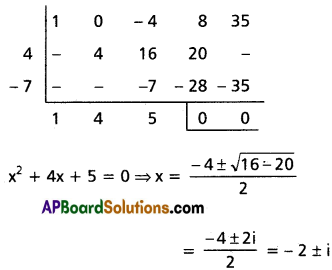
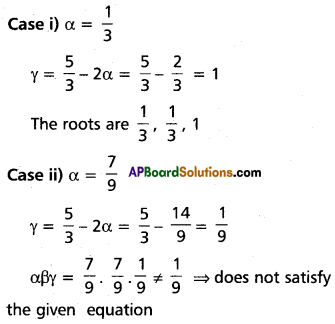
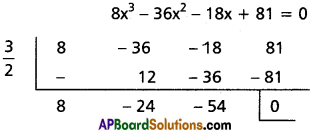
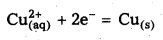
(i.e.,) nλ = (DB + BC) [where n = order of diffraction]
DB = BC = d sin θ [θ = angle of incident beam,]
(DB + BC) = 2d sin θ [d = distance between the planes]
nλ = 2d sin θ
This relation is known as Bragg’s equation.