AP 7th Class Maths Notes 4th Lesson Lines and Angles

Students can go through AP Board 7th Class Maths Notes 4th Lesson Lines and Angles to understand and remember the concept easily.

AP Board 7th Class Maths Notes 4th Lesson Lines and Angles

→ Euclid (323 – 283 BC) was a Greek mathematician. He is well known as ‘Father of Geometry.’ He wrote a book named ‘Elements’ which was a collection of 13 volumes, dealing with geometry. ‘Elements’ was most influenced work in the history of mathematics. In his books he deduced many theorems using axioms. These theorems are being used in the study of Euclidean geometry.

→ If the sum of two angles is 90°, then the angles are called as complementary angles to each other.

→ If the sum of two angles is 180°, then the angles are called as supplementary angles to each other.

→ If the sum of the two angles is 360°, then the angles are called as conjugate angles to each other.

→ Two angles are said to be adjacent angles, if they have a common vertex, common arm and lie on either side of the common arm.

→ A pair of adjacent angles whose sum is 180° are called as linear pair of angles.

→ When two straight lines intersect, the opposite angles at the point of intersection are called as vertically opposite angles.

AP 7th Class Maths Notes 4th Lesson Lines and Angles

→ Vertically opposite angles are equal.

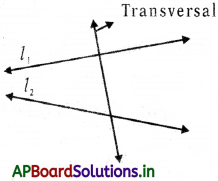
→ A transversal is a straight line that intersects two or more straight lines at distinct points.

→ When a transversal intersects a pair of parallel lines p and q, let the angles formed be ∠1, ∠2, ∠3, ∠4, ∠5, ∠6, ∠7 and ∠8.
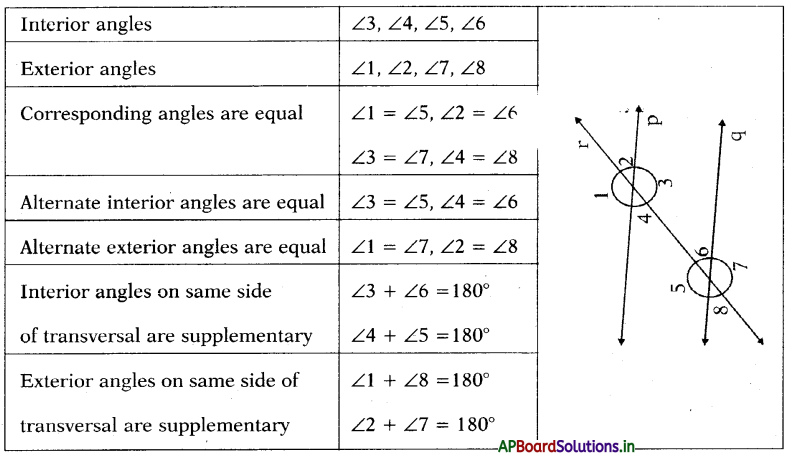
AP 7th Class Maths Notes 4th Lesson Lines and Angles 1

→ When a transversal intersects two lines,
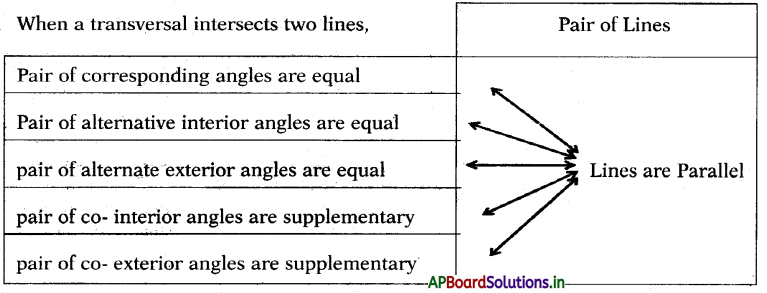
AP 7th Class Maths Notes 4th Lesson Lines and Angles 2
AP 7th Class Maths Notes 4th Lesson Lines and Angles 3

AP 7th Class Maths Notes 4th Lesson Lines and Angles

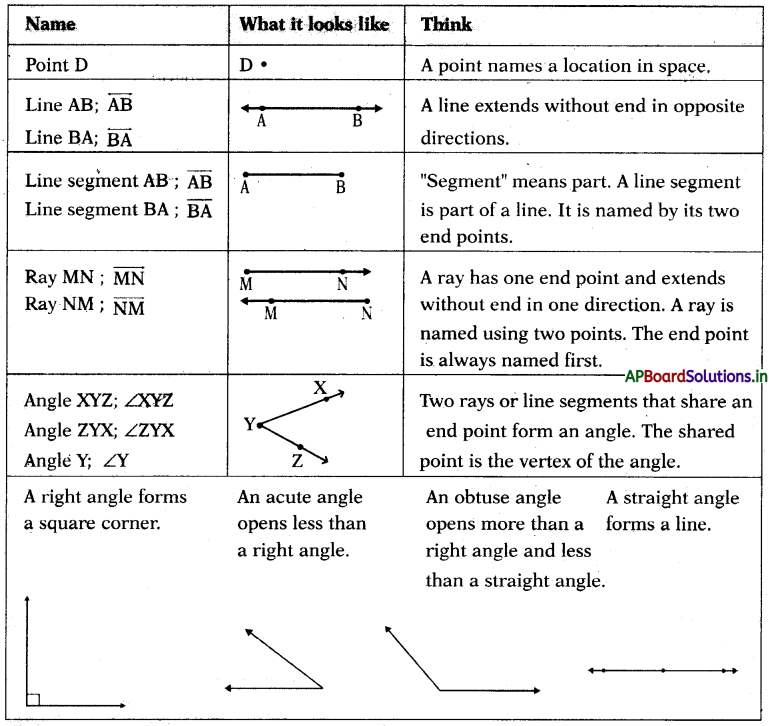
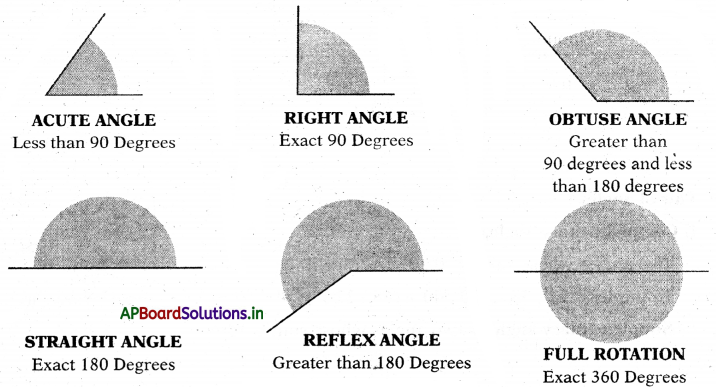
→ Types of angles:
AP 7th Class Maths Notes 4th Lesson Lines and Angles 4

→ Parallel lines: Two or more lines are said to be parallel if they never meet each other however long they are produced.

AP 7th Class Maths Notes 4th Lesson Lines and Angles 5

→ Intersecting lines: Two lines are said to be intersecting if they meet at a point or meet at a point if they are produced.
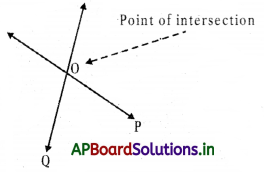
AP 7th Class Maths Notes 4th Lesson Lines and Angles 6

→ Perpendicular lines: Two lines are said to be perpendicular if they meet at right angles. In other words the angle between them is 900.
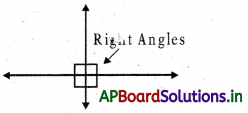
AP 7th Class Maths Notes 4th Lesson Lines and Angles 7

→ Pairs of Lines in a Plane:
Intersecting Lines: Lines that cross each other \(\overleftrightarrow{\mathrm{AB}}\) intersects \(\overleftrightarrow{\mathrm{PQ}}\) at C.
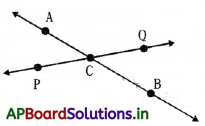
AP 7th Class Maths Notes 4th Lesson Lines and Angles 8

→ Parallel Lines: Lines that do not touch. They are always the same distance apart. \(\overrightarrow{\mathrm{AB}} \| \overleftrightarrow{\mathrm{PQ}}\)
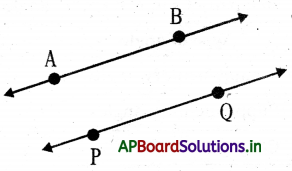
AP 7th Class Maths Notes 4th Lesson Lines and Angles 9

→ Perpendicular Lines: Lines that cross a right angles. \(\overrightarrow{\mathrm{AB}} \perp \overleftrightarrow{\mathrm{PQ}}\)
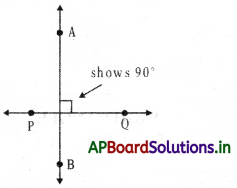
AP 7th Class Maths Notes 4th Lesson Lines and Angles 10

→ Pair of angles:
(i) Complementary angles:
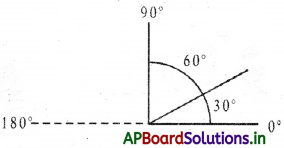
AP 7th Class Maths Notes 4th Lesson Lines and Angles 11
Two angles whose sum is 90°.
Examples: (52°, 38°), (50°, 406), (68°, 22°) 180°

(ii) Supplementary angles: Two angles whose sum is 180°
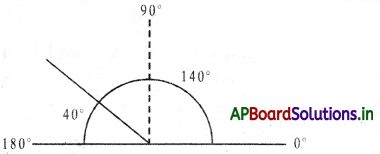
AP 7th Class Maths Notes 4th Lesson Lines and Angles 12
Examples: (52°, 128°), (50°, 130°), (68°, 112°)

(iii) Explementary or Conjugate angles: Two angles whose sum is 360°.
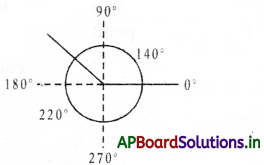
AP 7th Class Maths Notes 4th Lesson Lines and Angles 13
Examples: (132°, 228°), (150°, 210°), (168°, 192°)

  • Complementary angles are always acute.
  • In a pair of complementary angles no angle is obtuse.
  • Two acute angles can’t be supplementary.
  • Two obtuse angles can’t be supplementary.

AP 7th Class Maths Notes 4th Lesson Lines and Angles

→ In a pair of supplementary angles one angle must be obtuse or both are right angles.

Type of angleFirst AngleSecond angle in the pair
Complementary anglesx(90 –  x)
Supplementary anglesx(180 – x)
Conjugate anglesx(360 –  x)

→ Adjacent angles: Two angles are said to be adjacent if they have

  • a common vertex
  • a common arm
  • and the two angles lie on either side of the common arm.

Example:
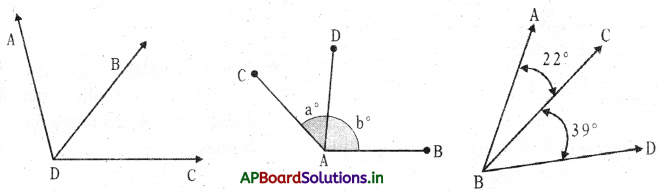
AP 7th Class Maths Notes 4th Lesson Lines and Angles 14
Angle ADB and Angle BDC share a common vertex of D and have a common side of DB.

  • The interior of adjacent angles must have no common points.
  • The adjacent angles need not be complementary or supplementary.

→ Linear pair of angles: A pair of adjacent angles whose sum is 180° is called a pair of linear angles.
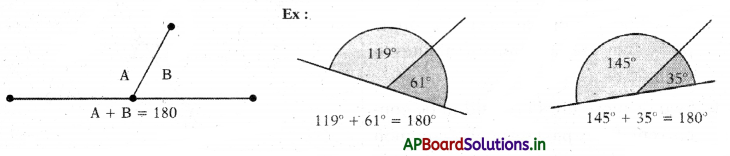
AP 7th Class Maths Notes 4th Lesson Lines and Angles 15

  • A linear pair of angles must be supplementary.
  • A pair of supplementary angles need not necessarily be a linear pair.

→ Vertically opposite angles: When a pair of straight lines intersect each other, the pairs of opposite angles thus formed at the point of intersection are called vertically opposite angles.
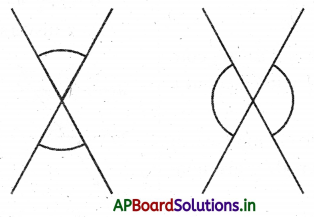
AP 7th Class Maths Notes 4th Lesson Lines and Angles 16

→ When a pair of lines intersects each other, the pairs of vertically opposite angles thus formed are equal.
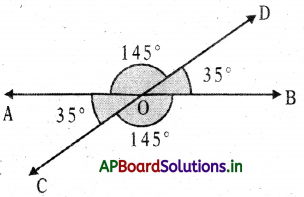
AP 7th Class Maths Notes 4th Lesson Lines and Angles 17

→ Transversal: A transversal is a straight line that intersects two or more straight lines at distinct points. Here are two lines l1 and l2 is a transversal.
AP 7th Class Maths Notes 4th Lesson Lines and Angles 18

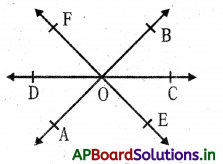
→ Two or more lines are said to be con current if they pass through a common point i.e., they intersect at a point.
AP 7th Class Maths Notes 4th Lesson Lines and Angles 19

  • Here the lines AB, CD and EF are concurrent lines since they intersect at a common point O.
  • If two or more lines do not intersect at a common point, then they are non-concurrent.

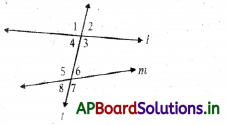
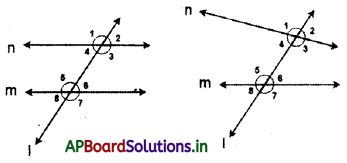
→ Angles made by a transversal: When a transversal t intersects a pair of lilies ‘l’ and ‘m’, there form eight angles.
AP 7th Class Maths Notes 4th Lesson Lines and Angles 20

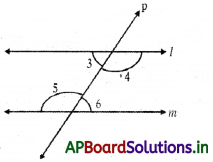
→ Interior angles: Angles lying between the two lines are called interior angles. Here, ∠3, ∠4, ∠5 and ∠6 are interior angles.
AP 7th Class Maths Notes 4th Lesson Lines and Angles 21

→ Exterior angles: Angles lying outside the two lines are called exterior angles. Here ∠1, ∠2, ∠7 and ∠8 are exterior angles.
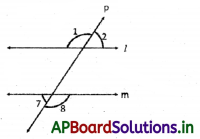
AP 7th Class Maths Notes 4th Lesson Lines and Angles 22

AP 7th Class Maths Notes 4th Lesson Lines and Angles

→ Corresponding angles: Two angles are said to form a pair of corresponding angles if

  • One is interior and other is exterior
  • They are not adjacent
  • They lie on the same side of the transversal.
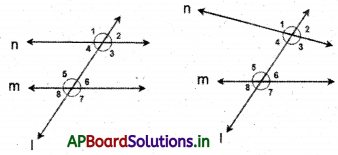
AP 7th Class Maths Notes 4th Lesson Lines and Angles 23
Here the pairs are (∠1 and ∠5), (∠2 and ∠6), (∠3 and ∠7), (∠4 and ∠8).

→ If lines are parallel then the pairs of corresponding angles become equal. (∠1 = ∠5), (∠2 = ∠6), (∠3 = ∠7), (∠4 = ∠8)
Conversely if a transversal intersects a pair of straight lines making corresponding angles equal, then the lines are parallel.

→ Alternate interior angles: Two angles are said to form a pair of alternate interior angle, if

  • both are interior
  • they are not adjacent
  • they lie on the either side of the transversal.
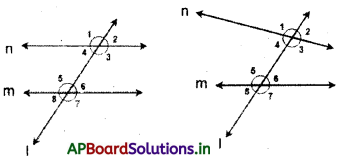
AP 7th Class Maths Notes 4th Lesson Lines and Angles 24
Here the pairs are (∠1 and ∠7), (∠2 and ∠8).
If lines are parallel, then the pairs of alternate interior angles become equal.
(∠1 = ∠7), (∠2 = ∠8).

Conversely, if a transversal intersects a pair of straight lines making alternate exterior angles equal, then the lines are parallel.

→ Alternate exterior angles: Two angles are said to form a pair of alternate exterior angle if

  • both are exterior
  • they are not adjacent
  • they lie on the either side of the transversal.
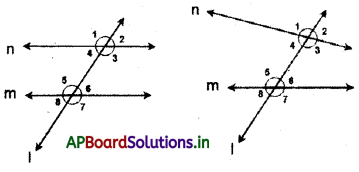
AP 7th Class Maths Notes 4th Lesson Lines and Angles 25
Here the pairs are (∠3 and ∠4), (∠5 and ∠6).
If lines are parallel, then the pairs of co-interior angles become supplementary.
(∠3 + ∠4 = 180°), (∠5 + ∠6 = 180°). Conversely if a transversal intersects a pair of straight lines making co-interior angles supplementary, then the lines are parallel.

→ Co-interior angles: Interior angles on same side of transversal are co-interior angles.

  • both are interior
  • they are adjacent
  • they lie on the either side of the transversal.
AP 7th Class Maths Notes 4th Lesson Lines and Angles 26
Here the pairs are (∠3 and ∠5), (∠4 and ∠6).
If lines are parallel, then the pairs of alternate interior angles become equal.
(∠3 = ∠5), (∠4 = ∠6).
Conversely, if a transversal intersects a pair of straight lines making alternate interior angles equal, then the lines are parallel.

AP 7th Class Maths Notes 3rd Lesson Simple Equations

Students can go through AP Board 7th Class Maths Notes 3rd Lesson Simple Equations to understand and remember the concept easily.

AP Board 7th Class Maths Notes 3rd Lesson Simple Equations

→ Bhaskara-II: Bhaskara-II is a famous mathematician of ancient India. He wrote Siddhanta Shiromani at the age of 36 in 1150 A.D. and this work (consisting of about 1450 verses) was divided into four parts.

  • Lilavati (ARITHMETIC) has 278 verses.
  • Bijaganit (ALGEBRA) has 213 verses.
  • Goladhyaya (sphere/celestial globe) has 451 verses.
  • Grahaganit (mathematics of the planets) has 501 verses.

Linear equations in one variable and several variables were one of the equations that Bhaskara II was interested in, and he presented many problems below one problem is an example to illustrate it.

MA fifth part of a swarm of bees came to rest on the flower of Kadamba, a third on the flower of Silinda. Three times the difference between these two numbers flew over a flower of Krutaja, and one bee alone remained in the air, attracted by the perfume of a jasmine in bloom. Tell me, beautiful girl, how many bees were in the swarm ?

→ An open sentence which contain sign “ = ” is called an equation.

→ An equation which involves only one variable whose highest power 1 is known as simple equation.

AP 7th Class Maths Notes 3rd Lesson Simple Equations

→ Solution of simple equation or root of simple equation: The value of the variable for which equation becomes true is called the solution or the root of the equation.

→ The equation remains unchanged if:
(a) The same number is added to both sides of the equation.
(b) The same number is subtracted from both sides of the equation.
(c) The same number is multiplied to both sides of the equation.
(d) The same non-zero number divides both sides of the equation.

→ The process of changing the term from one side of the equation to other side is called transposition.

→ So, by transposing a term we simply change its sign and carry it to the other side of the equation. Thus, in transposing terms from LHS to RHS.

  • ‘+ quantity’ becomes ‘-‘ quantity’
  • ‘-‘ quantity’ becomes ‘+’ quantity’
  • ‘×’ quantity’ becomes ‘÷’ quantity’
  • ‘÷’ quantity’ becomes ‘×’ quantity’.

→ Open sentence: A mathematical sentence whose truth value can’t be determined is called as open sentence.
Example: The age of GOPI is more than 12 years.

→ Equation: An open sentence containing an equality (=) symbol is called an equation.
Example: The age of GOPI =12 years.

An equation involving only one variable whose highest power is 1 is known as a simple equation.
Example: 7 + x = 15
a + 3 = 8
8 – y = 3

→ Solution of a simple equation: The value of variable for which the equation becomes
true or equal on both sides is called the solution or root of the simple equation.
Example: 7 + x = 15 becomes true or qqual on both sides when x = 8. Here 8 is called the solution of the simple equation 7 + x = 15.

→ Rules of simple equations:

  • The equation remains unchanged if the same number is added on both sides of the equation.
    Example: 7 + x = 15 is same as 10 + x = 18 (adding 3 on both sides)
  • The equation remains unchanged if the same number is subtracted from both sides of the equation.
    Example: 7 + x = 15 is same as 4 + x = 12 (subtracting 3 from both sides)
  • The equation remains unchanged if both sides of the equation are multiplied by the
    same positive number. ‘
    Example: 7 + x – 15 is same as 14 + 2x = 30 (multiplied by 2 on both sides)
  • The equation remains unchanged if the both sides of the equation are divided by a non-zero positive number.
    Example: 7+x = 15 is same as \(\frac{7}{2}+\frac{x}{2}=\frac{15}{2}\) (divided by 2 on both sides).

AP 7th Class Maths Notes 3rd Lesson Simple Equations

→ Transposition: The process of transferring the terms of a simple equation from one side to other is called transposition of term.

  • When a term is transposed.
  • It gets opposite sign.
  • It means a positive quantity when transposed it gets a negative sign.
  • Similarly, a negative quantity when transposed it gets a positive sign.
  • Also when a term multiplying one side of a simple equation is transposed it divides the other side.
  • Similarly when a term dividing one side of a simple equation is transposed it multiplies the other side.

→ Solving a real life problem:

  • Read the problem carefully and separate knowns and unknowns i.e. identify what is given and what is to be found.
  • Represent the unknowns by variables such as x, y, z, …….
  • Translate the problem to the language of mathematical statements.
  • Form the simple equations using the conditions given in the problem.
  • Solve the simple equations.
  • Verify the answer.

AP 7th Class Maths Notes 2nd Lesson Fractions, Decimals and Rational Numbers

Students can go through AP Board 7th Class Maths Notes 2nd Lesson Fractions, Decimals and Rational Numbers to understand and remember the concept easily.

AP Board 7th Class Maths Notes 2nd Lesson Fractions, Decimals and Rational Numbers

→ John Napier (1550-1617)
John Napier of Merchiston (UK) was born in the year 1550. He started his formal education at the age of 13 as was the common tradition of that time. However he soon dropped out of school and travelled to Europe. He returned to Scotland at the age of 21.

John Napier is founder of logarithms and he became so after spending long hours, doing lengthy calculations of astronomy. He also invented the so-called ‘Napier’s strips’ which were devices that could be used as calculators.
Napier also made improvements to the idea of the decimal fraction by starting the use of decimal point, a practice that very soon became common throughout Britain. Napier was widely recognised for his work in mathematics and astronomy. He died in the year 1617.

→ To add or subtract fractions they must have same denominator (like fractions).

→ For multiplication of fractions, we simply multiply numerators and multiply denominators.

→ To divide one fraction by another fraction, we have to multiply one fraction with the reciprocal of the another fraction.

→ To multiply decimal numbers by 10, 100, 1000, shift the decimal point in the product as many places to the right as number of zeroes after 1.

→ The number of decimal digits in the product of any two decimal numbers is equal to the sum of decimal digits that are multiplied.

AP 7th Class Maths Notes 2nd Lesson Fractions, Decimals and Rational Numbers

→ While dividing a decimal number by 10, 100 or 1000, the digits of the number and the quotient are same but the decimal point in the quotient shifts to the left by as many places as there are zeros 1 after.

Fraction: Apart of a whole is known as a fraction.
Example: \(\frac{3}{4}, \frac{5}{8}\)

1/8 Fraction:
AP 7th Class Maths Notes 2nd Lesson Fractions, Decimals and Rational Numbers 1

Fraction of a whole number: To find the fraction of a whole number we multiply the fraction with the whole number.
Example: \(\frac{3}{4}\) of 36 = \(\frac{3}{4}\) × 36 = 3 × 9 = 27

→ Total number of students in a class is 48. On a particular day only \(\frac{5}{8}\) of the students are present. Find the number of students present in the class.
Answer:
Number of students present in the class = \(\frac{5}{8}\) of 48 = \(\frac{5}{8}\) × 48 = 5 × 6 = 30

→ Fraction of a fraction: To find the fraction of a fractional number we multiply the first fraction with the second fraction.
Example: \(\frac{3}{4}\) of \(\frac{5}{8}\) = \(\frac{3}{4} \times \frac{5}{8}=\frac{15}{32}\)

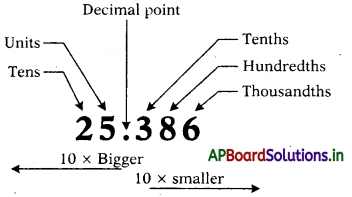
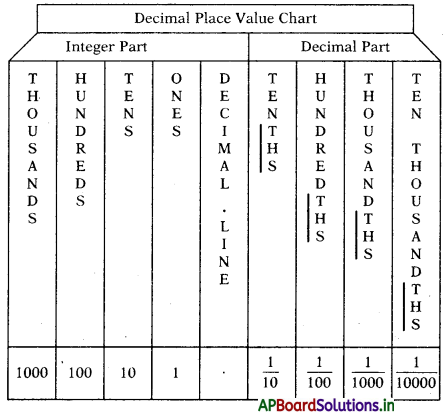
→ Decimal fractions: Fractions with denominators 10, 100, 1000, 10000, ………….. etc. are called decimal numbers or decimal fractions.
Example: \(\frac{1}{10}, \frac{1}{100}, \frac{1}{1000}\) are decimal fractions.
AP 7th Class Maths Notes 2nd Lesson Fractions, Decimals and Rational Numbers 2
Example:
AP 7th Class Maths Notes 2nd Lesson Fractions, Decimals and Rational Numbers 3

Note: The fraction \(\frac{1}{10}, \frac{1}{100}, \frac{1}{1000}\),………… can be written as 0.1, 0.01, 0.001,… and read as

  • Zero point one
  • Zero point zero one
  • Zero point zero zero one.

AP 7th Class Maths Notes 2nd Lesson Fractions, Decimals and Rational Numbers

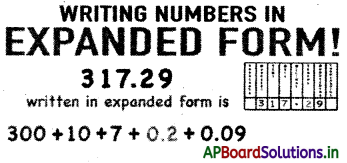
→ Expanded form of decimal numbers:
AP 7th Class Maths Notes 2nd Lesson Fractions, Decimals and Rational Numbers 4

→ Addition and subtraction of decimal numbers:

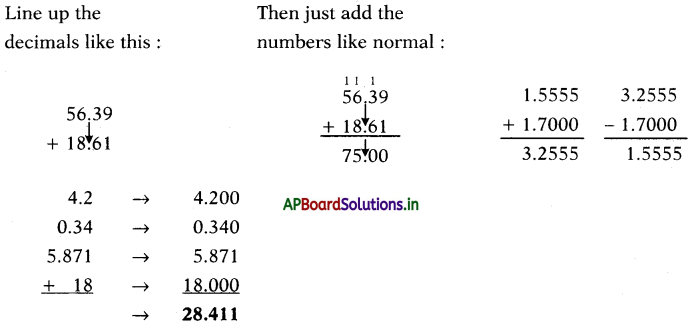
  • Step-1: Decimal numbers are written one below the other with the decimal points lined up in the same column.
  • Step-2: Add or subtract as we would do in the case of whole numbers.
  • Step-3: Place the decimal in the result in line with the other decimal points.

For example: 56.39 + 18.61
AP 7th Class Maths Notes 2nd Lesson Fractions, Decimals and Rational Numbers 5

→ Multiplication of decimals with whole numbers:
Method – 1:
Convert the decimal into a fraction and then multiply. Finally convert the fraction into decimal.
Example: 4 × 2.3 = 4 × \(\frac{23}{10}=\frac{92}{10}\) = 9.2

Method – 2:
Multiply the whole numbers ignoring the decimals.
4 × 2.3 = 92
Now place the decimal point in the product according to the number of decimal places in the given decimal. Here only one decimal place is the given number.
4 × 2.3 – 9.2

Method-3:
4 × 2.3 = 2.3 + 2.3 + 2.3 + 2.3 = 9.2
We can find the product by repeated addition also.
Multiplication of decimal by 10, 100, 1000, ….
To multiply decimal numbers by 10, 100, 1000,… etc., just shift the decimal point in the given decimal as many places to the right, as there are zeroes in the multiplier.

Example:

  • 236.568 × 10 = 2365.68 (one zero, shift decimal to one place to the right side)
  • 236.568 × 100 = 23656.8 (two zeroes, shift decimal to two places to the right side)
  • 236.568 × 1000 = 236568.0 (three zeroes, shift decimal to three places to the right side)

→ Multiplication of two decimals:
Multiplying decimals is the same as multiplying whole numbers except for the placement of the decimal point in the answer. When you multiply decimals, the decimal point is placed in the product so that the number of decimal places in the product is the sum of the decimal places in the factors.

  • Step-1: multiply the given numbers ignoring the decimals.
  • Step-2: the decimal point is placed in the product so that the number of decimal places in the product is the sum of the decimal places in the factors.

Example: 2.3 × 4.5 = 23 × 45 = 1035
Answer:
10.35

Note: The number of decimal places in the product of any two decimal numbers is equal to the sum of decimal digits that are multiplied.

AP 7th Class Maths Notes 2nd Lesson Fractions, Decimals and Rational Numbers

→ Division of decimal numbers:
While dividing decimal numbers by 10, 100, 1000 or the digits of the number and the digits of quotient are same, but the decimal point in the quotient shifts to the leftby as many places as there are zeroes in the divisor (after 1).

Example: ‘

  • 236.568 ÷ 10 = 23.6568 (one zero, shift decimal to one place to the left side)
  • 236.568 ÷ 100 = 2.36568 (two zeroes, shift decimal to two places to the left side)
  • 236.568 ÷ 1000 = 0.236568 (three zeroes, shift decimal to three places to the left side)

→ Division of decimal numbers by whole numbers:
Method-1: Convert the decimal number into fraction and then carry out simplifications as in the case of fractions.
Example: 3.6 ÷ 4
3.6 ÷ 4 = \(\frac{36}{10} \div \frac{4}{1}=\frac{36}{10} \times \frac{1}{4}=\frac{9}{10}\) = 0.9

Method-2: Convert the decimal number in to a whole number and then carry out simplifications as in the case of fractions.

  • Divide the whole number by the divisor.
  • Then mark the decimal point to the quotient from right mode to left according to the number of decimal places in the given decimal.

Example: 3.6 ÷ 4
3.6 ÷ 4 = 36 ÷ 4 = 9 and the final answer is 0.9.

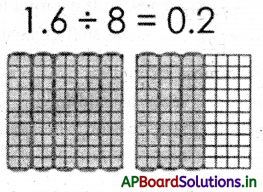
Method-3: Pictorial representation
Use Models to Divide Decimals by Whole Numbers
AP 7th Class Maths Notes 2nd Lesson Fractions, Decimals and Rational Numbers 6

AP 7th Class Maths Notes 2nd Lesson Fractions, Decimals and Rational Numbers

→ Division of decimal numbers by decimal number:
Method-1: Convert the decimals into equivalent fractions and then carryout simplifications as in the case of fractions.
Example: 1.5 ÷ 0.3
1.5 ÷ 0.3 = \(\frac{15}{10} \div \frac{3}{10}=\frac{15}{10} \times \frac{10}{3}=\frac{15}{3}\) = 5

Method-2: Convert the decimal numbers into equivalent whole numbers and then carryout simplifications as in the case of whole numbers.
Example: 1.5 ÷ 0.3
1.5 ÷ 0.3 = (1.5 × 10) ÷ (0.3 × 10)
= 15 ÷ 3 = 5

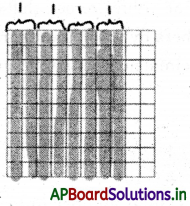
Method-3: Pictorial representation
Example: 0.8 ÷ 0.2
0.8 ÷ 0.2 = 4
AP 7th Class Maths Notes 2nd Lesson Fractions, Decimals and Rational Numbers 7

AP 7th Class Maths Notes 12th Lesson Symmetry

Students can go through AP Board 7th Class Maths Notes 12th Lesson Symmetry to understand and remember the concept easily.

AP Board 7th Class Maths Notes 12th Lesson Symmetry

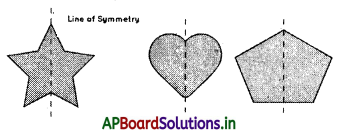
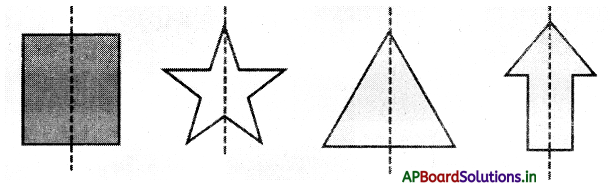
→ If a line divide the given figure into two coincidental parts, then the figure is said to bd ‘symmetrical’ and the line is called the ‘axis of symmetry’ or ‘line of symmetry’.

→ A figure can have one or more than one lines of symmetry or axes of symmetry.

→ If we rotate a figure, about a fixed point by a certain angle and the figure looks exactly the same as before, we say that the figure has rotational symmetry.

→ The angle of turning during rotation is called the angle of rotation.

→ All figures have rotational symmetry of order 1, as can be rotated completely through 360° fo come back to their original position. So, we say that a figure has rotational symmetry only when the order of symmetry is more than 1.

→ Some shapes have only line symmetry and some have only rotational symmetry and some have both. Squares, equilateral triangles and circles have both line and rotational symmetry.

AP 7th Class Maths Notes 12th Lesson Symmetry

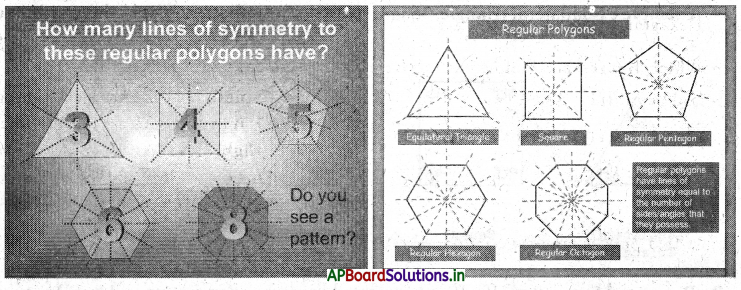
→ Each regular polygon has as many lines of symmetry’ as it’s sides.
AP 7th Class Maths Notes 12th Lesson Symmetry 1

→ Symmetry: Symmetry is defined as a proportionate and balanced similarity that is found in two halves of an object, that is, one-half is the mirror image of the other half. An object has symmetry’ it can be divided into two identical pieces.
AP 7th Class Maths Notes 12th Lesson Symmetry 2

→ Real-life examples of symmetry:

  • Reflection of trees in clear water and reflection of mountains in a lake.
  • Wings of most butterflies are identical on the left and right sides.
  • Some human faces are the same on the left and right side.
  • People can also have a symmetrical mustache.

→ In general usage, symmetry most often refers to mirror or reflective symmetry; that is a line (in 2-D) or plane (in 3-D) can be drawn through an object such that the two halves are mirror images of each other. An isosceles triangle and a human face are examples.

→ There are four types of symmetry that can be observed in various cases.

  • Translational symmetry.
  • Rotational symmetry.
  • Reflexive symmetry.
  • Glide symmetry.

→ Line of symmetry:
The imaginary axis or line along which you can fold a figure to obtain the symmetrical halves is called the line of symmetry.

→ A figure has a line of symmetry, if there is a line about which the figure may be folded so that the two parts of the figure will coincide. A figure has a line of symmetry, if there is a line about which the figure may be folded so that the two parts of the figure will coincide.
AP 7th Class Maths Notes 12th Lesson Symmetry 3

The line of symmetry can be categorized based on its orientation as:

  • Vertical Line of Symmetry
  • Horizontal Line of Symmetry
  • Diagonal Line of Symmetry

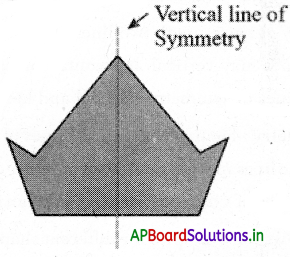
→ A vertical line of symmetry is that line that runs down vertically, divides an image into two identical halves. For example, the following shape can be split into two identical halves by a standing straight line. In such a case, the line of symmetry is vertical.
AP 7th Class Maths Notes 12th Lesson Symmetry 4

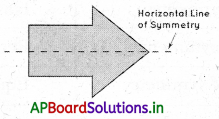
→ The horizontal line of symmetry divides a shape into identical halves, when split horizontally, i.e., cut from right to left or vice-versa. For example, the following shape can be split into two equal halves when cirt horizontally. In such a case, the line of symmetry is horizontal.
AP 7th Class Maths Notes 12th Lesson Symmetry 5

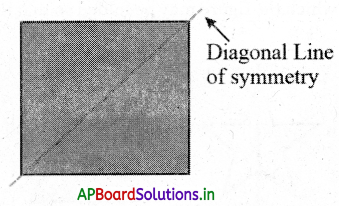
→ A diagonal line of symmetry divides a shape into identical halves when split across the diagonal corners. For example, we can split the following square shape across the corners to form two identical halves. In such a case, the line of symmetry is diagonal.
AP 7th Class Maths Notes 12th Lesson Symmetry 6
→ A line of symmetry is an axis along which an object when cut, will have identical halves. These objects might have one, two, or multiple lines of symmetry.

  • One line of symmetry
  • Two lines of symmetry
  • Infinite lines of symmetry

→ One Line of Symmetry: Figures with one line of symmetry are symmetrical only about one axis. It may be horizontal, vertical, or diagonal. For example, the letter “A” has one line of symmetry, that is the vertical line of symmetry along its center.

→ Two Lines of Symmetry: Figures with two lines of symmetry are symmetrical only about two lines. The lines may vertical, horizontal, or diagonal lines. For example, the rectangle has two lines of symmetry, vertical and horizontal.

→ Infinite Lines of Symmetry: Figures with infinite lines of symmetry are symmetrical only about two lines. The lines may vertical, horizontal, or diagonal lines. For example, the rectangle has two lines of symmetry, vertical arid horizontal.

AP 7th Class Maths Notes 12th Lesson Symmetry

→ The following table shows the examples for different shapes with the number of lines of symmetry that they have.

Number of lines of symmetryExamples of figures
No line of symmetryScalene triangle
Exactly one line of symmetryIsosceles triangle
Exactly two lines of symmetryRectangle .
Exactly three lines of symmetryEquilateral triangle

→ Regular Polygon:
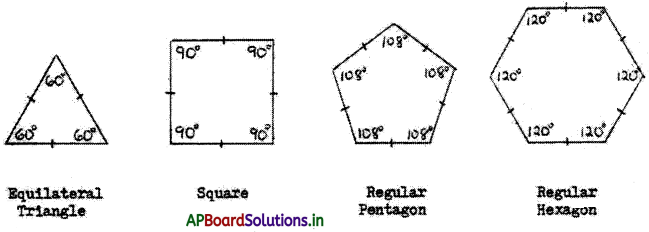
If all the sides of a polygon or angles of a polygon are equal, then it is called a regular polygon.
Example: Equilateral triangle, square etc.
AP 7th Class Maths Notes 12th Lesson Symmetry 7

→ Rotational Symmetry: If a figure is rotated around a centre point and it still appears exactly as it did before the rotation, it is said to have rotational symmetry.
Example: Squares, circles, regular hexagon, etc. have rotational symmetry.

→ Center of Rotation: For a figure or object that has rotational symmetry, the fixed point around which the rotation occurs is called the centre of rotation.
Example: The centre of rotation of a table fan is the centre of the table fan from which its blades originate.

→ Angle of Rotational Symmetry: For a figure or object that has rotational symmetry, the angle of turning during rotation is called the angle of rotation.
Example: When a square is rotated by 90 degrees, it appears the same after rotation. So, the angle of rotation for a square is 90 degrees.

→ In the same way, a regular hexagon has an angle of symmetry as 60 degrees, a regular pentagon has 72 degrees and so on.

AP 7th Class Maths Notes 12th Lesson Symmetry

→ Order of Rotational Symmetry: The number of positions in which a figure can be rotated and still appears exactly as it did before the rotation, is called the order of symmetry. For example, a star can be rotated 5 times along its tip and look at the same every time. Hence, its order of symmetry is 5.
AP 7th Class Maths Notes 12th Lesson Symmetry 8

If we consider the order of symmetry for regular hexagon it is equal to 6, since it has 6 equal sides and is rotated with an angle of 60 degrees.
AP 7th Class Maths Notes 12th Lesson Symmetry 9
Number of lines of symmetry of a regular polygon is equal to number of sides in it.

→ Rotational Symmetry Letters: There are many capital letters of English alphabets which has symmetry when they are rotated clockwise or anticlockwise about an axis.
Example : Z, H, S, N and O. When these letters are rotated 180° clockwise or anticlockwise the letters appears to be same.

AP 7th Class Maths Notes 11th Lesson Area of Plane Figures

Students can go through AP Board 7th Class Maths Notes 11th Lesson Area of Plane Figures to understand and remember the concept easily.

AP Board 7th Class Maths Notes 11th Lesson Area of Plane Figures

→ Aryabhatta (476-550 AD):
The great Indian mathematician Aryabhatta calcul¬ated the value of V (pie) at 3.1416. In Ganitapada 6, Aryabhatta given the formula to find area of a triangle as ‘Tribhujasya Phalasariram Samadalakoti Bhujardhasamvargah’ that translates to ‘For a triangle, the result of a perpendicular with the half side is the area’.

→ Area of Triangle:
AP 7th Class Maths Notes 11th Lesson Area of Plane Figures 1
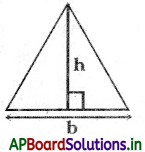
Area of Triangle = \(\frac{1}{2}\) × base × height
= \(\frac{1}{2}\) × b × h

→ Area of a right-angled triangle:
AP 7th Class Maths Notes 11th Lesson Area of Plane Figures 2
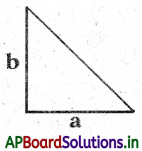
Area of a right-angled triangle = \(\frac{1}{2}\) product of sides forming the right angle
= \(\frac{1}{2}\)a × b

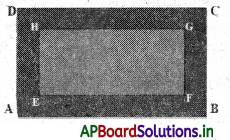
→ The area of the rectangular path
= Area of outer rectangle ABCD – Area of inner rectangle EFGH
= (L × B) – (l × b)
AP 7th Class Maths Notes 11th Lesson Area of Plane Figures 3
Note: If path is out side the rectangle of length (Z), breadth (b) then L = l + 2w, B = b + 2w.
If path is inside the rectangle of length (L), breadth (B)
then l = L – 2w, b = B – 2w.

AP 7th Class Maths Notes 11th Lesson Area of Plane Figures

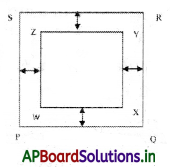
→ Area of square:
AP 7th Class Maths Notes 11th Lesson Area of Plane Figures 4
The Area of square path = Area of outer square PQRS – Area of inner square WXYZ.

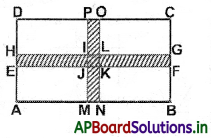
→ Area of shaded portion:
AP 7th Class Maths Notes 11th Lesson Area of Plane Figures 5
Area of shaded portion = Area of EFGH + Area of MNOP – Area of IJKL

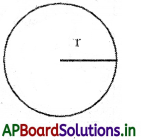
→ Area of Circle:
AP 7th Class Maths Notes 11th Lesson Area of Plane Figures 6
The area of the circle A = πr2

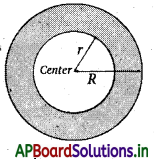
→ Area of Circular Path:
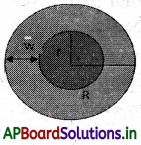
AP 7th Class Maths Notes 11th Lesson Area of Plane Figures 7
The area of circular path = Area of outer circle – Area of inner circle
= πR2 – πr2
= π(R2 – r2)
= π(R + r)(R – r) sq.unit.s
Note: If inner circle radius ‘r’ and width of path ‘w’ are given then outer circle radius ‘R’ = (r + w)

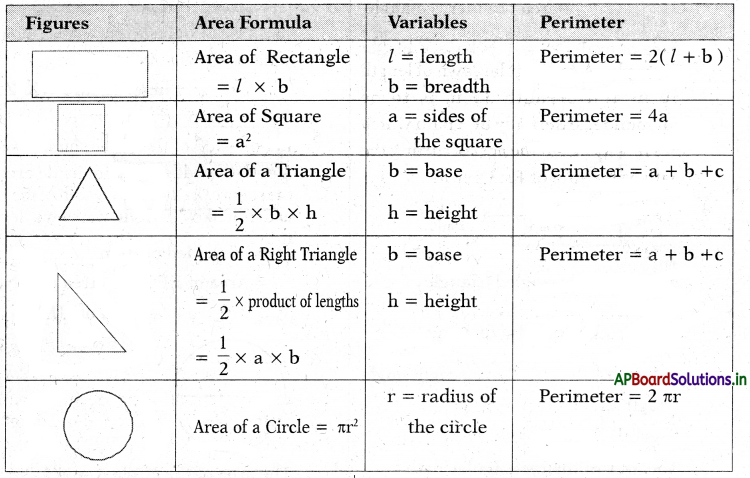
→ Area Formula: The area of a closed geometric figure is the measurement of space en¬closed by it. Area formula .for polygons can be represented using algebraic expressions.

→ Perimeter Formula: A Perimeter is the length of the boundary of a closed geometric figure. Algebraic expressions can be used to represent the perimeter formula for the regular polygons.
AP 7th Class Maths Notes 11th Lesson Area of Plane Figures 8

→ Area of the rectangular path:
We will use the formula Area of rectangle = l × b, where l is the length of the rectangle and b is the breadth of the rectangle.

→ Complete step-by-step answer:
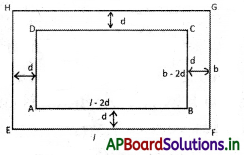
From the figure, we can observe that the area of the path is the difference in the area of the bigger rectangle and the smaller rectangle.
AP 7th Class Maths Notes 11th Lesson Area of Plane Figures 9
Let the length of the outer rectangle = L
And the breadth of the outer rectangle = B
A path of width w is laid inside around the rectangle.

In the figure width of the path is denoted by d.
Sometimes we denote it by w.
Then, the length of the inner rectangle = l = (L – 2w)
And the breadth of the inner rectangle = b = (B – 2w)
Area of path = area of outer rectangle – area of inner rectangle = L.B – (L – 2w)(B – 2w)

If the path is laid outside and around a rectangle of dimensions l and b,
then, the length of the outer rectangle = L = (l + 2w)
And the breadth of the outer rectangle = B = (b + 2w)
Area of path = area of outer rectangle – area of inner rectangle = (l + 2w)(b + 2w) – lb

AP 7th Class Maths Notes 11th Lesson Area of Plane Figures

Example:
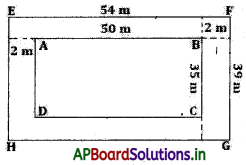
A rectangular lawn of length 50 m and breadth 35 m is to be surrounded externally by a path which is 2 m wide. Find the cost of turfing the path at the rate of Rs.3 per m2.
AP 7th Class Maths Notes 11th Lesson Area of Plane Figures 10
Answer:
Length of the lawn = 50 m
Breadth of the lawn = 35 m
Area of the lawn = (50 × 35) m2 = 1750 m2.

Length of lawn including the path = [50 + (2 + 2)] m = 54 m
Breadth of the lawn including the path [35 + (2 + 2)] m = 39 m
Area of the lawn including the path = 54 × 39 m2 = 2106 m2

Therefore, area of the path = (2106- 1750) m2 = 356 m2
For 1 m2, the cost of turfing the path = Rs. 3
For 356 m2, the cost of turfing the path = Rs.3 × 356 = Rs. 1068
Area of Square path: We will use the # formula Area of square = s × s, where s is the side of the square.

From the figure, we can observe that the area of the path is the difference in the area of the bigger square and the smaller square.
AP 7th Class Maths Notes 11th Lesson Area of Plane Figures 11
Let the side of the outer square = s
A path of width w is laid inside around the square.

In the figure width of the path is denoted by d. Sometimes we denote it by w.
Then, the side of the inner square = (s – 2w)
Area of path = area of outer square – area of inner square = s.s – (s – 2w)(s – 2w)

If the path is laid outside and around a square of side ‘s’, then, the side of the outer square = (s + 2w)
Area of path = area of outer square – area of inner square = (s + 2w)(s + 2w) – s.s

Example:
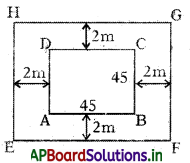
A square flowerbed is surrounded by a path 2 m wide around it. If the side of the flowerbed is 45 m, find the area of the path around the square flowerbed.
Answer:
AP 7th Class Maths Notes 11th Lesson Area of Plane Figures 12
In the above figure,
EFGH is the outer boundary of the path.
Let each side of the flowerbed = 45 m
Then, the area of the square flowerbed ABCD = 452 m2 = 2025

Now, the side of the square
EFGH = (45 + 2) m = 47 m
So, the area of square
EFGH = 472 m2 = 2209
Therefore, area of the path = Area of EFGH – Area of ABCD
= 2209 – 2025
= 184 m2

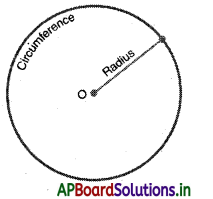
→ Area of a circle is the region occupied by the circle in a two-dimensional plane.
It can be calculated using a formula, A = πr2, (Pi r-squared) where r is the, radius of the circle. The unit of area is the square unit, such as m2, cm2, etc.
Area of Circle = πr2 or πd2/4, (square unit) where π = 22/7 or 3.14
AP 7th Class Maths Notes 11th Lesson Area of Plane Figures 13
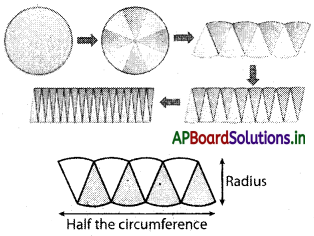
The circle is divided into equal sectors and the sectors are arranged as shown in the figure below. The area of the circle will be equal to that of the parallelogram-shaped figure formed by the sectors cut out from the circle. Since the sectors have equal area, each sector will have equal arc length. The red coloured sectors will contribute to half of the circumference and blue coloured sectors will contribute to the other half. If the number of sectors cut from the circle is increased, the parallelogram will eventually look like a rectangle with length equal to nr and breadth equal to r.
AP 7th Class Maths Notes 11th Lesson Area of Plane Figures 14
Now the area of the circle = Area of the parallelogram = πr . r = πr2

AP 7th Class Maths Notes 11th Lesson Area of Plane Figures

→ Area of pircular path or annulus: A circular path or an Annulus is a ring shaped object, bounded by the circumference of two concentric circles of two different radii. An Annulus is much like the throw-ring. One way to think of it is a circular disk with a circular hole . in it. The outer and inner circles that define the ring are concentric, that shares a common center point.
AP 7th Class Maths Notes 11th Lesson Area of Plane Figures 15
The dimensions of an annulus are defined by the outer radius R and the inner radius r, respectively. The area of a cir¬cular ring can be found by subtracting the area of a small circle from that of the area of the large circle.
Here are formulas to find Area of Annulus.
A = π(R2 – r2)
Where,
A = Area of Annulus
R = Outer radius
r = Inner radius
(Pi)π = is approximately 3.142

Example:
Find the area of the path, where a path is 14 cm wide, surrounds a circular lawn whose diameter is 360 cm.
Answer:
Given,
Width of the path =14 cm
Diameter of the inner circle is 360 cm.

Radius of inner circle (r) = 360/2 = 180 cm
Radius of outer circle is (R) = 180 + 14 = 194 cm

A = π(R2 – r2)
= 3.142(R + r)(R – r)
= 3.142 (194 + 180) (194 – 180)
= 3.142 × 374 ×14
= 16451.5 cm2

AP 7th Class Social Notes Chapter 3 పటాల ద్వారా అధ్యయనం

Students can go through AP Board 7th Class Social Notes 3rd Lesson పటాల ద్వారా అధ్యయనం to understand and remember the concept easily.

AP Board 7th Class Social Notes 3rd Lesson పటాల ద్వారా అధ్యయనం

→ పటాలు మన ప్రయాణాన్ని సులభతరం చేయడంతోపాటు గమ్యాన్ని చేరడంలో కచ్చితత్వాన్ని చూపుతూ మార్గనిర్దేశనం చేస్తాయి.

→ క్రీ.శ. 1498 లో వాస్కోడిగామా భారతదేశంలోని కాలికట్ చేరుకున్నాడు.

→ సముద్ర మార్గం ద్వారా ప్రపంచాన్ని చుట్టి వచ్చిన మొదటి వ్యక్తి మాజిలాన్.

→ పటాల తయారీలో నావికులు, ప్రయాణికుల సహకారం ఎంతో విలువైంది.

→ సుమేరియన్లు బాబిలోనియన్లు ‘మట్టి పలకలను’ పటాలుగా ఉపయోగించారు.

→ అక్షాంశ, రేఖాంశ భావనలను ‘గ్రీకులు’ పటాల తయారీకి అన్వయించారు.

→ పటాల తయారీలో టాలమీ కృషి విశేషమైనదే కాక విరివిగా ఉపయోగించబడింది.

→ గెరార్డస్ మెర్కేటర్ ప్రవేశపెట్టిన ప్రక్షేపణం పటాల తయారీలో విశేష మార్పులను తీసుకు వచ్చింది.

AP 7th Class Social Notes Chapter 3 పటాల ద్వారా అధ్యయనం

→ పటంలోని అంశాలను లేదా విషయాన్ని పట శీర్షిక తెలుపుతుంది.

→ భూ ఉపరితలంపై వాస్తవ దూరాన్ని పటంలో సవరించి చూపడాన్ని ‘స్కేలు’ తెలియజేస్తుంది.

→ స్కేలును మూడు రకాలుగా చూపవచ్చు. 1) వాక్య రూప స్కేలు, 2) గ్రాఫ్ రూపంలోని స్కేలు, 3) నైష్పత్తిక స్కేలు.

→ వాస్తవ అంశాలను పటంలో యథాతథంగా చూపించడం కష్టం కనుక పటాల తయారీదారులు చిహ్నాలను ఉపయోగిస్తారు.

→ భారత సర్వేక్షణ శాఖ (సర్వే ఆఫ్ ఇండియా) టోపోషీట్స్ తయారీలో సాంప్రదాయక చిహ్నాలు ఉపయోగిస్తుంది.

→ MSL-సముద్రమట్టం నుండి ఎత్తు. ఒక ప్రదేశం యొక్క ఎత్తును కొలవడంలో దీనిని ప్రామాణికంగా స్వీకరిస్తారు.

→ పటములోని వివరాలను చదవడానికి లేదా అర్థం చేసుకోవడానికి ఉపకరించే అంశాలు లేదా చిహ్నాలను కలిగి ఉండే పట్టికను ‘లెజెండ్’ అంటారు.

→ ఒక ప్రదేశం యొక్క ఉనికిని గుర్తించుటకు అక్షాంశ రేఖాంశాలు ప్రాథమిక సమాచారాన్ని ఇస్తాయి.

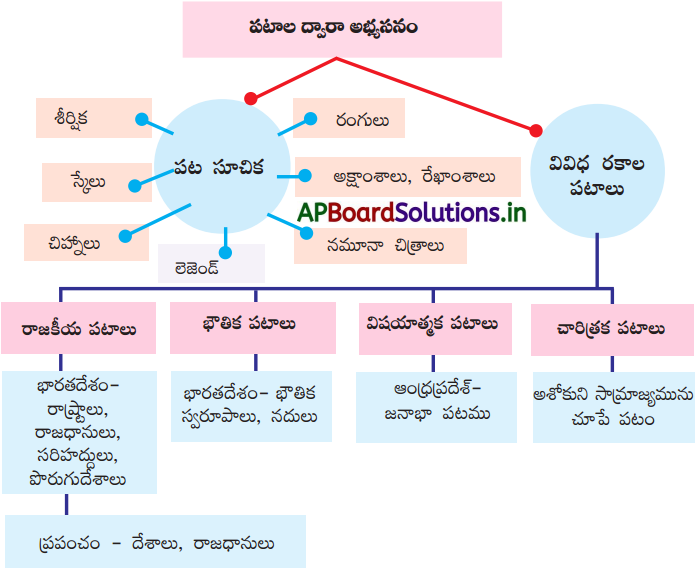
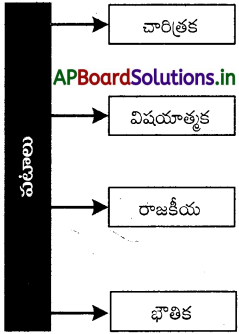
→ పటాలను స్కేలు, అంశాలు మరియు విషయాల ఆధారంగా రాజకీయ, భౌతిక, విషయ నిర్దేశిత మరియు చారిత్రక పటాలుగా వర్గీకరించవచ్చును.

→ ఒక ప్రదేశం యొక్క పాలనా పరిధిని, పొరుగు దేశాలను, సరిహద్దులను, రాజధానులను, రాజకీయ పటాలు తెలియజేస్తాయి.

→ భారతదేశం 3.28 మి.చ.కి.మీ. విస్తీర్ణంతో ప్రపంచంలో ఏడవ పెద్ద దేశంగా గుర్తించబడింది.

→ మన దేశంలో 28 రాష్ట్రాలు, 8 కేంద్ర పాలిత ప్రాంతాలు కలవు.

→ భారతదేశం ఆసియా ఖండపు దక్షిణ భాగంలో ఉంది. అక్షాంశ రీత్యా 894-37°6′ ఉత్తర అక్షాంశాల మధ్య మరియు 6877-97°25′ తూర్పు రేఖాంశాల మధ్య విస్తరించి ఉంది.

→ కర్కటరేఖ భారతదేశం మధ్య గుండా పోతుంది.

→ అక్షాంశ రేఖాంశాలతో ఏర్పడిన గడుల వంటి అమరికను ‘గ్రిడ్’ అంటారు.

→ పర్వత శ్రేణులు, పీఠభూములు, మైదానాలు, నదులు, ఎడారులు, సరస్సులు, మెట్టభూములు మొదలైన భౌతిక స్వరూపాలకు సంబంధించిన సమాచారాలను తెలిపే పటాలను భౌతిక పటాలు అంటారు.

→ సమాన ఎత్తులో ఉన్న ప్రదేశాలను కలుపుతూ గీసే ఊహారేఖలను కాంటూరు రేఖలు అంటారు.

→ ఏదేని ప్రత్యేక అంశము లేదా విషయాలను తెలుపుటకు తయారు చేయబడిన పటాలను విషయ నిర్దేశిత పటాలు అంటారు.

→ టోపోగ్రాఫిక్ పటాలు భూ ఉన్నతి, భౌతిక స్వరూపము, వ్యవసాయ భూములు, నేలలు, నదులు, జనావాసాలు మొదలైన వివరాలు చూపుతాయి.

→ గడచిపోయిన కాలం యొక్క వివరాలను చూపించే పటాలను ‘చారిత్రక’ పటాలు అంటారు.

→ అశోకుని శాసనాలు : బృహత్ శాసనాలు, స్తంభ శాసనాలు, చిన్న శిలా శాసనాలు.

→ గోళాకారంగా ఉన్న భూమిపై ఉన్న అంశాలైన ఖండాలు ప్రదేశాలను వాటి ఆకారం, దిశలను సమతల ఉపరితలంపై సవరించి చూపడాన్ని ప్రక్షేపణం’ అంటారు.

AP 7th Class Social Notes Chapter 3 పటాల ద్వారా అధ్యయనం

→ పటాల తయారీలో ప్రక్షేపణ పద్ధతిని ప్రవేశపెట్టినవారు ‘డచ్’ కార్టోగ్రాఫర్ ‘గెరార్డస్ మెర్కేటర్’.

→ రెండు కాంటూరు రేఖల ధ్య గల దూరం, ఎత్తుల మధ్య వ్యత్యాసాన్ని తెలుపుతుంది.

→ కాంటూరు రేఖలు దగ్గరగా ఉంటే ఆ ప్రదేశం యొక్క వాలు తక్కువగా ఉంటుంది. రేఖల మధ్య దూరం ఎక్కువగా ఉంటే ఆ ప్రాంతం యొక్క వాలు ఎక్కువగా ఉంటుంది.

→ రాజకీయ పటాలు : ఒక ప్రదేశం యొక్క పాలనా పరిధిని, పొరుగు దేశాలను, సరిహద్దులను, రాజధానులను తెలియజేసే పటాలు.

→ భౌతిక పటాలు : వివిధ భూస్వరూపాలను, నిర్దిష్ట రంగులు, ఎత్తు పల్లములతో సూచించే పటాలు భౌతిక పటాలు.

→ చారిత్రక పటాలు : గడచిపోయిన కాలం యొక్క వివరాలను చూపించే పటాలను చారిత్రక పటాలు అంటారు. ఉదా : అశోకుని శాసనాలు గల ప్రదేశాలు.

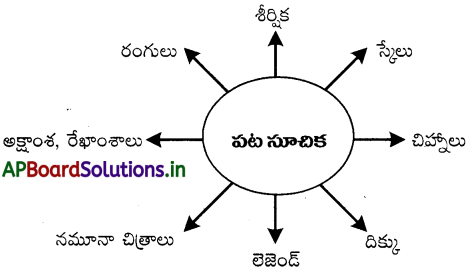
→ శీర్షిక : పటంలోని అంశాలను లేదా విషయాన్ని పట శీర్షిక తెలుపుతుంది.

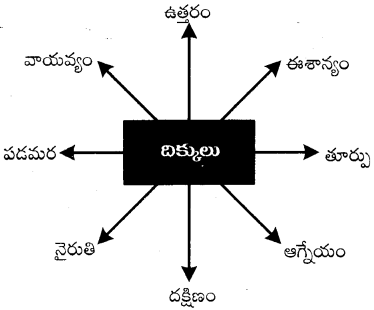
→ దిక్కులు : సాధారణంగా ఉత్తర దిక్కుకు పైన ఉండే విధంగా పటాలు తయారుచేయ బడతాయి. ప్రధాన దిక్కులు 4 (ఉత్తర, దక్షిణ, తూర్పు, పడమరలు).

→ స్కేలు : భూమిపై కల వాస్తవ దూరానికి పటంలో చూపబడిన దూరానికి కల నిష్పత్తిని స్కేలు అని పిలుస్తాం.

→ స్కేలు రకాలు :

  1. వాక్య రూప స్కేలు
  2. గ్రాఫ్ రూప స్కేలు
  3. నైష్పత్తిక స్కేలు.

→ సాంప్రదాయిక చిహ్నాలు : పటాల తయారీలో ఉపయోగించే కొన్ని గుర్తులు. (వీటిని సర్వే ఆఫ్ ఇండియా టోపోషీట్స్ తయారీలో ఉపయోగిస్తుంది).

→ నమూనా చిత్రాలు : గణాంక వివరాలను, సమాచారాన్ని, పరిమాణాత్మక, గుణాత్మక విశ్లేషణలుగా చూపడానికి వీటిని ఉపయోగిస్తారు.

→ లెజెండ్ : పటములోని వివరాలను చదవడానికి లేదా అర్థం చేసుకోవడానికి ఉపకరించే అంశాలు లేదా చిహ్నాలను కలిగి ఉండే పట్టిక.

→ అక్షాంశ, రేఖాంశాలు : ఒక ప్రదేశం యొక్క ఉనికిని గుర్తించుటకు సంబంధించిన ప్రాథమిక సమాచారాన్ని తెలియజేస్తాయి.

→ అట్లాస్ : పటాల సంకలనాన్ని అట్లాస్ అంటారు.

→ పటాల్లో రకాలు :

  1. రాజకీయ పటాలు
  2. భౌతిక పటాలు
  3. విషయ నిర్దేశిత పటాలు
  4. చారిత్రక పటాలు

→ విషయ నిర్దేశిత పటాలు : ఏదేని ప్రత్యేక లేదా నిర్దిష్ట అంశము లేదా విషయాలను తెలుపుటకు తయారుచేయబడిన పటాలు. ఉదా : అడవులను చూపే పటాలు.

→ గ్రిడ్ : అక్షాంశ, రేఖాంశాలతో ఏర్పడిన గడుల వంటి అమరికను గ్రిడ్ అంటారు.

→ కాంటూరు రేఖలు : సమాన ఎత్తులో ఉన్న ప్రదేశాలను కలుపుతూ గీసే ఊహా రేఖలను కాంటూరు రేఖలు అంటారు.

→ ప్రక్షేపణం : గోళాకారంగా ఉన్న భూమిపై ఉన్న అంశాలైన ఖండాలు, ప్రదేశాలను వాటి ఆకారం, దిశలను సమతల ఉపరితలంపై సవరించి చూపడాన్ని ప్రక్షేపణం అంటారు. గెరార్డస్ మెర్కేటర్ ఈ పద్ధతిని ప్రవేశపెట్టాడు.

→ ఉనికి : అట్లాసుపై ఒక ప్రదేశం యొక్క అక్షాంశ, రేఖాంశాలను తెలుపును.

AP 7th Class Social Notes Chapter 3 పటాల ద్వారా అధ్యయనం

→ టోపోగ్రఫి : ఒక ప్రదేశంనకు సంబంధించిన భౌతిక స్వరూపాలను తెలుపునది.

→ సముద్ర మట్టం నుండి ఎత్తు (MSL) : ఒక ప్రదేశం యొక్క ఎత్తును కొలవడంలో MSL (సముద్ర మట్టం నుండి ఎత్తు)ను ప్రామాణికంగా స్వీకరిస్తారు.

→ ప్రాదేశిక సమాచారం : ఒక ప్రదేశానికి సంబంధించిన ప్రత్యక్ష, పరోక్ష సమాచారం.

→ కార్టోగ్రాఫర్ : పటాలను తయారు చేసేవారిని కార్టోగ్రాఫర్స్ అంటారు.

→ శాసనాలు : అధికారంలో ఉన్న వ్యక్తి లేదా రాజ కుటుంబాలు చేసే అధికారిక ప్రకటన.

→ టోపో షీట్స్ : ఒక ప్రాంతానికి సంబంధించిన సహజ స్వరూపాలు, మానవ సంబంధిత అంశాల వివరాలతో కూడిన పటాలు.

→ కేంద్రపాలిత ప్రాంతాలు : కేంద్ర ప్రభుత్వ పరిధిలోని ఒక పరిపాలన విభాగం.

→ సాంప్రదాయ చిహ్నాలు : భూమిపై వాస్తవ అంశాలను పటంలో చూపే చిహ్నాలు. పటంలో వీటిని వివిధ స్వరూపాలకు, అంశాలకు ప్రత్యామ్నాయంగా ఉపయోగిస్తారు.

→ సముద్రయానం : కొత్త ప్రదేశాల అన్వేషణకు సముద్ర ప్రయాణం చేయటం.

→ నీటి పారుదల : వివిధ వనరుల నుండి నీటి ప్రవాహాలు (ప్రత్యేకించి నదీ ఆధారిత ప్రవాహాలు).

1.
AP 7th Class Social Notes Chapter 3 పటాల ద్వారా అధ్యయనం 1

2.
AP 7th Class Social Notes Chapter 3 పటాల ద్వారా అధ్యయనం 2

3.
AP 7th Class Social Notes Chapter 3 పటాల ద్వారా అధ్యయనం 3

4.
AP 7th Class Social Notes Chapter 3 పటాల ద్వారా అధ్యయనం 4

AP 7th Class Social Notes Chapter 2 అడవులు

Students can go through AP Board 7th Class Social Notes 2nd Lesson అడవులు to understand and remember the concept easily.

AP Board 7th Class Social Notes 2nd Lesson అడవులు

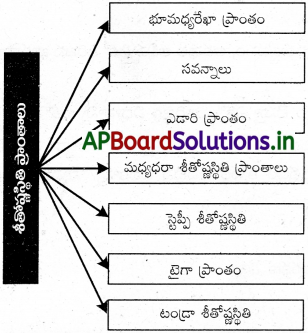
→ ఉష్ణోగ్రత, అవపాతం ఆధారముగా భూగోళ శాస్త్రవేత్తలు శీతోష్ణస్థితి మండలాలను నిర్వచించారు. వీరి ప్రకారం ప్రపంచంలో ఏడు శీతోష్ణ మండలాలు కలవు.

→ భూమధ్య రేఖకు ఇరువైపులా 5–10° ఉత్తర, దక్షిణ అక్షాంశాల మధ్య భూమధ్య రేఖ లేదా ఉష్ణ మండల శీతోష్ణస్థితి ప్రాంతం కలదు.

→ దట్టమైన అడవులతో ఉన్న ఈ (భూమధ్య రేఖ శీతోష్ణస్థితిని) ప్రాంతాన్ని సెల్వాలు అంటారు.

→ అమెజాన్లోని రెడ్ ఇండియన్లు, కాంగో పరీవాహకంలోని పిగ్మీలు వంటి ఆటవిక సమూహాలు ఈ ప్రాంతములో నివసిస్తున్నారు.

→ ‘సవన్నాలు’ భూమధ్యరేఖకు ఇరువైపులా 10°-20° ఉత్తర, దక్షిణ అక్షాంశాల మధ్య విస్తరించి ఉన్నాయి.

→ ‘ఎడారి ప్రాంతాలు’ ఖండాలకు పశ్చిమవైపున 15°-30° ఉత్తర, దక్షిణ అక్షాంశాల మధ్య విస్తరించి ఉన్నాయి.

→ ‘సహారా’ ఎడారి ప్రపంచంలోనే పెద్ద ఎడారి.

→ వేసవిలో పొడి వాతావరణము, శీతాకాలములో ఒక మాదిరి నుండి అధిక వర్షపాతం మధ్యధరా శీతోష్ణస్థితి ప్రాంతం యొక్క ప్రధాన లక్షణము.

AP 7th Class Social Notes Chapter 2 అడవులు

→ అర్ధశుష్క ప్రాంతం (సమశీతోష్ణ) లో గడ్డిభూములు ‘స్టెప్పీలు’.

→ టైగా ప్రాంతం ఉత్తరార్ధ గోళంలో 559-70° ఉత్తర అక్షాంశాల మధ్య విస్తరించి ఉంది.

→ టైగా ప్రాంతం ప్రపంచంలో అధిక వాతావరణ వ్యత్యాసాలు కలిగి ఉన్న ప్రాంతాల్లో ఇది ఒకటి.

→ టైగా ప్రాంతంలో ‘ఫర్’ వాణిజ్యము ముఖ్యమైన మరియు ఆకర్షణీయమైన – కార్యకలాపము.

→ ఆర్కిటిక్ – ధృవ ప్రాంతాల మధ్య విస్తరించిన ‘టండ్రా’ ప్రాంతములో చలి చాలా ఎక్కువ.

→ ఒక ప్రదేశం యొక్క ఉష్ణోగ్రత, వర్షపాతం, నేలలు ఆ ప్రాంతం యొక్క వృక్షజాల రకాలను నిర్ధారిస్తాయి.

→ విశాల ప్రాంతంలో సహజ పరిస్థితులలో చెట్లు, పొదలతో కూడిన నిర్దిష్ట ప్రాంతాన్ని ‘అడవి’ అని పిలుస్తారు.

→ ఆదిమ జాతుల మనుగడకు అడవులు ప్రధాన స్థావరాలు.

→ భారత ప్రభుత్వము పరిపాలన సౌలభ్యం కొరకు అడవులను మూడు రకాలుగా విభజించింది. అవి రిజర్వు, రక్షిత, వర్గీకరించని అడవులు.

→ వేట, మేత వంటి కార్యకలాపాలను నేషిధించిన అడవులు రిజర్వు అడవులు.

→ ప్రత్యేక వృక్షజాలం, జంతు జాలాలను రక్షించటానికి ఏర్పాటు చేయబడ్డ అడవులు, రక్షిత అడవులు. వర్గీకరించని అడవులలో జీవనోపాధి కొరకు అవసరమైన అటవీ ఉత్పత్తులను సేకరించవచ్చు మరియు పశువులను మేపుకోవచ్చును.

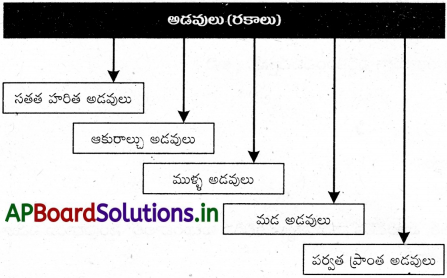
→ అధిక సాంవత్సరిక ఉష్ణోగ్రత మరియు వర్షపాతం ఉన్న ప్రాంతాల్లో ‘సతతహరిత అరణ్యాలు’ పెరుగుతాయి.

AP 7th Class Social Notes Chapter 2 అడవులు

→ ఈ అడవులు ఏడాది పొడవునా పచ్చగా ఉంటాయి.

→ హిమాలయ ప్రాంతాలు, ఈశాన్య రాష్ట్రాలు, పశ్చిమ కనుమలు, కేరళలోను ఈ అడవులు పెరుగుతాయి.

→ మహాగని, ఎబోని, రోజ్ వుడ్, ఐవరివుడ్ వంటి వృక్ష జాతులు ఈ అడవులలో పెరుగుతాయి.

→ వివిధ రకాల సరీసృపాలు, సింహపు తోక కోతి (లయన్ టెయిల్డ్ మకాక్), కీటకాలు ఈ అడవుల్లో ఉంటాయి.

→ ఆకురాల్చు అడవులు 70-200 సెం.మీ.. వర్షపాతము ఉన్న ప్రాంతాలలో విస్తరించి ఉన్నాయి.

→ ఆకురాల్చు అడవులు ద్వీపకల్ప పీఠభూమిలో ఎక్కువగా విస్తరించి ఉన్నాయి.

→ ఆకురాల్చు అడవుల్లో టేకు, సాల్, వెదురు, రోజ్ వుడ్, చందనం, వేప వృక్షాలు కనిపిస్తాయి.

→ ఆకురాల్చు అడవుల్లో పులులు, చిరుతలు, కుందేళ్ళు, జింకలు, నెమళ్ళు, పక్షులు ప్రధాన జంతుజాలం.

→ ఆకురాల్చు అడవుల్లోని వృక్షాలు వేసవి నెలల్లో బాష్పోత్సేకాన్ని తగ్గించడానికి ఆకులు రాల్చుతాయి.

→ ముళ్ళ/పొద అడవులు తక్కువ వర్షపాతం వుండి, అధిక ఉష్ణోగ్రత ఉన్న ప్రాంతాల్లో పెరుగుతాయి.

→ ముళ్ళపొద అడవుల్లోని చెట్లు ముళ్లతోనూ, పొదలుగానూ ఉంటాయి.

→ ముళ్ళపొద అడవులు దక్కన్ పీఠభూమి, భారతదేశ ఎడారి ప్రాంతాల్లో ఉన్నాయి.

→ ముళ్ళ/పొద అడవుల్లో అకేషియా, బ్రహ్మ జెముడు, నాగజెముడు, బబుల్ మరియు రేగు వృక్ష జాతులు కలవు.

→ మడ/తీర ప్రాంతపు అడవులను చిత్తడి అడవులు అని కూడా అంటారు.

→ మడ/తీర ప్రాంతపు అడవుల్లోని చెట్లు సముద్రపు లవణీయతను, అలల తాకిడిని తట్టుకునేలా ఉంటాయి.

→ మడ/తీర ప్రాంతపు అడవుల్లో తెల్లమడ, సుందరి, పొన్న, బొడ్డుపొన్న మొదలగు వృక్షాలు పెరుగుతాయి.

→ మడ/తీర ప్రాంతపు అడవుల సమీపంలో చేపలు విరివిగా దొరుకుతాయి.

→ పశ్చిమ బెంగాల్ లోని సుందర్బన్ ప్రాంతాలలో ఈ మడ అడవులు విస్తరించి ఉన్నాయి.

→ పర్వత ప్రాంత అడవులు పర్వతాలు మరియు కొండ ప్రాంతాలలో పెరుగుతాయి.

→ పర్వత ప్రాంత అడవుల్లోని వృక్షాల ఆకులు సన్నని సూది ఆకారంలోనూ, త్రిభుజాకారంలోనూ ఉంటాయి.

→ హిమాలయ ప్రాంతంలో వివిధ రకాలైన శృంగాకారపు అడవులు ఉన్నాయి.

→ స్పర్, ఫర్, విల్లో, దేవదారు, సిల్వర్ ఫర్ మొదలైన వృక్షాలు ఈ అడవుల్లో ఉన్నాయి.

→ ధృవపు జింక, మంచు చిరుత ఇక్కడ ప్రధాన జంతు జాలము.

AP 7th Class Social Notes Chapter 2 అడవులు

→ ISFR – ఇండియన్ స్టేట్ ఫారెస్ట్ రిపోర్టు.

→ ISFR – 2019 ప్రకారం భారతదేశములో 8,07,276 చ.కి.మీ. విస్తీర్ణం మేర భూమి అటవీ ప్రాంతములో కప్పబడి ఉంది.

→ మొత్తము భూభాగములో 24.56% ప్రపంచ అటవీ విస్తీర్ణంలో భారతదేశం 10వ స్థానంలో ఉంది.

→ జాతీయ అటవీ విధానం 1952 ప్రకారం మొత్తం భూభాగంలో 33%, మైదాన ప్రాంతాలలో 20%, కొండ ప్రాంతాలలో 60% విస్తీర్ణం గల భూమి అడవుల క్రింద ఉండాలి.

→ విస్తీర్ణ పరంగా మధ్యప్రదేశ్ రాష్ట్రం అత్యధిక అటవీ ప్రాంతాన్ని కల్గి ఉండగా అరుణాచల్ ప్రదేశ్ రెండవ స్థానంలో, హర్యానా చివరి స్థానంలోను ఉన్నాయి.

→ భారతదేశం 3.28 మిలియన్ చ.కి.మీ. విస్తీర్ణం, 30 డిగ్రీల అక్షాంశాల విస్తృతి కల్గి ఉంది.

→ భారతదేశం ఉత్తరం నుంచి దక్షిణానికి మధ్య దూరం 3,214 కి.మీ.లు.

→ భారత జాతీయ అటవీ నివేదిక-2019 ప్రకారం ఆంధ్రప్రదేశ్ రాష్ట్రం 37,392 చ.కి.మీ. విస్తీర్ణం అనగా మొత్తం విస్తీర్ణంలో 22.94% అటవీ ప్రాంతాన్ని కల్గి ఉంది.

→ YSR కడప జిల్లా అత్యధిక అటవీ ప్రాంతంతోను, కృష్ణాజిల్లా అత్యల్ప అటవీ ప్రాంతాన్ని కల్గి ఉంది.

→ సాంద్రత రీత్యా విశాఖపట్టణం జిల్లా మొదటి స్థానంలోను, కృష్ణాజిల్లా చివరి స్థానంలోనూ ఉంది.

→ ఆంధ్రప్రదేశ్ లో అడవులు ఉత్తరాన సింహాచలం కొండల నుండి దక్షిణాన శేషాచలం కొండల వరకు విస్తరించి ఉన్నాయి.

→ నల్లమల అడవి అతి పెద్ద అటవీ ప్రాంతం.

→ తేమతో కూడిన ఆకురాల్చు అడవులు శ్రీకాకుళం, విజయనగరం, తూర్పు గోదావరి జిల్లాల్లో కలవు.

→ తేమతో కూడిన ఆకురాల్చు అడవుల్లో వేగి, ఏగిస, వెదురు, మద్ది, బండారు – జట్టేగి మరియు సాల వృక్షాలు పెరుగుతాయి.

→ శుష్క ఆకురాల్చు అడవులు YSR కడప, కర్నూలు, అనంతపురం, చిత్తూరు జిల్లాల్లో కలవు.

→ శుష్క ఆకురాల్చు అడవుల్లో ముఖ్య వృక్షాలు మద్ది, టేకు, బిల్లు, వెలగ, ఏగిస, వేప, బూరుగ, మోదుగ మరియు ఎర్రచందనం.

→ ఎర్రచందనం కడప, చిత్తూరు జిల్లాల్లోని శేషాచలం అడవుల్లో పెరిగే అరుదైన వృక్షజాతి. ఎగుమతుల్లో ఆర్థిక వ్యవస్థలో ఈ వృక్షానికి విశేష స్థానం ఉంది.

→ చిట్టడవులు రాయలసీమ జిల్లాలయిన కడప, కర్నూలు, అనంతపురం, చిత్తూరు జిల్లాల్లో పెరుగుతాయి.

AP 7th Class Social Notes Chapter 2 అడవులు

→ ‘చిట్టడవుల్లో తుమ్మ, బులుసు, రేగు, చందనం, వేప మొదలగు చెట్లు పెరుగుతాయి. కడప జిల్లాలోని శ్రీలంక మల్లేశ్వర అభయారణ్యంలో నివసించే ‘కలివికోడి’ని IUCN అరుదైన జాతులుగా తెలియజేసింది.

→ మడ/డెల్టా అడవులు ఆంధ్రప్రదేశ్ తీర ప్రాంతం 974 కి.మీ. ఈ తీరం వెంబడి ఈ అడవులున్నాయి.

→ మడ/డెల్టా అడవుల్లో, ఉప్పు పొన్న, బొడ్డు పొన్న, ఉరడ, మడ, తెల్లమడ, పత్రి తీగ, బలబండి తీగ చెట్లు ఇక్కడ పెరుగుతాయి.

→ తూర్పు గోదావరిలోని ‘కోరంగి’ ప్రాంతం మడ అటవీ ప్రాంతానికి చక్కని ఉదాహరణ. వృక్షజాలం, జంతుజాలాలను రక్షించటానికి 13 వన్యప్రాణుల అభయారణ్యాలు మరియు మూడు జాతీయ ఉద్యానవనాలు ఆంధ్రప్రదేశ్ లో స్థాపించబడ్డాయి.

→ బోండోలు, చెంచులు, కొండరెడ్లు, కొండ సవరలు, గోండ్లు, ఎరుకల మరియు యానాదులు ఆదిమజాతులవారు.

→ చెంచులు ఒక ఆదిమ తెగ, వీరు నల్లమల అడవిలో ఉంటారు.

→ బ్రిటీషు వారు 1864లో అటవీశాఖను ఏర్పాటు చేశారు.

→ 1988 జాతీయ అటవీ విధాన ప్రకటన వన సంరక్షణ , పునరుజ్జీవనం, అడవుల అభివృద్ధిలో గిరిజన భాగస్వాములను చేయడం అనేది ముఖ్యమైన అంశంగా ప్రకటించింది.

→ ప్రస్తుతం ఆంధ్రప్రదేశ్ స్థానిక గిరిజనులను భాగస్వామ్యం చేస్తూ ఎకో-టూరిజం విధానాన్ని బలోపేతం చేసింది.

→ బంజరు భూముల్లో, ఇతర ప్రదేశాలలో మొక్కలు నాటడం, అడవులను సంరక్షించడం ద్వారా పర్యావరణాన్ని సామాజిక మరియు గ్రామ అభివృద్ధులను పెంపొందించడం కోసం చేపట్టిన పథకాన్ని “సామాజిక అడవుల” పెంపకం అనవచ్చు.

→ 1894 – అడవుల చట్టం, 1950 – అడవుల పండుగ.
1952 – జాతీయ అటవీ విధానం, 1980 – వన సంరక్షణ చట్టం.
2006 – అటవీ హక్కుల చట్టం.

→ FPST – అటవీ నివాస షెడ్యూల్డ్ తెగలు.
OTFD – ఇతర సాంప్రదాయ అటవీ నివాసులు.

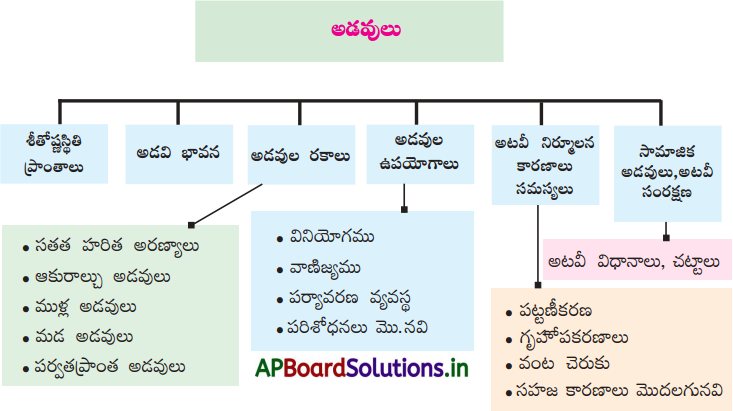
→ అడవుల ఉపయోగాలను నాలుగు రకాలుగా వర్గీకరించవచ్చును. అవి :
1) వినియోగం కొరకు
2) వాణిజ్యం కొరకు
3) పర్యావరణ వ్యవస్థల సమతుల్యం
4) పరిశోధనలు

→ సామాజిక, ఆర్థిక, మత, సాంస్కృతిక, మాండలిక సారూప్యాలు కలిగిన కుటుంబాలలో సంప్రదాయ సమూహాలుగా ఉన్న సామాజిక విభాగాన్ని ‘అటవీ జాతి’ అంటారు.

→ సెల్వాలు : దట్టమైన అడవులతో ఉన్న (భూమధ్య రేఖా ప్రాంతము) ప్రాంతం.

→ పోడు వ్యవసాయం : అడవులను కొంత మేరకు నరికి, కాల్చి గిరిజనులు చేయు వ్యవసాయం.

→ సవన్నాలు : ఉష్ణ మండలపు గడ్డి మైదానాలను సవన్నాలు అంటారు.

→ వాణిజ్య వ్యవసాయం : లాభం కోసం చేసే విస్తార వ్యవసాయం.

→ స్టెప్పీలు : సమశీతోష్ణ మండలపు గడ్డి భూములను స్టెప్పీలు అంటారు.

→ రిజర్వు అడవులు : వేట, మేత నిషేధించిన అడవులు.

→ రక్షిత అడవులు : ప్రత్యేక వృక్షజాలం, జంతు జాలాలను రక్షించటానికి ఏర్పాటు చేయబడ్డ అడవులు.

→ సతతహరిత అడవులు : ఏడాది పొడవునా పచ్చగా ఉండే అడవులు. . * చిత్తడి అడవులు : తీర ప్రాంతపు, మడ అడవులు.

→ ISFR : ఇండియన్ స్టేట్ ఫారెస్ట్ రిపోర్ట్.

→ ఎకో టూరిజం : (పర్యావరణ పర్యాటకం) సామాజిక ఆధారిత పర్యావరణ కేంద్రాల సందర్శనకై ఆంధ్రప్రదేశ్ ప్రభుత్వం ఏర్పాటు చేసిన నూతన విధానం.

→ IUCN : ప్రకృతి మరియు సహజ వనరుల పరిరక్షణ కోసం అంతర్జాతీయ యూనియన్.

→ FDST : అటవీ నివాస షెడ్యూల్డ్ తెగలు.

→ OTFD : ఇతర సాంప్రదాయ అటవీ నివాసులు.

→ అడవి : విశాల ప్రాంతంలో సహజ పరిస్థితులలో చెట్లు, పొదలతో కూడిన నిర్దిష్ట ప్రాంతం.

→ వృక్షజాలం : ఒక ప్రత్యేకమైన ప్రాంతంలో పెరిగే మొక్కలు.

→ జంతుజాలం : ప్రత్యేకమైన ప్రాంతంలో నివసించే జంతువులు.

→ దట్టమైన అరణ్యం : ఒక ప్రాంతంలో చెట్లు దగ్గర దగ్గరగా పెరగడం.

→ శీతోష్ణస్థితి : ఒక ప్రదేశంలోని దీర్ఘకాలపు సగటు వాతావరణపు స్థితి.

AP 7th Class Social Notes Chapter 2 అడవులు

→ బాష్పోత్సేకం : చెట్ల నుంచి నీరు ఆవిరి కావడం.

→ సుందరవనాలు : పశ్చిమ బెంగాల్ లో పెరిగే మడజాతి వనాలు.

→ శృంగాకారపు చెట్లు : సూది ఆకారం ఆకులు గల పొదలు.

→ పట్టణీకరణ : ప్రజలు గ్రామీణ ప్రాంతాల నుంచి పట్టణాలకు వలస వెళ్లడం.

→ ఆదిమ వాసులు : ఒక ప్రాంతంలో ప్రాచీన కాలం నుండి నివసించేవారు.

→ భూగోళం వేడెక్కడం : భూ ఉపరితలం వేడెక్కడం.

→ నేల క్రమక్షయం : భూమి యొక్క పై పొరలు క్రమంగా తొలగించబడడం.

1.
AP 7th Class Social Notes Chapter 2 అడవులు 1

2.
AP 7th Class Social Notes Chapter 2 అడవులు 2

3.
AP 7th Class Social Notes Chapter 2 అడవులు 3

AP 7th Class Social Notes Chapter 13 ప్రపంచ పరివర్తనలో మహిళలు

Students can go through AP Board 7th Class Social Notes 13th Lesson ప్రపంచ పరివర్తనలో మహిళలు to understand and remember the concept easily.

AP Board 7th Class Social Notes 13th Lesson ప్రపంచ పరివర్తనలో మహిళలు

→ భారతదేశంలో 83, 6% మంది శ్రామిక మహిళలు వ్యవసాయ పనుల్లో నిమగ్నమై ఉన్నారు.

→ మన సమాజంలో మగ పిల్లలకు ఇచ్చినంత ప్రాధాన్యత ఆడపిల్లలకు ఉండదు.

→ 2015లో బాలికల సర్వతోముఖాభివృద్ధికిగాను ‘బేటీ బచావో బేటీ పఢావో’ అనే కార్యక్రమం ప్రారంభించారు.

→ పాఠశాలకు వెళ్ళడం అనేది బాలికల యొక్క ప్రాథమిక హక్కు.

→ ఆంధ్రప్రదేశ్ లో ప్రభుత్వం 1993లో సారాను నిషేధించింది.

→ మార్చి 8వ తేదీన అంతర్జాతీయ మహిళా దినోత్సవం జరుపుకుంటాము.

→ కాదంబరి గంగూలి, చంద్రముఖి బసు భారతదేశంలోని మొదటి ఇద్దరు మహిళా గ్రాడ్యుయేట్లు.

→ జానకి అమ్మాళ్ పద్మశ్రీ అవార్డు అందుకున్న మొదటి భారతీయ మహిళా శాస్త్రవేత్త.

AP 7th Class Social Notes Chapter 13 ప్రపంచ పరివర్తనలో మహిళలు

→ అంతరిక్ష రంగంలోకి అడుగుపెట్టిన తొలి భారతీయ మహిళ కల్పనా చావ్లా.

→ కల్పనా చావ్లా 2003లో STS – 107 మిషన్ వైఫల్యం కారణంగా మరణించింది.

→ మహిళల వన్డే ఇంటర్నేషనల్ మ్యాచ్ లో 7,000 పరుగుల మార్కును అధిగమించిన మహిళా క్రికెటర్ ‘మిథాలీరాజ్.

→ మిథాలీ రాజ్ కు ‘లేడీ సచిన్’ అనే ట్యాగ్ ఉంది.

→ మహిళల అంతర్జాతీయ క్రికెట్లో అత్యధిక పరుగులు చేసిన క్రీడాకారిణిగా మిథాలీరాజ్ ప్రసిద్ధి పొందింది.

→ ఈమెకు ‘ఖేల్ రత్న’ పురస్కారం కూడా లభించింది.

→ ప్రాంజల్ పాటిల్ భారతదేశంలో మొదటి దృష్టి లోపం ఉన్న IAS అధికారిణి.

→ సీమారావు దేశంలోనే తొలి మహిళా కమాండో ట్రైనర్.

→ సీమారావు బ్రూస్ లీ అభివృద్ధి చేసిన మార్షల్ ఆర్ట్స్ లో జీత్ కునే డోలో శిక్షణ పొందిన ప్రపంచంలోని 10 మంది మహిళలలో ఒకరు.

→ ‘రాజ్ కుమారి దేవి’ SHG సేవలకుగాను 2019లో పద్మశ్రీ అవార్డు ఇచ్చారు.

→ ‘వందనాశివ’ ఒక పర్యావరణ వేత్త మరియు పర్యావరణ హక్కుల కార్యకర్త, – స్థానిక విత్తనాలను రక్షించటానికి ‘నవధాన్య’ అనే జాతీయ ఉద్యమం ఏర్పడటానికి ‘వందనాశివ’ ప్రయత్నాలు దారితీశాయి.

→ 1993లో రైట్ లైబ్లీ హుడ్ అవార్డును మరియు 2010 సిడ్ని శాంతి బహుమతిని (వందనా శివ) అందుకున్నారు.

→ లక్ష్మీ అగర్వాల్ యాసిడ్ దాడి భాదితురాలు.

→ లక్ష్మీ అగర్వాల్ NGO ఛన్‌ ఫౌండేషన్ కు డైరెక్టర్.

→ లక్ష్మీ అగర్వాల్ US ప్రథమ మహిళ మిచెల్ ఒబామాచే 2014లో ఇంటర్నేషనల్ ఉమెన్ ఆఫ్ కరేజ్ అవార్డును అందుకుంది.

→ ఈమె NDTV ఇండియన్ ఆఫ్ ది ఇయర్‌గా కూడా ఎంపికైంది.

→ నందిని హరినాథ్ ఇస్రో శాటిలైట్ సెంటర్ లో రాకెట్ శాస్త్రవేత్త.

→ ఈమె MOM ప్రాజెక్ట్ మేనేజర్, మిషన్ డిజైనర్ మరియు డిప్యూటీ ఆపరేషన్స్ డైరెక్టర్‌గా పనిచేశారు.

→ ఈమె ఇస్రోలో 20 ఏళ్ళుగా 14 మిషన్లలో పనిచేసారు.

→ UNO ప్రధాన కార్యదర్శిగా ఎంపిక చేసిన వాతావరణ సంక్షోభాన్ని ఎదుర్కోవడానికి పరిష్కారాలను అందించే యువజన సలహా సంఘ సభ్యులు ‘యంగో’లోని 7గురు సభ్యులలో ఒకరిగా ఎంపికైన యువతి ‘అర్చనా సోరెంగ్’.

→ మహనాజ్ అమి రచించిన పుస్తకం – ‘ఎంచుకునే దారిలో’.

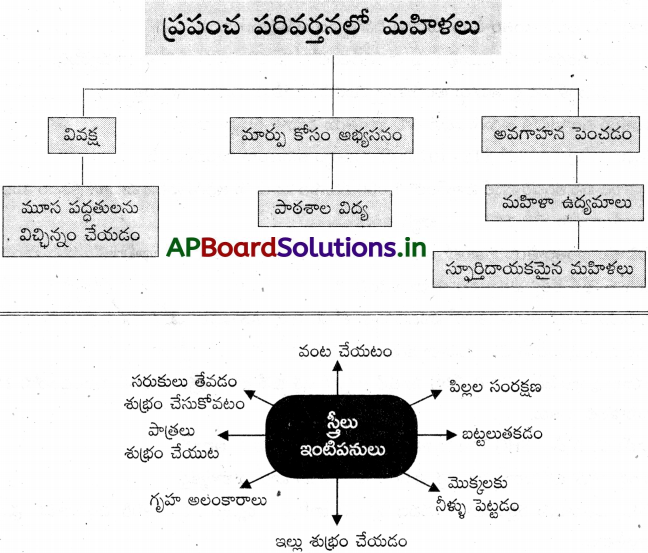
→ లింగ వివక్షత : లింగాధారంగా వివక్షతను చూపుట. స్త్రీని తక్కువగాను, పురుషులను ఎక్కువగాను చూడటాన్ని లింగ వివక్షత అంటారు.

→ శారీరక వైకల్యం : శరీరంలోని ఏదైనా భాగం సరిగా పని చేయకపోవటం లేదా అసలు పని చేయకపోవటం.

→ పరివర్తన : ఆలోచనల్లో, మూస పద్ధతులలో మార్పు.

→ మహిళా ఉద్యమం : మూస పద్ధతులలో మార్పు తీసుకురావడానికి మహిళలు వ్యక్తిగతంగా మరియు సమష్టి పోరాటం చేయడమే మహిళా ఉద్యమం.

→ ఆత్మ గౌరవం : వ్యక్తిగతంగా (ఏ వివక్ష చూపకుండా) గౌరవింపబడటం. తనకు తాను గౌరవప్రదంగా ఉండటం.

→ మహిళా సాధికారత : మహిళలు స్వయంగా (ఇతరులపై ఆధారపడకుండా) విభిన్న సమస్యలపై నిర్ణయాలు తీసుకొనుట మరియు వారు కోరుకున్న లక్ష్యాలను సాధించటానికి, కొనసాగించటానికి మరింత స్వేచ్ఛ కల్గి ఉండటం. ఇది రాజకీయ మరియు ఆర్థిక సాధికారతలుగా పేర్కొన్నారు.

→ గిరిజనులు : కొండ (అటవీ) ప్రాంతంలో నివసించేవారు.

AP 7th Class Social Notes Chapter 13 ప్రపంచ పరివర్తనలో మహిళలు

→ SHG : స్వయం సహాయక బృందం (Self Help Group)

→ NGO : Non Government Organisation.

→ ISRO : ఇండియన్ స్పేస్ రీసెర్చ్ ఆర్గనైజేషన్

→ మూస పద్ధతి : ఒక నిర్దిష్ట వర్గము లేదా వ్యక్తుల గురించి సాధారణీకరించిన నమ్మకం. ఇది ఒక నిర్దిష్ట సమూహంలోని వ్యక్తి గురించి ప్రజలకు ఉండే భావన.

→ వివక్ష : వ్యక్తులు, సమూహాలు, తరగతులు లేదా ఇతర వర్గాల ఆధారంగా వ్యక్తుల మధ్య అన్యాయమైన వ్యత్యాసాలను చూపే చర్య.

→ లింగ సమానత్వము : స్త్రీలు, పురుషులు అనే భేదభావం లేకుండా సామాన్య హక్కులు, బాధ్యతలు మరియు అవకాశాలు ఉండుట.

→ స్ఫూర్తిదాయక మహిళలు: ఇతరులను ప్రభావితం చేసే వ్యక్తిత్వం ఉన్నవారు.

AP 7th Class Social Notes Chapter 13 ప్రపంచ పరివర్తనలో మహిళలు 1

AP 7th Class Social Notes Chapter 12 మన పరిసరాలలో ఉన్న మార్కెట్లు

Students can go through AP Board 7th Class Social Notes 12th Lesson మన పరిసరాలలో ఉన్న మార్కెట్లు to understand and remember the concept easily.

AP Board 7th Class Social Notes 12th Lesson మన పరిసరాలలో ఉన్న మార్కెట్లు

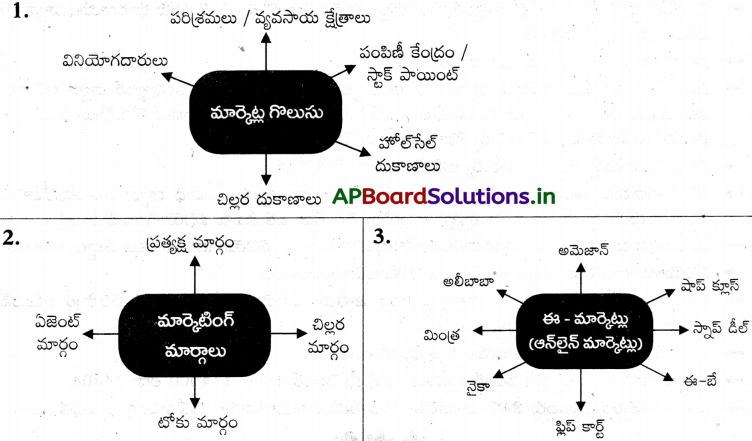
→ రద్దీగా ఉండే వ్యక్తులు, వివిధ రకాల వస్తువులు, పండ్లు, కూరగాయలు మరియు ఆ వస్తువులను కొనుగోలు చేసే వినియోగదారులు మరియు వాటిని విక్రయించే దుకాణాలు ఉండే ప్రాంతం.

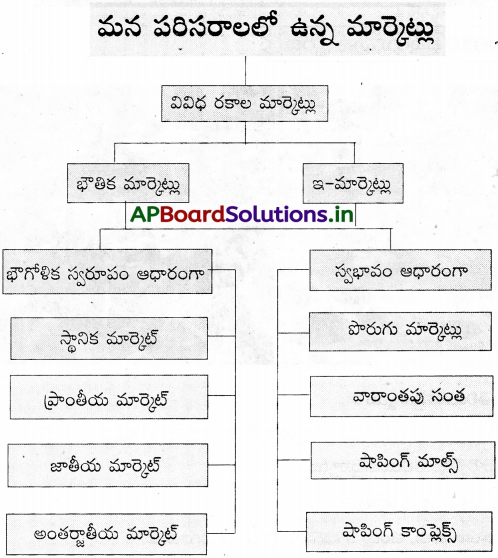
→ పని చేసే విధానం ఆధారంగా మార్కెట్లను రెండు రకాలుగా విభజిస్తారు. అవి

  1. భౌతిక మార్కెట్లు,
  2. ఈ-మార్కెట్లు.

→ భౌతిక మార్కెటు అనేది కొనుగోలుదారులు, అమ్మకందారులు భౌతికంగా కలిసి వారికి అవసరమైన వస్తువులను కొనుగోలు చేసే ప్రాంతం.

→ అమ్మకందారులు మరియు కొనుగోలుదారులు స్థానికంగా ఒక నిర్ణీత ప్రాంతానికి పరిమితమైతే వాటిని స్థానిక మార్కెట్లు అంటారు.

→ స్థానిక మార్కెట్ల కంటే ఎక్కువ విస్తృతి కలిగి వుండి ఆయా ప్రాంతాలలో లేదా రాష్ట్రాల సముదాయంలో మాత్రమే లభించే వస్తువులను కలిగి వుండే మార్కెట్లను ప్రాంతీయ మార్కెట్లు అంటారు.

→ జాతీయ మార్కెట్ అనునది దేశంలోని అన్ని ప్రాంతాలలో వస్తువులు మరియు సేవల కోసం వర్తకం జరిగే మార్కెట్.

→ వివిధ దేశాల మధ్య జరిగే వస్తువులు మరియు సేవల వ్యాపారాన్ని అంతర్జాతీయ మార్కెట్ అంటారు.

→ రైతుబజార్లు జనవరి 1999లో ప్రారంభించబడినవి.

→ పట్టణ ప్రాంతాలలోని వివిధ అంతస్థులలోని దుకాణాలు, పెద్ద బహుళ అంతస్థుల ఎయిర్ కండీషన్డ్ భవనాలు. వీటినే షాపింగ్ మాల్స్ అంటారు.

→ పట్టణాలలో లేదా నగరాలలోని వివిధ ప్రాంతాలలో ఒకే ప్రాంగణంలో అన్ని రకాల వస్తువులను విక్రయించే దుకాణాలు ఉంటాయి. వీటిని షాపింగ్ కాంప్లెళ్లు అంటారు.

→ శ్రీనగర్‌లో ఫ్లోటింగ్ మార్కెట్లో అత్యంత సుందరమైన దాల్ సరస్సులో ఉ|| 5-7 వరకు కూరగాయల వ్యాపారం పడవల ద్వారా జరుగుతుంది.

→ ఈ పడవలను స్థానిక భాషలో ‘షికారా’ అంటారు.

AP 7th Class Social Notes Chapter 12 మన పరిసరాలలో ఉన్న మార్కెట్లు

→ మనం మన వద్ద వున్న చరవాణి ద్వారా లేదా అంతర్జాలంతో అనుసంధానమైన కంప్యూటర్ ద్వారా ఆదేశాలు ఇచ్చి మనకు నచ్చిన అనేక రకాలైన వస్తువులను ఇంటి నుండి బయటకు వెళ్ళకుండానే కొనుగోలు చేయవచ్చు. ఈ రకమైన మార్కెట్ ను ఈ-కామర్స్ లేదా ఆన్లైన్ మార్కెట్ అంటారు. ఎలక్ట్రానిక్ కామర్స్ లేదా ఈ-కామర్స్ అనునది ఒక వ్యాపార వేదిక.

→ వినియోగదారుడు అనగా తన వ్యక్తిగత ఉపయోగం కోసం లేదా స్వయం ఉపాధి ద్వారా తన జీవనోపాధిని సంపాదించుకోవడం కోసం, ఒక ఉత్పత్తిని కొనుగోలు చేసే లేదా ఒక సేవను వినియోగించుకొనే వ్యక్తి. వినియోగదారుని హక్కులను రక్షించడానికి రూపొందించిన చట్టాలను వినియోగదారుల రక్షణ చట్టాలు అంటారు.

→ వినియోగదారుల రక్షణ చట్టం ఆగస్టు 9, 2019న ఆమోదించబడింది.

→ వినియోగదారుల రక్షణ చట్టం 1986 ప్రకారం జాతీయ వినియోగదారుల వివాద పరిష్కార కమీషన్ (ఎన్.సి.డి. ఆర్.సి) 1988 లో స్థాపించబడినది.

→ ఎన్.సి.డి.ఆర్.సి ప్రధాన కార్యా లయం కొత్త ఢిల్లీలో ఉంది.

→ వినియోగదారుల హెల్ప్ లైన్ నంబర్ : నేషనల్ టోల్ ఫ్రీ నెంబర్ 1800-114000 లేదా 14404.

→ ప్రతి సంవత్సరం డిసెంబరు 24ను భారతదేశంలో జాతీయ వినియోగదారుల దినోత్సవంగా జరుపుకుంటారు.

→ మార్కెట్ : రద్దీగా ఉండే వ్యక్తులు, వివిధ రకాల వస్తువులు, పండ్లు, కూరగాయలు మరియు ఆ వస్తువులను కొనుగోలు చేసే వినియోగదారులు మరియు వాటిని విక్రయించే దుకాణాలు ఉండే ప్రాంతం.

→ భౌతిక మార్కెట్ : కొనుగోలుదారులు, అమ్మకందారులు భౌతికంగా కలిసి వారికి అవసరమైన వస్తువులను కొనుగోలు చేసే ప్రాంతం.

→ స్థానిక మార్కెట్లు : కొనుగోలుదారులు మరియు అమ్మకందారులు స్థానికంగా వస్తువులు ఉత్పత్తి అయ్యే ఒక నిర్ణీత ప్రాంతానికి పరిమితమైతే వాటిని స్థానిక మార్కెట్లు అంటారు.

→ ప్రాంతీయ మార్కెట్లు : స్థానిక మార్కెట్ల కంటే ఎక్కువ విస్తృతిని కలిగి ఉండి ఆయా ప్రాంతాలలో లేదా రాష్ట్రాల సముదాయంలో మాత్రమే లభించే వస్తువులను కల్గి ఉండే మార్కెట్లు.

→ జాతీయ మార్కెట్లు : జాతీయ మార్కెట్ అనునది దేశంలోని అన్ని ప్రాంతాలలో వస్తువులు మరియు సేవల కోసం వర్తకం జరిగే మార్కెట్. ఉదాహరణకు తీరప్రాంత రాష్ట్రాలలో లభించే చేపలను దేశవ్యాప్తంగా అమ్మడం.

→ అంతర్జాతీయ మార్కెట్లు : వివిధ దేశాల మధ్య జరిగే వస్తువులు మరియు సేవల వ్యాపారాన్ని అంతర్జాతీయ మార్కెట్ అంటారు.

→ పొరుగు మార్కెట్లు : మన ఇంటి పక్కన లేదా వీధి చివరలో కన్పించే దుకాణాలు.

→ వారాంతపు సంత : ప్రతి వారం ఒక నిర్దిష్టమైన రోజున ఉదయాన్నే ఏర్పాటు చేయబడి సాయంత్రం మూసివేయబడే మార్కెట్.

→ క్రెడిట్ కార్డు : ఋణ సౌలభ్యాన్ని వినియోగించుకొని వస్తువులు కొనుగోలు చేయుటకు ఆర్థిక సంస్థలు జారీ చేసే కారు.

→ రైతు బజారు : రైతులే నేరుగా వినియోగదారులకి తమ ఉత్పత్తులు అమ్ముకునే మార్కెట్.

→ షాపింగ్ మాల్స్ : పట్టణ ప్రాంతాలలోని వివిధ అంతస్థులలోని దుకాణాలు, పెద్ద బహుళ అంతస్థుల ఎయిర్ కండీషన్ భవనాలు.

→ ఈ షాపింగ్ కాంప్లెక్స్ : పట్టణాలు మరియు నగరాలలోని వివిధ ప్రాంతాలలో ఒకే ప్రాంగణంలో దాదాపు అన్ని రకాల వస్తువులను విక్రయించే దుకాణాలు.

→ ఫ్లోటింగ్ మార్కెట్ : నీటిలో తేలియాడే మార్కెట్స్.

→ వినియోగదారుల రక్షణ చట్టాలు : వినియోగదారుని హక్కులను రక్షించడానికి రూపొందించిన చట్టాలు.

→ ఉత్పత్తిదారుడు : ఆహారం, వస్తువులు లేదా సామగ్రిని తయారుచేసే ఒక వ్యక్తి, ఒక కంపెనీ లేదా ఒక దేశం.

→ కొనుగోలుదారు : వ్యాపార రీత్యా వస్తువులను పెద్ద మొత్తంలో కొనుగోలు చేయువారు.

→ వ్యాపారి : కొనుగోలు మరియు విక్రయించే వ్యక్తి.

AP 7th Class Social Notes Chapter 12 మన పరిసరాలలో ఉన్న మార్కెట్లు

→ టోకు వర్తకుడు : వ్యక్తులకు లేదా సంస్థలకు పెద్ద మొత్తంలో వస్తువులు విక్రయించు వ్యక్తి లేదా సంస్థ.

→ చిల్లర వర్తకుడు : చిన్న మొత్తంలో ప్రజలకు వస్తువులు విక్రయించే వ్యక్తి లేదా వ్యాపారం.

→ వినియోగదారుడు వస్తువులను కొనుగోలు చేసే లేదా సేవలను వినియోగించుకునే వ్యక్తి.

→ క్రెడిట్ : కొనుగోలు చేసిన వస్తువులకు తరువాత చెల్లించే ఏర్పాటు.

→ వృత్తి : జీవనోపాధికై చేసే పని లేదా ఉద్యోగం.

→ సంస్థ : వ్యాపార కార్యకలాపాలు నిర్వహించే యంత్రాంగం.

→ వేదిక : ప్రజల ఫిర్యాదులను విని తీసుకోవాల్సిన చర్యలను సూచించే న్యాయస్థానాలు.

→ అయోగ్యత : అనైతిక లేదా అన్యాయమైన.

AP 7th Class Social Notes Chapter 12 మన పరిసరాలలో ఉన్న మార్కెట్లు 1

AP 7th Class Social Notes Chapter 12 మన పరిసరాలలో ఉన్న మార్కెట్లు 2

AP 7th Class Social Notes Chapter 11 రహదారి భద్రత

Students can go through AP Board 7th Class Social Notes 11th Lesson రహదారి భద్రత to understand and remember the concept easily.

AP Board 7th Class Social Notes 11th Lesson రహదారి భద్రత

→ రహదారి ప్రమాదాలు అనగా ఏదైనా ఆకస్మిక సంఘటన వలన వాహనం లేదా ప్రయాణీకులు ప్రమాదవశాత్తు గాయపడటం లేదా మరణించడం మరియు భౌతిక ఆస్తులకు నష్టం కలగటం వంటివి.

→ నేటి ప్రపంచంలో రోడ్డు మరియు రవాణా ప్రతి మనిషి జీవితంలో అంతర్భాగంగా మారాయి.

→ ప్రస్తుత రవాణా వ్యవస్థ, దూరాలను తగ్గించింది కానీ మరోవైపు అది జీవితాలను ప్రమాదంలో పడవేసింది.

→ ప్రతి సంవత్సరం రోడ్డు ప్రమాదాలు లక్షలాది మంది ప్రాణాలు కోల్పోవడం మరియు కోట్లాదిమంది తీవ్రమైన గాయాలపాలవడానికి కారణమవుతున్నాయి.

→ అవగాహనా రాహిత్యం మరియు అజాగ్రత్త వల్ల ప్రజలు ఎక్కువ ప్రమాదాలకు గురియగుచున్నారు.

→ భారతదేశంలోని రోడ్డు రవాణా మరియు రహదారుల మంత్రిత్వశాఖ ప్రతి సంవత్సరం జనవరి నెలలో రోడ్డు భద్రతా వారోత్సవాలు నిర్వహిస్తుంది.

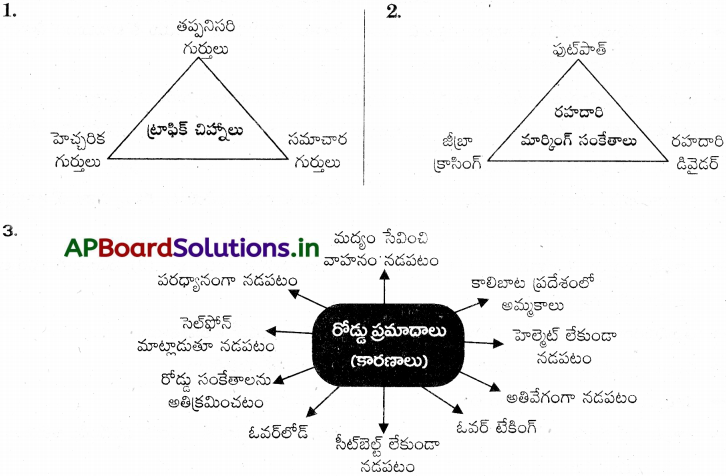
→ రహదారులపై గేదెలు, మేకలు, గొర్రెలు వంటి జంతువులను యథేచ్ఛగా వదిలివేయుట. దమ్ము చక్రాలతో ట్రాక్టర్లను నడుపుట వంటివి రహదారి ప్రమాదాలకు కారణాలు.

AP 7th Class Social Notes Chapter 11 రహదారి భద్రత

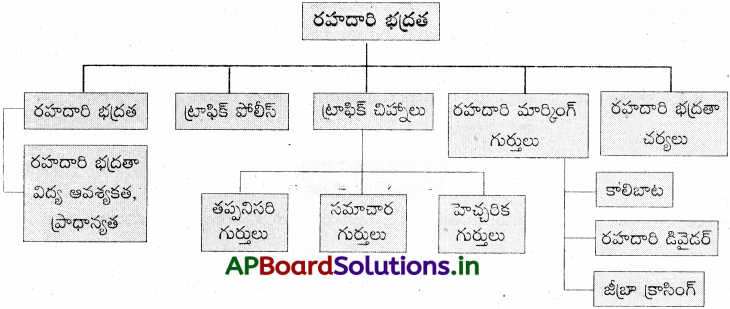
→ ట్రాఫిక్ గుర్తులు 3 రకాలు :

  1. తప్పనిసరిగా పాటించవలసిన గుర్తులు,
  2. సమాచార గుర్తులు,
  3. హెచ్చరిక గుర్తులు.

→ తప్పనిసరిగా పాటించవలసిన గుర్తులు ఎర్ర వృత్తాలు ఏమి చేయకూడదో తెలుపుతాయి.

→ సమాచార గుర్తులు – నీలం రంగు దీర్ఘచతురస్రంలోని గుర్తులు తెలియజేస్తాయి.

→ హెచ్చరిక గుర్తులు – ముక్కోణం లోపల ఉన్న గుర్తులు హెచ్చరిస్తాయి.

→ ట్రాఫిక్ లైట్ రంగు సంకేతాలు – ఎరుపు – ఆగండి, ఆరెంజ్ – వెళ్ళడానికి సిద్ధంగా ఉండండి; ఆకుపచ్చ – వాహనం ముందుకు వెళ్ళడానికి.

→ ఫుట్ పాత్, పాదచారుల ఉపయోగం కోసం రహదారికి ఇరువైపుల వేయబడింది.

→ ఒకే రహదారిపై ట్రాఫిక్ యొక్క రెండు దిశలను వేరు చేయడానికి రహదారిని రెండు భాగాలుగా విభజించారు. దీనిని రోడ్ డివైడర్ అంటారు.

→ జీబ్రా క్రాసింగ్ అంటే పాదచారులు రహదారిని సురక్షితంగా దాటే ప్రదేశం.

→ డ్రైవింగ్ లైసెన్స్ లేకుండా వాహనం నడపడం నేరం.

→ రహదారి భద్రత : రహదారి వాడకంలో వినియోగదారుల భద్రతను సూచిస్తుంది.

→ ఫుట్ పాత్ : రహదారికి ఇరువైపులా పాదచారులు నడవటానికి వీలుగా ఉండే దారి.

→ ఎరుపురంగు : గీత ముందు ఆగాలని సూచిస్తుంది.

→ ఆరెంజ్ రంగు : వెళ్ళడానికి సిద్ధంగా ఉండాలని సూచిస్తుంది.

→ ఆకుపచ్చ రంగు : వాహనాన్ని కదిలించమని సూచిస్తుంది.

→ ట్రాఫిక్ విద్య : ట్రాఫిక్ నియమ నిబంధనలు సరళంగా, స్పష్టంగా తెలియజేయటం.

→ ట్రామా కేర్ : స్వల్ప లేక తీవ్ర గాయాలపాలైన క్షతగాత్రులకు హాస్పిటల్ కి తీసుకువెళ్ళిన వెంటనే ఇచ్చే తక్షణ చికిత్స.

→ ప్రథమ చికిత్స : ప్రమాదానికి గురైన వ్యక్తికి పూర్తి వైద్య సహాయం అందేలోగా ఇచ్చే ప్రాథమిక వైద్యం.

→ రోడ్డు డివైడర్ : ఇది సిమెంట్ దిమ్మలతో లేదా పెయింట్ తో రోడ్డును రెండు లేదా అంతకంటే ఎక్కువ భాగాలుగా విభజించేది.

→ జీబ్రా క్రాసింగ్ : ఇవి రోడ్డుకు సమాంతరంగా చిత్రించిన ప్రత్యామ్నాయ నలుపు మరియు తెలుపు చారలు. సాధారణంగా వీటిని జీబ్రా క్రాసింగ్ అని పిలుస్తారు. ఇది పాదచారులు రోడ్డును ఒక వైపు నుండి మరొక వైపుకు దాటడానికి ఉద్దేశించబడింది.

→ రైల్వే క్రాసింగ్ : రహదారి, రైల్వే లైనను కలిసే ప్రదేశం.

AP 7th Class Social Notes Chapter 11 రహదారి భద్రత

→ ట్రాఫిక్ : వ్యక్తులు, వస్తువులు, వాహనాలు మరియు పాదచారులు ఒక ప్రదేశం నుండి మరొక ప్రదేశానికి పయనించేటప్పుడు ఏర్పడే రద్దీ.

→ పాదచారి : కాలి నడకన ప్రయాణించే వ్యక్తి.

→ రోడ్డు ప్రమాదం : ఒక వాహనం మరొక వాహనాన్ని లేదా వస్తువును ఢీ కొట్టడం.

→ కెర్బ్ డ్రిల్ : చిన్న పిల్లలు రహదారిని దాటుటకు ఆచరించాల్సిన పద్ధతి.

→ డ్రైవింగ్ లైసెన్స్ : వాహనాలను నడిపే నియమ నిబంధనలను పరిశీలించి ఇచ్చే అనుమతి పత్రం. వాహనదారులు దీనిని తప్పక పొందవలసి ఉంటుంది.

→ R.T.A. కార్యాలయం : Regional Transport Authority Office రీజనల్ ట్రాన్స్ పోర్ట్ అథారిటీ అధికారి వారి కార్యాలయము.

AP 7th Class Social Notes Chapter 11 రహదారి భద్రత 1

AP 7th Class Social Notes Chapter 11 రహదారి భద్రత 2

AP 7th Class Social Notes Chapter 10 రాష్ట్ర ప్రభుత్వం

Students can go through AP Board 7th Class Social Notes 10th Lesson రాష్ట్ర ప్రభుత్వం to understand and remember the concept easily.

AP Board 7th Class Social Notes 10th Lesson రాష్ట్ర ప్రభుత్వం

→ భారతదేశంలో మనకు రెండు స్థాయిలలో ప్రభుత్వం ఉంది. ఒకటి కేంద్రంలో, మరొకటి రాష్ట్రంలో ఉంది.

→ రాష్ట్ర ప్రభుత్వం ఆ రాష్ట్ర పరిపాలనకు బాధ్యత వహిస్తుంది.

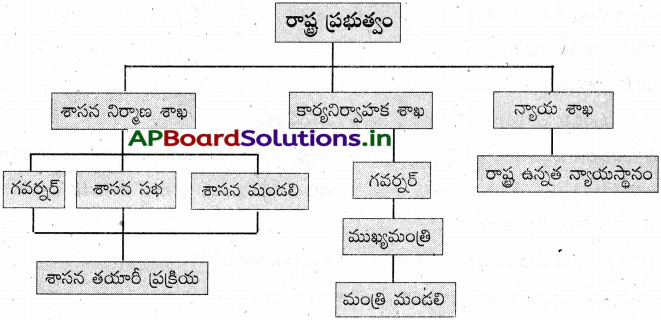
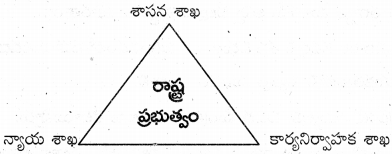
→ రాష్ట్ర ప్రభుత్వం మూడు అంగాల ద్వారా పరిపాలన నిర్వహిస్తుంది.
అవి

  1. శాసన నిర్మాణ శాఖ,
  2. కార్య నిర్వాహక శాఖ,
  3. న్యాయ శాఖ. గవర్నరు.

→ శాసనసభ మరియు శాసన మండలిలను కలిపి శాసన నిర్మాణ శాఖ అంటారు.

→ చట్టాలను తయారుచేయడం శాసన నిర్మాణ శాఖ యొక్క ప్రాథమిక విధి.

→ భారతదేశంలో ప్రతి రాష్ట్రానికి ఒక గవర్నరు ఉంటారు.

→ ప్రధాన మంత్రి, కేంద్ర మంత్రి మండలి సిఫారసు మేరకు రాష్ట్రపతి అయిదు సంవత్సరాల పదవీ కాలానికి గవర్నర్ ని నియమిస్తారు.

→ ఆర్టికల్ 158 (33) ప్రకారం రెండు లేక ఎక్కువ రాష్ట్రాలకు ఒకే వ్యక్తిని గవర్నర్ గా నియమించవచ్చు.

AP 7th Class Social Notes Chapter 10 రాష్ట్ర ప్రభుత్వం

→ అన్ని అసెంబ్లీ నియోజక వర్గాలకు కేంద్ర ఎన్నికల సంఘం ఎన్నికలు నిర్వహిస్తుంది.

→ MLA – శాసన సభ సభ్యుడు.

→ MLC – శాసన మండలి సభ్యుడు.

→ శాసన మండలి పరోక్షంగా ఎన్నుకోబడిన వారితో పనిచేస్తుంది.

→ 6 సంవత్సరాల పదవీ కాలం ముగిసిన 1/3 వ వంతు సభ్యులు పదవీ విరమణ చేయగా కొత్త సభ్యులు ఎన్నికవుతారు.

→ ఆర్టికల్ 171 (1) ప్రకారం ఒక రాష్ట్ర శాసన మండలి సభ్యుల సంఖ్య, ఆ రాష్ట్ర శాసనసభ సభ్యుల సంఖ్యలో 1/4 వ వంతుకు మించరాదు.

→ 1/12 వ వంతు మంది సభ్యులు ఉపాధ్యాయులచే ఎన్నుకోబడతారు.

→ శాసన సభకు ఆర్థికపర అంశాలలో ఎక్కువ అధికారాలు కలవు.

→ గవర్నర్ రాష్ట్రానికి అధిపతి.

→ గవర్నర్ అనుమతి తర్వాత మాత్రమే అన్ని బిల్లులు చట్టంగా మారతాయి.

→ ఆర్టికల్ 163 (1) ప్రకారం గవర్నర్ తన విధులను నిర్వర్తించడంలో సహాయపడడానికి మరియు సలహా ఇవ్వడానికి ముఖ్యమంత్రి నాయకత్వంలోని మంత్రి మండలి ఉండాలి.

→ ముఖ్యమంత్రి క్యాబినెట్ సభ్యులకు వివిధ మంత్రిత్వ శాఖలను కేటాయిస్తారు.

→ హైకోర్టు రాష్ట్ర స్థాయిలో అత్యున్నత న్యాయ విభాగం. రాష్ట్రంలోని చట్టాల అమలుకు బాధ్యత వహిస్తుంది.

→ భారత రాష్ట్రపతి హైకోర్టు ప్రధాన న్యాయమూర్తిని నియమిస్తారు, పదవీకాలం – 62 సంవత్సరాలు.

→ కేంద్ర, రాష్ట్ర ప్రభుత్వ విధులు/అధికారాలు మూడు జాబితాలుగా విభజించబడ్డాయి.

  1. కేంద్ర జాబితా,
  2. రాష్ట్ర జాబితా,
  3. ఉమ్మడి జాబితా.

→ సాధారణంగా అధికార పక్షానికి చెందిన సభ్యుడు రాష్ట్ర శాసనసభ లేక శాసనమండలిలో బిల్లును ప్రవేశపెడతారు.

→ ఆర్థిక బిల్లును గవర్నరు ముందస్తు అనుమతి పొందిన తరువాత మాత్రమే శాసనసభలో ప్రవేశపెడతారు.

→ రెండు సభల ఆమోదం, గవర్నర్ ఆమోదం తెలిపి సంతకం చేసిన తరువాతనే బిల్లు చట్టంగా మారుతుంది.

→ చట్టాన్ని ‘గెజిట్’లో ప్రచురిస్తారు.

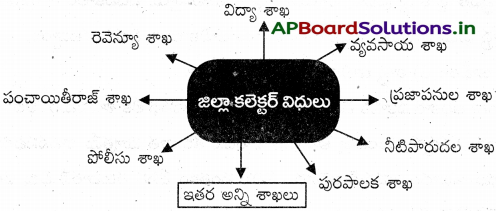
→ జిల్లా కలెక్టర్, జిల్లా పరిపాలనకు అధిపతి.

AP 7th Class Social Notes Chapter 10 రాష్ట్ర ప్రభుత్వం

→ జిల్లా స్థాయిలో ఉన్న కోర్టును జిల్లా కోర్టు అంటారు.

→ ప్రత్యామ్నాయ వివాద పరిష్కార యంత్రాంగాలలో లోక్ అదాలత్ ఒకటి.

→ లోక్ అదాలత్ కు లీగల్ సర్వీస్ అథారిటీస్ యాక్ట్ – 1987 ప్రకారం- చట్టబద్ధమైన హోదా ఇవ్వబడింది.

→ తహసీల్దార్ మండల స్థాయిలో ముఖ్య పరిపాలనా కార్యనిర్వాహణాధికారి.

→ గ్రామ రెవెన్యూ అధికారి గ్రామ స్థాయి పరిపాలనలో ముఖ్య పరిపాలనా కార్యనిర్వాహక అధికారి.

→ ప్రభుత్వం : ప్రభుత్వం అనేది రాజ్యం యొక్క ఒక లక్షణం. ఒక చట్టపరమైన నిర్మితి లేదా వ్యవస్థ. వివిధ విభాగాలతో నిర్దేశింపబడిన అధికార విధులను ప్రభుత్వం కొనసాగిస్తుంది.

→ శాసన నిర్మాణ శాఖ : చట్టాలు శాసనాలను తయారు చేసే శాఖ.

→ కార్యనిర్వాహక శాఖ : చట్టాలను శాసనాలను అమలు చేయు శాఖ.

→ న్యాయశాఖ : ప్రభుత్వం చేసిన చట్టాలు శాసనాలను వ్యాఖ్యానించడంతో పాటు వాటిని పరిరక్షించడం, అమలుకు బాధ్యత వహించు శాఖ.

→ సాధారణ ఎన్నికలు : శాసన సభ(ల) పదవీ కాలం పూర్తయిన తరువాత ఎన్నిక కోసం నిర్వహించే ఎన్నికలు.

→ : ఇది శాసనపరమైన/చట్టపరమైన ప్రతిపాదనల ముసాయిదా.

→ MLA : శాసన సభ సభ్యుడు (Member of Legislative Assembly).

→ MLC : శాసన మండలి సభ్యుడు (Member of Legislative Council).

→ ఎన్నికల సంఘం : దేశంలో / రాష్ట్రంలో ఎన్నికలు నిర్వహించు రాజ్యాంగబద్ధ సంస్థ.

→ మెజారిటీ : ఎక్కువ ఓట్లు / సీట్లు వచ్చినవారు.

AP 7th Class Social Notes Chapter 10 రాష్ట్ర ప్రభుత్వం

→ అధికార పార్టీ : ప్రజాస్వామ్య వ్యవస్థలో శాసనసభకు (చట్ట సభలకు) జరిగిన ఎన్నికల్లో మెజారిటి పొంది, అధికారం పొందిన పార్టీ.

→ ప్రతిపక్ష పార్టీ : రాజకీయంగా ఒకటి లేదా అంతకంటే ఎక్కువగానీ పార్టీలు అధికార పార్టీని వ్యతిరేకించే పార్టీలు.

→ సార్వత్రిక వయోజన ఓటు హక్కు : ఒక నిర్దిష్ట వయస్సు (18 సం||) నిండిన పౌరులందరికి ఏవిధమైన వివక్షత లేకుండా ఓటు హక్కు కల్పించడం.

→ రహస్య ఓటింగ్ విధానం : ఎన్నికల సమయంలో ఓటరు తను ఓటు వేసే విషయంలో గోప్యతను కల్గి ఉండటం.

→ లోక్ అదాలత్ : ప్రజా న్యాయ స్థానం, ప్రత్యామ్నాయ వివాద పరిష్కార యంత్రాంగంలో ఒకటి.

→ సివిల్ వివాదాలు : వ్యక్తుల మధ్య ఒప్పందాలు/నియమాల ఉల్లంఘన వల్ల ఏర్పడే వివాదం.
ఉదా : భూ, ఆస్తి, విడాకులు, అద్దె మొదలైనవి.

→ క్రిమినల్ వివాదాలు : చట్ట ఉల్లంఘనకు పాల్పడితే పోలీసులు పెట్టే కేసులు. ఉదా : దొంగతనం, లంచం, హత్య, దోపిడీ, లంచాలు ఇవ్వటం మొదలైనవి.

→ మేజిస్టీరియల్ అధికారాలు : న్యాయ, శాంతి భద్రతలకు సంబంధించిన అధికారాలు.

→ సుప్రీం కోర్టు : దేశంలోని అత్యున్నత న్యాయస్థానం.

→ హైకోర్టు : రాష్ట్రంలోని అత్యున్నత న్యాయస్థానం.

→ జిల్లా కోర్టు : జిల్లా స్థాయిలో అత్యున్నత న్యాయస్థానం.

→ CPC : సివిల్ ప్రొసీజర్ కోడ్.

→ CrPC : క్రిమినల్ ప్రొసీజర్ కోడ్.

→ నియోజక వర్గం : ఒక ప్రాంత పరిధిలో నివసిస్తున్న ఓటర్లందరూ తమ ప్రతినిధులను ఎన్నుకునే ఒక నిర్దిష్ట ప్రాంతం.

→ ద్విసభా వ్యవస్థ : రెండు శాసనసభలతో కూడిన ప్రభుత్వాన్ని ద్విసభా వ్యవస్థ అంటారు.

→ గెజిట్ : ప్రభుత్వ చర్యలు మరియు నిర్ణయాలను తెలియజేసే అధికారిక ప్రచురణ.

→ సమన్స్ : సభ సభ్యులందరినీ సమావేశపరచటం.

→ ప్రోరోగ్ : సభను నిరవధికంగా వాయిదా వేయడం.

→ బ్యూరోక్రసి : ప్రభుత్వ ఉద్యోగులు కీలక విధాన నిర్ణేతలుగా ఉన్న ప్రభుత్వ వ్యవస్థ.

AP 7th Class Social Notes Chapter 10 రాష్ట్ర ప్రభుత్వం

→ సయోధ్య / రాజీ కుదుర్చుకోవడం : న్యాయస్థానాల ప్రమేయం లేకుండా మధ్యవర్తుల ద్వారా వివాదాలు పరిష్కరించుకోవడం.

→ సర్వే రాళ్ళు : భూ సరిహద్దులను నిర్ణయించడం కొరకు ఏర్పాటు చేయబడిన గుర్తులు.

→ మ్యానిఫెస్టో : ఎన్నికల ముందు రాజకీయ పార్టీలు ప్రకటించే హామీల పత్రం.

→ సమావేశపరచడం : శాసనసభ సభ్యులందరినీ సమావేశపరచడం.

→ సంకీర్ణం : ప్రభుత్వ ఏర్పాటు కోసం రాజకీయ పార్టీలు కలవడం.

AP 7th Class Social Notes Chapter 10 రాష్ట్ర ప్రభుత్వం 1

1.
AP 7th Class Social Notes Chapter 10 రాష్ట్ర ప్రభుత్వం 2

2.
AP 7th Class Social Notes Chapter 10 రాష్ట్ర ప్రభుత్వం 3

AP 7th Class Social Notes Chapter 9 భారత రాజ్యాంగం – పరిచయం

Students can go through AP Board 7th Class Social Notes 9th Lesson భారత రాజ్యాంగం – పరిచయం to understand and remember the concept easily.

AP Board 7th Class Social Notes 9th Lesson భారత రాజ్యాంగం – పరిచయం

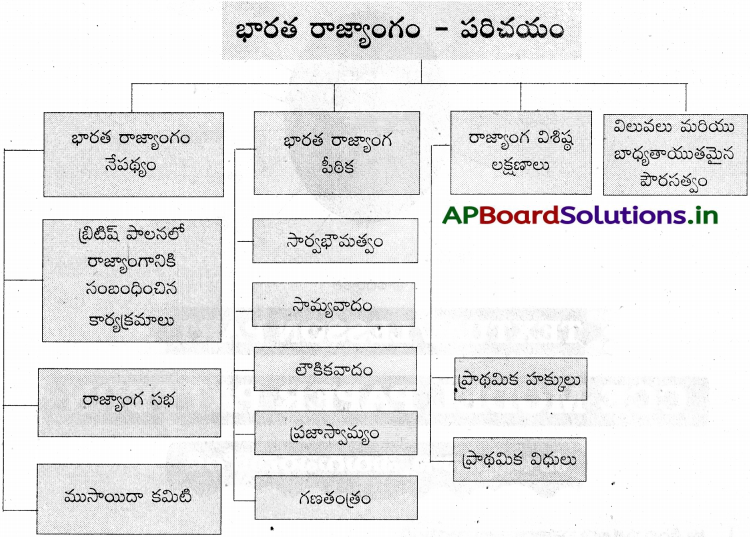
→ బ్రిటిషు పార్లమెంటు చేసిన చట్టాలలో, భారత ప్రభుత్వ చట్టం-1935 చాలా ముఖ్యమైన చట్టం.

→ 1928వ సంవత్సరంలో భారతదేశానికి రాజ్యాంగాన్ని రూపొందించడానికి భారత జాతీయ కాంగ్రెస్ సహా అన్ని పార్టీలు ఒక కమిటీని ఏర్పాటు చేసాయి.

→ ఈ కమిటీ చైర్మన్ గా మోతీలాల్ నెహ్రూ వ్యవహరించారు.

→ ఈ కమిటీ తన నివేదికను 1929వ సం||లో సమర్పించింది.

→ దీనిని నెహ్రూ నివేదిక అని పిలుస్తారు. ఇది మొదటి రాజ్యాంగపత్రంగా పరిగణించబడుతుంది.

→ 1931వ సం||లో, కరాచీలో జరిగిన భారత జాతీయ కాంగ్రెస్ సమావేశం స్వతంత్ర భారతదేశం యొక్క రాజ్యాంగం ఎలా ఉండాలో ఒక తీర్మానాన్ని ఆమోదించింది.

→ నెహ్రూ నివేదిక మరియు కరాచీ తీర్మానం రెండూ సార్వత్రిక వయోజన ఓటు హక్కు స్వేచ్ఛ మరియు సమానత్వ హక్కుకు కట్టుబడి ఉన్నాయి.

AP 7th Class Social Notes Chapter 9 భారత రాజ్యాంగం – పరిచయం

→ భారత జాతీయ కాంగ్రెస్ ను 1885వ సంవత్సరంలో స్థాపించారు.

→ రాజ్యాంగాన్ని రూపొందించడానికి, ఎన్నుకోబడిన ప్రతినిధుల చేత ఏర్పడిన సభనే ‘రాజ్యాంగ సభ’ అంటారు.

→ 1946 కెబినేట్ మిషన్ ప్లాన్ ప్రకారం రాజ్యాంగ సభకు జూలై, 1946లో ఎన్నికలు జరిగాయి.

→ బ్రిటిషు పాలనలో ఉన్న రాష్ట్రాలు లేదా ప్రాంతాల నుండి 292 మంది సభ్యులను ఎన్నుకున్నారు.

→ స్వదేశీ సంస్థానాలు అన్ని కలిసి 93 మంది సభ్యులను సిఫార్సు చేసాయి.

→ ఢిల్లీ, అజ్మీర్ – మేవాడ్, కూర్గ్ మరియు బ్రిటిషు బెలూచిస్తాన్ నుండి నలుగురు సభ్యులను ఎన్నుకున్నారు.

→ దీంతో భారత రాజ్యాంగ సభ మొత్తం సభ్యుల సంఖ్య 389కి చేరుకున్నది.

→ ఈ 389 మంది సభ్యులలో 26 మంది షెడ్యూల్డ్ కులాలకు చెందినవారు, 9 మంది మహిళా సభ్యులు కలరు.

→ 1947 ఆగస్టులో దేశ విభజనతో రాజ్యాంగ సభను భారత రాజ్యాంగ సభ మరియు పాకిస్తాన్ రాజ్యాంగ సభగా విభజించారు.

→ భారత రాజ్యాంగ సభలో 299 మంది సభ్యులున్నారు.

→ డా|| బాబు రాజేంద్రప్రసాద్ రాజ్యాంగ సభ అధ్యక్షునిగా, తరువాత మొదటి రాష్ట్రపతిగా ఎన్నికయ్యారు.

→ రెండోసారి రాష్ట్రపతిగా ఎన్నికైన ఏకైక వ్యక్తి డా॥ బాబు రాజేంద్రప్రసాద్ (1950-1962).

→ 1947, ఆగస్టు 29న డా|| B.R. అంబేద్కర్ అద్యక్షతన, ఏడుగురు సభ్యులతో కూడిన ముసాయిదా కమిటీని ఏర్పాటు చేసారు.

→ ముసాయిదా రాజ్యాంగాన్ని తయారుచేసి 1948లో రాజ్యాంగ సభకు సమర్పించారు.

→ ముసాయిదా రాజ్యాంగంలో 315 ప్రకరణలు మరియు ‘8’ షెడ్యూలు ఉన్నాయి.

→ రాజ్యాంగ సభ చేత 1949, నవంబర్ 26న భారత రాజ్యాంగం ఆమోదించబడి, 1950, జనవరి 26న అమల్లోకి వచ్చింది.

→ డా|| బి. ఆర్. అంబేద్కరను “భారత రాజ్యాంగ పిత”గా అభివర్ణిస్తారు.

→ డా|| బి.ఆర్. అంబేద్కర్ 1947లో స్వతంత్ర భారతదేశపు మొట్టమొదటి న్యాయశాఖామంత్రిగా నియమించబడ్డారు.

→ డా|| బి.ఆర్. అంబేద్కర్ 14 ఏప్రిల్, 1891న సెంట్రల్ ప్రావిన్సెస్లో జన్మించారు.

→ భారతదేశంలో రాజ్యాంగ దినోత్సవం ప్రతి సంవత్సరం నవంబర్ 26న జరుపుకొంటాము.

→ రాజ్యాంగ సభ మన రాజ్యాంగాన్ని తయారుచేయడానికి 2 సంవత్సరాల, 11 నెలల 18 రోజులు పట్టింది.

→ రాజ్యాంగం కలిగి ఉన్న ఉపోద్ఘాతమును ‘రాజ్యాంగ పీఠిక’ అంటారు.

→ 13 – 12 – 1946 న రాజ్యాంగ సభ ప్రారంభ సమావేశంలో జవహర్‌లాల్ నెహ్రూ “లక్ష్యాల తీర్మానం”ను ప్రతిపాదించాడు. ఇదే రాజ్యాంగ పీఠికకు మూల ఆధారం.

AP 7th Class Social Notes Chapter 9 భారత రాజ్యాంగం – పరిచయం

→ ‘సామ్యవాదం’, ‘లౌకిక’ పదాలు 1976లో 42వ రాజ్యాంగ సవరణ ద్వారా పీఠికలో చేర్చబడ్డాయి.

→ హక్కులు అనేవి వ్యక్తుల సహేతుకమైన వాదనలు.

→ ప్రాథమిక హక్కులనేవి ఒక దేశం తన పౌరులను రక్షించడానికి రాజ్యాంగం ప్రకారం గుర్తించబడినవి.

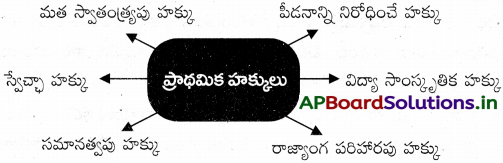
→ భారత రాజ్యాంగంలో 3వ భాగంలో, ఆర్టికల్ 14 నుండి 32 వరకు ఆరు ప్రాథమిక హక్కులు ఉన్నాయి.

→ సమానత్వపు హక్కు (ప్రకరణ 14-18) అంటరానితనం రద్దు, బిరుదులు రద్దు అనే అంశాలు కలవు.

→ స్వేచ్ఛా హక్కు (ప్రకరణ 19-22) ఆరు రకాలైన స్వేచ్చలకు హామీ ఇస్తుంది.

→ పీడనాన్ని నిరోధించే హక్కు (ప్రకరణ 23-24) వెట్టి చాకిరి, బాల కార్మిక వ్యవస్థను నిషేధిస్తుంది.

→ మత స్వాతంత్ర్యపు హక్కు (ప్రకరణ 25-28) మత వ్యవహారాల్లో ప్రభుత్వం తటస్థంగా ఉంటుంది.

→ విద్యా సాంస్కృతికపు హక్కు (ప్రకరణ 29-30) మత, భాషా ప్రాతిపదికన విద్యా సంస్థలను ఏర్పాటు చేసుకునే హక్కు.

→ రాజ్యాంగ పరిహారపు హక్కు (ప్రకరణ 31-32) అన్ని ప్రాథమిక హక్కులను పరిరక్షించే హక్కు.

→ సమాచార హక్కు చట్టాన్ని (RTI) భారత పార్లమెంట్ 2005లో ఆమోదించింది.

→ 2002లో 86వ రాజ్యాంగ సవరణ ద్వారా భారత పార్లమెంట్ ఆమోదంతో రాజ్యాంగంలో విద్యను ప్రాథమిక హక్కుగా చెప్పే 21-A ప్రకరణను చేర్చారు.

→ బాలల ఉచిత మరియు నిర్బంధ విద్యాహక్కు చట్టాన్ని 2009లో భారత పార్లమెంటు ఆమోదించింది. ఈ చట్టం ఏప్రిల్ 1, 2010న అమల్లోకి వచ్చింది.

→ పౌరులందరి నైతిక బాధ్యతలుగా ‘విధులను’ నిర్వచించారు.

→ ప్రాథమిక విధులను 1976లో 42వ రాజ్యాంగ సవరణ ద్వారా మన రాజ్యాంగంలోని ఆర్టికల్ 51ఎ, భాగం-43. లో పొందుపరిచారు.

→ ఈ ప్రాథమిక విధులు ‘రష్యా’ రాజ్యాంగం నుండి స్వీకరించబడ్డాయి.

→ విలువలు వ్యక్తుల ప్రవర్తనను నిర్ణయించే అంతర్గత ప్రమాణాలు. ఇవి మన చర్యలను ప్రేరేపిస్తాయి.

→ రాజ్యాంగం : దేశం యొక్క స్వభావం, ప్రభుత్వ రూపం, పౌరుల హక్కులు మరియు విధులను తెలియజేసే నిబంధనలతో కూడిన ప్రాథమిక చట్టం.

→ సర్వసత్తాక : బాహ్య మరియు అంతర్గత విషయాలపై నిర్ణయం తీసుకునే పూర్తి అధికారం.

→ సామ్యవాదం : సమాజంలో సామాజిక, ఆర్థిక మరియు రాజకీయ అసమానతలు తగ్గించడం ద్వారా సామాజిక న్యాయం అందించటం.

→ లౌకికవాదం : మత వ్యవహారాలలో ప్రభుత్వం జోక్యం చేసుకోకుండా తటస్థంగా ఉండటం.

→ ప్రజాస్వామ్యం : ప్రజలచే ఎన్నుకోబడిన ప్రజాప్రతినిధులచే ప్రభుత్వం నడపబడటం.

→ గణతంత్ర వ్యవస్థ : రాజ్యా ధినేత ప్రతి ఎన్నికల ద్వారా ఎన్నుకోబడితే అది గణతంత్ర వ్యవస్థ.

→ ప్రకరణ : (అధికరణ) రాజ్యాంగంలోని ఒక నిర్దిష్ట అంశంపై నిర్దిష్ట నియమం లేదా సూత్రాన్ని సూచిస్తుంది.

→ భాగం : ఒక భావనకు సంబంధించిన ప్రకరణల సముదాయమును సూచిస్తుంది.

→ షెడ్యూలు : ప్రకరణలలో పేర్కొనబడని అదనపు సమాచారం లేదా వివరాలను సూచిస్తుంది.

→ ప్రాథమిక హక్కులు : ఒక దేశం తన పౌరులను రక్షించడానికి రాజ్యాంగం ప్రకారం గుర్తించబడినవి.

→ హక్కులు : వ్యక్తుల సహేతుకమైన వాదనలు.

→ విధులు : పౌరుల యొక్క నైతిక బాధ్యతలు

→ రాజ్యాంగ సభ : రాజ్యాంగాన్ని రూపొందించడానికి, ఎన్నుకోబడిన ప్రతినిధులచే ఏర్పడిన సభ.

→ ముసాయిదా కమిటి : ముసాయిదా రాజ్యాంగాన్ని తయారు చేసే కమిటి. అంటే రాజ్యాంగాన్ని రాజ్యాంగ సభ ఆమోదించక ముందు సభ సూచనలను గ్రంథస్తం చేయటం.

AP 7th Class Social Notes Chapter 9 భారత రాజ్యాంగం – పరిచయం

→ రాజ్యాంగ పీఠిక : రాజ్యాంగానికి ముందు మాట, ఉపోద్ఘాతం లాంటిది.

→ వయోజన ఓటు హక్కు : ఒక నిర్దిష్ట వయస్సు కల్గిన వారికి కల్పించే ఓటు హక్కు.

→ రాజ్యాంగ సవరణ : ఒక దేశ రాజ్యాంగాన్ని సవరించడం.

→ సౌభ్రాతృత్వం : సోదర భావంతో కలిసి ఉండటం.

→ ప్రావిన్స్ : బ్రిటిష్ పాలనలో, భారతదేశంలోని పరిపాలనా విభాగం.

→ స్వదేశీ సంస్థానం : ఇవి బ్రిటిష్ కాలంలో స్వదేశీ రాజ్యాలు.

→ పౌరుడు : ఒక రాష్ట్రం లేదా దేశంలో సభ్యుడు మరియు అక్కడ చట్టపరమైన హక్కులు ఉన్న వ్యక్తి.

→ పౌరసత్వం : ఒక నిర్దిష్ట దేశంలో పౌరుడికి ఉన్న స్థానం లేదా స్థితి.

→ సమాఖ్య : కేంద్ర ప్రభుత్వం మరియు రాష్ట్ర ప్రభుత్వం మధ్య అధికార పంపిణీ.

→ ద్వంద్వ ప్రభుత్వం : రెండు వ్యవస్థలకు పాలనాధికారం ఉన్న ప్రభుత్వ విధానం.

AP 7th Class Social Notes Chapter 9 భారత రాజ్యాంగం – పరిచయం 1

1.
AP 7th Class Social Notes Chapter 9 భారత రాజ్యాంగం – పరిచయం 2

2.
AP 7th Class Social Notes Chapter 9 భారత రాజ్యాంగం – పరిచయం 3

3.
AP 7th Class Social Notes Chapter 9 భారత రాజ్యాంగం – పరిచయం 4