AP Inter 1st Year Botany Study Material Chapter 4 Plant Kingdom

Andhra Pradesh BIEAP AP Inter 1st Year Botany Study Material 4th Lesson Plant Kingdom Textbook Questions and Answers.

AP Inter 1st Year Botany Study Material 4th Lesson Plant Kingdom

Very Short Answer Questions

Question 1.
What is the basis for the classification of Algae?
Answer:
The basis for the classification of Algae is pigmentation and type of stored food.

Question 2.
When and where does reduction division take place in the life cycle of a liverwort, a moss, a fern, a gymnosperm and an angiosperm?
Answer:
In liver worts, reduction division occurs in sporophyte as a result spores are produced in the capsule.

In Mpsses, reduction division occurs in sporophyte in spore mother cells.

In ferns :
Reduction division occurs in Macro and Micro sporangia to produce Macrospores and Microspores.

In Gymnosperms – Reduction division occurs in Microsporangia and Megasporangia.

In Angiosperms – Reduction division occurs in Microspore Mother cells (Anther), Megaspore Mother cell (ovule).

Question 3.
Differentiate between syngamy and triple fusion.
Answer:

SyngamyTriple fusion
1. One of the Male gametes released in the embryosac fuses with the egg to form a zygote. This is called syngamy.1. In this, the 2nd male gamete fuses with the diploid secondary nucleus to produce primary endosperm nucleus. This is Triple fusion.
2. It was discovered by strasberger.2. It was discovered by Nawaschin.

Question 4.
Differentiate between antheridium and archegonium.
Answer:

AntheridiumArchegonium
1. It is the male sex organ.1. It is the female sex organ.
2. It is club shaped.2. It is flask shaped.
3. It produces biflagellete Antherozoids.3. It produces a single egg.

Question 5.
What are the two stages found in the gametophyte of mosses? Mention the structure from which these two stages develop?
Answer:
The gametophyte of Mosses consists of two stages namely
a) Juvenile stage, the Protonema and
b) Adult leafy stage, gametophore.

Protonema is developed directly from spore. Gametophore is developed from the protonema as a lateral adventitious bud.

AP Inter 1st Year Botany Study Material Chapter 4 Plant Kingdom

Question 6.
Name the stored food materials found in Phaeophyceae and Rhodophyceae.
Answer:
In Phaeophyceae, the stored food material is Laminarin or Mannitol. The stored food material in Rhodophyceae is floridean starch.

Question 7.
Name the pigments responsible for brown colour of phaeophyceae and red colour of Rhodophyceae.
Answer:
“Fucoxanthin” pigment is responsible for brown colour of phaeophyceae and “r-phycoerythrin” is responsible for red colour of Rhodophyceae.

Question 8.
Name different methods of vegetative reproduction in Bryophytes. [A.P. Mar. 15]
Answer:
In Bryophytes vegetative Reproduction takes place by fragmentation or by Gemmae, or by budding in secondary protonema.

Question 9.
Name the integumehted megasporangium found in Gymnosperms. How many femals gametophytes are generally formed inside the megasporangium?
Answer:
The Integumented Megasporangium found in Gymnosperms is ovule. One multicellular female gametophyte develops inside the megasporangium which bears two or more archegonia.

Question 10.
Name the Gymnosperms which contain mycorrhiza and coralloid roots respectively.
Answer:
The Gynnosperm which contain Mycorrhiza is pinus, and which contain corralloid roots is cycas.

Question 11.
Mention the ploidy of any four of the following.
a. Protonemal cell of a moss.
b. Primary endosperm nucleus in a dicot.
c. Leaf cell of a moss.
d. Prothallus of a fern,
e. Gemma cell in Marchantia
f. Meristem cell of monocot
g. Ovum of a liverwort and
h. Zygote of a fern.
Answer:
a) Haploid
b) Triploid
c) Haploid
d) Haploid
e) Haploid
f) Diploid
g) Haploid
h) Diploid

Question 12.
Name the four classes of pteridophyta with one example each.
Answer:
The four classes of pteridophyta are :
i) Psilopsida Ex : Psilotum
ii) Lycopsida Ex : Lycopodium
iii) Sphenopsida Ex : Equisetum
iv) Pteropsida Ex : Pteris

AP Inter 1st Year Botany Study Material Chapter 4 Plant Kingdom

Question 13.
What are the first organisms to colonise rocks? Give the generic name of the moss which provides peat?
Answer:
The first organisms to colonise rocks are Mosses along with Lichens. Generic name is sphagnum.

Question 14.
Mention the fern characters found in Cycas.
Answer:
Some of the fern characters are :

  1. Circinate vernation of young leaves.
  2. Presence of ramenta.
  3. Multiciliated Male gametes.
  4. Presence of Archegonia.

Question 15.
Why are Bryophytes called the amphibians of the plant Kingdom?
Answer:
They live in moist soil and they depend on water for sexual reproduction. So they are called amphibians of plant Kingdom.

Question 16.
Name an algae which show
a) Haplo – diplontic and b) Diplontic types of life cycles.
Algae which show Haplo – diplontic life cycle is Ectocarpus. Algae that show Diplontic life cycle is Fucus.

Question 17.
Give examples for unicellular, colonial and filamentous algae.
Example are volvox, spirogyra and chara. These are the members of chlorophyceae.

Short Answer Type Questions

Question 1.
Differentiate between red algae and brown algae. [A.P. May. 18, Mar. 14]
Answer:

Red algaeBrown algae
1. Red algae belong to the class Rhodophyceae.1. Brown algae belong to the class Phaeo-phyceae.
2. Majority of them are marine and some are fresh water forms.2. They live in fresh waters, brackish and salt waters.
3. The thallus of Red algae are multicellular.3. The thallus range from simple branched filamentous form to profusely branched forms.
4. The major pigments are Chlorophyll a, d and r-phycoerythrin.4. The major pigments are chlorophyll a, c, carotexnoids and Xanthophylls (Fuco xanthin)
5. Flagella are absent.5. Flagella are 2, unequal lateral.
6. Cell wall is made up of Cellulose, Pectin and Polysulphate esters.6. Cell wall is made up of Cellulose and algin.
7. Food materials are stored in the form of floridean starch.7. Food materials are stored in the form of Mannitol and Laminarin.
8. Asdxual Reporduction is by non-motile spores.8. Asexual Reproduction is by biflagellate zoospores.
9. Sexual reproduction is by non-motile gametes.9. Sexual Reproduction is by motile gametes.
10. Red algae.
Ex : Polysiphonria, Porphyra Gracilaria, Gelidium.
10. Brown algae.
Ex : Ectocarpus, Laminaria, Sargassum, Focus.

AP Inter 1st Year Botany Study Material Chapter 4 Plant Kingdom

Question 2.
Differentiate between liverworts and mosses.
Answer:

LiverwortsMosses
1. Plant body in liverworts is thalloid which is prostrate dorsiventral and closely appressed to the substrate.1. In Mosses the adult stage gametophore consists of upright, slender axis with spirally arranged leaves which gets attached to substratum by Rhizoids.
2. Antheridia (Male) and Archegonia (Female) are sex organs produced on the same or on different thalli.2. Male and female sex organs are produced at the apex of the leafy shoots.
3. Paraphyses are absent.3. Paraphyses are present.
4. Vegetative Reproduction is by fragmentation or by Gemmae.4. Vegetative Reproduction is by fragmen-tation or by Gemmae or by budding on the secondary protonema.
5. The sporophyte is small or reduced.5. The sporophyte in mosses is more elaborate.
6. Elaters are present in the capsule which help in spore dispersal.6. Peristomial teeth are present in capsule which help in spore dispersal.
7. Spores germinate to form free living gameto- phytes.7. Spores germinate to form creeping, green, branched protonema.
8. Ex : Marchantia.8. Ex : Funaria.

Question 3.
What is meant by Homosporous and Heterosporous pteridaphytes? Give two examples. [T.S. May. 18 A.P. Mar. 18, 15, 13]
Answer:
Pteridophytes which produce similar type of spores are called Homosporous pteridophytes.
Ex : Lycopodium, Pteris.

Pteridophytes which produce two types of spores are called Heterosporous Pteriodophytes.
Ex : Selaginella, Saivinia.

Question 4.
What is Heterospory? Briefly comment on its significance. Give two examples. [T.S. Mar, 15]
Answer:
Heterospory refers to the production of different types of spores.

Significance :

  1. Microspores formed from Microspore mother cells are small with 0.015 – 0.05 mp. Megaspores formed from Megaspore Mother cell are big and are with 1.5 mp.
  2. Microspores develop into Male gametophytes and Megaspores develop into female gametophytes which lead to unisexuality.
  3. The female gametophytes are retained on the parent sporophyte for variable periods.
  4. The development of zygote into young embryos takes place within the female gametophytes.
  5. The female gametophyte is with abundant food materials.
    Ex : Selagenella, Saivinia.

Question 5.
Write a note on economic importance of Algae and Bryophytes.
Answer:
Importance of Algae :

  1. At least a half of the carbon dioxide fixation on earth is carried out by Algae through photosynthesis and increases the level of oxygen in the environment.
  2. They are paramount importance as primary producers of energy rich compounds which form the basis of the food cycles of aquatic animals.
  3. Many species of Porphyra, Laminaria and sargassum are used as food.
  4. Some marine Brown and red algae produce large amounts of hydro carbons.
    Ex : A/gin and Carrageen.
  5. Iodine is extracted from kelps like Laminaria.
  6. Chlorella and Spirullina are used as food supplements even by space travellers.

Economic importance of Bryophytes :

  1. Some mosses provide food for herbaceous mammals, birds and other animals.
  2. Species of Sphagnum, a moss provide peat used as fuel and because of its capacity to hold water as packing material for trans – shipment of living material.
  3. Mosses along with lichens are the first organisms to Colonise rocks.
  4. They play significant role in plant succession.
  5. Mosses form dense mats on the soil, thus they reduce the impact of falling rain and prevent soil erosion.

AP Inter 1st Year Botany Study Material Chapter 4 Plant Kingdom

Question 6.
How would you distinguish Monocots from Dicots.
Answer:

MonocotsDicots
1. Monocots contain only one cotyledon in their seeds.1. Dicots contain two cotyledons in their seeds.
2. Fibrous root system is present.2. Tap root system is present
3. Parallel venation is seen in leaves.3. Reticulate venation is seen in leaves.
4. Endosperm is absent.4. Endosperm is present.
5. During germination, seed produce only one leaf.5. During germination, the seed produce two leaves.

Question 7.
Give a brief account of Prothallus.
Answer:
In Pteridophytes, the spores germinate to give rise to Inconspicuous, small but multicellular free living, photosynthetic thalloid gametophytes called Prothalli. They require cool, damp, shady places to grow. Because of this specific requirement and water for fertilization, the spread of living pteridophytes is limited and restricted to narrow geographical regions. The gametophytes bear male and female sex organs, called antheridia and archegonia respectively. The sex organs are multicellular, jacketed and sessile.

Question 8.
Draw labelled diagrams of :
a) Female thallus and Male thallus of a liverwort.
b) Gametophyte and sporophyte of funaria.
Answer:
AP Inter 1st Year Botany Study Material Chapter 4 Plant Kingdom 1

Long Answer Type Questions

Question 1.
Name three groups of plants that bear archegonia. Briefly describe the life cycle of any one of them.
Answer:
Bryophytes, Pteridophytes and Gymnosperms are the three ‘groups of plants that bear archegonia. The plant body in bryophytes is haploid. It produces gametes hence it is called gametophyte. The sex organs are multicellular, Jacketed and stalked. Antheredium, which is the male sex organ produces biflagellate antherozoids. Archegonium, the female sex organ, which is flask shaped, produces a small egg.

The antherozoids are released into water where they come in contact with archegonium. One antherozoid fuses with the egg to produce the zygote. This is called zooidogamous oogamy. Zygote produce a multicellular body called sporophyte. It is attached to the photosynthetic gametophyte and extracts nourishment from it.

Some cells of the sporophyte, called spore mother cells undergo reduction division to produce Haploid spores. These spores germinate to produce gametophyte. Bryophytes show alternation of generations (because garhetophytic and sporophytic bodies are different) and life cycle is Haplo-diplontic type.

AP Inter 1st Year Botany Study Material Chapter 4 Plant Kingdom

Question 2.
Describe the important characteristics of Gymnosperms.
Answer:

  1. Gymnosperms are embryophytic, trachaeophytic, archegoniate phanerogams.
  2. They include medium size trees or tall trees and shrubs.
  3. The root system is tap root system. In some genera roots have fungal association in the form of mycorrhiza (Pinus) and in some Cycas roots have coralloid roots which are associated with Nitrogen fixing Cyanobacteria (Nostbc and Anabaena)
  4. The stems are unbranched (Cycas) or branched (Pinus Cedrus).
  5. The leaves may be simple or compound. In Cycas, the pinnate leaves persists for a years in Cycas.
  6. Anatomically the stem shows eustele. The vascular bundles are conjoint, collateral and open.
  7. Vessels are generally absent in xylem and companion cells are absent in phloem.
  8. Secondary growth occurs in stem and roots.
  9. The Gymnosperms are heterosporous, they produce haploid microspores and megaspores.
  10. The two types of spores are produced in sporangia that are borne on sporophylls which are arranged spirally an aixs to form compact strobili.
  11. The male strobili consists of microsporophylls and Microsporangia which produce Micro-spores.
  12. Microspores or pollen grains develop into Male gametophyte.
  13. The strobili bearing Megasporophylls with ovules are called female strobili.
  14. Micro and Megasporphylls may be borne on the same tree (Pinus) or on different trees (Cycas).
  15. Megaspore develop into female gametophyte. The pollination is direct and anemophilous.
  16. Gymnosperms are divided into three classes namely Cycadopsida, Coniferopsida and Gnetopsida.

Question 3.
Give the sailent features of Pteridophytes.
Answer:

  1. Pteridophytes are used for medicinal purposes and as soil-binders.
  2. These are the first terrestrial plants to possess vascular tissues.
  3. They are embryophytic, archegoniate vascular cryptogams.
  4. They prefer cool, damp and shady places.
  5. The plant body is a sporophyte which is differentiated into true roots, stem and leaves.
  6. The root system is adventitious.
  7. The stele may be protostele or siphonostele or solenostele or’dictyostele.
  8. The leaves are small (selagenella) or large as in ferns.
  9. The sporophytels bear sporangia that are subtended by leaf like sporophylls.
  10. Most of the pteridophytes are homosporous but selaginella and Salvinia shows Heterosporous.
  11. The spores germinate to give rise to Prothalli.
  12. The gametophytes bear male and female sex organs called antheridia and archegonia.
  13. The sex organs are multicellular, jacketed and sessile.
  14. Fusion of Male gamete with the egg present in the archegonium results in the formation of zygote.
  15. Zygote develops into young embryo which produces a multicellular sporophyte.

Question 4.
Give an account of plant life Cycles and alternation of Generations.
Answer:
In plant, both haploid and diploid cells can divide by mitosis which leads to the formation of different plant bodies, haploid and diploid. The haploid plant body produces gametes by mitosis and is called gametophyte. It is followed by fertilization, which results in the formation of zygote which also divides by mitosis to form diploid sporophytic plant body. In this, Meiosis occurs, results in the formation of spores. These spores again divide by mitosis to form a Haploid plant body. Thus during life cycle there is a alternation of generations between gamete producing haploid gametophyte and spore producing diploid sporophyte.

Different plants show different life cycles. For Ex :
1) Many Algae such as Vo/vox, Spirogyra and some species of Chlamydomomas shows Haplontic life cycle. In this, zygote represents the sporophytic stage which divides by meiosis results in the formation of Haploid spores. These spores divide mitotically and form the gametophyte.

2) In some species, the diploid sporophyte is the dominant photosynthetic. Independent phase of the paint. The haploid phase is represented by gametes only. So this lifecycle is called diplontic type. In some pteridophytes, the gametophyte is represented by few celled stage so called diplo-haplontic type. Other exmples are polysiphonia.

3) In Bryophytes, both phases are multicellular with dominant gametophytic phases and dependent sporophytic phage. So this life cycle is called haplo-diplontic type. Other examples for this are Ectocarpus, Laminaria.

AP Inter 1st Year Botany Study Material Chapter 4 Plant Kingdom

Question 5.
Both Gymnospoerms and Angiosperms bear seeds then why are they classified separately?
Answer:

GymnospermsAngiosperms
1. Herbs are absent. Mainly trees.1. Most of the Angiosperms are herbs.
2. Reproductive parts are cones.2. Reproductive parts are flowers.
3. Cones are unisexual.3. Flowers are uni or Bisexual.
4. Ovules are Naked. So called naked seeded plants.4. Ovules are hidden within the Ovary. Seeds are present in the fruit.
5. Pollen grains reach the ovules directly.5. Pollen grains reach the ‘stigma’.
6. Male gametophyte consists of prothallial cells.6. Prothallial cells are absent.
7. Male gametes are Multiciliated.7. Cilia are absent on Male gametes.
8. Fertilization occurs only once.8. Fertilization occurs twice.
9. Archegonia are present.9. Archegonia are absent.
10. Female gametophyte acts on endosperm formed before fertilization which is Haploid.10. Endosperm is formed after fertilization, and is Triploid.
11. During Embryogenesis, free nuclear divisions occurs.11. Free nuclear divisions are absent.
12. Xylem vessels and companion cells are absent.12. Xylem vessels and Companion Cells are present.
13. Vegetative reproduction is rare.13. Vegetative reproduction is common.

AP Inter 1st Year Chemistry Study Material Chapter 4 States of Matter: Gases and Liquids

Andhra Pradesh BIEAP AP Inter 1st Year Chemistry Study Material 4th Lesson States of Matter: Gases and Liquids Textbook Questions and Answers.

AP Inter 1st Year Chemistry Study Material 4th Lesson States of Matter: Gases and Liquids

Very Short Answer Questions

Question 1.
Name the different intermolecular forces experienced by the molecules of a gas.
Answer:
The different intermolecular forces experienced by the molecules of a gas are London (or) dispersion forces, Dipole-Dipole forces, Dipole- induced dipole forces, and hydrogen bond.

Question 2.
State Boyle’s law. Give its mathematical expression.
Answer:
At constant temperature, the pressure of a given mass (fixed amount) of gas varies inversely with it’s volume. This is Boyle’s law.

  • Mathematically it can be written as
    P ∝ \(\frac{1}{v}\) (At constant T and no.of moles (n))
    ⇒ Pv = \(\frac{k}{v}\) (constant).

AP Inter 1st Year Chemistry Study Material Chapter 4 States of Matter: Gases and Liquids

Question 3.
State Charle’s law. Give its mathematical expression.
Answer:
At constant pressure the volume of a fixed mass of a gas is directly proportional to it’s absolute temperature. This is charle’s law.

  • Mathematically it can be written as
    V ∝ T (At constant P and no.of moles (n))
    ⇒ V = kT
    ⇒ \(\frac{V}{T}\) = k (constant).

Question 4.
What are Isotherms?
Answer:
At constant temperature the curves which shows the relationship between variation of volume of a given mass of gas and pressure are called isotherms.

Question 5.
What is Absolute Temperature?
Answer:
It is also called thermodynamic temperature (or) Kelvin temperature. It is a temperature on the absolute (or) kelvin scale in which zero lies at – 273.16°C.
T = (t° C + 273.16) K

Question 6.
What are Isobars?
Answer:
The curves (or) graphs that can be drawn at constant pressure are called Isobars.
Eg : Graph drawn between volume and temperature.

AP Inter 1st Year Chemistry Study Material Chapter 4 States of Matter: Gases and Liquids

Question 7.
What is Absolute Zero?
Answer:
It is the lowest temperature theoretically possible at which volume of a perfect gas is zero.

Question 8.
State Avogadro’s law.
Answer:
Equal volumes of all gases under the same conditions of temperature and pressure contains equal number of molecules
V ∝ n (mathematically)
v = kn

Question 9.
What are Isochores ?
Answer:
At constant volume a line on a graph showing the variation of temperature of a gas with its pressure is called Isochores.

  • It is also called Isoplere.

Question 10.
What are S T P Conditions ?
Answer:
STP means Standard Temperature and Pressure conditions.

  • Standard temperature is 0° C = 273 K
  • Standard pressure is 1 atmosphere = 76 cm = 760 mm. of Hg.

At S.T.P. one mole of any gas occupy 22.4 lit. of volume.

AP Inter 1st Year Chemistry Study Material Chapter 4 States of Matter: Gases and Liquids

Question 11.
What is Gram molar Volume ?
Answer:
The volume occupied by one gram molecular weight (or) one gram mole of an element (or) compound in the gaseous state is called gram molar volume.
(or)

  • At STP one mole of any gas occupy 22.4 lit. of volume This is known as gram molar volume.

Question 12.
What is an Ideal gas ?
Answer:
A gas which obeys gas laws i.e. Boyle’s law, charle’s law and avagadro’s law exactly at all temperatures is called an ideal gas.

Question 13.
Why the gas constant ‘R’ is called Universal gas constant ?
Answer:
Gas constant ‘R’ is called universal gas constant because the value of ‘R‘ is same for all gases.

Question 14.
Why Ideal gas equation is called Equation of State ?
Answer:
Ideal gas equation is a relation between four variables (p, v, n, T) and it describes the state of any gas. Hence it is called equation of state.

Question 15.
Give the values of gas constant in different units.
Answer:
Gas constant ‘R’ has values in different units as follows.
R = 0.0821 lit. atm. k-1 mol-1
= 8.314 J. k-1 mol-1
= 1.987 (or) 2 cal. k-1 mol-1
= 8.314 × 10⁷ ergs. k-1 mol-1.

Question 16.
How are the density and molar mass of a gas related?
Answer:
Pv = n RT
Pv = \(\frac{w}{m}\) RT m
P = \(\left(\frac{w}{v}\right) \frac{R T}{M}\)
Molar mass M = \(\frac{\mathrm{dRT}}{\mathrm{P}}\) [∴ \(\frac{w}{v}\) = density(d)]
P = Pressure of gas
R = Universal gas constant
T = Temperature of gas in kelvins scale.

Question 17.
State Graham’s law of diffusion. (A.P. Mar. ‘16, ’14)
Answer:
The rate of diffusion of a given mass of gas at a given pressure and temperature is inversely proportional to the square root of its density
rate of diffusion r ∝ \(\frac{1}{\sqrt{d}}\).

Question 18.
Which of the gases diffuses faster among N2, O2 and CH4? Why? (T.S. Mar. ‘15)
Answer:
CH4 gas diffuse faster among N2, O2 and CH4.
Reason : CH4 (16) has low molecular weight than N2 (28) and O2 (32).

Question 19.
How many times methane diffuses faster than sulphurdioxide?
Answer:
According to Graham’s law of diffusion.
AP Inter 1st Year Chemistry Study Material Chapter 4 States of Matter Gases and Liquids 1
Hence methane gas diffuses 2 times faster than SO2.

Question 20.
State Dalton’s law of Partial pressures. (Mar. ‘14)
Answer:
The total pressure exerted by a mixture of chemically non – reacting gases at given temperature and volume, is equal to the sum of partial pressures of the component gases.
P = P1 + P2 + P3.

AP Inter 1st Year Chemistry Study Material Chapter 4 States of Matter: Gases and Liquids

Question 21.
Give the relation between the partial pressure of a gas and its mole fraction.
Answer:
Partial pressure of a gas = mole fraction of the gas × Total pressure of the mixture of gases
Eg : Consider A and B in a container which are chemically non reaction.
∴ Partial pressure of A (PA) = XA × PT
Partial pressure of B (PB) = XB × PT
XA = \(\frac{n_A}{n_A+n_B}\), XB = \(\frac{n_B}{n_A+n_B}\)
XA, XB are mole fractions
PT = Total pressure.

Question 22.
What is aqueous tension?
Answer:
The pressure exerted by the water vapour which is equilibrium with liquid water is called aqueous tension.
(or)
The pressure exerted by the saturated water vapour is called aqueous tension.

Question 23.
Give the two assumptions of Kinetic molecular theory of gases that do not hold good in explaining the deviation of real gases from ideal behaviour.
Answer:
The two assumptions of kinetic molecular theory of gases that do not hold good in explaining the deviation of real gases from ideal behaviour are

  1. There is no force of attraction between the molecules of a gas.
  2. Volume of the gas molecules is negligible when compared to the space occupied by the gas.

Question 24.
Give the Kinetic gas equation and write the terms in it.
Answer:
Kinetic gas equation is PV = \(\frac{1}{3} \mathrm{mnu}_{\mathrm{rms}}^2\)
P = Pressure of the gas
V = Volume of the gas
m = Mass of 1 mole of the gas
urms = RMS speed of the gas molecules.

AP Inter 1st Year Chemistry Study Material Chapter 4 States of Matter: Gases and Liquids

Question 25.
Give an equation to calculate the kinetic energy of gas molecules.
Answer:
Kinetic energy for ‘n1 moles of gas is given by
K.E. = \(\frac{3}{2} \mathrm{nRT}\)
R = Universal gas constant
T = absolute temperature.

Question 26.
What is Boltzman’s constant ? Give its value.
Answer:
Boltzman’s constant is the gas constant per molecule.
Boltzman’s constant K = \(\frac{R}{N}\)
= 1.38 × 10⁻¹⁶ erg/k. molecule
= 1.38 × 10⁻²³ J/k. molecule.

Question 27.
What is RMS speed ?
Answer:
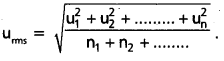
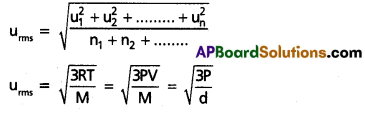
The square root of mean of the squares of the speeds of all molecules of a gas is known as RMS speed (uRMS)
AP Inter 1st Year Chemistry Study Material Chapter 4 States of Matter Gases and Liquids 2

Question 28.
What is Average speed ?
Answer:
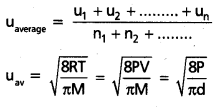
The arithematic mean of speeds of gas molecules is known as average speed (uav).
AP Inter 1st Year Chemistry Study Material Chapter 4 States of Matter Gases and Liquids 3

Question 29.
What is Most probable speed ?
Answer:
The speed possessed by the maximum number of molecules of the gas is known as most probable sPeed (ump).

Question 30.
What is the effect of temperature on the speeds of the gas molecules ?
Answer:
Temperature and speeds of the gases are directly related.
∴ By the rise of temperature the speeds of the gas molecules also increases.

Question 31.
What is the effect of temperature on the kinetic energy of the gas molecules ?
Answer:
According to the postulates of kinetic molecular theory of gases.
The kinetic energy of gas molecules is directly proportional to the absolute temperature.
K.E. ∝ Tabs

Question 32.
Give the ratio of RMS average and most probable speeds of gas molecules.
Solution:
AP Inter 1st Year Chemistry Study Material Chapter 4 States of Matter Gases and Liquids 4

Question 33.
Why RMS speed is taken in the derivation of Kinetic gas equation ?
Answer:
RMS speed is the mean of squares of speeds of all molecules of gas. Hence RMS speed, is taken into the derivation of kinetic gas equation.
PV = \(\frac{1}{3} m n u_{r m s}^2\)

Question 34.
What is Compressibility factor ?
Answer:
The ratio of the actual molar volume of a gas to the molar volume of a perfect gas under the same conditions is called compressibility factor.
Compressibility factor Z = \(\frac{\mathrm{PV}}{\mathrm{nRT}}\)
For a perfect gas Z = 1.

AP Inter 1st Year Chemistry Study Material Chapter 4 States of Matter: Gases and Liquids

Question 35.
What is Boyle Temperature?
Answer:
The temperatue at which a real gas exibits ideal behaviour for a considerable range of pressure is called Boyle’s temperature.

Question 36.
What is critical temperature ? Give its value for CO2.
Answer:
The temperature above which no gas can be liquified how ever high the pressure may be applied is called critical temperature.

  • Critical temperature of CO2 gas is 31.98° C.

Question 37.
What is critical Volume ?
Answer:
The volume occupied by one mole of gas at critical temperature and critical pressure is known as critical volume.

Question 38.
What is critical Pressure ?
Answer:
The pressure required to liquify a gas at critical temperature is known as critical pressure.

Question 39.
What are critical constants ?
Answer:
Critical temperatue (TC), critical volume (VC) and critical pressure (PC) are called as critical constants.

Question 40.
Define vapour Pressure of a liquid.
Answer:
The pressure exerted by the vapour on the liquid surface. When it is in equilibrium with the liquid at a given temperature is known as vapour pressure of the liquid.

Question 41.
What are normal and standard boiling points ? Give their values for H2O.
Answer:

  • The boiling points at 1 atm. pressure are called normal boiling points.
  • The boiling points at 1 bar pressure are called standard boiling points.
  • For water normal boiling point is 100° C.
  • For water standard boiling point is 99.6° C.

Question 42.
Why pressure Cooker is used for cooking food on hills ?
Answer:
At hill areas pressure cooker is used for cooking food because low atmospheric pressure is observed at high altitudes. At high altitudes liquids boil at low temperature. So water boils at low temperature on hills.

Question 43.
What is surface tension ?
Answer:
The force acting at right angles to the surface of the liquid along unit length of surface is called surface tension.

  • Units : dynes / cm.

Question 44.
What is laminar flow of a liquid ?
Answer:
In liquids a regular gradation of velocity for layers in passing from one layer to the next observed. This flow of liquid is called Laminar flow.

AP Inter 1st Year Chemistry Study Material Chapter 4 States of Matter: Gases and Liquids

Question 45.
What is coefficient of Viscosity ? Give its units.
Answer:
The force of friction required to maintain velocity difference of 1 cm. sec-1 between two parallel layers of a liquid 1 cm. apart and each layer having an area 1cm2 is called coefficient of viscosity.

  • It is denoted by η
  • F = η A \(\frac{\mathrm{du}}{\mathrm{dx}}\)
  • Units : Poise : In CGS system 1 poise = 1g. cm-1 sec-1.

Short Answer Questions

Question 1.
State and explain Boyle’s law.
Answer:
Boyle’s law : At constant temperature, the volume of a given mass of gas is inversely proportional to pressure of the gas.
If ‘V’ is the volume of a given mass of the gas and its pressure, then the law can be written as
V ∝ \(\frac{1}{P}\) at constant temperature
V = \(\frac{k}{P}\)
∴ PV = k
or P1V1 = P2V2 = k.
Boyle’s law may also be stated as, “at constant temperature the product of the’ pressure and volume of a given mass of gas is constant.”

Question 2.
State and explain Charle’s law.
Answer:
Charles’ law : At constant pressure, the volume of a given mass of gas is directly proportional to absolute temperature.
V ∝ T at constant pressure
V = kT
\(\frac{V}{T}\) = k
Where V is the volume and T is the absolute temperature. V1 and V2 are the initial and final volumes of a given mass of the gas at the absolute temperatures T1 and T2 respectively at constant pressure.
\(\frac{V_1}{T_1}\) = k; \(\frac{V_2}{T_2}\) = k
or \(\frac{v_1}{T_1}\) = \(\frac{V_2}{T_2}\) = k

Question 3.
Derive Ideal gas equation. (T.S. Mar. ’16)
Answer:
Ideal gas equation : The combination of the gas laws leads to the development of an equation which relates to the four parameters volume, pressure, absolute temperature and number of moles. This equation is known as ideal gas equation.
In this Boyle’s law and Charles’ law combined together and an equation obtained is called the gas equation.
V ∝ \(\frac{1}{p}\) (Boyle’s law)
V ∝ T (Charles law)
V ∝ n (Avogadro’s law)
Combining above three laws, we can write
V ∝ \(\frac{1}{p}\) ∝ T ∝ n (or) V = R × \(\frac{1}{P}\) × T × n
(Or) PV = nRT
Where V = volume of the gas
P = pressure of the gas
n = no. of moles of gas
T = absolute temperature
R = Universal gas constant.

Question 4.
State and explain Graham’s law of Diffusion. (A.P. Mar.’16) (Mar.’13)
Answer:
Graham’s law of diffusion : At a given temperature and pressure, the rate of diffusion of a gas is inversely proportional to the square root of density, vapour density or molecular weight.
AP Inter 1st Year Chemistry Study Material Chapter 4 States of Matter Gases and Liquids 5
If r1 and r2 are the rates of diffusion of two gases d1 and d2 are their densities respectively, then
\(\frac{r_1}{r_2}\) = \(\sqrt{\frac{d_2}{d_1}}\)
This eqaution can be written as:
AP Inter 1st Year Chemistry Study Material Chapter 4 States of Matter Gases and Liquids 6
Comparison of the volumes of the gases that diffuse in the same time. Let V1 and V2 are the volumes of two gases that diffuse in the same time ‘t’.
AP Inter 1st Year Chemistry Study Material Chapter 4 States of Matter Gases and Liquids 7
When time of flow is same then : \(\frac{\mathrm{r}_1}{\mathrm{r}_2}\) = \(\frac{v_1}{v_2}\)
When volume is the same then : \(\frac{r_1}{r_2}\) = \(\frac{t_2}{t_1}\).

Applications:

  • This principle is used in the separation of isotopes like U235 and U238.
  • Molar mass of unknown gas can be determined by comparing the rate of diffusion of a known gas molecular mass.
  • Ansil’s alarms which are used in coal mines to detect the explosive maršh gas works on the principle of diffusion.

Question 5.
State and explain Dalton’s law of Partial pressures.
Answer:
Dalton’s law of Partial pressures : The total pressure exerted by a mixture of chemically non-reacting gases at given temperature and volume, is equal to the sum of the partial pressures of the component gases.
Explanation: Consider a mixture of three gases ¡n a vessel. Let P1, P2, P3 be the partial pressures of the three gases in the mixture. According to Dalton’s law of partial pressures, the pressure (P) of the gaseous mixture is at the same temperature.
P = P1 + P2 + P3

Let n1, n2, n3 be the number of moles of three gases respectively in the mixture. Let ‘V’ be the volume of the mixture of gases at T K temperature.
According to ideal gas equation,
AP Inter 1st Year Chemistry Study Material Chapter 4 States of Matter Gases and Liquids 8
∴ P1 = x1 P
In a similar way P2 = x2 P and P3 = x3P
∴ Partial pressure = mole fraction × total pressure

AP Inter 1st Year Chemistry Study Material Chapter 4 States of Matter: Gases and Liquids

Question 6.
Deduce
(a) Boyle’s law and
(b) Charle’s law from Kinetic gas equation.
Answer:
a) Deduction of Boyle’s law:
Kinetic gas equation is PV = \(\frac{1}{3} m n u^2\)
PV = \(\frac{1}{3}\) mnu2
= \(\frac{1}{3}\) × \(\frac{2}{2}\) mnu2
= \(\frac{2}{3}\) × \(\frac{1}{2}\) mnu2
PV = \(\frac{2}{3}\) [Kinetic energy (KE)] [∵ KE‘n; moles = \(\frac{1}{2}\) mnu2]
PV = \(\frac{2}{3}\) KT [∵ KE = KT According to kinetic theory]
PV = \(\frac{2}{3}\)KT
According to Boyle’s law T is constant
∴ PV = \(\frac{2}{3}\)(constant)
∴ PV = constant
(or)
P ∝ \(\frac{1}{V}\)
Hence Boyle’s law proved from kinetic gas equation.

b) Deduction of Charle’s law:
Kinetic gas equation is PV = \(\frac{1}{3}\) mnu2
PV = \(\frac{1}{3}\) mnu2
= \(\frac{2}{2}\) × \(\frac{1}{3}\) mnu2
= \(\frac{2}{3}\) × \(\frac{1}{2}\) mnu2
= \(\frac{2}{3}\)(KE) [Kinetic energy (KE) = \(\frac{1}{2}\) mnu2]
PV = \(\frac{2}{3}\)KT [According to kinetic theory KE = KT]
\(\frac{V}{T}\) = \(\frac{2}{3}\) × \(\frac{K}{P}\)
According to Charles law ‘P is constant
∴ \(\frac{V}{T}\) = constant (or) V ∝ T
Hence Charle’s law proved from kinetic gas equation.

Question 7.
Deduce
(a) Graham’s law and
(b) Dalton’s law from Kinetic gas equation.
Answer:
a) Graham’s law: At constant temperature and pressure the rate of diffusion of a gas is inversely proportional to the square root of its density, r ∝ \(\frac{1}{\sqrt{d}}\)
Deduction : Kinetic gas equation is
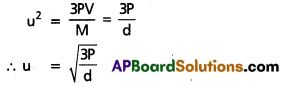
PV = \(\frac{1}{3}\) mnu2 = \(\frac{1}{3}\) mu2
u2 = \(\frac{3 P V}{M}\) = \(\frac{3}{d}\)
∴ u = \(\sqrt{\frac{3 \mathrm{P}}{d}}\)
At constant pressure u = k. \(\frac{1}{\sqrt{d}}\)
k = constant; or u ∝ \(\frac{1}{\sqrt{d}}\)
∴ The rate of diffusion of gases depends upon the velocity of the gas molecules.
So r ∝ \(\frac{1}{\sqrt{d}}\).
This is Graham’s law.

b) Dalton’s law of partial pressures : The total pressure exerted by a mixture of chemically non-reacting gases at given temperature and volume, is equal to the sum of the partial pressures of the component gases.
Deduction :
Consider a gas present in vessel of volume = V
no. of molecules = n1
mass of each molecule = m1
RMS velocity = u1
According to kinetic gas equation the pressure of the gas. P1 = \(\frac{1}{3} \frac{m_1 n_1 u_1^2}{v}\)
When this gas is replaced by another gas in the same vessel, P2 = \(\frac{1}{3} \frac{m_2 n_2 u_2^2}{V}\)
When these two gases are mixed in the same vessel, the total pressure of the mixture is P = \(\frac{1}{3} \frac{m_1 n_1 u_1^2}{V}+\frac{1}{3} \frac{m_2 n_2 u_2^2}{V}\) = P1 + P2
∴ P = P1 + P2.
This is Dalton’s law of partial pressures.

Question 8.
Derive an expression for Kinetic Energy of gas molecules.
Answer:
Kinetic gas equation is PV = \(\frac{1}{3}\)mnu2
For one mole of gas ‘n’ the no.of molecules will be equal to Avagadro’s number ‘N’.
∴ m × N = ‘M’ (gram molar mass of the gas)
∴ PV = \(\frac{1}{3}\) Mu2
= \(\frac{2}{2}\) × \(\frac{1}{3}\) Mu2
= \(\frac{2}{3}\) × \(\frac{1}{2}\) Mu2
= \(\frac{2}{3}\) (K.E)
Ideal gas equation for 1 mole of gas is PV = RT
∴ \(\frac{2}{3}\) KE = RT
⇒ KE = \(\frac{3}{2}\) RT
For ‘n’ moles KE = \(\frac{3}{2}\) nRT

Question 9.
Define
(a) RMS
(b) average and
(c) most probable speeds of gas molecules. Give their interrelationship.
Answer:
a) RMS speed:
The square root of mean of the squares of the speeds of all molecules of a gas is known as RMS speed (uRMS)
AP Inter 1st Year Chemistry Study Material Chapter 4 States of Matter Gases and Liquids 9
b) Average speed:
The arthematic mean of speeds of gas molecules is known as average speed (uav).
AP Inter 1st Year Chemistry Study Material Chapter 4 States of Matter Gases and Liquids 10
c) Most probable speed:
The speed possessed by the maximum number of molecules of the gas is known as most probable speed (ump).
\(u_{m p} \sqrt{\frac{2 R T}{M}}\) = \(\sqrt{\frac{2 P V}{M}}\) = \(\sqrt{\frac{2 P}{d}}\)

Inter relationships : –

  • ump : uav : urms = \(\sqrt{\frac{2 R T}{M}}\) : \(\sqrt{\frac{8 R T}{\pi M}}\) : \(\sqrt{\frac{3 R T}{M}}\)
    = 1 : 1.128 : 1.224.
  • uav = 0.9213 × urms
  • ump = 0.8166 × urms

Question 10.
Explain the physical significance of Vander Waals paramaters.
Answer:
Vander Waals equation : [P + \(\frac{a n^2}{\mathrm{~V}^2}\)] [V – nb] = nRT
Where P = Pressure of the gas
n = Number of moles of the gas
a, b = Vander Waals parameters (or) empirical parameters
V = Volume of the container
R = Gas constant
T = Absolute temperature
Units of ’a’: – bar lit-2 mole-2
Units of ’b’: – lit. mol-1

Significance : –

  • ‘a’ is the measure of magnitude of inter molecular forces (attractive) with in the gas and is independent of temperature and pressure. If ‘a’ value is high the gas can be easily liquified.
  • ‘b’ is the effective volume of the gas molecule. It indicates the effective size of the gas molecules. If the value of ‘b’ is constant over a long range of temperature and pressure then the gas cannot be compressed easily.

AP Inter 1st Year Chemistry Study Material Chapter 4 States of Matter: Gases and Liquids

Question 11.
What is Surface Tension of liquids ? Explain the effect of temperature on the surface tension of liquids.
Answer:
Surface tension property (γ): ‘It is defined as the force acting along the surface of a liquid at right angles to any line of 1 unit length.”
It is numerically and dimensionally equal to surface energy. It has dimensions kg. s-2 and in SI unit Nm-1.
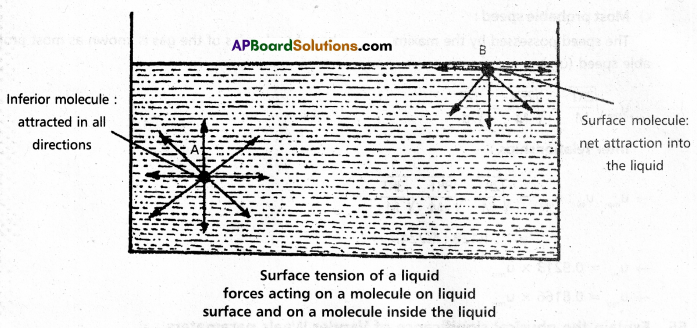
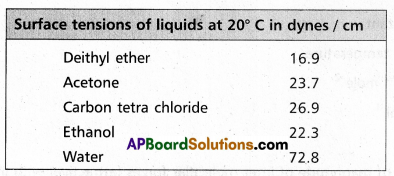
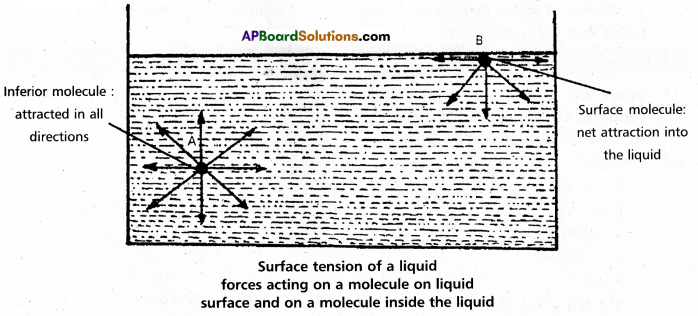
AP Inter 1st Year Chemistry Study Material Chapter 4 States of Matter Gases and Liquids 11
If we consider a molecule in the bulk of the liquid it experiences equal intermolecular forces in all directions. Hence there is no net force acting on it. But a molecule at the surface has intermolecular forces from inside only. Therefore there is a net attractive force on it towards the interior of the liquid. Due to this the surface area of the liquid tends to minimise. That is the molecules experience a downward force and have more energy than the molecules in the bulk.
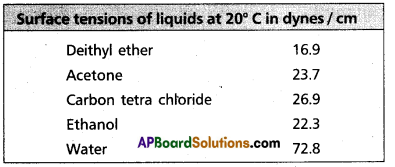
Surface tension decreases with increase of temperature because of increase in K,E. of molecules and decrease in intermolecular forces,
e.g.:
AP Inter 1st Year Chemistry Study Material Chapter 4 States of Matter Gases and Liquids 12

Question 12.
What is Vapour Pressure of liquids? How the Vapour Pressure of a liquid is related to its boiling point ?
Answer:
The pressure exerted by vapour of a liquid when it is in equilibrium with liquid is known as vapour pressure.
Effect of temperature : When the temperature of a liquid increased the average kinetic energy of molecules increases. This increase in kinetic energy overcomes the attractive forces between the liquid molecules so that liquid molecules rapidly escape into air. Thus rise in temperature raises the escaping tendency of molecules. Hence the vapour pressure of a liquid increases with increase in temperature.

The vapour pressure of a liquid increases with increase of temperature. This goes on until the critical temperature of the liquid is reached. Above the critical temperature liquid state does not exist when the vapour pressure of the liquid becomes equal to the external (atmospheric) pressure the liquid is said to be boiling and the temperature at which this happens is known as boiling point.

For water the boiling point is 100°C at 1. atm pressure. If the external pressure is reduced, the liquid boils at lower temperature. The boiling point of a liquid can be increased by increasing the external pressure.

Question 13.
Define Viscosity and Coefficient of Viscosity. How does the Viscosity of liquids varies with temperature.
Answer:
Viscosity : Viscosity is a measure of resistance to flow of liquids. This arises due to internal friction between layers of fluids as they slip past one another while liquid flows.

Coefficient of Viscosity:

The force of friction required to maintain velocity difference of 1 cm. sec-1 between two parallel layers of a liquid 1 cm. apart and each layer having an area 1 cm2 is called coefficient of viscosity.

  • It is denoted by η
  • F = ηA\(\frac{d u}{d x}\)
  • Units : Poise : In CGS system 1 poise = 1g. cm-1 sec-1.
  • Viscosity of liquids decrease with increase of temperature due to high kinetic energy of molecules that over come the inter molecular forces.

Long Answer Questions

Question 1.
Write notes on Intermolecular Forces.
Answer:
Intermolecular forces :
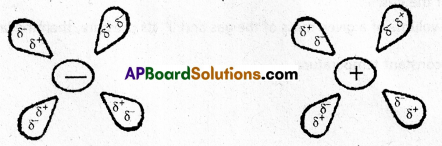
a) Ion – Dipole forces : Ion dipole forces are mainly important in aqueous solutions of ionic substances such as NaCl in which dipolar water molecules surround the ions.
AP Inter 1st Year Chemistry Study Material Chapter 4 States of Matter Gases and Liquids 13
Water molecules are polar and in them hydrogen atoms possess partial positive charges and oxygen atoms possess partial negative charges due to electronegativity difference between hydrogen and oxygen atoms. When ionic compounds like NaCl dissolve in water, they dissociate into component ions like Na+ and Cl. Now the water molecules orient in the presence of ions in such a way that the positive end of the dipole is near an anion and the negative end of the dipole is near a cation.

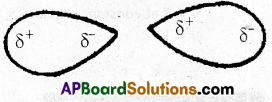
b) Dipole-Dipole forces : Neutral but polar molecules experience dipole-dipole forces. These are due to the electrical interactions among dipoles on neighbouring molecules. These forces are again attractive between unlike poles and repulsive between like poles and depend on the orientation of the molecules. The net force in a large collection of molecules results from many individual interactions of both types. The forces are generally weak and are significant only when the molecules are in close contact.
AP Inter 1st Year Chemistry Study Material Chapter 4 States of Matter Gases and Liquids 14

c) London dispersion forces : These forces result from the motion of electrons around atoms. Take, for example, atoms of helium. The electron distribution around a helium atom is for averaged over time spherically symmetrical. However, at a given instant the electron distribution in an atom may be unsymmetrical giving the atom a short – lived dipole moment. This instantaneous dipole on one atom can affect the electron distribution is neighbouring atoms and induce temporary dipoles in those neighbours. As a result, weak attractive forces develop known as London forces or dispersion forces. London forces are generally small. Their energies are in the range 1 – 10k J mol-1.
AP Inter 1st Year Chemistry Study Material Chapter 4 States of Matter Gases and Liquids 15

d) Dipole – Induced Dipole forces : These forces are between polar molecules with permanent dipole moments and the molecules with no permanent dipole moment. Permanent dipole of the polar molecule induces dipole on the electrically neutral molecule by deforming into electronic cloud.
Magnitude of these forces depends on the magnitude of the dipole moment of permanent dipole and polarisatricity of neutral molecule. This interaction is proportional to \(\left(\frac{1}{r^2}\right)\), where r = distance between molecules.

AP Inter 1st Year Chemistry Study Material Chapter 4 States of Matter: Gases and Liquids

Question 2.
State Boyle’s law, Charle’s law and Avogadro’s law and derive Ideal gas equation.
Answer:
Boyle’s law : At constant temperature, the volume of a given mass of gas is inversely proportional to pressure of the gas.
If ‘V is the volume of a given mass of the gas and ‘P’ its pressure, then the law can be written as V ∝ \(\frac{1}{P}\) at constant temperature
V = \(\frac{k}{P}\)
∴ PV = k or P1V1 = P2V2 = k

Boyle’s law may also be stated as, “at constant temperature the product of the pressure and volume of a given mass of gas is constant.”

Charles’ law: At constant pressure, the volume of a given mass of gas is directly proportional to absolute temperature.
V ∝ T at constant pressure
V = kT
\(\frac{\mathrm{T}}{\mathrm{T}}\) = k

Where V is the volume and T is the absolute temperature. V1 and V2 are the initial and final volumes of a given mass of the gas at the absolute temperatures T1 and T2 respectively at constant pressure.
\(\frac{V_1}{T_1}\) = k ; \(\frac{V_2}{T_2}\) = k
or \(\frac{V_1}{T_1}\) = \(\frac{V_2}{T_2}\) = k
Avogadro’s law : Equal volumes of all gases contain equal number of moles at constant temperature and pressure.
V ∝ n (pressure and temperature are constant).

Ideal gas equation : The combination of the above gas laws leads to the development of an equation which relates to the four parameters volume, pressure, absolute temperature and number of moles. This equation is known as ideal gas equation.

In this Boyle’s law and Charles’ law combined together and an equation obtained called the gas equation.
V ∝ \(\frac{1}{P}\) (Boyle’s law) ‘
V ∝ T (Charles law)
V ∝ n (Avogadro’s law)

Combining above three laws, we can write
V ∝ \(\frac{1}{P}\) ∝ T ∝ n (or) V = R × \(\frac{1}{P}\) × T × n
(Or) PV = nRT
Where V = volume of the gas
P = pressure of the gas
n = no. of moles of gas
T = absolute temperature
R = Universal gas constant

Question 3.
Write notes on diffusion of Gases.
Answer:
Diffusion : The property of gases to spread and occupy the available space is known as diffusion.

  • It is a non – directional phenomenon.
    Effusion : The escape of a gas from high pressure region into space through a fine hole is called effusion.
  • It is uni directional phenomenon.

Rate of diffusion : No. of molecules diffused per unit time is called rate of diffusion.

Graham’s law of diffusion : At a given temperature and pressure, the rate of diffusion of a gas is inversely proportional to the square root of density, vapour density or molecular weight.
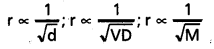
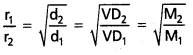
r ∝ \(\frac{1}{\sqrt{d}}\) ; r ∝ \(\frac{1}{\sqrt{V D}}\) ; r ∝ \(\frac{1}{\sqrt{M}}\)
If r1 and r2 are the rates of diffusion of two gases d1 and d2 are their densities respectively, then
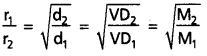
\(\frac{r_1}{r_2}\) = \(\sqrt{\frac{\mathrm{d}_2}{\mathrm{~d}_1}}\)
This equation can be written as :
AP Inter 1st Year Chemistry Study Material Chapter 4 States of Matter Gases and Liquids 16
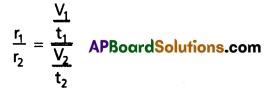
Comparison of the volumes of the gases that diffuse in the same time. Let V1, and V2 are the volumes of two gases that diffuse in the same time t’.
AP Inter 1st Year Chemistry Study Material Chapter 4 States of Matter Gases and Liquids 17
When time of flow is same then \(\frac{r_1}{r_2}\) = \(\frac{V_1}{V_2}\)
When volume is the same then : \(\frac{r_1}{r_2}\) = \(\frac{t_2}{t_1}\)

Applications :

  • This principle is used in the separation of isotopes like U235 and U238.
  • Molar mass of unknown gas can be determined by comparing the rate of diffusion of a known gas molecular mass.
  • Ansil’s alarms which are used in coal mines to detect the explosive marsh gas works on the principle of diffusion.

Question 4.
State and explain Dalton’s law of Partial Pressures.
Answer:
Dalton’s law of Partial pressures : The total pressure exerted by a mixture of chemically non-reacting gases at given temperature and volume, is equal to the sum of the partial pressures of the component gases.

Explanation: Consider a mixture of three gases in a vessel. Let P1, P2, P3 be the partial pressures of the three gases in the mixture. According to Dalton’s law of partial pressures, the pressure (P) of the gaseous mixture is at the same temperature.
P = P1 + P2 + P3
Let n1, n2, n3 be the number of moles of three gases respectively in the mixture. Let V be the volume of the mixture of gases at T K temperature.
According to ideal gas equation,
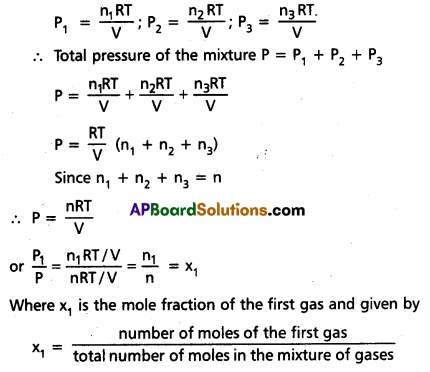
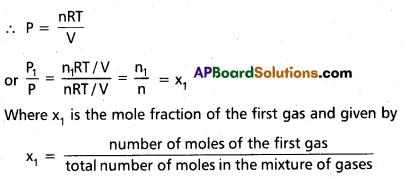
P1 = \(\frac{n_1 R T}{V}\) ; P2 = \(\frac{\mathrm{n}_2 \mathrm{RT}}{\mathrm{V}}\) ; P3 = \(\frac{\mathrm{n}_3 \mathrm{RT}}{\mathrm{V}}\)
∴ Total pressure of the mixture P = P1 + P2 + P3
P = \(\frac{n_1 R T}{V}\) + \(\frac{n_2 R T}{V}\) + \(\frac{n_3 R T}{V}\)
P = \(\frac{R T}{V}\)(n1 + n2 + n3)
Since nn1 + n2n2 + nn3 = n
AP Inter 1st Year Chemistry Study Material Chapter 4 States of Matter Gases and Liquids 18
∴ P1 = x1 P
In a similar way P2 = x2 P and P3 = x3P
∴ Partial pressure = mole fraction × total pressure

Question 5.
Write the postulates of Kinetic Molecular Theory of Gases.
Answer:
Assumptions:

  1. Gases are composed of minute particles called molecules. All the molecules of a gas are identical.
  2. Gaseous molecules are always, at a random movement. The molecules are moving in all possible directions in straight lines with very high velocities. They keep on colliding against each other and against the walls of the vessel at very small intervals of time.
  3. The actual volume occupied by the molecules is negligible when compared to the total volume occupied by the gas.
  4. There is no appreciable attraction or repulsion between the molecules.
  5. There is no loss of kinetic energy when the molecules collide with each other or with the wall of vessel. This is because the molecules are spherical and perfectly elastic in nature.
  6. The pressure exerted by the gas is due to the bombardment of the molecules of the gas on the walls of the vessel.
  7. The average kinetic energy of the molecules of the gas is directly proportional to the absolute temperature, Average K.E. ∝ T.
  8. The force of gravity has no effect on the speed of gas molecules.

Boyle’s law : According to kinetic theory of gases, the pressure of a gas is due to collisions of gas molecules on the walls of the vessel. At a particular temperature the molecules make definite number of collisions with the walls of the vessel; When the volume of the vessel is reduced the molecules have to travel lesser distance only before making collisions on the walls. As a result the number of collisions per unit increases. The pressure then increases, i.e., the pressure increases when the volume is reduced at constant temperature. This explains Boyle’s law.

Charles’ law : According to kinetic theory of gases, the average kinetic energy of the molecules is directly proportional to the absolute temperature of the gas.
K.E. ∝ T
but K.E. = \(\frac{1}{2}\) mc2

As temperature increases, the velocity of the molecules also increases. As a result the molecules make more number of collisions against the walls of the vessel. This results in an increase of pressure if the volume is kept constant. If the volume is allowed to increase the number of collisions decrease due to the increased distance between the molecules and the walls of the vessel. The pressure then decreases. In other words, with rise of temperature, the volume should increase in order to keep the pressure constant.
V ∝ T at constant pressure.
This is Charles’ law.

Question 6.
Deduce gas laws from Kinetic gas equation.
Answer:
a) Deduction of Boyle’s law :
Kinetic gas equation is PV = \(\frac{1}{3}\) mnu2
PV = \(\frac{1}{3}\) mnu2
= \(\frac{1}{3}\) × \(\frac{2}{2}\) mnu2
= \(\frac{2}{3}\) × \(\frac{1}{2}\) mnu2
PV = \(\frac{2}{3}\)[Kinetic energy (KE)] [∵ KE‘n’ moles = \(\frac{1}{2}\) mnu2]
PV = \(\frac{2}{3}\)KT [∵ KE = KT According to kinetic theory]
PV = \(\frac{2}{3}\)KT
According to Boyle’s law T is constant
∴ PV = \(\frac{2}{3}\)(constant)
∴ PV = constant
(or)
P ∝ \(\frac{1}{V}\)
Hence Boyle’s law proved from kinetic gas equation.

b) Deduction of Chartes law:
Kinetic gas equation is PV = \(\frac{1}{3}\) mnu2
PV = \(\frac{1}{3}\) mnu2
= \(\frac{2}{2}\) × \(\frac{1}{3}\) mnu2
= \(\frac{2}{3}\) × \(\frac{1}{2}\) mnu2
= \(\frac{2}{3}\) (KE) [Kinetic Energy (KE) = \(\frac{1}{2}\) mnu2]
PV = \(\frac{2}{3}\)KT [According to kinetic theory KE = KT]
\(\frac{V}{T}\) = \(\frac{2}{3}\) × \(\frac{K}{P}\)
According to Charles law P’ is constant
∴ \(\frac{V}{T}\) = constant (or) V ∝ T
Hence Charles law proved from kinetic gas equation.

c) Graham’s law: At constant temperature and pressure the rate of diffusion of a gas is inversely proportional to the square root of its density, r ∝ \(\frac{1}{\sqrt{d}}\)
Deduction: Kinetic gas equation is
Pv = \(\frac{1}{3}\) mnu2 = \(\frac{1}{3}\) Mu2
AP Inter 1st Year Chemistry Study Material Chapter 4 States of Matter Gases and Liquids 19
At constant pressure u = k. \(\frac{1}{\sqrt{d}}\)
k = constant; or u ∝ \(\frac{1}{\sqrt{d}}\)
∵ The rate of diffusion of gases depends upon the velocity of the gas molecules.
So r ∝ \(\frac{1}{\sqrt{d}}\)
This is Graham’s law.

d) Dalton’s law of partial pressures : The total pressure exerted by a mixture of chemically non-reacting gases at given temperature and volume, is equal to the sum of the partial pressures of the component gases.

Deduction:
Consider a gas present in vessel of volume = V
no. of molecules = n1
mass of each molecule = m1
RMS velocity = u1

According to kinetic gas equation the pressure of the gas. P1 = \(\frac{1}{3} \frac{m_1 n_1 u_1^2}{V}\)
When this gas is replaced by another gas in the same vessel, p2 = \(\frac{1}{3} \frac{m_2 n_2 \cdot u_2^2}{V}\)
When these two gases are mixed in the same vessel, the total pressure of the mixture is P = \(\frac{1}{3} \frac{m_1 n_1 u_1^2}{v}\) + \(\frac{1}{3} \frac{m_2 n_2 u_2^2}{V}\) = P1 + P2
∴ P = P1 + P2
This is Dalton’s law of partial pressures.

Question 7.
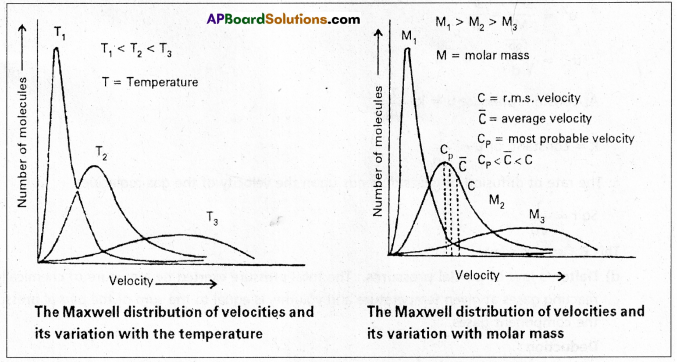
Explain Maxwell-Boltzmann distribution curves of molecular speeds and give the important conclusions. Discuss the effect of temperature on the distribution of molecular speeds.
Answer:
According to kinetic gas equation it was assumed that all the molecules in a gas have the same velocity. But it is not correct. When any two molecules collide exchange of energy takes place and hence their velocities keep on changing. At any instant few molecules may have zero velocity, a few molecules may be at high velocities and some may be with low velocities.

The distribution of speeds between different molecules were worked out by Maxwell by applying probability considerations.

If one plots a graph between fraction of molecules \(\frac{\Delta \mathrm{N}}{\mathrm{N}}\) vs velocity one gets distribution curve of the type.
AP Inter 1st Year Chemistry Study Material Chapter 4 States of Matter Gases and Liquids 20
These curves are shown at different temperatures T1 T2 (T1 < T2)

The graph reveals that

  1. There are no molecules with zero velocity and only very few molecules possess the highest velocity.
  2. The velocities of most of the molecules lie near a mean value.
  3. As the temperature of the gas is increased, the curve becomes more flattened and shifts towards higher velocity. It means that at higher temperature the number of molecules possessing higher velocities is more than at lower temperature.

The peak point corresponds to the most probable velocity. It is the velocity possessed by maximum number of molecules.
The average velocity of the molecules is slightly higher than the most probable velocity. The RMS velocity is slightly higher than the average velocity.

Question 8.
Write notes on the behaviour of real gases and their deviation from ideal behavior.
Answer:
Real gases are also called non – ideal gases; A gas which does not obey ideal gas equation PV = nRT is called Real gas.

  • Real gases show ideal behaviour at low pressure and high temperature.
    The deviation of real gas from ideal behaviour can be measured in terms compressibility factor (Z), which is the ratio of product PV and nRT. (i.e.,) Z = \(\frac{\mathrm{PV}}{\mathrm{nRT}}\)

For ideal gas, Z = 1 at all temperatures and pressures because PV = nRT. The graph of Z Vs P will be a straight line parallel to pressure axis. For gases which deviate from ideality, value of Z deviates from unity. At very low pressures all gases shown Z = 1 and behave as ideal gas. At low pressures, inter molecular forces are negligible hence show ideal behaviour. At high pressures all the gases have Z > 1. These are more difficult to compress. At intermediate pressures, most gases have Z < 1.

Question 9.
Derive the Vander Waals equation of state. Explain the importance of Vander Waal’s gas eqaution.
Answer:
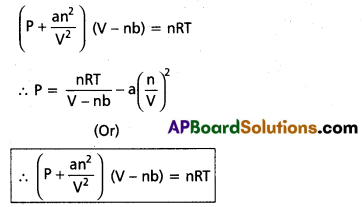
Vander Waal’s equation of state : Vander Waal’s proposed an approximate equation of state which involves the intermolecular interactions that contribute to the deviations of a gas from perfect gas law. It may be explained as follows. The repulsive interactions between two molecules cannot allow them to come closer than a certain distance. Therefore, for the gas molecules the available volume for free travel is not the volume of the container V but reduced to an extent proportional to the number of molecules present and the volume of each exclude.

Therefore, in the perfect gas equation a volume correction is made by changing v to (v – nb). Here, ‘b’ is the proportionality constant between the reduction in volume and the amount of molecules present in the container. P = \(\frac{n R T}{V-n b}\) If pressure is low, the volume is large compared with the volume excluded by the molecules (V > > nb). The nb can be neglected in the denominator and the equation reduces to the perfect gas equation of state.

The effect of attractive interactions between molecules is to reduce the pressure that the gas exerts. The attraction experienced by a given molecule is proportional to the concentration n/V of molecules in that container. As the attractions slow down the molecules, the molecules strike the waals less frequently and strike with a weaker impact. Therefore, we can expect the reduction in pressure to be proportional to the square of the molar-concentration, one factor of n/V showing the reduction in frequency of collisions and the other factor the reduction in the strength of their impulse.

Reduction in pressure ∝ \(\left(\frac{n}{V}\right)^2\)
Reduction in pressure = a. \(\left(\frac{n}{v}\right)^2\),
Where a = the proportionality constant.
Vander Waals equation is
AP Inter 1st Year Chemistry Study Material Chapter 4 States of Matter Gases and Liquids 21
The equation is called Vander Waals equation of state.

The constants ‘a’ and ‘b’ known as Vander Waals parameters (or) empirical parameters. They depend on the nature of the gas independent of temperature.

Significance : –

  • ‘a’ is the measure of magnitude of inter molecular forces (attractive) with in the gas and is independent of temperature and pressure. If ‘a’ value is high the gas can be easily liquified.
  • ‘b’ is the effective volume of the gas molecule. It indicates the effective size of the gas molecules. If the value of ‘b’ is constant over a long range of temperature and pressure then the gas cannot be compressed easily.

Question 10.
Explain the principle underlying the liquefacation of gases.
Answer:
Liquifacation of gases can be done by decreasing the temperature and increasing the pressure.

Liquefaction of gases: Any gas, if it to be liquefied, it must be cooled below its critical temperature. A gas liquefies if it is cooled below its boiling point at given pressure. For example, chlorine at room pressure say 1 atmosphere can be liquefied by cooling it to – 34.0°C in a dry ice bath. For N2 and O2 that have very low boiling points -196°C and -183°C. Such simple technique is not possible. Then, to liquify such type of gases the technique based on intermolecular forces is used. It is as follows. If the velocities of molecules are reduced to such lower values that neighbours can attract each other by their interaction or intermolecular attractions, then the cooled gas will condense to a liquid.

For this, the molecules are allowed to expand into available volume without supplying any heat from outside. In this, the molecules have to overcome the attractions of their neighbours and in doing so, the molecules convert some of their kinetic energy into potential energy and now travel slowly. The average velocity decreases and therefore the temperature of the gas decreases and the gas cools down compared to its temperature before its expansion. For this the gas is allowed to expand through a narrow opening called throttle. This way of cooling of gas by expansion from high pressure side to low pressure is called Joule – Thomson effect.

Question 11.
Write notes on the following properties of liquids
(a) Vapour Pressure
(b) Surface Tension
(c) Viscosity.
Answer:
(a) Vapour Pressure : The pressure exerted by vapour of a liquid when it is in equilibrium with liquid is known as vapour pressure.
Effect of temperature : When the temperature of a liquid increased the average kinetic energy of molecules increases. This increase in kinetic energy overcomes the attractive forces between the liquid molecules so that liquid molecules rapidly escape into air. Thus rise in temperature raises the escaping tendency of molecules. Hence the vapour pressure of a liquid increases with increase in temperature.

The vapour pressure of a liquid increases with increase of temperature. This goes on until the critical temperature of the liquid is reached. Above the critical temperature liquid state does not exist when the vapour pressure of the liquid becomes equal to the external (atmospheric) pressure the liquid is said to be boiling and the temperature at which this happens is known as boiling point.

For water the boiling point is 100°C at 1. aim pressure. If the external pressure is reduced, the liquid boils at lower temperature. The boiling point of a liquid can be increased by increasing the external pressure.

b) Surface tension property (γ) : “It is defined as the force acting along the surface of a liquid at right angles to any line of 1 unit length.”
It is numerically and dimensionally equal to surface energy. It has dimensions kg. s-2 and in SI unit Nm-1
AP Inter 1st Year Chemistry Study Material Chapter 4 States of Matter Gases and Liquids 22

If we consider a molecule in the bulk of the liquid it experiences equal intermolecular forces in all directions. Hence there is no net force acting on it. But a molecule at the surface has intermolecular forces from inside only. Therefore there is a net attractive force on it towards the interior of the liquid. Due to this the surface area of the liquid tends to minimise. That is the molecules experience a downward force and have more energy than the molecules in the bulk.

Surface tension decreases with increase of temperature because of increase in K, E. of molecules and decrease in intermolecular forces.
e.g.:
AP Inter 1st Year Chemistry Study Material Chapter 4 States of Matter Gases and Liquids 23

c) Viscosity : Viscosity is a measure of resistance to flow of liquids. This arises due to internal friction between layers of fluids as they slip past one another while liquid flows.
Coefficient of Viscosity:
The force of friction required to maintain velocity difference of 1cm. sec-1 between two parallel layers of a liquid 1 cm. apart and each layer having an area 1cm2 is called coefficient of viscosity.

  • It is denoted by η
  • F = η A \(\frac{\mathrm{du}}{\mathrm{dx}}\)
  • Units : Poise : In CGS system 1 poise = 1g. cm-1 sec-1.
  • Viscosity of liquids decrease with increase of temperature due to high kinetic energy of molecules that over come the inter molecular forces.

Solved Problems

Question 1.
What will be the minimum pressure required to compress 500 dm3 of air at 1 bar to 200 dm3 at 30°C?
Solution:
Formula:
P1y1 = P2y2
P1 = 1 bar
V1 = 500 dm3
V2 = 200 dm3
P2 = ?
1 × 500 = P2 × 200
P2 = \(\frac{5}{2}\) = 2.5 bar.

Question 2.
A vessel of 120 mL capacity contains a certain amount of gas at 35°C and 1.2 bar pressure. The gas is transferred to another vessel of volume 180 mL at 35 °C. What would be its pressure ?
Solution:
Formula:
P1V1 = P2V2
P1 = 1.2 bar
V1 = 120 ml
V2 = 180 ml
P2 = ?
1.2 × 120 = P2 × 180
P2 = \(\frac{1.2 \times 12}{18}\)
= \(\frac{2.4}{3}\) = 0.8 bar

Question 3.
Using the equation of state pV = nRT; show that at a given temperature density of a gas is proportional to gas pressure p.
Solution:
Consider the equation of state .
PV = nRT
PV = \(\frac{w}{M} R T\)
P = \(\frac{W}{V} \times \frac{R T}{M}\)
P = \(\frac{\mathrm{dRT}}{\mathrm{M}}\) (∵ d = \(\frac{w}{V}\))
From the above relation
P ∝ d

Question 4.
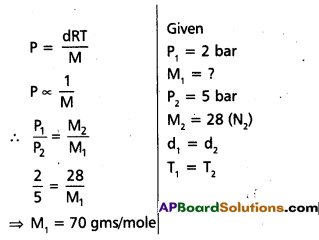
At 0°C, the density of a certain oxide of a gas at 2 bar is same as that of dinitrogen at 5 bar. What is the molecular mass of the oxide?
Solution:

  • Given two gases one is unknown oxide and another one is dinitrogen.
  • Density of two gases is same
    AP Inter 1st Year Chemistry Study Material Chapter 4 States of Matter Gases and Liquids 24

Question 5.
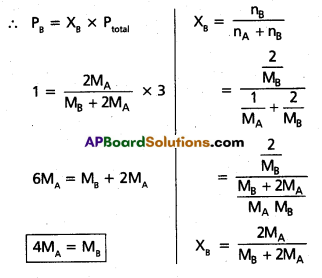
Pressure of 1 gm. of an ideal gas A at 27 °C is found to be 2 bar. When 2 g of another ideal gas B is introduced in the same flask at same temperature the pressure becomes 3 bar. Find a relationship between their molecular masses.
Solution:
Given
Weight of gas A = 1 gm
Weight of gas B = 2 gms
Molecular mass of A = MA
Molecular mass of B = MB
Pressure of A = PA = 2 bar
Given Total pressure = 3 bar (PA + PB)
∴ PB = 3 – 2 = 1 bar
AP Inter 1st Year Chemistry Study Material Chapter 4 States of Matter Gases and Liquids 25

Question 6.
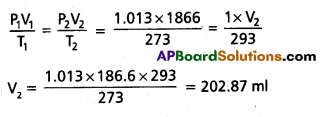
The drain cleaner, Drainex contains small bits of aluminum which react with caustic soda to produce dihydrogen. What volume of dihydrogen at 20°C and one bar will be released when 0.15 g of aluminium reacts?
Solution:
Chemical equation is
2Al + 2 NaOH + 2H2O → 2 NaAlO2 + 3H2
From the above equation
2 gram atom of Al liberates 3 moles of H2 at NTP
2 × 27 gms Al liberates 3 × 22.4 lit.
0.15 gms of Al liberates?
= \(\frac{0.15 \times 3 \times 22.4}{2 \times 27}\)
= 0.1866 li.t = 186.6 ml
P1 = 1.013 bar P2 = 1 bar
V1 = 186.6 ml V2 = ?
T1 = 273 K T2 = 20° C = 293 K
Formulae:
AP Inter 1st Year Chemistry Study Material Chapter 4 States of Matter Gases and Liquids 26

Question 7.
What will be the pressure extracted by a mixture of 3.2 g of methane and 4.4 g of carbon dioxide contained in a 9 dm3 flask at 27 °c?
Solution:
Formula:
Given 3.2 gmš of CH4
no.of moles of CH4 = \(\frac{w t}{\text { GMW }}\) = \(\frac{3.2}{16}\) = 0.2
no.of moles of CO2 = \(\frac{4.4}{44}\) = 0.1
∴ n = \(\mathrm{n}_{\mathrm{CH}_4}\) + \(\mathrm{n}_{\mathrm{CO}_2}\)
= 0.2 + 0.1 = 0.3
R = 8.314
T = 27°C = 300 K
V = 9 dm3
PV = nRT
P = \(\frac{n R T}{V}\)
= \(\frac{0.3 \times 8.314 \times 300}{9}\) = 83.14
= 83.14 × 10³ pa
= 83.14 × 10⁴ pa
∴ P = 8.314 × 10⁴ pa

Question 8.
What will be the pressure of the gaseous mixture when 0.5 L of H2 at 0.8 bar and 2.0 L of dioxygen at 0.7 bar are introduced in a 1 L vessel at 27°C?
Solution:
Case – I
Hydrogen gas
P1 = 0.8 bar
P2 = ?
V1 = 0.5 lit
V2 = 1.0 lit
P1y1 = P2V2
P2 = \(\frac{0.8 \times 0.5}{1}\)
P2 = 0.4 bar
Partial pressure of H2 = 0.4 bar. \(\left[\mathrm{P}_{\mathrm{H}_2}\right]\)

Case-II:
Oxygen gas
P1 = 0.7 bar
V1 = 2 lit
V2 = 1.0 lit
P2 = ?
P1V1 = P2V2
P2 = \(\frac{P_1 V_1}{V_2}=\frac{0.7 \times 2}{1}\)
= 1.4 bar
Partial pressure of O2 = 1.4 bar. \(\left[\mathrm{P}_{\mathrm{O}_2}\right]\)
∴ Total pressure = \(P_{\mathrm{H}_2}\) + \(P_{\mathrm{O}_2}\)
= 0.4 + 1.4 = 1.8 bar

Question 9.
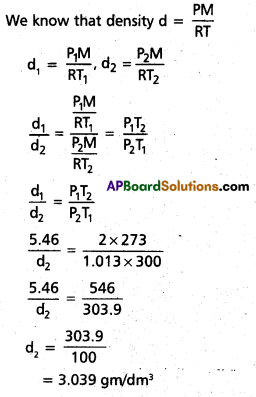
Density of a gas is found to be 5.46 g/dm3 at 27 °c at 2 bar pressure. What will be its density at STP?
Solution:
d1 = 5.46 gm/dm3
T1 = 27° C = 300 K
P1 = 2 bar
P2 = 1.013 bar (STP)
T2 = 273 K(STP)
d2 = ?
AP Inter 1st Year Chemistry Study Material Chapter 4 States of Matter Gases and Liquids 27

Question 10.
34.05 mL of phosphorus vapour weighs 0.0625 g at 546 °c and 0.1 bar pressure. What is the molar mass of phosphorus ?
Solution:
P = 0.1 bar
W = 0.0625 gms
R = 0.083 bar dm3 k-1 mol-1
V = 34.05 × 10⁻³ lit
T = 546°C = 819 K
Formula:
PV = nRT
PV = \(\frac{w}{M} R T\)
0.1 × 34.05 × 10-3 = \(\frac{0.0625}{M}\) × 0.083 × 819
M = \(\frac{0.0625 \times 0.083 \times 819}{0.1 \times 34.05 \times 10^{-3}}\)
= \(\frac{0.0625 \times 83 \times 819}{34.05}\)
= 124.77 gm/mole.

Question 11.
A student forgot to add the reaction mixture to the round bottomed flask at 27 °C but instead he/she placed the flask on the flame. After a lapse of time, he realized his mistake and using a pyrometer he found the temperature of the flask was 477 °C. What fraction of air would have been expelled out ?
Solution:
Formula:
T1 = 27° C – 300 K
T2 = 477° C = 750 K
\(\frac{V_1}{T_1}\) = \(\frac{V_2}{T_2}\)
\(\frac{V_1}{300}\) = \(\frac{V_2}{750}\)
V2 = \(\frac{750 \times \mathrm{V}_1}{300}\)
V2 = 2.5 V1
The volume of air expelled = V2 – V1
= 2.5V1 – V1
= 1.5V1
Fraction of air expelled out
= \(\frac{1.5 \mathrm{~V}_1}{2.5 \mathrm{~V}_1}\) = \(\frac{1.5}{2.5}\) = \(\frac{15}{25}\) = \(\frac{3}{5}\)

Question 12.
Calculate the temperature of 4.0 mol of a gas occupying 5 dm3 at 3.32 bar.
(R = 0.083 bar dm3 k-1 mol-1)
Solution:
Formulae: —
P = 3.32 bar
V = 5 dm3
R = 0.083 bar dm3 k-1 mol-1
n = 4 moles
PV = nRT
T = \(\frac{\mathrm{PV}}{\mathrm{nR}}\)
= \(\frac{3.32 \times 5}{4 \times 0.083}\)
= \(\frac{16.6}{0.332}\)
= 50
∴ T = 50 k

Question 13.
Calculate the total number of electrons present in 1.4 g of dinitrogen gas.
Solution:
14 gms of N2 gas contains
6.023 × 10²³ atoms
1.4 gms of N2 gas contains
6.023 × 10²² atoms
Each ‘N’ atom contains 7 electrons.
∴ Number of electrons present in 1.4 gms of Nitrogen
= 6.023 × 1022 × 7
= 42.161 × 1022
= 4.2161 × 10²³ electrons.

Question 14.
How much time would it take to distribute one Avogadro number of wheat grains, if 1010 grains are distributed each second ?
Solution:
Given that
1010 grains are distributed in each second i.e., one second Avagodro number means 6.023 × 10²³
6.023 × 10²³ grains distributed in ?
X seconds
x = \(\frac{6.023 \times 10^{23}}{10^{10}}\) = 6.023 × 10¹³ seconds
The time taken to distribute the one Avagadro number of grains
= \(\frac{6.023 \times 10^{13}}{60 \times 60 \times 24 \times 365}\)
= \(\frac{6.023 \times 10^{13}}{3.153 \times 10^7}\) = 1.909 × 10⁶ years.

Question 15.
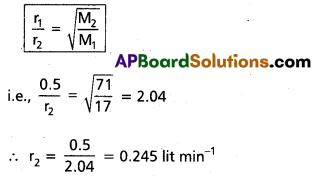
Ammonia gas diffuses through a fine hole at the rate 0.5 lit min-1. Under thé same conditions find the rate of diffusion of chlorine gas.
Solution:
Rate of diffusion of ammonia (r1)
= 0.5 lit min-1
Molecular weight of ammonia (M1) = 17
Rate of diffusion of chlorine (r2) = ?
Molecular weight of chlorine (M2) = 71
According to Graham’s law of diffusion
AP Inter 1st Year Chemistry Study Material Chapter 4 States of Matter Gases and Liquids 28
∴ Rate of diffusion of Cl2 = 0.245 lit/min.

Question 16.
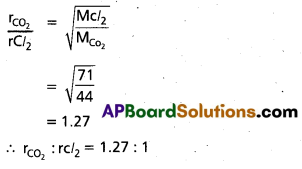
Find the relative rates of diffusion of CO2 and Cl2 gases.
Solution:
AP Inter 1st Year Chemistry Study Material Chapter 4 States of Matter Gases and Liquids 29

Question 17.
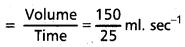
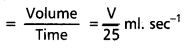
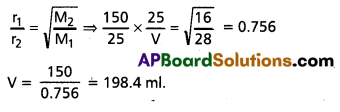
If 150 mL carbon monoxide effused in 25 seconds, what volume of methane would diffuse in same time?
Solution:
Rate of diffusion of CO (r1)
AP Inter 1st Year Chemistry Study Material Chapter 4 States of Matter Gases and Liquids 30
Molecular weight of CO (M1) = 28
Rate of diffusion of methane (r2)
AP Inter 1st Year Chemistry Study Material Chapter 4 States of Matter Gases and Liquids 31
Molecular weight of methane (M2) = 16
According to Graham’s law of diffusion
AP Inter 1st Year Chemistry Study Material Chapter 4 States of Matter Gases and Liquids 32

Question 18.
Hydrogen chloride gas is sent into a 1oo metre tube from one end ‘A’ and ammonia gas from the other end ‘B’, under similar conditions. At what distance from ‘A’ will be the two gases meet?
Solution:
AP Inter 1st Year Chemistry Study Material Chapter 4 States of Matter Gases and Liquids 33
The two gases HCl and NH3 diffuse into the pipe from the ends A and B respectively to meet at a point O as indicated by formation of white ring of NH4Cl. If the distance AO is x meters, the distance OB will be (100 – x) metres.
According to Graham’s law of diffusion. Ration of rates of diffusion of HCl and NH3 gas is given by
\(\frac{735 \mathrm{~mm} \times 101.3 \mathrm{kPa}}{1760 \mathrm{~mm}}\) = 98 k Pa
It means that the two gases meet at the point O such that the ratio of the distances from the end A to O and B to O is 0.68 : 1.00
∴ \(\frac{0.68}{1}\) = \(\frac{x}{(100-x)}\)
or 0.68 (100 – x) = x or 68 – 0.68 x = x
or 68 = x + 0.68 x or 68 = x (1 + 0.68)
= 1.68 x
x = \(\frac{68}{1.68}\) = 40.48 metres.
Hence, the two gases meet at a distance of 40.48 metres from the end ‘A’.

Question 19.
Calculate the total pressure in a mixture of 8 g of dioxygen and 4 g of dihydrogen confined in a vessel of 1 dm3 at 27°C. R = 0.083 bar dm3 K-1 mol-1.
Solution:
Formula:
AP Inter 1st Year Chemistry Study Material Chapter 4 States of Matter Gases and Liquids 34

Question 20.
Calculate the total pressure in a mixture of 3.5g of dinitrogen 3.0g of dihydrogen and 8.0g dioxygen confined in vessel of 5 dm3 at 27°C (R = 0. 083 bar dm3 k-1 mol-1)
Solution:
Formula:
V = 5 dm3
AP Inter 1st Year Chemistry Study Material Chapter 4 States of Matter Gases and Liquids 35

Question 21.
Pay load is defined as the difference between the mass of displaced air and the mass of the balloon. Calculate the pay load when a balloon of radius 10m, mass 100 kg is filled with helium at 1.66 bar at 27°C. (Density of air = 1.2 kg m-3 and R = 0.083 bar dm3 k-1 mol-1).
Solution:
Formula :
r = 10 m
m = 100 kg
T = 27° C = 300 K
d = 1.22 kg/m3
Volume of the ballon = \(\frac{4}{3} \pi r^3\)
= \(\frac{4}{3} \times \frac{22}{7} \times 10^3\)
= 4190.5 m3
P = 1.66 bar
T = 300 K
V = 4190.5 m3
R = 0.083 bar dm3 k-1 mol-1
PV = nRT
n = \(\frac{\mathrm{PV}}{\mathrm{RT}}\) = \(\frac{1.66 \times 4190.5}{0.083 \times 10^{-3} \times 300}\)
= 2793.70 moles
= 0.083 × 10⁻³ bar m3k-1mol-1
∴ Weight of 279370 moles of He
= 279390 × \(\frac{4}{1000}\)
= 1117.48 kg
Total weight of balloon = 100 + 1117.48
= 1217.48 kg
Maximum weight of He = V × d
=4190.5 × 1.2
= 5028.6 kg
∴ Payload = 5028.6 – 1219.48
= 3811.12 kg.

Question 22.
Calculate the volume occupied by 8.8 g of CO2 at 31 .1°C and 1 bar pressure. R = 0.083 bar L K-1 mol-1.
Solution:
Formula:
AP Inter 1st Year Chemistry Study Material Chapter 4 States of Matter Gases and Liquids 36

Question 23.
2.9 g of a gas at 95 °C occupied the same volume as 0.184 g of dihydrogen at 17°C, at the same pressure. What is the molar mass of the gas?
Solution:
Given unknown gas and dihydrogen
For unknown gas
V1 = V
n1 = \(\frac{2.9}{\mathrm{~m}}\)
T1 = 95° C = 368 K
P1V1 = n1RT1
P1 = \(\frac{n_1 R T_1}{V_1}\)
= \(\frac{2.9}{m} \times \frac{R \times 368}{V}\)
For dihydrogen
AP Inter 1st Year Chemistry Study Material Chapter 4 States of Matter Gases and Liquids 37

Question 24.
A mixture of dihydrogen and dioxygen at one bar pressure contains 20% by weight of dihydrogen. Calculate the partial pressure of dihydrogen.
Solution:
Given 20% by wt of dihydrogen so 80% oxygen remained for dihydrogen
n = \(\frac{w t}{\text { GMwt }}\) = \(\frac{0.2}{2}\) = 0.1
For dioxygen
n = \(\frac{w t}{\text { GMwt }}\) = \(\frac{0.8}{32}\) = 0.025
mole fraction of H2
= \(\frac{0.1}{0.1+0.025}\) = \(\frac{0.1}{0.125}\) = 0.8
Partial pressure of dihydrogen
= mole fraction of H2 × Ptotal
= 0.8 × 1 = 0.8 bar

Question 25.
What would be the SI unit for the quantity \(\frac{\mathrm{PV}^2 \mathrm{~T}^2}{\mathrm{n}}\)?
Solution:
Given quantity \(\frac{\mathrm{PV}^2 \mathrm{~T}^2}{\mathrm{n}}\) = \(\frac{\mathrm{N} / \mathrm{m}^2\left(\mathrm{~m}^3\right)^2(\mathrm{~K})^2}{\text { mole }}\)
= N × mole-1m4k2
∴ The given quantity has SI units Nm4k2 mole-1.

Question 26.
In terms of Charles’ law explain why — 273°C is the lowest possible temperature.
Solution:
According to Charles law if we put the value of t = -273°C
in the equation Vt = V0 \(\left[\frac{273.15+t}{273.15}\right]\).
In this case the volume of the gas becomes zero.
V0 = Volume at 0° C
Vt = Volume at t° C

  • This means the gas will not exist
  • In fact all gases liquified before this temperature.

Question 27.
Critical temperature for carbon dioxide and methane are 31.1°C and – 81.9°C respectively. Which of these has
stronger intermolecular forces and why?
Solution:
Given Critical temperatures of CO2, CH4
TC (CO2) = 31.1°C
TC (CH4) = -81.9°C

  • The gas with highest critical temperature value can be easily liquified because of high inter molecular forces.
    ∴ TC(CO2) is very high.
    So CO2 gas liquified easily.
  • ‘He’ gas has low T value so it is highly difficult to liquify.

Question 28.
Air is cooled form 25°C to 0°C. Calculate the decrease in rms speed of the molecules.
Solution:
AP Inter 1st Year Chemistry Study Material Chapter 4 States of Matter Gases and Liquids 40

Question 29.
Find the rms, most probable and average speeds of SO2 at 27°c.
Solution:
AP Inter 1st Year Chemistry Study Material Chapter 4 States of Matter Gases and Liquids 41

Question 30.
Find the RMS. average and most probable speeds of O2 at 27°c.
Solution:
AP Inter 1st Year Chemistry Study Material Chapter 4 States of Matter Gases and Liquids 42
uaverage = 0.9213 × urms
= 0.9213 × 4.835 × 104
= 4.455 × 104 cm/sec.
ump = 0.8166 × urms
= 3.948 × 104 cm/sec.

Question 31.
Give the values of Gas constant ‘R’ in different units.
Answer:
R = 0.0821 lit. atm. K-1 .mol-1
= 8.314 J.K-1. mole-1
= 1.987 (or) 2 cal.K-1.mol-1
= 8.314 × 10⁷ erg.K-1.mol-1

AP Inter 1st Year Chemistry Study Material Chapter 2 Classification of Elements and Periodicity in Properties

Andhra Pradesh BIEAP AP Inter 1st Year Chemistry Study Material 2nd Lesson Classification of Elements and Periodicity in Properties Textbook Questions and Answers.

AP Inter 1st Year Chemistry Study Material 2nd Lesson Classification of Elements and Periodicity in Properties

Very Short Answer Questions

Question 1.
What is the difference in the approach between Mendeleev’s periodic law and the modern periodic law?
Answer:

  • According to Mendeleev, elements’ physical and chemical properties are periodic functions of their atomic weights.
  • According to modem periodic law, elements’ physical and chemical properties are periodic functions of their atomic numbers.

Question 2.
In terms of period and group, where would you locate the element with Z = 114?
Answer:
Element Z = 114 is present in 7th period and IVA group (Group – 14)

AP Inter 1st Year Chemistry Study Material Chapter 2 Classification of Elements and Periodicity in Properties

Question 3.
Write the atomic number of the element, present in the third period and seven¬teenth group of the periodic table.
Answer:
The Element present in 3rd period and Group – 17 (VIIA group) is chlorine (Cl). It’s atomic number is 17.

Question 4.
Which element do you think would have been named by
a) Lawrence Berkeley Laboratory .
b) Seaborg’s group
Answer:
a) Lawrence Berekeley Laboratory – Lanthanide
b) Seaborg’s group – Actinide (Transuranic element).

Question 5.
Why do elements in the same group have similar physical and chemical properties ?
Answer:
Elements in the same group have same no. of valency shell electrons and have similar outer elec¬tronic configuration so these have similar physical and chemical properties.

Question 6.
What are representative elements ? Give their valence shell configuration.
Answer:

  • Representative elements are s and p-block elements except zero group.
  • These have general electronic configuration ns1-2np1-5.

Question 7.
Justify the position of f-block elements in the periodic table.
Answer:
The two series of elements lanthanides and actinides have been grouped separately and placed at the bottom of the periodic table, though they belong to the sixth and seventh periods of third group (III B).

The justification for assigning one place to these elements has been given on the basis of their similar properties. The properties are so similar that elements from Ce to Lu can be considered as equivalent to one element. In case these elements are assigned different positions (i.e.,) arranged in order of their increasing atomic numbers, the symmetry of the whole arrangement would be disrupted. The same explanation can be given in the case of actinides.

Question 8.
An element ‘X’ has atomic number 34. Give its position in the periodic table.
Answer:
The element X with atomic no (z) = 34 has electronic configuration 1s2 2s2 2p6 3s2 3p6 4s2 3d10 4p4. Hence the element is present in 4,h period and 16th group (VIA group).

Question 9.
What factors impart characteristic properties to the transition elements ?
Answer:
Transition elements exhibits characteristic properties because

  • The differentiating electron enters into penultimate d-subshell
  • These elements have small size.
  • These possess high effective nuclear charge.

Question 10.
Give the outer shells configuration of d-block and f-block elements.
Answer:

  • The outer shell electronic configuration of d-block – elements is ns1-2 (n-1)d1-10
  • The outer shell electronic configuration of f-block – elements is ns2(n-1)d0 (or) 1 (n – 2) f1-14

AP Inter 1st Year Chemistry Study Material Chapter 2 Classification of Elements and Periodicity in Properties

Question 11.
State and give one example for Dobereiner’s law of triads and Newland’s law of octaves.
Answer:
1) Dobereiner law :

  • According to Dobereiner in a traid (3 – elements) the atomic weight of the middle element is the arithmatic mean of the other two elements.

    AP Inter 1st Year Chemistry Study Material Chapter 2 Classification of Elements and Periodicity in Properties 1

2) Newland’s law of octaves : According to Newlands, the elements arranged in the increasing order of atomic weights noticed that every eight element had properties similar to the first element. This relationship was just like every eight note that resembles the first in octaves of music.
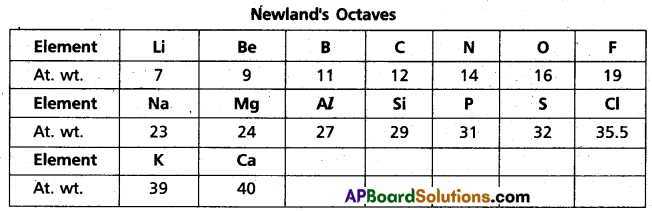
AP Inter 1st Year Chemistry Study Material Chapter 2 Classification of Elements and Periodicity in Properties 2

Question 12.
Name the anomalous pairs of elements in the Mendaleev’s periodic table.
Answer:
In Mendeleev’s periodic table anamalous pairs are the elements whose atomic weights increasing order is reversed.
Eg:
AP Inter 1st Year Chemistry Study Material Chapter 2 Classification of Elements and Periodicity in Properties 3

Question 13.
How does atomic radius vary in a period and in a group ? How do you explain the variation ?
Answer:
In a period : Atomic radius decreases generally from left to right in a period.
Reason : In periods electrons are entered into same subshells.
In a group : Atomic radius increases generally from top to bottom in a group.
Reason : In groups electrons are entered into new subshells.

Question 14.
Among N-3; O-2, F, Na+, Mg+2 and Al+3
a. What is common in them ?
b. Arrange them in the increasing ionic radii.
Answer:
Given ions are
N-3, O-2, F, Na+, Mg+2 and Al+3.
a) The above ions have same number of electrons (All have 10 electrons). So these are called iso electronic species.
b) The increasing order of ionic radii among above ions is
Al+3 < Mg+2 < Na+ < F < O-2 < N-3
Reason : – In case of iso electronic species as the nuclear charge increases ionic radii decreases.

Question 15.
What is the significance of the term isolated gaseous atom while defining the ionization enthalpy.
Hint: Requirement for comparison.
Answer:

  • Isolated gaseous atom’s ionisation enthalpy is taken as reference value and it is required to compare this values to various ions of this elements and to compare this values with various elements.

Question 16.
Energy of an electron in the ground state of the hydrogen atom is – 2.18 × 10⁻¹⁸J. Calculate the ionization enthalpy of atomic hydrogen in terms of J mol-1.
Answer:
Given that the energy of the electron in the ground state for hydrogen atom = – 2.18 × 10⁻¹⁸ J.
For 1 mole of atoms is given by – 2.18 × 10-18 J × 6.023 × 1023
= -13.13 × 10⁵ J/Mole
∴ Ionisation enthalpy of hydrogen atom = 13.13 × 10⁵ J/Mole.

Question 17.
Ionization enthalpy, (IE1) of O is less than that of N — explain.
Answer:

  • Oxygen has electronic configuration 1s2 2s2 2p4
    AP Inter 1st Year Chemistry Study Material Chapter 2 Classification of Elements and Periodicity in Properties 4
  • Nitrogen has electronic configuration 1s2 2s2 2p3
    AP Inter 1st Year Chemistry Study Material Chapter 2 Classification of Elements and Periodicity in Properties 5
  • Nitrogen has half filled shell and is stable so more amount of energy is required to remove an electron, than in oxygen.
    Hence IE, of ‘O’ is less than that of ‘N’.

Question 18.
Which in each pair of elements has a more negative electron gain enthalpy?
a. O or Fb. F or Cl
Answer:
a)
AP Inter 1st Year Chemistry Study Material Chapter 2 Classification of Elements and Periodicity in Properties 6
has more negative electron gain enthalpy than that of
AP Inter 1st Year Chemistry Study Material Chapter 2 Classification of Elements and Periodicity in Properties 7
b)
AP Inter 1st Year Chemistry Study Material Chapter 2 Classification of Elements and Periodicity in Properties 8
has more negative electron gain enthalpy than that of
AP Inter 1st Year Chemistry Study Material Chapter 2 Classification of Elements and Periodicity in Properties 9

AP Inter 1st Year Chemistry Study Material Chapter 2 Classification of Elements and Periodicity in Properties

Question 19.
What are the major differences between metals and non-metals ?
Answer:
Metals

  • These are generally in solid form (Except Hg)
  • These are good conductors of heat and electricity.
  • These have high m.pts and b.pts.
  • Generally these are electropositive.
  • These forms more ionic compounds.

Nón metals

  • These may be solids (or) gases (or) liquids.
  • These are not good conductors of heat and electricity.
  • These have low m.pts and b.pts.
  • Generally these are electronegative.
  • These forms more covalent compounds.

Question 20.
Use the periodic table to identify elements.
a. With 5 electrons in the outer subshell
b. Would tend to lose two electrons
c. Would tend to gain two electrons.
Answer:
a) The elements possessing 5 electrons in the outer most shell are group 15 (VA) elements.

  • General outer electronic configuration is ns2 np3 Eg. : N, P, As………

b) The elements tend to lose two electrons are Group — II elements.

  • General outer electronic configuration is ns2 Eg: Mg, Ca, Sr etc.

c) The elements tend to gain two electrons are Group – VIA elements (16th group).

  • General outer electronic configuration is ns2 np4 Eg : O, S, Se ………

Question 21.
Give the outer electronic configuration of s, p, d and f – block elements.
Answer:
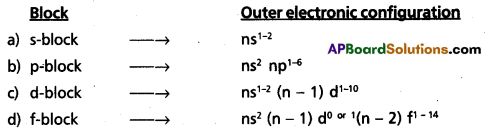
AP Inter 1st Year Chemistry Study Material Chapter 2 Classification of Elements and Periodicity in Properties 10

Question 22.
Write the increasing order of the metallic character among the elements B, Al, Mg and K.
Answer:
Given elements are B, Al, Mg and K
The increasing order of metallic character is

AP Inter 1st Year Chemistry Study Material Chapter 2 Classification of Elements and Periodicity in Properties 11

Question 23.
Write the correct increasing order of non – metallic character for B, C, N, F and Si.
Answer:
Given elements are B, C, N. F and Si
The increasing order of non- metallic character is

AP Inter 1st Year Chemistry Study Material Chapter 2 Classification of Elements and Periodicity in Properties 12

Question 24.
Write the correct increasing order of chemical reactivity in terms of oxidizing property for N, O, Fand Cl.
Answer:
The correct increasing order of chemical reactivity in terms of oxidizing property for N, O, F and Cl is F > 0 > Cl > N.

Question 25.
What is electronegativity ? How is this useful in understanding the nature of elements?
Answer:
Electronegativity : The tendency of an element (or) atom to attract the shared pair of electrons towards itself in a molecule is called electronegativity.

  • On the basis of electronegativity values nature of elements can be predicted. Higher electro-negativity values indicates that element is non metal and lower values indicates that the element is a metal.
  • On the basis of electronegativity values bond nature also predicted (Ionic/covalent).

Question 26.
What is screening effect? How is it related to lE?
Answer:
The decrease of nuclear attraction on outer most shell electrons due to presence of inner energy electrons is called screening effect.

  • As the screening effect increases LE. values decreases.

AP Inter 1st Year Chemistry Study Material Chapter 2 Classification of Elements and Periodicity in Properties

Question 27.
How are electronegativity and metallic & non-metallic characters related?
Answer:

  • Greater the electronegativity values of an element indicates that non metallic nature and low metallic nature of that element.
  • Lower the electronegativity value of an element indicates that low non metallic nature and high metallic nature of that element.

Electronegativity ∝ Non metallic nature
Electronegativity ∝ \(\frac{1}{\text { Metallic Nature }}\)

Question 28.
What is the valency possible to Arsenic with respect to oxygen and hydrogen?
Answer:

  • The valency of Arsenic with respect to hydrogen is ‘3’
    Eg : AsH3
  • The valency of Arsenic with respect to oxygen is ‘5’
    Eg : As2O5

Question 29.
What is an amphoteric oxide? Give the formula of an amphoteric oxide formed by an element of group – 13.
Answer:
The oxide which contains both acidic as well s basic nature is called amphoteric oxide.

  • The oxides reacts with both acids and bases and forms salts.
    Eq : Al2O3 is one of the amphoteric oxide formed by the Group — 13 element Aluminium.

Question 30.
Name the most electronegative element. Is it also having the highest electron gain enthalpy? Why or Why not?
Answer:
The most electronegative element is fluorine (F).

  • It doesnot have high electron gain énthalpy.

Reasons : —

  • Due to small size
  • Due to high inter electronic repulsions.
  • Chlorine has high electron gain enthalpý.

Question 31.
What is diagonal relation? Give one pair of elements, that have this relation.
Answer:
On moving diagonally across the periodic table the elements show certain similarities. An element of group in 2nd period has similar properties with second element of the next higher group in the 3rd period. This type of resemblance is called diagonal relationship. e.g. : (Li, Mg); (Be, Al); (B, Si)

AP Inter 1st Year Chemistry Study Material Chapter 2 Classification of Elements and Periodicity in Properties 13

Question 32.
How does the nature of oxides vary in the third period?
Answer:
In 3rd period from left to right the oxide nature varies from high basic nature to high acidic nature.

  • Basic nature gradually decreases and acidic nature gradually increases.

  • AP Inter 1st Year Chemistry Study Material Chapter 2 Classification of Elements and Periodicity in Properties 14

Question 33.
Radii of iron atom and its ions follow Fe > Fe2+ > Fe3+ – explain.
Answer:
When the positive charge on the ion increases, the effective nuclear charge on the outer electrons increases.
Hence the ionic size decreases in the order Fe > F2+ > F3+.

Question 34.
IE2 > IE1 for a given element — why?
Answer:
IE2 > IE1 for a given element

Reason : —

  • IE1 means minimum amount of energy required to remove an electron from isolated neutral
    gaseous atom.
  • IE2 means minimum amount of energy required to remove an electron from uni positive ion.
  • In case of unipositive ion nuclear attraction increases on outer most electrons than in isolated gaseous atom. So more amount of energy needed to remove an electron from unipositive ion.
    Hence IE2 > → IE1.

Question 35.
What is Ianthanide contraction? Give one of its consequences.
Answer:
Lanthanide contraction : Slow decrease in size of the atoms or ions among the lanthanides is known as lanthanide contraction.

Consequences due to lanthanide contraction:

  1. Due to lanthanide contraction, the crystall structure and other properties of the elements become very closely similar.
  2. Due to this, it becomes difficult to separate lanthanides from a mixture.

AP Inter 1st Year Chemistry Study Material Chapter 2 Classification of Elements and Periodicity in Properties

Question 36.
What is the atomic number of the element, having maximum number of unpaired 2p electrons ? To which group does it belong ?
Answer:

  • The atomic number of the element having maximum no.of unpaired 2p electrons is 7′ (Z = 7)
  • Element is nitrogen.
  • Electronic configuration is 1s2 2s2 2p3 (3 unpaired 2p electrons) AP Inter 1st Year Chemistry Study Material Chapter 2 Classification of Elements and Periodicity in Properties 15
Question 37.
Sodium is strongly metallic, while chlorine is strongly non-metallic – explain.
Answer:
Sodium is an alkali metal and it is present in group – I and it has the ability to lose the valency electron readily.

  • It has high electropositive nature. So it has metallic nature.
  • Chlorine is a halogen and it is placed in Group – 17 and it has the ability to gain the electron readily.
  • It has high electronegative nature. So it has non metallic nature.

Question 38.
Why are zero group elements called noble gases or inert gases ?
Answer:

  • Zero group elements has general outer electronic configuration ns2 np6 (except for He).
  • These contains stable octet configuration. So these are stable and chemically inert. Hence these are called inert gases.
  • These elements neither lose nor gain electrons. Hence these are called ‘noble gases’.

Question 39.
Select in each pair, the one having lower ionization energy and explain the reason,
a. I and I
b. Br and K
c. Li and Li+
d. Ba and Sr
e. O and S
f. Be and B
g. N and O
Answer:
a) I has lower ionisation energy than I because of increase of size \(\mathrm{I}^{\ominus}\) ion than ‘I’.
b) K has lower ionisation energy than ‘Br’ because of low electronegative value of K (0.8) than ‘Br’ (2.8).
c) ‘Li” has lower ionisation energy than Li+ because of large size of ‘Li’ than Li+.
d) ‘S’ has lower ionisation energy than ‘O’ because of large size of ‘S’ than ‘O’.
e) ‘B’ has lower ionisation energy than ‘Be’ because ‘Be’ has completely filled electronic configuration (1s2 2s2).
f) ‘O’ has lower ionisation energy than ‘N’ because ‘N’ has half filled electronic configuration (1s2 2s2 2p3).

Question 40.
IE1 of O < IE1 of N but IE2 of O > IE2 of N – Explain.
Answer:

  • ‘N’ has half filled electronic configuration (1s2 2s2 2p3)
    So IE1 of O < IE1 of ‘N’.
  • O+ ion has half filled electronic configuration (1s2 2s2 2p3)
    So IE2 of O > IE1 of N.

Question 41.
Na+ has higher value of ionization energy than Ne, though both have same electronic configuration – Explain.
Answer:
Na+ has higher value of I.E. than Ne, though both have same electronic configuration.

Reason : –

  • Both have electronic configuration 1s2 2s2 2p6
  • In case of Na+ ion effective nuclear charge increases and size decreases than in ‘Ne’.

Question 42.
Which in each pair of elements has a more electronegative gain enthalpy ? Explain.
a. N or O
b. F or Cl
Answer:
a) Oxygen has high electronegative gain enthalpy than Nitrogen because ‘N’ has stable half filled electron configuration.
b) Chlorine (- 349 KJ /mole) has high electronegative gain enthalpy than Fluorine (- 328 KJ/mole) because ‘F’ has small size and more inter electronic repulsions.

Question 43.
Electron affinity of chlorine is more than that of fluorine – explain.
Answer:
Chlorine (- 349 KJ / mole) has high electronegative gain enthalpy than Fluorine (- 328 KJ/mole) because ‘F’ has small size and more inter electronic repulsions.

AP Inter 1st Year Chemistry Study Material Chapter 2 Classification of Elements and Periodicity in Properties

Question 44.
Which in each has higher electron affinity ?
a. F or Cl
b. O or O-
c. Na+ or F
d. F or F
Answer:
a) Fluorine has high electron affinity than Cl ion because of inert gas configuration of Cl ion.
b) Oxygen has high electron affinity than O because O has positive of 2nd electron affinity.
c) F has high electron affinity than Na+ because Na+ has inert gas configuration.
d) F has high electron affinity than F because F has inert gas configuration.

Question 45.
Arrange the following in order of increasing ionic radius :
a. Cl, P-3, S-2, F
b. Al+3, Mg+2, Na+, O-2, F
c. Na+, Mg+2, K+
Answer:
a) The increasing order of ionic radius is F < Cl < S-2 < P-3
b) The increasing order of ionic radius is Al+3 < Mg+2 < Na+ < F < O-2
c) The increasing order of ionic radius is Mg+2 < Na+ < K+

Question 46.
Mg+2 is smaller than O-2 in size, though both have same electronic configuration –
explain.
Answer:
Mg+2 and O-2 ions are iso electronic species.
In case of iso electronic species nuclear charge increases size of ion decreases. So Mg+2 has small size than O-2.

Question 47.
Among the elements B, Al, C and Si
a. Which has the highest first ionization enthalpy ?
b. Which has the most negative electron gain enthalpy ?
c. Which has the largest atomic radius ?
d. Which has the most metallic character ?
Answer:
a) Highest I.E. is possessed by the element carbon
b) Most negative gain enthalpy is for carbon (- 122 KJ/mole)
c) Large atomic radius is for Al (1.43 A)
d) Most metallic nature having element is ‘Al’.

Question 48.
Consider the elements N, P, O and S and arrange them in order of ;
a. Increasing first ionization enthalpy
b. Increasing negative electron gain enthalpy
c. Increasing non-metallic character
Answer:
a) Increasing first Ionisation energy order is S < P < O < N.
b) Increasing negative electron gain enthalpy order is N < P < O < S. .
c) Increasing non metallic nature order is P < N < S < O.

Question 49.
Arrange in given order :
a. Increasing EA :O, S and Se
b. Increasing IE1 : Na, K and Rb
c. Increasing radius : I, I+ and I
d. Increasing electronegativity : F, Cl, Br, I
e. Increasing EA : F, Cl, Br, I
f. Increasing radius : Fe, Fe+2, Fe+3
Answer:
a) Increasing order of electron affinity is O < Se < S.
b) Increasing order of IE1 is Rb < K < Na.
c) Increasing order of radius is I+ < I < I
d) Increasing order of electronegativity is I < Br < F < Cl
e) Increasing order of electron affinity is I < Br < F < Cl
f) Increasing order of radius is Fe+3 < Fe+2 < Fe

AP Inter 1st Year Chemistry Study Material Chapter 2 Classification of Elements and Periodicity in Properties

Question 50.
a. Name the element with highest ionization enthalpy
b. Name the family with highest value of ionization enthalpy.
c. Which element possesses highest electron affinity ?
d. Name unknown elements at the time of Mendeleef
e. Name any two typical elements.
Answer:
a) Highest I.E1 possessing element is ‘Helium’.
b) The family that possess highest values of I.E is Noble gases (or) inert gases.
c) Highest electron affinity element is ‘Chlorine’.
d) Unknown elements at the time of mendeleef are Germanium (Eka silicon). Scandium (Eka Alu-minium), Gallium (Eka Boron).
e) 3rd period elements are called typical elements
Eg : Al, Si, P, Na, Mg etc

Question 51.
a. Name any two bridge elements.
b. Name two pairs showing diagonal relationship.
c. Name two transition elements.
d. Name two rare earths.
e. Name two transuranic elements.
Answer:
a) Bridge elements 2nd period elements are called Bridge elements Eg : Be, B.
b) i) ‘Li’ diagonally relates with ‘Mg’,
ii) ‘Be diagonally relates with ‘Al’.
c) Scandium, Titanium, Vanadium, Chromium, etc., are examples of transition elements.
d) Lanthanides are called rare earths
Eg : Cerium (Ce), Prasodimium (Pr), Promethium (Pm).
e) Neptunium (Np), Californium (Cf), Fermium (Fm) are examples of transuranic elements.

Question 52.
On the basis of quantum numbers, justify that the 6th period of the periodic table should have 32 elements.
Answer:
6th period contains the subshells 6s, 4f, 5d, 6p
6s can accomodate two electrons (2 elements)
4f can accomodate 14 electrons (14 elements)
5d can accomodate 10 electrons (10 elements)
6p can accomodate 6 electrons (6 elements)

Total no.of electrons can accomodation 6th period are 2 + 14 + 10 + 6 = 32
∴ 6th period of periodic table contains 32 elements.

AP Inter 1st Year Chemistry Study Material Chapter 2 Classification of Elements and Periodicity in Properties

Question 53.
How did Moseley’s work on atomic numbers show that atomic number is a fundamental property better than atomic weight ?
Answer:
Mosley’s equation is
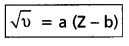
AP Inter 1st Year Chemistry Study Material Chapter 2 Classification of Elements and Periodicity in Properties 16
where v = frequency, Z = atomic number a, b = constants
A plot of \(\sqrt{v}\) against ‘Z’ gives a straight line.
However, no such relationship was obtained when the plot was drawn between frequency and the atomic mass. The atomic number of the elements, according to Mosley, stands for serial numbers of the elements in the periodic table. As the atomic number of the elements increase, the wavelengths of characteristic X – rays decrease. Mosley concluded that there is a fundamental quantity in an atom which increases in regular steps with increasing atomic number. The correlation between X – ray spectra and atomic number indicated that an element is characterized by its atomic number and not by atomic mass.
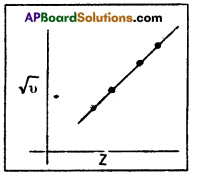
AP Inter 1st Year Chemistry Study Material Chapter 2 Classification of Elements and Periodicity in Properties 17

Question 54.
State modern periodic law. How many groups and periods are present in the long form of the periodic table ?
Answer:
Modern periodic law : – The physical and chemical properties of elements are periodic functions of their atomic numbers.

  • In modern periodic table 7 periods and 18 groups are present.

Question 55.
Why f-block elements are placed below the main table ?
Answer:
In Lanthanides 4f – orbitals and in Actinides 5f – orbitals are filled. Since these elements have the same electronic configuration in the ultimate and penultimate shells they have similar properties. Hence they were placed at the bottom of the periodic table though they belongs to the sixth and seventh periods of IIIB groups.

Question 56.
Mention the number of elements present in each of the periods in the long form periodic table.
Answer:

AP Inter 1st Year Chemistry Study Material Chapter 2 Classification of Elements and Periodicity in Properties 18

Question 57.
Give the outer orbit general electronic configuration of
a. Noble gases
b. Representative elements
c. Transition elements
d. Inner transition elements
Answer:
Type of elements – General electronic configurations
a) Noble gases – ns2 np6 (except ‘He’ which has 1s2)
b) Representative elements – ns1-2 np0-5
c) Transition elements – (n – 1)d1-10ns1-2
d) Inner transition elements – (n – 2) f1-14(n – 1)d0, 1 ns2

Question 58.
Give any four characteristic properties of transition elements.
Answer:
Characteristic properties of elements:
a) They exhibit more than one oxidation state.
b) Most of the elements and their ions exhibit colour.
c) These elements and their compounds are good catalysis for various chemical processes.
d) They and their ions exhibit paramagnetic properties.
e) They form useful alloys.

Question 59.
What are rare earths and transuranic elements?
Answer:

  1. Lanthanides are rare earths. In these elements the differentiating electron enters into 4f – orbital.
  2. The elements present after Uranium are called Transurariic elements. All of these are radioactive and synthetic elements.

AP Inter 1st Year Chemistry Study Material Chapter 2 Classification of Elements and Periodicity in Properties

Question 60.
What is isoelectronic series? Name a series that will be isoelectronic with each of the following atoms or ions.
a. F
b. Ar
c. He
d. Rb+
Answer:
The species containing same no.of electrons are called Iso electronic species and this series is called Isoelectronic series.
a) F relating series
N-3, O-2, F, Ne, Na+, Mg+2, Al+3
b) Ar relating series P-3, S-2, Cl, Ar, K+, Ca+2
c) ‘He’ relating series H, He, Li+, Be+2
d) Rb+ relating series
As-3, Se-2, Br, Kr, Rb+, Sr+2

Question 61.
Explain why cation is smaller and anion is larger in radii than their parent atoms.
Answer:

  • Cation means a positively charged species which is formed by an atom (or) element when an electron is lost.
    M → M+ + \(\mathrm{e}^\Theta\)
  • Cation has high effective nuclear charge and decrease in size observed.
    Hence cation has smaller radii.
  • Anion means a negatively charged species which is formed by an atom (or) element when an electron is gained.
    M + e → \(\mathrm{M}^{\Theta}\).
  • Anion has very low effective nuclear charge and increase in size observed.
    Hence anion has larger radii.

Question 62.
Arrange the second period elements in the increasing order of their first ionization enthalpies. Explain why Be has higher IE1 than B.
Answer:
The increasing order of the I.E.s of 2nd period elements are as follows.
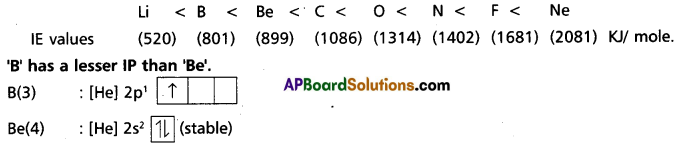
AP Inter 1st Year Chemistry Study Material Chapter 2 Classification of Elements and Periodicity in Properties 19

  • Due to presence of incompletely filled p – orbitals in Boron, its IE value is less.
  • Due to presence of completely filled s2 configuration in ‘Be’, it has higher IE value.

Question 63.
IE1 of Na is less than that of Mg but IE2 of Na is higher than that of Mg – explain.
Answer:
IE1 of Na is less than that of ‘Mg’
Reason :-
Na — has electronic configuration [Ne] 31
Mg — has electronic configuration [Ne] 3s2
Mg has completely filled configuration so Mg has more IE1 than Na.
IE2 of Na is higher than that of Mg

  • AP Inter 1st Year Chemistry Study Material Chapter 2 Classification of Elements and Periodicity in Properties 20
  • Na+ has stable inert gas configuration so IE2 of Na is very high
    AP Inter 1st Year Chemistry Study Material Chapter 2 Classification of Elements and Periodicity in Properties 21
  • By the lose of one electron from Mg+ ion forms Mg+2 ion which is more stable so low amount of energy is required.
    ∴ IE2 of Na is higher than Mg.

Question 64.
What are the various factors due to which the IE of the main group elements tends to decrease down a group ?
Answer:
The factors influencing on IE are

  1. Atomic radius
  2. Nuclear charge
  3. Screening effect
  4. Half filled, completely filled electronic configurations
  5. peretrating power
    • In main group elements in a group IE decrease from top to bottom.

Reason: –
In groups from top to bottom size of elements increases hence IE values decreases.

Question 65.
The first ionization enthalpy values (in KJ mol-1) of group 13 elements are :

AP Inter 1st Year Chemistry Study Material Chapter 2 Classification of Elements and Periodicity in Properties 22
How do you explain this deviation from the general trend ?
Answer:
The given IE, values (in KJ / mole) of group 13 are as follow
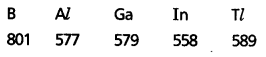
AP Inter 1st Year Chemistry Study Material Chapter 2 Classification of Elements and Periodicity in Properties 23

  • In genaral in a group IE values decrease down a group but from the above values we observe that there is no smooth decrease down the group.
  • The decrease from B to Al is due to increase of size.
  • The observed discontinuity in the IE values of Al and Ga, and between In and Tl are due to inability of d- and f – electrons, which have low screening effect to compensate the increase in nuclear charge.

AP Inter 1st Year Chemistry Study Material Chapter 2 Classification of Elements and Periodicity in Properties

Question 66.
Would you expect the second electron gain enthalpy of oxygen as positive, more negative or less negative than the first ? Justify.
Answer:
2nd gain enthalpy means energy released when an electron is added to uni negative ion.
O(g) + e → \(\mathrm{O}_{(g)}^{-}\) + 141 KJ/mole
O(g) + e → \(O_{(g)}^{-(2)}\) – 780 KJ/mole

  • 2nd gain enthalpy of oxygen is positive because O ion doesnot accept an electron readily and the entering electron have to over come the repulsive force.

Question 67.
What is the basic difference between the electron gain enthalpy and electropositivity?
Answer:

  • Electron gain enthalpy means energy released when an electron is added to isolated neutral gaseous atom.
  • The tendency to lose the electrons by an element is called electropositivity.
  • Electron gain enthalpy is the measure of electronegativity.
  • Electron gain enthalpy and electropositivity are inversely related.

Question 68.
Would you expect IE1 for two isotopes of the same element to be the same or different ? Justify.
Answer:

  • Isotopes means existance of same elements with different mass no.s
  • The isotope with higher mass no. have low I.E value than the normal isotope.
  • This is due to the less nuclear attraction on valency electrons in case of heavier nuclide.
  • But overall, the IE values of the isotopes are nearly same and the difference in IE values is negligible.

Question 69.
Increasing order of reactivity among group-1 elements is Li < Na < K < Rb < Cs, where as among group-17 elements it is F > Cl > Br > I- explain.
Answer:
a) Increasing order of reactivity among group -1 elements is Li < Na < K < Rb < Cs

Explanation: –

  • Group -1 elements are Alkali metals.
  • Group -1 elements have the tendency to lose the electrons
  • Group -1 elements forms ionic bonds readily by losing electrons
  • Group – 1 elements good reducing agents.
  • Electro positive character increases from top to bottom this is due to increase of size.

b) Increasing order of reactivity among group -17 elements is F > Cl > Br > I

Explanation: –

  • These are halogens (Group – 17)
  • These have high electronegativity due to small size.
  • These have the tendency to gain electrons.
  • In a group from top to bottom electronegativity decrease, due to increase of size.
  • These are oxidising agents and forms ionic bonds by gaining electrons.

Question 70.
Assign the position of the element having outer electronic configuration.
a. ns2np4 for n = 3
b. (n – 1)d2ns2 for n = 4
Answer:
a) ns2np4 for n = 3 .

  • 3s23p4 → element is sulphur
  • Sulphur belongs to VIA group (Group – 16) and 3rd period in periodic table,

b) (n – 1 )d2 ns2 for n = 4
3d2 4s2 → element is Titanium

  • Titanium belongs to IVB group (Group – 4) and 4th period in the periodic table.

Question 71.
Predict the formulae of the stable binary compounds that would be formed by the combination of the following pairs of elements.
a. Li and O
b. Mg and N
c. Al and I
d. Si and O
e. p and Cl,
f. Element with atomic number 30 and Cl
Answer:
a) Stable binary compound formed between Li and O is Li2O (Lithiumoxide).
b) Stable binary compound formed between Mg and N is Mg3N2 (Magnesium nitride).
c) Stable binary compound formed between Al and I is AlI3 (Aluminium Iodide).
d) Stable binary compound formed between Si and I is SiO2 (Silicondioxide).
e) Stable binary compound formed between P and Cl is PCl3 and PCl5 (Phosphorous trichloride and phosphorous pentain chloride).
f) Stable binary compound formed between element with At. NO – 30 and Cl is ZnCl2 (Zinc chloride) [At. No – 30 – (Zn)].

Question 72.
Write a note on the variation of metallic nature in a group or in a period.
Answer:
Metals shows electropositive nature (i.e.,) loss of electrons and form positive ions.
Non – metals shows electronegative nature (i.e.,) gain of electrons and form negative ions.
Periodicity:
a) Down the group : Going down a group of the periodic table, the tendency to form positive ions, increases. That means there is an increase in metallic nature as the size of atom increases down the group.
b) Along a period : From left to right in a period, size of atom decreases. So there is decrease in metallic nature.

Question 73.
How does the covalent radius increase in group- 7 ?
Answer:

  • Covalent radius increases in a group from top to bottom
  • The increase of covalent radius in VIIA group elements as follows.
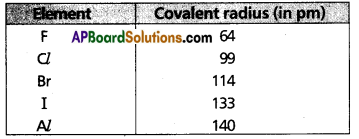
    AP Inter 1st Year Chemistry Study Material Chapter 2 Classification of Elements and Periodicity in Properties 24

Question 74.
Which element of 3rd period has the highest IE1 ? Explain the variation of IE1 in this period.
Answer:

  • In periods IE values increase from left to right
  • Among 3rd period elements Argon (Ar) [Z = 18] possess highest IE,sub>1 value.
  • IE1 values of 3rd period elements given below.
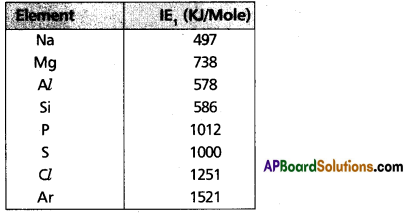
    AP Inter 1st Year Chemistry Study Material Chapter 2 Classification of Elements and Periodicity in Properties 25

Exceptions:

  • IE, of ‘Mg’ is higher than ‘Al’ because ‘Mg’ has completely filled ‘s’ subshells.
  • IE, of ‘p’ is higher than ‘s’ because ‘p’ has half filled ‘p’ subshells.

Question 75.
What is valency of an element ? How does it vary with respect to hydrogen in the third period?
Answer:
Valency : The combining capacity of an element with another element is called valency.

The number of hydrogen atoms (or) chlorine atoms (or) double the number of oxygen atoms, with which one atom of the element combine is also called valency.
∴ Valency = no. of hydrogens = no. of chlorine atoms
= 2 × no. of oxygen atoms present in the molecule.
e.g.:
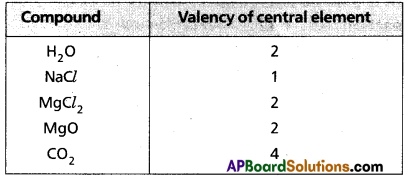
AP Inter 1st Year Chemistry Study Material Chapter 2 Classification of Elements and Periodicity in Properties 26
Periodicity of valency:
1) Each period starts with valency ‘1’ and ends in ‘0’.

AP Inter 1st Year Chemistry Study Material Chapter 2 Classification of Elements and Periodicity in Properties 27

2) In a group valency is either equal to the group number (i.e., upto 4th group) or is equal to (8 – group number) (i.e., from 5th group onwards).
Significance :
Valency of an element is useful in writing the formulae of compounds.

AP Inter 1st Year Chemistry Study Material Chapter 2 Classification of Elements and Periodicity in Properties

Question 76.
What is diagonal relationship ? Give a pair of elements having diagonal relationship. Why do they show this relation ?
Answer:
On moving diagonally across the periodic table the elements show certain similarities. An element of group in 2nd period has similar properties with second element of the next higher group in the 3rd period. This type of resemblance is called diagonal relationship, e.g. : (Li, Mg); (Be, Al); (B, Si)

AP Inter 1st Year Chemistry Study Material Chapter 2 Classification of Elements and Periodicity in Properties 28
Diagonal relationship is due to similar sizes of atoms (or of ions) and similar electronegativities of the representative elements.
Diagonally similar elements posses the same polarizing power.
Polarizing power = \(\frac{\text { (ionic charge) }}{\text { (ionic radius) }^2}\)

Question 77.
What is lanthanide contraction ? What are its consequences ?
Answer:
Lanthanide contraction : Slow decrease in size of the atoms or ions among the lanthanides is known as lanthanide contraction.

Consequences due to lanthanide contraction:

  1. Due to lanthanide contraction, the crystall structure and other properties of the elements become very closely similar.
  2. Due to this, it becomes difficult to separate lanthanides from a mixture.

Question 78.
The first IP of lithium is 5.41 eV and electron affinity of Cl is – 3.61 eV. Calculate ΔH in kJ mol-1 for the reaction : Li(g) + Cl(g) → \(\mathrm{Li}_{(\mathrm{g})}{ }^{+}\) + \(\mathrm{Cl}{ }_{(g)}^{-}\)
Answer:
Given reaction is
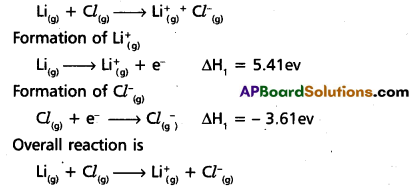
AP Inter 1st Year Chemistry Study Material Chapter 2 Classification of Elements and Periodicity in Properties 29
ΔH = ΔH1 + ΔH2
= 5.41 – 3.61
= 1.8 ev
= 1.8 × 9.65 × 104 J/mole
= 17.37 × 10⁴ J/Mole
= 173.7 KJ/mole

Question 79.
How many Cl atoms can you ionize in the process Cl → Cl+ + e by the energy liberated for the process Cl + e → Cl for one Avogadro number of atoms. Given IP = 13.0 eV and EA = 3.60 eV. Avogadro number = 6 × 10²³
Answer:
Given
Cl(g) + e → \(\mathrm{Cl}_{(\mathrm{g})}^{-}\) ΔH = – 3.6ev
1 – atom → Electron affinity = 3.6 ev
6.23 × 10²³ atoms → ?
6.23 × 1023 × 3.6 = 21.6828 × 10²³
∴ For one avagadro no.of Cl atoms electron affinity = 21.6828 × 10²³ eV
Given 13 eV can ionise 1 atom of Cl
21.6828 × 10²³ eV ionise -?
\(\frac{21.6828 \times 10^{23}}{13}\) = 1.667 × 10²³ eV

Question 80.
The electron affinity of chlorine is 3.7 eV. How much energy in kcal is released when 2g of chlorine atoms is completely converted to Cl ions in the gaseous state ? (1 e V = 23.06 kcal)
Answer:
Given electron affinity of Cl = 3.7 ev
Cl + e → Cl ΔH = – 3.7ev
35.5 gms of CZ contains 6.023 × 10²³ atoms
2 gms of Cl contains ?
= \(\frac{2 \times 6.023 \times 10^{23}}{35.5}\) atoms
6.23 × 10²³ atoms can liberate 3.7 eV
\(\frac{2 \times 6.023 \times 10^{23}}{35.5}\) atom can liberate?
= \(\frac{2 \times 6.023 \times 10^{23} \times 3.7}{35.5 \times 6.023 \times 10^{23}}\) = \(\frac{2 \times 3.7}{35.5}\) = \(\frac{7.4}{35.5}\)
= 0.2084 eV
= 0.2084 × 23.06 kcal/mole
= 4.81 k.cal/mole

Long Answer Questions

Question 1.
Discuss the classification of elements by Mendaleev’
Answer:
The periodic classification of elements based on “atomic weights” was done by “Lothar Meyer” and “Mendeleev” independently.
Mendeleev’s periodic law : “The physical and chemical properties of elements and their compounds are a periodic function of their atomic weights”.

Mendeleev arranged the 65 elements in a periodic table. He did not blindly follow the atomic weight but gave more importance to their chemical properties in arranging them in the table.
Explanation of the periodic law : When the elements are arranged in the increasing order of their atomic weights, elements with similar properties appear again and again, at regular intervals. This is called, periodicity of properties.

Mendeleev’s table : Mendeleev introduced a periodic table containing the known 65 elements. In this table, while arranging the elements, he gave importance only to their atomic weights, but also to their physical and chemical properties. This table was defective in some responses. Then he introduced another table, after rectifying the defects of that table. lt is called, “short form of periodic table”. He named the horizontal rows as ‘periods’ and the vertical columns, as ‘groups’. It has in all ‘9’ groups, I to VIII and a ‘O’ group. The first ‘7’ groups were divided into A and B sub groups. There are ‘7’ periods in the table. The VIII group contains three triods, namely, (Fe, Co, Ni), (Ru, Rh, Pd) and (Os, Ir, Pt).

Mendeleev’s observations :

  1. When the elements are arranged according to their atomic weights, they exhibit periodicity of properties.
  2. Elements with similar chemical properties have nearly equal atomic weights: Iron (55.85),. Cobalt (58.94) and Nickel (58.69).
  3. The group number corresponds to the valency of element in that group.
  4. Most widely distributed elements like H,C, O, N, Si, S etc., have relatively low atomic weights.
  5. The atomic weight of an element may be corrected if the atomic weights of the adjacent elements are known. The properties of an element are the average properties of the neighbouring elements.
  6. The atomic weights of beryllium. Indium, Uranium etc. were corrected, based on this observation.

Merits of Mendeleev’s table:

  1. Actually it formed the basis for the development of other modern periodic tables.
  2. Mendeleeffs left some vacant spaces in his periodic table, for the unknown elements. But the predicted the properties of those elements. Later on, when these elements were discovered, they exactly fitted into those vacant places having properties, predicted by Mendeleev.
    Ex : Eka – boron (Scandium), EKa – Silicon (germanium)
    EKa – aluminium (gallium) etc.
  3. ‘O’ group elements were not known at the time of Mendeleeff. Later when they were discovered, they found a proper place in that table under ‘0’ group of elements. Similarly, the radioactive elements.
  4. In case of these pairs of elements Tellurium – Iodine Argon – Potassium and Cobalt – Nickel, there is a reversal of the trend. The first element has higher atomic weight than the second one. These are called anomalous pairs.
    However, based on their atomic numbers, and chemical properties, this arrangement proves quite justified.

Draw-backs of Mendeleev’s periodic table :

  1. Dissimilar elements were placed in the same group.
    Ex : The coinage mentals Cu, Ag and Au are placed along with the alkali metals K, Rb, Cs etc. in the I group. The only common property among them is that they are all univalent (Valency = 1).
  2. The 14 rare earths having different atomic weights are kept in the same place.
  3. Hydrogen could not be given a proper place, as it resembles alkali metals and halogens in its properties.

AP Inter 1st Year Chemistry Study Material Chapter 2 Classification of Elements and Periodicity in Properties

Question 2.
From a study of properties of neighbouring elements, the properties of an unknown element can be predicted – Justify with an example.
Answer:
From a study of adjacent elements and their compounds, it is possible to predict the characteristics of certain elements. These predictions were found to be very accurate. These predicted properties helped the future scientists in the discovery of unknown elements, e.g. : EKa Aluminium (EKa Al) (now known as Gallium); EKa Silicon (EKa Si) (now known as Germanium); EKa Boron (EKa B) (now known as Scandium).

Illustration : Following table shows a comparison of the properties predicted by’Mendeleeff’ for the elements and those found experimentally after their discovery.
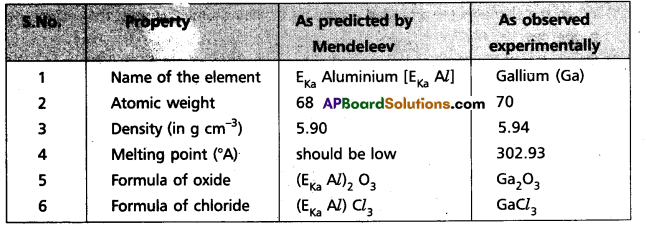
AP Inter 1st Year Chemistry Study Material Chapter 2 Classification of Elements and Periodicity in Properties 30

Question 3.
Discuss the construction of long form periodic table.
Answer:
The elements are arranged in the long form of the periodic table in the increasing order of atomic numbers. ‘Neils Bohr’ constructed the long form of the periodic table based on electronic configuration of elements.
The important features of the long form of the periodic table are :
It consists seven horizontal rows called periods and 18 vertical columns which are classified into 16 groups only.

Periods : Every period starts with an alkali metal and ends with an inert gas. The first period consists of two elements only (H, He) and is called very short period. Second period consists 8 elements (Li to Ne) and is called first short period. The third period consists (Na to Ar) 8 elements and is called second short period.

Fourth period contains 18 elements (K to Kr) and is called first long period. Fifth period is the second long period with 18 elements (Rb to Xe).
Sixth period is the longest period with 32 elements which starts with Cs and ends with Rn. This period includes 14 lanthanides.
Seventh period is an incomplete period with 20 radioactive elements.
Groups : There are 16 groups in the long form of the periodic table (in transition elements three vertical columns are fused and designated as VIII group). These groups are IA, IIA, NIB, IVB, VB, VIB, VIIB, VIII, IB, MB, IMA, IVA, VA, VIA, VIIA and zero group.

The elements of IA, IIA, IIIA, IVA, VA, VIA, VIIA groups are called representative elements or normal elements. Elements of IB, MB, NIB, IVB, VB, VIB, VIIB and VIII groups have their ultimate and penultimate shell incomplete. These are called transition elements. MB elements have (n – 1) d10 ns2 outermost electronic configuration.

Zero group elements have stable electronic configuration. These elements are called inert gases, noble gases. These elements have been grouped at the extreme right of the periodic table.
In this long periods have been expanded and short periods are broken to accommodate the transitional elements in the middle of the long period.

Lanthanides and actinides have been grouped separately and placed at the bottom of the periodic table.
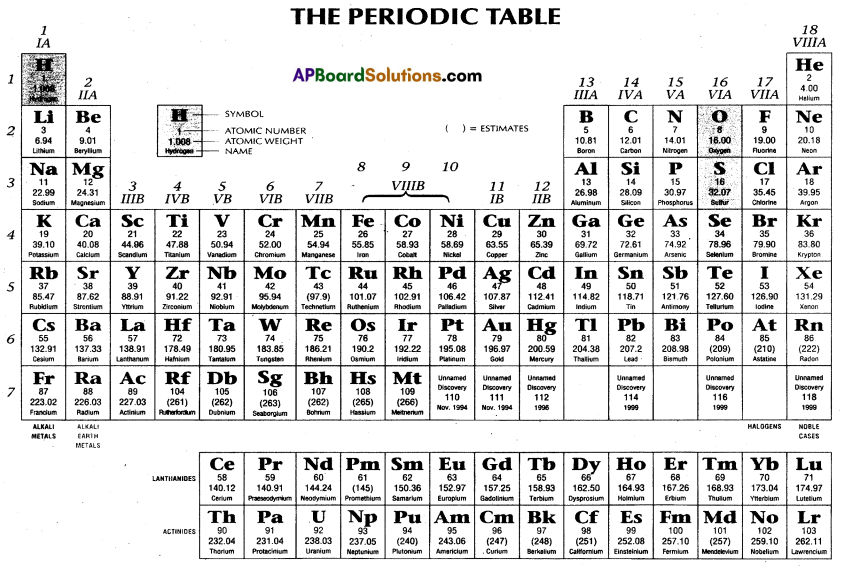
AP Inter 1st Year Chemistry Study Material Chapter 2 Classification of Elements and Periodicity in Properties 31

Question 4.
Discuss the relation between the number of electrons filled into the sub energy levels of an orbit and the maximum number of elements present in a period.
Answer:
Elements have been accommodated in these periods according to the following scheme.
1st period : The first main energy shell (K – shell) is completed. As the maximum capacity of K- shell is of 2 electrons, it consists of only two elements, hydrogen (1s1)and helium (1s2).
2nd period : The second main energy shell is completed (i.e.,) 2s and 2p are completed. It includes eight elements from Li (2s1) to Ne (2s22p6).
3rd period : The 3s and 3p energy shells are completed. It includes also eight elements from Na(3s1) to Ar (3s2 3p6).
4th period : The 4s, 3d and 3p energy shells are completed. It includes 18 elements from K(4s1) to Kr (3d10 4s24p6). It includes two s – block elements, ten d – block elements and six p – block – elements.
5th period : The 5s, 4d and 5p energy shells are completed. It includes 18 elements from Rb (5s) to Xe (4d10 5s1 5p6). 1st also includes two s – block elements, ten d – block elements and six p – block elements.
6th period : The 6s, 4f, 5d and 6p energy shells are completed, (i.e.,) it includes 32 elements from Cs (6s1) to Rn (4f14 5d10 6s26p6). It consists of two s – block elements, ten d – block elements, six p – block elements and fourteen f – block elements.
As this period can accommodate only 18 elements in the table, 14 members of 4f – series are separately accommodated in a horizontal row below the periodic table.
7th period : This period at present consists 26 elements. The 7s, 5f and 6d are completed (i.e.,) twenty six elements. Seven of the elements from atomic numbers 106 to 112 have recently been reported.

AP Inter 1st Year Chemistry Study Material Chapter 2 Classification of Elements and Periodicity in Properties

Question 5.
Write an essay on s, p, d and f block elements .
Answer:
According to the electronic configuration of elements, the elements have been classified into four blocks. The basis for this classification is the entry of the differentiating electron into the subshell. They are classified into s, p, d and f blocks.
‘s’ block elements : If the differentiating electron enters into ‘s’ orbital, the elements belongs to ‘s’ block.
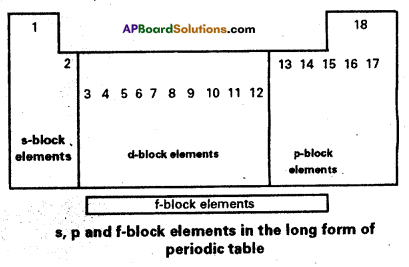
AP Inter 1st Year Chemistry Study Material Chapter 2 Classification of Elements and Periodicity in Properties 32
In every group there are two ‘s’ block elements. As an ‘s’ orbital can have a maximum of two electrons, ‘s’ block has two groups IA and IIA.
‘p‘ block elements : If the differentiating electron enters into ‘p’ orbital, the elements belongs to ‘p’ block.

‘p’ block contains six elements in each period. They are IIIA to VIIA and zero group elements. The electronic configuration of ‘p’ block elements varies from ns2np1 to ns2np6.

‘d‘ block elements : It the differentiating electron enters into (n – 1) d – orbitals the elements belongs to’d’ block. These elements are in between ‘s’ and ‘p’ blocks. These elements are also known as transition elements. In these elements n and (n – 1) shells are incompletely filled. The general electronic configuration of’d’ block elements is (n – 1) d1-10 ns1-2. This block consists of IIIB to VIIB, VIII, IB and IIB groups.

‘f’ block elements : If the differentiating electron enters into ‘f’ orbitals of antipenultimate shell (n – 2) of atoms of the elements belongs to ‘f block. They are in sixth and seventh periods in the form of two series with 14 elements each. They are known as lanthanides and actinides and are arranged at the bottom of the periodic table. The general electronic configuration is (n – 2)f1-14 (n – 1)d0 – 1 ns2.

In these shells the last three shells (ultimate, penultimate and anti penultimate) are incompletely filled. Lanthanides belongs to 4f series. It contains Ce to Lu. Actinides belong to 5f series. It contains Th to Lr.

Advantages of this kind of classification :

As a result of this classification of elements were placed in correct positions in the periodic table. It shows a gradual gradation in physical and chemical properties of elements. The metallic nature gradually decreases and non – metallic nature gradually increases from’s1′ block to ‘p1 block. This classification gave a special place for radioactive elements.

Question 6.
Relate the electronic configuration of elements and their properties in the Classification of elements.
Answer:
The chemical properties of all elements depends upon the electronic configuration. Upon the basis of complete and incomplete electron shells and chemical properties, the elements are classified into four types. (Type -1, Type – II, Type – III and Type – IV).

Type – I(inert gas elements): All the elements with an electronic configuration ns2 np6 including He belongs to this type, nth shell of those elements are completely filled.
The elements show chemical inertness due to completely filled shells and hence they have extra stability. Because of their stability, they are chemically inactive.
e.g. : He, Ne, Ar, Kr, Xe and Rn.

Type – II (Representative elements) : Except inert gases, the remaining elements of s and p – blocks are called representative elements. All the elements with an electronic configuration ns1 to ns2 np5 excluding. He comes under this type. These are atoms in which all except the outermost shells (nth) are complete. Elements of this type enter into chemical combination by loosing, gaining or sharing electrons to get stable inert gas configuration. Many of the metals, all non – metals and metalloids come under this type. Chemically these elements are reactive.

Type – III (Transition elements): All the elements with an electronic configuration (n – 1) d1 – 9 ns1or2 belongs to this type. Atoms in which the two outermost shells are incomplete. These elements show variable oxidation states, form complex ions and coloured ions. The electronic configuration of d – block elements is (n – 1) d1 – 10 ns1 – 2. Small size, high nuclear charge and unpaired’d’ orbitals impart characteristic properties to be transition elements.

Type- IV (Inner transition elements): All the elements with an electronic configuration (n – 2) f1 – 14 (n -1) d0, 1 ns2 belongs to this type. Atoms in which three outermost shells are incomplete. Lanthanides and Actinides belong to this type.

Question 7.
What is a periodic property ? How the following properties vary in a group and in a period ? Explain
a) Atomic radius
b) Electron gain enthalpy.
Answer:
Recurrence of similar properties of elements at definite regular intervals with increasing atomic number i.e., according to their electronic configurations is known as periodicity. Any property which is periodic in nature is called periodic property.
a) Atomic radius : The atomic radius decreases from left to right in a period. With an increase in the atomic number in a period the nuclear charge increases. As a result the effective nuclear charge over the outermost electrons increases, due to this the orbitals are pulled closer to the nucleus causing in a decrease in the atomic radius.

The atomic radius increases from top to the bottom in a group because – with an increase in the atomic number the electrons are added to new shells resulting an increase in the number of inner shells. Hence atomic radius increases from top to bottom in a group.

b) Electron gain enthalpy : Electron gain enthalpy increases in a period from left to right because the size of the atom decreases and the nature of the element changes from metallic to non – metallic nature when we move from left to right in a period.

Electron gain enthalpy decreases from top to bottom in a group because there is an increase in the atomic size. But the second element has greater electron gain enthalpy than the first element.
e.g. : Chlorine has more electron affinity value (- 348 kJ mol-1) than Fluorine (-333 kJ mol-1). It is because fluorine atom is smaller in size than chlorine atom. There is repulsion between the incoming electron and electrons already present in fluorine atom i.e., due to stronger inter electronic repulsions.

Question 8.
What is a periodic property ? How the following properties vary in a group and in a period ?
Explain
a. IE
b. EN
Answer:
a) IE : In groups and periods of the periodic table the ionization enthalpy values are periodically change depend upon the electronic configuration and size of elements.
In a group of elements ionization energy decreases from top to bottom because atomic radius increases.
In general, in a period the atomic size decreases. Because of this, the ionization energy increases across a period.

b) Electro negativity : Electronegativity increases from left to right in a period since the atomic: radii decreases and nuclear attraction increases.
In a group electronegativity decreases from top to bottom due to an increase in atomic radii and a decrease in nuclear attraction.

AP Inter 1st Year Chemistry Study Material Chapter 2 Classification of Elements and Periodicity in Properties

Question 9.
Write a note on
a. Atomic radius
b. Metallic radius
c. Covalent radius
Answer:
a) Crystal Radius (Atomic radius or Metallic radius): The term is used for metal atoms. A metallic crystal contains metal atoms in close packing. These metal atoms are considered spherical. They are supposed to touch each other in the crystal.
The crystal radius is half the internuclear distance between two adjacent atoms.
e.g.: The internuclear distance between two adjacent sodium atoms in a crystal of sodium metal is 3.72 A. So crystal radius of sodium is \(\frac{3.72}{2}\) = 1.86 A
For potassium it is 2.31 A.

b) Covalent radius : It is used generally for non – metals. Covalent radius is half the equilibrium distance between the nuclei of two atoms with a covalent bond.
Covalent radii of two atoms can be added to give internuclear distance between them.
e.g. : Covalent radius of H is 0.37A and for chlorine it is 0.99A. Hence internulear distance between H and Cl in HCl is 1.36A.

c) Vander Waals radius (Collision radius): The Vander Waals radius is half the equilibrium distance between the nuclei of two atoms bound by Vander Waals forces.
It is used for molecular substances in solid state and for inert gases.
e.g. : The Vander Waals radius for hydrogen is 1.2 A and that of chlorine is 1.80 A.
The Vander Waals radius of an atom is 40% larger than its covalent radius.

Question 10.
Define IE1 and IE2. Why is IE2 > IE1 for a given atom? Discuss the factors that effect IE of an element. (A.P. Mar. ’16)(T.S. Mar. ’13)
Answer:
1) Ionization energy is the amount of energy required to remove the most loosely held electron from isolated a neutral gaseous atom to convert it into gaseous ion. It is also known as first ionization energy because it is the energy required to remove the first electron from the atom.
It is denoted as I1, and is expressed in electron volts per atom, kilo calories (or) kilo joules per mole.
M(g) + I1 → \(M_{(g)^{+}}\) + e
I1 is first ionization potential.

2) The energy required to remove another electron from the unipositive ion is called the second ionization energy. It is denoted as I2.
\(M_{(g)}^{+}\) + I2 → \(\mathrm{M}_{(\mathrm{g})}{ }^{2+}\) + e

3) The second ionization potential is greater than the first ionization potential. On removing an electron from an atom, the unipositive ion formed will have more effective nuclear charge than the number of electrons. As a result the effective nuclear charge increases over the outermost electrons. Hence more energy is required to remove the second electron. This shows that the second ionization potential is greater than the first ionization potential.
For sodium, I1 is 5.1 eV and I2 is 47.3 eV.
I1 < I2 < I3 ….. In

Factors affecting ionization potential:

1. Atomic radius : As the size of the atom increases the distance between the nucleus and the outermost electrons increases. So the effective nuclear charge on the outermost electrons decreases. In such a case the energy required to remove the electrons also decreases. This shows that with an increase in atomic radius the ionization energy decreases.

2. Nuclear charge : As the positive charge of the nucleus increases its attraction increases over the electrons. So it becomes more difficult to remove the electrons. This shows that the ionization energy increases as the nuclear charge increases.

3. Screening effect or shielding effect: In multielectron atoms, valence electrons are attracted by the nucleus as well as repelled by electrons of inner shells. The electrons present in the inner shells screen the electrons present in the outermost orbit from the nucleus. As the number of electrons in the inner orbits increases, the screening effect increases. This reduces the effective nuclear charge over the outermost electrons. It is called screening or shielding effect. With the increase of screening effect the ionization potential decreases. Screening efficiency of the orbitals falls off in the order s > p > d > f.

(Magnitude of screening effect) ∝ \(\frac{1}{(\text { Ionization enthalpy) }}\)
TREND IN A GROUP : The ionisation potential decreases in a group, gradually from top to bottom as the size of the elements increases down a group.
TREND IN A PERIOD : In a period from left to right I.P. value increases as the size of the elements decreases along the period.

Question 11.
How do the following properties change in group-1 and in the third period ? Explain with example.
a. Atomic radius
b. IE
c. EA
d. Nature of oxides
Answer:
a) Atomic radius

  • In Group – 1 atomic radius from Li to Cs increases
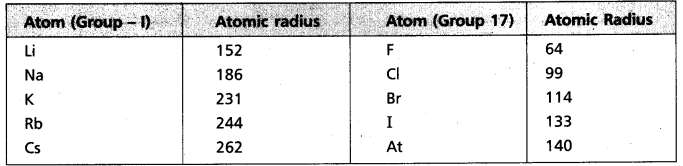
    AP Inter 1st Year Chemistry Study Material Chapter 2 Classification of Elements and Periodicity in Properties 33
    → In 3rd period from Na to Cl atomic radius decreases.
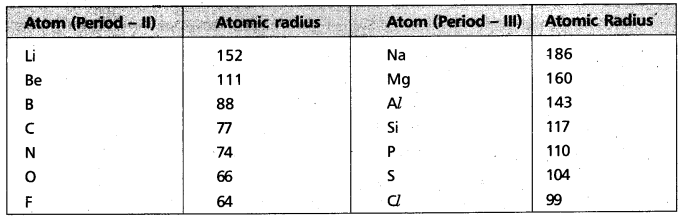
    AP Inter 1st Year Chemistry Study Material Chapter 2 Classification of Elements and Periodicity in Properties 34

b) Ionization energy : In a group ionization energy values decreases with an increase in the size of the atom. In IA group Li is the element with highest ionization potential and Cs is the element with lowest ionization potential.

In third period the ionization potential increases from Na to Mg and then decreases at Al and increases upto P and decreases in case of S and then increases upto argon, i.e., Al has a lower value than Mg and S has a lower value than P, due to stable electronic configurations of Mg and P Among these elements argon has highest ionization potential.

c) Electron affinity :

  • In 3rd period E.A > from ‘Si’ to ‘P’ decreases and P to Cl increases.
    ‘Mg’ and ‘Ar’ has positive values.
  • In 1st group from Li to Cs electron affinity decreases due to increase of size.

d) Nature of oxides of elements : All IA group elements are alkali metals. Their oxides are basic in nature. They dissolve in water to give basic solutions which changes fed litmus blue.
e.g. : Na2O, CaO , MgO etc.
Na2O + H2O → 2 NaOH
CaO + H2O → Ca(OH)2
MgO + H2O → Mg (OH)2
The basic nature of these oxides increases from top to bottom in the group. In a period basic properties decreases and acidic properties increases.
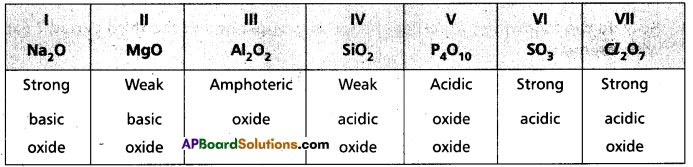
AP Inter 1st Year Chemistry Study Material Chapter 2 Classification of Elements and Periodicity in Properties 35

AP Inter 1st Year Chemistry Study Material Chapter 2 Classification of Elements and Periodicity in Properties

Question 12.
Define electron gain enthalpy. How it varies in a group and in a period? Why is the electron gain enthalpy of O or F is less negative than that of the succeeding element in the group ?
Answer:

  1. Electron affinity is the amount of energy released when an electron is added to a neutral gaseous atom in its ground state. It is known as first Electron affinity EA,sub>1. It has -ve value.
    X(g) + e → \(\mathrm{X}_{(\mathrm{g})}{ }^{-}\) + EA1
  2. Energy can be absorbed when an other electron is added to uni negative ion. It is because to overcome the repulsion between negative ion and electron. Hence second electron affinity, EA2 has +ve value.
    \(X_{(g)}{ }^{-}\) + e → \(X_{(g)}^{2-}\) + EA2
  3. It can be indirectly determined from Born —Haber cycle. Its units are kJ/mole.
  4. Trend in a group : Generally EA decreases down the group. In a group the second element has higher EA value than the first member.
    e.g. : EA of Cl is more than that of F
    Fluorine possess lower EA value than chlorine. It is due to inner electron repulsions in Fluorine.
  5. Trend in a period : Generally EA value increases across a period, but some irregularities can be observed.

a) I A group elements possess low EA values than the corresponding III A elements, e.g. : Be has EA value zero, it is due to completely filled 2s2 orbital.
b) VA elements have low EA values than that of VI A elements.
e.g. : Due to presence of half filled p – orbitals [2s2 2p3], nitrogen has lower EA value than that of oxygen.
c) For inert gases EA value is zero.
d) The element with the highest EA value is chlorine.

  • The electron gain enthalpy of O and F is less negative than the succeeding element in the group because. These have small size and inter electronic repulsions are high in these elements
    O → 141 KJ / mole and S → 200 kJ/Mole
    F → 328 KJ / mole and Cl → 349 kJ/Mole

Question 13.
a. What is electronegativity ?
b. How does it vary in a group and in a period ?
Answer:
a) Electronegativity : ‘The tendency of the atom of an element to attract the shared electron pair(s) more towards itself in a hetronuclear diatomic molecule or in a polar covalent bond.” Measuring electronegativity Pauling scale : Pauling scale is based on the values of bond energy. The bond energy of a compound A – B is the average of bond energies of A – A and B – B molecules.
EA – B = \(\frac{1}{2}\left(E_{A-A}+E_{B-B}\right)\)
But the experimental value of EA – B is found to exceed the theoretical value. The difference is ∆.
∴ ∆ = E’A – B – EA – B
∆ indicates the polarity of the covalent bond. It is measured in k. cal. mol-1.
Pauling gave the relation XA – XB = 0.208 × \(\sqrt{\Delta}\)
In S.l. units XA – XB = 0.1017 \(\sqrt{\Delta}\) where ∆ is measured in kJ/mole
XA and XB are the electronegativities of A and B. Pauling arbitrarily fixed 2.1 as the electronegativity value of Flydrogen and calculated the electronegativities of other elements. On Pauling scale Fluorine has the highest EN value 4.0.

From the values of the electronegativity of elements, the nature of the chemical bond formed can be understood. If two bonded atoms differ by 1.70 or more ion their EN values, the bond between them would be either 50% or more than 50% ionic in nature. Similarly if the difference in the EN values of the atoms is less than 1.70, the bond formed is more than 50% covalent in nature.

b) Variation in a group and period : Electronegativity increases from left to right in a period since the atomic: radii decreases and nuclear attraction increases. In a group electronegativity decreases from top to bottom due to an increase in atomic radii and a decrease in nuclear attraction.

Question 14.
Explain the following
a. Valency
b. Diagonal relation
c. Variation of nature of oxides in the Group -1
Answer:
a) Valency : The combining capacity of an element with another element is called valency. The number of hydrogen atoms (or) chlorine atoms (or) double the number of oxygen atoms, with which one atom of the element combine is also called valency.
∴ Valency = no. of hydrogens
= no. of chlorine atoms
= 2 × no. of oxygen atoms present in the molecule
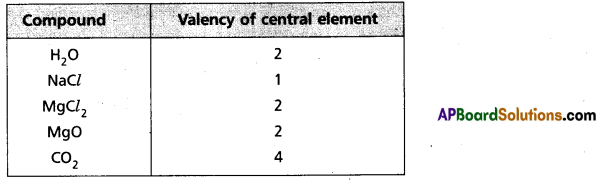
AP Inter 1st Year Chemistry Study Material Chapter 2 Classification of Elements and Periodicity in Properties 36

Periodicity of valency :
1) Each period starts with valency’11 and ends in ‘O’.
e.g.:

AP Inter 1st Year Chemistry Study Material Chapter 2 Classification of Elements and Periodicity in Properties 37

2) In a group valency is either equal to the group number (i.e., upto 4th group) or is equal to (8 – group number) (i.e., from 5th group onwards).
Significance :
Valency of an element is useful in writing the formulae of compounds.

b) Diagonal relation : On moving diagonally across the periodic table the elements show certain similarities. An element of group in 2nd period has similar properties with second element of the next higher group in the 3rd period. This type of resemblance is called diagonal relationship,
e.g. : (Li, Mg); (Be, Al); (B, Si)

AP Inter 1st Year Chemistry Study Material Chapter 2 Classification of Elements and Periodicity in Properties 38
c) Nature of oxides of elements : All IA group elements are alkali metals. Their oxides are basic in nature. They dissolve in water to give basic solutions which changes red litmus blue.
e.g. : Na2O, CaO , MgO etc.
CaO + H2O → Ca(OH)2
MgO + H2O → Mg (OH)2
The basic nature of these oxides increases from top to bottom in the group. In a period basic properties decreases and acidic properties increases.

Solved Problems

Question 1.
What would be the IUPAC name and symbol for the element with atomic number 120?
Solution:
The roots for 1, 2 and 0 are un, bi and nil, respectively. Hence, the symbol and the name respectively are Ubn and unbinilium.

Question 2.
How would you justify the presence of 18 elements in the 5t” period of the Periodic Table ?
Solution:
When n = 5, l = 0, 1, 2, 3. The order in which the energy of the available orbitals 4d, 5s and 5p increases is 5s < 4d < 5p. The total number of orbitals available are 9. The maximum number of electrons that can be accommodated is 18; and therefore 18 elements are there in the 5th period.

AP Inter 1st Year Chemistry Study Material Chapter 2 Classification of Elements and Periodicity in Properties

Question 3.
The elements Z = 117 and 120 have not yet been discovered. In which family / group would you place these elements and also give the electronic configuration in each case.
Solution:
we see from that element with Z = 117, would belong to the halogen family (Group 17) and the electronic configuration would be [Rn] 5f146d107s27p5. The element with Z = 120, will be placed in Group 2 (alkaline earth metals), and will have the electronic configuration [Uuo]8s2

Question 4.
Considering the atomic number and position in the periodic table, arrange the following elements in the increasing order of metallic character: Si, Be, Mg, Na, P.
Solution:
Metallic character increases down a group and decreases along a period as we move from left to right. Hence the order of increasing metallic character is : P < Si < Be < Mg < Na.

Question 5.
Which of the following species will have the largest and the smallest size ?
Mg, Mg2+, Al, Al3+.
Solution:
Atomic radii decrease across a period. Cations are smaller than their parent atoms. Among isoelectronic species, the one with the larger positive nuclear charge will have a smaller radius.
Hence the largest species is Mg; the smallest one is Al3+.

Question 6.
The first ionization enthalpy (∆iH) values of the third period elements, Na, Mg and Si are respectively 496, 737 and 786 kJ mol-1. Predict whether the first ∆iH value for Al will be more close to 575 or 760 kJ mol-1 ? Justify your answer.
Solution:
It will be more close to 575 kJ mol-1. The value for Al should be lower than that of Mg because of effective shielding of 3p electrons from the nucleus by 3s-electrons.

Question 7.
Which of the following will have the most negative electron gain enthalpy and which the least negative ? P, S, Cl, F. Explain your answer.
Solution:
Electron gain enthalpy generally becomes more negative across a period as we move from left to right. Within a group, electron gain enthalpy becomes less negative down a group. However, adding an electron to the 2p-orbital leads to greater repulsion than adding an electron to the larger 3p-orbital. Hence the element with most negative electron gain enthalpy is chlorine; the one with the least negative electron gain enthalpy is phosphorous.

Question 8.
Using the Periodic Table, predict the formulas of compounds which might be formed by the following pairs of elements;
(a) silicon and bromine
(b) aluminium and sulphur.
Solution:
(a) Silicon is group 14 element with a valence of 4; bromine belongs to the halogen family with a valency of 1. Hence the formula of the compound formed would be SiBr4.
(b) Aluminium belongs to group 13 with a valence of 3; sulphur belongs to group 16 elements with a valence of 2. Hence, the formula of the compound formed would be Al2S2.

AP Inter 1st Year Chemistry Study Material Chapter 2 Classification of Elements and Periodicity in Properties

Question 9.
Are the oxidation state and covalency of Al in [AICI(H2O)5]2+ same ?
Solution:
No. The oxidation state of Al is +3 and the covalency is 6.

Question 10.
Show by a chemical reaction with water that Na2O is a basic oxide and Cl2O7 is an acidic oxide.
Solution:
Na2O with water forms a strong base Whereas Cl2O7 forms strong acid.
Na2O + H2O → 2NaOH
Cl2O7 + H2O → 2HClO4
Their basic or acidic nature can be qualitatively tested with litmus paper.

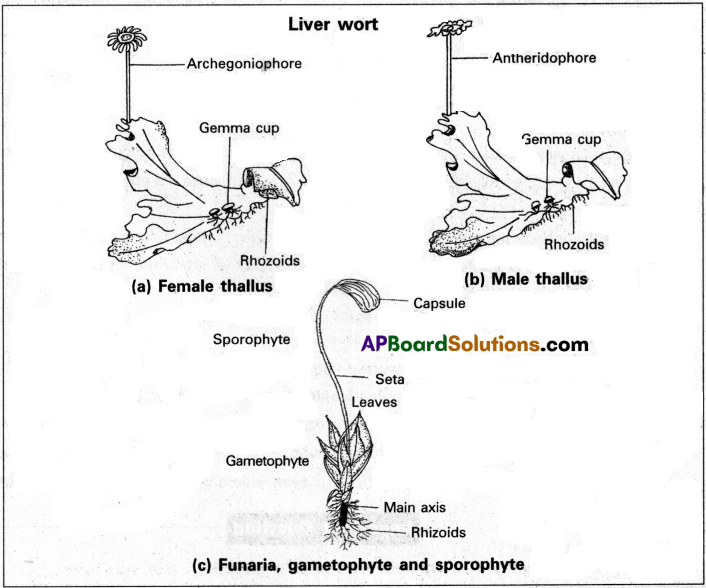
Inter 1st Year Maths 1B Differentiation Solutions Ex 9(b)

Practicing the Intermediate 1st Year Maths 1B Textbook Solutions Inter 1st Year Maths 1B Differentiation Solutions Exercise 9(b) will help students to clear their doubts quickly.

Intermediate 1st Year Maths 1B Differentiation Solutions Exercise 9(b)

I. Compute the following limits.

Question 1.
Find the derivatives of the following function.
i) cotn x
Solution:
\(\frac{dy}{dx}\) = n. cotn-1 x. \(\frac{d}{dx}\) (cot x)
= n. cotn-1 x (- cosec² x)
= – n. cotn-1 x. cosec² x

ii) cosec4 x
Solution:
\(\frac{dy}{dx}\) = 4.cosec³ x. \(\frac{d}{dx}\)(cosec x)
= 4. cosec³ x (- cosec x. cot x)
= – 4. cosec4 x. cot x

iii) tan (ex)
=sec 2(ex).(ex
= ex. sec² (ex)

iv) \(\frac{1-\cos 2 x}{1+\cos 2 x}\)
Solution:
\(\frac{2 \sin ^{2} x}{2 \cos ^{2} x}\) = tan² x \(\frac{dy}{dx}\) = 2 tan x . sec² x

v) sinm x cosn x
Solution:
\(\frac{dy}{dx}\) = (sinm x). \(\frac{d}{dx}\) (cosn x) + (cosn x) \(\frac{d}{dx}\) (sinm x)
= sinm xn + cosn-1 x(-sin x) + cosn x. m sinm-1 x. cos x
= m. cosn+1 x. sinm-1 x – n. sinm+1 x. cosn-1 x.

vi) sin mx. cos nx
Solution:
\(\frac{dy}{dx}\) = sin mx \(\frac{d}{dx}\) (cos nx) + (cos nx) \(\frac{dy}{dx}\) (sin mx)
= sin mx (-n sin nx)+cos nx (m cos mx)
= m. cos mx. cos nx – n. sin mx . sin nx

Inter 1st Year Maths 1B Differentiation Solutions Ex 9(b)

vii) x tan-1 x
Solution:
\(\frac{dy}{dx}\) = x. \(\frac{d}{dx}\) (tan-1 x) + (tan-1 x) \(\frac{d}{dx}\) (x)
= \(\frac{x}{1+x^{2}}\) + tan-1 x.

viii) sin-1 (cos x)
Solution:
= sin-1 [sin (\(\frac{\pi}{2}\) – x)] = \(\frac{\pi}{2}\) – x
\(\frac{dy}{dx}\) = 0 – 1 = -1

ix) log (tan 5x)
Solution:
Inter 1st Year Maths 1B Differentiation Solutions Ex 9(b) 1

x) sinh-1 (\(\frac{3x}{4}\))
Solution:
Inter 1st Year Maths 1B Differentiation Solutions Ex 9(b) 2

xi) tan-1 (log x)
Solution:
Inter 1st Year Maths 1B Differentiation Solutions Ex 9(b) 3

xii) log (\(\frac{x^{2}+x+2}{x^{2}-x+2}\))
Solution:
\(\frac{dy}{dx}\) = log(x² + x + 2) – log(x² – x + 2)
Inter 1st Year Maths 1B Differentiation Solutions Ex 9(b) 4

xiii) log (sin-1 (ex))
Solution:
Inter 1st Year Maths 1B Differentiation Solutions Ex 9(b) 5

xiv) (sin x)² (sin-1 x)²
Solution:
Inter 1st Year Maths 1B Differentiation Solutions Ex 9(b) 6

xv) y = \(\frac{\cos x}{\sin x+\cos x}\)
Solution:
Inter 1st Year Maths 1B Differentiation Solutions Ex 9(b) 7
Inter 1st Year Maths 1B Differentiation Solutions Ex 9(b) 8

xvi) \(\frac{x\left(1+x^{2}\right)}{\sqrt{1-x^{2}}}\)
Solution:
Inter 1st Year Maths 1B Differentiation Solutions Ex 9(b) 9

xvii) y = esin-1x
Solution:
Inter 1st Year Maths 1B Differentiation Solutions Ex 9(b) 10

xviii) y = cos (log x + ex)
Solution:
\(\frac{dy}{dx}\) = -sin(log x + ex) = \(\frac{d}{dx}\) (log x + ex)
= -sin (log x + ex) (\(\frac{1}{x}\) + ex)

xix) y = \(\frac{\sin (x+a)}{\cos x}\)
Solution:
Inter 1st Year Maths 1B Differentiation Solutions Ex 9(b) 11

xx) y = cot-1 (coses 3x)
Solution:
Inter 1st Year Maths 1B Differentiation Solutions Ex 9(b) 12

Question 2.
Find the derivatives of the following fountion.
i) x = sinh² y
Solution:
\(\frac{dy}{dx}\) = 2 sinh y . cosh y
Inter 1st Year Maths 1B Differentiation Solutions Ex 9(b) 13

ii) x = tanh² y
Solution:
\(\frac{dy}{dx}\) = 2 tanh y . sech² y
Inter 1st Year Maths 1B Differentiation Solutions Ex 9(b) 14

iii) x = esinh y
Solution:
\(\frac{dy}{dx}\) = esinh y \(\frac{d}{dx}\) (sinh y)
= esinh y . cosh y
= x. cosh y
\(\frac{d y}{d x}=\frac{1}{\left(\frac{d x}{d y}\right)}=\frac{1}{x \cdot \cosh y}\)

iv) x =tan (e-y)
Solution:
\(\frac{dy}{dx}\) = sec² (e-y) . (e-y)¹ = -e-y . sec² e-y
= -e-y(1 + tan² (e-y) = – e-y(1 + x²)
\(\frac{d y}{d x}=\frac{1}{\left(\frac{d x}{d y}\right)}=-\frac{1}{e^{-y}\left(1+x^{2}\right)}=-\frac{e^{y}}{1+x^{2}}\)

v) x = log (1 + sin² y)
Solution:
Inter 1st Year Maths 1B Differentiation Solutions Ex 9(b) 15

vi) x = log (1 + √y)
Solution:
1 + √y = ex
√y = ex – 1
y = (ex – 1)²
\(\frac{dy}{dx}\) = 2(ex – 1) . ex = 2 √y . ex
= 2 √y (√y + 1)
= 2(y + √y)

Inter 1st Year Maths 1B Differentiation Solutions Ex 9(b)

II. Find the derivativies of the following functions.

i) y = cos [log (cot x)]
Solution:
Inter 1st Year Maths 1B Differentiation Solutions Ex 9(b) 16

ii) y = sin-1 \(\frac{1-x}{1+x}\)
Solution:
Inter 1st Year Maths 1B Differentiation Solutions Ex 9(b) 17
Inter 1st Year Maths 1B Differentiation Solutions Ex 9(b) 18

iii) log (cot (1 – x²))
Solution:
Inter 1st Year Maths 1B Differentiation Solutions Ex 9(b) 19

iv) y = sin [cos (x²)]
Solution:
\(\frac{dy}{dx}\) = cos [cos (x²)].\(\frac{d}{dx}\)[cos (x²)]
= cos [cos (x²)](sin (x²)).\(\frac{d}{dx}\)(x²)
= – 2x. sin (x²). cos [cos (x²)]

v) y = sin [tan-1 (ex)]
Solution:
Inter 1st Year Maths 1B Differentiation Solutions Ex 9(b) 20

vi) y = \(\frac{\sin (a x+b)}{\cos (c x+d)}\)
Solution:
Inter 1st Year Maths 1B Differentiation Solutions Ex 9(b) 21
Inter 1st Year Maths 1B Differentiation Solutions Ex 9(b) 22

vii) y = tan-1 (tan h \(\frac{x}{2}\))
Solution:
Inter 1st Year Maths 1B Differentiation Solutions Ex 9(b) 23

viii) y = sinx . (Tan-1x)²
Solution:
Inter 1st Year Maths 1B Differentiation Solutions Ex 9(b) 24

III. Find the derivatives of the following functions.

Question 1.
y = sin-1 \(\left(\frac{b+a \sin x}{a+b \sin x}\right)\) (a > 0, b > 0)
Solution:
Let u = \(\frac{b+a \sin x}{a+b \sin x}\)
Inter 1st Year Maths 1B Differentiation Solutions Ex 9(b) 25
Inter 1st Year Maths 1B Differentiation Solutions Ex 9(b) 26

Question 2.
cos-1\(\left(\frac{b+a \cos x}{a+b \cos x}\right)\) (a > 0, b > 0)
Solution:
Let u = \(\frac{b+a \cos x}{a+b \cos x}\)
Inter 1st Year Maths 1B Differentiation Solutions Ex 9(b) 27

Inter 1st Year Maths 1B Differentiation Solutions Ex 9(b)

Question 3.
tan-1 \(\left[\frac{\cos x}{1+\cos x}\right]\)
Solution:
Let u = \(\frac{\cos x}{1+\cos x}\)
Inter 1st Year Maths 1B Differentiation Solutions Ex 9(b) 28

Inter 1st Year Maths 1A Trigonometric Equations Important Questions

Students get through Maths 1A Important Questions Inter 1st Year Maths 1A Trigonometric Equations Important Questions which are most likely to be asked in the exam.

Intermediate 1st Year Maths 1A Trigonometric Equations Important Questions

Question 1.
Solve sin x = \(\frac{1}{\sqrt{2}}\)
Solution:
sin x = \(\frac{1}{\sqrt{2}}\) = sin \(\frac{\pi}{4}\) and \(\frac{\pi}{4}\) ∈ [-\(\frac{\pi}{2}\), \(\frac{\pi}{2}\)]
∴ x = \(\frac{\pi}{4}\) is the principal solution and
x = nπ + (-1)n \(\frac{\pi}{4}\), n ∈ Z is the general solution.

Inter 1st Year Maths 1A Trigonometric Equations Important Questions

Question 2.
Solve sin 2θ = \(\frac{\sqrt{5}-1}{4}\)
Solution:
sin 2θ = \(\frac{\sqrt{5}-1}{4}\) = sin 18° = sin(\(\frac{\pi}{10}\)) and \(\frac{\pi}{10}\) ∈ [-\(\frac{\pi}{2}\), \(\frac{\pi}{2}\)]
⇒ 2θ = \(\frac{\pi}{10}\) and hence θ = \(\frac{\pi}{20}\) is the principal solution.
General solution is given by
2θ = nπ + (-1)n \(\frac{\pi}{10}\), n ∈ Z (or)
θ = n\(\frac{\pi}{2}\) + (-1)n \(\frac{\pi}{20}\), n ∈ Z

Question 3.
Solve tan2θ = 3
Solution:
tan2θ = 3 = tan θ = ±\(\sqrt{3}\) = tan (±\(\frac{\pi}{3}\))
and ± \(\frac{\pi}{3}\) ∈ (-\(\frac{\pi}{2}\), \(\frac{\pi}{2}\))
∴ θ = ± \(\frac{\pi}{3}\) are the principal solutions of the given equation.
General solution is given by nπ ± \(\frac{\pi}{3}\), n ∈ Z

Question 4.
Solve 3 cosec x = 4 sin x
Solution:
3 cosec x = 4 sin x
⇔ \(\frac{3}{\sin x}\) = 4 sin x
⇒ sin2x = \(\frac{3}{4}\)
⇔ sin x = ± \(\frac{\sqrt{3}}{2}\)
∴ Principal solutions are x = ± \(\frac{\pi}{3}\)
General solutions are given by x = nπ ± \(\frac{\pi}{3}\), n ∈ Z

Question 5.
If x is acute and sin (x + 10°) = cos (3x – 68°), find x in degrees.
Solution:
Given sin (x + 10°) = cos (3x – 68°)
⇔ sin(x + 10°) = sin (90° + 3x – 68°) = sin (22° + 3x)
∴ x + 10° = n(180°) + (-1 )n (22° + 3x)
If n = 2k, k ∈ Z then
x + 10° = (2k) (180°) + (220 + 3x)
⇒ 2x = -k(360°) – 12°
⇒ x = \(\frac{-k\left(360^{\circ}\right)-12^{\circ}}{2}\)
= -k(180°) – 6°
This is not valid because for any integral k, x is not acute
If n = 2k + 1, then
x + 10° = (2k + 1) 180° – (22°+ 3x)
⇒ 4x = (2k + 1) 180° – 32°
⇒ x = (2k + 1) 45° – 8°
Now k = 0 ⇒ x = 37°
For other integral values of k, x is not acute
∴ The only solution is x = 37°

Question 6.
Solve cos 3θ = sin 2θ
Solution:
cos 3θ = sin 2θ = cas (\(\frac{\pi}{2}\) – 2θ)
⇒ 3θ = 2nπ ± (\(\frac{\pi}{2}\) – 2θ), n ∈ Z
⇒ 3θ = 2nπ + (\(\frac{\pi}{2}\) – 2θ) (or)
3θ = 2nπ – (\(\frac{\pi}{2}\) – 2θ)
⇒ 5θ = 2nπ + \(\frac{\pi}{2}\) (or) θ = 2nπ – \(\frac{\pi}{2}\)
⇒ θ = (4n + 1) \(\frac{\pi}{10}\), n ∈ Z (or)
θ = (4n – 1) \(\frac{\pi}{2}\), n ∈ Z

Question 7.
Solve 7 sin2θ + 3cos2θ = 4
Solution:
Given that
7 sin2θ + 3 cos2θ = 4
⇒ 7 sin2θ + 3(1 – sin2θ) = 4
⇒ 4sin2θ = 1
⇒ sin θ = ± \(\frac{1}{2}\)
∴ Principal solutions are θ = ± \(\frac{\pi}{6}\) and the general solution is given by
θ = nπ ± \(\frac{\pi}{6}\), n ∈ z.

Question 8.
Solve 2 cos2θ – \(\sqrt{3}\) sin θ + 1 = 0
Solution:
2 cos2θ – \(\sqrt{3}\) sin θ + 1 = 0
⇒ 2(1 – sin2θ) – \(\sqrt{3}\) sin θ + 1 = 0
⇒ 2 sin2θ + \(\sqrt{3}\) sin θ – 3 = 0
⇒ (2 sin θ – \(\sqrt{3}\))(sin θ + \(\sqrt{3}\)) = 0
⇒ sin θ = \(\frac{\sqrt{3}}{2}\) and sin θ ≠ \(\sqrt{3}\)
∴ sin θ = \(\frac{\sqrt{3}}{2}\) = sin (\(\frac{\pi}{3}\))
∴ θ = \(\frac{\pi}{3}\) is the principal solution and general solution is given by
θ = nπ + (-1)n \(\frac{\pi}{3}\), n ∈ Z.

Question 9.
Find all values of x ≠ 0 in (-π, π) satisfying the equation 81+cosx+cos2x+…… = 43.
Solution:
If cos x = ±1, the sum
1 + cos x + cos2 x + …………… ∞ does not converse.
Assume |cos x| < 1.
Then 1 + cos x + cos2 x + …………… ∞
= \(\frac{1}{1-\cos x}\)
(∵ a + ar + ar2 + ……………. ∞ = \(\frac{a}{1-r}\), if |r| < 1)
Now 81+cosx+cos2x+…………. = 43
⇒ (8)\(\frac{1}{1-\cos x}\) = 82
⇔ \(\frac{1}{1-\cos x}\) = 2 = cos x = \(\frac{1}{2}\)
⇔ x = \(\frac{\pi}{3}\) or –\(\frac{\pi}{3}\) (∵ x ∈ (-π, π))

Question 10.
Solve tan θ + 3 cot θ = 5 sec θ
Solution:
tan θ + 3 cot θ = 5 sec θ is valid only when
cos θ ≠ 0 and sin θ ≠ 0
⇒ \(\frac{\sin \theta}{\cos \theta}\) + 3\(\frac{\cos \theta}{\sin \theta}\) =\(\frac{5}{\cos \theta}\)
⇒ sin2θ+ 3cos2θ= 5 sin θ
⇒ sin2θ + 3(1 – sin2θ) – 5 sin θ = 0
⇒ 2 sin2θ + 5 sin θ – 3 = 0
⇒ 2 sin2θ + 6sin θ – sin θ – 3 = 0
⇒ 2 sin θ(sin θ + 3) – 1 (sin θ + 3)= 0
⇒ (2 sin θ – 1)(sin θ + 3) = 0
⇒ sin θ = \(\frac{1}{2}\) (∵sin θ ≠ -3)
∴ sin = \(\frac{1}{2}\) = sin (\(\frac{\pi}{6}\))
∴ Principal solution is θ = \(\frac{\pi}{6}\) and general solution is nπ + (-1)n\(\frac{\pi}{6}\), n ∈ Z.

Question 11.
Solve 1 + sin 2θ = 3 sin θ cos θ. [Mar 11]
Solution:
1 + sin2θ = 3 sin θ cas θ
Dividing by cos2θ, ∵ cos θ ≠ 0
sec2θ + tan2θ = 3 tan θ
⇒ (1 + tan2θ) + tan2θ – 3 tan θ = 0
⇒ 2tan2θ – 3 tanθ + 1 = 0
⇒ 2tan2θ – 2 tan θ – tan θ + 1 = 0
⇒ 2 tan θ (tan θ – 1) – (tan θ – 1) = 0
⇒ (tan θ – 1)(2 tan θ – 1) = 0
∴ tan θ = 1 (or) tan θ = \(\frac{1}{2}\)
Now tan θ = 1 = tan \(\frac{\pi}{4}\)
∴ Principal solution θ = \(\frac{\pi}{4}\) and general solution is given by
θ = nπ + \(\frac{\pi}{6}\), n ∈ Z
let α be the principal solution of tan θ = \(\frac{1}{2}\)
Then the general solution is given by θ = nπ + α, n ∈ Z

Question 12.
Solve \(\sqrt{2}\) (sin x + cos x) = \(\sqrt{3}\) (A.P) [Mar. 16, 15, May 12, 08]
Solution:
Given that \(\sqrt{2}\) (sin x + cos x) = \(\sqrt{3}\)
⇔ sin x + cos x = \(\sqrt{\frac{3}{2}}\)
By dividing both sides by \(\sqrt{2}\), we get
\(\frac{1}{\sqrt{2}}\) sin x + \(\frac{1}{\sqrt{2}}\) cos x = \(\sqrt{\frac{3}{2}}\)
⇒ sin x. sin \(\frac{\pi}{4}\) + cos x. cos \(\frac{\pi}{4}\) = \(\sqrt{\frac{3}{2}}\)
⇒ cos (x – \(\frac{\pi}{4}\)) = \(\sqrt{\frac{3}{2}}\) = cos (\(\frac{\pi}{6}\))
Principal solution is x – \(\frac{\pi}{4}\) = \(\frac{\pi}{6}\) (i.e.,) x = \(\frac{5 \pi}{12}\)
General solution is given by
x – \(\frac{\pi}{4}\) = 2nπ ± \(\frac{\pi}{6}\), n ∈ Z
⇒ x = 2nπ + latex]\frac{5 \pi}{12}[/latex] (or) x = 2nπ + \(\frac{\pi}{12}\), n ∈ Z

Question 13.
Find general solution of θ which satisfies both the equations sinθ = –\(\frac{1}{2}\) and cosθ = –\(\frac{\sqrt{3}}{2}\)
Solution:
Given sin θ = –\(\frac{1}{2}\) = – sin \(\frac{\pi}{6}\)
= sin (π + \(\frac{\pi}{6}\)) = sin (2π – \(\frac{\pi}{6}\))
= sin \(\frac{7\pi}{6}\) = sin \(\frac{11\pi}{6}\)
∴ Considering only angles in (0, 2π), the only values of θ satisfying sin θ = –\(\frac{1}{2}\) are \(\frac{7\pi}{6}\) or \(\frac{11\pi}{6}\)
cos θ = –\(\frac{\sqrt{3}}{2}\) = – cos\(\frac{\pi}{6}\)
= cos (π – \(\frac{\pi}{6}\)) or cos (π + \(\frac{\pi}{6}\))
= cos \(\frac{5\pi}{6}\) or cos \(\frac{7\pi}{6}\).
∴ Considering only angles in (0, 2π), the only values of θ satisfying cos θ = –\(\frac{\sqrt{3}}{2}\) are \(\frac{5 \pi}{6}\) or \(\frac{7 \pi}{6}\).
Thus \(\frac{7 \pi}{6}\) is the only angle which satisfies both the equations.
Hence general solution for θ is
θ = 2nπ + \(\frac{7 \pi}{6}\), n ∈ Z.

Question 14.
If θ1, θ2 are solutions of the equation a cos 2θ + b sin 2θ = c, tan θ1 ≠ tan θ2 and a + c ≠ 0. find the values of
(i) tan θ1 + tan θ2
(ii) tan θ1 . tanθ2 (T.S.) [Mar 16, 15]
Solution:
a cos 2θ + b sin 2θ = c
⇔ a(\(\frac{1-\tan ^{2} \theta}{1+\tan ^{2} \theta}\)) + b(\(\frac{2 \tan \theta}{1+\tan ^{2} \theta}\)) = c
⇔ a(1 – tan2θ) + 2b tan θ) = c(1 + tan2θ)
(c + a) tan2θ – 2b tan θ + (c – a) = 0
This is a quadratic equation in tan θ.
It has two roots tan θ1 and tan θ2. since θ1 and θ2 are solutions for the given equation
Sum of the roots = tan θ1 + tan θ2 = \(\frac{2 b}{a+c}\)
Product of the roots = tan θ1 tan θ2 = \(\frac{c-a}{c+a}\)
Now tan(θ1 + θ2) = \(\frac{\tan \theta_{1}+\tan \theta_{2}}{1-\tan \theta_{1} \tan \theta_{2}}\)
= \(\frac{\left(\frac{2 b}{a+c}\right)}{1-\left(\frac{c-a}{c+a}\right)}\) = \(\frac{2 \mathrm{~b}}{2 \mathrm{a}}\) = \(\frac{b}{a}\)

Question 15.
Solve 4 sin x sin 2x sin 4x = sin 3x
Solution:
sin 3x = 4 sin x sin 2x sin 4x
= 2 sin x (2 sin 4x sin 2x)
= 2 sin x [cos (2x) – cos 6x]
⇔ sin 3x = 2 cos 2xsinx – 2 cos6x sin x
⇔ sin 3x = sin (3x) – sin x – 2 cos 6x sin x
⇒ 2 cos 6x sin x + sin x = 0
⇒ sin x(2 cos 6x + 1) = 0
⇒ sin x = 0 (or) cos 6x = \(\frac{-1}{2}\)
Case (i) : sin x = 0
⇒ x = 0 is the principal solution and x = nπ, n ∈ Z is the general solution.

Case (ii) : cos 6x = \(\frac{-1}{2}\) = cos (\(\frac{2 \pi}{3}\))
⇒ 6x = \(\frac{2 \pi}{3}\) ⇒ x = \(\frac{\pi}{9}\) is the principal solution
The general solution is given by
6x = 2nπ ± \(\frac{2 \pi}{3}\), n ∈ Z
⇒ x = \(\frac{n \pi}{3}\) ± \(\frac{\pi}{9}\), n ∈ Z

Question 16.
If 0 < θ < π, solve cos θ.cos 2θ cos 3θ = \(\frac{1}{4}\).
Solution:
4 cos θ cos 2θ cos 3θ = 1
⇒ 2 cos 2θ (2 cos 3θ. cos θ) = 1
⇒ 2 cos 2θ (cos 4θ + cos 2θ) = 1
⇒ 2 cos 4θ cos 2θ + (2 cos2 2θ – 1) = 0
⇒ 2 cos 4θ cos 2θ + cos 4θ = 0
⇒ cos 4θ (2 cos 2θ + 1) = 0
⇒ cos 4θ = 0 (or) cos 2θ = \(\frac{-1}{2}\)
Case(i): cos 4θ = 0 = cos (\(\frac{\pi}{2}\))
⇒ 4θ = \(\frac{\pi}{2}\) is the principal solution (or)
θ = \(\frac{\pi}{8}\).
The general solution is given by
4θ = (2n + 1) \(\frac{\pi}{2}\), n ∈ Z
⇒ θ = (2n + 1) \(\frac{\pi}{8}\), n ∈ Z
Put n = 0, 1, 2, ……… we get
\(\left\{\frac{\pi}{8}, \frac{3 \pi}{8}, \frac{5 \pi}{8}, \frac{7 \pi}{8}\right\}\) are the solutions that lie in (0, π)
Case (ii) : cos 2θ = \(\frac{-1}{2}\) = cos (\(\frac{2\pi}{3}\))
⇒ 2θ = \(\frac{2\pi}{3}\) is the principal solution
(i.e.,) θ = \(\frac{\pi}{3}\)
The general solution is given by
2θ = 2nπ ± \(\frac{2\pi}{3}\), n ∈ Z
⇒ θ = nπ ± latex]\frac{\pi}{3}[/latex], n ∈ Z
Put n = 0, 1, we get \(\left\{\frac{\pi}{3}, \frac{2 \pi}{3}\right\}\) are the solutions that lie in the interval (0, π).
Hence the solutions of the given equation in (0, π) are \(\left\{\frac{\pi}{8}, \frac{\pi}{3}, \frac{3 \pi}{8}, \frac{5 \pi}{8}, \frac{2 \pi}{3}, \frac{7 \pi}{8}\right\}\).

Question 17.
Given p ≠ ± q, show that the solutions of cos pθ + cos qθ = 0 form two series each of which is in A.R Find also the common difference of each A.P.
Solution:
cos pθ + cos qθ = 0
Inter 1st Year Maths 1A Trigonometric Equations Important Questions 1
Inter 1st Year Maths 1A Trigonometric Equations Important Questions 2

Question 18.
Solve sin 2x – cos 2x = sin x – cos x.
Solution:
sin 2x – cos 2x = sin x – cos x.
⇒ sin 2x – sin x = cos 2x – cos x
Inter 1st Year Maths 1A Trigonometric Equations Important Questions 3
The general solution is given by
\(\frac{3 x}{2}\) = nπ + (\(\frac{-\pi}{4}\)), n ∈ Z
⇒ x = \(\frac{2 n \pi}{3}\) – \(\frac{\pi}{6}\), n ∈ Z
∴ Solution set for the given equation is {2nπ / n ∈ Z} ∪ {\(\frac{2 n \pi}{3}\) – \(\frac{\pi}{6}\) / n ∈ Z}

Inter 1st Year Maths 1A Trigonometric Ratios up to Transformations Solutions Ex 6(e)

Practicing the Intermediate 1st Year Maths 1A Textbook Solutions Inter 1st Year Maths 1A Trigonometric Ratios up to Transformations Solutions Exercise 6(e) will help students to clear their doubts quickly.

Intermediate 1st Year Maths 1A Trigonometric Ratios up to Transformations Solutions Exercise 6(e)

I.

Question 1.
Prove that sin 50° – sin70° + sin 10° = 0
Solution:
LHS = sin 50° – sin 70° + sin 10°
= 2 cos(\(\frac{50^{\circ}+70^{\circ}}{2}\)) . sin(\(\frac{50^{\circ}-70^{\circ}}{2}\)) + sin 10°
= 2 cos 60° . sin (-10°) + sin 10°
= 2(\(\frac{1}{2}\)) (-sin 10°) + sin 10°
= -sin 10° + sin 10°
= 0
= RHS
∴ sin 50° – sin 70° + sin 10° = 0

Inter 1st Year Maths 1A Trigonometric Ratios up to Transformations Solutions Ex 6(e)

Question 2.
Prove that \(\frac{\sin 70^{\circ}-\cos 40^{\circ}}{\cos 50^{\circ}-\sin 20^{\circ}}=\frac{1}{\sqrt{3}}\)
Solution:
Inter 1st Year Maths 1A Trigonometric Ratios up to Transformations Solutions Ex 6(e) I Q2

Question 3.
Prove that cos 55° +cos 65° + cos 175° = 0
Solution:
LHS = cos 55° + cos 65° + cos 175°
= cos 65° + cos 55° + cos (180° – 5°)
= 2 cos(\(\frac{65^{\circ}+55^{\circ}}{2}\)) . cos(\(\frac{65^{\circ}-55^{\circ}}{2}\)) – cos 5°
= 2 cos (60°) . cos (5°) – cos 5°
= 2(\(\frac{1}{2}\)) cos 5° – cos 5°
= cos 5° – cos 5°
= 0
= RHS
∴ cos 55° + cos 65° + cos 175° = 0

Question 4.
Prove that 4(cos 66° + sin 84°) = √3 + √15
Solution:
Inter 1st Year Maths 1A Trigonometric Ratios up to Transformations Solutions Ex 6(e) I Q4

Question 5.
Prove that cos 20° cos 40° – sin 5° sin 25° = \(\frac{\sqrt{3}+1}{4}\)
Solution:
cos 20° cos40° – sin 5° sin 25°
= \(\frac{1}{2}\) [2 cos 20° cos 40° – 2 sin 5° sin 25°]
= \(\frac{1}{2}\) [cos (20° + 40°) + cos (20° – 40°) – {cos (5° – 25°) – cos (5° + 25°)}]
= \(\frac{1}{2}\) [cos 60° + cos 20° – cos 20° + cos 30°]
= \(\frac{1}{2}\left[\frac{1}{2}+\frac{\sqrt{3}}{2}\right]\)
= \(\frac{\sqrt{3}+1}{4}\)
= RHS
∴ cos 20° cos 40° – sin 5° sin 25° = \(\frac{\sqrt{3}+1}{4}\)

Inter 1st Year Maths 1A Trigonometric Ratios up to Transformations Solutions Ex 6(e)

Question 6.
Prove that cos 48° . cos 12° = \(\frac{3+\sqrt{5}}{8}\)
Solution:
LHS = cos 48° . cos 12°
= \(\frac{1}{2}\) (2 cos 48°. cos 12°)
= \(\frac{1}{2}\) [cos (48° + 12°) + cos (48° – 12°)]
= \(\frac{1}{2}\) [cos 60° + cos 36°]
= \(\frac{1}{2}\left[\frac{1}{2}+\frac{\sqrt{5}+1}{4}\right]\)
= \(\frac{1}{2}\left[\frac{2+\sqrt{5}+1}{4}\right]\)
= \(\frac{3+\sqrt{5}}{8}\)
= RHS
∴ cos 48° . cos 12° = \(\frac{3+\sqrt{5}}{8}\)

II.

Question 1.
Prove that cos θ + cos[\(\frac{2 \pi}{3}\) + θ] + cos[\(\frac{4 \pi}{3}\) + θ] = 0
Solution:
Inter 1st Year Maths 1A Trigonometric Ratios up to Transformations Solutions Ex 6(e) II Q1

Question 2.
Prove that sin2(α – π/4) + sin2(α + π/2) – sin2(α – π/2) = \(\frac{1}{2}\)
Solution:
Inter 1st Year Maths 1A Trigonometric Ratios up to Transformations Solutions Ex 6(e) II Q2

Question 3.
If sin x + sin y = \(\frac{1}{4}\) and cos x + cos y = \(\frac{1}{3}\), then show that
(i) \(\tan \left(\frac{x+y}{2}\right)=\frac{3}{4}\)
(ii) cot (x + y) = \(\frac{7}{24}\)
Solution:
Inter 1st Year Maths 1A Trigonometric Ratios up to Transformations Solutions Ex 6(e) II Q3

Question 4.
If neither [A – \(\frac{\pi}{12}\)] nor [A – \(\frac{5 \pi}{12}\)] is an integral multiple of π. Prove that cot(π/2 – A) + tan(π/12 + A) = \(\frac{4 \cos 2 A}{1-2 \sin 2 A}\)
Solution:
Inter 1st Year Maths 1A Trigonometric Ratios up to Transformations Solutions Ex 6(e) II Q4
Inter 1st Year Maths 1A Trigonometric Ratios up to Transformations Solutions Ex 6(e) II Q4.1

Question 5.
Prove that 4 cos 12° cos 48° cos 72° = cos 36°.
Solution:
LHS = 4 cos 12° cas 48° cos 72°
= 2 cos 12° {2 cos 72° cos 48°}
= 2 cos 12° {cos (72° + 48°) + cos (72° – 48°)}
= 2 cos 12° {cos (120°) + cos 24°)
= 2 cos 12° {\(\frac{1}{2}\) + cos 24°}
= 2 cos 12° \(\left\{\frac{-1+2 \cos 24^{\circ}}{2}\right\}\)
= -cos 12° + 2 cos 24° cos 12°
= -cos 12° + {cos(24° + 12°) + cos (24° – 12°))
= -cos 12° + cos 36° + cos 12°
= cos 36°
= RHS
∴ 4 cos 12° cos 48° cos 72° = cos 36°

Inter 1st Year Maths 1A Trigonometric Ratios up to Transformations Solutions Ex 6(e)

Question 6.
Prove that sin 10° + sin 20° + sin 40° + sin 50° = sin 70° + sin 80°
Solution:
LH.S. = sin 10° + sin 20° + sin 40° + sin 50°
= (sin 50°+ sin 10°) + (sin 40° + sin 20°)
= 2 sin(\(\frac{50^{\circ}+10^{\circ}}{2}\)) . cos(\(\frac{50^{\circ}-10^{\circ}}{2}\)) + 2 sin(\(\frac{40^{\circ}+20^{\circ}}{2}\)) . cos(\(\frac{40^{\circ}-20^{\circ}}{2}\))
= 2 . sin (30°) . cos 20° + 2 sin 30° . cos 10°
= 2 sin 30° (cos 20° + cos 10°)
= 2(\(\frac{1}{2}\)) [cos(90° – 70°) + cos(90° – 80°)]
= sin 70° + sin 80°
= RHS
∴ sin 10° + sin 20° + sin 40° + sin 50° = sin 70° + sin 80°

III.

Question 1.
If cos x + cos y = \(\frac{4}{5}\) and cos x – cos y = \(\frac{2}{7}\) find the value of \(14 \tan \left(\frac{x-y}{2}\right)+5 \cot \left(\frac{x+y}{2}\right)\)
Solution:
Inter 1st Year Maths 1A Trigonometric Ratios up to Transformations Solutions Ex 6(e) III Q1

Question 2.
If none of the denominators is zero, prove that
\(\left(\frac{\cos A+\cos B}{\sin A-\sin B}\right)^{n}+\left(\frac{\sin A+\sin B}{\cos A-\cos B}\right)^{n}\) = \(\begin{cases}2 \cot ^{n}\left(\frac{A-B}{2}\right), & \text { if } n \text { is even } \\ 0, & \text { if } n \text { is odd }\end{cases}\)
Solution:
Inter 1st Year Maths 1A Trigonometric Ratios up to Transformations Solutions Ex 6(e) III Q2

Question 3.
If sin A = sin B and cos A = cos B, then prove that A = 2nπ + B for some integer n.
Solution:
Inter 1st Year Maths 1A Trigonometric Ratios up to Transformations Solutions Ex 6(e) III Q3

Inter 1st Year Maths 1A Trigonometric Ratios up to Transformations Solutions Ex 6(e)

Question 4.
If cos nα ≠ 0 and cos \(\frac{\alpha}{2}\) ≠ 0. then show that \(\frac{\sin (n+1) \alpha-\sin (n-1) \alpha}{\cos (n+1) \alpha+2 \cos n \alpha+\cos (n-1) \alpha}\) = tan \(\frac{\alpha}{2}\)
Solution:
Inter 1st Year Maths 1A Trigonometric Ratios up to Transformations Solutions Ex 6(e) III Q4
Inter 1st Year Maths 1A Trigonometric Ratios up to Transformations Solutions Ex 6(e) III Q4.1

Question 5.
If sec (θ + α) + sec (θ – α) = 2 sec θ and cos α ≠ 1, then show that cos θ = ±√2 cos \(\frac{\alpha}{2}\).
Solution:
Inter 1st Year Maths 1A Trigonometric Ratios up to Transformations Solutions Ex 6(e) III Q5

Question 6.
If none of x, y, z is an odd multiple of \(\frac{\pi}{2}\) and if sin (y + z – x), sin (z + x – y), sin (x + y – z) are in A.P., then prove that tan x, tan y, tan z are also in A.P.
Solution:
sin (y + z – x), sin (z + x – y), sin (x + y – z) are in A.P.
⇒ sin (z + x – y) – sin (y + z – x) = sin (x + y – z) – sin (z + x – y)
⇒ 2 cos z sin (x – y) = 2 cos x sin (y – z)
⇒ cos z [sin x cos y – cos x sin y] = cos x [sin y cos z – cos y sin z]
Dividing with cos x cos y cos z, we get
\(\frac{\sin x}{\cos x}-\frac{\sin y}{\cos y}=\frac{\sin y}{\cos y}-\frac{\sin z}{\cos z}\)
⇒ tan x – tan y = tan y – tan z
⇒ tan x + tan z = 2 tan y
∴ tan x, tan y, tan z are in A.P.

Inter 1st Year Maths 1A Trigonometric Ratios up to Transformations Solutions Ex 6(e)

Question 7.
If x, y, z are non zero real numbers and if x cos θ = y cos (θ + \(\frac{2 \pi}{3}\)) = z cos (θ + \(\frac{2 \pi}{3}\)) for some θ ∈ R, then show that xy + yz + zx = 0.
Solution:
Inter 1st Year Maths 1A Trigonometric Ratios up to Transformations Solutions Ex 6(e) III Q7
Inter 1st Year Maths 1A Trigonometric Ratios up to Transformations Solutions Ex 6(e) III Q7.1

Question 8.
If neither A nor A + B is an odd multiple of \(\frac{\pi}{2}\) and if m sin B = n sin(2A + B), then prove that (m + n) tan A = (m – n) tan (A + B).
Solution:
Neither A nor (A + B) is an odd multiple of \(\frac{\pi}{2}\)
Given that m sin B = n sin (2A + B)
Inter 1st Year Maths 1A Trigonometric Ratios up to Transformations Solutions Ex 6(e) III Q8

Inter 1st Year Maths 1A Trigonometric Ratios up to Transformations Solutions Ex 6(e)

Question 9.
If tan (A + B) = λ tan (A – B), then show that (λ + 1) sin 2B = (λ – 1) sin 2A.
Solution:
Inter 1st Year Maths 1A Trigonometric Ratios up to Transformations Solutions Ex 6(e) III Q9

Inter 2nd Year Maths 2A De Moivre’s Theorem Solutions Ex 2(b)

Practicing the Intermediate 2nd Year Maths 2A Textbook Solutions Inter 2nd Year Maths 2A De Moivre’s Theorem Solutions Exercise 2(b) will help students to clear their doubts quickly.

Intermediate 2nd Year Maths 2A De Moivre’s Theorem Solutions Exercise 2(b)

I. Find all the values of the following.

Question 1.
(i) (1 – i√3)1/3
Solution:
Inter 2nd Year Maths 2A De Moivre’s Theorem Solutions Ex 2(b) I Q1(i)

(ii) (-i)1/6
Solution:
Inter 2nd Year Maths 2A De Moivre’s Theorem Solutions Ex 2(b) I Q1(ii)
Inter 2nd Year Maths 2A De Moivre’s Theorem Solutions Ex 2(b) I Q1(ii).1

(iii) (1 + i)2/3
Solution:
Inter 2nd Year Maths 2A De Moivre’s Theorem Solutions Ex 2(b) I Q1(iii)

(iv) (-16)1/4
Solution:
Inter 2nd Year Maths 2A De Moivre’s Theorem Solutions Ex 2(b) I Q1(iv)

(v) (-32)1/5
Solution:
Inter 2nd Year Maths 2A De Moivre’s Theorem Solutions Ex 2(b) I Q1(v)

Question 2.
If A, B, C are angles of a triangle such that x = cis A, y = cis B, z = cis C, then find the value of xyz.
Solution:
∴ A, B, C are angles of a triangle
⇒ A + B + C = 180° ………..(1)
x = cis A, y = cis B, Z = cis C
xyz = cis (A + B + C)
= cos (A + B + C) + i sin (A + B + C)
= cos (180°) + i sin (180°)
= -1 + i(0)
= -1
∴ xyz = -1

Inter 2nd Year Maths 2A De Moivre’s Theorem Solutions Ex 2(b)

Question 3.
(i) If x = cis θ, then find the value of \(\left[x^{6}+\frac{1}{x^{6}}\right]\)
Solution:
∵ x = cos θ + i sin θ
⇒ x6 = (cos θ + i sin θ)6 = cos 6θ + i sin 6θ
⇒ \(\frac{1}{x^{6}}\) = cos 6θ – i sin 6θ
∴ \(x^{6}+\frac{1}{x^{6}}\) = 2 cos 6θ

(ii) Find the cube roots of 8.
Solution:
Let x3 = 8
⇒ x = 81/3
⇒ x = (23)1/3 (1)1/3
⇒ x = 2 (1)1/3
Since cube roots of unity are 1, ω, ω2
∴ The cube roots or 8 are 2, 2ω, 2ω2

Question 4.
If 1, ω, ω2 are the cube roots of unity, then prove that
(i) \(\frac{1}{2+\omega}-\frac{1}{1+2 \omega}=\frac{1}{1+\omega}\)
Solution:
ω is a cube root of unity.
1 + ω + ω2 = 0 and ω3 = 1
Inter 2nd Year Maths 2A De Moivre’s Theorem Solutions Ex 2(b) I Q4(i)

(ii) (2 – ω) (2 – ω2) (2 – ω10) (2 – ω11) = 49
Solution:
∵ 1, ω, ω2 are the cube roots of unity.
ω3 = 1 and 1 + ω + ω2 = 0
2 – ω10 = 2 – ω9 . ω
= 2 – (ω3)3 ω
= 2 – (1)3 ω
= 2 – ω
and 2 – ω11 = 2 – (ω3)3 . ω2
= 2 – (1)3 ω2
= 2 – ω2
(2 – ω) (2 – ω2) = 4 – 2ω – 2ω2 + ω3
= 4 – 2(ω + ω2) + 1
= 4 – 2(-1) + 1
= 4 + 2 + 1
= 7
∴ (2 – ω) (2 – ω2) (2 – ω10) (2 – ω11) = (2 – ω) (2 – ω2) (2 – ω) (2 – ω2)
= ((2 – ω) (2 – ω2))2
= 72
= 49

(iii) (x + y + z) (x + yω + zω2) (x + yω2 + zω) = x3 + y3 + z3 – 3xyz
Solution:
∵ 1, ω, ω2 are the cube roots of unity.
⇒ 1 + ω + ω2 = 0 and ω3 = 1
Now consider,
(x + yω + zω2) (x + yω2 + zω)
= x2 + xyω2 + zxω + xyω + y2ω3 + yzω2 + zxω2 + yzω4 + z2ω3
= x2 + y2 (1) + z2 (1) + xy (ω + ω2) + yz (ω4 + ω2) + zx (ω + ω2)
= x2 + y2 + z2 + xy (-1) + yz (ω + ω2) + zx (-1)
= x2 + y2 + z2 – xy – yz – zx ……….(1)
L.H.S = (x + y + z) (x + yω + zω2) (x + yω2 + zω)
= (x + y + z) (x2 + y2 + z2 – xy – yz – zx) [by (1)]
= x3 + y3 + z3 – 3xyz
= R.H.S

Inter 2nd Year Maths 2A De Moivre’s Theorem Solutions Ex 2(b)

Question 5.
Prove that -ω, and -ω2 are the roots of z2 – z + 1 =0, where ω and ω2 are the complex cube roots of unity.
Solution:
Since ω and ω2 are the complex cube roots of unity
∴ 1 + ω + ω2 = 0 and ω2 = 1
z2 – z + 1 = (-ω)2 – (-ω) + 1
= ω2 + ω + 1
= 0
∴ -ω is a root of the equation z2 – z + 1 = 0
z2 – z + 1 = (-ω2)2 – (-ω2) + 1
= ω4 + ω2 + 1
= ω3 . ω + ω2 + 1
= ω + ω2+ 1
= 0
∴ -ω2 is a root of the equation z2 – z + 1 = 0

Question 6.
If 1, ω, ω2 are the cube roots of unity, then find the values of the following.
(i) (a + b)3 + (aω + bω2)3 + (aω2 + bω)3
Solution:
Since 1, ω, ω2 are the cube roots of unity
∴ 1 + ω + ω2 = 0 and ω3 = 1
Now (a + b)3 = a3 + 3a2b + 3ab2 + b3 ……..(1)
(aω + bω2)3 = [ω(a + bω)]3
= ω3 (a + bω)3
= (1) (a + bω)3
= a3 + 3a2bω + 3ab2ω2 + b3ω3
= a3 + 3a2bω + 3ab2ω2 + b3 ……….(2)
∵ ω3 = 1
and (aω2 + bω)3 = [ω(aω + b)]3
= ω3 (aω + b)3
= (1) (aω + b)3
= a3ω3 + 3a22 + 3ab2ω + b3
= a3(1) + 3a22 + 3ab2ω + b3
∴ (aω2 + bω)3 = a3 + 3a22 + 3ab2ω + b3 ……….(3)
Adding (1), (2) and (3)
(a + b)3 + (aω + bω2)3 + (aω2 + bω)3 = 3a3 + 3a2b (1 + ω + ω2) + 3ab2 (1 + ω + ω2) + 3b3
= 3(a3 + b3) + 3a2b (0) + 3ab2 (0)
= 3(a3 + b3)
∴ (a + b)3 + (aω + bω2)3 + (aω2 + bω)3 = 3 (a3 + b3)

(ii) (a + 2b)2 + (aω2 + 2bω)2 + (aω + 2bω2)2
Solution:
(a + 2b)2 = a2 + 4ab + 4b2 ……….(1)
(aω2 + 2bω)2 = a2ω4 + 4abω3 + 4b2ω2
= a2ω3ω + 4ab (1) + 4b2ω2
= a2ω + 4ab + 4b2ω2 ………..(2)
and (aω + 2bω2)2 = a2ω2 + 4abω3 + 4b2ω4
= a2ω2 + 4ab (1) + 4b2ω3ω
= a2ω2 + 4ab + 4b2 (1) ω
∴ (aω + 2bω2)2 = a2ω2 + 4ab + 4b2ω ……….(3)
By Adding (1), (2) and (3)
(a + 2b)2 + (aω2 + 2bω)2 + (aω + 2bω2)2
= a2 (1 + ω + ω2) + 12ab + 4b2 (1 + ω + ω2)
= a2 (0) + 12ab + 4b2 (0)
= 12ab
∴ (a + 2b)2 + (aω2 + 2bω)2 + (aω + 2bω2)2 = 12ab

Inter 2nd Year Maths 2A De Moivre’s Theorem Solutions Ex 2(b)

(iii) (1 – ω + ω2)3
Solution:
(1 – ω + ω2)3 = (-ω – ω)3
= (-2ω)3
= -8ω3
= -8(1)
= -8 (∵ 1 + ω + ω2 = 0)

(iv) (1 – ω) (1 – ω2) (1 – ω4) (1 – ω8)
Solution:
1 – ω4 = 1 – (ω3) ω
= 1 – (1) ω
= 1 – ω
1 – ω8 = 1 – (ω3)2 ω2
= 1 – (1) ω2
= 1 – ω2
∴ (1 – ω) (1 – ω2) (1 – ω4)(1 – ω8) = (1 – ω) (1 – ω2) (1 – ω) (1 – ω2)
= [(1 – ω) (1 – ω2)]2
= (1 – ω – ω2 + ω3)2
= [1 – (ω + ω2) + 1] (∵ 1 + ω + ω2 = 0)
= [1 – (-1) + 1]2
= (3)2
= 9
∴ (1 – ω) (1 – ω2) (1 – ω4) (1 – ω8) = 9

(v) \(\left[\frac{a+b \omega+c \omega^{2}}{c+a \omega+b \omega^{2}}\right]+\left[\frac{a+b \omega+c \omega^{2}}{b+c \omega+a \omega^{2}}\right]\)
Solution:
∴ 1, ω, ω2 are the cube roots of unity
⇒ ω3 = 1 and 1 + ω + ω2 = 0 ………..(1)
Inter 2nd Year Maths 2A De Moivre’s Theorem Solutions Ex 2(b) I Q6(v)

(vi) (i + ω)3 + (1 + ω2)3
Solution:
(i + ω)3 + (1 + ω2)3 = (-ω2)3 +(-ω)3
= -ω6 – ω3
= -1 – 1
= -2
∴ (1 + ω)3 + (1 + ω2)3 = -2

(vii) (1 – ω + ω2)5 + (1 + ω – ω2)5
Solution:
(1 – ω + ω2)5 + (1 + ω – ω2)5 = (-ω – ω)5 + (-ω2 – ω2)5
= (-2ω)5 + (-2ω2)5
= -32ω5 – 32ω10
= -32(ω5 + ω10)
= -32(ω2 + ω)
= -32(-1)
= 32
∴ (1 – ω + ω2)5 + (1 + ω – ω2)5 = 32

II.

Question 1.
Solve the following equations.
(i) x4 – 1 = 0
Solution:
x4 – 1 = 0
⇒ x4 = 1
⇒ x4 = cos 0° + i sin 0°
⇒ x4 = cos 2kπ + i sin 2kπ
⇒ x = (cos 2kπ + i sin 2kπ)1/4
= cos \(\frac{k \pi}{2}\), k = 0, 1, 2, 3
i.e., cos 0° + i sin 0°, cos \(\frac{\pi}{2}\) + i sin \(\frac{\pi}{2}\), cos π + i sin π, cos \(\frac{3 \pi}{2}\) + i sin \(\frac{3 \pi}{2}\),
i.e., 1, i, -1, -i = ±1, ±i

(ii) x5 + 1 = 0
Solution:
x5 + 1 = 0
⇒ x5 = -1
⇒ x5 = cos π + i sin π
⇒ x5 = cos(2k + 1) π + i sin(2k + 1) π, k ∈ z
⇒ x = [cos(2k + 1) π + i sin(2k + 1) π]1/5
⇒ x = cis \(\frac{(2 k+1) \pi}{5}\), k = 0, 1, 2, 3, 4

(iii) x9 – x5 + x4 – 1 = 0
Solution:
x9 – x5 + x4 – 1 = 0
⇒ x5 (x4 – 1) + 1 (x4 – 1) = 0
⇒ (x4 – 1) (x5 + 1) = 0
⇒ x4 – 1 = 0
Solving the roots are ±1, ±i
(see the above problem)
x5 + 1 = 0
Solving the roots are cis \(\frac{(2 k+1) \pi}{5}\)
k = 0, 1, 2, 3, 4 (see the above problem)
∴ The roots of the given equation are ±1, ±i, cis (2k + 1) \(\frac{\pi}{5}\), k = 0, 1, 2, 3, 4
i.e., ±1, ±i, cis(\(\pm \frac{\pi}{5}\)), cis(\(\pm \frac{3 \pi}{5}\))

(iv) x4 + 1 = 0
Solution:
x4 + 1 = 0
⇒ x4 = -1
⇒ x4 = cos π + i sin π
∴ x4 = cos(2kπ + π) + i sin(2kπ + π),
∴ x = [cis(2k + 1)π]1/4
= cis(2k + 1) \(\frac{\pi}{4}\), where k = 0, 1, 2, 3
∴ x = \({cis} \frac{\pi}{4}, {cis}\left(\frac{3 \pi}{4}\right), {cis}\left(\frac{5 \pi}{4}\right)\) and \({cis}\left(\frac{7 \pi}{4}\right)\)
These four values of x are the solutions to the given equation.

Inter 2nd Year Maths 2A De Moivre’s Theorem Solutions Ex 2(b)

Question 2.
Find the common roots of x12 – 1 = 0 and x4 + x2 + 1 = 0
Solution:
Consider x12 – 1 = 0
⇒ x12 = 1
⇒ x12 = (cos 0 + i sin 0)
⇒ x12 = (cos 2kπ + i sin 2kπ), k is a positive integer
⇒ x = (cos 2kπ + i sin 2kπ)1/2
Inter 2nd Year Maths 2A De Moivre’s Theorem Solutions Ex 2(b) II Q2
Inter 2nd Year Maths 2A De Moivre’s Theorem Solutions Ex 2(b) II Q2.1

Question 3.
Find the number of 15th roots of unity, which are also the 25th roots of unity.
Solution:
The number of common roots = H.C.F of {15, 25} = 5

Question 4.
If the cube roots of unity are 1, ω, ω2, then find the roots of the equation (x – 1)3 + 8 = 0.
Solution:
Given (x – 1)3 + 8 = 0
⇒ (x – 1)3 = -8
⇒ (x – 1)3 = (-2)3 (1)3
⇒ (x – 1) = (-2) (1)1/3
⇒ x – 1 = -2, -2ω, -2ω2
⇒ x = 1 – 2, 1 – 2ω, 1 – 2ω2
⇒ x = -1, 1 – 2ω, 1 – 2ω2

Inter 2nd Year Maths 2A De Moivre’s Theorem Solutions Ex 2(b)

Question 5.
Find the product of all the values of (1 + i)4/5.
Solution:
Inter 2nd Year Maths 2A De Moivre’s Theorem Solutions Ex 2(b) II Q5

Question 6.
If z2 + z + 1 =0, where z is a complex number, prove that
\(\left(z+\frac{1}{z}\right)^{2}+\left(z^{2}+\frac{1}{z^{2}}\right)^{2}+\left(z^{3}+\frac{1}{z^{3}}\right)^{2}\) + \(\left(z^{4}+\frac{1}{z^{4}}\right)^{2}+\left(z^{5}+\frac{1}{z^{5}}\right)^{2}+\left(z^{6}+\frac{1}{z^{6}}\right)\) = 12
Solution:
Given z2 + z + 1 = 0
⇒ z = \(\frac{-1 \pm \sqrt{1-4.1 .1}}{2}\)
= \(\frac{-1 \pm i \sqrt{3}}{2}\)
= \(\frac{-1+i \sqrt{3}}{2}, \frac{-1-i \sqrt{3}}{2}\)
= ω, ω2
∴ 1 + ω + ω2 = 0 and ω3 = 1
If z = ω then
Inter 2nd Year Maths 2A De Moivre’s Theorem Solutions Ex 2(b) II Q6
= (ω + ω2)2 + (ω2 + ω)2 + (1 + 1)2 + (ω + ω2)2 + (ω2 + ω)2 + (1 + 1 )2
= (-1)2 + (-1)2 + 4 + (-1)2 + (-1)2 + 4
= 1 + 1 + 4 + 1 + 1 + 4
= 12
Similarly If z = ω2 then
\(\left(z+\frac{1}{z}\right)^{2}+\left(z^{2}+\frac{1}{z^{2}}\right)^{2}+\left(z^{3}+\frac{1}{z^{3}}\right)^{2}\) + \(\left(z^{4}+\frac{1}{z^{4}}\right)^{2}+\left(z^{5}+\frac{1}{z^{5}}\right)^{2}+\left(z^{6}+\frac{1}{z^{6}}\right)\) = 12

III.

Question 1.
If 1, α, α2, α3, ……., αn-1 be the nth roots of unity, then prove that 1p + αp + (α2)p + (α3)p + …… + (αn-p)2p = 0
= 0; if p ≠ kn
= n; if p ≠ kn, where p, k ∈ N
Solution:
nth roots of unity are 1, α, α2, ………., αn-1
Inter 2nd Year Maths 2A De Moivre’s Theorem Solutions Ex 2(b) III Q1
Inter 2nd Year Maths 2A De Moivre’s Theorem Solutions Ex 2(b) III Q1.1
∴ Each term of the series in (1) is 1
Hence the sum of the series 1 + αp + (α2)p + (α3)p + …….. + (αn-1)p
= 1 + 1 + 1 + ……… + 1 (n times)
= n(1)
= n

Inter 2nd Year Maths 2A De Moivre’s Theorem Solutions Ex 2(b)

Question 2.
Prove that the sum of 99th powers of the roots of the equation x7 – 1 = 0 is zero and hence deduce the roots of x6 + x5 + x4 + x3 + x2 + x + 1 = 0.
Solution:
Inter 2nd Year Maths 2A De Moivre’s Theorem Solutions Ex 2(b) III Q2
Inter 2nd Year Maths 2A De Moivre’s Theorem Solutions Ex 2(b) III Q2.1

Question 3.
If n is a positive integer, show that \((p+i q)^{1 / n}+(p-i q)^{1 / n}=2\left(p^{2}+q^{2}\right)^{1 / 2 n}\) . \(\cos \left(\frac{1}{n}, \tan \frac{q}{p}\right)\)
Solution:
Inter 2nd Year Maths 2A De Moivre’s Theorem Solutions Ex 2(b) III Q3
Inter 2nd Year Maths 2A De Moivre’s Theorem Solutions Ex 2(b) III Q3.1

Question 4.
Show that one value of \(\left(\frac{1+\sin \frac{\pi}{8}+i \cos \frac{\pi}{8}}{1+\sin \frac{\pi}{8}-i \cos \frac{\pi}{8}}\right)^{8 / 3}\) is -1.
Solution:
Inter 2nd Year Maths 2A De Moivre’s Theorem Solutions Ex 2(b) III Q4
Inter 2nd Year Maths 2A De Moivre’s Theorem Solutions Ex 2(b) III Q4.1

Inter 2nd Year Maths 2A De Moivre’s Theorem Solutions Ex 2(b)

Question 5.
Solve (x – 1)n = xn, n is a positive integer.
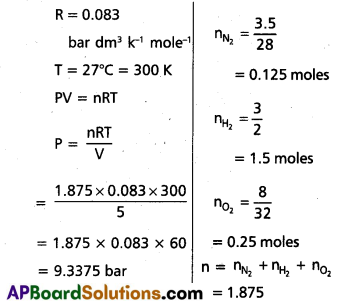
Solution:
Since x = 0 is not a solution of the given equation, it is equivalent to the equation \(\left(\frac{x-1}{x}\right)^{n}=1\)
Clearly \(\left(\frac{x-1}{x}\right)^{n}=1\)
⇒ \(\frac{x-1}{x}\) is an nth root of unity other than one.
Suppose that ω is an nth root of unity and ω ≠ 1.
Then, \(\frac{x-1}{x}\) = ω
⇒ x – 1 = xω
⇒ (1 – ω) x = 1
⇒ x = \(\frac{1}{1-\omega}\), (∵ ω ≠ 1) ……….(1)
Inter 2nd Year Maths 2A De Moivre’s Theorem Solutions Ex 2(b) III Q5
Inter 2nd Year Maths 2A De Moivre’s Theorem Solutions Ex 2(b) III Q5.1

Inter 1st Year Maths 1A Inverse Trigonometric Functions Formulas

Use these Inter 1st Year Maths 1A Formulas PDF Chapter 8 Inverse Trigonometric Functions to solve questions creatively.

Intermediate 1st Year Maths 1A Inverse Trigonometric Functions Formulas

→ If sin θ = x and θ ∈ \(\left[\frac{-\pi}{2}, \frac{\pi}{2}\right]\), then sin-1(x) = θ,

→ If cos θ x and θ ∈ [0, π], then cos-1(x) = θ

→ If tan θ = x and θ ∈ \(\left(\frac{-\pi}{2}, \frac{\pi}{2}\right)\). then tan-1 (y) = θ

→ If cot θ = x and θ ∈ (0, π), then cot-1(x) = θ.

→ If sec θ = x and θ ∈ [o, \(\frac{\pi}{2}\)) ∪ (\(\frac{\pi}{2}\), π] then sec-1x = θ.

→ If cosec θ = x and θ ∈ [-\(\frac{\pi}{2}\), 0) ∪ (o, \(\frac{\pi}{2}\)] then cosec-1x = θ.

→ If x ∈ [-1, 1] – {0}, then sin-1(x) = cosec-1\(\left(\frac{1}{x}\right)\)

Inter 1st Year Maths 1A Inverse Trigonometric Functions Formulas

→ If x ∈ [-1, 1] – {0}, then cos-1(x) = sec-1\(\left(\frac{1}{x}\right)\)

→ If x > 0, then tan-1(x) = cot-1\(\left(\frac{1}{x}\right)\) and
x < 0, then tan-1(x) = cot-1\(\left(\frac{1}{x}\right)\) – π

→ sin-1 x + cos-1x = \(\frac{\pi}{2}\) (|x| ≤ 1) i.e., – 1 ≤ x ≤ 1

→ tan-1x + cot-1x = \(\frac{\pi}{2}\), for any x ∈ R

→ sec-1x + cosec-1x = \(\frac{\pi}{2}\), if (-∞, – 1] ∪ [1, ∞)

Function y = f(x)Domain (x)Range (y)
(i) sinh-1 (x)[-1, 1]\( \left[\frac{-\pi}{2}, \frac{\pi}{2}\right] \)
(ii) cosh-1 (x)[1, 1][0, π]
(iii) tanh-1 (x)R\( \left(\frac{-\pi}{2}, \frac{\pi}{2}\right) \)
(iv) cot-1 (x)R(0, π)
(v) sec-1 (x)(-∞, -1] ∪ [1, ∞)[0, \( \frac{\pi}{2} \)) ∪ (\( \frac{\pi}{2} \), π]
(vi) cosec-1 (x)(-∞, -1] ∪ [1, ∞)[-\( \frac{\pi}{2} \), 0) ∪  (0, \( \frac{\pi}{2} \), π]

→ Principal values:
For sin-1x, tan-1x, cot-1x, cosec-1x, principal values lies between –\(\frac{\pi}{2}\) and \(\frac{\pi}{2}\)
For cos-1 x, sec-1 x, principal values lies between 0 and π.

→ tan-1x + tan-1y = tan-1\(\left(\frac{x+y}{1-x y}\right)\) if (xy < 1), x > 0, y > 0
= \(\frac{\pi}{2}\) if (xy = 1), x > 0, y > 0
= π +tan-1\(\), if (xy > 1), x > 0, y > 0

→ If x < 0, y < 0 then tan-1x + tan-1y = tan-1\(\left(\frac{x+y}{1-x y}\right)\) if xy > 1
= – \(\frac{\pi}{2}\), if xy < 1
= –\(\frac{\pi}{2}\), if xy = 1

→ If x, y ∈ [0, 1] and x2 + y2 ≤ 1, then sin-1 x + sin-1 y = sin-1\(\left(x \sqrt{1-y^{2}}+y \sqrt{1-x^{2}}\right)\)

→ If x, y ∈ [0, 1] and x2 + y2 > 1 then sin-1 x + sin-1 (y) = π – sin-1\(\left(x \sqrt{1-y^{2}}+y \sqrt{1-x^{2}}\right)\)

→ If x, y ∈ [0, 1], then sin-1 x + sin-1y) = cos-1(\(\sqrt{1-x^{2}} \sqrt{1-y^{2}}\) – xy)

→ If x, y ∈ [0, 1] then sin-1 y = sin-1(x\(\sqrt{1-y^{2}}\) – y\(\sqrt{1-x^{2}}\))

Inter 1st Year Maths 1A Inverse Trigonometric Functions Formulas

→ If x, y ∈ [0, 1], then cos-1 x + cos-1y = cos-1(\(\sqrt{1-x^{2}} \sqrt{1-y^{2}}\) + xy)

→ If x, y ∈ [0, 1] then cos-1 x + cos-1y = cos-1(xy – \(\sqrt{1-x^{2}} \sqrt{1-y^{2}}\))

→ If x, y ∈ [0, 1] and x2 + y2 ≥ 1 then cos-1x + cos-1y = sin-1(y\(\sqrt{1-x^{2}}\) + x\(\sqrt{1-y^{2}}\))

→ If 0 ≤ x ≤ y ≤ 1 then cos-1 x – cos-1y = cos-1(xy + \(\sqrt{1-x^{2}} \sqrt{1-y^{2}}\))

→ If x, y ∈ [0, 1], then cos-1 x – cos-1y = sin-1(y\(\sqrt{1-x^{2}}\) – x\(\sqrt{1-y^{2}}\))

→ If x ∈ [-1, 1]- {0}, then sin-1 (x) = cosec-1\(\left(\frac{1}{x}\right)\)

→ If x ∈ [-1, 1] – {0}, then cos-1(x) = sec-1\(\left(\frac{1}{x}\right)\)

→ If x > 0, then tan-1x = cot-1\(\left(\frac{1}{x}\right)\) and

→ If x < 0, then tan-1x = cot-1\(\left(\frac{1}{x}\right)\) – π

→ sin-1(-x) = -sin-1(x), if x ∈ [-1, 1]

→ cos-1(-x) = π – cos-1(x), if x ∈ [-1, 1]

→ tan-1(-x) = -tan-1 (x), for any x ∈ R

→ For any x ∈ R, cot-7 (-x) = π – cot-1(x)

→ If x ∈ [-∞, -1] ∪ [1, ∞) then

  • sec-1(-x) = π – sec-1(x)
  • cosec-1(-x) = -cosec-1(x)

Inter 1st Year Maths 1A Inverse Trigonometric Functions Formulas

→ If θ ∈ \(\left[-\frac{\pi}{2}, \frac{\pi}{2}\right]\), then sin-1(sin θ) = θ and if x ∈ [-1, 1], then sin(sin-1x) = x.

→ If θ ∈ [0, π], then cos-1(cos θ) = θ and if x ∈ [-1, 1], then cos (cos-1x) = x.

→ If θ ∈ \(\left(-\frac{\pi}{2}, \frac{\pi}{2}\right)\), then tan-1(tan θ) = θ and for any x ∈ R, then tan(tan-1x) = x

→ If θ ∈ (0, \(\frac{\pi}{2}\)) ∪ (\(\frac{\pi}{2}\), π) then cot-1(cot θ) = θ and for any x ∈ R, cot (cot-1x) = x.

→ If θ ∈ (0, \(\frac{\pi}{2}\)) ∪ (\(\frac{\pi}{2}\), π) then sec-1(sec θ) = θ and if x ∈ (-∞, -1] ∪ [1, ∞) then sec (sec-1x) = x.

→ If θ ∈ [-\(\frac{\pi}{2}\), 0) ∪ (0, \(\frac{\pi}{2}\)] then cosec-1 (cosec θ) = θ and if x ∈ (-∞, -1] ∪ [1, ∞), then cosec (cosec-1x) = x.

→ θ ∈ [0, π] sin-1(cos θ) = \(\frac{\pi}{2}\) – θ

→ θ ∈ \(\left[\frac{\pi}{2}, \frac{\pi}{2}\right]\) ⇒ cos-1(sin θ) = \(\frac{\pi}{2}\) – θ

→ θ ∈ \(\left(-\frac{\pi}{2}, \frac{\pi}{2}\right)\) ⇒ cot-1(tan θ) = \(\frac{\pi}{2}\) – θ

→ θ ∈ (0, π) ⇒ tan-1(cot θ) = \(\frac{\pi}{2}\) – θ

→ θ ∈ [-\(\frac{\pi}{2}\), 0) ∪ (0, \(\frac{\pi}{2}\)] ⇒ sec-1(cosec θ) = \(\frac{\pi}{2}\) – θ

→ θ ∈ [0, \(\frac{\pi}{2}\)) ∪ (\(\frac{\pi}{2}\), π] ⇒ cosec-1(sec θ) = \(\frac{\pi}{2}\) – θ

→ 0 ≤ x ≤ 1 ⇒ sin-1(x) = cos-1\(\left(\sqrt{1-x^{2}}\right)\) and

→ If -1 ≤ x < 0 ⇒ sin-1(x) = -cos-1\(\left(\sqrt{1-x^{2}}\right)\)

→ -1 < x < 1 ⇒ sin-1(x) = tan-1\(\left(\frac{x}{\sqrt{1-x^{2}}}\right)\)

Inter 1st Year Maths 1A Inverse Trigonometric Functions Formulas

→ -1 ≤ x < 0 ⇒ cos-1(x) = π – sin-1\(\left(\sqrt{1-x^{2}}\right)\) = π + tan-1\(\left(\frac{\sqrt{1-x^{2}}}{x}\right)\)

→ 0 ≤ x ≤ 7 ⇒ cos-1(x) = sin-1\(\left(\sqrt{1-x^{2}}\right)\) = tan-1\(\left(\frac{\sqrt{1-x^{2}}}{x}\right)\)

→ x > 0 ⇒ tan-1(x) = sin-1\(\left(\frac{x}{\sqrt{1+x^{2}}}\right)\) = cos-1\(\left(\frac{1}{\sqrt{1+x^{2}}}\right)\)

→ tan-1(x) + tan-1(y) + tan-1(z) = tan-1\(\left[\frac{x+y+z-x y z}{1-x y-y z-z x}\right]\), ifx, y, z have the same sign and xy + yz + zx < 1.

→ 2 sin-1(x) = sin-12x\(\sqrt{1-x^{2}}\), if x ≤ \(\frac{1}{\sqrt{2}}\)
= π – sin-12x\(\sqrt{1-x^{2}}\), if x > \(\frac{1}{\sqrt{2}}\)

→ 2 cos-1(x) = cos-1(2x2 – 1), if x ≥ \(\frac{1}{\sqrt{2}}\)
= π – cos-1(1 – 2x2), if x < \(\frac{1}{\sqrt{2}}\)

→ 2 tan-1(x) = tan-1\(\left(\frac{2 x}{1-x^{2}}\right)\), if |x| < 1
= π – tan-1\(\left(\frac{2 x}{1-x^{2}}\right)\), if |x| ≥ 1

Inter 1st Year Maths 1A Inverse Trigonometric Functions Formulas

→ 2tan-1(x) = sin-1\(\left(\frac{2 x}{1+x^{2}}\right)\), ∀ x ∈ R
= cos-1\(\left(\frac{1-x^{2}}{1+x^{2}}\right)\), if x ≥ 0
= -cos-1\(\left(\frac{1-x^{2}}{1+x^{2}}\right)\), if x < 0
= tan-1\(\left(\frac{2 x}{1-x^{2}}\right)\), ∀ x ∈ R

→ 3 sin-1(x) = sin-1(3x – 4x3) for 0 ≤ x < \(\frac{1}{2}\)
3 cos-1(x) = cos-1(4x3 – 3x) for \(\frac{\sqrt{3}}{2}\) ≤ x < 1
3 tan-1(x) = tan-1\(\left\{\frac{3 x-x^{3}}{1-3 x^{2}}\right\}\) for 0 ≤ x < \(\frac{1}{\sqrt{3}}\)

→ If sin θ = x, we write θ = sin-1x.

→ sin(sin-1x) = x, sin-1(sin θ) = θ if ‘θ‘ ∈ \(\left[-\frac{\pi}{2}, \frac{\pi}{2}\right]\)

→ cos(cos-1x)=x, cos-1(cos θ) = θ if θ ∈ [0, n]

→ tan (tan-1x) = x, tan-1(tan θ) = θ if θ ∈ \(\left(-\frac{\pi}{2}, \frac{\pi}{2}\right)\)

→ That value of sin-1x lying between – \(\frac{\pi}{2}\) and\(\frac{\pi}{2}\) is called the principal value of sin-1x.

→ That value of cos-1x lying between 0 and π is called the principal value of cos-1x.

→ That value of tan-1x lying between – \(\frac{\pi}{2}\) and \(\frac{\pi}{2}\) is called the principal value of tan-1x.

→ If -1 ≤ x ≤ 1, then

  • sin-1(- x) = – sin-1x
  • cos-1(-x) = π – cos-1x

→ If x ∈ R , then

  • tan-1(-x) = -tan-1x
  • cot-1(-x) = π – cot-1x

→ If x ≤ -1 or x ≥ 1, then

  • cosec-1(-x) = -cosec-1x
  • sec-1(-x) = π – sec-1x

→ cosec-1x = sin-1\(\frac{1}{x}\) (if x ≠ 0)

→ sec-1x = cos-1\(\frac{1}{x}\) (if x ≠ 0)

→ cot-1x = tan-1\(\frac{1}{x}\) (if x > 0)
= π + tan-1\(\frac{1}{x}\) (if x < 0)

→ sin-1x + cos-1x = π/2 ,

→ tan-1x + cot-1x = π/2,

→ sec-1x + cosec-1x = π/2.

→ If sin-1x + sin-1y = π/2, then x2 + y2 = 1.

→ sin(cos-1x) = \(\sqrt{1-x^{2}}\), cos(sin-1x) = \(\sqrt{1-x^{2}}\)

→ sin-1 = cos-1\(\sqrt{1-x^{2}}\) for 0 ≤ x ≤ 1
= -cos-1\(\sqrt{1-x^{2}}\) for – 1 ≤ x ≤ 0

Inter 1st Year Maths 1B Applications of Derivatives Solutions Ex 10(c)

Practicing the Intermediate 1st Year Maths 1B Textbook Solutions Inter 1st Year Maths 1B Applications of Derivatives Solutions Exercise 10(c) will help students to clear their doubts quickly.

Intermediate 1st Year Maths 1B Applications of Derivatives Solutions Exercise 10(c)

I.

Question 1.
Find the lengths of subtangent and sub-normal at a point of the curve
Solution:
Equation of the curve is y = b. sin \(\frac{x}{a}\)
\(\frac{dy}{dx}\) = b. cos \(\frac{x}{a}.\frac{1}{a}=\frac{b}{a}\). cos \(\frac{x}{a}\)
Length of the sub-tangent = |\(\frac{y_{1}}{f^{\prime}\left(x_{1}\right)}\)|
= \(\frac{b \cdot \sin \frac{x}{a}}{\frac{b}{a} \cdot \cos \frac{x}{a}}=\left|a \cdot \tan \frac{x}{a}\right|\)
Length of the sub-normal = |y1, f'(x1)|
Inter 1st Year Maths 1B Applications of Derivatives Solutions Ex 10(c) 2

Question 2.
Show that the length of sub normal at any point on the curve xy = a2 varies as the cube of the ordinate of the point.
Solution:
Equation of the curve is xy = a²
y = \(\frac{a^{2}}{x}\)
\(\frac{dy}{dx}=\frac{-a^{2}}{x^{2}}\)
Length of the sub-normal = |y1, f’ (x1)|
Inter 1st Year Maths 1B Applications of Derivatives Solutions Ex 10(c) 3
\(\frac{y_{1}^{3}}{a^{2}}\) ∝ y31 = cube of the ordinate.

Inter 1st Year Maths 1B Applications of Derivatives Solutions Ex 10(c)

Question 3.
Show that at any point (x, y) on the curve y = bex/a, the length of the sub¬tangent is a constant and the length of the sub normal is \(\frac{y^{2}}{a}\).
Solution:
Equation of the curve is y = b.ex/a
\(\frac{a^{2}}{x}\) = b.ex/a.\(\frac{1}{a}=\frac{y}{a}\)
Length of the sub tangent
= |\(\frac{y_{1}}{f^{\prime}\left(x_{1}\right)}\)| = \(\frac{y_{1}}{\left(\frac{y_{1}}{a}\right)}\) = a = constant
Length of the sub-normal
= |y1f'(x1)| = |y1\(\frac{y_{1}}{a}\)| = \(\frac{y_{1}^{2}}{a}\).

II.

Question 1.
Find the value of k so that the length of the sub normal at any point on the curve xyk = ak + 1 is a constant.
Solution:
Equation of the curve is x.yk = ak + 1
Differentiating w.r.to x
x.k.yk-1 \(\frac{dy}{dx}\) + yk.1 = 0
x.k.yk-1 \(\frac{dy}{dx}\) = -yk
\(\frac{dy}{dx}=\frac{-y^{k}}{k \cdot x \cdot y^{k-1}}=-\frac{y}{kx}\)
Length of the sub-normal = |y1f'(x1|
Inter 1st Year Maths 1B Applications of Derivatives Solutions Ex 10(c) 4
Length of the sub-normal is constant at any point on the curve is independent of x1 and y1
∴ \(\frac{y_{1}^{k+2}}{k \cdot a^{k+1}}\) is independent of x1, y1
⇒ k + 2 = 0 ⇒ k = -2

Question 2.
At any point t on the curve x = a (t + sin t), y = a (1 – cos t), find the lengths of tangent, normal, sub tangent and sub
normal.
Solution:
Equation of the curve is x = a (t + sin t), y = a (1 – cost)
\(\frac{dx}{dt}\) = a (1 + cos t), \(\frac{dy}{dt}\) = a. sin t
Inter 1st Year Maths 1B Applications of Derivatives Solutions Ex 10(c) 5
Length of the tangent = |y1|\(\sqrt{1+\frac{1}{\left[f^{\prime}\left(x_{1}\right)\right]^{2}}}\)
Inter 1st Year Maths 1B Applications of Derivatives Solutions Ex 10(c) 6
Length of the normal = |y1|\(\sqrt{1+\left[f\left(x_{1}\right)\right]^{2}}\)
Inter 1st Year Maths 1B Applications of Derivatives Solutions Ex 10(c) 7
Length of the sub tangent.
Inter 1st Year Maths 1B Applications of Derivatives Solutions Ex 10(c) 8
= |a (2 sin t/2. cos t/2|
= |a. sin t|
Length of the sub normal
= |y1.f'(x1)| = |a(1 – cos t).\(\frac{\sin t / 2}{\cos t / 2}\)|
= |2a sin² t/2. tan t/2|

Inter 1st Year Maths 1B Applications of Derivatives Solutions Ex 10(c)

Question 3.
Find the lengths of normal and sub normal at a point on the curve y = \(\frac{a}{2}\) (ex/a + e-x/a).
Solution:
Equation of the curve is y = \(\frac{a}{2}\) (ex/a + e-x/a)
= a. cosh (\(\frac{x}{a}\))
Length of the normal = |y1|\(\sqrt{1+\left[f\left(x_{1}\right)\right]^{2}}\)
= |a.cosh \(\frac{x}{a}\)|\(\sqrt{1+\sinh ^{2} \frac{x}{a}}\)
= a. cosh \(\frac{x}{a}\). cosh \(\frac{x}{a}\) = a. cosh² \(\frac{x}{a}\)
Length of the sub normal = |y1 f'(x1)|
Inter 1st Year Maths 1B Applications of Derivatives Solutions Ex 10(c) 9

Question 4.
Find the lengths of subtangent, sub normal at a point t on the curve x = a (cos t + t sin t), y=a (sin t – t cos t)
Solution:
Equations of the curve are x = a (cos t + t sin t)
\(\frac{dx}{dt}\) = a (- sin t + sin t +1 cost) = at cos t
y = a (sin t – t cos t)
\(\frac{dy}{dt}\) = a (cos t – cos t +1 sin t) = a t sin t
Inter 1st Year Maths 1B Applications of Derivatives Solutions Ex 10(c) 10
Length of the sub tangent
Inter 1st Year Maths 1B Applications of Derivatives Solutions Ex 10(c) 11
= |a cot t (sin t – t cos t)|
Length of the sub-normal = |y1.f'(x1)|
= |a (sin t – t cos t) tan t|
= |a tan t (sin t – t cos t)|

Inter 1st Year Maths 1A Matrices Formulas

Use these Inter 1st Year Maths 1A Formulas PDF Chapter 3 Matrices to solve questions creatively.

Intermediate 1st Year Maths 1A Matrices Formulas

→ An ordered rectangular array of elements is called a matrix.

→ A matrix in which the number of rows is equal to the number of columns, is called a square matrix. Otherwise, it is called a rectangular matrix. In a square matrix, an element aij is in principal diagonal, if i = j

→ If each non-diagonal element of a square matrix is equal to zero, then it is called a diagonal matrix.

→ If each non-diagonal element of a square matrix is equal to zero and each diagonal element is equal to a scalar, then it is called a scalar matrix.

→ If each non-diagonal element of a square matrix is equal to zero and each diagonal element is equal to 1, then that matrix is called a unit matrix or Identity matrix.

→ If A is a square matrix then the sum of elements in the principal diagonal of A is called the trace of A.

  • Matrix addition is commutative.
  • Matrix addition is associative.
  • Matrix multiplication is associative.
  • Matrix multiplication is distributive over matrix addition.

Inter 1st Year Maths 1A Matrices Formulas

→ A square matrix A is said to be an idempotent matrix if A2 = A.

→ A square matrix A is said to be an involuntary matrix if A2 = I.

→ A square matrix A is said to be a nilpotent matrix, if there exist a positive integer n such that An = 0. If n is the least positive integer such thatAn = 0, then n is called index of the nilpotent matrix A.

→ The matrix obtained by interchanging rows and columns is called transpose of the given matrix. Transpose of A is denoted by AT (or) A’.

→ For any matrices A and B

  • (AT)T = A
  • (A + B)T = AT + BT (A and B are same order)
  • (AB)T = BTAT. (If A and B are of orders m xn and n xp respectively)

→ A square matrix A is said to be symmetric if AT = A.

→ A square matrix A is said to be skew symmetric if AT = A.

→ Every square matrix can be uniquely expressed as a sum of symmetric matrix and a skew symmetric matrix.

→ The minor of an element in the square matrix of order ‘3’ is defined as the determinant of 2 × 2 matrix, obtained after deleting the row and the column in which the element is present.

→ The cofactor of an element in the ith row and jth column of 3 × 3 matrix is defined as its minor multiplied by (-1)i+j.

→ The sum of the products of the elements of any row or column with their corresponding cofactors is called the determinant of a matrix.

  • A square ‘A’ is said to be a singular matrix if det A = 0.
  • A square A’ is said to be a non-singular matrix if det A ≠ 0.

→ The transpose of the matrix obtained by replacing.the elements of a square matrix A by the corresponding cofactors is called the adjoint matrix of A and it is denoted by adj (A).

  • A square matrix ‘A is said to be an invertible matrix if there exists a square matrix B such that AB = BA = I the matrix B is called inverse of A and it is denoted by A-1.
  • If A is an invertible then A-1 = 1.

→ A square matrix A is non-singular if A is invertible.

  • If A and B are non-singular matrices of same type then Adj (AB) = (Adj B) (Adj A).
  • If A is a square matrix of type n then det (Adj A) = (det A)n-1.

→ A matrix obtained by deleting some rows or columns (or both) of a matrix is called a submatrix.

→ Let Abe a non-zero matrix, the rank of A is defined as the maximum of the orders of the non-singular square submatrices of A. The rank of a null matrix is zero. The rank of a matrix A is denoted as rank (A) or P (A).

→ A system of linear equations is

  • Consistent, if it has a solution
  • Inconsistent, if it has no solution

→ Non homogeneous system

  • a1x + b1y + c1z = d1
  • a2x + b2y + c2z = d2
  • a3x + b3y + c3z = d3

Inter 1st Year Maths 1A Matrices Formulas

→ The above system of equations has

  • aunique solution if rank (A) = Rank [AD] = 3
  • infinity many solutions, if rank (A) = Rank ([AD]) < 3
  • no solution, if rank A ≠ Rank ([AD])

→ Homogeneous system of equations

  • a1x + b1y + c1z = d1
  • a2x + b2y + c2z = d2
  • a3x + b3y + c3z = d3

→ The above system has

  • Trival solution x = y = z = 0 only if rank (A) = 3
  • infinitely many non-trival solutions if rank (A) < 3.

→ A matrix is an arrangement of real or complex numbers into rows and columns so that all the rows (columns) contain equal no. of elements.

→ If a matrix consists of ‘m’ rows and ‘n’ columns, then it is said to be of order m × n.

→ A matrix of order n × n is said to be a square matrix of order n.

→ A matrix (aij)m×n is said to be a null matrix if aij = 0 for all i and j.

→ Two matrices of the same order are said to be equal if the corresponding elements in the matrices are all equal.

→ A matrix (aij)n×n is a diagonal matrix aij = 0 for all i ≠ j

→ A matrix (aij)n×n is a scalar matrix if a = 0 for all i ≠ j and aij = k (constant) for i = j

→ A matrix (aij)n×n is said to be a unit matrix of order n, denoted by In if aij = 1, when i = j and aij = 0 when i ≠ j
Ex: I2 = \(\left[\begin{array}{ll}
1 & 0 \\
0 & 1
\end{array}\right]\)
I3 = \(\left[\begin{array}{lll}
1 & 0 & 0 \\
0 & 1 & 0 \\
0 & 0 & 1
\end{array}\right]\)

→ If A = (aij)m×n, B = (bij)m×n, then A + B = (aij + bij)m×n

→ Matrix addition is commutative and associative

→ Matrix multiplication is not commutative but associative

→ If A is a matrix of order m × n, then AIn = ImA = A(AI = IA = A)

→ If AB = CA = I, then B = C

Inter 1st Year Maths 1A Matrices Formulas

→ If A = (aij)m×n, then A T = (aij)n×m

→ (KA)T = KAT, (A + B)T = AT + BT, (AB)T = BT.AT

→ A(B + C) = AB + AC, (A + B)C = AC + BC

→ A square matrix is said to be “non-singular” if detA ≠ 0

→ A square matrix is said to be “singular” if detA = 0

→ If AB = 0, where A and B are non-zero square matrices, then both A are singular.
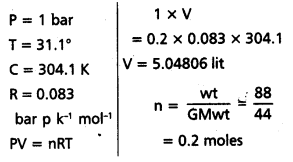
→ A minor of any element in a square matrix is determinant of the matrix obtained by omitting the row and column in which the element is present.
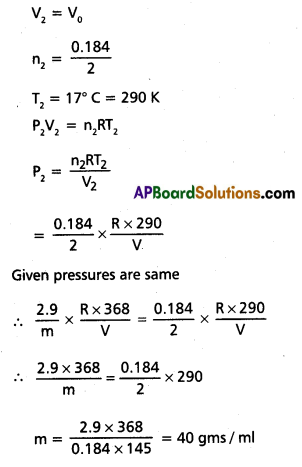
→ In (aij)n×n, the cofactor of aij is (-1)i+j × (minor of aij).

→ In a square matrix, the sum of the products of the elements of any row (column) and the corresponding cofactors is equal to the determinant of the matrix.

→ In a square matrix, the sum of the products of the elements of any row (column) and the corresponding cofactors of any other row (column) is alway s zero.

→ If A is any square matrix, then A adjA = adjA. A = detA. I

→ If A is any square matrix and there exists a matrix B such that AB = BA = I, then B is called the inverse of A and denoted by A-1.

→ AA-1 = A-1A = I.

→ If A is non-singular, then A-1 = \(\frac{{adj} A}{{det} A}\) (or) adj A = |A|AA-1

→ If A = \(\left(\begin{array}{ll}
a & b \\
c & d
\end{array}\right)\), then A-1 = \(\frac{1}{a d-b c}\left(\begin{array}{cc}
d & -b \\
-c & a
\end{array}\right)\)

→ (A-1)-1 = A, (AB)-1 = B-1.A-1, (A-1)T =( AT)-1; (ABC….)-1 = C-1B-1A-1.

Theorem:
Matrix multiplication is associative. i.e. if conformability is assured for the matrices A, B and C, then (AB)C = A(BC).
Proof:
Inter 1st Year Maths 1A Matrices Formulas 1

Inter 1st Year Maths 1A Matrices Formulas

Theorem:
Matrix multiplication is distributive over matrix addition i.e. if conformability is assured for the matrices A, B and C, then
(i) A (B + C) = AB + AC
(ii) (B + C) A = BA + CA
Proof:
Let A = (aij)m×n, B = (bjk)n×p C = (cki)n×p
B + C = (djk)n×p, where djk = bjk + cjk
Inter 1st Year Maths 1A Matrices Formulas 2
∴ A(B + C) = AB + AC
Similarly we can prove that
(B + C) = BA + CA.

Theorem:
If A is any matrix, then (AT)T = A.
Proof:
Let A = (aij)m×n
AT = (a’jk)n×m, where a’ji = aij
(AT)T = (a”ji)m×n, where a”ij = aji
a”ij = a’ji = aij
∴ (AT)T = A

Theorem:
If A and B are two matrices o same type, then (A + B)T = AT + BT.
Proof:
Let A = (aij)m×n, B = (bij)
A + B = (cij)m×n,where cij = aij + bij
(A + B)T = (c’ji)n×m. c’ji = cij
AT = (a’ji)n×m,where a’ji = aij
BT = (bji)n×m. where. b’kj = bjk
AT + BT = (dji)n×m, where dji = a’ji + b’ji
c’ji = cij = aij + bij = a’ji + b’ji = dji
∴(A + B)T = AT + BT

Theorem:
If A and B are two matrices for which conformability for multiplication is assured, then (AB)T = BTAT.
Pr0of:
Let A = (aij)m×n, B = (bji)n×p
AB = (cik)m×p, where cik = \(\sum_{j=1}^{n}\) aijbjk
(AB)T = (cki)p×m,where cki = cik
AT = (aji)n×m,where aji = aij
BT = (bkj)p×n, where bkj = bjk
BT . AT = (dki )p×m, where dki= \(\sum_{j=1}^{n}\) bkjaji
c’ki = cik = \(\sum_{j=1}^{n}\) aijbjk= \(\sum_{j=1}^{n}\) bkjajidki
∴ (AB)T = BTAT

Inter 1st Year Maths 1A Matrices Formulas

Theorem:
If A and B are two invertible matrices of same type then AB is also invertible and (AB)-1 = B-1A-1.
Proof:
A is invertible matrix ⇒ A-1 exists and AA-1 = A-1A = I.
B is an invertible matrix ⇒ B-1 exists and
BB-1 = B-1B = I
Now (AB)(B-1A-1) = A(BB-1)A-1 = AIA-1 = AA-1 = I
(B-1A-1)(AB) = B-1(A-1A)B ∴ AB is invertible and
= B-1IB = B-1B = I
(AB)(B-1A-1) = (B-1A-1) = (B-1A-1)(AB) = 1
(AB)-1 = B-1A-1.

Theorem:
If A is a non-singular matrix then A is invertible and A-1 = \(\frac{{Adj} A}{{det} A}\).
Proof:
Let A = \(\left[\begin{array}{lll}
\mathrm{a}_{1} & \mathrm{~b}_{1} & \mathrm{c}_{1} \\
\mathrm{a}_{2} & \mathrm{~b}_{2} & \mathrm{c}_{2} \\
\mathrm{a}_{3} & \mathrm{~b}_{3} & \mathrm{c}_{3}
\end{array}\right]\) be a non – singular matrix.
∴ det A ≠ 0
Inter 1st Year Maths 1A Matrices Formulas 3

Inter 1st Year Maths 1A Trigonometric Ratios up to Transformations Solutions Ex 6(f)

Practicing the Intermediate 1st Year Maths 1A Textbook Solutions Inter 1st Year Maths 1A Trigonometric Ratios up to Transformations Solutions Exercise 6(f) will help students to clear their doubts quickly.

Intermediate 1st Year Maths 1A Trigonometric Ratios up to Transformations Solutions Exercise 6(f)

Question 1.
If A, B, C are angles in a triangle, then prove that
(i) sin 2A – sin 2B + sin 2C = 4 cos A sin B cos C
Solution:
∵ A, B, C are angles in a triangle
⇒ A + B + C = 180° ……….(1)
LHS = sin 2A – sin 2B + sin 2C
= sin 2A + sin 2C – sin 2B
= 2 sin (\(\frac{2 A+2 C}{2}\)) . cos(\(\frac{2 A-2 C}{2}\)) – sin 2B
= 2 sin (A + C) cos (A – C) – sin B
= 2 sin (180° – B) cos (A – C) – 2 sin B cos B
= 2 sin B cos (A – C) – 2 sin B cos B
= 2 sin B [cos (A – C) – cos B]
= 2 sin B [cos (A – C) – cos (180° – (A + C)]
= 2 sin B [cos (A – C) + cos (A + C)]
= 2 sin B (2 cos A cos C)
= 4 cos A sin B cos C
∴ sin 2A – sin 2B + sin 2C = 4 cos A sin B cos C

(ii) cos 2A – cos 2B + cos 2C = 1 – 4 sin A cos B Sin C
Solution:
L.H.S. = -(cos 2B – cos 2A) + cos 2C
= -2 sin (A + B) sin (A – B) + cos 2C
= -2 sin (180° – C) sin (A – B) + cos 2C
= -2 sin C sin (A – B) + 1 – 2 sin2C
= 1 – 2 sin C (sin (A – B) + sin C)
= 1 – 2 sin C sin (A – B) + sin (180° – \(\overline{\mathrm{A}+\mathrm{B}}\))
= 1 – 2 sin C (sin (A – B) + sin (A + B))
= 1 – 2 sin C (2 sin A cos B)
= 1 – 4 sin A cos B sin C
= R.H.S.

Inter 1st Year Maths 1A Trigonometric Ratios up to Transformations Solutions Ex 6(f)

Question 2.
If A, B, C are angles in a triangle, then prove that
(i) sin A + sin B – sin C = 4 sin \(\frac{A}{2}\) sin \(\frac{B}{2}\) cos \(\frac{C}{2}\)
Solution:
L.H.S. = (sin A + sin B) – sin C
= 2 sin (\(\frac{A+B}{2}\)) cos (\(\frac{A-B}{2}\)) – sin C
Inter 1st Year Maths 1A Trigonometric Ratios up to Transformations Solutions Ex 6(f) Q2(i)

(ii) cos A + cos B – cos C = -1 + 4 cos \(\frac{A}{2}\) cos \(\frac{B}{2}\) sin \(\frac{C}{2}\)
Solution:
A, B, C are angles in a triangle
A + B + C = 180° ………(1)
LHS = cos A + cos B – cos C
Inter 1st Year Maths 1A Trigonometric Ratios up to Transformations Solutions Ex 6(f) Q2(ii)

Question 3.
If A, B, C are angles in a triangle, then prove that
(i) sin2A + sin2B – sin2C = 2 sin A sin B cos C
Solution:
Given A + B + C = 180°
L.H.S. = sin2A + [sin2B – sin2C]
= sin2A + sin (B + C) sin (B – C)
= sin2A + sin (180° – A) . sin (B – C)
= sin2A + sin A . sin (B – C)
= sin A (sin A + sin (B – C))
= sin A [sin (180° – \(\overline{\mathrm{B}+\mathrm{C}}\)) + sin (B – C)]
= sin A [sin (B + C) + sin (B – C)]
= sin A [2 sin B cos C]
= 2 sin A sin B cos C
= R.H.S

(ii) cos2A + cos2B – cos2C = 1 – 2 sin A sin B cos C
Solution:
A, B, C are angles in a triangle
⇒ A + B + C = 180° ……..(1)
L.H.S = cos2A + cos2B – cos2C
= cos2A + cos2B – cos2C
Inter 1st Year Maths 1A Trigonometric Ratios up to Transformations Solutions Ex 6(f) Q3(ii)
= 1 + cos (A + B) cos (A – B) – cos2C
= 1 + cos (180° – C) cos (A – B) – cos2C [By (1)]
= 1 – cos C cos (A – B) – cos2C
= 1 – cos C [cos (A – B) + cos C]
= 1 – cos C [cos (A – B) + cos(180° – \(\overline{A+B}\)] [By eq. (1)]
= 1 – cos C [cos (A – B) – cos (A + B)]
= 1 – cos C [2 sin A sin B]
= 1 – 2 sin A sin B cos C
∴ cos2A + cos2B – cos2C = 1 – 2 sin A sin B cos C

Inter 1st Year Maths 1A Trigonometric Ratios up to Transformations Solutions Ex 6(f)

Question 4.
If A + B + C = π, then prove that
(i) \(\cos ^{2} \frac{A}{2}+\cos ^{2} \frac{B}{2}+\cos ^{2} \frac{C}{2}\) = \(2\left[1+\sin \frac{A}{2}+\sin \frac{B}{2} \sin \frac{C}{2}\right]\)
Solution:
Inter 1st Year Maths 1A Trigonometric Ratios up to Transformations Solutions Ex 6(f) Q4(i)

(ii) \(\cos ^{2} \frac{A}{2}+\cos ^{2} \frac{B}{2}-\cos ^{2} \frac{C}{2}=2 \cos \frac{A}{2}\) \(\cos \frac{B}{2} \sin \frac{C}{2}\)
Solution:
Inter 1st Year Maths 1A Trigonometric Ratios up to Transformations Solutions Ex 6(f) Q4(ii)
Inter 1st Year Maths 1A Trigonometric Ratios up to Transformations Solutions Ex 6(f) Q4(ii).1

Question 5.
In triangle ABC, prove that
(i) \(\cos \frac{A}{2}+\cos \frac{B}{2}+\cos \frac{C}{2}\) = \(4 \cos \frac{\pi-A}{4} \cos \frac{\pi-B}{4} \cos \frac{\pi-C}{4}\)
Solution:
Inter 1st Year Maths 1A Trigonometric Ratios up to Transformations Solutions Ex 6(f) Q5(i)
Inter 1st Year Maths 1A Trigonometric Ratios up to Transformations Solutions Ex 6(f) Q5(i).1

(ii) \(\cos \frac{A}{2}+\cos \frac{B}{2}-\cos \frac{C}{2}\) = \(4 \cos \frac{\pi+A}{4} \cdot \cos \frac{\pi+B}{4} \cos \frac{\pi-C}{4}\)
Solution:
Inter 1st Year Maths 1A Trigonometric Ratios up to Transformations Solutions Ex 6(f) Q5(ii)

(iii) \(\sin \frac{A}{2}+\sin \frac{B}{2}-\sin \frac{C}{2}\) = \(-1+4 \cos \frac{\pi-A}{4} \cos \frac{\pi-B}{4} \sin \frac{\pi-C}{4}\)
Solution:
Inter 1st Year Maths 1A Trigonometric Ratios up to Transformations Solutions Ex 6(f) Q5(iii)
Inter 1st Year Maths 1A Trigonometric Ratios up to Transformations Solutions Ex 6(f) Q5(iii).1
Inter 1st Year Maths 1A Trigonometric Ratios up to Transformations Solutions Ex 6(f) Q5(iii).2

Question 6.
If A + B + C = π/2, then prove that cos 2A + cos 2B + cos 2C = 1 + 4 sin A sin B sin C
Solution:
A + B + C = π/2 ………(1)
LHS = cos 2A + cos 2B + cos 2C
= 2 cos (\(\frac{2 \mathrm{~A}+2 \mathrm{~B}}{2}\)) cos (\(\frac{2 \mathrm{~A}-2 \mathrm{~B}}{2}\)) + cos 2C
= 2 cos (A + B) . cos (A – B) + cos 2C
= 2 cos (90° – C) cos (A – B) + cos 2C
= 2 sin C cos (A – B) + (1 – 2 sin2C)
= 1 + 2 sin C [cos (A – B) – sin C]
= 1 + 2 sin C [cos (A – B)- sin (90° – \(\overline{A+B}\))]
= 1 + 2 sin C [cos (A – B) – cos (A +B)]
= 1 + 2 sin C [2 sin A sin B]
= 1 + 4 sin A sin B sin C
= RHS
∴ cos 2A + cos 2B + cos 2C = 1 + 4 sin A sin B sin C

Inter 1st Year Maths 1A Trigonometric Ratios up to Transformations Solutions Ex 6(f)

Question 7.
If A + B + C = 3π/2, then prove that
(i) cos2A + cos2B – cos2C = -2 cos A cos B sin C
Solution:
A + B + C = 3π/2 ……..(1)
L.H.S. = cos2A + cos2B – cos2C
= cos2A + (1 – sin2B) – cos2C
= (cos2A – sin2B) + (1 – cos2C)
= cos (A + B) cos (A – B) + sin2C
= cos (270° – C) cos(A – B) + sin2C
= -sin C cos (A – B) + sin2C
= sin C [sin C – cos (A – B)]
= sin C [sin (270°- \(\overline{A+B}\)) – cos (A – B)]
= sin C [-cos (A + B) – cos (A – B)]
= -sin C [cos (A + B) + cos (A – B)]
= -sin C [2 cos A cos B]
= -2 cos A cos B sin C
= RHS
∴ cos2A + cos2B – cos2C = -2 cos A cos B sin C

(ii) sin 2A + sin 2B – sin 2C = -4 sin A sin B cos C
Solution:
Here A + B + C = 270° ………(1)
LHS = sin 2A + sin 2B – sin 2C
= 2 sin (\(\frac{2 A+2 B}{2}\)) cos (\(\frac{2 A-2 B}{2}\)) – sin 2C
= 2 sin (A + B) . cos (A – B) – 2 sin C cos 2C
= 2 sin (270° – C) cos (A – B) – 2 sin C cos C
= -2 cos C cos (A – B) – 2 sin C cos C
= -2 cos C [cos (A – B) + sin C]
= -2 cos C [cos (A – B) + sin (270° – \(\overline{A+B}\))]
= -2 cos C [cos (A – B) – cos (A + B)]
= -2 cos C [2 sin A sin B]
= -4 sin A sin B cos C
= RHS
∴ sin 2A + sin 2B – sin 2C = -4 sin A sin B cos C

Question 8.
If A + B + C = 0°, then prove that
(i) sin 2A + sin 2B + sin 2C = -4 sin A sin B sin C
Solution:
Here A + B + C = 0 ………(1)
LHS = sin 2A + sin 2B + sin 2C
= 2 sin (\(\frac{2 A+2 B}{2}\)) cos (\(\frac{2 A-2 B}{2}\)) + sin 2C
= 2 sin (A + B) . cos (A – B) + 2 sin C cos 2C
= 2 sin (-C) cos (A – B) + 2 sin C cos C
= -2 sin C cos (A – B) + 2 sin C cos C
= -2 sin C [cos (A – B) – cos C]
= -2 sin C [cos (A – B) – cos (-A – B)]
= -2 sin C [cos (A – B) – cos (A + B)]
= -2 sin C [2 sin A sin B]
= -4 sin A sin B sin C
= RHS
∴ sin 2A + sin 2B + sin 2C = -4 sin A sin B sin C

(ii) sin A + sin B – sin C = – 4 cos \(\frac{A}{2}\) cos \(\frac{B}{2}\) sin \(\frac{C}{2}\)
Solution:
Inter 1st Year Maths 1A Trigonometric Ratios up to Transformations Solutions Ex 6(f) Q8(ii)
Inter 1st Year Maths 1A Trigonometric Ratios up to Transformations Solutions Ex 6(f) Q8(ii).1

Inter 1st Year Maths 1A Trigonometric Ratios up to Transformations Solutions Ex 6(f)

Question 9.
If A + B + C + D = 2π then prove that
(i) sin A – sin B + sin C – sin D = \(-4 \cos \left(\frac{A+B}{2}\right) \sin \left(\frac{A+C}{2}\right) \cos \left(\frac{A+D}{2}\right)\)
Solution:
Inter 1st Year Maths 1A Trigonometric Ratios up to Transformations Solutions Ex 6(f) Q9(i)
Inter 1st Year Maths 1A Trigonometric Ratios up to Transformations Solutions Ex 6(f) Q9(i).1
Inter 1st Year Maths 1A Trigonometric Ratios up to Transformations Solutions Ex 6(f) Q9(i).2

(ii) cos 2A + cos 2B + cos 2C + cos 2D = 4 cos (A + B) cos (A + C) cos (A + D)
Solution:
Inter 1st Year Maths 1A Trigonometric Ratios up to Transformations Solutions Ex 6(f) Q9(ii)

Question 10.
If A + B + C = 2S, then prove that
(i) sin (S – A) + sin (S – B) + sin C = \(4 \cos \left(\frac{S-A}{2}\right) \cos \left(\frac{S-B}{2}\right) \sin \frac{C}{2}\)
Solution:
Inter 1st Year Maths 1A Trigonometric Ratios up to Transformations Solutions Ex 6(f) Q10(i)

(ii) cos (S – A) + cos (S – B) + cos C = \(-1+4 \cos \left(\frac{S-A}{2}\right) \cos \left(\frac{S-B}{2}\right) \cdot \cos \frac{C}{2}\)
Solution:
Inter 1st Year Maths 1A Trigonometric Ratios up to Transformations Solutions Ex 6(f) Q10(ii)

AP Inter 1st Year Physics Study Material Chapter 6 Work, Energy and Power

Andhra Pradesh BIEAP AP Inter 1st Year Physics Study Material 6th Lesson Work, Energy and Power Textbook Questions and Answers.

AP Inter 1st Year Physics Study Material 6th Lesson Work, Energy and Power

Very Short Answer Questions

Question 1.
State the conditions under which a force does no work. [T.S. Mar. 15]
Answer:

  1. When the displacement is zero,
  2. When the displacement is perpendicular to the direction of the force,
  3. When the body moves under the action of a conservative force over a closed path.

Question 2.
Define : Work, Power and Energy. State their SI units.
Answer:
Work : The product of magnitude of displacement (S) and component of force (F cos θ) along the direction of displacement is called work, ie., W = \(\vec{F} \cdot \vec{S}\) = F S cos θ.
Unit: Joule

Power : The rate of doing work by a force is called power, i.e., P = \(\frac{\mathrm{W}}{\mathrm{t}}\)
Unit: watt or J/S

Energy : The ability or the capacity to do work is called energy.
Unit: Joule

AP Inter 1st Year Physics Study Material Chapter 6 Work, Energy and Power

Question 3.
State the relation between the kinetic energy and momentum of a body.
Answer:
Kinetic energy (EK) = \(\frac{\mathrm{P}^2}{2 \mathrm{~m}}\); where P = momentum of a body, m = mass of the body

Question 4.
State the sign of work done by a force in the following.
a) Work done by a man in lifting a bucket out of a well by means of a rope tied to the bucket.
b) Work done gravitational force in the above case.
Answer:
a) To lift a bucket out of a well, force equal to the weight of the bucket has to be applied by the man along the vertical in upward direction. Since the displacement is also in upward direction θ = 0 and hence the workdone is positive.

b) The angle between the gravitational force and the displacement is 180°. Therefore workdone by the gravitational force is negative.

Question 5.
State the sign of work done by a force in the following.
a) Work done by friction on a body sliding down an inclined plane.
b) Work done by gravitational force in the above case.
Answer:
a) Friction always acts in a direction, opposite to the direction of motion. Hence work done is negative.
b) The work done is positive.

Question 6.
State the sign of work done by a force in the following.
a) Work done by an applied force on a body moving on a rough horizontal plane with uniform velocity.
b) Work done by the resistive force of air on a vibrating pendulum in bringing it to rest.
Answer:
a) The applied force and the displacement are in same direction. Work is positive.
b) The direction of resistive force is opposite to the direction of motion of the pendulum. Hence work done is negative.

AP Inter 1st Year Physics Study Material Chapter 6 Work, Energy and Power

Question 7.
State if each of the following statements is true or false. Give reasons for your answer.
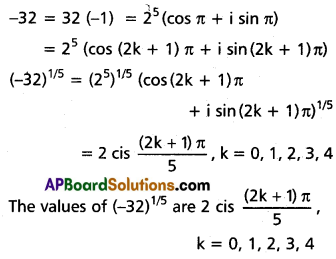
a) Total energy of a system is always conserved, no matter what internal and external forces on the body are present.
b) The work done by earth’s gravitational force in keeping the moon in its orbit for its one revolution is zero.*
Answer:

  1. False
  2. True. Because gravitational force is conservative force.

Question 8.
Which physical quantity remains constant

  1. in an elastic collision
  2. in am. inelastic collision ?

Answer:

  1. In elastic collision : Both momentum and kinetic energy is constant.
  2. In an inelastic collision : Momentum remains constant.

Question 9.
A body freely falling from a certain height h, after striking a smooth floor rebounds and h rises to a height W2. What is the coefficient of restitution between the floor and the body? [T.S. – Mar.’18]
Answer:
h1 = h, h2 = \(\frac{\mathrm{h}}{2}\)
e = \(\sqrt{\frac{\mathrm{h}_2}{\mathrm{~h}_1}}=\sqrt{\frac{\frac{\mathrm{h}}{2}}{\mathrm{~h}}}=\frac{1}{\sqrt{2}}\)

AP Inter 1st Year Physics Study Material Chapter 6 Work, Energy and Power

Question 10.
What is the total displacement of a freely falling body, after successive rebounds from the same place of ground, before it comes to stop ? Assume that ‘e’ is the coefficient of restitution between the body and the ground.
Answer:
Total distance = \(\frac{h\left(1+e^2\right)}{\left(1-e^2\right)}\), where h is the height through it has fallen and e is the coefficient of restitution.

Short Answer Questions

Question 1.
What is potential energy ? Derive an expression for the gravitational potential energy.
Answer:
Potential energy: Definition : The energy possessed by a body by virtue of its position or state is called potential energy.
e.g. : 1) Energy possessed by water stored in a dam.
2) A stretched rubber card.
Formula for P.E = mgh : The potential energy is measured by the work done in lifting a body through a height ‘h’ against gravitational force. Consider a body of mass m on the body against gravitational force.
AP Inter 1st Year Physics Study Material Chapter 6 Work, Energy and Power 1
∴ Gravitational force F = Weight of the body
Minimum force needed to lift the body = F in upwards direction
F = mg
Height lifted = h
Work done W = gravitational force × height lifted
W = mgh
This work done is stored as potential energy.
∴ Potential energy P.E = mgh.

Question 2.
A lorry and a car moving with the same momentum are brought to rest by the application of brakes, which provide equal retarding forces. Which of them will come to rest in shorter time ? Which will come to rest in less distance ?
Answer:
F1 = F2 and P1 = P2; W = \(\frac{1}{2}\) mv2 – \(\frac{1}{2}\) mu2; \(\frac{1}{2}\) mu2 = \(\frac{\mathrm{P}^2}{2 \mathrm{~m}}\)
∴ W = F.S = \(\frac{\mathrm{P}^2}{2 \mathrm{~m}}\)
∴ S ∝ \(\frac{1}{m}\)
The heavier body (lorry) comes to rest in shorter time. The lorry will come to rest in less distance.

AP Inter 1st Year Physics Study Material Chapter 6 Work, Energy and Power

Question 3.
Distinguish between conservative and non-conservative forces with one example each.
Answer:
Forces can be classified into two types.

  1. Conservative force,
  2. Non conservative force.

1) Conservative force : Conservative forces are the forces under the action of which a body returns to its starting point with same K.F. with which it is projected work done by conservative force is path independent.
AP Inter 1st Year Physics Study Material Chapter 6 Work, Energy and Power 2
Explanation : If work done along path I, path II, path III are w1, w2, w3 respectively and w1 = w2 = w3 then the force involved in the work is conservative force.
Workdone by a conservative force along a closed path is zero.
Ex. : Gravitational force, electrostatic force, spring force etc.

2) Non-conservative force : Non-conservative force are the forces under the action of which the work done depends upon the path followed and the K.E changes work done by non¬conservative force is path dependent.
AP Inter 1st Year Physics Study Material Chapter 6 Work, Energy and Power 3
Explanation : If workdone along path I, path II, path III are w1, w2, w3 respectively and w1 ≠ w2 ≠ w3, then the force involved in the work is non conservative. Workdone by a non conservative force along a closed path is not zero.
Ex. : Frictional force, viscous force etc.

Question 4.
Show that in the case of one dimensional elastic collision, the relative velocity of approach of two colliding bodies before collision is equal to the relative velocity of – separation after collision. [T.S. Mar. 18]
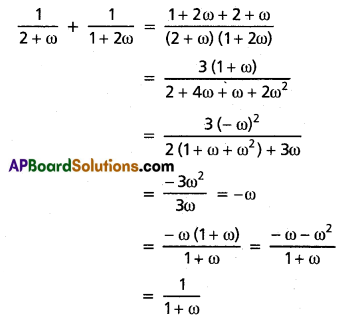
Answer:
Consider two spheres (bodies) which have smooth, non-rotating of masses m1 and m2 (m1 > m2) are moving along the straight line joining the centres of mass with initial velocities u1 and u2 (u1 > u2). They undergo head on collision and move along the same line after collision with final velocities of v, and v2. These two bodies exert forces on each other during collision.
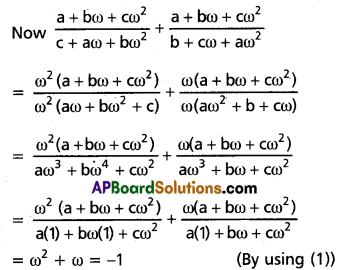
Let the collision be elastic, then both momentum and K.E are conserved.
According to law of conservation of linear momentum, Momentum of the system before collision = Momentum of the system after collision.
m1u1 + m2u2 = m1v1 + m1v2
m1(u1 – v1) = m2 (v2 – u2) ……………….. (1)
According to law of conservation of kinetic energy, K.E of the system before collision = K.E of the system after collision.
\(\frac{1}{2}\)m1u12 + \(\frac{1}{2}\)m2u22 = \(\frac{1}{2}\) m1v12 + \(\frac{1}{2}\)m2v22
m1u12 + m2u22 = m1v12 + m2v22
m1(u12 – v12) = m2(v22 – u22) ……………….. (2)
\(\frac{\text { (2) }}{(1)} \Rightarrow \frac{m_1\left(u_1^2-v_1^2\right)}{m_1\left(u_1-v_1\right)}=\frac{m_2\left(v_2^2-u_2^2\right)}{m_2\left(v_2-u_2\right)}\)
\(\frac{\left(u_1-v_1\right)\left(u_1+v_1\right)}{\left(u_1-v_1\right)}=\frac{\left(v_2-u_2\right)\left(v_2+u_2\right)}{\left(v_2-u_2\right)}\)
(u1 – v1) = u2 + v2
u1 – u2 = v2 – v1
Relative velocity of approach from the above equation before collision = Relative velocity of separation after collision.

AP Inter 1st Year Physics Study Material Chapter 6 Work, Energy and Power

Question 5.
Show that two equal masses undergo oblique elastic collision will move at right angles after collision, if the second body initially at rest.
Answer:
Oblique elastic collision : If the centres of mass of the colliding bodies are not initially moving along the line of impact, then the impact is called oblique collision.

Two equal masses undergo oblique elastic collision will move at right angles after collision, if the second body initially at rest:
AP Inter 1st Year Physics Study Material Chapter 6 Work, Energy and Power 4
Consider two smooth and perfectly elastic spheres of masses m1 and m2. Let u1 and u2 be their initial velocities before collission. Let v1 and v2 be their final velocities after collision, (α, β) and (θ, Φ) are the angles, the directions of motion make with the line of impact before collision and after collision.

Since the spheres are smooth, there is no (impulse) change of velocities perpendicular to the line of impact. Hence the resolved parts of velocity of the two spheres in the direction perpendicular to the line of impact remain unchanged.
∴ v1 sinθ = u1 sinα ……………………. (1)
and v2 sinΦ = u2 sin β …………………. (2)
According to the principle of conservation of momentum, the sum of the moment of the two spheres along the line of impact before collision and after collision are equal.
∴ m1u1 cosα + m2u2 cosβ = m1v1 cosθ + m2v2 cosΦ ……………… (3)
⇒ m1(u1 cosα – v, cosθ) = m2 (v2 cosΦ – u2 cosβ) ……………….. (4)
According to the principle of conservation of kinetic energy, the sum of the K.E along the line of impart before and after are equal.
⇒ \(\frac{1}{2}\) m1 (u1cosα)2 + \(\frac{1}{2}\)m2 (u2cosβ)2 = \(\frac{1}{2}\) m1 (v1cosθ)2 + \(\frac{1}{2}\)m2(v2cos126,Φ)2
⇒ m1 [(u1cosα)2 – (v1cosθ)2 ] = m2 [(v2cosΦ)2 – (u2cosβ)2] …………….. (5)
\(\frac{(5)}{(4)}\) ⇒ u1 cosα + v1 cosθ = v2 cosΦ + u2 cosβ
v1cosθ = v2 cosΦ + u2 cosβ – u1 cosα ……………… (6)
and v2 cosΦ = v1 cosθ + u1 cosα – u2 cosβ ……………….. (7)
sub. equation (7) in equation (3), we get
v1 cosθ = \(\left(\frac{m_1-m_2}{m_1+m_2}\right)\) u1 cosα + \(\left(\frac{2 m_u u_2}{m_1+m_2}\right)\) cosβ ……………… (8)
Sub-equation (6) in equation (3), we get
and v2 cosΦ = \(\left(\frac{m_2-m_1}{m_1+m_2}\right)\) u2 cosβ + \(\left(\frac{2 m_1 u_1}{m_1+m_2}\right)\) cosα ………………. (9)
If u2 = 0 and m1 = m2 then equation (2), we get Φ = 0 and from equation (8), θ = 90°. This means that if a sphere of mass ‘m’ collides obliquely on another perfectly elastic sphere of the same mass at rest, the directions of motions of the spheres after impact will be at right angles.

Question 6.
Derive an expression for the height attained by a freely falling body after ‘n’ number of rebounds from the floor.
Answer:
Consider a small sphere fall freely at a height ‘h’ onto the floor. It strikes the floor with a velocity of ‘u’
So that u1 = \(\sqrt{2 g h}\) …………….. (1)
At the time of collision between the sphere and the floor, the initial and final velocities of floor are zero i.e., u2 = 0 and v2 = 0
AP Inter 1st Year Physics Study Material Chapter 6 Work, Energy and Power 5
Let ‘v1‘ be the final velocity of the sphere after the first collision.
∴ e = \(\frac{v_2-v_1}{u_1-u_2}=\frac{0-v_1}{\sqrt{2 g h}-0}=\frac{-v_1}{\sqrt{2 g h}}\)
∴ v1 = -e\(\sqrt{2 g h}\) ……………… (2)
(-) indicates that the sphere rebounds
∴ The height (h1) attained by the sphere after first rebound is
h1 = \(\frac{v_1^2}{2 g}=\frac{(e \sqrt{2 g h})^2}{2 g}\) = e2h
h1 = (e2)1 h ………………… (3)
Similarly we can that velocity attained by the sphere after second rebound.
v2 = -e2 \(\sqrt{2 g h}\) …………………. (4)
and maximum height attained by the sphere after second rebound
h2 = (e2)2 h ………………… (5)
From the (2) and (4) equations
velocity of the sphere rebounds after ‘n’ collisions
vn = en \(\sqrt{2 g h}\)
From the (3) and (5) equations, maximum height attained by the sphere after n rebounds hn = (e2)n h

AP Inter 1st Year Physics Study Material Chapter 6 Work, Energy and Power

Question 7.
Explain the law of conservation of energy.
Answer:
The total mechanical energy of the system is conserved if the forces doing work on it are conservative. If some of the forces involved are non-conservative, part of the mechanical energy may get transformed into other forms such as heat, light and sound. However, the total energy of an isolated system does not change, as long as one accounts for all forms of energy. Energy may be transformed from one form to another but the total energy of an isolated system remains constant. Energy can neither be created, nor destroyed.

Since the universe as a whole may be viewed as an isolated system, the total energy of the universe is constant. If one part of the universe looses energy, another part must gain an equal amount of energy.

Long Answer Questions

Question 1.
Develop the notions of work and kinetic energy and show that it leads to work energy theorem. [A.P. Mar. 17; T.S. Mar. 15, 14]
Answer:
Statement : The change in kinetic energy of a particle is equal to the workdone on it by the net force, i.e., kf – ki = W
Proof : Consider a particle of mass ‘m’ is moving with initial speed ‘u’ to final speed ‘v’. Let ‘a’ be its constant acceleration and S be its distance traversed. The kinematic relation is given by
v2 – u2 = 2as ………………. (1)
Multiplying both sides by \(\frac{\mathrm{m}}{2}\), we have 11
\(\frac{1}{2}\) mv2 – \(\frac{1}{2}\) mu2 mas = FS …………….. (2)
Where the last step follows from Newton’s second law.
We can generalise Equation (1) to three dimensions by employing vectors
v2 – u2 = 2 \(\overrightarrow{\mathrm{a}} \cdot \overrightarrow{\mathrm{d}}\)
Once again multiplying both sides by \(\frac{\mathrm{m}}{2}\), we obtain
\(\frac{1}{2}\) mv2 – \(\frac{1}{2}\) mu2 = m \(\overrightarrow{\mathrm{a}} \cdot \overrightarrow{\mathrm{d}}\) – \(\overrightarrow{\mathrm{F}} \cdot \overrightarrow{\mathrm{d}}\) …………………. (3)
The above equation provides a motivation for the definitions of work and kinetec energy.
In equation (3), \(\frac{1}{2}\) mv2 – \(\frac{1}{2}\) mu2 = kf – ki
Where ki, kf are initial and final kinetic energies and \(\overrightarrow{\mathrm{F}} \cdot \overrightarrow{\mathrm{d}}\) = W, where W refers workdone by a force on the body over a certain displacement.
kf – ki = W ……………….. (4)
Equation (4) is also a special case of the work-energy (WE) theorem.

AP Inter 1st Year Physics Study Material Chapter 6 Work, Energy and Power

Question 2.
What are collisions ? Explain the possible types of collisions ? Develop the theory of one dimensional elastic collision. [T.S. Mar. 18]
Answer:
Collisions : A strong interactions between bodies that occurs for a very short interval during which redistribution of momenta occur ignoring the effect of other forces are called collisions.
Collisions are of two types :
i) Elastic collision : The collision in which both momentum and kinetic energy is constant is called elastic collision.
ii) Inelastic collision: The collision in which momentum remains constant but not kinetic energy is called Inelastic collision.
One dimensional elastic collision : Consider two spheres (bodies) which have smooth, non-rotating of masses m1 and m2 (m1 > m2) are moving along the straight line joining their centres of mass with initial velocities u1and u2 (u1 > u2). They undergo head on collision and move along the same line after collision with final velocities v1 and v2. These two bodies exert forces on each other during collision.
Hence both momentum and kinetic energy are conserved. According to law of conservation of linear momentum.
AP Inter 1st Year Physics Study Material Chapter 6 Work, Energy and Power 6
From the above equation, in one dimensional elastic collision, the relative velocity of approach before collision is equal to the relative velocity of separation after collision.
From equation (3) u1 – u2 = v2 – v1, v2 = u1 – u2 + v1 ………………… (4)
Sub equation (4) in equation (1) we get
m1 (u1 – v1) = m2 (u1 – u2 + v1 – u2), m1 u1 – m1v1 = m2 u1 – m2 u2 + m2 v1 – m2 u2
m1 u1 – m2 u1 + 2 m2 u2 = m1 v1 + m2 v1 (m1 – m2) u1 + 2 m2 u2 = (m1 + m2) u1
vi = \(\left(\frac{m_1-m_2}{m_1+m_2}\right) u_1+\left(\frac{2 m_2}{m_1+m_2}\right) u_2\) ………………… (5)
From the equation (4), v1 = v2 – u1 + u2
Sub. this value in equation (1) we get
m1 (u1 – v2 + u1 – u2) = m2 (v2 – u2), m1 u1 – m1 v2 + m1 u1 – m1 u2 = m2 v2 – m2 u2
2m1 u1 + u2 (m2 – m1) = (m2 + m2)v2
v2 = \(\frac{2 m_1 u_1}{\left(m_1+m_2\right)}+\frac{\left(m_2-m_1\right)}{\left(m_1+m_2\right)}\) u2

AP Inter 1st Year Physics Study Material Chapter 6 Work, Energy and Power

Question 3.
State and prove law of conservation of energy in case of a freely falling body. [AP – Mar. ’18, ’16, ’15, ’13; TS – Mar. ’17, ’16]
Answer:
Statement: “Energy can neither be created nor destroyed. But it can be converted from one form to another form. The total energy of a closed system always remains constant”. This law is called law of conservation of energy.

Proof : In case of freely falling body : A body of mass’m’ is dropped or freely falling at a height ‘H‘ from the ground. The total mechanical energy of the body E = K + U.
AP Inter 1st Year Physics Study Material Chapter 6 Work, Energy and Power 7
Where k = kinetic energy; U = potential energy.
Suppose A, B and C are the points at heights H, h and ground respectively.
At ‘A’ : At the highest point, velocity u = 0
Kinetic energy K.E. = \(\frac{1}{2}\) mu2 = 0
Potential energy P.E. = mgH
Total mechanical energy of the body = EA = P.E. + K.E. = mgH + 0
∴ EA = mgH ………………. (1)

At ‘B’: When the body falls from A to B, which is at a height ‘h’ from the ground. The velocity of the body at ‘B’ is VB.
At ‘B’ the body possesses both P.E and K.E
S = H – h
u = 0
a = g
v = vB = ?
vB2 – u2 = 2as
a = g
v = vB = ?
vA2 – 0 = 2g (H – h)
VB = 2g(H – h)
Kinetic energy of the body (K) = \(\frac{1}{2}\) mvB2 = \(\frac{1}{2}\) m 2g(H – h)
K = mg (H – h)
Potential energy (u) = mgh
∴ Total mechanical energy at B = k + u
EB = mg (H – h) + mgH
EB = mgh ……………… (2)

At ‘C’ : When the body reaches the point ‘c’ on the ground. The velocity of the body at ‘c is ‘vc’ can be found by using v2 – u2 = 2as equation.
S = H
u = 0
a = g
v = vc = ?
vc2 – 0 = 2gH
vc2 = 2gH
vc = \(\sqrt{2 \mathrm{gH}}\)
Kinetic energy of the body (k) = \(\frac{1}{2}\) mvc2
= \(\frac{1}{2}\) m 2gH = mgH
Potential energy (u) = 0
Total energy at c = k + u
∴ EC = mgH ………………. (3)
From the above three equations (1), (2) and (3), the mechanical energy of the body remains constant under the action of gravitational force. Hence, law of conservation of energy is proved incase of freely falling body.

Problems

Question 1.
A test tube of mass 10 grams closed with a cork of mass 1 gram contains some ether. When the test tube is heated the cork flies out under the pressure of the ether gas. The test tube is suspended horizontally by a weight less rigid bar of length 5cm. What is the minimum velocity with which the cork should fly out of the tube, so that test tube describing a full vertical circle about the point O. Neglect the mass of ether.
Answer:
Mass of test tube M = 10g; Mass of ether m = 1g ;
Length of rigid bar = radius of circle (r) = 5cm
AP Inter 1st Year Physics Study Material Chapter 6 Work, Energy and Power 8
∴ r = 5 × 10⁻² m, g = 10 ms2
[∴ action = – reaction]
Given the minimum velocity of cork flies out (= -v) (v) = The minimum velocity of test tube right
v = \(\sqrt{5 r g}=\sqrt{5 \times 5 \times 10^{-2} \times 10}\)
= 5 × \(\sqrt{10^{-1}}\) m/s

AP Inter 1st Year Physics Study Material Chapter 6 Work, Energy and Power

Question 2.
A machine gun fires 360 bullets per minute and each bullet travels with a velocity of 600 ms-1. If the mass of each bullet is 5 gm, find the power of the machine gun ? [A.P. – Mar. ’18, ’16; Mar. ’13]
Answer:
Here n = 360; t = 60 sec; V = 600 ms-1; m = 5g = 5 × 10⁻³ kg; Power,
P = \(\frac{\text { K.E of n} \text { bullets }}{t}=\frac{\frac{1}{2} \mathrm{mnV}^2}{t}\)
= \(\frac{\frac{1}{2} \times 5 \times 10^{-3} \times 360 \times 600 \times 600}{60}\)
∴ P = 5400, W = 5.4 KW.

Question 3.
Find the useful power used in pumping 3425 m3 of water per hour from a well 8 m deep to the surface, supposing 40% of the horse power during pumping is wasted. What is the horse power of the engine ?
Answer:
Here V = 3425 m3; d = 103 kg m-3; h = 8m;
g = 9.8ms-2; t = 1 hour = 60 × 60s
AP Inter 1st Year Physics Study Material Chapter 6 Work, Energy and Power 9
166.6 HP [1 hp = 746 Watt]

Question 4.
A pump is required to lift 600 kg of water per minute from a well 25 m deep and to eject it with a speed of 50 ms-1. Calculate the power required to perform the above task ? [Mar. 16 (TS), A.P (Mar. ’15)
Answer:
Here m = 600kg; h = 25m; V = 50ms-1; t = 60s;
Power of the motor,
P = \(\frac{\mathrm{mgh}+\frac{1}{2} m \mathrm{~V}^2}{\mathrm{t}}=\frac{\mathrm{m}\left(\mathrm{gh}+\frac{\mathrm{V}^2}{2}\right)}{\mathrm{t}}\)
= \(\frac{600}{60}\left(9.8 \times 25+\frac{50 \times 50}{2}\right)\)
= 10 (245 + 1250) = 14950 = 14.95 KW.

AP Inter 1st Year Physics Study Material Chapter 6 Work, Energy and Power

Question 5.
A block of mass 5 kg initially at rest at the origin is acted on by a force along the X-positive direction represented by F = (20 + 5x)N. Calculate the work done by the force during the displacement of the block from x = 0 to x = 4 m.
Answer:
Given m = 5kg;
F = (20 + 5x)
W = \(\int_{x=0}^{x=4} F d x\)
= \(\int_0^4(20+5 x) d x\)
= \([20 x]_0^4+\left[5 \frac{x^2}{2}\right]_0^4\)
= 20 × 4 + 5 × \(\frac{16}{2}\)
= 120 J.

Question 6.
A block of mass 2.5 kg is sliding down a smooth inclined plane as shown. The spring arranged near the bottom of the inclined plane has a force constant 600 N/m. Find the compression in the spring at the moment the velocity of the block is maximum?
AP Inter 1st Year Physics Study Material Chapter 6 Work, Energy and Power 10
Answer:
Here m = 2.5 kg
µ = 0; K = 600 N/m
Let ‘x’ be the compression of the spring.
According to Newton’s third law, we have
Force due to block on spring
FB = – Restoring force of spring (FR)
In magnitude FB = FR = mg sinθ = Kx
2.5 × 10 × \(\frac{3}{5}\) = 600 × x
⇒ x = \(\frac{15}{600}\)
= 0.025 cm.

Question 7.
A force F = –\(\frac{K}{x^2}\)(x ≠ 0)acts on a particle along the X-axis. Find the work done by the force in displacing the particle from x = C +a to x = +2a. Take K as a positive constant.
Answer:
AP Inter 1st Year Physics Study Material Chapter 6 Work, Energy and Power 11

AP Inter 1st Year Physics Study Material Chapter 6 Work, Energy and Power

Question 8.
A force F acting on a particle varies with the position x as shown in the graph. Find the work done by the force in displacing the particle from x = -a to x = +2a.
Answer:
Average force, F = \(\frac{+2 b-b}{2}=\frac{b}{2}\)
⇒ x = -a to x = 2a
W = \(\int_{-a}^{+2 a} F d x=F[x]_a^{+2}=\frac{b}{2}[2 a-(-a)]=\frac{3 a b}{2}\)

Question 9.
From a height of 20m above a horizontal floor, a ball is thrown down with initial velocity 20 m/s. After striking the floor, the ball bounces to the same height from which it was thrown. Find the coefficient of restitution for the collision between the ball and the floor.
Answer:
Here u = 20 mIs; s = h = 20m; g = 10m/s2;
v = u1
using, v2 – u2 = 2as
u12 = 202 = 2 × 10 × 20
u12 = 202 + 400 = 800
∴ u1 = \(\sqrt{800}\)
And v1 = \(\sqrt{2 \mathrm{gh}}=\sqrt{2 \times 10 \times 20}=\sqrt{400}\)
Since floor is at rest u2 = 0; v2 = 0
e = \(\frac{v_2-v_1}{u_1-u_2}=\frac{0-\sqrt{400}}{800-0}=-\frac{1}{\sqrt{2}}\)
∴ e = \(\frac{1}{\sqrt{2}}\) […. -ve sign indicates, if rebounds]

AP Inter 1st Year Physics Study Material Chapter 6 Work, Energy and Power

Question 10.
A Ball falls from a height of 10 m on to a hard horizontal floor and repeatedly bounces. If the coefficient of restitution is \(\frac{1}{\sqrt{2}}\). What is the total distance travelled by the ball before it ceases to rebound ?
Solution:
Given h = 10m; e = \(\frac{1}{\sqrt{2}}\)
d = h\(\left[\frac{1+\mathrm{e}^2}{1-\mathrm{e}^2}\right]=10\left[\frac{1+\frac{1}{2}}{1-\frac{1}{2}}\right]=10\left[\frac{\left(\frac{3}{2}\right)}{1 / 2}\right]\)
∴ d = 30 m

Additional Problems

Question 1.
The sign of work done by a force on a body is important to understand. State carefully if the following quantities are positive or negative:
a) Work done by a man ¡n lifting a bucket out of a well by means of a rope tied to the bucket.
b) Work done by gravitational force in the above case,
c) Work done by friction on a body sliding down an inclined plane,
d) Work done by an applied force on a body moving on a rough horizontal plane with uniform velocity.
e) Work done by the resistive force of air on a vibrating pendulum in bringing it to rest.
Answer:
Workdone W = \(\vec{F} \cdot \vec{S}\) = FS cosθ where θ is smaller angle between force j and displacement \(\vec{S}\).
a) To lift the bucket, force equal to weight of b

b) The bucket moves in a direction opposite to the gravitational force which acts vertically downwards.
θ = 180°
W = FS cos 180° = -FS. It is negative

c) Friction always opposite the relative motion.
∴ θ = 180°, W = FS cos 180° = -FS. It is negative.

d) As the body moves along the direction of applied force θ = 0, W = FS cos 0° = FS. It is positive.

e) The direction of resistive face is opposite to the direction of motion of the bob i.e. θ = 180°. Hence workdone, in this case, is negative.

AP Inter 1st Year Physics Study Material Chapter 6 Work, Energy and Power

Question 2.
A body of mass 2kg initially at rest moves under the action of an applied horizontal force of 7 N on a table with coefficient of kinetic friction = 0.1. Compute the
a) Work done by the applied force in 10s,
b) Work done by friction in 10s,
c) Work done by the net force on the body in 10s.
d) Change in kinetic energy of the body in 10s. and interpret your results.
Answer:
Here, m = 2kg, u = 0, F = 7N; µ = 0.1,
W = 2, t = 10s
Acceleration produced by applied force;
a = –\(\frac{F}{m}=\frac{7}{2}\) = 3.5 m/s2
force of friction, f = µR = µmg = 0.1 × 2 × 9.8 = 1.96 N
Retardation produced by friction
a2 = –\(\frac{F}{m}=\frac{-1.96}{2}\) = 0.98 m/s2
Net acceleration with which body moves,
a = a1 + a2
= 3.5 – 0.98 = 2.52m/s2
Distance moved by the body in 10 second from
S = Ut + \(\frac{1}{2}\) at2
= 0 + \(\frac{1}{2}\) × 2.52 × (10)2 = 126m.
a) Workdone by the applied force = F × S
W1 = 7 × 126 = 882J

b) Workdone by force of friction W2
= -f × s = -1.96 × 126 = 246.9J

c) Workdone by the net force W3 = Net force × distance
= (F – f)s = (7 – 1.96)126 = 635 J.

d) From v = u + at
v = 0 + 2.52 × 10 = 25.2 mS-1
Final K.E = \(\frac{1}{2}\) mv2 = \(\frac{1}{2}\) × 2 × (25.2)2
= 635J
Initial K.E = \(\frac{1}{2}\)mu2 = 0
∴ Change in K.E = 635 – 0 = 635 J.
This shows that change in K.E of the body is equal to workdone by the net force on the body.

Question 3.
Given in Fig. are examples of some potential energy functions in one dimension. The total energy of the particle is indicated by a cross on the ordinate axis. In each case, specify the regions, if any, in which the particle cannot be found for the given energy. Also, indicate the minimum total energy the particle must have in each case. Think of simple physical contexts for which these potential energy shapes are relevant.
AP Inter 1st Year Physics Study Material Chapter 6 Work, Energy and Power 12
AP Inter 1st Year Physics Study Material Chapter 6 Work, Energy and Power 13
AP Inter 1st Year Physics Study Material Chapter 6 Work, Energy and Power 14
Answer:
We know that total energy E = P.E + K.E (or) K.E = E – P.E and K.E can never be negative. The object cannot exist in the region where its K.E would become negative.

  1. For x > a, P.E (v0) > E
    ∴ K.E becomes negative. Hence the object cannot exist in the region x > a.
  2. For x < a and x > b, P.E (v0) > E
    ∴ K.E becomes negative. Hence the object cannot be present in the region x < a and x > b.
  3. Object cannot exist in any region because P.E (v0) > E in every region.
  4. On the same basis, the object cannot exist in the region -b/2 < x < – a/2 and a/2 < x < b/2.

AP Inter 1st Year Physics Study Material Chapter 6 Work, Energy and Power

Question 4.
To potential energy function for a particle executing linear simple harmonic motion is given by V(x) = kx2/ 2, where k is the force constant of the oscillator. For k= 0.5 N m-1, the graph of V(x) versus x is shown in Fig. Show that a particle of total energy 1 J moving under this potential must ‘turn back’ when it reaches x = ± 2m
AP Inter 1st Year Physics Study Material Chapter 6 Work, Energy and Power 15
Answer:
At any instant, the total energy of an oscillator is the sum of K.E and P.E i.e.
E = K.E + P.E, E = \(\frac{1}{2}\) mu2 + \(\frac{1}{2}\) kx2
The particles turns back at the instant, when its velocity becomes zero i.e. u = 0.
∴ E = 0 + \(\frac{1}{2}\) kx2 as E = 1 Joule and K = \(\frac{1}{2}\) N/m
∴ 1 = \(\frac{1}{2}\) × \(\frac{1}{2}\) x2 (or) x2 = 4, x = ± 2m.

Question 5.
Answer the following :
a) The casing of a rocket in flight burns up due to friction. At whose expense is the heat energy required for burning obtained ? The rocket or the atmosphere ?
b) Comets move around the sun in highly elliptical orbits. The gravitational force on the comet due to the sun is not normal to the comet’s velocity in general. Yet the work done by the gravitational force over every complete orbit of the comet is zero. Why ?
c) An artificial satellite orbiting the earth in very thin atmosphere loses its energy gradually due to dissipation against atmospheric resistance, however small. Why then does its speed increase progressively as it comes closer and closer to the earth ?
AP Inter 1st Year Physics Study Material Chapter 6 Work, Energy and Power 16
d) In fig. (i) the man walks 2 m carrying a mass of 15 kg on his hands. In Fig. (ii), he walks the same distance pulling the rope behind him. The rope goes over a pulley, and a mass of 15 kg hangs at its other end. In which case is the work done greater ?
Answer:
a) The total energy of a rocket in a flight depends on its mass i.e. P.E + K.E = mgh + \(\frac{1}{2}\) mv2. When the casing burns up, its mass decreases. The total energy of the rocket decreases Hence heat energy required for burning is obtained from the rocket itself and not from the atmosphere.

b) This is because gravitational force is a conservative force. Work done by the gravitational force of the sun over a closed path in every complete orbit of the comet is zero.

c) When the artificial satellite orbiting the earth comes closer and closer to the earth, its potential energy decreases as sum of potential energy and kinetic energy is constant, therefore K.E of satellite and hence its velocity goes on increasing. However total energy of satellite decreases a little on account of dissipation against atmospheric resistance.

d) In fig. (a), force is applied on the mass, by the man in vertically upward direction but distance is moved along the horizontal.
∴ θ = 90°, W = FS cos 90° = zero.
In fig. (b), force is applied along the horizontal and the distance moved is also along the horizontal. Therefore v = 0°.
W = FS cosθ = mg × S cos0°
W = 15 × 9.8 × 2 × 1 = 294 Joule.
workdone in 2nd case is greater.

AP Inter 1st Year Physics Study Material Chapter 6 Work, Energy and Power

Question 6.
Underline the correct alternative :
a) When a conservative force does positive work on a body, the potential energy of the body increases / decreases / remains unaltered.
b) Work done by a body against friction always .results in a loss of its kinetic / potential energy.
c) The rate of change of total momentum of a many-particle system is proportional to the external force / sum of the internal forces on the system.
d) In an inelastic collision of two bodies, the quantities which do not change after the collision are the total kinetic energy/total linear mometum. total energy of the system of two bodies.
Answer:
a) Potential energy of the body decreases. The conservative force does positive work on a body, when it displaces the body in the direction of force. The body, therefore, approaches the center of force, decreasing x. Hence P.E decreases.

b) Workdone by a body against friction at the expense of its kinetic energy. Hence K.E of the body decreases.

c) Internal forces cannot change the total (or) net momentum of a system. Hence the rate of change of total momentum of many particle system is proportional to the external force on the system.

d) In an inelastic collision of two bodies, the quantities which do not change after the collision are total linear momentum and total energy of the system of two bodies. The total K.E changes as some energy appears in other forms.

Question 7.
State if each of the following statements is true or false. Give reasons for your answer.
a) In an elastic collision of two bodies, the momentum and energy of each body is conserved.
b) Total energy of a system is always conserved, no matter what internal and external forces on the body are present.
c) Work done in the motion of a body over a closed loop is zero for every force in nature.
d) In an inelastic collision/the final kinetic energy is always less than the initial kinetic energy of the system.
Answer:
a) False. The total momentum and total energy of the system are conserved and not of each body.
b) False. The external forces on the body may change the total energy of the body.
c) False. Work done in the motion of a body over a closed loop is zero only the body is moving under the action of conservative forces (like gravitational (or) electrostatic faces).
It is not zero when the forces are non conservative, e.g. frictional forces etc.
d) True, because in an inelastic collision, some kinetic energy usually changes into some other form of energy.

Question 8.
Answer carefully, with reasons ;
a) In an elastic collision of two billiard balls, is the total kinetic energy conserved during the short time of collision of the balls (i.e. when they are in contact) ?
b) Is the total linear momentum conserved during the short time of an elastic collision of two balls ?
c) What are the answer to (a) and (b) for an inelastic collision ?
d) If the potential energy of two billiard balls depends only on the separation distance between their centres, is the collision elastic or inelastic ? (Note, we are talking here of potential energy corresponding to the force during collision, not gravitational potential energy).
Answer:
a) No, K.E is not conserved during the given elastic collision. K.E. before and after collision is the same. Infact during collision, K.E of the balls gets converted into potential energy.
b) Yes, the total linear momentum is conserved during the short time of an elastic collision of two balls.
c) In an in elastic collision, total K.E is not conserved during collision.
d) The collision is elastic, because the forces involved are conservative.

AP Inter 1st Year Physics Study Material Chapter 6 Work, Energy and Power

Question 9.
A body is initially at rest. It undergoes one-dimensional motion with constant acceleration. The power delivered to it at time t is proportional to
i) t1/2
ii) t
iii) t3/2
iv) t2
Answer:
From v – u + at, v = 0 + at = at
As power, p = F × v = (ma) × at = ma2t
As m and a are constants, therefore, p ∝ t.

Question 10.
A body is moving unidirectionally under the influence of a source of constant power. Its displacement in time t is proportional to
i) t1/2
ii) t
iii) t3/2
iv) t2
Answer:
As power, P = force × velocity
∴ P = [MLT-2] [LT-1] = [mL2 T-3]
As P = [mL-2 T-3] = constant
∴ L2 T-3 = constant
∴ L2 ∝ T3 (or) L ∝ T3/2
(or) \(\frac{\mathrm{L}^2}{\mathrm{~T}^3}\) = constant

Question 11.
A body constrained to move along the z-axis of a coordinate system is subject to a constant force F given by F = \(-\hat{\mathrm{i}}+2 \hat{\mathrm{j}}+2 \hat{\mathrm{k}}\) N where \(\hat{i}, \hat{j}, \hat{k}\) are unit vectors along the x-, y- and z-axis of the system respectively. What is the work done by this force in moving the body a distance of 4 m along the z-axis ?
Answer:
Here, F = \(-\hat{\mathrm{i}}+2 \hat{\mathrm{j}}+2 \hat{\mathrm{k}}\)N
\(\overrightarrow{\mathrm{S}}=4 \hat{\mathrm{k}}\) (∵ 4m distance is along z-axis)
W = 2; As W = \(\overrightarrow{\mathrm{F}} \cdot \overrightarrow{\mathrm{S}}\)
∴ W = \((-\hat{\mathrm{i}}+2 \hat{\mathrm{j}}+3 \hat{\mathrm{k}}) \cdot(4 \hat{\mathrm{k}})=12 \hat{\mathrm{k}} \cdot \hat{\mathrm{k}}\) = 12J.

AP Inter 1st Year Physics Study Material Chapter 6 Work, Energy and Power

Question 12.
An electron and a proton are detected in a cosmic ray experiment, the first with kinetic energy 10 keV and the second With 100 keV. Which is faster, the electron or the proton ? Obtain the ratio of their speeds, (electron mass = 9.11 × 10⁻³¹ kg, proton mass = 1.67 × 10⁻²⁷ kg, 1 eV = 1.60 × 10⁻¹⁹ J).
Answer:
E1 = \(\frac{1}{2}\) meve2 = 10 × 1.6 × 10-16 ……………… (i)
E2 = \(\frac{1}{2}\) mpvp2 = 100 × 1.6 × 10-16 ……………… (ii)
Divide (i) by (ii) \(\frac{m_v v_v^2}{m_p v_p^2}=\frac{1}{10}\)
\(\frac{v_{\mathrm{e}}}{v_\rho}=\sqrt{\frac{1}{10}} \frac{m \rho}{m_e}\)
= \(\sqrt{\frac{1.67 \times 10^{-27}}{10 \times 9.11 \times 10^{-31}}}=10^2 \sqrt{\frac{1.67}{91.1}}\) = 13.53

Question 13.
A rain drop of radius 2 mm falls from a height of 500 m above the ground. It falls with decreasing acceleration (due to viscous resistance of the air) until at half its original height, it .attains its maximum (terminal) speed and moves with uniform speed thereafter. What is the work done by the gravita-tional force on the drop in the first and second half of its journey ? What is the work done by the resistive force in the entire journey if its speed on reaching the ground is 10 ms-1 ?
Answer:
Here, r = 2mm = 2 × 10⁻³m
Distance moved in each half of journey,
s = \(\frac{500}{2}\) = 250 m
Density of water, ρ = 103 kg/m3
Mass of rain drop
= Volume of drop × Density
m = \(\frac{4}{3}\)πr3 × ρ = \(\frac{4}{3}\) × \(\frac{22}{7}\) (2 × 10⁻³)3 × 103
= 3.35 × 10⁻⁵ kg
w = mg × s = 3.35 × 10-5 × 9.8 × 250 = 0.082J
It should be clearly understood that whether the drop moves with decreasing acceleration (or) with uniform speed, work done by the gravitational force on the drop remains the same.
If there were no resistive forces, energy of drop on reaching the ground.
E1 = mgh = 3.35 × 10-5 × 9.8 × 500 = 0.164J
Actual energy, E2 = \(\frac{1}{2}\) mv2 = \(\frac{1}{2}\) × 3.35 × 10-5 × (10)2 = 1.675 × 10⁻³ J.
∴ Workdone by the resistive forces,
W = E1 – E2 = 0.164 – 1.675 × 10⁻³
W = 0.1623 Joule.

Question 14.
A molecule in a gas container hits a horizontal wall with speed 200 m s-1 and angle 30° with the normal and rebounds with the same speed. Is momentum conserved in the collision ? Is the collision elastic or inelastic ?
Answer:
We know that momentum is conserved in all collisions, elastic as well as inelastic. Let us now check if K. E is conserved (or) not.
AP Inter 1st Year Physics Study Material Chapter 6 Work, Energy and Power 17+
If the wall is too heavy, the recoiling molecule produces no velocity in the wall.
If m is mass of the gas molecule and M is mass of wall, then total K.E after collision
E2 = – m(200)2 + \(\frac{1}{2}\) M(0)2
E2 = 2 × 10⁴ mJ
Which is the K.E. of the molecule before collision.
[E1 = \(\frac{1}{2}\)m(200)2 = 2 × 10⁴ mJ]
Hence the collision is elastic.

AP Inter 1st Year Physics Study Material Chapter 6 Work, Energy and Power

Question 15.
A pump on the ground floor of a building can pump up water to fill a tank of volume 30 m3 in 15 min. If the tank is 40 m above the ground and the efficiency of the pump is 30%, how much electric power is consumed by the pump ?
Answer:
Here, volume of water = 30 m2, t = 15 min = 15 × 60 = 900s.
height h = 40m, efficiency η = 30%
As density of water = ρ = 103 kg /m3
∴ Mass of water pumped, m = volume x density = 30 × 103 kg
Actual power consumed (or) out power
P0 = \(\frac{\mathrm{w}}{\mathrm{t}}=\frac{\mathrm{mgh}}{\mathrm{t}}\)
= \(\frac{30 \times 10^3 \times 9.8 \times 40}{900}\) = 10370 watt.
If Pi is input power (required), then as η = \(\frac{P_0}{P_i}\)
∴ Pi =\(\frac{P_0}{\eta}=\frac{10370}{\frac{30}{100}}\) = 43567 watt = 43.567 KW.

Question 16.
Two identical ball bearings in contact with each other and resting on a frictionless table are hit head-on by another ball bearing of the same mass moving initially with a speed V. If the collision ¡s elastic, which of the following (Fig.) is a possible result after collision ?
AP Inter 1st Year Physics Study Material Chapter 6 Work, Energy and Power 18
Answer:
Let m be the mass of each ball bearing
Before collision, total K.E of the system =
\(\frac{1}{2}\)mV2 + 0 = \(\frac{1}{2}\) mV2
After collision K.E of the system is
Case I, E1 = \(\frac{1}{2}\) (2m) (V/2)2 = \(\frac{1}{4}\) mV2
Case II, E2 = \(\frac{1}{2}\) mV2
Case III, E3 = – (3m) (V/3)2 = \(\frac{1}{6}\)mV2
We observe that is conserved only in Case II. Hence the Case II is the only possibility.

Question 17.
The bob A of a pendulum released from 30° to the vertical hits another bob B of the same mass at rest on a tables as shown in Fig. How high does the bob A rise after the collision ? Neglect the size of the bobs and assume the collision to be elastic.
AP Inter 1st Year Physics Study Material Chapter 6 Work, Energy and Power 19
Answer:
The bob A shall not rise. This is because when two bodies of same mass undergo an elastic collision, their velocities are interchanged. After collision, ball a will come to rest and the ball B would move with the velocity of A.

AP Inter 1st Year Physics Study Material Chapter 6 Work, Energy and Power

Question 18.
The bob of a pendulum is released from a horizontal position, If the length of the pendulum is 1.5 m, what is the speed with which the bob arrives at the lowermost point, given that it dissipated 5% of its initial energy against air resistance ?
Answer:
Here, h = 1.5m, V = ?
Energy dissipated = 5%
Taking B as the lowest position of the bob, its potential energy at B is zero. At the horizontal position, A total potential energy of the bob is mgh.
In going from A to B, P.E of the bob is converted into K.E
Energy conserved = 95% (mgh)
If V is velocity acquired at B, then K.E = \(\frac{1}{2}\) mv2
= \(\frac{95}{100}\)mgh
V = \(\sqrt{\frac{95}{100} \times 2 \mathrm{gh}}=\sqrt{\frac{19}{20} \times 2 \times 9.8 \times 1.5}\)
= 5.285ms-1.

Question 19.
A trolley of mass 300 kg carrying a sandbag of 25 kg is moving uniformly with a speed of 27 km/ h oh a frictionless track. After a while, sand starts leaking out of a hole on the floor of the trolley at the rate of 0.05 kg s-1. What is the speed of the trolley after the entire sand bag is empty ?
Answer:
As the trolley carrying the sane bag is moving uniformly, therefore, external force on the system = zero.
When the sand leaks out, it does not lead to the application of any external force on the trolley. Hence the speed of the trolley shall not change.

Question 20.
A body of mass 0.5 kg travels in a straight line with velocity v = ax3/2 where a = 5m-1/2 s-1. What is the workdone by the net force during its displacement from x = 0 to x = 2 m ?
Answer:
Here, m = 0.5 kg; v = ax3/2, a = 5m-1/2 s-1,
w = ?
Intial vel. at x = 0, v1 = a × 0 =0
Final vel, at x = 2, v2 = a23/2 = 5 × 23/2
Workdone = increase in K.E. = \(\frac{1}{2}\) m
(v22 – v12), W = \(\frac{1}{2}\) × 0.5 [(5 × 23/2)2) – 0]
= 50 J

AP Inter 1st Year Physics Study Material Chapter 6 Work, Energy and Power

Question 21.
The blades of a windmill sweep out a circle of area A.
(a) If the wind flows at a velocity v perpendicular to the circle, what is the mass of the air passing through it in time t ?
(b) What is the kinetic energy of the air ?
(c) Assume that the windmill converts 25% of the wind’s energy into electrical energy and that A = 30 m2, v = 36 km/h and the density of air is 1.2 kg m-3. What is the electrical power produced ?
Answer:
a) Volume of wind flowing /sec = AV
Mass of wind flowing / sec = AVρ
Mass of air passing in t sec = AVρt

b) K.E of air = \(\frac{1}{2}\) mv2 = \(\frac{1}{2}\) (AVρt)
v2 = \(\frac{1}{2}\) av3ρt.

c) Electrical energy produced = \(\frac{25}{100}\)
K.E of air = \(\frac{1}{4}\) × \(\frac{1}{2}\) × Av3ρt
Electrical power = \(\frac{1}{8} \frac{A v^3 \rho t}{t}=\frac{1}{8} A v^3 \rho t\)
P = \(\frac{1}{8}\) × 30 × (10)3 × 1.2 = 4500 watt
= 4.5 Kw.

Question 22.
A person trying to lose weight (dieter) lifts a 10kg mass, one thousand times, to a height of 0.5 m ech time. Assume that the potential energy lost each time she lowers the mass is dissipated,
(a) How much work does she do against the gravitational force ?
(b) Fat supplies 3.8 × 10⁷J of energy per kilo-gram which is converted to mechanical energy with a 20% efficiency rate. How much fat will the dieter use up ?
Answer:
Here, m = 10 kg, h = 0.5 m, n = 1000
a) Workdone against gravitational force W = n(mgh)
= 1000 × (10 × 9.8 × 0.5 = 49000 J

b) Mechanical energy supplied by 1 kg of fat
= 3.8 × 10 × \(\frac{20}{100}\) = 0.76 × 10⁷ J/kg
∴ Fat used up by the dieter
= \(\frac{1 \mathrm{~kg}}{0.76 \times 10^7}\) = 4000 = 6.45 × 10⁻³ kg.

Question 23.
A family uses 8 kW of power,
(a) Direct solar energy is incident on the horizontal surface at an average rate of 200 W per square meter. If 20% of this energy can be converted to useful electrical energy, how large an area is needed to supply 8 kW ?
(b) Compare this area to that of the roof of a typical house.
Answer:
Let area be A’ square meter
∴ Total power = 200A
Useful electrical energy produced/sec = \(\frac{20}{100}\)
(200A) = 8KW = 40A = 8000 (watt)
Therefore, A = \(\frac{8000}{40}\) = 200 sq.m
This area is comparable to the roof of a large house of 250 sq.mt.

AP Inter 1st Year Physics Study Material Chapter 6 Work, Energy and Power

Question 24.
A bullet of mass 0.012 kg and horizontal speed 70 ms-1 strikes a block of wood of mass 0.4 kg and instantly comes to rest with respect to the block. The block is suspended from the ceiling by means of thin wires. Calculate the height to which the block rises. Also, estimate the amount of heat produced in the block.
Answer:
Here m1 = 0.012kg. u1 = 70 m/s m2 = 0.4 kg, u2 = 0
As the bullet comes to rest w.r. to the block, the two behave as one body. Let v be the velocity acquired by the combination. Applying principle of conservation of linear momentum, (m1 + m2)v
= m1u1 + m2u2 = m1u1
V = \(\frac{m_1 u_1}{m_1+m_2}=\frac{0.012 \times 70}{0.012+0.4}=\frac{0.84}{0.412}\)
= 2.04 m/s.
Let the block rise to a height h.
RE of combination = K.E. of the combination
(m1 + m2)gh = \(\frac{1}{2}\) (m1 + m2)v2
h = \(\frac{v^2}{2 g}=\frac{2.04 \times 2.04}{2 \times 9.8}\) = 0.212m.
For calculating heat produced. We calculate energy lost (W). where
W = intial K.E of bullet – final K.E of combination
= \(\frac{1}{2}\) m1u12 \(\frac{1}{2}\) (m1 + m2)v2
= \(\frac{1}{2}\) × 0.012 (70)2 – \(\frac{1}{2}\) (0.412) (2.04)2
W = 29.4 – 0.86 = 28.54 Joule.
∴ heat produd. H = \(\frac{W}{j}=\frac{28.54}{4.2}\) = 6.8 cal.

Question 25.
A 1kg block situated on a rough incline is connected to a spring of spring constant 100 N m-1 as shown in Fig. The block is released from rest with the spring in the unstretched position. The block moves 10 cm down the incline before coming to rest. Find the coefficient of friction between the block and the incline. Assume that the spring has a negligible mass and the pulley is frictionless.
AP Inter 1st Year Physics Study Material Chapter 6 Work, Energy and Power 20
Answer:
From Fig.
R = mg cosθ
F = μR = μmg cosθ
Net force on the block down the incline
= mg sin θ – F = mg sin θ – μ mg cos θ
= mg (sin – μ cos θ)
Distanced moved, x = 10cm = 0.1m.
In equilibrium, work done = P.E of streched spring
mg (sin θ – μ cos θ) x = \(\frac{1}{2}\) Kx2
2mg (sin θ – μ cos θ) = Kx
2 × 1 × 10 (sin 37° – μ cos 37°) = 100 × 0.1
20(0.601 – μ 0.798) = 10
∴ μ = 0.126

AP Inter 1st Year Physics Study Material Chapter 6 Work, Energy and Power

Question 26.
A bob of mass 0.3 kg falls from the ceiling of an elevator moving down with an uniform speed of 7 ms-1. It hits the floor of the elevator (length of the elevator = 3 m) and does not rebound. What is the heat produced by the impact ? Would your answer be different if the elevator were stationary ?
Answer:
Here, m 0.3kg, v = 7 m/s h = length of elevator = 3m
As relative of the bob w.r.t elevator is zero, therefore, in the impact, only potential energy of the fall is converted into heat energy.
Amount of heat produced = P.E lost by the bob = mgh = 0.3 × 9.8 × 3 = 8.82 J.
The answer shall not be different, if the elevator were stationary as the bob too in that cause would start from stationary position, i.e. relative velocity of the ball w.r.t elevator would continue to be zero.

Question 27.
A trolley of mass 200 kg moves with a uniform speed of 36 km / h on a frictionless track. A child of mass 20 kg runs on the trolley from one end to the other (10 m away) with a speed of p m s-1 relative to the trolley in a direction opposite to the its motion and jumps out of the trolley. What is the final speed of the trolley ? Flow much has been trolley moved from the time the child begins to run ?
Answer:
Here, mass of trolley, m1 = 200 kg
speed of the trolley v = 36 km/h = 10m/s
mass of the child, m2 = 20 kg
Before the child starts running, momentum of the system.
P1 = (m1 + m2)v = (200 + 20)10
= 2200kg ms-1.
∴ Momentum of the system when the child is running
P2 = 200v1 + 20 (v1 – 4) = 220v1 – 80
As no external force is applied on the system.
∴ P2 = P1
220v1 – 80 = 2200
220v1 = 2200 + 80 = 2280
v1 = \(\frac{2280}{220}\) = 10.36 ms-1
Time taken by the child to run a distance of 10m over the trolley, t = \(\frac{10 \mathrm{~m}}{4 \mathrm{~ms}^{-1}}\) = 2.5 s
Distance moved by the trolley in this time = Velocity of trolley × time = 10.36 × 2.5 = 25.9 m

Question 28.
Which of the following potential energy curves in Fig. cannot possibly describe the elastic collision of two billiard balls ? Here r is the distance between centres of the balls.
AP Inter 1st Year Physics Study Material Chapter 6 Work, Energy and Power 21
Answer:
The potential energy of a system of two masses varies inversely as the distance (r) between them i.e,
v(r) ∝ \(\frac{\mathrm{1}}{\mathrm{r}}\).
When the two billiard balls touch each other, P.E become zero i.e. at r = R + R = 2R;
v(r) = 0. Out of the given graphs, curve (v) only satisfies these two conditions.

AP Inter 1st Year Physics Study Material Chapter 6 Work, Energy and Power

Question 29.
Consider the decay of a free neutron at rest : n → p + e Show that the two-body decay of this type must necessarily give an electron of fixed energy and, therefore, cannot account for the observed continuous energy distribution in the β-decay of a neutron or a nucleus (Fig.).
AP Inter 1st Year Physics Study Material Chapter 6 Work, Energy and Power 22
(Note : The simple result of this exercise was one among the several arguments advanced by W. Pauli to predict the existence of a third particle in the decay products of β-decay. This particle is known as neutrino. We now know that it is a particle of intrinsic spin 1/2 (like e-, p or n), but is neutral, and either masslessor having an extremely small mass (compared to the mass of electron) and which interacts very weakly with matter. The correct decay process of neutron is: n → p + e- + v
Answer:
In the decay process, n → p + e
energy of electrons is equal to (∆m)c2
Where ∆m = mass defect = mass of neutron – mass of proton and electron;
which is fixed. Therefore, two body decay of this type cannot explain the observed continuous energy distribution in the β-decay of a neutron or a nucleus.

Textual Examples

Question 1.
Find the angle between force F = \((3 \bar{i}+4 \bar{J}-5 \bar{k})\) unit and displacement d = \((3 \bar{i}+4 \bar{J}-5 \bar{k})\) unit. Also find the projection of F on d.
Answer:
F.d = Fxdx + Fydy + Fzdz = 3(5) + 4(4) + (-5)
(3) = 16 unit
Hence F.d = F d cos θ = 16 unit
Now F.F = F2 – Fx2 + Fy2 + Fz2
= 9 + 16 + 25 = 50 unit
and d.d = d2 = dx2 + dy2 + dz2
= 25 + 16 + 9 = 50 unit
∴ cosθ = \(\frac{16}{\sqrt{50} \sqrt{50}}=\frac{16}{50}\) = 0.32
= θ = cos-1 0.32.

Question 2.
It is well known that a raindrop falls under the influence of the downward gravitational force and the opposing resistive force. The latter is known to be proportional to the speed of the drop but is otherwise undetermined. Consider a drop of mass 1.00 g falling from a height 1.00 km. It hits the ground with a speed of 50.0 ms-1. (a) What is the work done by the gravitational force? What is the work done by the unknown resistive force?
Answer:
(a) The change in kinetic energy of the drop is
∆k = \(\frac{1}{2}\)mv2 – 0
= \(\frac{1}{2}\) × 10-3 × 50 × 50 = 1.25 J
where we have assumed that the drop is initially at rest.
Assuming that g is a constant with a value 10 m/s2, the work done by the gravitational force is,
Wg = mgh = 10-3 × 10 × 10-3 = 10.0 J

(b) From the work-energy theorem
∆K = Wg + Wr
Where Wr is the work done by the resistive force on the raindrop. Thus
Wr = ∆K – Wg = 1.25 – 10 = -8.75 J in negative.

AP Inter 1st Year Physics Study Material Chapter 6 Work, Energy and Power

Question 3.
A cyclist comes to a skidding stop in 10 m. During this process, the force on the cycle due to the road is 200 N and is directly opposed to the motion,
(a) How much work does the road do on the cycle ?
(b) How much work does the cycle do on the road ?
Answer:
Work done on the cycle by the road is the work done by the stopping (frictional) force on the cycle due to the road.
(a) The stopping force and the displacement make an angle of 180° (π rad) with each other.
Thus, work done by the road,
Wr = Fd cosθ = 200 × 10 × cos π
= -2000 J
It is this negative work that brings the cycle to a halt in accordance with WE theorem.

(b) From Newton’s Third Law an equal and opposite force acts on the road due to the cycle. Its magnitude is 200 N. However, the road, undergoes no displacement. Thus work done by cycle on the road is zero.

Question 4.
In a ballistics demonstration a police officer fires a bullet of mass 50.0g with speed 200 ms-1 (Bullet of mass = 5 × 10⁻², Bullet of speed = 200; Bullet of K(J) = 103; on soft plywood of thickness 2.00 cm. The bullet emerges with only 10% of its initial kinetic energy. What is the emergent speed of the bullet ?
Answer:
The initial kinetic energy of the bullet is mv2 / 2 = 1000 J. It has a final kinetic energy of 0.1 × 1000 = 100 J. If vf is the emergent speed of the bullet,
\(\frac{1}{2}\) mv2f = 100 J
vf = \(\frac{\sqrt{2 \times 100 \mathrm{~J}}}{0.05 \mathrm{~kg}}\) = 63.2 ms-1
The speed is reduced by approximately 68% (not 90%).

AP Inter 1st Year Physics Study Material Chapter 6 Work, Energy and Power

Question 5.
A woman pushes a trunk on a railway platform which has a rough surface. She applies a force of 100 N over a distance of 10 m. Thereafter, she gets progressively tired and her applied force reduces linearly with distance to 50 N. The total distance through which the trunk has been moved is 20 m. Plot the force applied by the woman and the frictional force, which is 50 N versus displacement. Calculate the work done by the two forces over 20m.
Answer:
AP Inter 1st Year Physics Study Material Chapter 6 Work, Energy and Power 23
Plot of the force F applied by the woman and the opposing frictional force f versus displacement.
The plot of the applied force is shown in Fig. At x = 20 m, F = 50 N (≠ 0). We are given that the frictional force f is |f| = 50N. It opposes motion and acts in a direction opposite to F. It is therefore, shown on the negative side of the force axis.
The work done by the woman is
WF → area of the rectangle ABCD + area of the trapezium CEID
WF = 1000 × 10 + \(\frac{1}{2}\)(100 + 50) ×10
= 1000 + 750 = 1750 J
The work done by the frictional force is
Wf → area of the rectangle AGHI
Wf → (-50) × 20 = -1000 J
The area on the negative side of the x- axis has a negative sign.

Question 6.
A bob of mass m is suspended by a light string of length L. It is imparted a horizontal velocity v0 at the lowest point A such that it completes a semi circular trajectory in the vertical plane with the string becoming slack only on reaching the topmost point, C. This is shown in Fig. Obtain an expression for (i) v0 (ii) the speeds at points B and C; (iii) the ratio of the kinetic energies (KB/K) at B and C. Comment on the nature of the trajectory of the bob after it reaches the point C.
AP Inter 1st Year Physics Study Material Chapter 6 Work, Energy and Power 24
Answer:
Thus, at A:
E = \(\frac{1}{2} {\mathrm{mv}_0^2}\) ………………… (1)
TA – mg = \(\frac{\mathrm{mv}_0^2}{\mathrm{~L}}\) [Newtons Second Law]
where TA is the tension in the string at A. At the highest point C, the string slackens, as the tension in the string (Tc) becomes zero.
E = – \(\frac{1}{2} {\mathrm{mv}_c^2}\) + 2mgL ………………… (2) .
mg = \(\frac{\mathrm{mv}_c^2}{\mathrm{~L}}\) [Newtons Second law] ……………… (3)
where vc is the speed at C. From equations (2) & (3)
E = \(\frac{5}{2}\)mgL
Equating this to the energy at A
\(\frac{5}{2}\) mgL = \(\frac{m}{2} v_0^2\) or, v0 = \(\sqrt{5 \mathrm{gL}}\)

(ii) It is clear from Equation (3)
vc = \(\sqrt{ \mathrm{gL}}\)
At B, the energy is
E = \(\frac{1}{2} m v_B^2\) + mgL
Equating this to the energy at A and empLoying the result from (i),
namely v02 = 5gL
\(\frac{1}{2} m v_B^2+m g L=\frac{1}{2} m v_0^2\)
= \(\frac{5}{2}\)mgl ∴ vB = \(\sqrt{3\mathrm{gL}}\)

(iii) The ratio of the kinetic energies at Band C is :
\(\frac{\mathrm{K}_{\mathrm{B}}}{\mathrm{K}_{\mathrm{C}}}=\frac{\frac{1}{2} m v_{\mathrm{B}}^2}{\frac{1}{2} m v_{\mathrm{c}}^2}=\frac{3}{1}\)
At point C, the string becomes slack and the velocity of the bob is horizontal and to the left.

AP Inter 1st Year Physics Study Material Chapter 6 Work, Energy and Power

Question 7.
To simulate car accidents, auto manufactures study the collisions of moving cars with mounted springs of different spring constants. Consider a typical simulation with a car of mass 1000 kg moving with a speed 18.0 km / h on a smooth road and colliding with a horizontally mounted spring of spring constant 6.25 × 10³ N m1. What is the maximum compression of the spring ?
Answer:
At maximum compression the kinetic energy of the car is converted entirely into the potential energy of the spring.
The kinetic energy of the moving car is 11
K = \(\frac{1}{2}\)mv2 = \(\frac{1}{2}\) × 103 × 5 × 5
K = 1.25 × 10⁴ J
where we have converted 18 km h-1 to 5ms-1 [It is useful to remember that 36 km h-1 = 10 ms-1]. At maximum compression xm, the potential energy. V of the spring is equal to the kinetic energy K of the moving car from the principle of conservation of mechanical energy.
V = \(\frac{1}{2}\) K xm2 = 1.25 × 10⁴ J
We obtain xm = 2.00 m

Question 8.
Consider example 8 taking the coefficient of friction, μ, to be 0.5 and calculate the maximum compression of the spring.
Answer:
In presence of friction, both the spring force and the frictional force act so as to oppose the compression of the spring as shown in Fig.
We invoke the work-energy theorem, rather than the conservation of mechanical energy.
The change in kinetic energy is
AP Inter 1st Year Physics Study Material Chapter 6 Work, Energy and Power 25
∆K = Kf – Ki = 0 – \(\frac{1}{2}\)mv2
The work done by the net force is
W = \(\frac{1}{2}\)Kxm2 – μm g xm
Equating we have
\(\frac{1}{2}\)mv2 = \(\frac{1}{2}\)K xm2 + μm g xm
Now μmg = 0.5 × 103 × 10 = 5 × 10³ N
(taking g = 10.0 ms-2]. After rearranging the above equation we obtain the following quadratic equation in the unknown xm.
K xm2 + 2μm gxm – mv2 = 0
xm = \(\frac{-\mu m g+\left[\mu^2 m^2 g^2+m k v^2\right]^{1 / 2}}{k}\)
where we take the positive square root since xm is positive. Putting in numerical values we obtain
xm = 1.35 m
which, as expected, is less than the result in example 7
If the two forces on the body consist of a conservative force Fc and a non- conservative force Fnc, the conservation of mechanical energy formula will have to be modified. By the WE theorem
But Hence, (Fc + Fnc) ∆x = ∆K
Fc ∆x = ∆V
∆ (K + V) = Fnc ∆x
∆E = Fnc ∆x
where E is the total mechanical energy. Over the path this assumes the form Ef – Ei = Wnc
Where Wnc is the total work done by the non-conservative forces over the path. Note that unlike the conservative force. Wnc depends on the particular path i to f.

AP Inter 1st Year Physics Study Material Chapter 6 Work, Energy and Power

Question 9.
Examine express
(a) The energy required to break one bond in DNA in eV(1.6 × 10⁻¹⁹J);
(b) The kinetic energy of an air molecule (10-21J) in eV;
(c) The daily in take of a human adult in kilocalories (107).
Answer:
(a) Energy required to break one bond of DNA is \(\frac{10^{-20} \mathrm{~J}}{1.6 \times 10^{-19} \mathrm{~J} / \mathrm{eV}}\) ; 0.06 eV
Note 0.1 eV = 100 meV (100 millielectron volt).

(b) The kinetic energy of an air molecule is
\(\frac{10^{-21} \mathrm{~J}}{1.6 \times 10^{-19} \mathrm{~J} / \mathrm{eV}}\); 0.0062 eV
This is the same as 6.2 meV.

(c) The average human consumption in a day
is \(\frac{10^7 \mathrm{~J}}{4.2 \times 10^3 \mathrm{~J} / \mathrm{kcal}}\); 2400 kcaL

Question 10.
An elevator can carry a maximum load of 1800 kg (elavator + passengers) is moving up with a constant speed of 2ms-1. The frictional force opposing the motion is 4000 N. Determine the minimum power delivered by the motor to the elevator in watts as well as in horse power.
Answer:
The downward force on the elevator is F = mg + Ff = (1800 × 10) + 4000 = 22000 N
The motor must supply enough power to balance this force. Hence,
P = F.v = 22000 × 2 = 44000 W = 59 hp

Question 11.
Slowing down of neutrons : In a nuclear reactor of high speed (typically 107ms-1) must be slowed to 103 ms-1 so that it can have a high probability of interacting with isotope \({ }_{92}^{235} \mathrm{U}\) and causing it to fission. Show that a neutron can lose most of its kinetic energy in an elastic collision with a light nuclei like deuterium or carbon which has a mass of only a few times the neutron mass. The material making up the light nuclei, usually heavy water (D2O) or graphite, is called a moderator.
Answer:
The initial kinetic energy of the neutron is
K1i = \(\frac{1}{2}\) m1 v1i2
While its final kinetic energy from
V1f = \(\frac{\left(m_1-m_2\right)}{m_1+m_2}\) v1i2
K1f = \(\frac{1}{2}\)m1 v12f = \(\frac{1}{2}\)m1 \(\left(\frac{m_1-m_2}{m_1+m_2}\right)^2\) v1i2
The fractional kinetic energy lost is
f1 = \(\frac{K_{1 f}}{k_{1i}}\left(\frac{m_1-m_2}{m_1+m_2}\right)^2\)
while the fractional kinetic energy gained by the moderating nuclei K2f/ K1i is f2 = 1 – f1
elastic collision = \(\frac{4 m_1 m_2}{\left(m_1+m_2\right)^2}\)
One canalso verify this result by substituting from
v2f = \(\frac{2 m_1 v_1i}{m_1+m_2}\)
For deuterium m2 = 2m1 and we obtain f1 = 1/9 while f2 = 8/9. Almost 90% of the neutron’s energy is transferred to deuterium. For carbon f1 = 71.6% and f2 = 28.4%. In practice, however, this number is smaller since head-on collisions are rare.

AP Inter 1st Year Physics Study Material Chapter 6 Work, Energy and Power

Question 12.
Consider the collision depicted in Fig. to be between two billiard balls with equal masses m1 = m2. The first bail is called the cue while the second bail is called the target. The billiard player wants to ‘sink’ the target ball in a corner pocket, which is at an angle θ2 = 37°. Assume that the collision is elastic and that friction and rotational motion are not important. Obtain θ1.
Answer:
From momentum conservation, since the masses are equal
v1i = v1f + v2f
(or) v1i2 = (v1f + v2f). (v1f + v2f)
= v1f2 + V2f2 + 2v1fv2fcos (θ1 + 37°) …………….. (1)
Since the collision is elastic and m1 = m2 it follows from conservation of kinetic energy that
v1i2= v1f2 + v2f2 ………………. (2)
Comparing equations (1) and (2), we get
cos (θ1 + 37°) = 0
or θ1 +37° = 90°
Thus, θ1 = 53°
This proves the following results : When two equal masses undergo a glancing elastic collision with one of them at rest, after the collision, they will move at right angles to each other.