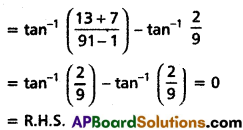
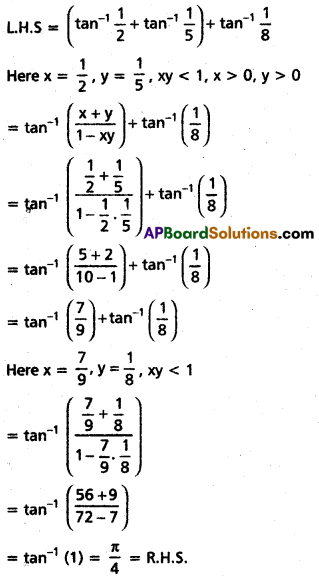
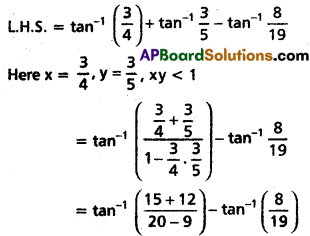
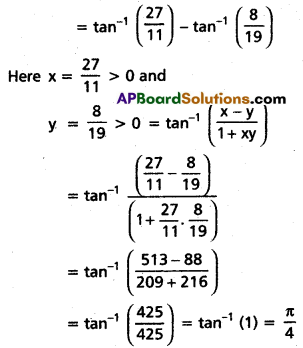
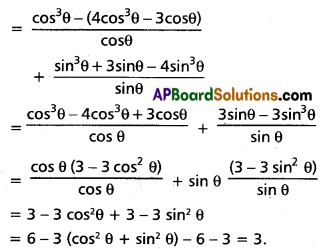
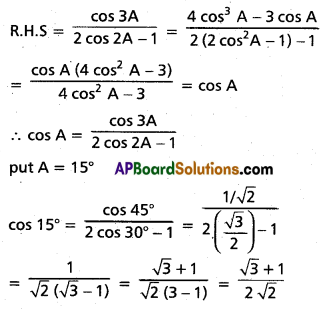
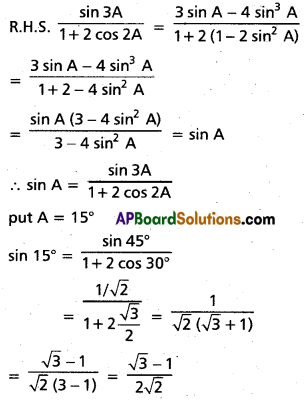
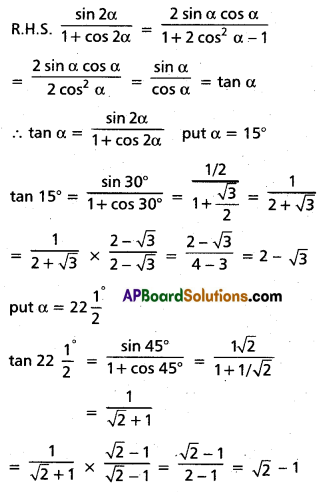
Inter 1st Year Maths 1A Properties of Triangles Solutions Ex 10(b)

Practicing the Intermediate 1st Year Maths 1A Textbook Solutions Inter 1st Year Maths 1A Properties of Triangles Solutions Exercise 10(b) will help students to clear their doubts quickly.

Intermediate 1st Year Maths 1A Properties of Triangles Solutions Exercise 10(b)

All problems in this exercise have reference to ΔABC.

I.

Question 1.
Express \(\Sigma r_{1} \cot \frac{A}{2}\) in terms of s.
Solution:
\(\Sigma r_{1} \cot \frac{A}{2}\) = \(\Sigma\left(s \tan \frac{A}{2}\right) \cot \frac{A}{2}\)
= Σs
= s + s + s
= 3s

Question 2.
Show that Σa cot A = 2(R + r).
Solution:
L.H.S = Σa . cot A
= Σ2R sin A \(\frac{\cos A}{\sin A}\)
= 2R Σ cos A
= \(2 R\left(1+4 \sin \frac{A}{2} \sin \frac{B}{2} \sin \frac{C}{2}\right)\) (From transformants)
= \(2\left(R+4 R \sin \frac{A}{2} \cdot \sin \frac{B}{2} \cdot \sin \frac{C}{2}\right)\)
= 2(R + r)
= R.H.S

Inter 1st Year Maths 1A Properties of Triangles Solutions Ex 10(b)

Question 3.
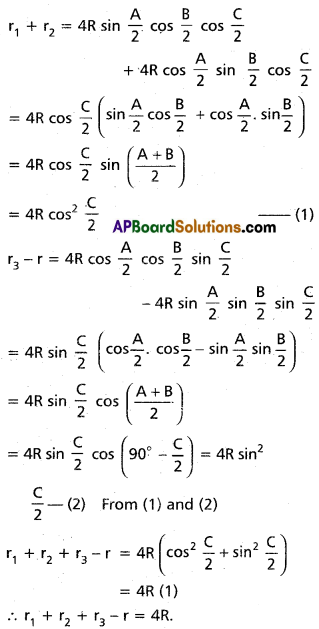
In ∆ABC, prove that r1 + r2 + r3 – r = 4R.
Solution:
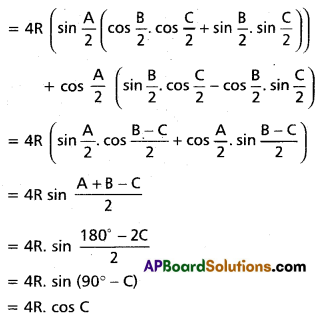
Inter 1st Year Maths 1A Properties of Triangles Solutions Ex 10(b) I Q3

Question 4.
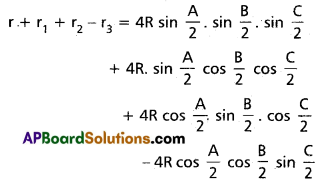
In ∆ABC, prove that r + r1 + r2 – r3 = 4R cos C.
Solution:
Inter 1st Year Maths 1A Properties of Triangles Solutions Ex 10(b) I Q4
Inter 1st Year Maths 1A Properties of Triangles Solutions Ex 10(b) I Q4.1

Question 5.
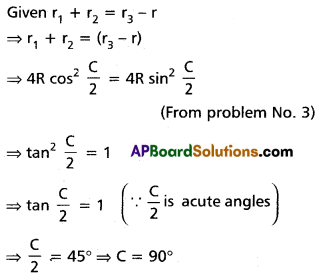
If r + r1 + r2 + r3 then show that C = 90°.
Solution:
Inter 1st Year Maths 1A Properties of Triangles Solutions Ex 10(b) I Q5

II.

Question 1.
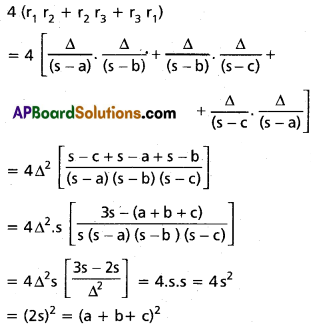
Prove that 4(r1r2 + r2r3 + r3r1) = (a + b + c)2
Solution:
Inter 1st Year Maths 1A Properties of Triangles Solutions Ex 10(b) II Q1

Question 2.
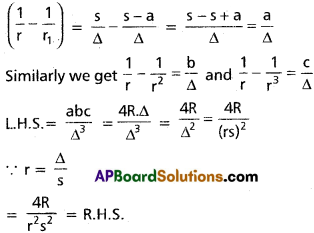
Prove that \(\left(\frac{1}{r}-\frac{1}{r_{1}}\right)\left(\frac{1}{r}-\frac{1}{r_{2}}\right)\left(\frac{1}{r}-\frac{1}{r_{3}}\right)=\frac{a b c}{\Delta^{3}}=\frac{4 R}{r^{2} s^{2}}\)
Solution:
Inter 1st Year Maths 1A Properties of Triangles Solutions Ex 10(b) II Q2

Question 3.
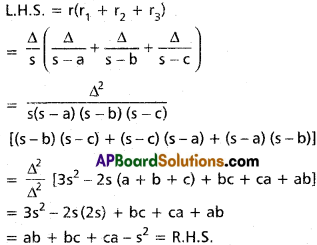
Prove that r(r1 + r2 + r3) = ab + bc + ca – s2.
Solution:
Inter 1st Year Maths 1A Properties of Triangles Solutions Ex 10(b) II Q3

Question 4.
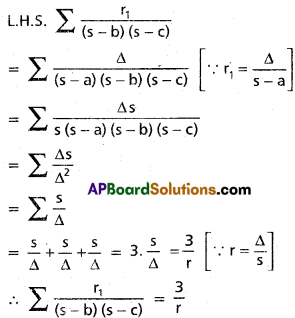
Show that \(\sum \frac{r_{1}}{(s-b)(s-c)}=\frac{3}{r}\)
Solution:
Inter 1st Year Maths 1A Properties of Triangles Solutions Ex 10(b) II Q4

Inter 1st Year Maths 1A Properties of Triangles Solutions Ex 10(b)

Question 5.
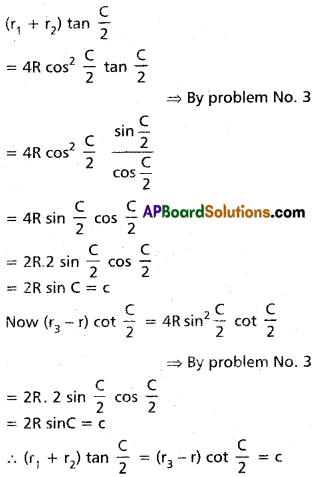
Show that \(\left(r_{1}+r_{2}\right) \tan \frac{C}{2}=\left(r_{3}-r\right) \cot \frac{C}{2}=c\)
Solution:
Inter 1st Year Maths 1A Properties of Triangles Solutions Ex 10(b) II Q5

Question 6.
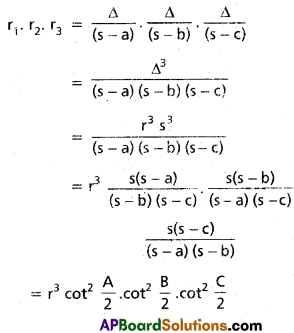
Show that r1r2r3 = \(r^{3} \cot ^{2} \frac{A}{2} \cdot \cot ^{2} \frac{B}{2} \cdot \cot ^{2} \frac{C}{2}\)
Solution:
Inter 1st Year Maths 1A Properties of Triangles Solutions Ex 10(b) II Q6

III.

Question 1.
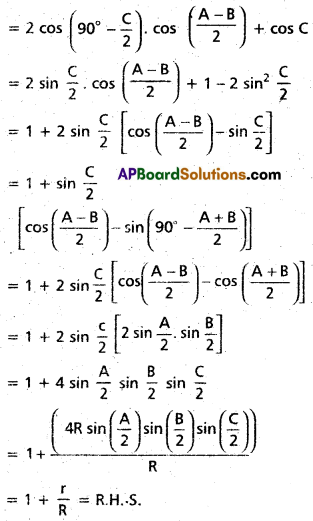
Show that cos A + cos B + cos C = 1 + \(\frac{r}{R}\)
Solution:
L.H.S = cos A + cos B + cos C
= 2 cos(\(\frac{A+B}{2}\)) cos(\(\frac{A-B}{2}\)) + cos C
Inter 1st Year Maths 1A Properties of Triangles Solutions Ex 10(b) III Q1

Question 2.
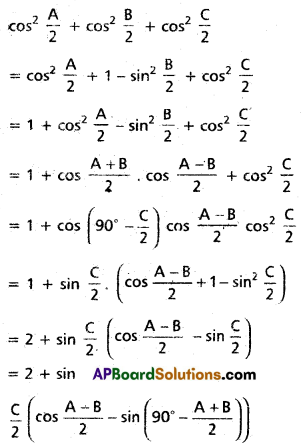
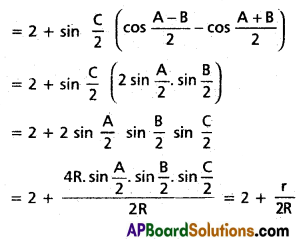
Show that \(\cos ^{2} \frac{A}{2}+\cos ^{2} \frac{B}{2}+\cos ^{2} \frac{C}{2}=2+\frac{r}{2 R}\)
Solution:
Inter 1st Year Maths 1A Properties of Triangles Solutions Ex 10(b) III Q2
Inter 1st Year Maths 1A Properties of Triangles Solutions Ex 10(b) III Q2.1

Question 3.
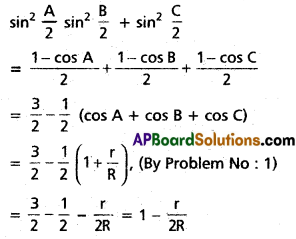
Show that \(\sin ^{2} \frac{A}{2}+\sin ^{2} \frac{B}{2}+\sin ^{2} \frac{C}{2}=1-\frac{r}{2 R}\)
Solution:
Inter 1st Year Maths 1A Properties of Triangles Solutions Ex 10(b) III Q3

Question 4.
Show that
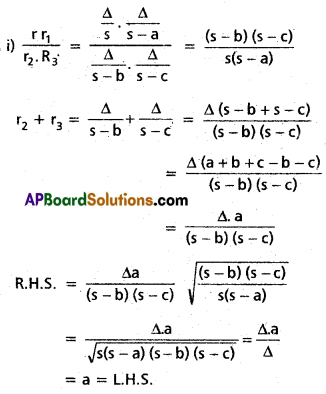
(i) a = (r2 + r3) \(\sqrt{\frac{r r_{1}}{r_{2} r_{3}}}\)
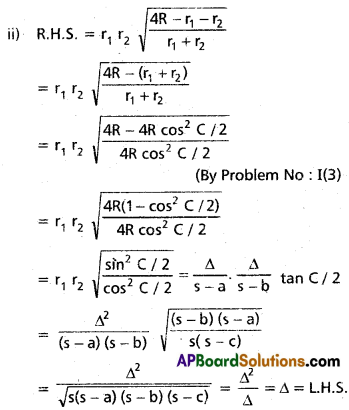
(ii) ∆ = r1r2 \(\sqrt{\frac{4 R-r_{1}-r_{2}}{r_{1}+r_{2}}}\)
Solution:
Inter 1st Year Maths 1A Properties of Triangles Solutions Ex 10(b) III Q4
Inter 1st Year Maths 1A Properties of Triangles Solutions Ex 10(b) III Q4.1

Inter 1st Year Maths 1A Properties of Triangles Solutions Ex 10(b)

Question 5.
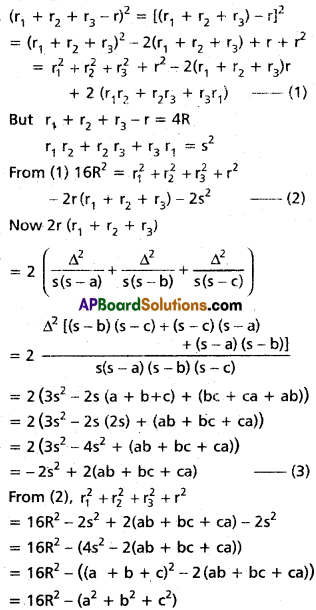
Prove that \(r_{1}^{2}+r_{2}^{2}+r_{3}^{2}+r^{2}\) = 16R2 – (a2 + b2 + c2).
Solution:
Inter 1st Year Maths 1A Properties of Triangles Solutions Ex 10(b) III Q5

Question 6.
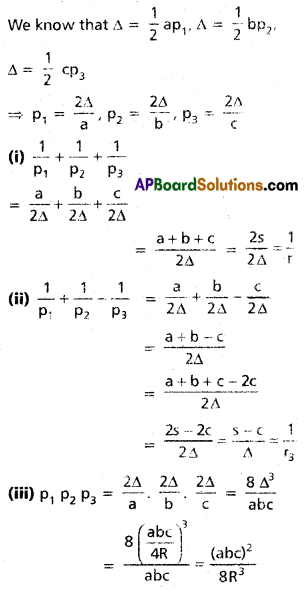
If p1, p2, p3 are altitudes drawn from vertices A, B, C to the opposite sides of a triangle respectively, then show that
(i) \(\frac{1}{p_{1}}+\frac{1}{p_{2}}+\frac{1}{p_{3}}=\frac{1}{r}\)
(ii) \(\frac{1}{p_{1}}+\frac{1}{p_{2}}-\frac{1}{p_{3}}=\frac{1}{r_{3}}\)
(iii) p1 . p2 . p3 = \(\frac{(a b c)^{2}}{8 R^{3}}=\frac{8 \Delta^{3}}{a b c}\)
Solution:
Inter 1st Year Maths 1A Properties of Triangles Solutions Ex 10(b) III Q6

Question 7.
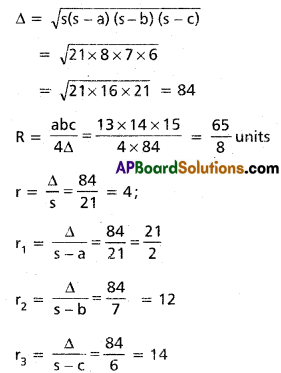
If a = 13, b = 14, c = 15, show that R = \(\frac{65}{8}\), r = 4, r1 = \(\frac{21}{2}\), r2 = 12 and r3 = 14.
Solution:
a = 13, b = 14, c = 15
s = \(\frac{a+b+c}{2}\)
= \(\frac{13+14+15}{2}\)
= 21
s – a = 21 – 13 = 8
s – b = 21 – 14 = 7
s – c = 21 – 15 = 6
Inter 1st Year Maths 1A Properties of Triangles Solutions Ex 10(b) III Q7

Inter 1st Year Maths 1A Properties of Triangles Solutions Ex 10(b)

Question 8.
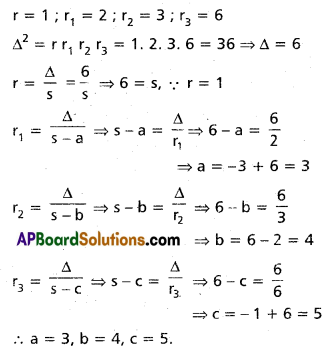
If r1 = 2, r2 = 3, r3 = 6 and r = 1, prove that a = 3, b = 4 and c = 5.
Solution:
Inter 1st Year Maths 1A Properties of Triangles Solutions Ex 10(b) III Q8

Inter 1st Year Maths 1A Properties of Triangles Solutions Ex 10(a)

Practicing the Intermediate 1st Year Maths 1A Textbook Solutions Inter 1st Year Maths 1A Properties of Triangles Solutions Exercise 10(a) will help students to clear their doubts quickly.

Intermediate 1st Year Maths 1A Properties of Triangles Solutions Exercise 10(a)

All problems in this exercise refer to ΔABC

I.

Question 1.
Show that Σa(sin B – sin C) = 0
Solution:
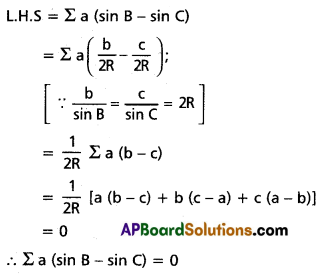
Inter 1st Year Maths 1A Properties of Triangles Solutions Ex 10(a) I Q1

Question 2.
If a = √3 + 1 cms, ∠B = 30°, ∠C = 45°, then find c.
Solution:
∠B = 30°, ∠C = 45° and a = (√3 + 1) cms
A = 180° – (B + C)
= 180° – (30° + 45°)
= 180° – 75°
= 105°
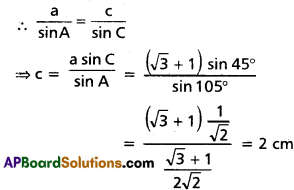
Inter 1st Year Maths 1A Properties of Triangles Solutions Ex 10(a) I Q2

Question 3.
If a = 2 cms, b = 3 cms, c = 4 cms, then find cos A.
Solution:
a = 2 cms, b = 3 cms and c = 4 cms
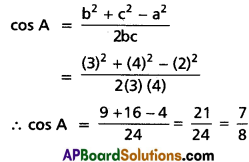
Inter 1st Year Maths 1A Properties of Triangles Solutions Ex 10(a) I Q3

Question 4.
If a = 26 cms, b = 30 cms and cos C = \(\frac{63}{65}\), then find c.
Solution:
a = 26 cms, b = 30 cms and cos C = \(\frac{63}{65}\)
c2 = a2 + b2 – 2ab cos C
⇒ c2 = 676 + 900 – 2 × 26 × 30 × \(\frac{63}{65}\)
⇒ c2 = 1576 – 1512
⇒ c2 = 64
⇒ c = 8

Inter 1st Year Maths 1A Properties of Triangles Solutions Ex 10(a)

Question 5.
If the angles are in the ratio 1 : 5 : 6, then find the ratio of its sides.
Solution:
Given \(\frac{A}{1}=\frac{B}{5}=\frac{C}{6}\), B = 5A, C = 6A
A + B + C = 180°
⇒ A + 5A + 6A = 180°
⇒ 12A = 180°
⇒ A = 15°
∴ B = 5A = 75°
∴ C = 6A = 90°
a : b : c = sin A : sin B : sin C
= sin 15° : sin 75° : sin 90°
= \(\frac{\sqrt{3}-1}{2 \sqrt{2}}: \frac{\sqrt{3}+1}{2 \sqrt{2}}: 1\)
= (√3 – 1) : (√3 + 1) : 2√2

Question 6.
Prove that 2(bc cos A + ca cos B + ab cos C) = a2 + b2 + c2.
Solution:
L.H.S = Σ2bc cos A
= Σ2bc \(\frac{\left(b^{2}+c^{2}-a^{2}\right)}{2 b c}\)
= Σ(b2 + c2 – a2)
= b2 + c2 – a2 + c2 + a2 – b2 + a2 + b2 – c2
= a2 + b2 + c2
= R.H.S

Question 7.
Prove that \(\frac{a^{2}+b^{2}-c^{2}}{c^{2}+a^{2}-b^{2}}=\frac{\tan B}{\tan C}\)
Solution:
L.H.S = \(\frac{a^{2}+b^{2}-c^{2}}{c^{2}+a^{2}-b^{2}}=\frac{\tan B}{\tan C}\)
[∵ c2 = a2 + b2 – 2ab cos C and b2 = a2 + c2 – 2ac cos B]
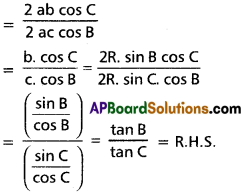
Inter 1st Year Maths 1A Properties of Triangles Solutions Ex 10(a) I Q7

Question 8.
Prove that (b + c) cos A + (c + a) cos B + (a + b) cos C = a + b + c
Solution:
L.H.S = (b + c) cos A + (c + a) cos B + (a + b) cos C
= (b cos A + c cos A) + (c cos B + a cos B) + (a cos C + b cos C)
= (b cos C + c cos B) + (a cos C + c cos A) + (a cos B + b cos A)
= a + b + c
= R.H.S

Question 9.
Prove that (b – a cos C) sin A = a cos A sin C
Solution:
LHS = (b – a cos C) sin A
= (a cos C + c cos A – a cos C) sin A
= c cos A sin A [∵ b = a cos C + c cos A]
= (2R sin C) cos A sin A
= a cos A sin C (∵ 2R sin A = a)

Question 10.
If 4, 5 are two sides of a triangle and the included angle is 60°, find its area.
Solution:
Let a = 4, b = 5 are two sides and included angle is C = 60° then
Area of ∆ = \(\frac{1}{2}\) ab sin C
= \(\frac{1}{2}\) × 4 × 5 × sin 60°
= 2 × 5 × \(\frac{\sqrt{3}}{2}\)
= 5√3 sq.cm

Inter 1st Year Maths 1A Properties of Triangles Solutions Ex 10(a)

Question 11.
Show that \(b \cos ^{2} \frac{C}{2}+c \cos ^{2} \frac{B}{2}=s\)
Solution:
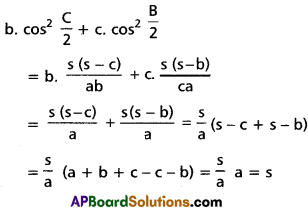
Inter 1st Year Maths 1A Properties of Triangles Solutions Ex 10(a) I Q11

Question 12.
If \(\frac{a}{\cos A}=\frac{b}{\cos B}=\frac{c}{\cos C}\), then show that ∆ABC is equilateral.
Solution:
Given that \(\frac{a}{\cos A}=\frac{b}{\cos B}=\frac{c}{\cos C}\)
⇒ \(\frac{2 R \sin A}{\cos A}=\frac{2 R \sin B}{\cos B}=\frac{2 R \sin C}{\cos C}\)
⇒ \(\frac{\sin A}{\cos A}=\frac{\sin B}{\cos B}=\frac{\sin C}{\cos C}\)
⇒ tan A = tan B = tan C
⇒ A = B = C
⇒ ∆ABC is an equilateral triangle.

II.

Question 1.
Prove that a cos A + b cos B + c cos C = 4R sin A sin B sin C.
Solution:
L.H.S = (2R sin A) cos A + (2R sin B) cos B + (2R sin C) cos C
= R (sin 2A + sin 2B + sin 2C)
= R (2 sin (A + B) cos (A – B) + sin 2C)
= R [2 sin (180° – C) cos (A – B) + sin 2C]
= R (2 sin C . cos (A – B) + 2 sin C . cos C)
= 2R sin C (cos (A – B)) + cos C)
= 2R sin C (cos (A – B) + cos (180° – \(\overline{\mathrm{A}+\mathrm{B}}\))
= 2R sin C [cos (A – B) – cos (A + B)]
= 2R sin C (2 sin A sin B)
= 4R sin A sin B sin C
= R.H.S.

Question 2.
Prove that Σa3 sin(B – C) = 0.
Solution:
L.H.S = Σa2 [a sin (B – C)]
= Σa2 [2R . sin A sin (B – C)]
= R Σ a2 (2 sin (180° – \(\overline{\mathrm{B}+\mathrm{C}}\)) sin (B – C))
= R Σ a2 [2 sin (B + C) . sin (B – C)]
= R Σ a2 (sin2 B – sin2 C)
= R Σ a2 \(\left(\frac{b^{2}}{4 R^{2}}-\frac{c^{2}}{4 R^{2}}\right)\)
= \(\frac{1}{2 R}\) Σ[a2 (b2 – c2)]
= \(\frac{1}{2 R}\) a2 (b2 – c2) + b2 (c2 – a2) + c2 (a2 – b2)]
= \(\frac{1}{2 R}\) (a2b2 – a2c2 + b2c2 – a2b2 + a2c2 – b2c2)
= \(\frac{1}{2 R}\) × 0
= 0
= R.H.S

Inter 1st Year Maths 1A Properties of Triangles Solutions Ex 10(a)

Question 3.
Prove that \(\frac{a \sin (B-C)}{b^{2}-c^{2}}=\frac{b \sin (C-A)}{c^{2}-a^{2}}=\frac{c \sin (A-B)}{a^{2}-b^{2}}\)
Solution:
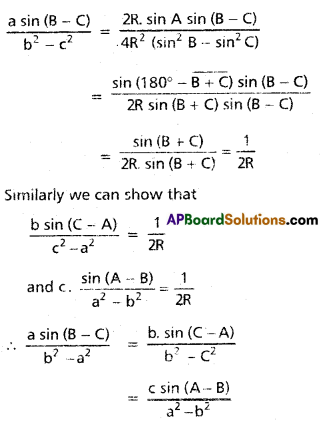
Inter 1st Year Maths 1A Properties of Triangles Solutions Ex 10(a) II Q3

Question 4.
Prove that \(\sum a^{2} \frac{a^{2} \sin (B-C)}{\sin B+\sin C}=0\)
Solution:
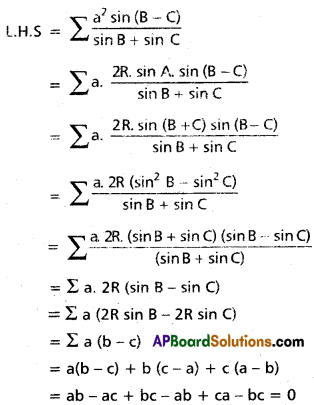
Inter 1st Year Maths 1A Properties of Triangles Solutions Ex 10(a) II Q4

Question 5.
Prove that \(\frac{a}{b c}+\frac{\cos A}{a}=\frac{b}{c a}+\frac{\cos B}{b}=\frac{c}{a b}+\frac{\cos C}{c}\)
Solution:
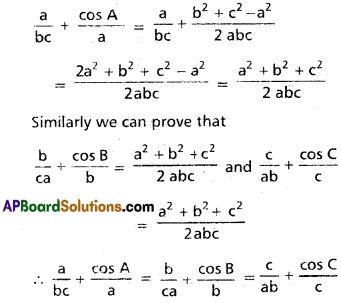
Inter 1st Year Maths 1A Properties of Triangles Solutions Ex 10(a) II Q5

Question 6.
Prove that \(\frac{1+\cos (A-B) \cos C}{1+\cos (A-C) \cos B}=\frac{a^{2}+b^{2}}{a^{2}+c^{2}}\)
Solution:
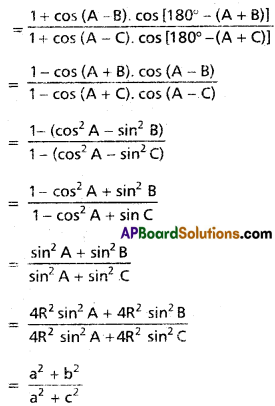
Inter 1st Year Maths 1A Properties of Triangles Solutions Ex 10(a) II Q6

Question 7.
If C = 60°, then show that
(i) \(\frac{\mathbf{a}}{\mathbf{b}+\mathbf{c}}+\frac{\mathbf{b}}{\mathbf{c}+\mathbf{a}}=1\)
(ii) \(\frac{b}{c^{2}-a^{2}}+\frac{a}{c^{2}-b^{2}}=0\)
Solution:
∠C = 60°
⇒ c2 = a2 + b2 – 2ab cos C
⇒ c2 = a2 + b2 – 2ab cos 60°
⇒ c2 = a2 + b2 – 2ab (\(\frac{1}{2}\))
⇒ c2 = a2 + b2 – ab
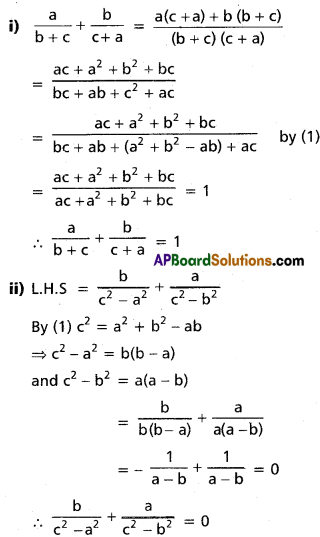
Inter 1st Year Maths 1A Properties of Triangles Solutions Ex 10(a) II Q7

Question 8.
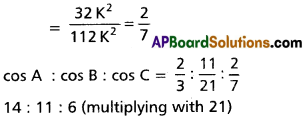
If a : b : c = 7 : 8 : 9, find cos A : cos B : cos C.
Solution:
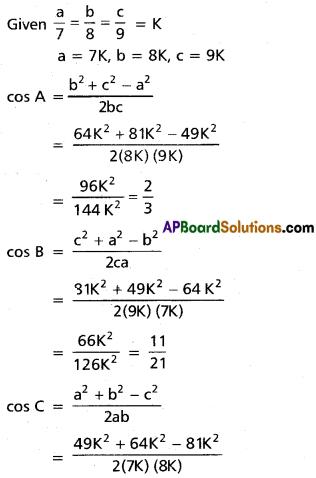
Inter 1st Year Maths 1A Properties of Triangles Solutions Ex 10(a) II Q8
Inter 1st Year Maths 1A Properties of Triangles Solutions Ex 10(a) II Q8.1

Question 9.
Show that \(\frac{\cos A}{a}+\frac{\cos B}{b}+\frac{\cos C}{c}=\frac{a^{2}+b^{2}+c^{2}}{2 a b c}\)
Solution:
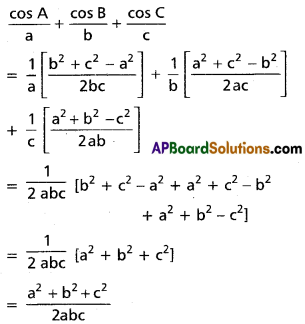
Inter 1st Year Maths 1A Properties of Triangles Solutions Ex 10(a) II Q9

Question 10.
Prove that (b – a) cos C + c (cos B – cos A) = c . sin(\(\frac{A-B}{2}\)) cosec(\(\frac{A+B}{2}\))
Solution:
L.H.S = b cos C – a cos C + c cos B – c cos A
= (b cos C + c cos B) – (a cos C + c cos A)
= a – b
= 2R (sin A – sin B)
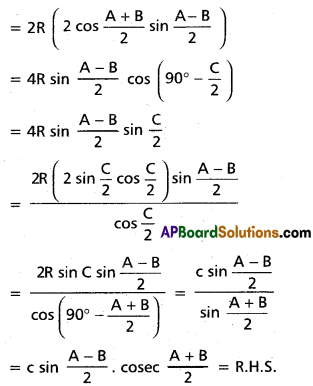
Inter 1st Year Maths 1A Properties of Triangles Solutions Ex 10(a) II Q10

Question 11.
Express \(a \sin ^{2} \frac{C}{2}+c \cdot \sin ^{2} \frac{A}{2}\) interms of s, a, b, c.
Solution:
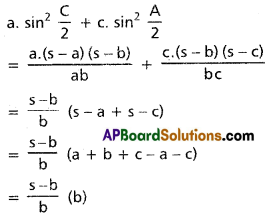
Inter 1st Year Maths 1A Properties of Triangles Solutions Ex 10(a) II Q11

Question 12.
If b + c = 3a, then rind the value of \(\cot \frac{\mathrm{B}}{2} \cot \frac{\mathrm{C}}{2}\)
Solution:
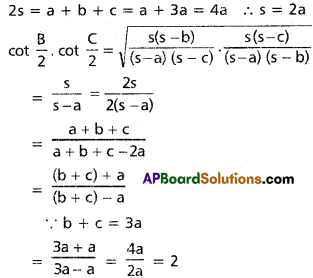
Inter 1st Year Maths 1A Properties of Triangles Solutions Ex 10(a) II Q12

Question 13.
Prove that (b + c) cos (\(\frac{B+C}{2}\)) = a cos (\(\frac{B-C}{2}\))
Solution:
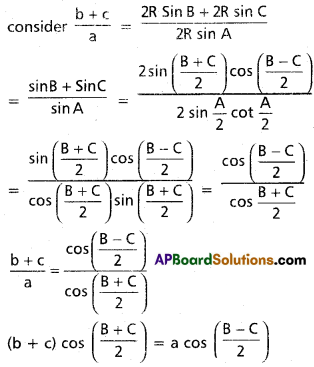
Inter 1st Year Maths 1A Properties of Triangles Solutions Ex 10(a) II Q13

Inter 1st Year Maths 1A Properties of Triangles Solutions Ex 10(a)

Question 14.
In ΔABC, show that \(\frac{b^{2}-c^{2}}{a^{2}}=\sin \frac{(B-C)}{(B+C)}\)
Solution:
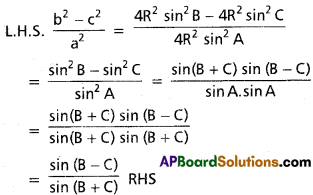
Inter 1st Year Maths 1A Properties of Triangles Solutions Ex 10(a) II Q14

III.

Question 1.
Prove that
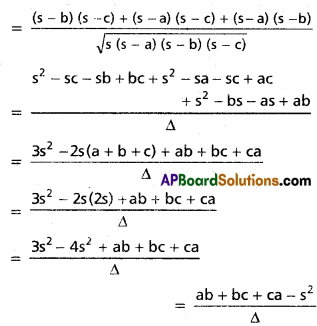
(i) \(\cot \frac{A}{2}+\cot \frac{B}{2}+\cot \frac{C}{2}=\frac{s^{2}}{\Delta}\)
(ii) \(\tan \frac{A}{2}+\tan \frac{B}{2}+\tan \frac{C}{2}\) = \(\frac{b c+c a+a b-s^{2}}{\Delta}\)
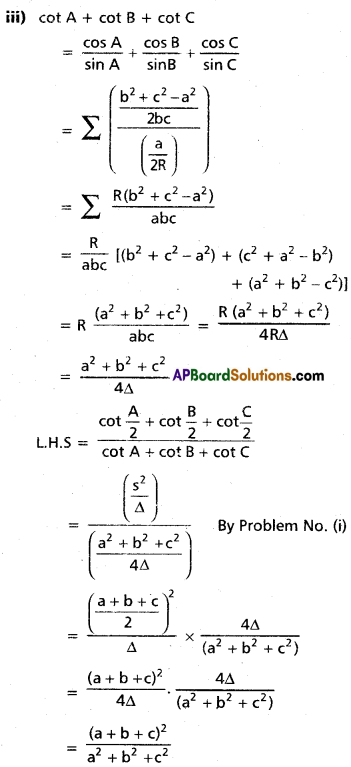
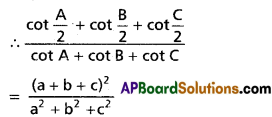
(iii) \(\frac{\cot \frac{A}{2}+\cot \frac{B}{2}+\cot \frac{C}{2}}{\cot A+\cot B+\cot C}\) = \(\frac{(a+b+c)^{2}}{a^{2}+b^{2}+c^{2}}\)
Solution:
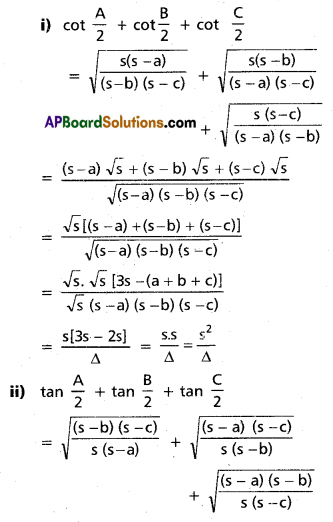
Inter 1st Year Maths 1A Properties of Triangles Solutions Ex 10(a) III Q1
Inter 1st Year Maths 1A Properties of Triangles Solutions Ex 10(a) III Q1.1
Inter 1st Year Maths 1A Properties of Triangles Solutions Ex 10(a) III Q1.2
Inter 1st Year Maths 1A Properties of Triangles Solutions Ex 10(a) III Q1.3

Question 2.
Show that
(i) Σ(a + b) tan(\(\frac{A-B}{2}\)) = 0
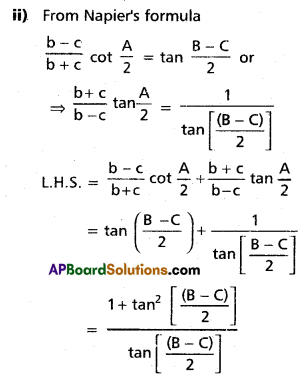
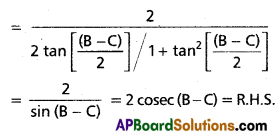
(ii) \(\frac{\mathbf{b}-\boldsymbol{c}}{\mathbf{b}+\mathbf{c}} \cot \frac{A}{2}+\frac{b+c}{b-c} \tan \frac{A}{2}\) = 2 cosec(B – C)
Solution:
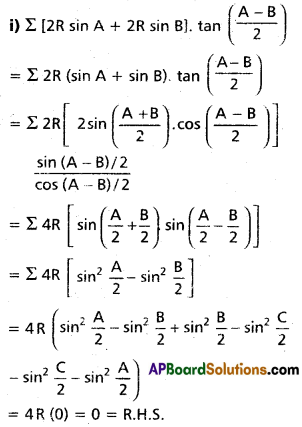
Inter 1st Year Maths 1A Properties of Triangles Solutions Ex 10(a) III Q2
Inter 1st Year Maths 1A Properties of Triangles Solutions Ex 10(a) III Q2.1
Inter 1st Year Maths 1A Properties of Triangles Solutions Ex 10(a) III Q2.2

Question 3.
(i) If sin θ = \(\frac{a}{b+c}\), then show that cos θ = \(\frac{2 \sqrt{b c}}{b+c} \cdot \cos \frac{A}{2}\)
Solution:
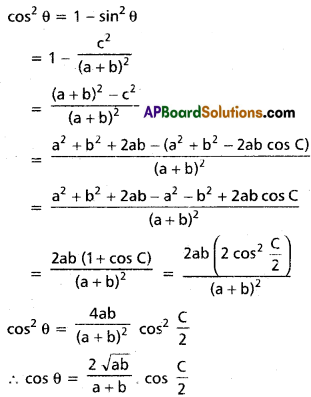
Inter 1st Year Maths 1A Properties of Triangles Solutions Ex 10(a) III Q3(i)

(ii) If a = (b + c) cos θ, then prove that sin θ = \(\frac{2 \sqrt{b c}}{b+c} \cos \left(\frac{A}{2}\right)\)
Solution:
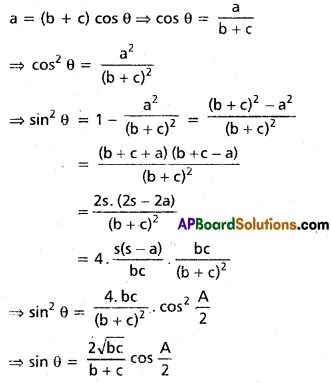
Inter 1st Year Maths 1A Properties of Triangles Solutions Ex 10(a) III Q3(ii)

(iii) For any anlge θ show that a cos θ = b cos (C + θ) + c cos (B – θ).
Solution:
b cos (C + θ) + c cos (B – θ)
= b (cos C . cos θ – sin C sin θ) + c (cos B cos θ + sin B sin θ)
= (b cos C + c cos B) cos θ + (-b sin C + C sin B) sin θ
= a cos θ + (-2R sin B sin C + 2R sin B sin C) sin θ
= a cos θ

Inter 1st Year Maths 1A Properties of Triangles Solutions Ex 10(a)

Question 4.
If the angles of ∆ABC are in A.P and b : c = √3 : √2 , then show that A = 75°.
Solution:
∵ The angles A, B, C of a triangle are in A.P.
⇒ 2B = A + C
⇒ 3B = A + B + C
⇒ 3B = 180°
⇒ B = 60°
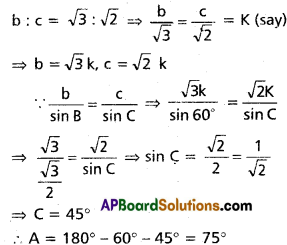
Inter 1st Year Maths 1A Properties of Triangles Solutions Ex 10(a) III Q4

Question 5.
If \(\frac{a^{2}+b^{2}}{a^{2}-b^{2}}=\frac{\sin C}{\sin (A-B)}\), prove that ∆ABC is either isosceles or right-angled.
Solution:
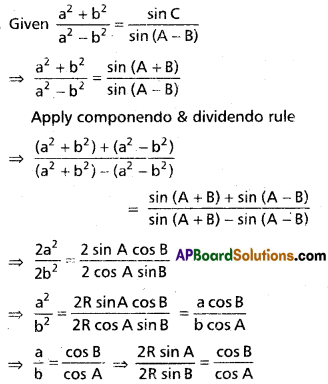
Inter 1st Year Maths 1A Properties of Triangles Solutions Ex 10(a) III Q5
⇒ sin 2A = sin 2B
⇒ A = B
⇒ ∆ABC is isosceles
or 2A = 180° – 2B
or A = 90° – B
or A + B = 90°
so A ≠ B ⇒ ∆ABC is a right-angled triangle
∴ ∆ABC is either isosceles (or) right-angled.

Question 6.
If cos A + cos B + cos C = \(\frac{3}{2}\), then show that the triangle is equilateral.
Solution:
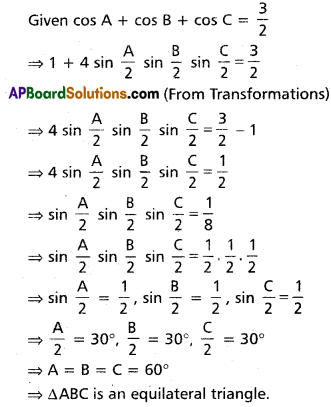
Inter 1st Year Maths 1A Properties of Triangles Solutions Ex 10(a) III Q6

Question 7.
If cos2 A + cos2 B + cos2 C = 1, then show that ∆ABC is right-angled.
Solution:
Given cos2 A + cos2 B + cos2 C = 1 …….(1)
Now cos2 A + cos2 B + cos2 C
= cos2 A + 1 – sin2 B + cos2 C
= 1 + (cos2 A – sin2 B) + cos2 C
= 1 + cos (A + B) cos (A – B) + cos2 C
= 1 + cos (180° – C) cos (A – B) + cos2 C
= 1 – cos C . cos (A – B) + cos2 C
= 1 – cos C (cos (A – B) – cos C)
= 1 – cos C (cos (A – B) – cos (180° – \(\overline{A+B}\)))
= 1 – cos C (cos (A – B) + cos (A + B))
= 1 – cos C (2 cos A cos B)
= 1 – 2 cos A cos B cos C
Substituting in (1) we get
1 – 2 cos A cos B cos C = 1
∴ 2 cos A cos B cos C = 0
∴ cos A = 0 or cos B = 0 or cos C = 0
i.e., A = 90° or B = 90° or C = 90°
∴ ∆ABC is right-angled.

Question 8.
If a2 + b2 + c2 = 8R2, then prove that the triangle is right angled.
Solution:
Given a2 + b2 + c2 = 8R2
⇒ 4R2 (sin2 A + sin2 B + sin2 C) = 8R2
⇒ sin2 A + sin2 B + sin2 C = 2 ……(1)
Now sin2 A + sin2 B + sin2 C
= 1 – cos2 A + sin2 B + sin2 C
= 1 – (cos2 A – sin2 B) + sin2 C
= 1 – cos (A + B) . cos (A – B) + sin2 C
= 1 – cos (180° – C) cos (A – B) + sin2 C
= 1 + cos C cos (A – B) + 1 – cos2 C
= 2 + cos C (cos (A – B) – cos C)
= 2 + cos C (cos (A – B) – cos (180° – \(\overline{A+B}\)))
= 2 + cos C (cos (A – B) + cos (A + B))
= 2 + cos C (2 cos A cos B)
= 2 + 2 cos A cos B cos C
Substituting in (1), we get
2 + 2 cos A cos B cos C = 2
2 cos A cos B cos C = 0
⇒ cos A = 0 or cos B = 0 or cos C = 0
∴ A = 90° or B = 90° or C = 90°
∴ ΔABC is right-angled.

Inter 1st Year Maths 1A Properties of Triangles Solutions Ex 10(a)

Question 9.
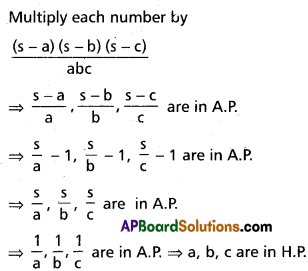
If cot \(\frac{A}{2}\), cot \(\frac{B}{2}\), cot \(\frac{C}{2}\) are in A.P., then prove that a, b, c are in A.P.
Solution:
∵ cot \(\frac{A}{2}\), cot \(\frac{B}{2}\), cot \(\frac{C}{2}\) are in A.P
⇒ \(\frac{(s)(s-a)}{\Delta}, \frac{(s)(s-b)}{\Delta}, \frac{(s)(s-c)}{\Delta}\) are in A.P.
⇒ s – a, s – b, s – c are in A.P
⇒ -a, -b, -c are in A.P
⇒ a, b, c are in A.P

Question 10.
If \(\sin ^{2} \frac{A}{2}, \sin ^{2} \frac{B}{2}, \sin ^{2} \frac{C}{2}\) are in H.P., show that a, b, c are in H.P.
Solution:
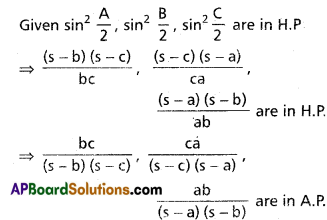
Inter 1st Year Maths 1A Properties of Triangles Solutions Ex 10(a) III Q10
Inter 1st Year Maths 1A Properties of Triangles Solutions Ex 10(a) III Q10.1

Question 11.
If C = 90° then prove that \(\frac{a^{2}+b^{2}}{a^{2}-b^{2}}\) sin (A – B) = 1
Solution:
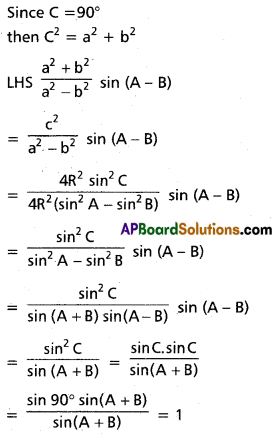
Inter 1st Year Maths 1A Properties of Triangles Solutions Ex 10(a) III Q11

Question 12.
Show that \(\frac{a^{2}}{4} \sin 2 C+\frac{c^{2}}{4} \sin 2 A\) = ∆
Solution:
LHS = \(\frac{a^{2}}{4} \sin 2 C+\frac{c^{2}}{4} \sin 2 A\)
= \(\frac{4 R^{2} \sin ^{2} A}{4}\) 2 sin C cos C + \(\frac{4 R^{2} \sin ^{2} C}{4}\) 2 sin A cos A
= 2R2 sin2A sin C cos C + 2R2 sin2C sin A cos A
= 2R2 sin A sin C (sin A cos C + cos A sin C)
= 2R2 sin A sin C sin(A + C)
= 2R2 sin A sin C sin(180 – B)
= 2R2 sin A sin B sin C
= ∆
= RHS

Question 13.
A lamp post is situated at the middle point I the side AC of a triangular plot A with BC = 7 meters, CA = 8 meters, and AB = 9 meters, lamp post subtends an angle of 15° at point B. find H height of the lamp post.
Solution:
Let MP be the height of the lamp post
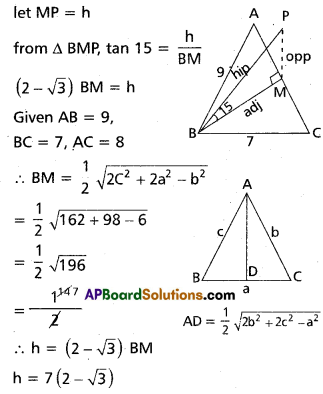
Inter 1st Year Maths 1A Properties of Triangles Solutions Ex 10(a) III Q13

Question 14.
Two ships leave a port at the same time. One goes 24 km. per hour in the direction N45°E and other travels 32 km per hour in the direction S75°E. Find the distance between the ships at the end of 3 hours.
Solution:
Given the first ship goes 24 km per hour After 3 hours the first ship goes 72 km.
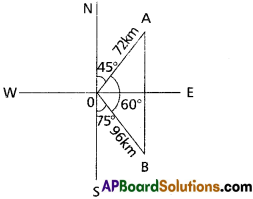
Inter 1st Year Maths 1A Properties of Triangles Solutions Ex 10(a) III Q14
Given the second ship goes 32 km per hour After 3 hours, the second ship goes 96 km.
Let AB = x
∠AOB = 180° – (75 + 45) = 60°
Apply cosine rule for ∆AOB,
cos 60° = \(\frac{(72)^{2}+(96)^{2}-x^{2}}{2(72)(96)}\)
⇒ \(\frac{1}{2}=\frac{5184+9216-x^{2}}{13824}\)
⇒ 13824 = 28800 – 2x2
⇒ 2x2 = 14976
⇒ x2 = 7488
⇒ x = 86.4 (Appx)
At the end of 3 hours the difference between ships was 86.4 km.

Inter 1st Year Maths 1A Properties of Triangles Solutions Ex 10(a)

Question 15.
A tree stands vertically on the slant of the hill. From A point on the ground 35 meters down the hill from the base of the tree, the angle, the elevation of the top of the tree is 60° if the angle of elevation of the foot of the tree from A is 15°, then find the height of the tree.
Solution:
Let BC be the height of the tree
BC = h
Let BD = x, AD = y
Given AB = 35 m
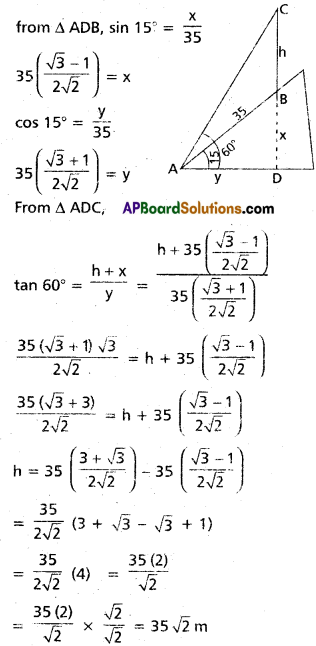
Inter 1st Year Maths 1A Properties of Triangles Solutions Ex 10(a) III Q15

Question 16.
The upper \(\frac{3}{4}\)th portion of a vertical pole subtends an angle tan-1(\(\frac{3}{5}\)) at a point in the horizontal plane through its foot and at a distance 40 m from the foot. Given that the vertical pole is at a height less than 100 m from the ground, find its height.
Solution:
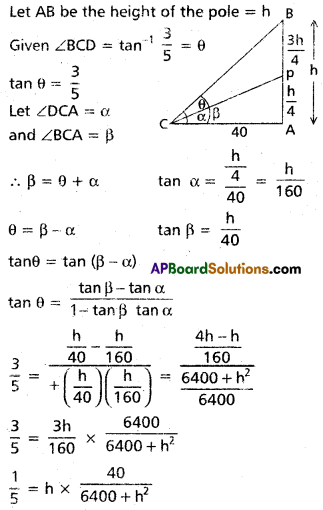
Inter 1st Year Maths 1A Properties of Triangles Solutions Ex 10(a) III Q16
⇒ 6400 + h2 = 200h
⇒ h2 – 200h + 6400 = 0
⇒ h2 – 160h – 40h + 6400 = 0
⇒ h(h – 160) – 40(h – 160) = 0
⇒ (h – 160) (h – 40) = 0
⇒ h = 40 or 160
but the height of the pole should be less than 100m
∴ h = 40 m

Question 17.
AB is a vertical pole with B at the ground level and A at the top. A man finds that the angle of elevation of point A from a certain point C on the ground is 60°. He moves away from the pole along the line BC to a point D such that CD = 7 m. From D, the angle of elevation of point A is 45°. Find the height of the pole.
Solution:
Let ‘h’ be the height of the pole
AB = h
given CD = 7 m
∠ACB = 60°, ∠ADB = 45°, Let BC = x
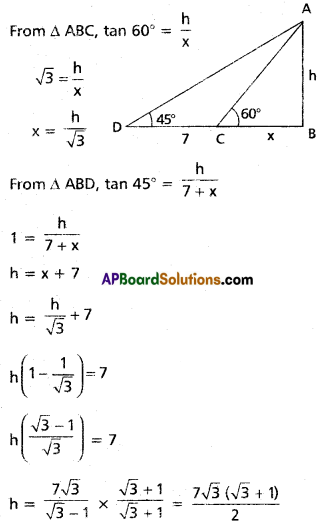
Inter 1st Year Maths 1A Properties of Triangles Solutions Ex 10(a) III Q17

Inter 1st Year Maths 1A Properties of Triangles Solutions Ex 10(a)

Question 18.
Let an object be placed at some height h cm and let P and Q two points of observation which are at a distance of 10 cm apart on a line inclined at an angle of 15° to the horizontal. If the angles of elevation of the object from P and Q are 30° and 60° respectively then find h.
Solution:
Let AB = Height of the object from ‘A’ = h m
Given that P & Q are two observations,
PQ = 10 cms
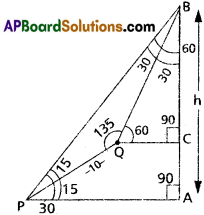
Inter 1st Year Maths 1A Properties of Triangles Solutions Ex 10(a) III Q18
From ∆APB,
∠P = 30; ∠A = 90; ∠B = ?
A + P + B = 180°
⇒ 30° + 30° + B = 180°
⇒ B = 180° – 120°
⇒ B = 60°
From ∆BQC,
∠Q = 60°; ∠C = 90°; ∠B = ?
Q + C + B = 180°
⇒ 60° + 90° + B = 180°
⇒ B = 180° – 150°
⇒ B = 30°
From ∆BQP,
∠P = 15; ∠B = 30; ∠Q = ?
P + B + Q = 180°
⇒ 15° + 30° + Q = 180°
⇒ Q = 180° – 45°
⇒ Q = 135°
Applying the ‘sin’ rule for ∆BQP
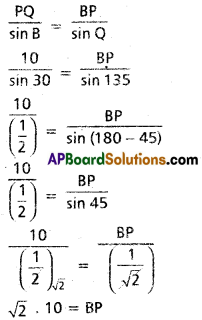
Inter 1st Year Maths 1A Properties of Triangles Solutions Ex 10(a) III Q18.1
From ∆PAB,
sin 30° = \(\frac{B A}{B P}\)
BP . sin 30° = AB = h
√2 × 10 × \(\frac{1}{2}\) = AB = h
5√2 = AB = h
∴ h = 5√2

Inter 1st Year Maths 1A Hyperbolic Functions Solutions Ex 9(a)

Practicing the Intermediate 1st Year Maths 1A Textbook Solutions Inter 1st Year Maths 1A Hyperbolic Functions Solutions Exercise 9(a) will help students to clear their doubts quickly.

Intermediate 1st Year Maths 1A Hyperbolic Functions Solutions Exercise 9(a)

Question 1.
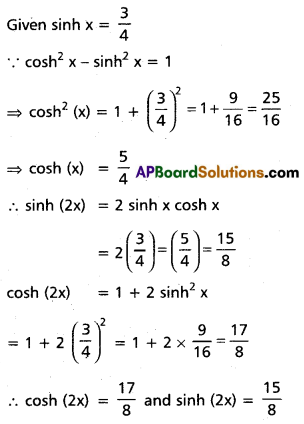
If sinh x = \(\frac{3}{4}\), find cosh (2x) and sinh (2x).
Solution:
Inter 1st Year Maths 1A Hyperbolic Functions Solutions Ex 9(a) Q1

Question 2.
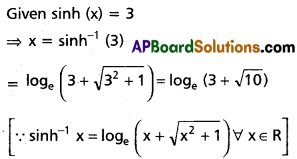
If sinh x = 3, then show that x = loge(3 + √10).
Solution:
Inter 1st Year Maths 1A Hyperbolic Functions Solutions Ex 9(a) Q2

Inter 1st Year Maths 1A Hyperbolic Functions Solutions Ex 9(a)

Question 3.
Prove that
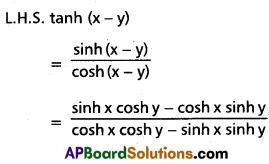
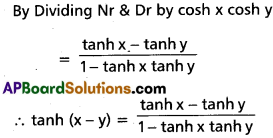
(i) tanh (x – y) = \(\frac{\tanh x-\tanh y}{1-\tanh x \tanh y}\)
Solution:
Inter 1st Year Maths 1A Hyperbolic Functions Solutions Ex 9(a) Q3(i)
Inter 1st Year Maths 1A Hyperbolic Functions Solutions Ex 9(a) Q3(i).1

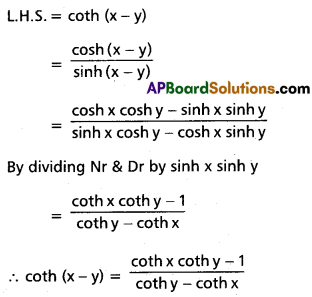
(ii) coth (x – y) = \(\frac{{coth} x \cdot {coth} y-1}{{coth} y-{coth} x}\)
Solution:
Inter 1st Year Maths 1A Hyperbolic Functions Solutions Ex 9(a) Q3(ii)

Question 4.
Prove that
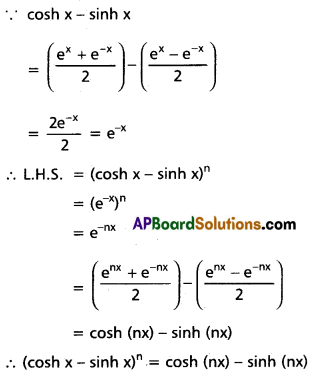
(i) (cosh x – sinh x)n = cosh (nx) – sinh (nx), for any n ∈ R.
Solution:
Inter 1st Year Maths 1A Hyperbolic Functions Solutions Ex 9(a) Q4(i)

(ii) (cosh x + sinh x)n = cosh (nx) + sinh (nx), for any n ∈ R.
Solution:
Inter 1st Year Maths 1A Hyperbolic Functions Solutions Ex 9(a) Q4(ii)

Inter 1st Year Maths 1A Hyperbolic Functions Solutions Ex 9(a)

Question 5.
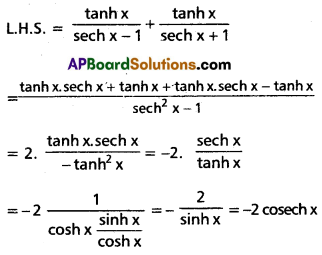
Prove that \(\frac{\tanh x}{{sech} x-1}+\frac{\tanh x}{{sech} x+1}\) = -2 cosech x, for x ≠ 0
Solution:
Inter 1st Year Maths 1A Hyperbolic Functions Solutions Ex 9(a) Q5

Question 6.
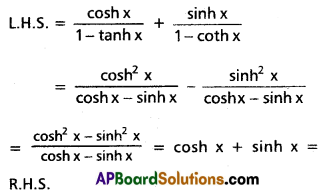
Prove that \(\frac{\cosh x}{1-\tanh x}+\frac{\sinh x}{1-{coth} x}\) = sinh x + cosh x, for x ≠ 0
Solution:
Inter 1st Year Maths 1A Hyperbolic Functions Solutions Ex 9(a) Q6
Inter 1st Year Maths 1A Hyperbolic Functions Solutions Ex 9(a) Q6.1

Question 7.
For any x ∈ R, prove that cosh4x – sinh4x = cosh (2x)
Solution:
L.H.S = cosh4x – sinh4x
= (cosh2x)2 – (sinh2x)2
= [cosh2x – sinh2x] [cosh2x + sinh2x]
= (1) cosh (2x)
= cosh (2x)
∴ cosh4x – sinh4x = cosh (2x)

Inter 1st Year Maths 1A Hyperbolic Functions Solutions Ex 9(a)

Question 8.
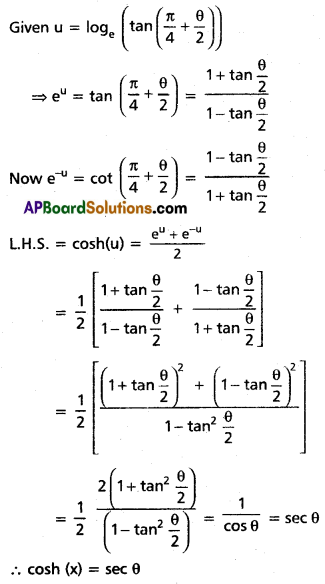
If u = \(\log _{e}\left(\tan \left(\frac{\pi}{4}+\frac{\theta}{2}\right)\right)\) and if cos θ > 0,then prove that cosh u = sec θ.
Solution:
Inter 1st Year Maths 1A Hyperbolic Functions Solutions Ex 9(a) Q8

Inter 1st Year Maths 1A Matrices Solutions Ex 3(e)

Practicing the Intermediate 1st Year Maths 1A Textbook Solutions Inter 1st Year Maths 1A Matrices Solutions Exercise 3(e) will help students to clear their doubts quickly.

Intermediate 1st Year Maths 1A Matrices Solutions Exercise 3(e)

I.

Question 1.
Find the adjoint and inverse of the following matrices.
(i) \(\left[\begin{array}{cc}
2 & -3 \\
4 & 6
\end{array}\right]\)
Solution:
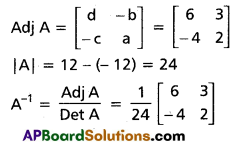
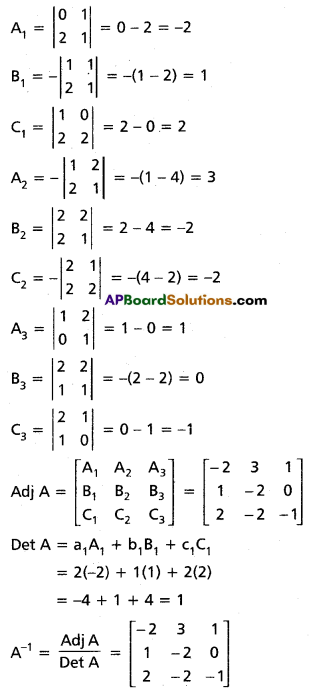
Inter 1st Year Maths 1A Matrices Solutions Ex 3(e) I Q1(i)

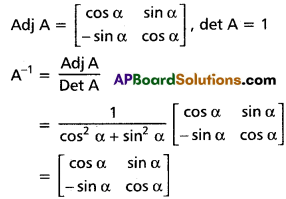
(ii) \(\left[\begin{array}{cc}
\cos \alpha & -\sin \alpha \\
\sin \alpha & \cos \alpha
\end{array}\right]\)
Solution:
Inter 1st Year Maths 1A Matrices Solutions Ex 3(e) I Q1(ii)

Inter 1st Year Maths 1A Matrices Solutions Ex 3(e)

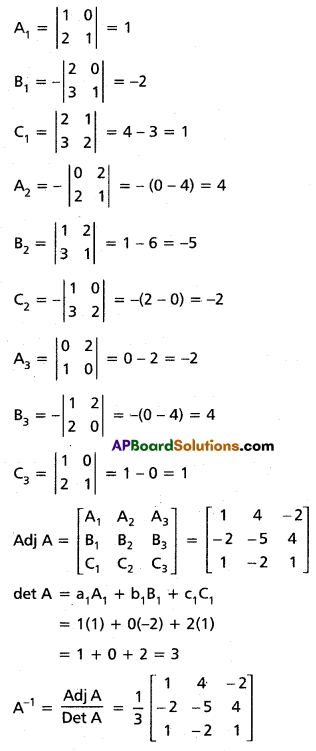
(iii) \(\left[\begin{array}{lll}
1 & 0 & 2 \\
2 & 1 & 0 \\
3 & 2 & 1
\end{array}\right]\)
Solution:
Inter 1st Year Maths 1A Matrices Solutions Ex 3(e) I Q1(iii)

(iv) \(\left[\begin{array}{lll}
2 & 1 & 2 \\
1 & 0 & 1 \\
2 & 2 & 1
\end{array}\right]\)
Solution:
Inter 1st Year Maths 1A Matrices Solutions Ex 3(e) I Q1(iv)

Question 2.
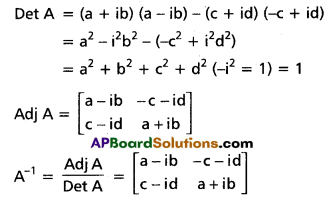
If A = \(\left[\begin{array}{cc}
a+i b & c+i d \\
-c+i d & a-i b
\end{array}\right]\), a2 + b2 + c2 + d2 = 1, then find the inverse of A.
Solution:
Inter 1st Year Maths 1A Matrices Solutions Ex 3(e) I Q2

Question 3.
If A = \(\left[\begin{array}{ccc}
1 & -2 & 3 \\
0 & -1 & 4 \\
-2 & 2 & 1
\end{array}\right]\), then find A-1
Solution:
Inter 1st Year Maths 1A Matrices Solutions Ex 3(e) I Q3

Question 4.
If A = \(\left|\begin{array}{ccc}
-1 & -2 & -2 \\
2 & 1 & -2 \\
2 & -2 & 1
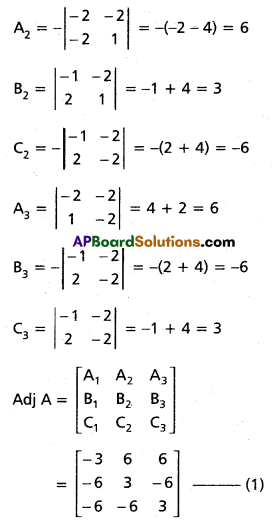
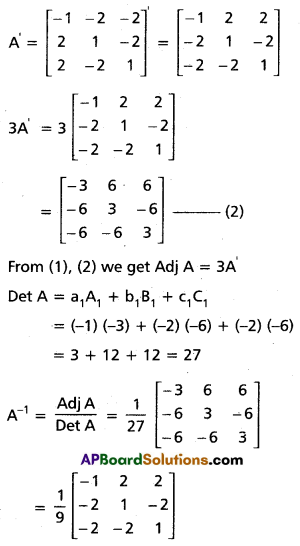
\end{array}\right|\), then show that the adjoint of A = 3A’ find A-1.
Solution:
Inter 1st Year Maths 1A Matrices Solutions Ex 3(e) I Q4
Inter 1st Year Maths 1A Matrices Solutions Ex 3(e) I Q4.1
Inter 1st Year Maths 1A Matrices Solutions Ex 3(e) I Q4.2

Inter 1st Year Maths 1A Matrices Solutions Ex 3(e)

Question 5.
If abc ≠ 0, find the inverse of \(\left[\begin{array}{lll}
a & 0 & 0 \\
0 & b & 0 \\
0 & 0 & c
\end{array}\right]\)
Solution:
Inter 1st Year Maths 1A Matrices Solutions Ex 3(e) I Q5
Inter 1st Year Maths 1A Matrices Solutions Ex 3(e) I Q5.1

II.

Question 1.
If A = \(\left[\begin{array}{lll}
0 & 1 & 1 \\
1 & 0 & 1 \\
1 & 1 & 0
\end{array}\right]\) and B = \(\frac{1}{2}\left[\begin{array}{lll}
b+c & c-a & b-a \\
c-b & c+a & a-b \\
b-c & a-c & a+b
\end{array}\right]\) then show that ABA-1 is a diagonal matrix.
Solution:
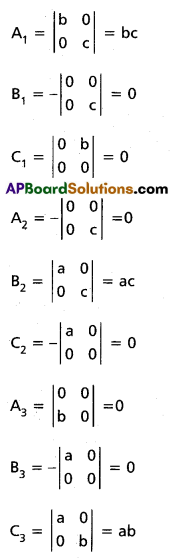
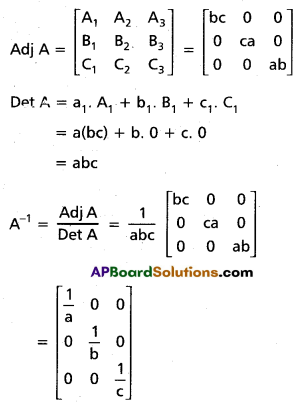
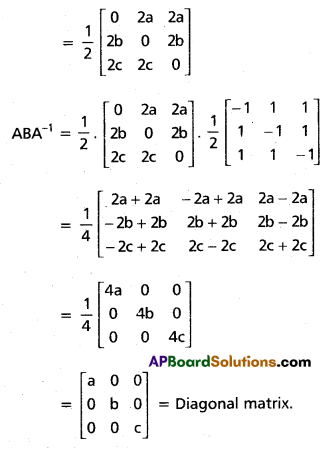
Inter 1st Year Maths 1A Matrices Solutions Ex 3(e) II Q1
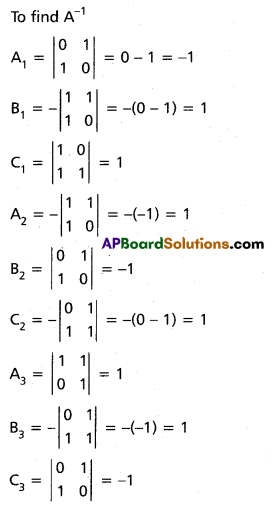
Inter 1st Year Maths 1A Matrices Solutions Ex 3(e) II Q1.1
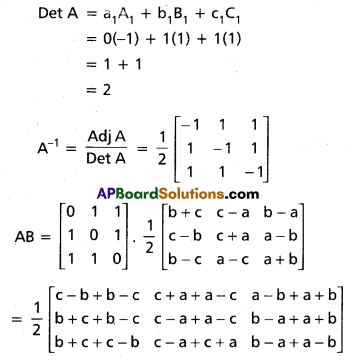
Inter 1st Year Maths 1A Matrices Solutions Ex 3(e) II Q1.2

Question 2.
If 3A = \(\left[\begin{array}{ccc}
1 & 2 & 2 \\
2 & 1 & -2 \\
-2 & 2 & -1
\end{array}\right]\) then show that A-1 = A’
Solution:
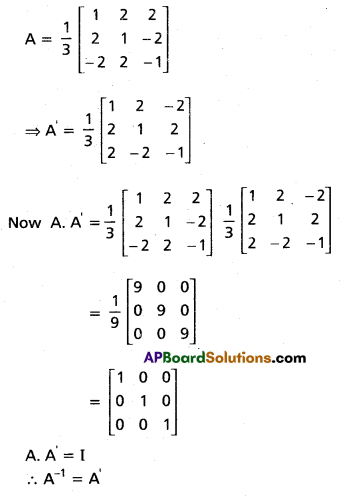
Inter 1st Year Maths 1A Matrices Solutions Ex 3(e) II Q2

Inter 1st Year Maths 1A Matrices Solutions Ex 3(e)

Question 3.
If A = \(\left[\begin{array}{rrr}
3 & -3 & 4 \\
2 & -3 & 4 \\
0 & -1 & 1
\end{array}\right]\), then show that A-1 = A3
Solution:
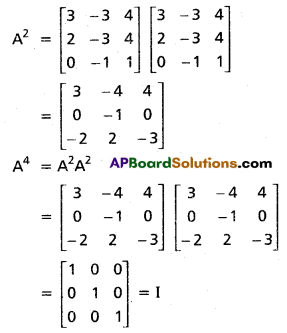
Inter 1st Year Maths 1A Matrices Solutions Ex 3(e) II Q3
∴ A4 = I
det A = 3(1) – 3(-2) + 4(-2) = 1
∵ A ≠ 0 ⇒ A-1 exists
∵ A4 = I
Multiply with A-1
A4 (A-1) = I (A-1)
⇒ A3 (AA-1) = A-1
⇒ A3 (I) = A-1
∴ A-1 = A3

Question 4.
If AB = I or BA = I, then prove that A is invertible and B = A-1
Solution:
Given AB = I
⇒ AB| = |1|
⇒ |A| |B| = 1
⇒ |A| ≠ 0
∴ A is a non-singular matrix and BA = I
⇒ |BA| = |I|
⇒ |B| |A| = 1
⇒ |A| ≠ 0
∴ A is a non-singular matrix.
AB = I or BA = I, A is invertible.
∴ A-1 exists.
AB = I
⇒ A-1AB = A-1I
⇒ IB = A-1
⇒ B = A-1
∴ B = A-1

Inter 1st Year Maths 1A Matrices Solutions Ex 3(d)

Practicing the Intermediate 1st Year Maths 1A Textbook Solutions Inter 1st Year Maths 1A Matrices Solutions Exercise 3(d) will help students to clear their doubts quickly.

Intermediate 1st Year Maths 1A Matrices Solutions Exercise 3(d)

I.

Question 1.
Find the determinants of the following matrices.
(i) \(\left[\begin{array}{cc}
2 & 1 \\
1 & -5
\end{array}\right]\)
Solution:
det A = ad – bc
= 2(-5) – 1(1)
= -10 – 1
= -11

(ii) \(\left[\begin{array}{cc}
4 & 5 \\
-6 & 2
\end{array}\right]\)
Solution:
det A = 4(2) – (-6)(5)
= 8 + 30
= 38

(iii) \(\left[\begin{array}{cc}
\mathbf{i} & 0 \\
0 & -\mathbf{i}
\end{array}\right]\)
Solution:
det A = -i2 – 0
= 1 – 0
= 1

Inter 1st Year Maths 1A Matrices Solutions Ex 3(d)

(iv) \(\left[\begin{array}{lll}
0 & 1 & 1 \\
1 & 0 & 1 \\
1 & 1 & 0
\end{array}\right]\)
Solution:
det A = 0(0 – 1) – 1(0 – 1) + 1(1 – 0)
= 1 + 1
= 2

(v) \(\left[\begin{array}{ccc}
1 & 4 & 2 \\
2 & -1 & 4 \\
-3 & 7 & 6
\end{array}\right]\)
Solution:
det A = 1(-6 – 28) – 4(12 + 12) + 2(14 – 3)
= -34 – 96 + 22
= -108

(vi) \(\left[\begin{array}{ccc}
2 & -1 & 4 \\
4 & -3 & 1 \\
1 & 2 & 1
\end{array}\right]\)
Solution:
det A = 2(-3 – 2) + 1(4 – 1) + 4(8 + 3)
= -10 + 3 + 44
= 37

(vii) \(\left[\begin{array}{ccc}
1 & 2 & -3 \\
4 & -1 & 7 \\
2 & 4 & -6
\end{array}\right]\)
Solution:
det A = 0 since R1 and R3 are proportional.

Inter 1st Year Maths 1A Matrices Solutions Ex 3(d)

(viii) \(\left[\begin{array}{lll}
a & h & g \\
\text { h } & b & f \\
g & f & c
\end{array}\right]\)
Solution:
det A = a(bc – f2) – h(ch – fg) + g(hf – bg)
= abc – af2 – ch2 + fgh + fgh – bg2
= abc + 2fgh – af2 – bg2 – ch2

(ix) \(\left[\begin{array}{lll}
\mathbf{a} & \mathbf{b} & \mathbf{c} \\
\mathbf{b} & \mathbf{c} & \mathbf{a} \\
\mathbf{c} & \mathbf{a} & \mathbf{b}
\end{array}\right]\)
Solution:
det A = a(bc – a2) – b(b2 – ac) + c(ab – c2)
= abc – a3 – b3 + abc + abc – c3
= 3abc – a3 – b3 – c3

(x) \(\left[\begin{array}{ccc}
1^{2} & 2^{2} & 3^{2} \\
2^{2} & 3^{2} & 4^{2} \\
3^{2} & 4^{2} & 5^{2}
\end{array}\right]\)
Solution:
det A = \(\left|\begin{array}{ccc}
1 & 4 & 9 \\
4 & 9 & 16 \\
9 & 16 & 25
\end{array}\right|\)
= 1(225 – 256) – 4(100 – 144) – 9(64 – 81)
= -31 + 176 – 153
= -184 + 176
= -8

Question 2.
If A = \(\left[\begin{array}{ccc}
1 & 0 & 0 \\
2 & 3 & 4 \\
5 & -6 & x
\end{array}\right]\) and det A = 45 then find x.
Solution:
det A = 45
\(\left|\begin{array}{ccc}
1 & 0 & 0 \\
2 & 3 & 4 \\
5 & -6 & x
\end{array}\right|\) = 45
⇒ 3x + 24 = 45
⇒ 3x – 45 + 24 = 0
⇒ 3x – 21 = 0
⇒ x = 7

Inter 1st Year Maths 1A Matrices Solutions Ex 3(d)

II.

Question 1.
Show that \(\left|\begin{array}{lll}
b c & b+c & 1 \\
c a & c+a & 1 \\
a b & a+b & 1
\end{array}\right|\) = (a – b)(b – c)(c – a)
Solution:
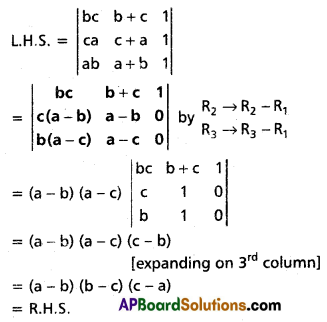
Inter 1st Year Maths 1A Matrices Solutions Ex 3(d) II Q1

Question 2.
Show that \(\left|\begin{array}{ccc}
\mathbf{b}+\mathbf{c} & \mathbf{c}+\mathbf{a} & \mathbf{a}+\mathbf{b} \\
\mathbf{a}+\mathbf{b} & \mathbf{b}+\mathbf{c} & \mathbf{c}+\mathbf{a} \\
\mathbf{a} & \mathbf{b} & \mathbf{c}
\end{array}\right|\) = a3 + b3 + c3 – 3abc
Solution:
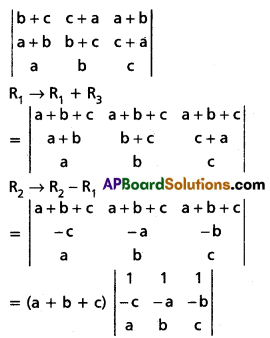
Inter 1st Year Maths 1A Matrices Solutions Ex 3(d) II Q2
= (a + b + c) [(-ac + b2) – (-c2 + ab) + (-bc + a2)]
= (a + b + c) (-ac + b2 + c2 – ab – bc + a2)
= (a + b + c) (a2 + b2 + c2 – ab – bc – ca)
= a3 + b3 + c3 – 3abc

Question 3.
Show that \(\left|\begin{array}{ccc}
\mathbf{y}+\mathbf{z} & \mathbf{x} & \mathbf{x} \\
\mathbf{y} & \mathbf{z}+\mathbf{x} & \mathbf{y} \\
\mathbf{z} & \mathbf{z} & \mathbf{x}+\mathbf{y}
\end{array}\right|\) = 4xyz
Solution:
L.H.S = \(\left|\begin{array}{ccc}
\mathbf{y}+\mathbf{z} & \mathbf{x} & \mathbf{x} \\
\mathbf{y} & \mathbf{z}+\mathbf{x} & \mathbf{y} \\
\mathbf{z} & \mathbf{z} & \mathbf{x}+\mathbf{y}
\end{array}\right|\)
= (y + z) [(z + x) (x + y) – yz] – x[y(x + y) – yz] + x[yz – z(z + x)]
= (y + z) (zx + yz + x2 + xy – yz) – x(xy + y2 – yz) + x(yz – z2 – zx)
= (y + z) (zx + x2 + xy) – x(xy + y2 – yz) + x(yz – z2 – zx)
= xyz + x2y + xy2 + xz2 + x2z + xyz – x2y – xy2 + xyz + xyz – xz2 – x2z
= 4xyz
= R.H.S

Question 4.
If \(\left|\begin{array}{ccc}
a & a^{2} & 1+a^{3} \\
b & b^{2} & 1+b^{3} \\
c & c^{2} & 1+c^{3}
\end{array}\right|\) = 0 and \(\left|\begin{array}{ccc}
a & a^{2} & 1 \\
b & b^{2} & 1 \\
c & c^{2} & 1
\end{array}\right|\) ≠ 0 then show that abc = -1
Hint: If each element in a row (column) of a square matrix is the sum of two numbers, then its discriminant can be expressed as the sum of discriminants of two square matrices.
Solution:
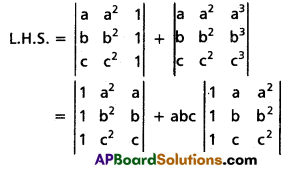
Inter 1st Year Maths 1A Matrices Solutions Ex 3(d) II Q4
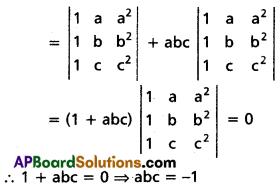
Inter 1st Year Maths 1A Matrices Solutions Ex 3(d) II Q4.1

Question 5.
Without expanding the determinant, prove that
(i) \(\left|\begin{array}{ccc}
a & a^{2} & b c \\
b & b^{2} & c a \\
c & c^{2} & a b
\end{array}\right|=\left|\begin{array}{ccc}
1 & a^{2} & a^{3} \\
1 & b^{2} & b^{3} \\
1 & c^{2} & c^{3}
\end{array}\right|\)
Solution:
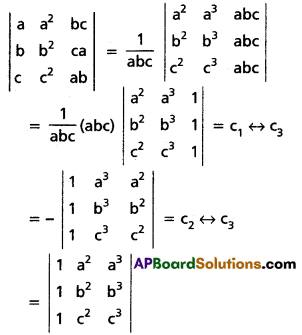
Inter 1st Year Maths 1A Matrices Solutions Ex 3(d) II Q5(i)

(ii) \(\left|\begin{array}{ccc}
a x & b y & c z \\
x^{2} & y^{2} & z^{2} \\
1 & 1 & 1
\end{array}\right|=\left|\begin{array}{ccc}
a & b & c \\
x & y & z \\
y z & z x & x y
\end{array}\right|\)
Solution:
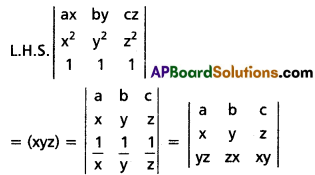
Inter 1st Year Maths 1A Matrices Solutions Ex 3(d) II Q5(ii)

(iii) \(\left|\begin{array}{lll}
1 & b c & b+c \\
1 & c a & c+a \\
1 & a b & a+b
\end{array}\right|=\left|\begin{array}{ccc}
1 & a & a^{2} \\
1 & b & b^{2} \\
1 & c & c^{2}
\end{array}\right|\)
Solution:
L.H.S = \(\left|\begin{array}{ccc}
1 & b c & b+c \\
1 & c a & c+a \\
1 & a b & a+b
\end{array}\right|\)
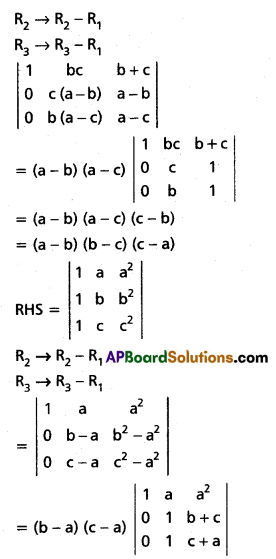
Inter 1st Year Maths 1A Matrices Solutions Ex 3(d) II Q5(iii)
= (b – a) (c – a) (c + a – b – a)
= (a – b) (b – c) (c – a)
∴ LHS = RHS

Inter 1st Year Maths 1A Matrices Solutions Ex 3(d)

Question 6.
If ∆1 = \(\left|\begin{array}{ccc}
a_{1}^{2}+b_{1}+c_{1} & a_{1} a_{2}+b_{2}+c_{2} & a_{1} a_{3}+b_{3}+c_{3} \\
b_{1} b_{2}+c_{1} & b_{2}^{2}+c_{2} & b_{2} b_{3}+c_{3} \\
c_{3} c_{1} & c_{3} c_{2} & c_{3}^{2}
\end{array}\right|\) and ∆2 = \(\left|\begin{array}{lll}
a_{1} & b_{2} & c_{2} \\
a_{2} & b_{2} & c_{2} \\
a_{3} & b_{3} & c_{3}
\end{array}\right|\), then find the value of \(\frac{\Delta_{1}}{\Delta_{2}}\)
Solution:
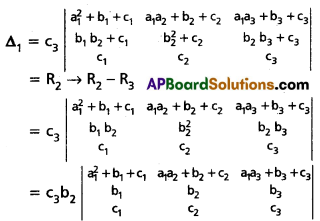
Inter 1st Year Maths 1A Matrices Solutions Ex 3(d) II Q6
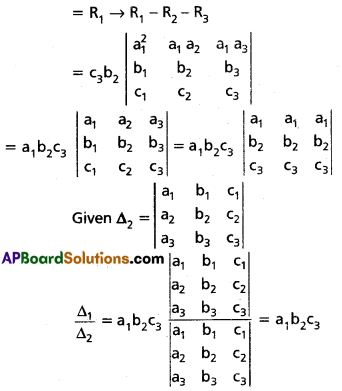
Inter 1st Year Maths 1A Matrices Solutions Ex 3(d) II Q6.1

Question 7.
If ∆1 = \(\left|\begin{array}{ccc}
1 & \cos \alpha & \cos \beta \\
\cos \alpha & 1 & \cos \gamma \\
\cos \beta & \cos \alpha & 1
\end{array}\right|\), ∆2 = \(\left|\begin{array}{ccc}
0 & \cos \alpha & \cos \beta \\
\cos \alpha & 0 & \cos \gamma \\
\cos \beta & \cos \gamma & 0
\end{array}\right|\) and ∆1 = ∆2, then show that cos2α + cos2β + cos2γ = 1
Solution:
1 = \(\left|\begin{array}{ccc}
1 & \cos \alpha & \cos \beta \\
\cos \alpha & 1 & \cos \gamma \\
\cos \beta & \cos \alpha & 1
\end{array}\right|\)
= 1(1 – cos2γ) – cos α (cos α – cos β cos γ) + cos β (cos α cos γ – cos β)
= 1 – cos2γ – cos2α + cos α cos β cos γ + cos α cos β cos γ – cos2β
= 1 – cos2γ – cos2α – cos2β + 2 cos α cos β cos γ
2 = \(\left|\begin{array}{ccc}
0 & \cos \alpha & \cos \beta \\
\cos \alpha & 0 & \cos \gamma \\
\cos \beta & \cos \gamma & 0
\end{array}\right|\)
= 0(0 – cos2γ) – cos α (0 – cos γ cos β) + cos β (cos α cos γ – 0)
= cos α cos β cos γ + cos α cos β cos γ
= 2 cos α cos β cos γ
Given ∆1 = ∆2
1 – cos2α – cos2β – cos2γ + 2 cos α cos β cos γ = 2 cos α cos β cos γ
1 – cos2α – cos2β – cos2γ = 0
1 = cos2α + cos2β + cos2γ

Inter 1st Year Maths 1A Matrices Solutions Ex 3(d)

III.

Question 1.
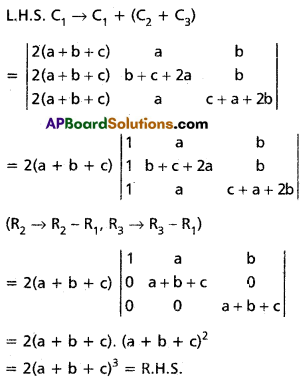
Show that \(\left|\begin{array}{ccc}
\mathbf{a}+\mathbf{b}+2 \mathbf{c} & \mathbf{a} & \mathbf{b} \\
\mathbf{c} & \mathbf{b}+\mathbf{c}+\mathbf{2} \mathbf{a} & \mathbf{b} \\
\mathbf{c} & \mathbf{a} & \mathbf{c}+\mathbf{a}+\mathbf{2} \mathbf{b}
\end{array}\right|\) = 2(a + b + c)3
Solution:
Inter 1st Year Maths 1A Matrices Solutions Ex 3(d) III Q1

Question 2.
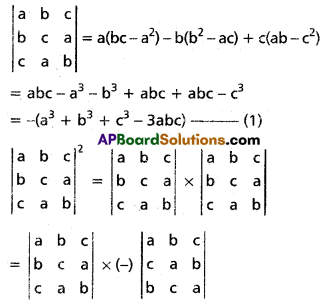
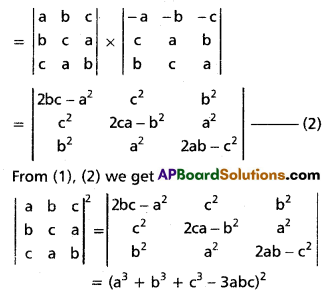
Show that \(\left|\begin{array}{lll}
a & b & c \\
b & c & a \\
c & a & b
\end{array}\right|^{2}\) = \(\left|\begin{array}{ccc}
2 b c-a^{2} & c^{2} & b^{2} \\
c^{2} & 2 a c-b^{2} & a^{2} \\
b^{2} & a^{2} & 2 a b-c^{2}
\end{array}\right|\) = (a3 + b3 + c3 – 3abc)2
Solution:
Inter 1st Year Maths 1A Matrices Solutions Ex 3(d) III Q2
Inter 1st Year Maths 1A Matrices Solutions Ex 3(d) III Q2.1

Question 3.
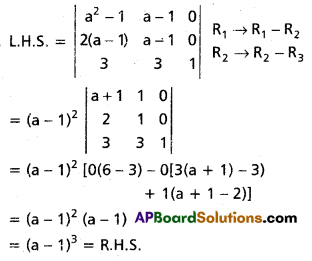
Show that \(\left|\begin{array}{ccc}
a^{2}+2 a & 2 a+1 & 1 \\
2 a+1 & a+2 & 1 \\
3 & 3 & 1
\end{array}\right|\) = (a – 1)3
Solution:
Inter 1st Year Maths 1A Matrices Solutions Ex 3(d) III Q3

Inter 1st Year Maths 1A Matrices Solutions Ex 3(d)

Question 4.
Show that \(\left|\begin{array}{ccc}
a & b & c \\
a^{2} & b^{2} & c^{2} \\
a^{3} & b^{3} & c^{3}
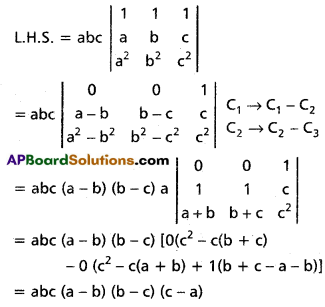
\end{array}\right|\) = abc(a – b)(b – c)(c – a)
Solution:
Inter 1st Year Maths 1A Matrices Solutions Ex 3(d) III Q4

Question 5.
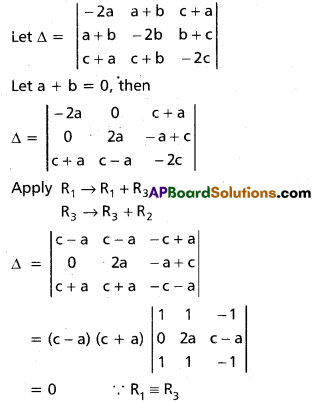
Show that \(\left|\begin{array}{ccc}
-2 \mathbf{a} & \mathbf{a}+\mathbf{b} & \mathbf{c}+\mathbf{a} \\
\mathbf{a}+\mathbf{b} & -\mathbf{2} \mathbf{b} & \mathbf{b}+\mathbf{c} \\
\mathbf{c}+\mathbf{a} & \mathbf{c}+\mathbf{b} & -2 \mathbf{c}
\end{array}\right|\) = 4(a + b) (b + c) (c + a)
Solution:
Inter 1st Year Maths 1A Matrices Solutions Ex 3(d) III Q5
∴ (c + a) is a factor for ∆
Similarly a + b, b + c are also factors ∆.
∵ ∆ is a third-degree expression in a, b, c.
∆ = k(a + b) (b + c) (c + a),
where k is a non-zero scalar.
Put a = 1, b = 1, c = 1, then
\(\left|\begin{array}{ccc}
-2 & 2 & 2 \\
2 & -2 & 2 \\
2 & 2 & -2
\end{array}\right|\) = k(1 + 1) (1 + 1) (1 + 1)
⇒ -2(4 – 4) – 2(-4 – 4) + 2(4 + 4) = 8k
⇒ 16 + 16 = 8k
⇒ k = 4
∴ ∆ = 4(a + b) (b + c) (c + a)
Hence \(\left|\begin{array}{ccc}
-2 \mathbf{a} & \mathbf{a}+\mathbf{b} & \mathbf{c}+\mathbf{a} \\
\mathbf{a}+\mathbf{b} & -\mathbf{2} \mathbf{b} & \mathbf{b}+\mathbf{c} \\
\mathbf{c}+\mathbf{a} & \mathbf{c}+\mathbf{b} & -2 \mathbf{c}
\end{array}\right|\) = 4(a + b) (b + c) (c + a)

Inter 1st Year Maths 1A Matrices Solutions Ex 3(d)

Question 6.
Show that \(\left|\begin{array}{lll}
\mathbf{a}-\mathbf{b} & \mathbf{b}-\mathbf{c} & \mathbf{c}-\mathbf{a} \\
\mathbf{b}-\mathbf{c} & \mathbf{c}-\mathbf{a} & \mathbf{a}-\mathbf{b} \\
\mathbf{c}-\mathbf{a} & \mathbf{a}-\mathbf{b} & \mathbf{b}-\mathbf{c}
\end{array}\right|\)
Solution:
L.H.S = \(\left|\begin{array}{ccc}
0 & 0 & 0 \\
b-c & c-a & a-b \\
c-a & a-b & b-c
\end{array}\right|\) = 0
By R1 → R1 + (R2 + R3)

Question 7.
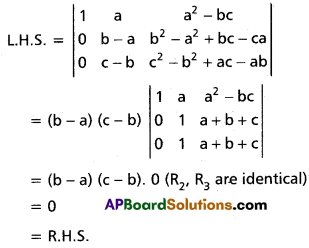
Show that \(\left|\begin{array}{ccc}
1 & a & a^{2}-b c \\
1 & b & b^{2}-c a \\
1 & c & c^{2}-a b
\end{array}\right|\) = 0
Solution:
Inter 1st Year Maths 1A Matrices Solutions Ex 3(d) III Q7

Question 8.
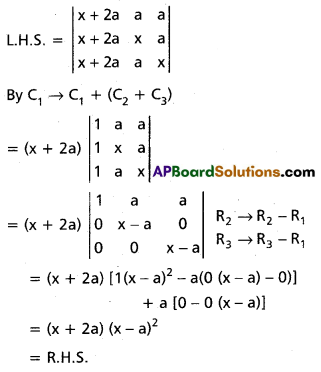
Show that \(\left|\begin{array}{lll}
\mathbf{x} & \mathbf{a} & \mathbf{a} \\
\mathbf{a} & \mathbf{x} & \mathbf{a} \\
\mathbf{a} & \mathbf{a} & \mathbf{x}
\end{array}\right|\) = (x + 2a) (x – a)2
Solution:
Inter 1st Year Maths 1A Matrices Solutions Ex 3(d) III Q8

Inter 1st Year Maths 1A Matrices Solutions Ex 3(c)

Practicing the Intermediate 1st Year Maths 1A Textbook Solutions Inter 1st Year Maths 1A Matrices Solutions Exercise 3(c) will help students to clear their doubts quickly.

Intermediate 1st Year Maths 1A Matrices Solutions Exercise 3(c)

I.

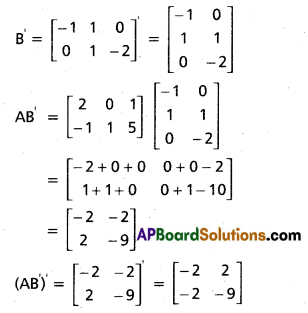
Question 1.
If A = \(\left[\begin{array}{ccc}
2 & 0 & 1 \\
-1 & 1 & 5
\end{array}\right]\) and B = \(\left[\begin{array}{ccc}
-1 & 1 & 0 \\
0 & 1 & -2
\end{array}\right]\), then find (AB’)’.
Solution:
Inter 1st Year Maths 1A Matrices Solutions Ex 3(c) I Q1

Inter 1st Year Maths 1A Matrices Solutions Ex 3(c)

Question 2.
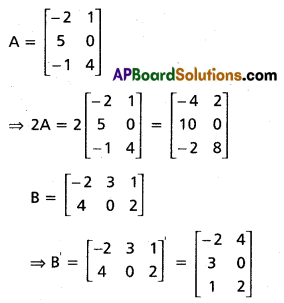
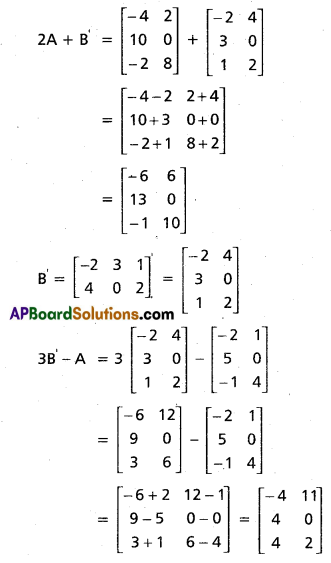
If A = \(\left[\begin{array}{cc}
-2 & 1 \\
5 & 0 \\
-1 & 4
\end{array}\right]\) and B = \(\left[\begin{array}{ccc}
-2 & 3 & 1 \\
4 & 0 & 2
\end{array}\right]\) then find 2A + B’ and 3B’ – A.
Solution:
Inter 1st Year Maths 1A Matrices Solutions Ex 3(c) I Q2
Inter 1st Year Maths 1A Matrices Solutions Ex 3(c) I Q2.1

Question 3.
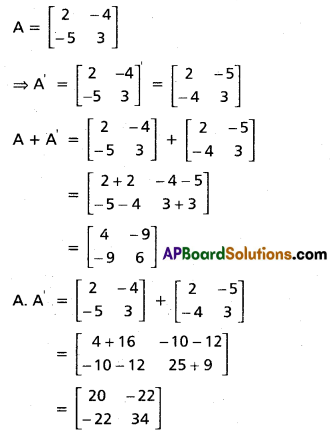
If A = \(\left[\begin{array}{cc}
2 & -4 \\
-5 & 3
\end{array}\right]\), then find A + A’ and A.A’
Solution:
Inter 1st Year Maths 1A Matrices Solutions Ex 3(c) I Q3

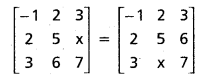
Question 4.
If A = \(\left[\begin{array}{ccc}
-1 & 2 & 3 \\
2 & 5 & 6 \\
3 & x & 7
\end{array}\right]\) is a symmetric matrix, then find x.
Hint: ‘A’ is a symmetric matrix ⇒ AT = A
Solution:
A is a symmetric matrix
⇒ A’ = A
Inter 1st Year Maths 1A Matrices Solutions Ex 3(c) I Q4
Equating 2nd row, 3rd column elements we get x = 6.

Inter 1st Year Maths 1A Matrices Solutions Ex 3(c)

Question 5.
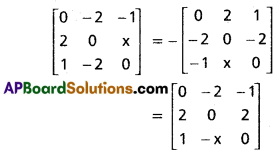
If A = \(\left[\begin{array}{ccc}
0 & 2 & 1 \\
-2 & 0 & -2 \\
-1 & x & 0
\end{array}\right]\) is a skew-symmetric matrix, find x.
Solution:
∵ A is a skew-symmetric matrix
⇒ AT = -A
Inter 1st Year Maths 1A Matrices Solutions Ex 3(c) I Q5
Equating second-row third column elements we get x = 2.

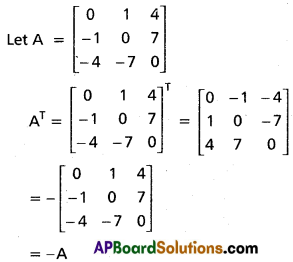
Question 6.
Is \(\left[\begin{array}{ccc}
0 & 1 & 4 \\
-1 & 0 & 7 \\
-4 & -7 & 0
\end{array}\right]\) symmetric or skewsymmetric?
Solution:
Inter 1st Year Maths 1A Matrices Solutions Ex 3(c) I Q6
∴ A is a skew-symmetric matrix.

II.

Question 1.
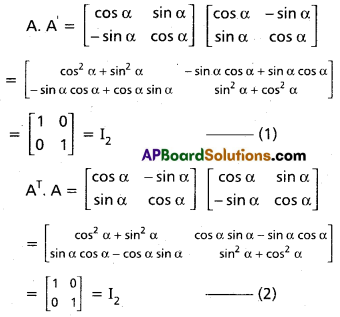
If A = \(\left[\begin{array}{cc}
\cos \alpha & \sin \alpha \\
-\sin \alpha & \cos \alpha
\end{array}\right]\), show that A.A’ = A’. A = I2
Solution:
Inter 1st Year Maths 1A Matrices Solutions Ex 3(c) II Q1
From (1), (2) we get A.A’ = A’. A = I2

Inter 1st Year Maths 1A Matrices Solutions Ex 3(c)

Question 2.
If A = \(\left[\begin{array}{ccc}
1 & 5 & 3 \\
2 & 4 & 0 \\
3 & -1 & -5
\end{array}\right]\) and B = \(\left[\begin{array}{ccc}
2 & -1 & 0 \\
0 & -2 & 5 \\
1 & 2 & 0
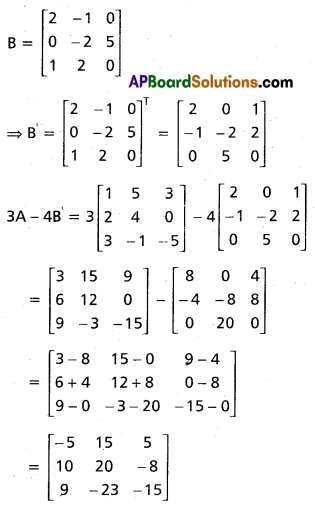
\end{array}\right]\) then find 3A – 4B’.
Solution:
Inter 1st Year Maths 1A Matrices Solutions Ex 3(c) II Q2

Question 3.
If A = \(\left[\begin{array}{cc}
7 & -2 \\
-1 & 2 \\
5 & 3
\end{array}\right]\) and B = \(\left[\begin{array}{cc}
-2 & -1 \\
4 & 2 \\
-1 & 0
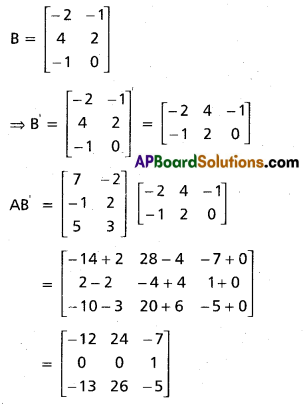
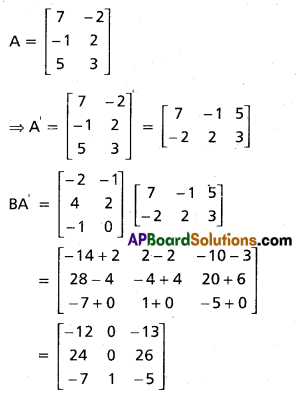
\end{array}\right]\) then find AB’ and BA’.
Solution:
Inter 1st Year Maths 1A Matrices Solutions Ex 3(c) II Q3
Inter 1st Year Maths 1A Matrices Solutions Ex 3(c) II Q3.1

Inter 1st Year Maths 1A Matrices Solutions Ex 3(c)

Question 4.
For any square matrix A, Show that AA’ is symmetric.
Solution:
A is a square matrix
(AA’)’ = (A’)’A’ = A.A’
∵ (AA’)’ = AA’
⇒ AA’ is a symmetric matrix.

Inter 1st Year Maths 1A Matrices Solutions Ex 3(b)

Practicing the Intermediate 1st Year Maths 1A Textbook Solutions Inter 1st Year Maths 1A Matrices Solutions Exercise 3(b) will help students to clear their doubts quickly.

Intermediate 1st Year Maths 1A Matrices Solutions Exercise 3(b)

I.

Question 1.
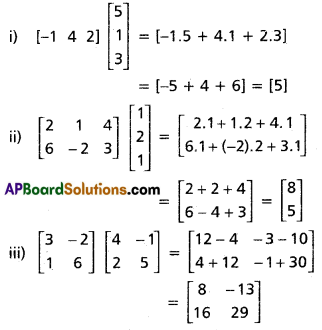
Find the following products wherever possible.
Hint: (1 × 3) by (3 × 1) = 1 × 1
(i) \(\left[\begin{array}{lll}
-1 & 4 & 2
\end{array}\right]\left[\begin{array}{l}
5 \\
1 \\
3
\end{array}\right]\)
(ii) \(\left[\begin{array}{ccc}
2 & 1 & 4 \\
6 & -2 & 3
\end{array}\right]\left[\begin{array}{l}
1 \\
2 \\
1
\end{array}\right]\)
(iii) \(\left[\begin{array}{cc}
3 & -2 \\
1 & 6
\end{array}\right]\left[\begin{array}{cc}
4 & -1 \\
2 & 5
\end{array}\right]\)
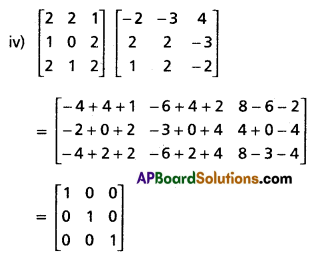
(iv) \(\left[\begin{array}{lll}
2 & 2 & 1 \\
1 & 0 & 2 \\
2 & 1 & 2
\end{array}\right]\left[\begin{array}{ccc}
-2 & -3 & 4 \\
2 & 2 & -3 \\
1 & 2 & -2
\end{array}\right]\)
(v) \(\left[\begin{array}{ccc}
3 & 4 & 9 \\
0 & -1 & 5 \\
2 & 6 & 12
\end{array}\right]\left[\begin{array}{ccc}
13 & -2 & 0 \\
0 & 4 & 1
\end{array}\right]\)
(vi) \(\left[\begin{array}{c}
1 \\
-2 \\
1
\end{array}\right]\left[\begin{array}{ccc}
2 & 1 & 4 \\
6 & -2 & 3
\end{array}\right]\)
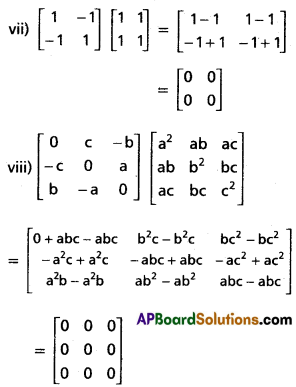
(vii) \(\left[\begin{array}{cc}
1 & -1 \\
-1 & 1
\end{array}\right]\left[\begin{array}{ll}
1 & 1 \\
1 & 1
\end{array}\right]\)
(viii) \(\left[\begin{array}{ccc}
0 & c & -b \\
-c & 0 & a \\
b & -a & 0
\end{array}\right]\left[\begin{array}{ccc}
a^{2} & a b & a c \\
a b & b^{2} & b c \\
a c & b c & c^{2}
\end{array}\right]\)
Solution:
Inter 1st Year Maths 1A Matrices Solutions Ex 3(b) I Q1
Inter 1st Year Maths 1A Matrices Solutions Ex 3(b) I Q1.1

(v) \(\left[\begin{array}{ccc}
3 & 4 & 9 \\
0 & -1 & 5 \\
2 & 6 & 12
\end{array}\right]\left[\begin{array}{ccc}
13 & -2 & 0 \\
0 & 4 & 1
\end{array}\right]\)
First matrix is a 3 × 3 matrix and second matrix is 2 × 3 matrix.
No. of columns in the first matrix ≠ No. of rows in the second matrix.
∴ Matrix product is not possible.

Inter 1st Year Maths 1A Matrices Solutions Ex 3(b)

(vi) \(\left[\begin{array}{c}
1 \\
-2 \\
1
\end{array}\right]\left[\begin{array}{ccc}
2 & 1 & 4 \\
6 & -2 & 3
\end{array}\right]\)
No. of columns in first matrix = 1
No. of rows in second matrix = 2
No. of columns in the first matrix ≠ No. of rows in the second matrix
Multiplication of matrices is not possible.

Inter 1st Year Maths 1A Matrices Solutions Ex 3(b) I Q1.2

Question 2.
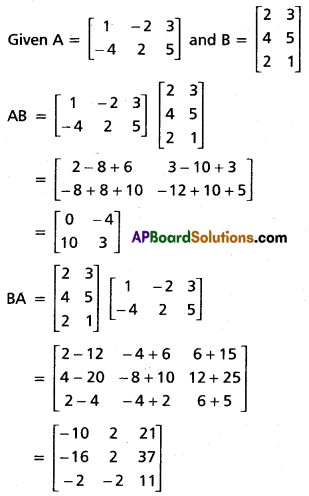
If A = \(\left[\begin{array}{ccc}
1 & -2 & 3 \\
-4 & 2 & 5
\end{array}\right]\) and B = \(\left[\begin{array}{ll}
2 & 3 \\
4 & 5 \\
2 & 1
\end{array}\right]\), do AB and BA exist? If they exist, find them. Do A and B commute with respect to multiplication?
Solution:
Inter 1st Year Maths 1A Matrices Solutions Ex 3(b) I Q2
AB ≠ BA
∴ A and B are not commutative with respect to the multiplication of matrices.

Inter 1st Year Maths 1A Matrices Solutions Ex 3(b)

Question 3.
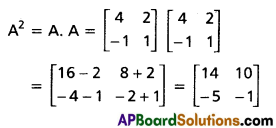
Find A2 where A = \(\left[\begin{array}{cc}
4 & 2 \\
-1 & 1
\end{array}\right]\)
Solution:
Inter 1st Year Maths 1A Matrices Solutions Ex 3(b) I Q3

Question 4.
If A = \(\left[\begin{array}{ll}
i & 0 \\
0 & i
\end{array}\right]\), find A2.
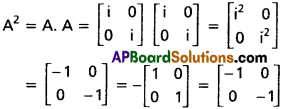
Solution:
Inter 1st Year Maths 1A Matrices Solutions Ex 3(b) I Q4

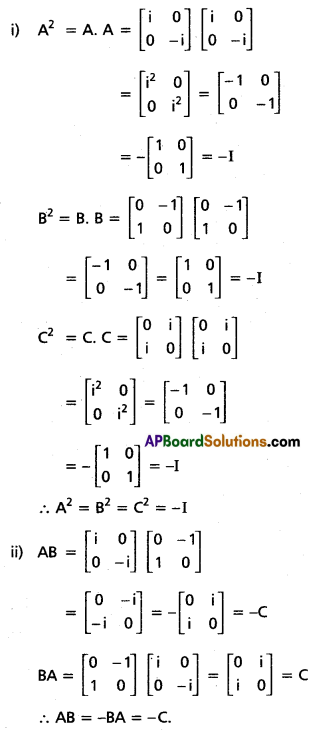
Question 5.
If A = \(\left[\begin{array}{cc}
i & 0 \\
0 & -i
\end{array}\right]\), B = \(\left[\begin{array}{cc}
0 & -1 \\
1 & 0
\end{array}\right]\) and C = \(\left[\begin{array}{ll}
0 & \mathbf{i} \\
\mathbf{i} & \mathbf{0}
\end{array}\right]\), and I is the unit matrix of order 2, then show that
(i) A2 = B2 = C2 = -I
(ii) AB = -BA = -C
Solution:
Inter 1st Year Maths 1A Matrices Solutions Ex 3(b) I Q5

Question 6.
If A = \(\left[\begin{array}{ll}
2 & 1 \\
1 & 3
\end{array}\right]\) and B = \(\left[\begin{array}{lll}
3 & 2 & 0 \\
1 & 0 & 4
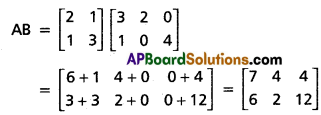
\end{array}\right]\), find AB. Find BA if it exists.
Solution:
Given A = \(\left[\begin{array}{ll}
2 & 1 \\
1 & 3
\end{array}\right]\) and B = \(\left[\begin{array}{lll}
3 & 2 & 0 \\
1 & 0 & 4
\end{array}\right]\)
Inter 1st Year Maths 1A Matrices Solutions Ex 3(b) I Q6
The order of AB is 2 × 3
BA does not exist since no. of columns in B ≠ No. of rows in A.

Inter 1st Year Maths 1A Matrices Solutions Ex 3(b)

Question 7.
If A = \(\left[\begin{array}{cc}
2 & 4 \\
-1 & k
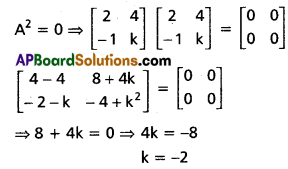
\end{array}\right]\) and A2 = 0, then find the value of k.
Solution:
Inter 1st Year Maths 1A Matrices Solutions Ex 3(b) I Q7

II.

Question 1.
If A = \(\left[\begin{array}{lll}
3 & 0 & 0 \\
0 & 3 & 0 \\
0 & 0 & 3
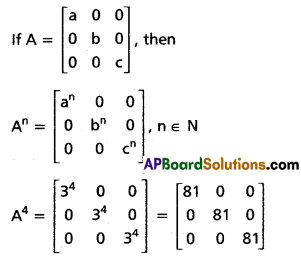
\end{array}\right]\) then find A4.
Solution:
Inter 1st Year Maths 1A Matrices Solutions Ex 3(b) II Q1

Question 2.
If A = \(\left[\begin{array}{ccc}
1 & 1 & 3 \\
5 & 2 & 6 \\
-2 & -1 & -3
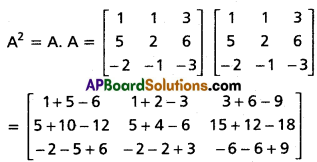
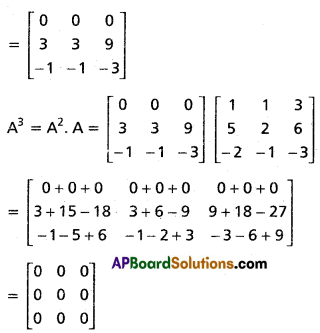
\end{array}\right]\) then find A3.
Solution:
Inter 1st Year Maths 1A Matrices Solutions Ex 3(b) II Q2
Inter 1st Year Maths 1A Matrices Solutions Ex 3(b) II Q2.1

Question 3.
If A = \(\left[\begin{array}{ccc}
1 & -2 & 1 \\
0 & 1 & -1 \\
3 & -1 & 1
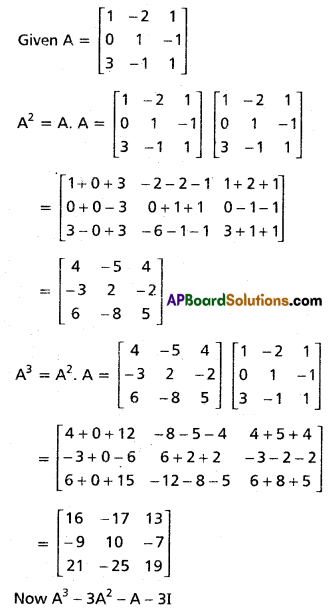
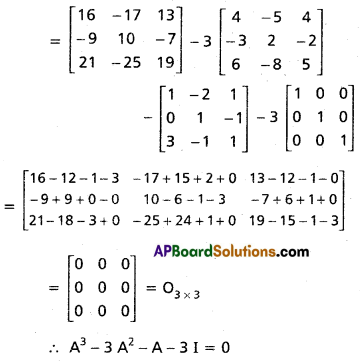
\end{array}\right]\), then find A3 – 3A2 – A – 3I, where I is unit matrix of order 3 × 3.
Solution:
Inter 1st Year Maths 1A Matrices Solutions Ex 3(b) II Q3
Inter 1st Year Maths 1A Matrices Solutions Ex 3(b) II Q3.1

Question 4.
If I = \(\left[\begin{array}{ll}
1 & 0 \\
0 & 1
\end{array}\right]\) and E = \(\left[\begin{array}{ll}
0 & 1 \\
0 & 0
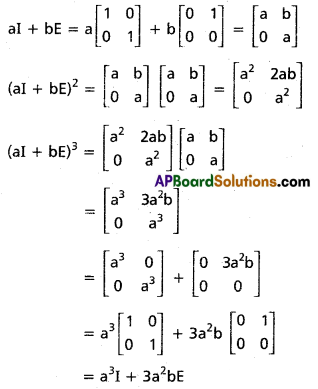
\end{array}\right]\), show that (aI + bE)3 = a3I + 3a2bE, Where I is unit matrix of order 2.
Solution:
Inter 1st Year Maths 1A Matrices Solutions Ex 3(b) II Q4

Inter 1st Year Maths 1A Matrices Solutions Ex 3(b)

III.

Question 1.
If A = [a1, a2, a3,], then for any integer n ≥ 1 show that An = \(\left[\begin{array}{lll}
a_{1}, & a_{2}^{n}, & a_{3}^{n}
\end{array}\right]\)
Solution:
Given A = diag [a1, a2, a3,] = \(\left[\begin{array}{ccc}
a_{1} & 0 & 0 \\
0 & a_{2} & 0 \\
0 & 0 & a_{3}
\end{array}\right]\)
An = diag \(\left[\begin{array}{lll}
a_{1}^{n} & a_{2}^{n} & a_{3}^{n}
\end{array}\right]=\left[\begin{array}{ccc}
a_{1}^{n} & 0 & 0 \\
0 & a_{2}^{n} & 0 \\
0 & 0 & a_{3}^{n}
\end{array}\right]\)
This problem can be should by using Mathematical Induction
put n = 1
A1 = \(\left[\begin{array}{ccc}
a_{1} & 0 & 0 \\
0 & a_{2} & 0 \\
0 & 0 & a_{3}
\end{array}\right]\)
∴ The result is true for n = 1
Assume the result is true for n = k
Ak = \(\left[\begin{array}{ccc}
a_{1}^{k} & 0 & 0 \\
0 & a_{2}^{k} & 0 \\
0 & 0 & a_{3}^{k}
\end{array}\right]\)
Consider
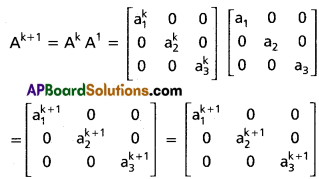
Inter 1st Year Maths 1A Matrices Solutions Ex 3(b) III Q1
∴ The result is true for n = k + 1
Hence by the Principle of Mathematical Induction, the statement is true ∀ n ∈ N

Question 2.
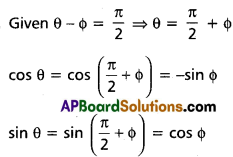
If θ – φ = \(\frac{\pi}{2}\), then show that \(\left[\begin{array}{cc}
\cos ^{2} \theta & \cos \theta \sin \theta \\
\cos \theta \sin \theta & \sin ^{2} \dot{\theta}
\end{array}\right]\) \(\left[\begin{array}{cc}
\cos ^{2} \phi & \cos \phi \sin \phi \\
\cos \phi \sin \phi & \sin ^{2} \phi
\end{array}\right]\) = 0
Solution:
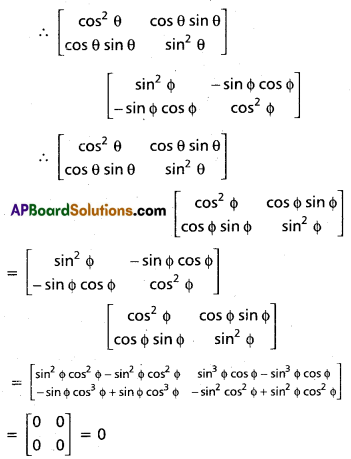
Inter 1st Year Maths 1A Matrices Solutions Ex 3(b) III Q2
Inter 1st Year Maths 1A Matrices Solutions Ex 3(b) III Q2.1

Question 3.
If A = \(\left[\begin{array}{rr}
3 & -4 \\
1 & -1
\end{array}\right]\) then show that An = \(\left[\begin{array}{cc}
1+2 n & -4 n \\
n & 1-2 n
\end{array}\right]\), for any integer n ≥ 1 by using Mathematical Induction.
Solution:
We shall prove the result by Mathematical Induction.
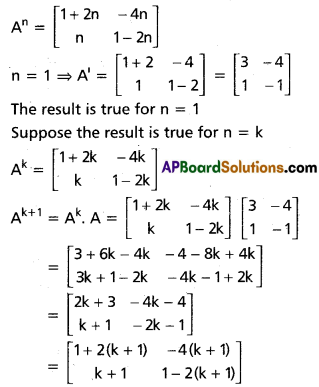
Inter 1st Year Maths 1A Matrices Solutions Ex 3(b) III Q3
∴ The given result is true for n = k + 1
By Mathematical Induction, the given result is true for all positive integral values of n.

Inter 1st Year Maths 1A Matrices Solutions Ex 3(b)

Question 4.
Give examples of two square matrices A and B of the same order for which AB = 0 but BA ≠ 0.
Solution:
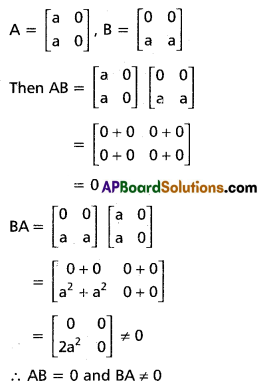
Inter 1st Year Maths 1A Matrices Solutions Ex 3(b) III Q4

Question 5.
A Trust fund has to invest ₹ 30,000 in two different types of bonds. The first bond pays 5% interest per year, and the second bond pays 7% interest per year. Using matrix multiplication, determine how to divide ₹ 30,000 among the two types of bonds if the trust fund must obtain an annual total interest of (a) ₹ 1800 (b) ₹ 2000
Solution:
Let the first bond be ‘x’ and the second bond be 30,000 – x respectively
The rate of interest is 0.05 and 0.07 respectively.
(a) \([x, 30,000-x]\left[\begin{array}{l}
0.05 \\
0.07
\end{array}\right] \quad=[1800]\)
[0.05x + 0.07(30,000 – x)] = 1800
\(\frac{5}{100} x+\frac{7}{100}(30,000-x)=1800\)
5x + 21,0000 – 7x = 1,80,000
-2x = 1,80,000 – 2,10,000 = -30,000
x = 15,000
∴ First bond = 15,000
Second bond = 30,000 – 15,000 = 15,000

Inter 1st Year Maths 1A Matrices Solutions Ex 3(b)

(b) \(\left[\begin{array}{ll}
x & 30,000-x
\end{array}\right]\left[\begin{array}{l}
0.05 \\
0.07
\end{array}\right]=[2000]\)
[0.05x + 0.07(30,000 – x)] = [2000]
\(\frac{5 x}{100} \times \frac{7}{100}(30,000-x)=2000\)
5x + 2,10,000 – 7x = 2,00,000
-2x = 2,00,000 – 2,10,000
-2x = -10,000
x = 5,000
∴ First bond = 5000
Second bond = 30,000 – 5000 = 25,000

Inter 1st Year Maths 1A Matrices Solutions Ex 3(a)

Practicing the Intermediate 1st Year Maths 1A Textbook Solutions Inter 1st Year Maths 1A Matrices Solutions Exercise 3(a) will help students to clear their doubts quickly.

Intermediate 1st Year Maths 1A Matrices Solutions Exercise 3(a)

I.

Question 1.
Write the following as a single matrix.
(i) \(\left[\begin{array}{lll}
2 & 1 & 3
\end{array}\right]+\left[\begin{array}{lll}
1 & 0 & 0
\end{array}\right]\)
(ii) \(\left[\begin{array}{ccc}
3 & 9 & 0 \\
1 & 8 & -2
\end{array}\right]+\left[\begin{array}{ccc}
4 & 0 & 2 \\
7 & 1 & 4
\end{array}\right]\)
(iii) \(\left[\begin{array}{c}
0 \\
1 \\
-1
\end{array}\right]+\left[\begin{array}{l}
1 \\
1 \\
1
\end{array}\right]\)
(iv) \(\left[\begin{array}{cc}
-1 & 2 \\
2 & -2 \\
3 & 1
\end{array}\right]-\left[\begin{array}{cc}
0 & 1 \\
-1 & 0 \\
-2 & 1
\end{array}\right]\)
Solution:
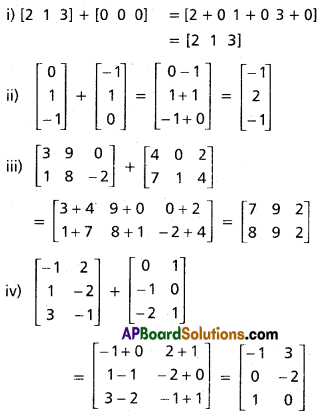
Inter 1st Year Maths 1A Matrices Solutions Ex 3(a) I Q1

Question 2.
If A = \(\left[\begin{array}{cc}
-1 & 3 \\
4 & 2
\end{array}\right]\), B = \(\left[\begin{array}{cc}
2 & 1 \\
3 & -5
\end{array}\right]\), X = \(\left[\begin{array}{ll}
x_{1} & x_{2} \\
x_{3} & x_{4}
\end{array}\right]\) and A + B = X, then find the values of x1, x2, x3 and x4.
Solution:
A + B = X
Inter 1st Year Maths 1A Matrices Solutions Ex 3(a) I Q2
∴ x1 = 1, x2 = 4, x3 = 7, x4 = -3

Inter 1st Year Maths 1A Matrices Solutions Ex 3(a)

Question 3.
If A = \(\left[\begin{array}{ccc}
-1 & -2 & 3 \\
1 & 2 & 4 \\
2 & -1 & 3
\end{array}\right]\), B = \(\left[\begin{array}{ccc}
1 & -2 & 5 \\
0 & -2 & 2 \\
1 & 2 & -3
\end{array}\right]\) and C = \(\left[\begin{array}{ccc}
-2 & 1 & 2 \\
1 & 1 & 2 \\
2 & 0 & 1
\end{array}\right]\) then find A + B + C.
Solution:
Inter 1st Year Maths 1A Matrices Solutions Ex 3(a) I Q3

Question 4.
If A = \(\left[\begin{array}{ccc}
3 & 2 & -1 \\
2 & -2 & 0 \\
1 & 3 & 1
\end{array}\right]\), B = \(\left[\begin{array}{ccc}
-3 & -1 & 0 \\
2 & 1 & 3 \\
4 & -1 & 2
\end{array}\right]\) and X = A + B then find X.
Solution:
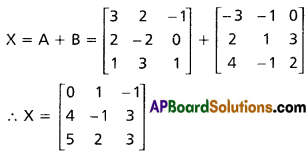
Inter 1st Year Maths 1A Matrices Solutions Ex 3(a) I Q4

Question 5.
If \(\left[\begin{array}{cc}
x-3 & 2 y-8 \\
z+2 & 6
\end{array}\right]=\left[\begin{array}{cc}
5 & 2 \\
-2 & a-4
\end{array}\right]\) then find the values of x, y, z and a.
Solution:
Given \(\left[\begin{array}{cc}
x-3 & 2 y-8 \\
z+2 & 6
\end{array}\right]=\left[\begin{array}{cc}
5 & 2 \\
-2 & a-4
\end{array}\right]\)
∴ x – 3 = 5 ⇒ x = 3 + 5 = 8
2y – 8 = 2 ⇒ 2y = 8 + 2 = 10 ⇒ y = 5
z + 2 = -2 ⇒ z = -2 – 2 = -4
a – 4 = 6 ⇒ a = 4 + 6 = 10

II.

Question 1.
If \(\left[\begin{array}{ccc}
x-1 & 2 & 5-y \\
0 & z-1 & 7 \\
1 & 0 & a-5
\end{array}\right]=\left[\begin{array}{ccc}
1 & 2 & 3 \\
0 & 4 & 7 \\
1 & 0 & 0
\end{array}\right]\) then find the values of x, y, z and a.
Solution:
Given \(\left[\begin{array}{ccc}
x-1 & 2 & 5-y \\
0 & z-1 & 7 \\
1 & 0 & a-5
\end{array}\right]=\left[\begin{array}{ccc}
1 & 2 & 3 \\
0 & 4 & 7 \\
1 & 0 & 0
\end{array}\right]\)
∴ x – 1 = 1 ⇒ x = 1 + 1 = 2
5 – y = 3 ⇒ y = 5 – 3 = 2
z – 1 = 4 ⇒ z = 4 + 1 = 5
a – 5 = 0 ⇒ a = 5

Inter 1st Year Maths 1A Matrices Solutions Ex 3(a)

Question 2.
Find the trace of \(\left[\begin{array}{ccc}
1 & 3 & -5 \\
2 & -1 & 5 \\
1 & 0 & 1
\end{array}\right]\)
Solution:
Trace of \(\left[\begin{array}{ccc}
1 & 3 & -5 \\
2 & -1 & 5 \\
1 & 0 & 1
\end{array}\right]\) = Sum of the diagonal elements
= 1 – 1 + 1
= 1

Question 3.
If A = \(\left[\begin{array}{rrr}
0 & 1 & 2 \\
2 & 3 & 4 \\
4 & 5 & -6
\end{array}\right]\) and B = \(\left[\begin{array}{ccc}
-1 & 2 & 3 \\
0 & 1 & 0 \\
0 & 0 & -1
\end{array}\right]\) find B – A and 4A – 5B.
Solution:
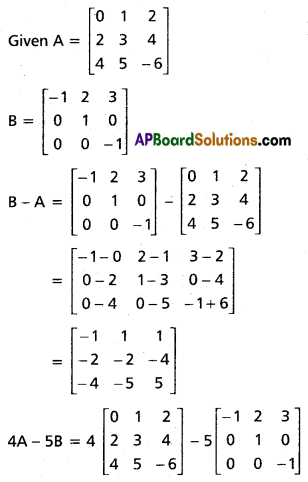
Inter 1st Year Maths 1A Matrices Solutions Ex 3(a) II Q3
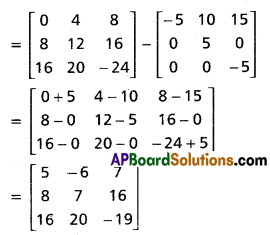
Inter 1st Year Maths 1A Matrices Solutions Ex 3(a) II Q3.1

Inter 1st Year Maths 1A Matrices Solutions Ex 3(a)

Question 4.
If A = \(\left[\begin{array}{lll}
1 & 2 & 3 \\
3 & 2 & 1
\end{array}\right]\) and B = \(\left[\begin{array}{lll}
3 & 2 & 1 \\
1 & 2 & 3
\end{array}\right]\) find 3B – 2A.
Solution:
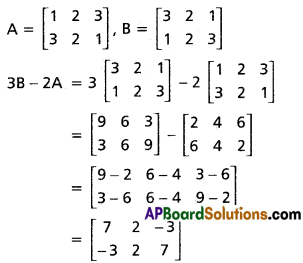
Inter 1st Year Maths 1A Matrices Solutions Ex 3(a) II Q4

Inter 1st Year Maths 1A Mathematical Induction Solutions Ex 2(a)

Practicing the Intermediate 1st Year Maths 1A Textbook Solutions Inter 1st Year Maths 1A Mathematical Induction Solutions Exercise 2(a) will help students to clear their doubts quickly.

Intermediate 1st Year Maths 1A Mathematical Induction Solutions Exercise 2(a)

Using mathematical induction, prove each of the following statements for all n ∈ N.

Question 1.
12 + 22 + 32 + …… + n2 = \(\frac{n(n+1)(2 n+1)}{6}\)
Solution:
Let p(n) be the given statement:
12 + 22 + 32 + ….. + n2 = \(\frac{n(n+1)(2 n+1)}{6}\)
Since 12 = \(\frac{(1)(1+1)(2 \times 1+1)}{6}\)
⇒ 1 = 1 the formula is true for n = 1
i.e., p(1) is true.
Assume the statement p(n) is true for n = k
i.e., 12 + 22 + 32 + …… + 1k2 = \(\frac{k(k+1)(2 k+1)}{6}\)
We show that the formula is true for n = k + 1
i.e., We show that p(k + 1) = \(\frac{(k+1)(k+2)(2 k+3)}{6}\)
(Where p(k) = 12 + 22 + 32 + … + k2)
We observe that
p(k + 1) = 12 + 22 + 32 + …… + (k)2 + (k + 1)2 = p(k) + (k + 1)2
Since p(k) = \(\frac{k(k+1)(2 k+1)}{6}\)
We have p(k + 1) = p(k) + (k + 1)2
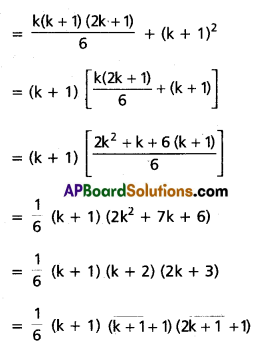
Inter 1st Year Maths 1A Mathematical Induction Solutions Ex 2(a) Q1
∴ The formula holds for n = k + 1
∴ By the principle of mathematical induction, p(n) is true for all n ∈ N
i.e., the formula 12 + 22 + 32 + ……. + n2 = \(\frac{n(n+1)(2 n+1)}{6}\) for all n ∈ N

Inter 1st Year Maths 1A Mathematical Induction Solutions Ex 2(a)

Question 2.
2.3 + 3.4 + 4.5 + …… up to n terms = \(\frac{n\left(n^{2}+6 n+11\right)}{3}\)
Solution:
The nth term in the given series is (n + 1) (n + 2)
Let p(n) be the statement:
2.3 + 3.4 + 4.5 + …… + (n + 1) (n + 2) = \(\frac{n\left(n^{2}+6 n+11\right)}{3}\)
and let S(n) be the sum on the left-hand side.
Since S(1) = 2.3 = \(\frac{(1)(1+6+11)}{3}\) = 6
∴ The statement is true for n = 1
Assume that the statement p(n) is true for n = k
i.e., S(k) = 2.3 + 3.4 + …… + (k + 1) (k + 2) = \(\frac{k\left(k^{2}+6 k+11\right)}{3}\)
We show that the statement is true for n = k + 1
i.e., We show that S(k + 1) = \((k+1)\left[\frac{(k+1)^{2}+6(k+1)+11}{3}\right]\)
We observe that
S(k + 1) = 2.3 + 3.4 + 4.5 + + (k + 1) (k + 2) + (k + 2) (k + 3)
= S(k) + (k + 2) (k + 3)
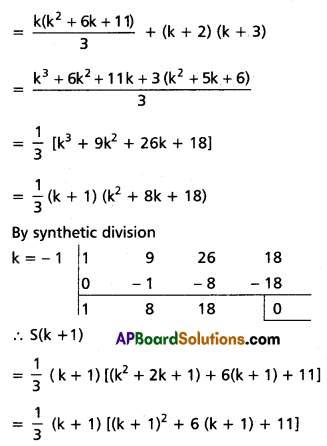
Inter 1st Year Maths 1A Mathematical Induction Solutions Ex 2(a) Q2
∴ The statement holds for n = k + 1
∴ By the principle of mathematical induction,
p(n) is true for all n ∈ N
i.e., 2.3 + 3.4 + 4.5 + ……. + (n + 1) (n + 2) = \(\frac{n\left(n^{2}+6 n+11\right)}{3}\)

Question 3.
\(\frac{1}{1.3}+\frac{1}{3.5}+\frac{1}{5.7}+\ldots+\frac{1}{(2 n-1)(2 n+1)}=\frac{n}{2 n+1}\)
Solution:
Let p(n) be the statement:
\(\frac{1}{1.3}+\frac{1}{3.5}+\frac{1}{5.7}+\ldots+\frac{1}{(2 n-1)(2 n+1)}=\frac{n}{2 n+1}\)
and let S(n) be the sum on the L.H.S.
Since S(1) = \(\frac{1}{1.3}=\frac{1}{1(2+1)}=\frac{1}{1.3}\)
∴ P(1) is true.
Assume that the statement p(n) is true for n = k
i.e., S(k) = \(\frac{1}{1.3}+\frac{1}{3.5}+\frac{1}{5.7}+\ldots+\frac{1}{(2 k-1)(2 k+1)}\) = \(\frac{k}{2 k+1}\)
We show that the statement p(n) is true for n = k + 1
i.e., we show that s(k + 1) = \(\frac{k+1}{2(k+1)+1}\)
We observe that
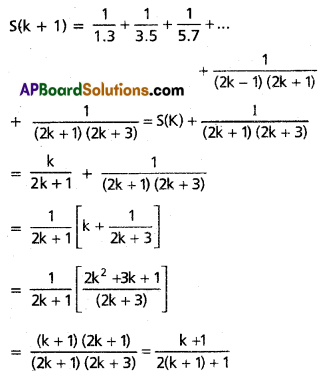
Inter 1st Year Maths 1A Mathematical Induction Solutions Ex 2(a) Q3
∴ The statement holds for n = k + 1
∴ By the principle of mathematical induction,
p(n) is true for all n ∈ N
i.e., \(\frac{1}{1.3}+\frac{1}{3.5}+\frac{1}{5.7}+\ldots+\frac{1}{(2 n-1)(2 n+1)}=\frac{n}{2 n+1}\)

Inter 1st Year Maths 1A Mathematical Induction Solutions Ex 2(a)

Question 4.
43 + 83 + 123 + …… up to n terms = 16n2(n + 1)2.
Solution:
4, 8, 12,….. are in A.P., whose nth term is (4n)
Let p(n) be the statement:
43 + 83 + 123 + ………. + (4n)3 = 16n2(n + 1)2
and S(n) be the sum on the L.H.S.
S(1) = 43 = 16(12) (1 + 1)2 = 16(4) = 64 = 43
∴ p(1) is true
Assume that the statement p(n) is true for n = k
i.e., S(k) = 43 + 83 + (12)3 + …… + (4k)3 = 16k2(k + 1)2
We show that the statement is true for n = k + 1
i.e., We show that S(k + 1) = 16(k + 1)2 (k + 2)2
We observe that
S(k + 1) = 43 + 83 + 123 + …… + (4k)3 + [4(k + 1)]3
= S(k) + [4(k + 1)]3
= 16k2 (k + 1)2 + 43 (k + 1)3
= 16(k + 1)2 [k2 + 4(k + 1)]
= 16(k + 1)2 [k2 + 4k + 4]
= 16(k + 1)2 (k + 2)2
= 16(k + 1)2 \((\overline{k+1}+1)^{2}\)
∴ The formula holds for n = k + 1
∴ By the principle of mathematical induction,
p(n) is true for all n ∈ N
(i.e.,) 43 + 83 + 123 + …… + (4n)3 = 16n2(n + 1)2

Question 5.
a + (a + d) + (a + 2d) + ……. up to n terms = \(\frac{n}{2}\) [2a + (n – 1)d]
Solution:
Let p(n) be the statement:
a + (a + d) + (a + 2d) + …… + [a + (n – 1)d] = \(\frac{n}{2}\) [2a + (n – 1)d]
and let the sum on the L.H.S. is denoted by S(n)
Since S(1) = a = \(\frac{1}{2}\) [2a + (1 – 1)d] = a
∴ p(1) is true.
Assume that the statement is true for n = k
(i.e.,) S(k) = a + (a + d) + (a + 2d) + ……. + [a + (k – 1)d] = \(\frac{k}{2}\) [2a + (k – 1 )d]
We show that the statement is true for n = k + 1
(i.e.,) we show that S(k + 1) = \(\left(\frac{k+1}{2}\right)[2 a+k d]\)
We observe that
S(k + 1) = a + (a + d) + (a + 2d) + …… + [a + (k – 1)d] + (a + kd)
= S(k) + (a + kd)
= \(\frac{k}{2}\) [2a + (k – 1)d] + (a + kd)
= \(\frac{k[2 a+(k-1) d]+2(a+k d)}{2}\)
= \(\frac{1}{2}\) [2ak + k(k – 1)d + 2a + 2kd]
= \(\frac{1}{2}\) [2a(k + 1) + k(k – 1 + 2)d]
= \(\frac{1}{2}\) (k + 1)(2a + kd)
∴ The statement holds for n = k + 1
∴ By the principle of mathematical inductions,
p(n) is true for all n ∈ N
(i.e.,) a + (a + d) + (a + 2d) + …… + [a + (n – 1)d] = \(\frac{n}{2}\) [2a + (n – 1)d]

Inter 1st Year Maths 1A Mathematical Induction Solutions Ex 2(a)

Question 6.
a + ar + ar2 + ……… up to n terms = \(\frac{a\left(r^{n}-1\right)}{r-1}\); r ≠ 1
Solution:
Let p(n) be the statement:
a + ar + a.r2 + …… + a. rn-1 = \(\frac{a\left(r^{n}-1\right)}{r-1}\), r ≠ 1
and let S(n) be the sum on the L.H.S
Since S(1) = a = \(\frac{a\left(r^{1}-1\right)}{r-1}\) = a
∴ p(1) is true
Assume that the statement is true for n = k
(i.e) S(k) = a + ar + ar2 + ……… + a . rk-1 = \(\frac{a\left(r^{k}-1\right)}{r-1}\)
We show that the statement is true for n = k + 1
(i.e) S(k + 1) = \(\frac{a\left(r^{k+1}-1\right)}{r-1}\)
Now S(k + 1) = a + ar + ar2 + ……. + a rk-1 + ark
= S(k) + a . rk
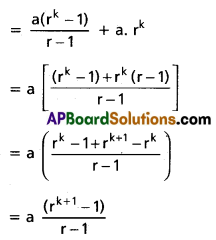
Inter 1st Year Maths 1A Mathematical Induction Solutions Ex 2(a) Q6
∴ The statement holds for n = k + 1
∴ By the principle of mathematical induction,
p(n) is true for all n ∈ N
(i.e) a + ar + ar2 + ……. + a.rn-1 = \(\frac{a\left(r^{n}-1\right)}{r-1}\), r ≠ 1

Question 7.
2 + 7 + 12 + ……. + (5n – 3) = \(\frac{n(5 n-1)}{2}\)
Solution:
Let p(n) be the statement:
2 + 7 + 12 + ……. + (5n – 3) = \(\frac{n(5 n-1)}{2}\)
and let S(n) be the sum on the L.H.S
Since S(1) = 2 = \(\frac{1(5 \times 1-1)}{2}=\frac{4}{2}\) = 2
∴ p(1) is true
Assume that the statement is true for n = k
(i.e) S(k) = 2 + 7 + 12 + …….. + (5k – 3) = \(\frac{k(5 k-1)}{2}\)
We have to show that S(k + 1) = \(\frac{(k+1)(5 k+4)}{2}\)
We observe that S(k + 1) = 2 + 7 + 12 + ……. + (5k – 3) + (5k + 2)
= S(k) + (5k + 2)
= \(\frac{k(5 k-1)}{2}\) + (5k + 2)
= \(\frac{5 k^{2}-k+2(5 k+2)}{2}\)
= \(\frac{1}{2}\) [5k2 + 9k + 4]
= \(\frac{1}{2}\) (k + 1) (5k + 4)
= \(\frac{1}{2}\) (k + 1) [5(k + 1) – 1]
∴ p(k + 1) is true
∴ By the principle of mathematical induction,
p(n) is true for all n ∈ N.
(i.e.,) 2 + 7 + 12 + …… + (5n – 3) = \(\frac{n(5 n-1)}{2}\)

Inter 1st Year Maths 1A Mathematical Induction Solutions Ex 2(a)

Question 8.
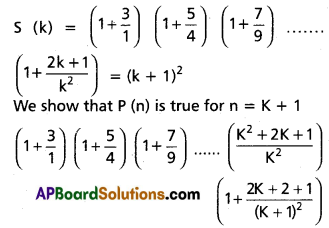
\(\left(1+\frac{3}{1}\right)\left(1+\frac{5}{4}\right)\left(1+\frac{7}{9}\right) \ldots \ldots\left(1+\frac{2 n+1}{n^{2}}\right)\) = (n + 1)2
Solution:
Let p(n) be the statement:
\(\left(1+\frac{3}{1}\right)\left(1+\frac{5}{4}\right)\left(1+\frac{7}{9}\right) \ldots \ldots\left(1+\frac{2 n+1}{n^{2}}\right)\) = (n + 1)2
and let S(n) be the product on the LHS
since S(1) = 1 + 3 = 4 = (1 + 1)2 = 4
∴ P(a) 4 time for n = 1
Assume that p(n) is true for n = k
Inter 1st Year Maths 1A Mathematical Induction Solutions Ex 2(a) Q8
= (k + 1)2 + 2k + 3
= k2 + 2k + 1 + 2k + 3
= k2 + 4k + 4
= (k + 2)2
= (k + 1 + 1)2
∴ P(n) is true for n = k + 1
By the principle of Mathematical Induction,
p(n) is true & n ∈ N

Question 9.
(2n + 7) < (n + 3)2
Solution:
Let p (n) be the statement
When n = 1, 9 < 16
∴ p(n) is true for n = 1
Assume p (n) is true for n = k
(2k + 7) < (k + 3)2
We show that p(n) is true for n = k + 1
2(k + 1) + 7 = 2k + 7 + 2
< (k + 3)2 + 2
< k2 + 6k + 9 + 2 + 2k + 5 – 2k – 5
< (k + 4)2 – (2k + 5)
< (k + 4)2
< (k + 1 + 3)2
∴ p(n) is true for n = k + 1
By the principle of Mathematical Induction
p(n) is true ∀ n ∈ N

Inter 1st Year Maths 1A Mathematical Induction Solutions Ex 2(a)

Question 10.
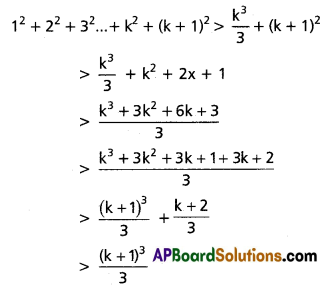
12 + 22 + …… + n2 > \(\frac{n^{3}}{3}\)
Solution:
Let P(n) by the statement
when n = 1, 1 > \(\frac{1}{3}\)
∴ p(n) is true for n = 1
Assume p (n) is true for n = k
12 + 22 + …… + k2 > \(\frac{k^{3}}{3}\)
We show that p(n) is true for n = k + 1
Inter 1st Year Maths 1A Mathematical Induction Solutions Ex 2(a) Q10
∴ p(n) is true for n = k + 1
By the principle of Mathematical Induction,
p(n) is true ∀ n ∈ N

Question 11.
4n – 3n – 1 is divisible by 9.
Solution:
Let p(n) be the statement:
4n – 3n – 1 is divisible by 9
Since 41 – 3(1) – 1 = 0 is divisible by 9.
The statement is true for n = 1
Assume that p(n) is true for n = k
(i.e) 4k – 3k – 1 is divisible by 9
Then 4k – 3k – 1 = 9t, for some t ∈ N ……..(1)
Show that the statement p(n) is true for n = k + 1
(i.e.,) we show that S(k + 1) = 4k+1 – 3(k+1) – 1 is divisible by 9
From (1), we have
4k = 9t + 3k + 1
∴ S(k + 1) = 4 . 4k – 3(k + 1) – 1
= 4(9t + 3k + 1) – 3k – 3 – 1
= 4(9t) + 9k
= 9[4t + k]
Hence s(k + 1) is divisible by 9
Since 4t + k is an integer
∴ 4k+1 – 3(k+1) – 1 is divisible by 9
∴ The statement is true for n = k + 1
∴ By the principle of mathematical induction,
p(n) is true for all n ∈ k
(i.e.,) 4n – 3n – 1 is divisible by 9

Inter 1st Year Maths 1A Mathematical Induction Solutions Ex 2(a)

Question 12.
3 . 52n+1 + 23n+1 is divisible by 17.
Solution:
Let p(n) be the statement:
3. 52n+1 + 23n+1 is divisible by 17
Since 3 . 52(1)+1 + 23(1)+1
= 3 . 53 + 24
= 3(125) + 16
= 375 + 16
= 391
= 17(23) is divisible by 17
∴ The statement is true for n = 1
Assume that the statement is true for n = k
(i.e) 3 . 52k+1 + 23k+1 is divisible by 17
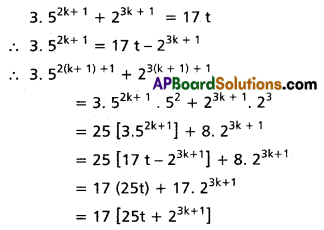
Then 3 . 52k+1 + 23k+1 = 17t, for some t ∈ N ……..(1)
Show that the statement p(n) is true for n = k + 1
(i.e.,) We have to show that
\(\text { 3. } 5^{2(k+1)+1}+2^{3(k+1)+1}\) is divisible by 17
From (1) we have
Inter 1st Year Maths 1A Mathematical Induction Solutions Ex 2(a) Q12
Here 25t + 23k+1 is an integer
∴ \(\text { 3. } 5^{2(k+1)+1}+2^{3(k+1)+1}\) is divisible by 17
∴ The statement is true for n = k + 1
∴ By the principle of mathematical induction,
p(n) is true for all n ∈ N
(i.e.,) 3 . 52n+1 + 23n+1 is divisible by 17.

Question 13.
1.2.3 + 2.3.4 + 3.4.5 + ……. upto n terms = \(\frac{n(n+1)(n+2)(n+3)}{4}\)
Solution:
The nth term of the given series is (n) (n + 1) (n + 2)
Let p(n) be the statement:
1.2.3 + 2.3.4 + 3.4.5 +……. + (n) (n+1) (n+2) = \(\frac{n(n+1)(n+2)(n+3)}{4}\)
and S(n) be the sum on the L.H.S.
∵ S(1) = 1.2.3 = \(\frac{(1)(1+1)(1+2)(1+3)}{4}\) = 1.2.3
∴ p(1) is true
Assume that the statement p(n) is true for n = k
(i.e) S(k) = 1.2.3 + 2.3.4 + 3.4.5 + ……. + k(k + 1) (k + 2) = \(\frac{k(k+1)(k+2)(k+3)}{4}\)
We show that the statement is true for n = k + 1
(i.e) We show that S(k + 1) = \(\frac{(k+1)(k+2)(k+3)(k+4)}{4}\)
We observe that
S(k + 1) = 1.2.3 + 2.3.4 + …… + k(k + 1) (k + 2) + (k + 1) (k + 2) (k + 3)
= S(k) + (k + 1) (k + 2) (k + 3)
= \(\frac{k(k+1)(k+2)(k+3)}{4}\) + (k + 1)(k + 2)(k + 3)
= (k + 1)(k + 2)(k + 3) \(\left(\frac{k}{4}+1\right)\)
= \(\frac{(k+1)(k+2)(k+3)(k+4)}{4}\)
∴ The statement holds for n = k + 1
∴ By the principle of mathematical induction,
p(n) is true for all n ∈ N
(i.e.,) 1.2.3 + 2.3.4 + 3.4.5 + ……. + (n)(n + 1)(n + 2) = \(\frac{n(n+1)(n+2)(n+3)}{4}\)

Inter 1st Year Maths 1A Mathematical Induction Solutions Ex 2(a)

Question 14.
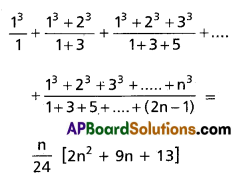
\(\frac{1^{3}}{1}+\frac{1^{3}+2^{3}}{1+3}+\frac{1^{3}+2^{3}+3^{3}}{1+3+5}\) + …. up to n terms = \(\frac{n}{24}\) [2n2 + 9n + 13]
Solution:
The nth term of the given series is \(\frac{1^{3}+2^{3}+3^{3}+\ldots .+n^{3}}{1+3+5+\ldots+(2 n-1)}\)
Let p(n) be the statement :
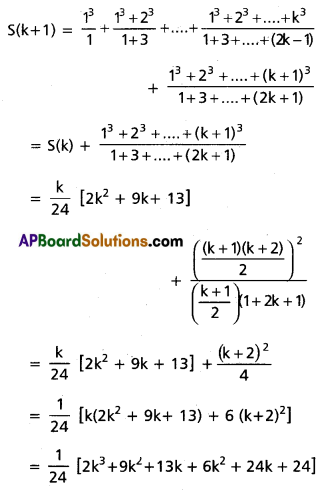
Inter 1st Year Maths 1A Mathematical Induction Solutions Ex 2(a) Q14
and let S(n) be the sum on the L.H.S.
∵ S(1) = \(\frac{1^{3}}{1}=\frac{1}{24}(2+9+13)=1=\frac{1^{3}}{1}\)
∴ p(1) is true
Assume that p(k) is true
(i.e.,) S(k) = \(\frac{1^{3}}{1}+\frac{1^{3}+2^{3}}{1+3}+\ldots+\frac{1^{3}+2^{3}+\ldots \pm k^{3}}{1+3+\ldots+(2 k-1)}\) = \(\frac{k}{24}\) [2k2 + 9k + 13]
We show that p(k + 1) is true
(i.e,) we show that
Inter 1st Year Maths 1A Mathematical Induction Solutions Ex 2(a) Q14.1
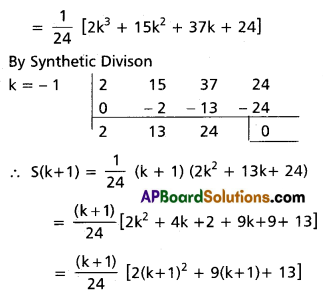
Inter 1st Year Maths 1A Mathematical Induction Solutions Ex 2(a) Q14.2
∴ The statement holds for n = k + 1
∴ By the principle of mathematical induction,
p(n) is true for all n
(i.e.,) \(\frac{1^{3}}{1}+\frac{1^{3}+2^{3}}{1+3}+\ldots+\frac{1^{3}+2^{3}+\ldots \ldots+n^{3}}{1+3+\ldots+(2 n-1)}\) = \(\frac{n}{24}\) [2n2 + 9n + 13]

Question 15.
12 + (12 + 22) + (12 + 22 + 32) + ……. up to n terms = \(\frac{n(n+1)^{2}(n+2)}{12}\)
Solution:
The nth term of the given series is (12 + 22 + 32 + …… + n2)
Let p(n) be the statement:
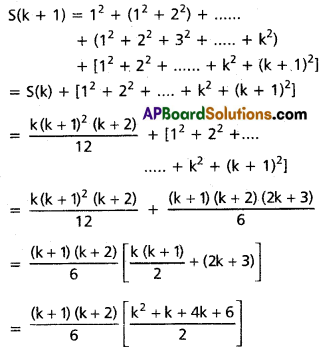
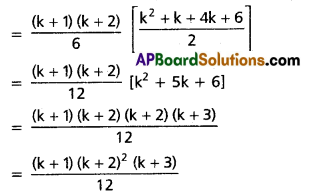
12 + (12 + 22) + (12 + 22 + 32) + ……. + (12 + 22 + …… + n2) = \(\frac{\mathrm{n}(\mathrm{n}+1)^{2}(\mathrm{n}+2)}{12}\)
and the sum on the LH.S. is denoted by S(n).
Since S(1) = 12 = \(\frac{1(1+1)^{2}(1+2)}{12}\) = 1 = 12
∴ p(1) is true.
Assume that the statement is true for n = k
(i.e.,) S(k) = 12 + (12 + 22) + ……. + (12 + 22 + ……. + k2)
= \(\frac{k(k+1)^{2}(k+2)}{12}\)
We show that S(k + 1) = \(\frac{(k+1)(k+2)^{2}(k+3)}{12}\)
We observe that
Inter 1st Year Maths 1A Mathematical Induction Solutions Ex 2(a) Q15
Inter 1st Year Maths 1A Mathematical Induction Solutions Ex 2(a) Q15.1
∴ The statement holds for n = k + 1.
∴ By the principle of mathematical induction,
p(n) is true for all n ∈ N.
(i.e.,) 12 + (12 + 22) + (12 + 22 + 32) + …….. (12 + 22 + ………. + n2) = \(\frac{n(n+1)^{2}(n+2)}{12}\)

Inter 1st Year Maths 1A Inverse Trigonometric Functions Solutions Ex 8(a)

Practicing the Intermediate 1st Year Maths 1A Textbook Solutions Inter 1st Year Maths 1A Inverse Trigonometric Functions Solutions Exercise 8(a) will help students to clear their doubts quickly.

Intermediate 1st Year Maths 1A Inverse Trigonometric Functions Solutions Exercise 8(a)

I.

Question 1.
Evaluate the following.
(i) \(\sin ^{-1}\left(\frac{-\sqrt{3}}{2}\right)\)
Solution:
Inter 1st Year Maths 1A Inverse Trigonometric Functions Solutions Ex 8(a) I Q1(i)

(ii) \(\cos ^{-1}\left(\frac{1}{\sqrt{2}}\right)\)
Solution:
\(\cos ^{-1}\left(\frac{1}{\sqrt{2}}\right)=\cos ^{-1}\left(\cos \frac{\pi}{4}\right)=\frac{\pi}{4}\)

Inter 1st Year Maths 1A Inverse Trigonometric Functions Solutions Ex 8(a)

(iii) sec-1(-√2)
Solution:
Inter 1st Year Maths 1A Inverse Trigonometric Functions Solutions Ex 8(a) I Q1(iii)

(iv) cot-1(-√3)
Solution:
Inter 1st Year Maths 1A Inverse Trigonometric Functions Solutions Ex 8(a) I Q1(iv)

(v) \(\sin \left(\frac{\pi}{3}-\sin ^{-1}\left(\frac{-1}{2}\right)\right)\)
Solution:
Inter 1st Year Maths 1A Inverse Trigonometric Functions Solutions Ex 8(a) I Q1(v)

(vi) \(\sin ^{-1}\left(\sin \frac{5 \pi}{6}\right)\)
Solution:
Inter 1st Year Maths 1A Inverse Trigonometric Functions Solutions Ex 8(a) I Q1(vi)

(vii) \(\cos ^{-1}\left(\cos \frac{5 \pi}{4}\right)\)
Solution:
Inter 1st Year Maths 1A Inverse Trigonometric Functions Solutions Ex 8(a) I Q1(vii)

Question 2.
Find the values of
(i) \(\sin \left(\cos ^{-1} \frac{3}{5}\right)\)
Solution:
\(\sin \left(\cos ^{-1} \frac{3}{5}\right)=\sin \left(\sin ^{-1} \frac{4}{5}\right)=\frac{4}{5}\)

(ii) \(\tan \left({cosec}^{-1} \frac{65}{63}\right)\)
Solution:
\(\tan \left({cosec}^{-1} \frac{65}{63}\right)=\tan \left(\tan ^{-1} \frac{63}{16}\right)\) = \(\frac{63}{16}\)

(iii) \(\sin \left(2 \sin ^{-1} \frac{4}{5}\right)\)
Solution:
Inter 1st Year Maths 1A Inverse Trigonometric Functions Solutions Ex 8(a) I Q2(iii)

(iv) \(\sin ^{-1}\left(\sin \frac{33 \pi}{7}\right)\)
Solution:
Inter 1st Year Maths 1A Inverse Trigonometric Functions Solutions Ex 8(a) I Q2(iv)

(v) \(\cos ^{-1}\left(\cos \frac{17 \pi}{6}\right)\)
Solution:
Inter 1st Year Maths 1A Inverse Trigonometric Functions Solutions Ex 8(a) I Q2(v)

Inter 1st Year Maths 1A Inverse Trigonometric Functions Solutions Ex 8(a)

Question 3.
Simplify each of the following.
(i) \(\tan ^{-1}\left[\frac{\sin x}{1+\cos x}\right]\)
Solution:
Inter 1st Year Maths 1A Inverse Trigonometric Functions Solutions Ex 8(a) I Q3(i)

(ii) tan-1(sec x + tan x)
Solution:
Inter 1st Year Maths 1A Inverse Trigonometric Functions Solutions Ex 8(a) I Q3(ii)

(iii) \(\tan ^{-1} \sqrt{\frac{1-\cos x}{1+\cos x}}\)
Solution:
Inter 1st Year Maths 1A Inverse Trigonometric Functions Solutions Ex 8(a) I Q3(iii)

(iv) sin-1(2 cos2θ – 1) + cos-1(1 – 2 sin2θ)
Solution:
sin-1(cos 2θ) + cos-1(cos 2θ)
= sin-1[sin (90° – 2θ)] + cos-1(cos 2θ)
= 90° – 2θ + 2θ
= 90°

(v) \(\tan ^{-1}\left(x+\sqrt{1+x^{2}}\right)\); x ∈ R
Solution:
Inter 1st Year Maths 1A Inverse Trigonometric Functions Solutions Ex 8(a) I Q3(v)
Inter 1st Year Maths 1A Inverse Trigonometric Functions Solutions Ex 8(a) I Q3(v).1

II.

Question 1.
Prove that
(i) \(\sin ^{-1} \frac{3}{5}+\sin ^{-1} \frac{8}{17}=\cos ^{-1} \frac{36}{85}\)
Solution:
Inter 1st Year Maths 1A Inverse Trigonometric Functions Solutions Ex 8(a) II Q1(i)
Inter 1st Year Maths 1A Inverse Trigonometric Functions Solutions Ex 8(a) II Q1(i).1

(ii) \(\sin ^{-1} \frac{3}{5}+\cos ^{-1} \frac{12}{13}=\cos ^{-1} \frac{33}{65}\)
Solution:
Inter 1st Year Maths 1A Inverse Trigonometric Functions Solutions Ex 8(a) II Q1(ii)
Inter 1st Year Maths 1A Inverse Trigonometric Functions Solutions Ex 8(a) II Q1(ii).1

(iii) \(\tan \left[\cot ^{-1} 9+{cosec}^{-1} \frac{\sqrt{41}}{4}\right]=1\)
Solution:
Inter 1st Year Maths 1A Inverse Trigonometric Functions Solutions Ex 8(a) II Q1(iii)

(iv) \(\cos ^{-1} \frac{4}{5}+\sin ^{-1} \frac{3}{\sqrt{34}}=\tan ^{-1} \frac{27}{11}\)
Solution:
Inter 1st Year Maths 1A Inverse Trigonometric Functions Solutions Ex 8(a) II Q1(iv)
Inter 1st Year Maths 1A Inverse Trigonometric Functions Solutions Ex 8(a) II Q1(iv).1

Inter 1st Year Maths 1A Inverse Trigonometric Functions Solutions Ex 8(a)

Question 2.
Find the values of
(i) \(\sin \left(\cos ^{-1} \frac{3}{5}+\cos ^{-1} \frac{12}{13}\right)\)
Solution:
Inter 1st Year Maths 1A Inverse Trigonometric Functions Solutions Ex 8(a) II Q2(i)

(ii) \(\tan \left(\sin ^{-1} \frac{3}{5}+\cos ^{-1} \frac{5}{\sqrt{34}}\right)\)
Solution:
Inter 1st Year Maths 1A Inverse Trigonometric Functions Solutions Ex 8(a) II Q2(ii)

(iii) \(\cos \left(\sin ^{-1} \frac{3}{5}+\sin ^{-1} \frac{5}{13}\right)\)
Solution:
Let \(\sin ^{-1} \frac{3}{5}\) = α and \(\sin ^{-1} \frac{5}{13}\) = β
Inter 1st Year Maths 1A Inverse Trigonometric Functions Solutions Ex 8(a) II Q2(iii)

Question 3.
Prove that
(i) \(\cos \left[2 \tan ^{-1} \frac{1}{7}\right]=\sin \left[2 \tan ^{-1} \frac{3}{4}\right]\)
Solution:
Inter 1st Year Maths 1A Inverse Trigonometric Functions Solutions Ex 8(a) II Q3(i)

(ii) \(\tan \left[2 \tan ^{-1}\left(\frac{\sqrt{5}-1}{2}\right)\right]=2\)
Solution:
Inter 1st Year Maths 1A Inverse Trigonometric Functions Solutions Ex 8(a) II Q3(ii)

(iii) \(\cos \left\{2\left[\tan ^{-1}\left(\frac{1}{4}\right)+\tan ^{-1}\left(\frac{2}{9}\right)\right]\right\}=\frac{3}{5}\)
Solution:
Inter 1st Year Maths 1A Inverse Trigonometric Functions Solutions Ex 8(a) II Q3(iii)

Question 4.
Prove that
(i) \(\tan ^{-1} \frac{1}{7}+\tan ^{-1} \frac{1}{13}-\tan ^{-1} \frac{2}{9}=0\)
Solution:
Inter 1st Year Maths 1A Inverse Trigonometric Functions Solutions Ex 8(a) II Q4(i)
Inter 1st Year Maths 1A Inverse Trigonometric Functions Solutions Ex 8(a) II Q4(i).1

(ii) \(\tan ^{-1} \frac{1}{2}+\tan ^{-1} \frac{1}{5}+\tan ^{-1} \frac{1}{8}=\frac{\pi}{4}\)
Solution:
Inter 1st Year Maths 1A Inverse Trigonometric Functions Solutions Ex 8(a) II Q4(ii)

(iii) \(\tan ^{-1} \frac{3}{4}+\tan ^{-1} \frac{3}{5}-\tan ^{-1} \frac{8}{19}=\frac{\pi}{4}\)
Solution:
Inter 1st Year Maths 1A Inverse Trigonometric Functions Solutions Ex 8(a) II Q4(iii)
Inter 1st Year Maths 1A Inverse Trigonometric Functions Solutions Ex 8(a) II Q4(iii).1

(iv) \(\tan ^{-1} \frac{1}{7}+\tan ^{-1} \frac{1}{8}\) = \(\cot ^{-1} \frac{201}{43}+\cot ^{-1} 18\)
Solution:
Inter 1st Year Maths 1A Inverse Trigonometric Functions Solutions Ex 8(a) II Q4(iv)

Inter 1st Year Maths 1A Inverse Trigonometric Functions Solutions Ex 8(a)

Question 5.
Show that
(i) sec2 (tan-1 2) + cosec2 (cot-1 2) = 10
Solution:
Let a = tan-1 2 ⇒ tan α = 2
sec2 α = 1 + tan-1 α = 1 + 4 = 5
Let β = cot-1 2 ⇒ cot β = 2
cosec2 β = 1 + cot2 β = 1 + 4 = 5
LHS = sec2 (tan-1 2) + cosec2 (cot-1 2)
= 5 + 5
= 10
= RHS

(ii) Find the value of \(\left(\cos ^{-1} \frac{4}{5}+\tan ^{-1} \frac{2}{3}\right)\)
Solution:
Inter 1st Year Maths 1A Inverse Trigonometric Functions Solutions Ex 8(a) II Q5(ii)

(iii) If sin-1 x – cos-1 x = \(\frac{\pi}{6}\) then find x.
Solution:
Inter 1st Year Maths 1A Inverse Trigonometric Functions Solutions Ex 8(a) II Q5(iii)

III.

Question 1.
Prove that
(i) \(2 \sin ^{-1} \frac{3}{5}-\cos ^{-1} \frac{5}{13}=\cos ^{-1} \frac{323}{325}\)
Solution:
Inter 1st Year Maths 1A Inverse Trigonometric Functions Solutions Ex 8(a) III Q1(i)

(ii) \(\sin ^{-1} \frac{4}{5}+2 \tan ^{-1} \frac{1}{3}=\frac{\pi}{2}\)
Solution:
Inter 1st Year Maths 1A Inverse Trigonometric Functions Solutions Ex 8(a) III Q1(ii)
Inter 1st Year Maths 1A Inverse Trigonometric Functions Solutions Ex 8(a) III Q1(ii).1

(iii) \(4 \tan ^{-1} \frac{1}{5}+\tan ^{-1} \frac{1}{99}-\tan ^{-1} \frac{1}{70}=\frac{\pi}{4}\)
Solution:
Inter 1st Year Maths 1A Inverse Trigonometric Functions Solutions Ex 8(a) III Q1(iii)
Inter 1st Year Maths 1A Inverse Trigonometric Functions Solutions Ex 8(a) III Q1(iii).1

Question 2.
(i) If α = \({tan}^{-1}\left(\frac{\sqrt{1+x^{2}}-\sqrt{1-x^{2}}}{\sqrt{1+x^{2}}+\sqrt{1-x^{2}}}\right)\) then prove that x2 = sin 2α.
Solution:
Inter 1st Year Maths 1A Inverse Trigonometric Functions Solutions Ex 8(a) III Q2(i)
Inter 1st Year Maths 1A Inverse Trigonometric Functions Solutions Ex 8(a) III Q2(i).1

(ii) Prove that tan\(\left\{2-\tan ^{-1}\left(\frac{\sqrt{1+x^{2}}-1}{x}\right)\right\}=\mathbf{x}\)
Solution:
Inter 1st Year Maths 1A Inverse Trigonometric Functions Solutions Ex 8(a) III Q2(ii)

(iii) Prove that \(\sin \left[\cot ^{-1} \frac{2 x}{1-x^{2}}+\cos ^{-1}\left(\frac{1-x^{2}}{1+x^{2}}\right)\right]\) = 1
Solution:
Inter 1st Year Maths 1A Inverse Trigonometric Functions Solutions Ex 8(a) III Q2(iii)

(iv) Prove that \(\left\{\frac{\pi}{4}+\frac{1}{2} \cos ^{-1}\left(\frac{a}{b}\right)\right\}\)
Solution:
Inter 1st Year Maths 1A Inverse Trigonometric Functions Solutions Ex 8(a) III Q2(iv)

Question 3.
(i) If cos-1 p + cos-1 q + cos-1 r = π, then prove that p2 + q2 + r2 + 2pqr = 1
Solution:
Let cos-1 p = A, cos-1 q = B and cos-1 r = C
then A + B + C = π ………(1)
and p = cos A, q = cos B and r cos C
Now p2 + q2 + r2 = cos2 A + cos2 B + cos2 C
= cos2 A + (1 – sin2 B + cos2 C)
= 1 + (cos2 A – sin2 B) + cos2 C
= 1 + cos (A + B) . cos (A – B) + cos2 C
= 1 + cos (π – C) cos (A – B) + cos2 C (By (1))
= 1 – cos C cos (A – B) + cos2 C
= 1 – cos C [cos (A – B) – cos C]
= 1 – cos C [cos (A – B) – cos(180° – \(\overline{A+B}\)]
= 1 – cos C [cos (A – B) + cos (A + B)]
= 1 – cos C [2 cos A cos B]
= 1 – 2 pqr
∴ p2 + q2 + r2 + 2pqr = 1

Inter 1st Year Maths 1A Inverse Trigonometric Functions Solutions Ex 8(a)

(ii) If \(\sin ^{-1}\left(\frac{2 p}{1+p^{2}}\right)-\cos ^{-1}\left(\frac{1-q^{2}}{1+q^{2}}\right)\) = \(\tan ^{-1}\left(\frac{2 x}{1-x^{2}}\right)\), then prove that x = \(\frac{p-q}{1+p q}\)
Solution:
Inter 1st Year Maths 1A Inverse Trigonometric Functions Solutions Ex 8(a) III Q3(ii)

(iii) If a, b, c are distinct non-zero real numbers having the same sign, prove that \(\cot ^{-1}\left(\frac{a b+1}{a-b}\right)+\cot ^{-1}\left(\frac{b c+1}{b-c}\right)\) + \(\cot ^{-1}\left(\frac{c a+1}{c-a}\right)\) = π or 2π
Solution:
Since (a – b) + (b – c) + (c – a) = 0.
(a – b), (b – c), (c – a) all cannot have the same sign.
Now two cases arise, namely, either two of these numbers are positive and one negative (or) two of these numbers are negative and one is positive.
Case (i): Without loss of generality, we assume that (a – b), (b – c) are both positive and (c – a) is negative
Inter 1st Year Maths 1A Inverse Trigonometric Functions Solutions Ex 8(a) III Q3(iii)
Case (ii): Without loss of generality, we assume that (a – b) and (b – c) are both negative and (c – a) is positive.
Inter 1st Year Maths 1A Inverse Trigonometric Functions Solutions Ex 8(a) III Q3(iii).1

(iv) If sin-1 (x) + sin-1 (y) + sin-1 (z) = π, then prove that \(x \sqrt{1-x^{2}}+y \sqrt{1-y^{2}}+z \sqrt{1-z^{2}}=2 x y z\)
Solution:
Let sin-1 (x) = A, sin-1 (y) = B and sin-1 (z) = C
Then A + B + C = π …………(1)
and x = sin A, y = sin B and z = sin C
Now LHS = \(x \sqrt{1-x^{2}}+y \sqrt{1-y^{2}}+z \sqrt{1-z^{2}}\)
= sin A \(\sqrt{1-\sin ^{2} A}\) + sin B \(\sqrt{1-\sin ^{2} B}\) + sin C \(\sqrt{1-\sin ^{2} C}\)
= sin A cos A + sin B cos B + sin C cos C
= \(\frac{1}{2}\) [sin 2A + sin 2B + sin 2C]
= \(\frac{1}{2}\) [2 . sin (A + B) cos (A – B) + sin 2C]
= \(\frac{1}{2}\) [2 sin (π – c). cos (A – B) + sin 2C]
= \(\frac{1}{2}\) [2 sin C cos (A – B) + 2 sin C cos C]
= \(\frac{1}{2}\) (2 sin C) [cos (A – B) + cos C]
= sin C [cos (A – B) + cos (180° – \(\overline{A+B}\)]
= sin C [cos (A – B) – cos (A + B)]
= sin C [2 sin A sin B]
= 2 xyz
∴ \(x \sqrt{1-x^{2}}+y \sqrt{1-y^{2}}+z \sqrt{1-z^{2}}=2 x y z\)

(v) (a) If tan-1 x + tan-1 y + tan-1 z = π, then prove that x + y + z = xyz.
Solution:
Let A = tan-1 x, B = tan-1 y, C = tan-1 z
tan A = x, tan B = y, tan C = z
Given A + B + C = π ……….(1)
A + B = π – C
tan (A + B) = tan (π – C)
\(\frac{\tan A+\tan B}{1-\tan A \tan B}\) = -tan C
\(\frac{x+y}{1-x y}\) = -z
x + y = -z + xyz
∴ x + y + z = xyz

(b) If tan-1 x + tan-1 y + tan-1 z = \(\frac{\pi}{2}\), then prove that xy + yz + zx = 1.
Solution:
Let tan-1 x = A, tan-1 y = B and tan-1 z = C
Then A + B + C = \(\frac{\pi}{2}\) …….(1)
and x = tan A, y = tan B and z = tan C
∵ A + B + C = \(\frac{\pi}{2}\)
A + B = \(\frac{\pi}{2}\) – C
⇒ tan (A + B) = tan(\(\frac{\pi}{2}\) – C)
⇒ \(\frac{\tan A+\tan B}{1-\tan A \cdot \tan B}\) = cot C
⇒ \(\frac{x+y}{1-x y}=\frac{1}{z}\)
⇒ zx + yz = 1 – xy (or) xy + yz + zx = 1

Inter 1st Year Maths 1A Inverse Trigonometric Functions Solutions Ex 8(a)

Question 4.
Solve the following equations for x:
(i) \({Tan}^{-1}\left(\frac{x-1}{x-2}\right)+{Tan}^{-1}\left(\frac{x+1}{x+2}\right)=\frac{\pi}{4}\)
Solution:
Inter 1st Year Maths 1A Inverse Trigonometric Functions Solutions Ex 8(a) III Q4(i)

(ii) \(\tan ^{-1}\left(\frac{1}{2 x+1}\right)+\tan ^{-1}\left(\frac{1}{4 x+1}\right)\) = \(\tan ^{-1} \frac{2}{x^{2}}\)
Solution:
Given that
Inter 1st Year Maths 1A Inverse Trigonometric Functions Solutions Ex 8(a) III Q4(ii)
⇒ x2(3x + 1) = 2x(4x + 3)
⇒ x [x(3x + 1) – 2(4x + 3)] = 0
⇒ x = 0 (or) 3x2 – 7x – 6 = 0
⇒ x = 0 (or) 3x2 – 9x + 2x – 6 = 0
⇒ x = 0 (or) 3x(x – 3) + 2(x – 3) = 0
⇒ x = 0 (or) (3x + 2) (x – 3) = 0
⇒ x = 0 (or) 3 (or) \(\frac{-2}{3}\)

(iii) \(3 \sin ^{-1}\left(\frac{2 x}{1+x^{2}}\right)-4 \cos ^{-1}\left(\frac{1-x^{2}}{1+x^{2}}\right)\) + \(2 \tan ^{-1}\left(\frac{2 x}{1-x^{2}}\right)=\frac{\pi}{3}\)
Solution:
Inter 1st Year Maths 1A Inverse Trigonometric Functions Solutions Ex 8(a) III Q4(iii)
Inter 1st Year Maths 1A Inverse Trigonometric Functions Solutions Ex 8(a) III Q4(iii).1

(iv) sin-1(1 – x) – 2 sin-1 x = \(\frac{\pi}{2}\)
Solution:
Given sin-1(1 – x) – 2 sin-1x = \(\frac{\pi}{2}\)
Let sin-1(1 – x) = α and sin-1(x) = β
Then sin α = 1 – x and sin β = x
cos α = \(\sqrt{1-(1-x)^{2}}\) and cos β = \(\sqrt{1-x^{2}}\)
Now sin-1(1 – x) – 2 sin-1(x) = \(\frac{\pi}{2}\)
⇒ α – 2β = \(\frac{\pi}{2}\)
⇒ α = \(\frac{\pi}{2}\) + 2β
⇒ sin α = sin (\(\frac{\pi}{2}\) + 2β)
⇒ sin α = cos 2β
⇒ 1 – x = 1 – 2 sin2β
⇒ 1 – x = 1 – 2x2
⇒ 2x2 – x = 0
⇒ x(2x – 1) = 0
⇒ x = 0 (or) x = \(\frac{1}{2}\)
But when x = \(\frac{1}{2}\)
Inter 1st Year Maths 1A Inverse Trigonometric Functions Solutions Ex 8(a) III Q4(iv)
Hence x = 0 is the only solution for the given equation.

Inter 1st Year Maths 1A Inverse Trigonometric Functions Solutions Ex 8(a)

Question 5.
Solve the following equations.
(i) \(\cot ^{-1}\left(\frac{1+x}{1-x}\right)=\frac{1}{2} \cot ^{-1}\left(\frac{1}{x}\right)\), x > 0 and x ≠ 1
Solution:
Inter 1st Year Maths 1A Inverse Trigonometric Functions Solutions Ex 8(a) III Q5(i)

(ii) \(\tan \left[\cos ^{-1} \frac{1}{x}\right]=\sin \left[\cot ^{-1} \frac{1}{2}\right]\); x ≠ 0
Solution:
Let \(\cos ^{-1}\left(\frac{1}{x}\right)=\alpha, \cot ^{-1} \frac{1}{2}=\beta\)
Inter 1st Year Maths 1A Inverse Trigonometric Functions Solutions Ex 8(a) III Q5(ii)

(iii) \(\cos ^{-1} x+\sin ^{-1} \frac{x}{2}=\frac{\pi}{6}\)
Solution:
Inter 1st Year Maths 1A Inverse Trigonometric Functions Solutions Ex 8(a) III Q5(iii)
Inter 1st Year Maths 1A Inverse Trigonometric Functions Solutions Ex 8(a) III Q5(iii).1

(iv) \(\cos ^{-1}(\sqrt{3} \cdot x)+\cos ^{-1} x=\frac{\pi}{2}\)
Solution:
Inter 1st Year Maths 1A Inverse Trigonometric Functions Solutions Ex 8(a) III Q5(iv)
Inter 1st Year Maths 1A Inverse Trigonometric Functions Solutions Ex 8(a) III Q5(iv).1

(v) \(\sin \left[\sin ^{-1}\left(\frac{1}{5}\right)+\cos ^{-1} x\right]=1\)
Solution:
Inter 1st Year Maths 1A Inverse Trigonometric Functions Solutions Ex 8(a) III Q5(v)

Inter 1st Year Maths 1A Trigonometric Ratios up to Transformations Solutions Ex 6(d)

Practicing the Intermediate 1st Year Maths 1A Textbook Solutions Inter 1st Year Maths 1A Trigonometric Ratios up to Transformations Solutions Exercise 6(d) will help students to clear their doubts quickly.

Intermediate 1st Year Maths 1A Trigonometric Ratios up to Transformations Solutions Exercise 6(d)

I.

Question 1.
Simplify
(i) \(\frac{\sin 2 \theta}{1+\cos 2 \theta}\)
Solution:
\(\frac{\sin 2 \theta}{1+\cos 2 \theta}\)
= \(\frac{2 \sin \theta \cos \theta}{2 \cos ^{2} \theta}\)
= tan θ

(ii) \(\frac{3 \cos \theta+\cos 3 \theta}{3 \sin \theta-\sin 3 \theta}\)
Solution:
\(\frac{3 \cos \theta+\cos 3 \theta}{3 \sin \theta-\sin 3 \theta}\)
= \(\frac{3 \cos \theta+4 \cos ^{3} \theta-3 \cos \theta}{3 \sin \theta-\left(3 \sin \theta-4 \sin ^{3} \theta\right)}\)
= \(\frac{4 \cos ^{3} \theta}{4 \sin ^{3} \theta}\)
= cot3θ

Inter 1st Year Maths 1A Trigonometric Ratios up to Transformations Solutions Ex 6(d)

Question 2.
Evaluate the following.
(i) 6 sin 20° – 8 sin3 20°
Solution:
6 sin 20° – 8 sin320°
= 2(3 sin 20° – 4 sin320°)
= 2 sin (3 × 20)
= 2 sin 60°
= 2 \(\left[\frac{\sqrt{3}}{2}\right]\)
= √3

(ii) cos272° – sin254°
Solution:
Inter 1st Year Maths 1A Trigonometric Ratios up to Transformations Solutions Ex 6(d) I Q2(ii)

(iii) sin242° – sin212°
Solution:
sin (42 + 12) sin (42 – 12)
= sin 54° . sin 30°
= \(\left[\frac{\sqrt{5}+1}{4}\right] \frac{1}{2}\)
= \(\frac{\sqrt{5}+1}{8}\)

Question 3.
(i) Express \(\frac{\sin 4 \theta}{\sin \theta}\) interms of cos3θ and cos θ.
Solution:
consider sin 4θ = sin(3θ + θ)
= sin 3θ cos θ + cos 3θ sin θ
= (3 sin θ – 4 sin3θ) cos θ + (4 cos3θ – 3 cos θ) sin θ
= 3 sin θ cos θ – 4 sin3θ cos θ + 4 cos3θ sin θ – 3 cos θ sin θ
= 4 cos3θ sin θ – 4 sin3θ cos θ
= sin θ (4 cos3θ – 4 sin2θ cos θ)
\(\frac{\sin 4 \theta}{\sin \theta}=\frac{\sin \theta\left(4 \cos ^{3} \theta-4 \sin ^{2} \theta \cos \theta\right)}{\sin \theta}\)
= 4 cos3θ – 4(1 – cos2θ) cos θ
= 4 cos3θ – 4 cos θ + 4 cos3θ
= 8 cos3θ – 4 cos θ

(ii) Express cos6A + sin6A in terms of sin 2A.
Solution:
cos6A + sin6A
= (cos2A)3 + (sin2A)3
= (cos2A + sin2A)3 – 3 cos2A sin2A (cos2A + sin2A)
= 1 – 3 cos2A sin2A
= 1 – \(\frac{3}{4}\) (4 cos2A sin2A)
= 1 – \(\frac{3}{4}\) (sin22A)

(iii) Express \(\frac{1-\cos \theta+\sin \theta}{1+\cos \theta+\sin \theta}\) in terms of tan θ/2
Solution:
Inter 1st Year Maths 1A Trigonometric Ratios up to Transformations Solutions Ex 6(d) I Q3(iii)

Question 4.
(i) If sin α = \(\frac{3}{5}\), where \(\frac{\pi}{2}\) < α < π, evaluate cos 3α and tan 2α.
Solution:
Inter 1st Year Maths 1A Trigonometric Ratios up to Transformations Solutions Ex 6(d) I Q4(i)
Inter 1st Year Maths 1A Trigonometric Ratios up to Transformations Solutions Ex 6(d) I Q4(i).1

(ii) If cos A = \(\frac{7}{25}\) and \(\frac{3 \pi}{2}\) < A < 2π, then find the value of cot A/2.
Solution:
Inter 1st Year Maths 1A Trigonometric Ratios up to Transformations Solutions Ex 6(d) I Q4(ii)

(iii) If 0 < θ < \(\frac{\pi}{8}\), show that \(\sqrt{2+\sqrt{2+\sqrt{2+2 \cos 4 \theta)}}}=2 \cos (\theta / 2)\)
Solution:
Inter 1st Year Maths 1A Trigonometric Ratios up to Transformations Solutions Ex 6(d) I Q4(iii)

Question 5.
Find the extreme values of
(i) cos 2x + cos2x
Solution:
cos 2x + cos2x
= 2 cos2x – 1 + cos2x
= 3 cos2x – 1
-1 ≤ cos x ≤ 1
0 ≤ cos2x ≤ 1
0 ≤ 3 cos2x ≤ 3
-1 ≤ 3 cos2x – 1 ≤ 2
maximum value = 2
minimum value = -1

(ii) 3 sin2x + 5 cos2x
Solution:
3 sin2x + 5 cos2x
= 3(1 – cos2x) + 5 cos2x
= 3 – 3 cos2x + 5 cos2x
= 3 + 2 cos2x
-1 ≤ cos x ≤ 1
0 ≤ cos2x ≤ 1
0 ≤ 2 cos2x ≤ 2
3 ≤ 3 + 2 cos2x ≤ 5
maximum value = 5
minimum value = 3

Inter 1st Year Maths 1A Trigonometric Ratios up to Transformations Solutions Ex 6(d)

Question 6.
If a ≤ cos θ + 3√2 sin[θ + \(\frac{\pi}{4}\)] + 6 ≤ b, then find the largest value of a and smallest value of b.
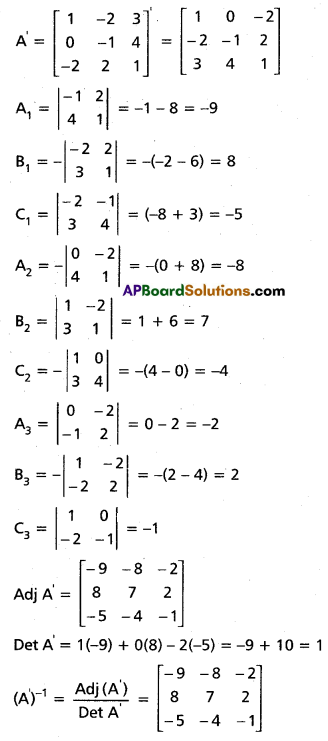
Solution:
a ≤ cos θ + 3√2 sin[θ + \(\frac{\pi}{4}\)] + 6 ≤ b
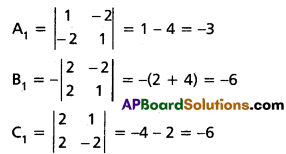
consider cos θ + 3√2 sin[θ + \(\frac{\pi}{4}\)] + 6
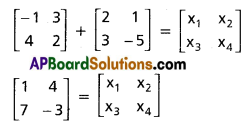
= cos θ + 3√2[sin θ cos \(\frac{\pi}{4}\) + cos θ sin \(\frac{\pi}{4}\)] + 6
= cos θ + 3√2 sin θ \(\frac{1}{\sqrt{2}}\) + 3√2 cos θ \(\frac{1}{\sqrt{2}}\) + 6
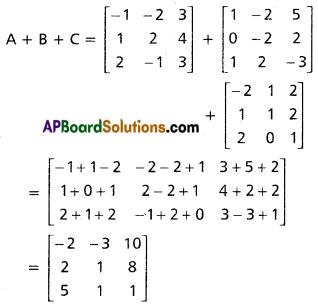
= cos θ + 3 sin θ + 3 cos θ + 6
= 4 cos θ + 3 sin θ + 6
∴ a = 4, b = 3, c = 6
maximum value = c + \(\sqrt{a^{2}+b^{2}}\)
= 6 + \(\sqrt{16+9}\)
= 6 + 5
= 11
minimum value = c – \(\sqrt{a^{2}+b^{2}}\)
= 6 – 5
= 1

Question 7.
Find the periods for the following functions.
(i) cos4x
Solution:
Inter 1st Year Maths 1A Trigonometric Ratios up to Transformations Solutions Ex 6(d) I Q7(i)

(ii) \(2 \sin \left[\frac{\pi x}{4}\right]+3 \cos \left[\frac{\pi x}{3}\right]\)
Solution:
Inter 1st Year Maths 1A Trigonometric Ratios up to Transformations Solutions Ex 6(d) I Q7(ii)

(iii) sin2x + 2 cos2x
Solution:
Let f(x) = sin2x + 2 cos2x
= 1 – cos2x + 2 cos2x
= 1 + cos2x
= 1 + \(\frac{1+\cos 2 x}{2}\)
∴ period of cos 2x = \(\frac{2 \pi}{2}\) = π
∴ period of f(x) = π

(iv) \(2 \sin \left[\frac{\pi}{4}+x\right] \cos x\)
Solution:
Inter 1st Year Maths 1A Trigonometric Ratios up to Transformations Solutions Ex 6(d) I Q7(iv)

(v) \(\frac{5 \sin x+3 \cos x}{4 \sin 2 x+5 \cos x}\)
Solution:
Let f(x) = \(\frac{5 \sin x+3 \cos x}{4 \sin 2 x+5 \cos x}\)
period of sin x = 2π
period of cos x = 2π
period of sin 2x = \(\frac{2 \pi}{2}\) = π
period of cos x = 2π
L.C.M. of (2π, 2π, π, 2π) = 2π
∴ period of f(x) = 2π

II.

Question 1.
(i) If 0 < A < \(\frac{\pi}{4}\) and cos A = \(\frac{4}{5}\), find the values of sin 2A and cos 2A.
Solution:
Inter 1st Year Maths 1A Trigonometric Ratios up to Transformations Solutions Ex 6(d) II Q1(i)

(ii) For what values of A in the first quadrant, the expression \(\frac{\cot ^{3} A-3 \cot A}{3 \cot ^{2} A-1}\) is positive?
Solution:
Inter 1st Year Maths 1A Trigonometric Ratios up to Transformations Solutions Ex 6(d) II Q1(ii)

(iii) Prove that \(\frac{\cos 3 A+\sin 3 A}{\cos A-\sin A}=1+2 \sin A\)
Solution:
Inter 1st Year Maths 1A Trigonometric Ratios up to Transformations Solutions Ex 6(d) II Q1(iii)
Inter 1st Year Maths 1A Trigonometric Ratios up to Transformations Solutions Ex 6(d) II Q1(iii).1

Question 2.
(i) Prove that \(\cot \left[\frac{\pi}{4}-\theta\right]=\frac{\cos 2 \theta}{1-\sin 2 \theta}\) and hence find the value of cot 15°.
Solution:
Inter 1st Year Maths 1A Trigonometric Ratios up to Transformations Solutions Ex 6(d) II Q2(i)

(ii) If θ lies in third quadrant and sin θ = \(\frac{-4}{5}\), find the values of cosec (θ/2) and tan (θ/2).
Solution:
Inter 1st Year Maths 1A Trigonometric Ratios up to Transformations Solutions Ex 6(d) II Q2(ii)

(iii) If 450° < θ < 540° and sin θ = \(\frac{12}{13}\), then calculate sin (θ/2) and cos (θ/2)
Solution:
Inter 1st Year Maths 1A Trigonometric Ratios up to Transformations Solutions Ex 6(d) II Q2(iii)

(iv) Prove that \(\frac{1}{\cos 290^{\circ}}+\frac{1}{\sqrt{3} \sin 250^{\circ}}=\frac{4}{\sqrt{3}}\)
Solution:
Inter 1st Year Maths 1A Trigonometric Ratios up to Transformations Solutions Ex 6(d) II Q2(iv)

Inter 1st Year Maths 1A Trigonometric Ratios up to Transformations Solutions Ex 6(d)

Question 3.
Prove that
(i) \(\frac{\sin 2 A}{(1-\cos 2 A)} \cdot \frac{(1-\cos A)}{\cos A}=\tan \frac{A}{2}\)
Solution:
Inter 1st Year Maths 1A Trigonometric Ratios up to Transformations Solutions Ex 6(d) II Q3(i)
Inter 1st Year Maths 1A Trigonometric Ratios up to Transformations Solutions Ex 6(d) II Q3(i).1

(ii) \(\frac{\sin 2 x}{(\sec x+1)} \cdot \frac{\sec 2 x}{(\sec 2 x+1)}\) = \(\tan \frac{x}{2}\)
Solution:
Inter 1st Year Maths 1A Trigonometric Ratios up to Transformations Solutions Ex 6(d) II Q3(ii)

(iii) \(\frac{\left(\cos ^{3} \theta-\cos 3 \theta\right)}{\cos \theta}+\frac{\left(\sin ^{3} \theta+\sin 3 \theta\right)}{\sin \theta}=\mathbf{3}\)
Solution:
Inter 1st Year Maths 1A Trigonometric Ratios up to Transformations Solutions Ex 6(d) II Q3(iii)

Question 4.
(i) Show that cos A = \(\frac{\cos 3 A}{(2 \cos 2 A-1)}\). Hence find the value of cos 15°.
Solution:
Inter 1st Year Maths 1A Trigonometric Ratios up to Transformations Solutions Ex 6(d) II Q4(i)

(ii) Show that sin A = \(\frac{\sin 3 A}{1+2 \cos 2 A}\). Hence find the value of sin 15°.
Solution:
Inter 1st Year Maths 1A Trigonometric Ratios up to Transformations Solutions Ex 6(d) II Q4(ii)

(iii) Prove that tan α = \(\frac{\sin 2 \alpha}{1+\cos 2 \alpha}\) and hence deduce the values tan 15° and tan 22\(\frac{1^{\circ}}{2}\).
Solution:
Inter 1st Year Maths 1A Trigonometric Ratios up to Transformations Solutions Ex 6(d) II Q4(iii)

Question 5.
Prove that
(i) \(\frac{1}{\sin 10^{\circ}}-\frac{\sqrt{3}}{\cos 10^{\circ}}=4\)
Solution:
Inter 1st Year Maths 1A Trigonometric Ratios up to Transformations Solutions Ex 6(d) II Q5(i)

(ii) √3 cosec 20° – sec 20° = 4
Solution:
Inter 1st Year Maths 1A Trigonometric Ratios up to Transformations Solutions Ex 6(d) II Q5(ii)

(iii) tan 9° – tan 27° – cot 27° + cot 9° = 4
Solution:
Inter 1st Year Maths 1A Trigonometric Ratios up to Transformations Solutions Ex 6(d) II Q5(iii)

(iv) If \(\frac{\sin \alpha}{a}=\frac{\cos \alpha}{b}\), then prove that a sin 2α + b cos 2α = b
Solution:
Given \(\frac{\sin \alpha}{a}=\frac{\cos \alpha}{b}\)
b sin α = a cos α
L.H.S. = a sin 2α + b cos 2α
= a 2 sin α cos α + b (1 – 2 sin2α)
= 2 sin α (a cos α) + b – 2b sin2α
= 2 sin α (b sin α) + b – 2b sin2α
= 2b sin2α + b – 2b sin2α
= b

Inter 1st Year Maths 1A Trigonometric Ratios up to Transformations Solutions Ex 6(d)

Question 6.
(i) In a ∆ABC; if \(\tan \frac{A}{2}=\frac{5}{6}\) and tan\(\tan \frac{B}{2}=\frac{20}{37}\), then show that \(\tan \frac{C}{2}=\frac{2}{5}\)
Solution:
Inter 1st Year Maths 1A Trigonometric Ratios up to Transformations Solutions Ex 6(d) II Q6(i)
Inter 1st Year Maths 1A Trigonometric Ratios up to Transformations Solutions Ex 6(d) II Q6(i).1

(ii) If cos θ = \(\frac{5}{13}\) and 270° < θ < 360°, evaluate sin (θ/2) and cos (θ/2).
Solution:
cos θ = \(\frac{5}{13}\)
given 270 < θ < 360°
⇒ 135 < \(\frac{\theta}{2}\) < 180°
∴ θ lies in the fourth quadrant
θ/2 lies is second quadrant
Inter 1st Year Maths 1A Trigonometric Ratios up to Transformations Solutions Ex 6(d) II Q6(ii)

(iii) If 180° < θ < 270° and sin θ = \(\frac{-4}{5}\) calculate sin[θ/2] cos[θ/2]
Solution:
Given sin θ = \(\frac{-4}{5}\)
⇒ cos θ = \(\frac{-3}{5}\)
given 180 < θ < 270
∴ θ in the III quadrant
Now 90 < \(\frac{\theta}{2}\) < 135
∴ \(\frac{\theta}{2}\) is in II quadrant
Inter 1st Year Maths 1A Trigonometric Ratios up to Transformations Solutions Ex 6(d) II Q6(iii)

Question 7.
(i) Prove that \(\cos ^{2} \frac{\pi}{8}+\cos ^{2} \frac{3 \pi}{8}+\cos ^{2} \frac{5 \pi}{8}+\cos ^{2} \frac{7 \pi}{8}\) = 2
Solution:
Inter 1st Year Maths 1A Trigonometric Ratios up to Transformations Solutions Ex 6(d) II Q7(i)

(ii) Show that \(\cos ^{4}\left(\frac{\pi}{8}\right)+\cos ^{4}\left(\frac{3 \pi}{8}\right)+\cos ^{4}\left(\frac{5 \pi}{8}\right)+\cos ^{4}\left(\frac{7 \pi}{8}\right)\) = \(\frac{3}{2}\)
Solution:
Inter 1st Year Maths 1A Trigonometric Ratios up to Transformations Solutions Ex 6(d) II Q7(ii)
Inter 1st Year Maths 1A Trigonometric Ratios up to Transformations Solutions Ex 6(d) II Q7(ii).1

III.

Question 1.
(i) If tan x + tan(x + \(\frac{\pi}{3}\)) + tan(x + \(\frac{2 \pi}{3}\)) = 3, show that tan 3x = 1
Solution:
Inter 1st Year Maths 1A Trigonometric Ratios up to Transformations Solutions Ex 6(d) III Q1(i)

(ii) Prove that \(\sin \frac{\pi}{5} \sin \frac{2 \pi}{5} \cdot \sin \frac{3 \pi}{5} \cdot \sin \frac{4 \pi}{5}\) = \(\frac{5}{16}\)
Solution:
Inter 1st Year Maths 1A Trigonometric Ratios up to Transformations Solutions Ex 6(d) III Q1(ii)

(iii) Show that \(\cos ^{2}\left(\frac{\pi}{10}\right)+\cos ^{2}\left(\frac{2 \pi}{5}\right)+\cos ^{2}\left(\frac{3 \pi}{5}\right)\) + \(\cos ^{2}\left(\frac{9 \pi}{10}\right)\) = 2
Solution:
Inter 1st Year Maths 1A Trigonometric Ratios up to Transformations Solutions Ex 6(d) III Q1(iii)

Question 2.
(i) \(\frac{1-\sec 8 \alpha}{1-\sec 4 \alpha}=\frac{\tan 8 \alpha}{\tan 2 \alpha}\)
Solution:
Inter 1st Year Maths 1A Trigonometric Ratios up to Transformations Solutions Ex 6(d) III Q2(i)
Inter 1st Year Maths 1A Trigonometric Ratios up to Transformations Solutions Ex 6(d) III Q2(i).1

(ii) \(\left[1+\cos \frac{\pi}{10}\right]\left[1+\cos \frac{3 \pi}{10}\right]\left[1+\cos \frac{7 \pi}{10}\right]\) \(\left[1+\cos \frac{9 \pi}{10}\right]=\frac{1}{16}\)
Solution:
Inter 1st Year Maths 1A Trigonometric Ratios up to Transformations Solutions Ex 6(d) III Q2(ii)

Inter 1st Year Maths 1A Trigonometric Ratios up to Transformations Solutions Ex 6(d)

Question 3.
(i) Prove that \(\cos \frac{2 \pi}{7} \cdot \cos \frac{4 \pi}{7} \cdot \cos \frac{8 \pi}{7}=\frac{1}{8}\)
Solution:
Inter 1st Year Maths 1A Trigonometric Ratios up to Transformations Solutions Ex 6(d) III Q3(i)

(ii) \(\cos \frac{\pi}{11} \cdot \cos \frac{2 \pi}{11} \cdot \cos \frac{3 \pi}{11} \cdot \cos \frac{4 \pi}{11}\) \(\cos \frac{5 \pi}{11}=\frac{1}{32}\)
Solution:
Inter 1st Year Maths 1A Trigonometric Ratios up to Transformations Solutions Ex 6(d) III Q3(ii)
Inter 1st Year Maths 1A Trigonometric Ratios up to Transformations Solutions Ex 6(d) III Q3(ii).1

Question 4.
(i) If cos α = \(\frac{3}{5}\) and cos β = \(\frac{5}{13}\) and α, β are acute angles, then prove that
(a) \(\sin ^{2}\left[\frac{\alpha-\beta}{2}\right]=\frac{1}{65}\)
(b) \(\cos ^{2}\left[\frac{\alpha+\beta}{2}\right]=\frac{16}{65}\)
Solution:
Inter 1st Year Maths 1A Trigonometric Ratios up to Transformations Solutions Ex 6(d) III Q4(i)
Inter 1st Year Maths 1A Trigonometric Ratios up to Transformations Solutions Ex 6(d) III Q4(i).1

(ii) If A is not an integral multiple of π, prove that cos A . cos 2A . cos 4A . cos 8A = \(\frac{\sin 16 A}{16 \sin A}\) and hence deduce that \(\cos \frac{2 \pi}{15} \cdot \cos \frac{4 \pi}{15} \cdot \cos \frac{8 \pi}{15} \cdot \cos \frac{16 \pi}{15}=\frac{1}{16}\)
Solution:
Take 16 sin A {cos A . cos 2A . cos 4A . cos 8A}
= 8(2 sin A . cos A) cos 2A . cos 4A . cos 8A
= 8 sin 2A . cos 2A . cos 4A . cos 8A
= 4(2 sin 2A . cos 2A) . cos 4A . cos 8A
= 4 sin 4A . cos 4A . cos 8A
= 2 (2 sin 4A . cos 4A) . cos 8A
= 2 sin 8A . cos 8A
= sin (16A)
∴ 16 sin A {cos A . cos 2A . cos 4A . cos 8A} = sin (16A)
∴ cos A . cos 2A . cos 4A . cos 8A = \(\frac{\sin (16 A)}{16 \sin A}\)
Inter 1st Year Maths 1A Trigonometric Ratios up to Transformations Solutions Ex 6(d) III Q4(ii)

Inter 1st Year Maths 1A Trigonometric Ratios up to Transformations Solutions Ex 6(b)

Practicing the Intermediate 1st Year Maths 1A Textbook Solutions Inter 1st Year Maths 1A Trigonometric Ratios up to Transformations Solutions Exercise 6(b) will help students to clear their doubts quickly.

Intermediate 1st Year Maths 1A Trigonometric Ratios up to Transformations Solutions Exercise 6(b)

I. Find the periods for the given 1 – 5 functions.

Question 1.
cos(3x + 5) + 7
Solution:
f(x) = cos(3x + 5) + 7
We know that the function g(x) = cos x for all x ∈ R has the period 2π.
Now f(x) = cos(3x + 5) + 7
We get that f(x) is periodic and the period of f is \(\frac{2 \pi}{|3|}=\frac{2 \pi}{3}\)

Question 2.
tan 5x
Solution:
The function g(x) = tan x periodic and π is the period.
∴ f(x) = tan 5x periodic and its period is \(\frac{\pi}{|5|}=\frac{\pi}{5}\)

Inter 1st Year Maths 1A Trigonometric Ratios up to Transformations Solutions Ex 6(b)

Question 3.
\(\cos \left(\frac{4 x+9}{5}\right)\)
Solution:
The function h(x) = cos x for all x ∈ R has the period 2π.
Now f(x) = \(\cos \left(\frac{4 x}{5}+\frac{9}{5}\right)\) is periodic and period of f is \(\frac{2 \pi}{\left(\frac{4}{5}\right)}=\frac{5 \pi}{2}\)

Question 4.
|sin x|
Solution:
The function h(x) = sin x for all x ∈ R has the period 2π.
But f(x) = |sin x| is periodic and its period is π.
∵ f(x + π) = |sin(x + π)|
= |-sin x|
= sin x

Question 5.
tan(x + 4x + 9x + …… + n2x) (n any positive integer)
Solution:
tan(12 + 22 + 32 + …… + n2) x = \(\tan \left[\frac{n(n+1)(2 n+1)}{6}\right] x\)
period = \(\frac{6 \pi}{n(n+1)(2 n+1)}\)

Question 6.
Find a sine function whose period is \(\frac{2}{3}\)
Solution:
\(\frac{2 \pi}{|k|}=\frac{2}{3}\)
3π = |k|
∴ sin kx = sin 3πx

Inter 1st Year Maths 1A Trigonometric Ratios up to Transformations Solutions Ex 6(b)

Question 7.
Find a cosine function whose period is 7.
Solution:
\(\frac{2 \pi}{|k|}\) = 7
\(\frac{2 \pi}{7}\) = |k|
∴ cos kx = cos \(\frac{2 \pi}{7}\) x

II. Sketch the graph of the following functions.

Question 1.
tan x between 0 and \(\frac{\pi}{4}\)
Solution:
Inter 1st Year Maths 1A Trigonometric Ratios up to Transformations Solutions Ex 6(b) II Q1

Question 2.
cos 2x in [0, π]
Solution:
Inter 1st Year Maths 1A Trigonometric Ratios up to Transformations Solutions Ex 6(b) II Q2

Question 3.
sin 2x in the interval (0, π)
Solution:
Inter 1st Year Maths 1A Trigonometric Ratios up to Transformations Solutions Ex 6(b) II Q3

Inter 1st Year Maths 1A Trigonometric Ratios up to Transformations Solutions Ex 6(b)

Question 4.
sin x in the interval [-π, +π]
Solution:
Inter 1st Year Maths 1A Trigonometric Ratios up to Transformations Solutions Ex 6(b) II Q4

Question 5.
cos2x in [0, π]
Solution:
Inter 1st Year Maths 1A Trigonometric Ratios up to Transformations Solutions Ex 6(b) II Q5

III.

Question 1.
Sketch the region enclosed by y = sin x, y = cos x and X-axis in the interval [0, π].
Solution:
Inter 1st Year Maths 1A Trigonometric Ratios up to Transformations Solutions Ex 6(b) III Q1