AP Board 7th Class Science Important Questions Chapter 16 Forest: Our Life

AP State Syllabus AP Board 7th Class Science Important Questions Chapter 16 Forest: Our Life

AP State Syllabus 7th Class Science Important Questions 16th Lesson Forest: Our Life

7th Class Science 16th Lesson Forest: Our Life Important Questions and Answers

Question 1.
What happened to the habitat of a forest due to deforestation?
Answer:

  1. The natural habitat of a forest is lost when forests are cut down.
  2. Several types of organisms disappear (either die out or leave the place)

AP Board 7th Class Science Important Questions Chapter 16 Forest: Our Life

Question 2.
Why are forests very important for us?
Answer:

  1. Forests are renewable natural resources, which play an important role in the maintenance of ecological balance.
  2. They are an important source of timber, fuelwood, cane, resins, lac, oils, fruits, nuts, fire honey etc.
  3. The forests also have wild strains of cultivable crops and medicinal plants.
  4. If affected by a disease, the whole forest area is not destroyed.
  5. They provide habitat to wildlife.
  6. Forests help to control soil erosion.
  7. They help in causing rain.
  8. They keep the surrounding cool.

Question 3.
Why should not we cut the forests?
Answer:

  1. Forest is a place where there are many different trees.
  2. It is a home for wild animals.
  3. It also decorates the world.
  4. It is a very airy and shadowy place.
  5. We should not cut them to build factories, buildings etc or to grow crops, orchards etc.

Question 4.
Give a list of the trees, animals living in the forest areas of different districts in A.P and T.S.
Answer:
AP Board 7th Class Science Important Questions Chapter 16 Forest Our Life 2

Question 5.
How is the destruction of forests taking place? What are the reasons for this destruction?
Answer:

  1. Usually, people destroy the forest for their own economic purposes for example, earning by selling trees and thus, excessive cutting down of trees or deforestation takes place.
  2. Deforestation also takes place when forests are cleared to construct buildings, roads,
    industries etc. ‘
  3. Nowadays thermal, nuclear power plants, mining industries led by multinational companies are a major threat to forests throughout the globe.
  4. Often large parts of forests are also lost due to forest fires.

AP Board 7th Class Science Important Questions Chapter 16 Forest: Our Life

Question 6.
When led to the Chipko movement in history?
Answer:

  1. In 1730 AD about 350 Bishnois led by Amrita Devi sacrificed their lives to protect sacred green Kejari trees by hugging them when a king wanted to cut those trees later this was led to the Chipko movement in history.
  2. Thereafter this practice has been carry forward by people like Sunder Lai Bahuguna.

Question 7.
Narrate the story written by R. Ramya a student of VIII ofZPH School, Nellore.
Answer:

  1. There is a school in a village. The school has no boundary wall. The Headmaster arranged for the construction of a boundary wall with the help of higher authorities.
  2. They were measuring the boundaries.
  3. There was a mango tree in the school. The tree was on the boundary line. A person staying next to the school argued that the tree belonged to him.
    AP Board 7th Class Science Important Questions Chapter 16 Forest Our Life 1
  4. The children studying in the school had been playing, reading, having lunch etc for years under the tree.
  5. The children came to know that the person sold the tree. It was going to be cut very soon. They tried to convince that person not to remove the tree, but he adamantly denied the children’s request.
  6. Neelima who was studying class VII was worried about it.
  7. She thought throughout the night and got an idea. The next morning she told the idea to her friends. They
    collected money from their savings.
  8. All the children went into the village and collected some more money. They went to that person and gave him all the money they collected.
  9. Seeing the concern of the children, the person agreed that the tree would not be cut.

AP Board 7th Class Science Important Questions Chapter 16 Forest: Our Life

Question 8.
Write about the forest fire.
Answer:
Forest fire:

  1. Forest fire occurs naturally and sometimes with human interference. It requires more time to control forest fire.
  2. Heavy loses are incurred because of the rapid spread of fire.
  3. The people who live in forest region should be alert in order to escape the danger of forest fire.

Question 9.
Write the names of some famous forests in our country. How are they now?
Answer:

  1. In ancient times the country was famous for its dense and continuous forests like Dandakaranya, Panchavati, Nallamala etc.
  2. But with the advance of civilization through ages, most parts of these forests are gone now.

Question 10.
Why are forests has been cut down?
Answer:
Forests have been cut down at a very fast rate in the past hundred years and replaced by industries, orchards (plantations of fruit-bearing plants) or those needed for timber or other economic needs, croplands etc.

AP Board 7th Class Science Solutions Chapter 10 Nutrition in Plants

AP State Syllabus AP Board 7th Class Science Solutions Chapter 10 Nutrition in Plants Textbook Questions and Answers.

AP State Syllabus 7th Class Science Solutions 10th Lesson Nutrition in Plants

7th Class Science 10th Lesson Nutrition in Plants Textbook Questions and Answers

Improve Your Learning

Question 1.
A potted plant is kept in light for a day and one of its leaves is tested for starch. The same plant is kept in the dark for two days and another leaf is tested for starch. Will there be a difference in the results of the two experiments? Give reasons for your answer.
Answer:

  1. The leaves of the plant kept in light for a day are tested for starch.
  2. In the test it is found that the leaves contain starch.
  3. The leaf of the same plant when kept in dark for two days is tested for starch.
  4. In the test it is found that the leaf does not contain starch.
  5. Leaves of plant is the presence of sunlight prepare Glucose.
  6. This glucose is then converted into starch.
  7. In the absence of light plants cannot prepare glucose and then starch.

AP Board 7th Class Science Solutions Chapter 10 Nutrition in Plants

Question 2.
What happens if leaves of a green plant are coated with oil?
(Hint: What will be the effect on stomata ?)
Answer:

  1. If leaves of a green plant are coated with oil the pores of the stomata which are useful for the exchange of gases from the atmosphere are covered with oil.
  2. When the pores of the leaves are thus covered by oil, the leaves fail to carry out photosynthesis.
  3. The plant therefore cannot prepare its own food through leaves.

Question 3.
Do you think saprophytes help us in keeping the environment clean?
(Hint: What do saprophytes feed on ?)
Answer:

  1. Saprophytes feed on dead and decaying organism.
  2. So they help in keeping the environment clean.

Question 4.
Differentiate between following with some examples.
a) Parasite and saprophyte
b) Host and parasite
Answer:
a)

ParasiteSaprophyte
1.   A parasite takes food from the organism on which it lives.1.   They secrete digestive juice on the matter they live and convert it into a solution and then absorb it.
2.   They feed on a living organism2.    They feed on dead and decaying organism.
3.    The organism on which it feeds is called host.3.    They do not feed on living organism.

b)

HostParasite
1.   They prepare the nutrition.1.   They get nutrition from the host.
2.    These plants produce their food.2.    It takes food from the plant on which it is climbing.
3.   The leaves of the these plants will have chlorophyll.3.    These have no leaves and chlorophyll.

Question 5.
Fill in the blanks and give reasons :
(i) Green plants are ………… in nature
(ii) The food synthesized by the plants is stored as …………
(iii) Saprophytes depend on ………… for food.
Answer:
i) Autotrophs: Because green parts of a plant make glucose, starch, and other food materials
by the process, photosynthesis, using carbon dioxide in the presence of sunlight.
ii) starch: Starch is formed by combining carbon dioxide, water and light.
iii) dead and decaying matter: These types of plants do not contain chlorophyll so they simply absorb organic material from decaying matter.

AP Board 7th Class Science Solutions Chapter 10 Nutrition in Plants

Question 6.
Name the following:
a) Pores through which leaves exchange gases.
b) Plants that act as scavenger of nature.
c) Those plants that share food and shelter.
d) Plants which cannot make their own food and obtain it from host.
Answer:
a) Stomata are the pores through which leaves exchange gases.
b) Saprophytes are the plants that act as scavenger of nature.
c) Host plants are those plants that share food and shelter.
d) Parasitic plants are the plants which cannot make their own food and obtain it from host.

Question 7.
Tick the correct answer
i) Cuscuta is an example of
A) Autotroph B) Parasite C) Saprophyte D) Symbiont
Answer:
B) Parasite

ii) Haustoria are
A) Roots B) Stems C) Leaves D) All of them
Answer:
A) Roots

iii) Raw materials involved in the process of photosynthesis
A) Carbon dioxide B) Water C) Sun light D) All of them
D) All of them

Question 8.
Circle the insectivorous plant among the plants given below.
A) Hibiscus B) Teak C) Nepanthis D) Aloevera
Answer:
C) Nepanthis

Question 9.
Collect information about experiments of Joseph Priestly and Ingen Houz from Internet and make a brief note on them.
Answer:
a)

  1. It was Priestley who carried out a sequence of experiments.
    AP Board 7th Class Science Solutions Chapter 10 Nutrition in Plants 1
  2. He could demonstrate that what animals were doing to the air was being reversed by plants.
  3. That is, according to him, if animals were making the air impure, plants were making it pure.

b)

  1. Ingenhouz tried to repeat Priestley’s experiments under different conditions and found that only the green parts of plants when exposed to sunlight could do that.
    AP Board 7th Class Science Solutions Chapter 10 Nutrition in Plants 2
  2. Several scientists started working on what green plants were doing with water and air and sunlight and till date we know that-
  3. Green parts of plants use carbon dioxide in the presence of sunlight (as well as other sources of light) along with water to make glucose, starch and other food materials.
  4. This process of making food materials is called photosynthesis and such plants are called Autotrophs.

AP Board 7th Class Science Solutions Chapter 10 Nutrition in Plants

Question 10.
Do you agree with Von Helmont? If nutrients absorbed by plants from soil is equal to the mass of plant/tree what will happen? Think and write your hypothesis.
Answer:

  1. We agree with Von Helmont.
  2. If nutrients absorbed by plants from soil is equal to the mass of the plant by now all the nutrients in the soil might have exhausted.
  3. Plants are oxygen factories providing enough oxygen in the atmosphere for living organism to survive.
  4. Plants prepare their own food and for others by the process of photosynthesis making use of sunlights.

Question 11.
Why are some plants called insectivorous plants? Give reasons.
Answer:

  1. Some plants not only manufacture their own food but also obtain a part of their nutrition from insects.
  2. Leaves of these plants are specially modified to trap insects.
  3. These plants grow in areas deficient in nitrogen.
  4. Hence they meet their nitrogen requirements from insects.
  5. So they are called insectivorous plants.

Question 12.
Designery leaves – select any broad-leaved potted plant. Cut a cardboard with a design of your choice and seal the selected leaf with the card board. Let the plant stand under the sun for a week then remove the card board you will get designery leaves plant. Try to make more leaves with designs and display your plant but don’t forget to present your writeup.
Answer:
The student can do this.

Question 13.
Collect a leaf. Take peels from both sides of the leaf and observe stomata size, shape and number under microscope with the help of your class teacher and write your findings.
Answer:
Either surfaces of the leaf is surrounded by thin layer of epidermis which shows small tiny pores called as stomata. More number of stomata observed on ventral surface and little number of stomata observed on dorsal surface.
The shape is similar but the coloration is thick towards dorsal and thin towards ventral surface. It means more number of chloroplasts present at dorsal and little number towards ventral. Size of stomata is same and no differentiation.

Question 14.
Prathima said “Mushrooms also a plant” is she correct? How would you support
Answer:

  1. Prathima is correct. ‘Mushroom is a plant’.
  2. Mushrooms grow on rotting wood during the rainy season.
  3. Mushrooms are not like green plants as they lack chlorophyll.
  4. They can not make food by photosynthesis. They are saprotrophs.

AP Board 7th Class Science Solutions Chapter 10 Nutrition in Plants

Question 15.
Photosynthesis is the way plants make food in every leaf by using different items. Write your feelings on this.
Answer:

  1. Plants make use of Carbon dioxide and water in the presence of sunlight and chlorophyll to prepare their food and release oxygen.
  2. Really it is a great thing. The plants are otherwise called oxygen factories.
  3. We owe a lot to the plant kingdom for many reasons.
    a) They provide us food and shelter.
    b) They produce oxygen which is very important for all of us.

AP Board 7th Class Science Important Questions Chapter 15 Soil: Our Life

AP State Syllabus AP Board 7th Class Science Important Questions Chapter 15 Soil: Our Life

AP State Syllabus 7th Class Science Important Questions 15th Lesson Soil: Our Life

7th Class Science 15th Lesson Soil: Our Life Important Questions and Answers

Question 1.
Describe the distinct horizontal layers of the soil. What are these layers made up of (or) Describe the soil profile.
Answer:
Soil is made up of distinct horizontal layers. These layers are called horizons. They range from rich, organic upper layers (humus and topsoil) to underlying rocky layers (subsoil, regolith and bedrock).

  1. O Horizon – The top, organic layer of soil, made up mostly of leaf litter and humus (decomposed organic matter).
  2. A horizon – The layer called top soil. It is found below the O horizon and above the E horizon. Seeds germinate and plant roots grow in this dark-colored layer. It is made up of humus (decomposed organic matter) mixed with mineral particles.
  3. E Horizon – This eluviation (leaching) layer is light in colour. This layer is beneath the A horizon and above the B Horizon. It is made up mostly of sand and silt, having
    lost most of its minerals and clay as water drips through the soil (in the process of eluviation).
  4. B Horizon – Also called the subsoil – this layer is beneath the E Horizon and above the C Horizon. It contains clay and mineral deposits (like iron, aluminum oxides and calcium carbonate) that it receives from layers above it when mineralized water drips from the soil above.
  5. C Horizon – Also called regolith. The layer beneath the B Horizon and above the R Horizon. It consists of slightly broken-up bedrock. Plant roots do not penetrate into this layer. Very little organic material is found in this layer.
  6. R Horizon – The unweathered rock (bedrock) layer that is beneath all the other layers.
    These different layers of soil are called soil profiles.

AP Board 7th Class Science Important Questions Chapter 15 Soil: Our Life

Question 2.
What type of soil is available in Veerapanayanipalli village of Kadapa District? Which crops grow there? Which substances are found in that soil?
Answer:

  1. In Veerapanayanipalli village of Kadapa District, we have black soil. We can make a ball by using this soil.
  2. But we can make cracked rings only. So it is light clay soil.
  3. Farmers grow Cotton and Mirchi.
  4. If you dig two or three feet we will get limestone in the soil.
  5. We use those stones for different purposes like the construction of compound walls etc.

Question 3.
Describe the soil structure in the Krishnapuram of Chittoor district. What crops do farmers grow there?
Answer:

  1. Krishnapuram is a village in Chittoor District.
  2. This village had red soil. We can make a ball with this soil. We cannot make a ring with it as it contains sand also.
  3. In this soil farmers grow groundnut and castor. In some places cotton is also grown.
  4. People call it as red sand soil.

Question 4.
Give a brief note of the soil and the crops grown in the village Dantaguntla of Krishna District. Is there any village in any district with the same type of soil?
Answer:

  1. Dantaguntla is a village in Krishna district.
  2. Black soil is there in that village. As this is sticky in nature we can make any type of model using this soil.
  3. This soil retains water for a long time.
  4. Farmers grow cotton, sugar cane and paddy in this soil.
  5. In Indukurupeta village of Nellore district, the same type of soil is available.

Question 5.
What type of soil is available in Kanala village of Kurnool district. What is the nature of the soil there and the crops the farmers grow there?
Answer:

  1. Kanala is a village in Kurnool District.
  2. With this soil we can make only cracked rings. This soil contains sand also.
  3. Farmers grow Jowar, Bengal Gram, and Paddy in this soil.

AP Board 7th Class Science Important Questions Chapter 15 Soil: Our Life

Question 6.
Describe the soil nature available in Ramapuram of Prakasam District. Which crops are grown there?
Answer:

  1. Ramapuram is a village in Prakasam District.
  2. Here the soil is sandy soil. This soil is not suitable even to make a ring.
  3. Farmers grow Jasmine, Kanakambaram like flowers only. Most of the farmers practice Aquaculture.
  4. Paddy is not grown in this village.

Question 7.
Which type of soil is generally seen in our state?
Answer:
In our state we see the following types of soils.
а) Black soil b) Red soil c) Sandy soil.

Question 8.
What is soil erosion?
Answer:

  1. During heavy winds we observe that the surface soil particles are carried away by air.
  2. Sometimes during heavy rains, rainwater carries away top layers of soil.
  3. This is called soil erosion.
  4. As a result of storms and floods, fertile soil layers are removed and the soil becomes barren.

Question 9.
How can soil erosion be prevented?
Answer:

  1. Our farmers grow big trees around the fields to stop winds.
  2. They don’t keep the lands vacant.
  3. Farmers generally use vacant lands to grow grass and other plants.
  4. These grass plant roots hold the soil particles and prevent soil erosion during heavy rains.

Question 10.
What do farmers do to preserve the fertility of the soil?
Answer:

  1. It is very important to preserve the fertility of the soil.
  2. You know farmers can’t continue the same type of crops in their fields.
  3. They know continuous cultivation of the same agriculture crops reduces soil fertility.
  4. Generally, farmers cultivate pulses after the completion of paddy.
  5. This kind of rotation of crops retains soil fertility and productivity.
  6. Conservation of soil is an important factor in agriculture.

AP Board 7th Class Science Important Questions Chapter 15 Soil: Our Life

Question 11.
How is the formation soil happened why are farmers and Engineers testing the soil?
Answer:
Soil Formation:

  1. Soil is formed slowly as rock (the parent material) erodes into tiny pieces near the Earth’s surface.
  2. Organic matter decays and mixes with inorganic material (rock particles, minerals and water) to form soil.
  3. These days farmers test the soil in the field using soil technologies in order to grow suitable crops in the fields.
  4. Engineers also test the soil profile before constructing multistoried buildings, bridges and dams.

Question 12.
What is soil science?
Answer:

  1. Soil science is the study of soil as a natural resource on the surface of the Earth.
  2. This includes soil formation, classification and mapping, physical-chemical – biological and fertility properties of soil.
  3. Sometimes terms that refer to branches of soil science such as pedology and edaphology are used as if synonymous with soil science.
  4. The study of formation, chemistry, morphology and classification of soil is called pedology.
  5. The study of the influence of soil on organisms, especially on plants is called edaphology.
  6. The diversity of names associated with this discipline is related to the various associations concerned.
  7. Indeed engineers, agronomists, chemists, geologists, physical geographers, ecologists, biologists, microbiologists, silviculturists, archeologists all contribute to further knowledge of soil and the advancement of soil science.

Question 13.
How do you determine the moisture content in the soil given to you? Describe the experiment you perform.
Answer:
The moisture content in the soil.

  1. There are many ways of finding out the moisture content of different soils. We shall use a simple method.
  2. Grind the soil you wish to find the moisture content of, into a fine powder.
  3. Weigh 100 gm of soil from this pile. Spread it on a newspaper and dry it for about two hours in the sun.
  4. While drying the soil, the sky must be clear and the heat of the sun intense.
  5. Keep turning the soil over while you are drying it. Be careful that the soil does not spill out of the newspaper.
  6. Weigh the soil again after it has completely dried.
  7. The difference in the two weights will tell you how much water 100 gm of the soil contained.
  8. This quantity is known as the percent moisture content of the soil.

AP Board 7th Class Science Important Questions Chapter 15 Soil: Our Life

Question 14.
How do you determine the percolation rate of the given soil? Describe the activity you do.
Answer:

  1. Take soil samples.
  2. Take a plastic funnel and place a filter paper in it as shown in figure.
    AP Board 7th Class Science Important Questions Chapter 15 Soil Our Life 1
  3. Weigh 50 gm of dry soil and pour it into the funnel.
  4. Take 100 ml of water in a measuring cylinder.
  5. Then pour the water on the soil drop by drop.
  6. Do not let all the waterfall at one spot.
  7. Pour water all over the surface of the soil until it starts dripping out of the funnel.
  8. Observe how fast water passes down the soil.
  9. Measure the amount of water collected in the beaker.
  10. Calculate the difference between amounts of water.
  11. By taking different soils in the funnel and calculating the difference between amount of water we can determine the percolation rate of different soils.

Question 15.
Describe the experiment to find out the substances present in the soil.
Answer:

  1. Fill a beaker half full with soil. Pour some rainwater or distilled water over the soil.
  2. We should pour enough water to fill the beaker three-fourths.
  3. Stir the soil and water with a twig. Then let the solution stand for some time.
  4. Once the soil settles down, drain out the water carefully.
    AP Board 7th Class Science Important Questions Chapter 15 Soil Our Life 2
  5. Fill a boiling tube half full with this drained water.
  6. Heat the boiling tube over a candle flame. Continue heating till only a fourth of the water remains.
  7. Note the color of the water. Use litmus paper to test whether the water is acidic or basic.
  8. Soils contain minerals. Most of the minerals found in the soils are salts of sodium, calcium, magnesium and potassium chlorides, sulfates and carbonates.
  9. Highly acidic soil retards plant growth by affecting the efficiency with which the plant absorbs nutrients from the soil.

AP Board 7th Class Science Important Questions Chapter 15 Soil: Our Life

Question 16.
Draw the line diagram to identify the different types of soils.
Answer:

  1. We can identify the different types of soils in the line diagram given below.
  2. We can determine the soil on the basis of the following chart.
    AP Board 7th Class Science Important Questions Chapter 15 Soil Our Life 3

Question 17.
Draw the diagram showing different Horizons of the soil.
Answer:
AP Board 7th Class Science Important Questions Chapter 15 Soil Our Life 4

Question 18.
‘Soil is a good habitat’ Explain the statement.
Answer:

  1. Soil is a good habitat. We depend on it for agricultural and construction purposes, making utensils, toys etc.
  2. We know that plants depend on soil for nutrients like mineral salts and water from the soil
  3. Animal life such as burrows or eggs of insects are found in the soil.

AP Board 7th Class Science Important Questions Chapter 15 Soil: Our Life

Question 19.
What is pottery? What type of industry is it?
Answer:
Pottery: Making pots by using soil is called a pottery.

  1. This is an ancient creative occupation.
  2. During Harappan civilization, different varieties of designer pots and clay utensils were used.
  3. Pottery is a cottage industry in our country.
  4. Potters make pots by using clay soil on a pottery wheel.
    AP Board 7th Class Science Important Questions Chapter 15 Soil Our Life 5

Question 20.
Complete the below list.
Answer:
AP Board 7th Class Science Important Questions Chapter 15 Soil Our Life 6

Question 21.
Why should we use clay idols instead of idols made of plaster of Paris?
Answer:

  1. During festivals like Vinayaka Chavithi, we use idols of Ganesh made of plaster of Paris and chemical colors which causes severe damage to our environment.
  2. Instead of these chemical idols we should use clay idols and celebrate festivals in an eco-friendly way.

AP Board 7th Class Science Important Questions Chapter 15 Soil: Our Life

Question 22.
Read the below table and answer the following questions.

Type of SoilCharacter of Soil
Clay Soileasy to roll into a ball
Loam soilbreaks on bending
Light clayeasy to make a ring
Sandy soilnot easy to roll into a ball

a) What is the character of loam soil?
b) What is the difference between clay soil and sandy soil?
Answer:
a) When you try to make a cylinder, it can break. This is the light loam soil.
b)
AP Board 7th Class Science Important Questions Chapter 15 Soil Our Life 7

AP Board 6th Class Maths Solutions Chapter 10 Practical Geometry Unit Exercise

AP State Syllabus AP Board 6th Class Maths Solutions Chapter 10 Practical Geometry Unit Exercise Textbook Questions and Answers.

AP State Syllabus 6th Class Maths Solutions 10th Lesson Practical Geometry Unit Exercise

AP Board 6th Class Maths Solutions Chapter 10 Practical Geometry Unit Exercise

Question 1.
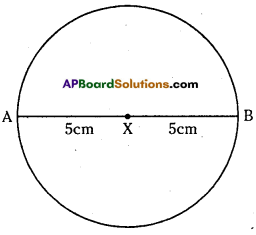
Construct a circle with centre X and diameter 10 cm. Sol. Given diameter of circle d = 10 cm
Solution:
We know that radius of circle r = \(\frac{d}{2}=\frac{10}{2}\) = 5
So, radius of the circle is 5 cm.
Now, draw a circle with radius 5 cm.
AP Board 6th Class Maths Solutions Chapter 10 Practical Geometry Unit Exercise 1

Question 2.
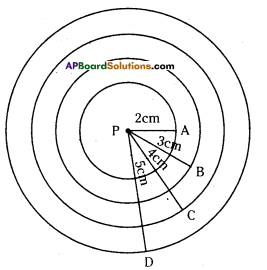
Draw four circles of radius 2 cm, 3 cm, 4 cm and 5 cm with the same centre P.
AP Board 6th Class Maths Solutions Chapter 10 Practical Geometry Unit Exercise 2
Solution:
Radii of four circles are PA = 2cm, PB = 3cm, PC = 4cm and PD = 5cm with the same centre P was constructed.

AP Board 6th Class Maths Solutions Chapter 10 Practical Geometry Unit Exercise

Question 3.
Draw the angles given below using a protractor.
(i) 75°
(ii) 15°
(iii) 105°
Solution:
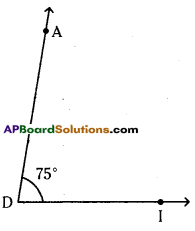
(i) 75°
AP Board 6th Class Maths Solutions Chapter 10 Practical Geometry Unit Exercise 3
∠ADI = 75°
Steps of construction :

  1. Draw a ray \(\overrightarrow{\mathrm{DI}}\) with vertex D.
  2. Place the centre point of the protractor at D and the line be aligned with DI.
  3. Mark a point A at 75°.
  4. Join DA. ∠ADI = 75° is formed.
    Hence the required angle ∠ADI = 75° is constructed.

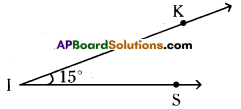
ii) 15°
AP Board 6th Class Maths Solutions Chapter 10 Practical Geometry Unit Exercise 4
∠KIS = 15°
Steps of construction:

  1. Draw a ray \(\overrightarrow{\mathrm{IS}}\) with vertex I.
  2. Place the centre point of the protractor at I and the line be aligned with \(\overrightarrow{\mathrm{IS}}\).
  3. Mark a point K at 15°.
  4. Join IK.∠KIS = 15° is formed.
    Hence the required angle ∠KIS = 15° is constructed.

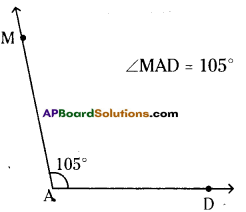
(iii) 105°
AP Board 6th Class Maths Solutions Chapter 10 Practical Geometry Unit Exercise 5
∠MAD = 105°
Steps of construction:

  1. Draw a ray \(\overrightarrow{\mathrm{AD}}\) with initial point A.
  2. Place the centre point of the protractor
    at A and the line be aligned with \(\overrightarrow{\mathrm{AD}}\).
  3. Mark a point M at 105°.
  4. Join AM.∠MAD = 105° is formed.
    Hence the required angle∠MAD = 105° ¡s constructed.

AP Board 6th Class Maths Solutions Chapter 10 Practical Geometry Unit Exercise

Question 4.
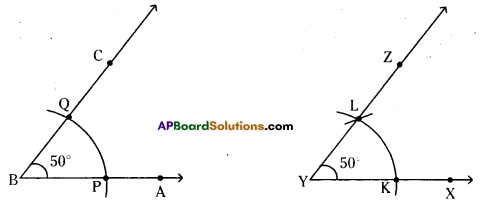
Construct ∠ABC = 50° and then draw another angle ∠XYZ equal to ∠ABC without using a protractor.
Solution:
AP Board 6th Class Maths Solutions Chapter 10 Practical Geometry Unit Exercise 6
Given ∠ABC = 50° and ∠XYZ = 50°.
Steps of construction:

  1. Construct ∠ABC = 50°by using protractor.
  2. By taking any radius draw arcs from B on AB and BC at P and Q respectively.
  3. Draw a ray \(\overrightarrow{\mathrm{YX}}\) with initial point Y.
  4. By taking BP as radius draw an arc on \(\overrightarrow{\mathrm{YX}}\) from Y which meets at K.
  5. Draw arc from Y by taking PQ as radius in the ∠BAC which cuts the previous arc and mark it as L. Now draw \(\overrightarrow{\mathrm{YZ}}\). So, ∠XYZ = 50° is formed.
    Hence ∠XYZ = 50° is constructed which is equal to ∠ABC = 50°.

Question 5.
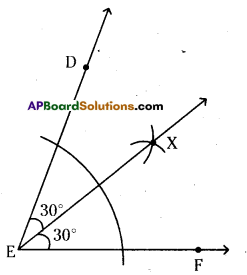
Construct ∠DEF = 60°. Bisect it, measure each half by using a protractor.
Solution:
AP Board 6th Class Maths Solutions Chapter 10 Practical Geometry Unit Exercise 7
Given ∠DEF = 60°
Draw EX as the bisector of ∠DEF.
So, ∠DEX = ∠XEF = \(\frac{\angle \mathrm{DEF}}{2}=\frac{60^{\circ}}{2}\) = 30°
∴ ∠DEX = ∠XEF = 30°

AP Board 7th Class Science Solutions Chapter 2 Acids and Bases

AP State Syllabus AP Board 7th Class Science Solutions Chapter 2 Acids and Bases Textbook Questions and Answers.

AP State Syllabus 7th Class Science Solutions 2nd Lesson Acids and Bases

7th Class Science 2nd Lesson Acids and Bases Textbook Questions and Answers

Improve Your Learning

Question 1.
The sting of a wasp is basic. How can we treat the sting of a wasp?
Answer:

  1. The sting of wasp is basic. So it should be treated with an acid to neutralize it.
  2. Acetic acid may be taken and rubbed on the place where wasp put its sting.

Question 2.
Why are acids not stored in a metal container?
Answer:

  1. Acids react with metals releasing hydrogen.
  2. To avoid this acids are not stored in metal containers.

AP Board 7th Class Science Solutions Chapter 2 Acids and Bases

Question 3.
Acidic, basic and neutral solutions are given in three test tubes and you are given a strip of red litmus. How will you identify the three solutions?
Answer:

  1. Red litmus strip is dipped in the solutions contained in the three test tubes one after another.
  2. The solution in which red litmus is turned into blue is considered as base.
  3. The solution in which this blue litmus is turned into red is considered as an acid.
  4. The solution in which either red or blue litmus does not change its colour is neutral solution.

Question 4.
When drops of lemon juice are put on blue litmus it turns red, what will happen if you put some drops of soap solution on the same position on litmus paper?
Answer:

  1. Lemon juice is acidic. So blue litmus turned into red when drops of this juice are put on blue litmus.
  2. Soap solution is basic in nature. So when drops of soap solution are put on the same position of the litmus paper, the litmus paper slowly changes into blue colour.

Question 5.
What happens when Nitric acid is added to egg shell?
Answer:
When Nitric acid is added to egg shell carbon dioxide gas is released.

Question 6.
Turmeric stains on white clothes, when washed with soap, turn red. Why?
Answer:

  1. Turmeric is a natural indicator.
  2. It turns red when soap water is put in touch with it.
  3. So turmeric stains on white clothes, when washed with soap, turn red.

Question 7.
Ammonia is present in window cleaners. It turns red litmus blue. What is its nature?
Answer:
Ammonia has basic nature.

Question 8.
What is the nature of urea? Is it acidic / basic / neutral? How can we verify it? Urea is basic in nature. It turns red litmus to blue litmus.
Answer:
Red litmus paper is dipped in a solution. It remains red.

Question 9.
What is the nature of the solution? Explain your answer.
Answer:

  1. The solution may be neutral or acidic.
  2. Red litmus remains unchanged when dipped in acidic solution or neutral solution.

Question 10.
What is the effect of basic substances on turmeric paper?
Answer:
The turmeric paper turns red when basic substances come in touch with the turmeric paper.

AP Board 7th Class Science Solutions Chapter 2 Acids and Bases

Question 11.
Can flowers and turmeric papers also be called indicators? Why?
Answer:

  1. Flowers and turmeric papers are natural indicators.
  2. These change their colour based on the nature of the material put on them.

Question 12.
Correct the statement if it is wrong:
a) Indicators show different colours in acidic and basic solutions.
b) Sodium hydroxide turns blue litmus red.
c) Tooth decay is caused by the presence of base.
Answer:
a) Indicators show different colours in acidic and basic solutions.
b) Sodium hydroxide turns red litmus blue.
c) Tooth decay is caused by the presence of acid.

Question 13.
Take vinegar, lemon juice, soapy water, baking soda in different vessels. Put beetroot pieces in the vessels. Predict what happens? Verify your prediction by observing the changes. After 10 minutes, 30 minutes, 60 minutes record your observations. What do you conclude?
Answer:
The following are our predictions. These are found to be true when verified.

S.No.AcidBase
1.VinegarSoapy water
2.Lemon juiceBaking soda

Question 14.
Visit a doctor. Find out the medicines she prescribes to treat acidity. Ask her how acidity can be naturally prevented. Prepare a report.
Answer:

  1. Acidity arises due to hydrochloric acid present in the stomach.
  2. Acidity results in indigestion and a burning sensation in the stomach. Even it may cause headache.
  3. To treat acidity doctors give antacids. These will give relief from acidity and indigestion.
  4. Antacids contain sodium hydrogen carbonate. When these antacids are taken orally, they react with the hydrochloric acid present in the stomach and reduces its strength.
  5. Milk of magnesia is one such antacid.
  6. Eating at irregular intervals, skipping meals and eating too quickly are more reasons. Certain foods like tomatoes, lime juice, and oranges could also lead to acidity.
  7. Lack of exercise and stress also results in acidity or heart burn. Hence, the best way to avoid acidity is to avoid the factors that cause it.
  8. It is a must to avoid fried and oily foods, and one must drink plenty of water, at least 8-10 glasses everyday.
  9. Yogurt helps in easy digestion of food.

AP Board 7th Class Science Solutions Chapter 2 Acids and Bases

Question 15.
Prepare red cabbage juice by boiling a piece of red cabbage in water. Use it as an indicator and test acidic and basic solutions with it. Present your observations in the form of a table.
Answer:

  1. Red cabbage is cut into quarters. It is placed in a pot with a cupful of water and boiled.
  2. After about fifteen to twenty minutes, turn off the stove.
  3. Cut some plain white paper toweling into small strips. When the pots contents have cooled, transfer the cabbage water to a glass and dip several strips into it.
  4. Place them on a wax paper to dry.
  5. Let the cabbage water sit in the glass for several days in a warm, sunny spot in the home until a lot of water has evaporated.
  6. This will mean the cabbage water that remains is more concentrated.
  7. Dip strips of paper towel into this concentrated solution and lay them on a wax paper to dry.
  8. Use this home made litmus paper to test lemon juice (an acid) and baking soda mixed with water (a base).
  9. The observations are recorded.
    S.noAcidBase
    1.VinegarBaking soda
    2.LemonSoap
    3.AppleMilk of Magnesia
    4.TomatoAmmonia
    5.BananaEgg
    6.MilkCaustic soda
    water is neutral

Question 16.
Collect different flowers and prepare their natural indicators with the help of filter papers.
Answer:
Cut flower petals into strips or chop them in a blender. Place the cut pieces into a beaker or cup. Add just enough water to cover the plant material. Boil until the colour is removed from the plant. Filter the liquid into another container, such as a petri dish. Discard the plant matter. Saturate clean filter paper with the flower solution. Allow the filter paper to dry. You can cut the coloured paper with scissors to make pH test strips. Ex: Hibiscus, poinsettia, roses, etc.

Question 17.
Test the nature of lemon juice and milk sample with the help of natural indicators prepared from different flowers. Explain their nature.
Answer:
a) The petals of Hibiscus are taken as a natural indicator.
b) Their colour changed to red colour when tested with lemon juice.
c) This indicated that lemon juice is an acid.
d) The colour of the petals of Hibiscus remains unchanged when tested with milk.
e) This indicates that milk is neutral.

AP Board 7th Class Science Solutions Chapter 2 Acids and Bases

Question 18.
How do you feel about nature? Is it a big natural laboratory that contains innumerable indicators?
Answer:

  1. Nature is beyond the analysis of man.
  2. Nature is a big laboratory where several wonderful things happen. Only few will come to our observation.
  3. Not only flowers, even leaves of plants also behave like indicators showing the changes and indicating the presence of different substances.
  4. The fall of acid rain will be indicated by both flowers and leaves of certain plants.
  5. What is different from the existing immediately these indicators show their entry.

Question 19.
Choose the correct answer.
a) To protect tooth decay we are advised to brush our teeth regularly. The nature of the tooth paste commonly used is
i) Acidic
ii) Neutral
iii) Basic
iv) Baking soda
Answer:
iii) Basic

b) Which of the following is acidic in nature?
i) Lemon juice
ii) Baking soda
iii) Lime water
iv) Antacid
Answer:
i) Lemon juice

Question 20.
Match the following.
AP Board 7th Class Science Solutions Chapter 2 Acids and Bases 1
Answer:
AP Board 7th Class Science Solutions Chapter 2 Acids and Bases 2

AP Board 7th Class Science Solutions Chapter 2 Acids and Bases

Question 21.
Why industrial wastes are neutralised before releasing into water?
Answer:
The industrial wastes are neutralised before disposting into water bodies because, factory wastes often contain acid, if it reaches a river, the acid will kill aquatic life and thus brings damage to the entire ecosystem.

AP Board 6th Class Maths Solutions Chapter 10 Practical Geometry Ex 10.4

AP State Syllabus AP Board 6th Class Maths Solutions Chapter 10 Practical Geometry Ex 10.4 Textbook Questions and Answers.

AP State Syllabus 6th Class Maths Solutions 10th Lesson Practical Geometry Ex 10.4

AP Board 6th Class Maths Solutions Chapter 10 Practical Geometry Ex 10.4

Question 1.
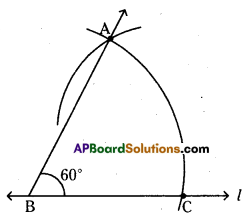
Construct ∠ABC = 60° without using protractor.
Solution:
Steps of construction :

  1. Draw a line l and mark a point B on it.
  2. Place the pointer of the compasses at B and draw an arc of convenient radius which cuts the line l at a point C.
  3. With the pointer at C as centre and with the same radius as above. Now draw an arc that passes through B.
  4. Cut intersecting point of two arcs is A. Join BA. ∠ABC = 60° is formed.
    Hence the required angle ∠ABC = 60° is constructed.
    AP Board 6th Class Maths Solutions Chapter 10 Practical Geometry Ex 10.4 1

Question 2.
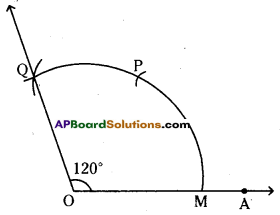
Construct an angle of 120° with using protractor and compasses.
Solution:
Steps of construction :

  1. Draw a ray \(\overline{\mathrm{OA}}\) of any length.
  2. Place the pointer of the compasses at O. With O as centre and any convenient radius draw an arc cutting OA at M.
  3. With M as centre and without altering radius draw an arc which cuts the previous arc at P.
  4. With P as centre and without changing radius draw an arc which cuts the first arc at Q.
  5. Join OQ. Then ∠AOQ is the required angle.
    Hence the required angle ∠AOQ = 120° is constructed.
    AP Board 6th Class Maths Solutions Chapter 10 Practical Geometry Ex 10.4 2

AP Board 6th Class Maths Solutions Chapter 10 Practical Geometry Ex 10.4

Question 3.
Construct the following angles using ruler and compasses. Write the steps of construction in each case.
i) 75°
ii) 15°
iii) 105°
Solution:
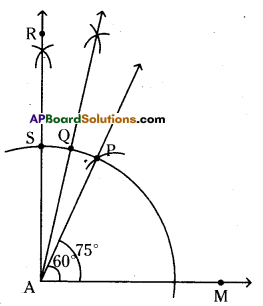
i) 75°
Steps of construction:

  1. Construct ∠RAM 900
  2. Construct ∠PAM = 600 AM as common arm
  3. Now, ∠PAR = ∠RAM – ∠PAM = 90° – 60° = 30°
  4. Draw bisector to ∠PAR which is \(\overrightarrow{\mathrm{AQ}}\).
  5. Now, ∠MAQ = ∠PAM + ∠PAQ = 60° + \(\frac{30^{\circ}}{2}\)
    = 60° + 15° = 75° (QED)
    AP Board 6th Class Maths Solutions Chapter 10 Practical Geometry Ex 10.4 3

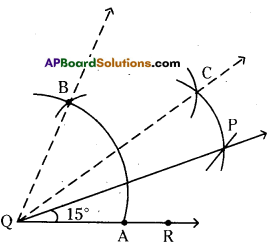
ii) 15°
Steps of construction:

  1. Construct ∠BQR = 60°
  2. Draw the bisector to ∠BQR which is \(\overrightarrow{\mathrm{QC}}\)
  3. Now,∠CQR = \(\frac{60^{\circ}}{2}\) = 30°
  4. Draw the bisector \(\overrightarrow{\mathrm{QP}}\) to∠CQR.
  5. ∠PQR = \(\frac{1}{2}\) x 30° = 15° (Q.E.D)
    AP Board 6th Class Maths Solutions Chapter 10 Practical Geometry Ex 10.4 4

AP Board 6th Class Maths Solutions Chapter 10 Practical Geometry Ex 10.4

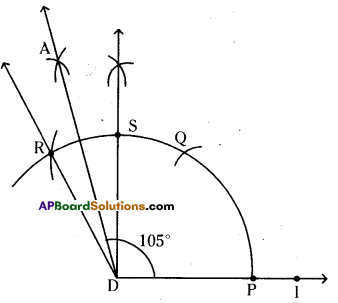
iii) 105°
Steps of construction :

  1. Construct ∠IDS = 90°
  2. Construct ∠ADS = \(\frac{\angle \mathrm{RDS}}{2}=\frac{30^{\circ}}{2}\) = 15°
  3. Now, ∠ADI = ∠IDS + ∠ADS = 90° + 15°
    ∴ ∠ADI = 105° (Q.E.D)
    AP Board 6th Class Maths Solutions Chapter 10 Practical Geometry Ex 10.4 5

AP Board 6th Class Maths Solutions Chapter 10 Practical Geometry Ex 10.3

AP State Syllabus AP Board 6th Class Maths Solutions Chapter 10 Practical Geometry Ex 10.3 Textbook Questions and Answers.

AP State Syllabus 6th Class Maths Solutions 10th Lesson Practical Geometry Ex 10.3

AP Board 6th Class Maths Solutions Chapter 10 Practical Geometry Ex 10.3

Question 1.
Construct the following angles with the help of a protractor.
i) ∠ABC = 65°
ii) ∠PQR = 136°
iii) ∠Y = 45°
iv) ∠O = 172°
Solution:
i) ∠ABC = 65°
AP Board 6th Class Maths Solutions Chapter 10 Practical Geometry Ex 10.3 1
Steps of construction :

  1. Draw a ray \(\overrightarrow{\mathrm{BC}}\) of any length.
  2. Place the centre point of the protractor at B and the line be aligned with \(\overrightarrow{\mathrm{BC}}\).
  3. Mark a point A at 65°.
  4. Join BA. ∠ABC = 65° is formed.
    Hence the required angle ∠ABC = 65° is constructed.

ii) ∠PQR = 136°
Steps of construction :

  1. Draw a ray \(\overrightarrow{\mathrm{QR}}\) of any length,
  2. Place the centre point of the protractor at Q and the line be aligned with \(\overrightarrow{\mathrm{QR}}\).
  3. Mark a point P at 136°. ‘
  4. Join PQ. ∠PQR = 136° is formed.
    Hence the required angle ∠PQR = 136° is constructed.

AP Board 6th Class Maths Solutions Chapter 10 Practical Geometry Ex 10.3 2

AP Board 6th Class Maths Solutions Chapter 10 Practical Geometry Ex 10.3

iii) ∠Y = 45°
Steps of construction:

  1. Draw a ray \(\overrightarrow{\mathrm{YZ}}\) of any length.
  2. Place the centre point of the protractor at Y
    and the line be aligned with \(\overrightarrow{\mathrm{YZ}}\).
  3. Mark a point X at 45°.
  4. Join YX. ∠XYZ = 45° is formed.
    Hence the required angle ∠XYZ = 45° is constructed.

AP Board 6th Class Maths Solutions Chapter 10 Practical Geometry Ex 10.3 3

iv) ∠O = 172°
AP Board 6th Class Maths Solutions Chapter 10 Practical Geometry Ex 10.3 4
Steps of construction:

  1. Draw a ray \(\overrightarrow{\mathrm{OT}}\) °f any length.
  2. Place the centre point of the protractor at O and the line be aligned with \(\overrightarrow{\mathrm{OT}}\)
  3. Mark a point D at 172°.
  4. Join OD. ∠DOT = 172° is formed.
    Hence the required angle ∠DOT = 172° is constructed.

Question 2.
Copy the following angles in your note book and find their bisectors:
AP Board 6th Class Maths Solutions Chapter 10 Practical Geometry Ex 10.3 5
Solution:
AP Board 6th Class Maths Solutions Chapter 10 Practical Geometry Ex 10.3 6

AP Board 7th Class Science Solutions Chapter 1 Food Components

AP State Syllabus AP Board 7th Class Science Solutions Chapter 1 Food Components Textbook Questions and Answers.

AP State Syllabus 7th Class Science Solutions 1st Lesson Food Components

7th Class Science 1st Lesson Food Components Textbook Questions and Answers

Improve Your Learning

Question 1.
Make a list of food items eaten during lunch by you. Try to mention the components in each food item.
Answer:
The following food items are eaten by me during lunch. The components in each food item are also given. The percentage of these components may vary from one food item to another.
AP Board 7th Class Science Solutions Chapter 1 Food Components 1

AP Board 7th Class Science Solutions Chapter 1 Food Components

Question 2.
Manjula eats only bread and omelette daily. Do you think it is a balanced diet? Why? or why not?
Answer:

  1. Bread and omelette can not be called as balanced diet.
  2. Balanced diet contains all food components every day in adequate quantity.
  3. Diet containing food items having more of carbohydrates and proteins along with a little fat, vitamins and minerals makes a balanced diet.

Question 3.
Make a list of food items that contain all components of food.
Answer:

  1. If we can eat dal, rice, rotis, green vegetables, little oil and jaggery all the food requirements of the body are fulfilled.
  2. The above foods should be cooked in a proper way.

Question 4.
Who am I?
a) I am a component of food that makes paper translucent.
b) Put a drop of me on a cut potato. It turns dark blue. Who am I?
Answer:
a) Oil makes paper translucent.
b) Dilute iodine solution drop on a cut of potato turns it dark blue or black.

Question 5.
Explain what will happen if we do not include roughage in our food.
Answer:

  1. Roughages are a kind of carbohydrate that our body fails to digest.
  2. They help in free bowel movement in the digestive tract and prevent constipation.

Question 6.
Test the given food items and record the type of components that are present in them. (Groundnut, cooked dal, pulusu).
Answer:
1. Groundnut:
a)

  1. Take a small quantity of groundnuts. Rub them gently on a piece of paper.
  2. The paper turns translucent, so groundnut contains fats.

b)

  1. Some groundnuts are taken. They are grinded to powder and the powder is taken in a test tube.
  2. 10 drops of water is added to the powder in the test tube.
  3. 2 gms. of copper sulphate is dissolved in 100 ml of water. We get 2% copper sulphate solution.
  4. 10 gms. of sodium hydroxide is dissolved in 100 ml. of water. We get 10% sodium hydroxide solution.
  5. 2 drops of 2% copper sulphate solution and 10 drops of 10% sodium hydroxide solution are added to the groundnut solution already prepared.
  6. The colour of the solution changes to purple confirming the presence of protein in groundnut.

2. Cooked Dal:

  1. A sample of cooked dal solution is taken.
  2. 10 drops of this solution is taken in a test tube.
  3. 2 drops of 2% copper sulphate solution and 10 drops of 10% sodium hydroxide solution are added to the dal solution taken in the test tube.
  4. The colour of the solution changes to purple confirming the presence of protein in cooked dal.
  5. This test confirms the presence of proteins in larger amounts as compared to others.

3. Pulusu:

  1. A sample pulusu solution is taken in a test tube.
  2. If a drop of it is put on a paper, the paper becomes translucent confirming the presence of fat in pulusu.
  3. It responds to protein test and starch test.
  4. Pulusu is a mixture of all these components of food.

AP Board 7th Class Science Solutions Chapter 1 Food Components

Question 7.
Draw some food items of your diet and explain why you like them.
Answer:
a)
AP Board 7th Class Science Solutions Chapter 1 Food Components 2

  1. These are the food items I like for breakfast.
  2. These are tasty and smaller amounts give enough energy to maintain the strength of the body till lunch.
  3. These items contain carbohydrates, proteins, fibres and fats (in some items) all of which make them near balanced diet.

b)
AP Board 7th Class Science Solutions Chapter 1 Food Components 3

  1. These are some of the food items of my diet and I like them because they make a balanced diet.
  2. Combination of the items mentioned in the flow chart makes the food very tasty.
  3. This diet contains carbohydrates, proteins, fats, minerals and vitamins also.
  4. These food items not only give strength to the body and mind but also help in the growth of some body parts.
  5. In growing children this diet supports their growth also.

Question 8.
If you were invited to a party with many food items in the menu like Rice, Roti, Puri, Idly, Dosa, Samosa, Dal, Green Salad, Vegetable Curry, Fruit Chat, Chicken Curry, Eggs, Gulab Jamun.
a) What food items would come on to your plate to make your diet a balanced one?
b) What food items would you take plenty, adequately?
Answer:
a) To make my diet a balanced one, the following food items would come to my plate.

  1. A diet containing all the nutrients and other components in proper proportion is called balanced diet. So rice, roti, dal, vegetable curry, fruit chat, chicken curry would come to my plate.

b)

  1. I take the following food items in plenty. Vegetable curry, fruit chat, green salad.
  2. I take the following food items adequately. Dal, dosa, idly etc.

Question 9.
How is water useful to our body?
Answer:

  1. Water helps the food to move easily in the digestive tract.
  2. Water helps in many other processes in our body as well.
  3. So we must drink plenty of water.

AP Board 7th Class Science Solutions Chapter 1 Food Components

Question 10.
Fill in the blanks.
a) If our food is not balanced with proper nutrients we may ——–.
b) Fibres in our diet prevents ——–.
c) Our daily diet should include plenty of ——–.
d) Oils and fats give us ——–.
Answer:
a) lose the resistive power of our body
b) constipation
c) fruits and leafy vegetables.
d) energy

Question 11.
Match the following and give the reasons.
AP Board 7th Class Science Solutions Chapter 1 Food Components 4
Answer:
AP Board 7th Class Science Solutions Chapter 1 Food Components 6

  1. Fibre of food causes weight to food and also makes bulk forming.
  2. Protein is a body building material which construct new cells.
  3. Vitamins & minerals are called Micro-nutrients.
  4. Carbohydrates which release chemical energy during oxidation.

Question 12.
Prepare a balanced diet chart with the help of your group and exhibit in your classroom science fair.
Answer:
AP Board 7th Class Science Solutions Chapter 1 Food Components 5
For a balanced diet the following food items are important.

  1. Rice
  2. Wheat
  3. Lemon
  4. Egg
  5. Cabbage
  6. Amaranth
  7. Roselle
  8. Drumsticks
  9. Bottlegourd
  10. Beans
  11. Milk
  12. Carrot
  13. Curd
  14. Lady’s finger
  15. Tomato etc.

AP Board 7th Class Science Solutions Chapter 1 Food Components

Question 13.
Prepare ‘kichidi’ with your mother’s help using all kinds of available vegetables, dais, nuts etc. Write a note on the process of making kichidi.
Answer:

  1. A dish is taken.
  2. Suitable quantities of beaten rice, groundnut seeds, bengal gram dal are all taken in the dish. Available vegetables are taken and cut into pieces. Sufficient number of pieces are also added in the dish.
  3. The mixture is fried by putting oil and keeping it on the flame of a stove.
  4. After the mixture is fried it is transferred into a vessel.
  5. Again the dish is taken and sufficient amounts of mustard, cumin seeds, pieces of chilli are put in it.
  6. A small piece of asafoetida is also added to the contents in the dish.
  7. Sufficient oil is taken in another dish and is heated by putting the dish on the flame of the stove.
  8. When oil is heated to the desired temperature, the contents in the dish are put in the oil.
  9. Wait till the contents are fried well.
  10. Remove the contents and mix them with the mixture already stored in the vessel.
  11. The total mixture of all the components is ‘kichidi’.

Question 14.
Observe whether your mother cooks on a low or high flame. Discuss with your mother and find out the reason.
Answer:

  1. My mother cooks on a low flame.
  2. The reason is the nutritional values of the food will be dried up if cooked on a high flame.
  3. Micro-nutrients also disappear. So cooking is done of low flame only.

AP Board 7th Class Science Important Questions Chapter 14 Water – Too Little To Waste

AP State Syllabus AP Board 7th Class Science Important Questions Chapter 14 Water – Too Little To Waste

AP State Syllabus 7th Class Science Important Questions 14th Lesson Water – Too Little To Waste

7th Class Science 14th Lesson Water – Too Little To Waste Important Questions and Answers

Question 1.
How is water distributed on the globe? How much of freshwater is available to us?
Answer:

  1. If the total water on earth be 100%, the percent fresh water available to us is only 1%.
  2. AP Board 7th Class Science Important Questions Chapter 14 Water – Too Little To Waste 1

AP Board 7th Class Science Important Questions Chapter 14 Water – Too Little To Waste

Question 2.
When was the international decade for action on ‘water for life’ declared?
Answer:

  1. On World Water Day, that is 22 March 2005, the period 2005 – 2015 was declared as the International Decade for action on “Water for Life”.

Question 3.
What would you do for the cause ‘water for life”?
Answer:

  1. Normally a lot of water flows out of the kitchen as well as bathrooms in our houses.
  2. Many of us do not know that water is being wasted in this way.
  3. We must make a channel of water to flow from kitchen to the garden around.
  4. We cannot wastewater from the bathroom also. It could be used after purification.

Question 4.
Why do we need proper drainage system?
Answer:

  1. We dispose of wastewater in our daily life in different ways and means.
  2. We often see water stagnated near bore wells or beside houses.
  3. Sometimes human and animal excretions also mix with this water.
  4. We get a foul smell when we walk near those areas.
  5. To prevent this we need a proper drainage system.

Question 5.
How do you find out what realty happens to waste water at treatment plants?
Answer:

  1. Fill a large glass jar 3/4 full of water. Add some dirty organic matter such as grass pieces or orange peels, a small amount of detergent, and a few drops of an ink or any colour.
  2. Cap the jar, shake it well and let the mixture stand in the sun for two days.
  3. After two days, shake the mixture and pour a small sample into test tube. Label this test tube “Before treatment; Sample 1”. How does it smell?
  4. Use an aerator from an aquarium to bubble air through the sample in the glass jar. Allow several hours for aeration; leave the aerator attached overnight. If you do not have an aerator, use a mechanical stirrer or a mixer. You may have to stir it several times. This actually works like a skimmer of the wastewater treatment plant.
  5. Aeration causes organisms that break down waste to grow faster thus it leads to what is called as “Biological Process”.
    AP Board 7th Class Science Important Questions Chapter 14 Water – Too Little To Waste 2
  6. The next day when aeration is complete, pour another sample into a second test tube. Label it “After aeration; Sample 2”.
  7. Fold a piece of filter paper to form a cone. Wet the paper with tap water and then insert the cone in a funnel. Mount the funnel on a support.
  8. Place layers of sand, fine gravel and finally medium gravel in the funnel.
  9. Pour the remaining aerated liquid through the filter into the beakers. Do not allow the liquid to spill over the filter. If the filtered liquid is not clear, filter it a few times till you get clear water. This is “physical process”.
  10. Pour a sample of the filtered water into a third test tube labeled “Filtered’ Sample 3”.
  11. Pour another sample of the filtered water into a fourth test tube. Add a small piece of a chlorine tablet. Mix well until the water is clear. Labe! the test tube “Chlorinated; Sample 4”.
  12. This is a “Chemical Process” of treatment.
  13. Observe carefully the samples in all the test tubes. Do not taste! Just smell them!
  14. We can easily under stand how the wastewater is recycled in the treatment plant.

AP Board 7th Class Science Important Questions Chapter 14 Water – Too Little To Waste

Question 6.
For which purposes are we using freshwater?
Answer: Freshwater has been the constant and essential companion of human beings throughout history. Water is used in great quantities in agriculture and industries.

Question 7.
How is freshwater distributed over the globe?
Answer:

  1. Our globe is poorly endowed with fresh water.
  2. Most water is rendered useless to humans by dilution with salt in the oceans.
  3. Only 2.5 percent is available as freshwater of which 2/3 is locked up in Ice and snow.
  4. Nature is unkind in depositing almost eighty percent of rain over the sea.
  5. The rain that falls over the land has a great potential value.

Question 8.
What is causing water scarcity? Write the principle ways which are degrading the quality and quantity of natural supply of fresh water.
Answer:

  1. Unsustainable extraction of fresh water causes water scarcity.
  2. Due to the over-extraction of fresh water underground reserves are falling rapidly.
  3. In India, the water table has fallen more than 300 meters’.
  4. Human interventions which degrade the quality and quantity of the natural supply of fresh water occur, in 3 principal ways.
  5. Firstly dams alter the natural flow of rivers often leading to water scarcity.
  6. Secondly, soil moisture is lost by land degradation due to poor farming practices
    and deforestation.
  7. Thirdly, surface water is polluted by run-off chemicals used in industries and households.

Question 9.
How can you say that the next cold war could be over water?
Answer:

  1. The world population is projected to grown 9.3 Billion by 2050.
  2. In addition to safe drinking water and sanitation, the rising pressure on freshwater will be felt most severely in the energy and food sectors.
  3. Two out of three people will be living with water shortage by 2025.
  4. The growth of demand the decline in freshwater availability, the adverse health effects from poor water quality and scarcity will result in violence and water wars.
  5. The next cold war could be over water.

AP Board 7th Class Science Important Questions Chapter 14 Water – Too Little To Waste

Question 10.
How can we conserve water? Write some practices that can be adopted.
Answer:
a)

  1. We perform many activities in our daily life using water.
  2. We can conserve water by adopting certain good practices,

b) Some practices that can be adopted:

  1. Water is precious. We should not waste it.
  2. Collect water in a bucket after cleaning rice, dal and vegetables in the kitchen which contains peels of vegetables.
  3. We can use this water for our cattle.
  4. We should not throw solid food remains, tea leaves and oily wastes down the drain.
  5. We must make a channel so that the kitchen and bathroom water flows to the coconut and banana plants in our garden.
  6. We should use only mild soaps and detergents so that this water may not harm our plants.
  7. Any leakage of water from any tap must be repaired immediately.

AP Board 7th Class Science Solutions Chapter 9 Reflection of Light

AP State Syllabus AP Board 7th Class Science Solutions Chapter 9 Reflection of Light Textbook Questions and Answers.

AP State Syllabus 7th Class Science Solutions 9th Lesson Reflection of Light

7th Class Science 9th Lesson Reflection of Light Textbook Questions and Answers

Improve Your Learning

Question 1.
Vidya made a Periscope making slits like this as shown in the figure. Will it work or not? Explain your answer.
Try to make a periscope like this and see whether it works or not?
AP Board 7th Class Science Solutions Chapter 9 Reflection of Light 1
Answer:

  1. The periscope does not work.
  2. The slits made must be parallel to each other.
  3. If the slits are parallel then the mirror strips placed in them will give reflections property and the image of the object can be seen.

AP Board 7th Class Science Solutions Chapter 9 Reflection of Light

Question 2.
i) Draw reflected ray in the figure given here.
AP Board 7th Class Science Solutions Chapter 9 Reflection of Light 2
Answer:

  1. The angle of incidence ∠i = 45° = angle of reflection = ∠r = 45°C
  2. OR is the incident ray
  3. RB is the reflected ray
  4. NR is the normal drawn to the reflecting surface.
    AP Board 7th Class Science Solutions Chapter 9 Reflection of Light 3

ii) Mark the position of the image in the figure given here by dotted lines.
AP Board 7th Class Science Solutions Chapter 9 Reflection of Light 4
Answer:
The position of the image is shown by dotted lines.
AP Board 7th Class Science Solutions Chapter 9 Reflection of Light 5

Question 3.
How do you relate to the angle of reflection and angle of incidence? What will be the angle of reflection when the angle of incidence is i) 60° ii)0°?
Answer:
Angle of incidence ∠i = angle of reflection ∠r
If ∠i = 60° then ∠r = 60°
If ∠i = 0° then ∠r = 0°

AP Board 7th Class Science Solutions Chapter 9 Reflection of Light

Question 4.
Imagine that your sister is viewing a cricket match on a TV and you are viewing the same cricket match in a mirror which is opposite to the TV. What difference do you notice in the match?
Answer:

  1. The image of an object in a mirror will have lateral inversion.
  2. The cricket match my sister is viewing on a T.V. is the object.
  3. The cricket match I am viewing in a mirror is its image.
  4. So the match appears to me is a lateral inversion position.

Question 5.
Write the mirror image of your name.
………………………………. (in English)
………………………………. (in Telugu)
Answer:
The student can write his name both in English and Telugu in a lateral inversion way so that it is visible in the right way in the mirror.

Question 6.
You are given the mirror image of a name. Can you find out the actual name?
AP Board 7th Class Science Solutions Chapter 9 Reflection of Light 6
Place a mirror in front of this figure and check your answer.
Answer:
If this name is seen in a mirror it appears as SURYA.

Question 7.
Get three mirror strips, two rubber bands, card board sheet, translucent paper, and broken bangle pieces and make a Kaleidoscope.
(OR)
Write the procedure of making a Kaleidoscope using the following three mirror strips, two rubber bands, cardboard sheet, translucent paper and broken bangle pieces.
Answer:
1) The student can make a Kaleidoscope with the material supplied.
2) The student can follow the following procedure to make it.
Making a Kaleidoscope :

  1. Take three mirror strips of the same size.
  2. Tie these strips with rubber bands to form a triangular tubfe as shown in figure (a).
    AP Board 7th Class Science Solutions Chapter 9 Reflection of Light 7
  3. While tying the strips together, remember to keep their reflecting surfaces facing each other inside the tube.
  4. Cover one end of the tube with translucent paper using a rubber band.
  5. Cover the second end with card board sheet and make a hole in it.
  6. So that we can look inside it. Our kaleidoscope is ready.
  7. Now put few small pieces of coloured glass bangles inside the. triangular tube as shown in figure (b).
    AP Board 7th Class Science Solutions Chapter 9 Reflection of Light 8
  8. Look at the bangle pieces through the hole as shown in figure (c).
    AP Board 7th Class Science Solutions Chapter 9 Reflection of Light 9
  9. Shake the kaleidoscope and try to see through the hole slowly rotating it.
  10. We shall be viewing so many designs and bangle pieces.

AP Board 7th Class Science Solutions Chapter 9 Reflection of Light

Question 8.
Observe the following figures.
AP Board 7th Class Science Solutions Chapter 9 Reflection of Light 10
How many images would you observe in the mirrors in the above cases? Write your guesses.
Fig-1 ……………………………
Fig-2 ……………………………
Do experiments and check whether your guesses are correct or not? Give reasons.
Answer:
1) Fig. (a): In fig a: We observe only one image of the candle behind the mirror at a distance of 30 cm. from the mirror.
2) Fig. (b): We observe only 3 images of the candle in the two mirrors arranged at an angle of 90° to each other.
I have done the experiments and my observations are found to be true with my guesses.

Question 9.
Write examples of multiple images formed in your daily life.
Answer:

  1. In sweet shops mirrors are arranged in such a way that multiple images of the sweets are made visible to the customers.
  2. In ice-cream parlours and cool drink’s shops also plane mirrors are arranged in parallel on the walls of the room. These mirrors give .multiple images of the customers making them feel that the shop is full of customers.
  3. In barber’s shop mirrors are arranged in such away that the customer can view his images in all directions.

Question 10.
Observe the figure and identify which type of mirror is used. How do you justify.
AP Board 7th Class Science Solutions Chapter 9 Reflection of Light 11
Answer:

  1. A doncave mirror is used to note the image of the flame of the candle on a screen.
  2. A concave mirror forms the real image of an object.
  3. We know images that can be caught on a screen are called real images.

Question 11.
Sai lighted a candle in his house when power went off. His mother placed it in front of a mirror. Sai observed something that excited him. What change would have excited Sai? Some questions came to his mind. Can you guess the questions? Write a few such questions.
Answer:

  1. When the power is off, the room becomes dark and no object is visible.
  2. When a lighted candle is put infront of the mirror, light falling from it on all objects are visible in the mirror.
  3. The following questions are likely to arise in the mind of Sai.
    a) Why are only some images of the objects in the room are visible in the mirror?
    b) What relation exists between the light of the candle and mirror exists?
    c) Why not the images of all objects seen in the mirror.
    d) What is important for the visibility of the objects?

AP Board 7th Class Science Solutions Chapter 9 Reflection of Light

Question 12.
Unexpectedly some water sprinkled on a mirror while Madhu was shaving his face. Did he observe any difference in his image? If yes, explain why?
Answer:

  1. When water is sprinkled on a mirror the plane surface of the mirror is disturbed.
  2. So the clarity in the images goes away and due to reflection taking place in a scattered way, the image becomes dull arid unclear.

Question 13.
Imagine that all the houses in your street have elevation with mirrors. Suppose you and your friends are walking in the street. Would you experience any difficulties when you walk through that street? Predict and explain. Is it difficult for birds to live or fly in that street? Why?
Answer:

  1. We experience difficulties when we walk through the street where all houses have elevation with mirrors.
  2. Due to the formation of multiple images of the people walking in the street, they often were put to confusion.
  3. It is difficult for birds to live or fly in that street as the reflections will give confusion to them.

Question 14.
Take an empty toothpaste box and two mirror strips of the required size and make a periscope.
Answer:
Close both ends of the box. Draw squares at both ends. Draw the diagonal to these squares. Slit the diagonals with a blade. The slits should equal to the length of the mirror strips. Fix the mirror strips in these slits. Take care to see that these mirror strips lie parallel to each other, with their reflecting surfaces facing each other. Fix the mirror strips firmly to the box with a few drops of molten wax from a burning candle or fevicol. Cut out two widows on the narrow sides of the box. The windows should open directly on the reflecting surfaces of the mirror strips. Now the periscope is ready to see.

Question 15.
What is the angle between two plane mirrors when there are five images?
Answer:
When the angle between two plane mirrors is 60° then five images of an object are formed in the mirrors.

Question 16.
What is the difference between convex and concave mirrors? Draw the diagrams of concave and convex mirrors.
Answer:

  1. A concave mirror forms the real image of an object.
  2. A convex mirror forms the virtual image of an object.
  3. AP Board 7th Class Science Solutions Chapter 9 Reflection of Light 13
    1) Concave mirror
    2) Convex mirror
  4. The reflecting surface of the mirror is concave in the case of a concave mirror.
  5. The reflecting surface of the mirror is convex in the case of a convex mirror.

AP Board 7th Class Science Solutions Chapter 9 Reflection of Light

Question 17.
Where do you find irregular reflection in daily life? Give some examples.
Answer:

  1. Irregular reflection is observed in the window glass which is rough.
  2. Glass mirror on which water is sprinkled. This also makes irregular reflection.

Question 18.
Mirrors help us to see all the objects around us without turning our heads. Write about the role of mirrors in opr life.
Answer:

  1. Convex mirror is used as a side view mirror in motor vehicles.
  2. A convex mirror can show the image of a large area as a small image.
  3. This property of the convex mirror is made use of in seeing all objects behind without turning our head..
  4. When we stand in between parallel mirrors also we could see our front and back.
  5. I appreciate the wonderful usefulness of role of mirrors in our life.

Question 19.
Army people can see their enemies while hiding themselves with the help of periscopes. Write about the use of periscope for their security.
Answer:

  1. If the soldier is infront of his enemy, there will be a danger to his life.
  2. Army people make use of periscope to see their enemies by hiding themselves.
  3. This periscope is a gift made by making use of the properties of mirrors.
  4. I really appreciate the utility of the periscope.

Question 20.
Imagine what would happen if there are no rearview mirrors attached to vehicles and there are no concave mirrors in the headlights of the vehicles. Write about the role of convex and concave mirrors in safe driving.
Answer:

  1. If there are no rearview mirrors attached to vehicles, it would be impossible for the vehicle drivers to know about the coming vehicles behind him.
  2. This may lead to accidents.
  3. If there are no concave mirrors in the headlights of the vehicles, then the light focused by the lights may not have enough intensity.
  4. This results in not getting a clear vision of long distances during night times when drivers drive their vehicles.
  5. As a result, drivers cannot travel with the present speed.
  6. The service rendered by convex and concave mirrors is really wonderful.

Question 21.
While constructing a new house, Kishan’s uncle rejected his wife’s request of glass elevation to the building, saying that “It is harmful to the birds and also ourselves”. Why would you support the decision of Kishan’s uncle?
Answer:
Kishan’s uncle took a good decision which might be appreciable.
Nowadays people prefer the decoration of houses exterior and interior. This may cause more life-threatening to other living forms. If you elevate the house with mirrors, it creates lot of inconvenience to you. The birds, creatures suffer a lot by the reflection and creation of multiple images. The plain mirrors may reflect light during day and night.
So, Kishan’s uncle’s decision is really good and I support it.

AP Board 7th Class Science Solutions Chapter 9 Reflection of Light

Question 22.
Collect information from your elders and shopkeepers about where we use more mirrors and why?
Answer:
We use more mirrors in

  1. Sweet shops
  2. Ice parlours
  3. Optical shops where spectacles are sold.
  4. In hair cutting saloons.

Question 23.
Collect information about which objects of your school and home work like a mirror and why? Identify the similarities among those objects.
Answer:

  1. School bell works like a convex mirror.
  2. The outer wall of the cylindrical drum made of stainless steel works like a convex mirror.
  3. The outer portion of the spoon is like a convex mirror where as the inner portion of the spoon is like a concave mirror.

AP Board 10th Class Social Solutions Chapter 3 ఉత్పత్తి, ఉపాధి

SCERT AP 10th Class Social Study Material Pdf 3rd Lesson ఉత్పత్తి, ఉపాధి Textbook Questions and Answers.

AP State Syllabus 10th Class Social Solutions 3rd Lesson ఉత్పత్తి, ఉపాధి

10th Class Social Studies 3rd Lesson ఉత్పత్తి, ఉపాధి Textbook Questions and Answers

Improve your learning (మీ అభ్యసనాన్ని మెరుగుపడుచుకోండి)

ప్రశ్న 1.
బ్రాకెట్టులో ఇచ్చిన వాటి నుంచి సరైన వాటితో ఖాళీలు పూరించండి. (AS1)
i) ఉత్పత్తితో సమానంగా సేవారంగంలో ఉపాధి ……… (పెరిగింది / పెరగలేదు)
ii) ……………….. రంగంలోని కార్మికులు వస్తువులను ఉత్పత్తి చెయ్యరు. (సేవా / వ్యవసాయం)
iii) …………… రంగంలోని అధిక శాతం కార్మికులకు ఉద్యోగ భద్రత ఉంది. (వ్యవస్థీకృత / అవ్యవస్థీకృత)
iv) భారతదేశంలోని కార్మికులలో ………………. శాతం అవ్యవస్థీకృత రంగంలో పని చేస్తున్నారు. (ఎక్కువ / తక్కువ)
v) పత్తి …………………. ఉత్పత్తి, గుడ్డ ……………….. ఉత్పత్తి. (సహజ / పారిశ్రామిక)
జవాబు:
i) పెరగలేదు.
ii) సేవా
iii) వ్యవస్థీకృత
iv) ఎక్కువ
v) సహజ, పారిశ్రామిక

ప్రశ్న 2.
సరైన సమాధానాన్ని ఎంచుకోండి. (AS1)
అ) ఎక్కువగా సహజ ప్రక్రియలను ఉపయోగించుకుని ……………….. రంగంలో వస్తువులు ఉత్పత్తి చేస్తారు.
i) ప్రాథమిక
ii) ద్వితీయ
iii) తృతీయ
iv) సమాచార సాంకేతిక
జవాబు:
i) ప్రాథమిక

ఆ) స్థూల దేశీయోత్పత్తి అనేది ఒక సంవత్సరంలో ఉత్పత్తి చేసిన ……………. మొత్తం విలువ.
i) అన్ని వస్తువులు, సేవలు
ii) అన్ని అంతిమ వస్తువులు, సేవల
iii) అన్ని మాధ్యమిక వస్తువులు, సేవల
iv) అన్ని అంతిమ, మాధ్యమిక వస్తువులు, సేవల
జవాబు:
ii) అన్ని అంతిమ వస్తువులు, సేవల

ఇ) 2009-10 స్థూల దేశీయోత్పత్తిలో సేవా రంగం వాటా ………….
i) 20-30 శాతం మధ్య
ii) 30-40 శాతం మధ్య
iii) 50-60 శాతం మధ్య
iv) 70 శాతం
జవాబు:
iii) 50-60 శాతం మధ్య

AP Board 10th Class Social Solutions Chapter 3 ఉత్పత్తి, ఉపాధి

ప్రశ్న 3.
వేరుగా ఉన్నదానిని గుర్తించండి, కారణం చెప్పండి. (AS1)
i) టీచరు, డాక్టరు, కూరగాయలు అమ్మే వ్యక్తి, న్యాయవాది.
ii) పోస్టుమాన్, చెప్పులుకుట్టే వ్యక్తి, సైనికుడు, పోలీసు కానిస్టేబులు.
జవాబు:
1) కూరగాయలు అమ్మే వ్యక్తి:
– మిగతా మూడు విద్యావంతులైన, నైపుణ్యం కల వృత్తులు చేస్తున్నవారు.
– వీరు సేవా రంగానికి చెందినవారు.

ii) చెప్పులు కుట్టే వ్యక్తి : ఇతను ప్రైవేటు రంగంలో పనిచేస్తున్నాడు.

ప్రశ్న 4.
ఆర్థిక కార్యకలాపాలను ప్రాథమిక, ద్వితీయ, తృతీయ రంగాలుగా విభజించటం ఉపయోగకరమేనా ఎందుకో వివరించండి. (AS1)
(లేదా)
ఆర్థిక కార్యకలాపాలను ప్రాథమిక, ద్వితీయ, తృతీయ రంగాలుగా విభజించటం ఉపయోగకరమేనా? ఏవేని రెండు ఉపయోగాలు తెల్పుము.
జవాబు:

  1. ఆర్థిక కార్యకలాపాలను ప్రాథమిక (వ్యవసాయ), ద్వితీయ (పరిశ్రమలు), తృతీయ (సేవా) రంగాలుగా విభజించడం ఉపయోగకరమే.
  2. జాతీయాదాయం, తలసరి ఆదాయం మొదలగునటువంటివి గణించటానికి సులభంగా ఉంటుంది.
  3. ఏ రంగంలో ఎంత ఉత్పత్తి, ఉపాధి జరిగిందో తెలుసుకోవచ్చు. దానికనుగుణంగా అభివృద్ధి ప్రణాళికలను రూపొందించవచ్చును.
  4. సౌకర్యాల ఏర్పాటుకు, అభివృద్ధి చర్యలు చేపట్టుటకు ఇది ఉపయోగపడుతుంది.
  5. ఆదాయ, సంపద పంపిణీల్లో అసమానతలను తెలుసుకోవచ్చు. వాటిని రూపుమాపడానికి తగిన చర్యలు తీసుకోవచ్చు.
  6. జాతీయ ఉత్పత్తిలోని ఈ అంశాలు ఆర్థిక వ్యవస్థ నిర్మాణాన్ని తెలియచేస్తుంది. దేశంలోని ఆర్ధిక స్థితిగతులను తెలుసుకోవచ్చు.
  7. జాతీయ విధానాల రూపకల్పనకు, ప్రజల జీవన ప్రమాణస్థాయి తెలుసుకొనుటకు, మెరుగుపర్చుటకు.

ప్రశ్న 5.
ఈ అధ్యాయంలో మనం చూసిన ప్రతి రంగంలో స్థూల జాతీయోత్పత్తిలోనూ, ఉపాధిలోనూ దృష్టి ఎందుకు కేంద్రీకరించాలి? ఇంకా పరిశీలించాల్సిన ఇతర అంశాలు ఏమైనా ఉన్నాయా? చర్చించండి. (AS4)
జవాబు:

  1. ఆర్థిక వ్యవస్థ (దేశం) అభివృద్ధి పథంలో ఉందో లేదో తెలుసుకొనుటకుగాను స్థూల జాతీయోత్పత్తిలోనూ, ఉపాధిలోనూ దృష్టి కేంద్రీకరించాలి. ఇంకా
  2. ప్రజల యొక్క జీవన ప్రమాణ స్థాయి తెలుసుకొనుటకు, అభివృద్ధిపరచుటకు
  3. అభివృద్ధి ప్రణాళికలను వ్యూహాలను రూపొందించుటకు, ప్రణాళికల్లో ఏ రంగానికి ప్రాధాన్యతనివ్వాలో నిర్ణయించుటకు.
  4. పేదరికం, నిరుద్యోగ స్థాయిలు తెలుసుకొనుటకు, వాటిని రూపుమాపుటకు.
  5. సమన్యాయ పంపిణీ కోసం (జాతీయాదాయం), సమతౌల్య అభివృద్ధి సాధించుటకు,
  6. అన్ని రంగాలలో స్వయం సమృద్ధి సాధించుటకు ; ఉత్పత్తి, ఉపాధిపై దృష్టి పెట్టాలి.

ఇతర అంశాలు:

  1. సాంకేతిక, వైజ్ఞానిక నైపుణ్యం
  2. ఆధునిక సమాచార, ప్రసార అభివృద్ధి
  3. ఎగుమతులు, దిగుమతులు
  4. ప్రాంతీయాభివృద్ధి
  5. విద్య, వైద్యం, విద్యుత్, రవాణా, త్రాగునీరు, సాగునీరు మొదలయిన అవస్థాపన సౌకర్యాలు.

AP Board 10th Class Social Solutions Chapter 3 ఉత్పత్తి, ఉపాధి

ప్రశ్న 6.
సేవా రంగం ఇతర రంగాలకంటే ఎలా భిన్నమైనది? కొన్ని ఉదాహరణలతో వివరించండి. (AS1)
జవాబు:
సేవా రంగం ఇతర రెండు రంగాల కంటే భిన్నమైనది.

  1. దేశ సామాజిక, ఆర్థికాభివృద్ధికి సేవల రంగం ప్రాణవాయువులాంటిది.
  2. ఒక ఆర్థిక వ్యవస్థకు ప్రాథమిక, ద్వితీయ రంగాలు పుష్టినిస్తే, సేవల రంగం ఆధునికీకరణ చేస్తుంది.
  3. ఇతర రంగాలలాగా నేరుగా వస్తువులను తయారుచేయకుండా వస్తువుల ఉత్పత్తికి, ప్రజలకు అవసరమైన సేవలు మాత్రమే ఈ రంగం అందిస్తుంది.
    ఉదా : వస్తువులు, ప్రయాణీకులను రవాణా చేయటం.
  4. సేవారంగం ఇతర రంగాల అభివృద్ధికి పరిపూరక రంగంగా పనిచేస్తూ ఉంటుంది.
    ఉదా : ఉత్పత్తి పెరుగుదలకు అవసరమైన అవస్థాపనా సౌకర్యాలను సేవా రంగం అందిస్తుంది.
  5. వ్యవసాయ రంగం అభివృద్ధి చెందాలంటే సాగునీరు, విద్యుత్తు, పరపతి, రవాణా సౌకర్యాలు, రసాయనిక ఎరువులు మొదలయిన సేవలు అవసరం.
  6. పరిశ్రమల రంగం అభివృద్ధి చెందాలంటే యంత్ర పరికరాలు, విద్యుత్ (శక్తి వనరులు), బీమా సౌకర్యాలు, రవాణా, మార్కెట్ సౌకర్యాలు, బ్యాంకులు మొదలయిన సేవలు అవసరం.
  7. మిగతా రెండు రంగాల కంటే ఈ రంగం విశ్వవ్యాప్తంగా అతి పెద్ద రంగంగా అభివృద్ధి చెందుతుంది.
  8. మిగతా రెండు రంగాల కంటే ఈ రంగం ఎక్కువ భాగం ఉపాధిని, ఉత్పత్తిని కలిగిస్తోంది.

ప్రశ్న 7.
అల్ప ఉపాధి అంటే ఏమి అర్థం చేసుకున్నారు ? పట్టణ, గ్రామీణ ప్రాంతాల నుంచి ఒక్కొక్క ఉదాహరణతో వివరించండి. (AS1)
జవాబు:

  1. ఎవరికీ తమ పూర్తి సామర్థ్యానికి తగినట్లుగా మరియు తగినంతగా పని దొరకని స్థితిని అల్ప ఉపాధి అనవచ్చును. తక్కువ ఉత్పాదకత గల వ్యవసాయ, సేవల రంగంలో పనిచేస్తున్న శ్రామికులను “అల్ప ఉద్యోగులు” అంటారు. కనపడని ఈ రకమైన అల్ప ఉపాధినే “ప్రచ్ఛన్న నిరుద్యోగం” అంటారు.
  2. సిరిపురం గ్రామంలోని సాంబయ్య అనే రైతుకు 5 ఎకరాల వర్షాధార భూమి ఉంది. మిరప, ప్రత్తి, మొక్కజొన్న వంటి పంటలు పండిస్తాడు. కుటుంబంలోని ‘6’ గురు సభ్యులు సంవత్సరమంతా అందులోనే పనిచేస్తారు. కారణం వాళ్ళకు చెయ్యటానికి వేరే పనిలేదు. వారి శ్రమ విభజింపబడుతోంది. అందరూ ఏదో ఒక పని చేస్తున్నారు కానీ ఎవరికీ పూర్తి పని లేదు. ఈ కుటుంబంలోని ఇద్దరి ముగ్గురు వేరే పనికి వెళ్ళిన ఉత్పత్తి తగ్గదు.
  3. పట్టణ ప్రాంతంలో సేవా రంగంలో రోజుకూలీ కోసం వెతుక్కునేవాళ్లు వేలాదిగా ఉన్నారు. రంగులు వేయటం, నీటి పైపుల పని, మరమ్మతులు చేయటం వంటి పనులు చేస్తారు. వీళ్లల్లో చాలామందికి ప్రతిరోజూ పని దొరకదు.

ప్రశ్న 8.
అవ్యవస్థీకృత రంగంలోని కార్మికులకు ఈ కింది అంశాలలో రక్షణ కావాలి. (AS1)
కూలీ, భద్రత, వైద్యం : ఉదాహరణలతో వివరించండి. –
జవాబు:
అవ్యవస్థీకృతరంగంలో చిన్నచిన్న సంస్థలు అక్కడక్కడా ఉంటాయి. ఇవి సాధారణంగా ప్రభుత్వ నియంత్రణలో ఉండవు. నియమ నిబంధనలు ఉంటాయి కానీ వాటిని అనుసరించరు. స్వయం ఉపాధి పొందే చిన్నచిన్న (మరమ్మతులు) పనులు చేసేవారు కూడా కష్టంగానే జీవితం వెల్లబుచ్చాల్సి వస్తుంది. అందుకని అవ్యవస్థీకృత రంగంలోని కార్మికులకు కూలీ, భద్రత, వైద్యం మొదలగు వాటిల్లో రక్షణ కల్పించాలి.

1) కూలి :
అవ్యవస్థీకృత రంగంలోని కార్మికులకు జీతం తక్కువగా ఉంటుంది, పని ఎక్కువ, వేతనం తక్కువ, ఆర్జిత సెలవు, సెలవులు, అనారోగ్యమప్పుడు సెలవులు వంటివి ఉండవు. వ్యవసాయ కూలీలు భవన నిర్మాణ కూలీలు అధికశాతం మంది చాలా తక్కువ వేతనానికి పనిచేస్తున్నారు. వీళ్లు తరచు దోపిడికి గురవుతుంటారు, వీళ్లకు న్యాయమైన – వేతనం చెల్లించబడదు. సంపాదన తక్కువ అది క్రమం తప్పకుండా ఉండదు.

ఈ రంగంలోని కార్మికుల జీవన ప్రమాణాలు మెరుగు పడాలంటే, వీరి యొక్క కొనుగోలు శక్తి పెరగాలన్నా, ఆర్థిక, సామాజిక అభివృద్ధి పొందాలన్నా వీరికి రక్షణ, మద్దతు అవసరం.

2) భద్రత :
అవ్యవస్థీకృత రంగంలోని కార్మికులకు ఉద్యోగ భద్రత ఉండదు, అలాగే జీవితానికి భద్రత ఉండదు. ఏ కారణం లేకుండా ఉద్యోగస్తులను మానుకోమనవచ్చు. పని తక్కువగా ఉండే కాలాల్లో కొంతమందిని పని మానిపించవచ్చు. మారుతున్న మార్కెటు పరిస్థితి, ఉపాధి కల్పిస్తున్న వాళ్ల మానసిక స్థాయిపై ఆధారపడి ఉంటుంది. మరింత పని అవసరంతో పాటు అవ్యవస్థీకృత రంగంలోని కార్మికులకు రక్షణ, మద్దతు అవసరం.

3) వైద్యం :
అవ్యవస్థీకృత రంగంలోని కార్మికులకు వైద్య ప్రయోజనాలు అందవు, అనారోగ్యమప్పుడు సెలవులు వంటివి కూడా ఉండవు. అనారోగ్యం పాలైతే వారి కుటుంబ జీవనం దుర్భరంగా మారుతుంది. కనుక ఖచ్చితంగా వీరికి జీవితబీమా, ఆరోగ్యబీమా మొదలయినటువంటి సౌకర్యాలు కల్పించాలి. అప్పుడే వారి కుటుంబాలకు, వారికి రక్షణ ఉంటుంది.

AP Board 10th Class Social Solutions Chapter 3 ఉత్పత్తి, ఉపాధి

ప్రశ్న 9.
అహ్మదాబాదు నగరంలో జరిపిన అధ్యయనంలో 15 లక్షలమంది కార్మికులు ఉండగా అందులో 11 లక్షలమంది అవ్యవస్థీకృత రంగంలో పని చేస్తున్నారని తెలిసింది. ఆ సంవత్సరం (1997-98)లో నగరం మొత్తం ఆదాయం 6000 కోట్ల రూపాయలు. అందులో వ్యవస్థీకృత రంగం వాటా 3200 కోట్ల రూపాయలు. ఈ గణాంకాలను ఒక పట్టిక రూపంలో ఇవ్వండి. పట్టణంలో మరింత ఉపాధి కల్పించే మార్గాలు ఏమిటి?
జవాబు:
అహ్మదాబాదు నగరంలో వ్యవస్థీకృత, అవ్యవస్థీకృత రంగాల వాటాలు (1997-98) :

రంగంఉద్యోగస్తులుఆదాయం (కోట్లలో)
వ్యవస్థీకృత4,00,000₹ 3200/-
అవ్యవస్థీకృత11,00,000₹2800/-
మొత్తం15,00,000₹ 6000/-

పట్టణంలో మరింత ఉపాధి కల్పించే మార్గాలు :

  1. ప్రభుత్వం వివిధ పథకాలను, ప్రణాళికలను రూపొందించి అమలుచేయడం.
    ఉదా : TRVSEM, SHG లు
  2. స్వయం ఉపాధి పొందేవారికి ఆర్థిక మరియు ఇతరత్ర సహాయమందించడం.
    ఉదా : పన్నుల మినహాయింపు
  3. చిన్న, మధ్యతరహా పరిశ్రమలకు ప్రోత్సాహమందించాలి.
    ఉదా : సులభ లైసెన్సింగ్ విధానం, పరపతి సౌకర్యం కల్పించటం.
  4. విద్యావిధానం, మానవ వనరులను అభివృద్ధిపర్చే విధంగా ఉండాలి.
    ఉదా : వృత్తి విద్యా కళాశాలల ఏర్పాటు.
  5. అవ్యవస్థీకృత రంగంలోని కార్మికులకు రక్షణ, మద్దతు కల్పించాలి.
    ఉదా : కనీస వేతనాల చట్టం అమలుచేయటం.

ప్రశ్న 10.
మన రాష్ట్రంలో వివిధ ప్రదేశాలలో వ్యవస్థీకృత, అవ్యవస్థీకృత రంగాలలో ఉపాధి అవకాశాల గురించి క్రింది పట్టికలో రాయండి. (AS3)

ప్రాంతంవ్యవస్థీకృత ఉపాధి అవకాశాలుఅవ్యవస్థీకృత ఉపాధి అవకాశాలు
1. ఉత్తరాంధ్ర
2. దక్షిణ కోస్తా
3. రాయలసీమ

జవాబు:

ప్రాంతంవ్యవస్థీకృత ఉపాధి అవకాశాలుఅవ్యవస్థీకృత ఉపాధి అవకాశాలు
1. ఉత్తరాంధ్ర1. ప్రభుత్వ రంగంలో రవాణా, వైద్యం విద్య ఆరోగ్యం మొదలైనవి.
2. ప్రైవేటు రంగంలో
1. వ్యవసాయ రంగం
2. మత్స్య పరిశ్రమ
3. చేతి వృత్తులు
4. పారిశ్రామిక రంగం
2. దక్షిణ కోస్తా1. ప్రభుత్వ రంగంలో
2. ప్రైవేటు రంగంలో
1. వ్యవసాయ రంగం
2. మత్స్య పరిశ్రమ
3. చేతి వృత్తులు
4. పారిశ్రామిక రంగం
5. నిర్మాణ రంగం
3. రాయలసీమ1. ప్రభుత్వ రంగంలో
2. ప్రైవేటు రంగంలో
1. వ్యవసాయ రంగం
2. చేతి వృత్తులు

10th Class Social Studies 3rd Lesson ఉత్పత్తి, ఉపాధి InText Questions and Answers

10th Class Social Textbook Page No.28

ప్రశ్న 1.
దిగువ తెలిపిన వివిధ వృత్తుల వారిని వ్యవసాయం, పరిశ్రమ, సేవా రంగాల కింద వర్గీకరించండి. మీ వర్గీకరణకు కారణాలు ఇవ్వండి.

వృత్తివర్గీకరణ
బట్టలు కుట్టేవారు
బుట్టలు అల్లేవారు
పూల సాగు చేసేవారు
పాలు అమ్మేవారు
చేపలు పట్టేవారు
మత బోధకులు / పూజారులు
ఉత్తరాలు బట్వాడా చేసే కొరియర్
అగ్గిపెట్టెల కర్మాగారంలో పనిచేసేవారు
వడ్డీ వ్యాపారి
తోటమాలి
కుండలు చేసేవారు
తేనెటీగలను పెంచేవారు
వ్యోమగామి
కాల్ సెంటర్ ఉద్యోగులు

జవాబు:

వృత్తివర్గీకరణ
బట్టలు కుట్టేవారుసేవా రంగం
బుట్టలు అల్లేవారుపరిశ్రమల రంగం (కుటీర పరిశ్రమ)
పూల సాగు చేసేవారువ్యవసాయ రంగం
పాలు అమ్మేవారువ్యవసాయ రంగం
చేపలు పట్టేవారువ్యవసాయ రంగం
మత బోధకులు / పూజారులుసేవా రంగం
ఉత్తరాలు బట్వాడా చేసే కొరియర్సేవా రంగం
అగ్గిపెట్టెల కర్మాగారంలో పనిచేసేవారుపరిశ్రమల రంగం
వడ్డీ వ్యాపారిసేవా రంగం
తోటమాలివ్యవసాయ రంగం
కుండలు చేసేవారుపరిశ్రమల రంగం (కుటీర పరిశ్రమ)
తేనెటీగలను పెంచేవారువ్యవసాయ రంగం
వ్యోమగామిసేవా రంగం
కాల్ సెంటర్ ఉద్యోగులుసేవా రంగం

AP Board 10th Class Social Solutions Chapter 3 ఉత్పత్తి, ఉపాధి

10th Class Social Textbook Page No.29

ప్రశ్న 2.
కింది పట్టిక భారతదేశంలో 1972-73 లోనూ, తిరిగి 2009-10 అంటే 37 ఏళ్ల తర్వాత ఏ రంగంలో ఎంతమంది ఉపాధి పొందుతున్నారో తెలియచేస్తుంది.

AP Board 10th Class Social Solutions Chapter 3 ఉత్పత్తి, ఉపాధి 1
(అ) పై పట్టిక ద్వారా మీరు గమనించిన ప్రధాన మార్పులు ఏమిటి?
జవాబు:
1972-73 నుండి 2009-10 సం||ల మధ్య (దాదాపు 37 సం||లు) ఉపాధిలో వచ్చిన మార్పులు

  1. వ్యవసాయ రంగంలో ఉపాధి పొందుతున్నవారి శాతం 21% తగ్గింది.
  2. పరిశ్రమ రంగంలో ఉపాధి పొందుతున్నవారి శాతం 11% పెరిగింది.
  3. సేవల రంగంలో ఉపాధి పొందుతున్నవారి శాతం 10% పెరిగింది.
  4. ప్రాథమిక రంగం (వ్యవసాయ రంగం) లో ఉపాధి శాతం తగ్గటం, ద్వితీయ (పరిశ్రమ) తృతీయ (సేవల) రంగాలు అభివృద్ధి చెందటం ఆర్థికాభివృద్ధి సూచికగా చెప్పవచ్చు.

ఆ) ఇంతకుముందు మీరు చదివిన దాని ఆధారంగా ఈ మార్పులకు కారణాలు ఏమిటో చర్చించండి.
జవాబు:
ఈ మార్పులకు కారణాలు :

  1.  పారిశ్రామిక విప్లవం ద్వారా పరిశ్రమ అభివృద్ధి చెందడం వలన ఆ రంగంలో ఉపాధి పెరిగింది.
  2. ఉత్పత్తి పెరగడం, మార్కెట్స్ పెరగడం, వ్యాపారం, వాణిజ్యం పెరగడం (రవాణా పెరగడం) వలన సేవారంగంలో ఉపాధి పెరిగింది.
  3. ప్రభుత్వ విధానాలు (1991 పారిశ్రామిక విధానం, గ్లోబలైజేషన్ మొదలగునవి) ప్రణాళికలు కూడా ఈ మార్పుకు దోహదం చేశాయి.
  4. పెరుగుతున్న వైజ్ఞానిక, సాంకేతిక సమాచార వ్యవస్థ సేవారంగంలో ఎంతోమందికి ఉపాధి కల్పిస్తుంది.

10th Class Social Textbook Page No.29

ప్రశ్న 3.
ఈ దిగువ చిత్రాలను పరిశీలించి అవి ఏ రంగాలకు చెందినవో పేర్కొనండి.
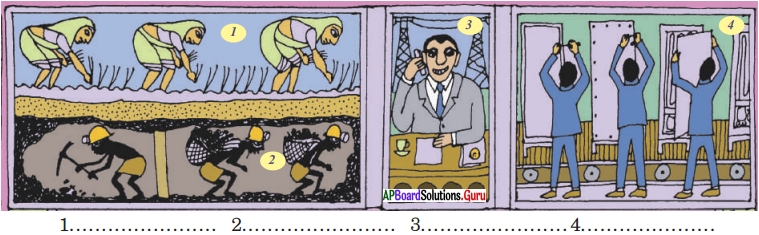
AP Board 10th Class Social Solutions Chapter 3 ఉత్పత్తి, ఉపాధి 2
జవాబు:

  1. వ్యవసాయ రంగం
  2. (గనులు) ప్రాథమిక రంగం
  3. సేవల రంగం
  4. పారిశ్రామిక రంగం

10th Class Social Textbook Page No.30

ప్రశ్న 4.
ఈ కింది గ్రాఫ్ రెండు వేరు వేరు సంవత్సరాలు, 1972-73, 2009-10 లకు భారతదేశ స్థూల దేశీయోత్పత్తి విలువను చూపిస్తుంది. సంవత్సరాలలో మొత్తం ఉత్పత్తి పెరిగిన తీరును మీరు చూడవచ్చు.
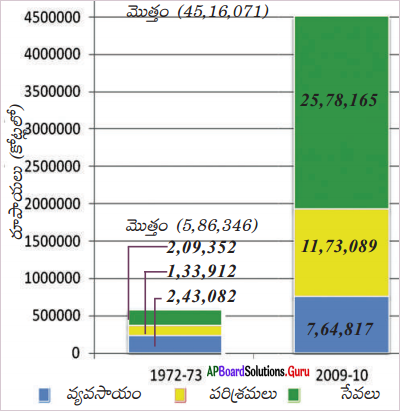
AP Board 10th Class Social Solutions Chapter 3 ఉత్పత్తి, ఉపాధి 3
గ్రాఫ్ : వ్యవసాయం, పరిశ్రమలు, సేవా రంగాల వారీగా స్థూల దేశీయోత్పత్తి
గ్రాఫ్ ను చూసి కింది ప్రశ్నలకు జవాబులివ్వండి :
(1) 1972-78లో అధిక ఉత్పత్తి ఉన్న రంగం ఏది?
జవాబు:
1972-73లో వ్యవసాయం రంగం అధిక ఉత్పత్తి కలిగి ఉన్నది. మొత్తం GDP 5,86,346 కోట్లలో వ్యవసాయరంగం 2,43,082 కోట్లు కలిగి ఉంది.

(2) 2009-10 లో అధిక ఉత్పత్తి ఉన్న రంగం ఏది?
జవాబు:
2009-10 లో సేవా రంగం అధిక ఉత్పత్తి కలిగి ఉన్నది. మొత్తం GDP 45,16,071 కోటలో సేవా రంగం 26,78,165 కోట్లు మిగిలిన వ్యవసాయ రంగం 7,64,817 కోట్లు మరియు పరిశ్రమల రంగం 11,73,089 కోట్లు వాటా కలిగి ఉన్నాయి.

(3) 1972-73, 2009-10 సంవత్సరాల మధ్య భారతదేశంలో మొత్తం వస్తువులు, సేవల ఉత్పత్తి సుమారుగా …….. రెట్లు పెరిగింది.
జవాబు:
8 రెట్లు పెరిగింది.

10th Class Social Textbook Page No.31

ప్రశ్న 5.
ప్రతి దశలో మొత్తం వస్తువుల విలువ :
మొదటి దశ (రైస్ మిల్లర్‌కు రైతు వడ్లు అమ్మడం) రూ. 2500
రెండవ దశ (మాటలు యజమానికి ఊక, బియ్యం అమ్మడం) రూ. 3600
మూడవ దశ (ఇడ్లీ, దోశలు అమ్మడం) రూ. 5000
– చర్చించండి : ఉత్పత్తి అయిన మొత్తం వస్తువుల విలువను తెలుసుకోటానికి వీటన్నిటి మొత్తాన్ని జోడించాలా?
జవాబు:
అవసరం లేదు. ఉత్పత్తి అయిన మొత్తం వస్తువుల విలువను తెలుసుకోటానికి వీటన్నిటి మొత్తాన్ని జోడించనవసరం లేదు.

  • అంతిమ వస్తు ధరలో (విలువలో) ఆ వస్తువు తయారీలో వాడిన మాధ్యమిక వస్తువుల విలువ కలిసి ఉంటుంది.
  • అలా కనక జోడిస్తే ఆ వస్తువు ధరను రెండుసార్లు లెక్కించినట్లవుతుంది.
  • పై ఉదాహరణలో వడ్లు, బియ్యం, ఊక అనేవి మాధ్యమిక వస్తువులు, ఇడ్లీ, దోశ అనేవి అంత్య వస్తువులు.
  • ప్రతి దశలో ఉత్పత్తిదారులు ఉత్పాదకాలు తయారుచేసినవారికి మొత్తం విలువ చెల్లించారు.

AP Board 10th Class Social Solutions Chapter 3 ఉత్పత్తి, ఉపాధి

10th Class Social Textbook Page No.31

ప్రశ్న 6.
పై ఉదాహరణలో వడ్లు, బియ్యం మధ్య దశలోని ఉత్పాదకాలు కాగా, ఇడ్లీ, దోశ వంటివి తుది ఉత్పాదకాలు. మనం నిత్యజీవితంలో ఉపయోగించే కొన్ని వస్తువులను దిగువ సూచించడమైనది. వాటికి ఎదురుగా ఆయా వస్తువుల మధ్య దశ ఉత్పాదకాలను రాయండి.

తుది ఉత్పాదకాలుమధ్యదశ ఉత్పాదకాలు
నోటు పుస్తకం
కారు
కంప్యూటర్

జవాబు:

తుది ఉత్పాదకాలుమధ్యదశ ఉత్పాదకాలు
నోటు పుస్తకంకాగితపు గుజ్జు, కాగితం, కార్డ్ బోర్డు, బంక, పిన్నులు
కారుటైర్లు, లైట్స్, మెటల్ షీట్స్, రంగులు, సీట్లు, పెట్రోలు/డీసెల్
కంప్యూటర్సిలికాన్ చిప్స్, మానిటర్, కేబుల్స్, సాఫ్ట్ వేర్స్, సర్క్యుట్స్

10th Class Social Textbook Page No.32

ప్రశ్న 7.
మొదటి దశ (రైస్ మిల్లర్ కు రైతు వడ్లు అమ్మటం) = రూ. 2500 లోంచి కొనుగోలు చేసిన ఉత్పాదకాల విలువ ‘0’ రూపాయలు తీసేస్తే, జోడించిన విలువ 2500 రూపాయలు
రెండవ దశ (మాటలు యజమానికి ఊక, బియ్యం అమ్మటం) = రూ. 3600 లోంచి కొనుగోలు చేసిన ఉత్పాదకాల విలువ 2500 తీసేస్తే, జోడించిన విలువ 1100 రూపాయలు
మూడవ దశ (ఇడ్లీ, దోశల అమ్మకం) = రూ. 5000 లోంచి కొనుగోలు చేసిన విలువ 3600 తీసేస్తే, జోడించిన విలువ 1400 రూపాయలు.
ప్రతి దశలోనూ జోడించిన విలువ = 2500+ 1100 + 1400 = 5000
చర్చించండి : రెండు పద్ధతులలోనూ ఒకే సమాధానం ఎందుకు వచ్చింది?
జవాబు:

  1. ప్రతి దశలోనూ జోడించిన విలువ = (2500 + 1100 + 1400) = 5000
  2. అంతిమ వస్తువు ధర (దోశ ధర) = 5000. రెండు పద్ధతుల్లోను ఒకే సమాధానం వచ్చింది. కారణం
  3. జోడించిన విలువలు మాత్రమే లెక్కించడం వలన (మాధ్యమిక వస్తువులు జోడించిన విలువ)
  4. మొదటి పద్ధతిలో అంత్య వస్తువు (ఇడ్లీ) లోనే ఇవి అన్నీ ఇమిడి ఉంటాయి.
  5. రెండు పద్ధతుల్లో అంతిమ వస్తువుల విలువ ఒక్కటే కాబట్టి,
  6. రెండు పద్ధతుల్లోనూ ఒకే సమాధానం వచ్చింది.

AP Board 10th Class Social Solutions Chapter 3 ఉత్పత్తి, ఉపాధి

10th Class Social Textbook Page No.32

ప్రశ్న 8.
కింది పట్టికలో స్థూల జాతీయోత్పత్తి విలువ ఇవ్వబడింది. 2010-2011 సంవత్సరానికి లెక్కించిన విధంగా స్థూల దేశీయోత్పత్తి పెరుగుదల రేటును మిగతా సంవత్సరాలకు గణించండి.
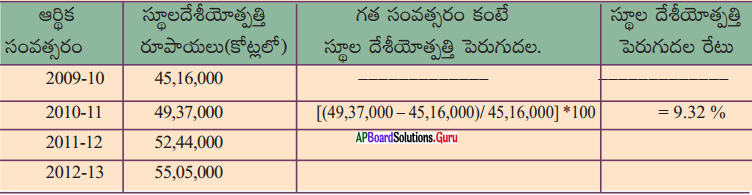
AP Board 10th Class Social Solutions Chapter 3 ఉత్పత్తి, ఉపాధి 4
జవాబు:
AP Board 10th Class Social Solutions Chapter 3 ఉత్పత్తి, ఉపాధి 5

10th Class Social Textbook Page No.34

ప్రశ్న 9.
వ్యాపారం, టళ్లు, రవాణా, ప్రసారాలకు కొన్ని ఉదాహరణలు పేర్కొనండి.
జవాబు:

  1. వివిధ రకాల వస్తువులు అమ్మే అన్నీ రకాల దుకాణాలు, ఎగుమతులు దిగుమతులు, సూపర్ మార్కెట్లు, మాల్స్
  2. చిన్న హెూటళ్ల నుండి స్టార్ హోటళ్లు దాకా.
  3. రోడ్డు, రైల్వే, విమానయాన, ఓడల ద్వారా రవాణా ఈ కోవ కిందకి వస్తాయి.
  4. రేడియో, టి.వి., వార్తాపత్రికలు, వివిధ మాస వార పత్రికలు, ఇంటర్నెట్ సౌకర్యం, టెలికమ్యూనికేషన్స్ (టెలిఫోన్, సెల్ ఫోన్) ఉపగ్రహ సాంకేతికత మొదలగునవి.

10th Class Social Textbook Page No.35

ప్రశ్న 10.
పట్టిక : భారతదేశంలో పరిశ్రమలవారీగా కార్మికుల వివరాలు, 2009-2010 (%)
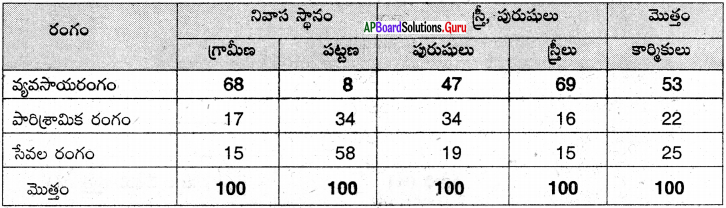
AP Board 10th Class Social Solutions Chapter 3 ఉత్పత్తి, ఉపాధి 6
పట్టికని జాగ్రత్తగా అధ్యయనం చేసి కింది ప్రశ్నలకు సమాధానాలు ఇవ్వండి.
1) వ్యవసాయ రంగంలోని అత్యధిక మంది కార్మికులు ………………………… లో నివసిస్తున్నారు.
2) చాలామంది ………………………. పనివారు వ్యవసాయ రంగంలో ఉపాధి పొందుతున్నారు.
3) 90% కంటే అధికంగా పట్టణ ప్రాంత పనివారు ……………., ……………… రంగాలలో ఉపాధి పొందుతున్నారు.
4) స్త్రీ, పురుషుల నిష్పత్తి పోలిస్తే స్త్రీలు ………………., ………………….. రంగాలలో కొద్ది శాతం మాత్రమే ఉపాధి పొందుతున్నారు.
జవాబు:
1) గ్రామప్రాంతం
2) మహిళ (స్త్రీ)
3) పారిశ్రామిక, సేవా
4) పారిశ్రామిక, సేవా

10th Class Social Textbook Page No.36 & 37

ప్రశ్న 11.
‘పై’ చార్టు : మూడు రంగాలలో ఉపాధి వాటా
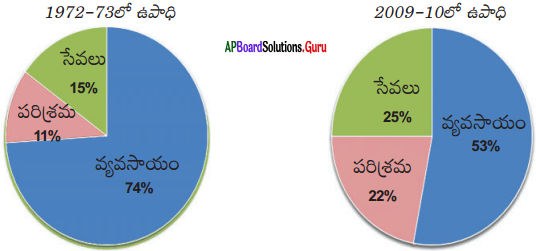
AP Board 10th Class Social Solutions Chapter 3 ఉత్పత్తి, ఉపాధి 8 AP Board 10th Class Social Solutions Chapter 3 ఉత్పత్తి, ఉపాధి 9 AP Board 10th Class Social Solutions Chapter 3 ఉత్పత్తి, ఉపాధి 10
జవాబు:
AP Board 10th Class Social Solutions Chapter 3 ఉత్పత్తి, ఉపాధి 11

AP Board 10th Class Social Solutions Chapter 2 అభివృద్ధి భావనలు

SCERT AP 10th Class Social Study Material Pdf 2nd Lesson అభివృద్ధి భావనలు Textbook Questions and Answers.

AP State Syllabus 10th Class Social Solutions 2nd Lesson అభివృద్ధి భావనలు

10th Class Social Studies 2nd Lesson అభివృద్ధి భావనలు Textbook Questions and Answers

Improve your learning (మీ అభ్యసనాన్ని మెరుగుపడుచుకోండి)

ప్రశ్న 1.
వివిధ దేశాలను వర్గీకరించటంలో ప్రపంచ బ్యాంకు ఉపయోగించే ముఖ్యమైన ప్రామాణికాలు ఏమిటి? పై ప్రామాణికాలలో ఏమైనా పరిమితులు ఉంటే వాటిని పేర్కొనండి. (AS1)
జవాబు:
వివిధ దేశాలను వర్గీకరించటంలో ప్రపంచ బ్యాంకు ఉపయోగించే ముఖ్యమైన ప్రామాణికాలు.

  1. తలసరి ఆదాయం (అమెరికన్ డాలర్లలో) ను ముఖ్య ప్రామాణికంగా తీసుకుంది.
  2. దేశం మొత్తం ఆదాయాన్ని (జాతీయాదాయం ) దేశ జనాభాతో భాగిస్తే తలసరి ఆదాయం వస్తుంది.
  3. తలసరి ఆదాయంను ‘సగటు ఆదాయం ” అని కూడా అంటారు.

పరిమితులు:
ఎ) పోలికకు “సగటు” ఉపయోగకరంగా ఉన్నా అది ప్రజల మధ్య అంతరాలను వెల్లడి చేయదు.
బి) ప్రజల మధ్య ఈ ఆదాయం ఎలా పంపిణీ అయిందో తెలియదు.
సి) వాస్తవ అభివృద్ధిని తెలియచేయకపోవచ్చు.

ప్రశ్న 2.
ప్రతి సామాజిక అంశం వెనుక ఒకటి కాక అనేక కారణాలు ఉంటాయి. ఇక్కడ కూడా అది వర్తిస్తుంది. మీ అభిప్రాయంలో హిమాచల్ ప్రదేశ్ లో ఏ ఏ అంశాలు పాఠశాల విద్యకు దోహదం చేశాయి? (AS1)
(లేదా)
హిమాచల్ ప్రదేశ్ లో మెరుగైన అక్షరాస్యతను సాధించడానికి దోహదపడిన అంశాలు ఏవి?
జవాబు:
హిమాచల్ ప్రదేశ్ లో పాఠశాల విద్యకు లేదా మెరుఅక్షరాస్యతకు దోహదం చేసిన అంశాలు.

  1. పాఠశాలలు తెరిచి చాలా వరకు విద్య ఉచితంగా ఉండేలా లేదా తల్లిదండ్రులకు నామమాత్రపు ఖర్చు అయ్యేలా ప్రభుత్వం చూసింది.
  2. పాఠశాలలో ఉపాధ్యాయులు, తరగతి గదులు, మరుగుదొడ్లు, త్రాగునీరు వంటి కనీస సదుపాయాలు ఉండేలా చూసింది.
  3. భారతదేశ రాష్ట్రాలలో ప్రభుత్వ బడ్జెటులో ప్రతి విద్యార్థి చదువుపై ఎక్కువ మొత్తం ఖర్చు పెడుతున్న రాష్ట్రాలలో హిమాచల్ ప్రదేశ్ ఒకటి.
  4. ఆడపిల్లల పట్ల అంతగా వివక్షత లేకపోవటం అనేది హిమాచల్ ప్రదేశ్ లో చెప్పుకోదగిన విషయం
  5. కొడుకుల లాగానే కూతుళ్లు కూడా చదువుకోవాలని అక్కడి తల్లిదండ్రులు కోరుకుంటున్నారు.
  6. లింగ వివక్షత తక్కువగా ఉండటం.
  7. మహిళా సాధికారిత (మహిళలు బయట ఉద్యోగాలు చేయటం).
  8. సామాజిక జీవితంలోనూ, గ్రామ రాజకీయాలలోనూ మహిళల పాత్ర ఎక్కువగా ఉండటం.

AP Board 10th Class Social Solutions Chapter 2 అభివృద్ధి భావనలు

ప్రశ్న 3.
అభివృద్ధిని కొలవటానికి ప్రపంచ బ్యాంకు ఉపయోగించే ప్రామాణికాలకూ, ఐక్యరాజ్యసమితి అభివృద్ధి కార్యక్రమం ఉపయోగించే వాటికి తేడా ఏమిటి? (AS1)
జవాబు:

ప్రపంచ బ్యాంక్ ప్రామాణికాలుఐక్యరాజ్యసమితి అభివృద్ధి కార్యక్రమం (UNDP) ప్రామాణికాలు
1) ప్రపంచ బ్యాంక్ తలసరి ఆదాయం (సగటు ఆదాయం ) ను ప్రధాన ప్రామాణికంగా ఉపయోగిస్తుంది.1) ఐక్యరాజ్యసమితి అభివృద్ధి కార్యక్రమం (UNDP) తలసరి ఆదాయంతోపాటు విద్యాస్థాయి, ఆయుః ప్రమాణం రేటును ప్రామాణికంగా ఉపయోగిస్తుంది.
2) ప్రపంచ బ్యాంకు అభివృద్ధి వేదికను “ప్రపంచ అభివృద్ధి నివేదిక” గా పిలుస్తారు.2) UNDP నివేదికను ‘మానవాభివృద్ధి నివేదిక’ అని పిలుస్తారు.
3) ప్రజల ఆదాయాలను మాత్రమే పరిగణనలోకి తీసుకొంటుంది. జీవిత ప్రమాణ స్థాయిని పరిగణనలోకి తీసుకోదు.3) ప్రజల ఆదాయాలతో పాటు జీవన ప్రమాణ స్థాయిని కూడా పరిగణనలోకి తీసుకుంటుంది.
4) ప్రజల సంక్షేమాన్ని దీనిద్వారా తెలుసుకోలేం.4) ప్రజల సంక్షేమాన్ని వీని ద్వారా తెలుసుకోగలం.
5) ఇవి ప్రజల మధ్య అంతరాలను వెల్లడి చేయదు.5) ఇవి ప్రజల (అభివృద్ధి) మధ్య అంతరాలను తెలియజేస్తుంది.
6) ఇవి పరిమాణాత్మకమైనవి.6) ఇవి పరిమాణాత్మకం మరియు గుణాత్మకమైనవి.

ప్రశ్న 4.
మానవ అభివృద్ధిని కొలవటానికి మీ దృష్టిలో ఇంకా ఏ అంశాలను పరిగణనలోకి తీసుకోవాలి? (AS4)
(లేదా)
మానవాభివృద్ధిని కొలవడానికి ముఖ్యమైన అంశాలను ఉదహరించుము.
జవాబు:
మానవ అభివృద్ధిని కొలవటానికి పరిగణనలోకి తీసుకున్న అంశాలు :

  1. తలసరి ఆదాయం (కొనుగోలు శక్తి తెలుసుకోవటం కోసం)
  2. విద్యాస్థాయి
  3. ఆరోగ్య స్థితి

పరిగణనలోకి తీసుకోవాల్సిన మరికొన్ని అంశాలు :

  1. సామాజిక న్యాయం
  2. పంపిణీ న్యాయం
  3. త్రాగునీటి సౌకర్యాల ఏర్పాటు
  4. విద్యుత్ సౌకర్యం
  5. ఉద్యోగిత స్థాయి
  6. జీవన ప్రమాణ స్థాయి
  7. పర్యావరణం, పరిశుభ్రత
  8. అవినీతి రహితం
  9. సాంకేతిక ప్రగతి
  10. మెరుగైన రవాణా వ్యవస్థ

ప్రశ్న 5.
‘సగటు’ ఎందుకు ఉపయోగిస్తాం? దీనిని ఉపయోగించటంలో ఏమైనా పరిమితులు ఉన్నాయా? అభివృద్ధికి సంబంధించి మీ సొంత ఉదాహరణను తీసుకుని దీనిని వివరించండి. (AS1)
జవాబు:

  1. పోలికకు ‘సగటు’ను ఉపయోగిస్తాం.
  2. జాతీయాదాయం (మొత్తం) కన్నా తలసరి ఆదాయం (సగటు) మెరుగైన సూచిక.
  3. “సగటు” ను లెక్కించటం సులువు.

పరిమితులు :

  1. సగటు ప్రజల మధ్య అంతరాలను వెల్లడి చేయదు.
  2. ఇది పరిమాణాత్మకమైనదే కాని గుణాత్మకమైనది కాదు.
  3. పంపిణీ ఎలా జరిగిందో తెలియదు.
  4. వాస్తవ అభివృద్ధి తెలియజేయకపోవచ్చు.
  5. జీవన ప్రమాణ స్థాయిని ఖచ్చితంగా నిర్వచించలేకపోవచ్చు

AP Board 10th Class Social Solutions Chapter 2 అభివృద్ధి భావనలు 1

  1. పై ఉదాహరణలో రెండు దేశాల సగటు (20,000) ఒకే విధంగా ఉంది. అయితే,
  2. రెండు దేశాల అభివృద్ధి స్థాయి ఒకే విధంగా లేదు.
  3. ‘ఇ’ దేశంలో ఒక వ్యక్తి అత్యంత ధనవంతుడు, మిగతా నలుగురు పేదలు కాని సగటును తీసుకుంటే ఈ విషయం వెల్లడి కాదు. అంటే ఆదాయం ఎలా పంపిణీ అయిందో తెలియదు.
  4. సగటును తీసుకుంటే ‘ఇ’ దేశంలో వాస్తవ అభివృద్ధి జరిగిందో లేదో తెలియకపోవచ్చు.
  5. సగటును తీసుకుని ‘ఇ’ దేశంలో వ్యక్తులందరి కొనుగోలు శక్తి ఒకేలా ఉందని అనుకోవచ్చు కాని వాస్తవంలో అది కరెక్ట్ కాకపోవచ్చు.

AP Board 10th Class Social Solutions Chapter 2 అభివృద్ధి భావనలు

ప్రశ్న 6.
హిమాచల్ ప్రదేశ్ లో తలసరి ఆదాయం తక్కువ ఉన్నప్పటికీ పంజాబ్ కంటే మానవ అభివృద్ధి సూచికలో ముందుండటం అన్న వాస్తవం నేపథ్యంలో ఆదాయం యొక్క ప్రాముఖ్యత గురించి ఎటువంటి నిర్ధారణలు చేయవచ్చు? (AS1)
జవాబు:

  1. పౌరులు ఉపయోగించుకోగల భౌతిక వస్తువులు, సేవలను కేవలం ఆదాయం సూచించలేదు.
  2. డబ్బు కాలుష్యం లేని వాతావరణాన్ని కొనివ్వలేదు. కలీలేని మందులు దొరుకుతాయన్న హామీ ఇవ్వలేదు.
  3. ప్రజలందరూ నివారణ చర్యలు చేపడితే తప్పించి అంటురోగాల నుంచి (ఆదాయం) రక్షించలేకపోవచ్చు.
  4. మానవ అభివృద్ధి సూచికలో దిగువన ఉండటం ప్రజల జీవితాలలోని కొన్ని అంశాలపై దృష్టి కేంద్రీకరించాలన్న సంకేతాన్ని ఇస్తోంది.
  5. ప్రభుత్వమూ, ప్రజలూ అభివృద్ధి (మానవ వనరులు) పై ఆసక్తి కలిగి ఉంటే ఆదాయం (తలసరి) అంత ప్రాముఖ్య అంశం కాకపోయినప్పటికీ, అవసరమైన మేర ఉండాలి.
    ఉదా : హెచ్.పి. ప్రభుత్వం విద్యపై సగటున 2,005 రూపాయలు ఖర్చు పెడుతోంది, ఇది భారతదేశ సగటు (1049) కన్నా ఎక్కువ.
  6. తలసరి ఆదాయ అభివృద్ధి కన్నా, మానవ వనరుల అభివృద్ధికి అధిక ప్రాధాన్యత ఇవ్వడం వలన హిమాచల్ ప్రదేశ్ లో ఇది (HDI లో ముందుండటం) సాధ్యమయ్యింది.
  7. సామాజిక అంశాలు (లింగ వివక్షత, పురుషాధిక్యత మొదలయినవి) మానవ వనరుల అభివృద్ధిలో ఆదాయం కన్నా ముఖ్యపాత్ర పోషిస్తాయి.
    ఉదా : లింగ వివక్షత లేకపోవడం వలన హిమాచల్ ప్రదేశ్ లో బాలికలు అందరూ చదువుకోవడం జరుగుతుంది.
  8. మహిళా సాధికారత మానవాభివృద్ధిలో ప్రముఖ అంశంగా తోడ్పడుతుంది.
    ఉదా : హిమాచల్ ప్రదేశ్ లో సామాజిక జీవితంలో, గ్రామ రాజకీయాలలోను మహిళల పాత్ర ఎక్కువ. అలాగే పలు గ్రామాలలో చురుకుగా పనిచేస్తున్న మహిళా మండలులు ఉన్నాయి.

ప్రశ్న 7.
పట్టిక : హిమాచల్ ప్రదేశ్ లో ప్రగతి
AP Board 10th Class Social Solutions Chapter 2 అభివృద్ధి భావనలు 2

పై పట్టికలో ఉన్న వివరాల ఆధారంగా కింది వాటిని పూరించండి : (AS3)
ఆరు సంవత్సరాలు పైబడిన ప్రతి 100 మంది ఆడపిల్లల్లో హిమాచల్ ప్రదేశ్ లో 1993లో ….. ఆడపిల్లలు ప్రాథమిక స్థాయి దాటి చదివారు. 2006 నాటికి ఇది వందలో ………… మందికి చేరుకుంది. భారతదేశం మొత్తం మీద 2006లో ప్రాథమిక స్థాయి దాటి చదివిన మగపిల్లల సంఖ్య వందలో …….. మాత్రమే.
జవాబు:
ఆరు సంవత్సరాలు పైబడిన ప్రతి 100 మంది ఆడపిల్లల్లో హిమాచల్ ప్రదేశ్ లో 1993లో …. 39 మంది…. ఆడపిల్లలు ప్రాథమిక స్థాయి దాటి చదివారు. 2006 నాటికి ఇది వందలో …60 ….. మందికి చేరుకుంది. భారతదేశం మొత్తం మీద 2006లో ప్రాథమిక స్థాయి దాటి చదివిన మగపిల్లల సంఖ్య వందలో … 57….. మాత్రమే.

ప్రశ్న 8.
హిమాచల్ ప్రదేశ్ లో తలసరి ఆదాయం ఎంత? అధిక ఆదాయం ఉన్నప్పుడు పిల్లల్ని బడికి పంపటం తల్లిదండ్రులకు తేలిక అవుతుందా? చర్చించండి. హిమాచల్ ప్రదేశ్ లో ప్రభుత్వం పాఠశాలలు నడపటం ఎందుకు అవసరమయ్యింది? (AS1)
జవాబు:
ఎ) హిమాచల్‌ ప్రదేశ్ తలసరి ఆదాయం (2012 సం||లో) 74,000 రూపాయలు.
బి)

  1. అధిక ఆదాయం ఉన్నప్పుడు పిల్లల్ని బడికి పంపటం తల్లిదండ్రులకూ ఖచ్చితంగా తేలిక అవుతుంది. అయితే తలసరి ఆదాయం అధికంగా ఉన్నప్పుడు ఈ విషయాన్ని ఖచ్చితంగా చెప్పలేం. ఎందుకంటే ఆదాయ పంపిణీ ఎలా జరిగిందో చెప్పలేం కనుక.
  2. తక్కువ ఆదాయం కలిగి ఉన్న తల్లిదండ్రులు విద్యపై డబ్బు ఖర్చు పెట్టడం కష్టం. అలాగే పిల్లలను కూడా చదువు మాన్పించి కూలీకి (బాలకార్మికులుగా) పంపటం జరుగుతుంది.
  3. అధిక ఆదాయం ఉన్న తల్లిదండ్రులకు ఆ అవసరం ఉండదు కనుక పిల్లలను చక్కగా చదివిస్తారు.

సి) హిమాచల్ ప్రదేశ్ లో ప్రభుత్వం పాఠశాలలు నడపటం ఎందుకు అవసరమయ్యిందంటే.

  1. భారతదేశానికి స్వాతంత్ర్యం వచ్చినపుడు హిమాచల్ ప్రదేశ్ లో విద్యాస్థాయి తక్కువగా ఉండటం.
  2. కొండ ప్రాంతం కావటంతో జనసాంద్రత చాలా తక్కువ. పాఠశాల విస్తరణ, ప్రత్యేకించి గ్రామీణ ప్రాంతాలలో విస్తరించటం పెద్ద సవాలుగా ఉండింది.
  3. చాలావరకు విద్య ఉచితంగా లేదా తల్లిదండ్రులకు నామమాత్రపు ఖర్చు అయ్యేలా ప్రభుత్వం చూసింది.
  4. అక్కడి ప్రజలు విద్యపై ఎంతో ఆసక్తి చూపడం వలన.
  5. విద్యకు అత్యధిక ప్రాధాన్యతను ఇవ్వడం వలన.

ప్రశ్న 9.
అబ్బాయిలతో పోలిస్తే అమ్మాయిల చదువుకు తల్లిదండ్రులు తక్కువ ప్రాధాన్యత ఎందుకు ఇస్తారు? తరగతిలో చర్చించండి. (AS4)
జవాబు:
అబ్బాయిలతో పోలిస్తే అమ్మాయిల చదువుకు తల్లిదండ్రులు తక్కువ ప్రాధాన్యత ఇస్తున్నారు.

కారణాలు :

  1. అమ్మాయిల చదువుకు తక్కువ ప్రాధాన్యత ఇవ్వటానికి ప్రధాన కారణం “లింగ వివక్షత”.
  2. “బాల్య వివాహాలు” (అమ్మాయిలకు తొందరగా పెళ్ళి చేసి పంపించేయాలని భావించటం),
  3. అమ్మాయిలను అబ్బాయిలకంటే తక్కువగా చూస్తూ వారిని ఇంటిపని, వంట పనులకు బాధ్యుల్ని చేయటం, చిన్నపిల్లల సంరక్షణను అప్పగించటం.
  4. అమ్మాయి ఎక్కువగా చదువుకుంటే తగిన పెళ్ళి సంబంధం కుదర్చాలంటే ఎక్కువ ఖర్చు మరియు కష్టంతో కూడుకున్నదని పెద్దలు అభిప్రాయపడటం.
  5. ఉద్యోగం పురుషలక్షణం అంటూ, అమ్మాయి చదివి ఏం ఉద్యోగం చేయాలని అంటూ అమ్మాయిల విద్యను నిరుత్సాహపరచటం. (ఒక విధమైన ‘పురుషాధిక్యత’)
  6. మనది “పితృస్వామ్య కుటుంబా”లవ్వటం వలన అబ్బాయిలకు ప్రాధాన్యత ఎక్కువగా ఉంటుంది.
  7. అమ్మాయిలను “సరైన భద్రత” లేకుండా బయటకు (పాఠశాలలు మొ||నవి) పంపటం శ్రేయస్కరం కాదని భావించడం. సరైన సౌకర్యాలు (రవాణా, మరుగుదొడ్లు మొ||నవి) అందుబాటులో లేకపోవటం.
  8. మగపిల్లల చదువు (ఖర్చును) పెట్టుబడిగా, బాలికల చదువు (ఖర్చు) ఖర్చుగాను భావించడం. అబ్బాయిలకయ్యే ఖర్చును ఇతరత్రా రూపంలో తిరిగి పొందవచ్చని భావించడం.
  9. కొన్ని సామాజిక దురాచారాలు, పురుషాధిక్య సమాజం, మహిళా సాధికారత లోపించడం వలన అమ్మాయిల చదువుకు తక్కువ ప్రాధాన్యత ఇస్తున్నారు.

AP Board 10th Class Social Solutions Chapter 2 అభివృద్ధి భావనలు

ప్రశ్న 10.
ఆడవాళ్ళు ఇంటిబయట పనిచెయ్యటానికి, లింగ వివక్షతకూ మధ్య గల సంబంధం ఏమిటి? (AS1)
జవాబు:
ఆడవాళ్ళు ఇంటిబయట పనిచెయ్యటానికి, లింగ వివక్షతకూ విలోమ (వ్యతిరేక) సంబంధం ఉంది.

  1. బయట ఉద్యోగాలు చేసే మహిళలు స్వతంత్రంగా ఉంటారు, ఆత్మవిశ్వాసం కనబరుస్తారు.
  2. ఇంటిలో తీసుకునే నిర్ణయాలలో అంటే పిల్లల చదువు, ఆరోగ్యం, పిల్లల సంఖ్య, గృహ నిర్వహణ వంటి వాటిల్లో ఆడవాళ్ళ మాటకు ప్రాధాన్యత ఉంటుంది.
  3. ఉద్యోగాల్లో ఉన్న మహిళలు పెళ్ళి అయిన తరువాత తమ కూతుళ్లు ఉద్యోగాలు చేయాలని తల్లులు కోరుకుంటారు, కాబట్టి చదువుకు ప్రాధాన్యత ఇవ్వటం సహజం.
  4. ఆడవాళ్లు ఉద్యోగం (బయటపని) చేయటం వలన ఆర్థిక స్వాతంత్ర్యం పొందుతారు, అలాగే ఆర్థికంగా స్థిరత్వం పొందుతారు. తద్వారా మహిళా సాధికారత పొందుతారు.
  5. మహిళలు సాధికారత సాధించిన తర్వాత లింగ వివక్షతకు అసలు చోటే ఉండదు. (పూర్తి అనాగరిక సమాజాలలో తప్ప) ఈ విషయాన్ని మనం అభివృద్ధి చెందిన దేశాలలో చూస్తున్నాం కూడా !

ప్రశ్న 11.
ఎనిమిదవ తరగతి పాఠ్యపుస్తకంలో మీరు విద్యాహక్కు చట్టం (వి.హ.చ) గురించి చదివారు. 6-14 సంవత్సరాల బాలలకు ఉచిత విద్యకు హక్కు ఉందని ఈ చట్టం పేర్కొంటోంది. పరిసర ప్రాంతాలలో తగినన్ని పాఠశాలలు నిర్మించేలా, అర్హులైన టీచర్లను నియమించేలా, అవసరమైన సదుపాయాలు కల్పించేలా ప్రభుత్వం చూడాలి. మీరు ఈ అధ్యాయంలో చదివినది, మీకు తెలిసిన దాన్నిబట్టి (1) బాలలకు (II) మానవ అభివృద్ధికి ఈ చట్టం ఎలాంటి ప్రాధాన్యత కలిగి ఉందో చర్చించండి, గోష్టి నిర్వహించండి. (AS2)
జవాబు:
(i) విద్యాహక్కు చట్టం – బాలలకు కలిగి ఉన్న ప్రాధాన్యత.

  1. దీని ప్రకారం 6 నుండి 14 సం|| మధ్య వయస్సు గల పిల్లలందరికీ ఉచిత, నిర్బంధ విద్యను ప్రభుత్వం అందిస్తుంది.
  2. పిల్లల పరిసరాలలోనే తగిన సంఖ్యలో కనీస సౌకర్యాలు కలిగిన పాఠశాలలు నిర్మించడం, తగినంతమంది ఉపాధ్యాయుల నియామకం చేయడం జరుగుతుంది.
  3. పిల్లలకు భయం, ఆందోళన లేకుండా (శారీరక, మానసిక హింసలేకుండా) కృత్యాల ద్వారా బోధన ద్వారా పిల్లల సర్వతోముఖాభివృద్ధికి కృషి చేస్తుంది.
  4. బాలల హక్కులు (అభివృద్ధి, భూస్వామ్య హక్కు మొ॥నవి) కాపాడబడటానికి ఈ చట్టం ఎంతో అవసరం.
  5. బాలకార్మిక వ్యవస్థ, వెట్టిచాకిరి, బాల్య వివాహాలు మొ||న సామాజిక దురాచారాల నుండి (బాలలను) విముక్తి కల్పిస్తుంది.

(II) మానవ అభివృద్ధికి ప్రాధాన్యత :

  1. మానవాభివృద్ధి సూచికలో ‘విద్యాస్థాయి’ ప్రధానమైన సూచిక. విద్యాస్థాయిని పెంపొందించటానికి ఈ విద్యాహక్కు చట్టం ఎంతో ఉపయోగపడుతుంది.
  2. సగటున బడిలో గడిపే సంవత్సరాలు ఈ చట్టం ద్వారా ఖచ్చితంగా పెరుగుతాయి.
  3. అలాగే పాఠశాల విద్యలో ఉండే సంవత్సరాలు, ప్రాథమిక, మాధ్యమిక, ఉన్నత విద్యలో నమోదు నిష్పత్తి కూడా ఈ చట్టం ద్వారా గణనీయంగా పెరుగుతుంది.
  4. ఈ చట్టం ద్వారా విద్యాభివృద్ధి తద్వారా మానవాభివృద్ధి ఆశించిన రీతిలో జరుగుతుంది.
  5. విద్యాభివృద్ధి అనేది ఆదర్శవంతమైన (మానవాభివృద్ధి) సూచిక.

10th Class Social Studies 2nd Lesson అభివృద్ధి భావనలు InText Questions and Answers

10th Class Social Textbook Page No.20

ప్రశ్న 1.
ప్రపంచ అభివృద్ధి నివేదిక 2012 ప్రకారం మధ్య ఆదాయ దేశాల తలసరి ఆదాయం ఎంతో పైన ఉన్న భాగం చదివి చెప్పండి.
జవాబు:
ప్రపంచ అభివృద్ధి నివేదిక 2012 ప్రకారం మధ్య ఆదాయ దేశాల తలసరి ఆదాయం 1,035 అమెరికన్ డాలర్ల కంటే ఎక్కువ, 12,600 అమెరికన్ డాలర్ల కంటే తక్కువ.

10th Class Social Textbook Page No.14 & 15

ప్రశ్న 2.
పట్టిక : వివిధ వర్గాల ప్రజలు, అభివృద్ధి లక్ష్యాలు

వివిధ వర్గాల ప్రజలుఅభివృద్ధి లక్ష్యాలు/ఆకాంక్షలు
1) భూమిలేని గ్రామీణ కార్మికులుమరిన్ని రోజుల పని, మెరుగైన కూలీ; స్థానిక పాఠశాల తమ పిల్లలకు నాణ్యమైన విద్యను అందించగలగటం; సామాజిక వివక్షత లేకపోవటం, వాళ్లు కూడా గ్రామంలో నాయకులు కాగలగటం.
2) ధనిక రైతులుతమ పంటలకు అధిక మద్దతు ధరల ద్వారా, తక్కువ కూలీకి బాగా కష్టపడే కూలీల ద్వారా అధిక ఆదాయాన్ని ఖచ్చితంగా పొందగలగటం; తమ పిల్లలు విదేశాలలో స్థిరపడగలగటం.
3) వర్షాధార రైతులు
4) భూమి ఉన్న కుటుంబంలోని గ్రామీణ మహిళ
5) పట్టణ ప్రాంతంలోని నిరుద్యోగ యువత
6) పట్టణ ప్రాంతంలోని ధనిక అబ్బాయి
7) పట్టణ ప్రాంతంలోని ధనిక కుటుంబానికి చెందిన అమ్మాయితన సోదరుడికి లభించే స్వేచ్చ తనకీ కావాలి, తన జీవితంలో ఏం చేయాలో తాను నిర్ణయించుకోగలగాలి. విదేశాలలో పై చదువులు చదువుకోవాలి.
8) గనుల తవ్వకం ప్రాంతంలోని ఆదివాసి
9) తీరప్రాంతంలో చేపలు పట్టే వ్యక్తి

జవాబు:
పట్టిక : వివిధ వర్గాల ప్రజలు, అభివృద్ధి లక్ష్యాలు వివిధ వర్గాల ప్రజలు

వివిధ వర్గాల ప్రజలుఅభివృద్ధి లక్ష్యాలు/ఆకాంక్షలు
1) భూమిలేని గ్రామీణ కార్మికులుమరిన్ని రోజుల పని, మెరుగైన కూలీ; స్థానిక పాఠశాల తమ పిల్లలకు నాణ్యమైన విద్యను అందించగలగటం; సామాజిక వివక్షత లేకపోవటం, వాళ్లు కూడా గ్రామంలో నాయకులు కాగలగటం.
2) ధనిక రైతులుతమ పంటలకు అధిక మద్దతు ధరల ద్వారా, తక్కువ కూలీకి బాగా కష్టపడే కూలీల ద్వారా అధిక ఆదాయాన్ని ఖచ్చితంగా పొందగలగటం; తమ పిల్లలు విదేశాలలో స్థిరపడగలగటం.
3) వర్షాధార రైతులుసకాలంలో రుతుపవనాలు వచ్చి వర్షాలు బాగా పడాలి. పొలాలకు సాగునీరు అందాలి. పంట దిగుబడి పెరగాలి. ఆ పంటకు మంచి గిట్టుబాటు ధర రావాలి. పిల్లలకు మంచి విద్యనందించటం.
4) భూమి ఉన్న కుటుంబంలోని గ్రామీణ మహిళపంట దిగుబడి పెరగాలి. పంటకు మంచి ధర రావాలి. నలుగురిలో (ఊరిలో) దర్పంగా ఉండాలి. మంచి బంగారు నగలు కొనుక్కోవాలి. ఇంట్లోవారు తన మాట వినాలి. పిల్లలకు ఉన్నతమైన సంబంధాలు తేవాలి.
5) పట్టణ ప్రాంతంలోని నిరుద్యోగ యువతచిన్నదో, పెద్దదో ఒక మంచి స్థిరమైన ఉద్యోగం (ప్రభుత్వ ఉద్యోగం) పొందాలి. స్థిరమైన ఆదాయం వచ్చే స్వయం ఉపాధిని వెతుక్కోవాలి. ప్రభుత్వ ఉద్యోగాల నోటిఫికేషన్స్ సకాలంలో వెలువడాలి, వాటికి ప్రిపేరయ్యి ఉద్యోగం సాధించాలి.
6) పట్టణ ప్రాంతంలోని ధనిక అబ్బాయివిదేశాలలో చదువుకోవాలి, ఉద్యోగం పొందాలి. స్వేచ్ఛావాతావరణంలో విహరించాలి. తండ్రి వ్యాపారం చేయటం ఇప్పుడే ఇష్టం లేదు, లేదా తండ్రి వ్యాపారాన్ని అభివృద్ధి చెయ్యాలి. కొత్త మోడల్ కారు, బైక్ కొనుక్కోవాలి.
7) పట్టణ ప్రాంతంలోని ధనిక కుటుంబానికి చెందిన అమ్మాయితన సోదరుడికి లభించే స్వేచ్ఛ తనకీ కావాలి. తన జీవితంలో ఏం చేయాలో తాను నిర్ణయించుకోగలగాలి. విదేశాలలో పై చదువులు చదువుకోవాలి.
8) గనుల తవ్వకం ప్రాంతంలోని ఆదివాసితమ భూములు తమకిచ్చేయాలి. ప్రమాదానికి గురికాకుండా రోజు గడవాలి. పర్యావరణాన్ని ఎలాగైనా కాపాడుకోవాలి. ప్రభుత్వం నిర్ణయం మార్చుకుంటే బాగుండు, మార్చే శక్తి తమకుంటే బాగుండు.
9) తీరప్రాంతంలో చేపలు పట్టే వ్యక్తివేట బాగా జరిగి ఎక్కువ చేపలు దొరకాలి. ఎటువంటి అంతరాయం, ప్రమాదం జరగకుండా క్షేమంగా ఇంటికి చేరాలి. చేపలకు మంచి ధర రావాలి. మంచి మర పడవ కొనుక్కోవాలి.

AP Board 10th Class Social Solutions Chapter 2 అభివృద్ధి భావనలు

10th Class Social Textbook Page No.16 & 17

ప్రశ్న 3.
క్రింద ఇచ్చిన వార్తాపత్రిక కథనం చూడండి.
“ఒక ఓడ 500 టన్నుల విషపూరిత వ్యర్థ ద్రవ పదార్థాలను చెత్త పడవేసే బహిరంగ ప్రదేశంలోనూ, పక్కన ఉన్న సముద్రంలోనూ పారబోసింది. ఆఫ్రికాలోని ఐవరీకోస్ట్ దేశంలోని అబిద్ జాన్ అనే పట్టణంలో ఇది జరిగింది. అత్యంత విషపూరితమైన ఈ వ్యర్థ పదార్థాల నుండి వెలువడిన వాయువుల వల్ల తల తిప్పటం, చర్మంపై దద్దురులు, స్పృహతప్పి పడిపోవటం, విరోచనాలు వంటి సమస్యలు ఏర్పడ్డాయి. ఒక నెల రోజులలో ఏడుగురు చనిపోయారు. ఇరవై మంది ఆసుపత్రిలో ఉన్నారు. విష ప్రభావానికి గురైన లక్షణాలకు 26,000 మంచి చికిత్స పొందారు. లోహాలు, ముడి చమురులతో వ్యాపారం చేసే ఒక బహుళజాతి కంపెనీ తన ఓడలోని వ్యర్థ పదార్థాలను పడవెయ్యటానికి ఐవరీకోస్టు చెందిన ఒక స్థానిక కంపెనీతో కాంట్రాక్టు కుదుర్చుకుంది.” (ది హిందూ పత్రికలో 2006 సెప్టెంబరు 16న వైజు నరవనె రాసిన వార్త ఆధారంగా)
ఎ) దీనివల్ల ప్రయోజనం పొందినవాళ్లు ఎవరు, పొందని వాళ్లు ఎవరు?
జవాబు:

  1. దీనివల్ల (కుడంకుళం అణు విద్యుత్ కేంద్రం) ప్రయోజనం పొందినవాళ్లు భారతదేశ ప్రజలు అందరూ. దీని ప్రధాన ఉద్దేశం నిరంతరం పెరుగుతున్న దేశ విద్యుచ్ఛక్తి అవసరాలు తీర్చడం.
  2. ఈ ప్రాంతం ప్రజలు, మత్స్యకారులు వారి భద్రత, రక్షణ, జీవనోపాధులు దెబ్బతింటాయని దీనివల్ల తమకు ప్రయోజనం ఉండదని భావించారు.
  3. రెండో ఉదాహరణలో బహుళ జాతి కంపెనీ లాభం పొందింది, ఐవరీకోస్ట్ తీరప్రాంత ప్రజలు నష్టపోయారు.

బి) ఈ దేశానికి అభివృద్ధి లక్ష్యాలు ఎలా ఉండాలి?
జవాబు:
ఈ దేశానికి అభివృద్ధి లక్ష్యాలు ఎలా ఉండాలి అంటే –

  1. అవసాపనా సౌకర్యాల (రోడు, రవాణా, విద్యుత్, నీరు మొ||నవి) లోటు లేకుండా ఏర్పాటు చేయడం.
  2. ఆధునిక సమాచార, సాంకేతిక రంగాలలో స్వయం సమృద్ధి సాధించుట.
  3. దేశ అభివృద్ధి లక్ష్యాలు ప్రజలందరి అభివృద్ధికి, అభ్యున్నతికి కృషి చేసేవిలా, దేశం స్వయం సమృద్ధి సాధించేలా, సుస్థిరమైన అభివృద్ధి సాధించేలా ఉండాలి.

సి) మీ గ్రామానికి, పట్టణానికి లేదా ప్రాంతానికి కొన్ని అభివృద్ధి లక్ష్యాలను పేర్కొనంది.
జవాబు:
మా గ్రామానికి / పట్టణానికి / ప్రాంతానికి కొన్ని అభివృద్ధి లక్ష్యాలు :

  1. రక్షిత మంచినీటి సౌకర్యం (అందరికి) కల్పించటం.
  2. విద్యా సౌకర్యాలు ఏర్పాటు చేయటం.
  3. పర్యావరణం, పరిశుభ్రతను కాపాడటం.
  4. వైద్య, ఆరోగ్య సదుపాయాలు కల్పించటం.
  5. మెరుగైన (రోడ్లు) రవాణా సౌకర్యాలను కల్పించటం.
  6. 100%, విద్యుదీకరణ, కోతలు లేని విద్యుత్ సౌకర్యం ఏర్పాటు.
  7. వ్యవసాయ కూలీలకు, ఇతర నిరుద్యోగులకు సంవత్సరమంతా ఉపాధి కల్పించే ప్రణాళికలు చేయడం.
  8. వ్యవసాయంతో పాటు పారిశ్రామికంగా అభివృద్ధి చేయటం.

డి) ప్రభుత్వానికి, అణువిద్యుత్ కేంద్ర ప్రాంతాలలో నివసించే ప్రజలకు మధ్య గల వివాదాలేవి?
జవాబు:

  1. భారత ప్రభుత్వం అణువిద్యుత్ కేంద్రాన్ని పెరుగుతున్న దేశ విద్యుచ్ఛక్తి అవసరాలు తీర్చు ప్రధాన ఉద్దేశముతో స్థాపించింది.
  2. కాని ఆ ప్రాంత ప్రజలు వారి భద్రత, రక్షణ, జీవనోపాధుల పరిరక్షణ కోసం ఉద్యమించారు.
  3. పెరుగుతున్న విద్యుచ్ఛక్తి అవసరాలు తీరాలంటే అణువిద్యుత్ శక్తి ఉత్పత్తి తప్పనిసరి అని ప్రభుత్వం భావిస్తోంది.
  4. కాని ఆ ప్రాంత ప్రజలు తీరప్రాంతం, దేశం రేడియోధార్మిక వినాశక ప్రమాదం నుండి రక్షించబడాలని కోరుకుంటు ఉద్యమిస్తున్నారు.
  5. ఆ ప్రాంత ప్రజలు ప్రత్యామ్నాయ ఇంధన వనరుల (సౌర విద్యుచ్ఛక్తి, పవన విద్యుచ్ఛక్తి మొ||నవి) గురించి ఆలోచించమంటూ, ప్రాజెక్ట్ నిర్మాణాన్ని ఆపాలంటున్నారు.
  6. ప్రభుత్వం ప్రాజెక్ట్ నిర్మాణానికి తగిన భద్రతా చర్యలన్నీ తీసుకుంటున్నామని ప్రకటించి, ఉద్యమాలకు అతీతంగా నిర్మాణం కొనసాగిస్తోంది.

ఇ) ఇటువంటి అభివృది విధానాలకు చెందిన వివాదాలు మీకేమైనా తెలుసా? ఇరుపక్షాల వాదనలు పేర్కొనండి.
జవాబు:

  1. పశ్చిమగోదావరి జిల్లా (ఆంధ్రప్రదేశ్) లో గోదావరి నదిపై నిర్మిస్తున్న బహుళార్థ సాధక ప్రాజెక్ట్ పై అనేక వివాదాలు ఉన్నాయి.
  2. ఈ ప్రాజెక్ట్ నిర్మాణం పూర్తయితే అనేక లక్షల ఎకరాలకు సాగునీరు అందుతుంది, అలాగే జలవిద్యుచ్ఛక్తి కూడా ఉత్పత్తవుతుంది.
  3. అయితే ఈ ప్రాజెక్ట్ నిర్మాణం వలన అనేక గ్రామాలు ముంపునకు గురవుతాయి. పెద్ద మొత్తంలో అటవీ ప్రాంతం మునిగిపోతుంది, పర్యావరణం దెబ్బతింటుందని అక్కడి ప్రజలు పెద్ద ఎత్తున నిరసన తెలుపుతున్నారు.
  4. మరో ఉదాహరణ నర్మదానదిపై నిర్మించతలపెట్టిన (సర్దార్ సరోవర్) ప్రాజెక్ట్ విషయంలో కూడా ఇలాంటి వివాదాలే తలెత్తితే, మేధాపాట్కర్ నాయకత్వాన ‘నర్మదా బచావో’ ఆందోళన సాగిస్తున్నారు.

10th Class Social Textbook Page No.19

ప్రశ్న 4.
ఉదాహరణకు క, గ అనే రెండు దేశాలను తీసుకుందాం. సంక్లిష్టంగా లేకుండా ఉండటానికి రెండు దేశాలలోనూ అయిదుగురే ప్రజలు ఉన్నారనుకుందాం. పట్టికలో ఇచ్చిన వివరాల ఆధారంగా రెండు దేశాల సగటు ఆదాయాన్ని లెక్కగట్టండి.
పట్టిక : రెండు దేశాలను పోల్చటం
AP Board 10th Class Social Solutions Chapter 2 అభివృద్ధి భావనలు 5
జవాబు:
ఎ) దేశం ‘క’ సగటు ఆదాయం = 10000
బి) దేశం ‘గ’ సగటు ఆదాయం = 10000

10th Class Social Textbook Page No.20

ప్రశ్న 5.
ఇక్కడ ఇచ్చిన ఉదాహరణ కాకుండా పోలికకు సగటును ఉపయోగించే మరో మూడు ఉదాహరణలు ఇవ్వండి.
జవాబు:

  1. ఒక పరిశ్రమలోని ఉత్పత్తి, ఉద్యోగులు (ధరలు, వ్యయం) అనుసరించి సగటు ఉత్పత్తి, సగటు వ్యయం మొదలైనవి ఉపయోగించి పోలుస్తారు.
  2. తరగతిలోని వివిధ మార్కుల సగటు. .
    ఉదా : తరగతి మార్కుల సగటు, సబ్జెక్ట్ మార్కుల సగటు, జి.పి.ఎ. (గ్రేడ్ పాయింట్ సగటు)
  3. జనాభాను పోల్చుటకు “సగటు జనసాంద్రత” (ఒక చదరపు కిలోమీటరులో నివసించే జనాభా) ను ఉపయోగిస్తున్నారు.

AP Board 10th Class Social Solutions Chapter 2 అభివృద్ధి భావనలు

10th Class Social Textbook Page No.18

ప్రశ్న 6.
విభిన్న వ్యక్తులకు అభివృది పట్ల విభిన్న భావనలు ఎందుకుంటాయి? కింద ఇచ్చిన వివరణల్లో ఏది ముఖ్యమైనది, ఎందుకు?
(అ) వ్యక్తులు వేరు కాబట్టి
(ఆ) వ్యక్తుల జీవన పరిస్థితులు వేరు కాబట్టి
(లేదా)
వివిధ వర్గాల ప్రజల అభివృద్ధి లక్ష్యాలు భిన్నంగా ఉంటాయనడానికి ఉదాహరణలివ్వండి.
AP Board 10th Class Social Solutions Chapter 2 అభివృద్ధి భావనలు 4-1
జవాబు:

  1. విభిన్న వ్యక్తులకు అభివృద్ధి పట్ల విభిన్న భావనలు ఎందుకుంటాయంటే వ్యక్తుల జీవన పరిస్తితులు వేరు కాబట్టి.
  2. వ్యక్తులు వారి వారి పరిస్థితులను బట్టి వారి అభివృద్ధి లక్ష్యాలు, ఆకాంక్షలు కలిగి ఉంటారు.
  3. ఇద్దరు వ్యక్తులకు లేదా బృందాలకు పరస్పర విరుద్ధమైన కోరికలు ఉండవచ్చు.
  4. వ్యక్తులు తామున్న జీవన పరిస్థితుల్లో వివిధ కోరికలు లక్ష్యాలు/ఆకాంక్షలు కలిగి ఉంటారు. ఇవి వారి జీవన పరిస్థితులకు అనుగుణంగానే ఉంటాయి.
  5. ఒకరికి అభివృద్ధి అయినది మరొకరికి అభివృద్ధి కాకపోవచ్చు, అది విధ్వంసం కూడా కావచ్చు.

10th Class Social Textbook Page No.18

ప్రశ్న 7.
కింది రెండు వాక్యాల అర్థం ఒకటేనా ? మీ సమాధానాన్ని ఎలా సమర్థించుకుంటారు?
(అ) ప్రజల అభివృద్ధి లక్ష్యాలు వేరు వేరుగా ఉంటాయి.
(ఆ) ప్రజల అభివృద్ధి లక్ష్యాలు పరస్పర విరుద్ధంగా ఉంటాయి.
జవాబు:

  1. రెండు వాక్యాల అర్థం ఒకటి కాదు, వేరు వేరు.
  2. ప్రజల అభివృద్ధి లక్ష్యాలు వేరువేరుగా ఉంటాయి అంతేకాని పరస్పర విరుద్ధంగా ఉండాలని లేదు.
  3. కొన్ని సందర్భాలలో ఒకరికి అభివృద్ధి అనుకున్నది మరొకరికి (కాకపోవచ్చు) విధ్వంసం కావచ్చు కాని అన్ని సందర్భాలలో కాదు.
    ఉదా : విద్యుత్ కోసం పారిశ్రామికవేత్తలు మరిన్ని ఆనకట్టలు కోరుకోవచ్చు. కాని ముంపునకు గురయ్యే నిర్వాసితులు ఆనకట్టలకు బదులు చెక్ డ్యాములు కోరుకోవచ్చు. కాని ప్రజలందరూ ఇలా కోరుకోటం లేదు కదా !
  4. ఒక అమ్మాయి తన సోదరుడికి లభించే స్వేచ్చ తనకూ కావాలని ఆశించవచ్చు. ఈ కోరిక సోదరుడి కోరికకు విరుద్ధం కాదు కదా !

10th Class Social Textbook Page No.18

ప్రశ్న 8.
మన జీవితంలో ఆదాయం కంటే ముఖ్యమైన ఇతర అంశాలకు కొన్ని ఉదాహరణలు ఇవ్వండి.
జవాబు:
మన జీవితంలో ఆదాయం కంటే ముఖ్యమైన అంశాలు చాలానే ఉన్నాయి.

  1. డబ్బు లేదా అది కొనగలిగిన వస్తువులు మన జీవితంలో ఒక అంశం మాత్రమే.
  2. భౌతికం కాని అంశాలపైన జీవన నాణ్యత ఆధారపడి ఉంటుంది.
  3. సమానత, స్వేచ్ఛ, భద్రత, ఇతరుల నుంచి గౌరవం పొందడం.
  4. ఇతరుల స్నేహాన్ని కోరుకోవటం, అభిమానాన్ని పొందడం.
  5. మన కుటుంబానికి ఉండే సదుపాయాలు, పని పరిస్థితులు, నేర్చుకోవటానికి గల అవకాశాలు.
  6. ఉద్యోగ భద్రత ఉండటం.
  7. కుటుంబానికి దగ్గరగా పనిచేయడం.
  8. సురక్షితమైన వాతావరణం.

AP Board 10th Class Social Solutions Chapter 2 అభివృద్ధి భావనలు

10th Class Social Textbook Page No.18

ప్రశ్న 9.
పై భాగంలోని ముఖ్యమైన అంశాలను మీ సొంత మాటలలో వివరించండి.
జవాబు:
1) ఉద్యోగ భద్రత :
తక్కువ జీతమైనా క్రమం తప్పకుండా పని దొరికి అది భద్రతా భావాన్ని కలిగిస్తుంది. మరొక ఉద్యోగంలో ఎక్కువ జీతం ఉండవచ్చు కానీ అందులో ఉద్యోగ భద్రత లేకపోతే (అభద్రతాభావం) దానిని కోరుకోకపోవచ్చు.

2) కుటుంబానికి దగ్గరగా ఉండటం :
వ్యక్తులు ఎక్కువగా తమ కుటుంబాలతో సమయం గడపాలని ఆశిస్తారు. తక్కువ జీతం అయినా, కుటుంబానికి దగ్గరగా ఉండే ఉద్యోగాలవైపు మొగ్గు చూపుతారు.

3) సురక్షిత వాతావరణం :
భద్రతతో కూడిన సురక్షితమైన వాతావరణం ఉంటే మహిళలు అనేక రకాల ఉద్యోగాలు చేపట్టటానికి, వ్యాపారాలు నిర్వహించటానికి అవకాశం ఉంటుంది.

4) సమానత (వివక్షతలు లేకపోవడం) :
వివక్షత లేని సమానత్వ వాతావరణంలో పనిచేయటానికి ఇష్టపడతారు, ఆదాయం కోసం వివక్షతను ఎదుర్కొనటానికి ఇష్టపడరు.

5) స్వేచ్ఛా వాతావరణం :
అభివృద్ధి చెందటానికి అవకాశం ఉన్న స్వేచ్ఛా వాతావరణంలో పనిచేయటానికి యువకులు ఇష్టపడతారు, ఆదాయం ముఖ్యమని భావించకపోవచ్చు.

10th Class Social Textbook Page No.20

ప్రశ్న 10.
అభివృద్ధికి సగటు ఆదాయం ముఖ్యమైన ప్రామాణికమని ఎందుకంటున్నారు? వివరించండి.
జవాబు:
ఒక దేశ (ప్రాంత, రాష్ట్ర అభివృద్ధిని తెలుసుకునేందుకు సగటు ఆదాయం (తలసరి ఆదాయం ) ముఖ్యమైన ప్రామాణికంగా భావిస్తున్నారు.

  1. తలసరి ఆదాయం (సగటు ఆదాయం ) ఆ దేశ ప్రజల కొనుగోలు శక్తిని తెలియజేస్తుంది.
  2. సగటు ఆదాయం , దేశం మొత్తం ఆదాయము (ఉత్పత్తుల మొత్తం) ను కూడా తెలియజేస్తుంది.
  3. ఒక దేశంలోని ప్రజలు మరో దేశ ప్రజల కంటే మెరుగ్గా ఉన్నారా లేదా అనే విషయం తెలుసుకోవడానికి మనం సగటు ఆదాయాన్ని పోలుస్తాం.
  4. ప్రజలు తమకు ఇష్టమైనవి, అవసరమైనవి ఎక్కువ ఆదాయాలతో సమకూర్చుకోగలుగుతారు. కాబట్టి అధిక ఆదాయం ఉండటం ఒక ముఖ్యమైన ప్రామాణికంగా పరిగణిస్తారు.
  5. మొత్తం ఆదాయంలో పెరుగుదల దేశాలను పోల్చటానికి అంతగా ఉపయోగపడదు ఎందుకంటే వివిధ దేశాల జనాభాలో తేడా ఉంటుంది కాబట్టి.
  6. అయితే పోలికకు “సగటు” ఉపయోగకరంగా ఉన్నా అది ప్రజల మధ్య అంతరాలను వెల్లడి చేయదు.

10th Class Social Textbook Page No.20

ప్రశ్న 11.
కొంతకాలంగా ఒక దేశ సగటు ఆదాయం పెరుగుతోందని గణాంకాలు చెబుతున్నాయని అనుకుందాం. సమాజంలోని అన్ని వర్గాల ప్రజల జీవితం మెరుగయ్యిందని దీని ఆధారంగా చెప్పగలమా ? మీ జవాబుకు ఒక ఉదాహరణ ఇవ్వండి.
జవాబు:

  1. ఒక దేశ సగటు ఆదాయం పెరుగుతోందని గణాంకాలు చెబుతున్నా, సమాజంలోని అన్ని వర్గాల ప్రజల జీవితం మెరుగయ్యిందని దీని ఆధారంగా “చెప్పలేం*.
  2. ఉదాహరణకు దేశంలోని కొన్ని ఉన్నత వర్గాల ప్రజల (ధనవంతుల) ఆదాయం పెరిగినా సగటు ఆదాయం పెరిగినట్లు గణాంకాలు చెబుతాయి, కాని నిజంగా ప్రజలందరి ఆదాయం (పేద, బి.పి.ఎల్. వర్గాలందరి) పెరిగి ఉండకపోవచ్చు.
  3. అలాగే ఒక దేశంలోని మొత్తం ఆదాయం పెరగకపోయినా దానికంటే జనాభా తగ్గినట్లయితే (పెరుగుదల రేటు) తలసరి (సగటు) ఆదాయం పెరిగినట్లుగా గణాంకాలు చూపుతాయి. కాని ఇక్కడ ఆదాయాలు పెరగలేదు, జనాభా తగ్గరు.
  4. సగటు ఆదాయం పెరిగినా ప్రజల మధ్య ఈ ఆదాయం ఎలా పంపిణీ జరిగిందో తెలియదు.
  5. సగటు ఆదాయం ప్రజల మధ్య అంతరాలను వెల్లడి చేయదు.

AP Board 10th Class Social Solutions Chapter 2 అభివృద్ధి భావనలు

10th Class Social Textbook Page No.20

ప్రశ్న 12.
అభివృద్ధి చెందిన దేశంగా మారటానికి మీకు గల ఆలోచన ప్రకారం భారతదేశం ఏం చెయ్యాలో, లేదా ఏం సాధించాలో ఒక పేరా రాయండి.
జవాబు:
భారతదేశం అభివృద్ధి చెందిన దేశంగా మారాలంటే ఇవి సాధించాలి.

  1. సంపూర్ణ (100%) అక్షరాస్యత సాధించాలి.
  2. వైద్యం, ఆరోగ్యం అందరికి అందుబాటులో ఉండాలి.
  3. వ్యవసాయంలో అధిక దిగుబడి (ఆధునిక వ్యవసాయ పద్ధతులు, హరిత విప్లవం) సాధించేలా కృషి చేయాలి.
  4. దేశంలో ఉన్న వనరులను సక్రమంగా ఉపయోగించుకుని పారిశ్రామిక వృద్ధి (ఉత్పత్తి) సాధించాలి.
  5. శాస్త్ర, సాంకేతిక, సమాచార రంగంలో స్వయం సమృద్ధి సాధించాలి.
  6. మెరుగైన రవాణా మరియు ఆధునిక సమాచార (వ్యవస్థలు) సౌకర్యాలు కల్పించాలి.
  7. విద్యుత్, త్రాగునీరు, రోడ్లు మొదలైన అవస్థాపనా సౌకర్యాలు మెరుగుపర్చాలి.
  8. పొదుపు, పెట్టుబడుల సక్రమ నిర్వహణకై పటిష్టమైన బ్యాంకింగ్, ద్రవ్య వ్యవస్థ కలిగి ఉండాలి.
  9. పటిష్టమైన, పారదర్శకమైన, అవినీతిరహిత పాలన వ్యవస్థ కలిగి ఉండాలి.

10th Class Social Textbook Page No.22

ప్రశ్న 13.
క్రింది పట్టికలలోని వివరాలు చూడండి. తలసరి ఆదాయాలలో బీహార్ కంటే పంజాబు ముందున్నట్లుగా అక్షరాస్యత వంటి వాటిల్లో కూడా ఉందా?
పట్టిక : కొన్ని రాష్ట్రాల తలసరి ఆదాయం

రాష్ట్రం2012 సం||లో
తలసరి ఆదాయం (రూ.లో)
పంజాబ్78,000
హిమాచల్ ప్రదేశ్74,000
బీహార్25,000

పట్టిక : కొన్ని రాష్ట్రాలకు సంబంధించి కొన్ని తులనాత్మక గణాంకాలు
AP Board 10th Class Social Solutions Chapter 2 అభివృద్ధి భావనలు 3
జవాబు:

  1. తలసరి ఆదాయంలో పంజాబు (₹ 78,000) బీహార్ (₹ 25,000) కంటే ముందుంది.
  2. అక్షరాస్యత పంజాబులో 77% ఉంటే బీహార్లో 64% మాత్రమే ఉంది.
  3. నికర హాజరు పంజాబులో 76% ఉంటే బీహార్‌లో 56% మాత్రమే ఉంది.
  4. అలాగే శిశుమరణాలరేటు పంజాబులో 42 ఉంటే బీహార్ 62 కలిగి ఉంది. ఈ వివరాలు గమనించినట్లైతే పంజాబు, బీహార్ కంటే తలసరి ఆదాయాలలోనే కాకుండా అక్షరాస్యత మొదలైన వాటిల్లో కూడా ముందు ఉందని అవగాహనవుతుంది.

10th Class Social Textbook Page No.22

ప్రశ్న 14.
వ్యక్తులుగా సమకూర్చుకోవటం కంటే సామూహికంగా వస్తువులు, సేవలు సమకూర్చుకోవటానికి తక్కువ ఖర్చు అయ్యే మరికొన్ని ఉదాహరణలు పేర్కొనండి.
జవాబు:
వాస్తవానికి ఎన్నో ముఖ్యమైన వాటిని అందించటానికి (సమకూర్చుకోవటానికి), తక్కువ ఖర్చుతో చెయ్యాలంటే వస్తువులను,
సేవలను సామూహికంగా అందించాలి. ఉదాహరణకు

  1. ఇంటి ముందు (రహదారి) రోడ్డు ఒక్కరే వేసుకోవాలంటే చాలా ఖర్చవుతుంది, రోడ్డులోని ఇళ్ళవారందరూ కలసి వేసుకుంటే తక్కువ ఖర్చు అవుతుంది (విద్యుత్ లైన్, డ్రైనేజి వ్యవస్థ మొదలైనవి కూడా).
  2. అపార్ట్మెంట్లో ప్రతి ఒక్కరు ఒక లిఫ్ట్ పెట్టుకోవాలంటే ఖర్చు పెరుగుతుంది. కనుక సామూహికంగా ఒక లిఫ్ట్ ఏర్పాటు చేసుకుంటున్నారు (మంచినీటి సరఫరా, భద్రత సిబ్బంది మొదలైనవి కూడా).
  3. ప్రతి ఒక్కరూ అన్నీ పుస్తకాలు కొనుక్కొని చదవాలంటే ఖర్చు పెరుగుతుంది. అదే లైబ్రరీ ఏర్పాటు చేసుకుని సామూహికంగా వాడుకుంటే ఖర్చు చాలా తగ్గుతుంది.
  4. ఆట స్థలమును వ్యక్తిగతంగా ఏర్పాటు చేసుకోవటం వ్యయంతో కూడుకున్నది, సామూహికంగా అయితే ఖర్చు తగ్గుతుంది. (స్విమ్మింగ్ పూల్, పార్క్ మొదలైనవి కూడా)
  5. ‘షేర్ ఆటో’ దగ్గర నుంచి ‘ఎయిర్ బస్’ వరకు సామూహికంగా వినియోగించుకోవటం వల్ల వాటి వినియోగ సేవల ఖర్చు తగ్గుతుందని తెలుస్తుంది.

AP Board 10th Class Social Solutions Chapter 2 అభివృద్ధి భావనలు

10th Class Social Textbook Page No.22

ప్రశ్న 15.
ఆరోగ్యం, విద్యపై ప్రభుత్వం ఖర్చు పెట్టే డబ్బుపైనే మెరుగైన సేవలు అందుబాటులో ఉండటం ఆధారపడి ఉందా? ఇంకా ఏయే అంశాలు ప్రధానపాత్ర పోషిస్తాయి?
జవాబు:

  1. అభివృద్ధి చెందుతున్న, తక్కువ అభివృద్ధి చెందిన (వెనకబడిన) దేశాలలో ఆరోగ్యం, విద్యపై ప్రభుత్వం ఖర్చుపెట్టే డబ్బుపైనే మెరుగైన సేవలు అందుబాటులో ఉండటం ఆధారపడి ఉంది.
  2. అలాగే ప్రభుత్వ ప్రోత్సాహంతో పాటు ఇతర సామాజిక అంశాలు కూడా ప్రధానపాత్ర పోషిస్తాయి.
  3. ప్రజల యొక్క చైతన్యం, సేవా దృక్పథం. (విద్యను పొందాలని, ఆరోగ్యం బాగుండాలని ప్రజల్లో చైతన్యం వస్తే ప్రజలు సేవా దృక్పథం కలిగి ఉంటే మెరుగైన సేవలు అందుతాయి.)
  4. మానవ వనరుల అభివృద్ధి, అందుబాటు. (డాక్టర్లు, ఉపాధ్యాయులు ఎక్కువగా లభ్యమయితే, మెరుగైన సేవలు అందుతాయి.)
  5. స్వచ్చంద సంస్థలు, (NGOS) (వీరి సేవలు అందించుట వల్ల మెరుగైన ఆరోగ్యం , విద్య అందుతుంది)
  6. యువజన సంఘాలు, మత సంస్థలు మొదలైనవి.

10th Class Social Textbook Page No.22

ప్రశ్న 16.
తమిళనాడు, ఆంధ్రప్రదేశ్ లోని గ్రామీణ ప్రాంతంలోని కుటుంబం 2009-10 లో చౌకధరల దుకాణాల నుంచి తమకు అవసరమైన దాంట్లో 53 శాతం, 33 శాతం కొనుక్కున్నాయి. మిగిలిన బియ్యం బజారు నుంచి కొనుక్కుంటారు. పశ్చిమ బెంగాల్, అసోంలలో 11 శాతం, 6 శాతం బియ్యం మాత్రమే పౌర సరఫరా దుకాణాల నుంచి కొనుక్కుంటున్నాయి. ఏ రాష్ట్రాల ప్రజలు మెరుగ్గా ఉన్నారు? ఎందుకు?
జవాబు:
పశ్చిమబెంగాల్, అసోం రాష్ట్రాల ప్రజలు మెరుగ్గా ఉన్నారు. కారణం :

  1. తమిళనాడు, ఆంధ్రప్రదేశ్ లోని గ్రామీణ ప్రాంతంలోని కుటుంబాలు 2009-10 లో చౌకధరల దుకాణాల నుంచి 53% మరియు 33% వరుసగా కొనుక్కున్నాయి.
  2. అంటే 47% మరియు 67% (బియ్యం) బజారు నుంచి కొనుగోలు చేశారు.
  3. పశ్చిమ బెంగాల్, అస్సాంలు చౌకధరల దుకాణాల నుంచి 11 శాతం, 6 శాతం బియ్యం మాత్రమే కొనుక్కుంటున్నాయి.
  4. అంటే 89% మరియు 94% బియ్యం బజారు నుంచి కొనుక్కుంటున్నారు.
  5. బియ్యం బజారు నుంచి పశ్చిమబెంగాల్, అసోం రాషాల కుటుంబాలు ఎక్కువగా కొంటున్నాయి. కాబట్టి ఈ రెండు రాష్ట్రాల ప్రజల కొనుగోలు శక్తి అధికంగా ఉంది. కనుక వీరు మెరుగ్గా ఉన్నారు.