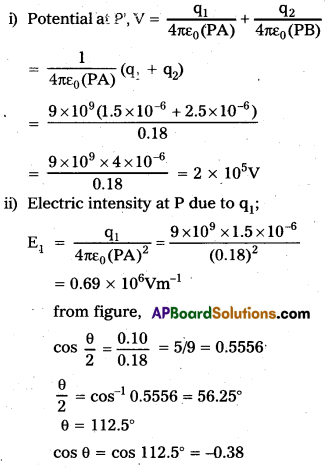
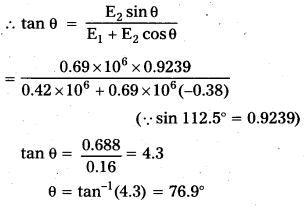
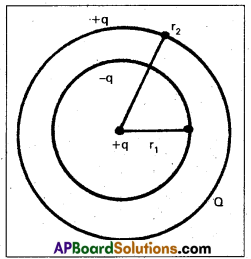
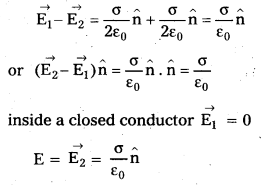
AP Inter 2nd Year Physics Study Material Chapter 4 Electric Charges and Fields

Andhra Pradesh BIEAP AP Inter 2nd Year Physics Study Material 4th Lesson Electric Charges and Fields Textbook Questions and Answers.

AP Inter 2nd Year Physics Study Material 4th Lesson Electric Charges and Fields

Very Short Answer Questions

Question 1.
What is meant by the statement ‘charge is quantized’?
Answer:
The minimum charge that can be transferred from one body to the other is equal to the charge of the electron (e = 1.602 × 10⁻¹⁹C). A charge always exists as an integral multiple of the charge of the electron (q = ne). Therefore charge is said to be quantized.

Question 2.
Repulsion is the sure test of charging than attraction. Why?
Answer:
A charged body may attract a neutral body and also an oppositely charged body. But it always repels a like-charged body. Hence repulsion is the sure test of electrification.

AP Inter 2nd Year Physics Study Material Chapter 4 Electric Charges and Fields

Question 3.
How many electrons constitute 1 C of charge ?
Answer:
n = \(\frac{q}{e}\) = \(\frac{1}{1.6 \times 10^{-19}}\) = 6.25 × 10¹⁸ electrons

Question 4.
What happens to the weight of a body when it is charged positively ?
Answer:
When a body positively charged it must loose some electrons. Hence weight of the body will decrease.

Question 5.
What happens to the force between two charges if the distance between them is
a) halved
b) doubled ?
Answer:
From Coulombs law, F ∝ \(\frac{1}{\mathrm{~d}^2}\), so
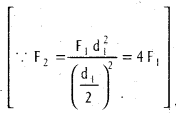
a) When distance is reduced to half, force increases by four times.
AP Inter 2nd Year Physics Study Material Chapter 4 Electric Charges and Fields 1
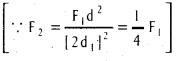
b) When distance is doubled, then force is reduced by four times.
AP Inter 2nd Year Physics Study Material Chapter 4 Electric Charges and Fields 2

Question 6.
The electric lines of force do not intersect. Why ?
Answer:
They do not intersect because if they intersect, at the point of intersection, intensity of electric field must act in two different directions, which is impossible.

Question 7.
Consider two charges + q and -q placed at B and C of an equilateral triangle ABC. For this system, the total charge is zero. But the electric field (intensity) at A which is equidistant from B and C is not zero. Why ?
Answer:
Charges are scalars, but the .electrical intensities are vectors and add vectorially.

AP Inter 2nd Year Physics Study Material Chapter 4 Electric Charges and Fields

Question 8.
Electrostatic field lines of force do not form closed loops. If they form closed loops then the work done in moving a charge along a closed path will not be zero. From the above two statements can you guess the nature of electrostatic force ?
Answer:
It is conservative force.

Question 9.
State Gauss’s law in electrostatics.
Answer:
Gauss’s law : It states that “the total electric flux through any closed surface is equal to – \(\frac{1}{\varepsilon_0}\) times net charge enclosed by the surface”.
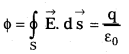
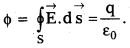
\(\oint \overrightarrow{\mathrm{E}} \cdot \overrightarrow{\mathrm{ds}}\) = \(\frac{\mathrm{q}}{\varepsilon_0}\)

Question 10.
When is the electric flux negative and when is it positive ?
Answer:
Electric flux ϕ = \(\vec{E} \cdot \vec{A}\). If angle between \(\overrightarrow{\mathrm{E}}\) and \(\overrightarrow{\mathrm{A}}\) is 180°, then flux will have a ‘-ve’ sign. We consider the flux flowing out of the surface as positive and flux entering into the surface as negative.

Question 11.
Write the expression for electric intensity due to an infinite long charged wire at a distance radial distance r from the wire.
Answer:
The electric intensity due to an infinitely long charged wire E = \(\frac{\lambda}{2 \pi \varepsilon_0 r}\) the conductor.
Where λ = Uniform linear charge density
r = Distance of the point from the conductor.

Question 12.
Write the expression for electric intensity due to an infinite plane sheet of charge.
Answer:
The electric intensity due to an infinite plane sheet of charge is E = \(\frac{\sigma}{2 \varepsilon_0}\).

Question 13.
Write the expression for electric intensity due to a charged conducting spherical shell at points outside and inside the shell.
Answer:
a) Intensity of electric field at any point inside a spherical shell is zero.
b) Intensity of electric field at any point outside a uniformly charged spherical shell is
E = \(\frac{1}{4 \pi \varepsilon_0} \cdot \frac{q}{r^2}\)

Short Answer Questions

Question 1.
State and explain Coulomb’s inverse square law in electricity.
Answer:
Coulomb’s law – Statement: Force between two charges is proportional to the product of the charges and inversely proportional to the square of the distance between them. The force acts along the straight line joining the two charges.
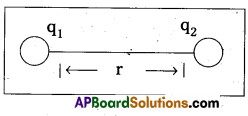
Explanation : Let us consider two charges q1 and q2 be separated by a distance r.
Then F ∝ q1q2 and F ∝ \(\frac{1}{\mathrm{r}^2}\) or F ∝ \(\frac{q_1 q_2}{r^2}\)
AP Inter 2nd Year Physics Study Material Chapter 4 Electric Charges and Fields 3
∴ F = \(\frac{1}{4 \pi \varepsilon_0} \cdot \frac{q_1 q_2}{r^2}\) where \(\frac{1}{4 \pi \varepsilon_0}\) = 9 × 10⁹ Nm2C-2
In vector form, in free space \(\overrightarrow{\mathrm{F}}\) = \(\frac{1}{4 \pi \varepsilon_0} \frac{\mathrm{q}_1 \mathrm{q}_2}{\mathrm{r}^2} \hat{\mathrm{r}}\). Here \(\hat{\mathrm{r}}\) is a unit vector.
ε0 is called permittivity of free space.
ε0 = 8.85 × 10⁻¹² C2/N-m2 or Farad/meter.
Where ε is called permittivity of the medium.

AP Inter 2nd Year Physics Study Material Chapter 4 Electric Charges and Fields

Question 2.
Define intensity of electric field at a point. Derive an expression for the intensity due to a point charge.
Answer:
Intensity of electric field (E) : Intensity of electric field at any point in an electric field is defined as the force experienced by a unit positive charge placed at that point.
Expression :
1) Intensity of electric field is a vector. It’s direction is along the direction’ of motion of positive charge.
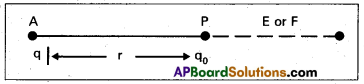
2) Consider point charge q. Electric field will exist around that charge. Consider any point P in that electric field at a distance r from the given charge. A test charge q0 is placed at R
3) Force acting on q0 due to q is F = \(\frac{1}{4 \pi \varepsilon_0} \cdot \frac{q q_0}{r^2}\)
4) Intensity of electric field at that point is equal to the force experienced by a test charge q0.
Intensity of electric field, E = \(\frac{\mathrm{F}}{\mathrm{q}_0}\)
AP Inter 2nd Year Physics Study Material Chapter 4 Electric Charges and Fields 4
E = \(\frac{1}{4 \pi \varepsilon_0} \cdot \frac{q}{r^2}\) N/C or V/m

Question 3.
Derive the equation for the couple acting on a electric dipole in a uniform electric field.
Answer:
1) A pair of opposite charges separated by a small distance is called dipole.
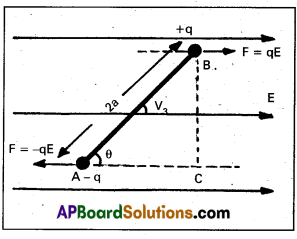
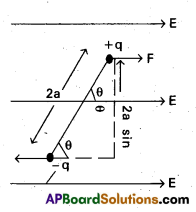
2) Consider the charge of dipole are -q and +q coulomb and the distance between them is 2a.
3) Then the electric dipole moment P is given by P = q × 2a = 2aq. It is a vector. It’s direction is from -q to +q along the axis of dipole.
4) It is placed in a uniform electric field E, making an angle 0 with field direction as shown in fig.
5) Due to electric field force on +q is F = +qE and force on -q is F = -qE.
AP Inter 2nd Year Physics Study Material Chapter 4 Electric Charges and Fields 5
6) These two equal and opposite charges constitute torque or moment of couple.
i. e., torque, \(\tau\) = ⊥r distance × magnitude of one of force
∴ \(\tau\) = (2a sin θ)qE = 2aqE sin θ = PE sin θ
In vector form, \(\vec{\tau}\) = \(\overrightarrow{\mathrm{P}}\) × \(\overrightarrow{\mathrm{E}}\)

Question 4.
Derive an expression for the intensity of the electric field at a point on the axial line of an electric dipole.
Answer:
Electric field at a point on the axis of a dipole :
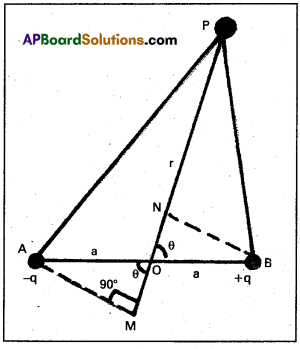
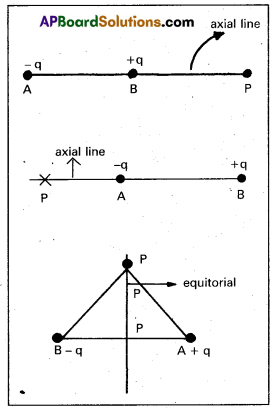
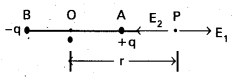
1) Consider an electric dipole consisting of two charges -q and +q separated by a distance ‘2a’ with centre ‘O’.
AP Inter 2nd Year Physics Study Material Chapter 4 Electric Charges and Fields 6
2) We shall calculate electric field E at point P on the axial line of dipole, and at a distance OP = r.
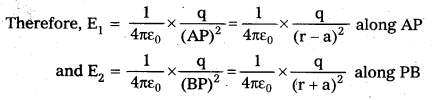
3) Let E1 and E2 be the intensities of electric field at P due to charges +q and -q respectively.
4)
AP Inter 2nd Year Physics Study Material Chapter 4 Electric Charges and Fields 7
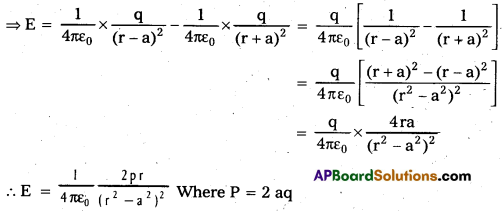
The resultant intensity at P is E = E1 – E2 [∵ They are opposite and E1 > E2]
AP Inter 2nd Year Physics Study Material Chapter 4 Electric Charges and Fields 8
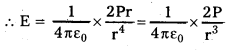
If r > > a then a2 can be neglected in comparision to r2.
AP Inter 2nd Year Physics Study Material Chapter 4 Electric Charges and Fields 70
In vector form, \(\overrightarrow{\mathrm{E}}\) = \(\frac{2 \overrightarrow{\mathrm{P}}}{4 \pi \varepsilon_0 \mathrm{r}^3}\)

AP Inter 2nd Year Physics Study Material Chapter 4 Electric Charges and Fields

Question 5.
Derive an expression for the intensity of the electric field at a point on the equatorial plane of an electric dipole. (A.P. Mar. ’19, ’15)
Answer:
Electric field intensity on equitorial line of electric dipole:
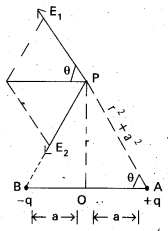
1) Consider an electric dipole consisting of two charges -q and +q separated by a distance ‘2a’ with centre at ‘O’.
2) We shall calculate electric field E at P on equitorial line of dipole and at a distance OP = r.
AP Inter 2nd Year Physics Study Material Chapter 4 Electric Charges and Fields 9
3) Let E1 and E2 be the electric fields at P due to charges +q and -q respectively.
4) The ⊥r components (E1 sin θ and E2 sin θ) cancel each other because they are equal and opposite. The ||el components (E1 cos θ and E2 cos θ) are in the same direction and hence add up.
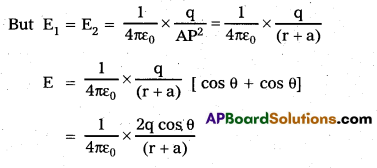
5) The resultant field intensity at point P is given by E = E1 cos θ + E2 cos θ
AP Inter 2nd Year Physics Study Material Chapter 4 Electric Charges and Fields 10
6) From figure, cos θ = \(\frac{a}{\left(r^2+a^2\right)^{1 / 2}}\)
∴ E = \(\frac{\mathrm{P}}{4 \pi \varepsilon_0} \times \frac{1}{\mathrm{r}^3}\)
7) If r >> a, then a2 can be neglected in comparison to r2. Then
E = \(\frac{\mathrm{P}}{4 \pi \varepsilon_0} \times \frac{1}{\mathrm{r}^3}\)
In vector form \(\overrightarrow{\mathrm{E}}\) = \(\frac{\overrightarrow{\mathrm{P}}}{4 \pi \varepsilon_0 \mathrm{r}^3}\)

Question 6.
State Gauss’s law in electrostatics and explain its importance.
Answer:
Gauss’s law : The total-electric flux through any closed surface is equal to \(\frac{1}{\varepsilon_0}\) times the net charge enclosed by the surface.
Total electric flux,
AP Inter 2nd Year Physics Study Material Chapter 4 Electric Charges and Fields 11
Here q is the total charge enclosed by the surface ‘S’, \(\oint\) represents surface integral of the closed surface.

Importance :

  1. Gauss’s law is very useful in. calculating the electric field in case of problems where it is possible to construct a closed surface. Such surface is called Gaussian surface.
  2. Gauss’s law is true for any closed surface, no matter what its shape or size.
  3. Symmetric considerations in many problems make the application of Gauss’s law much easier.

Long Answer Questions

Question 1.
Define electric flux. Applying Gauss’s law and derive the expression for electric intensity due to an infinite long straight charged wise. (Assume that the electric field is everywhere radial and depends only on the radial distance r of the point from the wire.)
Answer:
Electric flux : The number of electric lines of force passing perpendicular to the area is known as electric flux (ϕ). Electric flux ϕ = \(\overrightarrow{\mathrm{E}} \cdot \overrightarrow{\mathrm{A}}\). So flux is a scalar.

Expression for E due to an infinite long straight charged wire :

1) Consider an infinitely long thin straight wire with uniform linear charge density ‘λ’.
2) Linear charge density λ = \(\frac{\text { change q }}{\text { length } l}\) ⇒ λl —– (1)
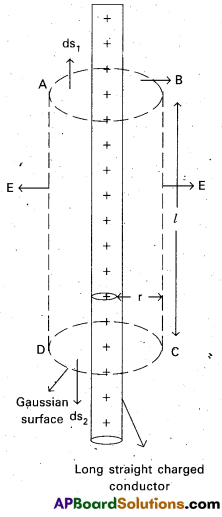
3) Construct a coaxial cylindrical gaussion surface of length T and radius ‘r’. Due to symmetry we will assume that electric field is radial i.e., normal to the conducting wire.
4) The flat surfaces AB and CD are ⊥r to the wire. Select small area ds1 and ds2 on the surface as AB and CD.
They are ⊥r to \(\overrightarrow{\mathrm{E}}\). So flux coming out through them is zero.
Since flux ϕ = \(\oint \vec{E} \cdot d \vec{s}\) = Eds cos 90° = 0
AP Inter 2nd Year Physics Study Material Chapter 4 Electric Charges and Fields 12
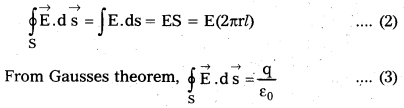
5) So flux coming out through the cylindrical surface ABCD is taken into account.

6) From Gauss’s law
AP Inter 2nd Year Physics Study Material Chapter 4 Electric Charges and Fields 13

7) From (2) and (3), E(2πrl) = \(\frac{Q}{\varepsilon_0}\) = \(\frac{\lambda /}{\varepsilon_0}\) (∵ Q = λl)
∴ E = \(\frac{\lambda l}{2 \pi \varepsilon_0 \mathrm{r} l}=\frac{1}{2 \pi \varepsilon_0} \frac{\lambda}{\mathrm{r}}\)

8) Therefore electric intensity due to an infinitely long conducting wire E = \(\frac{\lambda}{2 \pi \varepsilon_0 r}\).

AP Inter 2nd Year Physics Study Material Chapter 4 Electric Charges and Fields

Question 2.
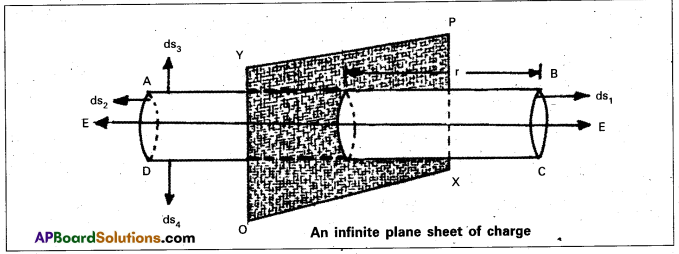
State Gauss’s law in electrostatics. Applying Gauss’s law derive the expression for electric intensity due to an infinite plane sheet of charge.
Answer:
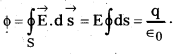
Gauss’s law: The total electric flux through any closed surface is equal to \(\frac{1}{\varepsilon_0}\) times the net charge enclosed by the surface, i.e.,
AP Inter 2nd Year Physics Study Material Chapter 4 Electric Charges and Fields 14
AP Inter 2nd Year Physics Study Material Chapter 4 Electric Charges and Fields 15

Expression for E due to an infinite plane sheet of charge :

  1. Consider an infinite plane sheet of charge. Let the charge distribution is uniform on this plane.
  2. Uniform charge density on this surface σ = \(\frac{\mathrm{dq}}{\mathrm{dS}}\) where dq is the charge over an infinite small area ds.
  3. Construct a horizontal cylindrical Gaussian surface ABCD perpendicular to the plane with length 2r.
  4. The flat surfaces BC and AD are parallel to the plane sheet and are at equal distance from the plane.
  5. Let area of these surfaces are dS1 and dS2. They are parallel to \(\overrightarrow{\mathrm{E}}\). So flux through these two surfaces is
    AP Inter 2nd Year Physics Study Material Chapter 4 Electric Charges and Fields 16 ——– (1)
    Where S is area of plane surface AD or BC. Both are equal in area and intensity.
  6. Consider cylindrical surface of AB and CD. Let their areas are say dS3 and dS4. These surfaces are ⊥lr to electric intensity \(\overrightarrow{\mathrm{E}}\).
  7. So angle between \(\overrightarrow{\mathrm{E}}\) and d\(\overrightarrow{\mathbf{s}_3}\) or dS4 is 90°. Total flux through these, surfaces is zero. Since
    AP Inter 2nd Year Physics Study Material Chapter 4 Electric Charges and Fields 17
  8. From Gauss’s law total flux, ϕ = \(\oint \overrightarrow{\mathrm{E}} \cdot \mathrm{d} \overrightarrow{\mathrm{S}}\) = 2ES = \(\frac{\mathrm{q}}{\varepsilon_0}\)
    ∴ 2ES = \(\frac{\sigma S}{\varepsilon_0}\) [∵ \(\text { Q }\) = σ × S]
  9. Therefore intensity of electric field due to an infinite plane sheet of charge E = \(\frac{\sigma}{2 \varepsilon_0}\)

Question 3.
Applying Gauss’s law derive the expression for electric intensity due to a charged conducting spherical shell at
(i) a point outside the shell
(ii) a point on the surface of the shell and
(iii) a point inside the shell.
Answer:
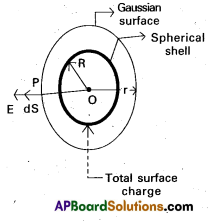
Expression for E due to a charged conducting spherical shell:

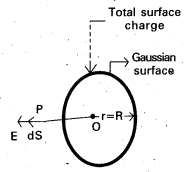
  1. Consider a uniformly charged spherical shell. Let total charge on it is ‘q’ and its radius is R.
    AP Inter 2nd Year Physics Study Material Chapter 4 Electric Charges and Fields 18
  2. Since the shell is uniformly charged, the intensity of electric field at any point depends on radial distance ‘r’ from centre ‘O’. The direction of E is away from the centre along the radius.

i) E at a point outside the shell:

1) Consider a point at a distance ‘r’ outside the sphere. Construct a Gaussian surface with ‘r’ as radius (where r > R).

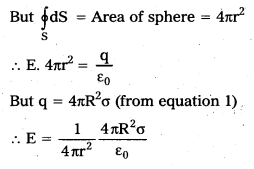
2) Total flux coming out of this sphere is
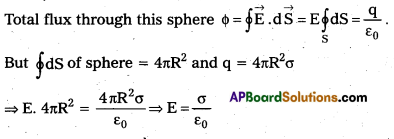
AP Inter 2nd Year Physics Study Material Chapter 4 Electric Charges and Fields 19
AP Inter 2nd Year Physics Study Material Chapter 4 Electric Charges and Fields 20.
AP Inter 2nd Year Physics Study Material Chapter 4 Electric Charges and Fields 21
3) Therefore at any point outside the sphere, E = \(\frac{\sigma}{\varepsilon_0} \frac{\mathrm{R}^2}{\mathrm{r}^2}\)

ii) E at a point on the surface of shell:

1) Construct a Gaussian surface with radius r = R.

2)
AP Inter 2nd Year Physics Study Material Chapter 4 Electric Charges and Fields 22
AP Inter 2nd Year Physics Study Material Chapter 4 Electric Charges and Fields 23
3) Therefore intensity at any point on surface of the sphere E = \(\frac{\sigma}{\varepsilon_0}\)

iii) E at a point inside the shell :

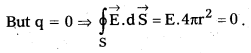
1) Consider a point P inside the shell. Construct a Gaussian surface with radius r (where r < R). There is no charge inside the shell. So from Gauss’s law \(\oint_{\mathrm{S}} \overrightarrow{\mathrm{E}} \cdot \mathrm{d} \overrightarrow{\mathrm{S}}\) = \(\frac{\mathrm{q}}{\varepsilon_0}\)
AP Inter 2nd Year Physics Study Material Chapter 4 Electric Charges and Fields 24
2) Therefore, intensity of electric field at any point inside a charged shell is zero.

Textual Exercises

Question 1.
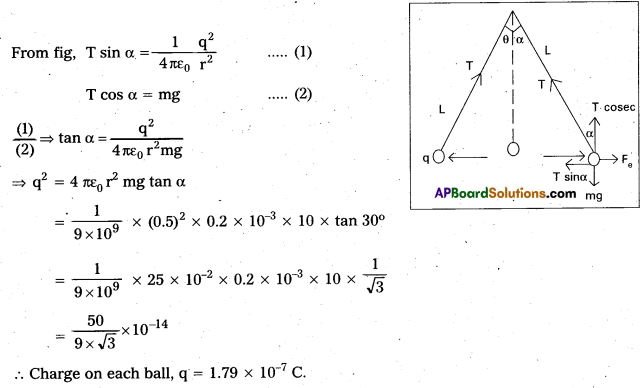
Two small identical balls, each of mass 0.20 g, carry identical charges and are suspended by two threads of equal lengths. The balls position themselves at equilibrium such that the angle between the threads is 60°. If the distance between the balls is 0.5 m, find the charge on each ball.
Solution:
Given m = 0.20 g = 0.2 × 10⁻³ kg; θ = 60° ⇒ α = \(\frac{\theta}{2}\) = 30°
r = 0.5 m, Let q1 = q2 = q
AP Inter 2nd Year Physics Study Material Chapter 4 Electric Charges and Fields 25

AP Inter 2nd Year Physics Study Material Chapter 4 Electric Charges and Fields

Question 2.
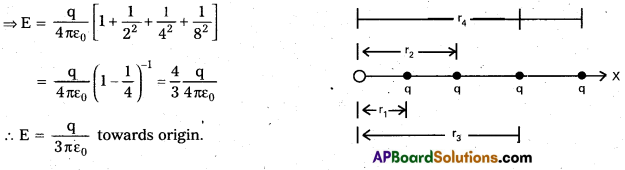
An infinite number of charges-each of magnitude q are placed on x-axis at distance of 1, 2, 4, 8, …….. meter from the origin respectively. Find intensity of the electric field at origin.
Solution:
Let q1 = q2 = q3 = q4 = ……. = q
r1 = 1; r2 = 2; r3 = 4; r4 = 8, …….
The resultant electric field at origin ‘O’ is given by
E = \(\frac{1}{4 \pi \varepsilon_0} \frac{q_1}{r_1^2}\) + \(\frac{1}{4 \pi \varepsilon_0} \frac{\mathrm{q}_2}{\mathrm{r}_2^2}\) + \(\frac{1}{4 \pi \varepsilon_0} \frac{q_3}{r_3^2}\) + \(\frac{1}{4 \pi \varepsilon_0} \frac{\mathrm{q}_4}{\mathrm{r}_4^2}\) + ……..
AP Inter 2nd Year Physics Study Material Chapter 4 Electric Charges and Fields 26

Question 3.
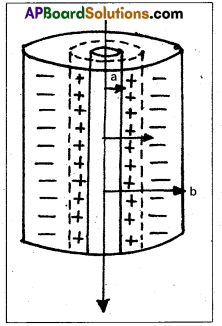
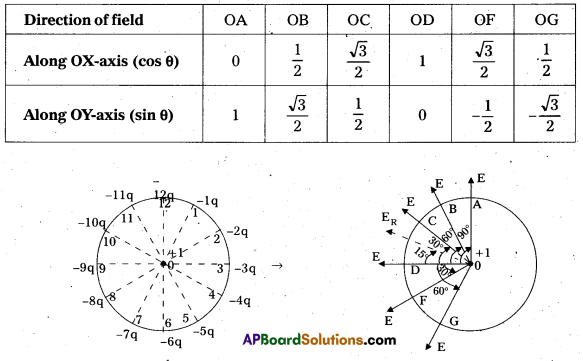
A clock face has negative charges -q, -2q, -3q, ….. -12q fixed at the position of the corresponding numerals on the dial. The clock hands do not disturb the net field due to the point charges. At what time does the hour hand point in the direction of the electric field at the centre of the dial ?
Solution:
Let distance of each charge from unit charge at centre ‘O’ = r.
Resultant electric field of each charge, E = \(\frac{1}{4 \pi \varepsilon_0} \frac{6 q}{r^2}\) [∵ -6q – (-12q)]
Let OX be the reference axis. The angles of resultant fields with OX-axis are shown.
AP Inter 2nd Year Physics Study Material Chapter 4 Electric Charges and Fields 27
Resultant field along OX-axis = \(\left(0+\frac{1}{2}+\frac{\sqrt{3}}{2}+1+\frac{\sqrt{3}}{2}+\frac{1}{2}\right)\)i = (2 + \(\sqrt{3}\))i
Resultant field along OY-axis = \(\left(1+\frac{\sqrt{3}}{2}+\frac{1}{2}+0-\frac{1}{2}-\frac{\sqrt{3}}{2}\right) \hat{\mathrm{j}}\)
= 1\(\hat{\mathrm{i}}\)
∴ Resultant electric field, ER(OH) = (2 + \(\sqrt{3}\))\(\hat{i}\) + 1\(\hat{j}\)
The direction of resultant field (OH) is given by, tan θ = \(\frac{|\mathrm{OY}|}{|\mathrm{OX}|}\)
⇒ tan θ = \(\frac{1}{2+\sqrt{3}}\) = tan 15°
⇒ θ = 15°, with OX-axis
∴ The hour hand shows at the centre of the dial is at 9.30.

Question 4.
Consider a uniform electric field E = 3 × 10³ N/C.
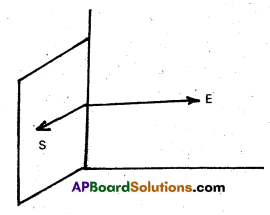
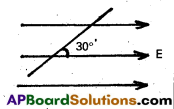
(a) What is the flux of this field through a square of 10 cm on a side whose plane is parallel to the yz plane ?
(b) What is the flux through the same square if the normal to its plane makes a 60° angle with the x – axis ?
Solution:
a) Given E = 3 × 10³ N/C
S = 102 cm2 = 102 × (10-2m)2 = 10-2m2
θ = 0°
ϕ = ES cos θ
= 3 × 103 × 10-2 × cos 0°
∴ ϕ = 30 Nm2C-1
AP Inter 2nd Year Physics Study Material Chapter 4 Electric Charges and Fields 28
b) If θ = 60°, ϕ = ES cos θ
= 3 × 103 × 10-2 × cos 60°
∴ ϕ = 15 Nm2C-1

Question 5.
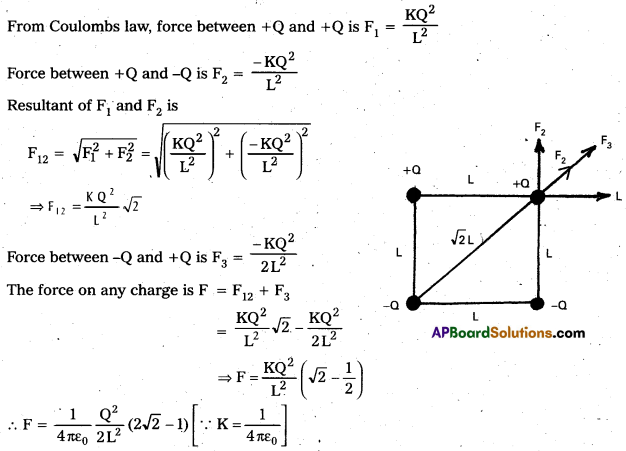
There are four charges, each with a magnitude Q. Two are positive and two are negative. The charges are fixed to the comers of a square of side ‘L’, one to each comer, in such a way that the force on any charge is directed toward the center of the square. Find the magnitude of the net electric force experienced by any charge ?
Solution:
AP Inter 2nd Year Physics Study Material Chapter 4 Electric Charges and Fields 29

Question 6.
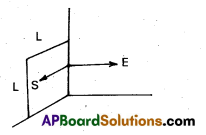
The electric field in a region is given by \(\overrightarrow{\mathbf{E}}\) = a\(\hat{\mathbf{i}}\) + b\(\hat{\mathbf{j}}\). Here a and b are constants. Find the net flux passing through a square area of side L parallel to y-z plane.
Solution:
Given \(\overrightarrow{\mathrm{E}}\) = a\(\hat{\mathrm{i}}\) + b\(\hat{\mathrm{j}}\)
\(\vec{S}\) = L2\(\hat{\mathrm{i}}\)
AP Inter 2nd Year Physics Study Material Chapter 4 Electric Charges and Fields 30
ϕ = \(\overrightarrow{\mathrm{E}} \cdot \overrightarrow{\mathrm{S}}\) = (a\(\hat{i}\) + b\(\hat{j}\)) .L2\(\hat{i}\)
∴ ϕ = aL2 [∴ \(\hat{i}\). \(\hat{i}\) = 1 and \(\hat{i}\). \(\hat{j}\) = 0]

AP Inter 2nd Year Physics Study Material Chapter 4 Electric Charges and Fields

Question 7.
A hollow spherical shell of radius r has a uniform charge density σ. It is kept in a cube of edge 3r such that the centre of the cube coincides with the center of the shell. Calculate the electric flux that comes out of a face of the cube.
Solution:
For spherical shell, charge = q (say)
Radius = r
Charge density = σ = \(\frac{q}{A}\) = \(\frac{\mathrm{q}}{4 \pi \mathrm{r}^2}\)
∴ Charge on spherical shell, q = 4πr2σ
Flux through one of the face of a cube,
ϕE = \(\frac{1}{6} \frac{\mathrm{q}}{\varepsilon_0}\) = \(\frac{1}{6} \times \frac{4 \pi r^2 \sigma}{\varepsilon_0}\) = \(\frac{2 \pi \mathrm{r}^2 \sigma}{3 \varepsilon_0}\)

Question 8.
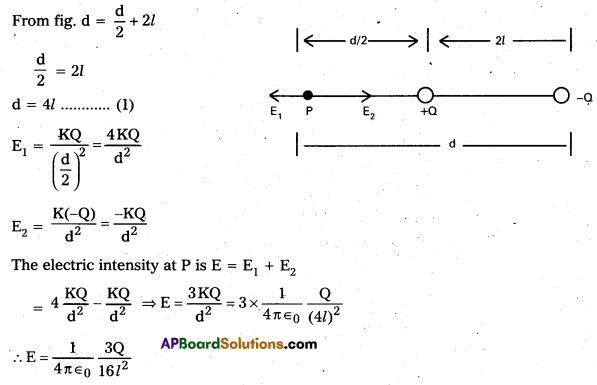
An electric dipole consists of two equal and opposite point charge +Q and -Q, separated by a distance 2l. P is a point collinear with the charges such that its distance from the positive charge is half of its distance from the negative charge. Calculate electric intensity at P.
Solution:
Distance of P from -Q = d (say)
Distance of P from +Q = d/2
AP Inter 2nd Year Physics Study Material Chapter 4 Electric Charges and Fields 31

Question 9.
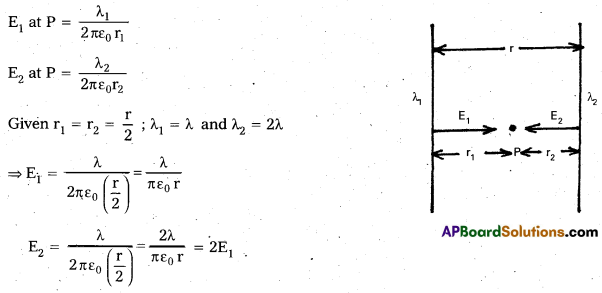
Two infinitely long thin straight wires having uniform linear charge densities λ and 2λ are arranged parallel to each other at a distance r apart. Calculate intensity of the electric field at a point midway between them.
Solution:
Distance between two parallel infinite long thin straight wires = r.
Electric field due to infinite long thin straight wire, E = \(\frac{\lambda}{2 \pi \varepsilon_0 r}\)
AP Inter 2nd Year Physics Study Material Chapter 4 Electric Charges and Fields 32
∴ Electric intensity at mid point, E = E2 – E1 = 2E1 – E1 = E
∴ E = \(\frac{\lambda}{\pi \varepsilon_0 \mathrm{r}}\)

Question 10.
Two infinitely long thin straight wires having uniform linear charge densities e and 2e are arranged parallel to each other at a distance r apart. Find the intensity of the electric field at a point midway between them.
Solution:
For first infinitely long straight wire, linear charge density λ = e.
For second infinitely long straight wire, linear charge density λ’ = 2e
Distance between two infinite parallel straight wires = r.
Distance of point P from 1st and 2nd wire = \(\frac{\mathrm{r}}{2}\)
Electric field intensity at P due 1st wire, E1 = \(\frac{\lambda}{2 \pi \varepsilon_0\left(\frac{\mathrm{r}}{2}\right)}=\frac{\mathrm{e}}{\pi \varepsilon_0 \mathrm{r}}\) —— (1)

Electric field intensity at P due 2nd wire, E2 = \(\frac{\lambda^{\prime}}{2 \pi \varepsilon_0\left(\frac{r}{2}\right)}=\frac{2 \mathrm{e}}{\pi \varepsilon_0 \mathrm{r}}\)
∴ E2 = 2E1 [∵ from(1)]
∴ Electric field intensity at middle point due to second infinitely long wire
E2 = \(\frac{2 \lambda}{\pi \varepsilon_0 \mathrm{r}}\)

AP Inter 2nd Year Physics Study Material Chapter 4 Electric Charges and Fields

Question 11.
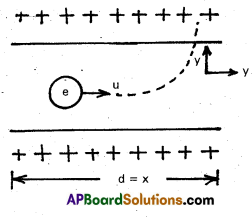
An electron of mass m and charge e is fired perpendicular to a uniform electric field of intensity E with an initial velocity u. If the electron tranverses a distance x in the field in the direction of firing, find the transverse displacement y it suffers.
Solution:
Given me = m; q = e; d = x; ux = u; uy = 0
Electric field between the plates = E
Time taken travel in the field, t = \(\frac{d}{u_x}\) = \(\frac{\mathbf{X}}{\mathbf{u}}\)
AP Inter 2nd Year Physics Study Material Chapter 4 Electric Charges and Fields 33
Force on electron F = qE = eE
Acceleration of electron, a = \(\frac{F}{m}\) = \(\frac{\mathrm{eE}}{\mathrm{m}}\)
Transverse displacement of electron y = uyt + \(\frac{1}{2} \mathrm{at}^2\)
⇒ y = 0 + \(\frac{1}{2}\left(\frac{e E}{m}\right)\left(\frac{x}{u}\right)^2\)
∴ y = \(\frac{\mathrm{eEx}^2}{2 \mathrm{mu}^2}\)

Additiona Exercises

Question 1.
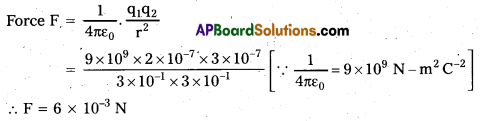
What is the force between two small charged spheres having charges of 2 × 10⁻⁷ C and 3 × 10⁻⁷ C placed 30 cm apart in air ?
Solution:
Given, q1 = 2 × 10⁻⁷ C; q2 = 3 × 10⁷ C; d = 30 cm = 30 × 10-2 m = 3 × 10⁻¹m
AP Inter 2nd Year Physics Study Material Chapter 4 Electric Charges and Fields 34
As q1, q2 are positive charges, the force between them is repulsive.

Question 2.
The electrostatic force on a small sphere of charge 0.4 μC due to another small sphere of charge -0.8 μC in air is 0.2 N.
(a) What is the distance between the two spheres ?
(b) What is the force on the second sphere due to the first ?
Solution:
a) Given q1 = 0.4 μc ;
= 0.8 × 10⁻⁶C
q2 = 0.8 μc; F = 0.2 N = 0.4
= 0.4 × 10⁻⁶m
0.2 = \(\frac{9 \times 10^9 \times 0.4 \times 10^{-6} \times 0.8 \times 10^{-6}}{\mathrm{r}^2}\)
r2 = 16 × 9 × 10-4
r = 4 × 3 × 10-2 = 12 × 10-2 m
∴ Distance between two charges, r = 12 cm

b) Electrostatic force between two charges obeys the Newton’s third law. i.e., force on q1 due to q2 = force on q2 due to q1
f12 = f21 = 0.2N

AP Inter 2nd Year Physics Study Material Chapter 4 Electric Charges and Fields

Question 3.
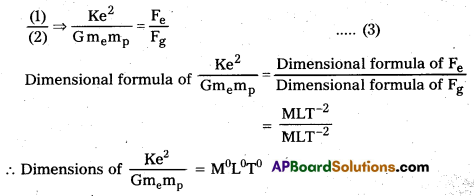
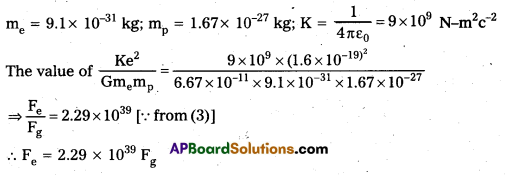
Check that the ratio ke2/G memp is dimensionless. Look up a table of Physical Constants and determine the value of this ratio. What does the ratio signify ?
Solution:
i) In electrostatics, Fe = \(\frac{\mathrm{Kq}_1 \mathrm{q}_2}{\mathrm{r}^2}\) = \(\frac{\mathrm{Ke}^2}{\mathrm{r}^2}\) ……. (1)
Where q1 = q2 = e
In gravitation, Fg = \(\frac{\mathrm{Gm}_1 \mathrm{~m}_2}{\mathrm{r}^2}\) = \(\frac{\mathrm{Gm}_{\mathrm{e}} \mathrm{m}_{\mathrm{p}}}{\mathrm{r}^2}\) …. (2)
Where m1 = me ; m2 = mp
AP Inter 2nd Year Physics Study Material Chapter 4 Electric Charges and Fields 35
Thus the given ratio is dimensionless.

ii) We know that e = 1.6 × 10⁻¹⁹ C ; G = 6.67 × 10⁻¹¹ N-m2C2
AP Inter 2nd Year Physics Study Material Chapter 4 Electric Charges and Fields 36

Question 4.
a) Explain the meaning of the statement ‘electric charge of a body is quantized’.
b) Why can one ignore quantisation of electric charge when dealing with macroscopic i.e, large scale charges ?
Answer:
a) The electric charge of a body is quantized means that the charge on a body can occur in some particular values only. Charge on any body is the integral multiple of charge on an electron because the charge of an electron is the elementary charge in nature. The charge on any body can be expressed by the formula q = ± ne. Where n = number of electrons transferred and e = charge on one electron. The cause of quantization is that only integral number of electrons can be transferred from one body to other

b) We can ignore the quantization of electric charge when dealing with macroscopic charges because the charge on one electron is 1.6 × 10⁻¹⁹ C in magnitude, which is very small as compared to the large scale change.

Question 5.
When a glass rod is rubbed with a silk cloth, charges appear on both. A similar phenomenon is observed with many other pairs of bodies. Explain how this observation is consistent with the law of conservation of charge.
Answer:
According to law of conservation of charge, “charge can neither be created nor be destroyed but it can be transferred from one body to another body”. Before rubbing the two bodies they both are neutral i.e., the total charge of the system is zero. When the glass rod is rubbed with a silk cloth, some electrons are transferred from glass rod to silk cloth. Hence glass rod attains positive charge and silk cloth attains same negative charge.

Again the total charge of the system is zero, i.e., the charge before rubbing is same as the charge after rubbing. This is consistent with the law of conservation of charge. Here we can also say that charges can be created only in equal and unlike pairs.

Question 6.
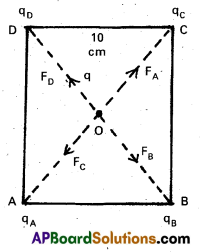
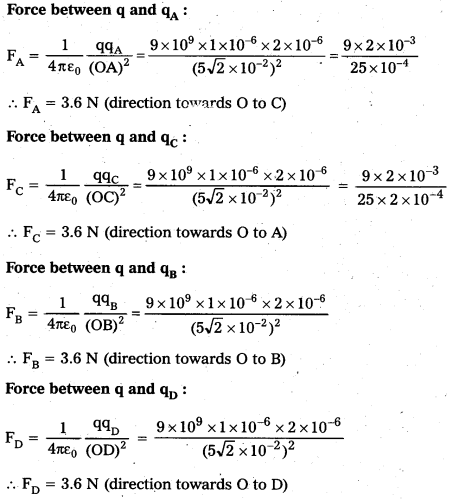
Four point charges qA = 2 µC, qB = -5 µC, qC = 2 µC and qD = -5 µC are located at the corners of a square ABCD of side 10 cm. What is the force on a charge of 1 µC placed at the centre of the square?
Solution:
Let the centre of the square is at O.
The charge placed on the centre is µC
AB = BC = CD = DA = 10 cm; AC = \(\sqrt{2}\) × 10 = 10\(\sqrt{2}\)cm
AO = BO = CO = DO = \(\frac{10 \sqrt{2}}{2}\) = 5\(\sqrt{2}\) cm
AP Inter 2nd Year Physics Study Material Chapter 4 Electric Charges and Fields 37
AP Inter 2nd Year Physics Study Material Chapter 4 Electric Charges and Fields 38
Here we observe that, FA = -FC and FD = -FB
∴ The net resultant force on 1 µC is
F = FA + FB + FC + FD
= -FC + FB + FC – FB
= 0.

Question 7.
a) An electrostatic field line is a continuous curve. That is, a field line cannot have sudden breaks. Why not ?
b) Explain why two field lines never cross each other at any point ?
Answer:
a) An electrostatic field line represents the actual path travelled by a unit positive charge in an electric field. If the line have sudden breaks it means the unit positive test charge Jumps from one place to another which is not possible. It also means that electric field becomes zero suddenly at the breaks which is not possible. So, the field line cannot have any sudden breaks.

b) If two field lines cross each other, then we can draw two tangents at the point of intersection which indicates that (as tangent drawn at any point on electric line of force gives the direction of electric field at that point) there are two directions of electric field at a particular point, which is not possible at the same instant. Thus, two field lines never cross each other at any point.

AP Inter 2nd Year Physics Study Material Chapter 4 Electric Charges and Fields

Question 8.
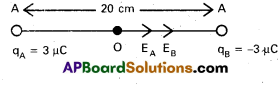
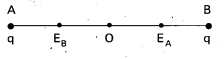
Two point charges qA = 3 μC and qB = -3 μC are located 20 cm apart in vaccum.
a) What is the electric field at the midpoint O of the line AB joining the two charges ?
b) If a negative test charge of magnitude 1.5 × 10⁻⁹ C is placed at this point, what is the force experienced by the test charge ?
Solution:
a) Given qA = 3 μC = 3 × 10⁻⁶ C; qB = -3 μC = -3 × 10⁻⁶C
AP Inter 2nd Year Physics Study Material Chapter 4 Electric Charges and Fields 39
From fig. AO = OB = 10 cm = 0.1 m
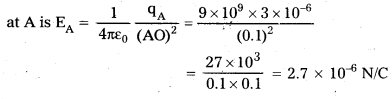
Electric field at midpoint ‘O’ due to qA
AP Inter 2nd Year Physics Study Material Chapter 4 Electric Charges and Fields 40
The direction of EA is A to O.
Electric field at midpoint ‘O’ due to qB at B is
AP Inter 2nd Year Physics Study Material Chapter 4 Electric Charges and Fields 41
The direction of EB is O to B.
Now we see that EA and EB are in same direction. So, the resultant electric field at O is E. Hence,
E = EA + EB = 2.7 × 10⁶ + 2.7 × 106 = 5.4 × 10⁶ N/C :
The direction of E will be from O to B or toward B.

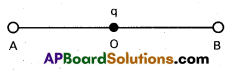
b) Let test charge q0 = -1.5 × 10⁻⁹ C is placed at midpoint O’.
Electric field intensity at ‘O’ is E = 5.4 × 10⁶
AP Inter 2nd Year Physics Study Material Chapter 4 Electric Charges and Fields 42
Force F = Eq = 5.4 × 10⁶ × -1.5 × 10⁻⁹ N
= -8.1 × 10³N
The direction of force is from O to A.

Question 9.
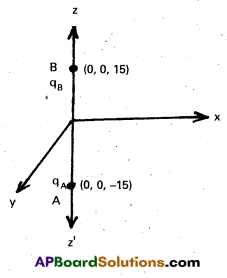
A system has two charges qA = 2.5 × 10⁻⁷ C, and qB = -2.5 × 10⁻⁷ C located at points A(0, 0, -15 cm) and B(0, 0, +15 cm). What are the total charge and electric dipole moment of the system ?
Solution:
Given A(0, 0, -15 cm) and B(0, 0, 15 cm)
qA = 2.5 × 10⁻⁷C
qB = -2.5 × 10⁻⁷ C
AB = 2a = length of the dipole
= 30 cm = 30 × 10-2 m
AP Inter 2nd Year Physics Study Material Chapter 4 Electric Charges and Fields 43
The total charge q on the dipole is
q = qA + qB = 2.5 × 10⁻⁷C – 2.5 × 10⁻⁷C = 0
The electric dipolemoment
P = Any charge (qA) × length of dipole (2a)
= 2.5 × 10-7 × 10 × 10-2
∴ P = 7.5 × 10⁻⁸ C-m
The direction of P is from negative charge to positive charge that is along B to A.

Question 10.
An electric dipole with dipole moment 4 × 10⁻⁹ Cm is aligned at 30° with the direction of a uniform electric field of magnitude 5 × 10⁴ NC-1. Calculate the magnitude of the torque acting on the dipole.
Solution:
Given, P = 4 × 10⁻⁹ C-m; E = 5 × 10⁴ N/C; θ = 30°,
Torque, \(\tau\) = PE sin θ
AP Inter 2nd Year Physics Study Material Chapter 4 Electric Charges and Fields 44
= 4 × 10-9 × 5 × 104 sin 30° = \(\frac{20 \times 10^{-5}}{2}\) = 10-4N-m
The direction of torque is ⊥r to both electric field and dipole moment.

Question 11.
A polythene piece rubbed with wool is found to have a negative charge 3 × 10⁻⁷ C.
a) Estimate the number of electrons transferred (from which to which ?)
b) Is there a transfer of mass from wool to polythene ?
Solution:
a) Given, charge on Polythene, q = -3 × 10⁻⁷ C
e = -1.6 × 10⁻¹⁹ C
No. of electrons transferred, n = \(\frac{\mathrm{q}}{\mathrm{e}}\) = \(\frac{-3 \times 10^{-7}}{-1.6 \times 10^{-19}}\)
∴ n = 1.875 × 10¹² [∵ q = ± ne]
Electrons are transferred from wool to polythene.
So wool gets positive charge and polythene gets negative charge.

b) The number of electrons transferred = 1.875 × 10¹²
The mass of one electron, me = 9.1 × 10⁻³ kg
Mass transferred from wool to polythene M = n × me
M = 1.875 × 1012 × 9.1 × 10-31 = 1.8 × 10⁻¹⁸ kg

AP Inter 2nd Year Physics Study Material Chapter 4 Electric Charges and Fields

Question 12.
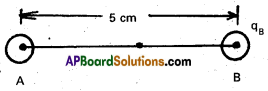
a) Two insulated charged copper spheres A and B have their centres separated by a distance of 50 cm. What is the mutual force of electrostatic repulsion if the charge on each 6.5 × 10⁻⁷ C ? The radii of A and B are negligible compared to the distance of
separation.
b) What is the force of repulsion if each sphere is charged double the above amount and the distance between them is halved?
Solution:
AP Inter 2nd Year Physics Study Material Chapter 4 Electric Charges and Fields 45
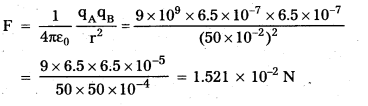
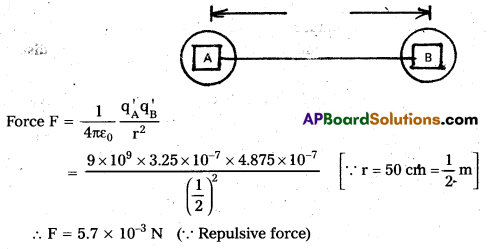
a) Given, qA = 6.5 × 10⁻⁷C ; qB = 6.5 × 10⁻⁷C
r = AB = 50 cm = 50 × 10-2m
AP Inter 2nd Year Physics Study Material Chapter 4 Electric Charges and Fields 46
b)
AP Inter 2nd Year Physics Study Material Chapter 4 Electric Charges and Fields 47
This force is also repulsive in nature because both the charges are similar (positive) in nature.

Question 13.
Suppose the spheres A and B in Exercise – 12 have identical sizes. A third sphere of the same size but uncharged is brought in contact with the first, then brought in contact with second and finally removed from both. What is the new force of repulsion between A and B?
Solution:
Given qA = 6.5 × 10⁻⁷C;
qB = 6.5 × 10⁻⁷ C; qC = 0
AP Inter 2nd Year Physics Study Material Chapter 4 Electric Charges and Fields 48
After contact of A and C, the charges will be divided equally on both of them. Then final charge on A, then
\(\mathrm{q}_{\mathrm{A}}^{\prime}\) = \(\frac{\mathrm{q}_{\mathrm{A}}+\mathrm{q}_{\mathrm{C}}}{2}\) = \(\frac{6.5 \times 10^{-7}+0}{2}\)
= 3.25 × 10⁻⁷C
Similarly charge on C, \(\mathrm{q}_{\mathrm{c}}^{\prime}\) = 3.25 × 10⁻⁷ C
After contact of B and C, the charges will be divided equally on both of them.

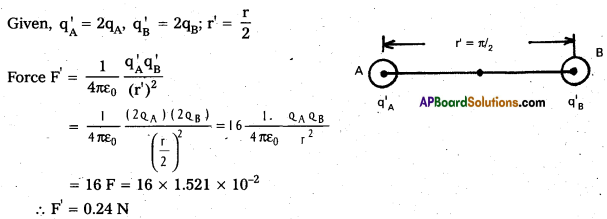
Then final charge on B, \(q_B^{\prime}\) = \(\frac{\mathrm{q}_{\mathrm{B}}+\mathrm{q}_{\mathrm{C}}^{\prime}}{2}\) = \(\frac{6.5 \times 10^{-7}+3.25 \times 10^{-7}}{2}\) = 4.875 × 10⁻⁷ C
Similarly final charge one, \(q_C^{\prime \prime}\) = 4.875 × 10⁻⁷ C
AP Inter 2nd Year Physics Study Material Chapter 4 Electric Charges and Fields 49

Question 14.
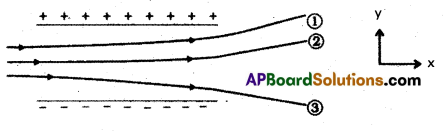
Figure shows tracks of three charged particles in a uniform electrostatic field. Give the signs of the three charges. Which particle has the highest charge to mass ratio ?
AP Inter 2nd Year Physics Study Material Chapter 4 Electric Charges and Fields 50
Answer:
We know that a positively charged particle is attracted towards the negatively charged plate and a negatively charged particle is attracted towards the positively charged plate.

Here, particle 1 and particle 2 are attracted towards positive plate that means particle 1 and particle 2 are negatively charged. Particle 3 is attracted towards negatively charged plate so it is positively charged. As the deflection in the path of a charged particle is directly proportional to the charge/mass ratio.
y ∝ \(\frac{\mathrm{q}}{\mathrm{m}}\)
Here, the deflection in particle 3 is maximum, so the charge to mass ratio of particle 3 is maximum.

AP Inter 2nd Year Physics Study Material Chapter 4 Electric Charges and Fields

Question 15.
Consider a uniform electric field E = 3 × 10³ \(\hat{\mathbf{i}}\) N/C.
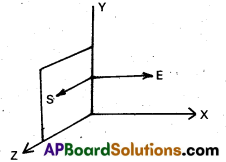
(a) What is the flux of this field through a square of 10 cm on a side whose plane is parallel to the yz plane ?
(b) What is the flux through the same square if the normal to its plane makes a 60° angle with the x-axis ?
Solution:
Given \(\overrightarrow{\mathrm{E}}\) = 3 × 10³ \(\hat{\mathbf{i}}\) N/C

a) As the surface is in Y – Z plane, so the area vector (normal to the square) is along X – axis
Area S = 10 × 10 = 100 cm2 = 10-2 m2
AP Inter 2nd Year Physics Study Material Chapter 4 Electric Charges and Fields 51
Area vector \(\vec{S}\) = 10-2 \(\hat{\mathbf{i}}\) m2
ϕ = \(\overrightarrow{\mathrm{E}} \cdot \overrightarrow{\mathrm{S}}\) = (3 × 10³ \(\hat{\mathbf{i}}\)). (10-2i)
∴ ϕ = 3 × 103 × 10-2 = 30N-m2/c
AP Inter 2nd Year Physics Study Material Chapter 4 Electric Charges and Fields 71

b) \(\overrightarrow{\mathrm{E}}\) = 3 × 10³ \(\hat{\mathbf{i}}\) N/C ; \(\vec{S}\) = \(\hat{\mathbf{i}}\) m2 ; θ = 60°
ϕ = \(\overrightarrow{\mathrm{E}}\) . \(\overrightarrow{\mathrm{S}}\) = ES cos 60° = 3 × 103 × 10-2 × cos 60°
∴ ϕ = 15 N – m2/C

Question 16.
What is the net flux of the uniform electric field of Exercise -15 through a cube of side 20 cm oriented so that its faces are parallel to the coordinate planes ?
Answer:
As we know that the number of lines entering in the cube is the same as that the number of lines leaving the cube. So, no flux is remained on the cube and hence, the net flux over the cube is zero.

Question 17.
Careful measurement of the electric field at the surface of a black box indicates that the net outward flux through the surface of the box is 8.0 × 10³ Nm2/C.
(a) What is the net charge inside the box ?
(b) If the net outward flux through the surface of the box were zero, could you conclude that there were no charges inside the box ? Why or Why not ?
Solution:
a) Given, ϕ = 8.0 × 10³ N – m2/C
ε0 = 8 × 103 × 8.854 × 10-12
∴ q = 0.07 μc
The flux is outward hence the charge is positive in nature

b) Net outward flux = 0
Then, we can conclude that the net charge inside the box is zero. i.e., the box may have either zero charge or have equal amount of positive and negative charges. It means we cannot conclude that there is no charge inside the box.

Question 18.
A point charge +10 μC is a ‘distance 5 cm directly above the centre of a square of side 10 cm, as shown in fig. What is the magnitude of the electric flux through the square ? (Hint: Think of the square as one face of a cube with edge 10 cm).
AP Inter 2nd Year Physics Study Material Chapter 4 Electric Charges and Fields 52
Solution:
Let the charge q is placed at the centre of cube as shown in fig.
The total flux enclosed through the cube is ϕ = \(\frac{q}{\varepsilon_0}\)
The flux enclosed by one face ϕ = \(\frac{1}{6}\) of total flux.
[∵ Cube has 6 faces]
AP Inter 2nd Year Physics Study Material Chapter 4 Electric Charges and Fields 53
ϕ = \(\frac{\phi}{6}\) = \(\frac{1}{6} \frac{\mathrm{q}}{\varepsilon_0}\)
Here q = 10 μC = 10 × 10-6C ; ε0 = 8.854 × 10⁻¹²C2 – N-1-m-2
∴ ϕ = \(\frac{1}{6} \times \frac{10 \times 10^{-6}}{8.854 \times 10^{-12}}\)
= 1.88 × 10⁵ N-m2/C

Question 19.
A point charge of 2.0 μC is at the centre of a cubic Gaussian surface 9.0 cm on edge. What is the net electric flux through the surface ?
Solution:
Given, q = 2.0 μC = 2.0 × 10⁻⁶C
ε0 = 8.854 × 10⁻¹² C2-N-1 – m-2
The net flux through the surface,
ϕ = \(\frac{\mathrm{q}}{\varepsilon_0}\) = \(\frac{2 \times 10^{-6}}{8.854 \times 10^{-12}}\) = 2.26 × 10⁵N-m2/C

AP Inter 2nd Year Physics Study Material Chapter 4 Electric Charges and Fields

Question 20.
A point charge causes an electric flux of -1.0 × 10³ Nm2/C to pass through a spherical Gaussian surface of 10.0 cm radius centred on the charge,
(a) If the radius of the Gaussian surface were doubled, how much flux would pass through the surface ?
(b) What is the value of the point charge ?
Solution:
a) From Gauss’s law, ϕ = \(\frac{\mathrm{q}}{\varepsilon_0}\)
Electric flux ϕ depends on charge q.
It is independent of radius of Gaussian surface. Hence the radius of Gaussian surface were doubled, flux does not change.

b) ϕ = – 1.0 × 10³ N-m2/c ; ε0 = 8.854 × 10⁻¹² e2-N-1-m-2
q = ϕε0 = -1.0 × 103 × 8.854 × 10-12 = -8.85 × 10⁻⁹C.
∴ The value of point charge, q = -8.85 × 10⁻⁹C

Question 21.
A conducting sphere of radius 10 cm has an unknown charge. If the electric field 20 cm from the centre of the sphere is 1.5 × 10³ N/C and points radially inward, what is the net charge on the sphere?
Solution:
E = 1.5 × 10³ N/C; r = 20 cm = 20 × 10-2m.
E = \(\frac{1}{4 \pi \varepsilon_0} \cdot \frac{q}{r^2}\)
1.5 × 103 = \(\frac{9 \times 10^9 \times \mathrm{q}}{\left(20 \times 10^{-2}\right)^2}\)
q = \(\frac{1.5 \times 10^3 \times 20 \times 20 \times 10^{-4}}{9 \times 10^9}\) = 6.67 × 10⁻⁹C.

Question 22.
A uniformly charged conducting sphere of 2.4 m diameter has a surface charge density, of 80.0 μC/m2.
(a) Find the charge on the sphere,
(b) What is the total electric flux leaving the surface of the sphere ?
Solution:
a) Given D = 2.4 m; r = \(\frac{\mathrm{D}}{2}\) = 1.2 m
σ = 80 µc/m2 = 80 × 10-6 C/m2
σ = \(\frac{\mathrm{q}}{4 \pi r^2}\) ⇒ q = σ 4πr2
⇒ q = 80 × 10-6 × 4 × 3.14 × 1.2 × 1.2
∴ q = 1.45 × 10⁻³C

b) ϕ = \(\frac{Q}{\varepsilon_0}\) = \(\frac{1.4 \times 10^{-3}}{8.854 \times 10^{-12}}\) = 1.6 × 10⁸N-m2/C
Thus, the flux leaving the surface of sphere is 1.6 × 10⁸ N – m2/c

Question 23.
An infinite line charge produces a field of 9 × 10⁴ N/C at a distance of 2 cm. Calculate the linear charge density.
Solution:
Given r = 2 cm = 2 × 10⁻²m ; E = 9 × 10⁴ N/C
AP Inter 2nd Year Physics Study Material Chapter 4 Electric Charges and Fields 54
AP Inter 2nd Year Physics Study Material Chapter 4 Electric Charges and Fields 55
Thus, the linear charge density is 10-7 C/m.

Question 24.
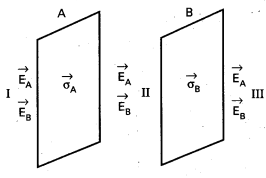
Two large thin metal plates are parallel and close to each other. On their inner faces, the plates have surface charge densities of opposite signs and of magnitude 17.0 × 10⁻²² C/m2. What is E :
(a) in the outer region of the first plate,
(b) in the outer region of the second plate and
(c) between the plates ?
Solution:
Given σA = 127.0 × 10⁻²² C/m2
σB = 17.0 × 10⁻²² C/m2
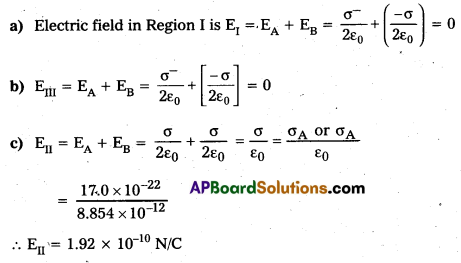
AP Inter 2nd Year Physics Study Material Chapter 4 Electric Charges and Fields 56
AP Inter 2nd Year Physics Study Material Chapter 4 Electric Charges and Fields 57

Question 25.
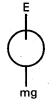
An oil drop of 12 excess electrons is held stationary under a constant electric field of 2.55 × 10⁴ NC-1 in Millikan’s oil drop experiment. The density of the oil is 1.26 g cm-3. Estimate the radius of the drop, (g = 9.81 ms-2; e = 1.60 × 10⁻¹⁹C).
Solution:
Given n = 12; E = 2.55 × 10⁴ N/C
p = 1.26 g/cm3 = 1.26 × 10³ kg/m3
e = 1.6 × 10⁻¹⁹C ; g = 9.81 ms-2
AP Inter 2nd Year Physics Study Material Chapter 4 Electric Charges and Fields 58
As the oil drop is stationary,
Electrostatic force = Gravitational force
⇒ qE = mg
neE = \(\frac{4}{3} \pi r^3 \mathrm{\rho g}\)
r3 = \(\frac{3 \mathrm{neE}}{4 \pi \rho \mathrm{g}}\) = \(\frac{3 \times 12 \times 1.6 \times 10^{-19} \times 2.55 \times 10^4}{4 \times 3.14 \times 1.26 \times 10^3 \times 9.8}\)
r = 0.94 × 10⁻¹⁸
r = [0.94 × 10⁻¹⁸]\(\frac{1}{3}\) = 9.81 × 10⁻⁷m
∴ Radius of the drop = 9.81 × 10⁻⁷ m.

AP Inter 2nd Year Physics Study Material Chapter 4 Electric Charges and Fields

Question 26.
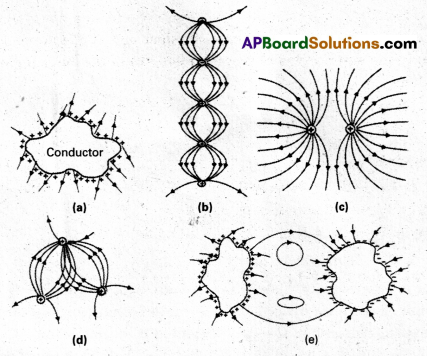
Which among the curves shown in Fig. cannot possibly represent electrostatic field lines ?
AP Inter 2nd Year Physics Study Material Chapter 4 Electric Charges and Fields 59
Solution:
a) According to the properties of electric lines of force, the lines should be always ⊥r to the surface of a conductor as they starts or they ends. Here, some of the lines are not ⊥r to the surface, thus it cannot represent the electrostatic field lines.

b) According to the property of electrostatic field lines, they never start from negative charge, here some of the lines start from negative charge. So, it cannot represent the electrostatic field lines.

c) As the property of electric field lines that they start outwards from positive charge. Hence, it represents the electrostatic field lines.

d) By the property of electric field lines, two electric field lines never intersect each other. Here, two lines intersect. So it does not represent the electric field lines.

e) By the property of electric field lines that they are not in the form of closed loops. Here, the lines form closed loop. So, it does not represent the electric field lines.

Question 27.
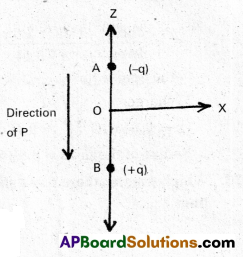
In a certain region of space, electric field is along the Z-direction throughout. The magnitude of electric field is, however, not constant but increases uniformly along the positive Z-direction, at the rate of 105 NC-1 per metre. What are the force and torque experienced by a system having a total dipolemoment equal to 10-7 Cm in the negative Z-direction ?
Solution:
The electric field increases in positive Z – direction. dE
\(\frac{\mathrm{dE}}{\mathrm{dZ}}\) = 105 N/C-m
The direction of dipolemoment is in the negative Z-direction
AP Inter 2nd Year Physics Study Material Chapter 4 Electric Charges and Fields 60
So the negative charge q is placed at A and positive charge q is placed at B as the direction of dipole moment is from negative charge to positive charge.
PZ = -10-7C-m

The negative sign shows its direction in negative Z – axis. According to the basic definition of electric field, F = qdE Now, multiplying and dividing by dz,
F = q\(\frac{\mathrm{dE}}{\mathrm{dz}} \cdot \mathrm{dz}\) .dz = q.dz\(\frac{\mathrm{dE}}{\mathrm{dz}}\)
qdz = dipolement pz, as the length of the dipole is dz.

∴ F = Pz. \(\frac{\mathrm{dE}}{\mathrm{dz}}\) = -10-7 × 105 = -10-2N
Torque, \(\tau\) = PE sin θ (∵ θ = 180° angle between P and E)
\(\tau\) = PE sin 180° = 0
Thus the force is -10-2 N and the torque is 0.

Question 28.
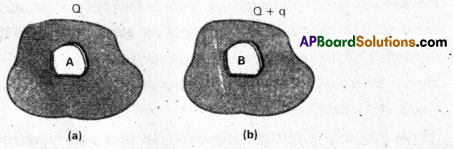
a) A conductor A with a cavity as shown in Fig. (a) is given a charge Q. Show that the entire charge must appear on the outer surface of the conductor, (b) Another conductor B with charge q is inserted into the cavity keeping B insulated from A. Show that the total charge on the outside surface of A is Q + q (Fig. (b)). (c) A sensitive instrument is o he shielded from the strong electrostatic fields in its environment. Suggest a possible way.
AP Inter 2nd Year Physics Study Material Chapter 4 Electric Charges and Fields 61
Solution:
a) As we know the property of conductor that the net electric field inside a charged conductor is zero, i.e., E = 0.
Now let us choose a Gaussian surface lying completely inside the conductor enclosing the cavity.
So, from Gauss’s theorem \(\oint \text { E. dS }\) = \(\frac{\mathrm{q}}{\varepsilon_0}\)
As E = 0 ⇒ \(\frac{q}{\varepsilon_0}\) = 0 ⇒ q = 0
That means the charge inside the cavity is zero. Thus, the entire charge Q on the conductor must appear on the outer surface of the conductor.

b) As the conductor B carrying a charge +q inserted in the cavity, the charge -q is induced on the metal surface of the cavity and then charge +q induced on the outside surface of the conductor A. Initially the outer surface of A of A has a charge Q and now it has a charge +q induced. So the total charge on the outer surface of A is Q + q.

c) To protect any sensitive instrument from electrostatic field, the sensitive instrument must be put in the metallic cover. This is known as electrostatic shielding.

AP Inter 2nd Year Physics Study Material Chapter 4 Electric Charges and Fields

Question 29.
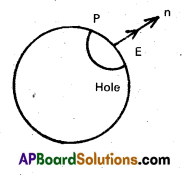
A hollow charged conductor has a tiny hole cut into its surface. Show that the electric field in the hole is (σ/εε0)\(\hat{\mathbf{n}}\), where \(\hat{\mathbf{n}}\) is the unit vector in the outward normal direction and σ is the surface charge density near the hole.
Solution:
Surface charge density near the hole = σ
Unit vector = \(\hat{\mathbf{n}}\) (normal directed outwards)
Let P be the point on the hole.
The electric field at point P closed to the surface of conductor, according to Gauss’s theorem,
AP Inter 2nd Year Physics Study Material Chapter 4 Electric Charges and Fields 62
\(\oint \mathrm{E} \cdot \mathrm{dS}\) = \(\frac{q}{\varepsilon_0}\)
Where q is the charge near the hole.
E ds cos θ = \(\frac{\sigma \mathrm{dS}}{\varepsilon_0}\) (∴ σ = \(\frac{\mathrm{q}}{\mathrm{dS}}\) ∴q = σ dS) where dS = area

∴ Angle between electric field and area vector is 0°.
EdS = \(\frac{\sigma \mathrm{dS}}{\varepsilon_0}\)
E = \(\frac{\sigma}{\varepsilon_0}\)
E = \(\frac{\sigma}{\varepsilon_0} \hat{\mathrm{n}}\)

This electric field is due to the filled up hole and the field due to the rest of the charged conductor. The two fields inside the conductor are equal and opposite. So, there is no electric field inside the conductor. Outside the conductor, the electric fields are equal and are in the same direction.
So, the electric field at P due to each part = \(\frac{1}{2} \mathrm{E}\) = \(\frac{\sigma}{2 \varepsilon_0} \hat{n}\)

AP Inter 2nd Year Physics Study Material Chapter 4 Electric Charges and Fields

Question 30.
Obtain the formula for the electric field due to a long thin wire of uniform linear charge density λ without using Gauss’s law. [Hint: Use Coulomb’s law directly and evaluate the necessary integral.]
Solution:
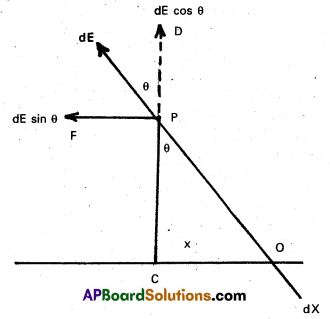
Let us consider a long thin wire of linear charge density λ. We have to find the resultant electric field due to this wire at point P.
Now, consider a very small element of length dx at a distance x from C.
AP Inter 2nd Year Physics Study Material Chapter 4 Electric Charges and Fields 63
The charge on this elementary portion of length dx
q = λ dx ——- (1)

Electric field intensity at point P due to the elementary portion
dE = \(\frac{1}{4 \pi \varepsilon_0} \cdot \frac{\mathrm{q}}{(\mathrm{OP})^2}\) = \(\frac{1}{4 \pi \varepsilon_0} \frac{\lambda d x}{(\mathrm{OP})^2}\) [∵ from (1)]
Now, in ΔPCO (PO)2 = (PC)2 + (CO)2
(OP)2 = r2 + x2
dE = \(\frac{1}{4 \pi \varepsilon_0} \frac{\lambda d \mathbf{x}}{\left(x^2+r^2\right)}\) ——- (2)

The components of dE are dE cos θ along PD and dE sin θ along PF.
Here, there are so many elementary portion. So all the dE sin θ components balance each other. The resultant electric field at P is due to only dE cos θ components.
The resultant electric field due to elementary component, dE’ = dE cos θ

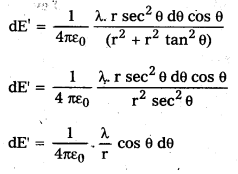
dE’ = \(\frac{1}{4 \pi \varepsilon_0} \cdot \frac{\lambda d x}{\left(x^2+r^2\right)} \cos \theta\) —— (3)
In ΔOCP tan θ = \(\frac{x}{r}\) ⇒ x = r tan θ
Differentiating with respect to θ, we get dx = r sec2 θ dθ
Putting in equation (3), we get
AP Inter 2nd Year Physics Study Material Chapter 4 Electric Charges and Fields 64
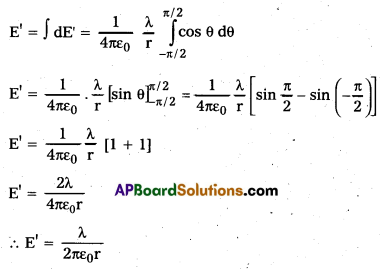
As the wire is of infinite length, so integrate within the limits –\(\frac{\pi}{2}\) to \(\frac{\pi}{2}\), we get
AP Inter 2nd Year Physics Study Material Chapter 4 Electric Charges and Fields 65

Question 31.
It is now believed that protons and neutrons (which constitute nuclei of ordinary matter) are themselves built out of more elementary units called quarks. A proton and a neutron consist of three quarks each. Two types of quarks, the so called ‘up’ quark (denoted by u) of charge +(2/3)e and the ‘down’ quark (denoted by d) of charge (-1/3) e, together with electrons build up ordinary matter. (Quarks of other types have also been found which give rise to different unusual varieties of matter.) Suggest a possible quark composition of a proton and neutron.

Solution:
For the protons, the charge on it is +e let the number of up quarks are a, then the number of down quarks are (3 – a) as the total number of quarks are 3.
So, ax up quark charge + (3 – a) down quark charge = +e
a × \(\frac{2}{3} \mathrm{e}\) + (3 – a)\(\left(\frac{-\mathrm{e}}{3}\right)\) = e
\(\frac{2 \mathrm{ae}}{3}\) – \(\frac{(3-\mathrm{a}) \mathrm{e}}{3}\) = e
2a – 3 + a = 3
3a = 6
a = 2
Thus, in the proton there are two up quarks and one down quark.
∴ Possible quark composition for proton = uud

For the neutron, the charge on neutron is 0.
Let the number of up quarks are b and the number of down quarks are (3 – b)
So, bx up quark charge + (3 – b) × down quark charge = 0
b\(\left(\frac{2 \mathrm{e}}{3}\right)\) + (3 – b)\(\left(\frac{-\mathrm{e}}{3}\right)\) = 0
2b – 3 + b = 0
3b = 3
∴ b = 1
Thus, in neutron, there are one up quark and two down quarks.
∴ Possible quark composition for neutrons = udd.

Question 32.
a) Consider an arbitrary electrostatic field configuration. A small test charge is placed at a null point (i.e, where E = 0) of the configuration. Show that the equilibrium of the test charge is necessarily unstable.
b) Verify this result for the simple configuration of two charges of the same magnitude and sign placed a certain distance apart.
Solution:
a) Let us consider that initially the test charge is in the stable equilibrium. When the test charge is displaced from the null point (where, E = 0) in any direction, it must experience a restoring force towards the null point.
This means that there is a net inward flux through a closed surface around the null point According to the Gauss’s theorem, the net electric flux through a surface net enclosing any charge must be zero. Hence, the equilibrium is not stable.

b) The middle point of the line joining two like charges is a null point. If we displace a test Charge slightly along the
line, the restoring force try to bring the test charge back to the centre. If we displace the test charge normal to the line, the net force on the test charge takes it further away from the null point. Hence the equilibrium is not stable.
AP Inter 2nd Year Physics Study Material Chapter 4 Electric Charges and Fields 66

Question 33.
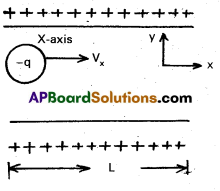
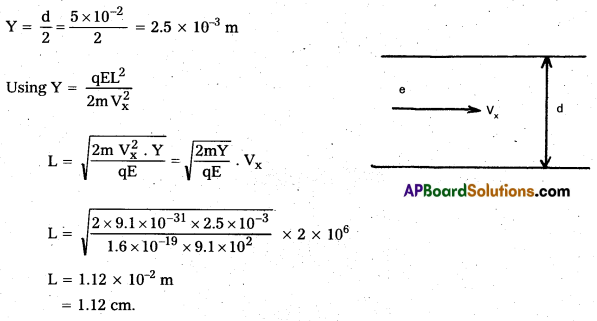
A particle of mass m and charge (-q) enters the region between the two charged plates initially moving along x-axis with speed Vx (as in the fig.). The length of plate is L and an uniform electric field E is maintained between the plates. Show that the vertical deflection of the particle at the far edge of the plate is qEL2/(2m \(\mathbf{V}_{\mathbf{x}}^2\)).
Compare this motion with motion of a projectile in gravitational field discussed in section 4.10 of 1st Year Textbook of Physics.
Solution:
Mass of particle = m
Charge of particle = -q
Speed of particle = Vx
Length of plates = L
AP Inter 2nd Year Physics Study Material Chapter 4 Electric Charges and Fields 67
Electric field between the plates = E (from positive plate to negative plate).
Let the deflection in the path of the charge – q is Y, because the force acting in +Y axis direction. The direction of force is from negative plate to positive plate because the charge is negative in nature.

Let us discuss the motion in Y axis direction. Initial velocity u = 0
Acceleration a = \(\frac{F}{m}\) = \(\frac{+\mathrm{qE}}{\mathrm{m}}\)
Deflection Y = ?
Time = \(\frac{\text { Distance }}{\text { Velocity }}\) = \(\frac{\mathrm{L}}{\mathrm{V}_{\mathrm{x}}}\)
Using second equation of motion,
S = ut + \(\frac{1}{2} \mathrm{at}^2\)at
Putting the values y = 0 + \(\frac{1}{2} \times\left(+\frac{\mathrm{qE}}{\mathrm{m}}\right) \frac{\mathrm{L}^2}{\mathrm{~V}_{\mathrm{x}}^2}\)
Y = \(\frac{\mathrm{qEL}^2}{2 \mathrm{mV}_{\mathrm{x}}^2}\)

In the case of projectile motion y = \(\frac{1}{2} \mathrm{gt}^2\). Thus, it is exactly similar to the projectile motion in the gravitational field.

AP Inter 2nd Year Physics Study Material Chapter 4 Electric Charges and Fields

Question 34.
Suppose that the particle is an electron projected with velocity Vx = 2.0 × 10⁶ ms-1. If E between the plates separated by 0.5 cm is 9.1 × 10² N/C, where will the electron strike the upper plate ? (|e| = 1.6 × 10⁻¹⁹ C, me = 9.1 × 10⁻³¹ kg.)
Solution:
Given Vx = 2 × 10⁶ m/s; E = 9.1 × 10² N/C
q = e = 1.6 × 10⁻¹⁹ C; me = 9.1 × 10⁻³¹ kg
d = 0.5 cm = 0.5 × 10⁻² m = 5 × 10⁻³ m
The electron will strike the upper plate at its other end at X = L as it get deflected.
AP Inter 2nd Year Physics Study Material Chapter 4 Electric Charges and Fields 68

AP Inter 2nd Year Physics Study Material Chapter 3 Wave Optics

Andhra Pradesh BIEAP AP Inter 2nd Year Physics Study Material 3rd Lesson Wave Optics Textbook Questions and Answers.

AP Inter 2nd Year Physics Study Material 3rd Lesson Wave Optics

Very Short Answer Questions

Question 1.
What is Fresnel distance?
Answer:
“Fresnel distance is the minimum distance a beam of light has to travel before its deviation from straight line path becomes significant”.

Fresnel distance (ZF) = \(\frac{\mathrm{a}^2}{\lambda}\) ; Where a = width of the aperture, λ = wave length.

Question 2.
Give the justification for validity of ray optics.
Answer:
The distances much smaller than ZF, the spreading due to diffraction is smaller compared to the size of the beam.

When the distance is approximately ZF, and much more than ZF, the spreading due to diffraction dominates over that due to ray optics (size of the aperture (a)]
Z = \(\frac{\mathrm{a}^2}{\lambda}\)
From this equation ray optics is valid in the limit of wave length tending to zero.

AP Inter 2nd Year Physics Study Material Chapter 3 Wave Optics

Question 3.
What is polarisation of light ?
Answer:
The vibrations of the light confined only one direction. This phenomenon is called polarisation.
(or)
The phenomenon due to which the transverse vibrations of electric field vector of a light wave become confined to one plane, is called polarisation.

Question 4.
What is Malus’ law.
Answer:
Malus’ law : It states that the intensity of polarised light transmitted through the analyser varies as a square of cosine of the angle between the plane of transmission of analyser and polariser.
I ∝ cos2 θ; I = I0 cos2 θ.

Question 5.
Explain Brewster’s law.
Answer:
Brewster’s law : The tangent of the polarising angle is equal to the refractive index of the medium.
μ = tan iB, where iB = polarising angle and μ = refractive index. Note : r + iB = 90°

Question 6.
When does a monochromatic beam of light incident on a reflective surface get completely transmitted ?
Answer:
Let the light emitted by laser source passes through polariser, and incident on the surface of the reflective surface with Brewster’s angle (iB). Now rotate the polariser at particular alignment the light incident on the surface is completely transmitted.

Short Answer Questions

Question 1.
Explain Doppler effect in light. Distinguish between red shift and blue shift. (T.S. Mar. ’18, ’16)
Answer:
Dopper effect in light: The change in the apparent frequency of light, due to relative motion between source of light and observer. This phenomenon is called Doppler effect.

The apparent frequency of light increases when the distance between observer and Source of light is decreasing and the apparent frequency of light decreases, if the distance between source of light and observer increasing.

Doppler shift can be expressed as \(\frac{\Delta v}{v}\) = \(\frac{-v_{\text {radial }}}{\mathrm{C}}\)

Applications of Doppler effect in light:

  1. It is used in measuring the speed of a star and speed of galaxies.
  2. Measuring the speed of rotation of the sun.

Red shift: The apparent increase in wave length in the middle of the visible region of the spectrum moves towards the red end of the spectrum is called red shift.

Blue shift: When waves are received from a source moving towards the observer, there is an apparent decrease in wave length, this is called blue shift.

AP Inter 2nd Year Physics Study Material Chapter 3 Wave Optics

Question 2.
What is total internal reflection. Explain the phenomenon using Huygen’s principle.
Answer:
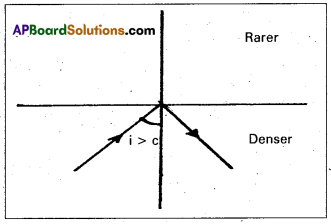
Total internal reflection: When a light ray travels from denser medium to rarer medium, the angle of incidence is greater than critical angle then it reflects into the same medium. This phenomenon is called total internal reflection.
AP Inter 2nd Year Physics Study Material Chapter 3 Wave Optics 1
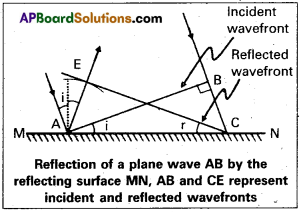
Huygen’s principle : According to Huygen’s principle, every point on the wavefront AB is a source of secondary wavelets and time during which wavelets from B reaches at C, Let \(\tau\) be the time taken by the wave front to advance from B to C.

Then distance BC = υ\(\tau\)
In order to construct the reflected wavefront, we draw a sphere of radius ux from point A.
Let CE represent the tangent drawn from C to this sphere.
AE = BC = υ\(\tau\)
AP Inter 2nd Year Physics Study Material Chapter 3 Wave Optics 2
Consider the triangles EAC and BAC are congruent.
∴ Angles i and r would be equal. This is the law of reflection.

Question 3.
Derive the expression for the intensity at a point where interference of light occurs. Arrive at the conditions for maximum and zero intensity. (A.P. & T.S. Mar. ’16)
Answer:
Let y1 and y2 be the displacements of the two waves having same amplitude a and Φ is the phase difference between them.
y1 = a sin ωt …… (1)
y2 = a sin (ωt + ϕ)) …… (2)
The resultant displacement y = y1 + y2
y = a sin ωt + a sin (ωt + ϕ)
y = a sin ωt + a sin ωt cos ϕ + a cos ωt sin ϕ
y = a sin ωt [1 + cos ϕ] + cos ωt (a sin ϕ)
AP Inter 2nd Year Physics Study Material Chapter 3 Wave Optics 3

Let R cos θ = a(1 + cos ϕ) —– (4)
R sin θ = a sin ϕ —– (5)
y = R sin ωt . cos θ + R cos ωt . sin θ
y = R sin(ωt + θ) —– (6)
where R is the resultant amplitude at P, squaring equations (4) and (5), then adding
R2 (cos2 θ + sin θ] = a2[1 + cos2 ϕ + 2 cos ϕ + sin2 ϕ]
R2[1] = a2[1 + 1 + 2 cos ϕ]
I = R2 = 2a2 [1 + cos ϕ] = 2a2 × 2 cos2 \(\frac{\phi}{2}\); I = 4a2 cos2 \(\frac{\phi}{2}\) —— (7)

i) Minimum intensity (Imax)
c0s2 \(\frac{\phi}{2}\) = 1
ϕ = 2nπ Where n = 0, 1, 2, 3 …….
ϕ = 0, 2π, 4π, 6π
∴ Imax = 4a2.

ii) Minimum intensity (Imin)
cos2 \(\frac{\theta}{2}\) = 0
ϕ = (2n + 1)π where n = 0, 1, 2, 3, …….
ϕ = π, 3π, 5π, 7π
Imin = 0

Question 4.
Does the principle of conservation of energy hold for interference and diffraction phenomena ? Explain briefly. (Mar. ’14)
Answer:
Yes, law of conservation of energy is obeyed. In case of constructive interference, intensity becomes maximum. Hence bright fringes are formed on the screen where as in the case of destructive interference, intensity becomes minimum. Hence dark fringes are formed on the screen.

This establishes that in the interference and diffraction pattern, the intensity of light is simply being redistributed i.e., energy is being transferred from dark fringe to bright fringe. No energy is being created (or) destroyed in the process. Hence energy is redistributed.
Thus the principle of conservation of energy is being obeyed in the process of interference and diffraction.

AP Inter 2nd Year Physics Study Material Chapter 3 Wave Optics

Question 5.
How do you determine the resolving power of your eye ? (A.P. Mar. ’19)
Answer:
Make black strips of equal width separated by white strips. All the black strips having same width, while the width of white strips should increase from left to right.
Now watch the pattern with one eye. By moving away (or) closer to the wall, find the position where you can just see some two black strips as separate strips.
AP Inter 2nd Year Physics Study Material Chapter 3 Wave Optics 4
All black strips to the left of this strips would merge into one another and would not be distinguishable on the other hand, the black strips to the right of this would be more and more clearly visible.

Note the width d of the white strips and measure the distance D of the wall from eye.
Then resolution of your eye = \(\frac{\mathrm{d}}{\mathrm{D}}\).

Question 6.
Discuss the intensity of transmitted light when a polaroid sheet is rotated between two crossed polaroids.
Answer:
Let I0 be the intensity of polarised light after passing through the first polariser P1. Then the intensity of light after passing through second polariser P2 will be I = I0cos2θ.
Where θ is the angle between pass axes P1 and P2. Since P1 and P2 are crossed the angle between the pass axes of P2 and P3 will be \(\left(\frac{\pi}{2}-\theta\right)\)
Hence the intensity of light emerging from P3 will be
I = I0cos2 θ. cos2 \(\left(\frac{\pi}{2}-\theta\right)\)
= I0 cos2 θ . sin2 θ
I = \(\frac{I_0}{4}\) sin2
The transmitted intensity will be maximum when θ = \(\frac{\pi}{4}\)

Long Answer Questions

Question 1.
What is Huygen’s Principle? Explain the optical phenomenon of refraction using Huygen’s principle.
Answer:
Huygens principle: Every point on a wave front is the source of secondary wavelets.
Refraction of a plane wave using Huygen’s principle:
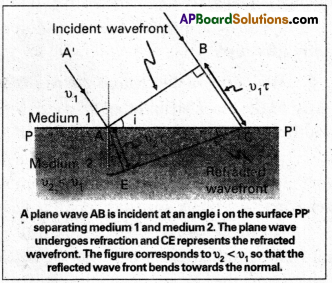
Let the surface PP’ separating the two medium of refractive index μ1 and μ2. Let υ1 and υ2 be the velocities of light in medium 1 and medium 2.
AP Inter 2nd Year Physics Study Material Chapter 3 Wave Optics 5
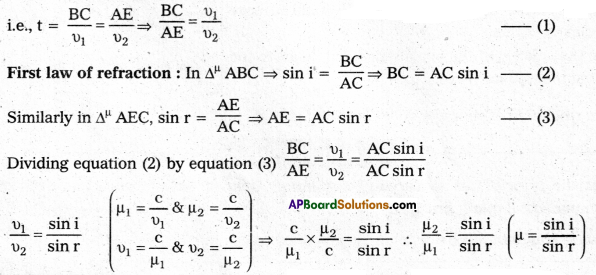
According to Huygen’s principle, every point on incident wave front AB is a source of secondary wavelets. By the time wavelét from point B reaches at point C, the wavelet from point A would have reached at point E. Let t be the time taken from B to C is equal to time taken from A to D.
AP Inter 2nd Year Physics Study Material Chapter 3 Wave Optics 6
μ1 sin i = μ2 sin r
This is the Snell’s law of refraction.

Second law of refraction: Since incident ray, refracted ray and the normal all the lie on the same plane PP’ at the point of incidence. This proves the second law of refraction.

Question 2.
Distinguish between Coherent and Incoherent addition of waves. Develop the theory of constructive interferences.
Answer:
Coherent sources : The two sources which maintain zero (or) any constant phase relation between themselves are known as Coherent sources.
Incoherent sources : If the phase difference changes with time, the two sources are known as incoherent sources.
AP Inter 2nd Year Physics Study Material Chapter 3 Wave Optics 7
Theory of constructive and destructive interference :
Let the waves of two coherent sources be
y1 = a sin ωt —— (1)
y2 = a sin (ωt + ϕ) —– (2)
where a is amplitude and ϕ is the phase difference between two displacements.
According to superposition principle, y = y1 + y2
y = a sin ωt + a sin (ωt + ϕ)= a sin ωt + a sin ωt cos ϕ + a cos ωt sin ϕ
y = a sin ωt [1 + cos ϕ] + cos ωt [a sin ϕ] —– (3)
Let A cos θ = a(1 + cos ϕ] —– (4)
A sin θ = a sin ϕ —– (5)
Substituting equations (4) and (5) in equation (3)
y = A sin ωt. cos θ + A cos ωt sin θ
y = A sin (ωt + θ) —— (6)
Where A is resultant amplitude. Squaring equations (4) and (5), then adding
A2 [cos2 θ + sin2 θ] = a2[1 + cos2 ϕ + 2 cos ϕ + sin2 ϕ]
A2 [1] = a2 [1 + 1 + 2 cos ϕ]
I = A2 = 2a2 [1 + cos ϕ] ( ∵ I = A2)
I = 2a2 × 2 cos2 \(\frac{\phi}{2}\)
I = 4a2 cos2 \(\frac{\phi}{2}\)
I = 4I0 cos2 \(\frac{\phi}{2}\) —— (7) (∵ I0 = a2)

Case (i) For constructive interference : Intensity should be maximum.
cos \(\frac{\phi}{2}\) = 1 ⇒ ϕ = 2nπ
Where n = 0, 1, 2, 3….. ⇒ ϕ = 0, 2π, 4π, 6π ….. Imax = 4I0
Case (ii) For destructive interference : Intensity should be minimum
i.e., cos ϕ = 0 ⇒ ϕ = (2n + 1) π ; where n = 0, 1, 2, 3……. ; ϕ = π, 3π, 5π ⇒ Imin = 0.

AP Inter 2nd Year Physics Study Material Chapter 3 Wave Optics

Question 3.
Describe Young’s experiment for observing interference and hence arrive at the expression for ‘fringe width’. ‘
Answer:
Interference : The modification of intensity obtained by the super position of two (or) more light waves is called interference.
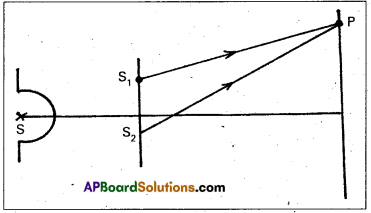
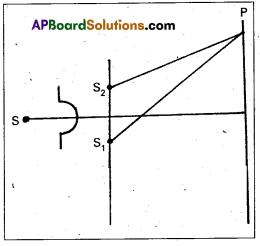
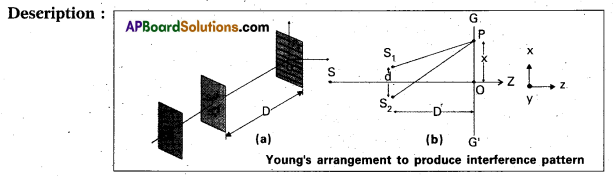
AP Inter 2nd Year Physics Study Material Chapter 3 Wave Optics 8

  1. Thomas Young experimentally observed the phenomenon of interference of light using two coherent sources.
  2. A small pin hole ‘S’ illuminated by monochromatic source of light which produces a spherical wave.
  3. S1 and S2 are two narrow pin holes equidistant from S.
  4. Screen is placed at a distance D.
  5. The points at which any two crests (or) any two troughs are superimposed, constructive interference takes place bright fringe will be observed on the screen.
  6. The points at which crest of one wave and trough of another wave are super imposed, destructive interference takes place dark fringe will be observed on the screen.
  7. Thus on the screen alternately bright and dark frings are observed.

Expression for fringe width :

i) It is the distance between two successive bright (or) dark fringes, denoted by p.

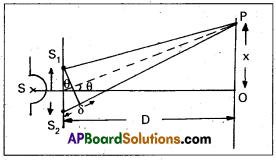
ii) The path difference (δ) = d sin θ
AP Inter 2nd Year Physics Study Material Chapter 3 Wave Optics 9
If θ is very small then from figure sin θ ≈ tan θ = \(\frac{x}{D}\)

iii) For bright fringes path difference S2P – S1P = nλ
∴ d sin θ = nλ,
d × \(\frac{x}{D}\) = nλ
x = \(\frac{n \lambda \mathrm{D}}{\mathrm{d}}\) —– (1) where n = 0, 1, 2, 3,…….
This equation represents the position of bright fringe.
When n = 0, x0 = 0
n = 1, x1 = \(\frac{\lambda \mathrm{D}}{\mathrm{d}}\) and n = 2, x2 = \(\frac{2 \lambda \mathrm{D}}{\mathrm{d}}\)

The distance between any two consecutive bright fringes is
x2 – x1 = \(\frac{2 \lambda \mathrm{D}}{\mathrm{d}}-\frac{\lambda \mathrm{D}}{\mathrm{d}}\) ⇒ β = \(\frac{\lambda \mathrm{D}}{\mathrm{d}}\) ——- (2)

iv) For dark fringes path difference S2P – S1P = (2n + 1) \(\frac{\lambda}{2}\) ∴ d sin θ = (2n + 1)\(\frac{\lambda}{2}\)
d × \(\frac{x}{D}\) = (2n + 1) \(\frac{\lambda}{2}\) = \(\frac{(2 \mathrm{n}+1) \lambda \mathrm{D}}{2 \mathrm{~d}}\) ——- (3) where n =0, 1, 2, 3, ………
This equation (3) represents, position of dark fringe.
When n = 0, x0 = \(\frac{\lambda \mathrm{D}}{2 \mathrm{~d}}\) ⇒ n = 1, x1 = \(\frac{3 \lambda \mathrm{D}}{2 \mathrm{~d}}\) ; n = 2, x2 = \(\frac{5 \lambda \mathrm{D}}{2 \mathrm{~d}}\) ……
The distance between any two consecutive dark fringes is x2 – x1 = \(\frac{5 \lambda \mathrm{D}}{2 \mathrm{~d}}-\frac{3 \lambda \mathrm{D}}{2 \mathrm{~d}}\) = \(\frac{5 \lambda \mathrm{D}-3 \lambda \mathrm{D}}{2 \mathrm{~d}}\)
β = \(\frac{\lambda \mathrm{D}}{\mathrm{d}}\) —– (4)
Hence fringe width is same for bright and dark fringes.

Question 4.
What is diffraction ? Discuss diffraction pattern obtainable from a single slit.
Answer:
Diffraction : The phenomenon of bending of light at the edges of an obstacle and light enters into the geometrical shadow is known as diffraction of light.
Example : The silver lining surrounding the profile of a mountain just before sunrise.

Diffraction of light at a single slit:

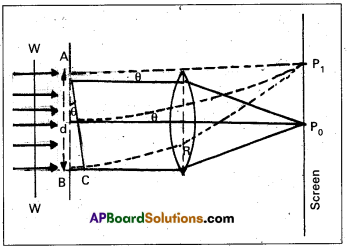
  1. Consider a narrow slit AB of width d. A parallel beam of light of wave length λ falling normally on a single slit.
  2. Let the diffracted light be focussed by means of a convex lens on a screen.
  3. The secondary wavelets travelling normally to the slit, i.e., along the direction of OP0.
    Thus P0 is a bright central image.
    AP Inter 2nd Year Physics Study Material Chapter 3 Wave Optics 10
  4. The secondary wavelets travelling at an angle θ with the normal are focussed at a point P1 on the screen.
  5. In order to find out intensity at P1, draw a perpendicular AC on BR.
  6. The path difference between secondary wavelets = BC
    = AB sin θ = a sin θ (∵ sin θ = 0)
    Path difference (λ) ≈ a θ —– (1)
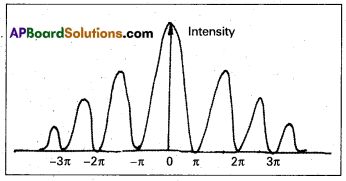
  7. Experimental observations shown in figure, that the intensity has a central maximum at θ = 0 and other secondary maxima at θ ≈ \(\left(\mathrm{n}+\frac{1}{2}\right) \frac{\lambda}{\mathrm{a}}\) and has minima at θ = \(\approx \frac{n \lambda}{a}\)
  8. From equation (1), θ = \(\frac{\lambda}{\mathrm{a}}\). Now we divide the slit into two equal halves, each of size \(\frac{a}{2}\).
  9. We can show that the intensity is zero for θ = \(\frac{n \lambda}{a}\) where n = 1, 2, 3….
  10. It is alsó to see why there are maxima at θ = \(\left(\mathrm{n}+\frac{1}{2}\right) \frac{\lambda}{\mathrm{a}}\)
  11. Consider θ = \(\frac{3 \lambda}{2 \mathrm{a}}\) which is midway between two of the dark fringes.
  12. If we take the first two thirds of the slit, the path difference between two ends is
    \(\frac{2}{3} a \times \theta\) = \(\frac{2 \mathrm{a}}{3} \times \frac{3 \lambda}{2 \mathrm{a}}\) = λ —– (2)
    AP Inter 2nd Year Physics Study Material Chapter 3 Wave Optics 11
  13. The first two third of the slit can be divided into two halves which have a \(\frac{\lambda}{2}\) path difference. The contribution of two halves cancel and only remaining one third of the slit contributes to the intensity minima.

Question 5.
What is resolving power of Optical Instruments? Derive the condition under which images are resolved.
Answer:
Resolving power : The resolving power of a lens is its ability to resolve two points that are to each other.
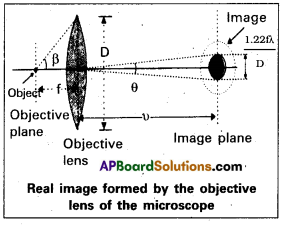
AP Inter 2nd Year Physics Study Material Chapter 3 Wave Optics 12
Resolving power of optical instruments:

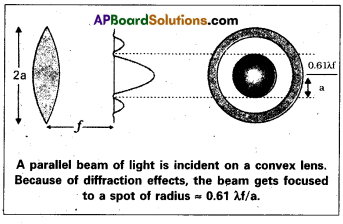
  1. Consider a parallel beam of light falling on a convex lens. Due to diffraction effect, the beam focussed to a spot of finite area.
  2. Taking into account the effects duè to diffraction, the pattern on the focal plane would consist of a central bright region (circular) surrounded by a concentric dark and bright rings.
  3. The radius of the central bright region is given by r0 = \(\frac{1.22 \lambda \mathrm{f}}{2 \mathrm{a}}\) = \(\frac{0.61 \lambda \mathrm{f}}{\mathrm{a}}\)
    where f is focal length of the lens
    2a = diameter of the lens.

Derive the condition under which images are resolved : The size of the spot is very small, it plays an important role in determining the limit of resolution.
For the two stars to be Just resolved
f Δ θ ≈ r0 ≈ \(\frac{0.61 \lambda \mathrm{f}}{\mathrm{a}}\)
Δ θ ≈ \(\frac{0.61 \lambda}{\mathrm{a}}\) —– (1)
Thus Δθ will be small, if the diameter (2a) of the objective is large. This implies that the telescope will have better resolving power if a is large.
In case of microscope, the object is placed slightly beyond f. The corresponding minimum seperation (dMin) between the object and the objective lens is given by
dMin = \(\frac{1.22 \lambda}{2 \mu \sin \beta}\)
Where μ = Refractive index
μ sin β = Numerical aperture.

Textual Exercises

Question 1.
Monochromatic light of wavelength. 589 nm is incident from air on a water surface. What are the wavelength, frequency and speed of (a) reflected, and (b) refracted light ? Refractive index of water is 1.33.
Solution:
λ = 589 nm = 589 × 10-9 m

a) Reflected light: (Wavelength, frequency, speed same as incident light)
λ = 589 nm, v = 5.09 × 10¹⁴ Hz
c = 3 × 10⁸ m/s ⇒ υ = \(\frac{c}{\lambda}=\frac{3 \times 10^8}{589 \times 10^{-9}}\) = 5.093 × 10¹⁴ Hz.

b) Refracted light: (frequency same as the incident frequency)
y = 5.093 × 10¹⁴ Hz
υ = \(\frac{\mathrm{c}}{\mu}=\frac{3 \times 10^8}{1.33}\) = 2.256 × 10⁸ m/s ⇒ λ = \(\frac{v}{v}=\frac{2.26 \times 10^8}{5.09 \times 10^{14}}\) = 443 m.

AP Inter 2nd Year Physics Study Material Chapter 3 Wave Optics

Question 2.
What is the shape of the wavefront in each of the following cases :
(a) Light diverging from a point source.
(b) Light emerging out of a convex lens when a point source is placed at its focus.
(c) The portion of the wavefront of light from a distant intercepted by the Earth.
Soution:
a) It is spherical wavefront.
b) It is plane wavefront.
c) Plane wavefront (a small area on the surface of a large sphere is nearly planar.

Question 3.
(a) The refractive index of glass is 1.5. What is the speed of light in glass ? (Speed of light in vacuum is 3.0 × 10⁸ m s-1)
(b) Is the speed of light in glass independent of the colour of light ? If not, which of the two colours red and violet travels slower in a glass prism ?
Solution:
a) Here, µ = \(\frac{\mathbf{c}}{v}\) ⇒ υ = \(\frac{\mathrm{c}}{\mu}\) = \(\frac{3 \times 10^8}{1.5}\) = 2 × 10⁸ m/s
b) No, the refractive index and speed of light in a medium depend on wavelength i.e. colour of light. We know that µv > µr.
Therefore vviolet < vred. Hence violet component of white light travels slower than the red component.

Question 4.
In a Young’s double-slit experiment, the slits are separated by 0.28 mm and the screen is placed 1.4 m away. The distance between the central bright fringe and the fourth bright fringe is measured to be 1.2 cm. Determine the wavelength of light used in the experiment.
Solution:
d = 0.28 mm = 0.28 × 10⁻³ m, D = 1.4 m, β = 1.2 × 10⁻² m, n = 4
AP Inter 2nd Year Physics Study Material Chapter 3 Wave Optics 13
⇒ λ = 600 nm.

Question 5.
In Young’s double-slit experiment using monochromatic light of wavelength λ, the intensity of light at a point on the screen where path difference is λ, is K units. What is the intensity of light at a point where path difference is λ/3 ?
Solution:
Let I1 = I2 = I. If ϕ is phase difference between the two light waves, then resultant intensity,
IR = I1 + I2 + \(2 \sqrt{\mathrm{I}_1 \mathrm{I}_2}\) . cos ϕ
When path difference = λ, Phase difference ϕ = 0° ∴ IR = I + I + \(2 \sqrt{I I}\). cos 0° = 4I = k
When path difference = \(\frac{\lambda}{3}\), phase difference ϕ = \(\frac{2 \pi}{3}\) rad.
∴ IR = I + I + \(2 \sqrt{\mathrm{II}} \cdot \cos \frac{2 \pi}{3}\) ⇒ I’R = 2I + 2I\(\left(\frac{-1}{2}\right)\) = I = \(\frac{\mathrm{k}}{4}\)

Question 6.
A beam of light consisting of two wavelengths, 650 nm and 520 nm, is used to obtain interference fringes in a Young’s double-slit experiment.
(a) Find the distance of the third bright fringe on the screen from the central maximum for wavelength 650 nm.
(b) What is the least distance from the central maximum where the bright fringes due to both’the wavelengths coincide ?
Solution:
Here λ1 = 650 nm = 650 × 10-9 m, λ2 = 520 nm = 520 × 10-9 m .
Suppose d = Distance between two slits; D = Distance of screen from the slits
a) For third bright fringe, n = 3 ⇒ x = nλ, \(\frac{\mathrm{D}}{\mathrm{d}}\) = 3 × 650 \(\frac{\mathrm{D}}{\mathrm{d}}\) nm
b) Let nth fringe due to λ2 = 520 nm coincide with (n – 1)th bright fringe due to λ1 = 650 nm
∴ nλ2 = (n – 1) λ1 ; n × 520 = (n – 1) 650; 4n = 5n – 5 or n = 5 .
∴ The least distance required, x = nλ2 \(\frac{\mathrm{D}}{\mathrm{d}}\) = 5 × 520 \(\frac{\mathrm{D}}{\mathrm{d}}\) = 2600 \(\frac{\mathrm{D}}{\mathrm{d}}\) nm.

Question 7.
In a double-slit experiment the angular width of the fringe is found to be 0.2° on a screen placed 1 m away. The wavelength of light used is 600 nm. What will be the angular width of the fringe if the entire experimental apparatus is immersed in water ? Take refractive index of water to be 4/3.
Solution:
Here, θ1 = 0.2°, D = 1m, λ1 = 600 nm, θ2 = ?, μ = 4/3
AP Inter 2nd Year Physics Study Material Chapter 3 Wave Optics 14

Question 8.
What is the Brewster angle for air to glass transition ? (Refractive index of glass = 1.5.)
Solution:
Here, ip = ? μ = 1.5; As tan ip = μ = 1.5 ∴ ip = tan-1 (1.5); ip = 56.3

Question 9.
Light of wavelength 5000 A falls on a plane reflecting surface. What are the wavelength and frequency of the reflected light ? For what angle of incidence is the reflected ray normal to the incident ray ?
Solution:
Given λ = 5000 A = 5 × 10⁻⁷ m
The wavelength and frequency of reflected light remains the same.
∴ Wavelength of reflected light, λ = 5000 A
Frequency of reflected light, υ = \(\frac{\mathrm{c}}{\lambda}=\frac{3 \times 10^8}{5 \times 10^{-7}}\) = 6 × 10¹⁴ Hz
The reflected ray is normal to incident if angle of incidence i = 45.

AP Inter 2nd Year Physics Study Material Chapter 3 Wave Optics

Question 10.
Estimate the distance for which ray optics is good approximation for an aperture of 4 mm and wavelength 400 nm.
Solution:
Here, a = 4 mm = 4 × 10⁻³ m; λ = 400 nm = 400 × 10-9 m = 4 × 10⁻⁷ m
Ray optics is good approximation upto distances equal to Fresnels’ distance (ZF)
ZF = \(\frac{a^2}{\lambda}=\frac{\left(4 \times 10^{-3}\right)^2}{4 \times 10^{-7}}\) = 40 m

Additional Exercises

Question 11.
The 6563 A Hα line emitted by hydrogen in a star is found to be red-shifted by 15 A. Estimate the speed with which the star is receding from the Earth.
Solution:
Given λ’ – λ= 15A = 15 × 10-10 m; λ = 6563 A = 6563 × 10-10 m; v = ?
Since λ’ – λ = \(\frac{v \lambda}{c}\) ∴ v = \(\frac{c\left(\lambda^{\prime}-\lambda\right)}{\lambda}\) ⇒ v = \(\frac{3 \times 10^8 \times 15 \times 10^{-10}}{6563 \times 10^{-10}}\) = 6.86 × 10⁵ m/s

Question 12.
Explain how Corpuscular theory predicts the speed of light in a medium, say, water, to be greater than the speed of light in vacuum. Is the prediction confirmed by experimental determination of the speed of light in water ? If not, which alternative picture of light is consistent with experiment ?
Solution:
In Newton’s corpuscular picture of refraction, particles of light incident from a rarer to a denser medium experience a force of attraction normal to the surface. This results in an increase in the normal component of velocity but the component along the surface remains unchanged. This means
c sin i = v sin r or \(\frac{\mathrm{v}}{\mathrm{c}}=\frac{\sin \mathrm{i}}{\sin \mathrm{r}}\) = μ; Since μ > 1, ∴ v > c
The prediction is opposite to the experimental result: (v < c) . The wave picture of light is consistent with experiment.

Question 13.
You have learnt in the text how Huygens’ principle leads to the laws of reflection and refraction. Use the same principle to deduce directly that a point object placed in front of a plane mirror produces a virtual image whose distance from the mirror is equal to the object distance from the mirror.
Solution:
In figure, P is a point object placed at a distance r from a plane mirror M1 M2. with P as centre and OP = r as radius, draw a spherical arc; AB. This is the spherical wave front from the object, incident on M1 M2. If mirrors were not present, the position of wave front AB would be A’B’ where PP’ = 2r. In the presence of the mirror, wave front AB would appear as A”PB”, according to Huygen’s construction. As is clear from the fig. A’B’ and
AP Inter 2nd Year Physics Study Material Chapter 3 Wave Optics 15
A”B” are two spherical arcs located symmetrically on either side of M1 M2. Therefore, A’PB’ can be treated as reflected image of A”PB”. From simple geometry, we find OP = OP’, which was to be proved.

Question 14.
Let us list some of the factors, which could possibly influence the speed of wave propagation :

  1. nature of the source
  2. direction of propagation
  3. motion of the source and/or observer
  4. wavelength
  5. intensity of the wave On which of these factors, if any, does

(a) the speed of light in vacuum
(b) the speed of light in a medium (say, glass or water), depend ?
Solution:
a) The speed of light in vacuum is a universal constant, independent of all the factorslisted and anything else.
b) Dependence of the speed of light in a medium

  1. Does not depend on the nature of the source.
  2. Independent of the direction of propagation for isotropic media.
  3. Independent of the motion of the source relative to the medium but depends on the motion of the Observer relative to the medium.
  4. Depends on wavelength.
  5. Independent of intensity.

Question 15.
For sound waves, the Doppler formula for frequency shift differs slightly between the two situations :

(i) source at rest; observer moving and
(ii) source moving; observer at rest. The exact Doppler formulas for the case of light waves in vacuum are, however, strictly identical for these situations. Explain why this should be so. Would you expect the formulas to be strictly identical for the two situations in case of light travelling in a medium ?

Solution:

Sound waves require a material medium for propagation. That is why situation (i) and (ii) are not identical physically though relative motion between the source and the observer is the same in the two cases. Infact, relative motion of the observer relative to the medium is different in two situations. That is why Doppler’s formulae for sound are different in the two cases.

For light waves travelling in vacuum, there is nothing to distinguish between the two situations. That is why the formulae are strictly identical.
For light propagating in a medium, situation (i) and (ii) are not identical. The formulae governing the two situations would obviously be different.

Question 16.
In double-slit experiment using light of wavelength 600 nm, the angular width of a fringe formed on a distant screen is 0.1°. What is the spacing between the two slits ?
Solution:
Here λ = 600 nm = 6 × 10⁻⁷ m, θ = 0.1° = \(\frac{0.1^{\circ}}{180^{\circ}} \times \pi \mathrm{rad}\), d = ?
Since θ = \(\frac{\lambda}{\mathrm{d}}\) ⇒ d = \(\frac{\lambda}{\theta}\) = \(\frac{6 \times 10^{-7} \times 180^{\circ}}{0.1^{\circ} \times \pi}\) = 343 × 10-4 m.

Question 17.
Answer the following questions :
(a) In a single slit diffraction experiment, the width of the slit is made double the original width. How does this affect the size and density of the central diffraction band ?
(b) In what way is diffraction from each slit related to the interference pattern in a double-slit experiment ?
(c) When a tiny circular obstacle is placed in the path of light from a distant source, a bright spot is seen at the centre of the shadow of the obstacle. Explain why ?
(d) Two students are separated by a 7m partition wall in a room 10 m high. If both light and sound waves Can bend around obstacles, how is it that the students are unable to see each other even though they can converse easily.
(e) Ray optics is based on the assumption that light travels in a straight line.fDiffraction effects (observed when light propagates through small apertures/slits or around small obstacles) disprove this assumption. Yet the ray optics assumption is so commonly used in understanding location and several other properties of images in optical instruments. What is the justification ?
Solution:
a) The size of centred diffraction band reduces by half according to the relation : size \(\frac{\lambda}{\mathrm{d}}\). Intensity increase four fold.

b) The intensity of interference fringes in a double slit arrangement is modulated by diffraction pattern Of each slit.

c) Waves diffracted from the edge of the circular obstacle interfer constructively at the centre of the shadow producing a bright spot.

d) For diffraction the size of the obstacle should be comparable to wavelength if the size of the obstacle is much too large compared to wavelength, diffraction is by a small angle. Here the size partition of wall is of the order of few metres. The wavelength of light is about 5 × 10⁻⁷ m, while sound waves of say 1 kHZ frequency have wavelength of about 0.3 m. Thus sound waves can bend around the partition while light waves cannot.

e) Typical sizes of apertures involved in ordinary optical instruments are much larger than the wavelength.

AP Inter 2nd Year Physics Study Material Chapter 3 Wave Optics

Question 18.
Two towers on top of two hills are 40 km apart. The line joining them passes 50 m above a hill halfway between the towers. What is the longest wavelength of radio waves, which can be sent between the towers without appreciable diffraction effects ?
Solution:
We want \(\frac{(5.0)^2}{\lambda}\) > > \(\frac{40,000}{2}\) ⇒ i.e. λ = < < \(\frac{(5.0)^2}{20,000}\) = \(\frac{250}{20,000}\) = 0.125 m = 12.5 cm

Question 19.
A parallel beam of light of wavelength 500 nm falls on a narrow slit and the resulting diffraction pattern is observed on a screen 1 m away. It is observed that the first minimum is at a distance of 2.5 mm from the centre of the screen. Find the width of the slit.
Solution:
Here λ = 500 nm = 5 × 10⁻⁷ m, D = 1 m, y = 2.5 mm = 2.5 × 10⁻³ m, d = ?
sin θ = \(\frac{\lambda}{d}=\frac{y}{D}\) ∴ d = \(\frac{\lambda \mathrm{D}}{\mathrm{y}}=\frac{5 \times 10^{-7} \times 1}{2.5 \times 10^{-3}}\) = 2 × 10⁻⁴ m = 0.2 mm

Question 20.
Answer the following questions :
(a) When a low flying aircraft passes overhead, we sometimes notice a slight shaking of the picture on our TV screen. Suggest a possible explanation.
(b) As you have learnt in the text, the principle of linear superposition of wave displacement is basic to understanding intensity distributions in diffraction and interference patterns. What is the justification of this principle ?
Solution:
a) Interference of the direct signal received by the antenna with the (weak) signal reflected by the passing air craft.
b) Super position principle follows from the linear character of the equation governing wave motion. It is true so ions as wave have small amplitude.

Question 21.
In deriving the single slit diffraction pattern, it was stated that the intensity is zero at angles of nλ/a. Justify this by suitable dividing the slit to bring out the cancellation.
Solution:
Divide the signal slit into n smaller slits of width a’ = \(\frac{\mathrm{a}}{\mathrm{n}}\). Each of the smaller slits sends zero intensity in the direction θ. The combination gives zero intensity as well.

AP Inter 2nd Year Physics Study Material Chapter 1 Waves

Andhra Pradesh BIEAP AP Inter 2nd Year Physics Study Material 1st Lesson Waves Textbook Questions and Answers.

AP Inter 2nd Year Physics Study Material 1st Lesson Waves

Very Short Answer Questions

Question 1.
What does a wave represent?
Answer:
A wave represents the transport of energy through a medium from one point to another without translation of the medium.

Question 2.
Distinguish between transverse and longitudinal waves.
Answer:
Transverse waves

  1. The particles of the medium vibrate perpendicular to the direction of wave propagation.
  2. Crests and troughs are formed alternatively.

Longitudinal waves

  1. The particles of the medium vibrate parallel to the direction of wave propagation.
  2. Compressions and rare fractions are formed alternatively.

AP Inter 2nd Year Physics Study Material Chapter 1 Waves

Question 3.
What are the parameters used to describe a progressive harmonic wave ?
Answer:
Progressive wave equation is given y = a sin (ωt – kx)
Where ω = 2πv = \(\frac{2 \pi}{T}\)

Parameters :

  1. a = Amplitude
  2. λ = Wavelength
  3. T = Time period
  4. v = Frequency
  5. k = Propagation constant
  6. ω = Angular frequency.

Question 4.
Obtain an expression for the wave velocity in terms of these parameters.
Answer:
Let ‘v’ be the velocity of a wave, ‘v’ be frequency and ‘λ’ be the wavelength. If T is the time period, then v = \(\frac{1}{\mathrm{~T}}\)
The distance travelled by the wave in the time T = λ.
Distance travelled in one second = \(\frac{\lambda}{T}\)
which is equal to wave velocity v = \(\frac{\lambda}{T}\).
∴ v = vλ

Question 5.
Using dimensional analysis obtain an expression for the speed of transverse waves in a stretched string.
Answer:
Wave velocity v ∝ Ta µb ⇒ V = K Ta µb ——-> (1)
Dimensions of v = M0L1 T-1, Tension T = M1L1T-2,
Linear mass µ = M1L-1, Constant K = M0L0T0
Now (1) becomes M0L1T-1 = [M1L1T-2]a [M1L-1]b
M0L1T1 = Ma + bLa-bT-2a Comparing the powers of same physical quantity.
-1 = -2a ⇒ a = \(\frac{1}{2}\)
a + b = 0 ⇒ b = –\(\frac{1}{2}\)
⇒ v = (1)\(T^{\frac{1}{2}} \mu^{\frac{1}{2}}\) [∵ K = 1 Practically]
∴ v = \(\sqrt{\frac{\mathrm{T}}{\mu}}\)

Question 6.
Using dimensional analysis obtain an expression for the speed of sound waves in a medium. .
Answer:
Speed of sound v ∝ Ba ρb ⇒ v = K Ba ρb ——–> (1)
Dimensions of v = M0L1T-1,
Elasticity of medium,
B = M1L-1T-2, density ρ = M1L-3, constant K = M0L0T0.
Now (1) becomes M0L1T-1 = M0L0T0 [M1L-1T-2]a [M1L-3]b
0 = a + b
1 = -a – 3b
-1 = -2a ⇒ a = \(\frac{1}{2}\)
b = –\(\frac{1}{2}\)
v = K \(B^{\frac{1}{2}} \rho^{\frac{1}{2}}\)
∴ v = \(\sqrt{\frac{B}{\rho}}\) [∵ K = 1, practically]

AP Inter 2nd Year Physics Study Material Chapter 1 Waves

Question 7.
What is the principle of superposition of waves ?
Answer:
When two or more waves, are acting simultaneously on the particle of the medium, the resultant displacement is equal to the algebraic sum of individual displacements of all the waves. This is the principle of superposition of waves.

If y1, y2, …… yn be the individual displacements of the particles,then resultant displacement y = y1 + y2 + ……. + yn

Question 8.
Under what conditions will a wave be reflected ?
Answer:

  1. When the medium ends abruptly at any point.
  2. If the density and rigidity modulus of the medium changes at any point.

Question 9.
What is the phase difference between the incident and reflected waves when the wave is reflected by a rigid boundary.
Answer:
π Radian or 180°.

Question 10.
What is a stationary or standing wave ?
Answer:
When two identical progressive (Transverse or longitudinal) waves travelling opposite directions in a medium along the same straight line, which are superimposed then the resultant wave is called stationary waves or standing wave.

Question 11.
What do you understand by the terms ‘node ‘and’ antinode’?
Answer:
Node : The points at which the amplitude is zero, are called nodes.
Antinodes : The points at which the amplitude is maximum, are called antinodes.

Question 12.
What is the distance between a node and an antinode in a stationary wave ?
Answer:
The distance between node and antinode is \(\frac{\lambda}{4}\)

Question 13.
What do you understand by ‘natural frequency’ or ‘normal mode of vibration’ ?
Answer:
When a body is set into vibration and then left to itself, the vibrations made by it are called natural or free vibrations. Its frequency is called natural frequency or normal mode of vibration.

Question 14.
What are harmonics ?
Answer:
The frequencies in which the standing waves can be formed are called harmonics.
(Or)
The integral multiple of fundamental frequencies are called harmonics.

Question 15.
A string is stretched between two rigid supports. What frequencies of vibration are possible in such a string ?
Answer:
The possible frequencies of vibrations in a stretched string between two rigid supports is given by
vn = (n + \(\frac{1}{2}\))\(\frac{v}{21}\) where n = 0, 1, 2, 3, ……

Question 16.
The air column in a long tube, closed at one end, is set in vibration. What harmonics are possible in the vibrating air column ?
Answer:
The possible harmonics in the vibrating air column of a long closed tube is given by
vn = [2n + 1]\(\frac{v}{4 l}\) where n = 0, 1, 2, 3, ……..

Question 17.
If the air column in a tube, open at both ends, is set in vibration; what harmonics are possible?
Answer:
The possible harmonics in vibrating air column of a long open tube is given by
Vn = \(\frac{n v}{21}\)
where n = 1, 2, 3, ……….

AP Inter 2nd Year Physics Study Material Chapter 1 Waves

Question 18.
What are ‘beats’ ?
Answer:
Beats : When two sound notes of nearly frequency travelling in the same direction and interfere to produce waxing and waning of sound at regular intervals of time is called “Beats”.

Question 19.
Write down an expression beat frequency and explain the terms there in.
Answer:
Expression of beat frequency, Δv = v1 ~ v2
where v1 and v2 are the frequencies of two waves.

Question 20.
What is ‘Doppler effect’? Give an example.
Answer:
Doppler effect: The apparent change in the frequency heard by the observer due to relative motion between source of sound and observer is called “Doppler effect”.

E.g.: When the whistling railway engine approaches the stationary observer on the platform, the frequency of sound appears to increase above the actual frequency. When it moves away from the observer, the apparent frequency decreases.

Question 21.
Write down an expression for the observed frequency when both source and observer are moving relative to each other in the same direction.
Answer:
Apparent frequency of sound heard by an observer,
v’ = \(\left[\frac{v-v_0}{v-v_s}\right] v\)
AP Inter 2nd Year Physics Study Material Chapter 1 Waves 1
where v = frequency of sound
v = velocity of sound
v0 = velocity of observer
vS = velocity of source

Short Answer Questions

Question 1.
What are transverse waves ? Give illustrative examples of such waves.
Answer:
Transverse waves: In a wave motion, the vibration of the particles and the direction of the propagation of the waves are perpendicular to each other, the waves are said to be transverse waves.

Illustration:

  1. Waves produced in the stretched strings are transverse.
  2. When a stretched string is plucked, the waves travel along the string.
  3. But the particles in the string vibrate in the direction perpendicular to the propagation of the wave.
  4. They can propagate only in solids and on the surface of the liquids.
  5. Ex : Light waves, surface water waves.

Question 2.
What are longitudinal waves ? Give illustrative example of such waves.
Answer:
Longitudinal waves : In a wave motion, the direction of the propagation of the wave and vibrations of particles are in the same direction, the waves are said to be longitudinal waves.
Illustration:

  1. Longitudinal waves may be easily illustrated by releasing a compressed spring.
  2. A series of compressions and rarefactions (expansions) propagate along the spring.
    AP Inter 2nd Year Physics Study Material Chapter 1 Waves 2
    C = Compression; R = Rarefaction.
  3. They can travel in solids, liquids and gases.
  4. Ex : Sound waves.

Question 3.
Write an expression for a progressive harmonic wave and explain the various parameters used in the expression.
Answer:
The expression of a progressive harmonic wave is written as y = a sin(ωt – \(\frac{2 \pi}{\lambda} x\))
or y = a sin(ωt – kx) where ω = 2πv, k = \(\frac{2 \pi}{\lambda}\)

Parameters:

  1. Amplitude (a) : It is the maximum displacement of a vibrating particle from its mean position.
  2. Frequence (v): It is the number of complete vibrations made by a vibrating body in one second.
  3. Wave length (λ) : It is defined as the distance covered by a wave while it completes one vibration, (or) It is the distance between two consecutive points in the same phase.
  4. Phase of vibration (ϕ) : The phase of vibration of a vibrating particle gives its state of displacement at a given instant. It is generally given by the phase angle.

AP Inter 2nd Year Physics Study Material Chapter 1 Waves

Question 4.
Explain the modes of vibration of a stretched string with examples.
Answer:
Modes of vibrations of a stretched string :

  1. In sitar or Guitar, a stretched string can vibrate, in different frequencies and form stationary waves. This mode of vibrations are known as harmonics.
  2. If it vibrates in one segment, which is known as fundamental harmonic. The higher harmonics are called the overtones.
    AP Inter 2nd Year Physics Study Material Chapter 1 Waves 3
  3. It vibrates in two segments then the second harmonic is called first overtone. Similarly the pattern of vibrations are shown fig.
  4. If a stretched string vibrates with P ’Seg’ ments (loop) then frequency of vibration v = \(\frac{\mathrm{P}}{2 l} \sqrt{\frac{\mathrm{T}}{\mu}}\) where T = tension in the string, µ = linear density = \(\frac{\text { mass }}{\text { length }}\)
  5. In first mode of vibration, P = 1, then v = \(\frac{1}{2l} \sqrt{\frac{T}{\mu}}\) (1st hamonic (or) fundamental frequency)
  6. second mode of vibration, P = 2, then v1 = \(\frac{2}{2l} \sqrt{\frac{T}{\mu}}\) = 2v (2nd harmonic (or) 1st overtone)
  7. In third mode of vibration, P = 3, then v2 = \(\frac{3}{2l} \sqrt{\frac{T}{\mu}}\) = 3v (3rd harmonic (or) 2nd overtone)
    The ratio of the frequency of Harmonics are, v : v1 : v2 = v : 2v : 3v = 1 : 2 : 3

Question 5.
Explain the modes of vibration of an air column in an open pipe.
Answer:
Modes of vibration of an air column in an open pipe :
1) For a open pipe both the ends are open. So antinodes will be formed at both the ends. But two antinodes cannot exist without a node between them.
2) The possible harmonics in vibrating air column of a open pipe is given by AP Inter 2nd Year Physics Study Material Chapter 1 Waves 4.
Where n = 1, 2, 3
(1st harmonic or fundamental frequence)
AP Inter 2nd Year Physics Study Material Chapter 1 Waves 5
3) In first normal Mode of vibrating air column in a open pipe v1 = \(\frac{v}{2l}\) = v
(2nd harmonic 1st overtone)
AP Inter 2nd Year Physics Study Material Chapter 1 Waves 6

4) In second normal Mode of vibrating air column in a open pipe, v2 = \(\frac{2 v}{2l}\) = 2v

5) In third, normal Mode of vibrating air column in a open pipe, v3 = \(\frac{3 v}{21}\) = 3u
(3rd harmonic 2nd overtone)
AP Inter 2nd Year Physics Study Material Chapter 1 Waves 7

6) In open pipe the ratio of frequencies of harmonics is
v1 : v2 : v3 = v : 2v : 3v = 1 : 2 : 3

Question 6.
What do you understand by ‘resonance’ ? How would you use resonance to determine the velocity of sound in air ?
Answer:
Resonance: If the natural frequency of a vibrating body is equal to the frequency of external periodic force then the two bodies are said to be in resonance. At resonance the bodies will vibrate with increasing amplitude.

Determination of velocity of sound in air using resonance :

1) In resonance tube, an air column is made to vibrate by means of vibrating fork. At certain length of air column, the air column would have the same frequency as that of the fork. Then the air column vibrates with the maximum amplitude and the intense sound is produced.
AP Inter 2nd Year Physics Study Material Chapter 1 Waves 8

2) The vibrating fork of known frequency (v) is placed above the open end of the tube.

3) The length of air column is gradually increased until the booming sound can be heard at two different lengths of air column.

4) In first resonance, l1 be the length of air column, then \(\frac{\lambda}{4}\) = l1 + C …….. (1)
Where λ is the wavelength of sound emitted by the fork and C is the end correction of the tube.
AP Inter 2nd Year Physics Study Material Chapter 1 Waves 9
5) In second resonance, l2 be the length of air column, then \(\frac{3 \lambda}{4}\) = l2 + C …… (2)
(2) – (1) ⇒ \(\frac{\lambda}{2}\) = l2 – l1
AP Inter 2nd Year Physics Study Material Chapter 1 Waves 10
λ = 2 (l2 – l1)
Speed of sound is given by
υ = vλ = v[2(l2 – l1)]
∴ υ = 2v (l2 – l1)

6) Hence by knowing v, l1, l2 the speed of sound is calculated.

AP Inter 2nd Year Physics Study Material Chapter 1 Waves

Question 7.
What are standing waves ? Explain how standing waves may be formed in a stretched string.
Answer:
Standing wave or stationary: When two identical progressive (Transverse or longitudinal) waves travelling opposite directions in a medium along the same straight line, which are super-imposed then the resultant wave is called standing wave.

Formation of standing wave in a stretched string : –

  1. If a string of length ‘l’ is stretched between two fixed points and set into vibration, a transverse progressive wave begins to travel along the string.
  2. The wave is get reflected at the other fixed end.
  3. The incident and reflected waves interfere and produce a stationary wave.
  4. The stationary wave with nodes and antinodes is shown below.
    AP Inter 2nd Year Physics Study Material Chapter 1 Waves 11

Question 8.
Describe a procedure for measuring the velocity of sound in a stretched string.
Answer:
The velocity of a transverse wave travelling along a stretched string in fundamental mode is given by v = 2vl, where v = frequency, l = resonating length.

Measurement of velocity of sound in a stretched string using sonometer :

  1. The wire is subjected to a fixed tension with suitable load.
  2. A tuning fork of known frequency (v), is excited and the stem is held against the sono – meter box.
    AP Inter 2nd Year Physics Study Material Chapter 1 Waves 12
  3. The distance between the two bridges is adjusted such that a small paper rider at the middle of B1 B2 vibrates vigorously and flies off due to resonance.
  4. The resonating length ‘l’ can be measured between two bridges with scale.
  5. By knowing v and l; we can find the velocity of a wave using υ = 2vl.

Question 9.
Explain, using suitable diagrams, the formation of standing waves in a closed pipe. How may this be used to determine the frequency of a source of sound ?
Answer:
Formation of standing waves in a closed pipe :

  1. In closed pipe one end is closed and the other end is open. So antinode is formed at open end and antinode is formed at closed end.
  2. The possible harmonics in vibrating air column in a closed pipe vn = \(\frac{(2 n+1) v}{4 l}\) where v = 0, 1, 2, 3, …….
  3. In first normal mode of vibrating air column in a closed pipe, v1 = \(\frac{v}{41}\)
    [first harmonic (or) fundamental frequency]
    AP Inter 2nd Year Physics Study Material Chapter 1 Waves 13
  4. In second normal mode of vibrating air column in a closed pipe,
    v3 = \(\frac{3 \mathrm{v}}{4l}\) [Third harmonic (or) first overtone]
  5. In third normal mode of vibrating air column in a closed pipe,
    v5 = \(\frac{5 \mathrm{v}}{4 \mathrm{l}}\) [Fifth harmonic (or) second overtone]

Determination of frequency of a source of sound :

  1. The vibrating fork of unknown frequency (v) is placed above the open end of the tube.
    AP Inter 2nd Year Physics Study Material Chapter 1 Waves 14
  2. Reservoir is slowly lowered, until a large booming sound is heard. Measure 1st resonating, air column length l1.
  3. Further lower the reservoir, until second time a large booming sound is heard. Measure 2nd resonating air column length l2.
  4. Velocity of a wave at 0°C is v = 331 m/s.
  5. By knowing v, l1 and l2 we can find unknown frequency of a tuning fork using
    v = \(\frac{v}{2\left(l_2-l_1\right)}\)

AP Inter 2nd Year Physics Study Material Chapter 1 Waves

Question 10.
What are ‘beats’ ? When do they occur ? Explain their use, if any.
Answer:
Two sound waves of nearly same frequency are travelling in the same direction and interfere to produce a regular waxing (maximum) and waning (minimum) in the intensity of the resultant sound waves at regular intervals of time is called beats.

It two vibrating bodies have slightly difference in frequencies, beats can occur.
No. of beats can be heard Δυ = υ1 – υ2

Importance :

  1. It can be used to tune musical Instruments.
  2. Beats are used to detect dangerous gases

Explanation-for tuning musical instruments with beats :
Musicians use the beat phenomenon in tuning their musical instruments. If an instrument is sounded against a standard frequency and tuned until the beats disappear. Then the instrument is in tune with the standard frequency.

Question 11.
What is ‘Doppler effect’? Give illustrative examples.
Answer:
Doppler effect: The apparent change in the frequency heard by the observer due to relative motion between the observer and the source of sound is called doppler effect.

Examples:

  1. The frequency of whistling engine heard by a person standing on the platform appears to increase, when the engine is approaching the platform and it appears to decrease when the engine is moving away from the platform.
  2. Due to Doppler effect the frequency of sound emitted by the siren of an approaching ambulance appears to increase. Similarly the frequency of sound appears to drop when it is moving away.

Long Answer Questions

Question 1.
Explain the formation of stationary waves in stretched strings and hence deduce the laws of transverse wave in stretched strings. (A.P. Mar. ’19)
Answer:
A string is a metal wire whose length is large when compared to its thickness. A stretched string is fixed at both ends, when it is plucked at mid point, two reflected waves of same amplitude and frequency at the ends are travelling in opposite direction and overlap along the length. Then the resultant waves are known as the standing waves (or) stationary waves.

Let two transverse progressive waves of same amplitude a, wave length λ and frequency ‘v’, travelling in opposite direction be given by
y1 = a sin (kx – ωt) and y2 = a sin (kx + ωt)
where ω’ = 2πv and k = \(\frac{2 \pi}{\lambda}\)
AP Inter 2nd Year Physics Study Material Chapter 1 Waves 15
The resultant wave is given by y = y1 + y2
y = a sin (kx – ωt) + a sin (kx + ωt)
y = (2a sin kx) cos ωt
2a sin kx = Amplitude of resultant wave.
It depends on ‘kx’. If x = 0, \(\frac{\lambda}{2}\), \(\frac{2 \lambda}{2}\), \(\frac{3 \lambda}{2}\),……. etc, the amplitude = zero
These positions are known as “Nodes”.
If x = \(\frac{\lambda}{4}\), \(\frac{2 \lambda}{2}\), \(\frac{3 \lambda}{2}\) ……… etc, the amplitude = zero

The positions are known as “Nodes”
If x = \(\frac{\lambda}{4}\), \(\frac{3 \lambda}{4}\), \(\frac{5 \lambda}{4}\) ……. etc, the amplitude = maximum (2a).
These positions are called “Antinodes”.

If the string vibrates in ‘P’ segments and ‘l’ is its length then length of each segment = \(\frac{l}{p}\)
Which is equal to \(\frac{\lambda}{2}\)
∴ \(\frac{l}{\mathrm{p}}\) = \(\frac{\lambda}{2}\) ⇒ λ = \(\frac{2 l}{\mathrm{P}}\)
Harmonic frequency v = \(\frac{v}{\lambda}=\frac{v \mathrm{P}}{2 l}\)
v = \(\frac{v P}{2 l}\) ——- (1)
If ‘ T’ is tension (stretching force) in the string and ‘μ’ is linear density then velocity of transverse wave (v) in the string is v = \(\sqrt{\frac{\mathrm{T}}{\mu}}\) —– (2)
From the Eqs (1) and (2)
Harmonic frequency v = \(\frac{p}{2 l} \sqrt{\frac{T}{\mu}}\)
If P = 1 then it is called fundamental frequency (or) first harmonic frequency
∴ Fundamental Frequency v = \(\frac{1}{2 l} \sqrt{\frac{\mathrm{T}}{\mu}}\) —— (3)

Laws of Transverse Waves Along Stretched String:

Fundamental frequency of the vibrating string v = \(\frac{1}{2 l} \sqrt{\frac{\mathrm{T}}{\mu}}\)

First Law : When the tension (T) and linear density (μ) are constant, the fundamental frequency (v) of a vibrating string is inversely proportional to its length.
∴ v ∝ \(\frac{1}{l}\) ⇒ vl = constant, when T and ‘μ’ are constant.

Second Law: When the length (I) and its, linear density (m) are constant the fundamental frequency of a vibrating string is directly proportional to the square root of the stretching force (T).
∴ v ∝ \(\sqrt{\mathrm{T}}\) ⇒ \(\frac{v}{\sqrt{T}}\) = constant, when ‘l’ and ‘m’ are constant.

Third Law: WHien the length (J) and the tension (T) are constant, the fundamental frequency of a vibrating string is inversely proportional to the square root of the linear density (m).
∴ v ∝ \(\frac{1}{\sqrt{\mu}}\) ⇒ \(v \sqrt{\mu}\) = constant, when ‘l’ and ‘T’ are constant.

AP Inter 2nd Year Physics Study Material Chapter 1 Waves

Question 2.
Explain the formation of stationary waves in an air column enclosed in open pipe. Derive the equations for the frequencies of the harmonics produced. (T.S. Mar. ’16, A.P. Mar. ’15)
Answer:
A pipe, which is opened at both ends is called open pipe. When a sound wave is sent through a open pipe, which gets reflected by the earth. Then incident and reflected waves are in same frequency, travelling in the opposite directions are super – imposed stationary waves are formed.
AP Inter 2nd Year Physics Study Material Chapter 1 Waves 16
Harmonics in open pipe : To form the stationary wave in open pipe, which has two antinodes at two ends of the pipe with a node between them.
∴ The vibrating length (l) = half of the wavelength \(\left(\frac{\lambda_1}{2}\right)\)
l = \(\frac{\lambda_1}{2}\) ⇒ λ1 = 2l
fundamental frequency v1 = \(\frac{\mathrm{v}}{\lambda_1}\) where v is velocity of sound in air v1 = \(\frac{v}{2 l}\) = v —— (1)
For second harmonic (first overtone) will have one more node and antinode than the fundamental.
If λ2 is wavelength of second harmonic l = \(\frac{2 \lambda_2}{2}\) ⇒ λ2 = \(\frac{2l}{2}\)
If ‘v2‘ is frequency of second harmonic then v2 = \(\frac{v}{\lambda_2}\) = \(\frac{v \times 2}{2 l}\) = 2v
v2 = 2v —– (2)

Similarly for third harmonic (second overtone) will have three nodes and four antinodes as shown in above figure.
If λ3 is wave length of third harmonic l = \(\frac{3 \lambda_3}{2}\)
λ3 = \(\frac{2l}{3}\)
If ‘v2’ is frequency of third harmonic then
v3 = 3v —– (3)

Similarly we can find the remaining or higher harmonic frequencies i.e v3, v4 etc, can be determined in the same way.
Therefore the ratio of the harmonic frequencies in open pipe can be written as given below.
v : v1 : v2 = 1 : 2 : 3 ………

Question 3.
How are stationary waves formed in closed pipes ? Explain the various modes of vibrations and obtain relations for their frequencies. (A.P. & T.S. Mar. ’15)
Answer:
A pipe, which is closed at one end and the other is opened is called closed pipe. When a sound wave is sent through a closed pipe, which gets reflected at the closed end of the pipe. Then incident and reflected waves are in same frequency, travelling in the opposite directions are superimposed stationary waves are formed.
AP Inter 2nd Year Physics Study Material Chapter 1 Waves 17

To form the stationary wave in closed pipe, which has atleast a node at closed end and antinode at open end of the pipe, it is known as first harmonic in closed pipe. Then length of the pipe (l) is equal to one fourth of the wave length.
∴ l = \(\frac{\lambda_1}{4}\) ⇒ λ1 = 4l
If ‘v1‘ is fundamental frequency then
v1 = \(\frac{v}{\lambda_1}\) where ‘υ’ is velocity of sound in air
v1 = \(\frac{v}{4l}\) = v ——- (1)

To form the next harmonic in closed pipe, two nodes and two antinodes should be formed. So that there is possible to form third harmonic in closed pipe. Since one more node and antinode should be included.
Then length of the pipe is equal to \(\frac{3}{4}\) of the wavelength.
∴ l = \(\frac{3 \lambda_3}{4}\) where ‘λ3‘ is wave length of third harmonic.
λ3 = \(\frac{4l}{3}\)
If ‘v3‘ is third harmonic frequency (first overtone)
∴ v3 = \(\frac{v}{\lambda_3}\) = \(\frac{3 v}{41}\)
v3 = 3v ——- (2)

Similarly the next overtone in the close pipe is only fifth harmonic it will have three nodes and 3 antinodes between the closed end and open end.
Then length of the pipe is equal to \(\frac{5}{4}\) of wave length (λ5)
∴ l = \(\frac{5 \lambda_5}{4}\) where ’λ5‘ is wave length of fifth harmonic. .
λ5 = \(\frac{4l}{5}\)
If ‘V5‘ is frequency of fifth harmonic (second overtone)
V5 = \(\frac{v}{\lambda_5}=\frac{5 v}{4 I}\)
v5 = 5v —– (3)

∴ The frequencies of higher harmonics can be determined by using the same procedure. Therefore from the Eq (1), (2) and (3) only odd harmonics are formed.
Therefore the ratio of the frequencies of harmonics in closed pipe can be written as
v1 : v3 : v5 = v : 3v : 5v
v1 : v3 : v5 = 1 : 3 : 5

AP Inter 2nd Year Physics Study Material Chapter 1 Waves

Question 4.
What are beats ? Obtain an expression for the beat frequency ? Where and how are beats made use of ?
Answer:
Beats : Two sound waves of nearly same frequency are travelling in the same direction and interfere to produce a regular waxing and waning in the intensity of the resultant sound waves at regular intervals of time are called Beats.
If v1 and v2 are the frequencies of two sound notes superimposed along the same direction, no of beats heard per second = Δv = v1 – v2.
Maximum no. of beats heard per sec is 10 due to persistence of hearing.

Expression for the beat frequency :

  1. Consider the two wave trains of equal amplitude but of nearly equal frequencies.
  2. Let the frequencies of the waves be v1 and v2. Say v1 is slightly greater than v2.
  3. Let the beat period be T seconds.
  4. No.of vibrations, made by the first wave train in T seconds – v1T
    [∵ no.of oscillations in 1 sec = v]
    [∵ no.of oscillations in T sec = vt]
  5. No.of vibrations, made by the second wave train in T seconds = v2T
  6. During the time interval T, the first wave train would have completed one vibration more than the second wave train.
  7. Hence, v1T – v2T = 1 or v1 – v2 = \(\frac{1}{\mathrm{~T}}\)
  8. Since, T is the beat period, no.of beats per seconds = \(\frac{1}{\mathrm{~T}}\)
  9. Hence the beat frequency = \(\frac{1}{\mathrm{~T}}\) = v1 – v2 = Δv
  10. That is the beat frequency is the difference between the frequencies of the two wave trains.

Practical applications of beats:

  1. Determination of an unknown frequency: Out of two tuning forks, one is loaded with wax and the other is filed. The excited tuning forks are close together and no.of beats can be heard. Then after unknown frequencies of them will be found practically.
  2. For tuning musical instruments : Musicians use the beat phenomenon in tuning their musical instruments.
  3. For producing colourful effects in music: Sometimes, a rapid succession of beats is knowingly introduced in music. This produces an effect similar to that of human voice and is appreciated by the audience.
  4. For detection of Marsh gas (dangerous gases) in mines.

Question 5.
What is Doppler effect? Obtain an expression for the apparent frequencý of sound heard when the source is in motion with respect to an observer at rest. (A.P. Mar. ’16, Mar. ’14)
Answer:
Doppler effect : The apparent change in the frequency heard by the observer due to the relative motion between the observer and the source of sound is called doppler effect.

When a whistling railway engine approaches an observer standing on the platform, the frequency of sound appears to increase. When it moves away the frequency appear to decrease.
AP Inter 2nd Year Physics Study Material Chapter 1 Waves 18
Expression for apparent frequency when source is in motion and listener at rest:
Let S = Source of sound
O = listener

Let ‘S be the source, moving with a velocity ‘υs‘ towards the stationary listener.
The distance travelled by the source in time period T’ = υs. T
Therefore the successive compressions and rarefactions are drawn closer to listener.
∴ Apparent wavelength = λ’ = λ – υsT.
AP Inter 2nd Year Physics Study Material Chapter 1 Waves 19

If ‘v’ “is apparent frequency heard by the listener
then v’ = \(\frac{v}{\lambda^{\prime}}\) where ‘υ’ is velocity of sound in air
v’ = \(\frac{v . V}{v-v_s}\)
Therefore the apparent frequency is greater than the actual frequency.
Similarly, if the source is away from the stationary listener then apparent frequency
v’ = \(\frac{v . V}{v+v_s}\), which is less than the actual frequency.

Limitation : Doppler effect is applicable when the velocities of the source and listener are much less than that of sound velocity

Question 6.
What is Doppler shift? Obtain an expression for the apparent frequency of sound heard when the observer Is In motion with respect to a source át rest.
Answer:
Doppler Shift: Due to the relative motion, when the source comes closer to listener, the apparent frequency is greater than actual frequency and source away from listener; the apparent frequency is less than actual frequency So the difference in apparent and actual frequencies is known as Doppler shift.
Expression for the apparent frequency heard by a moving observer:

Case (1) : When observer Is moving towards source:
Let ‘υ0’ be velocity of listener ‘O’, moving towards the stationary source ‘s’ as shown in figure. So observer will receive more number of waves in each second.
The distance travelled by observer in one second = υ0

The number of extra waves received by the observer = \(\frac{v_0}{\lambda}\)
We know v = vλ ⇒ λ = \(\frac{v}{v}\)
AP Inter 2nd Year Physics Study Material Chapter 1 Waves 20
Where υ = Velocity of sound
v = Frequency of sound
If ‘v’ is apparent frequency heard by him then
AP Inter 2nd Year Physics Study Material Chapter 1 Waves 21
Therefore the apparent frequency is greater than actual frequency.

Case (2) : When observer Is moving away from rest source:
If the observer is moving away from the stationary source then he loses the number of waves \(\frac{v_0}{\lambda}\)
∴ Apparent frequency v’ = v – \(\frac{v_0}{\lambda}\) = v – \(\frac{v_0 \cdot v}{v}\)
v’ = \(\left[\frac{v-v_0}{v}\right] \cdot v\)
Hence the apparent frequency is less than actual frequency.

Problems

Question 1.
A stretched wire of length 0.6m is observed to vibrate with a frequency of 30Hz in the fundamental mode. If the string has a linear mass of 0.05 kg/m find
(a) the velocity of propagation of transverse waves in the string
(b) the tension in the string.
Solution:
v = 30 Hz; l = 0.6 m ; μ = 0.05 kg m-1 υ = ? ; T = ?
a) υ = 2vl = 2 × 30 × 0.6 = 36 m/s
b) T = υ2μ = 36 × 36 × 0.05 = 64.8 N

Question 2.
A steel cable of diameter 3 cm is kept under a tension of 10kN. The density of steel is 7.8 g/cm3. With what speed would transverse waves propagate along the cable ?
Solution:
T = 10 kN = 104 N
D = 3 cm; r = \(\frac{\mathrm{D}}{2}\) = \(\frac{3}{2}\)cm
= \(\frac{3}{2}\) × 10-2m;
A = πr² = \(\frac{22}{7} \times\left[\frac{3}{2} \times 10^{-2}\right]^2\)
AP Inter 2nd Year Physics Study Material Chapter 1 Waves 22

Question 3.
Two progressive transverse waves given by y1 = 0.07 sinπ(12x-500t) and y2 = 0.07 sinπ(12x + 500t) travelling along a stretched string from nodes and antinodes. What is the displacement at the (a) nodes (b) antinodes ? What is the wavelength of the standing wave ?
Solution:
A1 = 0.07; A2 = 0.07; K = 12π
a) At nodes, displacement
y = A1 – A2 = 0.07 – 0.07 = 0
b) At antinodes, displacement
y = A1 + A2 = 0.07 + 0.07 = 0.14 m
c) Wavelength λ = \(\frac{2 \pi}{\mathrm{K}}=\frac{2 \pi}{12 \pi}\) = 0.16 m

AP Inter 2nd Year Physics Study Material Chapter 1 Waves

Question 4.
A string has a length of 0.4m and a mass of 0.16g. If the tension in the string is 70N, what are the three lowest frequencies it produces when plucked ?
Solution:
I = 0.4 m; M = 0.16g = 0.16 × 10⁻³ kg;
AP Inter 2nd Year Physics Study Material Chapter 1 Waves 23

Question 5.
A metal bar when clamped at its centre resonantes in its fundamental frequency with longitudinal waves of frequency 4 kHz. If the clamp is moved to one end. What will be its fundamental resonance frequency ?
Solution:
When a metal bar of length l is clamped in the middle, it has one node in the middle and two antinodes at its free ends. In the fundamental mode. l = \(\frac{\lambda}{2}\) ⇒ λ = 21
AP Inter 2nd Year Physics Study Material Chapter 1 Waves 24
In fundamental mode of frequency of bar
= frequency of wave = 4 kHz.
∴ v = \(\frac{\mathrm{v}}{\lambda}\) = \(\frac{\mathrm{v}}{2l}\) = 4kHz —– (1)
When clamp is moved to one end,
l = \(\frac{\lambda^{\prime}}{4}\) ⇒ λ’ = 4l
∴ V1 = \(\frac{\mathrm{v}}{\lambda}\) = \(\frac{\mathrm{v}}{4 \mathrm{l}}\) = \(\frac{4 \mathrm{kHz}}{2}\) = 2kHz
[∵ from (1)]

Question 6.
A closed organ pipe 70 cm long is sounded. If the velocity of sound is 331 m/s, what is the fundamental frequency of vibration of the air column ?
Solution:
I = 70 cm = 70 × 10-2m; v = 331 m/s ; v = ?
v = ?
v = \(\frac{v}{4 l}\) = \(\frac{331}{4 \times 70 \times 10^{-2}}\) = 118.2 Hz

Question 7.
A vertical tube is made to stand in water so that the water level can be adjusted. Sound waves of frequency 320 Hz are sent into the top of the tube. If standing waves are produced at two successive water levels of 20 cm and 73 cm, what is the speed of sound waves in the air in the tube ?
Solution:
v = 320 Hz; l1 = 20cm = 20 × 10-2
l2 = 73 cm = 73 × 10-2m; v = ?
v = 2v(l2 – l1)
= 2 × 320 (73 × 10-2 – 20 × 10-2)
∴ v = 339 m/s .

Question 8.
Two organ pipes of lengths 65cm and 70cm respectively, are sounded simultaneously. How many beats per second will be produced between the fundamental frequencies of the two pipes ? (Velocity of sound = 330 m/s).
Solution:
l1 = 65 cm = 0.65 m
2 = 70 cm = 0.7 m
v = 330 m/s
No. of beats per second ∆υ = υ1 – υ2
= \(\frac{v}{2 h}\) – \(\frac{\mathrm{v}}{2 l_2}\) = \(\frac{330}{2 \times 0.65}\) – \(\frac{330}{2 \times 0.7}\)
∴ ∆v = 253.8 – 235.8 = 18Hz

Question 9.
A train sounds its whistle as it approaches and crosses a level crossing. An observer at the crossing measures a frequency of 219 Hz as the train, approaches and a frequency of 184 Hz as it leaves. If the speed of sound is taken to be 340 m/s, find the speed of the train and the frequency of its whistle.
Solution:
When a whistling train approaches to rest observer,
AP Inter 2nd Year Physics Study Material Chapter 1 Waves 25
v’ = \(\left[\frac{v}{v-v_s}\right] v\) ——– (1)
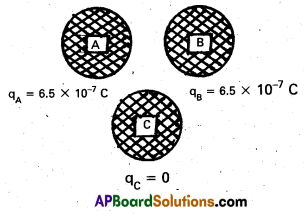
When a whistling train away from rest observer
AP Inter 2nd Year Physics Study Material Chapter 1 Waves 26
v” = \(\left[\frac{v}{v+v_{\mathrm{S}}}\right] v\) —— (2)
Here v’ = 219 Hz; V” = 184 Hz;
v = 340 m/s
\(\frac{(1)}{(2)}\) ⇒ \(\frac{v^{\prime}}{v^{\prime \prime}}\) = \(\frac{\left(v+v_s\right)}{\left(v-v_s\right)}\)
\(\frac{219}{184}\) = \(\frac{340+v_{\mathrm{s}}}{340-v_{\mathrm{s}}}\)
219(340 – υs) = 184(340 + υs)
219 × 340 – 219 υs = 184 × 340 + 184 υs
403 υs = 35 × 340
∴ Velocity of train υs = 29.5 m/s
Frequency of whistle, v = v’ × \(\left[\frac{v-v_{\mathrm{S}}}{v}\right]\)
= 219 × \(\left[\frac{340-29.5}{340}\right]\)
= 199.98
∴ v = 200 Hz.

Question 10.
Two trucks heading in opposite directions with speeds of 60 kmph and 70 kmph respectively, approach each other. The driver of the first truck sounds his horn of frequency 400Hz. What frequency does the driver of the second truck hear ? (Velocity of sound = 330 m/ s). After the two trucks have passed each other, what frequency does the driver of the second truck hear ?
Solution:
vs = 60 kmph = 60 × \(\frac{5}{18}\) m/s = \(\frac{300}{18}\) m/s
v0 = 70 kmph = 70 × \(\frac{5}{18}\) m/s = \(\frac{350}{18}\) m/s
v = 400 Hz
When two trucks approach each other
AP Inter 2nd Year Physics Study Material Chapter 1 Waves 27
When two trucks crossed each other,
AP Inter 2nd Year Physics Study Material Chapter 1 Waves 28

Textual Exercises

Question 1.
A string of mass 2.50 kg is under a tension of 200 N. The length of the stretched string is 20.0 m. If the transverse jerk is caused at one end of the string, how long does the disturbance take to reach the other end ?
Answer:
Here M = 2.50 kg, T = 200 N, l = 20.0M
Mass per unit length; μ = \(\frac{\mathrm{M}}{l}\) = \(\frac{2.5}{20.0}\)
= 0.125 kg/m
Velocity V = \(\sqrt{\frac{\mathrm{T}}{\mu}}=\sqrt{\frac{200}{0.125}}\) = 40 m/s
Time taken by disturbance to reach the other end
t = \(\frac{l}{\mathrm{~V}}\) = \(\frac{20}{40}\) = 0.5s.

AP Inter 2nd Year Physics Study Material Chapter 1 Waves

Question 2.
A stone dropped from the top of a tower of height 300 m high splashes into the pond of water near the base of the tower. When is the splash heard at the top given that the speed of sound in air is 340 m s-1, (g = 9.8m s-2)
Answer:
Here, h = 300m, g = 9.8 m/s2, V = 340 m/s. If t1 = time taken by stone to strike the surface of water in the pond, then from
S = ut + \(\frac{1}{2}\) at2
300 = 0 + \(\frac{1}{2}\) × 9.8 \(\mathrm{t}_1^2\)
t1 = \(\sqrt{\frac{300}{4.9}}\) = 7.82s.
Time taken by sound to reach the top of tower t2 = \(\frac{\mathrm{h}}{\mathrm{v}}\)
= \(\frac{300}{400}\) = 0.88s
Total time after which splash of sound is heard = t1 + t2 = 7.82 + 0.88 = 8.70s

Question 3.
A steel wire has a length of 12.0 m and a mass of 2.10 kg. What should be the tension in the wire so that speed of a transverse wave on the wire equals the speed of sound in dry air at 20° C = 343 m s-1.
Answer:
Here, l = 12.0M, M = 2.10kg, T = ?
V = 343 m/s
Mass per unit length μ = \(\frac{\mathrm{M}}{l}\) = \(\frac{2.10}{12.0}\)
= 0.175 kg/m
As V = \(\sqrt{\frac{\mathrm{T}}{\mu}}\)
T = V2 . μ = (343)2 × 0.175 = 2.06 × 10⁴N.

Question 4.
Use the formula υ = \(\sqrt{\frac{\gamma P}{\rho}}\) to explain why the speed of sound in air
a) is independent of pressure,
b) increases with temperature,
c) increases with humidity.
Answer:
a) Effect of pressure:
The speed of sound in gases, υ = \(\sqrt{\frac{\gamma \mathrm{P}}{\rho}}\)
At constant temperature, PV = constant
P\(\frac{m}{\rho}\) = constant ⇒ \(\frac{\mathrm{P}}{\rho}\) = constant
If P increases, ρ also increases. Hence speed of sound in air is independent of pressure.

b) Effect of temperature:
As PV = nRT, P\(\frac{\mathrm{m}}{\rho}\) = \(\frac{m}{M} R T\)
⇒ \(\frac{P}{\rho}\) = \(\frac{\mathrm{RT}}{\mathrm{M}}\)
∴ υ = \(\sqrt{\frac{R T}{M}}\)
Since R, M are constants υ ∝ \(\sqrt{\mathrm{T}}\)
∴ Velocity of sound in air depends on temperature.

c) Effect of humidity:
As υ = \(\sqrt{\frac{\gamma \mathrm{P}}{\rho}}\) ∴ υ ∝ \(\frac{1}{\sqrt{\rho}}\)
As the density of water vapour is less than density of dry air at STP. So the presence of moisture in air decreases the
density of air. Since the speed of sound is inversely proportional to the square root of density. So sound travels faster in moist air than dry air. Hence velocity of sound
V ∝ humidity

Question 5.
You have learnt that a travelling wave in one dimension is represented by a function y = f(x, t) where x and t must appear in the combination x – υt or x + υt, i.e. y = f(x ± υ t). Is the converse true? Examine if the following functions for y can possibly represent a travelling wave:
Answer:
No, the converse is not true. The basic requirement for a wave function to represent a travelling wave is that for all values of x & t, wave function must have a finite value.

Out of the given functions y, no one satisfies this condition therefore, none can represent a travelling wave.

Question 6.
A bat emits ultrasonic sound a frequency 1000 kHz in air. If the sound meets a water surface, what is the wavelength of
(a) the reflected sound,
(b) the transmitted sound?
Speed of sound in air is 340 m s-1 and in water 1486 m s-1.
Answer:
Here V = 100 KHz = 105Hz, Va = 340m/s, Vw = 1486 m/s-1
Wavelength of reflected sound, λa = \(\frac{\mathrm{V}^{\mathrm{a}}}{\mathrm{V}}\)
= \(\frac{340}{10^5}\) = 3.4 × 10⁻³ m
Wavelength of transmitted sound,
λw = \(\frac{V_w}{V}\) = \(\frac{1486}{10^5}\) = 1.486 × 10⁻² m

AP Inter 2nd Year Physics Study Material Chapter 1 Waves

Question 7.
A hospital uses an ultrasonic scanner to locate tumours in a tissue. What is the wavelength of sound in the tissue in which the speed of sound is 1.7 km s-1? The operating frequency of the scanner is 4.2 MHz.
Answer:
λ = ? υ = 1.7 Km/s = 1700 ms-1
y = 4.2 MHz = 4.2 × 10⁶Hz
λ = \(\frac{v}{v}\) = \(\frac{1700}{4.2 \times 10^6} \mathrm{~m}\) = 0.405 × 10⁻³ m
= 0.405 mm

Question 8.
A transverse harmonic wave on a string is described by y(x, t) = 3.0 sin (36 t + 0.018 x + π/4) where x and y are in cm and t in s. The positive direction of x is from left to right.
a) Is this a travelling wave or a stationary wave?
If it is travelling, what are the speed and direction of its propagation?
b) What are Its amplitude and frequency?
C) What is the initial phase at the origin?
d) What is the least distance between two successive crests in the wave?
Answer:
Compare the given equation with that of plane progressive wave of amplitude r, travelling with a velocity V from right to left.
y(x, t) = rsin\(\left[\frac{2 \pi}{\lambda}(v t+x)+\phi_0\right]\) ……… (1)
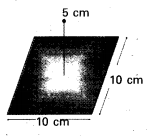
We find that
a) The given equation represents a transvërse harmonic wave travelling from right to left. It is ñot a stationary wave.

b) The given equation can be written as
Y(x, t) = 3.0sin[0.018(\(\frac{36}{0.018}\) + x) + \(\frac{\pi}{4}\)] ……… (2)
equating coefficient of t in the two
(1) & (2) we get. :
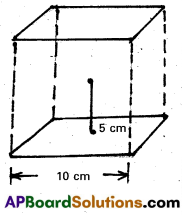
V = \(\frac{.36}{0.018}\) = 2000 cm/sec.
Obviously, r = 3.0 cm
Also, \(\frac{2 \pi}{\lambda}\) = 0.018
λ = \(\frac{2 \pi}{0.018} \mathrm{~cm}\)
Frequency, v = \(\frac{v}{\lambda}\) = \(\frac{2000}{2 \pi}\) × 0.018
= 5.7351.

c) Intial phase, φ0 = \(\frac{\pi}{4}\) radian.

d) Least distance between two successive crests of the wave =
Wave length, λ = \(\frac{2 \pi}{0.018 \mathrm{~cm}}\) = 349 cm,

Question 9.
For the wave described in the last problem plot the displacement (y) versus (t) graphs for x = 0.2 and 4 cm. What are the shapes of these graphs? In which aspects does the oscillatory motion in travelling wave differ from one point to another: amplitude, frequency or phase?
Answer:
The transverse harmonic wave is
y(x,t) = 3.0 sin[36t + 0.018x + \(\frac{\pi}{4}\)]
For x = 0
y(0, t) = 3.0 sin(36t + \(\frac{\pi}{4}\)) —— (i)
Here w = \(\frac{2 \pi}{T}\) = 36, T = \(\frac{2 \pi}{36}\) = \(\frac{\pi}{18}\)-sec.

For different values of t, we calculate y using eq(i). These values are tabulated below.
AP Inter 2nd Year Physics Study Material Chapter 1 Waves 29
On plotting y versus t graph, we obtain a sinusoidal curve as shown in fig.
AP Inter 2nd Year Physics Study Material Chapter 1 Waves 30
Similar graphs are obtained for x = 2cm & x = 4cm. The oscillary motion in travelling wave differs from one point to another only in terms of phase. Amplitude and frequency of oscillatory motion remain the same in all the three areas.

Question 10.
For the travelling harmonic wave
y(x, t) = 2.0 cos 2 π (10t – 0.0080 x + 0.35)
where x and y are in cm and t in s. Calculate the phase difference between oscillatory motion of two points separated by a distance of
a) 4 m,
b) 0.5 m,
c) λ/2,
d) 3λ/4,
Answer:
The given equation be written as
y = 2.0 cos[2π(10t – 0.0080x) + 2π × 0.35]
y = 2.0 cos[2π × (0.0080(\(\frac{10 \mathrm{t}}{0.0080}\) – x) + 0.7π]
Compare it with the standard equation of a travelling harmonic, we have
y = r.cos[\(\frac{2 \pi}{\lambda}(v t-x)+\phi_0\)
We get, \(\frac{2 \pi}{\lambda}\) = 2π × 0.0080
Further we know that phase diff. φ = \(\frac{2 \pi}{\lambda} \mathrm{x}\)
a) When x = 4m = 400 cm
φ = \(\frac{2 \pi}{\lambda}\) . x = 2π × 0.0080 × 400
= 6.4 π rad.

b) When x = 0.5 = 50 cm
φ = \(\frac{2 \pi}{\lambda}\) . x = 2π × 0.0080 × 50
= 0.8π rad.

c) When x = \(\frac{\lambda}{2}\)
φ = \(\frac{2 \pi}{\lambda} \times \frac{\lambda}{2}\) = π rad.

d) When x = \(\frac{3 \lambda}{4}\)
φ = \(\frac{2 \pi}{\lambda} \times \frac{3 \lambda}{4}\) = \(\frac{3 \lambda}{2} \mathrm{rad}\)

Question 11.
The transverse displacement of a string (clamped at its both ends) is given by y(x, t) = 0.06 sin\(\left(\frac{2 \pi}{3} x\right)\)cos (120 πt)
where x and y are in m and t in s. The length of the string is 1.5 m and its mass is 3.0 × 10⁻² kg
Answer the following:
a) Does the function represent a travelling wave or a stationary wave?
b) Interpret the wave as a superposition of two waves travelling in opposite directions. What is the wavelength, frequency, and speed of each wave?
c) Determine the tension in the string.
Answer:
The given equation is
y(x, t) = 0.06 sin \(\frac{2 \pi}{3} \mathrm{x} \cos 120 \pi \mathrm{t}\)

a) As the equation involves harmonic functions of x and t seperately, it represents a stationary wave.

b) We know that when a wave pulse
y1 = r sin \(\frac{2 \pi}{\lambda}(v t+x)\) —– (i)
travelling along + direction of x-axis is super imposed by the reflected wave
y = y1 + y2 = -2rsin\(\frac{2 \pi}{\lambda}\) xcos \(\frac{2 \pi}{\lambda}\) vt is formed. ——- (ii)
Comparing (i) & (ii) we find that
\(\frac{2 \pi}{\lambda}\) = \(\frac{2 \pi}{3}\) ⇒ λ = 3m.
Also \(\frac{2 \pi}{\lambda} v\) = 120π (Or)
V = 60λ = 60 × 3 = 180m/s.
frequency, v = \(\frac{v}{\lambda}\) = \(\frac{180}{3}\) = 60 hertz.
Note that both the waves have same wave length, same frequency and same speed.

c) Velocity of transverse waves is
υ = \(\sqrt{\frac{T}{\mu}}\) (or) υ2 = T/μ
T = V2 × μ where μ = \(\frac{3 \times 10^{-2}}{1.5}\)
= 2 × 10⁻² kg/m
T = (180)2 × 2 × 10-2 = 648 N.

Question 12.
i) For the wave on a string described in previous problem do all the points on the string oscillate with the same (a) frequency, (b) phase, (c) amplitude? Explain your answers.
(ii) What is the amplitude of a point 0.375 m away from one end?
Answer:
i) All the points on the string
a) have the same frequency except at the nodes (where frequency is cos θ),
b) have the same phase every where in one loop except at the nodes,
c) however, the amplitude of vibration at different points is different.

ii) From y(x, t) = 0.06 sin\(\left(\frac{2 \pi}{3} x\right)\) cos (120 πt)
The amplitude at x = 0.375 m is 0.06
sin \(\frac{2 \pi}{3} x \times 1\) = 0.06 × sin \(\frac{2 \pi}{3} \times 0.375\)
= 0.06sin\(\frac{\pi}{4}\) = \(\frac{0.06}{\sqrt{2}}\) = 0.042 M

AP Inter 2nd Year Physics Study Material Chapter 1 Waves

Question 13.
Given below are some functions of x and t to represent the displacement (transverse or longitudinal) of an elastic wave State which of these represent
(i) a travelling wave,
(ii) a stationary wave or
(iii) none at all:
a) y = 2 cos (3x) sin (10t)
b) y = \(2 \sqrt{x-v t}\)
c) y = 3 sin(5x – 0.5t) + 4 cos(5x – 0.5t)
d) y = cos x sin t + cos 2x sin 2t
Answer:
a) It represents a stationary wave as harmonic functions of x & t are contained separetely in the equation.
b) It cannot represent any type of wave.
c) It represents a progressive / travelling harmonic wave.
d) This equation is sum of two functions each representing a stationary wave. Therefore it represents superposition of two stationary waves.

Question 14.
A wire stretched between two right supports vibrates in its fundamental mode with a frequency of 45 Hz. The mass of the wire is 3.5 × 10⁻² kg and its linear mass density is 4.0 × 10⁻² kg m-1. What is (a) the speed of transverse wave on the string, and (b) the tension in the string?
Answer:
Here, v = 45Hz, μ = 3.5 × 10⁻² kg
Mass/length = μ = 4.0 × 10⁻² kg/m
l = \(\frac{\mu}{\mu}\) = \(\frac{3.5 \times 10^{-2}}{4.0 \times 10^{-2}}\) = \(\frac{7}{8}\)
As \(\frac{\lambda}{2}\) = l = \(\frac{7}{8}\) ∴ λ = \(\frac{7}{4}\)m = 1.75m
a) The speed of transverse wave
υ = vλ = 45 × 1.75 = 78.75 m/s.

b) As υ = \(\sqrt{\frac{\mathrm{T}}{\mu}}\)
∴ T = υ2 × μ = (78.75)2 × 4.0 × 10-2
= 248.06 N.

Question 15.
A metre-long tube open at one end, with a movable piston at the other end, shows resonance with a fixed frequency source (a tuning fork of frequency 340 Hz) when the tube length Is 25.5 cm or 79.3 cm. Estimate the speed of sound in air at the temperature of the experiment. The edge effect may be neglected.
Answer:
As there is a piston at one end of the tube, it behaves as a closed organ pipe, which produces odd harmonics only. Therefore the pipe is in resonance with the fundamental note at the third harmonic (79.3 cm is about 3 times 25.5 cm)
In the fundamental note = \(\frac{\lambda}{4}\) = l1 = 25.5
λ = 4 × 25.5 = 102 cm = 1.02m
Speed of sound in air.
υ = vλ = 340 × 1.02
= 346.0 m/s

Question 16.
A steel rod 100 cm long is clamped at its middle. The fundamental frequency of longitudinal vibrations of the rod are given to be 2.53 kHz. What is the speed of sound in steel?
Answer:
Here, l = 100 cm = 1 m, y = 2.53 KHz
= 2.53 × 10³ Hz
When the rod is clamped at the middle, then in the fundamental mode of vibration of the rod, anode is formed at the middle and antinode is formed at each end.
Therefore, it is clear from fig
AP Inter 2nd Year Physics Study Material Chapter 1 Waves 31
l = \(\frac{\lambda}{4}\) + \(\frac{\lambda}{4}\) + \(\frac{\lambda}{2}\)
λ = 2l = 2m
As v = λl
v = 2.53 × 103 × 2
= 5.06 × 10³ ms-1

Question 17.
A pipe 20 cm long is closed at one end. Which harmonic mode of the pipe is resonantly excited by a 430 Hz source? Will the same source be in resonance with the pipe if both ends are open? (speed of sound in air is 340 m s-1).
Answer:
Here l = 20 cm = 0.2m, vn = 430 Hz,
υ = 340 m/s
The frequency of nth normal mode of vibration of closed pipe is
vn = (2n – 1)\(\frac{v}{4l}\)
∴ 430 = (2n – 1)\(\frac{340}{4 \times 0.2}\)
2n – 1 = \(\frac{430 \times 4 \times 0.2}{340}\) = 1.02
2n = 2.02, n = 1.01
Hence it will be the 1st normal mode of vibration. In a pipe, open at both ends we have
vn = n × \(\frac{\mathrm{v}}{2l}\) = \(\frac{\mathrm{n} \times 340}{2 \times 0.2}\) = 430.
∴ n = \(\frac{430 \times 2 \times 0.2}{340}\) = 0.5
As n has to be an integer, therefore open organ pipe cannot be in resonance with the source.

Question 18.
Two sitar strings A and B playing the note ‘Ga’ are slightly out of tune and produce beats of frequency 6 Hz. The tension in the string A is slightly reduced and the beat frequency is found to reduce to 3 Hz. If the original frequency of A is 324Hz. What is the frequency of B?
Answer:
Let original frequency of sitar string A be na & original frequeny of sitar string B be nb.
As number of beats / sec = 6
∴ nb = na ± 6 = 330 (or) 318Hz.
When tension in A is reduced, its frequency reduces (∴ n ∝ \(\sqrt{T}\))
As number of beats/sec decreases to 3 therefore, frequency of B = 324 – 6
= 318Hz.

Question 19.
Explain why (or how):
a) in a sound wave, a displacement node is a pressure antinode and vice versa,
b) bats can ascertain distances, directions, nature and sizes of the obstacles without any ‘eyes”.
c) a violin note and sitar note may have the same frequency, yet we can distinguish between the two notes,
d) Soils can support both longitudinal and transverse waves, but only longitudinal waves can propagate in gases and
e) The shape of a pulse gets distorted during propagation In a dispersive medium.
Answer:
a) Node (N) is a point where the amplitude of oscillation is 0. (and pressure is maximum)
Antinode (A) is a point where the amplitude of oscillation is maximum (and pressure is min).
These nodes & antinodes do not coincide with pressure nodes & antinodes.
Infact, N coincides with pressure antinode and A coincides with pressure node, as is clear from the definitions.

b) Bats emit ultrasonic wave of large frequencies, when these waveš are reflected from the obstacles in their path,
they give them the idea about the distance, direction, size & nature of the obstacle.

c) Though the violin note and sitar note have the same frequency, yet the over tones produced and their reactive strengths are different in the two flotes that is why we can distinguish between the two notes.

d) This is because solids have both, the elasticity of volume and elasticity of shape where as gases have only the volume elasticity.

e) A sound pulse is a combination of waves of different wavelengths. As waves of different wavelengths travel in a disperse medium with different velocities, therefore the shape of the pulse gets distorted.

Question 20.
A train, standing at the outer signal of a railway station blows a whistle of frequency 400 Hz in still air.
i) What is the frequency of the whistle for a platform observer when the train
(a) approaches the platform with a speed of 10ms-1,
(b) recedes from the platform with a speed of 10 m s-1 ?
ii) What is the speed of sound in each case ? The speed of sound in still air can be taken as 340 m s-1.
Answer:
i) Here, y = 400 Hz, υ = 340 m/s
a) Train approaches the platform
υs = 10m/s
v’ = \(\frac{v}{v-v_s}\) = \(\frac{340 \times 400}{340-10}\) = 412.12 Hz.

b) Train recedes from the platform
υs = 10m/s
v’ = \(\frac{v \times v}{v \times v_s}\) = \(\frac{340 \times 400}{340+10}\)
= 388.6Hz

ii) The speed of sound in each case is the same = 340 m/s

AP Inter 2nd Year Physics Study Material Chapter 1 Waves

Question 21.
A train, stañdingin a station-yard, blows a whistle of frequency 400 Hz in still air. The wind starts blowing in the direction from the yard to the station with a speed of 10m s-1. What are the frequency, wavelength and speed of sound for an observer standing on the station’s platform ? Is the situation exactly identical to the case when the air is still and the observer runs towards the yard at a speed of 10 m s-1 ? The speed of sound in still air can be taken as 340 m-1
Answer:
Here y = 400 Hz, υm = 10ms-1, υ = 340m/s
As the wind is blowing in the direction of sound, therefore effective speed of sound
= υ + υm = 340 + 10 = 350m/s
As the source & Iistner both are at rest, therefore, frequency remains unchanged
i.e. v = 400 Hz.
Wavelength, λ = \(\frac{v+v_m}{v}\) = \(\frac{350}{400}\)
= 0.875 M.
When air is still, υm = 0
Speed of observer υ1 = 10m/s υs = 0
As observer moves toward the source
υ’ = \(\frac{\left(v+v_l\right)}{v} \times v\) = \(\frac{(340+10)}{340} \times 400\)
= 411.76 Hz.
As source is at rest, wavelength does not change
i.e, λ’ = λ = 0.875M.
Also, speed of sound = υ + υm = 340 + 0
= 340 m/s
The situations in the two cases are entirely different.

Additional Exercises

Question 1.
A travelling harmonic wave on a string is described by
y(x, t) = 7.5 sin (0.0050x + 12t + π/4)
a) What are the displacement and velocity of oscillation of a point at x = 1 cm, and t = 1 s? Is this velocity equal to the velocity of wave propagation?
b) Locate the points of the string which have the same transverse displacements and velocity as the x = 1cm
point at t = 2 s, 5 s and 11 s.
Answer:
a) The travelling harmonic wave is y(x, t)
AP Inter 2nd Year Physics Study Material Chapter 1 Waves 32
From (1), y(1, 1) = 7.5 sin(732.55°)
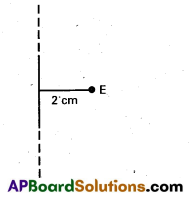
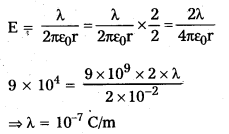
= 7.5 sin (720 + 12.55°)
= 7.5 sin 12.55° = 7.5 × 0.2173 = 1.63 cm
velocity of oscillation, v = \(\frac{d y}{d t} y(1,1)\)
= \(\frac{\mathrm{d}}{\mathrm{dt}}\)[7.5 sin (0.005x + 12t + \(\frac{\pi}{4}\))
= 7.5 × 12 cos (0.005x + 12t + \(\frac{\pi}{4}\))
At x = 1 cm, t = 1 sec
= 7.5 × 12 cos (o.oo5 + 12 + \(\frac{\pi}{4}\))
= 90 cos (732.55°).
= 90 cos(720 + 12.55°)
= 90 cos (12.55°)
= 90 × 0.9765
= 87.89 cm/s.
Comparing the given equation with the standard form
y(x, t) = r sin\(\left[\frac{2 \pi}{\lambda}(v t+x)+\phi_0\right]\)
We get r = 7.5 cm, \(\frac{2 \pi v}{\lambda}\) = 12 (or) 2πV = 12
V = \(\frac{6}{\pi}\)
2\(\frac{\pi}{\lambda}\) = 0.005
∴ λ = \(\frac{2 \pi}{0.005}\) = \(\frac{2 \times 3.14}{0.005}\) = 1256 cm
= 12.56 m.
Velocity of wave propagation, υ = Vλ
= \(\frac{6}{\pi}\) × 12.56 .
= 24 m/s.
We find that velocity at x = 1 cm t = 1 sec is not equal to velocity of wave propagation.

b) Now, all points which are at a distance of ±λ, ± 2λ, ± 3λ from x = 1 cm will have same transverse displacement and velocity. As λ = 12.56 m, therefore, all points at distances ± 12.6m, ± 25.2 m displacement and velocity As λ = 12.56m, therefore all points at distances ± 12.6m, ± 25.2m, ± 37.8m from x = 11m will have same displacement & velocity at x = 1 cm point at t = 25.55 & 115s.

Question 2.
A narrow sound pulse (for example, a short pip by a whistle) is sent across a medium. (a) Does the pulse have a definite (I) frequency, (ii) wavelength, (iii) speed of propagation? (b) If the pulse rate is 1 after every 20 s (that is the whistle blown for a split of second after every 20 s), is the frequency of the note produced by the whistle equal to 1/20 or 0.05 Hz?
Answer:
a) A short pip by a whistle has neither a definite wavelength nor a definite frequency. However its speed of propagation is fixed, being equal to speed of sound in air.

b) No, frequency of the note produced by whistle is not 1/20 = 0.05 Hz. Rather 0.05 Hz is the frequency of repetition of the short pipe of the whistle.

Question 3.
One end of a long string of linear mass density 8.0 × 10⁻³ kg m-1 is connected to an electrically driven tuniúg fork of frequency 256 Hz. The other end passes over a pulley and is tied to a pan containing a mass of 90 kg. The pulley end absorbs all the Incoming energy so that reflected waves at this end have negligible amplitude. At t = 0, the left end (fork end) of the string x = 0 has zero transverse displacement (y = 0) and is moving along positive y-direction. The amplitude of the wave is 5.0 cm. Write down the transverse displacement y as function of x and t that describes the wave on the string.
Answer:
Here, μ = 8.0 × 10⁻³ kg/m, y = 256 Hz, T = 90kg = 90 × 9.8 = 882N.
Amplitude of wave, r = 5.0 1m = 0.05m.
As the wave propagation along the string is a transverse travelling wave, the velocity of the wave is given by
AP Inter 2nd Year Physics Study Material Chapter 1 Waves 33

As the wave is propagating along x direction, the equation of the wave is
y(x, t) = r sin (ωt – kx)
= 0.05 sin (1.61 × 10³t – 4.84x)
Here x, y are in mt & t in sec

AP Inter 2nd Year Physics Study Material Chapter 1 Waves

Question 4.
A SONAR system fixed in a submarine operates at a frequency 40.0 kHz. An enemy submarine moves towards the SONAR with a speed of 360 km h-1. What is the frequency of sound reflected by the submarine ? Take the speed of sound in water to be 1450 m s-1.
Answer:
Here, frequency of SONAR,
v = 40 KHz = 40 × 103 Hz.
Speed of observer / enemy’s submarine
υ1 = 360km/h .
= 360 × \(\frac{5}{18}\)m/s = 100m/s.
Speed of sound wave in water; υ = 1450 m/s.
As the source is at rest & observer is moving towards the source, therefore, apparent frequency received by enemy submarine
v’ = \(\frac{\left(v+v_1\right) v}{v}\)
= \(\frac{(1450+100) 40 \times 10^3 \mathrm{~Hz}}{1450}\)
= 4.27 × 10⁴ Hz.
This frequency is reflected by enemy submarine (source) and is observed by SONAR. Therefore in this case,
υs = 360 km/s = 100 m/s, υ1 = 0
∴ Apparent frequency, v11 = \(\frac{v \times v}{v_i-v_s}\)
= \(\frac{1450 \times 4.276 \times 10^4}{1450-10}\)
= 4.59 × 10⁴ Hz = 45.9 Hz.

Question 5.
Earthquakes generate sound waves inside the earth. Unlike a gas, the earth can experience both transverse (S) and longitudinal (P) sound waves. Typically the speed of S wave is about 4.0 km s-1 and that of P wave is 8.0 km s-1. A seismograph records P and S waves from an earthquake. The first P wave arrives 4 min before the first S wave. Assuming the waves travel in straight line, at what distance does the earthquake occur?
Answer:
Let υ1, υ2 be the velocity of S waves & P waves & t1, t2 be the time taken by these waves to travel to the position of seismograph. If l is the distance of occurrence of earth quake from the seismograph, then
l = υ1t1 = υ2t2 ——- (i)
now υ1 = 4 km/s & υ2 = 8 km/s .
∴ 4t1 = 8t2 (or) t1 = 2t2 ——- (ii)
Also t1 – t2 = 4min = 240s.
using (iii), 2t2 – t2 = 240s, t2 = 240s
t1 = 2t2 = 2 × 240 = 480s.
Now from (i) l = υ1t1 = 4 × 480 = 1920 km.
Hence earthquake occurs 1920 km away from the seismograph.

Question 6.
A bat is flitting about in a cave, navigating via ultrasonic beeps. Assume that the sound emission frequency of the bat is 40 kHz. During one fast swoop directly toward a flat wall surface, the bat is moving at 0.03 times the speed of sound in air. What frequency does the bat hear reflected off the wall?
Answer:
Here, the frequency of sound emitted by the bat, v = 40 kHz.
velocity of bat, υs = 0.03υ, where υ is velocity of sound.
Apparent frequency of sound striking the wall.
v’ = \(\frac{v \times v}{v-v_s}\) = \(\frac{v}{v-0.03 v}\) × 40 kHxz
= \(\frac{40}{0.97}\) kHZ.
This frequency is reflected by the wall & is received by the bat moving towards the wall, So υs = 0.
υ1 = 0.03 υ
v’ = \(\frac{\left(v+v_1\right) v^{\prime}}{v}\) = \(\frac{(v+0.03 v)}{v}\left(\frac{40}{0.97}\right)\)
= \(\frac{1.03}{0.97} \times 40 \mathrm{kHz}\)
= 42.47 kHz

AP Inter 2nd Year Zoology Study Material Chapter 8 Applied Biology

Andhra Pradesh BIEAP AP Inter 2nd Year Zoology Study Material 8th Lesson Applied Biology Textbook Questions and Answers.

AP Inter 2nd Year Zoology Study Material 8th Lesson Applied Biology

Very Short Answer Questions

Question 1.
What are the factors constitute dairying?
Answer:

  1. Selection of good breeds having high yielding potential, combined with disease resistance ones.
  2. Proper housing with adequate water, feed, ventilation suitable temperature, etc.

Question 2.
Mention any two advantages of inbreeding.
Answer:

  1. Inbreeding increases homozygosity. Thus inbreeding is necessary if we want to evolve a pure line animal.
  2. It helps in the accumulation of superior genes and the elimination of less desirable genes.

Question 3.
Distinguish between out-cross and cross-breed.
Answer:
Out cross :
The offspring formed by mating of animals within the same breed, but having no ancestors on either side of pedigree for 4-6 generations.

A single out cross helps to overcome inbreeding depression.

Cross breed :
The offspring formed by a mating between superior males of one breed and superior females another breed.

Cross breed shows desirable qualities of two different breeds to be combined.

Question 4.
Define the terms layer and broiler.
Answer:
Layer :
The birds which are raised exclusively for the production of eggs are called layers.

Boiler :
The birds which are raised only for their meat are called broilers.

Question 5.
What is apiculture?
Answer:
Apiculture is the maintenance of hives of honeybees for the production of honey and wax.

Apiculture is an age-old cottage industry.

AP Inter 2nd Year Zoology Study Material Chapter 8 Applied Biology

Question 6.
Distinguish between a drone and worker in honey bee colony.
Answer:

Dronesworker bees
1) These are fertile males.1) These are sterile female.
2) These are developed from unfertilized ova by male parthenogenesis.2) These are developed from fertilized eggs.
3) These are short lived.3) These live for two and three months.

Question 7.
Define the term Fishery.
Answer:
Fishery is an industry devoted to the catching, processing for storage in freezers and selling of fish, shellfish or any other aquatic animals for human consumption.

Question 8.
Differentiate aquaculture and pisciculture.
Answer:

AquaculturePisciculture
Culturing of fishes and other aquatic organisms under regulated conditions to achieve better production.Culturing of exclusively fin fishes under regulated conditions to achieve better production.

Question 9.
Explain the term hypophysation.
Answer:
Making the fishds to breed artificially to meet the demand of carpseed as called hypophysation.

Question 10.
List out any two Indian carps and two exotic carps.
Answer:
Indian carps :

  1. Catla catla (catla)
  2. Cirrhinus mrigala (mrigal)

Exotic carps :

  1. Grass carp
  2. Silver carp

Question 11.
Mention any four fish by-products.
Answer:

  1. Shark and cod liver oils
  2. Fish guano
  3. Shagreen
  4. Isinglass.

Question 12.
How many aminoacids and polypeptide chains are present in insulin?
Answer:
Human insulin is made up of 51 aminoacids arranged in two polypeptides.
– polypeptide chain A with 21 aminoacids
– Polypeptide chain B with 30 aminoacids.

Which are held together by disulphide linkages.

Question 13.
Define the term vaccine.
Answer:
Vaccine is biological preparation that improves immunity to a particular disease. A vaccine typically contains live attenuated an inactivated disease causing organism. The toxins or one of the surface proteins of pathogens are also used in the preparation of vaccines.

Question 14.
Mention any two features of PCR.
Answer:

  • Very low concentration of bacteria or viruses can be detected by amplification of their nucleic acids by PCR.
  • PCR helps to detect very low amounts of DNA by amplification of the small DNA fragments.

PCR is now routinely used for detection of HIV in suspected cases, detection of mutations and genetic disorders.

Question 15.
What does ADA strand for? Deficiency of ADA causes which disease?
Answer:
ADA stands for adenosine deaminase. Deficiency of adenosine deaminase (ADA) causes severe combined immuno deficiency (SCID).

Question 16.
Define the term transgenic animal.
Answer:
Animals that have their own genome and had their DNA manipulated to possess and express an extra or foreign gene is known as transgenic animals.

Question 17.
What is popularly called “Guardian anger of Cell Genome?
Answer:
The protein p53 is a tumor suppressor protein, which plays an important role with reference to the ”G1 check point”. In the regulation of cell division cycle. It guards the integrity of the DNA. So it is also called guardian angel of cell’s genome.

Question 18.
List out any four features of cancer cells.
Answer:

  • Loss of contact inhibition
  • Reduced intra cellular adhesion
  • Immortalization
  • Loss of anchorage dependence

Question 19.
How do we obtain radiographs?
Answer:
A beam of X-rays is produced by an X-ray generator and is projected on the body parts. X-rays that pass through the body parts are recorded on a photographic film. Photographs developed using X-rays are known as radiographs.

AP Inter 2nd Year Zoology Study Material Chapter 8 Applied Biology

Question 20.
What is tomogram?
Answer:
Tomogram is a recorded image formed by computed tomography which shows the 3-D cross sectional pictures of the part of the body and displays the picture on the screen.

Question 21.
MRI scan is harmless. Justify.
Answer:
MRI does not use ionizing radiation, as involved in X-rays, and is generally safe and harmless procedure.

Question 22.
What is electrocardiography and what are the normal components of ECG?
Answer:
Electrocardiography is a commonly used, non invasive procedure for recording electrical changes in the heart.

Normal components of ECG:
(i) Waves (ii) Intervals (iii) Segments (iv) Complexes.

Question 23.
What does prolonged F-R interval indicate?
Answer:
Prolonged P-R interval indicates delay in conduction of impulses from S-A node to the A-V node.

P-R interval is prolonged in bradycardia.

Question 24.
Differentiate between primary and secondary antibodies.
Answer:

Primary antibodiesSecondary antibodies
1) These antibodies are formed against the specific antigen.1) These antibodies are formed against the foreign primary antibody.
2) These antibodies reacts with the antigens of interest.2) These antibodies react with the primary antibodies.

Question 25.
Which substances in a sample are detected by direct and indirect ELISA respectively.
Answer:

  1. Direct ELISA – used to detect antigens present in the sample.
  2. Indirect ELISA – used to detect antibodies present in the sample.

Short Answer Questions

Question 1.
What are the various methods employed in animal breeding to improve livestock?
Answer:
Animal breeding is the method of mating closely related individuals.
There are broadly two methods in animal breeding. (1) In breeding (2) Out breeding
1) In breeding:
When crossing is done between animals of the same breed it is called in breeding. In breeding is of two types (a) Close breeding (b) Line breeding.
a) Close breeding:
Close breeding is mating between male parent and female offspring and/or female with male offspring.

b) Line breeding :
Line breeding is the selective breeding of animals for a desired feature by mating them within a closely related line. It leads to upgrading of a desired commercial character.

2) Out breeding:
Out breeding is the breeding of the unrelated animals. Out breeding is of three types (a) Out-crossing (b) Cross-breeding (c) Interspecific hybridisation.

a) Out-crossing :
Mating of animals within the same breed, but having no common ancestors on either side of pedigree for 4-6 generations. The off spring of such mating is known as an out-cross.

b) Cross-breeding :
In this method, superior males of one breed are mated with superior females of another breed. The offspring of such a mating is said to be a cross breed.

c) Interspecific hybridisation :
In this method, male and female animals of two different related species are mated. The progeny may combine desirable features of both the parents and is different from both the parents.

Question 2.
Define the term breed. What are the objectives of animal breeding ?
Answr:
Breed:
A breed is a group of animals related by descent and similar in most characters such as general appearance, size, configuration and features with other members of the same species.

Jersery and Brown Swiss are example of foreign breeds of cattle. These two varieties of cattle have the ability to produce abundant quantities of milk. This milk is very nutritious with high protein content.

Objects of animal breeding :

  1. To produce disease resistant animals.
  2. Increase in the quality and quantity of milk, meat, wool etc.,
  3. Fast growth rate.
  4. Enhanced productive life by improving the genetic merit of livestock.
  5. Early maturity
  6. Economy of feed

Question 3.
Explain the role of animal husbandry in human welfare.
Answer:
Animal husbandary deals with the scientific management of livestock. It includes various aspects such as feeding, breeding and control diseases to raise the population of livestock. Animal husbandary usually includes buffaloes, cows, pigs, horses, cattle, sheep, camels, goats, poultry, fish etc which are useful for humans in various ways.

These animals are managed for production of commercially important products such as milk, meat, wool, egg, honey, silk etc. The increase in human population has increased the demand of these products. Hence it is necessary to improve the management of livestock scientifically. ,

Question 4.
List out the various steps involved in MOET.
Answer:
The following are the steps involved in Multiple Ovulation and Embryo Transfer /MOET):

  • A cow is administrated hormones, with FSH like activity.
  • This induces follicular maturation and super ovulation.
  • In Super ovulation instead of one egg, which they produce per cycle, they produce 6 – 8 eggs.
  • The cow is either mated with elite bull or artificially inseminated.
  • The embryos are at 8-32 called stages are recovered non-aurgically and transferred to surrogate mother, when the embryo develops into complete animal.

Now the genetic mother is ready for another round of super ovulation. This technology is in use for cattle, sheep, rabbits, buffaloes etc. to produce high yielding ones.

Question 5.
Write short notes on controlled breeding experiments.
Answer:
Controlled breeding experiments are carried out using artificial insemination and multiple ovulation and embryo transfer technology.

  • In this technique the semen is collected from superior bulls. This semen can be used immediately or can be frozen and used later period. It can be transported in a frozen form to place where a female is housed.
  • Meanwhile a cow or animal is administered hormones, with FSH like activity.
  • These hormones induces follicular maturation and super ovulation.
  • Now the cow is artificially inseminated for fertilisation.
  • The embryos are at 8-32 celled stages are recovered non-surgically and transferred to surrogate mother uterus for further development.

This technology is use for cattle, sheep, rabbits, buffaloes etc. By using this method we can produce high milk and meat yielding animals and also control the venereal diseases.

AP Inter 2nd Year Zoology Study Material Chapter 8 Applied Biology

Question 6.
Explain the important components of poultry management.
Answer:
Important components of poultry management:

Selection of disease free and suitable breeds:
The selected’breeds should be disease free and get acclimatised to a wide range of climatic conditions. Eg: In India Hybrid layers-BV 300, Hyline, Poona – Pearls etc., Broiler strains – Hubbard, Vencobb etc.

Feed management:
Balanced diet is must to maximise the yield. Brooder, chick mash, grower mash, prelayer mash and layer mash are fed to layers at different stages. Likewise pre starter mash, starter mash and finish mash are the feed given to broilers. Safewater should be supplied through waterers at all times.

Health care :
Vaccination against viral diseases and using antibodies for both bacterial and fungal diseases.

In addition to the above hygiene, proper and safe farm conditions ensure better produce.

Question 7.
Discuss in brief about ‘AvianFlu’.
Answer:
AvianFlu or birdFlu is an important disease affecting poultry birds and man.

Causative organism :
AvianFlu or birdFlu is caused by an “avianFlu virus” the H5NI. The virus that causes the bird infection infects humans too. It is a pandemic disease.

Mode of infection:
Infection may be spread simply by touching contaminated surfaces. Birds infected by this type of influenza, continue to release the virus as in their faeces and saliva for as long as 10 days.

Symptoms:
In humans it causes typical-flu-like symptoms, include cough, diarrhoea difficulty in breathing, fever, headache, malaise, muscle aches and sore throat.

Prevention :

  • Avoiding consumption of under cooked chicken.
  • People who work for poultry birds should use protective clothing and special breathing masks.
  • Complete culling of infected flock by burying or burning them.

Question 8.
Explain in brief about queen bee.
Answer:

  • Queen bee is the largest individual in the colony.
  • It is a fertile diploid female, one per bee hive and the egg layer of the colony.
  • She lives for about five years and her only function is to lay eggs.
  • The queen bee during its nuptial flight receives sperms from a drone and stores in the spermathecae and lays two types of eggs, the fertilised and unfertilised.
  • All fertilised eggs develop into females.
  • All the larvae developing from the fertilised eggs are fed with the royal jelly for first four days only. Afterwards royal jelly is fed only to the bee that is bound to develop into next queen, whereas the other larvae fed on bee bread become workers.

Question 9.
Honey bees are economically important – justify.
Answer:

  • Honeybees are economically important insects in the world. Because honeybee products like Honey, wax, propolis and beevenom have more economic importance.
  • Honey – It is a rich source of fructose, glucose, water minerals and vitamins.
  • Bee’s wax – It is used in the preparation of cosmetics, polishes of various kinds and candles.
  • Propolis – Propolis is used in the treatment of inflammation and superficial bums.
  • Bee’s Venom – Which extracted .from the string of worker bees is used in the treatment of rheumatoid arthritis.
  • Pollination – Bees are the pollinators of our crop plants such as sunflower, Brassica, Apple and Pear.

Question 10.
What are the various factors required for Bee keeping?
Answer:
Bee keeping or apiculture is the maintenance of hives of honeybees for the production of honey and wax.

Factors required for successful Bee keeping :

  1. Knowledge of nature and habits of honeybees.
  2. Selection of suitable location for keeping the beehives. ‘
  3. Raising a hive with the help of a queen and small group of worker bees.
  4. Management of beehives during different seasons.
  5. Knowledge of handling procedures and collection of honey and bee wax.

Question 11.
Fisheries have carved a niche in Indian economy. Explain.
Answer:
Fisheries have carved a niche in Indian economy, as fisheries have more economic importance.

As food :
Fish meat, in general is a good source of proteins, vitamins, minerals and rich in iodine. Tunas, shrimps and crabs are not only edible but also have export value.

Byproducts :

  1. Shark and Cod liver oils – are good source of vitamins A and D.
    Oils from Sardine and Salmon- are good source of Omega 3 – fatty acids.
  2. Fish guano from Scarp fish – used as fertilizer.
  3. Shagree and I$inglass – used in clarification of wines.

Question 12.
Explain in brief structure of Insulin.
Answer:
AP Inter 2nd Year Zoology Study Material Chapter 8 Applied Biology 1
Insulin is a poly peptide hormone produced by the β – cells of islets of langerhans of pancreas. It is the first protein produced by recombinant DNA technology.

Structure of Insulin :
Human insulin is made up of 51 aminoacids arranged in two polypeptide chains. The chain A has 21 aminoacids while chain B has 30 aminoacids. Both are held together by two interchain disulfide bridges, connecting A7 to B7 arid A20 to B19. In addition, there is an intrachain disulfide link in chain A between the aminoacids 6 and 11.

In mammals, including humans, insulin is synthesized as a pro-hormone, which contains an extra stretch called the ‘c’ peptide. This ‘c’ peptide is not present in the mature insulin and is removed during maturation into insulin. .

Question 13.
Define Vaccine and discuss about types of Vaccines.
Answer:
A Vaccine is a biological preparation that improves immunity to a particular diseases. A Vaccine typically contains inactive or attenuated disease causing microorganisms. The toxin or one of the surface proteins of the microorganisms are also used in preparing vaccines.

Types of Vaccines :
1) Attenuated whole agent vaccines :
They contain disabled line microorganisms. Mostly they are antiviral. Eg: Vaccines against Yellow fever, measles, rubella and mumps and the bacterial disease such as typhoid.

2) Inactivated whole agent vaccines :
They contain killed microbes. Eg : Vaccines against influenza, cholera, hepatitis A, rabies etc.

3) Toxoids:
They contain toxoids which are inactivated exotoxins of certain microbes.
Eg : The vaccines against diphtheria and tetanus.

Question 14.
Write in brief the types of gene therapy. .
Answer:
Gene therapy is the insertion of genes into an individual’s cells and tissues to treat a
There are two approaches to achieve gene therapy :

  1. Somatic line therapy
  2. Germ line gene therapy

1) Somatic line therapy:
In this type of therapy, functional genes are introduced into somatic cells of a patient. The approach is to correct a disease phenotype by treating defect in somatic cells in the affected person. The changes effected in this type of gene therapy are nonfinheritable.
Somatic line therapy is of two types :
a) Ex-vivo gene therapy:
In which the cell are collected from patient, modified outside the body and then transplanted back Eg: SCID.

b) In-vivo gene therapy :
In this therapy, the genes are changed in cells, while they are still inside the body Eg : Cystic fibrosis.’

2) Germ line gene therapy:
In this type of therapy, functional genes are introduced into sperms or ova and are thus integrated into their genomes. Therefore the changes or modifications become heritable. Due to various technical and ethical reasons, the germ line gene therapy remained at infant stage.

Question 15.
List out any four salient features of cancer cells.
Answer:
Salient features of Cancer cells :
Loss of contact inhibition :
Normal cells in a culture stop growing when their plasma membranes come into contact with one another. This inhibition of growth after contact is called contact inhibition. Cancer cells lose this property.

Reduced intracellular adhesion :
When normal cells growing in medium, the cells are joined by intracellular adhesion proteins called cadherins. They are missing in Cancer cells.

Immortalisation :
Normal cell culture does not survive indefinitely. They undergo apoptosis. Where as Cancer cells do not undergo apoptosis.

Loss of anchorage dependence :
Most normal cells must be attached to a rigid substratum in order to grow Cancer cells can grow even when they are not attached to the substratum.

Increased growth of blood vessels :
When tumors grow in size diffusion of oxygen and nutrients become restricted and so tumors resort to attracting more blood vessels from their surrounding matrix.

AP Inter 2nd Year Zoology Study Material Chapter 8 Applied Biology

Question 16.
Explain the different types of cancers.
Answer:
Based on the origin Cancers are classified into :
1) Carcinomas :
These are malignant tumor of epithelial cells. They are originating from the epithelial tissues of skin, lining of the respiratory, digestive, urinary and genejal systems or cells from various glands breast and nervous tissue etc. 85% of Cancers are Carcinomas.

2) Sarcomas :
These are malignant tumors of connective tissues or organs that originate from mesoderm. About 2% of tumors are Sarcomas.

3) Leukemias :
These are malignant tumors of stem ceils of hematopoietic tissues, resulting in unrestrained production of WBC. They are liquid tumors. About 4% of Cancers are Leukemias.

4) Lymphomas :
These are malignant tumors of secondary lymphoid organs like spleen, and lymphnodes. About 4% of Cancers are Lymphomas.

Question 17.
Write about the procedure involved in MRI. X jmsin
Answer:
MRI Scan is a diagnostic radiology technique that uses magnetism, radiowaves and a computer to produce images of body components.

Procedure :
MRI Scanner is giant circular magnetic tube.

  • The patient is placed on a movable bed that is inserted into the magnet.
  • Human body is mainly composed of water which contains two protons.
  • The magnet creates a strong magnetic field that makes these proton align with the direction of the magnetic field.
  • A second radiofrequency electromagnetic field is then turned on for a brief period. The protons absorb some energy from these radio waves.
  • When this second radio frequency emitting field is turned off, the protons release energy at a radio frequency which can be detected by the MRI scanner.
  • Different types of tissues emit different quanta of energy. Abnormal tissues such as tumors can be detected because the protons in different types of tissues return to their equilibrium state at different rates.
  • Tissues of bone with less water content look different in MRI, and pathological tissues also can be detected.

The information received is processed by computer and generated an image.

Question 18.
Write briefly about different waves and intervals in an ECG. X
Answer:
ECG (electrocardiography) is commonly used, non-invasive procedure fro recording electrical changes in the heart.

The graphic record which is called an electrocardiogram, shows the series of waves that occur during each cardiac cycle.

The normal ECG consists of (i) Waves (ii) Intervals (iii) Segments (iv) Complexes.

i) Waves :

  • The waves in a normal record are named P, Q, R, S and T in that order.
  • A typical ECG tracing of a normal heartbeat consists of (I) a ’P’ wove (II) a ‘QRS complex of waves’ (III) a T Wave.
  • P wave: It represents the atrial systole and shows that the impulse is passing through atria. The duration of P. Wave is 0.1 sec.
  • QRS complex of wave : It represents ventricular systole. Q wave is small negative., R-wave is tall positive and S wave is a negative wave. Its duration is 0.08 to 0.1 sec.
  • T wave: It represents the ventricular repolarization. It is a positive wave,’its duration is 0.2 sec.

ii) Intervals:
P-R intervals :
P-R intervals is the interval between the onset of p wave and the onset of Q wave. P-R interval is normally. 0.12 – 02 sec.

Q-T intervals :
The interval between the onset of Q wave and the end of the T-wave. It represents the electrical activity in muscle of the ventricles. It lasts for about 0.4 seconds.

R-R intervals:
It signifies the duration of one cardiac cycle and lasts for about 0.8 sec

Segments :
S-T segment is the time period between the end of the ‘S’ wave and the onset of the T-wave. It is an isoelectric or zero voltage period.

Question 19.
Discuss briefly the process of indirect ELISA.
Answer:
Enzyme linked immunosorbent assay is a tool of clinical immunology to detect, antigens or antibodies in a given sample. ELISA is of two types (1) Direct ELISA (2) Indirect EUSA.

Indirect ELISA:
It is used to detect antibodies present in the serum of the patient or given sample.

Protocol

  • A known antigen is added to the well, which absorbed on the surface of well.
  • Patients antiserum is added to AG coated well.
  • Allowed to react antibodies present in the serum with the antigen, coated on the surface of the well.
  • Washed the well to remove the any unbound free antibodies present in the well.
  • Enzyme linked antihuman serum globulins are added. They bind to the antibody which is already bound to the antigen.
  • Washed it to remove excess antibodies present m the well.
  • Enzyme substrate is added and the reaction produces a visible colour change which can be measured by a spectro photometer.

If there are no antibodies (i.e., anti HIV antibodyies in the serum sample, there is no binding of primary antibodies to the antigens and so enzyme linked secondary antibodies do not bind to the primary antibodies. There cannot be any enzymatic reaction and so no colour change is observed the test is said to be negative.

Question 20.
Write short note on EEG.
Answer:
Electro encephalography is the process of recording the electrical activity of the brain with help of an EEG machine and some electrodes placed all over the scalp.

The waves recorded by an EEG consist of synchronized waves which are common in normal healthy people and, in certain neurological conditions the waves are desynchronized. The wave pattern can be broadly classified into alpha, beta, delta and theta wave pattern.

Alpha waves :
They are rhythmical 8-13 cycleslsec. This type of Wave pattern is seen in persons who are drowsy or sleepy with closed eyes.

Beta waves:
These waves occur at a high frequency of 13-40 cycleslsec their amplitude is low. There are desynchronized waves recorded in person who are mentally very active and tense.

Delta waves :
Their frequency is quite low i.e., less than 3 cycleslsec. They have high amplitude. They are common in early childhood in awaken condition. In adults, they occur in deep sleep, epilepsy, mental depression etc. .

Theta waves:
Their frequency is between 4 and 7 cycleslsec. These waves are common in children of less than 5 years of age and emotional stress in adults.

Uses :

  • EEG is useful tool in diagnosing neurological apd sleep disorders.
  • The diagnostic application of EEG is the diagnosis of epilepsy.
  • EEG is also useful in the diagnosis of coma and brain death.

Long Answer Questions

Question 1.
Write in detail about outbreeding.
Answer:
Out breeding is the breeding of the unrelated animals, it is the cross between different breeds.
Out breeding is of three types

  1. Out crossing
  2. Cross breeding
  3. Inter specific hybridisation.

1) Out crossing :
It is the practice of mating of animals with in the same breed, but having no common ancestors on either side of the pedigree for 4-6 generations. The offspring of such a mating is known as an outcroas. It is the best breading method for animals that are below average in milk production, growth rate etc.

2) Cross breeding :
In this method, superior males of one breed are mated with superior females of another breed. The offspring of such a mating is said to be a cross breed. Cross breeding allows the desirable qualities of two different breeds to be combined. The progeny is not only used for commercial production but also inbreeding and selection to develop stable breeds which may be superior to existing breeds.
Eg : Hisardale is a new breed of sheep developed by crossing Bikaneri ewes and Marino rams. ‘ . .
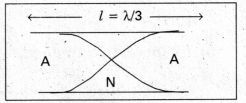
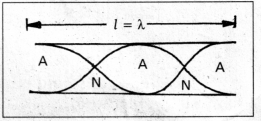
3) Inter specific hybridisation :
In this method, male and female animals of two different related species are mated. The progeny may combine desirable features of both the parents and is different from both the parents.
Eg: 1) When a male donkey is crossed with a female horse, it leads to the production of “mule” (sterile/
2) When a male horse is crossed with a female donkey “hinny” (sterile) is produced. Mules have considerable economic value.

AP Inter 2nd Year Zoology Study Material Chapter 8 Applied Biology

Question 2.
Explain in detail clinical inferences from ECG. –
Answer:
ECG is commonly used, non-invassive procedure for recording electrical changes in the heart The graphic record is called an electrocardiogram, shows the series of waves that occur during each cardiac cycle.

Normal ECG consist of waves, intervals, segments and complexes.

Waves :
A typical ECG tracing normal heart beat consist of a ‘P’ wave a QRS complex of waves, a T wave.

P wave :
It represents the atrial systole and shows that the impulse is passing through atria. The duration of P wave is 0./ sec.

QRS complex of wave:
It represents ventricular systole Q wave is small negative, R-Wave is tall positive and S-yvave is a negative wave. It’s donation is 0.08 to 0.1 sec.

T wave :
It represents the ventricular repolarization. It is a positive wave, its duration is 0.2 sec.

Intervals:
P – R intervals :
It is the interval between 9nset of P wave and onset of Q wave. P-R interval is normally 0.12-0.2 sec.

Q – T intervals :
The interval between the onset of Q wave and the end of the • T-wave. It represents the electrical activity in muscle of the ventricles. It lasts for about 0.4 sec.

R – R intervals :
It signifies the duration of one cardiac cycle and lasts for about 0.8 sec . .
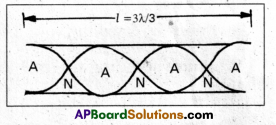
Segments :
S-T segment is the time-period between the end of the ‘S’ wave and the onset of the T-wave. it is an isoelectric or zero voltage period.

Clinical inferences from ECG :

  1. Enlarged P wave – indicates enlarged atria
  2. Variation in the duration, amplitude and morphology of the QRS complex – indicates disorders such as block of conduction of impulses through the branches of the bundle of His.
  3. Prolonged P-R interval duration – indicates delay in conduction of impulses from S-A node to the A – V node.
    P-R interval is prolonged in bradycardia and shortened in tachycardia.
  4. Prolonged Q-T interval – indicates myocardial infraction and hypothyroidism.
  5. Shortened Q.T interval – indicates hyper calcemio.
  6. Elevated S – T segment – indicates myocardial infarction.
  7. Tall T wave – indicates hyperkalemia.
  8. Small, flat or inverted T wave – indicates hypokalemia.

AP Inter 2nd Year Zoology Study Material Chapter 6 Genetics

Andhra Pradesh BIEAP AP Inter 2nd Year Zoology Study Material 6th Lesson Genetics Textbook Questions and Answers.

AP Inter 2nd Year Zoology Study Material 6th Lesson Genetics

Very Short Answer Questions

Question 1.
What is Pleiotropy?
Answer:
The ability of a gene to have multiple phenotypic effects because it influences a number of characters simultaneously is known as Pleiotropy.
Eg: Phenylketonuria.

Question 2.
What are the antigens causing ‘ABO’ blood grouping? Where are they present?
Answer:
Isoagglutinogen A (antigen A) and Isoagglutinogen B (antigen B) are the antigens responsible for ABO blood grouping. These antigens are present on the surface of red blood cells.

Question 3.
What are the antibodies of ABO blood grouping? Where are they present?
Answer:
Isoagglutinin A (anti A) and Isoagglutinin B (anti B) are the antibodies of ABO blood grouping. These antibodies are present in the blood plasma.

Question 4.
What are multiple alleles?
Answer:
If a gene has more than two alleles then they are said to be multiple alleles.
Eg : In humans ABO blood groups are the best example for multiple allelism.

AP Inter 2nd Year Zoology Study Material Chapter 6 Genetics

Question 5.
What is erythroblastosis foetalis?
Answer:
Erythroblastosis foetalsis is an alloimmune condition that develops in an Rh positive foetus whose father is Rh positive and mother is Rh negative.

In this disorder the antibodies developed against the Rh antigen in mother, cross, placenta and destroy the RBC cells of the Rh+ve foetus during second pregnancy.

Question 6.
A child has blood group ‘O’. If the father has blood group A and mother blood group B, work out the genotypes of the parents and possible genotypes of the other off spring.
Answer:
Child blood group is ‘O’, and ‘O’ has the genotype I°I°. Hence, if father has blood group A and mother has blood group B, then the possible genotype of the parents will be IAI° and IBI° respectively.
AP Inter 2nd Year Zoology Study Material Chapter 6 Genetics 1

Genotypes of the off springs
IAIB – AB blood group
IAI° – A blood group
IBI° – B blood group
I°I° – O blood group

Question 7.
What is the genetic basis of blood types in ABO system in man?
Answer:
Three alleles of gene I are responsible for ABO blood grouping. They are IA, IB and I°.
IAIA / IAI° – for A blood group
IBIB / IB I° – for B blood group
IAIB – for AB blood group
I° I° – for O blood group

Question 8.
What is polygenic inheritance?
Answer:
Polygenic inheritance is a cumulative effect of two or more genes on a single phenotypic character. Eg: Skin colour in humans.

Question 9.
Compare the importance of Y-chromosome in human being and Drosophila.
Answer:
In human beings Y-chromosomes are responsible for the development of maleness.

In Drosophila Y-chromosome, lacks male determing factors, but contains only genetic information essential to male fertility.

Question 10.
Distinguish between heterogametic and homogametic sex determination systems.
Answer:

HeterogameticHomogametic
1. It is the condition in which two types of gametes are formed.
Eg: XY-in humans.
1. It is the condition, in which similar type of gametes are formed.
Eg: XX in females.
2. They play a very important role in deciding the sex of the off spring2. It self, it can’t decide the sex of the progeny.

Question 11.
What is haplo-diploidy?
Answer:
It is a mechanism of sex determination. In this system the sex of the offspring is determined by the number of sets of chromosomes. Eg : Honeybees.

In honeybees fertilised eggs developed into female and unfertilised eggs developed into male. This means male have half the number of chromosomes ie., haploid and the females have double the number i.e., diploid hence the name haplo.-diploidy.

Question 12.
What are barr bodies?
Answer:
Barr bodies are condensed heterochromatin in one of the ‘X’ chromosome found in the somatic cells of diploid females. These were observed by Murray. L.Barr in female cats and Moor? and Barr in female human beings.

AP Inter 2nd Year Zoology Study Material Chapter 6 Genetics

Question 13.
What is Klinefelter’s syndrome?
Answer:
Klinefelter’s syndrome is caused by trisome in 23rd pair. A klinefelter’s male possesses an additional X chromosome along with the normal XY (i.e.,47 chromosomes).

Symptoms :
Hypogonadism, sterility, enlargement of breast, high pitched voice etc., Somatic cells of Klinefelter male exhibits barr bodies in their nuclei.

Question 14.
What is Turner’s syndrome?
Answer:
It is an allosomal disorder. The Karyotype is 45, it is due to monosomy in 23rd pair. These females have 42 autosomes and one X-chromosome.

Symptoms:
Short structure, gonadal dysgenesis, webbed neck, broad shield like chest and widely spaced nipples etc. Turners female does not show barr bodies.

Question 15.
What is Down syndrome?
Answer:
Down Syndrome is a genetic condition that causes delay in physical and intellectual development. The cause of this genetic disorder is the presence of an additional copy of the chromosome numbered 21.

Symptoms :
The affected individual is short, with small round head, furrowed tongue and partially open mouth. Physical and mental development is retarded.

Question 16.
What is Lyonisation?
Answer:
Lyonisation is a process by which one of two copies of X-ehromosome present in the body cells of female mammals is inactivated. The inactive X-chromosome is transcriptionally inactive called heterochromatic body.

Question 17.
What is sex-linked inheritance?
Answer:
The inheritance of a trait that is determined by a gene located on one of the sex chromosome is called sex linked inheritance.
Eg: Colour blindness, Haemophilia etc.

Question 18.
Define hemizygous condition?
Answer:
The condition in which thd genes are present on non-homologous portion of either X- chromosome (or) Y-chromosomes. For these genes, related alleles are absent on corresponding paired chromosomes.
Eg : X-linked genes and Y-linked genes in males.

Question 19.
What is crisscross inheritance?
Answer:
Crisscross inheritance is also called as skip generation inheritance. The X-linked recessive characters do not occur in one generation. They skip it off’in that generation and are expressed in the next generation. Eg: X-linked recessive characters – Colour blindness.

Colour blindness is transmitted from grandfather to his grandson through a carrier daughter.

AP Inter 2nd Year Zoology Study Material Chapter 6 Genetics

Question 20.
Why are sex – linked recessive characters more in male human beings?
Answer:
Sex linked recessive characters are more in males because these genes located in the X-chromosome. Male possess only one X-chromosome and female possess two ‘X’ chromosomes. So male needs only one copy of the mutant allele to express the phenotype.

Question 21.
Why are sex – linked dominant characters more in female human beings?
Answer:
In sex-linked dominant inheritance, the gene responsible for genetic disorder is located on the X-chromosome, and only one copy of the allele is sufficient to cause the disorder. Females are more likely to be affected by sex-linked dominant characters as the females have 2X-chromosomes, they have double chance to inherit the character.

Question 22.
What are sex limited characters?
Answer:
The genes for sex limited characters are autosomal genes present in both males and- females. Their phenotypic expression is limited to only one sex due to internal hormonal. environment. Eg: Development of breast in women, beard in man.

Question 23.
What are sex influenced characters?
Answer:
The genes for sex influenced characters are autosomal genes present in both males and females. In sex influenced inheritance, the genes’ behave differently in the two sexes. Probably because sex hormones,provide different cellular environment in males and females. Thus heterozygous phenotype may exhibit one phenotype in males and the contrasing one in females. E.g.: Baldness in humans.

Question 24.
How many base pairs are observed in human genome? What is the average number of base pairs in a human gene?
Answer:

  1. 3164.7 million nucleotide base pairs were observed in a human genome.
  2. The average number of base pairs in human gene is 3000.

Question 25.
What is junk DNA?
Answer:
The entire DNAin the nucleus does not code for proteins. Some DNA codes for specific proteins and Some DNA involve in the regulation of expression of genes, codes for proteins. The remaining non-functional DNA is called junk DNA.

Question 26.
What are VNTRs?
Answer:
These are repetitive DNA composed of a number of copies of short sequence. The VNTR of two persons generally shows variations, they differ in the number of tandem repeats or the sequence of bases. They are useful as genetic markers.

AP Inter 2nd Year Zoology Study Material Chapter 6 Genetics

Question 27.
List out any two applications.of DNA fingerprinting technology.
Answer:

  1. Medico-legal cases – Establishing paternity and (or) maternity more accurately.
  2. Forensic analysis – Positive identification of a suspect in a crime.

Short Answer Questions

Question 1.
Briefly mention the contribution of T.H. Morgan to genetics.
Answer:
1) T.H. Morgan worked on Drosophila melanogaster for experimental verification of the chromosomal theory of inheritance to discover the basis for the variatiori that sexual reproduction produced.

2) He also Carried out dihybrid crosses in Drosophila to study the independent inheritance of two pairs of characters. He formulated the chromosomal theory of linkage. He defined linkage as co-existence of two or more genes in the same chromosome. His experiments have also proved that tightly linked genes show very low recombination while loosely linked genes show higher recombination.

3) T.H. Morgan worked on Drosophila melanogaster to analyse the behaviour of the two alleles of a fruit fly’s eye – colour gene and he discovered sex lihked inheritance.

4) Morgan discovery that transmission of X-chromosome in Drosophila correlates with the inheritance of an eye colour trait was the first solid evidence indicating that a specific gene is associated with a specific chromosome.

Question 2.
What is pedigree analysis? Suggest how such an analysis, can be useful?
Answer:
Pedigree analysis is a record of inheritance of certain traits over two or more ancestral generations of a person in the form of a diagram of family tree.

Uses:
→ Pedigree analysis is useful to study the inheritance of a specific trait, abnormality or disease etc.,
→ It also helps to work out the possible genotypes from the knowledge of the respective phenotypes.
→ It is useful to study the pattern of inheritance of a dominant or a recessive trait.
→ The possible genetic make up of a person for a trait can also be known with the help of pedigree chart.

Genetic counselors use pedigree chart for analysis of various traits and diseases in family and predict their inheritance patterns. It is useful in preventing hemophilia, sickle cell anemia and other genetic disorders in the future generations.

Question 3.
How is sex determined in human beings?
Answer:
The sex determination in humans is XX-XY type. In human beings both females and males have same number of chromosomes i.e., 23 pairs. Out of 23 pairs, 22 pairs are exactly same in males and females. These are called autosomes. In addition to these (autosomes) female possesses two ‘X’ chromosomes while male possess one ‘X’ and one ‘Y’ chromosome. During spermatogenesis among males, two types of gametes are produced. 50% of the total sperm produced carry the X-chromosome and the rest 50% has Y-chromosomes besides the autosomes. Females however, produce only one type of ovum with an X’ chromosome.

There is equal probability of fertilisation of ovum with sperm carrying either X or Y chromosome. In case the ovum is fertilised with sperm carrying X-chromosome, the zygote develops into a female and the fertilisation of ovum with Y-chromosome carrying sperm results into male offspring. Thus, the sex of the child depends on the type of sperm involved in the fertilisation.

Question 4.
Describe erythroblastosis foetalis.
Answer:
Erythroblastosis foetalis develops in an Rh positive foetus, whose father is Rh positive and mother is Rh negative. In Rh positive person rhesus antigens are present on the surface of blood cells where as in Rh negative person Rhesus antigens are absent.

During the process of delivery, the foetal blood cells may pass through the ruptured placenta into the Rh negative maternal blood. The mother’s, immune system recognises the Rh antigens and gets sensitized and produces Rh antibodies. These antibodies are Ig G type they can pass through placenta. Generally first child is not effected because child is delivered by the time of the mother gets sensitized and produce antibodies.

During second pregnancy, if the second child is Rh positive, these antibodies cross the placenta, enter the foetal blood circulation and destroy the Rh positive blood cell of foetus (haemolysis), leads to haemolytic anemia and jaundice. To compensate the haemolysis of blood cells there is a.rapid production of RBC’s from the bone marrow, and but also from liver and spleen. Now many large and immature blood cells in erythrobtast stage are released into circulation. Because of this disease is called erythroblastosis foetalis.

AP Inter 2nd Year Zoology Study Material Chapter 6 Genetics

Question 5.
Mention any two autosomal genetic disorders with their symptoms.
Answer:
1) Sickle-cell anaemia :
It is an autosomal recessive genetic disorder, characterised * by rigid, sickle-shaped red blood cells in hypoxia conditions.

Sickle cell anaemia is due to point mutation in the DNA that codes for p – globin polypeptide chain of haemoglobin molecule, causing the replacement of the glutamic acid in the sixth position by valine.

Symptoms:
The sickled erythrocytes are fragile and their continuous breakdown leads to anaemia called sickle-cell anaemia.

The sickled cells block the capillaries resulting in poor blood supply to tissue. This leads to physical weakness, pain, organ danjage and even paralysis.

2) Phenylketonuria :
It is an autosomal recessive, metabolic genetic disorder caused by a mutation in a gene code for phenylalanine hydroxylase, located in chromosome 12 The affected individual lacks the phenylalanine hydroxylase enzyme, that converts the aminoacid phenylalanine into tyrosine, results in accumulation of phenylalanine in tissues later it is converted to phenylpyruvate and their derivatives. All these metabolities are excreted in urine.

Symptoms :
Accumulation of these substances in the brain causes mental retardation, failure to walk or talk, failure of growth etc.

Question 6.
Describe the genetic basis of ABO blood grouping.
Answer:
Bernstein proposed the genetic basis of ABO blood grouping. The genetic basis of ABO blood grouping is mainly dependent on the three alleles IA, IB and I° of the gene I, located in chromosome 9. The alleles IA and IB are responsible for the production of the respective antigens A and B on the surface of RBC. The allele I° does not produce any antigen on the surface of RBC. The alleles IA and IB are dominant to the allele lp, but codominant to each other (IA = IB >I°).

A child receives one of the three alleles from each parent, giving rise to six possible genotypes and four possible blood types. The genotypes are IAIA, IAI°, IBIB, IBI°, IAIB, I°I°.

The phenotypic expression of IAIA and IAI° are A-type blood,

The phenotypic expression of IBIB and IBI° are B-type blood, and that of IAIB is AB blood type. The phenotype I°I° is ‘O’ – type blood.

Question 7.
Describe male heterogamety.
Answer:
In this mechanism, the female sex has two ‘X’ chromosomes, while the male sex has only a single X chromosome. The heterogametic .male may be of the following two.types.

1) XX – XO type :
In certain insects belonging to orders Hemiptera (true bugs), Orthoptera (grass hoppers) and Dictyoptera (cockroaches), female has two X chromosomes (XX) and are, thus homogametic, while male has only single X’ chromosome (XO). The male being heterogametic sex produces two types of sperms, half with X chromosome and half without X chromosome in equal proportions. The sex of the offspring depends upon the sperm that fertilises the egg, each of which carries a single X chromosome.

Thus fertilisation between male and female gametes always produced zygotes with one X Chromosome from the female, but only 50% of the zygotes have an additional X Chromosome from the male. In this way, XO’ and ‘XX’ types would be formed in equal proportions, the former being males and the latter being females.
AP Inter 2nd Year Zoology Study Material Chapter 6 Genetics 2

2) XX – XY type :
In man, other mammals, certain insects including Drosophila, the females possess two X chromosomes (XX) and are thus homogametic, produce one kind of eggs, each one with one X chromosome. While the males possess one X and one Y chromosome (XY) and are hence, heterogametic. They produce two kinds of sperms, half with X chromosome and half with Y chromosome. The sex of embryo depends on the kind of sperm. An egg fertilised by a X bearing sperm, produces a female, but if fertilised by a Y- bearing sperm, a male is produced.
AP Inter 2nd Year Zoology Study Material Chapter 6 Genetics 3

Question 8.
Describe female hetergamety.
Answer:
In this method of sex determination the male produces similar type of gametes, while female produces dissimilar gametes. The heterogametic females may be of following two types.

i) ZO – ZZ :
This mechanism is found in certain moths and butterflies. In this case, female possesses one single ‘Z’ chromosome and hence is heterogametic, producing two kinds of eggs half with Z chromosome and another half without any Z chromosome. Male possesses two Z chromosomes and thus homogametic, producing single type of sperms, each carries single Z chromosome. The sex of the offspring depends on the kind of egg.
AP Inter 2nd Year Zoology Study Material Chapter 6 Genetics 4

ii) ZW – ZZ:
This system is found in certain insects (gypsy moth) and vertebrates such as fishes, reptiles and birds. In this system, the female is heterogametic and produces two types of gametes, one with ‘Z’ chromosome and the other with ‘W chromosome. On the other hand, male is homogametic and produces all sperms of same type carrying one ‘Z’ chromosome. The sex of the offspring depends on the kind of egg being fertilised. The ‘Z’ chromosome bearing eggs produce males, but the W chromosome bearing eggs produces females.
AP Inter 2nd Year Zoology Study Material Chapter 6 Genetics 5

AP Inter 2nd Year Zoology Study Material Chapter 6 Genetics

Question 9.
Describe the Genic Balance Theory of sex determination.
Answer:
Genic balance mechanism of determination of sex was first observed and studied by C B.Bridges in 1921 in Drosophila. According to this mechanism, the sex of an individual in Drosophila melanogaster is determined by a balance between the genes for femaleness located in the X-chromosome and those for maleness located in autosomes. Hence, the sex of an individual is determined by the ratio of number of its X chromosomes and that of its autosomal sets, the Y chromosome being unimportant.
AP Inter 2nd Year Zoology Study Material Chapter 6 Genetics 6

Individuals with sex index of 0.5 develop into normal males and those with sex index of 1 into normal females. If the sex index is between 0.5 and 1, the resulting individuals is called inter sex. Such individuals are sterile. Some flies have sex index of > 1, such flies are called super females or metafemales. Super male flies have a sex index value of < 0.5 and are also weak, sterile and non-viable.

Sex index = X/APhenotypes
0.5Male
1.0Female
Between 0.5 and 1Inter sex
Below 0.5Metamale
Above 1.0Metafemale

Bridges drew, crossed a triploid females (3A + XXX) with normal diploid males (2A + XY). From such a cross he obtained normal diploid females, males, triploid females, intersexes, metamales and metafemales.
AP Inter 2nd Year Zoology Study Material Chapter 6 Genetics 7

Question 10.
Explain in the inheritance of sex linked recessive character in human being.
Answer:
The sex linked recessive characters in human beings are : Colour blindness, Hemophilia etc.,

Colour Blindness :
Colour blindness if particular trait in human beings renders them unable to differentiate between the red colour and green colour. The gene for this colour blindness is located on X-chromosome. Colour blindness is recessive to normal vision so that if colour blind man marries a normal (homozygous) vision woman, all the sons and daughters are normal but daughters are heterozygous, which means that these daughters would be carriers to this trait. If such a carrier woman marries a man with normal vision, all the daughters and half of the sons have normal vision and half of sons are colour blind.
AP Inter 2nd Year Zoology Study Material Chapter 6 Genetics 8

If carrier married to normal male
AP Inter 2nd Year Zoology Study Material Chapter 6 Genetics 9

Hemophilia :
Hemophilia is the most notorious disease which is more common in men than women. This is also known as bleeder’s disease. It is the recessive character and is, therefore, masked in the heterozygous condition. Individuals suffering with this disease lack a factor responsible for clotting of blood. Consequently even a minor cut on the or in body surface may cause prolonged bleeding leading to death. Since it is caused by recessive X-lined gene, a lady may carry the disease and would transmit it to 50% of her sons, even if the father is normal.

Question 11.
Describe the experiment conducted by Morgan to explain sex linkage.
Answer:
Morgan worked on Drosophila melanogaster to analyse the behaviour of the two alleles of a fruitfly eye colour gene. From this work he discovered sex linkage.

Morgan’s experiment: When he crossed a white eyed (mutant) male to a normal (wild) red eyed female, in the F1 generation all the males and females were red eyed.

When F1 generation red eyed female was crossed to a red eyed male, in the F2 generation all the females and 50% of males were red eyed and remaining 50% males were white eyed. This type of inheritance of a character from grand father to grand son is called criss cross inheritance.
AP Inter 2nd Year Zoology Study Material Chapter 6 Genetics 10

In reciprocal cross, in which a white eyed female was crossed to a red eyed male, the F1 resultant male offsprings had white eyes while the female offspring had red eyed. This proves that the allele responsible for the white eye is sex linked and recessive.
AP Inter 2nd Year Zoology Study Material Chapter 6 Genetics 11

Question 12.
Explain the inheritance of sex influenced characters in human beings. ~
Answer:
Sex influenced genes are the autosomal genes, present in both males and females. In sex influenced inheritance, the genes behave differently in the two sexes, because the sex hormones provide different cellular environment in males and females Eg .’Baldness in humans.

The allele for baldness behave dominant (B) in males but recessive (b) in females. Pattern of baldness in man

GenotypeMaleFemale
BBBaldnessBaldness
(less affect)
BbBaldnessNon-bald
bbNon-baldNon-bald

If a heterozygous non-bald woman (Bb) married a heterozygous bald man (Bb), in the offspring the ratio of bald to non bald ill the male progeny is 3:1 while in females it is 1:3.
AP Inter 2nd Year Zoology Study Material Chapter 6 Genetics 12

Question 13.
A man and woman of normal vision have one son and one daughter. Son is colour blind and his son is with normal vision. Daughter is with normal vision, but one of her sons is colour blind and the other is normal. What are the genotypes of the father, mother, son and daughter?
Answer:
Man and woman of normal vision having colour blind son and normal vision daughter. So the genotype of women is carrier i.e., “X+X” and man is normal i.e., “X+Y”.
AP Inter 2nd Year Zoology Study Material Chapter 6 Genetics 13

In the above cross colour blind son marries a normal woman his son will be normal.
AP Inter 2nd Year Zoology Study Material Chapter 6 Genetics 14

Daughter with normal vision are of her son is colour blind means she must be carrier i.e., X+X“.

From the above reasons the genotype, of
Father is – X+Y Normal
Mother is – X+X Normal (carrier)
Son is – XY Colour blind
Daughter is – X+X Normal (carrier)

Question 14.
A colour blind man married a woman who is the daughter of a colour blind father and mother homozygous normal vision. What is the probability of their daughters being colour blind?
Answer:
A colourblind man married a woman, who is daughter of a colourblind father and mother homozygous normal vision that means the woman is carrier i.e., the genotype is ‘X+X‘.
AP Inter 2nd Year Zoology Study Material Chapter 6 Genetics 15

Here all women (daughters) are carriers, i.e., X+X
A cross between colour blin$ man a woman from the above result
AP Inter 2nd Year Zoology Study Material Chapter 6 Genetics 16

From the above cross the probability of their daughter being colour blind is 50% or 1/2 among the daughters or 1/4 among their child’s

Question 15.
A heterozygous bald man who is non-haemophilic, married a woman who is homozygous for the non-bald trait and is haemophilic. What is the probability of her male children become bald and haemophilic?
Answer:
Man is heterozygous bald and non-haemophilic = Bb X+Y
Woman is homozygous non-bald and haemophilic = bb XX

AP Inter 2nd Year Zoology Study Material Chapter 6 Genetics 17
Thus the probability of bald and haemophilic male is 1/2 i.e, 50% among males produced.

Question 16.
A woman’s father shows ‘IF but her mother and husband are normally pigmented. What will be the phenotypic ratio of her children?
Answer:
In continentia pigment is an uncommon disorder, inherited on an X-Iinked dominant manner. In this condition, a random loss of melanin from skin leads to mosaic appearance of skin. It is occur much more often in females than in males.

A woman’s father shows IP but her mother is normally pigmented, that means the woman also shows IP.
AP Inter 2nd Year Zoology Study Material Chapter 6 Genetics 18

Cross between women with IP and normal male (husbend)
AP Inter 2nd Year Zoology Study Material Chapter 6 Genetics 19
The phenotypic of children is 1 : 1

Question 17.
Write the salient of features of HGP.
Answer:
Salient features of HGP:

  • The human genome comprised of 3164.7 million nucleotide bases.
  • Human genome contains 30,000 genes.
  • Each gene consist of ah average 3000 bases. ‘
  • Functions of 50% of genes discovered are unknown.
  • All proteins are coded by less than 2% of the genome.
  • Majority of the genome consisted by repeated sequences.
  • Chromosome one has highest number of genes i.e., 2,968 genes and Y chromosome has the fewest genes i.e., 231 genes.
  • It is also identified that 1.4 millions locations, where Single base DNA difference (SNPs) occurs in humans. This information promises to revolutionise the process of finding chromosomal locations for disease associated sequences and tracing human history.

AP Inter 2nd Year Zoology Study Material Chapter 6 Genetics

Question 18.
Describe the steps involved in DNA finger printing technology.
Answer:
DNA finger printing is a method for indentifying an individual by particular structure of their DNA.

Steps involved in DNA finger printing :
1. Obtaining DNA:
The DNA sample is collected from blood, Saliva, hair root, semen etc.,

2. Fragmentating DNA:
The DNA is treated with restriction enzymes to cut DNA at specific sites and form smaller fragments, .

3. Separation of DNA fragments:
The DNA fragments are separated by electrophoresis based on their charge and molecular weight.

4. Denaturaling of DNA:
The DNA on the gel is denatured by using alkaline chemicals.

5. Blotting :
Through a blotting technique the DNA fragments on the gel is transferred to nylon membrane. •

6. Using probes to identify specific DNA :
A radioactive probe is added to the DNA bands, which is complementary to the DNA bands, which is complementary to those of interested gene fragment.

7. Hybridization with probe :
After the probe hybridizes, excess probe washed off by washing. A photographic film is placed on the membrane containing DNA hybrids.

8. Exposure on film to make a DNA finger print:
The radio active label exposes the film to form bands corresponding to specific DNA bands.

Those bands form a pattern of bare which constitute a DNA finger print.

Long Answer Questions

Question 1.
What are multiple alleles? Describe multiple alleles with the help of ABO blood groups in man.
Answer:
Generally a gene has two alternative forms called allele. Sometimes a gene may have more than two alleles. These are referred to as multiple alleles. When more than two alleles exist fn a population of a specific organism, the phenomenon is called multiple allelism. Multiple’alleles cannot be observed in the genotype of a diploid individual, but can be observed in a population.

The number of genotypes that can occur for multiple alleles is given by the expression where ‘n’ = number of alleles.

ABO blood groups are the best example for multiple allelism in human beings.

The ABO blood group system was proposed by Karl Landsteiner. The blood groups A, B, AB and O types are characterised by the presence or absence of antigens on the surface of RBC. Blood type ‘A’ person have antigen A on their RBCs and anti-B antibodies in the plasma. Blood type ‘B’ person have antigen B. On their RBCs and anti-A. antibodies in the plasma. Blood type ‘AB’ person have antigens A

Blood groupAntigen on RBCAntibodles in Plasma
AAb
BBa
ABAB
OA, b

Bernstein discovered that these phenotypes were’inherited by the interaction of three autosomal allies’ of the gene named T, located on chromosome 9. IA, IB and I° are the three alleles of the gene I. The alleles IA and IB are responsible for the production of the respective antigens A and B. The allele I° does not produce any antigen. The alleles IA and IB are dominant to the allele I° but co-dominant to each other (IA = IB > I°).

A child receives one of the three alleles from each parent, giving rise to six possible genotypes and four possible blood types. The genotypes are IAIA, IAI°, IBIB, IBI°, IAIB, I° I°. The phenotypic expressions of IA IA and IA I°, are A-type blood, the phenotypic expression of IB IB and IBI° are B-type blood, and that of IA IB, is AB blood type. The phenotype I° I° (ii) is ’O-type’ blood.

Question 2.
Describe chromosomal theory of sex determination.
Answer:
Chromosomal sex determination :
The chromosomes, which’ determine the somatic characters of an individual are known as autosomes. These chromosomes do not differ in morphology and number in male and female sex. Those chromosomes, which differ in morphology and number in male and female sex and contain genes responsible for the determination of sex are known as allosomes or sex chromosomes. There are two types of sex chromosomal mechanisms :
a) Heterogametic male and
b) Heterogametic female

a) Heterogametic male :
In this mechanism, the female sex has two ‘X’ chromosomes, While the male sex has only a single X chromosome.
The heterogametic male may be of the following two types :
(i) XX – XO (ii) XX – XY

i) XX – XO type :
In certain insects belonging to orders Hemiptera (true bugs), Orthoptera (grass hoppers) andDictyoptera (cockroaches) female has two X” chromosomes (XX) and are, thus homogametic, while male has only siftgle X” chromosome (XO). The, male being heterogametic sex produces two types of spgrms, half with X chromosome and . half without X chromosome in equal proportions. The sex of the offspring depends upon the sperm that fertilises the egg, each of which carries a singfe X chromosome. Thus fertilisation between male and female gametes always produced zygotes with oiie X chromosome from the female, but only 50% of the zygotes have an additional X Chromosome from the male. In this way, XO’ and ‘XX’ types Would be formed in equal proportions, the former being males and the latter being females.
AP Inter 2nd Year Zoology Study Material Chapter 6 Genetics 20

ii) XX – XY type :
In man, other mammals, certain, insects including Drosphila, the females possess two X chromosomes (XX) and are thus homogametic, produce one kind of eggs, each one with one X chromosome. While the males possess one X and one Y chrbmosoihe (XY) and are hence, heterogametic. They produce two kinds of sperms, half with X chromosome and half with Y chromosome. The sex of embryo depends on the kind of sperm. An egg fertilised by a X bearing sperm, produces a female, but if fertilised by a Y bearing sperm, a male is produced.
AP Inter 2nd Year Zoology Study Material Chapter 6 Genetics 21

b) Heterogametic female :
In this method of sex determination, the maid produces similar type of gametes, while female produce dissimilar gametes. The heterogametic fehiales may be of following two types, (i) ZO – ZZ (ii) ZW – ZZ.

i) ZO – ZZ :
This mechanism is found in certain moths and butterflies. In this case, female possesses one single ‘Z’ chromosome and hence is heterogametic, producing two kinds of eggs half witji Z chromosome and another half without any Z chromosome. Male possesses two Z chromosomes and thus homogametic, producing single type of sperms, each carries single Z chromosome. The sex of the offspring depends on the kind of egg.
AP Inter 2nd Year Zoology Study Material Chapter 6 Genetics 22

ii) ZW – ZZ:
This system is found in certain insects (gypsy moth) and vertebrates such as fishes, reptiles and birds. In this system, the female is heterogametic and pi duces two types of gametes, onfe with ‘Z’ chromosome and the other with W chromosome. On the other hand, male is homogametic and produces all sperms of same type carrying one ‘Z’ chromosome. The sex of the offspring depends on the kind of egg being fertilised. The ‘Z’ chromosome bearing eggs produce males, but the W chromosome bearing eggs produces females.
AP Inter 2nd Year Zoology Study Material Chapter 6 Genetics 23

Question 3.
What is crisscross inheritance ? Explain the inheritance of one sex linked recessive characters in human beings.
Answer:
The X-linked genes are represented twice in female (because female has two ‘X’- chromosomes) and once in males, (because male has one X-chromosome). In male single. X-linked recessive gene express it phenotypically, in contrast to female in which two ‘X’ linked recessive genes are necessary for the determination of a single phenotypic trait related to sex.

The recessive X-linked genes have chracteristic crisscrossinheritance.

Crisscross inheritance :
The inheritance of X-linked recessive trait (genes) to his grandson (F2) through his daughter (carrier) is called crisscross inheritance. Crisscross inheritance can be explained in humans by sex-linked recessive disorder, colour blindness.

Colourblindness :
Colour blindness is a particular trait in human beings render them unable to .differentiate between red and green colour. The gene for this colour blindness is- located on X-chromosome. Colour blindness is recessive to normal vision so that if colour blind man marries a normal vision (homozygous) woman, all the sons and daughters are normal but daughter are heterozygous, which means that these daughters would be carrier for this trait. If such carrier woman marries a man with normal vision all the. daughters and half of the sons have normal vision and half of sons are colour blind.

Colour blind trait is inhereted from a male parent to his grandson through carrier daughter i.e., this trait shows crisscross inheritance
AP Inter 2nd Year Zoology Study Material Chapter 6 Genetics 24

If carrier female is married to normal male
AP Inter 2nd Year Zoology Study Material Chapter 6 Genetics 25

Characteristics of X-linked recessive traits :

  • They never passed from father to son.
  • Males are much more likely to be affected because they need only one copy of the mutant allele to express the phenotype.
  • Affected males get the disease from their carrier mother only.
  • Sons of heterozygous female (i.e., carrier female) have 50% chance of receiving mutant alleles. These disorders are typically passed from an affected grandfather to 50% of his grandsons.
  • The X-linked recessive traits shows Crisscross pattern of inhertance.
    Eg : Colourblindness, Hemophilia, Muscular dystrophy etc.,

AP Inter 2nd Year Zoology Study Material Chapter 6 Genetics

Question 4.
Write an essay on common genetic disorders.
Answer:
A number of disorders in human beings have been found to be associated with the inheritance of changed or altered genes of chromosomes.

Genetic disorders broadly grouped into two categories :
(1) Mendalian disorders, (2) Chromosomal disorders

1) Mendelian disorders :
These are genetic disorders showing Mendelian pattern of inheritance, caused by a single mutation in structure of DNA.

Most common and prevalent Mendelian disorders are: Haemophilia, Cystic fibrosis, sickle cell anaemia, colour blindness, phenyl ketonuria, thalassemia etc.,

I. Haemophilia : It is also called as bleeder’s disease.
(a) Haemophilia-A:
This is sex linked recessive disorder, transmitted by females and affecting males. Haemophilia-A is the rhost common clotting abnormality and is due to the deficiency of clotting factor VIII.

Symptoms :
The affected individuals have prolonged clotting time and suffer from internal bleeding. .
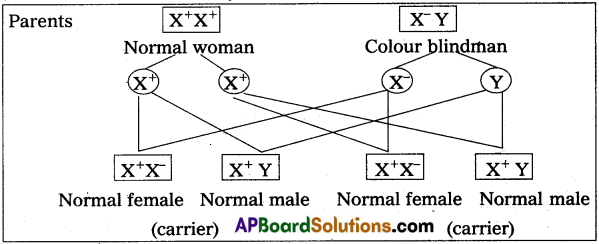
(b) Haemophilia-B :
This is due to the deficiency of clotting factor IX.

symptoms :
Symptoms are similar to that found in haemophilia-A.

II. Sickle-cell anaemia :
It is an autosomal recessive genetic disorder, characterised by rigid, sickle-shaped red blood cells in hypoxia condition. It is due to point mutation in the P-globin gene causing replacement of glutamic acid in the sixth position by valine.

Symptoms :
Haemolysis leads to sickle-cell anaemia sickle cells block. The capillaries resulting in poor blood supply to tissue leads to’ physical weakness, pain, organdamage, paralysis etc.,

III. Phenylketonuria:
This is an autosomal recessive metabolic genetic disorder caused by a mutation in the gene codes for phenylalanine hydroxylase. This enzyme catalyses the convertion of phenylalanine into tyrosine. Defect of this enzyme leads to accumulation of phenylalanine derivatives like pheriylpyruvate, phenylacetate etc.,

Symptoms :
Mental retardation, failure to walk or talk, failure of growth etc.,

IV. Colour blindness :
It is a sex linked disorder. It is the inability to differentiate between some colours. This phenotypic trait is dumb mutation in certain genes located in X-chromosome.

Symptoms : Protanopia – red colour blindness
Deuteranopia – green colour blindness
Tritanopia – blue colour blindness

V. Thalassemia :
Thalassemia is an autosome linked recessive blood disorder. Thalassemias are characterised by a defect in the a or 13 Globin chain, resulting in production of abnormal haemoglobin molecules leads to anaemia.

Symptoms : Anaemia .
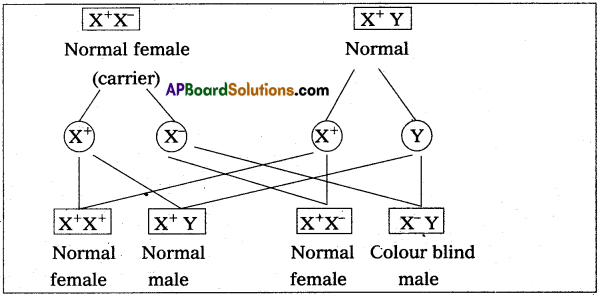
VI. Cystic fibrosis :
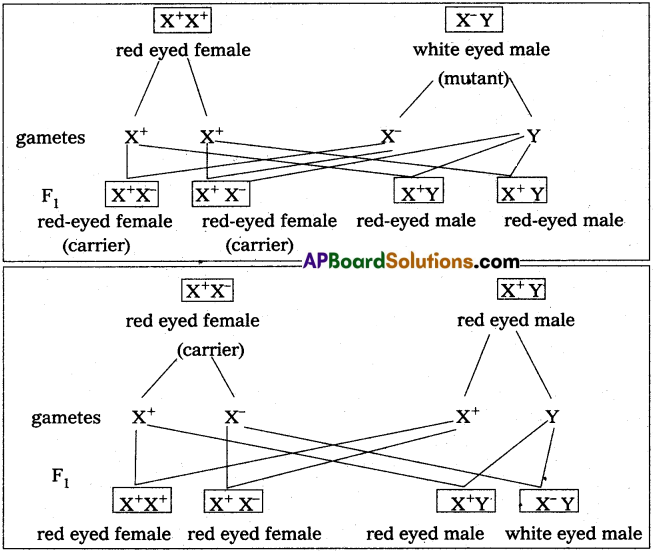
It is an autosomal recessive genetic disorder. It is the result of mutation in the gene that influences salt and water movement across epithelial cell membrane.

Symptoms :
The mucus builds up in organs such as lungs, pancreas, GI tracts etc., If they are not treated it may lead to death.

2. Chromosomal disorders:
Chromosomal disorders are caused by errors in the number or structure of chromosomes.

Allosomal disorders :
I. Klinefelter’s syndrome :
This genetic disorder due to the presence of additional X-‘ chromosome along with the normal XY.
Symptoms : The resulting young sterile male shows feeble breast, small testicles, rounded hips etc., .

II. Turner’s syndrome:
A female with 44 autosomes with one X-chromosome, such females are sterile.
Symptoms : Short structure, webbed neck, broad shield chest with widely spaced nipples, poorly developed ovaries etc.,

Autosomal disorders :
I. Down syndrome (Trisomy 21):
The cause of this genetic disorder is the presence of an additional copy of chromosome numbered 21.
Symptoms : Small rounded head, furrowed tongue and partially open mouth mental retardent etc., –

II. Edwards syndrome (Trisomy 18):
This is due to presence of an extra copy of genetic material on the 18th chromosome, either in whole or a part.
Symptoms : Majority of people with the syndrome die during the foetal stage due to defect in heart and kidney. .

III. Patau syndrome (Trisomy 13):
Patau syndrome is due to presence of an addition copy of chromosome number 13.
Symptoms : Kidney and heart defects, intellectual disability etc.,

Question 5.
Why is the human genome project c,ailed a mega project?
Answer:
Human genome project was an international effort formally begun in October, 1990. The HGP was a 13-year project coordinated by the U.S. Department of Energy and National Institute of Health. During early years of the HGP, the Wellcome trust became major partner and additional contributions came from Japan, France, Germany, China and others.

The total expenditure of this project is 3 billion dollars. This proeject almost completed in 2003.

Goals of HGP:

  • Identify all the genes (20,000-25,000) in human DNA.
  • Determine the sequence of entire human DNA.
  • Improve tools for data analysis.
  • Address the ethical, legal and social issues that may arise from the project.

Genome sequencing:
DNA sequencing is the process of determine the exact order of the 3 billion paired chemical building blocks that make up the DNA of the 22 autosomes X and Y chromosomes.

→ For sequencing the total DNA from a cell is isolated and converted into random fragments of relatively smaller size by using restriction enzymes and cloned in suitable most using specialised vectors.

→ The cloning results in the amplification of DNA fragments which are used for sequencing the bases.

→ Bacteria, yeast are most commonly used hosts and vectors are called ‘BAG’ and YAC’.

→ The fragments were sequenced using automated DNA sequencers that worked based on the principle of Sangers dideoxy method.

→ To allign these sequence a specialised computer based programs were developed, because it is humanly not possible.

→ These sequences were subsequently annotated and were assigned to each chromosome.

Salient features of human genome :
The human genome comprised of 3164.7 million nucleotide bases.

  • Human genome contains 30,000 genes.
  • Each gene consist of an average 30,000 bases.
  • Functions are unknown for over 50% of the genes discovered.
  • Lessthan 2% (nearly 1.5%) of the genome codes for proteins.
  • Majority of the genome consisted of repeated sequences.
  • Chromosome one has the highest number of genes i.e., 2,968 genes*and Y- chromosome has the fewest genes i.e., (231) genes.
  • It is also identified that 1.4 million locations where single base DNA differences (SNPs) occur in humans. This information promises to revolutionise the process of finding chromosomal locations for disease associated sequences and tracing human history.

Advantages of HGP:

  1. Identification and mapping of the genes responsible for diseases helps in diagnosis, treatement and prevention of these diseases.
  2. It is useful to know the gene expression of different species, cellular growth, differentiation and evolutionary biology.
  3. To improve gene therapy for genetic disorders.
    Becuase on the above views the human genome project was called a mega project.

AP Inter 2nd Year Zoology Study Material Chapter 6 Genetics

Question 6.
What is DNA finger printing ? Mention its applications.
Answer:
DNA finger printing is a method for identifying individuals by the particular structure of their DNA.

Human DNA consists of 3 billion nucleoticdes, 90% Of which are identical among all individuals. No two people have exactly the same sequence of base in their DNA. Restricion fragment length polymorphism are characteristic to every person’s DNA. They are called Variable Number Tandem Repeats (VNTRs) and are useful as “Genetic markers”. The VNTRs of two persons generally show variations. DNA finger printing involves in dentifying differences in some specific regions in DNA sequence called repetitive DNA. These sequences show high degree of polymorphism and*form the basis of DNA finger printing.

Protocol of DNA finger printing :
1. Obtaining DNA:
DNA sample is collected from the blood, saliva, hair roots, semen etc. If needed many copies of the DNA is amplified by using PCR.

2. Fragmenting DNA (or) Restriction Digestion :
DNA sample is treated with restriction enzymes to cut the DNA at a specific sites and form smaller fragments.

3. Separation of DNA fragments by electrophoresis :
By using agarose gel electrophresis the DNA fragments are separated based on their charge and molecular weight.

4. Denaturing DNA:
The. DNA on the gel is denatured to form single stranded DNA strands using alkaline chemicals.

5. Blotting :
A thin’nylon membrane is placed over the size fractioned DNA strands and covered by paper towels. As the towels draw moisture the DNA strands are transferred on to-the nylon membrane by capillary action. This process is called blotting.

6. Using probes to identify specific DNA:
A radio active probe is added to the DNA bands. The probe is a single stranded DNA molecule that is complementary to the gene of interest in the sample under study. The probe attaches by base pairing to those restriction fragments that are complementary to its sequence.

7. Hybridization with probe :
After the probe hybridizes, the excess probe is washed off by washing. A photographic film is placed on the membrane containing DNA hybrids.

8. Exposure on film to make a DNA finger print:
The radioactive label exposes the film to form an image in the form of bands corresponding to specific DNA bands. These bands form a pattern of bars which constitute a DNA finger print.

Applications of DNA finger printing :

  1. Conservation of wild life : Protection of endangered species, by maintaining their records for identification of tissues of the dead endangered organisms.
  2. Taxonomical applications : Study of Phytogeny.
  3. Pedigree analysis : Inheritance pattern of gene through generations.
  4. Anthropological studies : Charting of origiij and migration of human population.
  5. Medico-legal cases : Establishing paternity and or maternity more accurately.
  6. Forensic analysis : Positive identification of a suspect in a crime.

The Process of DNA finger printing :
1. The process begins with a blood or cell sample from which the DNA is extracted.
AP Inter 2nd Year Zoology Study Material Chapter 6 Genetics 26
2. The DNA is out into fragments using a restriction enzyme. The fragments are then separated into bands by electrophoresis through an agarose gel.
AP Inter 2nd Year Zoology Study Material Chapter 6 Genetics 27
3. The DNA band pattern is transferred to a nylon membrane.
AP Inter 2nd Year Zoology Study Material Chapter 6 Genetics 28
4. A radio active DNA probe is introduced. The DNA probe binds to specific DNA sequences on the nylon membrane.
AP Inter 2nd Year Zoology Study Material Chapter 6 Genetics 29
5. The excess probe material is washed away leaving the unique DNA band pattern.
AP Inter 2nd Year Zoology Study Material Chapter 6 Genetics 30
6. The radioactive DNA pattern is transferred to X-ray film by direct exposure. When developed, the resultant visble pattern is the DNA finger print.
AP Inter 2nd Year Zoology Study Material Chapter 6 Genetics 31

AP Inter 2nd Year Zoology Study Material Chapter 5(b) Reproductive Health

Andhra Pradesh BIEAP AP Inter 2nd Year Zoology Study Material Lesson 5(b) Reproductive Health Textbook Questions and Answers.

AP Inter 2nd Year Zoology Study Material Lesson 5(b) Reproductive Health

Very Short Answer Questions

Question 1.
What are the measures one has to take to prevent contracting STDs?
Answer:
The measures one has to be taken to prevent STDs are

  1. Avoiding sex with unknown partners / multiple partners.
  2. Using condoms compulsorily during coitus.
  3. Consulting qualified doctor for early detection of STDs and getting complete treatment in case of infections.

Question 2.
What in your view are the reasons for population explosion, especially in India?
Answer:
The reasons for population explosion in India are

  1. Illiteracy among people
  2. Decline in death rate
  3. Increased health care facilities.

Question 3.
It is true that ’MTP is not meant for population control’. Then why did the Government of India legalize MTP?
Answer:
’Medical Termination Pregnancy’ (MTP) or induced abortion is the procedure to terminate pregnancy with the help of medications. Government of India legalized MTP in 1971 to avoid its misuse, this is necessary to keep a check on indiscriminate and illegal female foeticides.

Question 4.
What is amniocentesis? Name any two disorders that can be detected by amniocentesis.
Answer:
Amniocentesis is a diagnostic procedure to detect genetic defects in the unborn baby, in which amniotic fluid is collected from foetus and diagnosed for abnormalities. Down’s syndrome, Turner’s syndrome and Edward’s syndrome can be detected by amniocentesis.

AP Inter 2nd Year Zoology Study Material Chapter 5(b) Reproductive Health

Question 5.
Mention the advantages of ‘lactational amenorrhea method’?
Answer:
Lactational amenorrhea is the absence of menstruation as long as mother breast feeds her baby.

The advantages of ‘lactational amenorrhea’ are

  1. As long as the mother fully breast feeds her child, chances of conception are almost zero.
  2. Breast feeding babies will have enhanced immunity, protection against allergies.

Short Answer Questions

Question 1.
Briefly describe the common sexually transmitted diseases in human beings.
Answer:
Sexually transmitted diseases (STDs) : Diseases or infections which are transmitted through sexual contact (intercourse) are’ collectively called sexually transmitted diseases (STDs) or Veneral Diseases (VDs) or Reproductive Tract Infections (RTI).

Most common STDs and their causative organisms are shown in the following table.

Name of the DiseaseCausative organism
1. GonorrheaNeisseria gonorrhoeae (bacteria)
2. SyphilisTreponema pallidum (spirochete bactrium)
3. Genital herpesHerpes simplex virus (HSV)
4. Genital warts, cervical cancerHuman papilloma virus (HPV)
5. TrichomoniasisTrichomonas vaginalis (a protozoan parasite)
6. ChlamydiasisChlamydia trachomatis (bacteria)
7. Hepatitis-BHBV
8. HIV infection/AIDSHTV (Human immunodeficiency virus)

Except for Hepatitis-B, genital herpes and HIV infection, all the above diseases are completely curable if they are detected early and treated properly.

The common modes of transmission of STDs are :

  1. Sharing injection needles
  2. Sharing surgical instrument with infected persons
  3. Transfusion of contaminated blood
  4. Ffom mother to foetus.

The common symptoms of most of the STDs are :

  1. Itching
  2. Fluid discharge
  3. Slight pain and swelling in genital region
  4. Pelvic inflammatory diseases
  5. Abortions
  6. Still births
  7. Ectopic pregnancies
  8. Infertility and cancer of reproductive tract persons in the age group of 15-24 years are more vulnerable to contract STDs.

The measures to be taken to prevent STDs are

  1. Avoiding sex with unknown / multiple partners.
  2. Using condoms compulsorily during coitus.
  3. Consulting qualified doctor for early detection of STDs and getting complete treatment in case of infections.

AP Inter 2nd Year Zoology Study Material Chapter 5(b) Reproductive Health

Question 2.
Describe the surgical methods of contraception.
Answer:
Surgical procedure to prevent pregnancy is known as sterilization. There are two surgical methods of contraception. They are
a) Vasectomy b) Tubectomy

a) Vasectomy :
It is carried out in male. A small part of the vas deferens on either side is removed or tied up through a small incision on the scrotum. Thus the sperms are prevented from reaching the seminal vesicle so the semen in vasectomised males does not contain sperms.
AP Inter 2nd Year Zoology Study Material Chapter 5(b) Reproductive Health 1

b) Tubectomy:
It is the contraceptive method in females. A small part of the fallopian tube on both sides is removed or tied up through a small incision made in the abdomen or through vagina. This will block the entry of ova into the fallopian tubes and thus pregnancy is prevented.
AP Inter 2nd Year Zoology Study Material Chapter 5(b) Reproductive Health 2

Question 3.
Write short notes on any two of the following.
a) IVF b) ICSI e) IUDs
Answer:
a) IVF :
Fertilization of ovum by sperm outside the body of a woman is called in Vitro Fertilization (IVF). The resultant early embryonic stage is transferred into the mother’s uterus for further development (Embryo Transfer or Intra Uterine Trdnsfer – IUT).

In this method, which is popularly known as Test tube baby procedure, ova from the wife or female donor and sperms from the husband or male donor are collected, mixed and induced to form zygote under simulated conditions in the laboratory. If the mother’s uterus is not medically fit to receive the embryo produced invitro, it can be implanted in the uterus of surrogate mother is who willing to carry this embryo.

b) ICSI:
Intra Cytoplasmic Sperm Injection is another specialised procedure in which a sperm is directly injected into the ovum with the help of microscopic needle to form an embryo in the laboratory. Later the embryo is transferred to the uterus or fallopian tube for further development. This method is employed to assist the couple where there are problems with the sperms such as decreased sperm count.

c) IUDs :
Intra Uterine Devises (IUDs) are used by females in a process of contraception. IUDs are inserted into the uterus by doctors or trained nurses through vagina.

IUDs promote phagocytosis of sperms by white blood corpuscles within the Uterus and the copper ions released suppress the motility, viability and fertilizing capacity of the spermatozoa. The hormone releasing IUDs, makes the uterus unsuitable for implantation and the cervix hostile to sperms. IUDs are ideal contraceptives to females who want to delay or have space between children. This is a widely accepted method of contraception in India.

Type of IUDsKxample
1. Non medicatedLippes loop
2. Copper releasingCuT, Cu7, multiload 375
3. Hormone releasingProgestasert, LNG-20

Question 4.
Suggest some methods to assist infertile couples to have children.
Answer:
The infertility may be due to physical, genetic, certain diseases, drugs, immunological or even psychological. Infertility clinics could help in diagnosis and corrective treatment of some of these disorders and enable the couples to have children in natural way.

In the cases where such corrections are not possible, the couple could be assisted to have children through special techniques known as Assisted Reproductive Technology (ART). The following are some important techniques employed in ART.

1) IVF :
In Vitro Fertilization is a process in which fertilization of ovum by sperm done outside the woman’s body. In this method, popularly known as ‘Test Tube Baby Procedure’, ova from wife or female donor and sperms from husband / male donor are collected, mixed and induced to form zygote under simulated conditions in the laboratory. If the mother’s uterus is not medically fit to receive the embryo produced invitro, it can be implanted in the uterus of another woman (surrogate mother).

2) ZIFT :
Zygote Intra Fallopian Transfer is another technique used to overcome infertility. The ovum is extracted and fertilized invitro and the zygote is transferred to the woman’s fallopian tube to complete its further course of development.

3) GIFT:
Gamete Intra Fallopian Transfer is a procedure done for women who cannot produce ova either due to defect or diseases in ovaries, but still, can provide suitable environment for fertilization and further development of the embryo in their uterus. In these cases, ovum is collected from donor is transferred to the fallopian tube of recipient woman for fertilization.

4) ICSI:
Intracytoplasmic Sperm Injection is another specialised procedure in which a sperm is directly injected into ovum with the help of microscopic needle to form an embryo in vitro. Later the embryo is transferred to the uterus or fallopian tube for further development. This method is employed assist the couple where there are problems with the sperms such as decrease in sperm count.

5) AI:
Artificial Insemination is done in a case where male is unable to inseminate the female or due to very low sperm count in the ejaculate. In this technique, semen is collected from the husband or healthy donor and is introduced into the uterus (Intra Uterine Insemination-IUI) for achieving fertilization.

AP Inter 2nd Year Zoology Study Material Chapter 5(b) Reproductive Health

Question 5.
Is sex education necessary in schools? Why?
Answer:
Governmental and non-governmental agencies have taken various steps to educate people on reproduction-related issues using audio-visual and print media. Introduction of sex education in schools will provide right information about the reproductive organs, adolescence , and related changes, safe and hygienic sexual practices, sexually transmitted diseases such as HIV etc, would help people, especially those in adolescent age group lead a reproductively healthy life.

AP Inter 2nd Year Zoology Study Material Chapter 4(b) Immune System

Andhra Pradesh BIEAP AP Inter 2nd Year Zoology Study Material Lesson 4(b) Immune System Textbook Questions and Answers.

AP Inter 2nd Year Zoology Study Material Lesson 4(b) Immune System

Very Short Answer Questions

Question 1.
Define the terms immunity and immune system.
Answer:
Immunity :
It is the ability of the host or individual to fight against the disease-causing organisms that is called immunity.

Immune System :
The network of organs, cells, and proteins that protect the body from harmful, infectious agents such as bacteria, viruses, animal parasites, fungi, etc., is called the immune system.

Question 2.
Define the non-specific lines of defence in the body.
Answer:
Non-specific lines of defence are the first line of defence mechanism and are also called innate immunity, which is inherited by birth. It does not depend on prior contact with the microorganism. Non-specific lines of defence mechanism executed by four barriers namely;

  1. Physical barriers
  2. Physiological barriers
  3. Cellular barriers
  4. Cytokine barriers.

Question 3.
Differentiate between mature B-cells and functional B-cells.
Answer:

Mature B-cellsFunctional B-cells
1. B-cells arise from stem cells and develop into mature B-cells.1. Functional B-cells develop from mature B-cells.
2. The mature B -cells express antibodies on their surface to bind and engulf antigen for processing and presenting.2. Functional B-cells differentiate into memory and plasma cells. Plasma cells produce antibodies, to eliminate antigen.

Question 4.
Write the names of any four mononuclear phagocytes.
Answer:

  1. Histocytes – present in the connective tissue
  2. Kupffer cells – in the liver
  3. Microglia – in the brain
  4. Osteoclasts – in the bone.

AP Inter 2nd Year Zoology Study Material Chapter 4(b) Immune System

Question 5.
What are complement proteins?
Answer:
Complement proteins are a group of inactive plasma proteins and cell surface proteins. They are activated in cascade fashion. When activated, they form a membrane attack complex (MAC) that forms a pore in the plasma membrane, allowing ECF to enter the cell and make it swell and burst.

Question 6.
Colostrum is very much essential for the newborn infants.
Answer:
The colostrum secreted by the mother during the initial days of lactation has abdundant IgA antibodies to protect infant from initial sources of infection. .

Question 7.
Differentiate between perforins and granzymes.
Answer:
Perforins :
Perforins are the enzymes produced during the process of cell mediated immunity from cytotoxic T-lymphocytes. Perforins form pores in the cell membrane of the infected cells.

Granzymes:
Granzymes are the enzymes produced during the process of cell mediated immunity from cytotoxic T-lymphocytes. Granzymes enter th6 infected cells through the perfororations and activate certain proteins which help in distinction of the infected cell i.e., called apoptosis.

Question 8.
Explain the mechanism of Vaccinization (or) Immunization.
Answer:
Vaccinization is based on property of the mempry of the immune system. During the process of vaccinization, inactivated or weakend pathogens or antigenic proteins of pathogen * are introduced into the body of the host and they initiate the production of antibodies and also generate memory B-cells and memory T-cells. On subsequent exposures, the memory cell recognizes that pathogen quickly and overcomes the invader with a rapid and massive production of antibodies.

Question 9.
Mention the various types of immunological disorder.
Answer:
There are various types of immunological disorders.

  1. Immuno deficiency disorders
  2. Hypersensitivity disorders
  3. Antoimmune disorders
  4. Graft rejection.

Question 10.
More and more people in metro cities of India are prone to allergies. Justify.
Answer:
The people in metro cities of India suffer from allergies leading to asthmatic attacks due to environmental pollutants.

Question 11.
What are auto-immune disorders? Give Any two examples.
Answer:
Generally our immune system can recognize our own proteins (self antigens) and does not attack our own tissues. Unfortunately, in some cases our immune system fails to recognise some of our own body proteins and treats them as foreign antigens, that results in attacks on our own tissues. This leads to some very serious diseases collectively known a autoimmune disease.
Eg: 1. Graves’ disease 2. Rheumatoid arthritis.

AP Inter 2nd Year Zoology Study Material Chapter 4(b) Immune System

Question 12.
How can the graft rejections be avoided in patients?
Answer:
After organ transplantation our body recognises them as foreign and initiate the graft rejection To avoid this tissue and maching and blood group matching are essential before undertaking graft. Even after this the patient has to take immuno-suppressant ‘drugs throughout the life.

Short Answer Questions

Question 1.
Write short notes on B-cells.
Answer:
The lymphocytes capable of producing antibodies and can capture circulating antigens are called B-cells. They are produced from the stem cells in the bone marrow, liver of foetus and bursa of fabricius in birds. Mature B-cells express or display Ig M and Ig D antibodies on their membrane surfaces. As these antibodies can take antigens, the mature B-cells are also called immuno-competent B-cells.

In secondary lymphoid organs these immune-competent B-cells develop into functional immune cells which later differentiate into long lived memory cells and effector plasma cells. The plasma cells produce antibodies specific to the antigen to which they are exposed. Memory cells store information about the specific antigens and show quick response, when the same type of antigen invades the body later.

Question 2.
Write short notes on Immunoglobulins.
Answer:
Whenever pathogen enters our body, the B-lymphocytes produce an army of proteins called antibodies to fight with them. They are highly specialised for binding with specific antigens. The part of an antibody that recognises an antigen is called the paratope antigen binding site.

Based on their mobility, antibodies are of two types.

1. Circulating or free antibodies :
These are present in the body fluids like serum, lymph etc.

2. Membrane bound antibodies :
These are present on the surface of the mature B-cells as well as the memory cells.
AP Inter 2nd Year Zoology Study Material Chapter 4(b) Immune System 1

Structure :
Immunoglobulin is a Y’ shaped molecule with four polypeptide chains of which two &ye long identical heavy chains (H) and two are small, identical light chains (L). These two chains are linked by disulfide bonds. One end of the antibody molecule is called Fab end (Fragment- antigen binding) and the other end is called Fc end (Fragment-Crystaline). Based on the structure, the antibodies are of five types namely Ig G, Ig A, Ig M, Ig D and Ig E.

Question 3.
Describe various types of barriers of innate immunity.
Answer:
Innate immunity is a non-specific type of defence mechanism which provides the first line of defence mechanism against infections. This is executed by providing different types of barriers like;

a) Physiological:
Skin and mucus membranes are the main physical barriers. Skin prevents the entry of micro-organism, whereas the mucus membranes help in trapping the microbes entering our body.

b) Phyloigical barriers :
Secretions of the body like HCl in the stomach, saliva in the mouth, tears from the eyes are the main physiological barriers against microbes.

c) Cellular barriers :
Certain types of cells like polymorphonuclear leucocytes, monocytes, and natural killer cells in the blood as well as macrophages in the tissues are the main cellular barriers. They phagocytose and destroy the microbes-.

d) Cytokine barriers :
The cytokines secreted by the immune cells like interleukins and interferons are involved in differentiation of cells of immune system and protect the non-infected cells from further infection.

AP Inter 2nd Year Zoology Study Material Chapter 4(b) Immune System

Question 4.
Explain the mechanism of humoral immunity.
Answer:
The immunity mediated by the antibodies that released into the fluids of the body (humors) such as plasma, lymph etc., is called humoral immunity.
AP Inter 2nd Year Zoology Study Material Chapter 4(b) Immune System 2

Mechanism of humoral immunity :
Whenever the antigen (exogenous) enters into our body, they reach secondary lymphoid organs, where the free antigens bind to Fab end of the membrane bound antibodies that are present on the surface of mature B-cells. They engulf and process antigen. Then they display the antigenic fragments on their membrane with the help of Class-II MHC molecule. Then appropriate T4 cells recognise them and interact with the antigen-MHC-II complex and release interleukins, which stimulates the B-cells to proliferate and differentiate into memory cells and plasma cells. The plasma cells release specific antibodies into plasma or extra cellular fluids.

These antibodies help in opsonising and immobi – lizing the bacteria, neutralizing and cross linking of antigens leading to agglutination of insoluble antigens and precipitation of soluble antigens. They also activate the phagocytes and complement system.

Question 5.
Explain the mechanism of cell mediated immunity.
Answer:
The immunity mediated by the activated T-cells, natural killer cells etc., is known as cell mediated immunity. It is effective against both exogenous and endogenous antigens.

Mechanism of cell mediated immunity :
Exogenous antigens are processed by the antigen presenting cells (APC), whereas endogenous antigens are processed by altered self cells (ASCs). Then the processed antigenic fragments are displayed on their surface with the help of class-I and class-II MHC molecules of ASCs and APCs respectively They are recognised by TCR of T-cells. The binding of T-cells to APCs or ASCs cause the production of a activated T-cells and T-memory cells.

The activated TH cells secrete various types of interleukins which transform activated TC cells into effector cytotoxic T-lymphocytes. They attach to the infected or altered cells and release enzymes like perforins and granzymes. Perforins form pores in the cell membrane of the infected cells. Then granzymes enter the infected cells through these perforations and activates the proteins which help in the distinction of the infected cell by a process called apoptosis The NK cells are similar in their action to CTL’s.
AP Inter 2nd Year Zoology Study Material Chapter 4(b) Immune System 3

AP Inter 2nd Year Zoology Study Material Chapter 4(b) Immune System

Question 6.
Explain the mechanism by which HIV multiplies and leads to AIDS.
Answer:
AIDS is non-congential, transmissible, lethal, sexually transmitted disease caused by Human Immunodeficiency Virus (HIV). HIV is a retrovirus with an envelope enclosing two ss RNA molecules as the genetic material.

Mechanism :
After getting into the body of a person, the HIV enters the TH cells, macrophages or dendritic cells. In these cells ss RNA of HIV synthesizes a DNA strand complementary to the viral RNA using the enzyme reverse transcriptase. The same enzyme responsible for formation of second DNA strand, complementary to the first strand forming the double-stranded viral DNA. This dsDNA gets incorporated into the DNA of the host’s DNA by a viral enzyme called integrase and it is in the form of a provirus.

Transcription of DNA results in the production of RNA, which can act as the genome for new virus and it can be translated into viral proteins. The various components of the viral particles are assembled and the HIV particles are produced. The infected human cells continue to produce virus particles. New viruses bud off from the host cell and attack another TH cells. This leads to decrease CD4 receptors containing TH cells in the infected person leading to the immuno deficiency in him, finally causes AIDS.

AP Inter 2nd Year Zoology Study Material Chapter 3(a) Musculo-Skeletal System

Andhra Pradesh BIEAP AP Inter 2nd Year Zoology Study Material Lesson 3(a) Musculo-Skeletal System Textbook Questions and Answers.

AP Inter 2nd Year Zoology Study Material Lesson 3(a) Musculo-Skeletal System

AP Inter 2nd Year Zoology The Musculo Questions and Answers

Very Short Answer Questions

Question 1.
What is a ‘motor unit’ with reference to muscle and nerve?
Answer:
Motor unit is made up of a motor neuron and set of muscle fibres innervated by all the telodendrites.

Question 2.
What is triad system?
Answer:
In a skeletal muscle each transverse tubule (T-Tubule) is flanked on either side by several cfsternae of the sarcoplasmic reticulum. T-tubule and the two terminal cistemae at its sides form the triad system.

Question 3.
Write the difference between actin and myosin.
Answer:

ActinMyosin
1. Actin is a thin contractile protein.1. Myosin is a thick contractile protein.
2. It is present in light bands and is called an isotropic band.2. It is present in dark bands and is called an anisotropic band.
3. Each actin filament is made of two ‘F’ actin molecules helically wound around each other, tropomyosin and a complex, protein called troponin.3. Each mydsin is made up of monomeric protein called meromyosins. Each meromyosin has’ two parts namely head, and arm (or) neck.

Question 4.
Distinguish between red muscle fibers and white muscle fibers. Ans.
Answer:

Red muscle fiberWhite muscle fiber
1. Red muscle fibers are thin and smaller in size.1. White muscle fibers are thick and larger in size.
2. They are red in colour as they contain large amount of myoglobin.2. They are white in colour as they contain small amount of myoglobin.
3. They contain numerous mitochondria.3. They contain less number of mito-chondria.
4. They carry out slow and sustained Contractions for a long period.4. They cany out fast work for short duration.

Short Answer Questions

Question 1.
Write a short note on sliding filament theory of muscle contraction.
Answer:
The sliding filament theory explains the process of muscle contraction. It was proposed by Jean Hanson and Hugh Huxley. It states that contraction of a muscle fiber takes place by the sliding of the thin filaments over the thick filament, which shorfens the myofibril.

Each muscle fiber contains a special contractile proteins called actin and myosin. Actin is the thin contractile protein present in the light band and is known as the T band, where as myosin is thick contractile protein present in dark band aind is known as ‘A’ band. There is an elastic fiber called ‘Z’ line, that bisets each T band. The central part of the thick filament that pot overlapped by the thin filament is known as the ‘if zone.

During the muscle contraction, the myosin heads bind to the exposed active sites on the actin molecules and form across bridge. As a result the thin filaments are pulled towards the centre of the A band. The ‘Z’ line attached to the actin filaments is also pulled leading to the shortening of the sarcomere i.e., contraction.

During the shortening of the muscle the T bands get reduced in length, whereas the A’ bands retain their length and ‘H’ zone disappears.

AP Inter 2nd Year Zoology Study Material Chapter 3(a) Musculo-Skeletal System

Question 2.
Describe the important steps in muscle contraction.
Answer:
During skeletal muscle contraction, the thin filament slides over the thick filament by repeated binding and releases myosin along the filament.
Important steps in muscle contraction :

Step 1:
Muscle contraction is initiated by signals that travel along the axon and reach the neuro muscular junction. As a result, acetyl choline is released into the synaptic cleft by generating an action potential in sarcolemma.

Step 2:
The generation of this action potential releases calcium ions from sarcoplasmic reticulum in the sarcoplasm.

Step 3:
The increased calcium ions in the sarcoplasm leads to the activation of actin sites, then active actin sites are exposed and this allows myosin heads to attach to this site and forms cross bridges by utilising energy from ATP hydrolysis.

Step 4:
The actin filaments are pulled. As a result, the ‘H’ zone reduces. It is at this stage that the contraction of the muscle occurs.

Step 5:
After muscle contraction, the myosin head pulls the actin filament and releases ADP along with phosphate. ATP molecules bind and detach myosin and the cross bridges are broken and decreases the calcium ions contraction. As a result masking the actin filaments and leading to muscle relaxation.

Question 3.
Describe the structure of a skeletal muscle.
Answer:
1) Skeletal muscle is made up of number of muscle bundles (or) fascicles. The fascicles are held together by a common collagenous connective tissue layer called fascia.

2) Each fascicle contains a number of cylindrical muscle fibers. Each muscle fiber is lined by the plasma membrane called sarcolemma enclosing the sarcoplasm.

3) Skeletal muscle fiber is a syncytium as each fiber is formed by fusion of embryonic, mononucleate myoblasts. Hence, the skeletal muscle cells are multinucleate, with characteristically peripheral nuclei.

Question 4.
Write short notes on contractile proteins.
Answer:
Actin and myosins are contractile proteins.
Actin :

  1. Each actin filament is made of two ‘F (filamentous) actin molecules helically wound around each other.
  2. Each actin is a polymer of monomeric ‘G’ (globular) actin molecules. Two filaments of another protein, called tropomyosin also run close to the ‘F’ actin molecules, throughout their length.
  3. A complex protein called troponin is distributed at regular intervals on the tropomyosin.
  4. Troponin is made of three polypeptides namely Tn-T, Tn-I and Tn-C. Tn-T binds to tropomyosin, Tn-I inhibits the myosin binding site on the actin, Tn-C can bind to Ca2+ when Ca2+ ions are not bound to troponic, which block the active site of actin. When calcium ions attaches to Tn-C, the tropomyosin moves away from the active sites, allowing the myosin heads to bind to the active sites of actin.
  5. Troponin and tropomyosin are often called regulatory proteins, because of their role in masking and unmasking the active sites.

Myosin:

  1. Myosin, is a motor protein that is able to convert chemical energy in the ATP molecules into mechanical energy.
  2. Each myosin filament is a polymerized protein, consist of monomeric proteins called meromyosins.
  3. Each Meromyosin has two important parts, a globular head with a short arm and tail.
  4. The globular head with arm is composed of heavy meromyosin and the tail is made of light meromyosin.
  5. The short arm / neck serves as a flexible link between the head and tail regions.
  6. There are about 200-300 molecules of myosin per thick filament.
  7. The head and short arm project outwards at regular distance and angels from each other from the surface of a polymerized myosin filament and is known as cross arm.
  8. Each head has two binding sites, one for ATP and other for an active site on the actine molecule.

Question 5.
Draw a neat labelled diagram of the ultra structure of muscle fibre.
Answer:
AP Inter 2nd Year Zoology Study Material Chapter 3(a) Musculo-Skeletal System 1

Question 6.
Draw the diagram of a sarcomere of skeletal muscle showing different regions.
Answer:
AP Inter 2nd Year Zoology Study Material Chapter 3(a) Musculo-Skeletal System 2

Question 7.
What is Cori cycle? Explain the process.
Answer:
Lactate produced by anaerobic glycolysis in the muscle, moves to the liver and i converted to glucose, which then return to the muscles and is converted back to lactate This two way traffic between skeletal muscle and liver is called the Cori cycle.
AP Inter 2nd Year Zoology Study Material Chapter 3(a) Musculo-Skeletal System 3

Cori cycle :
The lactate produced during rapid contraction of skeletal muscles under low availability of oxygen is partly oxidized and a major part of it is carried to the liver by the blood, where it is converted into pyruvate and then to glucose through gluconeogenesis. The glucose can enter the blood and be carried to muscles and is immediately converted back to lactate. If by this time the muscles have stopped contraction, the glucose can be used to rebuild reserve of glycogen through glycogenesis.

Long Answer Questions

Question 1.
Explain the mechanism of muscle contraction.
Answer:
Mechanism of muscle contraction is best explained by the sliding filament theory. It states that contraction of muscle fiber takes place by the sliding of the thin filament over the thick filaments.

Mechanism of muscle contraction :
1. Excitation of muscle :
a) Muscle contraction is initiated by the signal sent by central nervous system via a motor neuron.
b) A neural signal reaching the neuromuscular junction releases acetyl choline, which generates an action potential in the sarcolemma.
c) When the action potential spreads to the triad system through T-tubules, the cistemae of the sarcoplasmic reticulum release calcium ions into the sarcoplasm.

2. Formation of cross bridge :
a) Increase in the Ca2+ level leads to the binding of calcium ions to the subunit Tn-C of the troponin of the actin filament (thin). This makes troponin and tropomyosin complex to move away from the active sites of actin molecules.
b) In this stage the myosin head attaches to the exposed active site of actin and forms cross bridges by utilising energy from ATP hydrolysis.

3. Power stroke :
a) The cross bridge pulls the attached actin filaments, towards the centre of the ‘A’ band.
b) The ‘Z’ lines attached to these actin filaments are also pulled in wards from both sides, there by causing shortening of the sarcomere i.e., contraction.
c) During the shortening of the muscle, the I bands get reduced in length, whereas the ‘A’ bands retain their length.
d) As the thin filaments are pulled deep into the A bands making the H bands narrow, the muscle shows the effect contraction.

4. Recovery stroke :
a) The myosin goes back to its relaxed state and releases ADP.
b) A new ATP molecule binds to the head of myosin and the cross bridge is broken.

5. Relaxation of muscle :
a) When motor impulses stop, the calcium ions are pumped back into the sarcoplasmic cistem&e it results in the marking of active sites of the actin filaments.
b) The myosin heads fail to bind with the active sites of actin.
c) These changes Cause the return of ‘Z’ lines back to their original position i.e., relaxation.
AP Inter 2nd Year Zoology Study Material Chapter 3(a) Musculo-Skeletal System 4

Question 2.
List in sequence, the events .that take place during muscle contraction.
Answer:
During skeletal muscle contraction, the thin filament slides over the thick filament by repeated binding and releases myosin along the filament.

The following events take place during muscle contraction:
1. Muscle contraction is initiated by signals that travel along the axon and reach the neuro muscular junction (or) motor end plate. As a result, acetyl choline is released into the synaptic left by generating an action potential in sarcolemma.

2. The action potential spreads to the triad system through the T-tubules, the cistemae of the sarcoplasmic reticulum release calcium ions into the sarcoplasm.

3. Increase in the calcium ions level leads to the binding of calcium ions to the sub unit Tn-C of the troponin of the thin filament: This makes troponin and tropomyosin complex to remove away from the active sites of actin molecules.

4. In this stage, the myosin head attaches to the exposed site of actin and forms cross
bridge by utilising energy from ATP hydrolysis.

5. The cross bridge pulls the attached actin filaments towards the centre of the ‘A’ band. The ‘Z’ lines attached to these actin filaments are also pulled inwards from both the sides, thereby causing contraction. During the contraction the ‘I’ bands get reduced in length, where as ‘A’ bands retain their size.

6. As the thin filaments are pulled deep into the ’A” bands making the ‘H’ bands narrow, the muscle shows the effect contraction.

Contraction is turned off by the following sequence of events :
7. Acetyl choline at the neuromqscular junction is broken down by acetyl cholinesterase and this terminates the stream of action potentials along the muscle fibre surface.

8. The sarcoplasmic reticulum ceases to release calcium ions and immediately calcium ions are pumped back into the sarcoplasmic cistemae.

9. In the absence of calcium ions a change in the configuration of troponin and . tropomyosin i.e., masking of the active sites of the actin filaments.

10. The myosin heads fail to bind with active sites of actin. These changes cause the return of ‘Z’ lines back to their original position i.e., relaxation.

AP Inter 2nd Year Zoology The Skeleton Questions and Answers

Very Short Answer Questions

Question 1.
Name two cranial sutures and their locations.
Answer:

  1. Coronal suture – between the frontal and parietal bones.
  2. Lambdoid suture – between the parietal and occipital bones.

Question 2.
Name the keystone bone of the cranium. Where is it located?
Answer:
Sphenoid bone is the keystone bone of the cranium, because it articulates with all the other cranial bones. It is present at the middle part of the base of the skull.

AP Inter 2nd Year Zoology Study Material Chapter 3(a) Musculo-Skeletal System

Question 3.
Human skull is described as dicondylic skull. Give the reason.
Answer:
Human skull is described as discondytic skull because, two occipital condyles are present one on each side of the foramen magnum. ‘

Question 4.
Name the ear ossicles and their evolutionary origin in human beings.
Answer:
Each middle ear contains three tiny bones called ear ossicles. They are ;
Malleus – modification of articular
Incus – modified quadrate
Stapes – modified hyomandibula.

Question 5.
Name the type of joint between a) atlas / axis b) carpal / metacarpal of the human thumb.
Answer:
a) Joint between atlas / axis – Pivot joint

b) Joint between carpal / meta carpal of the human thumb – Saddle joints.

Question 6.
Name the type of joint between a) Atlanto – axial joint b) Femur – acetabulum joint.
Answer:
a) Joint between atlanto – axial joint – Pivot joint
b) Joint between Femur – acetabulum joint – Ball and Socket joint.

Question 7.
Name the typen of joint between a) Cranial bones b) Inter-tarsal joint.
Answer:
a) Joint between Cranial bones-Sutures (Fibrous joint) E.g.: Cororial suture, lambdoid suture. . , .
b) Inter-tarsal joint – Gliding joint.

Short Answer Questions

Question 1.
List out the bones of the human cranium.
Answer:
Cranium, the brain box is formed by eight cranial flattened bones. They are ;
i) Frontal bone (1) :
It forms the forehead, anterior part of the cranial floor and roof of the orbit.

ii) Parietal bones (2) :
They form the major portion of the sides and roof of the cranial cavity.

iii) Temporal bones (2):
They form lateral walls of the cranium as well as housing the external ear.

iv) Occipital bone (1):
It forms the posterior part and most of the base of the cranium.

v) Sphenoid bone (1):
It is present at the middle part of the base of the skull. It is also called keystone bone of the cranium.

vi) Ethmoid bone (1) :
It is present on the midline of the anterior part of the cranial floor.

AP Inter 2nd Year Zoology Study Material Chapter 3(a) Musculo-Skeletal System

Question 2.
Write short notes on the ribs of human being.
Answer:
The ribs are thin, flat, curved bones that form a protective cage around the organs present in the human chest. They are comprised of 24 bones arranged in 12 pairs. These bones are divided into three categories :

1) True Ribs :
The first seven pairs of ribs are called true ribs. Dorsally, they are attached to the thoracic vertebrae and ventrally connected to the sternum with the help of hyaline cartilages.
AP Inter 2nd Year Zoology Study Material Chapter 3(a) Musculo-Skeletal System 5

2) False Ribs:
The remaining ribs are called false ribs. The 8th, 9th and 10th pairs of ribs do not atriculate directly with the sternum, but joint the cartilaginous parts of the seventh rib. These are called vertebrochondral (or) false rib.

3) Floating Ribs :
Last two pairs (11th and 12th) of the ribs are not connected ventrally either to sternum or the anterior ribs, hence called floating ribs.
The thoracic vertebrae, ribs and sternum together form the rib cage.

Question 3.
List the bones of the human fore limb.
Answer:
Each fore limb of human is made of 30 bones. They are ;

Humerus :
Long bone in the fore limb that runs from shoulder to elbow.

Radius and Ulna :
These bones form forearm. It is the region betweeen elbow and the wrist.

Carpals :
These are the bones of wrist, eight in number.

Metacarpals :
The metacarpals form the skeleton of the palm. They are five in number.

Phalanges :
These are finger bones, fourteen in number, three for each finger and two for the thumb.

Question 4.
List the bones of the human leg.
Answer:
Each hind limb of human is made of 30 bones. They are ;

Femur :
Femur is the only bone in the thigh. It is the longest, heaviest and strongest bone in human body.

Tibia and fibula :
Both of these bones form lower leg i.e., the region from knee to ankle.

Tarsals :
These are ankle bones, seven in number.

Meta tarsals :
These are five short tubular bones, distal to the tarsals and proximal to phalanges.

Phalanges :
Foot has 14 phalanges, each toe has three phalanges, except for the first toe.

Patella :
It is a cup-shaped bone, covers the kneejoint vertically.

AP Inter 2nd Year Zoology Study Material Chapter 3(a) Musculo-Skeletal System

Question 5.
Draw a neat labelled diagram of the skeleton of the fore limb of man.
Answer:
AP Inter 2nd Year Zoology Study Material Chapter 3(a) Musculo-Skeletal System 6

Question 6.
Draw a neat labelled diagram of pelvic girdle.
Answer:
AP Inter 2nd Year Zoology Study Material Chapter 3(a) Musculo-Skeletal System 7

Question 7.
Describe the structure of synovial joint with the help of a neat labelled diagram.
Answer:
Synovial joints are characterised by the presence of a fluid filled synovial cavity between the articulating surfaces of the two bones.
AP Inter 2nd Year Zoology Study Material Chapter 3(a) Musculo-Skeletal System 8

Structure of synovial joint :
Synovial joint is covered by a double layered synovial capsule. The outer layer consist of dense fibrous irregular connective tissue with more collagen fibers. This layer is continuous with the periosteum and resists stretching and prevents the dislocation of joints. Some fibres of these membranes are arranged in bundles called ligaments.

The inner layer of synovial capsule is formed of areolar tissue and elastic fibers. It secretes a viscous synovial fluid which contains hyaluronic acid, phagocytes etc., and acts as a lubricant for the free movement of the joints.

Long Answer Questions

Question 1.
Describe the structure of human skull.
Answer:
The skull is the bony framework of the head. It is consist of the eight cranial and fourteen facial bones.

The cranial bones make up the protective frame of the bone around the brain called cranium.

The cranial bones are :
i) Frontal bone (1) :
It forms the forehead, anterior part of the cranial floor, and the roof of the orbits.

ii) Parietal bones (2) :
They form the major portion of the sides (left and right) and roof of the cranial cavity. They are joined to the frontal bone by a coronal suture and posteriorly to the occipital bone by lambdoid suture.

iii) Temporal bones (2) :
The left and right temporal bones form the lateral walls of the cranium as well as housing the external ear.

iv) Occipital bone (1) :
It forms the posterior part and the most of the base of cranium. It has large opening called foramen magnum. Medulla oblongata passes out through this foramen and joins the spinalcord.

v) Sphenoid bone (1) :
It is present at the middle part of the base of the skull. It is the keystone bone of the cranium, because it atriculates with all other cranial bones.

vi) Ethmoid bone (1) :
It is present on the midline of the anterior part of the cranial floor.

Facial region is made up of fourteen facial bones which form upper and lower jaw and other facial structures.

The facial.bones are :
i) Nasal bones (2):
These are paired bones that form the bridge of the nose.

ii) Maxillae (2) :
Two maxillae join together and form the upper jaw. Maxillae bears sockets for lodging the maxillary teeth.

iii) Zygomatic bones (2) :
These are known as cheek bones.

iv) Lacrimal bones (2) :
These are smallest bones of the face.

v) Palatine bones (2) :
They form the posterior portion of the hard palate.

vi) Nasal conchae (2) :
These are scroll like bones that form a part of lateral wall of the nasal cavity.

vii) Vomers (1) :
It is a triangular bone present on the floor of nasal cavity.

viii) Mandible (1) :
It is the lower jow bone. It is “U” shaped and is the longest and strongest of all the facial bones. It is the only movable skull bone.

Skeletal structures associated with sense organs :
i) Nasal cavity:
It is divided into left and right cavities by vertical partition called the nasal septum.

ii) Orbits:
These are bony depressions, which accommodate the eyeballs and associated structures.

iii) Ear ossicles :
Each middle ear contains three tiny bones, namely malleus, incus, stapes, collectively called ear ossicles.

iv) Hyoid bone :
It is a single U shaped bone present at the base of the buccal cavity between the larynx and the mandible. The hyoid bone keeps the larynx open.
AP Inter 2nd Year Zoology Study Material Chapter 3(a) Musculo-Skeletal System 9

AP Inter 2nd Year Zoology Study Material Chapter 2(a) Body Fluids and Circulation

Andhra Pradesh BIEAP AP Inter 2nd Year Zoology Study Material Lesson 2(a) Body Fluids and Circulation Textbook Questions and Answers.

AP Inter 2nd Year Zoology Study Material Lesson 2(a) Body Fluids and Circulation

Very Short Answer Questions

Question 1.
Write the differences between open and closed systems of circulation.
Answer:

Open circulation systemClosed circulation system
1. In this type, blood flows from the heart into the arteries and then into large spaces called sinuses.1. In this type blood flows through a series of blood vessels.
2. Organs located in the space are bathed by blood.2. Each organ has blood vessels that carry blood to it.
3. Blood flows slowly because there is no blood pressure after the blood leaves the blood vessels.3. Blood flows at a high speed because there is high blood pressure after the blood leaves the heart.
4. It is found in Leeches, arthropods, and molluscs.4. It is found in annelids and chordates.

Question 2.
Sino-atrial node is called the pacemaker of our heart. Why?
Answer:
Sino-atrial node consists of specialized cardio myocytes. It has the ability to generate action potentials without any external stimuli henc’e called pacemaker.

Question 3.
What is the significance of atrio-ventricular node and atrio-ventricular bundle in the functioning of the heart?
Answer:
Atrio-ventricular node and atrio-ventricular bundle plays an important role in the contraction of ventricles.

Aricular contraction initiated by the wave of excitation from sino-atrial node (SAN) stimulate the atrio-ventricular node from where they are conducted through the bundle of His (atrio-ventricular bundle), its branches and Purkinje fibers to the entire ventricular musculature. This causes the stimulation ventricular systole. It lasts about 0.3 sec.

Question 4.
Name the valves that guard the left and right atrio-ventricular apertures in man.
Answer:
Bicuspid valve (or) Mitral valve – Left atrio-ventricular aperture.
Tricuspid valve – Right atrio-venticular aperture.

Question 5.
Where is the valve of Thebesius in the heart of man.
Answer:
Opening of coronary sinus into left precaval vein is bound by a crescentic fold known as valve of Thebesius.

AP Inter 2nd Year Zoology Study Material Chapter 2(a) Body Fluids and Circulation

Question 6.
Name the aortic arches arising from the ventricles of the heart of man.
Answer:

  1. Pulmonary arch – arises from right ventricle.
  2. Left systemic arch – arises from left ventricle.

Question 7.
Name the heart sounds when they are produced.
Answer:
The lub-dup sounds are produced by heart. The first sound ‘lub1 is caused by closure of the1 AV valves at the beginning of ventricular systole and preventing the back flow of blood. The second heart sound ‘dup’ results from the closure of the semilunar valves at the beginning of ventricle diastole and prevents the back flow of blood.

Question 8.
Define cardiac cycle and cardiac output.
Answer:
Cardiac cycle :
Cardiac events that occur from the beginning of one heart beat to the beginning of the next is called cardiac cycle.

Cardiac output:
The volume of blood pumped out by the heart from each ventricle per minute is termed cardiac output. It is approximately 5 litres.

Question 9.
What is meant by double circulation? What is its significance?
Answer:
The double circulation system of blood flow refers to the separate systems of pulmonary circulation and the systemic circulation. All animals with lungs have a double circulatory system.

In pulmonary circulation deoxygenated blood is pumped away from the heart, via pulmonary artery to the lungs and returns oxygenated blood to the heart via pulmonary vein.

In systemic circulation oxygenated blood away from heart to the rest of the body and returns deoxygenated blood back to the heart.

Question 10.
Why the arteries are more elastic than the vein?
Answer:
Arteries are more elastic than vein because they are structurally designed to withstand tremendous blood pressures.

Veins on the other hand, contain blood at relatively low blood pressure.

Short Answer Questions

Question 1.
Describe the evolutionary change in the structural pattern of the heart among the vertebrates.
Answer:
1) Fishes have the 2-chambered heart with an atrium and a ventricle. Blood passes through the heart only once in a complete circuit hence called single circulation. This means there is no separate circulation for oxygenated and deoxygenated blood.

2) Amphibians have a 3 – chambered heart with two atria and one ventricle, which further evolved in, reptiles, have two atria and an incompletely divided ventricle in which left atrium receives oxygenated blood from the gills / lungs / skin and right atriupi receives blood from the other parts of the body. The two types of, blood get’ mixed in the single ventricle, which pumps out mixed type of blood. Thus these animals show complete double circulation.

3) Birds and mammals possess 4-chambered heart with two atria and two ventricles. In these animals the oxygenated and the deoxygenated types of blood received by left and right atria, passes on to the left and right ventricles, respectively. The ventricles pump the blood out without any mixing of the oxygenated and deoxygenated types of blood. Hence these animals are said to be showing double circulation namely systemic arrd pulmonary circulations.

Question 2.
Describe atria of the. heart of man.
Answer:
Atria are thin walled receiving chambers, form the anterior part of the heart. The right one is larger than the left, they are separated by inter-atrial septum. It has small pore in embryonic stage known as Foramen Ovale. Later it is closed and appears as a depression in the septum known as Fos&a ovalis. If the foramen ovale does not close properly, it is called a patent foramen ovale.

The right atrium receives deoxygenated blood from different parts of the body (except the lungs) through three caval veins like two precaval veins and one post caval vein. The right atrium also receives blood from the walls of the heart through the coronary sinus, whose opening into the right atrium is guarded by a crescentric fold, the valve of Thebesius. Opening of the post caval vein is guarded by the valve of inferior vena cavae or Eustachian valve. It directs the blood to the left atrium through the foramen ovale, in the fetal stage, but in the adults it becomes non functional.

The openings of the precaval veins into the right atrium have no valves. The left atrium receives oxygenated blood from lungs through a pair of pulmonary veins, which opens into the left atrium through a common pore. Atrio-ventricular septum separates atria and ventricles. It has right and left atrio-ventricular apertures.

Tricuspid valve guards the right atrio-ventricular aperture and bicuspid valve (mitral valve) guards the left atrio-ventricular aperture.

AP Inter 2nd Year Zoology Study Material Chapter 2(a) Body Fluids and Circulation

Question 3.
Describe the ventricles of the heart of man.
Answer:
Two ventricles right and left form the posterior part of the heart. These are the thick walled blood pumping chambers, separated by inter-ventricular septum. The wall of the left ventricle is thicker than that of the right ventricle. The inner surface of ventricles is raised into muscular ridges or columns known as columnae carneae projecting from the inner walls of the ventricles. Some of them are large and conical and known as papillary muscles. Collagenous cords are known as chordae tendineae are present between atrio-ventricular valves and papillary muscles. They prevent the cusps of the antrio-ventricular valves from bulging too far into atria during ventricular systole.

Question 4.
Draw a labelled diagram of the L.S of the heart of man.
Answer:
AP Inter 2nd Year Zoology Study Material Chapter 2(a) Body Fluids and Circulation 1

Question 5.
Describe the events in a cardiac cycle, briefly.
Answer:
The cardiac events that occur from the beginning of one heart beat to the beginning of the next, is called cardiac cycle. Cardiac cycle consists of three phases namely atrial systole, ventricular systole and cardiac diastole.

i) Atrial systole: It lasts about 0.1 seconds.
→ The SAN generate an action potential which stimulate contraction of atria, which helps in the flow of blood into ventricles by about 30%. The remaining blood flows into the ventricles before the atrial systole.

ii) Ventricular systole : It lasts about 0.3 seconds
→ Ventricles contract and atria relax during this phase.
→ Contraction of ventricles raises the pressure in ventricles due to which AV valves are closed. It causes the first heart sound “Lub”.
→ When pressure in ventricles exceeds the pressure in aortic arches, semilunar valves open. It results the flow of blood from ventricles into aortic arches.

iii) Cardial diastole : It lasts about 0.4 seconds.
→ The ventricles now relax, atria are also in diastolic condition.
→ When pressure in ventricles falls below that in aortic arches, semilunar valves are closed.
→ It causes the second heart sound “dup”.

When pressure in ventricles falls below atrial pressure, AV valves open and ventricular filling begins. The total cycle takes about 0.8 seconds. This gives a heart rate of about 75 beats per minute.

Question 6.
Explain the mechanism of clotting of blood.
Answer:
When a blood vessel is injured a number of physiological mechanisms Eire activated that promote hemostasis, and stops bleeding. Blood clots within 3-6 minutes after damage of a bloodvessel.

Mechanism of blood clotting: Blood clotting takes place in three essential steps, i) Formation of prothrombin activator : It is formed by two pathways.

a) Intrinsic pathway:
It occurs when the blood is exposed to collagen of injured wall of blood vessel. This activates factor XII, and in turn it activates another clotting factor, which activates yet another reaction, which results in the formation of prothrombin activator.

b) Extrinsic pathway:
It occurs when the damaged vascular wall or extra vascular tissue comes into contact with blood. This activates the release of tissue thromboplastin, from the damaged tissue. It activates the factor VII. As a result of these cascade reactions, the final product formed is the prothrombin activator.

ii) Activation of prothrombin:
The prothrombin activator, in the presence of sufficient amount of Ca2+, causes the convertion of inactive prothrombin to active thrombin.

iii) Convertion of soluble fibrinogen into fibrin:
Thrombin converts the soluble protein fibrinogen into soluble, fibrin monomers, which are held together by weak hydrogen bonds. The factor XIII replaces hydrogen bonds with covalent bonds and cross links the fibers to form a meshwork and prevent the blood bleeding.

Question 7.
Distinguish between SAN and AVN.
Answer:
Sino-atrial node (SAN) :
It is present in the right upper comer of the right atrium. It is called pacemaker because it generates impulses for beating of heart. The action potential from SAN, stimulate, both atria which causes them to contract. Simultaneously causing the atrial systole. It lasts for 0.1 second.

Atrio ventricular node (AVN) :
It is seen in the lower left corner of the right atrium. AV node is a relay point that relays the action potential received from the SA node to the ventricular musculature through the bundle of His, its branches and Purkinje fibers. This causes the simultaneous ventricular systole. It lasts for about 0.3 seconds.

AP Inter 2nd Year Zoology Study Material Chapter 2(a) Body Fluids and Circulation

Question 8.
Distinguish between arteries and veins.
Answer:

ArteriesVeins
1. Arteries carry oxygenated blood, away from the heart except pulmonary artery.1. Veins carry deoxygenated blood towards the heart except the pulmonary veins.
2. These are bright red in colour.2. These are dark red in colour.
3. These are mostly deeply seated in the body.3. Veins are generally superficial.
4. Arteries are thick walled,with elastin and highly muscular.4. Veins are thin walled and slightly muscular.
5. These possess narrow lumen.5. These possess wide lumen.
6. Valves are absent.6. Valves are present whiqh provide undirectional flow of blood.
7. Blood in the arteries flow with more pressure and by jerks.7. Blood in the veins flow steadily with relatively low pressure.
8. Arteries end in capillaries.8. Veins start with capillaries.
9. Arteries empty up at the time of death.9. Veins get filled tip at the time of death.

Long Answer Questions

Question 1.
Describe the structure of the heart of man with the help of neat labelled diagram.
Answer:
Human heart is a hallow muscular, cone shaped, and pulsating organ situated between lungs. It is about the size of a closed fist.

The heart is covered by double walled pericardium, which consists of outer fibrous pericardium and inner serous pericardium. The serous pericardium is double layered, outer parietal layer and inner visceral layer. These two layers are separated by pericardial space, which is filled with pericardial fluid. This fluid reduces friction between the two membranes and allow free movement of the heart.

Human heart has four chambers with two smaller upper chambers called atria and two larger lower chambers called ventricles. Atria and ventricles are separated by a deep transverse groove called coronary sulcus.
AP Inter 2nd Year Zoology Study Material Chapter 2(a) Body Fluids and Circulation 1

i) Atria :
→ Atria are thin walled receiving chambers. The right one is larger than the left.

→ The two atria are separated by thin inter-atrial septum. It has a small pore known as Foramen Ovale in fetal stage Later it is closed and appears as depression (oval patch) known as ‘Fossa ovale’. If the foramen ovale does not close properly it is called a patent foramen ovale.

→ The right atrium receives deoxygenated blood from different parts of the body, through three caval veins like two precaval veins and one post caval vein.

→ The right atrium also receives blood from wall of the heart through coronary sinus, whose opening into the right‘atrium is guarded by the valve of Thebesius.

→ Opening of the post caval vein is guarded by the Eustachian valve. It is functional in fetal stage and directs the blood from post caval vein into left atrium thrdugh foramen ovale. But it is non-functional in adult.

→ The openings of the precaval veins into the right atrium have no valves.

→ Left atrium receives oxygenated blood from lungs through a pair of pulmonary veins, which open into the left atrium through a common pore.

→ Atrio-ventricular septum separates atria and ventricles. It has right and left atrio- venticular aperture’s.

→ Tricuspid valve guards the right atrio-ventricular aperture. Bicuspid valve guards the left atrio-ventricular aperture.

ii) Ventricles :
→ These are the thick walled blood pumping chambers, separated by an interventricular septum. The wall of the left ventricle is thicker than that of the right ventricle as the left ventricle must force the blood to all the parts of the body.

→ The inner surface of the ventricles is raised into muscular ridges called columnae cameae. Some of them are large and conical and known, as papillary muscles. Collagenous cords are known as chordae tendinae are present between atrio-ventricular valves and papillary muscles. They prevent the cusps of valves from bulging too far into atria during ventricular systole.

Nodal tissue :
A specialized cardiac musculature called the nodal tissue is also distributed in the heart.

  1. Sino-artrial node (SAN) – Present in the right upper corner of right atrium.
  2. Atrio-ventricular node (AVN) – Present in the lower left comer of right atrium.

AP Inter 2nd Year Zoology Study Material Chapter 2(a) Body Fluids and Circulation

iii) Aortic arches :
Human heart has two aortic arches.
1) Pulmonary arch :
Arises from the left anterior angle of the right ventricle. It carries deoxygenated blood to lungsf. It’s opening from right ventricle is guarded by pulmonary Valve made with 3 semiluminar valves.

2) Left systemic arch :
Arises from the left ventricle to distribute oxygenated blood tovarious pahs in the body. Its opening is also guarded by aortic valve made with a set of 3 semilunar valves.

A fibrous strand, known as ligamenturri arteriosm is present at the point of contact of the systemic and pulmonary arches. It is the remnant of the ductus arteriosus, which connects the systemic and pulmonary arches in the embryonic stage.

AP Inter 2nd Year Physics Study Material Chapter 13 Atoms

Andhra Pradesh BIEAP AP Inter 2nd Year Physics Study Material 13th Lesson Atoms Textbook Questions and Answers.

AP Inter 2nd Year Physics Study Material 13th Lesson Atoms

Very Short Answer Questions

Question 1.
What is the angular momentum of electron in the second orbit of Bohr’s model of hydrogen atom ?
Answer:
Angular momentum of electron in second orbit of Hydrogen atom
L = \(\frac{2 \mathrm{~h}}{2 \pi}\) = \(\frac{h}{\pi}\) (∵ L = \(\frac{h h}{2 \pi}\))

Question 2.
What is the expression for fine structure constant and what is its value ?
Answer:
Formula for fine structure constant
α = \(\frac{\mathrm{e}^2}{2 \varepsilon_0 \mathrm{ch}}\); value of α = \(\frac{1}{137}\)

AP Inter 2nd Year Physics Study Material Chapter 13 Atoms

Question 3.
What is the physical meaning of ‘negative energy of an electron’ ?
Answer:
The ‘negative energy of an electron’ indicates that the electron bound to the nucleus due to force of attraction.

Question 4.
Sharp lines are present in the spectrum of a gas. What does this indicate ?
Answer:
Sharp lines in the spectrum of gas indicates bright lines against dark background.

Question 5.
Name a physical quantity whose dimensions are the same as those of angular momentum.
Answer:
Planck’s constant.

Question 6.
What is the difference between α – particle and helium atom ?
Answer:
Alpha particle

  1. It is a + 2e charged Helium nucleus.
  2. It contains 2 protons and 2 neutrons.

Helium atom

  1. It has no charge.
  2. It contains 2 protons, 2 electrons and 2 neutrons.

Question 7.
How is impact parameter related to angle of scattering ?
Answer:
The impact parameter related to angle of scattering is given by b = \(\frac{1}{4 \pi \varepsilon_0} \times \frac{\mathrm{Ze}^2}{\left(\frac{1}{2} m v^2\right)} \cot \theta_2\)

Question 8.
Among alpha, beta and gamma radiations, which get affected by the electric field ?
Answer:
Alpha and Beta radiations are get affected by the electric field.

Question 9.
What do you understand by the ‘phrase ground state atom’ ?
Answer:
If the electron is present in the ground state, it is called ground state atom.

Question 10.
Why does the mass of the nucleus not have any significance in scattering in Rutherford’s experiment ?
Answer:
The size of the atom is 10-10 m and size of the nucleus is 10-15 m. Hence atom has large empty space. So the mass of nucleus has no significance in Rutherford’s scattering experiment.

Question 11.
The Lyman series of hydrogen spectrum lies in the ultraviolet region. Why ? (A.P. Mar. ’15)
Answer:
The calculated values of wavelengths lie in the ultraviolet region of the spectrum well agree with the values of wavelengths observed experimentally by Lyman.

Question 12.
Write down a table giving longest and shortest wavelengths of different spectral series.
Answer:
Wavelength limits of some spectral series of hydrogen.
AP Inter 2nd Year Physics Study Material Chapter 13 Atoms 1

Question 13.
The wavelengths of some of the spectral lines obtained in hydrogen spectrum are 1216 A, 6463 A and 9546A. Which one of these wavelengths belongs to the Paschen series ?
Answer:
The wavelength of spectral line 9546A belongs to the Paschen series.

AP Inter 2nd Year Physics Study Material Chapter 13 Atoms

Question 14.
Give two drawbacks of Rutherford’s atomic model.
Answer:
Drawbacks of Rutherford’s atom model:

  1. As the revolving electron loses energy continuously, it must spiral inwards and eventually fall into the nucleus. But matter is stable, we can not expect the atom collapse.
  2. The atoms should emit continuous spectrum, but what we observe is only a line spectrum.

Short Answer Questions

Question 1.
What is impact parameter and angle of scattering ? How are they related to each other ?
Answer:

  1. Impact parameter (b) : Impact parameter is defined as the perpendicular distance of the initial velocity vector of the alpha particle from the central line of the nucleus, when the particle is far away from the nucleus of the atom.
  2. Scattering angle (θ): The scattering angle (θ) is the angle between the asymtotic direction of approach of the α – particle and the asymptotic direction in which it receeds.
  3. The relation between b and θ is b = \(\frac{1}{4 \pi \varepsilon_0} \frac{Z \mathrm{e}^2}{E} \cot \frac{\theta}{2}\) where E = K.E. of α – particle = \(\frac{1}{2} \mathrm{mv}^2\)

Question 2.
Derive an expression for potential and kinetic energy of an electron in any orbit of a hydrogen atom according to Bohr’s atomic model. How does P.E change with increasing n. (T.S. Mar. ’15)
Answer:

  1. According fo Bohr electrostatic force of attraction, Fe between the revolving electrons and nucleus provides the necessary centripetal force Fc to keep them in their orbits.
  2. Thus for dynamically state orbit in a hydrogen atom.
    Fc = Fe ⇒ \(\frac{m v^2}{r}\) = \(\frac{1}{4 \pi \varepsilon_0} \frac{e^2}{r_2}\)
  3. The relation between the orbit radius and the electron velocity is r = 2
    4e0 (m )
  4. The kinetic energy (K) and electrostatic potential energy (υ) of the electron in hydrogen atom are
    K = \(\frac{1}{2} \mathrm{mv}^2\) = \(\frac{\mathrm{e}^2}{8 \pi \varepsilon_0 r}\) and υ = \(\frac{-\mathrm{e}^2}{4 \pi \varepsilon_0 \mathrm{r}}\)
  5. The total energy E of the electron in a hydrogen atom is
    E = K + U = \(\frac{\mathrm{e}^2}{8 \pi \varepsilon_0 \mathrm{r}}\) – \(\frac{\mathrm{e}^2}{4 \pi \varepsilon_0 \mathrm{r}}\)
    ∴ E = \(\frac{-\mathrm{e}^2}{8 \pi \varepsilon_0 \mathrm{r}}\)
  6. With increase in ‘nr potential energy (U) also increases.

Question 3.
What are the limitations of Bohr’s theory of hydrogen atom ? (Mar. ’14)
Answer:
Limitations of Bohr’s theory of Hydrogen atom :

  1. This theory is applicable only to simplest atom like hydrogen, with z = 1. The theory fails in case of atoms- of other elements for which z > 1.
  2. The theory does not explain why orbits of electrons are taken as circular, while elliptlical orbits are also possible.
  3. Bohr’s theory does not say anything about the relative intensities of spectral lines.
  4. Bohr’s theory does not take into account the wave properties of electrons.

Question 4.
Explain the distance of closest approach and impact parameter.
Answer:
Distance of closest approach :

  1. Suppose an α-particle with initial kinetic energy (K.E) is directed towards the centre of the nucleus of an atom.
  2. On account of Coulomb’s repulsive force between nucleus and alpha particle, kinetic energy of alpha particle goes on decreasing and in turn, electric potential energy of the particle goes on increasing.
  3. At certain distance ‘d’ from the nucleus, K. E of α-particle reduces to zero. The particle stops and it can not go closer to the nucleus. It is repelled by the nucleus and therefore it retraces its path, turning through 180°.
  4. Therefore, the distance d is known as the distance of closest of approach.
    AP Inter 2nd Year Physics Study Material Chapter 13 Atoms 2
    The closest distance of approach,
    d = \(\frac{1}{4 \pi \varepsilon_0} \times \frac{Z e^2}{\left(\frac{1}{2} m v^2\right)}\)
    AP Inter 2nd Year Physics Study Material Chapter 13 Atoms 3
  5. Impact parameter (b) : Impact parameter is defined as the ⊥r distance of the initial velocity vector of the α – particle from the central line of the nucleus, when the particle is far away from the nucleus of the atom.

Question 5.
Give a brief account of Thomson model of atom. What are its limitations ?
Answer:
Thomson’s model of atom :

  1. According to Thomson’s model, every atom consists of a positively charged sphere of radius of the order of 10-10 m in which entire mass and positive charge of the atom are uniformly distributed.
    AP Inter 2nd Year Physics Study Material Chapter 13 Atoms 4
  2. Inside this sphere, the electrons are embedded like seeds in a watermelon or like plums in a pudding.
  3. The negative charge of electrons is equal to the positive charge of the atom. Thus atom is electrically neutral.

Limitations :

  1. It could not explain the origin of spectral series of hydrogen and other atoms, observed experimentally.
  2. It could not explain large angle scattering of a-particles from thin metal foils, as observed by Rutherford.

Question 6.
Describe Rutherford atom model. What are the draw backs of this model.
Answer:
Rutherford atom model: The essential features of Rutherford’s nuclear model of the atom or planetary model of the atom are as follows :

  1. Every atom consists of tiny central core, called the atomic nucleus, in which the entire positive charge and almost entire mass of the atom are concentrated.
  2. The size of nucleus is of the order of 10-15m, which is very small as compared to the size of the atom which is of the order of 10-10m.
  3. The atomic nucleus is surrounded by certain number of electrons. As atom on the whole is electrically neutral, the total negative charge of electrons surrounding the nucleus is equal to total positive charge on the nucleus.
  4. These electrons revolve around the nucleus in various circular orbits as do the planets around the sun. The centripetal force required by electron for revolution in provided by the electrostatic force of attraction between the electrons and the nucleus.

Draw backs : According to classical E.M. theory.

  1. The revolving electron loses energy continuously, it must spiral inwards and eventually fall into the nucleus. As matter is stable, we cannot expect the atoms to collapse.
  2. Since the frequency of radiation emitted is the same as the frequency of revolution, the atom should radiate a continuous spectrum, but what we observe is only a line spectrum.

Question 7.
Distinguish between excitation potential and ionization potential.
Answer:
Excitation Potential:

1) When the electron jumps from lower orbit to higher orbit by absorbing energy is called excited electron and the process is known as excitation. The minimum accelerating potential which provides an electron energy sufficient to jump from the inner most orbit (ground state) to one of the outer orbits is called excitation potential or resonance potential.

2) a) For example, in case of hydrogen atom,
E1 = -13.6 eV. E2 = -3.4 eV E3 = -1.51eV and soon, E = 0
∴ Energy required to raise an electron from ground state (n = 1) to first excited state
(n = 2) is E = E2 – E1 = -3.4 – (-13.6) = 10.2 eV.
The corresponding excitation potential = 10.2 Volt,

b) Similarly, energy required to raise an electron from ground state (n = 1) to second excited , state (n = 3) is
E = E3 – E1 = -1.51 – (-13.6) = -1.51 + 13.6 = 12.09 eV
The corresponding excitation potential = 12.09 Volt and so on.

3) The excitation potential of an atom is not one. It can have many values, depending on the state to which the atom is excited.

Ionisation potential:

  1. The energy supplied is so large that it can remove an electron from the outer most orbit of an atom, the process is called Ionisation. Thus ionisation is the phenomenon of removal of an electron from the outer most orbit of an atom.
  2. The minimum accelerating potential which would provide an electron energy sufficient just to remove it from the atom is called Ionisation potential.
  3. For example, total energy of electron in ground state of hydrogen atom, + 13.6 eV energy is required.
    ∴ Ionisation energy of hydrogen atom = 13.6 eV.
    Ionisation potential of hydrogen atom = 13.6 Volts.
  4. The general expression for ionisation potential of an atom is V = \(\frac{13.6 \mathrm{Z}^2}{\mathrm{n}^2}\) volt, Where Z is the charge number of the atom and n is number of orbit from which electron is to be removed.
  5. For a given element, ionisation potential is fixed, but for different elements, ionisation potentials are different.

AP Inter 2nd Year Physics Study Material Chapter 13 Atoms

Question 8.
Explain the different types of spectral series in hydrogen atom. (A.P. Mar. ’19, ’15; T.S. Mar. ’16)
Answer:
The atomic hydrogen emits a line spectrum consisting of five series.

  1. Lyman series : v = Rc \(\left(\frac{1}{1^2}-\frac{1}{n^2}\right)\) where n = 2, 3, 4, ……
  2. Balmer series : v = Rc\(\left(\frac{1}{2^2}-\frac{1}{n^2}\right)\) where n = 3, 4, 5, ………
  3. Paschen series : v = Rc\(\left(\frac{1}{3^2}-\frac{1}{n^2}\right)\) where n = 4, 5, 6, …….
  4. Brackett series : v = Rc\(\left(\frac{1}{4^2}-\frac{1}{n^2}\right)\) where n = 5, 6, 7, ……
  5. Pfund series : v = Rc\(\left(\frac{1}{5^2}-\frac{1}{n^2}\right)\) where n = 6, 7, 8,……..

Question 9.
Write a short note on Debroglie’s explanation of Bohr’s second postulate of quantization.
Answer:
Debroglie’s explanation of Bohr’s second postulate of quantization :

  1. The second postulate of Bohr atom model says that angular momentum of electron orbiting around the nucleus is quantized i.e., mυr = \(\frac{\text { nh }}{2 \pi}\) where m = 1, 2, 3,….
  2. According to Debroglie, the electron in its circular orbit, as proposed by Bohr, must be seen as a particle wave.
  3. When a string fixed at two ends is plucked, a large number of wavelengths are excited and standing wave is formed.
  4. It means that in a string, standing waves form when total distance travelled by a wave down the string and back is an integral number of wavelengths.
  5. According to Debroglie, a stationary orbit is that which contains an integral number of Debrogile waves associated with the revolving electron.
  6. For an electron revolving in nth circular orbit of radius rn, total distance covered = circumference òf the orbit = 2πrn
    ∴ For permissible orbit, 2πrn = nλ
  7. According to Debrogile, λ = \(\frac{h}{m v_n}\) Where υn is speed of electron revolving in nth orbit
    ∴ mυnrn = \(\frac{\mathrm{nh}}{2 \pi}\) = \(\mathrm{n}\left(\frac{\mathrm{h}}{2 \pi}\right)\)
    i.e., angular momentum of electron revolrmg in nth orbit must be an integral multiple of \(\frac{\mathrm{h}}{2 \pi}\), which is the quantum condition proposed by Bohr in second postulate.

Long Answer Questions

Question 1.
Describe Geiger-Marsden Experiment on scattering of α – particles. How is the size of the nucleus estimated in this experiment ?
Answer:

  1. The experimental set up used by Rutherford and his colaborators, Geiger and Marsden is shown in fig.
    AP Inter 2nd Year Physics Study Material Chapter 13 Atoms 5
  2. The α-particles emitted by radio active source contained in a lead cavity are collimated into a narrow beam with the help of a lead slit (collimator).
  3. The collimated beam is allowed to fall on a thin gold foil of thickness of the order of 2.1 × 10⁻⁷m.
  4. The α-particles scattered in different directions are observed through a rotatable detector consisting of zinc sulphide screen and a microscope.
  5. The α-particles produce bright flashes or scintillations on the ZnS screen.
  6. These are observed in the microscope and counted at different angles from the direction of incidence of the beam.
  7. The angle θ of deviation of an α-particle from its original direction is called its scattering angle θ.

Observations : We find that

  1. Most of the alpha particles pass straight through the gold foil. It means they do not suffer any collision with gold atoms.
  2. Only about 0.14% of incident α-particles scatter by more than 1°.
  3. About one α-particle in every 8000 α-particles deflect by more than 90°.

Estimation of size of the nucleus :

  1. This led to Rutherford postulate, that the entire positive charge of the atom must be concentration in a tiny central core of the atom. This tiny central core of each atom was called atomic nucleus.
  2. The electrons would be moving in orbits about the nucleus just as the planets do around the sun.
  3. Rutherford’s experiments suggested the size of the nucleus to be about 10-15m to 10-14m. From kinetic theory, the size of an atom was known to be 10-10m, about 10,000 to 1,00,000 times larger than the size of the nucleus.

Question 2.
Discuss Bohr’s theory of the spectrum of hydrogen atom.
Answer:

  1. According to Bohr’s model an electron continuous to revolve round the nucleus in fixed, stationary orbits. This is called groupd state of the atom. In ground state there is no emission of radiation.
  2. But when some energy is given to an atom the electron absorbs this energy. This is called excited state of the atom. In this state the electron jumps to the next higher orbit. But it can remain 10-8 sec and it immediatly returns back to its ground state and the balance of the energy is emitted out as a spectral line.
  3. According to Bohr’s third postulate, the emitted energy is given by E = hv = E2 – E1
    AP Inter 2nd Year Physics Study Material Chapter 13 Atoms 6

Spectral series of Hydrogen atom:

AP Inter 2nd Year Physics Study Material Chapter 13 Atoms 7

Hydrogen atom has five series of spectral lines: They are

1. Lyman series: When an electron jumps from the outer orbits to the first orbit, the spectral lines are in the ultra – violet region. Here n1 = 1, n2 = 2, 3, 4, 5….
\(\frac{1}{\lambda}\) = \(\mathrm{R}\left[\frac{1}{1^2}-\frac{1}{\mathrm{n}_2^2}\right]\) = \(\mathrm{R}\left[1-\frac{1}{\mathrm{n}_2^2}\right]\)

2) Balmer Series : When an electron jumps from the outer orbits to the second orbit, the
spectral Lines are in the visible region. Here n1 = 2, n2 = 3, 4, 5…
\(\frac{1}{\lambda}\) = \(\mathrm{R}\left[\frac{1}{2^2}-\frac{1}{\mathrm{n}_2^2}\right]\)

3) Paschen series : When an electron jumps from the outer orbits to the third orbit, the spectral lines are in the near infrared region. Here n1 = 3, n2 = 4, 5, 6 ….
\(\frac{1}{\lambda}\) = \(\mathrm{R}\left[\frac{1}{3^2}-\frac{1}{\mathrm{n}_2{ }^2}\right]\)

4) Brackett series : When an electron jumps from outer orbits to the forth orbit, the spectral lines are in the infrared region. Here n1 = 4, n2 = 5, 6, 7…….
\(\frac{1}{\lambda}\) = \(\mathrm{R}\left[\frac{1}{4^2}-\frac{1}{\mathrm{n}_2^2}\right]\)

5) Pfund series : When an electron jumps from outer orbits to the fifth orbit, the spectral lines are in the far infrared region. Here n1 = 5, n2 = 6, 7, 8, ………
\(\frac{1}{\lambda}\) = \(\mathrm{R}\left[\frac{1}{5^2}-\frac{1}{\mathrm{n}_2^2}\right]\)

AP Inter 2nd Year Physics Study Material Chapter 13 Atoms

Question 3.
State the basic postulates of Bohr’s theory of atomic spectra. Hence obtain an expression for the radius of orbit and the energy of orbital electron in a hydrogen atom.
Answer:
a) Basic postulates of Bohr’s theory are
1) The electron revolves round a nucleus is an atom in various orbits known as stationary orbits. The electrons can not emit radiation when moving in their own stationary levels.

2) The electron can revolve round the nucleus only in allowed, orbits whose angular momentum is the integral multiple of \(momentum is the integral multiple of
i.e., mυnrn = [latex]\frac{\mathrm{nh}}{2 \pi}\) ———> (1)
where n = 1, 2, 3…..

3) If an electron jumps from higher energy (E2) orbit to the lower energy (E1) orbit, the difference of energy is radiated in the form of radiation.
i.e., E = hv = E2 – E1 ⇒ v = \(\frac{E_2-E_1}{h}\) ——> (2)

b) Energy of emitted radiation : In hydrogen atom, a single electron of charge — e, revolves around the nucleus of charge e in a ciccular orbit of radius rn.

1) K.E. of electron : For the electron to be in circular orbit, centripetal force = The electrostatic force of attraction between the electron and nucleus,
From Coulomb’s law, \(\frac{\mathrm{m} \dot{v}_n^2}{r_n}\) = \(\frac{\mathrm{Ke}^2}{\mathrm{r}_{\mathrm{n}}^2}\) ——> (3)
AP Inter 2nd Year Physics Study Material Chapter 13 Atoms 8
where K = \(\frac{1}{4 \pi \varepsilon_0}\) —–> (4)
\(m v_n^2\) = \(\frac{\mathrm{Ke}^2}{\mathrm{r}_{\mathrm{n}}}\) —–> (5)
\(m v^2 r_n\) = Ke2 ——-> (6)
Dividing (5) by (1), υn = Ke2 × \(\frac{2 \pi}{\mathrm{nh}}\)
From (3), kinetic energy K = \(\frac{1}{2} m v_n^2\) = \(\frac{\mathrm{Ke}^2}{2 r_{\mathrm{n}}}\)

2) Potential energy of electron:
P.E. of electron, U = \(\frac{\mathrm{Ke}}{\mathrm{r}_{\mathrm{n}}} \times-\mathrm{e}\) [∵ W = \(\frac{I^{\prime}}{4 \pi \varepsilon_0} \frac{Q}{d}\) × -Q]
∴ U = \(\frac{-\mathrm{Ke}^2}{\mathrm{r}_{\mathrm{n}}}\)

3) Radius of the orbit: Substituting the value of (6) in (2),
AP Inter 2nd Year Physics Study Material Chapter 13 Atoms 9

4) Total energy (En) : Revolving electron posses K.E. as well as P.E.
AP Inter 2nd Year Physics Study Material Chapter 13 Atoms 10

Textual Exercises

Question 1.
The radius of the first electron orbit of a hydrogen atom is 5.3 × 10⁻¹¹m. What is the radius of the second orbit ?
Solution:
rn ∝ n2
\(\frac{\mathrm{r}_2}{\mathrm{r}_1}\) = \(\frac{2^2}{1^2}\) = \(\frac{4}{1}\) ⇒ r2 = 4r1

Question 2.
Determine the radius of the first orbit of the hydrogen atom. What would be the velocity and frequency of the electron in the first orbit ?
Solution:
Given: h = 6.62 × 10⁻³⁴ J-s,
m = 9.1 × 10⁻³¹kg,
e = 1.6 × 10⁻¹⁹ C,
k = 9 × 10⁹Nm2C-2, n = 1

i)
r1 = \(\frac{n^2 h^2}{4 \pi^2 \mathrm{mke}^2}\)
= \(\frac{(1)^2 \times\left(6.62 \times 10^{-34}\right)^2}{4 \times(3.14)^2 \times 9.1 \times 10^{-31} \times 9 \times 10^9\left(1.6 \times 10^{-19}\right)^2}\)
∴ r1= 0.529 A \(\simeq\) 0.53 A

ii)
AP Inter 2nd Year Physics Study Material Chapter 13 Atoms 11

iii)
AP Inter 2nd Year Physics Study Material Chapter 13 Atoms 12

Question 3.
The total energy of an electron in the first excited state of the hydrogen atom is -3.4eV. What is the potential energy of the electron in this state ?
Solution:
In 1st orbit, E = -3.4eV
Total energy E = \(\frac{\mathrm{KZe}^2}{2 \mathrm{r}}\) – \(\frac{\mathrm{KZe}^2}{\mathrm{r}}\)
\(\frac{\mathrm{KZe}^2}{\mathrm{r}}\) = U(say)
E = \(\frac{\mathrm{U}}{2}-\mathrm{U}\) = \(\frac{-\mathrm{U}}{2}\)
U = -2E
∴ U = -2 × -3.4 = 6.8 eV.

Question 4.
The total energy of an electron in the first excited state of hydrogen atom is -3.4eV. What is the kinetic energy of the electron in this state ?
Solution:
In Hydrogen like atom, we know that
K = – Total energy E
Here E = – 3.4eV
∴ K = -(-3.4) = 3.4 eV

AP Inter 2nd Year Physics Study Material Chapter 13 Atoms

Question 5.
Find the radius of the hydrogen atom in its ground state. Also calculate the velocity of the electron in n = 1 orbit. Given
h = 6.63 × 10⁻³⁴ J s, m = 9.1 × 10⁻³¹ kg, e = 1.6 × 10⁻¹⁹ C, K = 9 × 10⁹N m2C-2
Solution:
n = 1, h = 6.63 × 10⁻³⁴ J-s,
m = 9.1 × 10⁻³¹ kg
e = 1.6 × 10⁻¹⁹C,
K = 9 × 10⁹ Nm2C-2
AP Inter 2nd Year Physics Study Material Chapter 13 Atoms 13

Question 6.
Prove that the ionisation energy of hydrogen atom is 13.6 eV.
Solution:
n = 1 corresponds to ground state.
E = \(\frac{-13.6}{n^2} e V\)
E = \(\frac{-13.6}{1^2} \mathrm{eV}\)
E = -13.6 eV
∴ The minimum energy required to free the electron from the ground state of hydrogen atom
= 13.6 eV.
∴ Ionisation energy of hydrogen atom = 13.6 eV

Question 7.
Calculate the ionization energy for a lithium atom.
Solution:
AP Inter 2nd Year Physics Study Material Chapter 13 Atoms 14
∴ Ionization energy of Lithium = 30.6eV.

Question 8.
The wavelength of the first member of Lyman series is 1216 A. Calculate the wavelength of second member of Balmer series.
Solution:
\(\frac{1}{\lambda}\) = \(R\left(\frac{1}{n_1^2}-\frac{1}{n_2^2}\right)\)
For 1st member of Lyman series, λ = 1216; n1 = 1, n2 = 2
AP Inter 2nd Year Physics Study Material Chapter 13 Atoms 15
For 2nd member of Balmer senes,
AP Inter 2nd Year Physics Study Material Chapter 13 Atoms 16

Question 9.
The wavelength of first member of Balmer series is 6563 A. Calculate the wavelength of second member of Lyman series.
Solution:
\(\frac{1}{\lambda}\) = \(\mathrm{R}\left(\frac{1}{\mathrm{n}_1^2}-\frac{1}{\mathrm{n}_2^2}\right)\)
For 1st member of Balmer senes,
\(\frac{1}{6563}\) = \(\mathrm{R}\left(\frac{1}{2^2}-\frac{1}{3^2}\right)\)
\(\frac{1}{6563}\) = \(\frac{5 R}{36}\) —–> (1)
For 2nd member of Lyman senes,
\(\frac{1}{\lambda^1}\) = \(\mathrm{R}\left(\frac{1}{1^2}-\frac{1}{3^2}\right)\)
\(\frac{1}{\lambda^1}\) = \(\frac{8 \mathrm{R}}{9}\) —–> (2)
\(\frac{(1)}{(2)}\) ⇒ \(\frac{\lambda^1}{6563}\) = \(\frac{5 \mathrm{R}}{36} \times \frac{9}{8 \mathrm{R}}\)
λ’ = \(\frac{5}{32} \times 6563\)
∴ λ’ = 1025.5A

Question 10.
The second member of Lyman series in hydrogen spectrum has wavelength 5400 A. Find the wavelength of first member.
Solution:
\(\frac{1}{\lambda}\) = \(\mathrm{R}\left(\frac{1}{\mathrm{n}_1^2}-\frac{1}{\mathrm{n}_2^2}\right)\)
For second member of Lyman senes,
\(\frac{1}{5400}\) = \(R\left(\frac{1}{1^2}-\frac{1}{3^2}\right)\) ⇒ \(\frac{1}{5400}\) = \(\frac{8 \mathrm{R}}{9}\) —-> (1)
For first member of Lyman series,
\(\frac{1}{\lambda^1}\) = \(\mathrm{R}\left(\frac{1}{1^2}-\frac{1}{2^2}\right)\)
\(\frac{1}{\lambda^1}\) = \(\frac{3 R}{4}\) —–> (2)
\(\frac{(1)}{(2)}\) ⇒ \(\frac{\lambda^1}{5400}\) = \(\frac{8 R}{9} \times \frac{4}{3 R}\)
∴ λ’ = \(\frac{32}{27}\) × 5400 = 6400A.

Question 11.
Calculate the shortest wavelength of Balmer series. Or Calculate the wavelength of the Balmer senes limit. Given : R = 10970000m-1.
Solution:
\(\frac{1}{\lambda}\) = \(\mathrm{R}\left(\frac{1}{\mathrm{n}_1^2}-\frac{1}{\mathrm{n}_2^2}\right)\)
R = 10970000 = 1.097 × 10⁷ ms-1
For Balmer senes limit n1 = 2 and n2 = ∞
\(\frac{1}{\lambda}\) = \(\mathrm{R}\left(\frac{1}{2^2}-\frac{1}{\infty}\right)\) ⇒ \(\frac{1}{\lambda}\) = \(\frac{R}{4}\)
λ = \(\frac{4}{\mathrm{R}}\) = \(\frac{4}{1.097 \times 10^7}\) = 3646.3A

AP Inter 2nd Year Physics Study Material Chapter 13 Atoms

Question 12.
Using the Rydberg formula, calcûlate the wavelength of the first four spectral lines in the Balmer series of the hydrogen spectrum.
Solution:
AP Inter 2nd Year Physics Study Material Chapter 13 Atoms 17

Additional Exercises

Question 1.
Choose the correct alternative from the clues given at the end of the each statement:
a) The size of the atom in Thomson’s model is ……… the atomic size in Rutherford’s model. (much greater than / no different from / much less than.)
b) In the ground state of ……. electrons are in stable equilibrium, while in …… electrons always experience a net force. (Thomson’s model / Rutherford’s model.)
c) A classical atom based on …… is doomed to collapse. (Thomson’s model / Rutherford’s model).
d) An atom has a nearly continuous mass distribution in a ……. but has a highly non-uniform mass distribution in ………. (Thomson’s model / Rutherford’s model.)
e) The positively charged part of the atom possesses most of the mass in …….. (Rutherford’s model / both the models.)
Answer:
a) No different from
b) Thomson’s model, Rutherford’s model
c) Rutherford’s model
d) Thomson’s model, Rutherford’s model
e) Both the models.

Question 2.
Suppose you are given a chance to repeat the alpha – particle scattering experiment using a thin sheet of solid hydrogen in place of the gold foil. (Hydrogen is a solid at temperatures below 14 K.) What results do you expect ?
Answer:
The basic purpose of scattering experiment is defeated because solid hydrogen will be much lighter target compared to the alpha particle acting as projectile. According to theory of elastic the collisions, the target hydrogen will move much faster compared to alpha after collision. We cannot determine the size of hydrogen nucleus.

Question 3.
What is the shortest wavelength present in the Paschen series of spectral lines ?
Answer:
From Rydberg’s formula
\(\frac{\mathrm{hc}}{\lambda}\) = 13.6 × 1.6 × 10-19\(\left(\frac{1}{\mathrm{n}_1^2}-\frac{1}{\mathrm{n}_2^2}\right)\)
For shortest wavelength in Paschen series n2 = ∞ and n1 = 3
\(\frac{\mathrm{hc}}{\lambda}\) = 21.76 × 10⁻¹⁹\(\left[\frac{1}{3^2}-\frac{1}{\infty^2}\right]\)
= 2.42 × 10⁻¹⁹
λ = \(\frac{\mathrm{hc}}{2.42 \times 10^{-19}}\) = \(\frac{6.6 \times 10^{-34} \times 3 \times 10^8}{2.42 \times 10^{-19}} \mathrm{~m}\)
= 8.1818 × 10⁻⁷m = 818.18nm.

Question 4.
A difference of 2.3 eV separates two energy levels in an atom. What is the frequency of radiation emitted when the atom make a transition from the upper level to the lower level ?
Answer:
Here E = 2.3eV = 2.3 × 1.6 × 10-19 J
As E = hv
∴ v = \(\frac{\mathrm{E}}{\mathrm{h}}\) = \(\frac{2.3 \times 1.6 \times 10^{-19}}{6.6 \times 10^{-34}}\) = 5.6 × 10⁴ Hz

Question 5.
The ground state energy of hydrogen atom is -13.6 eV. What are the kinetic and potential energies of the electron in this state ?
Answer:
Total energy E = -13.6 eV
K.E = -E = 13.6 eV
RE. = -2.K.E = -2 × 13.6
= -27.2eV.

Question 6.
A hydrogen atom initially in the ground level absorbs a photon, which excites it to the n = 4 level. Determine the wavelength and frequency of photon.
Answer:
For ground state n1 = 1 and n2 = 4
Energy of photon absorbed E = E2 – E1
AP Inter 2nd Year Physics Study Material Chapter 13 Atoms 18

Question 7.
a) Using the Bohr’s model calculate the speed of the electron in a hydrogen atom in the n = 1, 2 and 3 levels.
b) Calculate the orbital period in each of these levels.
Answer:
a) From v = \(\frac{c}{n} \alpha\), where α = \(\frac{2 \pi \mathrm{Ke}^2}{\mathrm{ch}}\) = 0.0073
v1 = \(\frac{3 \times 10^8}{1}\) × 0.0073 = 2.19 × 10⁶ m/s
v2 = \(\frac{3 \times 10^8}{2}\) × 0.0073 = 1.095 × 10⁶ m/s
v3 = \(\frac{3 \times 10^8}{3}\) × 0.0073 = 7.3 × 10⁵ m/s

b) Orbital period, T = \(\frac{2 \pi r}{V}\), As r1 = 0.53 × 10⁻¹⁰m
T1 = \(\frac{2 \pi \times 0.53 \times 10^{-10}}{2.19 \times 10^6}\) = 1.52 × 10⁻¹⁶S
As r2 = 4r1 and V2 = \(\frac{1}{2} V_1\)
T2 = 8T2 = 8 × 1.52 × 10-6 S = 1.216 × 10⁻¹⁵S
As r3 = 9r1 and V3 = \(\frac{1}{3} \mathrm{~V}_1\)
T3 = 27T1= 27 × 1.52 × 10-16 S = 4.1 × 10⁻¹⁵S

Question 8.
The radius of the innermost electron orbit of a hydrogen atom is 5.3 × 10--11m. What are the radii of the n = 2 and n = 3 orbits?
Answer:
As r = n2r
∴ r2 = 4r1 = 4 × 5.3 × 10-11 m = 2.12 × 10⁻¹⁰m ,
and r3 = 9r1 = 9 × 5.3 × 10-11 = 4.77 × 10⁻¹⁰m.

Question 9.
A 12.5 eV electron beam is used to bombard gaseous hydrogen at room temperature. What series of wavelengths will be emitted?
Answer:
In ground state, energy of gaseous hydrogen at room temparature = -13.6eV, when it is bombarded with 12.5 eV electron beam, the energy becomes 13.6 + 12.5 = -1.1eV.
The electron would jump from n = 1 to n = 3 where E3 = \(\frac{-13.6}{32}\) = -1.5eV
On de — excitation the electron may jump from n = 3 to n = 2 giving rise to Balmer series. It may also jump from n = 3 to n = 1 giving rise to Lýman series.

AP Inter 2nd Year Physics Study Material Chapter 13 Atoms

Question 10.
In accordance with the Bohr’s model, find the quantum number that characterises the earths revolution around the sun in an orbit of radius 1.5 × 10¹¹ m with orbital speed 3 × 10⁴m/s. (Mass of earth = 6.0 × 1024 kg.)
Answer:
Here r = 1.5 × 10¹¹m, V = 3 × 10⁴m/s, m = 6.0 × 1024kg
According to Bohrs model mvr = \(\frac{\mathrm{nh}}{2 \pi}\)
n = \(\frac{2 \pi \mathrm{mvr}}{\mathrm{h}}\) = 2 × \(\frac{22}{7}\) × \(\frac{6.0 \times 10^{24} \times 3 \times 10^4 \times 1.5 \times 10^{11}}{6.6 \times 10^{-34}}\)
= 2.57 × 1074, which is too large.

Question 11.
Answer the following questions, which help you understand the difference between Thomson’s model and Rutherford’s model better.
a) Is the average angle of deflection of α — particles by a thin gold foil predicted by Thomson’s model much less, about the same, or much greater than that predicted by Rutherford’s model?
b) Is the probability of backward scattering (i.e., scattering of α – particles at angles greater than 90°) predicted by Thomson’s model much less, about the same, or much greater than that predicted by Rutherford’s model ?
c) Keeping other factors fixed, it is found experimentally that for small thickness t, the number of α – particles scattered at moderate angles is proportional to t. What clue does this linear dependence on t provide ?
d) In which model is it completely wrong to ignore multiple scattering for the calculation of average angle of scattering of a – particles by a thin foil ?
Answer:
a) About the same this is because we are talking of average angle of deflection.
b) Much less, because in Thomson’s model there is no such massive central core called the nucleus as in Rutherford’s model.
c) This suggests that scattering is predominantly due to a single collision increases with the number of target atoms which increases linearly with the thickness of the foil.
d) In Thomson model, positive charge is uniformly distributed in the spherical atom. Therefore a single collision causes very little deflection. Therefore average scattering angle can be explained only by considering multiple scattering may be ignored as a first approximation.

Question 12.
The gravitational attraction between electron and proton in a hydrogen atom is weaker than the coulomb attraction by a factor of about 10-40. An alternative way of looking at this fact is to estimate the radius of the first Bohr orbit of a hydrogen atom if the electron and proton were bound by gravitational attraction. You will find the answer interesting.
Answer:
The radius of the first Bohr orbit of a hydrogen atom is
r0 = \(\frac{4 \pi \varepsilon_0(h / 2 \pi)^2}{m_e \mathrm{e}^2}\)
If we consider the atom bound by the gravitational force
= \(\left(\frac{\mathrm{Gm}_{\mathrm{p}} \mathrm{m}_{\mathrm{e}}}{\mathrm{r}^2}\right)\). We should replace \(\frac{\mathrm{e}^2}{4 \pi \varepsilon_0}\) by (Gmpme). In that case radius of first Bohr orbit of hydrogen atom would be given by r0 = \(\frac{(\mathrm{h} / 2 \pi)^2}{\mathrm{Gm}_p \mathrm{~m}^2 \mathrm{e}}\)
Putting the standard values we get
r0 = \(\frac{\left(6.6 \times 10^{-34} / 2 \pi\right)^2}{6.67 \times 10^{-11} \times 1.67 \times 10^{-27} \times\left(9.1 \times 10^{-31}\right)^2}\)
= 1.2 × 1029 metre.
This is much greater than the estimated size of the whole universe!

Question 13.
Obtain an expression for the frequency of radiation emitted when a hydrogen atom de- excites from level n to level (n – 1). For large n, show that this frequency equals the classical frequency of revolution of the electron in the orbit.
Answer:
The frequency v of the emitted radiation when a hydrogen atom de-excites from level n to level (n – 1) is
E = hv = E2 – E1
AP Inter 2nd Year Physics Study Material Chapter 13 Atoms 19
In Bohr’s Atomic model, velocity of electron in nth orbit is v = \(\frac{\mathrm{nh}}{2 \pi \mathrm{mr}}\)
and radius of nth orbital is v = \(\frac{n^2 h^2}{4 \pi^2 m K e^2}\)
Frequency of revolution of electron v = \(\frac{\mathrm{V}}{2 \pi \mathrm{r}}\) = \(\frac{\mathrm{nh}}{2 \pi \mathrm{mr}}\)
and radius of nth orbital is r = \(\frac{n^2 h^2}{4 \pi^2 m K e^2}\)
Frequency of revolution of electron
AP Inter 2nd Year Physics Study Material Chapter 13 Atoms 20
which is the same as (i) .
Hence for large values of n1 classical frequency of revolution of electron in nth orbit is the same as the frequency of radiation emitted when hydrogen atom de-excites from level (n) to level (n – 1)

AP Inter 2nd Year Physics Study Material Chapter 13 Atoms

Question 14.
Classically, an electron can be in any orbit around the nucleus of an atom. Then what determines the typical atomic size ? Why is an atom not, say, thousand times bigger than its typical size ? The question had greatly puzzled Bohr before he arrived at his famous model of the atom that you have learnt in the text. To simulate what he might well have done before his discovery, let us play as follows with the basic constants of nature and see if we can get a quantity with the dimensions of length that is roughly equal to the known size of an atom (~ 1010m).
a) Construct a quantity with the dimensions of length from the fundamental constants e, me, and c. Determine its numerical value.
b) You will find that the length obtained in (a) is many orders of magnitude smaller than the atomic dimensions. Further, it involves c. But energies of atoms are mostly in non- relativistic domain where c is not expected to play any role. This is what may have suggested Bohr to discard c and look for ‘something else’ to get the right atomic size. Now, the ‘Planck’s constant h had already made its appearance elsewhere. Bohr’s great insight lay in recognising that h, me, and e will yield the right atomic size. Construct a quantity with the dimension of length from h, me, and e and confirm that its numerical value has indeed the correct order of magnitude.
Answer:
a) Using fundamental constants e, me and c, we construct a quantity which has the dimensions of length. This quantity is \(\left(\frac{\mathrm{e}^2}{4 \pi \varepsilon_0 \mathrm{~m}_{\mathrm{e}} \mathrm{c}^2}\right)\)
Now \(\frac{\mathrm{e}^2}{4 \pi \varepsilon_0 \mathrm{~m}_{\mathrm{e}} \mathrm{c}^2}\) = \(\frac{\left(1.6 \times 10^{-19}\right)^2 \times 9 \times 10^9}{9.1 \times 10^{-31}\left(3 \times 10^8\right)^2}\) = 2.82 × 10⁻¹⁵m
This is of the order of atom sizes.

b) However when we drop c and use hc, me and e to construct a quantity which has dimensions of length the quantity we obtain is
\(\frac{4 \pi \varepsilon_0(\mathrm{~h} / 2 \pi)}{\mathrm{m}_{\mathrm{e}} \mathrm{e}^2}\)
AP Inter 2nd Year Physics Study Material Chapter 13 Atoms 21
= 0.53 × 10⁻¹⁰m
This is of the order of atom sizes.

Question 15.
The total energy of an electron in the first excited state of the hydrogen atom is about -3.4 eV
a) What is the kinetic energy of the electron in this state ?
b) What is the potential energy of the electron in this state ?
c) Which of the answers above would change if the choice of the zero of potential energy is changed ?
Answer:
We know kinetic energy of electron = \(\frac{K Z e^2}{2 r}\)
and P.E of electron = \(\frac{-\mathrm{KZe}^2}{\mathrm{r}}\)
P.E. = -2 (kinetic energy).
In this calculation electric potential and hence potential energy is zero at infinity.
Total energy = PE + KE = -2KE + KE = -KE
a) In the first excited state total energy = -3.4eV
∴ K.E = -(-3.4eV) = + 3.4 eV
b) P. E of electron in this first excited state = -2KE = -2 × 3.4 = -6.8eV.
c) If zero of potential energy is changed, KE does not change and continues to be +3.4 eV However, the P.E. and total energy of the state would change with the choice of zero of potential energy.

Question 16.
If Bohr’s quantisation postulate (angular momentum = nh/2π) is a basic law of nature, it should be equally valid for the case of planetary motion also. Why then do we never speak of quantisation of orbits of planets around the sun ?
Answer:
Bohr’s quantisation postulate is in terms of Plank’s constant (h), But angular momenta associated with planetary motion are = 1070 h (for earth). In terms of Bohr’s quantisation posulate this will correspond to n = 107. For such large values of n the differences in successive energies and angular momenta of the quantised levels are so small, that the levels can be considered as continuous and not discrete.

Question 17.
Obtain the first Bohr’s radius and the ground state energy of a muonic hydrogen atom [i.e., an atom in which a negatively charged muon (µ) of mass about 207me orbits around a proton].
Answer:
A muonic hydrogen is the atom in which a negatively charged muon of mass about 207 me revolves around a proton.
In Bohr’s atom model as, r ∝ \(\frac{1}{\mathrm{~m}}\)
\(\frac{\mathrm{r}_\mu}{\mathrm{r}_{\mathrm{e}}}\) = \(\frac{\mathrm{m}_{\mathrm{e}}}{\mathrm{m}_\mu}\) = \(\frac{\mathrm{m}_{\mathrm{e}}}{207 \mathrm{~m}_{\mathrm{e}}}\) = \(\frac{1}{207}\)
Here re is radius of first orbit of electron in hydrogen atom = 0.53A = 0.53 × 10⁻¹⁰m.
rm = \(\frac{\mathrm{r}_{\mathrm{e}}}{207}\) = \(\frac{0.53 \times 10^{-10}}{207}\) = 2.56 × 10⁻¹³m
Again in Bohr’s atomic model
E ∝ m
∴ \(\frac{\mathrm{E}_\mu}{\mathrm{E}_{\mathrm{e}}}\) = \(\frac{\mathrm{m}_\mu}{\mathrm{m}_{\mathrm{e}}}\) = \(\frac{207 \mathrm{~m}_{\mathrm{e}}}{\mathrm{m}_{\mathrm{e}}}\), Eμ = 207Ee
As ground state energy of electron in hydrogen atom is Ee = -13.6 eV
Eμ = 207(-13.6)eV = -2815.2eV
= -2.8152KeV.

AP Inter 2nd Year Physics Study Material Chapter 12 Dual Nature of Radiation and Matter

Andhra Pradesh BIEAP AP Inter 2nd Year Physics Study Material 12th Lesson Dual Nature of Radiation and Matter Textbook Questions and Answers.

AP Inter 2nd Year Physics Study Material 12th Lesson Dual Nature of Radiation and Matter

Very Short Answer Questions

Question 1.
What are “cathode rays”?
Answer:
Cathode rays are streams of fast-moving electrons or negatively charged particles.

Question 2.
What important fact did Millikan’s experiment establish?
Answer:
Millikan’s experiment established that electric charge is quantised. That means the charge on anybody (oil drop) is always an integral multiple of the charge of an electron, i.e., Q = ne.

AP Inter 2nd Year Physics Study Material Chapter 12 Dual Nature of Radiation and Matter

Question 3.
What is a “work function”? (A.P. Mar. ’19 & T.S. Mar. ’15)
Answer:
The minimum energy required to liberate an electron from a photo metal surface is called the work function, ϕ0.

Question 4.
What is “photoelectric effect” ?
Answer:
When light of sufficient energy is incident on the photometal surface electrons are emitted. This phenomenon is called photoelectric effect.

Question 5.
Give examples of “photosensitive substances”. Why are they called so ?
Answer:
Examples of photosensitive substances are Li, Na, K, Rb and Cs etc.
The work function of alkali metals is very low. Even the ordinary visible light, alkali metals can produce photoelectric emission. Hence they are called photosensitive substances.

Question 6.
Write down Einstein’s photoelectric equation. (A.P. Mar. ’15)
Answer:
Einstein’s photoelectric equation is given by Kmax = \(\frac{1}{2} \mathrm{mv}_{\max }^2\) = hυ – ϕ0.

Question 7.
Write down de-Broglie’s relation and explain the terms there in. (A.P. & T.S. Mar. ’16)
Answer:
The de-Broglie wave length (λ) associated with a moving particle is related to its momentum (p) is λ = \(\frac{h}{p}\) = \(\frac{\mathrm{h}}{\mathrm{mv}}\), where h is planck’s constant.

AP Inter 2nd Year Physics Study Material Chapter 12 Dual Nature of Radiation and Matter

Question 8.
State Heisenberg’s Uncertainly Principle. (A.P. Mar. ’19) (Mar. ’14)
Answer:
Uncertainity principle states that “it is impossible to measure both position (Δx) and momentum of an electron (Δp) [or any other particle] at the same time exactly”, i.e., Δx . Δp ≈ h where Δx is uncertainty in the specification of position and Δp is uncertainty in the specification of momentum.

Short Answer Questions

Question 1.
What is the effect of
(i) intensity of light
(ii) potential on photoelectric current ?
Answer:
(i) Effect of intensity of light on photoelectric current:

1) When the intensity (I) of incident light, with frequency greater than the threshold frequency (υ > υ0) is increased then the number of photoelectrons emitted increases i.e. the value of photoelectric current (i) increases, ie. i ∝ I.
AP Inter 2nd Year Physics Study Material Chapter 12 Dual Nature of Radiation and Matter 10

ii) The effect of potential on photoelectric current:

  1. On increasing the positive potential on collecting electrode, the photoelectric current increases. At a particular positive potential, the photocurrent becomes maximum which is known as saturated current.
    AP Inter 2nd Year Physics Study Material Chapter 12 Dual Nature of Radiation and Matter 11
  2. On increasing the value of negative potential on collecting electrode, the photoelectric current gradually goes on decreasing. At a particular negative potential the value of photoelectric current becomes zero. This is known as stopping potential.
  3. Stopping potential does not depend on the intensity of incident light. On increasing intensity, the value of saturated current increases, whereas the stopping potential remains unchanged.

Question 2.
Describe an experiment to study the effect of frequency of incident radiation on ‘stopping potential’.
Answer:
Experimental study of the effect of frequency of incident radiation on stopping potential:

  1. The experimental set up is shown in fig.
  2. Monochromatic light of sufficient energy (E = hv) from source ‘s’ is incident on photosensitive plate ‘C’ (emitter), electrons are emitted by it.
  3. The electrons are collected by the plate A (collector), by the electric field created by the battery.
  4. The polarity of the plates C and A can be reversed by a commutator.
    AP Inter 2nd Year Physics Study Material Chapter 12 Dual Nature of Radiation and Matter 12
  5. For a particular frequency of incident radiation, the minimum negative (retarding) potential V0 given to the plate A for which the photo current stops or becomes zero is called stopping potential.
  6. The experiment is repeated with different frequencies, and their different stopping potential are measured with voltmeter.
  7. From graph, we note that
    1. The values of stopping potentials are different for different frequencies.
    2. The value of stopping potential is more negative for radiation of higher incident frequency.
    3. The value of saturation current depends on the intensity of incident radiation but it is independent of the frequency of the incident radiation.
      AP Inter 2nd Year Physics Study Material Chapter 12 Dual Nature of Radiation and Matter 13

Question 3.
Summarise the photon picture of electromagnetic radiation.
Answer:
We can summarise the photon picture of electromagnetic radiation as follows.

  1. In interaction of radiation with matter, radiation behaves as if it is made up of particles called photons.
  2. Each photon has energy E\(\left[\begin{array}{l}
    =\mathrm{hv} \\
    =\frac{\mathrm{hc}}{\lambda}
    \end{array}\right]\) and momentum P \(\left[\begin{array}{l}
    =\frac{h v}{c} \\
    =\frac{h}{\lambda}
    \end{array}\right]\) and speed c, the speed of light.
  3. By increasing the intensity of light of given wave length, there is only an increase in the number of photons per second crossing a given area, with each photon having the same energy. Thus, photon energy is independent of intensity of radiation.
  4. Photons are not deflected by electric and magnetic field. This shows that photons are electrically neutral.
  5. In a photon-particle collision (such as photo-electron collision), the energy and momentum
    are conserved. However the number of photons may not be conserved in a collision. One photon may be absorbed or a new photon may be created.
  6. The rest mass of photon is zero. According to theory of relativity, the mass of moving particle is given by m = \(\frac{\mathrm{m}_0}{\sqrt{1-\frac{v^2}{c^2}}}\) where v is velocity of particle and c is velocity of light.

AP Inter 2nd Year Physics Study Material Chapter 12 Dual Nature of Radiation and Matter

Question 4.
What is the deBroglie wavelength of a ball of mass 0.12 Kg moving with a speed of 20 ms-1 ? What can we infer from this result ?
Answer:
Given, m = 0.12 kg; υ = 20 m/s; h = 6.63 × 10⁻³⁴ J-s;
λ = \(\frac{h}{\mathrm{mv}}\) = \(\frac{6.63 \times 10^{-34}}{0.12 \times 20}\) = \(\frac{6.63 \times 10^{-34}}{2.4}\) ∴ λ = 2.762 × 10⁻³⁴ m = 2762 × 10-21 A.

Long Answer Questions

Question 1.
How did Einstein’s photoelectric equation explain the effect of intensity and potential on photoelectric current ? How did this equation account for the effect of frequency of incident light on stopping potential ? (T.S. Mar. ’19)
Answer:

  1. Einstein postulated that a beam of light consists of small energy packets called photons or quanta.
  2. The energy of photon is E = hv. Where ‘h’ is Planck’s constant; v is frequency of incident light (or radiation).
  3. If the absorbed energy of photon is greater than the work function (ϕ0 = hυ0), the electron is emitted with maximum kinetic energy i.e., kmax = \(\frac{1}{2} m_{\max }^2\) = eV0 = hv – ϕ0. This equation is known as Einstein’s photoelectric equation.
  4. Effect of intensity of light on photoelectric current:
    When the intensity (I) of incident light, with frequency greater thanthe threshold frequency (υ > υ0) is increased then the number of photoelectrons emitted decreases i.e. the value of photoelectric current (i) increases, le. i ∝ I.
    AP Inter 2nd Year Physics Study Material Chapter 12 Dual Nature of Radiation and Matter 14
  5. The effect of potential on photoelectric current:
    1. On increasing the positive potential on collecting electrode, the photoelectric current increases. At a particular positive potential, the photocurrent becomes maximum which is known as saturated current.
    2. On increasing the value of negative potential on collecting electrode, the photoelectric current gradually goes on decreasing. At a particular negative potential the value of photoelectric current becomes zero. This is known as stopping potential (v0).
      AP Inter 2nd Year Physics Study Material Chapter 12 Dual Nature of Radiation and Matter 15
    3. Stopping potential does not depend on the intensity of incident light. On increasing intensity, the value of saturated current increases, whereas the stopping potential remains unchanged.
  6. The effect of frequency of incident radiation on stopping potential:
    On increasing the frequency of incident light, the value of stopping potential goes on increasing gradually as shown in fig. That means kmax increases eV0 also increases.
    AP Inter 2nd Year Physics Study Material Chapter 12 Dual Nature of Radiation and Matter 16
  7. From the graph, we note that
    1. For a given photosensitive metal, the cut off potential (v0) varies linearly with the frequency of the incident radiation.
    2. For a given photosensitive metal, there is a certain minimum cut off frequency v0 (called threshold frequency) for which the stopping potential is zero.
      AP Inter 2nd Year Physics Study Material Chapter 12 Dual Nature of Radiation and Matter 17
  8. From the graph we note that
    1. The value of cut-off potential is different for radiation of different frequency.
    2. The value of stopping potential is more negative for radiation of higher incident frequency.
  9. From above experiments, it is found that, if the incident radiation is of higher frequency than that of threshold frequency, the photoelectric emission is possible.

Question 2.
Describe the Davisson and Germer experiment. What did this experiment conclusively prove?
Answer:
Davisson and Germer experiment:

  1. The experimental arrangement is schematically shown in fig.
  2. Electrons from a filament F are rendered into a fine beam by applying a positive potential to the cylinder A.
  3. A fine narrow beam of electrons is incident on the nickel crystal. The electrons are scattered in all directions by the atoms of the crystal.
  4. The intensity of the electron beam scattered in a given direction, is measured by the electron detector (collector). The detector can be moved on a circular scale and is connected to a sensitive galvanometer, which records the current.
  5. The deflection of the galvanometer is proportional to the intensity of the electron beam entering collector.
  6. The apparatus is enclosed in an evacuated chamber.
  7. The experiment was performed by varying the accelerating voltage from 44 V to 68 V. It is found that the intensity is maximum at 50° for a critical energy of 54 V
    AP Inter 2nd Year Physics Study Material Chapter 12 Dual Nature of Radiation and Matter 18
  8. For θ = 50°, the glancing angle, ϕ (angle between the scattered beam of electron with the plane of atoms of the crystal) for electron beam will be given by
    ϕ + θ + ϕ = 180°
    ϕ = \(\frac{1}{2}\left[180^{\circ}-50^{\circ}\right]\) = 65°
    AP Inter 2nd Year Physics Study Material Chapter 12 Dual Nature of Radiation and Matter 19
  9. According to Bragg’s law for first order diffraction maxima (n = 1), we have 2 d sin ϕ = 1 × λ ⇒ λ = 2 × 0.91 × sin 65° = 1.65A = 0.165 nm. (experimentally).
    [∵ for Nickel crystal interatomic separation d = 0.91 A]
  10. According to de-Broglie hypothesis, the wavelength of the wave associated with electron is given by λ = AP Inter 2nd Year Physics Study Material Chapter 12 Dual Nature of Radiation and Matter 37
    = 1.67A = 0.167 nm, (Theoritically).
  11. The experimentally measured wavelength was found to be in confirmity with proving the existence of de-Broglie waves.

Textual Exercises

Question 1.
Find the
(a) maximum frequency, and
(b) minimum wavelength of X-rays produced by 30 kV electrons.
Solution:
Given voltage V = 30 kV = 30 × 103 V; e = 1.6 × 10⁻¹⁹ C; h = 6.63 × 10⁻³⁴ j-s C = 3 × 10⁸ m/s
a) Maximum frequency, v = \(\frac{\mathrm{eV}}{\mathrm{h}}\) = \(\frac{1.6 \times 10^{-19} \times 30 \times 10^3}{6.63 \times 10^{-34}}\) = 7.24 × 10¹⁸ Hz

b) Minimum wavelength of X-ray, λ = \(\frac{\mathrm{C}}{\mathrm{v}}\) = \(\frac{3 \times 10^8}{7.24 \times 10^{18}}\) = 0.414 × 10⁻¹⁰ Hz
∴ λ = 0.0414 × 10⁻⁹m = 0.0414 nm.

AP Inter 2nd Year Physics Study Material Chapter 12 Dual Nature of Radiation and Matter

Question 2.
The work function of caesium metal is 2.14 eV. When light of frequency 6 × 10¹⁴ Hz is incident on the metal surface, photoemission of electrons occurs. What is the
(a) maximum kinetic energy of the emitted electrons,
(b) stopping potential and
(c) maximum speed of the emitted photoelectrons ?
Solution:
Given ϕ0 = 2.14 eV; v = 6 × 10¹⁴ Hz
a) KEmax = hv – ϕ0 = \(\frac{6.63 \times 10^{-34} \times 6 \times 10^{14}}{1.6 \times 10^{-19}}\) – 2.14 ∴ KEmax = 0.35 eV

b) KEmax = eV0 ⇒ 0.35 eV = eV0 ∴ V0 = 0.35 V
c) KEmax = \(\frac{1}{2} m v_{\max }^2\) ⇒ \(v_{\max }^2\) = \(\frac{2 K_{\max }}{m}\) = \(\frac{2 \times 0.35 \times 1.6 \times 10^{-19}}{9.1 \times 10^{-31}}\) (∴ e = 1.6 × 10⁻¹⁹ C)
\(v_{\max }^2\) = 0.123 × 10¹² ⇒ υmax = \(\sqrt{1230 \times 10^8}\) = 35.071 × 10⁴ m/s ∴ υmax = 350.71 km/s.

Question 3.
The photoelectric cut-off voltage in certain experiment is 1.5 V. What is the maximum kinetic energy of photoelectrons emitted ?
Solution:
Given, V0 = 1.5 V; e = 1.6 × 10⁻¹⁹ C, KEmax = eV0 = 1.6 × 10-19 × 1.5 = 2.4 × 10⁻¹⁹ J.

Question 4.
Monochromatic light of wavelength 632.8 nm is produced by a helium-neon laser. The power emitted is 9.42 mW.
(a) Find the energy and momentum of each photon in the light beam,
(b) How many photons per second, on the average, arrive at a target irradiated by this beam ? (Assume the beam to have uniform cross-section which is less than the target area), and,
(c) How fast does a hydrogen atom have to travel in order to have the same momentum as that of the photon ?
Solution:
Given, λ = 632.8 nm = 632.8 × 10⁻⁹m; p = 9.42 mW = 9.42 × 10⁻³W
h = 6.63 × 10⁻³⁴ J-s; c = 3 × 10⁻³ m/s

a) E = \(\frac{h c}{\lambda}\) = \(\frac{6.63 \times 10^{-34} \times 3 \times 10}{632.8 \times 10^{-9}}\) = 3.14 × 10⁻¹⁹ J.
Momentum of each photon, p = \(\frac{\mathrm{h}}{\lambda}\) = \(\frac{6.63 \times 10^{-34}}{632.8 \times 10^{-9}}\) = 1.05 × 10⁻²⁷kg \(\frac{\mathrm{m}}{\mathrm{s}}\)

b) No. of photons per second,
AP Inter 2nd Year Physics Study Material Chapter 12 Dual Nature of Radiation and Matter 20
∴ N = 3 × 10¹⁶ photons/s
c) Since, PHydrogen = Pphoton
⇒ mυ = p ⇒ υ = \(\frac{\mathrm{p}}{\mathrm{m}}\) = \(\frac{1.05 \times 10^{-27}}{1.66 \times 10^{-27}}\) [∴ mH = 1.66 × 10⁻²⁷ kg] ∴ υ = 0.63 m/s.

Question 5.
The energy flux of sunlight reaching the surface of the earth is 1.388 × 10³ W/m2. How many photons (nearly) per square metre are incident on the Earth per second ? Assume that the photons in the sunlight have an average wavelength of 550 nm.
Solution:
Given, P = 1.388 × 10³ W/m2; λ = 550 nm = 550 × 10-9 m
h = 6.63 × 10⁻³⁴ J-s; e = 3 × 10⁸ m/s
Energy of each photon E = \(\frac{\mathrm{hc}}{\lambda}\) = \(\frac{6.63 \times 10^{-34} \times 3 \times 10^8}{550 \times 10^{-9}}\) = 3.616 × 10⁻¹⁹ J
No. of photons incident on the earths surface, N = \(\frac{\mathrm{P}}{\mathrm{E}}\) = \(\frac{1.388 \times 10^3}{3.66 \times 10^{-19}}\)
∴ N = 3.838 × 10²¹ photons/m2 – s.

AP Inter 2nd Year Physics Study Material Chapter 12 Dual Nature of Radiation and Matter

Question 6.
In an experiment on photoelectric effect, the slope of the cut-off voltage versus frequency of incident light is found to be 4.12 × 10⁻¹⁵ V s. Calculate the value of Planck’s constant.
Solution:
Given, slope of graph tan θ = 4.12 × 10⁻¹⁵ V — s; .
e = 1.6 × 10⁻¹⁹ c.
AP Inter 2nd Year Physics Study Material Chapter 12 Dual Nature of Radiation and Matter 21
For slope of graph, tan θ = \(\frac{\mathrm{V}}{\mathrm{v}}\)
We know that hv = eV
\(\frac{\mathrm{V}}{\mathrm{v}}\) = \(\frac{h}{e}\) ⇒ \(\frac{\mathrm{h}}{\mathrm{e}}\) = 4.12 × 10⁻¹⁵; h = 4.12 × 10-15 × 1.6 × 10-19 = 6.592 × 10⁻³⁴ J-s

Question 7.
A 100W sodium lamp radiates energy uniformly in all directions. The lamp is located at the centre of a large sphere that absorbs all the sodium light which is incident on it. The wavelength of the sodium light is 589 nm. (a) What is the energy per photon associated with the sodium light ?
(b) At what rate are the photons delivered to the sphere ?
Solution:
Given, P = 100 W; λ = 589 nm = 589 × 10,sup>-9 m; h = 6.63 × 10⁻³⁴ J – S; c = 3 × 10⁸ m/s
a) E = \(\frac{\text { hc }}{\lambda}\) = \(\frac{6.63 \times 10^{-34} \times 3 \times 10^8}{589 \times 10^{-9}}\) = 3.38 × 10⁻¹⁹J = \(\frac{3.38 \times 10^{-19}}{1.6 \times 10^{-19}}\) eV = 2.11 eV.
b) No. of photons delivered per second, N = \(\frac{\mathrm{P}}{\mathrm{E}}\) = \(\frac{100}{3.38 \times 10^{-19}}\) = 3 × 10²⁰ photons/s

Question 8.
The threshold frequency for a certain metal is 3.3 × 10¹⁴ Hz. If light of frequency 8.2 × 10¹⁴ Hz is incident on the metal, predict the cut-off voltage for the photoelectric emission.
Solution:
Given, v0 = 3.3 × 10¹⁴ Hz; v = 8.2 × 10¹⁴ Hz; e = 1.6 × 10⁻¹⁹ c; KE = eV0 = hv – hv0
V0 = \(\frac{h\left(v-v_0\right)}{e}\) = \(\frac{6.63 \times 10^{-34} \times(8.2-3.3) \times 10^{14}}{1.6 \times 10^{-19}}\) = \(\frac{6.63 \times 10^{-34} \times 10^{14} \times 4.9}{1.6 \times 10^{-19}}\) ∴ V0 = 2.03 V.

Question 9.
The work function for a certain metal is 4.2 eV. Will this metal give photoelectric emission for incident radiation of wavelength 330 nm ?
Solution:
Given, ϕ0 = 4.2 eV = 4.2 × 1.6 × 10-19 J = 6.72 × 10~1S J
λ = 330 nm = 330 × 10-9 m; h = 6.63 × 10⁻³⁴ J – s ⇒ c = 3 × 10⁸ m/s
E = \(\frac{\text { hc }}{\lambda}\) = \(\frac{6.63 \times 10^{-34} \times 3 \times 10^8}{330 \times 10^{-9}}\) ∴ E = 6.027 × 10⁻¹⁹J
As E < ϕ0, no photoelectric emission takes place.

Question 10.
Light of frequency 7.21 × 10¹⁴ Hz is incident on a metal surface. Electrons with a maximum speed of 6.0 × 10⁵ m/s are ejected from the surface. What is the threshold frequency for photoemission of electrons ?
Solution:
Given, v = 7.21 × 10¹⁴ Hz; m = 9.1 × 10⁻³¹ kg; υmax = 6 × 10⁵ m/s
KEmax = \(\frac{1}{2} \mathrm{mv}_{\max }^2\) = hv – hv0 = h(v – v0)
AP Inter 2nd Year Physics Study Material Chapter 12 Dual Nature of Radiation and Matter 22

Question 11.
Light of wavelength 488 nm is produced by an argon laser which is used in the photoelectric effect. When light from this spectral line is incident on the emitter, the stopping (cut-off) potential of photoelectrons is 0.38 V. Find the work function of the material from which the emitter is made. .
Solution:
Given, λ = 488 nm = 488 × 10-9 m; V0 = 0.38 V; e = 1.6 × 10⁻¹⁹ c; h = 6.63 × 10⁻³⁴ J – s
c = 3 × 10⁸ m/s ⇒ KE = eV0 = \(\frac{\mathrm{hc}}{\lambda}\) – ϕ ⇒ 1.6 × 10-19 × 0.38 = \(\frac{6.63 \times 10^{-34} \times 3 \times 10^8}{488 \times 10^{-9}}\) – ϕ0
6.08 × 10-20 = 40.75 × 10⁻²⁰ – ϕ0 ⇒ (40.75 – 6.08) × 10-20 = 34.67 × 10⁻²⁰ J
= \(\frac{34.67 \times 10^{-20}}{1.6 \times 10^{-19}} \mathrm{eV}\) ∴ ϕ0 = 2.17 eV.

Question 12.
Calculate the
(a) momentum, and
(b) de Broglie wavelength of the electrons accelerated through a potential difference of 56 V
Solution:
Given, V = 56 V; e = 1.6 × 10⁻¹⁹ c; m = 9 × 10-31 kg
a) As KE = \(\frac{\mathrm{P}^2}{2 \mathrm{~m}}\) ⇒ 2m (KE) = P2 ⇒ P = \(\sqrt{2 \mathrm{~m}(\mathrm{KE})}\) = \(\sqrt{2 \mathrm{~m} \mathrm{eV}}\) [∵ KE = eV]
∴ P = \(\sqrt{2 \times 9 \times 10^{-31} \times 1.6 \times 10^{-31} \times 56}\) = 4.02 × 10⁻²⁴ kg – m/s
b) λ = \(\frac{12.27}{\sqrt{V}}\) A = \(\frac{12.27}{\sqrt{56}}\) A = 0.164 × 10⁻⁹m ∴ λ = 0.164 nm.

Question 13.
What is the
(a) momentum,
(b) speed, and
(c) de Brogue wavelength of an electron with kinetic energy of 120 eV.
Solution:
Given, KE = 120 eV; m = 9.1 × 10⁻³ kg; e = 1.6 × 10⁻¹⁹ c
a) P = \(\sqrt{2 m(K E)}\) = \(\sqrt{2 \times 9.1 \times 10^{-31} \times\left(120 \times 1.6 \times 10^{-19}\right)}\) ∴ P = 5.91 × 10⁻²⁴ kg – m/s
b) υ = \(\frac{\mathrm{p}}{\mathrm{m}}\) = \(\frac{5.91 \times 10^{-24}}{9.1 \times 10^{-31}}\) = 6.5 × 10⁶ m/s .
c) λ = \(\frac{12.27}{\sqrt{\mathrm{V}}}\) A = \(\frac{12.27}{\sqrt{120}}\) A = 0.112 × 10⁻⁹ m ∴ λ = 0.112 nm.

AP Inter 2nd Year Physics Study Material Chapter 12 Dual Nature of Radiation and Matter

Question 14.
The wavelength of light from the spectral emission line of sodium is 589 nm Find the kinetic energy at which (a) an electron, and (b) a neutron, and would have the same de Brogue wavelength.
Solution:
Given, λ = 589 mn = 589 × 10-9 m; me = 9.1 × 10⁻³¹ kg.
mn = 1.67 × 10⁻²⁷ kg; h = 6.62 × 10⁻³⁴ J – s.
AP Inter 2nd Year Physics Study Material Chapter 12 Dual Nature of Radiation and Matter 23

Question 15.
What is the de Brogue wavelength of
(a) a bullet of mass 0.040 kg travelling at the speed of 1.0 km/s
(b) a ball of mass 0.060 kg moving at a speed of 1.0 m/s, and
(c) a dust particle of mass 1.0 × 10⁻⁹ kg drifting with a speed of 2.2 m/s?
Solution:
a) Given, for bullet m = 0.040 kg and o = 1000 m/s = 103 m/s
λ = \(\frac{\mathrm{h}}{\mathrm{mv}}\) = \(\frac{6.63 \times 10^{-34}}{0.040 \times 10^3}\) = 1.66 × 10⁻³⁵m
b)Given, for ball m = 0.060 kg and υ = 1 m/s ⇒ λ = \(\frac{\mathrm{h}}{\mathrm{mv}}\) = \(\frac{6.63 \times 10^{-34}}{0.060 \times 1}\) = 1.1 × 10⁻³² m
c) Given, for a dust particle m = 1 × 10⁻⁹ kg and υ = 2.2 m/s
λ = \(\frac{\mathrm{h}}{\mathrm{mv}}\) = \(\frac{6.63 \times 10^{-34}}{1 \times 10^{-9} \times 2.2}\) = 3.0 × 10⁻²⁵ m.

Question 16.
An electron and a photon each have a wavelength of 1.00 nm. Find
(a) their momenta,
(b) the energy of the photon, and
(c) the kinetic energy of electron.
Solution:
Given, λ = 1 mm = 10-9m; h = 6.63 × 10⁻³⁴ J-S; c = 3 × 10⁸ m/S
AP Inter 2nd Year Physics Study Material Chapter 12 Dual Nature of Radiation and Matter 24

Question 17.
(a) For what kinetic energy of a neutron will the associated de Brogue wavelength be 1.40 × 10⁻¹⁰ m?
(b) Also find the de Brogue wavelength of a neutron, in thermal equilibrium with matter, having an average kinetic energy of (3/2) k T at 300 K.
Solution:
(a) Given, for neutron, λ = 1.40 × 10⁻¹⁰ m and m = 1.675 × 10⁻²⁷ kg
KE = \(\frac{\mathrm{P}^2}{2 \mathrm{~m}}\) = \(\frac{h^2}{2 \mathrm{~m} \lambda^2}\) = \(\frac{\left(6.63 \times 10^{-34}\right)^2}{2 \times\left(1.40 \times 10^{-10}\right)^2 \times 1.675 \times 10^{-27}}\) ∴ KE = 6.686 × 10⁻²¹J

b) Given, T = 300 k and K = 1.38 × 10⁻²³ J/K
KE = \(\frac{3}{2}\) KT = \(\frac{3}{2}\) × 1.38 × 10-21 × 300 = 6.21 × 10⁻²¹ J
λ = \(\frac{h}{\sqrt{2 m(K E)}}\) = \(\frac{6.63 \times 10^{-34}}{\sqrt{2 \times 1.675 \times 10^{-27} \times 6.21 \times 10^{-21}}}\) ∴ λ = 1.45 × 10⁻¹⁰m = 1.45 A

Question 18.
Show that the wavelength of electromagnetic radiation is equal to the de Broglie wavelength of its quantum (photon).
Solution:
The momentum of a photon of frequency v, wavelength λ is given by p = \(\frac{\mathrm{hv}}{\mathrm{c}}\) = \(\frac{\mathrm{h}}{\lambda}\)
λ = \(\frac{\mathrm{h}}{\mathrm{p}}\) ⇒ de-Broglie wavelength of photon, λ = \(\frac{\mathrm{h}}{\mathrm{mv}}\) = \(\frac{h}{p}\) = \(\frac{\frac{\mathrm{h}}{\mathrm{hv}}}{\mathrm{c}}\) = \(\frac{\mathrm{c}}{\mathrm{v}}\)
Thus, the wavelength of electromagnetic radiation is equal to the de-Broglie wavelength.

Question 19.
What is the de Broglie wavelength of a nitrogen molecule in air at 300 K ? Assume that the molecule is moving with the root-mean-square speed of molecules at this temperature. (Atomic mass of nitrogen = 14.0076 u)
Solution:
Given, T = 300 k; K = 1.38 × 10⁻²³ J/k; m = 28.0152u = 28.0152 × 1.67 × 10-27 kg;
h = 6.63 × 10⁻³⁴ Js; Mean KE of molecules \(\frac{1}{2}\) mυ2 = \(\frac{3}{2}\) KT
υ = \(\sqrt{\frac{3 \mathrm{KT}}{\mathrm{m}}}\) = \(\sqrt{\frac{3 \times 1.38 \times 10^{-23} \times 300}{28.0152 \times 1.66 \times 10^{-27}}}\)
∴ υ = 516.78 m/s
de-Broglie wavelength, λ = \(\frac{\mathrm{h}}{\mathrm{mv}}\) = \(\frac{6.63 \times 10^{-34}}{28.0152 \times 1.66 \times 10^{-27} \times 516.78}\) = 2.75 × 10⁻¹¹ m
∴ λ = 0.0275 × 10⁻¹⁹ m = 0.028 nm.

Additional Exercises

Question 1.
(a) Estimate the speed with which electrons emitted from a heated emitter of an evacuated tube impinge on the collector maintained at a potential difference of 500 V with respect to the emitter. Ignore the small initial speeds of the electrons. The specific charge of the electron, i.e., its e/m is given to be 1.76 × 10¹¹ C kg-1.
(b) Use the same formula you employ in (a) to obtain electron speed for an collector potential of 10 MV. Do you see what is wrong ? In what way is the formula to be modified ?
Solution:
a) Given, V = 500 V, \(\frac{\mathrm{e}}{\mathrm{m}}\) = 1.76 × 10¹¹ C/kg; KE = \(\frac{1}{2} \mathrm{mv}^2\) = eV

b) V = 10 MV = 107 V; υ = \(\sqrt{\frac{\mathrm{e}}{\mathrm{m}} \times 2 \mathrm{~V}}\) = \(\sqrt{1.76 \times 10^{11} \times 2 \times 10^7}\) ∴ υ = 1.8762 × 10⁹ m/s
This speed is greater than speed of light, which is not possible. As o approaches to c, then mass m = \(\frac{m_0}{\sqrt{1-\frac{v^2}{c^2}}}\)

AP Inter 2nd Year Physics Study Material Chapter 12 Dual Nature of Radiation and Matter

Question 2.
(a) A monoenergetic electron beam with electron speed of 5.20 × 10⁶ m s-1 is subject to
a magnetic field of 1.30 × 10⁻⁴ T normal to the beam velocity. What is the radius of the circle traced by the beam, given e/m for electron equals 1.76 × 10¹¹ C kg-1.
(b) Is the formula you employ in (a) valid for calculating radius of the path of a 20 MeV electron beam ? If not, in what way is it modified ?
[Note : Exercises 20(b) and 21(b) take you to relativistic mechanics which is beyond the scope of this book. They have been inserted here simply to emphasise the point that the formulas you use in part (a) of the exercises are not valid at very high speeds or energies. See answers at the end to know what ‘very high speed or energy’ means.]
Solution:
a) Given, υ = 5.20 × 10⁶ m/s; B = 1.30 × 10⁻⁴ T; \(\frac{\mathrm{e}}{\mathrm{m}}\) = 1.76 × 10¹¹ C/kg
Since centripetal force is balanced by Force due to magnetic field, \(\frac{\mathrm{m} v^2}{\mathrm{r}}\) = Bυ
[∵ (\(\vec{v} \times \vec{B}\)) = e υ B sin 90° = Beυ]
AP Inter 2nd Year Physics Study Material Chapter 12 Dual Nature of Radiation and Matter 25

b) Given, E = 20 MeV = 20 × 1.6 × 10-13J; me = 9.1 × 10⁻³¹ kg
E = \(\frac{1}{2} \mathrm{mv}^2\)
⇒ v = \(\sqrt{\frac{2 E}{m}}\) = \(\sqrt{\frac{2 \times 20 \times 1.6 \times 10^{-13}}{9.1 \times 10^{-32}}}\) ∴ v = 2.67 × 10⁹ m/s

As υ > C, the formula used in (a) r = \(\frac{\mathrm{mv}}{\mathrm{eB}}\) is not valid for calculating the radius of path of 20 MeV electron beam because electron with such a high energy has velocity in relatistic domain i.e., comparable with the velocity of light and the mass varies with the increase in velocity but we have taken it a constant.
∴ m = \(\frac{m_0}{\sqrt{1-\frac{v^2}{c^2}}}\) ⇒ Thus, the modified formula will be r = \(\frac{\mathrm{mv}}{\mathrm{eB}}\) = \(\left[\frac{m_0}{\sqrt{1-\frac{v^2}{c^2}}}\right] \frac{v}{e B}\)

Question 3.
An electron gun with its collector at a potential of 100V fires out electrons in a spherical bulb containing hydrogen gas at low pressure (~ 10-2 mm of Hg). A magnetic field of 2.83 × 10⁻⁴ T curves the path of the electrons in a circular orbit of radius 12.0 cm. (The path can be viewed because the gas ions in the path focus the beam by attracting electrons and emitting light by electron capture; this method is known as the fine beam tube’ method.) Determine e/m from the data.
Solution:
Given, V = 100 V; B = 2.83 × 10⁻⁴ T; m = 9.1 × 10⁻³¹ kg; e = 1.6 × 10⁻¹⁹ C;
r = 12 cm = 0.12m; KE = \(\frac{1}{2} \mathrm{mv}^2\) = eV ⇒ \(\frac{1}{2}\) × 9.1 × 10⁻³¹ × υ2 = 1.6 × 10-19 × 100
υ2 = \(\frac{2 \times 1.6 \times 10^{-17}}{9.1 \times 10^{-3.1}}\) = 3.516 × 10¹³ ∴ υ = \(\sqrt{3.516 \times 10^{13}}\) = 5.93 × 10⁶ m/s
Specific charge of electron, \(\frac{\mathrm{e}}{\mathrm{m}}\) = \(\frac{v}{r B}\) [∵ \(\frac{\mathrm{mv}^2}{\mathrm{r}}\) = Beυ] = \(\frac{5.93 \times 10^6}{2.83 \times 10^{-4} \times 0.12}\)
∴ \(\frac{\mathrm{e}}{\mathrm{m}}\) = 1.74 × 10¹¹ C/kg.

Question 4.
(a) An X-ray tube produces a continuous spectrum of radiation with its short wavelength end at 0.45 A. What is the maximum energy of a photon in the radiation ?
(b) From your answer to (a), guess what order of accelerating voltage (for electrons) is required in such a tube ?
Solution:
a) Given, λ = 0.45 A = 0.45 × 10⁻¹⁰ m; E = \(\frac{\mathrm{hc}}{\lambda}\) = \(\frac{6.63 \times 10^{-34} \times 3 \times 10^8}{0.45 \times 10^{-10} \times 1.6 \times 10^{-19}}\) eV
∴ E = 27.6 × 10³ eV = 27.6 KeV

b) In X-ray tube, accelerating voltage provides the energy to the electrons which produce X-rays. For getting X-rays, photons of 27.51 KeV is required that the incident electrons must posess kinetic energy of 27.61 KeV.
Energy = eV = E; eV = 27.6 KeV; V = 27.6 KV .
So, the order of accelerating voltage is 30 KV.

Question 5.
In an accelerator experiment on high-energy collisions of electrons with positrons, a certain event is interpreted as annihilation of an electron-positron pair of total energy 10.2 BeV into two γ-rays of equal energy. What is the wavelength associated with each γ-ray ? (1 BeV = 109 eV)
Solution:
Given, energy of 2 γ-rays, 2E = 10.2 BeV
AP Inter 2nd Year Physics Study Material Chapter 12 Dual Nature of Radiation and Matter 27
⇒ 2\(\frac{\mathrm{hc}}{\lambda}\) = 10.2 BeV [∵ E = \(\frac{\mathrm{hc}}{\lambda}\)] ⇒ λ = \(\frac{2 \mathrm{hc}}{10.2 \mathrm{BeV}}\)
Here h = 6.63 × 10⁻³⁴ J-S; c = 3 × 10⁸m/s, 1 BeV = 109 eV = 109 × 1.6 × 10-19J
⇒ λ = \(\frac{2 \times 6.63 \times 10^{-34} \times 3 \times 10^8}{10.2 \times 10^9 \times 1.6 \times 10^{-19}}\) ∴ λ = 2.436 × 10⁻¹⁶ m

Question 6.
Estimating the following two numbers should bé interesting. The first number will tell you why radio engineers do not need to worry much about photons ! The second number tells you why our eye can never count photons’, even in barely detectable light.
(a) The number of photons emitted per second by a Medium wave transmitter of 10 kW power, emitting radiowaves of wavelength 500 m.
(b) The number of photons entering the pupil of our eye per second corresponding to the minimum intensity of white light that we humans can perceive (~ 10-10 W m-2). Take the area of the pupil to be about 0.4 cm2, and the average frequency of white light to be about 6 × 10¹⁴ Hz.
Solution:
a) Given, P = 10kW = 10 × 103 W; λ = 500m; h = 6.63 × 10⁻³⁴ J – s; C = 3 × 10⁸
The no. of photons emitted per second, N = \(\frac{\mathrm{P}}{\mathrm{E}}\) = \(\frac{\mathrm{P}}{\frac{\mathrm{hc}}{\lambda}}\) = \(\frac{\mathrm{p} \lambda}{\mathrm{hc}}\) = \(\frac{10 \times 10^3 \times 500}{6.63 \times 10^{-34} \times 3 \times 10^8}\)
∴ N = 2.51 × 1031 photons/s

b) Given, v = 6 × 10⁻⁴ Hz; I = \(\frac{E}{A-t}\) = 10-10 W/m2; Area of pupil, A = 0.4 cm2 = 0.4 × 10⁻⁴ m2.
Total energy falling on pupil in unit time, E’ = IA = 10-10 × 0.4 × 10-4 ∴ E’ = 4 × 10-155 J/s
Energy of each photon, E” = hv = 6.63 × 10-34 × 6 × 1014 = 3.978 × 10⁻¹⁹ J
No. of photons per second, N = \(\frac{E^{\prime}}{E^{\prime \prime}}\) = \(\frac{4 \times 10^{-15}}{3.978 \times 10^{-19}}\) = 1.206 × 10⁴ photons/s
As this number is not so large a: in part (a), so it is large enough for us never to sense the individual photons by our eye.

AP Inter 2nd Year Physics Study Material Chapter 12 Dual Nature of Radiation and Matter

Question 7.
Ultraviolet light of wavelength 2271 A from a 1oo W mercury source irradiates a photo cell made of molybdenum metal. If the stopping potential is -1.3 V, estimate the work function of the metal. How would the photo-cell respond to a high intensity (-105 W m-2) red light of wavelength 6328 A produced by a He-Ne laser?
Solution:
Given, for UV light, λ = 2271A = 2271 × 10-10 m
V0 = 1.3 V; P = 100W; h = 6.63 × 10⁻³⁴ J-s; c = 3 × 10⁸ m/s
From Einstein’s equation E = KE + ϕ0, hυ = eV0 + ϕ0
ϕ0 = \(\frac{\mathrm{hc}}{\lambda}\) – eV0 = \(\frac{6.63 \times 10^{-34} \times 3 \times 10^8}{2271 \times 10^{-10}}\) – 1.6 × 10-19 × 1.3 = 8.758 × 10⁻¹⁹ – 2.08 × 10⁻¹⁹
ϕ0 = \(\frac{6.678 \times 10^{-19}}{1.6 \times 10^{-19}}\) eV = 4.17 eV ∴ ϕ0 = 4.2 eV
Given, for red light, λ = 6328Å = 6328 × 10-10m
E = \(\frac{\mathrm{hc}}{\lambda}\) = \(\frac{6.63 \times 10^{-34} \times 3 \times 10^8}{6328 \times 10^{-10}}\) = \(\frac{3.143 \times 10^{-19}}{1.6 \times 10^{-19}}\) eV ∴ E = 1.96 eV
Here, E < ϕ0, So, the photocell will not respond to this red light. (It is independent of intensity).

Question 8.
Monochromatic radiation of wavelength 640.2 nm (1 nm = 10-9 m) from a neon, lamp irradiates photosensitive material made of caesium on tungsten. The stopping voltage is measured to be 0.54 V. The source is replaced by an iron source and its 427.2 nm line irradiates the same photo-cell. Predict the new stopping voltage.
Solution:
Given, for Neon X = 640.2 nm = 640.2 × 10⁻⁹ m ; V0 = 0.54 V
h = 6.63 × 10⁻³⁴ J-s; c = 3 × 10⁸ m/s; e = 1.6 × 10⁻¹⁹ C
ϕ = \(\frac{\mathrm{hc}}{\lambda}\) – eV0 = \(\frac{6.63 \times 10^{-34} \times 3 \times 10^8}{640.2 \times 10^{-9}}\) – 1.6 × 10-19 × 0.54
= 3.1 × 10⁻¹⁹ – 0.864 × 10-19 = 2.236 × 10⁻¹⁹J = \(\frac{2.236 \times 10^{-19}}{1.6 \times 10^{-19}}\) eV ∴ ϕ = 1.4 eV
For iron; given ϕ0 = 1.4eV; λ = 427.2 nm = 427.2 × 10⁻⁹ m
Let V0 be the new stopping potential, eV0 = \(\frac{\mathrm{hc}}{\lambda}\) – ϕ0
eV0’ = \(\frac{6.63 \times 10^{-34} \times 3 \times 10^8}{427.2 \times 10^{-9} \times 1.6 \times 10^{-19}}\) – 1.4 = 1.51 eV. Required stopping potential V0‘ = 1.51 V.

Question 9.
A mercury lamp is a convenient source for studying frequency dependence of photoelectric emission, since it gives a number of spectral lines ranging from the UV to the red end of the visible spectrum. In our experiment with rubidium photo-cell, the following lines from a mercury source were used:
λ1 = 3650Å, λ2 = 4047Å, λ3 = 4358Å, λ4 = 5461 Å, λ5 = 6907Å,
The stopping voltages, respectively, were measured to be:
V01 = 1.28 V, V02 = 0.95 V, V03 = 0.74 V, V04 = 0.16 V, V05 = 0V.
Determine the value of Plancks constant h, the threshold frequency and work function
for the material.
[Note : You will notice that, to get h from the data, you will need to know e(which you can take to be 1.6 × 10⁻¹⁹ C). Experiments of this kind on Na, Li, K, etc. were performed by Millikan, who, using his own value of e (from the oil-drop experiment) confirmed Einstein’s photoelectric equation and at the same time gave an independent estimate of the value of h.]
Solution:
Given λ1 = 3650 A = 3650 × 10-10 m
λ2 = 4047 A = 4047 × 10-10 m
λ3 = 4358 A = 4358 × 10-10 m
λ4 = 5461 A = 5461 × 10-10 m
λ5 = 6907 A = 6907 × 10-10 m
V01 = 1.28V, V02 = 0.95, V03 = 0.74 V; V05 = 0

a) v1 = \(\frac{\mathrm{c}}{\lambda_1}\) = \(\frac{3 \times 10^8}{3650 \times 10^{-10}}\) = 8.219 × 10¹⁴ Hz
v2 = \(\frac{\mathrm{c}}{\lambda_2}\) = \(\frac{3 \times 10^8}{4047 \times 10^{-10}}\) = 7.412 × 10¹⁴ Hz
v3 = \(\frac{\mathrm{c}}{\lambda_3}\) = \(\frac{3 \times 10^8}{4358 \times 10^{-10}}\) = 6.884 × 10¹⁴ Hz
v4 = \(\frac{\mathrm{c}}{\lambda_4}\) = \(\frac{3 \times 10^8}{5461 \times 10^{-10}}\) = 5.493 × 10¹⁴ Hz
v5 = \(\frac{\mathrm{c}}{\lambda_5}\) = \(\frac{3 \times 10^8}{6907 \times 10^{-10}}\) = 4.343 × 10¹⁴ Hz
As the graph between V0 and frequency v is a straight line.
The slope of this graph gives the values of \(\frac{\mathrm{h}}{\mathrm{e}}\)
AP Inter 2nd Year Physics Study Material Chapter 12 Dual Nature of Radiation and Matter 28
∴ \(\frac{\mathrm{h}}{\mathrm{e}}\) = \(\frac{V_{01}-V_{04}}{v_1-v_4}\) = \(\frac{1.28-0.16}{(8.219-5.493) \times 10^{14}}\)
h = \(\frac{1.12 \times 1.6 \times 10^{-19}}{2.726 \times 10^{14}}\) = 6.674 × 10⁻³⁴ J . s

b) ϕ0 = hv0 = 6.574 × 10-34 × 5 × 1014
= 32.870 × 10⁻²⁰ J = \(\frac{32.870 \times 10^{-20}}{1.6 \times 10^{-19}} \mathrm{eV}\)
= 2.05 eV

Question 10.
The work function for the following metals is given:
Na : 2.75 eV; K: 2.30 eV; Mo : 4.17 eV; Ni : 5.15 eV. Which of these metals will not give photoelectric emission for a radiation of wavelength 3300 A from a He-Cd laser placed 1 m away from the photocell ? What happens if the laser is brought nearer and placed 50 cm away?
Solution:
Given λ = 3300 A = 3300 × 10-10 m
Energy of incident photon, E = \(\frac{\mathrm{hc}}{\lambda}\) = \(\frac{6.63 \times 10^{-34} \times 3 \times 10^8}{3300 \times 10^{-10} \times 1.6 \times 10^{-19}}\) ∴ E = 3.75 eV
Here Na, K has lesser work function than 3.75 eV. So, they produce photoelectric effect. If the laser is brought nearer then only the intensity change or the number of photoelctrons change.

Question 11.
Light of intensity 10-5 W m-2 falls on a sodium photo-cell of surface area 2 cm2. Assuming that the top 5 layers of sodium absorb the incident energy, estimate time required for photoelectric emission in the wave-picture of radiation. The work function for the metal is given to be about 2 eV. What is the implication of your answer?
Solution:
Given, I = 10-5 W/m2; A = 2 cm2 = 2 × 10⁻⁴ m2; ϕ0 = 2eV
Let t be the time.
The effective atomic area of Na = 10-20 m2 and it contains one conduction electron per
atom.
No. of conduction electrons m five layers
AP Inter 2nd Year Physics Study Material Chapter 12 Dual Nature of Radiation and Matter 29
We know that sodium has one free electron (or conduction electron) per atom.
Incident power on the surface area of photocell
= Incident intensity × Area on the surface area of photo cell
= 10-5 × 2 × 10-4 = 2 × 10⁻⁹ W.
The electron present in all the 5 layers of sodium will share the incident energy equally.
Energy absorbed per second per electron, E = AP Inter 2nd Year Physics Study Material Chapter 12 Dual Nature of Radiation and Matter 30
= \(\frac{2 \times 10^{-9}}{10^{17}}\) = 2 × 10-26 W.
Time required for emission by each electron,
AP Inter 2nd Year Physics Study Material Chapter 12 Dual Nature of Radiation and Matter 31 which is about 0.5 yr.
The answer obtained implies that the time of emission of electron is very large and is not agreement with the observed time of emission. There is no time lag between the incidence of light and the emission of photoelectron.
Thus, it is implied that the wave theory cannot be applied in this experiment.

Question 12.
Crystal diffraction experiments can be performed using X-rays, or electrons accelerated through appropriate voltage. Which probe has greater energy? (For quantitative. comparison. take the wavelength of the probe equal to 1 A, which is of the order of interatomic spacing in the lattice) (me = 9.11 × 10⁻³¹ kg).
Solution:
Given λ = 1 A = 10-10 m ; me = 9.11 × 10⁻³¹ kg; h = 6.63 × 10⁻³⁴ J – s; c = 3 × 10⁸ m/s
AP Inter 2nd Year Physics Study Material Chapter 12 Dual Nature of Radiation and Matter 32
Thus, for the same wavelength a X-ray photon has much KE than an electron.

Question 13.
(a) Obtain the de Brogue wavelength of a neutron of kinetic energy 150 eV. As you have seen in Exercise 31, an electron beam of this energy is suitable for crystal diffraction experiments. Would a neutron beam of the same energy be equally suitable ? Explain. (mn = 1.675 × 10⁻²⁷ kg)
(b) Obtain the de Brogue wavelength associated with thermal neutrons at room temperature (27 °C). Hence explain why a fast neutron beam needs to be thermalised with the environment before it can be used for neutron diffráction experiments.
Solution:
a) Given, KE = 150 eV; m = 1.675 × 10⁻²⁷ kg
AP Inter 2nd Year Physics Study Material Chapter 12 Dual Nature of Radiation and Matter 33
The interatomic spacing is 10-10 m, which is greater than this wavelength. So, neutron beam of 150 eV is not suitable for diffraction experiment.

b) T = t + 273 = 27 + 273 = 300 K; K = 1.38 × 10⁻²³ J/mol/K
AP Inter 2nd Year Physics Study Material Chapter 12 Dual Nature of Radiation and Matter 34
This wavelength is order of interatomic spacing. So, the neutron beam first thermalised and then used for diffraction.

Question 14.
An electron microscope uses electrons accelerated by a voltage of 50 kV. Determine the de Broglie wavelength associated with the electrons. If other factors (such as numerical aperture, etc.) are taken to be roughly the same, how does the resolving power of an electron microscope compare with that of an optical microscope which uses yellow light?
Solution:
Given, V = 50 KV s 50000 V
λ =
AP Inter 2nd Year Physics Study Material Chapter 12 Dual Nature of Radiation and Matter 38
= 0.055 A ⇒ λ = 5.5 × 10⁻¹² m; For yellow light (λ) = 5.9 × 10⁻⁷m
As resolving power (RP) ∝ \(\frac{1}{\lambda}\)

AP Inter 2nd Year Physics Study Material Chapter 12 Dual Nature of Radiation and Matter 35

AP Inter 2nd Year Physics Study Material Chapter 12 Dual Nature of Radiation and Matter

Question 15.
The wavelength of a probe is roughly a measure of the size of a structure that it can probe in some detail. The quark structure of protons and neutrons appears at the minute length-scale of 10-15 m or less. This structure was first probed in early 1970’s using high energy electron beams produced by a linear accelerator at Stanford, USA. Guess what might have been the order of energy of these electron beams. (Rest mass energy of electron = 0.5 11 MeV.)
Solution:
Given λ = 10-15 m; E = 0.5 11 MeV; P = \(\frac{\mathrm{h}}{\lambda}\) = \(\frac{6.63 \times 10^{-34}}{10^{-15}}\) = 6.63 × 10⁻¹⁹ kgm/s
Rest mass energy; E0 = m0c2 = 0.511 MeV = 0.511 × 1.6 × 10-13 T.
From relativistic theory, E2 = p2c2 + \(m_0^2 c^4\)
= (3 × 108 × 6.63 × 10-19)2 + (0.511 × 10-13 × 1.6)2 = 9 × (6.63)2 × 10-22.
As the rest mass energy is negligible ∴ Energy E = \(\sqrt{p^2 c^2}\) = pc = 6.63 × 10-19 × 3 × 108
= \(\frac{1.989 \times 10^{-10}}{1.6 \times 10^{-19}}\)eV = 1.24 × 10⁹ eV = 1.24 BeV
Thus, to energies the electron beam, the energy should be of the order of BeV.

Question 16.
Find the typical de Brogue wavelength associated with a He atom in helium gas at room temperature (27 °C) and 1 atm pressure; and compare It with the mean separation between two atoms under these conditions.
Solution:
Given T = 27 + 273 = 300 K; K = 1.38 × 10⁻²³ J/mol/K; p = 1 atm = 1.01 × 10⁵ Pa
AP Inter 2nd Year Physics Study Material Chapter 12 Dual Nature of Radiation and Matter 36
We can see that the wave length with mean separation r, it can be observed (r >> λ) that separation is larger than wave length.

Question 17.
Compute the typical de Broglie wavelength of an electron in a metal at 27 °C and compare it with the mean separation between two electrons in a metal which is given to be about 2 × 10⁻¹⁰ m.
[Note : Exercise 35 and 36 reveal that while the wave-packets associated with gaseous molecules under ordinary conditions are non-overlapping, the electron wave-packets in a metal strongly overlap with one another. This suggests that whereas molecules in an ordinary gas can be distinguished apart, electrons in a metal cannot be distinguished apart from one another. This indistinguishibility has many fundamental implications which you will explore in more advanced Physics courses.]
Solution:
Given, T = 27 + 273 = 300 K; r = 2 × 10⁻¹⁰m
Momentum, P = \(\sqrt{3 \mathrm{mKT}}\) = \(\sqrt{3 \times 9.11 \times 10^{-31} \times 1.38 \times 10^{-23} \times 300}\) = 1.06 × 10⁻²⁵ kg-m/s
λ = \(\frac{\mathrm{h}}{\mathrm{p}}\) = \(\frac{6.63 \times 10^{-34}}{1.06 \times 10^{-25}}\) = 62.6 × 10⁻¹⁰m; Mean separation, r = 2 × 10⁻¹⁰ m
\(\frac{\lambda}{r}\) = \(\frac{62.6 \times 10^{-10}}{2 \times 10^{-10}}\) = 31.3
We can see that de-Broglie wavelength is much greater than the electron separation.

Question 18.
Answer the following questions :
(a) Quarks inside protons and neutrons are thought to carry fractional charges [(+2/3)e; (-1/3)e]. Why do they not show up in Millikan’s oil-drop experiment ?
Solution:
The quarks have fractional charges. These quarks are bound by forces. These forces become stronger when the quarks are tried to be pulled apart. That is why, the quarks always remain’ together. It is due to this reason that tough fractional charges exists in nature but the observable charges are always integral multiple of charge of electron.

(b) What is so special about the combination e/m ? Why do we not simply talk of e and m separately ?
Solution:
The motion.of electron in electric and magnetic fields are governed by these two equations.
\(\frac{1}{2} \mathrm{mv}^2\) = eV or Beυ = \(\frac{m v^2}{\mathrm{r}}\)
In these equations, e and m both are together i.e. there is no equation in which e or m are alone. So, we always take e/m.

(c) Why should gases be insulators at ordinary pressures and start conducting at very low pressures ?
Solution:
At ordinary pressure, only very few positive ions and electrons are produced by the ionisation of gas molecules. They are not able to reach the respective electrodes and becomes insulators. At low pressure, density decreases and the mean free path becomes large. So, at high voltage, they acquire sufficient amount of energy and they collide with molecules for further ionisation. Due to this, the number of ions in a gas increases and it becomes a conductor.

(d) Every metal has a definite work function. Why do all photoelectrons not come out with the same energy if incident radiation is monochromatic ? Why is there an energy distribution of photoelectrons ?
Solution:
Because all the electrons in the metal do not belong to same level but they occupy a continuous band of levels, therefore for the given incident radiation, electrons come out from different levels with different energies.

(e) The energy and momentum of an electron are related to the frequency and wavelength of the associated matter wave by the relations :
E = h v, p = \(\frac{\mathbf{h}}{\lambda}\)
But while the value of λ is physically significant, the value of v (and therefore, the value of the phase speed v λ) has no physical significance. Why ?
Solution:
As λ = \(\frac{\mathrm{h}}{\mathrm{p}}\) = p = \(\frac{h}{\lambda}\) ⇒ E = hv = \(\frac{\mathrm{hc}}{\lambda}\)
Energy of moving particle E’ = \(\frac{p^2}{2 m}\) = \(\frac{1}{2} \frac{\left(\frac{h}{\lambda}\right)^2}{m}\) = \(\frac{1}{2} \frac{h^2}{\lambda^2 \mathrm{~m}}\). For the relation of E and p, we note that there is a physical significance of λ but not for frequency v.

AP Inter 2nd Year Physics Study Material Chapter 11 Electromagnetic Waves

Andhra Pradesh BIEAP AP Inter 2nd Year Physics Study Material 11th Lesson Electromagnetic Waves Textbook Questions and Answers.

AP Inter 2nd Year Physics Study Material 11th Lesson Electromagnetic Waves

Very Short Answer Questions

Question 1.
What is the average wavelength of X-rays? (A.P. Mar. ’16 )
Answer:
The wavelength range of X-rays is from 10-8m(10nm) to 10-13 m (10-4 nm).
Average wavelength of X – rays = \(\frac{10+0.0001}{2}\) = 5.00005nm.

Question 2.
Give anyone use of infrared rays. (T.S. Mar. ’19)
Answer:

  1. Infrared radiation plays an important role in maintaining the Earth warm.
  2. Infrared lamps are used in physical therapy.
  3. Infrared detectors are used in Earth Satellites.
  4. These are used in taking photographs during conditions of fog, smoke, etc.

AP Inter 2nd Year Physics Study Material Chapter 11 Electromagnetic Waves

Question 3.
If the wavelength of electromagnetic radiation is doubled, what happens to the energy of photon? (T.S. Mar. ’16)
Answer:
Photon energy (E) = hv = \(\frac{\mathrm{hc}}{\lambda}\)
E ∝ \(\frac{1}{\lambda}\)
Given λ1 = λ, λ2 = 2λ, E1 = E
\(\frac{\mathrm{E}_1}{\mathrm{E}_2}\) = \(\frac{\lambda_2}{\lambda_1}\)
\(\frac{E}{\mathrm{E}_2}\) = \(\frac{2 \lambda}{\lambda}\)
E2 = E/2
∴ The energy of photon reduces to half of its initial value.

Question 4.
What is the principle of production of electromagnetic waves ?
Answer:
If the charge is accelerated both the magnetic field and electric field will change with space and time, then electromagnetic waves are produced.

Question 5.
What is the ratio of speed of infrared rays and ultraviolet rays in vacuum ?
Answer:
The ratio of speed of infrared rays and ultraviolet rays in vacuum is 1 : 1.
All electromagnetic waves travel with same speed 3 × 10⁸ m /s in vacuum.

Question 6.
What is the relation between the amplitudes of the electric and magnetic fields in free space for an electromagnetic wave ?
Answer:
E0 = CB0
Where E0 = Amplitude of electric field.
B0 = Amplitude of magnetic field.
C = velocity of light.

AP Inter 2nd Year Physics Study Material Chapter 11 Electromagnetic Waves

Question 7.
What are the applications of microwaves ? (T.S. Mar. ’15)
Answer:

  1. Microwaves are used in Radars.
  2. Microwaves are used for cooking purposes.
  3. A radar using microwave can help in detecting the speed of automobile while in motion.

Question 8.
Microwaves are used in Radars, why ? (Mar. ’14)
Answer:
As microwaves are of smaller wavelengths, hence they can be transmitted as a beam signal in a particular direction. Microwaves do not bend around the comers of any obstacle coming in their path.

Question 9.
Give two uses of infrared rays. (A.P. Mar. ’19)
Answer:

  1. Infrared rays are used for producing dehydrated fruits.
  2. They are used in the secret writings on the ancient walls.
  3. They are used in green houses to keep the plants warm.

Question 10.
The charging current for a capacitor is 0.6 A. What is the displacement current across its plates?
Answer:
i = charging current for a capacitor = 0.6 A
i = id = \(\varepsilon_0 \frac{\mathrm{d} \phi_{\mathrm{B}}}{\mathrm{dt}}\)
∴ i = i = id = 0.6A
∴ Displacement current (id) = 0.6 A.

Short Answer Questions

Question 1.
What does an electromagnetic wave consists of ? On what factors does its velocity in vacuum depend ?
Answer:
Maxwell concluded that the variation in electric and magnetic field vectors perpendicular to each other leads to the production of electromagnetic waves in space. They can travel in space even without any material medium. These waves are called electromagnetic waves.

According to Maxwell, electromagnetic waves are those waves in which there are sinusoidal variation of electric and magnetic field vectors at right angles to each other as well as at right angles to the direction of wave propagation. Thus electomagnetic waves have transverse nature.

Electric field Ex = E0 Sin (kz – ωt)
Magnetic field By = B0 sin (kz – ωt)
Where K is propagation constant (K = \(\frac{2 \pi}{\lambda}\))
The velocity of electromagnetic waves C = \(\frac{1}{\sqrt{\mu_0 \varepsilon_0}}\)

Velocity of E.M waves depends on

  1. Permeability in free space (μ0).
  2. Permittivity in free space (ε0).

Velocity of e.m waves is 3 × 10⁸ m / s.

AP Inter 2nd Year Physics Study Material Chapter 11 Electromagnetic Waves

Question 2.
What is Greenhouse effect and its contribution towards the surface temperature of earth ?
Answer:
Green house effect: Temperature of the earth increases due to the radiation emitted by the earth is trapped by atmospheric gases like CO2, CH4, N2, Chlorofluoro carbons etc is called green house effect.

  1. Radiation from the sun enters the atmosphere and heat the objects on the earth. These heated objects emit infrared rays.
  2. These rays are reflected back to Earth’s surface and trapped in the Earth’s atmosphere. Due to this temperature of the earth increases.
  3. The layers of carbon dioxide (CO2) and low lying clouds prevent infrared rays to escape Earth’s atmosphere.
  4. Since day-by-day the amount of carbondioxide in the atmosphere increases, more infrared rays are entrapped in the atmosphere.
  5. Hence the temperature of the Earth’s surface increases day by day.

Long Answer Questions

Question 1.
Give the brief history of discovery of knowledge of electromagnetic waves.
Answer:

  1. Faraday from his experimental study of electromagnetic induction magnetic field changing with time, gives rise to an electric field.
  2. Maxwell in 1865 from his theoritical study concluded that, an electric field changing with time gives rise to magnetic field.
  3. It is a consequence of the displacement current being a source of magnetic field.
  4. It means a change in electric (or) magnetic field with time produces the other field.
  5. Maxwell concluded that the variation in electric and magnetic field vectors perpendicular to each other leads to the production of electromagnetic waves in space.
  6. These electromagnetic waves travel in space without any material medium.
  7. Both electric and magnetic fields vary with time and space and have the same frequency.
    AP Inter 2nd Year Physics Study Material Chapter 11 Electromagnetic Waves 1
  8. The electric field vector \(\overrightarrow{\mathrm{E}}\) and magnetic field vector \(\overrightarrow{\mathrm{B}}\) are vibrating along y and z axis and propagation of electromagnetic waves along x – axis.
  9. Maxwell found that the electromagnetic waves travel in vacuum with a speed is given by
    AP Inter 2nd Year Physics Study Material Chapter 11 Electromagnetic Waves 2
    Where μ0 = 4π × 10-7 H/m = permeability in free space.
    ε0 = 8.85 × 10⁻¹² c2 N-1 m-2 = permittivity in free space.
  10. The velocity of electromagnetic waves in a medium is given by v = \(\frac{1}{\sqrt{\mu \varepsilon}}\)
  11. Maxwell also concluded that electromagnetic waves are transverse in nature.
  12. In 1888 Hertz demonstrated experimentally the production and detection of E.M waves using spark oscillator.
  13. In 1895 Jagadish Chandra Bose was able to produce E.M waves of wavelength 5m.m to 25 m.m.
  14. 1899 Marconi was the first to establish a wireless communication at a distance of about 50 km.

AP Inter 2nd Year Physics Study Material Chapter 11 Electromagnetic Waves

Question 2.
State six characteristics of electromagnetic waves. What is Greenhouse effect ?
Answer:
Characteristics (or) properties of electromagnetic waves :

  1. Electromagnetic waves do not require any material medium for their propagation. They propagate in vacuum as well as in a medium.
  2. Speed of E.M. waves in free space (or) vacuum is given by
    C = \(\frac{1}{\sqrt{\mu_0 \varepsilon_0}}\) = 3 × 10⁸ m/s.
  3. Speed of E.M waves in a medium is given by
    v = \(\frac{1}{\sqrt{\mu \varepsilon}}\)
  4. Electromagnetic waves are transverse in nature.
    Electric field \(\overrightarrow{\mathrm{E}}\) and magnetic field \(\overrightarrow{\mathrm{B}}\) which constitute the E.M waves an mutually perpendicular to each other as well as perpendicular to the direction of propagation of the wave.
  5. Electromagnetic waves are self sustaining electric and magnetic field oscillations in space.
  6. Electromagnetic waves transport energy.
    Poynting vector (\(\overrightarrow{\mathrm{P}}\)) = \(\frac{1}{\mu_0}(\overrightarrow{\mathrm{E}} \times \overrightarrow{\mathrm{B}})\)
  7. Relation between electric field vector E and magnetic field vector g in vacuum is given by
    C = \(\frac{\mathrm{E}_0}{\mathrm{~B}_0}\)
  8. Electromagnetic waves are not deflected by magnetic and electric fields.
  9. Electromagnetic waves can be reflected, refracted, interferenced, diffracted and polarised.
  10. Electromagnetic wave follow the superposition principle.
  11. Average electric energy density of E.M wave is given by
    Uav = UE + UB
    Uav = \(\frac{1}{2} \varepsilon_0 \mathrm{E}^2\) + \(\frac{1}{2} \cdot \frac{\mathrm{B}^2}{\mu_0}\)
    Uav = 2UE = 2UB
  12. Intensity of an E.M waves depends on its average energy density.
    I = \(\frac{1}{2} \varepsilon_0 \mathrm{C} \mathrm{E}_0^2\)
  13. E.M. waves carry momentum and exert radiation pressure is given by
    P = \(\frac{\mathrm{F}}{\mathrm{A}}\) = \(\frac{1}{\mathrm{~A}} \frac{\mathrm{dp}}{\mathrm{dt}}\) = \(\frac{\text { Intensity (I) }}{C}\)

Green house effect:
The temperature of the Earth increases due to radiation emitted by the Earth.is trapped by atmospheric gases like CO2, CH4, N2O, chlorofluoro carbons etc is called green house effect.

Textual Exercises

Question 1.
The figure shows a capacitor made of two circular plates each of radius 12cm, and separated by 5.0 cm. The capacitor is being charged by an external source (not shown in the figure). The charging current is constant and equal to 0.15A.
a) Calculate the capacitance and the rate of charge of potential difference between the plates.
AP Inter 2nd Year Physics Study Material Chapter 11 Electromagnetic Waves 3
b) Obtain the displacement current across the plates.
c) Is Kirchhoff’s first rule (junction rule) valid at each plate of the capacitor ? Explain.
Answer:
Given ε0 = 8.85 × 10⁻¹² C2 N-1 m-2
Here, R = 12cm = 0.12m, d = 5.0mm = 5 × 10⁻³m, I = 0.15A
Area, A = πR2 = 3.14 × (0.12)2m2

a) We know that capacity of a parallel plate capacitor is given by
AP Inter 2nd Year Physics Study Material Chapter 11 Electromagnetic Waves 4
b) Displacement current is equal to conduction current i.e., 0.15 A.
c) Yes, Kirchhoffs first rule is valid at each plate of the capacitor provided. We take the current to be the sum of the conduction and displacement currents.

Question 2.
A parallel plate capacitor in the figure made of circular plates each of radius R = 6.0 cm has a capacitance C = 100 pF. The capacitor is connected to a 230 V ac supply with a (angular) frequency of 300 rad s-1.
a) What is the rms value of the conduction current ?
b) Is the conduction current equal to the displacement current ?
c) Determine the amplitude of B at a point 3.0 cm from the axis between the plates.
AP Inter 2nd Year Physics Study Material Chapter 11 Electromagnetic Waves 5
Answer:
a) Irms = \(\frac{E_{\mathrm{fms}}}{X_c}\) = \(\frac{E_{\mathrm{rms}}}{\frac{1}{\omega C}}\) = Erms × ωC
∴ Irms = 230 × 300 × 100 × 10-12 = 6.9 × 10⁻⁶A = 6.9µA

b) Yes, I = Id where I is steady d.c or a.c. This is shown below
AP Inter 2nd Year Physics Study Material Chapter 11 Electromagnetic Waves 6

c) We know, B = \(\frac{\mu_0}{2 \pi} \times \frac{\pi}{R^2} \times I_d\)
The formula is valid even if Id is oscillating. As Id = I, therefore
B = \(\frac{\mu_0 r \mathrm{I}}{2 \pi \mathrm{R}^2}\)
If I = I0, the maximum value of current, then
Amplitude of B = max. value of B = \(\frac{\mu_0 \mathrm{rI}_0}{2 \pi \mathrm{R}^2}\) = \(\frac{\mu_0 \mathrm{r} \sqrt{2} \mathrm{I}_{\mathrm{rms}}}{2 \pi \mathrm{R}^2}\)
= \(\frac{4 \pi \times 10^{-7} \times 0.03 \times \sqrt{2} \times 6.9 \times 10^{-6}}{2 \times 3.14 \times(0.06)^2}\) = 1.63 × 10⁻¹¹T.

AP Inter 2nd Year Physics Study Material Chapter 11 Electromagnetic Waves

Question 3.
What physical quantity is the same for X-rays of wavelength 10-10m, red light of wavelength 6800 A and radiowaves of wavelength 500m?
Answer:
The speed in vacuum is same for all the given wavelengths, which is 3 × 10⁸ m/s.

Question 4.
A plane electromagnetic wave travels In vacuum aloñg z-direction. What can you say about the directions of its electric and magnetic field vectors ? If the frequency of the wave is 30 MHz, what is its wavelength?
Answer:
In electromagnetic wave, the electric field vector \(\overrightarrow{\mathrm{E}}\) and magnetic field vector \(\overrightarrow{\mathrm{B}}\) show their variations perpendicular to the direction of propagation of wave as well as perpendicular to each other. As the electromagnetic wave is travelling along z – direction, hence \(\overrightarrow{\mathrm{E}}\) and \(\overrightarrow{\mathrm{B}}\) show their variation in x – y plane.
wave length λ = \(\frac{\mathrm{c}}{\mathrm{v}}\) = \(\frac{3 \times 10^8 \mathrm{~m} / \mathrm{s}}{30 \times 10^6 \mathrm{~s}^{-1}}\) = 10m

Question 5.
A radio can tune into any station in the 7.5 MHz to 12MHz band. What is-the corresponding wavelength band?
Answer:
λ1 = \(\frac{3 \times 10^8}{7.5 \times 10^6}\) = 40m
λ2 = \(\frac{3 \times 10^8}{12 \times 10^6}\) = 25m
Thus wavelength band is 40m to 25m.

Question 6.
A charged particle oscillates about its mean equilibrium position with a frequency of 109 Hz. What is the frequency of the electromagnetic waves produced by the oscillator ?
Answer:
The frequency of electromagnetic wave is same as that of oscillating cliarged particle about its equilibrium position; which is 109Hz.

Question 7.
The amplitude of the magnetic field part of a harmonic electromagnetic wave in vacuum is B0 = 510 nT. What is the amplitude of the electric field part of the wave ?
Answer:
Here, B0 = 510nT = 510 × 10-9T
E0 = CB0 = 3 × 108 × 510 × 10-9 = 153 NC-1.

Question 8.
Suppose that the electric field amplitude of an electromagnetic wave is E0 = 120 N/C and that its frequency is v = 50.0 MHz.
(a) Determine. B0, ω, k, and λ.
(b) Find expressions for E and B.
Answer:
a)
B0 = \(\frac{E_0}{\mathrm{c}}\) = \(\frac{120}{3 \times 10^8}\) = 4 × 10⁻⁷ T
ω = 2πv = 2 × 3.14 × (50 × 106) = 3.14 × 10⁸ rad/s
K = \(\frac{\omega}{\mathrm{C}}\) = \(\frac{3.14 \times 10^8}{3 \times 10^8}\) = 1.05 rad/m
λ = \(\frac{C}{V}\) = \(\frac{3 \times 10^8}{50 \times 10^6}\) = 6.00 m

b) Expression for \(\overrightarrow{\mathrm{E}}\) is E = E0 sin (kx – ωt)
= (120 N/c) Sin [(1.05 rad/m) x – (3.14 × 10⁸ rad /s)t] \(\hat{\mathrm{j}}\)
Expression for \(\overrightarrow{\mathrm{B}}\) is B = B0 sin (kx – ωt)
= (4 × 10⁻⁷ T) sin [(1.05 rad/m) x – (3.14 × 10⁸ rad/s)t] \(\hat{\mathrm{k}}\).

AP Inter 2nd Year Physics Study Material Chapter 11 Electromagnetic Waves

Question 9.
The terminology of different parts of the electromagnetic spectrum is given in the text. Use the formula E = hv (for energy of a quantum of radiation: photon) and obtain the photon energy in units of eV for different parts of the electromagnetic spectrum, in what way are the different scales of photon energies that you obtain related to the sources of electromagnetic radiation ?
Answer:
Energy of a photon of frequency v is given by E = hv joules = \(\frac{\mathrm{hv}}{1.6 \times 10^{-19} \mathrm{ev}}\)
Where h = 6.6 × 10⁻³⁴ J. The energy of photon of different parts of electromagnetic spectrum in joules and eV are shown in table below, along with their sources of origin.
AP Inter 2nd Year Physics Study Material Chapter 11 Electromagnetic Waves 7
AP Inter 2nd Year Physics Study Material Chapter 11 Electromagnetic Waves 8

Question 10.
In a plane electromagnetic wave, the electric field oscillates sinusoidally at a frequency of 2.0 × 10¹⁰ Hz and amplitude 48 V m-1.
a) What is the wavelength of the wave ?
b) What is the amplitude of the oscillating magnetic field ?
c) Show that the average energy density of the E field equals the average energy density of the B field. [C = 3 × 10⁸ ms-1].
Answer:
Here, v = 2.0 × 10¹⁰Hz, E0 = 48 Vm-1, C = 3 × 10⁸ m/s

a) wavelength of the wave, λ = \(\frac{C}{v}\) = \(\frac{3 \times 10^8}{2.0 \times 10^{10}}\) = 1.5 × 10⁻² m

b) Amplitude of oscillating magnetic field,
B0 = \(\frac{E_0}{C}\) = \(\frac{48}{3 \times 10^8}\) = 1.6 × 10⁻⁷T

c) For average energy density
UE = \(\frac{1}{2} \varepsilon_0 \mathrm{E}_0^2\) …… (1)
We know that \(\frac{E_0}{B_0}\) = C
Putting in Eq (1)
UE = \(\frac{1}{4} \varepsilon_0 \cdot C^2 \mathrm{~B}_0^2\) …. (2)
Speed of Electro magnetic waves, C = \(\frac{1}{\sqrt{\mu_0 \mathrm{E}_0}}\)
Putting in Eq (2) We get.
UE = \(\frac{1}{4} \varepsilon_0 B_0^2 \cdot \frac{1}{\mu_0 \varepsilon_0}\)
UE = \(\frac{1}{4} \cdot \frac{\mathrm{B}_{\mathrm{O}}^2}{\mu_0}=\frac{\mathrm{Bo}^2}{2 \mu_0}\) = μB
Thus, the average energy density of E field equals the average energy density of B field.

Additional Exercises

Question 1.
Suppose that the electric field part of an electromagnetic wave in vacuum is E = {(3.1 N/C) cos [(1.8 rad/m) y + {5.4 × 10⁶ rad /s} t]} i.
a) What is the direction of propagation ?
b) What is the wavelength λ ?
c) What is the frequency v ?
d) What is the amplitude of the magnetic field part of the wave ?
e) Write an expression for the magnetic field part of the wave.
Answer:
a) From the given question it is clear that direction of motion of e.m. wave is along negative y direction i.e along – \(\hat{\mathrm{j}}\)

b) Comparing the given question with equation E = E0 cos (ky + ωt).
We have, K = 1.8 rad/m, ω = 5.4 × 10⁸ rad/s, E0 = 3.1 N/C
λ = \(\frac{2 \pi}{\mathrm{k}}\) = \(\frac{2 \times(22 / 7)}{1.8}\) = 3.492 m ≈ 3.5m

c) V = \(\frac{\omega}{2 \pi}\) = \(\frac{5.4 \times 10^8}{2 \times\left(\frac{22}{7}\right)}\) = 85.9 × 10⁶ ≈ 86MHz

d) B0 = \(\frac{\mathrm{E}_0}{\mathrm{C}}\) = \(\frac{3.1}{3 \times 10^8}\) = 1.03 × 10⁻⁸T ≈ 10.3nT

e) B = B0 cos (ky + ωt) \(\hat{\mathbf{k}}\) = (10.3nT) cos [(1.8 rad/m/y + (5.4 × 10⁸ rad / s)t] \(\hat{\mathbf{k}}\)

Question 2.
About 5% of the power of a 100 W light bulb is converted to visible radiation. What is the average intensity of visible radiation
a) at a distance of lm from the bulb ?
b) at a distance of 10 m ?
Assume that the radiation is emitted isotropically and neglect reflection.
Answer:
a) Intensity,
AP Inter 2nd Year Physics Study Material Chapter 11 Electromagnetic Waves 9
b) I = \(\frac{100 \times(5 / 100)}{4 \pi(10)^2}\) = 4 × 10⁻³ W/m2

Question 3.
Use the formula λm T = 0.29 cm K to obtain the characteristic temperature ranges for different parts of the electromagnetic spectrum. What do the numbers that you obtain tell you ?
Answer:
We know, every body at given temperature T1 emits radiations of all wavelengths in certain range. For a black body, the wavelength corresponding to maximum intensity of radiation at a given temperature.
λm T = 0.29cmk or T = \(\frac{0.29}{\lambda_{\mathrm{m}}}\)
For λm = 10-6m = 10-4cm, T = \(\frac{0.29}{10^{-4}}\) = 2900 k.

Temperature for other wavelengths can be similarly found. These numbers tell us the temperature ranges required for obtaining radiations in different parts of e.m spectrum. Thus to obtain visible radiation, say, λm = 5 × 10⁻⁵cm, the source should have a temperature
T = \(\frac{0.29}{5 \times 10^{-5}}\) = 6000 k
It is to be noted that, a body at lower temperature will also produce this wavelength but not with maximum intensity.

Question 4.
Given below are some famous numbers associated with electromagnetic radiations in different contexts in physics. State the part of the electromagnetic spectrum to which each belongs.
a) 21 cm (wavelength emitted by atomic hydrogen in interstellar space).
b) 1057 MHz (frequency of radiation arising from two close energy levels in hydrogen; known as Lamb shift).
c) 2.7 K [temperature associated with the isotropic radiation filling all space-thought to be a relic of the ‘big-bang’ origin of the universe].
d) 5890 A – 5896 A [double lines of sodium]
e) 14.4 keV [energy of a particular transition in 57Fe nucleus associated with a famous high resolution spectroscopic method (Mossbauer spectroscopy).
Answer:
a) This wavelength corresponds to radiowaves.

b) This frequency also corresponds to radiowaves.

c) Given T = 2.7 K As λm T = 0.29cm °k
∴ λm = \(\frac{0.29}{\mathrm{~T}}\) = \(\frac{0.29}{2.7}\) ≈ 0.11cm
This wavelength corresponds to microwave region of the electromagnetic spectrum.

d) This wavelength lies in the visible region of the electromagnetic spectrum.

e) Here, Energy E = 14.4KeV = 14.4 × 103 × 1.6 × 10-19J
As E = hv
∴ v = \(\frac{E}{h}\) = \(\frac{14.4 \times 10^3 \times 1.6 \times 10^{-19}}{6.6 \times 10^{-34}}\) ≈ 3 × 10¹¹ MHz
This frequency lies in the X-ray region of electromagnetic spectrum.

AP Inter 2nd Year Physics Study Material Chapter 11 Electromagnetic Waves

Question 5.
Answer the following questions :
a) Long distance radio broadcasts use short-wave bands. Why ?
b) It is neccessary to use satellites for long distance TV transmission. Why ?
c) Optical and radio telescopes are built on the ground, but X-ray astronomy is possible only from satellites orbiting the earth. Why ?
d) The small ozone layer on top of the stratosphere is crucial for human survival. Why ?
e) If the earth did not have an atmosphere, would its average surface temperature be higher or lower than what it is now ?
f) Some scientists have predicted that a global nuclear war on the earth would be followed by a severe ‘nuclear winter’ with a devastating effect on life on earth. What might be the basis of this prediction ?
Answer:
a) It is so because ionosphere reflects the waves in these bands.

b) Yes, television signals being of high frequency are not reflected by ionosphere, Therefore to reflect them satellites are needed. That is why, satellites are used for long distance TV transmission.

c) Optical and radiowaves can penetrate the atmosphere where as X-rays being of much smaller wavelength are absorbed by the atmosphere. That is why we can work with optical and radio telescopes on earth’s surface but X-ray astronomical telescopes must be used on the satellite orbiting above the earth’s atmosphere.

d) The small ozone layer present on the top of the stratosphere absorbs most of ultraviolet radiations from the sun which are dangerous and cause genetic damage to living cells, prevents them from reaching the earth’s surface and thus helps in the survival of life.

e) The temperature of earth would be lower because the green house effect of atmosphere would be absent.

f) The clouds by a global nuclear war would perhaps cover most parts of sky preventing solar light from reaching many parts of globe. This would cause a winter.