AP Inter 2nd Year Physics Study Material Chapter 10 Alternating Current

Andhra Pradesh BIEAP AP Inter 2nd Year Physics Study Material 10th Lesson Alternating Current Textbook Questions and Answers.

AP Inter 2nd Year Physics Study Material 10th Lesson Alternating Current

Very Short Answer Questions

Question 1.
A transformer converts 200 V ac into 2000 V ac. Calculate the number of turns in the secondary if the primary has 10 turns. (A.P. Mar.’19; T.S. Mar. ’16 )
Answer:
\(\frac{\mathrm{V}_{\mathrm{s}}}{\mathrm{V}_{\mathrm{p}}}\) = \(\frac{N_s}{N_p}\)
Vp = 200V, Vs = 2000V, Np = 10
Ns = \(\frac{\mathrm{V}_{\mathrm{s}}}{\mathrm{V}_{\mathrm{p}}} \times \mathrm{N}_{\mathrm{p}}\) = \(\frac{2000}{200} \times 10\)
Ns = 100.

Question 2.
What type of transformer is used in a 6V bed lamp ?
Answer:
Step down transformer is used in 6V bed lamp.

AP Inter 2nd Year Physics Study Material Chapter 10 Alternating Current

Question 3.
What is the phenomenon involved in the working of a transformer ? (T.S. Mar.19; A.P. Mar. 16, Mar. 14)
Answer:
Transformer works on the principle of mutual induction.

Question 4.
What is transformer ratio ?
Answer:
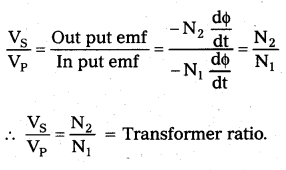
The ratio of secondary e.m.f to the primary e.m.f. (or) number of turns in secondary to the number of turns in the primary is called the transformer ratio.
Transformer ratio = \(\frac{V_s}{V_p}\) = \(\frac{N_s}{N_p}\).

Question 5.
Write the expression for the reactance of

  1. an inductor and
  2. a capacitor.

Answer:

  1. Inductive reactance (XL) = ωL
  2. Capacitive reactance (XC) = \(\frac{1}{\omega C}\)

Question 6.
What is the phase difference between A.C emf and current in the following: Pure resistor, pure inductor and pure capacitor.
Answer:

  1. In pure resistor A.C. e.in.f and current are in phase with each other.
  2. In pure inductor, current lags behind the e.m.f. by an angle of \(\frac{\pi}{2}\) (or) 90°.
  3. In pure capacitor, current leads the e.m.f by an angle \(\frac{\pi}{2}\) (or) 90°.

Question 7.
Define power factor. On which factors does power factor depend ?
Answer:
The ratio of true power and apparent power (virtual power) in an a.c circuit is called as power factor of the circuit.
Power factor (cosϕ) = \(\frac{\mathrm{P}}{\mathrm{P}_{\mathrm{rms}}}\). (∴ Prms = VrmsIrms)
Power factor depends on r.m.s voltage, r.m.s current and average power (P).

Question 8.
What is meant by wattless component of current ?
Answer:
Average power (P) = Vrms(Irms sinϕ)cos \(\frac{\pi}{2}\)
The average power consumed in the circuit due to Irms sin ϕ) component of current is zero. This component of current is known as wattless current. (Irms sin ϕ) is the wattless component of current.

Question 9.
When does a LCR series circuit have minimum impedance?
Answer:
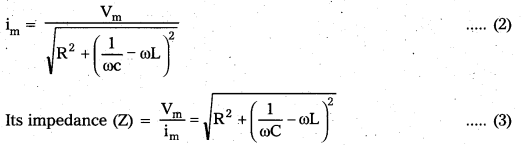
In LCR series circuit, Impedance (Z) = \(\sqrt{R^2+\left(\frac{1}{\omega C}-\omega L\right)^2}\)
At a particular frequency, ωL = \(\frac{1}{\omega C}\)
The impedance is minimum (Z = R)
This frequency is called resonant frequency

AP Inter 2nd Year Physics Study Material Chapter 10 Alternating Current

Question 10.
What is the phase difference between voltage and current when the power factor in LCR series circuit is unity ?
Answer:
In LCR series circuit power factor (cos ϕ) = 1
∴ Phase difference between voltage and current is zero. (ϕ = 0)

Short Answer Questions

Question 1.
Obtain an expression for the current through an inductor when an AC emf is applied.
Answer:
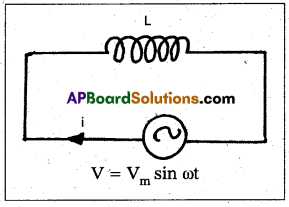
Circuit consists of pure inductor of inductance L. Let an ac e.m.f V = Vm sin ωt is applied to it. Let i be the instantaneous current.
Back e.m.f developed across the inductor = -L\(\frac{\mathrm{di}}{\mathrm{dt}}\)
AP Inter 2nd Year Physics Study Material Chapter 10 Alternating Current 1
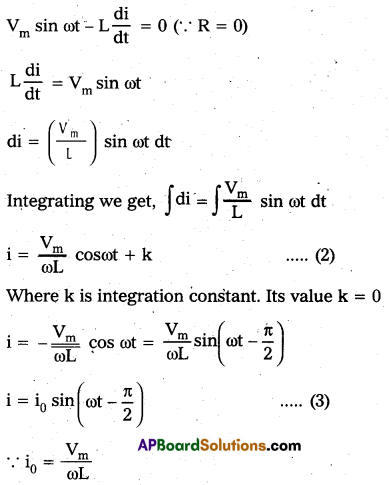
Total e.m.f = Vm sin ωt – L\(\frac{\mathrm{di}}{\mathrm{dt}}\) ——- (1)
According to ohms law this must be equal to iR = 0
AP Inter 2nd Year Physics Study Material Chapter 10 Alternating Current 2
This is the expression for the instantaneous current through inductor. Here current lags behind the e.m.f by \(\frac{\pi}{2}\) radian (or) 90°.

Question 2.
Obtain an expression for the current in a capacitor when an AC emf is applied.
Answer:
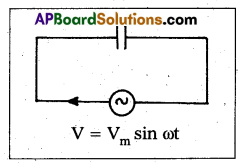
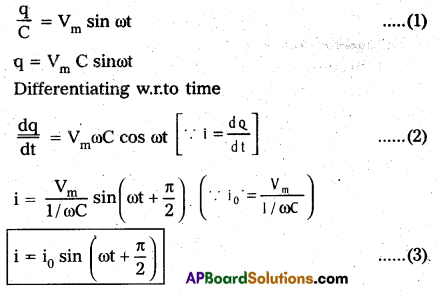
Circuit consists of pure capacitor of capacitance C. Let an A.C emf V = Vm sin ωt is applied to it. Let i and q be the instantaneous values of current and charge.
Potential difference across capacitor = –\(\frac{\mathrm{q}}{\mathrm{C}}\).
Total emf = Vm sin ωt –\(\frac{\mathrm{q}}{\mathrm{C}}\)
AP Inter 2nd Year Physics Study Material Chapter 10 Alternating Current 3
According to Ohms law this must be equal to iR = 0
Vm sin ωt –\(\frac{\mathrm{q}}{\mathrm{C}}\) = 0
AP Inter 2nd Year Physics Study Material Chapter 10 Alternating Current 4
i0 is peak value of current. Here the current leads the applied e.m.f. by \(\frac{\pi}{2}\) or (or) 90°

AP Inter 2nd Year Physics Study Material Chapter 10 Alternating Current

Question 3.
State the principle on which a transformer works. Describe the working of a transformer with necessary theory.
Answer:
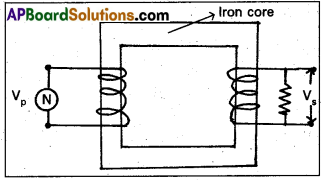
Transformer is a device to convert a low alternating current of high voltage into high alternating current of low voltage and vice versa.
Principle : It works on the principle of mutual induction between two coils.
Working : When an alternating emf is applied across the primary coil, the input voltage changes with time. Hence the magnetic flux through the primary also changes with time.
This changing magnetic flux will be linked with secondary through the core. An emf is induced in the secondary.
AP Inter 2nd Year Physics Study Material Chapter 10 Alternating Current 5
Theory: Let N1 and N2 be the number of turns in the primary and secondary. Let VP and Vs be the emf s across the primary and secondary.
AP Inter 2nd Year Physics Study Material Chapter 10 Alternating Current 6
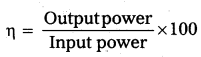
Efficiency of transformer:
It is the ratio of output power to the input power.
AP Inter 2nd Year Physics Study Material Chapter 10 Alternating Current 7

Long Answer Questions

Question 1.
Obtain on expression for impedance and current in series LCR circuit. Deduce an expresssion for the resonating frequency of an LCR series resonating circuit
Answer:
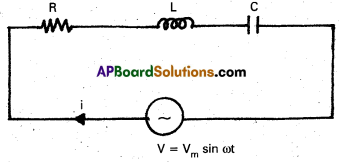
Circuit consists of resistor of resistance R, inductor of inductance L and capacitor of capacitance C connected in series with an a.c Voltage V = Vm sin ωt.
Let i be the current and q be the charge at any instant t.
AP Inter 2nd Year Physics Study Material Chapter 10 Alternating Current 8
Back e.m.f across inductor is -L\(\frac{\mathrm{di}}{\mathrm{dt}}\)
and across capacitor is \(\frac{-\mathrm{q}}{\mathrm{C}}\)
Total e.m.f = Vm sin ωt – L\(\frac{\mathrm{di}}{\mathrm{dt}}\) – \(\frac{\mathrm{q}}{\mathrm{C}}\)
According to Ohms law, this must be equal to iR
Vm sinωt – L\(\frac{\mathrm{di}}{\mathrm{dt}}\) – \(\frac{q}{C}\) = iR
L\(\frac{\mathrm{di}}{\mathrm{dt}}\) + iR + \(\frac{q}{C}\) = Vm sin ωt ——- (1)
The current i any instant in the circuit is
i = im sin(ωt – ϕ) if ωL > \(\frac{1}{\omega \mathrm{C}}\) which is possible at high frequencies.
i = im sin (ωt + ϕ) if ωL which is possible at low frequencies.
The maximum current (im) is given by
AP Inter 2nd Year Physics Study Material Chapter 10 Alternating Current 9
Let ϕ be the phase difference between current and e.m.f
AP Inter 2nd Year Physics Study Material Chapter 10 Alternating Current 10

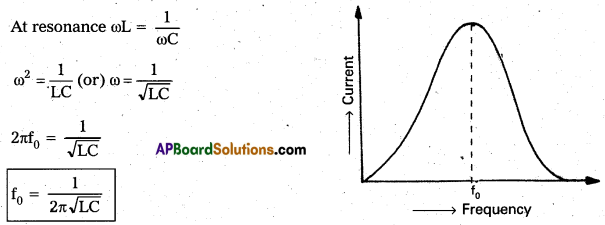
Resonant frequency(f0):
At this frequency, the impedance of LCR circuit is minimum and is equal to R. At this frequency current is maximum This frequency is called resonant frequency (f0).
AP Inter 2nd Year Physics Study Material Chapter 10 Alternating Current 11
In frequency response curve, at resonant frequency (f0), current is maximum. This series resonant circuit is called acceptor circuit.

Problems

Question 1.
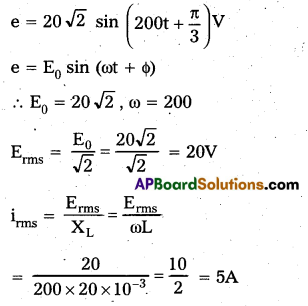
An ideal inductor (no internal resistance for the coil) or 20 mH is connected in series with an AC ammeter to an AC source whose emf is given by e = 20\(\sqrt{2}\) sin(200t + π/3)V, where t is in seconds. Find the reading of the ammeter ?
Solution:
Given that L = 20 mH = 20 × 10-3H
AP Inter 2nd Year Physics Study Material Chapter 10 Alternating Current 12

Question 2.
The instantaneous current and instantaneous voltage across a series circuit containing resistance and inductance
are given by i = \(\sqrt{2}\) sin (100t – π/4)A and υ = 40 sin (100t) V. Calculate the resistance ?
Solution:
i = \(\sqrt{2}\) sin (100t – π/4)A
(∵ i = i0 sin(ωt – ϕ))
υ = 40 sin (100t)V (∵ V = V0sin(ωt))
i0 = \(\sqrt{2}\), V0 = 40, ω = 100, ϕ = π/4
R = \(\frac{\mathrm{V}_0}{\mathrm{i}_0} \cos \phi\) = \(\frac{40}{\sqrt{2}} \cos \frac{\pi}{4}\)
R = \(\frac{40}{\sqrt{2}} \times \frac{1}{\sqrt{2}}\)
R = 20Ω

Question 3.
In an AC circuit, a condenser, a resistor and a pure inductor are connected in series across an alternator (AC generator). If the voltages across them are 20 V, 35 V and 20 V respectively, find the voltage supplied by the alternator.
Solution:
VC = 20V, VR = 35V, VL = 20V
V = \(\sqrt{\mathrm{V}_{\mathrm{R}}^2+\left(\mathrm{V}_{\mathrm{L}}^2-\mathrm{V}_{\mathrm{C}}^2\right)}\)
V = \(\sqrt{(35)^2+\left(20^2-20^2\right)}\)
V = \(\sqrt{35^2}\)
V = 35 Volt.

Question 4.
An AC circuit contains a resistance R, an inductance L and a capacitance C connected in series across an alternator of constant voltage and variable frequency. At resonant frequency, it is found that the inductive reactance, the capacitive reactance and the resistance are equal and the current in the circuit
is i0. Find the current in the circuit at a frequency twice that of the resonant frequency.
Solution:
At Resonance R = ω0L = \(\frac{1}{\omega_0 C}\)
AP Inter 2nd Year Physics Study Material Chapter 10 Alternating Current 13

AP Inter 2nd Year Physics Study Material Chapter 10 Alternating Current

Question 5.
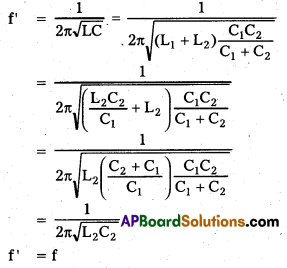
A series resonant circuit contains L1, R1 and C1. The resonant frequency is f. Another series resonant circuit contains L2, R2 and C2. The resonant frequency is also f. If these two circuits are connected in series, calculate the resonant frequency.
Solution:
Given that resonant frequency (f)
= \(\frac{1}{2 \pi \sqrt{\mathrm{L}_1 C_1}}\) = \(\frac{1}{2 \pi \sqrt{\mathrm{L}_2 \mathrm{C}_2}}\)
L1C1 = L2C2
L1 = \(\frac{\mathrm{L}_2 \mathrm{C}_2}{\mathrm{C}_1}\) —— (1)
When these two circuits are connected in series
The total inductance L = L1 + L2
Total capacitance is given by
\(\frac{1}{\mathrm{C}}\) = \(\frac{1}{C_1}\) + \(\frac{1}{C_2}\) (or) C = \(\frac{\mathrm{C}_1 \mathrm{C}_2}{\mathrm{C}_1+\mathrm{C}_2}\)
The resonant frequency of combined circuit is given by
AP Inter 2nd Year Physics Study Material Chapter 10 Alternating Current 14

Question 6.
In a series LCR circuit R = 200Ω and the voltage and the frequency of the mains supply is 200 V and 50 Hz respectively. On taking out the capacitance from the circuit the current lags behind the voltage by 45°. On taking out the inductor from the circuit the current leads the voltage by 45°. Calculate the power dissipated in the LCR circuit.
Solution:
R = 200Ω, V = 200V, f = 50Hz
ϕ = 45°, At resonance ωL = \(\frac{1}{\omega \mathrm{C}}\)
Power dissipated (P) = Vi = \(\frac{\mathrm{V}^2}{\mathrm{R}}\) (∵ i = \(\frac{V}{R}\))
P = \(\frac{(200)^2}{200}\) = 200ω

Question 7.
The primary of a transformer with primary to secondary turns ratio of 1: 2, is connected to an alternator of voltage 200 V. A current of 4A is flowing though the primary coil. Assuming that the transformer has no losses, find the secondary voltage and current are respectively.
Solution:
Given that \(\frac{\mathbf{N}_1}{\mathbf{N}_2}\) = \(\frac{1}{2}\)
E1 = 200V, i1 = 4A

i)
Transformer ratio = \(\frac{E_2}{E_1}\) = \(\frac{\mathrm{N}_2}{\mathrm{~N}_1}\)
\(\frac{E_2}{200}\) = \(\frac{2}{1}\)
E2 = 400V

ii)
\(\frac{\mathrm{N}_2}{\mathrm{~N}_1}\) = \(\frac{i_1}{i_2}\)
\(\frac{2}{1}\) = \(\frac{4}{i_2}\)
i2 = 2A

Textual Exercises

Question 1.
A 100Ω resistor is connected to a 220 V. 50 Hz ac supply.
(a) What is the rms value of current in the circuit ?
(b) What is the net power consumed over a full cycle ?
Solution:
Given resistance R = 100Ω
Vrms = 220V
Frequency f = 50Hz

a) Current in the circuit
Irms = \(\frac{V_{r m s}}{R}\) = \(\frac{220}{100}\) = 2.2A

b) Net power consumed in full cycle
P = Vrms × Irms
= 220 × 2.2
= 474 W

Question 2.
(a) The peak voltage of an ac supply is 300 V. What is the rms voltage ?
(b) The rms value of current in an ac circuit is 10A. What is the peak current ?
Solution:
a) Given, peak value of voltage V0 = 300V
The rms value of current Irms = 10A
The rms value of voltage
Vrms = \(\frac{\mathrm{V}_0}{\sqrt{2}}\) = \(\frac{300}{\sqrt{2}}\) = 212.1V

b) Using the formula
Irms = \(\frac{\mathrm{I}_0}{\sqrt{2}}\)
The peak value of current
I0 = \(\sqrt{2} \times \mathrm{I}_{\mathrm{rms}}\)
= \(\sqrt{2}\) × 10 = 1.414 × 10
I0 = 14.14 A

Question 3.
A 44 mH inductor is connected to 220 V, 50 Hz ac supply. Determine the rms value of current in the circuit.
Solution:
Given inductance
L = 44mH = 44 × 10-3H
Vrms = 220V
Frequency of Inductor f = 50Hz
Inductive resistance XL = 2πfL
= 2 × 3.14 × 50 × 44 × 10-3
= 13.83Ω
The rms value of current in the circuit
Irms = \(\frac{V_{\text {rms }}}{X_L}\) = \(\frac{220}{13.83}\)15.9A

Question 4.
A 60 μF capacitor is connected to a 110V, 60 Hz ac supply. Determine the rms value of the current in the circuit.
Solution:
Given, capacitance of the capacitor C
= 60μF
= 60 × 10-6F
Vrms = 110
Frequency of AC supply f = 60Hz
Capacitive reactance
XC = \(\frac{1}{2 \pi \mathrm{fC}}\) = \(\frac{1}{2 \times 3.14 \times 60 \times 60 \times 10^{-6}}\)
= 44.23Ω
The rms value of current in the circuit
Vrms = \(\frac{\mathrm{V}_{\mathrm{rms}}}{\mathrm{X}_{\mathrm{C}}}\) = \(\frac{110}{44.23}\) = 2.49A

AP Inter 2nd Year Physics Study Material Chapter 10 Alternating Current

Question 5.
In Exercises 3 and 4, what is the net power absorbed by each circuit over a complete cycle. Explain your answer.
Solution:
In Exercise 3 Average power P = Vrms, Irms. cos ϕ

As we know that the phase difference between current and voltage in case of inductor is 90°.
P = Vrms. Irms. cos 90° = 0
In Exercise 4 Average power
P = Vrms. Irms. cos ϕ
We know that the phase difference between current and voltage in case of capacitor is 90°
P = Vrms. Irms. cos 90° = 0

Question 6.
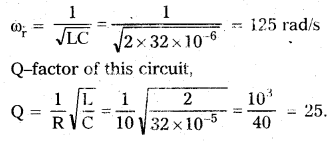
Obtain the resonant frequency ωr of a series LCR circuit with L = 2.0H. C = 32 μF and R = 10Ω. What is the Q-value of this circuit ?
Solution:
Given, L = 2H, C = 32μF, R = 10Ω
Resonant angular frequency
AP Inter 2nd Year Physics Study Material Chapter 10 Alternating Current 16

Question 7.
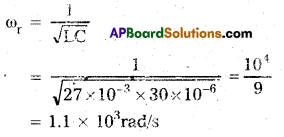
A charged 30 μF capacitor is connected to a 27 mH inductor. What is the angular frequency of free oscillations of the circuit ?
Solution:
Capacitance of capacitor C = 30μF = 30 × 10-6F
Inductance L = 27mH = 27 × 10-3H
For free oscillations, the angular frequency should be resonant frequency. Resonant angular frequency of oscillation of the circuit
AP Inter 2nd Year Physics Study Material Chapter 10 Alternating Current 30

Question 8.
Suppose the initial charge on the capacitor in Exercise 7 is 6 mC. What is the total energy stored in the circuit initially ? What is the total energy at later time ?
Answer:
Given, charge on the capacitor Q = 6mC = 6 × 10⁻³
C = 30μF = 30 × 10-6F
Energy stored in the circuit
E = \(\frac{Q^2}{2 C}\) = \(\frac{\left(6 \times 10^{-3}\right)^2}{2 \times 30 \times 10^{-2}}\) = \(\frac{36}{60}\) = 0.6J
After some time, the energy is shared between C and L, but the total energy remains constant.
So, we assume that there is no loss of energy.

Question 9.
A series LCR circuit with R = 20Ω, L = 1.5 H and C = 35µF is connected to a variable-frequency 200 V ac supply. When the frequency of the supply equals the natural frequency of the circuit, what is the average power transferred to the circuit in one complete cycle ?
Given resistance R = 200Ω
Inductance L = 1.5H, capacitance C = 35µF = 35 × 10-6F and voltage Vrms = 200V
When, the frequency of the supply equal to the natural frequency of the circuit, this is the condition of resonance. At the condition of resonance, Impedance Z = R = 20Ω
The rms value of current in the circuit
Irms = \(\frac{V_{r m s}}{Z}\) = \(\frac{200}{20}\) = 10A
ϕ = 0°
Power transferred to the circuit in one complete cycle.
P = Irms Vrms cos ϕ
= 10 × 200 × cos0° = 2000 ω = 2Kω

Question 10.
A radio can tune over the frequency range o a portion of MW broadcast band: (800 kHz to 1200 kHz). If its LC circuit has an effective inductance of 200 μH, what must be the range of its variable capacitor?

(Hint: For tuning, the natural frequency i.e., the frequency of free oscillations of the LC circuit should be equal to the frequency of the radiowave.)
Solution:
Given, minimum frequency
f1 = 800KHz = 8 × 10⁵HZ
Inductance
L = 200μH = 200 × 10-5H = 2 × 10⁻⁴H.
Maximum frequency
f2 = 1200 KHz = 12 × 105Hz for tuning, the natural frequency is equal to the frequency of oscillations that means it is the case of resonance.
Frequency of oscillations f = \(\frac{1}{2 \pi \sqrt{L C}}\)
For capacitance C1, f1 = \(\frac{1}{2 \pi \sqrt{L C_i}}\)
C1 = \(\frac{1}{4 \pi^2 \mathrm{f}_1^2 \mathrm{~L}}\)
= \(\frac{1}{4 \times 3.14 \times 3.14 \times\left(8 \times 10^5\right)^2 \times 2 \times 10^{-4}}\)
= 197.7 × 10⁻¹²F
= 197.7PF
for capacitance C2, f2 = \(\frac{1}{2 \pi \sqrt{L C_2}}\)
C2 = \(\frac{1}{4 \pi^2 f_1^2 \mathrm{C}}\)
= \(\frac{1}{4 \times 3.14 \times 3.14 \times\left(12 \times 10^5\right)^2 \times 2 \times 10^{-4}}\)
= 87.8 × 10⁻¹²F = 87.8pF
Thus, the range of capacitor is 87.8pF to 197.7pF.

Question 11.
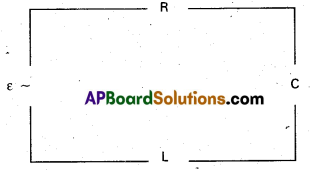
Figure shows a series LCR circuit connected to a variable frequency 230 V source. L = 5.0 H, C = 80μF, R = 40Ω.
AP Inter 2nd Year Physics Study Material Chapter 10 Alternating Current 31
(a) Determine the source frequency which drives the circuit in resonance.
(b) Obtain the impedance of the circuit and the amplitude of current at the resonating frequency.
(c) Determine the rms potential drops across the three elements of the circuit. Show that the potential drop across the LC combination is zero at the resonating frequency.
Solution:
Given, the rms value of voltage
Vrms = 230V
Inductance L = 5H
Capacitance C = 80μf = 80 × 10-6F
Resistance R = 40Ω

a) For resonance frequency of circuit
ωr = \(\frac{1}{\sqrt{\mathrm{LC}}}\) = \(\frac{1}{\sqrt{5 \times 80 \times 10^{-6}}}\) = 50 rad/s
Source frequency at resonance, then
υ0 = \(\frac{\omega_0}{2 \pi}\) = \(\frac{50}{2 \times 3.14}\) = 7.76 Hz

b) At the resonant frequency, XL = XC
So, impedance of the circuit Z = R
∴ Impedance Z = 40Ω
The rms value of current in the circuit
Irms = \(\frac{V_{r m s}}{Z}\) = \(\frac{230}{40}\) = 5.75A
Amplitude of current I0 = Irms\(\sqrt{2}\)
= 5.75 × \(\sqrt{2}\)
= 8.13A

c) The rms potential drop across L
VL = Irms XL
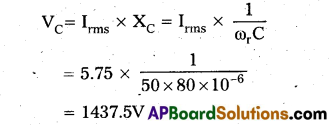
= Irms ωrL = 5.75 × 50 × 5 = 1437.5V
The rms potential drop across R
VR = Irms = R = 5.75 × 40 = 230V
The rms potential drop across C,
AP Inter 2nd Year Physics Study Material Chapter 10 Alternating Current 18
Potential drop across LC combinations
= Irms(XL – XC)
= Irms(XL – XL) = 0 (∵ XL – XC)

Additional Exercises

Question 1.
An LC circuit contains a 20 mH inductor and a 50μF capacitor with an initial charge of 10 mC. The resistance of the circuit is negligible. Let the instant the circuit is closed be t = 0.
(a) What is the total energy stored initially ? Is it conserved during LC oscillations ?
(b) What is the natural frequency of the circuit ?
(c) At What time is the energy stored
(i) Completely electrical (i.e., stored in the capacitor) ?
(ii) completely magnetic (i.e., stored in the inductor) ?
(d) At what times is the total energy shared equally between the inductor and the capacitor ?
(e) As a resistor is inserted in the circuit, how much energy is eventually dissipated as heat ?
Solution:
Given Inductance L = 20mH = 20 × 10-3H
Capacitance of capacitor
C = 50μf = 50 × 10-6F
Initial charge on the capacitor,
Qi = 10mc = 10 × 103C

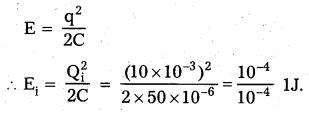
a) The total energy stored across the capacitor initially,
AP Inter 2nd Year Physics Study Material Chapter 10 Alternating Current 19
Yes, this energy is conserved during LC oscillations.

b) To get the natural frequency or resonant frequency,
fr = \(\frac{1}{2 \pi \sqrt{L C}}\)
= \(\frac{1}{2 \times 3.14 \times \sqrt{20 \times 10^{-3} \times 50 \times 10^{-6}}}\)
= \(\frac{7 \times 10^3}{44}\) = 159.2 Hz.
The natural frequency of the circuit
ω = 2πV = 2π × 159.2
= 999.78 ≈ 1000 = 103 rad/s

c)

i) Let at any instant the energy stored is completely electrical the charge on the capacitor Q = Q0 cos ωt
Q = Q0 cos \(\frac{2 \pi}{T} \cdot t\) —– (1)
Q is maximum as it is equal to Q0, only if cos \(\frac{2 \pi}{T}\) t = ±1 = cosnπt or t
= \(\frac{\mathrm{nT}}{2}\), where n = 1, 2, 3. ..
t = 0, T/2, T, 3T/2, ………..
Thus, the energy stored is completely electrical at t = 0, T/2, T, 3/2……….

ii) Let at any instant, the energy stored is completely magnetic as when the electrical energy across the capacitor is zero.
q = 0
Q = Q0cos \(\frac{2 \pi t}{T}\) = 0 (from eq(i))
∴ cos \(\frac{2 \pi}{T} \cdot t\) = 0 = \(\frac{\mathrm{n} \pi}{2}\) or t = \(\frac{\mathrm{nT}}{4}\) = cos.
It happens if t = T/4, 3T/4, \(\frac{\mathrm{5T}}{4}\),………..
Thus, the energy stored is completely magnetic at
t = T/4, 3T/4, 5T/4………..

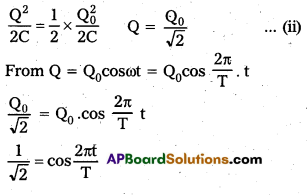
d) Equal sharing of energy between inductor and capacitor means the energy stored in capacitor = \(\frac{1}{2}\) × Maximum energy
AP Inter 2nd Year Physics Study Material Chapter 10 Alternating Current 20
or cos(2n + 1)π/4 = cos \(\frac{2 \pi \mathrm{t}}{\mathrm{T}}\)
\(\frac{(2 n+1) \pi}{4}\) = \(\frac{2 \pi t}{T}\)
t = T/8(2n + 1) (n = 0, 1, 2, 3, ……..)
Hence the energy will be shared half on capacitor and half on inductor.
t = \(\frac{T}{8}\), \(\frac{3 \mathrm{~T}}{8}\), \(\frac{5 \mathrm{~T}}{8}\), ………..

e) As a resistor is inserted in the circuit, all of the energy loss during heating. Energy loss = 1J. The oscillations becomes damped and becomes disappear after sometime as the total energy loss in the form of heat.

AP Inter 2nd Year Physics Study Material Chapter 10 Alternating Current

Question 2.
A coil of inductance 0.50 H and resistance 100Ω is connected to a 240 V, 50Hz ac supply.
a) What is the maximum current in the coil ?
b) What is the time lag between the voltage maximum and the current maximum ?
Solution:
Given, Inductance L = 0.50H
Resistance R = 100Ω
The rms value of voltage
Vrms = 240V, f = 50Hz

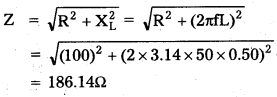
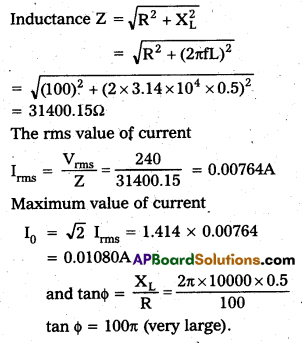
a) Impedance of circuit
AP Inter 2nd Year Physics Study Material Chapter 10 Alternating Current 21
the rms value of current
Irms = \(\frac{\mathrm{V}_{\mathrm{rms}}}{\mathbf{Z}}\) = \(frac{240}{31400.15}\) = 0.00764
the maximum value of current in the circuit
I0 = \(\sqrt{2}\) Irms = 1.414 × 0.00764 = 1.824A

b) Using the formula of time lag,
t = \(\frac{\phi}{\omega}\)
tan ϕ = \(\frac{X_L}{R}\) = \(\frac{\omega \mathrm{L}}{\mathrm{R}}\) = \(\frac{2 \pi \mathrm{fL}}{\mathrm{R}}\) = \(\frac{2 \times 3.14 \times 50 \times 0.50}{100}\)
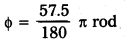
ϕ = tan-6(1.571) = 57.5
AP Inter 2nd Year Physics Study Material Chapter 10 Alternating Current 33
Time lag t = \(\frac{\phi}{\omega}\) = \(\frac{57.5 \pi}{180 \times 2 \pi \mathrm{f}}\)
= \(\frac{57.5}{180 \times 2 \times 50}\)
= 3.19 × 10⁻³S
Thus, the time lag between the voltage maximum and the current maximum is 3.19 × 10⁻³S

Question 3.
Obtain the answers (a) to (b) in Exercise 13 if the circuit is connected to a high frequency supply (240V, 10 kHz). Hence, explain the statement that at very high frequency an inductor in a circuit nearly amounts to an open circuit. How does an inductor behave in a dc circuit after the steady state?
Answer:
Given frequency f = 10kHz = 104Hz
the rms value of voltage Vrms = 240v
from Exercise 13
Resistance R = 100Ω
Inductance L = 0.5H
AP Inter 2nd Year Physics Study Material Chapter 10 Alternating Current 32

Question 4.
A 100μF capacitor in series with a 40Ω resistance is connected to a 110V. 60 Hz supply.
(a) What is the maximum current in the circuit?
(b) What is the time lag between the current maximum and the voltage maximum?
Answer:
Given capacitance of capacitor
C = 100µF= 100 × 10-6F
Resistance R = 40Ω
the rms value of voltage Vrms = 110V
Frequency f = 60Hz

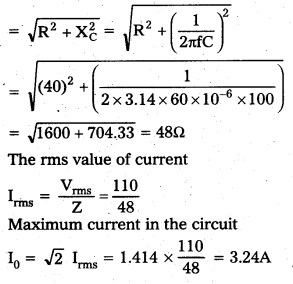
(a) Impedance Z
AP Inter 2nd Year Physics Study Material Chapter 10 Alternating Current 22

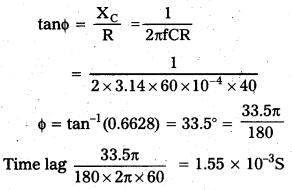
(b) Time lag (t) = \(\frac{\phi}{\omega}\)
AP Inter 2nd Year Physics Study Material Chapter 10 Alternating Current 23
Thus, the time lag between the voltage maximum and the current maximum is 1.55 × 10⁻³S.

Question 5.
Obtain the answers to (a) and (b) in Exercise 15 if the circuit is connected to a 110 V, 12 kHz supply? Hence, explain the statement that a capacitor is a conductor at very high frequencies. Compare this behaviour with that of a capacitor in a dc circuit after the steady state.
Answer:
Given, the rms value of voltage,
Vrms = 110V
The frequency of capacitor
f = 12kHz = 12000 Hz.
Capacitance of conductor C = 10-4F.
Resistance R = 40Ω
Capacitive Resistance
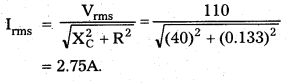
XC = \(\frac{1}{2 \pi \mathrm{fC}}\) = \(\frac{1}{2 \times 3.14 \times 12000 \times 10^{-4}}\)
= 0.133Ω
The rms value of current
AP Inter 2nd Year Physics Study Material Chapter 10 Alternating Current 24
The maximum value of current,
I0 = \(\sqrt{2}\) Irms
= 1.414 × 2.75
= 3.9A
Here, the value of XC is very small, so term containing C is negligible.
tan ϕ = \(\frac{1}{\omega \mathrm{CR}}\)
= \(\frac{1}{2 \times 3.14 \times 12000 \times 10^{-4} \times 40}\)
= \(\frac{1}{96 \pi}\)
It is very very small.
In DC circuits, ω = 0
XC = \(\frac{1}{\omega C}\) = ∞
So, it behaves like an open circuit.

Question 6.
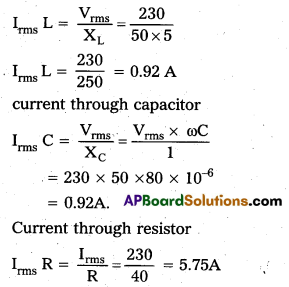
Keeping the source frequency equal to the resonating frequency of the series LCR circuit, if the three elements L, C and R are arranged in parallel, show that the total current in the parallel LCR circuit is minimum at this frequency. Obtain the current rms value in each branch of the circuit for the elements and source specified in Exercise 11 for this frequency.
Solution:
As they are corrected in the parallel combination
\(\frac{1}{Z}\) = \(\frac{1}{R}\) + (\(\frac{1}{X_L}\) + \(\frac{1}{X_C}\))
As the reactance (XC – XL) is perpendicular to the ohmic resistance R, therefore we can write as
AP Inter 2nd Year Physics Study Material Chapter 10 Alternating Current 25
That means \(\frac{1}{Z}\) = minimum and thus Z = maximum. As Z is maximum, current will be minimum, current through inductor
AP Inter 2nd Year Physics Study Material Chapter 10 Alternating Current 26

Question 7.
A circuit containing a 80 mH inductor and a 60μF capacitor in series is connected to a 230 V 50 Hz supply. The resistance of the circuit is negligible.
(a) Obtain the current amplitude and rms values.
(b) Obtain the rms values of potential drops across each element.
(c) What is the average power transferred to the inductor?
(d) What is the average power transferred to the capacitor?
(e) What is the total average power absorbed by the circuit? [‘Average’ implies ‘averaged over one cycle’]
Answer:
Given Inductance
L = 80mH = 80 × 10-3H
Capacitance of capacitor
C = 60μF = 60 × 10-6F .
The rms value of voltage
Vrms = 230V
Frequency f = 50Hz; Resistance R = 0

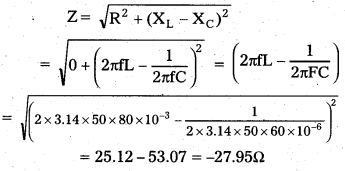
a) Impedance of circuit
AP Inter 2nd Year Physics Study Material Chapter 10 Alternating Current 27
As ZCO, means XL < XC, emf lags by current by 90°
The rms value of current
Irms = \(\frac{\mathrm{V}_{\mathrm{rms}}}{\mathrm{Z}}\) = \(\frac{230}{27.95}\) = 8.29A
The maximum value of current
I0 = \(\sqrt{2} I_{\text {rms }}\) = 1.414 × 8.29 = 11.64A

b) Potentiál drop acrõss L
VrmsL = Irms × XL = 8.29 × 2 × 3.14 × 50 × 80 × 10-3
= 208.25 V
Potential drop across C
VrmsC = Irms × XC
= 8.29 × \(\frac{1}{2 \times 3.14 \times 50 \times 60 \times 10^{-6}}\)
= 440.02 V
∴ Applied rms voltage = VC – VL
= 440 – 208.25 = 231.75V

c) Average power transferred to the inductor
P = Irms Vrms. cosϕ
As the phase difference is 90°, So P = 0

d) Average power transferred to the capacitor.
P = Irms Vrms. cosϕ
As the phase difference is 90°, So P = 0

e) As there is no resistance in the circuit, so average power is equal to sum of average power due to inductor and capacitor. That means the average power consumed is zero.

AP Inter 2nd Year Physics Study Material Chapter 10 Alternating Current

Question 8.
Suppose the circuit in Exercise 18 has a resistance of 15Ω. Obtain the average power transferred to each element of the circuit, and the total power absorbed.
Solution:
Given, the rms value of voltage V = 230V
Vrms = 230V
Resistance R = 15Ω
Frequency f = 50Hz
Average power across inductor and capacitor is zero as the phase difference between current and voltage is 90°.
Total power absorbed = power absorbed in resistor, Pav
AP Inter 2nd Year Physics Study Material Chapter 10 Alternating Current 28
Total power absorbed = 790.6W

Question 9.
A series LCR circuit with L = 0.12 H, C = 480 nF, R = 23Ω is connected to a 230 V variable frequency supply.
a) What is the source frequency for which current amplitude is maximum. Obtain this maximum value.
b) What is the source frequency for which average power absorbed by the circuit is maximum. Obtain the value of this maximum power.
c) For which frequencies of the source is the power transferred to the circuit half the power at resonant frequency ? what is the current amplitude at these frequencies ?
d) What is the Q-factor of the given circuit ?
Answer:
Inductance L = 0.12H,
Capacitance C = 480nF = 480 × 10-9F
Resistance R = 23Ω
The rms value of voltage
Irms = \(\frac{V_{r m s}}{Z}\) = \(\frac{230}{23}\) = 10A
The maximum value of current I0 = \(\sqrt{2}\)
Irms = 1.414 × 10 = 14.14A.
At natural frequency, the current amplitude is maximum.
ω = \(\frac{1}{\sqrt{\mathrm{LC}}} \frac{1}{2 \pi \sqrt{0.12 \times 480 \times 10^{-9}}}\) = 4166.6
= 4167 rad/s

b) Average power is maximum for resonance.
Pav(max) = I2rms R = 10 × 10 × 23 = 2300W.

c) Power transferred to the circuit is half the power at resonant frequency
Δω = \(\frac{\mathrm{R}}{2 \mathrm{~L}}\) = \(\frac{23}{2 \times 0.12}\) = 95.83 rad/s
ΔV = \(\frac{\Delta \mathrm{W}}{2 \pi}\) = 15.2Hz
The frequencies at which power transferred is half .
V = V0 ± ΔV = 663.48 ± 15.26
So, frequencies are 448.3Hz and 678.2Hz, the maximum current
I = \(\frac{\mathrm{I}_0}{\sqrt{2}}\) = \(\frac{14.14}{\sqrt{2}}\) = 10A

d) Q-factor = \(\frac{\omega_{\mathrm{r}}}{\mathrm{R}}\) = \(\frac{4166.7 \times 0.12}{23}\) = 21.74

Question 10.
Obtain the resonant frequency and Q-factor of series LCR circuit with L = 3.0 H, C = 27μF, and R = 10.4Ω. It is desired to improved the sharpness of the resonance of the circuit by reducing its ‘full width at half maximum’ by a factor of 2. Suggest a suitable way.
Solution:
Given, inductance L = 3H
Capacitance of capacitor
C = 27μF = 27 × 10-6F
Resistance R = 7.4Ω
the resonant frequency of circuit
ωr = \(\frac{1}{\sqrt{\mathrm{LC}}}\) = \(\frac{1}{\sqrt{3 \times 27 \times 10^{-6}}}\) = \(\frac{1000}{9}\)
= 111.1 rad/s.
Q-factor of a series LCR circuit
Q-factor = \(\frac{\omega_{\mathrm{r}} \mathrm{L}}{\mathrm{R}}\) = \(\frac{111.1 \times 3}{7.4}\) = 45.04
To reduce the full width at half by factor Q, we have to reduce the value of R as R/2
\(\frac{R}{2}\) = \(\frac{7.4}{2}\) = 3.7Ω

Question 11.
Answer the following questions :
a) In any ac circuit, is the applied Instantaneous voltage equal to the algebraic sum of the instantaneous voltages across the series elements of the circuit ? Is the same true for rms voltage ?
Answer:
Yes, the applied voltage equal to the algebraic sum of the instantaneous voltages across the series elements of the circuit
No, it is not true for rms voltage because there is some phase differences across different elements of circuits.

b) A capacitor is used in the primary circuit of an induction coil.
Answer:
A capacitor is used in the primary circuit of an induction coil because when the circuit is broken, a large induced voltage is used up in charging the capacitor. So, the parking or any damages are avoided.

c) An applied voltage signal consists of a superposition of a dc voltage and an ac voltage of high frequency. The circuit consists of an inductor and a capacitor in series. Show that the dc signal will appear across C and the ac signal across L.
Solution:
As we know that
XC = \(\frac{1}{2 \pi f c}\), XL = 2πfL
f = 0, XC = ∞, XL = 0

d) A choke coil in series with a lamp is connected to a dc line. The lamp is seen to shine brightly. Insertion of an Iron core in the choke causes no change in the lamp’s brightness. Predict the corresponding observations if the connection is to an ac line.
Answer:
When the choke coil is connected to dc, there is no change in the brightness. Because f = 0, XL = 6. So, no change in the brightness. In Ac, the choke offers impedance, so, it glows dim. As we insert an iron core the magnetic field increases and hence inductance increases.
BA = LI = ϕ
L ∝ B
So, XL also increases and the brightness of bulb decreases.

e) Why is choke coil needed in the use of fluorescent tubes with ac mains ? Why can we not use an ordinary resistor instead of the choke coil ?
Answer:
We use the choke coil instead of resistance because the power loss across resistor is maximum while the power loss across choke is zero.
For resistor, ϕ = 0
P = Irms. Vrms. cos ϕ
= Irms. Vrms = maximum
For Inductor ϕ = 90°
P = Irms. Vrms. cos 90° = 0

Question 12.
A power transmission line feeds input power at 2300 V to a stepdown transformer with its primary windings having 4000 turns, what should be the number of turns in the secondary in order to get output power at 230 V ?
Solution:
Given Primary voltage VP = 2300V NP = 4000 turns
Secondary voltage VS = 230V
Using formula,
\(\frac{\mathrm{V}_{\mathrm{S}}}{\mathrm{V}_{\mathrm{P}}}\) = \(\frac{N_S}{N_P}\)
\(\frac{230}{2300}\) = \(\frac{\mathrm{N}_{\mathrm{S}}}{4000}\)
NS = 400
∴ thus, the number of turns in secondary are 400.

AP Inter 2nd Year Physics Study Material Chapter 10 Alternating Current

Question 13.
At a hydroelectric power plant, the water, pressure head is at a height of 300 m and the water flow available is 100 m3s-1. If the turbine generator efficiency is 60%, estimate the electric power available from the plant (q = 9.8 ms-2).
Answer:
Given, height of water h = 300m
Rate of flow of water V = 100m3/s
efficiency η = 60%
g = 9.8m/s2.
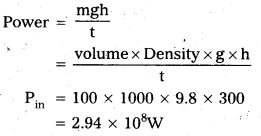
As we know that input power is required to raised the water up to height
h = 300 m
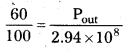
AP Inter 2nd Year Physics Study Material Chapter 10 Alternating Current 29
Suppose, the power output is Pout which is equal to the power available from the plant. The efficiency of generator
η = \(\frac{P_{\text {out }}}{P_{\text {in }}}\)
AP Inter 2nd Year Physics Study Material Chapter 10 Alternating Current 34
pout = 176.4MW = 1764 × 105W

Question 14.
A small town with a demand of 800 kW of electric power at 220 V is situated 15 km away from an electric plant generating power at 440 V. The resistance of the two wire line carrying power in 0.5 Ω per km. The town gets power from the line through a 4000 – 220V step-down transformer at a substation in the town.
(a) Estimate the line power loss in the form of heat.
(b) How much power must the plant supply, assuming there is negligible power loss due to leakage ?
(c) Characterise the step up transformer at the plant.
Answer:
Generating power of Electric plant = 800 kW at V = 220V
Distance = 15km,
Generating voltage = 440V
Resistance/length = 0.50Ω/km
Primary voltage VP = 4000V
Secondary voltage VS = 220V
(a) Power = Ip. Vp
800 × 1000 = Ip × 4000
Ip = 200A
Line power loss in form of heat
= (Ip)2 × Resistance of line
= (Ip)2 × 0.5 × 15 × 2
= (200)2 × 0.5 × 15 × 2
= 60 × 104W
= 600KW

(b) If there is no power loss due to leakage the plant supply should be =
800 + 600 = 1400KW

(c) Voltage drop across the line
= IP. R
= 200 × 0.5 × 15 × 2
= 3000V
Voltage from transmission
= 3000 + 4000 = 7000V
As it is given that the power generated at 440V
So, the step-up transformer needed at the plant is 440V – 7000V

Question 15.
Do the same exercise as above with the replacement of the earlier transformer by a 40,000-220V step-down transformer (Neglect, as before, leakage losses though this may not be a good assumption any longer because of the very high voltage transmission involved). Hence, explain why high voltage transmission is preferred ?
Answer:
Given primary voltage VP = 40,000V
Let the current in primary is IP
∴ VPIP = P
800 × 1000 = 40000 × IP
IP = 20A
a) Line power loss = (IP)2 × R
= (20)2 × 2 × 0.5 × 15
= 6000W = 6KW

b) Power supply by plant
= 800 + 6 = 806KW

Voltage drop of line = IP.R
= 20 × 2 × 0.5 × 15
= 300V
Voltage for transmission
= 40000 + 300 = 40300V
Power loss at higher voltage
= \(\frac{6}{800}\) × 100 = 0.74%
Power loss at lower voltage
= \(\frac{600}{1400}\) × 100 = 42.8%
Hence, the power loss is minimum at higher voltage. So, the high voltage transmission is preferred.

AP Inter 2nd Year Physics Study Material Chapter 9 Electromagnetic Induction

Andhra Pradesh BIEAP AP Inter 2nd Year Physics Study Material 9th Lesson Electromagnetic Induction Textbook Questions and Answers.

AP Inter 2nd Year Physics Study Material 9th Lesson Electromagnetic Induction

Very Short Answer Questions

Question 1.
What did the experiments of Faraday and Henry show?
Answer:
The discovery and understanding of electromagnetic induction are based on a long series of experiments carried out by Faraday and Henry.

Question 2.
Define magnetic flux.
Answer:
Magnetic flux is defined as the number of magnetic lines of force crossing through the surface.
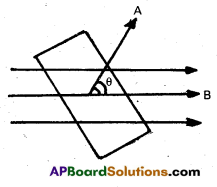
ϕB = \(\overrightarrow{\mathrm{B}} \cdot \overrightarrow{\mathrm{A}}\) = BA cos θ
C.G.S unit → Maxwell
S.I. unit → Weber (wb)
Magnetic flux is a scalar.

AP Inter 2nd Year Physics Study Material Chapter 9 Electromagnetic Induction

Question 3.
State Faraday’s law of electromagnetic induction.
Answer:
“Magnitude of induced e.m.f is directly proportional to the rate of change of magnetic flux”
ε ∝ \(-\frac{d \phi}{d t}\)

Question 4.
State Lenz’s law.
Answer:
The direction of induced e.m.f (or) current is such that it opposes the cause which produce it. Lenz’s law is in accordance with law of conservation of energy.

Question 5.
What happens to the mechanical energy (of motion) .when a conductor is moved in a uniform magnetic field ?
Answer:
Motional e.m.f is produced to the motion of the conductor,in a magnetic field.
Motion e.m.f (ε) = Blυ

Question 6.
What are Eddy currents ? (T.S. Mar. ’19; A.P. Mar. ’15)
Answer:
Eddy currents (or) Foucault currents : The induced circulating currents produced in a conductor itself due to change in magnetic flux linked with the conductor are called Eddy currents.
Due to Eddy currents, the energy is dissipated in the form of heat energy.

Question 7.
Define ‘inductance’.
Answer:
Inductance is a coefficient of electromagnetic induction and is an intrinsic property of a material just like capacitance.
Inductance is an important scalar quantity which depends upon the geometry (i.e, dimensions) of a coil.

AP Inter 2nd Year Physics Study Material Chapter 9 Electromagnetic Induction

Question 8.
What do you understand by ‘self inductance’ ?
Answer:
Self inductance of a coil is defined as the induced e.m.f produced in the coil through which the rate of change of current is unity.
ε = \(-\mathrm{L} \frac{\mathrm{dI}}{\mathrm{dt}}\) ; ε = -L, If \(\frac{\mathrm{dI}}{\mathrm{dt}}\) = 1 A/s.

Short Answer Questions

Question 1.
Obtain an expression for the emf induced across a conductor which is moved in a uniform magnetic field which is perpendicular to the plane of motion.
Answer:
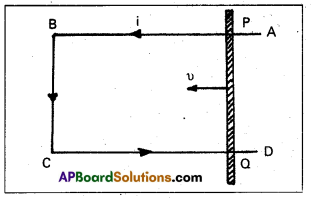
Consider a conductor PQ of length l moving freely in a uniform magnetic field \(\overrightarrow{\mathrm{B}}\) with uniform velocity u on a rectangular conductor ABCD. Let any arbitrary charge q in the conductor also move in the field with same velocity.
AP Inter 2nd Year Physics Study Material Chapter 9 Electromagnetic Induction 1
Magnitude of Lorentz force on this charge (F) = Bqυ —– (1)
Workdone in moving the charge from P to Q is given by
W = Force × displacement
W = Bqυ × l —– (2) (∵ Direction of force on the charge as per Fleming’s left hand rule)
Electromotive force (ε) = \(\frac{W}{Q}\)
ε = \(\frac{\mathrm{Bqv} l}{\mathrm{q}}\) ⇒ ε = Blυ —- (3)

Question 2.
Describe the ways in which Eddy currents are used to advantage. (A.P. Mar. ’16, AP & T.S. Mar. ’15)
Answer:
Eddy currents are used to advantage in

  1. Magnetic braking in trains : A strong magnetic field is applied across the metallic drum rotating with the axle of the electric train. Thus large eddy currents are produced in the metallic drum. These currents oppose the motion of the drum and hence the axle of the train which ultimately makes the train come to rest.
  2. Induction Motor: Eddy currents are used to rotate the short circuited rotor of an induction motor. Ceiling fans are also induction motors which run on single phase alternating current.
  3. Electromagnetic damping : Certain galvanometers have a fixed core made of non magnetic metallic material. When the coil oscillates, the eddy currents generated in the core oppose the motion and bring the coil to rest quickly.
  4. Induction furnace : Induction furnace can be used to produce high temperatures and can be utilised to prepare alloys, by melting the constituent metals. A high frequency alternating current is passed through a coil. The eddy currents generated in the metals produce high temperatures sufficient to melt it.
  5. Analogue energy meters : Concept of eddy currents is used in energy meters to record
    the consumption of electricity. Aluminium disc used in these meters get induced due to varying magnetic field. It rotates due to eddy currents produced in it.

Question 3.
Obtain an expression for the mutual inductance of two long co-axial solenoids. (A.P. Mar. ’19)
Answer:
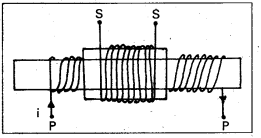
Consider two solenoids as shown in figure. The length of primary coil be l and are a of cross section A. Let N1 and N2 are the total number of turns in the primary and secondary solenoids. Let n1 and n2 be the number of turns per unit length
AP Inter 2nd Year Physics Study Material Chapter 9 Electromagnetic Induction 2
(n1 = \(\frac{\mathrm{N}_1}{l}\) and n2 = \(\frac{\mathrm{N}_2}{l}\)). Current in the primary coil is i.
∴ Magnetic field inside the primary (B) = μ0n1 I = μ0\(\frac{\mathrm{N}_1}{l}\) I —– (1)
Magnetic flux through each turn of primary
ϕB = \(\overrightarrow{\mathrm{B}} \cdot \overrightarrow{\mathrm{A}}\) = μ0\(\frac{\mathrm{N}_1}{l} \mathrm{I} \times \mathrm{A}\) —— (2)

The same magnetic flux is linked with the secondary coil.
∴ Total magnetic flux linked with secondary = μ0\(\frac{\mathrm{N}_1 \mathrm{i}}{l} \times \mathrm{A} \times \mathrm{N}_2\) ——– (3)
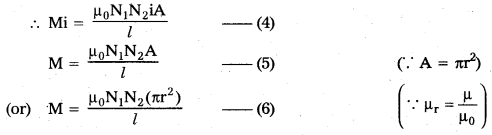
If M be mutual inductance of the two coils, the total flux linked with the secondary is Mi
AP Inter 2nd Year Physics Study Material Chapter 9 Electromagnetic Induction 4

Question 4.
Obtain an expression for the magnetic energy stored a solenoid in terms of the magnetic field, area and length of the solenoid.
Answer:
When the current flows through the inductor of inductance L, an e.m.f is induced in it is given by
ε = -L\(\frac{\mathrm{dI}}{\mathrm{dt}}\) —– (1)
AP Inter 2nd Year Physics Study Material Chapter 9 Electromagnetic Induction 5
(-ve sign shows that e.m.f opposes the passage of current)
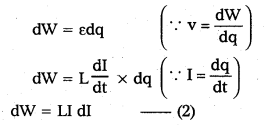
Let an infinite small charge dq be driven through the inductor. So the work done by the external voltage is given by
AP Inter 2nd Year Physics Study Material Chapter 9 Electromagnetic Induction 6
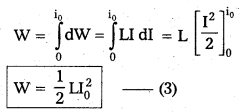
Total work done to maintain the maximum current (I0) is given by
AP Inter 2nd Year Physics Study Material Chapter 9 Electromagnetic Induction 7
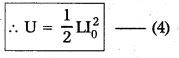
This work done is stored in the form of potential energy in the magnetic field (U)
AP Inter 2nd Year Physics Study Material Chapter 9 Electromagnetic Induction 8
In case of solenoid B = μ0nI0 (or) I0 = \(\frac{\mathrm{B}}{\mu_0 \mathrm{n}}\) and L = μ0n2Al
AP Inter 2nd Year Physics Study Material Chapter 9 Electromagnetic Induction 9

Long Answer Questions

Question 1.
Outline the path-breaking experiments of Faraday and Henry and highlight the contributions of these experiments to our understanding of electromagnetism.
Answer:
Faraday’s and Henry’s experiments :

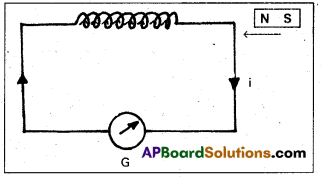
Experiment 1: A magnet induces current due to relative motion

  1. The apparatus consists of a coil with a galvanometer G and a bar magnet.
  2. When the bar magnet (NS) was at rest, the galvanometer shows no deflection.
  3. When North pole of the bar magnet moved towards the coil, galvanometer shows the deflection in one direction indicating the flow of current in the coil.
    AP Inter 2nd Year Physics Study Material Chapter 9 Electromagnetic Induction 10
  4. When North pole of the bar magnet moved away from the coil, galvanometer again showed the deflection but now in the opposite direction.
  5. The deflection of the galvanometer was large when the bar magnet was moved faster towards (or) away from the coil.
  6. When south pole of the magnet was brought near the coil (or) moved away from the coil, the deflections in the galvanometer are opposite to that observed with the north pole for similar movements.

Conclusion:

  1. Whenever there is a relative motion between a coil and a magnet, induced current flows through the coil.
  2. Large induced e.m.f. (or) current is produced in the coil if the relative motion between magnet and the coil is large.

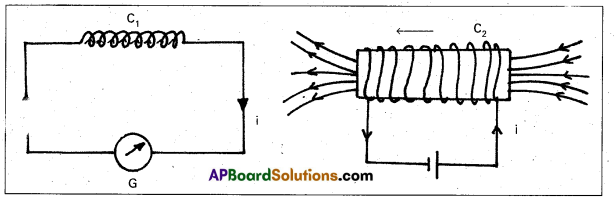
Experiment 2 : Current induces current due to relative motion of coils :
AP Inter 2nd Year Physics Study Material Chapter 9 Electromagnetic Induction 11

  1. The bar magnet is replaced by a secondary coil C2 connected to a battery as shown in figure.
  2. The steady current in the coil C2 produces a steady magnetic field.
  3. As coil C2 is moved towards the coil C1, the galvanometer shows a deflection. This indicates current is induced in the coil C1.
  4. When coil C2 is moved away, the galvanometer shows a deflection again, but opposite direction.
  5. The deflection lasts as long as coil C2 is in motion.
  6. When the coil C2 is held fixed and C1 is moved, the same effects are observed.

Conclusion : Induced e.m.f (or) current is produced, when there is a relative motion between the coils.

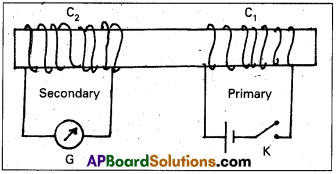
Experiment 3: Changing current, Induces current without relative motion:
AP Inter 2nd Year Physics Study Material Chapter 9 Electromagnetic Induction 12

  1. Faraday showed that this relative motion is not an absolute requirement.
  2. Figure shows two coils C1 and C2 held stationary.
  3. Coil C1 is connected to a battery through a tap key K and coil C2 is connected to a galvanometer (G).
  4. it is observed that the galvanometer shows a momentary deflection when the tap key K is pressed.
  5. The pointer in the galvanometer returns to zero immediately.
  6. If the key is held pressed continuously, there is no deflection in the galvanometer.
  7. When the key is released, the galvanometer shows deflection again but in the opposite direction.
  8. Deflection of the galvanometer increases a lot when wooden bar is replaced by iron bar.

AP Inter 2nd Year Physics Study Material Chapter 9 Electromagnetic Induction

Question 2.
Describe the working of a AC generator with the aid of a simple diagram and necessary expressions.
Answer:
“An electrical machine used to convert mechanical energy into electrical energy is known as A.C generator/altemator”.
Principle : It works on the principle of electromagnetic induction.

Construction :

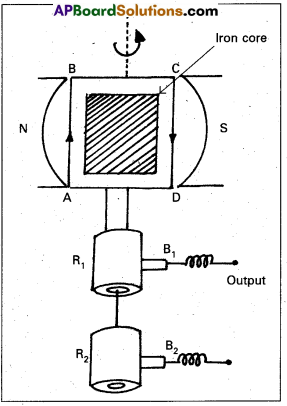
  1. Armature : Armature coil (ABCD) consists of a large number of turns of insulated copper wire wound over a soft iron core.
  2. Strong field magnet : A strong permanent magnet (or) an electromagnet whose poles (N and S) are cylindrical in shape used as a field magnet. The armature coil rotates between the pole pieces of the field magnet.
    AP Inter 2nd Year Physics Study Material Chapter 9 Electromagnetic Induction 13
  3. Slip rings: The two ends of the armature coil are connected to two brass slip rings R1 and R2. These rings rotate along with the armature coil.
  4. Brushes : Two carbon brushes B1 and B2 are pressed against the slip rings. The brushes remain fixed while slip rings rotate along with the armature. These brushes are connected to the load through which the out put is obtained.

Working : When the armature coil ABCD rotates is the magnetic field provided by the strong field magnet, it cuts the magnetic line of force. The magnetic flux linked with the coil changes due to the rotation of the armature and hence induced e.m.f is set up in the coil.

The current flows out through the brush B in one direction of half of revolution and through the brush B2 in the next half revolution in the reverse direction. This process is repeated, therefore e.m.f produced is of alternating nature.

Theory:

  1. When the coil is rotated with a constant angular velocity (ω)
  2. The angle between the normal to the coil and magnetic field \(\overrightarrow{\mathrm{B}}\) at any instant is given by θ = ωt —— (1)
  3. The component of magnetic field normal to the plane of the coil = B cos θ = B cosωt —— (2)
  4. Magnetic flux linked with the single turn of the coil = (B cos ωt) A —— (3)
    where A is the area of the coil, if the coil has n turns
  5. Total magnetic flux linked with the coil (ϕ) = n(B cos ωt) A —– (4)
    According to Faraday’s law,

ε = \(-\frac{\mathrm{d} \phi}{\mathrm{dt}}\) = \(-\frac{\mathrm{d}}{\mathrm{dt}}\)(nBA cos ωt) = -nBA(-ω sin ωt)
ε = nBA ω sin ωt —— (5)
Where nBAω is the maximum value of e.m.f. (ε0)
ε = ε0 sin ωt —– (6) (∵ ω = 2πυ)

Instantaneous current is the circuit is given by
I = \(\frac{\varepsilon}{\mathrm{R}}\) = \(\frac{\varepsilon_0}{\mathrm{R}}\) sin ωt [∵ i = \(\frac{\varepsilon_0}{\mathrm{R}}\)]
I = I0 sin ωt
The direction of the current changes periodically and therefore the current is called alternating current (a.c.).

Textual Exercises

Question 1.
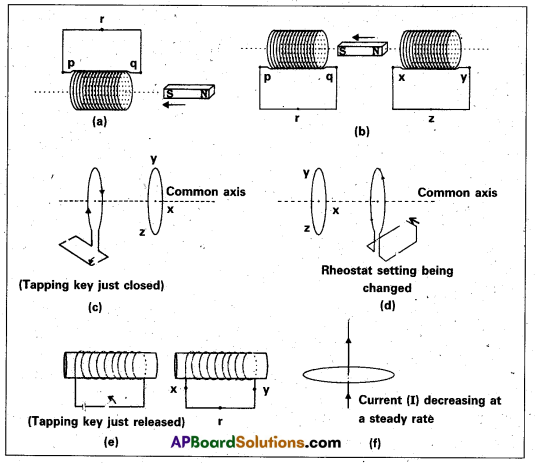
Predict the direction of induced current in the situations described by the following (a) to (f).
AP Inter 2nd Year Physics Study Material Chapter 9 Electromagnetic Induction 14
Answer:
a) Here south pole is moving towards the coil, so according to Lenz’s law this end becomes s-pole. (To oppose the motion of south pole by repelling it). Hence, the direction of current is clockwise (by using clock rule) and the current flows from p to q.

b) In coil p-q at the end q ⇒ s-pole is moving towards end q, so it behaves like a south pole (by lenz’s law). The direction of current is clockwise (by clock rule) i.e. from p to q. North pole is moving away so this end will behave like south pole (To oppose its away motion by attracting it). In coil x-y, S-pole is induced (by Lenz’s law) and the direction of current is clockwise i.e. x to y.

c) As the tapping key is just, closed, the current in coil increases so, the magnetic flux and field increases. According to Maxwell’s right hand grip rule, the direction of magnetic field is left wards. Thus, the direction of induced current in the neighbouring coil is such that it try to decrease the field, thus the direction of field in the neighbouring coil should be rightwards i.e., according to Maxwell’s right hand rule the direction of induced current is anti clock wise i.e. xyz.

d) As the rheostat setting is changed, the current is changed. The direction of field due to the coil is leftwards according to Maxwell’s right hand grip rule. The direction of induced current in the left coil is such that the magnetic field produced by it in rightwards, thus the direction of current in left coil is Anticlockwise i.e from zyx.

e) As the key is just released, the current which is flowing anticlockwise goes on decreasing. Thus, the induced current developed in such a sense the magnetic field due to left coil increases (which is towards right). So, the magnetic field due to the right coil should also towards right and hence the induced current is in anticlockwise, i.e., x to yx – direction.

f) The magnetic field lines due to the current carrying wire are in the plane of the loop. Hence, no induced current is produced in the loop (because no flux lines crosses the area of loop).

Question 2.
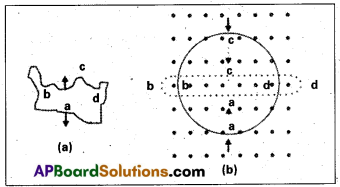
Use Lenz’s law to determine the direction of induced current in the situations described by fig. a, b.
AP Inter 2nd Year Physics Study Material Chapter 9 Electromagnetic Induction 15
(a) A wire of irregular shape turning into a circular shape.
(b) A circular loop being deformed into a narrow straight wire.
Answer:
a) Here, the direction of magnetic field is perpendicularly inwards to the plane of paper. If a wire of irregular shape turns into a circular shape then its area increases (∵ the circular loop has greater area than the loop of irregular shape) so that the magnetic flux linked also increases. Now, the induced current is produced in a direction such that it decreases the magnetic field (i.e.) the current will flow in such a direction so that the wire forming the loop is pulled inwards in all directions (to decreases the area) i.e., current is in anticlockwise direction, i.e., adcba

b) When a circular loop deforms into a narrow straight wire, the magnetic flux linked with it also decreases. The current induced due to change in flux will flow in such a direction that it will oppose the decrease in magnetic flux so it will flow anti clockwise i.e along a’d’c’b’a’, due to which the magnetic field produced will be out of the plane of paper.

AP Inter 2nd Year Physics Study Material Chapter 9 Electromagnetic Induction

Question 3.
A long solenoid with 15 turns per cm has a small loop of area 2.0 cm2 placed inside the solenoid normal to its axis. If the current carried by the solenoid changes steadily from 2.0 A to 4.0 A in 0.1 s, what is the induced emf in the loop while the current is changing ?
Solution:
Given number of turns (n) = 15 per cm = 1500 per metre. .
Area of small loop A = 2 cm2 = 2 × 10⁻⁴m2
Change in current \(\frac{\mathrm{dI}}{\mathrm{dt}}\) = \(\frac{4-2}{0.1}\) = \(\frac{2}{0.1}\) = 20 A/s
Let e be the induced emf, According to Faraday’s law,
e = \(\frac{\mathrm{d} \phi}{\mathrm{dt}}\) = \(\frac{\mathrm{d}}{\mathrm{dt}}\)(BA) or e = \(\text { A. } \frac{\mathrm{dB}}{\mathrm{dt}}\) (∵ ϕ = BA)
e = A. \(\frac{\mathrm{d}}{\mathrm{dt}}\left(\mu_0 \mathrm{nI}\right)\) (∵ Magnetic field inside the solenoid B = μ0nI)
or e = Aμ0n\(\frac{\mathrm{dI}}{\mathrm{dt}}\)
e = 2 × 10-4 × 4 × 3.14 × 10-7 × 1500 × 20
e = 7.5 × 10⁶v (∵ μ0 = 4π × 10-7) Thus, the induced emf in the loop is 7.5 × 10⁶V.

Question 4.
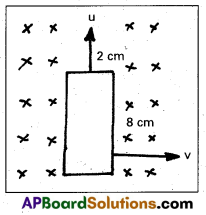
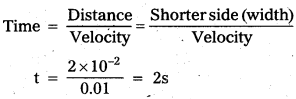
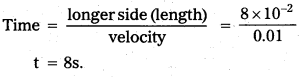
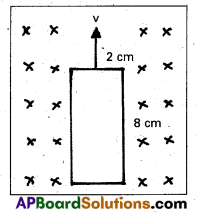
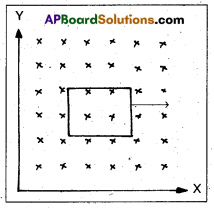
A rectangular wire loop of sides 8 cm and 2 cm with a small cut is moving out of region of uniform magnetic field of magnitude 0.3 T directed normal to the loop. What is the emf developed across the cut if the velocity of the loop is 1 cm s-1 in a direction normal to the (a) longer side, (b) shorter side of the loop ? For how long does the induced voltage last in each case ?
Solution:
Given length of the loop l = 8 cm = 8 × 10⁻² m.
Width of the loop b = 2 cm = 2 × 10⁻² m.
Velocity of the loop = 1 cm/s = 0.01 m/s.
Magnitude of magnetic field (B) = 0.3
AP Inter 2nd Year Physics Study Material Chapter 9 Electromagnetic Induction 16
a) When velocity is normal to the longer side .
(l = 8 cm = 8 × 10⁻² m)
In this case, motional emf
e = B/υ = 0.3 × 8 × 10-2 × 0.01 = 2.4 × 10⁻⁴ V
AP Inter 2nd Year Physics Study Material Chapter 9 Electromagnetic Induction 17

b) When velocity is normal to the shorter side
(l = 2cm = 2 × 10⁻² m)
In this case, the developed emf
e = Blυ = 0.3 × 2 × 10-2 × 0.01
e = 0.6 × 10⁻⁴ V.
AP Inter 2nd Year Physics Study Material Chapter 9 Electromagnetic Induction 19
AP Inter 2nd Year Physics Study Material Chapter 9 Electromagnetic Induction 18

Question 5.
A 1.0 m long metallic rod is rotated with an angular frequency of 400 rad s-1 about an axis normal to the rod passing through its one end. The other end of the rod is in contact with a circular metallic ring. A constant and uniform magnetic field of 0.5 T parallel to the axis exists everywhere. Calculate the emf developed between the centre and the ring.
Solution:
Length of rod l = 1 m
Angular frequency of rod ω = 400 rad/s
Magnetic field B = 0.5 T
The linear velocity of fixed end = 0
The linear velocity of other end = lω (∵ V = rω)
AP Inter 2nd Year Physics Study Material Chapter 9 Electromagnetic Induction 20
Average linear velocity V = \(\frac{0+l \omega}{2}\)
V = \(\frac{l \omega}{2}\) —– (i) By using the formula of motional emf,
e = Bυl = \(\frac{\mathrm{B} l \omega}{2}\) (from equation (i)), e = \(\frac{0.5 \times 1 \times 400 \times 1}{2}\), e = 100.
Thus, the emf developed between the centre and ring is 100 V

AP Inter 2nd Year Physics Study Material Chapter 9 Electromagnetic Induction

Question 6.
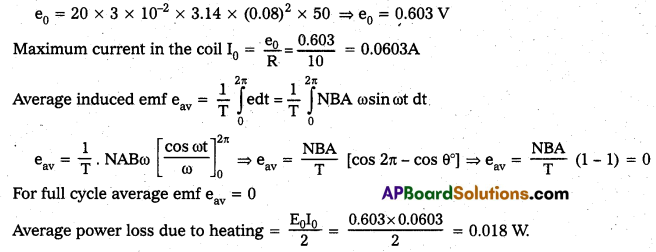
A circular coil of radius 8.0 cm and 20 turns is rotated about its vertical diameter with an angular speed of 50 rad s-1 in a uniform horizontal magnetic field of magnitude 3.0 × 10⁻² T. Obtain the maximum and average emf induced in the coil. If the coil forms a closed loop of resistance 10Ω, calculate the maximum value of current in the coil. Calculate the average power loss due to Joule heating. Where does this power come from ?
Solution:
Given radius of coil = 8 cm = 0.08 m, Number of turns = 20
Resistance of closed loop = 10Ω, Angular speed ω = 50 rad/s
Magnitude of magnetic field B = 3 × 10⁻² T
Induced emf produced in the coil e = NBA W sin ωt
For maximum emf, sin ωt = 1
∴ Maximum emf e0 = NBAω
AP Inter 2nd Year Physics Study Material Chapter 9 Electromagnetic Induction 21
The source of power dissipated as heat in the coil is the external rotar. The current induced in the coil causes a torque which opposes the rotation of the coil, so the external agent rotar counter this torque to keep the coil rotating uniformly.

Question 7.
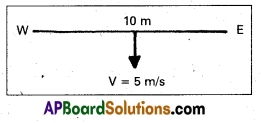
A horizontal straight wire 10 m long extending from east to west is falling with a speed of 5.0 m s-1, at right angles to the horizontal component of the earth’s magnetic field, 0.30 × 10⁻⁴ Wb m2.
(a) What is the instantaneous value of the emf induced in the wire ?
(b) What is the direction of the emf ?
(c) Which end of the wire is at the higher electrical potential ?
Solution:
Given, velocity of straight wire = 5 m/s
Magnetic field of straight wire,
B = 0.30 × 10⁻⁴ Wb/m2
length of wire l = 10m
AP Inter 2nd Year Physics Study Material Chapter 9 Electromagnetic Induction 22
a) Emf induced in the wire e = B/υsin θ
Here, θ = 90°
∴ sin θ = 1 .
(∴ wire is falling at right angle to earth’s horizontal magnetic field component)
= 0.3 × 10-4 × 10 × 5 = 1.5 × 10⁻³ V.

b) According to the Fleming’s right hand rule, the force is downward, then the direction of induced emf will be from west to east.

c) As the direction of induced emf or current is from west to east, the west end of the wire is at higher potential.
(∵ current always flows from a point at higher potential to a point at lower potential).

Question 8.
Current in a circuit falls from 5.0 A to 0.0 A in 0.1 s. If an average emf of 200 V induced, give an estimate of the self-inductance of the circuit. (T.S. Mar. ’16, Mar. ’14)
Solution:
Change in current, dI = 5 – 0 = 5A, Time taken in current change dt = 0.1 s
Induced average emf eav = 200 V
Induced emf in the circuit e = L. \(\frac{\mathrm{dI}}{\mathrm{dt}}\) ⇒ 200 = L\(\left(\frac{5}{0.1}\right)\) or L = \(\frac{200}{50}\) = 4H

Question 9.
A pair of adjacent coils has a mutual inductance of 1.5 H. If the current in one coil changes from 0 to 20 A in 0.5 s, what is the change of flux linkage with the other coil ?
Solution:
Given, mutual inductance of coil M = 1.5 H, Current change in coil dl = 20 – 0 = 20 A
Time taken in change dt = 0.5s, Induced emf in the coil e = M\(\frac{\mathrm{dI}}{\mathrm{dt}}\) = \(\frac{\mathrm{d} \phi}{\mathrm{dt}}\)
dϕ = M.dl = 1.5 × 20, dϕ = 30 Wb, Thus the change of flux linkage is 30 Wb.

AP Inter 2nd Year Physics Study Material Chapter 9 Electromagnetic Induction

Question 10.
A jet plane is travelling towards west at a speed of 1800 km/h. What is the voltage difference developed between the ends of the wing having a span of 25 m, if the Earth’s magnetic field at the location has a magnitude of 5 × 10⁻⁴ T and the dip angle is 30°.
Solution:
Speed of jet plane V = 1800 km/h = 1800 × \(\frac{5}{18}\) = 500 m/s
l = Distance between the ends of wings = 25 m
The magnitude of magnetic field B = 5 × 10⁻⁴ T
Angle of dip γ = 30°.
Use the formula of motional emf
e = BvVl, e = B sin γ Vl (Bv = B sin γ),
e = 5 × 10⁻⁴ × sin 30° × 500 × 25, e = 3.1 V
Thus, the voltage difference developed between the ends is 3.1 V

Additional Question

Question 1.
Obtain an expression for the self inductance of a solenoid.
Answer:
i) Consider a long solenoid of length l, area of cross-section A. Let n be the number of turns per unit length (n = \(\frac{\mathrm{N}}{l}\))

ii) Let i be the current flows through it. The magnetic field inside the solenoid is given by
B = μ0ni —— (1)

iii) Magnetic flux linked with each turn of the solenoid = B.A = μ0niA —— (2)

iv) Total magnetic flux linked with whole solenoid
ϕ = μ0niA × N (∵ N = nl)
ϕ = μ0ni A × nl (Where N Total number of turns in the solenoid)
ϕ = μ0n2iAl —— (3) Also, ϕ = Li —– (4) From eq’s (3) & (4), Li = μ0n2iAl
L = μ0n2Al —– (5) (or) L = μ0\(\frac{\mathrm{N}^2}{l}\)A —– (6)

Additional Exercises

Question 1.
Suppose the loop in Textual Exercise 4 is stationary but the current feeding the electromagnet that produces the magnetic field is gradually reduced so that the field decreases from its initial value of 0.3 T at the rate of 0.02 T s-1. If the cut is joined and the loop has a resistance of 1.6Ω how much power is dissipated by the loop as heat ? What is the source of this power ?
Solution:
Area of loop = 8 × 2 = 16 cm2
Rate of change of magnetic field \(\frac{\mathrm{dB}}{\mathrm{dt}}\) = 0.02 T/S,
Resistance of loop R = 1.6Ω
Induced emf of loop e = \(\frac{\mathrm{d} \phi}{\mathrm{dt}}\) = \(\frac{\mathrm{d}}{\mathrm{dt}}(\mathrm{BA})\) (∵ ϕ = BA)
e = A. \(\frac{\mathrm{dB}}{\mathrm{dt}}\) ⇒ e = 16 × 10-4 × 0.02 ⇒ e = 0.32 × 10⁻⁴V
Induced current in the loop I = \(\frac{e}{R}\) = \(\frac{0.32 \times 10^{-4}}{1.6}\) = 0.2 × 10⁻⁴A
Power of source as heat P = I2R = (0.2 × 10⁻⁴)2 × 1.6 = 6.4 × 10⁻¹⁰ W ⇒ P = 6.4 × 10⁻¹⁰W
The agency which changing the magnetic field with time is the source of this power.

Question 2.
A square loop of side 12 cm with its sides parallel to X and Y axes is moved with a velocity of 8 cm s-1 in the positive x-direction in an environment containing a magnetic field in the positive z-direction. The field is neither uniform in space nor constant in time. It has a gradient of 10-3 T cm-1 along the negative x-direction (that is it increases by 10-3 T cm-1 as one moves in the negative x-direction), and it is decreasing in time at the rate of 10-3 Ts-1. Determine the direction and magnitude of the induced current in the loop if its resistance is 4.50 mΩ.
Solution:
Given, side of loop a = 12 cm
∴ Area of loop (A) = a2 = (12)2 = 144 cm2 = 144 × 10-4 m2 (∵ Area of square = (side)2)
Velocity v = 8 cm/s = 8 × 10⁻² m/s.
Rate of change of magnetic field with distance \(\frac{\mathrm{dB}}{\mathrm{dx}}\) = 10-3 T/cm
Rate of change of magnetic field with time \(\frac{\mathrm{dB}}{\mathrm{dt}}\) = 10-3 T/s
Resistance of the loop R = 4.5 mΩ = 4.5 × 10⁻³Ω
Rate of change of magnetic flux with respect to time
\(\frac{\mathrm{d} \phi}{\mathrm{dt}}\) = \(\frac{\mathrm{d}(\mathrm{BA})}{\mathrm{dt}}\) = \(\left(\frac{\mathrm{dB}}{\mathrm{dt}}\right) \mathrm{A}\) = 10-3 × 144 × 10-4
= 1.44 × 10⁻⁵ Wb/s
AP Inter 2nd Year Physics Study Material Chapter 9 Electromagnetic Induction 23
Rate of change of magnetic flux due to the motion of loop
\(\frac{\mathrm{d} \phi}{\mathrm{dt}}\) = \(\frac{\mathrm{dB}}{\mathrm{dx}} \cdot \mathrm{A} \cdot \frac{\mathrm{dx}}{\mathrm{dt}}\) = 10-3 × 144 × 10-4 × 8 = 11.52 × 10⁻⁵ Wb/s
Both of the effects cause a decrease in magnetic flux along the positive z-direction.
Total induced emf in the loop e = 1.44 × 10⁻⁵ + 11.52 × 10⁻⁵
e = 12.96 × 10⁻⁵ V
Induced current in the loop = \(\frac{\mathrm{e}}{\mathrm{R}}\) = \(\frac{12.96 \times 10^{-5}}{4.5 \times 10^{-3}}\) = 2.88 × 10⁻²A.
The direction of induced current is such as to increase the flux through the loop along positive z-direction.

Question 3.
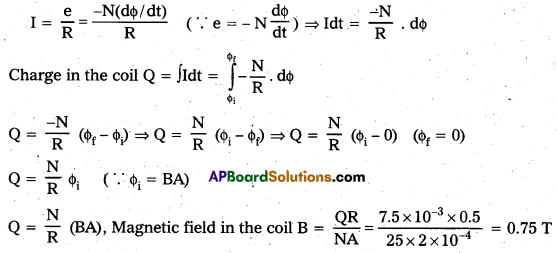
It is desired to measure the magnitude of field between the poles of a powerful loud speaker magnet. A small flat search coil of area 2 cm2 with 25 closely wound turns, is positioned normal to the field direction and then quickly snatched out of the field region. Equivalently, one can give it a quick 90° turn to bring its plane parallel to the field direction). The total charge flown in the coil (measured by a ballistic galvanometer connected to coil) is 7.5 mC. The combined resistance of the coil and the galvanometer is 0.50Ω Estimate the field strength of magnet.
Solution:
Area of coil A = 2cm2 = 2 × 10⁻⁴ m2, Number of turns N = 25
Total charge in the coil θ = 7.5 mC (1 mC = 10-3 C) = 7.5 × 10⁻³ C
Resistance of coil R = 0.5Ω
When the coil is removed from the field, the flux is zero ϕf = 0. Induced current in the coil
AP Inter 2nd Year Physics Study Material Chapter 9 Electromagnetic Induction 24
Thus, the strength of magnetic field is 0.75 T.

AP Inter 2nd Year Physics Study Material Chapter 9 Electromagnetic Induction

Question 4.
Following figure shows a metal rod PQ resting on the smooth rails AB and positioned between the poles of a permanent magnet. The rails, the rod and the magnetic field are in three mutual perpendicular directions. A galvanometer G connects the rails through a switch K. Length of the rod = 15 cm, B = 0.50 T, resistance of the closed loop containing the rod = 9.0 mΩ. Assume the field to be uniform.
(a) Suppose K is open and the rod is moved with a speed of 12 cm s-1 in the direction shown. Give the polarity and magnitude of the induced emf.
(b) Is there an excess charge built up at the ends of the rods when K is open ? What if K is closed ?
(c) With K open and the rod moving uniformly, there is no net force on the electrons in the rod PQ even though they do experience magnetic force due to the motion of the rod. Explain.
(d) What is the retarding force on the rod when K is closed ?
(e) How much power is required (by an external agent) to keep the rod moving at the same speed (= 12 cm s-1) when K is closed ? How much power is required when K is open ?
(f) How much power is dissipated as heat in the closed circuit ? What is source of this power ?
(g) What is the induced emf in the moving rod if the magnetic field is parallel to the rails instead of being perpendicular ?
Solution:
Given, length of the rod l = 15 cm = 15 × 10-2, Magnetic field B = 0.50 T
Resistance of the closed – loop containing the rod, R = 9mΩ ⇒ 9 × 10⁻³Ω
Velocity of rod V = 12 cm/s = 12 × 10-2 m/s,
a) The magnitude of the motional emf
e = BVl = 0.50 × 12 × 10-2 × 15 × 10-2, e = 9 × 10⁻³ V.
According to the Fleming’s left hand rule, the direction of Lorentz force (f = -e(V × B)) on electrons in PQ is from P to Q. So, p would acquire positive charge and Q would acquire negative charge.

b) Yes, an excess positive charge developes at P and the same amount of negative charge developes at Q as the key is open. When the key K is closed, the induced current flows and maintains the excess charge.

c) When key is open, there is no net force on the electrons because the presence of excess charge at P and Q sets up an electric field and magnetic force on the electrons is balanced by force on them due to force by the electric field. So, there is no net force on the rod.

d) When the key K is closed, current flow in the loop and the current carrying wise experience a retarding force in the magnetic field which is given by
Force = BIl = B . \(\frac{\mathrm{e}}{\mathrm{R}}\) . l = \(\frac{0.5 \times 9 \times 10^{-3} \times 15 \times 10^{-12}}{9 \times 10^{-3}}\) = 7.5 × 10⁻² N.

e) To keep the rod moving at the same speed the required power
= retarding force × velocity = 7.5 × 10-2 × 12 × 10-2 = 9 × 10⁻³ W

f) Power dissipated in closed circuit due to flow of current = I2R
= \(\left(\frac{\mathrm{e}}{\mathrm{R}}\right)^2\) × R = \(\frac{\left(9 \times 10^{-3}\right)^2}{9 \times 10^{-3}}\) = 9 × 10⁻³ W2 The source of this power is the external agent.

g) When the field is parallel to length of rails θ = 0°, induced emf = e = BVl sin θ = 0 (∵ sin θ° = 0). In this situation, the moving rod will not cut the field lines so that flux change is zero and hence induced emf is zero.

Question 5.
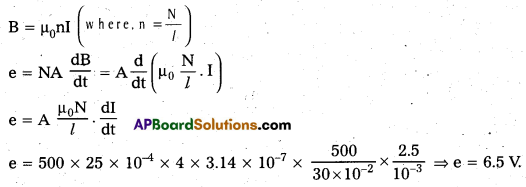
An air-cored solenoid with length 30 cm, area of cross-section 25 cm2 and number of turns 500, carries a current of 2.5 A. The current is suddenly switched off in a brief time of 10-3s. How much is the average back emf induced across the ends of the open switch in the circuit? Ignore the variation in magnetic field near the ends of the solenoid.
Solution:
Given, length of solenoid I = 30 cm = 30 × 10-2 m
Area of cross-section A = 25 cm2 = 25 × 10-4 m2
Number of turns N = 500, Current I1 = 2.5A, I2 = 0, Brief time dt = 10-3s.
Induced emf in the solenoid e = \(\frac{\mathrm{d} \phi}{\mathrm{dt}}\) = \(\frac{\mathrm{d}(\mathrm{BA})}{\mathrm{dt}}\) (∵ ϕ = BA)
Magnetic field induction B at a point well inside the long solenoid carring current I is
AP Inter 2nd Year Physics Study Material Chapter 9 Electromagnetic Induction 25

Question 6.
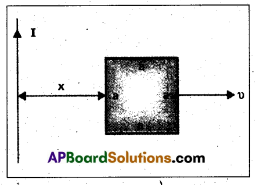
Obtain an expression for the mutual inductance between a long straight wire and a square loop of side a as shown in the figure.
(b) Now assume that the straight wire carries a current of 50 A and the loop is moved to the right with a constant velocity, υ = 10 m/s. Calculate the induced emf in the loop at the instant when x = 0.2 m.
Take α = 0.1 m and assume that the loop has a large resistance.
AP Inter 2nd Year Physics Study Material Chapter 9 Electromagnetic Induction 26
Solution:
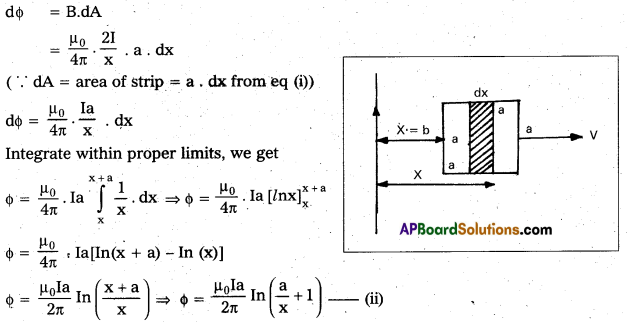
a) Let us assume that an elementary strip of width dx a at distance x from the wire carring current I.
Side of square = a.
The magnetic field due to current carring wire at a distance x from the wire is
B = \(\frac{\mu_0}{4 \pi} \cdot \frac{2 I}{x}\) —— (i)
Small amount of magnetic flux associated with the strip
AP Inter 2nd Year Physics Study Material Chapter 9 Electromagnetic Induction 27
As we know that ϕ = MI —— (iii)
where, M is mutual inductance. From equations (ii) and (iii) we get
AP Inter 2nd Year Physics Study Material Chapter 9 Electromagnetic Induction 32
This is mutual inductance between wire and square loop.

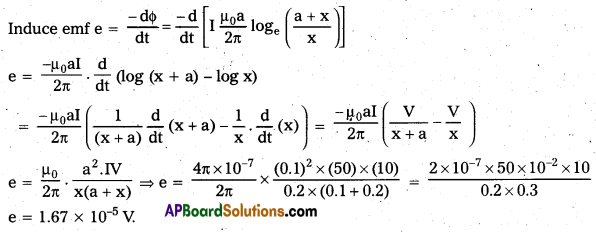
b) Given current I = 50 A, Velocity V = 10 m/s, x = 0.2 m and a = 0.1 m
AP Inter 2nd Year Physics Study Material Chapter 9 Electromagnetic Induction 28

Question 7.
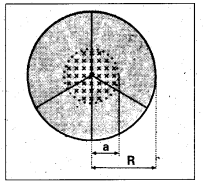
A line charge λ per unit length is lodged uniformly onto the rim of a wheel of mass M and radius R. The wheel has light non-conducting spokes and is free to rotate without friction about its axis (figure). A uniform magnetic field extends over a circular region within the rim. It is given by,
B = B0k (r ≤ a, a < R)
= 0 (otherwise)
AP Inter 2nd Year Physics Study Material Chapter 9 Electromagnetic Induction 29
What is the angular velocity of the wheel after the field is suddenly switched off?
Solution:
Given Linear charge density
AP Inter 2nd Year Physics Study Material Chapter 9 Electromagnetic Induction 30
Radius of rim = R,
Mass of rim = M,
Magnetic field extends over a circular region
B = -B0 (r ≤ a, a < R) = O (otherwise).
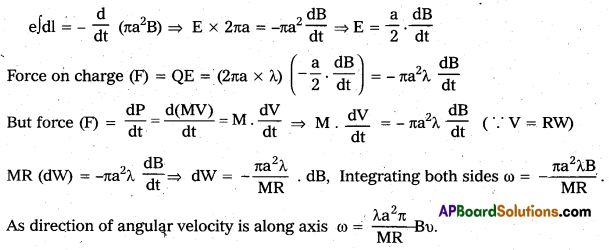
Let the angular velocity of the wheel be w, then induced emf e = \(\frac{-\mathrm{d} \phi}{\mathrm{dt}}\)
E exist along circumference of radius a due to change in magnetic flux.
AP Inter 2nd Year Physics Study Material Chapter 9 Electromagnetic Induction 31

AP Inter 2nd Year Physics Study Material Chapter 8 Magnetism and Matter

Andhra Pradesh BIEAP AP Inter 2nd Year Physics Study Material 8th Lesson Magnetism and Matter Textbook Questions and Answers.

AP Inter 2nd Year Physics Study Material 8th Lesson Magnetism and Matter

Very Short Answer Questions

Question 1.
A magnetic dipole placed in a magnetic field experiences a net force. What can you say about the nature of the magnetic field?
Answer:
The nature of the magnetic field is uniform, magnetic dipole (bar magnet) experiences a net force (or torque).

Question 2.
What happens to compass needles at the Earth’s poles?
Answer:
At the poles, the earth’s field is exactly vertical. So, the compass needles are free to rotate in a horizontal plane only, it may point out in any direction.

AP Inter 2nd Year Physics Study Material Chapter 8 Magnetism and Matter

Question 3.
What do you understand by the ‘magnetization’ of a sample? (A.P. Mar. ’16)
Answer:
When a magnetic sample is placed in a magnetic field, its magnetic moments add up in the direction of the magnetic field. Hence the sample get a net magnetic moment (mnet ≠ 0)
Magnetisation is defined as the net magnetic moment per unit volume i.e., M = \(\frac{m_{\text {net }}}{V}\)

Question 4.
What is the magnetic moment associated with a solenoid?
Answer:
Magnetic dipole moment in a solinoid m = NIA
Where ‘N’ is the number of turns in the loop, ‘I’ the current and A the area vector.

Question 5.
What are the units of magnetic moment, magnetic induction and magnetic filed ?
Answer:
Unit of

  1. magnetic moment m is Am2 or J T-1.
  2. Magnetic induction – wb m-2 or Tesla (T)
  3. magnetic field – Tesla.

Question 6.
Magnetic lines form continuous closed loops. Why ? (A.P. Mar. 16)
Answer:
Magnetic lines of force always start from north pole and forming curved path, enter south pole and travel to north pole inside the magnet. Thus lines of force are forming closed loops.

Question 7.
Define magnetic declination. (Mar. ’14)
Answer:
Magnetic Declinatin (D) : The angle between the true geographic north and the north shown by a compass needle is called magnetic declination or simply declination (D).
AP Inter 2nd Year Physics Study Material Chapter 8 Magnetism and Matter 36

Question 8.
Define magnetic inclination or angle of dip. (A.P. & T.S. Mar. ’15)
Answer:
Inclination or Dip (I) : The angle which the total intensity of earth’s magnetic field makes with the horizontal at any place is called inclination (I).

AP Inter 2nd Year Physics Study Material Chapter 8 Magnetism and Matter

Question 9.
Classify the following materials with regard to magnetism : Manganese, Cobalt, Nickel, Bismuth, Oxygen, Copper. (A.P. Mar. ’19 & T.S. Mar. ’16, ’15)
Answer:
Ferromagnetic materials → Cobalt, Nickel.
Paramagnetic materials → Oxygen, Manganese
Diamagnetic materials → Bismuth, Copper

Short Answer Questions

Question 1.
Derive an expression for the axial field of a solenoid of radius “a”, containing “n” turns per unit length and carrying current “i”.
Answer:
Expression for the axial field of a solenoid :

  1. Consider a solinoid of length ‘2l’ and radius ‘a’ having ‘n’ turns per unit length.
  2. Let ‘I’ be the current in the solenoid.
  3. We have to calculate magnetic field at any point P on the axis of solenoid, where OP = r.
    AP Inter 2nd Year Physics Study Material Chapter 8 Magnetism and Matter 1
  4. Consider a small element of thickness dx of the solenoid, at a distance ‘x’ from ‘O’.
  5. Number of turns in the element = ndx.
  6. Magnitude of magnetic field at P due to this current element is dB = \(\frac{\mu_0 \mathrm{ndx} \cdot \mathrm{Ia}^2}{2\left[(\mathrm{r}-\mathrm{x})^2+\mathrm{a}^2\right]^{3 / 2}}\)
  7. If P lies at a very large distance from 0, i.e., r > > a and r > > x, then [(r – x)2 + a2]3/2 = r3.
    ⇒ dB = \(\frac{\mu_0 \mathrm{ndx} \mid \mathrm{a}^2}{2 \mathrm{r}^3}\)
  8. To get total magnetic field, integrating the above equation between the limits from X = -l to X = +l.
    AP Inter 2nd Year Physics Study Material Chapter 8 Magnetism and Matter 2
  9. The magnitude of the magnetic moment of the solenoid is, m = n(2l) I (πa2).
    B = \(\frac{\mu_0}{4 \pi} \frac{2 \mathrm{~m}}{\mathrm{r}^3}\)
  10. Therefore, magnetic moment of a bar magnet is equal to magnetic moment of an equivalent solenoid that produces the same magnetic field.

Question 2.
The force between two magnet poles separated by a distance’d’ in air is ‘F. At what distance between them does the force become doubled ?
Answer:
Force between two magnetic poles, F1 = F;
Distance between two magnetic poles, d1 = d
Force between two magnetic poles increased by double F2 = 2F
Distance between two magnetic poles, d2 = ?
From Coulombs law, \(\mathrm{F}_1 \mathrm{~d}_1^2\) = \(\mathrm{F}_2 \mathrm{~d}_2^2\)
Fd2 = 2 F \(\mathrm{d}_2^2\)
⇒ \(\mathrm{d}_2^2\) = \(\frac{\mathrm{d}^2}{2}\)
∴ d2 = \(\frac{\mathrm{d}}{\sqrt{2}}\)

Question 3.
Compare the properties of para, dia and ferromagnetic substances.
Answer:
Diamagnetic substances

a) When these materials placed in a magnetic field, they are magnetised feebly in the opposite direction to the applied external field.
b) When a rod of diamagnetic material is suspended freely in a uniform magnetic field, it comes to rest in the perpendicular direction to the magnetic field.
c) When they kept in a non uniform magnetic field, they moves from the region of greater field strength to the region of less field strength.
d) The relative permeability is less than 1. μr < 1 and negative.
e) The susceptibility \((\chi)\) is low and negative.
E.g. : Copper, Silver, Water, Gold, Antimony, Bismuth, Mercury Quartz Diamond etc.

Paramagnetic Substance

a) When these materials placed in a magnetic field, they are magnetised feebly in the direction of the applied magnetic field.
b) When a rod of paramagnetic material is suspended freely in a uniform magneticfield, it comes to rest in the direction of the applied magnetic field.
c) When they kept in a non-uniform magnetic field, they moves from the region of less field strength to the region of greater field strength.
d) The relative permeability is greater than 1. μr > 1 and positive.
e) The susceptibility \((\chi)\) is small and positive.
E.g. : Aluminium, Magnetiam, Tungsten, Platinum, Manganese, liquid oxygen, Ferric chloride, Cupric chloride etc.

Fêrromagnetic substances

a) When these materials placed in a magnetic field, they are magnetised strongly in the direction of the applied external field.
b) When a rod of ferromagnetic material is suspended freely in a uniform magnetic field, it comes to rest in the direction of the applied magnetic field.
c) When they kept in a non-uniform magnetic field they moves from the regions of lesser (magnetic field) strength to the regions of stronger (magnetic field) strength.
d) The relative permeability is much greater than μr >> 1 and positive.
e) The stisceptibility \((\chi)\) is high and positive.
E.g. : Iron, Cobalt, Nickel, Gadolinium and their alloys.

Question 4.
Explain the elements of the Earth’s magnetic field and draw a sketch showing the relationship between the vertical component, horizontal component and angle of dip.
Answer:
The magnetic field of the earth at a point on its surface can be specified by the declination D, the angle of dip or the inclination I and the horizontal component of the earth’s field HE. These are known as the elements of the earth’s magnetic field.
AP Inter 2nd Year Physics Study Material Chapter 8 Magnetism and Matter 3

Explanation:

  1. The total magnetic field at P can be resolved into a horizontal component HE and a vertical component ZE.
  2. The angle that BE makes with HE is the angle of dip, I.
  3. Representing the vertical component by ZE, we have
    ZE = BE Sin I
    HE = BE Cos I
    Which gives Tan I = \(\frac{\mathrm{Z}_{\mathrm{E}}}{\mathrm{H}_{\mathrm{E}}}\)

Question 5.
Define retentivity and coercivity. Draw the hysteresis curve for soft iron and steel. What do you infer from these curves ?
Answer:

  1. Retentivity : The value of magnetic induction \(\overrightarrow{\mathrm{B}}\) left in the specimen, when the magnetising force (H) is reduced to zero is called Retentivity or Remanence or Residual magnetism.
  2. Coercivity : To reduce the retentivity to zero, we have to apply a magnetising force in opposite direction. This value of magnetising force is called coercivity or coercive force.
  3. Hysterisis eurve: The curve represents the relation between magnetic induction \(\overrightarrow{\mathrm{B}}\) (or) intensity of magnetization (I) of a ferromagnetic material with magnetizing force (or) magnetic intensity (\(\overrightarrow{\mathrm{H}}\)) is called Hystersis curve.
    AP Inter 2nd Year Physics Study Material Chapter 8 Magnetism and Matter 4
  4. Hysterisis curve for soft Iron and steel is shown below.
    The hysterisis loops of soft iron and steel reveal that

    1. The retentivity of soft iron is greater than the retentivity of steel.
    2. Soft Iron is more strongly magnetised than steel.
    3. Coercivity of Soft Iron is less than coercivity of steel. It means soft Iron loses its magnetisation more rapidly than steel does.
    4. As area of I – H loop for soft Iron is smaller than the area of I – H loop for steel. Therefore hysterisis loss in case of soft Iron is smaller than the hysterisis loss in case of steel.

Question 6.
If B is the magnetic field produced at the centre of a circular coil of one turn of length L carrying current I then what is the magnetic field at the centre of the same coil which is made into 10 turns ?
Answer:
For first circular coil; B1 = B, n1 = 1; I1 = I; a1 = \(\frac{\mathrm{L}}{2 \pi}\)
For second circular coil, B2 = ? n2 = 10; I2 = I; a2 = \(\frac{\mathrm{L}}{2 \pi}\)
As B = \(\frac{\mu_0 \mathrm{n} I \mathrm{a}^2}{2 \mathrm{r}}\), B ∝ n
\(\frac{\mathrm{B}_2}{\mathrm{~B}_1}\) = \(\frac{\mathrm{n}_2}{\mathrm{n}_1}\)
\(\frac{\mathrm{B}_2}{\mathrm{~B}}\) = \(\frac{10}{1}\)
∴ B2 = 10 B

AP Inter 2nd Year Physics Study Material Chapter 8 Magnetism and Matter

Question 7.
If the number of turns of a solenoid is doubled, keeping the other factors constant, how does the magnetic field at the axis of the solenoid change?
Answer:
B1 = B (say); n1 = n; n2 = 2n; B2 =?
Magnetic field at the centre of a solinoid is given by B = \(\frac{\mu_0 \mathrm{nI} \mathrm{a}^2(2 l)}{2 \mathrm{r}^3}\)
⇒ \(\frac{\mathrm{B}_2}{\mathrm{~B}_1}\) = \(\frac{\mathrm{n}_2}{\mathrm{n}_1}\) ⇒ \(\frac{\mathrm{B}_2}{\mathrm{~B}}\) = \(\frac{2 \mathrm{n}}{\mathrm{n}}\)
∴ B2 = 2 B

Long Answer Questions

Question 1.
Derive an expression for the magnetic field at a point on the axis of a current carrying circular loop.
Answer:
Expression for the magnetic field at a point on the axis of a current carrying circular loop:
AP Inter 2nd Year Physics Study Material Chapter 8 Magnetism and Matter 5

  1. Consider ‘O’ is the centre of a circular coil of one turn and radius ‘a’.
  2. Let P is a point at a distance r from the centre, along the axis of coil.
  3. The plane of the coil is ⊥r to the plane of paper.
  4. Consider two elements AB and AB’ each of length dl which are diametrically opposite.
  5. Then, the magnetic fields at P due to these two elements will be dB and dB in the direction PM and PN respectively.
  6. These directions are ⊥r to the lines joining the mid-points of the elements with the point P
  7. Resolve these fields into two components parallel (dB sin θ) and perpendicular (dB cos θ) to the axis of the coil.
  8. The dB cos θ components cancel one another and dB sin θ components are in the same direction and add up due to the symmetric elements of the circular coil.
  9. Therefore, the total magnetic field along the axis = B = \(\int \mathrm{dB}\) sin θ of the circular coil along PC —– (1)
  10. The magnetic field at ‘P’ due to current element of length ‘dl’ is
    ‘dB’ = \(\frac{\mu_0}{4 \pi} \frac{I d l \sin \phi}{\left(a^2+x^2\right)}\) = \(\frac{\mu_0}{4 \pi} \frac{\mathrm{Id} l}{\left(\mathrm{a}^2+\mathrm{r}^2\right)}\) —– (II) [∵ φ = 90°]
  11. From equation (I) and (II), B = \(\int \frac{\mu_0}{4 \pi} \frac{\mathrm{Id} l}{\left(\mathrm{a}^2+\mathrm{r}^2\right)} \sin \theta\)
    From Δle OPE, sin θ = \(\frac{a}{\sqrt{\left(a^2+r^2\right)}}\)
    ⇒ B = \(\int \frac{\mu_0}{4 \pi} \frac{\mathrm{Id} l \mathrm{a}}{\left(\mathrm{a}^2+\mathrm{r}^2\right)^{3 / 2}}\) = \(\frac{\mu_0 \mathrm{Ia}}{4 \pi\left(\mathrm{a}^2+\mathrm{r}^2\right)^{3 / 2}} \int \mathrm{d} l\)
    But \(\int \mathrm{d} l\) = Circumference of the coil = 2πa
    ∴ B = \(\frac{\mu_0 \text { I a }}{4 \pi\left(a^2+r^2\right)^{3 / 2}}\) × 2πa = \(\frac{\mu_0 \mathrm{Ia}^2}{2\left(\mathrm{a}^2+\mathrm{r}^2\right)^{3 / 2}}\), Tesla along the direction of PC.
  12. If the coil contains N turns, then B = \(\frac{\mu_0 \text { NIa }^2}{2\left(a^2+r^2\right)^{3 / 2}}\)
  13. At the centre of the coil r = 0, B = \(\frac{\mu_0 \mathrm{NI} \mathrm{a}^2}{2 \mathrm{a}^3}\) = \(\frac{\mu_0 \mathrm{NI}}{2 \mathrm{a}}\)
    Note: If r >> a, B = \(\frac{\mu_0 \mathrm{NI}\left(\pi \mathrm{a}^2\right)}{2 \pi \mathrm{r}^3}\) = \(\frac{\mu_0 \mathrm{NI}_{\mathrm{A}}}{2 \pi^3}\)
    A = πa2 = Area of current loop.

Question 2.
Prove that a bar magnet and a solenoid produce similar fields.
Answer:
Bar magnet produce similar field of Solenoid:

  1. We know that the current loop acts as a magnetic dipole. According to Ampere’s all magnetic phenomena can be explained interms of circulating currents.
  2. Cutting a bar magnet is like a solenoid. We get two similar solenoids with weaker magnetic properties.
  3. The magnetic field lines remain continuous, emerging from one face of solenoid and entering into other face of solenoid.
  4. If we were to move a small compass needle in the neighbourhood of a bar magnet and a current carrying solenoid, we would find that the deflections of the needle are similar in both cases as shown in diagrams.
    AP Inter 2nd Year Physics Study Material Chapter 8 Magnetism and Matter 6
    AP Inter 2nd Year Physics Study Material Chapter 8 Magnetism and Matter 7
    The axial field of a finite solenoid in order to demonstrate its similarity to that of a bar magnet –
  5. The magnetic field at point P due to bar magnet in the form of solenoid is B = \(\frac{\mu_0}{4 \pi} \frac{2 m}{r^3}\)
  6. The total magnetic field, at a point P due to solenoid is given by
  7. The magnitude of the magnetic moment of the solenoid is, m = n(2l) I (πa2).
    ∴ B = \(\frac{\mu_0}{4 \pi} \frac{2 \mathrm{~m}}{\mathrm{r}^3}\)
  8. Therefore, magnetic moment of a bar magnet is equal to magnetic moment of an equivalent solenoid that produces the same magnetic field.

Question 3.
A small magnetic needle is set into oscillations in a magnetic field B obtain an expression for the time period of oscillation.
Answer:
Expression for time period of oscillation :

  1. A small compass needle (magnetic dipole) of known magnetic moment m and moment of Inertia AP Inter 2nd Year Physics Study Material Chapter 8 Magnetism and Matter 8 is placing in uniform magnetic field B and allowing it to oscillate in the magnetic field.
  2. This arrangement is shown in Figure.
  3. The torque on the needle is \(\tau\) = m × B
  4. In magnitude \(\tau\) = mB sin θ.
    Here \(\tau\) is restoring torque and θ is the angle between m and B.
  5. Therefore, in equilibrium
    AP Inter 2nd Year Physics Study Material Chapter 8 Magnetism and Matter 9
    Negative sign with mB sin θ implies that restoring torque is in opposition to deflecting torque.
    AP Inter 2nd Year Physics Study Material Chapter 8 Magnetism and Matter 10
  6. For small values of θ in radians, we approximate sin θ ≈ θ and get
    AP Inter 2nd Year Physics Study Material Chapter 8 Magnetism and Matter 11
    AP Inter 2nd Year Physics Study Material Chapter 8 Magnetism and Matter 12
    This represents a simple harmonic motion.
  7. From defination of simple harmonic motion, we have \(\) = -ω2θ ——– (II)
    From equation (1) and (II), we get ⇒ ω2 = \(\frac{\mathrm{mB}}{\mathcal{J}}\)
    AP Inter 2nd Year Physics Study Material Chapter 8 Magnetism and Matter 13
  8. Therefore, the time period is
    AP Inter 2nd Year Physics Study Material Chapter 8 Magnetism and Matter 14

Question 4.
A bar magnet, held horizontally, is set into angular oscillations in the Earth’s magnetic field. It has time periods T1 and T2 at two places, where the angles of dip are θ1 and θ2 respectively. Deduce an expression for the ratio of the resultant magnetic fields at the two places.
Answer:

  1. Suppose, the resultant magnetic fields is to be compared at two places A and B.
  2. A bar magnet, held horizontally at A and which is set into angular oscillatins in the Earths magnetic field.
  3. Let time period of a bar magnet at place ‘A’ is T1 and angular displacement or angle of dip is θ1.
  4. As the bar magnet is free to rotate horizontally, it does not remain vertical component (B1sin θ1) It can have only horizontal component (B1 cos θ1)
  5. The time period of a bar magnet in uniform magnetic field is given by T = \(2 \pi \sqrt{\frac{\mathrm{I}}{\mathrm{mB}_{\mathrm{H}}}}\)
  6. Now, in this case T = T1 and BH = B1cosθ1
    AP Inter 2nd Year Physics Study Material Chapter 8 Magnetism and Matter 15
  7. Therefore time period of a bar magnet at place ‘A’ is given by
    T1 = \(2 \pi \sqrt{\frac{I}{m B_1 \cos \theta_1}}\) —– (1) Where I is moment of Inertia of a barmagnet and m is magnitude of magnetic moment.
  8. Similarly, the same bar magnet is placed at B and which is set into angular oscillations in the earths magnetic field.
  9. Let time period of a bar magnet at place B is T2 and angle of dip is θ2.
  10. Since horizontal component of earths field at B is BH = B2 cos θ2, time period,
    T2 = \(2 \pi \sqrt{\frac{1}{\mathrm{mB}_2 \cos \theta_2}}\) —— (2)
  11. Dividing equation (1) by equation (2), we get \(\frac{\mathrm{T}_1}{\mathrm{~T}_2}\) = \(\sqrt{\frac{\mathrm{mB}_2 \cos \theta_2}{\mathrm{mB}_1 \cos \theta_1}}\)
    Squaring on both sides, we have \(\frac{\mathrm{T}_1^2}{\mathrm{~T}_2^2}\) = \(\frac{\mathrm{B}_2 \cos \theta_2}{\mathrm{~B}_1 \cos \theta_1}\)
  12. But B1 = μ0H1 and B2 = μ0H2
    \(\frac{\mathrm{T}_1^2}{\mathrm{~T}_2^2}\) = \(\frac{\mu_0 \mathrm{H}_2 \cos \theta_2}{\mu_0 \mathrm{H}_1 \cos \theta_1}\)
  13. Therefore, \(\frac{\mathrm{H}_1}{\mathrm{H}_2}\) = \(\frac{\mathrm{T}_2^2 \cos \theta_2}{\mathrm{~T}_1^2 \cos \theta_1}\)
    H2 T?cosOi .
  14. By knowing T1, T2 and θ1, θ2 at different places A and B, we can find the ratio of resultant magnetic fields.

Question 5.
Define magnetic susceptibility of a material. Name two elements one having positive susceptibility and other having negative susceptibility. (A.P. Mar. ’15)
Answer:

  1. SusceptIbility: When a material is placed in a magnetic field, the ratio of the intensity of magnetization acquired by it to the intensity of the applied magnetic field is called its susceptibility.
    AP Inter 2nd Year Physics Study Material Chapter 8 Magnetism and Matter 16
  2. The susceptibility of a material represents its ability to get magnetism.
  3. Susceptibility is a dimension less quantity.
  4. Relation between μr and \(\chi\):
    • Suppose that material is placed in a magnetic field of intensity H. Let I be the intensity of magnetisation acquired by it.
    • Then the magnetic induction with in the material is
      B = μ0H + μ0I ⇒ \(\frac{\mathrm{B}}{\mathrm{H}}\) = μ0[1 + \(\frac{\mathrm{I}}{\mathrm{H}}\)]
      ⇒ μ = μ0[1 + \(\chi\)] ⇒ \(\frac{\mu}{\mu_0}\) = 1 + \(\chi\)
      μr = 1 + \(\chi\) [∵ μr = \(\frac{\mu}{\mu_0}\)]
  5. Negative susceptibility (y) of diamagnetic elements4are Bismuth (-1.66 × 10⁻⁵) and copper (-9.8 × 10⁻⁶).
  6. Positive susceptibility of Ferromagnetic elements are Aluminium (2.3 × 10⁻⁵) and oxygen at STP (2.1 × 10⁻⁶).
  7. Large and positive susceptibility of Ferromagnetic elements are Cobalt and Nickel.

Question 6.
Obtain Gauss Law for magnetism and explain it. (T.S. Mar. ’19)
Answer:
Gauss law for Magnetism:

  1. According to Gauss’s law for magnetism, the net magnetic flux (ϕB) through any closed surface is always zero.
  2. The law implies that the no. of magnetic field lines leaving any closed surface is always equal to the number of magnetic field lines entering it.
  3. Suppose a closed surface S is held in a uniform magnetic field B. Consider a small vector area element ΔS of this surface as shown in figure.
  4. Magnetic flux through this area element is defined as
    ΔϕB = B. ΔS. Then the net flux ϕB, is,
    AP Inter 2nd Year Physics Study Material Chapter 8 Magnetism and Matter 17
  5. If the area elements are really small, we can rewrite this equation as
    AP Inter 2nd Year Physics Study Material Chapter 8 Magnetism and Matter 18
    AP Inter 2nd Year Physics Study Material Chapter 8 Magnetism and Matter 19
  6. Comparing this equation with Gauss’s law of electrostatics i.e., electric flux through a closed surface S is given by
    AP Inter 2nd Year Physics Study Material Chapter 8 Magnetism and Matter 20
    Where q is the electric charge enclosed by the surface.
  7. In an electric dipole were enclosed by the surface equal and opposite charges in the dipole add upto zero. Therefore, ϕE would be zero.
  8. The fact that ϕB = 0 indicates that the simplest magnetic element is a dipole or current loop.
  9. The isolated magnetic poles, called magnetic monopoles are not known to exist.
  10. All magnetic phenomena can be explained interms of an arrangement of magnetic dipoles and /or current loops.
  11. Thus corresponding to equation (II) of Gauss’s theorem in electrostatics, we can visualize equation (I) as
    ϕB = \(\int_{S_{,}} B . d S\) = µ0 (m) + µ0 (-m) = 0 where m is strength of N-pole and -m is strength of S -pole of same magnet.
  12. The net magnetic flux through any closed surface is zero.

AP Inter 2nd Year Physics Study Material Chapter 8 Magnetism and Matter

Question 7.
What do you understand by “hysteresis” ? How does this propetry influence the choice of materials used in different appliances where electromagnets are used ?
Answer:

  1. Cycle of magnetisation : When a fen or magnetic specimen is slowly magnetised, the intensity of magnetisation varies with magnetic field through a cycle is called cycle of magnetisation.
  2. Hysterisis : The lagging of intensity of magnetisation (I) and magnetic induction (B) behind magnetic field intensity (H) when a magnetic specimen is subjected to a cycle of magnetisation is called hysterisis.
  3. Retentivity : The value of I for which H = 0 is called retentivity or residual magnetism.
  4. Coercivity: The value of magnetising force required to reduce I is zero in reverse direction of H is called coercive force or coercivity.
  5. Hysterisis curve : The curve represents the relation between B or I of a ferromagnetic material with magnetising force or magnetic intensity H is known as Hysterisis curve.
  6. Explanation of hysterisis loop or curve :
    • In fig, a closed curve ABCDEFA in H – I plane, called hysterisis loop is shown in fig.
    • When ferromagnetic specimen is slowly magnetised, I increases with H.
    • Part OA of the curve shows that I increases with H.
      AP Inter 2nd Year Physics Study Material Chapter 8 Magnetism and Matter 21
    • At point A, the value I becomes constant is called saturation value.
    • At B, I has some value while H is zero.
    • In fig. BO represents retentivity and OC represents coercivity.
  7. Uses : The properties of hysterisis curve, i.e., saturation, retentivity, coercivity and hysterisis loss help us to choose the material for specific purpose.
    1. Permanent magnets : A permanent magnet should have both large retentivity and large coercivity. Permanent magnets are used in galvanometers, voltmeres, ammeters, etc.
    2. An electromagnet core : The electromagnet core material should have maximum induction field B even with small fields H, low hysterisis loss and high initial permeability.
    3. Transformer cores, Dynamocore, Chokes, Telephone diaphragms: The core material should have high initial permeability, low hysterisis loss and high specific resistance to reduce eddy currents. Soft iron is the best suited material.

Problems

Question 1.
What is torque acting on a plane coil of “n” turns carrying a current “i” and having an area A, when placed in a constant magnetic field B ?
Answer:
AP Inter 2nd Year Physics Study Material Chapter 8 Magnetism and Matter 22
For Rectangular LOOP PQRS :
Length PR = QS = l
breadth PQ = RS = b
Current = i
Magnetic field Induction = B
Angle made by normal to plane of coil with B = θ
Forces on conductor PR and SQ, F = Bil sin θ
Force on conductor PQ and RS, F = 0
Torque on a rectangular coil, T – F × ⊥r distnace (b) ⇒ \(\tau\) – Bil sin θ (b)
∴ \(\tau\) = BiA sinθ[∵ A = l × b]
If the loop has n turns, then \(\tau\) = B in A sin θ.

Question 2.
A coil of 20 turns has an area of 800 mm2 and carries a current of 0.5A. If it is placed in a magnetic field of intensity 0.3T with its plane parallel to the field, what is the torque that it experiences ?
Answer:
n = 20; A = 800 mm2 = 800 × 10-6 m2; i = 0.5A; B = 0.3T; θ = 0°.
When the plane parallel to the field,
T = B in A cos θ = 0.3 × 0.5 × 20 × 800 × 10-6 × cos 0°
\(\tau\) = 2.4 × 10⁻³ Nm

Question 3.
In the Bohr atom model the electrons move around the nucleus in circular orbits. Obtain an expression the magnetic moment (μ) of the electron in a Hydrogen atom in terms of its angular momentum L.
Answer:
Consider an electron of charge e, moves with constant speed v in a circular orbit of radius ‘r’ in Hydrogen atom as shown in fig.
Time period of orbiting electron,
AP Inter 2nd Year Physics Study Material Chapter 8 Magnetism and Matter 23
AP Inter 2nd Year Physics Study Material Chapter 8 Magnetism and Matter 24
The current constitute by revolving electron in circular motion around a nucleus, I = \(\frac{\mathrm{e}}{\mathrm{T}}\).
orbital magnetic moment, μ = IA = I (πr2)
⇒ μ = \(\frac{\mathrm{ev}}{2 \pi \mathrm{r}}\left(\pi \mathrm{r}^2\right)=\frac{\mathrm{evr}}{2}\)
μ = \(\frac{\mathrm{e}}{2 \mathrm{~m}}(\mathrm{mvr})\) [∵ Multiplying and dividing with ‘m’ on right side]
∴ μ = \(\frac{\mathrm{e}}{2 \mathrm{~m}} \mathrm{~L}\) where L = mvr = angular momentum.

AP Inter 2nd Year Physics Study Material Chapter 8 Magnetism and Matter

Question 4.
A solenoid of length 22.5 cm has a total of 900 turns and carries a current of 0.8 A. What is the magnetising field H near the centre and far away from the ends of the solenoid ?
Answer:
l = 22.5 cm = 22.5 × 10⁻² m = \(\frac{45}{2}\) × 10-2m
N = 900; I = 0.8A ; H = ?
H = \(\frac{\mathrm{NI}}{l}\) = \(\frac{900 \times 0.8}{\left(\frac{45}{2}\right) \times 10^{-2}}\)
H = \(\frac{900}{45}\) × 0.8 × 102 × 2
∴ H = 3200Am-1

Question 5.
A bar magnet of length 0.1 m and with a magnetic moment of 5Am2 is placed in a uniform amagnetic field n of intensity 0.4T, with its axis making an angle of 60° with the field. What is the torque on the magnet ? (Mar. ’14)
Answer:
Given, 2l = 0.1m; m = 5A – m2; B = OAT; θ = 60°.
Torque, T = mB sin θ = 5 × 0.4 × sin 60° = 2 × \(\frac{\sqrt{3}}{2}\)
∴ T = 1.732 N-m

Question 6.
If the Earth’s magnetic field at the equator is about 4 × 10⁵T, What is its approximate magnetic dipole moment ?
Answer:
Given, BE = 4 × 10⁻⁵ T; r = 6.4 × 10⁶m; m = ?
BE = \(\frac{\mu_0}{4 \pi} \frac{\mathrm{m}}{\mathrm{r}^3}\)
4 × 10-5 = \(\frac{4 \pi \times 10^{-7}}{4 \pi}\) × \(\frac{\mathrm{m}}{\left(6.4 \times 10^6\right)^3}\)
m = 4 × 102 × (6.4 × 106)3
∴ m = 1.05 × 10²³ Am2 ≈ 1 × 10²³ Am2

Question 7.
The horizontal component of the earth’s magnetic field at a certain place is 2.6 × 10⁻⁵T and the angle of dip is 60°. What is the magnetic field of the earth at this location ?
Answer:
Given HE = 2.6 × 10⁻⁵T;
D (or) δ = 60°
BE = \(\frac{\mathrm{H}_{\mathrm{E}}}{\cos \mathrm{D}}\) = \(\frac{2.6 \times 10^{-5}}{\cos 60^{\circ}}\) = \(\frac{2.6 \times 10^{-5}}{(1 / 2)}\) = 5.2 × 10⁻⁵T
∴ BE = 5.2 × 10⁻⁵T

Question 8.
A solenoid, of insulated wire, is wound on a core with relative permeability 400. If the number of turns per metre is 1000 and the solenoid carries a current of 2A, calculate H, B and the magnetisation M.
Answer:
Given, µr = 400, I = 2A, n = 1000
H = nI = 1000 × 2 = 2 × 10³ A/m
B = µrµ0 H = 400 × 4π × 10-7 × 2 × 103 = 1.0 T Magnetisation M = (µr – 1) H = (400 – 1)H = 399 × 2 × 103
∴ M \(\simeq\) 8 × 10⁵ A/m

Textual Exercises

Question 1.
Answer the following questions regarding earth’s magnetism :
a) A vector needs three quantities for its specification. Name the three independent quantities conventionally used to specify the earth’s magnetic field.
Answer:
The three independent quantities used to specify earth’s magnetic field are, Magnetic declination (θ), Magnetic dip (δ) and Horizontal component of earth’s field (H).

b) The angle of dip at a location in southern India is about 18°. Would you expect a greater or smaller dip angle in Britain ?
Answer:
Yes, we expect greater dip angle in Britian, because it is located close to North pole; δ = 70° in Britain.

c) If you made a map of magnetic field lines at Melbourne in Australia, would the lines seem to go into the ground or come out of the ground ?
Answer:
As Melbourne is situated in Southern hemisphere where north pole of earth’s magnetic field lies, therefore, magnetic lines of foece seem to come out of the ground.

d) In which direction would a compass free to move in the vertical plane point to, if located right on the geomagnetic north ro south pole ?
Answer:
At the poles, earth’s field is exactly vertical. As the compass needle is free to rotate in a horizontal plane only, it may point out in any direction.

e) The earth’s field, it is claimed, roughly approximates the field due to a dipole of magnetic moment 8 × 10²² J T-1 located at its centre. Check the order of magnitude of this number in some way.
Answer:
Here, M = 8 × 10²² J T-1.
Let us calculate magnetic field intensity at magnetic line of short mangetic dipole for which, d = R = radius of earth 6,400 km = 6.4 × 10⁶ m.
B = \(\frac{\mu_0}{4 \pi} \frac{\mathrm{M}}{\mathrm{d}^3}\) = 10-7 × \(\frac{8 \times 10^{22}}{\left(6.4 \times 10^6\right)^3}\) = 0.31 × 10⁻⁴T.
= 0.31 gauss
This value is in good approximation with observed values of earth’s magnetic field.

f) Geologists claim that besides the main magnetic N-S poles, there are several local poles on the earth’s surface oriented in different directions. How is such a thing possible at all ?
Answer:
The earth’s magnetic field is only approximately a dipole field. Therefore, local N-S poles may exist oriented in different directions. This is possible due to deposits of magnetised minerals.

AP Inter 2nd Year Physics Study Material Chapter 8 Magnetism and Matter

Question 2.
Answer the following questions :
a) The earth’s magnetic field varies from point to point in space. Does it also change with time ? If so, on what time scale does it change appreciably ?
Answer:
Yes, earth’s field undergoes a change with time. For example, daily changes, annual changes secular changes with period of the order of 960 years and irregular changes like magnetic storms. Time scale for appreciable change is roughly a few hundred years.

b) The earth’s core is known to contain iron. Yet geologists do not regard this as a source of the earth’s magnetism. Why ?
Answer:
The earth’s core does contain iron but in the molten form only. This is not ferromagnetic and hence it cannot be treated as a source of earth’s magnetism.

c) The charged currents in the outer conducting regions of the earth’s core are thought to be responsible for earth’s magnetism. What might be the ‘battery’ (i.e., the source of energy) to sustain these currents ?
Answer:
One of the possibilities is radioactivity in the interior of the earth. But it is not certain.

d) The earth may have even reversed the direction of its field several times during its history of 4 to 5 billion years. How can geologists know about the earth’s field in such distant past ?
Answer:
Earth’s magnetic field gets recorded weakly in certain rocks during their solidification. An analysis of these rocks may reveal the history of earth’s magnetism.

e) The earth’s field departs from its dipole shape substantially at large, distances (greater than about 30,000 km). What agencies may be responsible for this distortion?
Answer:
The earth’s magnetic field gets modified by the field produced by motion of ions in earth’s ionosphere.

f) Interstellar space has an extremely weak magnetic field of the order of 10-12 T. Can such a weak field be of any significant consequence? Explain.
[Note : Exercise 2 is meant mainly to arouse your curiosity. Answers to some questions above are tentative or unknown. Brief answers wherever possible are given at the end. For details, you should consult a good text on geomagnetism.)
Answer:
When a charged particle moves in a magnetic field, it is deflected along a circular path such that BeV = \(\frac{\mathrm{mV}^2}{\mathrm{r}}\) ∴ r = \(\frac{\mathrm{mV}}{\mathrm{Be}}\)
When B is low, r is high i.e., radius of curvature of path is very large. Therefore, over the gigantic inter stellar distance, the deflection of charged particles becomes less noticeable.

Question 3.
A short bar magnet placed with its axis at 30° with a uniform external magnetic field of 0.25 T experiences a troque of magnitude equal to 4.5 × 10⁻² J. What is the magnitude of magnetic moment of the magnet?
Answer:
Here θ = 30°, B = 0.25 T, r = 4.5 × 10⁻² J, M =?
As r = mB sin θ ∴ m = \(\frac{r}{B \sin \theta}\) = \(\frac{4.5 \times 10^{-2}}{0.25 \sin 30^{\circ}}\) = 0.36JT-1

Question 4.
A short bar magnet of magnetic moment m = 0.32 JT-1 is placed in a uniform magnetic field of 0.15T. If the bar is free to rotate in the plane of the field, which orientation would correspond to its (a) stable, and (b) unstable equilibrium ? What is the potential energy of the magnet in each case?
Answer:
Here m = 0.32JT-1, B = 0.15T

  1. In stable equilibrium, the bar magnet is aligned along the magnetic field, i.e., θ = 0°.
    Potentiâl Energy = -mB cos θ° = -032 × 0.15 × 0 = -4.8 × 10⁻²J.
  2. In unstable equilibrium the magnet is so oriented that magnetic moment is at 180° to the magnetic field i.e., θ = 180°.
    Potential Energy = -mB cos 180° = – 0.32 × 0.15 (-1) = 4.8 × 10⁻² J.

Question 5.
A closely wound solenoid of 800 turns and area of cross section 2.5 × 10⁻⁴ m2 carries a
current of 3.0A. Explain the sense in which the solenoid acts like a bar magnet. What is its associated magnetic moment ?
Answer:
Here n = 800, a = 2.5 × 10⁻⁴ m2, I = 3.0 A
A magnetic field develop along the axis of the solenoid. Therefore the current carrying solenoid behaves like a bar magnet m = N IA = 800 × 3.0 × 2.5 × 10-4
= 0.6 JT-1 along the axis of solenoid.

Question 6.
If the solenoid in Exercise 5 is free to turn about the vertical direction and a uniform horizontal magnetic field of 0.25 T is applied, what is the magnitude of torque on the solenoid when its axis makes an angle of 30° with the direction of applied field ?
Answer:
Here M = 0.6 JT-1 (from Question 5)
B = 0.25 T r = ? q = 30°
As r = m B sin θ’ ∴ r = 0.6 × 0.25 sin 30° = 0.075 N.m.

AP Inter 2nd Year Physics Study Material Chapter 8 Magnetism and Matter

Question 7.
A bar magnet of magnetic moment 1.5 JT-1 lies aligned with the direction of a uniform magnetic field of 0.22T.
a) What is the amount of work required by an external torque to turn the magnet so as to align its magnetic moment:
(i) normal to the field direction,
(ii) opposite to the field direction ?
Answer:
Here m = 1.5 JT-1, B = 0.22 T, W = ?

a) Here θ1 = 0° (along the field)
θ2 = 90° (⊥ to the field)
As W = -mB (cos θ2 – cos θ1)
W =-1.5 × 0.22 (cos 90° – cos 0°) = -0.33 (0 – 1)
= 0.33 f

ii) Here θ1 = 0°, θ2 = 180°
W = -1.5 × 0.22 (cos 180° – cos 0°)
= – 0.33 (-1 – 1) = 0.66 J.

b) What is the torque on the magnet in cases (i) and (ii) ?
Answer:
Torque r = mB sin θ
i) Here θ = 90°, r = 1.5 × 0.22 sin 90° = 0.33 Nm
ii) Here θ = 180°, r = 1.5 × 0.22 sin 180° = 0

Question 8.
A closely wound solenoid of 2000 turns and area of cross-section 1.6 × 10⁻⁴ m2, carrying a current of 4.0 A, is suspended through its centre allowing it to turn in a horizontal plane.
a) What is the magnetic moment associated with the solenoid ?
Answer:
N = 2000, A = 1.6 × 10⁻⁴ m2, I = 4 amp, M = ?
As m = NIA
∴ M = 2000 × 4 × 1.6 × 10-4 = 1.28 JT-1

b) What is the force and torque on the solenoid if a uniform horizontal magnetic field of 7.5 × 10⁻² T is set up at an angle of 30° with the axis of the solenoid ?
Answer:
Net force on the solenoid = 0
Torque, r = m B sin θ = 1.28 × 7.5 × 10-2 sin 30°
= 1.28 × 7.5 × 10-2 × \(\frac{1}{2}\)
r = 4.8 × 10⁻² Nm.

Question 9.
A circular coil of 76 turns and radius 10 cm. carrying a current of 0.75 A rests with its plane normal to an external field of magnitude 8.0 × 10⁻² T. The coil is free to turn about an axis in its plane perpendicular to the field direction. When the coil is turned slightly and released, it oscillates about its stable equilibrium with a frequency of 2.0 s-1. What is the moment of inertia of the coil about its axis of rotation.
Answer:
Here n = 16, r = 10 cm = 0.1 m, I = 0.75A, B = 5.0 × 10⁻²T
v = 2.0 s-1, I = ?
AP Inter 2nd Year Physics Study Material Chapter 8 Magnetism and Matter 25

Question 10.
A magnetic needle free to rotate in a vertical plane parallel to the magnetic meridian has its north tip pointing down at 22° with the horizontal. The horizontal component of the earth’s magnetic field at the place is known to be 0.35 G. Determine the magnitude of the earth’s magnetic field at the place.
Answer:
Here θ = 22° 1 + 0.35 G, R = ?
As H = R cos θ
R = H/cos θ = \(\frac{0.35}{\cos 22^{\circ}}\) = \(\frac{0.35}{0.9272}\) = 0.38 G

Question 11.
At a certain location in Africa, a compass points 12° west of the geographic north. The north tip of the magnetic needle of a dip circle placed in the plane of magnetic meridian points 60° above the horizontal. The horizontal component of the earth’s field is measured to be 0.16 G. Specify the direction and magnitude of the earth’s field at the location.
Answer:
Here declination θ = 12° west, dip θ = 60°
H = 0.16 gauss = 0.16 × 10⁻⁴ tesla. R = ?
As H = R cos θ
AP Inter 2nd Year Physics Study Material Chapter 8 Magnetism and Matter 26
R = \(\frac{\mathrm{H}}{\cos \theta}\) = \(\frac{0.16 \times 10^{-4}}{\cos 60^{\circ}}\)
R = \(\frac{0.16 \times 10^{-4}}{1 / 2}\) = 0.32 × 10⁻⁴T
The earth’s field lies in a vertical plane 12° west of geographic meridian at an angle of 60° above the horizontal.

AP Inter 2nd Year Physics Study Material Chapter 8 Magnetism and Matter

Question 12.
A short bar magnet has a magnetic moment of 0.48 J T-1. Give the direction and magnitude of the magnetic field produced by the magnet at a distance of 10 cm from the centre of the magnet on (a) the axis, (b) the equitorial lines (normal bisector) of the magnet.
Answer:
Here M = 0.48 J T-1, B = ?
d = 10 cm = 0.1 m

a) On the axis of the magnet
B = \(\frac{\mu_0}{4 \pi} \cdot \frac{2 M}{d^3}\) = 10-7 × \(\frac{2 \times 0.48}{(0.1)^3}\)
= 0.96 × 10T along S – N direction

b) On the equitorial line of the magnet
B = \(\frac{\mu_{\mathrm{0}}}{4 \pi} \times \frac{\mathrm{M}}{\mathrm{d}^3}\) = 10-7 × \(\frac{0.48}{(0.1)^3}\) = 0.48 × 10⁻⁴T, along N – S direction.

Question 13.
A short bar magnet placed in a horizontal plane has its axis aligned along the magnetic north-south direction. Null points are found on the axis of the magnet at 14 cm from the centre of the magnet. The earth’s magnetic field at the place is 0.36 G and the angle of dip is zero. What is the total magnetic field on the normal bisector of the magnet at the same distance as the null-point- (i.e., 14 cm) from the centre of the magnet ? (At null distants, field due to a magnet is equal and opposite to the horizontal component of earth’s magnetic field.)
Answer:
As null points are on the axis of the magnet, therefore
B1 = \(\frac{\mu_0}{4 \pi} \frac{2 \mathrm{M}}{\mathrm{d}^3}\) = H
On the equitorial line of magnet at same distance (d), field due to the magnet is
B2 = \(\frac{\mu_0}{4 \pi} \frac{\mathrm{M}}{\mathrm{d}^3}\) = \(\frac{B_1}{2}\) = \(\frac{\mathrm{H}}{2}\)

∴ Total Magnetic field at this point on equitorial line is
B = B2 + H = H + \(\frac{\mathrm{H}}{2}\) = \(\frac{3}{2} \mathrm{H}\)
B = \(\frac{3}{2}\) × 0.36 = 0.54G

Question 14.
If the bar magnet in Exercise 13 is turned around by 180°, where will the new null points be located ?
Answer:
When the bar magnet is turned through 180°, neutral points would lie on equitorial line, so that
B2 = \(\frac{\mu_0}{4 \pi} \frac{M}{d_2^3}\) = H
On the equitorial line of magnet at same direction (d), field due to the magnet is
B2 = \(\frac{\mu_0}{4 \pi} \frac{\mathrm{M}}{\mathrm{d}_2^3}\) = H
In the previous question
B1 = \(\frac{\mu_0}{4 \pi} \frac{2 \mathrm{M}}{\mathrm{d}_1^3}\)
\(\mathrm{d}_2^3\) = \(\frac{d_1^3}{2}\) = \(\frac{(14)^3}{2}\)
d2 = \(\frac{14}{2^{1 / 3}}\) = 11.1 cm

AP Inter 2nd Year Physics Study Material Chapter 8 Magnetism and Matter

Question 15.
A short bar magnet of magnetic movement 5.25 × 10⁻² J T-1 is placed with its axis perpendicular to the earth’s field direction. At what distance from the centre of the magnet, the resultant field is inclined at 45° with earth’s field on (a) its normal bisector and (b) its axis. Magnitude of the earth’s field at the place is given to be 0.42 G. Ignore the length of the magnet in comparison to the distances involved.
Answer:
Here M = 5.25 × 10⁻² J T-1 r = ?
AP Inter 2nd Year Physics Study Material Chapter 8 Magnetism and Matter 27
Earth’s field \(\overrightarrow{\mathrm{B}}_{\mathrm{e}}\) = 0.42 G = 0.42 × 10⁻⁴ T
a) At a point P distant r on normal bisector, fig, field due to the magnet is
\(\overrightarrow{\mathrm{B}}_2\) = \(\frac{\mu_0}{4 \pi} \frac{M}{r^3}\) along PAI/NS.
The resultant field \(\overrightarrow{\mathrm{R}}\) will be inclined at 45° to the earth’s field along PQ only when
|\(\vec{B}_2\)| = |\(\overrightarrow{\mathrm{B}}_{\mathrm{e}}\)|
\(\frac{\mu_0}{4 \pi} \cdot \frac{M}{r^3}\) = 0.42 × 10⁻⁴
which gives, r = 0.05 m = 5 cm

b) When the point P lies on axis of the magnet such that OP = r, field due to magnet [fig.] is
AP Inter 2nd Year Physics Study Material Chapter 8 Magnetism and Matter 28
\(\overrightarrow{\mathrm{B}}_1\) = \(\frac{\mu_0}{4 \pi} \cdot \frac{2 \mathrm{M}}{\mathrm{r}^3}\) along PO, Earth’s field \(\overrightarrow{\mathrm{B}}_{\mathrm{e}}\) is along \(\overrightarrow{\mathrm{PA}}\). The resultant field \(\overrightarrow{\mathrm{R}}\) will be inclined at 45° to Earth’s field [Figure.] only when
|\(\overrightarrow{\mathrm{B}}_1\)| = |\(\overrightarrow{\mathrm{B}_{\mathrm{e}}}\)|
\(\frac{\mu_0}{4 \pi} \cdot \frac{2 \mathrm{M}}{\mathrm{r}^3}\) = 0.42 × 10⁻⁴ which gives
r = 6.3 × 10⁻² m = 6.3 cm

Additional Exercises

Question 1.
Answer the following Questions :
a) Why does a paramagnetic sample display greater magnetisation (for the same magnetising field) when cooled ?
Answer:
This is because at lower temperatures, the tendency to disrupt the alignment of dipoles (due to magnetising field) decreases on account of reduced random thermal motion.

b) Why is diamagnetism, in contrast, almost independent of temperature ?
Answer:
In a diamagnetic sample, each molecule is not a magnetic dipole in itself. Therefore, random thermal motion of molecules does not affect the magnetism of the specimen. This is why diamagnetism is independent of temperature.

c) If a toroid uses bismuth for its core,’ will the field in the core be (slightly) greater or (slightly) less than when the core is empty ?
Answer:
As bismuth is diamagnetic, therefore, the field in the core will be slightly less than when the core is empty.

d) Is the permeability of a ferromagnetic material independent of the magnetic field ? If not, is it more for lower or higher fields ?
Answer:
No, permeability of a ferromagnetic material is not independent of magnetic field. As is clear from the hysteresis curve, μ is greater for lower fields.

e) Magnetic field lines are always nearly normal to the surface of a ferromagnet at every point. (This fact is analogous to the static electric field lines being normal to the surface of a conductor at every point.) Why ?
Answer:
Magnetic field lines are always nearly normal to the surface of a ferromagnet at every point. The proof of this important fact is based on the boundary conditions of magnetic fields (B and H) at the interface of two media.

f) Would the maximum possible magnetisation of a paramagnetic sample be of the same order of magnitude as the magnetisation of a ferromagnet ?
Answer:
The magnetic permeability of a ferromagnetic material μ > > 1. That is why the field lines meet this medium normally.

Question 2.
Answer the following questions :
a) Explain qualitatively on the basis of domain picture the irreversibility in the magnetisation curve of a ferromagnet.
Answer:
Since, in a ferromagnetic substance the magnetic properties are due to alignment of domains, therefore on with drawing the magnetising field the original domain formation does not take place.

b) The hysteresis loop of a soft iron piece has a much smaller area than that of a carbon steel piece. If the material is to go through repeated cycles of magnetisation, which piece will dissipate greater heat energy ?
Answer:
Carbon steel piece, because heat lost per cycle is proportional to the area of the hysteresis loop.

c) A system displaying a hysterisis loop such as a ferromagnet, is a device for storing memory ?’ Explain the meaning of this statement.
Answer:
Magnetisation of a ferromagnet is not a single – valued function of the magnetizing field. Its value for a particular field depends both on the field and also on the history of magnetisatiop. In other words, the value of magnetisation is a record or ‘memory’ of its cycle of magnetisation. If information bits can be made to correspond these cycles, the system displaying such a hysterisis loop can act as a device for storing information.

d) What kind of ferromagnetic material is used for coating magnetic tapes in a cassette player, or for building ‘memory stores’ in a modern computer ?
Answer:
Ceramics (specially treated barium iron oxides) also called ferrites.

e) A certain region of space is to be shielded from magnetic fields. Suggest a method.
Answer:
Surround the region by soft iron rings. Magnetic field lines will be drawn into the rings, and the enclosed space will be free of magnetic field. But this shielding is only approximate, unlike the perfect electric shielding of a cavity in a conductor placed in an external electric field.

AP Inter 2nd Year Physics Study Material Chapter 8 Magnetism and Matter

Question 3.
A long straight horizontal cable carries a current of 2.5 A in the direction 10° south of west to 10° north of east. The magnetic meridian of the place happens to be 10° west of the geographic meridian. The earth’s magnetic field at the location is 0.33 G, and the angle of dip is zero. Locate the line of neutral points (ignore the thickness of the cable) ? (At neutral points, magnetic field due to a current – carrying cable is equal and opposite to the horizontal component of earth’s magnetic field).
Answer:
Here i = 2.5 amp
R = 0.33G = 0.33 × 10⁻⁴ T; θ = 0°
Horizontal component of earth’s field
H = R cos θ = 0.39 × 10⁻⁴ cos 35°
= 0.39 × 10-4 × 0.8192
= 3.9 × 10⁻⁵ tesla.
Vertical component of earth’s field.
H = R cos θ = 0.33 × 10⁻⁴ cos 0°
= 0.33 × 10⁻⁴ tesla.
Let the neutral points lie at a distance r from the cable
Strength of magnetic field on this line due to current in the cable = \(\frac{\mu_0 \mathrm{i}}{2 \pi \mathrm{r}}\)
AP Inter 2nd Year Physics Study Material Chapter 8 Magnetism and Matter 29
At neutral point,
\(\frac{\mu_0 \mathrm{i}}{2 \pi \mathrm{r}}\) = H
r = \(\frac{\mu_0 \mathrm{i}}{2 \pi \mathrm{H}}\) = \(\frac{4 \pi \times 10^{-7} \times 2.5}{2 \pi \times 0.33 \times 10^{-4}}\) = 1.5 × 10⁻²m
Hence neutral points lie on a straigt line parallel to the cable at a perpendicular distance of 1.5 cm above te plane of the paper.

Question 4.
A telephone cable at a place has four long straight horizontal wires carrying a current of 1.0 A in the same direction east to west. The earth’s magnetic field at the place is 0.39 G, and the angle of dip is 35°. The magnetic declination is nearly zero. What are the resultant magnetic fields at points 4.0 cm below the cable ?
Answer:
There, no. of wires, n = 4, i = 1.0 amp
Earth’s field R = 0.39 G = 0.39 × 10⁻⁴ T
dip, θ = 35 declination θ = 0°
R1 = ?, R2 = ?
AP Inter 2nd Year Physics Study Material Chapter 8 Magnetism and Matter 30
r = 4 cm each 4 × 10⁻² m
Magnetic field at 4 cm due to currents in 4 wires
B = 4 × \(\frac{\mu_0 \mathrm{i}}{2 \pi \mathrm{r}}\) = 4 × \(\frac{4 \pi \times 10^{-7} \times 1}{2 \pi \times 4 \times 10^{-2}}\)
Horizontal component of earth’s field
H = R cos θ = 0.39 × 10⁻⁴ cos 35°
= 0.39 × 10-4 × 0.8192 = 3.19 × 10⁻⁵tesla
Vertical component of Earth’s field
V = R sin θ = 0.39 × 10⁻⁴ sin 35°
= 0.39 × 10-4 × 0.5736 = 2.2 × 10⁻⁵ tesla.
At point Q, 4 cm below the wire, horizontal component due to Earth’s field and field due to current are in opposite directions (fig.)
H1 = H – B
∴ H1 = 3.19 × 10⁻⁵ – 2 × 10-5
= 1.19 × 10⁻⁵ tesla.
Hence R1 = \(\sqrt{\mathrm{H}_1^2+\mathrm{V}^2}\)
= \(\sqrt{\left(1.19 \times 10^{-5}\right)^2+\left(2.2 \times 10^{-5}\right)^2}\)
= 2.5 × 10⁻⁵ tesla.
At point P, 4 cm above the wire, horizontal component of Earth’s field and field due to current are in the same direction [fig.]
H2 = H + B = 3.19 × 10⁻⁵ + 2 × 10-5 = 5.19 × 10⁻⁵ T
R2 = \(\sqrt{\mathrm{H}_2^2+\mathrm{V}^2}\) = \(\sqrt{\left(5.19 \times 10^{-5}\right)^2+\left(2.2+10^{-5}\right)^2}\) = 5.54 × 10⁻⁵ tesla.

AP Inter 2nd Year Physics Study Material Chapter 8 Magnetism and Matter

Question 5.
A compass needle free to turn in a horizontal plane is placed at the centre of circular coil of 30 turns and radius 12 cm. The coil is in a vertical plane making an angle of 45° with the magnetic meridian. When the current in the coil is 0.35 A, the needle points west to east.
a) Determine the horizontal component of the earth’s magnetic field at the location.
b) The current in the coil is reversed, and the coil is rotated about its vertical axis by an angle of 90° in the anticlockwise sense looking from above. Predict the direction of the needle. Take the magnetic declination at the places to be zero.
Answer:
a) Here n = 30, r = 12 cm = 12 × 10-2 m
i = 0.35 amp, H = ?
As is clear from fig. 11 the needle can point west to east only when H = B sin 45°
Where B = Magnetic field strength due to current in coil = \(\frac{\mu_0}{4 \pi} \frac{2 \pi \mathrm{ni}}{\mathrm{r}}\)
AP Inter 2nd Year Physics Study Material Chapter 8 Magnetism and Matter 31
AP Inter 2nd Year Physics Study Material Chapter 8 Magnetism and Matter 32

b) When current in coil is reversed and coil is turned through 90° anticlock wise, the direction of needle will reverse (i.e., it will point from East to West). This follow from the figure.

Question 6.
A magnetic dipole is under the influence of two magnetic fields. The angle between the field directions is 60°, and one of the fields has a magnitude of 1.2 × 10⁻² T. If the dipole comes to stable equilibrium at an angle of 15° with this field, what is the magnitude of the other field ?
Answer:
Here θ = 60°; B1 = 1.2 × 10⁻² tesla
θ1 = 15°; θ2 = 60° – 15° = 45°
AP Inter 2nd Year Physics Study Material Chapter 8 Magnetism and Matter 33
In equilibrium, torque due to two fields must balance i.e., r1 = r2
MB1 sin θ1 = MB2 sin θ2
B2 = \(\frac{B_1 \sin \theta_1}{\sin \theta_2}\) = \(\frac{1.2 \times 10^{-2} \sin 15^{\circ}}{\sin 45^{\circ}}\)
B2 = \(\frac{1.2 \times 10^{-2} \times 0.2588}{0.7071}\) = 4.4 × 10⁻³ tesla.

Question 7.
A monoenergetic (18 keV) electron beam initially in the horizontal direction is subjected to a horizontal magnetic field of 0.04 G normal to the initial direction. Estimate the up or down deflection of the beam over a distance of 30 cm (me = 9.11 × 10⁻³¹ kg).
[Note : Data in this exercise are so chosen that the answer will give you an idea of the effect of earth’s magnetic field bn the motion of the electron beam from the electron gun to the screen in a TV set] .
Answer:
Here energy E = 18 KeV = 18 × 1.6 × 10-19J
B = 0.40 G = 0.40 × 10⁻⁴ T
x = 30 cm = 0.3 m
As E = \(\frac{1}{2}\) mυ2 ∴ υ = \(\sqrt{\frac{2 E}{m}}\)
In a magnetic field electron beam is deflected along a circular arc of radius r, such that
AP Inter 2nd Year Physics Study Material Chapter 8 Magnetism and Matter 34
BeV = \(\frac{m v^2}{r}\) or r = \(\frac{\mathrm{mv}}{\mathrm{Be}}\)
r = \(\frac{m}{B e} \sqrt{\frac{2 E}{m}}\) = \(\frac{1}{\mathrm{Be}} \sqrt{2 \mathrm{Em}}\) = 11.3 m
If y is the deflection at the end of the path it is clear from fig.
θ = \(\frac{\mathrm{x}}{\mathrm{r}}\) = \(\frac{\mathrm{y}}{\mathrm{x} / 2}\) = 2\(\frac{y}{x}\)
or y = \(\frac{x^2}{2 r}\) = \(\frac{0.30 \times(0.30)}{2 \times 11.3}\)m = 0.004m = 4mm

Question 8.
A sample of paramagnetic salt contains 2.0 × 1024 atomic dipoles each of dipole moment 1.5 × 10⁻²³ J T-1. The sample is placed under a homogeneous magnetic field of 0.64 T, and cooled to a temperature of 4.2 K. The degree of magnetic saturation achieved is equal to 15%. What is the total dipole moment of the sample for a magnetic field of 0.98 T and a temperature of 2.8 K ? (Assume Curie’s law)
Answer:
Here no. of dipoles n = 2 × 1024
Magnetic moment of each dipole M = 1.5 × 10⁻²³ J T-1.
Total dipole moment of sample = n × M = 2 × 1024 × 1.5 × 10-23 = 30
As saturation achieved is 15% therefore, effective dipole moment
M1 = \(\frac{15}{100}\) × 30 = 4.5 J T-1; B1 = 0.64T, T1 = 4.2 k,
M2 = ?; B2 = 0.98 T,T2 = 2.8 k
AP Inter 2nd Year Physics Study Material Chapter 8 Magnetism and Matter 35

AP Inter 2nd Year Physics Study Material Chapter 8 Magnetism and Matter

Question 9.
A Rowland ring of mean radius 15 cm has 3500 turns of wire wound on a ferromagnetic core of relative permeability 800. What is the magnetic field B in the core for a magnetising current of 1.2 A?
Answer:
Here r = 15 cm = 15 × 10-2 m, N = 3500, Mr = 800
I = 1.2A, B =?
Number of turns, length, n = \(\frac{N}{2 \pi r}\) = \(\frac{3500}{2 \pi \times 15 \times 10^{-2}}\)
B = μ0μrnI
= 4π × 10-7 × 800 × \(\frac{3500 \times 1.2}{2 \pi \times 15 \times 10^{-2}}\)
= 4.48T

Question 10.
The magnetic moment vectors μs and μl associated with the intrinsic spin angular momentum S and orbital angular momentum 1, respectively, of an electron are predicted
by quantum theory (and verified experimentally to a high accuracy) to be given by:
ms = -(e/m) S,
μl = -(e/2m)l
Which of these relations is in accordance with the result expected classically? Outline the derivation of the classical result.
Answer:
Out of the two relations given only one is in accordance with classical physics. This is
\(\vec{\mu}_1\) = \(-\left(\frac{\mathrm{e}}{2 \mathrm{~m}}\right) \vec{l}\)
It follows from the definitions of μ1 and l.
μ = iA = \(\left(\frac{-\mathrm{e}}{\mathrm{T}}\right) \pi \mathrm{r}^2\)
l = mvr = \(\mathrm{m}\left(\frac{2 \pi \mathrm{r}}{\mathrm{T}}\right) \mathrm{r}\)
Where r is the radius of the circular orbit, which the electron of mass m and charge (-e) completes in time T.
Divide (i) by (ii) \(\frac{\mu_1}{l}\) = \(\frac{-\mathrm{e}}{\mathrm{T}} \pi \mathrm{r}^2 \times \frac{\mathrm{T}}{\mathrm{m}^2 \pi \mathrm{r}^2}=\frac{-\mathrm{e}}{2 \mathrm{~m}}\)
\(\vec{\mu}_1\) = \(\left(\frac{-\mathrm{e}}{2 \mathrm{~m}}\right) \vec{l}\)
‘Clearly \(\vec{\mu}_1\) and \(\vec{l}\) will be antiparallel (both being normal to the plane of the orbit)
In contrast \(\frac{\mu_{\mathrm{S}}}{\mathrm{S}}\) = \(\frac{\mathrm{e}}{\mathrm{m}}\). It is obtained on the basis of quantum mechanics.

AP Inter 2nd Year Physics Study Material Chapter 7 Moving Charges and Magnetism

Andhra Pradesh BIEAP AP Inter 2nd Year Physics Study Material 7th Lesson Moving Charges and Magnetism Textbook Questions and Answers.

AP Inter 2nd Year Physics Study Material 7th Lesson Moving Charges and Magnetism

Very Short Answer Questions

Question 1.
What is the importance of Oersted’s experiment ?
Answer:
Importance of Oersted’s experiment is every current carrying conductor produces a magnetic field around it and which is perpendicular to current carrying conductor.

Question 2.
State Ampere’s law and Biot-Savart law. (T.S. Mar. ’19)
Answer:
Ampere’s law : The line integral of the intensity of magnetic induction around a closed path is equal to µ0 times the total current enclosed in it.
\(\oint \overrightarrow{\mathrm{B}} \cdot \overrightarrow{\mathrm{d} l}\) = \(\mu_0 \mathrm{i}\)

Biot – Savart’s laws : Biot – Savart’s states that the intensity of magnetic induction (dB) due to a small element is directly proportional to the .

  1. current (i)
  2. length of the element (dl)
  3. sine angle between radius vector (r) and dl and
  4. Inversely proportional to the square of the point from current element.
    ∴ dB ∝ \(\frac{\mathrm{i} \mathrm{d} l \sin \theta}{\mathrm{r}^2}\)
    dB = \(\frac{\mu_0}{4 \pi} \cdot \frac{\mathrm{i} d l \sin \theta}{r^2}\)

AP Inter 2nd Year Physics Study Material Chapter 7 Moving Charges and Magnetism

Question 3.
Write the expression for the magnetic induction at any point on the axis of a circular current-carrying coil. Hence, obtain an expression for the magnetic induction at the centre of the circular coil.
Answer:

  1. Intensity of magnetic induction field on the axis of the circular coil B = \(\frac{\mu_0 n i r^2}{2\left(r^2+x^2\right)^{3 / 2}}\)
  2. At the centre of the coil B = \(\frac{\mu_0 \mathrm{ni}}{2 \mathrm{r}}\)

Question 4.
A circular coil of radius V having N turns carries a current “i”. What is its magnetic moment ?
Answer:
Magnetic moment (M) = N i A
M = N i (πr2) (∵ A = πr2)
∴ M = n N i r2

Question 5.
What is the force on a conductor of length L carrying a current “i” placed in a magnetic field of induction B ? When does it become maximum ?
Answer:

  1. Force on a conductor (F) = B i L sin θ
  2. If θ = 90°, FMax = B i L
    i.e., the direction of current and magnetic field are perpendicular to each other, then force is maximum.

Question 6.
What is the force on a charged particle of charge “q” moving with a velocity “v” in a uniform magnetic field of induction B ? When does it become maximum ?
Answer:

  1. Force on a charged particle (F) = B q v sin θ.
  2. If θ = 90°, FMax = B q v.

Question 7.
Distinguish between ammeter and voltmeter. (A.P. Mar. ’15)
Answer:
Ammeter

  1. It is used to measure current.
  2. Resistance of an ideal Ammeter is zero.
  3. It is connected in series in the circuits.

Voltmeter

  1. It is used to measure P.D between two points.
  2. Resistance of ideal voltmeter is infinity.
  3. It is connected in parallel in the circuits.

Question 8.
What is the principle of a moving coil galvanometer ?
Answer:
Moving coil galvanometer is based on the fact that when a current carrying coil is placed in a uniform magnetic field, it experiences a torque.
∴ current in the coil (i) ∝ deflecting angle (θ).

Question 9.
What is the smallest value of current that can be measured with a moving coil galvanometer ?
Answer:
Moving coil galvanometer is sensitive galvanometer, it is used to measure very small current upto 10-9A.

AP Inter 2nd Year Physics Study Material Chapter 7 Moving Charges and Magnetism

Question 10.
How do you convert a moving coil galvanometer into an ammeter ? (A.P. Mar. ’19)
Answer:
A small resistance is connected in parallel to the moving coil galvanometer, then it converts to Ammeter.
S = \(\frac{\mathrm{G}}{\frac{\mathrm{i}}{\mathrm{i}_{\mathrm{g}}}-1}\)
AP Inter 2nd Year Physics Study Material Chapter 7 Moving Charges and Magnetism 1

Question 11.
How do you convert a moving coil galvanometer into a voltmeter? (T.S. & A.P. Mar. ’16, T.S. Mar. ’15 Mar. ’14)
Answer:
A high resistance is connected in series to the moving coil galvanometer, then it converts to voltmeter.
R = \(\frac{\mathrm{v}}{\mathrm{i}_{\mathrm{g}}}-\mathrm{G}\)
AP Inter 2nd Year Physics Study Material Chapter 7 Moving Charges and Magnetism 2

Question 12.
What is the relation between the permittivity of free space e0, the permeability of free space m0 and the speed of light in vacuum ?
Answer:
Speed of light in vacuum (C) = \(\frac{1}{\sqrt{\mu_0 \varepsilon_0}}\)
Here μ0 = m0 = permeability in vacuum
ε0 = permittivity in vacuum.

Question 13.
A current carrying circular loop lies on a smooth horizontal plane. Can a uniform magnetic field be set up in such a manner that the loop turns about the vertical axis ?
Answer:
Torque \((\tau)\) = \(\overrightarrow{\mathrm{M}}\) × \(\overrightarrow{\mathrm{B}}\) = i\(\overrightarrow{\mathrm{A}}\) × \(\overrightarrow{\mathrm{B}}\) (M = n i A)
where i is current, \(\overrightarrow{\mathrm{A}}\) is area vector, \(\overrightarrow{\mathrm{B}}\) is magnetic field. Area vector \(\overrightarrow{\mathrm{A}}\) acts normal to the loop, so torque \(\vec{\tau}\) cannot act along the vertical axis. The magnetic field is not set up to turn the loop around it self.

Question 14.
A current carrying circular loop is placed in a uniform external magnetic field. If the loop is free to turn, what is its orientation when it is achieves stable equilibrium ?
Answer:
The plane of the loop is perpendicular to the direction of magnetic field because the torque on the loop in this orientation is zero.

Question 15.
A wire loop of Irregular shape carrying current is placed In an external magnetic field. If the wire is flexible, what shape will the loop change to ? Why?
Answer:
For a given perimeter, a circle has maximum area among all geometrical shapes. So to maximise tie magnetic flux through it will assume a circular shape with its plane normal to the field.

Short Answer Questions

Question 1.
State and explain Biot-Savart law. (T.S. Mar. ’16, Mar. ’14)
Answer:
Consider a very small element of length dl of a conductor carrying current

Magnetic induction due to small element at a point P distance r form the element. Magnetic induction (dB) is directly proportional to

    1. current (i)
    2. Length of the element (dl)
    3.  sine angle between r and dl and
    4. Inversely proportional to the square of the distance from small element to point R
      AP Inter 2nd Year Physics Study Material Chapter 7 Moving Charges and Magnetism 3
      dB ∝ \(\frac{\mathrm{id} l \sin \theta}{\mathrm{r}^2}\)
      dB = \(\frac{\mu_0}{4 \pi} \cdot \frac{\mathrm{id} l \sin \theta}{\mathrm{r}^2}\)
      where μ = permeability in free space.
      \(\frac{\mu_0}{4 \pi}\) = 10-7 Wb m-1 A-1

AP Inter 2nd Year Physics Study Material Chapter 7 Moving Charges and Magnetism

Question 2.
State and explain Ampere’s law.
Answer:
Ampere’s law : The line integral of the intensity of magnetic induction field around closed path is equal to μ0 times the net current (i) enclosed by the path.
\(\oint \overrightarrow{\mathrm{B}} \cdot \overrightarrow{\mathrm{d} l}\) = μ0i
Proof: Consider a long” straight conductor carrying current i as shown in figure. Magnetic induction at a distance r from the conductor is given by
AP Inter 2nd Year Physics Study Material Chapter 7 Moving Charges and Magnetism 4
B = \(\frac{\mu_0 \mathrm{i}}{2 \pi \mathrm{r}}\) (from Biot-Savart’s law)
The value of B is same at all points on the circle.
\(\oint \overrightarrow{\mathrm{B}} \cdot \overrightarrow{\mathrm{d} l}\) = \(\oint \mathrm{Bd} l \cos \theta\)
= \(\mathrm{B} \oint \mathrm{d} l\) = B × 2πr (∵ θ = 0° Angle between \(\overrightarrow{\mathrm{B}}\) & \(\overrightarrow{\mathrm{d} l}\) is zero)
= \(\frac{\mu_0 \mathrm{i}}{2 \pi \mathrm{r}}\) × 2πr
\(\oint \overrightarrow{\mathrm{B}} \cdot \overrightarrow{\mathrm{d} l}\) = μ0i.
This proves Ampere’s circuital laws.

Question 3.
Find the magnetic induction due to a long current carrying conductor.
Answer:
Consider a long straight conductor carrying a current i. Let P be a point at a distance r from the conductor. Let r be the radius of the circle passing through point p.
AP Inter 2nd Year Physics Study Material Chapter 7 Moving Charges and Magnetism 5
(∵ \(\oint \mathrm{d} l\) = 2πr = circumference of the circle)
Magnetic induction is same at all points on the circle. Consider a small element of length dl.
\(\oint \overrightarrow{\mathrm{B}} \cdot \overrightarrow{\mathrm{d} l}\) = \(\oint \mathrm{Bd} l \cos \theta\)
Angle between B and dl is zero i.e. θ = 0
= B\(\oint \mathrm{dl}\)
\(\oint \overrightarrow{\mathrm{B}} \cdot \overrightarrow{\mathrm{d} l}\) = B (2πr) ——> (1)
According to Ampere’s laws
\(\oint \vec{B} \cdot \overrightarrow{d l}\) = µ0i ——-> (2)
From equations (1) and (2), B (2πr) = µ0 i
B = \(\frac{\mu_0 \mathrm{i}}{2 \pi \mathrm{r}}\)

Question 4.
Derive an expression for the magnetic induction at the centre of a current carrying circular coil using Biot-Savart law.
Answer:
Consider a circular coil of radius r and carry a current i. Consider a small element ‘dl’. Let O is the centre of the coil. By using Biot – Savart’s law
dB = \(\frac{\mu_0}{4 \pi} \cdot \frac{\mathrm{i} d l \sin \theta}{\mathrm{r}^2}\)
Here angle \(\overrightarrow{\mathrm{d} t}\) and \(\overrightarrow{\mathrm{r}}\) is 90° (i.e. θ = 90°)
dB = \(\frac{\mu_0}{4 \pi} \frac{\mathrm{id} l}{\mathrm{r}^2}\) — (1)
AP Inter 2nd Year Physics Study Material Chapter 7 Moving Charges and Magnetism 6
As the field due to all elements of the circular loop have the same direction.
The resultant magnetic field can be obtained by integrating equation (1)
\(\int \mathrm{dB}\) = \(\int \frac{\mu_0}{4 \pi} \cdot \frac{\mathrm{id} l}{\mathrm{r}^2}\)
B = \(\frac{\mu_0 \mathrm{i}}{4 \pi \mathrm{r}^2} \int \mathrm{d} l\) ∵ (\(\int\)dl = 2πr)
= \(\frac{\mu 0 \mathrm{i}}{4 \pi \mathrm{r}^2}\) × 2πr
B = \(\frac{\mu_0 \mathrm{i}}{2 \mathrm{r}}\)
If the circular coil has n turns.
B = \(\frac{\mu_0 \mathrm{ni}}{2 \mathrm{r}}\)

Question 5.
Derive an expression for the magnetic induction a point on the axis of a current carrying circular coil using
Answer:
AP Inter 2nd Year Physics Study Material Chapter 7 Moving Charges and Magnetism 7
Consider a circular coil of radius R and carrying a current i. Let P is a point on the axis at a distance x from the centre O. Let r be the distance of small element (dl) from P.
From Biot – savart’s law
dB = \(\frac{\mu_0}{4 \pi} \frac{\text { id } l \sin \theta}{r^2}\) = \(\frac{\mu_0}{4 \pi} \cdot \frac{\mathrm{id} l}{\mathrm{r}^2}\) —– (1) (∵ θ = 90° Angle between \(\overrightarrow{\mathrm{d} l}\) and \(\overrightarrow{\mathrm{r}}\))
dB can be resolved into two components dB cos θ and dB sinθ. If we consider another element diametrically opposite to AB.
This also resolved into dB cosθ and dB sinθ.
The components along the axis will add up and perpendicular to the axis will cancel.
∴ Resultant magnetic induction at P is
B = \(\int \frac{\mu_0}{4 \pi} \cdot \frac{\mathrm{id} l \sin \theta}{\mathrm{r}^2}\)
= \(\frac{\mu_0 i}{4 \pi^2} \int d / \sin \theta\) (∵ sin θ = \(\frac{R}{r}\))
= \(\frac{\mu_0 \mathrm{i}}{4 \pi \mathrm{r}^2}\) × 2πR × \(\frac{\mathrm{R}}{\mathrm{r}}\) (∵ \(\int dl\) = 2πr)
B = \(\frac{\mu_0 \mathrm{iR}^2}{2 \mathrm{r}^3}\) —–> (3)
From figure r = \(\sqrt{\mathrm{R}^2+\mathrm{x}^2}\)
B = \(\frac{\mu_0 i R^2}{2\left(R^2+x^2\right)^{3 / 2}}\) —–> (4)
If the coil contains N turns,
B = \(\frac{\mu_0 N i R^2}{2\left(R^2+x^2\right)^{3 / 2}}\) —–> (5)

Question 6.
Obtain an expression for the magnetic dipole moment of current loop.
Answer:
We know that magnetic induction on the axial line of a circular coil is B = \(\frac{\mu_0 N \mathrm{iR}^2}{2\left(\mathrm{R}^2+\mathrm{x}^2\right)^{3 / 2}}\)
where N = Number of turns in the coil
R = Radius of the coil
x = Distance from centre of the coil
i = Current in a coil
If x >> R, Then B = \(\frac{\mu_0 \mathrm{Ni} \mathrm{R}^2}{2 \mathrm{x}^3}\)
Multiplying and dividing with 2π
B = \(\frac{\mu_0 \mathrm{Ni} \mathrm{R}^2}{2 \mathrm{x}^3} \times \frac{2 \pi}{2 \pi}\)
B = \(\frac{\mu_0}{4 \pi} \cdot \frac{2 \mathrm{Ni}\left(\pi \mathrm{R}^2\right)}{\mathrm{x}^3}\) (∵ A = πR2)
B = \(\frac{\mu_0}{4 \pi} \cdot \frac{2 \mathrm{Ni} \mathrm{A}}{\mathrm{x}^3}\) —– (1)
We know that magnetic induction field on the axial line of a bar magnet
B = \(\frac{\mu_0}{4 \pi} \cdot \frac{2 \mathrm{M}}{\mathrm{x}^3}\) —– (2)
Comparing the equations (1) and (2)
Magnetic moment (M) = N i A

Question 7.
Derive an expression for the magnetic dipole moment of a revolving electron. (Ã.P. Mar. ’16)
Answer:
Consider an electron revolving in a circular orbit of radius r with speed v and frequency υ.
If the electron cross a point P on the circle in every revolution, then distance travelled by electron to complete one revolution = 2πr.
No. of revolutions in one second (υ) = \(\frac{\mathrm{v}}{2 \pi r}\)
The electric current (i) = \(\frac{\text { charge }}{\text { time }}\) = charge × frequency
i = e × \(\frac{\mathrm{v}}{2 \pi \mathrm{r}}\)
∴ Magnetic dipole moment (M) = I A (∵ N = 1)
M = \(\frac{\mathrm{ev}}{2 \pi \mathrm{r}} \times \pi \mathrm{r}^2\) (∵ A = πr2)
M = \(\frac{\text { evr }}{2}\)

AP Inter 2nd Year Physics Study Material Chapter 7 Moving Charges and Magnetism

Question 8.
Explain how crossed E and B fields serve as a velocity selector.
Answer:
When a charged particle q moving with a velocity v in presence of both electric and magnetic fields.
The force experienced due to electric field FE = q\(\overrightarrow{\mathrm{E}}\)
The force experienced due to magnetic field FB = q \(\left(\begin{array}{l}
\vec{v} \times \vec{B}
\end{array}\right)\)
Consider electric and magnetic fields are perpendicular to each other and also perpendicular to the velocity of the particle.
E = E\(\hat{j}\), B = B\(\hat{k}\), v = v\(\hat{i}\)
FE = qE\(\hat{j}\), FB = q (v\(\hat{i}\) × B\(\hat{k}\)) = – qvB\(\hat{j}\)
∴ F = FE + FB
F = q (E – υB) \(\hat{j}\)
AP Inter 2nd Year Physics Study Material Chapter 7 Moving Charges and Magnetism 8
Thus electric and magnetic forces are in opposite directions.
We adjust E and B such that, the forces are equal
FE = FB
qE’ = q υ B
υ = \(\frac{E}{B}\)
This condition can be used to select charged particles of a particular velocity. The crossed field E and B serve as a velocity selector.

Question 9.
What are the basic components of a cyclotron ? Mention its uses ?
Answer:
Cyclotron is a device used to accelerate positively charged particles like protons, α – particles, deutrons etc.

Cyclotron mainly consists of

  1. Two hollow D-shaped metallic chambers D1 and D2
  2. High frequency oscillator
  3. Strong electro magnet
  4. Vacuum chamber.

AP Inter 2nd Year Physics Study Material Chapter 7 Moving Charges and Magnetism 9

Uses of cyclotron :

  1. It is used for producing radioactive material for medical purposes i.e. diagnostics and treatment of chronic diseases.
  2. It is used to improve the quality of solids by adding ions.
  3. It is used to synthesise fresh substances.
  4. It is used to bombard the atoms with highly accelerated particles to study the nuclear reactions.

Long Answer Questions

Question 1.
Deduce an expression for the force on a current carrying conductor placed in a magnetic field. Derive an expression for the force per unit length between two parallel current carrying conductors.
Answer:
Expression for the Force acting on a current carrying conductor :
Consider a straight conductor (wire) of length ‘l’, area of cross section ‘A’, carrying a current ’i’, ‘which is placed in a uniform magnetic field of induction B’ as shown in fig.
We know the external magnetic field exerts a force on the conductor.
The electrons in effect move with an average velocity called drift velocity Vd‘. The direction of conventional current will be opposite to the direction of drift velocity.
AP Inter 2nd Year Physics Study Material Chapter 7 Moving Charges and Magnetism 10
Let us assume that the current flows through the conductor from left ‘B’ in the plane of the paper makes an angle ‘θ’ with the direction of current ‘i’ as shown in fig.

If F’ is the force acting on the charge ‘q’ in B
∴ F = q Vd B sin θ
If ‘n’ represents number of moving electrons per unit volume (∵ n = \(\frac{\mathrm{N}}{\mathrm{V}}\))
∴ Current i = nqVdA
If ‘N’ is the number of electrons in the length ‘l’
N = nlA .
Total force on conductor F = F’.N (∵ N = nV = n × A × l)
= (q VdB sin θ) (nlA)
= (nqVdA) (IB sin θ)
∴ F = ilB sin θ
Case (i) : If θ = 0°, FMin = 0
Case (ii) : If θ = 90°, FMax = Bil

Expression for the force between two Parallel conductors carrying conductors:
Consider two straight parallel conductors .‘AB and ‘CD’ carrying currents ‘i1’ and “i2’ and which are separated by a distance ‘r’ as shown in fig.

If B1 and B2 are magnetic inductions produced by the current carrying conductors AB and CD. Magnetic induction B1 at a distance ‘r’ from the conductor ‘AB’ can be written as B1 = \(\frac{\mu_0 i_1}{2 \pi r}\)
If ‘F is force acting on CD’ due to magnetic induction B1 then
FCD = i2lB1
Where l = length of the conductor
FCD = \(\mathrm{i}_2 l\left(\frac{\mu_0 \mathrm{i}_1}{2 \pi \mathrm{r}}\right)\) = \(\frac{\mu_0 \mathrm{i}_1 \mathrm{i}_2 l}{2 \pi \mathrm{r}}\) — (1)
AP Inter 2nd Year Physics Study Material Chapter 7 Moving Charges and Magnetism 11
The direction of the force can be determined by using Flemings left hand rule.
Similarly we can find the force acting on the conductor AB due to magnetic induction B2.
FAB = i1lB2
∴ FAB = \(\mathrm{i}_1 l\left(\frac{\mu_0 \mathrm{i}_2}{2 \pi \mathrm{r}}\right)\) —– (2) [∵ B2 = \(\frac{\mu_0 i_2}{2 \pi r}\)]
From the equations (1) and (2) FAB = FCD = \(\frac{\mu_0 \mathrm{i}_1 \mathrm{i}_2 l}{2 \pi \mathrm{r}}\)
∴ Force between two parallel, straight conductors carrying currents
F = \(\frac{\mu_0 \mathrm{i}_1 \mathrm{i}_2 l}{2 \pi \mathrm{r}}\)
Force per unit length \(\frac{\mathrm{F}}{l}\) = \(\frac{\mu_0 \mathrm{i}_1 \mathrm{i}_2}{2 \pi \mathrm{r}}\)

Question 2.
Obtain an expression for the torque on a current carrying loop placed in a uniform magnetic field. Describe the construction and working of a moving coil galvanometer.
Answer:
Torque acting on a coil carrying a current kept in a uniform magnetic field : Let a rectangular current loop ABCD of length l = AB = CD and width b = AD = BC carrying a current “i” be suspended in a magnetic field of flux density B.
The normal ON drawn to the plane of the coil makes an angle ‘θ’ with the magnetic field B.
AP Inter 2nd Year Physics Study Material Chapter 7 Moving Charges and Magnetism 12
Force on arm AD = i\(\overline{\mathrm{b}}\) × \(\overrightarrow{\mathrm{B}}\) acting upwards along the axis of suspension
Force on arm BC = i\(\overline{\mathrm{b}}\) × \(\overrightarrow{\mathrm{B}}\) acting downwards along the axis of suspension
Hence these two forces cancel.
AP Inter 2nd Year Physics Study Material Chapter 7 Moving Charges and Magnetism 13
Force on arm AB = ilB acting perpendicular to the plane as shown.
Force on arm CD = ilB acting perpendicular to the plane as shown.
These two forces constitute a couple on the coil.
Moment of the couple = (Force) × (Perpendicular distance between the forces) = i/B (PQ sin θ)
Torque = ilB b sinθ
But l × b = Area of coil
∴ Torque = iAB sin θ
If the loop has n’ turns the torque on the coil
\(\tau\) = n i AB sinθ
If “ϕ’ is the deflection of the coil, that is the angle between the plane of the coil and magnetic field B
\(\tau\) = n i AB cos ϕ

Moving coil galvanometer:
Principle : When a current carrying coil is placed in the uniform magnetic field, it experiences a torque.

Construction: .

  1. It consists of a coil wound on a non metallic frame.
  2. A rectangular coil is suspended between two concave shaped magnetic poles with the help of phosphour Bronze wire.
  3. The lower portion of the coil ‘is connected to a spring.
  4. A small plane mirror M is fixed to the phosphour Bronze wire to measure the deflection of the coil.
  5. A small soft iron cylinder is placed with in the coil without touching the coil. ‘The soft iron cylinder increases the induction field strength.
  6. The concave shaped magnetic poles render the field radial. So maximum torque acting on it.
  7. The whole of the apparatus is kept inside a brass case provided with a glass window.
    AP Inter 2nd Year Physics Study Material Chapter 7 Moving Charges and Magnetism 14

Theory:
Consider a rectangular coil of length l and breadth b and carrying current i suspended in the induction field strength B.
Deflecting torque \((\tau)\) = B i A N —–> (5)

where A = Area of the coil
N = Total number of turns.
The restoring torque developed in the suspension = C θ —-> (2)
Where C is the couple per unit twist and θ is the deflection made by the coil. When the coil is in equilibrium position
Deflecting torque = Restoring torque
B i A N = C θ
i = \(\left(\frac{C}{\mathrm{BAN}}\right) \theta\)
Where K = \(\frac{\mathrm{C}}{\mathrm{BAN}}\) = Galvanometer constant
i = K θ —-> (3)
i ∝ θ
Thus deflection of the coil is directly proportional to the current flowing through it.
The deflection in the coil is measured using lamp and scale arrangement.

AP Inter 2nd Year Physics Study Material Chapter 7 Moving Charges and Magnetism

Question 3.
How can a galvanometer be converted fo an ammeter ? Why is the parallel resistance smaller that the galvanometer resistance ?
Answer:
Conversion of Galvanometer into Ammeter :
Galvanometer is converted into an ammeter by connecting a suitable resistance is parallel to it.
This arrangement decreases the effective resistance.
AP Inter 2nd Year Physics Study Material Chapter 7 Moving Charges and Magnetism 15
Ammeter is used for measuring the current in an electric circuit and it is connected in series in circuit.
The inclusion of the ammeter in the circuit should not alter the current or total resistance of the circuit so it has very low resistance.
The resistance of An ideal Ammeter is zero.
Let G and S be the Galvanometer and shunt resistances respectively.
Let ‘i’ be the total current, divided at A into ig and is as shown in fig.
From Kirchhoff’s Ist law i = ig + is
As ‘G’ and ‘S’ are parallel
PD. across Galvanometer = P.D. across shunt
ig G = is S
S = \(\frac{\mathrm{i}_{\mathrm{g}}}{\mathrm{i}_{\mathrm{s}}} \mathrm{G}\)
= \(\frac{\mathrm{Gi}_{\mathrm{g}}}{\mathrm{i}-\mathrm{i}_{\mathrm{g}}}\) [∵ is = i – ig]
S = \(\frac{\mathrm{G}}{\frac{\mathrm{i}}{\mathrm{i}_{\mathrm{g}}}-1}\)
If \(\frac{\mathrm{i}}{\mathrm{i}_g}\) = n ⇒ ig = \(\frac{i}{n}\)
∴ The current flowing through the galvanometer be \(\left(\frac{1}{n}\right)^{\text {th }}\) of total current.
∴ S = \(\frac{\mathrm{G}}{\mathrm{n}-1}\)
If ‘R is the effective resistance between points ‘A’ and ‘B’ then
AP Inter 2nd Year Physics Study Material Chapter 7 Moving Charges and Magnetism 16

Hence current through galvanometer is proportional to the total current. Since ‘S’ is small major portion of the current flows through it and a small portion of current flows through G. So shunt protects the galvanometer from high currents. Parallel resistance is smaller than Galvanometer resistance because to protect the Galvanometer from high (large) current (or) to pass. Large currents through shunt and small current passes through the galvanometer.

Question 4.
How can a galvanometer be converted to a voltmeter ? Why is the series resistance greater that the galvanometer resistance ?
Answer:
Conversion of Galvanometer into, Voltmeter: A galvanometer-is converted into voltmeter by connecting a high resistance (R) in series with it. Voltmeter is used to measure the RD. between any two points in circuit and it is connected in parallel to the component of the circuit.

Let V be the potential difference to be measured between the points ‘A’ and ‘B’.
∴ V = (R + G) ig [∴ V = iR]
AP Inter 2nd Year Physics Study Material Chapter 7 Moving Charges and Magnetism 17
Where G = Galvanometer Resistance
ig = Current passing through the galvanometer
\(\frac{\mathrm{V}}{\mathrm{i}_g}\) = R + G
∴ R = \(\frac{\mathrm{V}}{\mathrm{i}_g}\) – G —- (1)
The value of ‘R’ can be calculated by using the above formula. If Vg is the maximum P.D. across the galvanometer then Vg = ig G
∴ ig = \(\frac{V_g}{G}\) —— (2)
Substitute ‘ig‘ in Equ (1)
R = \(\frac{V G}{V_g}\) – G = G\(\left(\frac{V}{V_g}-1\right)\)
If \(\frac{V}{V_g}\) = n ⇒ R = G(n – 1)
Note: n = \(\frac{V}{V_g}\) is the ratio of maximum voltage to be measured to the maximum voltage across the galvanometer
Series resistance is greater than galvanometer resistance because the current in external resistance and potential difference will be decreased and to increase the resistance of the galvanometer.

Question 5.
Derive an expression for the force acting between two very long parallel current-carrying conductors and hence define the Ampere.
Answer:
Force between two parallel conductors carrying current:
AP Inter 2nd Year Physics Study Material Chapter 7 Moving Charges and Magnetism 18
Let two long parallel conductors A and B seperated by a distance r carry currents i1 and i2 in the same directions.
The current i1 produces magnetic induction around the conductor A and the current i2 produces magnetic induction B2 around the conductor B.
If l is the length of each conductor,
The magnetic induction B1 at distance r from conductor A is
B1 = \(\frac{\mu_0 \mathrm{i}_1}{2 \pi \mathrm{r}}\) — (1)
The force on conductor B is given by
F2 = i2 l B1 —- (2)
The direction of force is given by Fleming left hand rule
F2 = i2l × \(\frac{\mu_0 \mathrm{i}_1}{2 \pi \mathrm{r}}\) = \(\frac{\mu_0 \mathrm{i}_1 \mathrm{i}_2 l}{2 \pi \mathrm{r}}\) —- (3)
The direction of force F2 is towards conductor A. Similary the magnetic induction B2 at distance r from conductor B is
B2 = \(\frac{\mu_0 \mathrm{i}_2}{2 \pi \mathrm{r}}\) — (4)
The force on conductor A is given by
F1 = i1lB2 —- (5)
Substituting B2 value in equation (5)
F1 = \(\frac{\mathrm{i}_1 l \times \mu_0 \mathrm{i}_2}{2 \pi \mathrm{r}}\)
F1 = \(\frac{\mu_0 \mathrm{i}_1 \mathrm{i}_2 l}{2 \pi \mathrm{r}}\) — (6)
It can be seen that | F1| = | F2| = \(\frac{\mu_0 \mathrm{i}_1 \mathrm{i}_2 l}{2 \pi \mathrm{r}}\)
The force per unit length of the conductor is given by
\(\frac{F}{l}\) = \(\frac{\mu_0 \mathrm{i}_1 \mathrm{i}_2}{2 \pi \mathrm{r}}\) —–>(7)

Definition of Ampere:
If i1 = i2 = 1A, r = 1m
F/l = \(\frac{4 \pi \times 10^{-7} \times 1 \times 1}{2 \pi \times 1}\) = 2 × 10⁻⁷ Nm-1
“When two infinitely long parallel conductors, carrying the same current are seperated by 2 × 10⁻⁷ Nm-1, then the current flowing through each conductor is said to be one Ampere”.

Problems

Question 1.
A current of 10A passes through two very long wires held parallel to each other and separated by a distance of 1m. What is the force per unit length between them ? (T.S. Mar. ’19 & A.P. & T.S. Mar. ’15)
Solution:
i1 = i2 = 10A
r = 1m
\(\frac{\mathrm{F}}{l}\) = \(\frac{\mu_0 \mathrm{i}_1 \mathrm{i}_2}{2 \pi \mathrm{r}}\)
= \(\frac{4 \pi \times 10^{-7} \times 10 \times 10}{2 \pi \times 1}\)
\(\frac{\mathrm{F}}{\mathrm{l}}\) = 2 × 10⁻⁵ Nm-1.

Question 2.
A moving coil galvanometer can measure a current of 10-6 A. What is the resistance of the shunt required if it is to measure 1A ?
Solution:
Galvanometer current (ig) = 10-6A
i = 1A
S = \(\frac{\mathrm{G}}{\frac{\mathrm{i}}{\mathrm{i}_{\mathrm{g}}}-1}\)
= \(\frac{\mathrm{G}}{\frac{1}{10^{-6}}-1}\)
S = \(\frac{G}{10^6-1}\)
S = \(\frac{\mathrm{G}}{99,999} \Omega\)
Where G = Galvanometer resistance.

Question 3.
A circular wire loop of radius 30 cm carries a current of 3.5 A. Find the magnetic field at a point on its axis 40 cm away from the centre.
Solution:
Radius (r) = 30 cm = 30 × 10-2m
Current (i) = 3.5 A
x = 40 cm = 40 × 10-2m
AP Inter 2nd Year Physics Study Material Chapter 7 Moving Charges and Magnetism 19

Textual Exercises

Question 1.
A circular coil of wire consisting of 100 turns, each of radius 8.0 cm carries a current of 0.40 A. What is the magnitude of the magnetic field B at the centre of the coil ?
Solution:
Here, n = 100, r = 8cm = 8 × 10⁻² m and I = 0.40 A
The magnetic field B at the centre
B = \(\frac{\mu_0}{4 \pi} \cdot \frac{2 \pi \mathrm{In}}{\mathrm{r}}\) = \(\frac{10^{-7} \times 2 \times 3.14 \times 0.4 \times 100}{8 \times 10^{-2}}\) = 3.1 × 10⁻⁴T
The direction of magnetic field depends on the direction of current if the direction of current is anticlockwise. According to Maxwell’s right hand rule, the direction of magnetic field at the centre of coil will be perpendicular outwards to the plane of paper.

Question 2.
A long straight wire carries a current of 35 A. What is the magnitude of the field B at a point 20 cm from the wire ?
Solution:
Here, I = 35 A and r = 20 cm = 0.2 m
The wire is along and it is considered as an infinite length wire. The magnetic field
B = \(\frac{\mu_0}{4 \pi} \cdot \frac{2 \mathrm{I}}{\mathrm{r}}\) = \(\frac{10^{-7} \times 2 \times 35}{0.2}\) = 3.5 × 10⁻⁵T

AP Inter 2nd Year Physics Study Material Chapter 7 Moving Charges and Magnetism

Question 3.
A long straight wire in the horizontal plane carries a current of 50 A in north to south direction. Give the magnitude and direction of B at a point 2.5 m east of the wire.
Solution:
Given I = 50A and r = 2.5 m
The magnitude of magnetic field
AP Inter 2nd Year Physics Study Material Chapter 7 Moving Charges and Magnetism 20
B = \(\frac{\mu_0}{4 \pi} \cdot \frac{2 I}{r}\) = 10-7 × \(\frac{2 \times 50}{2.5}\)
= 4 × 10⁻⁶T
The direction of magnetic field at point P is given by Maxwell’s right hand rule.

Question 4.
A horizontal overhead power line carries a current of 90 A in east to west direction. What is the magnitude and direction of the magnetic field due to the current 1.5 m below the line ?
Solution:
AP Inter 2nd Year Physics Study Material Chapter 7 Moving Charges and Magnetism 21
Given I = 90 A and r = 1.5m
The magnitude of magnetic field
B = \(\frac{\mu_0}{4 \pi} \cdot \frac{2 \mathrm{I}}{\mathrm{r}}\) = \(\frac{10^{-7} \times 2 \times 90}{1.5}\)
= 1.2 × 10⁻⁵ T
The direction of magnetic flux is given by Maxwell’s right hand rule. So, the direction of magnetic field at point P due to the following current is perpendicularly outwards to the plane of paper.

Question 5.
What is the magnitude of magnetic force per unit length on a wire carrying a current of 8A and making an angle of 300 with the direction of a uniform magnetic field of 0.15.T?
Solution:
According to the question
I = 8 A, θ = 30°, B = 0.15 T, l = 1 m
The magnitude of magnetic force
AP Inter 2nd Year Physics Study Material Chapter 7 Moving Charges and Magnetism 22
f = I(l × B) = I l B sin θ
= 8 × 1 × 0.15 × sin 30°
= \(\frac{8 \times 0.15}{2}\) = 4 × 0.15 = 0.6 N/m

Question 6.
A 3.0 cm wire carrying a current of 10 A is placed inside a solenoid perpendicular to its axis. The magnetic field inside the solenoid is given to be 0.27 T. What is the magnetic force on the wire ?
Solution:
Here, the angle between the magnetic field and the direction of flow of current is 90°. Because the magneitc field due to a solenoid is along the axis of solenoid and the wire is placed perpendicular to the axis.
AP Inter 2nd Year Physics Study Material Chapter 7 Moving Charges and Magnetism 23
Given, l = 3 cm = 3 × 10⁻² m, I = 10A, B = 0.27 T
f = I l B sin 90°
= 10 × 3 × 10-2 × 0.27 = 8.1 × 10⁻² N
According to right hand palm rule, the direction of magnetic force is perpendicular to plane of paper inwards.

Question 7.
Two long and parallel straight wires A and B carrying currents of 8.0 A and 5.0 A in the same direction are separated by a distance of 4.0 cm. Estimate the force on a 10 cm section of wire A.
Solution:
Given I1 = 8A, I2 = 5A and r = 4 cm = 0.4m
F = \(\frac{\mu_0}{4 \pi} \cdot \frac{2 \mathrm{I}_1 \mathrm{I}_2}{\mathrm{r}}\) = \(\frac{10^{-7} \times 2 \times 8 \times 5}{0.04}\) = 2 × 10⁻⁴N
The force on A of length 10 cm is F1 = F × 0.1 (∵ 1m = 100 cm)
F1 = 2 × 10-4 × 0.1
F1 = 2 × 10⁻⁵N.

Question 8.
A closely wound solenoid 80 cm long has 5 layers of windings of 400 turns each. The diameter of the solenoid is 1.8 cm. It the current carried is 8.0 A, estimate the magnitude of B inside the solenoid near its centre.
Solution:
The length of solenoid, l = 80 cm = 0.8 m
Number of layers = 5
Number of turns per layer = 400
AP Inter 2nd Year Physics Study Material Chapter 7 Moving Charges and Magnetism 24
Diameter of solenoid = 1.8 cm
Current in solenoid = I = 8 A
∴ The total number of turns N = 400 × 5 = 2000
and no. of turns / length, n = \(\frac{2000}{0.8}\) = 2500
The magnitude of magnetic field inside the solenoid
B = μ0nl = 4 × 3 .14 10-7 × 2500 × 8
= 2. 5 × 10⁻² T
The direction of magnetic field is along the axes of solenoid.

Question 9.
A square coil of side 10 cm consists of 20 turns and carries current of 12 A. The coil is suspended vertically and the normal to the plane of the coil makes an angle of 30° with the direction of a uniform horizontal magnetic field of magnitude 0.80 T. What is the magnitude of torque experienced by the coil ?
Solution:
Given, side of square coil = 10 cm = 0.1 m
Number of turns (n) = 20
current in square coil I = 12 A
Angle made by coil θ = 30°
Magnetic filed B = 0.80 T
AP Inter 2nd Year Physics Study Material Chapter 7 Moving Charges and Magnetism 25
The magnitude of torque experienced by the coil
\(\tau\) = NIAB sinθ
= 20 × 12 × (10 × 10-2)2 × 0.80 × sin 30°
= 0.96 N – m

Question 10.
Two moving coil meters, M1 and M2 have the following particulars :
R1 = 10 Ω, n1 = 30,
A1 = 3.6 × 10⁻³ m2, B1 = 0.25 T
R2 = 14Ω, n2 = 42,
A2 = 1.8 × 10⁻³ m2, B2 = 0.50 T, K1 = K2
(The spring constants are identical for the two meters).
Determine the ratio of (a) current sensitivity and (b) voltage sensitivity of M2 and M1.
Solution:
Given, R1 = 10 Ω, N1 = 30, A1 = 3.6 × 10⁻³ m2, B1 = 0.25 T
R2 = 140Ω, n2 = 42, A2 = 1.8 × 10⁻³ m2, B2 = 0.50 T, K1 = K2
AP Inter 2nd Year Physics Study Material Chapter 7 Moving Charges and Magnetism 26

Question 11.
In a chamber, a uniform magnetic field of 6.5 G (1 G = 10-4 T) is maintained. An electron is shot into the field with a speed of 4.8 × 10⁶ m s-1 normal to the field. Explain why the path of the electron is a circle. Determine the radius of the circular orbit.
(e = 1.5 × 10⁻¹⁹ C, me = 9.1 × 10⁻³¹ kg)
Solution:
Given, magnetic field B = 6.5 G = 6.5 × 10⁻⁴ T
Charge e = -1.6 × 10⁻¹⁹ C
Speed of electron V = 4.8 × 10⁶ m/s
Mass of electron me = 9.1 × 10⁻³¹ kg
Angle between magnetic field and electron (θ) = 90°
The force on charge particle entering in the magnetic field
F = q (V × B) = e (V × b)
The electron attains a circular path and necessarily centripetal force is provided by magnetic force.
e (V × B) = \(\frac{m V^2}{r}\)
e V B sin 90° = \(\frac{\mathrm{m} \mathrm{V}^2}{\mathrm{r}}\)
r = \(\frac{\mathrm{mV}}{\mathrm{e} \mathrm{B} \times 1}\) = \(\frac{9.1 \times 10^{-31} \times 4.8 \times 10^6}{1.6 \times 10^{-19} \times 6.5 \times 10^{-4}}\) = 4.2 × 10⁻²m = 4.2 cm

AP Inter 2nd Year Physics Study Material Chapter 7 Moving Charges and Magnetism

Question 12.
From Exercise 11 data, obtain the frequency of revolution of the electron in its circular orbit. Does the answer depend on the speed of the electron ? Explain.
Solution:
Given
B = 6.5 G = 6.5 × 10⁻⁴T, V = 4.8 × 10⁶ m/s, e = 1.6 × 10⁻¹⁹C
me = 9.1 × 10⁻³ kg
\(\frac{\mathrm{mV}^2}{\mathrm{r}}\) = q V B ⇒ \(\frac{\mathrm{mV}}{\mathrm{r}}\) = qB
If angular velocity of electron is ω, then
V = r ω
ω = \(\frac{\mathrm{qB}}{\mathrm{m}}\)
2πn = \(\frac{\mathrm{qB}}{\mathrm{m}}\) ⇒ n = \(\frac{\mathrm{qB}}{2 \pi \mathrm{m}}\)
Frequency of revolution of electron in orbit
υ = \(\frac{\mathrm{Bq}}{2 \pi \mathrm{m}}\) = \(\frac{\mathrm{Be}}{2 \pi \mathrm{m}_{\mathrm{e}}}\) = \(\frac{6.5 \times 10^{-4} \times 1.6 \times 10^{-19}}{2 \times 3.14 \times 9.1 \times 10^{-31}}\) = 18.18 × 10⁶ Hz.

Question 13.
(a) Circular coil of 30 turns and radius 8.0 cm carrying a current of 6.0 A is suspended vertically in a uniiorm horizontal magnetic field of magnitude 1.0 T. The field lines make an angle of 60° with the normal of the coil. Calculate the magnitude of the counter torque that must be applied to prevent the coil form turning.
(b) Would your answer change, If the circular coil in (a) were replaced by a planar coil of some irregular shape that encloses the same area ? (All other particular are also unaltered.)
Answer:
a) Given, no. of turns (n) = 30, radius (r) = 8 cm = 0.08 m
Current in coil (I) = 6A, Magnetic field (B) = 1.0 T,
Angle made by field with the normal of the coil, θ = 60°
\(\tau\) = n I A Bsinθ
= 30 × 6 × π (0.08)2 × 1 × sin 60°
= 30 × 6 × 3.14 × 0.08 × 0.08 × \(\frac{\sqrt{3}}{2}\)
\(\tau\) = 3.133 N – m

b) From the formula, it is clear that the torque on the loop does not depend on the shape if area remains constant. So, the torque remains constant.

Additional Exercises

Question 1.
Two concentric circular coils X and Y of radii 16 cm and 10 cm, respectively, lie in the same vertical plane containing the north to south direction. Coil X has 20 turns and carries a current of 16 A; coil Y has 25 turns and carries a current of 18 A. The sense of the current in X Is anticlockwise, and clockwise In Y, for an observer looking at the coils facing west. Give the magnitude and direction of the net magnetic field due to the coils at their centre.
Solution:
For coil X
Radius of coil, rx = 16 cm = 0.16 m
No. of turns nx = 20
Current in the coil Ix = 16A (Anti clockwise) .
For coil Y
Radius of coil, ry = 10 cm = 0.1 m
No. of turns ny = 25
Current in the coil Iy = 18 A (clockwise)
The magnitude of the magnetic field at the centre of coil X
Bx = \(\frac{\mu_0}{4 \pi} \cdot \frac{2 I_x \cdot \pi n_x}{r_x}\) = \(\frac{10^{-7} \times 2 \times 16 \times 3.14 \times 20}{0.16} \mathrm{~T}\)
Bx = 4π × 10-4T
The magnitude field at the centre B =By – Bx
= (9π – 4π) × 10-4 = 5π × 10-4
= 1.6 × 10⁻³T (towards west)

Question 2.
A magnetic field of 1oo G (1 G = 10-4 T) is required which is uniform in a region of linear dimension about 10 cm and area of cross-section about 10-3 m2. The maximum current carrying capacity of a given coil of wire is 15 A and the number of turns per unit length that can be wound round a côre is at most 1000 turns m-1. Suggest some appropriate design particulars of a solenoid for the required purpose. Assume the core is not ferromagnetic.
Solution:
Magnetic field B = 100 G = 100 × 10-4T = 10-2 T
Maximum current I = 15A, n = 1000/m.
The magnitude of magnetic field B = μ0 nI
nI = \(\frac{\mathrm{B}}{\mu_0}\) = \(\frac{10^{-2}}{4 \times 3.14 \times 10^{-7}}\)
⇒ nI = 7961 ≈ 8000
Here; the product of n I is 8000. So,
Current I = 8A and no. of turns = 1000
The other design is I = 10A and n = 800/m. This is the most appropriate design as the requirement.

Question 3.
For a circular coil of radius R and N turns carrying current I, the magnitude of the magnetic field at a point on its axis at a distance x from Its centre is given by,
B = \(\frac{\mu_0 \mathbf{I R}^2 \mathbf{N}}{2\left(\mathbf{x}^2+\mathbf{R}^2\right)^{3 / 2}}\)
a) Show that this reduces to the familiar result for field at the centre of the coil.
Solution:
Given, magnetic field at distance x :
B = \(\frac{\mu_0 \mathrm{NIR}^2}{2\left(\mathrm{x}^2+\mathrm{R}^2\right)^{3 / 2}}\) (∵ x = 0)
∴ The magnetic field at the centre B = \(\frac{\mu_0 \mathrm{~N} \mathrm{I} \mathrm{R}^2}{2 \mathrm{R}^3}\)
B = \(\frac{\mu_0 \mathrm{~N} \mathrm{I}}{2 \mathrm{R}}\)
This result is same as the magnetic field due to current loop at its centre.

b) Consider two parallel co-axial circular coils of equal radius R, and number of turns N, carrying equal currents in the same direction, and separated bya distance R. Show that the field on the axis around the mid-point between the coils is uniform over a distance that is small as compared to R, and is given by, B = 072\(\frac{\mu_0 \mathrm{NI}}{\mathrm{R}}\) approximately.
ISuch an arrangement to produce a nearly uniform magnetic field over a small region is known as Helmholtz coils.] :
Solution:
Radius of two parallel co-axial coils = R, number of turns = N Current = I
Let the mid points between the coils is at point O and P be the pomt around the mid point O.
Suppose, the distance between OP = d which is very less than R (d < < R)
For the Coil A,
OAP = \(\frac{R}{2}\) + d
the magnetic field at point P due to coil A.
AP Inter 2nd Year Physics Study Material Chapter 7 Moving Charges and Magnetism 27
AP Inter 2nd Year Physics Study Material Chapter 7 Moving Charges and Magnetism 28
as according to the question d < <R, so neglect turn d2.
AP Inter 2nd Year Physics Study Material Chapter 7 Moving Charges and Magnetism 29
The direction of BA is along POB. According to Maxwell’s right hand rule
for the coil B, OBP = (Rl2 – d)
The magnetic field at point P due to coil B
AP Inter 2nd Year Physics Study Material Chapter 7 Moving Charges and Magnetism 30
The direction of magnetic field BB is towards POB. So, the resultant magnetic field at P due to coil A and coil B is
AP Inter 2nd Year Physics Study Material Chapter 7 Moving Charges and Magnetism 31
Now, use binomial theorem and neglect higher power as d < < R
AP Inter 2nd Year Physics Study Material Chapter 7 Moving Charges and Magnetism 32

AP Inter 2nd Year Physics Study Material Chapter 7 Moving Charges and Magnetism

Question 4.
A toroid has a core (non-ferromagnetic) of inner radius 25 cm and outer radius 26 cm, around whIch 3500 turns of a wire are wound. If the current in the wire Is 11 A, what is the magnetic field (a) outside the toroid, (b) inside the core of the toroid, and (c) in the empty space surrounded by the toroid.
Solution:
a) For outside the toroid, the magnetic field is zero, because the magnetic field due to toroid is only inside it and along the length of toroid.

b) Inner radius of toroid, r1 = 25 cm = 0.25 m
Outer radius of toroid, r2 = 26 cm = 0.26 m
Number of turns N = 3500
current in the wire, I = 11A
The mean radius of toroid r = \(\left(\frac{\mathrm{r}_1+\mathrm{r}_2}{2}\right)\) = \(\frac{2}{2}\)(0.25 + 0.26) = 0.51
∴ length of toroid = 2πr = 2π × 0.51
the magnetic field strength due to toroid is B = µ0 n I
where n is number of turns per unit length
n = \(\frac{N}{I}\)
B = 4π × 10-7 × \(\frac{3500}{\pi \times 0.51}\) × 11 = 3.02 × 10⁻² T

c) The magnetic field in the empty space surrounded by toroid is also zero, because the
magnetic field due to toroid is only along its length.

Question 5.
Answer the following questions.
a) A magnetic field that varies in magnitude form point to point but has a constant direction (east to west) is set up in a chamber. A charged particle enters the chamber and travels undeflected along a straight path with constant speed. What can you say about the initial velocity of the particle?
Answer:
The magnetic field is in constant direction from east to west. According to the question, a charged particle travels undeflected along a striaght path with constant speed. It is only possible, if the magnetic force experienced by the charged particle is zero. The magnitude of magnetic force on a moving charged particle in a magnetic field is given by F = qvB sin θ. Here F = 0, if and only if sinθ. This indicates the angle between the velocity and magnetic fled is 0° or 180°. Thus, the charged particle moves parallel or antiparallel to the magnetic field B.

b) A charged particle enters an environment of a strong and non-uniform magnetic field varying from point to point both in magnitude and direction, and comes out of it following a complicated trajectory Would its final speed equal the initial speed lilt suffered no collisions with the environment?
Answer:
Yes, the final speed be equal to its initial speed as the magnetic force acting on the charged particle only changes the direction of velocity of charged particle but cannot change the magnitude of velocity of charged particle.

c) An electron travelling west to east enters a chamber having a uniform electrostatic field in north to south direction. Specify the direction in which a uniform magnetic field should be set up to prevent the electron from deflecting from its straight line path.
Solution:
B should be in a vertically downward direction.

Question 6.
An electron emitted by a heated cathode and accelerated through a potential difference of 2.0 kV, enters a region with uniform magnetic field of 0.15 T. Determine the trajectory of the electron if the field (a) is transverse to its initial velocity, (b) makes an angle of 30° with the initial velocity.
Solution:
a) Since magnetic field is perpendicular to initial velocity of electron therefore, the electron will move in circular path.
B = 0.15 T,PD = 200 V
K. E. of electron = eV = \(\frac{1}{2}\)mv2
V2 = \(\frac{2 \mathrm{ev}}{\mathrm{m}}\)
V = \(\sqrt{\frac{2 \times 1.6 \times 10^{-19} \times 2000}{9.1 \times 10^{-31}}}\)
V = \(\frac{8}{3}\) (e = charge of electron)
V = 2.66 × 10⁷ m/s
Also
BqV = \(\frac{\mathrm{m} \mathrm{V}^2}{\mathrm{Br}}\)
∴ r = \(\frac{\mathrm{mv}}{\mathrm{Bq}}\)
or r = \(\frac{9.1 \times 10^{-31} \times 2.66 \times 10^7}{0.15 \times 1.6 \times 10^{-19}}\)
= \(\frac{91 \times 83.86 \times 10^{-5}}{15 \times 1.6}\) = 10-3 m = 1 mm

b) When magnetic field makes an angle 30° with the initial velocity i.e. θ = 30°
Then V1 = V sin θ = \(\sqrt{\frac{2 \mathrm{ev}}{\mathrm{m}}}\) = sin 30°
V1 = \(\frac{8}{3}\) × 107 × \(\frac{1}{2}\) = \(\frac{4}{3}\) × 107 m/s
The radius of the helical path is
r = \(\frac{\mathrm{m} \mathrm{V}^{\prime}}{\mathrm{Be}}\)
= \(\frac{9 \times 10^{-31} \times\left(\frac{4}{3} \times 10^7\right)}{0.15 \times 1.6 \times 10^{-19}}\) = 0.5 mm

Question 7.
A magnetic field set up using Helmholtz coils (described in Exercise 16) is uniform in a small region and has a magnitude of 0.75 T. In the same region, a uniform electrostatic field is maintained in a direction normal to the common axis of the coils. A narrow beam of (single species) charged particles all accelerated through 15 kV enters this region in a direction perpendicular to both the axis of the coils and the electrostatic field. If the beam remains undeflected when the electrostatic field is 9.0 × 10⁻⁵ V m-1, make a simple guess as to what the beam contains. Why is the answer not unique ?
Solution:
B = 0.75 T, E = 9 × 10⁵ Vm-1
V = \(\frac{E}{B}\) = \(\frac{9 \times 10^5}{0.75}\) = 12 × 106 m/s
K. E of charged particle
= \(\frac{1}{2} \mathrm{mv}^2\) = eV
or \(\frac{\mathrm{e}}{\mathrm{m}}\) = \(\frac{v^2}{2 v}\) = \(\frac{144 \times 10^{12}}{2 \times 15000}\) = 4.8 × 10⁷C kg-1
Particle is deuteron; the answer is not unique because only the ratio of charge to mass is determined. Other possibe answers are He++, Li+++ etc.
∴ He++ and Li+++ also have the same value of
e/m (∵ e/m = \(\frac{2 \mathrm{e}}{2 \mathrm{~m}}\) = \(\frac{3 \mathrm{e}}{3 \mathrm{~m}}\))

Question 8.
A straight horizontal conducting rod of length 0.45 m and mass 6 g is suspended by two vertical wires at its ends. A current of 5.0 A is set up in the rod through the wires.

a) What magnetic field should be set up normal to the conductor in order that the tension in the wires is zero?
Solution:
Rod carrying current placed in uniform magnetic field expëriences a force Bu which is balanced by weigth of rod
F = B I l
mg = B I l
B = \(\frac{\mathrm{m} \mathrm{g}}{\mathrm{I} l}\) = \(\frac{60 \times 9.8}{1000 \times 0.45 \times 5}\) = 0.26 T

b) What will be the total tension in the wires if the direction of current is reversed keeping the magnetic field same as before? (Ignore the mass of the wires.) g = 9.8 m s-2.
Solution:
Force due to magnetic field = B I l
= 0.26 × 5 × 0.45 = 5.85 N
Weight of rod = \(\frac{60}{1000}\) × 9.8 = 0.588 N
Total force = 0.588 + 0.585 = 1.173 N

Question 9.
The wires which connect the battery of an automobile to its starting motor carry a current of 300 A (for a short time). What is the force per unit length between the wires if they are 70 cm long and 1.5 cm apart? Is the force attractive or repulsive?
Solution:
F = \(\frac{\mu_0}{4 \pi} \times \frac{2 I_1 I_2}{r}\)
= 10-7 × \(\frac{2 \times 300 \times 300 \times 100}{1.5 \times 10^{-2}}\) = 1.2 Nm-1 (Repulsive force)

Question 10.
A uniform magnetic field of 1.5 T exists in a cylindrical region of radius 10.0 cm, its direction parallel to the axis along east to west. A wire carrying current of 7.0 A in the north to south direction passes through this region. What is the magnitude and direction of the force on the wire if,

a) the wire intersects the axis,
Solution:
F = BI 1 sin 900 = 1.5 × 7 × \(\frac{20}{100}\) = 2.1 N acting vertically downwards.

b) The wire is turned form N-S to north-east-northwest direction,
Solution:
Now θ = 45°, and length of the wire in the cylindrical region of the magnetic field is l, and is given by
l = l1 sin 45°
l1 = \(\frac{l}{\sin 45^{\circ}}\) = \(\sqrt{2 l}\)
So force F1 = BI l sin 45°
= 1.5 × 7.0 × \(\sqrt{2} l\) × \(\frac{l}{\sqrt{2}}\)
= 10.5 × 0.2 = 2.1 N

c) The wire in the N-S direction is lowered from the axis by a distance of 6.0 cm?
Solution:
When the wire is lowered through a distance 6.0 cm and reaches at CD then length of wire in magnetic field
l2 = 2x
x.x = 4 × (10 + 6) = 64
x = 8 cm
∴ l2 = 8 × 2 = 16 cm = \(\frac{16}{100}\)m
∴ Force on the wire
F2 = BI l2
= \(\frac{1.5 \times 7 \times 16}{100}\) = 1.68 N (Vertically downwards)

AP Inter 2nd Year Physics Study Material Chapter 7 Moving Charges and Magnetism

Question 11.
A uniform magnetic field of 3000 G is established along the positive z-direction. A rectangular loop of sides 10 cm and 5 cm carries a current of 12 A. What is the torque on the loop in the different cases shown in Fig. ? What is the force on each case ? Which case corresponds to stable equilibrium?
AP Inter 2nd Year Physics Study Material Chapter 7 Moving Charges and Magnetism 33
Solution:
a) Torque = 300, G = 3000 × 10-4 T
Area A = 10 × 5 = 50 cm2 = \(\frac{50}{100 \times 100}\)m2
\(\tau\) = BIA = \(\frac{3}{10}\) × 12 × \(\frac{50}{100 \times 100}\) = 18 × 10-2 Nm along Y-axis
b) Same as in (a)
c) 1.8 × 10⁻² Nm along x – direction
d) 1.8 × 10⁻² Nm at an angle 240° with the +x direction :
e) Zero
f) Zero
Force is zero in each case. Case (e) corresponds to stable and case (f) to unstable equilibrium.

Question 12.
A circular coil of 20 turns and radius 10 cm is placed in a uniform magnetic field of 0.10 T normal to the plane of the coil. 1f the current in the coil is 5.0 A, what is the
(a) total torque on the coil,
(b) total force on the coil,
(c) average force on each electron in the coil due to the magnetic field?
(The coil is made of copper wire of cross-sectional area 10-5 m2, and the free electron density in copper is given to be about 1029 m-3.)
Solution:
n = 20, r = 10 cm, B = 0.10 T, I = 50 A
a) Torque acting on the coil = nBIA sinθ = 0
b) Force acting on the coil = BIl sinθ = 0
e) Force on each electron
n = No. of electrons per unit volume
A = Area of cross – section of wire
F = Be V = \(\frac{\mathrm{BI}}{\mathrm{nA}}\) = \(\frac{0.1 \times 5}{10^{29} \times 10^{-5}}\) = 5 × 10-25N

Question 13.
A solenoid 60 cm long and of radius 7.0 cm has 3 layers of windings of 300 turns each. A 2.0 cm long wire of mass 2.5 g lies inside the solenoid (near its centre) normal to its axis; both the wire and the axis of the solenoid are in the horizontal plane. The wire is connected through two lead parallel to the axis of the solenoid to an external battery which supplies a current of 6.0 A in the wire. What value of current (with appropriate sense of circulation) in the windings of the solenoid can support the weight of the wire ? g = 9.8 m s-2.
Solution:
B = μ0n I
Force acts on the wire normal to its length
∴ F = BI1 l
= μ0n I I1 l and n = \(\frac{\frac{900}{60}}{100}\) = 1500
= μ0n I I1 l = mg
I = \(\frac{2.5 \times 9.8}{1000 \times 4 \pi \times 10^{-7} \times 1500 \times 6 \times \frac{1}{15}}\) = 108 A.

Question 14.
A galvanometer coil has a resistance of 12 Ω and the metre shows full scale deflection for a current of 3 mA How will you convert the metre into a voltameter of range 0 to 18V ?
Solution:
Here G = 12Ω, Ig = 3mA = 3 × 10⁻³A, V = 18V
R = \(\frac{v}{I_g}\) – G = \(\frac{18}{3 \times 10^{-3}}\) – 12 = (6000 – 12)Ω = 5988 Ω.

Question 15.
A galvanometer coil has a resistance of 15 Ω and the meter shows full scale deflection for a current of 4 mA. How will you convert the meter into an ammeter of range 0 to 6 A?
Solution:
Here G = 15Ω, Ig = 4 mA = 0.004 A, I = 6A
shunt S = \(\frac{\mathrm{I}_{\mathrm{g}} \mathrm{G}}{\mathrm{I}-\mathrm{I}_{\mathrm{g}}}\) = \(\frac{0.004 \times 15}{6-0.004}\) = \(\frac{0.06}{5.996}\) = ≈ 10 × 10-3Ω = 10 m Ω
So shunt resistance = 10 m \(\simeq\) 10 mΩ

Inter 2nd Year Maths 2B Integration Solutions Ex 6(e)

Practicing the Intermediate 2nd Year Maths 2B Textbook Solutions Inter 2nd Year Maths 2B Integration Solutions Exercise 6(e) will help students to clear their doubts quickly.

Intermediate 2nd Year Maths 2B Integration Solutions Exercise 6(e)

I. Evaluate the following integrals.

Question 1.
∫\(\frac{x-1}{(x-2)(x-3)}\)dx
Solution:
Inter 2nd Year Maths 2B Integration Solutions Ex 6(e) 1

Question 2.
∫\(\frac{x^2}{(x+1)(x+2)^2}\)dx
Solution:
∫\(\frac{x^2}{(x+1)(x+2)^2}\) ≡ \(\frac{A}{x+1}+\frac{B}{x+2}+\frac{C}{(x+2)^2}\)
⇒ x² = A(x + 2)² + B(x + 1)(x + 2) + (x + 1) …………….. (1)
Put x = -2 in (1)
(-2)² = A(0) + B(0) + C(-2 + 1) ⇒ C = -4
Put x = -1 in (1)
(-1)² = A(-1 + 2)² + B(0) + C(0)
⇒ A = 1
Equation coeffs. of x² in (1)
1 = A + B
⇒ B = 1 – A = 1 – 1 = 0
∴ \(\frac{x^2}{(x+1)(x+2)^2}=\frac{1}{x+1}+\frac{0}{x+2}+\frac{(-4)}{(x+2)^2}\)
∴ ∫\(\frac{x^2}{(x+1)(x+2)^2}\)dx
= ∫\(\frac{1}{x+1}\)dx – 4∫\(\frac{1}{(x+2)^2}\)dx
= log|x + 1| – 4\(\frac{(-1)}{x+2}\)
= log|x + 1| + \(\frac{4}{x+2}\) + C

Inter 2nd Year Maths 2B Integration Solutions Ex 6(e)

Question 3.
∫\(\frac{x+3}{(x-1)(x^2+1)}\)dx
Solution:
Let \(\frac{x+3}{(x-1)(x^2+1)}=\frac{A}{x-1}+\frac{Bx+C}{x^2+1}\)
⇒ (x + 3) = A(x² + 1) + (Bx + C)(x – 1) …………….. (1)
Put x = 0 in (1)
3 = A(1) + C(-1)
⇒ A – C = 3 ⇒ C = A – 3 = 2 – 3 = -1
Equation coefficient of x² in (1)
0 = A + B
⇒ B = -A = -2
∴ \(\frac{x+3}{(x-1)(x^2+1)}=\frac{+2}{(x-1)}+\frac{-2x-1}{x^2+1}\)
∫\(\frac{x+3}{(x-1)(x^2+1)}\)dx = 2∫\(\frac{1}{x-1}\)dx
-∫\(\frac{2x}{x^2+1}\)dx – ∫\(\frac{1}{x^2+1}\)dx
= 2 log |x – 1| – log |x² + 1| – tan-1(x) + C

Question 4.
Inter 2nd Year Maths 2B Integration Solutions Ex 6(e) 3
Solution:
Inter 2nd Year Maths 2B Integration Solutions Ex 6(e) 2

Question 5.
∫\(\frac{dx}{(e^x+e^{2x}}\)
Solution:
Inter 2nd Year Maths 2B Integration Solutions Ex 6(e) 4

Inter 2nd Year Maths 2B Integration Solutions Ex 6(e)

Question 6.
∫\(\frac{dx}{(x+1)(x+2)}\)
Solution:
Inter 2nd Year Maths 2B Integration Solutions Ex 6(e) 5

Question 7.
∫\(\frac{1}{(e^x-1}\)dx
Solution:
Inter 2nd Year Maths 2B Integration Solutions Ex 6(e) 6

Question 8.
∫\(\frac{1}{(1-x)(4+x^2)}\)dx
Solution:
Let \(\frac{1}{(1-x)(4+x^2)}=\frac{A}{1-x}+\frac{Bx+C}{4+x^2}\)
⇒ 1 = A(4 + x²) + (Bx + C)(1 – x) ………….. (1)
Put x = 1 in (1)
1 = A(4 + 1) ⇒ A = \(\frac{1}{5}\)
Put x = 0 in (1)
1 = A(4) + C(1)
⇒ C = 1 – 4A = 1 – 4(\(\frac{1}{5}\)) = \(\frac{5-4}{5}\) = \(\frac{1}{5}\)
0 = A – B
⇒ B = A = \(\frac{1}{5}\)
Inter 2nd Year Maths 2B Integration Solutions Ex 6(e) 7

Inter 2nd Year Maths 2B Integration Solutions Ex 6(e)

Question 9.
∫\(\frac{2x+3}{x^3+x^2-2x}\)dx
Solution:
Inter 2nd Year Maths 2B Integration Solutions Ex 6(e) 8
Put x = 0 in (1), then
3 = A(2)(-1) + B(0) + C(0)
⇒ A = –\(\frac{3}{2}\)
Put x = 1 in (1). Then
2 + 3 = A(0) + B(0) + C(1)(3)
⇒ C = \(\frac{5}{3}\)
Put x = -2 in (1). Then
2(-2) + 3 = A(0) + B(-2)(-2 – 1) + C(0)
⇒ -1 = 6B ⇒ B = \(\frac{-1}{6}\)
Inter 2nd Year Maths 2B Integration Solutions Ex 6(e) 9

II. Evaluate the following integrals.

Question 1.
∫\(\frac{dx}{6x^2-5x+1}\)
Solution:
Inter 2nd Year Maths 2B Integration Solutions Ex 6(e) 10
Inter 2nd Year Maths 2B Integration Solutions Ex 6(e) 11

Question 2.
∫\(\frac{dx}{x(x+1)(x+2)}\)
Solution:
\(\frac{1}{x(x+1)(x+2)}\) ≡ \(\frac{A}{x}+\frac{B}{x+1}+\frac{C}{x+2}\)
⇒ 1 ≡ A(x + 1)(x + 2) + B(x)(x + 2) + C(x)(x + 1)
Put x = 0
1 = A(1)(2) + B(0) + C(0) ⇒ A = \(\frac{1}{2}\)
Put x = -1
1 = A(0) + B(0) + C(-2)(-2 + 1)
⇒ C = \(\frac{1}{2}\)
Inter 2nd Year Maths 2B Integration Solutions Ex 6(e) 12

Inter 2nd Year Maths 2B Integration Solutions Ex 6(e)

Question 3.
∫\(\frac{3x-2}{(x-1)(x+2)(x-3)}\)dx
Solution:
\(\frac{3x-2}{(x-1)(x+2)(x-3)}\) ≡ \(\frac{A}{x-1}+\frac{B}{x+2}+\frac{C}{x-3}\)
⇒ 3x – 2 = A(x + 2)(x – 3) + B(x – 1)(x – 3) + C(x – 1)(x + 2)
Put x = 1
3(1) – 2 = A(1 + 2)(1 – 3) + B(0) + C(0)
⇒ A = \(\frac{-1}{6}\)
Put x = 3
3(3) – 2 = A(0) + B(0) + C(3 – 1)(3 + 2)
C = \(\frac{7}{10}\)
Put x = -2
3(-2) – 2 = A(0) + B(-2 – 1)(-2 – 3) + C(0) – 8
= 15B ⇒ B = \(\frac{-8}{15}\)
Inter 2nd Year Maths 2B Integration Solutions Ex 6(e) 13

Question 4.
∫\(\frac{7x-4}{(x-1)^2(x+2)}\)dx
Solution:
\(\frac{7x-4}{(x-1)^2(x+2)}\) ≡ \(\frac{A}{x-1}+\frac{B}{(x-1)^2}+\frac{C}{x+2}\)
⇒ 7x – 4 = A(x – 1)(x + 2) + B(x + 2) + C(x – 1)² ………….. (1)
Put x = 1 in (1)
7 – 4 = A(0) + B(1 + 2) ⇒ B = 1
Put x = -2 in (1)
7(-2) – 4 = A(0) + B(0) + C(-2 – 1)²
⇒ -18 = 9C ⇒ C = -2
Equating coeffs. of x² in (1)
0 = A + C ⇒ A = -C = 2
Inter 2nd Year Maths 2B Integration Solutions Ex 6(e) 14

III. Evaluate the following integrals.

Question 1.
∫\(\frac{1}{(x-a)(x-b)(x-c)}\)dx
Solution:
Inter 2nd Year Maths 2B Integration Solutions Ex 6(e) 15
Inter 2nd Year Maths 2B Integration Solutions Ex 6(e) 16

Question 2.
∫\(\frac{2x+3}{(x+3)(x^2+4)}\)dx
Solution:
\(\frac{2x+3}{(x+3)(x^2+4)}\) = \(\frac{A}{x+3}+\frac{Bx+C}{x^2+4}\)
2x + 3 = A(x² + 4) + (Bx + C)(x + 3)
x = -3 ⇒ -3 = A(9 + 4) = 13A
A = –\(\frac{3}{13}\)
Equating the coefficient of x²
0 = A + B ⇒ B = -A = \(\frac{3}{13}\)
Equating the constants
3 = 4A + 3C
Inter 2nd Year Maths 2B Integration Solutions Ex 6(e) 17

Inter 2nd Year Maths 2B Integration Solutions Ex 6(e)

Question 3.
∫\(\frac{2x^2+x+1}{(x+3)(x-2)^2}\)dx
Solution:
Let \(\frac{2x^2+x+1}{(x+3)(x-2)^2}\) = \(\frac{A}{x+3}+\frac{B}{x-2}+\frac{C}{(x-2)^2}\)
2x² + x + 1 = A(x – 2)² + B(x + 3)(x – 2) + C(x + 3)
x = 2 ⇒ 8 + 2 + 1 = C(2 + 3) = 5C
⇒ C = \(\frac{11}{5}\)
x = -3 ⇒ 18 – 3 + 1
= A(-5)² = 25 A ⇒ A = \(\frac{16}{25}\)
Equating the coefficients of x²
2 = A + B ⇒ B = 2 – A = 2 – \(\frac{16}{25}\) = \(\frac{34}{25}\)
Inter 2nd Year Maths 2B Integration Solutions Ex 6(e) 18

Question 4.
∫\(\frac{dx}{x^3+1}\)dx
Solution:
\(\frac{1}{x^3+1}\) = \(\frac{1}{(x+1)(x^2-x+1)}\)
Let \(\frac{1}{x^3+1}\) = \(\frac{1}{x+1}+\frac{1}{x^2-x+1}\)
⇒ 1 = A(x² – x + 1) + (Bx + C)(x + 1) ……………. (1)
Put x = -1 in (1)
1 = A(1 + 1 + 1) + (-B + C)(0)
⇒ 3A = 1 ⇒ A = \(\frac{1}{3}\)
Put x = 0 in (1)
1 = A(1) + C(1)
⇒ C = 1 – A = 1 – \(\frac{1}{3}=\frac{2}{3}\)
Equating the coefficients of x²
O = A + B ⇒ B = -A = –\(\frac{1}{3}\)
Inter 2nd Year Maths 2B Integration Solutions Ex 6(e) 19
Inter 2nd Year Maths 2B Integration Solutions Ex 6(e) 20

Inter 2nd Year Maths 2B Integration Solutions Ex 6(e)

Question 5.
∫\(\frac{\sin x \cos x}{\cos^2 x+3cos x+2}\)dx
Solution:
Put cos x = t ⇒ – sin x dx = dt
∫\(\frac{\sin x \cos x}{\cos^2 x+3cos x+2}\)dx = ∫\(\frac{-t dt}{t^2+3t+2}\)
= -∫\(\frac{t}{t^2+3t+2}\)dt …………. (1)
Let \(\frac{t}{t^2+3t+2}\) = \(\frac{t}{(t+1)(t+2)}\)
= \(\frac{A}{t+1}+\frac{B}{t+2}\)
⇒ t = A(t + 2) + B(t + 1) ………… (2)
Put t = -1 in (2)
-1 = A(-1 + 2) ⇒ A = -1
Put t = -2 in (2)
-2 = B(-2 + 1) ⇒ B = 2
∴ \(\frac{t}{t^2+3t+2}\) = \(\frac{-1}{t+1}+\frac{2}{t+2}\) ……….. (3)
∴ From (1) & (2)
∫\(\frac{\sin x.\cos x}{\cos^2 x+3cos x+2}\)dx
= -[∫\(\frac{-1}{t+1}\)dt+2∫\(\frac{1}{t+2}\)]
= ∫\(\frac{1}{t+1}\) – 2∫\(\frac{1}{t+2}\)
= log|t + 1| – 2log|t + 2| + C
= log|1 + cos x| – 2log|2 + cos x| + C
= log|1 + cos x| – log(2 + cos x)² + C
= log|\(\frac{1+\cos x}{(2+\cos x)^2}\)| + C

Inter 2nd Year Maths 2B Integration Solutions Ex 6(d)

Practicing the Intermediate 2nd Year Maths 2B Textbook Solutions Inter 2nd Year Maths 2B Integration Solutions Exercise 6(d) will help students to clear their doubts quickly.

Intermediate 2nd Year Maths 2B Integration Solutions Exercise 6(d)

I. Evaluate the following integrals.

Question 1.
∫\(\frac{dx}{\sqrt{2x-3x^2+1}}\)
Solution:
Inter 2nd Year Maths 2B Integration Solutions Ex 6(d) 1

Question 2.
∫\(\frac{\sin \theta}{\sqrt{2-\cos^2 \theta}}\)dθ
Solution:
Inter 2nd Year Maths 2B Integration Solutions Ex 6(d) 2

Question 3.
∫\(\frac{\cos x}{\sin^2 x+4sin x+5}\)dx
Solution:
t = sin x ⇒ dt = cos x dx
I = ∫\(\frac{dt}{t^2+4t+5}\) = ∫\(\frac{dt}{(t+2)^2+1}\)
= tan-1(t + 2) + C
= tan-1(sin x + 2) + C

Inter 2nd Year Maths 2B Integration Solutions Ex 6(d)

Question 4.
∫\(\frac{dx}{1+\cos^2 x}\)
Solution:
Inter 2nd Year Maths 2B Integration Solutions Ex 6(d) 3

Question 5.
∫\(\frac{dx}{2\sin^2 x+3\cos^2 x}\)
Solution:
Inter 2nd Year Maths 2B Integration Solutions Ex 6(d) 4

Question 6.
∫\(\frac{1}{1+\tan x}\)dx
Solution:
Inter 2nd Year Maths 2B Integration Solutions Ex 6(d) 5

Question 7.
∫\(\frac{1}{1-\cot x}\)dx
Solution:
Inter 2nd Year Maths 2B Integration Solutions Ex 6(d) 6

II. Evaluate the following integrals.

Question 1.
∫\(\sqrt{1+3x-x^2}\)dx
Solution:
Inter 2nd Year Maths 2B Integration Solutions Ex 6(d) 7
Inter 2nd Year Maths 2B Integration Solutions Ex 6(d) 8

Question 2.
∫\(\frac{9\cos x-\sin x}{4\sin x+5\cos x}\)dx
Solution:
Inter 2nd Year Maths 2B Integration Solutions Ex 6(d) 9

Question 3.
∫\(\frac{2\cos x+3\sin x}{4\cos x+5\sin x}\)dx
Solution:
Let 2 cos c + 3 sin x = A(4 cos x + 5 sin x) + B(-4 sin x + 5 cos x)
Equating the co-efficient of sin x and cos x,
we get
4A + 5B = 2
5A – 4B = 3
Inter 2nd Year Maths 2B Integration Solutions Ex 6(d) 10
Inter 2nd Year Maths 2B Integration Solutions Ex 6(d) 11

Inter 2nd Year Maths 2B Integration Solutions Ex 6(d)

Question 4.
∫\(\frac{1}{1+\sin x+\cos x}\)dx
Solution:
Inter 2nd Year Maths 2B Integration Solutions Ex 6(d) 12

Question 5.
∫\(\frac{1}{3x^2+x+1}\)dx
Solution:
Inter 2nd Year Maths 2B Integration Solutions Ex 6(d) 13

Question 6.
∫\(\frac{dx}{\sqrt{5-2x^2+4x}}\)
Solution:
Inter 2nd Year Maths 2B Integration Solutions Ex 6(d) 14
Inter 2nd Year Maths 2B Integration Solutions Ex 6(d) 15

III. Evaluate the following integrals.

Question 1.
∫\(\frac{x+1}{\sqrt{x^2-x+1}}\)
Solution:
Inter 2nd Year Maths 2B Integration Solutions Ex 6(d) 16
Inter 2nd Year Maths 2B Integration Solutions Ex 6(d) 17

Question 2.
∫(6x + 5)\(\sqrt{6-2x^2+x}\)dx
Solution:
Let 6x + 5 = A(1 – 4x) + B
Equating the constants
A + B = 5
B = 5 – A = 5 + \(\frac{3}{2}\) = \(\frac{13}{2}\)
∫(6x + 5)\(\sqrt{6-2x^2+x}\)dx
Inter 2nd Year Maths 2B Integration Solutions Ex 6(d) 18
Inter 2nd Year Maths 2B Integration Solutions Ex 6(d) 19

Question 3.
∫\(\frac{dx}{4+5\sin x}\)
Solution:
t = tan \(\frac{x}{2}\) ⇒ dt = sec² \(\frac{x}{2}\) . \(\frac{1}{2}\)dx
Inter 2nd Year Maths 2B Integration Solutions Ex 6(d) 20

Inter 2nd Year Maths 2B Integration Solutions Ex 6(d)

Question 4.
∫\(\frac{1}{2-3\cos 2x}\)dx
Solution:
t = tan x ⇒ dt = sec² x dx
= (1 + tan² x)dx
= (1 +t²)dx
dx = \(\frac{dt}{1+t^2}\)
Inter 2nd Year Maths 2B Integration Solutions Ex 6(d) 21

Question 5.
∫x\(\sqrt{1+x-x^2}\)dx
Solution:
Let x = A(1 – 2x) + B
Equating the coefficients of x
1 = -2 A ⇒ A = –\(\frac{1}{2}\)
Equating the constants
0 = A + B ⇒ B = -A = \(\frac{1}{2}\)
∫x\(\sqrt{1+x-x^2}\)dx
= –\(\frac{1}{2}\)∫(1 – 2x)\(\sqrt{1+x-x^2}\)dx + \(\frac{1}{2}\)∫\(\sqrt{1+x-x^2}\)dx
Inter 2nd Year Maths 2B Integration Solutions Ex 6(d) 22

Question 6.
∫\(\frac{dx}{(1+x)\sqrt{3+2x-x^2}}\)
Solution:
Inter 2nd Year Maths 2B Integration Solutions Ex 6(d) 23
Inter 2nd Year Maths 2B Integration Solutions Ex 6(d) 24

Question 7.
∫\(\frac{dx}{4\cos x+3\sin x}\)
Solution:
Let t = tan\(\frac{x}{2}\) so that dx = \(\frac{2dt}{1+t^2}\)
Inter 2nd Year Maths 2B Integration Solutions Ex 6(d) 25

Question 8.
∫\(\frac{1}{\sin x+\sqrt{3} \cos x}\)dx
Solution:
Let t = tan \(\frac{x}{2}\) so that dx = \(\frac{2dt}{1+t^2}\)
sin x = \(\frac{2t}{1+t^2}\), cos x = \(\frac{1-t^2}{1+t^2}\)
Inter 2nd Year Maths 2B Integration Solutions Ex 6(d) 26

Inter 2nd Year Maths 2B Integration Solutions Ex 6(d)

Question 9.
∫\(\frac{dx}{5+4\cos 2x}\).
Solution:
Inter 2nd Year Maths 2B Integration Solutions Ex 6(d) 27

Question 10.
∫\(\frac{2\sin x+3\cos x+4}{3\sin x+4\cos x+5}\)dx.
Solution:
Let 2 sin x + 3 cos x + 4
= A(3 sin x + 4 cos x + 5) + 3(3 cos x – 4 sin x) + C
Equating the co-efficient of
sin x, we get 3A – 4B = 2
cos x, we get 4A + 3B = 3
Inter 2nd Year Maths 2B Integration Solutions Ex 6(d) 28
Equating the constants
4 = 5A + C
C = 4 – 5A = 4 – 5.\(\frac{18}{25}\) = \(\frac{2}{5}\)
Inter 2nd Year Maths 2B Integration Solutions Ex 6(d) 29
Substituting in (1)
I = \(\frac{18}{25}\). x + \(\frac{1}{25}\) log|3 sin x + 4 cos x + 5| – \(\frac{4}{5\left(3+\tan \frac{x}{2}\right)}\) + C

Question 11.
∫\(\sqrt{\frac{5-x}{x-2}}\) dx on (2, 5).
Solution:
Inter 2nd Year Maths 2B Integration Solutions Ex 6(d) 30
Let 5 – x = A. \(\frac{d}{dx}\)(7x – 10 – x²) + B
⇒ 5 – x = A(7 – 2x) + B
Equating coffs. of like terms
-2A = -1 ⇒ A = \(\frac{1}{2}\)
7A + B = 5
7(+\(\frac{1}{2}\)) + B = 5 ⇒ B = 5 – \(\frac{7}{2}\) = \(\frac{3}{2}\)
∴ 5 – x = \(\frac{1}{2}\)(7 – 2x) + \(\frac{3}{2}\)
Inter 2nd Year Maths 2B Integration Solutions Ex 6(d) 31
Inter 2nd Year Maths 2B Integration Solutions Ex 6(d) 32

Question 12.
∫\(\sqrt{\frac{1+x}{1-x}}\) dx on (-1, 1).
Solution:
Inter 2nd Year Maths 2B Integration Solutions Ex 6(d) 33

Inter 2nd Year Maths 2B Integration Solutions Ex 6(d)

Question 13.
∫\(\frac{dx}{(1 – x)\sqrt{3-2x+x^2}}\) on (-1, 3).
Solution:
Put 1 – x = \(\frac{1}{1}\) ⇒ 1 – \(\frac{1}{1}\) = x\(\frac{1}{1-x}\) = t
dx = \(\frac{1}{t^2}\)dt
3 – 2x – x² = 3 – 2(\(\frac{1-1}{1}\)) – (\(\frac{1-1}{1}\))²
Inter 2nd Year Maths 2B Integration Solutions Ex 6(d) 34
Inter 2nd Year Maths 2B Integration Solutions Ex 6(d) 35

Question 14.
∫\(\frac{dx}{(x + 2)\sqrt{x+1}}\) on (-1, ∞).
Solution:
Put = x + 1 = t² ⇒ dx = 2t dt and
x + 2 = 1 + t²
Inter 2nd Year Maths 2B Integration Solutions Ex 6(d) 36

Question 15.
∫\(\frac{dx}{(2x + 3)\sqrt{x+2}}\) on I ⊂ (-2, ∞)\{\(\frac{-3}{2}\)}.
Solution:
Put x + 2 = t² ⇒ dx = 2t dt and
2x + 3 = 2(t² – 2) + 3 = 2t² – 1
Inter 2nd Year Maths 2B Integration Solutions Ex 6(d) 37

Question 16.
∫\(\frac{1}{(1+\sqrt{x}) \sqrt{x-x^2}}\)dx on (0, 1).
Solution:
Inter 2nd Year Maths 2B Integration Solutions Ex 6(d) 38
Inter 2nd Year Maths 2B Integration Solutions Ex 6(d) 39

Question 17.
∫\(\frac{dx}{(x + 1)\sqrt{2x^2+3x+1}}\) on
Solution:
Inter 2nd Year Maths 2B Integration Solutions Ex 6(d) 40
Inter 2nd Year Maths 2B Integration Solutions Ex 6(d) 41

Question 18.
∫\(\sqrt{e^x-4}\) dx on [loge 4, ∞]
Solution:
Put ex – 4 = t² ⇒ ex dx = 2t dt
Inter 2nd Year Maths 2B Integration Solutions Ex 6(d) 42

Question 19.
∫\(\sqrt{1+\sec x}\) dx on [(2n – \(\frac{1}{2}\))π – (2n + \(\frac{1}{2}\))π], (n ∈ Z).
Solution:
Inter 2nd Year Maths 2B Integration Solutions Ex 6(d) 43
Inter 2nd Year Maths 2B Integration Solutions Ex 6(d) 44

Inter 2nd Year Maths 2B Integration Solutions Ex 6(d)

Question 20.
∫\(\frac{dx}{1+x^4}\) on R.
Solution:
Inter 2nd Year Maths 2B Integration Solutions Ex 6(d) 45
Inter 2nd Year Maths 2B Integration Solutions Ex 6(d) 46
Inter 2nd Year Maths 2B Integration Solutions Ex 6(d) 47

AP Inter 2nd Year Physics Important Questions Chapter 16 Communication Systems

Students get through AP Inter 2nd Year Physics Important Questions 16th Lesson Communication Systems which are most likely to be asked in the exam.

AP Inter 2nd Year Physics Important Questions 16th Lesson Communication Systems

Very Short Answer Questions

Question 1.
What are the basic blocks of a communication system?
Answer:
Basic blocks in a communication system are

  1. Transmitter
  2. Receiver
  3. Channel

Question 2.
What is the ‘World Wide Web” (WWW)?
Answer:
Tern Berners -Lee invented the World Wide Web.
It is an encyclopedia of knowledge accessible to everyone round the clock throughout the year.

AP Inter 2nd Year Physics Important Questions Chapter 16 Communication Systems

Question 3.
Mention the frequency range of speech signals.
Answer:
Speech signals frequency range is 300 Hz to 3100 Hz.

Question 4.
What is sky wave propagation ?
Answer:
In the frequency range from a MHz upto about 30 MHz, long distance communication can be achieved by ionospheric reflection of radio waves back towards the earth. This mode of propagation is called sky wave propagation.

Question 5.
Mention the various parts of the ionosphere ?
Answer:
Parts of ionosphere are

  1. D Part of stratosphere (65-70 km day only),
  2. E Part of stratosphere (100 km day only),
  3. F1 Part of mesosphere (170 km – 190 km),
  4. F2 Part of thermosphere [300 km at night 250 – 400 km during day time].

AP Inter 2nd Year Physics Important Questions Chapter 16 Communication Systems

Question 6.
Define modulation. Why is it necessary ? [A.P. 17; A.P., T.S. Mar. 16, T.S. Mar. 15, Mar. 14]
Answer:
Modulation : The process of combining low frequency audio signal with high frequency carrier wave is called modulation.
Necessary: Low frequency signals cannot transmit directly. To reduce size of the antenna and to avoid mixing up of signal from different transmitters modulation is necessary.

Question 7.
Mention the basic methods of modulation. [T.S. Mar. 15, 17, A.P. Mar. 16]
Answer:
The basic methods of modulation are :

  1. Amplitude modulation (AM)
  2. Frequency modulation (FM)
  3. Phase modulation (PM)

Question 8.
Which type of communication is employed in Mobile Phones ? [A.P. Mar. 15]
Answer:
Space wave mode of propagation is employed in mobile phones.

Textual Examples

Question 1.
A transmitting antenna at the top of a tower has a height 32 m and the height of the receiving antenna Is 50 m. What is the maximum distance between them for satisfactory communication in LOS mode? Given radius of earth 6.4 × 10⁶ m.
Solution:
dm = \(\sqrt{2 \mathrm{Rh}_{\mathrm{T}}}+\sqrt{2 \mathrm{Rh}_{\mathrm{R}}}\)
dm = \(\sqrt{2 \times 64 \times 10^5 \times 32}+\sqrt{2 \times 64 \times 10^5 \times 50 \mathrm{~m}}\)
=64 × 102 × \(\sqrt{10}\) +8 × 10³ × \(\sqrt{10}\)m = 144 × 102 × \(\sqrt{10}\)m
= 45.5 km.

AP Inter 2nd Year Physics Important Questions Chapter 16 Communication Systems

Question 2.
A message signal of frequency 10 kHz and peak voltage of 10 volts Is used to modulate a carrier of frequency 1 MHz and peak voltage of 20 volts. Determine
(a) modulation index
(b) the side bands produced.
Solution:
a) Modulation index = \(\frac{10}{2}\) = 0.5
b) The side bands are at (1000 + 10 kHz) = 1010 kHz and (1000 – 10 kHz) = 990 kHz.

AP Inter 2nd Year Physics Important Questions Chapter 13 Atoms

Students get through AP Inter 2nd Year Physics Important Questions 13th Lesson Atoms which are most likely to be asked in the exam.

AP Inter 2nd Year Physics Important Questions 13th Lesson Atoms

Very Short Answer Questions

Question 1.
What is the physical meaning of negative energy of an electron’ ?
Answer:
The ‘negative energy of an electron’ indicates that the electron is bound to the nucleus due to force of attraction.

Question 2.
Sharp lines are present in the spectrum of a gas. What does this indicate ?
Answer:
Sharp lines in the spectrum of gas, indicates bright lines against dark background.

AP Inter 2nd Year Physics Important Questions Chapter 13 Atoms

Question 3.
Name a physical quantity whose dimensions are the same as those of angular momentum.
Answer:
Planck’s constant.

Question 4.
What is the difference between α – particle and helium atom ?
Answer:
Alpha particle

  1. It is a + 2e charged Helium nucleus.
  2. It contains 2 protons and 2 neutrons.

Helium atom

  1. It has no charge.
  2. It contains 2 protons, 2 electrons and 2 neutrons.

Question 5.
Among alpha, beta and gamma radiations, which get affected by the electric field ?
Answer:
Alpha and Beta radiations are get affected by the electric field.

Question 6.
What do you understand by the phrase ground state atom ?
Answer:
If the electron is present in the ground state, it is called ground state atom.

AP Inter 2nd Year Physics Important Questions Chapter 13 Atoms

Question 7.
Why does the mass of the nucleus not have any significance in scattering in Rutherford’s experiment ?
Answer:
The size of the atom is 10-10 m and size of the nucleus is 10-15 m. Hence atom has large empty space. So the mass of nucleus has no significance in Rutherford’s scattering experiment.

Question 8.
The Lyman series of hydrogen spectrum lies in the ultraviolet region. Why ? [A.P. Mar. 15]
Answer:
The calculated values of wavelengths lie in the ultraviolet region of the spectrum will agree with the values of wavelengths observed experimentally by Lyman.

Question 9.
Write down a table giving longest and shortest wavelengths of different spectral series.
Answer:
Wavelength limits of some spectral series of hydrogen.
AP Inter 2nd Year Physics Important Questions Chapter 13 Atoms 1

Question 10.
Give two drawbacks of Rutherford’s atomic model.
Answer:
Drawbacks of Rutherford’s atomic model:

  1. As the revolving electron loses energy continuously, it must spiral inwards and eventually fall into the nucleus. But matter .is stable, we cannot expect the atom collapse.
  2. The atoms should emit continuous spectrum, but what we observe is only a line spectrum.

AP Inter 2nd Year Physics Important Questions Chapter 13 Atoms

Question 11.
If the kinetic energy of revolving electron in an orbit is K, what is its potential energy and total energy ?
Answer:
For an electron revolving round the nucleus, total energy is always negative and it is numerically equal to kinetic energy.
∴ Total energy = -Kinetic energy = -K
Potential energy is always negative and PE = 2 × TE = -2K

Short Answer Questions

Question 1.
What is impact parameter and angle of scattering ? How are they related to each other ?
Answer:

  1. Impact parameter (b) : Impact parameter is defined as the perpendicular distance of the initial velocity vector of the alpha particle from the central line of the nucleus, when the particle is far away from the nucleus of the atom.
  2. Scattering angle (θ) : The scattering angle (θ) is the angle between the asymtotic direction of approach of the α – particle and the asymtotic direction in which it receeds.
  3. The relation between b and θ is b = \(\frac{1}{4 \pi \varepsilon_0} \frac{\mathrm{Ze}^2}{\mathrm{E}}\) cot \(\frac{\theta}{2}\) where E = K.E of α – particle = \(\frac{1}{2}\) mυ2.

Question 2.
Explain the distance of closest approach and impact parameter.
Answer:
Distance of closest approach :

  1. Suppose an α-particle with initial kinetic energy (K.E) is directed towards the centre of the nucleus of an atom.
  2. On account of Coulomb’s repulsive force between nucleus and alpha particle, kinetic energy of alpha particle goes on decreasing and in turn, electric potential energy of the particle goes on increasing.
  3. At certain distance d’ from the nucleus, K. E of α-particle reduces to zero. The particle stops and it cannot go closer to the nucleus. It is repelled by the nucleus and therefore it retraces its path, turning through 180°.
  4. Therefore, the distance d is known as the distance of closest of approach.
    AP Inter 2nd Year Physics Important Questions Chapter 13 Atoms 2
    The closest distance of approach,
    d = \(\frac{1}{4 \pi \varepsilon_0} \times \frac{Z e^2}{\left(\frac{1}{2} m v^2\right)}\)
  5. Impact parameter (b) : Impact parameter is defined as the ⊥r distance of the initial velocity vector of the α – particle from the central line of the nucleus, when the particle is far away from the nucleus of the atom.
    AP Inter 2nd Year Physics Important Questions Chapter 13 Atoms 3

AP Inter 2nd Year Physics Important Questions Chapter 13 Atoms

Question 3.
Describe Rutherford atom model. What are the draw backs of this model ?
Answer:
Rutherford atom model: The essential features of Rutherford’s nuclear model of the atom or planetary model of the atom are as follows :

  1. Every atom consists of tiny central core, called the atomic nucleus, in which the entire positive charge and almost entire mass of the atom are concentrated.
  2. The size of nucleus is of the order of 10-15m, which is very small as compared to the size of the atom which is of the order of 10-10 m.
  3. The atomic nucleus is surrounded by certain number of electrons. As atom on the whole is electrically neutral, the total negative charge of electrons surrounding the nucleus is equal to total positive charge on the nucleus.
  4. These electrons revolve around the nucleus in various circular orbits as do the planets around the sun. The centripetal force required by electron for revolution is provided by the electrostatic force of attraction between the electrons and the nucleus.

Drawbacks : According to classical E.M. theory,

  1. the revolving electron loses energy continuously, it must spiral inwards and eventually fall into the nucleus. As matter is stable, we cannot expect the atoms to collapse.
  2. since the frequency of radiation emitted is the same as the frequency of revolution, the atom should radiate a continuous spectrum, but what we observe is only a line spectrum.

Question 4.
What are the limitations of Bohr’s theory of hydrogen atom ? [A.P. Mar. 17; Mar. 14]
Answer:
Limitations of Bohr’s theory of Hydrogen atom :

  1. This theory is applicable only to simplest atom like hydrogen, with z = 1. The theory fails in case of atoms of other elements for which z > 1.
  2. The theory does not explain why orbits of electrons are taken as circular, while elliptical orbits are also possible.
  3. Bohr’s theory does not say anything about the relative intensities of spectral lines.
  4. Bohr’s theory does not take into account the wave properties of electrons.

AP Inter 2nd Year Physics Important Questions Chapter 13 Atoms

Question 5.
Write a short note on Debroglie’s explanation of Bohr’s second postulate of quantization. [T.S. Mar. 17]
Answer:
Debroglie’s explanation of Bohr’s second postulate of quantization :

  1. The second postulate of Bohr atom model says that angular momentum of electron orbiting around the nucleus is quantized i.e., mυr = \(\frac{\mathrm{nh}}{2 \pi}\) where n = 1, 2, 3,….
  2. According to Debroglie, the electron in its circular orbit, as proposed by Bohr, must be seen as a particle wave.
  3. When a string fixed at two ends is plucked, a large number of wavelengths are excited and standing wave is formed.
  4. It means that in a string, standing waves form when total distance travelled by a wave down the string and back is an integral number of wavelengths.
  5. According to Debroglie, a stationary orbit is that which contains an integral number of Debrogile waves associated with the revolving electron.
  6. For an electron revolving in nth circular orbit of radius rn, total distance covered = circumference of the orbit = 2πrn
    ∴ For permissible orbit, 2πrn = nλ
  7. According to Debrogile, λ = \(\frac{h}{m v_n}\)
    Where υn is speed of electron revolving in nth orbit
    ∴ 2πrn = \(\frac{\mathrm{nh}}{\mathrm{m} v_{\mathrm{n}}}\)
    nrn = \(\frac{\mathrm{nh}}{2 \pi}=\mathrm{n}\left(\frac{\mathrm{h}}{2 \pi}\right)\)
    i.e., angular momentum of electron revolving in nth orbit must be an integral multiple of \(\frac{\mathrm{h}}{2 \pi}\), which is the quantum condition proposed by Bohr in second postulate.

AP Inter 2nd Year Physics Important Questions Chapter 13 Atoms

Question 6.
Explain the different types of spectral series in hydrogen atom. [T.S. Mar. 16, A.P. Mar. 15]
Answer:
The atomic hydrogen emits a line spectrum consisting of five series.

  1. Lyman series : v = Rc \(\left(\frac{1}{1^2}-\frac{1}{n^2}\right)\) where n = 2, 3, 4
  2. Balmer series : v = Rc \(\left(\frac{1}{2^2}-\frac{1}{n^2}\right)\) where n = 3, 4, 5.
  3. Paschen series : v = Rc \(\left(\frac{1}{3^2}-\frac{1}{n^2}\right)\) where n = 4, 5, 6
  4. Brackett series: v = Rc \(\left(\frac{1}{4^2}-\frac{1}{n^2}\right)\) where n = 5, 6, 7
  5. Pfund series: v = Rc \(\left(\frac{1}{5^2}-\frac{1}{n^2}\right)\) where n = 6, 7, 8

Long Answer Questions

Question 1.
State the basic postulates of Bohr’s theory of atomic spectra. Hence obtain an expression for the radius of orbit and the energy of orbital electron in a hydrogen atom. [A.P. Mar. 16]
Answer:
a) Basic postulates of Bohr’s theory are

  1. The electron revolves round a nucleus in an atom in various orbits known as stationary orbits. The electrons cannot emit radiation when moving in their own stationary levels.
  2. The electron can revolve round the nucleus only in allowed orbits whose angular momentum is the integral multiple of \(\frac{\mathrm{h}}{2 \pi}\)
    i.e., mυnrn = \(\frac{\mathrm{nh}}{2 \pi}\) …………… (1)
    where n = 1, 2, 3 …………..
    If an electron jumps from higher energy (E2) orbit to the lower energy (E1) orbit, the difference of energy is radiated in the form of radiation.
    i.e., E = hv = E2 – E1 ⇒ v = \(\frac{E_2-E_1}{h}\) …………… (2)

b) Energy of emitted radiation: In hydrogen atom, a single electron of charge – e, revolves around the nucleus of charge e in a circular orbit of radius rn.
1) K.E. of electron : For the electron to be in circular orbit, centripetal force = The electrostatic force of attraction between the electron and nucleus.
AP Inter 2nd Year Physics Important Questions Chapter 13 Atoms 4
3) Radius of the oribit: Substituting the value of (6) in (2),
\(\frac{\mathrm{m}}{\mathrm{r}_{\mathrm{n}}}\left(\frac{\mathrm{n}^2 \mathrm{~h}^2}{4 \pi^2 \mathrm{r}_{\mathrm{n}}^2 \mathrm{~m}^2}\right)=\frac{\mathrm{Ke}^2}{\mathrm{r}_{\mathrm{n}}^2}\)
rn = \(\frac{n^2 h^2}{4 \pi^2 m K e^2}\) ……………. (1)
∴ rn = 0.53 n2

4) Total energy (En) : Revolving electron possess K.E. as well as P.E.
AP Inter 2nd Year Physics Important Questions Chapter 13 Atoms 5

Problems

Question 1.
The radius of the first electron orbit of a hydrogen atom is 5.3 x HTum. What is the radius of the second orbit ?
Solution:
∴ rn ∝ n2
\(\) ⇒ r2 = 4r1
∴ r2 = 4 × 5.3 × 10-11 = 2.12 × 10⁻¹⁰m.

Question 2.
The total energy of an electron in the first excited state of the hydrogen atom is -3.4eV. What is the potential energy of the electron in this state?
Solution:
In 1st orbit, E = -3.4 eV
Total energy E = \(\frac{\mathrm{KZe}^2}{2 \mathrm{r}}-\frac{\mathrm{KZe}^2}{\mathrm{r}}\)
\(\frac{\mathrm{KZe}^2}{\mathrm{r}}\) = U(say)
E = \(\frac{\mathrm{U}}{2}\) – u = \(\frac{\mathrm{-U}}{2}\)
U = -2E
∴ U = -2 × -3.4 = 6.8 eV.

AP Inter 2nd Year Physics Important Questions Chapter 13 Atoms

Question 3.
The total energy of an electron in the first excited state of hydrogen atom is -3.4eV. What is the kinetic energy of the electron in this state ?
Solution:
In Hydrogen like atom, we know that
K = – Total energy E
Here E = – 3.4eV
∴ K = -(-3.4) = 3.4 eV . . ,

Question 4.
Prove that the ionisation energy of hydrogen atom is 13.6 eV.
Solution:
n = 1 corresponds to ground state.
E = \(\frac{-13.6}{\mathrm{n}^2}\) eV
E = \(\frac{-13.6}{\mathrm{1}^2}\) eV
E = -13.6 eV
The minimum energy required to free the electron from the ground state of hydrogen atom = 13.6 eV.
∴ Ionisation energy of hydrogen atom = 13.6 eV

Question 5.
Calculate the ionization energy for a lithium atom.
Solution:
For 3Li7 atom, Z = 3, n = 2 [∵Li = 1s2 2s1]
En = \(\frac{13.6 \mathrm{Z}^2}{\mathrm{n}^2}\) eV
= \(\frac{13.6 \times(3)^2}{4}\) = 30.6 eV
∴ Ionization energy of Lithium = 30.6eV

Question 6.
The wavelength of the first member of Lyman series is 1216 A. Calculate the wavelength of second member of Balmer series.
Solution:
AP Inter 2nd Year Physics Important Questions Chapter 13 Atoms 6

Textual Examples

Question 1.
In the Rutherford’s nuclear model of the atom, the nucleus (radius about 10-15m) is analogous to the sun about which the electron move in orbit (radius ≈ 10-10m) like the earth orbits around the sun. If the dimensions of the solar system had the same proportions as those of the atom, would the earth be closer to or farther away from the sun than actually it is ? The radius of earth’s orbit is about 1.5 × 10¹¹m. The radius of sun is taken as 7 × 10⁸ m.
Solution:
The ratio of the radius of electron’s orbit to the radius of nucleus is (10-10 m)/(10-15 m) = 105, that is, the radius of the electron’s orbit is 105 times larger than the radius of nucleus. If the radius of the earth’s orbit around the sun were 105 times larger than the radius of the sun, the radius of the earth’s orbit would be 105 × 7 × 108 m = 7 × 10¹³ m. This is more than 100 times greater than the actual orbital radius of earth. Thus, the earth would be much farther away from the sun.

It implies that an atom contains a much greater fraction of empty space than our solar system does.

AP Inter 2nd Year Physics Important Questions Chapter 13 Atoms

Question 2.
In a Geiger-Marsden experiment, what is the distance of closest approach to the nucleus of a 7.7 MeV α-particle before it comes momentarily to rest and reverses its direction?
Solution:
The key idea here is that throughout the scattering process, the total mechanical energy of the system consisting of an α-particle and a gold nucleus is conserved. The system’s initial mechanical energy is Ei; before the particle and nucleus interact, and it is equal to its mechanical energy Ef when the α-particle momentarily stops. The initial energy Et is just the kinetic energy K of the incoming α-particle. The final energy Ef is just the electric potential energy U of the system. The potential energy U can be calculated from Equation.
F = \(\frac{1}{4 \pi \varepsilon_0} \frac{(2 \mathrm{e})(\mathrm{Ze})}{\mathrm{r}^2}\)
Let d be the centre-to-centre distance between the α-particle and the gold nucleus when the α-particle is at its stopping point. Then we can write the conservation of energy
Ei = Ef as
K = \(\frac{1}{4 \pi \varepsilon_0} \frac{(2 \mathrm{e})(\mathrm{Ze})}{\mathrm{d}}=\frac{2 \mathrm{Ze}^2}{4 \pi \varepsilon_0 \mathrm{~d}}\)
Thus the distance of closest approach d is given by
d = \(\frac{2 \mathrm{Ze}^2}{4 \pi \varepsilon_0 \mathrm{~K}}\)
The maximum kinetic energy found in α-particles of natural origin is 7.7 MeV or 1.2 × 10⁻¹² J. Since 1/4πε0 = 9.0 × 10⁹N m2/C2. Therefore with e = 1.6 × 10⁻¹⁹C, we have,
d = \(\frac{(2)\left(9.0 \times 10^9 \mathrm{Nm}^2 / \mathrm{C}^2\right)\left(1.6 \times 10^{-19} \mathrm{C}\right)^2 \mathrm{Z}}{1.2 \times 10^{-12} \mathrm{~J}}\)
= 3.84 × 10⁻¹⁶ Zm
The atomic number of foil material gold is Z = 79, so that
d (Au) = 3.0 × 10⁻¹⁴m = 30 fm. (1 fm (i.e. fermi) = 10-15m.)
The radius of gold nucleus is, therefore, less than 3.0 × 10⁻¹⁴ m. This is not in very good agreement with the observed result as the actual radius of gold nucleus is 6 fm. The cause of discrepancy is that the distance of closest approach is considerably larger than the sum of the radii of the gold nucleus and the a-particle. Thus, the α-particle reverses its motion without ever actually touching the gold nucleus.

Question 3.
It is found experimentally that 13.6 eV energy is required to separate a hydrogen atom into a proton and an electron. Compute the orbital radius and the velocity of the electron in a hydrogen atom.
Solution:
Total energy of the electron in hydrogen atom is – 13.6 eV = -13.6 × 1.6 × 10-19J
= -2.2 × 10⁻¹⁸ J.
Thus from equation, E = – \(\frac{\mathrm{e}^2}{8 \pi \varepsilon_0 \mathrm{r}}\) we have
– \(\frac{\mathrm{e}^2}{8 \pi \varepsilon_0 \mathrm{r}}\) = 2.2 10-18 J
This gives the orbital radius
r = – \(\frac{\mathrm{e}^2}{8 \pi \varepsilon_0 \mathrm{r}}\) = \(\frac{\left(9 \times 10^9 \mathrm{Nm}^2 / \mathrm{C}^2\right)\left(1.6 \times 10^{-19} \mathrm{C}\right)^2}{(2)\left(-2.2 \times 10^{-18} \mathrm{~J}\right)}\)
= 5.3 × 10⁻¹¹ m.
The velocity of the revolving electron can be computed from Equation r = –\(\frac{e^2}{4 \pi \varepsilon_0 r m v^2}\)
with
m = 9.1 × 10⁻³¹kg,
υ = \(\frac{\mathrm{e}}{\sqrt{4 \pi \varepsilon_0 \mathrm{mr}}}\) = 2.2 × 10⁶ m/s

AP Inter 2nd Year Physics Important Questions Chapter 13 Atoms

Question 4.
According to the classical electromagnetic theory, calculate the initial frequency of the light emitted by the electron revolving around a proton in hydrogen atom.
Solution:
From Examjple 3 we know that velocity of electron moving around a proton in hydrogen atom in an orbit of radius 5.3 × 10⁻¹¹ m is 2.2 × 10⁻⁶ m/s. Thus, the frequency of the electron moving around the proton is
v = \(\frac{v}{2 \pi \mathrm{r}}=\frac{2.2 \times 10^6 \mathrm{~m} \mathrm{~s}^{-1}}{2 \pi\left(5.3 \times 10^{-11} \mathrm{~m}\right)}\)
≈ 6.6 × 10¹⁵ Hz.
According to the classical electromagnetic theory we know that the frequency of the electromagnetic waves emitted by the revolving electrons is equal to the frequency of its revolution around the nucleus. Thus the initial frequency of the light emitted is 6.6 × 10¹⁵Hz.

Question 5.
A 10 kg satellite circles earth once every 2 h in an orbit having a radius of 8000 km. Assuming that Bohr’s angular momentum postulate applies to satellites just as it does to an electron in the hydrogen atom, find the quantum number of the orbit of the satellite.
Solution:
From equation, we have
nrn = nh/2π
Here m = 10 kg and rn = 8 × 10⁶ m. We have the time period T of the circling satellite as 2h. That is T = 7200 s.
Thus the velocity υn = 2π rn/T
The quantum number of the orbit of satellite
n = (2π rn)2 × m(T × h)
Substituting the values,
n = (2π × 8 × 106m)2 × 10/(7200 s × 6.64 × 10-34 J s)
= 5.3 × 1045
Note that the quantum number for the satellite motion is extremely large. In fact for such large quantum numbers the results of quantisation conditions tend to those of classical physics.

AP Inter 2nd Year Physics Important Questions Chapter 13 Atoms

Question 6.
Using the Rydberg formula, calculate the wavelengths of the first four spectral lines in the Lyman series of the hydrogen spectrum.
Solution:
The Rydberg formula is
hc/λif = \(\left(\frac{1}{n_{\mathrm{f}}^2}-\frac{1}{\mathrm{n}_{\mathrm{i}}^2}\right)\)
The wavelengths of the first four lines in the Lyman series correspond to transitions from ni = 2, 3, 4, 5 to nf = 1. We know that
\(\frac{\mathrm{me}^4}{8 \varepsilon_0^2 \mathrm{~h}^2}\) = 13.6 eV = 21.76 × 10⁻¹⁹ J
Therefore,
AP Inter 2nd Year Physics Important Questions Chapter 13 Atoms 7
Substituting, ni = 2, 3, 4, 5 we get λ21 = 1218 Å, λ31 = 1028 Å, λ41 = 974.3 Å, and λ51 = 951.4 Å.

AP Inter 2nd Year Physics Important Questions Chapter 12 Dual Nature of Radiation and Matter

Students get through AP Inter 2nd Year Physics Important Questions 12th Lesson Dual Nature of Radiation and Matter which are most likely to be asked in the exam.

AP Inter 2nd Year Physics Important Questions 12th Lesson Dual Nature of Radiation and Matter

Very Short Answer Questions

Question 1.
What are “cathode rays”? [A.P. Mar. 17]
Answer:
Cathode rays are streams of fast-moving electrons or negatively charged particles.

Question 2.
What important fact did Millikan’s experiment establish?
Answer:
Millikan’s experiment established that electric charge is quantized. That means the charge on anybody (oil drop) is always an integral multiple of the charge of an electron, i.e., Q = ne.

AP Inter 2nd Year Physics Important Questions Chapter 12 Dual Nature of Radiation and Matter

Question 3.
What is “work function”? [T.S. Mar. 17, 15]
Answer:
The minimum energy required to liberate an electron from a photo metal surface is called the work function, Φ0.

Question 4.
What is “photoelectric effect” ?
Answer:
When light of sufficierit energy is incident on the photometal surface, electrons are emitted. This phenomenon is called photoelectric effect.

Question 5.
Give examples of “photosensitive substances”. Why are they called so ?
Answer:
Examples of photosensitive substances are Li, Na, K, Rb and Cs etc.
The work function of alkali metals is very low. Even the ordinary visible light, alkali metals can produce photoelectric emission. Hence they are called photosensitive substances.

Question 6.
Write down Einstein’s photoelectric equation. [A.P. Mar. 15]
Answer:
Einstein’s photoelectric equation is given by Kmax = \(\frac{1}{2}\) mv2max = hυ – Φ0

AP Inter 2nd Year Physics Important Questions Chapter 12 Dual Nature of Radiation and Matter

Question 7.
Write down de-Broglie’s relation and explain the terms therein. [T.S. & A.P. Mar. 16]
Answer:
The de-Broglie wave length (λ) associated with a moving particle is related to its momentum (p) is λ = \(\frac{h}{p}=\frac{h}{m v}\), where h is planck’s constant.

Question 8.
State Heisenberg’s Uncertainity Principle. [Mar. 14]
Answer:
Uncertainity principle states that “it is impossible to measure both position (∆x) and momentum of an electron (∆p) [or any other particle] at the same time exactly”, i.e., ∆x . ∆p ≈ h where ∆x is uncertainty in the specification of position and ∆p is uncertainty in the specification of momentum.

Question 9.
The photoelectric cut off voltage in a certain experiment is 1.5 V. What is the maximum kinetic energy of photoelectrons emitted ? [Mar. 11]
Answer:
Cut off voltage, V0 = 1.5 V; Maximum kinetic energy, (KE)max = eV0 = e × 1.5 = 1.5eV

Question 10.
An electron, an α-particle and a proton have the same kinetic energy. Which of these particles has the shortest de Broglie wavelength ? [T.S. Mar. 15]
Answer:
For a particle,
de Broglie wavelength, λ = h/p
Kinetic energy, K = p2/2m
Then, λ = h/\(\sqrt{2 \mathrm{mK}}\)
For the same kinetic energy K, the de Broglie wavelength associated with the particle is inversely proportional to the square root of their masses.A proton AP Inter 2nd Year Physics Important Questions Chapter 12 Dual Nature of Radiation and Matter 1 is 1836 times massive than an electron and an a-particle \(\left({ }_2^4 \mathrm{He}\right)\) four times that of a proton.
Hence, α-particle has the shortest de Broglie wavelength.

AP Inter 2nd Year Physics Important Questions Chapter 12 Dual Nature of Radiation and Matter

Qeustion 11.
What is-the de Broglie wavelength associated with an electron, accelerated through a potential difference of 100 volts ? [A.P. Mar. 15]
Solution:
Accelerating potential V = 100 V The de Broglie wavelngth λ is
λ = h/p = \(\frac{1.227}{\sqrt{\mathrm{V}}}\) nm
λ = \(\frac{1.227}{\sqrt{100}}\) nm = 0.123 nm
The de Broglie wavelength associated with an electron in this case is of the order of X-ray wavelengths.

Question 12.
If the wave length of electro magnetic radiation is doubled, what happens to energy of photon ? [IPE 2015 (TS)]
Answer:
E = \(\frac{\mathrm{hc}}{\lambda}\) ⇒ E ∝ \(\frac{1}{\lambda}\), since wave length of photon is doubled, its energy becomes halved.

Question 13.
In an experiment on photoelectric effect, the slope of the cut-off voltage versus frequency of incident light is found to be 4.12 × 10⁻¹⁵ V s. Calculate the value of Planck’s constant.
Solution:
Given, slope of graph tan θ = 4.12 × 10⁻¹⁵ V – s;
AP Inter 2nd Year Physics Important Questions Chapter 12 Dual Nature of Radiation and Matter 2
For slope of graph, tan θ = \(\frac{\mathrm{V}}{\mathrm{v}}\)
We know that hv = eV
\(\frac{\mathrm{V}}{\mathrm{v}}=\frac{\mathrm{h}}{\mathrm{e}} \Rightarrow \frac{\mathrm{h}}{\mathrm{e}}\) = 4.12 × 10⁻¹⁵; h = 4.12 × 10-15 × 1.6 × 10-19 = 6.592 × 10⁻³⁴ J – s.

Question 14.
The energy flux of sunlight reaching the surface of the earth is 1.388 × 10³ W/m2. How many photons (nearly) per square metre are incident on the Earth per second ? Assume that the photons in the sunlight have an average wavelength of 550 nm.
Solution:
Given, P = 1.388 × 10³ W/m2; λ = 550 nm = 550 × 10-9 m ,
h = 6.63 × 10⁻³⁴ J-s; c = 3 × 10⁸ m/s
Energy of each photon E = \(\frac{\text { hc }}{\lambda}=\frac{6.63 \times 10^{-34} \times 3 \times 10^8}{550 \times 10^{-9}}\) = 3.616 × 10⁻¹⁹ J
No. of photons incident on the earth’s surface, N = \(\frac{\mathrm{P}}{\mathrm{E}}=\frac{1.388 \times 10^3}{3.66 \times 10^{-19}}\)
∴ N = 3.838 × 10²¹ photons/m2 – s.

AP Inter 2nd Year Physics Important Questions Chapter 12 Dual Nature of Radiation and Matter

Question 15.
Show that the wavelength of electromagnetic radiation is equal to the de-Brogile wavelength of its quantum (photon). [Mar. 14]
Answer:
Wave length of electromagnetic wave of frequency v and velocity C is given by,
λ = \(\frac{\mathrm{C}}{\mathrm{v}} \Rightarrow \lambda=\frac{\mathrm{C}}{\mathrm{v}} \times \frac{\mathrm{h}}{\mathrm{h}}=\frac{\mathrm{h}}{\left(\frac{\mathrm{hv}}{\mathrm{C}}\right)}=\frac{\mathrm{h}}{\mathrm{p}}\)    (∵ \(\frac{\mathrm{hv}}{\mathrm{C}}\) = p)
Hence, we can say wavelength of electromagnetic radiation is equal to the de-Brogile wavelength.

Sample Problem :

Question 1.
Calculate the (a) momentum and (b) dE-Brogile wavelength of the electrons accelerated through a potential difference of 56 V. [Mar. 14]
Answer:
a) Mass of the electron, m = 9 × 10-31 kg;
Potential difference, V = 56V
Momentum of electron, mv = \(\sqrt{2 \mathrm{eVm}}=\sqrt{2 \times\left(1.6 \times 10^{-19}\right) \times 56 \times 9 \times 10^{-31}}\) = 4.02 × 10⁻²⁴kg ms-1

b) de-Broglie wavelength, λ = \(\frac{\mathrm{h}}{\mathrm{p}}=\frac{\mathrm{h}}{\mathrm{mv}}=\frac{6.62 \times 10^{-34}}{4.04 \times 10^{-24}}\) = 1.64 × 10⁻¹⁰m

Short Answer Questions

Question 1.
Describe an experiment to study the effect of frequency of incident radiation on ‘stopping potential’.
Answer:
Experimental study of the effect of frequency of incident radiation on stopping potential:

  1. The experimental set up is shown in fig.
    AP Inter 2nd Year Physics Important Questions Chapter 12 Dual Nature of Radiation and Matter 3
  2. Monochromatic light of sufficient energy (E = hv) from source ‘s’ is incident on photosensitive plate ‘C’ (emitter), electrons are emitted by it.
  3. The electrons are collected by the plate A (collector), by the electric field created by the battery.
  4. The polarity of the plates C and A can be reversed by a commutator.
  5. For a particular frequency of incident radiation, the minimum negative (retarding) potential V0 given to the plate A for which the photo current stops or becomes zero is called stopping potential.
  6. The experiment is repeated with different frequencies, and their different stopping potential are measured with voltmeter.
  7. From graph, we note that
    AP Inter 2nd Year Physics Important Questions Chapter 12 Dual Nature of Radiation and Matter 4

    • The values of stopping potentials are different for different frequencies.
    • The value of stopping potential is more negative for radiation of highef incident frequency.
    • The value of saturation current depends on the intensity of incident radiation but it is independent of the frequency of the incident radiation.

Question 2.
What is the deBroglie wavelength of a ball of mass 0.12 Kg moving with a speed of 20 ms-1? What can we infer from this result ?
Answer:
Given, m = 0.12 kg; υ = 20 m/s; h = 6.63 × 10⁻³⁴ J-s;
λ = \(\frac{\mathrm{h}}{\mathrm{mv}}=\frac{6.63 \times 10^{-34}}{0.12 \times 20}=\frac{6.63 \times 10^{-34}}{2.4}\)
∴ λ = 2.762 × 10⁻³⁴ m = 2762 × 10-21 Å.
The wave length of ball is very very small. Hence, its motion can be observed.

AP Inter 2nd Year Physics Important Questions Chapter 12 Dual Nature of Radiation and Matter

Question 3.
What is the effect of (i) intensity of light (ii) potential on photoelectric current ?
Answer:
(i) Effect of intensity of light on photoelectric current:
1) When the intensity (I) of incident light, with frequency greater than the threshold frequency (υ > υ0) is increased then the number of photoelectrons emitted increases i.e., the value of photoelectric current (i) increases, ie., i ∝ I.
AP Inter 2nd Year Physics Important Questions Chapter 12 Dual Nature of Radiation and Matter 5
ii) The effect of potential on photoelectric current:

  1. On increasing the positive potential on collecting electrode, the photoelectric current increases. At a particular positive potential, the photocurrent becomes maximum which is known as saturated current.
    AP Inter 2nd Year Physics Important Questions Chapter 12 Dual Nature of Radiation and Matter 6
  2. On increasing the value of negative potential on collecting electrode, the photoelectric current gradually goes on decreasing. At a particular negative potential the value of photoelectric current becomes zero. This is known as stopping potential.
  3. Stopping potential does not depend on the intensity of incident light. On increasing intensity, the value of saturated current increases, whereas the stopping potential remains unchanged.

Sample Problem :

Question 1.
The work function of caesium metal is 2.14 eV When light of frequency 6 × 10¹⁴ Hz is incident on the metal surface, photoemission of electrons occurs. What is the (a) maximum kinetic energy of the emitted electrons, (b) stopping potential and (c) maximum speed of the emitted photoelectrons ? [A.P. Mar. 16]
Solution:
Given, Φ0 = 2.14 eV; v = 6 × 10¹⁴ Hz
a) KEmax = hv – Φ0 = \(\frac{6.63 \times 10^{-34} \times 6 \times 10^{14}}{1.6 \times 10^{-19}}\) – 2.14
∴ KEmax = 0.35 eV

b) KEmax = eV0 ⇒ 0.35 eV = eV0
∴ V0 = 0.35 V

AP Inter 2nd Year Physics Important Questions Chapter 12 Dual Nature of Radiation and Matter 7

Long Answer Questions

Question 1.
How did Einstein’s photoelectric equation explain the effect of intensity and potential on photoelectric current ? How did this equation account for the effect of frequency of ‘ incident light on stopping potential ?
Answer:

  1. Einstein postulated that a beam of light consists of small energy packets called photons or quanta.
  2. The energy of photon is E = hv. Where ‘h1 is Planck’s constant; v is frequency of incident light (or radiation).
  3. If the absorbed energy of photon is greater than the work function (Φ0 = hυ0), the electron is emitted with maximum kinetic energy i.e., kmax = \(\frac{1}{2} \mathrm{mv}_{\max }^2\) = eV0 = hv – Φ0. This equation is known as Einstein’s photoelectric equation.
  4. Effect of intensity of light on photoelectric current:
    When the intensity (I) of incident light, with frequency greater than the threshold frequency (υ > υ0) is increased then the number of photoelectrons emitted decreases i.e., the value of photoelectric current (i) increases, ie., i ∝ I.
    AP Inter 2nd Year Physics Important Questions Chapter 12 Dual Nature of Radiation and Matter 5
  5. The effect of potential on photoelectric current:
    • On increasing the positive potential on collecting electrode, the photoelectric current increases. At a particular positive potential, the photocurrent becomes maximum which is known as saturated current.
      AP Inter 2nd Year Physics Important Questions Chapter 12 Dual Nature of Radiation and Matter 6
    • On increasing the value of negative potential on collecting electrode, the photoelectric current gradually goes on decreasing. At a particular negative potential the value of photoelectric current becomes zero. This is known as stopping potential (v0).
    • Stopping potential does not depend on the intensity of incident light. On increasing intensity, the value of saturated current increases, whereas the stopping potential remains unchanged.
  6. The effect of frequency of incident radiation on stopping potential:
    On increasing the frequency of incident light, the value of stopping potential goes on increasing gradually as shown in fig. That means kmax increases eV0 also increases.
    AP Inter 2nd Year Physics Important Questions Chapter 12 Dual Nature of Radiation and Matter 8
  7. From the graph, we note that
    • For a given photosensitive metal, the cut off potential (v0) varies linearly with the frequency of the incident radiation.
    • For a given photosensitive metal, there is a certain minimum cut off frequency υ0 (called threshold frequency) for which the stopping potential is zero.
      AP Inter 2nd Year Physics Important Questions Chapter 12 Dual Nature of Radiation and Matter 9
  8. From the graph we note that
    • The value of cut-off potential is different for radiation of different frequency.
    • The value of stopping potential is more negative for radiation of higher incident frequency.
  9.  From above experiments, it is found that, if the incident radiation is of higher frequency than that of threshold frequency, the photoelectric emission is. possible.

Textual Examples

Question 1.
Monochromatic light of frequency 6.0 × 10¹⁴ Hz is produced by a laser. The power emitted is 2.0 × 10⁻³ W. (a) What is the energy of a photon in the light beam ? (b) How many photons per second, on an average, are emitted by the source ?
Solution:
a) Each photon has an energy
E = hv = (6.63 × 10⁻³⁴ J s) (6.0 × 10¹⁴ Hz)
= 3.98 × 10⁻¹⁹ J

b) If N is the number of photons emitted by the source per second, the power P transmitted in the beam equals N times the energy per photon E, so that P = NE.
Then N = \(\frac{\mathrm{P}}{\mathrm{E}}=\frac{2.0 \times 10^{-3} \mathrm{~W}}{3.98 \times 10^{-19} \mathrm{~J}}\)
= 5.0 × 10¹⁵ photons per second.

AP Inter 2nd Year Physics Important Questions Chapter 12 Dual Nature of Radiation and Matter

Question 2.
The work function of caesium is 2.14 eV. Find (a) the threshold frequency for caesium, and (b) the wavelength of the incident light if the photocurrent is brought to zero by a stopping potential of 0.60 V. [A.P. Mar. 16]
Solution:
a) For the cut-off or threshold frequency, the energy hv0 of the incident radiation must be equal to work function Φ0, so that
v0 = \(\frac{\phi_0}{\mathrm{~h}}=\frac{2.14 \mathrm{eV}}{6.63 \times 10^{-34} \mathrm{Js}}\)
= \(\frac{2.14 \times 1.6 \times 10^{-19} \mathrm{~J}}{6.63 \times 10^{-34} \mathrm{~J} \mathrm{~s}}\) = 5.16 × 10¹⁴ Hz
Thus, for frequencies less than this threshold frequency, no photoelectrons are ejected.

b) Photocurrent reduces to zero, when maximum kinetic energy of the emitted photoelectrons equals the potential energy e V0 by the retarding potential V0. Einstein’s Photoelectric equation is
eV0 = hv – Φ0 = \(\frac{\mathrm{hc}}{\lambda}\) – Φ0
or λ = hc/(eV0 + Φ0)
= \(\frac{\left(6.63 \times 10^{-34} \mathrm{~J} \mathrm{~s}\right) \times\left(3 \times 10^8 \mathrm{~m} / \mathrm{s}\right)}{(0.60 \mathrm{eV}+2.14 \mathrm{eV})}\)
= \(\frac{19.89 \times 10^{-26} \mathrm{~J} \mathrm{~m}}{(2.74 \mathrm{eV})}\)
λ = \(\frac{19.89 \times 10^{-26} \mathrm{~J} \mathrm{~m}}{2.74 \times 1.6 \times 10^{-19} \mathrm{~J}}\) = 454 nm

Question 3.
The wavelength of light in the visible region is about 390 nm for violet colour, about 550 nm (average wavelength) for yellow-green colour and about 760 nm for red colour.
(a) What are the energies of photons in (eV) at the (i) violet end, (ii) average wavelength, yellow-green colour, and (iii) red end of the visible spectrum ? (Take h = 6.63 × 10⁻³⁴ J s and 1 eV = 1.6 × 10⁻¹⁹ J.)
(b) From which of the photosensitive materials with work functions listed in table and using the results of (i), (ii) and (iii) of (a) can you build a photoelectric device that operates with visible light ?
AP Inter 2nd Year Physics Important Questions Chapter 12 Dual Nature of Radiation and Matter 10
Solution:
a) Energy of the incident photon,
E = hv = hc/λ
E = (6.63 × 10⁻³⁴ J s) (3 × 10⁸ m/s)/λ.
= \(\frac{1.989 \times 10^{-25} \mathrm{~J} \mathrm{~m}}{\lambda}\)
i) For violet light,
λ1 = 390 nm (lower wavelength end)
Incident photon energy,
E1 = \(\frac{1.989 \times 10^{-25} \mathrm{~J} \mathrm{~m}}{390 \times 10^{-9} \mathrm{~m}}\)
5.10 × 10⁻¹⁹ J = \(\frac{5.10 \times 10^{-19} \mathrm{~J}}{1.6 \times 10^{-19} \mathrm{~J} / \mathrm{eV}}\)
= 3.19 eV

ii) For yellow-green light,
λ2 = 550 nm (average wavelength)
Incident photon energy,
E2 = \(\frac{1.989 \times 10^{-25} \mathrm{~J} \mathrm{~m}}{550 \times 10^{-9} \mathrm{~m}}\)
= 3.62 × 10⁻¹⁹ J = 2.26 eV.

iii) For red light,
λ3 = 760 nm (higher wavelength end)
Incident photon energy,
E3 = \(\frac{1.989 \times 10^{-25} \mathrm{~J} \mathrm{~m}}{760 \times 10^{-9} \mathrm{~m}}\)
= 2.62 × 10⁻¹⁹ J = 1.64 eV

AP Inter 2nd Year Physics Important Questions Chapter 12 Dual Nature of Radiation and Matter

b) For a photoelectric device to operate, we require incident light energy E to be equal to or greater than the work function Φ0 of the material. Thus, the photoelectric device will operate with violet light (with E = 3.19 eV) photosensitive material Na (with Φ0 = 2.75 eV), K (with Φ0 = 2.30 eV) and Cs (with Φ0 = 2.14 eV). It will also operate with yellow-green light (with E = 2.26 eV) for Cs (with Φ0 = 2.14 eV) only. However, it will not operate with red light (with E = 1.64 eV) for any of these photosensitive materials.

Question 4.
What is the de Broglie wavelength associated with (a) an electron moving with a speed of 5.4 × 10⁶ m/s, and (b) a ball of mass 150 g travelling at 30.0 m/s ?
Solution:
a) For the electron :
Mass m= 9.11 × 10⁻³¹ kg, speed υ = 5.4 × 10⁶ m/s. Then, momentum
P = mυ = 9.11 × 10⁻³¹ (kg) × 5.4 × 10⁶ (m/s)
P = 4.92 × 10⁻²⁴ kg m/s
de Broglie wavelength, λ = h/p
= \(\frac{6.63 \times 10^{-34} \mathrm{~J} \mathrm{~s}}{4.92 \times 10^{-24} \mathrm{~kg} \mathrm{~m} / \mathrm{s}}\)
λ = 0.135 nm

b) For the ball:
Mass m’ = 0.150 kg, speed υ’ = 30.0 m/s.
Then momentum
p’ = m’υ’ = 0.150 (kg) × 30.0 (m/s)
p’ = 4.50 kg m/s
de Broglie wavelength λ’ = h/p’.
= \(\frac{6.63 \times 10^{\pm 34} \mathrm{Js}}{4.50 \times \mathrm{kg} \mathrm{m} / \mathrm{s}}\)
λ’ = 1.47 × 10⁻³⁴ m
The de Broglie wavelength of electron is comparable with X-ray wavelengths. However, for the ball it is about 10-19 times the size of the proton, quite beyond experimental measurement.

Question 5.
An electron, an a-particle and a proton have the same kinetic energy. Which of these particles has the shortest de Broglie wavelength ? [T.S. Mar. 15]
Solution:
For a particle,
de Broglie wavelength, λ = h/p
Kinetic energy, K = p2/2m
Then, λ = h /\(\sqrt{2 \mathrm{mK}}\)
For the same kinetic energy K, the de Broglie wavelength associated with the particle is inversely proportional to the square root of their masses. A proton \(\left({ }_1^1 \mathrm{He}\right)\) is 1836 times massive than an electron and an a-particle \(\left({ }_2^4 \mathrm{He}\right)\) four times that of a proton
Hence, α-particle has the shortest de Broglie wavelength.

AP Inter 2nd Year Physics Important Questions Chapter 12 Dual Nature of Radiation and Matter

Question 6.
A particle is moving three times as fast as an electron. The ratio of the de Broglie wavelength of the particle to that of the electron is 1.813 × 10⁻⁴. Calculate the particle’s mass and identify the particle.
Solution:
de Broglie wavelength of a moving particle, having mass m and velocity υ :
λ = \(\frac{\mathrm{h}}{\mathrm{p}}=\frac{\mathrm{h}}{\mathrm{mv}}\)
Mass, m = h/A.
For an electron, mass me = h/λe υe
Now, we have υ/υe = 3 and
λ/λe = 1.813 × 10⁻⁴
Then, mass of the particle,
m = me \(\left(\frac{\lambda_{\mathrm{e}}}{\lambda}\right)\left(\frac{v_{\mathrm{e}}}{v}\right)\)
m = (9.11 × 10⁻³¹ kg) × (1/3) × (1/1.813 × 10-4)
m = 1.675 × 10⁻²⁷ kg.
Thus, the particle, with this mass could be a proton or a neutron.

Question 7.
What is the de Broglie wavelength associated with an electron, accelerated through a potential difference of 100 volts? [A.P. Mar. 15]
Solution:
Accelerating potential V = 100 V The de Broglie wavelength λ is
λ = h/p = \(\frac{1.227}{\sqrt{\mathrm{V}}}\) nm
λ = \(\frac{1.227}{\sqrt{100}}\) nm = 0.123 nm
The de Broglie wavelength associated with an electron in this case is of the order of X-ray wavelengths.

AP Inter 2nd Year Physics Important Questions Chapter 11 Electromagnetic Waves

Students get through AP Inter 2nd Year Physics Important Questions 11th Lesson Electromagnetic Waves which are most likely to be asked in the exam.

AP Inter 2nd Year Physics Important Questions 11th Lesson Electromagnetic Waves

Very Short Answer Questions

Question 1.
Give anyone use of infrared rays. [T.S. Mar. 17; A.P. Mar. 16]
Answer:

  1. Infrared radiation plays an important role in maintaining the Earth warm.
  2. Infrared lamps are used in physical therapy.
  3. Infrared detectors are used on Earth Satellites.
  4. These are used in taking photographs during conditions of fog, smoke, etc.

Question 2.
How are infrared rays produced? How they can be detected?
Answer:
Vibrations of atoms and molecules can produce infrared rays. These waves can be detected by Thermopile, Bolometer, and IR photographic film.

AP Inter 2nd Year Physics Important Questions Chapter 11 Electromagnetic Waves

Question 3.
How are radio waves produced? How can they detect it?
Answer:
Radio waves can be produced by rapid acceleration and deceleration of electrons in aerials (conductors). These can be detected by receivers of aerials.

Question 4.
If the wave length of E.M radiation is doubled, what happens to the energy of photon ? [IPE 2016 (TS)]
Answer:
If the wave length of electromagnetic radiation is doubled, then energy will be halved because energy is inversely proportional to.wavelength of electromagnetic waves.
E = hυ = hc/λ ⇒ E ∝ 1/λ (∵ hc is a constant)

Question 5.
What is the principle of production of electromagnetic waves ?
Answer:
If the charge is accelerated both the magnetic field and electric field will change with Space and time, then electromagnetic waves are produced.

Question 6.
What is the ratio of speed of infrared rays and ultraviolet rays in vaccum ?
Answer:
The ratio of speed of infrared rays and ultraviolet rays in vacuum is 1 : 1.
All electromagnetic waves travel with same speed 3 × 10⁸ m /s in vaccum.

AP Inter 2nd Year Physics Important Questions Chapter 11 Electromagnetic Waves

Question 7.
What is the relation between the amplitudes of the electric and magnetic fields in free space for an electromagnetic wave ?
Answer:
E0 = CB0
Where E0 = Amplitude of electric field.
B0 = Amplitude of magnetic field.
C = velocity of light.

Question 8.
What are the applications of microwaves ? [A.P. Mar. 17; T.S. Mar. 15]
Answer:

  1. Microwaves are used in Radars.
  2. Microwaves are used for cooking purposes.
  3. A radar using microwave can help in detecting the speed of automobile while in motion.

Question 9.
Microwaves are used in Radars, why ? [Mar. 14]
Answer:
As microwaves are of smaller wavelengths, hence they can be transmitted as a beam signal in a particular direction. Microwaves do not bend around the comers of any obstacle coming in their path.

Question 10.
Give two uses of infrared rays.
Answer:

  1. Infrared rays are used for producing dehydrated fruits.
  2. They are used in the secret writings on the ancient walls.
  3. They are used in green houses to keep the plants warm.

AP Inter 2nd Year Physics Important Questions Chapter 11 Electromagnetic Waves

Question 11.
How are microwaves produced ? How can they detected ? [A.P. Mar. 16; IPE 15]
Answer:
Microwaves can be produced using Klystron valve or Magnetrons.
Microwaves can be detected using point contact diodes.

Question 12.
The charging current for a capacitor is 0.6 A. What is the displacement current across its plates ?
Answer:
i = charging current for a capacitor = 0.6 A
i = id = ε0 = \(\frac{\mathrm{d} \phi_{\mathrm{B}}}{\mathrm{dt}}\)
∴ i = id = 0.6 A
∴ Displacement current (id) = 0.6 A.

Question 13.
What physical quantity is the same for X-rays of wavelength 10-10m, red light of wavelength 6800 Å and radiowaves of wavelength 500in ?
Answer:
The speed in vaccum is same for all the given wavelengths, which is 3 × 10⁸ m/s.

Question 14.
A radio can tune into any station in the 7.5 MHz to 12MHz band. What is the corresponding wavelength band ?
Answer:
λ1 = \(\frac{3 \times 10^8}{7.5 \times 10^6}\) = 40 m
λ2 = \(\frac{3 \times 10^8}{12 \times 10^6}\) = 25 m
Thus wavelength band is 40m to 25m.

AP Inter 2nd Year Physics Important Questions Chapter 11 Electromagnetic Waves

Question 15.
The amplitude of the magnetic field part of a harmonic electromagnetic wave in vaccum is B0 = 510 nT. What is the amplitude of the electric field part of the wave ?
Answer:
Here, B0 = 510nT = 510 × 10-9T
E0 = CB0 = 3 × 108 × 510 × 10-9 = 153 NC-1.

Question 16.
Define displacement current
Answer:
Displacement current (Id) is equal to ε0 times to the rate of change of electric flux. Displacement current is not the current produced due to charge carried. But it is due to varying electric flux. It is the current in the sense that it produces a magnetic field.
Id = ε0 \(\frac{\mathrm{d} \phi_{\varepsilon}}{\mathrm{dt}}\)

Short Answer Questions

Question 1.
State six characteristics of electromagnetic waves.
Answer:
Characteristics of electromagnetic waves :

  1. Electromagnetic waves are produced by accelerated charges.
  2. Electromagnetic waves are transverse in nature.
  3. Electromagnetic waves donot require material medium for their propagation.
  4. Electromagnetic waves obey principle of superposition of waves.
  5. Velocity of E.M waves in vaccum depends on permittivity and permeability of free space.
  6. Electromagnetic waves carry energy and momentum.
  7. Electromagnetic waves exert pressure when they strike a surface.

AP Inter 2nd Year Physics Important Questions Chapter 11 Electromagnetic Waves

Question 2.
What is Greenhouse effect and its contribution towards the surface temperature of earth ?
Answer:
Green house effect: Temperature of the earth increases due to the radiation emitted by
the earth is trapped by atmospheric gases like CO2, CH4, N2, chlorofluoro carbons etc., is called green house effect.

  1. Radiation from the sun enters the atmosphere and heat the objects on the earth. These heated objects emit infrared rays.
  2. These rays are reflected back to Earth’s surface and trapped in the Earth’s atmosphere. Due to this temperature of the earth increases.
  3. The layers of carbon dioxide (CO2) and low lying clouds prevent infrared rays to escape Earth’s atmosphere.
  4. Since day-by-day the amount of carbondioxide in the atmosphere increases, more • infrared rays are entrapped in the atmosphere.
  5. Hence the temperature of the Earth’s surface increases day by day.

Problems

Question 1.
A plane electromagnetic wave travels in vaccum along z-direction. What can you say about the directions of its electric and magnetic field vectors ? If the frequency of the wave is 30 MHz. What is its wavelength ?
Answer:
Electric and magnetic fields \(\overline{\mathrm{E}}\) and \(\overline{\mathrm{B}}\) of an electromagnetic wave must be perpendicular to the propagation of electromagnetic wave. Hence they lie in X – Y plane mutually perpendicular to each other.
Frequency of wave, v = 30MHz = 30 × 106Hz.; Velocity of light, C = 3 × 10⁸m/s
Wavelength of the wave, λ = \(\frac{C}{V}=\frac{3 \times 10^8}{30 \times 10^6}\) = 10m

AP Inter 2nd Year Physics Important Questions Chapter 11 Electromagnetic Waves

Question 2.
A charged particle oscillates about its mean equilibrium position with a frequency of 109 Hz. What is the frequency of the electromagnetic waves produced by the oscillator ?
Answer:
According to Maxwell, a charged particle oscillating with a frequency produces electro-magnetic waves of same frequency. Hence frequency of EM waves produced is, 109Hz.

Textual Examples

Question 1.
A parallel plate capacitor with circular plates of radius 1 m has a capacitance of 1 nF. At t = 0, It is connected for charging in series with a resistor R = 1 M Q across a 2V battery (fig)- Calculate the magnetic field at a point P halfway between the centre and the periphery of the plates, after t = 10-3 s. (The charge on the capacitor at time τ is q (t) = CV [1 – exp (-t/τ)], where the time constant τ is equal to CR.).
Solution:
The time constant of the CR circuit is τ = CR = 10-3s. Then, we have
q(t) = CV [1 – exp (-t/τ) ]
= 2 × 10⁻⁹ [1 – exp (-t /10-3)
The electric field in between the plates at time t is
E = \(\frac{q(t)}{\varepsilon_0 A}=\frac{q}{\pi \varepsilon_0}\); A = π (1)2 m2 = area of the plates.
AP Inter 2nd Year Physics Important Questions Chapter 11 Electromagnetic Waves 1
Consider now a circular loop of radius (1/2)m parallel to the plates passing through R The magnetic field B at all points on the loop is along the loop arid of the same value.
The flux ΦE through this loop is
The flux ΦE = E × area of the loop
= E × π × (\(\frac{1}{2}\))2 = \(\frac{\pi \mathrm{E}}{4}=\frac{\mathrm{q}}{4 \varepsilon_0}\)
The displacement current
id = e0 \(\frac{\mathrm{d} \phi_{\mathrm{E}}}{\mathrm{dt}}\) = \(\frac{1}{4} \frac{\mathrm{dq}}{\mathrm{dt}}\) = 0.5 × 10⁻⁶ exp (-1)
at t = 10-3s. Now, applying Ampere-Maxwell law to the loop, we get
B × 2π × (\(\frac{1}{2}\)) = m0.(ic + id) = m0(0 + id) = 0.5 × 10⁻⁶ m0 exp(-1)
or, B = 0.74 × 10⁻¹³ T.

Question 2.
A plane electromagnetic wave of frequency 25 MHz travels in free space along the x – direction. At a particular point in space and time, E = \(6.3 \hat{\mathbf{j}}\) V/m. What is B at the point ?
Solution:
Using Eq. B0 = [E0/c] the magnitude of B is
B = \(\frac{\mathrm{E}}{\mathrm{c}}\)
= \(\frac{6.3 \mathrm{~V} / \mathrm{m}}{3 \times 10^8 \mathrm{~m} / \mathrm{s}}\) = 2.1 × 10⁻⁸ T
To find the direction, we note that E is along y-direction and the wave propagates along x- axis. Therefore, B should be in a direction perpendicular to both x- and y-axes. Using vector algebra, E × B should be along x-direction. Since, \((+\hat{\mathrm{j}})\) × \((+\hat{\mathrm{k}})\) = i, B is along the z-direction. Thus. B = 2.1 × 10⁻⁸ \(\hat{\mathrm{k}}\) T

AP Inter 2nd Year Physics Important Questions Chapter 11 Electromagnetic Waves

Question 3.
The magnetic field in a plane electromagnetic wave is given by
By = 2 × 10⁻⁷ sin (0.5 × 10³ × + 1.5 × 10¹¹ t)T.
a) What is the wavelength and frequency of the wave ?
b) Write an expression for the electric field.
Solution:
a) Comparing the given equation with
By = B0 sin \(\left[2 \pi\left(\frac{\mathrm{x}}{\lambda}+\frac{\mathrm{t}}{\mathrm{T}}\right)\right]\)
We get, λ = \(\frac{2 \pi}{0.5 \times 10^3}\) m = 1.26 cm,
and \(\frac{1}{\mathrm{~T}}\) = v = (1.5 × 10¹¹)/2π = 23.9 GHz

b) E0 = B0C = 2 × 10-7 T × 3 × 108 m/s = 6 × 101 V/m
The electric field component is perpendicular to the direction of propagation and the di-rection of magnetic field. Therefore, the electric field component along the z-axis is obtained as Ez = 60 sin (0.5 × 10³x + 1.5 × 10¹¹t) V/m.

Question 4.
Light with an energy flux of 18 W/cm2 falls on a non reflecting surface at normal incidence. If the surface has an area of 20 cm2 find the average force exerted on the surface during a 30 minute time span.
Solution:
The total energy falling on the surface is
U = (18 W/cm2) × (20 cm2) × (30 × 60)
= 6.48 × 10⁵ J
Therefore, the total momentum delivered (for complete absorption) is
P = \(\frac{\mathrm{U}}{\mathrm{C}}=\frac{6.48 \times 10^5 \mathrm{I}}{3 \times 10^8 \mathrm{m} / \mathrm{s}}\) = 2.16 × 10⁻³ kg m/s
The average force exerted on the surface is
F = \(\frac{\mathrm{p}}{\mathrm{t}}=\frac{2.16 \times 10^{-3}}{0.18 \times 10^4}\) = 1.2 × 10⁻⁶ N

AP Inter 2nd Year Physics Important Questions Chapter 11 Electromagnetic Waves

Question 5.
Calculate the electric and magnetic fields produced by the radiation coming from a 100 W bulb at a distance of 3m. Assume that the efficiency of the bulb is 2.5% and it is a point source.
Solution:
The bulb, as a point source, radiates light in all directions uniformly. At a distance of 3m, the surface area of the surrounding sphere is A = 4 πr2 = 4π (3)2 = 113m2
The intensity at this distance is
I = \(\frac{\text { Power }}{\text { Area }}=\frac{100 \mathrm{~W} \times 2.5 \%}{113 \mathrm{~m}^2}\) = 0.022 W.m2
Half of this intensity is provided by the electric field and half by the magnetic field.
\(\frac{1}{2} I=\frac{1}{2}\left(\varepsilon_0 \mathrm{E}_{\mathrm{rms}}^2 \mathrm{C}\right)\)
= \(\frac{1}{2}\) (0.022 W/m2)
Erms = \(\sqrt{\frac{0.022}{\left(8.85 \times 10^{-12}\right)\left(3 \times 10^8\right)}}\) V/m = 2.9 V/m
The value of E found above is the root mean square value of the electric field. Since the electric field in a light beam is sinusoidal, the peak electric field, E0 is
E0 = \(\sqrt{2}\)Erms = \(\sqrt{2}\) × 2.9 V/m
= 4.07 V/m
Thus, you see that the electric field strength of the light that you use for reading is fairly large. Compare it with electric field strength of TV or FM waves, which is of the order of a few microvolts per metre.
Now, let us calculate the strength of the magnetic field. It is
Brms = \(\frac{E_{\mathrm{rms}}}{\mathrm{C}}=\frac{2.9 \mathrm{Vm}^{-1}}{3 \times 10^8 \mathrm{~ms}^{-1}}\) = 9.6 × 10⁻⁹ T.
Again, since tbs field in the light beam is sinusoidal, the peak magnetic field is B0 = \(\sqrt{2}\) Brms = 1.4 × 10⁻⁸ T. Note that although the energy in the magnetic field is equal to the energy in the electric field, the magnetic field strength is evidently very weak.

AP Inter 2nd Year Physics Important Questions Chapter 10 Alternating Current

Students get through AP Inter 2nd Year Physics Important Questions 10th Lesson Alternating Current which are most likely to be asked in the exam.

AP Inter 2nd Year Physics Important Questions 10th Lesson Alternating Current

Very Short Answer Questions

Question 1.
A transformer converts 200 V ac into 2000 V ac. Calculate the number of turns in the ‘ secondary if the primary has 10 turns. [T.S. Mar. 16]
Answer:
\(\frac{\mathrm{V}_{\mathrm{s}}}{\mathrm{V}_{\mathrm{p}}}=\frac{\mathrm{N}_{\mathrm{s}}}{\mathrm{N}_{\mathrm{p}}}\)
Vp = 200V, Vs = 2000V, Np = 10
Ns = \(\frac{\mathrm{V}_{\mathrm{s}}}{\mathrm{V}_{\mathrm{p}}}\) × Np = \(\frac{2000}{200}\) × 10
Ns = 100.

Question 2.
What type of transformer is used in a 6V bed lamp ? [A.P. Mar. 17]
Answer:
Step down transformer is used in 6V bed lamp.

AP Inter 2nd Year Physics Important Questions Chapter 10 Alternating Current

Question 3.
What is the phenomenon involved in the working of a transformer ? [Mar. 16(A.P.) Mar. 14]
Answer:
Transformer works on the principle of mutual induction.

Question 4.
What is transformer ratio ?
Answer:
The ratio of secondary e.m.f to the primary e.m.f. (or) number of turns in secondary to the number of turns in the primary is called the transformer ratio.
Transformer ratio = \(\frac{\mathrm{V}_{\mathrm{s}}}{\mathrm{V}_{\mathrm{p}}}=\frac{\mathrm{N}_{\mathrm{s}}}{\mathrm{N}_{\mathrm{p}}}\)

Question 5.
Write the expression for the reactance of i) an inductor and (ii) a capacitor.
Answer:

  1. Inductive reactance (XL) = ωL
  2. Capacitive reactance (XC) = \(\frac{1}{\omega C}\)

Question 6.
What is the phase difference between A.C emf and current in the following: Pure resistor, pure inductor and pure capacitor. [T.S. Mar. 15]
Answer:

  1. In pure resistor A.C. e.m.f and current are in phase with each other.
  2. In pure inductor, current lags behind the e.m.f. by an angle of \(\frac{\pi}{2}\) (or) 90°.
  3. In pure capacitor, current leads the e.m.f by an angle \(\frac{\pi}{2}\) (or) 90°.

AP Inter 2nd Year Physics Important Questions Chapter 10 Alternating Current

Question 7.
Define power factor. On which factors does power factor depend ?
Answer:
The ratio of true power and apparent power (virtual power) in an a.c circuit is called as power factor of the circuit.
Power factor (cosΦ) = \(\frac{\mathrm{P}}{\mathrm{P}_{\mathrm{rms}}}\) [∵ Prms = Vrms Irms]
Power factor depends on r.m.s voltage, r.m.s current and average power (P).

Question 8.
What is meant by wattless component of current ?
Answer:
Average power (P) = Vrms(Irms sinΦ) cos\(\frac{\pi}{2}\)
The average power consumed in the circuit due to (Irms sinΦ) component of current is zero. This component of current is known as wattless current. (Irms sinΦ) is the wattless component of current.

Question 9.
When does a LCR series circuit have minimum impedance ?
Answer:
In LCR series circuit, Impendence (Z) = \(\sqrt{R^2+\left(\frac{1}{\omega C}-\omega L\right)^2}\)
At a particular frequency, ωL = \(\frac{1}{\omega C}\)
The impedance is minimum (Z = R)
This frequency is called resonant frequency.

AP Inter 2nd Year Physics Important Questions Chapter 10 Alternating Current

Question 10.
What is the phase difference between voltage and current when the power factor in LCR series circuit is unity ?
Answer:
In LCR series circuit power factor (cosΦ) = 1
Phase difference between voltage and current is zero. (Φ = 0)

Short Answer Questions

Question 1.
State the principle on which a transformer works. Describe the working of a transformer with necessary theory.
Answer:
Transformer is a device to convert a low alternating current of high voltage into high alternating current of low voltage and vice versa.
Principle : It works on the principle of mutual induction between two coils.
Working : When an alternating emf is applied across the primary coil, the input voltage changes with time. Hence the magnetic flux through the primary also changes with time.
AP Inter 2nd Year Physics Important Questions Chapter 10 Alternating Current 1
This changing magnetic flux will be linked with secondary through the core. An emf is induced in the secondary.

Theory: Let N1 and N2 be the number of turns in the primary and secondary. Let VP and VS be the emf s across the primary and secondary.
\(\frac{V_S}{V_p}=\frac{\text { Output emf }}{\text{Input emf}}=\frac{-N_2 \frac{d \phi}{d t}}{-N_1 \frac{d \phi}{d t}}=\frac{N_2}{N_1}\)
∴ \(\frac{\mathrm{V}_{\mathrm{S}}}{\mathrm{V}_{\mathrm{P}}}=\frac{\mathrm{N}_2}{\mathrm{~N}_1}\) = Transformer ratio
Efficiency of transformer :
It is the ratio of output power to the input power.
η = \(\frac{\text { Outputpower }}{\text { Input power }}\) × 100

Problems

Question 1.
A light bulb is rated at 100W for a 220 V supply. Find
(a) the resistance of the bulb;
(b) the peak voltage of the source; and
(c) the rms current through the bulb. [A.P. Mar. 15]
Solution:
(a) We are given P = 100 W and V = 220V The resistance of the bulb is
R = \(\frac{\mathrm{V}^2}{\mathrm{P}}=\frac{(220 \mathrm{~V})^2}{100 \mathrm{~W}}\) = 484 Ω

(b) The peak voltage of the source is υm = \(\sqrt{2}\)V = 311 V

(c) Since, P = 1 V
I = \(\frac{\mathrm{P}}{\mathrm{V}}=\frac{100 \mathrm{~W}}{220 \mathrm{~V}}\) = 0.450 A.

AP Inter 2nd Year Physics Important Questions Chapter 10 Alternating Current

Question 2.
A pure inductor of 25.0 mH is connected to a source of 220 V. Find the inductive reactance and rms current in the circuit if the frequency of the source is 50 Hz.
Solution:
The inductive reactance,
XL = 2πvL = 2 × 3.14 × 50 × 25 × 10-3 = 7.85 Ω
The rms current in the circuit is I = \(\frac{\mathrm{V}}{\mathrm{X}_{\mathrm{L}}}=\frac{220 \mathrm{~V}}{7.85 \Omega}\) = 28 A

Question 3.
The instantaneous current and instantaneous voltage across a series circuit containing resistance and inductance are given by i = \(\sqrt{2}\) sin (100t – π/4)A and υ = 40 sin (100t) V. Calculate the resistance ?
Solution:
i = \(\sqrt{2}\) sin (100t – π/4)A (∵i = i0sin(ωt – Φ))
υ = 40 sin(100t)V (∵ V = V0sin(ωt ))
i0 = \(\sqrt{2}\) , V0 = 40, ω = 100, Φ = π/4
R = \(\frac{\mathrm{V}_0}{\mathrm{i}_0}\) cosΦ = \(\frac{40}{\sqrt{2}}\) cos\(\frac{\pi}{4}\), R = \(\frac{40}{\sqrt{2}} \times \frac{1}{\sqrt{2}}\), R = 20 Ω

Question 4.
In an AC circuit, a condenser, a resistor and a pure inductor are connected in series across an alternator (AC generator). If the voltages across them are 20 V, 35 V and 20 V respectively, find the voltage supplied by the alternator.
Solution:
VC = 20V, VR = 35V, VL = 20V
V = \(\sqrt{V_R^2+\left(V_L^2-V_C^2\right)}\) ; V = \(\sqrt{(35)^2+\left(20^2-20^2\right)}\) ; V = \(\sqrt{35^2}\); V = 35 Volt.

AP Inter 2nd Year Physics Important Questions Chapter 10 Alternating Current

Question 5.
What is step up transformer ? How it differs from step down transformer ?
Solution:
The ratio of number of turns in the secondary coil to the number of turns in the primary coil is called transformer ratio.
T = \(\frac{N_S}{N_p}=\frac{\text {No. of turns in the secondary }}{\text {No. of turns in the primary }}\)
If NS > NP, then the transformer is called step up transformer.
If NS < NP, then the transformer is called step down transformer.

Textual Examples

Question 1.
A light bulb is rated at 100W for a 220 V supply. Find
(a) the resistance of the bulb;
(b) the peak voltage of the source; and
(c) the rms current through the bulb. [A.P. Mar. 15]
Solution:
(a) We are given P = 100 W and V = 220V.
The resistance of the bulb is
R = \(\frac{\mathrm{V}^2}{\mathrm{P}}=\frac{(220 \mathrm{~V})^2}{100 \mathrm{~W}}\) = 484 Ω

(b) The peak voltage of the source is υm = \(\sqrt{2}\)V = 311 V

(c) Since, P = 1 V
I = \(\frac{\mathrm{P}}{\mathrm{V}}=\frac{100 \mathrm{~W}}{220 \mathrm{~V}}\) = 0.450 A.

Question 2.
A pure inductor of 25.0 mH is connected to a source of 220 V. Find the inductive reactance and rms current in the circuit if the frequency of the source is 50 Hz.
Solution:
The inductive reactance,
XL = 2πvL = 2 × 3.14 × 50 × 25 × 10-3 = 7.85 Ω
The rms current in the circuit is I = \(\frac{\mathrm{V}}{\mathrm{X}_{\mathrm{L}}}=\frac{220 \mathrm{~V}}{7.85 \Omega}\) = 28 A

AP Inter 2nd Year Physics Important Questions Chapter 10 Alternating Current

Question 3.
A lamp is connected in series with a capacitor. Predict your observations for dc and ac connections. What happens in each case if the capacitance of the capacitor is reduced ?
Solution:
When a dc source is connected to a capacitor, the capacitor gets charged and after charging no current flows in the circuit and the lamp will not glow. There will be no change even if C is reduced. With ac source, the capacitor offers capacitative reactance (1/ωC) and the current flows in the circuit. Consequently, the lamp will shine. Reducing C will increase reactance and the lamp will shine less brightly than before.

Question 4.
A 15.0 μF capacitor is connected to a 220 V, 50 Hz source. Find the capacitive reactance and the current (rms and peak) in the circuit. If the frequency is doubled, what happens to the capacitive reactance and the current ?
Solution:
The capacitive reactance is
Xc = \(\frac{1}{2 \pi v C}=\frac{1}{2 \pi(50 \mathrm{~Hz})\left(15.0 \times 10^{-6} \mathrm{~F}\right)}\)
= 212 Ω
The rms current is I = \(\frac{\mathrm{V}}{\mathrm{X}_{\mathrm{C}}}=\frac{220 \mathrm{~V}}{212 \Omega}\)
= 1.04 A
The peak current is
im = \(\sqrt{2}\)I = (1.41)(1.04A) = 1.47A
This current oscillates between + 1.47A and – 1.47 A, and is ahead of the voltage by π/2.
If the frequency is doubled, the capacitive reactance is halved and consequently, the current is doubled.

Question 5.
A light bulb and an open coil inductor are connected to an ac source through a key as shown in the figure.
AP Inter 2nd Year Physics Important Questions Chapter 10 Alternating Current 2
The switch is closed and after sometime, an iron rod is inserted into the interior of the inductor. The glow of the light bulb (a) increases; (b) decreases; (c) is unchanged, as the iron rod is inserted. Give your answer with reasons.
Solution:
As the iron rod is inserted, the magnetic field inside the coil magnetizes the iron increasing the magnetic field inside it. Hence, the inductance of the coil increases. Consequently, the inductive reactance of the coil increases. As a result, a larger fraction of the applied ac voltage appears across the inductor, leaving less voltage across the bulb. Therefore, the glow of the light bulb decreases.

AP Inter 2nd Year Physics Important Questions Chapter 10 Alternating Current

Question 6.
A resistor of 200Ω and a capacitor of 15.0 μF are connected in series to a 220V, 50 Hz ac source,
(a) Calculate the current in the circuit;
(b) Calculate the voltage (rms) across the resistor and the capacitor. Is the algebraic sum of these voltages more than the source voltage ? If yes, resolve the paradox.
Solution:
Given
R = 200Ω. C = 15.0 μF = 15.0 × 10⁻⁶F
V = 220V, v = 50Hz
(a) In order to calculate the current, we need the impedance of the circuit. It is
Z = \(\sqrt{\mathrm{R}^2+\mathrm{X}_{\mathrm{C}}^2}=\sqrt{\mathrm{R}^2+(2 \pi v C)^{-2}}\)
= \(\sqrt{(200 \Omega)^2+\left(2 \times 3.14 \times 50 \times 10^{-6} \mathrm{~F}\right)^{-2}}\)
= \(\sqrt{(200 \Omega)^2+(212 \Omega)^2}\) = 291.5Ω
Therefore, the current in the circuit is
I = \(\frac{\mathrm{V}}{\mathrm{Z}}=\frac{220 \mathrm{~V}}{291.5 \Omega}\) = 0.755A

(b) Since the current is the same throughout the circuit, we have
VR = IR = (0.755 A) (200Ω) = 151V
VC = IXC = (0.755A) (212.3Ω) = 160.3V
The algebraic sum of the two voltages, VR and VC is 311.3 V which is more than the source voltage of 220 V. How to resolve this paradox ? As you have learnt in the text, the two voltages are not in the same phase. Therefore, they cannot be added like ordinary numbers. The two voltages are out of phase by ninety degrees. Therefore, the total of these voltages must be obtained using the Pythagorean theorem:
VR+C = \(\sqrt{\mathrm{V}_{\mathrm{R}}^2+\mathrm{V}_{\mathrm{C}}^2}\) = 220 V
Thus, if the phase difference between two voltages is properly taken into account, the total voltage across the resistor and the capacitor is equal to the voltage of the source.

Question 7.
a) For circuits used for transporting electric power, a low power factor implies large power loss in transmission. Explain.
b) Power factor can often be improved by the use of a capacitor of appropriate capacitance in the circuit. Explain.
Solution:
a) We know that P = IV cosΦ where cosΦ is the power factor. To supply a given power at a given voltage, if cosΦ is small, we have to increase current accordingly. But this will lead to large power loss (IR) in transmission.

b) Suppose in a circuit, current I lags the voltage by an angle Φ.
Then power factor cosΦ = R/Z
We can improve the power factor (tending to 1) by making Z tend to R. Let us understand, with the help of a phasor diagram in the figure how this can be achieved. Let us resolve I into two components, IP
AP Inter 2nd Year Physics Important Questions Chapter 10 Alternating Current 3
along the applied voltage V and Iq perpendicular to the applied voltage. Iq is called the wattless component since corresponding to this component of current, there is no power loss. IP is known as the power component because it is in phase with the voltage and corresponds to power loss in the circuit.

It’s clear from this analysis that if we want to improve power factor, we must completely neutralize the lagging wattless current Iq by an equal leading wattless current I’q. This can be done by connecting a capacitor of appropriate value in parallel so that Iq and I’q cancel each other and P is effectively IP V.

AP Inter 2nd Year Physics Important Questions Chapter 10 Alternating Current

Question 8.
A sinusoidal voltage of peak value 283 V , and frequency 50 Hz is applied to a series LCR circuit in which R = 3Ω. L = 25.48 mH. and C = 796μF. Find
(a) the impedance of the circuit;
(b) the phase difference between the voltage across the source and the current;
(c) the power dissipated in the circuit; and
(d) the power factor.
Solution:
a) To find the impedance of the circuit, we first calculate XL and XC.
XL = 2πvL
= 2 × 3.14 × 50 × 25.48 × 10-3Ω = 8Ω
XC = \(\frac{1}{2 \pi v \mathrm{C}}\)
= \(\frac{1}{2 \times 3.14 \times 50 \times 796 \times 10^{-6}}\) = 4Ω
Therefore,
z = \(\sqrt{\mathrm{R}^2+\left(\mathrm{X}_{\mathrm{L}}-\mathrm{X}_{\mathrm{C}}\right)^2}=\sqrt{3^2+(8-4)^2}\)
= 5Ω

b) Phase difference, Φ = tan-1\(\frac{\mathrm{X}_{\mathrm{C}}-\mathrm{X}_{\mathrm{L}}}{\mathrm{R}}\)
= tan-1\(\left(\frac{4-8}{3}\right)\) = -53.1°

c) The power dissipated in the circuit is
P = I2R
AP Inter 2nd Year Physics Important Questions Chapter 10 Alternating Current 4
Therefore, P = (40A)2 × 3Ω = 4800W
= 4.8 kW

d) Power factor = cos Φ = cos 53.1° = 0.6.

Question 9.
Suppose the frequency of the source in the previous example can be varied,
(a) What is the frequency of the source at which resonance occurs ?
(b) Calculate the impedance, the current, and the power dissipated at the resonant condition.
Solution:
(a) The frequency at which the resonance occurs is
ω0 = \(\frac{1}{\sqrt{\mathrm{LC}}}=\frac{1}{\sqrt{25.48 \times 10^{-3} \times 796 \times 10^{-6}}}\)
= 222.1 rad/s
vr = \(\frac{\omega_0}{2 \pi}=\frac{221.1}{2 \times 3.14}\) Hz = 35.4Hz

b) The impedance Z at resonant condition is equal to the resistance
Z = R = 3Ω
The rms current at resonance is ,
as V = \(\frac{v_{\mathrm{m}}}{\sqrt{2}}\)
I = \(\frac{\mathrm{V}}{\mathrm{Z}}=\frac{\mathrm{V}}{\mathrm{R}}=\left(\frac{283}{\sqrt{2}}\right) \frac{1}{3}\) = 66.7 A
The power dissipated at resonance is
P = I2 × R = (66.7)2 × 3 = 13.35 kW
You can see that in the present case, power dissipated at resonance is more than the power dissipated in Example 8.

AP Inter 2nd Year Physics Important Questions Chapter 10 Alternating Current

Question 10.
At an airport, a person is made to walk through the doorway of a metal detector, for security reasons. If she/he is carrying anything made of metal, the metal detector emits a sound. On what principle does this detector work ?
Solution:
The metal detector works on the principle of resonance in ac circuits. When you walk through a metal detector, you are, in fact, walking through a coil of many turns. The coil is connected to a capacitor tuned so that the circuit is in resonance. When you walk through with metal in your pocket, the impedance of the circuit changes – resulting in a significant change in current in the circuit. This change in current is detected and the electronic circuitry causes a sound to be emitted as an alarm.

Question 11.
Show that in the free oscillations of an LC circuit, the sum of energies stored in the capacitor and the inductor is constant in time.
Solution:
Let q0 be the initial charge tin a capacitor. Let the charged capacitor be connected to an inductor of inductance L. this LC circuit will sustain an oscillation with frequency
\(\omega\left(2 \pi v=\frac{1}{\sqrt{\mathrm{LC}}}\right)\)
At an instant t, charge q on the capacitor and the current i are given by :
q(t) = q0 cos ωt
i(t) = -q0 co sin ωt
Energy stored in the capacitor at time ‘t’ is
UE = \(\frac{1}{2}\) C V2 = \(\frac{1}{2} \frac{\mathrm{q}^2}{\mathrm{C}}=\frac{\mathrm{q}_0^2}{2 \mathrm{C}}\) cos2 (ωt)
Energy stored in the inductor at time ‘t’ is
UM = \(\frac{1}{2}\) L i2
= \(\frac{1}{2}\) L q02 ω2sin2 (ωt)
= \(\frac{Q_0^2}{2 C} \sin ^2(\omega t)\) [∵  ω = 1/ \(\sqrt{L C}\)]
Sum of energies
UE + UM = \(\frac{\mathrm{q}_0^2}{2 \mathrm{C}}\) [cos2 ωt + sin2ωt) = \(\frac{\mathrm{q}_0^2}{2 \mathrm{C}}\)
This sum is constant in time as q0 and C, both are time-independent.

AP Inter 2nd Year Physics Important Questions Chapter 9 Electromagnetic Induction

Students get through AP Inter 2nd Year Physics Important Questions 9th Lesson Electromagnetic Induction which are most likely to be asked in the exam.

AP Inter 2nd Year Physics Important Questions 9th Lesson Electromagnetic Induction

Very Short Answer Questions

Question 1.
What did the experiments of Faraday and Henry show?
Answer:
The discovery and understanding of electromagnetic induction are based on a long series of experiments carried out by Faraday and Henry.

Question 2.
Define magnetic flux.
Answer:
Magnetic flux is defined as the number of magnetic lines of force crossing through the surface.
ΦB – \(\overrightarrow{\mathrm{B}} \cdot \overrightarrow{\mathrm{A}}\) = BA cos θ
C.G.S unit → Maxwell
S.I. unit → Weber (wb)
Magnetic flux is a scalar.

AP Inter 2nd Year Physics Important Questions Chapter 9 Electromagnetic Induction

Question 3.
State Faraday’s law of electromagnetic induction.
Answer:
“Magnitude of induced e.m.f is directly proportional to the rate of change of magnetic flux”
ε ∝ \(-\frac{\mathrm{d} \phi}{\mathrm{dt}}\)

Question 4.
State Lenz’s law.
Answer:
The direction of induced e.m.f (or) current is such that it opposes the cause which produces it. Lenz’s law is in accordance with law of conservation of energy.

Question 5.
What happens to the mechanical energy (of motion) when a conductor is moved in a uniform magnetic field ?
Answer:
Motional e.m.f is produced to the motion of the conductor in a magnetic field.
Motion e.m.f (ε) B/υ.

Question 6.
What are Eddy currents ? [A.P. Mar. 15]
Answer:
Eddy currents (or) Focault currents : The induced circulating currents produced in a conductor itself due to change in magnetic flux linked with the conductor are called Eddy currents.
Due to Eddy currents, the energy is dissipated in the form of heat energy.

AP Inter 2nd Year Physics Important Questions Chapter 9 Electromagnetic Induction

Question 7.
Define ‘inductance’.
Answer:
Inductance is a coefficient of electromagnetic induction and is an intrinsic property of a material just like capacitance.
Inductance is an important scalar quantity which depends upon the geometry (i.e, dimensions) of a coil.

Question 8.
What do you understand by ‘self inductance’ ?
Answer:
Self inductance of a coil is defined as the induced e.m.f produced in the coil through which the rate of change of current is unity.
ε = -L \(\frac{\mathrm{dI}}{\mathrm{dt}}\); ε = -L, If \(\frac{\mathrm{dI}}{\mathrm{dt}}\) = 1 A/s.

Short Answer Questions

Question 1.
Obtain an expression for the emf induced across a conductor which is moved in a uniform magnetic field which is perpendicular to the plane of motion.
Answer:
Consider a conductor PQ of length l moving freely in a uniform magnetic field \(\overrightarrow{\mathrm{B}}\) with uniform veiority υ on a rectangular conductor ABCD. Let any arbitrary charge q in the conductor also move in the field with same velocity.
AP Inter 2nd Year Physics Important Questions Chapter 9 Electromagnetic Induction 1
Magnitude of Lorentz force on this charge
(F) = Bqυ ……………….. (1)
Workdone in moving the charge from P to Q is given by ‘
W = Force × displacement
W = Bqυ × l ………………. (2) (∵ Direction of force on the charge as per Flemings left hand rule)
Electromagnetic force (ε) = \(\frac{W}{Q}\)
ε = \(\frac{\mathrm{Bqυl}}{\mathrm{q}}\) ⇒ ε = Blυ ……………. (3)

AP Inter 2nd Year Physics Important Questions Chapter 9 Electromagnetic Induction

Question 2.
Describe the ways in which Eddy currents are used to advantage. [A.P. Mar. 17, 16; A.P. & T.S. Mar. 15]
Answer:
Eddy currents are used to advantage in
i) Magnetic braking in trains : A strong magnetic field is applied across the metallic drum rotating with the axle of the electric train. Thus large eddy currents are produced in the metallic drum. These currents oppose the motion of the drum and hence the axle of the train which ultimately makes the train come to rest.

ii) Induction Motor: Eddy currents are used to rotate the short circuited motor of an induction motor. Ceiling fans are also induction motors which run on single phase alternating current.

iii) Electromagnetic damping : Certain galvanometers have a fixed core made of non magnetic metallic material. When the coil oscillates, the eddy currents generated in the core oppose the motion and bring the coil to rest quickly.

iv) Induction furnace : Induction furnace can be used to produce high temperatures and can be utilised to prepare alloys, by melting the constituent metals. A high frequency alternating current is passed through a coil. The eddy currents generated in the metals produce high temperatures sufficient to melt it.

v) Analogue energy meters : Concept of eddy currents is used in energy meters to record the consumption of electricity. Aluminium disc used in these meters get induced due to varying magnetic field. It rotates due to eddy currents produced in it.

Question 3.
Obtain an expression for the mutual inductance of two long co-axial solenoids.
Answer:
Consider two solenoids as shown in figure. The length of primary coil be l and area of cross section A. Let N1 and N2 are the total number of turns in the primary and secondary solenoids. Let n1 and n2 be the number of turns per unit length
(n1 = \(\frac{\mathrm{N}_1}{l}\) and n2 = \(\frac{\mathrm{N}_2}{l}\)). Current in the primary coil is i.
AP Inter 2nd Year Physics Important Questions Chapter 9 Electromagnetic Induction 2
∴ Magnetic field inside the primary (B) = μ0n1 I = μ0 \(\frac{\mathrm{N}_1}{l}\) I ……….. (1)
Magnetic flux through each turn of primary
ΦB = \(\overrightarrow{\mathrm{B}} \cdot \overrightarrow{\mathrm{A}}\) = μ0 \(\frac{\mathrm{N}_1}{l}\) I × A ……………. (2)
The same magnetic flux is linked with the secondary coil.
∴ Total magnetic flux linked with secondary = μ0\(\frac{\mathrm{N}_1 \mathrm{i}}{l}\) × A × N2 ……………. (3)
If M be mutual inductance of the two coils, the total flux linked with the secondary is Mi.
∴ Mi = \(\frac{\mu_0 \mathrm{~N}_1 \mathrm{~N}_2 \mathrm{iA}}{l}\) ……………… (4)
M = \(\frac{\mu_0 \mathrm{~N}_1 \mathrm{~N}_2 \mathrm{~A}}{l}\) …………….. (5) (∵ A = πr2)
(or) M = \(\frac{\mu_0 \mathrm{~N}_1 \mathrm{~N}_2\left(\pi \mathrm{r}^2\right)}{l}\) ………….. (6) (∵μr = \(\frac{\mu}{\mu_0}\))

Problems

Question 1.
A wheel with 10 metallic spokes each 0.5 m long is rotated with a speed of 120 rev/min in a plane normal to the horizontal component of earth’s magnetic field HE at a place. If HE = 0.4 G at the place, what is the induced emf between the axle and the rim of the wheel ? (Note that 1 G = 10-4 T.)
Solution:
Induced emf = (1/2) ω B R2
= (1/2) × 4π × 0.4 × 10-4 × (0.5)2
= 6.28 × 10⁻⁵ V

AP Inter 2nd Year Physics Important Questions Chapter 9 Electromagnetic Induction

Question 2.
Number of turns in a coil are 100. When a current of 5A is flowing through the coil, the magnetic flux is 10-6Wb. Find the self induction. [Board Model Paper]
Solution:
Self inductance, L = \(\frac{n \phi}{\mathrm{i}}\)
number of turns, n = 100; magnetic flux, Φ = 10-6Wb; Current, i = 5A
L = \(\frac{100 \times 10^{-6}}{5}\) = 20 × 10-6 = 20 µH
∴ Self inductance, L = 20 µH

Question 3.
Current in a circuit falls from 5.0 A to 0.0 A in 0.1 s. If an average emf of 200 V is induced, give an estimate of the self-inductance of the circuit. [Mar. 16 (T.S.) Mar. 14]
Solution:
Change in current, dI = 5 – 0 = 5A,
Time taken in current change dt = 0.1 s
Induced average emf eav = 200 V
Induced emf in the circuit e = L . \(\frac{\mathrm{dI}}{\mathrm{dt}}\) ⇒ 200 = L\(\left(\frac{5}{0.1}\right)\) or L = \(\frac{200}{50}\) = 4 H.

Question 4.
A pair of adjacent coils has a mutual inductance of 1.5 H. If the current in one coil changes from 0 to 20 A in 0.5 s, what is the change of flux linkage with the other coil ? [T.S. Mar. 17]
Solution:
Given, mutual inductance of coil M = 1.5 H
Current change in coil dI = 20 – 0 = 20 A
Time taken in change dt = 0.5s, Induced emf in the coil e M = \(M \frac{d I}{d t}=\frac{d \phi}{d t}\)
dΦ = M.dI = 1.5 × 20, dΦ = 30 Wb,
Thus the change of flux linkage is 30 Wb.

AP Inter 2nd Year Physics Important Questions Chapter 9 Electromagnetic Induction

Question 5.
A jet plane is travelling towards west at a speed of 1800 km/K What is the voltage difference developed between the ends of the wing having a span of 25 m, if the Earth’s magnetic field at the location has a magnitude of 5 × 10⁻⁴ T and the dip angle is 30°.
Solution:
Speed of jet plane V = 1800 km/h = 1800 × \(\frac{5}{18}\) = 500 m/s
l = Distance between the ends of wings = 25 m
The magnitude of magnetic field B = 5 × 10⁻⁴ T
Angle of dip γ = 30°.
Use the formula of motional emf
e = BvVl, e = B sin γ Vl (Bv = B sin γ),
e = 5 × 10⁻⁴ × sin 30° × 500 × 25, e = 3.1V
Thus, the voltage difference developed between the ends is 3.1 V.

Textual Examples

Question 1.
(a) What would you do to obtain a large deflection of the galvanometer ?
(b) How would you demonstrate the presence of an induced current in the absence of a gal-vanometer ?
Solution:
a) To obtain a large deflection, one or more of the following steps can be taken :

  1. Use a rod made of soft iron inside the coil C2.
  2. Connect the coil to a powerful battery, and
  3. Move the arrangement rapidly towards the test coil C1.

b) Replace the galvanometer by a small bulb, the kind one finds in a small torch light. The relative motion between the two coils will cause the bulb to glow and thus demonstrate the presence of an induced current.

Question 2.
A square loop of side 10 cm and resistance 0.5 Ω is placed vertically in the east-west plane. A uniform magnetic field of 0.10 T is set up across the plane in the north-east direction. The magnetic field is decreased to zero in 0.70 s at a steady rate. Determine the magnitudes of induced emf and current during this time interval.
Solution:
The angle θ made by the area vector of the loop with the magnetic field is 45°.
From eq. ΦB = B.A. = BA cosθ the initial magnetic flux is Φ = BA cosθ
= \(\frac{0.1 \times 10^{-2}}{\sqrt{2}}\) Wb
Final flux, Φmin = 0
The change in flux is brought about in 0.70 s. From Eq. ε = \(\frac{\mathrm{d} \phi_{\mathrm{B}}}{\mathrm{dt}}\), the magnitude of the induced emf is given by
ε = \(\frac{\left|\Delta \phi_{\mathrm{B}}\right|}{\Delta \mathrm{t}}=\frac{|(\phi-0)|}{\Delta \mathrm{t}}=\frac{10^{-3}}{\sqrt{2} \times 0.7}\) = 1.0 mV
And the magnitude of the current is
I = \(\frac{\varepsilon}{\mathrm{R}}=\frac{10^{-3} \cdot \mathrm{V}}{0.5 \Omega}\) = 2 mA.
Note that the earth’s magnetic field also produces a flux through the loop.

AP Inter 2nd Year Physics Important Questions Chapter 9 Electromagnetic Induction

Question 3.
A circular coil of radius 10 cm, 1500 turns and resistance 2 Ω is placed with its plane perpendicular to the horizontal component of the earth’s magnetic field. It is rotated about its vertical diameter through 180° in 0.25 s. Estimate the magnitudes of the emf and current induced in the coil. .Horizontal component of the earth’s magnetic field at the place is 3.0 × 10⁻⁵ T.
Solution:
Initial flux through the coil,
ΦB(initial) = BA C0S θ
= 3.0 × 10⁻⁵ × (π × 10-2) × cos 0°
= 3π × 10-7 Wb.
Final flux after the rotation,
ΦB(final) = 3.0 × 10⁻⁵ × (π × 10-2) × cos 180°
= -3π × 10-7 Wb.
Therefore, estimated value of the induced emf is,
ε = N\(\frac{\Delta \phi}{\Delta t}\) = 500 × (6π × 10-7)/0.25
= 3.8 × 10⁻³ V
I = ε/R = 1.9. × 10-3 A.
Note that the magnitudes of ε and I are the estimated values.

Question 4.
The following figure shows planar loops of different shapes moving out of or into a region of a magnetic field which is directed normal to the plane of the loop away from the reader. Determine the direction of induced current in each loop using Lenz’s law.
AP Inter 2nd Year Physics Important Questions Chapter 9 Electromagnetic Induction 3
Solution:

  1. The magnetic flux through the rectangular loop abed increases, due to the motion of the loop into the region of magnetic field. The induced current must flow along the path bcdab so that it opposes the increasing flux.
  2. Due to the outward motion, magnetic flux through the triangular loop abc decreases due to which the induced current flows along bacd, so as to oppose the change in flux.
  3. As the magnetic flux decreases due to motion of the irregular shaped loop abed out of the region of magnetic field, the induced current flows along edabe, so as to oppose change in flux.

AP Inter 2nd Year Physics Important Questions Chapter 9 Electromagnetic Induction

Question 5.
a) A closed loop is held stationary in the magnetic field between the north and south poles of two permanent magnets held fixed. Can we hope to generate current in the loop by using very strong magnets ?
b) A closed loop moves normal to the constant electric field between the plates of a large capacitor. Is a current induced in the loop (i) when it is wholly inside the region between the capacitor plates (ii) When it is partially outside the plates of the capacitor ? The electric field is normal to the plane of the loop.
c) A rectangular loop and a circular loop are moving out of a uniform magnetic field region as in the figure, to a field-free region with a constant velocity v. In which loop do you expect the induced emf to be constant during the passage out of the field region ? The field is normal to the loops.
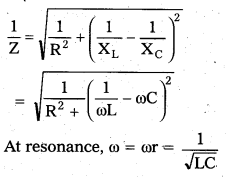
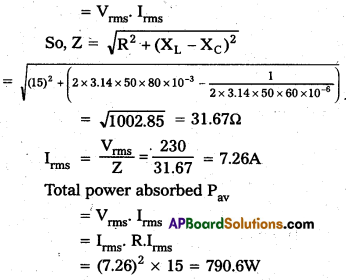
AP Inter 2nd Year Physics Important Questions Chapter 9 Electromagnetic Induction 4
d) Predict the polarity of the capacitor in the situation described by the following figure.
AP Inter 2nd Year Physics Important Questions Chapter 9 Electromagnetic Induction 5
Solution:
a) No. However strong the magnet may be, current can be induced only by changing the magnetic flux through the loop.

b) No current is induced in either case. Current can not be induced by changing the electric flux.

c) The induced emf is expected to be constant only in the case of the rectangular loop. In the case of circular loop, the rate of change of area of the loop during its passage out of the field region is not constant, hence induced emf will vary accordingly.

d) The polarity of plate ‘A’ will be positive with respect to plate ‘B’ in the capacitor.

Question 6.
A metallic rod of 1 m length is rotated with a frequency of 50 rev/s, with one end hinged at the centre and the other end at the circumference of a circular metallic ring of radius 1 m, about an axis passing through the centre and perpendicular to the plane of the ring as in figure. A constant and uniform magnetic field of 1 T parallel to the axis is present everywhere. What is the emf between the centre and the metallic ring ?
AP Inter 2nd Year Physics Important Questions Chapter 9 Electromagnetic Induction 6
Solution:
Method I : As the rod is rotated, free electrons in the rod move towards the outer end due to Lorentz force and get distributed over the ring. Thus, the resulting separation of charges produces an emf across the ends of the rod. At a certain value of emf, there is no more flow of electrons and a steady state is reached.
Using equation (ε = – Bl \(\frac{\mathrm{dx}}{\mathrm{dt}}\) = BlV), the magnitude of the emf generated across a length dr of the rod as it moves at right angles to the magnetic field is given by
dε = Bυ dr. Hence,
ε = \(\int \mathrm{d} \varepsilon=\int_0^{\mathrm{R}} \mathrm{B} v \mathrm{dr}=\int_0^{\mathrm{R}} \mathrm{B} \omega \mathrm{rdr}=\frac{\mathrm{B} \omega \mathrm{R}^2}{2}\)
Note that we have used υ = ωr. This gives
ε = \(\frac{1}{2}\) × 1.0 × 2π × 50 × (12) = 157 V.

Method II: To calculate the emf, we can imagine a closed loop OPQ in which point O and P are connected with a resistor R and OQ is the rotating rod. The potential difference across the resistor is then equal to the induced emf and equals B × (rate of change of area of loop). If θ is the angle between the rod and the radius of the circle at P at time t, the area of the sector OPQ is given by
πR2 × \(\frac{\theta}{2 \pi}=\frac{1}{2}\), R2θ
where R is the radius of the circle. Hence, the induced emf is
e = B × \(\frac{\mathrm{d}}{\mathrm{dt}}\left[\frac{1}{2} \mathrm{R}^2 \theta\right]=\frac{1}{2} \mathrm{BR}^2 \frac{\mathrm{d} \theta}{\mathrm{dt}}=\frac{\mathrm{B} \omega \mathrm{R}^2}{2}\)
[Note: \(\frac{\mathrm{d} \theta}{\mathrm{dt}}\) = ω = 2πv]
This expression is identical to the – expression obtained by Method I and we get the same value of ε.

AP Inter 2nd Year Physics Important Questions Chapter 9 Electromagnetic Induction

Question 7.
A wheel with 10 metallic spokes each 0.5 m long is rotated with a speed of 120 rev/min in a plane normal to the horizontal component of earth’s magnetic field HE at a place. If HE = 0.4 G at the place, what is the induced emf between the axle and the rim of the wheel ? Note that 1 G = 10-4 T.
Solution:
Induced emf = (1/2) ω B R2
= (1/2) × 4π × 0.4 × 10-4 × (0.5)2
= 6.28 × 10⁻⁵ V

Question 8.
Refer to fig. The arm PQ of the rectangular conductor is moved from x = 0, outwards. The uniform magnetic field is perpendicular to the plane and extends from x = 0 to x = b and is zero for x > b. Only the arm PQ possesses substantial resistance r. Consider the situation when the arm PQ is pulled outwards from x = 0 to x = 2b, and is then moved back to x = 0 with constant speed o. Obtain expressions for the flux, the induced emf, the force necessary to pull the arm and the power dissipated as Joule heat. Sketch the variation of these quantities with distance.
AP Inter 2nd Year Physics Important Questions Chapter 9 Electromagnetic Induction 7
Solution:
Let us first consider the forward motion from x = 0 to x = 2b. The flux ΦB linked with the circuit SPQR is
ΦB = Blx 0 ≤ x < b
= Blυ b ≤ x < 2b
The induced emf is,
ε = – \(\frac{\mathrm{d} \phi_{\mathrm{B}}}{\mathrm{dt}}\)
= -Blυ 0 ≤ x < b
= 0 b ≤ x < 2b.
When the induced emf is non-zero, the current I is (in magnitude)
I = \(\frac{\mathrm{B} l v}{\mathrm{r}}\)
AP Inter 2nd Year Physics Important Questions Chapter 9 Electromagnetic Induction 8
The force required to keep the arm PQ in constant motion is I lB. Its direction is to the left. In magnitude
F = \(\frac{\mathrm{B}^2 l^2 v}{\mathrm{r}}\) 0 ≤ x < b
= 0 b ≤ x < 2b
The Joule heating loss is
Pj = I2r
= \(\frac{\mathrm{B}^2 l^2 v^2}{\mathrm{r}}\)   0 ≤ x < b
= 0   b ≤ x < 2b
One obtains similar expressions for the inward motion from x = 2b to x = 0.

AP Inter 2nd Year Physics Important Questions Chapter 9 Electromagnetic Induction

Question 9.
Two concentric circular coils, one of small radius r1 and the other of large radius r2, such that r1 << r2, are placed co-axially with centres coinciding. Obtain the mutual inductance of the arrangement.
Solution:
Let a current I2 flow through the outer circular coil. The field at the centre of the coil is B2 = μ0I2/2r2. Since the other co-axially placed coil has a very small radius. B2 may be considered constant over its cross-sectional area. Hence,
Φ2 = \(\pi \mathrm{r}_1^2 \mathrm{~B}_2\)
= \(\frac{\mu_0 \pi \mathrm{r}_1^2}{2 \mathrm{r}_2} \mathrm{I}_2\)
= M12I2
Thus,
M12 = \(\frac{\mu_0 \pi r_1^2}{2 r_2}\)
From Equation M12 = M21 = M
M12 = M21 = \(\frac{\mu_0 \pi r_1^2}{2 r_2}\)
Note that we calculated M12 from an approximate value of Φ1 assuming the magnetic field B2 to be uniform over the area \(\pi r_1^2\). However, we can accept this value because r1 << r2.

Question 10.
(a) Obtain the expression for the magnetic energy stored in a solenoid in terms of magnetic field B, area A and length l of the solenoid.
(b) How does this magnetic energy compare with the electrostatic energy stored in a capacitor ?
Solution:
a) From Equation ε = – L \(\frac{\mathrm{dI}}{\mathrm{dT}}\),
the magnetic energy is
UB = \(\frac{1}{2}\) LI2
= \(\frac{1}{2} \mathrm{~L}\left(\frac{\mathrm{B}}{\mu_0 \mathrm{n}}\right)^2\)
(since B = μ0nI, for a solenoid)
= \(\frac{1}{2}\) (μ0n2Al) \(\left(\frac{\mathrm{B}}{\mu_0 \mathrm{n}}\right)^2\)
[from Equation L = μ0n2Al]
= \(\frac{1}{2 \mu_0}\) B2Al

b) The magnetic energy per unit volume is,
uB = \(\frac{\mathrm{U}_{\mathrm{B}}}{\mathrm{V}}\)
[where Vis volume that contains flux]
= \(\frac{\mathrm{U}_{\mathrm{B}}}{\mathrm{Al}}=\frac{\mathrm{B}}{2 \mu_0}\) ……………….. (1)
We have already obtained the relation for the electrostatic energy stored per unit volume in a parallel plate capacitor.
uE = \(\frac{1}{2}\) ε0E2 ………………. (2)
In both the cases energy is proportional to the square of the field strength.

AP Inter 2nd Year Physics Important Questions Chapter 9 Electromagnetic Induction

Question 11.
Kamla peddles a stationary bicycle, the pedals of the bicycle are attached to a 100 turn coil of area 0.10 m2. The coil rotates at half a revolution per second and it is placed in a uniform magnetic field of 0.01 T perpendicular to the axis of rotation of the coil. What is the maximum voltage generated in the coil ?
Solution:
Here f = 0.5 Hz; N = 100, A = 0.1 m2 and B = 0.01 T.
Employing Equation ε = NBA ω sin ωt
ε0 = NBA (2πv)
= 100 × 0.01 × 0.1 × 2 × 3.14 × 0.5
= 0.314 V
The maximum voltage is 0.314 V