AP Inter 2nd Year Civics Study Material Chapter 8 State Judiciary

Andhra Pradesh BIEAP AP Inter 2nd Year Civics Study Material 8th Lesson State Judiciary Textbook Questions and Answers.

AP Inter 2nd Year Civics Study Material 8th Lesson State Judiciary

Long Answer Questions

Question 1.
Explain the powers and functions of the High Court.
Answer:
The constitution of India provides for a High Court for each state. But the 7th Amendment Act, 1956 authorised the Parliament to establish a common High Court for two or more states and a Union Territory.

Articles 214 to 231 in Part-VI of constitution deals with the organization, qualifications, appointment, independence, jurisdiction, powers and procedures etc., of the High Court.

Composition :
Every High Court consists of a Chief Justice and such other judges as the President may from time to time deem it necessary to appoint.

Appointment of Judges :
The Chief Justice of High Court is appointed by the President after consultation with the Chief Justice of India and the Governor of the concerned state. The other judges of High Court are appointed by the President with the consultation of the Chief Justice of High Court of the concerned State. In case of a common High Court for two or more States, the Governors of concerned States are cpnsulted by the President. ,

Qualifications of Judges :
A person to be appointed as a judge of High Court should possess the following qualifications.
a) He should be a citizen of India.
b) He should have held judicial office in the territory of India for atleast 10 years, or
c) He should have been an advocate of a High Court or of two or more such courts for 10 years period. However, the Constitution has not prescribed a minimum age for appointment as a judge of a High Court.

Salaries and Allowances :
The salaries, allowances, privileges, leave and pension of the judges of a High Court are determined by the Parliament from time to time. The Judge of a High Court gets a salary of ₹ 80,000/-per month and the Chief Justice gets ₹ 90,000/-. They are also entitled to get other allowances and are provided with free accommodation and other facilities like medical, car, telephone etc.

The salaries and allowances cannot be reduced except under financial emergency. The salaries and allowances are drawn from the Consolidated Fund of the State. Their retired Chief Justice and other judges are entitled to 50% of their last drawn salary as monthly pension.

Tenure :
Every Judge of a High Court including Chief Justice holds office until he attains the age of 62 years. The Judges including the Chief Justice will take oath in the presence of the Governor of the concerned State. He can resign for his office when he desire so by writing to the President to that effect.

Method of removal:
A Judge of a High Court can.be removed by the President on the grounds of proved misbehaviour or incapacity. The method of removal of a Judge of the High Court shall be the same as that of a Judge of the Supreme Court.

Powers and Functions of the High Court:
The following are the powers and functions of the High Court.

1) Original Jurisdiction:
Every High Court in India has original jurisdiction in regard to matters of admiralty, will, marriage, divorce, company laws, contempt of court and certain revenue cases. Every High Court is empowered to issue directions, orders or writs for the enforcement of any of the Fundamental Rights. Every High Court is empowered to settle disputes relating to election of members of Parliament and State Legislatures.

Under Article 226, the High Court is empowered to issue writs for enforcing Fundamental Rights. The High Court issue writs like Habeas-corpus, Certiorari, Mandamus, Quo-warranto and Injunction,for protecting the Fundamental Rights of the Indian Citizens.

2) Appellate Jurisdiction :
Every High Court hears appeals against the judgement rdinate courts. The appellate Jurisdiction of the High Court extends to both riminal Cases.

a) Civil Cases :
An appeal to the High Court on the civil side is either a first appeal or a second appeal. In civil cases, appeal to the High Court lies from the decision of a District Court. Appeals can also be made from the subordinate courts directly provided the dispute involves a value of more than ₹ 5,00,000/- (or) a question of fact of law. When a court subordinate to the High Court decides an appeal differing from the decision of an inferior court, a second appeal can be made to the High Court.

b) Criminal Cases :
In Criminal cases, it hears the appeals in which the accused has been sentenced to more than seven years imprisonment by the Sessions Judge. All cases involving capital punishment awarded by the Sessions Court come to High Court as appeals. Its approval is necessary for the imposition of death sentences by the District Sessions Judge. It also hears cases involving the interpretation of the Constitution.

3) Court of Record :
The State High Court acts as a Court of Record. It records all its decisions and judgements. Such records are of great significance. They carry evidentary value. They are taken as Judicial precedents to the Judges and Advocates in legal matters.

4) Power of Judicial Review :
The State High Court possesses the power of judicial review like the Supreme Court. It is the power of High Court to examine the constitutionality of legislature enactments and executive orders of both the Central and State Governments. On examination, if they are found to bp violated of the Constitution (Ultra Vires), they can be declared as illegal, unconstitutional and invalid (null and void) by the High Court. Consequently, they cannot be enforced by the government.

5) Power of Certification :
High Court certifies certain cases which can go to the Supreme Court. That appeals which go to Supreme Court depend up on the issue of a certificate by the High Court.

6) Advisory functions :
The High Court is consulted by the State Governor in the matters of appointment, posting and promotion of District Judges and in the appointment of personnel to the Judicial Services of the State (Other than District Judges). It deals with the matters of posting, promotion, grant of leave, transfers and discipline of the members of the Judicial Service of the State. It also, renders advice to the subordinate courts in the matters of public interest or of legal importance.

7) Administrative functions :
The High Court exercises certain administrative functions within its territorial jurisdictions.

  • Under Article 227, every High Court has the power of supervision over all Courts and Tribunals functioning in its territorial jurisdiction except Military Courts or Tribunals in the State.
  • It ensures the proper working of these courts. It exercises the power to make and issue general rules and regulations for securing the efficient working of the court.
  • The High Court can transfer any case from one court to another court under Article 228 and can even transfer the case itself and decide the same.
  • The High Court has the power to investigate or enquire into the records or other connected documents for any court subordinate to it.
  • It appoints its administrative staff and determines the salaries and allowances and other conditions of the personnel working in subordinate courts.
  • It is empowered to withdraw any case involving the interpretation of the constituion and dispose of the case itself.
  • The High Court is the Highest Court of Justice in the State. All other Courts and Tribunals (except Military Courts and Tribunals) in State function under the direct supervisions and control of the State High Court.

Other functions :
a) The High Court acts as the District Court where its head quarters are located.

b) The Chief Justice of the High Court acts as the Governor on the direction of the President tentatively whenever the vacancy arises in that office.

c) The High Court can admit Public Interest Litigation like the Supreme Court of India.

AP Inter 2nd Year Civics Study Material Chapter 8 State Judiciary

Question 2.
Write an essay on the District Level Courts.
Answer:
The state judiciary consists of a High Court and a hierarchy of Subordinate Courts also known as District Courts. The District Courts play an important role in judicial administration at the district level. The courts consist of District Judge and other Judges. They fullfill their obligations at the District, Town and Major Village levels. They hear civil and criminal cases. They are subject to the authority and control of the State government in administrative matters and to the State High Court in judicial matters.
There are two types of subordinate courts in a State namely :

  1. Civil Courts and
  2. Criminal Courts.

1) Civil Courts :
The Civil Courts deal with civil suits regarding the matter like marriages, divorce, inheritance, business etc. There will be District Civil Courts at the District Level. The District Judge acts as its head. He exercises control and supervision over other civil courts in the district.

There are some senior civil judge courts below the rank of the district civil courts. There are some other junior civil judge courts in addition senior civil judge court. Judicial officers of subordinate courts are given here under :

  1. Principal District Judge
  2. Family Court Judge
  3. SC & ST Act Court Judge
  4. Senior Civil Court Judge
  5. Junior Civil Court Judge

The Principal District Court admits the cases pertaining to an amount of Rupees 10 Lakhs and above worth of poverty and deliver the judgements. The Principal District Judge is appointed through direct as well as indirect recruitment (By promotion).

The Family Courts are presided by judicial officers of the cadre of District Judges. This court takes up cases under Hindu Marriage Act relating to divorce, ordering interim maintenance, ordering custody of children etc. In order to protect Scheduled Caste and Scheduled Tribes rights and to implement SC & ST Act strictly, there is a court for the entire district.

There are some courts namely Senior Civil Judge Courts which deal with the cases of property worth rupees above one lakh and below 10 lakhs and deliver the judgements.

Cases pertaining to property worth below one lakh will be taken up by Junior Civil Judge Court and the Judgements are delivered. There are some Nyaya Panchayats, Grama Kacheries, Adalati Panchayats and so on at the lowest level in the district to deal with local legal issues.

2) Criminal Courts :
The Sessions Court is the highest criminal court in the district. The Sessions court acts as the superior court at the district level in handling the criminal matters. The Sessions Judge delivers judgements according to the provisions mentioned in the Indian penal code and the criminal procedure code. The following judges deal with at the district level.
They are :

  1. District Sessions Judge
  2. Senior Assistant Sessions Judge
  3. Junior Civil Judge
  4. Special Judicial Magistrate

The Principal District Judge will act as District Sessions Judge, who deals with the cases relating to murder and motor vehicles act violation cases and delivers the judgement and imposes life imprisonment or death sentences which are to be confirmed by the State High Court. The Senior Assistant Sessions Judge will impose an imprisonment of five to seven years, depending on the nature of the Case.

If there is a Junior Civil Judge Court for the entire town the court acts as a civil as well as a criminal court and take up the cases and deliver judgement and impose imprisonment below three years. There are Second Class Magistrate Courts which deliver the judgement by imposing fine up to rupees five hundred or a sentence of one year or both.

Special Judicial Magistrate Courts will be established in every town which takes up petty cases and deliver the judgement by imposing fines below ₹ 500/- and impose imprisonment below six months.

Short Answer Questions

Question 1.
Explain briefly the composition of High Court.
Answer:
The Constitution of India provides for a High Court for each state. But the 7th Amendment Act, 1956 authorised the Parliament to establish a common High Court for two or more states and a Union Territory. *

Composition :
Every High Court shall consist of a Chief Justice and some other Judges. The President of India may appoint them from time to time. Besides, the President has the power to appoint Additional Judges for a temporary period not exceeding two years as an acting Judge, where a permanent Judge of a High Court is temporarily absent or unable to perform his duties.

Such judges hold office until the permanent Judge resumes his office. The number of Judges varies from 5 in Gauhati High Court to 48 in the Allahabad High Court. Our Constitution does not specify the exact strength of High Court judges and leaves it to the discretion of the President. Accordingly, the President determines the strength of a High Court from time to time depending upon its workload.

Question 2.
Write any two powers and functions of the State High Court. [Mar. 18, 16]
Answer:
The following are the two powers and functions of the High Court.
1) Original Jurisdiction:
Every High Court in India has original jurisdiction in regard to matters of admiralty, will, marriage, divorce, company laws, contempt of court and certain revenue cases. Every High Court is empowered to issue directions, orders or writs for the enforcement of any of the Fundamental Rights. Every High Court is empowered to settle disputes relating to election of members of Parliament and State Legislatures. The High Courts of Bombay, Calcutta and Madras possess original jurisdiction in Civil as well as Criminal cases arising within the presidency towns.

They are authorized to hear Civil Cases involving property of the value of ₹ 20,000/- or more. They enjoy exclusive privileges and authority in this regard. In fact this power of High Court was m vogue before independence. It has been retained in the new Constitution. The other High Courts also enjoy the same jurisdiction as was available to them before independence.

Under Article 226, the High Courts is empowered to issue writs for enforcing Fundamental Rights. The High Court issue writs like Habeas-corpus, Certiorari, Mandamus, Quo-warranto and Injunction for protecting the Fundamental Rights of the India Citizens.

2) Appellate Jurisdiction :
Every High Court hears appeals against the judgement of the subordinate courts. The appellate Jurisdiction of the High Court extends to both Civil and Criminal Cases.

a) Civil Cases :
An appeal to the High Court on the civil side is either a first appeal or a second appeal. In civil cases, appeal to the High Court lies from the decision of a District Court. Appeals can also be made from the subordinate courts directly provided the dispute involves a value of more than ₹ 5,00,000/- (or) a question of fact of law. When a court subordinate to the High Court decides an appeal differing from the decision of an inferior court, a second appeal can be made to the High Court.

b) Criminal Cases :
In Criminal cases, it hears the appeals in which the accused has been sentenced to more than seven years imprisonment by the Sessions Judge. All cases involving capital punishment awarded by the Sessions Court come to High Court as appeals. Its approval is necessary for the imposition of death sentences by the District Sessions Judge. It also hears cases involving the interpretation of the Constitution.

Question 3.
Explain the Administrative functions of the High Court
Answer:
The High Court exercises certain administrative functions within its territorial jurisdictions.

  1. Under Article 227, every High Court has the power of supervision over all Courts and Tribunals functioning in its territorial jurisdiction except Military Courts or Tribunals in the State.
  2. It ensures the proper working of these courts. It exercises the power to make and issue general rules and regulations for securing the efficient working of the court.
  3. The High Court can transfer any case from one court to another court under Article 228 and can even transfer the case itself and decide the same.
  4. The High Court has the power to investigate or enquire into the records or other connected documents of any court subordinate to it.
  5. It appoints its administrative staff and determines the salaries and allowances and other conditions of the personnel working in subordinate courts.
  6. It is empowered to withdraw any case involving the interpretation of the Constitution and dispose of the case itself.
  7. The High Court is the Highest Court of Justice in the State. All other Courts and Tribunals (except Military Courts and Tribunals) in State function under the direct supervision and control of the State High Court.

AP Inter 2nd Year Civics Study Material Chapter 8 State Judiciary

Question 4.
Explain the powers and functions of District Court.
Answer:
There will be District Civil Courts at the District Level. The District Judge acts as its head. He exercises control and supervision over other civil courts in the district.

There are some senior civil judge courts below the rank of the district civil courts. There are some other junior civil judge courts in addition senior civil judge courts. Judicial officers of subordinate courts are given here under :

  1. Principal District Judge
  2. Family Court Judge
  3. SC & ST Act Court Judge
  4. Senior Civil Court Judge
  5. Junior Civil Court Judge

The Principal District Court admits the cases pertaining to an amount of Rupees 10 Lakhs and above worth of property and deliver the judgements. The Principal District Judge is appointed through direct as well as indirect recruitment (By promotion).

The Family Courts are presided by judicial officers of the cadre of District Judges. This court takes up cases under Hindu Marriage Act relating to divorce, ordering interim maintenance, ordering custody of children etc. In order to protect Scheduled Caste and Scheduled Tribes rights and to implement SC & ST Act strictly, there is a court for the entire district. .

There are some courts namely Senior Civil Judge Courts which deal with the cases of property worth rupees above one lakh and below 10 lakhs and deliver the judgements.

Cases pertaining to property worth below one lakh will be taken up by Junior Civil Judge Court and the Judgements are delivered. There are some Nyaya Panchayats, Grama Kacheries, Adalati Panchayats and so on at the lowest level in the district to deal with local legal issues.

Question 5.
Discuss the powers and functions of State Advocate General. [Mar. 17]
Answer:
Every State in Indian Union shall have an Advocate General, an official corresponding to the Attorney-General of India. He performs similar functions for the State that of the Attorney-General of India. He is the highest law officer in the State.

Appointment:
The Advocate General is appointed by the Governor of the State under the Article 165 of the Constitution. A person to be appointed as Advocate General must possess the following qualifications.

  1. He should be a citizen of India.
  2. He must have held a judicial office for ten years or an advocate of a High Court for ten years.
  3. He must be a person who is qualified to be appointed a judge of a High Court.

Tenure and Removal :
The Constitution of India did not mention the tenture of Advocate General. Further, the Constitution does not contain the procedure and grounds for his removal. He holds office during the pleasure of the Governor. He may be removed by the Governor at any time. He may also quit his office by submitting his resignation to the Governor. Conventionally, he resigns when the government resigns or is replaced, as he is appointed on the advice of the government.

Salary :
His remuneration is not fixed by the Constitution. He receives such remuneration as the Governor may decide from time to time.

Powers and functions :
As the highest law officer of the State Government, he exercises the following powers and functions.

  • He advises the State Government upon such legal matters which are referred to him by the Governor.
  • He performs such other duties of a legal character that are assigned to him by the Governor.
  • He discharges the functions and conferred on him by the Constitution.
  • He appeared before any court of law within the State.
  • He has a right to speak and to take part as member in the proceedings of the house (s) but no right to vote.
  • He can also attend any of the Standing Committee meetings of State Legislature.

Very Short Answer Questions

Question 1.
Appointment of High Court Judges. [Mar. 18, 17]
Answer:
The Chief Justice of High Court is appointed by the President after consultation with the Chief Justice of India and the Governor of the concerned State. The other judges of High Court are appointed by the President with the consultation of the Chief Justice of High Court of the concerned State. In case of a common High Court for two or more States, the Governors of concerned States are consulted by the President.

Question 2.
Qualifications of High Court Judges. [Mar. 16]
Answer:
A person to be appointed as judge of High Court should possess the following qualifications.

a) He should be a citizen of India.
b) He should have held a judicial office in the territory of India at least 10 years, or
c) He should have been an advocate of a High Court or of two or more such courts for 10. years period. However, the constitution has not prescribed a minimum age for appointment as a judge of a High Court.

Question 3.
High Court as a Court of Record.
Answer:
The State High Court acts as a court of Record. It records all its decisions and judgements. Such records are of great significance. They carry evidentary value. They are taken as Judicial precedents to the judges and Advocates in legal matters.

AP Inter 2nd Year Civics Study Material Chapter 8 State Judiciary

Question 4.
Advisory functions of High Court.
Answer:
The High Court is consulted by the State Governor in the matters of appointment, posting and promotion of District Judges and in the appointment of personnel to the Judicial Services of the State (Other than District Judges). It deals with the matters of posting, promotion, grant of leave, transfers and discipline of the members of the Judicial Service of the State. It also renders advice to the subordinate courts in the matters of public interest or of legal importance.

AP Inter 2nd Year Civics Study Material Chapter 6 State Executive

Andhra Pradesh BIEAP AP Inter 2nd Year Civics Study Material 6th Lesson State Executive Textbook Questions and Answers.

AP Inter 2nd Year Civics Study Material 6th Lesson State Executive

Long Answer Questions

Question 1.
Discuss the powers and functions of the Governor. [Mar. 18]
Answer:
The Governor is the constitutional head of the state government. Article 153 of the Indian constitution provides for the office of the governor in the states. The administration of a state is carried on in the name of the governor

Appointment:
The president appoints the governor on the advice of the Prime Minister. In this Contest, the president generally follows two conventions which are mentioned below for the appointment of the governor.

  1. Consulting the Chief Minister of the State Concerned.
  2. Choosing an eminent person not belonging to the state concerned.

Qualifications :
Article 157 of our constitution lays down the following qualifications for the appointment of a person as a governor.

  1. He shall be a citizen of India.
  2. He should have completed the age of 35 years.
  3. He should not hold any office of profit.
  4. He should not be a member of either union or state legislature.
  5. He should not be an insolvent declared by any court of Law.

Pay and Allowances :
The governor is entitled to receive a monthly salary of ₹ 1,10,000/-. He resides in official rent-free building “Raj Bhavan”. Besides, he is entitled to many other allowances and privileges.

Oath of Office :
The Chief Justice of the state High Court administers the oath of office to the governor.

Tenure :
The Governor holds office as a convention for a term of five years. However, He holds office during the pleasure of the president.

Powers and Functions of the Governor:
The Governor exercises six important powers and functions. They are explained as follows.

1) Legislative Powers and Functions :
Article 163 describe that the Governor is an intregral part of the Stage Legislature. In that capacity he exercises certain powers and performs functions related to the State Legislature.

  1. The Governor inaugurates the first sessions of the State Legislative Assembly after the general elections are over.
  2. He also addressing the first session of State Legislative Assembly every year i.e. budget session.
  3. He appoints Pro-tern Speaker of the State Legislative Assembly.
  4. He summons and prorogues the sessions of the two Houses of the State Legislature.
  5. He addresses the Members of the state Legislature and sends messages in relation to the state legislature.
  6. The Governor gives his assent to the bills passed by the state Legislature.
  7. He may return a bill sent by the state Legislature for its reconsideration.
  8. He dissolves the State Legislative Assembly when he feels no party is in a position to form a stable and viable Government and the advice of the Chief Minister.
  9. He may promulgate Ordinances to meet an emergency which require immediate action during the recess of the State Legislature.
  10. He nominates members of Anglo-indian community to the Legislative Assembly of the state if he feels that community is not represented in the house!
  11. The Governor nominates 1/6 of the total members of the State Legislative Council.

2) Executive powers and functions:
Article 154 of our constitution vests the governor with the executive powers of the state. The governor exercises these powers either directly of through officers subordinate to him. The governor has the following executive powers.

  1. The Governor appoints, the Chief Minister and the members of the Council of Ministers on the advice of the Chief Minister.
  2. He allocates Portfolios among the ministers and reshuffles their portfolios.
  3. He removes the Ministers on the advice of the Chief Minister.
  4. He appoints the Vice-Chancellors of the Universities in the State. He acts as the Chancellor of the universities.
  5. He appoints the Chief Secretary and Advocate General of the State Government.
  6. He appoints the Chairmen and other members of the State Commissions such as a) State Public Service Commission, b) State Election Commission, c) Official Language Commission, d) Commission for Women, e) Minorities Commission, f) Backward Classes Commission and g) SC & ST Commission.
  7. He regulates the postings and transfers of the All India Services personnel working in the state.

3) Judicial Powers and Functions :
The Governor also exercises the following judicial powers and functions.

  1. The Governor renders advice to the President of India in the appointment of Chief Justice and other judges of the High Court of the State.
  2. The Governor appoints the Advocate General of the State.
  3. He makes appointments, postings and promotions of the District Judges in consultation with the Chief Justice of High Court of the State.
  4. He also appoints persons to the judicial services of the state (Other than the district courts) in consultation with the Chief Justice of High Court and State Public Service Commission.
  5. He can grant pardon, retrieve, remit and commute the sentence of any person convicted of any offence against any law of the concerned state.

4) Financial Powers and Functions :
The Governor will have the following powers and functions of financial nature.

  1. The Governor sees that the Annual Financial Statement,(i.e. Budget) is laid before the State Legislature.
  2. No Money bill shall be introduced in the prior permission of the Governor.
  3. No Demand for Grant can be made except on his recommendation.
  4. He maintains the Contingency Fund of the State. He can make advances out of the Contingency Fund to meet any unforeseen expenditure.
  5. He constitutes a Finance Commission for every five years to review the financial position of village Panchayats and Municipalities.
  6. He sees that reports of various financial committees are laid before the State Legislature.

5) Miscellaneous Powers and Functions :
The Governor receives the Annual Report of the State Public Service Commission and passes it on to the Council of Ministers for comments. Thereafter, he passes on the report on these comments to the Speaker of the Assembly for placing it before the legislature. He receives the report of the Auditor-General regarding income and expenditure made by different departments working under the State Government. On behalf of the President, he runs the administration as the real head of the state through the enforcement of law and policies during the period of President’s Rule.

6) Discretionary Powers:
Under Article 163 (1) of the constitutions the Governor has some discretionary powers which are discharged by him. His decisions in this regard are final, These are mentioned as below.

  1. Playing a decisive role in appointing the new Chief Minister in a situation when no single party has a clear majority in the state Legislative Assembly.
  2. Dismissing a Minister When it refuses to resign even after losing majority support in the House.
  3. Dissolution of the Assembly on the advice of the Chief Minister who lost the majority members support.
  4. Rendering advice to the President for the imposition of the President’s Rule in the State.
  5. Reserving a Bill for the consideration and approval of the President.
  6. Seeking instructions from the president before promulgating ordinance on some important matters.
  7. Sending back a bill passed by the state legislature for its reconsideration, .except money bills.

AP Inter 2nd Year Civics Study Material Chapter 6 State Executive

Question 2.
Explain the powers and Functions of the Chief Minister.
Answer:
Articles 163 and 164 of our constitution deal with the office of the chief minister. The chief minister is the real executive head of the State Government. He plays a decisive role and occupies a key position in the State Government.

Appointment :
The Chief Minister is appointed by the governor under article 164. After general elections, the governor normally invites the leader of the majority party in the Legislative Assembly to form the government and appoints him as the Chief Minister.

Powers and Functions of Chief Minister:
The Chief Minister has high authority and heavy responsibility in discharging his powers and related functions. His powers and functions are related to the following heads.

i) Formation of the Ministry :
The first and foremost responsibility of the Chief Minister is the formation of Ministry of his choice. The CM has a free hand in the selection and appointment of Ministers. He chooses some members of his party (or coalition partners in the case of a coalition) and recommends their names to the Governor to be appointed as Ministers. He advises the Governor to allocate portfolios among the Ministers.

ii) Leader of the State Council of Ministers :
The Chief Minister is the head of the Council of Ministers. As such he occupies a position of exceptional authority. He is the Chairman of the State Council of Ministers. The Chief Minister decides the time, venue and the agenda of Gabinet meetings. The CM presides over such meetings, discussions are carried under his direction. He guides, directs, controls and co-ordinates the activities of the Ministers.

iii) Link between the Governor and the State Council of Ministers:
The Chief Minister is the principal channel of communication between the Governor and the State Council of Ministers. As part of his Constitutional duty he communicates all the administrative decisions and legislative proposals of the State Council of Ministers to the Governor. It is his responsibility to furnish any information related to the actives of the Ministers as the Governor may call for. No minister shall meet the Governor without the consent of the Chief Minister.

iv) Leader of the Legislative Assembly:
As the Chief Minister enjoys the confidence and support of the majority Legislators he acts as the leader of the Assembly. In that capacity he extends complete co-operation to the Presiding Officers for the smooth conduct of the Business of the House. He ensures discipline .of his party members in the Assembly. The CM helps other Ministers in case they are unable to satisfy the House with their replies or when a situation goes out of control in the Assembly. He announces the Government policies on the floor of the Legislative Assembly.

v) Chief Spokes Person :
The Chief Minister is the chief spokesperson of the Government. He announces the major policies and programs of the State Government. His statements in and outside of the State Legislature will carry much legitimacy and influence in the State. The Members in the State Legislature demand for clarification and statements on particular issues of the State from the Cheif Minister. So, he maintains much restrain without making controversial statements.

vi) Leader of the party in power:
The Chief Minister is the leader of party in power at the State level, he participates in the meetings organized by his party. He informs the party members about the policies and programs initiated by the State Government to fulfill the poll promises of his party. He seeks the co-operation and support of the party members for the effective implementation of the government policies and successful function pf the Government. He brings co-ordination between the party in power and the Government.

If he happens to be the President or the General Secretary of the party he gains control over his party. He utilizes the services of the senior, experienced and prominent party leaders in improving the image and efficiency of the State Government. He sees that his party members do not make controversial and embarrassing comments that may land the executive in the troubled waters. –

vii) Leader of the people :
He tries to know and understand the needs and interests, aspirations and expectations of the people in the State. For this purpose he frequently makes visits to different places and addresses the public gatherings. He invites petitions from the people and patiently listens to them. He informs the people about the welfare measures and developmental programs taken up by the Government. He motivates the people to take active participation in the implementation of various welfare schemes. He undertakes relief „ measures and consoles the people affected during the natural calamities. He maintains good rapport with the people and wins their confidence and trust, as their prominent leader of the people.

viii) Chief Advisor to the Governor :
It is the Constitutional obligation of the CM to render advice to the Governor on all matter of the State Government. His advice is binding over the Governor in the matter of appointment of ministers, allocation of portfolios, reshuffling of the Ministry and accepting the resignation of Ministers. It is a rate privilege and opportunity of the Chief Minister to advise the Governor to dissolve the State Legislative Assembly when he still has majority support of the members in the Assembly.

ix) Cordial relations with the Union Government:
The Chief Minister, being the real head of the. State administration, has the main responsibility of maintaining harmonious relations with the Union Government. He should develop cordial and amicable relations with the Prime Minister and the Union Ministers. He will have to interaction with several Union Ministers particularly of Home, Finance, Industry, Agriculture, Education, and Rural Development etc.

How much Union support a State gets in the form of financial grants to the centrally sponsored schemes depend on the Chief Minister’s influence on and the rapport with the Union Ministers. The State’s representation in the Union Cabinet also influences the quantum and quality of the support to the State.

x) Relations with Party in Opposition :
The Chief Minister maintains good relations with the Presidents, Floor Leaders, and MLAs of the Opposition Parties. Good contacts, healthy relations and cordial approach the Chief Minister in securing constructive co-operation from the Opposition. He takes the Opposition parties into confidence on crucial issues of the State. He organizes all party meetings and takes delegation of all parties to the Union Government for communicating issues of the state.

xi) Related to the Constitution:
The Indian Constitution confers all the powers of real executive on the Chief Minister. He owes his position to the Constitution. He has to exercise his authority and discharge his responsibilities in accordance with the provisions of Constitution. He must uphold the democratic norms and Constitutional principles in running the State administration.

Question 3.
Describe the powers and functions of the State Council of Ministers.
Answer:
Article 163(1) of the Indian Constitution provides for the State Council Ministers with the Chief Minister at its head, to aid and advise the Governor in the exercise of his powers and in running the State administration.

Composition :
The State Council of Ministers is generally a three-tier body. It consisting of.
1. Cabinet Ministers 2. Ministers of State and 3. Deputy Ministers. There will be some only Parliamentary Secretaries in some states on rare occasions. It constitutes the fourth wing of the hierarchy of the Council of Ministers.

Qualifications :

  1. They should be members of either House of the Legislature (if it is bi-cameral)
  2. If the Ministers are not the members of the State Legislature, they should be elected to the State Legislature within six months from the date of assuming their office. Otherwise they cease to hold their office.
  3. They must possess such other qualifications as*is determined by the Parliament from time to time.

Appointment:
All the Ministers are appointed by the governor (Article 164) on the advice and recommendation of the chief minister.

Powers and Functions of the Council of Ministers :
i) Policy Formulation :
The State Council of Ministers formulates policies suitable for the progress of the people and development of the State. It is an intellectual and laborious process. The Cabinet Ministers meet frequently under the leadership of the Chief Minister, discuss thoroughly various matters of the State adihinistration and finalize the policies along with the necessary decisions.

ii) Enactment of Laws :
The State Council of Ministers takes Legislative initiation on different matters of State Government. It is the Council Ministers that drafts and finalizes the public Bill and pilots them in the State Legislature at different stages in order to get them approved by the Legislature. Once the bills are approved by the Legislature, the Council of Ministers advises the Governor to assent them so that they become laws. The Council of Ministers may propose amendment to the existing laws or enactment Of new laws for the administrative convenience.

iii) Provision of Good Administration :
The State Council of Ministers i.e., the real executive is voted to power to provide good administration and promote the well-being of the .people of the State. The chief responsibility of the Council of Ministers is running the administration in accordance with the Constitutional cardinals and democratic doctrines. The.total administrative work is divided into different ministries. Each minister has one or more departments under his control and is responsible for the effective and the transparent administration of such departments. It formulates and implements different developmental programs and welfare schemes.

iv) Co-ordination of Governmental Activities :
The State Council of Ministers is responsible and the authority for coordinating the functions of different government departments. Without proper co-ordination among the departments the success of the State administration cannot be ensured. The Chief Minister guides and takes lead in coordinating the cabinet discussions and government activities.

v) Appointment Power:
The State Council of Ministers plays a key role in all important appointments to various offices in the State. It makes all appointments in the name of the Governor to various higher offices like the Chief secretary. Advocate General, D.G.R Principal Secretaries and other Heads of the Departments etc.

vi) Financial Fucntions :
The State Council of Ministers wields control over the Finances of the State. It determines fiscal policy and deals with the matters concerning the State Revenue, Expenditure, Investment and Audit of Accounts. It prepares the budget proposals of the State Government and places it before the State Legislature for its consideration and approval. It manages the Finances of the State according to the policy and budget as approved by the Legislature. Its role is that of a trustee.

vii) Miscellaneous Functions :
The State Council of Ministers finalizes strategies for the overall development of the State in the sphere of Agriculture, Irrigation, Industry, Transport, Education, Planning, IT etc. It proclaims ordinances in the name of the Governor during the recess of the State Legislature.

Short Answer Questions

Question 1.
Explain any three Powers and Functions of the Governor.
Answer:
1) Legislative Powers and Functions :
Article 168 describes that the Governor is an intregral part of the State Legislature. In that capacity he exercises certain powers and performs functions related to the State Legislature.

  1. The Governor inaugurates the first sessions of the State Legislative Assembly after the general elections are over.
  2. He also addressing the first session of State Legislative Assembly every year i.e. budget session.
  3. He appoints Pro-tem Speaker of the State Legislative Assembly.
  4. He summons and prorogues the sessions of the two houses of the State Legislature.
  5. He addresses the Members of the state legislature and sends messages in relation to the state legislature.
  6. The Governor gives his assent to the bills passed by the State Legislature.
  7. He may return a bill sent by the State Legislature for its reconsideration.
  8. He dissolves the State Legislative Assembly when he feels no party is in a position to form a stable and viable Government and the advice of the Chief Minister.
  9. He may promulgate Ordinances to meet an emergency which require immediate action during the recess of the State Legislature.
  10. He nominates members of Anglo-Indian community to the Legislative Assembly of the state if he feels that community is not represented in the house.
  11. The Governor nominates 1/6 of the total members of the State Legislative Council.

2) Executive Powers and Functions:
The Governor has the following executive powers.

  1. The Governor appoints, the Chief Minister and the members of the Council of Ministers on the advice of the Chief Minister.
  2. He allocates Portfolios among the ministers and reshuffles their portfolios.
  3. He removes the Ministers on the advice of the Chief Minister.
  4. He appoints the Vice-Chancellors of the Universities in the State. He acts as the Chancellor of the universities.
  5. He appoints the Chief Secretary and Advocate General of the State Government.
  6. He appoints the Chairmen and other members of the State Commissions such as a) State Public Service Commission, b) State Election Commission, c) Official Language Commission, d) Commission for Women, e) Minorities Commission, f) Backward Classes Commission and g) SC & ST Commission.
  7. He regulates the postings and transfers of the All India Services personal working in the state.

3) Judicial Powers and Functions :
The Governor also exercises the following judicial powers and functions.

  1. The Governor renders advice to the President of India in the appointment of Chief Justice and other judges of the High Court of the State.
  2. The Governor appoints the Advocate General of the State.
  3. He makes appointments, postings and promotions of the District Judges in consultation with the Chief Justice of High Court of the State.
  4. He also appoints persons to the judicial services of the state (other than the district courts) in consultation with the Chief Justice of High court and State Public Service Commission.
  5. He can grant pardon; retrieve, remit and commute the sentence of any person convicted of any offence against any law of the concerned state.

AP Inter 2nd Year Civics Study Material Chapter 6 State Executive

Question 2.
What are the Discretionary Functions of the Governor?
Answer:
Under Article 163(1) of the constitution the governor has been armed with certain discretionary powers. In the exercise of his discretionary powers, the governor is not bound by the advice of his ministers or even to seek such advice. His actions shall not be called into question on the ground that he ought or ought not to have acted in his discretion.

The discretionary powers of governor are mentioned below.

  1. Playing a decisive role in appointing the new Chief Minister in a situation when single party has a clear majority in the State Legislative Assembly.
  2. Dismissing a Ministry when it refuses to resign even after losing majority support in the House.
  3. Dissolution of the Assembly on the advice of the Chief Minister who lost the majority members support.
  4. Rendering advice to the President for the imposition of the President’s Rule in the State.
  5. Reserving a Bill for the consideration and approval of the President.
  6. Seeking instructions from the President before promulgating ordinance on some important matters.
  7. Sending back a bill passed by the state legislature for its reconsideration, except money bills.
  8. Seeking information from the Chief Minister with regard to the administrative and legislative matters of the State.

Question 3.
What are the Differences between the Governor of a State and the President of India?
Answer:

Governor of a StatePresident of India
1) The Governor is a nominated person.1) The President is an elected person.
2) He has no security of Tenure. His Tenure depends upon the Pleasure of the President.2) The President has a fixed tenure of Office of five years in general.
3) The Governor can be removed easily by the President on the advice of the Union Council of Ministers headed the Prime Minister.3) He can be removed only by the difficult process of Impeachment by the Parliament.
4) The Governor has discretionary power.4) The President has no discretionary, powers.
5) The Governor does not have Military and diplomatic powers.5) He has Military and Diplomatic powers.
6) Pardoning power of the Governor is limited. He cannot pardon death sentence and any sentence inflicted by the Martial Court.6) Pardoning power of the president is absolute. He can pardon even the death sentence and sentence of Martial Court.
7) The Governor does not have emergency powers. He can only suggest for the imposition of President’s Rule.7) The President can Promulgate orders for the declaration of all the three types of Emergencies.
8) The Governor has no power to remove the Chairman and Members of the State Public Service Commission though he appoints them.8) The President can remove the Chairman and the Members of the Union Public Service Commission on the grounds stipulated by the constitution.
9) The Governor sometimes may reserve a bill for the consideration of the President.9) The President need not reserve any bill for the consideration of any other authority before giving his assent.
10) The Governor cannot issue ordinance without instructions from the President on the matters (a) which might affect the powers of the Union (b) affecting powers of the High Court (c) Imposing reasonable restrictions upon Inter¬State Trade or Commerce.10) The President can promulgate any ordinance on the advice of Council of Ministers of the Union.

Question 4.
What is the position and significance of the Governor in the State?
Answer:
The Constitution of India provides for the Parliamentary System of Government both at Centre and in the States. While the Governor is only a nominal executive, the real executive constitutes the Council of Ministers headed by the Chief Minister. The Constitution has assigned a dual role to the office of a Governor in the Indian federal system. He is the Constitutional head of the State Government as well as the representative of the Union Government.

As the Constitutional head of the state government, he must positively contribute to the progress and development of the State. He has to see that the political and administrative heads of the State Government strive for the promotion of the interests of the people. The Governor has to ensure that the ministers and bureaucrats must observe the constitutional and democratic norms. It is the responsibility of the Governor to see that the affairs of the government are carried on in accordance with Constitutional provisions. The Governor has to maintain close and harmonious relations with the real executive heads of the Union and State Governments.

The Governor is not supposed to run a parallel government in the State. His role is that of a good counselor, mediator and arbitrator than an active politician. He shall abide by the advice of the State Council of Ministers. This does not mean that he should accept all proposals immediately. He can reserve Bills for reconsideration and prevent hasty decisions. Great caution and restrainment must be exercised while reporting to the President under Article 356. Otherwise, his image as guardian of the State Government would tarnished. He should keep himself away from active politics. If he identifies himself with a political party, he cannot inspire the total trust of the people.

Being the representative of the Centre, the Governor has the responsibility of informing through reports whether the State is complying with the directives issued by the Union from time to time. It is his constitutional obligation to inform the Union whether the constitutional machinery is functioning smoothly in the state or not.

The Centre-State relations largely depend upon the action and performance of the Governor. He can make or mar the healthy relations between the Union and the State. The Constitution has given certain discretionary powers to the Governor. If the Governor makes use of these powers sparingly, judiciously and impartially, tensions between the Centre and the States would certainly be reduced. If he acts with bias and at the behest of the Central Government, the tensions between the Centre and State would undoubtedly be enhanced. The role of the Governor in the formation or dissolution of the Ministry or imposing of President’s Rule will have far reaching implications and consequences in the healthy and harmonious Centre-State relations.

Question 5.
Explain any three Powers and Functions of the Chief Minister. [Mar. 16]
Answer:
The following are the three important powers and functions of the Chief Minister.
i) Formation of the Ministry :
The first arid foremost responsibility of the Chief Minister is the formation of Ministry of his choice. The CM has a free hand in the selection and appointment of Ministers. He chooses some members of his party (or coalition partners in the case of a coalition) and recommends their names to the Governor to be appointed as Ministers. He advises the Governor to allocate portfolios among the Ministers.

ii) Leader of the State Council of Ministers :
The Chief Minister is the head of the Council of Ministers. As such he occupies a position of exceptional authority. He is the Chairman of the State Council of Ministers. The Chief Minister decides the time, venue and the agenda of Cabinet meetings. The CM presides over such meetings, discussions are carried under his direction. He guides, directs, controls and co-ordinates the activities of the Ministers.

iii) Link between the Governor and the State Council of Ministers :
The Chief Minister is the principal channel of communication between the Governor and the State Council of Ministers. As part of his Constitutional duty he communicates all the administrative decisions and legislative proposals of the State Council of Ministers to the Governor. It is his responsibility to furnish any information related to the actives of the Ministers as the Governor may call for. No minister shall meet the Governor without the consent of the Chief Minister.

Question 6.
Explain the Composition of the State Council of Ministers.
Answer:
Article 163(1) of the Indian Constitution provides for the State Council Ministers with the Chief Minister at its head, to aid and advise the Governor in the exercise of his powers and in rurining the State administration.

Composition :
The State Council of Ministers is generally a three-tier body. It consisting of.
1. Cabinet Ministers 2. Ministers of State and 3. Deputy Ministers. There will be some only Parliamentary Secretaries in some States on rare occasions. It constitutes the fourth wing of the hierarchy of the Council of Ministers.

i) Cabinent Ministers :
The cabinent is a small body consisting of ministers holding the most important portfolios such as Home, Finance, Planning and Industries etc. They enjoy independence in taking and implementing decisions concerning their ministry. They attend the Cabinet meetings, concerned by the Chief Minister. Some times the Ministers of state and deputy ministers may attend the cabinet meetings, in case their presence is needed during deliberations. They meet frequently and determine the policies of the State Government under the stewardship of the Chief Minister.

ii) Ministers of State :
The Ministers of State hold portfolios of less importance compared to the Cabinent Ministers. They may be attached to the individual Cabinent Ministers or might be given independent charge of crucial departments’in the major Ministries. In such a case they enjoy independence. They are answerable directly to the Chief Minister. They are not subject to the control of Cabinet Ministers.

iii) Deputy Ministers :
The Deputy Ministers are attached to the Cabinet Ministers. They performs such functions which are assigned by the Cabinet Ministers. His role is mainly to relieve the burden of the Cabinet Minister. He assists the Cabinent Minister in the administrative and legislative affairs of the Ministry the Constitution (91st Amendment) Act 2003 fixes a ceiling on the size of the Council of Ministers. The total number of the Ministers cannot be more than 15% of the total strength of the State Legislative Assembly.

AP Inter 2nd Year Civics Study Material Chapter 6 State Executive

Question 7.
Point out any three Powers of the State Council of Ministers. [Mar. 17]
Answer:
The three of the following are the important powers of the state council of Ministers.
i) Policy Formulation :
The State Council of Ministers formulates policies suitable for the progress of the people and development of the State. It is an intellectual and laborious process. The Cabinent Ministers meet frequently under the leadership of the Chief Minister, discuss throughly various matters of the State administration, and finalize the policies along with the necessary decisions.

ii) Enactment of Laws :
The State Council of Ministers takes Legislative initiation on different matters of State Government. It is the Council of Ministers that drafts and finalizes the public Bills and pilots them in the State Legislature at different stages in order to get them approved by the Legislature. Once the bills are approved by the Legislature, the Council of ministers advises the Governor to assent them so that they become laws. The Council of Ministers may propose amendment to the existing laws or enactment of new laws for the administrative convenience.

iii) Provision of Good Administration :
The State Council of Ministers i.e., the real executive is voted to power to provide good administration and promote the wellbeing of the people of the State. The chief responsibility of the Council of Ministers is running the administration in accordance with the Constitutional cardinals and democratic doctrines.

The total administrative work is divided into different ministries. Each minister has one or more departments under his control and is responsible for the effective and the transparent administration of such departments. It formulates and implements different developmental programs and welfare schemes.

Question 8.
Estimate the relationship between the Chief Minister and the Governor.
Answer:
In a Parliamentary Democracy like India the real executive of the state plays a pivotal role in the state administration. The Cheif Minister as the real executive head in the State is responsible ultimately to the state electorate. The Chief Minister has also the obligation to facilitate the exercise of powers of the Governor by providing necessary information about the affairs of the administration of the State. The Governor has a right to seek any information on administrative and legislative activities of the state Council of Ministers through the Chief Minister.

However, this right does not allow permit the Governor to become a parallel centre in this state. It may be noted that the nature of the power available to the Governor is persuasive and not authoritarian. So he cannot under the grab of this right start over riding or vetoing the decisions or proposals of the state Council of Ministers.

The founding fathers of our Constitution have laid great emphasis on the need for harmonious relations between the Governor and his Council of Ministers headed by the Chief Minister. This was the main idea behind abandoning the proposal for an elected Governor and adopting for his nomination by the President.

The Sarkaria Commission in its report emphasized that for the proper working of the Parliamentary system there needs to be a good personnel rapport between the Governor and the Chief Minister of a State. For fostering good personnel relationship, the Sarkaria Commission suggested that the Union Government has to consult the concerned Chief Minister before appointing the Governor of the State.

Pandit Jawaharlal Nehru during his speeches in the Constituent Assembly stated that the Governor should be acceptable to the Chief Minister. Both the Chief Minister and Governor must work together in mutual co-operation to promote the development of the State and safeguard the interests of the people of the State.

Very Short Answer Questions

Question 1.
Qualifications of Governor. [Mar. 18]
Answer:
Article 157 of our Constitution lays down the following qualifications for the appointment of a person as a Governor.

  1. He shall be a citizen of India.
  2. He should have completed the age of 35 years.
  3. He should not be a member of either house of Parliament or state legislature.
  4. He should not hold any other office of profit.
  5. He should not be an insolvent declared by any court of law.

Question 2.
Special responsibilities of the Governor. [Mar. 17]
Answer:
The Governor has certain special responsibilities to discharge according to the directives issued by the President under Articles 371 (Z) 371 (A) (1) b, 371 (C) in case special responsibility through the Governor is to constilt the Council of Ministers the final decision shall be in his individual judgement which no court can question.

The Governor of Assom. Maharashtra, Gujarat, Wougaland, Manipur and Sikkim have special responsibility on specific matters related to their respective states. For example : 1. The Governor of Assom shall in his discretion determine the amount payable by the state of Assom to district council as the royalty accruing from licences of minerals decides the amount of money received from mineral resources and which has to be allocated to the District Council.

Question 3.
State Executive. [Mar. 18]
Answer:
Articles 153 to 167 deal with the matters of the state executive. The state executive consists of (a) the Governor (b) the Chief Minister and (c) Members of the State Council of Ministers. In our Parliamentary system Governor is the titular or constitutional head of the state. The Chief Minister is the real executive head of the Government. The Chief Minister and the Ministers being represents the people.

Question 4.
Immunities of the Governor.
Answer:
Our Constitution provides certain legal Immunities to the office of the Governor to enable him to discharge his constitutional functions in a free and fair manner, to ensure the state government works constitutionally. He shall not be held responsible for any act done or purporting to have been done in his official capacity. No criminal proceedings can be initiated against the Governor during his term of office. No proceedings for his arrest or imprisonment can be taken by any court of law.

Question 5.
Any two executive powers of the Governor.
Answer:

  1. The Governor appoints, the Chief Minister and the members of the Council of Ministers on the advice of the Chief Minister.
  2. He allocates portfolios among the Ministers and reshuffles their portfolios.

Question 6.
Two discretionary powers of the Governor.
Answer:

  1. Playing a decisive role in appointing the new Chief Minister in a situation when no single party has a clear majority in the State Legislative Assembly.
  2. Dismissing a Ministry when it refuses to resign even after losing majority support in the house.

Question 7.
The Chief Minister. [Mar. 17]
Answer:
The Chief Minister is the centre of the real executive authority at the state level. He plays a decisive role and occupies a key position in the State Government. The progress of the people and development of the state largely depends upon the Cabinet, Personality, Preservance and political stature of the Chief Minister.

Question 8.
Cabinet Ministers. [Mar. 16]
Answer:
The Cabinet is a small boy consisting of Ministers holding the most important portfolios such as Home, Finance, Planning and Industries etc. They enjoy independence in taking and implementing decisions concerning their Ministry. They attend the Cabinet meetings, concerned by the Chief Minister. Some times the Ministers of state and Deputy Ministers may attend the Cabinet meetings, incase their presence is needed during deliberations. They met frequently and determine the policies of the State Government under the Stewardship of the Chief Minister.

Question 9.
Composition of the State Council of Ministers. [Mar. 18]
Answer:
The State Council of Ministers is generally a three-tier body. It consisting of.

  1. Cabinet Ministers
  2. Ministers of state and
  3. Deputy Ministers. There will be some only Parliamentary Secretaries in some states on rare occassions. It constitutes the fourth wing of the hierarchy of the Council of Ministers. .

Question 10.
Deputy Ministers.
Answer:
The Deputy Ministers are attached to the Cabinet Ministers. They performs such functions which are assigned by the Cabinet Ministers. His role is mainly to relieve the burden of the Cabinet Minister. He assists the Cabinet Minister in the .administrative and legislative affairs of the Ministry.

AP Inter 2nd Year Civics Study Material Chapter 6 State Executive

Question 11.
State Ministers.
Answer:
The Ministers of State hold portfolios of less importance compared to the Cabinet Ministers. They may be attached to the individual Cabinet Ministers or might be given independent charges of crucial departments in the major minorities. In such a case they enjoy independence. They are answerably directly to the Chief Minister. They are not subject to the control of Cabinet Ministers.

AP Inter 2nd Year Civics Study Material Chapter 5 Union Judiciary

Andhra Pradesh BIEAP AP Inter 2nd Year Civics Study Material 5th Lesson Union Judiciary Textbook Questions and Answers.

AP Inter 2nd Year Civics Study Material 5th Lesson Union Judiciary

Long Answer Questions

Question 1.
Write an essay on the Supreme Court of India.
Answer:
The Supreme Court of India is the Highest Court of Justice in India.

Part V of the Indian constitution from Articles 124 to 147 deals with the composition, Appointment, Qualifications of Judges, powers and Functions of the Supreme Court.

Article 124 provides for the establishment of the Supreme Court.

The Supreme Court of India was established in New Delhi on January 26, 1950 with the inauguration of our constitution.

Composition :
The Supreme Court Consists of the Chief Justice and 30 other Judges. There may be some Ad-hoc Judges and retired Judges on temporary basis.

1) Seat of the Supreme Court:
The Head quarters of the Superme Court is situated at New Delhi. The Supreme Court ordinarily shall sits at New Delhi.

  • All general cases are adjudicated by a Division Bench Comprising two or more Judges.
  • Cases involving the constitutional matters are heard by a constitutional Bench consisting Five Judges.
  • For considering special cases larger benches consisting of Five or more than Five Judges are constituted.

2) Appointment:
The judges are appointed by the President. While appointing the Chief Justice, the President consults the retiring Chief Justice and the Prime Minister. He appoints the remaining judges on the advice of the Chief Justice.

3) Qualification :
A judge of the Supreme Court 1) must be a citizen of India. 2) must have worked as a judge of any High Court for atleast 5 years or must have 10 years of experience as an advocate either in the Superme court or any High court or must be a legal expert in the opinion of the President.

4) Salaries :
The Chief Justice gets a monthly salary of Rs. 1,00,000/- and each other judge gets 90,000 per month. They also get allowances. Their salaries should not be reduced to their disadvantage during their term of office.

5) Term of Office :
The judges hold office till they reach 65 years of age. However, they can be removed from office by Parliament through a resolution known as impeachment before the end of their term or they may submit their resignation.

Removal:
A Judge of the Supreme Court can be removed from his position only on the grounds of proved misbehaviour or in capacity by an order of the president after on an address by the Parliament by a Majority of not less than 2/3 votes.

Immunities of Judges :
According to Article 121 of the constitution, No discussion shall take place in the Parliament with respect to the conduct of any Judge of the Supreme Court in the discharge of his duties except upon a motion of impeachment.

Powers and Functions of Supreme Court:
1) Original Jurisdiction :
According to the original Jurisdiction, the Supreme Court hears directly any dispute (a) between the Government of India and one or more States, (b) between the Government of India and any State or States on one side and one or more States on the other (c) between two or more States. The Supreme Court also decides all disputes and doubts regarding the election of the President and Vice President. It protects the Fundamental Rights guaranteed to the citizens by issuing several writs.

2) Appellate jurisdiction:
The Supreme Court is the highest Court of appeal in India. All appeals from all other courts can be heard by Supreme Court. The appellate jurisdiction extends to four types of cases namely civil, criminal, constitutional and special. But, the High Court should give certificate for appealing in the Supreme Court in the first three kinds of cases. But in special cases the certificate of High Court is not required.

3) Advisory Jurisdiction :
The Supreme Court offers it’s advice to the President on those matters of legal or public importance which are referred to him (Art. 143). It’s opinion is purely advisory and not binding on the President. The Supreme Court may refuse to give its opinion to the President. In October 1994 when Dr.S.D.Sharma, the then President of India asked the Supreme Court to give it’s advisory opinion on the Ayodhya issue, the court refused to give it’s opinion.

4) Judicial Review:
The Supreme Court has the power of Judicial Review. It examines the validity of laws passed by the legislatures or the orders issued by the Executive and declares them as ultra vires or unconstitutional if they are against the provisions of the constitution.

5) Court of Record:
The Supreme Court acts as a court of record. All the judgements and interpretations of the Supreme Court are recorded for future references. .

6) Other Powers :
The Supreme Court.

  1. reviews it’s own decisions.
  2. supervises the working of the State High Courts and other Subordinate Courts.
  3. recruits it’s own personnel for its maintenance.
  4. interprets the constitution and acts as it’s guardian.
  5. initiates contempt proceedings against those who criticise or defy it’s judgements etc.

Conclusion :
From the above account it is evident that our Supreme Court unique position in the judicial system of the country.

AP Inter 2nd Year Civics Study Material Chapter 5 Union Judiciary

Question 2.
Explain the Powers and Functions of the Supreme Court of India.
Answer:
The supreme Court of India is the Highest Court of Justice in India. Article 124 of the Indian constitution provides for the establishment of the Supreme Court.

The Supreme Court of India was established in New Delhi on January 26, 1950. The Supreme Court consists of the Chief Justice and 30 other Judges.

Powers and Functions of Supreme Court:
1) Original Jurisdiction :
According to the original jurisdiction, the Supreme Court hears directly any dispute

  • between the Government of India and one or more States.
  • between the Government of India and any State or States on one side and one or more States on the other.
  • between two or more State. The Supreme Court also decides all disputes and doubts regarding the election of the President and Vice President. It protects the Fundamental Rights guaranteed to the citizens by issuing several writs.

2) Appellate Jurisdiction:
The Supreme Court is the highest Court of appeal in India. All appeals from all other courts can be heard by Supreme Court. The appellate jurisdiction extends to four types of cases namely civil, criminal, constitutional and special. But, the High Court should give certificate for appealing in the Supreme Court in the first three kinds of cases. But in special cases the certificate of High Court is not required.

3) Advisory Jurisdiction :
The Supreme Court offers it’s advice to the President on those matters of legal or public importance which are referred to him (Art. 143). It’s opinion is purely advisory and not binding on the President. The Supreme Court may refuse to give its opinion to the President. In October, 1994 when Dr. S.D. Sharma, the then President of India asked the Supreme Court to give it’s advisory opinion on the Ayodhya issue, the court refused to give it’s opinion.

4) Judicial Review:
The Supreme Court has the power of Judicial Review. It examines the validity of laws passed by the legislatures or the orders issued by the Executive and declares them as ultravires or unconstitutional if they are against the provisions of the constitution.

5) Court of Record:
The Supreme Court acts as a court of record. All the judgements and interpretations of the Supreme Court are recorded for future references.

6) Other Powers :
The Supreme Court.

  1. reviews it’s own decisions.
  2. supervises the working of the State High Courts and other Subordinate Courts.
  3. recruits its own personnel for its maintenance.
  4. Interprets the constitution and acts as it’s guardian.
  5. initiates contempt proceedings against those who criticise defy it’s judgements etc.-

7) Review of Judgement :
The Supreme court is empowered to review its own Judgements. It can uphold, modify or nullify its previous judgements. For instance it, while pronouncing its judgement in Golak nathcase vs. Punjab state case in 1967, declared the Parliament has no powers sb amend any of the provisions of fundamental rights of Indian Citizens.

Conclusion :
From the above account it is evident that our Supreme Court enjoys unique position.

Question 3.
Describe Judicial Review.
Answer:
Judicial Review is perhaps the most important power of the Supreme Court. The purpose of Judicial Review is to maintain the supremacy of the Constitution. There is no explicit mention of Judicial Review in the Indian Constitution. The higher courts derive this power from the provisions of Article 13 of the Constitution.

This Article empowers the Supreme Court to validate those laws and executive orders which infringe upon the Fundamental Rights. The makers of our constitution adopted this concept from the American Constitution keeping in view the written nature of the Indian Constitution and federal character of Indian polity.

Judicial Review means the power of the Supreme. Court or High Courts to examine the Constitutional validity of the legislative enactments and executive actions of both Central and State Governments and to declare them ‘null and void’ if found repugnant, of the provisions of the Constitution. As M.V Pylee stated, “Judicial Review is the competence of a court of law to declare the Constitutionality or otherwise of a legislative enactment”.

Article 13 declares all laws that are inconsistent with or direspectful of the fundamental rights, or void to the extent of their inconsistency. Hence, the Supreme Court being responsible for protecting fundamental rights, can declare any legislative act or executive decision that is inconsistent with provisions on fundamental rights as ultra vires or null and void, meaning unconstitutional and inapplicable. Besides, in case of federal relations, the Supreme Court can avail this power if a law is inconsistent with the provisions concerning the distribution of powers between the governments as laid down by the Constitution.

In this context the Supreme Court and High courts reviews legislations on the grounds that (a) they violate fundamental rights or (b) they violate the federal distribution of powers. The Supreme Court’s power of Judicial Review extends to the

  • Laws passed by the union and state legislatures,
  • Executive actions of the union and states,
  • Decisions of the public sector undertakings and
  • Constitutional Amendments. The Supreme Court for the first time utilized this power in 1950 itself by declaring Section 14 of the Preventive Detention Act as unconstitutional.

It may be noted that the Supreme Court of India is prominent in the world by exercising the power to determine the validity of the Constitutional Amendment Acts. However, Judicial Review is inevitable due to the following reasons.

  1. The Supreme Court has to uphold the supremacy of the Constitution.
  2. It has to maintain the federal equilibrium.
  3. It has to protect the fundamentals rights of the citizens.

Apart from the above, the power of Judicial Review is a resultant of the position of the Supreme Court as the; guardian of the Constitution. As such it has the final say in interpretation of the Constitution and by such an interpretation, the Supreme Court has extended its power of Judicial Review to almost all the provisions of the Constitution.

AP Inter 2nd Year Civics Study Material Chapter 5 Union Judiciary

Question 4.
What is Judicial Activism? What are its merits and demerits?
Answer:
Generally, Judicial Activism is construed to be the over willingness of the judiciary to jump into the arena of executive or legislative functions. Judicial Activism, in fact, is not a distinctly separate concept from usual judicial activities. In general parlance, the expression “activism” means “being active”, “doing things with decision” and the expression “activist” should mean “one who favours intensified activities”. In this sense every judge is an activist.

Judicial Activism is a policy making in competition with policy making by legislature and executive. The essence of true Judicial Activism is rendering of decisions which are in tune with the temper and tempo of the times. The nature of Judicial Activisim is that it furthers the cause of social change or articulates concepts like liberty, equality or justice.

Judiciary which is an institution that traditionally confined to responding to cases brought before it, began considering many cases merely on the basis of Newspaper reports and postal complaints received by the court. But most of the cases of Judicial Activism have occurred through Public Interest Litigatiqn in the sphere of Public Health, Child Labour, Environment, Corruption etc. Therefore, the Judicial Activism became the most popular description of the role of Judiciary.
Causes for Judicial Activism :
The following are the causes for the emergence of Judicial Activism in India.

  1. Expansion of the rights of hearing in the administrative process.
  2. Excessive delegation without limitation.
  3. Judicial Review over administration.
  4. Promotion of open government.
  5. Indiscriminate exercise of contempt of power.
  6. Exercise of jurisdiction when non – exist.
  7. Over extending the standard rules of interpretation in its search for socio-economic and educational objectives.
    8) Breakdown of other machinery of the government.

Merits of Judicial Activism :

  1. Judicial Activism has democratized the judicial system by giving, access to the courts not just to individuals but also to groups.
  2. It has enforced executive accountability.
  3. It made an attempt to make the electoral system more free and fair.
  4. It is due to the impact of Judicial Activism during elections the candidates who tender affidavits disclosing their assets, income, educational qualifications, criminal record etc. This enable the people to elect better candidates.

De – Merits:

  1. Judicial Activism has blurred the line of distinction between the executive and legislature on the one hand and the judiciary on the other hand.
  2. Some felt that Judicial Activism led to the worsening of relations and balance among the three organs of government.
  3. Democracy is based on the principle that each organ of government will respect the powers and jurisdiction of others. But Judicial Activism may negate this democratic principle.

Short Answer Questions

Question 1.
Write about the composition of the Supreme Court.
Answer:
The Supreme Court of India is the highest court of Justice in India part V of the India Constitution from Articles 124 to 147 deals with the composition, Appointment, Qualifications of Judges, powers and Functions of the Supreme Court.

The Supreme Court of India was established in New Delhi on January 26, 1950.

Composition :
The Supreme Court consists of the chief Justice of India and such number of other Judges as is provided by the law. The parliament is authorised to determine the number of Judges in the Supreme Court. At present, there are a chief Justice and 30 other Judges in the Supreme Court. There may be some Adhoc Judges and retired Judges on temporary basis in the Supreme Court. All general cases are adjudicated by division Bench comprising two or more judges.

Cases involving the constitutional matters are heard by a constitution bench consisting Five Judges.

For considering special cases larger benches consisting of Five or more than Five Judges are constituted.

Question 3.
Mention any two Jurisdictions of the Supreme Court.
Answer:
1. Original Jurisdiction :
The original jurisdiction of the Supreme Court is purely of federal in nature. This power is confined to disputes between (a) the Government of India and any of the States in India, (b) The Government of India and any State of States on one side and other States on the other side or (c) two or more States. This power exclusively belongs to the Supreme Court and no other court in India is empowered to entertain any such suit. However disputes arising out of any treaty agreement, convenant, engagement etc., do not come under this Jurisdiction unless referred to by the President for advisory opinion. The Supreme Court can directly hear the disputes concerning the election of the President and the Vice-President.

2. Appellate Jurisdiction:
The Supreme Court is the highest court of appeal in India. Its appellate Jurisdiction may be divided into three heads.

  1. Cases involving interpretation of constitution,
  2. Civil cases and.
  3. Criminal cases.

i) The Supreme Court hears cases involving a substantial question of Law as the interpretation of. the constitution. It requires the certificate of the High Court for hearing such a case. Sometimes the Supreme Court can take up the appeal if it is satisfied that the case has do with certain intepretation of the constitution.

ii) In case where no constitutional question is involved, the Supreme Court hears appeals on the basis of a certificate of the High Court. Such cases, in the opinion of High Court involve (a) a substantial question of law and (b) the decision of the Supreme Court,

iii) In case of the criminal matters the Supreme Court hears appeals from any Judgement, whether they are in the form of final order or sentence of the High Court. It hears two specified cases namely.
a) Where the High Court has on an appeal reversed on order of acquittal of an accused and sentenced him to death and b) Where the High Court has tried the appeals from any of its subordinate courts convicted the accused and sentenced him to death.

Question 3.
What are the powers of Appellate Jurisdiction of the Supreme Court?
Answer:
The Supreme Court is the highest court of appeal in India. Its appellate Jurisdiction may be divided into three heads.

  1. Cases involving interpretation of constitution,
  2. Civil cases and
  3. Criminal cases.

i) The Supreme Court hears cases involving a substantial question of Law as to the interpretation of the constitution. It requires the certificate of the High Court for hearing such a case. Sometimes the Supreme Court can take up the appeal if it is satisfied that the ease has do with certain intepretation of the constitution.

ii) In case where no constitutional question is involved, the Supreme Court hears appeals on the basis of the High Court. Such cases, in the opinion of High Court involve (a) a substantial question of law and (b) the decision of the Supreme Court.

iii) In case of the criminal matters the Supreme Court hears appeals from any Judgement, whether they are in the form of final order or sentence of the High Court. It hears two specified cases namely.

a) Where the High Court has on an appeal reversed on order of acquittal of an accused and sentenced him to death and b) Where the High Court has tried the appeals from any of its subordinate courts convicted the accused and sentenced him to death.

The Supreme Court also hears appeals by special leave on any judgement of the High Court when the latter certifies that the case is fit for hearing by the Supreme Court. Besides, the Supreme Court as per Article 136 hears appeals over the cases that remain outside the purview of the ordinary law.

Question 4.
Explain the Advisory Jurisdiction of the Supreme Court.
Answer:
Under Article 143, the Supreme Court has advisory jurisdiction. Accordingly, the supreme Court offers its advice to the President on those matter of. legal or public or constitutional importance, when the President seeks such advice. It also reports its opinion over the disputes referred to it by the President, arising out of any treaty, agreement which was made or executed before the commencement of the Constitution. So far the Supreme Court rendered its advice to the President on eight occasions. The president, in the recent past, sought the advice of the Supreme Court on the ‘Ayodhya Issue’.

These are excluded by Article 131. However, the Supreme Court is not bound to render advice on such matters and the president is not bound to accept such an advice.

One may immediately question about the utility of the advisory powers of the Supreme Court. The utility is twofold. In the first place, it allows the government to seek legal opinion on a matter of importance before taking, action on it. This may prevent unnecessary litigations later. Secondly, in the light of the advice of the Supreme Court, the government can make suitable changes in its action or legislations.

AP Inter 2nd Year Civics Study Material Chapter 5 Union Judiciary

Question 5.
Write about the Writ Jurisdiction.
Answer:
The word ‘writ’ literally means ‘order’ in written form. Article 32 of our Constitution confers authority upon the Supreme Court, to issue a constitutional writ for the enforcement of Fundamental Rights of the citizens. Any person, whose fundamental rights have been violated, can directly move the Supreme Court for remedy. The Supreme Court issues Habeas Corpus, Mandamus, Prohibitions, Quo-Warranto and Certiorari, for enforcing the Fundamental rights.

i) Habeas Corpus :
Literally means ‘to have the body of. It is issued by the court to affect the release of a person who has not been detained legally. Under this writ the court issues orders to the concerned authority to produce the person before-the court. The failure to abide by the writ order is met with punishment for contempt of court.

ii) Mandamus :
It means ‘we command’. The writ is a command issued by the court to a public official to do a duty which he has failed to do. This writ cannot be issued against private persons.

iii) Prohibition :
It means ‘to forbid’. It is issued by a higher court to a lower court to prevent the latter from exceeding its jurisdiction that it does not posses. This writ can be issued only against judicial and quasi-judical authorities.

iv) Certiorari:
It means ‘to be certified’ or ‘to be informed’. This writ is issued against the lower courts by the Supreme Court or High Courts, if the lower former courts violate their jurisdiction.

v) Quo Warranto :
It means ‘by what authority’ or ‘warrant’. If the court finds that a person is holding a public office which is not entitled to hold that office, it issues this writ for restricting that person from acting in that office. This writ is also not issued with respect to the private offices.

Besides the above, many other mechanism have been established for protecting of human rights. The National Commission for Women, the National Commission for Scheduled Castes & Scheduled Tribes, the National Human Rights Commission etc are some examples in this regard.

Question 6.
Describe Judicial Activism in India.
Answer:
It is the collective responsibility of the legislative, executive and the judiciary to accomplish the goals of the Constitution. Social Justice is the prime goal of the Constitution. Judiciary plays a vital role in achieving this goal. In order to meet the basic needs of the poor the oppressed and suppressed classes of the society, the Supreme Court entertains and also encourages the Public Interest Litigation (PIL) in its expanded, role of Judicial Activism.

As a result the apex court has evolved, developed new techinique, discovered and applied new remedies for violation of Fundamental Rights, and attempted to fill the vacuum arising out of executive and legislative inaction.

Due to the negligible attitude of the legislature and lack of edicts from the executive, the vulnerable classes of the society are sometimes denied social justice. In such circumstances, Social Action Groups, Civil Liberties Organizations, Voluntary Organizations etc., have come forward to their rescue through Public Interest Litigation.

As Chief Justice A.S. Ananad remarked that “the expanded concept of Public Interest Litigation by judicial interpretation from time to time has expanded the judicial limits of the courts exercising Judicial Review. This expanded role has been given the title of Judicial Activism by those who are critical of this expanded role of the Judiciary”.

Question 7.
What is meant Public Interest Litigation (PIL). [Mar. 17]
Answer:
The institution of Public Interest Litigation originated in USA during the mid 1960s. PIL or Social Action Litigation is an offshoot of liberalized rules of locus – standi. The traditional rule of locus-standi was based on the fact that judicial remedy can be sought only by those who have suffered an injury on account of violation of legal right by some public authority. The PIL choose liberalize this rule by making it clear that any person who suffer an injury but is unable to reach the court can take help of public minded citizens to reach the court to seek justice.

Public Interest Litigation Movement in India emerged during post-emergency years intending to make the judicial system accessible to the socially and economically lower sections of the society. In most of cases, Judicial Activism has occurred through public interest litigation. In public interest litigation any person or group can approach the Supreme Court and High Court for the redressal of grievances on behalf of the victim or victims who were incapable of approaching the court.

Under this new arrangement, a destitute citizen can file a writ petition even through a simple letter written on the post card. This derives authenticity from the “right be heard” as implied by Article 32 of the Constitution. But the court has to ensure that the petitioner who approaches the court with PIL, is acting bona- fide and not for personal gains private profit, political or other oblique considerations. The court should not allow this process to be abused by politicians and others to delay legitimate administrative action or to gain a political objective.

Question 8.
What is the Meaning of Independence of Judiciary? How is it ensured by the constitution?
Answer:
The Judiciary performs its Functions independently. The Legislature or the executive shall not interfere in the working of the Judiciary. The Judiciary carries on its obligations according to the constitutional norms and democratic principles.

The following measures have been taken by the constitution to ensure the independence of Judiciary in India.

Measures ensuring for Independence of Judiciary
1. The Legislature is not involved in the process of appointment of judges. Thus, it is believed that party politics would not play a role in the process of appoinments. In order to be appointed as judge, a person must have experience as a advocate and / or must be well versed in law. Political opinion of the person or his/her political loyalty should not be the criteria for appointments to judiciary.

2. The judge have a fixed tenure. They hold office till reaching the age of retirement. Only in exceptional cases judges may be removed as per the procedure prescribed in the Constitution. This measure ensures that judge could function without fear % or favor.

3. The Judiciary is not financially dependent on either the executive or legislature. The Constitution provides that the salaries and allowances of the judges are not subjected to the approval of the legislature.

4. The actions and decisions of the judges are immune from personal criticism. The judiciary has the power to penalize those who are found guilty of contempt of court. This authority of the court is seen as an effective protection to the judges from unfair criticism.

5. Judiciary in India is neither a branch Of the executive nor a hand-made of the legislature. It has an independent identity under the Constitution.

6. Our Constitution prescribes specific and high qualifications for the judges. Thus, only those persons who have specific qualifications and experience as prescribed by the Constitution can be appointed as Judges of Supreme Court.

7. Security of the service for the Judges is an essential quality for securing the independence of Judiciary. No Judge can be removed from the office except by impeachment and only on the grounds of proven misbehavior or incapacity.

8. The Judiciary in India enjoys the vast jurisdiction. It is no way subordinate to the other organs of the government. Its decisions bind all. Such a powerful position helps the Judiciary to maintain its independence.

AP Inter 2nd Year Civics Study Material Chapter 5 Union Judiciary

Question 9.
What are the Power and Functions of the Attorney-General of India? [Mar. 18, 16]
Answer:
Article 76 of our Constitution provided for the office of the Attorney General of India. The Attorney General is the highest law officer of the Union Government. He is appointed by the President. He holds the office during the pleasure of the President. He is entitled to all privileges and immunities allowed to a Member of Parliament. When he attends sessions of the House, he occupies a seat on the treasury government benches.

Qualifications :
The Attorney General of India Possess the same qualifications that are necessary for a judge of the Supreme Court. They are as follows.

  1. He must be a citizen of India.
  2. He must have served as a judge in some High Court for a period of at least five years.
  3. He must have served as an advocate in some High Court for a period of at least ten years.
  4. He must be a distinguished jurist in the opinion of the President.

Pay and Allowances :
The Attorney General of India is paid not a salary but a remuneration that is determined by the President. The remuneration of Attorney General is equal to salary of a judge of the Supreme Court.

Removal:
He may quit his office by submitting his resignation to the President. He can be removed by the President in case a special address is passed charging him with ‘proved misbehavior’ or ‘incapacity’ by each House of Parliament with its absolute majority and with two-thirds majority of the members present and voting.

Powers and functions :
The Constitution assigned some specific powers and functions to the Attorney General of India. They are mentioned as follows :

  1. The Attorney General of India render advice to the Union Government upon such legal matters which are referred to him by the President.
  2. He performs such other functions of legal character that are assigned to him by the President from time to time.
  3. He discharges the Functions conferred on him by the constitution or any other Laws.
  4. He appears in any court of Law on behalf of the union government in all. cases.
  5. He represents the government in any reference made by the president to the Supreme Court.
  6. He appears in any High, Court on behalf of the union government.

Very Short Answer Questions

Question 1.
Qualifications of Judges of Supreme Court.
Answer:
A person to be appointed as a judge of the supreme court shall possess the following qualifications :

  1. He should be a citizen of India.
  2. He should have continuously worked as a judge in one or more High Courts at least for a period of 5 years.
  3. He should have continuously worked as an advocate of one or more High Courts for not less than 10 years or
  4. He should be a distinguished jurist in the opinion of the president of India.

Question 2.
Removal of the Judges of Supreme Court.
Answer:
A judge of the Supreme Court can be removed from his position only on the grounds of proved misbehavior or incapacity. He can be removed from his office by an order of the president, after an address from each house of Parliament, supported by a majority of the total membership of that house and by a majority of not less than 2/3 notes of the members present and voting passed.

Question 3.
Judicial Review. [Mar. 16]
Answer:
Judicial Review means the power of the Supreme Court or High Court to Examine the constitutional validity of the legislative enactments and executive actions of both central and state governments and to declare them ‘null and void’ if found repugnant of the provisions of the constitution.

Question 4.
Court of Record.
Answer:
According to Article 141, Supreme Court acts as court of Record. Being the highest court of the land, its proceedings acts and judgements are kept in record for perpetual memory and further verification and reference.

Question 5.
Judicial Activism.
Answer:
Generally, Judicial Activism is construed to be the over willingness of the judiciary to jump into the arena of executive or legislative functions. In general parlance, the expression “activism” means “being active”, “doing things with decision” and the expression “activist” should mean “one who favours intensified activities”. Judicial Activism is a policy making in competition with policy making by legislature and executive.

The essence of true Judicial Activism is rendering of decisions which are in tune with the temper and tempo of the times. The nature of Judicial Activism is that it furthers the cause of social change or articulates concepts like liberty equality or justice.

Question 6.
PIL.
Answer:
In Public Interest Litigation any person or group can approach the Supreme Court and High Court for the redressal of grievances on behalf of the victim or victims who were incapable of approaching the court. Under this new arrangements a destitute citizen can file a writ petition even through a simple letter written on the post card.

Question 7.
Independence of Judiciary.
Answer:
The Judiciary perform its functions independently. The legislature or the executive shall not interfere in the working of the judiciary. The Judiciary carries on its obligations accordingly to the constitutional norms and democratic principles.

Question 8.
Habeas corpus.
Answer:
Literally means ’to have the body of. It is issued by the court to affect the release of a person who has not been detained legally. Under this writ the court issues orders to the concerned authority to produce the person before the court. The failure to abide by the writ order is. met with punishment for contempt of court.

Question 9.
Seat of the Supreme Court. [Mar. 18, 17]
Answer:
The Supreme Court ordinarily shall sit at New Delhi. The Supreme Court of India was inaugurated on January 28, 1950. All general cases are adjudicated by a division Bench comprising two or more judges. Cases involving the constitutional matters are heard by a constitution bench consisting five judges. For considering special causes larger benches consisting of five or more than five judges are constituted.

AP Inter 2nd Year Civics Study Material Chapter 5 Union Judiciary

Question 10.
Writs.
Answer:
The word ‘writ’ literally means ‘order’ in written form. Article 32 of our constitution, confers authority upon the supreme court, to issue a constitutional writ for the enforcement of fundamental rights of the citizens. Any person whose fundamental rights have been violated, can directly move the supreme court for remedy. The Supreme Court issues harbeas corpus mapdomus prohibition quo-warranto and certiorari for enforcing the fundamental rights.

AP Inter 2nd Year Civics Study Material Chapter 4 Union Legislature

Andhra Pradesh BIEAP AP Inter 2nd Year Civics Study Material 4th Lesson Union Legislature Textbook Questions and Answers.

AP Inter 2nd Year Civics Study Material 4th Lesson Union Legislature

Long Answer Questions

Question 1.
Describe powers and functions of the speaker. [Mar. 18]
Answer:
Articles 93 to 97 of the Indian Constitution deal with the office of the Speaker of the Lok Sabha. The Speaker acts as head of the Lok Sabha, guardian of members and principal spokesman of the house. He enjoys Supreme Authority and power on the floor of the house.

Election :
The members of the Lok Sabha elect the Speaker from among themselves. According to the Parliamentary convention the speaker is unanimously elected or chosen by the members on the request of the Prime Minister.

A person elected as the speaker must be a member of the Lok Sabha.

Tenure:
The speaker continues in office for five years. Though the Lok Sabha is dissolved the speaker continues in office until the new Lok Sabha elects its speaker. (Article 94).

Removal:
The speaker can be removed from office by a majority members, resolution, proceeded by a 14-day prior notice to that effect.

Salary and. allowances :
At present, the speaker receives a monthly salary of ₹ 1,40,000. Besides he is provided with rent free accommodation, Medical, travelling, and telephone facilities.

Powers and functions of the speaker :

  1. The speaker presides over the meetings of the Lok Sabha. He conducts the meetings with dignity, order and efficiency.
  2. He allots time to the members to express their views on the bills, conducts voting if necessary and announces the results.
  3. He sends bills to the Rajya Sabha after they are approved by the Lok Sabha. On the receipt of the Bills from the Rajya Sabha, he certifies and sends them to the President of India for his consent.
  4. He acts as the representative of the Lok Sabha. He sends messages and directives to the members on behalf of the Lok Sabha.
  5. He takes steps for safeguarding the rights and privileges of the members and for upholding the respect of the house.
  6. He has the privilege of determining whether a bill is money bill or not.
  7. He accords permission to the members for introducing various bills in the house. He gives his signature on the bill approved by the house.
  8. He is empowered to permit the members to move a No-confidence motion against the government, postpone the meetings of the house and decide the Quorum in the house.
  9. He constitutes various house committees and appoints their chairpersons.
  10. He presides over the joint session of the Parliament.
  11. He exercises his casting vote in case of a tie over a bill. ,
  12. He conducts the election of the Deputy Speaker in case of a vacancy.

AP Inter 2nd Year Civics Study Material Chapter 4 Union Legislature

Question 2.
Explain the powers and functions of the Union Legislature. [Mar. 16]
(Or)
Write about the composition powers and functions of the Indian Parliament.
Answer:
Introduction :
The Union Legislature (Parliament) is the highest legislative organ of the Union government. Articles 79 to 129 in part V of Indian Constitution deals with the composition, organization, powers, and functions of the Indian Union Legislature.

Composition :
Indian Parliament consists of the

  1. President
  2. Rajya Sabha (Council of states)
  3. Lok Sabha (House of people)

The upper house Rajya Sabha represents the states and union territories.

The lower house Lok Sabha represents the people.

The President of India has the power to summon or prorogue the two houses of Parliament though he is not a member of either house.

He can dissolve the Lok Sabha on the advice of the Union Council of Ministers headed by the Prime Minister.

Powers and functions of the Union Legislature (or) Indian Parliament :
The Parliament enjoys extensive powers and performs variety of functions. These powers and functions are under the following points.

1) Legislative Powers and Functions:
The main function of the Indian Parliament is law making. It makes laws on all the subjects mentioned in the Union List and Concurrent List. Under certain circumstances it also makes laws on the subjects mentioned in the State List. Further, it also makes laws on the matters that are not included in any of the three Lists i.e., on residuary matters.

2) Executive Powers and Functions :
Another important function of the Indian Parliament is controlling the Executive (Union Council of Ministers). Parliament controls the Executive through various ways, such as by asking questions, supplementary questions, and by introducing adjournment motions and no confidence resolutions against the Ministry. Hence the survival of the Government depends upon the will of the members in the Lower House. The executive remains in office so long as it enjoys the confidence of the Lok Sabha.

3) Financial Powers and Functions :
The Parliament controls the financial resources of the nation. It accepts the budget and other money bills required by the government. Its permission is needed for the government for imposing and collecting tax and for revising the existing tax rates. In this regard the Lok Sabha has more financial powers than the Rajya Sabha. All money, bills shall at first be introduced in the Lok Sabha. The Rajya Sabha has to accept all money bills sent by the Lok Sabha within 14 days. It approves the railway budget, appropriation bill, and other money bills.

4) Judicial Powers and Functions :
The Parliament has certain judicial powers and functions. It has the power to remove the President and Vice President. The procedure is called impeachment. It has also the power to recommend to the President the removal of the higher officials of the country such as the Chief justice and Judges of Supreme Court, High Court and the Chairman, and other members of U.P.S.C., Chief Election Commissioner etc., for violation of certain principles.

5) Constitutional Powers and Functions:
The Parliament takes initiative for changing the provisions of the Constitution according to the changing times. Bills relating to the Constitution amendments may be introduced in either House. The State legislatures also join with the Parliament in accepting certain important Constitutional amendment bills. There are three methods of amending the Constitution.

6) Electoral Powers:
The Parliament also serves as an electoral college. It participates in the election of the President and Vice President. The Speaker and Deputy Speaker who act as the presiding officers are elected by the members of Lok Sabha. The Deputy Chairman is elected by the members of the Rajya Sabha.

7) Deliberative Powers and Functions :
The Parliament acts as the highest forum and direct agency of public opinion. Its members discuss various issues of national and international significance. They demand the government to solve the people’s problems.

8) Miscellaneous Powers :
In addition to the above, the Indian Parliament has also the power to a) create or abolish Legislative Councils b) change the names and boundaries of the States, etc.

Conclusion:
A look at the powers and functions of the Indian Parliament it is the centre of legislative activity and political activity of our country.

Question 3.
Examine the role of financial committees in Parliament.
Answer:
The Financial committees of Parliament endeavour of undertake the task of detailed scrutiny of governmental spending and performance, there by securing the accountability of the administration to the Parliament in financial matters.
There are three financial committees in Indian Parliament. They are :

  1. Public Accounts committee
  2. Estimates committee and
  3. Committee on public undertakings

1) Public Accounts Committee :
Public Accounts Committee was set up on 1921. It consists of 22 members. Out of them, 15 members belong to the Lok Sabha and 7 members to the Rajya Sabha. Their term of office is one year. They are elected by means of proportional representation and single transferable vote. The speaker nominates one of the members as the chairman of the committee. It became a convention to appoint one of the members of the opposition in the Lok Sabha as its chairman since 1967-68. The Committee performs the following functions :

  1. The Committee examines the annual audit reports of the Comptroller and Auditor General (CAG) of India.
  2. It examines Public Expenditure not only from legal and formal point of view to discover technical irregularities but also from the point of view of economy prudence, wisdom, and property.
  3. It brings out the appropriation accounts and the finance accounts of the Union Government and any other accounts laid before the Lok Sabha.
  4. It examines whether the public funds are disbursed properly.
  5. It examines the accounts of Autonomous and Semi-Autonomous bodies, the audit of which is conducted by the CAG.
  6. It investigates the money spent on any service during the financial year in the excess of the amount granted by the Lok Sabha for that purpose.

The Comptroller and Auditor General renders assistance to this committee. The members of this committee carry out a country-wide tour and meet the concerned officers non-officials, people and receive petitions from them and it submits a final report to the Speaker of the Lok Sabha.

2) Estimates Committee :
The origin of this committee can be traced to the Standing Financial Committee setup in 1921. The Estimates Committee was at first constituted in April 1950 in free India. It consists of 30 members of the Lok Sabha. The Rajya Sabha has no representation in this Committee. These members are elected by the Lok Sabha every year from among its own members according to the principle of proportional representation by means of single transferrable vote. The members hold their office for a year.

The Speaker ha appoints the Chairman of the Committee. If the Duty Speaker is a member ttee, the Speaker appoints him as the Chairman of the Committee. One third of the total members belong to newly elected members. The Chairman of the Committee will be appointed invariably from the ruling party. Mr. M. Ananthasayanam Ayyangar acted the first chairman of this committee in the first Lok Sabha.

The members of this-committee may visit different projects and hold discussions with the officers, non-officials, business groups and receive suggestions from them. The committee functions on permanent basis.

The committee performs the following four important functions :

  1. It offers suggestions in regard to the economy in expenditure, improvement in organization and efficiency of the Union Government.
  2. It examines as to whether the public funds are disbursed as per the estimates.
  3. It also examines the matters assigned to it by the Speaker of the Lok Sabha.
  4. It examines whether the money is well laid out within the, limits of the policy implied in the estimates. Hence, it has been described as a ‘continuous economy committee’.

3) Committee on Public Undertakings :
The Committee on Public Undertakings was created in 1964 on the recommendations of Krishan Menon Committee. It consists of 22 members out of which 15 are from Lok Sabha and 7 from Rajya Sabha. The members of the committee are elected by the Parlianient every year from amongst its own members according to the principle of proportional representation by means of single transferable vote.

The purpose of the committee is to lighten the burden of Public Accounts Committee. The Chairman of the committee is appointed by the speaker from amongst its members who are drawn from the Lok Sabha only. The members of Rajya Sabha are not be appointed as a Chairman of the committee. The functions of the committee are :

  1. To examine the reports and accounts of Public Undertakings.
  2. To examine the reports of the Comptroller and Audit of General on undertakings.
  3. To examine whether the affairs of the public undertakings are being managed in accordance with sound business principles and practices.
  4. To exercise such other functions vested in the Public Accounts Committee and the Estimates Committee.

Short Answer Questions

Question 1.
Write about the composition of the Lok Sabha.
Answer:
The Lok Sabha or the House of the people is the lower house in Indian Parliament. Maximum strength of the Lok Sabha envisaged by the constitution is now 552 (530 members to represent states, 20 to represent union territories and 2 members of Anglo-Indian community, to be nominated by the President).

At present there are 545 members in the Lok Sabha out of them,

  • 530 members are elected from the states.
  • 13 members are elected from the union territories and the remaining.
  • 02 members are nominated by the President from the Anglo Indian community.

Out of 543 elected seats, 79 seats are reserved for the scheduled castes and 41 for the scheduled tribes.

The election is through direct franchise.
The tenure of the Lok Sabha is normally 5 years.

A person who wishes to contest as a candidate for the membership of the Lok Sabha must
A) Be an Indian citizen.
B) Have completed 25 years of age.
C) Not hold any office of profit in union, state or local governments.
D) Possess such other qualifications as prescribed by the Parliament.

AP Inter 2nd Year Civics Study Material Chapter 4 Union Legislature

Question 2.
Explain the election of the speaker of the Lok Sabha.
Answer:
The members of the Lok Sabha elect the Speaker from among themselves. According to the Parliamentary convention, the speaker is unanimously elected or chosen by the members on the request of the Prime Minister.

When no single party secures majority or when a coalition Ministry is formed, the coalition Ministry is formed, the coalition partners will make efforts for deciding the candidature for the office of the speaker. Sometimes coalition partners may hand over that office to a candidate selected by the parties that declare support from outside. A person elected as the speaker must be a member of the Lok Sabha.

Question 3.
What do you know about the composition and qualifications of members . of the Rajya Sabha?
Answer:
The Rajya Sabfya is the upper chamber in Indian Parliament. Article 80 stipulates that the Rajya Sabha shall consist of
A) 12 members nominated by the President and
B) Not more than 238 representatives of the states and of the union territories.

Thus its maximum membership shall be 250 only.
At present there are 245 members in the Rajya Sabha of them

  • 229 members belong to the elected from the 29 states.
  • 3 members belong to the National capital territory of Delhi.
  • 1 member represents the union territory of Pondicherry and the remaining.
  • 12 members nominated by the President having practical experience in respect of matters such as literature, science, arts and social service.

The members are elected in accordance with the proportional representation by means of single transferable vote system.

Qualifications :

  1. He shall be a citizen of India.
  2. He shall have completed 30 years of age.
  3. He should not hold any office of profit under union, state or local government.
  4. He shall possess such other qualifications as prescribed by the Parliament.

The Raja Sabha is a permanent house of which l/3rd of its total members shall retire for every two years.

Question 4.
Write a note on the chairman and Deputy chairman of the Rajya Sabha.
Answer:
Chairman of Rajya Sabha:
The Presiding Officer of Rajya Sabha is popularly known as the Chairman. The Vice President of India acts as the Ex-Chairman of the Rajya Sabha. He is not a member of the House. The members of Parliament elected him for every five years as the Vice-President of India. It implies that both the members of the Lok Sabha and the Rajya Sabha cast their vote in the Vice-Presidential election.

At present he is paid ₹ 1,40,000/- towards monthly salary and allowances. His salaries and allowances are charged on the Consolidated Fund of India. The Chairman of Rajya Sabha vacates his office only if he is removed from the office of the Vice President.

Deputy Chairman:
The Deputy Chairman of Rajya Sabha is elected by the members of the Rajya Sabha amongst the members. The Deputy Chairman receives a monthly salary of ₹ 90,000/-. In the absence of the Chairman, the Deputy Chairman acts as Chairman and presides over the meetings of the Rajya Sabha. Whenver the office of the Deputy Chairman falls vacant, the members of Rajya Sabha will elect another member to fill the vacancy.

Question 5.
Mention any three powers and functions of Indian Parliament.
Answer:
The Indian Parliament, the law body in our country, has extensive powers and performs a variety of functions. There are as follows : ‘

1) Legislative Powers :
The main function of the Indian Parliament is law making. It makes laws on all the subjects mentioned in the Union List and Concurrent List. Under certain circumstances it also makes laws on the subjects mentioned in the State List. Further, it also makes laws on the matters that are not included in any of the three Lists i.e., on residuary matters.

2) Executive Powers :
Another important function of the Indian Parliament is controlling the Executive (Union Council of Ministers) . The members exercise control over the Executive by asking questions, supplementary questions, and by introducing adjournment motions and no-confidence resolutions against the ministry. The ministers are collectively responsible for their actions, to the Lower House of the Parliament i.e., Lok Sabha. They will be in office as long as they enjoy the confidence of the majority of members in the Lok Sabha.

3) Financial Powers :
The Parliament controls the financial resources of the nation. It accepts the budget and other money bills required by the government. It’s permission is needed for imposing and collecting taxes and for revising the existing tax rates. In this regard the Lok Sabha has more financial powers than Rajya Sabha.

Question 6.
Write a note on the types of bills.
Answer:
A Bill is a proposed law under consideration by a legislature. A bill does not become law until it is passed by the legislature. Once a bill has been enacted into law, it is called on Act or statute.

Bills introduced in the Parliament are of two typek 1) Public bill (Government bill) and 2) Private bills (Private member’s bills) the public bills are introduced by the Ministers in the Parliament whereas private bills are introduced by any member of Parliament other than a Minister. The bills introduced in the Parliament may also be classified into four categories.

1) Ordinary bill:
Ordinary bills are concerned with any matter other than financial subjects.

2) Money bill:
Money bills are concerned with the financial matters like taxation, public expenditure etc.

3) Finance bill:
The financial bills are also concerned with financial matters but are different from money bills. These bills deal with fiscal matters i.e., revenue of, expenditure.

4) Constitutional Amendment Bill: Constitutional Amendment bills are concerned with the provisions of the constitution.

AP Inter 2nd Year Civics Study Material Chapter 4 Union Legislature

Question 7.
Explain briefly about the stages of law-making procedure in Indian Parliament.
Answer:
Law making is an important function of Indian Parliament. The Parliament has the power to pass all acts. A bill becomes an act after it receives the assent of the President. Every bill has to pass through different stages as described below.

1) First Reading:
A bill may be introduced by any member of Parliament. One has to ask for the leave of the House to introduce a bill. The title of the bill is to be read out. If the bill is voted for it is deemed to have been read first time and is published in the Gazette of India.

2) Second Reading:
The printed copies of the bill are distributed to all the members at this stage. It may be moved that the bill be referred to a select committee or that the bill be circulated for public opinion. There will be a general discussion on the main principles of the bill at this stage.

3) Committee Stage :
If the House approves the principles, the bill is referred to and examined by the select committee. Then it is thoroughly discussed clause by clause.

4) Report Stage :
The report of the committee with suggestions is presented to the House. If the House agrees to consider the bill as reported by the select committee the bill is taken up for clause by clause discussions and members may move amendments.

5) Third Reading:
The bill enters for the third reading. If it is approved by the House, only oral amendments are allowed at this stage. If the House accepts the bill it is deemed to have been passed by the House.

6) Consideration by the other House :
When the bill is passed by the House, it is sent to the other House for consideration. The procedure in one House is repeated in the other House. If the second House disagrees, a joint sitting is arranged to resolve the differences.

7) Assent by President:
If the bill is passed by both the Houses of Parliament, it is sent to the President for his assent. After the bill is given assent, it becomes an act which will be implemented by the Executive.

The President sometimes send a bill passed by the Parliament for reconsideration. The suggestions sent by the President along with the bill have to be taken up for discussion by the Parliament immediately. If the bill is passed second time by the Parliament, then the President has to give his assent to the bill.

Question 8.
What do you know about Public Accounts Committee.
Answer:
Public Account’s Committee was set up in 1921. It consists of 22 members. Out of them 15 members belong to the Lok Sabha and 7 members to the Rajya Sabha. Their term of office is one year. They are elected by means of proportional representation and single transferable vote. It became a convention to appoint one of the members of the Opposition in the Lok Sabha as its chairman since 1967-68. The Committee performs the following functions :

  1. The Committee examines the annual audit reports of the Comptroller and Auditor General (CAG) of India.
  2. It examines Public Expenditure not only from legal and formal point of view to discover technical irregularities but also from the point of view of economy prudence, wisdom and property.
  3. It brings out the appropriation accounts and the finance accounts of the Union Government and any other accounts laid before the Lok Sabha.
  4. It examines whether the public funds are disbursed properly.
  5. It examines the accounts of Autonomous and Semi-Autonomous bodies, the audit of which is conducted by the CAG.
  6. It investigates the money spent on any service during the financial year in the excess of the amount granted by the Lok Sabha for that purpose.

Question 9.
Describe the composition and functions of Estimates Committee.
Answer:
The Estimates Committee was setup in 1950. It consists of 30 members of the Lok Sabha. The members hold their office for a year. The Speaker of the Lok Sabha appoints the Chairman of the Committee. If the Duty Speaker is a member of this Committee, the

Speaker appoints him as the Chairman of the Committee. The members of this committee may visit different projects and hold discussions with the officers, non-officials, business groups and receive suggestions from them. The committee functions on permanent basis.

The committee performs the following four important functions :

  1. It offers suggestions in regard to the economy in expenditure, improvement in organization and efficiency of the Union Government.
  2. It examines as to whether the public funds are disbursed as per the estimates.
  3. It also examines the matters assigned to it by the Speaker of the Lok Sabha.
  4. It examines whether the money is well laid out within the limits of the policy implied in the estimates. Hence, it has been described as a “continuous economy committee”.

Very Short Answer Questions

Question 1.
Composition of Indian Parliament.
Answer:
Indian Parliament consists of the i) President ii) Rajya Sabha (Council of states ) iii) Lok Sabha (House of people)
The upper house, Rajya Sabha represents the states and union territories.

The lower house, Lok Sabha represents the people.

The President of India has the power to summon or prorogue the two houses of Parliament though he is not a member of either house.

He can dissolve the Lok Sabha on the advice of the Union Council of Ministers headed by the Prime Minister :

Question 2.
Qualifications of Rajya Sabha member.
Answer:

  1. He shall be a citizen of India.
  2. He shall have completed 30 years of age.
  3. He should not hold any office of profit under union, state or local government.
  4. He shall possess such other qualifications as prescribed by the Parliament.

Question 3.
Quorum of Lok Sabha. [Mar. 18, 16]
Answer:
Quorum implies minimum attendance of members required for conducting the meetings of the Lok Sabha. Quorum is fixed at l/10th of the total membership. The speaker determines whether there is Quorum on a particular day for conducting the meetings.

Whenever there is no Quorum, he postpones the meetings for an hour or two or for the next day. There are several instances where in the meetings of the Lok Sabha were deffered due to lack of Quorum.

AP Inter 2nd Year Civics Study Material Chapter 4 Union Legislature

Question 4.
The Speaker of Lok Sabha.
Answer:
The office of the Speaker has great dignity, honour and authority. As the speaker acts as the chairman of the Lok Sabha and as the member of the Lok Sabha represents the people directly. He represents the whole Nation. He acts as the friend, philosopher and guide to the members.

Question 5.
Deputy Speaker of Lok Sabha.
Answer:
There will be a Deputy Speaker for conducting the proceedings of the Lok Sabha in the absence of the Speaker. The Deputy Speaker is elected by the members of the Lok Sabha from among themselves. The Deputy Speaker while acting as the presiding officer, enjoys all the powers and priveleges of the Speaker.

Question 6.
Committee on Public Undertakings. [Mar. 17]
Answer:
The Committee on Public Undertakings was created in 1964. It consists of 22 members out of which 15 are from Lok Sabha and 7 from Rajya Sabha. It examines whether the autonomy and efficiency of public sector undertakings are being managed in accordance with Sound business principles and prudent commercial practices.

Question 7.
Panel of Speakers.
Answer:
The Speaker nominates some of the members of the Lok Sabha as panel speakers. Maximum strength of panel chairpersons will be 10. If both the Speaker and Deputy Speaker are absent at particular time, one of the members from the panel of chairpersons will act as the Speaker. ,

Question 8.
Pro-tem Speaker.
Answer:
The President appoints the pro-tem Speaker for presiding over the meeting of the] first session of the Parliament after general elections. The pro-tem Speaker administers the oath of office on the elected members. Election to the office of the Speaker is held later. Pro-tem Speaker post is dissolved soon after the election of the new Speaker.

Question 9.
Question Hour. [Mar. 18, 16]
Answer:
In both houses of Parliament first hour is allotted to question hour. The members, by giving notice to the presiding officer, can ask questions pertaining to public issues, administrative inefficiency or about the role of the government.

Question 10.
Adjournment Motion.
Answer:
Adjournment Motion is tabled in the Parliament to draw attention of the house to a definite matter of urgent public importance and needs the support of 50 members to be admitted. If any member wants to introduce adjournment motion he should give in writing to the speaker, the Minister concerned and the Secretary General of Parliament before 10 A.M. on that day.

Question 11.
Whip [Mar. 17]
Answer:
Every political party whether ruling or opposition has its own whip in the Parliament. He is appointed by the concerned party to serve as an assistant floor leader. He is charged with the responsibility of ensuring the attendance of his party members in large numbers. He regulates and monitors their behaviour in the Parliament. The members are supposed to follow the directives given by whip, otherwise, disciplinary action can be taken against those members.

AP Inter 2nd Year Civics Study Material Chapter 4 Union Legislature

Question 12.
No Confidence Motion.
Answer:
According to Article 75 of the constitution, No Confidence Motion can be tabled in the Parliament when the Cabinet behaves in an irresponsible manner and if the ruling party does not enjoy majority. No confidence motion is introduced by the opposition parties through written notice supported by atleast 50 members and there will be a discussion on the motion. After the discussion there will be a voting. If the No-Confidence Motion is passed or approved In the house the cabinet has to resign.

AP Inter 2nd Year Civics Study Material Chapter 2 Fundamental Rights and Directive Principles of State Policy

Andhra Pradesh BIEAP AP Inter 2nd Year Civics Study Material 2nd Lesson Fundamental Rights and Directive Principles of State Policy Textbook Questions and Answers.

AP Inter 2nd Year Civics Study Material 2nd Lesson Fundamental Rights and Directive Principles of State Policy

Long Answer Questions

Question 1.
Explain the characteristic Features of Fundamental Rights.
Answer:
Fundamental Rights :
Fundamental Rights are an important feature of Indian constitution. They are meant for Indian citizens realising the ideal of political democracy. These rights are assigned to the Indian citizens. They enable the citizens to realize their personality. Fundamental Rights will act as a means for leading a happy and honourable life by citizens their render strength and succor to the citizens. They serve as the main source for realising the ideals of political democracy in India.

The makers of Indian constitution have incorporated Fundamental Rights in Articles 12-35 in part III of the constitution.

Characteristics features of Fundamental Rights :
Fundamental Rights have the following characteristic features.

1) Some of the fundamental rights are granted to the ‘citizens’ alone for example, equality of opportunity in matters of public employment, protection against discrimination on any ground; freedom of speech, assembly, association, etc., and cultural and educational rights of the minorities. On the other hand, some of the fundamental rights are available to any person living in the country whether Indian of foreign. For example, equality before law and its equal protection, protection of life, freedom of religion etc.

2) Some of the fundamental rights are positive in nature. They provide scope for the citizens to enjoy some types of freedom. On the other hand, some of the fundamental rights are negative in nature. They impose some restrictions upon the activities of the state.

3) Fundamental Rights are not absolute. In this sense the state can impose reasonable restrictions on their utilisation and enjoyment in the interest of public order, morality, and friendly relations with foreign states.

4) State may impose some restrictions on all or some of the fundamental rights of the citizens during the emergency. The president of India can suspend all the fundamental rights except article 21 (Right to Life) during the national emergency. However, the freedoms guaranteed can’t be restricted by any body.

5) Fundamental Rights are component of the Indian constitution. So they can’t be altered through ordinary laws.

6) Fundamental Rights are comprehensive, integrative and detailed in nature. Some restraints have also been imposed against the utilization of these rights under specific conditions.

7) Fundamental Rights are protected by the judicial organizations in the country. Especially the Supreme court and state High courts play a crucial role in this regard. The ensure justice to those whose rights are infringed or confiscated by others including the state authorities. They issue several writes for the protection of fundamental rights.

8) Fundamental Rights serve as the main means for proper utilization of the capacities and intelligence hidden among the Indian citizens.

9) Though the constitution guarantees six categories of fundamental Rights, all are not of equal weight. That is three can be discovered a hierarchy of values. It becomes evident when justice M. Hidayatullah in the Golaknath case ruled that right to property is the Weakest of all rights’.

AP Inter 2nd Year Civics Study Material Chapter 2 Fundamental Rights and Directive Principles of State Policy

Question 2.
Explain the various types of Directive principles of state policy mentioned in Indian constitution. [Mar. 18, 17]
Answer:
Directive principles of state policy are enumerated in articles from 36 to 51 in past -IV of the Indian constitution. They are borrowed from the Irish constitution. They help in realizing the objectives mentioned in the preamble.

Types of Directive principles of state policy: Directive principles can be classified into three broad categories namely Socialistic, Liberal-intellectual and Gandhian principles.

Article 36 defines the term “State”.

Article 37 declares that the directive principles shall not be enforceable by any court.

1) Socialist Principles:
Articles 38,39,41,42,43 and 47 explains about the socialistic ideology of the directive principles of state policy.
1. Article 38 prescribes that the state shall strive to provide justice and promote welfare of the people by creating a proper economic, social and political atmosphere.

2. Article 39 directs the state to secure its citizens.

  • Adequate means of livelihood for all citizens.
  • Equitable distribution of wealth for sub-serving the common good.
  • Equal pay for equal work for all.
  • Protection of adult and child labour.
  • Decentralization of nation’s wealth.
  • Preserving the health and strength of workers, men and women.
  • Protecting childhood and youth against exploitation.

3. To secure right to work and education for all people* relief in the case of unemployment; old age; sickness and disablement and in dther cases of under served want. (Article 41).

4. To make provision for just and human conditions of work and maternity relief (Article 42).

5. To secure living wage and decent standard of life so as to ensure to the workers sufficient leisure and enjoyment of social and cultural Opportunities. (Article 43).

6. Raising the level of nutrition and standard of living of the people and the improvement of public health (Article 47).

2) Liberal-intellectual Principles:
The principles represent the ideology of liberalism and certain objective like provision of basic education, uniform civil code, independent judiciary and international peace. They are incorporated in Articles 44, 45, 50 and 51 of the Constitution.

  1. The State shall secure for the citizens uniform civil code throughout the country. (Article 44)
  2. The State shall provide free and compulsory education for all the children below 14 years of age. The Constitution (Eighty Sixth Amendment) Act, 2002 substituted, the following words in Article 45. “The State shall endeavor to provide early childhood care and education for all children until they complete the age of six years.” (Article 45)
  3. The state organize agriculture and animal husbandry on modem and scientific lines (Article 48)
  4. The state protect monuments which are declared to be of national importance (Article 49)
  5. The state protect and improve the environment and to safeguard forests and wild life. (Article 48 A)
  6. The State shall take steps to separate judiciary from executive in public services of the State. (Article 50)
  7. The State shall (a) promote international peace, justice and security, (b) Maintain just and honorable relations with other nations (c) protection of monuments and place of historical and cultural interest (d) respect for international laws and treaty obligations; and (e) encourage settlement of international dispute by arbitration. (Article 51)

3) Gandhian Principles :
These Principles are based on gandhian ideology. They represent the programme of reconstruction enunciated by Mahatma Gandhi during the national movement. These principles provide ideal rule in India. They are reflected in Articles 40, 43, 46 and 47. They may be enumerated as under.

  1. The State shall organize village Panchayats and endow them with adequate powers and authority so as to enable them to function as the units of self-government. (Article 40)
  2. The State shall strive for the promotion of cottage industries on individual or cooperative basis in rural areas. (Article 43)
  3. The State shall promote the educational and economic interests of the SCs, STs and BCs of society with special care, (Article 46)
  4. The State shall endeavour to bring about prohibition of intoxicating drinks and of drugs which are injurious to health (Article 47)

Other Principles :
The Constitution (Forty Second and Forty-Fourth Amendment) Acts of 1976 and 1978 added a few more subjects to the list of Directive Principles. While the Constitution (Forty Second Amendment) Act inserted Articles 39A, 43A, and 48 A, the Constitution (Forty Fourth Amendment) Act included Article 39 Clause (2). They cc the following provisions.

  1. Providing opportunities for healthy development of children.
  2. Promotion of equal justice and legal aid to the poor.
  3.  Securing participation of workers in the management of industries.
  4. Protecting the environment, forests and wild animals.

Question 3.
Describe the Fundamental Duties incorporated in Indian Constitution. [Mar. 16]
Answer:
Fundamental Duties are a significant feature of Indian Constitution. They are incorporated in our constitution by the constitution 42nd amendment act of 1976 in part – IV under article 51 A. They are borrowed from Russian Constitution. They are 11 in number as mentioned below :

  • To abide by the Constitution and respect the National Flag and the National Anthem.
  • To cherish and follow the noble ideals which inspired our national struggle for freedom.
  • To protect the sovereignty, unity and integrity of India.
  • To defend the country and render national service when called upon to do so.
  • To promote harmony and the spirit of common brotherhood amongst all the people of India and renounce practices derogatory to the dignity of women.
  • To value and preserve the rich heritage of our composite culture.
  • To protect and improve the natural environment including forests, rivers and wildlife and to have compassion for living creatures.
  • To develop the scientific temper, humanism and the spirit of inquiry and reform.
  • To safeguard public property and to abjure violence.
  • To strive towards excellence in all spheres of individual and collective activity.
  • To provide educational opportunities by the parent or guardian to his child or ward between the age of six and fourteen years.

Question 4.
Explain the differences between Fundamental Rights and Directive principles of State Policy.
Answer:
Fundamental Rights are incorporated in Part – III (Article 12 to 35) of our Constitution. Fundamental Rights are of great significance. They serve as the best means to safeguard the life, liberty and property of individuals. They act as the main instrument for releasing the inherent talents and capabilities of the individuals. Fundamental Rights are borrowed from the American Constitution. These are justiciable and can be enforced by the courts.

The Directive Principles of State Policy is a feature of Indian Constitution. They are included in Part -IV from Articles 36 to 51. The principles help to realize the objectives mentioned in the preamble of our Constitution. The makers of our Constitution drew them from the Irish Constitution. These are directives to different governments and agencies of our country. These principles aim at transforming our country into a Welfare State. The rulers have to respect them. They cannot be enforced through any Court of Law. The I governments have to implement them subject to availability of funds. They explain the I responsibilities of the State towards the people.

Differences between Fundamental Rights and Directive Principles of state policy :

Fundamental RightsDirective Principles of state policty
1) The concept was borrowed from the American Constitution.1) The concept was borrowed from the Irish Constitution.
2) These are enumerated in Part – III of the Constitution covering articles from 12 to 35.2) These are enumerated in Part – IV of the Constitution covering articles from 36 to 51.
3) These-are negative in character in the sense that they prohibit the Government from doing certain things.3) These are positive in character in the sense that they direct the government to work for the attainment of certain objects.
4) These aim at establishing political democracy in the country.4) These aim at establishing social and economic democracy in the country.
5) These have constitutional sanction and so their implementation needs no legislation.5) These have no constitutional sanction and so their implementation needs legislation.
6) These are justicable and can be enforced by the courts.6) These are non – justiciable and cannot be enforced by the courts.
7) A law violating a Fundamental Right can be declared by the court as unconstitutional.7) A law violating a Directive Principle cannot be declared by the court as unconstitutional.
8) These are personal and individualistic in nature.8) These are societarian and socialistic in nature.
9) These promote the welfare pf the individual.9) These promote the welfare of the society.
10) These have been laid down in clear legal language.10) These are stated in general terms.

Short Answer Questions

Question 1.
Write a note on the changing Relationship between Fundamental Rights and Directive Principles of State Policy.
Answer:
Fundamental Rights and Directive principles of state policy are the salient features of Indian Constitution.

Changing Relationship between Fundamental Rights and Directive Principles :
Although a distinction is mode, between fundamental rights and directive principles of sate policy by way of justiciable and non-justiciable nature. Yet over the years directive principles of state policy have become politically important and the relation between the two has undergone several changes.

The Supreme court consistently held the opinion that the directive principles of state policy should be subsidiary to the fundamental rights. Judgements in various disputes like Sajjan Singh Vs state of Rajasthan and Golaknath Vs state of Punjab, the Supreme court confirmed its stand and reiterated that it is the duty of Parliament to enforce the Directive principles without tampering the Fundamental Rights.

As a result of the invalidation of certain laws like the Nationalization of Banks, Abolition of privy purses, the Parliament enacted the (Twenty Fifth Amendment) constitution Act in 1971 which declated that the enforcement of the directive principles of state policy shall not be invalidated by any court on the grand that it violates the fundamental rights in articles 14, 19 and 31 of the constitution.

Again the (Forty Second Amendment) constitution Act passed by Parliament in 1976 declared that no law, giving effect to any of all directive principles, shall be invalid on the ground that it infringes on Fundamental Rights. However, in the Minerava Mills case, the Supreme court restricted the original supremacy and sanctity of the fundamental rights over the directive principles of state policy. Thus, the fundamental rights have primary over the directive principles.

In the case of Keshavananda Bharati Vs state of Kerala. The supreme court held that the Parliament cannot among the basic structure of the constitution. By implication the Supreme court considered fundamental rights as a part of the basic structure of the constitution.

AP Inter 2nd Year Civics Study Material Chapter 2 Fundamental Rights and Directive Principles of State Policy

Question 2.
Explain any three fundamental rights of a citizen. [Mar. 18]
Answer:
1) Right to freedom of Religion :
This right denotes the secular nature of Indian political system. It aims at transforming India into a secular state. Both the citizens and aliens of India enjoy this right.

Article 25 empowers every persons to profess, practice and propagate a religion of this liking.

Article 26 guarantees the following rights to every person.

  1. To establish and maintain religious and charitable institutions.
  2. To mange his their religious affairs.
  3. To own and acquire moveable and immovable properties and
  4. To maintain such properties in accordance with the provision of the law.

Article 27 prohibits the state to impose or collect taxes from individuals purely on religious grounds. It also prohibits the state to’impose and collect taxes for the benefit and maintenance of any particular religion or religious denominations.

Article 28 bans religious instructions in educational institutions wholly or partly maintained by the state funds.

2) Educational and Cultural Rights :
Indian constitution provided several cultural and educational opportunities for Indian citizens through this right. Article 29 enables every citizen to preserve and protect his own language and culture irrespective of one’s religion, language or region.

Article 30 prohibits special treatment to any citizen in the admission into educational institutions either wholly or partly funded by the state on the grounds of caste, religion, region, colour, language or sect. However, it allowed the minotities some special facilities for preserving and promoting their language and culture. The state can grant financial assistance to them in this regard.

3) Right to Constitutional Remedies :
This right enables the individuals to approach a high court under article 226 or the supreme court under article 32 to get any of the fundamental rights restored in case of their violation. The Supreme court and the state High courts issue various writs for the implementation of Fundamental Rights. Dr. Ambedkar described this right as the Heart and Soul of the constitution.

Question 3.
Describe the six Freedoms of a citizen. [Mar. 17]
Answer:
Our constitution in chapter III under Article 19 (clause 1) guarantees certain fundamental rights subject to certain restrictions. They are also known as fundamental freedoms. They are :

  1. Freedom of speech and expression.
  2. Freedom of peaceful Assembly without Arms.
  3. Freedom of Associations and Unions.
  4. Freedom of movement throughout the territory of India.
  5. Freedom of residence and settlement in any part of the Territory of India.
  6. Freedom of profession, trade occupation or business.

These freedoms would facilitate the progress of Indian citizens in social, political and economic spheres. These freedoms are not absolute. The state may, if necessary, impose certain reasonable restrictions on the enjoyment of the above freedoms by the Indian citizens. These restrictions relate to the maintenance and safe guarding of the independence, sovereignty, integrity, law and order.

Question 4.
Write briefly on the right to Constitutional Remedies.
Answer:
This right is the most significant of all the fundamental rights. It extends protection and relief to those whose Fundamental Rights were abridged, confiscated or infringed by others including the public, authorities. As this right gives a citizen the right to approach a rights restored in case of their violation. The supreme court and the High court can issue orders and give directions to the governments for the enforcement of the Fundamental Rights. The courts can issue various writs like habeas corpus, Mandamus, prohibition, Quowarranto and certiorari Dr. Ambedkar rightly described this right as Heart and Soul of the constitution.

Question 5.
Explain any five differences between Fundamental rights and Directive principles of state policy. [Mar. 16]
Answer:

Fundamental RightsDirective Principles
1) The concept was borrowed from American constitution.1) The concept was borrowed from Irish Constitution.
2) These aim at establishing a political democracy in the country.2) These aim at establishing a social and economical democracy in the society.
3) These are justicable and then enforced by the courts.3) These are non-justicable and cannot be enforced by the courts.
4) These are personal and Individualistic in nature.4) These are societarian and socialistic in nature.
5) These promote the welfare of the Individual.5) These promote the welfare of the society.

Question 6.
Explain the important characteristics of Directive principles of State Policy.
Answer:
The following are the characteristics of the Directive principles :

  1. These are in the form of directives or instructions issued to the successive governments.
  2. These are positive in nature as they extend the jurisdiction of the powers and functions of the governments at various levels in India.
  3. Enforcement of these principles depends upon availability of financial resources.
  4. They are popular in nature as they aim at the establishment of egalitarian society.
  5. They are supposed to be implemented by any party in power irrespective of it’s policies and Ideology.
  6. Failure to implement these principles is not considered as a breach of law.
  7. They are non-justicable in nature as no one can force the governments to implement them immediately. The governments have discretion in implementing these principles.

Question 7.
Examine the implementation of Directive principles of state policy.
Answer:
Keeping in view the fact, Directive Principles of State Policy are fundamental in the governance of the country. The Union as well as the State Governments, since 1950, have been continuously taking various steps to implement them from to time. These are mentioned below:

  1. Abolition of Zamindari, Jagirdari and Inamdari systems.
  2. Introduction of Land Ceiling Acts.
  3. Abolition of Privy Purses.
  4. Nationalization of 14 leading commercial banks.
  5. Establishment of Khadi and Village Industries Board etc. .
  6. Organization of Village Panchayats.
  7. Reservation of seats are reserved for SCs and STs in educational institutions and representative bodies.
  8. Enactment of Ancient and Historical Monuments and Archeological Sites Remains Act 1951.
  9. Separating criminal procedure code from the executive.
  10. Prohibition of cow slaughter, calves and bullocks in some States.
  11. Establishment of primary health centers and hospitals throughout the country.
  12. Implementation of Non-Alignment and Panchasheel Principles.
  13. Initiation of old age pension schemes.
  14. Introduction of unemployment schemes.
  15. Enactment of Minimum Wages Act.
  16. Enactment of Wild Life Act.

Question 8.
Explain the significance of Directive principles of State Policy.
Answer:
Directive principles of state policy are considered as the most significant feature of the Indian constitution. They have great significance in the administration of our country. Though they lack legal sanction, they enjoy popular support and possess public sanction. If the party in power fails to implement these principles, it has to face resistance from the electorate in the coming elections.

So, no government can afford to ignore the implementation of these principles. The opposition, the press and the electorate would exert pressure on the government for implementing these principles. Hence the union government considered these principles as the basis for the functioning of National Planning Commission (or) NITI Ayog. They have helped the cburts in exercising their power of Judicial Review.

To conclude, directive principles of state policy are considered as an authoritative declaration of the aims and aspirations of Indians formulated by their representatives after solemn and mature deliberations as they are considered” as the goal of social Revolution”.

Very Short Questions

Question 1.
Fundamental Rights.
Answer:
Fundamental Rights are an important feature of Indian constitution. They are incorporated in part – III Articles from 12 to 35 in our constitution. They enable the citizens to realise their personality. They are :

  • Right to Equality
  • Right to Freedom
  • Right against exploitation
  • Right to Freedom of Religion
  • Educational and cultural rights
  • Right to constitutional remedies

Question 2.
Types of Directive principles.
Answer:
On the basis of their content and direction directive principles of state policy can be classified into three broad categories namely socialistic, Liberal – intellectual and Gandhian principles.

AP Inter 2nd Year Civics Study Material Chapter 2 Fundamental Rights and Directive Principles of State Policy

Question 3.
Habeas corpus. [Mar. 16]
Answer:
Habeas corpus literally means “To produce the body of”. It is in the nature of calling upon a person who has detained another to produce the latter before it. The court wants to know on what grounds a person has been detained. This writ frees a person whose detention has no legal justification.

Question 4.
Mandamus.
Answer:
Mandamus literally means “A mandate or command”. It is issued by a competent court for directing any person, corporation or inferior courts requiring him, it or them to do some particular, thing specified there in which appertains to his of their and is in the nature of public duty.

Question 5.
Cultural and Educational Rights.
Answer:
Article 29 guarantees to every citizen to protect his own language, script or culture. Article 30 provides that all minorities whether based on religion or language shall have the right to establish and maintain educational institutions of their choice.

Question 6.
Gandhian Ideas of Directive principles of state policy.
Answer:

  1. The state shall organize village panchayats and endow them with adequate powers and authority so as to enable them to function as the units of self government (Article 40).
  2. The state shall strive for the promotion of cottage industries on individual or cooperative basis in rural areas (Article 43).
  3. The state shall promote the educational and economic interests of the SCs, STs and BCs of society with special care (Article 46).
  4. The state shall endeavour to. bring about prohibition of intoxicating drinks and of drugs which are injurious to health (Article 47).

Question 7.
Significance of Fundamental Duties. [Mar. 17]
Answer:
Fundamental duties are considered most significant from the following view points.

  1. The Fundamental Duties act as a reminder to the citizens that while enjoying their rights, they should also be conscious of duties they owe to their country, their society and to their fellow citizens.
  2. They serve as warning against antinational and anti social activities.
  3. They serve as the source of inspiration for the citizens and promote sense of discipline and commitment among them.
  4. They help the courts in examining and determining the constitutional validity of a law.

Question 8.
Mention any three liberal principles.
Answer:

  1. The state shall secure for the citizens uniform civil code throughout the country (Article 44).
  2. The state organize Agriculture and Animal husbandry on modem and scientific lines, (Article 48).
  3. The state shall take steps to separate judiciary from executive in public services of the state (Article 50)

Question 9.
Quo – Warranto
Answer:
Quo – Warranto literally means ‘What Warrant or Authority”. It enables the competent court to enquire into the legality of the claim which a party assets to a public office and to oust him from its enjoyment if the claim is not well founded.

Question 10.
Right to Religion.
Answer:
This right denotes the secular nature of Indian political system. It aims at transforming India into a secular state. Both the citizens and aliens of India enjoy this right. Articles from 25 to 28 in part – III of Indian constitution deals with right to freedom of Religion. This right enables the individuals to profers, practice and propagate any religion according to their conscience.

AP Inter 2nd Year Civics Study Material Chapter 2 Fundamental Rights and Directive Principles of State Policy

Question 11.
Right against exploitation.
Answer:
In our country, there are millions of people who are underprivileged and deprived. They are subjected to exploitation by their fellow human beings. One such form of exploitations is ‘begar’ or ‘forced labour’ without payment. Another closely related form of exploitation is trafficking of human beings and using them as slaves. Both are prohibited under Article 23 of our constitutions.

Article 24 of the Indian constitution forbids all forms of child labour below the age of 14 years in factories, mines and other hazardous industries.

AP Inter 2nd Year Civics Study Material Chapter 1 The Constitution of India

Andhra Pradesh BIEAP AP Inter 2nd Year Civics Study Material 1st Lesson The Constitution of India Textbook Questions and Answers.

AP Inter 2nd Year Civics Study Material 1st Lesson The Constitution of India

Long Answer Questions

Question 1.
What is the constitution? Explain the historical background of the Indian Constitution.
Answer:
The term Constitution implies a written document embodying the provisions relating to the powers and functions of the government organs, the rights of the people and their relations with the government. In simple,

Powers and Functions of the state + Rights and Duties of the Citizens = Constitution

Historical Background of the Indian constitution :
The constitution of India is the best constitution in the world.

It was formulated by Drafting Committee headed by Dr. B.R. Ambedkar and approved by the Constituent Assembly Chaired by Dr. Rajendra Prasad.

Earlier the Leaders of Indian National Movement demanded several times for a separate constitution for Indians. They at first emphasized, during the second decade of the 20th century, that the British government shall grant self-rule or right to formulate a constitution for Indians. It is in this context that leaders like Bala Gangadhara Tilak and Annie Besant launched the Home Rule movement. They requested the British government to apply the “right of self determination”.

The Swaraj Party Leaders in 1922 made it clear that constitutional arrangements must be made for providing representation to Indians in Legislative Assembly.

Later Motilal Nehru moved a resolution in the Central Legislative Assembly requesting the British government for convencing a Round Table Conference for formulating a constitution for Indians.

The Three Round Table conferences held in London in 1930, 1931 and 1932 and their recommendations led to the passage of Government of India Act, 1935.

The Act provided for the introduction of Federal Polity and the establishment of provincial autonomy in the British India Provinces.

In the wake of Second World War, the Congress Ministers in the provincial legislative councils proposed a resolution meant for recognizing India as independent state and the power to make a constitution by the provincial legislative councils.

Viceroy Linlithgow through his August offer (1940) announced for the first time that Indians must Cooperate with Britain in the Second World War and the primary responsibility of making a constitution wholly vests with the Indians.

In 1942 Prime Minister Winston Churchill made efforts for resolving the Indian constitutional crisis by sending Stafford Cripps, a member of war cabinet to India for extensive discussions with Indian leaders.

The Cripps Mission (1942) was a failure. In this back drop, Indian National Congress under Gandhiji’s leadership adopted the famous “Quit India Revolution on 8th August, 1942 for the immediate ending of British rule in India.

After the Second World War, the labour party came to power in Britain under the leadership of element Attlee.

Then Viceroy Lord Wavell announced the latest policy of government in September, 1945. The British Government despatched a three member cabinet mission in February 1946 to India for making deliberations with Indian leaders on the issue of setting up of the Constituent Assembly and the provision of independence for Indians.

The Cabinet Mission made it clear that elections will be held to the Constituent Assembly and citizens having franchise will elect the members. Except Muslim League all the parties in India have agreed broadly the suggestions of the above team.

Lord Wavell formed on interion government with Jawaharlal Nehru as it’s head in 1946, with an increasing communal violence it seems there is no alternative to partition of the sub-continent.

The Mount Batten plan (1947) provided for the partition of the country. The Indian Independence Act of 1947 provided for setting up of a dominion of India and a dominion of Pakistan.

The Native states were given the choice of joining and becoming an integral part of either of the two dominions.

The vision and constructive statemanship of Sardar Vallabhai Patel the deputy Prime Minister and Home Minister facilitated the peaceful merger of most of the Native states into the Indian union.

Of course, the merger of Jammu and Kashmir, Junagadh and Hyderabad states into the Indian Union provided to be a difficult task.

AP Inter 2nd Year Civics Study Material Chapter 1 The Constitution of India

Question 2.
Explain in brief the salient features of Indian Constitution. [Mar. 18, 16]
Answer:
Introduction :
The Indian constitution was prepared and adopted by the Constituent Assembly which was set up in 1946. The Constituent Assembly took nearly three years (From 9th December, 1946 to 25th November, 1949) to complete the framing of the constitution.

The Constituent Assembly approved the Indian Constitution on 26th November, 1949. The Indian constitution came into force on 26th January, 1950. Which we have been celebrating as “The Republic Day”. The following are the salient or basic features of the Indian constitution.

1) Preamble :
The Indian constitution begins with a preamble. The preamble clearly defines the objectives of our constitution. It declares India as a Sovereign, Socialist, Secular, democratic Republic. It provides liberty, equality, fraternity and justice. It states that the people of India are the chief source of the political authority.

2) A lengthy Written Document:
The Constitution of India is the most written, lengthy and detailed document in the world. In 1950, the Indian Constitution had 22 parts, 8 schedules and 395 articles. After subsequent amendments, it contains 12 schedules and 444 articles for the present.

3) A combination of rigidity and flexibility :
The constitution of India is a blend of rigidity and flexibility. Our founding Fathers were programatic enough to provide for rigidity and flexibility as the situation demands. Article 368 provides the details of the amendment procedure.

i) Some of the provisions like admission of New states (Ex : Telangana), provisions relating to citizenship, salaries and allowances of the members of the constitutional bodies like President, Vice-President, Supreme Court and High Court judges etc. Can be amended by simple majority. It is said to be flexible.

ii) Some provisions can be amended by a special majority i.e., not less than Two – Thirds of the members of the House present and voting.
Ex : Fundamental Rights, Directive Principles of state policy etc.

It is said to be half rigid and half flexible.

iii) Some provisions can be amended by two-thirds majority of the Parliament and with the concurrence of half of the states.
Ex: Election of the President, executive powers of the union and the states, distribution of legislative powers between the union and the states etc. It is said to be rigid.

4) Quasi-Federal polity:
India is a states according to the constitution. Our constitution contains both the features of unitary and Federal Governments. It prescribed unitary system in emergencies and Federal system on ordinary occassions. Provisions of unitary state such as Single Citizenship, Single Integrated Judiciary, Single Election Commission, Role of All India Services Personnel etc., are found in our constitution. At the same time certain federal features like written, rigid constitution, Dual government, Bicameralism etc., are profoundly seen in our constitution. Thus it is a Quasi-Federal. Polity like Canada.

5) Republican government :
Unlike the colonial Master, the UK, India preferred a Republican government. Here all public offices right from World member to the top president of India are open to all eligible citizens and there is no place for hereditary principle.

6) Parliamentary government :
The constitution of India provided Parliamentary government of the British type but with an elected President of Irish Model. Accordingly, the features of Parliamentary government such as two executive heads, Ministerial accountability to the lower house of the legislature, Prime Minister leadership etc., are prevalent in our political system.

7) Fundamental Rights and Fundamental Duties:
Part – III of the constitution, Articles from 12 to 35, provides for a set of basic human rights to ail. They are justiceable and ensure basic freedoms. They are six in number. 1) Right to equality 2) Right to freedom 3) Right against exploitation 4) Right to religion 5) Cultural and educational right and 6) Right to constitutional remedies.

The 42nd Amendment to the constitution in 1976 incorporated the fundamental duties in Article 51A under part – IVA. Though they are not justiciable. But they put an obligation on the citizens to render certain duties in return for the protection they have been enjoying through fundamental rights. Fundamental duties relate to respecting the constitution, the National Flag and National Anthem, safeguarding public property etc.

8) Single citizenship :
Our Constitution provides for single citizenship for all persons who are born in India and who resided in India for a specific period. It enables the citizens to possess and enjoy identical rights and privileges. It also promotes unity, integrity and fraternity among the people.

9) Universal and Adult Franchise :
The makers of the Indian constitution provided for the universal adult Franchise for all citizens without any discrimination based on caste, colour, creed, community, language, religion, region, sex, property etc. At the beginning, adult Franchise was given to all the citizens who attained the age of 21 years. Later voting age was reduced to 18 years through the 61st constitution, Amendment Act in 1988.

10) Secular state :
Our constitution stands for a secular state. It does not uphold any particular religion as the official religion of. the Indian state. It ensures complete religious freedom to the people. It abolishes discrimination between individuals on religious grounds in the matters of employments education and legislation. It prohibits religious instructions in state owned or state – aided educational institutions.

11) Independent judiciary :
The Judiciary performs its functions independently. The legislature or the executive shall not interfere in the working of the Judiciary. The Judiciary carries on its obligations according to the constitutional norms and democratic principles.

12) Directive principles of state policy:
Our constitution hinted out certain directive principles as the policy of the state in part IV from Articles from 36 to 51. These principles are drawn from Irish constitution. These principles reflect the welfare state concept. They are the directions to be followed by the various governments. Equal pay for equal work, provision of employment opportunities, fair distribution of wealth, old age pension, protection of illhealth, provision of education, protection of women and children etc., are the some examples of these principles. Though these principles are non-justiciable, No responsible government can afford to ignore them.

13) Bi-cameralism:
The constitution of India introduced Bi-cameralism at the National level. Accordingly, The Indian Parliament consists of two houses namely the Rajya Sabha (upper house) and the Lok Sabha (lower house). While the Rajya Sabha represents the states, the Lok Sabha represents the people.

14) Panchayati Raj and Nagar Palikas Acts :
The Panchayati Raj and Nagar Palikas Acts are recent features of our constitution. The 73rd and 74th Constitutional Amendment Acts gave constitutional recognition to the Rural and Urban local governments. Which came into force in 1993 and 1994 respectively had become operative all over the territory of India. The ideals of democratic decentralisation or the grass roof democracy are realised by these acts.

These acts provides for adequate representation for women, scheduled castes, scheduled tribes and other weaker sections in the policy making bodies of the local governments.

Short Answer Questions

Question 1.
Write briefly the elements of the constitution.
Answer:
The term constitution implies a written document embodying the provisions relating to the powers and functions of the government organs, the rights of the people and their relations with the government.
Elements of the constitution :
1) The constitution prescribes a set of basic rules that ensure coordination amongst the members and groups of a society. The constitution specifies the basic allocation of power in a society. It decides who frames the laws. For example, in a democratic country like, the people through their elected representatives make the laws i.e., the Parliament at national level and state legislatures at state level are empowered to make laws.

2) It specifies the structure of the government and its limitations of the modern govemrttents are made up of three organs, viz.
i) Legislature which frames the laws within the limits set by the constitution.
ii) The executive, the President or the Governor, the Council of Ministers headed by the Prime Minister or Chief Minister would be taking policy decisions as per the guidelines provided by the Parliament or Legislature.
iii) The Judiciary by interpreting the laws would set limits on the powers of both the legislature and executive.

Through the Judiciary, the constitution ensures limited and responsible government.
For example : Article 13 of the Indian constitution establishes the Supremacy of the constitution.

3) The constitution establishes the relationship between the rulers and the ruled. Fundamental rights and Fundamental Duties spell out in detail the mutual obligations of the citizens and the state. Part III and Part IVA of the Indian constitution bind the state and the citizens towards each other.

4) Every society has certain aspirations and goals. The state came into existence to fulfill the bare needs of the people and continues to exist for the good life of all. It is the constitution which directs the state i.e., government to make certain policies for welfare of the people.
Ex : Directive principles of state policy which incorporated in part – IV of the Indian
1 Constitution.

5) The constitution, as the Supreme document, serves as a shock absorber in limiting the fluctuations of present and future generations. It is a living document that connects the past with the present and assures a predictable future. Modem societies cannot survive without a just constitution.

AP Inter 2nd Year Civics Study Material Chapter 1 The Constitution of India

Question 2.
Write about the making of Indian constitution.
Answer:
While Negotiations were going on about the modalities of transfer of power, a l Constituent Assembly was set up to draw the constitution for India. The Cabinet Mission and the major political parties reached an agreement over the constitution of Constituent Assembly in 1946.

Elections to the Constituent Assembly were held in July, 1946 in which 292 members from British provinces, 93 members from Native states and 4 members from central provinces were elected. The Constituent Assembly of India held its first meeting on December 9, 1946. It elected Sachchidanand Sinha as its protemporaiy chairman.

On December 11, 1946 it elected Dr. Babu Rajendra Prasad as its permanent chairman.

The making of the constitution really began at its third session held between April 22 and May 2, 1947.

The Fourth session of the Assembly was held on July 14 and continued till July 31, 1947. It held discussions on Model constitution, Adopted the National Flag. The Assembly met for the fifth time on the eve of the independence day.

On August 29, 1947, it set up a seven member Drafting committee with Dr. B.R. Ambedkar as its chairman.

The Drafting Committee presented the Draft constitution on February 21, 1948. The Constituent Assembly adopted the Draft constitution on November 26, 1949. The last session of the Assembly was held on January 24, 1950.

It elected Dr. Babu Rajendra Prasad as the first President of Indian Republic under the new constitution.

On January 26, 1950 the New constitution came into operation and India was declared as a Republic state.

Question 3.
Write a note on the sources of Indian constitution. [Mar. 18, 16]
Answer:
The constitution of India was formulated on the basis of various experiences. Almost all the noble features of the world constitutions have been incorporated in it. Similarly the peculiar political, social and cultural conditions present in India have been taken into account at the time of drafting the constitution. The makers of Indian constitution ignored those conditions prevalent in other countries which are contrary to the socio-economic and political background of India.

On the whole the following sources figure prominently in making the Indian constitution.

  1. Many provision of Indian constitution have been drawn on the basis of West Minister Model (british). These include parliamentary traditions, rule of law, cabinet government, legislative-executive relations, single citizenship’ nominal executive head etc.
  2. Some provisions like fundamental rights, judicial review, federal system, president’s election, impeaching the president etc., have been taken from the American constitution.
  3. Items relating to directive Principles of State Policy have been drawn from the constitution of Ireland.
  4. The emergency powers of the President have been taken basing on the German constitution.
  5. Matters such as Concurrent List, Business, Commerce, Inter State trade, Special privileges of legislators etc., have been added on the model of Australia.
  6. The Union-State relations mentioned in Indian constitution have been designed basing on the Canadian constitution.
  7. Matters of constitutional amendment procedure were drawn from South African constitution.
  8. The idea of republic and the ideals of liberty, equality and fraternity have been taken from the constitution of France.
  9. Most of provisions of Indian constitution were drawn from the Government of India Act, 1935.

Question 4.
Explain any three salient features of Indian constitution.
Answer:
1) A combination of rigidity and flexibility :
The constitution of India is a blend of rigidity and flexibility. Article 368 provides the details of the amendment procedure. Some Of the’provisions like Admission of New states (Ex : Telanganaj, provisions relating to citizenship, salaries and allowances of the President, Vice president, Supreme Court and High Court judges etc., can be amended by simple majority. It is said to be flexible.

Some provisions can be amended by a special majority i.e., not less than two-thirds of the members of the House present and voting. Ex : Fundamental Rights, Directive principles of state policy etc. It is said to be half rigid and half flexible. Some provisions can be amended by two-thirds majority of the Parliament and with the concurrence of half of the states.
Ex : Election of the President, Distribution of Legislative powers between the union and the states etc. It is said to be rigid.

2) Republican government:
Unlike the colonial master, the U.K., India preferred a Republican government. Here all public offices right from ward member to the top of India are open to all eligible citizens and there is no place for hereditary principle.

3) Single citizenship :
Our constitution provides for single citizenship for all persons who are born in India and who resided in India for a specific period. It enables the citizens to possess and enjoy identical rights and privileges. It also promotes unity, integrity and fraternity among the people.

Question 5.
“The preamble is the soul of the constitution”. Explain.
Answer:
Preamble is the most salient features of Indian constitution. It denotes the essential philosophy of Indian constitution. It reflects the aims, aspirations and objectives of the makers of Indian constitution. Jawaharlal Nehru described the Preamble as a declaration, a firm resolve, a pledge, an understanding and something more than a resolution. Preamble begins with the sentence “we, the people of India’ adopt, enact and give to ourselves this constitution”.

It declared India as a sovereign socialist, secular, democratic and republic. It announced that Indians enjoy liberty, equality, fraternity and justice. It clearly stated that sovereignty in India belongs the people of India. Justice Madholkar pronounced that Preamble is the essence of Indian constitution. Justice Hidayatullah praised the Preamble as “the soul of the constitution”.

The Preamble after the Constitution (Forty Second Amendment) Act, 19718 is as follows :

We, the people of India having solemnly resolved to constitute India into a Sovereign Socialist Secular Democratic Republic and to secure to all its citizens.

“Sovereign” – which means its authority within the country is undisputed and externally it is free from others contort. “Socialist” means a state that doesn’t, allow any kind of exploitation – social, economic and political.

“Secular” – It gives equal freedom to all religions.

“Democratic” – Stipulates that the sovereign power vests with the people. They exercise it periodically through universal Adult Franchise.

A “Republican” state assures that public offices are open to every citizen without any discrimination. There is no place for hereditary principle.

  1. Justice – social, economic and political.
  2. Liberty of-thought, expression, belief, faith and worship.
  3. Equality of status and of opportunity; and to promote among them all.
  4. Fraternity assuring the dignity of the individual and the unity and integrity of the nation.

In our Constituent Assembly this twenty-sixth day of November, 1949 do hereby adopt, enact and give to ourselves this Constitution”.

Very Short Answer Questions

Question 1.
Written constitutibn
Answer:
The constitution of India is the most written, lengthy and detailed document in the world. In 1950 the Indian constitution had 22 parts, 8 schedules and 395 articles. After subsequent amendments, it contains 12 schedules and 444 articles for the present.

AP Inter 2nd Year Civics Study Material Chapter 1 The Constitution of India

Question 2.
Rigid constitution
Answer:
Rigid constitution is one whose provisions cannot be charged easily. In this system the constitutional amendment methods are different from those of ordinary laws. There will be a special procedure for amending the provisions of the rigid constitution. The rigid constitution will have firmness due to its special procedures of amendment.
Ex : United states and India.

Question 3.
Parliamentary form of government
Answer:
The constitution of India provided Parliamentary Government of the british type but with an elected president of Irish model. According to the features of Parliamentary government such as two executive heads, ministerial accountability to the lower house, of the legislature, Prime Minister, leadership etc., are prevalent in our political system.

Question 4.
Fundamental Rights and Duties
Answer:
Fundamental Rights and Fundamental Duties are the salient features of Indian constitution.

Six Fundamental Rights were incorporated in Part – III articles from 12 to 35. They are justiciable and ensures basic freedoms to all Indians.

Eleven fundamental duties were incorporated in Part IV A under article 51 A. They put an Obligation on the citizens to render certain duties in return for the protection they have been enjoying through Fundamental Rights.

Question 5.
Secular state
Answer:
Our constitution stands for a secular state. It does not uphold any particular religion as the official religion of the Indian state. It ensures complete religious freedom to the people it abolishes discrimination between individuals on religious grounds in the matters of employment,’ education and legislation. It prohibits religious instructions’in state-owned or state-aided educational institutions.

Question 6.
Universal Adult Franchise
Answer:
The makers of the Indian constitution provided for the universal adult Franchise for all citizens without any discrimination based on caste, colour, creed, community, language, religion, region, sex, property etc. At the beginning, adult Franchise was given to all .the citizens who attained the age of 21 years. Later voting age was reduced to 18 years through the 61st constitution Amendment Act in 1988.

Question 7.
Bicameralism
Answer:
The constitution of India introduced Bi-cameralism at the national level. Accordingly, the Indian Parliament consist of two houses namely the Rajya Sabha (upper house) and the Lok Sabha (Lower house). While the Rajya Sabha represents the states, the Lok Sabha represents the people.

Question 8.
Directive principles of state policy
Answer:
Our constitution hinted out certain directive principles as the policy of the state in part IV from Articles from 36 to 51. These principles are drawn from Irish constitution. These principles reflect the welfare state concepts. They are the directions to be followed by the various governments. Though these principles are non-justiciable, No responsible government can afford to ignore them.

Question 9.
Independence of Judiciary
Answer:
The Judiciary performs its functions independently. The legislature of the executive shall not interfere in the working of the judiciary. The Judiciary carries on its obligations according to the constitutional norms and democratic principles.

AP Inter 2nd Year Civics Study Material Chapter 1 The Constitution of India

Question 10.
Preamble [Mar. 18, 17, 16]
Answer:
The Indian constitution begins with a preamble. The preamble clearly defines the objectives of our constitution. It declares India as a sovereign, as a socialist, Secular Democratic Republic. It provides liberty, equality, fraternity and justice. It states that the people of India are the chief sources of the political authority.

AP Inter 2nd Year Commerce Study Material Chapter 4 Financial Markets

Andhra Pradesh BIEAP AP Inter 2nd Year Commerce Study Material 4th Lesson Financial Markets Textbook Questions and Answers.

AP Inter 2nd Year Commerce Study Material 4th Lesson Financial Markets

Essay Answer Questions

Question 1.
What is meant by the financial market? Briefly explain its functions and classification.
Answer:
A financial market is a broad term describing any marketplace where buyers and sellers participate in the trade of financial assets such as equities, bonds, currencies, and derivatives. Investors have access to a large number of financial markets and exchanges representing a vast range of financial products. Some of these markets have always been open to private investors; Others remained the exclusive domain of major international banks and financial professionals until the very end of the twentieth century.

Specifically, financial markets play an important role in the allocation of scarce resources in an economy by performing the following four important functions.

1. Mobilisation of savings and channeling them into most productive uses :
A financial market facilitates the transfer of savings from savers to investors. It gives savers to choose different investments and thus helps to channelize surplus funds into the most productive use.

2. Facilitating price discovery:
It is known that the forces of demand, and supply help to establish a price for a commodity or service in the market. In the financial markets, households are suppliers of funds and business firms represent the demand. The interaction between them helps to establish a price for the financial asset which is being traded in that particular market.

3. Providing liquidity to financial assets :
Financial markets facilitate easy purchase and sale of financial assets. In doing so, they provide liquidity to financial assets, so that they can be easily converted into cash whenever required. Holders of assets can readily sell their financial assets through the mechanism of their financial market.

4. Reducing cost of transaction :
Financial markets provide valuable information about securities being, traded in the market. It helps to save time, effort and money that both buyers and sellers of a financial assets would have to otherwise spend to try and find each other. The financial market is thus, a common platform where buyers and sellers can meet for fulfilment of their individual needs.

Financial markets are basically classified, on the basis of the maturity of financial instruments traded.in them, into money market and capital market. The financial instruments with a maturity of less than one year are traded in the money market and with long maturity are traded in the capital market. Furthur, money market is classified primarily into call money market, acceptance market, bill market, collateral loan market, whereas capital market may include both primary market and secondary market.

Question 2.
What is capital market? What is its importance?
Answer:
The term capital market refers to facilities and institutional arrangements through which long term funds, both debt and equity are raised and invested. It consists of series of channels through which savings of the community are made available for industrial and commercial enterprises. The capital market consists of development banks, commercial banks and stock exchanges. The process of economic development is facilitated by the existence of a well organised capital market. In fact, economic growth can be achieved through the development of the financial system. It is essential that financial institutions are sufficiently developed and that market operations are free,, fair, competitive and transparent.

Importance of capital market:
1. Act as a link between savers and investors :
Capital market plays an important role in mobilising the savings and diverting them into productive investment. In this way, it is transferring financial resources from surplus and wasteful areas to deficit and productive areas.

2. Encourage savings :
In the undeveloped countries, there are low savings and those can save often invest their savings in unproductive areas and conspicuous consumption in the absence of a capital market. With the development of a capital market, the financial institutions provide wide, range of instruments which encourages people to save.

3. Encouragement to investors :
Various financial assets like shares, bonds etc., encourage people to put their investment in the industry or lend to government. This can be facilitated by the existence of capital market.

4. Stability in prices :
The capital market tends to stabilise the value of stocks and securities. In the process of stabilisation, it is providing capital to the borrowers at a lower interest rate and discourage investment in speculative and unproductive areas.

5. Promotes economic growth :
The balanced economic growth is possible in any country with, the proper allocation of resources among the’ industries. The capital market not only reflects the general condition of the economy, but also smoothens and accelerate the process of economic growth.

AP Inter 2nd Year Commerce Study Material Chapter 4 Financial Markets

Question 3.
Distinguish between capital and money market.
Answer:
Distinction between capital market and money market.

Points of distinctionCapital MarketMoney Market
1. ParticipantsThe participants in the capital market are development banks and investment companies.The central bank and commercial banks are major participants.
2. InstrumentsThe main instruments traded in the capital market are equity shares, preference shares, bonds, debentures etc.The main instruments are shortterm debt instruments such as treasury bills, trade bills, commercial paper and certificates of deposits.
3. Investment outlayInvestment in the capital market does not necessarily require a huge financial outlay. The value of units of securities is generally low.In the money market, transaction entail huge sums of money as the instruments are quite expensive.
4. PeriodIt is a market for long term funds for more than one year.It is a market for short term funds for a period not exceeding one year.
5. Liquidity outlayCapital market securities are considered liquid investments because they are marketable in the stock exchanges.Money market instruments, on the other hand, enjoy a higher degree of liquidity as there is formal agreement for this.
6. SafetyCapital market instruments are riskier both with respect to returns and principal repayment.But the money market is generally much safer with a minimum risk of default. This is due to the shorter duration of investing and also to financial soundness of the issues.
7. Expected returnThe investment in capital mar­ket generally yield higher re­turns for investors than the money market.The returns in the money market investments are low when compared with capital markets.
8. RegulatorSEBI regulates the institutions and procedures.Reserve Bank of India regulates the market.

Question 4.
Define stock exchanges and explain its functions. [A.P. Mar. 17]
Answer:
According to securities contracts Act 1956, a stock exchange is defined as “an association, organisation, or body of individuals, whether incorporated or not, established for the purpose of assisting, regulating and controlling business in buying, selling and dealing in securities”. .

Functions of stock exchange :
1. Ready and continuous market: The stock exchange provides a ready and continuous market for securities. The exchange provides a regular market for trading securities.

2. Protection to investors :
The stock exchange protects the interest of the investors through the enforcement pf rules. The rules of the securities contracts (Regulation) Act, 1956 also govern the dealings on stock exchanges.

3. Provides the information to assers the real worth of the securities :
The value of securities is made properly on the stock exchange. This is made by taking into consideration various factors such as present and future competition in securities, financial and general economic conditions. The stock exchange publishes the quotation of different securities on the faith of these quotations every investor knows the worth of his holdings at any time.

4. Provides liquidity of investment:
The stock exchange is a market for existing securities. This market is continuously available for the conversion of securities into cash and vice-versa. Persons who are not in need of hard cash can dispose off their securities easily.

5. Helps in raising capital:
There is always demand for additional capital from the existing concerns. The demandis met through the issue of shares. Stock exchange provides a ready market for such shares.

6. Raising public debt:
The increasing government’s role in economic development has necessiated the raising of huge amounts and stock exchange provides a plat form for raising public debt.

7. Listing of securities :
The company which wants its shares to be traded on stock exchange should list their securities by applying to the stock exchange authorities giving all the details regarding capital structure, management etc.

8. Encourage savings habit:
Stock exchange creates the habit of saving and investing among the members in the public. It leads to investment of their funds in corporate and government securities. In this way it contributes to the capital formation.

9. Economic barometer:
The pulse of the market can be known by its stock indices. The prevailing economic conditions effect the share prices. So, stock exchanges can be called as economic barometer.

10. Improve the company’s performances :
In stock exchanges only those securities are traded which are listed. The stock exchanges exercises influence over the management of the company.

Question 5.
Explain the objectives and functions of SEBI.
Answer:
The Securities Exchange .Board of India (SEBI) was established by the Government of India in April 1988 as interim administrative body to promote orderly and healthy growth of securities market and for investors protection. The SEBI was given a statutory status in 1992 Jan through an ordinance.

Objectives of SEBI:
The following are the objectives of SEBI.

  1. To regulate stock exchanges and the securities market to promote their orderly functioning.
  2. To protect the rights and interests of the investors, particularly individual investors by guiding and educating them.
  3. To prevent trading malpractices and achieve a balance between self regulation by the securities industry and its statutory regulation.
  4. To regulate and develop a code of conduct and fair practices by intermediaries like brokers, merchant bankers etc. with a view to making them competitive and professional.

Functions of SEBI:
SEBI was enturusted with the twin task of both regulation and development of the securities market. It has certain protective functions.

A. Regulatory functions:

  1. Registration of brokers, sub-brokers and other players in the market.
  2. Registration of collective investment schemes and mutual funds.
  3. Regulation of stock brokers, portfolio exchanges, underwriters and merchant bank¬ers and the business of stock exchange and any other securities market.
  4. Regulation of takeover bids by companies.
  5. Calling for information by undertaking inspection, conducting enquiries and au¬dits of stock exchanges and intermediaries.
  6. Levying fee or other charges for carrying out the purposes of the Act.
  7. Performing and exercising such power under securities contracts (Regulation) Act 1956, as may be delegated by the Government of India.

B. Development Functions :

  1. Training for intermediaries of the securities market.
  2. Conducting research and publishing information useful to all market participants.
  3. Under taking measures to develop the capital markets by adapting a flexible ap-proach.

C. Protective functions:

  1. Prohibition of fraudulent and unfair practices like making misleading statements, manipulations, price rigging etc.
  2. Controlling insider trading and imposing penalties for such practices.

Short Answer Questions

Question 1.
What are the different components of money market?
Answer:
The following are the basic components of money market.
1. Call Money Market:
It is an important sub market of Indian money market. It is also known money at call and money at short notice. It is also called as Inter bank loan market. In this market money is demanded for extremely short period. The duration of such transaction is from few hours to 15 days. It is basically located in industrial and commercial locations such as Mumbai, Calcutta, Delhi etc. These transactions help stock brokers and dealers to fulfill theif financial requirements. The rate at which money is made available is called as a call rate. The rate is fixed by the market forces such as demand for and supply of money.

2. Acceptance market:
A market consisting primarily of short term instruments of credit typically used by exporters in getting paid more quickly for their exported goods.

3. Bill market:
Bill market is meant for short term bills. It includes commercial bills and treasury bills. It helps the government by marketing of treasury bills and helps other sectors also.

4. Collateral Load Market:
It is an important section of the money market, which takes the form of loans, O.D.S and Cash credits. These advances are covered by collaterates like government securities, gold, silver, stocks and merchandise etc.

AP Inter 2nd Year Commerce Study Material Chapter 4 Financial Markets

Question 2.
Explain the various money market instruments. .
Answer:
The following are some of the important money market instruments.

1. Treasury bills :
A treasury bill is basically an instrument of short term borrowings by the Government of India maturing is less than one year. They are also known as zero coupon bonds issued by RBI on behalf of Central Government to meet its short term requirements of funds. The purchase price is less than face value. At maturity the government will pay full face value.

2. Commercial paper:
Commercial paper is a short term unsecured promissory note, negotiable and transferable by endorsement and delivery with a fixed maturity period. It is issued by large and credit worthy companies to raise short-term funds at lower rates of interest than market rates. It is usually has a maturity period of 15 days to one year. It is sold at discount and redeemable at par. The original purpose of commercial paper was to provide short term funds for seasonal and working capital needs. Companies use this instrument for the purpose such as brige financing.

3. Call money :
Call money is a short term finance repayable on demand, with a maturity period of one day to fifteen days, used for inter bank transactions. Commercial banks have to maintain a minimum cash balance known as cash reserve ratio. Call money is a method by which banks borrow from each other to be able to maintain the cash reserve ratio. The interest rate paid on call money loans is known as the call rate. It is highly volatile rate that varies from day-to-day and sometimes even from hour-to-hour also.

4. Certificate of deposit:
Certificate of deposit are unsecured, negotiable, short¬term instruments in bearer form, issued by commercial banks and developed financial institutions. They can be issued to individuals, corporations and companies during periods of tight liquidity when the deposit growth of banks is slow but the demand for credit is high. They help to mobilise a large amount of money for short periods. The return on the certificate is higher than the treasury bills because it assumes a higher level of risk.

5. Commercial bill:
A commercial bill is a bill of exchange used to finance the working capital requirements of business firms. It is a short, negotiable, self liquidating instrument which is used to finance the credit sales of firms. The seller draws a bill on the buyer.

When it is accepted, it is called trade bill and becomes marketable instrument. These bills can be discounted with a bank if the seller needs funds before the bill natures. When trade bill accepted by a commercial bank, it is known as commercial bill.

6. Collateral loan :
Commercial banks provides loans against the government securities and bonds.

Question 3.
Explain the capital market instruments.
Answer:
The following are the capital market instruments.
1. Secured Premium Notes (SPN):
It is a secured debenture redeemable at premium issued along with a debenture warrant, redeemable after a notice period, say four to seven years. The warrants attached to SPN gives the’holder a right to apply and get allotted equity shares, provided the SPN is fully paid.

2. Deep discount bonds :
A bond that sells at a significant discount and redeemable at par at the time of maturity. They are designed to meet the long term funds requirements of the issuer and investors who are not looking for immediate return and can be sold with a long maturity of 25 – 30 years.

3. Equity shares with detachable warrants:
A warrant is issued by a company entitling the holder to buy a given number of shares at a stipulated price during a specified period. The warrants are separately registered with stock exchange and traded separately.

4. Fully convertible debentures with interest:
This is a debt instrument that is fully converted into equity shares over a specified period. The conversion can be in one or several phases. When the instrument is pure debt instrument, interest is paid to the investor. After conversion, interest payments peases on the portion that is converted.

5. Sweat equity shares :
These equity shares are issued by the company to employees or directors on favourable terms, in recognition of their services. Sweat equity usually takes the form of giving options to employees to buy the shares of the company, so they become part owners and participate in the profits, apart from earning salary.

6. Disaster bonds :
Also known as catastrophe or CAT bonds. Disaster bonds is a high yield debt instrument that is usually insurance linked and meant to raise money in case of a catastrophy. It has a special condition which states that if the issuer (Insurance or Reinsurance Company) suffers a loss from a particular pre-defined catastrophy, then issues obligation pay interest and/or repay the principle is either deferred or completely forgiven.

7. Foreign currency convertible bonds :
A convertible bond is a mix between a debt and equity instrument. It is bond having a regular coupon and principal payments and also take the advantage of any large price appreciation in stock, due to equity side of the bond.

8. Derivatives:
A derivative is a financial instrument whose value and characteristics denend on characteristics and value of some underlying asset, typically commodity, bond,r, currency, index etc.

Question 4.
Distinction between Primary and Secondary market.
Answer:
The following are the differences between primary market and secondary market.

Primary Market (New issue market)Secondary Market (Stock Exchange)
1. There is sale of securities to investors by new companies or new issues by existing companies.1. There is trading of existing shares only.
2. Securities are sold by the company to the investor directly or through an in termediary.2. Ownership of existing securities is exchanged between investors. The company is not involved at all.
3. The flow of funds is from savers to investors i.e. The primary market directly promotes capital formation.3. Enhances encashment (liquidity) of shares i.e. The secondary market indirectly promotes capital formation.
4. Only buying of securities takes place in the primary market. Securities cannot be sold there.4. Both the buying and selling of securities can take place on the stock exchange.
5. Prices of securities are determined and decided by the management of the company.5. Prices are determined by demand and supply of the security.
6. There is no fixed geographical location.6. Located at specified places.

Question 5.
What do you know about BSE and NSE? [A.P. Mar. 17]
Answer:
Bombay Stock Exchange :
The first stock exchange was established as ‘Native Share and Stock Brokers Association’ at Bombay in 1875, the predecessor of the present day Bombay Stock Exchange (BSE). BSE is located in Dalai street, Mumbai, which is Asia’s first stock exchange and one of India’s leading exchange groups. Over the past 140 years, BSE has facilitated the growth of Indian corporate sector by providing it an efficient capital raising platform. In 1956, the BSE became the first stock exchange to be recognised by the Indian Government under the securities contracts Regulation Act, 1956. It is 4th largest stock exchange in Asia and the 9th largest in the world. More than 5000 companies are listed in BSE making it World No. 1 exchange in terms of listed securities.

National Stock Exchange (NSE) :
The most important development in the Indian Stock market was the establishment of the National Stock Exchange (NSE). It is the latest and most modem technology driven exchange. It was incorporated on 27th November 1992 and was recognised as stock exchange in April 1993. It started operations in 1994, with trading on the whole sale debt market segment. It launched capital market segment in Nov. 1994 as trading plantform for equities and the futures and options segment in June 2000 for various derivative instruments. NSE has been able to take the stock market to the door step of the investors. It has provided a nation-wide screen based automated trading system with high degree of transparency and equal access to investors irrespective of geographical location.

AP Inter 2nd Year Commerce Study Material Chapter 4 Financial Markets

Question 6.
Briefly explain about depository and dematerialisation.
Answer:
Depository:
Just like a bank keeps money in safe custody for customers, a depository is also like a bank and keeps all securities in electronic form on behalf of the investor. In the depository, a securities account can be opened, all shares can be deposited, they can be withdrawn / sold at any time and instruction to deliver or receive shares on behalf of investor can be given. It is a technology driven electronic storage system. It has no paper work relating to share certificates, transfer forms etc. All transactions of the investors and settled with greater speed, efficiency and all securities are entered in a book entry made.

Dematerialisation:
All trading in securities is now done through computer terminals. Since all systems are computerised, buying and selling of securities are settled through an electronic book entry form. This is mainly done to eliminate problems like theft, fake / forged transfers, transfer delays and paper work associated with share certificates or debentures held in physical form.

In this process securities held by the investor in physical form are cancelled and the investor is given an electronic entry or number so that he can hold it as an electronic balance in an account. The process of holding securities in an electronic form is called dematerialisation. For this the investor has to open a demat account with an organisation called depository. In fact, now all initial public offers are issued in dematerialised form.

Question 7.
What is index? Explain any two popular indices in our country.
Answer:
A stock market index is a barometer of market behaviour. It measures overall market sentiment through a set of stocks that are representative of the market. It reflects market direction and indicate day-to-day fluctuations in stock prices. An ideal index number must represent changes in the prices of securities and reflect price movement of typical shares for better market representation. If the index rises, it indicates that the market is doing well and Vice-Versa. In Indian market the BSE – SENSEX and NSE – Nifty are important indices.

SENSEX (Sensitive Index) :
SENSEX is the bench mark index of the BSE. The BSE sensex is also called the BSE-30. Scince the BSE has been the leading exchange of the Indian secondary market, the sensex has been an important indicator of the indian stock market. It is most frequently used indicator while reporting on the state of the market. The SENSEX, launched in 1986 is made up of 30 of the most actively traded stocks in the market. They represent 13 sectors of the economy and’are leaders in their respective industries. The index with a base year of 1978-79, the value base year was 100.

NIFTY:
NIFTY is an index of NSE, which computed from performance of top stocks from different sectors listed in NSE. NIFTY stands for National Stock Exchanges Fifty. It consists of 50 companies from 24 different sectors. The companies which form index of nifty may vary from time to time based on many factors considered by NSE. The base year for index is 1995 – 96 with the base value as 1000.

Very Short Answer Questions

Question 1.
Financial Market.
Answer:
A financial market is a broad term describing any market place where buyers and sellers participate in the trade of financial assets such as equities, bonds, currencies and derivatives.

Question 2.
Classification of financial market.
Answer:
Financial markets are basically classified on the basis of maturity of financial instruments traded in them, into money market and capital market. The financial instruments with a maturity of less than one year are traded in money market and with longer maturity are traded in the capital market.

Question 3.
Money Market.
Answer:
The money market is a market for short term funds which deals in monetary assets whose period of maturity is up to one year. The market facilitates raising of short-term funds for meeting temporary shortage of cash and obligations and deployment of excess funds for earning returns.

Question 4.
Capital Market.
Answer:
The term capital market refers to facilities and institutional arrangements through which longterm funds, both debt and equity are raised and invested. It consists of series of channels. Through which savings of the community are made available for industrial and commercial purposes.

Question 5.
Primary Market.
Answer:
It is also known as the new issue market. It deals with new securities being issued for the first time. The essential function of primary market is to facilitate the transfer of investible funds from savers to entrepreneurs.

AP Inter 2nd Year Commerce Study Material Chapter 4 Financial Markets

Question 6.
Secondary Market.
Answer:
It is also known as the stock market or stock exchange. It is a market for the purchase and sale of existing securities. It helps existing investors to disinvest and fresh investors to enter into the market. It provides liquidity and marketability to existing securities.

Question 7.
Treasury Bills.
Answer:
A treasury bills is an instrument of short term borrowing by Government of India maturing in less than one year. These are issued by RBI on behalf of Goyemment to meet its short term requirements. The purchase price is-less than face value and at maturity govt, will pay full face value.

Question 8.
Commercial Papers.
Answer:
Commercial paper is a short-term unsecured promissory note, negotiable and transferable by endorsement and delivery with a fixed maturity period. It is issued by large and credit worthy companies to raise short-term funds at lower rates of interest than market rates.

Question 9.
Certificate of Deposit.
Answer:
Certificates of deposits are unsecured, negotiable short-term instruments in bearer form, issued by commercial banks and developed financial institutions. They can be issued to individuals, corporations during periods of tight liquidity when deposit growth of banks slow and demand for credit is high.

Question 10.
OTCEI.
Answer:
The Over The Counter Exchange of India (OTCEI) is a company incorporated under companies Act, to provide small and medium companies to access to the capital market for raising finance in a cost effective manner. It is also meant to provide investors with a convenient, transparent and efficient avenue for capital market investment.

Question 11.
Dematerialisation. [A.P. Mar. 17]
Answer:
It is a process where securities held by investor in the physical form are cancelled and the investor is given an electronic entry so that he can hold it as an electronic balance in an account. This process of holding securities in an electronic form is called dematerialisation. ‘

Question 12.
Depository.
Answer:
Just like a bank keeps money is safe custody for customers, a depository keep securities in electronic form on behalf of investors. In the depository a securities account is opened and all shares deposited and sold at any time, an instruction to deliver and receive shares on behalf of investors given.

Question 13.
SENSEX. [A.P. Mar. 17]
Answer:
BSE sensex is called BSE-30. Since BSE has been the leading exchange of the Indian secondary market, SENSEX is an important indicator of the Indian Stock Market. SENSEX which was launched in 1986 is madeup of 30 of the most actively traded stocks in the market.

AP Inter 2nd Year Commerce Study Material Chapter 4 Financial Markets

Question 14.
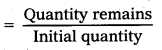
NIFTY.
Answer:
NIFTY stands for National Stock exchange 50. It is an index computed from the performance of top stocks from different sector listed in NSE. NIFTY consists of 50 companies from 24 different sectors. The companies which form index of NIFTY may vary from time to time based on many factors Considered by NSE.

AP Inter 2nd Year Commerce Study Material Chapter 2 Domestic and International Trade

Andhra Pradesh BIEAP AP Inter 2nd Year Commerce Study Material 2nd Lesson Domestic and International Trade Textbook Questions and Answers.

AP Inter 2nd Year Commerce Study Material 2nd Lesson Domestic and International Trade

Essay Answer Questions

Question 1.
What is trade? Explain different types of trade.
Answer:
Trade means buying and selling goods or services between two persons or two business organizations or two countries. Trade is broadly classified into two types.

  1. Domestic trade
  2. Foreign or international trade.

1. Domestic trade :
Buying and selling of goods take place between the individuals of the same country. The buyer and seller live in the same country. It is also called as

Home trade or internal trade on the basis of the scale of operations, internal trade can be classified into two types. They are

i) Wholesale trade
ii) Retail trade.

i) Wholesale trade:
Buying and selling goods in relatively large quantities is called ‘wholesale trade’. A person who is involved in wholesale trade is called a wholesaler. A wholesaler buys goods in large quantities from the manufacturers and sells in relatively smaller quantities to the retailers. So, he is the connecting link between producers and the retailers.

ii) Retail trade :
Retailing means the sale of goods in small quantities to the consumers. A person engaged in retail trade is called a retailer. Retailers buys goods from wholesalers and sells them in relatively smaller quantities to the final consumers. Retailers established link between wholesalers and consumers.

2. Foreign trade or International trade :
The trade takes place between nations is international trade. So, goods or services exchanged between the traders of two nations is called foreign trade.
Foreign trade can be divided into three types. They are :

i) Import trade
ii) Export trade
iii) Entrepot trade.

i) Import trade :
The term import is derived from the conceptual meaning as to bring in the goods and services in the port of the country. When purchases are made from another country, goods are said to be imported from that country to the buyer’s country. For example, China has most modem technology for producing electronic products cheaply. So our country is importing those products.

ii) Export trade :
The term export is derived from the conceptual meaning as to ship the goods and services out of the port of the country. When the goods are sold to a trader in another country, goods are said to be exported to that country by the seller country. For example, India is a major exporter of tea to another countries.

iii) Entrepot trade :
When goods are imported into a country, not for consumption in that country, but for exporting them to a third country, it is known as ‘Entrepot trade’. For example, India importing oil seeds from USA and exporting the same to Malaysia.

Question 2.
What is international trade? Various types of international trade? [A.P Mar. 17]
Answer:
The trade that takes place between nations is international trade. The exchange of goods and services between the traders of two nations is international trade. International trade involves the exchange of not only goods but also currencies between nations. International trade is the process of transferring goods produced by one country for the mers in another country.
Senior Inter

The international trade can be divided into three types. They are :

  1. Import trade
  2. Export trade
  3. Entrepot trade.

1) Import trade :
The term import is derived from the conceptual meaning as to bring in the goods and services into the port city of the country. When purchases are made from another country, goods are said to be imported from that country to the buyer’s country. For example, Japan has the most modem technology for producing the electronic products cheaply, so we import these products to our country.

2) Export trade :
The term export is derived from the conceptual meaning as to ship the goods and services out of the port of the country. When goods are sold to a trader in another country, goods are exported to that country by the seller’s country. For example, India is a major exporter of tea because of fertile land in Assam and Darjeeling, so we export tea products to another countries.

3) Entrepot trade :
When goods are imported into a country, not for consumption in that country, but for exporting them to a third country, it is known as ‘Entrepot trade’.
e.g.: India importing wheat from U.S aftd exporting the same to SriLanka.

AP Inter 2nd Year Commerce Study Material Chapter 2 Domestic and International Trade

Question 3.
What is international trade? Explain its importance.
Answer:
The trade that takes place between the countries is called international trade. The exchange of goods and services between the traders of two countries is international trade. International trade involves not only the exchange of goods but also currencies between nations. International trade is the process of transferring goods produced in one country for the consumers pf another country. This is also called as Foreign trade or External trade. Due to globalisation development of means of communication and transport, the international trade has opened the way to huge imports and exports.

Importance of international trade:
Foreign trade becomes necessary to every country because no country is capable of producing everything for the consumption of its people and the development of its economy. Hence foreign trade is necessary on the following grounds.

  1. Different countries of the world have different natural resources. But some countries may not possess such mineral wealth. Therefore, one country has to depend on some other country for natural resources which results in need of foreign trade.
  2. Some countries are more suitably placed to produce some goods more economically due to availability of raw materials, labour, technical know-how etc. Than the other countries. In such case, foreign trade is needed to import goods from those countries where they can be produced cheaply instead of producing goods at higher cost.
  3. It is not possible for any country to produce all her needs. Production of different commodities require different climatic conditions. For example Cuba can produce sugar, Egypt can produce cotton etc. Foreign trade among these countries helps all these countries to get all their requirements.
  4. International trade has reduced inequalities and facilitated growth of economy in different countries.
  5. International trade lowers the prices of goods and services all over the world.
  6. International trade promotes increased international understanding, exchange of ideas and culture and world peace.
  7. In the era of globalisation, no economy in the world can remain cut off from the rest of the world. Therefore, every country has to depend upon some other country or other.

Question 4.
Distinguish between Home trade and Foreign trade.
Answer:
Home trade :
A trade which is carried on within the country is known as Internal trade or Home trade or Domestic trade. The home trade takes place within the geographical boundaries of a nation.

Foreign trade :
A trade which is carried on with other countries is known as foreign trade or external trade or international trade. Foreign trade refers to buying and selling of goods and services between the countries.

The following are the differences between Home trade and Foreign trade.

Home tradeForeign trade
1. TradeTrade carries with in country.Trade carried with other countries.
2. CurrencyIt does not involve any exchange of currency.It involves exchange of currencies.
3. RestrictionsIt is not subjected any restrictions.It is subject to many restrictions.
4. RiskTransport cost and risks are less.Transport cost and risks are more.
5. NatureIt consists of sales, transfer or exchange of goods within the country.It involves import and export of goods.
6. Transport of goodsThe movement of the goods depends on internal transport system.
e.g.: Roads, Railways.
The movement of goods takes place usually by sea wherever possible.
7. SpecialisationIt helps to derive benefits of specialisation within the country.It helps all trading countries to derive the benefits of specialisation.
8. Volume of tradeThe volume of trade depends upon the size of population, volume of production, development of banking facilities.There are restrictions imposed on free entry of goods and duties and taxes are to be paid.
9. SuitableIt facilitates movement of goods from point of production to the areas where they are consumed.It facilitates countries to specialise in the production of goods for which they have maximum advantage.

Question 5.
Explain the limitations and problems of international trade.
Answer:
The exchange of goods and services between the nations is called international trade. It has certain limitations and problems. The following are the limitations of international trade.

  1. Economic interdependence is gained from international trade. In case of war. or any other political dead lock, it creates a crisis.
  2. Industrialisation of developing countries may be adversely affected by unrestricted imports.
  3. Foreign trade leads to unhealthy competition among the countries, creating rivarly between them.
  4. The concept of comparative cost principle which lead to rigid specialisation in a few countries may create many difficulties.
  5. International trade may lead to lopsided or partial development at the cost of neglect of certain sectors of the economy.

Problems of Foreign trade :
1) Currency problems:
Payment between the countries create complications because every country has its own currency. To avoid losses in transactions the rate of exchange has to be carefully determined.

2) Legal problems:
Laws and customs regulations are affecting the import and export trade because every country has its own laws, customs regulations. These regulations stand in the way of smooth inflow and outflow of goods.

3) Credit problems :
The exporter has to take special steps to ascertain the credit worthiness of the buyer as there is no direct contact between the exporter and importer.

4) Greater risk :
In foreign trade goods are to be exported to long distances. So exporting the goods creates greater risk.

5) Time gap :
In foreign trade there is a wide gap between the time when the goods are despatched and the time when the goods are received and paid.

Question 6.
What is SEZ? Explain their objectives.
Answer:
Special Economic Zones (SEZ) is a geographical region that has economic laws that are more liberal than a country’s economic laws. The main aim of the SEZ is to attract larger foreign investments. It is intended to make SEZs as engines for economic growth. The SEZ Act was passed by parliament in May 2005. A SEZ Act is specifically described as duty free enclave deemed to be a foreign territory for the purpose of trade operations. Objectives : The following are the objectives of special economic zones.

  • To create employment opportunities.
  • To generate additional economic activity.
  • To promote export of goods and services.
  • To develop infrastructural facilities.
  • To promote investment from domestic and foreign sources.
  • To import capital goods and raw materials duty free.
  • To create foreign territory for the purpose of trade operations and tariffs.
  • To allow 100% foreign direct investment for developing township.
  • To exempt import duties and service tax.
  • To get wide range of income tax benefits.

AP Inter 2nd Year Commerce Study Material Chapter 2 Domestic and International Trade

Question 7.
Explain the main advantages of SEZs. [A.P. Mar. 17]
Answer:
Special economic zones is a new incarnation of export processing zone. The main aim of the special economic zone is to attract large foreign investments. Special economic zones acts like an engine for economic growth. The SEZ Act was passed by parliament in May 2005. Special economic zones aims to create employment opportunities and infrastructure facilities along with promotion of exports. Special economic zones aimed at importing capital goods and raw materials duty free.

Advantages :
The following major benefits can be attributed to Special Economic Zones (SEZ).
i) Employment generation :
Special Economic Zones considered to be highly effect tools for job creation.

ii) Economic development :
India can be made as tranformed economy if special economic zones are implemented properly, because special economic zones are engines for economic development.

iii) Growth of labour intensive manufacturing industry :
Establishment of special economic zones may lead to faster growth of labour intensive manufacturing and service industry in the country.

iv) Balanced regional development:
Special economic zones are beautifully crafted initiatives for achieving balanced regional development.

v) Capacity building :
Special economic zones are necessary for stronger capacity building.

vi) Export promotion :
Special economic zones induce dynamism in the export performance of a country by eliminating a) Distortions resulting from tariffs and other trade barriers, b) The corporate tax system and excessive bureaucracy.

Question 8.
Describe the criticism labeled against SEZs.
Answer:
The following are the disadvantages of SEZ.

1) Special economic zones are criticised on many grounds. The first major criticism against special economic zone is forcible acquisition of agricultural land. This displaces many people from their traditional livelihood and employment sources such as farming, fishing etc. SEZs are encouraging real estate speculation. Small and marginal farmers, weaving and livestock rearing communities are away from their professions due to SEZs.

2) The special economic zones are not only dispossessing people from resources but also from democracy and governance. There has been a criticism regarding the governance model of special economic zones and their accountability. The problem of special economic zone is that there would be no democratic local governance institutions.

3) Special economic zones are also criticised for payment of meager and inadequate compensation and rehabilitation measures to the displaced. There are several environmental and health problems in the establishment of special economic zones. The SEZ Act is completely on environmental concerns.

4) Special economic zones are to be established in backward areas for bringing balanced regional development. But it has not happened. Majority of the units are located nearer to larger cities.

Question 9.
What are the incentives provided in the APSEZs?
Answer:
Andhra Pradesh Special Economic Zone (APSEZ), a multi-product SEZ is designated as duty free enclave and treated as foreign territory for trade operations, duties and tariff. It serves as a global gateway for industrial growth and offers world class infrastructure and support services, it also offers attractive financial and tax incentives and procedural ease for facilitating foreign direct investment.

The Government of Andhra Pradesh is encouraging new entrepreneurs by offering various following incentives.

  1. Exemption from duties and excise.
  2. 50% of new capital i.e. invested in last 5 years.
  3. Avial international funds and interest rates.
  4. Reimbursement of duty paid on fumance oil, procured from domestic companies to SEZ units as per the rate of drawback notified by the Directorate General of Foreign Trade.
  5. Commodity hedging by SEZ units are permitted.
  6. FU11 freedom for subcontracting abroad.
  7. Job work on behalf of domestic exporters for direct export is allowed.
  8. In house customs clearance.
  9. 100% F.D.I
  10. Benefits from A.R Industrial Policy 2010- 2015.
  11. Stamp duty waiver.
  12. Vat, Sales tax, Octroil etc. Exemptions.
  13. Electricity subsidy.
  14. Single window clearance system at state level.
  15. Lowest industrial power tariff amongst the industrially progressed states in the

Short Answer Questions

Question 1.
Define wholesaler?
Answer:
Wholesale trade means buying and selling the goods in relatively large quantities or in bulk and the traders who engaged in the wholesale trade are called wholesalers. A wholesaler buys goods in large quantities from manufacturers and sells them in small lots to retailers or industrial users. A wholesaler is the first intermediary and serves as a link between producers and retailers.

Question 2.
Who is retailer?
Answer:
Trader who is engaged in retail trade is called retailer. A retailer is the last link in the chain of distribution of goods. He is an intermediary between the wholesaler and consumers. He purchases goods from wholesaler and sells in very small quantities to ultimate consumers. His activities are generally confined to the locality in which his shop is located. Big departmental stores, super bazar, hawkers and other small shopkeepers are examples of retailers.

Question 3.
What is meant by internal trade?
Answer:
A trade which takes place within the country is known as internal or domestic trade.

Buying and selling of goods takes place within the boundaries of the same country. Trade goods are carried from one place to another place through railways and roadways. Payment for goods and services is made in the currency of the home country. There is wide chance of the goods available and it involves transaction between producers, middlemen and consumers.

Question 4.
What is import trade?
Answer:
The term import is derived from the conceptual meaning as to bring in the goods and services into the port of the country. When purchases are made from another country, goods are said to be imported from that country to the buyer’s country.

For example :
Chaina has the most modem technology for producing electronic products cheaply and India is importing these products.

AP Inter 2nd Year Commerce Study Material Chapter 2 Domestic and International Trade

Question 5.
What is meant by SEZ?
Answer:
Special Economic Zones (SEZ) is a geographical region that has the economic laws that are more liberal than country’s economic laws. The main aim of SEZ is to attract large foreign investments. It is intended to make SEZ as engines for economic growth. The SEZ Act was passed by the Parliament in May 2005. A SEZ is specifically described as duty free enclave deemed to be a foreign territory for the purpose of trade operations.

AP Inter 2nd Year Physics Study Material Chapter 15 Semiconductor Electronics: Material, Devices and Simple Circuits

Andhra Pradesh BIEAP AP Inter 2nd Year Physics Study Material 15th Lesson Semiconductor Electronics: Material, Devices and Simple Circuits Textbook Questions and Answers.

AP Inter 2nd Year Physics Study Material 15th Lesson Semiconductor Electronics: Material, Devices and Simple Circuits

Very Short Answer Questions

Question 1.
What is an n-type semiconductor? What are the majority and minority charge carriers in it?
Answer:
If a pentavalent impurity is added to a pure tetravalent semiconductor, it is called an n-type semiconductor.
In n-type semiconductor majority, of charge carriers are electrons and the minority charge carriers are holes.

Question 2.
What are intrinsic and extrinsic semiconductors? (A.P. Mar. ’15)
Answer:
Pure form of semiconductors are called intrinsic semiconductors.
When impure atoms are added to increase their conductivity, they are called extrinsic semiconductors.

AP Inter 2nd Year Physics Study Material Chapter 15 Semiconductor Electronics: Material, Devices and Simple Circuits

Question 3.
What is a p-type semiconductor ? What are the majority and minority charge carriers in it?
Answer:
If a trivalent impurity is added to a tetravalent semiconductor, it is called p-type semi-conductor.
In p-type semiconductor majority charge carriers are holes and minority charge carriers are electrons.

Question 4.
What is a p-n junction diode ? Define depletion layer. (T.S. Mar. ’19)
Answer:
When an intrinsic semiconductor crystal is grown with one side doped with trivalent element and on the other side doped with pentavalent element, a junction is formed in the crystal. It is called p-n junction diode.
AP Inter 2nd Year Physics Study Material Chapter 15 Semiconductor Electronics Material, Devices and Simple Circuits 1
A thin narrow region is formed on either side of the p-n junction, which is free from charge carriers is called depletion layer.

Question 5.
How is a battery connected to a junction diode in

  1. forward and
  2. reverse bias ?

Answer:

  1. In p-n junction diode, if p-side is connected to positive terminal of a cell and n-side to negative terminal, it is called forward bias.
    AP Inter 2nd Year Physics Study Material Chapter 15 Semiconductor Electronics Material, Devices and Simple Circuits 2
  2. In a p-n junction diode, p-side is connected to negative terminal of a cell and n-side to positive terminal, it is called reverse bias.

AP Inter 2nd Year Physics Study Material Chapter 15 Semiconductor Electronics: Material, Devices and Simple Circuits

Question 6.
What is the maximum percentage of rectification in half wave and full wave rectifiers ?
Answer:

  1. The percentage of rectification in half-wave rectifier is 40.6%.
  2. The percentage of rectification in full-wave rectifier is 81.2%.

Question 7.
What is Zener voltage (Vz) and how will a Zener diode be connected in circuits generally ?
Answer:

  1. When Zener diode is in reverse biased, at a particular voltage current increases suddenly is called Zener (or) break down voltage.
  2. Zener diode always connected in reverse bias.

Question 8.
Write the expressions for the efficiency of a full wave rectifier and a half wave rectifier.
Answer:

  1. Efficiency of half wave rectifier (η) = \(\frac{0.406 \mathrm{R}_{\mathrm{L}}}{\mathrm{r}_{\mathrm{f}}+\mathrm{R}_{\mathrm{L}}}\)
  2. Efficiency of full wave rectifier (η) = \(\frac{0.812 \mathrm{R}_{\mathrm{L}}}{\mathrm{r}_{\mathrm{f}}+\mathrm{R}_{\mathrm{L}}}\)

Question 9.
What happens to the width of the depletion layer in a p-n junction diode when it is
i) forward-biased and
ii) reverse biased ?
Answer:
When a p-n junction diode is forward bias, thickness of depletion layer decreases and in reverse bias, thickness of depletion layer increases.

Question 10.
Draw the circuit symbols for p-n-p and n-p-n transistors. (Mar. 14) (A.P. Mar. 19; T.S. Mar. 16)
Answer:
AP Inter 2nd Year Physics Study Material Chapter 15 Semiconductor Electronics Material, Devices and Simple Circuits 3

Question 11.
Deflne amplifier and amplification factor.
Answer:

  1. Rising the strength of a weak signal is known as amplification and the device is called amplifier.
  2. Amplification factor is the ratio between output voltage to the input voltage.
    A = \(\frac{\mathrm{V}_0}{\mathrm{~V}_{\mathrm{i}}}\)

AP Inter 2nd Year Physics Study Material Chapter 15 Semiconductor Electronics: Material, Devices and Simple Circuits

Question 12.
In which bias can a Zener diode be used as voltage regulator ?
Answer:
In reverse bias Zener diode can be used as voltage regulator.

Question 13.
Which gates ae called universal gates ?
Answer:
NAND gate and NOR gates are called universal gates.

Question 14.
Write the truth table of NAND gate. How does it differ from AND gate.
Answer:
AP Inter 2nd Year Physics Study Material Chapter 15 Semiconductor Electronics Material, Devices and Simple Circuits 4

Short Answer Questions

Question 1.
What are n-type and p-type semiconductors? How is a semiconductor junction formed?
Answer:
n-type semiconductor : When a pure semiconductor is droped with pentavalent atoms like Arsenic, Antimony, Bismuth, then n-type semiconductor is formed.

p-type semiconductor: When a pure semiconductor is doped with trivalent atoms like Indium, Gallium. Al, p-type semiconductor is formed.

Formation of p-n junction diode: When p-type and n-type semiconductors are formed side by side at the junction, holes from p side diffuse to the n -side and electrons from n -side to p-side.
AP Inter 2nd Year Physics Study Material Chapter 15 Semiconductor Electronics Material, Devices and Simple Circuits 5
Hence positive charge is built in n-side and negative charge is established at the p-side.
At the junction, the electrons and holes recombine and the region is free from charge carriers. This region which is free from charge carriers is called depletion layer.

The potential developed near the p-n junction is called barrier potential.
The potential barrier stops further diffusion of holes and electrons across the junction.

AP Inter 2nd Year Physics Study Material Chapter 15 Semiconductor Electronics: Material, Devices and Simple Circuits

Question 2.
Discuss the behaviour of p-n junction. How does a potential barrier develop at the junction ?
Answer:
When p-n junction is formed, the free electrons on n-side diffuse over to p-side, they combine with holes and become neutral. Similarly holes on p-side diffuse over to n-side and combine with electrons become neutral.
AP Inter 2nd Year Physics Study Material Chapter 15 Semiconductor Electronics Material, Devices and Simple Circuits 6
This results in a narrow region formed on either side of the junction. This region is called depletion layer. Depletion layer is free from charge carriers.

The n-type material near the junction becomes positively charged due to immobile donor ions and p-type material becomes negatively charged due to immobile acceptor ions. This creates an electric field near the junction directed from n-region to p-region and causes a potential barrier.

The potential barrier stops further diffusion of holes and electrons across the junction. The value of the potential barrier depends upon the nature of the crystal, its temperature and the amount of doping.

Question 3.
Draw and explain the current-voltage (I -V) characteristic curves of a junction diode in forward and reverse bias.
Answer:
A graph is drawn between the applied voltage (V) and the current (I) passing through the p-n junction diode is called characteristics of a diode.
AP Inter 2nd Year Physics Study Material Chapter 15 Semiconductor Electronics Material, Devices and Simple Circuits 7
As forward bias voltage is increased potential barrier decreases, but initially increases in current is negligible (region OA). This is due to the potential barrier.

The voltage at which the current starts to increase rapidly is called knee voltage (or) cut in voltage.
AP Inter 2nd Year Physics Study Material Chapter 15 Semiconductor Electronics Material, Devices and Simple Circuits 8
In this reverse bias, small current flows in the circuit due to minority charge carriers. 1f the reverse voltage is increased further, after some voltage, there will be a sudden rise of reverse current. This region is named as breakdown region.

AP Inter 2nd Year Physics Study Material Chapter 15 Semiconductor Electronics: Material, Devices and Simple Circuits

Question 4.
Describe how a semiconductor diode is used as a half wave rectifier. (Mar. ’14) (T.S. & A.P. Mar. ’16)
Answer:
AP Inter 2nd Year Physics Study Material Chapter 15 Semiconductor Electronics Material, Devices and Simple Circuits 9

  1. A half wave rectifier can be constructed with a single diode. The ac input signal is fed to the primary coil of a transformer. The output .signal is taken across the load resistance RL
  2. During positive half cycle, the diode is forward biased and current flows through the diode.
  3. During negative half cycle, diode is reverse biased and no current flows through the load resistance.
  4. This means current flows through the diode only during positive half cycles and negative half cycles are blocked. Hence in the output we get only positive half cycles.
  5. Rectifier efficiency is defined as the ratio of output dc power to the input ac power.
    η = \(\frac{\mathrm{P}_{\mathrm{dc}}}{\mathrm{P}_{\mathrm{ac}}}\) = \(\frac{0.406 \mathrm{R}_{\mathrm{L}}}{\mathrm{r}_{\mathrm{f}}+\mathrm{R}_{\mathrm{L}}}\)
    where rf = Forward resistance of a diode; RL = Load resistance
    The maximum efficiency of half wave rectifier is 40.6%.

Question 5.
What is rectification ? Explain the working of a full wave rectifier. (T. S. Mar. 19: A.P. & T.S. Mar. ’15)
Answer:
Rectification : The process of converting on alternating current into a direct current is called rectification.
The device used for this purpose is called rectifier.
AP Inter 2nd Year Physics Study Material Chapter 15 Semiconductor Electronics Material, Devices and Simple Circuits 10

  1. A full wave rectifier can be constructed with the help of two diodes D1 and D2.
  2. The secondary transformer is centre tapped at C and its ends are connected to the p regions of two diodes D1 & D2.
  3. The output voltage is measured across the load resistance RL.
  4. During positive half cycles of ac, the diode D1 is forward biased and current flows through the load resistance RL. At this time D2 will be reverse biased and will be in switch off position.
  5. During negative half cycles of ac, the diode D2 is forward biased and the current flows through RL. At this time D1 will be reverse biased and will be in switch off position.
  6. Hence positive output is obtained for all the input ac signals.
  7. The efficiency of a rectifier is defined as the ratio between the output dc power to the input ac power.
    η = \(\frac{\mathrm{P}_{\mathrm{dc}}}{\mathrm{P}_{\mathrm{ac}}}\) = \(\frac{0.812 \mathrm{R}_{\mathrm{L}}}{\mathrm{r}_{\mathrm{f}}+\mathrm{R}_{\mathrm{L}}}\)
    The maximum efficiency of a full wave rectifier is 81.2%

Question 6.
Distinguish between half-wave and full-wave rectifiers. (A.P. Mar. ’19)
Answer:
Half wave rectifier

  1. Single diode is used.
  2. Only half wave is rectified.
  3. Rectifier efficiency η = \(\frac{0.406 \mathrm{R}_{\mathrm{L}}}{\mathrm{r}_{\mathrm{f}}+\mathrm{R}_{\mathrm{L}}}\)
  4. Efficiency of half wave rectifier is 40.6%.
  5. Output is discontinuous and pulsative.

Full wave rectifier

  1. Two diodes are used.
  2. Full wave is rectified.
  3. Rectifier efficiency η = \(\frac{0.812 \mathrm{R}_{\mathrm{L}}}{\mathrm{r}_{\mathrm{f}}+\mathrm{R}_{\mathrm{L}}}\)
  4. Efficiency of full wave rectifier is 81.2%.
  5. Output is continuous and pulsative.

AP Inter 2nd Year Physics Study Material Chapter 15 Semiconductor Electronics: Material, Devices and Simple Circuits

Question 7.
Distinguish between zener breakdown and avalanche breakdown.
Answer:
Zèner break down

  1. Zener break down occurs at heavily doped diodes.
  2. This occurs at low reverse bias voltages.
  3. This occurs due to field emissîon.
  4. Width of depletion layer is small.

Avalanche break down

  1. Avalanche break down occurs at lightly doped diodes.
  2. This occurs at high reverse bias voltages.
  3. This occurs due to ionisation by collision.
  4. Width of depletion layer is also small.

Question 8.
Explain hole conduction in intrinsic semiconductors.
Answer:
Pure semiconductors are called intrinsic semiconductors. At low temperature, valency band is filled with electrons and conduction band is empty. Hence it acts as an insulator at low temperature.

As temperature increases electrons in valence band get energy and jumps into the conduction band crossing the forbidden band. At their places in the valency band a vacancy is created.
AP Inter 2nd Year Physics Study Material Chapter 15 Semiconductor Electronics Material, Devices and Simple Circuits 11
This vacancy of electron in the valency band is called a hole. Hole has positive charge and move only in the valency band; giving hole current.

In this Fermi-energy level will be at the middle of the forbidden band.

Question 9.
What is a photodiode ? Explain its working with a circuit diagram and draw its I-V characteristics.
Answer:
Photodiode : Photodiode is an optoelectronic device in which current carriers are generated by photons through photo excitation.

Working : When visible light of energy greater than forbidden energy gap is incident on a reverse biased p-n juncton photodiode, additional electron-hole pairs are created in the depletion layer (near the junction). These charge carriers will be seperated by the junction field and made to flow across the junction. Creating a reverse current across the junction.
AP Inter 2nd Year Physics Study Material Chapter 15 Semiconductor Electronics Material, Devices and Simple Circuits 12
The value of reverse saturation current increases with the increase in the intensity of incident light.
V-I characteristics of photodiode is shown in figure. It is found that reverse saturation current through the photodiode varies almost linearly with the light flux.
AP Inter 2nd Year Physics Study Material Chapter 15 Semiconductor Electronics Material, Devices and Simple Circuits 13
Uses :

  1. It is used in switching the light ON and OFF.
  2. It is used in demodulation in optical signals.

AP Inter 2nd Year Physics Study Material Chapter 15 Semiconductor Electronics: Material, Devices and Simple Circuits

Question 10.
Explain the working of LED and what are its advantages over conventional incandescent low power lamps.
Answer:
Light emitting diode (LED) : It is a photoelectronic device which converts electrical energy into light energy.
It is a heavily doped p-n junction diode which under forward bias emits spontaneous radiation. The diode is covered with a transparent cover so that the emitted light may be come out.

Working ; When p-n junction diode is forward biased, the movement of majority charge carriers takes place across the junction. The electrons move from n-side to p-side through the junction and holes move from p-side to n-side.
As a result of it, concentration of majority carriers increases rapidly at the junction.

When there is no bias across the junction, therefore there are excess minority carriers on either side of the junction, which recombine wito majority carriers near the junction.

On recombination of electrons and hole, die energy is given out in the form of heat and light.

Advantages of LED’S over incandescent lamp:

  1. LED is cheap and easy to handle.
  2. LED has less power and low operational voltage.
  3. LED has fast action and requires no warm up time.
  4. LED can be used in burglar alarm system.

Question 11.
Explain the working of a solar cell and draw Its I-V characteristics.
Answer:
Solar cell is a p-n junction device which converts solar energy into electric energy.
AP Inter 2nd Year Physics Study Material Chapter 15 Semiconductor Electronics Material, Devices and Simple Circuits 14
It consists of a silicon (or) gallium – arsenic p-n junction diode packed in a can with glass window on top. The upper layer is of p-type semiconductor. It is very thin so that the incident light photons may easily reach the p-n junction.
AP Inter 2nd Year Physics Study Material Chapter 15 Semiconductor Electronics Material, Devices and Simple Circuits 15

Working : When light (E = hv) falls at the junction, electron – hole pairs are generated near 13% junction. The electrons and holes produced move in opposite directions due to junction field. They will be collected at the two sides of the junction giving rise to a photo voltage between top and bottom metal electrodes. Top metal acts as positive electrode and bottom metal acts as a negative electrode. When an external load is connected across metal electrodes a photo current flows.
AP Inter 2nd Year Physics Study Material Chapter 15 Semiconductor Electronics Material, Devices and Simple Circuits 16
I – V characteristics : I – V characteristics of solar cell is drawn in the fourth quadrant of the co-ordinate axes. Because it does not draw current.
Uses : They are used in calculators, wrist watches, artificial satellites etc.

AP Inter 2nd Year Physics Study Material Chapter 15 Semiconductor Electronics: Material, Devices and Simple Circuits

Question 12.
Explain the different transistor configurations with diagrams.
Answer:
There are three configurations. They are

1) Common Base
2) Common emitter
3) Common collector.

1) Common Base configuration :
AP Inter 2nd Year Physics Study Material Chapter 15 Semiconductor Electronics Material, Devices and Simple Circuits 17
In this configuration base is earthed. Base is common both input and output. Input is given across base – emitter and output is taken across base-collector.

2) Common Emitter configuration :
AP Inter 2nd Year Physics Study Material Chapter 15 Semiconductor Electronics Material, Devices and Simple Circuits 18
In this configuration emitter is earthed. Emitter is common both input and output. Input is given across base – emitter and output is taken across collector – emitter.

3) Common collector configuration :
AP Inter 2nd Year Physics Study Material Chapter 15 Semiconductor Electronics Material, Devices and Simple Circuits 19
In this configuration collector is earthed. Collector is common both input and output. Input is given across base collector and output is taken across collector – emitter.

Question 13.
Explain how transistor can be used as a switch?
Answer:
To understand the operation of transistor as a switch.

  1. As long as Vi is low and unable to forward bias the transistor, V0 is high (at VCC).
  2. If Vi is high enough to drive the transistor into saturation then V0 is low, very near to zero.
    AP Inter 2nd Year Physics Study Material Chapter 15 Semiconductor Electronics Material, Devices and Simple Circuits 20
  3. When the transistor is not conducting it is said to be switched off and when it is driven into saturation it is said to be switched on.
  4. We can say that a low input to the transistor gives a high output and high input gives a low output.
  5. When the transistor is used in the cutoff (or) saturation state it acts as a switch.
    AP Inter 2nd Year Physics Study Material Chapter 15 Semiconductor Electronics Material, Devices and Simple Circuits 21

Question 14.
Explain how transistor can be used as an oscillator ?
Answer:

  1. In an oscillator, we get ac output without any external input signal.
    AP Inter 2nd Year Physics Study Material Chapter 15 Semiconductor Electronics Material, Devices and Simple Circuits 22
  2. Here L – C circuit is inserted in emitter-base circuit of transistor winch is forward biased with battery VBB. The collector emitter circuit is reverse biased with battery VCC-.
  3. A coil L1 is inserted in collector emitter circuit. It is coupled with L.

Working:

  1. S we close the key (K), weak collector current start rising with time due to inductance L1. As a resell, increasing magnetic flux is finked with L1 and L.
  2. Due to mutual induction, an emf is induced in L which will charge the upper plate of capacitor (C), consequently there will be support to the forward biasing of emitter base circuit.
  3. This results in an increasing in the emitter current and hence an increase in the collector current.
  4. Due to it, more increasing magnetic flux is linked with L1 & L.
  5. The above process continues till the collector current becomes maximum (or) saturated,
  6. The resonant frequency of tuned circuit at which the oscillator will oscillate.
    v = \(\frac{1}{2 \pi \sqrt{L C}}\)

AP Inter 2nd Year Physics Study Material Chapter 15 Semiconductor Electronics: Material, Devices and Simple Circuits

Question 15.
Define WND and NOR gases. Give their truth tables.
Answer:
NAND gate : NAND gate is a combination of AND gate and NOT gate.
AP Inter 2nd Year Physics Study Material Chapter 15 Semiconductor Electronics Material, Devices and Simple Circuits 23
NAND gate can be obtained by connecting a NOT gate in the output of an AND gate. NAND gates are called universal gates.

  1. If both inputs are low, output is high
    A = 0, B = 0, X = 1
    AP Inter 2nd Year Physics Study Material Chapter 15 Semiconductor Electronics Material, Devices and Simple Circuits 24
  2. If any input is low, output is high.
    A = 0, B = 1, X = 1
    A = 1, B = 0, X = 1
  3. If both inputs are high, output is low.
    A = 1, B = 1, X = 0

NOR gate : NOR gate is a combination of OR gate and NOT gate when the output of OR gate is connected to NOT gate. It has two (or) more inputs and one output.
AP Inter 2nd Year Physics Study Material Chapter 15 Semiconductor Electronics Material, Devices and Simple Circuits 25

  1. If both inputs are low, output is high
    A = 0, B = 0, X = 1
    AP Inter 2nd Year Physics Study Material Chapter 15 Semiconductor Electronics Material, Devices and Simple Circuits 26
  2. If input is high, output is low.
    A = 0, B = 0, X = 1
  3. If both inputs are high, the output is low.
    A = 1, B = 1, X = 0
    NOR gate is also a universal gate.

AP Inter 2nd Year Physics Study Material Chapter 15 Semiconductor Electronics: Material, Devices and Simple Circuits

Question 16.
Explain the operation of a NOT gate and give, its truth table.
Answer:
NOT gate: NOT gate is the basic gate. It has one input and one output. The NOT gate is also called an inverter. The circuit symbol of NOT gate is shown in figure.
AP Inter 2nd Year Physics Study Material Chapter 15 Semiconductor Electronics Material, Devices and Simple Circuits 27

  1. If input is low, output is high.
    A = 0, X = \(\overline{0}\) = 1
    AP Inter 2nd Year Physics Study Material Chapter 15 Semiconductor Electronics Material, Devices and Simple Circuits 28
  2. If input is high, output is low.
    A = 1, X = \(\overline{1}\) = 0

Long Answer Questions

Question 1.
What is a junction diode ? Explain the formation of depletion region at the junction. Explain the variation of depletion region in forward and reverse-biased condition.
Answer:
p-n junction diode: When a p-type semiconductor is suitably joined to n-type semiconductor, a p-n junction diode is formed.
AP Inter 2nd Year Physics Study Material Chapter 15 Semiconductor Electronics Material, Devices and Simple Circuits 29
The circuit symbol of p-n junction diode is shown in figure.

Formation of depletion layer at the junction: When p-n junction is formed, the free electrons on n-side diffuse over to p-side, they combine with holes and become neutral. Similarly holes on p-side diffuse over to n-side and combine with electrons become neutral.

This results in a narrow region formed on either side of the junction. This region is called depletion layer. Depletion layer is free from charge carriers.

The n-type material near the junction becomes positively charged due to immobile donor ions and p-type material becomes negatively charged due to immobile acceptor ions. This creates an electric field near the junction directed from n-region to p-region and cause a potential barrier.
AP Inter 2nd Year Physics Study Material Chapter 15 Semiconductor Electronics Material, Devices and Simple Circuits 30
The potential barrier stops further diffusion of holes and electrons across the junction. The value of the potential barrier depends upon the nature of the crystal, its temperature and the amount of doping.

Forward bias:
“When a positive terminal of a battery is connected to p-side and negative terminal is connected to n-side; then p-n junction diode is said to be forward bias”.
AP Inter 2nd Year Physics Study Material Chapter 15 Semiconductor Electronics Material, Devices and Simple Circuits 31
The holes in the p-region are repelled by the positive polarity and move towards the junction.
Similarly electrons in the n-region are repelled by the negative polarity and move towards the junction.
As a result, the width of the depletion layer decreases. The charge carriers cross the junction and electric current flows in the circuit.

Hence in forward bias resistance of diode is low. This position is called switch on position.

Reverse bias:

AP Inter 2nd Year Physics Study Material Chapter 15 Semiconductor Electronics Material, Devices and Simple Circuits 32

‘When the negative terminal of the battery is connected to p-side and positive terminal of the battery is connected n-side of the p-n junction, then the diode is said to be reverse bias”.

The holes in the p-region are attracted towards negative polarity and move away from the junction. Similarly the electrons in the n-region are attracted towards positive polarity and move away from the junction.

So, width of the depletion layer and potential barrier increases. Hence resistance of p-n junction diode increases. Thus the reverse biased diode is called switch off position.

Question 2.
What is a rectifier ? Explain the working of half wave and full wave rectifiers with diagrams.
Answer:
Rectifier: It is a circuit which converts ac into d.c. A p-n junction diode is used as a rectifier.
Half-wave rectifier:
AP Inter 2nd Year Physics Study Material Chapter 15 Semiconductor Electronics Material, Devices and Simple Circuits 33

  1. A half wave rectifier can be constructed with a single diode. The ac input signal is fed to the primary coil of a transformer. The output signal is taken across the load resistance RL.
  2. During positive half cycle, the diode is forward biased and current flows through the diode.
  3. During negative half cycle, diode is reverse biased and no current flows through the load resistance.
  4. This means current flows through the diode only during positive half cycles and negative half cycles are blocked. Hence in the output we get only positive half cycles.
  5. Rectifier efficiency is defined as the ratio of output dc power to the input ac power.
    η = \(\frac{\mathrm{P}_{\mathrm{dc}}}{\mathrm{P}_{\mathrm{ac}}}\) = \(\frac{0.406 \mathrm{R}_{\mathrm{L}}}{\mathrm{r}_{\mathrm{f}}+\mathrm{R}_{\mathrm{L}}}\)
    Where rf = Forward resistance of a diode; RL = Load resistance
    The maximum efficiency of half wave rectifier is 40.6%.

Full wave rectifier: The process of converting an alternating current into a direct current is called rectification.
The device used for this purpose is called rectifier.
AP Inter 2nd Year Physics Study Material Chapter 15 Semiconductor Electronics Material, Devices and Simple Circuits 34

  1. A full wave rectifier can be constructed with the help of two diodes D1 and D2.
  2. The secondary transformer is centre tapped at C and its ends are connected to the p regions of two diodes D1 & D2.
  3. The output voltage is measured across the load resistance RL.
  4. During positive half cycles of ac, the diode D1 is forward biased and current flows through the load resistance RL. At this time D2 will be reverse biased and will be in switch off position.
  5. During negative half cycles of ac, the diode D2 is forward biased and the current flows through RL. At this time D1 will be reverse biased and will be in switch off position.
  6. Hence positive output is obtained for all the input ac signals.
  7. The efficiency of a rectifier is defined as the ratio between the output dc power to the input ac power.
    η = \(\frac{\mathrm{P}_{\mathrm{dc}}}{\mathrm{P}_{\mathrm{ac}}}\) = \(\frac{0.812 \mathrm{R}_{\mathrm{L}}}{\mathrm{r}_{\mathrm{f}}+\mathrm{R}_{\mathrm{L}}}\)
    The maximum efficiency of a full wave rectifier is 81.2%.

AP Inter 2nd Year Physics Study Material Chapter 15 Semiconductor Electronics: Material, Devices and Simple Circuits

Question 3.
What is a Zener diode ? Explain how it is used as a voltage regulator.
Answer:
Zener diode : Zener diode is a heavily doped germanium (or) silicon p-n junction diode. It works on reverse bias break down region.

The circuit symbol of zener diode is shown in figure.
AP Inter 2nd Year Physics Study Material Chapter 15 Semiconductor Electronics Material, Devices and Simple Circuits 35
Zener diode can be used as a voltage regulator. In general zener diode is connected in reverse bias in the circuits.
AP Inter 2nd Year Physics Study Material Chapter 15 Semiconductor Electronics Material, Devices and Simple Circuits 36

  1. The zener diode is connected to a battery, through a resistance R. The battery reverse biases the zener diode.
  2. The load resistance RL is connected across the terminals of the zener diode.
  3. The value of R is selected in such away that in the absence of load RL maximum safe current flows in the diode.
  4. Now consider that load is connected across the diode. The load draws a current.
  5. The current through the diode falls by the same amount but the voltage drops across the load remains constant.
  6. The series resistance R absorbs the output voltage fluctuations, so as to maintain constant voltage across the load.
  7. The voltage across the zener diode remains constant even if the load RL varies. Thus, zener diode works as voltage regulator.
  8. If I is the input current, IZ and IL are zener and load currents.
    I = IZ + IL; Vin = IR + VZ
    But Vout= VZ
    ∴ Vout= Vin – IR

Question 4.
Describe a transistor and explain its wbking.
Answer:
Transistor: It is a device which consists of two p-n junctions joined back to back. Transistor means transfer of resistance.
Transistor has three regions. They are :

1) Emitter (E)
2) Base (B)
3) Collector (C)

1) Emitter (E) The section at one end of transistor is called emitter. It is heavily doped region. It emitts charge carriers.
2) Base (B) : The middle section off transistor is called base. This is lightly doped and very thin and almost of the charge carriers injected into it to flow into collector with out neutralised.
3) Collector (C) : The section at the other end is called collector. It is moderately doped. It collects the charge carriers. Physically it is large.

Note : Usually the emitter-base junction is forward biased and collector-base junction is reverse biased.

Working of p-n-p transistor : The base part is made of n-type, emitter and collector parts are ‘made of p-type. The circuit symbol of p-n-p transistor is shown in figure.
AP Inter 2nd Year Physics Study Material Chapter 15 Semiconductor Electronics Material, Devices and Simple Circuits 37
The emitter junction is forward biased by connecting positive terminal off battery to the emitter and negative to the base. The collector junction is reverse biased by connecting negative to fee collector and positive to fee base.

The holes in p-region (emitter) are repelled by the positive terminal and crossing the emitter junction, enter the base region causing emitter current IE. Few holes are combined with electrons in base region, this constitute base current (IB). Majority of holes enters through the collector region. The negative terminal battery rapidly sweeps the holes in the collector region causing collector current (IC).
IE = IB – IC
In p-n-p transistor inside the circuit charge carriers are holes and outside the circuit charge carriers are electrons.

n-p-n transistor: If the base part is made of p-type, emitter and collector parts are made of n-type, we get n-p-n transistor. The circuit symbol of n-p-n transistor is shown in figure.
AP Inter 2nd Year Physics Study Material Chapter 15 Semiconductor Electronics Material, Devices and Simple Circuits 38
AP Inter 2nd Year Physics Study Material Chapter 15 Semiconductor Electronics Material, Devices and Simple Circuits 39
The emitter junction is forward biased with negative end of a battery connected to emitter and positive to the base. The collector junction is reverse biased with collector positive end of a battery and negative to the base.

The electrons in the emitter (n-region) are repelled by the negative terminal of a battery and cross the base region constituting the emitter current IE. A small number of electrons may recombine with holes in base region constituting base current IB.

Majority charge carriers (electrons) enters into the collector region. The positive terminal of battery rapidly sweeps the electrons in collector, constituting collector current IC.
IE = IB + IC
In n-p-n transistor charge carriers inside and outside the circuit are electrons.

AP Inter 2nd Year Physics Study Material Chapter 15 Semiconductor Electronics: Material, Devices and Simple Circuits

Question 5.
What is amplification ? Explain the working of a common emitter amplifier with necessary diagram.
Answer:
Amplification : The process of raising the strength of a weak signal is called amplification and the device which accomplishes this job is called an amplifier.
Amplifiers are of two types.

  1. Power amplifier
  2. Voltage amplifier.

Amplification factor: The ratio between output voltage to the input voltage is called amplification factor.
A = \(\frac{v_0}{v_i}\)
Common emitter transistor amplifier:
AP Inter 2nd Year Physics Study Material Chapter 15 Semiconductor Electronics Material, Devices and Simple Circuits 40
The n-p-n common emitter amplifier circuit is shown in figure. In this circuit the battery VBB provides the biasing voltage VBE for the base emitter junction. The emitter junction is forward biased and the battery VCC provides the biasing voltage VCE for the emitter collector junction. The junction is reverse biased. Most of the electrons from emitter cross the base region and move into the collector.

The input signal to be amplified is connected in series with the biasing battery (VBB). A load resistance RL is connected in the collector circuit and output voltage is taken across RL.

As the base emitter voltage (VBE) changes due to input signal, the base current changes (IB) . This results in large change in collector current (ΔIC). The change in collector emitter voltage (ΔVCE) is taken across RL. Thus amplified output is obtained across RL.

Current gain (β) : The ratio of change in collector current to the change in base current is called current gain (or) current amplification factor.
β = \(\frac{\Delta \mathrm{I}_{\mathrm{C}}}{\Delta \mathrm{I}_{\mathrm{B}}}\)

Voltage gain (AV) : It is the ratio of change in output voltage (ΔVCE) to the change in input voltage (ΔVBE).

Power gain : It is defined as the product of current gain and voltage gain.
Power gain (Ap) = Current gain × Voltage gain.

Question 6.
Draw an OR gate using two diodes and explain its operation. Write the truth table and logic symbol of OR gate.
Answer:
OR Gate : It has two input terminals and one output terminal. If both inputs are low the output is low. If one of the inputs is high, or both the inputs are high then the output of the gate is high. The truth tables of OR gate.
AP Inter 2nd Year Physics Study Material Chapter 15 Semiconductor Electronics Material, Devices and Simple Circuits 41
In truth table logic function is written as A or B ‘OR’ logic function is represented by the symbol ‘plus’
Q = A + B
AP Inter 2nd Year Physics Study Material Chapter 15 Semiconductor Electronics Material, Devices and Simple Circuits 42
Logic gate ‘OR’ is shown given below.

Implementation of OR gate using diodes:
Let D1 and D2 be two diodes.
A potential of 5V represents the logical value 1
A potential of 0V represents the logical value 0
When A = 0, B = 0 both the diodes are reverse, biased and there no current through the resistance. So, the potential at Q is zero. i.e. Q = 0. When A = 0 or B = O and the other equal to a potential of 5V i.e., Q = 1. When both A and B which is 5V i.e., Q = 1. The output is same as that of the OR gate.

Question 7.
Sketch a basic AND circuit with two diodes and explain its operation. Explain how doping increases the conductivity in semiconductors?
Answer:
AND gate : It has two input terminals and one out terminal

  • If both the inputs are low (or) one of the inputs is low.
    ⇒ The out is low in an AND gate.
  • If both the inputs are high ⇒ The output of the gate is high

Note: If A and B are the inputs of the gate and the output is ‘Q’ then ‘Q‘ is a logical function of A and B.
AND gate Truth Tables
AP Inter 2nd Year Physics Study Material Chapter 15 Semiconductor Electronics Material, Devices and Simple Circuits 43
The logical function AND is represented by the symbol dot so that the output, Q = A.B and the circuit symbol used for the logic gate AND is shown in Fig.
The logical function AND is similar to the multiplication.
AP Inter 2nd Year Physics Study Material Chapter 15 Semiconductor Electronics Material, Devices and Simple Circuits 44

Implementation of AND gate using diodes: Let D1 and D2 represents two diodes. A potential of 5 V represents the Logical value 1 and a potential of 0 V represents the logical value zero (O). When A = 0, B = 0 both the diodes D1 and D2 are forward-biased and they behave like closed switches. Hence, the output Q is same as that A or B(equal to zero.) When A = 0 or B = 0, D1 or D2 is forward – biased and Q is zero. When A = 1 and B = 1 both the diodes are reverse – biased and they behave like open switches. There is no current through the resistance R making the potential at Q equal to 5V i.e., Q = 1. The output is same as that of an AND gate.

Doping increases the conductivity in Semiconductors : If a pentavalent impurity (Arsenic) is added to a pure tetravalent semiconductor it is called n-type semiconductor. Arsenic has 5 valence electrons, but only 4 electrons are needed to form covalent bonds with the adjacent Germanium atoms. The fifth electron is very loosely bound and become a free electron. Therefore excess electrons are available for conduction and conductivity of semiconductor increases.

Similarly when a trivalent impurity Indium is added to pure Germanium it is called p-type semiconductor. In this excess holes in addition to those formed due to thermal energy are available for conduction in the valence bând and the conductivity of semiconductor increases.

Problems

Question 1.
In a half wave rectifier, a p-n junction diode with internal resistance 20 ohm is used. If the load resistance of 2 ohm is used in the circuit, then find the efficiency of this half wave rectifier.
Solution:
Internal resistance (rf) = 20Ω
RL = 2kΩ = 2000 Ω
η = \(\frac{0.406 R_L}{r_f+R_L}\) = \(\frac{0.406 \times 2000}{20+2000}\) × 100 = \(\frac{812 \times 100}{2020}\)
η = 40.2%

AP Inter 2nd Year Physics Study Material Chapter 15 Semiconductor Electronics: Material, Devices and Simple Circuits

Question 2.
A full wave p-n junction diode rectifier uses a load resistance of 1300 ohm. The internal resistance of each diode is 9 ohm. Find the efficiency of this full wave rectifier.
Solution:
Given that RL = 1300 Ω
rf = 9Ω
η = \(\frac{0.812 \mathrm{R}_{\mathrm{L}}}{\mathrm{r}_{\mathrm{f}}+\mathrm{R}_{\mathrm{L}}}\) = \(\frac{0.812 \times 1300}{9+1300}\) × 100
η = \(\frac{8120 \times 13}{1309}\)
η = 80.64%

Question 3.
Calculate the current amplification factor β(beta) when change in collector current is 1mA and change in base current is 20μA.
Solution:
Change in collector current (ΔIC) = 1mA = 10-3 A
Change in base current (ΔIB) = 20μA = 20 × 10-6 A
β = \(\frac{\Delta \mathrm{I}_{\mathrm{C}}}{\Delta \mathrm{I}_{\mathrm{B}}}\) = \(\frac{10^{-3}}{20 \times 10^{-6}}\)
β = \(\frac{1000}{20}\)
β = 50

Question 4.
For a transistor amplifier, the collector load resistance RL = 2k ohm and the input resistance Ri = 1 k ohm. If the current gain is 50, calculate voltage gain of the amplifier.
Solution:
RL = 2kΩ = 2 × 10³
Ri = 1kΩ = 1 × 10³
β = 50.
Voltage gain (AV) = β × \(\frac{\mathrm{R}_{\mathrm{L}}}{\mathrm{R}_{\mathrm{i}}}\) = \(\frac{50 \times 2 \times 10^3}{1 \times 10^3}\)
AV = 100.

Textual Exercises

Question 1.
In an n-type silicon, which of the following statement is true :
(a) Electrons are majority carriers and trivalent atoms are the dopants.
(b) Electrons are minority carriers and pentavalent atoms are the dopants.
(c) Holes are minority carriers and pentavalent atoms are the dopants.
(d) Holes are majority carriers and trivalent atoms are the dopants.
Answer:
(c). In an n-type semiconductor, it is obtained by doping the Ge or Si with pentavalent atoms. In n-type semiconductors, electrons are majority carriers and holes are minority carriers.

Question 2.
Which of the statements given in Exercise 1 is true for p-type semiconductors ?
Answer:
(b) & (d). p-type semiconductor is obtained by doping Ge or Si with trivalent atoms. In p-type semiconductor holes are majority carriers and electrons are minority carriers.

Question 3.
Carbon, silicon and germanium have four valence electrons each. These are characterised by valence and conduction bands separated by energy band gap respectively equal to (Eg)c, (Eg)Si and (g)Ge. Which of the following statements is true ?
(a) (Eg)Si < (Eg)Ge < (Eg)C
(b) (Eg)C < (Eg)Ge > (Eg)Si
(c) (Eg)C > (Eg)Si > (Eg)Ge
(d) (Eg)C = (Eg)Si = (Eg)Ge
Answer:
(c). The energy band – gap is largest for carbon, less for sillicon and least for Germanium.

AP Inter 2nd Year Physics Study Material Chapter 15 Semiconductor Electronics: Material, Devices and Simple Circuits

Question 4.
In an unbiased p-n junction, holes diffuse from the p-region to n-region because
(a) free electrons in the n-region attract them.
(b) they move across the junction by the potential difference.
(c) hole concentration in p-region is more as compared to n-region.
(d) All the above.
Answer:
(c). In an unbiased p-n junction, the diffusion of charge carriers across the junction takes place from higher concentration to lower concentration. Therefore, hole concentration in p-region is more as compared to n-region.

Question 5.
When a forward bias is applied to a p-n junction, it
(a) raises the potential barrier.
(b) reduces the majority carrier current to zero.
(c) lowers the potential barrier.
(d) None of the above.
Answer:
(c). When a forward bias is applied across the p-n junction, the applied voltage opposes the barrier voltage. Due to this, the potential barrier across the junction is lowered.

Question 6.
For transistor action, which of the following statements are correct:
(a) Base, emitter and collector regions should have similar size and doping concentrations.
(b) The base region must be very thin and lightly doped.
(c) The emitter junction is forward biased and collector junction is reverse biased.
(d) Both the emitter junction as well as the collector junction are forward biased.
Answer:
(b) and (c). For a transistor β = \(\frac{\mathrm{I}_{\mathrm{C}}}{\mathrm{I}_{\mathrm{B}}}\)
IB = \(\frac{I_C}{\beta}\) (Or) Rinput = \(\frac{V_{\text {input }}}{V_B}\) = \(\frac{V_{\text {input }}}{I_C}\) . β. i.e., Rinput ∝ \(\frac{1}{\mathrm{I}_{\mathrm{C}}}\)

Therefore Rinput is inversly proportional to the collector current. For high collector current, the Rinput should be small for which the base region must be very thin and lightly doped for a transistor action, the emitter junction is forward biased and collector junction is reverse biased.

Question 7.
For a transistor amplifier, the voltage gain
(a) remains constant for all frequencies.
(b) is high at high and low frequencies and constant in the middle frequency range.
(c) is low at high and low frequencies and Constant at mid frequencies.
(d) None of the above.
Answer:
(c). The voltage gain is low at high and low frequencies and constant at mid-frequency.

Question 8.
In half-wave rectification, what is the output frequency, if the input frequency is 50 Hz. What is the output frequency of a full-wave rectifier for the same input frequency ?
Answer:
A half wave rectifier rectifies only the half of ac input i.e., it conducts once during an ac input cycle while a full wave rectifier rectifies both the half cycles of the ac input i.e., it conducts twice during a cycle.
The output frequency for half-wave is 50Hz.
The output frequency of a full-wave rectifier is 2 × 50 = 100Hz.

Question 9.
For a CE-transistor amplifier, the audio signal voltage across the collected resistance of 2 kΩ is 2 V. Suppose the current amplification factor of the transistor is 100, find the input signal voltage and base current, if the base resistance is 1 kΩ.
Solution:
Given, collector resistance Routput = 2KΩ = 2000Ω.
Current amplification factor of the transistor βAC = 100.
Audio signal voltage Voutput = 2V
Input (base) resistance Rinput = 1KΩ = 1000Ω
AP Inter 2nd Year Physics Study Material Chapter 15 Semiconductor Electronics Material, Devices and Simple Circuits 45

Question 10.
Two amplifiers are connected one after the other in series (cascaded). The first amplifier has a voltage gain of 10 and the second has a voltage gain of 26. If the input signal is 0.01 volt, calculate the output ac signal.
Solution:
Given, voltage gain of first Amplifier, \(\mathrm{A}_{\mathrm{V}_1}\) = 10
Voltage gain of second Amplifier, \(\mathrm{A}_{\mathrm{V}_2}\) = 20
Input voltage V1 = 0.01V
Total voltage gain Av = \(\frac{v_0}{v_i}\) = \(\mathrm{A}_{\mathrm{V}_1}\) × \(\mathrm{A}_{\mathrm{V}_2}\)
\(\frac{v_0}{0.01}\) = 10 × 20; V0 = 2V

Question 11.
A p-n photodiode is fabricated from a semiconductor with band gap of 2.8 eV. Can it detect a wavelength of 6000 nm ?
Solution:
Energy(E) = \(\frac{h c}{\lambda}\) = \(\frac{6.6 \times 10^{-34} \times 3 \times 10^8}{6000 \times 10^{-9} \times 1.6 \times 10^{-19}}\) eV = 2.06 eV.
The band – gap is 2.8 eV and energy E is less than band gap (E < Eg). So p-n junction cannot detect, file radiation of given wavelength 6000 nm.

Additional Exercises

Question 1.
The number of silicon atoms per m3 is 5 × 1028. This is doped simultaneously with 5 × 10²² atoms per m3 of Arsenic and 5 × 1028 per m3 atoms of Indium. Calculate the number of electrons and boles. Gives that n,sub>i = 1.5 × 10¹⁶ m-3. Is the material n-type or p-type ?
Solution:
We know that for each atom doped of arsenic one free electron is received. Similarly, for each- atom doped of Indium a, vacancy is crested So, the number of free electrons introduced by pentavalent impurity added.
ne = NAs = 5 × 10²²m3 —- (i)
The number of holes introduced by trivalent impurity added.
AP Inter 2nd Year Physics Study Material Chapter 15 Semiconductor Electronics Material, Devices and Simple Circuits 46
As number of electrons ne (= 4.95 × 10²²) is greater than number of holes nh (= 45 × 109). So, the material is n-type semiconductor.

Question 2.
In an intrinsic semiconductor the energy gap Eg is 1.2 eV. Its hole mobility is much smaller than electron mobility and independent of temperature. What is the ratio between conductivity at 600K and that at 300 K ? Assume that the temperature dependence of intrinsic carrier concentration ni is given by ni = n0 exp \(\left(-\frac{\mathbf{E}_{\mathbf{g}}}{2 \mathbf{K}_{\mathbf{B}} \mathbf{T}}\right)\) where n0 is a constant.
Solution:
Given, intrinsic carrier concentration ni = \(n_0 e^{-E g / 2 k_B T}\) and Energy gap Eg = 1.2 eV
KB = 8.62 × 10⁻⁵ eV/K
For T = 600k
AP Inter 2nd Year Physics Study Material Chapter 15 Semiconductor Electronics Material, Devices and Simple Circuits 47
Let the conductivities are σ600 and σ300 (∵ σ = e n µe)
\(\frac{\sigma_{600}}{\sigma_{300}}\) = \(\frac{n_{600}}{n_{300}}\) = 1.1 × 10⁵.

AP Inter 2nd Year Physics Study Material Chapter 15 Semiconductor Electronics: Material, Devices and Simple Circuits

Question 3.
In a p-n junction diode, the current I can be expressed as I = I0 exp \(\left(\frac{e V}{2 K_B T}-1\right)\) where I0 is called the reverse saturation current, V is the voltage across the diode and is positive for forward bias and negative for reverse bias, and I is the current through the diode, kB is the Boltzmann constant (8.6 × 10⁻⁵ eV/K) and T is the absolute temperature. If for a given diode I0 = 5 × 10-12 A and T = 300 K, then
(a) What will be the forward current at a forward voltage of 0.6 V ?
(b) What will be the increase in the current if the voltage across the diode is increased to 0.7 V?
(c) What is the dynamic resistance ?
(d) What will be the current if reverse bias voltage changes from IV to 2 V ?
Solution:
Given I0 = 5 × 10-12 A, T = 300K
KB = 8.6 × 10⁻⁵eV/K = 8.6 × 10-5 × 1.6 × 10-19 J/K
a) Given, voltage V = 0.6V
\(\frac{\mathrm{eV}}{\mathrm{K}_{\mathrm{B}} \mathrm{T}}\) = \(\frac{1.6 \times 10^{-19} \times 0.6}{8.6 \times 10^{-5} \times 1.6 \times 10^{-19} \times 300}\) = 23.26
The current I through a junction diode is given by
AP Inter 2nd Year Physics Study Material Chapter 15 Semiconductor Electronics Material, Devices and Simple Circuits 48
= 5 × 10-12(e23.26 – 1) = 5 × 10-12 (1.259 × 10¹⁰ – 1)
= 5 × 10-12 × 1.259 × 1010 = 0.063 A
Change in current ΔI = 3.035 – 0.063 = 2.9A

b) Given voltage V = 0.7 V
\(\frac{\mathrm{eV}}{\mathrm{K}_B T}\) = \(\frac{1.6 \times 10^{-19} \times 0.7}{8.6 \times 10^{-5} \times 1.6 \times 10^{-19} \times 300}\) = 27.14
Now, I = \(I_0 e^{\frac{e V}{K_B T}}-1\) = 5 × 10-12(e27.14 – 1)
= 5 × 10-12(6.07 × 10¹¹ – 1)
= 5 × 10-12 × 5.07 × 1011 = 0.035 A
Change in current ΔI = 3.035 – 0.693 = 2.9 A

c) ΔI = 2.9A, voltage ΔV = 0.7 – 0.6 = 0.1 V
Dynamic retistance Rd = \(\frac{\Delta \mathrm{V}}{\Delta \mathrm{I}}\) = \(\frac{0.1}{2.9}\) = 0.0336Ω

d) As the voltage changes from IV to 2V, the current I will be almost equal to
I0 = 5 × 10-12A.
It is due to that the diode possesses practically infinite resistance in the reverse bias.

Question 4.
You are given the two circuits as shown in Fig.Show that circuit (a) acts as OR gate while the circuit (b) acts as AND gate.
AP Inter 2nd Year Physics Study Material Chapter 15 Semiconductor Electronics Material, Devices and Simple Circuits 49
Solution:
a) Split the gate, OR gate
AP Inter 2nd Year Physics Study Material Chapter 15 Semiconductor Electronics Material, Devices and Simple Circuits 50
The truth table :
AP Inter 2nd Year Physics Study Material Chapter 15 Semiconductor Electronics Material, Devices and Simple Circuits 51
Here, for given A and B as inputs, C is the output of OR gate and input of NOT gate 1, D is the output of NOT gate 1 and input of NOT gate 2, then Y is finally output.
AP Inter 2nd Year Physics Study Material Chapter 15 Semiconductor Electronics Material, Devices and Simple Circuits 52
This is same as OR gate. So, this circuit acts as OR gate.

b) Split the gate:
AP Inter 2nd Year Physics Study Material Chapter 15 Semiconductor Electronics Material, Devices and Simple Circuits 53
The truth table:
AP Inter 2nd Year Physics Study Material Chapter 15 Semiconductor Electronics Material, Devices and Simple Circuits 54
Here, for given A and B as inputs, C is the output of A and D is the output of B, E is the output of OR gate and input of NOT gate 3, then Y is finally output. .
AP Inter 2nd Year Physics Study Material Chapter 15 Semiconductor Electronics Material, Devices and Simple Circuits 55
This is same as AND gate, So the given circuit acts as AND gate

Question 5.
Write the truth table for a NAND gate connected as given in fig.
AP Inter 2nd Year Physics Study Material Chapter 15 Semiconductor Electronics Material, Devices and Simple Circuits 56
Hence identify the exact logic operation carried out by the circuit.
Solution:
Split the gate:
AP Inter 2nd Year Physics Study Material Chapter 15 Semiconductor Electronics Material, Devices and Simple Circuits 57
Truth table:
AP Inter 2nd Year Physics Study Material Chapter 15 Semiconductor Electronics Material, Devices and Simple Circuits 58
B is the output of AND gate and input of NOT gate.
So, for input A and output Y, the table is
AP Inter 2nd Year Physics Study Material Chapter 15 Semiconductor Electronics Material, Devices and Simple Circuits 59
Here, it is same as NOT gate, so the logic operation is carried by this circuit as NOT gate

Question 6.
You are given two circuits as shown in fig. which consist of NAND gates. Identify the logic operation carried out by the two circuits.
AP Inter 2nd Year Physics Study Material Chapter 15 Semiconductor Electronics Material, Devices and Simple Circuits 60
Solution:
a) Split the gate:
AP Inter 2nd Year Physics Study Material Chapter 15 Semiconductor Electronics Material, Devices and Simple Circuits 61
AP Inter 2nd Year Physics Study Material Chapter 15 Semiconductor Electronics Material, Devices and Simple Circuits 62
C is the output of AND gate 1 and input of NOT gate 1, D is the output of NOT gate 1 and input of AND gate 2, E is the õut put of AND gate 2 and input of NOT gate 2, Y is finally output
Truth table:
AP Inter 2nd Year Physics Study Material Chapter 15 Semiconductor Electronics Material, Devices and Simple Circuits 63
So, this logic operation is AND gate.

b)
AP Inter 2nd Year Physics Study Material Chapter 15 Semiconductor Electronics Material, Devices and Simple Circuits 64
C is the out put of AND gate 1
D is the out put of AND gate 2
E is the out put of NOT gate 1
F is the out put of NOT gate 2
G is the out put of AND gate 3 and input of NOT gate 3
Here, it is same as OR gate. A and B are inputs and Y is output.
AP Inter 2nd Year Physics Study Material Chapter 15 Semiconductor Electronics Material, Devices and Simple Circuits 65
So, this logic operation resembles to OR gate.

Question 7.
Write the truth table for circuit given in fig. below consisting of NOR gates and identify the logic operation (OR, AND, NOT) which this circuit is performing.
AP Inter 2nd Year Physics Study Material Chapter 15 Semiconductor Electronics Material, Devices and Simple Circuits 66
Hint: A = 0, B = 1 then A and B inputs of second NOR gate will be 0 and hence Y = 1. Similarly work out the values of Y for other combinations of A and B. Compare with the truth table of OR, AND, NOT gates and find the correct one.)
Solution:
Split the gate:
AP Inter 2nd Year Physics Study Material Chapter 15 Semiconductor Electronics Material, Devices and Simple Circuits 67
C is the output of OR gate 1.
D is the output of NOT gate 1 and input of NOT gate 2. E is the output of OR gate 2 and input of the NOT gate 2. Here, it is same as OR gate. A and B are inputs and Y is output.
AP Inter 2nd Year Physics Study Material Chapter 15 Semiconductor Electronics Material, Devices and Simple Circuits 68
So, this logic operation resembles to OR gate.

AP Inter 2nd Year Physics Study Material Chapter 15 Semiconductor Electronics: Material, Devices and Simple Circuits

Question 8.
Write the truth table for the circuits given in fig. consisting of NOR.gates ònly. Identify the logic operations (OR, AND, NOT) performed by the two circuits.
AP Inter 2nd Year Physics Study Material Chapter 15 Semiconductor Electronics Material, Devices and Simple Circuits 69
Solution:
a) Split the gate
AP Inter 2nd Year Physics Study Material Chapter 15 Semiconductor Electronics Material, Devices and Simple Circuits 70
B is the output of OR gate and input of NOT gate. So, the gate resembles to NOT gate as A is input and Y is output.
AP Inter 2nd Year Physics Study Material Chapter 15 Semiconductor Electronics Material, Devices and Simple Circuits 71

b) a) Split the gate:
AP Inter 2nd Year Physics Study Material Chapter 15 Semiconductor Electronics Material, Devices and Simple Circuits 72
C is the output of OR gate 1 and input of NOT gate 1, D is the output of OR gate 2 and input of NOT gate 2, E is the output of NOT gate 1, F is the output of NOT gate 2.

G is the output of OR gate 3 and input of NOT gate 3. The truth table resembles to AND gate as A and B inputs and Y is output.
AP Inter 2nd Year Physics Study Material Chapter 15 Semiconductor Electronics Material, Devices and Simple Circuits 73
This operation is AND gate.

AP Inter 2nd Year Physics Study Material Chapter 14 Nuclei

Andhra Pradesh BIEAP AP Inter 2nd Year Physics Study Material 14th Lesson Nuclei Textbook Questions and Answers.

AP Inter 2nd Year Physics Study Material 14th Lesson Nuclei

Very Short Answer Questions

Question 1.
What are isotopes and isobars?
Answer:
Isotopes: The nuclei having the same atomic number (Z) but different mass numbers (A) are called isotopes.
E.g.:
\({ }_8^{16} \mathrm{O}\), \({ }_8^{17} \mathrm{O}\), \({ }_8^{18} \mathrm{O}\)

Isobars: The nuclei having the same neutron number (N) but different atomic number (Z) are called isobars.
E.g.: \({ }_6^{14} \mathrm{C}\), \({ }_7^{14} \mathrm{N}\)

Question 2.
What are isotones, and isomers?
Answer:
Isotones : The nuclei having same neutron number (N) but different atomic numbers (Z) are called isotones.
E.g. : \({ }_80^{198} \mathrm{Hg}\), \({ }_79^{197} \mathrm{N}\)

Isomers: Nuclei having the same atomic number (Z) and mass number (A) but with different nuclear properties such as radioactive decay and magnetic moments are called isomers.
E.g. : \({ }_{35}^{80} \mathrm{Br}^{\mathrm{m}}\), \({ }_{35}^{80} \mathrm{Br}^{\mathrm{g}}\)

AP Inter 2nd Year Physics Study Material Chapter 14 Nuclei

Question 3.
What is a.m.u. ? What is its equivalent energy ?
Answer:
The mass of \(\frac{1}{12}\)th of the mass of \({ }_6^{12} \mathrm{C}\) atom is called atomic mass unit (a.m.u)
1 a.m.u = \(\frac{1}{12}\) of mass of \({ }_6^{12} \mathrm{C}\) atom = 1.66 × 10⁻²⁷ kg
Equivalent energy of a.m.u= 931.5 MeV

Question 4.
What will be the ratio of the radii of two nuclei of mass numbers A1 and A2 ?
Answer:
The ratio of the radii of two nuclei of mass numbers A1 and A2 will be \(\frac{R_1}{R_2}\) = \(\left[\frac{\mathrm{A}_1}{\mathrm{~A}_2}\right]^{\frac{1}{3}}\) since R = R0 A1/3.

Question 5.
Natural radioactive nuclei are mostly nuclei of high mass number why ?
Answer:
Natural radioactivity is displayed by heavy nuclei beyond lead in the periodic table because of relatively low binding energy per nucleon as 7.6 MeV Hence to attain greater stability.

Question 6.
Does the ratio of neutrons to protons in a nucleus increase, decrease or remain the same after the emission of an α – particle ?
Answer:
The ratio of neutrons to protons in a nucleus, increases after the emission of an α – particle.
E.g. : Taking,
AP Inter 2nd Year Physics Study Material Chapter 14 Nuclei 1
Before emission, the ratio of neutrons to protons
= \(\frac{\mathrm{A}-\mathrm{Z}}{\mathrm{Z}}\) = \(\frac{238-92}{92}\) = \(\frac{144}{92}\) = 1.57
After emission, the ratio of neutrons to protons
= \(\frac{234-90}{90}\) = 1.6

Question 7.
A nucleus contains no electrons but can emit them. How?
Answer:
When the nucleus disintegrates and radiates β-rays, it is said to be β-decay. β-particles are nothing but electrons. So the nucleus eject electrons.

AP Inter 2nd Year Physics Study Material Chapter 14 Nuclei

Question 8.
What are the units and dimensions of the disintegration constant ?
Answer:
λ = –\(\frac{0.693}{\mathrm{~T}}\)
Units = sec-1
Dimensions = -1

Question 9.
Why do all electrons emitted during β-decay not have the same energy ?
Answer:
When a neutron is converted into a proton, an electron and neutron are emitted along with it
AP Inter 2nd Year Physics Study Material Chapter 14 Nuclei 2
In β – decay proton remains in the nucleus, but electron and neutron are emitted with constant energy. The energy of neutron is not constant. So, all electrons do not have same energy.

Question 10.
Neutrons are the best projectiles to produce nuclear reactions. Why ?
Answer:
Neutrons are uncharged particles. So they do not deflected by the electric and magnetic fields. Hence Neutrons are considered as best projectiles in nuclear reaction.

Question 11.
Neutrons cannot produce ionization. Why ?
Answer:
Because neutrons are uncharged particles and cannot produce ionization.

Question 12.
What are delayed neutrons ?
Answer:
Neutrons are emitted in the fission products after sometime are called delayed neutrons.

Question 13.
What are thermal neutrons ? What is their importance ?
Answer:
Neutrons having kinetic energies approximately 0.025 eV are called as slow neutrons or thermal neutrons. 235U undergoes fission only when bombarded with thermal neutrons.

Question 14.
What is the value of neutron multiplication factor in a controlled reaction and in an uncontrolled chain reaction ?
Answer:
In controlled chain reaction K = 1
In uncontrolled chain reaction K > 1

Question 15.
What is the role of controlling rods in a nuclear reactor ?
Answer:
In nuclear reactor controlling rods are used to absorb the neutrons. Cadmium, boron materials are used in the form of rods in reactor. These control the fission rate.

Question 16.
Why are nuclear fusion reactions called thermo nuclear reactions ?
Answer:
Nuclear fusion occurs at very high temperatures. So it is called as thermo nuclear reaction.

Question 17.
Define Becquerel and Curie.
Answer:
Becquerel: 1 disintegration or decay per second is called Becquerel. It is SI unit of activity.
AP Inter 2nd Year Physics Study Material Chapter 14 Nuclei 3
Curie : 3.7 × 10¹⁰ decays per second is called Curie.
1 Curie = 1Ci = \(\frac{3.7 \times 10^{10} \text { decays }}{\text { second }}\) = 3.7 × 10¹⁰ Bq.

Question 18.
What is a chain reaction ?
Answer:
Chain reaction: The neutrons produced in the fission of a nucleus can cause fission in other neighbouring nuclei producing more and more neutrons to continue the fission until the whole fissionable material is disintegrated. This is called chain reaction.

Question 19.
What is the function of moderator in a nuclear reactor ?
Answer:
They are used to slow down the fast moving neutrons produced during the fission process.
e.g.: Heavy water, Berilium.

AP Inter 2nd Year Physics Study Material Chapter 14 Nuclei

Question 20.
What is the energy released in the fusion of four protons to form a helium nucleus ?
Answer:
26.7 MeV energy is released.

Short Answer Questions

Question 1.
Why is the density of the nucleus more than that of the atom ? Show that the density of nuclear matter is same for all nuclei.
Answer:

  1. Volume of the atom is greater than that of nucleus and it consists of nucleons
  2. Since density ∝ \(\frac{1}{\text { volume }}\)
    ∴ Density of the nucleus more than that of the atom.
  3. Mass of the nucleus = no.of nucleons (A) × mass of nucleon (m)
    = Am
  4. Volume of the nucleus V= \(\frac{4}{3} \pi \mathrm{R}^3\)
    = \(\frac{4}{3} \pi\left(R_0 A^{1 / 3}\right)^3\)
    = \(\frac{4 \pi \mathrm{R}_0^3 \mathrm{~A}}{3}\) = 1.2 × 10-45m3.A. [∵ R0 = 1.2 × 10⁻¹⁵m]
    i. e., the volume of the nucleus is proportional to the mass number A.
  5. Density of the nucleus (ρ)
    AP Inter 2nd Year Physics Study Material Chapter 14 Nuclei 4
  6. The above equation represents it clear that the density of the nucleus is independent of the mass number A and is same for all the nuclei.

Question 2.
Write a short note on the discovery of neutron.
Answer:

  1. Bothe and Becker found that when beryllium is bombarded with α – particles of energy 5 MeV, which emitted a highly penetrating radiation.
  2. The equation for above process can be written as
    AP Inter 2nd Year Physics Study Material Chapter 14 Nuclei 5
  3. The radiations are not effected by electric and magnetic fields.
  4. In 1932, James Chadwick, had subjected nitrogen and argon to the beryllium radiation. He interpreted the experimental results by assuming that the radiation is of a new kind of particles which has no charge and its mass is equal to proton. These neutral particles were named as ‘neutrons’. Thus the neutron was discovered.
  5. The experimental results can be represented by the following equation.
    AP Inter 2nd Year Physics Study Material Chapter 14 Nuclei 6

Question 3.
What are the properties of a neutron ?
Answer:

  1. Neutron is an uncharged particle and hence it is not deflected by the electric and magnetic fields.
  2. It has very high penetrating power and has very low ionization power.
  3. Inside the nucleus neutrons appear to be stable. The average life of an isolated neutron is about 1000 seconds. A free neutron is unstable and spontaneously decays into a proton, electron and an antineutrino \((\bar{v})\).
  4. If fast neutrons pass through substances like heavy water, paraffin wax, graphite etc., they are slowed down.
  5. Neutrons are diffracted by crystals.

AP Inter 2nd Year Physics Study Material Chapter 14 Nuclei

Question 4.
What are nuclear forces ? Write their properties.
Answer:
The forces which hold the nucleons together in nucleus are called nuclear forces. Properties of Nuclear forces :

  1. Nuclear forces are attractive forces between proton and proton (P – P), proton and neutron (P – N) and neutron and neutron (N – N).
  2. Nuclear forces are independent of charge. It was found that force between proton and proton is same as force between neutron and neutron.
  3. These forces are short range forces i.e., these forces will act upto a small distance only. Generally the range of nuclear forces is upto few Fermi (10-15 m).
  4. These forces are non central forces, i.e., they do not act along the line joining the two nucleons.
  5. These forces are exchange forces. The force between two nucleons is due to exchange of π-mesons.
  6. These forces are spin dependent. These forces are strong when the spin of two nucleons are in same direction and they are weak when they are in opposite direction.
  7. Nuclear forces are saturated forces i.e., the force between nucleons will extend upto the immediate neighbouring nucleons only.
  8. These are the strongest forces in nature. They are nearly 1038 times stronger than gravitational forces and nearly 100 times stronger than Coulombic forces.

Question 5.
For greater stability a nucleus should have greater value of binding energy per nucleon. Why?
Answer:

  1. Uranium has a relatively low binding energy per nucleon as 7.6 MeV Hence to attain greater stability Uranium breaks up into intermediate mass nuclei resulting in a phenomenon called nuclear fission.
  2. Lighter nuclei such as hydrogen combine to form heavy nucleus to form helium for greater stability, resulting in a phenomenon called nuclear fusion.
  3. Iron whose binding energy per nucleon stands maximum at 8.7 MeV is the most stable and will undergo neither fission nor fusion.

Question 6.
Explain α – decay ?
Answer:

  1. It is the phenomenon of emission of an a particle from a radioactive nucleus. When a nucleus emits an alpha particle, its mass number decreases by 4 and charge number decreases by 2.
  2. In general, alpha decay is represented as
    AP Inter 2nd Year Physics Study Material Chapter 14 Nuclei 7
    Where Q is the energy released in the decay.
  3. Thus the total mass energy of the decay products is less than the mass energy of the original nuclide.
  4. The difference between the initial mass energy and the total mass energy of decay products is called disintegration energy (Q) of the process.
  5. This can be calculated using Einstein’s mass energy equivalence relation, E = (Δm). c2
    i-e., Q = (mx – my – mHe) c2
    The energy released (Q) is shared by daughter nucleus y and alpha particle.

Question 7.
Explain β – decay ?
Answer:

  1.  It is the phenomenon of emission of an electron from a radioactive nucleus.
  2. When a parent nucleus emits a β-particle (i.e., an electron), mass number remains same because mass of electron is negligibly low. However, the loss of unit negative charge is equivalent to a gain of unit positive charge. Therefore, atomic number is increased by one.
  3. In general, we can write
    AP Inter 2nd Year Physics Study Material Chapter 14 Nuclei 8
    where Q is the energy released in β-decay.
  4. The basic nuclear process underlying p-decay is the conversion of neutron to proton.
    n → P + \(\overline{\mathrm{e}}\) + \(\overline{\mathrm{v}}\)
    While for β+ decay, it is the conversion of proton ino neutron.
    P → n + e+ + v
  5. The emission of electron in β-decay is accompained by the emission of an anti neutrino \((\bar{v})\) In β, decay instead, a neutrino (v) is generated. Neutrons are neutral particles with very small mass compared to electrons. They have only weak interactions with other particles.

AP Inter 2nd Year Physics Study Material Chapter 14 Nuclei

Question 8.
Explain γ – decay ?
Answer:

  1. It is the phenomenon of emission of gamma ray photon from a radioactive nucleus.
  2. Like an atom, a nucleus has discrete energy levels in the ground state and excited states.
  3. When a nucleus in an excited state spontaneously decays to its ground state (or to a lower energy state), a photon is emitted with energy equal to the difference in the two energy levels of the nucleus. This is the so called gamma-decay.
  4. The energy (MeV) corresponds to radiation of extremely short wave length, shorter than the hard X-ray region.
  5. A Gamma ray is emitted when a or p decay results in a daughter nucleus in an excited
    state.
  6. The \(\bar{\beta}\) -decay of 27CO60 transforms it into an excited 28Ni60 nucleus. This reaches the ground state by emission of γ-rays of energy 1.17 MeV and 1.33 MeV. This is shown in figure.
    AP Inter 2nd Year Physics Study Material Chapter 14 Nuclei 9

Question 9.
Define half life period and decay constant for a radioactive substance. Deduce the relation between them.
Answer:
Half life period (T) : Time taken for the number of radio active nuclei to disintegrate to half of its original number of nuclei is called Half life period.
Decay constant (λ) : The ratio of the rate of radioactive decay to the number of nuclei present at that instant.
It is a proportional constant and is denoted by ‘λ’.
λ = \(\frac{-\left(\frac{\mathrm{dN}}{\mathrm{dt}}\right)}{\mathrm{N}}\)

Relation between half the period and decay constant:

  1. The radioactive decay law N = N0 e-λt states that the number of radioactive-nuclei in a radioactive sample decreases exponentially with time. Here λ is called decay constant.
  2. If N0 is the number of nuclei at t = 0 and N is the radioactive nuclei at any instant of time’t’.
  3. Substituting N = \(\frac{\mathrm{N}_0}{2}\) at t = T in N = N0e-λt.
    Where T is half life of the radioactive substance.
  4.  \(\frac{\mathrm{N}_0}{2}\) = N0 e-λT
    eλT = 2
    λT = ln2
    T = \(\frac{\ln 2}{\lambda}\) = \(\frac{2.303 \log _{10}^2}{\lambda}\)
    ∴ T = \(\frac{0.693}{\lambda}\)

Question 10.
Define average life of a radioactive substance. Obtain the relation between decay constant and average life.
Answer:
Average life \((\tau)\) : It is equal to the total life time of all the N0 nuclei divided by the total number of original nuclei N0. It is denoted by \((\tau)\).

Relation between decay constant and average life :

  1. Let N0 be the radioactive nuclei that are present at t = 0 in the radioactive sample; The no’ of nuclei which decay between t and t + dt is dN.
  2. The total life time of these dN nuclei is t dN. The total life time of all the nuclei present initially in the sample = \(\int_0 \mathrm{t} \mathrm{dN}\)
  3. Average life time \((\tau)\) is equal to the total life time of all the N0 nuclei divided by the total number of original nuclei N0.
  4. Average \((\tau)\) = \(\frac{\int \mathrm{tdN}}{\mathrm{N}_0}\)
    But \(\frac{\mathrm{dN}}{\mathrm{dt}}\) = -λN
    dN = -λNdt = N0e-λtdt [∵ N = N0e-λt]
  5. AP Inter 2nd Year Physics Study Material Chapter 14 Nuclei 10
    On integrating, we get \(\tau\) = \(\frac{1}{\lambda}\)
    \(\tau\) = \(\frac{T}{0.693}\) [∵ λ = \(\frac{0.693}{\mathrm{~T}}\)]
  6. From the above equation ‘the reciprocal of the decay constant gives us the average life of a radioactive sample.

Question 11.
Deduce the relation between half life and average life of a radioactive substance.
Answer:
Relation between half life (T) and average life (\(\tau\)) :

  1. We know, the radioactive decay law, N = N0 e-λt —– (1)
  2. Consider, ‘N0‘ is the number of nuclei present at t = 0 and after time T, only \(\frac{\mathrm{N}_0}{2}\) are left and after a time ‘2T’, only \(\frac{\mathrm{N}_0}{4}\) remain and soon.
  3. Substituting N = \(\frac{\mathrm{N}_0}{2}\) at t = T in eqn. (1) then
    \(\frac{\mathrm{N}_0}{2}\) = N0 e-λT ⇒ \(\frac{1}{2}\) = \(\frac{1}{\mathrm{e}^{\lambda \mathrm{T}}}\) ⇒ eλT = 2
    Taking loge on both sides, we get
    λT = \(\log _{\mathrm{e}}^2\) = 2.303 \(\log _{\mathrm{e}}^2\) = 0.693
    ∴ T = \(\frac{0.693}{\lambda}\) —— (2)
  4. Average life \(\tau\) = \(\frac{\int \mathrm{tdN}}{\mathrm{No}}\)
  5. But –\(\frac{\mathrm{dN}}{\mathrm{dt}}\) = λN dN = -λ.N0 e-λt dt [∵ from eqn. (1)]
  6. AP Inter 2nd Year Physics Study Material Chapter 14 Nuclei 11
    on integrating, we get \(\tau\) = \(\frac{1}{\lambda}\) —– (3)
  7. From equs (2) and (3) we get \(\tau\) = \(\frac{\mathrm{T}}{0.693}\)
    This is the relation between average life and half life of radioactive substance.

Question 12.
What is nuclear fission ? Give an example to illustrate it.
Answer:
Nuclear fission : The process of dividing a heavy nucleus into two or more smaller and stable nuclei due to nuclear reaction is called nuclear fission.
Ex : The fission reaction is
AP Inter 2nd Year Physics Study Material Chapter 14 Nuclei 12
Where Q is the energy released.
Q = (Total mass of reactants – Total mass of product) C2
= [(Mass of \({ }_{92}^{235} \mathrm{U}\) + Mass of \({ }_0^1 n\)) – (Mass of \({ }_{56}^{141} \mathrm{Ba}\) + Mass of \({ }_{36}^{92} \mathrm{Kr}\) + Mass of three neutrons)]C2
= (235.043933 – 140.9177 – 91.895400 – 2 × 1.008665) amu × C2.
= 0.2135 × 931.5 MeV = 198.9 MeV = 200 MeV

AP Inter 2nd Year Physics Study Material Chapter 14 Nuclei

Question 13.
What is nuclear fusion ? Write the conditions for nuclear fusion to occur.
Answer:
Nuclear fusion : The process of combining lighter nuclei to produce a larger nucleus is known as nuclear fusion.
E.g : Hydrogen nuclei (1H1) are fused together to form heavy Helium (2He4) along with 25.71 MeV energy released.

Conditions for nuclear fusion :

  1. Nuclear fusion occurs at very high temperatures such as 107 kelvin and very high pressures. These are obtained under the explosion of an atom bomb.
  2. Higher density is also desirable so that collisions between light nuclei occur quite frequently.

Question 14.
Distinguish between nuclear fission and nuclear fusion.
Answer:
Nuclear fission

  1. In this process heavy nucleus is divided into two fragments along with few neutrons.
  2. These reactions will takes place even at room temperature.
  3. To start fission atleast one thermal neutron from out side is compulsory.
  4. Energy released per unit mass of participants is less.
  5. In this process neutrons are liberated.
  6. This reaction can be controlled.
    Ex: Nuclear reactor.
  7. Atom bomb works on principle of fission reaction.
  8. The energy released in fission çan be used for peaceful purpose.
    Ex : Nuclear reactor and Atomic power stations.

Nuclear fusion

  1. In this process lighter nuclei will join together to produce heavy nucleus.
  2. These reactions will takes place at very high temperature such as Kelwin.
  3. No necessary of external neutrons.
  4. Energy released per unit mass of participants is high. Nearly seven times more than fission reaction.
  5. In this process positrons are liberated.
  6. There is no control on fusion reaction.
  7. Hydrogen bomb works on the principle of fusion reaction.
  8. The energy released in fusion cannot be used for peaceful purpose.

Question 15.
Explain the terms tchain reaction’ and multiplication factor’. How is a chain reaction sustained?
Answer:
Chain reaction : In nuclear fission nearly three neutrons are produced when one uranium atom is destoryed. If they again participate in fission reaction nine neutrons are produced. In next generation the neutrons becomes 27. In this process the number of neutrons increases in geometric progression and the whole uranium is destroyed in few seconds. This type of self sustained fission reaction is called chain reaction.

Neutron multiplication factor (K) : Neutron multiplilcation factor is defined as the ratio of number of neutrons produced in one generation to the number of neutrons in previous generation.
AP Inter 2nd Year Physics Study Material Chapter 14 Nuclei 13

Neutron multiplication factor is useful to understand the nature of nuclear reactions in a nuclear reactor.

To sustained chain reaction:
1. Neutron multiplication factor K ≥ 1.

Long Answer Questions

Question 1.
Define mass defect and binding energy. How does binding energy per nucleon vary with mass number ? What is its significance ?
Answer:

  1. Mass defect (ΔM) : The difference in mass of a nucleus and its constituents is called the mass defect. The nuclear mass M is always less than the total mass, Σm, of its constituents.
    Mass defect, (ΔM) = [Zmp + (A – Z)mn – M]
  2. Binding energy: The energy required to break the nucleus into its constituent nucleons is called the binding energy.
    Binding Energy, (Eb) = ΔMC2 = [Zmp + (A – Z)mn – M] 931.5 MeV
    Nuclear binding energy is an indication of the stability of the nucleus.
    Nuclear binding energy per nucleon Ebn = \(\frac{\mathrm{E}_{\mathrm{b}}}{\mathrm{A}}\).
  3. The following graph represents how the binding energy per nucleon varies with the mass number A.
    AP Inter 2nd Year Physics Study Material Chapter 14 Nuclei 14
  4. From the graph that the binding energy is highest in the range 28 < A < 138. The binding energy of these nuclei is very close to 8.7 MeV.
  5. With the increase in the mass number the binding energy per nucleon decreases and consequently for the heavy nuclei like Uranium it is 7.6 MeV
  6. In the region of smaller mass numbers, the binding energy per nucleon curve shows the characteristic minima and maxima.
  7. Minima are associated with nuclei containing an odd number of protons and neutrons such as \({ }_3^6 \mathrm{Li}\), \({ }_5^{10} \mathrm{~B}\), \({ }_7^{14} \mathrm{~N}\) and the maxima are associated with nuclei having an even number of protons and neutrons such as \({ }_2^4 \mathrm{He}\), \({ }_6^{12} \mathrm{C}\), \({ }_8^{16} \mathrm{O}\).
    Significance :
  8. The curve explains the relationship between binding energy per nucleon and stability of the nuclei.
  9. Uranium has a relatively low binding energy per nucleon as 7.6 MeV. Hence to attain greater stability Uranium breaks up into intermediate mass nuclei resulting in a phenomenon called fission.
  10. On the other hand light nuclei such as hydrogen combine to form heavy nucleus to form helium for greater stability, resulting in a phenomenon called fusion.
  11. Iron is the most stable having binding energy per nucleon 8.7 MeV and it neither undergoes fission per fusion.

AP Inter 2nd Year Physics Study Material Chapter 14 Nuclei

Question 2.
What is radioactivity ? State the law of radioactive decay. Show that radioactive decay is exponential in nature.
Answer:

  1. Radioactivity : .The nuclei of certain elements disintegrate spontaneously by emitting alpha (α), beta (β) and gamma (γ) rays. This phenomenon is called Radioactivity or Natural radioactivity.
  2. Law of radioactivity decay: The rate of radioactive decay \(\left(\frac{\mathrm{dN}}{\mathrm{dt}}\right)\) (or) the number of nuclei decaying per unit time at any instant, is directly proportional to the number of nuclei (N) present at that instant is called law of radioactivity decay’.
  3. Radioactive decay is exponential in nature : Consider a radioactive substance. Let the number of nuclei present in the sample at t = 0, be N0 and let N be the radioactive nuclei remain at an instant t.
    \(\frac{\mathrm{dN}}{\mathrm{dt}}\) ∝ N ⇒ \(\frac{\mathrm{dN}}{\mathrm{dt}}\) = -λN
    dN = -λNdt ——— (1)
    The proportionality constant λ is called decay constant or disintegration constant. The negative sign indicates the decrease in the number of nuclei.
  4. From eq.(1) \(\frac{\mathrm{dN}}{\mathrm{N}}\) = -λ dt ——- (2)
  5. Integrating on both sides
    \(\int \frac{\mathrm{dN}}{\mathrm{N}}\) = \(-\lambda \int \mathrm{dt}\)
    In N = -λt + C ——- (3)
    Where C = Integration constant.
  6. At t = O; N = N0. Substituting in eq. (3), we get in ln N0 = C
    ∴ ln N – ln N0 = – λt
    ln \(\left(\frac{\mathrm{N}}{\mathrm{N}_0}\right)\) = – λt
    ∴ N = 0e-λt
    The above equation represents radioactive decay law.
  7. It states that the number of radioactive nuclei in a radioactive sample decreases exponentially with time.

Question 3.
Explain the principle and working of a nuclear reactor with the help of a labelled diagram. (A.P.Mar.’19,’16, ’15 & T.S. Mar. ‘15) (Mar. ’14)
Answer:
Principle : A nuclear reactor works on the principle of achieving controlled chain reaction in natural Uranium 238U enriched with 235U, consequently generating large amounts of heat.
A nucleàr reactor consists of
(1) Fuel
(2) Moderator
(3) Control rods
(4) Radiation shielding
(5) Coolant.
AP Inter 2nd Year Physics Study Material Chapter 14 Nuclei 15

1. Fuel and clad : In reactor the nuclear fuel is fabricated in the form of thin and long cylindrical rods. These group of rods treated as a fuel assembly. These rods are surrounded by coolant, which is used to transfer of heat produced in them. A part of the nuclear reactor which use to store the nuclear fuel is called the core of the reactor. Natural uranium, enriched uranium, plutonium and uranium – 233 are used as nuclear fuels.

2. Moderator : The average energy of neutrons released in fission process is 2 MeV They are used to slow down the velocity of neutrons. Heavy water or graphite are used as moderating materials in reactor.

3. Control Rods : These are used to control the fission rate in reactor by absorbing the neutrons. Cadmium and boron are used as controlling the neutrons, in the form of rods.

4. Shielding : During fission reaction beta and gamma rays are emitted in addition to neutrons. Suitable shielding such as steel, lead, concrete etc are provided around the reactor to absorb and reduce the intensity of radiations to such low levels that do not harm the operating personnel.

5. Coolant: The heat generated in fuel elements is removed by using a suitable coolant to flow around them. The coolants used are water at high pressures, molten sodium etc.

Working: Uranium fuel rods are placed in the aluminium cylinders. The graphite moderator is placed in between the fuel cylinders. To control the number of neutrons, a number of control rods of cadmium or beryllium or boron are placed in the holes of graphite block: When a few 235U nuclei undergo fission fast neutrons are liberated. These neutrons pass through the surrounding graphite moderator and loose their energy to become thermal neutrons.

These thermal neutrons are captured by 235U. The heat generated here is used for heating suitable coolants which in turn heat water and produce steam. This steam is made to rotate steam turbine and there by drive a generator of production for electric power.

AP Inter 2nd Year Physics Study Material Chapter 14 Nuclei

Question 4.
Explain the source of stellar energy. Explain the carbon – nitrogen cycle, proton – proton cycle occurring in stars.
Answer:
Scientists proposed two types of cyclic processes for the sources of energy in the sun and stars. The first is known as carbon-nitrogen cycle and the second is proton-proton cycle.

1. Carbon-Nitrogen Cycle: According to Bethe carbon – nitrogen cycle is mainly responsible for the production of solar energy. This cycle consists of a chain of nuclear reactions in which hydrogen is converted into Helium, with the help of Carbon and Nitrogen as catalysts. The nuclear reactions are as given below.
AP Inter 2nd Year Physics Study Material Chapter 14 Nuclei 16
AP Inter 2nd Year Physics Study Material Chapter 14 Nuclei 17

2. Proton – Proton Cycle: A star is formed by the condensation of a large amount of matter at a point in space. Its temperature rises to 2,00,000°C as the matter contracts under the influence of gravitational attraction. At this temperature the thermal energy of the protons is sufficient to form a deuteron and a positron. The deuteron then combines with another proton to form lighter nuclei of helium \({ }_2^3 \mathrm{He}\). Two such helium nuclei combine to form a helium nucleus \({ }_2^4 \mathrm{He}\) and two protons releasing a total amount of energy 25.71 MeV The nuclear fusion reactions are given below.
AP Inter 2nd Year Physics Study Material Chapter 14 Nuclei 18
The net result is
AP Inter 2nd Year Physics Study Material Chapter 14 Nuclei 19

Problems

Question 1.
Show that the density of a nucleus does not depend upon its mass number (density is independent of mass)
Solution:
Density of nucleus matter =
AP Inter 2nd Year Physics Study Material Chapter 14 Nuclei 20
No. of nucleons (A) × mass of nucleons (m)
Volume of nucleus V = \(\frac{4}{3} \pi R^3\)
But R = R0A1/3
∴ V = \(\frac{4}{3} \pi \mathrm{R}_0^3 \mathrm{~A}\)
∴ Density of nucleus matter = \(\frac{\mathrm{Am}}{\frac{4}{3} \pi \mathrm{R}_0^3 \mathrm{~A}}\) = \(\frac{3 \mathrm{~m}}{4 \pi \mathrm{R}_0^3}\)
∴ Density of nucleus is independent of mass.

Question 2.
Compare the radii of the nuclei of mass numbers 27 and 64.
Solution:
A1 = 27; A2 = 64
\(\frac{\mathrm{R}_1}{\mathrm{R}_2}\) = \(\left[\frac{\mathrm{A}_1}{\mathrm{~A}_2}\right]^{1 / 3}\) [∵ R = R0A1/3]
\(\frac{\mathrm{R}_1}{\mathrm{R}_2}\) = \(\left[\frac{27}{64}\right]^{\frac{1}{3}}\) = \(\frac{3}{4}\)
∴ R1 : R2 = 3 : 4

Question 3.
The radius of the oxygen nucleus \({ }_8^{16} \mathrm{O}\) is 2.8 × 10⁻¹⁵m. Find the radius of lead nucleus \({ }_{82}^{205} \mathrm{~Pb}\).
Solution:
R0 = 2.8 × 10⁻¹⁵ m; A0 = 16
APb = 205; RPb = ?
\(\frac{R_{P b}}{R_0}\) = \(\left[\frac{A_{P b}}{A_0}\right]^{1 / 3}\) = \(\left[\frac{205}{16}\right]^{1 / 3}\)
[∵ R = R0A1/3]
\(\frac{R_{P b}}{2.8 \times 10^{-15}}\) = (12.82)1/3 = 2.34
RPb = (2.34) × (2.8 × 10-15)
= 6.55 × 10⁻¹⁵m

AP Inter 2nd Year Physics Study Material Chapter 14 Nuclei

Question 4.
Find the binding energy of \({ }_{26}^{56} \mathrm{Fe}\). Atomic mass of Fe is 55.9349u and that of Hydrogen is 1.00783u and mass of neutron is 1.00876u.
Solution:
Mass of hydrogen atom
mp = 1.00876u; mn = 1.00867u
Z = 26; A = 56
Mass of Iron atom M = 55.9349u

i) Mass defect Δm
= [Zmp + (A – Z) mn – M]
= [26 × 1.00876 + (56 – 26) (1.00867) – 55.9349] u
∴ Δm = 0.55296u

ii) BE of nucleus = ΔMC2
= ΔM × 931.5 MeV
= 0.55296 (931.5) MeV
= 515.08 MeV

Question 5.
How much energy is required to separate the typical middle mass nucleus \({ }_{50}^{120} \mathrm{Sn}\) into its constituent nucleons? (Mass of \({ }_{50}^{120} \mathrm{Sn}\) = 119.902199u, and mass of neutron = 1.008665u)
Solution:
mp = 1.007825u
mn = 1.008665u
For Sn, Z = 50;

A = 120; M = 119.902199u

i) Mass defect Δm
= [Zmp + (A – Z)mn – M]u
= 50 (1.007825) + (120 – 50) [(1.008665) – 119.902 199]
= [150 × 1.007825 + 70 × 1.008665 – 119.902199]u
= [50.39125 + 70.60655 – 119.902199]u
ΔM = [120.9978 – 119.902199]
= 1095601u

ii) Energy required to šeparate the nucleons = B.E of the nucleus
BE = ΔMc2 = ΔM × 931.5MeV
= 1.095601 × 931.5 MeV
= 1020.5 MeV

Question 6.
Calculate the binding energy of an α-particle. Given that mass of proton = 1.0073 u, mass of neutron = 1.0087u, and mass of α- particle = 4.0015u.
Solution:
For 2He4, A = 4, Z = 2, mp = 1.0073u
mn = 1.0087u, mn = 4.0015u

i) ΔM
= [Zmp + (A – Z)mn – M]
= [2(1.0073) + (4 – 2) (1.0087) – 4.00260]
= [2 × 1.0073 + 2 × 1.0087 – 4.00260]
= (2.0146 + 2.0174) – 4.0015
ΔM = [4.032 – 4.0015] = 0.0305 u

ii) BE = ΔM × c2 = ΔM × 931.5 MeV
= 0.0305 × 931.5
∴ BE = 28.41 MeV

AP Inter 2nd Year Physics Study Material Chapter 14 Nuclei

Question 7.
Find the energy required to split \({ }_8^{16} \mathrm{O}\) nucleus into four α-particles. The mass of an α-particle is 4.002603u and that of oxygen is 15.994915u.
Solution:
The energy required to split O =
[Total mass of the products – Total mass of the reactants] c2
Mass of four \({ }_2^4 \mathrm{He}\) – Mass of \({ }_8^{16} \mathrm{O}\)] × c2
= [(4 × 4.002603) – 15.994915] u × c2
= [16.010412 – 15.994915] u × c2
= (0.015497) 931.5 MeV
= 14.43 MeV

Question 8.
Calculate the binding energy per nucleon of \({ }_{17}^{35} \mathrm{Cl}\) nucleus. Given that mass of \({ }_{17}^{35} \mathrm{Cl}\) nucleus = 34.98000 u, mass of proton = 1.007825u, mass of neutron = 1.008665u and 1 is equivalent to 931 MeV.
Solution:
For \({ }_{17}^{36} \mathrm{Cl}\), A = 35, Z = 17;
mp = 1.007825 u
mn = 1.008665 u,
M = 34.98u

(i) ΔM = [Zmp + (A – Z) mn – M]
= [17 × 1.007825 + (35 – 17)(1.008665) – 34.98]
= [17.13303 + 18.15597 – 34.98]
ΔM = [35.289 – 34.98]
= 0.3089 u

(ii) BE = ΔMc2
= 0.3089 × 931 MeV = 287.5859 MeV
∴ BE per nucleon
= \(\frac{B \cdot E}{A}\) = \(\frac{287.5859}{35}\) = 8.21 MeV

Question 9.
Calculate the binding energy per nucleon of \({ }_{20}^{40} \mathrm{Ca}\). Given that mass of \({ }_{20}^{40} \mathrm{Ca}\) nucleus = 39.962589u, mass of a proton = 1.007825 u,; mass of Neutron = 1.008665u and 1u is equivalent to 931 MeV.
Solution:
For \({ }_{20}^{40} \mathrm{C}\), A = 40, Z = 20; mp = 1.007825 u
mn = 1.008665 u; M = 39.962589 u

(i) ΔM = [Zmp + (A – Z) mn – M]
= [(20) (1.007825) + (40 – 20)(1 .008665) – 39.962589]
[(20 × 1.007825) + (20 × 1.008665) – 39.962589]
= [40.3298 – 39.962589] = 0.3672 u

(ii) BE = ΔMc2 = 0.3672 × 931 MeV
= 341.86 MeV
B.E ‘341.86

(iii) B.E per nucleon = \(\frac{B . E}{A}\) = \(\frac{341.86}{40}\)
= 8.547 MeV

Question 10.
Calculate
(i) mass defect,
(ii) binding energy and
(iii) the binding energy per nucleon of \({ }_6^{12} \mathrm{C}\) nucleus. Nuclear mass of \({ }_6^{12} \mathrm{C}\) = 12.000000 u; mass of proton = 1.007825 u and mass of neutron = 1.008665 u.
Solution:
For \({ }_6^{12} \mathrm{C}\), A = 12; Z = 6; mp = 1.007825u
mn = 1.008665u; M = 12.000000u

(i) ΔM = [Zmp + (A – Z) mn – M]
= [6(1.007825) + (12 – 6)(1.008665) – 12,00]
= [6 × 1.007825 + 6 × 1.008665 – 12]
= [6.04695 + 6.05199 – 12.00]
ΔM = [12.09894 – 12.00] = 0.098944

(ii) BE = ΔM × c2 = 0.09894 × 931.5 MeV
= 92.16 MeV

(iii) BE per nucleon
= \(\frac{B . E}{A}\) = \(\frac{92.16}{12}\) = 7.68 MeV

AP Inter 2nd Year Physics Study Material Chapter 14 Nuclei

Question 11.
The binding energies per nucleon for deuterium and helium are 1.1 MeV and 7.0 MeV respectively. What energy in joules will be liberated when 106 deuterons take part in-the reaction.
Solution:
\(\left[\frac{B \cdot E}{A}\right]_D\) = 1.1 MeV; \(\left[\frac{B . E}{A}\right]_{H e}\) = 7.0 MeV
For deuterium \(\left({ }_1^2 \mathrm{H}\right)\),
A = 2
For He \(\left({ }_2^4 \mathrm{He}\right)\), A = 4
\(\left[\frac{B \cdot E}{2}\right]_D\) = 1.1 MeV ⇒ [B.E.]D
= 2 × 1.1 MeV = 2.2 MeV
\(\left[\frac{B . E}{4}\right]_{\mathrm{He}}\) = 70 MeV ⇒ [B.E.]He
= 4 × 7.0 MeV = 28 MeV
We know 1H2 + 1H22He4
Energy released = B.E of 106 deuterons – B.E of \(\frac{1}{2}\) × 106 Helium atoms
B.E = 2.2 × 10⁶ × \(\frac{1}{2}\) × 106 × 28
= 106(2.2 – 14)
= -11.8 × 10⁶ MeV
= -11.8 × 106 × 1.6 × 10-13J
= -18.88 × 10⁻⁷ J
(- ve sign indicates that energy is released)
∴ Energy released = 18.88 × 10⁻⁷ J

Question 12.
Bombardment of lithium with protons gives rise to the following reaction :
\({ }_3^7 \mathrm{Li}\) + \({ }_1^1 \mathrm{H}\) → 2 \(\left[{ }_2^4 \mathrm{He}\right]\) + Q. Find the Q-value of the reaction. The atomic masses of lithium, proton and helium are 7.016u, 1.0084 and 4.004u respectively.
Solution:
Mass of Lithium = 7.0 16 u
mp = 1.008 u
Mass of Helium = 4004 u;
u = 931.5 MeV
Q = [Total mass of the reactants – Total mass of the products] c2
= [Mass of Lithium + mp – (2 × mass of Helium)] × 931.5 MeV
= [7.016+ 1.008 – 2(4.004)] × 931.5MeV
= [18.024 – 8.008] × 931.5 MeV
∴ Energy Q = 0.016 × 931.5
= 14.904 MeV

Question 13.
The half life radium is 1600 years. How much time does lg of radium take to reduce to 0.125 g. (T.S. Mar. ’16)
Solution:
Half life of radium = 1600 years
Initial mass = 1g
Final mass 0.125 g = \(\frac{1}{8}\) g
The quantity remaining after ‘n’ half lifes is \(\frac{1}{2^{\mathrm{n}}}\) of the initial quantity.
In this problem,
AP Inter 2nd Year Physics Study Material Chapter 14 Nuclei 21
∴ Time taken = ’n’ half-lifes = 3 × 1600
= 4,800 years

Question 14.
Plutonium decays with a half – life of 24,000 years. If plutonium is stored for 72,000 years, what fraction of it remains ?
Solution:
Half-life of plutonium = 24,000 years
The duration of the time = 72,000 years
Initial mass = Mg
Final mass = mg
Number of half lifes (n)
AP Inter 2nd Year Physics Study Material Chapter 14 Nuclei 22
Fraction of plutonium that remains
AP Inter 2nd Year Physics Study Material Chapter 14 Nuclei 23

AP Inter 2nd Year Physics Study Material Chapter 14 Nuclei

Question 15.
A certain substance decays to 1/232 of its initial activity in 25 days. Calculate its half-life.
Solution:
Fraction of substance decays
AP Inter 2nd Year Physics Study Material Chapter 14 Nuclei 24
= \(\frac{1}{2^n}\) = \(\frac{1}{32}\) = \(\frac{1}{2^5}\)
∴ n = 5
Duration of time = 25 days
AP Inter 2nd Year Physics Study Material Chapter 14 Nuclei 25

Question 16.
The half-life period of a radioactive substance is 20 days. What is the time taken for 7/8th of its original mass to disintegrate?
Solution:
Half life period = 20 days
In this problem,
AP Inter 2nd Year Physics Study Material Chapter 14 Nuclei 26
∴ Time taken to disintegrate
= n × Half life time
= 3 × 20 = 60 days

Question 17.
How many disintegrations per second will Occur in one gram of \({ }_{92}^{238} \mathrm{U}\), if its half-life against α-decay is 1.42 × 10⁻¹⁷s?
Solution:
T = 1.42 × 10¹⁷ sec
Decay constant (λ) = \(\frac{0.693}{\mathrm{~T}}\) = \(\frac{0.693}{1.42 \times 10^7}\)
No. of disintegration (n) in 1 gm
= \(\frac{1}{238}\) × 6.023 × 10²³
∴ Activity A = λN
= \(\frac{0.693}{1.42 \times 10^{17}}\) × \(\frac{1}{238}\) × 6.023 × 1023
= 1.235 × 10⁴ disintegrations / sec

Question 18.
The half-life of a radioactive substance is 100 years. Calculate in how many years the activity will decay to 1/10th of its initial value.
Solution:
T = 100 years
λ = \(\frac{0.693}{\mathrm{~T}}\) = \(\frac{0.693}{\mathrm{~T}}\) = 0.693 × 10⁻² years
N = N0e-λt ⇒ e-λt = \(\frac{\mathrm{N}}{\mathrm{N}_0}\) = \(\frac{1}{10}\)
eλt = 10 ⇒ λt = \(\log _e^{10}\) = 2.303 × \(\log _{10}^{10}\)
t = \(\frac{2.303 \times 1}{0.693 \times 10^{-2}}\) = 3.323 × 102
= 332.3years

Question 19.
One gram of radium is reduced by 2 milligram in 5 years by a-decay. Calculate the half-life of radium.
Solution:
Initial (original) mass (N0) = 1 gram
Reduced mass = 2 mg = 0.002 grams
Final mass (N) = 1 – 0.002 = 0.998 grams
t = 5 years
e-λt = \(\frac{\mathrm{N}}{\mathrm{N}_0}\) ⇒ eλt = \(\frac{\mathrm{N}_0}{\mathrm{~N}}\) ⇒ λt = \(\log _{\mathrm{e}}\left[\frac{\mathrm{N}_0}{\mathrm{~N}}\right]\)
λt = 2.303 log\(\left[\frac{\mathrm{N}_0}{\mathrm{~N}}\right]\)
λt = 2.303 log \(\left[\frac{1}{0.998}\right]\)
= 2.303 × 0.000868
= 0.001999
λ = \(\frac{0.001999}{5}\) = 0.0003998
T = \(\frac{0.693}{\lambda}\) = \(\frac{0.693}{0.0003998}\) = 1733.3 years

AP Inter 2nd Year Physics Study Material Chapter 14 Nuclei

Question 20.
The half-life of a radioactive substance is 5000 years. In how many years, its activity will decay to 0.2 times a its initial value ? Given log105 = 0.6990.
Solution:
T = 5000 years; t = ?
Activity, A = Nλ = 0.2 times initial value
Initial activity A0 = N0λ
In radioactivity,
N = N0e-λt ⇒ \(\frac{\mathrm{N}}{\mathrm{N}_0}\) = e-λt = 0.2
Put 0.2 = \(\frac{1}{5}\) ; \(\frac{1}{5}\) = e-λt (or) -λt = \(-\log _e^5\)
(or) t = \(\log _{\mathrm{e}}^5 \frac{5}{\lambda}\)
Radioactive decay constant A = \(\frac{\log _{\mathrm{e}} 2}{\mathrm{~T}}\)
= \(\frac{2.303 \log _{10}^2}{5000}\) = \(\frac{0.693}{5000}\)
Time taken to decay
t = \(\frac{\log _{\mathrm{e}}^5}{\lambda}\) × 5000
∴ t = \(\frac{2.303 \times 0.6990 \times 5000}{0.693}\) = \(\frac{8049}{0.693}\)
= 1.161 × 10⁴ years

Question 21.
An explosion of atomic bomb releases an energy of 7.6 × 10¹³J. If 200 MeV energy is released of fission of one 235U atom calculate
(i) the number of uranium atoms undergoing fission,
(ii) the mass of uranium used in the bomb.
Solution:
Energy released (E) = 7.6 × 10¹³ J
Energy released on fissions (E) = 200 MeV
= 200 × 106 × 1.6 × 10-19 J
i) No. of fissions (n) = \(\frac{\mathrm{E}^{\prime}}{\mathrm{E}}\)
= \(\frac{7.6 \times 10^{13}}{200 \times 10^6 \times 1.6 \times 10^{-19}}\)
∴ n = 2.375 × 1024 atoms

But Avogadro number N = 6.023 × 10²³ atoms
Mass of uranium (m) = \(\frac{\mathrm{n} \times 235}{\mathrm{~N}}\)
= \(\frac{2.375 \times 10^{24}}{6.023 \times 10^{23}}\)
= 926.66 g

Question 22.
If one microgram of \({ }_{92}^{235} \mathrm{U}\) is completely destroyed in an atom bomb, how much energy will be released ? (T.S. Mar. ’19)
Solution:
m = 1μg = 1 × 10⁻⁶ g = 1 × 10-6 × 10-3 kg
= 10-9 kg
c = 3 × 10⁸ m/s
E = mc2 = 1 × 10-9 × 9 × 106 = 9 × 10⁷ J

Question 23.
Calculate the energy released by fission from 2g of \({ }_{92}^{235} \mathrm{U}\) in kWh. Given that the energy released per fission is 200 MeV.
Solution:
Mass of uranium = 2g
Energy per fission = 200 MeV
No. of atoms in 2g, n = \(\frac{2 \times 6.023 \times 10^{23}}{235}\)
Total energy released (E’) = nE
= \(\frac{2 \times 6.023 \times 10^{23}}{235}\) × 200 × 106 × 1.6 × 10-19J
= \(\frac{2 \times 602.3}{235}\) × 32 × 109
= \(\frac{1640.3 \times 10^8}{36 \times 10^5}\)
∴ E’ = 45.56 × 10³ kWh
= 4.556 × 10⁴ kWh

AP Inter 2nd Year Physics Study Material Chapter 14 Nuclei

Question 24.
200 MeV energy is released when one nucleus of 235U undergoes fission. Find the number of fissions per second required for producing a power of 1 megawatt.
Solution:
E = 200 MeV
P = 1 × 10⁶W
P = \(\frac{\mathrm{nE}}{\mathrm{t}}\) ⇒ \(\frac{\mathrm{n}}{\mathrm{t}}\) = \(\frac{\mathrm{P}}{\mathrm{E}}\) = \(\frac{10^6}{200 \times 10^6 \times 1.6 \times 10^{-19}}\)
= \(\frac{1}{32}\) × 1018
= 3.125 × 10⁶

Question 25.
How much 235U is consumed in a day in an atomic power house operating at 400 MW, provided the whole of mass 235U is converted into energy ?
Solution:
P = 400 MW = 400 × 106 W, c = 3 × 10⁸ m/s
t = 24 hours = 24 × 60 × 60 sec
E = mc2
\(\frac{\mathrm{Pt}}{\mathrm{c}^2}\) = m [∵ P = \(\frac{E}{t}\)]
m = \(\frac{400 \times 10^{-6} \times 24 \times 60 \times 60}{9 \times 10^6}\)
= 384 × 10-6 kg
∴ Mass required = 384 × 10-6 × 103 g = 0.384 g

Textual Exercises

Question 1.
a) Two stable isotopes of lithium \({ }_3^6 \mathrm{Li}\) and \({ }_3^7 \mathrm{Li}\) have respective abundances of 7.5% and 92.5%. These isotopes have masses 6.01512 u and 7.01600 u, respectively. Find the atomic mass of lithium.
b) Boron has two stable isotopes, \({ }_5^{10} \mathrm{~B}\) and \({ }_5^{11} \mathrm{~B}\). Their respective masses are 10.01294 u and 11.00931 u, and the atomic mass of boron is 10.811u. Find the abundances of \({ }_5^{10} B\) and \({ }_5^{11} \mathrm{~B}\).
Solution:
a) Atomic weight
= Weighted average of the isotopes.
= \(\frac{6.01512 \times 7.5+7.01600 \times 92.5}{(7.5+92.5)}\)
= \(\frac{45.1134+648.98}{100}\)
= 6.9414

b) Let relative abundance of 5B10 be x%
∴ Relative abundance 5B11 = (100 – x) %
Proceeding as above
10.811 = \(\frac{10.01294 x+i 1.00931 \times(100-x)}{100}\)
x = 19.9% and (100 – x) = 30.1%

Question 2.
The three stable isotopes of neon : \({ }_{10}^{20} \mathrm{Ne}\), \({ }_{10}^{21} \mathrm{Ne}\) and \({ }_{10}^{22} \mathrm{Ne}\) have respective abundances of 90.51%, 0.27% and 9.22%. The atomic masses of the three isotopes are 19.99u, 20.99 u and 21.99u, respectively. Obtain the average atomic mass of Neon.
Solution:
The masses of three isotopes are 19.99u, 20.99 u, 21.99u
Their relative abundances are 90.51%, 10.27% and 9.22%
∴ Average atomic mass of Neon is
m = \(\frac{90.51 \times 19.99+0.27 \times 20.99+9.22 \times 21.99}{(90.51+0.27+9.22)}\)
= \(\frac{1809.29+5.67+202.75}{100}\) = \(\frac{2017.7}{100}\) = 20.17u

Question 3.
Obtain the binding energy (in MeV. of a nitrogen nucleus \(\left({ }_7^{14} \mathrm{~N}\right)\), given m \(\left({ }_7^{14} \mathrm{~N}\right)\) = 14.00307 u.
Solution:
7N14 Nucleius contains 7 protons and 7 neutrons
Mass defect (ΔM) = 7mH + 7mn – mN
= 7 × 1.00783 + 7 × 1.00867 – 14.00307
= 7.05481 + 7.06069 – 14.00307
= 0.11243μ
Binding energy = 0.11243 × 931 MeV
= 104.67 MeV

AP Inter 2nd Year Physics Study Material Chapter 14 Nuclei

Question 4.
Obtain the binding energy of the nuclei \({ }_{26}^{56} \mathrm{~F}\) and \({ }_{83}^{209} \mathrm{Bi}\) in units of MeV from the following data : m\(\left({ }_{26}^{56} \mathrm{Fe}\right)\) = 55.934939 u, m\(\left({ }_{83}^{209} \mathrm{Bi}\right)\) = 208.980388 u
Solution:
(i) 26F56 nucleus contains 26 protons and (56 – 26) = 30 neutrons
Mass of 26 protons = 26 × 1.007825
= 26.26345 a.m.u
Mass of 30 neutrons = 30 × 1.008665
= 30.25995 amu
Total mass of 56 nucleons
= 56.46340 a.m.u
Mass of 26Fe56 Nucleus
= 55.934939 a.m.u
Mass defect Δm = 56.46340 – 55.934939
= 0.528461 a.m.u
Total binding energy = 0.524861 × 931.5 MeV
= 492.26 MeV
Average B.E per nucleon = \(\frac{492.26}{56}\)
= 8.790 MeV

(ii) 83Bi209 nucleus contains 83 protons and (209 – 83) = 126 neutrons
Mass of 83 protons = 83 × 1.007825
= 83.649475 a.m.u
Mass of 126 Neutrons = 126 × 1.008665
= 127.09170 a.m.u
Total mass of nucleons = 210.741260 a.m.u
Mass of 83Bi209 nucleus = 208.986388 a.m.u
Mass defect Δm = 210.741260 – 208.980388
= 1.760872
Total B.E = 1.760872 × 931.5 MeV
= 1640.26 MeV
Average B.E. per nucleon = \(\frac{1640.26}{209}\)
= 7.848 MeV
Hence 26Fe56 has greater B.E per nucleon than 83Bi209

Question 5.
A given coin has a mass of 3.0gi Calculate the nuclear energy that would be required to separate all the neutrons and protons from each other. For simplicity assume that the coin is entirely made of 29Cu atoms (of mass 62.92960 u.
Solution:
Number of atoms in 3g coin =
\(\frac{6.023 \times 10^{23} \times 3}{63}\)
= 2.868 × 10²²
Each atom of copper contains 29 protons and 34 neutrons. Therefore, mass defect of each atom= [29 × 1.00783 + 34 × 1.00867] – 62.92960 = 0.59225 u
Total mass defect for all the atoms
= 0.59225 × 2.868 × 1022 u
ΔM = 1.6985 × 10²²u
As, 1u = 931 MeV
Nuclear energy required
= 1.6985 × 1022 × 931 MeV
= 1.58 × 1025 MeV

Question 6.
Write nuclear reaction equations for
i. α-decay of \({ }_{88}^{226} \mathrm{Ra}\)
ii. α-decay of \({ }_{94}^{242} \mathrm{Pu}\)
iii. β-decay of \({ }_{15}^{32} \mathrm{P}\)
iv. β-decay of \({ }_{83}^{210} \mathrm{Bi}\)
v. β+-decay of \({ }_6^{11} \mathrm{C}\)
vi. β+-decay of \({ }_{43}^{97} \mathrm{Tc}\)
Solution:
AP Inter 2nd Year Physics Study Material Chapter 14 Nuclei 27

Question 7.
A radio active isotope has a half-life of T years. How long will it take the activity to reduce to
a) 3.125%,
b) 1% of its original value ?
Solution:
a) Here \(\frac{\mathrm{N}}{\mathrm{N}_0}\) = \(\frac{3.125}{100}\) = \(\frac{1}{32}\)
From \(\frac{\mathrm{N}}{\mathrm{N}_0}\) = \(\left(\frac{1}{2}\right)^{\mathrm{n}}\) = \(\frac{1}{32}\left(\frac{1}{2}\right)^5\) ∴ n = 5
From t = nT = 5T

b) Here \(\frac{\mathrm{N}}{\mathrm{N}_0}\) = \(\frac{1}{100}\)
From \(\frac{\mathrm{N}}{\mathrm{N}_0}\) = e-λt = \(\frac{1}{100}\)
-λt = log 1 – \(\log _{\mathrm{e}} 100\)
= 0 – 2.303 \(\log _{10} 100\) = -2.203 × 2
= -4.606
t = \(\frac{4.606}{\lambda}\) = \(\frac{4.606}{0.693 / \mathrm{T}}\) = 6.65 T

Question 8.
The normal activity of living carbon-containing matter is found to be about 15 decays per minute for every gram of carbon. This activity arises from the small proportion of radioactive \({ }_6^{14} \mathrm{C}\) present with the stable carbon isotope \({ }_6^{12} \mathrm{C}\). When the organism is dead, its interaction with the atmosphere (which maintains the above equilibrium activity, ceases and its activity begins to drop. From the known half-life (5730 years. of \({ }_6^{14} \mathrm{C}\), and the measured activity, the age of the specimen can be approximately estimated. This is the principle of \({ }_6^{14} \mathrm{C}\) dating used in archaeology. Suppose a specimen from Mohenjodaro gives an activity of 9 decays per minute per gram of carbon. Estimate the approximate age of the Indus-Valley civilisation.
Solution:
Here normal activity R0 = 15 decays/min
Present activity R = 9 decays / min
T = 5730 yrs
Age t = ?
As activity is proportional to the number of radio active atoms, therefore
\(\frac{\mathrm{N}}{\mathrm{N}_0}\) = \(\frac{\mathrm{R}}{\mathrm{R}_0}\) = \(\frac{9}{15}\)
But \(\frac{N}{N_0}\) = e-λt
e-λt = \(\frac{9}{15}\) = \(\frac{3}{5}\)
e+λt = \(\frac{5}{3}\)
λt \(\log _{\mathrm{e}} \mathrm{e}\) = \(\log _e \frac{5}{3}\) = 2.3023 log 1.6667
λt = 2.3026 × 0.2218 = 0.5109
t = \(\frac{0.5109}{\lambda}\)
λ = \(\frac{0.693}{T}\) = \(\frac{0.693}{5730}\)yt-1
∴ t = \(\frac{0.5109}{0.693 / 5730}\) = \(\frac{0.5109 \times 5730}{0.693}\)
t = 4224.3 years

AP Inter 2nd Year Physics Study Material Chapter 14 Nuclei

Question 9.
Obtain the amount of \({ }_{27}^{60} \mathrm{Co}\) necessary to provide a radioactive source of 8.0 mCi strength. The half-life of \({ }_{27}^{60} \mathrm{Co}\) is 5.3 years.
Solution:
Here, mass of 27Co60 =?
Strength of source, \(\frac{\mathrm{dN}}{\mathrm{dt}}\) = 8.0 mci
= 8.0 × 3.7 × 107 disint/sec
Half life, T = 5.3 years
= 5.3 × 365 × 24 × 60 × 60 sec
= 1.67 × 10⁸ sec
λ = \(\frac{0.693}{T}\) = \(\frac{0.693}{1.67 \times 10^8}\) = 4.14 × 10⁻⁹ s-1
As \(\frac{\mathrm{dN}}{\mathrm{dt}}\) = 2N
∴ N = \(\frac{\mathrm{dN} / \mathrm{dt}}{\lambda}\) = \(\frac{8 \times 3.7 \times 10^7}{4.14 \times 10^{-9}}\)
= 7.15 × 10¹⁶
By definition of Avogadros number, Mass of 6.023 × 10²³ atoms of 27Co60 = 60 g
Mass of 7.15 × 10¹⁶ atoms of 27Co60
= \(\frac{60 \times 7.15 \times 10^{16}}{6.023 \times 10^{23}}\) = 7.12 × 10⁻⁶g

Question 10.
The half-life of \({ }_{38}^{90} \mathrm{~Sr}\) is 28 years. What is the disintegration rate of 15 mg of this isotope?
Solution:
Here T = 28 years = 28 × 3.154 × 107s
As number of atoms in 90 g of 38Sr90
= 6.023 × 10²³
∴ Number of atoms in 15mg of 38Sr90
= \(\frac{6.023 \times 10^{23}}{90}\) × \(\frac{15}{1000}\)
i.e., N = 1.0038 × 10²⁰
Rate of disintegration \(\frac{\mathrm{dN}}{\mathrm{dt}}\) = λN
= \(\frac{0.693}{\mathrm{~T}} \mathrm{~N}\)
= \(\frac{0.693 \times 1.0038 \times 10^{20}}{28 \times 3.154 \times 10^7}\)
= 7.877 × 10¹⁰ Bq

Question 11.
Obtain approximately the ratio of the nuclear radii of the gold isotope \({ }_{79}^{197} \mathrm{Au}\) and the silver isotope \({ }_{47}^{107} \mathrm{Ag}\).
Solution:
Here A1 = 197 and A2 = 107
\(\frac{\mathrm{R}_1}{\mathrm{R}_2}\) = \(\left(\frac{\mathrm{A}_1}{\mathrm{~A}_2}\right)^{1 / 3}\) = \(\left(\frac{197}{107}\right)^{1 / 3}\) = 1.225

Question 12.
Find the Q-value and the kinetic energy of the emitted α-particle in the α-decay of (a) \({ }_{88}^{226} \mathrm{Ra}\) and (b) \({ }_{86}^{220} \mathrm{Rn}\).
Given m \(\left({ }_{88}^{226} \mathrm{Ra}\right)\) = 226.02540 u,
m \(\left({ }_{86}^{222} R n\right)\) = 222.01750 u,
m \(\left({ }_{86}^{222} \mathrm{Rn}\right)\) =220.01137 u, m \(\left({ }_{84}^{216} \mathrm{Po}\right)\) = 216.00189 u.
Solution:
a) 88Ra22685Rn222 + 2He4 Q value
[m(88Ra226) – m(86Rn222) – mα] × 931.5 MeV
= [226.02540 – 222.0 1750 – 4.00260] × 931.5 MeV
Q = 0.0053 × 931.5 MeV = 4.94 MeV
K.E of a particle =
\(\frac{(A-4) Q}{A}\) = \(\frac{226-4}{226}\) × 4.94 = 4.85 MeV

b) Proceeding as above, in case of
Q = 6.41 MeV
K.E of a particle
= \(\frac{(\mathrm{A}-4) \mathrm{Q}}{\mathrm{A}}\) = \(\frac{(220-4)}{220}\) × 6.41 = 6.29 MeV

Question 13.
The radionuclide 11C decays according to AP Inter 2nd Year Physics Study Material Chapter 14 Nuclei 28 The maximum energy of the emitted positron is 0.960 MeV. Given the mass values ; m\(\left({ }_6^{11} \mathrm{C}\right)\) = 11.011434u and \(\left({ }_6^{11} \mathrm{~B}\right)\) = 11.009305 u, calculate Q and compare it with the maximum energy of the positron emitted.
Solution:
Mass defect in the given reaction is Δm = m(6C11)
= [m (5B11) + Me]
This is in terms of nuclear masses. If we express the Q value interms of atomic masses we have to subtract 6me from atomic mass of carbon and 5 me from that of boron to get the corresponding nuclear masses
Therefore, we have
Δm = [m(6C11) – 6 me – m(5B11) + 5me – me
= [m(6C11) – m(5B11) – 2 me]
= [11.011434 – 11.009305 – 2 × 0.000548] u
= 0.001033u
As, 1u = 931 MeV
Q = 0.001033 × 931 MeV = 0.961 MeV
Which is the maximum energy of emitted position.

Question 14.
The nucleus \({ }_{10}^{23} \mathrm{Ne}\) decays by β-emission. Write down the β – decay. Write down the β-decay equation and determine the maximum kinetic energy of the electrons emitted. Given that:
\(m\left({ }_{10}^{23} \mathrm{Ne}\right)\) = 22.994466 u
\(\mathrm{m}\left({ }_{11}^{23} \mathrm{Na}\right)\) = 22.089770 u.
Solution:
The β decay of 10Ne23 may be represented as
10Ne2311Na231e0 + v + Q
Ignoring the rest mass of antineutrino and v electron
Mass defect, Δm = m(10Ne23) – m (11Na23)
= 22.994466 – 22.989770
= 0.004696 amu
Q = 0.004696 × 931 MeV
= 4.372 MeV
As 11Na23 is very massive, this energy of 4.3792 MeV is shared by ev pair. The max K.E of e = 4.372 MeV when energy carried by v is zero.

Question 15.
The Q value of a nuclear reaction A + b → C + d is defined by Q = [mA + mb – mc – md] c2 where the masses refer to the respective nuclei. Determine from the given data the Q-value of the following reactions and state whether the reactions are exothermic or endothermic.
i) \(\mathrm{H}_{\mathrm{1}}^{\mathrm{1}}\) + \({ }_1^3 \mathrm{H}\) → \({ }_1^2 \mathrm{H}\) + \({ }_1^2 \mathrm{H}\)
ii) \({ }_6^{12} \mathrm{C}\) + \({ }_6^{12} \mathrm{C}\) → \({ }_{10}^{20} \mathrm{Ne}\) + \({ }_2^4 \mathrm{He}\)
Atomic masses are given to be
\(\mathrm{m}\left({ }_{\mathrm{1}}^2 \mathrm{H}\right)\) = 2.014102u
\(\mathrm{m}\left({ }_1^3 \mathrm{H}\right)\) = 3.016049 u
\(\mathrm{m}\left({ }_6^{12} \mathrm{C}\right)\) = 12.000000u
\(\mathrm{m}\left({ }_{10}^{20} \mathrm{Ne}\right)\) = 19.992439 u
Solution:
i) \(\mathrm{H}_{\mathrm{1}}^{\mathrm{1}}\) + \({ }_1^3 \mathrm{H}\) → \({ }_1^2 \mathrm{H}\) + \({ }_1^2 \mathrm{H}\)
Q = Δm × 931 MeV =
[m (1H1 + m(1H3) – 2m (1H2)] × 931 MeV
= [1.007825 + 3.01604 – 2 × 2.014102] × 931 MeV
= -4.03 MeV
∴ This reaction is endothermic,

ii) 6C12 + 6C1210Ne20 + 2He4
Q = Δm × 931 MeV =
[2m(6C12) – m(10Ne20) – m(2He4)] × 931 MeV
= [24.000000 – 19.992439 – 4.002603] × 931 MeV
= ±4.61 MeV
∴ The reaction is exothermic.

Question 16.
Suppose we think of fission of a \({ }_{26}^{56} \mathrm{Fe}\) nucleus into two equal fragments, \({ }_{13}^{28} \mathrm{Al}\), Is the fission energetically possible ? Argue by working out Q of the process. Given \(\mathrm{m}\left({ }_{26}^{56} \mathrm{Fe}\right)\) = 55.93494 u and \(\mathbf{m}\left({ }_{13}^{28} \mathrm{~A} l\right)\) = 27.98191 u.
Solution:
Q = [m(26Fe56 – 2m (13 Al28.] × 931.5 MeV
= [55.93494 – 2 × 27.9819] × 931.5 MeV
Q = – 0.2886 × 931.5 MeV = – 26.88 MeV
Which is negative.
This fission is not possible energetically.

Question 17.
The fission properties of \({ }_{94}^{239} \mathrm{Pu}\) are very similar to those of \({ }_{92}^{238} U\). The average-energy released per fission is 180 MeV. How much energy, in MeV is released if all the atoms in 1kg of pure \({ }_{94}^{239} \mathrm{Pu}\) undergo fission?
Solution:
No. of atoms in 1kg of pure .
UP = \(\frac{6.023 \times 10^{23}}{239}\) × 1000 = 2.52 × 1024
As average energy released / fission is 180 MeV, therefore total energy released
= 2.52 × 1024 × 180 MeV = 4.53 × 1026 MeV

AP Inter 2nd Year Physics Study Material Chapter 14 Nuclei

Question 18.
A 1000 MW fission reactor consumes half of its fuel In 5.00 y. How much \({ }_{92}^{235} \mathrm{U}\) did it contain initially ? Assume that the reactor operates 80% of the time, that all the energy generated arises from the fission of \({ }_{92}^{235} \mathrm{U}\) and that this nuclide is consumed only by the fission process.
Solution:
In the fission of one nucleus of 92U235 energy generated is 200 MeV
∴ Energy generated in fission of 1 kg of
92U235 = 200 × \(\frac{6 \times 10^{23}}{235}\) × 1000 MeV
= 5.106 × 1026 MeV = 5.106 × 1026 × 1.6 × 10-13J
= 8.17 × 10³ J
Time for which reactor operates \(\frac{80}{100}\) × 5
years = 4 years.
Total energy generated in 5 years.
= 1000 × 106 × 60 × 60 × 24 × 365 × 4J
∴ Amount of U consumed in 5 years
= \(\frac{1000 \times 10^6 \times 60 \times 60 \times 24 \times 365 \times 4}{8.17 \times 10^{13}} \mathrm{~kg}\)
= 1544 kg
∴ Initial amount of 92U235 = 2 × 1544 kg
= 3088 kg

Question 19.
How long can an electric lamp. of 100W be kept glowing by fusion of 20 kg of deuterium ? Take the fusion reaction as \({ }_1^2 \mathrm{H}\) + \({ }_1^2 \mathrm{H}\) → \({ }_2^3 \mathrm{He}\) + n + 3.27 MeV
Solution:
Number of deuterium atoms in 2.0 kg
\(\frac{6.023 \times 10^{23} \times 2000}{2}\) = 6.023 × 1026
Energy released when 2 atoms füse = 3.27 MeV
∴ Total energy released
= \(\frac{3.27}{2}\) × 6.023 × 1026 MeV
= 1.635 × 6.023 × 1026 × 1.6 × 10-13 j
= 15.75 × 10³ J
Enery consumed by the bulb/sec = 100 J
∴ Time for which bulb will glow
= \(\frac{15.75 \times 10^{13}}{100} \mathrm{~S}\)
= \(\frac{15.75 \times 10^{11}}{60 \times 60 \times 24 \times 365}\) = 4.99 × 10⁷ years

Question 20.
Calculate the height of the potential barrier for a head on collision of two deuterons. (Hint : The height of the potential barrier is given by the Coulomb repulsion between the two deuterons when they just touch each other. Assume that they can be taken as hard spheres of radius 2.0 fm.
Solution:
For head on collision distance between centres of two deuterons = r = 2 × radius
r = 4 fm = 4 × 10-15 m
Charge of each deuteron e = 1.6 × 10⁻¹⁰ C
Potential energy
\(\frac{\mathrm{e}^2}{4 \pi \varepsilon_0 \mathrm{r}}\) = \(\frac{9 \times 10^9\left(1.6 \times 10^{-19}\right)^2}{4 \times 10^{-15}}\) Joule
= \(\frac{9 \times 1.6 \times 1.6 \times 10^{-14}}{4 \times 1.6 \times 10^{-16}}\)KeV
PE = 360 KeV
P.E = 2 × K.E of each deuteron = 360 KeV
K.E of each deuteron = \(\frac{360}{2}\) = 180 KeV
This is a measure of height of Coulomb barrier

Question 21.
From the relation R = R0A1/3, where R0, is a constant and A is the mass number of a nucleus, show that the nuclear matter density is nearly constant (i.e., independent of A.
Solution:
Density of nuclear matter
AP Inter 2nd Year Physics Study Material Chapter 14 Nuclei 29
ρ = \(\frac{\mathrm{mA}}{\frac{4}{3} \pi \mathrm{R}^3}\), where m is average mass of a nucleon
Using R = R0A1/3 we get
ρ = \(\frac{3 \mathrm{~mA}}{4 \pi\left(\mathrm{R}_0 \mathrm{~A}^{1 / 3}\right)^3}\) = \(\frac{3 \mathrm{~m}}{4 \pi \mathrm{R}_0^3}\)
As R0 is constant, therefore ρ is constant.

Question 22.
For the β+ (positron) emission from a nucleus, there is another competing process known as electron capture (electron from an inner orbit, say, the K – shell, is captured by the nucleus and a neutrino is emitted).
AP Inter 2nd Year Physics Study Material Chapter 14 Nuclei 30
Show that if β+ emission is energetically allowed, electron capture is necessarily allowed but not vice-versa.
Solution:
The β+ emission from a nucleus ZXA may be represented as
zXA = z-1YA + 1e0 + v + Q1 —– (i)
The other competing process of electron capture may be represented as
-1e0 + ZXA = Z-1yA + v + Q2 —– (ii)
The energy released in Q1 in (1. is given by
AP Inter 2nd Year Physics Study Material Chapter 14 Nuclei 31
Note that mN here denotes mass of nucleus and m denotes the mass of atom similarly from (ii)
AP Inter 2nd Year Physics Study Material Chapter 14 Nuclei 32
Ir Q1 > 0 then Q2 > 0
i.e., If positron emission is energetically allowed electron capture is necessarily allowed. But Q2 > 0 does not necessarily mean Q1 > 0. Hence the reverse is not true.

Additional Exercises

Question 1.
In a periodic table the average atomic mass of magnesium is given as 24.312 u. The average value is based on their relative natural abundance on earth. The three isotopes and their masses are \({ }_{12}^{24} \mathrm{Mg}\) (23.98504u), \({ }_{12}^{25} \mathrm{Mg}\) (24.98584u) and \({ }_{12}^{26} \mathrm{Mg}\) (25.98259u). The natural abundance of \({ }_{12}^{24} \mathrm{Mg}\) is 78.99% by mass. Calculate the abundances of other two isotopes.
Solution:
Let the abundance of \({ }_{12} \mathrm{Mg}^{25}\) by mass be x% therefore, abundance of 12Mg26 by mass
= (100 – 78.99 – x%)
= (21.01 – x%)
Now average atomic mass of magnesium is
24.312 =
\(\frac{23.98504 \times 78.99+24.98584+25.98529(21.01-\mathrm{x})}{100}\)
on solving we get x = 9.303% for 12Mg25 and for 12Mg26 (21.01 – x) = 11.71%

AP Inter 2nd Year Physics Study Material Chapter 14 Nuclei

Question 2.
The neutron separation energy is defined as the energy required to remove a neutron from the nucleus. Obtain the neutron separation energies of the nuclei \({ }_{20}^{41} \mathrm{Ca}\) and \({ }_{13}^{27} \mathbf{Al}\) from the following data: .
m(\({ }_{20}^{40} \mathrm{Ca}\)) = 39.962591 u
m(\({ }_{20}^{41} \mathrm{Ca}\)) = 40.962278 u
m({ }_{13}^{26} \mathrm{Ca}) = 25.986895 u
m({ }_{13}^{27} \mathrm{Ca}) = 26.981541 u
Solution:
When a neutron is separated from 20Ca41 we are left with
20Ca40 i.e. 20Ca4120Ca40 + 0n1
Now mass defect
ΔM = m(20Ca40) + mn – m (20Ca41)
= 39.962591 + 1.008665 – 40.962278
= 0.008978 a.m.u
∴ Neutron seperation energy
= 0.008978 × 931MeV
= 8.362 MeV
similarly 13Al2713Al26 + 0n1
∴ Mass defect, ΔM = m (13Al26) + mn – m(13Al27)
= 25.986895 + 1.008665 – 26.981541
= 0.013845 u
∴ Neutron seperation energy. = 0.0138454 × 931MeV
= 12.89 MeV

Question 3.
A source contains two phosphorous radio nuclides \({ }_{15}^{32} \mathbf{P}\) (T1/2 = 14.3d) and \({ }_{15}^{33} P\) (T1/2 = 25.3d). Initially, 10% of the decays come from \({ }_{15}^{33} \mathrm{P}\). How long one must wait until 90% do so ?
Solution:
Suppose initially the source has 90% 15pt32 and 10% \({ }_{15} \mathrm{P}_{\mathrm{t}}^{32}\), say 9x gram P2 and x gram of P1.

After t days, suppose the source has 90% \({ }_{15} \mathbf{P}_2^{33}\) and 10% \({ }_{15} \mathrm{P}_{\mathrm{t}}^{32}\) i.e., y gram of P2 and 9y gram of P1
we have to calculate :
from \(\frac{\mathrm{N}}{\mathrm{N}_0}\) = \(\left(\frac{1}{2}\right)^n\) = \(\left(\frac{1}{2}\right)^{t / T}\) = 2-i/T
N = N02-t/T
y = 9×2-t/14.3 for P2 and 9y = x 2-t/25.3 for P1
Dividing we get
\(\frac{1}{9}\) = 9 × 2(t/25.3 – t/14.3.)
or \(\frac{1}{81}\) = 2-11t/25.3 × 14.3
log 1 – log 81 = \(\frac{-11 \mathrm{t}}{25.3 \times 14.3}\) log 2
0 – 1 – 9085 = \(\frac{-11 \mathrm{t}}{25.3 \times 14.3}\) × 0.3010.
t = \(\frac{25.3 \times 14.3 \times 1.9085}{11 \times 0.3010}\) = 208.5 days

Question 4.
Under certain circumstances, a nucleus can decay by emitting a particle more massive than an α – particle. Consider the following decay processes :
\({ }_{88}^{223} \mathrm{Ra}\) → \({ }_{82}^{209} \mathrm{~Pb}\) + \({ }_6^{14} \mathrm{C}\)
\({ }_{88}^{223} \mathrm{Ra}\) → \({ }_{86}^{219} \mathrm{~Pb}\) + \({ }_2^4 \mathrm{He}\)
Calculate the Q-values for these decays and determine that both are energetically allowed.
Solution:
i) For the decay process
88Ra 22382pb209 + 6C14 + Q
mass defect, ΔM = mass of Ra223 – (mass of pb209 + mass of C14)
= 223.01850 – (208.98107 + 14.00324)
= 0.03419u
Q = 0.03419 × 931 MeV = 31.83 MeV

ii) For the decay process
88Ra2386Rn219 + 2He4 + Q mass defect, ΔM = mass of Ra223 – (mass of Rn219 + mass of He4) = 223.01850 – (219.00948 + 4.00260)
= 0.00642 u
∴ Q = 0.00642 × 931 MeV = 5.98 MeV
As Q values are positive in both the cases, therefore both the decays are energetically possible.

Question 5.
Consider the fission of \({ }_{92}^{238} \mathbf{U}\) by fast neutrons. In one fission event, no neutrons are emitted and the final end products, after the beta decay of the primary fragments, are \({ }_{58}^{140} \mathrm{Ce}\) and \({ }_{44}^{99} \mathrm{Ru}\). Calculate Q for this fission process. The relevant atomic and particle masses are
m(\({ }_{92}^{238} \mathrm{U}\)) = 238.05079 u
m(\({ }_{58}^{140} \mathrm{Ce}\)) = 139.90543 u
m(\({ }_{44}^{99} \mathrm{Ru}\))= 98.90594 u
Solution:
For this fission reaction,
92U238 + on1 → 58Ce140 + 44Ru99 + Q
mass defect ΔM = mass of U238 + mass of n – (mass of Ce140 + mass of Ru99.
= 238.05079 + 1.00867 – (139.90543 + 98.90594)
= 0.24809U
∴ Q = 0.24809 × 931 MeV = 230.97 Mev

AP Inter 2nd Year Physics Study Material Chapter 14 Nuclei

Question 6.
Consider the D-T reaction (deuterium- tritium fusion)
\({ }_1^2 \mathrm{H}\) + \({ }_1^3 \mathrm{H}\) → \({ }_2^4 \mathrm{He}\) + n
a) Calculate the energy released in MeV in this reaction from the data:
m\(\left({ }_1^2 \mathrm{H}\right)\) = 2.014102 u
m\(\left({ }_1^3 \mathrm{H}\right)\) = 3.016049 u
b) Consider the radius of both deuterium and tritium to be approximately 2.0 fm. What is the kinetic energy needed to overcome the Coulomb repulsion between the two nuclei ? To what temperature must the gas heated to
initiate the reaction ?
(Hint : Kinetic energy required for one fusion event = average thermal kinetic energy available with the interacting particles = 2(3kt/2); k = Boltzman’s constant, T = absolute temperature..
Solution:
a) For the process 1H2 + 1H3 + 2He4 + n + Q
Q = [m(1H2) + m (1H3) + m(2He4) – mn] × 931 MeV
= (2.014102 + 3.016049 – 4.002603
1.00867) × 931 MeV
= 0.018878 × 931 = 17.58 MeV

b) Repulsive potential energy of two nuclei when they almost touch each other is
= \(\frac{q^2}{4 \pi \varepsilon_0(2 r)}\) = \(\frac{9 \times 10^9\left(1.6 \times 10^{-19}\right)^7}{2 \times 2 \times 10^{-15}}\) Joule
= 5.76 × 10⁻¹⁴ Joule

Classically KE atleast equal to this amount is required to overcome Coulomb repulsion. Using the relation
K.E. = 2 × \(\frac{3}{2}\) KT
T = \(\frac{\mathrm{K} \cdot \mathrm{E}}{3 \mathrm{k}}\) = \(\frac{5.76 \times 10^{-14}}{3 \times 1.38 \times 10^{-23}}\) = 1.39 × 10⁹K
In actual practise the temperature required for trigerring the reaction is somewhat less.

Question 7.
Obtain the maximum kinetic energy of β-particles, and the radiation frequencies of γ decays in the decay scheme shown in Fig. You are given that
m(198Au) = 197.968233 u
m(198Hg) = 197.966760 u.
AP Inter 2nd Year Physics Study Material Chapter 14 Nuclei 33
Solution:
Energy corresponding to r1
E1 = 1.088 – 0 = 1.088 MeV
= 1.088 × 1.6 × 10-13 Joule
Frequency v1 = \(\frac{E_1}{h}\)
= \(\frac{1.088 \times 1.6 \times 10^{-13}}{6.6 \times 10^{-34}}\)
= 2.63 × 10²⁰ HZ
similarly v2 = \(\frac{\mathrm{E}_2}{\mathrm{~h}}\)
= \(\frac{0.412 \times 1.6 \times 10^{-12}}{6.6 \times 10^{10}}\)
= 9.98 × 10¹³ Hz
and v3 = \(\frac{E_3}{h}\)
= \(\frac{(1.088-0.412) \times 1.6 \times 10^{-13}}{6.6 \times 10^{20} \mathrm{~Hz}}\)
Maximum K.E. of β1 particle
Kmax1)= [m(79Au198 – mass of Second excited state of 80Hg198] × 931 MeV
= [m(79Au198) – m(82Hg198) – \(\frac{1.088}{931}\)] × 931 MeV
= 931 [197.968233 – 197.966760] – 1.088 MeV
= 1.371 – 1.088 = 0.283 MeV
similarly kmax2) – 0.957 MeV

Question 8.
Calculate and compare the energy released by a. fusion of 1.0 kg of hydrogen deep within Sun and b. the fission of 1.0 kg of 235U in a fission reactor.
Solution:
In sun, four hydrogen nuclei fuse to form a helium nucleus with the release of 26 MeV energy.
∴ Energy released by fusion of 1 kg of hydrogen = \(\frac{6 \times 10^{23} \times 26}{4}\) × 103 MeV
As energy released in fission of one atom of 92U236 = 200 MeV
Energy released in fission of 1 kg of 92U238
= \(\frac{6 \times 10^{23} \times 1000}{235}\) × 200 MeV
E2 = 5.1 × 1026 MeV
\(\frac{\mathrm{E}_1}{\mathrm{E}_2}\) = \(\frac{39 \times 10^{26}}{5.1 \times 10^{26}}\) = 7.65
i.e., Energy released in fusion is 7.65 times the energy released in fission.

Question 9.
Suppose India had a target of producing by 2020 AD, 2,00,000 MW of electric power, ten percent of which was to be obtained from nuclear power plants. Suppose we are given that, on an average, the efficiency of utilization (i.e. conversion to electric energy of thermal energy produced in a reactór was 25%.
How much amount of fissionable uranium would our country need per year by 2020 ? Take the heat energy per fission of 235U to be about 200 MeV.
Solution:
Total targeted power = 2 × 10⁵ MW
Total Nuclear power = 10% of 2 × 10⁵ MW
= 2 × 10⁴ MW
Energy produced in fission = 200 MeV
Effeciency of power plant =25%
∴ Energy converted into electrical energy per fission = \(\frac{25}{100}\) × 200 = 50 MeV
= 50 × 1.6 × 10-13 Joule.
Total electrical energy to be produced :
= 2 × 10⁴ MW = 2 × 104 × 106 Watt
= 2 × 10¹⁰ Joule/Sec
= 2 × 1010 × 60 × 60 × 24 × 365 Joule / year
No. of fissions in one year
= \(\frac{2 \times 10^{10} \times 60 \times 60 \times 24 \times 365}{50 \times 1.6 \times 10^{-13}}\)
= 2 × \(\frac{36 \times 24 \times 365}{8}\) × 1024
Mass of 6.023 × 10²³ atoms of U235 = 235 gm = 235 × 10-3 kg
Mass of \(\frac{2 \times 36 \times 24 \times 365}{8}\) × 1024 atoms
= \(\frac{235 \times 10^{-3}}{6.023 \times 10^{23}}\) × \(\frac{2 \times 36 \times 24 \times 365 \times 20^{24}}{8}\)
= 3.08 × 10⁴ Kg
Hence mass of Uranium needed per year = 3.08 × 10⁴ Kg.

AP Inter 2nd Year Physics Study Material Chapter 6 Current Electricity

Andhra Pradesh BIEAP AP Inter 2nd Year Physics Study Material 6th Lesson Current Electricity Textbook Questions and Answers.

AP Inter 2nd Year Physics Study Material 6th Lesson Current Electricity

Very Short Answer Questions

Question 1.
Define mean free path of electron in a conductor.
Answer:
The average distance transversed by an electron during successive collisions in a conductor is called mean free path of electron in a conductor.

Question 2.
State Ohm’s law and write its mathematical form.
Answer:
At constant temperature, the strength of the current (I) in a conductor is directly proportional to the potential difference (V) between its ends.
∴ I ∝ V ⇒ I = \(\frac{\mathrm{V}}{\mathrm{R}}\) ⇒ V = IR (Mathematical form)
where R is constant, it is called the resistance of the conductor.

AP Inter 2nd Year Physics Study Material Chapter 6 Current Electricity

Question 3.
Define resistivity or specific resistance.
Answer:
Resistivity or specific resistance (ρ) : The resistance of a conductor of unit length and unit area of cross-section is called resistivity.
If l = 1, A = 1 ⇒ ρ = \(\frac{\mathrm{R} \times 1}{1}\) = ρ ⇒ R

Question 4.
Define temperature coefficient of resistance.
Answer:
Temperature coefficient of resistance (α) : The ratio of the change in resistance per 1°C rise in temperature to the resistance at 0°C is called the temperature coefficient of resistance.
α = \(\frac{R_t-R_0}{R_0 t}\)

Question 5.
Under what conditions is the current through the mixed grouping of cells maximum ?
Answer:
The current through the mixed grouping of cells maximum, when

  1. Effective emf of all the cells is high.
  2. The value of external resistance is equal to the total internal resistance of all the cells.

Question 6.
If a wire is stretched to double its original length without loss of mass, how will the resistivity of the wire be influenced ?
Answer:
Resistivity of the wire remains unchanged as it does not change with change in dimensions of a material without change in its temperature.

Question 7.
Why is manganin used for making standard resistors ?
Answer:
Due to high resistivity and low temperature coefficient of resistance, manganin wire (Cu – 84% + Mn – 12% + Ni – 4%) is used in the preparation of standard resistances.

Question 8.
The sequence of bands marked on a carbon resistor are: Red, Red, Red, Silver. What is its resistance and tolerance ?
Answer:
The resistance of a carbon resistor marked with Red, Red, Red = 22 × 102Ω = 2.2kΩ = 2200Ω
AP Inter 2nd Year Physics Study Material Chapter 6 Current Electricity 1
[∵ Sequence number for Red = 2 and multiplication factor = 102]
The tolerance of carbon resistor = ± 10%

Question 9.
Write the color code of a carbon resistor of resistance 23 kilo ohms.
Answer:
Color code of a carbon resistor of 23 Kilo Ohms (= 23 × 103Ω) are Red, Orange, Orange
[∵ Sequence number 2 for Red, 3 for orange, multiplication factor 103 for orange]

AP Inter 2nd Year Physics Study Material Chapter 6 Current Electricity

Question 10.
If the voltage V applied across a conductor is increased to 2V, how will the drift velocity of the electrons change ?
Answer:
The drift velocity, Vd = \(\frac{\mathrm{eE}}{\mathrm{m}}\) \(\tau^{\prime}\) = \(\frac{\mathrm{eV}}{\mathrm{mL}} \tau\)
\(\frac{\mathrm{V}_{\mathrm{d}_1}}{\mathrm{~V}_{\mathrm{d}_2}}\) = \(\frac{v_1}{v_2}\)
Here V1 = V, V2 = 2V
\(\frac{\mathbf{V}_{\mathrm{d}_1}}{\mathrm{~V}_{\mathrm{d}_2}}\) = \(\frac{V}{2 V}\)
∴ \(\mathrm{V}_{\mathrm{d}_2}\) = \(2 \mathrm{~V}_{\mathrm{d}_1}\)
∴ Drift velocity is increased by twice.

Question 11.
Two wires of equal length, of copper and, manganin, have the same resistance. Which wire is thicker ?
Answer:
R = \(\frac{\rho \mathrm{A}}{l}\) ⇒ A = \(\frac{\mathrm{R} l}{\rho}\)
Since ρcu < pmanganin, copper wire is thicker than manganin wire.

Question 12.
Why are household appliances connected in parallel ?
Answer:
In parallel, the voltage (V) across each appliance is same. The current (I) through them depends upon the power (P) of the appliance. The higher power appliance draws more current and lower power appliance draws less current.
(∵ P = VI or I ∝ P)

Question 13.
The electron drift speed in metals is small (~ms-1) and the charge of the electron is also very small (~10-19C), but we can still obtain a large amount of current in a metal. Why ?
Answer:
Current through a metal, I = n A eVd.
A is the area of cross-section of the metal. The electron drift speed, Vd (~10-5, ms-1) is small. The charge of electron, e (~1.6 × 10⁻¹⁹C) is also very small. But we can still obtain a large amount of current in a metal due to presence of large number of free electrons (n) is a conductor (~ 1029 m-3).

Short Answer Questions

Question 1.
A battery of emf 10V and internal resistance 3Ω is connected to a resistor R.

  1. If the current in the circuit is 0.5 A. Calculate the value of R.
  2. What is the terminal voltage of the battery when the circuit is closed.

Answer:
Given, E = 10V, r = 3Ω, I = 0.5A, R = ?, V = ?
AP Inter 2nd Year Physics Study Material Chapter 6 Current Electricity 2

  1. E = I(R + r) or R + r = \(\frac{E}{I}\) = \(\frac{10}{0.5}\) =20Ω ⇒ R = 20 – 3 = 17Ω
  2. Terminal voltage, V = IR = 0.5 × 17 = 8.5Ω

AP Inter 2nd Year Physics Study Material Chapter 6 Current Electricity

Question 2.
Draw a circuit diagram showing how a potentiometer may be used to find Internal resistance of a cell and establish a formula for It.
Answer:
Measurement of internal resistance (r) with potentiometer:

  1. Potentiometer to measure internal resistance (r) of a cell (ε) is shown in diagram.
    AP Inter 2nd Year Physics Study Material Chapter 6 Current Electricity 3
  2. The cell (emf ε) whose internal resistance (r) is to be determined is connected across a resistance box (RB) through a key K2.
  3. With key K2 open, balance is obtained at length
    l1 (AN1). Then ε = ϕl1 —– (1)
  4. When key K2 is closed, the cell sends a current (I) through the resistance box (R.B).
  5. If V is the terminal potential difference of the cell and balance is obtained at length l2 (AN2). Then V = ϕl2 —– (2)
  6. \(\frac{(1)}{(2)}\) ⇒ \(\frac{\varepsilon}{\mathrm{V}}\) = \(\frac{l_1}{l_2}\) —- (3)
  7. But ε = I(r + R) and V = IR. This gives
    \(\frac{\varepsilon}{\mathrm{V}}\) = \(\frac{(\mathrm{r}+\mathrm{R})}{\mathrm{R}}\)
    \(\frac{I_1}{I_2}\) = \(\left(\frac{r}{R}+1\right)\) [∵ from (3)]
    ∴ r = R\(\left(\frac{l_1}{l_2}-1\right)\)

Question 3.
Derive an expression for the effective resistance when three resistors are connected in
(i) series
(ii) parallel. (T.S. Mar. ’19)
Answer:
Effective resistance when three resistors are connected:
(i) In series:
AP Inter 2nd Year Physics Study Material Chapter 6 Current Electricity 4

  1. Three resistors R1, R2 and R3 are connected in series as shown in fig. V1, V2, V3 are the potential differences across R1, R2 and R3. I is the current flowing through them.
  2. Applying Ohm’s law to R1, R2 and R3, Then V1 = IR1, V2 = IR2, V3 = IR3
  3. In series, V = V1 + V2 + V3
    IRS = IR1 + IR2 + IR3 [∵ V = IRS]
    ∴ RS = R1 + R2 + R3

ii) In parallel:
AP Inter 2nd Year Physics Study Material Chapter 6 Current Electricity 5

  1. Three resistors, R1, R2 and R3 are connected in parallel as shown in fig. Potential differences across each resistor is V. I1, I2, I3 are the currents flowing through them.
  2. Applying Ohmes law to R1, R2 and R3, then
    V = I1R1 = I2R2 = I3R3
    ⇒ I1 = \(\frac{\mathrm{V}}{\mathrm{R}_1}\), I2 = \(\frac{\mathrm{V}}{\mathrm{R}_2}\), I3 = \(\frac{\mathrm{V}}{\mathrm{R}_3}\)
  3. In parallel, I = I1 + I2 + I3
    ⇒ \(\frac{\mathrm{V}}{\mathrm{R}_{\mathrm{p}}}\) = \(\frac{\mathrm{V}}{\mathrm{R}_1}\) + \(\frac{\mathrm{V}}{\mathrm{R}_2}\) + \(\frac{\mathrm{V}}{\mathrm{R}_3}\) [∵ I = \(\frac{V}{R_p}\)]
    ∴ \(\frac{1}{\mathrm{R}_{\mathrm{p}}}\) = \(\frac{1}{R_1}\) + \(\frac{1}{R_2}\) + \(\frac{1}{R_3}\)

Question 4.
‘m’ cells each of emf E and internal resistance ‘r’ are connected in parallel. What is the total emf and internal resistance ? Under what conditions is the current drawn from mixed grouping of cells a maximum ?
Answer:
Cells in parallel:

  1. When ‘m’ identical cells each of emf ‘ε’ and internal resistance r are connected to the external resistor of resistance R as shown in fig., then the cells are connected in parallel.
  2. As the cells are connected in parallel, their equivalent internal resistance rp is given by
    \(\frac{1}{\mathrm{r}_{\mathrm{p}}}\) = \(\frac{1}{\mathrm{r}}\) + \(\frac{1}{\mathrm{r}}\) + ….. upto m terms = \(\frac{\mathrm{m}}{\mathrm{r}}\)
    ∴ rp = \(\frac{\mathrm{r}}{\mathrm{m}}\)
    AP Inter 2nd Year Physics Study Material Chapter 6 Current Electricity 6
  3. As R and rp are in series, so total resistance in the circuit = R + \(\frac{\mathrm{r}}{\mathrm{m}}\).
  4. In parallel combination of identical cells, the effective emf in the circuit is equal to the emf due to a single cell, because in this combination, only the size of the electrodes increases but not emf.
  5. Therefore, current in the resistance R is given by I = \(\frac{\varepsilon}{\mathrm{R}+\frac{\mathrm{r}}{\mathrm{m}}}\) = \(\frac{\mathrm{m} \varepsilon}{\mathrm{m} R+\mathrm{r}}\)
  6. When the external resistance is negligible is comparison to the internal resistance (R<<r), the current drawn from mixed grouping of cells a maximum.

AP Inter 2nd Year Physics Study Material Chapter 6 Current Electricity

Question 5.
Define electric resistance and write it’s SI unit. How does the resistance of a conductor vary if
(a) Conductor is stretched to 4 times of it’s length
(b) Temperature of a conductor is increased.
Answer:
Electric resistance (R) : The resistance offered by a flow of electrons in a conductor is called electric resistance.
S.l unit of resistance is ohm (Ω).
The resistance of a conductor
R = \(\frac{\rho l}{\mathrm{~A}}\) = \(\frac{\rho l^2}{\mathrm{~V}}\) ⇒ R ∝ l2
a) in first case, R1 = R, l1 = l
b) In second case, l2 = 4l, R2 =?
\(\frac{R_2}{R_1}\) = \(\frac{l_2^2}{l_1^2}\) ⇒ \(\frac{R_2}{R}\) = \(\left(\frac{4l}{l_4}\right)^2\) ∴ R2 = 16R

b) Variation of Resistance with temperature is given by Rt = R0 (1 + α t)
If temperature increases, resistance also increases.

Question 6.
When the resistance connected In series with a cell is halved, the current is equal to or slightly less or slightly greater than double. Why?
Answer:
‘When he resistance R is connected to cell of emf, ε in series, the current is given by
I = \(\frac{\varepsilon}{\mathrm{R}+\mathrm{r}}\)
AP Inter 2nd Year Physics Study Material Chapter 6 Current Electricity 7
where r is internal resistance of cell.
When the resistance is halved \(\left(\frac{\mathrm{R}}{2}\right)\), the current flows through the circuit is I’ = \(\frac{\varepsilon}{\frac{R}{2}+r}\)

  1. If r is negligible comparison with \(\frac{\mathrm{R}}{2}\), I1 = \(\frac{2 \varepsilon}{R}\)
    ∴ I1 = 2 I [∵ \(\frac{\varepsilon}{R}\) also equal to 1]
  2. If r < < \(\frac{\mathrm{R}}{2}\), the current I1 is slightly greater than 2.
  3. If r is just slightly greater than R, the current (I1) is slightly less than 2.

Question 7.
Two cells of emfs 4.5V and 6.0V and infernal resistance 6Ω and 3Ω respectively have their negative terminals joined by a wire of 18Ω and positive terminals by a wire of 12Ω resistance. A third resistance wire of 24Ω connects middle points of these wires. Using Kirchhoffs laws, find the potential difference at the ends of this third wire.
Answer:

  1. Let the currents through the various arms, of the network be as shown in fig:
  2. Applying KVL to closed mesh ABCDA, we have
    4.5 – 6I1 – 18I1 – 24 (I1 + I2) = 0
    ⇒ 48I1 + 24I2 = 4.5 —–> (i)
  3. For a closed mesh CDEFC, we have
    – 24(I1 + I2) – 12I2 + 6 – 3I2 = 0
    24I1 + 39I2 = 6 —–> (ii)
    AP Inter 2nd Year Physics Study Material Chapter 6 Current Electricity 8
  4. (ii) × 2 – (i) ⇒
    AP Inter 2nd Year Physics Study Material Chapter 6 Current Electricity 9
    ∴ I2 = \(\frac{7.5}{54}\) = 0.139 A —–> (iii)
    Substituting (iii) in (i), we get
    48I1 + 78 × 0.139 = 12
    48I1 = 12 – 10.84 = 1.158
    I1 = \(\frac{1.158}{48}\) = 0.024 A
  5. Potential difference across third wire = (I1 + I2) × 24 = 0.163 × 24 = 3.912 Volt.

Question 8.
Three resistors each of resistance 10 ohm are connected, in turn, to obtain
(i) minimum resistance
(ii) maximum resistance. Compute
(a) The effective resistance in each case
(b) The ratio of minimum to maximum resistance so obtained.
Answer:
Given, Resistance of each resistor R = 10Ω, no. of resistors, n = 3
i) If three resistors are connected in parallel, we get minimum resistance.
∴ Minimum resistance Rmin = Rp = \(\frac{\mathrm{R}}{\mathrm{n}}\) = \(\frac{10}{3} \Omega\) = 3.33Ω

ii) If three resistors are connected in series, we get maximum resistance.
∴ Maximum resistance Rmax = Rs = n R = 3 × 10 = 30Ω

a) The effective resistance to get minimum resistance,
Reff = \(\frac{\mathrm{R}}{\mathrm{n}}\) = \(\frac{10}{3}\) = 3.33Ω (In parallel)
The effective resistance to get maximum resistance
Reff = n R = 3 × 10 = 30Ω (In series)

b) \(\frac{R_{\min }}{R_{\max }}\) = \(\frac{\left(\frac{10}{3}\right)}{(3 \times 10)}\) = \(\frac{10}{90}\) ∴ \(\frac{\mathrm{R}_{\min }}{\mathrm{R}_{\max }}\) = \(\frac{1}{9}\)

Question 9.
State Kirchhoffs law for an elêctrical network. Using these laws deduce the condition for balance in a Wheatstone bridge. (Ã.P. Mar. 19, ‘16 & Mar. 14)
Answer:
1) Kirchhoff s first law (Junction rule or KCL) : The algebraic sum of the currents at any junction is zero. ∴ ΣI = 0
(or)
The sum of the currents flowing towards a junction is equal to the sum of currents away from the junction.

2) Kirchhoffs second law (Loop rule or KVL): The algebraic sum of potential around any closed loop is zero.
∴ Σ(IR) + ΣE = 0
Wheatstone bridge : Wheatstone’s bridge circuit consists of four resistances R1, R2, R3 and R4 are connected to form a closed path. A cell of emf e is connected between the point A and C and a galvanometer is connected between the points B and D as shown in fig. The current through the various branches are indicated in the figure. The current through the galvanometer is Ig and the resistance of the galvanometer is G.
Applying Kirchhoffs first law at the junction D, I1 – I3 – Ig = 0 —— (1)
at the junction B, I2 + Ig – I4 = 0 —— (2)
Applying Kirchhoffs second law to the closed path ADBA,
-I1R1 + I2R2 = 0
or
⇒ I1R1 + IgG = I2R2 —– (3)
applying kirchhoffs second law to the closed path DCBD,
-I3R3 + I4R4 + IgG = 0
⇒ I3R3 – IgG = I4R4 —– (4)
When the galvanometer shows zero deflection the points D and B are at the same potential. So Ig = 0.
AP Inter 2nd Year Physics Study Material Chapter 6 Current Electricity 10
Substituting this value in (1), (2), (3) and (4).
I1 = I3 ——- (5)
I2 = I4 —— (6)
I1R1 = I2R2 —– (7)
I3R3 = I4R4 —– (8)
Dividing (7) by (8)
\(\frac{\mathrm{I}_1 \mathrm{R}_1}{\mathrm{I}_3 \mathrm{R}_3}\) = \(\frac{I_2 R_2}{I_4 R_4}\) ⇒ \(\frac{R_1}{R_3}\) = \(\frac{R_2}{R_1}\) [∵ I1 = I3 & I2 = I4]
∴ Wheatstone’s Bridge principle : R4 = R3 × \(\frac{\mathrm{R}_2}{\mathrm{R}_1}\)

AP Inter 2nd Year Physics Study Material Chapter 6 Current Electricity

Question 10.
State the working principle of potentiometer. Explain with the help of circuit diagram how the emf of two primary cells are compared by using the potentiometer. (T.S. Mar. 19 & A.P. Mar. 16)
Answer:
Working principle of potentiometer : The potential difference across a length of the potentiometer wire is directly proportional to its length (or) when a steady current is passed through a uniform wire, potential drop per unit length or potential gradient is constant,
i.e. ε ∝ l ⇒ ε = ϕl where ϕ is potential gradient.
Comparing the emf of two cells ε1 and ε2 :

  1. To compare the emf of two cells of emf E1 and E2 with potentiometer is shown in diagram.
    AP Inter 2nd Year Physics Study Material Chapter 6 Current Electricity 11
  2. The points marked 1, 2, 3 form a two way key.
  3. Consider first a position of the key where 1 and 3 are connected so that the galvanometer is connected to ε1.
  4. The Jockey is moved along the wire till at a point N1 at a distance l1 from A, there is no deflection in the galvanometer. Then ε1 ∝ l1 ⇒ ε1 = ϕl1 —– (1)
  5. Similarly, if another emf ε2 is balanced against
    l2 (AN2) then ε2 ∝ l2 ⇒ ε2 = ϕl2 —— (2)
  6. \(\frac{(1)}{(2)}\) ⇒ \(\frac{\varepsilon_1}{\varepsilon_2}\) = \(\frac{l_1}{l_2}\)

Question 11.
State the working principle of potentiometer explain with the help of circuit diagram how the potentiometer is used to determine the internal resistance of the given primary cell. (A.P. & T.S. Mar. ’15)
Answer:
Working principle of potentiometer : The potential difference across a length of the potentiometer wire is directly proportional to its length (or) when a steady current is passed through a uniform wire, potential drop per unit length or potential gradient is constant.
i.e. E ∝ l ⇒ e = ϕl
where ϕ is potential gradient.

Measurement of internal resistance (r) with potentiometer:

  1. Potentiometer to measure internal resistance (r) of a cell (ε) is shown in diagram.
  2. The cell (emf ε) whose internal resistance (r) is to be determined is connected across a resistance box (R.B) through a key K2.
    AP Inter 2nd Year Physics Study Material Chapter 6 Current Electricity 12
  3. With key K2 open, balance is obtained at length l1(AN1). Then ε = ϕl1 ——-> (1)
  4. When key K2 is closed, the cell sends a current (T) through the resistance box (R.B).
  5. If V is the terminal potential difference of the cell and balance is obtained at length l2 (AN2).
    Then V = ϕl2 ——> (2)
  6. \(\frac{(1)}{(2)}\) ⇒ \(\frac{\varepsilon}{\mathrm{V}}\) = \(\frac{l_1}{l_2}\) —– (3)
  7. But ε = I (r + R) and V = IR. This gives
    \(\frac{\varepsilon}{V}\) = \(\frac{(\mathrm{r}+\mathrm{R})}{\mathrm{R}}\)
    \(\frac{l_1}{l_2}\) = \(\left(\frac{r}{R}+1\right)\) [∵ from (3)]
    ∴ r = \(\mathrm{R}\left(\frac{l_1}{l_2}-1\right)\)

Question 12.
Show the variation of current versus voltage graph for GaAs and mark the
(i) Non-linear region
(ii) Negative resistance region.
Answer:
The relation between V and I is not unique. That is, there is more than one value of V for the same current I. material exhibiting such behaviour is GaAs (i.e., a light emitting diode).
AP Inter 2nd Year Physics Study Material Chapter 6 Current Electricity 13

Question 13.
A student has two wires of iron and copper of equal length and diameter. He first joins two wires in series and passes an electric current through the combination which increases gradually. After that he joins two wires in parallel and repeats the process of passing current. Which wire will glow first in each case ?
Answer:
1) In series combination, there will be same current through Iron and as well as copper wire. Since the rate of heat production, P = I2 R or P ∝ R (for the given value of I). The resistance of Iron wire is more than that of copper for the given length and diameter. Hence in Iron wire, the rate of heat production increases gradually. In series combination Iron will glow first.

2) In parallel combination of Iron and copper wire, there will be same P.D (V) across them.
Since the rate of heat production, P = \(\frac{\mathrm{V}^2}{\mathrm{R}}\) or P ∝ \(\frac{1}{R}\) (for the given value of V). The resistance of Iron is more than that of copper for the given length and diameter. Hence in copper wire, the rate of heat production is more.
In parallel combination copper will glow first.

Question 14.
Three identical resistors are connected in parallel and total resistance of the circuit is R/3. Find the value of each resistance.
Answer:
Given three resistances are identical.
Hence R1 = R2 = R3 = x (say)
Total resistance in parallel, Rp = \(\frac{\mathrm{R}}{3}\)
If three identical resistances are connected in parallel, then
\(\frac{1}{R_p}\) = \(\frac{1}{\mathrm{R}_1}\) + \(\frac{1}{\mathrm{R}_2}\) + \(\frac{1}{\mathrm{R}_3}\)
\(\frac{1}{\left(\frac{\mathrm{R}}{3}\right)}\) = \(\frac{1}{x}\) + \(\frac{1}{x}\) + \(\frac{1}{x}\) ⇒ \(\frac{3}{\mathrm{R}}\) = \(\frac{1+1+1}{\mathbf{x}}\)
∴ x = R.

Long Answer Questions

Question 1.
Under what condition is the heat produced in an electric circuit
a) directly proportional
b) inversely proportional to the resistance of the circuit ?
Compute the ratio of the total quantity of heat produced in the two cases.
Answer:
Expression of heat produced by electric current:
Consider a conductor AB of resistance R.
AP Inter 2nd Year Physics Study Material Chapter 6 Current Electricity 14
Let V = P.D applied across the ends of AB.
I = current flowing through AB.
t = time for which the current is flowing.
∴ Total charge flowing from A to B in time t is q = It. By definition of P.D, work done is carrying unit charge from A to B = V
Total work done in carrying a charge q from A to B is
W = V × q = V It = I2 Rt
(∵ V = IR)
This work done is called electric work done. If this electric work done appears as heat, then amount of heat produced (H) is given by H = W = I2 Rt Joule.
This is a statement of Joule’s law of heating.
a) If same current flows through an electric circuit, heat is developed.
i.e., H ∝ R.

b) If same P.D applied across the the electric circuit heat is developed.
i.e., H2 ∝ \(\frac{1}{\mathrm{R}}\).

c) The ratio of H1 and H2 is given by
\(\frac{\mathrm{H}_1}{\mathrm{H}_2}\) = \(\frac{\mathrm{R}}{\frac{1}{\mathrm{R}}}\)
∴ \(\frac{\mathrm{H}_1}{\mathrm{H}_2}\) = R2

Question 2.
Two metallic wires A and B are connected in parallel. Wire A has length L and radius r, wire B has a length 2L and radius 2r. Compute the ratio of the total resistance of the parallel combination and resistance of wire A.
Answer:
1) For metal Wire ‘A’
Length = L
Radius = r
Area = πr2
Resistance, RA = \(\frac{\rho_{\mathrm{A}} \mathrm{L}}{\pi \mathrm{r}^2}\) —– (i)
Where ρA is specific resistance.
For metal Wire ‘B’
Length = 2L
Radius = 2r
Area = π(2r)2 = 4πr2
Resistance, RB = \(\frac{\rho_{\mathrm{B}}(2 \mathrm{~L})}{4 \pi \mathrm{r}^2}\) = \(\frac{\rho_{\mathrm{B}} \mathrm{L}}{2 \pi \mathrm{r}^2}\) —– (ii)
Where ρB is specific resistance.

2) Total resistance of wire A and wire B in parallel combination is given by
AP Inter 2nd Year Physics Study Material Chapter 6 Current Electricity 15
3)
AP Inter 2nd Year Physics Study Material Chapter 6 Current Electricity 16
4) The ratio of the total resistance parallel combination to resistance of wire A, is given by
AP Inter 2nd Year Physics Study Material Chapter 6 Current Electricity 17
5)
∴ \(\frac{R_p}{R_A}\) = \(\frac{\rho_{\mathrm{B}} \pi \mathrm{r}^2}{\mathrm{~L}\left(2 \rho_{\mathrm{A}}+\rho_{\mathrm{B}}\right)}\)

Question 3.
In a house three bulbs of 100W each are lighted for 4 hours daily and six tube lights of 20W each are lighted for 5 hours daily and a refrigerator of 400W is worked for 10 hours daily for a month of 30 days. Calculate the electricity bill if the cost of one unit is Rs. 4.00.
Answer:
No. of bulbs in a house, N = 3
Rated power on each bulb, P = 100 W
Time of lighted t = 4H
Energy consumption of 3 bulbs per day = \(\frac{\mathrm{Npt}}{1000}\) KWH
Energy consumption of 3 bulbs for 30 days = \(\frac{30 \mathrm{~N} \mathrm{Pt}}{1000}\) KWH
EB = \(\frac{30 \times 3 \times 100 \times 4}{1000}\) = 36KWH
Similarly, Energy consumption of 6 tube lights for 30 days, ET = \(\frac{30 \times 6 \times 20 \times 5}{1000}\) KWH = 18 KWH.
And similarly, Energy consumption of one Refrigerator for 30 days,
ER = \(\frac{30 \times 400 \times 10}{1000}\)KWH = 120 KWH
∴ The total energy consumption, E = EB + ET + ER = (36 + 18 + 120) KWH
∴ E = 174 KWH = 174 units [∵ 1KWH = 1 unit]
Cost of 1 unit = Rs. 4.00/-
Cost of 174 units = No. of units × cost of 1 unit
= 174 × 4 = Rs. 696/-
∴ Electricity bill for one month of that house = Rs. 696/-

AP Inter 2nd Year Physics Study Material Chapter 6 Current Electricity

Question 4.
Three resistors of 4 ohms, 6 ohms and 12 ohms are connected in parallel. The combination of above resistors is connected in series to a resistance of 2 ohms and then to a battery of 6 volts. Draw a circuit diagram and calculate.
a) Current in main circuit.
b) Current flowing through each of the resistors in parallel.
c) p.d and the power used by the 2 ohm resistor.
Answer:
Circuit diagram for the given data is
AP Inter 2nd Year Physics Study Material Chapter 6 Current Electricity 18
a) Effective resistance when R1, R2 and R3 are connected in parallel is given by
\(\frac{1}{R_p}\) = \(\frac{1}{R_1}\) + \(\frac{1}{R_2}\) + \(\frac{1}{R_3}\) ⇒ \(\frac{1}{R_p}\) = \(\frac{1}{4}\) + \(\frac{1}{6}\) + \(\frac{1}{12}\)
⇒ \(\frac{1}{\mathrm{R}_{\mathrm{p}}}\) = \(\frac{3+2+1}{12}\) = \(\frac{6}{12}\) = \(\frac{1}{12}\)
∴ Rp = 2Ω
Total resistance in the circuit R = Rp + R4 = 2 + 2 = 4Ω
∴ Current in mam circuit I = \(\frac{\mathrm{V}}{\mathrm{R}}\) = \(\frac{6}{4}\) = 1.5A

b) Current flowing through R1, I1 = \(\frac{I R_P}{R_1}\) = \(\frac{1.5 \times 2}{4}\) = 0.75A
Current flowing through R2, I2 = \(\frac{\mathrm{IR}_{\mathrm{P}}}{\mathrm{R}_2}\) = \(\frac{1.5 \times 2}{6}\) = 0.5A
Current flowing through R3, I3 = \(\frac{\mathrm{IR}_{\mathrm{P}}}{\mathrm{R}_3}\) = \(\frac{1.5 \times 2}{12}\) = 0.25A

c) RD across 2Ω resistor (i.e., R4), V4 = IR4 = 1.5 × 2 = 3 Volt.
Power used by 2Ω resistor, P = V4I = 3 × 1.5 = 4.5 W.

Question 5.
Two lamps, one rated 100 Ω at 220 V and the other 60W at 220 V are connected in parallel to a 220 volt supply. What current is drawn from the supply line?
Answer:
Data for
AP Inter 2nd Year Physics Study Material Chapter 6 Current Electricity 19
Since R1 and R2 are connected in parallel effective resistance
AP Inter 2nd Year Physics Study Material Chapter 6 Current Electricity 20

Question 6.
Estimate the average drift speed of conduction electrons in a copper wire of cross – sectional area 3.0 × 10⁻⁷ m2 carrying a current of 5 A. Assume that each copper atom contributes roughly one conduction electron. The density of copper is 9.0 × 10³ kg/m3 and its atomic mass is 63.5 u.
Answer:
Given, Cross-sectional area of copper wire, A = 3 × 10⁻⁷m2
carrying current of copper, I = 5A
Charge of electron, e = 1.6 × 10⁻¹⁹C
Density of conduction electrons = No. of atoms per cubic meter,
AP Inter 2nd Year Physics Study Material Chapter 6 Current Electricity 21
∴ Average drift speed of conduction electrons.
Vd = \(\frac{\mathrm{I}}{\mathrm{neA}}\) = \(\frac{5}{8.5 \times 10^{28} \times 1.6 \times 10^{-19} \times 3 \times 10^{-7}}\)
⇒ Vd = \(\frac{5}{8.5 \times 1.6 \times 3 \times 10^2}\) = 0.1225 × 10⁻²m/s
∴ Vd = 1.225 mm/s

Question 7.
Compare the drift speed obtained above with
i) Thermal speed of copper atoms at ordinary temperatures.
ii) Speed of propagation of electric field along the conductor which causes the drift motion.
Answer:
i) At a temperature T, the thermal speed of a copper atom of mass M is obtained from
AP Inter 2nd Year Physics Study Material Chapter 6 Current Electricity 22
∴ drift speed of electron (Vd) = 1.047 × 10-8
= 10-8 times of thermal speed at ordinary temperature.

ii) The electric field travels along conductór with speed of EMW
C = 3 × 10⁸ m/s
Vd = 1.225 × 10⁻³m/s
\(\frac{\mathrm{V}_{\mathrm{d}}}{\mathrm{C}}\) = \(\frac{1.225 \times 10^{-3}}{3 \times 10^8}\)
Vd = 0.408 × 10⁻¹¹ C
∴ Drift speed is, in compansion of C, extremely smaller by a factor of 10-11.

Problems

Question 1.
A 10Ω thick wire is stretched so that its length becomes three times. Assuming that there Is no change in its density on stretching, calculate the resistance of the stretched wire.
Solution:
Given R1 = 10Ω,
l1 = 1
l2 = 3l, R2 ?
AP Inter 2nd Year Physics Study Material Chapter 6 Current Electricity 23
R1 = \(\frac{\rho}{\mathrm{V}} l_1^2\)
R2 = \(\frac{\rho}{\mathrm{V}} l_2^2\)
R3 = \(\left(\frac{l_2}{l_1}\right)^2\) ⇒ \(\frac{\mathrm{R}_2}{10}\) = \(\left(\frac{3 l}{l}\right)^2\)
∴ R2 = 10 × 9 = 90Ω.

Question 2.
A wire of resistance 4R is bent in the form of a circle. What is the effective resistance between the ends of the diameter? (A.P. Mar. ’19 & T.S. Mar. ’16, Mar. ’14)
Solution:
Resistance of long wire = 4R
Hence the resistance of half wire =
\(\frac{4 R}{2}\) = 2R
AP Inter 2nd Year Physics Study Material Chapter 6 Current Electricity 24
Now these two wire are connected in parallel. Hence the effective resistance between the ends of the diameter
RP = \(\frac{\mathrm{R}_1 \mathrm{R}_2}{\mathrm{R}_1+\mathrm{R}_2}\) ⇒ Rp = \(\frac{2 \mathrm{R} \times 2 \mathrm{R}}{2 \mathrm{R}+2 \mathrm{R}}\)
∴ Rp = R.

AP Inter 2nd Year Physics Study Material Chapter 6 Current Electricity

Question 3.
Find the resistivity of a conductor which carries a current of density of 2.5 × 10⁶A m-2 when an electric field of 15 Vm-1 is applied across it.
Solution:
Given current density
J = \(\frac{1}{A}\) = 2.5 × 1o6 Am-2
Applied electric field E = 15Vm-1
Resistivity of conductor,
ρ = \(\frac{E}{J}\) = \(\frac{15}{2.5 \times 10^6}\)
∴ ρ = 6 × 10⁻⁶Ωm.

Question 4.
What is the color code for a resistor of resistance 350mΩ with 5% tolerance ?
Solution:
Resistance of resistor = 350mΩ with 5% tolerance
= 350 × 10-3
= 35 × 10-2
First significant figure (3) indicates 1st band
Second significant figure (5) indicates 2nd band
Third significant figure (10-2) indicates 3rd band
We know that
0 1 2 3 4 5 6 7 8
B B R O Y of Great Britian has Very Good Wife wearing Gold silver Necklace
9 10-1 ← 10-2
3 indicates orange
5 indicates green
10-2 indicates Silver
5% tolerance substance is Gold.
∴ Color code of given resistor is orange, green, silver, gold.

Question 5.
You are given 8Ω resistor. What length of wire of resistivity 120 Ωm should be joined in parallel with it to get a value of 6Ω ?
Solution:
Given, Resistance of resistor R = 8Ω
AP Inter 2nd Year Physics Study Material Chapter 6 Current Electricity 25
Resisty of wire ρ = 120
Let l length of the resistance x is to be connected to get effective resistance,
Rp = 6Ω
Then \(\frac{1}{\mathrm{R}}\) + \(\frac{1}{x}\) = \(\frac{1}{\mathrm{R}_{\mathrm{p}}}\)
\(\frac{1}{8}\) + \(\frac{1}{x}\) = \(\frac{1}{6}\) ⇒ \(\frac{1}{x}\) = \(\frac{1}{6}\) – \(\frac{1}{8}\) = \(\frac{2}{48}\)
∴ x = 24Ω
And x l = ρ
24 l = 120
∴ l = 5m

Question 6.
Three resistors 3Ω, 6Ω and 9Ω are connected a battery. In which of them will the power dissipation be maximum if:
a) They all are connected in parallel
b) They all are connected in series ? Give reasons.
Solution:
Given R1 = 3Ω, R2 = 6Ω, R3 = 9Ω
a) Effective resistance in parallel is given by
\(\frac{1}{R_p}\) = \(\frac{1}{R_1}\) + \(\frac{1}{R_2}\) + \(\frac{1}{R_3}\) = \(\frac{1}{3}\) + \(\frac{1}{6}\) + \(\frac{1}{9}\)
\(\frac{1}{R_p}\) = \(\frac{6+3+2}{18}\)
∴ RP = \(\frac{18}{11} \Omega\)
AP Inter 2nd Year Physics Study Material Chapter 6 Current Electricity 26
∴ Dissipated power in parallel,
PP ∝ \(\frac{1}{\mathrm{R}_{\mathrm{P}}}\) ⇒ PP ∝ \(\frac{1}{\left(\frac{18}{11}\right)}\) ∴ PP ∝ \(\frac{11}{18}\) —– (1)

b) Effective resistance in series is given by Rs = R1 + R2 + R3 = 3 + 6 + 9 = 18Ω
∴ Dissipated power in series,
PS ∝ RS ⇒ PS ∝ 18 —- (2)
From equations (1) and (2) power dissipation is maximum in series and minimum in parallel.

Reasons:

  1. In series connection, P ∝ R and V ∝ R. Hence dissipated power (P) and potential difference (V) is more because current is same across each resistor.
  2. In parallel connection, P ∝ \(\frac{1}{R}\) and I ∝ \(\frac{1}{R}\). Hence dissipated power (P) and potential difference (V) is less because voltage is same across each resistor.

Question 7.
A silver wire has a resistance of 2.1Ω at 27.5°C and a resistance of 2.7Ω at 100°C. Determine the temperature coeff. of resistivity of silver.
Solution:
For silver wire, R1 = 2.1Ω, t1 = 27.5°C
R2 = 2.7Ω, t2 = 100°C, α = ?
α = \(\frac{R_2-R_1}{R_1 t_2-R_2 t_1}\) = \(\frac{2.7-2.1}{2.1 \times 100-2.7 \times 27.5}\)
= \(\frac{0.6}{210-74.25}\) = \(\frac{0.6}{135.75}\)
∴ Temperature coefficient of resistivity
∝ = 0.443 × 10⁻²/°C

Question 8.
If the length of a wire conductor is doubled by stretching it while keeping the potential difference constant, by what factor will the drift speed of the electrons change ?
Solution:
Taking l1 = l,
l2 = 2l
Since Vd ∝ l, \(\frac{\mathrm{v}_{\mathrm{d}_2}}{\mathrm{~V}_{\mathrm{d}_1}}\) = \(\frac{l_2}{l_1}\)
\(\frac{\mathrm{V}_{\mathrm{d}_2}}{\mathrm{~V}_{\mathrm{d}_1}}\) = \(\frac{2 l}{l}\)
∴ \(\mathrm{V}_{\mathrm{d}_2}\) = \(2 \mathrm{~V}_{\mathrm{d}_1}\)
∴ Drift speed of electrons changes by a factor 2.

Question 9.
Two 120V light bulbs, one of 25W and’ another of 200W are connected in series. One bulb burnt out almost instantaneously. Which one was burnt and why ?
Solution:
Given, For first bulb,
P1 = 25W,
V1 = 120V
AP Inter 2nd Year Physics Study Material Chapter 6 Current Electricity 27
Resistance of first bulb R1 = \(\frac{\mathrm{v}_1^2}{\mathrm{P}_1}\)
R1 = \(\frac{(120)^2}{25}\) —– (1)
For second bulb, P2 = 200W, V2 = 120V
Resistance of second bulb,
R2 = \(\frac{(120)^2}{200}\) —— (2)
\(\frac{(1)}{(2)}\) ⇒ \(\frac{\mathrm{R}_1}{\mathrm{R}_2}\) = 8 ⇒ R1 = 8R2
As R1 > R2, 25 W bulb burnt out almost instantaneously, since two bulbs have rated at same voltage.

AP Inter 2nd Year Physics Study Material Chapter 6 Current Electricity

Question 10.
A cylindrical metallic wire is stretched to increase its length by 5%. Calculate the percentage change in resistance.
Solution:
Given, % change in length, \(\frac{\mathrm{d} l}{l}\) = 5%
Resistance of wire R = \(\frac{\rho l^2}{\mathrm{~V}}\)
% Change in Resistance of wire,
\(\frac{d R}{R}\) = 2\(\frac{\mathrm{d} l}{l}\) = 2 × 5% = 10%

Question 11.
Two wires A and B of same length and same material, have their cross sectional areas in the ratio 1:4. What would be the ratio of heat produced in these wires when the Voltage across each is constant ?
Solution:
Given lA = lB, ρA = ρB, VA = VB,
AA : AB = 1 : 4
Rate of heat produced in a wire,
H = i2R = \(\frac{\mathrm{V}^2}{\mathrm{R}^2}\) = \(\frac{V^2 A}{\rho l}\)
Since V, ρ, l are same for both wires A and B, H ∝ A (area of crossection)
For two wires A and B,
\(\frac{\mathrm{H}_{\mathrm{A}}}{\mathrm{H}_{\mathrm{B}}}\) = \(\frac{A_A}{A_B}\) = \(\frac{1}{4}\)
∴ HA : HB = 1 : 4.

Question 12.
Two bulbs whose resistances are in the ratio of 1:2 are connected in parallel to a source of constant voltage. What will be the ratio of power dissipation in these ?
Solution:
Given, R1 : R2 = 1 : 2, In parallel series
Dissipated power P = \(\frac{V^2}{R}\)
⇒ P ∝ \(\frac{\mathrm{I}}{\mathrm{R}}\) [ ∵ V = constant]
The ratio of dissipated powers in two bulbs is given by,
\(\frac{P_1}{P_2}\) = \(\frac{\mathrm{R}_2}{\mathrm{R}_1}\) = \(\frac{2}{1}\)
∴ P1 : P2 = 2 : 1

Question 13.
A potentiometer wire is 5m long and a potential difference of 6 V is maintained between its ends. Find the emf of a cell which balances against a length of 180cm of the potentiometer wire. (A.P. Mar. ’16)
Solution:
Length of potentiometer wire L = 5m
Potential difference V = 6 Volt
Potential gradient ϕ = \(\frac{\mathrm{V}}{\mathrm{L}}\) = \(\frac{6}{5}\) = 1.2 V / m
Balancing length l = 180cm
= 1.80m
Emf of the cell E = ϕl
= 1.2 × 1.8 = 2.16V

Question 14.
A battery of emf 2.5 V and internal resistance r is connected in series with a resistor of 45 ohm through an ammeter of resistance 1 ohm. The ammeter reads a current of 50 mA. Draw the circuit diagram and calculate the value of r.
Solution:
Circuit diagram for the given data is shown below.
AP Inter 2nd Year Physics Study Material Chapter 6 Current Electricity 28
Given, E = 2.5 V; R = 4 5Ω;
rA = 1A; I = 50mA;
r = ?
E = I (R + rA + r)
2.5 = 50 × 10-3 (45 + 1 + r)
46 + r = \(\frac{2.5}{50 \times 10^{-3}}\) = \(\frac{2.5 \times 10^3}{50}\) = 50
∴ r = 50 – 46 = 4Ω.

Question 15.
Amount of charge passing through the cross section of a wire is q(t) = at2 + bt + c. Write the dimensional formula for a, b and c. If the values of a, b and c in SI unit are 6, 4, 2 respectively, find the value of current at t = 6 seconds.
Solution:
Charge passing through wire is given by q(t) = at2 + bt + c
According to principle of homogenity, Dimensional formula of q(t) = dimensional formula of at2
IT = aT2
∴ Dimensional formula a = IT-1
Dimensional formula of q(t) = Dimensional formula of bt
IT = bT
∴ Dimensional formula of b = I
Dimensional formula of q(t) = Dimensional formula of C.
IT = C
∴ Dimensonal formula of C = IT
Current, I = \(\frac{\mathrm{dq}(\mathrm{t})}{\mathrm{dt}}\) = \(\frac{\mathrm{d}}{\mathrm{dt}}\)(at2 + bt + c)
= 2at + b
Here a = 6 and b = 4
⇒ I = 12t + 4
∴ Current at t = 6 sec,
I = 12 × 6 + 4 = 76 A.

Textual Exercises

Question 1.
The storage battery of a car has an emf of 12V. If the internal resistance of the battery is 0.4Ω, what is the maximum current that can be drawn from the battery ?
Solution:
Here E = 12 V, r = 0.4Ω
Maximum Current, Imax = \(\frac{\mathrm{E}}{r}\) = \(\frac{12}{0.4}\) = 30A

Question 2.
A battery of emf 10V and internal resistance 3Ω is connected to a resistor. If the current in the circuit is 0.5 A, what is the resistance of the resistor ? What is the terminal voltage of the battery when the circuit is closed ?
Solution:
Here E = 10 V, r = 3Ω, I = 0.5 A, R = ?, V = ?
I = \(\frac{E}{(R+r)}\) or (R + r) = \(\frac{E}{I}\) = \(\frac{10}{0.5}\) = 20 or
R = 20 – r = 20 – 3 = 17Ω
Terminal voltage V = IR = 0.5 × 17 = 8.5 Ω.

Question 3.
a) Three resistors 1Ω, 2Ω, and 3Ω are combined in series. What is the total resistance of the combination ?
Solution:
Here R1 = 1Ω, R = 2 Ω, R3 = 3Ω, V = 12V
In series, total resistance RS = R1 + R2 + R3 = 1 + 2 + 3 = 6Ω.

b) If the combination is connected to a battery of emf 12 V and negligible internal resistance, obtain the potential drop across each resistor.
Solution:
Current through the circuit I = V/Rs = 12/6 = 2A
∴ Potential drop across R1 = IR1 = 2 × 1 = 2V
Potential drop across R2 = IR2 = 2 × 2 = 4V
Potential drop across R3 = IR3 = 2 × 3 = 6V

Question 4.
a) Three resistors 2Ω, 4Ω and 5Ω are combined in parallel. What is the total resistance of the combination ?
Solution:
Here R1 = 2Ω, R2 = 4Ω, R3 = 5Ω, V = 20V
In parallel combination total resistance RP is given by
\(\frac{1}{\mathrm{R}_{\mathrm{P}}}\) = \(\frac{1}{R_1}\) + \(\frac{1}{R_2}\) + \(\frac{1}{R_3}\) = \(\frac{1}{2}\) + \(\frac{1}{4}\) + \(\frac{1}{5}\) = \(\frac{10+5+4}{20}\) = \(\frac{19}{20}\) or RP = \(\frac{20}{19} \Omega\)

b) If the combination is connected to a battery of emf 20 V and negligible internal resistance, determine the current through each resistor, and the total current drawn from the battery.
Solution:
Current through R1 = \(\frac{\mathrm{V}}{\mathrm{R}_1}\) = \(\frac{20}{2}\) = 10A
Current through R2 = \(\frac{20}{4}\) = 5 A
Current through R3 = \(\frac{20}{5}\) = 4A
Total current = \(\frac{20}{\left(\frac{20}{9}\right)}\) = 19A

AP Inter 2nd Year Physics Study Material Chapter 6 Current Electricity

Question 5.
At room temperature (27.0°C) the resistance of a heating element is 100Ω. What is the temperature of the element if the resistance is found to be 117 Ω, given that the temperature coefficient of the material of the resistor is 1.70 × 10⁻⁴°C-1.
Solution:
Here R27 = 100Ω, R1 = 117Ω, t = ? α = 1.70 × 10⁻⁴°C-1
We know that
α = \(\frac{R_t-R_{27}}{R_{27}(t-27)}\) or t – 27 = Rt – R27
t = \(\frac{\mathrm{R}_1-\mathrm{R}_2}{\mathrm{R}_{27} \times \alpha}\) + 27 = \(\frac{117-100}{100 \times 1.7 \times 10^{-4}}\) + 27
= 1000 + 27 = 1027°C

Question 6.
A negligibly small current is passed through a wire of length 15m and uniform cross-section 6.0 × 10⁻⁷ m2, and its resistance is measured to be 5.0Ω. What is the resistivity of the material at the temperature of the experiment ?
Solution:
Here L = 15 m, A = 6.0 × 10⁻⁷m2, R = 5.0 Ω, ρ = ?
AP Inter 2nd Year Physics Study Material Chapter 6 Current Electricity 29

Question 7.
A silver wire has a resistance of 2.1 Ω at 27.5°C, and a resistance of 2.7 Ω at 100°C. Determine the temperature coefficient of resistivity of silver.
Solution:
Here R27.5 = 2.1Ω, R100 = 2.7Ω; α = ?
α = \(\frac{\mathrm{R}_{100}-\mathrm{R}_{27.5}}{\mathrm{R}_{27.5} \times(100-27.5)}\) = \(\frac{2.7-2.1}{2.1 \times(100-27.5)}\) = 0.0039°C-1

Question 8.
A heating element using nichrome connected to a 230 V supply draws an initial current of 3.2 A which settles after a few seconds to a steady value of 2.8 A. What is the steady temperature of the heating element if the room temperature is 27.0°C ? Temperature coefficient of resistance of nichrome averaged over the temperature range involved is 1.70 × 10⁻⁴°C-1.
Solution:
AP Inter 2nd Year Physics Study Material Chapter 6 Current Electricity 30

Question 9.
Determine the current in each branch of the network shown in Fig.
AP Inter 2nd Year Physics Study Material Chapter 6 Current Electricity 31
Solution:
The current’s through the various arms of the circuit have been shown in figure.
According to Kirchhoff’s second law;
-10 + 10 (i1 + i2) + 10i1 + 5(i1 – i3) = 0
(or) 10 = 25i + 10i – 5i3
(or) 2 = 5i1 + 2i2 – i3
(or) 2 = 5i1 + 2i2 – i3 ………. → (i)
In a closed circuit ABDA ~
10i1 + 5i3 – 5i2 = 0
(or) 2i1 + i3 – i2 = 0
(or) i2 = 2i1 + i3 …….. → (ii)
In a closed circuit BCDB
5(i1 – i3) – 10 (i2 + i3) – 5i3 = 0
(or) 5i1 – 10i2 = 20i3 =0
i1 = 2i1 + 4i3…….. → (iii)
From (ii) and (iii)
i1 = 2 (2i1 – i3) + 4i3 = 4i1 + 6i3
(or) 3i1 = -6i3
(or) i1 = -2i3
Putting this value in (ii) : i2 = 2(-2i3) i3 = -3i3
Putting values in (i)
2 = 5(-2i3) + 2(-3i3) – i3 (or) 2 = -17i3
(or) i3 = -2/17A
From (iv) i1 = -(-2/17) = -4/17A
from (v) i2 = 3(-2/17) = 6/17A
i1 + i2 = (4/17) + (6/17) = (10/17)A
i1 + i3 = (4/17) + (-2/17) = (6/17) A
i2 + i3 = (6/17) + (-2/17) = 4/17A.

Question 10.
a) In a metre bridge the balance point is found to be at 39.5 cm from the end A, when the resistor Y is of 12.5 Ω. Determine the resistance of X. Why are the connections between resistors in a Wheatstone or meter bridge made of thick copper strips ?
AP Inter 2nd Year Physics Study Material Chapter 6 Current Electricity 32
A meter bridge. Wire Ac is 1m long R is a resistance to be measured and S is a standard resistant
Solution:
Here l = 39.5cm, R = X = ?, S = Y = 12.5 Ω
As S = \(\frac{100-l}{l} \times \mathrm{R}\)
∴ 12.5 = \(\frac{100-39.5}{39.5} \times \mathrm{X}\)
or X = \(\frac{12.5 \times 39.5}{60.5}\) = 8.16Ω
Thick copper strips are used to minimise resistance of the connections which are not accounted in the formula.

b) Determine the balance point of the bridge above if X and Y are interchanged.
Solution:
As X and Y are interchanged therefore, l1 and l2 (i.e.) lengths are also interchanged.
Hence L = 100 – 39.5 = 60.5 cm.

c) What happens if the galvanometer and cell are interchanged at the balance point of the bridge ? Would the galvanometer show any current ?
Solution:
The galvanometer will show no current.

AP Inter 2nd Year Physics Study Material Chapter 6 Current Electricity

Question 11.
A storage battery of emf 8.0 V and internal resistance 0.5 Ω is being charged by a 120 V dc supply using a series resistor of 15.5Ω. What is the terminal voltage of the battery during charging ? What is the purpose of having a series resistor in the charging circuit ?
Solution:
Here emf of the the battery = 8.0V; voltage of d.c. supply = 120V
Internal resistance of battery r = 0.5Ω; external resistance R = 15.5Ω
Since a storage battery of emf 8V is charged with a.d.c supply of 120 V the effective emf in the circuit is given by ε = 120 – 8 = 112 V
Total resistance of the circuit = R + r = 15.5 + 0.5 = 16.0Ω
∴ Current in the circuit during charging is given by
I = \(\frac{\varepsilon}{R+r}\) = \(\frac{112}{16}\) = 7.0A
∴ Voltage across R = IR = 7.0 × 15.5 = 108.5 V
During charging the voltage of the d.c supply in a circuit must be equal to the sum of the voltage drop across R and terminal voltage of the battery
∴ 120 = 108.5 V or V= 120 – 108.5 = 11.5V
The series resistor limits the current drawn from the external source of d.c supply. In its absence the current will be dangerously high.

Question 12.
In a potentiometer arrangement, a cell of emf 1.25 V gives a balance point at 35.0 cm length of the wire. If the cell is replaced by another cell and the balance point shifts to 63.0 cm, what is the emf of the second cell ?
Solution:
Here ε1 = 1.25 V, l1 = 35.0 cm, ε2 = ?.l2 = 63.0 cm.
As \(\frac{\varepsilon_2}{\varepsilon_1}\) = \(\frac{l_2}{l_1}\) or
ε2 = \(\frac{\varepsilon_1 \times l_2}{l_1}\) = \(\frac{1.25 \times 63}{35}\) = 2.25V

Question 13.
The number density of free electrons in a copper conductor estimated in textual example 6.1 is 8.5 × 1028 m-3. How long does an electron take to drift from one end of a wire 3.0m long to its other end ? The area of cross-section of the wire is 2.0 × 10⁻⁶ m2 and it is carrying a current of 3.0 A.
Solution:
Here n = 8.5 × 1028 m-3; L = 3.0 m; A = 2.0 × 10⁻⁶ m2; I = 3.0A, t = ?
As I = n A eVd
∴ Vd = \(\frac{1}{\mathrm{nAe}}\)
Now, t = \(\frac{1}{\mathrm{v}_{\mathrm{d}}}\)
= AP Inter 2nd Year Physics Study Material Chapter 6 Current Electricity 48
= \(\frac{3.08 \times 8.5 \times 10^{28} \times 2.0 \times 10^{-6} \times 1.6 \times 10^{-19}}{3.0}\)
= 2.72 × 10⁴ S
= 7hour 33 minutes.

Additional Exercises

Question 1.
The earth’s surface has a negative surface charge density of 10-9 C m-2. The potential difference of 400 kV between the top of the atmosphere and the surface results (due to the low conductivity of the lower atmosphere) in a current of only 1800 A over the entire globe. If there were no mechanism of sustaining atmospheric electric field, how much time (roughly) would be required to neutralise the earth’s surface ? (This never happens in practice because there is a mechanism to replenish electric charges, namely the continual thunderstorms and lightning in different parts of the globe). (Radius of earth = 6.37 × 10⁶m).
Solution:
Here r = 6.37 × 10⁶ m; Q = 10-9 cm2; I = 1800 A
Area of the globe A = 4πr2 = 4 × 3.14 × (6.37 × 106)2
= 509.64 × 10³C
t = \(\frac{Q}{I}\) = \(\frac{509.64 \times 10^3}{1800}\) = 283.1 S

Question 2.
a) Six lead-acid type of secondary cells each of emf 2.0 V and internal resistance 0.015Ω are joined in series to provide a supply to provide a supply to a resistance of 8.5 Ω. What are the current drawn from the supply and its terminal voltage?
Solution:
Here ε = 2.0V; n = 6; r = 0.015Ω; R = 8.5 Ω
Current I = \(\frac{n E}{R+n r}\) = \(\frac{6 \times 2.0}{8.5+6 \times 0.015}\) = 1.4A
Terminal voltage,V = IR = 1.4 × 8.5 = 11.9V.

b) A secondary cell after long use has an emf 011.9 V and a large internal resistance of 380Ω. What maximum current can be drawn from the cell ? Could the cell drive the starting motor of a car?
Solution:
Here E = 1.9 V; r = 380Ω
Imax = \(\frac{\varepsilon}{\mathrm{r}}\) = \(\frac{1.9}{380}\) = 0.005A
This amount of current cannot start a car because to start the motor, the current required is 100 A for few seconds.

Question 3.
Two wires of equal length, one of aluminium and the other of copper have the same resistance. Which of the two wires is lighter? Hence explain why aluminium wires are preferred for overhead power cables. (ρAl = 2.63 × 10⁻⁸ Ωm, ρCu = 1.72 × 10⁻⁸ Ωm, Relative density of Al = 2.7, of Cu = 8.9.)
Solution:
Given, for aluminium wire; R1 = R; l1 = l
Relative density d1 = 2.7.
For copper wire R2 = R, t2 = 1, d2 = 8.9
Let A1, A2 be the area of cross section for aluminium wire and copper wire.
We know, R1 = \(\rho_1 \frac{l_1}{\mathrm{~A}_1}\) = \(\frac{2.63 \times 10^{-8} \times l}{A_1}\)
and mass of the aluminium wire m1 = A1l1 × d1 = A1l1 × 2.7
R2 = ρ2 = \(\frac{l_2}{\mathrm{~A}_2}\) = \(\frac{1.72 \times 10^{-8} \times l}{\mathrm{~A}_2}\)
Mass of copper wire m2 = A2l2 × d2 = A2l × 8.9
Since two wires are of equal resistance R1 = R2
\(\frac{2.63 \times 10^{-8} \times 1}{\mathrm{~A}_1}\) = \(\frac{1.72 \times 10^{-8} \times l}{\mathrm{~A}_2}\) or \(\frac{\mathrm{A}_2}{\mathrm{~A}_1}\) = \(\frac{1.72}{2.63}\)
from (ii) and (iv) we have
\(\frac{\mathrm{m}_2}{\mathrm{~m}_1}\) = \(\frac{\mathrm{A}_2 l \times 8.9}{\mathrm{~A}_1 l \times 2.7}\) = \(\frac{8.9}{2.7} \times \frac{\mathrm{A}_2}{\mathrm{~A}_1}\)
= \(\frac{8.9}{2.7} \times \frac{1.72}{2.63}\) = 2.16

It shows that copper wire is 2.16 times heavier than aluminium wire since for the same value of length and resistance aluminium wire has lesser mass than copper wire, therefore aluminium wire is preferred for overhead power cables. A heavy cable may sag down owing to its own weight.

Question 4.
What conclusion can you draw from the following observations on a resistor made of alloy manganin ?
AP Inter 2nd Year Physics Study Material Chapter 6 Current Electricity 33
Answer:
Since the ratio of voltage and current for different readings is same so ohm’s law is valid to high accuracy. The resistivity of the alloy manganin is nearly independent of temperature.

AP Inter 2nd Year Physics Study Material Chapter 6 Current Electricity

Question 5.
Answer the following Questions.
a) A steady current flows in a metallic conductor of non-uniform cross-section. Which of these quantities is constant along the conductor: current, current density, electric field, drift speed ?
Solution:
Only current through the conductor of non-uniform area of cross section is constant as the remaining quantities vary inversly with the area of cross-section of the conductor.

b) Is Ohm’s law.universally applicable for all conducting elements ? If not, give examples of elements which do not obey Ohm’s law.
Solution:
Ohm’s law is not applicable for non-ohmic elements. For example, vaccum tubes, semi-conducting diode, liquid electrolyte etc.

c) A low voltage supply from which one needs high currents must have very low internal resistance. Why ?
Solution:
As, Imax = emf internal resistance so for maximum current internal resistance should be least.

d) A high tension (HT) supply of, say, 6 kV must have a very large internal resistance. Why ?
Solution:
A high tension supply must have a large internal resistance otherwise, if accidently the circuit is shorted, the current drawn will exceed safety limit and will cause damage to circuit.

Question 6.
Choose the correct alternative :
a) Alloys of metals usually have (greater/less) resistivity than that of their constituent metals.
b) Alloys usually have much (lower/higher) temperature coefficients of resistance than pure metals.
c) The resistivity of the alloy manganin is nearly independent of/increases rapidly with increase of temperature.
d) The resistivity of a typical insulator (e.g., amber) is greater than that of a metal by a factor of the order of (1022/1023).
Solution:
a) Greater
b) Lower
c) Nearly independent
d) 1022

Question 7.
a) Given n resistors each of resistance R, how will you combine them to get the
i) maximum,
ii) minimum effective resistance? What is the ratio of the maximum to minimum resistance ?
Solution:
For maximum effective resistance the n resistors must be connected in series.
Maximum effective resistance RS = nR
For minimum effective resistance the n resistors must be connected in parallel.
Maximum effective resistance RP = R/n
∴ \(\frac{R_S}{n p}\) = \(\frac{\mathrm{nR}}{\mathrm{R} / \mathrm{n}}\) = n2

b) Given the resistances of 1Ω, 2Ω, 3Ω, how will be combine them to get an equivalent resistance of
(i) (11/3) Ω
(ii) (11/5) Ω,
(iii) 6Ω,
(iv) (6/11)Ω?
Solution:
It is to be noted that
a) the effective resistance of parallel combination of resistors is less than the individual resistance and
b) the effective resistance of series combination of resistors is more than individual resistance.

case (i) Parallel combination of 1Ω and 2Ω is connected in series with 3Ω.
Effective resistance of 1Ω and 2Ω in parallel will be given by
RP = \(\frac{1 \times 2}{1+2}\) = \(\frac{2}{3} \Omega\)
∴ Equivalent resistance of \(\frac{2}{3} \Omega\) and 3] and 3Ω in series
= \(\frac{2}{3}\) + 3 = \(\frac{11}{3}\)Ω

Case(ii) : Parallel combination of 2Ω and 3Ω is connected in series with 1Ω.
Equivalent resistance of 2Ω and 3Ω in parallel
= \(\frac{2 \times 3}{2+3}\) = \(\frac{6}{5} \Omega\)
Equivalent resistance of \(\frac{6}{5} \Omega\) and 1Ω in series = \(\frac{6}{5}\) + 1 = \(\frac{11}{5}\)Ω

Case (iii) : All the resistances are to be connected in series now
∴ Equivalent resistance = 1 + 2 + 3 = 6Ω

Case (iv) : All the resistances are to be connected in parallel
∴ Equivalent resistance (R) is given by
\(\frac{1}{\mathrm{R}}\) = \(\frac{1}{1}\) + \(\frac{1}{2}\) + \(\frac{1}{3}\)
= \(\frac{6+3+2}{6}\) = \(\frac{11}{6}\) (Or) r = \(\frac{6}{11} \Omega\)

c) Determine the equivalent resistance of networks shown in Fig.
AP Inter 2nd Year Physics Study Material Chapter 6 Current Electricity 34
Answer:
a) The given network is a series combination of 4 equal units. Each unit has 4 resistances in which 2 resistances (1Ω each in series) are in parallel with 2 other resistances (2Ω each in series).
∴ Effective resistances of two resistances (each of 1Ω) in series = 1 + 1 = 2Ω.
Effective Resistance of two resistances (each of 2Ω) in series = 2 + 2 = 4Ω
If R is the resistance of one unit of resistances then
\(\frac{1}{\mathrm{R}_{\mathrm{P}}}\) = \(\frac{1}{2}\) + \(\frac{1}{4}\) = \(\frac{3}{4}\) or RP = \(\frac{4}{3} \Omega\)
∴ Equivalent resistance in network = 4 RP = 4 × \(\frac{4 \Omega}{3}\) = \(\frac{16 \Omega}{3}\)

b) Total resistances each of value R are connected in series. Their effective resistance = 5R.

Question 8.
Determine the current drawn from a 12 V supply with internal resistance 0.5Ω by the Infinite network shown in Fig. Each resistor has 1Ω resistance.
AP Inter 2nd Year Physics Study Material Chapter 6 Current Electricity 35
Solution:
Let x be the equivalent résistance of infinite network. Since the net work is infinite, therefore, the addition of one more unit of three resistances each of value of 1Ω across the terminals will not alter the total resistance of network i.e. it should remain x.

Therefore, the network would appear as shown in the figure and its total resistance should remain x.
There the parallel combination of x and 1Ω is in series with two resistors of 1Ω each.
The resistance of parallel combination is
AP Inter 2nd Year Physics Study Material Chapter 6 Current Electricity 36
\(\frac{1}{\mathbf{R}_{\mathbf{P}}}\) = \(\frac{1}{x}\) + \(\frac{1}{1}\) = \(\frac{1+x}{x}\)
Rp = \(\frac{x}{(1+x)}\)
∴ Total resistance of network will be given by
x = 1 + 1 + \(\frac{x}{x+1}\) = 2 + \(\frac{x}{x+1}\)
x(x + 1) = 2(x + 1) + x
or x2 + x = 2x + 2 + x or x2 – 2x – 2 = 0
or x = \(\frac{2 \pm \sqrt{4+8}}{2}\) = \(\frac{2 \pm \sqrt{12}}{2}\)
Total resistance of the circuit shows a full scale deflection for a current of 2.5 mA. How will you convert the meter into
= \(\frac{2 \pm 2 \sqrt{3}}{2}\) = 1 ± \(\sqrt{3}\)
The value of resistance cannot be negative, therefore the resistance of network
= 1 + \(\sqrt{3}\) = 1 + 1.73 Ω = 2.73 Ω
Total resistance of the cfrcuit = 2.73 + 0.5
= 3.23Ω
∴ Current draw I = \(\frac{12}{3.23}\) = 3.72 amp

Question 9.
Figure shows a potentiometer with a cell of 2.0’V and internal resistance 0.40 Ω maintaining a potential drop across the resistor wire AB. A standard cell which maintains a constant emf of 1.02 V (for very moderate currents upto a few mA) gives a balance point at 67.3 cm length of the wire. To ensure very low currents drawn from the standard cell, a very high resistance of 600 kΩ is put in series with it, which is shorted close to the balance point. The standard cell is then replaced by a cell of unknown emf ε and the balance point found similarly, turns out to be at 82.3 cm length of the wire.
AP Inter 2nd Year Physics Study Material Chapter 6 Current Electricity 37

a) What is the value ε ?
Solution:
Here ε1 = 1.02 V, L1 = 67.3cm, ε2 = e = ?, L2 = 82.3 cm
Since \(\frac{\varepsilon_2}{\varepsilon_1}\) = \(\frac{\mathrm{L}_2}{\mathrm{~L}_1}\)
∴ ε = \(\frac{\mathrm{L}_2}{\mathrm{~L}_1} \times \varepsilon_1\) = \(\frac{82.3}{67.3} \times 1.02\) = 1.247V

b) What purpose does the high resistance of 600 kΩ have ?
Answer:
The purpose of using high resistance of 600k Ω is to allow very small current through the galvanometer when the movable contact is far from the balance point.

c) Is the balance point affected by this high resistance ?
Answer:
No, the balance point is not affected by the presence of this resistance.

d) Is the balance point affected by the internal resistance of the driver cell ?
Answer:
No, the balance point is not affected by the internal resistance of the driver cell.

e) Would the method work in the above situation if the driver cell of the potentiometer had an emf of 1.0V instead of 2.0V ?
Answer:
No, the method will not work as the balance point will not be obtained on the potentiometer wire if the e.m.f of the driver cell is less than the emf of the other cell.

f) Would the circuit work well for determining an extremely small emf, say of the order of a few mV (such as the typical emf of a thermo-couple) ? If not, how will you modify the circuit ?
Answer:
The circuit will not work for measuring extremely small emf because in that case the balance point will be just close to the end A. To modify the circuit we have to use a suitable high resistance in series with the cell of 2.0V This would decrease the current in the potentiometer wire. Therefore potential difference 1cm df wire will decrease. Hence extremely small emf can be measured.

AP Inter 2nd Year Physics Study Material Chapter 6 Current Electricity

Question 10.
Figure shows a potentiometer circuit for comparison of two resistances. The balance point with a standard resistor R = 10.0 Ω is found to be 58.3 cm, while that with the unknown resistance X is 68.5 cm. Determine the value of X. What might you do if you failed to find a balance point with the given cell of emf ε ?
AP Inter 2nd Year Physics Study Material Chapter 6 Current Electricity 38
Answer:
Here L1 = 58.3cm; L2 = 68.5 cm; R = 10Ω; I X = ?. Let be the current in the potentiometer wire and ε1 and ε2 be the potential drops across R and X respectively when connected in circuit by closing respective keky. Then
AP Inter 2nd Year Physics Study Material Chapter 6 Current Electricity 39
If there is no balance point with given cell of emf it means potential drop across R or X greater than the potential drop across the potentiometer wire AB. In order to obtain the balance point, the potential drops across R and X are to be reduced which is possible by reducing the current in R and X for that either suitable resistance should be put in series with R and X or a cell of smaller emf E should be used. Another possible way is to increase the potential drop across the potentiometer wire by increasing the voltage of driver cell.

Question 11.
Figure shows a 2.0 V potentiometer used for the determination of internal resistance of a 1.5 V cell. The balance point of the cell in open circuit is 76.3 cm. When a resistor of 9.5 Ω is used in the external circuit of the cell, the balance point shifts to 64.8 cm length of the potentiometer wire. Determine the internal resistance of the cell.
AP Inter 2nd Year Physics Study Material Chapter 6 Current Electricity 40
Solution:
Here l1 = 76.3 cm, l2 = 64.8 cm.
r = ?, R = 9.5 Ω
Now, r = \(\left(\frac{l_1-l_2}{l_2}\right) R\) = \(\left(\frac{76.3-64.8}{64.8}\right)\) 9.5 = 1.68 Ω

Textual Exercises

Question 1.
a) Estimate the average drift speed of conduction electrons in a copper wire of cross-sectional area 1.0 × 10⁻⁷ m2 carrying a current of 1.5 A. Assume that each copper atom contributes roughly one conduction electron. The density of copper is 9.0 × 10³ kg/m3, and its atomic mass is 63.5 u.
b) Compare the drift speed obtained above with,
i) thermal speeds of copper atoms at ordinary temperatures,
ii) speed of propagation of electric field along the conductor which causes the drift motion.
Solution:
a) The direction of drift velocity of conduction electrons is opposite to the electric field direction, i.e., electrons drift in the direction of increasing potential. The drift speed ud is given by Eq.
IΔt = + neA /vd/Δt
Vd = (I/neA)
Now, e = 1.6 × 10⁻¹⁹ C, A = 1.0 × 10⁻⁷ m2, I = 1.5 A. The density of conduction electrons, n is equal to the number of atoms per cubic meter (assuming one conduction electron per Cu atom as is reasonable from its valence electron count of one). A cubic metre of ‘copper has a mass of 9.0 × 10³ kg. Since 6.0 × 10²³ copper atoms have a mass of 63.5 g,
n = \(\frac{6.0 \times 10^{23}}{63.5}\) × 9.0 × 106
= 8.5 × 1028 m-3 Which gives,
\(v_{\mathrm{d}}\) = \(\frac{1.5}{8.5 \times 10^{28} \times 1.6 \times 10^{-19} \times 10 \times 10^{-7}}\)
= 1.1 × 10⁻³ m s-1 = 1.1 mm s-1

b) i) At a temperature T, the thermal speed of a copper atom of mass M is obtained from
[<(1/2) Mυ2 > = (3/2) KBT] and is thus typically of the order of \(\sqrt{\mathrm{k}_{\mathrm{B}} \mathrm{T} / \mathrm{M}}\), where KB is the Boltzmann constant. For copper at 300 K, this is about 2 × 10² m/s. This figure indicates the random vibrational speeds of copper atoms in a conductor. Note that the drift speed of electrons is much smaller, about 10-5 times the typical thermal speed at ordinary temperatures,

ii) An electric field travelling along the conductor has a speed of an electromagnetic wave, namely equal to 3.0 × 10⁸ m s-1. The drift speed is, in comparison, extremely small, smaller by a factor of 10-11.

Question 2.
a) In Textual Example 1, the electron drift speed is estimated to be only a few mm s-1 for currents in the range of a few amperes ? How then is current established almost the instant a circuit is closed ?
b) The electron drift arises due to the force experienced by electrons in the electric field inside the conductor. But force should cause acceleration. Why then do the electrons acquire a steady average drift speed ?
c) If the electron drift speed is so small, and the electron’s charge is small, how can we still obtain large amounts of current in a conductor ?
d) When electrons drift in a metal from lower to higher potential, does it mean that all the ‘free’ electrons of the metal are moving in the same direction ?
e) Are the paths of electrons straight lines between successive collisions (with the positive ions of the metal) in the i) absence of electric field,
ii) presence of electric field ?
Solution:
a) Electric field is established throughout the circuit, almost instantly (with the speed of light) causing at every point a local electron drift. Establishment of a current does not have to wait for electrons from one end of the conductor travelling to the other end. However it does take a little while for the current to reach its steady value.
b) Each ‘free’ electron does accelerate, increasing its drift speed after collision but starts to accelerate and increases its drift speed again only to suffer a collision again and so on. On the average, therefore, electrons acquire only a drift speed.
c) Simple, because the electron number density is enormous, ~1029 m-3.
d) By no means. The drift velocity is superposed over the large random velocities of electrons.
e) In the absence of electric field, the paths are straight lines, in the presence of electric field, the paths are, in general curved.

AP Inter 2nd Year Physics Study Material Chapter 6 Current Electricity

Question 3.
An electric toaster uses nichrome for its heating element. When a negligibly small current passes through it, its resistance at room temperature (27.0 °C) is found to be 75.3 Ω. When the toaster is connected to a 230 V supply, the current settles, after a few seconds, to a steady value of 2.68 A. What is the steady temperature of the nichrome element ? The temperature coefficient of resistance of nichrome averaged over the temperature range involved, is 1.70 × 10⁻⁴ °C-1.
Solution:
When the current through the element is very small, heating effects can be ignored and the temperature T1 of the element is the same as room temperature. When the toaster is connected to the supply, its initial current will be slightly higher than its steady value of 2.68 A. But due to heating effect of the current, the temperature will rise. This will cause an increase in resistance and a slight decrease in current. In a few seconds, a steady state will be reached when temperature will rise no further, and both the resistance of the element and the current drawn will achieve steady values. The resistance R2 at the steady temperature T2 is
R2 = \(\frac{230 \mathrm{~V}}{2.68 \mathrm{~A}}\) = 85.8Ω
Using the relation
R2 = R1 [1 + α(T2 – T1)]
with α = 1.70 × 10⁻⁴°C-1, we get
T2 – T1 = \(\frac{(85.8-75.3)}{(75.3) \times 1.70 \times 10^{-4}}\) = 820°C
that is, T2 = (820 + 27.0)°C = 847 °C

Question 4.
The resistance of the platinum wire of a platinum resistance thermometer at the ice point is 5 Ω and at steam point is 5.39 Ω. When the thermometer is inserted in a hot bath, the resistance of the platinum wire is 5.795 Ω. Calculate the temperature of the bath.
Solution:
R0 = 5Ω, R100 = 5.23 Ω and Rt = 5.795Ω
Now, t = \(\frac{R_t-R_0}{R_{100}-R_0} \times 100\), Rt = R0 (1 + αt)
= \(\frac{5.795-5}{5.23-5} \times 100\)
= \(\frac{0.795}{0.23} \times 100\) = 345.65°C

Question 5.
A network of resistors is connected to a 16 V battery with internal resistance of 1Ω, a shown in Fig.
a) Compute the equivalent resistance of the network.
b) Obtain the current in each resistor.
c) Obtain the voltage drops VAB, VBC and VCD.
AP Inter 2nd Year Physics Study Material Chapter 6 Current Electricity 41
Solution:
a) The network is a simple series and parallel combination of resistors. First the two 4Ω resistors in parallel are equivalent to a resistor
= [(4 × 4)/(4 + 4)]Ω = 2Ω
In the same way, the 12Ω and 6Ω resistors in parallel are equivalent to a resistor of
[(12 × 6)/(12 + 6)]Ω = 4Ω
The equivalent resistance R of the network is obtained by combining these resistors (2Ω and 4Ω) With 1Ω in series, that is,
R = 2Ω + 4Ω + 1Ω = 7Ω

b) The total current I in the circuit is
I = \(\frac{\varepsilon}{R+r}\) = \(\frac{16 \mathrm{~V}}{(7+1) \Omega}\) = 2A
Consider the resistors between A and B. If I1 is the current in one of the 4 Ω resistors and I2 the current in the other.
I1 × 4 = I2 × 4
That is, I1 = I2, which is otherwise obvious from the symmetry of the two arms. But I1 + I2 = I = 2A. Thus,
That is, current in each 4Ω resistor is 1 A. Current in lfi resistor between B and C would be 2 A.
Now, consider the resistances between C and D. If I3 is the current in the 12Ω resistor, and I4 in the 6Ω resistor,
I3 × 12 = I4 × 6 i.e., I4 = 2I3
But, I3 + I4 = I = 2A
Thus, I3 = \(\left(\frac{2}{3}\right)\)A, I4 = \(\left(\frac{4}{3}\right) \mathrm{A}\)
That is, the current in the 12Ω resistor is (2/3)A, while the current in the 6Ω resistor is (4/3) A.

c) The voltage drop across AB is
VAB = I1 × 4 = 1 A × 4Ω = 4V
This can also be obtained by multiplying the total current between A and B by the equivalent resistance between A and B, that is,
VA = 2A × 2Ω = 4V
The voltage drop across BC is
VBC = 2A × 1Ω = 2V
Finally, the voltage drop across CD is,
VCD = 12Ω × I3 = 12Ω × \(\left(\frac{2}{3}\right) \mathrm{A}\) = 8V.
This can alternately be obtained by multiplying total current between C and D by the equivalent resistance between C and D, that is.
VCD = 2A × 4Ω = 8V
Note that the total voltage drop across AD is 4V + 2V + 8V = 14V. Thus, the terminal voltage of the battery is 14V, while its emf is 16V The loss of the voltage (= 2V) is accounted for by the internal resistance ID of the battery [2A × 1Ω = 2V].

Question 6.
A battery of 10 V and negligible internal resistance is connected across the diagonally opposite corners of a cubical network consisting of 12 resistors each of resistance 1Ω Fig. Determine the equivalent resistance of the network and the current along each edge of the cube.
Solution:
AP Inter 2nd Year Physics Study Material Chapter 6 Current Electricity 42
The network is not reducible to a simple series and parallel combinations of resistors. There is, however, a clear symmetry in the problem which we can exploit to obtain the equivalent resistance of the network.

The paths AA’. AD and AB are obviously symmetrically placed in the network. Thus, the current in each must be the same, say, I. Further, at the corners A’, B and D, the incoming current I must split equally into the two outgoing branches. In this manner, the current in all the 12 edges of the cube are easily written down in terms of I, using Kirchhoff’s first rule and the symmetry in the problem.
Next take a closed loop, say, ABCC’EA, and apply Kirchhoff’s second rule :
-IR – (1/2)IR – IR + ε = 0
where R is the resistance of each edge and ε the emf of battery. Thus, ε = \(\frac{5}{2}\)IR
The equivalent resistance Req of the network is Req = \(\frac{\varepsilon}{3 I}\) = \(\frac{5}{6}\)R
For R = IΩ, R,sub>eq = (5/6) Ω and for ε = 10V, the total current (=3I) in the network is 3I = 10V/(5/6) p = 12 A, i.e., I = 4 A
The current flowing in each edge can now be read off from the Fig.

Question 7.
Determine the current in each branch of the network shown in Fig.
AP Inter 2nd Year Physics Study Material Chapter 6 Current Electricity 43
Solution:
Each branch of the network is assigned an unknown current to be determined by the application of Krichhoff’s rules. To reduce the number of unknowns at the outset, the first rule of Kirchhoff is used at every junction to assign the unknown current in each branch. We then have three unknown I1, I2 and I3 which can be found by applying the second rule of Krichhoff to three different closed loops. Kirchhoff s second rule for the closed loop ADCA gives,
10 – 4(I1 – I2) + 2 (I2 + I3 – I1) – I1 = 0
that is, 7I1 – 6I2 – 2I3 = 10 ——-> (1)
For the closed loop ABCA, we get
10 – 4I2 – 2 (I2 + I3) – I1 = 0
that is, I1 + 6I2 + 2I3 = 10 —-—> (2)
For the closed loop BCDEB, we get
5 – 2 (I2 + I3) – 2 (I2 + I3 – I1) = 0
that is, 2I1 – 4I2 – 4I3 = -5 ——–> (3)
Equations (1, 2, 3) are three simultaneous equations in three unknowns. These can be solved by the usual method to give.
I1 = 2.5A, I2 = \(\frac{5}{8}\)A, I3 = 1\(\frac{7}{8}\)A
The currents in the various branches of the network are
AB : \(\frac{5}{8}\) A, CA : 2\(\frac{1}{2}\) A, DEB : 1\(\frac{7}{8}\) A
AD = 1\(\frac{7}{8}\) A, CD : 0 A, BC : 2\(\frac{1}{2}\) A

It is easily verified that Krichhoffs second rule applied to the remaining closed loops does not provide any additional independent equation, that is, the above values of currents satisfy the second rule for every closed loop of the network. For example, the total voltage drop over the closed loop BADEB
5V + \(\left(\frac{5}{8} \times 4\right)\) – \(\left(\frac{15}{8} \times 4\right) \mathrm{V}\)
equal to zero, as required by Krichhoffs second rule.

AP Inter 2nd Year Physics Study Material Chapter 6 Current Electricity

Question 8.
The four arms of a Wheatstone bridge (Fig.) have the following resistances :
AB = 100Ω, BC = 10Ω, CD = 5Ω, and DA = 60Ω
AP Inter 2nd Year Physics Study Material Chapter 6 Current Electricity 44
A galvanometer of 15Ω resistance is connected across BD. Calculate the current through the galvanometer when a potential difference of 10 V is maintained across AC.
Solution:
Considering the mesh BADB, we have
100I1 + 15Ig – 60I2 = 0
or 20I1 + 3Ig – 12I2 = 0 —–> (1)
Considering the mesh BCDB, we have
10(I1 – Ig) – 15Ig – 5(I2 + Ig) = 0
10I1 – 30Ig – 5I2 = 0
2I1 – 6Ig – I2 = 0 ——> (2)
Considering the mesh ADCEA,
60I2 + 5(I2 + Ig) = 10
65I2 + 5Ig = 10
13I2 + Ig = 2 —–> (3)
Multiplying equation (2) by 10 ‘
20I1 + 60Ig – 10I2 = 0
From Equations. (4) and (1) we have  ——> (4)
63Ig + 2I2 = 0
I2 = 31.5Ig
Substituting the value of I2 into Equation (3) we get.
13(31.5Ig) + Ig = 2
410.5 Ig = 2
Ig = 4.87 mA.

Question 9.
In a metre bridge (Fig.), the null point is found at a distance of 36.7 cm from A. If now a resistance of 12Ω is connected in parallel with S, the null point occurs at 51.9 cm. Determine the values of R and S.
AP Inter 2nd Year Physics Study Material Chapter 6 Current Electricity 45
Solution:
From the first balance point, we get
\(\frac{\mathrm{R}}{\mathrm{S}}\) = \(\frac{33.7}{66.3}\) —–> (1)
After S is connected in parallel with a resistance of 12Ω, the resistance across the gap changes from S to Seq, where
Seq = \(\frac{12 \mathrm{~S}}{\mathrm{~S}+12}\) —–> (2)
and hence the new balance condition now gives
\(\frac{51.9}{48.1}\) = \(\frac{\mathrm{R}}{\mathrm{S}_{\mathrm{eq}}}\) = \(\frac{R(S+12)}{12 S}\)
Substituting the value of R/S from Equation (1), we get
\(\frac{51.9}{48.1}\) = \(\frac{\mathrm{S}+12}{12}\) . \(\frac{33.7}{66.3}\)
Which gives S = 13.5 Ω. Using the value of R/S above, we get R = 6.86 Ω.

Question 10.
A resistance of R Ω draws current from a potentiometer. The potentiometer has a total resistance R0 Ω. (Figure) A voltage V is supplied to the potentiometer. Derive an expression for the voltage across R when the sliding contact is in the middle of the potentiometer.
AP Inter 2nd Year Physics Study Material Chapter 6 Current Electricity 46
Solution:
While the slide is in the middle of, the potentiometer only half of its resistance (R0/2) will be between the points A and B. Hence, the total resistance between A and B, say, R1, will be given by the following expression.
\(\frac{1}{\mathrm{R}_1}\) = \(\frac{1}{R}\) + \(\frac{1}{\left(\mathrm{R}_0 / 2\right)}\)
R1 = \(\frac{\mathrm{R}_0 \mathrm{R}}{\mathrm{R}_0+2 \mathrm{R}}\)
The total resistance between A and C will be süm of resistance between A and B and B and C, i.e., R1 + R0/2
∴ The current flowing through the potentiometer will be
I = \(\frac{\mathrm{V}}{\mathrm{R}_1+\mathrm{R}_0 / 2}\) = \(\frac{2 \mathrm{~V}}{2 \mathrm{R}_1+\mathrm{R}_0}\)
The voltage V1 taken from the potentiometer will be the product of current I and resistance R1,
AP Inter 2nd Year Physics Study Material Chapter 6 Current Electricity 47

AP Inter 2nd Year Physics Study Material Chapter 5 Electrostatic Potential and Capacitance

Andhra Pradesh BIEAP AP Inter 2nd Year Physics Study Material 5th Lesson Electrostatic Potential and Capacitance Textbook Questions and Answers.

AP Inter 2nd Year Physics Study Material 5th Lesson Electrostatic Potential and Capacitance

Very Short Answer Questions

Question 1.
Can there be electric potential at a point with zero electric intensity? Give an example.
Answer:
Yes, There can exist potential at a point where the electric intensity is zero.

Ex :

  1. Between two similar charges intensity of electric field is zero. But potential is not zero.
  2. Inside the charged spherical conductor electric field intensity is zero but potential is not zero.

Question 2.
Can there be electric intensity at a point with zero electric potential ? Give an example.
Answer:
Yes, electic intensity need not be zero at a point where the potential is zero.

Ex :
1) At mid point between two equal opposite charges potential is zero. But intensity is not zero.

AP Inter 2nd Year Physics Study Material Chapter 5 Electrostatic Potential and Capacitance

Question 3.
What are meant by equipotential surfaces ?
Answer:
Surface at every point of which the value of potential is the same is defined as equipotential surface
For a point charge, concentric spheres centred at a location of the charge are equipotential surfaces.
AP Inter 2nd Year Physics Study Material Chapter 5 Electrostatic Potential and Capacitance 1

Question 4.
Why is the electric field always at right angles to the equipotential surface ? Explain.
Answer:
No work is done in moving a charge from one point on equipotential surface to the other. Therefore, component of electric field intensity along the equipotential surface is zero. Hence, the surface is perpendicular to the field lines.

Question 5.
Three capacitors of capacitances 1μF, 2μF and 3μF, are connected in parallel
(a) What is the ratio of charges ?
(b) What is the ratio of potential difference ?
Answer:
When capacitors are connnected in parallel
(a) q1 : q2 : q3 = V: C2 V: C3 V = 1μF : 2μF : 3μF
AP Inter 2nd Year Physics Study Material Chapter 5 Electrostatic Potential and Capacitance 2
∴ q1 : q2 ; q3 = 1 : 2 : 3
(b) V1 : V2 : V3 = V : V : V = 1 : 1 : 1

Question 6.
Three capacitors of capacitances 1μE, 2μF and 3μF are connected in series
(a) What is the ratio of charges ?
(b) What is the ratio of potential differences ?
Answer:
When capacitors are connected in series
AP Inter 2nd Year Physics Study Material Chapter 5 Electrostatic Potential and Capacitance 3
(a) q1 : q2 : q3 = q : q : q = 1 : 1 ; 1
(b) V1 : V2 : V3 = \(\frac{\mathrm{q}}{\mathrm{C}_1}: \frac{\mathrm{q}}{\mathrm{C}_2}: \frac{\mathrm{q}}{\mathrm{C}_3}\) = \(\frac{1}{1}: \frac{1}{2}: \frac{1}{3}\)
∴ V1 : V2 : V3 = 6 : 3 : 2

Question 7.
What happens to the capacitance of a parallel plate capacitor if the area of its plates is doubled ?
Answer:
\(\frac{C_2}{C_1}\) = \(\frac{A_2}{A_1}\) [∵ C2 = 2C1]
Given A2 = 2A1 ; \(\frac{C_2}{C_1}\) = \(\frac{2 \mathrm{~A}_1}{\mathrm{~A}_1}\) [∴ C2 = 2C1]
Therefore capacity increases by twice.

AP Inter 2nd Year Physics Study Material Chapter 5 Electrostatic Potential and Capacitance

Question 8.
The dielectric strength of air is 3 × 10⁶.Vm-1 at certain pressure, A parallel plate capacitor with air in between the plates has a plate separation of 1 cm. Can you charge the capacitor
to 3 × 10⁶V?
Answer:
Dielectric strength of air E0 = 3 × 10⁶ Vm-1
Electric field intensity between the plates, E = \(\frac{E_0}{K}\) = 3 × 10⁶ Vm-1 [∵ for air K = 1]
Distance between two plates, d = 1 cm = 102m
Electric potential difference between plates, V = Ed = 3 × 106 × 10-2
∴ V = 3 × 10⁴ Volt.
Hence we cant charge the capacitor upto 3 × 10⁶ Volt.

Short Answer Questions

Question 1.
Derive an expression for the electric potential due to a point charge. (T.S. Mar. ’16)
Answer:
Expression for the electric potential due to a point charge:

  1. Electric potential at a point is defined as the amount of workdone in moving a unit +ve charge from infinity to that point.
    AP Inter 2nd Year Physics Study Material Chapter 5 Electrostatic Potential and Capacitance 4
  2. Consider a point P at a distance r from the point charge having charge + q. The electric field at P = E = \(\frac{q}{4 \pi \varepsilon_0 x^2}\)
  3. Workdone in taking a unit +ve charge from B to A = dV = -E.dx (-ve sign shows that the workdone is +ve in the direction B to A, Whereas the potential difference is +ve in, the direction A to B.
  4. Therefore, potential at P = The amount of workdone in taking a unit +ve charge from infinity to P
    AP Inter 2nd Year Physics Study Material Chapter 5 Electrostatic Potential and Capacitance 5

Question 2.
Derive an expression for the electrostatic potential energy of a system of two point charges and find its relation with electric potential of a charge.
Answer:
Expression for the electrostatic potential energy of a system of two point charges:

  1. Let two point charges q1 and q2 are separated by distance ‘r’ in space.
  2. An electric field will develop around the charge q1
    AP Inter 2nd Year Physics Study Material Chapter 5 Electrostatic Potential and Capacitance 6
  3. To bring a charge q2 from infinity to the point B some work must be done.
    workdone = q2 VB
    But VB = \(\frac{1}{4 \pi \varepsilon_0} \frac{\mathrm{q}_1}{\mathrm{r}}\)
    W = \(\frac{1}{4 \pi \varepsilon_0} \frac{q_1 q_2}{r}\)
  4. This amount workdone is stored as electrostatic potential energy (U) of a system of two charged particles. Its unit is joule.
    ∴ U = \(\frac{1}{4 \pi \varepsilon_0} \frac{\mathrm{q}_1 \mathrm{q}_2}{\mathrm{r}}\)
  5. If the two charges are similar then ‘U’ is positive. This is in accordance with the fact that two similar charges repel one another and positive work has to be done on the system to bring the charges nearer.
  6. Conversely if the two charges are of opposite sign, they attract one another and potential energy is negative.

AP Inter 2nd Year Physics Study Material Chapter 5 Electrostatic Potential and Capacitance

Question 3.
Derive an expression for the potential energy of an electric dipole placed in a uniform electric field.
Answer:
Expression for potential energy of an electric dipole placed in a uniform electric field:

  1. Consider a electric dipole of length 2a having charges + q and -q.
  2. The electric dipole is placed in uniform electric field E and its axis makes an angle θ with E.
    AP Inter 2nd Year Physics Study Material Chapter 5 Electrostatic Potential and Capacitance 7
  3. Force on charges are equal but opposite sign. They constitute torque on the dipole.
    Torque \(\tau\) = one of its force (F) × ⊥r distance (BC)
    F = qE and sinθ = \(\frac{\mathrm{BC}}{2 \mathrm{a}}\) ⇒ BC = 2a sinθ
    ∴ Torque \(\tau\) = qE × 2a sinθ = PE sin θ [∴ p = 2aq]
  4. Suppose the dipole is rotated through an angle dθ, the workdone dw is given by
    dw = tdθ = PE sinθ dθ
  5. For rotating the dipole from angle θ1 to θ2,
    workdone W = \(\int_{\theta_1}^{\theta_2} \mathrm{PE} \sin \theta d \theta\) = PE(cosθ1 – cosθ2)
  6. This workdone (W) is then stored as potential energy(U) in the dipole.
    ∴ U = PE(cosθ1 – cosθ2)
  7. If θ1 = 90°and θ2 = 0°, U = -PE cosθ.
    In vector form U = \(-\vec{P} \cdot \vec{E}\)

Question 4.
Derive an expression for the capacitance of a parallel plate capacitor. (Mar.’16 (AP) Mar ’14)
Answer:
Expression for the capacitance of a parallel plate capacitor:

  1. P and Q are two parallel plates of a capacitor separated by a distance of d.
  2. The area of each plate is A. The plate P is charged and Q is earth connected.
  3. The charge on P is + q and surface charge density of charge = σ
    ∴ q = Aσ
    AP Inter 2nd Year Physics Study Material Chapter 5 Electrostatic Potential and Capacitance 8
  4. The electric intensity at poiñt x, E = \(\frac{|\sigma|}{\varepsilon_0}\)
  5. Potential difference between the plates P and Q,
    AP Inter 2nd Year Physics Study Material Chapter 5 Electrostatic Potential and Capacitance 9
  6. Capacitance of the capacitor AP Inter 2nd Year Physics Study Material Chapter 5 Electrostatic Potential and Capacitance 10 Farads (In air)
    Note : Capacity of a capacitor with dielectric medium is C = \(\frac{\varepsilon_0 \mathrm{~A}}{\left[\mathrm{~d}-\mathrm{t}+\frac{\mathrm{t}}{\mathbf{k}}\right]}\) Farads.

AP Inter 2nd Year Physics Study Material Chapter 5 Electrostatic Potential and Capacitance

Question 5.
Explain the behaviour of dielectrics in an external field. (A.P. Mar. ’19)
Answer:

1) When an external field is applied across dielectrics, the centre of positive charge distribution shifts in the direction of electric field and that of the negative charge distribution shifts
AP Inter 2nd Year Physics Study Material Chapter 5 Electrostatic Potential and Capacitance 11
opposite to the electric field and induce a net electric field within the medium opposite to the external field. In such situation the molecules are said to be polarised.

2) Now consider a capacitor with a dielectric between the plates. The net field in the dielectric becomes less.

3) If E0 the external field strength and E1 is the electric field strength induced, then the net field \(\overrightarrow{\mathrm{E}}_{\text {net }}\) = \(\overrightarrow{\mathrm{E}}_0\) + \(\overrightarrow{\mathrm{E}}_1\)
(Enet) = E0 – Ei = \(\frac{E}{K}\) where K is the dielectric constant of the medium.

Long Answer Questions

Question 1.
Define electric potential. Derive and expression for the electric potential due to an electric dipole and hence the electric potential at a point (a) the axial line of electric dipole (b) on the equatorial line of electric dipole.
Answer:
Electric potential (V) : The workdone by a unit positive charge from infinite to a point in an electric field is called electric potential.
Expression for the potential at a point due to a dipole:
AP Inter 2nd Year Physics Study Material Chapter 5 Electrostatic Potential and Capacitance 12

  1. Consider A and B having -q and + q charges separated by a distance 2a.
  2. The electric dipole moment P = q × 2a along AB
  3. The electric potential at the point ‘P’ is to be calculated.
  4. P is at a distance ‘r’ from the point ‘O’. θ is the angle between the line OP and AB.
  5. BN and AM are perpendicular to OP.
  6. Potential at P due to charge + q at B,
    AP Inter 2nd Year Physics Study Material Chapter 5 Electrostatic Potential and Capacitance 13
  7. Potential at P due to charge -q at A, V2 = \(\frac{1}{4 \pi \varepsilon_0}\left[\frac{-\mathrm{q}}{\mathrm{AP}}\right]\)
    ∴ V2 = \(\frac{1}{4 \pi \varepsilon_0}\left[\frac{-\mathrm{q}}{\mathrm{MP}}\right]\) [∵ BP = NP]
  8. Therefore, Resultant potential at P is V = V1 + V2
    V = \(\frac{1}{4 \pi \varepsilon_0}\left[\frac{q}{N P}-\frac{q}{M P}\right]\) …… (1)
  9. In Δle ONB, ON = OB cosθ = a cosθ; ∴ NP = OP – ON = r – a cosθ ….. (2)
  10. In Δle AMO, OM = AO cosθ = a cosθ; ∴ MP = MO + OP = r + a cos θ ….. (3)
  11. Substituting (2) and (3) in (1), we get
    AP Inter 2nd Year Physics Study Material Chapter 5 Electrostatic Potential and Capacitance 14
  12. As r > >a, a2 cos2θ can be neglected with comparision of r2.
    ∴ V = \(\frac{\mathrm{P} \cos \theta}{4 \pi \varepsilon_0 \mathbf{r}^2}\)
  13. Electric potential on the axial line of dipole :

(i) When θ = 0°, point p lies on the side of + q
∴ V = \(\frac{\mathrm{P}}{4 \pi \varepsilon_0 \mathrm{r}^2}\) [∵ cos 0° = 1]
AP Inter 2nd Year Physics Study Material Chapter 5 Electrostatic Potential and Capacitance 15
ii) When θ = 180°, point p lies on the side of -q.
∴ V = \(\frac{-\mathrm{P}}{4 \pi \varepsilon_0 \mathrm{r}^2}\) [∵ cos 180° = -1]

b) Electric potential on the equitorial line of the diopole:
when θ = 90°, point P lies on the equitorial line.
∴ V = o [∵ cos 90° = 0]

Question 2.
Explain series and parallel combination of capacitors. Derive the formula for equivalent capacitance in each combination. (AP. & T.S. Mar. ‘15)
Answer:
Series combination : If a number of condensers are connected end to end between the fixed points then such combination is called series.

In this combination

  1. Charge on each capacitor is equal.
  2. PD’s across the capacitors is not equal.

Consider three capacitors of capacitanceš C1, C2 and C3 are connected in series across a battery of P.D ‘V’ as shown in figure.
AP Inter 2nd Year Physics Study Material Chapter 5 Electrostatic Potential and Capacitance 16
Let ‘Q’ be the charge on each capacitor.
Let V1, V2 and V3 be the P.D’s of three
V = V1 + V2 + V3 —— (1)
P.D. across Ist condenser V1 = \(\frac{\mathrm{Q}}{\mathrm{C}_1}\)
P.D. across IInd condenser V2 = \(\frac{\mathrm{Q}}{\mathrm{C}_2}\)
RD across IIIrd condenser V3 = \(\frac{\mathrm{Q}}{\mathrm{C}_3}\)
∴ From the equation (1), V = V1 + V2 + V3
= \(\frac{\mathrm{Q}}{\mathrm{C}_1}\) + \(\frac{\mathrm{Q}}{\mathrm{C}_2}\) + \(\frac{\mathrm{Q}}{\mathrm{C}_3}\) = Q\(\left[\frac{1}{\mathrm{C}_1}+\frac{1}{\mathrm{C}_2}+\frac{1}{\mathrm{C}_3}\right]\)
AP Inter 2nd Year Physics Study Material Chapter 5 Electrostatic Potential and Capacitance 17
For ‘n’ number of capacitors, the effective capacitance can be written as
AP Inter 2nd Year Physics Study Material Chapter 5 Electrostatic Potential and Capacitance 18

Parallel Combination : The first plates of different capacitors are connected at one terminal and all the second plates of the capacitors are connected at another terminal then the two terminals are connected to the two terminals of battery is called parallel combination.
AP Inter 2nd Year Physics Study Material Chapter 5 Electrostatic Potential and Capacitance 19

In this combination,

1. The PD’s between each capacitor is equal (or) same.
2. Charge on each capacitor is not equal. Consider three capacitors of capacitancé C1, C2 and C3 are connected in parallel across a RD ‘V’ as shown in fig.

The charge on Ist capacitor Q1 = C1 V
The charge on IInd capacitor Q2 = C2 V
The charge on IIIrd capacitor Q2 = C3 V
∴ The total charge Q = Q1 + Q2 + Q3
= C1 V + C2 V + C3 V
Q = V(C1 + C2 + C3) ⇒ \(\frac{Q}{V}\) = C1 + C2 + C3
C = C1 + C2 + C3 [ ∵ C = \(\frac{\mathrm{Q}}{\mathrm{V}}\)]
for ‘n’ number of capacitors connected in parallel, the equivalent capacitance can be written as C = C1 + C2 + C3 + …. + Cn

AP Inter 2nd Year Physics Study Material Chapter 5 Electrostatic Potential and Capacitance

Question 3.
Derive an expression for the energy stored in a capacitor. What is the energy stored when the space between the plates is filled with a dielectric
(a) with charging battery disconnected?
(b) with charging battery connected in the circuit?
Answer:
Expression for the energy stored in a capacitor : Consider an uncharged capacitor of capacitance ‘c’ and its initial will be zero. Now it is connected across a battery for charging then the final potential difference across the capacitor be V and final charge on the capacitor be ‘Q’
∴ Average potential difference VA = \(\frac{\mathrm{O}+\mathrm{V}}{2}\) = \(\frac{\mathrm{V}}{2}\)
Hence workdone to move the charge Q = W = VA × Q = \(\frac{\mathrm{VQ}}{2}\)
This is stored as electrostatic potential energy U’
∴ U = \(\frac{\mathrm{QV}}{2}\)
We know Q = CV then ‘U’ can be written as given below.
U = \(\frac{\mathrm{QV}}{2}\) = \(\frac{1}{2}\) CV2 = \(\frac{1}{2} \frac{\mathrm{Q}^2}{\mathrm{C}}\)
∴ Energy stored in a capacitor
U = \(\frac{\mathrm{QV}}{2}\) = \(\frac{1}{2}\) CV2 = \(\frac{1}{2} \frac{\mathrm{Q}^2}{\mathrm{C}}\)

Effect of Dielectric on energy stored :

Case (a) : When the charging battery is disconnected from the circuit:
Let the capacitor is charged by a battery and the disconnected from the circuit. Now the space between the plates is filled with a dielectric of dielectric constant ‘K’ then potential decreases by \(\frac{1}{K}\) times and charge remains constant.
Capacity increases by ‘K times
AP Inter 2nd Year Physics Study Material Chapter 5 Electrostatic Potential and Capacitance 20
∴ Energy stored decreases by \(\frac{1}{\mathrm{~K}}\) times.

Case (b): When the charging battery is connected in the circuit:
Let the charging battery is continue the supply of charge. When the dielectric is introduced then potential decreases by \(\frac{1}{\mathrm{~K}}\) times and charge on the plates increases until the potential difference attains the original value = V ,
New charge on the plates Q’ = KQ
Hence new capacity C’ = \(\frac{Q^{\prime}}{V}=\frac{K Q}{V}\) = KC
Energy stored in the capacitor U’ = \(\frac{1}{2}\)Q’V = \(\frac{1}{2}\)(KQ) V = KU
U’ = KU
∴ Energy stored in the capacitor increases by ‘K times.

Problems

Question 1.
An elementary particle of mass ‘m’ and charge +e initially at a very large distance is projected with velocity ‘v’ at a much more massive particle of charge + Ze at rest. The closest possible distance of approach of the incident particle is
Solution:
For an elementary particle, mass = m; charge = +e; velocity = v.
For much more massive particle, charge = + Ze
From law of conservation of energy, we have
K.E of elementary particles = Electrostatic potential energy of elementary particle at a closest distance (d)
AP Inter 2nd Year Physics Study Material Chapter 5 Electrostatic Potential and Capacitance 21
∴ The closest possible distance of approach of the incident particle,
d = \(\frac{Z e^2}{2 \pi \varepsilon_0 m v^2}\)

Question 2.
In a hydrogen atom the electron and proton are at a distance of 0.5 A. The dipole moment of the system is
Answer:
In a hydrogen atom the charge of an electron = -1.6 × 10⁻¹⁹C
AP Inter 2nd Year Physics Study Material Chapter 5 Electrostatic Potential and Capacitance 22
In a hydrogen atom the charge of proton,
qp = +1.6 × 10⁻¹⁹C
The distance between the proton and an electron
2a = 0.5A = 0.5 × 10⁻¹⁰ m
The dipole moment of the system,
P = 2a × qp = 0.5 × 10-10 × 1.6 × 10
∴ P = 8 × 10-30cm

AP Inter 2nd Year Physics Study Material Chapter 5 Electrostatic Potential and Capacitance

Question 3.
There is a uniform electric field in the XOY plane represented by (40\(\hat{i}\) + 30\(\hat{j}\)) Vm-1. If the electric potential at the origin is 200 V, the electric potential at the point with coordinates (2m, 1m) is
Answer:
Given, uniform Electric field intensity,
\(\overrightarrow{\mathrm{E}}\) = (40\(\hat{i}\) + 30\(\hat{j}\)) Vm-1
Electric potential at the origin = 200V
Position vector d\(\begin{aligned}
&\rightarrow \\
&\mathrm{r}
\end{aligned}\) = (2\(\hat{i}\) + 1\(\hat{j}\)) m
We know that,
AP Inter 2nd Year Physics Study Material Chapter 5 Electrostatic Potential and Capacitance 23
Vp – Vo = -(80 + 30) = -110Volt
Vp = Vo – 110 = (200 – 110) Volt = 90 Volt
∴ potential at point P, Vp = 90Volt.

Question 4.
An equilateral triangle has a side length L. A charge +q is kept at the centroid of the triangle. P is a point on the perimeter of the triangle. The ratio of the minimum and maximum possible electric potentials for the point P is
Answer:
Charge at the centroid of an equilateral triangle = +q
The charge + q divides the line segment in ratió 2 : 1.
That means rmax = 2 and rmin = 1
Vmin = \(\frac{1}{4 \pi \varepsilon_0} \frac{q}{r_{\max }}\) and Vmax = \(\frac{1}{4 \pi \varepsilon_0} \frac{\mathrm{q}}{\mathrm{r}_{\min }}\)
AP Inter 2nd Year Physics Study Material Chapter 5 Electrostatic Potential and Capacitance 24

Question 5.
ABC is an equilateral triangle of side 2m. There is a uniform electric field of intensity 100V/m in the plane of the triangle and parallel to BC as shown. If the electric potential at A is 200 V, then the electric potentials at B and C.
Answer:
Given length of side of an equilateral triangle a = 2m
E = 100V/m; VA = 200V
Let D be the mid point between B and C Potential at D = VD = 200V
AP Inter 2nd Year Physics Study Material Chapter 5 Electrostatic Potential and Capacitance 25
From fig VB – VD = Ed
⇒ VB – 200 = 100 × 1
∴ Potential at B, VB = 300 V And VD – VC = Ed
200 – VC = 100 × 1
∴ Potential at C, VC = 100V.

Question 6.
An electric dipole of moment p is placed in a uniform electric field E, with p parallel to E. It is then rotated by an angle q. The work done is
Solution:
Let AB be a electric dipole having charges -q and + q
Electric dipole moment of AB = p
Electric field = E The workdone by a dipole, when it is rotated through an angle q from E,
AP Inter 2nd Year Physics Study Material Chapter 5 Electrostatic Potential and Capacitance 26
W = \(\int_0^q p E \sin \theta d \theta\)
⇒ W = pE \([\cos \theta]_0^q\) = pE (cos0° – cosq)
∴ W = pE(1 – cosq)

Question 7.
Three identical metal plates each of area ‘A’ are arranged parallel to each other, ’d’ is the distance between the plates as shown. A battery of V volts is connected; as shown. The charge stored in the system of plates is
AP Inter 2nd Year Physics Study Material Chapter 5 Electrostatic Potential and Capacitance 27
Answer:
Area of each plate = A
distance between two plates = d capacity of each, parallel plate capacitor,
C = \(\frac{\varepsilon_0 \mathrm{~A}}{\mathrm{~d}}\)
Two capacitors are connected in parallel as shown in figure
Equivalent capacity of two capacitors connected in parallel, Cp = 2C = \(\frac{2 \varepsilon_0 \mathrm{~A}}{\mathrm{~d}}\)
Charge stored in the system of plates,
q = CpV = \(\frac{2 \varepsilon_0 A}{d} V\)
∴ q = \(\frac{2 A \varepsilon_0 \mathrm{~V}}{\mathrm{~d}}\)

AP Inter 2nd Year Physics Study Material Chapter 5 Electrostatic Potential and Capacitance

Question 8.
Four identical metal plates each of area A are separated mutually by a distance d and are connected as shown. Find the capacity of the system between the terminals A and B.
AP Inter 2nd Year Physics Study Material Chapter 5 Electrostatic Potential and Capacitance 28
Solution:
Area of each plate of a capacitor = A
Distance between two parallel plate capacitors = d
Capacity of each parallel plate capacitor,
C = \(\frac{\varepsilon_0 \mathrm{~A}}{\mathrm{~d}}\)
Given fig is
AP Inter 2nd Year Physics Study Material Chapter 5 Electrostatic Potential and Capacitance 29
The equivalent circuit of the above fig is
AP Inter 2nd Year Physics Study Material Chapter 5 Electrostatic Potential and Capacitance 30

Question 9.
In the circuit shown the battery of ‘V’ volts has no internal resistance. All three condensers are equal in capacity. Find the condenser that carries more charge ?
AP Inter 2nd Year Physics Study Material Chapter 5 Electrostatic Potential and Capacitance 31
Answer:
The equivalent circuit to the given circuit is as shown
AP Inter 2nd Year Physics Study Material Chapter 5 Electrostatic Potential and Capacitance 32
In series combination of capacitors, charge q flows through each capacitor. Then q1 = q = C1V1; q2 – q = C2V2; q3 = q = C3V3
∴ q1 = q2 = q3
Hence three capacitors C1, C2 and C3 carry the same charge.

Question 10.
Two capacitors A and B of capacities C and 2C are connected in parallel and the combination is connected to a battery of V volts. After the charging is over, the battery is removed. Now a dielectric slab of K = 2 is inserted between the plates of A so as to fill the completely. The energy lost by the system during the sharing of charges is
Solution:
i) With battery of parallel combination:
C1 = C;C2 = 2C; V = V
Cp = C1 + C2 = 3C; q = 3Cv
AP Inter 2nd Year Physics Study Material Chapter 5 Electrostatic Potential and Capacitance 33
ii) Without battery of parallel combination : .
AP Inter 2nd Year Physics Study Material Chapter 5 Electrostatic Potential and Capacitance 34
AP Inter 2nd Year Physics Study Material Chapter 5 Electrostatic Potential and Capacitance 35

AP Inter 2nd Year Physics Study Material Chapter 5 Electrostatic Potential and Capacitance

Question 11.
A condenser of certain capacity is charged to a potential V and stores some energy. A second condenser of twice the capacity is to store half the energy of the first, find to what potential one must be charged?
Answer:
For first capacitor, C1 = C; V1 = V
And U1 = \(\frac{1}{2}\) C1V\(V_1^2\) = \(\frac{1}{2}\) CV2 …….. (1)
For second capacitor, C2 = 2C1 = 2C;
U2 = \(\frac{\mathrm{U}_1}{2}\) = \(\frac{1}{4} \mathrm{CV}^2\); Let potential difference across the capacitor = V2
AP Inter 2nd Year Physics Study Material Chapter 5 Electrostatic Potential and Capacitance 36

Textual Exercises

Question 1.
Two charges 5 × 10⁻⁸ C and -3 × 10⁻⁸ C are located 16 cm apart. At what point(s) on the line joining the two charges is the electric potential zero ? Take the potential at infinity to be zero.
Solution:
Here q1 = 5 × 10⁻⁸C, q2 = -3 × 10⁻⁸C
Let the potential be zero at a distance x cm from the charge q1 = 5 × 10⁻⁸C.
∴ r1 = x × 10-2m
r2 = (16 – x) × 10-2m
Now V = \(\frac{\mathrm{q}_1}{4 \pi \varepsilon_0 \mathrm{r}_1}\) + \(\frac{\mathrm{q}_2}{4 \pi \varepsilon_0 \mathrm{r}_2}\)
= \(\frac{1}{4 \pi \varepsilon_0}\left[\frac{q_1}{r_1}+\frac{q_2}{r_2}\right]\)
∴ \(\frac{\mathrm{q}_1}{\mathrm{r}_1}\) = \(\frac{-\mathrm{q}_2}{\mathrm{r}_2}\)
= \(\frac{5 \times 10^{-8}}{x \times 10^{-2}}\) = \(\frac{-\left(-3 \times 10^{-8}\right)}{(16-x) 10^{-2}}\) or \(\frac{5}{x}\) = \(\frac{3}{16-x}\)
3x = 80 – 5x
8x = 80, x = 10cm

Question 2.
A regular hexagon of side 10 cm has a charge 5 μC at each of its vertices. Calculate the potential at the centre of the hexagon.
Answer:
In fig. O is centre of hexagon ABCDEFA of each side 10 cm, As it clear from the figure, OAB, OBC etc. are equilateral triangles.
Therefore
OA = OB = OC = OD = OE = OF = r = 10 cm = 10-1m
As potential is scalar, there for C potential at O is
AP Inter 2nd Year Physics Study Material Chapter 5 Electrostatic Potential and Capacitance 37

Question 3.
Two charges 2 μC and -2 μC are placed at points A and B 6 cm apart.
a) Identify an equipotential surface of the system.
b) What is the direction of the electric field at every point on this surface ?
Solution:
a) The plane normal to AB and passing through its middle point has zero potential everywhere.
b) Normal to the plane in the direction AB.

Question 4.
A spherical conductor of radius 12 cm has a charge of 1.6 × 10⁻⁷C distributed uniformly on its surface. What is the electric field.
a) inside the sphere
b) just outside the sphere
c) At a point 18 cm from the centre of the sphere ?
Solution:
a) Here r = 12 cm = 12 × 10-2m,
q = 1.6 × 10⁻⁷C. Inside the sphere, E = 0

b) Just coincide the sphere (say on the surface of the sphere)
E = \(\frac{\mathrm{q}}{4 \pi \varepsilon_0 \mathrm{r}^2}\)
= 9 × 10⁹ × \(\frac{1.6 \times 10^{-7}}{\left(12 \times 10^{-2}\right)^2}\) = 105 N/c

c) At r = irm = 18 × 10-2
E = \(\frac{\mathrm{q}}{4 \pi \varepsilon_0 \mathrm{r}^2}\) = \(\frac{9 \times 10^9 \times 1.6 \times 10^{-7}}{\left(18 \times 10^{-2}\right)^2}\)
= 4.4 × 10⁴ N/C

Question 5.
A parallel plate capacitor with air between the plates has a capacitance of 8 pF (1pF = 10-12F). What will be the capacitance if the distance between the plates is reduced by half, and the space between them is filled with a substance of dielectric constant 6 ?
Solution:
C1 = \(\frac{\varepsilon_0 A}{d}\) = 8pF
C2 = k\(\frac{\varepsilon_0 \mathrm{~A}}{\mathrm{~d} / 2}\) = \(\frac{6 \times 2 \varepsilon_0 A}{d}\) = 12 × 8 = 96pF.

AP Inter 2nd Year Physics Study Material Chapter 5 Electrostatic Potential and Capacitance

Question 6.
Three capacitors each of capacitance 9 pF are connected in series.
a) What is the total capacitance of the combination ?
b) What is the potential difference across each capacitor if the combination is connected to a 120 V supply ?
Solution:
a) \(\frac{1}{C_S}\) = \(\frac{1}{9}\) + \(\frac{1}{9}\) + \(\frac{1}{9}\) = \(\frac{3}{9}\) = \(\frac{1}{3}\) ; Cs = 3pF
\(\frac{\mathrm{V}}{3}\) = \(\frac{\mathrm{120}}{3}\) = 40V

b) P.d across each capacitor =
\(\frac{\mathrm{V}}{3}\) = \(\frac{\mathrm{120}}{3}\) = 40V

Question 7.
Three capacitors of capacitances 2 pF, 3 pF and 4 pF are connected in parallel.
a) What is the total capacitance of the combination ?
b) Determine the charge on each capacitor if the combination is connected to a 100 V supply.
Solution:
a) Cp = 2 + 3 + 4 = 9pF
b) For each capacitor, V is same = 100 Volt
q1 = C1V1 = 2 × 100 = 200pC
q2 = C2V = 3 × 100 = 300pC
q3 = C3V = 4 × 100 = 400pC

Question 8.
In a parallel plate capacitor with air between the plates, each plate has an area of 6 × 10⁻³ m2 and the distance between the plates is 3 mm. Calculate the capacitance of the capacitor. If this capacitor is connected to a 100 V supply, what is the charge on each plate of the capacitor ?
Solution:
Here A = 6 × 10⁻³m2, d = 3mm = 3 × 10⁻³m, C = ?
V = 100V, q = ?
C0 = \(\frac{\varepsilon_0 \mathrm{~A}}{\mathrm{~d}}=\frac{\left(8.85 \times 10^{-12}\right)\left(6 \times 10^{-3}\right)}{3 \times 10^{-3}}\)
= 1.77 × 10⁻¹¹F
q = C0V= 1.77 × 10-11 × 100
= 1.77 × 10⁻⁹C

Question 9.
Explain what would happen if in the capacitor given in Exercise 8, a 3 mm thick mica sheet (of dielectric constant = 6) were inserted between the plates.
a) While the voltage supply remained connected.
b) after the supply was disconnected.
Solution:
a) Capacity increases to C = KC0
= 6 × 1.77 × 10-11F
charge increases to
q1 = C1V = 6 × 1.77 × 10-11 × 102C

b) After the supply was disconnected new capacity C = KC0 = 6 × 1.77 × 10-11F
New voltage V1 = \(\frac{q}{C^1}\) = \(\frac{1.77 \times 10^{-9}}{6 \times 1.77 \times 10^{-11}}\)
= 16.67V

Question 10.
A 12pF capacitor is connected to a 50V battery. How much electrostatic energy is stored in the capacitor ?
Solution:
Here C = 12pF = 12 × 10-12F, V = 50Volt, E = ?
E = \(\frac{1}{2} \mathrm{CV}^2\) = \(\frac{1}{2}\left(12 \times 10^{-12}\right)(50)^2\)
= 1.5 × 10⁻⁸J

Question 11.
A 600pF capacitor is charged by a 200V supply. It is then disconnected from the supply and is connected to another uncharged 600 pF capacitor. How much electrostatic energy is lost in the process?
Solution:
Here C1 = C2 = 600pF = 600 × 10-12
F = 6 × 10⁻¹⁰F,
V1 = 200 V, V2 = o
AP Inter 2nd Year Physics Study Material Chapter 5 Electrostatic Potential and Capacitance 38

Additional Exercises

Question 1.
A charge of 8mC is located at the origin. Calculate the workdone in taking a small charge of’ -2 × 10⁻⁹ C from a point P(0, 0, 3 cm) to a point Q(0,4 cm, 0), Via a point R(0,6 cm, 9 cm).
Solution:
From fig. a charge q = 8mc = 8 × 10⁻³C is located at the origin O. Charge to be carried is
q0 = -2 × 10⁻⁹C from P to Q
Where OP = rp = 3 cm
= 3 × 10⁻²m and OQ = rQ = 4cm = 4 × 10⁻²m
As electrostatic forces are conservative forces, workdone is independent of the path. Therefore there is no relevance of point R.
AP Inter 2nd Year Physics Study Material Chapter 5 Electrostatic Potential and Capacitance 39
AP Inter 2nd Year Physics Study Material Chapter 5 Electrostatic Potential and Capacitance 40

Question 2.
A cube of side b has a charge q at each of its vertices, Determine the potential and electric field due to this charge array at the centre of the cube.
Answer:
We know that the length of diagonal of thè cube of each side b is \(\sqrt{3 b^2}\) = \(\mathrm{b} \sqrt{3}\)
Distance between centre of the cube and each vertex r = \(\frac{b \sqrt{3}}{2}\)
V = \(\frac{1}{4 \pi \varepsilon_0} \frac{q}{r}\)
and 8 charges each of valué q are present at the eight vertices, of the cube therefore

∴ V = \(\frac{1}{4 \pi \varepsilon_0} \frac{8 q}{b \sqrt{3} / 2}\) or V = \(\frac{4 \mathrm{q}}{\sqrt{3} \pi \varepsilon_0 \mathrm{~b}}\)
Further electric field intensity at the centre due to all the eight charges is zero because the fields due to individual charges cancel in pairs.

AP Inter 2nd Year Physics Study Material Chapter 5 Electrostatic Potential and Capacitance

Question 3.
Two tiny spheres carrying charges 1.5μC and 2.5μC are located 30 cm apart. Find the potential and electric field
a) at the mid-point of the line joining the two charges and
b) at a point 10 cm from this midpoint in a plane normal to the line and passing through the mid-point.
Solution:
Here q1 = 1.5,C = 1.5 × 10⁻⁶ C,
q1 = 2.5μC = 2.5 × 10⁻⁶C
Distance between the two spheres = 30cm
from figure
AP Inter 2nd Year Physics Study Material Chapter 5 Electrostatic Potential and Capacitance 41

b) Let P be the point in a plane normal to the line passing through the mid point,
where OP 10cm = 0. 1m
From figure,
Now PA = PB
AP Inter 2nd Year Physics Study Material Chapter 5 Electrostatic Potential and Capacitance 42
AP Inter 2nd Year Physics Study Material Chapter 5 Electrostatic Potential and Capacitance 43

Resultant field intensity at P is
E = \(\sqrt{\mathrm{E}_1^2+\mathrm{E}_2^2+2 \mathrm{E}_1 \mathrm{E}_2 \cos \theta}\)
E = 6.58 × 10⁵ Vm-1
Let θ be the angle which resultant intensity \(\overrightarrow{\mathrm{E}}\) makes with \(\overrightarrow{\mathrm{E}_1}\).
AP Inter 2nd Year Physics Study Material Chapter 5 Electrostatic Potential and Capacitance 44

Question 4.
A spherical conducting shell of inner radius r1 and outer radius r2 has a charge Q.
a) A charge q is placed at the centre of the shell. What ¡s the surface charge density on the inner 4nd outer surfaces of the shell?
Answer:
a) The charge of + Q resides on the Outer surface of the shell. The charge q placed at the centre of the shell induces charge -q on the inner surface and charge + q on the outer surface of the shell, from figure.
∴ Total charge on inner surface of the shell is -q and total charge on the outer surface of the shell is (Q + q)
σ1 = \(\frac{\mathrm{q}}{4 \pi \mathrm{r}_1^2}\) and σ1 = \(\frac{\mathrm{Q}_1+\mathrm{q}}{4 \pi \mathrm{r}_2^2}\)

b) Is the electric field inside a cavity (with no charge) zero, even If the shell is not spherical, but has any irregular shape? Explain.
Solution:
Electric field intensity inside a cavity with no charge is zero, eveñ when the shell has
AP Inter 2nd Year Physics Study Material Chapter 5 Electrostatic Potential and Capacitance 45
any irregular shape. If we were to take a closed loop part of which is inside the cavity along a field line and the rest outside it then network done by the field in carrying a rest charge over the closed loop will not be zero. This is impossible for an electrostatic field. Hence electric field intensity inside a cavity with no charge is always zero.

Question 5.
a) Show that the normal component of electrostatic field has a discontinuity from one side of a charged surface to
another given by (E2 – E1). \(\hat{\mathbf{n}}\) = \(\frac{\sigma}{\varepsilon_0}\)
Where \(\hat{\mathbf{n}}\) is a unit vector normal to the surface at a point and σ is the surface charge density at that point. (The direction of \(\hat{\mathbf{n}}\) is from side 1 to side 2.)
Hence show that just out side a conductor, the electric field is σ\(\hat{\mathrm{n}} / \varepsilon_0\)
b) Show that the tangential component of electrostatic field is continuous from one side of a charged surface to another.
(Hint: for (a), use Gauss’s law. For, (b) use the fact that work done by electrostatic field on a closed loop is zero.)
Answer:
a) Normal component of electric field intensity due to a thin infinite plane sheet of charge on left side.
\(\overrightarrow{\mathrm{E}}_1\) = –\(\frac{\sigma}{2 \varepsilon_0} \hat{\mathbf{n}}\)
and on right side 2 = \(\overrightarrow{\mathrm{E}_2}\) = \(\frac{\sigma}{2 \varepsilon_0} \hat{\mathrm{n}}\)
Discontinuity in the normal component from one side to the other is
AP Inter 2nd Year Physics Study Material Chapter 5 Electrostatic Potential and Capacitance 46

b) To show that the tangential component of electostatic field is continous from one side of a charged surface to another, we use the fact that workdone by electrostatic field on a closed loop is zero.

AP Inter 2nd Year Physics Study Material Chapter 5 Electrostatic Potential and Capacitance

Question 6.
A long charged cylinder of linear charged density λ is surrounded by a hollow co-axial conducting cylinder. What is the electric field in the space between the two cylinders?
Solution:
From figure A is a long charged cylinder of linear charge density λ, lengh l and radius a. A hollow co-axial conducting cylinder B of length L and radius b surrounds A.
AP Inter 2nd Year Physics Study Material Chapter 5 Electrostatic Potential and Capacitance 47
The charge q = λL spreads uniformly on the outer surface of λ. It induces – q charge on the cylinder B. which spreads on the inner surface of B. An electric field \(\overrightarrow{\mathrm{E}}\) is produced in the space between the two cylinders which is directed radically outwards. Let us consider a co-axial cylindrical Gaussian surface of radius r. The electric flux through the cylindrical Gaussian surface is
AP Inter 2nd Year Physics Study Material Chapter 5 Electrostatic Potential and Capacitance 48
The Electric flux through the end faces of the cylindrical Gaussian surface is zero as \(\overrightarrow{\mathrm{E}}\) is parallel to them. According to Gauss’s theorem
AP Inter 2nd Year Physics Study Material Chapter 5 Electrostatic Potential and Capacitance 49

Question 7.
In a hydrogen atom, the electron and proton are bound at a distance of about 0.53Å:
a) Estimate the potential energy of the system in eV, taking the zero of the potential energy at infinite separation of the electron from proton.
b) What is the minimum work required to free the electron, given that its kinetic energy in the orbit is half the magnitude of potential energy obtained in (a)?
c) What are the answers to (a) and (b) above if the zero of potential energy is taken at 1.06 A separation ?
Solution:
a) Here q1 = -1.6 × 10⁻¹⁹C; q2 = + 1.6 × 10⁻¹⁹C.
r = 0.53λ = 0.53 × 10⁻¹⁰m
Potential energy = P.E at ∞ -P. E at r
= 0 – \(\frac{q_1 q_2}{4 \pi \varepsilon_0 r}\) = \(\frac{-9 \times 10^9\left(1.6 \times 10^{-19}\right)^2}{0.53 \times 10^{-10}}\)
= -43.47 × 10⁻¹⁹ Joule
= \(\frac{-43.47 \times 10^{-19}}{1.6 \times 10^{-19}} \mathrm{eV}\) = -27.16 eV

b) K.E in the Orbit = \(\frac{1}{2}\) (27.16) eV
Total energy = K.E + P.E
= 13.58 – 27.16 = – 13.58 eV
Work required to free the electron = 13.58eV

c) Potential energy at a seperation of r1 (= 1.06A) is
= \(\frac{\mathrm{q}_1 \mathrm{q}_2}{4 \pi \varepsilon_0 \mathrm{r}_1}\) = \(\frac{9 \times 10^9\left(1.6 \times 10^{-19}\right)}{1.06 \times 10^{-10}}\)
= 21.73 × 10⁻¹⁹J = 13.58eV
Potential energy of the system, when zero of P.E is taken at r1 = 1.06A is
= RE at r1 -P.E at r = 13.58 – 27.16 = -13.58eV.
By shifting the zero of potential energy work required to free the electron is not affected. It continues to be the same, being equal to + 13.58 eV

Question 8.
If one of the two electrons of a H2 molecule is removed, we get a hydrogen molecular ion \(\mathbf{H}_2^{+}\). In the ground state of an \(\mathbf{H}_2^{+}\), the two protons are separated by roughly 1.5A. and the electron is roughly 1 A from each proton. Determine the potential energy of the system. Specify your choice of the zero of potential energy.
Solution:
Here q1 = charge on electron (= -1.6 × 10⁻¹⁹C)
q2, q3 = charge on two protons, each = 1.6 × 10⁻¹⁹C
r12 = distance between
q1 and q2 = 1A = 10-10m
r23 = distance between
q2 and q3 = 1.5A = 1.5 × 10⁻¹⁰m
r31 = distance between
q3 and q1 = 1A = 10-10m.
Taking zero of potential energy at infinity, we have
AP Inter 2nd Year Physics Study Material Chapter 5 Electrostatic Potential and Capacitance 50

AP Inter 2nd Year Physics Study Material Chapter 5 Electrostatic Potential and Capacitance

Question 9.
Two charged conducting spheres of radii a and b are connected to each other by a wire. What is the ratio of electric fields at the surfaces of the two spheres ? Use the result obtained to explain why charge density on the sharp and pointed ends’ of a conductor is higher than on its flatter portions.
Solution:
The charge flows from the sphere at higher potential to the other at lower potential till their potentials become equal. After sharing the charges on two spheres would be.
\(\frac{\mathrm{Q}_1}{\mathrm{Q}_2}\) = \(\frac{C_1 V}{C_2 V}\) where C1. C2 are the capacities of two spheres.
But \(\frac{\mathrm{C}_1}{\mathrm{C}_2}\) = \(\frac{\mathrm{a}}{\mathrm{b}}\) ∴ \(\frac{\mathrm{Q}_1}{\mathrm{Q}_2}\) = \(\frac{a}{b}\)
Ratio of surface density of charge on the two spheres
AP Inter 2nd Year Physics Study Material Chapter 5 Electrostatic Potential and Capacitance 51
Hence ratio of electric fields at the surface of two spheres
\(\frac{\mathrm{E}_1}{\mathrm{E}_2}\) = \(\frac{\sigma_1}{\sigma_2}\) = \(\frac{\mathrm{b}}{\mathrm{a}}\)
A sharp and pointed end can be treated as a sphere of very small radius and a flat portion behaves as a sphere of much larger radius. Therefore, charge density on sharp and pointed ends of conductor is much higher than on its flatter portions.

Question 10.
Two charges -q and + q are located at points (0, 0, -a) and (0, 0, a), respectively.
(a) What is the electrostatic potential at the points (0, 0, z) and (x, y, 0)?
(b) Obtain the dependence of potential on the distance r of a point from the origin when r/a >> I.
(c) How much work is done in moving a small test charge from the point (5,0,0) to (-7,0, 0) along the x-axis? Does the answer change if the path of the test charge between the same points is not along the x-axis?
Here -q is at (0, 0, -a) and +q is at (0, 0, a)
a) Potential at (0, 0, z) would be
AP Inter 2nd Year Physics Study Material Chapter 5 Electrostatic Potential and Capacitance 52
Potential at (x, y, 0) i.e at a point 1 to z-axis where charges are located is zero

b) we have proved that
V = \(\frac{P \cos \theta}{4 \pi \varepsilon_0\left(r^2+a^2 \cos ^2 \theta\right)}\)
If \(\frac{r}{a}\) >> 1 then a << r ∴ V = \(\frac{p \cos \theta}{4 \pi \varepsilon_0 r^2}\)
∴ V = \(\frac{1}{\mathrm{r}^2}\)
i.e potential is inversely proportional to square of the distance

c) Potential at (5, 0, 0) is
AP Inter 2nd Year Physics Study Material Chapter 5 Electrostatic Potential and Capacitance 53
As work done = charge (V2 – V1)
W = zero

As work done by electrostatic field is independent of the path connecting the two points therefore work done will
continue to be zero along every path.

Question 11.
Figure shows a charge array known as an electric quadrupole, For a point on the axis of the quadrupole, obtain the dependence of potential on r for r/a >> 1. and contrast your results with that due to an electric dipole, and an electric monopole (i.e., a single charge).
AP Inter 2nd Year Physics Study Material Chapter 5 Electrostatic Potential and Capacitance 54
Answer:
As is clear from figure an electric quadrupole may be regarded as a system of three charges +q, -2q and + q at A, B and C respectively.
Let AC = 2a we have to calculate electric potential at any point P where BP = r, using superposition principle. Potential at p is given by
AP Inter 2nd Year Physics Study Material Chapter 5 Electrostatic Potential and Capacitance 55
∴ \(\frac{\mathrm{a}^2}{\mathrm{r}^2}\) is negligibly small V = \(\frac{\mathrm{q} \cdot 2 \mathrm{a}^2}{4 \pi \varepsilon_0 \mathrm{r}^3}\)
clearly V ∝ \(\frac{1}{\mathrm{r}}\)
In case of an electric dipole V ∝ \(\frac{1}{\mathrm{r}^2}\) and in case of an electric monopole
(i.e a single charge), V ∝ \(\frac{1}{\mathrm{r}}\)

AP Inter 2nd Year Physics Study Material Chapter 5 Electrostatic Potential and Capacitance

Question 12.
An electrical technician requires a capacitance of 2 μF in a circuit across a potential difference of 1kV. A large number of 1μF capacitors are available to him each of which can withstand a potential difference of not more than 400V. Suggest a possible arrangement that requires the minimum number of capacitors.
Answer:
Here total capacitance, C = 2μF
Potential difference v = 1KV = 1000 volt
Capacity of each capacitor C1 = 1μF
Maximum potential difference across each V = 400 volt
AP Inter 2nd Year Physics Study Material Chapter 5 Electrostatic Potential and Capacitance 56
Let n capacitors of 1μF each be connected in series in a row and m such rows be connected in parallel as shown in the figure. As potential difference in each row
= 1000 Volt
∴ Potential difference across each capacitor = \(\frac{1000}{\mathrm{n}}\) = 400
∴ n = \(\frac{1000}{400}\) = 2.5
As n has to be a whole number (not less than 2.5) therefore n = 3
capacitance of each row of 3 condensors of 1μF
Each is series = 1/3
Total capacitance of m such rows in parallel = \(\frac{\mathrm{m}}{3}\)
∴ \(\frac{\mathrm{m}}{3}\) = 2(μf) or m = 6
∴ Total number of capacitors =
n × m = 3 × 6 = 18.
Hence 1μF capacitors should be connected in six parallel rows, each row containing three capacitors in series.

Question 13.
What is the area of the plates of a 2 F parallel plate capacitor, given that the separation between the plates is 0.5 cm? [You will realise from your answer why ordinary capacitors are in the range of μF or less. However, electrolytic capacitors do have a much larger capacitance (0.1 F) because of very minute separation between the conductors.]
Answer:
Here A = ? C = 2F,
d = 0.5 cm = 5 × 10⁻³m
As C = \(\frac{\varepsilon_0 \mathrm{~A}}{\mathrm{~d}}\)
∴ A = \(\frac{c d}{\varepsilon_0}=\frac{2 \times 5 \times 10^{-3}}{8.85 \times 10^{-12}}\)
= 1.13 × 10⁹m2
Which is too large.
That is why ordinary capacitors are in the range of μF or less. However in electrolytic capacitors d is too small. Therefore their capacitance is much larger (=0.1F)

Question 14.
Obtain the equivalent capacitance of the network in Fig. For a 300 V supply, determine the charge and voltage across each capacitor.
AP Inter 2nd Year Physics Study Material Chapter 5 Electrostatic Potential and Capacitance 57
Answer:
Here C2 and C3 are in series
A = \(\frac{c d}{\varepsilon_0}=\frac{2 \times 5 \times 10^{-3}}{8.85 \times 10^{-12}}\)
∴ \(\frac{1}{C_1}\) = \(\frac{1}{200}\) + \(\frac{1}{200}\) = \(\frac{2}{200}\) = \(\frac{1}{100}\)
CS = 100pF
Now CS and C1 are in parallel
∴ Cp = Cs + C1 = 100 + 100 = 200pF
Again Cp and C4 are in series
∴ \(\frac{1}{\mathrm{C}_{\mathrm{s}}}\) = \(\frac{1}{\mathrm{C}_{\mathrm{p}}}\) + \(\frac{1}{\mathrm{C}_4}\) = \(\frac{1}{200}\) + \(\frac{1}{100}\) = \(\frac{3}{200}\)
∴ C = \(\frac{200}{3}\)pF = 66.7 × 10⁻¹²F
As Cp and C4 are in series
∴ Vp + V4 = 300
Charge on C4 is q4
= CV = \(\frac{200}{3}\) × 10-12 × 300 = 2 × 10⁻⁸C
Potential difference across
C4 is V4 = \(\frac{\mathrm{q}_4}{\mathrm{C}_4}\) = \(\frac{2 \times 10^{-8}}{100 \times 10^{-12}}\) = 200V
from (i) Vp = 300 – V4 = 300 – 200 = 100
Potential difference across
C1 is V1 = Vp = 100V
Charge on C1 = q1 = C1V1
= 100 × 10-12 × 100 = 10-8C.
Potential diff across
C2 and C3 in series = 100V
charge on C2;
q2 = C2 V2 = 200 × 10-12 × 50 = 10-8C
Charge on C3;
q3 = C3V3 = 200 × 10-12 × 50 = 10-8C

Question 15.
The plates of parallel plate capacitor have an area of 90 cm2 each and are separated by 2.5 mm. The capacitor is charged by connecting it to a 400 V supply.
(a) How much electrostatic energy is stored by the capacitor ?
(b) View this energy as stored in the electrostatic field between the plates, and obtain the energy per unit volume u, Hence arrive at a relation between u and the magnitude of electric field E between the plates.
Answer:
a) Here A = 90 cm2 = 90 × 1o-4m2
= 9 × 10⁻³m2
d = 2.5mm = 2.5 × 10⁻³m
AP Inter 2nd Year Physics Study Material Chapter 5 Electrostatic Potential and Capacitance 58

Question 16.
A 4µF capacitor is charged by a 200 V supply. It is then disconnected from the supply, and is connected to another uncharged 2µF capacitor. How much electrostatic energy of the first capacitor is lost in the form of heat and electromagnetic radiation ?
Answer:
Here C1 = 4µF = 4 × 10⁻⁶F, V1 = 200volt. Initial elctrostatic energy stored in C1 is E1
= \(\frac{1}{2} C_1 V_1^2\) = \(\frac{1}{2}\) × 4 × 10-6 × 200 × 200
E1 = 8 × 10⁻² Joule
When 4µF capacitor is connected to uncharged capacitor of 2µF charge flows and both acquire a common potential.
AP Inter 2nd Year Physics Study Material Chapter 5 Electrostatic Potential and Capacitance 59
∴ final electrostatic energy of both capacitors
E2 = \(\frac{1}{2}\)(C1 + C2)V2
= \(\frac{1}{2}\) × 6 × 10⁻⁶ × \(\frac{800}{6}\) × \(\frac{800}{6}\)
E2 = 5.33 × 10⁻²Joule.
Energy dissipated in the form of heat and electro magnetic radiation.
E1 – E2 = 8 × 10⁻² – 5.33 × 10-2
= 2.67 × 10⁻² Joule.

AP Inter 2nd Year Physics Study Material Chapter 5 Electrostatic Potential and Capacitance

Question 17.
Show that the force on each plate of a parallel plate capacitor has a magnitude equal to (1/2) QE, where Q is the charge on the capacitor, and E is the magnitude of electric field between the plates. Explain the origin of the factor 1/2.
Answer:
If F is the force on each plates of parallel plate capacitor, then work done in increasing the seperation between the plates by Δx = fΔx

This must be the increase in potential energy of the capacitor Now the increase the volume of capacitor is = A Δx
If U = energy density = energy stored/ volume then the increase in potential energy = U.AΔx
∴ fΔx = U. AΔx
AP Inter 2nd Year Physics Study Material Chapter 5 Electrostatic Potential and Capacitance 60

The origin of factor 1/2 in force can be explained by the fact that inside the conductor field is zero and outside the conductor, the field is. E. Therefore the average value of the field (i.e E/2) contributes to the force.

Question 18.
A spherical capacitor consists of two concentric spherical conductors, held in position by suitable insulating supports (Fig.) Show that the capacitance of a spherical capacitor is given by C = \(\frac{4 \pi \varepsilon_0 r_1 r_2}{r_1-r_2}\)
AP Inter 2nd Year Physics Study Material Chapter 5 Electrostatic Potential and Capacitance 61
where r1 and r2 are the radii of outer and inner spheres, respectively.
Solution:
As is clear from the figure +Q charge spreads uniformly on inner surface of outer sphere of radius r1. The induced charge – Q spreads uniformly on the outer surface of inner sphere of radius r2. The outer surface of outer sphere is earthed. Due to electrostatic shielding E = 0 for r < r2 and E = 0 for r < r2 and E = 0 for r > r1

In the space between the two spheres electric intensity E exists as shown. Potential difference between the two spheres.
AP Inter 2nd Year Physics Study Material Chapter 5 Electrostatic Potential and Capacitance 62
AP Inter 2nd Year Physics Study Material Chapter 5 Electrostatic Potential and Capacitance 63

Question 19.
A spherical capacitor has an inner sphere of radius 12 cm and an outer sphere of radius 13 cm. The outer sphere is earthed and the inner sphere is given a charge of 2.5 μC. The space between the concentric spheres is filled with a liquid of dielectric constant 32.
(a) Determine the capacitance of the capacitor.
(b) What is the potential of the inner sphere ?
(c) Compare the capacitance of this capacitor with that of an isolated sphere of radius 12 cm. Explain why the latter is much smaller.
Solution:
Here ra = 12cm = 12 × 10-2m
rb = 13cm = 13 × 10-2m
q = 2.5μC = 2.5 × 10⁻⁶C Er = 32
(a) C = ?
AP Inter 2nd Year Physics Study Material Chapter 5 Electrostatic Potential and Capacitance 64
(b)
V = ?
V = \(\frac{q}{c}\) = \(\frac{2.5 \times 10^{-6}}{5.5 \times 10^{-9}}\) = 4.5 × 10²Volt

(c) Capacity of an isolated sphere of radius R
R = 12 × 10-2m is
C1 = \(4 \pi \varepsilon_0 R\) = \(\frac{1}{9 \times 10^9}\) × 12 × 10-12
= 1.33 × 10⁻¹¹ Farad.

The capacity of an isolated sphere is much smaller because in a capacitor outer sphere is earthed potential difference decreases and capacitance increases.

Question 20.
Answer carefully:
(a) Two large conducting sphers carrying charges Q1 and Q2 are brought close to each other. Is the magnitude of electrostatic force between them exactly given by Q1 Q2/\(4 \pi \varepsilon_0 \mathbf{r}^2\). where r is the distance between their centres ?
(b) If Coulomb’s law involved 1/r3 dependence (instead of 1/r2), would Gauss’s law be still true ?
(c) A small test charge is released at rest at a point in an electrostatic field configuration. Will it travel along the field line passing through that point ?
(d) What is the work done by the field of a nucleus in a complete circular orbit of the electron ? What if the orbit is elliptical ?
(e) We know that electric field is discontinuous across the surface of a charged conductor. Is electric potential also discontinuous there ?
(f) What meaning would you give to the capacitance of a single conductor ?
(g) Guess a possible reason why water has a much greater dielectric constant (= 80) than say, mica (= 6).
Answer:
a) When the charged spheres are brought close together the charge distributions on them become non-uniform. Therefore, coloumb’s law is not valid hence the magnitude of force is not given exactly by this formula.
b) No Gauss’s law will not be true if coloumb’s law involved 1/r3 dependence instead of 1/r2 dependence.
c) The line of force gives the direction of accelaration of charge. If the electric line of force is linear the test charge will move along the line if the line of force is not linear the charge will not go along the line.
d) As force due to the field is discreted towards the nucleus and the electron does not move in the direction of this force, therefore work done is zero when the orbit is circular. This is true even when orbit is elliptical as electric forces are conservative forces.
e) No electric potential is continuous.
f) The capacity of a single conductor implies that the second conductor is infinity.
g) This is because a molecule of water in its normal state has an unsymmetrical shape and therefore it has a permanent dipole moment.

Question 21.
A cylindrical capacitor has two co-axial cylinders of length 15 cm and radii 1.5 cm and 1.4 cm. The outer cylinder is earthed and the inner cylinder is given a charge of 3.5μC. Determine the capacitance of the system and the potential of the inner cylinder. Neglect end effets (i.e., bending of field lines at the ends).
Answer:
Here L = 15cms = 15 × 10-2m
ra = 1.4cm = 1.4 × 10⁻²m,
rb = 1.5cm = 1.5 × 10⁻²m
q = 3.5 μC = 3.5 × 10⁻⁶ coloumb, C = ? V = ?
AP Inter 2nd Year Physics Study Material Chapter 5 Electrostatic Potential and Capacitance 65
AP Inter 2nd Year Physics Study Material Chapter 5 Electrostatic Potential and Capacitance 66

Question 22.
A parallel plate capacitor is to be designed with a voltage rating 1kV, using a material of dielectric constant 3 and dielectric strength about 107 Vm-1. (Dielectric strength is the maximum electric field a material can tolerate without breakdown, i.e, without starting to conduct electricity through partial ionisation.) For safety, we should like the field never to exceed, say 10% of the dielectric strength. What minimum area of the plates is required to have a capacitance of 50 pF ?
Answer:
Here V = 1kV= 1000Volt; K = εr = 3
Dielectric strength = 107V/m
As electric field at the most should be 10% of dielectric strength due to reasons of safety.
E = 10% of 107V/m = 106V/m A = ?
C = 50pF = 50 × 10-12F
AP Inter 2nd Year Physics Study Material Chapter 5 Electrostatic Potential and Capacitance 67

AP Inter 2nd Year Physics Study Material Chapter 5 Electrostatic Potential and Capacitance

Question 23.
Describe schematically the equipotential surfaces corresponding to
(a) a constant electric field in the z – direction.
(b) a field that uniformly increases in magnitude but remains in a constant (say, z) direction.
(c) a single positive charge at the origin, and
(d) a uniform grid consisting of long equally spaced parallel charged wires in a plane.
Answer:
By definition an equipotential surfaces is that every point of which potential is the same. In the four cases given above:
a) Equipotential surfaces are planes parallel to x – y plane. These are equidistant.
b) Equipotential surfaces are planes parallel to x – y plane. As the field increases uniformly distance between the planes decreases.
c) Equipotential surfaces concentric spheres with origin at the centre.
d) Equipotential surfaces have the shape which changes periodically at far off distances from the grid.

Question 24.
In a Van de Graff type generator a spherical metal shell is to be a 15 × 106 V electrode. The dielectric strength of the gas surrounding the electrode is 5 × 10⁷ Vm-1. What is the minimum radius of the spherical shell required? (You will learn from this exercise why one cannot build and electrostatic generator using a very small shell which requires a small charge to acquire a high potential.)
Answer:
Here V = 15 × 106 volt .
Dielectric strength = 5 × 10⁻⁷ Vm-1
minimum rodius, r = ?
max. Electric field E = 10% (dielectric strength)
E = \(\frac{10}{100}\) × 5 × 107 = 5 × 10⁶VM-1
As E = \(\frac{\mathrm{V}}{\mathrm{r}}\) ∴ r = \(\frac{\mathrm{V}}{\mathrm{E}}\) = \(\frac{15 \times 10^6}{5 \times 10^6}\) = 3m
obviously we cannot build an electrostatic generator, using a very small shell.

Question 25.
A small sphere of radius r1 and charge q1 is enclosed by a spherical shell of radium r2 and charge q2. Show that if q1 is positive, charge will necessarily flow from the sphere to the shell (when the two are connected by a wire) no matter what the charge q2 on the shell is.
Answer:
As the charge resides always on the outer surface of the shell therefore, when the sphere and shell are connected by a wire, charge will flow essentially from the sphere to the shell, whatever be the magnitude and sign of charge q2.

Question 26.
Answer the following :
(a) The top of the atmosphere is at about 400 kV with respect to the surface of the earth, corresponding to an electric field that decreases with altitude. Near the surface of the earth, the field is about 100 Vm-1. Why then do we not get an electric shock as we step out of our house into the open ? (Assume the house to be a steel cage so there is no field inside!)
(b) A man fixes outside his house on evening a two metre high insulating slab carrying on its top a large aluminium sheet of area 1m2. Will he get an electric shock if he touches the metal sheet next morning ?
(c) The discharging current in the atmosphere due to the small conductivity of air is known to be 1800 A on an average over the globe. Why then does the atmosphere not discharge it self completely in due course and become electrically neutral ? In other words, what keeps the atmosphere charged ?
(d) What are the forms of energy into which the electrical energy of the atmosphere is dissipated during a lighting?
(Hint : The earth has and electric field of about 100 Vm-1 at its surface in the downward direction, corresponding to a surface charge density = -10-9Cm-2. Due to the slight conductivity of the atmosphere up to about 50 km (beyond which it is good conductor), about + 1800C is pumped every second into the earth as a whole. The earth, however, does not get discharged since thunderstorms and lightning occurring continually all over the globe pump an equal amount of negative charge on the earth.)
Answer:
a) since our body and the surface of earth both are conducting therefore our body and the ground form an equipotential surface. As we step out into the open from our house the original equipotential surfaces of open air change, keeping out body and the ground at the same potential that is why we do not get an electric shock.

b) Yes, the man will get a shock This is because the steady discharging current of the atmosphere charges up the aluminium sheet gradually and raises its voltage to an extent depending on the capacitance of the condenser formed by the aluminium sheet and the ground and the insulating slab.

c) The atmosphere is being discharged continuously by understorms and lightning all over the globe. It is also discharging due to the small conductivity of air. The two opposing processes, on an overage, are in equilibrium. Therefore the atmosphere. Keeps charged.

d) During lightning the electric energy of the atmosphere is dissipated in the form of light, heat and sound.