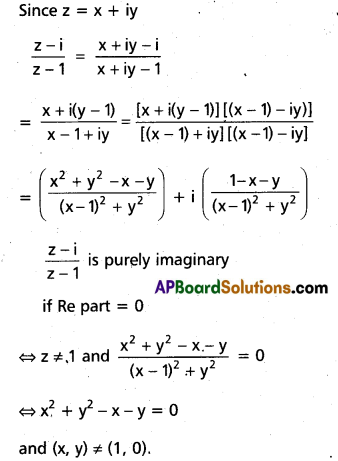
Inter 2nd Year Maths 2A Binomial Theorem Important Questions

Students get through Maths 2A Important Questions Inter 2nd Year Maths 2A Binomial Theorem Important Questions which are most likely to be asked in the exam.

Intermediate 2nd Year Maths 2A Binomial Theorem Important Questions

Question 1.
Find the number of terms in the expression of (2x + 3y + z)7 [Mar. 14, 13, 07]
Solution:
Number of terms in (a + b + c)n are \(\frac{(n+1)(n+2)}{2}\), where n is a positive integer. Hence number of terms in (2x + 3y + z)7 are \(\frac{(7+1)(7+2)}{2}=\frac{8 \times 9}{2}\) = 36

Question 2.
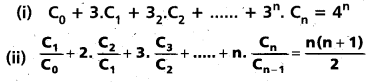
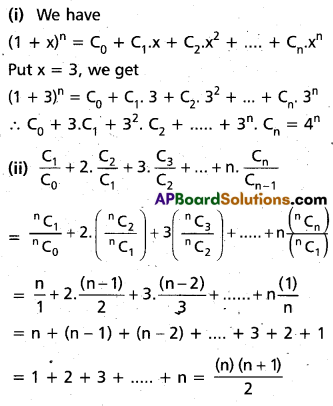
Prove that C0 + 2 . C1 + 4 . C2 + 8 . C3 + …………… + 2n . Cn = 3n [A.P. Mar. 15; May 07]
Solution:
L.H.S. = C0 + 2 . C1 + 4 . C2 + 8 . C3 + …………… + 2n . Cn
= 0 + C1(2) + C2 (2)2 + C3 (23) + …………… + Cn . 2n
= (1 + 2)n = 3n
Note: (1 + x)n = C0 + C1 . x + C2 . x2 + …………… + Cn . xn

Question 3.
If 22Cr is the largest binomial coefficient in the expansion of (1 + x)22, find the value of 13Cr. [A.P. Mar. 15; May 07]
Solution:
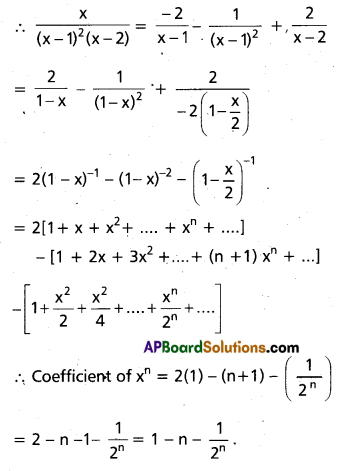
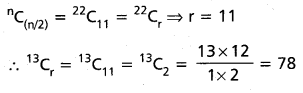
Here n = 22 is an even integer. There is only one largest binomial coefficient and it is
nC(n/2) = 22C11 = 22Cr ⇒ r = 11
13Cr = 13C11 = 13C2 = \(\frac{13 \times 12}{1 \times 2}\) = 78

Question 4.
Write down and simplify 6th term in (\(\frac{2x}{3}\) + \(\frac{3y}{2}\))9 [May 13]
Solution:
6th term in (\(\frac{2x}{3}\) + \(\frac{3y}{2}\))9
The general term in (\(\frac{2x}{3}\) + \(\frac{3y}{2}\))9 is
Tr+1 = 9Cr (\(\frac{2x}{3}\))9-r (\(\frac{3y}{2}\))r
Put r = 5
T6 = 9C5 (\(\frac{2x}{3}\))4 (\(\frac{3y}{2}\))5
= 9C5 (\(\frac{2}{3}\))4 (\(\frac{3}{2}\))5 x4 y5
= \(\frac{9 \times 8 \times 7 \times 6}{1 \times 2 \times 3 \times 4} \frac{\left(2^{4}\right)}{3^{4}} \cdot \frac{3^{5}}{2^{5}} \cdot x^{4} y^{5}\)
= 189 x4y5

Question 5.
If the coefficients of (2r + 4)th term and (3r + 4)th term in the expansion of (1 + x)21 are equal, find r. [T.S. Mar.15]
Solution:
T2r+4 in (1 + x)21 is
= 21C2r+3 (x)2r+3 ………………… (1)
T3r+4 in (1 + x)21 is
= 21C3r+3 . (x)3r+3 ……………….. (2)
⇒ Coefficients are equal
21C2r+3 = 21C3r+3
⇒ 21 = (2r + 3) + (3r + 3)
(or)
2r + 3 = 3r + 3
⇒ 5r = 15
⇒ r = 3 (or) r = 0 .
Hence r = 0, 3.

Inter 2nd Year Maths 2A Binomial Theorem Important Questions

Question 6.
Fin the sum of the infinite series 1 + \(\frac{1}{3}\) + \(\frac{1.3}{3.6}\) + \(\frac{1.3.5}{3.6.9}\) + …………… [T.S. Mar. 15]
Solution:
The series can be written as
S = 1 + \(\frac{1}{1}\). \(\frac{1}{3}\) + \(\frac{1.3}{3.6}\) (\(\frac{1}{3}\))2 + \(\frac{1.3.5}{1.2.3}\) (\(\frac{1}{3}\))3 + ……………..
The series of the right is of the form
1 + \(\frac{p}{1}\) (\(\frac{x}{q}\)) + \(\frac{p(p+q)}{1.2}\) (\(\frac{x}{q}\))2 + \(\frac{p(p+q)(p+2 q)}{1.2 .3}\) (\(\frac{x}{q}\))3 + ……………
Here p = 1, q = 2, \(\frac{x}{q}\) = \(\frac{1}{3}\) ⇒ x = \(\frac{2}{3}\)
The sum of the given series
S = (1 – x)-p/q
= (1 – \(\frac{2}{3}\))-1/2 = (\(\frac{1}{3}\))-1/2 = \(\sqrt{3}\)

Question 7.
Find the set E of the value of x for which the binomial expansions for the (a + bx)r are valid. [Mar. 08]
Solution:
(4 + 9x)-2/3 = 4-2/3 [1 + \(\frac{9x}{4}\)]-2/3
The binomial expansion of (4 + 9x)-2/3 is valid
When |\(\frac{9x}{4}\)| < 1
⇒ |x| < \(\frac{4}{9}\)
⇒ x ∈ (\(\frac{-4}{9}\), \(\frac{4}{9}\))
i.e., E = (\(\frac{-4}{9}\), \(\frac{4}{9}\))

Question 8.
If the 2nd, 3rd and 4th terms in the expansion of (a + x)n are respectively 240, 720,
1080, find a, x, n. [T.S. Mar. 16]
Solution:
T2 = 240 ⇒ nC1 an-1 x = 240 …………….. (1)
T3 = 720 ⇒ nC2 an-2 x2 = 720 …………… (2)
T4 = 1080 ⇒ nC3 an-3 x3 = 1080 …………… (3)
\(\frac{(2)}{(1)} \Rightarrow \frac{{ }^{n} C_{2} a^{n-2} x^{2}}{{ }^{n} C_{1} a^{n-1} x}=\begin{aligned}
&720 \\
&240
\end{aligned}\)
⇒ \(\frac{n-1}{2} \frac{x}{a}\) = 3 ⇒ (n – 1)x = 6a …………………. (4)
\(\frac{(3)}{(2)} \Rightarrow \frac{{ }^{n} C_{3} a^{n-3} x^{3}}{{ }^{n} C_{2} a^{n-2} x^{2}}=\frac{1080}{720}\)
⇒ \(\frac{n-2}{3} \frac{x}{a}=\frac{3}{2}\)
⇒ 2(n – 2)x = 9a …………………… (5)
\(\frac{(4)}{(5)} \Rightarrow \frac{(n-1) x}{2(n-2) x}=\frac{6 a}{9 a} \Rightarrow \frac{n-1}{2 n-4}=\frac{2}{3}\)
⇒ 3n – 3 = 4n – 8
⇒ n = 5
From (4), (5 – 1) x = 6a ⇒ 4x = 6a
⇒ x = \(\frac{3}{2}\) a
Substitute x = \(\frac{3}{2}\) a, n = 5 in (1)
5C1 . a4 . \(\frac{3}{2}\) a = 240
5 × \(\frac{3}{2}\) a5 = 240
a5 = \(\frac{480}{15}\) = 32 = 25
∴ a = 2, x = \(\frac{3}{2}\) a = \(\frac{3}{2}\) (2) = 3
∴ a = 2, x = 3, n = 5.

Question 9.
If the coefficients of rth, (r + 1)th, and (r + 2)nd, terms in the expansion of (1 + x)n, are in A.P. then show that n2 – (4r + 1)n + 4r2 – 2 = 0. [T.S. Mar. 15, 08]
Solution:
Coefficient of Tr = nCr-1
Coefficient of Tr+1 = nCr
Coefficient of Tr+2 = nCr+1
Given nCr-1, nCr, nCr+1 are in A.P.
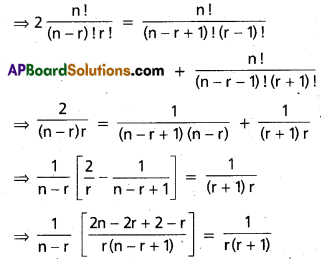
⇒ 2 . nCr = nCr-1 + nCr+1
Inter 2nd Year Maths 2A Binomial Theorem Important Questions 1.1
⇒ (2n – 3r + 2) (r + 1) = (n – r) (n – r + 1)
⇒ 2nr + 2n – 3r2 – 3r + 2r + 2 = n2 – 2nr + r2 + n – r
⇒ n2 – 4nr + 4r2 – n – 2 = 0
∴ n2 – (4r + 1)n + 4r2 – 2 = 0

Question 10.
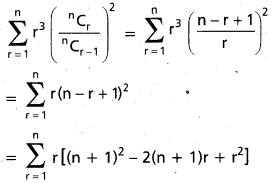
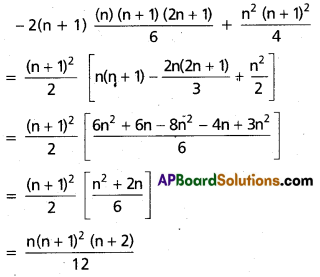
If n is a postive integer, prove that \(\sum_{r=1}^{n} r^{3}\left(\frac{{ }^{n} C_{r}}{{ }^{n} C_{r-1}}\right)^{2}=\frac{(n)(n+1)^{2}(n+2)}{12}\) [Mar. 13]
Solution:
Inter 2nd Year Maths 2A Binomial Theorem Important Questions 1.2
= (n + 1)2 Σ r – 2(n + 1) Σ r2 + Σ r3
= (n + 1)2 \(\frac{(n)(n+1)}{2}\)
Inter 2nd Year Maths 2A Binomial Theorem Important Questions 1.3

Inter 2nd Year Maths 2A Binomial Theorem Important Questions

Question 11.
Find the set of values of x for which the binomial expansions of the following are valid.
(i) (2 + 3x)-2/3
(ii) (5 + x)3/2
(iii) (7 + 3x)-5
(iv) (4 – \(\frac{x}{3}\))-1/2 [A.P. Mar. 17; Mar. 16; Mar. 11]
Solution:
(i) (2 + 3x)-2/3 = [2(1 + \(\frac{3}{2}\)x)]-2/3
= 2-2/3 (1 + \(\frac{3}{2}\)x)-2/3
∴ The binomial expansion of (2 + 3x)-2/3 is valid when |\(\frac{3}{2}\)x| < 1
(i.e.,) |x| < \(\frac{2}{3}\)
(i.e.,) x ∈ (-\(\frac{2}{3}\), \(\frac{2}{3}\))

ii) (5 + x)3/2 = [5 (1 + \(\frac{x}{5}\))]3/2 [T.S. Mar. 17]
= 53/2 (1 + \(\frac{x}{5}\))]3/2
∴ The binomial expansion of (5 + x)3/2 is valid when \(\frac{x}{5}\) < 1
(i.e.,) |x| < 5
(i.e.,) x ∈ (-5, 5)

iii) (7 + 3x)-5 = [7 (1 + \(\frac{3}{7}\) x)]-5
= 7-5 (1 + \(\frac{3}{7}\) x)]-5
(7 + 3x)-5 is valid when \(\frac{3x}{7}\) < 1
⇒ |x| < \(\frac{7}{3}\) ⇒ x ∈ (\(\frac{-7}{3}\), \(\frac{7}{3}\))

iv) (4 – \(\frac{x}{3}\))-1/2 = [4(1 – \(\frac{x}{3}\))]-1/2
(4 – \(\frac{x}{3}\))-1/2 is valid when \(\frac{-x}{12}\) < 1
⇒ |x| < 12
⇒ x ∈ (-12, 12)

Question 12.
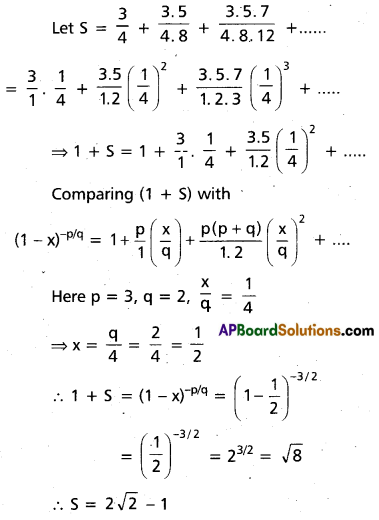
Find the sum of the infinite series
\(\frac{3}{4}\) + \(\frac{3.5}{4.8}\) + \(\frac{3.5 .7}{4.8 .12}\) + …… (Mar. 11)
Solution:
Inter 2nd Year Maths 2A Binomial Theorem Important Questions 120

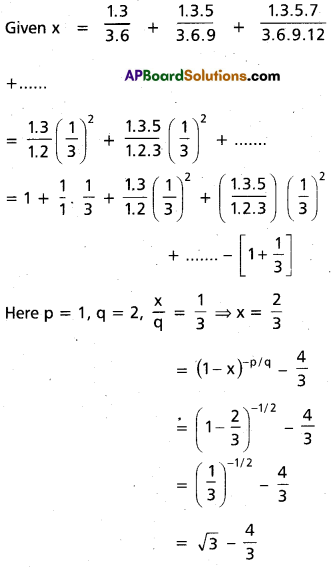
Question 13.
If x = \(\frac{1.3}{3.6}\) + \(\frac{1.3 .5}{3.6 .9}\) + \(\frac{1.3 .5 .7}{3.6 .9 .12}\) + …… then prove that 9x2 + 24x = 11 (TS Mar. ’16, AP Mar. ’17, ’15)
Solution:
Inter 2nd Year Maths 2A Binomial Theorem Important Questions 121
⇒ 3x + 4 = 3\(\sqrt{3}\)
Squaring on both sides
(3x + 4)2 = (3\(\sqrt{3}\))2
⇒ 9x2 + 24x + 16 = 27
⇒ 9x2 + 24x = 11

Question 14.
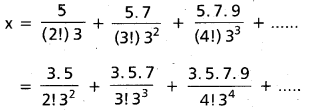
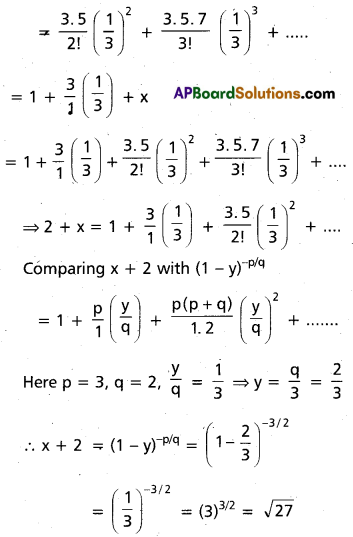
If x = \(\frac{5}{(2 !) \cdot 3}\) + \(\frac{5.7}{(3 !) \cdot 3^{2}}\) + \(\frac{5.7 .9}{(4 !) \cdot 3^{3}}\) + …… then find the value of x2 + 4x. (mar. 13)
Solution:
Inter 2nd Year Maths 2A Binomial Theorem Important Questions 122
Inter 2nd Year Maths 2A Binomial Theorem Important Questions 123

Inter 2nd Year Maths 2A Binomial Theorem Important Questions

Question 15.
Find the sum of the infinite series
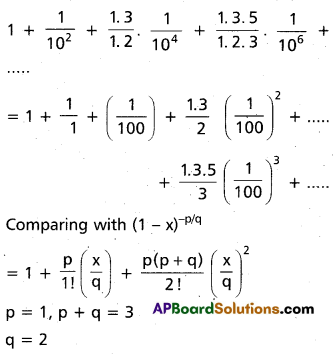
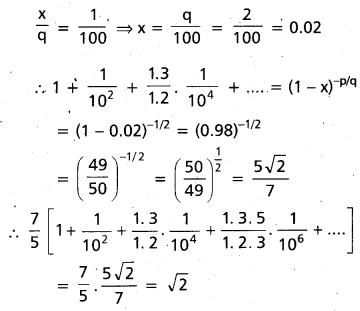
\(\frac{7}{5}\) (1 + \(\frac{1}{10^{2}}\) + \(\frac{1.3}{1.2}\).\(\frac{1}{10^{4}}\) + \(\frac{1.3 .5}{1.2 .3}\).\(\frac{1}{10^{6}}\) + …….) (AP Mar. ‘16, May 13; Mar. ’05)
Solution:
Inter 2nd Year Maths 2A Binomial Theorem Important Questions 124
Inter 2nd Year Maths 2A Binomial Theorem Important Questions 125

Question 16.
For n = 0, 1, 2, 3, ….n, prove that
Inter 2nd Year Maths 2A Binomial Theorem Important Questions 126
(TS Mar. ’15)
Solution:
Inter 2nd Year Maths 2A Binomial Theorem Important Questions 127
Inter 2nd Year Maths 2A Binomial Theorem Important Questions 128

Question 17.
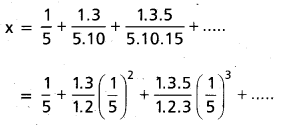
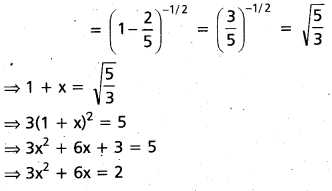
If x = \(\frac{1}{5}\) + \(\frac{1.3}{5.10}\) + \(\frac{1.3 .5}{5.10 .15}\) + …… ∞ find 3x2 + 6x. (May. ’14, ’07, ’06; May. ’11)
Solution:
Given that
Inter 2nd Year Maths 2A Binomial Theorem Important Questions 129
⇒ 3(1 + x)2 = 5
⇒ 3x2 + 6x + 3= 5
⇒ 3x2 + 6x = 2

Question 18.
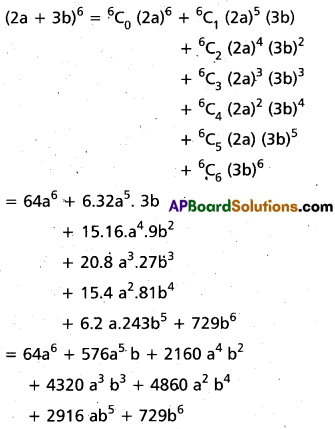
Write the expansion or (2a + 3b)6.
Solution:
Inter 2nd Year Maths 2A Binomial Theorem Important Questions 131

Question 19.
Find the 5th term in the expansion of (3x – 4y)7.
Solution:
T5 = T4 + 1
= 7C4 (3x)7 – 4 (-4y)4
= 35.27x3. 256y4
= 241920 x3 y4

Inter 2nd Year Maths 2A Binomial Theorem Important Questions

Question 20.
Find the 4th term from the end in the expansion (2a + 5b)8.
Solution:
(2a + 5b)8 expansion contain 9 terms. The fourth term from the end is 6th term from the beginning.
8C5 (2a)8 – 5 (5b)5
= 8C5 (2a)8 – 5 (5b)5
= 8C5 . 23. 55 a3 b5

Question 21.
Find the middle term of the following expansions
(i) (3a – 5b)6
(ii) (2x + 3y)7
Solution:
i) Here n = 6 (even)
∴ \(\frac{n}{2}\) + 1 = \(\frac{6}{2}\) + 1 = 4th term is the middle term
∴ T4 = T3 + 1
= 6C3 (3a)6 – 3 (-5b)3,
= –6C3. 33. 53. a3 b3

ii) Here n = 7 (odd)
\(\frac{\mathrm{n}+1}{2}\) = \(\frac{7+1}{2}\) = 4, \(\frac{\mathrm{n}+3}{2}\) = \(\frac{7+3}{2}\) = 5
∴ 4th, 5th terms are middle terms.
∴ T4 = T3 + 1 = 7C3 (2x)7 – 3 (3y)3 = 7C3 24 33.x4.y3
T5 = T4 + 1 = 7C4(2x)7-4(3y)4 = 7C4. 23.34. x3. y4

Question 22.
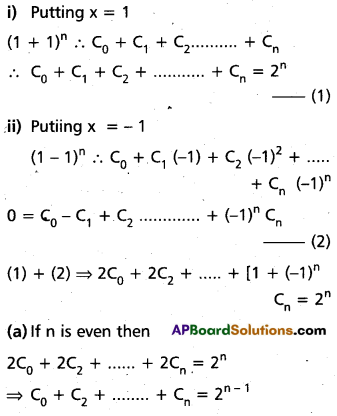
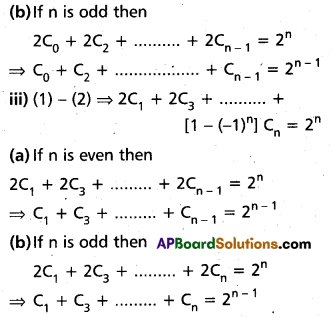
n is a positive integer then prove that
Solution:
i) Co + C1 + C2 + …….. + Cn = 2n
ii) a) Co + C2 + C4 + … + Cn = 2n – 1 if n is even
(b) Co + C2 + C4 + …. + Cn – 1 = 2n – 1 if n is odd.
iii) (a) C1 + C3 + C5 + …. + Cn – 1 = 2n – 1 if n is even.
(b) C1 + C3 + C5 + …. + Cn – 1 = 2n – 1 if n is odd.
Solution:
We know (1 + x)n = nC0 + nC1 x + nC2 x2+ …… + nCn xn
= C0 + C1x + C2x2 + …… + Cnxn

Inter 2nd Year Maths 2A Binomial Theorem Important Questions 28
Inter 2nd Year Maths 2A Binomial Theorem Important Questions 29

Inter 2nd Year Maths 2A Binomial Theorem Important Questions

Question 23.
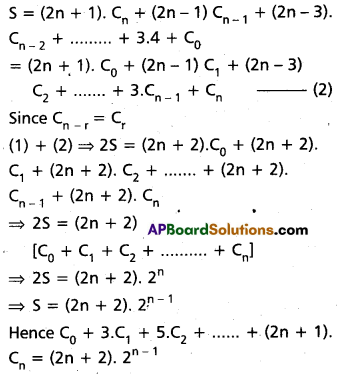
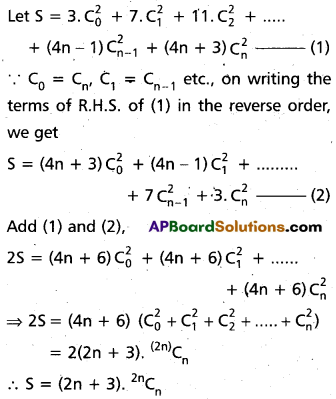
Prove that C0 + 3.C1 + 5.C2 + ……… +(2n + 1). Cn = (2n + 2). 2n – 1.
Solution:
Let S = C0 + 3.C1 + 5.C2 + …… + (2n + 1). Cn —— (1)
By writing the terms in (1) in the reverse older, we get
Inter 2nd Year Maths 2A Binomial Theorem Important Questions 30

Question 24.
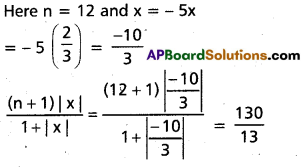
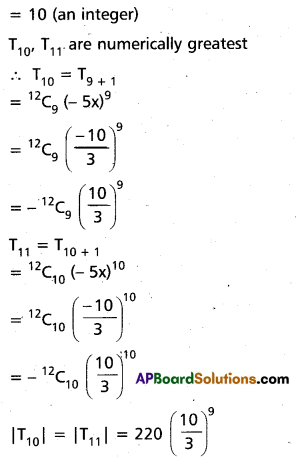
Find the numerically greatest term in the binomial expansion of (1 – 5x)12 when x = \(\frac{2}{3}\).
Solution:
Inter 2nd Year Maths 2A Binomial Theorem Important Questions 31
Inter 2nd Year Maths 2A Binomial Theorem Important Questions 32

Question 25.
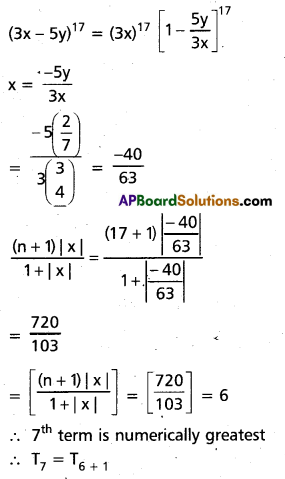
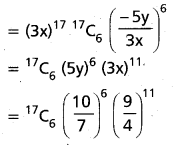
Compute numerically ireatist term (s) in the expansionly of (3x – 5y)n when x = \(\frac{3}{4}\), y = \(\frac{2}{7}\) and n = 17
Solution:
Given x = \(\frac{3}{4}\), y = \(\frac{2}{7}\) and n = 17
Inter 2nd Year Maths 2A Binomial Theorem Important Questions 33
Inter 2nd Year Maths 2A Binomial Theorem Important Questions 34

Question 26.
Find the largest binomial coefficients (s) in the expansion of
(i) (1 + x)19
(ii) (1 + x)24
Solution:
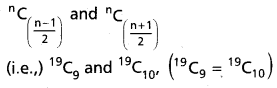
(i) Here n = 19 is an odd integer. Hence the largest binomial coefficients are
Inter 2nd Year Maths 2A Binomial Theorem Important Questions 35
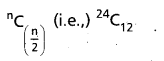
(ii) Here n = 24 is an even integer. Hence the largest binomial coefficient is
Inter 2nd Year Maths 2A Binomial Theorem Important Questions 36

Question 27.
If 22Cr is the largest binomial coefficient in the expansion of (1 + x)22, find the value of 13Cr. (A.P. Mar’16, May ‘11)
Solution:
Here n = 22 is an even integer. There is only one largest binomial coefficient and it is
Inter 2nd Year Maths 2A Binomial Theorem Important Questions 37

Question 28.
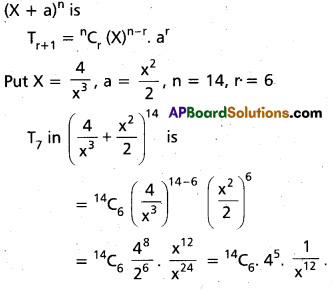
Find the 7th term in the expansion of \(\left(\frac{4}{x^{3}}+\frac{x^{2}}{2}\right)^{14}\)
Solution:
The general term in the expansion of
Inter 2nd Year Maths 2A Binomial Theorem Important Questions 38

Inter 2nd Year Maths 2A Binomial Theorem Important Questions

Question 29.
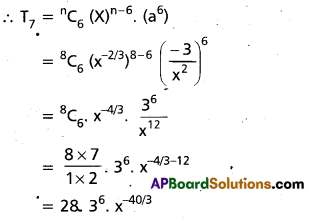
Find the 3rd term from the end in the expansion of \(\left(x^{-2 / 3}-\frac{3}{x^{2}}\right)^{8}\)
Solution:
Comparing with (X + a)n, we get
X = x-2/3, a = \(\frac{-3}{x^{2}}\), n = 8
In the given expansion \(\left(x^{-2 / 3}-\frac{3}{x^{2}}\right)^{8}\), we have n + 1 = 8 + 1 = 9 terms
Hence the 3rd term from the end is 7th term from the beginning.
Inter 2nd Year Maths 2A Binomial Theorem Important Questions 39

Question 30.
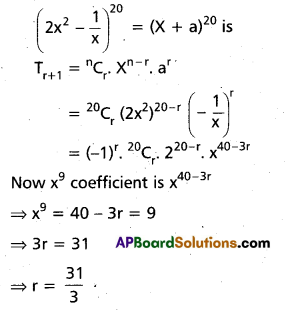
Find the coefficient of x9 and x10 in the expansion of \(\left(2 x^{2}-\frac{1}{x}\right)^{2 c}\)
Solution:
If we write X = 2x2 and a = –\(\frac{1}{x}\), then the general term in the expansion of
Inter 2nd Year Maths 2A Binomial Theorem Important Questions 40
Since r = \(\frac{31}{3}\) which is impossible since r must be a positive integer. Thus ‘there is no term containing x9 in the expansion of the given expression. In otherwords the coefficient of x9 is ‘0’.
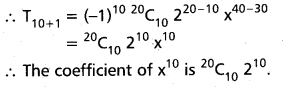
Now, to find the coefficient of x10.
put 40 – 3r = 10
⇒ r = 10
Inter 2nd Year Maths 2A Binomial Theorem Important Questions 41

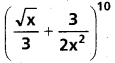
Question 31.
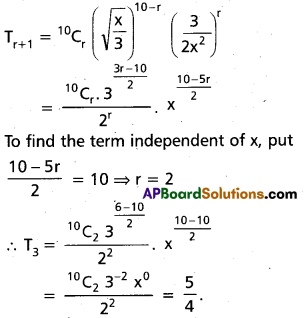
Find the term independent of x (that is the constant term) in the expansion of
Inter 2nd Year Maths 2A Binomial Theorem Important Questions 42
Solution:
Inter 2nd Year Maths 2A Binomial Theorem Important Questions 43

Question 32.
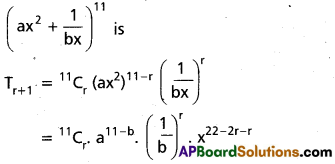
If the coefficients of x10 in the expansion of \(\left(a x^{2}+\frac{1}{b x}\right)^{11}\) is equal to the coefficient of x-10 in the expansion of \(\left(a x-\frac{1}{b x^{2}}\right)^{11}\) ; find the relation between a and b where a and b are real numbers.
Solution:
The general term in the expansion of \(\left(a x^{2}+\frac{1}{b x}\right)^{11}\) is
Inter 2nd Year Maths 2A Binomial Theorem Important Questions 44
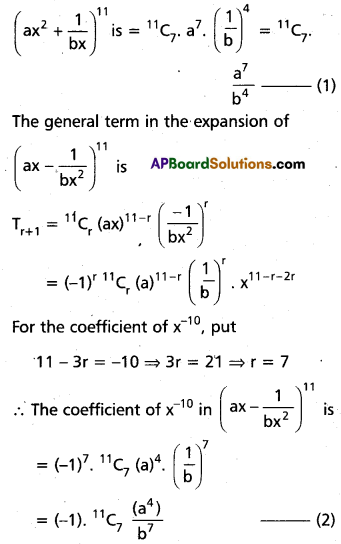
To find the coefficient of x10, put
22 – 3r = 10 ⇒ 3r = 12 ⇒ r = 4
Hence the coefficient of x10 in
Inter 2nd Year Maths 2A Binomial Theorem Important Questions 45
Given that the coefficients are equal.
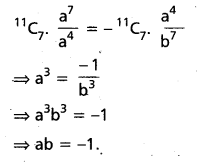
Hence from (1) and (2), we get
Inter 2nd Year Maths 2A Binomial Theorem Important Questions 46

Inter 2nd Year Maths 2A Binomial Theorem Important Questions

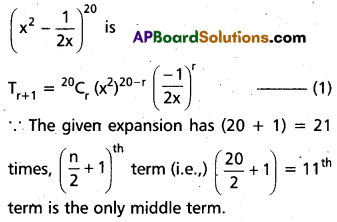
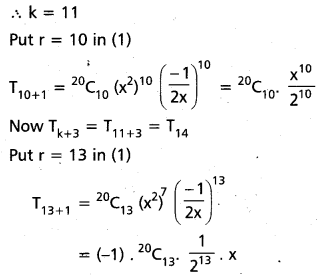
Question 33.
If the kth term is the middle term in the expansion of \(\left(x^{2}-\frac{1}{2 x}\right)^{20}\), find Tk and Tk + 3.
Solution:
The general term in the expansion of
Inter 2nd Year Maths 2A Binomial Theorem Important Questions 47
Inter 2nd Year Maths 2A Binomial Theorem Important Questions 48

Question 34.
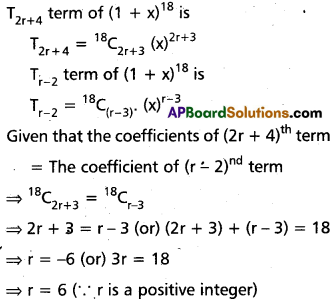
If the coefficients of (2r + 4)th and (r – 2)nd terms in the expansion of (1 + x)18 are equal, find r.
Solution:
Inter 2nd Year Maths 2A Binomial Theorem Important Questions 50

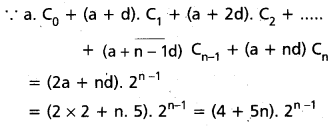
Question 35.
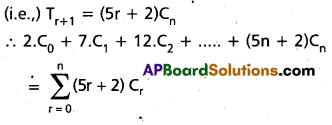
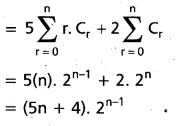
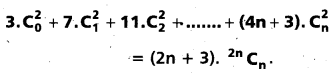
Prove that 2.C0 + 7.C1 + 12.C2 + …… + (5n + 2)Cn = (5n + 4)2n – 1.
Solution:
First method:
The coefficients of C0, C1, C2, …., Cn are in A.P. with first term a = 2, C.d (d) = 5
Inter 2nd Year Maths 2A Binomial Theorem Important Questions 51
Second method:
General term in LH.S.
Inter 2nd Year Maths 2A Binomial Theorem Important Questions 52
Inter 2nd Year Maths 2A Binomial Theorem Important Questions 53

Question 36.
Prove that
Inter 2nd Year Maths 2A Binomial Theorem Important Questions 54
Solution:
Inter 2nd Year Maths 2A Binomial Theorem Important Questions 55

Inter 2nd Year Maths 2A Binomial Theorem Important Questions

Question 37.
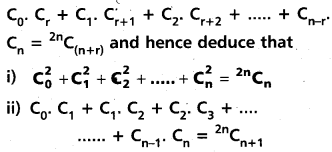
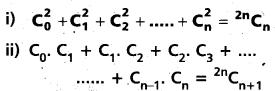
For n = 0, 1, 2, 3 , n, prove that C0. Cr + C1. Cr + 1 + C2. Cr + 2 + ……. + Cn – r. Cn = 2nCn + 1. (T.S. Mar. ’15)
Inter 2nd Year Maths 2A Binomial Theorem Important Questions 56
Solution:
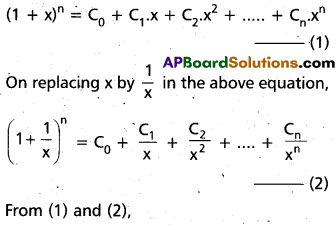
We know that
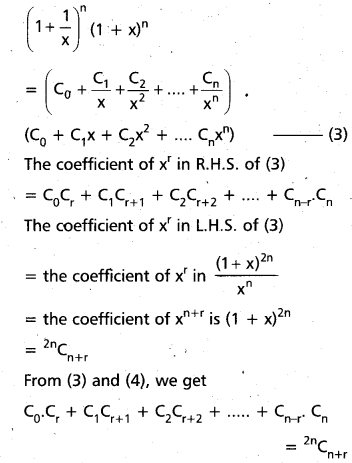
Inter 2nd Year Maths 2A Binomial Theorem Important Questions 57
Inter 2nd Year Maths 2A Binomial Theorem Important Questions 58
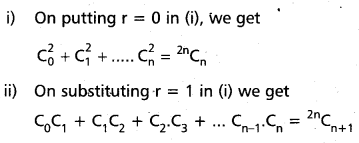
Inter 2nd Year Maths 2A Binomial Theorem Important Questions 59

Question 38.
Prove that
Inter 2nd Year Maths 2A Binomial Theorem Important Questions 60
Solution:
Inter 2nd Year Maths 2A Binomial Theorem Important Questions 61

Question 39.
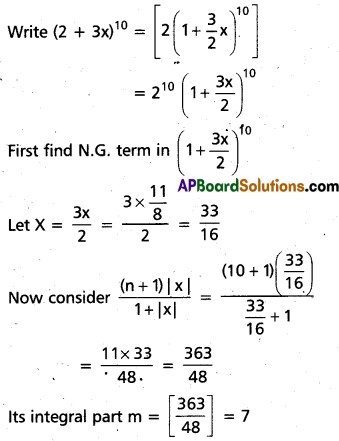
Find the numerically greatest term (s) in the expansion of

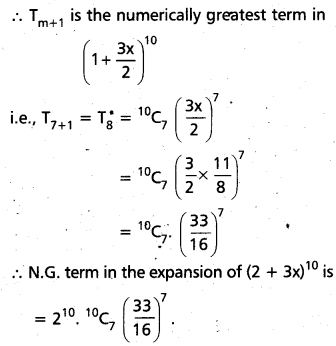
i) (2 + 3x)10 when x = \(\frac{11}{8}\)
Solution:
Inter 2nd Year Maths 2A Binomial Theorem Important Questions 62
Inter 2nd Year Maths 2A Binomial Theorem Important Questions 63

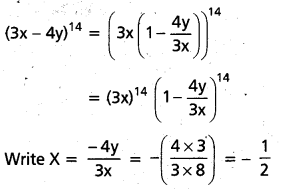
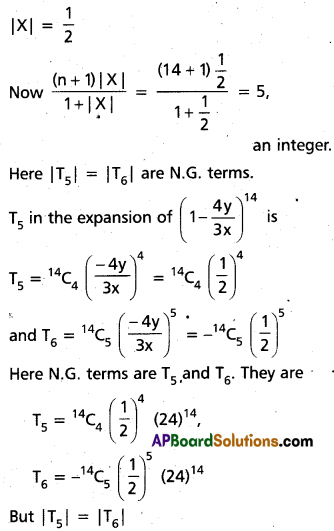
ii) (3x – 4y)14 when x = 8, y = 3.
Solution:
Inter 2nd Year Maths 2A Binomial Theorem Important Questions 64
Inter 2nd Year Maths 2A Binomial Theorem Important Questions 65

Inter 2nd Year Maths 2A Binomial Theorem Important Questions

Question 40.
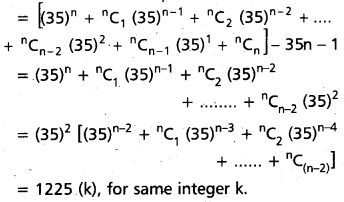
Prove that 62n – 35n – 1 is divisible by 1225 for all natural numbers of n.
Solution:
62n – 35n – 1 = (36)n – 35n – 1
= (35 + 1)n – 35n – 1
Inter 2nd Year Maths 2A Binomial Theorem Important Questions 66
Hence 62n – 35n – 1 is divisible by 1225 for all integral values of n.

Question 41.
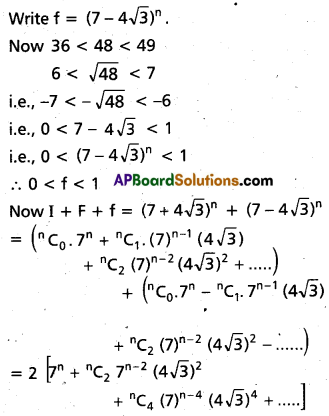
Suppose that n is a natural number and I, F are respectively the integral part and fractional part of (7 + \(\sqrt{3}\))n. Then show that
(i) I is an odd integer
(ii) (I + F) (I – F) = 1
Solution:
Given that (7 + 4\(\sqrt{3}\))n = I + F where I is an integer and 0 < F < 1
Inter 2nd Year Maths 2A Binomial Theorem Important Questions 67
= 2k, where k is a positive integer —— (1)
Thus I + F + f is n even integer.
Since I is an integer, we get that F + f is an integer. Also since 0 < F < 1 and 0 < f < 1
⇒ 0 < F + f < 2
∵ F + 1 is an integer
We get F + f = 1
(i.e.,) I – F = f ——— (2)

(i) From (1) I + F + f = 2k
⇒ f = 2k – 1, an odd integer.
(ii) (I + F) (I – F) = (I + F) f
= (7 + 4\(\sqrt{3}\))n (7 – 4\(\sqrt{3}\))n
= (49 – 48)n = 1.

Question 42.
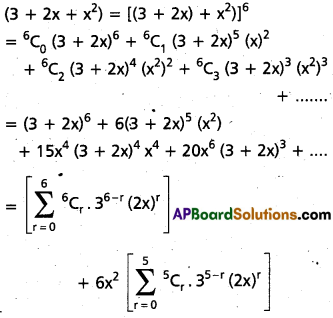
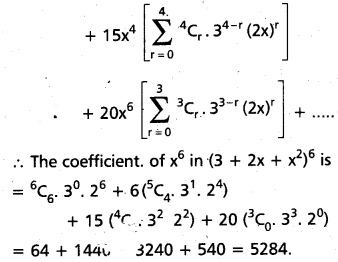
Find the coefficient of x6 in (3 + 2x + x2)6.
Solution:
Inter 2nd Year Maths 2A Binomial Theorem Important Questions 68
Inter 2nd Year Maths 2A Binomial Theorem Important Questions 69

Inter 2nd Year Maths 2A Binomial Theorem Important Questions

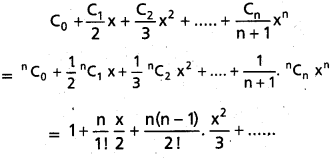
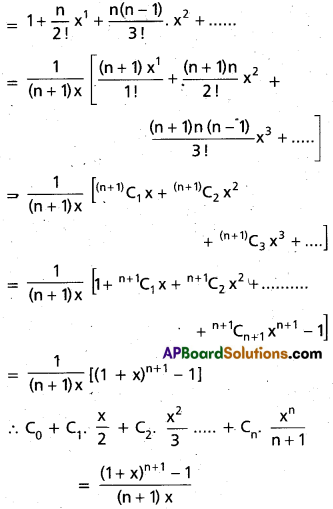
Question 43.
If n is a positive integer, then prove that
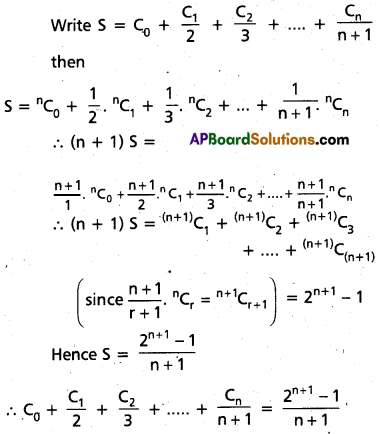
Co + \(\frac{C_{1}}{2}\) + \(\frac{C_{2}}{3}\) + ….. + \(\frac{C_{n}}{n+1}\) = \(\frac{2^{n+1}-1}{n+1}\)
Solution:
Inter 2nd Year Maths 2A Binomial Theorem Important Questions 70

Question 44.
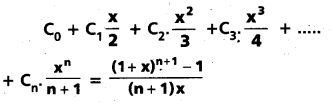
If n is a positive integer and x is any nonzero real number, then prove that
Inter 2nd Year Maths 2A Binomial Theorem Important Questions 71
(May. ’14, May 13, ’05)
Solution:
Inter 2nd Year Maths 2A Binomial Theorem Important Questions 72
Inter 2nd Year Maths 2A Binomial Theorem Important Questions 73

Question 45.
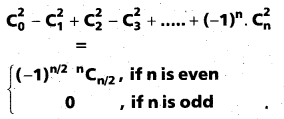
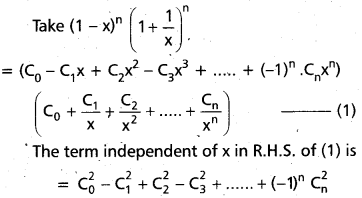
Prove that
Inter 2nd Year Maths 2A Binomial Theorem Important Questions 74
Solution:
Inter 2nd Year Maths 2A Binomial Theorem Important Questions 75
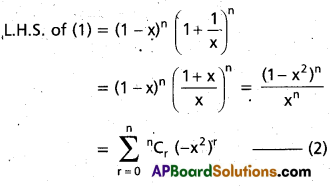
Now we can find the term independent of in the L.H.S. of (1).
Inter 2nd Year Maths 2A Binomial Theorem Important Questions 76
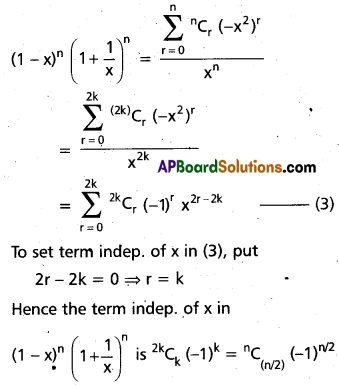
Suppose n is an even integer, say n = 2k. Then from (2),
Inter 2nd Year Maths 2A Binomial Theorem Important Questions 77
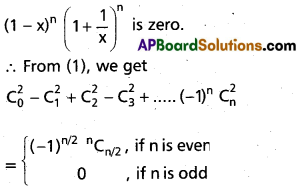
When n is odd:
Observe that the expansion in the numerator of (2) contains only even powers of x.
∴ If n is odd, then there is no constant term in (2) (i.e.,) the term indep. of x in
Inter 2nd Year Maths 2A Binomial Theorem Important Questions 78

Question 46.
Find the set E of the value of x for which the binomial expansions for the following are valid
(i) (3 – 4x)3/4
(ii) (2 + 5)x-1/2
(iii) (7 – 4x)-5
(iv) (4 + 9x)-2/3
(iv) (a + bx)r (Mar. ’08)
Solution:
i) (3 – 4x)3/4 = 33/4\(\left(1-\frac{4 x}{3}\right)^{3 / 4}\)
The binomial expansion of (3 – 4x)3/4 is valid, when \(\frac{4 x}{3}\) < 1
i.e., |x| < \(\frac{3}{4}\)
i.e., E = \(\left(\frac{-3}{4}, \frac{3}{4}\right)\)

ii) (2 + 5x)-1/2 = 2-1/2\(\left(1+\frac{5 x}{2}\right)^{-1 / 2}\)
The binomial expansion of (2 + 5x)-1/2 is valid when |\(\frac{5 x}{3}\)| < 1 ⇒ |x| < \(\frac{2}{5}\)
i.e., E = (-\(\frac{2}{5}\), \(\frac{2}{5}\))

iii) (7 – 4x)-5 = 7-5\(\left(1-\frac{4 x}{7}\right)^{-5}\)
The binomial expansion of (7 – 4x)-5 is valid when \(\frac{4 x}{7}\) < 1 ⇒ |x| < \(\frac{7}{4}\)
i.e., E = \(\left(\frac{-7}{4}, \frac{7}{4}\right)\)

iv) (4 + 9x)-2/3 = 4-2/3 \(\left(1+\frac{9 x}{4}\right)^{-2 / 3}\)
The binomial expansipn of (4 + 9x)-2/3 is valid
When \(\frac{9 x}{4}\) < 1
⇒ |x| < \(\frac{4}{9}\)
⇒ x ∈ \(\left(\frac{-4}{9}, \frac{4}{9}\right)\)
i.e., E = \(\left(\frac{-4}{9}, \frac{4}{9}\right)\)

v) For any non zero reals a and b, the set of x for which the binomial expansion of (a + bx)r is valid when r ∉ Z+ ∪ {0}, is \(\left(-\frac{|a|}{|b|}, \frac{|a|}{|b|}\right)\)

Inter 2nd Year Maths 2A Binomial Theorem Important Questions

Question 47.
Find the
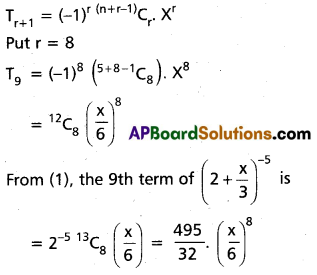
(i) 9th term of \(\left(2+\frac{x}{3}\right)^{-5}\)
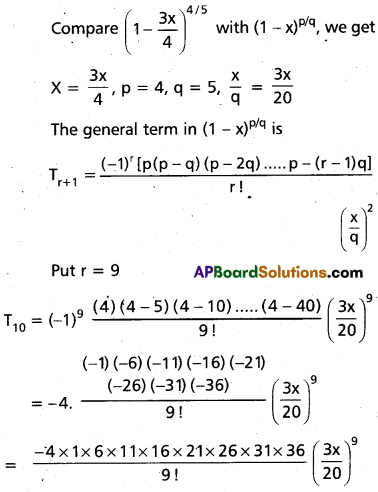
(ii) 10th term of \(\left(1-\frac{3 x}{4}\right)^{4 / 5}\)
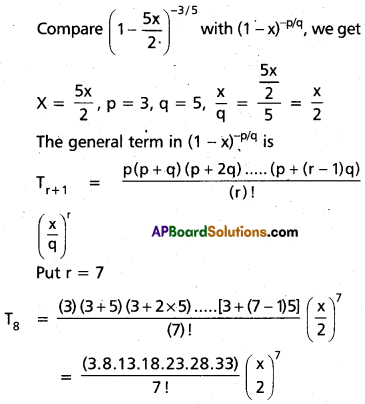
(iii) 8th term of \(\left(1-\frac{5 x}{2}\right)^{-3 / 5}\)
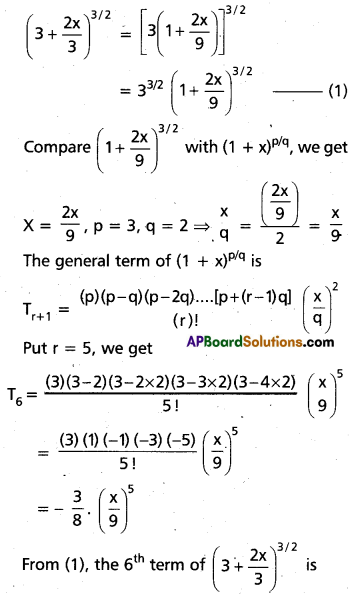
(iv) 6th term of \(\left(3+\frac{2 x}{3}\right)^{3 / 2}\)

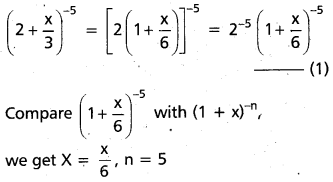
(i) 9th term of \(\left(2+\frac{x}{3}\right)^{-5}\)
Solution:
Inter 2nd Year Maths 2A Binomial Theorem Important Questions 79
we get X = \(\frac{x}{6}\), n = 5
The general term in the binomial expansion of (1 + x)-n is
Inter 2nd Year Maths 2A Binomial Theorem Important Questions 80

ii) 10th term of \(\left(1-\frac{3 x}{4}\right)^{4 / 5}\)
Solution:
Inter 2nd Year Maths 2A Binomial Theorem Important Questions 81

iii) 8th term of \(\left(1-\frac{5 x}{2}\right)^{-3 / 5}\)
Solution:
Inter 2nd Year Maths 2A Binomial Theorem Important Questions 82

iv) 6th term of \(\left(3+\frac{2 x}{3}\right)^{3 / 2}\)
Solution:
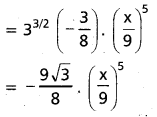
Inter 2nd Year Maths 2A Binomial Theorem Important Questions 83
Inter 2nd Year Maths 2A Binomial Theorem Important Questions 84

Question 48.
Write the first 3 terms in the expansion of
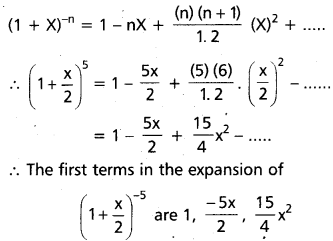
(i) \(\left(1+\frac{x}{2}\right)^{-5}\)
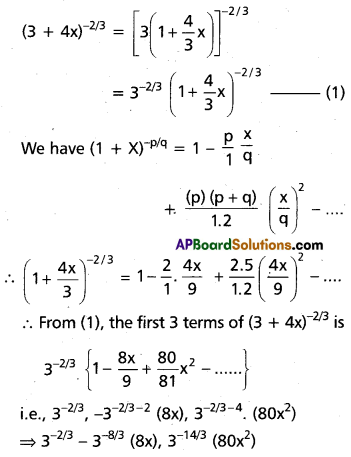
(ii) (3 + 4x)-2/3
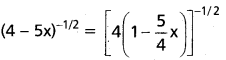
(iii) (4 – 5x)-1/2

i) \(\left(1+\frac{x}{2}\right)^{-5}\)
Solution:
We have
Inter 2nd Year Maths 2A Binomial Theorem Important Questions 85

ii) (3 + 4x)-2/3
Solution:
Inter 2nd Year Maths 2A Binomial Theorem Important Questions 86

Inter 2nd Year Maths 2A Binomial Theorem Important Questions

iii) (4 – 5x)-1/2
Solution:
Inter 2nd Year Maths 2A Binomial Theorem Important Questions 87
Inter 2nd Year Maths 2A Binomial Theorem Important Questions 88

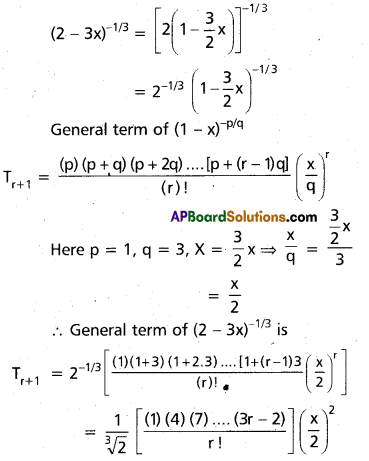
iv) (2 – 3x)-1/3
Solution:
Inter 2nd Year Maths 2A Binomial Theorem Important Questions 89

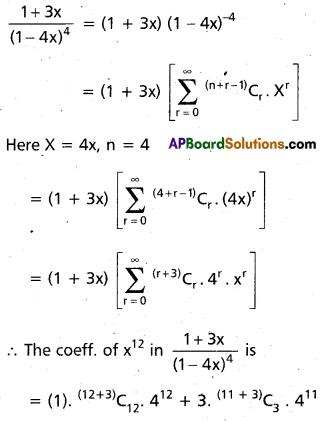
Question 49.
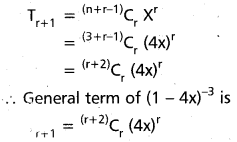
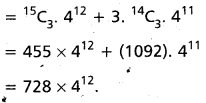
Find the coefficient of x12 in \(\frac{1+3 x}{(1-4 x)^{4}}\)
Solution:
Inter 2nd Year Maths 2A Binomial Theorem Important Questions 90
Inter 2nd Year Maths 2A Binomial Theorem Important Questions 91

Question 50.
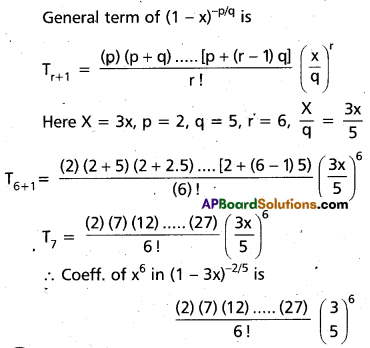
Find coeff. of x6 in the expansion of (1 – 3x)-2/5
Solution:
Inter 2nd Year Maths 2A Binomial Theorem Important Questions 92

Question 51.
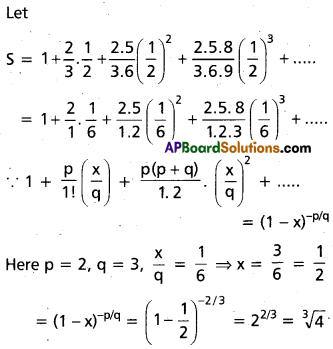
Find the sum of the infinite series
Inter 2nd Year Maths 2A Binomial Theorem Important Questions 93
Solution:
Inter 2nd Year Maths 2A Binomial Theorem Important Questions 94

Inter 2nd Year Maths 2A Binomial Theorem Important Questions

Question 52.
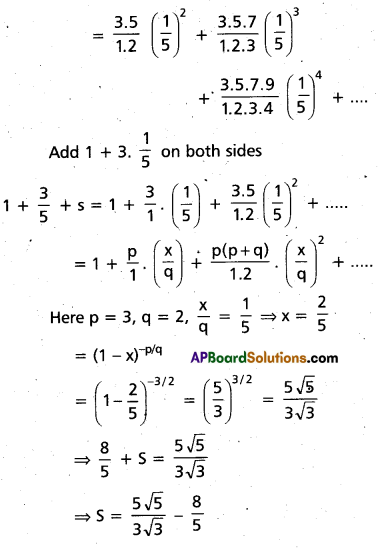
Find the sum of the series
Inter 2nd Year Maths 2A Binomial Theorem Important Questions 95
Solution:
Inter 2nd Year Maths 2A Binomial Theorem Important Questions 96
Inter 2nd Year Maths 2A Binomial Theorem Important Questions 97

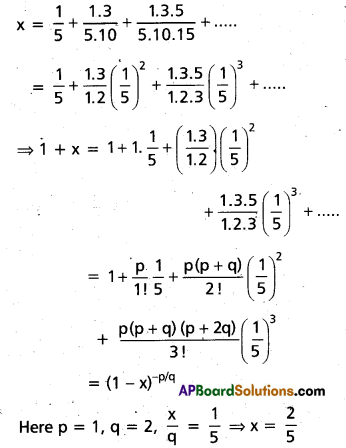
Question 53.
If x = \(\frac{1}{5}\) + \(\frac{1.3}{5.10}\) + \(\frac{1.3 .5}{5.10 .15}\) + ……. ∞ then find 3x2 + 6x. (Mar. ’14, ’07, ’06; May. ’11)
Solution:
Given that
Inter 2nd Year Maths 2A Binomial Theorem Important Questions 98
Inter 2nd Year Maths 2A Binomial Theorem Important Questions 99

Question 54.
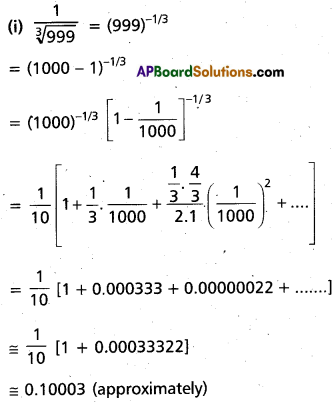
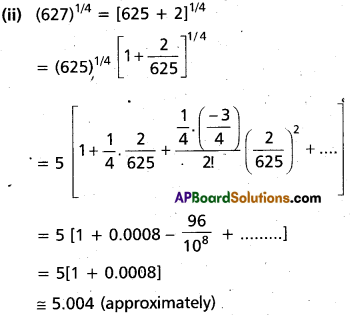
Find an approximate value of
i) \(\frac{1}{\sqrt[3]{999}}\)
ii) (627)1/4
Solution:
Inter 2nd Year Maths 2A Binomial Theorem Important Questions 100
Inter 2nd Year Maths 2A Binomial Theorem Important Questions 101

Inter 2nd Year Maths 2A Binomial Theorem Important Questions

Question 55.
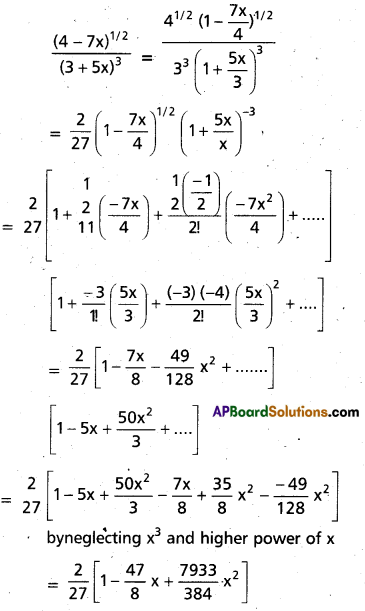
If |x| is so small that x3 and higher powers or x can be neglected, find approximate value of \(\frac{(4-7 x)^{1 / 2}}{(3+5 x)^{3}}\)
Solution:
Inter 2nd Year Maths 2A Binomial Theorem Important Questions 102

Question 56.
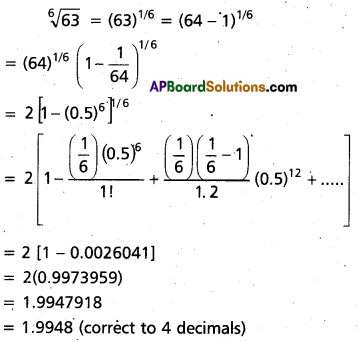
Find an approximate value of \(\sqrt[6]{63}\) correct to 4 decimal places.
Solution:
Inter 2nd Year Maths 2A Binomial Theorem Important Questions 103

Question 57.
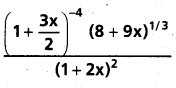
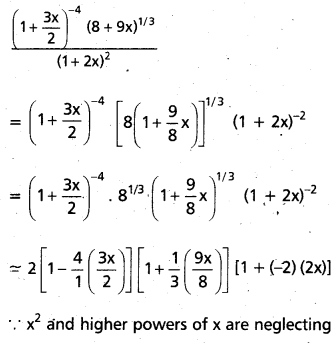
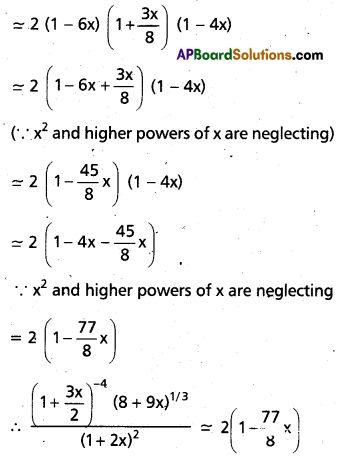
If |x| is so small thát x2 and higher powers of x may be neglected, then find an approximate value of
Inter 2nd Year Maths 2A Binomial Theorem Important Questions 104
Solution:
Inter 2nd Year Maths 2A Binomial Theorem Important Questions 105
Inter 2nd Year Maths 2A Binomial Theorem Important Questions 106

Question 58.
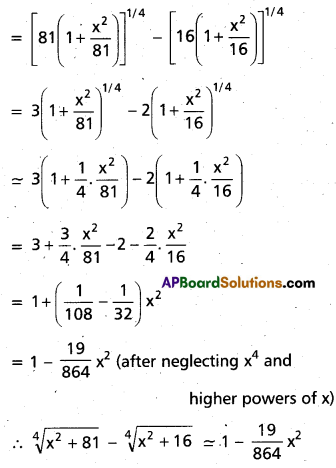
If |x| is so small that x4 and higher powers of x may be neglected, then find the approximate value of
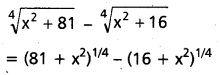
\(\sqrt[4]{x^{2}+81}\) – \(\sqrt[4]{x^{2}+16}\)
Solution:
Inter 2nd Year Maths 2A Binomial Theorem Important Questions 107
Inter 2nd Year Maths 2A Binomial Theorem Important Questions 108

Question 59.
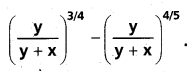
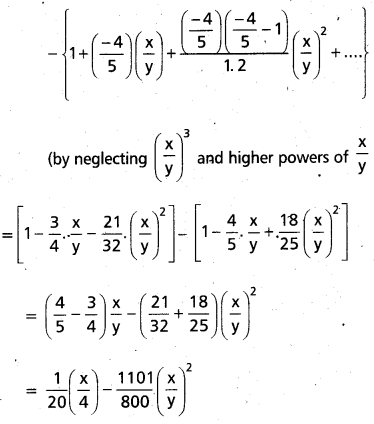
Suppose that x and y are positive and x is very small when compared to y. Then find an approximate value of
Inter 2nd Year Maths 2A Binomial Theorem Important Questions 109
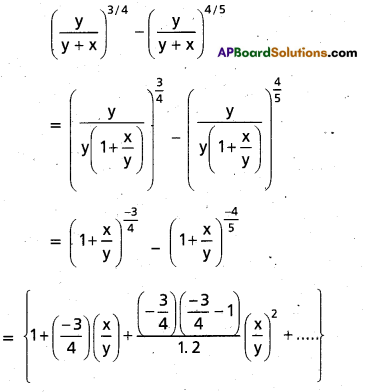
Solution:
Inter 2nd Year Maths 2A Binomial Theorem Important Questions 110
Inter 2nd Year Maths 2A Binomial Theorem Important Questions 111

Inter 2nd Year Maths 2A Binomial Theorem Important Questions

Question 60.
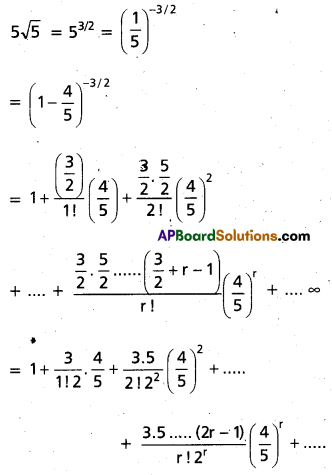
Expand \(5 \sqrt{5}\) in increasing powers of \(\frac{4}{5}\)
Solution:
Inter 2nd Year Maths 2A Binomial Theorem Important Questions 112

Inter 2nd Year Maths 2A Permutations and Combinations Important Questions

Students get through Maths 2A Important Questions Inter 2nd Year Maths 2A Permutations and Combinations Important Questions which are most likely to be asked in the exam.

Intermediate 2nd Year Maths 2A Permutations and Combinations Important Questions

Question 1.
If np3 = 1320, find n. (Mar. 2005)
Solution:
Hint : nPr = \(\frac{n !}{(n-r) !}\)
= n(n – 1) (n – 2) …… (n – r + 1)
nP3 = 1320
= 10 × 132
= 10 × 12 × 11
= 12 × 11 × 10 = 12P3
∴ n = 12

Question 2.
If nP7 = 42. nP5, find n. (TS Mar. ’17, ’15, ’11, ’07)
Solution:
nP7 = 42. nP5
n(n – 1)(n – 2)(n – 3)(n – 4)(n – 5)(n – 6)
= 42. n(n – 1) (n – 2) (n – 3) (n – 4)
⇒ (n – 5) (n – 6) = 42
⇒ (n – 5)(n – 6) = 7 × 6
⇒ n – 5 = 7 or n – 6 = 6
∴ n = 12

Inter 2nd Year Maths 2A Permutations and Combinations Important Questions

Question 3.
If 10. nC2 = 3. find n. (AP Mar. ’15)
Solution:
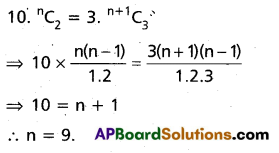
Inter 2nd Year Maths 2A Permutations and Combinations Important Questions 30

Question 4.
If 15C2r – 1 = 15C2r + 4 (Mar. ’14, ’05)
Solution:
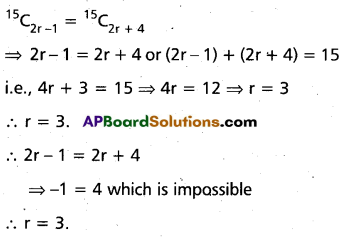
Inter 2nd Year Maths 2A Permutations and Combinations Important Questions 31

Question 5.
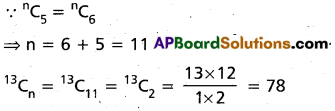
If nC5 = nC6, then find 13C(Mar. ’13)
Solution:
Inter 2nd Year Maths 2A Permutations and Combinations Important Questions 32

Question 6.
If nP4 = 1680, find n. (Mar. ’14; May ’06)
Solution:
Given nP4 = 1680
But nP4 = n(n – 1) (n – 2) (n -3).
Thus, we are given n(n – 1) (n – 2) (n – 3)
= 1680 = 8 × 7 × 6 × 5.
On comparing the largest integers on both sides, we get n = 8.

Inter 2nd Year Maths 2A Permutations and Combinations Important Questions

Question 7.
Find the number of ways of selecting 4 boys and 3 girls from a group of 8 boys and 5 girls. (TS Mar.’15)
Solution:
4 boys can be selected from the given 8 boys in 8C4 ways and 3 girls can be selected from the given 5 girls in 5C3 ways. Hence, by the Fundamental principle, the number of required selections is 8C4 x × 5C3 = 70 × 10 = 700.

Question 8.
Find the number of positive divisors of 1080. (AP Mar. ’16)
Solution:
1080 = 23 × 33 × 51.
The number of positive divisors of 1080
= (3 + 1) (3 + 1) (1 + 1)
= 4 × 4 × 2 = 32.

Question 9.
Find the number of different chains that can be prepared using 7 different coloured beads. (AP Mar. 17)
Solution:
We know that the number of circular permutations of hanging type that can be formed using n things is \(\frac{1}{2}\) {(n – 1)!}. Hence the number of chains is \(\frac{1}{2}\) {(7 – 1)’} = \(\frac{1}{2}\) (6!) = 360.

Question 10.
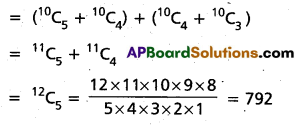
Find the value of 10C5 + 2. 10C4 + 10C3. (TS Mar. ’17)
Solution:
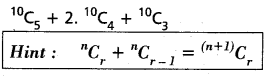
Inter 2nd Year Maths 2A Permutations and Combinations Important Questions 33
Inter 2nd Year Maths 2A Permutations and Combinations Important Questions 34

Question 11.
If (n + 1)P5 : nP6 = 2 : 7, find (Mar. ’07)
Solution:
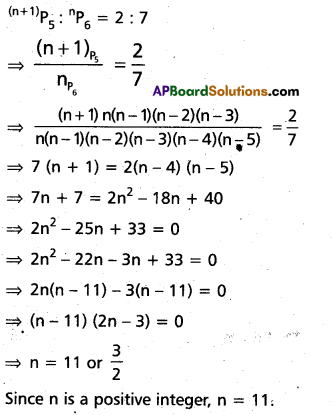
Inter 2nd Year Maths 2A Permutations and Combinations Important Questions 35

Inter 2nd Year Maths 2A Permutations and Combinations Important Questions

Question 12.
Find the number of ways of preparing a chain with 6 different coloured beads. (T.S Mar. ’16; May ’08)
Solution:
Hint :The number of circular permutations like the garlands of flowers, chains of beads etc., of n things = \(\frac{1}{2}\)(n – 1)!
The number of ways of preparing a chain with 6 different coloured beads.
= \(\frac{1}{2}\) (6 – 1)! = \(\frac{1}{2}\) × 5! = \(\frac{1}{2}\) × 120 = 60

Question 13.
If nPr = 5040 and nCr = 210, find n and r. (AP Mar. ‘17, ‘16)
Hint: nPr = r! nCr and
nPr = n (n – 1) (n – 2) ……. [n – (r – 1)]
Solution:
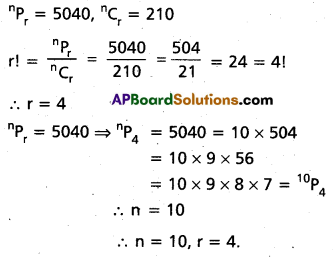
Inter 2nd Year Maths 2A Permutations and Combinations Important Questions 36

Question 14.
If 12Cr + 1 = 12C3r – 5, find r. (TS Mar. ’16, Mar. 2008)
Solution:
12Cr + 1 = 12C3r – 5
⇒ r + 1 = 3r – 5 or (r + 1) + (3r – 5) = 12
⇒ 1 + 5 = 2r or 4r – 4 = 12
⇒ 2r = 6 or 4r = 16
⇒ r = 3 or r = 4
∴ r = 3 or 4.

Question 15.
Simplify
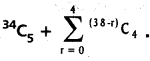
Inter 2nd Year Maths 2A Permutations and Combinations Important Questions 37 (AP Mar. ’17, ’16, ’11)
Solution:
Inter 2nd Year Maths 2A Permutations and Combinations Important Questions 38

Question 16.
Find the number of ways of selecting 3 vowels and 2 consonants from the letters of the word EQUATION. (May 11; Mar.07)
Solution:
The word EQUATION contains 5 vowels and 3 consonants.
Thè 3 vowels can be selected from 5 vowels in 5C3 = 10 ways.
The 2 consonants can be selected from 3 consonants in 3C2 = 3 ways.
∴ The required number of ways of selecting 3 vowels and 2 consonants = 1o × 3 = 30

Question 17.
Find the number of ways of selecting 11 member cricket team from 7 bats men, 6 bowlers and 2 wicket keepers so that the team contains 2 wicket keepers and atleast 4 bowlers. (mar. ’14))
Solution:
The required cricket team can have the following compositions
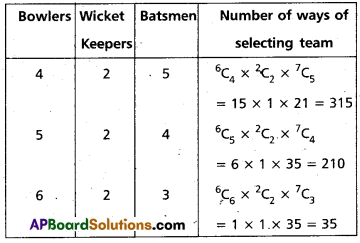
Inter 2nd Year Maths 2A Permutations and Combinations Important Questions 39
Therefore, the number of ways of selecting the required cricket team
= 315 + 210 + 35 = 560.

Question 18.
i) If 12C(s + 1) = 12C(2s – 5), then find s. (Mar.’11)
ii) If nC21 = nC27 find 49Cn. (Mar. 06; May 06)
Solution:
i) 12Cs + 1 = 1C2s – 5 ⇒ either s + 1 = 2s – 5 or s + 1 + 2s – 5 = 12
⇒ s = 6 or 3s = 16
∴ s = 6 (since s’ is a non negative integer)

ii) nC21 = nC27 ⇒ n = 21 + 27 = 48
Hence 49Cn = 49C48 = 49C1 = 49.

Inter 2nd Year Maths 2A Permutations and Combinations Important Questions

Question 19.
Find the sum of all 4 digited numbers that can be formed using the digits 0, 2, 4, 7, 8 without repetition. (TS Mar. ’15)
Solution:
First Method : The number of 4 digited numbers formed by using the digits 0, 2, 4, 7, 8 without repetition
= 5P44P3 = 120 – 24 = 96
Out of these 96 numbers,
4P33P2 numbers contain 2 in units place
4P33P2 numbers contain 2 in tens place
4P33P2 numbers contain 2 in hundreds place
4P3 numbers contain 2 in thousands place

Inter 2nd Year Maths 2A Permutations and Combinations Important Questions 40
∴ The value obtained by adding 2 in all the numbers
= (4P33P2) 2 + (4P33P2) 20 + (4P33P2) 200 + 4P3 × 2000
= 4P3 (2 + 20 + 200 + 2000) – 3P2 (2 + 20 + 200)
= 24 × (2222) – 6(222)
= 24 × 2 × 1111 – 6 × 2 × 111
Similarly, the value obtained by adding 4 is
24 × 4 × 1111 – 6 × 4 × 111
the value obtained by adding 7 is
24 × 7 × 1111 – 6 × 7 × 111
the value obtained by adding 8 is
24 × 8 × 1111 – 6 × 8 × 111
∴ The sum of all the numbers
= (24 × 2 × 111 – 6 × 2 × 111) + (24 × 4 × 1111 – 6 × 4 × 111) + (24 × 7 × 1111 – 6 × 7 × 111) + (24 × 8 × 1111 – 6 × 8 × 111)
= 24 × 1111 × (2 + 4 + 7 + 8) – 6 × 111 × (2 + 4 + 7 + 8)
= 26664 (21) – 666 (21)
= 21 (26664 – 666)
= 21(25998)
= 5, 45, 958.

(or) Second Method
If Zero is one among the given n digits, then the sum of the r – digited numbers that can be formed using the given ‘n’ distinct digits (r ≤ n ≤ 9) is
(n -1)P(r – 1) × sum of the digits × 111 …. 1 (r times)
(n – 2)P(r – 2) × sum of the digits × 111 …. 1 [(r – 1) times]
Hence n = 5, n = 4, digits are {0, 2, 4, 7, 8}
Hence the sum of all 4 digited numbers that can be formed using the digits {0, 2, 4, 7, 8} without repetition is
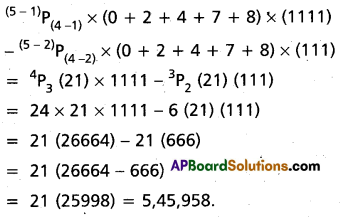
Inter 2nd Year Maths 2A Permutations and Combinations Important Questions 41

Inter 2nd Year Maths 2A Permutations and Combinations Important Questions

Question 20.
If the letters of the word MASTER are permuted in all possible ways and the words thus formed are arranged in the
dictionary order, then find the ranks of the words (Mar. 11)
i) REMAST
ii) MASTER. (TS Mar. 16; AP Mar. ‘15; May ‘11, ’08, ‘07, ‘06)
Solution:
i) Thé alphabetical order of the letters of the given word is A, E, M, R, S, T
The number of words begin with A is 5!
= 120
The number of words begin with E is 5!
= 120
The number of words begin with M is 5!
= 120
The number of words begin with RA is 4!
= 24
The number of words begin with REA is 3!
= 6
The next word is REMAST
Rank of the word REMAST = 3 (120) + 24 + 6 + 1 = 360 + 31 = 391

ii) The alphabetical order of the letters of the given word is A, E, M, R, S, T
The number of words begin with A is 5!
= 120
The number of words begin with E is 5!
= 120
The number of words begin with MAE is 3!
= 6
The number of words begin with MAR is 3!
= 6
The number of words begin with MASE is 2!
= 2
The number of words begin with MASR is 2!
= 2
The next word is MASTER.
∴ Rank of the word MASTER = 2(120) + 2(6) + 2(2) + 1
= 240 + 12 + 4 + 1 = 257

Question 21.
Find the number óf ways of arranging the letters of the word. (Mar. ’11, ’06)
i) INDEPENDENCE (May ’13)
ii) MATHEMATICS (Mar. ’13)  (May ’11)
iii) SINGING
iv) PERMUTATION
v) COMBINATION
vi) INTERMEDIATE
Solution:
i) The word INDEPENDENCE contains 12 letters in which there are 3 N’s are alike, 2 D’s are alike, 4 E’s are alike and rest are different.
∴ The number of required arrangements
= \(\frac{(12) !}{4 ! 3 ! 2 !}\)

ii) The word MATHEMATICS contains 11 letters in which there are 2 M’s are alike, 2 A’s are alike, 2 T’s are alike and rest are different.
∴ The number of required arrangements
= \(\frac{7 !}{2 ! 2 ! 2 !}\)

iii) The word SINGING contains 7 letters in which there are 2 l’s are alike, 2 N’s are alike, 2 G’s are alike and rest is different.
∴ The number of required arrangements
= \(\frac{(11) !}{2 !}\)

iv) The word PERMUTATION contains 11 letters in which there are 2 T’s are alike and rest are different.
∴ The number of required arràngements
= \(\frac{(11) !}{2 ! 2 ! 2 !}\)

v) The word COMBINATION contains 11 letters in which there are 2 O’s are alike, 2 l’s are alike, 2 N’s are alike and rest are different.
∴ The number of required arrangements
= \(\frac{(11) !}{2 ! 2 ! 2 !}\)

vi) The word INTERMEDIATE contains 12 letters in which thère are 2 l’s are alike, 2 l’s are alike, 3 E’s are alike and rest are different.
∴ The number of required arrangements
= \(\frac{(12) !}{2 ! 2 ! 3 !}\)

Inter 2nd Year Maths 2A Permutations and Combinations Important Questions

Question 22.
Prove that
Inter 2nd Year Maths 2A Permutations and Combinations Important Questions 42
(TS Mar. ’17 AP Mar. ’15)
Solution:
Inter 2nd Year Maths 2A Permutations and Combinations Important Questions 43

Question 23.
If a set A has 12 elements, find the number of subsets of A having
(i) 4 elements
(ii) Atleast 3 elements
(iii) Atmost 3 elements. (May 2007)
Solution:
Number of elements in set A = 12 .
(i) Number of subsets of A with exactly 4 elements = 12C4 = 495

(ii) The required subset contains atleast 3 elements.
Number of subsets of A with exactly 0 elements iš 12C0,
Number of subsets of A with exactly 1 element is 12C1.
Number of subsets of A with exactly 2 element is 12C2.
Total number of subsets of A formed = 212
∴ Number of subsets of A with atleast 3 elements
= (Total number of subsets) – (number of subsets contains 0 or 1 or 2 elements)
= 212 – (12C0 + 12C1 + 12C2)
= 4096 – (1 – 12 + 66) = 4096 – 79 = 4017

(iii) The required sibset contains atmost 3 elements i.e., it may contain 0 or 1 or 2 or 3 elements.
Number of subsets of A with exactly 0 elements is. 12C0
Number of subsets of A with exactly 1 element is 12C1
Number of subsets of A with exactly 2 elements is 12C2
Number of subsets of A with exactly 3 elements is 12C3
∴ Number of subsets of A with atmost 3 elements
= 12C0 + 12C1 + 12C2 + 12C3
= 1 + 12 + 66 + 220
= 299

Inter 2nd Year Maths 2A Permutations and Combinations Important Questions

Question 24.
Find the number of ways of forming a committee of 5 members out of 6 Indians and 5 Americans so that always the Indians will be in majority in the committee. (TS Mar. ’15, ’13, ’08)
Solution:
Since committee contains majority of Indians, the members of the committee may be of the following types.
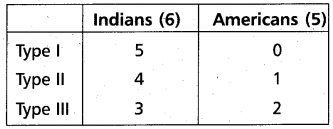
Inter 2nd Year Maths 2A Permutations and Combinations Important Questions 44
The number of selections in type I
= 6C5 × 5C0 = 6 × 1 = 6
The number of selections in type II
= 6C4 × 5C1 = 15 × 5 = 75
The number of selections in type III
= 6C3 × 5C2 = 20 10 = 200
∴ The required number ways of selecting a committee = 6 + 75 + 200 = 281.

Question 25.
If the letter of the word PRISON are permuted in all possible ways and the words thus formed are arranged in dictionary order, find the rank of the word. PRISON (AP Mar. ’17 Mar. ‘14, ’05; May ’13)
Solution:
The letters of the given word in dictionary order are
I N O P R S
In the dictionary order, first all the words that begin with I come. If I occupies the first place then the remaining 5 places can be filled with the remaining 5 letters in 5! ways. Thus, there are 5 number of words that begin with I. On proceeding like this we get
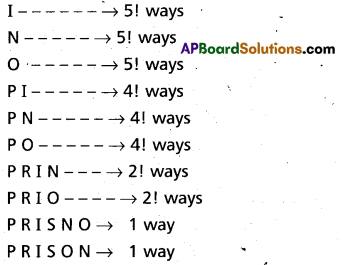
Inter 2nd Year Maths 2A Permutations and Combinations Important Questions 45
Hence the rank of PRISON is
3 × 5! + 3 × 4! + 2 × 2! + 1 × 1
= 360 + 72 + 4 + 1 + 1 = 438.

Question 26.
Find the sum of all 4- digited numbers that can be formed using the digits 1, 3, 5, 7, 9. (Mar. ’13)
Solution:
We know that the number of 4 digited numbers that can be formed using the digits
1, 3, 5, 7, 9 is 5P4 = 120.
We have to find their sum. We first find the sum of the digits in the unitš place of all the 120 numbers. Put 1 in the units place.

Inter 2nd Year Maths 2A Permutations and Combinations Important Questions 46
The rerpaining 3 places can be filled with the remaining 4 digits in 4P3 ways. Which means that there are 4P3 number of 4 digited numbers with 1 in the units place. Similarly, each of the other digits 3, 5, 7, 9 appears in the units pläce 4P3 times. Hence, by adding all these digits of the units place, we get the sum of the digits in the units place.
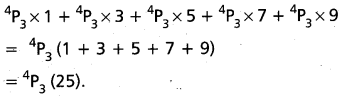
Inter 2nd Year Maths 2A Permutations and Combinations Important Questions 47
Similarly, we get the sum of all digits in 10’s place also as 4P3 × 25. Since it is in 10’s place, its value is
4P3 × 25 × 10.
Like this the values of the sumof the digits in 100’s place and 1000’s place are respectively
4P3 × 25 × 100 and 4P3 × 25 × 1000.
On adding all these sums, we get the sum of all the 4 digited numbers formed by using the digits 1, 3, 5, 7, 9. Hence the required sum is
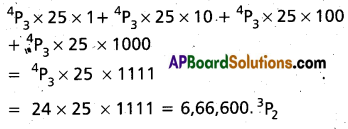
Inter 2nd Year Maths 2A Permutations and Combinations Important Questions 48

Inter 2nd Year Maths 2A Permutations and Combinations Important Questions

Question 27.
If the letters of the word EAMCET are permuted in all possible ways and if the words thus formed are arranged in the dictionary order, find the rank of the word EAMCET. (AP Mar. 16) (TS Mar. 17)
Solution:
The dictionary order of the letters of the word EAMCET is
A C E E M T
In the dictionary order first gives the words which begin with the letter A.
If we fill the first place with A, remaining 5 letters can be arranged in \(\frac{5 !}{2 !}\) ways (since there are 2 E’s) on proceeding like this, we get
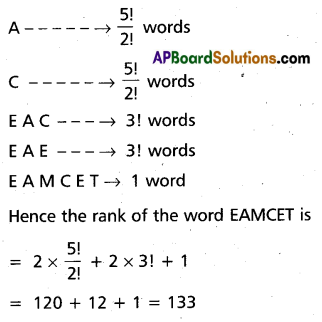
Inter 2nd Year Maths 2A Permutations and Combinations Important Questions 49

Question 28.
If \({ }^{\mathrm{n}} \mathrm{P}_{4}\) = 1680, find n. (Mar. ’14, May ’06)
Solution:
Given \({ }^{\mathrm{n}} \mathrm{P}_{4}\) = 1680
But \({ }^{\mathrm{n}} \mathrm{P}_{4}\) = n(n – 1) (n – 2) (n – 3).
Thus, we are given n(n – 1) (n – 2) (n – 3)
= 1680 = 8 × 7 × 6 × 5.
On comparing the largest integers on bothsides, we get n = 8.

Question 29.
If \({ }^{12} \mathrm{P}_{r}\) = 1320, find r.
Solution:
1320 = 12 × 11 × 10 = \({ }^{12} \mathrm{P}_{3}\), Hence r = 3.

Question 30.
If (n + 1)P5 : nP5 = 3 : 2, find n
Solution:
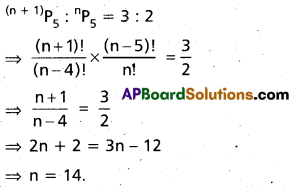
Inter 2nd Year Maths 2A Permutations and Combinations Important Questions 1
It can be verified that n = 14 satisfies the given equation.

Question 31.
If 56P(r + 3) = 30800 : 1, find r.
Solution:
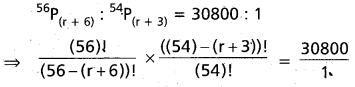
Inter 2nd Year Maths 2A Permutations and Combinations Important Questions 2
Inter 2nd Year Maths 2A Permutations and Combinations Important Questions 3
It can be verified that r given equation.

Question 32.
In how many ways 9 mathematics papers can be arranged so that the best and the worst
(i) may come together
(ii) may not come together ?
Solution:
i) If the best and worst papers are treated as one unit, then we have 9 – 2 + 1 = 7 + 1 = 8 papers. Now these can be arranged in (7 + 1) ! ways and the best and worst papers between themselves can be permuted in 2! ways. Therefore the number of arrangements in which best and worst papers come together is 8! 2!.

ii) Total number of ways of arranging 9 mathematics papers is 9!. The best and worst papers come together in 8! 2! ways. Therefore the number of ways they may not come together is 9! – 8! 2! = 8! (9 – 2) = 8! × 7.

Inter 2nd Year Maths 2A Permutations and Combinations Important Questions

Question 33.
Find the number of ways of arranging 6 boys and 6 girls in a row. In how many of these arrangements.
i) all the girls are together
ii) no two girls are together
iii) boys and girls come alternately ?
Solution:
i) 6 boys and 6 girls are altogether 12 persons. They can be arranged in a row in (12)! ways. Treat the 6 girls as one unit. Then we have 6 boys and 1 unit of girls. They can be arranged in 7! ways. Now, the 6 girls can be arranged among themselves in 6! ways. Thus the number of ways in which all 6 girls are together is (7! × 6!).

ii) First arrange the 6 boys in a row in 6! ways. Then we can find 7 gaps between them
(including the beginning gap and the ending gap) as shown below by the letter x :

Inter 2nd Year Maths 2A Permutations and Combinations Important Questions 4
Thus we have 7 gaps and 6 girls. They can be arranged in 7P6 ways.
Hence, the number of arrangements which no two girls sit together is 6! × 7P6 = 7.6!. 6!.

iii) The row may begin with either a boy or a girl, that is, 2 ways. If it begins with a boy, then odd places will be occupied by boys and even places by girls. The 6 boys can be arranged in 6 odd places in 6! ways and 6 girls in the 6 even places in 6! ways. Thus the number of arrangements in which boys and girls come alternately is 2 × 6! × 6!.

Question 34.
Find the number of 4 – letter words that can be formed using the letters erf the word. MIRACLE. How many of them
i) begin with an vowel
ii) begin and end with vowels
iii) end with a consonant ?
Solution:
The word MIRACLE has 7 letters. The number of 4 letter words that can be formed using these letters = 7P4 = 7 × 6 × 5 × 4 = 840
Now take 4 blanks

Inter 2nd Year Maths 2A Permutations and Combinations Important Questions 5

i) We can fill the first place with one of the 3 vowels {A, E, 1} in 3P1 = 3 ways.
Now the remaining 3 places can be filled using the remaining 6 letters in 6P3 = 6 × 5 × 4 = 120 ways.
∴ The number of 4 letter words that begin with an vowel = 3 × 120 = 360 ways.

ii) Fill the first and last places with 2 vowels in 3P2 = 3 × 2 = 6 ways.
The remaining 2 places can be filled with the remaining 5 letters in 5P2 = 5 × 4 = 20 ways.
∴ The number of 4 letter words that begin and end with vowels = 6 × 20 = 120 ways.

iii) We can fill the last place with one of the 4 consonants {C, L, R, M} in 4P1 = 4 ways. The remaining 3 places can be filled with the remaining 6 letters in 6P3 = 6 × 5 × 4 = 120 ways.
∴ The number of 4 letter words that end with a consonant is = 4 × 120 = 480 ways.

Inter 2nd Year Maths 2A Permutations and Combinations Important Questions

Question 35.
Find the number of ways of permuting the letters of the word PICTURE so that
i) all vowels come together
ii) no two vowels come together
iii) the relative positions of vowels and consonants are not distributed.
Solution:
The word PICTURE has 3 vowels {E, I, U} and 4 consonants {C, P, R, T}
i) Treat the 3 vowels as one unit. Then we can arrange 4 consonants + 1 unit of vowels in 5! ways. Now 3 vowels among themselves can be permuted in 3! ways. Hence the number of permutations in which 3 vowels come together.
= 5! × 3! = 120 × 6 = 720 ways.

ii) No two vowels come together First arrange the 4 consonants in 4! ways. Then in between the vowels, in the beginning and in the ending, there are 5 gaps as shown below by the x letter

Inter 2nd Year Maths 2A Permutations and Combinations Important Questions 6
In these 5 places we can arrange 3 vowels in 5P3 ways.
∴ The number of words in which no two vowels come together
= 4! × 5P3
= 24 × 5 × 4 × 3 = 1440 ways.

iii) The three vowels can be arranged in their relative positions in 3! ways and the 4 consonants can be arranged in their relative positrons in 4! ways.
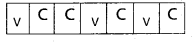
Inter 2nd Year Maths 2A Permutations and Combinations Important Questions 7
The required number of arrangements is 3! 4! = 144

Question 36.
If the letters of the word PRISON are permuted in all possible ways and the words thus formed are arranged in dictionary order, find the rank of the word. PRISON (Mar. ’14, ’05; May. ’13)
Solution:
The letters of the given word in dictionary order are
I N O P R S
In the dictionary order, first all the words that begin with I come. If I occupies the first place then the remaining 5 places can be filled with the remaining 5 letters in 5! ways. Thus, there are 5! number of words that begin with I. On proceeding like this we get
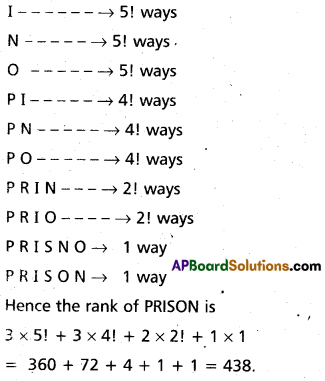
Inter 2nd Year Maths 2A Permutations and Combinations Important Questions 8

Question 37.
Find the number of 4-digit numbers that can be formed using the digits 2, 3, 5, 6, 8 (without repetition). How many of them are divisible by
(i) 2
(ii) 3
(iii) 4
(iv) 5
(v) 25
Solution:
The number of 4-digit numbers that can be formed using the 5 digits 2, 3, 5, 6, 8 is 5P4 = 120

i) Divisible by 2 : For a number to be divisible by 2, the units place should befilled with an even digit. This can be done in 3 ways (2 or 6 or 8).
Inter 2nd Year Maths 2A Permutations and Combinations Important Questions 9

Now, the remaining 3 places can be filled with the remaining 4 digits in 4P3 = 24 ways.
Hence, the number of 4 – digit numbers divisible by 2 is 3 × 24 = 72.

ii) Divisible by 3 : A number is divisible by 3 if the sum of the digits n it is a multiple of 3. Since the sum of the given 5 digits is 24, we have to leave either 3 or 6 and use the digits 2, 5, 6, 8 or 2, 3, 5, 8. In each case, we can permute them in 4! ways. Thus the number of 4-digit numbers divisible by 3 is
2 × 4! 48.

iii) Divisible by 4 : A number is divisible by 4 if the number formed by the digits in the last two places (tens and units places) is a multiple of 4;
Inter 2nd Year Maths 2A Permutations and Combinations Important Questions 10
Thus we fill the last two places (as shown in the figure) with one of
28, 32, 36, 52, 56, 68
That is done in 6 ways. After filling the last two places, we can fill the remaining two places with the remaining 3 digits in
3P2 = 6 ways.
Thus, the number of 4-digit numbers divisible by 4 is 6 × 6 = 36.

iv) Divisible by 5 : After filling the units place with 5 (one way), the remaining 3 places can be filld with the remaining 4 digits in 4P3 = 24 ways. Hence the number of 4-digit numbers divisible by 5 is 24.

v) Divisible by 25 : Here also we have to fill the last two places (that is, units and tens place) with 25 (one way) as shown below.
Inter 2nd Year Maths 2A Permutations and Combinations Important Questions 11
Now the remaining 2 places can be filled with the remaining 3 digits in 3P2 = 6 ways.
Hence the number of 4 – digit numbers divisible by 25 is 6.

Question 38.
Find the sum of all 4- digited numbers that can be formed using the digits 1, 3, 5, 7, 9. (Mar ‘13)
Solution:
We know that the number of 4 digited numbers that can be formed using the digits
1, 3, 5, 7, 9 is 5P4 = 120.
We have to find their sum. We first find the sum of the digits in the units place of all the 120 numbers. Put 1 in the units place.

Inter 2nd Year Maths 2A Permutations and Combinations Important Questions 12
The remaining 3 places can be filled with the remaining 4 digits in 4P3 ways. Which means that there are 4P3 number of 4 digited numbers with 1 in the units place. Similarly, each of the other digits 3, 5, 7, 9 appears in the units place 4P3 times. Hence, by adding all these digits of the units place, we get the sum of the digits in the units place.
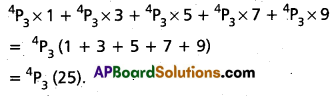
Inter 2nd Year Maths 2A Permutations and Combinations Important Questions 13
Similarly, we get the sum of all digits in 10’s place also as 4P3 × 25. Since it is in 10’s place, its value is
4P3 × 25 × 10.
Like this the values of the sum of the digits in 100’s place and 1000‘s place are respectively
4P3 × 25 × 100 and 4P3 × 25 × 1000.
On adding all these sums, we get the sum of all the 4 digited numbers formed by using the digits 1, 3, 5, 7, 9. Hence the required sum is
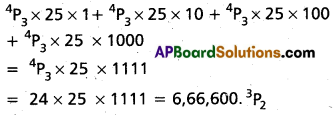
Inter 2nd Year Maths 2A Permutations and Combinations Important Questions 14

Question 39.
How many four digited numbers can be formed using the digits 1, 2, 5, 7, 8, 9 ? How many of them begin with 9 and end with 2 ?
Solution:
The number of four digited numbers that can be formed using the given digits 1, 2, 5, 7, 8, 9, is 6P4 = 360. Now, the first place and last place can be filled with 9 and 2 in one way.

Inter 2nd Year Maths 2A Permutations and Combinations Important Questions 15
The remaining 2 places can be filled by the remaining 4 digits 1, 5, 7, 8. Therefore these two places can be filled in 4P2 ways. Hence, the required number of ways 1. 4P2 = 12.

Inter 2nd Year Maths 2A Permutations and Combinations Important Questions

Question 40.
Find the number of injections of a set A with 5 elements to a set B with 7 elements.
Solution:
If a setA has m elements and the set B has n elements (m ≤ n), then the number of injections from A into B = nPm
∴ The number of injections from set A with 5 elements into set B with 7 elements.
= 7P5 = 2,520.

Question 41.
Find the number of ways in which 4 letters can be put in 4 addressed envelopes so that no letter goes into the envelope meant for it.
Solution:
Required number of ways is 4! \(\left(\frac{1}{2 !}-\frac{1}{3 !}+\frac{1}{4 !}\right)\)
= 12 – 4 + 1 = 9

Question 42.
Find the number of 5 letter words that can be formed using the letters of the word ‘MIXTURE’ which begin with an
vowel when repetitions are allowed.
Solution:
The word MIXTURE has 7 letters 3 vowels {E, I, U} and 4 consonants {E, M, R, X} we have to fill up 5 blanks.

Inter 2nd Year Maths 2A Permutations and Combinations Important Questions 16
Fill the first place with one of the 3 vowels in 3 ways.
Each of the remain 4 places can be filled in 7 ways (since repetition is allowed)
∴ The number of 5 letter words
= 3 × 7 × 7 × 7 × 7 = 3 × 74

Question 43.
a) Find the number of functions from a set A with m elements to a set B with n elements.
Solution:
Let A = {a1, a2, ………. am} and
B = {b1, b2, …., bn}.
First, to define the image of a1 we have n choices (any element of B). Then to define the image of a2 we again have n choices (since a1, a2 can have the same image). Thus we have n choices for the image of each of the m elements of the set A. Therefore, the number of different ways of defining the images of elements of A (with images in B) is n × n × …. × n(m times) = nm.

b) Find the number of surjections from a set A with n elements to a set B with 2 elements when n > 1.
Solution:
Let A {a1, a2,….., an} and b = {x, y}. The total number of functions from A to B is 2n For a surjection, both the elements x, y of B must be in the range. Therefore, a function is not a surjection if the range contains only x (or y). There are only two such functions.
Hence, the number of surjections from A to B is 2n – 2.

Question 44.
Find the number of permutations of 4- digit numbers that can be formed using the digits 1, 2, 3, 4, 5, 6 when repetition is allowed.
Solution:
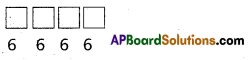
Inter 2nd Year Maths 2A Permutations and Combinations Important Questions 17
The number of permutations of 4 digit numbers that can be formed using the given 6 digits = 6 × 6 × 6 × 6 = 64 = 1,296

Question 45.
Find the number of 4- digit numbers that can be formed using the digits 1, 2, 3, 4, 5, 6 that are divisible by
(i) 2
(ii) 3 when repetition is allowed.
Solution:
(i) Numbers divisible by 2
Take 4 blank palces. First the units place
Inter 2nd Year Maths 2A Permutations and Combinations Important Questions 18
can be filled by an even digit in 3 ways (2 or 4 or 6). The remaining three places can be filled with the 6 digits in 6 ways each. Thus they can be filled in 6 × 6 × 6 = 6 ways.
Therefore, the number of 4 digited numbers divisible by 2 is 3 × 63 = 3 × 216 = 648

ii) Numbers divisible by 3
First we fill up the first 3 places with the given 6 digits in 6 ways.

Inter 2nd Year Maths 2A Permutations and Combinations Important Questions 19
After filling up the first 3 places, if we fill the units place with the given 6 digits, we get 6 consecutive positive integers. Out of these six consecutive integers exactly 2 will be divisible by ‘3’. Hence the units place can be filled in ‘2’ ways. Therefore, the number of 4 digited numbers divisible by 3.
= 63 × 2 = 216 × 2 = 432.

Inter 2nd Year Maths 2A Permutations and Combinations Important Questions

Question 46.
Find the number of 5 – letter words that can be formed using the letters of the word EXPLAIN that begin and end with a vowel when repetitions are allowed.
Solution:
We can fill the first and last places with vowels each in 3 ways. (E or A or I)

Inter 2nd Year Maths 2A Permutations and Combinations Important Questions 20
Now each of the remaining 3 places can be filled in 7 ways (using any letter of given 7 letters). Hence the number of 5 letter words
which begin and end with vowels ¡s
= 32 × 73 = 9 × 343 = 3087

Question 47.
Find the number of ways of arranging the letters of the word SINGING só that
i) they begin and end with I
ii) the two G’s come together .
iii) relative positions of vowels and consonants are not disturbed.
Solution:
The word SINGING has 2 I’s, 2 G’s and 2 N’s and one S. Total 7 letters.

Inter 2nd Year Maths 2A Permutations and Combinations Important Questions 21
i) First, we fill the first and last places with I’s in \(\frac{2 !}{2 !}\) = 1 way as shown below.

Now we fill the remaining 5 places with the remaining 5 letters in \(\frac{5 !}{2 ! 2 !}\) = 30 ways.
Hence the number of required permutations = 30

ii) Treat two G’s as one unit. Then we have 5 letters 2 I’s, 2 N’s and one S + one unit of 2
G’s = 6 can be arranged in \(\frac{6 !}{2 ! 2 !}\) = \(\frac{720}{2 \times 2}\)
= 180 ways.
Now the two G’s among themselves can be arranged in one way. Hence the number of received permutations = 180 × 1 = 180.

Question 48.
Find the number of ways of arranging the letters of the word a4 b3 c5 in its expanded form.
Solution:
The expanded form of a4 b3 c5 is
aaaa bbb ccccc
There are 4 + 3 + 5 = 12 letters
They can be arranged in \(\frac{(12) !}{4 ! 3 ! 5 !}\) ways.

Inter 2nd Year Maths 2A Permutations and Combinations Important Questions

Question 49.
If the letters of the word EAMCET are permuted in all possible ways and if the words thus formed are arranged in the dictionary order, find the rank of the word EAMCET. (A.P. Mar. ’16)
Solution:
The dictionary order of the letters of the word EAMCET is
A C E E M T
In,the dictionary order first gives the words which begin with the letter A.
If we fill the first place with A, remaining 5 letters can be arranged in \(\frac{5 !}{2 !}\) ways (since there
are 2 E’s) on proceeding like this, we get
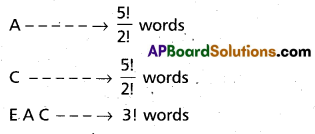
Inter 2nd Year Maths 2A Permutations and Combinations Important Questions 22
Inter 2nd Year Maths 2A Permutations and Combinations Important Questions 23
Hence the rank of the word EAMCET is
= 2 × \(\frac{5 !}{2 !}\) + 2 × 3! + 1
= 120 + 12 + 1 = 133

Question 50.
Find the number of ways of arranging 8 men and 4 women around a circular table. In how many of them
i) all the women come together
ii) no two women come together
Solution:
’Total number of persons = 12 (8 men + 4 women)
Therefore, the number of circular permutations is (11) !

i) Treat the 4 women as one unit. Then we have 8 men + 1 unit of women = 9 entities
which can be arranged around a circle in 8! ways. Now, the 4 women among themselves can be arranged in 4! ways. Thus, the number of required arrangements is 8! × 4!.

ii) First arrange 8 men around a circle in 7! ways. Then there are 8 places in between them as shown in. fig by the symbol x (one place in between any two consecutive men).
Now, the 4 women can be arranged in these 8 places in 8P4 ways.
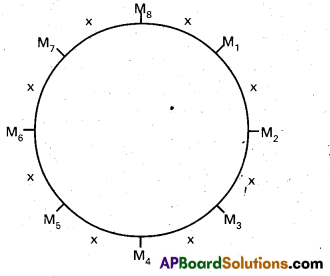
Inter 2nd Year Maths 2A Permutations and Combinations Important Questions 24
Therefore, the number of circular arrangements in which no two women come together is 7! × 8P4.

Question 51.
Find the number of ways of seating 5 Indians, 4 Americans and 3 Russians at a round table so that
i) all Indians sit together
ii) no two Russians sit together
iii) persons of same nationality sit together.
Solution:

i) Treat the 5 Indians as a single unit. Then we have 4 Americans, 3 Russians and 1 unit of Indians. That is, 8 entities in total. Which can be arranged at a round table in (8-1)! = 7! ways.
Now, the 5 Indians among themselves can be arranged in 5! ways. Hence, the number of required arrangements is 7! × 5!

ii) First we arrange the 5 Indians + 4 Americans around the table in (9 – 1) ! = 8! ways.
Now, we can find 9 gaps in between these 9 persons (one gap between any two consecutive persons).
The 3 Russians can be arranged in these 9 gaps in 9P3 ways. Hence, the number of required arrangements is 8! × 9P3.

iii) Treat the 5 Indians as one unit, the 4 Americans as the second unit and the 3 Russians as the third unit. These 3 units can be arranged at round table in (3 – 1)! = 2! ways.

Now, the 5 Indians among themselves can be permuted in 5! ways. Similarly, the 4 Americans in 4! ways and the 3 Russians in 3! ways. Hence the number of required arrangements is 2! × 5! × 4! × 3!

Question 52.
Find the number of different chains that can be prepared using 7 different coloured beads.
Solution:
We know that the number of circular permutations of hanging type that can be formed using n things is \(\frac{1}{2}\) {(n – 1)!}. Hence the number of chains is \(\frac{1}{2}\) {(7 – 1)}{
= \(\frac{1}{2}\) (6!) = 360.

Question 53.
Find the number of different ways of preparing a garland using 7 distinct red roses and 4 distinct yellow roses such that no two yellow roses come together.
Solution:
First arrange 7 red roses in a circular form (garland form) in (7 – 1)! = 6! ways. Now, there are 7 gaps and 4 yellow roses can be arranged in these 7 gaps in 4 7P4 ways.

Thus, the total number of circular permutations is 6! × 7P4.
But, in the case of garlands, clock-wise and anti-clock-wise arrangements look alike. Hence, the number of required ways is.
\(\frac{1}{2}\) (6! × 7P4)

Question 54.
14 persons are seated at a round table. Find the number of ways of selecting two persons out of them who are not seated adjacent to each other.
Solution:
The seating arrangement of given 14 persons at the round table as shown below.
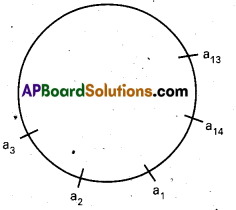
Inter 2nd Year Maths 2A Permutations and Combinations Important Questions 25
Number of ways of selecting 2 persons out of 14 persons = 14C2 = \(\frac{14 \times 13}{1 \times 2}\) = 91.

In the above arrangement two persons sitting adjacent to each other can be selected in 14 ways. (they are a1 a2, a2 a3 , a13 a14, a14 a1)
∴ The required no.of ways = 91 – 14 = 77

Inter 2nd Year Maths 2A Permutations and Combinations Important Questions

Question 55.
Find the number of ways of selecting 4 boys and 3 girls from a group of 8 boys and 5 girls. (T.S. Mar. ’15)
Solution:
4 boys can be selected from the given 8 boys in 8C4 ways and 3 girls can be selected from the given 5 girls in 5C3 ways. Hence, by the Fundamental principle, the number of required selections is
8C4 × 5C3 = 70 × 10 = 700.

Question 56.
Find the number of ways of selecting 4 English, 3 Telugu and 2 Hindi books out of 7 English, 6 Telugu and 5 Hindi books.
Solution:
The number of ways of selecting
4 English books out of 7 books = 7C4
3 Telugu books out of 6 books = 6C3
2 Hindi books out of 5 books = 5C2
Hence, the number of required ways
7C4 × 6C3 × 5C2 = 35 × 20 × 10 = 7000.

Question 57.
Find the number of ways of forming a committee of 4 members out of 6 boys and 4 girls such that there is atleast one girl in the committee.
Solution:
The number of ways of forming a committee of 4 members out of 10 members (6 boys + 4 girls) is 10C4. Out of these, the number of waýs of forming the committee, having no girl is 6C4 (We select all 4 members from boys).
Therefore, the number of ways of forming the committees having atleast one girl is
10C46C4 = 210 – 15 = 195.

Question 58.
Find the number of ways of selecting 11 member cricket team from 7 bats men, 6 bowlers and 2 wicket keepers so that the team contains 2 wicket keepers and atleast 4 bowlers. (Mar. 14)
Solution:
The required cricket team can have the following compositions
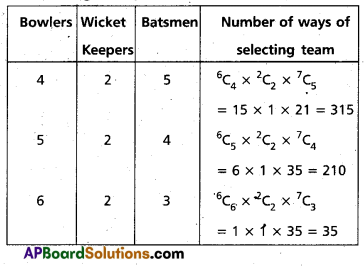
Inter 2nd Year Maths 2A Permutations and Combinations Important Questions 26
Therefore, the number of ways of selecting the required cricket team
= 315 + 210 + 35 = 560.

Question 59.
If a set of ‘n’ parallel lines intersect another set of ‘n’ parallel lines (not parallel to the lines in the first set), then find the number of parallellograms formed in this lattice structure.
Solution:
To form a parallelogram, we hâve to select 2 lines from the first set which can be done in mC2 ways and 2 lines from the second set which can be done in nC2 ways. Thus, The number of parallelograms formed is mC2 × nC2.

Question 60.
There are m points in a plane out of which p points are collinear and no three of the points are collinear unless all the three are from these p points. Find the number of different
i) straight lines passing through pairs of distinct points.
ii) triangles formed by joining these points (by line segments).
Solution:
i) From the given m points, by drawing straight lines passing through 2 distinct points at a time, we are supposed to get mC2 number of lines. But, since p out of these m points are collinear, by forming lines passing through these p points 2 at a time we get only one line instead of getting PC2. Therefore, the number of different lines passing through pairs of distinct points is
mC2PC2 + 1

ii) From the given m points, by joining 3 points at a time, we are supposed to get mC3 number of triangles. Since p out of these m points are collinear by joining these p points 3 at a time we do not get any triangle when as we are supposed to get PC3 number of triangles. Hence the number of triangles formed by joining the given m points
= mC2PC3

Inter 2nd Year Maths 2A Permutations and Combinations Important Questions

Question 61.
A teacher wants to take 10 students to a park. He can take exactly 3 students at a time and will not take the same group of 3 students more than once. Find the number of times
(i) each student can go to the park
(ii) the teacher can go to the park.
Solution:
i) To find the number of times a specific student can go to the park, we have to select 2 more students from the remaining 9 students. This can be done in 9C2 ways.
Hence each student can go to the park 9C2 times = \(\frac{9 \times 8}{1 \times 2}\) = 36 times

ii) The no.of times the teacher can go to park = The no.of different ways of selecting 3 students out of 10 = 10C3 = 120.

Question 62.
A double decker minibus has 8 seats in the lower deck and 10 seats in the upper deck. Find the number of ways of
arranging 18 persons in the bus if 3 children want to go to the upper deck and 4 old people can not go to the upper deck.
Solution:
Allowing 3 children to the upper deck and 4 old people to the lower deck, we are left with 11 people and 11 seats (7 seats in the upper deck and 4 in the lower deck). We can select 7 people for the upper deck out 11 people in 11C7 ways. The remaining 4 persons go to the lower deck.

Now we-can arrange 10 persons (3 children and 7 others) in the upper deck and 8 persons (4 old people and 4 others) in the lower deck in (10)! and (8)! ways respectively. Hence the required number of arrangements = 11C7 × 10! × 8!

Question 63.
Prove that
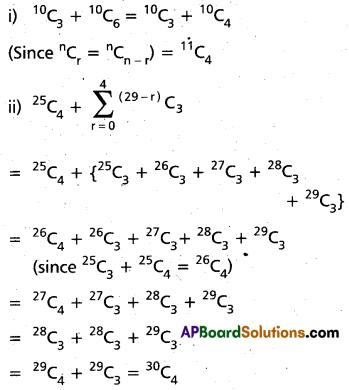
i) 10C3 + 10C6 = 11C4
ii)
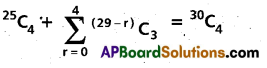
Inter 2nd Year Maths 2A Permutations and Combinations Important Questions 27
Solution:
Inter 2nd Year Maths 2A Permutations and Combinations Important Questions 28

Question 64.
i) If 12C(s + 1) = 12C(2s – 5), then find s. (Mar. ‘11)
ii) If nC21 = nC27 find 49Cn. (Mar. ‘06; May 06)
Solution:
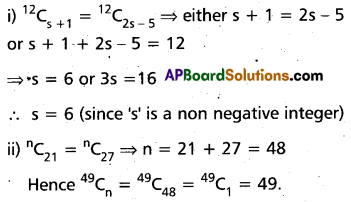
Inter 2nd Year Maths 2A Permutations and Combinations Important Questions 29

Question 65.
If there are 5 alike pens, 6 alike pencils and 7 alike erasers, find the number of ways of selecting any number of (one or more) things out of them.
Solution:
The required number of ways
= (5 + 1 (6 + 1) (7 + 1) – 1 = 335.

Question 66.
Find the number of positive divisors of 1080. (AP. Mar.’16)
Solution:
1080 = 23 × 33 × 51.
∴ The number of positive divisors of 1080
= (3 + 1) (3 + 1) (1 + 1)
= 4 × 4 × 2 = 32.

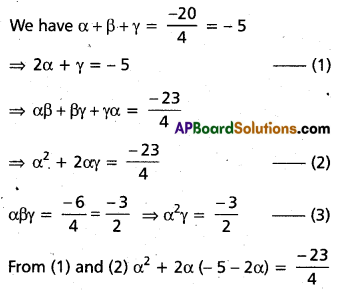
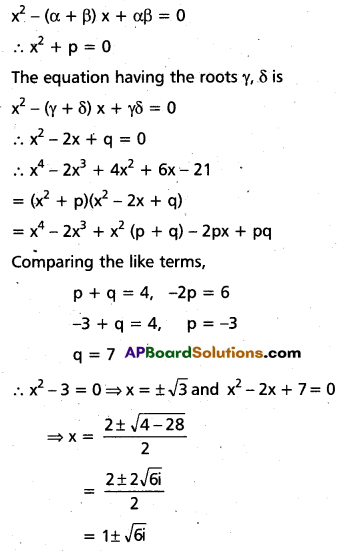
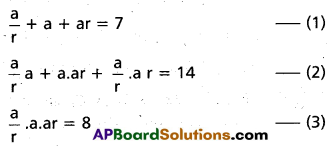
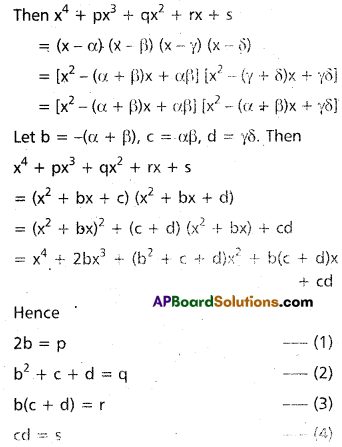
Inter 2nd Year Maths 2A Theory of Equations Important Questions

Students get through Maths 2A Important Questions Inter 2nd Year Maths 2A Theory of Equations Important Questions which are most likely to be asked in the exam.

Intermediate 2nd Year Maths 2A Theory of Equations Important Questions

Question 1.
Form polynomial equation of the lowest degree, with roots 1, -1, 3 (May ’06)
Hint : Equation having roots, α, β, γ is [(x – α)(x – β)(x – γ) = 0
Solution:
Required equation is
(x – 1) (x + 1) (x – 3) = 0
⇒ (x2 – 1) (x – 3) = 0
⇒ -3x2 – x + 3 = 0

Question 2.
If 1, 1 α are the roots of
x3 – 6x2 + 9x – 4 = 0, then find α. (May 11)
Solution:
1, 1, α are roots of x3 – 6x2 + 9x – 4 = 0
Sum = 1 + 1 + α = 6
α = 6 – 2 = 4

Inter 2nd Year Maths 2A Theory of Equations Important Questions

Question 3.
If -1, 2 and α are the roots of 2x3 + x2 – 7x – 6 = 0, then find α (Mar 14, 13)
Solution:
-1, 2, α are roots of 2x3 + x2 – 7x – 6 = 0
sum = -1 + 2 + α = –\(\frac{1}{2}\)
α = –\(\frac{1}{2}\) – 1 = –\(\frac{3}{2}\)

Question 4.
If 1, -2 and 3 are roots of x3 – 2x2 + ax + 6 = 0, then find α. (Mar. ’04,)
Solution:
1, -2 and 3 are roots of x3 + x2 + ax – 6 = 0
x3 – 2x + ax + 6 = 0
⇒ 1(-2) + (-2) 3 + 3. 1 = a
i.e., a = -2 – 6 + 3 = -5

Question 5.
If the product of the roots of 4x3 + 16x2 – 9x – a = 0 is 9, then find a. (TS Mar. ’17, ’16)
Solution:
α, β, γ are the roots of
4x3 + 16x2 – 9x – a = 0
αβγ = \(\frac{a}{4}\) = 9 ⇒ a = 36

Question 6.
Find the transformed equation whose roots are the negative of the roots of
x4 + 5x3 + 11x + 3 = 0
Solution:
Given f(x) = x4 + 5x3 + 11x + 3 = 0
We want an equation whose roots are
1, α2, α3, α4,
Required equation f(-x) = 0
⇒ (-x)4 + 5 (-x)3 + 11 (-x) + 3 = 0
⇒ x4 – 5x3 – 11x + 3 = 0

Question 7.
Form the polynomial equation of degree 3 whose roots are 2, 3 and, 6.
Solution:
The required polynomial equation is,
(x – 2) (x – 3) (x – 6) = 0
⇒ x3 – 11x2 + 36x – 36 = 0

Inter 2nd Year Maths 2A Theory of Equations Important Questions

Question 8.
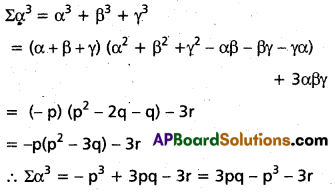
Let α, β, γ be the roots of Σα3
Solution:
Σα3 = α3 + β3 + γ3
= (α + β + γ)
= (α2 + β2 + γ2 – αβ – βγ – γα) + 3αβγ
= (-p)(p2 – 2q – q) – 3r
= -p(p2 – 3q) – 3r
∴ Σα3 = -p3 + 3pq – 3r = 3pq – p3 – 3r

Question 9.
If α, β and 1 are the roots of x3 – 2x2 – 5x + 6 = 0, then find α and β (AP Mår ’16, ’08)
Solution:
α, β and 1 are the roots of
x3 – 2x2 – 5x + 6 = 0
Sum = α + β + 1 = 2 ⇒ α + β = 1
product = αβ = -6
(α – β)2 = (α + β )2 – 4αβ = 1 + 24 = 25
α – β = 5
α + β = 1
Adding 2α = 6 ⇒ α = 3
∴ α = 3 and β = -2

Question 10.
If α, β and γ are the roots of x3 – 2x2 + 3x – 4 = 0, then find
i) Σα2β2
ii) Σαβ (α + β)
Solution:
Since α, β, γ are the roots of
x3 – 2x2 + 3x – 4 = 0
then α + β + γ = 2
αβ + βγ + γα = 3
αβγ = 4

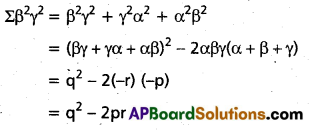
i) Σα2β2 = α2β2 + β2γ2 + γ2α2
= (αβ + βγ + γα)2 – 2αβγ(α + β + γ)
= 9 – 2. 2.4 = 9 – 16 = -7

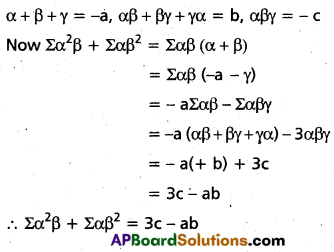
ii) Σαβ (α + β) = α2β + β2γ + γ2α + αβ2 + βγ2 + γα2
= (αβ + βγ + γα)(α + β + γ) – 3αβγ
= 2.3 – 3.4 = 6 – 12 = -6.

Inter 2nd Year Maths 2A Theory of Equations Important Questions

Question 11.
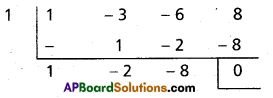
Solve the x3 – 3x2 – 6x + 8 = 0 equation, given that the roots of each are in A.P. (‘Mar. ’07)
Solution:
The roots of x3 – 3x2 – 6x + 8 = 0 are in A.P
Suppose a – d, a, a + d be the roots
Sum = a – d + a + a + d = 3
3a = 3
⇒ a = 1
∴ (x – 1) is a factor of x3 – 3x2 – 6x + 8 = 0
Inter 2nd Year Maths 2A Theory of Equations Important Questions 34
⇒ x2 – 2x – 8 = 0
⇒ x2 – 4x + 2x – 8 = 0
⇒ x(x – 4) + 2(x – 4) = 0
⇒ x = 4, -2
∴ The roots are -2, 1, 4.

Question 12.
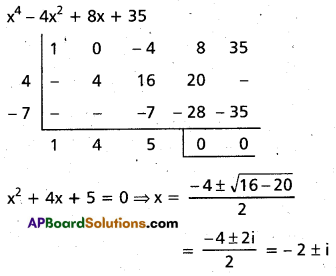
Solve x4 – 4x2 + 8x + 35 = 0, given that 2 + i \(\sqrt{3}\) is a root (AP Mar. ’15)
Solution:
Let 2 + i \(\sqrt{3}\) is one root
⇒ 2 – i \(\sqrt{3}\) is another root.
The equation having roots
2 ± i \(\sqrt{3}\) is x2 – 4x + 7 = 0
∴ x2 – 4x + 7 is a factor of
Inter 2nd Year Maths 2A Theory of Equations Important Questions 35
∴ The roots of the given equation are 2 ± i\(\sqrt{3}\), -2 ± i

Question 13.
Find the polynomial equation whose roots are the reciprocals of the roots of x4 – 3x3 + 7x2 + 5x – 2 = 0 (TS Mar. ’15, ’11)
Solution:
Given equation is
f(x) = x4 – 3x3 + 7x2 + 5x – 2 = 0
Required equation is f(\(\frac{1}{x}\)) = 0
i.e. \(\frac{1}{x^{4}}\) – \(\frac{3}{x^{3}}\) + \(\frac{7}{x^{2}}\) + \(\frac{5}{x}\) – 2 = 0
Multiplying with x4
⇒ 1 – 3x + 7x2 + 5x3 – 2x4 = 0
i.e., 2x4 – 5x3 – 7x2 + 3x – 1 = 0

Question 14.
Find the polynomial equation whose roots are the translates of those of x5 – 4x4 + 3x2 – 4x + 6 = 0 by -3. (TS Mar. 16)
Solution:
Given equation is
f(x) = x5 – 4x4 + 3x2 – 4x + 6 = 0
Required equation is f(x + 3) = 0
(x + 3)5 – 4(x + 3)4 + 3(x + 3)2
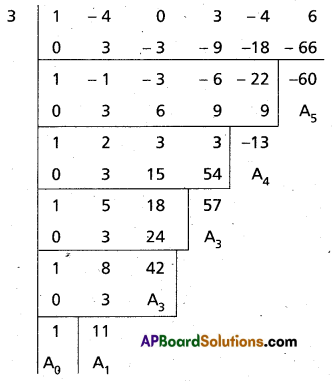
Inter 2nd Year Maths 2A Theory of Equations Important Questions 36
Required equation is
x5 + 11x4 + 42x3 + 57x2 – 13x – 60 = 0

Inter 2nd Year Maths 2A Theory of Equations Important Questions

Question 15.
Show that x5 – 5x3 + 5x2 – 1 = 0 has three equal roots and find this root. (TS Mar. ’17)
Solution:
Let f(x) = x5 – 5x3 + 5x2 – 1
f'(x) = 5x4 – 15x2 + 10x
= 5x (x3 – 3x + 2)
f'(1) = 5(1) (1 – 3 + 2) = 0
f(1) = 1 – 5 + 5 – 1 = 0
x – 1 is a factor of f'(x) and f(x)
∴ 1 is a repeated’ root of f(x).
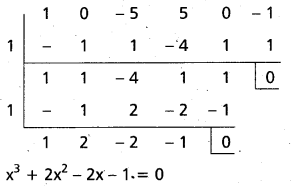
Inter 2nd Year Maths 2A Theory of Equations Important Questions 37
⇒ 1 is a root of above equation
(∵ sum of the coefficients is zero)
∴ 1 is the required root.

Question 16.
Solve the 8x3 – 36x2 – 18x + 81 = 0 equation, given that the roots of each are in AP. (Mar. 04’)
Soluution:
Given the roots of 8x3 – 36x2 – 18x + 81 = 0 are in AP.
Let the roots be a – d, a, a + d
Sum of the roots = a – d + a + a + d
= \(\frac{36}{8}\) = \(\frac{9}{2}\)
i.e., 3a = \(\frac{9}{2}\) ⇒ a = \(\frac{3}{2}\)
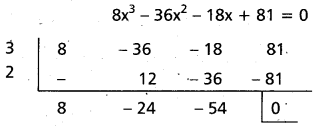
∴ (x – \(\frac{3}{2}\)) is a factor of
Inter 2nd Year Maths 2A Theory of Equations Important Questions 38
⇒ 8x2 – 24x – 54 = 0
⇒ 4x2 – 12x – 27 = 0
⇒ 4x2 – 18x + 6x – 27 = 0
⇒ 2x(2x – 9) + 3 (2x – 9) = 0
⇒ (2x + 3) (2x – 9) = 0
⇒ x = –\(\frac{3}{2}\), \(\frac{9}{2}\)
The roots are –\(\frac{3}{2}\), \(\frac{3}{2}\), \(\frac{9}{2}\)

Question 17.
Solve the 3x3 – 26x2 + 52x – 24 = 0 equations, given that the roots of each are in GP.
(TS Mar. ’15)
Solution:
Given equation is 3x3 – 26x2 + 52x – 24 = 0
The roots are in G.P.
Suppose \(\frac{a}{r}\), a, ar are the roots.
Product = \(\frac{a}{r}\).a.ar = –\(\left(-\frac{24}{3}\right)\)
a3 = 8 ⇒ a = 2
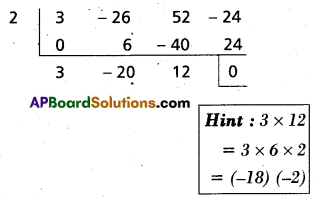
∴ (x – 2) is a factor of 3x3 – 26x2 + 52x – 24
Inter 2nd Year Maths 2A Theory of Equations Important Questions 39
⇒ 3x3 – 20x + 12 = 0
⇒ 3x2 – 18x – 2x + 12 = 0
⇒ 3x (x – 6) -2 (x – 6) = 0
⇒ (3x – 2)(x – 6) = 0
⇒ x = \(\frac{2}{3}\), 6
∴ The roots are \(\frac{2}{3}\), 2, 6.

Question 18.
Solve 18x3 + 81x2 + 121x + 60 = 0 given that one root is equal to half the sum of the
remaining roots. (May ’11; Mar. ’05)
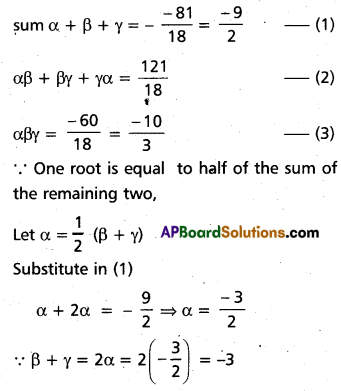
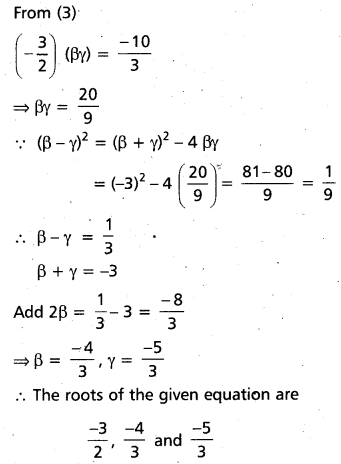
Solution:
Suppose α, β, γ are the roots of 18x3 + 81x2 + 121x + 60 = 0.
Inter 2nd Year Maths 2A Theory of Equations Important Questions 40
Inter 2nd Year Maths 2A Theory of Equations Important Questions 41

Inter 2nd Year Maths 2A Theory of Equations Important Questions

Question 19.
Solve the equation
2x5 + x4 – 12x3 – 12x2 + x + 2 = 0 (AP Mar.17, 16; Mar. ‘08, 07)
Solution:
Given f(x) = 2x5 + x4 – 12x3 – 12x2 + x + 2 = 0
This is an odd degree reciprocal equation of first type.
∴ -1 is a root.
Dividing f(x) with x + 1
Inter 2nd Year Maths 2A Theory of Equations Important Questions 42
Dividing f(x) by (x + 1) we get
2x4 – x3 – 11x2 – x + 2 = 0
Dividing by x2
Inter 2nd Year Maths 2A Theory of Equations Important Questions 43
Substituting in (1), required equation is
2(a2 – 2) – a – 11 = 0 .
2a2 – 4 – a – 11 = 0
2a2 – a – 15 = 0
(a – 3)(2a + 5) = 0
a = 3 or \(-\frac{5}{2}\)
Case (i) a = 3
Inter 2nd Year Maths 2A Theory of Equations Important Questions 44

Question 20.
Find the roots of
x4 – 16x3 + 86x2 – 176x + 105 = 0
Solution:
Let f(x) = x4 – 16x3 + 86x2 – 176x + 105
Now, f(1) = 1 – 16 + 86 – 176 + 105 = 0
∴ 1 is a root of f(x) = 0
⇒ x – 1 is a factor of f(x)
Inter 2nd Year Maths 2A Theory of Equations Important Questions 45
∴ f(x) = (x – 1) (x3 – 15x2 + 71x – 105)
= (x – 1) g(x) where
g(x) = x3 – 15x2 + 71x – 105
g(1) = 1 – 15 + 71 – 105 = -48 ≠ 0
g(2) = -15 ≠ 0
g(3) = 27 – 135 + 213 – 105 = 0
∴ 3 is a root of g(x) =0
⇒ x – 3 is a factor of g(x)
Inter 2nd Year Maths 2A Theory of Equations Important Questions 46
∴ g(x) = (x – 3) (x2 – 12x + 35)
= (x – 3) (x – 5) (x – 7)
∴ f(x) = (x – 1) (x – 3) (x – 5) (x – 7)
∴ 1, 3, 5, 7 are the roots of f(x) = 0.

Question 21.
Solve 4x3 – 24x2 + 23x + 18 = 0, given that the roots of this equation are in arithmetic progression (Mar. ’14; May ’06)
Solution:
Let a – d, a, a + d are the roots of the given equation
Now, sum of the roots
a – d + a + a + d = \(\frac{24}{4}\)
3a = 6
a = 2
Product of the roots (a – d) a (a + d) = \(-\frac{18}{4}\)
a(a2 – d) = \(-\frac{9}{2}\)
2(4 – d2) = \(-\frac{9}{2}\)
4(4 – d2) = -9
16 – 4d2 = -9
4d2 = 25
d = ±\(\frac{5}{2}\)
∴ roots are –\(\frac{1}{2}\), 2 and \(\frac{9}{2}\)

Question 22.
Find the polynomial equation whose roots are the squares of the roots of x5 + 4x3 – x2 + 11 = 0 by -3. (Mar. ’06)
Solution:
Let f (x) ≡ x5 + 4x3 – x2 + 11
The required equation is f(x + 3) = 0
Inter 2nd Year Maths 2A Theory of Equations Important Questions 47
The required equation is
x5 + 15x4 + 94x3 + 305x2 + 507x + 353 = 0

Inter 2nd Year Maths 2A Theory of Equations Important Questions

Question 23.
Solve the equation 6x4 – 35x3 + 62x2 – 35x + 6 = 0. (May. 13)
Solution:
We observe that the given equation is an even degree reciprocal equation of class one. On dividing both sides of the given equation by x2, we get
Inter 2nd Year Maths 2A Theory of Equations Important Questions 48
Then the above equation reduces to
6(y2 – 2) – 35y + 62 = 0
i.e., 6y2 – 35y + 50 = 0
i.e., (2y – 5)(3y – 10) = 0.
Hence the roots of 6y2 – 35y + 50 = 0 are \(\frac{5}{2}\) and \(\frac{10}{3}\).
Inter 2nd Year Maths 2A Theory of Equations Important Questions 49
Hence the roots of the given equation are \(\frac{1}{2}\), \(\frac{1}{3}\), 2 and 3.

Question 24.
Solve x5 – 5x4 + 9x3 – 9x2 + 5x – 1 = 0. (Mar. ’13)
Solution:
Given equation is
x5 – 5x4 + 9x3 – 9x2 + 5x – 1 = 0 is a reciprocal equation of odd degree and of class two.
∴ 1 is a root of the given equation.
⇒ (x – 1) is a factor of
x5 + 4x3 + 5x2 – 4x2 + 1 = 0
Inter 2nd Year Maths 2A Theory of Equations Important Questions 50
Inter 2nd Year Maths 2A Theory of Equations Important Questions 51

Question 25.
Form the polynomial equation of degree 3 whose roots are 2, 3 and 6. (Mar. ’02)
Solution:
The required polynomial equation is,
(x – 2) (x – 3)(x – 6) = 0
⇒ x3 – 11x3 + 36x – 36 = 0

Question 26.
Find the relation between the roots and the coefficients of the cubic equation
3x3 – 10x2 + 7x + 10 = 0.
Solution:
3x3 – 10x2 + 7x + 1o = 0 ———- (1)
On.comparing (1) with
ax3 + bx2 + cx + d = 0,
we have
Inter 2nd Year Maths 2A Theory of Equations Important Questions 1

Inter 2nd Year Maths 2A Theory of Equations Important Questions

Question 27.
Write down the relations between the roots and the coefficients of the bi-quadratic equation.
x4 – 2x3 + 4x2 + 6x – 21 = 0
Solution:
Given equation is
x4 – 2x3 + 4x2 + 6x – 21 = 0 —— (1)
On comparing (1) with
ax4 + bx3 + cx2 + dx + c = 0,
we have
Inter 2nd Year Maths 2A Theory of Equations Important Questions 2

Question 28.
If 1, 2, 3 and 4 are the roots of x4 + ax3 + bx2 + cx + d = 0, then find the
values of a, b, c and d.
Solution:
Given that the roots of the given equation are 1, 2, 3 and 4. Then
x4 + ax3 + bx2 + cx + d
≡ (x – 1) (x – 2) (x – 3) (x – 4) = 0
≡ x4 – 10x3 + 35x2 – 50x + 24 = 0
On equating the coefficients of like powers of x, we obtain
a = -10, b = 35, c = -50, d = 24

Question 29.
if a, b, c are the roots of
x3 – px2 + qx- r = 0 and r ≠ 0, then find \(\frac{1}{\mathbf{a}^{2}}+\frac{1}{\mathbf{b}^{2}}+\frac{1}{\mathrm{c}^{2}}\) interms of p, q, r.
Solution:
Given that a, b, c are the roots of
x3 – px2 + qx – r = 0, then
a + b + c = p, ab + bc + ca = q, abc = r
Inter 2nd Year Maths 2A Theory of Equations Important Questions 4

Question 30.
Find the sum of the squares and the sum of the cubes of the roots of the equation x3 – px2 + qx – r = 0 in terms of p, q, r.
Solution:
Let α, β, γ be the roots of the given equation then α + β + γ = p, αβ + βγ + γα = q, αβγ = r
Sum of the squares of the roots is α2 + β2 + γ2
= (α + β + γ)2 – 2(αβ + βγ + γα) = p2 – 2q
Sum of the cubes of the roots is α3 + β3 + γ3
= (α + β + γ) (α2 + β2 + γ2 – αβ – βγ – γα) + 3αβγ
= p(p2 – 2q – q) + 3r
= p(p2 – 3q) + 3r

Question 31.
Obtain the cubic equation, whose roots are the sqüares of the roots of the equation, x3 + p1x2 + P2x + p3 = 0
Solution:
The required equation is, f(\(\sqrt{x}\)) =0
Inter 2nd Year Maths 2A Theory of Equations Important Questions 5

Question 32.
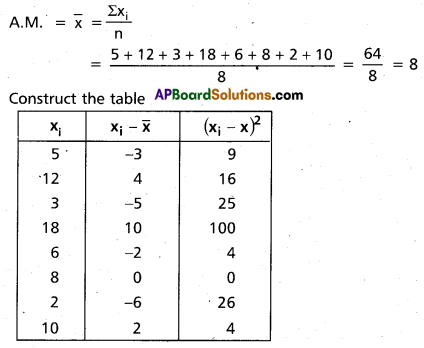
Let α, β, γ be the roots of
x3 + px2 + qx + r = 0. Then find the
i) Σα2
ii) Σ\(\frac{1}{\alpha}\)
iii) Σα3
iv) Σβ2γ2
v) Σ(α + β) (β + γ) (γ + α)
Solution:
since α, β, γ are the roots of the equation, we have α + β + γ = – p,
αβ + βγ + γα = q, αβγ = -r.

i) Σα2
Solution:
Σα2 = α2 + β2 + γ2
= (α + β + γ) – 2(αβ + βγ + γα)
= p2 – 2q

ii) Σ\(\frac{1}{\alpha}\)
Solution:
Inter 2nd Year Maths 2A Theory of Equations Important Questions 6

Inter 2nd Year Maths 2A Theory of Equations Important Questions

iii) Σα3
Solution:
Inter 2nd Year Maths 2A Theory of Equations Important Questions 7

iv) Σβ2γ2
Solution:
Inter 2nd Year Maths 2A Theory of Equations Important Questions 8

v) (α + β) (β + γ) (γ + α)
Solution:
We know, α + β + γ = -p
⇒ α + β = -p – r and β + γ = -p – α
= γ + α = -p – β
∴ (α + β) (β + γ)(γ + α)
= (-p – γ) (-p – α) (-p – β)
= -p3 – p2(α + β + γ) – p(αβ + βγ + γα) – αβγ
= -p3 + p3 – pq + r = r – pq .

Question 33.
Let α, β, γ be the roots of
x3 + ax2 + bx + c = 0 then find Σα2 + Σβ2
Solution:
Since α, β, γ are roots of the given equation,
Inter 2nd Year Maths 2A Theory of Equations Important Questions 9

Question 34.
If α, β, γ are the roots of x3 + px2 + qx + r = 0, then form the cubic equation whose roots are .
α(β + γ), β(γ + α), γ(α + β)
Solution:
Let α, β, γ be the roots of the given equation.
we have, α + β + γ = – p, αβ + βγ + γα = q, αβγ = -r
Let y = α(β + γ)
= αβ + αγ + γβ – βγ
Inter 2nd Year Maths 2A Theory of Equations Important Questions 10

Inter 2nd Year Maths 2A Theory of Equations Important Questions

Question 35.
Solve x3 – 3x2 – 16x + 48 = 0
Solution:
Let f(x) = x3 – 3x2 – 16x + 48
by inspection, f(3) = 0
Hence 3 is a root of 1(x) = 0
Now we divide f(x) by (x – 3)
Inter 2nd Year Maths 2A Theory of Equations Important Questions 11

Question 36.
Find the roots of
x4 – 16x3 + 86x2 – 176x + 105 = 0 (Mar. ‘02)
Solution:
Let f(x) = x4 – 16x3 + 86x2 – 176x + 105
Now if (1) = 1 – 16 + 86 – 176 + 105 = 0
∴ 1 is a root of f(x) = 0
⇒ x – 1 is a factor of f(x)
Inter 2nd Year Maths 2A Theory of Equations Important Questions 12
∴ g(x) = (x – 3)(x2 – 12x + 35)
= (x – 3) (x – 5) (x – 7)
∴ f(x) = (x – 1) (x – 3) (x – 5) (x – 7)
∴ 1, 3, 5, 7 are the roots of f(x) = 0.

Question 37.
Solve x3 – 7x2 + 36 = 0, given one root being twice the other.
Solution:
Let α, β, γ be the root of the equation
x3 – 7x2 + 36 = 0 and
let β = 2α
Now, we have, α + β + γ = 7
⇒ 3α + γ = 7 —— (1)
αβ + βγ + γα = 0
⇒ 2α2 + 3αγ = 0 —— (2)
αβγ = -36 ⇒ 2α2γ = -36 —— (3)
From (1) and (2), we have
2 + 3α(7 – 3α) = 0
i.e., α2 – 3α = 0 (or) α(α – 3) = 0
∴ α = 0 or α = 3
Since α = 0 does not satisfy the given equation.
∴ α = 3, so β = 6 and γ = -2
∴ The roots are 3, 6, -2.

Question 38.
Given that 2 is a root of
x3 – 6x2 + 3x + 1o = 0, find the other roots.
Solution:
Let f(x) = x3 – 6x2 + 3x + 10
Since 2 is a root of f(x) = 0, we divide f(x) by (x – 2)
Inter 2nd Year Maths 2A Theory of Equations Important Questions 13
∴ -1, 2, and 5 are the roots of the given equation.

Question 39.
Given that two roots of
4x3 + 20x2 – 23x + 6 = 0 are equal, find all the roots of the given equation.
Solution:
Let α, β, γ are the roots of
4x3 + 20x2 – 23x + 6 = 0
Given two roots are equal, let α = β
Inter 2nd Year Maths 2A Theory of Equations Important Questions 14
⇒ 12α2 + 4α – 23 = 0
⇒ (2α – 1) (6α + 23) = 0
α = \(\frac{1}{2}\), α = \(\frac{-23}{6}\)
On verfication, we get that is a root of (1)
α = \(\frac{1}{2}\) is roots of (1)
(2) ⇒ roots are \(\frac{1}{2}\), \(\frac{1}{2}\), -6

Inter 2nd Year Maths 2A Theory of Equations Important Questions

Question 40.
Given that the sum of two roots of
x4 – 2x3 + 4x2 + 6x – 21 = 0 is zero find the roots of the equation.
Solution:
Let α, β, γ, δ are the roots of given equation, since sum of two is zero.
α + β = 0
Now α + β + γ + δ = 2 ⇒ γ + δ = 2
Let αβ = p, γδ = q
The equation having the roots α, β is
Inter 2nd Year Maths 2A Theory of Equations Important Questions 15
∴ Roots are –\(\sqrt{3}\), \(\sqrt{3}\), 1 – i \(\sqrt{6}\) and 1 + i \(\sqrt{6}\)

Question 41.
Solve 4x3 – 24x2 + 23x + 18 = 0, given that the roots of this equation are in arithmetic progression. (Mar. 14, May ‘06)
Solution:
Let a – d, a, a + d are the roots of the given equation
Now, sum of the roots
a – d + a + a + d = \(\frac{24}{4}\)
3a = 6
a = 2
Product of the roots (a – d) a (a + d) = \(\frac{-18}{4}\)
a(a2 – d2) = \(\frac{-9}{2}\)
2(4 – d2) = \(\frac{-9}{2}\)
4(4 – d2) = -9
16 – d2 = -9
4d2 = 25
d = ± \(\frac{5}{2}\)
∴ roots are –\(\frac{1}{2}\), 2 and \(\frac{9}{2}\)

Question 42.
Solve x3 – 7x2 + 14x – 8 = 0, given that the roots are in geometric progression.
Solution:
Let \(\frac{a}{r}\), a, ar be the roots of the given equation. Then .
Inter 2nd Year Maths 2A Theory of Equations Important Questions 16
Hence a = 2. On substituting a = 2 in (1), we obtain
\(\frac{2}{r}\) + 2 + 2r = 7
i.e., 2r2 – 5r + 2 = 0
i.e., (r – 2) (2r – 1) = 0
Therefore r = 2 or r = \(\frac{1}{2}\)
Hence the roots of the given equation are 1, 2 and 4.

Question 43.
Solve x4 – 5x3 + 5x2 + 5x – 6 = 0 given that the product of two of its roots is 3.
Solution:
Let α, β, γ, δ be the roots of the given equation.
Product of the roots αβγδ = -6
Given αβ = 3 (∵ Product of two roots is 3)
∴ α, β, γ, δ = -6
γδ = -2
Let α + β, γ + δ = q
The equation having the roots α,β is
x2 – (α + β) x + αβ = 0
x2 + px + 3 = 0
The equation having the roots γ, δ is
x2 – (γ + δ)x + γδ = 0
x2 – qx – 2 = 0
∴ x4 – 5x3 + 5x2 + 5x – 6
= (x2 – px + 3)(x2 – qx – 2)
= x4 – (p + q)x3 + (1 + pq)x2 + (2p – 3q)x – 6
Comparing the like terms,
p + q = 5, 2p – 3q = 5
∴ 2p – 3q = 5
3p + 3q = 15
5p = 20 ⇒ p = 4
∴ q = 1
Now x2 – 4x + 3 = 0 ⇒ (x – 3)(x – 1) = 0
⇒ x = 1, 3
x2 – x – 2 = 0 ⇒ (x – 2)(x + 1) = 0
⇒ x = -1, 2
∴ The roots are -1, 2, 1, 3

Inter 2nd Year Maths 2A Theory of Equations Important Questions

Question 44.
Solve x6 + 4x3 – 2x2 – 12x + 9 = 0, Given that it has two pairš of equal roots.
Solution:
Given equation is
x4 + 4x3 – 2x2 – 12x + 9 = 0
Let the roots be α, α, β, β
Sum of the roots, 2(α + β) = -4
⇒ α + β = -2
Let αβ = p
The equation having roots α, β is
x2 – (α + β)x + αβ = 0
i.e. x2 + 2x + p = 0
∴ x4 + 4x3 – 2x2 – 12x + 9
= [x2 – (α + β)x + αβ]2
= (x2 + 2x + p)2
= x4 + 4x3 + (2p + 4)x2 + 4px + p2
Comparing coefficients of x on both sides
4p = -12 ⇒ p = – 3
x2 + 2x + p = 0 ⇒ x2 + 2x – 3 = 0
⇒ (x + 3)(x – 1) = 0
⇒ x = -3, 1
∴ The roots of the given equation are -3, -3, 1, 1

Question 45.
Prove that the sum of any two of the roots of the equation x4 + px3 + qx2 + rx + s = 0 is equal to the sum of the remaining two roots of the equation iff p3 – 4pq + 8r = 0.
Solution:
Suppose that the sum of two of the roots of the given equation is equal to the sum of the remaining two roots.
Let α, β, γ, δ be roots of the given equation such that α + β = γ + δ
Inter 2nd Year Maths 2A Theory of Equations Important Questions 17
From these equations, we have
Inter 2nd Year Maths 2A Theory of Equations Important Questions 18
Then equations (1), (2) and (4) are satisfied. In view of (5), equation (3) is also satisfied. Hence (x2 + bx + c)(x2 + bx + d) = x4 + 2bx3 + (b2 + c + d)x2 + b(c + d)x + cd = x4 + px3 + qx2 + rx + s
Hence the roots of the given equation are α1, β1, γ1 and δ1. where α1 and β1 are the roots of the equations x2 + bx + c = 0 and γ1 and δ1 are those of the equation x2 + bx + d = 0.
We have α1 + β1 = -b = γ1 + δ1.

Question 46.
Form the polynomial equation of degree 4 whose roots are
4 + \(\sqrt{3}\), 4 – \(\sqrt{3}\), 2 + i and 2 – i
Solution:
The equation having roots 4 + \(\sqrt{3}\), 4 – \(\sqrt{3}\) is
x2 – 8x + 13 = 0
The equation having roots 2 + i, 2 – i is
x2 – 4x + 5 = 0.
The required equation is
(x2 – 8x + 13) (x2 – 4x + 5) = 0
∴ x4 – 12x3 + 50x2 – 92x + 65 = 0

Question 47.
Solve 6x4 – 13x3 – 35x2 – x + 3 = 0 given that one of its root is 2 + \(\sqrt{3}\).
Solution:
2 + \(\sqrt{3}\) is a root 2 – \(\sqrt{3}\) is also a root.
The equation having roots
Inter 2nd Year Maths 2A Theory of Equations Important Questions 19

Question 48.
Find the polynomial equation of degree 4 whose roots are the negatives of the roots of x4 – 6x3 + 7x2 – 2x + 1 = 0
Solution:
Let f(x) ≡ x4 – 6x3 + 7x2 – 2x + 1
The required equation is f(-x) = 0
i.e., (-x)4 – 6(-x)3 + 7(-x)2 + 2(-x) + 1 = 0
∴ x4 + 6x3 + 7x2 + 2x + 1 = 0

Question 49.
Find the algebraic equation of the degree 4 whose roots are 3 times the roots of the equation
6x4 – 7x3 + 8x2 – 7x + 2 = 0
Solution:
Let f(x) ≡ 6x4 – 7x3 + 8x2 – 7x +2
The required equation is f\(\left(\frac{x}{3}\right)\) = o
Inter 2nd Year Maths 2A Theory of Equations Important Questions 20

Question 50.
Form the equation whose roots are m times the roots of the equation x3 + \(\frac{x^{2}}{4}\) – \(\frac{x}{16}\) + \(\frac{1}{72}\) = 0 and deduce the case when m = 12.
Solution:
Inter 2nd Year Maths 2A Theory of Equations Important Questions 21

Question 51.
Find the algebraic equation of degree 5 whose roots are the translates of the roots of x5 + 4x3 – x2 + 11 = 0 by -3. (Mar. ’06)
Solution:
Let f (x) ≡ x5 + 4x3 – x2 + 11
The required equation is f(x + 3) = 0
Inter 2nd Year Maths 2A Theory of Equations Important Questions 22
The required equation is
x5 + 15x4 + 94x3 + 305x2 + 507x + 353 = 0

Question 52.
Find the algebraic equation of degree 4 whose roots are the translates of the roots
4x4 + 32x3 + 83x2 + 76x + 21 = 0 by 2.
Solution:
Let f(x) ≡ 4x4 + 32x3 + 83x2 + 76x + 21
The required equation is f(x – 2) = 0
Inter 2nd Year Maths 2A Theory of Equations Important Questions 23
The required equation is
4x4 – 13x2 + 9 = 0

Question 53.
Find the polynomial equation whose roots are the reciprocals of the roots of the equation
x4 + 3x3 – 6x2 + 2x -4 = 0
Solution:
Let f(x) ≡ x4 + 3x3 – 6x2 + 2x – 4
Inter 2nd Year Maths 2A Theory of Equations Important Questions 24

Question 54.
Find the polynomial equation whose roots are the squares of the roots of x3 – x2 + 8x – 6 = 0
Solution:
Let f(x) ≡ x3 – x2 + 8x – 6 .
The required equation is f(\(\sqrt{x}\)) = o
Inter 2nd Year Maths 2A Theory of Equations Important Questions 26
Squaring on both sides
⇒ x(x2 + 16x + 64) = x2 + 12x + 36
= x3 + 6x2 + 64x – x2 – 12x – 36 = 0
∴ x3 + 15x2 + 52x – 36 = 0

Inter 2nd Year Maths 2A Theory of Equations Important Questions

Question 55.
Show that 2x3 + 5x2 + 5x + 2 = 0 is a reciprocal equation of class one.
Solution:
Given equation is 2x3 + 5x2 + 5x + 2 = 0
P0 = 2, p1 = 5, P2 = 5, p3 = 2
Here P0 = p3, p1 = p2
∴ The equation 2x3 + 5x2 + 5x + 2 = 0 is a reciprocal equation of class one.

Question 56.
Solve the equation
4x3 – 13x2 – 13x + 4 = 0
Solution:
4x3 – 13x2 – 13x + 4 = 0 is a reciprocal equation of first class and of odd degree.
Thus -1 is a root of the 9iven equation.
Inter 2nd Year Maths 2A Theory of Equations Important Questions 27
4x2 – 17x + 4 = 0 ⇒ 4x2 – 16x – x + 4 = 0
⇒ 4x(x – 4) – 1 (x – 4) = 0
⇒ (x – 4)(4x – 1) = 0
⇒ x = 4 or \(\frac{1}{4}\)
The roots are -1, 4, \(\frac{1}{4}\)

Question 57.
Solve the equation 6x4 – 35x3 + 62x2 – 35x + 6 = 0. (May ‘13)
Solution:
We observe that the given equation is an even degree reciprocal equation of class one.
On dividing both sides 6f the given equation by x2, we get
Inter 2nd Year Maths 2A Theory of Equations Important Questions 28
Then the above equation reduces to
6(y2 – 2) – 35y + 62 = 0
i.e., 6y2 – 35y + 50 = 0
i.e., (2y – 5) (3y – 10) = 0.
Hence the roots of 6y2 – 35y + 50 = 0 are \(\frac{5}{2}\) and \(\frac{10}{3}\).
Therefore x + \(\frac{1}{x}\) = \(\frac{5}{2}\) and x + \(\frac{1}{x}\) = \(\frac{10}{3}\)
i.e., 2x2 – 5x + 2 = 0 and 3x2 – 10x + 3 = 0.
The roots of these equations are respectively
Inter 2nd Year Maths 2A Theory of Equations Important Questions 29
Hence the roots of the given equation are \(\frac{1}{2}\), \(\frac{1}{3}\), 2 and 3.

Question 58.
Solve x5 – 5x4 – 9x3 – 9x2 + 5x – 1 = 0. (Mar ’13)
Solution:
Given equation is
x5 – 5x4 + 9x3 – 9x2 + 5x – 1 = 0 is a reciprocal equation’of odd degree and of class two.
∴ 1 is a root of the given equation.
⇒ (x – 1) is a factor of
x5 – 5x4 + 9x3 – 9x2 + 5x – 1 = 0
Inter 2nd Year Maths 2A Theory of Equations Important Questions 30
Inter 2nd Year Maths 2A Theory of Equations Important Questions 31

Question 59.
Solve the equation
6x6 – 25x5 + 31x4 – 31x2 + 25x – 6 = 0
Solution:
Given equation is
6x6 – 25x5 + 31x4 – 31x2 + 25x – 6 = 0 is a reciprocal equation of second class and of even degree.
∴ x2 – 1 is a factor of
6x6 – 25x5 + 31x4 – 31x2 + 25x – 6 = 0
Inter 2nd Year Maths 2A Theory of Equations Important Questions 32
∴ (1) becomes 6(y2 – 2) – 25(y) + 37 = 0
⇒ 6y2 – 12 – 25y + 37 = 0
⇒ 6y2 – 25y + 25 = 0
⇒ 6y2 – 15y – 10y + 25 = 0
⇒ 3y(2y – 5) – 5(2y – 5) = 0
⇒ (2y – 5)(3y – 5) = 0
Inter 2nd Year Maths 2A Theory of Equations Important Questions 33

Inter 2nd Year Maths 2A De Moivre’s Theorem Important Questions

Students get through Maths 2A Important Questions Inter 2nd Year Maths 2A De Moivre’s Theorem Important Questions which are most likely to be asked in the exam.

Intermediate 2nd Year Maths 2A De Moivre’s Theorem Important Questions

Question 1.
Find the value of (1 – i)(Mar. ’07)
Solution:
Inter 2nd Year Maths 2A De Moivre’s Theorem Important Questions 1

Question 2.
If x = cis θ, then find the value of [x6 + \(\frac{1}{x^{6}}\)]
Solution:
∵ x = cos θ + i sin θ
⇒ x6 = (cos θ + i sin θ)6
= cos 6θ + i sin 6θ
⇒ \(\frac{1}{x^{6}}\) = cos 6θ – i sin 6θ
∴ x6 + \(\frac{1}{x^{6}}\) = 2 cos 6θ

Inter 2nd Year Maths 2A De Moivre’s Theorem Important Questions

Question 3.
If A, B, C are angles of a triangle such that x = cis A, y = cis B, z = cis C, then find the value of XYZ. (AP Mar. ‘16, ’15)
Solution:
∴ A, B, C are angles of a triangle
⇒ A + B + C = 180° ——- (1)
x = cis A, y = cis B, Z = cis C
⇒ xyz = cis(A + B + C)
= cos(A + B + C) + i sin(A + B + C)
= cos(180°) + i sin (180°) .
= -1 + i(0) = -1
∴ xyz = -1

Question 4.
If 1, ω, ω2 are the cube roots of unity, then prove that \(\frac{1}{2+\omega}\) – \(\frac{1}{1+2 \omega}\) = \(\frac{1}{1+\omega}\)
Solution:
ω is a cube root of unity
1 + ω + ω2 = 0 and ω3 = 1
Inter 2nd Year Maths 2A De Moivre’s Theorem Important Questions 2
Inter 2nd Year Maths 2A De Moivre’s Theorem Important Questions 3

Question 5.
(2 – ω) (2 – ω2) (2 – ω10) (2 – w11) = 49. (TS Mar. ’17)
Solution:
∵ 1, ω, ω2 are the cube roots of unity,
ω3 = 1 and 1 + ω + ω2 = 0
2 – ω10 = 2 – ω9 . ω
= 2 – (ω3)3 . ω2
= 2 – (1)3 ω2 = 2 – ω2
(2 – ω)(2 – ω2) = 4 – 2ω – 2ω2 + ω3
= 4 – 2(ω + ω2) + 1
= 4 – 2(-1) + 1
= 4 + 2 + 1 = 7
∴ (2 – ω)(2 – ω2)(2 – ω10)(2 – ω11)
= (2 – ω) (2 – ω2) (2 – ω) (2 – ω2)
= ((2 – ω) (2 – ω2))2
= 72 = 49

Question 6.
If α, β are the roots of the equation x2 – 2x + 4 = 0 then for any n ∈ N show that αn + βn = 2n + 1 cos \(\left(\frac{n \pi}{3}\right)\) (Mar. ’14)
Solution:
Inter 2nd Year Maths 2A De Moivre’s Theorem Important Questions 4
Inter 2nd Year Maths 2A De Moivre’s Theorem Important Questions 5

Inter 2nd Year Maths 2A De Moivre’s Theorem Important Questions

Question 7.
Show that one value of
Inter 2nd Year Maths 2A De Moivre’s Theorem Important Questions 6
is -1.
Solution:
Inter 2nd Year Maths 2A De Moivre’s Theorem Important Questions 7
Inter 2nd Year Maths 2A De Moivre’s Theorem Important Questions 8
Inter 2nd Year Maths 2A De Moivre’s Theorem Important Questions 9

Question 8.
If n is a positive integer, show that (1 + i)n + (1 – i)n = 2\(\frac{n+2}{2}\) cos \(\left(\frac{\mathrm{n} \pi}{4}\right)\). (A.P) (Mar. ’15)
Solution:
Inter 2nd Year Maths 2A De Moivre’s Theorem Important Questions 10

Inter 2nd Year Maths 2A De Moivre’s Theorem Important Questions

Question 9.
If n is an integer then show that (1 + cos θ + i sin θ)n + (1 + cos θ – i sin θ)n = 2n + 1 cosn (θ/2) cos \(\left(\frac{n \theta}{2}\right)\) (May. ’11) (TS & AP Mar. ’17)
Solution:
L.H.S.
Inter 2nd Year Maths 2A De Moivre’s Theorem Important Questions 11

Question 10.
If cos α + cos β + cos γ = 0 = sin α + sin β + sin γ. Prove that cos2 α + cos2 β + cos2 γ = \(\frac{3}{2}\) = sin2 α + sin2 β + 2 γ. (AP. Mar. ’16; TS Mar. ’15, ‘13)
Solution:
Let x = cos α + i sin α
y = cos β + i sin β
z = cos γ + i sin γ
∴ x + y + z = (cos α + cos β + cos γ) + i(sin α + sin β + sin γ)
= 0 + i. 0 = 0
(x + y + z)2 = 0
⇒ x2 + y2 + z2 + 2(xy + yz + zx) = 0
x2 + y2 + z2 = -2(xy + yz + zx)
Inter 2nd Year Maths 2A De Moivre’s Theorem Important Questions 12
Inter 2nd Year Maths 2A De Moivre’s Theorem Important Questions 13
-i(sin α + sin β + sin γ) = 0 – i. 0 = 0
Substituting in (1)
x2 + y2 + z2 = 0.
(cos α + i sin α)2 + (cos β + i sin β)2 + (cos γ + i sinγ)2 = 0
(cos 2α + i sin 2α) + (cos β + i sin 2β) + (cos 2γ + i sin 2γ) = 0
(cos 2α + cos 2β + cos 2γ) + i (sin 2α + sin 2β + sin 2γ) = 0
Equating real parts
cos 2α + cos 2β + cos 2γ = 0
2cos2α – 1 + 2 cos2β – 1 + 2 cos2γ – 1 = 0
2 (cos2α + cos2β + cos2γ) = 3
cos2α + cos2β + cos2γ = \(\frac{3}{2}\)
2α + cos2β + cos2γ = \(\frac{3}{2}\)
⇒ (1 – sin2α) + (1 – sin2β) + (1 – sin2γ) = \(\frac{3}{2}\)
⇒ sin2α + sin2β + sin2γ = \(\frac{3}{2}\)
∴ cos2α + cos2β + cos2γ = \(\frac{3}{2}\)
= sin2α + sin2β + sin2β

Question 11.
If 1, ω, ω2 are the cube roots of unity prove that
i) (1 – ω + ω2)6 + (1 – ω2 + ω)6 = 128
= (1 – ω + ω2)7 + (1 + ω – ω2)7
ii) (a + b) (aω + bω2) (aω2 + bω) = a3 + b3
iii) x2 + 4x + 7 = 0 where x = ω – ω2 – 2.
Solution:
∵ 1, ω, ω2 are the cube roots of unity
⇒ 1 + ω + ω2 = 0 and ω3 = 1

i) (1 – ω + ω2)6 + (1 – ω2 + ω)6
= (-ω – ω)6 + (-ω2 – ω2)6
= (-2ω)6 + (-2ω2)6
= 266 + ω12)
= 26(1 + 1) = 26 × 2 = 27 = 128

Again (1 – ω + ω2)7 + (1 + ω – ω2)7
= (1 + ω2 – ω)7 + (1 + ω – ω2)7
= ( -ω – ω)7 + (-ω2 – ω2)7
= (-2ω)7 + (-2ω2)7
= (-2)77 + ω14)
= (-2)7 (ω + ω2)
= -(2)7 (-1)
= 27 = 128

ii) (a+b) (a]ω + bω2)(aω2 + bω) (AP) (Mar. ’17)
Solution:
= (a + b) [a2ω3 + abω4)4 + abω2 + b2ω3]
= (a + b) [a2 + ab(ω2 + ω4) + b2]
= (a + b) [a2 + ab(ω2 + ω) + b2]
= (a + b) (a2 – ab + b2) = a3 + b3

Inter 2nd Year Maths 2A De Moivre’s Theorem Important Questions

iii) x = ω – ω2 – 2
⇒ x + 2 = ω – ω2
⇒ (x + 2)2 = ω2 + ω4 – 2ω3
⇒ x2 + 4x + 4 = ω2 + ω – 2
⇒ x2 + 4x + 4 = (-1) – 2 = -3
⇒ x2 + 4x + 7 = 0

Question 12.
Simplify \(\frac{(\cos \alpha+i \sin \alpha)^{4}}{(\sin \beta+i \cos \beta)^{8}}\)
Solution:
Inter 2nd Year Maths 2A De Moivre’s Theorem Important Questions 14
Inter 2nd Year Maths 2A De Moivre’s Theorem Important Questions 15
= (cos α + i sin α)4 (cos β – i sin β)-8 [i8 = (i2)4 = (-1)4 = 1]
= (cos 4α + i sin 4α) (cos 8β + i sin 8β)
= cos (4α + 8β) + i sin (4α + 8β)

Question 13.
If m, n are integers and x = cos α + i sin α, y = cos β + i sin β, then prove that
xm yn + \(\frac{1}{x^{m} y^{n}}\) = 2 cos (mα + nβ) and
xm yn – \(\frac{1}{x^{m} y^{n}}\) = 2i sin (mα + nβ).
Solution:
∵ x = cos α + i sin α, y = cos β + i sin β
⇒ xm = (cos α + i sin α)m = cos mα + i sin mα
yn = (cos β + i sin β)n = cos nβ + i sin nβ
∴ xm yn = (cos mα + i sin mα)(cos nβ + i sin nβ)
= cos (mα + nβ) + i sin (mα + nβ) ——— (1)
\(\frac{1}{x^{m} \cdot y^{n}}\) = cos (mα + nβ) – i sin (mα + nβ) —— (2)
By adding (1) and (2).
xmyn + \(\frac{1}{x^{m} y^{n}}\) = 2 cos (mα + nβ)
By subtracting (2) from (1)
xmyn – \(\frac{1}{x^{m} y^{n}}\) = 2 sin (mα + nβ)

Question 14.
If n is a positive integer, show that (1 + i)n + (1 – i)n = 2\(\frac{n+2}{2}\) cos \(\left(\frac{n \pi}{4}\right)\) (A.P.) (Mar. ‘15)
Solution:
Inter 2nd Year Maths 2A De Moivre’s Theorem Important Questions 16
Inter 2nd Year Maths 2A De Moivre’s Theorem Important Questions 17

Question 15.
If n is an integer then show that (1 + cos θ + i sin θ)n + (1 + cos θ – i sin θ)n = 2n + 1 + cosn (θ/2) cos \(\left(\frac{\mathrm{n} \theta}{2}\right)\). (May ’11)
Solution:
L.H.S.
Inter 2nd Year Maths 2A De Moivre’s Theorem Important Questions 18

Inter 2nd Year Maths 2A De Moivre’s Theorem Important Questions

Question 16.
If cos α + cos β + cos γ = 0 = sin α + sin β + sin γ, Prove that cos2 α + cos2 β + cos2 γ = \(\frac{3}{2}\) = sin2 α +
sin2 β + sin2 γ. (A.P. Mar. ‘16, T.S. Mar. ‘15, ’13)
Solution:
Let x = cos α + i sin α
y = cos β + i sin β
z = cos γ + i sin γ
∴ x + y + z = (cos α + cos β + cos γ) + i(sin α + sin β + sin γ)
= 0 + i.0 = 0
(x + y + z)2 = 0
⇒ x2 + y2 + z2 + 2(xy + yz + zx) = 0
x2 + y2 + z2 = -2(xy + yz + zx)
Inter 2nd Year Maths 2A De Moivre’s Theorem Important Questions 19
Similarly \(\frac{1}{y}\) = cos β – i sin β
\(\frac{1}{z}\) = cos γ – i sin γ
∴ \(\frac{1}{x}\) + \(\frac{1}{y}\) + \(\frac{1}{z}\) = (cos α + cos β + cos γ) – i(sin α + sin β + sin γ) = 0 – i. 0 = 0
Substituting in (1)
x2 + y2 + z2 = 0
(cos α + i sin β)2 + (cos β + i sin β)2 + (cos γ + i sin γ)2 = o
(cos 2α + i sin 2α) + (cos 2β + i sin 2β) + (cos 2γ + i sin 2γ) = 0
(cos 2α + cos 2β + cos 2γ) + i (sin 2α + sin 2β + sin 2γ) = 0
Equating real parts
cos 2α + cos 2β + cos 2γ = 0
2 cos2α – 1 + 2 cos2β – 1 + 2 cos2γ – 1 = 0
2 (cos2α + cos2β + cos2γ) = 3
cos2α + cos2β + cos2γ = \(\frac{3}{2}\)
∵ cos2α + cos2β + cos2γ = \(\frac{3}{2}\)
⇒ (1 – sin2α) + (1 – sin2β) + (1 – sin2γ) = \(\frac{3}{2}\)
⇒ sin2α + sin2β + sin2γ = 3 – \(\frac{3}{2}\) = \(\frac{3}{2}\)
∴ cos2 α + cos2β + cos2γ = \(\frac{3}{2}\)
= sin2 α + sin2β + sin2β

Question 17.
Find all the values of (\(\sqrt{3}\) + i)1/4.
Solution:
Inter 2nd Year Maths 2A De Moivre’s Theorem Important Questions 20

Question 18.
Find all the roots of the equation
x11 – x7 + x4 – 1 = 0.
Solution:
x11 – x7 + x4 – 1 = 0
⇒ x7(x4 – 1) + 1 (x4 – 1) = 0
⇒ (x4 – 1) (x7 + 1) = 0
Case(i) : x4 – 1 = 0
x4 = 1 = (cos o + i sin 0)
⇒ x4 = (cos 2kπ + i sin 2kπ)
∴ x = (cos 2kπ + i sin 2kπ)1/4
⇒ x = cis \(\left(\frac{2 k \pi}{4}\right)\) = cis \(\frac{\mathrm{k} \pi}{2}\), k = 0, 1, 2, 3.

Case (ii): x7 + 1 = 0
⇒ x7 = -1 = cos π + i sin π
⇒ x7 = cos (2kπ + n) + i sin (2kπ + π)
∴ x = [cos (2k + 1)π + i sin (2k + 1)π]1/7
⇒ x = cis(2k + 1)\(\frac{\pi}{7}\), k = 0, 1, 2, 3, 4, 5, 6
The values of x are
Inter 2nd Year Maths 2A De Moivre’s Theorem Important Questions 22

Inter 2nd Year Maths 2A De Moivre’s Theorem Important Questions

Question 19.
If 1, ω, ω2 are the cube roots of unity prove that (TS. Mar. ‘16)
i) (1 – ω + (ω2)6 + (1 – ω2 + ω)6 = 128
= (1 – ω + ω2)7 + (1 + ω – ω2)7
ii) (a + b)(aω + bω2)(aω2 + bω) = a3 + b3
iii) x2 + 4x + 7 = 0 where x = ω – ω2 – 2.
Solution:
∵ 1, ω, ω2 are the cube roots of unity
⇒ 1 + ω + ω2 = 0 and ω3 = 1
i) (1 – ω + ω2)6 + (1 – ω2 + ω)6
= (-ω – ω)6 +(-ω2 – ω2)6
= (-2ω)6 + (-2w2)6
= 266 + ω12)
= 26(1 + 1) = 26 × 2 = 27 = 128 .
Again (1 – ω + ω2)7 + (1 + ω – ω2)7
= (1 + ω2 – ω)7 + (1 + ω – ω2)7
= (- ω – ω) + (-ω2 – ω2)7
= (-2ω)7 + (-2ω2)7
= (-2)77 + ω14)
= (-2)7(ω + ω2)
= -(2)7 (-1)
= 27 = 128

ii) (a + b) (aω + bω2) (aω2 + bω)
= (a + b) [a2ω3 + abω4 + abω2 + b2ω3]
= (a + b) [a2 + ab(ω2 + ω4) + b2]
= (a + b) [a2 + ab(ω2 + ω) + b2]
= (a + b) (a2 – ab + b2) = a3 + b3

iii) x = ω – ω2 – 2
= x + 2 = ω – ω2
(x + 2)2 = ω2 – 2ω3
⇒ x2 +4x + 4 = ω2 + ω – 2
⇒ x2 + 4x + 4 = (-1) – 2 = -3.
⇒ x2 + 4x + 7 = 0

Question 20.
If α, β are the roots of the equation x2 + x + 1 = 0 then prove that α4 + β4 + α-1β-1 = 0
Solution:
Since α, β are the complex cube roots of unity.
We take α = ω, β = ω2
∴ α4 + β4 + α-1 + β-1
= ω4 + (ω2)4 + \(\frac{1}{\omega} \cdot \frac{1}{\omega^{2}}\)
= ω + ω2 + \(\frac{1}{\omega^{3}}\)
= (-1) + \(\frac{1}{1}\)
= -1 + 1 = 0
∴ α4 + β4 + α-1 + β-1 = 0

Inter 2nd Year Maths 2A Complex Numbers Important Questions

Students get through Maths 2A Important Questions Inter 2nd Year Maths 2A Complex Numbers Important Questions which are most likely to be asked in the exam.

Intermediate 2nd Year Maths 2A Complex Numbers Important Questions

Question 1.
If z1 = -1, z2 = i then find Arg \(\left(\frac{z_{1}}{z_{2}}\right)\) (AP Mar. 17) (TS Mar.’ 16; May ‘11)
Solution:
Z1 = -1 = cos π + i sin π
⇒ Arg z1 = π
z2 = i = cos \(\frac{\pi}{2}\) + i sin \(\frac{\pi}{2}\)
⇒ Arg z2 = \(\frac{\pi}{2}\)
⇒ Arg \(\left(\frac{z_{1}}{z_{2}}\right)\) = Arg z1 – Arg z2 = π – \(\frac{\pi}{2}\).
= \(\frac{\pi}{2}\)

Question 2.
If z = 2 – 3i, show that z2 – 4z + 13 = 0. (Mar. ‘08)
Solution:
∴ z = 2 – 3i
⇒ z – 2 = -3i
⇒ (z – 2)2 = (-3i)2
⇒ z2 – 4z + 4 = 9i2
⇒ z2 – 4z + 4 = 9(-1)
⇒ z2 – 4z + 13 = 0

Inter 2nd Year Maths 2A Complex Numbers Important Questions

Question 3.
Find the multiplicative inverse of 7 + 24i. (TS Mar. 16)
Solution:
Since (x + iy)\(\left[\frac{x-i y}{x^{2}+y^{2}}\right]\) = 1, it follows that the multiplicative inverse of (x + iy) is \(\frac{x-i y}{x^{2}+y^{2}}\)
Hence the multiplicative inverse of 7 + 24i is
Inter 2nd Year Maths 2A Complex Numbers Important Questions 6

Question 4.
Write the following complex numbers in the form A + iB. (2 – 3i) (3 + 4i)  (AP Mar. ’17)
Solution:
(2 – 3i) (3 + 4i) = 6 + 8i – 9i – 12i2
= 6 – i + 12
= 18 – i = 18 + i(-1)

Question 5.
Write the following complex numbers in the form A + iB. (1 + 2i)3 (TS Mar. ’17)
Solution:
(1 + 2i)3 = 1 + 3.i2.2i + 3.1. 4i2 + 8i3
= 1 + 6i – 12 – 8i
= -11 – 2i = (-11) + i(-2)

Question 6.
Write the conjugate of the following complex number \(\frac{5 i}{7+i}\) (AP Mar. ’15)
Solution:
Inter 2nd Year Maths 2A Complex Numbers Important Questions 7

Question 7.
Find a square root for the complex number 7 + 24i. (Mar. ‘14)
Solution:
7 + 24i
Inter 2nd Year Maths 2A Complex Numbers Important Questions 8
Inter 2nd Year Maths 2A Complex Numbers Important Questions 9

Inter 2nd Year Maths 2A Complex Numbers Important Questions

Question 8.
Find a square root for the complex number 3 + 4i  (Mar. ’13)
Solution:
Inter 2nd Year Maths 2A Complex Numbers Important Questions 10

Question 9.
Express the following complex numbers in modulus amplitude form. 1 – i (AP Mar. 15)
Solution:
1 – i
Let 1 – i = r (cos θ + i sin θ)
Equating real and imaginary parts
r cos θ = 1
r sin θ = -1
⇒ θ lies in IV quadrant .
Squaring and adding
r2 (cos2 θ + sin2 θ) = 1 + 1 = 2
r2 = 2 ⇒ r = \(\sqrt{2}\)
tan θ = -1
⇒ θ = -π/4
Inter 2nd Year Maths 2A Complex Numbers Important Questions 11

Question 10.
Express the complex numbers in modulus — amplitude form 1 + i\(\sqrt{3}\) (TS Mar. ’17)
Solution:
1 + i\(\sqrt{3}\) = r (cos θ + i sin θ)
Equating real and imaginary parts
r cos θ = 1 —– (1)
r sin θ = \(\sqrt{3}\) —– (2)
θ lies in I quadrant
Squaring and adding (1) and (2)
r2 (cos2 θ – sin2 θ) = 1 + 3
r2 = 4 ⇒ r = 2
Dividing (2) by (1)
Inter 2nd Year Maths 2A Complex Numbers Important Questions 12

Question 11.
If the Arg \(\overline{\mathbf{z}}_{1}\) and Arg \(z_{2}\) are \(\frac{\pi}{5}\) and \(\frac{\pi}{3}\) respectively, find (Arg z1 + Arg z2) (AP Mar. ’16)
Solution:
Arg \(\overline{\mathbf{z}}_{1}\) = \(\frac{\pi}{5}\) ⇒ Arg z1 = – Arg z1 = – \(\frac{\pi}{5}\)
Arg z2 = \(\frac{\pi}{3}\)
∴ Arg z1 + Arg z2 = – \(\frac{\pi}{5}\) + \(\frac{\pi}{3}\)
= \(\frac{-3 \pi+5 \pi}{15}\) = \(\frac{2 \pi}{15}\)

Question 12.
If |z – 3 + i| = 4 determine the locus of z. (May. ’14)
Solution:
Let z = x + iy
Given |z – 3 + i| = 4
|x + iy – 3 + i| = 4
⇒ (x – 3) + i(y + 1) = 4
⇒ \(\sqrt{(x-3)^{2}+(y+1)^{2}}\) = 4
⇒ (x – 3)2 + (y + 1)2 = 16
⇒ x2 – 6x + 9 + y2 + 2y + 1 = 16
⇒ x2 + y2 – 6x + 2y – 6 = 0
∴ The locus õf z is x2 + y2 – 6x + 2y – 6 = 0

Inter 2nd Year Maths 2A Complex Numbers Important Questions

Question 13.
The points P, Q denote the complex numbers z1, z2 in the Argand diagram. O is the origin. If z1z2 + z2z1 = 0, show that POQ = 90°. (Mar. ‘07)
Solution:
Let z1 = x1 + iy1 and z2 = x2 + iy2
Inter 2nd Year Maths 2A Complex Numbers Important Questions 13

Question 14.
Find the real and imaginary parts of the complex number \(\frac{a+i b}{a-i b}\). (TS Mar. 15)
Solution:
Inter 2nd Year Maths 2A Complex Numbers Important Questions 14

Question 15.
Write z = –\(\sqrt{7}\) + i\(\sqrt{21}\) in the polar form. (Mar. ’11)
Solution:
Inter 2nd Year Maths 2A Complex Numbers Important Questions 15
Since the given point lies in the second quadrant we look for a solution of tan θ = –\(\sqrt{3}\) that lies in \(\left[\frac{\pi}{2}, \pi\right]\), we find that θ = \(\frac{2 \pi}{3}\) is such a solution.
Inter 2nd Year Maths 2A Complex Numbers Important Questions 16

Inter 2nd Year Maths 2A Complex Numbers Important Questions

Question 16.
z = x + iy and the point P represents z in the Argand plane and \(\left|\frac{z-a}{z+\bar{a}}\right|\) = 1, Re (a) ≠ 0, then find the locus of P. (TS Mar. ’17)
Solution:
Let z = x + iy and a = α + iβ
Inter 2nd Year Maths 2A Complex Numbers Important Questions 17
Locus of P is x = 0 i.e., Y – axis

Question 17.
If x + iy = \(\frac{1}{1+\cos \theta+i \sin \theta}\), show that 4x2 – 1 = 0 (AP Mar. ’16, TS Mar. ’17, ’15, ’06 )
Solution:
Inter 2nd Year Maths 2A Complex Numbers Important Questions 18
Equating real parts on both sides, we have
x = \(\frac{1}{2}\)
2x = 1
⇒ 4x2 = 1
4x2 – 1 = 0

Question 18.
If (\(\sqrt{3}\) + 1)100 = 299 (a + ib), then show that a2 + b2 = 4. (AP Mar. ‘16)
Solution:
Inter 2nd Year Maths 2A Complex Numbers Important Questions 19
Inter 2nd Year Maths 2A Complex Numbers Important Questions 20

Question 19.
Show that the points in the Argand diagram represented by the complex numbers 2 + 2i, -2 – 2i, 2\(\sqrt{3}\) + 2\(\sqrt{3}\)i are the vertices of an equilateral triangle. (Mar ‘07)
Solution:
A (2, 2), B (-2, -2), C (-2\(\sqrt{3}\), 2\(\sqrt{3}\)) represents the given complex number in the Argand diagram.
Inter 2nd Year Maths 2A Complex Numbers Important Questions 21

Question 20.
Show that the points in the Argand plane represented by the complex numbers -2 + 7i, –\(\frac{3}{2}\), +\(\frac{1}{2}\)i, 4 – 3i, \(\frac{7}{2}\)(1 + i) are the vertices of a rhombus. (June 04) (TS Mar. ’16; AP Mar.’15 ’05; May ’05)
Solution:
A(-2, 7), B(-\(\frac{3}{2}\), \(\frac{1}{2}\)), C(4, -3), D(\(\frac{7}{2}\), \(\frac{7}{2}\)) represents the given complex numbers in the Argand diagram.
Inter 2nd Year Maths 2A Complex Numbers Important Questions 22
Inter 2nd Year Maths 2A Complex Numbers Important Questions 23
∴ AB2 = BC2 = CD2 = DA2
⇒ AB = BC = CD = DA
AC2 = (-2 – 4)2 + (7 + 3)2
= 36 +100 = 136
(BD)2 = (-\(\frac{3}{2}\) – \(\frac{7}{2}\))2 + (\(\frac{1}{2}\) – \(\frac{7}{2}\))2
= 25 + 9 = 34
AC ≠ BD
A, B, C, D are the vertices of a Rhombus.

Question 21.
Show that the points in the Argand diagram represented by the complex numbers z1, z2, z3 are collinear, if and only if there exists three real numbers p, q, r not all zero, satisfying pz1 + qz2 + rz3 = 0 and p + q + r = 0. (Mar. ‘07)
Solution:
pz1 + qz2 + rz3 = 0
⇔ rz3 = -pz1 – qz2
⇔ z3 = \(\frac{-p z_{1}-q z_{2}}{r}\) ∵ r ≠ 0
∵ p + q + r = 0
⇔ r = -p – q
⇔ z3 = \(-\frac{\left(p z_{1}+q z_{2}\right)}{-(p+q)}\)
⇔ z3 = \(\frac{p z_{1}+q z_{2}}{p+q}\)
⇔ z3 divides line segment joining z1, z2 in the ratio q : p
⇔ z1, z2, z3 are collinear

Question 22.
If the amplitude of \(\left(\frac{z-2}{z-6 i}\right) \frac{\pi}{2}\), find its locus. (Mar. ’06)
Solution:
Let z = (x + iy)
Inter 2nd Year Maths 2A Complex Numbers Important Questions 24
Hence a = 0 and b > 0
∴ x(x – 2) + y(y – 6) = 0
or x2 + y2 – 2x – 6y = 0.

Inter 2nd Year Maths 2A Complex Numbers Important Questions

Question 23.
If x + iy = \(\frac{3}{2+\cos \theta+i \sin \theta}\) then show that x2 + y2 = 4x – 3 (TS Mar ’17)
Solution:
Inter 2nd Year Maths 2A Complex Numbers Important Questions 25
Equating real and imaginary parts on both sides, we have
Inter 2nd Year Maths 2A Complex Numbers Important Questions 26
Inter 2nd Year Maths 2A Complex Numbers Important Questions 27
Inter 2nd Year Maths 2A Complex Numbers Important Questions 28

Question 24.
Express \(\frac{4+2 i}{1-2 i}\) + \(\frac{3+4 i}{2+3 i}\) in the form a + ib, a ∈ R, b ∈ R.
Solution:
Inter 2nd Year Maths 2A Complex Numbers Important Questions 29

Question 25.
Find the real and imaginary parts of the complex number \(\frac{a+i b}{a-i b}\) (TS Mar ’15)
Solution:
Inter 2nd Year Maths 2A Complex Numbers Important Questions 30

Question 26.
Express (1 – 3)3 (1 + i) in the form of a + ib.
Solution:
(1 – i)3 (1 + j) = (1 – j)2 (1 – i) (1 + j)
= (1 + i2 – 2i) (12 – i2)
= (1 – 1 – 2i) (1 + 1)
= 0 – 4i = 0 + i (-4)

Question 27.
Find the multiplicative inverse of 7 + 24i.  (TS. Mar. ’16 )
Solution:
Since (x + iy)\(\left[\frac{x-i y}{x^{2}+y^{2}}\right]\) = 1, it follows that the multiplicative inverse of Inter 2nd Year Maths 2A Complex Numbers Important Questions 31

Question 28.
Determine the locus of z, z ≠ 2i, such that Re\(\left(\frac{z-4}{z-2 i}\right)\) = 0
Solution:
Let z = x + iy
Inter 2nd Year Maths 2A Complex Numbers Important Questions 32
Hence the locus of the given point representing the complex number is the circle with (2, 1) as centre and \(\sqrt{5}\) units as radius, excluding the point (0, 2).

Question 29.
If 4x + i (3x – y) = 3 -6i where x and y are real numbers, then find the values of x and y.
Solution:
∵ 4x + i(3x – y) = 3 – 6i
Equating real and imaginary parts, we get 4x = 3 and 3x – y = -6
4x = 3 and 3x – y = -6
⇒ x = 3/4 and 3\(\left(\frac{3}{4}\right)\) – y = -6
\(\frac{9}{4}\) + 6 = y
⇒ y = \(\frac{33}{4}\)
∴ x = \(\frac{3}{4}\) and y = \(\frac{33}{4}\)

Inter 2nd Year Maths 2A Complex Numbers Important Questions

Question 30.
If z = 2 – 3i, show that z2 – 4z + 13 = 0. (Mar. ’08)
Solution:
∴ z = 2 – 3i
⇒ z – 2 = – 3i
⇒ (z – 2)2 = (-3i)2
⇒ z2 – 4z + 4 = 9i2
⇒ z2 – 4z + 13 = 0
⇒ z2 – 4z + 4 = 9

Question 31.
Find the complex conjugate of (3 + 4i) (2 – 3i).
Solution:
The given complex number is
(3 + 4i) (2 – 3i) = 6 + 8i – 9i – 12i2
= 6 – i – 12(-1) = 18 + i
Its complex conjugate is 18 + i

Question 32.
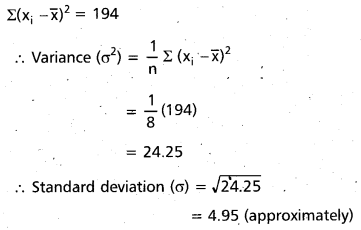
Show that z1 = \(\frac{2+11 i}{25}\), z2 = \(\frac{-2+i}{(1-2 i)^{2}}\), are conjugate to each other.
Solution:
Inter 2nd Year Maths 2A Complex Numbers Important Questions 33
Since, this complex number is the conjugate of \(\frac{2+11 i}{25}\), the two given complex numbers
are conjugate to each other.

Question 33.
Find the square root of (-5 + 12i).
Solution:
We have \(\sqrt{a+i b}\) =
Inter 2nd Year Maths 2A Complex Numbers Important Questions 34
In this example a = -5, b = 12
Inter 2nd Year Maths 2A Complex Numbers Important Questions 35

Question 34.
Write z = –\(\sqrt{7}\) + i\(\sqrt{21}\) in the polar form. (Mar ’11)
Solution:
Inter 2nd Year Maths 2A Complex Numbers Important Questions 36
Since the given point lies in the second quadrant we look for a solution of
tan θ = – \(\sqrt{3}\) that lies in [\(\frac{\pi}{2}\), π] we find that θ = \(\frac{2 \pi}{3}\) is such a solution.
∴ –\(\sqrt{7}\) + i\(\sqrt{21}\) = 2\(\sqrt{7}\) cis \(\frac{2 \pi}{3}\)
(or) 2\(\sqrt{7}\)(cos \(\frac{2 \pi}{3}\) + i sin \(\frac{2 \pi}{3}\))

Question 35.
Express -1 – i in polar form with principle value of the amplitude.
Solution:
Let -1 – i = r (cos θ + i sin θ), then
-1 = r cos θ, -1 = r sin θ, tan θ = 1 ——— (1)
∴ r2 = 2
⇒ r = ±\(\sqrt{2}\)
Since θ is positive, -π < θ < π, the value θ satisfying the equation (1) is
θ = -135° = \(\frac{-3 \pi}{4}\)
Inter 2nd Year Maths 2A Complex Numbers Important Questions 37

Question 36.
If the amplitude of \(\left(\frac{z-2}{z-6 i}\right) \frac{\pi}{2}\), find its locus.  (Mar. ’06)
Solution:
Inter 2nd Year Maths 2A Complex Numbers Important Questions 38
By hypothesis, amplitude of a + ib = \(\frac{\pi}{2}\)
So \(\frac{\pi}{2}\) = tan-1 \(\frac{b}{a}\)
Hence a = 0 and b > 0
∴ x(x – 2) + y(y – 6) = 0
or x2 + y2 – 2x – 6y = 0.

Question 37.
Show that the equation of any circle in the complex plane is of the form z\(\overline{\mathbf{z}}\) + b\(\overline{\mathbf{z}}\) + b\(\overline{\mathbf{z}}\) + c = 0, 1(b ∈ C, c ∈ R).
Solution:
Assume the general form of the equation of a circle in cartesian co-ordinates as
x2 + y2 + 2gx + 2fy + c = 0, (g, f ∈ R) —— (1)
To write this equation in the complex variable form, let (x, y) = z.
Then \(\frac{z+\bar{z}}{2}\) = x, \(\frac{z-\bar{z}}{2 i}\)
= y = \(\frac{-i(z-\bar{z})}{2}\)
∴ x2 + y2 = |z|2 = z\(\overline{\mathbf{z}}\)
Substituting these results in equation (1), we obtain
z\(\overline{\mathbf{z}}\) + g(z + \(\overline{\mathbf{z}}\)) + f(z – \(\overline{\mathbf{z}}\))(-i) + c = 0
i.e., z\(\overline{\mathbf{z}}\) + (g – if)z + (g + if)\(\overline{\mathbf{z}}\) + c = 0 ——-(2)
If (g + if) = b, then equation (2) can be written as z\(\overline{\mathbf{z}}\) + \(\overline{\mathbf{b}}\)z + b\(\overline{\mathbf{z}}\) + c = 0

Inter 2nd Year Maths 2A Complex Numbers Important Questions

Question 38.
Show that the complex numbers z satisfying z2 + \((\overline{\mathbf{z}})^{2}\) = 2 constitute a hyperbola.
Solution:
Substituting z = x + iy in the given equation
z2 + (\(\overline{\mathbf{z}}\))2 = 2, we obtain the cartesian form of the given equation.
∴ (x + iy)2 + (x – iy)2 = 2
i.e., x2 – y2 + 2ixy + x2 – y2 – 2ixy = 2
i.e., x2 – y2 = 1.
Since, this equation denotes a hyperbola, all the complex numbers satisfying
Inter 2nd Year Maths 2A Complex Numbers Important Questions 39
lie on the hyperbola x2 – y2 = 1.

Question 39.
Show that the points in the Argand diagram represented by the complex numbers 1 + 3i, 4 – 3i, 5 – 5i are collinear.
Solution:
Let the three complex numbers be represented in the Argand plane by the points P, Q, R respectively. Then P = (1, 3), Q = (4, -3), R = (5, -5). The slope of the line segment joining P,Q is \(\frac{3+3}{1-4}\) = \(\frac{6}{-3}\) = -2.
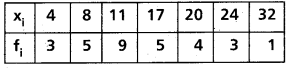
Similarly the slope of the line segment joining Q, R is \(\frac{-3+5}{4-5}\) = \(\frac{2}{-1}\) = -2.
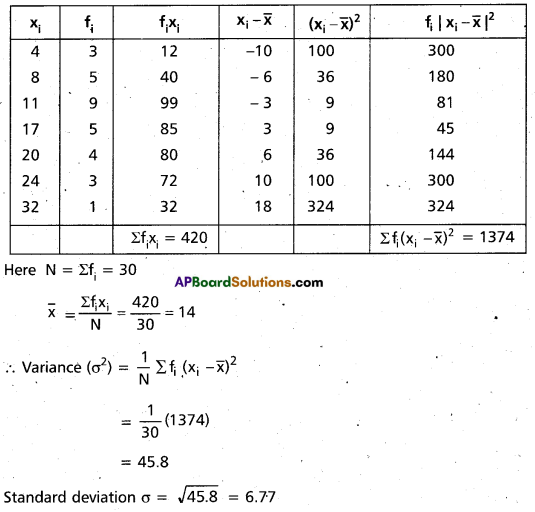
Since the slope of PQ is the slope of QR, the points P, Q and R are collinear.

Question 40.
Find the equation of the straight line joining the points represented by (- 4 + 3i), (2 – 3i) in the Argand plane.
Solution:
Take the given points as
A = -4 + 3i = (-4, 3)
B = 2 – 3i = (2, -3)
Then equation of the straight line \(\overleftrightarrow{\mathrm{AB}}\) is
y – 3 = \(\frac{3+3}{-4-2}\)(x + 4)
i.e., x + y + 1 = 0.

Question 41.
z = x + iy represents a point in the Argand plane, find the locus of z. Such that |z| = 2.
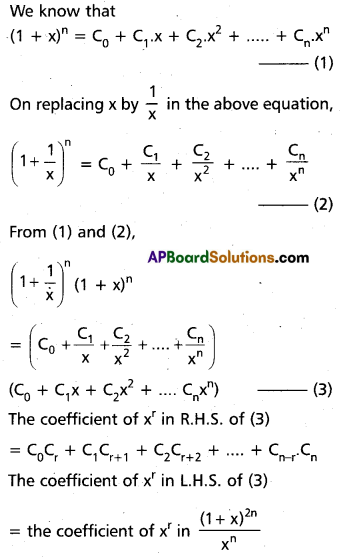
Solution:
|z| = 2, z = x + iy
if \(\sqrt{x^{2}+y^{2}}\) = 2
if and only if x2 + y2 = 4
The equation x2 + y2 = 4 represents the circle with centre at the origin (0, 0) and radius 2 units.
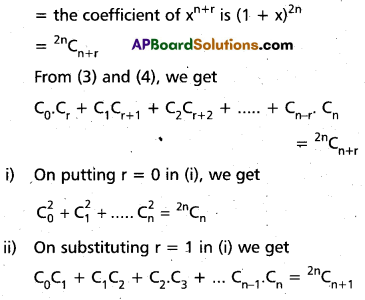
∴ The locus of |z| = 2 is the circle
x2 + y2 = 4

Question 42.
The point P represents a complex number z in the Argand plane. If the amplitude of z is \(\frac{\pi}{4}\), determine the locus of P.
Solution:
Let z = x + iy.
By hypothesis, amplitude of z = \(\frac{\pi}{4}\)
Hence tan-1 \(\left(\frac{y}{x}\right)\) = \(\frac{\pi}{4}\) and \(\frac{y}{x}\) = tan \(\frac{\pi}{4}\)
Hence x = y
∴ The locus of P is x = y.

Inter 2nd Year Maths 2A Complex Numbers Important Questions

Question 43.
If the point P denotes the complex number z = x + iy in the Argand plane and if \(\frac{z-i}{z-1}\) is a purely imaginary number, find the locus of P.
Solution:
We note that the quotient \(\frac{z-i}{z-1}\) is not defined if z = 1.
Inter 2nd Year Maths 2A Complex Numbers Important Questions 40
∴ The locus of P is the circle
x2 + y2 – x – y = 0
excluding the point (1, 0).

Question 44.
Describe geometrically the following subsets of C.
i) {z ∈ C| |z – 1 + i| = 1}
ii) {z ∈ C| |z + i| ≤ 3|
Solution:
i) Let S = {z ∈ C| z – 1 + i| = 1}
If we write z = (x, y), then
S = {(x, y) ∈ R2||x + iy – 1 + i| = 1}
= {x, y) ∈ R2 || x + i(y – 1)| ≤ 3}
= {(x, y) ∈ R2 || (x – 1)2 + (y + 1)2 = i}
Hence S is a circle with centre (1, -1) and radius 1 unit.

ii) Let S’ = {z ∈ C || z + i| ≤ 3}
Then S = {(x, y ∈ R2 || x + iy + i| ≤ 3}
= {(x, y) ∈ R2 || x2 + i(y + 1) ≤ 3}
= {(x, y) ∈ R2 || x2 + (y + 1)2 ≤ 9}
Hence S’ is the closed circular disc with centre at (0, -1) and radius 3 units.

Inter 2nd Year Maths 2A Random Variables and Probability Distributions Formulas

Use these Inter 2nd Year Maths 2A Formulas PDF Chapter 10 Random Variables and Probability Distributions to solve questions creatively.

Intermediate 2nd Year Maths 2A Random Variables and Probability Distributions Formulas

Random variable:
→ Suppose S is the sample space of a random experiment then any function X : S → R is called a random variable.

→ Let S be a sample space and X : S → R.be a random variable. The function F : R → R defined by F(x) = P(X ≤ x), is called probability distribution function of the random variable X.

→ A set ‘A’ is said to be countable if there exists a bijection from A onto a subset of N.

→ Let S be a sample space. A random variable X : S → R is said to be discrete or discontinuous if the range of X is countable.

Inter 2nd Year Maths 2A Random Variables and Probability Distributions Formulas

→ If X : S → R is a discrete random variable with range {x1, x2, x3, ……………. } then
\(\sum_{r=1}^{\infty}\) P(x = xr) = 1

→ Let X : S → R be a discrete random variable with range {x1, x2, x3, …………….} If Σxr P(X = xr) exists, then Σxr. P(X = x) is called the mean of the random variable X. It is denoted by µ or x . If Σ (xr – µ)2 P(X = Xr) exists, then Σ(xr – µ)2 P(X = Xr) is called variance of the random variable X. It is denoted by σ2.

→ The positive square root of the variance is called the standard deviation of the Fandom variable x. It is denoted by σ.

Binomial distribution:
→ Let n be a positive integer and p be a real number-such that 0 ≤ p ≤ 1. A random variable x with range {0, 1, 2, 3, ……….. n} is said to follows (or have) binomial distribution or Bernoulli distribution with parameters n and p if P (X = r) = nCr pr qn – r for r = 0, 1, 2, ………. n where q = 1 – p. Its Mean µ = np and variance σ2 = npq. n and p are called. parameters of the Binomial distribution.

Inter 2nd Year Maths 2A Random Variables and Probability Distributions Formulas

Poisson distribution:
→ Let λ > 0 be a real, number. A, random variable x with range {0, 1, 2, ……… n} is said to follows (have) poisson distribution with parameter λ if P(X = r) = \(\frac{e^{-\lambda} \lambda^{r}}{r !}\) for r = 0, 1, 2, ……………. . Its Mean = λ and variance = λ. Its parameter is λ.

→ If X : S → R is a discrete random variable with range {x1 x2, x3, …. } then \(\sum_{r=1}^{\infty}\) P (X = xr) = 1

→ Let X : S → R be a discrete random variable with range {x1 x2, x3, …..} .If Σ xr P(X = xr) exists, then Σ xr P(X = xr) is called the mean of the random variable X. It is denoted by or x.

→ If Σ(xr – μ)2 P(X = xr) exists, then Σ (xr – μ)2 P(X = xr) is called variance of the random variable X. It is denoted by σ2. The positive square root of the variance is called the standard deviation of the random variable X. It is denoted by σ

→ If the range of discrete random variable X is {x1 x2, x3, …. xn, ..} and P(X = xn) = Pn for every Integer n is given then σ2 + μ2 = Σxn2Pn

Binomial Distribution:
A random variable X which takes values 0, 1, 2, ., n is said to follow binomial distribution if its probability distribution function is given by
P(X = r) = ncrprqn-r, r = 0,1,2, ……………. , n where p, q > 0 such that p + q = 1.

→ If the probability of happening of an event in one trial be p, then the probability of successive happening of that event in r trials is pr.

→ Mean and variance of the binomial distribution

  • The mean of this distribution is \(\sum_{i=1}^{n}\) Xipi = latex]\sum_{X=1}^{n}[/latex] X. nCxqn-xpX = np,
  • The variance of the Binomial distribution is σ2 = npq and the standard deviation is σ = \(\sqrt{(n p q)}\).

→ The Poisson Distribution : Let X be a discrete random variable which can take on the values 0, 1, 2,… such that the probability function of X is given by
f(x) = P(X = x) = \(\frac{\lambda^{x} e^{-\lambda}}{x !}\), x = 0, 1, 2, ………….
where λ is a given positive constant. This distribution is called the Poisson distribution and a random variable having this distribution is said to be Poisson distributed.

Inter 2nd Year Maths 2A Measures of Dispersion Formulas

Use these Inter 2nd Year Maths 2A Formulas PDF Chapter 8 Measures of Dispersion to solve questions creatively.

Intermediate 2nd Year Maths 2A Measures of Dispersion Formulas

→ The arithmetic mean of ungrouped data = \(\frac{\Sigma x_{i}}{n}\) where n is the number of observations.

Inter 2nd Year Maths 2A Measures of Dispersion Formulas

→ The median of ungrouped data
First expressing the n data points in the ascending order of magnitude.

→ If n is odd then \(\frac{n+1}{2}\)the data points in the median of the given ungrouped data.

→ If n is even then the average of \(\frac{n}{2}, \frac{n+2}{2}\) the data points in the median of the given ungrouped data.

  • Range,
  • Mean deviation,
  • Variance and,
  • Standard deviation are some measures of dispusion for ungrouped and grouped data.

→ Range is defined as the difference between the maximum value and the minimum value of the series of observations.

Mean Deviation for ungrouped distribution:
→ Mean deviation about the mean = \(\frac{\text { Sum of the absolutevalues of deviationsfrom } \bar{x}}{\text { Number of Observations }} .\)
= \(\frac{\sum\left|x_{i}-\bar{x}\right|}{n}\) where x̅ is the mean

→ Mean Deviation about the median = \(\frac{\sum\left|x_{i}-{median}\right|}{n}\)

Mean Deviation for grouped data:
→ Mean Deviation about mean = \(\frac{1}{N}\) Σfi|x – x̅i|
Where N = Σfi and x̅ is the mean

→ Mean Deviation about median = \(\frac{1}{N}\) Σfi|xi – median|
When N = Σfi

Inter 2nd Year Maths 2A Measures of Dispersion Formulas

→ Ungrouped data variance σ2 = \(\frac{1}{n}\) = Σ(xi – x̅)2
Standard deviation σ = \(\sqrt{\frac{1}{n} \sum\left(x_{i}-\bar{x}\right)^{2}}\)

→ Discrete frequency distribution variance σ2 = \(\frac{1}{n}\) = Σfi(xi – x̅)2 where x̅ is the mean]
Standard deviation σ = \(\frac{1}{N}\) \(\sqrt{\sum f_{i}\left(x_{i}-\bar{x}\right)^{2}}\)

→ Continuous frequency distribution standard deviation σ = \(\frac{1}{N} \sqrt{N \sum f_{i} x_{i}{ }^{2}-\left(\sum f_{i} x_{i}\right)^{2}}\)
(or) σ = \(\frac{h}{N}\) \(\sqrt{N \Sigma f_{i} y_{i}^{2}-\left(\sum f_{i} y_{i}\right)^{2}}\)

→ Co-efficient of variation = \(\frac{\sigma}{x}\) × 100 (x̅ ≠ 0)

Inter 2nd Year Maths 2A Measures of Dispersion Formulas

→ If each observation in a data is. multiplied by a constant K, then the variance of the resulting observations is K2 times that or the variance of original observations.

→ If each of the observations x1, x2, ………, xn is increased by K, where K is a positive or negative number then the variance remains unchanged.

Measure of Central Tendency:
1. Mathematical Average:
a) Arithmetic mean (A.M.)
b) Geometric mean (G.M.)
c) Harmonic mean (H.M.)

2. Averages of Position:
a) Median
b) Mode

Arithmetic Mean:
(1) Simple arithmetic mean in individual series
(i) Direct method: If the series in this case be x1, x2, …………. xn then the arithmetic mean x̄ is given by
x̄ = \(\frac{\text { Sum of the series }}{\text { Number of terms }}\)
i.e x̄ = \(\frac{x_{1}+x_{2}+x_{3}+\ldots+x_{n}}{n}=\frac{1}{n} \sum_{i=1}^{n} x_{i}\)

(2) Simple arithmetic mean in continuous series If the terms of the given series be x1, x2, …………. xn and the corresponding frequencies be f1, f2, …………. fn then the arithmetic mean x̄ is given by,
x̄ = \(\frac{f_{1} x_{1}+f_{2} x_{2}+\ldots+f_{n} x_{n}}{f_{1}+f_{2}+\ldots+f_{n}}=\frac{\sum_{i=1}^{n} f_{i} x_{i}}{\sum_{i=1}^{n} f_{i}}\)

Continuous Series:
If the series is continuous then xii’s are to be replaced by mi’s where mi’s are the mid values of the class intervals.

Mean of the Composite Series:
If x̄i,(i = 1, 2, …………… k) are the means of k-component series of sizes ni(i = 1,2,….,k) respectively, then the mean x̄ of the composite series obtained on combining the component series is given by the formula x̄ = \(\frac{n_{1} \bar{x}_{1}+n_{2} \bar{x}_{2}+\ldots+n_{k} \bar{x}_{k}}{n_{1}+n_{2}+\ldots+n_{k}}=\frac{\sum_{i=1}^{n} n_{i} \bar{x}_{i}}{\sum_{i=1}^{n} n_{i}}\)

Geometric Mean:
If x1, x2, …………. xn are n values of a variate x, none of them being zero, thengeometric mean (G.M.) is given by G.M. (x1, x2, …………. xn)1/n

In case of frequency distribution, G.M. of n values x1, x2, …………. xn of a variate x occurring with frequency f1, f2, …………. fn is given by G.M = (x1f1, x2f2, …………. xnfn)1/N, where N = f1 + f2 + ……….. + fn

Continuous Series:
If the series is continuous then xjj’s are to be replaced by mii’s where mii’s are the mid values of the class intervals.

Harmonic Mean:
The harmonic mean of n items x1, x2, …………. xn is defined as H.M. = \(\frac{n}{\frac{1}{x_{1}}+\frac{1}{x_{2}}+\ldots .+\frac{1}{x_{n}}}\)
If the frequency distribution is f1, f2, …………. fn respectively, then H.M = \(\frac{f_{1}+f_{2}+f_{3}+\ldots . .+f_{n}}{\left(\frac{f_{1}}{x_{1}}+\frac{f_{2}}{x_{2}}+\ldots .+\frac{f_{n}}{x_{n}}\right)}\)

Inter 2nd Year Maths 2A Measures of Dispersion Formulas

Median:
The median is the central value of the set of observations provided all the observations are arranged in the ascending or descending orders. It is generally used, when effect of extreme items is to be kept out.

(1) Calculation of median
(i) Individual series: If the data is raw, arrange in ascending or descending order. Let n be the number of observations.
If n is odd, Median = value of \(\left(\frac{n+1}{2}\right)^{t h}\) item.
If n is even, Median = \(\frac{1}{2}\)[value of \(\left(\frac{n}{2}\right)^{\text {th }}\) item + value of \(\left(\frac{n}{2}+1\right)^{\text {th }}\) item]

(ii) Discrete series: In this case, we first find the cumulative frequencies of the variables arranged in ascending or descending order and the median is given by
Median = \(\left(\frac{n+1}{2}\right)^{t h}\) observations, where n is the cumulative frequency.

(iii) For grouped or continuous distributions: In this case, following formula can be used.
(a) For series in ascending order, Median = l + \(\frac{\left(\frac{N}{2}-C\right)}{f}\) × i
Where l = Lower limit of the median class
f = Frequency of the median class
N = The sum of all frequencies
I = The width of the median class
C = The cumulative frequency of the class preceding to median class.

(b) For series in descending order
Median = u – \(\left(\frac{\frac{N}{2}-C}{f}\right)\) × i, where u = upper limit of the median class, N = \(\sum_{i=1}^{n}\)fi
As median divides a distribution into two equal parts, similarly the quartiles, quintiles, deciles and percentiles divide the distribution respectively into 4, 5, 10 and 100 equal parts. The th quartile is given by Q = l + \(\left(\frac{j \frac{N}{4}-C}{f}\right)\)i:j= 1,2,3. Q1 is the lower quartile, Q2 is the median and Q3 is called the upper quartile.

(2) Lower qualities

  • Discrete series: Q1 = size of \(\left(\frac{n+1}{4}\right)^{\text {th }}\) item
  • Continuous series : Q1 = l + \(\frac{\left(\frac{N}{4}-C\right)}{f}\) × i

(3) Upper qualities

  • Discrete series : Q3 = size of \(\left[\frac{3(n+1)}{4}\right]^{\text {th }}\) item
  • Continuous series : Q3 = l + \(\frac{\left(\frac{3N}{4}-C\right)}{f}\) × i

Mode:
The mode or model value of a distribution is that value of the variable for which the frequency is maximum. For continuous series, mode is calculated as,
Mode = l1 + \(\left[\frac{f_{1}-f_{0}}{2 f_{1}-f_{0}-f_{2}}\right]\) × i
Where, l1 = The lower limit of the model class
f1 = The frequency of the model class
f0 = The frequency of the class preceding the model class
f2 = The frequency of the class succeeding the model class
i = The size of the model class.

Empirical relation :
Mean – Mode = 3(Mean – Median) ⇒ Mode = 3 Median – 2 Mean.

Measure of dispersion:
The degree to which numerical data tend to spread about an average value is called the dispersion of the data. The four measure of dispersion are

  1. Range
  2. Mean deviation
  3. Standard deviation
  4. Square deviation

(1) Range:
It is the difference between the values of extreme items in a series. Range = Xmax – Xmin

  • The coefficient of range (scatter) = \(\frac{x_{\max }-x_{\min }}{x_{\max }+x_{\min }}\)
    Range is not the measure of central tendency. Range is widely used in statistical series relating to quality control in production.
  • Range is commonly used measures of dispersion in case of changes in interest rates, exchange rate, share prices and like statistical information. It helps us to determine changes in the qualities of the goods produced in factories.

Quartile deviation or semi inter-quartile range:
It is one-half of the difference between the third quartile and first quartile i. e., Q.D. = \(\frac{Q_{3}-Q_{1}}{2}\) and coefficient of quartile deviation = \(\frac{Q_{3}-Q_{1}}{Q_{3}+Q_{1}}\), where Q3 is the third or upper quartile and Q1 is the lowest or first quartile.

Inter 2nd Year Maths 2A Measures of Dispersion Formulas

(2) Mean Deviation:
The arithmetic average of the deviations (all taking positive) from the mean, median or mode is known as mean deviation.
Mean deviation is used for calculating dispersion of the series relating to economic and social inequalities. Dispersion in the distribution of income and wealth is measured in term of mean deviation.

  • Mean deviation from ungrouped data (or individual series) Mean deviation = \(\frac{\sum|x-M|}{n}\) where |x – M| means the modulus of the deviation of the variate from the mean (mean, median or mode) and n is the number of terms.
  • Mean deviation from continuous series: Here first of all we find the mean from which deviation is to be taken. Then we find the deviation dM =| x -M| of each variate from the mean M so obtained.
    • Next we multiply these deviations by the corresponding frequency and find the product f.dM and then the sum ΣfdM of these products.
    • Lastly we use the formula, mean deviation = \(\frac{\sum f|x-M|}{n}=\frac{\sum f d M}{n}\), where n = Σf.

(3) Standard Deviation:
Standard deviation (or S.D.) is the square root of the arithmetic mean of the square of deviations of various values from their arithmetic mean and is generally denoted by aread as sigma. It is used in statistical analysis.
(i) Coefficient of standard deviation: To compare the dispersion of two frequency distributions the relative measure of standard deviation is computed which is known as coefficient of standard deviation and is given by
Coefficient of S.D. = \(\frac{\sigma}{\bar{x}}\), where x̄ is the A.M.

(ii) Standard deviation from individual series σ = \(\sqrt{\frac{\sum(x-\bar{x})^{2}}{N}}\)
where, x̄ = The arithmetic mean of series
N = The total frequency.

(iii) Standard deviation from continuous series σ = \(\sqrt{\frac{\sum f_{i}\left(x_{i}-\bar{x}\right)^{2}}{N}}\)
where, x̄ = Arithmetic mean of series
xi = Mid value of the class
fi = Frequency of the corresponding
N = Σf = The total frequency

Short cut Method:
(i) σ = \(\sqrt{\frac{\sum f d^{2}}{N}-\left(\frac{\sum f d}{N}\right)^{2}}\)
(ii) σ = \(\sqrt{\frac{\sum d^{2}}{N}-\left(\frac{\sum d}{N}\right)^{2}}\)
where, d = x – A = Deviation from the assumed mean A
f = Frequency of the item
N = Σf = Sum of frequencies

(4) Square Deviation:
(i) Root mean square deviation
S = \(\sqrt{\frac{1}{N} \sum_{i=1}^{n} f_{i}\left(x_{i}-A\right)^{2}}\)
where A is any arbitrary number and S is called mean square deviation.

(ii) Relation between S.D. and root mean square deviation : If σ be the standard deviation and S be the root mean square deviation.
Then, S2 = σ2 + d2.
Obviously, S2 will be least when d = 0 i.e., x̄ = A
Hence, mean square deviation and consequently root mean square deviation is least, if the deviations are taken from the mean.

Inter 2nd Year Maths 2A Measures of Dispersion Formulas

Variance:
The square of standard deviation is called the variance. Coefficient of standard deviation and variance : The coefficient of standard deviation is the ratio of the S.D. to A.M. i.e., \(\frac{\sigma}{x}\).
Coefficient of variance = coefficient of S.D.× 100 = \(\frac{\sigma}{x}\) × 100 .

Variance of the combined series :
If n1,n2 are the sizes, x̄1, x̄2 the means and σ1, σ2 the standard deviation of two series, then σ2 = \(\frac{1}{n_{1}+n}\)[n112 + d12) + n222 + d22)]
where d1 = x̄1 – x̄, d2 = x̄2 – x̄ and x̄ = \(\frac{n_{1} \bar{x}_{1}+n_{2} \bar{x}_{2}}{n_{1}+n_{2}}\)

Inter 2nd Year Maths 2A Partial Fractions Formulas

Use these Inter 2nd Year Maths 2A Formulas PDF Chapter 7 Partial Fractions to solve questions creatively.

Intermediate 2nd Year Maths 2A Partial Fractions Formulas

→ The quotient of two polynomials f(x) and Φ(x) where Φ(x) ≠ 0, is called a rational fraction.

→ If the degree of f(x) < the degree of Φ(x) in a rational fraction \(\frac{f(x)}{\phi(x)}\), then the rational fraction is called a proper fraction.

→ If the degree of f(x) ≥ the degree of Φ(x) in a rational fraction \(\frac{f(x)}{\phi(x)}\), then the rational fraction is called a proper fraction.

Inter 2nd Year Maths 2A Fractions Formulas

→ Let \(\frac{f(x)}{\phi(x)}\) be a proper fraction

→ When Φ(x) contains non-repeated linear factors only corresponding to every non-repeated linear factor (ax +b) of Φ(x) there exists a partial fraction of the form \(\frac{A}{a x+b}\) where A is a real number.

→ When Φ(x) contains repeated and non-repeated linear factors only corresponding to every repeated linear factor (ax + b)p of Φ(x) there exist fractions of the form.
\(\frac{A_{1}}{a x+b}+\frac{A_{2}}{(a x+b)^{2}}+\ldots+\frac{A_{p}}{(a x+b)^{p}}\) Where A1, A2, A3 ………… Ap are real numbers.

→ When Φ(x) contains non-repeated irreducible factors only. Corresponding to every non-repeated irreducible quadratic factor ax2 + bx + c of Φ(x) of exists a partial fraction of the form \(\frac{A x+B}{a x^{2}+b x+C}\) where A and B are real numbers.

→ When Φ(x) contains repeated and non-repeated irreducible factors only. Corresponding to every repeated quadratic factor (ax2 + bx + c0p of Φ(x) there exists the partial fractions of the form
\(\frac{A_{1} x+B_{1}}{a x^{2}+b x+c}\) + \(\frac{A_{2} x+B_{2}}{\left(a x^{2}+b x+c\right)^{2}}\) + ……… + \(\frac{A_{p} x+\dot{B}_{p}}{\left(a x^{2}+b x+c\right)^{p}}\) where A1, A2, …….. Ap and B1, B2, ………. Bp are real numbers.

Inter 2nd Year Maths 2A Fractions Formulas

→ Let \(\frac{f(x)}{\phi(x)}\) be a improper fraction, then
\(\frac{f(x)}{\phi(x)}\) = Q(x) + \(\frac{R(x)}{\phi(x)}\) where Q(x) is quotient and R(x) is the remainder, and Degree R(x) < that of Φ(x).

→ Remainder obtained when f(x) is divided by x – a is f(a).
If degree of divisor is ‘n’, then the degree of remainder is (n – 1)
f(x), g(x) are two polynomials. If g(x) ≠ 0, then ∃ two polynomials q(x) , r(x) such that
\(\frac{f(x)}{g(x)}\) = q(x) + \(\frac{r(x)}{g(x)}\) if the degree of f(x) is > that of g(x)

II. Method of resolving proper fraction \(\frac{f(x)}{g(x)}\) into partial fractions.
Type 1 : When the denominator g(x) contains non-repeated factors i.e
g(x) = (x – a)(x – b)(x – c)
\(\frac{f(x)}{(x-a)(x-b)(x-c)}=\frac{\mathrm{A}}{\mathrm{x}-\mathrm{a}}+\frac{\mathrm{B}}{\mathrm{x}-\mathrm{b}}+\frac{\mathrm{C}}{\mathrm{x}-\mathrm{c}}\)

Type 2 : When the denominator g(x) contains repeated and non repeated linear factors
i.e g(x) = (x – a)2(x – b)
\(\frac{f(x)}{(x-a)^{2}(x-b)}=\frac{A}{x-a}+\frac{B}{(x-a)^{2}}+\frac{C}{(x-b)}\)

Type 3 : When the denominator g(x) contains non repeated irreducible quadratic factors
i.e g(x) = (ax2 + bx + c)(x – d)

Type 4 : When the denominator g(x) contains repeated irreducible quadratic factors
i.e g(x) = (ax2 + bx + c)2(x – d)
\(\frac{f(\mathrm{x})}{\left(\mathrm{ax}{ }^{2}+\mathrm{bx}+\mathrm{c}\right)^{2}(\mathrm{x}-\mathrm{d})}=\frac{\mathrm{Ax}+\mathrm{B}}{\left(\mathrm{ax}^{2}+\mathrm{bx}+\mathrm{c}\right)}+\frac{\mathrm{Cx}+\mathrm{D}}{\left(\mathrm{ax}^{2}+\mathrm{bx}+\mathrm{c}\right)^{2}}+\frac{\mathrm{E}}{\mathrm{x}-\mathrm{d}}\)

Inter 2nd Year Maths 2A Permutations and Combinations Formulas

Use these Inter 2nd Year Maths 2A Formulas PDF Chapter 5 Permutations and Combinations to solve questions creatively.

Intermediate 2nd Year Maths 2A Permutations and Combinations Formulas

→ Fundamental principle: If a work can be performed in m different ways and another work can be performed in n different ways, then the two works simultaneously can be performed in mn different ways.

→ If n is a non-negative integer then

  • 0 ! = 1
  • n ! = n (n – 1) ! if n > 0

→ The number of permutations of n dissimilar things taken ‘r at a time is denoted by nPr and nPr = \(\frac{n !}{(n-r) !}\) for 0 ≤ r ≤ n.

Inter 2nd Year Maths 2A Permutations and Combinations Formulas

→ If n, r positive integers and r ≤ n, then

  • nPr = n. n – 1Pr – 1 if r ≥ 1
  • nPr = n.(n – 1) n – 2Pr – 2 if r ≥ 2
  • nPr = n – 1Pr + r. (n – 1)P(r – 1)

→ The number of injections that can be defined from set A into set B is n(B)pn(A) n(A) ≤ n(B)

→ The number of bijections that can be defined from set A into set B having same number of elements with A is n(A)!

→ The number of permutations of1n’ dissimilar things taken ‘r’ at a time.

  • Containing a particular thing is (r) n – 1Pr – 1
  • Not containing a particular thing is n – 1Pr
  • Containing a particular thing in a particular place is n – 1Pr – i.

→ The number of functions that can be defined from set A into set B in [n(B)]n(A)

→ The sum of the r – digited numbers that can be formed using the given ‘n’ distinct non-zero digits (r ≤ n ≤ 9) is (n – 1)P(r – 1) × sum of all n digits × 111 …… 1 (r times)

→ In the above, if ‘0’ is one among the given n digits, then the sum is (n – 1)P(r – 1) × sum of the digits × 111 … 1 (r times) (n – 2)P(r – 2) × sum of the digits × 111 … 1 [(r – 1) times]

→ The number of permutations of n dissimilar things taken r at a time when repetitions are allowed any number of times is nr.

→ The number of circular permutations of n dissimilar things is (n – 1) !

→ In case of hanging type circular permutations like garlands of flowers, chains of beads etc., the number of circular permutations of n things is \(\frac{1}{2}\) [(n – 1) !]

→ If in the given n things, p alike things are of one kind, q alike things are of the second kind, r alike things are of the third kind and the rest are dissimilar, then the number of permutations (of these n things) is \(\frac{n !}{p ! q ! r !}\)

Inter 2nd Year Maths 2A Permutations and Combinations Formulas

→ The number of combinations of n things taken r at a time is denoted by nCr and nCr = \(\frac{n !}{(n-r) ! r !}\) for 0 ≤ r ≤ n and \(\frac{{ }^{n} C_{r}}{{ }^{n} C_{r-1}}=\frac{n-r+1}{r}\) and nPr = r! nCr

→ If n, r are integers and 0 ≤ r ≤ n then ncr = nCr – 1

→ Let n, r, s are integers and 0 ≤ r ≤ n, 0 ≤ s ≤ n. If nCr = nCs then r = s or r + s = n.

→ The number of ways of dividing ‘m + n’ things (m ≠ n) into two groups containing m, n things is (m + n)Cm = (m + n)Cm = \(\frac{(m+n) !}{m ! n !}\)

→ The number of ways of dividing (m + n + p) things (m, n, p are distinct) into 3 groups of m, n, p things is \(\frac{(m+n+p) !}{m ! n ! p !}\).

→ The number of ways of dividing mn things into m equal groups is \(\frac{(m n) !}{(n !)^{m} m !}\)

→ The number of ways if distributing mn things equally to m persons is \(\frac{(m n) !}{(n !)^{m}}\)

→ If p alike things are of one kind, q alike things are of the second kind and r alike things are of the third kind, then the number of ways of selecting one or more things out of them is (p + 1) (q + 1) (r +1) – 1.

→ If m is a positive integer and m = p1α1, p1α2 …… pkαk where p1, p2 …… pk are distinct primes and α1, α2, …. αk are non-negative integers, then the number of divisors of m is (α1 + 1) (α2 + 1) ……… (αk + 1). [This includes 1 and m].

Inter 2nd Year Maths 2A Permutations and Combinations Formulas

→ The total number of combinations of n different things taken any number of times is 2n.

→ The total number of combinations of n different things taken one or more at a timers 2n – 1.

→ The number of diagonals in a regular polygon of n sides is \(\frac{n(n-3)}{2}\)

→ Permutations are arrangements of things taken some or all at a time.

→ In a permutation, order of the things is taken into consideration.

npr represents the number of permutations (without repetitions) of n dissimilar things taken r at a time.

→ Fundamental Principle: If an event is done in ‘m’ ways and another event is done in ‘n’ ways, then the two events can be together done in mn ways provided the events are independent.

npr = \(\frac{n !}{(n-r) !}\) = n(n – 1)(n – 2) …………. (n – r + 1)

np1 = n, np2 = n(n-1), np3 = n(n-1)(n-2).

npr = n!

→ \(\frac{{ }^{\mathrm{n}} \mathrm{p}_{\mathrm{r}}}{{ }^{\mathrm{n}} \mathrm{p}_{\mathrm{r}-1}}\)npn = n!

n+1pr = r. npr-1 + npr

npr = r. n-1pr-1 + npr

npr = r.n-1pr-1 + n-1pr

→ The number of permutations of n things taken r at a time containing a particular thing is r × n-1pr-1

→ The number of permutations of n things taken r at a time not containing a particular thing is n-1pr

  • The number of permutations of n things taken r at a time allowing repetitions is nr.
  • The number of permutations of n things taken not more than r at a time allowing repetitions is \(\frac{n\left(n^{\mathrm{r}}-1\right)}{(n-1)}\)

→ The number of permutations of n things of which p things are of one kind and q things are of another kind etc., is \(\frac{n !}{p ! q ! \ldots \ldots \cdots}\)

→ The sum of all possible numbers formed out of all the ‘n’ digits without zero is (n-1)! (sum of all the digits) (111 ……….. n times).

→ The sum of all possible numbers formed out of all the ‘n’ digits which includes zero is [(n -1)! (sum of all the digits) (111 …………… n times)] – [( n – 2)! (sum of all the digits)(111 ………….. (n -1) times]

→ The sum of all possible numbers formed by taking r digits from the given n digits which do not include zero is n-1pr-1 (sum of all the digits)(111 …………… r times).

→ The sum of all possible numbers formed by taking r digits from the given n digits which include zero is n-1pr-1(sum of all the digits)(111 ……………….. r times) – n-2pr-2(sum of all the digits)(111 ……………….. (r-1) times).

  • The number of permutations of n things when arranged round a circle is (n -1)!
  • In case of necklace or garland number of circular permutations is \(\frac{(n-1) !}{2}\)

Inter 2nd Year Maths 2A Permutations and Combinations Formulas

→ Number of permutations of n things taken r at a time in which there is at least one repetition is nrnpr.

→ The number of circular permutations of ‘n’ different things taken ‘r’ at a time is \(\frac{{ }^{n} \mathrm{P}_{\mathrm{r}}}{\mathrm{r}}\)

Inter 2nd Year Maths 2A Theory of Equations Formulas

Use these Inter 2nd Year Maths 2A Formulas PDF Chapter 4 Theory of Equations to solve questions creatively.

Intermediate 2nd Year Maths 2A Theory of Equations Formulas

→ If n is a non-negative integer and a0, a1, a2, ……….. an are real or complex numbers and a0 ≠ 0, then the expression f(x) = a0xn + a1xn – 1 + a2xn – 2 + ……. + an is called a polynomial in x of degree n.

→ f(x) = a0xn + a1xn – 1 + a2xn – 2 + ……. + an = 0 is called a polynomial equation in x of degree n (a0 ≠ 0). Every non-constant polynomial equation has atleast one root.

→ If f(α) = 0 then α is called a root of the equation f(x) = 0.

→ If f(α) = 0 then (x – α) is a factor of f(x).

Inter 2nd Year Maths 2A Theory of Equations Formulas

Relation between roots and coefficients of an equation:
→ If α β γ are the roots of x3 + p1x2 + p2x + p3 = 0 then sum of the roots s1 = α + β + γ = – p1.
Sum of the products of two roots taken at a time s2 = αβ + βγ + γα = p2.
Product of all the roots, s3 = αβγ = – p3.

→ If α, β, γ, δ are the roots of x4 + p1x3 + p2x2 + p3x + p4 = 0 then sum of the roots s1 = α + β + γ + δ = – p1.
Sum of the products of roots taken two at a time
s2 = αβ + αγ + αδ + βγ + βδ + γδ = p2.
Sum of the products of roots taken three at a time .
s3 = αβγ + βγδ + γδα + δαβ = – p3.
Product of the roots, s4 = αβγδ = p4.

→ For a cubic equation, when the roots are

  • In A.P., then they are taken as a – d, a, a + d.
  • In G.P., then they are taken as \(\frac{a}{r}\), a, ar.
  • In H.P., then they are taken as \(\frac{1}{a-d}, \frac{1}{a^{\prime}}, \frac{1}{a+d}\).

→ For a bi quadratic equation, if the roots are

  • In A.P., then they are taken as a – 3d, a – d, a + d, a + 3d.
  • In C.P., then they are taken as \(\frac{1}{a-3 d}, \frac{1}{a-d}, \frac{1}{a+d}, \frac{1}{a+3 d}\).

→ In an equation with real coefficients, imaginary roots occur in conjugate pairs.

→ In an equation with rational coefficients, irrational roots occur in pairs of conjugate surds.

→ The equation whose roots are those of the equation f(x) = 0 with contrary signs is f(- x) = 0.

→ The equation whose roots are multiplied by kfa 0) of those of the proposed equation f(x) = 0 is f \(\left(\frac{x}{k}\right)\) = 0.

→ The equation whose roots are reciprocals of the roots of f(x) = 0 is f \(\left(\frac{1}{x}\right)\) = 0.

→ The equation whose roots are exceed by h than those of f(x) = 0 is f(x – h) = 0.

→ The equation whose roots are diminished by h than those of f(x) 0 is f(x + h) = 0.

→ The equation whose roots are the square of the roots of f(x) = 0 is obtained by eliminating square root from f(√x) = 0.

Inter 2nd Year Maths 2A Theory of Equations Formulas

→ If f(x) = p0xn + p1xn – 1 + p2xn – 2 + ……. + pn = 0 then to eliminate the second term,
f(x) = 0 can be transformed to f(x + h) = 0 where h = \(\frac{-p_{1}}{n \cdot p_{0}}\).

→ If an equation is unaltered by changing x into \(\frac{1}{x}\) then it is a reciprocal equation.

→ A reciprocal equation f(x) = p0xn + p1xn – 1 + …… + pn = 0 is said to be a reciprocal equation of first class pi = pn – i for all i.

→ A reciprocal equation f(x) = p0xn + p1xn – 1 + …… + pn = 0 is said to be a reciprocal equation of second class if pi = – pn – i for all i.

→ For an odd degree reciprocal equation of class one, – 1 is a root and for an odd degree reciprocal equation of class two, 1 is a root.

→ For an even degree reciprocal equation of class two, 1 and – 1 are roots.

→ If f(x) = 0 is an equation of degree ‘n’ then to eliminate rth term, f(x) = 0 can be transformed to f(x + h) = 0 where h is a constant such that f(n – r + 1)(h) = 0 i.e.,(n – r + 1)th derivative of f(h) is zero.

→ Every nth degree equation has exactly n roots real or imaginary.

→ Relation between, roots and coefficients of an equation.

(i) If α, β, γ are the roots of x3 + p1x2 + p2x + p3 = 0 the sum of the roots s1 = α + β + γ = -p1.
Sum of the products of two roots taken at a time s2 = αβ + βγ + γα = -p2
Product of all the roots, s3 = αβγ= – p3.

(ii) If α, β, γ, δ are the roots of x4 + p1x3 + p2x2 + p3x + p4 = 0 then

  • Sum of the roots s1 = a+P+y+S = -p1.
    s2 = αβ + αγ + αδ + βα + βδ + γδ = p2.
  • Sum of the products of roots taken three at a time
    s3 = αβγ + βγδ + γδα + δαβ = – p3.
  • Product of the roots, s4 = αβγδ = p4

→ For the equation xn + p1xn-1 + p2xn-2 + ……… + pn = 0

  • Σ α2 = p12 – 2p2
  • Σ α3 = -p13 + 3p1p2 – 3p3
  • Σ α4 =p14 – 4p12p2 + 2p22 + 4p1p3 – 4p4
  • Σ α2β = 3p3 – p1p2
  • Σ α2βγ = p1p3 – 4p4

Note: For the equation x3 + p1x2 + p2x + p3 = 0 Σα2β2 — p2 -2p1p3

→ To remove the second term from a nth degree equation, the roots must be diminished by \(\frac{-\mathrm{a}_{1}}{\mathrm{na}_{0}}\) and the resultant equation will not contain the term with xn-1.

→ If α1 , α2 ………………. , αn are the roots of f(x) = 0, the equation

  • Whose roots are \(\) is f\(\left(\frac{1}{x}\right)\) = 0
  • Whose roots are kα1, kα2 …,kαn is f\(\left(\frac{x}{h}\right)\) = 0
  • Whose roots are α1 – h, α2 – h, …. αn – h is f(x + h) = 0.
  • Whose roots are α1 + h, α2 + h, ………….. αn + h is f(x – h) = 0
  • Whose roots are α12, α22…. α12 is f (f√y) = 0

→ In any equation with rational coefficients, irrational roots occur in conjugate pairs.

→ In any equation with real coefficients, complex roots occur in conjugate pairs.

Inter 2nd Year Maths 2A Theory of Equations Formulas

→ If α is r – multiple root of f(x) = 0, then a is a (r – 1) – multiple root of f1(x) = 0 and (r-2) – Multiple root of f 11(x) = 0 and non multiple root of fr-1(x) =0.

→ If f(x) = xn + p1xn-1 + …………. + pn-1x + pn and f(a) and f(b) are of opposite sign, then at least
one real root of f(x) =0 lies between a and b.

(a) For a cubic equation, when the roots are

  • In A.P., then they are taken as a – d, a, a + d
  • In G.P., then are taken as \(\frac{a}{r}\), a, ar
  • In H.P., then they are taken as \(\frac{1}{a-d}, \frac{1}{a}, \frac{1}{a+d}\)

(b) For a bi quadratic equation, if the roots are

  • In A.P., then they are taken as a – 3d, a + d, a + 3d
  • In G.P., then they are \(\frac{a}{d^{3}}, \frac{a}{d}\), ad, ad3
  • In H.P., then they are taken as \(\frac{1}{a-3 d}, \frac{1}{a-d}, \frac{1}{a+d}, \frac{1}{a+3 d}\)

→ It an equation is unaltered by changing x into \(\frac{1}{x}\), then it is a reciprocal equation.

  • A reciprocal equation f (x) = p0xn + p1xn-1 + ……………….. + pn = 0 is said to be a reciprocal equation of first class pi = pn-i for all i.
  • A reciprocal equation f (x) = p0xn + p1xn-1 + ……………….. + pn = 0 = 0 is said to be a reciprocal equation of second class pi = pn-i for all i.
  • For an odd degree reciprocal equation of class one, -1 is a root and for an odd degree reciprocal equation of class two, 1 is a root.
  • For an even degree reciprocal equation of class two, 1 and -1 are roots.

→ If f(x) = 0 is an equation of degree ‘n’ then to eliminate rth term, .f(x) = 0 can be transformed to f(x+h) = 0 where h is a constant such that f(n-r+1)(h) =0 i.e., (n – r + 1)th derivative of f(h) is zero.

Inter 2nd Year Maths 2A Quadratic Expressions Formulas

Use these Inter 2nd Year Maths 2A Formulas PDF Chapter 3 Quadratic Expressions to solve questions creatively.

Intermediate 2nd Year Maths 2A Quadratic Expressions Formulas

→ If a, b, c are real or complex numbers and a ≠ 0, then the expression ax2 + bx + c is called a quadratic expression in the variable x.
Eg: 4x2 – 2x + 3

→ If a, b, c are real or complex numbers and a ≠ 0, then ax2 + bx + c = 0 is called a quadratic equation in x.
Eg: 2x2 – 5x + 6 = 0

Inter 2nd Year Maths 2A Quadratic Expressions Formulas

→ A complex number α is said to be a root or solution of the quadratic equation ax2 + bx + c = 0 if aα2 + bα + c = 0

→ The roots of ax2 + bx + c = 0 are \(\frac{-b \pm \sqrt{b^{2}-4 a c}}{2 a}\)

→ If α, β are roots of ax2 + bx + c = 0, then α + β = \(\frac{-b}{a}\) and αβ = \(\frac{C}{a}\)

→ The equation of whose roots are α, β is x2 – (α + β)x + αβ = 0

→ Nature of the roots: ∆ = b2 – 4ac is called the discriminant of the quadratic equation ax2 + bx + c = 0. Let α, β be the roots of the quadratic equation ax2 + bx + c = 0
Case 1: If a, b, c are real numbers, then

  • ∆ = 0 ⇔ α = β = \(\frac{-b}{2 a}\) (a repeated root or double root)
  • ∆ > 0 ⇔ α and β are real and distinct.
  • ∆ < 0, ⇔ α and β are non- real complex numbers conjugate to each other.

Case 2: If a, b, c are rational numbers, then

  • ∆ = 0 ⇔ α and β are rational and equal (ei) α = \(\frac{-b}{2 a}\), a double root or a repeated root.
  • ∆ > 0 and is a square of a rational number ⇔ α and β are rational and distinct.
  • ∆ > 0 but not a square of a rational number ⇔ α and β are conjugate surds.
  • ∆ < 0, ⇔ α and β are non- real ⇔ α and β are non-real con conjugate complex numbers.

→ Let a, b and c are rational numbers, α and β be the roots of the equations ax2 + bx + c = 0. Then

  • α, β are equal rational numbers if ∆ = 0.
  • α, β are distinct rational numbers if ∆ is the square of a non zero rational numbers.
  • α, β are conjugate surds if ∆ > 0 and ∆ is not the square of a nonzero square of a rational number.

→ If a1x2 + b1x + c1 = 0, a2x2 + b2x + c2 = 0 have two same roots, then \(\frac{a_{1}}{a_{2}}=\frac{b_{1}}{b_{2}}=\frac{c_{1}}{c_{2}}\)

→ If α, β are roots of ax2 + bx + c = 0,

  • the equation whose roots are \(\frac{1}{\alpha}, \frac{1}{\beta}\) is f \(\left(\frac{1}{x}\right)\) = 0. If c ≠ 0 (ie) αβ ≠ 0
  • the equation whose roots are α + k, β + k is f(x – k) = 0
  • the equation whose roots are kα and kβ is f\(\left(\frac{x}{k}\right)\) = 0
  • the equation whose roots are equal but opposite in sign is f(-x) = 0
    (ie) the equation whose roots are – α, – β is f(-x) = 0.

→ If the roots of ax2 + bx + c = 0 are complex roots then for x ∈ R, ax2 + bx + c and ‘a’ have the same sign.

→ If α and β (α < β) are the roots of ax2 + bx + c = 0 then

  • ax2 + bx + c and ‘a’ are of opposite sign when α < x < β
  • ax2 + bx + c and ‘a’ are of the same sign if x < α or x > β.

→ Let f(x) = ax2 + bx + c be a quadratic function

  • If a > 0 then f(x) has minimum value at x = \(\frac{-b}{2 a}\) and the minimum value is given by \(\frac{4 a c-b^{2}}{4 a}\)
  • If a < 0 then f(x) has maximum value at x = \(\frac{-b}{2 a}\) and the maximum value is given by \(\frac{4 a c-b^{2}}{4 a}\)

Inter 2nd Year Maths 2A Quadratic Expressions Formulas

→ A necessary and sufficient condition for the quadratic equation a1x2 + b1x + c1 = 0 and a2x2 + b2x + c2 = 0 to have a common root is (c1a2 – c2a1)2 = (a1b2 – a2b1) (b1c2 – b2c1).

→ If a1b2 – a2b1 = 0 then common root of a1x2 + b1x + c1 = 0, a2x2 + b2x + c2 = 0 is \(\frac{c_{1} a_{2}-c_{2} a_{1}}{a_{1} b_{2}-a_{2} b_{1}}\).

→ The standard form of a quadratic ax2 + bx + c = 0 where a, b, c ∈ R and a ≠ 0

→ The roots of ax2 + bx + c = 0 are \(\frac{-b \pm \sqrt{b^{2}-4 a c}}{2 a}\)

→ For the equation ax2 + bx + c = 0, sum of the roots = \(-\frac{b}{a}\), product of the roots = \(\frac{c}{a}\).

→ If the roots of a quadratic are known, the equation is x2 – (sum of the roots)x +(product of the roots)= 0

→ “Irrational roots” of a quadratic equation with “rational coefficients” occur in conjugate pairs. If p + √q is a root of ax2 + bx + c = 0, then p – √q is also a root of the equation.

→ “Imaginary” or “Complex Roots” of a quadratic equation with “real coefficients” occur in conjugate pairs. If p + iq is a root of ax2 + bx + c = 0. Then p – iq is also a root of the equation.

→ Nature of the roots of ax2 + bx + c = 0

Nature of the RootsCondition
Imagineb2 – 4ac < 0
Equalb2 – 4ac = 0
Realb2 – 4ac ≥ 0
Real and differentb2 – 4ac > 0
Rationalb2 – 4ac is a perfect square a, b, c being rational
Equal in magnitude and opposite in signb = 0
Reciprocal to each otherc = a
Both positiveb has a sign opposite to that of a and c
Both negativea, b, c all have same sign
Opposite signa, c are of opposite sign

→ Two equations a1x2 + b1x + c1 = 0, a2x2 + b2x + c2 = 0 have exactly the same roots if \(\frac{a_{1}}{a_{2}}=\frac{b_{1}}{b_{2}}=\frac{c_{1}}{c_{2}}\)

→ The equations a1x2 + b1x + c1 = 0, a2x2 + b2x + c2 = 0 have a common root, if (c1a2 – c2a1)2 = (a1b2 – a2b1)(b1c2 – b2c1) and the common root is \(\frac{c_{1} a_{2}-c_{2} a_{1}}{a_{1} b_{2}-a_{2} b_{1}}\) if a1b2 ≠ a2b1

→ If f(x) = 0 is a quadratic equation, then the equation whose roots are

  • The reciprocals of the roots of f(x) = 0 is f\(\left(\frac{1}{x}\right)\) = 0
  • The roots of f(x) = 0, each ‘increased’ by k is f(x – k) = 0
  • The roots of f(x) = 0, each ‘diminished’ by k is f(x + k) = 0
  • The roots of f(x) = 0 with sign changed is f(-x) = 0
  • The roots of f(x) = 0 each multiplied by k(≠0) is f\(\left(\frac{x}{k}\right)\) = 0

Inter 2nd Year Maths 2A Quadratic Expressions Formulas

→ Sign of the expression ax2 + bx + c = 0

  • The sign of the expression ax2 + bx + c is same as that of ‘a’ for all values of x if b2 – 4ac ≤ 0 i.e. if the roots of ax2 + bx + c = 0 are imaginary or equal.
  • If the roots of the equation ax2 + bx + c = 0 are real and different i.e b2 – 4ac > 0, the sign of the expression is same as that of ‘a’ if x does not lie between the two roots of the equation and opposite to that of ‘a’ if x lies between the roots of the equation.

→ The expression ax2 + bx + c is positive for all real values of x if b2 – 4ac < 0 and a > 0.

→ The expression ax2 + bx + c has a maximum value when ‘a’ is negative and x = –\(\frac{\mathrm{b}}{2 \mathrm{a}}\). Maximum value of the expression = \(\frac{4 a c-b^{2}}{4 a}\)

→ The expression ax2 + bx + c has a maximum value when ‘a’ is positive and x = –\(\frac{\mathrm{b}}{2 \mathrm{a}}\). Minimum value of the expression = \(\frac{4 a c-b^{2}}{4 a}\)

Theorem 1:
If the roots of ax2 + bx + c = 0 are imaginary, then for x ∈ R , ax2 + bx + c and a have the same sign.
Proof:
The root are imaginary
b2 – 4ac < 0 4ac – b2 > 0
\(\frac{a x^{2}+b x+c}{a}=x^{2}+\frac{b}{a} x+\frac{c}{a}=\left(x+\frac{b}{2 a}\right)^{2}+\frac{c}{a}-\frac{b^{2}}{4 a^{2}}=\left(x+\frac{b}{2 a}\right)^{2}+\frac{4 a c-b^{2}}{4 a^{2}}\)
∴ For x ∈ R, ax2 + bx + c = 0 and a have the same sign.

Theorem 2.
If the roots of ax2 + bx + c = 0 are real and equal to α = \(\frac{-b}{2 a}\), then α ≠ x ∈ R ax2 + bx + c and a will have same sign.
Proof:
The roots of ax2 + bx + c = 0 are real and equal
⇒ b2 = 4ac ⇒ 4ac – b2 = 0
\(\frac{a x^{2}+b x+c}{a}\) = x + \(\frac{b}{a}\)x + \(\frac{c}{a}\)
= \(\left(x+\frac{b}{2 a}\right)^{2}+\frac{c}{a}-\frac{b^{2}}{4 a^{2}}\)
= \(\left(x+\frac{b}{2 a}\right)^{2}+\frac{4 a c-b^{2}}{4 a^{2}}\)
= \(\left(x+\frac{b}{2 a}\right)^{2}\) > 0 for x ≠ \(\frac{-b}{2 a}\) = α
For α ≠ x ∈ R, ax2 + bx + c and a have the same sign.

Theorem 3.
Let be the real roots of ax2 + bx + c = 0 and α < β. Then
(i) x ∈ R, α < x< β ax2 + bx + c and a have the opposite signs
(ii) x ∈ R, x < α or x> β ax2 + bx + c and a have the same sign.
Proof:
α, β are the roots of ax2 + bx + c = 0
Therefore, ax2 + bx + c = a(x – α)(x – β)
\(\frac{a x^{2}+b x+c}{a}\) = (x – α)(x – β)

(i) Suppose x ∈ R, α < x < β
⇒ x < α < β then x – α < 0, x – β < 0 ⇒ (x – α)(x – β) > 0 ⇒ \(\frac{a x^{2}+b x+c}{a}\) > 0
⇒ ax2 + bx + c, a have a same sign

(ii) Suppose x ∈ R, x > β, x > β > α then x – α > 0, x – β > 0
⇒ (x – α)(x – β) > 0 ⇒ \(\frac{a x^{2}+b x+c}{a}\) > 0
⇒ ax2 + bx + c, a have same sign
∴ x ∈ R, x < α or x > β ⇒ ax2 + bx + c and a have the same sign.

Inter 2nd Year Maths 2A De Moivre’s Theorem Formulas

Use these Inter 2nd Year Maths 2A Formulas PDF Chapter 2 De Moivre’s Theorem to solve questions creatively.

Intermediate 2nd Year Maths 2A De Moivre’s Theorem Formulas

Statement:
→ If ‘n’ is an integer, then (cos θ + i sin θ)n = cos nθ + i sin nθ
If n’ is a rational number, then one of the values of
(cos θ + i sin θ)n is cos nθ + i sin nθ

nth roots of unity:
→ nth roots of unity are {1, ω, ω2 …….. ωn – 1}.
Where ω = \(\left[\cos \frac{2 k \pi}{n}+i \sin \frac{2 k \pi}{n}\right]\) k = 0, 1, 2 ……. (n – 1).
If ω is a nth root of unity, then

  • ωn = 1
  • 1 + ω + ω2 + ………… + ωn – 1 = 0

Inter 2nd Year Maths 2A De Moivre’s Theorem Formulas

Cube roots of unity:
→ 1, ω, ω2 are cube roots of unity when

  • ω3 = 1
  • 1 + ω + ω2 = 0
  • ω = \(\frac{-1+i \sqrt{3}}{2}\), ω2 = \(\frac{-1-i \sqrt{3}}{2}\)
  • Fourth roots of unity roots are 1, – 1, i, – i

→ If Z0 = r0 cis θ0 ≠ 0, then the nth roots of Z0 are αk = (r0)1/n cis\(\left(\frac{2 k \pi+\theta_{0}}{n}\right)\) where k = 0, 1, 2, ……… (n – 1)

→ If n is any integer, (cos θ + i sin θ)n = cos nθ + i sin nθ

→ If n is any fraction, one of the values of (cosθ + i sinθ)n is cos nθ + i sin nθ.

→ (sinθ + i cosθ)n = cos(\(\frac{n \pi}{2}\) – nθ) + i sin(\(\frac{n \pi}{2}\) – nθ)

→ If x = cosθ + i sinθ, then x + \(\frac{1}{x}\) = 2 cosθ, x – \(\frac{1}{x}\) = 2i sinθ

→ xn + \(\frac{1}{x^{n}}\) = 2cos nθ, xn – \(\frac{1}{x^{n}}\) = 2i sin nθ

→ The nth roots of a complex number form a G.P. with common ratio cis\(\frac{2 \pi}{n}\) which is denoted by ω.

→ The points representing nth roots of a complex number in the Argand diagram are concyclic.

→ The points representing nth roots of a complex number in the Argand diagram form a regular polygon of n sides.

→ The points representing the cube roots of a complex number in the Argand diagram form an equilateral triangle.

→ The points representing the fourth roots of complex number in the Argand diagram form a square.

→ The nth roots of unity are 1, w, w2,………. , wn-1 where w = cis\(\frac{2 \pi}{n}\)

Inter 2nd Year Maths 2A De Moivre’s Theorem Formulas

→ The sum of the nth roots of unity is zero (or) the sum of the nth roots of any complex number is zero.

→ The cube roots of unity are 1, ω, ω2 where ω = cis\(\frac{2 \pi}{3}\), ω2 = cis\(\frac{4 \pi}{3}\) or
ω = \(\frac{-1+i \sqrt{3}}{2}\)
ω2 = \(\frac{-1-i \sqrt{3}}{2}\)
1 + ω + ω2 = 0
ω3 = 1

→ The product of the nth roots of unity is (-1)n-1 .

→ The product of the nth roots of a complex number Z is Z(-1)n-1 .

→ ω, ω2 are the roots of the equation x2 + x + 1 = 0