AP Inter 2nd Year Chemistry Study Material Chapter 1 Solid State

Andhra Pradesh BIEAP AP Inter 2nd Year Chemistry Study Material 1st Lesson Solid State Textbook Questions and Answers.

AP Inter 2nd Year Chemistry Study Material 1st Lesson Solid State

Very Short Answer Questions

Question 1.
Define the term amorphous.
Answer:
An amorphous (no form) solid is a compound which does not have an orderly arrangement of particles. In amorphous solids the constituent particles, atoms, molecules has short-range order only.
E.g.: Glass, rubber, plastics, etc.,

AP Inter 2nd Year Chemistry Study Material Chapter 1 Solid State

Question 2.
What makes a glass different from quartz?
Answer:

  • Glass is an amorphous solid in which the constituent particles have only short-range order.
  • Quartz is a crystalline form of silica in which constituent particles have long-range order.

Question 3.
Classify the following solids as ionic, metallic, molecular, covalent network or amorphous.
i) Si
ii) I2
iii) P4
iv) Rb
v) SiC
vi) LiBr
vii) Ammonium .Phosphate (NH4)3 PO4
viii) Plastic
ix) graphite
x) Tetra phosphorous decoxide
xi) brass
Answer:
i) Si – Covalent network solid
ii) I2 – Molecular solid with covalent bonds
iii) P4 – Molecular solid with covalent bonds ,
iv) Rb – Metallic solid
v) SiC – Giant molecular Network Solid with covalent bonds
vi) LiBr – Ionic solids
vii) Ammonium Phsophate (NH4)3 PO4 – Ionic Solids
viii) Plastic – Amorphous solid
ix) Graphite – Hexagonal network solid with covalent bonds (giant molecule)
x) Tetra phosphorous decoxide (P4O6) – Molecular solid with covalent bonds.
xi) Brass – Metallic solid

Question 4.
What is meant by the term coordination number ?
Answer:
The number of nearest neighbouring particles of a particle is defined as the co-ordination number.
(Or)
The number of nearest oppositely charged ions surrounding a particular ion is also called as co-ordination number.
E.g.: Co-ordination no. of Na+ in NaCl lattice is ‘6’.

Question 5.
What is the co-ordination number of atoms in a cubic close – pack structure ?
Answer:
The co-ordination number of atoms in a cubic close pack structure is ’12’.

AP Inter 2nd Year Chemistry Study Material Chapter 1 Solid State

Question 6.
What is the co-ordination number of atoms in a body – centered cubic structure ?
Answer:
The co-ordination number of atoms in a body – centered cubic structure is ‘8’.

Question 7.
Stability of a crystal is reflected in the magnitude of its melting point. Comment.
Answer:
Stability of a crystal is reflected in the magnitude of its melting point.
Explanation :

  • The stability of a crystal mainly depends upon the magnitude of forces of attraction between the constituent particles.
  • As the attractive forces between the constituent particles increases stability of the crystal aslo increases.
  • As the stability of crystal increases melting point of solid will be higher.

Question 8.
How are the intermolecular forces amonj the molecules affect the melting point ?
Answer:

  • As the intermolecular forces between constituent particles of solid increases, stability of the compound increases.
  • As the stability of crystal increases belting point of solid also increases (high).

Question 9.
How do you distinguish between hexagonal close – packing and cubic close – packing structures ?
Answer:
Hexagonal close packing : The spheres of the 3rd layer are exactly aligned with those of first layer. This pattern of spheres is repeated in alternate layers. Tetrahedral voids of the 2nd layer may be covered by the spheres of 3rd layer. This structure is called hexagonal close packed (hep) structure.
Cubic close packing : The spheres of 3rd layer cover the octahedral voids of 2nd layer. But the spheres of 4th layers are aligned with those of first layer. This structure is called cubic close packing.

AP Inter 2nd Year Chemistry Study Material Chapter 1 Solid State

Question 10.
How do you distinguish between crystal lattice and unit cell ?
Answer:
Crystal lattice : A regular arrangement of the constituent particles of a crystal in the three dimensional space is called crystal lattice.
Unit cell: The simple unit of crystal lattice which when repeated again and again gives the entire crystal of a given substance is called unit cell.

Question 11.
How many lattice points are there in one unit cell of face centered cubic lattice ?
Answer:
In face centered cubic unit cell.
The number of comer atoms per unit cell.
= 8 comer atoms × \(\frac{1}{8}\) atom per unit cell = 8 × \(\frac{1}{8}\) =1 atom
Number of face centered atoms per unit cell
= 6 face centered atoms × \(\frac{1}{2}\) atom per unit cell
= 6 × \(\frac{1}{8}\) = 3 atoms
∴ Total no. of lattice points = 1 + 3 = 4.

Question 12.
How many lattice points are there in one unit cell of face – centered tetragonal lattice ?
Answer:
In face centered tetragonal unit cell
Number of face centered atoms per unit cell
= 6 face centered atoms × \(\frac{1}{2}\) atom per unit cell
= 6 × \(\frac{1}{2}\) = 3 atoms
∴ Total no. of lattice points = 1 + 3 = 4.

AP Inter 2nd Year Chemistry Study Material Chapter 1 Solid State

Question 13.
How many lattice points are there in one unit cell of body centered cubic lattice ?
Answer:
In body – centered cubic unit cell
The number of comer atoms per unit cell
= 8 comers × \(\frac{1}{8}\) per comer atom
= 8 × \(\frac{1}{8}\) = 1 atom
Number of atoms at body center = 1 × 1 = 1 atom
∴ Total no. of lattice points = 1 + 1 = 2.

Question 14.
What is a semi conductor ?
Answer:
The solids which are having moderate conductivity between insulators and conductors are called semi conductors.
These have the conductivity range from 10-6 to 104 Ohm-1 m-1.
By doping process the conductivity of semi conductors increases.
E.g. : Si, Ge crystal.

Question 15.
What is Schottky defect ?
Answer:
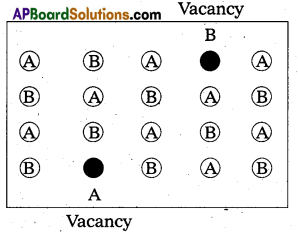
Schottky defect:

  1. It is a point defect in which an atom or ion is missing from its normal site in the lattice”.
  2.  In order to maintain electrical neutrality, the number of missing cations and anions are equal.
  3. This sort of defect occurs mainly in highly ionic compounds, where cationic and anionic sizes are similar.
    In such compounds the co-ordination number in high.
    Ex.: NaCl, CsCl etc.
  4. Illustration:
    AP Inter 2nd Year Chemistry Study Material Chapter 1 Solid State 1
  5. This defect decreases the density of the substance.

Question 16.
What is Frenkel defect ?
Answer:
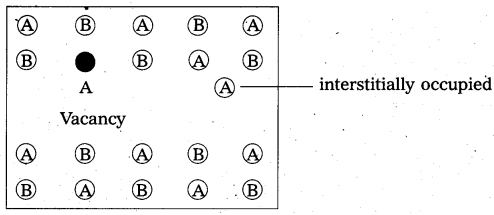
Frenkel defect:

  1. “It is a point defect in which an atom or ion is shifted from its normal lattice position”. The ion or the atom now occupies an interstitial position in the lattice.
  2. This type of a defect is favoured by a large difference in sizes between the cation and anion. In these compounds co-ordination number is low.
    E.g.: Ag – halides, ZnS etc.
  3. Illustration:
    AP Inter 2nd Year Chemistry Study Material Chapter 1 Solid State 2
  4. Frenkel defect do not change the density of the solids significantly.

AP Inter 2nd Year Chemistry Study Material Chapter 1 Solid State

Question 17.
What is interstitial defect ?
Answer:

  • Some of the constituent particles of solid compound occupy an interstitial site, the crystal is said to have interstitial defect.
  • This defect shown by ionic solid, non-ionic solids which are maintaining electrical neutrality.
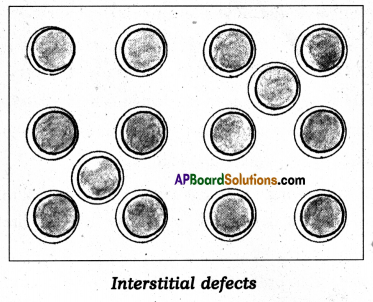
    AP Inter 2nd Year Chemistry Study Material Chapter 1 Solid State 3

Question 18.
What are f – centers ?
Answer:

  • f – centers are the anionic sites occupied by unpaired electrons.
  • These impart colour to cyrstals. This colour is due to the excitation of electrons when they absorb energy from the visible light.
  • f – centres are formed by heating alkyl halide with excess of alkali metal.
    E.g.: NaCl crystals heated in presence of Na – vapour yellow colour is produced due to f – centres.

Question 19.
Explain Ferromagnetism with suitable example.
Answer:
Ferromagnetic Substances : Some substances containing more number of unpaired electrons are very strongly attracted by the external magrietic field. In Ferromagnetic substances the Magnetic moments in individual atoms are all alligned in the same direction. Such substances are called Ferromagnetic Substances. In ferromagnetic substances the field strength B > > > H.
E.g. : Fe, Co and Ni.

AP Inter 2nd Year Chemistry Study Material Chapter 1 Solid State

Question 20.
Explain paramagnetism with suitable example.
Answer:
Paramagnetic Substances : If the magnetic lines of forces are drawn into the substance the field (B) in the substances is greater than the applied field (H) i.e., B > H. Such a substance is called paramagnetic substance. Paramagnetic substance moves from a weaker part of the field to a stronger part of the field. Paramagnetic substances are weakly attracted in a external Magnetic field. They exhibit paramagnetism due to the presence of unpaired electrons.
E.g. : Cr+3, Sc+2, K3 [Fe (CN)6].

Question 21.
Explain Ferrimagnetisms with suitable example.
Answer:
Ferrimagnetism is observed when the magnetic moments of the domains in the substance are aligned in parallel and anti parallel directions in unequal numbers.

  • These are weakly attracted by magnetic field as compared to ferromagnetic substances.
  • These lose ferrimagnetism on heating and becomes paramagnetic.

Question 22.
Explain Antiferromagnetism with suitable example.
Answer:
Substances like Mno showing anti-ferromagnetism having domain structure similar to ferromagnetic substance, but their domains are oppositely oriented and cancel out each others magnetic moment.

Question 23.
Why X – rays are needed to probe the crystal structure ?
Answer:
According to the principles of optics, the wavelength of light used to observe an object must be no greater than the twice the length of the object it self. It is impossible to see atom s using even the finest optical microscope. To see the atoms we must use light with a wavelength of approximately 10-10 m. X – rays are present with in this region of electromagnetic spectrum. So X – rays are used to probe crystal structure.

Short Answer Questions

Question 1.
Explain similarities and differences between metallic and ionic crystals.
Ans:
Similarities between ionic and metallic crystals :

  • Both ionic and metallic crystals have electrostatic force of attraction.
  • The bond present in ionic crystals and metallic crystals is non-directional.

Differences between ionic and metallic crystals :

Ionic Crystals

  1. In ionic crystals electrostatic force is in between oppositely charged ions.
  2. These are good conductors of electricity.
  3. Ionic bond in ionic crystals is strong.

Metallic Crystals

  1. In metallic crystals electrostatic force is in between the valency electrons.
  2. These are goods conductors of electricity  in solid state.
  3.  Metallic bond in metallic crystals is weak (or) strong.

AP Inter 2nd Year Chemistry Study Material Chapter 1 Solid State

Question 2.
Explain why ionic solids are hard and brittle.
Answer:
In ionic solids the formation of solid compound is due to the arrangements of cations and anions bound by strong coloumbic force i.e., electro static force. So ionic solids are hard and brittle in nature. These have high melting and boiling points.

Question 3.
Calculate the efficiency of packing in case of a metal of simple cubic crystal.
Answer:
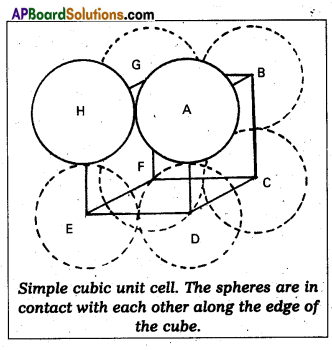
Packing efficiency in case of metal of simple cubic crystal:
AP Inter 2nd Year Chemistry Study Material Chapter 1 Solid State 4
The edge length of the cube
a = 2r. (r = radius of particle)
Volume of the cubic unit cell = a3 = (2r)3
= 8r3
∵ A simple cubic unit cell contains only one atom
The volume of space occupied = \(\frac{4}{3}\) πr3
∴ Packing efficiency
= \(\frac{\text { Volume of one atom }}{\text { Volume of cubic unit cell }}\) × 100
= \(\frac{4 / 3 \pi r^{3}}{8 r^{3}}\) × 100 = \(\frac{\pi}{6}\) × 100 = 52.36%.

Question 4.
Calculate the efficiency of packing in case of a metal of body centered cubic crystal.
Answer:
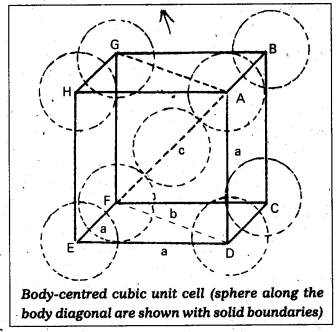
Packing efficiency in case of a metal of body centred cubic crystal:
AP Inter 2nd Year Chemistry Study Material Chapter 1 Solid State 5
in B.C.C. Crystal
\(\sqrt{3}\)a = 4r
a = \(\frac{4 \mathrm{r}}{\sqrt{3}}\)
In this structure total no. of atoms is ‘2’ and their volume = 2 × (\(\frac{4}{3}\)) πr3
Volume of the cube = a3 = (\(\frac{4}{\sqrt{3}}\)r)3
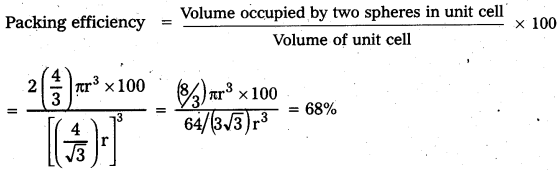
AP Inter 2nd Year Chemistry Study Material Chapter 1 Solid State 6

AP Inter 2nd Year Chemistry Study Material Chapter 1 Solid State

Question 5.
Calculate the efficiency of the packing incase of face – centered cubic crystal.
Answer:
Packing efficiency of face centered cubic crystal:
In fcc lattice assume that atoms are touching each other. Here unit cell edge length
a = 2\(\sqrt{2}\) r
Each unit cell as effectively four spheres.
Total volume of four spheres = 4 × (\(\frac{4}{3}\)) πr3
Volume of cube = a3 = (2\(\sqrt{2}\)r)3
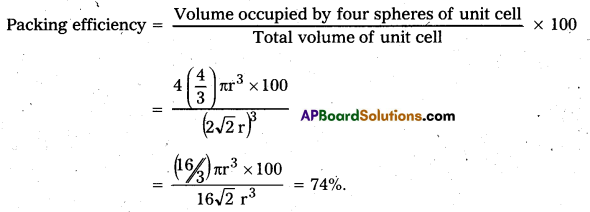
AP Inter 2nd Year Chemistry Study Material Chapter 1 Solid State 7

Question 6.
A cubic solid is made of two elements P and Q. Atoms of Q are at the corners of the cube and P at the body – centre. What is the formula of the compound ? What are the coordination numbers of P and Q?
Answer:
The contribution of atoms Q present at 8 corners of the cube = \(\frac{1}{8}\) × 8 = 1
The contribution of atoms P present at the body centre = 1
Therefore ratio of P and Q = 1 : 1
So, the formula of the compound is PQ.
Co-ordination number of atoms P and Q = 8.

Question 7.
If the radius of the octahedral void is ‘r and radius of the atoms in close packing is ‘R’, derive relation between r and R.
Answer:
Derivation of relation between r and R:
Octahedral void is shown in the following diagram as a shaded circle.
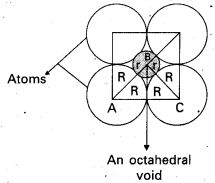
AP Inter 2nd Year Chemistry Study Material Chapter 1 Solid State 8
∴ ∆ ABC is a right angled triangle.
∴ We apply pythagoras theorem.
AC2 = AB2 + BC2
(2R)2 = (R + r)2 + (R + r)2 = 2 (R + r)2
4R2 = 2 (R + r)2
2R2 = (R + r)2
(\(\sqrt{2}\) R)P = (R + r)2
\(\sqrt{2}\) R = R + r
r = \(\sqrt{2}\) R – R
r = (\(\sqrt{2}\) – 1)R
r = (1.414- 1) R
r = 0.414 R.

AP Inter 2nd Year Chemistry Study Material Chapter 1 Solid State

Question 8.
Describe the two main types of semiconductors and contrast their conduction mechanism. [A.P. Mar. 19]
Answer:
The solids which are having moderate conductivity between insulators and conductors are called semi conductors.
These have the conductivity range from 10-6 to 104 Ohm-1m-1.
By doping process the conductivity of semi conductors increases. E.g.: Si, Ge, crystal.
Semi conductors are Of two types. They are :
1. Intrinsic semi-conductors : In case of semi-conductors, the gap between the valence band and conduction band is small. Therefore, some electrons may jump to conduction band and show some conductivity. Electrical conductivity of semi-conductors increases with rise in “temperature”, since more electrons can jump to the conduction band. Substances like silicon and germanium show this type of behaviour and are called intrinsic semi-conductors.

2. Extrinsic semi – conductors : Their conductivity is due to the presence of impurities.
They are formed by “doping”. ,
Doping: Conductivity of semi-conductors is too low to be of pratical use. Their conductivity is increased by adding an appropriate amount of suitable impurity. This process is called “doping”.
Doping can be done with an impurity which is electron rich or electron deficient.

Extrinsic semi-conductors are of two types.
a) n-type semi-conductors : It is obtained by adding trace amount of V group element (P, As, Sb) to pure Si or Ge by doping.
When P, As, Sb (Or) Bi is added to Si or Ge some of the Si or Ge in the crystal are replaced by P or As atoms and four out of five electrons of P or As atom will be used for bonding with Si or Ge atoms while the fifth electron serve to conduct electricity.

b) p-type semi-conductors : It is obtained by doping with impurity atoms containing less electrons i.e., III group elements (B, Al, Ga or In).
When B or Al is added to pure Si or Ge some of the Si or Ge in the crystal are replaced by B or AZ atoms and four out of three electrons of B or Al atom will be used for bonding with “Si” or Ge atoms while the fourth valence electron is missing is called electron hole (or) electron vacancy. This vacancy on an atom in the structure migrates from one atom to another. Hence it facilitates the electrical conductivity.

Question 9.
Classify each of the following as either a p – type or a n – type semiconductor.
1. Ge doped with In
2. Si doped with B.
Answer:
Both (1) and (2) come under “p – type semiconductors”.
Reason: In both the cases dopants (i.e.,) Indium in case – (1) and Boron in case – (2) belong to III (or) 13th group. Si (or) Ge doped with III group element is known as p-type semi- conductor.
Explanation : Doping the silicon or germanium element with III or 13th group element like “B”, Al, Ga or “In” results in the substitution of some silicon atoms in its structure by the dopant. The dopant has only three valency electrons. The fourth valency electron is required. It is left as a vacant place on the atom. It is known as an ‘electron vacancy’ (or) a ‘hole’. The electron vacancy on ah atom in the structure migrates from one atom to another. Hence it facilitates the electrical conductivity. Si (or) Ge, doped with elements that create a hole in the structure, is known as p- type semi-conductor.

AP Inter 2nd Year Chemistry Study Material Chapter 1 Solid State

Question 10.
Analysis shows that nickel oxide has the formula Ni0.980, 1.00, what fractions of nickel exist as Ni2+ and Ni3+ ions ?
Answer:
In pure nickel oxide (NiO) the ratio of Ni and O atoms = 1 : 1
Let x be the no. of Ni (II) atoms replaced by Ni (III) atoms in the oxide
∴ Number of Ni (II) atoms present = 0.98 – x
Total charge on Ni atoms = charge on oxygen atom (∵ the oxide is neutral)
2 (0.98 – x) + 3x = 2
1.96 – 2x + 3x = 2
x = 2 – 1.96 = 0.04
No. of Ni (iii) atoms
% of Ni (III) atoms in Nickel oxide = AP Inter 2nd Year Chemistry Study Material Chapter 1 Solid State 9 × 100
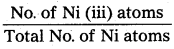
= \(\frac{0.04}{0.98}\) × 4.01%
% of Ni (II) atoms in nickel oxide = 100 – 4.01 = 95.99%

Question 11.
Gold (atomic radius = 0.144 nm) crystallizes in a face centered unit cell. What is the length of a side of the unit cell ?
Answer:
In a fee unit cell .
The edge length a = 2\(\sqrt{2}\) r
Given r = 0.144 nm
= 2 × 1.414 × 0.144 = 0.407 nm.

Question 12.
In terms of band theory, what is the difference between a conductor and an insulator ?
Answer:
In case of metals (conductors) the atomic orbitals forms molecular orbitals which are close in energy to each other as to form a band called valency band. If this band is partially filled (or) it overlaps with a higher energy unoccupied band called conduction band. Then electrons can flow easily under an applied electric field and the metal shows conductivity.
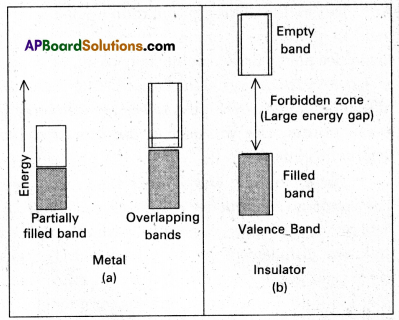
AP Inter 2nd Year Chemistry Study Material Chapter 1 Solid State 10
In case of insulators the gap between filled valence band and the next higher un occupied band is large, electrons cannot jump to it and such a substance has very small conductivity.

AP Inter 2nd Year Chemistry Study Material Chapter 1 Solid State

Question 13.
In terms of band theory, what is the difference between a conductor and a semiconductor?
Answer:
In case of metals (conductors) the atomic orbitals forms molecular orbitals which are close in energy to each other as to form a band called valency band. If this band is partially filled (or) it overlaps with a higher energy unoccupied band called conduction band. Then electrons can flow easily under an applied electric field and the metal shows conductivity.
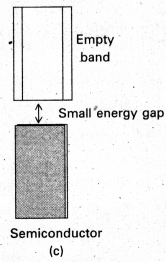
AP Inter 2nd Year Chemistry Study Material Chapter 1 Solid State 11
In case of semi conductors, the gap between the valence band and conduction band is small. So some of electrons may jump to conduction band and show some conductivity.

Question 14.
If NaCl is doped with 1 × 10⁻³ mol percent of SrCl2, what is the concentration of cation vacancies ?
Answer:
The addition of SrCl2 to NaCl , each Sr+2 ion replaces two Na+ ions and occupies only one lattice point in place of Na+. Due to this one cation vacancy arised.
The number of moles of cation vacancies in 100 moles of NaCl = 1 × 10⁻³
The number of moles of cation vacancies in 1 moles NaCl = \(\frac{1 \times 10^{-3}}{100}\) = 10-5 mole
Total number of cation vacancies = 10-5 × 6.023 × 1023 = 6.023 × 10¹⁸.

Question 15.
Derive Bragg’s equation. [T.S. Mar. 19, 16, 15; A.P. Mar. 17, 16, 15] [Mar. 14]
Answer:
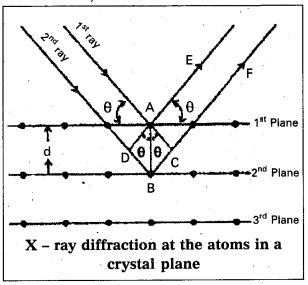
Derivation of Bragg’s equation : When X-rays are incident on the crystal or plane, they are diffracted from the lattice points (lattice points may be atoms or ions or molecules). In the crystal the lattice points are arranged in regular pattern. When the waves are diffracted from these points, the waves may be constructive or destructive interference.
AP Inter 2nd Year Chemistry Study Material Chapter 1 Solid State 12
The 1st and 2nd waves reach the crystal surface. They undergo constructive interference. Then from the figure 1st and 2nd rays are parallel waves. So, they travel the same distance till the wave form AD. The second crystal plane
ray travels more than the first by an extra distance (DB + BC) after crossing the grating for it to interfere with the first ray in a constructive manner. Then only they can be in the same phase with one another. If the two waves are to be in phase, the path difference between the two ways must be equal to the wavelength Q.) or integral multiple of it (nλ, where n = 1, 2, 3 )
(i.e.,) nλ = (DB + BC) [where n = order of diffraction]
DB = BC = d sin θ [θ = angle of incident beam,]
(DB + BC) = 2d sin θ [d = distance between the planes]
nλ = 2d sin θ
This relation is known as Bragg’s equation.

Long Answer Questions

Question 1.
How do you determine the atomic mass of an unknown metal If you know Its density and dimension of its unit cell? Explain.
Answer:
Let the, Atomic weight of crystalline substance = M
Avogadros number = N0
No. of atoms present per unit cell = Z
Density of unit cell or of the substance = ρ
Unit cell length = a
So, volume of the unit cell = a3 (= V)
∴ Then, mass corresponding to each lattice point = M/N0
∴ Mass of ‘Z lattice points = \(\frac{\mathrm{ZM}}{\mathrm{N}_{0}}\)
∴ Density (p) of unit cell = \(\frac{\text { mass }}{\text { volume }}=\frac{\frac{\mathrm{Z} \cdot \mathrm{M}}{\mathrm{N}_{0}}}{\mathrm{a}^{3}}=\frac{\mathrm{ZM}}{\mathrm{N}_{0} \mathrm{a}^{3}}\)
Atomic weight M = \(\frac{\rho \times \mathrm{a}^{3} \mathrm{~N}_{0}}{\mathrm{Z}}\)

AP Inter 2nd Year Chemistry Study Material Chapter 1 Solid State

Question 2.
Silver crystallizes in FCC lattice. If edge of the cell is 4.07 × 10⁻⁸ and density is 10.5 g. cm-3. Calculate the atomic mass of silver.
Answer:
Given data
d = 10.5 g/cm3
a = 4.07 × 10⁻⁸ cm
Z = 4 atoms
NA = 6.023 × 10²³
Formula M = \(\frac{\mathrm{d} \times \mathrm{a}^{3} \times \mathrm{N}_{\mathrm{A}}}{\mathrm{Z}}\)
= \(\frac{10.5 \times\left(4.07 \times 10^{-8}\right)^{3} \times 6.023 \times 10^{23}}{4}\)
= \(\frac{10.5 \cdot \times 67.767 \times 10^{-24} \times 6.023 \times 10^{23}}{4}\)
= 107.09 gm/mole.

Question 3.
Niobium crystallizes in body – centered cubic structure. If density is 8.55 g cm-3, calculate atomic radius of niobium using its atomic mass 93 U.
Answer:
Radius of unit cell in bcc structure = \(\frac{\sqrt{3}}{4}\) a
First we have to calculate edge length of unit cell ‘a’
Given Atomic mass of Niobium = 93 g/mole
No. of particles in bcc type unit cell (Z) = 2
mass of unit cell = \(\frac{\mathrm{ZM}}{\mathrm{N}_{\mathrm{A}}}=\frac{2 \times 93}{6.023 \times 10^{23}}\) = 30.89 × 10²³ gms
Given Density (d) = 8.55 gm/cm3
Volume of unit cell (a3) = \(\frac{\text { mass }}{\text { density }}=\frac{30.89 \times 10^{23}}{8.55}\)
= 36.16 × 10⁻²⁴ cm3.
Edge length of unit cell (a) = (36.13 × 10⁻²⁴)1/3
= 3.31 × 10⁻⁸ cm
radius of Unit cell (r) = \(\frac{\sqrt{3}}{4}\) a
= \(\frac{\sqrt{3} \times 3.31 \times 10^{-8}}{4}\)
= 1.43 × 10⁻⁸ cm = 143 pm.

Question 4.
Copper crystallizes into a FCC lattice with edge length 3.61 × 10⁻⁸ cm. Show that the calculated density is in agreement with its measured value of 8.92 g.cm-3.
Answer:
Density d = \(\frac{\mathrm{ZM}}{\mathrm{a}^{3} \times \mathrm{N}_{\mathrm{A}}}\)
Given edge length 3.61 × 10⁻⁸ cm
For FCC lattice of copper, Z = 4
Atomic mass of copper M = 63.5 gms/mole
d = \(\frac{4 \times 63.5}{\left(3.61 \times 10^{-8}\right)^{3} \times 6.023 \times 10^{23}}\)
= 8.97 g/cm3
The calculated value is approximately in agreement with the measured value 8.92 g/cm3.

AP Inter 2nd Year Chemistry Study Material Chapter 1 Solid State

Question 5.
Ferric oxide crystallizes in a hexagonal close – packed array of oxide ions with two of every three octahedral holes occupied by ferric ions. Derive the formula of ferric oxide.
Answer:
Given ferric oxide crystallises in a hexagonal close packed array of oxide ions with two out of every three octahedral,holes occupied by ferric ions.
In hexagonal close – packed arrangement there is one octahedral hole for each atom. If the number of oxide ions (O-2) per unit cell is one, then the number of Fe+3 ions = 2/ 3 × octahedral holes.
= 2/3 × 1 = 2/3
The formula of the compound = Fe2/3 O1 (or) Fe2 O3.

Question 6.
Aluminium crystallizes in a cubic close packed structure. Its metallic radius is 125 pm.
i) What is the length of the side of the unit cell.
ii) how many unit cells are there in 1.00 cm3 of aluminium.
Answer:
i) Given radius = 125 pm
For a fcc lattice unit cell r = \(\frac{a}{2 \sqrt{2}}\)
a = 2\(\sqrt{2}\) × r
= 2 × 1.414 × 125 = 353.5 pm
∴ Length of the side of the unit cell = 353.5 pm

ii) Volume of unit cell = a3 = (353.5 × 10⁻¹⁰ cm)3
= 442 × 10-25 cm3
Number of unit cell = \(\frac{1}{4.42 \times 10^{-25}}\)
= 2.26 × 10²² unit cells.

Question 7.
How do you obtain the diffraction pattern for a crystalline substance ?
Answer:
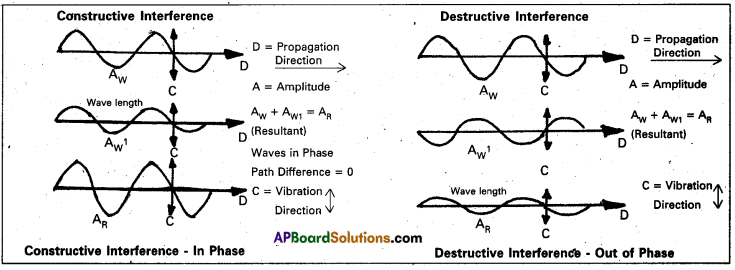
Diffraction of electromagnetic radiation takes place when a beam of light is scattered by an object containing regularly spaced lines (or) points. This scattering phenomenon can happen only if the spacing between the lines (of) points is comparable to the wave length of the radiation.

From the following figure diffraction is due to interface between two waves passing through the same region of space at the same time.
If the waves are in phase, peak to peak and trough to trough, the interference is constructive and the combined wave is increased intensity.

  • If the waves are out of phase, the interference is destructive interference and the wave is cancelled.
  • Constructive interference gives rise to intense spots observed on Laue’s photographic plate, while destructive interference causes the surrounding high) areas.
    AP Inter 2nd Year Chemistry Study Material Chapter 1 Solid State 13

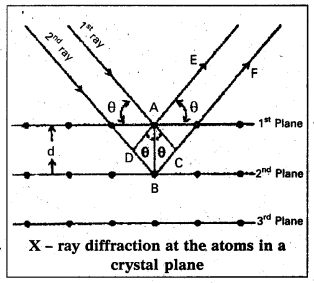
Derivation of Bragg’s equation : When X-rays are incident on the crystal or plane, they are diffracted from the lattice points (lattice points may be atoms or ions or molecules). In the crystal the lattice points are arranged in regular pattern. When the waves are diffracted from these points, the waves may be constructive or destructive interference.
AP Inter 2nd Year Chemistry Study Material Chapter 1 Solid State 14
The 1st and 2nd waves reach the crystal surface. They undergo constructive interference. Then from the figure 1 and 2h1 rays are parallel waves. So, they travel the same distance till the wave front AD. The second ray travels more than the first by an extra distance (DB + BC) after crossing the grating for it to interfere with the first ray in a constructive manner. Then only they can be in the same phase with one another. If the two waves are to be in phase, the path difference between the two ways must be equal to the wavelength (λ) or integral multiple of it (nλ, where n = 1, 2, 3 )
(i.e.,) nλ = (DB + BC) [where n = order of diffraction]
DB = BC = d sin θ [θ = angle of incident beam,]
(DB + BC) = 2d sin θ [d = distance between the planes]
nλ = 2d sin θ
This relation is known as Bragg’s equation.

AP Inter 2nd Year Chemistry Study Material Chapter 1 Solid State

Textual Examples

Question 1.
A compound is formed by two elements X and Y. Atoms of the element Y (as anions) make ccp and those of the element X (as cations) occupy all the octahedral voids. What is the formula of the compound ?
Solution:
The ccp lattice is formed by the element Y. The number of octahedral voids generated would be equal to the number of atoms of Y present in it. Since all the octahedral voids are occupied by the atoms of X, their number would also be equal to that of the element Y. Thus, the atoms of elements X and Y are present in equal numbers or 1 : 1 ratio. Therefore, the formula of the compound is XY.

Question 2.
Atoms of element B form hep lattice and those of the element A occupy 2/3rd of tetrahedral voids. What is the formula of the compound formed by the elements A and B ?
Solution:
The number of tetrahedral voids formed is equal to twice the number of atoms of element B and only 2/3rd of these are occupied by the atoms of element A. Hence the ratio of the number of atoms of A and B is 2 × (2/3) : 1 or 4 : 3 and the formula of the compound is A4B3.

Question 3.
An element has a body-centred cubic (bcc) structure with a cell edge of 288 pm. The density of the element is 7.2 g/cm3. How many atoms are present in 208 g of the element ?
Solution:
Volume of the unit cell = (288 pm)3
= (288 × 10-12 m)3 = (288 × 10-10 cm)3 = 2.39 × 10⁻²³ cm3.
Volume of 208 g of the element
= \(\frac{\text { mass }}{\text { density }}=\frac{208 \mathrm{~g}}{7.2 \mathrm{~g} \mathrm{~cm}^{-3}}\) = 28.88 cm3
Number of unit cells in this volume
= \(\frac{28.88 \mathrm{~cm}^{3}}{2.39 \times 10^{-23} \mathrm{~cm}^{3} / \text { Unit cell }}\) = 12.08 × 10²³ unit cells
Since each bcc cubic unit cell contains 2 atoms, therefore, the total number of atoms in 208 g = 2 (atoms/unit cell) × 12.08 × 10²³ unit cells
= 24.16 × 10²³ atoms

AP Inter 2nd Year Chemistry Study Material Chapter 1 Solid State

Question 4.
X-ray diffraction studies show that copper crystallises in ah fee unit cell with cell edge of 3.608 x 10⁻⁸ cm. In a separate experiment, copper is determined to have a density of 8.92 g/cm3, calculate the atomic mass of copper.
Solution:
In case of fee lattice, number of atoms per unit cell, z = 4 atoms.
Therefore, M = \(\frac{\mathrm{dN}_{\mathrm{A}} \mathbf{a}^{3}}{z}\)
= \(\frac{8.92 \mathrm{~g} \mathrm{~cm}^{-3} \times 6.022 \times 10^{23} \text { atoms mol}^{-1} \times\left(3.608 \times 10^{-8} \mathrm{~cm}\right)^{3}}{4 \text { atoms }}\) = 63.1 g/mol
Atomic mass of copper = 63.1 u

Question 5.
Silver forms ccp lattice and X-ray studies of its ciystals show that the edge length of its unit cell is 408.6 pm. Calculate the density of silver (Atomic mass = 107.9 u).
Solution:
Since the lattice is ccp, the number of silver atoms per unit celll = z = 4
Molar mass of silver = 107.9 g mol-1 = 107.9 × 10⁻³ kg mol-1.
Edge length of unit cell = a = 408.6 pm = 408.6 × 10⁻¹² m
Density, d = \(\frac{\mathrm{z} \cdot \mathrm{M}}{\mathrm{a}^{3} \cdot \mathrm{N}_{\mathrm{A}}}\)
= \(\frac{4 \times\left(107.9 \times 10^{-3} \mathrm{~kg} \mathrm{~mol}^{-1}\right)}{\left(408.6 \times 10^{-12} \mathrm{~m}\right)^{3}\left(6.022 \times 10^{23} \mathrm{~mol}^{-1}\right)}\)
= 10.5 × 10³ kg m-3
= 10.5 g cm3.

Intext Questions

Question 1.
Why are solids rigid ?
Answer:
In solid state the constituent particles are not free to move. They can only oscillate about their mean positions due to strong attraction forces between the particles. That is why solids have a closely packed arrangement and rigid structure.

Question 2.
Why do solids have a definite volume ?
Answer:
The constituents particles in solids are bound to th.eir mean positions by strong forces of attraction. The interparticle distances remain unchanged even at increased or reduced pressure. Therefore, solids have a definite volume.

AP Inter 2nd Year Chemistry Study Material Chapter 1 Solid State

Question 3.
Classify the following as amorphous or crystalline solids : polyurethane, naphthalene, benzoic acid, teflon, potassium nitrate, cellophane, polyvinyl chloride, fibre glass, copper.
Answer:
Amorphous solids
Polyurethane
Naphthalene
Teflon
Cellophane
Polyvinyl chloride
Fibre glass

Crystalline solids
Benzoic acid
Potassium nitrate
Copper

Question 4.
Why is glass considered a supercooled liquid ?
Answer:
Liquids have the characteristic property i.e., the tendency to flow. Glass also shows this property, though it flows very slowly. Glass panes fixed to windows or doors of old buildings are invariably found to be slightly thicker at the bottom than the top. This is because the glass flows down very slowly and makes the bottom portion slightly thicker. Therefore, glass is considered as a supercooled liquid.

Question 5.
Refractive index of a solid is observed to have the same value along all directions. Comment on the nature of this solid. Would it show cleavage property ?
Answer:
A solid has same value of refractive index along all directions is isotropic and hence amorphous in nature. It would not show a clean cleavage when cut with a knife. Instead, it would break into pieces With irregular surface.

Question 6.
Classify the following solids in diff rent categories based on the nature of intermolecular forces operating in them :
Potassium sulphate, tin, benzene, urea, ammonia, water, zinc sulphide, graphite, rubidium, argon, silicon carbide.
Answer:
Ionic solids : Potassium sulphate, zinc sulphide (as they have iohic bonds).
Covalent solids : Graphite, silicon carbide (as they are covalent giant molecules).
Molecular solids : Benzene, urea, ammonia, water, argon (as they have covalent bond).
Metallic solids : Rubidium, tin (as these are metals).

AP Inter 2nd Year Chemistry Study Material Chapter 1 Solid State

Question 7.
Solid A’ is a very hard electrical insulator in solid as well as in molten state and melts at extremely high temperature. What type of solid is it ?
Answer:
Since, the solid ‘A’ is an insulator in solid as well as in molten state, it shows the absence of ions in it. Moreover it melts at extremly high temperature, so it is a giant molecule. These are the properties of covalent solids. So, it is a covalent solid.

Question 8.
Ionic solids conduct electricity in molten state but not in solid state. Explain.
Answer:
In ionic solids, electrical conductivity is due to the movement of ions. In solid state, ions cannot move and remain held together by strong electrostatic forces of attraction. Therefore, they behave as insulators.

Question 9.
What type of solids are electrical conductors, malleable and ductile ?
Answer:
Metallic solids.

Question 10.
Ire the significance of a ‘lattice point’.
Answer:
The lattice point denotes the position of a particular constituent (atom, ion or molecule) in a crystal lattice. The arrangement of the lattice points in space is responsible for the shape of a particular crystalline solid.

AP Inter 2nd Year Chemistry Study Material Chapter 1 Solid State

Question 11.
Name the parameters that characterise a unit cell.
Answer:
A unit cell is characterised by

  1. its dimensions along the three edges, a, b and c.
  2. angles between the edges, α (between b and c) β ( between a and c) and γ (between a and b).
    Thus, a unit cell is characterised by six parameters, a, b, c, α, β and γ.

Question 12.
Distinguish between
i) hexagonal and monoclinic unit cells.
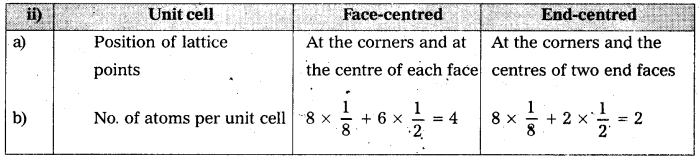
ii) face-centered and end-centered unit cells.
Answer:
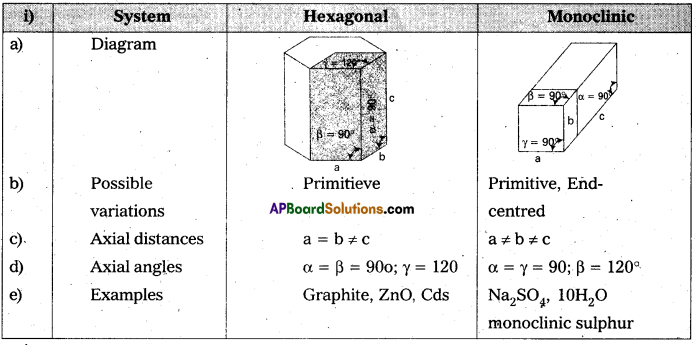
AP Inter 2nd Year Chemistry Study Material Chapter 1 Solid State 15
AP Inter 2nd Year Chemistry Study Material Chapter 1 Solid State 16

Question 13.
Explain how much portion of an atom located at

  1. Corner ?
  2. body-centre of a cubic unit cell is part of its neighbouring unit cell ?

Answer:

  1. A point lying at the corner of a unit cell is shared equally by eight unit cells and therefore,
  2. A body centred point belongs entirely to one unit cell since, it is not shared by any other unit cell.

Question 14.
What is the two dimensional coordination number of a molecule in square close packed layer ?
Answer:
Four (4),.as each atom is surrounded by four other atoms.

AP Inter 2nd Year Chemistry Study Material Chapter 1 Solid State

Question 15.
A compound forms hexagonal close-packed structure. What is the total number of voids in 0.5 mol of it ? How many of these are tetrahedral voids ?
Answer:
Total number of atoms (N) in a closed packed structure (0.5 mol)
= 0.5 × 6.022 × 1023 = 3.011 × 10²³
Number of octahedral voids = N = 3.011 × 10²³
Number of tetrahedral voids = 2N = 2 × 3.011 × 1023 = 6.022 × 10²³
Total number of voids = 3.011 × 10²³ + 6.022 × 1023
= 9.033 × 10²³

Question 16.
A compound is formed by two elements M and N. The element N forms ccp and atoms of M occupy \(\frac{1}{3}\) rd of tetrahedral voids. What is the formula of the compound ?
i) Find the number of tetrahedral voids as number of tetrahedral voids = 2 × number of atoms present in the lattice.
ii) Calculate the number of atoms (or ratio) of elements M and N as a chemical formula represents the number of atoms of different elements presents in a compound.
iii) Derive the’ formula.
Answer:
Suppose atoms of element N present in ccp = x
Then number of tetrahedral voids = 2x
Since, \(\frac{1}{3}\) rd of the tetrahedral voids are occupied by atoms of elements M.
Therefore, number of atoms of element M = \(\frac{1}{3}\) × 2x = \(\frac{2x}{3}\)
Ratio of M : N = \(\frac{2x}{3}\) : x = 2 : 3
Hence, formula of the compound = M2N3.

Question 17.
Which of the following lattices has the highest packing efficiency ?

  1. Simple cubic
  2. Body-centred cubic
  3. Hexagonal close-packed lattice

Packing efficiency in .

  1. Simple cubic lattice = 52.4%
  2. body-centred cubic lattice = 68%
  3. hexagonal close-packed lattice = 74%

Answer:
Hexagonal closed packed lattice has the highest packing efficiency (74%)

AP Inter 2nd Year Chemistry Study Material Chapter 1 Solid State

Question 18.
An element with molar mass 2.7 × 10⁻² kg mol-1 forms a cubic unit cell with edge length 405 pm. If its density is 2.7 × 10³ kg m-3 what is the nature of the cubic unit cell ?
Answer:
Density (d) = \(\frac{\mathrm{Z} \times \mathrm{M}}{\mathrm{a}^{3} \times \mathrm{N}_{\mathrm{A}}}\) so, Z = \(\frac{\mathrm{d} \times \mathrm{a}^{3} \times \mathrm{N}_{\mathrm{A}}}{\mathrm{M}}\)
Given, M = 2.7 × 10⁻² kg mol-1
a = 405 pm = 405 × 10-12 m = 4.05 × 10⁻¹⁰m
d = 2.7 × 10³ kgm-3
NA = 6.022 × 10²³ mol-1.
Hence.
Z = \(\frac{\left(2.7 \times 10^{3 .} \mathrm{kg} \mathrm{m}^{-3}\right)\left(4.05 \times 10^{-10} \mathrm{~m}\right)^{3} \times\left(6.022 \times 10^{23} \mathrm{~mol}^{-1}\right)}{\left(2.7 \times 10^{-2} \mathrm{~kg} \mathrm{~mol}^{-1}\right)}\)
= 3.99 = 4
Since, there are four atoms per unit cell, the cubic unit cell must be face – centred.

Question 19.
What type of defect can arise when a solid is heated ? physical property is affected by it and in what way ?
Answer:
When a solid is heated, a vacancy is created in the crystal. On heating, some of the lattice sites are vacant and the density of the solid decreases as the number of ions per unit volume decreases.

Question 20.
What type of stoichiometric defect is shown by

  1. ZnS
  2. AgBr

Answer:

  1. ZnS shows Frenkel defect because its ions have large difference in size.
  2. AgBr shows both Frenkel and Schottky defects.

Question 21.
Explain how vacancies are introduced in an ionic solid when a cation of higher valence is aded as an impurity in it ?
Answer:
When a cation of higher valence is added as an impurity to an ionic solid, some vacancies are created. This can be explained with the help of an example. When strontium, chloride (SrCl2) is added as an impurity to ionic solid sodium chloride (NaCl), two vacant sites are created by removal of one Na+ ion. One vacant site is replaced by Sr2+ ion but the other remains vacant. The reason is that the crystal as a whole is to remain electrically neutral. Note : [Cationic vacancies produced = No. of cations of higher valency × difference in ’ valencies of the original cation and cation of higher valency]

AP Inter 2nd Year Chemistry Study Material Chapter 1 Solid State

Question 22.
Ionic solids, which have anionic vacancies due to metal excess defect, develop colour. Explain with the help of a suitable example.
Answer:
We can explain the metal excess defect with the example of sodium chloride crystals. When NaCl crystals are heated in an atmosphere of sodium vapour, the Na atoms are deposited on the surface of the crystal. The Cl ions diffuse to the surface of the crystal and combine with Na atoms to give NaCZ. This happens by loss of electron by Na atoms to form Na+ ions. The released electrons occupy anionic sites by diffusing into the crystals. These electrons absorb energy from visible light and emit radiations corresponding to yellow colour. These electrons are called F-centres (from the German word Farbenzenter meaning colour centre).

Question 23.
A group 14 elements is to be converted into n-type semiconductor by doping it with a suitable impurity. To which group should this impurity belong ?
Answer:
n-type semiconductor means increase in conductivity due to presence of excess of electrons. Therefore, a 14 group element should be doped with a 15-group element Eg : arsenic or phosphorus.

Question 24.
What type of substances would make better permanent magnets, ferromagnetic or ferrimagnetic ? Justify your answer
Answer:
Ferromagnetic substances make better permanent magnets than ferrimagnetic substances. The metal ions of a ferromagenetic substance are grouped into small regions known as domains and these are randomly oriented. When a magnetic field is applied, all domains are oriented in the direction of the magnetic field. Now the ferromagnetic substance behaves as a magnet. When the applied magnetic field is removed, the magnetic character is retained. Thus, the ferromagnetic substance becomes a permanent magnet.
This property (of being permanently magnetised) is not found in ferrimagnetic substances. They lose their magnetic property on heating.
Inter 2nd Year Maths 2B Parabola Important Questions

Students get through Maths 2B Important Questions Inter 2nd Year Maths 2B Parabola Important Questions which are most likely to be asked in the exam.

Intermediate 2nd Year Maths 2B Parabola Important Questions

Question 1.
Find the equation of the parabola whose focus is S (1, -7) and vertex is A(1, -2). [T.S. Mar. 15]
Solution:
Let S = (1, -7), A(1, -2)
h = 1, k = -2, a = -2 + 7 = 5
Axis of the parabola is parallel to y – axis
Equation of the parabola is
(x – h)2 = – 4a (y – k)
(x – 1)2 = – 20(y + 2)
x2 – 2x + 1, = – 20y – 40
⇒ x2 – 2x + 20y + 41 – 0.

Inter 2nd Year Maths 2B Parabola Important Questions

Question 2.
If the normal at the point t1 on the parabola y2 =, 4ax meets it again at point t2 then prove that t1t2 + t12 + 2 = 0. [May 07]
Solution:
Equation of normal is
y – y1 = \(\frac{-y_{1}}{2 a}\) (x – x1)
y – 2at1 = \(\frac{-2 a t_{1}}{2 a}\) (x – at12) ……………… (i)
Equation of the line (i) again meets parabola at (at22, 2at1)
∴ 2at2 – 2at1 = t1 (at22 – at12)
\(-\frac{2}{t_{1}}\) = t1 + t2 ⇒ -2 = t12 + t1t2
⇒ t12 + t1t2 + 2 = 0

Question 3.
Find the coordinates of the vertex and focus, and the equations of the directrix and axes of the y – x + 4y + 5 = 0. [Mar 05]
Solution:
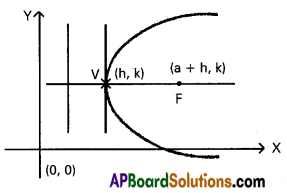
y2 – x + 4y + 5 = 0 ⇒ (y – (-2))2 = (x – 1), comparing with (y – k)2 = 4a(x – h),we get (h, k) = (1, -2) and a = \(\frac{1}{4}\), coordinates of the vertex (h, k) = (1 ,-2)
coordinates of the focus (h + a, k) = (\(\frac{5}{4}\), -2)
Equation of the directrix x – h + a = 0
i.e., 4x – 3 = 0
Equation of the axis y – k = 0.
i.e., y + 2 = 0

Inter 2nd Year Maths 2B Parabola Important Questions

Question 4.
Find the coordinates of the points on the parabola y2 = 2x whose focal distance is \(\frac{5}{2}\). [A.P. Mar. 15, Mar. 13]
Solution:
Let P(x1, y1) be a point on the parabola
y2 = 2x whose focal distance is \(\frac{5}{2}\) then
y12 = 2x1 and x1 + a = \(\frac{5}{2}\)
⇒ x1 + \(\frac{1}{2}\) = \(\frac{5}{2}\) ⇒ x1 = 2
∴ y12 = 2(2) = 4 ⇒ y1 = ±2
∴ The required points are (2, 2) and (2, -2)

Question 5.
Find the value of k if the line 2y = 5x + k is a tangent to the parabola y2 = 6x. [T.S. Mar. 16]
Solution:
Given line is 2y = 5x + k
⇒ y = (\(\frac{5}{2}\))x + (\(\frac{k}{2}\))
Comparing y = (\(\frac{5}{2}\))x + (\(\frac{k}{2}\)) with y = mx + c
We get m = \(\frac{5}{2}\), c = \(\frac{k}{2}\)
y = (\(\frac{5}{2}\))x + \(\frac{k}{2}\) is a tangent to y2 = 6x
c = \(\frac{a}{m}\)
⇒ \(\frac{k}{2}=\frac{\left(\frac{3}{2}\right)}{\left(\frac{5}{2}\right)}\) ⇒ k = \(\frac{6}{5}\)

Question 6.
Show that the equations of common tangents to the circle x2 + y2 = 2a2 and the parabola y2 = 8ax are y = ± (x + 2a). [Mar. 06]
Solution:
The equation of tangent to parabola
y2 = 8ax is y = mx + \(\frac{2a}{m}\)
m2x – my + 2a = 0 ……………….. (1)
If (i) touches circle x2 + y2 = 2a2, then the length of perpendicular from its centre (0, 0) to (i) must be equal to the radius a\(\sqrt{2}\) of the circle.
\(\left|\frac{2 a}{\sqrt{m^{2}+m^{4}}}\right|=a \sqrt{2}\)
or 4 = 2 (m4 + m2)
m4 + m2 – 2 = 0
(m2 + 2) (m2 – 1) = 0 or m = ±1
Required tangents are
y = (1) x + \(\frac{2 a}{(1)}\), y = (-1) x + \(\frac{2 a}{(-1)}\)
y = ± (x + 2a)

Inter 2nd Year Maths 2B Parabola Important Questions

Question 7.
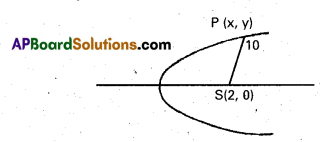
Find the co-ordinates of the point on the parabola y2 = 8x whose focal distance is 10. [T.S. Mar. 17] [A.P. Mar. 16; Mar. 14, 11]
Solution:
Equation of the parabola is
y2 = 8x
4a = 8 ⇒ a – 2
Inter 2nd Year Maths 2B Parabola Important Questions 1
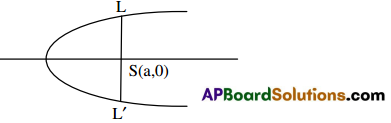
Co-ordinates of the focus S are (2, 0) Suppose P(x, y) is the point on the parabola.
Given SP = 10 ⇒ SP2 = 100
(x – 2)2 + y2 = 100
But y2 = 8x
⇒ (x – 2)2 + 8x = 100
⇒ x2 – 4x + 4 + 8x – 100 = 0
⇒ x2 + 4x – 96 = 0 ⇒ (x + 12) (x – 8) = 0
x + 12 = 0 or x – 8 = 0
x = -12, or 8
Case (i) x = 8
y2 = 8.x = 8.8 = 64
y = ±8
Co-ordinates of the required points are (8, 8) and (8, -8)
Case (ii) x = -12
y2 = 8(-12) = -96 < 0
y is not real.

Question 8.
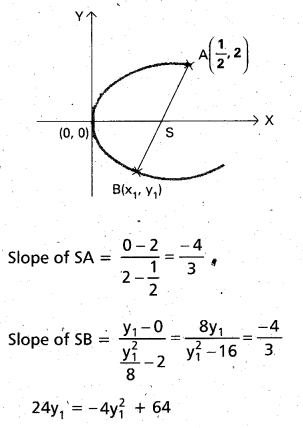
If (\(\frac{1}{2}\), 2) is one extermity of a focal chord of the parabola y2 = 8x. Find the co-ordinates of the other extremity. [May 06]
Solution:
A = (\(\frac{1}{2}\), 2); S = (2, 0)
B = (x1, y1) ⇒ (\(\frac{y_{1}^{2}}{8}\), y1)
ASB is a focal chord.
∴ Slopes of SA and BS are same.
Inter 2nd Year Maths 2B Parabola Important Questions 2
or 4y12 + 24y1 – 64 = 0
⇒ y12 + 6y1 – 16 = 0
⇒ (y1 + 8) (y, – 2) = 0
y1 = 2, 8
x1 = \(\frac{1}{2}\), 8; So (8, -8) other extremity.

Inter 2nd Year Maths 2B Parabola Important Questions

Question 9.
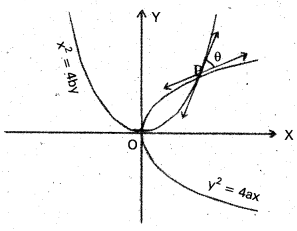
Show that the common tangent to the parabola y2 = 4ax and x2 = 4by is xa1/3 + yb1/3 + a2/3b2/3 = 0 [T.S. Mar. 17] [A.P. Mar. 16]
Solution:
The equations of the parabolas are
y2 = 4ax ………………. (1)
and x2 = 4by ……………… (2)
Equation of any tangent to (1) is of the form
y = mx + \(\frac{a}{m}\) …………….. (3)
If the line (3) is a tangent to (2) also, we must get only one point of intersection of (2) and (3).
Substituting the value of y from (3) in (2), we get x2 = 4b (mx + \(\frac{a}{m}\)) is 3x2 – 4bm2x – 4ab = 0 should have equal roots Therefore its discriminent must be zero. Hence
16b2m4 – 4m (-4ab) = 0
16b(bm4 + am) = 0
m(bm3 + a) = 0 But m ≠ 0
∴ m = – a1/3/b1/3 substituting in (3) the equation of the common tangent becomes
y = \(-\left(\frac{a}{b}\right)^{1 / 3} x+\frac{a}{\left(-\frac{a}{b}\right)^{1 / 3}}\) or
a1/3x + b1/3y + a2/3b2/3 = 0 .

Question 10.
Prove that the area of the triangle formed by the .tangents at (x1, y1), (x2, y2) and (x3, y3) to the parabola y2 = 4ax (a > 0) is \(\frac{1}{16a}\)|(y1 – y2) (y2 – y3) (y3 – y1)| sq. units. [T.S. Mar. 15]
Solution:
Let D(x1, y1) = (at12, 2at1),
E(x2, y2) = (at22, 2at2),
and F(x3, y3) = (at32, 2at3), be three points on the parabola
y2 = 4ax (a > 0).
The equation of the tangents at D, E and F are
t1y = x + at12 ……………… (1)
t2y = x + at22 ………………. (2)
t3y = x.+ at32 ………………. (3)
(1) – (2) ⇒ (t1 – t2) y = a(t1 – t2) (t1 + t2)
⇒ y = a(t1 + t2) substituting in (1)
we get x = at1t2.
∴ The point of intersection of the tangents at D and E is say P(at1t2, a(t1 + t2))
Similarly the points of intersection of tangent at E, F and at F, D are Q(at2t3, a(t2 + t3) and R(at3t1 a(t3 + t1)) respectively
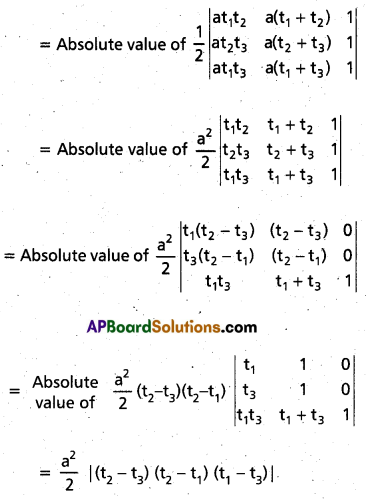
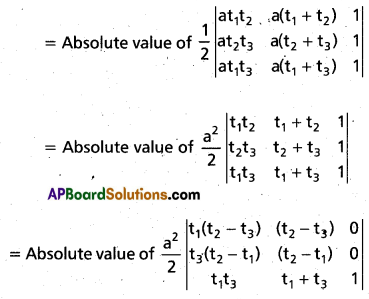
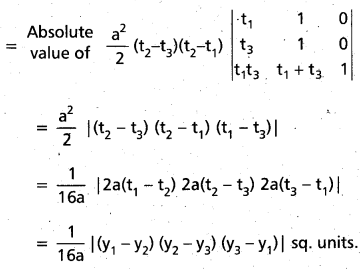
Area of ∆PQR
Inter 2nd Year Maths 2B Parabola Important Questions 3
\(\frac{1}{16a}\) |2a(t1 – t2) 2a(t2 – t3) 2a(t3 – t1)|
\(\frac{1}{16a}\)|(y1 – y2) (y2 – y3) (y3 – y1)| sq. units.

Question 11.
Prove that the two parabolas y2 = 4ax and x2 = 4by intersect (other than the origin) at an angle of Tan-1 \(\left[\frac{3 a^{1 / 3} b^{1 / 3}}{2\left(a^{2 / 3}+b^{2 / 3}\right)}\right]\) [Mar. 14]
Solution:
Without loss of generality we assume a > 0 and b > 0.
Let P(x, y) be the point of intersection of the parabolas other than the origin. Then
y4 = 16a2x2
= 16a2(4by)
= 64a2by
∴ y[y3 – 64a2b] = 0
=> y3 – 64a2b = 0
=> y = (64a2b)1/3 [∵ y > 0]
= 4a2/3b1/3
Inter 2nd Year Maths 2B Parabola Important Questions 4
Also from y2 = 4ax, x = \(\frac{16 a^{4 / 3} b^{2 / 3}}{4 a}\)
= 4a1/3b2/3
∴ P = (4a1/3b2/3, 4a2/3b1/3)
Differentiating both sides of y2 4ax w.r.t ‘x’, we get
\(\frac{d y}{d x}=\frac{2 a}{y}\)
∴ \(\left[\frac{\mathrm{dy}}{\cdot \mathrm{dx}}\right]_{\mathrm{p}}=\frac{2 \mathrm{a}}{4 \mathrm{a}^{2 / 3} \mathrm{~b}^{1 / 3}}=\frac{1}{2}\left(\frac{\mathrm{a}}{\mathrm{b}}\right)^{1 / 3}\)
If m1 be the slope of the tangent at P to y2 = 4ax, then
m1 = \(\frac{1}{2}\left(\frac{a}{b}\right)^{1 / 3}\)
Similarly, we get m2 = \(2\left(\frac{a}{b}\right)^{1 / 3}\) where m2 is the slope of the tangent at P to x2 = 4by.
If θ is the acute angle between the tangents to the curves at P, then
tan θ = \(\left|\frac{m_{2}-m_{1}}{1+m_{1} m_{2}}\right|=\frac{3 a^{1 / 3} b^{1 / 3}}{2\left(a^{2 / 3}+b^{2 / 3}\right)}\)
so that θ = \(\tan ^{-1}\left[\frac{3 a^{1 / 3} b^{1 / 3}}{2\left(a^{2 / 3}+b^{2 / 3}\right)}\right]\)

Inter 2nd Year Maths 2B Parabola Important Questions

Question 12.
Find the coordinates of the vertex and focus, and the equations of the directrix and axes of the following parabolas.
(i) y2 = 16x
(ii) x2 = -4y
(iii) 3x2 – 9x + 5y – 2 = 0
(iv) y2 – x + 4y + 5 = 0 [Mar. 05]
Solution:
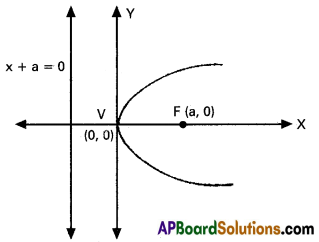
i) y2 = 16x, comparing with y2 = 4ax,
we get 4a = 16 ⇒ a = 4
The coordinates of the vertex = (0, 0)
The coordinates of the focus = (a, 0) = (4, 0)
Equation of the directrix: x + a = i.e., x + 4 = 0
Axis of the parabola y = 0

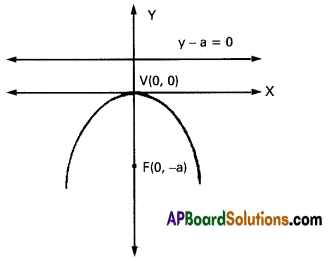
ii) x2 = -4y, comparing with x2 = -4ay,
we get 4a = 4 ⇒ a = 1
The coordinates of the vertex = (0, 0
The coordinates of the focus = (0, -a) = (0, 1)
The equation of the directrix y – a = 0
i.e., y – 1 = 0 .
Equation of the axis x = 0

iii) 3x2 – 9x + 5y – 2 = 0
3(x2 – 3x) = 2 – 5y
⇒ 3(x2 – 2x(\(\frac{3}{2}\)) + \(\frac{9}{4}\)) = 2 – 5y + \(\frac{27}{4}\)
(x – \(\frac{3}{2}\))2 = –\(\frac{5}{3}\) (y – \(\frac{7}{4}\)),
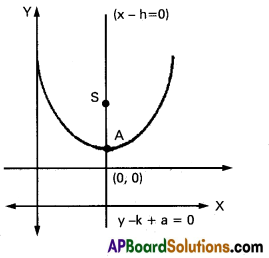
Comparing with (x – h)2 = -4a (y – k) we get
a = \(\frac{5}{12}\), h = \(\frac{3}{2}\), k = \(\frac{7}{4}\)
∴ Coordinates of the vertex = (h, k)
= (\(\frac{3}{2}\), \(\frac{7}{4 }\))
Coordinates of the focus = (h, k – a)
= (\(\frac{3}{2}\), \(\frac{7}{4}\) – \(\frac{5}{12}\)) = (\(\frac{3}{2}\), \(\frac{4}{3}\))
Equation of the directrix is y – k – a = 0
i.e., 6y – 13 = 0
Equation of the axis is x – h = 0
i.e., 2x – 3 = 0

iv) y2 – x + 4y + 5 = 0 ⇒ (y- (-2))2 = (x – 1),
comparing with (y – k)2 = 4a(x – h),we get
(h, k) = (1, -2) and a = \(\frac{1}{4}\), coordinates of the vertex (h, k) = (1 ,-2)
coordinates of the focus
(h + a, k) = (\(\frac{5}{4}\), -2)
Equation of the directrix x – h + a = 0
i.e., 4x – 3 = 0
Equation of the axis y – k = 0.
i.e., y + 2 = 0

Inter 2nd Year Maths 2B Parabola Important Questions

Question 13.
Find the equation of the parabola whose vertex is (3, -2) and focus is (3, 1).
Solution:
The abcissae of the vertex and focus are equal to 3. Hence the axis of the parabola is x = 3, a line parallel to y-axis, focus is above the vertex.
a = distance between focus and vertex = 3.
∴ Equation of the parabola
(x – 3)2 = 4(3) (y + 2)
i.e., (x – 3)2 = 12(y + 2).

Question 14.
Find the coordinates of the points on the parabola y2 = 2x whose focal distance is \(\frac{5}{2}\). [A.P. Mar. 15, Mar. 13]
Solution:
Let P(x1, y1) be a point on the parabola
y2 = 2x whose focal distance is \(\frac{5}{2}\) then
y12 = 2x1 and x1 + a = \(\frac{5}{2}\)
⇒ x1 + \(\frac{1}{2}\) = \(\frac{5}{2}\) ⇒ x1 = 2
∴ y12 = 2(2) = 4 ⇒ y1 = ±2
∴ The required points are (2, 2) and (2, -2)

Question 15.
Find the equation of the parabola passing through the points (-1, 2), (1, -1) and (2, 1) and having its axis parallel to the X-axis.
Solution:
Since the axis is parallel to x-axis the equation of the parabola is in the form of
x = -ly2 + my + n. .
Since the parabola passes through (-1, 2), we have
-1 = l( 2)2 + m(2) + n
⇒ 4l + 2m + n = – 1 ……………………. (1)
Similarly, since the parabola passes through (1,-1) and (2, 1) we have
l – m + n = 1 ……………… (2)
l + m + n = 2 ……………… (3)
Solving (1), (2) and (3)
we get l = –\(\frac{7}{6}\), m = \(\frac{1}{2}\) and n = \(\frac{8}{3}\).
Hence the equation of the parabola is
x = –\(\frac{7}{6}\) y2 + \(\frac{1}{2}\) y + \(\frac{8}{3}\) (or)
7y2 – 3y + 6x- 16 = 0.

Inter 2nd Year Maths 2B Parabola Important Questions

Question 16.
A double ordinate of the curve y2 = 4ax is of length 8a. Prove that the line from the vertex to its ends are at right angles.
Solution:
Let P = (at2, 2at) and P’ = (at2, -2at) be the ends of double ordinate PP’. Then
8a = PP’ = \(\sqrt{0+(4 a t)^{2}}\) = 4at ⇒ t = 2.
∴ P = (4a, 4a), P’= (4a, -4a) .
Slope of \(\overline{\mathrm{AP}}\) × slope of \(\overline{\mathrm{AP}^{\prime}}\)
= (\(\frac{4a}{4a}\))(-\(\frac{4a}{4a}\)) = -1
∴ ∠PAP’ = \(\frac{\pi}{2}\)

Question 17.
i) If the coordinates of the ends of a focal chord of the parabola y2 = 4ax are (x1, y1) and (x2, y2), then prove that x1x2 = a2, y1y2 = -4a2.
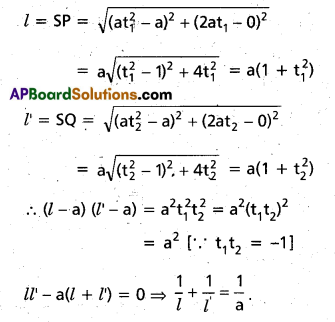
ii) For a focal chord PQ of the parabola y2 = 4ax, if SP = l and SQ = l’ then prove that \(\frac{1}{l}\) + \(\frac{1}{l}\) = \(\frac{1}{a}\).
Solution:
i) Let P(x1, y1) = (at12, 2at1) and Q(x2, y2) = (at22, 2at1) be two end points of a focal chord.
P, S, Q are collinear
Slope of \(\overline{\mathrm{PS}}\) = Slope of \(\overline{\mathrm{QS}}\)
\(\frac{2 a t_{1}}{a t_{1}^{2}-a}=\frac{2 a t_{2}}{a t_{2}^{2}-a}\)
t1t22 – t1 = t2t12 – t2
t1t2 (t2 – t1) + (t2 – t1) = 0
1 + t1t2 = 0 ⇒ t1t2 = -1 ………………… (1)
From (1) x1x2 = at12 at22 = a2(t2t1)2 = a2
y1y2 = 2at12at2 = 4a2(t2 t1) = -4a2

ii) Let P(at12, 2at1) and Q(at22, 2at1) be the extremities of a focal chord of the parabola, then t1t2 = -1 (from (1))
Inter 2nd Year Maths 2B Parabola Important Questions 5

Question 18.
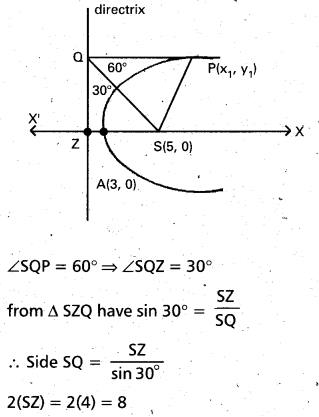
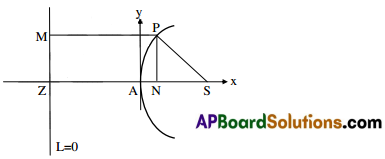
If Q is the foot of the perpendicular from a point P on the parabola y2 = 8(x – 3) to its directrix. S is the focus of the parabola and if SPQ is an equilateral triangle then find the length of side of the triangle.
Solution:
Given parabola y2 = 8(x – 3) then
its vertex A = (3, 0) and focus = (5, 0)
[4a = 8 ⇒ a = 2] since PQS is an equilateral triangle
Inter 2nd Year Maths 2B Parabola Important Questions 6
Hence length of each side of triangle is ‘8’.

Inter 2nd Year Maths 2B Parabola Important Questions

Question 19.
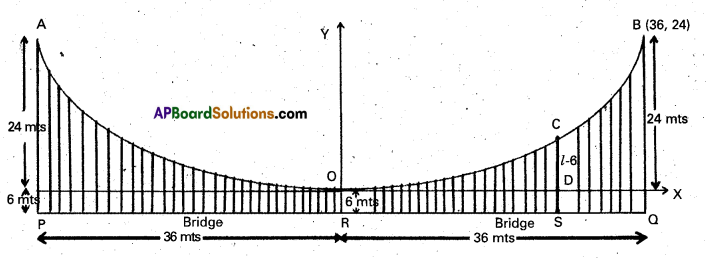
The cable of a uniformely loaded suspension bridge hangs in the form of a parabola. The roadway which is horizontal and 72 mt. long is supported by vertical wires attached to the cable, the longest being 30 mts. and the shortest being 6 mts. Find the length of the supporting wire attached to the road-way 18 mts. from the middle.
Inter 2nd Year Maths 2B Parabola Important Questions 7
Solution:
Let AOB be the cable [0 is its lowest point and A, B are the highest points]. Let PRQ be the bridge suspended with PR = RQ = 36 mts. (see above Fig.).

PA = QB = 30 mts (longest vertical sup-porting wires)

OR = 6 mts (shortest vertical supporting wire) [the lowest point of the cable is up¬right the mid-point R of the bridge]

Therefore, PR = RQ = 36 mts. We take the origin of coordinates at 0, X-axis along the tangent at O to the cable and the Y-axis along \(\overleftrightarrow{\mathrm{RO}}\). The equation of the cable would, therefore, be x2 = 4ay for some a > 0. We get B = (36, 24) and 362 = 4a × 24.
Therefore, 4a = \(\frac{36 \times 36}{24}\) = 54 mts.
If RS = 18 mts. and SC is the vertical through S meeting the cable at C and the X-axis at D, then SC is the length of the supporting wire required. If SC = l mts, then
DC = (l – 6) mts. As such C = (18, l – 6).
Since C is on the cable, 182 = 4a (l – 6)
⇒ l – 6 = \(\frac{18^{2}}{4 a}\) = \(\frac{18 \times 18}{54}\) = 6
⇒ l = 12

Question 20.
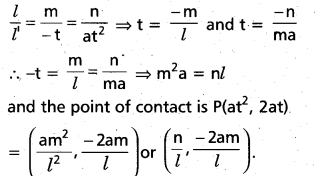
Find the condition for the straight line lx + my + n = 0 to be a tangent to the parabola y2 = 4ax and find the co-ordinates of the point of contact.
Solution:
Let the line lx + my + n = 0 be a tangent to the parabola y2 = 4ax at (at2, 2at). Then the equation of the tangent at P(t) is x – yt + at2 = 0 then it represents the given line
lx + my + n = 0, then
Inter 2nd Year Maths 2B Parabola Important Questions 8

Inter 2nd Year Maths 2B Parabola Important Questions

Question 21.
Show that the straight line 7x + 6y = 13 is a tangent to the parabola y2 – 7x – 8y + 14 = 0 and find the point of contact.
Solution:
Equation of the given line is 7x + 6y = 13, equation of the given parabola is y2 – 7x – 8y + 14 = 0.
By eliminating x, we get the ordinates of the points of intersection of line and parabola adding the equations y2 – 2y + 1 = 0.
i.e., (y – 1 )2 = 0 ⇒ y = 1, 1.
∴ The given line is tangent to the given parabola.
If y = 1 then x = 1 hence the point of contact is (1, 1).

Question 22.
Prove that the normal chord at the point other than origin whose ordinate is equal to its abscissa subtends a right angle at the focus.
Solution:
Let the equation of the parabola be
y2 = 4ax and P(at2, 2at) be any point …………………. (1)
On the parabola for which the abscissa is equal to the ordinate.
i.e., at2 = 2at ⇒ t = 0
or t = 2. But t ≠ 0. Hence the point (4a, 4a) at which the normal is
y + 2x = 2a(2) + a(2)3 (or)
y = (12a – 2x) ………………….. (2)
Substituting the value of
y = 12a – 2x in (1) we get
(12a – 2x)2 = 4ax (or)
x2 – 13ax + 36a2 = (x – 4a) (x – 9a) = 0
⇒ x = 4a, 9a
corresponding values of y are 4a and -6a. Hence the other points of intersection of that normal at P(4a, 4a) to the given parabola is Q(9a, -6a), we have S(a, 0).
Slope of the \(\overline{\mathrm{SP}}\) = m1 = \(\frac{4a-0}{4a-a}\) = \(\frac{4}{3}\),
Slope of the \(\overline{\mathrm{SQ}}\) = m2 = \(\frac{-6a-0}{9a-a}\) = \(\frac{3}{4}\)
clearly m1m2 = -1, so that \(\overline{\mathrm{SP}}\) ⊥ \(\overline{\mathrm{SQ}}\)

Inter 2nd Year Maths 2B Parabola Important Questions

Question 23.
From an external point P, tangent are drawn to the parabola y2 = 4ax and these tangent make angles θ1, θ2 with its axis, such that tan θ1 + tan θ2 is constant b. then show that P lies on the line y = bx.
Solution:
Let the coordinates of P be (x1, y1) and the equation of the parabola y2 = 4ax. Any tangent to .the parabola is y = mx + \(\frac{a}{m}\), if this passes through (x1, y1) then
y1 = mx, + \(\frac{a}{m}\)
i.e., m2x1 – my1 + a = 0 ………………… (1)
Let the roots of (1) be m1, m21.
Then m1 + m2 = \(\frac{\mathrm{y}_{1}}{\mathrm{x}_{1}}\)
⇒ tan θ1 + tan θ2 = \(\frac{\mathrm{y}_{1}}{\mathrm{x}_{1}}\)
[∵ The tangents make angles θ1, θ2 with its axis (x – axis) then their slopes m1 = tan θ1 and m2 = tan θ2].
∴ b = \(\frac{\mathrm{y}_{1}}{\mathrm{x}_{1}}\) ⇒ y1 = bx1
∴ P(x1, y1) lies on the line y = bx.

Question 24.
Show that the common tangent to the parabola y2 = 4ax and x2 = 4by is xa1/3 + yb1/3 + a2/3b2/3 = 0. [A.P. Mar. 16]
Solution:
The equations of the parabolas are
y2 = 4ax ………………. (1)
and x2 = 4by …………………. (2)
Equation of any tangent to (1) is of the form
y = mx + \(\frac{a}{m}\)
If the line (3) is a tangent to'(2) also, we must get only one point of intersection of (2) and (3).
Substituting the value of y from (3) in (2),
we get x2 = 4b (mx + \(\frac{a}{m}\)) is mx2 – 4bm2x – 4ab = 0 should have equal roots therefore its discriminent must be zero. Hence
16b2m4 – 4m (-4ab) = 0
16b(bm4 + am) = 0
m(bm3 + a) = 0 But m ≠ 0
∴ m = – a1/3/b1/3 substituting in (3) the equation of the common tangent becomes
y = \(-\left(\frac{a}{b}\right)^{1 / 3} x+\frac{a}{\left(-\frac{a}{b}\right)^{1 / 3}}\) (or)
∴ a1/3 x + b1/3y + a2/3b2/3 = 0

Inter 2nd Year Maths 2B Parabola Important Questions

Question 25.
Prove that the area of the triangle formed ‘ by the tangents at (x1, y1), (x2, y2) and (x3, y3) to the parabola y2 = 4ax (a > 0) is \(\frac{1}{16a}\)|(y1 – y2) (y2 – y3) (y3 – y1)| sq. units. [T.S. Mar. 15]
Solution:
Let D(x1, y1) = (at12, 2at1)
E(x2, y2) = (at32, 2at2)
and F(x3, y3) = (at23, 2at3)
be three points on the parabola
y2 = 4ax (a > 0).
The equation of the tangents at D, E and F are
t1y = x + at12 ………………. (1)
t2y = x + at22 ………………. (2)
t3y = x + at32 ………………. (3)
(1) – (2) ⇒ (t1 – t2) y = a(t1 – t2) (t1 + t2)
⇒ y = a(t1 + t2) substituting in (1)
we get x = at1t2
∴ The point of intersection of the tangents at D and E is say P(at1t2, a(t1 + t2))
Similarly the points of intersection of tangent at E, F and at F, D are Q(at2t3, a(t2 + t3) and R(at3t1, a(t3 + t1)) respectively
Area of ∆PQR
Inter 2nd Year Maths 2B Parabola Important Questions 9
Inter 2nd Year Maths 2B Parabola Important Questions 10

Question 26.
Prove that the two parabolas y2 = 4ax and x2 = 4by intersect (other than the origin) at an angle of Tan-1 \(\left[\frac{3 a^{1 / 3} b^{1 / 3}}{2\left(a^{2 / 3}+b^{2 / 3}\right)}\right]\) [Mar. 14]
Solution:
Without loss of generality we assume a > 0 and b > 0.
Let P(x, y) be the point of intersection of the parabolas other than the origin. Then
y4 = 16a2x2
= 16a2(4by)
= 64a2by
∴ y[y3 – 64a2b] = 0
⇒ y3 – 64a2b = 0
⇒ y = (64a2b)1/3 [∵ y > 0]
= 4a2/3b1/3
Inter 2nd Year Maths 2B Parabola Important Questions 4
Also from y2 = 4ax, x = \(\frac{16 a^{4 / 3} b^{2 / 3}}{4 a}\)
= 4a1/3b2/3
∴ P = (4a1/3b2/3, 4a2/3b1/3)
Differentiating both sides of y2 4ax w.r.t ‘x’, we get
\(\frac{d y}{d x}=\frac{2 a}{y}\)
∴ \(\left[\frac{\mathrm{dy}}{\cdot \mathrm{dx}}\right]_{\mathrm{p}}=\frac{2 \mathrm{a}}{4 \mathrm{a}^{2 / 3} \mathrm{~b}^{1 / 3}}=\frac{1}{2}\left(\frac{\mathrm{a}}{\mathrm{b}}\right)^{1 / 3}\)
If m1 be the slope of the tangent at P to y2 = 4ax, then
m1 = \(\frac{1}{2}\left(\frac{a}{b}\right)^{1 / 3}\)
Similarly, we get m2 = \(2\left(\frac{a}{b}\right)^{1 / 3}\) where m2 is the slope of the tangent at P to x2 = 4by.
If θ is the acute angle between the tangents to the curves at P, then
tan θ = \(\left|\frac{m_{2}-m_{1}}{1+m_{1} m_{2}}\right|=\frac{3 a^{1 / 3} b^{1 / 3}}{2\left(a^{2 / 3}+b^{2 / 3}\right)}\)
so that θ = \(\tan ^{-1}\left[\frac{3 a^{1 / 3} b^{1 / 3}}{2\left(a^{2 / 3}+b^{2 / 3}\right)}\right]\)

Inter 2nd Year Maths 2B Parabola Important Questions

Question 27.
Prove that the orthocenter of the triangle formed by any three tangents to a parabola lies on the directrix of the parabola.
Solution:
Let y2 = 4ax be the parabola and
A = (at12, 2at1),
B = (at22, 2at2),
C = (at32, 2at3) be any three points on it.
Now we consider the triangle PQR formed by the tangents to the prabola at A, B, C
where P = (at1t2, a(t1 + t2)),
Q = (at2t3, a(t2 + t3)) and R = (at3t1, a(t3 + t1)).
Equation of \(\overleftrightarrow{\mathrm{QR}}\) (i.e., the tangent at C) is x – t3 y + at32 = 0.
Therefore, the attitude through P of triangle PQR is
t3x + y = at1t2t3 + a(t1 + t2) ………………….. (1)
Similarly, the attitude through Q is
t1x + y = at1t2t3 + a(t2 + t3) ………………….. (2)
Solving (1) and (2), we get (t3 – t1)
x’ = a(t1 – t3) i.e., x = – a.
Therefore, the orthocenter of the triangle PQR, with abscissa as -a, lies on the directrix of the parabola.

Inter 2nd Year Maths 2B Circle Important Questions

Students get through Maths 2B Important Questions Inter 2nd Year Maths 2B Circle Important Questions which are most likely to be asked in the exam.

Intermediate 2nd Year Maths 2B Circle Important Questions

Question 1.
If x2 + y2 + 2gx + 2fy – 12 = 0 represents a circle with centre (2, 3), find g, f and its radius. [Mar. 11]
Solution:
Circle is x2 + y2 + 2gx + 2fy – 12 = 0
C = (-g, -f) C = (2, 3)
∴ g = – 2, f = – 3, c = – 12
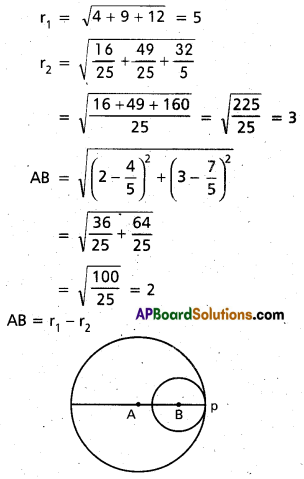
Radius = \(\sqrt{g^{2}+f^{2}-c}\)
= \(\sqrt{4+9+12}\) = 5 units

Inter 2nd Year Maths 2B Circle Important Questions

Question 2.
Obtain the parametric equation of x2 + y2 = 4 [Mar. 14]
Solution:
Equation of the circle is x2 + y2 = 4
C (0, 0), r = 2
Parametric equations are
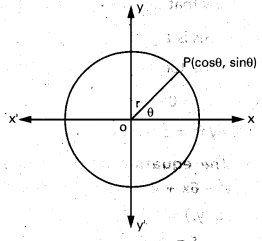
x = – g + r cos θ = 2 cos θ
y = – b + r sin θ = 2 sin θ, 0 < θ < 2π

Question 3.
Obtain the parametric equation of (x – 3)2 + (y – 4)2 = 82 [A.P. Mar. 16; Mar. 11]
Solution:
Equation of the circle is (x – 3)2 + (y – 4)2 =82
Centre (3, 4), r = 8
Parametric equations are
x = 3 + 8 cos θ, y = 4 + 8 sin θ, 0 < θ < 2π

Question 4.
Find the power of the point P with respect to the circle S = 0 when
ii) P = (-1,1) and S ≡ x2 + y2 – 6x + 4y – 12
Solution:
Power of the point = S11
= 1 + 1 + 6 + 4 – 12 = 0

iii) P = (2, 3) and S ≡ x2 + y2 – 2x + 8y – 23
Power of the point = S11
= 4 + 9 – 4 + 24 – 23 = 10

iv) P = (2, 4) and S ≡ x2 + y2 – 4x – 6y – 12
Power of the point = 4 + 16 – 8 – 24 – 12
= -24.

Inter 2nd Year Maths 2B Circle Important Questions

Question 5.
If the length of the tangent from (5, 4) to the circle x2 + y2 + 2ky = 0 is 1 then find k. [Mar. 15; Mar. 01]
Solution:
= \(\sqrt{S_{11}}=\sqrt{(5)^{2}+(4)^{2}+8 k}\)
But length of tangent = 1
∴ 1 = \(\sqrt{25+16+8k}\)
Squaring both sides we get 1 = 41 + 8k
k = – 5 units.

Question 6.
Find the polar of (1, -2) with respect to x2 + y2 – 10x – 10y + 25 = 0 [T.S. Mar. 15]
Solution:
Equation of the circle is x2 + y2 – 10x – 10y + 25 = 0
Equation of the polar is S1 = 0
Polar of P(1,-2) is
x . 1 + y(-2) – 5(x + 1) – 5(y – 2) + 25 = 0
⇒ x – 2y – 5x – 5 – 5y + 10 + 25 = 0
⇒ -4x – 7y + 30 = 0
∴ 4x + 7y – 30 = 0

Question 7.
Find the value of k if the points (1, 3) and (2, k) are conjugate with respect to the circle x2 + y2 = 35. [T.S. Mar. 16]
Solution:
Equation of the circle is
x2 + y2 = 35
Polar of P(1, 3) is x. 1 + y. 3 = 35
x + 3y = 35
P(1, 3) and Q(2, k) are conjugate points
The polar of P passes through Q
2 + 3k = 35
3k = 33
k = 11

Question 8.
If the circle x2 + y2 – 4x + 6y + a = 0 has radius 4 then find a. [A.P. Mar. 16]
Solution:
Equation of the circle is
x2 + y2 – 4x + 6y + a = 0
2g = – 4, 2f = 6, c = a
g = -2, f = 3, c = a
radius = 4 ⇒ \(\sqrt{g^{2}+f^{2}-c}\) = 4
\(\sqrt{4+9-a}\) = 4
13 – a = 16
a = 13 – 16 = -3

Inter 2nd Year Maths 2B Circle Important Questions

Question 9.
Find the value of ‘a’ if 2x2 + ay2 – 3x + 2y – 1 =0 represents a circle and also find its radius.
Solution:
General equation of second degree
ax2 + 2hxy + by2 + 2gx + 2fy + c = 0
Represents a circle, when
a = b, h = 0, g2 + f2 – c ≥ 0
In 2x2 + ay2 – 3x + 2y – 1 = 0
a = 2, above equation represents circle.
x2 + y2 – \(\frac{3}{2}\) x + y – \(\frac{1}{2}\) = 0
2g = – \(\frac{3}{2}\); 2f = 1; c = – \(\frac{1}{2}\)
c = (-g, -f) = (\(\frac{+3}{4}\), \(\frac{-1}{2}\))
Radius = \(\sqrt{g^{2}+f^{2}-c}\) = \(\sqrt{\frac{9}{16}+\frac{1}{4}+\frac{1}{2}}\)
= \(\frac{\sqrt{21}}{4}\) units

Question 10.
If the abscissae of points A, B are the roots of the equation, x2 + 2ax – b2 = 0 and ordinates of A, B are root of y2 + 2py – q2 = 0, then find the equation of a circle for which \(\overline{\mathrm{AB}}\) is a diameter. [Mar. 14]
Solution:
Equation of the circle is
(x – x1) (x – x2) + (y – y1) (y – y2) = 0
x2 – x(x1 + x2) + x1x2 + y2 – y (y1 + y2) + y1y2 = 0
x1, x2 are roots of x2 + 2ax – b2 = 0
y1, y2 are roots of y2 + 2py – q2 = 0
x1 + x2 = – 2a
x1x2 = -b2

y1 + y2 = -2p
y1y2 = -q2
Equation of circle be
x2 – x (- 2a) – b2 + y2– y (- 2p) – q2 = 0
x2 + 2xa + y2 + 2py – b2 – q2 = 0

Question 11.
Find the equation of a circle which passes through (4, 1) (6, 5) and having the centre on 4x + 3y – 24 = 0 [A.P. Mar. 16; Mar. 14]
Solution:
Equation of circle be x2 + y2 + 2gx + 2fy + c = 0 passes through (4, 1) and (6, 5) then
42 + 12 + 2g(4) + 2f(1) + c = 0 ………….. (i)
62 + 52 + 2g(6) + 2f(5) + c = 0 ……………… (ii)
Centre lie on 4x + 3y – 24 = 0
∴ 4(-g) + 3 (-f) – 24 = 0
(ii) – (i) we get
44 + 4g + 8f = 0
Solving (iii) and (iv) we get
f = -4, g = -3, c = 15
∴ Required equation of circle is
x2 + y2 – 6x – 8y + 15 = 0

Inter 2nd Year Maths 2B Circle Important Questions

Question 12.
Find the equation of a circle which is concentric with x2 + y2 – 6x – 4y – 12 = 0 and passing through (- 2, 14). [Mar. 14]
Solution:
x2 + y2 – 6x – 4y – 12 = 0 …………… (i)
C = (- g, – f)
= (3, 2)
Equation of circle concentric with (i) be
(x – 3)2 + (y – 2)2 = r2
Passes through (-2, 14)
∴ (- 2 – 3)2 + (14 – 2)2 = r2
169 = r2
Required equation of circle be
(x – 3)2 + (y – 2)2 = 169
x2 + y2 – 6x – 4y – 156 = 0

Question 13.
Find the equation of the circle whose centre lies on the X-axis and passing through (- 2, 3) and (4, 5). [A.P. & T.S. Mar. 15]
Solution:
x2 + y2 + 2gx + 2fy + c = 0 ……………… (i)
(- 2, 3) and (4, 5) passes through (i)
4 + 9 – 4g + 6f + c = 0 ………………………. (ii)
16 + 25 + 8g + 10f + c = 0 …………………. (iii)
(iii) – (ii) we get
28 + 12g + 4f = 0
f + 3g = – 7
Centre lies on X – axis then f = 0
g = -, \(\frac{7}{3}\), f = 0, c = \(\frac{67}{3}\) -, we get by substituting g; f in equation (ii)
Required equation will be 3(x2 + y2) – 14x – 67 = 0

Question 14.
Find the equation of circle passing through (1, 2); (3, – 4); (5, – 6) three points.
Solution:
Equation of circle is
x2 + y2 + 2gx + 2fy + c = 0
1 + 4 + 2g + 4f + c = 0 …………………… (i)
9 + 16 + 6g – 8f + c = 0 …………………… (ii)
25 + 36 + 10g – 12f + c = 0 ………………… (iii)
Subtracting (ii) – (i) we get
20 + 4g – 12f = 0
(or) 5 + g – 3f = 0 ……………….. (iv)
Similarly (iii) – (ii) we get
36 + 4g – 4f = 0
(or) 9 + g – f = 0 ………………… (v)
Solving (v) and (iv) we get
f = -2, g = – 11, c = 25
Required equation of circle be x2 + y2 – 22x – 4y + 25 = 0

Question 15.
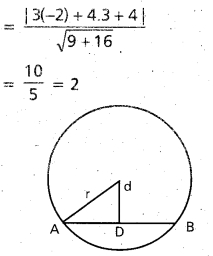
Find the length of the chord intercepted by the circle x2 + y2 – 8x – 2y – 8 = 0 on the line x + y + 1 = 0 [T.S. Mar. 16]
Solution:
Equation of the circle is x2 + y2 – 8x – 2y – 8 = 0
Centre is C(4, 1), r = \(\sqrt{16+1+8}\) = 5
Equation of the line is x + y + 1 = 0
P = distance from the centre = \(\frac{|4+1+1|}{\sqrt{1+1}}\)
= \(\frac{6}{\sqrt{2}}\) = 3\(\sqrt{2}\)
Length of the chord = 2\(\sqrt{r^{2}-p^{2}}\)
= 2\(\sqrt{25-18}\)
= 2\(\sqrt{7}\) units.

Inter 2nd Year Maths 2B Circle Important Questions

Question 16.
Find the pair of tangents drawn from (1, 3) to the circle x2 + y2 – 2x + 4y – 11 =0 and also find the angle between them. [T.S. Mar. 16]
Solution:
SS11 = S12
(x2 + y2 – 2x + 4y – 11) (1 + 9 – 2 + 12 – 11) = [x + 3y – 1 (x + 1) + 2 (y + 3) – 11]2
(x2 + y2 – 2x + 4y – 11) 9 = [5y – 6]2
9x2 + 9y2 – 18x + 36y – 99
= 25y2 + 36 – 60y
9x2 – 16y2 – 18x + 96y – 135 = 0
cos θ = \(\frac{|a+b|}{\sqrt{(a-b)^{2}+4 h^{2}}}\) = \(\frac{|9-16|}{\sqrt{(25)^{2}}}\)
= \(\frac{|-7|}{25}\) = \(\frac{7}{25}\) ⇒ θ = cos-1 (\(\frac{7}{25}\))

Question 17.
Find the value of k if the points (4, 2) and (k, -3) are conjugate points with respect to the circle x2 + y2 – 5x + 8y + 6 = 0. [T.S. Mar. 17]
Solution:
Equation of the circle is x2 + y2 – 5x + 8y + 6 = 0
Polar of P(4, 2) is
x . 4 + y . 2 – \(\frac{5}{2}\) (x + 4) + 4 (y + 2) + 6 = 0
8x + 4y – 5x – 20 + 8y + 16 + 12 = 0
3x + 12y + 8 = 0
P(4, 2), Q(k, -3) are conjugate points
Polar of P passes through Q
∴ 3k – 36 + 8 = 0
3k = 28 ⇒ k = \(\frac{28}{3}\)

Question 18.
If (2, 0), (0,1), (4, 5) and (0, c) are concyclic, and then find c. [A.P. & T.S. Mar. 15]
Solution:
x2 + y2 + 2gx + 2fy + c1 = 0
Satisfies (2, 0), (0, 1) (4, 5) we get
4 + 0 + 4g + c1 = 0 …………………. (i)
0 + 1 + 2g. 0 + 2f + c1 = 0 – (ii)
16 + 25 + 8g + 10f + c1 = -0 ……………. (iii)
(ii) – (i) we get
– 3 – 4g + 2f = 0
4g – 2f = – 3 ……………… (iv)
(ii) – (iii) we get
– 40 – 8g – 8f = 0 (or)
g + f = – 5 …………………… (v)
Solving(iv) and (v) we get
g = –\(\frac{13}{6}\), f = –\(\frac{17}{6}\)
Substituting g and f values in equation (i) we get
4 + 4 (-\(\frac{13}{6}\)) + c1 = 0
c1 = \(\frac{14}{3}\)
Now equation x2 + y2 – \(\frac{13}{3}\) x – \(\frac{17}{3}\) y + \(\frac{14}{3}\) = 0
Now circle passes through (0, c) then
c2 – \(\frac{17}{3}\) c + \(\frac{14}{3}\) = 0
3c2 – 17c + 14 = 0
⇒ (3c – 14) (c – 1) = 0
(or)
c = 1 or \(\frac{14}{3}\)

Inter 2nd Year Maths 2B Circle Important Questions

Question 19.
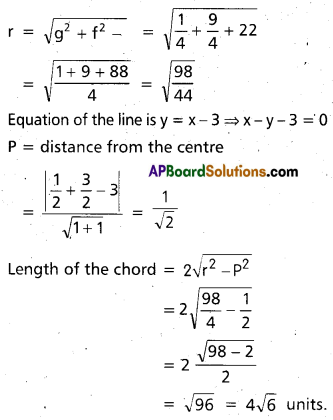
Find the length of the chord intercepted by the circle x2 + y2 – x + 3y – 22 = 0 on the line y = x – 3. [May 11; Mar. 13]
Solution:
Equation of the circle is
S ≡x2 + y2 – x + 3y – 22 = 0
Centre C(\(\frac{1}{2}\), –\(\frac{3}{2}\))
Inter 2nd Year Maths 2B Circle Important Questions 1

Question 20.
Find the equation of the circle with centre (-2, 3) cutting a chord length 2 units on 3x + 4y + 4 = 0 [Mar. 11]
Solution:
Equation of the line is 3x + 4y + 4 = 0
P = Length of the perpendicular .
Inter 2nd Year Maths 2B Circle Important Questions 2
Length of the chord = 2λ = 2 ⇒ λ = 1
If r is the radius of the circle then
r2 = 22 + 12 – 4 + 1 = 5
Centre of the circle is (-2, 3)
Equation of the circle is (x + 2)2 + (y – 3)2 = 5
x2 + 4x + 4 + y2 – 6y + 9 – 5 = 0
i.e., x2 + y2 + 4x – 6y + 8 = 0

Question 21.
Find the pole of 3x + 4y – 45 = 0 with respect to x2 + y2 – 6x – 8y + 5 = 0. [A.P. Mar. 16]
Solution:
Equation of polar is
xx1 + yy1 – 3(x + x1) – 4(y + y1) + 5 = 0
x(x1 – 3) + y(y1 – 4) – 3x1 – 4y1 + 5 = 0 …………………. (i)
Polar equation is same 3x + 4y – 45 = 0 ……………….. (ii)
Comparing (i) and (ii) we get
Inter 2nd Year Maths 2B Circle Important Questions 3

Inter 2nd Year Maths 2B Circle Important Questions

Question 22.
i) Show that the circles x2 + y2 – 6x – 2y + 1 = 0 ; x2 + y2 + 2x – 8y + 13 = 0 touch each other. Find the point of contact and the equation of common tangent at their point of contact. [A.P. Mar. 16; Mar. 11]
Solution:
Equations of the circles are
S1 ≡ x2 + y2 – 6x – 2y + 1 = 0
S2 ≡x2 + y2 + 2x – 8y + 13 = 0
Centres are A (3, 1), B(-1, 4)
r1 = \(\sqrt{9+1+1}\) = 3, r1 = \(\sqrt{1+16-13}\) = 2
AB = \(\sqrt{(3+1)^{2}+(1-4)^{2}}\) = \(\sqrt{16+9}\) = \(\sqrt{25}\) = 5
AB = 5 = 3 + 2 = r1 + r1
∴ The circles touch each other externally.
The point of contact P divides AB internally in the ratio r1 : r2 = 3 : 2
Co- ordinates of P are
\(\left(\frac{3(-1)+2.3}{5}, \frac{3.4+2.1}{5}\right)\) i.e., P\(\left(\frac{3}{5}, \frac{14}{5}\right)\)
Equation of the common tangent is S1 – S2 = 0
-8x + 6y – 12 = 0 (or) 4x – 3y + 6 = 0

ii) Show that x2 + y2 – 6x – 9y + 13 = 0, x2 + y2 – 2x – 16y = 0 touch each other. Find the point of contact and the equation of common tangent at their point of contact.
Solution:
Equations of the circles are
S1 ≡ x2 + y2 – 6x – 9y + 13 = 0
S2 ≡ x2 + y2 – 2x – 16y = 0
centres are A(3, \(\frac{9}{2}\)), B(1, 8)
r1 = \(\sqrt{9+\frac{81}{4}-13}\) = \(\frac{\sqrt{65}}{2}\), r2 = \(\sqrt{1+64}\)
= \(\sqrt{65}\)
AB = \(\sqrt{(3-1)^{2}+\left(\frac{9}{2}-8\right)^{2}}\) = \(\sqrt{4+\frac{49}{4}}\)
= \(\frac{\sqrt{65}}{2}\)
AB = |r1 – r2|
∴ The circles touch each other internally. The point of contact ‘P’ divides AB
externally in the ratio r1 : r2 = \(\frac{\sqrt{65}}{2}\) : \(\sqrt{65}\)
= 1 : 2 Co-ordinates of P are
\(\left(\frac{1(1)-2(3)}{1-2}, \frac{1(8)-2\left(\frac{9}{2}\right)}{1-2}=\left(\frac{-5}{-1}, \frac{-1}{-1}\right)\right.\) = (5, 1)
p = (5, 1)
∴ Equation of the common tangent is
S1 – S2 = 0
-4x + 7y + 13 = 0
4x – 7y – 13 = 0

Inter 2nd Year Maths 2B Circle Important Questions

Question 23.
Find the direct common tangents of the circles. [T.S. Mar. 15]
x2 + y2 + 22x – 4y – 100 = 0 and x2 + y2 – 22x + 4y + 100 = 0.
Solution:
C1 = (-11, 2)
C2 = (11, -2)
r1 = \(\sqrt{121+4+100}\) = 15
r2 = \(\sqrt{121+4-100}\) = 5
Let y = mx + c be tangent
mx – y + c = 0
⊥ from (-11, 2) to tangent = 15
⊥ from (11 ,-2) to tangent = 5
Inter 2nd Year Maths 2B Circle Important Questions 4
Squaring and cross multiplying
25 (1 + m2) = (11 m + 2 – 22m – 4)2
96m2 + 44m – 21 = 0
⇒ 96m2 + 72m – 28m – 21 = 0
m = \(\frac{7}{24}\), \(\frac{-3}{4}\)
c = \(\frac{25}{2}\)
y = – \(\frac{3}{4}\)x + \(\frac{25}{2}\)
4y + 3x = 50
c = -22m – 4
= -22(\(\frac{7}{24}\)) – 4
= \(\frac{-77-48}{12}\) =\(\frac{-125}{12}\)
y = \(\frac{7}{24}\) x – \(\frac{125}{12}\)
⇒ 24y = 7x – 250
⇒ 7x – 24y – 250 = 0

Question 24.
Find the transverse common tangents of the circles x2 + y2 – 4x – 10y + 28 = 0 and x2 + y2 + 4x-6y + 4 = 0 [A.P. Mar. 15; Mar. 14]
Solution:
C1 =(2, 5), C2 = (-2, 3)
r1 = \(\sqrt{4+25-28}\) = 1,
r2 = \(\sqrt{4+9-4}\) = 3
r1 + r2= 4
C1C2 = \(\sqrt{(2+2)^{2}+(5-3)^{2}}\)
= \(\sqrt{16+4}\) = \(\sqrt{20}\)
‘C’ divides C1C2 in the ratio 5 : 3
Inter 2nd Year Maths 2B Circle Important Questions 5
Equation of the pair transverse of the common tangents is
S12 = SS11
(x . 1 + \(\frac{9}{2}\)y – 2(x + 1) – 5(y + \(\frac{9}{2}\)) + 28)2 = [1 + \(\frac{81}{4}\) – 4 – 10 × \(\frac{9}{2}\) + 28]
= – (x2 + y2 – 4x – 10y + 28)
⇒ (-x – \(\frac{1}{2}\)y + \(\frac{7}{2}\))2
= \(\frac{1}{4}\) (x2 + y2 – 4x – 10y + 28)
(-2x – y + 7)2 = (x2 + y2 – 4x – 10y + 28)
4x2 + y2 + 4xy – 28x – 14y + 49 = x2 + y2 – 4x – 10y + 28
3x2 + 4xy – 24x – 4y + 21 = 0
(3x + 4y – 21); (x – 1) = 0
3x + 4y – 21 = 0; x – 1 = 0

Inter 2nd Year Maths 2B Circle Important Questions

Question 25.
Show that the circles x2 + y2 – 4x – 6y – 12 = 0 and x2 + y2 + 6x + 18y + 26 = 0 touch each other. Also find the point of contact and common tangent at this point of contact. [Mar. 13]
Solution:
Equations of the circles are
x2 + y2 – 4x – 6y – 12 = 0 and x2 + y2 + 6x + 18y + 26 = 0
Centres are C1(2, 3), C2 = (-3, -9)
r1 = \(\sqrt{4+9+12}\) = 5
r2 = \(\sqrt{9+81-26}\) = 8
C1C2 = \(\sqrt{(2+3)^{2}+(3+9)^{2}}\)
= \(\sqrt{25+144}\) = 13 = r1 + r2
∴ Circle touch externally .
Equation of common tangent is S1 – S2 = 0
-10x -,24y – .38 = 0
5x + 12y + 19 = 0
Inter 2nd Year Maths 2B Circle Important Questions 6

Question 26.
Find the equation of circle with centre (1, 4) and radius ‘5’.
Solution:
Here (h, k) = (1, 4) and r = 5.
∴ By the equation of the circle with centre at C (h, k) and radius r is
(x – h)2 + (y – k)2 = r2
(x – 1)2 + (y – 4)2 = 52
i.e., x2 + y2– 2x – 8y – 8 = 0

Question 27.
Find the centre and radius of the circle x2 + y2 + 2x – 4y – 4 = 0.
Solution:
2g = 2, 2f = -4, c = -4
g = 1, f = -2, c = -4
Centre (-g, -f) = (-1, 2)
radius = \(\sqrt{g^{2}+f^{2}-c}\) = \(\sqrt{1+4-(-4)}\) = 3

Question 28.
Find the centre and radius of the circle 3x2 + 3y2 – 6x + 4y – 4 = 0.
Solution:
Given equation is
3x2 + 3y2 – 6x + 4y – 4 = 0
Dividing with 3, we have
x2 + y2 – 2x + \(\frac{4}{3}\) y – \(\frac{4}{3}\) = 0
2g = -2, 2f = \(\frac{4}{3}\), c = –\(\frac{4}{3}\)
g = -1, f = \(\frac{2}{3}\), c = –\(\frac{4}{3}\)
Centre (-g, -f) = (1, \(\frac{-2}{3}\))
radius = \(\sqrt{g^{2}+f^{2}-c}\) = \(\sqrt{1+\frac{4}{9}+\frac{4}{3}}\)
= \(\sqrt{\frac{9+4+12}{9}}\) = \(\sqrt{\frac{25}{9}}\) = \(\frac{5}{3}\)

Inter 2nd Year Maths 2B Circle Important Questions

Question 29.
Find the equation of the circle whose centre is (-1, 2) and which passes through (5, 6).
Solution:
Let C(-1, 2) be the centre of the circle
Inter 2nd Year Maths 2B Circle Important Questions 7
Since P(5,6) is a point on the circle CP = r
CP2 = r2 ⇒ r2 = (-1 – 5)2 + (2 – 6)2
= 36 + 16 = 52
Equation of the circle is (x + 1)2 + (y – 2)2
= 52
x2 + 2x + 1 + y2 – 4y + 4 – 52 = 0
x2 + y2 + 2x – 4y – 47 = 0

Question 30.
Find the equation of the circle passing through (2, 3) and concentric with the circle x2 + y2 + 8x + 12y + 15 = 0.
Solution:
The required circle is concentric with the circle x2 + y2 + 8x + 12y + 15 = 0
∴ The equation of the required circle can be taken as
x2 + y2 + 8x + 12y + c = 0
Inter 2nd Year Maths 2B Circle Important Questions 8
This circle passes through P(2, 3)
∴ 4 + 9 + 16 + 36 + c = 0
c = – 65
Equation of the required circle is x2 + y2 + 8x + 12y – 65 = 0

Question 31.
From the point A(0, 3) on the circle x2 + 4x + (y – 3)2 = 0 a chord AB is drawn and extended to a point M such that AM = 2 AB. Find the equation of the locus of M.
Solution:
Let M = (x’, y’)
Given that AM = 2AB
Inter 2nd Year Maths 2B Circle Important Questions 9
AB + BM = AB + AB
⇒ BM = AB
B is the mid point of AM
Co- ordinates of B are \(\left(\frac{x^{\prime}}{2}-\frac{y^{\prime}+3}{2}\right)\)
B is a point on the circle
(\(\frac{x^{\prime}}{2}\))2 + 4(\(\frac{x^{\prime}}{2}\)) + (\(\frac{y^{\prime}+3}{2}\) – 3)2 = 0
\(\frac{x^{\prime 2}}{4}\) + 2x’ + \(\frac{y^{\prime 2}-6 y^{\prime}+9}{4}\) = 0
x’2 + 8x’ + y’2 – 6y’ + 9 = 0
Lotus of M(x’, y’) is x2 + y2 + 8x – 6y + 9 = 0, which is a circle.

Inter 2nd Year Maths 2B Circle Important Questions

Question 32.
If the circle x2 + y2 + ax + by – 12 = 0 has the centre at (2, 3) then find a, b and the radius of the circle.
Solution:
Equation of the circle is
x2 + y2 + ax + by – 12 = 0
Centre = (\(-\frac{a}{2}\), \(-\frac{b}{2}\)) = (2, 3)
\(-\frac{a}{2}\) = 2, \(-\frac{b}{2}\) = 3
a = – 4, b – -6
g = -2, f = -3, c = -12
radius = \(\sqrt{g^{2}+f^{2}-c}\) = \(\sqrt{4+9+12}\) = 5

Question 33.
If the circle x2 + y2 – 4x + 6y + a = 0 has radius 4 then find a. [A.P. Mar. 16]
Solution:
Equation of the circle is x2 + y2 – 4x + 6y + a = 0
2g = – 4, 2f = 6, c = a
g =-2, f = 3, c = a
radius = 4 ⇒ \(\sqrt{g^{2}+f^{2}-c}\) = 4
\(\sqrt{4+9-a}\) = 4
13 – a = 16
a = 13 – 16 = -3

Question 34.
Find the equation of the circle passing through (4, 1), (6, 5) and having the centre on the line 4x + y – 16 = 0.
Solution:
Let the equation of the required circle be x2 + y2 + 2gx + 2fy + c = 0 .
This circle passes through A(4, 1)
16 + 1+ 8g + 2f + c = 0
8g + 2f + c = -17 ………………. (1)
The circle passes through B(6, 5)
36 + 25 + 12g + 10f + c = 0
12g + 10f + c = -61 ……………… (2)
The centre (-g, -f) lies on 4x + y – 16 = 0
– 4g – f – 16 = 0
4g + f + 16 = 0 ……………….. (3)
(2) – (1) gives 4g + 8f = -44 ……………….. (4)
4g + f = -16 …………….. (3)
7f = -28
f = \(\frac{-28}{7}\) = -4
From(3) 4g – 4 = -16
4g = -12 ⇒ g = -3
From(1) 8(-3) + 2(-4) + c = -17
c = -17 + 24 + 8 = 15
Equation of the required circle is
x2 + y2 – 6x – 8y + 15 = 0

Question 35.
Suppose a point (x1, y1) satisfies x2 + y2+ 2gx + 2fy + c = 0 then show that it represents a circle whenever g, f and c are real.
Solution:
Comparing with the general equation of second degree co-efficient of x2 = coefficient of y2 and coefficient of xy = 0
The given equation represents a circle if g2 + f2 – c ≥ 0
(x1, y1) is a point on the given equation
x2 + y2 + 2gx + 2fy + c = 0, we have
x12 + y12 + 2gx1 + 2fy1 + c = 0
g2 + f2 – c = g2 + f2 + x12 + y12 + 2gx1 + 2fy1 = 0
= (x1 + g)2 + (y1 + f)2 ≥ 0
g, f and c are real
∴ The given equation represents a circle.

Inter 2nd Year Maths 2B Circle Important Questions

Question 36.
Find the equation of the circle whose extremities of a diameter are (1, 2) and (4, 5).
Solution:
Here (x1, y1) = (1, 2) and (x2, y2) = (4, 5)
Equation of the required circle is
(x – 1) (x – 4) + (y – 2) ( y – 5) = 0
x2 – 5x + 4 + y2 – 7y + 10 = 0
x2 + y2 – 5x – 7y + 14 = 0

Question 37.
Find the other end of the diameter of the circle x2 + y2 – 8x – 8y + 27 = 0 if one end of it is (2, 3).
Solution:
A = (2, 3) and AB is the diameter of the circle x2 + y2 – 8x – 8y + 27 = 0
Inter 2nd Year Maths 2B Circle Important Questions 10
Centre of the circle is C = (4, 4)
Suppose B(x, y) is the other end
C = mid point of AB = \(\left(\frac{2+x}{2}, \frac{3+y}{2}\right)\) = (4, 4)
\(\frac{2+x}{2}\) = 4
2 + x = 8
x = 6
\(\frac{3+y}{2}\) = 4
3 + y = 8
y = 5
The other end of the diameter is B(6, 5)

Question 38.
Find the equation of the circum – circle of the traingle formed by the line ax + by + c = 0 (abc ≠ 0) and the co-ordinate axes.
Solution:
Let the line ax + by + c = 0 cut X, Y axes at A and B respectively co-ordinates of O are (0, 0) A are
Inter 2nd Year Maths 2B Circle Important Questions 11
Suppose the equation of the required circle is x2 + y2 + 2gx + 2fy + c = 0
This circle passes through 0(0, 0)
∴ c = 0
This circle passes through A(-\(\frac{c}{a}\), 0)
\(\frac{c^{2}}{a^{2}}\) + 0 – 2\(\frac{\mathrm{gc}}{\mathrm{a}}\) = 0
2g . \(\frac{c}{a}\) = \(\frac{c^{2}}{a^{2}}\) ⇒ 2g = \(\frac{c}{a}\) ⇒ g = \(\frac{c}{2a}\)
The circle passes through B (0, –\(\frac{c}{b}\))
0 + \(\frac{c^{2}}{b^{2}}\) + 0 – 2g \(\frac{c}{b}\) = 0
2f\(\frac{c}{b}\) = \(\frac{c^{2}}{b^{2}}\) ⇒ 2g = \(\frac{c}{b}\) ⇒ f = \(\frac{c}{2b}\)
Equation of the circle, through O, A, B is
x2 + y2 + \(\frac{c}{a}\) x + \(\frac{c}{b}\) y = 0
ab(x2 + y2) + (bx + ay) = 0
This is the equation of the circum circle of ∆OAB

Inter 2nd Year Maths 2B Circle Important Questions

Question 39.
Find the equation of the circle which passes through the vertices of the triangle formed by L1 = x + y + 1 = 0; L2 = 3x + y- 5 = 0 and L3 = 2x + y – 5 = 0.
Solution:
Suppose L1, L2,: L2, L3 and L3, L1 intersect in A, B and C respectively.
Consider a curve whose equation is
k (x + y + 1) (3x + y – 5) + l(3x + y – 5) (2x + y – 5) + m(2x + y – 5) (x + y + 1) = 0 ………………. (1)
This equation represents a circle
i) Co-efficient of x2 = Co – efficient of y2
3k + 6l + 2m = k + l + m
2k + 5l + m = 0 ……………….. (2)
ii) Co-efficient of xy = 0
4k + 5l + 3m = 0 ……………….. (3).
Applying cross multiplication rule for (2) and (3) we get
Inter 2nd Year Maths 2B Circle Important Questions 12
Substituting in (1), equation of the required circle is
5(x + y + 1) (3x + y – 5) – 1 (3x + y – 5)
(2x + y – 5) – 5(2x + y – 5) (x + y + 1) = 0
i.e., x2 + y2 – 30x – 10y + 25 = 0

Question 40.
Find the centre of the circle passing through the points (0, 0), (2, 0)and (0, 2).
Solution:
Here (x1, y1) = (0, 0); (x2, y1) = (2, 0);
(x3, y3) = (0, 2)
c1 = -(x12 + y12) = 0
c2 = – (x22 + y22) = -(22 + 02) = -4
c3 = -(x32 + y32) = -(02 + 22) – 4
The centre of the circle passing through three non-collinear points P(x1, y1), Q(x2, y2) and R(x3, y3)
Inter 2nd Year Maths 2B Circle Important Questions 13
Thus the centre of the required circle is (1, 1)

Question 41.
Obtain the parametric equations of the circle x2 + y2 = 1.
Solution:
Equation of the circle is x2 + y2 = 1
Centre is (0, 0) radius = r = T
Inter 2nd Year Maths 2B Circle Important Questions 14
The circle having radius r is x = r cos θ,
y = sin θ where 0 < θ < 2π
The parametric equation of the circle
x2 + y2 = 1 and
x = 1 . cos θ = cos θ
y = 1 . sin θ = sin θ, θ < θ < 2π
Note: Every point on the circle can be expressed as (cos θ, sin θ)

Question 42.
Obtain the parametric equation of the circle represented by
x2 + y2 + 6x + 8y – 96 = 0.
Solution:
Centre (h, k) of the circle is (-3, -4)
radius = r = \(\sqrt{9+16+96}\) = \(\sqrt{121}\) = 11
Parametric equations are
x = h + r cos θ = -3 + 11 cos θ
y = k + r sin θ = -4 + 11 sin θ
where 0 < θ < 2π

Inter 2nd Year Maths 2B Circle Important Questions

Question 43.
Locate the position of the point (2, 4) with respect to the circle. x2 + y2 – 4x – 6y + 11 = 0.
Solution:
Here (x1, y1) = (2, 4) and
S ≡ x2 + y2 – 4x – 6y + 11
S11 = 4 + 16 – 8 – 24 + 11
= 31 – 32 = – 1 < 0
∴ The point (2, 4) lies inside the circle S = 0

Question 44.
Find the length of the tangent from (1, 3) to the circle x2 + y2 – 2x + 4y – 11 = 0.
Solution:
Here (x1, y1) = (1, 3) and
S = x2 + y2 – 2x + 4y – 11 = 0
P(x1, y1) to S = 0 is \(\sqrt{S_{11}}\)
Length of the tangent = \(\sqrt{S_{11}}\)
= \(\sqrt{1+9-2+12-11}\) = \(\sqrt{9}\) = 3

Question 45.
If a point P is moving such that the length of tangents drawn from P to
x2 + y2 – 2x + 4y – 20 = 0 ……………… (1)
and x2 + y2 – 2x – 8y + 1 = 0 ……………….. (2)
are in the ratio 2 : 1.
Then show that the equation of the locus of P is x2 + y2 – 2x – 12y + 8 = 0.
Solution:
Let P(x1, y1) be any point on the locus and \(\overline{\mathrm{PT}_{1}}\), \(\overline{\mathrm{PT}_{2}}\) be the lengths of tangents from P to the circles (1) and (2) respectively.
x2 + y2 – 2x + 4y – 20 = 0 and
x2 + y2 – 2x – 8y + 1 = 0
\(\frac{\overline{\mathrm{PT}_{1}}}{\overline{\mathrm{PT}_{2}}}=\frac{2}{1}\)
i.e., \(\sqrt{x_{1}^{2}+y_{1}^{2}-2 x_{1}+4 y_{1}-20}\)
= \(2 \sqrt{x_{1}^{2}+y_{1}^{2}-2 x_{1}-8 y_{1}+1}\)
3 (x12 + y12) – 6x1 – 36y1 + 24 = 0
Locus of P (x1, y1) is
x2 + y2 – 2x – 12y + 8 = 0

Inter 2nd Year Maths 2B Circle Important Questions

Question 46.
If S ≡ x2 + y2 + 2gx + 2fy + c = 0. represents a circle then show that the straight line lx + my + n = 0
i) touches the circle S = 0 if
(g2 + f2 – c) = \(\frac{(g l+m f-n)^{2}}{\left(l^{2}+m^{2}\right)}\)

ii) meets the circle S = 0 in two points if
g2 + f2 – c > \(\frac{(g l+m f-n)^{2}}{\left(l^{2}+m^{2}\right)}\)

iii) will not meet the circle if
g2 + f2 – c < \(\frac{(g l+m f-n)^{2}}{\left(l^{2}+m^{2}\right)}\)
Solution:
Let ‘c’ be the centre and ‘r’ be the radius of the circle S = 0
Then C = (-g, -f) and r = \(\sqrt{g^{2}+f^{2}-c}\)
i) The given straight line touches the circle
if r = \(\frac{|l(-\mathrm{g})+\mathrm{m}(-\mathrm{f})-\mathrm{n}|}{\sqrt{l^{2}+\mathrm{m}^{2}}}\)
\(\sqrt{g^{2}+f^{2}-c}\) = \(\frac{|-(l g+m f-n)|}{\sqrt{l^{2}+m^{2}}}\)
squaring on both sides, we get
g2 + f2 – c = \(\frac{(g l+m f-n)^{2}}{\left(l^{2}+m^{2}\right)}\)

ii) The given line lx + my + n = 0 meets the circle s = 0 in two points if
g2 + f2 – c > \(\frac{(g l+m f-n)^{2}}{\left(l^{2}+m^{2}\right)}\)

iii) The given line lx + my + n = 0 will not meet the circle s = 0 if
g2 + f2 – c < \(\frac{(g l+m f-n)^{2}}{\left(l^{2}+m^{2}\right)}\)

Question 47.
Find the length of the chord intercepted by the circle x2 + y2 + 8x – 4y – 16 = 0 on the line 3x – y + 4 = 0.
Solution:
The centre of the given circle c = (-4, 2) and radius r = \(\sqrt{16+4+16}\) = 6. Let the perpendicular distance from the centre to the line 3x-y + 4 = 0 be ‘d’ then
d = \(\frac{|3(-4)-2+4|}{\sqrt{3^{2}+(-1)^{2}}}\) = \(\frac{10}{\sqrt{10}}\) = \(\sqrt{10}\)
Length of the chord + \(\sqrt{r^{2}-d^{2}}\)
= 2\(\sqrt{6^{2}-(\sqrt{10})^{2}}\) = 2\(\sqrt{26}\)

Question 48.
Find the equation of tangents to x2 + y2 – 4x + 6y – 12 = 0 which are parallel to x + 2y- 8 = 0.
Solution:
Here g = -2, f = 3, r = \(\sqrt{4+9+12}\) = 5
and the slope of the required tangent is \(\frac{-1}{2}\)
The equations of tangents are
y + 3 = \(\frac{-1}{2}\) (x – 2) ± 5 \(\sqrt{1+\frac{1}{4}}\)
2(y + 3) = – x + 2 ± 5\(\sqrt{5}\)
x + 2y + (4 ± 5\(\sqrt{5}\)) = 0

Question 49.
Show that the circle S ≡ x2 + y2 + 2gx + 2fy + c = 0 touches the
i) X – axis if g2 = c
ii) Y – axis if f2 = c.
Solution:
i) We know that the intercept made by S = 0 on X – axis is 2\(\sqrt{g^{2}-c}\)
If the circle touches the X – axis then
22\(\sqrt{g^{2}-c}\) 0 ⇒ g2 = c

Inter 2nd Year Maths 2B Circle Important Questions

Question 50.
Find the equation of the tangent to x2 + y2 – 6x + 4y – 12 = 0 at (- 1, 1).
Solution:
Here (x1, y1) = (-1, 1) and
S ≡ x2 + y2 – 6x + 4y – 12 = 0
∴ The equation of the tangent is
x(-1) + y (1) – 3(x – 1) + 2(y + 1)- 12 = 0
The equation of the tangent at the point P(1, y1) to the circle
S ≡ x2 + y2 + 2gx + 2fy + c = 0 is S1 = 0
⇒ – x + y – 3x + 3 + 2y + 2 – 12 = 0
⇒ – 4x + 3y – 7 = 0
(or) 4x – 3y + 7 = 0

Question 51.
Find the equation of the tangent to x2 + y2 – 2x + 4y = 0 at (3, -1). Also find the equation of tangent parallel to it.
Solution:
Here (x1, y1) = (3, -1) and
S ≡ x2 + y2 – 2x + 4y = 0
The equation of the tangent at (3, -1) is
x (3) + y (-1) – (x + 3) + 2(y – 1) = 0
3x – y – x – 3 + 2y – 2 = 0
2x + y – 5 = 0
Slope of the tangent is m = -2, for the circle
g = -1, f = 2, c = 0
r = \(\sqrt{1+4-0}\) = \(\sqrt{5}\)
Equations of the tangents are
y = mx ± r \(\sqrt{1+m^{2}}\) is a tangent to the circle x2 + y2 = r2 and the slope of the tangent is m.
y + 2 = -2(x – 1) ± \(\sqrt{5} \sqrt{1+4}\)
y + 2 = -2x + 2 ± 5
2x 4- y = ± 5
The tangents are
2x + y + 5 = 0 and 2x + y – 5 = 0
The tangent parallel to the given tangent is 2x + y ± 5 = 0

Question 52.
If 4x – 3y + 7 = 0 is a tangent to the circle represented by x2 + y2 – 6x + 4y – 12 = 0, then find its point of contact.
Solution:
Let (x1, y1) be the point of contact
Equation of the tangent is
(x1 + g) x + (y1 + f) y + (gx1 + fy1 + c) = 0
We have \(\frac{x_{1}-3}{4}\) = \(\frac{y_{1}+2}{-3}\)
= \(\left(\frac{-3 x_{1}+2 y_{1}-12}{7}\right)\) ……………… (1)
From first and second equalities of (1), we get
3x1 + 4y1 = 1 ………………. (2)
Now by taking first and third equalities of (1), we get
19x1 – 8y1 = -27 ………………. (3)
Solving (2) and (3) we obtain
x1 = -1;, y1 = 1
Hence the point of contact is (-1, 1).

Inter 2nd Year Maths 2B Circle Important Questions

Question 53.
Find the equations of circles which touch 2x – 3y + 1 = 0 at (1, 1) and having radius \(\sqrt{13}\).
Solution:
The centres of the required circle lies on a line perpendicular to 2x – 3y + 1 =0 and passing through (1, 1)
Inter 2nd Year Maths 2B Circle Important Questions 15
The equation of the line of centre can be taken as
3x + 2y + k = 0
This line passes through (1, 1)
3 + 2 + k = 0 ⇒ k = -5
Equation of AB is 3x + 2y – 5 = 0
The centres A and B are situated on
3x + 2y – 5 = 0 at a distance \(\sqrt{13}\) from (1, 1).
The centres are given by
(x1 ± r cos θ, y1 ± r sin θ)
\(\left(1+\sqrt{13}\left(-\frac{2}{\sqrt{13}}\right) 1+\sqrt{13} \cdot \frac{3}{\sqrt{13}}\right)\) and
\(\left(1-\sqrt{13} \frac{(-2)}{\sqrt{13}}, 1-\sqrt{13} \cdot \frac{3}{\sqrt{13}}\right)\)
i.e., (1 -2, 1 +3) and (1 + 2, 1 – 3)
(-1, 4) and (3, -2)
Centre (3, -2), r = \(\sqrt{13}\)
Equation of the required circles are
(x + 1 )2 + (y – 4)2 = 13 and
(x – 3)2 + (y + 2)2 = 13
i.e., x2 + y2 + 2x – 8y + 4 = 0
and x2 + y2 – 6x + 4y = 0

Question 54.
Show that the line 5x + 12y – 4 = 0 touches the circle x2 + y2 – 6x + 4y + 12 = 0.
Solution:
Equation of the circle is
x2 + y2 – 6x + 4y + 12 = 0
Centre (3, -2), r = \(\sqrt{9+4-12}\) = 1 ……………….. (1)
The given line touches the circle if the perpendicular distance from the centre on the given line is equal to radius of the circle, d = perpendicular distance from (3, -2)
= \(\frac{|5(3)+12(-2)-4|}{\sqrt{25+144}}\)
= \(\frac{13}{13}\) = 1 = radius of the circle ………………… (2)
∴ The given line 5x + 12y – 4 = 0 touches the circle.

Question 55.
If the parametric values of two points A and B lying on the circle x2 + y2 – 6x + 4y – 12 = 0 are 30° and 60° respectively, then find the equation of the chord joining A and B.
Solution:
Here g = -3, f = -2; r = \(\sqrt{9+4-12}\) = 5
∴ The equation of the chord joining the points θ1 = 30°, θ2 = 60°
Equation of chord joining the point; (-g+ r cos θ1(-f + r sin θ1) where r is the radius of the circle; θ2 and (-g + r cos θ2, -f + r sin θ2) is (x + g) cos (\(\frac{\theta_{1}+\theta_{2}}{2}\)) + (y + f)
sin (\(\frac{\theta_{1}+\theta_{2}}{2}\)) = r cos (\(\frac{\theta_{1}+\theta_{2}}{2}\))
(\(\frac{\theta_{1}+\theta_{2}}{2}\)) = r cos \(\frac{\theta_{1}+\theta_{2}}{2}\)
(x – 3) cos [latex]\frac{60^{\circ}+30^{\circ}}{2}[/latex]
(y + 2) sin [latex]\frac{60^{\circ}+30^{\circ}}{2}[/latex]
= 5 cos [latex]\frac{60^{\circ}-30^{\circ}}{2}[/latex]
i.e., (x – 3) cos 45 ° + (y + 2) sin 45°
= 5 cos 15°
= \(\frac{(x-3)+(y+2)}{\sqrt{2}}=5\left[\frac{(\sqrt{3}+1)}{2 \sqrt{2}}\right]\)
i.e., 2x + 2y – (7 + 5\(\sqrt{3}\)) = 0.

Inter 2nd Year Maths 2B Circle Important Questions

Question 56.
Find the equation of the tangent at the point 30° (parametric value of θ) of the circle is x2 + y2 + 4x + 6y – 39 = 0.
Solution:
Equation of the circle is
x2 + y2 + 4x + 6y – 39 = 0
g = 2,f = 3, r = \(\sqrt{4+9+39}\) = \(\sqrt{52}\) = 2\(\sqrt{3}\)
θ = 30°
Equation of the tangent is
(x + g) cos 30° + (y + f) sin 30° = r
(x + 2) \(\frac{\sqrt{3}}{2}\) +(y + 3) \(\frac{1}{2}\) = 2713
\(\sqrt{3}\)x + 2\(\sqrt{3}\) + y + 3 = 4\(\sqrt{13}\)
\(\sqrt{3}\) x + y + (3 + 2\(\sqrt{3}\) – 4\(\sqrt{13}\)) = 0

Question 57.
Find the area of the triangle formed by the tangent at P(x1, y1) to the circle x2 + y2 = a2 with the co-ordinate axes where x1y1 ≠ 0.
Solution:
Equation of the circle is x2 + y2 = a2
Equation of the tangent at P(x1, y1) is xx1 + yy1 = a2 ……………… (1)
Inter 2nd Year Maths 2B Circle Important Questions 16
= \(\frac{a^{4}}{2\left|x_{1} y_{1}\right|}\)

Question 58.
Find the equation of the normal to the circle x2 + y2 – 4x – 6y + 11 = 0 at (3, 2). Also find the other point where the normal meets the circle.
Solution:
Let A(3, 2), C be the centre of given circle and the normal at A meet the circle at B(a, b). From the hypothesis, we have
2g = -4 i.e., g = -2
2f = -6 i.e., f = -3
x1 = 3 and y1 = 2
The equation of the normal at P(x1, y1) of the circle
S ≡ x2 + y2 + 2gx + 2fy + c = Q is
(x – x1) (y1 + f) – (y – y1) (x1 + g) = 0
The equation of normal at A(3, 2) is
(x – 3) (2 – 3) – (y – 2) (3 – 2) = 0
i.e., x + y – 5 = 0
The centre of the circle is the mid point of A and B. (Points of intersection of normal and circle).
\(\frac{a+3}{2}\) = 2 ⇒ a = 1
and \(\frac{b+2}{2}\) = 3 ⇒ b = 4
Hence the normal at (3, 2) meets the circle at (1, 4).

Question 59.
Find the area of the triangle formed by the normal at (3, -4) to the circle x2 + y2 – 22x – 4y + 25 = 0 with the co-ordinate axes.
Solution:
Here 2g = -22, 2f = – 4, g = -11, f = -2
x1 = 3, y1 = – 4
Equation of the normal at (3, -4) is
(x – x1) (y1 + f) – (y – y1) (x1 + g) = 0
(x – 3) (-4 – 2) – (y + 4) (3 – 11) = 0
3x + 4y – 25 = 0 ……………….. (1)
This line meets X-axis at A(\(\frac{25}{3}\), 0) and Y – axis at B(0, \(\frac{25}{4}\)) , ∆OAB = \(\frac{1}{2}\) |OA . OB|
= \(\frac{1}{2}\) |\(\frac{25}{3} \times-\left[\frac{25}{4}\right]\)| = \(\frac{625}{24}\)

Inter 2nd Year Maths 2B Circle Important Questions

Question 60.
Show that the line lx + my + n =0 is a normal to the circle S = 0 if and only if gl + mf = n.
Solution:
The straight line lx + my + n = 0 is normal to the circle
S = x2 + y2 + 2gx + 2fy + c = 0
⇒ If the centre (-g, -f) lies on
lx + my + n = 0
l (- g) + m(- f) + n = 0
gl + fm = n

Question 61.
Find the condition that the tangents drawn from the exterior point (g, f) to S ≡ x2 + y2 + 2gx + 2fy + c = 0 are perpendicular to each other.
Solution:
If the angle between the tangents drawn from P(x1, y1) to S = 0 is θ, then
tan (\(\frac{\theta}{2}\)) = \(\frac{\mathrm{r}}{\sqrt{\mathrm{S}_{11}}}\)
Equation of the circle is
x2 + y2 + 2gx + 2fy + c = 0
r = \(\sqrt{g^{2}+f^{2}-c}\)
S11 = g2 + f2 + 2g2 + 2f2 + c
= 3g2 + 3f2 + c
θ = 90° ⇒ tan \(\frac{\theta}{2}\) = tan 45 = \(\frac{\sqrt{g^{2}+f^{2}-c}}{\sqrt{3 g^{2}+3 f^{2}+c}}\)
1 = \(\frac{g^{2}+f^{2}-c}{3 g^{2}+3 f^{2}+c}\)
⇒ 3g2 + 3f2 + c = g2 + f2 – c
⇒ 2g2 + 2f2 + 2c = 0 ⇒ g2 + f2 + c = 0
This is the condition for the tangent drawn from (g, f) to the circle S = 0 are perpendicular.
Note : Here c < 0

Question 62.
If θ1, θ2 are the angles of inclination of tangents through a point P to the circle x2 + y2 = a2 then find the locus of P when cot θ1 + cot θ2 = k.
Solution:
Equation of the circle is x2 + y2 = a2
If m is the slope of the tangent, then the equation of tangent passing through P(x1, y1) can be taken as
y1 = mx1 ± a\(\sqrt{1+m^{2}}\)
(y1 – mx1)2 = a2 (1 + m2)
m2x12 + y12 – 2mx1y1 – a2 – a2m2 = 0
m2 (x12 – a2) – 2mx1y1 + (y12 – a2) = 0
Suppose m1 and m2 are the roots of this equation
m1 + m2 = tan θ1 + tan θ2 = \(\frac{2 x_{1} y_{1}}{x_{1}^{2}-a^{2}}\)
m1m2 – tan θ1 . tan θ1 = \(\frac{y_{1}^{2}-a^{2}}{x_{1}^{2}-a^{2}}\)
Given that cot θ1 + cot θ2 = k
⇒ \(\frac{1}{\tan \theta_{1}}+\frac{1}{\tan \theta_{2}}\) = k
⇒ \(\frac{\tan \theta_{1}+\tan \theta_{2}}{\tan \theta_{1} \cdot \tan \theta_{2}}\) = k
⇒ \(\frac{2 x_{1} y_{1}}{y_{1}^{2}-a^{2}}\) = k
2x1y1 = k (y12 – a2)
Locus of P(x1, y1) is 2xy = k(y2 – a2)
Also, conversely if P(x1, y1) satisfies the condition 2xy = k(y2 – a2) then it can be show that cot θ1 + cot θ2 = k
Thus the locus of P is 2xy = k(y2 – a2)

Inter 2nd Year Maths 2B Circle Important Questions

Question 63.
Find the chord of contact of (2, 5) with respect to the circle x2 + y2 – 5x + 4y – 2 = 0.
Solution:
Here (x1, y1) = (2, 5). By
S ≡ x2 + y2 + 2gx + 2fy + c = 0 then the equation of the chord of contact of P with respect to S = 0 is S1 =0, the required chord of contact is
xx1 + yy1 – \(\frac{5}{2}\) (x + x1) + 2(y + y1) – 2 = 0
Substituting x1 and y1 values, we get
x(2) + y(5) – \(\frac{5}{2}\) (x + 2) + 2(y + 5) – 2 = 0
i.e., x – 14y + 6 = 0.

Question 64.
If the chord of contact of a point P with respect to the circle x2 + y2 = a2 cut the circle at A and B such that, AÔB = 90° then show that P lies on the circle x2 + y2 = 2a2.
Solution:
Given circle x2 + y2 = a2 …………… (1)
Let P(x1, y1) be a point and let the chord of contact of it cut the circle in A and B such that AÔB = 90°. The equation of the chord of contact of P(x1, y1) with respect to (1) is
xx1 + yy1 – a2 = 0 ……………………. (2)
The equation of the pair of the lines \(\overleftrightarrow{\mathrm{OA}}\) and \(\overleftrightarrow{\mathrm{OB}}\) is.given by x2 + y2 – a2
\(\left(\frac{x x_{1}+y y_{1}}{a^{2}}\right)^{2}\) = 0
or a2 (x2 + y2)- (xx1 + yy1)2 = 0
or x2 (a2 – x12) – 2x1y1xy + y2 (a2 – y12) = 0 – (3)
Since AÔB = 90°, we have the coefficient of x2 in (3) + coefficient of y2 in (3) = 0
∴ a2 – x12 + a2 – y12 = 0
i.e., x12 + y12 = 2a2
Hence the point P(x1, y1) lies on the circle x2 + y2 = 2a2.

Question 65.
Find the equation of the polar of (2, 3) with respect to the circle x2 + y2 + 6x + 8y – 96 = 0.
Solution:
Here (x1, y1) = (2, 3) ⇒ x1 = 2, y1 = 3
Equation of the circle is
x2 + y2 + 6x + 8y – 96 = 0
Equation of the polar is S1 = 0
Polar of (2, 3) is x . 2 + y . 3 + 3(x + 2) + 4(y + 3) – 96 = 0
2x + 3y + 3x + 6 + 4y + 12 – 96 = 0
5x + 7y – 78 = 0

Question 66.
Find the pole of x + y + 2 = 0 with respect to the circle x2 + y2 – 4x + 6y – 12 = 0.
Solution:
Here lx + my + n = 0 is x + y + 2 = 0
l = 1, m = 1, n = 2
Equation of the circle is
S ≡ x2 + y2 – 4x + 6y – 12 = 0
2g = -4, 2f = 6, c = -12
g = -2, f = 3, c = -12
Inter 2nd Year Maths 2B Circle Important Questions 17
The pole of the given line x + y + 2 = 0 w.r.to the given circle (-23, -28)

Inter 2nd Year Maths 2B Circle Important Questions

Question 67.
Show that the poles of the tangents to the circle x2 + y2 = a2 with respect to the circle (x + a)2 + y2 = 2a2 lie on y2 + 4ax = 0.
Solution:
Equations of the given circles are
x2 + y2 = a2 …………………. (1)
and (x + a)2 + y2 = 2a2 ………………. (2)
Let P(x1, y1) be the pole of the tangent to the circle (1) with respect to circle (2).
The polar of P w.r.to circle (2) is
xx1 + yy1 + a(x + x1) – a2 = 0
x(x1 + a) + yy1 + (ax1 – a2) = 0
This is a tangent to circle (1)
∴ a = \(\frac{\left|0 .+0+a x_{1}-a^{2}\right|}{\sqrt{\left(\dot{x}_{1}+a\right)^{2}}+y_{1}^{2}}\)
a = \(\frac{a\left|x_{1}-a\right|}{\sqrt{\left(x_{1}+a\right)^{2}}+y_{1}^{2}}\)
Squaring and cross – multiplying
(x1 + a)2 + y12 = (x1 – a)2
(or) y12 + (x1 + a)2 – (x1 – a)2 = 0
i.e., y12 + 4ax1 = 0
The poles of the tangents to circle (1) w.r.to circle (2) lie on the curve y2 + 4ax = 0

Question 68.
Show that (4, -2) and (3, -6) are conjugate with respect to the circle x2 + y2 – 24 = 0.
Solution:
Here (x1, y1) = (4, -2) and (x2, y2) = (3, -6) and
S ≡ x2 + y2 – 24 = 0
Two points (x1, y1) and (x2, y2) are conjugate with respect to the circle S = 0 if S12 = 0;
In this case x1x2 + y1y2 – 24 = 0
S12 = 4.3 + (-2) (-6) – 24 .
= 12 + 12 – 24 = 0
∴ The given points are conjugate with respect to the given circle.

Question 69.
If (4, k) and (2, 3) are conjugate points with respect to the circle x2 + y2 = 17 then find k.
Solution:
Here (x1, y1) = (4, k) and (x2, y2) = (2, 3) and
S ≡ x2 + y2 – 17 = 0
The given points are conjugate ⇒ S12 = 0
x1x2 + y1y2 – 17 = 0
4.2 + k. 3 – 17 = 0
3k = 17 – 8 = 9
k = \(\frac{9}{3}\) = 3

Inter 2nd Year Maths 2B Circle Important Questions

Question 70.
Show that the lines 2x + 3y + 11 = 0 and 2x – 2y – 1 = 0 are conjugate with respect to the circle x2 + y2 + 4x + 6y – 12 = 0.
Solution:
Here l1 = 2, m1 = 3, n1 = 11
l2 = 2, m2 = -2, n2 = -1
and g = 2, f = 3, c = 12
r = \(\sqrt{9+4-12}\) = 1
We know that l1x + m1y + n1 = 0
l2x + m2y + n2 = 0 are conjugate with respect to S = 0
r2 (l1l2 + m1m2) = (l1g + m1f – n1) (l2g + m2f – n2)
r2 (l1l2 + m1m2) – 1(2.2 + 3(- 2)) = 4 – 6 = -2
(l1g + m1f – n1) (l2g + m2f – n2)
= (2.2 + 3.3-11) (2.2-2.3 + 11)
= 2(- 1) = -2 L.H.S. = R.H.S.
Condition for conjugate lines is satisfied
∴ Given lines are conjugate lines.

Question 71.
Show that the area of the triangle formed by the two tangents through P(xv to the circle S ≡ x2 + y2 + 2gx + 2fy + c = 0 and the chord of contact of P with respect to S = 0 is \(\frac{r\left(S_{11}\right)^{3 / 2}}{S_{11}+r^{2}}\) where r is the radius of the circle.
Solution:
PA and PB are two tangents from P to the circle S = 0
AB is the chord of contact
Inter 2nd Year Maths 2B Circle Important Questions 18
= \(S_{11} \cdot \frac{r}{\sqrt{S_{11}}} \cdot \frac{S_{11}}{S_{11}+r^{2}}\)
= \(\frac{r\left(S_{11}\right)^{3 / 2}}{S_{11}+r^{2}}\)

Question 72.
Find the mid point of the chord intercepted by
x2 + y2 – 2x – 10y + 1 = 0 ………………. (1)
on the line x – 2y + 7 = 0. ……………. (2)
Solution:
Let P(x1, y1) be the mid point of the chord AB
Equation of the chord is S1 = S11
xx1 + yy1 – 1 (x + x1) – 5(y + y1) + 1 = x12 + y12 – 2x1 – 10y1 + 1 .
x(x1 – 1) + y(y1 – 5) – (x12 + y12 – x1 – 5y1) = 0 ………………. (3)
Equation of the given line is x – 2y – 7 = 0
Comparing (1) and (2)
\(\frac{x_{1}-1}{1}=\frac{y_{1}-5}{-2}=\frac{x_{1}^{2}+y_{1}^{2}-x_{1}-5 y_{1}}{-7}\) = k (say)
x1 – 1 = k ⇒ x1 = k + 1
y1 – 5 = -2(k) ⇒ y1 = 5 – 2k
x12 + y12 – x1 – 5y1 = -7k
⇒ (k + 1)2 + (5 – 2k)2 – (k + 1) – 5(5 – 2k) + 7k = 0
⇒ k2 + 2k + 1 + 25 + 4k2 – 20k – k – 1 – 25 + 10k + 7k = 0
⇒ 5k2 – 2k = 0
⇒ k (5k — 2) = 0 ⇒ k = 0, \(\frac{2}{5}\)
k = 0 ⇒ (x1, y1) = (1, 5) and x – 2y + 7
= 1 – 10 + 7 ≠ 0
(1, 5) is not a point on the chord.
k = \(\frac{2}{5}\) (x1, y1) = \(\left(\frac{7}{5}, \frac{21}{5}\right)\)

Inter 2nd Year Maths 2B Circle Important Questions

Question 73.
Find the locus of mid-points of the chords of contact of x2 + y2 = a2 from the points lying on the line lx + my + n = 0.
Solution:
Let P = (x1, y1) be a point on the locus P is the mid point of the chord of the circle
x2 + y2 = a2
Equation of the chord is lx + my + n = 0 ……………… (1)
Equation of the circle is x2 + y2 = a2
Equation is the chord having (x1, y1) as mid point of S1 = S11
xx1 + yy1 = x12 + y12
xx1 + yy1 – (x12 + y12) = 0 ……………….. (2)
Pole of (2) with respect to the circle in
Inter 2nd Year Maths 2B Circle Important Questions 19
Locus of P(x1, y1) is n(x2 + y2) + a2(lx + my) = 0

Question 74.
Show that the four common tangents can be drawn for the circles given by
x2 + y2 – 14x + 6y + 33 = 0 …………… (1)
and x2 + y2 + 30x – 2y +1 = 0 ……………… (2)
and find the internal and external centres of similitude. [T.S. Mar. 19]
Solution:
Equations of the circles are
x2 + y2 – 14x + 6y + 33 = 0
and x2 + y2 + 30x – 2y + 1 = 0
Centres are A(7, -3), B(-15, 1)
r1 = \(\sqrt{49+9-33}\) = 5
r2 = \(\sqrt{225+1-1}\) = 15
AB = \(\sqrt{(7+15)^{2}+(-3-1)^{2}}\)
= \(\sqrt{484+16}\) = \(\sqrt{500}\) > r1 + r2
∴ Four common tangents can be drawn to the given circle
r1 : r2 = 5 : 15 = 1 : 3
Inter 2nd Year Maths 2B Circle Important Questions 20
Internal centre of similitude S’ divides AB in the ratio 1 : 3 internally
Co-ordinates of S’ are
\(\left(\frac{1 .(-15)+3.7}{1+3}, \frac{1.1+3(-3)}{1+3}\right)\)
= \(\left(\frac{6}{4}, \frac{1-9}{4}\right)\) = \(\left(\frac{3}{2},-2\right)\)
External centre of similitude S divides AB externally in the ratio 1 : 3
Co-ordinates of S are
\(\left(\frac{1(-15)+3(7)}{1-3}, \frac{1.1-3(-3)}{1-3}\right)\)
= \(\left(\frac{-15-21}{-2}, \frac{1+9}{-2}\right)\) = (18, -5)

Inter 2nd Year Maths 2B Circle Important Questions

Question 75.
Prove that the circles x2 + y2 – 8x – 6y + 21 = 0 and x2 + y2 – 2y – 15 = 0 have exactly two common tangents. Also find the point of intersection of those tangents.
Solution:
Let C1, C2 be the centres and r1, r2 be their radii.
Equation of the circles are
x2 + y2 – 8x – 6y + 21 = 0
and x2 + y2 – 2y – 15 = 0
C1(4, 3), C2(0, 1)
r1 = \(\sqrt{16+9-21}\) = 2, r2 = \(\sqrt{1+15}\) = 4
\(\overline{\mathrm{C}_{1} \mathrm{C}_{2}^{2}}\) = (4 – 0)2 + (3 – 1)2 = 16 + 4 = 20
C1C2 = 2\(\sqrt{5}\)
|r1 – r2| = |2 – 4| = 2, r1 + r2 = 2 + 4 = 6
|r1 – r2| < C1C2 < r1 + r2
Given circles intersect and have exactly two common tangents.
r1 : r2 = 2 : 4 = 1 : 2
The tangents intersect in external centre of similitude
Inter 2nd Year Maths 2B Circle Important Questions 21
Co-ordinates of S are
\(\left(\frac{1.0-2.4}{1-2}, \frac{1.0-2.3}{1-2}\right)\) = \(\left(\frac{-8}{-1}, \frac{-5}{-1}\right)\)
= (8, 5)

Question 76.
Show that the circles x2 + y2 – 4x – 6y – 12 = 0 and x2 + y2 + 6x + 18y + 26 = 0 touch each other. Also find the point of contact and common tangent at this point of contact. [Mar. 13]
Solution:
Equations of the circles are
x2 + y2 – 4x – 6y – 12 = 0 and x2 + y2 + 6x + 18y + 26 = 0
Centres are C1(2, 3), C2 = (-3, -9)
r1 = \(\sqrt{4+9+12}\) = 5
r2 = \(\sqrt{9+81-26}\) = 8
C1C2 = \(\sqrt{(2+3)^{2}+(3+9)^{2}}\)
= \(\sqrt{25+144}\) = 13 = r1 + r2
∴ Circle touch externally
Equation of common tangent is S1 – S2 = 0
-10x – 24y – 38 = 0
5x + 12y + 19 = 0
Inter 2nd Year Maths 2B Circle Important Questions 22

Inter 2nd Year Maths 2B Circle Important Questions

Question 77.
Show that the circles x2 + y2 – 4x – 6y – 12 = 0 and 5(x2 + y2) – 8x – 14y – 32 = 0 touch each other and find their point of contact.
Solution:
Equations of the circles are
x2 + y2 – 4x – 6y – 12 = 0
and x2 + y2 – \(\frac{8}{5}\) x – \(\frac{14}{5}\) y – \(\frac{32}{4}\) = 0
Centres are A(2, 3), B(\(\frac{4}{5}\), \(\frac{7}{5}\))
Inter 2nd Year Maths 2B Circle Important Questions 23
The circles touch internally
P divides AB externally the ratio 5 : 3
Inter 2nd Year Maths 2B Circle Important Questions 24

Question 78.
Find the equation of the pair of tangents from (10, 4) to the circle x2 + y2 = 25.
Solution:
(x1, y1) = (1o, 4)
Equation of the circle is x2 + y2 – 25 = 0
Equation of the pair of tangents is S12 = S . S11
(10x + 4y – 25)2 = (100 + 16 – 25)(x2 + y2 – 25)
100x2 + 16y2 + 625 + 80xy – 500x – 200y = 91x2 + 91y2 – 2275
9x2 + 80xy – 75y2 – 500x – 200y + 2900 = 0

Inter 2nd Year Maths 2B Circle Important Questions

Question 79.
Find the equation to all possible common tangents of the circles x2 + y2 – 2x – 6y + 6 = 0 and x2 + y2 = 1.
Solution:
Equations of the circles are
x2 + y2 – 2x – 6y + 6 = 0
and x2 + y2 = 1
Centres are A(1, 3), B(0, 0),
r1 = \(\sqrt{1+9-6}\) = 2
r2 = 1
External centre of similitude S divides AB externally in the ratio 2 : 1
Co-ordinates of S are
\(\left(\frac{2.0-1.1}{2-1}, \frac{2.0-1.3}{2-1}\right)\) = (-1, -3)
Equation to the pair of direct common tangents are
(x2 + y2 – 1) (1 + 9 – 1) = (x + 3y + 1)2
This can be expressed as
(y – 1) (4y + 3x – 5) = 0
Equations of direct common tangents are
y – 1 = 0 and 3x + 4y – 5 = 0
Internal centre of S’ divides AB internally in the ratio 2 : 1
Co-ordinates of S’ are
\(\left(\frac{2.0+1.1}{2+1}=\frac{2.0+1.3}{2+1}\right)\left(\frac{1}{3}, 1\right)\)
Equation to the pair of transverse common tangents are
(\(\frac{x}{3}\) +y – 1)2
= (\(\frac{1}{9}\) + 1 – 1) (x2 + y2 – 1)
This can be expressed as
(x + 1)(4x – 3y – 5) = 0
Equation of transverse common tangents are x + 1 = 0 and 4x – 3y – 5 = 0

Inter 2nd Year Maths 2B Differential Equations Formulas

Use these Inter 2nd Year Maths 2B Formulas PDF Chapter 8 Differential Equations to solve questions creatively.

Intermediate 2nd Year Maths 2B Differential Equations Formulas

→ An equation involving one dependent variable and its derivatives wIth respect to one or more independent variables is called a differential equation.

→ Order of a differential equation is the maximum of the orders of the derivatives.

→ Degree of a differential equation is the degree of the highest order derivative.

→ An equation involving one dependent variable, one or more independent variables, and the differential coefficients (derivatives) of the dependent variable with respect to independent variables is called a differential equation.

→ Order of a Differential Equation:
The order of the highest derivative involved in an ordinary differential equation is called the order of the differential equation.

Inter 2nd Year Maths 2B Differential Equations Formulas

→ Degree of a Differential Equation:
The degree of the highest derivative involved in an ordinary differential equation, when the equation has been expressed in the form of a polynomial in the highest derivative by eliminating radicals and fraction powers of the derivatives is called the degree of the differential equation.

Inter 2nd Year Maths 2B Definite Integrals Formulas

Use these Inter 2nd Year Maths 2B Formulas PDF Chapter 7 Definite Integrals to solve questions creatively.

Intermediate 2nd Year Maths 2B Definite Integrals Formulas

→ If f is a function integrable over an interval [a, b] and F is a primitive offon [a, b] then
\(\int_{a}^{b}\)f(x)dx = F(b) – F(a)

→ If a < b be real numbers and y = f(x) denote a curve in the plane as shown in figure. Then the definite integral \(\int_{a}^{b}\) f(x) dx is equal to the area of the region bounded by the curve y = f(x), the ordinates x = a, x = b and the portion of X-axis.
Inter 2nd Year Maths 2B Definite Integrals Formulas 1

→ \(\int_{a}^{b}\)f(x) dx = — \(\int_{b}^{a}\)f(x) dx

→ \(\int_{a}^{b}\) f(x) dx = \(\int_{a}^{c}\) f(x) dx + \(\int_{c}^{b}\)f(x) dx ; a < c < b

→ \(\int_{a}^{b}\)f[g(x)] g’ (x) dx = \(\int_{g(a)}^{g(b)}\)f(x)dx

→ \(\int_{0}^{a}\)f(x)dx = \(\int_{0}^{a}\)f(a-x)dx

→ \(\int_{0}^{2 a}\)f(x)dx =2\(\int_{0}^{a}\)f(x)dx , if f(2a-x) = f(x)
= 0, if f(2a – x) = -f(x)

Inter 2nd Year Maths 2B Definite Integrals Formulas

→ \(\int_{-a}^{a}\)f(x)dx = 2\(\int_{0}^{a}\)f(x)dx if f is even
= 0, if f is odd

→ Let f(x) be a function defined on [a, b]. If ∫ f(x)dx = F(x), then F(b) – F(a) is called the definite integral of f(x) over [a, b]. It is denoted by \(\int_{a}^{b}\) f(x)dx. The real number ‘a’ is called the lower limit and the real number ‘b’ is called the upper limit.
This is known as fundamental theorem of integral calculus.

Geometrical Interpretation of Definite Integral:
If f(x)>0 for all x in [a, b] then \(\int_{a}^{b}\) f (x)dx is numerically equal to the area bounded by the curve y =f(x), the x-axis and the lines x = a and x = b i.e., \(\int_{a}^{b}\) f (x) dx

Properties of Definite Integrals:

  • \(\int_{a}^{b}\)f (x)dx = \(\int_{a}^{b}\)f(t)dt i.e., definite integral is independent of its variable.
  • \(\int_{a}^{b}\)f(x) dx = – \(\int_{b}^{a}\)f(x) dx
  • \(\int_{a}^{b}\) f(x) dx = \(\int_{a}^{c}\) f(x) dx + \(\int_{c}^{b}\)f(x) dx ; a < c < b
  • \(\int_{a}^{b}\)f[g(x)] g’ (x) dx = \(\int_{g(a)}^{g(b)}\)f(x)dx
  • \(\int_{0}^{a}\)f(x)dx = \(\int_{0}^{a}\)f(a-x)dx
  • \(\int_{0}^{2 a}\)f(x)dx =2\(\int_{0}^{a}\)f(x)dx , if f(2a-x) = f(x)
    = 0, if f(2a – x) = -f(x)
  • \(\int_{-a}^{a}\)f(x)dx = 2\(\int_{0}^{a}\)f(x)dx if f is even
    = 0, if f is odd

Theorem:
If f(x) is an integrable function on [a, b] and g(x) is derivable on [a, b] then
\(\int_{a}^{b}\)(fog)(x)g'(x)dx = \(\int_{g(a)}^{g(b)}\)f(x) dx \(\int_{a}^{b}\)(fog)(x)g'(x)dx = \(\int_{g(a)}^{g(b)}\)f(x) dx

Areas Under Curves:
1. Let f be a continuous curve over [a, b]. If f(x) ≥ o in [a, b], then the area of the region bounded by y = f(x), x-axis and the lines x=a and x=b is given by \(\int_{a}^{b}\)f(x)dx.
Inter 2nd Year Maths 2B Definite Integrals Formulas 2

2. Let f be a continuous curve over [a, b]. If f (x) ≤ o in [a, b], then the area of the region bounded by y = f(x), x-axis and the lines x=a and x=b is given by –\(\int_{a}^{b}\) f (x)dx.
Inter 2nd Year Maths 2B Definite Integrals Formulas 3

3. Let f be a continuous curve over [a,b]. If f (x) ≥ o in [a, c] and f (x) ≤ o in [c, b] where a < c < b. Then the area of the region bounded by the curve y = f(x), the x-axis and the lines x=a and x=b is given by \(\int_{a}^{c}\)f (x )dx – \(\int_{c}^{b}\)f (x )dx
Inter 2nd Year Maths 2B Definite Integrals Formulas 4

4. Let f(x) and g(x) be two continuous functions over [a, b]. Then the area of the region bounded by the curves y = f (x), y = g (x) and the lines x = a, x=b is given by |\(\int_{a}^{b}\)f(x)dx – \(\int_{a}^{b}\)g(x)dx|
Inter 2nd Year Maths 2B Definite Integrals Formulas 5

Inter 2nd Year Maths 2B Definite Integrals Formulas

5. Let f(x) and g(x) be two continuous functions over [a, b] and c ∈ (a, b). If f (x) > g (x) in (a, c) and f (x) < g (x) in (c, b) then the area of the region bounded by the curves y = f(x) and y= g(x) and the lines x=a, x=b is given by |\(\int_{a}^{c}\)(f (x) – g (x ))dx| + |\(\int_{c}^{b}\)(g(x)-f (x))dx|
Inter 2nd Year Maths 2B Definite Integrals Formulas 6

6. let f(x) and g(x) be two continuous functions over [a, bi and these two curves are intersecting at X =x1 and x = x2 where x1, x 2, ∈ (a,b) then the area of the region bounded by the curves y= f(x) and y = g(x) and the lines x = x1, x = x2 is given by |\(\int_{x_{1}}^{x_{2}}\)(f(x) – g(x))dx|
Inter 2nd Year Maths 2B Definite Integrals Formulas 7

Note: The area of the region bounded by x =g(y) where g is non negative continuous function in [c, d], the y axis and the lines y = c and y = d is given by \(\int_{c}^{d}\)g(y)dy .
Inter 2nd Year Maths 2B Definite Integrals Formulas 8

Inter 2nd Year Maths 2B Integration Formulas

Use these Inter 2nd Year Maths 2B Formulas PDF Chapter 6 Integration to solve questions creatively.

Intermediate 2nd Year Maths 2B Integration Formulas

→ Integration is the inverse process of differentiation.

→ Let A ⊆ R and let f: A → R be a function. If there is a function B on A such that F'(x) = f(x), ∀ x ∈ A, then we call B an antiderivative of for a primitive of f.
i.e., \(\frac{d}{d x}\)(sin x) = cos x, ∀ x ∈ R ax
f(x) = cos x, x ∈ R, then the function
F(x) = sin x, x ∈ R is an antiderivative or primitive of f.

→ If F is an antiderivative of A, then for k ∈ R, we have (F + k) (x) = f(x), ∀ x ∈ A.

→ Hence F + k is also an antiderivative off.
∴ c is any real number F(x + c) = G(x) = sin x + c, ∀ x ∈ R is also an antiderivative of cos x.

→ It is denoted by ∫ (cos x) dx = sin x + c, (i.e.) ∫ f(x) dx = F(x) + c.

Inter 2nd Year Maths 2B Integration Formulas

→ Here c is called a constant of integration,
f is called the integrand and x is called the variable of integration.

Standard Forms:

→ ∫xn dx = \(\frac{x^{n+1}}{n+1}\) + c if n ≠ – 1

→ ∫\(\frac{1}{x}\) dx = log |x| + c

→ ∫ sin x dx = – cos x + c, x ∈ R

→ ∫ cos x dx – sin x + c, x ∈ R

→ ∫tan x dx = log |sec x| + c

→ ∫ cot x dx = log |sin x | + c

→ ∫sec x dx = log |sec x + tan x | + c (or) log |tan \(\left(\frac{\pi}{4}+\frac{x}{2}\right)\)| + c

→ ∫cosec x dx = log |cosec x – cot x| + c (or) log |tan\(\left(\frac{x}{2}\right)\)| + c

→ ∫sec2 x dx = tan x + c, x ∈ R – \(\left|\frac{n \pi}{2}\right|\), n is odd integer

→ ∫cosec2 x dx = – cot x + c → R – nπ, n ∈ Z

→ ∫sec x tan x dx = sec x + c, R – \(\left[\frac{n \pi}{2}\right]\), n is an odd integer

→ ∫cosec x cot xdx = – cosec x + c, R – [nπ], n ∈ Z

→ ∫ex dx = ex + c, x ∈ R

Inter 2nd Year Maths 2B Integration Formulas

→ ∫ax dx = \(\frac{a^{x}}{\log _{e} a}\) + c, a > 0, a ≠ 1

→ ∫\(\frac{1}{\sqrt{1+x^{2}}}\) dx = sin-1x + C = – cos-1 (x) + c

→ ∫\(\frac{d x}{1+x^{2}}\) dx = tan-1x + C = – cot-1 (x) + c

→ ∫\(\frac{d x}{|x| \sqrt{x^{2}-1}}\) dx = sec-1x + C = – cosec-1 (x) + c

→ ∫ sinh x dx = cosh x + c

→ ∫cosh xdx = sinh x + c

→ ∫cosec2h x dx coth x + c

→ ∫sec2h x dx = tanh x + c

→ ∫cosech x coth xdx = – cosech x + c

→ ∫sech x tanh x dx = – sech x + c

→ ∫eax dx = \(\frac{e^{a x}}{a}\) + c

→ ∫eax+b dx = \(\frac{e^{a x+b}}{a}\) + c

→ ∫sin (ax + b) dx = \frac{-\cos (a x+b)}{a}\(\) + c

→ ∫cos (ax + b) dx = \(\frac{\sin (a x+b)}{a}\) + c

→ ∫sec2 (ax + b) dx = \(\frac{\tan (a x+b)}{a}\) + c

→ ∫cosec2 (ax + b) dx = \(\frac{-\cot (a x+b)}{a}\) + c

→ ∫cosec(ax + b) cot(ax + b) dx = \(\frac{-{cosec}(a x+b)}{a}\) + c

→ ∫sec (ax + b) tan(ax + b) dx = \(\frac{\sec (a x+b)}{a}\) + c

→ ∫f(x).g(x) dx = f(x) ∫g(x) dx – ∫[\(\frac{d}{d x}\) f(x) . ∫ g(x) dx] dx (called as integration by parts)

→ ∫\(\frac{1}{\sqrt{1+x^{2}}}\) dx = sinh-1 (x) + c, x ∈ R = log (x + \(\sqrt{x^{2}+1}\)) + c, x ∈ R

→ ∫\(\frac{1}{\sqrt{x^{2}-1}}\) dx = cosh-1 (x) + c (or) log (x + \(\sqrt{x^{2}-1}\)) + c, x ∈ (1, ∞)
= – cos h-1 (- x) + c (or) log (x + \(\sqrt{x^{2}-1}\)) + c, x ∈ (1, ∞)
= log |x + \(\sqrt{x^{2}-1}\)| + c, x ∈ R – [- 1, 1]

Inter 2nd Year Maths 2B Integration Formulas

→ ∫ex [f(x) + f'(x)] dx = ex. f(x) + c

→ ∫\(\frac{1}{\sqrt{a^{2}-x^{2}}}\) dx = sin-1\(\left(\frac{x}{a}\right)\) + c

→ ∫\(\frac{1}{\sqrt{a^{2}+x^{2}}}\) dx = sinh-1\(\left(\frac{x}{a}\right)\) + c (or) log \(\frac{\left|x+\sqrt{x^{2}+a^{2}}\right|}{a}\) + c

→ ∫\(\frac{1}{\sqrt{x^{2}-a^{2}}}\) dx = cosh-1\(\left(\frac{x}{a}\right)\) + c (or) log \(\frac{\left|x+\sqrt{x^{2}-a^{2}}\right|}{a}\) + c

→ ∫\(\frac{1}{a^{2}+x^{2}}\) dx = \(\frac{1}{a}\) tan-1\(\left(\frac{x}{a}\right)\)+ c

→ ∫\(\frac{1}{\sqrt{a^{2}-x^{2}}}\) = \(\frac{1}{2a}\) log \(\left|\frac{a+x}{a-x}\right|\) + C

→ ∫\(\frac{1}{x^{2}-a^{2}}\) dx = \(\frac{1}{2a}\) log \(\left|\frac{x-a}{x+a}\right|\) + c

→ ∫\(\sqrt{a^{2}-x^{2}}\) dx = \(\frac{1}{2}\)x \(\sqrt{a^{2}-x^{2}}\) + \(\frac{a^{2}}{2}\) sin-1\(\left(\frac{x}{a}\right)\) + c

→ ∫\(\sqrt{x^{2}+a^{2}}\) dx = \(\frac{1}{2}\)x \(\sqrt{x^{2}+a^{2}}\) + \(\frac{a^{2}}{2}\) sinh-1\(\left(\frac{x}{a}\right)\) + c

→ ∫\(\sqrt{x^{2}-a^{2}}\) dx = \(\frac{1}{2}\)x \(\sqrt{x^{2}-a^{2}}\) + \(\frac{a^{2}}{2}\) cosh-1\(\left(\frac{x}{a}\right)\) + c

Inter 2nd Year Maths 2B Integration Formulas

→ To evaluate

  • \(\frac{p x+q}{a x^{2}+b x+c}\) dx
  • ∫ (px + q) \(\sqrt{a x^{2}+b x+c}\) dx
  • ∫\(\frac{p x+q}{\sqrt{a x^{2}+b x+c}}\) dx, where a, b, c, p, q ∈ R write
    px + q = A.\(\frac{d}{d x}\) (ax2 + bx + c) + B and then integrate.

→ To evaluate ∫\(\frac{d x}{(a x+b) \sqrt{p x+q}}\) where a, b, c, p, q, ∈ R put t2 = px + q

→ To evaluate ∫\(\frac{1}{a+b \cos x}\) dx (or) \(\frac{1}{a+b \sin x}\) dx
(or) \(\frac{1}{a+b \cos x+c \sin x}\) dx, put tan \(\frac{x}{2}\) = t
Then sin x = \(\frac{2 t}{1+t^{2}}\), cos x = \(\frac{1-t^{2}}{1+t^{2}}\) and dx = \(\frac{2}{1+t^{2}}\) dt

→ To evaluate ∫\(\frac{a \cos x+b \sin x+c}{d \cos x+e \sin x+f}\) dx where a, b, c, d e, f ∈ R; d ≠ 0, e ≠ 0, write a cos x + b sin x + c = A [d cos x + e sin x + f]’ + B (d cos x + e sin x + f) + ∨.
Find A, B, ∨ and then integrate.

→ If In = ∫xn . eax dx then In = \(\frac{x^{n} \cdot e^{a x}}{a}-\frac{n}{a}\) In – 1 for n ∈ N

→ If In = ∫ sinn (x) dx then In = – \(\frac{\sin ^{n-1}(x) \cos x}{n}\) + \(\left(\frac{n-1}{n}\right)\) In – 2 for n ∈ N, n ≥ 2

→ f In = ∫ cosn (x) dx then In = – \(\frac{\cos ^{n-1}(x) \sin x}{n}\) + \(\left(\frac{n-1}{n}\right)\) In – 2 for n ∈ N, n ≥ 2

→ If In = ∫tann (x) dx then In = \(\frac{\tan ^{n-1}(x)}{n-1}\) In – 2 for N ∈ n, n ≥ 2

→ If Im, n = ∫ sinm (x) cosn (x) dx then
If Im, n = \(\frac{1}{m+n}\) cosn – 1 (x) sinm + 1 (x) + \(\left(\frac{n-1}{m+n}\right)\) Im, n – 2 where m, n ∈ N, n ≥ 2

Inter 2nd Year Maths 2B Integration Formulas

→ If Im, n = ∫secn (x) dx then In = \(\frac{\sec ^{n-2}(x) \tan x}{n-1}\) + \(\left(\frac{n-2}{n-1}\right)\) In – 2

Theorem: If f(x) and g(x) are two integrable functions then
∫ f(x).g(x)dx = f(x)∫g(x)dx – ∫f’(x)[∫g(x)dx] dx.
Proof:
\(\frac{\mathrm{d}}{\mathrm{dx}}\) [f(x). ∫g(x)dx] = f(x) \(\frac{\mathrm{d}}{\mathrm{dx}}\)[∫ g(x)dx] + ∫g(x)dx .\(\frac{\mathrm{d}}{\mathrm{dx}}\)[f(x)]
= f(x)g(x) + [∫g(x)dx]f’(x)
∴ ∫[f(x)g(x) + f’(x)∫g(x)dx] dx = f(x)∫g(x)dx
⇒ ∫f (x)g(x)dx + ∫f’(x) [∫g(x)dx] dx = f (x)∫g(x) dx
∴ ∫f(x)g(x)dx = f(x)∫g(x)dx – ∫f’(x)[∫g(x)dx]dx

Note 1: If u and v are two functions of x then ∫u dv = uv – ∫v du.

Note 2: If u and v are two functions of x; u’, u”, u”’ …………. denote the successive derivatives of u and v1, v2, v3, v4, v5 … the successive integrals of v then the extension of integration by pairs is
∫uv dx = uv1 – u’v2 + u”v3 – u”’v4 + ………

Note 3: In integration by parts, the first function will be taken as the following order.
Inverse functions, Logarithmic functions, Algebraic functions, Trigonometric functions and Exponential functions. (To remember this a phrase ILATE).

Theorem: ∫eax cos bx dx = \(\frac{e^{a x}}{a^{2}+b^{2}}\) (a cos bx + b sin bx) + c
Proof:
Inter 2nd Year Maths 2B Integration 1

Inter 2nd Year Maths 2B Integration Formulas

Theorem: ∫eax sin bx dx = \(\frac{e^{a x}}{a^{2}+b^{2}}\) (a sin bx – b cos bx)
Proof:
Let I = ∫eax sin bx dx = sin bx ∫eax dx – ∫[d(sin bx) ∫eax dx] dx
Inter 2nd Year Maths 2B Integration 2

Theorem: ∫ ex [f(x) + f’(x)]dx = exf(x) + c
Proof:
∫ex [f(x) + f’(x)]dx = ∫ex f(x)dx + ∫ex f’(x)dx
= f(x) ∫ exdx – ∫[d[f(x)] ∫exdx] dx + ∫ex f'(x)dx
= f(x)ex – ∫f'(x)exdx + ∫exf'(x) dx = exf(x) + c
Note: ∫e-x [f(x) – f’(x)]dx = – e-xf(x) + c

Definition: If f(x) and g(x) are two functions such that f’(x) = g(x) then f(x) is called antiderivative or primitive of g(x) with respect to x.

Inter 2nd Year Maths 2B Integration Formulas

Note 1: If f(x) is an antiderivative of g(x) then f(x) + c is also an antiderivative of g(x) for all c ∈ R.

Definition: If F(x) is an antiderivative of f(x) then F(x) + c, c ∈ R is called indeVinite integral of f(x) with respect to x. It is denoted by ∫f(x)dx. The real number c s called constant of integration.

Note:

  • The integral of a function need not exists. If a function f(x) integral then f(x) is called an integrable function.
  • The process of finding the integral of a function is known as Integration.
  • The integration is the reverse process of differentiation.

Corollary:
If f(x), g(x) are two integrable functions then ∫(f ± g) (x) dx = ∫f(x)dx ± ∫fg(x)dx

Corollary:
If f1(x), f2(x), ……, fn(x) are integrable functions then
∫(f1 + f2 + …….. + fn)(x)dx = ∫f1(x)dx + ∫f2(x)dx + ……. + ∫fn(x)dx.

Corollary:
If f(x), g(x) are two integrable functions and k, l are two real numbers then ∫(kf + lg) (x)dx = k∫f(x) dx + 1∫g(x)dx.

Theorem: If f f(x)dx = g(x) and a ≠ 0 then ∫ f(ax + b)dx = \(\frac{1}{a}\)g(ax+b)+c.
Proof:
Put ax + b = t.
Inter 2nd Year Maths 2B Integration 3

Theorem: It f(x) is a differentiable function then ∫\(\frac{f^{\prime}(x)}{f(x)}\) dx = log |f(x)| + c.
Proof:
Put f(x) = t ⇒ f’(x) = \(\frac{d \mathrm{t}}{\mathrm{dx}}\) ⇒ f’(x)dx = dt
∴ ∫\(\frac{f^{\prime}(x)}{f(x)}\) = ∫latex]\frac{1}{\mathrm{t}}[/latex] dt = log |t| + c = log |f(x)| + c

Theorem: ∫tan x dx = log |sec x| for x ≠ (2n + 1)\(\frac{\pi}{2}\), n ∈ Z.
Proof:
∫tan x dx = ∫\(\frac{\sin x}{\cos x}\) dx = -∫\(\frac{d(\cos x)}{\cos x}\) dx
= – log |cos x| + c = log\(\frac{1}{|\cos x|}\) + c = log|sec x| + c

Theorem: ∫cot x dx = log |sin x| + c for x ≠ nπ, n ∈ Z.
Proof:
∫cot x dx = ∫\(\frac{\cos x}{\sin x}\) dx = log |sin x| + c

Inter 2nd Year Maths 2B Integration Formulas

Theorem: ∫ sec x dx = log |sec x + tan x| + c = log |tan(π/4 + x/2) + c for x ≠ (2n + 1)\(\frac{\pi}{2}\), n ∈ Z.
Proof:
Inter 2nd Year Maths 2B Integration 4

Theorem: ∫csc x dx = log|csc x – cot x| + c = log |tan x/2| + c for x ≠ nπ, n ∈ Z.
Proof:
∫csc x dx = \(\int \frac{\csc x(\csc x-\cot x)}{\csc x-\cot x}\) dx
= \(\int \frac{\csc ^{2} x-\csc x \cot x}{\csc x-\cot x}\) dx = log |csc x – cot x| + c
= log\(\left|\frac{1}{\sin x}-\frac{\cos x}{\sin x}\right|\) + c
= log\(\left|\frac{1-\cos x}{\sin x}\right|\) + c
= log\(\left|\frac{2 \sin ^{2} x / 2}{2 \sin x / 2 \cos x / 2}\right|\) + c
= log |tan x/2| + c

Theorem: If f(x) is differentiable function and n ≠ – 1 then ∫[f(x)]n f’(x)dx = \(\frac{[f(x)]^{n+1}}{n+1}\) + c.
Proof:
Put f(x) = t ⇒ f’(x) dx = dt
Inter 2nd Year Maths 2B Integration 5

Theorem: If ∫f(x)dx = F(x) and g(x) is a differentiable function then ∫ (fog)(x)g’(x) dx = F[g(x)] + c.
Proof:
g(x) = t ⇒ g’(x) dx = dt
∴ ∫(fog)(x)g’(x)dx = ∫f[g(x)]g’(x) dx
= ∫f(t)dt = F(t) + c = F[g(x)] + c

Inter 2nd Year Maths 2B Integration Formulas

Theorem: ∫\(\frac{1}{\sqrt{a^{2}-x^{2}}}\) dx = Sin-1\(\) + c for x ∈ (- a, a)
Proof:
Put x = a sin θ. Then dx = a cos θ dθ
Inter 2nd Year Maths 2B Integration 6

Theorem: ∫\(\frac{1}{\sqrt{a^{2}+x^{2}}}\)dx = Sinh-1 \(\) + c for x ∈ R.
Proof:
Put x = a sinhθ. Then dx = a cos hθ dθ
∴ ∫\(\frac{1}{\sqrt{a^{2}+x^{2}}}\) dx = \(\int \frac{1}{\sqrt{a^{2}+a^{2} \sinh ^{2} \theta}}\) a coshθ dθ
= ∫\(\frac{a \cosh \theta}{a \cosh \theta}\) = ∫dθ = θ + c = Sinh-1\(\left(\frac{x}{a}\right)\) + c

Theorem:
∫\(\)dx = Cosh-1\(\) + c for x ∈ (- ∞, – a) ∪ (a, ∞)
Proof:
Put x = a coshθ. Then dx = a sin hθ dθ
∴ ∫\(\frac{1}{\sqrt{\mathrm{x}^{2}-\mathrm{a}^{2}}}\) dx = ∫\(\frac{1}{\sqrt{a^{2} \cosh ^{2} \theta-a^{2}}}\) a sin hθ dθ
= ∫\(\frac{a \sinh \theta}{a \sinh \theta}\) dθ = ∫ dθ = θ + c = Cosh-1\(\left(\frac{x}{a}\right)\) + c

Theorem:
∫\(\frac{1}{a^{2}+x^{2}}\) dx = \(\frac{1}{a}\) Tan-1\(\left(\frac{x}{a}\right)\) + c for x ∈ R.
Proof:
Put x = a tan θ. Then dx = a sec2θ dθ
Inter 2nd Year Maths 2B Integration 7

Inter 2nd Year Maths 2B Integration Formulas

Theorem:
∫\(\frac{1}{a^{2}-x^{2}}\)dx = \(\frac{1}{2 \mathrm{a}}\) log\(\left|\frac{a+x}{a-x}\right|\) + c for x ≠ ± a
Proof:
∫\(\frac{1}{a^{2}-x^{2}}\)dx = ∫\(\left|\frac{a+x}{a-x}\right|\)dx
= \(\frac{1}{2 \mathrm{a}} \int\left(\frac{1}{\mathrm{a}+\mathrm{x}}+\frac{1}{\mathrm{a}-\mathrm{x}}\right)\)dx = \(\frac{1}{2 \mathrm{a}}\) [log |a + x| – log |a – x|] + c
= \(\frac{1}{2 \mathrm{a}}\) log\(\left|\frac{a+x}{a-x}\right|\) + c

Theorem:
∫\(\frac{1}{x^{2}-a^{2}}\) dx = \(\frac{1}{2 \mathrm{a}}\) log \(\left|\frac{x-a}{x+a}\right|\) + c for x ≠± a
Proof:
∫\(\frac{1}{x^{2}-a^{2}}\) dx = ∫\(\frac{1}{(x-a)(x+a)}\) dx
= \(\frac{1}{2 a} \int\left(\frac{1}{x-a}-\frac{1}{x+a}\right)\) dx = \(\frac{1}{2 \mathrm{a}}\) [log |x – a| – log |x + a|] + c
= \(\frac{1}{2 \mathrm{a}}\) log \(\left|\frac{x-a}{x+a}\right|\) + c

Theorem:
∫\(\sqrt{a^{2}-x^{2}}\)dx = \(\frac{x}{2} \sqrt{a^{2}-x^{2}}\) + \(\frac{\mathrm{a}^{2}}{2}\) sin-1\(\left(\frac{x}{a}\right)\) + c for x ∈ (- a, a)
Proof:
Put x = a sin θ. Then dx = a cos θ dθ
Inter 2nd Year Maths 2B Integration 8

Inter 2nd Year Maths 2B Integration Formulas

Theorem:
∫\(\sqrt{a^{2}+x^{2}}\) dx = \(\frac{x}{2} \sqrt{a^{2}+x^{2}}\) + \(\frac{\mathrm{a}^{2}}{2}\) Sinh-1 \(\left(\frac{\mathrm{x}}{\mathrm{a}}\right)\) + c for x ∈ R.
Proof:
Put x = sinhθ. Then dx = a coshθ dθ
∴ ∫\(\sqrt{a^{2}+x^{2}}\) dx = ∫\(\sqrt{a^{2}+a^{2} \sinh ^{2} \theta}\) a coshθ dθ
= ∫\(a \sqrt{1+\sinh ^{2} \theta}\) a coshθ dθ = a2 ∫cosh2 θdθ
= \(=\mathrm{a}^{2} \int \frac{1+\cosh 2 \theta}{2} \mathrm{~d} \theta=\frac{\mathrm{a}^{2}}{2}\left[\theta+\frac{1}{2} \sinh 2 \theta\right]+\mathrm{c}\)
= \(\frac{a^{2}}{2}\left[\theta+\frac{1}{2} 2 \sinh \theta \cosh \theta\right]+c\)
= \(\frac{a^{2}}{2}\left[\theta+\sinh \theta \sqrt{1+\sinh ^{2} \theta}\right]+c\)
= \(\frac{a^{2}}{2}\left[{Sinh}^{-1}\left(\frac{x}{a}\right)+\frac{x}{a} \sqrt{1+\frac{x^{2}}{a^{2}}}\right]+c\)
= \(\frac{\mathrm{a}^{2}}{2}{Sinh}^{-1}\left(\frac{\mathrm{x}}{\mathrm{a}}\right)+\frac{\mathrm{x}}{\mathrm{a}} \sqrt{\mathrm{a}^{2}+\mathrm{x}^{2}}+\mathrm{c}\)

Theorem:
∫\(\sqrt{\mathrm{x}^{2}-\mathrm{a}^{2}}\) dx = \(\frac{x}{2} \sqrt{x^{2}-a^{2}}\) – \(\frac{a^{2}}{2}\) Cosh-1\(\left(\frac{x}{a}\right)\) + c for x ∈ [a, ∞)
Proof:
Put x = a coshθ. Then dx = a sinhθ dθ
Inter 2nd Year Maths 2B Integration 9

Inter 2nd Year Maths 2B Hyperbola Formulas

Use these Inter 2nd Year Maths 2B Formulas PDF Chapter 5 Hyperbola to solve questions creatively.

Intermediate 2nd Year Maths 2B Hyperbola Formulas

Definition:
A conic with an eccentricity greater than one is called a hyperbola, i.e., the locus of a point, the ratio of whose distances from a fixed point (focus) and fixed straight line (directrix) is e, where e> 1 is called a hyperbola.

Equation of hyperbola in standard form:

→ \(\frac{x^{2}}{a^{2}}-\frac{y^{2}}{b^{2}}\) = 1
Here b2 = a2 (e2 – 1)

→ The difference of the focal distances of any point on the hyperbola is constant.
Inter 2nd Year Maths 2B System of Hyperbola Formulas 1
(i.e.,) SP ~ S’P = 2a

Inter 2nd Year Maths 2B Hyperbola Formulas

→ A Point P(x1, y1) in the plane of the hyperbola S = 0 lies inside the hyperbola, if S11 < 0, lies outside if S11 > 0 and on the curve S11 = 0

→ Ends of the latus rectum (± ae, ± b2/a) and the length of the latus rectum is 2b2/a.

→ Equation of tangent at P(x1, y1) to \(\frac{x^{2}}{a^{2}}-\frac{y^{2}}{b^{2}}\) = 1
\(\frac{x x_{1}}{a^{2}}-\frac{y y_{1}}{b^{2}}\) = 1

→ Equation of normal at P(x1, y1)
\(\frac{a^{2} x}{x_{1}}+\frac{b^{2} y}{y_{1}}\) = a2 + b2

→ Parametric form is x = a sec θ, y = b tan θ.

→ Equation of tangent at ‘θ’ on the hyperbola
\(\frac{x}{a}\) sec θ – \(\frac{y}{b}\) tan θ = 1

→ Equation of normal at θ on the hyperbola
\(\frac{a x}{\sec \theta}+\frac{b y}{\tan \theta}\) = a2 + b2

→ A necessary and sufficient condition for a straight line y = mx + c to be tangent to hyperbola c2 = a2m2 – b2
y = mx ± \(\sqrt{a^{2} m^{2}-b^{2}}\)

→ If P(x1, y1) is any point in the plane of the hyperbola S = 0 then the equation of the polar of P is S1 = 0.

Inter 2nd Year Maths 2B Hyperbola Formulas

→ The pole of the line lx + my + n = 0; n ≠ 0 with respect to the hyperbola S = 0 is
\(\left(\frac{-a^{2} l}{n} ; \frac{b^{2} m}{n}\right)\), n ≠ 0

Equation of a Hyperbola in Standard From.
The equation of a hyperbola in the standard form is \(\frac{x^{2}}{a^{2}}-\frac{y^{2}}{b^{2}}\) = 1.
Proof:
Let S be the focus, e be the eccentricity and L = 0 be the directrix of the hyperbola.
Let P be a point on the hyperbola. Let M, Z be the projections of P, S on the directrix L = 0 respectively. Let N be the projection of P on SZ. Since e > 1, we can divide SZ both internally and externally in the ratio e : 1.

Let A, A’ be the points of division of SZ in the ratio e : 1 internally and externally respectively. Let AA’ = 2a. Let C be the midpoint of AA’. The points A, A’ lie on the hyperbola and \(\frac{\mathrm{SA}}{\mathrm{AZ}}\) = e, \(\frac{\mathrm{SA}^{\prime}}{\mathrm{A}^{\prime} \mathrm{Z}}\) = e
Inter 2nd Year Maths 2B Hyperbola Formulas 2
∴ SA = eAZ, SA’ = eA’Z
Now SA + SA’ = eAZ + eA’Z
⇒ CS – CA + CS + CA’ = e(AZ + A’Z)
⇒ 2CS = eAA’ (∵ CA = CA’)
⇒ 2CS = e2a ^ CS = ae
Aslo SA’ – SA = eA’Z – eAZ
AA’ = e(A’Z – AZ)
⇒ 2a = e[CA’ + CZ – (CA – CZ)]
⇒ 2a = e 2CZ (∵ CA = CA’) ⇒ CZ = \(\frac{a}{e}\).

Take CS, the principal axis of the hyperbola as
x-axis and Cy perpendicular to CS as y-axis. Then S = (ae, 0).
Let P(x1, y1).
Now PM = NZ = CN – CZ = x1 – \(\frac{a}{e}\).
P lies on the hyperbola ⇒ \(\frac{\mathrm{PS}}{\mathrm{PM}}\) = e
⇒ PS = ePM ⇒ PS2 = e2PM2
⇒ (x1 – ae)2 + (y1 – 0)2 = e2 \(\left(x_{1}-\frac{a}{e}\right)^{2}\)
⇒ (x1 – ae)2 + y12 = (x1e – a)2
⇒ x12 + a2 e2 – 2x1ae + y12 = x1e2 + a2 – 2x1ae
⇒ x2(e2 -1) – y2 = a2(e2 -1)
⇒ \(\frac{x_{1}^{2}}{a^{2}}-\frac{y_{1}^{2}}{a^{2}\left(e^{2}-1\right)}\) = 1 ⇒ \(\frac{x_{1}^{2}}{a^{2}}-\frac{y_{1}^{2}}{b^{2}}\) = 1
Where b2 = a2(e2 – 1)
The locus of P is \(\frac{x^{2}}{a^{2}}-\frac{y^{2}}{b^{2}}\) = 1.
The equation of the hyperbola is \(\frac{x^{2}}{a^{2}}-\frac{y^{2}}{b^{2}}\) = 1.
Nature of the curve \(\frac{x^{2}}{a^{2}}-\frac{y^{2}}{b^{2}}\) = 1

Let C be the curve represented by \(\frac{x^{2}}{a^{2}}-\frac{y^{2}}{b^{2}}\) = 1. Then
(i) (x,y) ∈ C(x, -y) ∈ C and (x, y) ∈ C ⇔ (-x,y) ∈ C.
Thus the curve is symmetric with respect to both the x-axis and the y-axis. Hence the coordinate axes are two axes of the hyperbola.

(ii) (x, y) ∈ C ⇔ (-x, -y) ∈ C.
Thus the curve is symmetric about the origin O and hence O is the midpoint of every chord of the hyperbola through O. Therefore the origin is the center of the hyperbola.

(iii) (x, y) ∈ C and y = 0 ⇒ x2 = a2 ⇒ x = ±a.
Thus the curve meets x-axis (Principal axis) at two points A(a, 0), A'(-a, 0). Hence hyperbola has two vertices. The axis AA’ is called transverse axis. The length of transverse axis is AA’ = 2a.

(iv) (x, y) ∈ C and x = 0 ⇒ y2 = -b2 ⇒ y is imaginary.
Thus the curve does not meet the y-axis. The points B(0, b), B'(0, -b) are two points on y-axis. The axis BB’ is called conjugate axis. BB’ = 2b is called the length of conjugate axis.

(v) \(\frac{x^{2}}{a^{2}}-\frac{y^{2}}{b^{2}}\) = 1 ⇒ y = \(\frac{b}{a} \sqrt{x^{2}-a^{2}}\) ⇒ y has no real value for -a < x < a.
Thus the curve does not lie between x = -a and x = a.
Further x → ∞ ⇒ y ^ ± ∞ and
x → -∞ ⇒ y → ± ∞.
Thus the curve is not bounded (closed) on both the sides of the axes.

(vi) The focus of the hyperbola is S(ae, 0). The image of S with respect to the conjugate axis is S'(-ae, 0). The point S’ is called second focus of the hyperbola.

(vii) The directrix of the hyperbola is x = a/e. The image of x = a/e with respect to the conjugate axis is x = -a/e. The line x = -a/e is called second directrix of the hyperbola corresponding to the second focus S’.

Inter 2nd Year Maths 2B Hyperbola Formulas

Theorem:
The length of the latus rectum of the hyperbola \(\frac{x^{2}}{a^{2}}-\frac{y^{2}}{b^{2}}\) = 1 is \(\frac{2 b^{2}}{a}\)
Proof:
Let LL be the length of the latus rectum of the hyperbola \(\frac{x^{2}}{a^{2}}-\frac{y^{2}}{b^{2}}\) = 1.
Inter 2nd Year Maths 2B Hyperbola Formulas 3
If SL = 1, then L = (ae, 1)
L lies on the hyperbola ⇒ \(\frac{(a \mathrm{e})^{2}}{a^{2}}-\frac{1^{2}}{b^{2}}\) = 1
⇒ \(\frac{1^{2}}{\mathrm{~b}^{2}}\) = e2 – 1 ⇒ 12 = b2(e2 – 1)
⇒ 1 = b2 × \(\frac{\mathrm{b}^{2}}{\mathrm{a}^{2}}\) ⇒ 1 = \(\frac{b^{2}}{a}\) ⇒ SL = \(\frac{b^{2}}{a}\)
∴ LL’ = 2SL = \(\frac{2 b^{2}}{a}\)

Theorem:
The difference of the focal distances of any point on the hyperbola is constant f P is appoint on the hyperbola \(\frac{x^{2}}{a^{2}}-\frac{y^{2}}{b^{2}}\) = 1 with foci S and S then |PS’- PS| = 2a
Proof:
Let e be the eccentricity and L = 0, L’ = 0 be the directrices of the hyperbola.
Let C be the centre and A, A’ be the vertices of the hyperbola.
∴ AA’ = 2a
Inter 2nd Year Maths 2B Hyperbola Formulas 4
Foci of the hyperbola are S(ae, 0), S'(-ae, 0).
Let P(x1, y1) be a point on the hyperbola.
Let M, M’ be the projections of P on the directrices L = 0, L’ = 0 respectively.
∴ \(\frac{\mathrm{SP}}{\mathrm{PM}}\) = e, \(\frac{\mathrm{S}^{\prime} \mathrm{P}}{\mathrm{PM}^{\prime}}\) = e

Let Z, Z’ be the points of intersection of transverse axis with directrices.
∴ MM’ = ZZ’ = CZ + CZ’ = 2a/e
PS’ – PS = ePM’ – ePM = e(PM’ – PM)
= e(MM’) = e(2a/e) = 2a

Notation: We use the following notation in this chapter.
S ≡ \(\frac{x^{2}}{a^{2}}-\frac{y^{2}}{b^{2}}\) – 1, S1 = \(\frac{x_{1}}{a^{2}}-\frac{y_{1}}{b^{2}}\) – 1
S11 ≡ S(x1, y1) = \(\frac{x_{1}^{2}}{a^{2}}-\frac{y_{1}^{2}}{b^{2}}\) – 1, S12 = \(\frac{\mathrm{x}_{1} \mathrm{x}_{2}}{\mathrm{a}^{2}}-\frac{\mathrm{y}_{1} \mathrm{y}_{2}}{\mathrm{~b}^{2}}\) – 1

Note: Let F(x1, y1) be a point and S ≡ \(\frac{x^{2}}{a^{2}}-\frac{y^{2}}{b^{2}}\) – 1 = 0 be a hyperbola. Then

  • F lies on the hyperbola S = 0 ⇔ S11 = 0
  • F lies inside the hyperbola S = 0 ⇔ S11 > 0
  • F lies outside the hyperbola S = 0 ⇔ S11 < 0

Theorem:
The equation of the chord joining the two points A(x1, y1), B(x2, y2) on the hyperbola S = 0 is S1 + S2 = S12.

Theorem:
The equation of the normal to the hyperbola \(\frac{x^{2}}{a^{2}}-\frac{y^{2}}{b^{2}}\) = 1 at P(x1 y1) is \(\frac{\mathrm{a}^{2} \mathrm{x}}{\mathrm{x}_{1}}+\frac{\mathrm{b}^{2} \mathrm{y}}{\mathrm{y}_{1}}\) = a2 + b2.

Theorem: The condition that the line y = mx + c may be a tangent to the hyperbola \(\frac{x^{2}}{a^{2}}-\frac{y^{2}}{b^{2}}\) = 1 is c2 = a2m2 – b2

Note: The equation of the tangent to the hyperbola \(\frac{x^{2}}{a^{2}}-\frac{y^{2}}{b^{2}}\) = 1 may be taken as y = mx ± \(\sqrt{a^{2} m^{2}-b^{2}}\)
The point of contact is \(\left(\frac{-a^{2} m}{c}, \frac{-b^{2}}{c}\right)\) where c = am – b

Theorem: Two tangents can be drawn to a hyperbola from an external point.
Note: If m1, m2 are the slopes of the tangents through P, then m1 m2 become the roots of (x22 – a2)m2 – 2x1y1m + (y12 + b2) = 0
Hence m1 + m2 = \(\frac{2 \mathrm{x}_{1} \mathrm{y}_{1}}{\mathrm{x}_{1}^{2}-\mathrm{a}^{2}}\)
m1m2 = \(\frac{\mathrm{y}_{1}^{2}+\mathrm{b}^{2}}{\mathrm{x}_{1}^{2}-\mathrm{a}^{2}}\)

Theorem:
The point of intersection of two perpendicular tangents to the hyperbola \(\frac{x^{2}}{a^{2}}-\frac{y^{2}}{b^{2}}\) = 1 lies on the circle x2 + y2 = a2 – b2.
Proof:
Equation of any tangent to the hyperbola is:
y = mx ± \(\)
Suppose P(x1, y1) is the point of intersection of tangents.
Plies on the tangent Y1 = mx1 ± \(\sqrt{a^{2} m^{2}-b^{2}}\) y1 = mx1 = ±\(\sqrt{a^{2} m^{2}-b^{2}}\)
= (y1 – mx1)2 = a2m2 – b2
y12 + m2x12 – 2mx1y1 – a2m2 + b2 = 0
= m2(x12 – a2) – 2mx1y1 + (y12 + b2) = 0

This is a quadratic in m giving the values for m say m1 and m2.
The tangents are perpendicular
⇒ m1m2 = -1 ⇒ \(\frac{\mathrm{y}_{1}^{2}+\mathrm{b}^{2}}{\mathrm{x}_{1}^{2}-\mathrm{a}^{2}}\) = -1
⇒ y12 + b2 = -x2 + a2 ⇒ x12 + y12 = a2 – b2
P(x1, y1) lies on the circle x2 + y = a2 – b2.

Inter 2nd Year Maths 2B Hyperbola Formulas

Definition:
The point of intersection of perpendicular tangents to a hyperbola lies on a circle, concentric with the hyperbola. This circle is called director circle of the hyperbola.

Corollary:
The equation to the auxiliary circle of \(\frac{x^{2}}{a^{2}}-\frac{y^{2}}{b^{2}}\)= 1 is x2 + y2 = a2.

Theorem:
The equation to the chord of contact of P(x1, y1) with respect to the hyperbola S = 0 is S1 = 0.

Midpoint of a Chord:
Theorem: The equation of the chord of the hyperbola S = 0 having P(x1, y1) as it’s midpoint is S1 = S11.

Pair of Tangents:
Theorem: The equation to the pair of tangents to the hyperbola S = 0 from P(x1, y1) is S12 = S11S

Asymptotes:
Definition: The tangents of a hyperbola which touch the hyperbola at infinity are called asymptotes of the hyperbola.

Note:

  • The equation to the pair of asymptotes of \(\frac{x^{2}}{a^{2}}-\frac{y^{2}}{b^{2}}\) = 1 is \(\frac{x^{2}}{a^{2}}-\frac{y^{2}}{b^{2}}\) = 0.
  • The equation to the pair of asymptotes and the hyperbola differ by a constant.
  • Asymptotes of a hyperbola passes through the centre of the hyperbola.
  • Asymptotes are equally inclined to the axes of the hyperbola.
  • Any straight line parallel to an asymptote of a hyperbola intersects the hyperbola at only one point.

Theorem:
The angle between the asymptotes of the hyperbola S = 0 is 2tan-1(b/a).
Proof:
The equations to the asymptotes are y = ± \(\frac{b}{a}\)x.
If θ is an angle between the asymptotes, then
tan θ = \(\frac{\frac{\mathrm{b}}{\mathrm{a}}-\left(-\frac{\mathrm{b}}{\mathrm{a}}\right)}{1+\left(\frac{\mathrm{b}}{\mathrm{a}}\right)\left(-\frac{\mathrm{b}}{\mathrm{a}}\right)}=\frac{2\left(\frac{\mathrm{b}}{\mathrm{a}}\right)}{1-\frac{\mathrm{b}^{2}}{\mathrm{a}^{2}}}=\frac{2 \tan \alpha}{1-\tan ^{2} \alpha}\) = tan 2α Where tan α = \(\frac{b}{a}\)
∴ θ = 2α = 2Tan-1\(\frac{b}{a}\)

Inter 2nd Year Maths 2B Hyperbola Formulas

Parametric Equations:
A point (x, y) on the hyperbola \(\frac{x^{2}}{a^{2}}-\frac{y^{2}}{b^{2}}\) = 1 represented as x = a sec θ, y = b tan θ in a single parameter θ. These equations x = a sec0, y= b tan θ are called parametric equations of the hyperbola \(\frac{x^{2}}{a^{2}}-\frac{y^{2}}{b^{2}}\) = 1.
The point (a sec θ, b tan θ) is simply denoted by θ.

Note: A point on the hyperbola \(\frac{x^{2}}{a^{2}}-\frac{y^{2}}{b^{2}}\) = 1 can also be represented by (a cosh θ, b sinh θ). The equations x = a cosh θ, y = sinh θ are also called parametric equations of the hyperbola \(\frac{x^{2}}{a^{2}}-\frac{y^{2}}{b^{2}}\) = 1.

Theorem: The equation of the chord joining two points α and β on the hyperbola \(\frac{x^{2}}{a^{2}}-\frac{y^{2}}{b^{2}}\) = 1 is:
\(\frac{x}{a}\)cos\(\frac{\alpha-\beta}{2}\) – \(\frac{y}{b}\)sin\(\frac{\alpha+\beta}{2}\) = cos\(\frac{\alpha+\beta}{2}\)

Theorem:
The equation of the tangent at P(0) on the hyperbola \(\frac{x^{2}}{a^{2}}-\frac{y^{2}}{b^{2}}\) = 1 is \(\frac{x}{a}\)cos\(sec θ – [latex]\frac{y}{b}\) tan θ = 1.

Theorem:
The equation of the normal at P(0) on the hyperbola \(\frac{x^{2}}{a^{2}}-\frac{y^{2}}{b^{2}}\) = 1 is \(\frac{a x}{\sec \theta}+\frac{\text { by }}{\tan \theta}\) = a2 + b2.

Inter 2nd Year Maths 2B Ellipse Formulas

Use these Inter 2nd Year Maths 2B Formulas PDF Chapter 4 Ellipse to solve questions creatively.

Intermediate 2nd Year Maths 2B Ellipse Formulas

Definition:
→ A conic with eccentricity less than one is called an ellipse i.e., the locus of a point whose distances from a fixed point and a fixed straight line are in constant ratio ‘e’ which is less than 1, is called an ellipse. The fixed point and fixed straight line are called focus and directrix respectively.

Equation of Ellipse in standard form:
→ \(\frac{x^{2}}{a^{2}}+\frac{y^{2}}{b^{2}}\) = 1; a > b, b2 = a2 (1 – e2) ; e < 1
Foci: (ae, 0), (- ae, 0); directrices x = \(\frac{\mathrm{a}}{\mathrm{e}}\); x = \(\frac{-a}{e}\)
a = Length of the semi-major axis.
b = Length of semi-minor axis.

Inter 2nd Year Maths 2B System of Ellipse Formulas

Various forms of the ellipse:

→ Major axis: along X – axis
Length of major axis: 2a
Minor axis: along Y-axis
Length of minor axis: 2b
Centre: (0, 0)
Foci: S (ae, 0); S’ (- ae, 0)
Directrices: x = \(\frac{\mathrm{a}}{\mathrm{e}}\); x = – \(\frac{\mathrm{a}}{\mathrm{e}}\)
e is given as: b2 = a2 (1 – e2)
(or) e = \(\sqrt{\frac{a^{2}-b^{2}}{a^{2}}}\), a > b
a < b (or) b > a
Inter 2nd Year Maths 2B System of Ellipse Formulas 1

→ Major axis: along Y – axis
Length of major axis: 2b
Minor axis: along Y-axis
Length of minor axis: 2a
Centre: (0, 0)
Foci: S (0, be); S’ (0, – be)
Directrices: y = \(\frac{b}{\mathrm{e}}\), y = – \(\frac{b}{\mathrm{e}}\)
e is given as: a2 = b2 (1 – e2)
(or) e = \(\sqrt{\frac{b^{2}-a^{2}}{b^{2}}} .\)
Inter 2nd Year Maths 2B System of Ellipse Formulas 2

Inter 2nd Year Maths 2B System of Ellipse Formulas

→ \(\frac{(x-\alpha)^{2}}{a^{2}}+\frac{(y-\beta)^{2}}{b^{2}}\) = 1, a > b
Major axis: parallel to X-axis along the line y = β
Length of major axis: 2a
Minor axis: parallel to Y-axis along the line x = α
Length of minor axis: 2b
Center: (α, β)
Foci: S (ae + α, β); S’ ( – ae + α, β)
Directrices: x = α + \(\frac{a}{e}\) ; x = α – \(\frac{a}{e}\)
e is given by b2 = a2 ( 1 – e2)
Inter 2nd Year Maths 2B System of Ellipse Formulas 3

→ \(\frac{(x-\alpha)^{2}}{a^{2}}+\frac{(y-\beta)^{2}}{b^{2}}\) = 1, a < b
Major axis: parallel to Y-axis along the line x = α
Length of major axis: 2b
Minor axis: parallel to X-axis along the line y = β
Length of minor axis: 2a
Center: (α, β)
Foci: S (α, be + β); S’ (α, -be + β)
Directrices: y – β = \(\frac{b}{\mathrm{e}}\) ; y – β = – \(\frac{b}{\mathrm{e}}\)
Inter 2nd Year Maths 2B System of Ellipse Formulas 4

→ A line segment joining two points on the ellipse is called a chord of the ellipse. Chord passing through foci is called a focal chord. A focal chord perpendicular to the major axis of the ellipse is cal fed latus rectum. Length of latus rectum = \(\frac{2 b^{2}}{a}\), a > b, Length of the latus rectum = \(\frac{2 a^{2}}{a}\), if b > a

→ If P (x, y) is any point on the ellipse \(\frac{x^{2}}{a^{2}}+\frac{y^{2}}{b^{2}}\) = 1 whose foci are S and S’.
Then SP + SP’ = constant = 2a.

→ Parametric equations x = a cos θ; y = b sin θ

Inter 2nd Year Maths 2B System of Ellipse Formulas

→ If P a point lies outside the ellipse, then S11 > 0.

→ If P a point lies on the ellipse, then S11 = 0.

→ If P a point lies inside the ellipse, then S11 < 0.

Ellipse:
A conic is said to be an ellipse if it’s eccentricity e is less than 1.

Equation of an Ellipse in Standard Form:
The equation of an ellipse in the standard form is \(\frac{\mathrm{x}^{2}}{\mathrm{a}^{2}}+\frac{\mathrm{y}^{2}}{\mathrm{~b}^{2}}\) = 1.(a < b)
Proof:
Inter 2nd Year Maths 2B Ellipse Formulas 5
Let S be the focus, e be the eccentricity and L = 0 be the directrix of the ellipse. Let P be a point on the ellipse. Let M, Z be the projections (foot of the perpendiculars) of P, S on the directrix L = 0 respectively. Let N be the projection of P on SZ. Since e < 1, we can divide SZ both internally and externally in the ratio e: 1. Let A, A’ be the points of division of SZ in the ratio e: 1 internally and externally respectively. Let AA’ = 2a. Let C be the midpoint of AA’. The points A, A’ lie on the ellipse and
\(\frac{S A}{A Z}\) = eAZ, \(\frac{\mathrm{SA}^{\prime}}{\mathrm{A}^{\prime} \mathrm{Z}}\) = eA’Z
Now SA + SA’ = eAZ + eA’Z
⇒ AA’ = e(AZ + A’Z)
⇒ 2a = e(CZ – CA + A’C + CZ)
⇒ 2a = e.2CZ (∵ CA = A’C)
⇒ CZ = a/e

Also SA’- SA = eA’Z – eAZ
⇒ A’C + CS – (CA – CS) = e(A’Z – AZ)
⇒ 2CS = eAA’ (∵ CA = A’C)
⇒ 2CS = e2a ⇒ CS = ae
Now PM = NZ = CZ – CN = \(\frac{a}{e}\) – x1

P lies on the ellipse:
⇒ \(\frac{\mathrm{PS}}{\mathrm{PM}}\) = e ⇒ PS = ePM ⇒ PS2 = e2PM2
⇒ (x1 – ae)2 + (y1 – 0)2 = e2\(\left(\frac{\mathrm{a}}{\mathrm{e}}-\mathrm{x}_{1}\right)^{2}\)
⇒ (x1 – ae)2 + y12 = (a – x1e)2
⇒ x1 + ae – 2x1ae + y1 = a + x1e – 2x1ae
⇒ (1 – e2)x12 + y12 = (1 – e2)a2
⇒ \(\frac{x_{1}^{2}}{a^{2}}+\frac{y_{1}^{2}}{a^{2}\left(1-e^{2}\right)}\) = 1 ⇒ \(\frac{x_{1}^{2}}{a^{2}}+\frac{y_{1}^{2}}{b^{2}}\) = 1
Where b2 = a2(1 – e2) > 0
The locus of P is \(\frac{x^{2}}{a^{2}}+\frac{y^{2}}{b^{2}}\) = 1.
∴ The equation of the ellipse is \(\frac{x^{2}}{a^{2}}+\frac{y^{2}}{b^{2}}\) = 1.
Nature of the Curve \(\frac{x^{2}}{a^{2}}+\frac{y^{2}}{b^{2}}\) = 1.

Inter 2nd Year Maths 2B System of Ellipse Formulas

Let be the curve represented by \(\frac{x^{2}}{a^{2}}+\frac{y^{2}}{b^{2}}\) = 1. Then

  • The curve is symmetric about the coordinate axes.
  • The curve is symmetric about the origin O and hence O is the midpoint of every chord of the ellipse through O. Therefore the origin is the centre of the ellipse.
  • Put y = 0 in the equation of the ellipse ⇒ x = a ⇒ x = ±a.
    Thus the curve meets x-axis (Principal axis) at two points A(a, 0), A'(-a, 0). Hence the ellipse has two vertices. The axis AA’ is called major axis. The length of the major axis is AA’ = 2a
  • Put x = 0 ⇒ y2 = b2 ⇒ y = ± b. Thus, the curve meets y-axis (another axis) at two points B(0, b), B'(0, -b). The axis BB’ is called minor axis and the length of the minor axis is BB’ = 2b.
  • The focus of the ellipse is S(ae, 0). The image of S with respect to the minor axis is S'(-ae,0). The point S’ is called second focus of the ellipse.
  • The directrix of the ellipse is x = a/e. The image of x = a/e with respect to the minor axis is x = -a/e. The line x = -a/e is called second directrix of the ellipse.
  • \(\frac{x^{2}}{a^{2}}+\frac{y^{2}}{b^{2}}\) = 1
    y2 = b2(1 – \(\frac{\mathrm{x}^{2}}{\mathrm{a}^{2}}\)) ⇒ y = \(\frac{b}{a} \sqrt{a^{2}-x^{2}}\)

Thus y has real values only when -a ≤ x ≤ a. Similarly x has real values only when -b ≤ y ≤ b. Thus the curve lies completely with in the rectangle x = ±a, y = ±b. Therefore the ellipse is a closed curve.

Theorem:
The length of the latus rectum of the ellipse \(\frac{x^{2}}{a^{2}}+\frac{y^{2}}{b^{2}}\) = 1 (a > b > 0) is \(\frac{2 b^{2}}{a}\)
The length of the latus rectum of the ellipse \(\frac{x^{2}}{a^{2}}+\frac{y^{2}}{b^{2}}\) = 1 (0 < a < b) is \(\frac{2 b^{2}}{a}\)
Inter 2nd Year Maths 2B Ellipse Formulas 6
Let LL’ be the length of the latus rectum of the ellipse \(\frac{x^{2}}{a^{2}}+\frac{y^{2}}{b^{2}}\) = 1.
Focus S = (ae, 0)
If SL = 1, then L = (ae, 1)
L is lies on the ellipse ⇒ \(\frac{x^{2}}{a^{2}}+\frac{y^{2}}{b^{2}}\) = 1
⇒ e + \(\frac{1^{2}}{\mathrm{~b}^{2}}\) = 1 ⇒ \(\frac{1^{2}}{\mathrm{~b}^{2}}\) = 1 – e = \(\frac{\mathrm{b}^{2}}{\mathrm{a}^{2}}\) ⇒ 1 = \(\frac{b^{4}}{a^{2}}\)
⇒ 1 = \(\frac{b^{2}}{a}\) ⇒ SL = \(\frac{b^{2}}{a}\)
LL’ = 2SL = \(\frac{2 b^{2}}{a}\)

Note: The coordinates of the four ends of the latus recta of the ellipse \(\frac{\mathrm{b}^{2}}{\mathrm{a}}\) = 1 (a < b < 0) are L = (ae, \(\frac{\mathrm{b}^{2}}{\mathrm{a}}\)), L’ = (ae, –\(\frac{\mathrm{b}^{2}}{\mathrm{a}}\)), L1 = (-ae, \(\frac{\mathrm{b}^{2}}{\mathrm{a}}\)); L1‘ = (-ae, \(\frac{\mathrm{b}^{2}}{\mathrm{a}}\))

Note: The coordinates of the four ends of the latus recta of the ellipse \(\frac{\mathrm{b}^{2}}{\mathrm{a}}\) = 1 (0 < a < b) are L = (\(\frac{\mathrm{a}^{2}}{\mathrm{~b}}\), be), L’ = (-\(\frac{\mathrm{a}^{2}}{\mathrm{~b}}\), be), L1 = (\(\frac{\mathrm{a}^{2}}{\mathrm{~b}}\), -be), L1‘ = (\(\frac{\mathrm{a}^{2}}{\mathrm{~b}}\), -be)

Theorem:
If P is a point on the ellipse \(\frac{x^{2}}{a^{2}}+\frac{y^{2}}{b^{2}}\) = 1 with foci S and S then PS + PS’ = 2a.
Proof:
Let e be the eccentricity and L = 0, L’ = 0 be the directrices of the ellipse.
Let C be the centre and A, A’ be the vertices of the ellipse.
∴ AA’ = 2a
Foci of the ellipse are S(ae, 0), S'(-ae, 0)
Let P(x1, y1) be a point on the ellipse
Inter 2nd Year Maths 2B Ellipse Formulas 7
Let M, M’ be the projections of P on the directrices L = 0, L’ = 0 respectively.
∴ \(\frac{\mathrm{SP}}{\mathrm{PM}}\) = e, \(\frac{\mathrm{S}^{\prime} \mathrm{P}}{\mathrm{PM}^{\prime}}\) = e

Let Z, Z’ be the points of intersection of major axis with directrices.
∴ MM’ = ZZ’ = CZ + CZ’ = 2a/e.
PS + PS’ = ePM + ePM’
= e(PM + PM’) = e(MM’) = e(2a/e) = 2a.

Inter 2nd Year Maths 2B System of Ellipse Formulas

Theorem:
Let P(x1, y1) be a point and S ≡ \(\frac{x^{2}}{a^{2}}+\frac{y^{2}}{b^{2}}\) – 1 = 0 be an ellipse. Then
(i) P lies on the ellipse ⇔ S11 = 0,
(ii) P lies inside the ellipse ⇔ S11 < 0,
(iii) P lies outside the ellipse ⇔ S11 > 0

Theorem:
The equation of the tangent to the ellipse S = 0 at F(x1, y1) is S1 = 0.

Theorem:
The equation of the normal to the ellipse \(\frac{x^{2}}{a^{2}}+\frac{y^{2}}{b^{2}}\) = 1 F(x1, y1) is \(\frac{a^{2} x}{x_{1}}-\frac{b^{2} y}{y_{1}}\) = a2 – b2.
Proof:
The equation of the tangent to S = 0 at F is S1 = 0
⇒ \(\frac{\mathrm{xx}_{1}}{\mathrm{a}^{2}}+\frac{\mathrm{yy}_{1}}{\mathrm{~b}^{2}}\) – 1 =
The equation of the normal to S = 0 at F is
\(\frac{\mathrm{y}_{1}}{\mathrm{~b}^{2}}\)(x – x1) – \(\frac{\mathrm{x}_{1}}{\mathrm{~a}^{2}}\)(y – y1) = 0
⇒ \(\frac{x_{1}}{b^{2}}-\frac{y_{1}}{a^{2}}=\frac{x_{1} y_{1}}{b^{2}}-\frac{x_{1} y_{1}}{a^{2}}\)
⇒ \(\frac{\mathrm{a}^{2} \mathrm{~b}^{2}}{\mathrm{x}_{1} \mathrm{y}_{1}}\left(\frac{\mathrm{xy}}{\mathrm{b}^{2}}-\frac{\mathrm{y} \mathrm{x}_{1}}{\mathrm{a}^{2}}\right)=\frac{\mathrm{a}^{2} \mathrm{~b}^{2}}{\mathrm{x}_{1} \mathrm{y}_{1}}\left(\frac{\mathrm{x}_{1} \mathrm{y}_{1}}{\mathrm{~b}^{2}}-\frac{\mathrm{x}_{1} \mathrm{y}_{1}}{\mathrm{a}^{2}}\right)\)
⇒ \(\frac{a^{2} x}{x_{1}}-\frac{b^{2} y}{y_{1}}\) = a2 – b2

Theorem:
The condition that the line y = mx + c may be a tangent to the ellipse \(\frac{x^{2}}{a^{2}}+\frac{y^{2}}{b^{2}}\) – 1 is c2 = a2m2 + b2.
Proof:
Suppose y = mx + c … (1)is a tangent to the e11ipse \(\frac{x^{2}}{a^{2}}+\frac{y^{2}}{b^{2}}\) = 1.
Let P(x1, y) be the point of contact.
The equation of the tangent at P is
\(\frac{\mathrm{xx}_{1}}{\mathrm{a}^{2}}+\frac{\mathrm{yy}_{1}}{\mathrm{~b}^{2}}\) – 1 = 0 … (2)

Now (1) and (2) represent the same line.
\(\frac{\mathrm{x}_{1}}{\mathrm{a}^{2} \mathrm{~m}}=\frac{\mathrm{y}_{1}}{\mathrm{~b}^{2}(-1)}=\frac{-1}{\mathrm{c}}\) ⇒ x1 = \(\frac{-a^{2} m}{c}\), y1 = \(\frac{\mathrm{b}^{2}}{\mathrm{c}}\)
P lies on the line y = mx + c ⇒ y1 = mx1 + c
⇒ \(\frac{\mathrm{b}^{2}}{\mathrm{c}}\) = m\(\left(\frac{-a^{2} m}{c}\right)\) + c ⇒ b2 = -a2m2 + c2
⇒ c2 = a2m2 + b2

Note:
The equation of a tangent to the ellipse \(\frac{x^{2}}{a^{2}}+\frac{y^{2}}{b^{2}}\) = 1 may be taken as y = mx ± \(\sqrt{a^{2} m^{2}+b^{2}}\). The point of contact is \(\left(\frac{-\mathrm{a}^{2} \mathrm{~m}}{\mathrm{c}}, \frac{\mathrm{b}^{2}}{\mathrm{c}}\right)\) where c2 = a2m2 + b2

Inter 2nd Year Maths 2B System of Ellipse Formulas

Theorem:
Two tangents can be drawn to an ellipse from an external point.

Director Circle:
The points of intersection of perpendicular tangents to an ellipse S = 0 lies on a circle, concentric with the ellipse.
Proof:
Equation of the ellipse
S ≡\(\frac{x^{2}}{a^{2}}+\frac{y^{2}}{b^{2}}\) = 0
Let P(x1, y1) be the point of intersection of perpendicular tangents drawn to ellipse.
Inter 2nd Year Maths 2B Ellipse Formulas 8
Let y = mx ± \(\sqrt{a^{2} m^{2}+b^{2}}\) be a tangent to the ellipse S = 0 passing through P.
y1 = mx1 ± \(\sqrt{a^{2} m^{2}+b^{2}}\)
⇒ y1 – mx1 = ± \(\sqrt{a^{2} m^{2}+b^{2}}\)
⇒ (y1 – mx1)2 = a2m2 + b2
⇒ y12 + m2x12 – 2x1y1m = a2m2 + b2
⇒ (x12 – a2)m2 -2x1y1m + (y12 -b2) = 0 … (1)

If m1, m2 are the slopes of the tangents through P then m1, m2 are the roots of (1).
The tangents through P are perpendicular.
⇒ m1m2 = -1 ⇒ \(\frac{y_{1}^{2}-b^{2}}{x_{1}^{2}-a^{2}}\) = -1
⇒ y12 – b2 = -x2 + a2 ⇒ x21 + y21 = a2 + b2
∴ P lies on x2 + y2 = a2 + b2 which is a circle with centre as origin, the centre of the ellipse.

Auxiliary Circle:
Theorem: The feet of the perpendiculars drawn from either of the foci to any tangent to the ellipse S = 0 lies on a circle, concentric with the ellipse.( called auxiliary circle)
Proof:
Equation of the ellipse S ≡ \(\frac{x^{2}}{a^{2}}+\frac{y^{2}}{b^{2}}\) – 1 = 0
Let P(x1, y1) be the foot of the perpendicular drawn from either of the foci to a tangent.
The equation of the tangent to the ellipse S = 0 is y = mx ± \(\sqrt{a^{2} m^{2}+b^{2}}\) … (1)
The equation to the perpendicular from either foci (±ae, 0) on this tangent is
y = –\(\frac{1}{m}\)(x ± ae)

Now P is the point of intersection of (1) and (2)
Inter 2nd Year Maths 2B Ellipse Formulas 9
∴ y = mx ± \(\sqrt{a^{2} m^{2}+b^{2}}\), y1 = –\(\frac{1}{m}\)(x1 ± ae
⇒ y1 – mx1 = ±V a2m2 + b2, my1 + x1 = ±ae
⇒ (y1 – mx1)2 + (my1 + x1)2 = a2m2 + b2 + a2e2
⇒ y12 + m2x2 – 2x1y1m + m2y12 + x12 + 2x1y1m = a2m2 + a2(1 – e2) + a2e2
⇒ x12(m2 + 1) + y12(1 + m2) = a2m2 + a2
⇒ (x12 + y12)(m2 + 1) = a2 (m2 + 1)
⇒ x12 + y12 = a2
P lies on x2 + y2 = a2 which is a circle with centre as origin, the centre of the ellipse.

Inter 2nd Year Maths 2B System of Ellipse Formulas

Theorem:
The equation to the chord of contact of P(x1, y1) with respect to the ellipse S = 0 is S1 = 0.

Eccentric Angle Definition:
Let P(x, y) be a point on the ellipse with centre C. Let N be the foot of the perpendicular of P on the major axis. Let NP meets the auxiliary circle at P’. Then ∠NCP’ is called eccentric angle of P. The point P’ is called the corresponding point of P.
Inter 2nd Year Maths 2B Ellipse Formulas 10

Parametric Equations: If P(x, y) is a point on the ellipse then x = a cos θ, y = b sin θ where θ is the eccentric angle of P. These equations x = a cos θ, y = b sin θ are called parametric equations of the ellipse. The point P(a cos θ, b sin θ) is simply denoted by θ.

Theorem: The equation of the chord joining the points with eccentric angles α and β on the ellipse S = 0 is \(\frac{x}{a} \cos \frac{\alpha+\beta}{2}+\frac{y}{b} \sin \frac{\alpha+\beta}{2}=\cos \frac{\alpha-\beta}{2}\)
Proof:
Given points on the ellipse are P(a cos α, b sin α), Q(a cos β, b sin β).
Slope of \(\overline{\mathrm{PQ}}\) is \(\frac{\mathrm{b} \sin \alpha-\mathrm{b} \sin \beta}{\mathrm{a} \cos \alpha-\mathrm{a} \cos \beta}=\frac{\mathrm{b}(\sin \alpha-\sin \beta)}{\mathrm{a}(\cos \alpha-\cos \beta)}\)
Equation of \(\overline{\mathrm{PQ}}\) is:
Inter 2nd Year Maths 2B Ellipse Formulas 11

Theorem: The equation of the tangent at P(θ) on the ellipse
S = 0 is \(\frac{x}{a}\) cos θ + \(\frac{y}{b}\) sin θ = 1.

Inter 2nd Year Maths 2B System of Ellipse Formulas

Theorem: The Equation of The Normal At P(θ) On The Ellipse
S = 0 Is \(\frac{a x}{\cos \theta}-\frac{b y}{\sin \theta}\) = a2 – b2.

Theorem: Four normals can be drawn from any point to the ellipse and the sum of the eccentric angles of their feet is an odd multiple of π.

Inter 2nd Year Maths 2B Parabola Formulas

Use these Inter 2nd Year Maths 2B Formulas PDF Chapter 3 Parabola to solve questions creatively.

Intermediate 2nd Year Maths 2B Parabola Formulas

Definition:
→ Conic section: If right circular solid cone is cut by a plane the section of it is called a Conic section.

→ Conic: The locus of a point whose distances from a fixed point and a fixed straight line are in constant ratio ‘e’ is called a conic.

→ Parabola : A conic with eccentricity 7 is called a parabola i.e., the locus of a point, whose distance from fixed point (focus) is equal to the distance from a fixed straight line (directrix) is called a parabola.

→ Axis of Parabola: The line passing through the vertex and the focus and perpendicular to directrix of the parabola is called the axis of the Parabola.

→ Equation of Parabola : General form – Let S(α, β) be the focus and ax + by + c = 0 be directrix then by definition the equation of parabola be,
\(\sqrt{(x-\alpha)^{2}+(y-\beta)^{2}}\) = \(\left|\frac{a x+b y+c}{\sqrt{a^{2}+b^{2}}}\right|\)

Inter 2nd Year Maths 2B System of Parabola Formulas

Various forms of parabola:
→ y2 = 4ax
Axis : X – axis
Focus : (a, 0)
Vertex : (0, 0)
Equation of directrix : x + a = 0
Inter 2nd Year Maths 2B System of Parabola Formulas 1

→ y2= – 4ax
Axis: x – axis
Focus: (- a, 0)
Vertex : (0, 0)
Equation of directrix : x – a = 0
Inter 2nd Year Maths 2B System of Parabola Formulas 2

→ x2 = 4ay (a > 0)
Axis: Y-axis Focus : (0, a)
Vertex : (0, 0)
Equation of directrix: y + a = 0
Inter 2nd Year Maths 2B System of Parabola Formulas 3

Inter 2nd Year Maths 2B System of Parabola Formulas

→ x2 = -4ay(a>0)
Axis : Y axis
Focus : (0, – a)
Vertex: (0, 0)
Equation of directrix : y – a = 0
Inter 2nd Year Maths 2B System of Parabola Formulas 4

→ (y – k)2 = 4a (x – h) a > 0
Axis : y = k’ a line parallel to X- axis
Focus : (a + h, k)
Vertex: (h, k)
Equation of directrix: x + a = h
Inter 2nd Year Maths 2B System of Parabola Formulas 5

→ (x – h)2 = 4a (y – k) a > 0
Axis: x = h a line parallel to Y-axis
Focus: (h, a + k)
Vertex: (h, k)
Equation of directrix: y + a = k
Inter 2nd Year Maths 2B System of Parabola Formulas 6

→ \(\sqrt{(x-h)^{2}+(y-k)^{2}}\) = \(\left|\frac{a x+b y+c}{\sqrt{a^{2}+b^{2}}}\right|\)
Axis: b(x – h) – a(y – k) = 0
Focus: (h, k)
Vertex: Some point A(fig)
Equation of directrix : ax + by + c = 0
Inter 2nd Year Maths 2B System of Parabola Formulas 7

Chord: Line segment joining two points of a parabola is called a, chord of the parabola. If this chord passes through focus is called focal chord.
Chord passing through focus and ⊥ to axis is called latus rectum.
Length of latus rectum = 4a

Inter 2nd Year Maths 2B System of Parabola Formulas

Parametric form of parabola:
For y2 = 4ax
Parametric form will be x = at2, y = 2at

Definition:
→ The locus of a point which moves in a plane so that its distance from a fixed point bears a constant ratio to its distance from a fixed straight line is called a conic section or conic. The fixed point is called focus, the fixed straight line is called directrix and the constant ratio ‘e’ is called eccentricity of the conic.

If e = 1, then the conic is called a Parabola.
If e < 1, then the conic is called an Ellipse. If e > 1, then the conic is called a hyperbola.
Note: The equation of a conic is of the form ax2 + 2hxy + by2 + 2gx + 2fy + c = 0.

→ Directrix of the Conic: A line L = 0 passing through the focus of a conic is said to be the principal axis of the conic if it is perpendicular to the directrix of the conic.

→ Vertices: The points of intersection of a conic and its principal axis are called vertices of the conic.

→ Centre: The midpoint o the line segment joining the vertices of a conic is called centre of the conic.

→ Note 1: If a conic has only one vertex then its centre coincides with the vertex.

→ Note 2: If a conic has two vertices then its centre does not coincide either of the vertices. In this case the conic is called a central conic.

→ Standard Form: A conic is said to be in the standard form if the principal axis of the conic is x-axis and the centre of the conic is the origin.

Equation of a Parabola in Standard Form:
The equation of a parabola in the standard form is y2 = 4ax.
Proof :
Let S be the focus and L = 0 be the directrix of the parabola.
Let P be a point on the parabola.
Let M, Z be the projections of P, S on the directrix L = 0 respectively.
Let N be the projection of P on SZ.
Let A be the midpoint of SZ.
Therefore, SA = AZ, ⇒ A lies on the parabola. Let AS = a.
Let AS, the principal axis of the parabola as x-axis and Ay perpendicular to SZ as y-axis.
Then S = (a, 0) and the parabola is in the standard form.
Let P = (x1, y1).
Inter 2nd Year Maths 2B Parabola Formulas 1
Now PM = NZ = NA + AZ = x1 + a
P lies on the parabola ⇒ \(\frac{\mathrm{PS}}{\mathrm{PM}}\) = 1 ⇒ PS = PM
⇒ \(\sqrt{\left(x_{1}-a\right)^{2}+\left(y_{1}-0\right)^{2}}\) = x1 + a
⇒ (x1 – a)2 + y12 = (x1 + a)2
⇒ y12 = (x1 + a)2 – (x1 – a)2
⇒ y12 = 4ax1
The locus of P is y2 = 4ax.
∴ The equation to the parabola is y2 = 4ax.

Inter 2nd Year Maths 2B System of Parabola Formulas

Nature of the Curve y2 = 4ax.

(i) The curve is symmetric with respect to the x-axis.
∴ The principal axis (x-axis) is an axis of the parabola.

(ii) y = 0 ⇒ x = 0. Thus the curve meets x-axis at only one point (0, 0).
Hence the parabola has only one vertex.

(iii) If x < 0 then there exists no y ∈ R. Thus the parabola does not lie in the second and third quadrants. (iv) If x > 0 then y2 > 0 and hence y has two real values (positive and negative). Thus the parabola lies in the first and fourth quadrants.

(v) x = 0 ⇒ y2 = 0 ⇒ y = 0, 0. Thus y-axis meets the parabola in two coincident points and hence y-axis touches the parabola at (0, 0).

(vi) As x → ∞ ⇒ y2 → ∞ ⇒ y → ±∞
Thus the curve is not bounded (closed) on the right side of the y-axis.

→ Double Ordinate: A chord passing through a point P on the parabola and perpendicular to the principal axis of the parabola is called the double ordinate of the point P.

→ Focal Chord: A chord of the parabola passing through the focus is called a focal chord.

→ Latus Rectum: A focal chord of a parabola perpendicular to the principal axis of the parabola is called latus rectum. If the latus rectum meets the parabola in L and L’, then LL’ is called length of the latus rectum.

Theorem: The length of the latus rectum of the parabola y2 = 4ax is 4a.
Proof:
Let LL’ be the length of the latus rectum of the parabola y2 = 4ax.
Inter 2nd Year Maths 2B Parabola Formulas 2
Let SL = 1, then L = (a, 1)
Since L is a point on the parabola y2 = 4ax, therefore 12 = 4a(a)
⇒ 12 = 4a2 ⇒ 1 = 2a ⇒ SL = 2a
∴ LL’ = 2SL = 4a.

Inter 2nd Year Maths 2B System of Parabola Formulas

→ Focal Distance: If P is a point on the parabola with focus S, then SP is called focal distance of P.

Theorem: The focal distance of P(x1, y1) on the parabola y2 = 4ax is x1 + a.
Notation: We use the following notation in this chapter
S ≡ y2 – 4ax
S1 ≡ YY1 – 2a(x + x1)
S11 = S(x1, y1) ≡ y12 – 4ax1
S12 ≡ y1y2 – 2a(x1 + x2)

Note:
Let P(x1, y1) be a point and S ≡ y2 – 4ax = 0 be a parabola. Then

  • P lies on the parabola ⇔ S11 = 0
  • P lies inside the parabola ⇔ S11 = 0
  • P lies outside the parabola ⇔ S11 = 0

Theorem: The equation of the chord joining the two points A(x1, y1), B(x2, y2) on the parabola S = 0 is S1 + S2 = S12.
Theorem: The equation of the tangent to the parabola S = 0 at P(x1, y1) is S1 = 0.

Normal:
Let S = 0 be a parabola and P be a point on the parabola S = 0. The line passing through P and perpendicular to the tangent of S = 0 at P is called the normal to the parabola S = 0 at P.

Theorem: The equation of the normal to the parabola y2 = 4ax at P(x1, y1) is y1(x – x1) + 2a(y – y1) = 0.
Proof:
The equation of the tangent to S = 0 at P is S1 = 0
Inter 2nd Year Maths 2B Parabola Formulas 3
⇒ yy1 – 2a(x + x1) = 0.
⇒ yy1 – 2ax – 2ax1 = 0
The equation of the normal to S = 0 at P is:
y1(x – x1) + 2a(y – y1) = 0

Inter 2nd Year Maths 2B System of Parabola Formulas

Theorem: The condition that the line y = mx + c may be a tangent to the parabola y2 = 4ax is c = a/m.
Proof:
Equation of the parabola is y2 = 4ax ……….. (1)
Equation of the line is y = mx + c ………. (2)
Solving (1) and (2),
(mx + c)2 = 4ax ⇒ m2x2 + c2 + 2mcx = 4ax
⇒ m2x2 + 2(mc – 2a)x + c2 = 0
Which is a quadratic equation in x. Therefore it has two roots.
If (2) is a tangent to the parabola, then the roots of the above equation are equal.
⇒ its disc eminent is zero
⇒ 4(mc – 2a)2 – 4m2c2 = 0
⇒ m2c2 + 4a2 – 4amc – m2c2 = 0
⇒ a2 – amc = 0
⇒ a = mc
⇒ C = \(\frac{a}{m}\)

II Method:
Given parabola is y2 = 4ax.
Equation of the tangent is y = mx + c ———— (1)
Let P(x1, y1) be the point of contact.
The equation of the tangent at P is
yy1 – 2a(x + x1) = 0 ⇒ yy1 = 2ax + 2ax1 ……. (2)
Now (1) and (2) represent the same line.
∴ \(\frac{\mathrm{y}_{1}}{1}=\frac{2 \mathrm{a}}{\mathrm{m}}=\frac{2 \mathrm{ax}_{1}}{\mathrm{c}}\) ⇒ x1 = \(\frac{\mathrm{c}}{\mathrm{m}}\), y1 = \(\frac{\mathrm{2a}}{\mathrm{m}}\)
P lies on the line y = mx + c ⇒ y1 = mx1 + c
⇒ \(\frac{2 \mathrm{a}}{\mathrm{m}}=\mathrm{m}\left(\frac{\mathrm{c}}{\mathrm{m}}\right)+\mathrm{c} \Rightarrow \frac{2 \mathrm{a}}{\mathrm{m}}=2 \mathrm{c} \Rightarrow \mathrm{c}=\frac{\mathrm{a}}{\mathrm{m}}\)

Note: The equation of a tangent to the parabola y2 = 4ax can be taken as y = mx + a/m. And the point of contact is (a/m2, 2a/m).

Inter 2nd Year Maths 2B System of Parabola Formulas

Corollary: The condition that the line lx + my + n = 0 to touch the parabola y2 = 4ax is am2 = ln.
Proof:
Equation of the parabola is y2 = 4ax …………. (1)
Equation of the line is lx + my + n = 0
⇒ y = – \(\frac{1}{\mathrm{~m}}\)x – \(\frac{\mathrm{n}}{\mathrm{m}}\)
But this line is a tangent to the parabola, therefore
C = a/m ⇒ \(-\frac{\mathrm{n}}{\mathrm{m}}=\frac{\mathrm{a}}{-1 / \mathrm{m}} \Rightarrow \frac{\mathrm{n}}{\mathrm{m}}=\frac{\mathrm{am}}{1}\) ⇒ am2 = ln
Hence the condition that the line lx + my + n = 0 to touché the parabola y2 = 4ax is am2 = ln.

Note: The point of contact of lx + my + n = 0 with y2 = 4ax is (n/l, – 2am/l).

Theorem: The condition that the line lx + my + n = 0 to touch the parabola x2 = 4ax is al2 = mn.
Proof:
Given line is lx + my + n = 0 …… (1)
Let P(x1, y1) be the point of contact of (1) with the parabola x2 = 4ay.
The equation of the tangent at P to the parabola is xx1 = 2a(y + y1)
⇒ x1x – 2ay – 2ay1 = 0 …… (2)
Now (1) and (2) represent the same line.
∴ \(\frac{\mathrm{x}_{1}}{1}=-\frac{2 \mathrm{a}}{\mathrm{m}}=-\frac{2 \mathrm{ay}_{1}}{\mathrm{n}}\) ⇒ x1 = – \(-\frac{2 \mathrm{al}}{\mathrm{m}}\), y1 = \(\frac{n}{m}\)
P lies on the line lx + my + n = 0
⇒ lx1 + my1 + n = 0 ⇒ l\(\left(\frac{-2 a l}{m}\right)\) + m\(\left(\frac{\mathrm{n}}{\mathrm{m}}\right)\) + n = 0
⇒ – 2al2 + mn + mn = 0 ⇒ al2 = mn

Theorem: Two tangents can be drawn to a parabola from an external point.

Note:
1. If m1, m2 are the slopes of the tangents through P, then m1, m2 become the roots of
equation (1). Hence m1 + m2 = y1/x1, m1m2 = a/x1.

2. If P is a point on the parabola S =0 then the roots of equation (1) coincide and hence only one tangent can be drawn to the parabola through P.

3. If P is an internal point to the parabola S = 0 then the roots of (1) are imaginary and hence no tangent can be drawn to the parabola through P.

Theorem: The equation in the chord of contact of P(x1, y1) with respect to the parabola S = 0 is S1 = 0.

Theorem: The equation of the chord of the parabola S = 0 having P(x1, y1) as its midpoint is S1 = S11.

Inter 2nd Year Maths 2B System of Parabola Formulas

Pair of Tangents:
Theorem: The equation to the pair of tangents to the parabola S = 0 from P(x1, y1) is S12 = s11s.

Parametric Equations of the Parabola:
A point (x, y) on the parabola y2 = 4ax can be represented as x = at2, y = 2at in a single parameter t. Theses equations are called parametric equations of the parabola y2 = 4ax. The point (at2, 2at) is simply denoted by t.

Theorem: The equation of the tangent at (at2, 2at) to the parabola is y2 = 4ax is yt = x + at2.
Proof:
Equation of the parabola is y2 = 4ax.
Equation of the tangent at (at2, 2at) is S1 = 0.
⇒ (2at)y – 2a(x + at2) = 0
⇒ 2aty = 2a(x + at2) ⇒ yt = x + at2.

Theorem: The equation of the normal to the parabola y2 = 4ax at the point t is y + xt = 2at + at3.
Proof:
Equation of the parabola is y2 = 4ax.
The equation of the tangent at t is:
yt = x + at2 = x – yt + at2 = 0
The equation of the normal at (at2, 2at) is
t(x – at2) + l(y – 2at) = 0
⇒ xt – at3 + y – 2at = 0 ⇒ y + xt = 2at + at3

Theorem: The equation of the chord joining the points t1 and t2 on the parabola y2 = 4ax is y(t1 + t2) = 2x + 2at1t2.
Proof:
Equation of the parabola is y2 = 4ax.
Given points on the parabola are
P(at12, 2at1), Q(at22, 2at2) .
Slope of \(\overline{\mathrm{PQ}}\) is
\(\frac{2 \mathrm{at}_{2}-2 \mathrm{at}_{1}}{\mathrm{at}_{2}^{2}-\mathrm{at}_{1}^{2}}=\frac{2 \mathrm{a}\left(\mathrm{t}_{2}-\mathrm{t}_{1}\right)}{\mathrm{a}\left(\mathrm{t}_{2}^{2}-\mathrm{t}_{1}^{2}\right)}=\frac{2}{\mathrm{t}_{1}+\mathrm{t}_{2}}\)
The equation of \(\overline{\mathrm{PQ}}\) is y – 2at1 = \(\frac{2}{t_{1}+t_{2}}\) (x – at12).
⇒ (y – 2at1) (t1 + t2) = 2(x – at12)
⇒ y(t1 + t2) – 2at12 – 2at1t2 = 2x – 2at12
⇒ y(t1 + t2) = 2x + 2at1t2.

Note: If the chord joining the points t1 and t2 on the parabola y2 = 4ax is a focal chord then t1t2 = – 1.
Proof:
Equation of the parabola is y2 = 4ax
Focus S = (a, o)
The equation of the chord is y(t1 + t2) = 2x + 2at1t2
If this is a focal chord then it passes through the focus (a, 0).
∴ 0 = 2a + 2at1t2 ⇒ t1t2 = – 1.

Inter 2nd Year Maths 2B System of Parabola Formulas

Theorem: The point of intersection of the tangents to the parabola y2 = 4ax at the
points t1 and t2 is (at1t2, a[t2 + t2]).
Proof:
Equation of the parabola is y2 = 4ax
The equation of the tangent at t1 is yt1 = x + at12 ……. (1)
The equation of the tangent at t2 is
yt2 = x + at22 ……….. (2)
(1) – (2) ⇒ y(t1 – t2) = a(t12 – t22) ⇒ y = a(t1 + t2)
(1) ⇒ a(t1 + t2)t1 = x + at12
= at12 + at1t1 = x + at12 ⇒ x = at1t2,
∴ Point of intersection = (at1t2, a[t1 + t2]).

Theorem: Three normals can be drawn form a point (x1, y1) to the parabola y2 = 4ax.
Corollary: If the normal at t1 and t2, to the parabola y2 = 4ax meet on the parabola, then t1t2 = 2.
Proof:
Let the normals at t1 and t2 meet at t3 on the parabola.
The equation of the normal at t1 is:
y + xt1 = 2at1 + at13 ………… (1)
Equation of the chord joining t1 and t3 is:
y(t1 + t3) = 2x + 2at1t3 ……… (2)
Inter 2nd Year Maths 2B Parabola Formulas 4
(1) and (2) represent the same line
∴ \(\frac{t_{1}+t_{3}}{1}=\frac{-2}{t_{1}} \Rightarrow t_{3}=-t_{1}-\frac{2}{t_{1}}\)
Similarly t3 = – t1 – \(\frac{2}{\mathrm{t}_{2}}\)
∴ \(-\mathrm{t}_{1}-\frac{2}{\mathrm{t}_{1}}=-\mathrm{t}_{2}-\frac{2}{\mathrm{t}_{2}}\) ⇒ t1 – t2 \(\frac{2}{\mathrm{t}_{2}}-\frac{2}{\mathrm{t}_{1}}\)
⇒ t1 – t2 = \(\frac{2\left(\mathrm{t}_{1}-\mathrm{t}_{2}\right)}{\mathrm{t}_{1} \mathrm{t}_{2}}\) ⇒ t1t2 = 2

Inter 2nd Year Maths 2B Circle Formulas

Use these Inter 2nd Year Maths 2B Formulas PDF Chapter 1 Circle to solve questions creatively.

Intermediate 2nd Year Maths 2B Circle Formulas

→ The locus of a point in a plane such that its distance from a fixed point in the plane is always the same is called a circle.

→ The equation of a circle with centre (h, k) and radius r is (x – h)2 + (y – k)2 = r2

→ The equation of a circle in standard form is x2 + y2 = r2.

→ The equation of a circle in general form is x2 + y2 + 2gx + 2fy + c = 0 and its centre is (-g, -f), radius is \(\sqrt{g^{2}+f^{2}-c}\).

Inter 2nd Year Maths 2B Circle Formulas

→ The intercept made by x2 + y2 + 2gx + 2fy + c = 0

  • on X-axis is 2\(\sqrt{g^{2}-c}\) if g2 > c.
  • on Y-axis is 2\(\sqrt{f^{2}-c}\) if f2 > c.

→ If the extremities of a diameter of a circle are (x1, y1) and (x2, y2) then its equation is (x – x1) (x – x2) + (y – y1) (y – y2) = 0

→ The equation of a circle passing through three non-collinear points (x1, y1), (x2, y2) and (x3, y3) is
\(\left|\begin{array}{lll}
x_{1} & y_{1} & 1 \\
x_{2} & y_{2} & 1 \\
x_{3} & y_{3} & 1
\end{array}\right|\) = (x2 + y2) + \(\left|\begin{array}{lll}
c_{1} & y_{1} & 1 \\
c_{2} & y_{2} & 1 \\
c_{3} & y_{3} & 1
\end{array}\right|\) x + \(\left|\begin{array}{lll}
x_{1} & C_{1} & 1 \\
x_{2} & C_{2} & 1 \\
x_{3} & C_{3} & 1
\end{array}\right|\) y + \(\left|\begin{array}{lll}
x_{1} & y_{1} & C_{1} \\
x_{2} & y_{2} & C_{2} \\
x_{3} & y_{3} & C_{3}
\end{array}\right|\) = 0.
where ci = – (xi2 + yi2)

→ The centre of the circle passing through three non-collinear points (x1, y1), (x2, y2) and (x3, y3) is
\(\left[\frac{\left|\begin{array}{lll}
c_{1} & y_{1} & 1 \\
c_{2} & y_{2} & 1 \\
c_{3} & y_{3} & 1
\end{array}\right|}{(-2)\left|\begin{array}{lll}
x_{1} & y_{1} & 1 \\
x_{2} & y_{2} & 1 \\
x_{3} & y_{3} & 1
\end{array}\right|}, \frac{\left|\begin{array}{lll}
x_{1} & c_{1} & 1 \\
x_{2} & c_{2} & 1 \\
x_{3} & c_{3} & 1
\end{array}\right|}{(-2)\left|\begin{array}{lll}
x_{1} & y_{1} & 1 \\
x_{2} & y_{2} & 1 \\
x_{3} & y_{3} & 1
\end{array}\right|}\right]\)

Inter 2nd Year Maths 2B Circle Formulas

→ The parametric equations of a circle with centre (h, k) and radius (r ≥ 0) are given by
x = h + r cos θ
y = k + r sin θ 0 ≤ 6 < 2π.

→ A point P(x1, y1) is an interior point or on the circumference or an exterior point of a circles S = 0 ⇔ S11 \(\frac{<}{>}\) 0.

→ The power of P(x1, y1) with respect to the circle S = 0 is S11.

→ A point P(x1, y1) is an interior point or on the circumference or exterior point of the circle S = 0 ⇔ the power of P with respect to S = 0 is negative, zero and positive.

→ If a straight line through a point P(x1, y1) meets the circle S = 0 at A and B then the power of P is equal to PA. PB.

→ The length of the tangent from P(x1, y1) to S = 0 is \(\sqrt{S_{11}}\).

→ The straight line l = 0 intersects, touches or does not meet the circles = 0 according as l < r, l = r or l > r where l is the perpendicular distance from the centre of the circle to the line l = 0 and r is the radius.

→ For every real value of m the straight line y = mx ± r \(\sqrt{1+m^{2}}\) is a tangent to the circle x2 + y2 = r2.

→ If r is the radius of the circle S = x2 + y2 + 2gx + 2fy + c = 0 then for every real value of m the straight line y + f = m(n + g) ±r + m2 will be a tangent to the circle.

→ If P(x1, y1) and Q(x2, y2) are two points on the circle S = 0 then the secant’s \((\stackrel{\leftrightarrow}{P Q})\) equation is S1 + S2 = S12

→ The equation of tangent at (x1, y1) of the circle S = 0 is S1 = 0.

→ If θ1, θ2 are two points on S = x2 + y2 + 2gx + 2fy + c = 0 then the equation of the chord joining the points θ1, θ2 is
(x + g) cos \(\left(\frac{\theta_{1}+\theta_{2}}{2}\right)\) + (y + f) sin \(\left(\frac{\theta_{1}+\theta_{2}}{2}\right)\) = r cos \(\left(\frac{\theta_{1}-\theta_{2}}{2}\right)\)

→ The equation of the tangent at θ of the circle S = 0 is (x + g) cos θ + (y + f) sin θ = r.

→ The equation of normal at (x1, y1) of the circle
S = 0 is (x – x1) (y1 + f) – (y – y1) (x1 + g) = 0.

Inter 2nd Year Maths 2B Circle Formulas

→ The chord of contact of P(x1 y1) (exterior point) with respect to S = 0 is S1 = 0.

→ The equation of the polar of a point P(x1, y1) with respect to S = 0 is S1 = 0.

P(x1, y1)Tangent at PChord of contact at pPolar of P
(i) Interior of the circleDoes not existDoes not exist
(not defined)
S1 = 0
(P is different from the centre of the circle)
(ii) On the circleS1 = 0S1 = 0S1 = 0
(iii) Exterior of the circleDoes not existS1 = 0S1 = 0

→ The pole of lx + my + n = 0 with respect to S = 0 is
\(\left(-g+\frac{l r^{2}}{l g+m f-n},-f+\frac{m r^{2}}{l g+m f-n}\right)\)

→ Where r is the radius of the circle. The polar of P(x1, y1) with respect to S = 0 passes through Q(x2, y2) ⇔ the polar of Q with respect to S – 0 passes through P.

→ The points (x1, y1) and (x2, y2) are conjugate points with respect to S = 0 if S12 = 0

→ Two lines l1x = m1y + n1 = 0, l2x + m2y + n2 = 0 are conjugate with respect to x2 + y2 = a2 ⇔ (l1l2 + m1m2) = n1n2

→ Two points P, Q are said to be inverse points with respect to S = 0 if CP. CQ = r2 where C is the centre and r is the radius of the circle S = 0.

→ If (x1, y1) is the mid-point of a chord of the circle S = 0 then its chord equation is S1 = S11.

→ The pair of common tangents to the circles S = 0, S’ = 0 touching at a point on the lines segment \(\overline{\mathrm{C}_{1} \mathrm{C}_{2}}\) (C1, C2 are centres of the circles) is called transverse pair of common tangents.

→ The pair of common tangents to the circles S = 0, S’ = 0 intersecting at a point not in \(\overline{\mathrm{C}_{1} \mathrm{C}_{2}}\) is called as direct pair of common tangents.

Inter 2nd Year Maths 2B Circle Formulas

→ The point of intersection of transvese (direct) common tangents is called internal (external) Centre of similitude.

SituationNo of common tangents
1. \( \overline{C_{1} C_{2}} \) > r1 + r24
2. r1 + r2 = \( \overline{C_{1} C_{2}} \)3
3. |r1 – r2| < \( \overline{C_{1} C_{2}} \) < r1 + r22
4. C1C2 = |r1 – r2|1
5. C1C2 < |r1 – r2|0

→ The combined equation of the pair of tangents drawn from an external point P(x1, y1) to the circle S = 0 is SS11 = S21.

Equation of a Circle:
The equation of the circle with centre C (h, k) and radius r is (x – h)2 + (y – k)2 = r2.
Proof:
Let P(x1, y1) be a point on the circle.
P lies in the circle ⇔ PC = r ⇔ \(\sqrt{\left(\mathrm{x}_{1}-\mathrm{h}\right)^{2}+\left(\mathrm{y}_{1}-\mathrm{k}\right)^{2}}\) = r
⇔ (x1 – h)2 + (y1 – k)2 = r2.
Inter 2nd Year Maths 2B Circle Formulas 1
The locus of P is (x – h)2 + (y – k)2 = r2.
∴ The equation of the circle is (x – h)2 + (y – k)2 = r2.

Note: The equation of a circle with centre origin and radius r is (x – 0)2 + (y – 0)2 = r2
i.e., x2 + y2 = r2 which is the standard equation of the circle.

Note: On expanding equation (1), the equation of a circle is of the form x2 + y2 + 2gx + 2fy + c = 0.

Theorem: If g2 + f2 – c ≥ 0, then the equation x2 + y2 + 2gx + 2fy + c = 0 represents a circle with centre (- g, – f) and radius \(\sqrt{g^{2}+f^{2}-c}\).
Note: If ax2 + ay2 + 2gx + 2fy + c = 0 represents a circle, then its centre = \(\left(-\frac{g}{a},-\frac{f}{a}\right)\) and its radius \(\frac{\sqrt{\mathrm{g}^{2}+\mathrm{f}^{2}-\mathrm{ac}}}{|\mathrm{a}|}\).

Theorem: The equation of a circle having the line segment joining A(x1, y1) and B(x2, y2) as diameter is (x – x1) (x – x2) + (y – y1) (y – y2) = 0.
Inter 2nd Year Maths 2B Circle Formulas 2
Let P(x, y) be any point on the circle. Given points A(x1, y1) and B(x2, y2).
Now ∠APB = \(\frac{\pi}{2}\). (Angle in a semi circle.)
Slope of AP. Slope of BP = – 1
⇒ \(\frac{y-y_{1}}{x-x_{1}} \frac{y-y_{2}}{x-x_{2}}\) = – 1
⇒ (y – y2) (y – y1) = – (x – x2) (x – x1) = 0
⇒ (x – x2) (x – x1) + (y – y2) (y – y1) = 0

Definition: Two circles are said to be concentric if they have same center.
Inter 2nd Year Maths 2B Circle Formulas 3
The equation of the circle concentric with the circle x2 + y2 + 2gx + 2fy + c = 0 is of the form x2 + y2 + 2gx + 2fy + k = 0.
The equation of the concentric circles differs by constant only.

Parametric Equations of A Circle:

Theorem: If P(x, y) is a point on the circle with centre C(α, β) and radius r, then x = α + r cosθ, y = β + r sin θ where 0 ≤ θ < 2π.

Note: The equations x = α + r cos θ, y = + r sin θ, 0 ≤ θ < 2π are called parametric equations of the circle with centre (α, β) and radius r.

Note: A point on the circle x2 + y2 = r2 is taken in the form (r cos θ, r sin θ). The point (r cos θ, r sin θ) is simply denoted as point θ.

Theorem:
(1) If g2 – c > 0 then the intercept made on the x axis by the circle x2 + y2 + 2gx + 2fy + c = 0 is 2\(\sqrt{g^{2}-a c}\)
(2) If f2 – c >0 then the intercept made on the y axis by the circle x2 + y2 + 2gx + 2fy + c = 0 is 2\(\sqrt{f^{2}-b c}\)

Note: The condition for the x-axis to touch the circle
x2 + y2 + 2gx + 2fy + c = 0 (c > 0) is g2 = c.

Note: The condition of the y-axis to touch the circle
x2 + y2 + 2gx + 2fy + c = 0 (c > 0) is f2 = c.

Position of Point:
Let S = 0 be a circle and P(x1, y1) be a point I in the plane of the circle. Then

  • P lies inside the circle S = 0 ⇔ S11 < 0
  • P lies in the circle S = 0 ⇔ S11 = 0
  • Plies outside the circle S = 0 ⇔ S11 = 0

Power of a Point:
Let S = 0 be a circle with centre C and radius r. Let P be a point. Then CP2 – r2 is called power of P with respect to the circle S = 0.

Theorem: The power of a point P(x1, y1) with respect to the circle S = 0 is S11.

Theorem: The length of the tangent drawn from an external point P(x1, y1) to the circle s = 0 is \(\sqrt{\mathrm{S}_{11}}\).

Inter 2nd Year Maths 2B Circle Formulas

Theorem: The equation of the tangent to the circle S = 0 at P(x1, y1) is S1 = 0.

Theorem: The equation of the normal to the circle S = x2 + y2 + 2gx + 2fy + c = 0 at P(x1, y1) is
(y1 + f) (x – x1) – (x1 + g) (y – y1) = 0.

Corollary: The equation of the normal to the circle x2 + y2 = a2 at P(x1, y1) is y1x – x1y = 0.

Theorem: The condition that the straight line lx + my + n = 0 may touch the circle x2 + y2 = a2 is n2 = a2(l2 + m2) and the point of contact is \(\left(\frac{-a^{2} 1}{n}, \frac{-a^{2} m}{n}\right)\).
Proof:
The given line is lx + my + n = 0 …… (1)
The given circle is x2 + y2 = r2 ……. (2)
Centre C = (0, 0), radius = r
Line (1) is a tangent to the circle (2)
⇔ The perpendicular distance from the centre C to the line (1) is equal to the radius r.
⇔ \(\left|\frac{0-n}{\sqrt{1^{2}+m^{2}}}\right|\) = r
⇔ (n)2 = r2 (l2 + m2)
Inter 2nd Year Maths 2B Circle Formulas 4
Let P(x1, y1) be the point of contact.
Equation of the tangent is S1 = 0, ⇒ x1x + y1y – r2 = 0. —- (3)
Equations (1) and (3) are representing the same line, therefore, \(\frac{x_{1}}{l}=\frac{y_{1}}{m}=\frac{-a^{2}}{n}\) ⇒ x1 = \(\frac{-a^{2} l}{n}\), y1 = \(\frac{-a^{2} m}{n}\)
Therefore, point of contact is \(\left(\frac{-a^{2} l}{n}, \frac{-a^{2} m}{n}\right)\)

Theorem: The condition for the straight line lx + my + n = 0 may be a tangent to the circle
x2 + y2 + 2gx + 2fy + c = 0 is (g2 + f2 – c) (l2 + m2) = (lg + mf – n)2.
Proof:
The given line is lx + my + n = 0 …….. (1)
The given circle is x2 + y2 + 2gx + 2fy + c = 0 …….. (2)
Inter 2nd Year Maths 2B Circle Formulas 4
Centre C = (- g, – f), radius r = \(\sqrt{\mathrm{g}^{2}+\mathrm{f}^{2}-\mathrm{c}}\)
Line (1) is a tangent to the circle (2)
⇔ The perpendicular distance from the centre C to the line (1) is equal to the radius r.
⇔ \(\left|\frac{-\lg -m f+c}{\sqrt{1^{2}+m^{2}}}\right|\) = \(\sqrt{\mathrm{g}^{2}+\mathrm{f}^{2}-\mathrm{c}}\)
⇔ (lg + mf -n)2 = (g2 + f2 – c) (l2 + m2)

Inter 2nd Year Maths 2B Circle Formulas

Corollary: The condition for the straight line y = mx + c to touch the circle
x2 + y2 = r2 is c2 = r2(1 + m2).
The given line is y = mx + c i.e., mx – y + c = 0 … (1)
The given circle is S = x2 + y2 = r2
Centre C = (0,0), radius = r.
If (1) is a tangent to the circle, then
Radius of the circle = perpendicular distance from centre of the circle to the line.
Inter 2nd Year Maths 2B Circle Formulas 4
⇒ r = \(\frac{|c|}{\sqrt{m^{2}+1}}\) ⇒ r2 = \(\frac{c^{2}}{m^{2}+1}\) ⇒ r2 (m2 + 1) = c2

Corollary: If the straight line y = mx + c touches the circle x2 + y2 = r2, then their point of contact is \(\left(-\frac{r^{2} m}{c}, \frac{r^{2}}{c}\right)\).
Proof:
The given line is y = mx + c i.e., mx – y + c = 0 ……. (1)
The given circle is S = x2 + y2 = r2 ……. (2)
Centre C = (0, 0), radius = r
Let P(x1, y1) be the point of contact.
Equation of the tangent is S1 = 0, ⇒ x1x + y1y – r2 = 0. ………. (3)
Inter 2nd Year Maths 2B Circle Formulas 4
Equations (1) and (3) are representing the same line, therefore, \(\frac{x_{1}}{m}=\frac{y_{1}}{-1}=\frac{-r^{2}}{c}\) ⇒ x1 = \(\frac{-r^{2} m}{c}\), y1 = \(\frac{r^{2}}{c}\)
Point of contact is (x1, y1) = \(\left(-\frac{\mathrm{r}^{2} \mathrm{~m}}{\mathrm{c}}, \frac{\mathrm{r}^{2}}{\mathrm{c}}\right)\)

Theorem: If P(x, y) is a point on the circle with centre C(α, β) and radius r, then x = α + r cos θ, y = β + r sin θ where 0 ≤ θ < 2π.

Note 1: The equations x = α + r cos θ, y = β + r sin θ, 0 ≤ θ < 2π are called parametric equations of the circle with centre (α, β) and radius r.

Note 2: A point on the circle x2 + y2 = r2 is taken in the form (r cosθ, r sin θ). The point (r cosθ, r sin θ) is simply denoted as point θ.

Inter 2nd Year Maths 2B Circle Formulas

Theorem: The equation of the chord joining two points θ1 and θ2 on the circle
x2 + y2 + 2gx + 2fy + c = 0 is (x + g)cos\(\frac{\theta_{1}+\theta_{2}}{2}\) + (y + f) sin \(\frac{\theta_{1}+\theta_{2}}{2}\) = r cos \(\frac{\theta_{1}+\theta_{2}}{2}\) where r is the radius of the circle.

Note 1: The equation of the chord joining the points θ1 and θ2 on the circle x2 + y2 = r2 is x cos\(\frac{\theta_{1}+\theta_{2}}{2}\) + y sin\(\frac{\theta_{1}+\theta_{2}}{2}\) = r cos\(\frac{\theta_{1}-\theta_{2}}{2}\)

Note 2: The equation of the tangent at P(θ) on the circle (x + g) cos θ + (y + f) sin θ = \(\sqrt{g^{2}+f^{2}-c}\).

Note 3: The equation of the tangent at P(θ) on the circle x2 + y2 = r2 is x cos θ + y sin θ = r.

Note 4: The equation of the normal at P(θ) on the circle x2 + y2 = r2 is x sin θ – y cos θ = r.

Theorem:
If a line passing through a point P(x1, y1) intersects the circle S = 0 at the points A and B then PA.PB = |S11|.

Corollary:
If the two lines a1x + b1y + c1 = 0, a2x + b2y + c2 = 0 meet the coordinate axes in four distinct points then those points are concyclic ⇔ a1a2 = b1b2.

Corollary:
If the lines a1x + b1y + c1 = 0, a2x + b2y + c2 = 0 meet the coordinate axes in four distinct concyclic points then the equation of the circle passing through these concyclic points is (a1x + b1y + c1) (a2x + b2y + c2) – (a1b2 + a2b1)xy = 0.

Inter 2nd Year Maths 2B Circle Formulas

Theorem:
Two tangents can be drawn to a circle from an external point.

Note:
If m1, m1 are the slopes of tangents drawn to the circle x2 + y2 = a2 from an external point (x1, y1) then m1 + m2 = \(\frac{2 x_{1} y_{1}}{x_{1}^{2}-a^{2}}\), m1m2 = \(\frac{y_{1}^{2}-a^{2}}{x_{1}^{2}-a^{2}}\).

Theorem:
If θ is the angle between the tangents through a point P to the circle S = 0 then tan = \(\frac{\theta}{2}=\frac{r}{\sqrt{S_{11}}}\) where r is the radius of the circle.
Proof:
Inter 2nd Year Maths 2B Circle Formulas 5
Let the two tangents from P to the circle S = 0 touch the circle at Q, R and θ be the angle between
these two tangents. Let C be the centre of the circle. Now QC = r, PQ = \(\sqrt{S_{11}}\) and ∆PQC is a right angled triangle at Q.
∴ tan \(\frac{\theta}{2}=\frac{\mathrm{QC}}{\mathrm{PQ}}=\frac{\mathrm{r}}{\sqrt{\mathrm{S}_{11}}}\)

Theorem: The equation to the chord of contact of P(x1, y1) with respect to the circle S = 0 is S1 = 0.

Theorem: The equation of the polar of the point P(x1, y1) with respect to the circle S = 0 is S1 = 0.

Theorem: The pole of the line lx + my + n = 0 (n ≠ 0) with respect to x2 + y2 = a2 is \(\left(-\frac{1 a^{2}}{n},-\frac{m a^{2}}{n}\right)\)
Proof :
Let P(x1, y1) be the pole of lx + my + n = 0 ……. (1)
The polar of P with respect to the circle is:
xx1 + yy1 – a2 = 0
Now (1) and (2) represent the same line
∴ \(\frac{\mathrm{x}_{1}}{\ell}=\frac{\mathrm{y}_{1}}{\mathrm{~m}}=\frac{-\mathrm{a}^{2}}{\mathrm{n}}\) ⇒ x1 = \(\frac{-\mathrm{la}^{2}}{\mathrm{n}}\), y1 = \(\frac{-\mathrm{ma}^{2}}{\mathrm{n}}\)
∴ Pole P = \(\left(-\frac{1 a^{2}}{n},-\frac{m a^{2}}{n}\right)\)

Inter 2nd Year Maths 2B Circle Formulas

Theorem: If the pole of the line lx + my + n = 0 with respect to the circle x2 + y2 + 2gx + 21y + c = 0 is (x1, y1) then \(\frac{x_{1}+g}{\ell}=\frac{y_{1}+f}{m}=\frac{r^{2}}{\lg +\mathrm{mf}-\mathrm{n}}\) where r is the radius of the circle.
Proof:
Let P(x1, y1) be the pole of the line lx + my + n = 0 ……. (1)
The poiar of P with respect to S = 0 is S1 = 0
xx1 + yy1 + g(x + x1) + f(y + y1) + c = 0
⇒ (x1 + g)x + (y1 + f) + gx1 + fy1 + c = 0 …….. (2)
Now (1) and (2) represent the same line.
∴ \(\frac{\mathrm{x}_{1}+\mathrm{g}}{\ell}=\frac{\mathrm{y}_{1}+\mathrm{f}}{\mathrm{m}}=\frac{\mathrm{gx} \mathrm{x}_{1}+\mathrm{gy} \mathrm{y}_{1}+\mathrm{c}}{\mathrm{n}}\) = k(say)
\(\frac{\mathrm{x}_{1}+\mathrm{g}}{\ell}\) = k ⇒ x1 + g = l k ⇒ x1 = lk – g
\(\frac{\mathrm{y}_{1}+\mathrm{f}}{\mathrm{m}}\) = k ⇒ y1 + f = m k ⇒ y1 = mk – f
\(\frac{g x_{1}+g y_{1}+c}{n}\) = k ⇒ gx1 + gy1 + c = nk
⇒ g(lk – g) + f(mk – f) + c = nk
⇒ k (lg + mf – n) = g2 + f2 – c = r2 Where r is the radius of the circle ⇒ k = \(\frac{r^{2}}{\lg +\mathrm{mf}-\mathrm{n}}\)
∴ \(\frac{\mathrm{x}_{1}+\mathrm{g}}{\ell}=\frac{\mathrm{y}_{1}+\mathrm{f}}{\mathrm{m}}=\frac{\mathrm{r}^{2}}{\lg +\mathrm{mf}-\mathrm{n}}\)

Theorem: The lines l1x + m1y + n1 = 0 and l2x + m2y + n1y = 0 are conjugate with respect to the circle x2 + y1 + 2gx + 2fy + c = 0 iffr1 (l1l2 + m1m2) = (l1g + m1f – n1) (l2g + m2f – n2).

Theorem: The condition for the lines l1x + m1y + n1 = 0 and l2x + m2y + n2 = 0 to be conjugate with respect to the circle x2 + y2 = a2 is a2(l1l2 + m1m2) = n1n2.

Theorem: The equation of the chord of the circle S = 0 having P(x1, y1) as its midpoint is S1 = S11.

Theorem: The length of the chord of the circle S = 0 having P(x1, y1) as its midpoint is 2\(\sqrt{\left|S_{11}\right|}\).

Theorem: The equation to the pair of tangents to the circle
S = 0 from P(x1, y1) is S21 = S11S.
Proof:
Inter 2nd Year Maths 2B Circle Formulas 6
Let the tangents from P to the circle S = 0 touch the circle at A and B.
Equation of AB is S1 = 0.
i.e., x1x + y1y + g(x + x1) + f(y + y1) + c = 0 ———- (i)
Let Q(x2, y2) be any point on these tangents. Now locus of Q will be the equation of the pair of tangents drawn from P.
The line segment PQ is divided by the line AB in the ratio – S11:S22
⇒ \(\frac{P B}{Q B}=\left|\frac{S_{11}}{S_{22}}\right|\) ———— (ii)
But PB = \(\sqrt{S_{11}}\), QB = \(\sqrt{S_{22}}\) ⇒ \(\frac{P B}{Q B}=\frac{\sqrt{S_{11}}}{\sqrt{S_{22}}}\) ———— (iii)
From (ii) and (iii) ⇒ \(\frac{s_{11}^{2}}{s_{22}^{2}}=\frac{S_{11}}{S_{22}}\)
⇒ S11S22 = S212
Hence locus of Q(x2, y2) is S11S = S212

Inter 2nd Year Maths 2B Circle Formulas

Touching Circles: Two circles S = 0 and S’ = 0 are said to touch each other if they have a unique point P in common. The common point P is called point of contact of the circles S = 0 and S’ = 0.

Circle – Circle Properties: Let S = 0, S’ = 0 be two circle with centres C1, C2 and radii r1, r2 respectively.
Inter 2nd Year Maths 2B Circle Formulas 7

  • If C1C2 > r1 + r2 then each circle lies completely outside the other circle.
  • If C1C2 = r1 + r2 then the two circles touch each other externally. The point of contact divides C1C2 in the ratio r1 : r2 internally.
  • If |r1 – r2| < C1C2 < r1 + r2 then the two circles intersect at two points P and Q. The chord \(\overline{\mathrm{PQ}}\) is called common chord of the circles.
  • If C1C2 = |r1 – r2| then the two circles touch each other internally. The point of contact divides C1C2 in the ratio r1: r2 externally.
  • If C1C1 < |r1 – r2] then one circle lies completely inside the other circle.

Common Tangents: A line L = 0 is said to be a common tangent to the circle S = 0, S’ = 0 if L = 0 touches both the circles.

Definition: A common tangent L = 0 of the circles S = 0, S’= 0 is said to be a direct common tangent of the circles if the two circles S = 0, S’ = 0 lie on the same side of L = 0.

Centres of Similitude:
Let S = 0, S’ = 0 be two circles.

  • The point of intersection of direct common tangents of S = 0, S’ = 0 is called external centre of similitude.
  • The point of intersection of transverse common tangents of S = 0, S’ = 0 is called internal centre of similitude.

Theorem:
Let S = 0, S’ = 0 be two circles with centres C1, C2 and radii r1, r2 respectively. If A1 and A2 are respectively the internal and external centres of similitude circles s = 0, S’ = 0 then

  • A1 divides C1C2 in the ratio r1 : r2 internally.
  • A2 divides C1C2 in the ratio r1 : r2 internally.

Inter 2nd Year Maths 2A Random Variables and Probability Distributions Important Questions

Students get through Maths 2A Important Questions Inter 2nd Year Maths 2A Random Variables and Probability Distributions Important Questions which are most likely to be asked in the exam.

Intermediate 2nd Year Maths 2A Random Variables and Probability Distributions Important Questions

Question 1.
A Poisson variable satisfies P(X = 1) = P(X = 2). Find P(X = 5) (Mar.14; May ’13,’06).
Solution:
Inter 2nd Year Maths 2A Random Variables and Probability Distributions Important Questions 39

Question 2.
The probability that a person chosen at random is left handed (in hand writing) is 0.1. What is the probability that in a group of ten people there is one, who is left handed? (TS Mar.’16; AP Mar. ’17 ’15)
Solution:
Here n = 10
p = 0.1
q = 1 – p = 1 – 0.1 = 0.9
P(X = 1) = 10C1 (0.1)1 (0.9)10 – 1
= 10 × 0.1 × (0.9)
= 1 × (0.9)
= (0.9)

Inter 2nd Year Maths 2A Random Variables and Probability Distributions Important Questions

Question 3.
A Poisson variable satisfies P(X = 1) = P(X = 2). Find P(X = 5) (Mar.14; May ’13, ’06)
Solution:
Given P(X = 1) = P(X = 2)
Inter 2nd Year Maths 2A Random Variables and Probability Distributions Important Questions 40

Question 4.
Inter 2nd Year Maths 2A Random Variables and Probability Distributions Important Questions 41
is the probability distribution of a random variable X. Find the value of K and the variance of X. ( March 2006) (TS Mar. 17)
Solution:
Sum of the probabilities = 1
0.1 + k + 0.2 + 2k + 0.3 + k = 1
4k + 0.6 = 1
4k = 1 – 0.6 = 0.4
k = \(\frac{0.4}{4}\) = 0.1
Mean = (-2) (0.1) + (-1) k + 0(0.2) + 1(2k) + 2(0.3) + 3k
= -0.2 – k + 0 + 2k + 0.6 + 3k
= 4k + 0.4
=4(0.1) + 0.4
= 0.4 + 0.4
= 0.8
μ = 0.8
Inter 2nd Year Maths 2A Random Variables and Probability Distributions Important Questions 42
∴ Variance = 4(0.1) + 1(k) + 0(0.2) + 1(2k) + 4(0.3) + 9k – μ2
= 0.4 + k + 0 + 2k + 4(0.3) + 9k – μ2
= 12k + 0.4 + 1.2 – (0.8)2
= 12(0.1) + 1.6 – 0.64
= 1.2 + 1.6 – 0.64 .
∴ σ2 = 2.8 – 0.64 = 2.16

Question 5.
A random variable X has the following probability distribution. (TS & AP Mar. ‘16)
Inter 2nd Year Maths 2A Random Variables and Probability Distributions Important Questions 43
Find
i) k
ii) the mean and
iii) P(0 < X < 5).
Solution:
Sum of the probabilities = 1
⇒ 0 + k + 2k + 2k + 3k + k2 + 2k2 + 7k2 + k = 1
⇒ 10k2 + 9k = 1
⇒ 10k2 + 9k – 1 = 0
⇒ 10k(k + 1) – 1(k + 1) = 0
⇒ (10k – 1) (k + 1) = 0
Inter 2nd Year Maths 2A Random Variables and Probability Distributions Important Questions 44
Inter 2nd Year Maths 2A Random Variables and Probability Distributions Important Questions 45

Inter 2nd Year Maths 2A Random Variables and Probability Distributions Important Questions

iii) P(0 < x < 5)
P(0 < x < 5) = P(X = 1) + P(X = 2) + P(X = 3) + P(X = 4)
= k + 2k + 2k + 3k
= 8k
= 8\(\frac{1}{10}\)
= \(\frac{8}{10}\) = \(\frac{4}{5}\)

Question 6.
The range of a random variable X is {0, 1, 2}. Given that P(X = 0) = 3c3, P(X = 1) = 4c – 10c2, P(X = 2) = 5c – 1
i) Find the value of c
ii) P(X < 1),P(1 < X ≤ 2) and P (0 < X ≤ 3) (AP & TS Mar. 15, 13, ‘11, 07, 05; May ‘11’)
Solution:
P(X = 0) + P(X = 1) + P(X = 2) = 1
3c3 + 4c – 10c2 + 5c – 1 = 1
3c3 – 10c2 + 9c – 2 = 0
c = 1 satisfy this equation
c = 1 ⇒ P(X = 0) = 3 which is not possible
Dividing with c – 1, we get
3c2 – 7c + 2 = 0
(c – 2) (3c – 1) = 0
Inter 2nd Year Maths 2A Random Variables and Probability Distributions Important Questions 46

ii) P(1 < X ≤ 2) = P(X = 2) = 5c – 1
= \(\frac{5}{3}\) – 1 = \(\frac{2}{3}\)

iii)P(0 < X ≤ 3) = P(X = 1) + P(X = 2)
= 4c – 10c2 + 5c – 1
= 9c – 10c2 – 1
= 9.\(\frac{1}{3}\) – 10.\(\frac{1}{9}\) – 1
= 3 – \(\frac{10}{9}\) – 1 = 2 – \(\frac{10}{9}\) = \(\frac{8}{9}\)

Question 7.
One in 9 ships is likely to be wrecked, when they are set on sail, when 6 ships are on sail, find the probability for
i) Atleast one will arrive safely
ii) Exactly, 3 will arrive safely. (Mar. 2008)
Solution:
p = probability of ship to be wrecked = \(\frac{1}{9}\)
Inter 2nd Year Maths 2A Random Variables and Probability Distributions Important Questions 47

Question 8.
If the mean and variance of a binomial variable X are 2.4 and 1.44 respectively, find P(1 < X ≤ 4). (May ’06)
Solution:
Mean = np = 2.4 …… (1)
Variance = npq = 1.44 …… (2)
Dividing (2) by (1),
\(\frac{\mathrm{npq}}{\mathrm{np}}\) = \(\frac{1.44}{2.4}\)
q = 0.6 = \(\frac{3}{5}\)
2
p = 1 – q = 1 – 0.6 = 0.4 = \(\frac{2}{5}\)
Substituting in (1)
Inter 2nd Year Maths 2A Random Variables and Probability Distributions Important Questions 48

Inter 2nd Year Maths 2A Random Variables and Probability Distributions Important Questions

Question 9.
The probability distribution of a random variable X is given below. (AP Mar. ‘17’) (Mar. ‘14; May ‘13)
Inter 2nd Year Maths 2A Random Variables and Probability Distributions Important Questions 49
Find the value of K, and the mean and variance of X.
Solution:
Inter 2nd Year Maths 2A Random Variables and Probability Distributions Important Questions 50
Inter 2nd Year Maths 2A Random Variables and Probability Distributions Important Questions 51

Question 10.
The mean and variance of a binomial distribution are 4 and 3 respectively. Fix the distribution and find P(X ≥ 1)
(AP Mar. ‘16 TS Mar. 17 ‘15, ’08)
Solution:
Given distribution ¡s Binomial distribution with mean = np = 4
variance = npq = 3
∴ \(\frac{n p q}{n p}\) = \(\frac{3}{4}\)
⇒ q = \(\frac{3}{4}\)
so that p = 1 – q
= 1 – \(\frac{3}{4}\) = \(\frac{1}{4}\)
∴ np = 4
n\(\frac{1}{4}\) = 4
⇒ n = 16
Inter 2nd Year Maths 2A Random Variables and Probability Distributions Important Questions 52

Question 11.
A cubical die is thrown. Find the mean and variance of X, giving the number on the face that shows up.
Solution:
Let S be the sample space and X be the random variable associated with S, where P(X) is given by the following table
Inter 2nd Year Maths 2A Random Variables and Probability Distributions Important Questions 24
Inter 2nd Year Maths 2A Random Variables and Probability Distributions Important Questions 25

Inter 2nd Year Maths 2A Random Variables and Probability Distributions Important Questions

Question 12.
The probability distribution of a random variable X is given below.
Inter 2nd Year Maths 2A Random Variables and Probability Distributions Important Questions 26
Find the value of k, and the mean and variance of X
Solution:
Inter 2nd Year Maths 2A Random Variables and Probability Distributions Important Questions 27
Inter 2nd Year Maths 2A Random Variables and Probability Distributions Important Questions 28

Question 13.
If x is a random variable with probability distribution. P(X = k) = \(\frac{(k+1) c}{2^{k}}\), k = 0, 1, 2 then find c.
Solution:
Inter 2nd Year Maths 2A Random Variables and Probability Distributions Important Questions 29
Inter 2nd Year Maths 2A Random Variables and Probability Distributions Important Questions 30

Inter 2nd Year Maths 2A Random Variables and Probability Distributions Important Questions

Question 14.
Let X be a random variable such that P(X = -2) =P(X = -1) = P(X = 2) = P(X = 1) = \(\frac{1}{6}\) and P(X = 0) = \(\frac{1}{3}\). Find the mean and variance of X.
Solution:
Inter 2nd Year Maths 2A Random Variables and Probability Distributions Important Questions 31
Inter 2nd Year Maths 2A Random Variables and Probability Distributions Important Questions 32

Question 15.
Two dice are rolled at random. Find the probability distribution of the sum of the numbers on them. Find the mean of the random variable.
Solution:
When two dice are rolled, the sample space
S contains 6 × 6 = 36 sample points.
S = {(1, 1), (1, 2) (1, 6), (2, 1), (2, 2) (6, 6)}
Let X denote the sum of the numbers on the tw0 dice.
Then the range of X = {2, 3, 4, ……… 12}
The Prob. distribution of X is given by the following table.
Inter 2nd Year Maths 2A Random Variables and Probability Distributions Important Questions 33

Question 16.
8 coins are tossed simultaneously. Find the probability of getting atleast 6 heads.
Solution:
p = Probability of getting head = \(\frac{1}{2}\)
q = 1 – p = 1 – \(\frac{1}{2}\) = \(\frac{1}{2}\) ; n = 8
P(X ≥ 6) = P(X = 6) + P(X = 7) + P(X = 8)
Inter 2nd Year Maths 2A Random Variables and Probability Distributions Important Questions 34

Question 17.
The mean and variance of a binomial distribution are 4 and 3 respectively. Fix the distribution and find P(X ≥ 1)
(A.P. Mar. ’16, T.S. Mar. ’15, ’08)
Solution:
Given distribution is Binomial distribution with mean = np = 4
variance = npq = 3
∴ \(\frac{n p q}{n p}\) = \(\frac{3}{4}\)
⇒ q = \(\frac{3}{4}\)
so that p = 1 – q
= 1 – \(\frac{3}{4}\) = \(\frac{1}{4}\)
∴ np = 4
n\(\frac{1}{4}\) = 4
⇒ n = 16
Inter 2nd Year Maths 2A Random Variables and Probability Distributions Important Questions 35

Inter 2nd Year Maths 2A Random Variables and Probability Distributions Important Questions

Question 18.
The probability that a person chosen at random is left handed (in hand writing) is 0.1. What is the probability that in a group of ten people there is one, who is left handed ? (Mar. 16, AP. Mar. ’15)
Solution:
Here n = 10
p = 0.1
q = 1 – p = 1 – 0.1 = 0.9
P(X = 1) = 10C1 (0.1)1 (0.9)10 – 1
= 10 × 0.1 × (0.9)
= 1 × (0.9)
= (0.9)

Question 19.
In a bõok of 450 pages, there are 400 typographical errors. Assumiñg that the number of errörs per page follow the
poisson law, find the probability that a random sample of 5 pages will contain no typographical error.
Solution:
The average number of errors per page in the book is
Inter 2nd Year Maths 2A Random Variables and Probability Distributions Important Questions 36
The required probability that a random sample of 5 pages will contain no error is
[P(X = 0)]5 = \(\left(e^{-8 / 9}\right)^{5}\)

Question 20.
Deficiency of red cells in the blood cells is determined by examining a specimen of blood under a microscope. Suppose a small fixed volume contains on an average 20 red cells for normal persons. Using the poisson distribution, find the probability that a specimen of blood taken from a normal person will contain less than 15 red cells.
Solution:
Inter 2nd Year Maths 2A Random Variables and Probability Distributions Important Questions 37

Question 21.
A Poisson variable satisfies P(X = 1) = P(X = 2). Find P(X = 5) (Mar. ‘14; May ‘06, ‘13)
Solution:
Given P(X = 1) = P(X = 2)
Inter 2nd Year Maths 2A Random Variables and Probability Distributions Important Questions 38

Inter 2nd Year Maths 2A Probability Important Questions

Students get through Maths 2A Important Questions Inter 2nd Year Maths 2A Probability Important Questions which are most likely to be asked in the exam.

Intermediate 2nd Year Maths 2A Probability Important Questions

Question 1.
If 4 fair coins are tossed simultaneously, then find the probability that 2 heads and 2 tails appear. (Mar. ’08)
Solution:
4 coins are tossed simultaneously.
Total number of ways = 24 = 16
n(S) = 16
From 4 heads we must get 2 heads.
A number of ways of getting 2 heads.
= 4C2 = \(\frac{4.3}{1.2}\) = 6
∴ n(E) = 6
P(E) = \(\frac{n(E)}{n(S)}\) = \(\frac{6}{16}\) = \(\frac{3}{8}\)
∴ Probability of getting 2 heads and 2 tails = \(\frac{3}{8}\)

Inter 2nd Year Maths 2A Probability Important Questions

Question 2.
Find the probability that a non – leap year contains
i) 53 Sundays
ii) 52 Sundays only. (Mar. ’07, May ’06)
Solution:
A non – leap year contains 35 days 52 weeks and 1 day more.
i) We get 53 sundays when the remaining day is Sunday.
Number of days in the week = 7
∴ n(S) = 7
Number of ways getting 53 Sundays.
n(E) = 1
∴ P(E) = \(\frac{n(E)}{n(S)}\) = \(\frac{1}{7}\)
∴ Probability of getting 53 Sundays = \(\frac{1}{7}\)

ii) Probability of getting 52 Sundays
P(E) = 1 – P(E)
= 1 – \(\frac{1}{7}\) = \(\frac{6}{7}\)

Question 3.
If one ticket is randomly selected from tickets numbered 1 to 30. Then find the probability that the number on the ticket is a multiple of 3 or 5 (Mar. ‘08)
Solution:
Suppose A is the event of getting a multiple of 3 and B is the event of getting a multiple of 5.
A = {3, 6, 9, 12, 15, 18, 21, 24, 27, 30}
B = {5, 10, 15, 20, 25, 30}
A ∩ B = {15, 30}
Inter 2nd Year Maths 2A Probability Important Questions 18

Question 4.
If two numbers are selected randomly from 20 consecutive natural numbers, find the probability that the sum of the two numbers is
(i) an even number
(ii) an odd number. (Mar. ‘08)
Solution:
i) Let A be the event that the sum of the numbers is even when two numbers are selected out of 20 consecutive natural numbers.
In 20 consecutive natural numbers, we have 10 odd and 10 even natural numbers.
The sum of two odd natural numbers is an even number and the sum of two even natural numbers is also an even number
Inter 2nd Year Maths 2A Probability Important Questions 19

ii) Probability that the sum of two numbers is an odd number
P(\(\bar{A}\)) = 1 – P(A) = 1 – \(\frac{9}{19}\) = \(\frac{10}{19}\)

Inter 2nd Year Maths 2A Probability Important Questions

Question 5.
The probability for a contractor to get a road contract is \(\frac{2}{3}\) and to get a building contract is \(\frac{5}{9}\). The probability to get atleast on contract is \(\frac{4}{5}\). Find the probability to get both the contracts. (AP Mar. ‘16)
Solution:
Suppose A is the event of getting a road contract.
B is the event of getting a building contract
Inter 2nd Year Maths 2A Probability Important Questions 20

Question 6.
If one card is drawn at random from a pack of cards then show that event of getting an ace and getting heart are independent events. (Mar. 13)
Solution:
Suppose A is the event of getting an ace and B is the event of getting a heart.
∴ P(A) = \(\frac{4}{52}\) = \(\frac{1}{13}\)
P(B) = \(\frac{13}{52}\) = \(\frac{1}{14}\)
A ∩ B is the event of getting a Hearts ace
P(A ∩ B) = \(\frac{1}{52}\) = \(\frac{1}{13}\).\(\frac{1}{4}\) = P(A).P(B)
∴ A and B are independent events.

13 If A. B, are two events with P(A ∪ B) = 0.65 and P(A ∩ B) = 0.15, then find the value of p(AC) + P (BC). (TS Mar. ’15, ’13, ’05; May ’11)
Solution:
By addition theorem on probability
P(A ∪ B) = P(A) + P(B) – P(A ∩ B)
P(A) + P(B) = P(A ∪ B) + P(A ∩ B)
= 0.65 + 0.15
= 0.8 —— (1)
P(AC) + P(BC) = 1 – P(A) + 1 – P(B)
= 2 – [P(A) + P(B)]
= 2 – [P(A) + P(B)]
= 2 – 0.8 by (1)
= 1.

Question 7.
Suppose A and B are independent events with P(A) = 0.6, P(B) = 0.7 then compute
(i) P(A ∩ B)
(ii) P(A ∪ B)
(iii) \(\mathbf{P}\left(\frac{\mathbf{B}}{\mathrm{A}}\right)\)
(iv) P(AC ∩ BC). (AP Mar. ’17; Mar. ‘14)
Solution:
Giver A, B are independent events and
P(A) 0.6, P(B) = 0.7

i) P(A ∩ B) = P(A) P(B) = 0.6 × 0.7 = 0.42

ii) P(A ∪ B) = 1(A) + P(B) – P(A ∩ B)
= 0.6 + 0.7 – 0.42
= 1.3 – 0.42 = 0.88

iii) \(\mathrm{P}\left(\frac{\mathrm{B}}{\mathrm{A}}\right)\) = P(B) = 0.7

iv) P(AC ∩ BC) = P(AC). P(BC)
(AC & BC are also independent events)
= [1 – P(A) [1- P(B)]
= (1 – 0.6)(1 – 0.7)
= 0.4 × 0.3 = 0.12

Inter 2nd Year Maths 2A Probability Important Questions

Question 8.
Find the probability of drawing an ace or a spade from a well shuffled pack of 52 cards? (TS Mar. ’17, ’15)
Solution:
Hint : A pack of cards means of pack containing 52 cards, 26 of them are red and 26 of them are black coloured. These 52 cards are divided into 4 sets namely hearts, Spades, Diamonds and Clubs. Each set contains of 13 cards names, A, 2, 3, 4, 5, 6, 7, 8, 9, 10, K, Q, J.
Let E1 be the event of drawing a spade and E2 be the event of drawing an ace. E1, E2 are not mutually exclusive.
n(A) = 13, n(B) = 4, n(A ∩ B) = 1
= \(\frac{13}{52}\) + \(\frac{4}{52}\) – \(\frac{1}{52}\) = \(\frac{16}{52}\) = \(\frac{4}{13}\)

Question 9.
If A, B, C are three events. Show that P(A ∪ B ∪ C) = P(A) + P(B) + P(C) – P(A ∩ B) – P(B ∩ C) – P(C ∩ A) +
P(A ∩ B ∩ C). (AP Mar. ’15)
Solution:
Write B ∪ C = D then P(A ∪ B ∪ C) = P(A ∪ D)
∴ P(A ∪ D) = P(A) + P(D) – P(A ∩ D)
= [P(A) + P(B ∪ C) – P(A ∩ (B ∪ C)]
= P(A) + P(B) + P(C) – P(B ∩ C) – [P(A ∩ B) ∪ (A ∩ C)
= P(A) + P(B) + P(C) – P(B ∪ C) – [P(A ∩ B) + P(A ∩ C) – P(A ∩ B ∩ D ∩ C]
P(A ∪ B ∪ C) = P(A) + P(B) + P(C) – P (A ∩ B) – P(B ∩ C) – P(C ∩ A) + P(A ∩ B ∩ C).

Question 10.
A speaks the truth in 75% of the cases; B in 80% çases. What is the probability that their statements about an incident do not match? (TS & AP Mar.’16)
Solution:
Let E1, E2 be the events that A and B respectively speak truth about an incident.
Inter 2nd Year Maths 2A Probability Important Questions 21
Let E be the event that their statements do not match about the incident. Then this happens in two mutually exclusive ways.
i) A speaks truth, B tells lie
ii) A tells lie, B speaks truth. These two events are represented by E1 ∩ \(E_{2}^{c}\), \(E_{1}^{c}\), ∩ E2
Inter 2nd Year Maths 2A Probability Important Questions 22

Question 11.
A problem in Calculus is given to two students A and B whose chances of solving it are 1/3 and 1/4. What is the probability that the problem will be solved if both of them try independently ? (Mar.’15, ’05)
Solution:
Let E1 and E2 denote the events that the problem is solved by A and B respectively.
Given that
P(E1) = \(\frac{1}{3}\) and P(E2) = \(\frac{1}{4}\)
Note that these two are independent events. Therefore the required probability
P(E1 ∪ E2) = P(E1) + P(E2) – P(E1 ∩ E2)
= P(E1) + P(E2) – P(E1) P(E2)
(∵ E1, E2 are independent)
= \(\frac{1}{3}\) + \(\frac{1}{4}\) – \(\frac{1}{12}\) = \(\frac{1}{2}\)

Inter 2nd Year Maths 2A Probability Important Questions

Question 12.
Suppose A and B are events with P(A) = 0.5, P(B) = 0.4 and P(A ∩ B) = 0.3. Find the probability that
i) A does not occur.
ii) neither A nor B occurs. (TS Mar.’17)
Solution:
We have AC = the event “A does not occur”
(A ∪ B)C = neither A nor B occurs.
∴ P(AC) = 1 – P(A) = 1 – 0.5 = 0.5
Since P(A ∪ B) = P(A) + P(B) – P(A ∩ B)
= 0.5 + 0.4 – 0.3
= 0.6
P[(A ν BC)] = 1 – P (A ∪ B)
= 1 – 0.6 = 0.4

Question 13.
In a committee of 25 members, each member is proficient either in Mathematics or in Statistics or in both. If 19 of these are proficient in Mathematics, 16 in Statistics, find the probability that a person selected from the committee is proficient in both. (TS Mar. 16)
Solution:
When a person is chosen at random from the academy consistin9 of 25 members, let A be the event that the person is proficient in Mathematics, B be the event that the person is proficient in Statistics and S be the sample space. Since 19 members are proficient in Mathematics and 16 members aré proficient in Statistics.
P(A) = \(\frac{19}{25}\), P(B) = \(\frac{16}{25}\)
Since every one is either proficient in Mathematics or Statistics or in both
Inter 2nd Year Maths 2A Probability Important Questions 23

Question 14.
A, B, C are three horses in a race. The probability of A to win the race is twice that of B and probability of B is twice that of C. What are the probabilities of A, B and C to win the race? (Mar. ‘14, ’03)
Solution:
Let A, B, C be the events that the horses A, B, C win the race respectively,
Given P(A) = 2P(B), P(B) = 2P(C)
∴ P(A) = 2P(B) = 2[2P(C)] = 4P(C)
Since the horses A, B and C run the race,
A ∪ B ∪ C = S and A, B, C are mutually disjoint.
Inter 2nd Year Maths 2A Probability Important Questions 24

Question 15.
If A, B, C are three independent events of an experiment such that P(A ∩ BC ∩ CC) = \(\frac{1}{4}\), P(AC ∩ BC ∩ CC) = \(\frac{1}{4}\) then find P(A), P(B) and P(C). (TS Mar. ’15)
Solution:
Since A, B, C are independent events
Inter 2nd Year Maths 2A Probability Important Questions 25
Inter 2nd Year Maths 2A Probability Important Questions 26

Inter 2nd Year Maths 2A Probability Important Questions

Question 16.
Addition theorem on probability: Statement: If E1, E2 an any two events of a random experiment and P is a probability function, then P(E1 ∪ E2) = P(E1) + P(E2) – P(E1 ∩ E2)
Solution:
Proof: Case (i) E1 ∩ E2 = φ
Then P(E1 ∩ E2) = 0
∴ P(E1 ∪ E2) = P(E1) + P(E2)
= P(E1) + P(E2) – 0
= P(E1) + P(E2) – P(E1 ∩ E2)

Case (ii) : Suppose E1 ∩ E2 ≠ φ
Then E1 ∪ E2 = E1 ∪ (E2 – E1) and E1 ∩ (E2 – E1) = 4
∴ P(E1 ∪ E2) = P[E1 ∪ (E2 – E1)]
= P(E1) + P(E2 – E1)
= P(E1) + P[E2 – (E1 ∩ E2)
Since E2 ∩ (E1 ∩ E2) = φ.
= P(E1) + P(E2) – P(E1 ∩ E2)
Hence P(E1 ∪ E2) = P(E1) + (E2) – P(E1 ∩ E2).

Question 17.
Three Urns have the following composition of balls.
Urn I : 1 White, 2 black
Urn II : 2 White, 1 black
Urn III : 2 White, 2 balck
One of the Urn is selected at random and a ball is drawn. Pt turns out to be white. Find the probability that it come from Urn III. (AP. Mar. ’17)
Solution:
Let Ei be the event of Choosing the Urn i = 1, 2, 3 and P(Ei) be the probability of
choosing the Urn i = 1, 2, 3. Then P(E1) = P(E2) = P(E3) = \(\frac{1}{3}\).
Having choose b the Urn i, the probability of drawing a white ball, P(W/Ei), is given by
P(W/E1) = \(\frac{1}{3}\),
P(W/E2) = \(\frac{2}{3}\)
P(W/E3) = \(\frac{2}{4}\)
We have to find the probability P(E3/W) by Baye’s theorem.
P(E3/W) =
Inter 2nd Year Maths 2A Probability Important Questions 27

Question 18.
Find the Probability, of getting the same number on both the dice when two dice are thrown.
Solution:
Let E be the event of getting the same number on both the dice when two dice are thrown and S be the sample space.
∴ n(S) = 62 = 36
E = {(1, 1), (2, 2), (3, 3), (4, 4), (5, 5), (6, 6)}
n(E) = 6
P(E) = \(\frac{n(E)}{n(S)}\)
= \(\frac{6}{36}\)
= \(\frac{1}{6}\)

Question 19.
An integer in picked from 1 to 20, both inclusive. Find the probability that it is a prime.
Solution:
Let E be the event that the number picked from 1 to 20 is a prime and S be the sample space.
∴ n(S) = 20C1 = 20
E = {2, 3, 5, 7, 11, 13, 17, 19}
n(E) = 8
P(E) = \(\frac{n(E)}{n(S)}\) = \(\frac{8}{20}\) = \(\frac{2}{5}\)

Inter 2nd Year Maths 2A Probability Important Questions

Question 20.
A bag contains 4 red, 5 black and 6 blue balls. Find the probability that two balls drawn at random simultaneously from the bag are a red and a black ball.
Solution:
Let E be the event that getting a red and black ball when two balls are drawn at random from a bag containing 4 red, 5 black, 6 blue balls and S be the sample space. Total no.of Balls = 4 + 5 + 6 = 15
n(S) = 15C2
n(E) = 4C1. 5C1
∴ P(E) = \(\frac{{ }^{4} C_{1} \cdot{ }^{5} C_{1}}{{ }^{15} C_{2}}\)
= \(\frac{4.5}{105}\)
= \(\frac{4}{21}\)

Question 21.
Ten dice are thrown. Find the probability that none of the dice shows the number 1.
Solution:
Let A be the event that none of the dice shows the numbers 1 when the dice thrown.
n(S) = 610
n(A) = 510
P(A) = \(\frac{n(A)}{n(S)}\)
= \(\frac{5^{10}}{6^{10}}\)
= \(\left(\frac{5}{6}\right)^{10}\)

Question 22.
A number x is drawn arbitrarily from the set {1, 2, 3, ……. 100}. What is the probability that (x + \(\frac{100}{x}\)) > 29
Solution:
Here the total number of cases is 100.
Let A be the event that x selected from the set {1, 2, 3, ……. 100} has the property
x + \(\frac{100}{x}\) > 29
Now x + \(\frac{100}{x}\) > 29
⇔ x2 – 29x + 100 > 0
⇔ (x – 4) (x – 25) > 0
⇔ x > 25 or x < 4
⇔ x ∈ {1, 2, 3, 26. 27, … 100) = A (say),
so that the number of cases favourable to A is 78
∴ The required probability P(A) = \(\frac{78}{100}\)

Question 23.
Two squares are choosen at random on a chess board. Show that the probability that they have a side in common is \(\frac{1}{18}\).
Solution:
The number of ways of choosing the first square is 64 and that of the second is 63
∴ The number of ways of choosing the first and second squares = 64 × 63
∴ n(S) = 64 × 63
Let E be the event that these squares have a side in common.

If the first square happens to be one of the squares in the four corners of the chess board, the second square (with common side) can be choosen in 2 ways.

If the first square happens to be any one of the remaining 24 squares along the four sides of the chess board other than the corner, the second squäre can be choosen, in 3 ways.

If the first square happens to be any one of the remaining 36 inner squares, then the second square can be choosen in 4 ways.

Hence the number of cases favourable to E is (4 × 2) + (24 × 3) + (36 × 4) = 224
∴ The required probability =
\(\frac{n(E)}{n(S)}\) = \(\frac{224}{64 \times 63}\) = \(\frac{1}{18}\)

Inter 2nd Year Maths 2A Probability Important Questions

Question 24.
A fair coin is tossed 200 times. Find the probability of getting a head an odd number of times.
Solution:
The total number of cases is 2200
The number of favourable cases is
= 200C1 + 200C3 + 200C5 + ….. + 200C199
= \(\frac{2^{200}}{2}\)
= 2199
∴ Probability = \(\frac{2^{191}}{2^{200}}\) = \(\frac{1}{2} .\)

Question 25.
A and B are among 20 persons sit at random along a round table. Find the probability that there are any 6 persons
between A and B.
Solution:
Let ‘A’ occupy any seat around the table. Then theré are 19 seats available for B. But if there are to be six persons between A and B, then B has only two ways to sit.
∴ Probability = [/latex] = \(\frac{2}{19}\)

Question 26.
Out of 30 consecutive integers two are drawn at random. Then what is the probability that their sum is odd.
Solution:
The total number of ways of choosing 2 out of 30 numbers = 30C2
Out of these 30 numbers, 15 are even and 15 are odd.
For the sum of the choosen two numbers to be odd, one should be odd and the other even.
∴ The number of cases favourable
Inter 2nd Year Maths 2A Probability Important Questions 1

Question 27.
Out of 1,00,000 new born babies 77,181 survived till the age of 20. Find the probability that a new baby survives till 20 years of age.
Solution:
Here m = 77,181
n = 1,00,000
Required probability = \(\frac{\mathrm{m}}{\mathrm{n}}\)
= \(\frac{77,181}{1,00,000}\)
= 0.77181.

Question 28.
Addition theorem on probability: Statement: If E1, E2 an any two events of a random experiment and P is a probability function, then P(E1 ∪ E2) = P(E1) + P(E2) – P(E1 ∩ E2) (Mar. ‘14, ‘13)
Solution:
Inter 2nd Year Maths 2A Probability Important Questions 2
Inter 2nd Year Maths 2A Probability Important Questions 3

Question 29.
Find is the probability of throwing a total score of 7 with two dice.
Solution:
Let S be the sample space and A be the event of getting a total score of 7 when two dice are thrown
S = {(1, 1) (1, 2)…. (1, 6), (2, 1) …. (2, 6) … (6, 1), (6, 2) …. (6, 6)}
n(S) = 36
Hint: 62 = 36
A = {(1, 6) (6, 1), (2, 5) (5,2) (3,4) (4, 3)}
n(A) = 6
∴ P(A) = \(\frac{n(A)}{n(S)}\) = \(\frac{6}{36}\) = \(\frac{1}{6}\)

Inter 2nd Year Maths 2A Probability Important Questions

Question 30.
Find the probability of obtaining two tails and one head when three coins are tossed.
Solution:
Lèt S be the sample space and A be the event of getting two tails and one head when three coins are tossed.
n(S) = 23 = 8
A = [H T T, T H T, T T H]
n(A) = 3
P(A) = \(\frac{3}{8}\)

Question 31.
A page is opened at random from a book containing 200 pages. What is the probability that the number of the page is a perfect square?
Solution:
Let S be the sample space. Let A be the event of getting on the page is perfect square.
n(S) = 200
Let A be the event of drawing a page whose number is perfect square.
A = {1, 4, 9, 16, 25, 36, 49, 64, 81, 100, 121, 144, 169, 196}
n(A) = 14
P(A) = \(\frac{14}{200}\) = \(\frac{7}{100}\) = 0.07

Question 32.
Find the probability of drawing an ace or a spade from a well shuffled pack of 52 cards? (T.S. Mar. ‘15)
Solution:
Hint : A pack of cards means of pack containing 52 cards, 26 of them are red and 26 of them are black coloured. These 52 cards are divided into 4 sets namely Hearts, Spades, Diamonds and Clubs. Each set contains of 13 cards names, A, 2, 3, 4, 5, 6, 7, 8, 9, 10, K, Q, J.
Let E1 be the event of drawing a spade and E2 be the event of drawing an ace. E1, E2 are not mutually exclusive.
∴ P(A ∪ B) = P(A) + P(B) – P(A ∩ B)
= \(\frac{13}{52}\) + \(\frac{4}{52}\) – \(\frac{1}{52}\) = \(\frac{16}{52}\) = \(\frac{4}{13}\)

If A and B are two events, show that
i) P(A ∩ BC) = P(A) – P(A ∩ B) and
ii) the probability that one of them occurs is given by
P(A) + P(B) – 2P(A ∩ B)
Solution:
i) We have A = (A ∩ B) ∪ (A ∩ BC)
and (A ∩ B) ∩ (A ∩ BC) = φ
∴ P(A) = (A ∩ B) + P (A ∩ BC)
∴ P(A ∩ BC) = P(A) – P(A ∩ B) ———(1)

ii) Let E be the event that exactly one of them, (i.e.,) either A or B occws. Given
E = (A – B) ∪ (B – A)
= (A ∩ BC) ∪ (B ∩ AC)
∵ So P(E) = P(A ∩ BC) + P(B ∩ AC)
(A n BC) n (B n AC)
∵ P(E) = P(A) – P(A ∩ B) + P(B) – P(A ∩ B)
by (1)
∴ P(E) = P(A) + P(B) – 2 P(A ∩ B)

Inter 2nd Year Maths 2A Probability Important Questions

Question 33.
Suppose A and B are events with P(A) = 0.5, P(B) = 0.4 and P(A ∩ B) = 0.3. Find the probability that
i) A does not occur,
ii) neither A nor B occurs.
Solution:
We have AC = the event A does not occurs.
(A ∪ B)C = neither A nor B occurs.
∴ p(AC) = 1 – P(A) = 1 – 0.5 = 0.5
Since P(A ∪ B) = P(A) + P(B) – P(A ∩ B)
= 0.5 + 0.4 – 0.3
= 0.6
P[(A ν BC)] = 1 – P (A ∪ B)
= 1 – 0.6 = 0.4

Question 34.
If A, B, C are three events. Show that P(A ∪ B ∪ C) = P(A) + P(B) + P(C) – P(A ∩ B) – P(B ∩ C) – P(C ∩ A) + P(A ∩ B ∩ C). (AP. Mar. ’15)
Solution:
Write B ∪ C = D then P(A ∪ B ∪ C) = P(A ∪ D)
∴ P(A ∪ D) = P(A) + P(D) – P(A ∩ D)
= [P(A) + P(B ∪ C) – P(A ∩ (B ∪ C)]
= P(A) + P(B) + P(C) – P(B ∩ C) – [P(A ∩ B) ∪ (A ∩ C)]
= P(A) + P(B) + P(C) – P(B ∩ C) – [P(A ∩ B) + P(A ∩ C) – P(A ∩ B ∩ D ∩ C]
P(A ∪ B ∪ C) = P(A) + P(B) + P(C) – P(A ∩ B) – P(B ∩ C) – P(C ∩ A) + P(A ∩ B ∩ C).

Question 35.
MULTIPLICATION THEOREM OF PROBABILITY Statement: If A and B are two events of a random experiment and P(A) > 0 and P(B) > 0 then
P(A ∩ B) = P(A)P\(\left(\frac{\mathbf{B}}{\mathbf{A}}\right)\) = P(B)\(\left(\frac{\mathbf{A}}{\mathbf{B}}\right)\).
Solution:
Proof: Let S be the sample space associated with the random. Experiment and A, B be two events of S such that P(A) > 0 and P(B) > 0.
By the definition of conditional probability, we have
Inter 2nd Year Maths 2A Probability Important Questions 4
Interchanging A, B we have
Inter 2nd Year Maths 2A Probability Important Questions 5

Question 36.
A Pair of dice of thrown. Find probability that either of the dice shows 2 when their sum is 6.
Solution:
Let A be the event that 2 appears on either of dice and B be the event that the sum of the two number on the event that the sum of the two numbers on the dice is 6 when two dice is thrown.
A = {(2, 1), (2, 2), (2,3), (2, 4), (2,4), (2, 5), (2, 6), (1, 2), (3, 2), (4, 2), (5, 2), (6, 2)}
n(A) = 11
Inter 2nd Year Maths 2A Probability Important Questions 6

Question 37.
A box contains 4 defective and 6 good bulbs. Two bulbs are drawn at random without replacement. Find the probability that both the bulbs drawn are good.
Solution:
Let a denote the event that drawing a good bulb is the first draw and B denote the event that the second draw is also good when two bulbs are drawn at random without replacement and S be the sample space.
∴ P(A) = \(\frac{6}{10}\) and P\(\left(\frac{B}{A}\right)\) = \(\frac{5}{9}\)
Inter 2nd Year Maths 2A Probability Important Questions 7

Inter 2nd Year Maths 2A Probability Important Questions

Question 38.
Suppose there are 12 boys and 4 girls in a class. If we choose three children one after another in succession, what is the probability that all the three are boys?
Solution:
Let E, be the event of choosing a boy child in ith trial (i = 1, 2, 3). We have to find
Inter 2nd Year Maths 2A Probability Important Questions 8

Question 39.
A speaks the truth in 75% of the cases; B in 80% cases. What is the probability that their statements about an incident do not match? (T.S.& AP. Mar. ‘16)
Solution:
Let E1, E2 be the events that A and, B respectively speak truth about an incident.
Then P(E1) = \(\frac{75}{100}\) = \(\frac{3}{4}\), P(E2) = \(\frac{80}{100}\) = \(\frac{4}{5}\)
s0 that P\(\left(\mathrm{E}_{1}{ }^{c}\right)\) = \(\frac{1}{4}\), P\(\left(\mathrm{E}_{2}{ }^{c}\right)\) = \(\frac{1}{5}\)
Let E be the event that their statements do not match about the incident. Then this happens in two mutually exclusive ways.
i) A speaks truth, B tells lie
ii) A tells lie, B speaks truth. These two events are represented by E1 ∩ \(\left(\mathrm{E}_{2}{ }^{c}\right)\), \(\left(\mathrm{E}_{1}{ }^{c}\right)\) ∩ E2
Inter 2nd Year Maths 2A Probability Important Questions 9

Question 40.
A problem in Calculus is given to two students A and B whose chances of solving it are 1/3 and 1/4. What is the
probability that the problem will be solved if both of them try independently? (A.P. Mar. ‘15, ‘05).
Solution:
Let E1 and E2 denote the events that the problem is solved by A and B respectively.
Given that
P(E1) = \(\frac{1}{3}\) and P(E2) = \(\frac{1}{4}\)
Note that these two are independent events. Therefore the required probability
P(E1 ∪ E2) = P(E1) + P(E2) – P(E1 ∩ E2)
= P(E1) + P(E2) – P(E1)P(E2)
(∵ E1, E2 are independent)
= \(\frac{1}{3}\) + \(\frac{1}{4}\) – \(\frac{1}{12}\) = \(\frac{1}{2}\)

Question 41.
A and B toss a fair coin 50 times each simultaneously. Then find the probability that both of them will not get tails at the same toss
Solution:
In each toss there are four choices
i) A gets H, B gets H
ii) A gets T, B gets H
iii) A gets H, B gets T
iv) A gets T, B gets T .
Therefore the total number of choices 450 Out of the four cases listed above, (i), (ii) and (iii) are favourable.
(iv) is not favourable to the occurrence of the required event, say E.
∴ P(E) = \(\frac{3^{50}}{4^{50}}\) = \(\left(\frac{3}{4}\right)^{50}\)

Inter 2nd Year Maths 2A Probability Important Questions

Question 42.
If A and B are independent events of a random experiment shöw that AC and BC are also independent.
Solution:
If A and B are independent then
P(A ∩ B) = P(A) P(B)
Now P(AC ∩ BC) = P[(A ∪ B)C]
= 1 – P(A ∪ B)
= 1 – [P(A) + P(B) – P(A ∩ B)]
= 1 – [P(A) + P(B) – P(A) P(B)]
= [1 – P(A)] [1 – P(B)] = P(AC)P(BC).
∴ AC, BC are independent.

Question 43.
A bag contains 10 identical balls, of which 4 are blue and 6 are red. Three balls are taken out at random from the bag one after the other. Find the probability that all the three balls drawn are red without replacement.
Solution:
The probability that the first ball drawn to be red is \(\frac{6}{10}\)
The probability that the second ball drawn to be red is \(\frac{5}{9}\)
The probability that the third ball drawn to be red is \(\frac{4}{8}\)
By the multiplication theorem Required probability = \(\frac{6}{10}\).\(\frac{5}{9}\).\(\frac{4}{8}\)
= \(\frac{1}{6}\).

Question 44.
An urn contains 7 red and 3 black balls. Two balls are drawn without replacement. What is the probability that the second ball is red it is known that the first ball drawn is red.
Solution:
Let R1 be the event of drawing the first ball is red and R2 be the event of drawing the second ball also red.
Inter 2nd Year Maths 2A Probability Important Questions 10

Question 45.
Let A and B be independent events with P(A) = 0.2, P(B) = 0.5.
Find
(i) \(P\left(\frac{A}{B}\right)\)
(ii) \(\mathbf{P}\left(\frac{\mathbf{B}}{\mathbf{A}}\right)\)
(iii) P(A ∩ B)
(iv) P(A ∪ B)
Solution:
Given P(A) = 0.2, P(B) = 0.5 and A, B are independent events.
Inter 2nd Year Maths 2A Probability Important Questions 11

ii) \(P\left(\frac{B}{A}\right)\) = P(B) = 0.5

iii) P(A ∩ B) = P(A). P(B)
= (0.2) . (0.5)
= 0.1

iv) P(A ∪ B) = P(A) + P(B) – P(A ∩ B)
= 0.2 + 0.5 – 0.1
= 0.6

Inter 2nd Year Maths 2A Probability Important Questions

Question 46.
Bag B1 contains 4 white and 2 black balls. Bag B2 contains 3 white and 4 black balls. A bag is drawn at random and a ball is chosen at random from it. What is the probability that the ball drawn is white.
Solution:
Let E1, E2 denote the events or choosing bags B1 and B2
∴ P(E1) = P(E2) = \(\frac{1}{2}\)
Let w be the even that the ball chosen from the selected bag is white.
Inter 2nd Year Maths 2A Probability Important Questions 12

Question 47.
BAYES THEOREM : (TS, Mar. 16, A.P. Mar. 15)
Solution:
Statement : Let E1, E2, …… En are mutually exclusive and exhaustive events or a random experiment with P(E1) ≠ 0 for
i = 1, 2, 3 , n. Then for any event A or the random experiment with P(A) ≠ 0
Inter 2nd Year Maths 2A Probability Important Questions 13
By multiplication theorem
Inter 2nd Year Maths 2A Probability Important Questions 14

Inter 2nd Year Maths 2A Probability Important Questions

Question 48.
Three boxes B1, B2 and B3 contain balls detailed below.
Inter 2nd Year Maths 2A Probability Important Questions 15
A die is thrown. B1, is chosen if either 1 or 2 turns up; B2 is chosen if 3 or 4 turns up
and B3 is chosen if 5 or 6 turns up. Having chosen a box in this way, a ball is chosen at random from this box. If the ball drawn is of red colour, what is the probability that it comes from box B2?
Solution:
Let P(Ei) be the probability of choosing the box Bi (i = 1, 2, 3).
Then P(Ei) = \(\frac{2}{6}\) = \(\frac{1}{3}\) ; for i = 1, 2, 3
Having chosen the box B., the probability of drawing a red ball, say, P(R/Ei) is given by
P(R/E1) = \(\frac{2}{5}\). P(R/E2) = \(\frac{4}{9}\) and P(R/E3) = \(\frac{2}{9}\)
We have to find the probability P(E2/R). By Bayeras theorem, we get
Inter 2nd Year Maths 2A Probability Important Questions 16

Question 49.
An urn contain w white balls and b black balls. Two players Q and R alternately draw a with replacement from the urn. The player that draws a white ball first wins the game. If Q begins the game, find the probability that Q wins the game.
Solution:
Let W denote the event of drawing a white ball at any draw and B that of a black ball.
Then
P(W) = \(\frac{w}{w+b}\), P(B) = \(\frac{b}{w+b}\)
Let E be the event that Q wins the game.
= P(W P(E) BBW P(E) BBBBW P(E) …)
= P(W) + P(BBW) + P(BBBBW) + ….
= P(W) + P(B) P(B) P(W) + P(B) P(B) P(B) P(B) P(W) + ……
= P(W) (1 + P(B)2 + P(B)4 + ….)
Inter 2nd Year Maths 2A Probability Important Questions 17