Inter 2nd Year Maths 2A Complex Numbers Formulas

Use these Inter 2nd Year Maths 2A Formulas PDF Chapter 1 Complex Numbers to solve questions creatively.

Intermediate 2nd Year Maths 2A Complex Numbers Formulas

Definition of a complex number:
→ A number of the type z = x + yi, where x, y ∈ R and i = √- 1 i.e., i2 = – 1 is called a complex number ‘x’ is called real part of z, and ‘y’ is called imaginary part of z. We write x = Re(z) and y = Im(z). A number z = x + yi is said to be purely real iff y = 0 (x ≠ 0) and purely imaginary iff x = 0 (y ≠ 0)
A complex number a + ib is an ordered pair of real numbers. It is denoted by (a, b), a ∈ R, b ∈ R.

→ Two complex numbers z1 = (a, b), z2 = (c, d) are said to be equal iff a = c and b = d.

Inter 2nd Year Maths 2A Complex Numbers Formulas

→ If z1 = (a, b), z2 = (c, d) then

  • z1 + z1 = (a + c, b + d)
  • z1 – z2 = (a – c, b – d)
  • z1. Z2 = (ac – bd, ad + bc) and
  • \(\frac{z_{1}}{z_{2}}=\left(\frac{a c+b d}{c^{2}+d^{2}}, \frac{b c-a d}{c^{2}+d^{2}}\right)\)

Modulus and Amplitude:
→ The modulus of a complex number z = x + iy is defined as a non-negative real number r = \(\sqrt{x^{2}+y^{2}}\). It is denoted by |z|.

→ Any real number θ satisfying the equation cos θ = \(\frac{x}{r}\), sin θ = \(\frac{y}{r}\) is called an amplitude or argument of z. The unique argument θ of z satisfying – π < θ ≤ π is called the principal argument of z and is denoted by Arg z.

→ The polar form or modulus amplitude form of the complex number
z = x + iy is r(cos θ + i sin θ)

Conjugate of a complex number:
→ If z = x + iy i.e., x, y ∈ R, then the complex number x – iy is called conjugate of z and is written as z̅. The sum and product of a complex number and its Conjugate is always purely real.

Some properties of modulus, amplitude and conjugate:

  • (z̅) = z
  • z + z̅ = 2 Re (z) and z – z̅ = 2 Im (z)
  • \(\overline{Z_{1} Z_{2}}\) = \(\overline{Z_{1}}\) \(\overline{Z_{2}}\)
  • \(\) and \(\) (z2 ≠ 0) and |z1z2| = |z1| |z2|
  • zz̅ = |z|2
  • |z| = |z̅|;
  • |z1 + z2| ≤ |z1| + |z2|, |z1 – z2| ≤ |z1| + |z2|
  • |z1 – z2| > | |z1| – |z2| |
    In (vii) and (viii) equality holds iff amp (z1) – amp (z2) is an integral multiple of 2π.
  • amp (z1 z2) = amp (z1) + amp (z2) + nπ, for some n ∈ {- 1, 0, 1}
  • amp \(\left(\frac{Z_{1}}{Z_{2}}\right)\) = amp (z1) – amp (z2) + nπ, for some n ∈ {- 1, 0, 1}
  • \(\frac{1}{{cis} \alpha}\) = cis(- α)
  • cis α cis β = cis (α + β)
  • \(\frac{{cis} \alpha}{{cis} \beta}\) = cis (α – β)

De-Moivre’s theorem:

  • If n is any integer, then (cos θ + i sin θ)n = cos nθ + i sin nθ
  • If n = \(\frac{p}{q}\), where p and q are integers having no common factor and q > 1, then cos nθ + i sin nθ is one of the q values of (cos θ + i sin θ)n
  • If z0 = r0 cis θ0 ≠ 0, then the nth roots of z0 are αk = r01/n cis \(\left(\frac{2 k \pi+\theta_{0}}{n}\right)\),
    k = 0, 1, 2, 3 … (n-1)

Cube roots of unity:

  • The cube roots of unity are 1, ω = \(\frac{-1+\sqrt{3 i}}{2}\) and ω2 = \(\frac{-1-\sqrt{3 i}}{2}\)
  • 1 + ω + ω2 = 0 and w3 = 1; 1 + ω = – ω 2, 1 + ω2 = – ω, ω + ω2 = – 1
  • Either of the two non-real cube roots of unity is square of the other.
  • For either of the two non – real cube roots a.and of unity α + β = – 1, αβ = – 1, α2 = β, β2 = α and α3 = β3 = 1
  • (-1)1/3 = – 1, – ω – ω2
  • The nth roots of unity are cis\(\left(\frac{2 k \pi}{n}\right)\), k = 0, 1, 2, ….. (n – 1)

Inter 2nd Year Maths 2A Complex Numbers Formulas

Formulae:

→ Modulus of Z = \(\sqrt{x^{2}+y^{2}}\)

→ If \(\sqrt{a+i b}\) = (x + iy), then x = \(\sqrt{\frac{\sqrt{a^{2}+b^{2}}+a}{2}}\) and y = \(\sqrt{\frac{\sqrt{a^{2}+b^{2}}-a}{2}}\)

→ Conjugate of a + ib = a – ib

→ Conjugate of a – ib = a + ib

→ Any number of the form x + iy where x, y ∈ R and i2 = -1 is called a Complex Number.

→ In the complex number x + iy, x is called the real part and y is called the imaginary part of the complex number.

→ A complex number is said to be purely imaginary if its real part is zero and is said to be purely real if its imaginary part is zero.
(a) Two complex numbers are said to be equal if their real parts are equal and their imaginary parts are equal.
(b) In the set of complex numbers, there is no meaning to the phrase one complex is greater than or less than another i.e. If two complex numbers are not equal, we say they are unequal.
(c) a+ ib > c + id is meaningful only when b = 0, d = 0.

→ Two complex numbers are conjugate if their sum and product are both real. They are of the form a + ib, a – ib.

→ cisθ1 cisθ2 = cis(θ1 + θ2), \(\frac{{cis} \theta_{1}}{{cis} \theta_{2}}\) = cis(θ1 – θ2), \(\frac{1}{\cos \theta+i \sin \theta}\) = cosθ – isinθ

→ \(\frac{a_{1}+i b_{1}}{a_{2}+i b_{2}}=\frac{\left(a_{1} a_{2}+b_{1} b_{2}\right)+i\left(a_{2} b_{1}-a_{1} b_{2}\right)}{a_{2}^{2}+b_{2}^{2}}\)

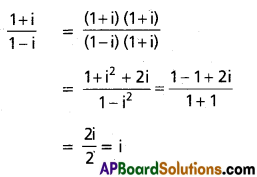
→ \(\frac{1+i}{1-i}\) = i, \(\frac{1-i}{1+i}\) = i

→ \(\sqrt{x^{2}+y^{2}}\) is called the modulus of the complex number x + iy and is denoted by r or |x + iy|

→ Any value of 0 obtained from the equations cos θ = \(\frac{x}{r}\), sin θ = \(\frac{y}{r}\) is called an amplitude of the complex number.

→ The amplitude lying between -π and π is called the principal amplitude of the complex number. Rule for choosing the principal amplitude.

Inter 2nd Year Maths 2A Complex Numbers Formulas

→ If θ is the principal amplitude, then -π < 0 < π
Inter 2nd Year Maths 2A Complex Numbers Formulas 1

→If α is the principle amplitude of a complex number, general amplitude = 2nπ + α where n ∈ Z.

  • Amp (Z1 Z2) = Amp Z1 + AmpZ2
  • Amp z + Amp z̅ = 2π (when z is a negative real number) = 0 (otherwise)

→ r(cos θ + i sin θ) is the modulus amplitude form of x + iy.

→ If the amplitude of a complex number is \(\frac{\pi}{2}\), its real part is zero.

→ If the amplitude of a complex number is \(\frac{\pi}{4}\), its real part is equal to its imaginary part.

Inter 2nd Year Maths 2A Quadratic Expressions Solutions Ex 3(c)

Practicing the Intermediate 2nd Year Maths 2A Textbook Solutions Inter 2nd Year Maths 2A Quadratic Expressions Solutions Exercise 3(c) will help students to clear their doubts quickly.

Intermediate 2nd Year Maths 2A Quadratic Expressions Solutions Exercise 3(c)

I.

Question 1.
Solve the following inequations by the algebraic method.
(i) 15x2 + 4x – 4 ≤ 0
Solution:
15x2 + 4x – 4 ≤ 0
⇒ 15x2 – 6x + 10x – 4 ≤ 0
⇒ 3x(5x – 2) + 2(5x – 2) ≤ 0
⇒ (3x + 2) (5x – 2) ≤ 0
Co-efficient of x2 = 15 > 0,
Given Expression is ≤ 0
⇒ x lies between \(\frac{-2}{3}\) and \(\frac{2}{5}\)
i.e., \(\frac{-2}{3} \leq x \leq \frac{2}{5}\)

(ii) x2 – 2x + 1 < 0
Solution:
x2 – 2x + 1 < 0
⇒ (x – 1)2 < 0
There is no real value of ‘x’ satisfying this inequality
Solution set = Φ (or) Solution does not exist.

Inter 2nd Year Maths 2A Quadratic Expressions Solutions Ex 3(c)

(iii) 2 – 3x – 2x2 ≥ 0
Solution:
-(2x2 + 3x – 2) ≥ 0
⇒ -(2x2 + 4x – x – 2) ≥ 0
⇒ -[2x(x + 2) – 1(x + 2)] ≥ 0
⇒ -(2x – 1) (x + 2) ≥ 0
Co-efficient of x2 = -2 < 0,
The given expression is ≥ 0
⇒ x lies between -2 and \(\frac{1}{2}\)
i.e., -2 ≤ x ≤ \(\frac{1}{2}\)

(iv) x2 – 4x – 21 ≥ 0
Solution:
x2 – 4x – 21 ≥ 0
⇒ x2 – 7x + 3x – 21 ≥ 0
⇒ x(x – 7) + 3(x – 7) ≥ 0
⇒ (x + 3) (x – 7) ≥ 0
Co-efficient of x2 = 1 > 0,
The given expression is ≥ 0
x does not lie between -3 and 7
i.e., {x/x ∈ (-∞, -3] ∪ [7, ∞)}

II.

Question 1.
Solve the following inequations by graphical method.
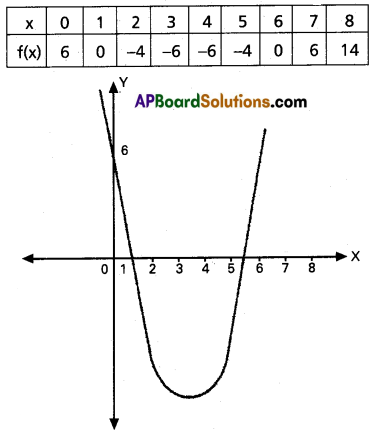
(i) x2 – 7x + 6 > 0
Solution:
f(x) = x2 – 7x + 6
Inter 2nd Year Maths 2A Quadratic Expressions Solutions Ex 3(c) II Q1(i)
f(x) > 0 ⇒ y > 0
Solutions are given by x < 1 and x > 6

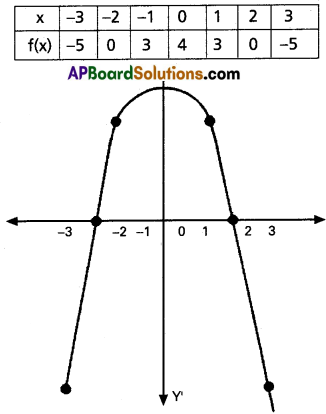
(ii) 4 – x2 > 0
Solution:
Let f(x) = 4 – x2
Inter 2nd Year Maths 2A Quadratic Expressions Solutions Ex 3(c) II Q1(ii)
f(x) > 0 ⇒ y > 0
Solution set = {x/-2 < x < 2}

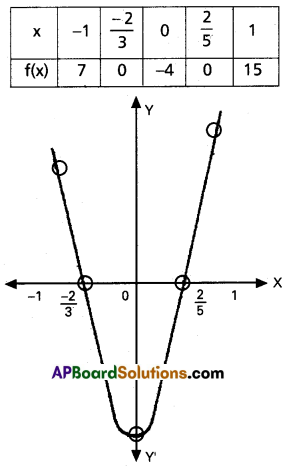
(iii) 15x2 + 4x – 4 < 0
Solution:
Let f(x) = 15x2 + 4x – 4
Inter 2nd Year Maths 2A Quadratic Expressions Solutions Ex 3(c) II Q1(iii)
f(x) ≤ 0 ⇒ y ≤ 0
Solution set = \(\left\{x / \frac{-2}{3} \leq x \leq \frac{2}{5}\right\}\)

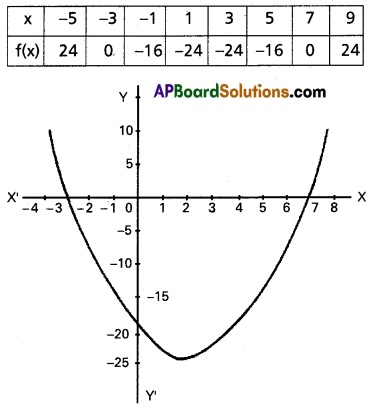
(iv) x2 – 4x – 21 ≥ 0
Solution:
Let f(x) = x2 – 4x – 21
Inter 2nd Year Maths 2A Quadratic Expressions Solutions Ex 3(c) II Q1(iv)
f(x) ≥ 0 ⇒ y ≥ 0
Solution set = {x/x ∈ (-∞, -3] ∪ [7, ∞)}

Inter 2nd Year Maths 2A Quadratic Expressions Solutions Ex 3(c)

Question 2.
Solve the following inequations.
(i) \(\sqrt{3 x-8}\) < -2
Solution:
L.H.S. is positive and R.H.S. is negative.
∴ The given inequality holds for no real x.
Solution set = Φ (or) Solution does not exist.

(ii) \(\sqrt{-x^{2}+6 x-5}\) > 8 – 2x
Solution:
\(\sqrt{-x^{2}+6 x-5}\) > 8 – 2x
⇔ -x2 + 6x – 5 > 0
and (i) 8 – 2x < 0 (or) (ii) 8 – 2x ≥ 0
We have -x2 + 6x – 5 = -(x2 – 6x + 5) = -(x – 1) (x – 5)
Hence -x2 + 6x – 5 ≥ 0 ⇔ x ∈ [1, 5]
(i) -x2 + 6x – 5 ≥ 0 and 8 – 2x < 0
⇔ x ∈ [1, 5] and x > 4
⇔ x ∈ [4, 5] ………(1)
(ii) -x2 + 6x – 5 ≥ 0 and 8 – 2x ≥ 0
∵ \(\sqrt{\left(-x^{2}+6 x-5\right)}\) > 8 – 2x
⇔ -x2 + 6x – 5 > (8 – 2x)2 and 8 – 2x ≥ 0
⇔ -x2 + 6x – 5 > 64 + 4x2 – 32x and x ≤ 4
⇔ -5x2 + 38x – 69 > 0 and x ≤ 4
⇔ 5x2 – 38x + 69 < 0 and x ≤ 4
⇔ 5x2 – 15x – 23x + 69 < 0 and x ≤ 4
⇔ (5x – 23)(x – 3) < 0 and x ≤ 4
⇔ x ∈ (3, \(\frac{23}{5}\)) and x ≤ 4
⇔ x ∈ (3, \(\frac{23}{5}\)) ∩ (-∞, 4)
⇔ x ∈ (3, 4)
Hence the solution set of the given equation is x ∈ (4, 5) ∪ (3, 4)
⇒ x ∈ (3, 5) (or) 3 < x ≤ 5.

Inter 2nd Year Maths 2A Quadratic Expressions Solutions Ex 3(a)

Practicing the Intermediate 2nd Year Maths 2A Textbook Solutions Inter 2nd Year Maths 2A Quadratic Expressions Solutions Exercise 3(a) will help students to clear their doubts quickly.

Intermediate 2nd Year Maths 2A Quadratic Expressions Solutions Exercise 3(a)

I.

Question 1.
Find the roots of the following equations.
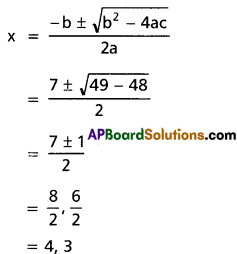
(i) x2 – 7x + 12 = 0
Solution:
a = 1, b = -7, c = 12
Inter 2nd Year Maths 2A Quadratic Expressions Solutions Ex 3(a) I Q1(i)
∴ The roots are 4, 3

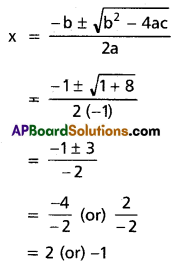
(ii) -x2 + x + 2 = 0
Solution:
a = -1, b = 1, c = 2
Inter 2nd Year Maths 2A Quadratic Expressions Solutions Ex 3(a) I Q1(ii)
∴ The roots are 2, -1

Inter 2nd Year Maths 2A Quadratic Expressions Solutions Ex 3(a)

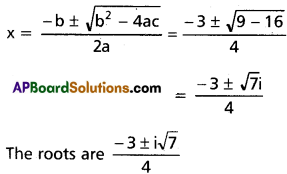
(iii) 2x2 + 3x + 2 = 0
Solution:
a = 2, b = 3, c = 2
Inter 2nd Year Maths 2A Quadratic Expressions Solutions Ex 3(a) I Q1(iii)

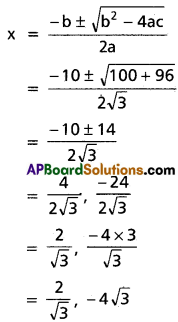
(iv) √3x2 + 10x – 8√3 = 0
Solution:
a = √3 , b = 10, c = -8√3
Inter 2nd Year Maths 2A Quadratic Expressions Solutions Ex 3(a) I Q1(iv)
∴ The roots are \(\frac{2}{\sqrt{3}}\), -4√3

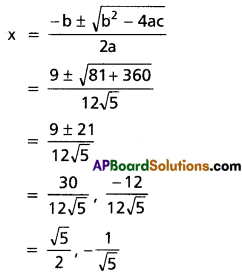
(v) 6√5x2 – 9x – 3√5 = 0
Solution:
a = 6√5 , b = -9, c = -3√5
Inter 2nd Year Maths 2A Quadratic Expressions Solutions Ex 3(a) I Q1(v)
∴ The roots are \(\frac{\sqrt{5}}{2},-\frac{1}{\sqrt{5}}\)

Question 2.
Form a quadratic equation whose roots are:
(i) 2, 5
Solution:
α + β = 2 + 5 = 7
αβ = 2 × 5 = 10
The required equation is x2 – (α + β)x + αβ = 0
⇒ x2 – 7x + 10 = 0

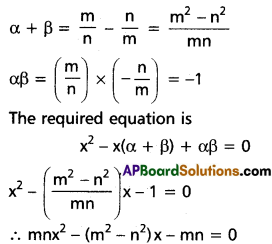
(ii) \(\frac{m}{n},-\frac{n}{m}\), (m ≠ 0, n ≠ 0)
Solution:
Inter 2nd Year Maths 2A Quadratic Expressions Solutions Ex 3(a) I Q2(ii)

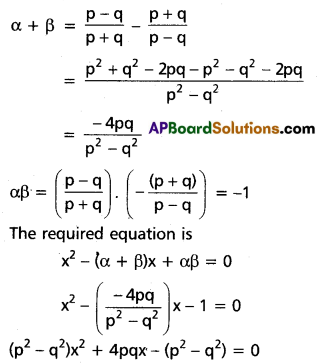
(iii) \(\frac{p-q}{p+q}, \frac{-p+q}{p-q}\), (p ≠ ±q)
Solution:
Inter 2nd Year Maths 2A Quadratic Expressions Solutions Ex 3(a) I Q2(iii)

(iv) 7 ± 2√5
Solution:
α + β = 7 + 2√5 + 7 – 2√5 = 14
αβ = (7 + 2√5) (7 – 2√5)
= 49 – 20
= 29
The required equation is x2 – (α + β)x + αβ = 0
⇒ x2 – 14x + 29 = 0

(v) -3 ± 5i
Solution:
α + β = -3 + 5i – 3 – 5i = -6
αβ = (-3 + 5i) (-3 – 5i)
= 9 + 25
= 34
The required equation is x2 – (α + β)x + αβ = 0
⇒ x2 + 6x + 34 = 0

Inter 2nd Year Maths 2A Quadratic Expressions Solutions Ex 3(a)

Question 3.
Find the nature of the roots of the following equation, without finding the roots.
(i) 2x2 – 8x + 3 = 0
Solution:
a = 2, b = -8, c = 3
b2 – 4ac = 64 – 24 = 40 > 0
∴ The roots are real and distinct.

(ii) 9x2 – 30x + 25 = 0
Solution:
a = 9, b = -30, c = 25
b2 – 4ac = 900 – 900 = 0
∴ The roots are rational and equal.

(iii) x2 – 12x + 32 = 0
Solution:
a = 1, b = -12, c = 32
b2 – 4ac = 144 – 128
= 16
= (4)2
= perfect square
∴ The roots are rational and distinct.

(iv) 2x2 – 7x + 10 = 0
Solution:
a = 2, b = -7, c = 10
b2 – 4ac = 49 – 80 = -31 < 0
∴ The roots are complex conjugate numbers.

Question 4.
If α, β are the roots of the equation ax2 + bx + c = 0, find the values of the following expressions in terms of a, b, c.
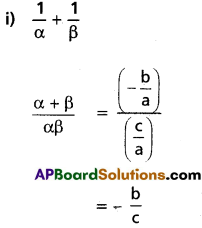
(i) \(\frac{1}{\alpha}+\frac{1}{\beta}\)
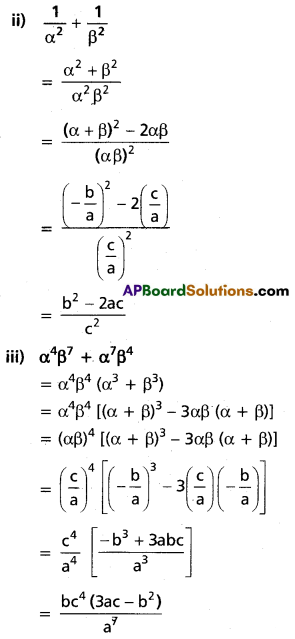
(ii) \(\frac{1}{\alpha^{2}}+\frac{1}{\beta^{2}}\)
(iii) α4β7 + α7β4
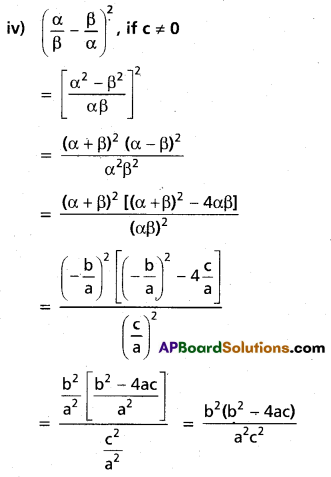
(iv) \(\left(\frac{\alpha}{\beta}-\frac{\beta}{\alpha}\right)^{2}\), if c ≠ 0
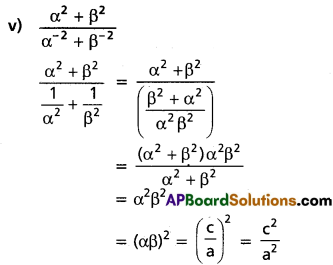
(v) \(\frac{\alpha^{2}+\beta^{2}}{\alpha^{-2}+\beta^{-2}}\)
Solution:
α, β are the roots of the equation ax2 + bx + c = 0
α + β = \(\frac{-b}{a}\), αβ = \(\frac{c}{a}\)
Inter 2nd Year Maths 2A Quadratic Expressions Solutions Ex 3(a) I Q4
Inter 2nd Year Maths 2A Quadratic Expressions Solutions Ex 3(a) I Q4.1
Inter 2nd Year Maths 2A Quadratic Expressions Solutions Ex 3(a) I Q4.2
Inter 2nd Year Maths 2A Quadratic Expressions Solutions Ex 3(a) I Q4.3

Question 5.
Find the values of m for which the following equations have equal roots.
(i) x2 – 15 – m(2x – 8) = 0
Solution:
Given equation is x2 – 15 – m(2x – 8) = 0
⇒ x2 – 2mx + 8m – 15 = 0
a = 1, b = -2m, c = 8m – 15
b2 – 4ac = (-2m)2 – 4(1) (8m – 15)
= 4m2 – 32m + 60
= 4(m2 – 8m + 15)
= 4(m – 3) (m – 5)
If the equation ax2 + bx + c = 0 has equal roots then its discriminant is zero.
∴ The roots are equal
⇒ b2 – 4ac = 0
⇒ 4(m – 3) (m – 5) = 0
⇒ m – 3 = 0 or m – 5 = 0
⇒ m = 3 or 5

(ii) (m + 1)x2 + 2(m + 3)x + (m + 8) = 0
Solution:
Given equation is (m + 1 )x2 + 2(m + 3)x + (m + 8) = 0
a = m + 1, b = 2(m + 3), c = m + 8
b2 – 4ac = [2(m + 3)]2 – 4(m + 1) (m + 8)
= 4(m2 + 6m + 9) – 4(m2 + 8m + m + 8)
= 4m2 + 24m + 36 – 4m2 – 36m – 32
= -12m + 4
= -4(3m – 1)
∴ The roots are equal
⇒ b2 – 4ac = 0
⇒ -4(3m – 1) = 0
⇒ 3m – 1 = 0
⇒ 3m = 1
⇒ m = \(\frac{1}{3}\)

Inter 2nd Year Maths 2A Quadratic Expressions Solutions Ex 3(a)

(iii) x2 + (m + 3)x + m + 6 = 0
Solution:
Given equation is x2 + (m + 3)x + m + 6 = 0
a = 1, b = m + 3, c = m + 6
∴ The roots are equal
⇒ b2 – 4ac = 0
⇒ (m + 3)2 – 4(1) (m + 6) = 0
⇒ m2 + 6m + 9 – 4m – 24 = 0
⇒ m2 + 2m – 15 – 0
⇒ m2 + 5m – 3m – 15 = 0
⇒ m(m + 5) – 3(m + 5) = 0
⇒ (m + 5) (m – 3) = 0
⇒ m = -5, 3

(iv) (3m + 1)x2 + 2(m + 1)x + m = 0
Solution:
Given equation is (3m + 1)x2 + 2(m + 1)x + m = 0
a = 3m + 1, b = 2(m + 1), c = m
b2 – 4ac = 4(m + 1)2 – 4m(3m + 1)
= 4[(m + 1)2 – m(3m + 1)]
= 4(m2 + 2m + 1 – 3m2 – m)
= 4(-2m2 + m + 1)
= -4(2m2 – m – 1)
= -4(m – 1) (2m + 1)
∴ The roots are equal
⇒ discriminant = 0
⇒ b2 – 4ac = 0
⇒ -4(m – 1) (2m + 1) = 0
⇒ m – 1 = 0 or 2m + 1 = 0
⇒ m = 1 or m = \(\frac{-1}{2}\)

(v) (2m + 1)x2 + 2(m + 3)x + (m + 5) = 0
Solution:
Given equation is (2m + 1)x2 + 2(m + 3)x + m + 5 = 0
a = 2m + 1, b = 2(m + 3), c = m + 5
∴ The roots are equal
⇒ b2 – 4ac = 0
⇒ 4(m + 3)2 – 4(2m + 1) (m + 5) = 0
⇒ 4(m2 + 6m + 9 – 2m2 – 10m – m – 5) = 0
⇒ -m2 – 5m + 4 = 0
⇒ m2 + 5m – 4 = 0
⇒ m = \(\frac{-5 \pm \sqrt{25+16}}{2}\)
⇒ m = \(\frac{-5 \pm \sqrt{41}}{2}\)

Inter 2nd Year Maths 2A Quadratic Expressions Solutions Ex 3(a)

Question 6.
If α and β are the roots of x2 + px + q = 0, form a quadratic equation whose roots are (α – β)2 and (α + β)2.
Solution:
∵ α, β are the roots of the equation x2 + px + q = 0
α + β = -p, αβ = q
(α – β)2 + (α + β)2 = 2(α2 + β2)
= 2[(α + β)2 – 2αβ]
= 2[p2 – 2q]
(α – β)2 (α + β)2 = [(α + β)2 – 4αβ)] (α + β)2
= (p2 – 4q) (p2)
∴ The required equation is x2 – (sum of the roots) x + product of the roots = 0
∴ x2 – 2(p2 – 2q)x + p2(p2 – 4q) = 0

Question 7.
If x2 + bx + c = 0, x2 + cx + b = 0 (b ≠ c) have a common root, then show that b + c + 1 = 0.
Solution:
If α is a common root of x2 + bx + c = 0, x2 + cx + b = 0 then
α2 + bα + c = 0 ………..(1)
α2 + cα + b = 0 ……….(2)
(1) – (2) ⇒ (b – c)α + (c – b) = 0
⇒ α – 1 = 0
⇒ α = 1
From (1), 1 + b + c = 0
Hence b + c + 1 = 0

Question 8.
Prove that the roots of (x – a) (x – b) = h2 are always real.
Solution:
Given equation is (x – a) (x – b) = h2
x2 – (a + b)x + (ab – h2) = 0
Discriminant = (a + b)2 – 4(ab – h2)
= (a + b)2 – 4ab + 4h2
= (a – b)2 + (2h)2 > 0
∴ The roots are real.

Question 9.
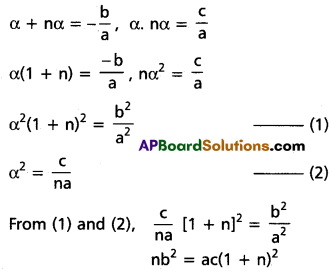
Find the condition that one root of the quadratic equation ax2 + bx + c = 0 shall be n times the other, where n is a positive integer.
Solution:
Let the roots of the equation ax2 + bx + c = 0 be α, nα
Inter 2nd Year Maths 2A Quadratic Expressions Solutions Ex 3(a) I Q9

Question 10.
Find two consecutive positive even integers, the sum of whose squares is 340.
Solution:
Let the two consecutive positive even integers be 2λ, 2λ + 2
Sum of squares = 340
⇒ (2λ)2 + (2λ + 2)2 = 340
⇒ λ2 + (λ + 1)2 = 85
⇒ λ2 + λ2 + 2λ + 1 – 85 = 0
⇒ 2λ2 + 2λ – 84 = 0
⇒ λ2 + λ – 42 = 0
⇒ (λ + 7) (λ – 6) = 0
⇒ λ = 6, λ = -7
∵ Given numbers are positive λ = 6
∴ The two consecutive positive even integers are
2λ = 2(6) = 12 and 2λ + 2 = 12 + 2 = 14

Inter 2nd Year Maths 2A Quadratic Expressions Solutions Ex 3(a)

II.

Question 1.
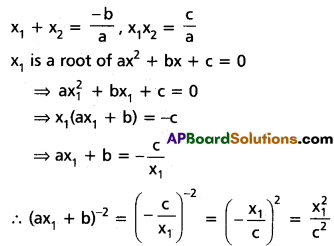
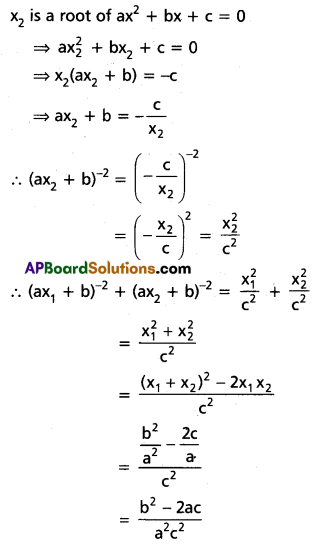
If x1, x2 are the roots of the quadratic equation ax2 + bx + c = 0 and c ≠ 0, find the value of (ax1 + b)-2 + (ax2 + b)-2 terms of a, b, c.
Solution:
x1, x2 are the roots of the equation ax2 + bx + c = 0
Inter 2nd Year Maths 2A Quadratic Expressions Solutions Ex 3(a) II Q1
Inter 2nd Year Maths 2A Quadratic Expressions Solutions Ex 3(a) II Q1.1

Question 2.
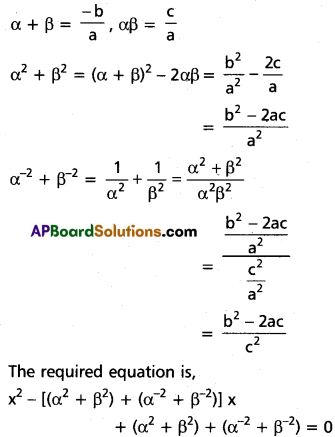
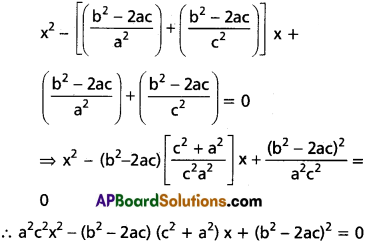
If α, β are the roots of the quadratic equation ax2 + bx + c = 0, form a quadratic equation whose roots are α2 + β2 and α-2 + β-2.
Solution:
α, β are the roots of ax2 + bx + c = 0, then
Inter 2nd Year Maths 2A Quadratic Expressions Solutions Ex 3(a) II Q2
Inter 2nd Year Maths 2A Quadratic Expressions Solutions Ex 3(a) II Q2.1

Question 3.
Solve the following equation:
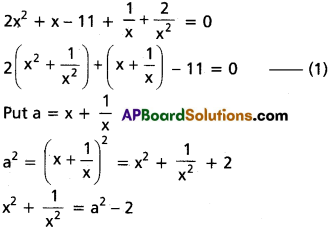
2x4 + x3 – 11x2 + x + 2 = 0
Solution:
2x4 + x3 – 11x2 + x + 2 = 0
Dividing by x2
Inter 2nd Year Maths 2A Quadratic Expressions Solutions Ex 3(a) II Q3
Substituting in (1)
2(a2 – 2) + a – 11 = 0
⇒ 2a2 – 4 + a – 11 = 0
⇒ 2a2 + a – 15 = 0
⇒ (a + 3) (2a – 5) = 0
⇒ a + 3 = 0 or 2a – 5 = 0
⇒ a = -3 or 2a = 5
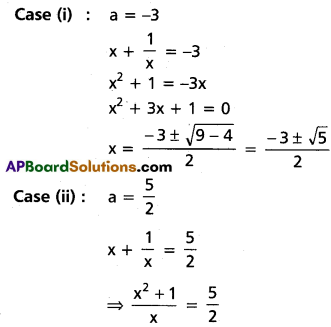
⇒ a = -3 or a = \(\frac{5}{2}\)
Inter 2nd Year Maths 2A Quadratic Expressions Solutions Ex 3(a) II Q3.1
⇒ 2x2 + 2 = 5x
⇒ 2x2 – 5x + 2 = 0
⇒ (2x – 1) (x – 2) = 0
⇒ 2x – 1 = 0 or x – 2 = 0
⇒ x = \(\frac{1}{2}\), 2
∴ The roots are \(\frac{1}{2}\), 2, \(\frac{-3 \pm \sqrt{5}}{2}\)

Inter 2nd Year Maths 2A Quadratic Expressions Solutions Ex 3(a)

Question 4.
Solve 31+x + 31-x = 10
Solution:
31+x + 31-x = 10
\(\text { 3. } 3^{x}+\frac{3}{3^{x}}=10\)
Put a = 3x so that 3a + \(\frac{3}{a}\) = 10
⇒ 3a2 + 3 = 10a
⇒ 3a2 – 10a + 3 = 0
⇒ (a – 3) (3a – 1) = 0
⇒ a – 3 = 0 or 3a – 1 = 0
⇒ a = 3 or a = \(\frac{1}{3}\)
Case (i): a = 3
⇒ 3x = 31
⇒ x = 1
Case (ii): a = \(\frac{1}{3}\)
⇒ 3x = 3-1
⇒ x = -1
∴ The roots are 1, -1

Question 5.
Solve 4x-1 – 3 . 2x-1 + 2 = 0
Solution:
4x-1 – 3 . 2x-1 + 2 = 0
Put a = 2x-1 so that a2 = (2x-1)2 = 4x-1
∴ a2 – 3a + 2 = 0
⇒ (a – 2) (a – 1) = 0
⇒ a – 2 = 0 or a – 1 = 0
⇒ a = 2 or 1
Case (i): a = 2
2x-1 = 21
⇒ x – 1 = 1
⇒ x = 2
Case (ii): a = 1
2x-1 = 20
⇒ x – 1 = 0
⇒ x = 1
∴ The roots are 1, 2

Inter 2nd Year Maths 2A Quadratic Expressions Solutions Ex 3(a)

Question 6.
\(\sqrt{\frac{x}{x-3}}+\sqrt{\frac{x-3}{x}}=\frac{5}{2}\), when x ≠ 0 and x ≠ 3
Solution:
\(\sqrt{\frac{x}{x-3}}+\sqrt{\frac{x-3}{x}}=\frac{5}{2}\)
Put a = \(\sqrt{\frac{x}{x-3}}\)
\(a+\frac{1}{a}=\frac{5}{2}\)
⇒ \(\frac{a^{2}+1}{a}=\frac{5}{2}\)
⇒ 2a2 + 2 = 5a
⇒ 2a2 – 5a + 2 = 0
⇒ (2a – 1) (a – 2) = 0
⇒ 2a – 1 = 0 or a – 2 = 0
⇒ a = \(\frac{1}{2}\) or 2
Case (i): a = 2
\(\sqrt{\frac{x}{x-3}}\) = 2
⇒ \(\frac{x}{x-3}\) = 4
⇒ x = 4x – 12
⇒ 3x = 12
⇒ x = 4
Case (ii): a = \(\frac{1}{2}\)
\(\sqrt{\frac{x}{x-3}}=\frac{1}{2}\)
⇒ \(\frac{x}{x-3}=\frac{1}{4}\)
⇒ 4x = x – 3
⇒ 3x = -3
⇒ x = -1
∴ The roots are -1, 4.

Question 7.
\(\sqrt{\frac{3 x}{x+1}}+\sqrt{\frac{x+1}{3 x}}=2\), when x ≠ 0 and x ≠ -1
Solution:
Put a = \(\sqrt{\frac{3 x}{x+1}}\)
\(a+\frac{1}{a}=2\)
⇒ \(\frac{a^{2}+1}{a}\) = 2
⇒ a2 + 1 = 2a
⇒ a2 – 2a + 1 = 0
⇒ (a – 1)2 = 0
⇒ a – 1 = 0
⇒ a = 1, 1
∴ \(\sqrt{\frac{3 x}{x+1}}\) = 1
⇒ \(\frac{3 x}{x+1}\)
⇒ 3x = x + 1
⇒ 2x = 1
⇒ x = \(\frac{1}{2}\)
∴ The root is \(\frac{1}{2}\)

Inter 2nd Year Maths 2A Quadratic Expressions Solutions Ex 3(a)

Question 8.
Solve \(2\left(x+\frac{1}{x}\right)^{2}-7\left(x+\frac{1}{x}\right)+5=0\), when x ≠ 0.
Solution:
\(2\left(x+\frac{1}{x}\right)^{2}-7\left(x+\frac{1}{x}\right)+5=0\)
Put a = x + \(\frac{1}{x}\)
⇒ 2a2 – 7a + 5 = 0
⇒ (2a – 5)(a – 1) = 0
⇒ 2a – 5 = 0 or a -1 = 0
⇒ a = \(\frac{5}{2}\) or 1
Case (i): a = \(\frac{5}{2}\)
x + \(\frac{1}{x}\) = \(\frac{5}{2}\)
⇒ \(\frac{x^{2}+1}{x}=\frac{5}{2}\)
⇒ 2x2 + 2 = 5x
⇒ 2x2 – 5x + 2 = 0
⇒ (2x – 1) (x – 2) = 0
⇒ 2x – 1 = 0 or x – 2 = 0
⇒ x = \(\frac{1}{2}\) or 2
Case (ii): a = 1
\(x+\frac{1}{x}=1\)
⇒ \(\frac{x^{2}+1}{x}\)
⇒ x2 + 1 = x
⇒ x2 – x + 1 = 0
⇒ x = \(\frac{1 \pm \sqrt{1-4}}{2}=\frac{1 \pm \sqrt{3 i}}{2}\)
∴ The roots are \(\frac{1 \pm \sqrt{3 i}}{2}, \frac{1}{2}\), 2

Question 9.
Solve \(\left(x^{2}+\frac{1}{x^{2}}\right)-5\left(x+\frac{1}{x}\right)+6=0\), when x ≠ 0
Solution:
Put a = x + \(\frac{1}{x}\)
⇒ a2 = \(\left(x+\frac{1}{x}\right)^{2}\)
⇒ a2 = \(x^{2}+\frac{1}{x^{2}}+2\)
⇒ \(x^{2}+\frac{1}{x^{2}}\) = a2 – 2
∴ a2 – 2 – 5a + 6 = 0
⇒ a2 – 5a + 4 = 0
⇒ (a – 1) (a – 4) = 0
⇒ a = 1 or 4
Case (i): a = 1
x + \(\frac{1}{x}\) = 1
⇒ \(\frac{x^{2}+1}{x}\) = 1
⇒ x2 + 1 = x
⇒ x2 – x + 1 = 0
⇒ x = \(\frac{1 \pm \sqrt{1-4}}{2}=\frac{1 \pm \sqrt{3 i}}{2}\)
Case (ii): a = 4
x + \(\frac{1}{x}\) = 4
⇒ \(\frac{x^{2}+1}{x}\) = 4
⇒ x2 + 1 = 4x
⇒ x2 – 4x + 1 = 0
⇒ x = \(\frac{4 \pm \sqrt{16-4}}{2}\)
⇒ x = \(\frac{4 \pm 2 \sqrt{3}}{2}\)
⇒ x = 2 ± √3
∴ The roots are 2 ± √3, \(\frac{1 \pm \sqrt{3 i}}{2}\)

Inter 2nd Year Maths 2A Quadratic Expressions Solutions Ex 3(a)

Question 10.
Find a quadratic equation for which the sum of the roots is 7 and the sum of the squares of the roots is 25.
Solution:
Let α, β be the roots of quadratic equation
α + β = 7, α2 + β2 = 25
⇒ (α + β)2 – 2αβ = 25
⇒ 49 – 25 = 2αβ
⇒ αβ = 12
The required equation is x2 – (α + β)x + αβ = 0
⇒ x2 – 7x + 12 = 0

Inter 2nd Year Maths 2A Complex Numbers Solutions Ex 1(d)

Practicing the Intermediate 2nd Year Maths 2A Textbook Solutions Inter 2nd Year Maths 2A Complex Numbers Solutions Exercise 1(d) will help students to clear their doubts quickly.

Intermediate 2nd Year Maths 2A Complex Numbers Solutions Exercise 1(d)

I.

Question 1.
(i) Find the equation of the perpendicular bisector of the line segment joining the points 7 + 7i, 7 – 7i in the Argand diagram.
Solution:
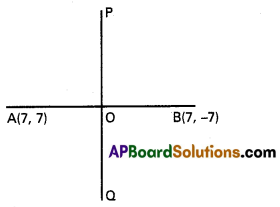
A(7, 7); B(7, -7) represents the given complex numbers in the Argand diagram.
Inter 2nd Year Maths 2A Complex Numbers Solutions Ex 1(d) I Q1(i)
O is the mid-point of AB.
Co-ordinates of O are \(\left(\frac{7+7}{2}, \frac{7-7}{2}\right)\) = (7, 0)
Slope of \(\overleftrightarrow{\mathrm{AB}}=\frac{7+7}{7-7}=\frac{14}{0}\) = ∞
AB is parallel to Y-axis
PQ is perpendicular to AB
PQ is parallel to X-axis
Slope of PQ = 0
Equation of PQ is y – 0 = 0(x – 7)
i.e., y = 0

(ii) Find the equation of the straight line joining the point -9 + 6i, 11 – 4i in the Argand plane.
Solution:
Given points are -9 + 6i, 11 – 4i
Let A = (-9, 6); B = (11, -4)
Equation of the straight line AB is y – 6 = \(\frac{-4-6}{11+9}\) (x + 9)
⇒ y – 6 = \(\frac{-1}{2}\) (x + 9)
⇒ 2y – 12 = -x – 9
⇒ x + 2y – 3 = 0

Inter 2nd Year Maths 2A Complex Numbers Solutions Ex 1(d)

Question 2.
If Z = x + iy and if the point P in the Argand plane represents Z, then describe geometrically the locus of z satisfying the equation.
(i) |z – 2 – 3i| = 5
(ii) 2|z – 2| = |z – 1|
(iii) Img z2 = 4
(iv) \({Arg}\left(\frac{z-1}{z+1}\right)=\frac{\pi}{4}\)
Solution:
(i) z = x + iy and |z – 2 – 3i| = 5
|z – 2 – 3i| = 5
⇒ |x + iy – 2 – 3i| = 5
⇒ |(x – 2) + i(y – 3)| = 5
⇒ \(\sqrt{(x-2)^{2}+(y-3)^{2}}\) = 5
⇒ (x – 2)2 + (y – 3)2 = 25
⇒ x2 – 4x + 4 + y2 – 6y + 9 = 25
∴ Locus of P is x2 + y2 – 4x – 6y – 12 = 0

(ii) 2|z – 2| = |z – 1|
2|x + iy – 2| = |x + iy – 1|
⇒ 2|(x – 2) + iy| = |(x – 1) + iy|
⇒ \(2 \sqrt{(x-2)^{2}+y^{2}}=\sqrt{(x-1)^{2}+y^{2}}\)
Squaring both sides
⇒ 4[(x – 2)2 + y2] = (x – 1)2 + y2
⇒ 4(x2 – 4x + 4 + y2) = x2 – 2x + 1 + y2
⇒ 4x2 + 4y2 – 16x + 16 = x2 + y2 – 2x + 1
∴ Locus of P is 3x2 + 3y2 – 14x + 15 = 0

(iii) Img z2 = 4
∵ z = x + iy
⇒ z2 = (x + iy)2
⇒ z2 = x2 + i2y2 + 2ixy
⇒ z2 = (x2 – y2) + i(2xy)
∴ Img (z2) = 2xy = 4
∴ The locus of P is xy = 2

(iv) \({Arg}\left(\frac{z-1}{z+1}\right)=\frac{\pi}{4}\)
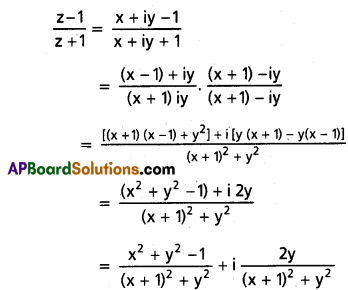
Inter 2nd Year Maths 2A Complex Numbers Solutions Ex 1(d) I Q2(iv)
Since \({Arg}\left(\frac{z-1}{z+1}\right)=\frac{\pi}{4}\)
∴ \(\frac{2 y}{x^{2}+y^{2}-1}=\tan \frac{\pi}{4}\)
⇒ 2y = x2 + y2 – 1
⇒ x2 + y2 – 2y – 1 = 0
∴ The locus of z is x2 + y2 – 2y – 1 = 0.

Inter 2nd Year Maths 2A Complex Numbers Solutions Ex 1(d)

Question 3.
Show that the points in the Argand diagram represented by the complex numbers 2 + 2i, -2 – 2i, 2√3 + 2√3 i are the vertices of an equilateral triangle.
Solution:
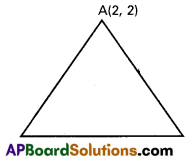
A(2, 2), B(-2, -2), C(-2√3, 2√3) represent the given complex number in the Argand diagram.
Inter 2nd Year Maths 2A Complex Numbers Solutions Ex 1(d) I Q3
AB2 = (2 + 2)2 + (2 + 2)2
= 16 + 16
= 32
BC2 = (-2 + 2√3)2 + (-2 – 2√3)2
= 4 + 12 – 8√3 + 4 + 12 + 8√3
= 32
AC2 = (-2√3 – 2)2 + (2√3 – 2)2
= 12 + 4 + 8√3 + 12 + 4 – 8√3
= 32
AB2 = BC2 = AC2
⇒ AB = BC = CA
∴ ∆ABC is an Equilateral triangle.

Inter 2nd Year Maths 2A Complex Numbers Solutions Ex 1(d)

Question 4.
Find the eccentricity of the ellipse whose equation is |z – 4| + |z – \(\frac{12}{5}\)| = 10
Solution:
SP + S’P = 2a
S = (4, 0), S’ = (\(\frac{12}{5}\), 0)
2a = 10 ⇒ a = 5
SS’ = 2ae
⇒ 4 – \(\frac{12}{5}\) = 2 × 5e
⇒ \(\frac{8}{5}\) = 10e
⇒ e = \(\frac{4}{25}\)

II.

Question 1.
If \(\frac{z_{3}-z_{1}}{z_{2}-z_{1}}\) is a real number, show that the points represented by the complex numbers z1, z2, z3 are collinear.
Solution:
Let z1 = x1 + iy1; z2 = x2 + iy2; z3 = x3 + iy3
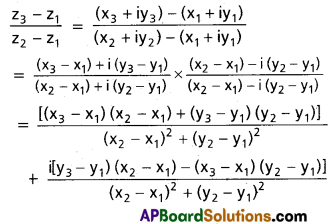
Inter 2nd Year Maths 2A Complex Numbers Solutions Ex 1(d) II Q1
Given \(\frac{z_{3}-z_{1}}{z_{2}-z_{1}}\) is a real number.
Imaginary part = 0
⇒ (y3 – y1) (x2 – x1) – (x3 – x1) (y2 – y1) = 0
⇒ (y3 – y1) (x2 – x1) = (x3 – x1) (y2 – y1)
⇒ \(\frac{y_{3}-y_{1}}{x_{3}-x_{1}}=\frac{y_{2}-y_{1}}{x_{2}-x_{1}}\)
The points A(x1, y1), B(x2, y2), C(x3, y3) represents the complex numbers z1, z2, z3 respectively.
Slope of \(\stackrel{\leftrightarrow}{\mathrm{AC}}\) = Slope of \(\stackrel{\leftrightarrow}{\mathrm{AB}}\)
∴ A, B, C are collinear.

Question 2.
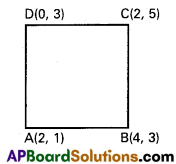
Show that the points in the Argand plane represented by the complex numbers 2 + i, 4 + 3i, 2 + 5i, 3i are the vertices of a square.
Solution:
A(2, 1), B(4, 3) C(2, 5), D(0, 3) represent the given complex number in the Argand plane
Inter 2nd Year Maths 2A Complex Numbers Solutions Ex 1(d) II Q2
AB2 = (2 – 4)2 + (1 – 3)2 = 4 + 4 = 8
BC2 = (4 – 2)2 + (3 – 5)2 = 4 + 4 = 8
CD2 = (2 – 0)2 + (5 – 3)2 = 4 + 4 = 8
DA2 = (0 – 2)2 + (3 – 1)2 = 4 + 4 = 8
AB2 = BC2 = CD2 = DA2
⇒ AB = BC = CD = DA ………(1)
AC2 = (2 – 2)2 + (1 – 5)2 = 0 + 16 = 16
BD2 = (4 – 0)2 + (3 – 3)2 = 16 + 0 = 16
AC2 = BD2
⇒ AC = BD …….(2)
By (1), (2)
A, B, C, D are the vertices of a square.

Inter 2nd Year Maths 2A Complex Numbers Solutions Ex 1(d)

Question 3.
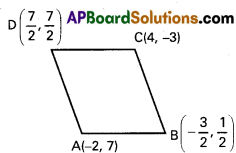
Show that the points in the Argand plane represented by the complex numbers -2 + 7i, \(-\frac{3}{2}+\frac{1}{2} i\), 4 – 3i, \(\frac{7}{2}\)(1 + i) are the vertices of a rhombus.
Solution:
A(-2, 7), B(\(-\frac{3}{2}\), \(\frac{1}{2}\)), C(4, -3), D(\(\frac{7}{2}\), \(\frac{7}{2}\)) represents the given complex numbers in the Argand diagram.
Inter 2nd Year Maths 2A Complex Numbers Solutions Ex 1(d) II Q3
∴ AB2 = BC2 = CD2 = DA2
⇒ AB = BC = CD = DA ……….(1)
AC2 = (-2 – 4)2 + (7 + 3)2
= 36 + 100
= 136
BD2 = \(\left(-\frac{3}{2}-\frac{7}{2}\right)^{2}+\left(\frac{1}{2}-\frac{7}{2}\right)^{2}\)
= 25 + 9
= 34
AC ≠ BD ……..(2)
∴ A, B, C, D are the vertices of a Rhombus.

Question 4.
Show that the points in the Argand diagram represented by the complex numbers z1, z2, z3 are collinear, if and only if there exist three real numbers p, q, r not all zero, satisfying pz1 + qz2 + rz3 = 0 and p + q + r = 0.
Solution:
pz1 + qz2 + rz3 = 0
⇔ rz3 = -pz1 – qz2
⇔ z3 = \(\frac{-p z_{1}-q z_{2}}{r}\) [∵ r ≠ 0]
∵ p + q + r = 0
⇔ r = -p – q
⇔ z3 = \(-\frac{\left(p z_{1}+q z_{2}\right)}{-(p+q)}\)
⇔ z3 = \(\frac{p z_{1}+q z_{2}}{p+q}\)
⇔ z3 divides the line segment joining z1, z2 in the ratio q : p
⇔ z1, z2, z3 are collinear

Inter 2nd Year Maths 2A Complex Numbers Solutions Ex 1(d)

Question 5.
The points P, Q denotes the complex numbers z1, z2 in the Argand diagram. O is the origin. If \(\bar{z}_{1} \bar{z}_{2}+\bar{z}_{2} \bar{z}_{1}=0\), show that POQ = 90°.
Solution:
Let z1 = x1 + iy1 and z2 = x2 + iy2
Then P(x1, y1), Q(x2, y2), O(0, 0)
\(\overline{\mathbf{z}}_{1}\) = x1 – iy1, \(\overline{\mathbf{z}}_{2}\) = x2 – iy2
\(\bar{z}_{1} \bar{z}_{2}+\bar{z}_{2} \bar{z}_{1}\) = (x1 + iy1) (x2 – iy2) + (x2 + iy2) (x1 – iy1) = 0
⇒ x1x2 + y1y2 – ix1y2 + ix2y1 + x1x2 + y1y2 – ix2y1 + ix1y2 = 0
⇒ 2(x1x2 + y1y2) = 0
⇒ x1x2 + y1y2 = 0
⇒ x1x2 = -y1y2
⇒ \(\left(\frac{-x_{1}}{y_{1}}\right)\left(-\frac{x_{2}}{y_{2}}\right)=-1\)
Slope of OP × Slope of OQ = -1
∴ OP, OQ are perpendicular
⇒ ∠POQ = 90°

Question 6.
The complex number z has argument θ, 0 < θ < \(\frac{\pi}{2}\) and satisfy the equation |z – 3i| = 3. Then prove that (cot θ – \(\frac{6}{z}\)) = i
Solution:
Let z = cos θ + i sin θ
Given |z – 3i| = 3.
⇒ |(cos θ + i sin θ) – 3i| = 3
⇒ |cos θ + i(sin θ – 3)| = 3
⇒ \(\sqrt{\cos ^{2} \theta+(\sin \theta-3)^{2}}\) = 3
⇒ cos2θ + sin2θ – 6 sin θ + 9 = 9
⇒ 1 – 6 sin θ = 0
⇒ 6 sin θ = 1
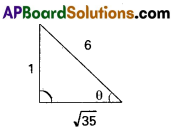
⇒ sin θ = \(\frac{1}{6}\)
since 0 < θ < \(\frac{\pi}{2}\)
Inter 2nd Year Maths 2A Complex Numbers Solutions Ex 1(d) II Q6
∴ cos θ = \(\frac{\sqrt{35}}{6}\)
cot θ = √35
∴ cot θ – \(\frac{6}{z}\) = cot θ – \(\frac{6}{\cos \theta+i \sin \theta}\)
= cot θ – 6(cos θ – i sin θ)
= √35 – 6\(\left[\frac{\sqrt{35}}{6}-i \cdot \frac{1}{6}\right]\)
= √35 – √35 + i
= i
Hence cot θ – \(\frac{6}{z}\) = i

Inter 2nd Year Maths 2A Complex Numbers Solutions Ex 1(b)

Practicing the Intermediate 2nd Year Maths 2A Textbook Solutions Inter 2nd Year Maths 2A Complex Numbers Solutions Exercise 1(b) will help students to clear their doubts quickly.

Intermediate 2nd Year Maths 2A Complex Numbers Solutions Exercise 1(b)

I.

Question 1.
Write the following complex numbers in the form A + iB.
(i) (2 – 3i) (3 + 4i)
(ii) (1 + 2i)3
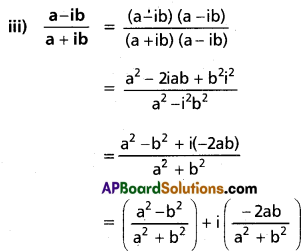
(iii) \(\frac{a-i b}{a+i b}\)
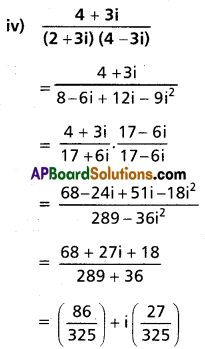
(iv) \(\frac{4+3 i}{(2+3 i)(4-3 i)}\)
(v) (-√3 + √-2) (2√3 – i)
(vi) (-5i) \(\left(\frac{i}{8}\right)\)
(vii) (-i) 2i
(viii) i9
(ix) i-19
(x) 3(7 + 7i) + i(7 + 7i)
(xi) \(\frac{2+5 i}{3-2 i}+\frac{2-5 i}{3+2 i}\)
Solution:
(i) (2 – 3i) (3 + 4i) = 6 + 8i – 9i – 12i2
= 6 – i + 12
= 18 – i
= 18 + i(-1)

(ii) (1 + 2i)3 = 1 + 3 . i2 . 2i + 3 . 1 . 4i2 + 8i3
= 1 + 6i – 12 – 8i
= -11 – 2i
= (-11) + i(-2)

Inter 2nd Year Maths 2A Complex Numbers Solutions Ex 1(b) I Q1

Inter 2nd Year Maths 2A Complex Numbers Solutions Ex 1(b) I Q1.1

(v) (-√3 + √-2) (2√3 – i) = (-√3 + i√2) (2√3 – i)
= -6 + i√3 + i2√6 + √2
= (-6 + √2) + i(√3 + 2√6)

(vi) (-5i) \(\left(\frac{i}{8}\right)\) = \(\frac{-5 i^{2}}{8}\)
= \(\frac{5}{8}\) + i(0)

(vii) (-i)(2i) = -2i2
= -2(-1)
= 2
= 2 + i(0)

(viii) i9 = i4 . i4 . i
= 1 . 1 . i
= i
= 0 + i(1)

Inter 2nd Year Maths 2A Complex Numbers Solutions Ex 1(b)

(ix) i-19 = \(\frac{1}{i^{19}}\)
= \(\frac{i}{i^{20}}\)
= \(\frac{i}{\left(i^{4}\right)^{5}}\)
= \(\frac{\mathrm{i}}{\mathrm{i}^{5}}\)
= i
= 0 + i(1)

(x) 3(7 + 7i) + i(7 + 7i)
= 21 + 21i + 7i – 7
= 14 + 28i

Inter 2nd Year Maths 2A Complex Numbers Solutions Ex 1(b) I Q1.2

Question 2.
Write the conjugate of the following complex numbers.
(i) 3 + 4i
(ii) (15 + 3i) – (4 – 20i)
(iii) (2 + 5i) (-4 + 6i)
(iv) \(\frac{5 i}{7+i}\)
Solution:
(i) Let z = 3 + 4i
\(\bar{z}\) = 3 – 4i

(ii) Let z = (15 + 3i) – (4 – 20i)
= 15 + 3i – 4 + 20i
= 11 + 23i
\(\bar{z}\) = 11 – 23i

(iii) Let z = (2 + 5i) (-4 + 6i)
= -8 + 12i – 20i – 30
= -38 – 8i
\(\bar{z}\) = -38 + 8i
Inter 2nd Year Maths 2A Complex Numbers Solutions Ex 1(b) I Q2

Question 3.
Simplify
(i) i2 + i4 + i6 + …….. + (2n + 1) terms
(ii) i18 – 3 . i7 + i2 (1 + i4) (-i)26
Solution:
(i) i2 + i4 + i6 + …….. + (2n + 1) terms
= -1 + 1 – 1 + (2n + 1) terms
= -1

(ii) i18 – 3i2 + i2 (1 + i4) (-i)26
= i16 . i2 – 3 . i4 . i3 + i2 (1 + 1) i24 . i2
= 1 . (-1) – 3 . 1 . (-i) + (-1) (2) (1) (-1)
= -1 + 3i + 2
= 1 + 3i

Question 4.
Find a square root for the following complex numbers.
(i) 7 + 24i
(ii) -8 – 6i
(iii) (3 + 4i)
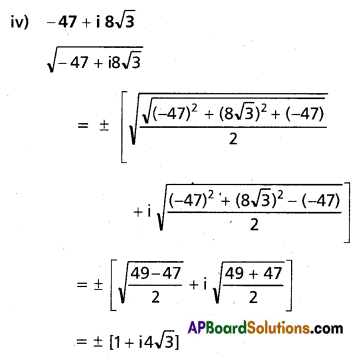
(iv) (-47 + i8√3)
Solution:
Inter 2nd Year Maths 2A Complex Numbers Solutions Ex 1(b) I Q4
Inter 2nd Year Maths 2A Complex Numbers Solutions Ex 1(b) I Q4.1
Inter 2nd Year Maths 2A Complex Numbers Solutions Ex 1(b) I Q4.2

Inter 2nd Year Maths 2A Complex Numbers Solutions Ex 1(b)

Question 5.
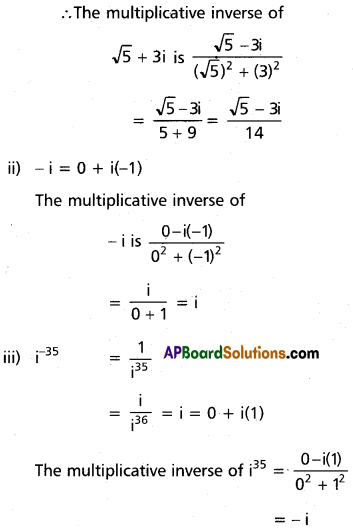
Find the multiplicative inverse of the following complex numbers.
(i) √5 + 3i
(ii) -i
(iii) i-35
Solution:
(i) √5 + 3i
The multiplicative inverse of x + iy is \(\frac{x-i y}{x^{2}+y^{2}}\)
Inter 2nd Year Maths 2A Complex Numbers Solutions Ex 1(b) I Q5

II.

Question 1.
(i) If (a + ib)2 = x + iy, find x2 + y2
Solution:
(a + ib)2 = x + iy
⇒ a2 + i(2ab) – b2 = x + iy
⇒ (a2 – b2) + i(2ab) = x + iy
Equating real and imaginary parts on both sides, we have
x = a2 – b2 and y = 2ab
x2 + y2 = (a2 – b2)2 + (2ab)2
= a4 – 2a2b2 + b4 + 4a2b2
= a4 + 2a2b2 + b4
= (a2 + b2)2

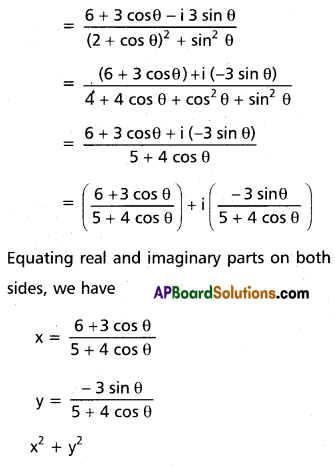
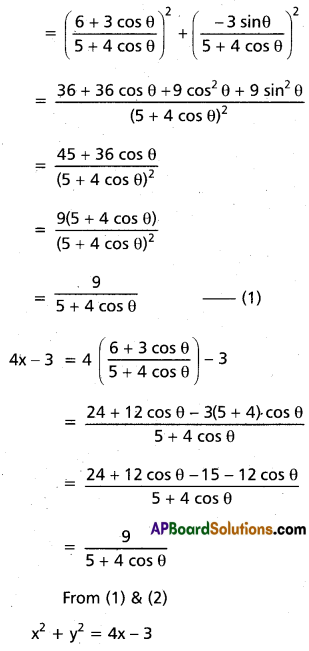
(ii) If x + iy = \(\frac{3}{2+\cos \theta+i \sin \theta}\) then show that x2 + y2 = 4x – 3
Solution:
x + iy = \(\frac{3}{2+\cos \theta+i \sin \theta}\) \(\frac{(2+\cos \theta)-i \sin \theta}{(2+\cos \theta)-i \sin \theta}\)
Inter 2nd Year Maths 2A Complex Numbers Solutions Ex 1(b) II Q1(ii)
Inter 2nd Year Maths 2A Complex Numbers Solutions Ex 1(b) II Q1(ii).1

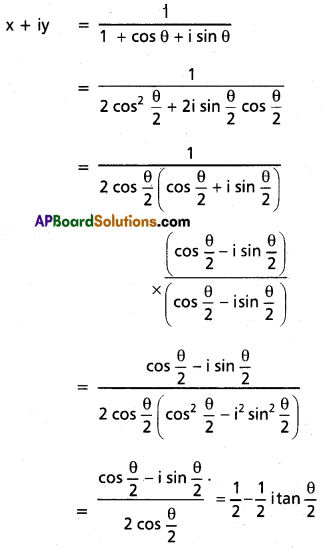
(iii) If x + iy = \(\frac{1}{1+\cos \theta+i \sin \theta}\), show that 4x2 – 1 = 0.
Solution:
Inter 2nd Year Maths 2A Complex Numbers Solutions Ex 1(b) II Q1(iii)
Equating real parts on both sides, we have
x = \(\frac{1}{2}\)
⇒ 2x = 1
⇒ 4x2 = 1
⇒ 4x2 – 1= 0

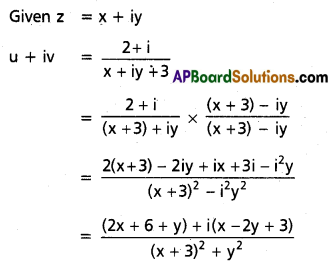
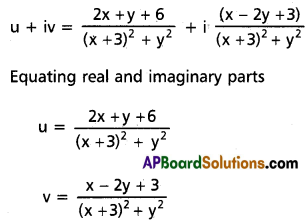
(iv) If u + iv = \(\frac{2+i}{z+3}\) and z = x + iy, find u, v.
Solution:
Inter 2nd Year Maths 2A Complex Numbers Solutions Ex 1(b) II Q1(iv)
Inter 2nd Year Maths 2A Complex Numbers Solutions Ex 1(b) II Q1(iv).1

Question 2.
(i) If z = 3 – 5i Show that z3 – 10z2 + 58z – 136 = 0.
Solution:
Given z = 3 – 5i
⇒ z – 3 = -5i
⇒ (z – 3)2 = 25i2
⇒ z2 – 6z + 9 = -25
⇒ z2 – 6z + 34 = 0
∴ z3 – 10z2 + 58z – 136 = z(z2 – 6z + 34) – 4z2 + 24z – 136
= z(0) – 4(z2 – 6z + 34)
= 0 – 4(0)
= 0
∴ z3 – 10z2 + 58z – 136 = 0

Inter 2nd Year Maths 2A Complex Numbers Solutions Ex 1(b)

(ii) If z = 2 – i√7 , then show that 3z3 – 4z2 + z + 88 = 0.
Solution:
Given z = 2 – i√7
⇒ z – 2 = -i√7
⇒ (z – 2)2 = (-i√7)2
⇒ z2 – 4z + 4 = 7i2
⇒ z2 – 4z + 4 = -7
⇒ z2 – 4z + 11 = 0
∴ 3z3 – 4z2 + z + 88 = 3z(z2 – 4z + 11) + 8z2 – 32z + 88
= 3z(0) + 8(z2 – 4z + 11)
= 0 + 8(0)
= 0
∴ 3z3 – 4z2 + z + 88 =0

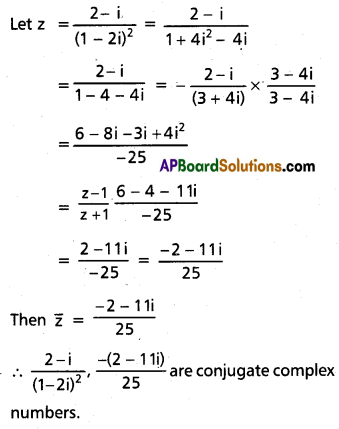
(iii) Show that \(\frac{2-i}{(1-2 i)^{2}}\) and \(\left(\frac{-2-11 i}{25}\right)\) conjugate to each other.
Solution:
Inter 2nd Year Maths 2A Complex Numbers Solutions Ex 1(b) II Q2(iii)

Question 3.
(i) If (x – iy)1/3 = a – ib then show that \(\frac{x}{a}+\frac{y}{b}\) = 4(a2 – b2)
Solution:
Given (x – iy)1/3 = (a – ib)
⇒ x – iy = (a – ib)3
⇒ x – iy = a3 – 3a2ib + 3ai2b2 – i3b3
⇒ x – iy = (a3 – 3ab2) – i(3a2b – b3)
Equating real and imaginary parts
x = a3 – 3ab2
⇒ \(\frac{x}{a}\) = a2 – 3b2
y = 3a2b – b3
⇒ \(\frac{y}{b}\) = 3a2 – b2
∴ \(\frac{x}{a}+\frac{y}{b}\) = a2 – 3b2 + 3a2 – b2
= 4a2 – 4b2
= 4(a2 – b2)
∴ \(\frac{x}{a}+\frac{y}{b}\) = 4(a2 – b2)

Inter 2nd Year Maths 2A Complex Numbers Solutions Ex 1(b)

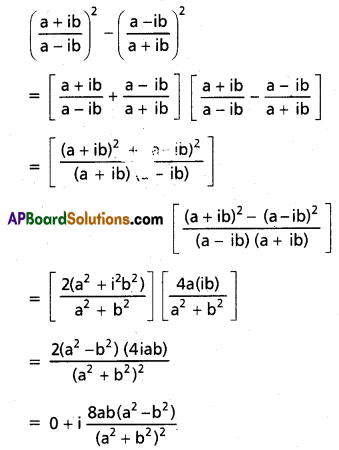
(ii) Write \(\left(\frac{a+i b}{a-i b}\right)^{2}-\left(\frac{a-i b}{a+i b}\right)^{2}\) in the form of x + iy.
Solution:
Inter 2nd Year Maths 2A Complex Numbers Solutions Ex 1(b) II Q3(ii)

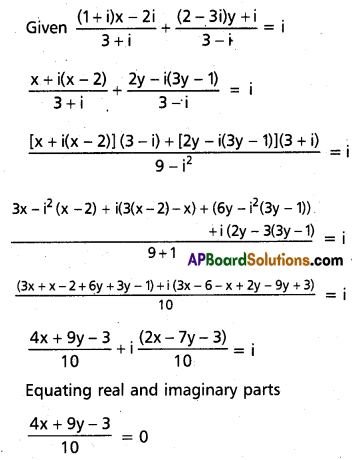
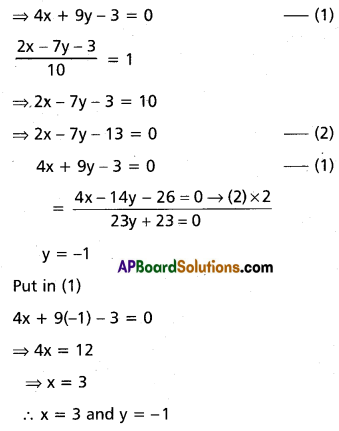
(iii) If x and y are real numbers such that \(\frac{(1+i) x-2 i}{3+i}+\frac{(2-3 i) y+i}{3-1}=i\), then determine the values of x and y.
Solution:
Inter 2nd Year Maths 2A Complex Numbers Solutions Ex 1(b) II Q3(iii)
Inter 2nd Year Maths 2A Complex Numbers Solutions Ex 1(b) II Q3(iii).1

Question 4.
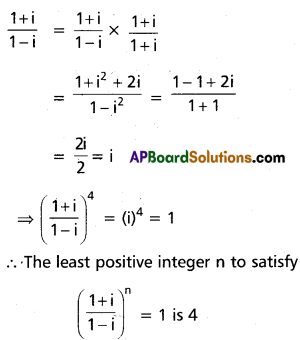
(i) Find the least positive integer n, satisfying \(\left(\frac{1+i}{1-i}\right)^{n}\) = 1
Solution:
Inter 2nd Year Maths 2A Complex Numbers Solutions Ex 1(b) II Q4(i)

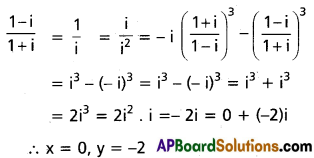
(ii) If \(\left(\frac{1+i}{1-i}\right)^{3}-\left(\frac{1-i}{1+i}\right)^{3}\) = x + iy, find x and y.
Solution:
Inter 2nd Year Maths 2A Complex Numbers Solutions Ex 1(b) II Q4(ii)
Inter 2nd Year Maths 2A Complex Numbers Solutions Ex 1(b) II Q4(ii).1

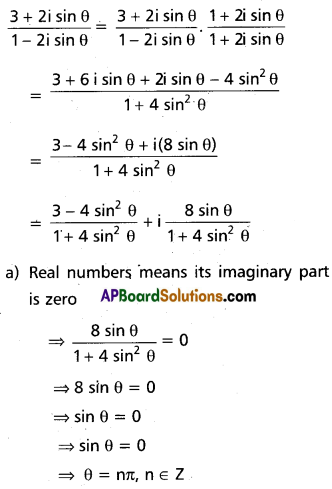
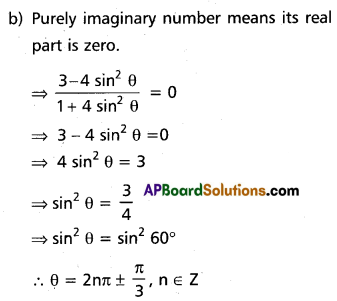
(iii) Find real values of ‘θ’ in order that \(\frac{3+2 i \sin \theta}{1-2 i \sin \theta}\) is a
(a) real numbers
(b) Purely imaginary number
Solution:
Inter 2nd Year Maths 2A Complex Numbers Solutions Ex 1(b) II Q4(iii)
Inter 2nd Year Maths 2A Complex Numbers Solutions Ex 1(b) II Q4(iii).1

Inter 2nd Year Maths 2A Complex Numbers Solutions Ex 1(b)

(iv) Find the real values of x and y if \(\frac{x-1}{3+i}+\frac{y-1}{3-i}=i\)
Solution:
Given \(\frac{x-1}{3+i}+\frac{y-1}{3-i}=i\)
⇒ \(\frac{(x-1)(3-i)+(y-1)(3+i)}{9-i^{2}}=i\)
⇒ 3x – xi – 3 + i + 3y – iy – 3 – i = 10i
⇒ (3x + 3y – 6) + i(-x + y) = 0 + 10i
Now equating real and imaginary parts
3x + 3y – 6 = 0
⇒ x + y – 2 = 0 ……..(1)
-x + y = 10
⇒ x – y + 10 = 0 ………(2)
(1) + (2) ⇒ 2x + 8 = 0
⇒ x = -4
From (1),
-4 + y – 2 = 0
⇒ y = 6
∴ x = -4, y = 6

AP Inter 2nd Year Chemistry Important Questions Chapter 11 Haloalkanes And Haloarenes

Students get through AP Inter 2nd Year Chemistry Important Questions 11th Lesson Haloalkanes And Haloarenes which are most likely to be asked in the exam.

AP Inter 2nd Year Chemistry Important Questions 11th Lesson Haloalkanes And Haloarenes

Very Short Answer Questions

Question 1.
Write the structures of the following compounds. [IPE – 2015 (AP), 2016 (TS)]
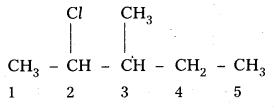
i) 2-chloro-3-methylpentane,
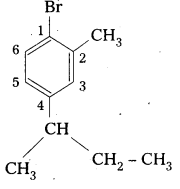
ii) 1 -B romo4-sec-butyl-2-methylbenzene.
Answer:
i) 2-chloro-3-methyl pentane
Structure:
AP Inter 2nd Year Chemistry Important Questions Chapter 11 Haloalkanes And Haloarenes 74

ii) 1-Bromo-4-sec-butyl 2-methyl benzene
Structure:
AP Inter 2nd Year Chemistry Important Questions Chapter 11 Haloalkanes And Haloarenes 75

Question 2.
Which compound in each of the following pairs will react faster in SN2 reaction with -OH?
i) CH3Br or CH3I
ii) (CH3)3CCl or CH3Cl.
Answer:
i) Among CH3Br and CH3I, CH3 – I reacts faster in SN2 reaction with OH because bond dissociation energy of C -1 is less than the bond dissociation energy of C – Br.

ii) Among CH3Cl and (CH3)3CCl, CH3 – Cl reacts faster in SN2 reaction with OH because (CH3)3CCl has high steric hindrance than CH3Cl.

AP Inter 2nd Year Chemistry Important Questions Chapter 11 Haloalkanes And Haloarenes

Question 3.
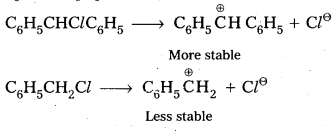
Out of C6H5CH2Cl and C6H5CHClC6H5, which is more easily hydrolysed aqueous KOH ?
Answer:

  • Out of C6H5CH2Cl and C6H5CHClC6H5 the 2nd one i.e., C6H5CHClC6H5 gets hydrolysed more easily than C6H5CH2Cl.
  • This can be explained by considering SN1 reaction mechanism. In case of SN1 reactions reactivity depends upon the stability of carbo cations.
  • C6H5CHClC6H5 forms more stable carbo cation than C6H5CH2Cl.
    AP Inter 2nd Year Chemistry Important Questions Chapter 11 Haloalkanes And Haloarenes 76

Question 4.
Treatment of alkyl halides with aq.KOH leads to the formation of alcohols, while in presence of alc.KOH what products are formed ?
Answer:
Treatment of alkyl halides with aq. KOH leads to the formation of alcohols. Here Nucleophillic substitution reaction takes place.
Eg. : C2H5Cl + aq.KOH → C2H5OH + KCl
Treatment of alkyl halides with alc.KOH leads to the formation of alkenes. Here elimination reaction takes place.
Eg. : C2H5Cl + alc. KOH → C2H4 + KCl + H2O

Question 5.
What is Grignard’s reagents. How it is prepared.
Answer:
Alkyl magnesium halide is called Grignard reagent. It is prepared by the action of Mg on alkyl halide in ether solvent.
R – X + Mg → RMgX

AP Inter 2nd Year Chemistry Important Questions Chapter 11 Haloalkanes And Haloarenes

Question 6.
What is the stereochemical result of SN1 and SN2 reactions? [T.S. Mar. 17 IPE 2015 (AP)]
Answer:

  • The stereochemical result of SN1 reaction is racemisation product.
  • The stereochemical result of SN2 reaction is inversion product.

Short Answer Questions

Question 1.
Define the following [A.P. Mar. 17] [IPE – 2014, 2016 (AP)]
i) Racemic mixture
ii) Retention of configuration
iii) Enantiomers.
Answer:
i) Racemic mixture: Equal portions of Enantiomers combined to form an optically inactive mixture. This mixture is called racemic mixture.

  • Here rotation due to one isomer will be exactly cancelled by the rotation of due to other isomer.
  • The process of conversion of enantiomer into a racemic mixture is called as racemisation.
    AP Inter 2nd Year Chemistry Important Questions Chapter 11 Haloalkanes And Haloarenes 77

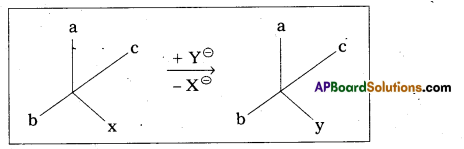
ii) Retention of configuration: The preservation of integrity of the spatial arrangement of . bonds to an asymmetric centre during a chemical reaction (or) transformation is called Retention of configuration.
General Eg : Conversion of XCabc chemical species into YCabc.
AP Inter 2nd Year Chemistry Important Questions Chapter 11 Haloalkanes And Haloarenes 78
Eg : (-) 2 – Methyl 1 – butanol conversion into (+) 1 – chloro 2. Methyl butane

Enantiomers : The stereo isomers related to each other as non-superimposable mirror images are called enantiomers. [A.P. Mar. 16]
These have identical physical properties like melting point, boiling points refractive index etc.
They differ in rotation of plane polarised light.

Question 2.
Explain the mechanism of Nucleophilic bimolecular substitution (SN2) reaction with one example. [A.P. Mar. 18. 16] [Mar. 14]
Answer:
Nucleophilic Bimolecular substitution Reaction SN2 :

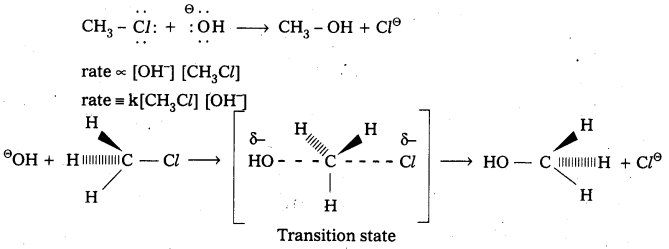
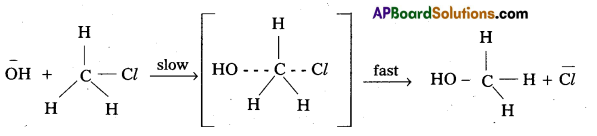
  1. The nucleophilic substitution reaction in which rate depends upon concentration of both reactants is called SN2 reaction.
  2.  It follows 2nd order kinetics. So it is called bimolecular reaction.
    Eg.: Methyl chloride reacts with hydroxide ion and forms methanol and chloride ion.
  3. Here the rate of reaction depends upon the concentration of two reactants.
    AP Inter 2nd Year Chemistry Important Questions Chapter 11 Haloalkanes And Haloarenes 79
  4. In the above mechanism the configuration of carbon atom under attack inverts in much the same way as an umbrella is turned inside out when caught in a strong wind. This process is called inversion of configuration.
  5. In transition state the carbon atom is simultaneously bonded to the incoming nucleophile and out going group. It is very unstable.
  6. The order of reactivity for SN2 reactions follows : 1°-alkyl halides > 2°-alkyl halides > 3°-alkyl halides.

AP Inter 2nd Year Chemistry Important Questions Chapter 11 Haloalkanes And Haloarenes

Question 3.
Explain why allylic and benzylic halides are more reactive towards SN1 substitution while 1-halo and 2-halobutanes preferentially undergoes SN2 substitution.
Answer:

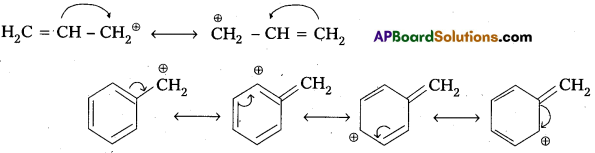
  1. Allylic and benzylic halides show high reactivity towards the SN1 reaction.
    Reason : The carbocation thus formed gets stabilised through resonance phenomenon as shown below.
    AP Inter 2nd Year Chemistry Important Questions Chapter 11 Haloalkanes And Haloarenes 80
  2. 1-halo and 2-halo butanes preferentially undergoes SN2 substitute.
    Reason : SN2 reactions involve transition state formation. Higher the steric hindrance lesser the stability of transition state. The given 1 -halo and 2-halo butanes have less steric hindrance. So these are preferentially undergo SN2 reaction.

Question 4.
Write the preparations of Alkyl halides.
Answer:
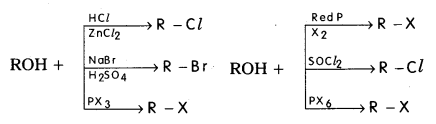
AP Inter 2nd Year Chemistry Important Questions Chapter 11 Haloalkanes And Haloarenes 81
Preparation ofAlkyl Halides :
i) From Alcohols : Alkyl halides are prepared by the action of HX, PX3, PX3, PX5, X2 & red phosphurs or SOCl on alcohols.

Question 5.
Explain SN1 and SN2 reactions. [T.S. Mar. 18] [IPE – 2016, 2015, 2014 (TS)]
Answer:
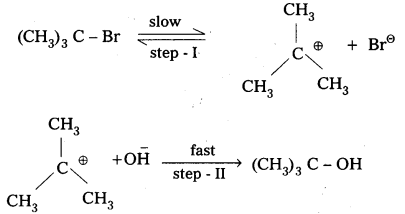
i) SN1: Substitution nucleophilic unimolecular reaction: In this reaction the first step is the formation of stable carbonium ion. This step is slow and is the rate determining step. The alkyl halides which form stable carbonium ion follow SN1 reaction.
AP Inter 2nd Year Chemistry Important Questions Chapter 11 Haloalkanes And Haloarenes 82
The order of reactivity of alkyl halides towards SN1 reaction.
Tertiary halide > Secondary halide > Primary halide > CH3 – X.
Benzyl halide and allyl halides are primary halides but participate in SN1 mechanism due to the formation of stable benzyl and allyl carbonium ions (Benzyl and allyl carbonium ions are stabilised due to resonance).

ii) SN2: Substitution nucleophilic bimolecular reaction: In this reaction the rate of reaction depends on the concentration of alkyl halide and also on the concentration of nucleophile hence it is a bimolecular reaction.
AP Inter 2nd Year Chemistry Important Questions Chapter 11 Haloalkanes And Haloarenes 83
The order of reactivity of alkyl halides towards SN2 reaction.
CH3 – X > Primary halide> Secondary halide > Tertiary halide
For a given alkyl group, the reaction of the alkyl halide, R – X follows the same order in both the mechanisms R – I > R – Br> R – Cl > R – F

AP Inter 2nd Year Chemistry Important Questions Chapter 11 Haloalkanes And Haloarenes

Question 6.
What is Wurtz reaction ? Give equation.
Answer:
Wurtz Reaction : Alkyl halides react with sodium in dry ether solvent give alkanes.
AP Inter 2nd Year Chemistry Important Questions Chapter 11 Haloalkanes And Haloarenes 84

Question 7.
Explain different chemical properties of Alkyl halide. [IPE 2016 (TS)]
Answer:
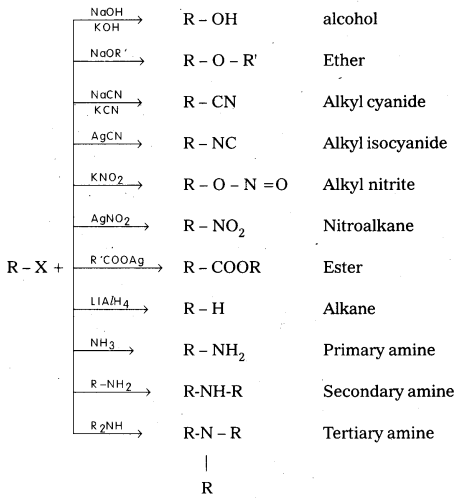
AP Inter 2nd Year Chemistry Important Questions Chapter 11 Haloalkanes And Haloarenes 85

Question 8.
Explain Wurtz – Fittig and Fittig reactions. [A.P. Mar. 17]
Answer:
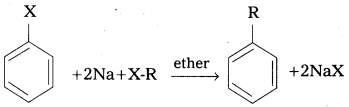
i) Wurtz – Fittig reaction : The reaction of aryl halide with alkyl halide in the presence of sodium in ether to give alkyl benzene is called Wurtz Fittig reaction.
AP Inter 2nd Year Chemistry Important Questions Chapter 11 Haloalkanes And Haloarenes 86

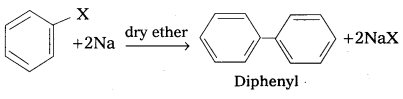
ii) Fittig reaction : Aryl halides react vith sodium in dry ether solvent to give diphenyl is called fitting reaction.
AP Inter 2nd Year Chemistry Important Questions Chapter 11 Haloalkanes And Haloarenes 87

AP Inter 2nd Year Chemistry Important Questions Chapter 11 Haloalkanes And Haloarenes

Question 9.
Write any one method for the preparation of chloro benzene.
Answer:
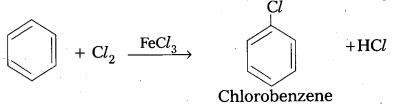
Chlorination of benzene in the pressence of Lewis acid like AlCl3, FeCl3 gives chioro benzene.
AP Inter 2nd Year Chemistry Important Questions Chapter 11 Haloalkanes And Haloarenes 88

Question 10.
Explain electrophilic substitution reactions of chioro benzene.
Answer:
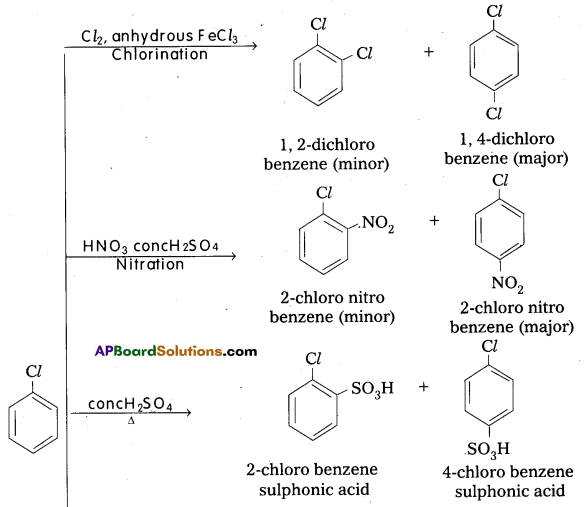
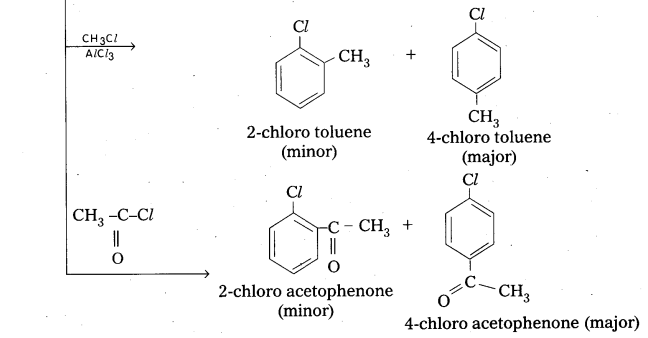
Electrophilic Substitution Reaction : Halogen atom is electron releasing group. it activates the benzene ring hence electrophilic substitution takes place at ortho and para positions.
AP Inter 2nd Year Chemistry Important Questions Chapter 11 Haloalkanes And Haloarenes 89
AP Inter 2nd Year Chemistry Important Questions Chapter 11 Haloalkanes And Haloarenes 90

Question 11.
Write the structures of the following organic halides. [IPE 2016 (T.S)]
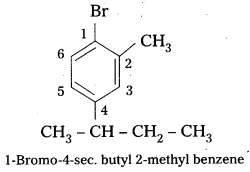
i) 1 -Bromo-4-sec-butyl-2-methylbenzene,
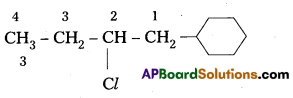
ii) 2-Chioro- 1 -phenylbutane
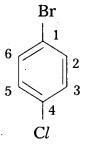
iii) p-bromochlorobenzene,
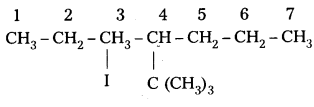
iv) 4-t-butyl-3-iodoheptane.
Answer:
i) 1 -Bromo-4-sec-butyl-2-methylbenzene,
Structure :
AP Inter 2nd Year Chemistry Important Questions Chapter 11 Haloalkanes And Haloarenes 91

ii) 2-Chioro- 1 -phenylbutane
Structure :
AP Inter 2nd Year Chemistry Important Questions Chapter 11 Haloalkanes And Haloarenes 92

iii) p-bromochlorobenzene,
Structure :
AP Inter 2nd Year Chemistry Important Questions Chapter 11 Haloalkanes And Haloarenes 93

iv) 4-t-butyl-3-iodoheptane.
Structure :
AP Inter 2nd Year Chemistry Important Questions Chapter 11 Haloalkanes And Haloarenes 94

AP Inter 2nd Year Chemistry Important Questions Chapter 11 Haloalkanes And Haloarenes

AP Inter 2nd Year Chemistry Important Questions Chapter 6(a) Group-15 Elements

Students get through AP Inter 2nd Year Chemistry Important Questions Lesson 6(a) Group-15 Elements which are most likely to be asked in the exam.

AP Inter 2nd Year Chemistry Important Questions Lesson 6(a) Group-15 Elements

Very Short Answer Questions

Question 1.
Nitrogen molecule is highly stable – Why? (IPE 2014)
Answer:
Nitrogen Molecule is more stable because in between two nitrogen atoms of N2, a triple bond is present. To break this triple bond high energy is required (941.4KJ/mole).

Question 2.
Why are the compounds of bismuth more stable in +3 oxidation state ?
Answer:
Bismuth compounds are more stable in +3 oxidation state because ‘Bi’ exhibits +3 stable oxidation state instead of +5 due to inert pair effect.

AP Inter 2nd Year Chemistry Important Questions Chapter 6(a) Group-15 Elements

Question 3.
What is allotropy ? Explain the different allotropic forms of phosphorus. (IPE 2016(TS))
Answer:
Allotropy: The existence of an element in different physical forms having similar chemical properties is called allotropy.
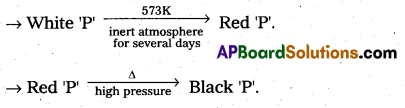
→ Allotropes of ‘P’: → White ‘P’ (or) Yellow P.

  • Red P
  • Scarlet ‘P’
  • Violet P
  • α – black P’
  • β – black ‘P’.

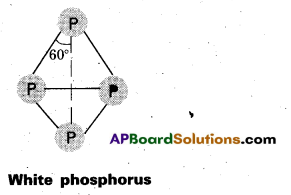
White phosphorus :

  • It is poisonous and insoluble in water and soluble in carbon disulphide and glows in dark.
  • It is a translucent white waxy solid.
  • It dissolves in boiling NaOH solution and gives PH3.
    AP Inter 2nd Year Chemistry Important Questions Chapter 6(a) Group-15 Elements 1
  • It is more reactive than other solid phases.
  • Bond angle is 60° and it readily catches fire,

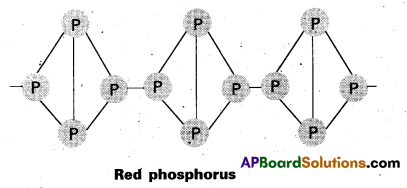
Red phosphorus :
AP Inter 2nd Year Chemistry Important Questions Chapter 6(a) Group-15 Elements 2

  • Red P possesses iron grey lustre.
  • In it odour less, non poisonous and insoluble in water as well as CS2.
  • Red P is much less reactive than white P.

Black P’:

  • α – Black P : It is formed when red P is heated in a sealed tube 803K.
  • β – Black P : It is prepared by heating white P at 473 K under high pressure.

Question 4.
Explain the difference in the structures of white and red phosphorus.
Answer:
White ‘P’ molecule has tetrahedral structure (discrete molecule). Discrete ‘P’ molecules are held by vander waal’s forces.
AP Inter 2nd Year Chemistry Important Questions Chapter 6(a) Group-15 Elements 3
Red ‘P’ is polymeric consisting of chains of P4 tetrahedron linked together through covalent bonds.
AP Inter 2nd Year Chemistry Important Questions Chapter 6(a) Group-15 Elements 4

Question 5.
What is inert pair effect ?
Answer:
Inert pair effect: The reluctance of ns pair of electrons to take part in bond formation is called inert pair effect.

  • Bi exhibits +3 oxidation state instead of +5 due to inert pair effect.

AP Inter 2nd Year Chemistry Important Questions Chapter 6(a) Group-15 Elements

Question 6.
How do calcium phosphide and heavy water react ?
Answer:
Calcium phosphide reacts with heavy water to form Deutero phosphine.
Ca3P2 + 6D2O → 3 Ca (OD)2 + 2PD3

Question 7.
Ammonia is a good complexing agent – Explain with an example.
Answer:
NH3 is a lewis base and it donates electron pair to form dative bond with metal ions. This results in the formation of complex compound.
Eg :
AP Inter 2nd Year Chemistry Important Questions Chapter 6(a) Group-15 Elements 5

Question 8.
NO is paramagnetic in gaseous state but diamagnetic in liquid and solid states – Why ?
Answer:
In gaseous state NO2 exists as a Monomer and contains one unpaired electron but in solid state it dimerises to N2O4 so it doesnot contain unpaired electron.
Hence NO2 is para magnetic in geseous state but diamagnetic in solid state.

Question 9.
Iron becomes passive in cone. HNO3 – Why ?
Answer:
Iron becomes passive in cone. HNO3 due to formation of a passive film of oxide on the surface of iron.

Question 10.
Give the neutral oxides of nitrogen.
Answer:
Nitrous oxide (N2O) and Nitric oxide (NO) are neutral oxides of nitrogen.

Question 11.
Give the paramagnetic oxides of nitrogen.
Answer:
Nitric oxide (NO) and nitrogen dioxide (NO2) are the paramagnetic oxides of nitrogen due to the presence of odd number of electrons.

Question 12.
Why is white phosphorus is more reactive than red phosphorus ?
Answer:
In white phosphorus the P – P – P bond angle is 60° hence the bonds are in strain. As a result the bonds are broken easily. In red phosphorus the bond angle is 120°, hence it is stable and less reactive.

AP Inter 2nd Year Chemistry Important Questions Chapter 6(a) Group-15 Elements

Question 13.
What happens when white phosphorus is heated with conc. NaOH solution in an inert atmosphere of CO2 ?
Answer:
When white phosphorus heated with con. NaOH solution in an inert atmosphere of CO2 forms PH3.
P4 + 3NaoH + 3H2O → PH3 + 3NaH2PO2.

Question 14.
Give the uses of
a) nitric acid and
b) ammonia.
Answer:
Nitric acid : It is used in the manufacture of fertilizers, explosives, nitro glycerine, nitro toluence etc.,
Ammonia : It is used to produce fertilizers like urea liquid NH3 is used as a refrigerant.

Question 15.
Give the disproportionation reaction of H3PO3.
Answer:
Orthophosphoric acid (H3PO3) on heating disproportionates to give orthophosphoric acid and phosphine.
4H3PO3 → 3H3PO4 + PH3.

Question 16.
Nitrogen exists as diatomic molecule and phosphorus as P4 – Why ?
Answer:
Nitrogen exists as diatomic molecule :

  • Nitrogen has small size and high electronegativity and nitrogen atom forms Pπ – Pπ multiple bonds with itself (triplebond). So it exists as a discrete diatomic molecule in elementary state.

Phosphorus exists as tetra atomic molecule :

  • Phosphorus has large size and less electronegative and it forms P-P single bonds. So it exists as tetra atomic i.e., P4.

Question 17.
Arrange the hydrides of group – 15 elements in the increasing order of basic strength and decreasing order of reducing character.
Answer:

  • Increasing order of basic strength of Group – 15 elements hydrides is
    BiH3 < SbH3 < AsH3 < PH3 < NH3.
  • Decreasing order of reducing character of Group – 15 elements hydrides is
    BiH3 > SbH3 > AsH3 > PH3 > NH3.

Question 18.
PH3 is a weaker base than NH3 – Explain.
Answer:
PH3 is a weaker base than NH3.

  • In NH3 nitrogen atom undergoes sp3 hybridisation and due to small size it has high electron density than in’P of PH3.
  • Due to large size of ‘P’ atom and availability of large surface area, lone pair of electron spread in PH3. Hence PH3 is weaker base than NH3.

Question 19.
A mixture of Ca3P2 and CaC2 is used in making Holme’s signal – Explain.
Answer:
A mixture of Ca3P2 and CaC2 is used in Holme’s signal. This Mixture containing containers are pierced and thrown in the sea, when the gas is evolved bum and serve as a signal.
The spontaneous combustion of PH3 is the technical use of Holme’s signal.

AP Inter 2nd Year Chemistry Important Questions Chapter 6(a) Group-15 Elements

Question 20.
Which chemical compound is formed in the brown ring test of nitrate ions ?
Answer:
In the brown ring test of nitrate salts a brown ring is formed. It’s formula is [Fe(H2O)5NO]+2.

Question 21.
Why does NH3 act as a Lewis base ?
Answer:
Nitrogen atom in NH3 has one lone pair of electrons with is available for donation. Therefore, it acts as a Lewis base.

Question 22.
Why does NO2 dimerise ?
Answer:
NO2 contains of odd number of electrons. It behaves as a typical odd molecule. On dimerisation, it is converted to stable N2O4 molecule with even number of electrons.

Question 23.
Why does PCl3 fume in moisture ?
Answer:
PCl3 hydrolyses in the presence of moisture giving fumes of HCl.
PCl3 + 3H2O → H3PO3 + 3HCl

Question 24.
Are all the five bonds in PCl5 molecule equivalent ? Justify your answer.
Answer:
PCl5 has a trigonal bipyramidal structure and the three equatorial P-Cl bonds are equivalent. While the two axial bonds are different and longer than equatorial bonds.

Question 25.
How is nitric oxide (NO) prepared ?
Answer:
Nitric oxide (NO) is prepared by the action of dilute nitric acid on copper.
AP Inter 2nd Year Chemistry Important Questions Chapter 6(a) Group-15 Elements 6

Question 26.
Explain the following .
a) reaction of alkali with red phosphorus.
b) reaction between PCl3 and H2O.
Answer:
a) Red phosphorus reacts with alkalies slowly and forms phosphine and hypophosphite.
P4 + 3NaOH + 3 H2O → PH3 + 3 NaH2 PO2
b) PCl3 is hydrolysed by water and gives H3PO3
AP Inter 2nd Year Chemistry Important Questions Chapter 6(a) Group-15 Elements 7

AP Inter 2nd Year Chemistry Important Questions Chapter 6(a) Group-15 Elements

Question 27.
Write the oxidation states of phosphorus in solid PCl5.
Answer:
In solid state PCl5 exists as an ionic solid [PCl4)+ [PCl6]

  • ‘P’ exhibits +5 oxidation state in [PCl4)+ and [PCl6]

Question 28.
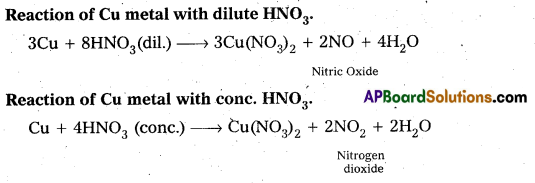
Illustrate how copper metal can give different products on reaction with HNO3.
Answer:
AP Inter 2nd Year Chemistry Important Questions Chapter 6(a) Group-15 Elements 8

Question 29.
H3PO2 is a good reducing agent – Explain with an example.
Answer:
In H3PO2, two H-atoms are bonded directly to P-atom which imparts reducing character to the acid.

Question 30.
NH3 forms hydrogen bonds but PH3 does not – Why ?
Answer:
NH3 forms hydrogen bonds but PH3 does not.
Reason : Ammonia forms hydrogen bonds because it is a polar molecule and N-H bond is highly polar. Nitrogen has more electronegativity than phosphorus. In case of PH3, P-H bond polarity decreases.

Question 31.
PH3 has lower boiling point than NH3. Why ?
Answer:
Unlike NH3, PH3 molecules are not associated through inter molecular hydrogen bonding. That is why the boiling point of PH3 is lower than NH3.

Long Answer Questions

Question 1.
How is ammonia manufactured by Haber’s process ? Explain the reactions of ammonia with
a) ZnSO4(aq)
b) CuSO4(aq)
c) AgCl(s) (TS Mar. ’17 IPE 2015(AP))
Answer:
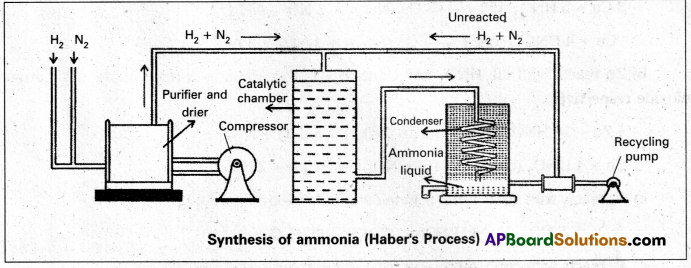
In Haber process ammonia is directly synthesised from elements (nitrogen and hydrogen). The principle involved in this is
AP Inter 2nd Year Chemistry Important Questions Chapter 6(a) Group-15 Elements 9
This is a reversible exothermic reaction.
According to Le Chatelier’s principle favourable conditions for the better yield of ammonia are low temperature and high pressure. But the optimum conditions are :
Temperature : 720k
Pressure : 200 atmospheres
Catalyst: Finely divided iron in the presence of molybdenum (Promoter).
Procedure : A mixture of nitrogen and hydrogen in the volume ratio 1 : 3 is heated to 725 – 775K at a pressure of 200 atmospheres is passed over hot finely divided iron mixed with small amount of molybdenum as promotor. The gases coming out of the catalyst chamber consists of 10 – 20% ammonia. Gases are cooled and compressed, so that ammonia gas is liquified and the uncondensed gases are sent for recirculation.
AP Inter 2nd Year Chemistry Important Questions Chapter 6(a) Group-15 Elements 10
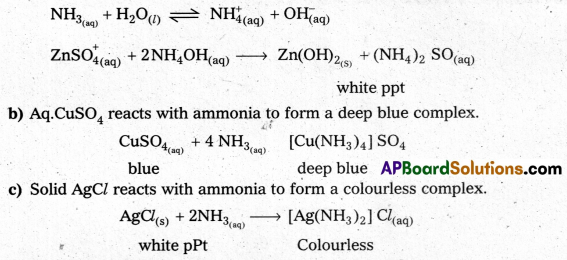
a) Aq. ZnSO4 reacts with ammonia aqueous solution to form white ppt of Zinc hydroxide.
AP Inter 2nd Year Chemistry Important Questions Chapter 6(a) Group-15 Elements 11

AP Inter 2nd Year Chemistry Important Questions Chapter 6(a) Group-15 Elements

Question 2.
How is nitric acid manufactured by Ostwald’s process ? How does it react with the following ? (A.P. Mar. ’17)
a) Copper
b) Zn
c) S8
d) P4
Answer:
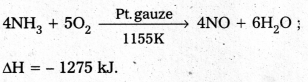
Ostwald’s process : Ammonia, mixed with air in 1 : 7 or 1 : 8, when passed over a hot platinum gauze catalyst, is oxidised to NO mostly (about 95%).
The reaction is
AP Inter 2nd Year Chemistry Important Questions Chapter 6(a) Group-15 Elements 12
The liberated heat keeps the catalyst hot. The ’NO’ is cooled and is mixed with oxygen to give the dioxide, in large empty towers (oxidation chamber). The product is then passed into warm water, under pressure in the presence of excess of air, to give HNO3.
4NO2 + O2 + 2H2O → 4HNO3.
The acid formed is about 61% concentrated.

a) Copper reacts with dil. HNO3 and cone. HNO3 and liberates Nitric Oxide and Nitrogen dioxide respectively
3 Cu + 5 HNO3 (dil) → 3 Cu (NO3)2 + 2 NO + 4 H2O
Cu + 4 HNO3 (conc.) → Cu (NO3)2 + 2 NO2 + 2 H2O

b) Zn reacts with dil. HNO3 and Cone. HNO3 and liberates Nitrous oxide and Nitrogen
dioxide respectively.
4 Zn + 10 HNO3 (dil) → 4 Zn (NO3)2 + 5 H2O + N2O.
Zn + 4 HNO3 (conc.) → Zn (NO3)2 + 2 H2O + 2 NO2

c) S8 reacts with cone, nitric acid to form Sulphuric acid, NO2 gas.
S8 + 48 HNO3 → 8 H2SO4 + 48 NO2 + 16 H2O
d) P4 reacts with cone, nitric acid to form phosphoric acid and NO2 gas.
P4 + 20 HNO3 → 4 H3PO4 + 20 NO2 + 4 H2O

AP Inter 2nd Year Physics Important Questions Chapter 15 Semiconductor Electronics: Material, Devices and Simple Circuits

Students get through AP Inter 2nd Year Physics Important Questions 15th Lesson Semiconductor Electronics: Material, Devices and Simple Circuits which are most likely to be asked in the exam.

AP Inter 2nd Year Physics Important Questions 15th Lesson Semiconductor Electronics: Material, Devices and Simple Circuits

Very Short Answer Questions

Question 1.
What is an n-type semiconductor? What are the majority and minority charge carriers in it?
Answer:

  • If a pentavalent impurity is added to a pure tetravalent semiconductor, it is called an n-type semiconductor.
  • In n-type semiconductor majority, of charge carriers are electrons and the minority charge carriers are holes.

Question 2.
What are intrinsic and extrinsic semiconductors? [A.P. Mar. 15]
Answer:

  • Pure form of semiconductors are called intrinsic semiconductors.
  • When impure atoms are added to increase their conductivity, they are called extrinsic semiconductors.

AP Inter 2nd Year Physics Important Questions Chapter 15 Semiconductor Electronics: Material, Devices and Simple Circuits

Question 3.
What is a p-type semiconductor ? What are the majority and minority charge carriers in it ? [A.P. & T.S. Mar. 17]
Answer:
If a trivalent impurity is added to a tetravalent semiconductor, it is called p-type semi-conductor.
AP Inter 2nd Year Physics Important Questions Chapter 15 Semiconductor Electronics Material, Devices and Simple Circuits 1
In p-type semiconductor majority charge carriers are holes and minority charge carriers are electrons.

Question 4.
What is a p-n junction diode ? Define depletion’ layer.
Answer:
When an intrinsic semiconductor crystal is grown with one side doped with trivalent element and on the other side doped with pentavalent element, a junction is formed in the crystal. It is called p-n junction diode.

A thin narrow region is formed on either side of the p-n junction, which is free from charge carriers is called depletion layer.

Question 5.
How is a battery connected to a junction diode in i) forward and ii) reverse bias ?
Answer:
i) In p-n junction diode, if p-side is connected to positive terminal of a cell and n-side to negative terminal, it is called forward bias.
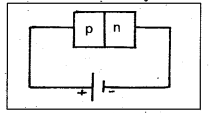
AP Inter 2nd Year Physics Important Questions Chapter 15 Semiconductor Electronics Material, Devices and Simple Circuits 2
ii) In a p-n junction diode, p-side is connected to negative terminal of a cell and n-side to positive terminal, it is called reverse bias.
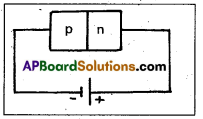
AP Inter 2nd Year Physics Important Questions Chapter 15 Semiconductor Electronics Material, Devices and Simple Circuits 3

Question 6.
What is the maximum percentage of rectification in half wave and full wave rectifiers ?
Answer:

  1. The percentage of rectification in half-wave rectifier is 40.6%.
  2. The percentage of rectification in full-wave rectifiers is 81.2%.

AP Inter 2nd Year Physics Important Questions Chapter 15 Semiconductor Electronics: Material, Devices and Simple Circuits

Question 7.
What is Zener voltage (Vz) and how will a Zener diode be connected in circuits generally ?
Answer:

  1. When Zener diode is in reverse biased, at a particular voltage current increases suddenly is called Zener (or) break down voltage.
  2. Zener diode always connected in reverse bias.

Question 8.
Write the expressions for the efficiency of a full wave rectifier and a half wave rectifier.
Answer:

  1. Efficiency of half wave rectifier (η) = \(\frac{0.406 \mathrm{R}_{\mathrm{L}}}{\mathrm{r}_{\mathrm{f}}+\mathrm{R}_{\mathrm{L}}}\)
  2. Efficiency of full wave rectifier (η) = \(\frac{0.812 \mathrm{R}_{\mathrm{L}}}{\mathrm{r}_{\mathrm{f}}+\mathrm{R}_{\mathrm{L}}}\)

Question 9.
What happens to the width of the depletion layer in a p-n junction diode when it is
i) forward-biased and ii) reverse biased ?
Answer:
When a p-n junction diode is forward bias, thickness of depletion layer decreases and in reverse bias, thickness of depletion layer increases.

Question 10.
Draw the circuit symbols for p-n-p and n-p-n transistors. [Mar. 14]
Answer:
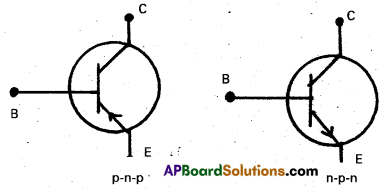
AP Inter 2nd Year Physics Important Questions Chapter 15 Semiconductor Electronics Material, Devices and Simple Circuits 4

Question 11.
Define amplifier and amplification factor.
Answer:

  1. Rising the strength of a weak signal is known as amplification and the device is called amplifier.
  2. Amplification factor is the ratio between output voltage to the input voltage.
    A = \(\frac{\mathrm{V}_0}{\mathrm{~V}_{\mathrm{i}}}\)

AP Inter 2nd Year Physics Important Questions Chapter 15 Semiconductor Electronics: Material, Devices and Simple Circuits

Question 12.
In which bias can a Zener diode be used as voltage regulator ?
Answer:
In reverse bias Zener diode can be used as voltage regulator.

Question 13.
Which gates are called universal gates ? [T.S. Mar. 15]
Answer:
NAND gate and NOR gates are called universal gates.

Question 14.
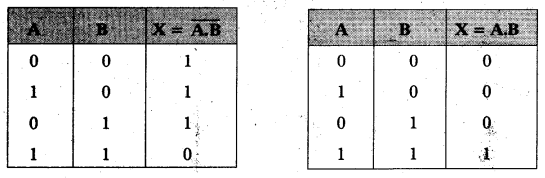
Write the truth table of NAND gate. How does it differ from AND gate ?
Answer:

AP Inter 2nd Year Physics Important Questions Chapter 15 Semiconductor Electronics Material, Devices and Simple Circuits 5
AP Inter 2nd Year Physics Important Questions Chapter 15 Semiconductor Electronics Material, Devices and Simple Circuits 6

Short Answer Questions

Question 1.
What is a rectifier ? Explain the working of half wave and full Wave rectifiers with diagrams. [A.P. Mar. 17]
Answer:
Rectifier: It is a circuit which converts ac into d.c. A p-n junction diode is used as a rectifier.
Half-wave rectifier:
AP Inter 2nd Year Physics Important Questions Chapter 15 Semiconductor Electronics Material, Devices and Simple Circuits 7

  1. A half wave rectifier can be constructed with a single diode. The ac input signal is fed to the primary coil of a transformer. The output signal is taken across the load resistance RL.
  2. During positive half cycle, the diode is forward biased and current flows through the diode.
  3. During negative half cycle, diode is reverse biased and no current flows through the load resistance.
  4. This means current flows through the diode only during positive half cycles and negative half cycles are blocked. Hence in the output we get only positive half cycles.
  5. Rectifier efficiency is defined as the ratio of output dc power to the input ac power.
    η = \(\frac{\mathrm{P}_{\mathrm{dc}}}{\mathrm{P}_{\mathrm{ac}}}=\frac{0.406 \mathrm{R}_{\mathrm{L}}}{\mathrm{r}_{\mathrm{f}}+\mathrm{R}_{\mathrm{L}}}\)
    Where rf = Forward resistance of a diode; RL = Load resistance
    The maximum efficiency of half wave rectifier is 40.6%.

Full wave rectifier : The process of converting an alternating current into a direct current is called rectification.
The device used for this purpose is called rectifier.

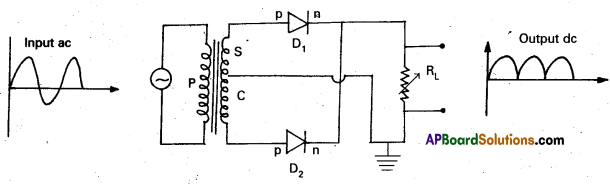
  1. A full wave rectifier can be constructed with the help of two diodes D1 and D2.
  2. The secondary transformer is centre tapped at C and its ends are connected to the p regions of two diodes D1 & D2.
  3. The output voltage is measured across the load resistance RL.
  4. During positive half cycles of ac, the diode D1 is forward biased and current flows through the load resistance RL. At this time D2 will be reverse biased and will be in switch off position.
  5. During negative half cycles of ac, the diode D2 is forward biased and the current flows through RL. At this time D1 will be reverse biased and will be in switch off position.
  6. Hence positive output is obtained for all the input ac signals.
  7. The efficiency of a rectifier is defined as the ratio between the output dc power to the input ac power.
    η = \(\frac{\mathrm{P}_{\mathrm{dc}}}{\mathrm{P}_{\mathrm{ac}}}=\frac{0.812 \mathrm{R}_{\mathrm{L}}}{\mathrm{r}_{\mathrm{f}}+\mathrm{R}_{\mathrm{L}}}\)
    The maximum efficiency of a full wave rectifier is 81.2%.

AP Inter 2nd Year Physics Important Questions Chapter 15 Semiconductor Electronics: Material, Devices and Simple Circuits

Question 2.
What is a junction diode ? Explain the formation of depletion region at the junction. Explain the variation of depletion region in forward and reverse-biased condition.
Answer:
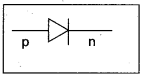
p-n junction diode: When a p-type semiconductor is suitablyjoined to n-type semiconductor, a p-n junction diode is formed. ’
The circuit symbol of p-n junction diode is shown in figure.
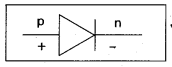
AP Inter 2nd Year Physics Important Questions Chapter 15 Semiconductor Electronics Material, Devices and Simple Circuits 8
Formation of depletion layer at the junction: When p-n junction is formed, the free electrons on n-side diffuse over to p-side, they combine with holes and become neutral. Similarly holes on p-side diffuse over to n-side and combihe with electrons become neutral.

This results in a narrow region formed on either side of the junction. This region is called depletion layer. Depletion layer is free from charge carriers.

The n-type material near the junction becomes positively charged due to immobile donor ions and p-type material becomes negatively charged due to immobile acceptor ions. This creates an electric field near the junction directed from n-region to p-region and cause a potential barrier.
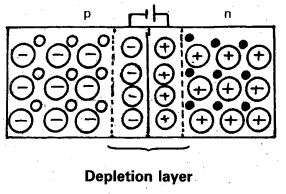
AP Inter 2nd Year Physics Important Questions Chapter 15 Semiconductor Electronics Material, Devices and Simple Circuits 9
The potential barrier stops further diffusion of holes and electrons across the* junction. The value of the potential barrier depends upon the nature of the crystal, its temperature and the amount of doping.

Forward bias :
“When a positive terminal of a battery is connected to p-side and negative terminal is connected to n-side; then p-n junction diode is said to be forward bias”.
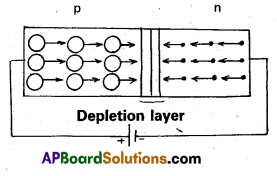
AP Inter 2nd Year Physics Important Questions Chapter 15 Semiconductor Electronics Material, Devices and Simple Circuits 10
The holes in the p-region are repelled by the positive polarity and move towards the junction. Similarly electrons in the n-region are repelled by the negative polarity and move towards the junction.

As a result, the width of the depletion layer decreases. The charge carriers cross the junction apd electric current flows in the circuit.
Hence in forward bias resistance of diode is low. This position is called switch on position.
Reverse bias:
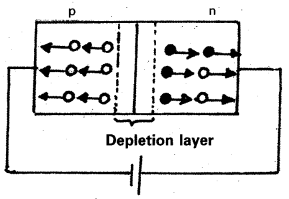
AP Inter 2nd Year Physics Important Questions Chapter 15 Semiconductor Electronics Material, Devices and Simple Circuits 11
“When the negative terminal of the battery is connected to p-side and positive terminal of the battery is connected to n-side of the p-n junction, then the diode is said to be reverse bias”.

The holes in the p-region are attracted towards negative polarity and move away from the junction. Similarly the electrons in the n-region are attracted towards positive polarity and move away from the junction.

So, width of the depletion layer and potential barrier increases. Hence resistance of p-n junction diode increases. Thus the reverse biased diode is called switch off position.

AP Inter 2nd Year Physics Important Questions Chapter 15 Semiconductor Electronics: Material, Devices and Simple Circuits

Question 3.
What is a Zener diode ? Explain how it is used as a voltage regulator.
Answer:
Zener diode : Zener diode is a heavily doped germanium (or) silicon p-n junction diode. It works on reverse bias break down region.
The circuit symbol of zener diode is shown in figure.
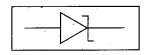
AP Inter 2nd Year Physics Important Questions Chapter 15 Semiconductor Electronics Material, Devices and Simple Circuits 12
Zener diode can be used as a voltage regulator. In- general zener diode is connected in reverse bias in the circuits.
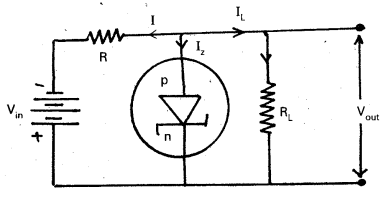
AP Inter 2nd Year Physics Important Questions Chapter 15 Semiconductor Electronics Material, Devices and Simple Circuits 13

  1. The zener diode is connected to a battery, through a resistance R. The battery reverse biases the zener diode.
  2. The load resistance RL is connected across the terminals of the zener diode.
  3. The value of R is selected in such away that In the absence of load RL maximum safe current flows in the diode.
  4. Now consider that load is connected across the diode. The load draws a current.
  5. The current through the diode falls by the same amount but the voltage drops across the load remains constant.
  6. The series resistance ‘R’ absorbs the output voltage fluctuations, so as to maintain constant voltage across the load.
  7. The voltage across the zener diode remains constant even if the load RL varies. Thus, zener diode works as voltage regulator.
  8. If I is the input current, IZ and IL are zener and load currents.
    I = IZ + IL; Vin = IR + VZ
    But V0ut = VZ
    ∴ Vout = Vin – IR

Question 4.
Explain the working of LED and what are its advantages over conventional incandescent low power lamps.
Answer:
Light emitting diode (LED) : It is a photoelectronic device which converts electrical energy into light energy.

It is a heavily doped p-n junction diode which under forward bias emits spontaneous radiation. The diode is covered with a transparent cover so that the emitted light may not come out. Working : When p-n junction diode is forward biased, the movement of majority charge carriers takes place across the junction. The electrons move from n-side to p-side through the junction and holes move from p-side to n-side.

As a result of it, concentration of majority carriers increases rapidly at the junction.

When there is no bias across the junction, therefore there are excess minority carriers on either side of the junction, which recombine with majority carriers near the junction.

On recombination of electrons and hole, the energy is given out in the form of heat and light.
Advantages of LED’s over incandescent lamp :

  1. LED is cheap and easy to handle.
  2. LED has less power and low operational voltage.
  3. LED has fast action and requires no warm up time.
  4. LED can be used in burglar alarm system.

AP Inter 2nd Year Physics Important Questions Chapter 15 Semiconductor Electronics: Material, Devices and Simple Circuits

Question 5.
Define NAND and NOR gates. Give their truth tables. [T.S. Mar. 17]
Answer:
NAND gate : NAND gate is a combination of AND gate and NOT gate.

AP Inter 2nd Year Physics Important Questions Chapter 15 Semiconductor Electronics Material, Devices and Simple Circuits 14
NAND gate can be obtained by connecting a NOT gate in the output of an AND gate. NAND gates are called universal gates.

  1. If both inputs are low, output is high.
    A = 0, B = 0, X = 1
  2. If any input is low, output is high.
    A = 0, B = 1, X = 1
    A = 1, B = 0, X =1
  3. If both inputs are high, output is low.
    A = 1, B = 1, X = 0
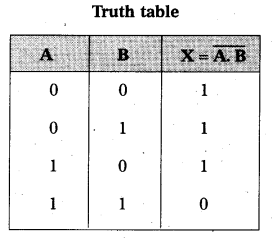
    AP Inter 2nd Year Physics Important Questions Chapter 15 Semiconductor Electronics Material, Devices and Simple Circuits 15

NOR gate : NOR gate is a combination of OR gate and NOT gate when the output of OR gate is connected to NOT gate. It has two (or) more inputs and one output.
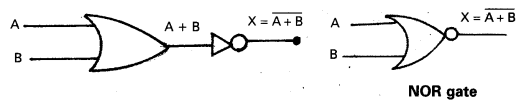
AP Inter 2nd Year Physics Important Questions Chapter 15 Semiconductor Electronics Material, Devices and Simple Circuits 16

  1. If both inputs are low, output is high.
    A = 0, B = 0, X = 1
  2. If any input is high, the output is low.
    A = 0, B = 1, X = 0
    A = 1, B = 0, X = 0
  3. If both inputs are high, the output is low.
    A = 1, B = 1, X = 0
    NOR gate is also a universal gate.
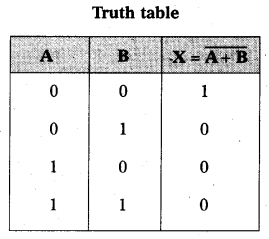
    AP Inter 2nd Year Physics Important Questions Chapter 15 Semiconductor Electronics Material, Devices and Simple Circuits 17

AP Inter 2nd Year Physics Important Questions Chapter 15 Semiconductor Electronics: Material, Devices and Simple Circuits

Question 6.
Explain the working of a solar cell and draw its I-V characteristics.
Answer:
Solar cell is a p-n junction device which converts solar energy into electric energy.
It consists of a silicon (or) gallium – arsenic p-n junction diode packed in a can with glass window on top. The upper layer is of p- type semiconductor. It is very thin so that the incident light photons may easily reach the p-n junction.
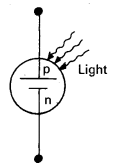
AP Inter 2nd Year Physics Important Questions Chapter 15 Semiconductor Electronics Material, Devices and Simple Circuits 18
Working : When light (E = hv) falls at the junction, electron – hole pairs are generated near the junction. The electrons and holes produced move in opposite directions due to junction field. They will be collected at the two sides of the junction giving rise to a photo voltage between top and bottom metal electrodes. Top metal acts as positive electrode and bottom metal acts as a negative electrode. When an external load is connected across metal electrodes a photo current flows.
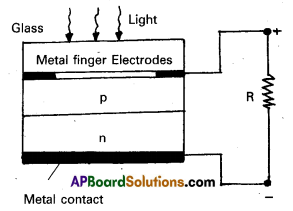
AP Inter 2nd Year Physics Important Questions Chapter 15 Semiconductor Electronics Material, Devices and Simple Circuits 19
I-V characteristics : I – V characteristics of solar cell is drawn in the fourth quadrant of the coordinate axes. Because it does not draw current.
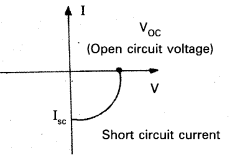
AP Inter 2nd Year Physics Important Questions Chapter 15 Semiconductor Electronics Material, Devices and Simple Circuits 20
Uses : They are used in calculators, wrist watches, artificial satellites etc.

Question 7.
Explain the operation of a NOT gate and give its truth table. [IPE 15, T.S.]
Answer:
NOT gate: NOT gate is the basic gate. It has one input and one output. The NOT gate is also called an inverter. The circuit symbol of NOT gate is shown in figure.
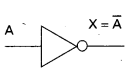
AP Inter 2nd Year Physics Important Questions Chapter 15 Semiconductor Electronics Material, Devices and Simple Circuits 21

  1. If input is low, output is high.
    A = 0, X = \(\overline{0}\) = 1
  2. If input is high, output is low.
    A = 1, X = \(\overline{1}\) = 0
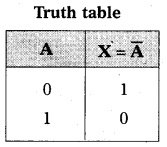
    AP Inter 2nd Year Physics Important Questions Chapter 15 Semiconductor Electronics Material, Devices and Simple Circuits 22

AP Inter 2nd Year Physics Important Questions Chapter 15 Semiconductor Electronics: Material, Devices and Simple Circuits

Question 8.
Draw an OR gate using two diodes and explain its operation. Write the truth table and logic symbol of OR gate.
Answer:
OR Gate : It has two input terminals and one output terminal. If both inputs are low the output is low. If one of the inputs is high, or both the inputs are high then the output of the gate is high. The truth tables of OR gate.
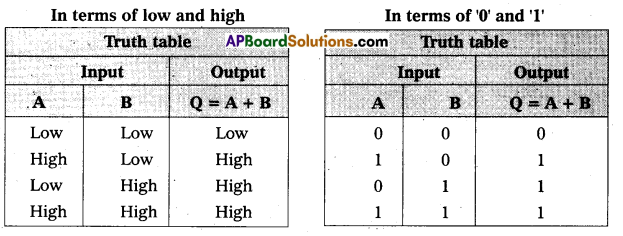
AP Inter 2nd Year Physics Important Questions Chapter 15 Semiconductor Electronics Material, Devices and Simple Circuits 23
In truth table logic function is written as A or B ‘OR’ logic function is represented by the symbol ‘plus’.
Q = A + B
Logic gate ‘OR’ is shown given below.

Implementation of OR gate using diodes :
Let D1 and D2 be two diodes.
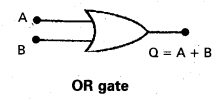
AP Inter 2nd Year Physics Important Questions Chapter 15 Semiconductor Electronics Material, Devices and Simple Circuits 24
A potential of 5V represents the logical value 1.
A potential of OV represents the logical value 0.
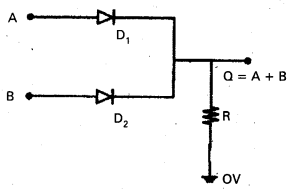
AP Inter 2nd Year Physics Important Questions Chapter 15 Semiconductor Electronics Material, Devices and Simple Circuits 25
When A = 0, B = 0 both the diodes are reverse biased and there is no current through the resistance. So, the potential at Q is zero i.e., Q = 0. When A = 0 or B = 0 and the other equal to a potential of 5 V the diode whose anode is at a potential of 5 V is forward – biased and that diode behaves like a closed switch. The output potential then becomes 5 V i.e., Q = 1. When both A and B are 1, both the diodes are forward-biased and the potential at Q is same as that at A and B which is 5 V i.e., Q = 1. The output is same as that of the OR gate.

Question 9.
Sketch a basic AND circuit with two diodes and explain its operation. Explain how doping increases the conductivity in semiconductors ?
Answer:
AND gate : It has two input terminals and one output terminal.

  • If both the inputs are low (or) one of the inputs is low.
    • The output is low in an AND gate.
  • If both the inputs .are high
    • The output of the gate is high.
  • Note : If A and B are the inputs of the gate and the output is ‘Q’ then ‘Q’ is a logical function of A and B.
    AND gate Truth Tables
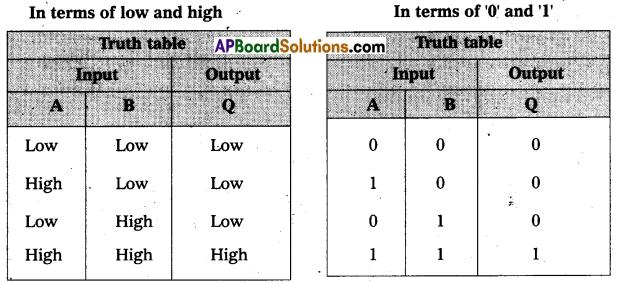
    AP Inter 2nd Year Physics Important Questions Chapter 15 Semiconductor Electronics Material, Devices and Simple Circuits 26
    The logical function AND is represented by the symbol dot so that the output, Q = A.B and the circuit symbol used for the logic gate AND is shown in Fig.
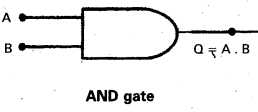
    AP Inter 2nd Year Physics Important Questions Chapter 15 Semiconductor Electronics Material, Devices and Simple Circuits 27
    The logical function AND is similar to the multiplication.

Implementation of AND gate using diodes : Let D1 and D2 represents two diodes. A potential of 5 V represents the logical value 1 and a potential of 0 V represents the logical value zero (0). When A = 0, B = ,0 both the diodes D1 and D2 are forward-biased and they behave like closed switches. Hence, the output Q is same as that A or B (equal to zero.) When A = 0 or B = 0, D1 or D2 is forward – biased and Q is zero. When A = 1 and B = T both the diodes are reverse – biased and they behave like open switches. There is no current through the resistance R making the potential at Q equal to 5V i.e., Q = 1. The output is same as that of an AND gate.

Doping increases the conductivity in Semiconductors: If a pentavalent impurity (Arsenic) is added to a pure tetravalent semiconductor it is called n-type semiconductor. Arsenic has 5 valence electrons, but only 4 electrons are needed to form covalent bonds with the adjacent Germanium atoms. The fifth electron is very loosely bound and become a free electron. Therefore excess electrons are available for conduction and conductivity of semiconductor increases.

Similarly when a trivalent impurity Indium is added to pure Germanium it is called p-type semi-conductor. In this excess holes in addition to those formed due to thermal energy are available for conduction in the valence band and the conductivity of semiconductor increases.

AP Inter 2nd Year Physics Important Questions Chapter 15 Semiconductor Electronics: Material, Devices and Simple Circuits

Question 10.
Explain how transistor can be used as a switch ?
Answer:
To understand the operation of transistor as a switch.

  1. As long as Vi is low and unable to forward bias the transistor, V0 is high (at Vcc).
  2. If Vi is high enough to drive the transistor into saturation then V0 is low, very near to zero.
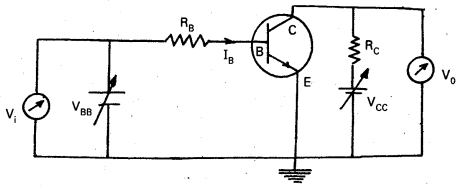
    AP Inter 2nd Year Physics Important Questions Chapter 15 Semiconductor Electronics Material, Devices and Simple Circuits 28
  3. When the transistor is not conducting it is said to be switched off and when it is driven into saturation it is said to be switched on.
  4. We can say that a low input to the transistor gives a high output and high input gives a low output.
  5. When the transistor is used in the cutoff (or) saturation state it acts as a switch.
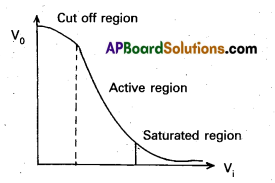
    AP Inter 2nd Year Physics Important Questions Chapter 15 Semiconductor Electronics Material, Devices and Simple Circuits 29

Problems

Question 1.
In a half wave rectifier, a p-n junction diode with internal resistance 20 ohm is used. If the load resistance of 2 ohm is used in the circuit, then find the efficiency of this half wave rectifier.
Solution:
Internal resistance (rf) = 20Ω
RL = 2kΩ = 2000 Ω
η = \(\frac{0.406 \mathrm{R}_{\mathrm{L}}}{\mathrm{r}_{\mathrm{f}}+\mathrm{R}_{\mathrm{L}}}=\frac{0.406 \times 2000}{20+2000} \times 100=\frac{812 \times 100}{2020}\)
η = 40.2%.

Question 2.
A full wave p-n junction diode rectifier uses a load resistance of 1300 ohm. The internal resistance of each diode is 9 ohm. Find the efficiency of this full wave rectifier.
Solution:
Given that RL = 1300 Ω
rf = 9Ω
η = \(\frac{0.812 \mathrm{R}_{\mathrm{L}}}{\mathrm{r}_{\mathrm{f}}+\mathrm{R}_{\mathrm{L}}}=\frac{0.812 \times 1300}{9+1300} \times 100 ; \eta=\frac{8120 \times 13}{1309}\)
η = 80.64%.

AP Inter 2nd Year Physics Important Questions Chapter 15 Semiconductor Electronics: Material, Devices and Simple Circuits

Question 3.
Calculate the current amplification factor β(beta) when change in collector current is 1mA and change in base current is 20μA.
Solution:
Change in collector current (∆IC) = 1mA = 10-3 A
Change in base current (∆IB) = 20 μA = 20 × 10-6 A
β = \(\frac{\Delta \mathrm{I}_{\mathrm{C}}}{\Delta \mathrm{I}_{\mathrm{B}}}=\frac{10^{-3}}{20 \times 10^{-6}}\); β = \(\frac{1000}{20}\)
β = 50

Question 4.
For a transistor amplifier, the collector load resistance RL = 2k ohm and the input resistance Ri = 1 k ohm. If the current gain is 50, calculate voltage gain of the amplifier.
Solution:
RL = 2kΩ = 2 × 10³
Ri = 1kΩ = 1 × 10³
β = 50.
Voltage gain (AV) = β × \(\frac{\mathrm{R}_{\mathrm{L}}}{\mathrm{R}_{\mathrm{i}}}=\frac{50 \times 2 \times 10^3}{1 \times 10^3}\)

AV = 100.

Textual Examples

Question 1.
C, Si and Ge have same lattice structure. Why is C insulator while Si and Ge intrinsic semiconductors ?
Solution:
The 4 bonding electrons of C, Si or Ge lie, respectively, in the second, third and fourth orbit. Hence, energy required to take out and electron from these atoms(i.e., ionisation energy Eg) will be least for Ge, following by Si and highest for C. Hence, number of free electrons for conduction in Ge and Si are significant but negligibly small for C.

Question 2.
Suppose a pure Si crystal has 5 × 1028 atoms m-3. It is doped by 1 ppm concentration of pentavalent As. Calculate the number of electrons and holes. Given that n. = 1.5 × 10¹⁶ m-3.
Solution:
Note that thermally generated electrons (ni ~ 1016 m-3) are negligibly small as compared to those produced by doping.
Therefore, ni ≈ ND.
Since nenh = ni2, The number of holes, nh = (1.5 × 10¹⁶)2 / 5 × 1028 × 16-6
nh = (2.25 × 1032)/(5 × 1022) ~ 4.5 × 10⁹m-3

AP Inter 2nd Year Physics Important Questions Chapter 15 Semiconductor Electronics: Material, Devices and Simple Circuits

Question 3.
Can we take one slab of p-type semiconductor and physically join it to another n-type semiconductor to get p-n junction ?
Solution:
No ! Any slab, howsoever flat, will have roughness much large than the inter-atomic crystal spacing(~2 to 3 A°) and hence continuous contact at the atomic level will not be possible. The junction will behave as a discontinuity for the flowing charge carriers.

Question 4.
The V-I characteristics of a silicon diode are shown in the Fig. Calculate the resistance of the diode at (a) ID = 15 mA and (b) VD = -10 V.
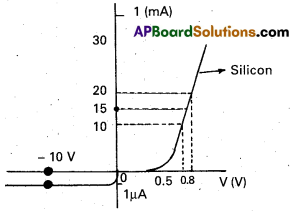
AP Inter 2nd Year Physics Important Questions Chapter 15 Semiconductor Electronics Material, Devices and Simple Circuits 30
Solution:
Considering the diode characteristics as a straight line between I = 10 mA to I = 20 mA passing through the origin, we can calculate the resistance using Ohm’s law.
a) From the curve, at I = 20 mA, V = 0.8 V, I = 10 mA, V = 0.7 V
rfb = ∆V/∆I = 0.1V/10mA = 10Ω
b) From the curve at V = -10 V, I = -1 µA.
Therefore rrb = 10V/1µA = 1.0 × 10⁷

Question 5.
In a Zener regulated power supply a Zener diode’with Vz = 6.0 V is used for regulation. The load current is to be 4.0 mA and the unregulated input is 10,0 V. What should be the value of series resistor Rs?
Solution:
The value of Rs should be such that the current through the Zener diode is much larger than the load current. This is to have good load regulation. Choose Zener current as five times the load current, i.e., Iz = 20 mA. The total current through RS is , therefore, 24 mA. The voltage drop across RS is 10.0 – 6.0 = 4.0 V This gives RS = 4.0V/(24 × 10-3) A = 167Ω. The nearest value of carbon resistor is 150 Ω. So, a series resistor of 150 Ω is appropriate. Note that slight variation in the value of the resistor does not matter, what is important is that the current IZ should be sufficiently larger than IL.

AP Inter 2nd Year Physics Important Questions Chapter 15 Semiconductor Electronics: Material, Devices and Simple Circuits

Question 6.
The current in the forward bias is known to be more (~mA) than the current in the reverse bias (~µA). What is the reason then to operate the photodiodes in reverse bias ?
Solution:
Consider the case of an n-type semiconductor. Obviously, the majority carrier density (n) is considerably larger than the minority hole density p (i.e., n> > p). On illumination, let the excess eletrons and holes generated be ∆n and ∆p, respectively,
n’ = n + ∆n
p’ = p + ∆p
Here n’ and p’ are the electron and hole concentrations at any particular illumination and n and p are carriers concentration when there is no illumination. Remember ∆n = ∆p and n > > p. Hence, the fractional change in the majority carriers (i.e., ∆n/n) would be much less than that in the minority carriers (i.e,, ∆p/p). In general, we can state that the fractional change due to the photo-effects on the minority carrier dominated reverse bias current is more easily measurable than the fractional change in the forward bias current. Hence, photodiodes-are preferably used in the reverse bias condition for measuring light intensity.

Question 7.
Why are Si and GaAs are preferred materials for solar cells ?
Solution:
The solar radiation spectrum received by us is shown in figure.
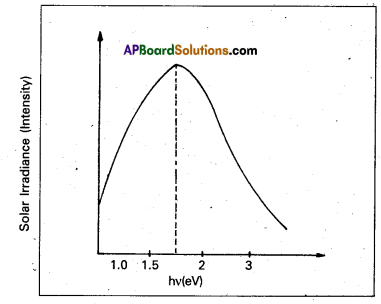
AP Inter 2nd Year Physics Important Questions Chapter 15 Semiconductor Electronics Material, Devices and Simple Circuits 31
The maxima is near 1.5 eV. For photo-excitation, hv > Eg. Hence, semiconductor with band gap ~1.5 eV or lower is likely to give better solar conversion efficiency. Silicon has Eg ~ 1.1 eV while for GaAS it is ~ 1.53 eV. In fact, GaAs is better On spite of its higher band gap) than Si because of its relatively higher absorption coefficient. If we choose materials like CdS or CdSe(Eg ~ 2.4 eV), we can use only the high energy component of the solar energy for photo-conversion and a significant part of energy will be of no use.

The question arises: why we do not use material like pbS(Eg ~ 0.4 eV) which satisfy the condition hv > Eg for v maxima corresponding to the solar radiation spectra ? if we do so, most of the solar radiation will be absorbed on the top-layer of solar cell mid will not reach in or near the depletion region. For effective electron-hole separation, due to the junction field, we want the photo-generation to occur in the junction region only.

Question 8.
From the output charactristics shown in fig, calculate the values of βac and βdc of the transistor when VCE is 10 V and IC = 4.0 mA.
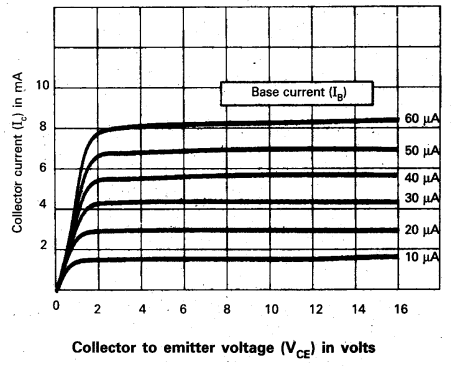
AP Inter 2nd Year Physics Important Questions Chapter 15 Semiconductor Electronics Material, Devices and Simple Circuits 32
Solution:
βac = \(\left(\frac{\Delta \mathrm{I}_{\mathrm{C}}}{\Delta \mathrm{I}_{\mathrm{B}}}\right)_{\mathrm{V}_{\mathrm{CE}}}\) ; βdc = \(\frac{\mathrm{I}_{\mathrm{C}}}{\mathrm{I}_{\mathrm{B}}}\)
For determining βac and βdc at the stated values of VCE and IC one can proceed as follows. Consider any two characteristics for two values of IB which lie above and below the given value of IC. Here IC = 4.0 mA. (Choose characteristics for IB = 30 and 20μA.) At V CE = 10V
we read the two values of Ic from the graph. Then
∆IB = (30 – 20)μA = 10μA. ∆IC
= (4.5 – 3.0) mA = 1.5 mA
Therefore, βac =1.5 mA/ 10μA = 150
For determining βdc either estimate the value of IB corresponding to IC = 4.0 mA at VCE = 10V or calculate the two values of βdc for the two characteristics chosen and find their mean.
Therefore, for IC = 4.5 mA and IB = 30 μA
βdc = 4.5 mA/30 μA = 150 and for IC = 3.0 mA/ and IB = 20 μA
βdc = 3.0 mA / 20 μA= 150
Hence, βdc = (150 + 150)/ 2 = 150

AP Inter 2nd Year Physics Important Questions Chapter 15 Semiconductor Electronics: Material, Devices and Simple Circuits

Question 9.
In Fig. the VBB supply can be varied from OV to 5.0 V. The Si transistor has βdc = 250 and RB = 100 kΩ, RC = 1 KΩ, VCC = 5.0V. Assume that when the transistor is saturated, VCE = 0V and VBE = 0.8V. Calculate
(a) the minimum base current, for which the transistor will reach saturation. Hence,
(b) determine V1 for when the transistor is ‘switched on’,
(c) find the ranges of V1 for which the transistor is ‘switched of and ‘switched on’.
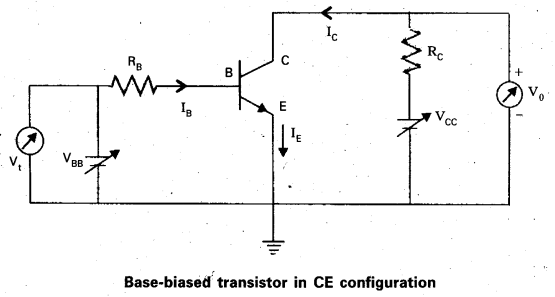
AP Inter 2nd Year Physics Important Questions Chapter 15 Semiconductor Electronics Material, Devices and Simple Circuits 33
Solution:
Given at stauration
VCE = OV, VBE = 0.8V
VCE = VCC – ICRC
IC = VCC / RC = 5.0V/1/0 kΩ = 5.0mA
Therefore, IB = IC
= 5.0 mA/250 = 20μA
The input voltage at which the transistor will go into saturation is given by
VIH = VBB = IBRB + VBE
= 20μA × 100 kΩ + 0.8V = 2.8V
The value of input voltage below which the transistor remains cutoff is given by
VIL = 0.6V, VIH = 2.8V
Between 0.0V and 0.6V the transistor will be in the ‘switched off-state. Between 2.8V and 5.0V, it will be in ‘switched on’ state.
Note that the transistor is in active state when IB varies from 0.0mA to 20mA. In this range, IC = βIB is valid. In the saturation range IC ≤ βIB.

Question 10.
For a CE transistor amplifier, the audio signal voltage across the collector resistance of 2.0 kΩ is 2.0 V. Suppose the current amplification factor of the transistor is 100, what should be the value of RB in series with VBB supply of 2.0 V if the dc base current has to be 10 times the signal current. Also calculate the dc drop across the collector resistance. (Refer to Fig)
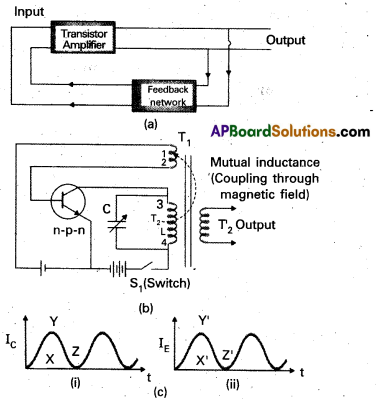
AP Inter 2nd Year Physics Important Questions Chapter 15 Semiconductor Electronics Material, Devices and Simple Circuits 34
Solution:
The output ac voltage is 2.0 V. So, the ac collector current iC= 2.0/2000 = 1.0 mA. The signal current through the base is, therefore given by iB = iC/β = 1.0 mA/100 = 0.010 mA. The dc base current has to be 10 × 0.010 = 0.10 mA
From VBB = VBE+ IB RB RB = (VBB – VBE)/IB. Assuming VBE = 0.6V
RB = (2.0 – 0.6)/0.10 = 14kΩ
The dc collector current IC = 100 × 0.10 = 10 mA.

Question 11.
Justify the output waveform (Y) of the OR gate for the following inputs A and B given in fig.
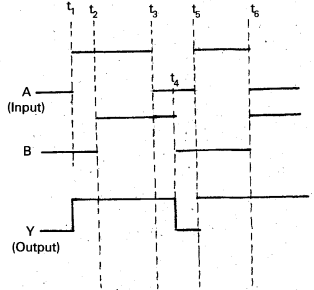
AP Inter 2nd Year Physics Important Questions Chapter 15 Semiconductor Electronics Material, Devices and Simple Circuits 35
Solution:
Note the following :

  • At t ≤ t1; A = 0, B = 0; Hence Y = 0
  • For t1 to t2; A = 1, B = 0; Hence Y = 1
  • For t2 to t3; A = 1, B = 1; Hence Y = 1
  • For t3 to t4; A = 0, B = 1; Hence Y = 1
  • For t4 to t5; A = 0, B = 0; Hence Y = 0
  • For t5 to t6; A = 1, B = 0; Hence Y = 1
  • For t > t6; A = 0,B = 1; Hence Y = 1

Therefore the waveform Y will be as shown in the Fig.
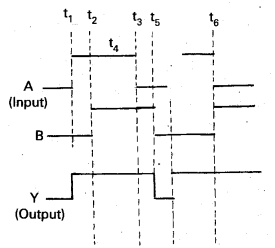
AP Inter 2nd Year Physics Important Questions Chapter 15 Semiconductor Electronics Material, Devices and Simple Circuits 36

AP Inter 2nd Year Physics Important Questions Chapter 15 Semiconductor Electronics: Material, Devices and Simple Circuits

Question 12.
Take A and B input waveforms similar to that in Example 11. Sketch the output waveform obtained from AND gate.
Solution:

  • For t ≤ t1; A = 0, B = 0; Hence Y = 0
  • For t1 to t2; A = 1, B = 0; Hence Y = 0
  • For t2 to t3; A = 1, B = 1; Hence Y = 1
  • For t3 to t4; A = 0, B = 1; Hence Y = 0
  • For t4 to t5; A = 0, B = 0; Hence Y = 0
  • For t5 to t6; A = 1, B = 0; Hence Y = 0
  • For t > t6; A = 0,B = 1; Hence Y = 0

Based on the above, the output waveform for AND gate can be drawn as given below.
AP Inter 2nd Year Physics Important Questions Chapter 15 Semiconductor Electronics Material, Devices and Simple Circuits 37

Question 13.
Sketch the output Y from a NAND gate having inputs A and B given below :
Solution:

  • For t ≤ t1; A = 1, B = 1; Hence Y = 0
  • For t1 to t2; A = 0, B = 0; Hence Y = 1
  • For t2 to t3; A = 0, B = 1; Hence Y = 1
  • For t3 to t4; A = 1, B = 0; Hence Y = 1
  • For t4 to t5; A = 1, B = 1; Hence Y = 0
  • For t5 to t6; A = 0, B = 0; Hence Y = 1
  • For t > t6; A = 0,B = 1; Hence Y = 1
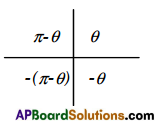
    AP Inter 2nd Year Physics Important Questions Chapter 15 Semiconductor Electronics Material, Devices and Simple Circuits 38

AP Inter 2nd Year Physics Important Questions Chapter 5 Electrostatic Potential and Capacitance

Students get through AP Inter 2nd Year Physics Important Questions 5th Lesson Electrostatic Potential and Capacitance which are most likely to be asked in the exam.

AP Inter 2nd Year Physics Important Questions 5th Lesson Electrostatic Potential and Capacitance

Short Answer Questions

Question 1.
Derive an expression for the electric potential due to a point charge. [T.S. Mar. 16]
Answer:
Expression for the electric potential due to a point charge:

  1. Electric potential at a point is defined as the amount of workdone in moving a unit + ve charge from infinity to that point.
    AP Inter 2nd Year Physics Important Questions Chapter 5 Electrostatic Potential and Capacitance 1
  2. Consider a point P at a distance r from the point charge having charge + q. The electric field at P = E = \(\frac{q}{4 \pi \varepsilon_0 x^2}\)
  3. Workdone in taking a unit +ve charge from B to A = dV = -E.dx (-ve sign shows that the workdone is +ve in the direction B to A, whereas the potential difference is +ve in the direction A to B.
  4. Therefore, potential at P = The amount of workdone in taking a unit +ve charge from infinity to P
    AP Inter 2nd Year Physics Important Questions Chapter 5 Electrostatic Potential and Capacitance 2

Question 2.
Derive an expression for the electrostatic potential energy of a system of two point charges and find its relation with electric potential of a charge.
Answer:
Expression for the electrostatic potential energy of a system of two point charges :

  1. Let two point charges q1 and q2 are separated by distance ‘r’ in space.
  2. An electric field will develop around the charge q1.
  3. To bring a charge q2 from infinity to the point B some work must be done.
    AP Inter 2nd Year Physics Important Questions Chapter 5 Electrostatic Potential and Capacitance 3
    Workdone = q2 vB
    But vB = \(\frac{1}{4 \pi \varepsilon_0} \frac{q_1}{r}\)
    W = \(\frac{1}{4 \pi \varepsilon_0} \frac{\mathrm{q}_1 \mathrm{q}_2}{\mathrm{r}}\)
  4. This amount of workdone is stored as electrostatic potential energy (U) of a system of two charged particles. Its unit is joule.
    ∴ U = \(\frac{1}{4 \pi \varepsilon_0} \frac{\mathrm{q}_1 \mathrm{q}_2}{\mathrm{r}}\)
  5. If the two charges are similar then ‘U’ is positive. This is in accordance with the fact that two similar charges repel one another and positive work has to be done on the system to bring the charges nearer.
  6. Conversely if the two charges are of opposite sign, they attract one another and potential energy is negative.

AP Inter 2nd Year Physics Important Questions Chapter 5 Electrostatic Potential and Capacitance

Question 3.
Derive an expression for the potential energy of an electric dipole placed in a uniform electric field.
Answer:
Expression for potential energy of an electric dipole placed in a uniform electric field :

  1. Consider a electric dipole of length 2a having charges + q and -q.
  2. The electric dipole is placed in uniform electric field E and it’s axis makes an angle θ with E.
  3. Force on charges are equal but opposite sign. They constitute torque on the dipole.
    AP Inter 2nd Year Physics Important Questions Chapter 5 Electrostatic Potential and Capacitance 4
    Torque τ = one of its force (F) × ⊥r distance (BC)
    F = qE and sinθ = \(\frac{\mathrm{BC}}{2 \mathrm{a}} \) ⇒ BC = 2a sinθ
    ∴ Torque τ = qE × 2a sinθ = PE sin θ [∴ p = 2aq]
  4. Suppose the dipole is rotated through an angle dθ, the workdone dw is given by
    dw = τdθ = PE sinθ dθ
  5. For rotating the dipole from angle θ1 to θ2
    workdone W = \(\int_{\theta_1}^{\theta_2}\) PE sinθdθ = PE(cosθ1 – cosθ2)
  6. This workdone (W) is then stored as potential energy(U) in the dipole.
    ∴ U = PE(cosθ1 – cosθ2)
  7. If θ1 = 90° and θ2 = 0°, U = – PE cos1.
    In vector form U = –\(\overrightarrow{\mathrm{P}} \cdot \overrightarrow{\mathrm{E}}\)

Question 4.
Derive an expression for the capacitance of a parallel plate capacitor. [A.P. Mar. 16; T.S. Mar. 14]
Answer:
Expression for the capacitance of a parallel plate capacitor:

  1. P and Q are two parallel plates of a capacitor separated by a distance of d.
  2. The area of each plate is A. The plate P is charged and Q is earth connected.
  3. The charge on P is + q and surface charge density of charge = σ
    ∴ q = Aσ
    AP Inter 2nd Year Physics Important Questions Chapter 5 Electrostatic Potential and Capacitance 5
  4. The electric intensity at point x , E = \(\frac{|\sigma|}{\varepsilon_0}\)
  5. Potential difference between the plates P and Q,
    \(\int {\mathrm{dV}}=\int_{\mathrm{d}}^0-\mathrm{Edx}=\int_{\mathrm{d}}^0 \frac{-\sigma}{\varepsilon_0} \mathrm{dx}=\frac{\sigma \mathrm{d}}{\varepsilon_0}\)
  6. Capacitance of the capacitor C = \(\frac{\mathrm{Q}}{\mathrm{V}}=\frac{\mathrm{A} \sigma}{\frac{\sigma \mathrm{d}}{\varepsilon_0}}=\frac{\varepsilon_0 \mathrm{~A}}{\mathrm{~d}}\) Farads (In air)
    Note : Capacity of a capacitor with dielectric medium is C = \(\frac{\varepsilon_0 \mathrm{~A}}{\left[\mathrm{~d}-\mathrm{t}+\frac{\mathrm{t}}{\mathrm{k}}\right]}\) Farads.

AP Inter 2nd Year Physics Important Questions Chapter 5 Electrostatic Potential and Capacitance

Question 5.
Explain the behaviour of dielectrics in an external field.
Answer:

  1. When an external field is applied across dielectrics, the centre of positive charge distribution shifts in the direction of electric field and that of the negative charge distribution shifts
    AP Inter 2nd Year Physics Important Questions Chapter 5 Electrostatic Potential and Capacitance 6
    opposite to the electric field and induce a net electric field within the medium opposite to the external field. In such situation the molecules are said to be polarised.
  2. Now consider a capacitor with a dielectric between the plates. The net field in the dielectric becomes less.
  3. If E0 is the external field strength and Ei is the electric field strength induced, then the net field, \(\overrightarrow{\mathrm{E}}_{\text {net }}=\overrightarrow{\mathrm{E}}_0+\overrightarrow{\mathrm{E}}_{\mathrm{i}}\)
    (Enet) = E0 – Ei = \(\frac{E}{K}\) where K is the dielectric constant of the medium.

Question 6.
Define electric potential. Derive an expression for the electric potential due to an electric dipole and hence the electric potential at a point (a) the axial line of electric dipole (b) on the equatorial line of electric dipole.
Answer:
Electric potential (V) : The workdone by a unit positive charge from infinite to a point in an electric field is called electric potential.
AP Inter 2nd Year Physics Important Questions Chapter 5 Electrostatic Potential and Capacitance 7
Expression for the potential at a point due to a dipole:

  1. Consider A and B having -q and + q charges separated by a distance 2a.
  2. The electric dipole moment P = q × 2a along AB
  3. The electric potential at the point’P’is to be calculated.
  4. P is at a distance ‘r’ from the point ‘O’. θ is the angle between the line OP and AB.
  5. BN and AM are perpendicular to OP.
  6. Potential at ‘P’ due to charge +q at B,
    V1 = \(\frac{1}{4 \pi \varepsilon_0}\left[\frac{\mathrm{q}}{\mathrm{BP}}\right]\)
    ∴ V1 = \(\frac{1}{4 \pi \varepsilon_0}\left[\frac{\mathrm{q}}{\mathrm{NP}}\right]\) [∵ BP = NP]
  7. Potential at P due to charge -q at A, V2 = \(\frac{1}{4 \pi \varepsilon_0}\left[\frac{\mathrm{-q}}{\mathrm{AP}}\right]\)
    ∴ V2 = \(\frac{1}{4 \pi \varepsilon_0}\left[\frac{\mathrm{q}}{\mathrm{MP}}\right]\) [∵ AP = MP]
  8. Therefore, Resultant potential at P is V = V1 + V2
    V = \(\frac{1}{4 \pi \varepsilon_0}\left[\frac{\mathrm{q}}{\mathrm{NP}}-\frac{\mathrm{q}}{\mathrm{MP}}\right]\) ………… (1)
  9. In △le ONB, ON = OB cos0 = a cosθ; ∴NP = OP – ON = r – a cosθ ………………… (2)
  10. In △le AMO, OM = AO cos0 = a cosθ; ∴ MP = MO + OP = r + a cosθ ………………. (3)
  11. Substituting (2) and (3) in (1), we get
    AP Inter 2nd Year Physics Important Questions Chapter 5 Electrostatic Potential and Capacitance 8
  12. As r > >a, a2 cos2θ can be neglected with comparision of r2.
    ∴ V = \(\frac{\mathrm{P} \cos \theta}{4 \pi \varepsilon_0 \mathrm{r}^2}\)
  13. (a) Electric potential on the axial line of dipole:
    AP Inter 2nd Year Physics Important Questions Chapter 5 Electrostatic Potential and Capacitance 9

    • When θ = 0°, point p lies on the side of + q. ____
      ∴ V = \(\frac{\mathrm{P}}{4 \pi \varepsilon_0 \mathrm{r}^2}\) [∵ cos 0° = 1]
    • When θ = 180°, point p lies on the side of — q.
      ∴ V = \(\frac{\mathrm{-P}}{4 \pi \varepsilon_0 \mathrm{r}^2}\) [∵ cos 180° = -1]

AP Inter 2nd Year Physics Important Questions Chapter 5 Electrostatic Potential and Capacitance

Qeustion 7.
What is series combination of capacitors. Derive the formula for equivalent capacitance in series combination. [A.P.& T.S. Mar.15]
Answer:
Series combination : If a number of condensers are connected end to end between the fixed points then such combination is called series.
In this combination

  1. Charge on each capacitor is equal.
  2. P.D’s across the capacitors is not equal.

Consider three capacitors of capacitances C1, C2 and C3 are connected in series across a battery of P.D V as shown in figure.
AP Inter 2nd Year Physics Important Questions Chapter 5 Electrostatic Potential and Capacitance 10
Let ‘Q’ be the charge on each capacitor.
Let V1, V2 and V3 be the P.D’s of three
V = V1 + V2 + V3 ……………… (1)
RD across Ist condenser V1 = \(\frac{\mathrm{Q}}{\mathrm{C}_1}\)
RD across IIInd condenser V2 = \(\frac{\mathrm{Q}}{\mathrm{C}_2}\)
RD across IIIIrd condenser V3 = \(\frac{\mathrm{Q}}{\mathrm{C}_3}\)
∴ From the equation (1),V = V1 + V2 + V3
= \(\frac{\mathrm{Q}}{\mathrm{C}_1}+\frac{\mathrm{Q}}{\mathrm{C}_2}+\frac{\mathrm{Q}}{\mathrm{C}_3}=\mathrm{Q}\left[\frac{1}{\mathrm{C}_1}+\frac{1}{\mathrm{C}_2}+\frac{1}{\mathrm{C}_3}\right]\)
\(\frac{\mathrm{V}}{\mathrm{Q}}=\frac{1}{\mathrm{C}_1}+\frac{1}{\mathrm{C}_2}+\frac{1}{\mathrm{C}_3}\)
\(\frac{1}{\mathrm{C}}=\frac{1}{\mathrm{C}_1}+\frac{1}{\mathrm{C}_2}+\frac{1}{\mathrm{C}_3}\) [∵ \(\frac{1}{C}=\frac{V}{Q}\)
For ‘n’ number of capacitors, the effective capacitance
\(\frac{1}{\mathrm{C}}=\frac{1}{\mathrm{C}_1}+\frac{1}{\mathrm{C}_2}+\frac{1}{\mathrm{C}_3}+\ldots+\frac{1}{\mathrm{C}_{\mathrm{n}}}\)

AP Inter 2nd Year Physics Important Questions Chapter 5 Electrostatic Potential and Capacitance

Question 8.
What is parallel combination of capacitors. Derive the formula for equivalent capacitance in parallel combination. [T.S. Mar. 17; A.P.& T.S. Mar. 15]
Answer:
Parallel Combination: The first plates of different capacitors are connected at one terminal and all the second plates of the capacitors are connected at another terminal then the two terminals are connected to the two terminals of battery is called parallel combination.
AP Inter 2nd Year Physics Important Questions Chapter 5 Electrostatic Potential and Capacitance 11
In this combination,
1. The P.D’s between each capacitor is equal (or) same.
2. Charge on each capacitor is not equal.
Consider three capacitors of capacitance C1, C2 and C3 are connected in parallel across a P.D V as shown in fig.
The charge on Ist capacitor Q1 = C1 V
The charge on IInd capacitor Q2 = C2 V
The charge on IIIrd capacitor Q3 = C3 V
∴ The total charge Q = Q1 + Q2 + Q3
= C1 V + C2 V + C3 V
Q = V(C1 + C2 + C3) ⇒ \(\frac{\mathrm{Q}}{\mathrm{V}}\) = C1 + C2 + C3
C = C1 + C2 + C3 [∵ C = \(\frac{\mathrm{Q}}{\mathrm{V}}\)]
for ‘n’ number of capacitors connected in parallel, the equivalent capacitance can be written as
C = C1 + C2 + C3 + ……………. + Cn

Question 9.
Derive an expression for the energy stored in a capacitor.
Answer:
Expression for the energy stored in a capacitor : Consider an uncharged capacitor of capacitance ‘c’ and its initial will be zero. Now it is connected across a battery for charging then the final potential difference across the capacitor be V and final charge on the capacitor be ‘Q’
∴ Average potential difference VA = \(\frac{\mathrm{O}+\mathrm{V}}{2}=\frac{\mathrm{V}}{2}\)
Hence workdone to move the charge Q = W = VA × Q = \(\frac{\mathrm{VQ}}{2}\)
This is stored as electrostatic potential energy ‘U’
∴ U = \(\frac{\mathrm{QV}}{2}\)
We know Q = CV then ‘U’ can be written as given below.
U = \(\frac{\mathrm{QV}}{2}=\frac{1}{2}\) CV2 = \(\frac{Q^2}{2 C}\)
∴ Energy stored in a capacitor
U = \(\frac{\mathrm{QV}}{2}=\frac{1}{2}\) CV2 = \(\frac{1}{2} \frac{\mathrm{Q}^2}{\mathrm{C}}\)

AP Inter 2nd Year Physics Important Questions Chapter 5 Electrostatic Potential and Capacitance

Qeustion 10.
What is the energy stored when the space between the plates is filled with dielectric.
a) With charging battery disconnected ?
b) With charging battery connected in the circuit ?
Answer:
Effect of Dielectric on energy stored :
Case (a) : When the charging battery is disconnected from the circuit:
Let the capacitor is charged by a battery and disconnected from the circuit. Now the space between the plates is filled with a dielectric of dielectric constant ‘K’ then potential decreases by \(\frac{1}{\mathrm{~K}}\) times and charge remains constant.
Capacity increases by’K’ times.
New capacity C’ = \(\frac{Q}{V}\) = \(\frac{\frac{Q}{V}}{K}\) = K\(\frac{Q}{V}\) = KC [V’ = \(\frac{V}{K}\); C = \(\frac{Q}{V}\)]
∴ C’ = KC
Energy stored U’ = \(\frac{1}{2}\) QV = \(\frac{1}{2}\) Q \(\frac{V}{K}\) = \(\frac{U}{K}\)
U’ = \(\frac{U}{K}\)
∴ Energy stored decreases by \(\frac{1}{\mathrm{~K}}\) times.

Case (b) : When the charging battery is connected in the circuit:
Let the charging battery is continue the supply of charge. When the dielectric is introduced then potential decreases by \(\frac{1}{\mathrm{~K}}\) times and charge on the plates increases until the potential difference attains the original value = V
New charge on the plates Q’= KQ
Hence new capacity C’ = \(\frac{Q^{\prime}}{V}=\frac{K Q}{V}\) = KC
Energy stored in the capacitor U’ = \(\frac{1}{2}\) QV; = \(\frac{1}{2}\) (KQ) V = KU
U = KU
∴ Energy stored in the capacitor increases by ‘K times.

Problems

Question 1.
(a) Calculate the potential at a point P due to a charge of 4 × 10⁻⁷ C located 9 cm away,
(b) Hence obtain the work done in bringing a charge of 2 × 10⁻⁹ C from infinity to the point P. Does the answer depend on the path along which the charge is brought ?
Solution:
(a) V = \(\frac{1}{4 \pi \varepsilon_0} \frac{\mathrm{Q}}{\mathrm{r}}\)
= 9 × 10⁹ Nm2 C-2 \(\frac{4 \times 10^{-7} \mathrm{C}}{0.09 \mathrm{~m}}\)
= 4 × 10⁴ V

(b) W = qV = 2 × 10-9 C × 4 × 104V
= 8 × 10⁻⁵ J
No, work done will be path independent. Any arbitrary infinitesimal path can be resolved into two perpendicular displacements. One along r and another perpendicular to r. The work done corresponding to the later will be zero.

AP Inter 2nd Year Physics Important Questions Chapter 5 Electrostatic Potential and Capacitance

Qeustion 2.
Two charges 3 × 10⁻⁸ C and -2 × 10⁻⁸ C are located 15 cm apart. At what point on the line joining the two charges is the electric potential zero ? Thke the potential at infinity to be zero.
Solution:
Let us take the origin O at the location of the positive charge. The line joining the two charges is taken to be x-axis; the negative charge is taken to be on the right side of the origin fig.
AP Inter 2nd Year Physics Important Questions Chapter 5 Electrostatic Potential and Capacitance 12
Let P be the required point on the x-axis where the potential is zero. If x is the x – coordinate of P, obviously x must be positive. (There is no possibility of potentials due to the two charges adding up to zero for x < 0.) If x lies between O and A, we have
\(\frac{1}{4 \pi \varepsilon_0}\left[\frac{3 \times 10^{-8}}{x \times 10^{-2}}-\frac{2 \times 10^{-8}}{(15-x) \times 10^{-2}}\right]\) = 0
where x is in cm. That is \(\frac{3}{x}-\frac{2}{15-x}\) = 0
which gives x = 9 cm
If x lies on the extended line OA, the required condition is \(\frac{3}{x}-\frac{2}{x-15}\) = 0
Which gives x = 45 cm
Thus, electric potential is zero at 9 cm and 45 cm away from the positive charge on the side of the negative charge. Note that the formula for potential used in the calculation required choosing potential to be zero at infinity.

Question 3.
A slab of material of dielectric constant K has the same area as the plates of a parallel plate capacitor but has a thickness (3/4)d, where d is the separation of the plates. How is the capacitance changed when die slab is inserted between the plates ?
Solution:
Let E0 = Vg/d be the electric field between the plates when there is no dielectric and the potential difference is V0. If the dielectric is now inserted, the electric field in the dielectric will be E = E0/K. The potential difference will then be
V = \(E_0\left(\frac{1}{4} d\right)+\frac{E_0}{K}\left(\frac{3}{4} d\right)\)
= \(\mathrm{E}_0 \mathrm{~d}\left(\frac{1}{4}+\frac{3}{4 \mathrm{~K}}\right)=\mathrm{V}_0 \frac{\mathrm{K}+3}{4 \mathrm{~K}}\)
The potential difference decreases by the factor (K + 3)/K while the free charge Q0 on the plates remains unchanged. The capacitance thus increases,
C = \(\frac{\mathrm{Q}_0}{\mathrm{~V}}=\frac{4 \mathrm{~K}}{\mathrm{~K}+3} \frac{\mathrm{Q}_0}{\mathrm{~V}_0}=\frac{4 \mathrm{~K}}{\mathrm{~K}+3} \mathrm{C}_0\)

AP Inter 2nd Year Physics Important Questions Chapter 5 Electrostatic Potential and Capacitance

Question 4.
Four charges are arranged at the corners of a square ABCD of side d. as shown in fig. Find the work required to put together this arrangement, (b) A charge q0 is brought to the centre of the square, the four charges being held fixed at its comers. How much extra work is needed to do this ?
AP Inter 2nd Year Physics Important Questions Chapter 5 Electrostatic Potential and Capacitance 13
Solution:
(a) Since the work done depends on the final arrangement of the charges, and not on how they are put together, we calculate work needed for one way of putting the charges at A, B, C and D. Suppose, first the charge +q is brought to A and then the charges -q, +q, and -q are brought to B, C and D, respectively. The total work needed can be calculated in steps.

  1. Work needed to bring charge +q to A when no charge is present elsewhere: this is zero.
  2. Work needed to bring -q to B when + q is at A. This is given by (charge at B) × (electrostatic potential at B due to change +q at A) = -q × \(\left(\frac{q}{4 \pi \varepsilon_0 d}\right)\)
  3. Work needed to bring charge +q to C when +q is at A and -q is at B. This is given by – (charge at Q × (potential at C due to charges at A and B) .
    AP Inter 2nd Year Physics Important Questions Chapter 5 Electrostatic Potential and Capacitance 14
  4. Work needed to bring -q to D when +q at A, -q at B, and +q at C.
    This is given by (charge at D) × (potential at D due to charges at A, B and C)
    AP Inter 2nd Year Physics Important Questions Chapter 5 Electrostatic Potential and Capacitance 15
    Add the work done is steps (i), (ii), (iii) and (iv). The total work required is
    AP Inter 2nd Year Physics Important Questions Chapter 5 Electrostatic Potential and Capacitance 16
    The work done depends only on the arrangement of the charges, and not how they are assembled. By definition, this is the total electrostatic energy of the charges.
    (Students may try calculating same work/energy by taking charges in any other order they desire and convince themselves that the energy will remain the same.)

b) The extra work necessary to bring a charge q0 to the point E when the four charges are at A, B, C and D is q0 × (electrostatic potential at E due to the charges at A, B, C and D). The electrostatic potential at E is clearly zero since potential due to A and C is cancelled by that due to B and D.Hence no work is required to bring any charge to point E.

Question 5.
a) Determine the electrostatic potential energy of a system consisting of two charges 7μC and -2μC (and with no external field) placed at (-9 cm, 0,0) and (9cm, 0, 0) respectively.
b) How much work is required to separate the two charges infinitely away from each ‘ other?
Solution:
(a) U = \(\frac{1}{4 \pi \varepsilon_0} \frac{\mathrm{q}_1 \mathrm{q}_2}{\mathrm{r}}\)
= 9 × 10⁹ × \(\frac{1}{4 \pi \varepsilon_0} \frac{q_1 q_2}{r}\) = -0.7 J.

(b)W = U2 – U1 = 0 – U = 0 – (-0.7)
= 0.7J.

AP Inter 2nd Year Physics Important Questions Chapter 5 Electrostatic Potential and Capacitance

Question 6.
There is a uniform electric field in the XOY plane represented by (\(40 \hat{\mathrm{i}}+30 \hat{\mathrm{j}}\)) Vm-1. If the electric potential at the origin is 200 V, the electric potential at the point with coordinates (2m, 1m) is
Answer:
Given, uniform Electric field intensity,
\(\overrightarrow{\mathrm{E}}\) = (\(40 \hat{\mathrm{i}}+30 \hat{\mathrm{j}}\)) Vm-1
Electric potential at the origin = 200V
Position vector \(\mathrm{d} \overrightarrow{\mathrm{r}}=(2 \hat{\mathrm{i}}+1 \hat{\mathrm{j}})\) m
We know that,
AP Inter 2nd Year Physics Important Questions Chapter 5 Electrostatic Potential and Capacitance 17
dV = \(-\vec{E} \cdot d \vec{r}=-(40 \hat{i}+30 \hat{j}) \cdot(2 \hat{i}+\hat{j})\)
Vp – V0 = -(80 + 30) = -110Volt. ’
Vp = V0 – 110 = (200 – 110) Volt = 90 Volt
∴ Potential at point P, Vp = 90Volt.

Question 7.
An equilateral triangle has a side length L. A charge +q is kept at the centroid of the triangle. P is a point on the perimeter of the triangle. The ratio of the minimum and maximum possible electric potentials for the point P is
Answer:
Charge at the centroid of an equilateral triangle = +q
The charge + q divides the line segment in ratio 2 : 1.
That means rmax = 2 and rmin = 1
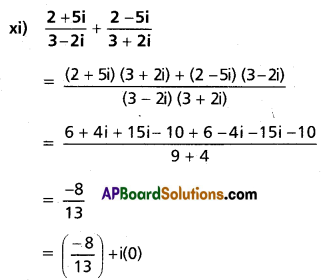
AP Inter 2nd Year Physics Important Questions Chapter 5 Electrostatic Potential and Capacitance 18

Question 8.
A condenser of certain capacity is charged to a potential V and stores some energy. A second condenser of twice the capacity is to store half the energy of the first, find to what potential one must be charged ?
Solution:
(For first capacitor, C1 = C; V1 = V
And U1 = \(\frac{1}{2}\) C1V12 = \(\frac{1}{2}\) CV2 …………………. (1)
For second capacitor, C2 = 2C1 = 2C;
U2 = \(\frac{\mathrm{U}_1}{2}=\frac{1}{4}\)CV2; Let potential difference across the capacitor = V2
AP Inter 2nd Year Physics Important Questions Chapter 5 Electrostatic Potential and Capacitance 19
Then, U2 = \(\frac{1}{2}\) C2V22
⇒ \(\frac{1}{4}\) CV2 = \(\frac{1}{2}\) × 2C × V22
⇒ V22 = \(\frac{\mathrm{V}^2}{4}\)
∴ V2 = \(\frac{V}{2}\)

AP Inter 2nd Year Physics Important Questions Chapter 5 Electrostatic Potential and Capacitance

Question 9.
Three Capacitors each of capaitance 9 pF are connected in series.
a) What is the total capacitance of the combination ?
b) What is the potential difference across each capacitor if the combination is connected to a 120 V supply ?
Solution:
a) Resultant capacitance in series combination \(\frac{1}{C_s}=\frac{1}{C_1}+\frac{1}{C_2}+\frac{1}{C_3} \Rightarrow \frac{1}{C_S}=\frac{1}{9}+\frac{1}{9}+\frac{1}{9}=\frac{3}{9}=\frac{1}{3}\)
CS = 3pF

b) Rd across each capacitor = \(\frac{\mathrm{V}}{3}=\frac{120}{3}\) = 40V

Question 10.
Three capacitors of capacitances 2 pF, 3 pF and 4 pF are connected in parallel. [A.P. Mar. 17]
a) What is the total capacitance of the combination ?
b) Determine the charge on each capacitor if the combination is connected to a 100 V supply.
Solution:
a) Cp = C1 + C2 + C3 = 2 + 3 + 4 = 9pF
b) For each capacitor, V is same = 100 Volt
q1 = C1V = 2 × 100 = 200pC
q2 = C2V = 3 × 100 = 300pC
q2 = C3V = 4 × 100 = 400pC

Textual Examples

Question 1.
(a) Calculate the potential at a point P due to a charge of 4 × 10⁻⁷C located 9 cm away.
(b) Hence obtain the work done in bringing a charge of 2 × 10⁻⁹C from infinity to the point P. Does the answer depend on the path along which the charge is brought ?
Solution:
(a) V = \(\frac{1}{4 \pi \varepsilon_0} \frac{\mathrm{Q}}{\mathrm{r}}\)
= 9 × 10⁹ Nm2 C-2 \(\frac{4 \times 10^{-7} \mathrm{C}}{0.09 \mathrm{~m}}\)
= 4 × 10⁴ V

(b) W = qV = 2 × 10-9 C × 4 × 104V
= 8 × 10⁻⁵ J
No, work done will be path independent. Any arbitrary infinitesimal path can be resolved into two perpendicular displacements. One along r and another perpendicular to r. The work done corresponding to the later will be zero.

AP Inter 2nd Year Physics Important Questions Chapter 5 Electrostatic Potential and Capacitance

Question 2.
Two charges 3 × 10⁻⁸ C and -2 × 10⁻⁸C are located 15 cm apart. At what point on the line joining the two charges is the electric potential zero ? Take the potential at infinity to be zero.
Solution:
Let us take the origin O at the location of the positive charge. The line joining the two charges is taken to be x-axis; the negative charge is taken to be on the right side of the origin fig.
AP Inter 2nd Year Physics Important Questions Chapter 5 Electrostatic Potential and Capacitance 20
Let P be the required point on the x-axis where the potential is zero. If x is the x – coordinate of P, obviously x must be positive. (There is no possibility of potentials due to the two charges adding up to zero for x < 0.) If x lies between O and A, we have
\(\frac{1}{4 \pi \varepsilon_0}\left[\frac{3 \times 10^{-8}}{x \times 10^{-2}}-\frac{2 \times 10^{-8}}{(15-\mathrm{x}) \times 10^{-2}}\right]\) = 0
where x is in cm. That is \(\frac{3}{x}-\frac{2}{15-x}\) = 0
which gives x = 9 cm.
If x lies on the extended line OA, the required condition is \(\frac{3}{x}-\frac{2}{x-15}\) = 0
Which gives x. = 45 cm
Thus, electric potential is zero at 9 cm and 45 cm away from the positive charge on the side of the negative charge. Note that the formula for potential used in the claculation required choosing potential to be zero at infinity.

Question 3.
Figure (a) and (b) shows the field lines of a positive and negative point charge respectively.
AP Inter 2nd Year Physics Important Questions Chapter 5 Electrostatic Potential and Capacitance 21
(a) Give the signs of the potential difference Vp – VQ; VB – VA.
(b) Give the sign of the potential energy difference of a small negative charge between the points Q and P; A and B.
(c) Give the sign of the work done by the field in moving a small positive charge from Q to P.
(d) Give the sign of the work done by the external agency in moving a small negative charge from B And A.
(e) Does the kinetic energy of a small negative charge increase or decrease in going from B to A ?
Solution:
(a) As V ∝ \(\frac{1}{\mathrm{r}}\), Vp > VQ. Thus, (Vp – VQ) is positive. Also VB is less negative than VA. Thus, VB > VA or (VB – VA) is positive.

(b) A small negative charge will be attracted towards positive charge. The negative charge moves from higher potential energy to lower potential energy. Therefore the sign of potential energy difference of a small negative charge between Q and P is positive. Similarly. (PE.)A > (P.E.)B and hence sign of potential energy differences is positive.

(c) In moving a small positive charge from Q to P, work has to be done by an external agency against the eletric field. Therefore, work done by the field is negative.

(d) In moving a small negative charge from B to A work has to be done by the external agency. It is positive.

(e) Due to force of repulsion on the negative charge, velocity decreases and hence the kinetic energy decreases in going form B to A.

AP Inter 2nd Year Physics Important Questions Chapter 5 Electrostatic Potential and Capacitance

Question 4.
Four charges are arranged at the comets of a square ABCD of side d. as shown in fig. 5.15.(a) Find the work required to put together this arrangement, (b) A charge q0 is brought to the centre of the square, the four charges being held fixed at its comers. How much extra work is needed to do this ?
AP Inter 2nd Year Physics Important Questions Chapter 5 Electrostatic Potential and Capacitance 22
Solution:
(a) Since the work done depends on the final arrangement of the charges, and not on how they are put together, we calculate work needed for one way of putting the charges at A, B, C and D. Suppose, first the charge +q is brought to A, and then the charges -q, +q, and -q are brought to B, C and D, respectively The total work needed can be calculated in steps.

  1. Work needed to bring charge +q to A when no charge is present elesewhere: this is zero.
  2. Work needed to bring -q to B when +q is at A. This is given by (charge at B) x (electrostatic .potential at B due to charge +q at A) = -q × \(\left(\frac{\mathrm{q}}{4 \pi \varepsilon_0 \mathrm{~d}}\right)\)
  3. Work needed to bring charge +q to C when +q is at A and -q is at B. This is given by – (charge at Q × (potential at C due to charges at A and B) .
    AP Inter 2nd Year Physics Important Questions Chapter 5 Electrostatic Potential and Capacitance 14
  4. Work needed to bring -q to D when +q at A, -q at B, and +q at C.
    This is given by (charge at D) × (potential at D due to charges at A, B and C)
    AP Inter 2nd Year Physics Important Questions Chapter 5 Electrostatic Potential and Capacitance 15
    Add the work done is steps (i), (ii), (iii) and (iv). The total work required is
    AP Inter 2nd Year Physics Important Questions Chapter 5 Electrostatic Potential and Capacitance 16
    The work done depends only on the arrangement of the charges, and not how they are assembled. By definition, this is the total electrostatic energy of the charges.
    (Students may try calculating same work/energy by taking charges in any other order they desire and convince themselves that the energy will remain the same.)

b) The extra work necessary to bring a charge q0 to the point E when the four charges are at A, B, C and D is q0 × (electrostatic potential at E due to the charges at A, B, C and D). The electrostatic potential at E is clearly zero since potential due to A and C is cancelled by that due to B and D.Hence no work is required to bring any charge to point E.

Question 5.
a) Determine the electrostatic potential energy of a system consisting of two charges 7µC and -2µC (and with no external field) placed at (-9 cm, 0,0) and (9cm, 0, 0) respectively.
b) How much work is required to separate the two charges infinitely away from each other ?
c) Suppose that the same system of charges is now placed in an external electric field E = A(1/r2); A = 9 × 10⁵ C m-2. What would the electrostatic energy of the configuration be ?
Solution:
(a) U = \(\frac{1}{4 \pi \varepsilon_0} \frac{\mathrm{q}_1 \mathrm{q}_2}{\mathrm{r}}\)
= 9 × 10⁹ × \(\frac{1}{4 \pi \varepsilon_0} \frac{q_1 q_2}{r}\) = -0.7 J.

(b)W = U2 – U1 = 0 – U = 0 – (-0.7)
= 0.7J.

AP Inter 2nd Year Physics Important Questions Chapter 5 Electrostatic Potential and Capacitance

c) The mutual interaction energy of the two charges remains unchanged. In addition, there is the energy of interaction of the two charges with the external electric field. We find,
q1V(r1) + q2V(r2) = A \(\frac{7 \mu \mathrm{C}}{0.09 \mathrm{~m}}\) + A \(\frac{-2 \mu \mathrm{C}}{0.09 \mathrm{~m}}\)
and the net electrostatic energy is
q1V(r1) + q2V(r2) + \(\frac{q_1 q_2}{4 \pi \varepsilon_0 r_{12}}\)
= A \(\frac{7 \mu \mathrm{C}}{0.09 \mathrm{~m}}\) + A \(\frac{-2 \mu \mathrm{C}}{0.09 \mathrm{~m}}\)
= 70 – 20 – 0.7 = 49.3J

Question 6.
A molecule of a substance has a perma-nent electric dipole moment of magnitude 10-29C m. A mole of this substance is polarised (at low temperature) by applying a strong electrostatic field of magnitude 106 V m-1. The direction of the field is suddenly changed by an angle of 60°. Estimate the heat released by the substance in aligning its dipoles along the new direction of the field. For simplicity, assume 100% polarisation of the sample.
Solution:
Here, dipole moment of each molecules = 10-29C m
As 1 mole of the substance contains 6 × 10²³ molecules,
total dipole moment of all the molecules, p = 6 × 1023 × 10-29 Cm
= 6 × 10⁻⁶ C m
Initial potential energy, Ut = -pE cos θ
=-6 × 10-6 × 106 cos 0° = -6 J
Final potential energy (when θ = 60°),
Uf = -6 × 10-6 × 106 × cos 60° = – 3J
Change in potential energy
= -3 J – (-6j) = 3 J
So, there is loss in potential energy. This must be the energy released by the substance in the form of heat in aligning its dipoles.

Question 7.
(a) A comb run through one’s dry hair attracts small bits of paper. Why ? What happens if the hair is wet or if it is a rainy day ? (Remember, a paper does not conduct electricity.)
(b) Ordinary rubber is an insulator. But special rubber types of aircraft are made slightly conducting. Why is this necessary ?
(c) Vehicles carrying inflammable materials usually have metallic ropes touching the ground during motion. Why?
(d) A bird perches on a bare high power line, and nothing happens to the bird. A man standing on the ground touches the same line and gets a fatal shock. Why ?
Solution:
(a) This is because the comb gets charged by friction. The molecules in the paper gets polarised by the charged comb, resulting in a net force of attraction, if the hair is wet, or if it is a rainy day. friction between hair and the comb reduces. The comb does not get charged and thus it will not attract small bits of paper.

(b) To enable them to conduct charge (produced by friction) to the ground; as too much of static electricity accumulated may result in spark and result in fire.

(c) Reason similar to (b).

(d) Current passes only when there is difference in potential.

AP Inter 2nd Year Physics Important Questions Chapter 5 Electrostatic Potential and Capacitance

Question 8.
A slab of material of dielectric constant K has the same area as the plates of a parallelplate capacitor but has a thickness (3/4)d, where d is the separation of the plates. How is the capacitance changed when the slab is inserted between the plates ?
Solution:
Let E0 = Vg/d be the electric field between the plates when there is no dielectric and the potential difference is V0. If the dielectric is now inserted, the electric field in the dielectric will be E = E0/K. The potential difference will then be
V = \(E_0\left(\frac{1}{4} d\right)+\frac{E_0}{K}\left(\frac{3}{4} d\right)\)
= \(\mathrm{E}_0 \mathrm{~d}\left(\frac{1}{4}+\frac{3}{4 \mathrm{~K}}\right)=\mathrm{V}_0 \frac{\mathrm{K}+3}{4 \mathrm{~K}}\)
The potential difference decreases by the factor (K + 3)/K while the free charge Q0 on the plates remains unchanged. The capacitance thus increases,
C = \(\frac{\mathrm{Q}_0}{\mathrm{~V}}=\frac{4 \mathrm{~K}}{\mathrm{~K}+3} \frac{\mathrm{Q}_0}{\mathrm{~V}_0}=\frac{4 \mathrm{~K}}{\mathrm{~K}+3} \mathrm{C}_0\)

Question 9.
A network of four 10μF capacitors is connected to a 500V supply, as shown in Fig. Determine
(a) the equivalent capacitance of the network and
(b) the charge on each capacitor, (Note, the charge on a capacitor is the charge on the plate with higher potential, equal and opposite to the charge on the plate with lower potential.)
AP Inter 2nd Year Physics Important Questions Chapter 5 Electrostatic Potential and Capacitance 23
Solution:
(a) In the given network, C1, C2 and C3 are connected in series. The effective capacitance C’ of these three capacitors isgivgftby
\(\frac{1}{\mathrm{C}^{\prime}}=\frac{1}{\mathrm{C}_1}+\frac{1}{\mathrm{C}_2}+\frac{1}{\mathrm{C}_3}\)
For C1 = C2 = C3 = 10 μF. C = (10/3) μF. The network has C and C4 connected in parallel. Thus, the equivalent capacitance C of the network is
C = C’ + C4 = (\(\frac{10}{3}\) + 10) μF = 13.3 μF

(b) Clearly, from the figure, the charge on each of the capacitors, C1, C2 and C3 is the same, say Q. Let the charge on C4 be Q. Now, since the potential difference c across AB is Q/C1 across BC is Q/C2. across CD is Q/C3, we have
\(\frac{\mathrm{Q}}{\mathrm{C}_1}+\frac{\mathrm{Q}}{\mathrm{C}_2}+\frac{\mathrm{Q}}{\mathrm{C}_3}\) = 500 V
Also Q’/C4 = 500V.
This gives for the given value of the capacitances,
Q = 500 V × \(\frac{10}{3}\) μF = 1.7 × 10⁻³C and
Q’ = 500 V × 10μF = 5.0 × 10⁻³C

AP Inter 2nd Year Physics Important Questions Chapter 5 Electrostatic Potential and Capacitance

Question 10.
(a) A 900pF capacitor is charged by 100 V battery [Fig.a]. How much electrostatic energy is stored by the capacitor ?
(b) The capacitor is disconnected from the battery and connected to another 900 pF capacitor. What is the electrostatic y energy stored by the system ?
AP Inter 2nd Year Physics Important Questions Chapter 5 Electrostatic Potential and Capacitance 24
Solution:
The charge on the capacitor is
Q = CV = 900 × 10-12F × 100 V
= 9 × 10⁻⁸C
The energy stored by the capacitor is
= (1/2) CV2 = (1/2) QV
= (1/2) × 9 × 10-8C × 100 V
= 4.5 × 10⁻⁶ J

(b) In the steady situation, the two capacitors have their positive plates at the same potential, and their negative plates at the same potential. Let the common potential difference be V. The charge on each capacitor is then Q’ = CV’. By charge conservation, Q’ = Q/2. This implies V’ = V/2. The total energy of the system is
= 2 × \(\frac{1}{2}\)Q’V’ = \(\frac{1}{4}\)QV = 2.25 × 10⁶J
Thus in going from (a) to (b), though no charge is lost; the final energy is only half the initial energy. Where has the remaining energy gone ?
There is a transient period before the system settles to the situation (b). During this period, a transient current flows from the first capacitor to the second. Energy is lost during this time in the form of heat and electromagnetic radiation.

AP Inter 2nd Year Physics Important Questions Chapter 1 Waves

Students get through AP Inter 2nd Year Physics Important Questions 1st Lesson Waves which are most likely to be asked in the exam.

AP Inter 2nd Year Physics Important Questions 1st Lesson Waves

Very Short Answer Questions

Question 1.
Write the formula for the speed of sound in solids and gases.
Answer:
Speed of sound in solids,
Vs = \(\sqrt{Y / \rho}\) [y = Young’s modulus of solid, ρ = density of solid]
Speed of sound in gases,
Vs = \(\sqrt{\gamma P / \rho}\) [γP = Adiabatic Bulk modulus of gas, ρ = density of gas] .

Question 2.
What does a wave represent?
Answer:
A wave represents the transport of energy through a medium from one point to another without translation of the medium.

AP Inter 2nd Year Physics Important Questions Chapter 1 Waves

Question 3.
Distinguish between transverse and longitudinal waves.
Answer:
Transverse waves

  1. The particles of the medium vibrate perpendicular to the direction of wave propagation.
  2. Crests and troughs are formed alternatively.

Longitudinal waves

  1. The particles of the medium vibrate parallel to the direction of wave propagation.
  2. Compressions and rare factions are formed alternatively.

Question 4.
What are the parameters used to describe a progressive harmonic wave ?
Answer:
Progressive wave equation is given y = a sin (ωt – kx)
Where ω = 2πv = \(\frac{2 \pi}{T}\); k = \(\frac{2 \pi}{\lambda}\)
Parameters:

  1. a = Amplitude
  2. λ = Wavelength
  3. T = Time period
  4. v = Frequency
  5. k = Propagation constant
  6. ω = Angular frequency.

Question 5.
What is the principle of superposition of waves ? .
Answer:
When two or more waves are acting simultaneously on the particle of the medium, the resultant displacement is equal to the algebraic sum of individual displacements of all the waves. This is the principle of superposition of waves.
If y1, y2, ……………… yn be the individual displacements of the particles,then resultant displacement
y = y1 + y2 + ……………… + yn.

AP Inter 2nd Year Physics Important Questions Chapter 1 Waves

Question 6.
Under what conditions will a wave be reflected ?
Answer:

  1. When the medium ends abruptly at any point.
  2. If the density and rigidity modulus of the medium changes at any point.

Question 7.
What is the phase difference between the incident and reflected waves when the wave is reflected by a rigid boundary ?
Answer:
Phase difference between the incident and reflected waves when the wave is reflected by a rigid boundary is radian or 180°.

Question 8.
What is a stationary or standing wave ?
Answer:
When two identical progressive (Transeverse or longitudinal) waves travelling opposite directions in a medium along the same straight line, which are superimposed then the resultant wave is called stationary waves or standing wave.

Question 9.
What do you understand by the terms node’ and ‘antinode’ ?
Answer:
Node : The points at which the amplitude is zero, are called nodes.
Antinodes: The points at which the amplitude is maximum, are called antinodes.

Question 10.
What is the distance between a node and an antinode in a stationary wave ?
Answer:
The distance between node and antinode is \(\frac{\lambda}{4}\).

AP Inter 2nd Year Physics Important Questions Chapter 1 Waves

Question 11.
What do you understand by ‘natural frequency’ or ‘normal mode of vibration’ ?
Answer:
When a body is set into vibration and then left to itself, the vibrations made by it are called natural or free vibrations. Its frequency is called natural frequency or normal mode of vibration.

Question 12.
What are harmonics ?
Answer:
The frequencies in which the standing waves can be formed are called harmonics..
(Or)
The integral multiple of fundamental frequencies are called harmonics.

Question 13.
A string is stretched between two rigid supports. What frequencies of vibration are possible in such a string ?
Answer:
The possible frequencies of vibrations in a stretched string between two rigid supports is given by
vn = (n + \(\frac{1}{2}\)) \(\frac{v}{2l}\) where n = 0, 1, 2, 3, ……….

Question 14.
If the air column in a long tube, closed at one end, is set in vibration, what harmonics are possible in the vibrating air column ?
Answer:
The possible harmonics in the vibrating air column of a long closed tube is given by
vn = [2n +1]\(\frac{v}{4 l}\) where n = 0, 1, 2, 3,

AP Inter 2nd Year Physics Important Questions Chapter 1 Waves

Question 15.
If the air column in a tube, open at both ends, is set in vibration; what harmonics are possible ?
Answer:
The possible harmonics in vibrating air column of a long open tube is given by no
vn = \(\frac{\mathrm{nv}}{21}\)
where n = 1, 2, 3, ……………….

Question 16.
What are ‘beats’ ?
Answer:
Beats : When two sound notes of nearly frequency travelling in the same direction and interfere to produce waxing and waning of sound at regular intervals of time is called “Beats”.

Short Answer Questions

Question 1.
What are transverse waves ? Give illustrative examples of such waves.
Answer:
Transverse waves: In a wave motion, the vibration of the particles and the direction of the propagation of the waves are perpendicular to each other, the waves are said to be transverse waves.
Illustration:

  1. Waves produced in the stretched strings are transverse.
  2. When a stretched string is plucked, the waves travel along the string.
  3. But the particles in the string vibrate in the direction perpendicular to the propagation of the wave.
  4. They can propagate only in solids and on the surface of the liquids.
  5. Ex : Light waves, surface water waves.

AP Inter 2nd Year Physics Important Questions Chapter 1 Waves

Question 2.
What are longitudinal waves ? Give illustrative example of such waves.
Answer:
Longitudinal waves : In a wave motion, the direction of the propagation of the wave and vibrations of particles are in the same direction, the waves are said to be longitudinal waves.
Illustration:

  1. Longitudinal waves may be easily illustrated by releasing a compressed spring.
  2. A series of compressions and rarefactions (expansions) propagate along the spring.
    AP Inter 2nd Year Physics Important Questions Chapter 1 Waves 1
    C = Compression; R = Rarefaction.
  3. They can travel in solids, liquids and gases.
  4. Ex : Sound waves.

Question 3.
What are ‘beats’ ? When do they occur ? Explain their use, if any.
Answer:
Two sound waves of nearly same frequency are travelling in the same direction and interfere to produce a regular waxing (maximum) and waning (minimum) in the intensity of the resultant sound waves at regular intervals of time is called beats.
It two vibrating bodies have slightly difference in frequencies, beats can occur.
No. of beats can be heard, ∆υ = υ1 ~ υ2
Importance:
1. It can be used to tune musical instruments.
2. Beats are used to detect dangerous gases.
Explanation for tuning musical instruments with beats:
Musicians use. the beat phenomenon in tuning their musical instruments. If an instrument is sounded against a standard frequency and tuned until the beats disappear. Then the instrument is in tune with the standard frequency.

AP Inter 2nd Year Physics Important Questions Chapter 1 Waves

Question 4.
What is ‘Doppler effect’ ? Give illustrative examples.
Answer:
Doppler effect: The apparent change in the frequency heard by the observer due to relative motion between .the observer and the source of sound is called doppler effect.
Examples:

  1. The frequency of whistling, engine heard by a person standing on the platform appears to increase, when the engine is approaching the platform and it appears to decrease when the engine is moving away from the platform.
  2. Due to Doppler effect the frequency of sound emitted by the siren of an approaching ambulance appears to increase. Similarly the frequency of sound appears to drop when it is moving away.

Sample Problem on Doppler effect:
Two trucks heading in opposite direction with speeds of 60 kmph and 70 kmph respectively, approach each other. The driver of the first truck sounds his horn of frequency 400Hz. What frequency does the driver of the second truck hear ? (Velocity of sound = 330m/s). After the two trucks have passed each other, what frequency does the driver of the second truckhear?
Answer:
Speed of first truck = 60 kmph
= 60 × \(\frac{5}{18}\) = 16.66 m/s;
Speed of second truck = 70 kmph 5
= 70 × \(\frac{5}{18}\) = 19.44 m/s
Frequency of horn of first truck = 400 Hz;
Velocity of sound, (V) =330 m/s
Frequency of sound heard by the driver of the second truck when approaching each other,
v1 = \(\left(\frac{V+V_0}{V-V_s}\right) v=\left(\frac{330+19.44}{330-16.66}\right)\) × 400 = 446 Hz
Frequency of sound heard by the driver of the second truck when approaching each other,
V11 = \(\left(\frac{\mathrm{V}-\mathrm{V}_0}{\mathrm{~V}+\mathrm{V}_{\mathrm{s}}}\right) \mathrm{v}=\left(\frac{330-19.44}{330+16.66}\right)\) × 400 = 358.5 Hz

Long Answer Questions

Question 1.
Explain the formation of stationary waves in stretched strings and hence deduce the laws of transverse wave in stretched strings. [IPE]
Answer:
A string is a metal wire whose length is large when compared to its thickness. A stretched string is fixed at both ends, when it is plucked at mid point, two reflected waves of same amplitude and frequency at the ends are travelling in opposite direction and overlap along the length. Then the resultant waves are known as the standing waves (or) stationary waves. Let two transverse progressive waves of same amplitude a, wave length λ and frequency v, travelling in opposite direction be given by
AP Inter 2nd Year Physics Important Questions Chapter 1 Waves 2
y1 = a sin (kx – ωt) and y2 = a sin (kx + ωt)
where ω = 2πv and k = \(\frac{2 \pi}{\lambda}\)
The resultant wave is given by y = y1 + y2
y = a sin (kx – ωt) + a sin (kx + ωt)
y = (2a sin kx) cos ωt
2a sin kx = Amplitude of resultant wave.
It depends on ‘kx’. If x = 0, \(\frac{\lambda}{2}, \frac{2 \lambda}{2}, \frac{3 \lambda}{2}\) ……………… etc, the amplitude = zero
These positions are known as “Nodes”.
If x = \(\frac{\lambda}{4}, \frac{3 \lambda}{4}, \frac{5 \lambda}{4}\) …………… etc., the amplitude = maximum (2a)
These positions are called “Antinodes”.
If the string vibrates in ‘P’ segments and T is its length, then length of each segment = \(\frac{l}{\mathrm{P}}\)
Which is equal to \(\frac{\lambda}{2}\)
∴ \(\frac{l}{\mathrm{P}}=\frac{\lambda}{2} \Rightarrow \lambda=\frac{2 l}{\mathrm{P}}\)
Harmonic frequency v = \(\frac{v}{\lambda}=\frac{v \mathrm{P}}{2 l}\)
v = \(\frac{v \mathrm{P}}{2 l}\) ………………. (1)
If’ T’ is tension (stretching force) in the string and ‘μ’ is linear density then velocity of transverse wave (v) in the string is
v = \(\sqrt{\frac{\mathrm{T}}{\mu}}\) …………… (2)
From the Eqs (1) and (2) :
Harmonic frequency v = \(\frac{\mathrm{P}}{2 l} \sqrt{\frac{\Gamma}{\mu}}\)
If P = 1 then it is called fundamental frequency (or) first harmonic frequency
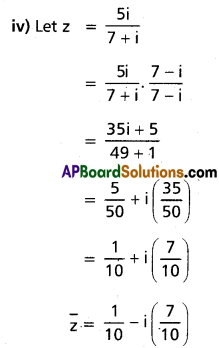
∴ Fundamental Frequency v = \(\frac{1}{2 l} \sqrt{\frac{\mathrm{T}}{\mu}}\) …………….. (3)

Laws of Transverse Waves Along Stretched String:
Fundamental frequency of the vibrating string v = \(\frac{1}{2 l} \sqrt{\frac{\mathrm{T}}{\mu}}\)
First Law : When the tension (T) and linear density (μ) are constant, the fundamental frequency (v) of a vibrating string is inversely proportional to its length.
∴ v ∝ \(\frac{1}{l}\) ⇒ vl = constant, when ‘T’ and ‘μ’ are constant. .

Second Law: When the length (l) and its, linear density (m) are constant the fundamental frequency of a vibrating string is directly proportional to the square root of the stretching force (T).
∴ v ∝ \(\sqrt{T}\) ⇒ \(\frac{v}{\sqrt{T}}\) = constant, when ‘l’ and ‘m’ are constant.
JT .
Third Law: When the length (l) and the tension (T) are constant, the fundamental frequency of a vibrating string is inversely proportional to the square root of the linear density (m).
∴ v ∝ \(\frac{1}{\sqrt{\mu}}\) ⇒ \(v \sqrt{\mu}\) = constant, when ‘l’ and T are constant.

AP Inter 2nd Year Physics Important Questions Chapter 1 Waves
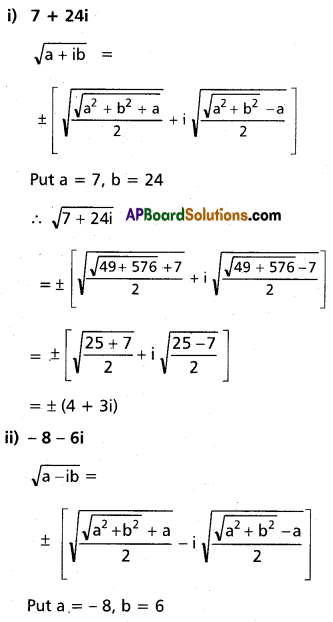
Question 2.
Explain the formation of stationary waves in an air column enclosed in open pipe. Derive the equations for the frequencies of the harmonics produced. [A.P. 17; IPE 2015, 2016 (TS)]
Answer:
A pipe, which is opened at both ends is called open pipe. When a sound wave is sent through a open pipe, which gets reflected by the earth. Then incident and reflected waves are in same frequency, travelling in the opposite directions are super-imposed stationary waves are formed.

Harmonics in open pipe : To form the stationary wave in open pipe, which has two anti nodes at two ends of the pipe with a node between them.
AP Inter 2nd Year Physics Important Questions Chapter 1 Waves 3
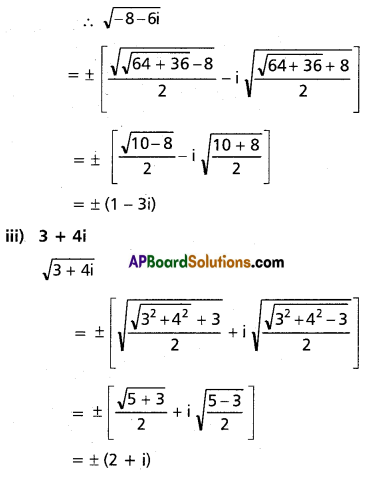
∴ The vibrating length (l) = half of the wavelength \(\left(\frac{\lambda_1}{2}\right)\)
l = \(\frac{\lambda_1}{2}\) ⇒ λ1 = 2l
fundamental frequency v1 = \(\frac{\mathrm{v}}{\lambda_1}\) where v is velocity,of sound in air, v1 = \(\frac{v}{21}\) = v
For second harmonic (first overtone) will have one more node and antinode than the fundamental.
If λ2 is wavelength of second harmonic l = \(\frac{2 \lambda_2}{2}\) ⇒ λ2 = \(\frac{21}{2}\)
If ‘v2’ is frequency of second harmonic then v2 = \(\frac{v}{\lambda_2}=\frac{v \times 2}{2 l}\) = 2v
v2 = 2v ……………… (2)
Similarly for third harmonic (second overtone) will have three nodes and four antinodes as shown in above figure.
If λ3 is wave length of third harmonic l = \(\frac{3 \lambda_3}{2}\)
λ3 = \(\frac{2l}{3}\)
If ‘v2‘ is frequency of third harmonic then
v3 = \(\frac{v}{\lambda_3}=\frac{v \times 3}{2 l}\) = 3V
v3 = 3v …………… (3)
Similarly we can find the remaining or higher harmonic frequencies i.e., v3, v4 etc., can be determined in the same way.
Therefore the ratio of the harmonic frequencies in open pipe can be written as given below.
v : V1 : v2 = 1 : 2 : 3
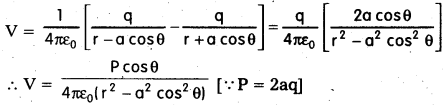
Question 3.
How are stationary waves formed in closed pipes ? Explain the various modes of vibrations and obtain relations for their frequencies. [IPE 2015, 2016(A.P.), (T.S) A.P. & T.S. Mar. 15]
Answer:
A pipe, which is closed at one end and the other is opened is called closed pipe. When a sound wave is sent through a closed pipe, which gets reflected at the closed end of the pipe. Then incident and reflected waves are in same frequency, travelling in the opposite directions are superimposed stationary waves are formed.

To form the stationary wave in closed pipe, which has atleast a node at closed end and antinode at open end of the pipe, it is known as first harmonic in closed pipe. Then length of the pipe (l) is equal to one fourth of the wave length.
AP Inter 2nd Year Physics Important Questions Chapter 1 Waves 4
∴ l = \(\frac{\lambda_1}{4}\) ⇒ λ1 = 4l
If ‘v1‘ is fundamental frequency then
v1 = \(\frac{v}{\lambda_1}\) where ‘υ’ is velocity of sound in air
v1 = \(\frac{v}{4 l}\) = v …………….. (1)
To form the next harmonic in closed pipe, two nodes and two antinodes should be formed. So that there is possible to form third harmonic in closed pipe. Since one more node and antinode should be included.
Then length of the pipe is equal to \(\frac{3}{4}\) of the wavelength.
∴ l = \(\frac{3 \lambda_3}{4}\) where ‘λ3‘ is wave length of third harmonic
λ3 = \(\frac{4l}{3}\)
where ‘X3’ is wave length of third harmonic.
If ‘v3‘ is third harmonic frequency (first overtone)
∴ v3 = \(\frac{v}{\lambda_3}=\frac{3 v}{41}\)
v3 = 3v …………….. (2)
Similarly the next overtone in the close pipe is only fifth harmonic, it will have three nodes and 3 antinodes between the closed end and open end.
Then length of the pipe is equal to \(\frac{5}{4}\) of wave length (λ5)
∴ l = \(\frac{5 \lambda_5}{4}\) where ‘λ5‘ is wave length of fifth harmonic.
λ5 = \(\frac{4l}{5}\)
If ‘v5‘ is frequency of fifth harmonic (second overtone)
v5 = \(\frac{v}{\lambda_5}=\frac{5 v}{4 l}\)
v5 = 5v …………….. (3)
∴ The frequencies of higher harmonics can be determined by using the same procedure. Therefore from the Eq (1), (2) and (3) only odd harmonics are formed.
Therefore the ratio of the frequencies of harmonics in closed pipe can be written as
v1 : v3 : v5 = v : 3v : 5v
v1 : v3 : v5 = 1 : 3 : 5
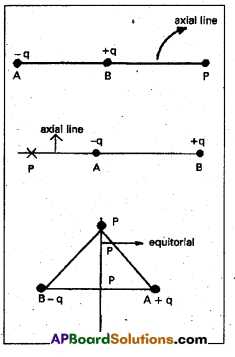
AP Inter 2nd Year Physics Important Questions Chapter 1 Waves
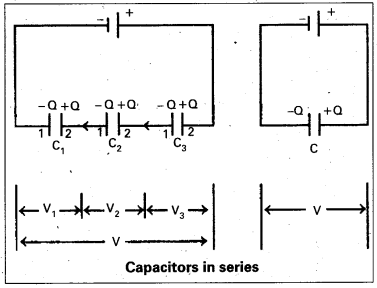
Question 4.
What is Doppler effect ? Obtain an expression for the apparent frequency of sound heard when the source is in motion with respect to an observer at rest. [Mar. 17, BMP, 2016 (AP) Mar. 14, (TS)]
Answer:
Doppier effect: The apparent change in the frequency heard by the observer due to the relative motion between the observer and the source of sound is called doppier effect. When a whistling railway engine approaches an observer standing on the platform, the frequency of sound appears to increase. When it moves away the frequency appear to decrease.
AP Inter 2nd Year Physics Important Questions Chapter 1 Waves 5
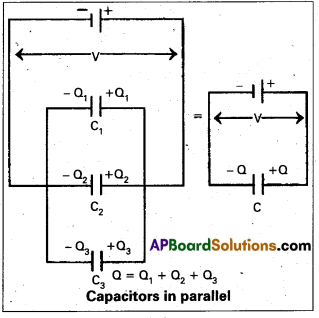
Expression for apparent frequency when source is in motion and listener at rest:
Let S = Source of sound
O = Listener
Let ‘S’ be the source, moving with a velocity ‘υs‘ towards the stationary listener.
The distance travelled by the source in time period T = υs. T Therefore the successive compressions and rarefactions are drawn closer to listener.
∴ Apparent wavelength λ’ = λ – υsT.
λ’ = λ – \(\frac{v_s}{v}\) [∵ υ = \(\frac{1}{T}\)]
= \(\frac{\lambda v-v_s}{v}=\frac{v-v_s}{v}\) [∵ υ = vλ]
If “v'” is apparent frequency heard by the listener then v’ = \(\frac{v}{\lambda^{\prime}}\) where ‘υ’ is Velocity of sound in air
v’ = \(\frac{v . v}{v-v_S}\)
Therefore the apparent frequency is greater than the actual frequency.
Similarly, if the source is away from the stationary listener then apparent frequency v’ = \(\frac{v . v}{v+v_s}\), which is less than the actual frequency.

Limitation : Doppler effect is applicable when the velocities of the source and listener are much less than that of sound velocity.

Problems

Question 1.
A stretched wire of length 0.6 m is observed to vibrate with a frequency of 30 Hz in the fundamental mode. If the string has a linear mass of 0.05 kg / m find (a) the velocity of propagation of transverse waves in the string (b) the tension in the string. [IPE 2016 (T.S)
Answer:
v = 30 Hz; I = 0.6 m; μ = 0.05 kg m-1
υ = ?; T = ?
a) υ = 2vl = 2 × 30 × 0.6 = 36 m/s
b) T = υ2μ = 36 × 36 × 0.05 = 64.8 N .

Question 2.
A string has a length of 0.4m and a mass of 0.16g. If the tension in the string is 70N, what are the three lowest frequencies it produces when plucked ?
Solution:
I = 0.4 m; M = 0.16g = 0.16 × 10⁻³ kg;
μ = \(\frac{\mathrm{M}}{1}=\frac{0.16 \times 10^{-3}}{0.4}\) = 0.4 × 10⁻³ kg/m;
T = 70 N; vn = \(\frac{\mathrm{P}}{21} \sqrt{\frac{\mathrm{T}}{\mu}}\)
v1 = \(\frac{1}{21} \sqrt{\frac{\mathrm{T}}{\mu}}=\frac{1}{2 \times 0.4} \sqrt{\frac{70}{0.4 \times 10^{-3}}}\) = 523 Hz
v2 = 2v1 = 2 × 523 = 1046 Hz
v3 = 3v1 = 3 × 523 = 1569 Hz

AP Inter 2nd Year Physics Important Questions Chapter 1 Waves

Question 3.
A closed organ pipe 70 cm long is sounded. If the velocity of sound is 331 m/s, what is the fundamental frequency of vibration of the air column ?
Solution:
l = 70 cm = 70 × 10-2m; v = 331 m/s ;
v = ?
v = \(\frac{v}{4 l}=\frac{331}{4 \times 70 \times 10^{-2}}\) = 118.2 Hz.

Question 4.
A steel cable of diameter 3 cm is kept under a tension of lOkN. The density of steel is 7.8 g/ cm3. With what speed would transverse waves propagate along the cable ?
Solution:
T = 10 kN = 104 N
D = 3 cm; r = \(\frac{D}{2}=\frac{3}{2}\) cm
= \(\frac{3}{2}\) × 10-2m;
AP Inter 2nd Year Physics Important Questions Chapter 1 Waves 6

Question 5.
A train sounds its whistle as it approaches and crosses a level crossing. An observer at the crossing measures a frequency of 219 Hz as the train approaches and a frequency of 184 Hz as it leaves. If the speed of sound is taken to be 340 m/s, find the speed of the train and the frequency of its whistle. [T.S. Mar. 17]
Solution:
When a whistling train away from rest observer, AP Inter 2nd Year Physics Important Questions Chapter 1 Waves 7
v’ = \(\left[\frac{v}{v-v_s}\right] v\) ……………… (1)
When a whistling train away from rest observer, AP Inter 2nd Year Physics Important Questions Chapter 1 Waves 8
v” = \(\left[\frac{v}{v+v_s}\right] v\) ……………… (2)
Here v’ = 219 Hz; v” = 184 Hz;
v = 340 m/s
AP Inter 2nd Year Physics Important Questions Chapter 1 Waves 9

AP Inter 2nd Year Physics Important Questions Chapter 1 Waves

Question 6.
A rocket is moving at a speed of 200 m s-1 towards a stationary target. While moving, it emits a wave of frequency 1000 Hz. Some of the sound reaching the target gets reflected back to the rocket as an echo. Calculate (1) the frequency of the sound as detected by the target and (2) the frequency of the echo as detected by the rocket. [A.P. Mar. 16]
Solution:
1) The observer is at rest and the source is moving with a speed of 200 m s-1. Since this is comparable with the velocity of sound 330 ms-1, we must use Eq.
v = v0 \(\left[\frac{1+v_{\mathrm{S}}}{v}\right]^{-1}\) and not the approximate
v = v0 [1 – \(\frac{v_s}{v}\)]
Since the source is approaching a stationary target, υ0 = 0, and υs must be replaced by -υs. Thus, we have
v = v0 [1 – \(\frac{v_s}{v}\)]-1
v = 1000 Hz × [1 – 200 m s-1/330 m s-1]-1
≃ 2540Hz

2) The target is now the source (because it is the source of echo) and the rocket’s detector is now the detector or observer (because it detects echo). Thus, υs = 0 and υ0 has a positive value. The frequency of the sound emitted by the source (the target) is v, the frequency intercepted by the target and not v0, Therefore, the frequency as registered by the rocket is
v’ = \(v\left(\frac{v+v_0}{v}\right)\)
= 2540 Hz × \(\left(\frac{200 \mathrm{~m} \mathrm{~s}^{-1}+330 \mathrm{~m} \mathrm{~s}^{-1}}{330 \mathrm{~m} \mathrm{~s}^{-1}}\right)\)
≃ 4080Hz

Textual Examples

Question 1.
Given below are some examples of wave motion. State in each case if the wave motion is transverse, longitudinal or a combination of both.
a) Motion of kink in a longitudinal spring produced by displacing one end of the spring sideways.
b) Waves produced in a cylinder containing a liquid by moving its piston back and forth.
c) Waves produced by a motorboat sailing in water.
d) Ultrasonic waves in air produced by a vibrating quartz crystal.
Solution:
a) Transverse and longitudinal
b) Longitudinal
c) Transverse and longitudinal
d) Longitudinal.

AP Inter 2nd Year Physics Important Questions Chapter 1 Waves

Question 2.
A wave travelling along a string is des-cribed by, y(x, t) = 0.005 sin (80.0 x – 3.01), in which the numerical constants are in SI untis (0.005 m, 80.0 rad m-1, and 3.0 rad s-1). Calculate (a) the amplitude, (b) the wavelength, and (c) the period and frequency of the wave. Also, calculate the displacement y of the wave at a distance x = 30.0 cm and time t = 20 s ?
Solution:
On comparing this displacement equation with Eq. y (x, t)n = a sin(kx – ωt + Φ)
y(x, t) = a sin (kx – ωt).
We find
a) the amplitude of the wave is
0. 005 m = 5 mm.

b) the angular wave number k and angular frequency ω are k = 80.0 m-1 and ω = 3.0 s-1
We then relate the wavelength λ to k through Eq.
λ = \(\frac{2 \pi}{K}\)
= \(\frac{2 \pi}{80.0 \mathrm{~m}^{-1}}\) = 7.85 cm

c) Now we relate T to ω by the relation
T = \(\frac{2 \pi}{\omega}\)
= \(\frac{2 \pi}{3.0 \mathrm{~s}^{-1}}\)
= 2.09 s
and frequency, v = \(\frac{1}{T}\) = 0.48 Hz
The displacement y at x = 30.0 cm and time t= 20s is given by
y = (0.005 m) sin (80.0 × 0.3 – 3.0 × 20)
= (0.005 m) sin (-36 + 12π)
= (0.005 m) sin (1.699)
= (0.005 m) sin (97°) ≃ 5 mm

Question 3.
A steel wire 0.72 m long has a mass of 5.0 × 10⁻³ kg. If the .wire is under a tension of 60 N, what is the speed of transverse waves on the wire ? [A.P. Mar. 19]
Solution:
Mass per unit length of the wire,
μ = \(\frac{5.0 \times 10^{-3} \mathrm{~kg}}{0.72 \mathrm{~m}}\) = 6.9 × 10⁻³ kg m-1
Tension, T = 60 N
The speed of wave on the wire is given by
υ = \(\sqrt{\frac{\mathrm{T}}{\mu}}=\sqrt{\frac{60 \mathrm{~N}}{6.9 \times 10^{-3} \mathrm{~kg} \mathrm{~m}^{-1}}}\) = 93 m s-1

AP Inter 2nd Year Physics Important Questions Chapter 1 Waves

Question 4.
Estimate the speed of sound in air at standard temperature and pressure. The mass of 1 mole of air is 29.0 × 10⁻³ kg.
Solution:
We know that 1 mole of any gas occupies 22.4 litres at STP Therefore, density of air at STP is:
ρ0 = (mass of one mole of air) / (Volume of one mole of air at STP)
= \(\frac{29.0 \times 10^{-3} \mathrm{~kg}}{22.4 \times 10^{-3} \mathrm{~m}^3}\) = 1.29 kgm-3
According to Newton’s formula for the speed of sound in a medium, we get for the speed of sound in air at STP,
υ = \(\left[\frac{1.01 \times 10^5 \mathrm{~N} \mathrm{~m}^{-2}}{1.29 \mathrm{~kg} \mathrm{~m}^{-3}}\right]^{1 / 2}\) = 280 m s-1

Question 5.
A pipe, 30.0 cm long is open at both ends. Which harmonic mode of the pipe resonates a 1.1 kHz source ? Will resonance with the same source be observed if one end of the pipe is closed ? Take the speed of sound in air as 330 m s-1.
Solution:
The first harmonic frequency is given by
v1 = \(\frac{v}{\lambda_1}=\frac{v}{2 L}\) (open pipe)
Where L is the length of the pipe. The frequency of its nth; harmonic is
vn = \(\frac{n v}{2 L}\) for n = 1, 2, 3, ……………… (open pipe)
First few modes of an open pipe are shown in Fig.
For L = 30.0 cm. υ = 330 m s-1
vn = \(\frac{\mathrm{n} \times 330\left(\mathrm{~m} \mathrm{~s}^{-1}\right)}{0.6(\mathrm{~m})}\) = 550 s-1
AP Inter 2nd Year Physics Important Questions Chapter 1 Waves 10
Clearly, for a source of frequency 1.1 kHz the air column will resonate at υ2, i.e. the second harmonic.
Now if one end of the pipe is closed (Fig.), the fundamental frequency is
AP Inter 2nd Year Physics Important Questions Chapter 1 Waves 11
and only to odd numbered harmonics are present :
v3 = \(\frac{3 v}{4 L}/latex], v5 = [latex]\frac{5 v}{4 L}\) and s0 0n.
For L = 30 cm and υ = 330 m s-1;, the fundamental frequency of the pipe closed at one end is 275 Hz and the source frequency corresponds to its fourth harmonic. Since this harmonic is not a possible mode, no resonance will be observed with the source, the moment one end is closed.

AP Inter 2nd Year Physics Important Questions Chapter 1 Waves

Question 6.
Two sitar strings A and B playing the note ‘Dha’ are slightly put of tune and produce beats of frequency 5 Hz. The tension of the string B is slightly increased and the beat frequency is found to decrease to 3 Hz. What is the original frequency of B if the frequency of A is 427 Hz ?
Solution:
Increase in the tension of a string increases its frequency. It the original frequency of B (vB) were greater than that of A(vA) .further increase in vB should have resulted in an increase in the beat frequency. But the beat frequency is found to decrease. This shows that vB < vA. Since vA – vB = 5 Hz, and va = 427 Hz, we get vB = 422 Hz.

Question 7.
A rocket is moving at a speed of 200 m s-1 towards a stationary target. While moving, it emits a wave of frequency 1000 Hz. Some of the sound reaching the target gets reflected back to the rocket as an echo. Calculate (1) the frequency of the sound as detected by the target and (2) the frequency of the echo as detected by the rocket. [A.P. Mar. 16]
Solution:
1) The observer is at rest and the source is moving with a speed of 200 ms-1. Since this is comparable with the velocity of sound 330 ms-1, we must use Eq.
v = v0 \(\left[\frac{1+\mathrm{v}_{\mathrm{S}}}{\mathrm{v}}\right]^{-1}\) and not the approximate
v = v0 \(\left[1-\frac{v_s}{v}\right]\)
Since the source is approaching a stationary target, υ0 = 0, and υs must be replaced by -υs. Thus, we have
v = v0 \(\left(1-\frac{v_{\mathrm{S}}}{v}\right)^{-1}\)
v = 1000 Hz × [1 – 200 m s-1/330 m s-1]-1
≃ 2540Hz

AP Inter 2nd Year Physics Important Questions Chapter 1 Waves

2) The target is now the source (because it is the source of echo) and the rocket’s detector is now the detector or observer (because it detects echo). Thus, υs = 0 and υ0 has a positive value. The frequency of the sound emitted by the source (the target) is v0, the frequency intercepted by the target and not v0, Therefore, the frequency as registered by the rocket is
v’ = \(v\left(\frac{v+v_0}{v}\right)\)
= 2540 Hz × \(\left(\frac{200 \mathrm{~m} \mathrm{~s}^{-1}+330 \mathrm{~m} \mathrm{~s}^{-1}}{330 \mathrm{~m} \mathrm{~s}^{-1}}\right)\)
≃ 4080Hz

AP Inter 2nd Year Zoology Study Material Chapter 2(b) Excretory Products and their Elimination

Andhra Pradesh BIEAP AP Inter 2nd Year Zoology Study Material Lesson 2(b) Excretory Products and their Elimination Textbook Questions and Answers.

AP Inter 2nd Year Zoology Study Material Lesson 2(b) Excretory Products and their Elimination

Very Short Answer Questions

Question 1.
Name the blood vessels that enter and exit the kidney.
Answer:
Renal artery enters kidney and renal vein comes out of the kidney.

Question 2.
What are renal pyramids and renal papillae?
Answer:
The conical shaped medullary regions of kidney are the renal pyramids. Tips of the renal pyramids which open into pelvis are renal papillae.

Question 3.
What are the columns of Bertin?
Answer:
Columns of Bertin are the medullary extensions of the renal cortex in between the renal pyramids.

Question 4.
Name the structural and functional unit of kidney. What are the two main types of structural units in it?
Answer:
The structural and functional unit of kidney is ‘Nephrons’. The two main parts are
1) Malpighian body (renal corpuscle),
2) Convoluted tube.

AP Inter 2nd Year Zoology Study Material Chapter 2(b) Excretory Products and their Elimination

Question 5.
Distinguish between cortical and juxta medullary nephrons.
Answer:

  1. Cortical nephrons have renal corpuscle in the superficial renal cortex. They have short loop of Henle but without vasa recta.
  2. Juxta medullary nephrons re located near the renal medulla. They have loop of Henle and vasa recta.

Question 6.
Define glomerular Alteration.
Answer:
The process of Alteration of blood, which occur between glomerulus and lumen of the Bowman’s capsule due to difference in net pressure is called glomerular Alteration. The filtered fluid which entered the Bowman’s capsule is primary urine or glomerular filtrate which is hypotonic.

Question 7.
Define glomerular Alteration rate (GFR)?
Answer:
The amount of filterate formed by both the kidneys, per minute is called glomerular Alteration rate (GFR). GFR in a healthy individual is approximately 125 ml 11 minute.

Question 8.
What is meant by mandatory reabsorption? In which parts of nephron does it occur?
Answer:
In a healthy individual the GFR is 125 ml/1 minute or 180 ltr per day. About 85% of the filterate formed is reabsorbed in a constant, unregulated fashion by the proximal convoluted tubule and descending limb of Henle’s loop, called mandatory reabsorption.

Question 9.
Distinguish between juxtaglomerular cells and macula densa.
Answer:

  1. The cells of the distal convoluted tubule are crowded in the region where distal convoluted tubule makes contact with afferent arteriole. These cells are known as Macula densa.
  2. Along side of macula densa, the wall of the afferent arteriole contains the modified smooth muscle fibers called juxtaglomerular cells.

Question 10.
Whait is Juxtaglomerular apparatus?
Answer:
Macula densa along with juxtaglomerular cells form juxtaglomerular apparatus which releases an enzyme Called renin.

Question 11.
Distinguish between the enzymes reniri and rennin.
Answer:
Renin :
Renin is an enzyme produced by the JG cells. This enzyme catalyses the conversion of angiotensinogen into angiotensin -I.

Rennin :
Rennin is also an enzyme found in the gastric juice of infants. It acts on the milk protein casein in the presence of calcium ions and convert it into calcium para caseinate and proteoses.

Question 12.
What is meant by the term osmoregulation?
Answer:
The process of maintaining the quantity of water and-dissolved solutes in balance is referred to as osmoregulation.

AP Inter 2nd Year Zoology Study Material Chapter 2(b) Excretory Products and their Elimination

Question 13.
What is the role of atrial-natriuretic peptide in the regulation of urine formation?
Answer:
A large increase in blood volume promotes the release of atrial natriuretic peptide from the heart. Atrial natriuretic peptide decreases the absorption of water, Na+ from proximal convoluted tubule.

Short Answer Questions

Question 1.
Terrestrial animals are generally either ureotelic or uricotelic and not ammonotelic. Why?
Answer:
Ammonia is highly toxic and readily soluble in water, hence it should be eliminated from the body quickly in a very dilute solution.

Aquatic animals are surrounded by water, so water conservation is not a problem for them. In this manner, they are continuously eliminating ammonia.

On the other hand, terrestrial animals have to conserve water. They cannot waste water. So ammonia in diluted form can’t be eliminated continuously. Since ammonia is highly toxic, it has to be converted to less toxic form, like urea or uric acid.

Urea is 1,00,000 times less toxic than ammonia and requires less water for their excretion. Uric acid is less toxic than urea and being insoluble in water can be excreted as semi solid waste or pellets with very little water. This is the great advantage for animals with little access to water.

Question 2.
Differentiate vertebrates on the basis of the nitrogenous waste products they excrete, giving example.
Answer:
Vertebrates are divided into three categories based on nitrogenous waste excretory products. They are :
1) Ammonotelic animals:
The animals which excrete ammonia as nitrogenous waste products are called ammonotelic animals. These are aquatic organisms.
Ex : Some bony fishes.

2) Ureotelic animals:
The animals which excrete urea as their chief nitrogenous waste are called ureotelic animals.
Ex : Earth worms, cartilaginous fishes, most of the amphibians and mammals.

3) Uricotelic animals:
These animals excrete their nitrogenous waste products in the form of uric acid.
Ex : Reptiles, birds.

Question 3.
Draw labelled diagram of the V.S of kidney.
Answer:
AP Inter 2nd Year Zoology Study Material Chapter 2(b) Excretory Products and their Elimination 1

Question 4.
Describe the internal structure of kidney of man.
Answer:

  1. Kidney is bean shaped structure, the outer surface of kidney is convex and inner surface is concave where it has a deep notch called hilum.
  2. A longitudinal sections of the human kidney shows two distinct regions namely the outer cortex and the inner medulla.
  3. Medulla is divided into multiple cone shaped masses of tissue called renal pyramids. The renal pyramids are separated by the projections of the cortex called columns of Berlin.
  4. The tips of the pyramids are renal papilla.
  5. Renal papilla projects into cup like calyces, formed by the funnel shaped pelvis, which continues out as the ureter. Ureter carries urine into urinary bladder.
  6. In cortex and medulla, nearly one million nephrons are present. They are structural and functional units of kidney. They are embedded in the loose connective tissue of cortex and medulla.
  7. In addition, kidney contains a network of blood capillaries, lymph sinuses and intestitial fluid in intra cellular spaces.
  8. The kidney gets blood supply through renal artery and blood from kidney is carried out by renal vein.

Question 5.
Explain micturition.
Answer:
The process of passing out of urine is called micro nutrition and the neural mechanism involved is called micturition reflex.

Urine is formed by the nephrons is ultimately carried to the urinary bladder where it is stored till a voluntary signal is given by the central nervous system (CNS). This sighal is initiated by the stretching of the urinary bladder as it gets filled with urine. In response, the stretch receptors on the walls of the bladder send signals to the CNS. The CNS passes on motor messages to initiate the contraction of smodth muscles of the bladder and simultaneous relaxation of the urethral sphincter, causing the release of urine.

Question 6.
What is the significance of juxta glomerular apparatus (JGA) in kidney function?
Answer:
Macula densa together with JG cells form juxtaglomerular apparatus (JAG). JAG plays a complex regulating role. A fall in glomerular blood flow or glomerular blood pressure or GFR can activate JG cells to release an enzyme called renin into the blood. This catalyses the conversion of angiotensinogen into angotensin-I which is further converted into angiotensin-II by angiotensin converting enzyme. Angiotensin-II, being a powerful vasoconstrictor increase the glomerular blood pressure and there by GFR.

Angiotensin-II also activates the adrenal cortex to release aldosterone. Aldosterone causes reabsorption of Na+ and water from distal convoluted tubule and collecting duct. To reduce loss through urine, and also promote secretion of K+ ions into distal convoluted tubule and collecting duct. It leads to increase in the blood pressure and GFR. This complex mechanism is generally known as renin – angiotensin- aldosterone system (RAAS).

Question 7.
Give a brief account of the counter current mechanism.
Answer:
Mammals have the ability to produce concentrated urine. The Henle’s loop and vasa recta plays an important role in this. The flow of the renal filterate in the two limbs of Henle’s loop is in opposite directions and thus form counter current. The flow of blood through vasa recta is also in counter current pattern. The proximity between the Henle’s loop and vasa recta, as well as the counter currents of renal fluid and blood in them help in maintaining an increasing osmolarity towards the inner medullary interstitium.

This gradient is mainly caused by NaCl and urea. NaCl passes out the ascending limb of Henle’s loop, and it enters the blood of the descending limb of vasa recta. NaCl is returned to the intestitium from the ascending portion of the vasa recta. Similarly small amounts of urea enter the thin segment of ascending limb of Henle’s loop which is transported back to the interstitium, from the collecting duct. Transport of these substances facilitated by the special arrangement of Henle’s loop and vasa recta.is called the counter current mechanism.

This mechanism helps to maintain a concentration gradient .in the medullary interstitium. Presehce of such interstitium gradient help easy passage of water from the collecting duct, there by concentrating the urine.

AP Inter 2nd Year Zoology Study Material Chapter 2(b) Excretory Products and their Elimination

Question 8.
Explain the auto regulatory mechanism of GFR.
Answer:
Auto Regulation of GFR: *The kidneys have built in mechanisms for the regulation of glomerular filtration rate. One such efficient mechanism is carried out by juxta glomerular apparatus. Juxta glomerular apparatus is a special region formed by cellular modifications in the distal convoluted tubule and the afferent arteriole at the location of their contact.

A fall in GFR can activate the juxta glomerular cells to release an enzyme called renin, which catalyses the conversion of angiotensinogen into angiotensin-I and further converted to angiotensin-II by action of an enzyme angiotensin converting enzyme. Angiotensin-II’ stimulate the adrenal cortex to secrete aldosterone. Aldosterone causes reabsorption of Na+ and water from DCT and collecting duct to reduce loss through urine and also promotes the secretion of K+ ions into the DCT and CD (collecting duct). It leads.an increase in the blood pressure and GFR.

Question 9.
Describe the role of liver, lungs and skin in excretion.
Answer:
In addition to the kidneys, liver, lungs and skin also play an important role in the elimination of excretory wastes.

a) Liver :
Liver is the largest gland in our body, secretes bile, containing substances like bilirubin, biliverdin, cholesterol, degraded steroid hormones, vitamins and drags. Most of these substances ultimately pass out along with digestive wastes.

b) Lungs :
Lungs remove large amounts of C02 (18 litres 1 day), various, volatile materials and significant quantities of water.

c) Skin :
Human skin possesses two types of glands namely sweat and sebaceous glands for the elimination of certain substances through their secretions.

  • Sweat produced by the sweat glands is a watery fluid containing NaCl, small amount of urea, lactic acid etc.,
  • Sebaceous glhnds eliminate certain substances like sterols, hydrocarbons and waxes through sebum. This secretion provides a protective oily covering for the skin.

Question 10.
Name the following.
Answer:
a) A chordate animal having protonephridial type excretatory structures Cephalo chordate.
b) Cortical portions projecting between the medullary pyramids in the human kidney. Columns of Bertini
c) Capillary network paralleing the loop of Henle. Vasa recta.
d) A non chordate animals having green glands as excretory structures. Crustaceans.

Long Answer Questions

Question 1.
Describe the excretory system of man, giving the structure of a nephron.
Answer:
In humans, the excretory system consists of a pair of kidney, a pair of ureters, a urinary bladder and urethra.

Kidney :
Kidneys are reddish brown, bean shaped structures, situated on either side of the vertebral column between the levels of last thoracic and third lumbar vertebrae in a retroperitoneal position. The right kidney is slightly lower than the left one due to the presence of liver.

The outer surface of the kidney is convex and the inner surface is concave, where it has a deep notch called hilum, the point at which the renal artery and nerves enter and renal vein and ureter leave. Each kidney is surrounded by a tough, fibrous tissue, called renal capsule.

Ureter :
These are slender whitish tubes, which emerges from the pelvis of the kidney. The ureter rundown and open into the urinary bladder.
AP Inter 2nd Year Zoology Study Material Chapter 2(b) Excretory Products and their Elimination 2

Urinary bladder :
Urinary bladder is a pear shaped like muscular organ. It tempirarily stores the urine, situated in the lower abdominal cavity. The neck of the bladder leads into the urethra. Urethra opens near the vaginal orifice in the female and through the penis in the male.

Structure of nephron:
Each kidney has nearly one million nephrons. These are structural and functional units of kidney, embedded in the loose connective tissue of cortex and medulla. Nephron consist of malpighian body and renal tubule.

I) Malphigian body :
It begins in the cortex of the kidney. It contains Bowman’s capsule and glomerulus.
AP Inter 2nd Year Zoology Study Material Chapter 2(b) Excretory Products and their Elimination 3

a) Bowman’s capsule :
It is a thin walled, double layered cup. The inner wall of the Bowman’s capsule has certain unique cells called podocytes.

b) Glomerulus :
It is a dense network of capillaries in the cup of Bowman’s capsule. Afferent arteriole of renal artery enter the cavity of Bowman’s capsule and split into five branches.

They unite and come out of the Bowman’s capsule as an afferent arteriole.

The podocytes of inner wall of Bowman’s capsule wrap around each capillary. The podocytes are arranged in an intricate manner so as to leave some minute spaces called filteration slits. The endothelium cells of capillaries have numerous pores called fenestrations.

II) Renal tubule:
It is narrow, delicate tubule arises from the posterior part of Bowman’s capsule known as neck. It opens into along narrow convoluted tubule with three parts like proximal convoluted tubule, Loop of Henle and Distal convoluted tubule.

a) Proximal convoluted tubule :
It is a lined by simple cuboidal epithelium with brush border to increase area of absorption.

b) Loop of Henle :
It is a hairpin like tubule present in medulla region. It consist of a descending limb and an ascending limb. The proximal part of the ascending limb is thin and the distal part is thick. The thick ascending limb continuous into the distal convoluted tubule.

c) Distal convoluted tubule (DCT) :
It is present in cortex. It is lined by simple cuboidal epithelium. The DCT continuous as the initial collecting duct in the cortex.

Collecting system :
Some initial collecting ducts unite to form straight collecting duct, which passes through the medullary pyramid. In the medulla, the tubes of each pyramid join and form duct of Bellini, which finally opens into tip of the renal papilla.

Capillary network of nephron :
The efferent arteriole emerging from the glomerulus forms a fine capillary network called the peritubular capillaries, around the renal tubule. The portion of the peritubular capillaries that surrounds the loop of Henle is called the vasa recta. The vasa recta is absent or highly reduced in the cortical nephrons. The juxta medullary nephrons possess well developed yasa recta.

AP Inter 2nd Year Zoology Study Material Chapter 2(b) Excretory Products and their Elimination

Question 2.
Explain the physiology of urine formation.
Answer:
The formation of urine involves three main processes namely

  1. Glomerular Alteration
  2. Selective reabsorption
  3. Tubular secretion.

1) Glomerular Alteration :
It is Arst step in urine formation. The process of Alteration of blood, which occurs between glomerulus and lumen of the Bowman’s capsule due to difference in netpressure is called glomerular Alteration.

The hydrostatic pressure of blood while Aowing in the glomerulus is 60 mm Hg. It is opposed by glomerular colloidal osmotic pressure of 32 mm Hg and Bowman’s capsule hydrostatic pressure of 18 mm Hg.

The net filterate pressure is 10 mm Hg ( 60 – 32 + 18 = 10). This causes the Alteration of blood through the 3 layered filterate membrane formed by endothelium cells of glomerular capillary together with the basement membrane and podocytes of the Bowman’s cup. By the result of glomerular Alteration primary urine or renal Auid is collected in lumen of the Bowman’s capsule.

The primary urine contains almost all the constituents of plasma, except the proteins. The primary urine is hypotonic to the cortical Auid, it passes into the next part of renal tubule.

2) Selective reabsorption:
During the process of glomerular Alteration 125 ml/minute df primary urine is formed. Nearly 99% of which and essential substances are reabsorbed* by renal tubules called selective reabsorption. About 85% of filterate formed (primary urine) is reabsorbed in a constant unregulated manner called obligatory reabsorption.
AP Inter 2nd Year Zoology Study Material Chapter 2(b) Excretory Products and their Elimination 4

3) Tubular Secretion :
During the formation of urine, the tubular cells secrete substances such as H+, K+ and NH3+ into the filterate. Tubular secretion is also an important step in the formation of urine as it helps in maintenance of ionic and acid base balance of the body fluids.

Mechanism of selective reabsorption and secretion takes place is different parts of nephrons.

a) In the proximal convoluted tubule :
Nearly all the essential nutrients and 70-80% of electrolytes and water are reabsorbed by this segment. Na+, glucose, amino acids, Cl and other essential substances are reabsorbed into blood.

PCT also helps to maintain the pH and ionic balance of body fluids by selective secretion of H+ and NH3 into the filterate and by the absorption of HCO3 from it.

b) In the Henle’s loop :
Reabsorption in this segment is minmium.

  • The descending loop of Henle is permeable to water and almost impermeable to electrolytes results the filterate concentration gradually increases.
  • The ascending limb has two specialized regions, a proximal thin segment in which NaCl diffuses out into interstitial fluid passively, and distal thick segment, in which NaCl is actively pumped out.

The ascending limb is impermeable to water. Thus the filterate becomes progressively more dilute as it moves up to the cortex i.e., towards the DCT.

In the Distal convoluted tubule (DCT) :
It is permeable to water and ions. The reabsorption of water is variable depending on several conditions and is regulated by ADH. DCT is also capable of reabsorption of HCO3 and selective secretion of H+ and K+ ions and NH3+ into DCT from peritubular network, to maintain the pH and sodium – potassium balance in tHe blood.

In the collecting duct (CD) :
Considerable’amount of water could be reabsorbed from this region to produce concentrated urine. This segment allows passage of small amount of urea to medullary interstitium to keep up its osmolarity. It also plays a role in the maintenance of pH and ionic balance of blood by the selective secretion of H+ and K+ ions.

The renal fluid after the process of facultative reabsorption in the CD, influenced by ADH, constitute the urine, that is sent out. Urine in the CD is hypertonic to the plasma of blood.

AP Inter 2nd Year Commerce Study Material Chapter 5 Consumer Protections

Andhra Pradesh BIEAP AP Inter 2nd Year Commerce Study Material 5th Lesson Consumer Protections Textbook Questions and Answers.

AP Inter 2nd Year Commerce Study Material 5th Lesson Consumer Protections

Essay Answer Questions

Question 1.
Explain the composition and jurisdiction of the state commission.
Answer:
The state commission settles consumer disputes at the state level. The state commission is headed by the judge of a high court and comprises other members not less than two and not more than as prescribed, one of whom shall be a woman.

The state commission shall have jurisdiction to entertain consumer complaints where the value of goods and services for which the compensation claimed exceeds ₹ 20 lakhs and less than ₹ 1 crore. The state commission is empowered to call for the records and pass appropriate orders in respect of any consumer dispute within the state jurisdiction. The state commission is empowered to transfer any complaint pending before on the district forum to another district forum within the state. The state commission has circuit Benches.

In case the aggrieved party is not satisfied with the order of the state commission, he can appeal to the national commission within 30 days of passing the order.

Question 2.
Describe the rights of a consumer as per CPA 1986.
Answer:
Although a businessman is aware of his social responsibilities even then we come across many cases of consumer protection. Hence Government of India provided the following six rights to all the Consumers under Consumer Protection Act.
1) Right to safety:
According to this right, the consumers have right to be protected against the marketing of goods and services which are hazardous to life and property. The right is important for safe and secure life.

2) Right to information :
According to this right, the consumer has right to get information about the quality, quantity, purity standard and piece of goods or services. The producer must supply all the relevant information at a suitable place.

3) Right to choice :
According to this right, every consumer has a right to choose the goods or services of his or her likings. The supplier should not force the consumer to buy a particular brand only. Consumer should be free to choose the most suitable product from his view point.

4) Right to consumer education:
According to this right, it is the right of the consumer to acquire knowledge and skill to be informed to customer. It is easier for the literate consumers to know their rights and take actions.

5) Right to seek redressal:
According to this right, the consumer has the right to get compensation or seek redressal against unfair trade practices or any other exploitation. The right assures justice to consumer against exploitation.

6) Right to heard / Right to represent:
According to this right, the consumer has the right to represents himself or to be heard or right to advocate his interest. In case a consumer has been exploited or has any complaint against the product or service then he has a right to be heard.

AP Inter 2nd Year Commerce Study Material Chapter 5 Consumer Protections

Question 3.
What are the responsibilities of a consumer?
Answer:
Various efforts have been made by government or non – government organisations to protect the interest of consumer, but exploitation of consumer will stop only when the consumer will come forward to safeguard his own interest. Consumer has bear the following responsibilities.

1) Be quality conscious :
To put to stop to adulteration and corrupt practices of the manufacturers and traders, it is the duty of every consumer to be conscious of the quality of the products they buy. They should look for the standard quality certification marks like ISI, Agmark, Wool mark, Ecomark, Hallmark, etc. While making the purchases.

2) Beware of misleading advertisements :
The advertisement often exaggerates the quality of the products. Hence the consumers should not rely on the advertisement and carefully check the product or ask the users before making a purchase.

3) Responsibility to inspect a variety of goods before making selection :
The consumer should inspect a variety of goods before buying the goods and services. For this purpose, he / she should compare their quality, price, durability, after sales service etc.

4) Collect proof of transaction :
The consumer should insist a valid documentary evidence (Cash memo / invoice) relating to purchase of goods or availing of any services and preserve it carefully. Such proof of purchase is required for filing a complaint. In case of durable goods the manufacturers generally provide the warrantee / guarantee card with the product. It is the duty of the consumers to obtain these documents and ensure that these are duly sighed, stamped and dated. The consumer must preserve them till the warrantee / guarantee period is over.

5) Consumers must aware of their rights:
The consumers must aware of their rights as stated above and exercise them while buying goods and services. For example, it is the responsibility of a consumer to insist on getting all information about the quality of the product and ensure himself / herself that it is free from any kind of defect.

6) Complaint for genuine grievances:
As a consumer, if you are dissatisfied with the product, you can ask for redressal of yoifr grievances. In this regard, you must file a proper claim with the company first. The manufacturer / company do not respond, then you can approach the forums. But your claim must state actual loss and the compensation claim must be reasonable. At no cost fictious complaints should be filed otherwise the forum may penalise you.

7) Proper use of product / service :
It is expected from consumers that they use and handle the product / service properly. It has been noticed that during guarantee period, people tend to reckless use of the product, thinking that it will be replaced during guarantee period. This practice should be avoided.

Question 4.
Explain the redressal mechanism available to consumers under the Consumers Proction Act, 1986.
Answer:
The judicial machinery set up under Consumer Protection Act (C.RA) 1986 consists of consumer courts (Forums) at the District, State and National levels. These are known as District Forum, State consumer disputes redressal commission (State Commission) and National consumer disputes redressal commission (National Commission).

1. District forum :
This is established by the state government in each of its districts.
a) Composition :
The district forum consists of a chairman and two other members one of whom shall be a woman. The district forms are headed by the person of the rank of a District Judge.

b) Jurisdiction:
A written complaint can be filed before the district forum where the value of goods or services and the compensation claimed does not exceed ₹ 20 lakhs.

c) Appeal:
If a consumer is not satisfied by the decision of the District Forum, he can challenge the same before state commission, within 30 days of the order.

2. State commission:
This is established by the state governments in their respective states.
a) Composition :
The state commission consists of a president and not less than two and not more such number of members as may be prescribed, one of whom shall be a woman. The commission is headed by a person of the rank of High Court Judge.

b) Jurisdiction :
A written complaint can be filed before the state commission where the value of goods or services and the compensation claimed exceeds ₹ 20 lakhs but does not exceed ₹ 1 Crore.

c) Appeal :
In case the aggrieved party is not satisfied with the order of the state commission he can a appeal to National Commission within 30 days of passing the order.

3. National Commission :
The national commission was constituted in 1988 by the central government; It is the apex body in the three tier judicial machinery set up by the government for redressal of consumer grievances. Its office is situated Janpath Bhawan in New Delhi.

a) Composition :
It consists of a president and not less than four and not more than such members as may be prescribed, one of whom shall be a woman. The National Commission is headed a sitting or retired judge of supreme court.

b) Jurisdiction:
All complaints pertaining to those goods or services and compensation whose value is more than ₹ 1 Crore can be filed directly before the National Commission.

c) Appeal:
An appeal can be filed against the order of the National Commission to the supreme court within 30 days from the date of order passed.

Question 5.
Who can file a complaint, what complaints can be filed, where to file the complaint, how to tile the complaints redressal of grievances under the Consumer Protection Act 1986?
Answer:
For redressal of consumer grievances a complaint must be filed with the appropriate form.

Who can complaint?
The following persons can file a complaint under Consumer Protection Act 1986.
a) a consumer.
b) Any recognised voluntary consumer association whether the consumer is a member of that association or not;
c) The central or any state government;
d) One more consumers where there are numerous consumers having same interest;
e) Legal heir or representative in case of death of consumer what complaints can be filed?

What complaints can be filed?
A consumer can complaint relating to any one or more of the following;
a) An unfair trade practice or a restrictive trade practice adopted by any trader or service provider;
b) Goods bought by him or agreed to bought by him suffer from one more defects ;
c) Services hired or availed of or agreed to be hired or availed of, suffer from deficiency in any respect;
d) Price charged in excess of the price
i) fixed by or under law for the time being in force
ii) displayed on the goods or the package
iii) displayed in the price list or
iv) agreed between the parties and
e) goods or services which are hazardous or likely to be hazardous to life and safety when used.

Where to file a complaint?
If the value of goods and services and the compensation claimed does not exceed ? 20 lakhs, the complaint can be filed in the district forum ; If it exceeds ₹ 20 lakhs but does not exceed ₹ 1 crore, the complaint can be filed before the State Commission ; and if it exceeds ₹ 1 Crore, the complaint can be filed before the National Commission.

How to file a complaint?
A complaint can be made in person or by any authorised agent or by post. The complaint can be written on a plain paper supported by documentary evidence in support ’of the allegation contained in the complaint. The complaint should clearly specify the relief sought. It should also contain the nature, description and address of the complaint as opposite party, and so also the facts relating to the complaint and when and where it arose.

Very Short Answer Questions

Question 1.
Give the meaning of consumer.
Answer:
Under the Consumer Protection Act 1986, The word consumer has been defined separately for the purpose of goods and services.

For the purpose of goods, a consumer is one who buys any goods for consideration and any user of such goods other than the person who actually buys it, provided such use is made with the approval of buyer.

For the purpose of services, a consumer is one who has any service or services for consideration ; and any benificiary of such services provided the service is availed with the approval of the person who had hired the service for a consideration.

AP Inter 2nd Year Commerce Study Material Chapter 5 Consumer Protections

Question 2.
What is consumerism?
Answer:
Consumerism is defined as a social force designed to protect consumer interest in the market place by organising consumer pressure on business. By consumerism we mean the process of realising the rights of the consumer as enrises in the Consumer Protection Act, 1986 and ensuring right standards for the goods and services for which one makes payment.

Question 3.
What is meant by consumer protection?
Answer:
Consumer protection means safe guarding the interest and rights of consumers. In other words, it refers to the measures adopted for the protection of consumers from redressal of their grievances. The most common business malpractices are sale of adulterated, spurious, substandard and duplicate goods, false and under weighting, hoarding and black marketing, charging more than MRP Price etc. .

Question 4.
District Forums.
Answer:
The state government in each district establishes District forum by notification. The district forum consists of a president nominated by the state government. The forum also comprises two other members who shall have atleast 10 years of experience in dealing problems of economics, law commerce and industry. Every member of the form shall have tenure of 5 years or 65 years whichever is earlier. The District collector acts as the chairman of the District Forum. The District forum shall have jurisdiction to entertain consumers complaints where the value of goods and services which the compensation claimed, should ₹ 20 lakhs.

Question 5.
State commission.
Answer:
The state commission settles the consumer dispute at state level. The state commission is headed by the judge of High Court and comprised of other members not less than two and not more than such members as prescribed. The state commission is empowered to call for the records and appropriate orders in respect of any consumer dispute within the state jurisdiction. The state commission shall have jurisdiction to entertain consumer complaints where the value of goods and services for which compensation claimed exceeds ₹ 20 lakhs.

Question 6.
National commission.
Answer:
National commission operates at National level. It settle the consumer disputes at in the country. The National Commission has a President, who should be a serving or retained Supreme Court Judge the commission also comprises other members of not less than four. The president and all the members of the commission are appointed by central government. The National Commission shall have jurisdiction to entertain consumers complaints where the value of goods and services and compensation exceeds ₹ 1 crore.

AP Inter 2nd Year Commerce Study Material Chapter 5 Consumer Protections

Question 7.
Who is consumer? In the opinion of Mahatma Gandhi.
Answer:
Mahatma Gandhi, the father of nation, attached great importance to what he described as the ‘poor consumer’, who according to him should be the principle benificiary of the consumer movement. He said “A consumer is the most important visitor on our premises. He is not dependent on us, we are on him. He is not an interruption to our work; he is the purpose of it. He is not an outsider to our business ; he is a part of it. We are not doing him a favour by serving him ; he is doing us a favour by giving an opportunity to do so.