AP Inter 1st Year Civics Study Material Chapter 1 Scope and Significance of Political Science

Andhra Pradesh BIEAP AP Inter 1st Year Civics Study Material 1st Lesson Scope and Significance of Political Science Textbook Questions and Answers.

AP Inter 1st Year Civics Study Material 1st Lesson Scope and Significance of Political Science

Long Answer Questions

Question 1.
Define Political Science and explain its scope. [A.P. Mar, 17, 16, 15]
(or)
Explain the scope of Political Science.
Answer:
Introduction:
Political Science is a premier social science. It is mainly concerned with the study of the state in its relation to Society, Citizens, Associations, and the world at large. Aristotle is hailed as the Father of Political Science. He wrote famous book “THE POLITICS”.

Origin of the word Politics :
Aristotle, the Father of Political Science used the term “POLITICS” for the first time in his famous book “POUTICS”. The term “POLITICS” is derived from a greek word “POLIS” and latin word “POLITICUS” which means the city state.

Definitions of Political Science :
Political Scientists gave various definitions on Political Science. They are as follows :
1. J.W. Gamer:
“Political Science begins and ends with the state”.

2. Stephen Leacock:
“Political Science deals with the government”.

3. David Easton :
“Political Science is concerned with the authoritative allocation of values for a society”.

Scope of Political Science :
The scope of Political Science means the subject matter covered by it or the topics which are included in its study. It may be explained in the following ways :

i) Study of man in Relation to the Society and State :
Aristotle stated that “Man is a Social Animal”. Man can satisfy his basic needs like food, clothing, shelter and protection in the society. Political Science explains the relationship beween man and society. It examines how man should adjust himself with the societys. It is imperative that the modem man should develop proper attitude towards the society. This is possible only when he identifies himself with the society.

Political Science is concerned with the perennial and central issue of establishing proper relationship between the state and the individuals. It deals with many topics of state activity, such as limitations of Political Authority and sphere of Individual Freedoms.

ii) Study of State :
Aristotle also stated that man is a Political Animal. State is a human and political institution. It came into existence for the sake of man and continue in existence for providing happy and prosperous life for man. Individuals became members of the state since, its inception. We can’t imagine the life of individuals outside of the state. Political Science studies the intimate Relationship between the state and the citizens. It also studies the Nature, Functions and Various theories of state authority.

It also comprises a study of the various activities of the state from that of ancient police state to the modem welfare state. Thus, Political Science deals with the Present, Past and FUture aspects of the state.

iii) Study of the Government :
Government is an important essential element of Modem State. It is an instrument which fulfills aims and goals of the state. There can be no state with out a government. Government formulates, expresses and implements the will of the state. Government consists of three organs namely Legislature, Executive and Judiciary. Legislature makes the laws, Executive implements the laws and Judiciary interpretes the laws. Political Science studies the meaning, forms, structure, nature and functions of the government. It also discusses the relationship among the various organs of the government. Hence, Political Science is treated as a science of government.

iv) Study of Associations and Institutions :
Associations and Institutions help the Individuals for their moral, religious, cultural, scientific and technological progress. These carry on their activities at local, regional, national and international levels. Individuals join as members in these Associations out of their interests or purposes. There prevails a great linkage between these voluntary Associations and Institutions. Associations and Institutions in Modem times play a significant role in the Formulation and Implementation of policies of the state and government. Voluntary bodies such as trade unions, peasant groups, professional bodies etc., will have a great impact on the state and government. Political Science explains the nature, structure and functions of the various Associations and Insti-tutions.

v) Study of Rights and Responsibilities:
Scope of Political Science includes the study of Rights and Responsibilities of citizens. Citizens in democratic states enjoy certain rights such as right to life, right to liberty, right to property etc. Political Science enumerates the definition, classification and different theories of Rights. Similarly, citizens will have some Responsibilities towards the state. These include paying taxes, obeying the laws etc. It explains the significance of Rights and Responsibilities of the citizens. Hence, Political Science examines the Realtionship between Rights and Responsibilities.

vi) Study of National and International Issues:
The scope of Political Science covers various issues of Modem state in relation with other states in matters of safeguarding Ter-ritorial integrity and Sovereignty. It studies the topics like Cold war, Balance of power, Disarmament, Detente etc. Modem states are not isolated. They depend upon other states in many spheres like importing raw materials, exporting finished goods, transport, technology, services and communications. This requires close relations among the states in international sphere. Political Science discusses not only the domestic policies of the state but also the issues of international dimensions. It covers a wide range of topics such as diplomacy, international politics, international law, international organisations etc.

vii) Study of Power:
The behaviouralists of 20th century regarded Political Science as a study of sharing and shaping of power. They pointed out that Political Science discusses how power is grabbed, manipulated anti perpetuated to have a control over the society. Morgenthau defined the power as “Man’s control over the Minds and Actions of other Men”.

viii) Study of Public Policy:
Modem Political Scientists like David Easton and Gabriel Almond argued that Political Science is a “Policy Science”. They considered Political Science as the study Of formulation, execution and evaluation of Public Policy, with the advent of Public Policy the scope of Political Science has further widened to include the dimensions of vital topics such as Industrial Policy, Agricultural Policy, Land Reform Policy, Education Policy, Population Policy etc. Public Policy of a Nation in the context of International Relations plays a crucial role in the formulation of diplomatic, economic, military and scientific strategies.

Conclusion:
The above contents show the wide range of subjects that come under the purview of Political Science.

AP Inter 1st Year Civics Study Material Chapter 1 Scope and Significance of Political Science

Question 2.
Discuss the significance of the study of Political Science. [A.P. Mar. 19]
Answer:
The study of Political Science is very useful and valuable. It’s knowledge is indispensible to the rulers as well as the ruled. Its significance or importance is analysed as follows.

i) Information about the State :
The primary aim of studying Political Science is to inculcate knowledge of the state. It’s origin, nature, Structure and functions. Knowledge of the state is of great significance to every one. Solutions to various political issues are found only when we have a proper understanding of the political institutions.

ii) Knowledge of Government and Administration :
The Administrators, political leaders and diplomats who manipulate the affairs of the state require a sound knowledge of political science in order to perform their functions with efficiency. Political Science creates awareness about the organisation, control and coordination of Administrative machinery. It also covers the study of local self-governments like Gram Panchayats, Mandal Parishads, Zilla Parishads, Municipalities, Corporations etc.

iii) Provides information about Democratic values :
Political Science provides accurate information about the various political terms such as State, Government, Nation, Con-stitution, Democracy, Sovereignty, Law etc., which are used commonly. Political Science also provides a good knowledge and awareness about the Democratic values like Liberty, Equality, Fraternity, Justice and Rights.

iv) Makes Democracy Successful:
At present Democracy is in vogue in several coun-tries of the world. It is the best form of government. People in democracy elect their repre-sentatives and are ruled by them. If honest, selfless and committed representatives are not elected, the expectations of the people will not be fulfilled. Political Science explains the significance of Franchise. It educates the common men on the conditions essential for the successful functioning of democratic government.

v) Awareness about rights and responsibilities:
The study of Political Science makes people conscious of their rights and responsibilities. It also enables the citizens to be familiar with their rights and responsibilities and the interrelationship between the two. Its study makes the citizens to realize the fact that a proper exercise of rights and responsibilities is a must for leading civilised life.

vi) Teaches the Qualities of Good Citizenship :
Political Science impacts the best civic knowledge by explaining the qualities of good citizenship like cooperation, sacrifice, patriotism, obedience to the state and to the laws, farsightedness, social service etc. It trains the people to become ideal citizens.

vii) Knowledge about World Affairs:
The study of Political Science enriches individual’s knowledge on World Affairs. Political Science is useful for observing and understanding the contemporary world affairs. It stimulates right thinking, broad vision and universal understanding of various phenomena of international politics. It’s study is useful for proper’ analysis and solution of various National and International Issues.

viii) Provides knowledge about International Organizations :
A citizen of the present is not only a member of the state but also a member of the world at large. The study of Political Science promotes the spirit of internationalism. It provides a good knowledge about International Organizations like United Nations Organisation, SAARC, ASEAN, NAM, OPEC etc. It teaches about the need for harmonious relations among the nations.

ix) Develops Political Awareness :
The study of Political Science is of great impor-tance in the sense that it imports best political knowledge. It explains about the structure and functioning of different political institutions like State Government, Political parties, Occupational Associations. Hence the study of Political Science is the best training ground for knowing, following and practising the art of leadership.

x) Explains the need for Co-Operation and Toleration :
National Integration has become a crucial factor in several states. Many obstacles like communalism, linguism, sub-national regional and sub-regional feelings etc., have been threatening the national inte-gration in these states. In this context, the study of Political Science teaches about the need for adjustment, cooperation and toleration.

xi) Knowledge of Political Science is Indispensable :
The study of Political Science helps everyone to understand the mechanism and constitutional system of modem govern-ments. It creates awareness about the contemporary issues in national and international spheres. If creates awareness about Rights and Responsibilities. It’s study is essentially indispensable for the people in developing nations like India. As the majority people in these states are poor, ignorant, illiterate and sentimental in their out look. The study of Political Science inculcates a good political knowledge among them.

Aristotle regarded Political Science as the supreme science and the master of all social sciences.

Question 3.
Define Political Science and explain its nature.
Answe:
Political Science is a premier Social Science. It is mainly concerned with the study of the state in it’s relation with society, citizens, associations and the world at large. Aristotle is hailed as the Father of Political Science. He wrote famous book ‘THE POLITICS”. The term “politics” is derived from a greek word” “POLIS” and latin word “POLiTICUS” which means the city state.

Definition of Political Science:
Political Scientists gave various definitions on Political Science. They are as follows :
1. J.W. Gamer:
“Political Science begins and ends with the state”.

2. Stephen Leacock:
“Political Science deals with the government”.

Nature of Political Science:
There prevailed a controversy among the political scien-tists in regard to the nature of Political Science. Some viewed Political Science as a science others treated it as an art. Let us examine the two aspects (Science and Art) of Political Science.

i) Political Science is a SCIENCE :
According to political philosophers like Aristotle, Bluntschli, Hobbes, Montesque and others Political Science is considered as a science on the following grounds.

  1. Political Science is studied in a systematic manner.
  2. Experimentation is possible in politics. Principles are applied in the actual organisation of Political Institutions.
  3. Political Science, like other sciences, has absolute and universal laws.
  4. Predictions are easily applicable in politics.
  5. Certain generally agreed principles can be incorporated into the study of Political Science.
  6. Political Science, like other sciences, gives scope for establishing relationship be-tween cause and effect.

ii) Political Science is an ART :
According to political writers like Barker, J.S. Mill, Laski and others Political Science is considered as an ART on the following grounds.

  1. Political Science has no absolute and universal laws like physical sciences.
  2. The phenomena studied in Political Science are interpreted in various ways de-pending upon the context and situation. So it lacks uniformity in the interpretation of various concepts.
  3. Political Science is not evolutionary in nature as its concepts are not developed in a steady, regular and continuous manner.
  4. Scientific methods of observation and experimentation are not applicable in political science.
  5. Complete objectivity and detachment are not found in the case of various phenom-ena in Political Science.
  6. Political Science gives no scope for accuracy.

Short Answer Questions

Question 1.
Write about the traditional definitions of Political Science.
Answer:
Traditional definitions of Political Science may be classified under three sub catego-ries. They are mentioned as follows.
i) Political Science – A Study of the State :
Political philosophers like J.W.Gamer, R.G.Gettle, Appadovai and others defined Political Science as a study of the state.

1. J.W.Gamer:
“Political Science begins and ends with the state”.

2. R.G.GettIe :
“Political Science is a historical investigation of what the state has been, an analytical study of what the state is and a politico-ettical discussion of what the state should be”.

3. Appadorai:
“Political Science is concerned with the conditions essential for the existence and development of the state”.

ii) Political Science – A study of the Government:
Some political philosophers like Stephen Leacock, J.R.Seely and others defined Political Science as a study of the govern-ment.

1. Stephen Leacock :
“Political Science deals with the Government”.

2. J.R.Seely :
“Political Science investigates the phenomenon of the Government”.

iii) Political Science – A study of the State and the Government:
Political philoso-phers like Paul Janet, Gilchrist, Catlin and others defined political science as a study of the state and the government.

1. Paul Janet:
“Political Science is that part of social science which treats the founda-tions of state and the principles of the government”.

2. R.N.Gilchrist :
“Political Science is a study of foundations of the state and the government”.

3. Catlin :
“Political Science is a study of the political activities of individuals and various organs of government”.

AP Inter 1st Year Civics Study Material Chapter 1 Scope and Significance of Political Science

Question 2.
What are the various modem definitions of Political Science?
Answer:
Modem definitions of Political Science can be classified into two sub-categories. They are discussed as follows..
i) Political Science – A study of power:
1. Lasswell and Kaplan :
“Political Science as an empirical discipline, is the study of shaping and sharing of power”.

2. William A.Robson :
“Political Science is primarily concerned with the power in society”.

ii) Political Science – A study of Allocation of values :
1. David Easton :
“Political Science is concerned with the authoritative allocation of values for a society”.

2. Hill Man :
“Politics is the Science of who gets what, when, and why”.

Question 3.
Explain about the nature of Political Science.
Answer:
Political Science is a premier Social Science. It is mainly concerned with the study of the state in it’s relation with society, citizens, associations and the world at large. Aristotle is hailed as the Father of Political Science. He wrote famous book ‘THE POLITICS”. The term “politics” is derived from a greek word” “POLIS” and latin word “POLiTICUS” which means the city state.

Definition of Political Science:
Political Scientists gave various definitions on Political Science. They are as follows :
1. J.W. Gamer:
“Political Science begins and ends with the state”.

2. Stephen Leacock:
“Political Science deals with the government”.

Nature of Political Science:
There prevailed a controversy among the political scien-tists in regard to the nature of Political Science. Some viewed Political Science as a science others treated it as an art. Let us examine the two aspects (Science and Art) of Political Science.

i) Political Science is a SCIENCE :
According to political philosophers like Aristotle, Bluntschli, Hobbes, Montesque and others Political Science is considered as a science on the following grounds.

  1. Political Science is studied in a systematic manner.
  2. Experimentation is possible in politics. Principles are applied in the actual organisation of Political Institutions.
  3. Political Science, like other sciences, has absolute and universal laws.
  4. Predictions are easily applicable in politics.
  5. Certain generally agreed principles can be incorporated into the study of Political Science.
  6. Political Science, like other sciences, gives scope for establishing relationship be-tween cause and effect.

ii) Political Science is an ART :
According to political writers like Barker, J.S. Mill, Laski and others Political Science is considered as an ART on the following grounds.

  1. Political Science has no absolute and universal laws like physical sciences.
  2. The phenomena studied in Political Science are interpreted in various ways de-pending upon the context and situation. So it lacks uniformity in the interpretation of various concepts.
  3. Political Science is not evolutionary in nature as its concepts are not developed in a steady, regular and continuous manner.
  4. Scientific methods of observation and experimentation are not applicable in political science.
  5. Complete objectivity and detachment are not found in the case of various phenom-ena in Political Science.
  6. Political Science gives no scope for accuracy.

Question 4.
Mention any three topics coverd under the scope of Political Science.
Answer:
i) Study of man in Relation to the Society and State:
Aristotle stated that “Man is a Social Animal”. Man can satisfy his basic needs like food, clothing, shelter and protection in the society. Political Science explains the relationship beween man and society. It exam- ines how man should adjust himself with the societys. It is imperative that the modem man should develop proper attitude towards the society. This is possible only when he identifies himself with the society.

Political Science is concerned with the perennial and central issue of establishing proper relationship between the state and the individuals. It deals with many topics of state activity, such as limitations of Political Authority and sphere of Individual Freedoms.

ii) Study of State :
Aristotle also stated that man is a Political Animal. State is a hu-man and political institution. It came into existence for the sake of man and continue in existence for providing happy and prosperous life for man. Individuals became members of the state since its inception. We can’t imagine the life of individuals outside of the state. Political Science studies the intimate Relationship between the state and the citizens. It also studies the Nature, Functions and Various theories of state authority.

It also comprises a study of the various activities of the state from that of ancient police state to the modem welfare state. Thus, Political Science deals with the Present, Past and Future aspects of the state.

iii) Study of Associations and Institutions :
Associations and Institutions help the Individuals for their moral, religious, cultural, scientific and technological progress. These cany on their activities at local, regional, national and international levels. Individuals join as members in these Associations out of their interests or purposes. There prevails a great link-age between these voluntary Associations and Institutions. Associations and Institutions in Modem times play a significant role in the Formulation and Implementation of policies of the state and government. Voluntary bodies such as trade unions, peasant groups, professional bodies etc., will have a great impact on the state and government. Political Science explains the nature, structure and functions of the various Associations and Institutions.

Question 5.
Describe the scope of Political Science in the sphere of Government.
Ansnswer:
Scope of Political Science includes the study of government. Some political scientists like Stephen Leacock and John Richard Seeley confined the scope of the discipline to the government alone. Political Science mainly studies about the government Government is an agency of the state. There can be no State without a government. The state realises its aims through the instrument of government. Government formulates, expresses and implements the will of the state. There must be some men or body of men who are authorised to issue orders on behalf of the state. They are known as the government.

Political Science studies the meaning, forms, structure, nature and functions of the government. It discusses the relationship among the various organs of the government. It makes a differentiation between the State and Government. While dealing with the government, Political Science narrates the classification of various governments as given by Aristotle, Leacock and others. Political Science discusses the various merits and demerits, essential conditions and manifold activities of the above governments. Hence, political Science is treated as a science of government.

AP Inter 1st Year Civics Study Material Chapter 1 Scope and Significance of Political Science

Question 6.
”Political Science is a study of the present, past and future of the state”. Analyse this statement
Answer:
Political scientists like Gamer and Paul Janet viewed Political Science as a study of the affairs of the state. They conceived the state as a Political Institution. The state is indispensable for every individual. Political Science studies the intimate relationship between the state and the citizens. Political Science studies the state in present, in the past and in future.

i) Study of state in the Present :
Political Science deals with the state as it exists today. It explains the meaning, nature, purpose, growth and functioning of the state. It also deals with public opinion, political parties and pressure groups which seek to capture the political power or influence public policies.

ii) Study of state in the Past:
Political Science explains about the origin and transfor-mation of the state. It also discusses about the diverse political institutions that existed within the state. It studies various factors that influenced the origin and evolution of the state. This sort of historical study is possible only in political science.

iii) Study of State in Future :
Political Science tries to determine the principles and concepts of a model state. It lays down the conditions under which a perfect state is real-ized. Political Scientists conceive the future with a view to improve the standards of political institutions and their activities in the light of changing conditions.

On the whole, the scope of Political Science includes the study of various activities; of the state from that of ancient police state to the modem welfare state. Thus, Political Science deals with the present, past and future aspects of the state.

Very Short Answer Questions

Question 1.
Write about Ancient city states.
Answer:
Ancient Greece consisted of a large number of city states. They were small both in size and population. For example, Athens,Sparta, Corinth. Each city state had its own gov-ernment. The greeks based their political philosophy on the concept of city-state. The popu-lation of the city-state was divided into three groups : 1) Citizens 2) Aliens and 3) Slaves.

Question 2.
Give any two traditional definitions of Political Science.
Answer:
Political scientists gave various definitions on Political Science. They are as follows.

1. J.W.Gamer:
“Political Science begins and ends with the State”.

2. Stephen Leacock:
“Political Science deals with the Government”.

3. David Easton :
“Political Science is concerned with the authoritative allocation of values for a society”.

Question 3.
Write about any two modem definitions of Political Science.
Answer:
Modem definitions of Political Science can be classified into two sub-categories. They are discussed as follows..
i) Political Science – A study of power:
1. Lasswell and Kaplan :
“Political Science as an empirical discipline, is the study of shaping and sharing of power”.

2. William A.Robson :
“Political Science is primarily concerned with the power in society”.

ii) Political Science – A study of Allocation of values :
1. David Easton :
“Political Science is concerned with the authoritative allocation of values for a society”.

2. Hill Man :
“Politics is the Science of who gets what, when and why”.

AP Inter 1st Year Civics Study Material Chapter 1 Scope and Significance of Political Science

Question 4.
How does Political Science teach the qualities of good citizenship?
Answer:
Political Science imparts the best civic knowledge by explaining the qualities of good citizenship like cooperation, sacrifice, patriotism, obedience to the state and to the laws, forsightedness, social service etc. It trains the people to become ideal citizens.

Question 5.
Justify the statement that Political Science in an Art.
Answer:
Political Science is an ART:
According to political writers like Barker, J.S. Mill, Laski and others Political Science is considered as an ART on the following grounds.

  1. Political,Science has no absolute and universal laws like physical sciences.
  2. The phenomena studied in Political Science are interpreted in various ways de pending upon the context and situation. So it lacks uniformity in the interpretation of various concepts.
  3. Political Science is not evolutionary in nature as its concepts are not developed in a steady, regular and continuous manner.
  4. Scientific methods of observation and experimentation are not applicable in political science.
  5. Complete objectivity and detachment are not found in the case of various phenom-ena in Political Science.
  6. Political Science gives no scope for accuracy.

Question 6.
On what grounds is Political Science considered as a Science?
Answer:
Political Science is a SCIENCE :
According to political philosophers like Aristotle, Bluntschli, Hobbes, Montesque and others Political Science is considered as a science on the following grounds.

  1. Political Science is studied in a systematic manner.
  2. Experimentation is possible in politics. Principles are applied in the actual organisation of Political Institutions.
  3. Political Science, like other sciences, has absolute and universal laws.

Question 7.
Name any four topics covered under the scope of Political Science.
Answer:
The scope of Political Science comprises the following points.

  1. Study of man in relation to the society and state.
  2. Study of the state.
  3. Study of the government.
  4. Study of Associations and Institutions.

AP Inter 1st Year Civics Study Material Chapter 1 Scope and Significance of Political Science

Question 8.
In what way is Political Science considered as a study of Government?
Answer:
Study of the Government: Government is an important essential element of Modem State. It is an instrument which fulfills aims and goals of the state. There can be no state with out a government. Government formulates, expresses and implements the will of the state. Government consists of three organs namely Legislature, Executive and Judiciary. Legislature makes the laws, Executive implements the laws and Judiciary interpretes the laws. Political Science studies the meaning, forms, structure, nature and functions of the government. It also discusses the relationship among the various organs of the government. Hence, Political Science is treated as a science of government.

Inter 1st Year Maths 1A Trigonometric Equations Solutions Ex 7(a)

Practicing the Intermediate 1st Year Maths 1A Textbook Solutions Inter 1st Year Maths 1A Trigonometric Equations Solutions Exercise 7(a) will help students to clear their doubts quickly.

Intermediate 1st Year Maths 1A Trigonometric Equations Solutions Exercise 7(a)

I.

Question 1.
Find the principal solutions of the angles in the equations
(i) 2 cos2θ = 1
Solution:
cos2θ = \(\frac{1}{2}\)
θ = 45°, 135°

(ii) √3 sec θ + 2 = 0
Solution:
sec θ = \(\frac{-2}{\sqrt{3}}\)
⇒ cos θ = \(\frac{-\sqrt{3}}{2}\)
⇒ θ = 150°

(iii) 3 tan2θ = 1
Solution:
tan2θ = \(\frac{1}{3}\)
θ = ±\(\frac{\pi}{6}\)

Inter 1st Year Maths 1A Trigonometric Equations Solutions Ex 7(a)

Question 2.
Solve the following equations.
(i) cos 2θ = \(\frac{\sqrt{5}+1}{4}\), θ ∈ [0, 2π]
Solution:
cos 2θ = \(\frac{\sqrt{5}+1}{4}\)
⇒ cos 2θ = cos 36° = cos (\(\frac{\pi}{5}\))
and \(\frac{\pi}{5}\) ∈ [0, 2π]
2θ = \(\frac{\pi}{5}\) ⇒ θ = \(\frac{\pi}{10}\) is the principal solution
and 2θ = 2nπ ± \(\frac{\pi}{5}\) where n ∈ Z is the general solution
⇒ θ = nπ ± \(\frac{\pi}{10}\)
The values of θ in [0, 2π] are \(\left\{\frac{\pi}{10}, \frac{9 \pi}{10}, \frac{11 \pi}{10}, \frac{19 \pi}{10}\right\}\)

(ii) tan2θ = 1, θ ∈ [-π, π]
Solution:
tan2θ = 1 ⇒ tan θ = ±1
tan θ = ±1 = tan (\(\pm \frac{\pi}{4}\))
The principal solutions are θ = \(\pm \frac{\pi}{4}\)
and the general solution is given by nπ ± \(\frac{\pi}{4}\), n ∈ Z
Put n = -1, 0, 1
\(\left\{\frac{-3 \pi}{4}, \frac{-\pi}{4}, \frac{\pi}{4}, \frac{3 \pi}{4}\right\}\) is the solution set for the given equation in [-π, π]

(iii) sin 3θ = \(\frac{\sqrt{3}}{2}\), θ ∈ [-π, π]
Solution:
sin 3θ = \(\frac{\sqrt{3}}{2}\) = sin \(\frac{\pi}{3}\)
and \(\frac{\pi}{3}\) ∈ [-π, π]
∴ 3θ = \(\frac{\pi}{3}\) is the principal solution
and 3θ = \(n \pi+(-1)^{n} \frac{\pi}{3}\), n ∈ Z
⇒ θ = \(\frac{n \pi}{3}+(-1)^{n} \cdot \frac{\pi}{9}\), n ∈ Z is the general solution.
The solution of θ in [-π, π] are \(\left\{\frac{-5 \pi}{9}, \frac{-4 \pi}{9}, \frac{\pi}{9}, \frac{2 \pi}{9}, \frac{7 \pi}{9}, \frac{8 \pi}{9}\right\}\)

(iv) cos2θ = \(\frac{3}{4}\), θ ∈ [0, π]
Solution:
cos2θ = \(\frac{3}{4}\)
⇒ cos θ = ±\(\frac{\sqrt{3}}{4}\)
The general solution is given by
θ = nπ ± \(\frac{\pi}{6}\), n ∈ Z
Put n = 0, 1
The solution set for the given equation in [0, π] is \(\left\{\frac{\pi}{6}, \frac{5 \pi}{6}\right\}\)

(v) 2 sin2θ = sin θ, θ ∈ (0, π)
Solution:
2 sin2θ – sin θ = 0
sin θ (2 sin θ – 1) = 0
sin θ = 0 or sin θ = \(\frac{1}{2}\)
since θ ∈ (0, π)
∴ The solution of θ = \(\left\{\frac{\pi}{6}+\frac{5 \pi}{6}\right\}\)

Inter 1st Year Maths 1A Trigonometric Equations Solutions Ex 7(a)

Question 3.
Find general solutions to the following equations.
(i) sin θ = \(\frac{\sqrt{3}}{2}\), cos θ = \(\frac{-1}{2}\)
Solution:
sin θ = \(\frac{\sqrt{3}}{2}\), cos θ = \(\frac{-1}{2}\)
∵ sin θ is +ve and cos θ is -ve
⇒ θ lies in II quadrant
sin θ = \(\frac{\sqrt{3}}{2}=\sin \left(\frac{2 \pi}{3}\right)\)
cos θ = \(\frac{-1}{2}=\cos \left(\frac{2 \pi}{3}\right)\)
⇒ θ = 2nπ ± \(\frac{2 \pi}{3}\), n ∈ Z is the general solution.

(ii) tan x = \(\frac{-1}{\sqrt{3}}\), sec x = \(\frac{2}{\sqrt{3}}\)
Solution:
∵ tan x = \(\frac{-1}{\sqrt{3}}\) and sec x = \(\frac{2}{\sqrt{3}}\)
⇒ x lies in IV quadrant
tan x = \(\frac{-1}{\sqrt{3}}=\tan \left(\frac{-\pi}{6}\right)\)
sec x = \(\frac{2}{\sqrt{3}}=\sec \left(\frac{-\pi}{6}\right)\)
∴ θ = 2nπ + \(\left(\frac{-\pi}{6}\right)\), n ∈ Z is the general solution.

(iii) cosec θ = -2, cot θ = -√3
Solution:
cosec θ = -2, cot θ = -√3
⇒ θ lies in IV quadrant
cosec θ = -2
⇒ sin θ = \(-\frac{1}{2}=\sin \left(-\frac{\pi}{6}\right)\)
cot θ = -√3
⇒ tan θ = \(-\frac{1}{\sqrt{3}}=\tan \left(-\frac{\pi}{6}\right)\)
∴ θ = 2nπ + \(\left(\frac{-\pi}{6}\right)\), n ∈ Z is the general solution.

Question 4.
(i) If sin (270° – x) = cos 292°, then find x in (0, 360°).
Solution:
sin (270° – x) = cos (292°)
⇒ -cos x = cos (180° + 112°)
⇒ -cos x = -cos 112°
⇒ cos x = cos 112°
⇒ x = 112° or x = 360° – 112° = 248°

(ii) If x < 90°and sin (x + 28°) = cos (3x – 78°), then find x.
Solution:
sin (x + 28°) = cos (3x – 78°)
= sin (90° – 3x + 78°)
= sin (168° – 3x)
x + 28° = 168° – 3x + 28° (180°) or
= 180° – (168° – 3x) + 2x (180°)
⇔ there exists n ∈ Z such that
4x = 140° + 2x (180°)
2x = 16° – 2x (180°)
⇔ there exists n ∈ z such that
x = 35° + x(90°) or x = 8° – x (180°)
Hence x = 8° and x = 35° are the only values of x that lie (0, 90°) and satisfy the given equation.

Inter 1st Year Maths 1A Trigonometric Equations Solutions Ex 7(a)

Question 5.
Find general solutions to the following equations.
(i) 2 sin2θ = 3 cos θ
Solution:
2 sin2θ = 3 cos θ
⇒ 2(1 – cos2θ) = 3 cos θ
⇒ 2 cos2θ + 3 cos θ – 2 = 0
⇒ 2 cos2θ + 4 cos θ – cos θ – 2 = 0
⇒ 2 cos θ (cos θ + 2) – 1 (cos θ + 2) = 0
⇒ (2 cos θ – 1) (cos θ + 2) = 0
⇒ cos θ = \(\frac{1}{2}\) (or) cos θ = -2
∴ The range of cos θ is [-1, 1]
cos θ = -2 is not admissible
∴ cos θ = \(\frac{1}{2}=\cos \frac{\pi}{3}\)
⇒ θ = \(\frac{\pi}{3}\) is the principal solution and
θ = 2nπ ± \(\frac{\pi}{3}\), n ∈ Z is the general solution.

(ii) sin2θ – cos θ = \(\frac{1}{4}\)
Solution:
sin2θ – cos θ = \(\frac{1}{4}\)
⇒ 4(1 – cos2θ) – 4 cos θ = 1
⇒ 4 cos2θ + 4 cos θ – 3 = 0
⇒ 4 cos2θ + 6 cos θ – 2 cos θ – 3 = 0
⇒ 2 cos θ (2 cos θ + 3) – (2 cos θ + 3) = 0
⇒ (2 cos θ – 1) (2 cos θ + 3) = 0
∴ cos θ = \(\frac{1}{2}\) (or) cos θ = \(\frac{-3}{2}\)
∵ The range of cos θ is [-1, 1]
cos θ = \(\frac{-3}{2}\) is not admisable
∴ cos θ = \(\frac{1}{2}=\cos \left(\frac{\pi}{3}\right)\)
θ = \(\frac{\pi}{3}\) is the principal solution and
θ = 2nπ ± \(\frac{\pi}{3}\), n ∈ Z is the general solution.

(iii) 5 cos2θ + 7 sin2θ = 6
Solution:
5 cos2θ + 7 sin2θ = 6
Dividing by cos2θ
⇒ 5 + 7 tan2θ = 6 sec2θ
⇒ 5 + 7 tan2θ = 6(1 + tan2θ)
⇒ tan2θ = 1
⇒ tan θ = ±1
∴ θ = nπ ± \(\frac{\pi}{4}\), n ∈ Z is the general solution.

(iv) 3 sin4x + cos4x = 1
Solution:
3 sin4x + cos4x = 1
⇒ 3 sin4x + (cos2x)2 = 1
⇒ 3 sin4x + (1 – sin2x)2 = 1
⇒ 3 sin4x + 1 + sin4x – 2 sin2x = 1
⇒ 4 sin4x – 2 sin2x = 0
⇒ 2 sin2x (2 sin2x – 1) = 0
⇒ sin x = 0 (or) sin x = ±\(\frac{1}{\sqrt{2}}\)
If sin x = 0
⇔ x = nπ, n ∈ Z is the general solution.
If sin x = ±\(\frac{1}{\sqrt{2}}\)
⇒ x = nπ ± \(\frac{\pi}{4}\), n ∈ Z is the general solution.
∴ General solution is x = nπ (or) nπ ± \(\frac{\pi}{4}\), n ∈ Z.

Inter 1st Year Maths 1A Trigonometric Equations Solutions Ex 7(a)

II.

Question 1.
Solve the following equations and write a general solution.
(i) 2 sin2θ – 4 = 5 cos θ
Solution:
2(1 – cos2θ) – 4 = 5 cos θ
2 – 2cos2θ – 4 = 5 cos θ
2 cos2θ + 5 cos θ + 2 = 0
2 cos2θ + 4 cos θ + cos θ + 2 = 0
2 cos θ (cos θ + 2) + 1 (cos θ + 2) = 0
(cos θ + 2) (2 cos θ + 1) = 0
cos θ = -2 or cos θ = \(-\frac{1}{2}\)
cos θ = -2 is not possible
∴ cos θ = \(-\frac{1}{2}\) = cos \(\frac{2 \pi}{3}\)
∴ General solution is θ = 2nπ ± \(\frac{2 \pi}{3}\), n ∈ Z

(ii) 2 + √3 sec x – 4 cos x = 2√3
Solution:
2 + √3 sec x – 4 cos x = 2√3
\(\frac{2 \cos x+\sqrt{3}-4 \cos ^{2} x}{\cos x}\) = 2√3
2 cos x + √3 – 4 cos2x = 2√3 cos x
4 cos2x + 2√3 cos x – 2 cos x – √3 = 0
2 cos x (2 cos x + √3) – 1 (2 cos x + √3) = 0
(2 cos x – 1) (2 cos x + √3) = 0
cos x = \(\frac{1}{2}\) (or) cos x = \(\frac{-\sqrt{3}}{2}\)
If cos x = \(\frac{1}{2}\) = cos \(\frac{\pi}{3}\), n ∈ Z
General solution x = 2nπ ± \(\frac{\pi}{3}\)
If cos x = \(\frac{-\sqrt{3}}{2}\) = cos \(\frac{5 \pi}{3}\)
General solution x = 2nπ ± \(\frac{5 \pi}{3}\), n ∈ Z

(iii) 2 cos2θ + 11 sin θ = 7
Solution:
2 (1 – sin2θ) + 11 sin θ = 7
2 – 2 sin2θ + 11 sin θ = 7
2 sin2θ – 11 sin θ + 5 = 0
2 sin2θ – 10 sin θ – sin θ + 5 = 0
2 sin θ (sin θ – 5) – 1(sin θ – 5) = 0
(sin θ – 5) (2 sin θ – 1) = 0
sin θ = 5 or sin θ = \(\frac{1}{2}\)
If sin θ = 5 is not possible
∴ sin θ = \(\frac{1}{2}\) = sin \(\frac{\pi}{6}\)
General solultion θ = nπ + (-1)n \(\frac{\pi}{6}\), n ∈ Z

Inter 1st Year Maths 1A Trigonometric Equations Solutions Ex 7(a)

(iv) 6 tan2x – 2 cos2x = cos 2x
Solution:
6 tan2x – 2 cos2x = cos 2x
⇒ 6(sec2x – 1) – 2 cos2x = 2 cos2x – 1
⇒ 6 sec2x – 6 – 4 cos2x + 1 = 0
⇒ 6 sec2x – 4 cos2x – 5 = 0
⇒ \(\frac{6}{\cos ^{2} x}\) – 4 cos2x – 5 = 0
⇒ 6 – 4 cos4x – 5 cos2x = 0
⇒ 4 cos4x + 5 cos2x – 6 = 0
⇒ 4 cos4x + 8 cos2x – 3 cos2x – 6 = 0
⇒ 4 cos2x (cos2x + 2) – 3(cos2x + 2) = 0
⇒ (4 cos2x – 3) (cos2x + 2) = 0
⇒ 4 cos2x = 3, cos2x ≠ -2
⇒ cos x = ±\(\frac{\sqrt{3}}{2}\)
∴ x = nπ ± \(\frac{\pi}{6}\), n ∈ Z is the general solution.

(v) 4 cos2θ + √3 = 2(√3 + 1) cos θ
Solution:
4 cos2θ – 2(√3 + 1) cos θ + √3 = 0
⇒ 4 cos2θ – 2√3 cos θ – 2 cos θ + √3 = 0
⇒ 2 cos θ (2 cos θ – √3) – 1(2 cos θ – √3) = 0
⇒ (2 cos θ – 1) (2 cos θ – √3) = 0
⇒ cos θ = \(\frac{1}{2}\) (or) cos θ = \(\frac{\sqrt{3}}{2}\)
If cos θ = \(\frac{1}{2}\) = cos \(\left(\frac{\pi}{3}\right)\)
∴ θ = 2nπ ± \(\frac{\pi}{3}\), n ∈ Z is the general solution.
If cos θ = \(\frac{\sqrt{3}}{2}\) = cos \(\left(\frac{\pi}{6}\right)\)
∴ θ = 2nπ ± \(\frac{\pi}{6}\), n ∈ Z is the general solution.

(vi) 1 + sin 2x – (sin 3x – cos 3x)2
Solution:
1 + sin 2x = (sin 3x – cos 3x)2
⇒ 1 + sin 2x = sin23x + cos23x – 2 sin 3x cos 3x
⇒ 1 + sin 2x = 1 – sin (2 × 3x)
⇒ sin 6x + sin 2x = 0
⇒ \(2 \sin \left(\frac{6 x+2 x}{2}\right) \cdot \cos \left(\frac{6 x-2 x}{2}\right)=0\)
⇒ sin (4x) . cos (2x) = 0
⇒ cos 2x = 0 (or) sin 4x = 0
If cos 2x = 0 = cos \(\frac{\pi}{2}\)
⇒ 2x = \(\frac{\pi}{2}\) is the principal solution and
2x = (2n + 1) \(\frac{\pi}{2}\), n ∈ Z is the general solution,
so that x = \(\frac{n \pi}{2}+\frac{\pi}{4}\), n ∈ Z
If sin 4x = 0 = sin(nπ), n ∈ Z
4x = nπ, n ∈ Z is the general solution.
So that 4x = nπ
⇒ x = \(\frac{n \pi}{4}\), n ∈ Z
∴ x = \(\frac{n \pi}{4}\); \(\frac{n \pi}{2}+\frac{\pi}{4}\), n ∈ Z is the general solution.

(vii) 2 sin2x + sin22x = 2
Solution:
2 sin2x + sin2(2x) = 2
⇒ 2 sin2x + (2 sin x cos x)2 – 2 = 0
⇒ sin2x + 2 sin2x cos2x – 1 = 0
⇒ 2 sin2x cos2x – (1 – sin2x) = 0
⇒ 2 sin2x cos2x – cos2x = 0
⇒ cos2x (2 sin2x – 1) = 0
⇒ cos x = 0 (or) sin x = ±\(\frac{1}{\sqrt{2}}\)
If cos x = 0 = cos \(\frac{\pi}{2}\)
⇒ x = \(\frac{\pi}{2}\) is the principal solution
and cos x = 0 ⇔ \(\sin \left(x-\frac{\pi}{2}\right)=0\)
⇔ x – \(\frac{\pi}{2}\) = nπ, n ∈ Z
⇔ x = nπ + \(\frac{\pi}{2}\)
⇔ x = (2n + 1) \(\frac{\pi}{2}\), n ∈ Z
∴ x = (2n + 1) \(\frac{\pi}{2}\), n ∈ Z is the general solution of cos x = 0
If sin x = ±\(\frac{1}{\sqrt{2}}\) = sin(±\(\frac{\pi}{4}\))
x = ±\(\frac{\pi}{4}\) are principal solutions
and x = nπ ± \(\frac{\pi}{4}\), n ∈ Z is the general solution
∴ The general solutions are \(\left[\left\{(2 n+1) \frac{\pi}{2}\right\},\left\{n \pi \pm \frac{\pi}{4}\right\} n \in Z\right]\)

Inter 1st Year Maths 1A Trigonometric Equations Solutions Ex 7(a)

Question 2.
Solve the following equations.
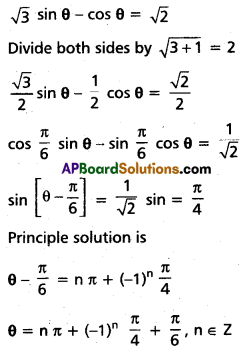
(i) √3 sin θ – cos θ = √2
Solution:
Inter 1st Year Maths 1A Trigonometric Equations Solutions Ex 7(a) II Q2(i)

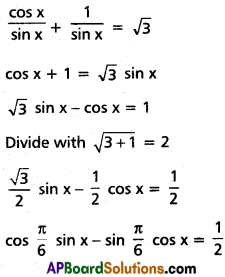
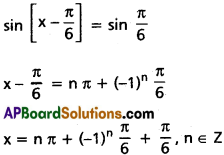
(ii) cot x + cosec x = √3
Solution:
Inter 1st Year Maths 1A Trigonometric Equations Solutions Ex 7(a) II Q2(ii)
Inter 1st Year Maths 1A Trigonometric Equations Solutions Ex 7(a) II Q2(ii).1

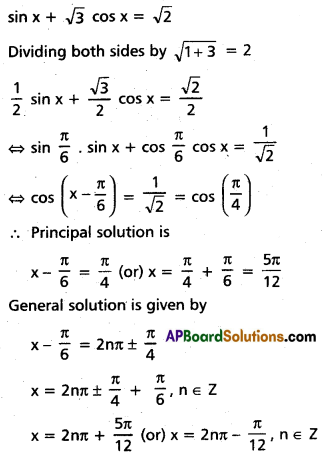
(iii) sin x + √3 cos x = √2
Solution:
Inter 1st Year Maths 1A Trigonometric Equations Solutions Ex 7(a) II Q2(iii)

Question 3.
Solve the following equations:
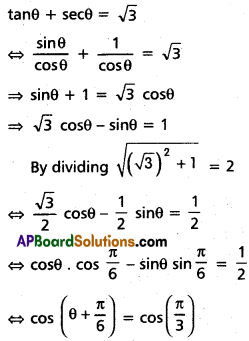
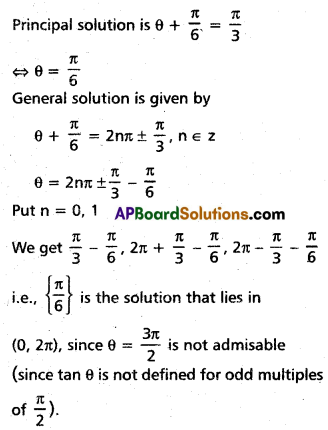
(i) tan θ + sec θ = √3, 0 ≤ θ ≤ 2π
Solution:
Inter 1st Year Maths 1A Trigonometric Equations Solutions Ex 7(a) II Q3(i)
Inter 1st Year Maths 1A Trigonometric Equations Solutions Ex 7(a) II Q3(i).1

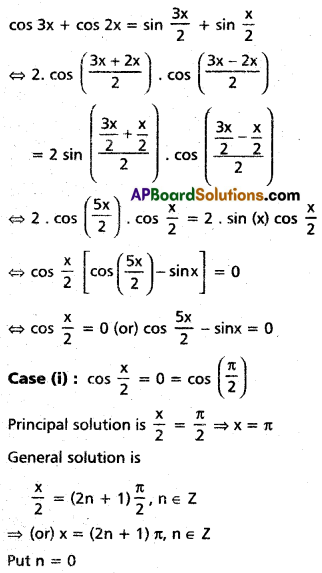
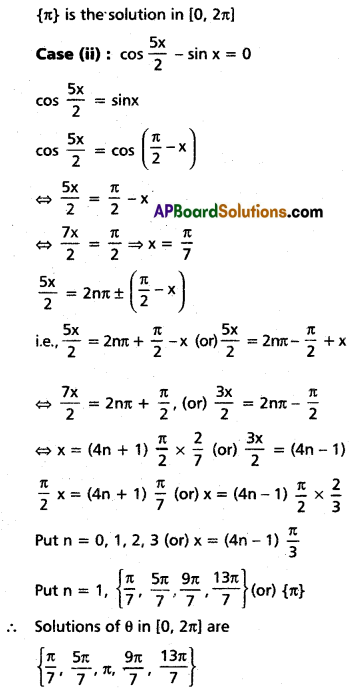
(ii) cos 3x + cos 2x = sin \(\frac{3 x}{2}\) + sin \(\frac{x}{2}\), 0 ≤ x ≤ 2π
Solution:
Inter 1st Year Maths 1A Trigonometric Equations Solutions Ex 7(a) II Q3(ii)
Inter 1st Year Maths 1A Trigonometric Equations Solutions Ex 7(a) II Q3(ii).1

(iii) cot2x – (√3 + 1) cot x + √3 = 0, 0 < x < \(\frac{\pi}{2}\)
Solution:
cot2x – (√3 + 1) cot x + √3 = 0
⇔ cot2x – √3 cot x – cot x + √3 = 0
⇔ cot x (cot x – √3) – 1(cot x – √3) = 0
⇔ cot x = √3 (or) cot x = 1
case (i): cot x = 1 ⇒ tan x = 1
∴ x = \(\left\{\frac{\pi}{4}\right\}\)
case (ii): cot x = √3 ⇒ tan x = \(\frac{1}{\sqrt{3}}\)
∴ x = \(\left\{\frac{\pi}{6}\right\}\)
∴ Solutions are \(\left\{\frac{\pi}{6}, \frac{\pi}{4}\right\}\)

Inter 1st Year Maths 1A Trigonometric Equations Solutions Ex 7(a)

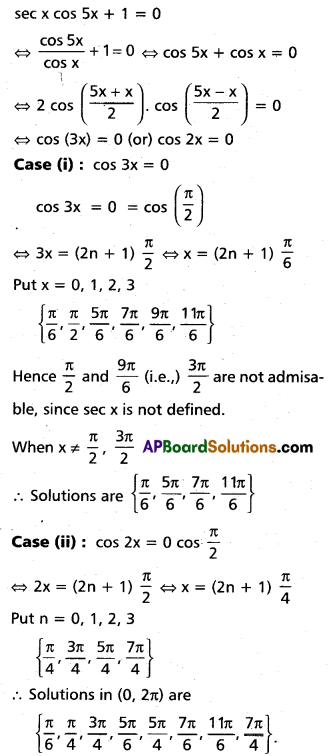
(iv) sec x . cos 5x + 1 = 0; 0 < x < 2π
Solution:
Inter 1st Year Maths 1A Trigonometric Equations Solutions Ex 7(a) II Q3(iv)

III.

Question 1.
(i) Solve sin x + sin 2x + sin 3x = cos x + cos 2x + cos 3x
Solution:
(sin 3x + sin x) + sin 2x = (cos 3x + cos x) + cos 2x
⇔ 2 . sin(\(\frac{3 x+x}{2}\)) . cos (\(\frac{3 x-x}{2}\)) + sin 2x = 2 . cos (\(\frac{3 x+x}{2}\)) . cos (\(\frac{3 x-x}{2}\)) + cos 2x
⇔ 2 sin 2x cos x + sin 2x = 2 cos 2x cos x + cos 2x
⇔ sin 2x (2 cos x + 1) = cos 2x (2 cos x + 1)
⇔ (2 cos x + 1) (sin 2x – cos 2x ) = 0
⇔ cos x = \(-\frac{1}{2}\) (or) sin 2x = cos 2x (i.e.,) tan (2x) = 1
Case (i):
cos x = \(-\frac{1}{2}\) = cos (\(\frac{2 \pi}{3}\))
Principal solution is x = \(\frac{2 \pi}{3}\)
and General solution is x = 2nπ ± \(\frac{2 \pi}{3}\), n ∈ z
Case (ii):
tan 2x = 1 = tan \(\frac{\pi}{4}\)
∴ Principal solution is 2x = \(\frac{\pi}{4}\) (i.e.,) x = \(\frac{\pi}{2}\)
General solution is 2x = nπ + \(\frac{\pi}{4}\), n ∈ z
⇒ x = \(\frac{\mathrm{n} \pi}{2}+\frac{\pi}{8}\), n ∈ Z
∴ General solution is \(\left.\left[\left\{2 n \pi \pm \frac{2 \pi}{3}\right\},\left\{\frac{n \pi}{2}+\frac{\pi}{8}\right\} / n \in Z\right\}\right]\)

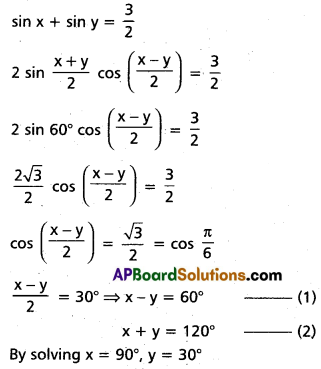
(ii) If x + y = \(\frac{2 \pi}{3}\) and sin x + sin y = \(\frac{3}{2}\), find x and y.
Solution:
Inter 1st Year Maths 1A Trigonometric Equations Solutions Ex 7(a) III Q1(ii)

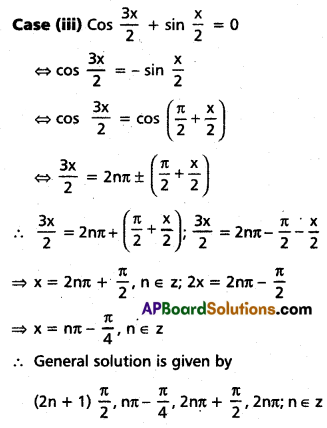
(iii) If sin 3x + sin x + 2 cos x = sin 2x + 2 cos2x, find the general solution.
Solution:
Given sin 3x + sin x + 2 cos x = sin 2x + 2 cos2x
⇒ 2 . sin (\(\frac{3 x+x}{2}\)) . cos (\(\frac{3 x-x}{2}\)) + 2 cos x = 2 sin x cos x + 2 cos2x
⇒ 2 . sin 2x . cos x + 2 cos x = 2 cos x (sin x + cos x)
⇒ 2 cos x (sin 2x + 1) = 2 cos x (sin x + cos x)
⇒ 2 cos x [sin 2x + 1 – sin x – cos x] = 0
⇒ cos x = 0 (or) sin 2x – sin x + 1 – cos x = 0
Inter 1st Year Maths 1A Trigonometric Equations Solutions Ex 7(a) III Q1(iii)
Inter 1st Year Maths 1A Trigonometric Equations Solutions Ex 7(a) III Q1(iii).1

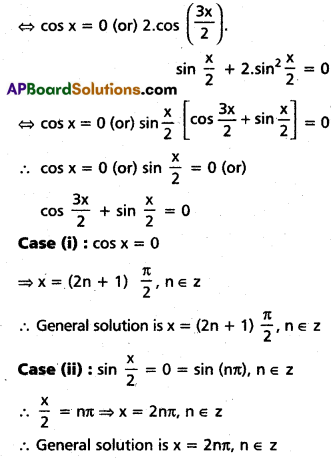
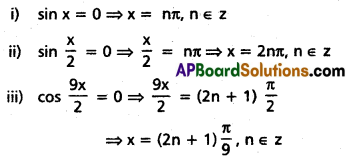
(iv) Solve cos 3x – cos 4x = cos 5x – cos 6x
Solution:
-2 sin 5x . sin x = -2 sin 4x . sin x
⇒ 2 sin x [sin 5x – sin 4x] = 0
⇒ 4 sin x . cos \(\frac{9 x}{2}\) . sin \(\frac{x}{2}\) = 0
Inter 1st Year Maths 1A Trigonometric Equations Solutions Ex 7(a) III Q1(iv)

Question 2.
Solve the following equations.
(i) cos 2θ + cos 8θ = cos 5θ
Solution:
cos 2θ + cos 8θ = cos 5θ
2 cos (\(\frac{2 \theta+8 \theta}{2}\)) cos (\(\frac{2 \theta-8 \theta}{2}\)) – cos 5θ = 0
2 cos 5θ . cos 3θ – cos 5θ = 0
cos 5θ (2 cos 3θ – 1) = 0
If cos 5θ = 0
Solution is 5θ = (2n + 1) \(\frac{\pi}{2}\)
θ = (2n + 1) \(\frac{\pi}{10}\), n ∈ z
If 2 cos 3θ – 1 = 0
cos 3θ = \(\frac{1}{2}\) = cos \(\frac{\pi}{3}\)
Solution is 3θ = 2nπ ± \(\frac{\pi}{3}\)
θ = \(\frac{2 n \pi}{3} \pm \frac{\pi}{9}\), n ∈ Z

(ii) cos θ – cos 7θ = sin 4θ
Solution:
-2 sin (\(\frac{\theta+7 \theta}{2}\)) sin (\(\frac{\theta-7 \theta}{2}\)) – sin 4θ = 0
2 sin 4θ sin 3θ – sin 4θ = 0
sin 4θ (2 sin 3θ – 1) = 0
If sin 4θ = 0
∴ Solution is 4θ = nπ
θ = \(\frac{n \pi}{4}\), n ∈ z
If 2 sin 3θ – 1 = 0
sin 3θ = \(\frac{1}{2}\) = sin \(\frac{\pi}{6}\)
Solution is 3θ = nπ + (-1)n \(\frac{\pi}{6}\)
θ = \(\frac{n \pi}{3}+(-1)^{n} \frac{\pi}{18}\), n ∈ z

Inter 1st Year Maths 1A Trigonometric Equations Solutions Ex 7(a)

(iii) sin θ + sin 5θ = sin 3θ, 0 < θ < π
Solution:
sin θ + sin 5θ = sin 3θ
sin θ + sin 5θ – sin 3θ = 0
sin θ + 2 cos (\(\frac{5 \theta+3 \theta}{2}\)) sin (\(\frac{5 \theta-3 \theta}{2}\)) = 0
sin θ + 2 cos 4θ . sin θ = 0
sin θ (1 + 2 cos 4θ) = 0
sin θ = 0, cos 4θ = \(\frac{-1}{2}\)
If sin θ = 0, solution is θ = nπ, n ∈ Z
If cos 4θ = \(\frac{-1}{2}\) = cos(\(\frac{2 \pi}{3}\))
Solution is 4θ = 2nπ ± \(\frac{2 \pi}{3}\)
θ = \(\frac{2 n \pi}{4} \pm \frac{2 \pi}{12}\), n ∈ Z
θ = \(\frac{n \pi}{2} \pm \frac{\pi}{6}\), n ∈ Z
Since 0 < θ < π
Then π = \(\frac{\pi}{6}, \frac{\pi}{3}, \frac{2 \pi}{3}, \frac{5 \pi}{6}\)

Question 3.
(i) If tan pθ = cot qθ and p ≠ -q show that the solutions are in A.P. with common difference \(\frac{\pi}{p+q}\)
Solution:
tan pθ = cot qθ = tan \(\frac{\pi}{2}\) – qθ
pθ = nπ + \(\frac{\pi}{2}\) – qθ
(p + q) θ = (2n + 1) \(\frac{\pi}{2}\)
θ = \(\frac{(2 n+1)}{p+q} \frac{\pi}{2}\), n is an integer
The Solutions \(\frac{\pi}{2(p+q)}, \frac{3 \pi}{2(p+q)}, \frac{5 \pi}{2(p+q)}\) + …………
∴ The solution form an Arithematical proportion With common difference \(\frac{2 \pi}{2(p+q)}=\frac{\pi}{p+q}\)

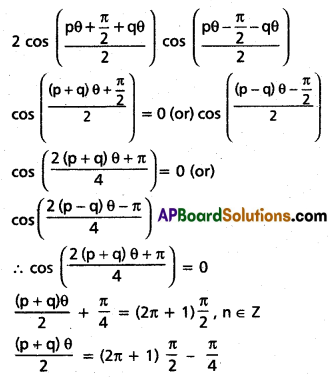
(ii) Show that the solutions of cos pθ = sin qθ form two series each of which is an A.P. Find also the common difference of each A.P. (p ≠ ±q).
Solution:
cos pθ = sin qθ
cos pθ – sin qθ = 0
cos pθ + \(\cos \left[\frac{\pi}{2}+9 \theta\right]\) = 0
Inter 1st Year Maths 1A Trigonometric Equations Solutions Ex 7(a) III Q3(ii)

(iii) Find the number of solutions of the equation tan x + sec x = 2 cos x; cos x ≠ 0, lying in the interival (0, π).
Solution:
tan x + sec x = 2 cos x
\(\frac{\sin x}{\cos x}+\frac{1}{\cos x}\) = 2 cos x
sin x + 1 = 2 cos2x
sin x + 1 = 2(1 – sin2x)
sin x + 1 = (2 – 2 sin2x)
2 sin2x + sin x – 1 = 0
2 sin2x + 2 sin x – sin x – 1 = 0
2 sin x (sin x + 1) – 1 (sin x + 1) = 0
(sin x + 1)(2 sin x – 1) = 0
sin x = -1 (or) sin x = \(\frac{1}{2}\)
If sin x = -1
x = \(\frac{-\pi}{2} \text { (or) } \frac{3 \pi}{2}\)
If sin x = \(\frac{1}{2}\)
x = \(\frac{\pi}{6} \text { (or) } \frac{5 \pi}{6}\)
In the interval (0, π)
Number of solutions = 2

(iv) Solve sin 3α = 4 sin α sin(x + α) sin(x – α) where α ≠ nπ, n ∈ Z
Solution:
3 sin α – 4 sin3α = 4 sin α (sin2x – sin2α)
Dividing with sin α
3 – 4 sin2α = 4 (sin2x – sin2α)
3 – 4 sin2α = 4 sin2x – 4 sin2α
4 sin2x = 3
2 sin2x = \(\frac{3}{2}\)
1 – cos 2x = \(\frac{3}{2}\)
cos 2x = \(-\frac{1}{2}=\cos \frac{2 \pi}{3}\)
2x = 2nπ ± \(\frac{2 \pi}{3}\), ∀ n ∈ Z
x = nπ ± \(\frac{\pi}{3}\), n ∈ Z

Inter 1st Year Maths 1A Trigonometric Equations Solutions Ex 7(a)

Question 4.
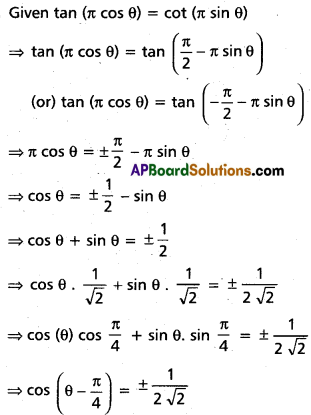
(i) If tan(π cos θ) = cot(π sin θ), then prove that \(\cos \left(\theta-\frac{\pi}{4}\right)=\pm \frac{1}{2 \sqrt{2}}\)
Solution:
Inter 1st Year Maths 1A Trigonometric Equations Solutions Ex 7(a) III Q4(i)

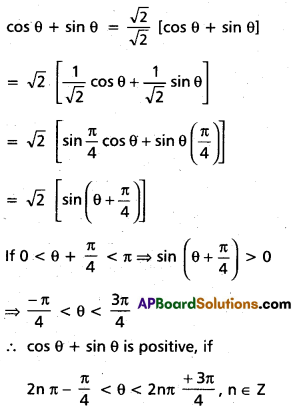
(ii) Find the range of θ if cos θ + sin θ is positive.
Solution:
Inter 1st Year Maths 1A Trigonometric Equations Solutions Ex 7(a) III Q4(ii)

Question 5.
If α, β are the solutions of the equation a cos θ + b sin θ = c, where a, b, c ∈ R and if a2 + b2 > 0, cos α ≠ cos β and sin α ≠ sin β, then show that
(i) sin α + sin β = \(\frac{2 b c}{a^{2}+b^{2}}\)
(ii) cos α + cos β = \(\frac{2 a c}{a^{2}+b^{2}}\)
(iii) cos α . cos β = \(\frac{c^{2}-b^{2}}{a^{2}+b^{2}}\)
(iv) sin α . sin β = \(\frac{c^{2}-a^{2}}{a^{2}+b^{2}}\)
Solution:
a cos θ = b sin θ = c
First write this as a quadratic equation in sin θ
⇔ a cos θ = c – b sin θ
By squaring on both sides, we get
a2 cos2θ = (c – b sin θ)2
⇔ a2 (1 – sin2θ) = c2 + b2 sin2θ – 2 bc sin θ
⇔ (a2 + b2) sin2θ – 2bc sin θ + (c2 – a2) = 0
It is a quadratic equation in sin θ,
It has sin α and sin β as roots since α and β are solutions for the given equation
(i) Sum of the roots = sin α + sin β = \(\frac{2 b c}{a^{2}+b^{2}}\)
Again a cos θ + b sin θ = c
Write this as a quadratic equation in cos θ
⇔ b sin θ = c – a cos θ
By squaring on both sides
⇔ b2 sin2θ = (c – a cos θ)2
⇔ b2(1 – cos2θ) = c2 + a2 cos2θ – 2 ca cos θ
⇔ (a2 + b2) cos2θ – 2 ca cos θ + (c2 – b2) = 0
It is a quadratic equation in cos θ. It has cos α, cos β be its roots.
(ii) Sum of the roots = cos α + cos β = \(\frac{2 c a}{a^{2}+b^{2}}\)
(iii) Product of the roots = cos α . cos β = \(\frac{c^{2}-b^{2}}{a^{2}+b^{2}}\)
(iv) Product of the roots = sin α . sin β = \(\frac{c^{2}-a^{2}}{a^{2}+b^{2}}\)

Inter 1st Year Maths 1A Trigonometric Equations Solutions Ex 7(a)

Question 6.
(i) Find the common roots of the equations cos 2x + sin 2x = cot x and 2 cos2x + cos22x = 1.
Solution:
Let tan x = A
Given that cos 2x + sin 2x = cot x
⇔ \(\frac{1-\tan ^{2} x}{1+\tan ^{2} x}+\frac{2 \tan x}{1+\tan ^{2} x}=\frac{1}{\tan x}\)
⇔ \(\frac{1-A^{2}}{1+A^{2}}+\frac{2 A}{1+A^{2}}=\frac{1}{A}\)
⇔ (1 – A2 + 2A) A = (1 + A2)
⇔ A – A3 + 2A2 = 1 + A2
⇔ A3 – A2 – A + 1 = 0
⇔ A = 1
A = 1 satisfy this equation
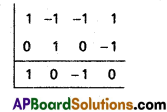
Inter 1st Year Maths 1A Trigonometric Equations Solutions Ex 7(a) III Q6(i)
∴ A3 – A2 – A + 1 = 0
⇔ (A – 1) (A2 – 1) = 0
⇔ (A – 1) (A – 1) (A + 1) = 0
⇔ A = 1, A = -1
∴ tan x = ±1
⇒ x = (2n + 1) \(\frac{\pi}{4}\), n ∈ z
Given 2 cos2x + cos2 2x = 1
⇔ (2 cos2x – 1) + cos2(2x) = 0
⇔ cos 2x + cos2(2x) = 0
⇔ cos 2x (1 + cos 2x) = 0
⇔ cos 2x = 0 (or) cos 2x = -1
Case (i): cos 2x = 0
⇔ 2x = (2n + 1) \(\frac{\pi}{2}\)
∴ x = (2n + 1) \(\frac{\pi}{4}\), n ∈ z
∴ (2n + 1) \(\frac{\pi}{4}\), n ∈ z is the common root for the given two trigonometric equations.

(ii) Solve the equation \(\sqrt{6-\cos x+7 \sin ^{2} x}+\cos x=0\)
Solution:
\(\sqrt{6-\cos x+7 \sin ^{2} x}+\cos x=0\)
6 – cos x + 7 sin2x ≥ 0
⇒ 7(1 – cos2x) – cos x + 6 ≥ 0
⇒ 7 – 7 cos2x – cos x + 6 ≥ 0
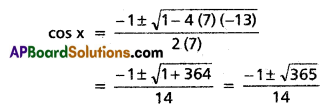
⇒ 7 cos2x + cos x – 13 ≤ 0
Consider 7 cos2x + cos x – 13 = 0
Inter 1st Year Maths 1A Trigonometric Equations Solutions Ex 7(a) III Q6(ii)
cos x values do not lie in [-1, 1]
Hence the given equation has no solution.

(iii) If |tan x| = tan x + \(\frac{1}{\cos x}\) and x ∈ [0, 2π], find the value of x.
Solution:
Case (i):
|tan x| = tan x, if x lies either in I (or) in III quadrant
Then |tan x| = tan x + \(\frac{1}{\cos x}\)
⇒ tan x = tan x + sin x
⇒ sec x = 0 which is impossible, since sec x ∉ (-1, 1)
Case (ii):
|tan x| = -tan x, if x lies in II & IV quadrants
Then |tan x| = tan x + \(\frac{1}{\cos x}\)
⇒ -tan x = tan x + sec x
⇒ -2 tan x = sec x
⇒ \(-2 \frac{\sin x}{\cos x}-\frac{1}{\cos x}\) = 0
⇒ -2 sin x – 1 = 0
⇒ sin x = \(\frac{-1}{2}=\sin \left(\frac{-\pi}{6}\right)=\sin \left(2 \pi-\frac{\pi}{6}\right)\)
∴ x = \(\frac{11 \pi}{6}\)

AP Inter 1st Year Botany Study Material Chapter 11 Cell Cycle and Cell Division

Andhra Pradesh BIEAP AP Inter 1st Year Botany Study Material 11th Lesson Cell Cycle and Cell Division Textbook Questions and Answers.

AP Inter 1st Year Botany Study Material 11th Lesson Cell Cycle and Cell Division

Very Short Answer Questions

Question 1.
Between a Prokaryote and a eukaryote, which cell has a shorter cell division time?
Answer:
Prokaryotic cell.

Question 2.
Among Prokaryotes and eukaryotes, which one has a shorter duration of a cell cycle?
Answer:
Prokaryotic cell.

Question 3.
Which of the phases of the cell cycle is of the longest duration?
Answer:
Interphase.

Question 4.
Which tissue of animals and plants exhibits Meiosis?
Answer:
Meiosis occurs in diploid cells.

Question 5.
Given that the average duplication time of E.coli is 20 minutes. How much time will two E.coli cells take to become 32 cells?
Answer:
80 minutes.

Question 6.
Which part of the human body should one use to demonstrate stages in Mitosis?
Answer:
Cells lining the Gut and skin cells.

AP Inter 1st Year Botany Study Material Chapter 11 Cell Cycle and Cell Division

Question 7.
What attributes does a chromatid require to be classified as a chromosome?
Answer:
Each chromosome at Metaphase split and the two daughter chromatids now referred to as chromosoms.

Question 8.
Which of the four chromatids of a bivalent at prophase-I of Meiosis can involve in cross-over?
Answer:
Crossing over occurs between non-sisters chromatids of the homologous chromosomes.

Question 9.
If a tissue has at a given time 1024 cells. How many cycles of Mitosis had the original parental single cell undergone?
Answer:
10 Mitotic divisions.

Question 10.
An anther has 1200 pollen grains. How many pollen mother cells must have been there to produce them?
Answer:
300.

Question 11.
At what stage of cell cycle does DNA synthesis occur?
Answer:
‘S’ phase (synthesis phase).

Question 12.
It is said that one cycle of cell division in human cells, (Eukaryotic cells) take 24 hours. Which phase of the cycle, do you think occupies the maximum part of cell cycle?
Answer:
Interphase.

Question 13.
It is observed that heart cells do not exhibit cell-divisjon. Such cells do not divide further and exit phase to enter an inactive stage called of cell cycle. Fill in the blanks.

AP Inter 1st Year Botany Study Material Chapter 11 Cell Cycle and Cell Division

Question 14.
Identify the sub stages of Prophase n I in Meiosis in which synapse and desynapse are formed?
Answer:
Synthesis occurs in ‘zygotene’ a sub phase of Prophase I of Meiosis -I
Desynapse occurs in ‘diakinesis’ a sub phase of prophase I of Meiosis -I
G1 Phase. Quiescent stage (G0).

Question 15.
Name the stage of Meiosis in which actual reduction in chromosome number occurs.
Answer:
Anaphase – II

Question 16.
Mitochondria and plastids have their own DNA (genetic material). What is their fate during nuclear division like Mitosis?
Answer:
Mitochondria and plastids get distributed between the two daughter cells.

Question 17.
A cell has 32 chromosomes. It undergoes mitotic division. What will be the chromosome number during Metaphase? What would be the DNA content (c) during anaphase?
Answer:
32 chromosomes. The DNA content during anaphase gets doubled.

Question 18.
The following events occur during the various phases of the cell cycle. Fill the blanks with suitable answer against each.
a) Disintegration of Nuclear Membrane
b) Appearance of Nucleolus
c) Division of centromere
d) Replication of DNA
Answer:
a) Prophase
b) Telophase
c) Anaphase
d) S-Phase

Question 19.
While examining the Mitotic stage in a tissue, one finds some cells with 16 chromosomes and some with 32 chromosomes. What possible reasons could you give to this difference in chromosome number ? Do you think cells with 16 chromosomes could have arisen from cells with 32 chromosomes or vice versa?
Answer:
In cells with 16 chromosomes Mitosis is over, in cells with 32 chromosomes, Mitosis is not started. No. Cells with 16 chromosomes have not arisen from the cells with 32 chromosomes.

Question 20.
Two key events take place during S phase in animal cells. DNA replication and duplication of Centriole. In which parts of the cell do these events occur?
Answer:
Nucleus, Cytoplasam.

AP Inter 1st Year Botany Study Material Chapter 11 Cell Cycle and Cell Division

Question 21.
Name a cell that is found arrested in diplotene stage for months and years. Comment in two or three sentences how it complete cell cycle?
Answer:
Oocytes of some vertebrates.

Short Answer Type Questions

Question 1.
In which phase of meiosis are the following formed? Choose the answers from hint points given below,
a) synaptonermal complex
b) Recombination nodules
c) Appearance / activation of a Enzyme recombinase
d) Termination of chliasmata
e) Interkinesis
f) Formation of dyad of cells.
Hints :
1) Zygotene
2) Pachytene
3) Pachytene
4) Diakinesis
5) After Telophase I / before Meiosis II
6) /Telophase I / After Meiosis I
Answer:
a) Synaptonemal complex = Zygotene
b) Recombination nucleus = Pachytene
c) Appearance / activation of = Pachytene Enzyme recombinase
d) Termination of chaismata = Diakinesis
e) Interkinesis = The stage between the two meiotic divisions (After telophase I / before meiosis II)
f) Formation of dyad of cells = Telophase I / After meiosis I.

Question 2.
Mitosis results in producing two cells which are similar to each other. What would be the consequence if each of the following irregularities occurs during Mitosis?
a) Nuclear membrane fails to disintegrate
b) Duplication of DNA does not occurs.
c) Centromeres do not divide
d) Cytokinesis does not occur.
Answer:
a) Nuclear membrane fails to disintegrate : The nuclear divisions takes place.
b) Duplication of DNA does not occurs : Of two daughter cells, one cannot get DNA.
c) Centromers do not divide : Chromosomes are not distributed to daughter cells.
d) Cytokinesis does not occur : Multinucleate condition arises leading to the formation of syneytium (liquid endoplasm of coconut).

Question 2.
Describe the events of prophase – I
Answer:
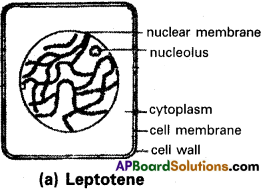
Meiosis I is longer phase and consists of 5 sub phases namely Leptotene, Zygotene, Pachytene, Diplotene and Diakinesis.
AP Inter 1st Year Botany Study Material Chapter 11 Cell Cycle and Cell Division 1
a) Leptotene :
The nucleus increases in size by absorbing water from the cytoplasm. The chromatin material organises into a constant number of chromosomes. The chromosomes are long, slender and show bead like structures called chromomeres.

AP Inter 1st Year Botany Study Material Chapter 11 Cell Cycle and Cell Division 2
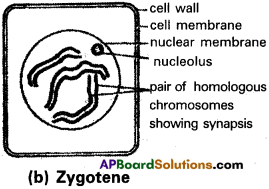
b) Zygotene :
The chromosomes become shorter and thicker. They approach each other and form pairs. This homologous pair is called bivalent and the process of pairing is called synapsis. It is accompanied by the formation of Synaptonemal complex. The synapsis occurs at proterminal point or procentric or random means.

AP Inter 1st Year Botany Study Material Chapter 11 Cell Cycle and Cell Division 3
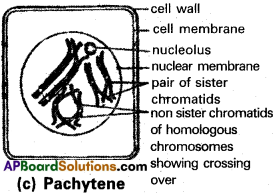
c) Pachytene :
Bivalent chromosomes now clearly appear as tetrads. This stage is characterised by the presence of recombination modules, the sites of which crossing over occurs between the non-sister chromatids of the homologous chromosomes. Crossing – over is the exchange of genetic material between the two homologous chromosomes. It is also an enzyme mediated process by ‘recombinase’ crossing over leads to recombination of genetic material on the two chromosomes.

AP Inter 1st Year Botany Study Material Chapter 11 Cell Cycle and Cell Division 4
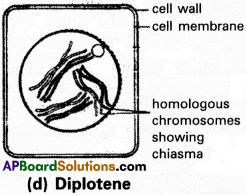
d) Diplotene :
The homologous chromosomes of a bivalent begin to separate from each other except at the sites of cross overs to dissolution of synaptonemal complex. The ‘X’ shaped structures are called chaismata.

AP Inter 1st Year Botany Study Material Chapter 11 Cell Cycle and Cell Division 5
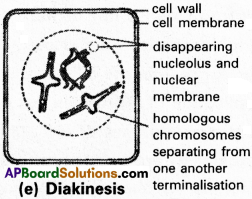
e) Diakinesis :
It is marked by terminalisation of chaismata. In this phase, the chromosomes are fully condensed and the meiotic spindle is assembled to prepare the homologous chromosomes for separation. By the end of this phase, the nuclear membrane breaks down the nucleolus disappears.

The chromatids undergo condensation, contraction and thickening.

Question 4.
Mention the significance of Meiosis.
Answer:

  1. It maintains the same chromosome number in the sexually reproducing organisms.
  2. It restricts the multiplication of chromosome number and maintains the stability of the species.
  3. Maternal and paternal genes get exchanged during crossing over. It results in variations among the offspring.
  4. All the four chromatids of homologous pair of chromosomes seggregate and go over separately to four different daughter cells this leads to variation in the daughter cells genetically.
  5. Variations play an important role in the process of evolution.

AP Inter 1st Year Botany Study Material Chapter 11 Cell Cycle and Cell Division

Question 5.
Which division is necessary to maintain constant chromosome number in all body cell of multicellular organism and why?
Answer:
Mitosis is necessary to maintain constant number of chromosomes in all body cells in multicellular organisms because mitosis results in the production of diploid daughter cells with genetic employment usually identical to that of the parent cell. The growth of multicellular organisms is due to mitosis. Cell growth results in distributing the ratio between the nucleus and cytoplasam.

It therefore essential for the cell division to restore the nucleo-cytoplasamic ratio. A very significant contribution of mitosis is cell repair. Mitotic divisions in the meristametic tissues, the apical and the lateral Meristems, results in a continuous growth of plants throughout their life.

Question 6.
Though redundantly described as a resting phase. Interphase does not really involve rest. Comment.
Answer:
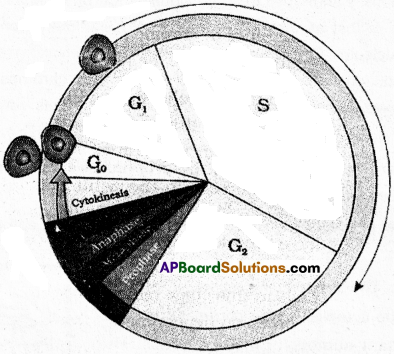
The interphase also called phase of non-apparent division through called the resting phase is the time during which the cell is preparing for division by involving both cell growth and DNA replication. The interphase is divided into three further phases. They are :

i) ‘G1‘ phase :
It corresponds to the internal between mitosis and initiation of DNA replication. In this the cell is metobolically active and continuously grows.

ii) ‘S’ phase :
Synthesis phase marks the period during which DNA synthesis or replication takes place. The amount of DNA per cell doubles. However, there is no increase in the number of chromosomes.

iii) ‘G2‘ phase :
Proteins are synthesized.
AP Inter 1st Year Botany Study Material Chapter 11 Cell Cycle and Cell Division 6

Question 7.
Comment on the statement – Meiosis enables the conservation of specific chromosome number of each species even though the process per se. results in reduction of chromosome number.
Answer:
Meiosis is the mechanism by which conservation of specific chromosome number in each species is achieved across generations in sexually reproducing organisms, even though the process per sec periodically results in the reproduction of chromosome number by half. It also increases the genetic variability in the population of organisms from one generation to the next. Variations are very important for the process of evolution.

Question 8.
How does cytokinesis in plant cells differ from that in animal cells?
Answer:
In animal cells, cytokineis is achieved by the appearence of a furrow in the plasma membrane. The furrow gradually deepens and ultimately joins in the centre dividing the cell cytoplasam into two plant cells, are enclosed by a relatively inextensible cell wall. In plant cells, wall fromation starts in the centre of the cell and grows outward to meet the exiting lateral walls. The formation of the new cell wall begins with the formation of cell plate that represents the middle lamella between the walls of two adjacent cells.

Long Answer Type Questions

Question 1.
Discuss on the statement – Telophase is reverse of prophase.
Answer:
Telophase is the final stage of Mitosis in which the chromosomes that have reached their respective poles decondenses and loose their individuality. Chromosomes cluster at opposite spindle poles and their identity is lost as discrete elements. Nuclear membrane assimilates around the chromosome clusters. Nucleolus, Golgi complex and endoplasmic reticulum reform where as in prophase, chromosomal material condenses and organises to form compact chromosomes. Nuclear membrane, Nucleolus, Golgi complexes. Endoplasmic reticulum disappears. Thats why Telophase is the reverse phase to prophase.

Question 2.
What are the various stages of meiotic prophase – I? Enumerate the chromosomal events during each stage?
Answer:
Meiosis I is longer phase and consists of 5 sub phases namely Leptotene, Zygotene, Pachytene, Diplotene and Diakinesis.

AP Inter 1st Year Botany Study Material Chapter 11 Cell Cycle and Cell Division 1
a) Leptotene :
The nucleus increases in size by absorbing water from the cytoplasm. The chromatin material organises into a constant number of chromosomes. The chromosomes are long, slender and show bead like structures called chromomeres.

AP Inter 1st Year Botany Study Material Chapter 11 Cell Cycle and Cell Division 2
b) Zygotene :
The chromosomes become shorter and thicker. They approach each other and form pairs. This homologous pair is called bivalent and the process of pairing is called synapsis. It is accompanied by the formation of Synaptonemal complex. The synapsis occurs at proterminal point or procentric or random means.

AP Inter 1st Year Botany Study Material Chapter 11 Cell Cycle and Cell Division 3
c) Pachytene :
Bivalent chromosomes now clearly appear as tetrads. This stage is characterised by the presence of recombination modules, the sites of which crossing over occurs between the non-sister chromatids of the homologous chromosomes. Crossing – over is the exchange of genetic material between the two homologous chromosomes. It is also an enzyme mediated process by ‘recombinase’ crossing over leads to recombination of genetic material on the two chromosomes.

AP Inter 1st Year Botany Study Material Chapter 11 Cell Cycle and Cell Division 4
d) Diplotene :
The homologous chromosomes of a bivalent begin to separate from each other except at the sites of cross overs to dissolution of synaptonemal complex. The ‘X’ shaped structures are called chaismata. The chromatids undergo condensation, contraction and thickening.

AP Inter 1st Year Botany Study Material Chapter 11 Cell Cycle and Cell Division 5
e) Diakinesis :
It is marked by terminalisation of chaismata. In this phase, the chromosomes are fully condensed and the meiotic spindle is assembled to prepare the homologous chromosomes for separation. By the end of this phase, the nuclear membrane breaks down the nucleolus disappears.

Question 3.
Differentiate between the events of mitosis and meiosis.
Answer:

MitosisMeiosis
1. It occurs in both haploid and diploid organisms.1. It occurs only in diploid organisms.
2. It occurs in somatic cells.2. It occurs in the reproductive cells.
3. Nucleus divides once.3. Nucleus divides twice.
4. Daughter cells are identical.4. Daughter cells are not identical.
5. Two daughter cells are formed.5. Four daughter cells are formed.
6. Prophase is simple.6. Prophase is complicated and shows five sub-stages.
7. Pairing of chromosomes does not occur.7. Homologous chromosomes pair to form bivalents.
8. Both chaismata and crossing over are absent.8. Crossing over occurs between non¬sister chromatids and chiasmata are formed.
9. Centromeres undergo division in anaphase.9. Centromeres do not divide in anaphase-I, but divide in anaphase-II.
10. Daughter chromosomes move to the opposite poles.10. Bivalents are separated. They move to opposite pies.
11. The chromosome number of daughter nuclei is unchanged.11. The chromosome number of daughter nuclei is reduced to half.
12. Duration of time is less.12. Duration of time is more.

Question 4.
Write brief note on the following :
a) Synaptonemal complex b) Metaphase plate
Answer:
a) Synaptonemal complex :
The homologous chromosomes approach each other and form pairs called Bivalents and the process is called synapsis. The synapsis occurs at the both ends and progresses towards their centromeres called proterminal or the synapsis starts from their centromeres and the pairing progresses towards the end of the chromosomes called procentric or the pairing occurs at various points of homologous chromosomes called Randon synapsis. The paired homologous chromosomes are joined by a thick protein containing frame work called synaptonemal complex (Sc).Sc stabilizes the pairing of the homologous chromosomes and facilitates crossing over and recombination.

b) Metaphase plate :
Metaphase chromosome is made up of two sister chromatids’which were held together by the centromere. Small disc shaped structures at the surface of of the centromeres are called Kinetochores. These serve as the sites of attachment of spindle fibres to the chromosomes that are moved into centre of the cell. Hence all chromosomes lie at the equator with one chromatid of each chromosome connected by its kinetochore to spindle fibres from one pole and its sister chromatid connected by its kinetochore to spindle fibres from the opposite pole. It is called ‘Metaphase Plate’.

AP Inter 1st Year Botany Study Material Chapter 11 Cell Cycle and Cell Division

Question 5.
Write briefly the significance of mitosis and meiosis in multicellular organism.
Answer:
Significance of Mitosis :

  1. Growth in organisms is caused by Mitosis.
  2. The daughter cells formed by Mitosis are identical with the mother cell in characters. Hence it it important in conserving the genetic diversity of the organisms.
  3. In unicellular organisms, Mitosis help in reproduction.
  4. The old dead and decaying cells of body are replaced with the help of Mitosis.
  5. It is useful in regeneration of lost parts and for grafting in vegetative reproduction.

Significance of Meiosis :

  1. Meiosis helps in the maintenance of a constant chromosome number from one generation to the next.
  2. Due to crossing over, genetic recombinations are caused which help in the origin of new species and lead to evolution.
  3. It helps in the formation of gametes and is thus useful in sexual reproduction.

Intext Questions

Question 1.
Name a stain commonly used to colour chromosome.
Answer:
Giemsa strain is used.

Question 2.
Name the patholqgical condition when uncontrolled cell division occurs.
Answer:
Cancer.

Question 3.
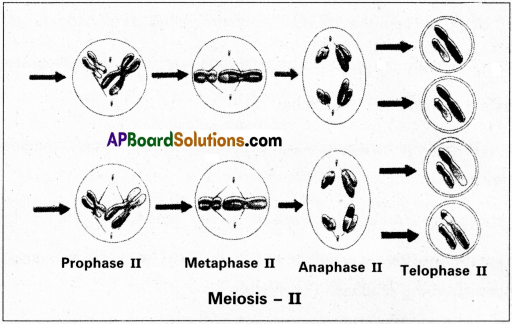
An organism has two parts of chromosomes (i.e., chromosome number = 4) Diagra-matically represent the chromosomal arrangement during different phases of Meiosis II.
Answer:
An organism has two pairs of chromosomes (i.e., chromosome number = 4) Diagrammatically represent the chromosomal arrangement during phases of meiosis – II.
AP Inter 1st Year Botany Study Material Chapter 11 Cell Cycle and Cell Division 7

Question 4.
Meiosis has events that lead to both gene recombinations as well as mendelian recombinations. Discuss.
Answer:
An organism often many phenotypic fruits in its body; are determined by at least pair of alleles (or) gener During the events of meiosis – I (crossing over) recombination events occur to pass different combination of chromosomes and consequently different combination of characters in both daughter cells.

The random assortment of the genes is due not only to crossing over but also to the random distribution of the chromosomes in first and second division. How ever, since this separation is a random process, the resulting cells will contain different chromosomal combinations even in the abscence of crossing over.

AP Inter 1st Year Botany Study Material Chapter 11 Cell Cycle and Cell Division

Question 5.
Both unicellular and multicellular organisms undergo mitosis. What are the differences if any observed between the two processes?
Answer:

  1. In unicellulars it is referred as binary fission and in multicellulars it is referred as mitosis.
  2. Mitosis allows unicellular organisms to reproduce and create more (identical) organisms.
  3. In unicellular only one cell undergoes mitosis whereas in multicellular all cells undergo mitosis.

AP Inter 1st Year Physics Study Material Chapter 10 Mechanical Properties of Solids

Andhra Pradesh BIEAP AP Inter 1st Year Physics Study Material 10th Lesson Mechanical Properties of Solids Textbook Questions and Answers.

AP Inter 1st Year Physics Study Material 10th Lesson Mechanical Properties of Solids

Very Short Answer Questions

Question 1.
State Hooke’s law of elasticity.
Answer:
“Within the elastic limit stress directly proportional to the strain”.
Stress ∝ strain
Stress = k × strain
k = \(\frac{\text { Stress }}{\text { Strain }}\)
Where k is the modulus of elasticity.

Question 2.
State the units and dimensions of stress.
Answer:

  1. Stress = \(\frac{\text { Force }}{\text { Area }}=\frac{F}{A}\)
    S.l units → N/m2 (or) Pascal
  2. Dimensional formula
    Stress = \(\frac{\mathrm{MLT}^{-2}}{\mathrm{~L}^2}\) = [ML-1T-2].

AP Inter 1st Year Physics Study Material Chapter 10 Mechanical Properties of Solids

Question 3.
State the units and dimensions of modulus of elasticity.
Answer:
Modulus of elasticity (k) = \(\frac{\text { Stress }}{\text { Strain }}\)
Units → N/m2 (or) Pascal
Dimensional formula → [ML-1T-2]

Question 4.
State the units and dimensions of Young’s modulus.
Answer:
Young’s modules (y) = \(\frac{\text { LongitudinalStress }}{\text { Longitudinal Strain }}=\frac{\frac{F}{A}}{\frac{e}{L}}\)
Units → N/m2 (or) Pascal
Dimensional formula → [ML-1T-2]

Question 5.
State the units and dimensions of modulus of rigidity.
Answer:
Modulus of rigidity (G) = \(\frac{F}{A \theta}=\frac{\text { Shearing Stress }}{\text { Shearing Strain }}\)
Units → N/m2 (or) Pascal
Dimensional formula → [ML-1T-2].

Question 6.
State the units and dimensions of Bulk modulus.
Answer:
Bulk modulus (B) = \(\frac{\text { Bulk Stress }}{\text { Bulk Strain }}=\frac{-P V}{\Delta V}\)
Units → N/m2 (or) Pascal
Dimensional formula → [ML-1T-2].

AP Inter 1st Year Physics Study Material Chapter 10 Mechanical Properties of Solids

Question 7.
State the examples of nearly perfect elastic and plastic bodies.
Answer:

  • Nearly perfect elastic bodies are quartz fibre.
  • Nearly perfect plastic bodies are dough and day.

Short Answer Questions

Question 1.
Define Hooke’s Law of elasticity, proportionality, permanent set and breaking stress.
Answer:
Hooke’s law : “With in the elastic limit stress is directly proportional to the strain”.
Stress ∝ strain
Stress = k × strain
Where k is modulus of elasticity.
Proportionality limit: The maximum stress developed in a body till it obeys Hookes law is called proportionality limit.
Permanent Set : Permanent deformation produced when a body is stretched beyond its elastic limit.
Breaking stress : The maximum stress a body can bear before it breaks.

Question 2.
Define modulus of elasticity, stress, strain and Poisson’s ratio.
Answer:
Modulus of elasticity : It is the ratio stress applied on a body to the strain produced in the body.
k = \(\frac{\text { Stress }}{\text { Strain }}\)
S.I unit → N/m2 (or) Pascal
Stress : When a body is subjected to an external force, the force per unit area is called stress.
Stress = \(\frac{\text { Force }}{\text { Area }}=\frac{F}{A}\)
S.I unit → N/m2 (or) Pascal
Strain : When deforming forces act on a body, the fractional deformation produced in the body. It has no units

Poisson’s ratio (σ) : The ratio between lateral strain to longitudinal strain of a body is called poisson’s ratio.
σ = \(\frac{\text { Lateral Strain }}{\text { Longitudinal Strain }}=\frac{\frac{-\Delta \mathrm{r}}{\mathrm{r}}}{\frac{\Delta \mathrm{L}}{\mathrm{L}}}\)

AP Inter 1st Year Physics Study Material Chapter 10 Mechanical Properties of Solids

Question 3.
Define Young’s modulus. Bulk modulus and Shear modulus.
Answer:
Young’s modulus (y) : With in the elastic limit, the ratio of longitudinal stress to longitudinal strain is called young’s modulus.
y = \(\frac{\text { Longitudinal Stress }}{\text { Longitudinal Strain }}=\frac{\frac{F}{A}}{\frac{e}{L}}\)
y = \(\frac{\mathrm{FL}}{\mathrm{A} \cdot \mathrm{e}}\)
S.I unit → N/m2 (or) Pascal

Bulk modulus (B) : With in the elastic limit, it is defined as the ratio of Bulk stress to Bulk strain
B = \(\frac{\text { Bulk Stress }}{\text { Bulk Strain }}\)
B = \(\frac{\frac{\mathrm{F}}{\mathrm{A}}}{\frac{-\Delta \mathrm{V}}{\mathrm{V}}}=\frac{-\mathrm{PV}}{\Delta \mathrm{V}}\) (∵ -ve sign indicates volume decreases)
S.I unit → N/m2 (or) Pascal

Rigidity modulus (G) : With in the elastic limit, it is defined as the ratio of shearing stress to shearing strain.
G = \(\frac{\text { Shearing Stress }}{\text { Shearing Strain }}\)
G = \(\frac{\frac{F}{A}}{\theta}=\frac{F}{A \theta}\)
S.I unit → N/m2 (or) Pascal

Question 4.
Define stress and explain the types of stress. [T.S. Mar. 16]
Answer:
Stress : The restoring force per unit area is called stress
∴ Stress = \(\frac{\text { Restoring Force }}{\text { Area }}=\frac{F}{A}\)
Stress is classified into three types.

  1. Longitudinal stress
  2. Volume (or) Bulk stress
  3. Tangential (or) shearing stress

1. Longitudinal stress (or) Linear stress : When a normal stress changes the length of a body, then it is called longitudinal stress.
Longitudinal stress = \(\frac{F}{A}\)

2. Volume (or) Bulk stress : When a normal stresschanges the volume of a body, then it is called volume stress.
Volume stress = \(\frac{\text { Force }}{\text { Area }}\) = pressure.

3. Tangential (or) shearing stress : When the stress is tangential to the surface due to the application of forces parallel to the surface, then the stress is called tangential stress.
Tangential stress = \(\frac{F}{A}\).

AP Inter 1st Year Physics Study Material Chapter 10 Mechanical Properties of Solids

Question 5.
Define strain and explain the types of strain.
Answer:
Strain : It is the ratio of change in dimension to its original dimension.
Strain = \(\frac{\text { Changes in dimension }}{\text { Original dimension }}\)
Strain is of three types.
1. Longitudinal strain : It is the ratio of change in length to its original length.
Longitudinal strain = \(\frac{\text { Changes in length }}{\text { Original length }}=\frac{e}{L}\)

2. Shearing strain (or) Tangential strain : When simultaneous compression and extension in mutually perpendicular direction takes place in a body, the change of shape it under goes, is called shearing strain.
AP Inter 1st Year Physics Study Material Chapter 10 Mechanical Properties of Solids 1
Shearing strain (θ) = \(\frac{1}{L}\)

3. Bulk (or) volume strain : It is the ratio of change in volume to its original volume is called bulk strain. It is called Bulk (or) volume strain.
Bulk strain = \(\frac{\text { Change in Volume }}{\text { Original Volume }}=\frac{\Delta V}{V}\)

Question 6.
Define strain energy and derive the equation for the same. [Mar. 14]
Answer:
The potential energy stored in a body when stretched is called strain energy.
Let us consider a wire of length L and cross – sectional area A. Let x be the change in length of the wire by the application of stretching force F.
AP Inter 1st Year Physics Study Material Chapter 10 Mechanical Properties of Solids 2
Strain energy per unit volume = \(\frac{1}{2} \times \frac{F}{A} \cdot \frac{x}{L}\)
= \(\frac{1}{2}\) × stress × strain.

AP Inter 1st Year Physics Study Material Chapter 10 Mechanical Properties of Solids

Question 7.
Explain why steel is preferred to copper, brass, aluminium in heavy-duty machines and in structural designs.
Answer:
The elastic behavior of materials plays an important role in everyday life. Designing of buildings, the structural design of the columns, beams and supports require knowledge of strength of material used. The elasticity of the material is due to stress developed with in the body, when extenal force acts on it. A material is of more elastic nature if it develops more stress (or) restoring force. Steel develops more stress than copper, brass, aluminium for same strain. So steel is more elastic.
y = \(\frac{\text { Stress }}{\text { Strain }}\)

Question 8.
Describe the behaviour of a wire under gradually increasing load. [A.P. – Mar. ’18, ’16, ’15; TS – Mar. ’18, ’15, ’13]
Answer:
When the load is increased in steps, a graph is drawn between stress on y-axis and corresponding strain on x-axis.
AP Inter 1st Year Physics Study Material Chapter 10 Mechanical Properties of Solids 3
1. Proportionality limit : In the linear position OA, stress is proportional to strain, i.e. Hookes law is obeyed by the wire upto point A. The graph is a straight lint. When ever the stretching force at A is removed, the wire regains its original length.
A is called proportionality limit.

2. Elastic limit : In the graph B is the elastic limit.
Through the wire doesnot obey Hooke’s law at B. The wire regains its original length after removing the stretching force at B. upto point B the wire is under elastic behaviour.

3. Permanent set (or) yield point: In the graph c is the yield point. If the stretching force at c is removed, the wire doesnot regain its original length and the length of the wire changes permanently. In this position the wire flows like a viscous liquid. After the point c, the wire is under plastic behavior, c is called permanent set (or) yield point.

4. Breaking point: When the stress increased, the wire becomes thinner and thinner. When the stress increases to a certain limit the wire breaks. The stress at which the wire breaks is called breaking stress and the point D is called breaking point.

5. Elastic fatigue : The state of temperary loss of elastic nature of a body due to continuous strain is called elastic fatigue. When a body is subjected to continuous strain with in the elastic limit, it appears to have lost Hastic property temporarily to some extent and becomes weak.

AP Inter 1st Year Physics Study Material Chapter 10 Mechanical Properties of Solids

Question 9.
Two identical solid balls, one of ivory and the other of wet-day are dropped from the same height onto the floor. Which one will rise to greater height after striking the floor and why ?
Answer:
Ivory ball rise to greater height after striking the floor. The ivory ball regain its original shape after striking the floor. The elastic property of ivory ball is more. Where as wet-day ball does not regain its original shape after striking the floor.

So wet-day ball acts like plastic body.

Question 10.
While constructing buildings and bridges a pillar with distributed ends is preferred to a pillar with rounded ends. Why ?
Answer:
Use of pillars (or) columns is also very common in buildings and bridges. A pillar with rounded ends supports less load than that with a distributed shape at the ends. The precise design of a bridge (or) a building has to take into account the conditions under which it will function, the cost and long period, reliability of usable materials.
AP Inter 1st Year Physics Study Material Chapter 10 Mechanical Properties of Solids 4

Question 11.
Explain why the maximum height of a mountain on earth is approximately 10 km ?
Answer:
The maximum height of a mountain on earth is 10 km, can also be provided by considering the elastic properties of rocks. A mountain base is not under uniform compression and this provides some shearing stress to rocks under which they can flow. The stress due to all the material on the top should be less than the critical shearing stress at which the rocks flow.

At the bottom of a mountain of height h, the force per unit area due to the weight of the mountain is hρg. Where ρ is the density of the mountain. The material at the bottom experiences this force in the vertical direction and the sides of the mountain are free.
There is a shear component, approximately hρg itself.
Elastic limit for 3 typical rock is 30 × 107 N/m2
hρg = 30 × 107 (ρ = 3 × 10³ kg/m3)
h = \(\frac{30 \times 10^7}{3 \times 10^3 \times 10}\)
h = 10 km.

AP Inter 1st Year Physics Study Material Chapter 10 Mechanical Properties of Solids

Question 12.
Explain the concept of Elastic Potential Energy in a stretched wire and hence obtain the expression for it.
Answer:
“When a wire is put under a tensile stress, work is done against the inter-atomic forces. The work is stored in the wire in the form of elastic potential energy”.

Expression for elastic potential energy : Consider a wire of length L and area of cross section A is subjected to a deforming force F along the length of the wire. Let the length of the wire is elongated by l.
Young’s modulus (y) = \(\frac{\mathrm{FL}}{\mathrm{Al}}\)
F = \(\frac{\mathrm{yAl}}{\mathrm{L}}\) ……………. (1)
Work done due to further elongation of small length dl
Work done (dw) = F × dl = (\(\frac{\mathrm{yAl}}{\mathrm{L}}\))dl ……………… (2)
Total work done in increasing the length of the wire from L to (L + l)
w = \(\int_0^1 \frac{\mathrm{yAl} }{\mathrm{L}} \mathrm{dl}=\frac{\mathrm{yA}}{2} \times \frac{l^2}{\mathrm{~L}}\)
w = \(\frac{1}{2} \times \mathrm{y} \times\left(\frac{l}{\mathrm{~L}}\right)^2 \times \mathrm{Al}\)
= \(\frac{1}{2}\) y × stress2 × volume of the wire
w = \(\frac{1}{2}\) × stress × strain × volume of the wire.
This work is stored in the wire in elastic potential energy (u).

Long Answer Question

Question 1.
Define Hooke’s law of elasticity and describe an experiment to determine the Young’s modulus of the material of a wire.
Answer:
Hooke’s law : With in the elastic limit, stress is directly proportional to the strain.
Stress ∝ strain
Stress = k × strain
Where k is modulus of elasticity.
Determination of young’s modulus of the material of a wire:
AP Inter 1st Year Physics Study Material Chapter 10 Mechanical Properties of Solids 5
Young’s Modulus of the Material of a wire

  1. It consists of two long straight wires of same length and same area of cross-section suspended side by side from a rigid .support.
  2. The wire A (reference wire) carries a metre scale M and a pan to place a weight.
  3. The wire B (experimental wire) carries a pan in which known weights can be placed.
  4. A vernier scale v is attached to a pointer at the bottom of the experimental wire B and the main scale M is fixed to the wire A.
  5. The weights placed in the pan, the elongation of the wire is measured by the vernier arrangement.
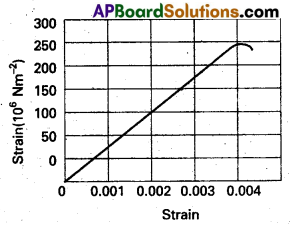
  6. The reference wire is used to compensate for any change in length that may occur due to change in room temperature.
  7. Both the reference and experimental wires are given an initial small load to keep the wires straight and the vernier reading is noted.
  8. Now the experimental wire is gradually loaded with more weights, the vernier reading is noted again.
  9. The difference between two vernier readings gives the elongation produced in the wire.
  10. Let r and L be the radius and initial length of the experimental wire. Let M be the mass that produced an elongation ∆L in the wire.
    Young’s modulus of the material of the experimental wire is given by
    y = \(\frac{\text { Longitudinal Stress }}{\text { Longitudinal Strain }}=\frac{\frac{\mathrm{F}}{\mathrm{A}}}{\frac{\Delta \mathrm{L}}{\mathrm{L}}}\)
    y = \(\frac{\mathrm{FL}}{\mathrm{A} \Delta \mathrm{L}}\)
    y = \(\frac{\mathrm{MgL}}{\pi r^2 \times \Delta \mathrm{L}}\)
    From above equation young’s modulus of the material of the wire is determined.

Problems

Question 1.
A copper wire of 1mm diameter is stretched by applying a force of 10 N. Find the stress in the wire.
Solution:
D = 1 m.m = 10-3m, r = \(\frac{D}{2}\) = 0.5 × 10⁻³ m.
F = 10 N
Stress = \(\frac{F}{A}=\frac{F}{\pi r^2}\)
= \(\frac{10}{3.14 \times\left(0.5 \times 10^{-3}\right)^2}\)
= 1.273 × 10⁷ N/m2.

AP Inter 1st Year Physics Study Material Chapter 10 Mechanical Properties of Solids

Question 2.
A tungsten wire of length 20 cm is stretched by 0.1 cm. Find the strain on the wire.
Solution:
L = 20 × 10-2 m, ∆L = 0.1 × 10⁻² m
Strain = \(\frac{\Delta \mathrm{L}}{\mathrm{L}}=\frac{0.1 \times 10^{-2}}{20 \times 10^{-2}}\) = 0.005.

Question 3.
If an iron wire is stretched by 1 %, what is the strain on the Wire ?
Solution:
Strain = \(\frac{\Delta \mathrm{L}}{\mathrm{L}}\) = 1 %
Strain = \(\frac{1}{100}\) = 0.01

Question 4.
A brass wire of diameter 1mm and length 2 m is streched by applying a force of 20N. If the increase in length is 0.51 mm. find
(i) the stress,
(ii) the strain and
(iii) the Young’s modulus of the wire.
Solution:
D = 1 m.m, r = \(\frac{D}{2}\) = 0.5 × 10⁻³ m
L = 2 m, F = 20 N, ∆L = 0.51 m.m = 0.51 × 10⁻³ m
AP Inter 1st Year Physics Study Material Chapter 10 Mechanical Properties of Solids 6
= 9.984 × 10¹⁰ N/m2

Question 5.
A copper wire and an aluminium wire have lengths in the ratio 3 : 2, diameters in the ratio 2 : 3 and forces applied in the ratio 4: 5. Find the ratio of increase in length of the two wires. (Ycu = 1.1 × 10¹¹ Nm-2, YAl = 0.7 × 10¹¹ Nm-2).
Solution:
AP Inter 1st Year Physics Study Material Chapter 10 Mechanical Properties of Solids 7
= \(\frac{4}{5} \times \frac{3}{2} \times\left(\frac{0.7 \times 10^{11}}{1.1 \times 10^{11}}\right) \times\left(\frac{3}{2}\right)^2\)
\(\frac{\Delta \mathrm{L}_1}{\Delta \mathrm{L}_2}=\frac{189}{110}\)

AP Inter 1st Year Physics Study Material Chapter 10 Mechanical Properties of Solids

Question 6.
A brass wire of cross-sectional area 2 mm2 is suspended from a rigid support and a body of volume 100 cm3 is attached to its other end. If the decrease in the length of the wire is 0.11 mm, when the body is completely immersed in water, find the natural length of the wire.
(Ybrass = 0.91 × 10¹¹ Nm-2, ρwater = 103 kg m-3).
Solution:
A = πr2 = 2 × 10⁻⁶ m2, V = 100 × 10-6 = 10-4 m3
∆L = 0.11 × 10⁻³ m, yBrass = 0.91 × 10¹¹ N/m2, ρ = 103 kg/m3
y = \(\frac{M g L}{A \times \Delta L}=\frac{v \rho g L}{A \times \Delta L}\)
L = \(\frac{\mathrm{yA} \Delta \mathrm{L}}{\mathrm{v \rho g}}=\frac{0.91 \times 10^{11} \times 2 \times 10^{-6} \times 0.11 \times 10^{-3}}{10^{-4} \times 10^3 \times 9.8}\)
L = 2.04 m.

Question 7.
There are two wires of same material. Their radii and lengths are both in the ratio 1:2. If the extensions produced are equal, what is the ratio of loads ?
Solution:
AP Inter 1st Year Physics Study Material Chapter 10 Mechanical Properties of Solids 8

Question 8.
Two wires of different material have same lengths and areas of cross¬section. What is the ratio of their increase in length when forces applied are the same ?
(Y1 = 0.9 × 10¹¹ Nm-2, Y2 = 3.6 × 10¹¹ Nm-2)
Solution:
y1 = 0.9 × 10¹¹ Nm-2
y2 = 3.6 × 10¹¹ Nm-2
y = \(\frac{F L}{A \times \Delta L}\)
∆L ∝ \(\frac{1}{y}\)
\(\frac{(\Delta L)_1}{(\Delta L)_2}=\frac{y_2}{y_1}=\frac{3.6 \times 10^{11}}{0.9 \times 10^{11}}=\frac{4}{1}\)

AP Inter 1st Year Physics Study Material Chapter 10 Mechanical Properties of Solids

Question 9.
A metal wire of length 2.5 m and area of cross-section 1.5 × 10⁻⁶ m2 is stretched through 2 mm. if its Young’s modulus is 1.25 × 10¹¹ N.m2, find the tension in the wire.
Solution:
L = 2.5 m, A = 1.5 × 10⁻⁶ m2
∆L = 2 × 10⁻⁹ m
y = 1.25 × 10¹¹ N.m2
y = \(\frac{\mathrm{FL}}{\mathrm{A} \Delta \mathrm{L}}\)
F = \(\frac{\mathrm{yA} \Delta \mathrm{L}}{\mathrm{L}}\)
= \(\frac{1.25 \times 10^{11} \times 1.5 \times 10^{-6} \times 2 \times 10^{-3}}{2.5}\)
F = 150 N

Question 10.
An aluminium wire and a steel wire of the same length and cross-section are joined end-to-end. The composite wire is hung from a rigid support and a load is suspended from the free end. If the increase in length of the composite wire is 1.35 mm, find the ratio of the
(i) stress in the two wires and
(ii) strain in the two wires.
(YAl = 0.7 × 10¹¹ N.m2, YSteel = 2 × 10¹¹ Nm2).
Solution:
YAl = 0.7 × 10¹¹ N.m2, YSteel = 2 × 10¹¹ Nm2
∆L1 + ∆L2 = 1.35 mm ……………… (1)
AP Inter 1st Year Physics Study Material Chapter 10 Mechanical Properties of Solids 9

Question 11.
A 2 cm cube of some substance has its upper face displaced by 0.15 cm due to a tangential force of 0.3 N while keeping the lower face fixed, Calculate the rigidity modulus of the substance.
Solution:
L = 2 × 10⁻² m, A = L2 = 4 × 10⁻⁴ m2
∆x = 0.15 × 10⁻² m
F = 0.3 N
G = \(\frac{\frac{F}{A}}{\frac{\Delta x}{L}}=\frac{F L}{A \Delta x}\) (∵ θ = \(\frac{\Delta x}{L}\))
G = \(\frac{0.3 \times 2 \times 10^{-2}}{4 \times 10^{-4} \times 0.15^6 \times 10^{-2}}\)
G = 104 N/m2

AP Inter 1st Year Physics Study Material Chapter 10 Mechanical Properties of Solids

Question 12.
A spherical ball of volume 1000 cm3 is subjected to a pressure of 10 Atmosphere. The change in volume is 10-2 cm3. If the ball is made of iron, find its bulk modulus.
(1 atmosphere = 1 × 10⁵ Nm-2).
Solution:
v = 1000 cm3 = 1000 × 10-6 = 10-3 m3
p = 1 atm = 1 × 105 = 105 N/m2
-∆v = 10-2 cm3 = 10-2 × 10-6 = 10-8 m3
Bulk modulus (B) = \(\frac{-p v}{\Delta v}\)
= \(\frac{10^5 \times 10^{-3}}{10^{-8}}\)
B = 1010 N/m2.

Question 13.
A copper cube of side of length 1 cm is subjected to a pressure of 100 atmosphere. Find the change in its volume if the bulk modulus of copper is 1.4 × 10¹¹ Nm-2. (1 atm = 1 × 10⁵ Nm-2).
Solution:
l = 1 cm = 10-2 m
V = Volume of the cube = l3 = 1cm3
= 10-6 m3
P = 100 atm = 100 × 105 = 107 N/m2
B = 1.4 × 10¹¹ N/m2
B = \(\frac{-P V}{\Delta V}\)
-∆V = \(\frac{P V}{B}=\frac{10^7 \times 10^{-6}}{1.4 \times 10^{11}}\)
-∆V = 0.7143 × 10⁻¹⁰ m3.

Question 14.
Determine the pressure required to reduce the given volume of water by 2%. Bulk modulus of water is 2.2 × 10⁹ Nm-2.
Solution:
\(\frac{-\Delta V}{V}\) = 2 % = \(\frac{2}{100}\)
B = 2.2 × 10⁹ Nm2
B = \(\frac{-P V}{\Delta V}\)
P = -B × \(\frac{\Delta V}{V}\)
= 2.2 × 10⁹ × \(\frac{2}{100}\)
P = 4.4 × 10⁷ N/m2.

AP Inter 1st Year Physics Study Material Chapter 10 Mechanical Properties of Solids

Question 15.
A steel wire of length 20 cm is stretched to increase its length by 0.2 cm. Find the lateral strain in the wire if the Poisson’s ratio for steel is 0.19.
Solution:
L = 20 cm = 20 × 10-2 m
∆L = 0.2 × 10⁻² m
σ = 0.19
σ = \(\frac{\text { Lateral strain }}{\text { Longitudinal strain }\left(\frac{\Delta \mathrm{L}}{\mathrm{L}}\right)}\)
Lateral strain = σ × \(\frac{\Delta L}{L}\)
= \(\frac{0.19 \times 0.2 \times 10^{-2}}{20 \times 10^{-2}}\)
= 0.0019

Additional Problems

Question 1.
A steel wire of length 4.7 m and cross-sectional area 3.0 × 10⁻⁵ m2 stretches by the same amount as a copper wire of length 3.5 m and cross-sectional area of 4.0 × 10⁻⁵ m2,
Solution:
Given, for steel wire, a1 = 3.0 × 10⁻⁵ m2, l1 = 4.7 m, ∆l1 = ∆l, F1 = F
For copper wire, a2 = 4.0 × 10⁻⁵ m2, l2 = 3.5 m, ∆l2 = ∆l, F2 = F .
Let y1, y2 be the young modulus of steel wire and copper wire respectively.
∴ y1 = \(\frac{F_1}{a_1} \times \frac{l_1}{\Delta l_2}=\frac{F}{3.0 \times 10^{-5}} \times \frac{4.7}{\Delta l}\) ………….. (i)
and y2 = \(\frac{F_2 \times l_2}{a_2 \times \Delta l_2}=\frac{F \times 3.2}{4 \times 10^{-5} \times \Delta l}\)
\(\frac{\mathrm{y}_1}{\mathrm{y}_2}=\frac{4.7 \times 4 \times 10^{-5}}{3.5 \times 3.0 \times 10^{-5}}\) = 1.8
Here y1 : y1 = 1.8 : 1.

Question 2.
Figure shows the strain-stress curve for a given material. What are (a) Young’s modulus and (b) approximate yield strength for this material ?
AP Inter 1st Year Physics Study Material Chapter 10 Mechanical Properties of Solids 10
Solution:
a) From graph, for stress = 150 × 106 Nm-2 the corresponding strain = 0.002
young’s modulus y = \(\frac{\text { Stress }}{\text { Strain }}=\frac{150 \times 10^6}{0.002}\)
= 7.5 × 10¹⁰ Nm-2

b) Approximate yeild strength will be equal to the maximum stress it can substain with out crossing the elastic limit. Therefore, the approximate yeild strength
= 300 × 106 Nm-2
= 3 × 10⁸ Nm-2

AP Inter 1st Year Physics Study Material Chapter 10 Mechanical Properties of Solids

Question 3.
The stress-strain graphs for materials A and B are shown in Fig.
AP Inter 1st Year Physics Study Material Chapter 10 Mechanical Properties of Solids 11
The graphs are drawn to the same scale.
a) Which of the materials has the greater Young’s modulus ?
b) Which of the two is the stronger material ?
Solution:
a) From the two graphs we note that for a given strain, stress for A is more than that of B. Hence young’s modulus (= stress/ strain) is greater for A than that of B.

b) A is stronger than B. Strength of a material is measured by the amount of stress required to cause fracture, corresponding to the point of fracture.

Question 4.
Read the following two statements below carefully and state, with reasons, if it is true or false.
a) The Young’s modulus of rubber is greater than that of steel;
b) The stretching of a coil is determined by its shear modulus.
Solution:
a) False, because for a given stress there is more strain in rubber than steel and modulus of elasticity is inversly proportional to strain.

b) True because the strecting of coil simply changes its shape without any change in the length of the wire used in the coil due to which shear modulus of elasticity is involved.

AP Inter 1st Year Physics Study Material Chapter 10 Mechanical Properties of Solids

Question 5.
Two wires of diameter 0.25 cm, one made of steel and the other made of brass are loaded as shown in Fig. The unloaded length of steel wire is 1.5 m and that of brass Wire is 1.0 m. Compute the elongations of the steel and the brass wires.
AP Inter 1st Year Physics Study Material Chapter 10 Mechanical Properties of Solids 12
Solution:
For steel wire, total force on steel wire,
F1 = 4 + 6 = 10 kg, f = 10 × 9.8 N
l1 = 1.5 m, ∆l1 = ?, 2r1 = 0.25cm or r1 =(0.25/2)cm = 0.125 × 10⁻² m
y1 = 2.0 × 10¹¹ pa
For brass wire, F2 = 6.0 kg, f = 6 × 9.8 N
2r2 = 0.25 cm or r2 = (0.25/2) cm = 0.125 × 10⁻² m,
y2 = 0.91 × 10¹¹ pa, l2 = 1.0 m, ∆l2 = ?
AP Inter 1st Year Physics Study Material Chapter 10 Mechanical Properties of Solids 13

Question 6.
The edge of an aluminium cube is 10 cm long. One face of the cube is firmly fixed to a verticle wall. A mass of 100 kdis then attached to the opposite face of the cube. The shear modulus of aluminium is 25 GPa. What is the vertical deflection of this face?
Solution:
A = 0.10 × 0.10 = 10-2 m2, F = mg = 100 × 10 N
Shearing strain = \(\frac{\Delta \mathrm{L}}{\mathrm{L}}=\frac{\left(\frac{\mathrm{F}}{\mathrm{A}}\right)}{\eta}\)
or ∆L = \(\frac{F L}{A \eta}\)
= \(\frac{(100 \times 10) \times(0.10)}{10^{-2} \times\left(25 \times 10^9\right)}\) = 4 × 10⁻⁷ m.

Question 7.
Four identical hollow cylindrical columns of mild steel support a big structure of mass 50,000 kg. The inner and outer radii of each column are 30 and 60 cm respectively. Assuming the load distribution to be uniform, calculate the corn pressional strain of each column.
Solution:
Load on each column, F = \(\frac{50,000}{4}\) kgwt
= \(\frac{50,000 \times 9.8}{4}\) N
A = π(r22 – r12) = \(\frac{22}{7}\)(0.60)2 – (0.30)2]
= \(\frac{22}{7}\) 0.27 m2
Compression strain = \(\frac{\frac{F}{A}}{y}=\frac{F}{A y}\)
= \(\frac{50,000 \times 9.8}{4 \times\left(\frac{22}{7} \times 0.27\right) \times 2.0 \times 10^{11}}\)
= 7.21 × 10⁻⁷.

AP Inter 1st Year Physics Study Material Chapter 10 Mechanical Properties of Solids

Question 8.
A piece of copper having a rectangular cross-section of 15.2 mm × 19.1 mm is pulled in tension with 44,500 N force, producing only elastic deformation. Calculate the resulting strain?
Solution:
Here, A = 15.2 × 19.2 × 10-6 m2, F = 44,
500 N, η = 42 × 109 Nm-2
Strain = \(\frac{\text { Stress }}{\text { Modulus of elasticity }}\)
= \(\frac{\frac{F}{A}}{\eta}=\frac{F}{A \eta}=\frac{44500}{\left(15.2 \times 19.2 \times 10^{-6}\right) \times 42 \times 10^9}\)
= 3.65 × 10⁻³.

Question 9.
A steel cable with a radius of 1.5 cm supports a chairlift at a ski area. If the maximum stress Is not to exceed 108 N m-2, what is the maximum load the cable can support ?
Solution:
Maximum load macimum stress × area of cross-section
= 108πr2
= 108 × \(\frac{22}{7}\) × (1.5 × 10⁻²)2
= 7.07 × 10⁴ N.

Question 10.
A rigid bar of mass 15 kg is supported symmetrically by three wires each 2.0 m long. Those at each end are of copper and the middle one is of iron. Determine the ratios of their diameters if each is to have the same tension.
Solution:
As each wire has same tension F, so each wire has same extansion due to mass of rigid bar. As each wire is of same length, hence each wire has same strain, if D is the diameter of wire, then
y = \(\frac{4 \mathrm{~F} / \pi \mathrm{D}^2}{\text { Strain }}\) or D2 ∝ 1/y
\(\frac{D_{\mathrm{cu}}}{\mathrm{D}_{\mathrm{iron}}}=\sqrt{\frac{\mathrm{y}_{\mathrm{iron}}}{\mathrm{y}_{\mathrm{cu}}}}\)
= \(\sqrt{\frac{190 \times 10^9}{110 \times 10^9}}=\sqrt{\frac{19}{11}}\) = 1.31.

AP Inter 1st Year Physics Study Material Chapter 10 Mechanical Properties of Solids

Question 11.
A 14.5 kg mass, fastened to the end of a steel wire of unstretched length 1.0 m, is whirled in a vertical circle with an angular velocity of 2 rev/s at the bottom of the circle. The cross-sectional area of the wire is 0.065 cm2. Calculate the elongation of the wire when the mass is at the lowest point of its path.
Solution:
Here, m = 14.5 kg, l = r = 1m, v = 2 rps, A = 0.065 × 10⁻⁴ m2
Total pulling force on mass, when it is at the lowest position of the vertical circle is
F = mg + mrω2
= mg + mr4πv2
= 14.5 × 9.8 + 14.5 × 1 × 4 × (\(\frac{22}{7}\))2 × 22
= 142.1 +2291.6
= 2433.7 N
y = \(\frac{F}{A} \times \frac{l}{\Delta l}\) or ∆l = \(\frac{F l}{A y}\)
= \(\frac{2433.7 \times 1}{\left(0.065 \times 10^{-4}\right) \times\left(2 \times 10^{11}\right)}\)
= 1.87 × 10⁻³ m
= 1.87 mm.

Question 12.
Compute the bulk modulus of water from the following data : Initial volume = 100.0 litre, Pressure increase = 100.0 atm (1 atm = 1.013 × 10⁵ Pa), Final volume = 100.5 litre. Compare the bulk modulus of water with that of air (at constant temperature). Explain in simple terms why the ratio is so large.
Solution:
Here, V = 100 lit = 100 × 10-3 m3, P = 100 atm = 100 × 1.013 × 105 Pa
V + ∆V = 100.5 litre or ∆V= (V + ∆V) – V
= 100.5 – 100
= 0.5 litre = 0.5 × 10⁻³ m3
We known that bulk modulus, B = \(\frac{\mathrm{PV}}{\Delta \mathrm{V}}\)
= \(\frac{100 \times 1.013 \times 10^5 \times 100 \times 10^{-3}}{0.5 \times 10^{-3}}\)
= 2.026 × 10⁹ Pa
Bulk modulus of air = 1.0 × 10⁵ Pa
\(\frac{\text { Bulk modulus of water }}{\text { Bulk modulus of air }}=\frac{2.026 \times 10^9}{1.0 \times 10^5}\)
= 2.026 × 10¹⁴.
It is so because gases are much more compressible than those of liquids. The molecules in gases are very poorly coupled to their neighbours as compared to those of gases.

AP Inter 1st Year Physics Study Material Chapter 10 Mechanical Properties of Solids

Question 13.
What is the density of water at a depth where pressure is 80.0 atm, given that its density at the surface is 1.03 × 10³ kg m-3 ?
Solution:
Here, P = 80.0 atm = 80.0 × 1.013 × 105 pa,
compressibility = \(\left(\frac{1}{B}\right)\) = 45.8 × 10⁻¹¹ pa-1
Density of water at surface,
ρ = 1.03 × 10³ kg m-3
Let p be the density of water at the given depth, if v and v’ are volumes of certain mass M of ocean water at surface and at a given
AP Inter 1st Year Physics Study Material Chapter 10 Mechanical Properties of Solids 14
Putting this value in (i) we get
1 – \(\frac{1.03 \times 10^3}{\rho^{\prime}}\) = 3.712 × 10⁻³ or
ρ’ = \(\frac{1.03 \times 10^3}{1-3.712 \times 10^{-3}}\) = 1.034 × 10³ kg m-3.

Question 14.
Compute the fractional change in volume of a glass slab, when subjected to a hydraulic pressure of 10 atm.
Solution:
Here, P = 10 atm = 10 × 1.013 × 105 pa,
B = 37 × 109 Nm-2
Volumetric strain = \(\frac{\Delta V}{V}=\frac{P}{B}\)
= \(\frac{10 \times 1.013 \times 10^5}{37 \times 10^9}\) = 2.74 × 10⁻⁵
∴ Fractional change in volume = \(\frac{\Delta V}{V}\)
= 2.74 × 10⁻⁵

AP Inter 1st Year Physics Study Material Chapter 10 Mechanical Properties of Solids

Question 15.
Determine the volume contraction of a solid copper cube, 10 cm on an edge, when subjected to a hydraulic pressure of 7.0 × 10⁶ Pa.
Solution:
Here, L = 10 cm = 0.10m; P = 7 × 10⁶ pa B = 140 Gpa = 140 × 109 pa
As B = \(\frac{\mathrm{PV}}{\Delta \mathrm{V}}=\frac{\mathrm{Pl}^3}{\Delta \mathrm{V}}\) or ∆V = \(\frac{\mathrm{Pl}^3}{\mathrm{~B}}\)
= \(\frac{\left(7 \times 10^6\right) \times(0.10)^3}{140 \times 10^9}\) = 5 × 10⁻⁸ m3
= 5 × 10⁻² mm3

Question 16.
How much should be pressure on a litre of water be changed to compress it by 0.10% ?
Solution:
Here, V = 1 litre = 10-3m3;
∆V/V = 0,10/100 = 10-3
B = \(\frac{P V}{\Delta V}\) or P = B \(\frac{\Delta V}{V}\)
= (2.2 × 109) × 10-3 = 2.2 × 10⁶pa

Question 17.
Anvils made of single crystals of diamond, with the shape as shown in Fig. are used to investigate behaviour of materials under very high pressures. Flat faces at the narrow end of the anvil have a diameter of 0.50 mm, and the wide ends are subjected to a compressional force of 50,000 N. What is the pressure at the tip of the anvil ?
AP Inter 1st Year Physics Study Material Chapter 10 Mechanical Properties of Solids 15
Solution:
Here, D = 0.5 mm = 0.5 × 10⁻³m = 5 × 10⁻⁴m
F = 50,000 N = 5 × 10⁴N
Pressure at the tip of anvil.
P = \(\frac{F}{\pi D^2 / 4}=\frac{4 F}{\pi D^2}\)
P = \(\frac{4 \times\left(5 \times 10^4\right)}{(22 / 7) \times\left(5 \times 10^{-4}\right)^2}\) = 2.5 × 10¹¹pa.

AP Inter 1st Year Physics Study Material Chapter 10 Mechanical Properties of Solids

Question 18.
A rod of length 1.05 m having negligible mass is supported at its end by two wires of steel (wire A) and aluminium (wire B) of equal lengths as shown in Fig. The cross-sectional areas of wires A and B are 1.0 mm2 and 2.0 mm2, respectively. At what point along the rod should a mass m be suspended in order to produce (a) equal stresses and (b) equal strains in both steel and aluminium wires.
AP Inter 1st Year Physics Study Material Chapter 10 Mechanical Properties of Solids 16
Solution:
For Steel wire A, l1 = l, A1 = 1 mm2
Y1 = 2 × 10¹¹Nm-2
For aluminium wire B, l2 = l;
A2 = 2mm2; y2 = 7 × 10¹⁰ Nm-2
a) Let mass m be suspended from the rod at the distance × from the end where wires A is connected. Let F1 and F2 be the tension in two wires and there is equal stress in two wires, then
\(\frac{F_1}{A_1}=\frac{F_2}{A_2} \text { or } \frac{F_1}{F_2}=\frac{A_1}{A_2}=\frac{1}{2}\) …………………. (i)
Taking moment of forces about the point of suspension of mass from the rod, we have
F1x = F2 (1.05 – x) or \(\frac{1.05-x}{x}=\frac{F_1}{F_2}=\frac{1}{2}\)
or 2.10 – 2x = x or x = 0.70m = 70 cm

b) Let mass m be supended from the rod at distance × from the end where wire A is connected. Let F1 and F2 be the tension in the wires and there is equal strain in the two wires i.e.
\(\frac{F_1}{A_1 Y_1}=\frac{F_2}{A_2 Y_2}\) or \(\frac{F_1}{F_2}=\frac{A_1}{A_2} \frac{Y_1}{Y_2}\)
= \(\frac{1}{2} \times \frac{2 \times 10^{11}}{7 \times 10^{10}}=\frac{10}{7}\)
As the rod is stationary, so F1x = F2(1.05 – x)
or \(\frac{1.05-x}{x}=\frac{F_1}{F_2}=\frac{10}{7}\)
or 10 x = 7.35 – 7x
or x = 0.4324 m
x = 43.2cm.

AP Inter 1st Year Physics Study Material Chapter 10 Mechanical Properties of Solids

Question 19.
A mild steel wire of length 1.0 m and cross-sectional area 0.50 × 10⁻² cm2 is stretched, well within its elastic limit, horizontally between two pillars. A mass of 100 g is suspended from the mid-point of the wire. Calculate the depression at the- mid-point.
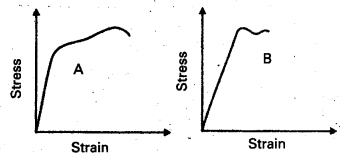
Solution:
Refer the figure, let x be the depression at the mid point i.e CD = x
In fig. AC = CB = Z = 0.5m
m = 100g = 0.100 kg
AD = BD = (l2 + x2)1/2
Increase in length, ∆l = AD + DB – AB
= 2 AD – AB
= 2 (l2 + x2)1/2 – 2l
= 2l(1 + \(\frac{x^2}{l^2}\))1/2 – 2l
= 2l (1 + \(\frac{x^2}{2 l^2}\)) – 2l = \(\frac{x^2}{l}\)
Strain = \(\frac{\Delta l}{2 l}=\frac{x^2}{2 l^2}\)
If T is the tension in the wire, then 2T cos θ
= mg or T = \(\frac{\mathrm{mg}}{2 \cos \theta}\)
AP Inter 1st Year Physics Study Material Chapter 10 Mechanical Properties of Solids 17
AP Inter 1st Year Physics Study Material Chapter 10 Mechanical Properties of Solids 18

Question 20.
Two strips of metal are riveted together at their ends by four rivets, each of diameter 6.0 mm. What is the maximum tension that can be exerted by the riveted strip if the shearing stress on the rivet is not to exceed 6.9 × 10⁷ Pa ? Assume that each rivet is to carry one quarter of the load.
Solution:
Here, r = 6/2 = 3mm = 3 × 10⁻³ m, max.
stress = 6.9 × 10⁷ Pa
Max . load on a rivet = Max stress × area of cross section
= 6.9 × 107 × (22/7) × (3 × 10-3)2
∴ Maximum tension
= 4 (6.9 × 10⁷ × \(\frac{22}{7}\) × 9 × 10⁻⁶)
= 7.8 × 10³N.

AP Inter 1st Year Physics Study Material Chapter 10 Mechanical Properties of Solids

Question 21.
The Marina trench is located in the Pacific Ocean, and at one place it is nearly eleven km beneath the surface of water. The water pressure at the bottom of the trench is about 1.1 × 10⁸ Pa. A steel ball of initial volume 0.32 m3 is dropped into the ocean and falls to the bottom of the trench. What is the change in the volume of the ball when it reaches to the bottom ?
Solution:
Here, P = 1.1 × 10⁸ Pa, V = 0.32 m3,
B = 16 × 1011Pa
∆V = \(\frac{\mathrm{PV}}{\mathrm{B}}\)
= \(\frac{\left(1.1 \times 10^8\right) \times 0.32}{1.6 \times 10^{11}}\)
= 2.2 × 10⁻⁴m3

Textual Examples

Question 1.
A structural steel rod has a radius of 10 mm and a length of 10 m. A 100 KN force stretches it along its length. Calculate (a) stress, (b) elongation, and (c) strain on the rod. Young’s modulus, of structural steel ¡s 2.0 × 10¹¹ Nm2.
Answer:
a) Given Stress = \(\frac{F}{A}=\frac{F}{\pi r^2}\)
= \(\frac{100 \times 10^3 \mathrm{~N}}{3.14 \times\left(10^{-2} \mathrm{~m}\right)^2}\) = 3.18 × 10⁸ Nm-2

b) The elongation
∆L = \(\frac{(\mathrm{F} / \mathrm{A}) \mathrm{L}}{\mathrm{Y}}\)
= \(\frac{\left(3.18 \times 10^8 \mathrm{Nm}^2\right)(1 \mathrm{~m})}{2 \times 10^{11} \mathrm{Nm}^{-2}}\)
= 1.59 × 10⁻³ m
= 1.59 mm

c) The strain is given by
Strain = ∆L/L = (1.59 × 10⁻³) km
= 1.59 × 10-3 = 0.16%

Question 2.
A copper wire of length 2.2 m and a steel wire of length 1.6 m, both of diameter 3.0 mm, are connected end to end. When stretched by a load, the net elongation is found to be 0.70 mm. Obtain the load applied.
Answer:
From y = \(\frac{\sigma}{\varepsilon}\)
we have stress = strain × Young’s modulus.
W/A = Yc × (∆Lc/Lc) = Ys × (∆Ls/Ls)
where the subscripts c and s refer to copper and stainless steel respectively,
∆Lc/∆Ls = (Ys/Ys) () (Lc/Ls)
Given Lc = 2.2 m, Ls = 1.6 m,
Yc = 1.1 × 10¹¹ N.m-2 and Ys = 2.0 × 10¹¹ N.m-2.
∆Lc/∆Ls = \(\frac{2.0 \times 10^{11}}{1.1 \times 10^{11}}=\frac{2.2}{1.6}\) = 2.5
∆Lc + ∆Ls = 7.0 × 10⁻⁴ m
Solving the above equations,
∆Lc = 5.0 × 10⁻⁴ m and ∆Ls = 2.0 × 10⁻⁴ m.
∴ W = (A × Yc × ∆Lc)Lc
= π(1.5 × 10⁻³)2 × \(\left[\frac{\left(5.0 \times 10^{-4} \times 1.1 \times 10^{11}\right)}{2.2}\right]\) = 1.8 × 10² N.

AP Inter 1st Year Physics Study Material Chapter 10 Mechanical Properties of Solids

Question 3.
In a human pyramid in a circus, the entire weight of the balanced group is supported by the legs of a performer who is lying on his back (as shown in Fig.) The combined mass of all the persons performing the act and the tables, planks etc. involved is 280 kg. The mass of the performer lying on his back at the bottom of the pyramid is 60 kg. Each thighbone (femur) of this performer has a length of 50 cm and an effective radius of 2.0 cm. Determine the amount by which each thighbone gets compressed under the extra load.
AP Inter 1st Year Physics Study Material Chapter 10 Mechanical Properties of Solids 19
Answer:
Total mass of all the performers, tables, plaques = 280 kg
Mass of the performer = 60 kg
Mass supported by the legs of the performer at the bottom of the pyramid = 280 – 60
= 220 kg
Weight of this supported mass = 220 kg wt.
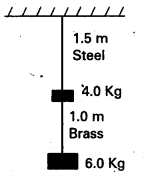
= 220 × 9.8 N = 2156 N
Weight supported by each thighbone of the performer = \(\frac{1}{2}\) (2156) N = 1078 N.
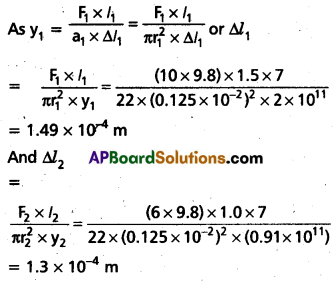
The Young’s modulus for bone is Y = 9.4 × 10⁹ Nm-2 (compressive)
Length of each thighbone L = 0.5 m the radius of thigbone = 2.0 cm
Thus the cross-sectional area of the thighbone
A = π × (2 × 10⁻²)2 m2
= 1.26 × 10⁻³ m2
Using \(\frac{(F \times L)}{(A \times \Delta L)}\) the compression in each thigbone (∆L) can be computed as
∆L = \(\frac{F \times L}{Y \times A}\)
= [(1078 × 0.5)/(9.4 9 × 109 × 1.26 × 10-3)]
= 4.55 × 10⁻⁵ m or 4.55 × 10⁻³ cm.
This is a very small change ! The fractional decrease in the thighbone is ∆L/L = 0.000091 or 0.0091%.

Question 4.
A square slab of side 50 cm and thickness 10 cm is subject to a shearing force (on its narrow face) of 9.0 × 10⁴ N. The lower edge is riveted to the floor. How much will the upper edge be displaced ?
Answer:
The area (A) = 50 cm × 10 cm
= 0.5 m × 0.1 m
= 0.05 m2
Therefore, the stress appIid is
= (9.4 × 10⁴N/0.05 m2)
= 1.80 × 10⁶ N.m2
We know that shearing strain = (∆x/L)
= Stress/G.
Therefore the displacement
∆x = (Stress × L)/G = \(\frac{\left(1.8 \times 10^6 \mathrm{Nm}^{-2} \times 0.5 \mathrm{~m}\right)}{5.6 \times 10^9 \mathrm{Nm}^{-2}}\)
= 1.6 × 10⁻⁴ m = 0.16 mm.

AP Inter 1st Year Physics Study Material Chapter 10 Mechanical Properties of Solids

Question 5.
The average depth of Indian Ocean is about 3000 m. Calculate the fractional compression. ∆V/V, of water at the bottom of the ocean, given that the bulk modulus of water is 2.2 × 10⁹ Nm-2. (Take g = 10 ms-2)
Answer:
The pressure exerted by a 3000 m column of water on the bottom layer
ρ = hρg
= 3000 m × 1000 kg m-3× 10 ms-2
= 3 × 10⁷ Nm-2
Fractional compression ∆V/V, is
∆V/V = stress \(\frac{\left(3 \times 10^7 \mathrm{Nm}^{-2}\right)}{2.2 \times 109 \mathrm{Nm}^{-2}}\)
= 1.36 × 10⁻² or 1.36%

Inter 1st Year Maths 1B Limits and Continuity Formulas

Use these Inter 1st Year Maths 1B Formulas PDF Chapter 8 Limits and Continuity to solve questions creatively.

Intermediate 1st Year Maths 1B Limits and Continuity Formulas

Right Limit :
Suppose f is defined on (a, b) and Z ∈ R. Given ε < 0 , there exists δ > 0 such that a < x < a + δ => |f(x) – l| < ε, then l is said to be the right limit of’ f’ at ‘a’.
It is denoted by \({Lt}_{x \rightarrow a+} f(x)\)f(x) = l

Left Limit :
Suppose ‘ f’ is defined on (a, b) and Z e R. Given e > 0, there exists δ > 0 such that a – δ < x < a ⇒ |f(x) – l| < ε, then l is said to be the left limit of’ f’ at ’a’ and is denoted by \({Lt}_{x \rightarrow a-} \dot{f(x)}\) = l

Suppose f is defined in a deleted neighbourhood of a and l ∈ R
\({Lt}_{x \rightarrow a} f(x)=l \Leftrightarrow \underset{x \rightarrow a+}{L t} f(x)={Lt}_{x \rightarrow a-} \quad f(x)=l\)

Standard limits:

  • \({Lt}_{x \rightarrow a} \frac{x^{n}-a^{n}}{x-a}\) = nan-1
  • \({Li}_{x \rightarrow 0} \frac{\sin x}{x}\) = 1 (x is in radians)
  • \({Lt}_{x \rightarrow 0} \frac{\tan x}{x}\) = 1
  • \({lt}_{x \rightarrow 0}(1+x)^{1 / x}\) = e
  • \({Lit}_{x \rightarrow 0}\left(1+\frac{1}{x}\right)^{x}\) = e
  • \({Lt}_{x \rightarrow 0}\left(\frac{a^{x}-1}{x}\right)\) = logea
  • \({Lt}_{x \rightarrow a} \frac{x^{n}-a^{n}}{x^{m}-a^{m}}=\frac{n}{m}\)an – m
  • \({Lt}_{x \rightarrow 0} \frac{\sin a x}{x}\) = a(x is in radians)
  • \({Lt}_{x \rightarrow 0} \frac{\tan a x}{x}\) = a(x is in radians)
  • \({Lt}_{x \rightarrow \infty}\left(1+\frac{p}{x}\right)^{Q x}\) = ePQ
  • \({lt}_{x \rightarrow 0} \frac{e^{x}-1}{x}\) = 1
  • \({Lt}_{x \rightarrow 0}(1+p x)^{\frac{Q}{x}}\) = ePQ

Intervals
Definition:
Let a, b ∈ R and a < b. Then the set {x ∈ R: a ≤ x ≤ b} is called a closed interval. It is denoted by [a, b]. Thus
Closed interval [a, b] = {x ∈ R: a ≤ x ≤ b}. It is geometrically represented by
Inter 1st Year Maths 1B Limits and Continuity Formulas 1

Open interval (a,b) = {x ∈ R: a < x < b} It is geometrically represented by
Inter 1st Year Maths 1B Limits and Continuity Formulas 2

Left open interval
(a, b] = {x ∈ R: a < x ≤ b}. It is geometrically represented by
Inter 1st Year Maths 1B Limits and Continuity Formulas 3

Right open interval
[a, b) = {x ∈ R: a ≤ x < b}. It is geometrically represented by
Inter 1st Year Maths 1B Limits and Continuity Formulas 4

[a, ∞) = {x ∈ R : x ≥ a} = {x ∈ R : a ≤ x < ∞} It is geometrically represented by
Inter 1st Year Maths 1B Limits and Continuity Formulas 5

(a, ∞) = {x ∈ R : x > a} = {x ∈ R : a < x < ∞}
Inter 1st Year Maths 1B Limits and Continuity Formulas 6

(-∞, a] = {x ∈ R : x ≤ a} = {xe R : -∞ < x < a}
Inter 1st Year Maths 1B Limits and Continuity Formulas 7

Neighbourhood of A Point: Definition: Let ae R. If δ > 0 then the open interval (a – δ, a + δ) is called the neighbourhood (δ – nbd) of the point a. It is denoted by Nδ (a) . a is called the centre and δ is called the radius of the neighbourhood .
∴ Nδ(a) = (a – δ, a + δ) = {x ∈ R: a – δ< x < a + δ} = {x ∈ R: |x – a| < δ}

The set Nδ(a) – {a} is called a deleted δ – neighbourhood of the point a.
∴ Nδ(a) – {a} = (a – δ, a) ∪ (a, a + δ) = {x ∈ R :0 < | x – a | < δ}
Note: (a – δ, a) is called left δ -neighbourhood, (a, a + δ) is called right δ – neighbourhood of a

Graph of A Function:
Inter 1st Year Maths 1B Limits and Continuity Formulas 8

Mod function:
The function f: R-R defined by f(x) = |x| is called the mod function or modulus function or absolute value function.
Dom f R. Range f [0, )
Inter 1st Year Maths 1B Limits and Continuity Formulas 9

Reciprocal function :
The function f: R – {0} – R defined by
f(x) = \(\frac{1}{x}\) is called the reciprocal function,
Dom f = R – {0}= Range f = R
Inter 1st Year Maths 1B Limits and Continuity Formulas 10

Identity function:
The function f R-R defined by f(x) = x is called the identity
It is denoted by I(x)
Inter 1st Year Maths 1B Limits and Continuity Formulas 11

Limit of A Function
Concept of limit:
Before giving the formal definition of limit consider the following example.
Let f be a function defined by f (x) = \(\frac{x^{2}-4}{x-2}\). clearly, f is not defined at x = 2.
When x ≠ 2, x – 2 ≠ 0 and f(x) = \(\frac{(x-2)(x+2)}{x-2}\) = x + 2

Now consider the values of f(x) when x ≠ 2, but very very close to 2 and <2.
Inter 1st Year Maths 1B Limits and Continuity Formulas 12

It is clear from the above table that as x approaches 2 i.e.,x → 2 through the values less than 2, the value of f(x) approaches 4 i.e., f(x) → 4. We will express this fact by saying that left hand limit of f(x) as x → -2 exists and is equal to 4 and in symbols we shall write \({lt}_{x \rightarrow 2^{-}} f(x)\) = 4

Again we consider the values of f(x) when x ≠ 2, but is very-very close to 2 and x > 2.
Inter 1st Year Maths 1B Limits and Continuity Formulas 13

It is clear from the above table that as x approaches 2 i.e.,x → 2 through the values greater than 2, the value of f(x) approaches 4 i.e., f(x) → 4. We will express this fact by saying that right hand
limit of f(x) as x → 2 exists and is equal to 4 and in symbols we shall write \({lt}_{x \rightarrow 2^{+}} f(x)\) = 4

Thus we see that f(x) is not defined at x = 2 but its left hand and right hand limits as x → 2 exist and are equal.
When \({lt}_{\mathrm{x} \rightarrow \mathrm{a}^{+}} \mathrm{f}(\mathrm{x}), \mathrm{lt}_{\mathrm{x} \rightarrow \mathrm{a}^{-}}^{\mathrm{f}(\mathrm{x})}\) are equal to the same number l, we say that \(\begin{array}{ll}
l_{x \rightarrow a} & f(x)
\end{array}\) exist and equal to 1.

Thus, in above example,
Inter 1st Year Maths 1B Limits and Continuity Formulas 14

One Sided Limits Definition Of Left Hand Limit:
Let f be a function defined on (a – h, a), h > 0. A number l1 is said to be the left hand limit (LHL) or left limit (LL) of f at a if to each
ε >0, ∃ a δ >0 such that, a – δ < x < a ⇒ |f (x) – l1| < ε.
In this case we write \(\underset{x \rightarrow a-}{L t} f(x)\) = l1 (or) \({Lt}_{x \rightarrow a-0} f(x)\) = l1

Definition of Right Limit:
Let f be a function defined on (a, a + h), h > 0. A number l 2is said to the right hand limit (RHL) or right limit (RL) of f at a if to each ε >0, ∃ a δ >0 such that, a – δ < x < a ⇒ |f (x) – l2| < ε.
In this case we write \(\underset{x \rightarrow a+}{L t} f(x)\) = l2 (or) \({Lt}_{x \rightarrow a+0} f(x)\) = l2

Definition of Limit:
Let A ∈ R, a be a limit point of A and
f : A → R. A real number l is said to be the limit of f at a if to each ε > 0, ∃ a δ > 0 such that x ∈ A, 0 < |x – a| < δ ⇒ | f(x) – l| < ε. In this case we write f (x) → 2 (or) \({Lt}_{x \rightarrow a} f(x)\) = l. Note: 1.If a function f is defined on (a – h, a) for some h > 0 and is not defined on (a, a + h) and if \(\underset{x \rightarrow a-}{{Lt}} f(x)\) exists then \({Lt}_{x \rightarrow a} f(x)={Lt}_{x \rightarrow a-} f(x)\).
2. If a function f is defined on (a, a + h) for some h > 0 and is not defined on (a – h, a) and if \(\underset{x \rightarrow a+}{{Lt}} f(x)\) exists then \({Lt}_{x \rightarrow a} f(x)={Lt}_{x \rightarrow a+} f(x)\).

Theorem:
If \({Lt}_{x \rightarrow a} f(x)\) exists then \({Lt}_{x \rightarrow a} f(x)={Lt}_{x \rightarrow 0} f(x+a)={Lt}_{x \rightarrow 0} f(a-x)\)

Theorems on Limits WithOut Proofs
1. If f : R → R defined by f(x) = c, a constant then \({Lt}_{x \rightarrow a} f(x)\) = c for any a ∈ R.

2. If f: R → R defined by f(x) = x, then \({Lt}_{x \rightarrow a} f(x)\) = a i.e., \({Lt}_{x \rightarrow a} f(x)\) = a (a ∈ R)

3. Algebra of limits
Inter 1st Year Maths 1B Limits and Continuity Formulas 15
vii) If f(x) ≤ g(x) in some deleted neighbourhood of a, then \({Lt}_{x \rightarrow a} f(x) \leq {Lt}_{x \rightarrow a} g(x)\)
viii) If f(x) ≤ h(x) < g(x) in a deleted nbd of a and \({Lt}_{x \rightarrow a} f(x)\) = l = \({Lt}_{x \rightarrow a} g(x)\) then \({Lt}_{x \rightarrow a} h(x)\) = l
ix) If \({Lt}_{x \rightarrow a} f(x)\) = 0 and g(x) is a bounded function in a deleted nbd of a then \({Lt}_{x \rightarrow a}\) f(x) g(x) = 0.

Theorem
If n is a positive integer then \({Lt}_{x \rightarrow a} x^{n}\) = an, a ∈ R

Theorem
If f(x) is a polynomial function, then \({Lt}_{x \rightarrow a}\)f(x) = f (a)

Evaluation of Limits:
Evaluation of limits involving algebraic functions.
To evaluate the limits involving algebraic functions we use the following methods:

  • Direct substitution method
  • Factorisation method
  • Rationalisation method
  • Application of the standard limits.

1. Direct substitution method:
This method can be used in the following cases:

  • If f(x) is a polynomial function, then \({Lt}_{x \rightarrow a}\)f(x) = f (a).
  • If f (x) = \(\frac{P(a)}{Q(a)}\) where P(x) and Q(x) are polynomial functions then \({Lt}_{x \rightarrow a}\)f(x) = \(\frac{P(a)}{Q(a)}\) provided Q(a) ≠ 0.

2. Factiorisation Method:
This method is used when \({Lt}_{x \rightarrow a}\)f (x) is taking the indeterminate form of the type 0 by the substitution of x = a.
In such a case the numerator (Nr.) and the denominator (Dr.) are factorized and the common factor (x – a) is cancelled. After eliminating the common factor the substitution x = a gives the limit, if it exists.

3. Rationalisation Method : This method is used when \({Lt}_{x \rightarrow a} \frac{f(x)}{g(x)}\) is a \(\frac{0}{0}\) form and either the Nr. or Dr. consists of expressions involving radical signs.

4. Application of the standard limits.
In order to evaluate the given limits , we reduce the given limits into standard limits form and then we apply the standard limits.

Theorem 1.
If n is a rational number and a > 0 then \({Lt}_{x \rightarrow a} \frac{x^{n}-a^{n}}{x-a}\) = n.an-1

Note:

  • If n is a positive integer, then for any a ∈ R. \({Lt}_{x \rightarrow a} \frac{x^{n}-a^{n}}{x-a}\) = n.an-1
  • If n is a real number and a> 0 then \({Lt}_{x \rightarrow a} \frac{x^{n}-a^{n}}{x-a}\) = n.an-1
  • If m and n are any real numbers and a > 0, then \({Lt}_{x \rightarrow a} \frac{x^{m}-a^{m}}{x^{n}-a^{n}}=\frac{m}{n}\)am-n

Theorem 2.
If 0 < x < \(\frac{\pi}{2}\) then sin x < x < tan x.

Corollary 1:
If – \(\frac{\pi}{2}\) < x < 0 then tan x < x < sin x

Corollary 2:
If 0 < |x| < \(\frac{\pi}{2}\) then |sin x| < |x| < |tan x|

Standard Limits:

  • \({Lt}_{x \rightarrow 0} \frac{\sin x}{x}\) = 1
  • \(\underset{x \rightarrow 0}{L t} \frac{\tan x}{x}\) = 1
  • \({Lt}_{x \rightarrow 0} \frac{e^{x}-1}{x}\) = 1
  • \({Lt}_{x \rightarrow 0} \frac{a^{x}-1}{x}\) = logea
  • \({Lt}_{x \rightarrow 0}(1+x)^{\frac{1}{x}}\) = e
  • \({Lt}_{x \rightarrow \infty}\left(1+\frac{1}{x}\right)^{x}\) = e
  • \({Lt}_{x \rightarrow \infty}\left(1+\frac{1}{x}\right)^{x}\) = e

Limits At Infinity
Definition:
Let f(x) be a function defined on A = (K,).
(i) A real number l is said to be the limit of f(x) at ∞ if to each δ > 0, ∃ , an M > 0 (however large M may be) such that x ∈ A and x > M ⇒ |f (x) – l|< δ.
In this case we write f (x) → l as x → +∞ or \({Lt}_{x \rightarrow \infty} f(x)\) = l.

(ii) A real number l is said to be the limit of f(x) at -∞ if to each δ > 0, ∃ > 0, an M > 0 (however large it may be) such that x ∈ A and x < – M ⇒ |f (x) – l| < δ. In this case, we write f (x) → l as x → -∞ or \({Lt}_{x \rightarrow \infty} f(x)\) = l.

Infinite Limits Definition:
(i) Let f be a function defined is a deleted neighbourhood of D of a. (i) The limit of f at a is said to be ∞ if to each M > 0 (however large it may be) a δ > 0 such that x ∈ D, 0 < |x – a| < δ ⇒ f(x) > M. In this case we write f(x) as x → a or \({Lt}_{x \rightarrow a} f(x)\) = +∞

(ii) The limit of f(x) at a is said be -∞ if to each M > 0 (however large it may be) a δ > 0 such that x ∈ D, 0 < | x – a | < δ ⇒ f(x) < – M. In thise case we write f(x) → -∞ as x → a or \({Lt}_{x \rightarrow a} f(x)\) = -∞

Indeterminate Forms:
While evaluation limits of functions, we often get forms of the type \(\frac{0}{0}, \frac{\infty}{\infty}\), 0 × -∞, 00, 1, ∞0 which are termed as indeterminate forms.

Continuity At A Point:
Let f be a function defined in a neighbourhood of a point a. Then f is said to be continuous at the point a if and only if \({Lt}_{x \rightarrow a} f(x)\) = f (a).
In other words, f is continuous at a iff the limit of f at a is equal to the value of f at a.

Note:

  • If f is not continuous at a it is said to be discontinuous at a, and a is called a point of discontinuity of f.
  • Let f be a function defined in a nbd of a point a. Then f is said to be
    • Left continuous at a iff \({Lt}_{x \rightarrow a-} f(x)\) = f (a).
    • Right continuous at a iff \({Lt}_{x \rightarrow a+} f(x)\) = f (a).
  • f is continuous at a iff f is both left continuous and right continuous at a
    i.e, \({Lt}_{x \rightarrow a} f(x)=f(a) \Leftrightarrow {Lt}_{x \rightarrow a^{-}} f(x)=f(a)={Lt}_{x \rightarrow a+} f(x)\)

Continuity of A Function Over An Interval:
A function f defined on (a, b) is said to be continuous (a,b) if it is continuous at everypoint of (a, b) i.e., if \({Lt}_{x \rightarrow c} f(x)\) =f (c) ∀c ∈ (a, b)
II) A function f defined on [a, b] is said to be continuous on [a, b] if

  • f is continuous on (a, b) i.e., \({Lt}_{x \rightarrow c} f(x)\) = f (c) ∀c ∈(a, b)
  • f is right continuous at a i.e., \({Lt}_{x \rightarrow a+} f(x)\) = f (a)
  • f is left continuous at b i.e., \({Lt}_{x \rightarrow b-} f(x)\) = f (b).

Note :

  • Let the functions f and g be continuous at a and k€R. Then f + g, f – g, kf , kf + lg, f.g are continuous at a and \(\frac{f}{g}\) is continuous at a provided g(a) ≠ 0.
  • All trigonometric functions, Inverse trigonometric functions, hyperbolic functions and inverse hyperbolic functions are continuous in their domains of definition.
  • A constant function is continuous on R
  • The identity function is continuous on R.
  • Every polynomial function is continuous on R.

Inter 1st Year Maths 1B Pair of Straight Lines Formulas

Use these Inter 1st Year Maths 1B Formulas PDF Chapter 4 Pair of Straight Lines to solve questions creatively.

Intermediate 1st Year Maths 1B Pair of Straight Lines Formulas

→ If ax2 + 2hxy + by2 = 0 represents a pair of lines, then the sum of the slopes of lines is \(-\frac{2 h}{b}\) and the product of the slopes of lines is \(\frac{a}{b}\).

→ If ‘θ’ is an angle between the lines represented by ax2 + 2hxy + by2 = 0
then cos θ = \(\frac{a+b}{\sqrt{(a-b)^{2}+4 h^{2}}}\)
tan θ = \(\frac{2 \sqrt{h^{2}-a b}}{a+b}\)
If ‘θ’ is accute, cos θ = \(\frac{|a+b|}{\sqrt{(a-b)^{2}+4 h^{2}}}\); tan θ = \(\frac{2 \sqrt{h^{2}-a b}}{|a+b|}\)

→ If h2 = ab, then ax2 + 2hxy + by2 = 0 represents coincident or parallel lines.

→ ax2 + 2hxy + by2 = 0 represents a pair of ⊥lr lines ⇒ a+ b = 0 i.e., coeft. of x2 + coeff. of y2 = 0.

→ The equation of pair of lines passing through origin and perpendicular to ax2 + 2hxy + by2 = 0 is bx2 – 2hxy + ay2 = 0.

→ The equation of pair of lines passing through (x1, y1) and perpendicular to ax2 + 2hxy + by2 = 0 isb (x – x1)2 – 2h(x – x1) (y – y1) + a(y – y1)2 = 0.

→ The equation of pair of lines passing through (x1, y1) and parallel to ax2 + 2hxy + by2 = 0 is a(x-x,)2 + 2h(x-x1)(y-y1) + b(y – y1)2 = 0.

→ The equations of bisectors of angles between the lines a1x + b1y + c1 = 0, a2x + b2y + c2 = 0, is \(\frac{a_{1} x+b_{1} y+c_{1}}{\sqrt{a_{1}^{2}+b_{1}^{2}}}=\pm \frac{\left(a_{2} x+b_{2} y+c_{2}\right)}{\sqrt{a_{2}^{2}+b_{2}^{2}}}\)

→ The equation to the pair of bisectors of angles between the pair of lines ax2 + 2hxy + by2 = 0 is h(x2 – y2) = (a – b)xy.

Inter 1st Year Maths 1B Pair of Straight Lines Formulas

→ The product of the perpendicular is from (α, β) to the pair of lines ax2 + 2hxy + by2 = 0 is \(\frac{\left|a \alpha^{2}+2 h \alpha \beta+b \beta^{2}\right|}{\sqrt{(a-b)^{2}+4 h^{2}}}\)

→ The area of the triangle formed by ax2 + 2hxy + by2 = 0 and lx + my + n = 0 is \(\frac{n^{2} \sqrt{h^{2}-a b}}{\left|a m^{2}-2 h / m+b\right|^{2} \mid}\)

→ The line ax + by + c = 0 and pair of lines (ax + by)2 – 3(bx – ay)2 =0 form an equilateral triangle and the area is \(\frac{c^{2}}{\sqrt{3}\left(a^{2}+b^{2}\right)}\) sq.units

→ If ax2 + 2hxy + by2 + 2gx + 2fy + c = 0 represents a pair of lines, then

  • abc + 2fgh – af2 – bg2 – ch2 = 0
  • h2 ≥ ab
  • g2 ≥ ac
  • f2 ≥ be

→ If ax2 + 2hxy + by2 + 2gx + 2fy + c = 0 represents a pair of lines and h2 > ab, then the point of intersection of the lines is \(\left(\frac{h f-b g}{a b-h^{2}}, \frac{g h-a f}{a b-h^{2}}\right)\)

→ If ax2 + 2hxy + by2 + 2gx + 2fy + c = 0 represents a pair of parallel lines then h2 = ab and af2 = bg2
The distance between the parallel lines = \(2 \sqrt{\frac{g^{2}-a c}{a(a+b)}}=2 \sqrt{\frac{f^{2}-b c}{b(a+b)}}\)

Pair of Straight Lines:
Let L1 = 0, L2 = 0 be the equations of two straight lines. If P(x1, y1) is a point on L1 then it satisfies the equation L1 = 0. Similarly, if P(x1, y1) is a point on L2 = 0 then it satisfies the equation.

If P(x1, y1) lies on L1 or L2, then P(x1,y1) satisfies the equation L1L2= 0.
L1L2 = 0 represents the pair of straight lines L1 = 0 and L2 = 0 and the joint equation of L1 = 0 and L2 = 0 is given by L1 L2= 0. ……………(1)
On expanding equation (1) we get and equation of the form ax2 + 2hxy + by2 + 2 gx + 2 fy + c = 0 which is a second degree (non – homogeneous) equation in x and y.
Definition: If a, b, h are not all zero,then ax2 + 2hxy + by2 = 0 is the general form of a second degree homogeneous equation in x and y.
Definition: If a, b, h are not all zer, then ax2 + 2hxy + by2 + 2gx + 2 fy + c = 0 is the general form of a second degree non – homogeneous equation in x and y.

Theorem:
If a, b, h are not all zero and h2 ≥ ab then ax2 + 2hxy + by2 = 0 represents a pair of straight lines passing through the origin.
Proof:
Case (i) : Suppose a = 0.
Given equation ax2 + 2hxy + by2 = 0 reduces to 2hxy + by2 = 0 ^ y(2hx + by) = 0 .
Given equation represents two straight lines y = 0 ………..(1) and 2hx + by = 0 ………(2) which pass through the origin.
Case (ii): Suppose a ≠ 0.
Given equation ax2 + 2hxy + by2 = 0
⇒ a2x2 + 2ahxy + aby2 = 0
⇒ (ax)2 + 2(ax)(hy) + (hy)2 – (h2 – ab)y2 = 0
⇒ (ax + hy)2 – (y\(\sqrt{h^{2}-a b}\))2 = 0
[ax + y (h + \(\sqrt{h^{2}-a b}\))][ax + y (h – \(\sqrt{h^{2}-a b}\)] = 0

∴ Given equation represents the two lines
ax + hy + y\(\sqrt{h^{2}-a b}\) = 0, ax + hy – y\(\sqrt{h^{2}-a b}\) = 0 which pass through the origin.

Note 1:

  • If h2 > ab , the two lines are distinct.
  • If h2 = ab , the two lines are coincident.
  • If h2 < ab , the two lines are not real but intersect at a real point (the origin).
  • If the two lines represented by ax2 + 2hxy + by2 = 0 are taken as l1x + m1y = 0 and l2x + m2y = 0 then
    ax2 + 2kxy + by2 = (4 x + m1y) (x + m2y) = 2 x2 + (l1m2 + l2m1) xy + m1m2 y2
  • Equating the coefficients of x2, xy and y2 on both sides, we get l1l2 = a, l1m2 + l2m1 = 2h , m1m2 = b.

Inter 1st Year Maths 1B Pair of Straight Lines Formulas

Theorem:
If ax2 + 2hxy + by2 = 0 represent a pair of straight lines, then the sum of slopes of lines is \(\frac{-2 h}{b}\) product of the slopes is \(\frac{a}{b}\).
Proof:
Let ax2 + 2hxy + by2 = 0 represent the lines l1x + m1y = 0 ………….(1) and l2x + m2y = 0 ………….(2).
Then l1l2 = a, l1m2 + l2m1 = 2h , m1m2 = b.
Slopes of the lines (1) and (2) are –\(\frac{l_{1}}{m_{1}}\) and \(-\frac{l_{2}}{m_{2}}\).
sum of the slopes = \(\frac{-l_{1}}{m_{1}}+\frac{-l_{2}}{m_{2}}=-\frac{l_{1} m_{2}+l_{2} m_{1}}{m_{1} m_{2}}=-\frac{2 h}{b}\)
Product of the slopes = \(\left(\frac{-l_{1}}{m_{1}}\right)\left(-\frac{l_{2}}{m_{2}}\right)=\frac{l_{1} l_{2}}{m_{1} m_{2}}=\frac{a}{b}\)

Angle Between A Pair of Lines:
Theorem :
If θ is the angle between the lines represented by ax2 + 2hxy + by2 = 0, then cos θ = ±\(\frac{a+b}{\sqrt{(a-b)^{2}+4 h^{2}}}\)
Proof:
Let ax2 + 2hxy + by2 = 0 represent the lines l1 x + m1 y = 0 ………..(1) and l2x + m2 y = 0 …………..(2).
Then l1l2 = a, l1m2 + l2m1 = 2h , m1m2 = b.

Let θ be the angle between the lines (1) and (2). Then cos θ = ±\(\frac{l_{1} l_{2}+m_{1} m_{2}}{\sqrt{\left(l_{1}^{2}+m_{1}^{2}\right)\left(l_{2}^{2}+m_{2}^{2}\right)}}\)
Inter 1st Year Maths 1B Pair of Straight Lines Formulas 1
Note 1:
If θ is the accute angle between the lines ax2 + 2hxy + by2 = 0 then cos θ = \(\frac{|a+b|}{\sqrt{(a-b)^{2}+4 h^{2}}}\)
If θ is the accute angle between the lines ax2 + 2hxy + by2 = 0 then tan θ = ±\(\frac{2 \sqrt{h^{2}-a b}}{a+b}\) and sin θ = \(\frac{2 \sqrt{h^{2}-a b}}{\sqrt{(a-b)^{2}+4 h^{2}}}\)

Conditions For Perpendicular And Coincident Lines:

  • If the lines ax2 + 2hxy + by2 = 0 are perpendicular to each other then θ = π/ 2 and cos θ = 0 ⇒ a + b = 0 i.e., co-efficient of x2 + coefficient of y2 = 0.
  • If the two lines are parallel to each other then 0 = 0.
    ⇒ The two lines are coincident ⇒ h2 = ab

Bisectors of Angles:
Theorem:
The equations of bisectors of angles between the lines a1 x + b1 y + c1 = 0, a2 x + b2 y + c2 = 0 are \(\frac{a_{1} x+b_{1} y+c_{1}}{\sqrt{a_{1}^{2}+b_{1}^{2}}}\) = ±\(\frac{a_{2} x+b_{2} y+c_{2}}{\sqrt{a_{2}^{2}+b_{2}^{2}}}\)
Inter 1st Year Maths 1B Pair of Straight Lines Formulas 2

Pair of Bisectors of Angles:
The equation to the pair bisectors of the angle between the pair of lines ax2 + 2hxy + by2 = 0 is h(x2 – y2) = (a – b)xy (or) \(\frac{x^{2}-y^{2}}{a-b}=\frac{x y}{h}\).
Proof:
Let ax2 + 2hxy + by2 = 0 represent the lines l1x + m1y = 0 ……….(1)
and l2x + m2y = 0 ………(2).
Then l1l2 = a, l1m2 + l2m1 = 2h , m1m2 = b.

The equations of bisectors of angles between (1) and (2) are \(\frac{l_{1} x+m_{1} y}{\sqrt{l_{1}^{2}+m_{1}^{2}}}-\frac{l_{2} x+m_{2} y}{\sqrt{l_{2}^{2}+m_{2}^{2}}}\) = 0 and
\(\frac{l_{1} x+m_{1} y}{\sqrt{l_{1}^{2}+m_{1}^{2}}}+\frac{l_{2} x+m_{2} y}{\sqrt{l_{2}^{2}+m_{2}^{2}}}\) = 0

The combined equation of the bisectors is
Inter 1st Year Maths 1B Pair of Straight Lines Formulas 3

Theorem
The equation to the pair of lines passing through (x0, y0) and parallel ax2 + 2hxy + by2 = 0
is a( x – x0)2 + 2h( x – x0)(y – y0) + b( y – y0)2 = 0
Proof:
Let ax2 + 2hxy + by2 = 0 represent the lines l1x + m1y = 0 ……(1) and l2x + m2 y = 0 …….. (2).
Then l1l2 = a, l1m2 + l2m1 = 2h , m1m2 = b.
The equation of line parallel to (1) and passing through (x0, y0) is l2(x – x0) + m2(y – y0) = 0 ………(3)
The equation of line parallel to (2) and passing through (x0, y0) is l2(x – x0) + m2(y – y0) = 0 ………(4)

The combined equation of (3), (4) is
[l1( x – x0) + m1( y – y0)][l2( x – x0) + m2(y – y0)] = 0
⇒ l1l2(x – x0)2 + (l1m2 + l2m1)(x – x0)(y – y0) + m1m2(y – y0)2 = 0
⇒ a( x – x0)2 + 2h( x – x0)( y – y0) + b( y – y0)22 = 0

Theorem:
The equation to the pair of lines passing through the origin and perpendicular to ax2 + 2hxy + by2 = 0 is bx2 – 2hxy + ay2 = 0 .
Proof:
Let ax2 + 2hxy + by2 = 0 represent the lines l1x + m1y = 0 ………(1) and l2x + m2y = 0 ……..(2).
Then l1l2 = a, l1m2 + l2m1 = 2h , m1m2 = b.
The equation of the line perpendicular to (1) and passing through the origin is m1x – l1y = 0 ……….(3)
The equation of the line perpendicular to (2) and passing through the origin is m2 x – l2 y = 0 — (4)
The combined equation of (3) and (4) is
⇒ (m1x – l1 y)(m2 x – l2 y) = 0
⇒ m1m2x – (l1m2 + l2m1 )ny + l1l2 y = 0
bx2 – 2hxy + ay2 = 0

Inter 1st Year Maths 1B Pair of Straight Lines Formulas

Theorem:
The equation to the lines passing through (x0, y0) and Perpendicular to ax2 + 2hxy + by2 = 0 is b(x – x0)2 – 2h(x – x0)(y – y0) + a(y – y0)2 = 0

Area of the triangle:
Theorem:
The area of triangle formed by the lines ax2 + 2hxy + by2 = 0 and lx + my + n = 0 is \(\frac{n^{2} \sqrt{h^{2}-a b}}{\left|a m^{2}-2 h \ell m+b \ell^{2}\right|}\)
Proof:
Let ax2 + 2hxy + by2 = 0 represent the lines l1x + m1y = 0 ………(1) and l2x + m2y = 0 ……..(2).
Then l1l2 = a, l1m2 + l2m1 = 2h , m1m2 = b.

The given straight line is lx + my + n = 0 ………(3)
Clearly (1) and (2) intersect at the origin.
Let A be the point of intersection of (1) and (3). Then
Inter 1st Year Maths 1B Pair of Straight Lines Formulas 4

Theorem:
The product of the perpendiculars from (α, β) to the pair of lines ax2 + 2hxy + by2 = 0 is \(\frac{\left|a \alpha^{2}+2 h \alpha \beta+b \beta^{2}\right|}{\sqrt{(a-b)^{2}+4 h^{2}}}\)
Proof:
Let ax2 + 2hxy + by2 = 0 represent the lines l1x + m1y = 0 — (1) and l2x + m2 y = 0 …………..(2).
Then l1l2 = a, l1m2 + l2m1 = 2h , m1m2 = b.
The lengths of perpendiculars from (α, β) to
the line (1) is p = \(\frac{\left|l_{1} \alpha+m_{1} \beta\right|}{\sqrt{l_{1}^{2}+m_{1}^{2}}}\)
and to the line (2) is q = \(\frac{\left|l_{2} \alpha+m_{2} \beta\right|}{\sqrt{l_{2}^{2}+m_{2}^{2}}}\)

∴ The product of perpendiculars is
Inter 1st Year Maths 1B Pair of Straight Lines Formulas 5

Pair of Lines-Second Degree General Equation:
Theorem:
If the equation S ≡ ax2 + 2hxy + by2 + 2 gx + 2 fy + c = 0 represents a pair of straight lines then
(i) Δ ≡ abc + 2fgh – af2 – bg2 – ch2 =0 and
(ii) h2 ≥ ab, g2 ≥ ac, f2 ≥ bc
Proof:
Let the equation S = 0 represent the two lines l1x + m1 y + n1 = 0 and l2 x + m2 y + n2 = 0. Then
ax2 + 2hxy + by2 + 2 gx + 2 fy + c
≡ (l1x + m1y + n1)(l2 x + m2 y + n2) = 0

Equating the co-efficients of like terms, we get
l1l2 = a, l1m2 + l2m1 = 2h , m1m2 = b, and l1n2 + l2n1 = 2g , m1n2 + m2n1 = 2 f , n1n2 = c

(i) Consider the product(2h)(2g)(2f)
= (l1m2 + l2m1)(l1n2 + l2n1)(m1n2 + m2n1)
= l1l2 (m12n2 + m22n12) + m1m2 (l12n22 + l22n12) + n1n2 (l12m22 + l22m12) + 2l1l2m1m2n1n2
= l1l2[(m1n2 + m2n1) – 2m1m2n1n2] + m1m2[(l1n2 + l2n1) – 2l1l2n1n2] + n1n2[(l1m2 + l2m1) – 2l1l2m1m2] + 2l1l2m1m2n1n2
= a(4 f2 – 2bc) + b(4g2 – 2ac) + c(4h2 – 2ab)
8 fgh = 4[af2 + bg2 + ch2 – abc]
abc + 2 fgh – af2 – bg2 – ch2 = 0

(ii) h2 – ab = \(\left(\frac{l_{1} m_{2}+l_{2} m_{1}}{2}\right)^{2}\) – l1l2m1m2 = \(\frac{\left(l_{1} m_{2}+l_{2} m_{1}\right)^{2}-4-l_{1} l_{2} m_{1} m_{2}}{4}\)
= \(\frac{\left(l_{1} m_{2}-l_{2} m_{1}\right)^{2}}{4}\) ≥ 0
Similarly we can prove g2 > ac and f2 ≥ bc

Note :
If A = abc + 2 fgh – af2 – bg2 – ch2 = 0 , h2 ≥ ab, g2 ≥ ac and f2 ≥ bc, then the equation S ≡ ax2 + 2hxy + by2 + 2 gx + 2 fy + c = 0 represents a pair of straight lines

Inter 1st Year Maths 1B Pair of Straight Lines Formulas

Conditions For Parallel Lines-Distance Between Them:
Theorem:
If S = ax2 + 2hxy + by2 + 2 gx + 2 fy + c = 0 represents a pair of parallel lines then h2 = ab and bg2 = af2. Also the distance between the two parallel lines is 2\(\sqrt{\frac{g^{2}-a c}{a(a+b)}}\) (or) 2\(\sqrt{\frac{f^{2}-b c}{b(a+b)}}\)
Proof:
Let the parallel lines represented by S = 0 be
lx + my + n1 = 0 ……….(1) lx + my + n2 = 0 ………..(2)
ax2 + 2hxy + 2gx + 2 fy + c
= (lx + my + n1)(lx + my + n2)

Equating the like terms
l2 = a ………(3)
2lm = 2h …………(4)
m2 = b ………..(5)
l(n1 + n2) = 2g …….(6)
m(n1 + n2) = 2 f ….(7)
n1n2 = c …….(8)

From (3) and (5), l2m2 = ab and from (4) h2 = ab .
Inter 1st Year Maths 1B Pair of Straight Lines Formulas 6

Point of Intersection of Pair of Lines:
Theorem:
The point of intersection of the pair of lines represented by
a2 + 2hxy + by2 + 2gx + 2fy + c = 0 when h2 > ab is \(\left(\frac{h f-b g}{a b-h^{2}}, \frac{g h-a f}{a b-h^{2}}\right)\)
Proof:
Let the point of intersection of the given pair of lines be (x1, y1).
Transfer the origin to (x1, y1) without changing the direction of the axes.
Let (X, Y) represent the new coordinates of (x, y). Then x = X + x1 and y = Y + y1.
Now the given equation referred to new axes will be
a( X + x1)2 + 2h( X + x1)(Y + y1) +b(Y + y1)2 + 2 g (X + x1) + 2 f (Y + y1) + c = 0
⇒ aX2 + 2hXY + bY2 + 2 X (ax1 + hy1 + g) + 2Y(hx1 + by1 + f) +(ax12 + 2hx1y1 + by2 + 2 gx1 + 2 fy1 + c) = 0

Since this equation represents a pair of lines passing through the origin it should be a homogeneous second degree equation in X and Y. Hence the first degree terms and the constant term must be zero. Therefore,
ax1 + hy1 + g = 0
hx1 + by1 + f = 0
ax12 + 2hx1 y1 + by12 + 2 gx1 + 2 fyx + c = 0
But (3) can be rearranged as
x1(ax1 + hy + g) + y (hx1 + byx + f) + (gx1 + fq + c) = 0
⇒ gx1 + fy1 + c = 0 ………..(4)

Solving (1) and (2) for x1 and y1
Inter 1st Year Maths 1B Pair of Straight Lines Formulas 7
Hence the point of intersection of the given pair of lines is \(\left(\frac{h f-b g}{a b-h^{2}}, \frac{g h-a f}{a b-h^{2}}\right)\)

Theorem:
If the pair of lines ax2 + 2hxy + by2 = 0 and the pair of lines ax2 + 2hxy + by2 + 2gx + 2fy + c = 0 form a rhombus then (a – b) fg+h(f2 – g2) = 0.
Proof:
The pair of lines ax2 + 2hxy + by2 = 0 …………(1) is parallel to the lines ax2 + 2hxy + by2 + 2gx + 2fy + c = 0 ……….. (2)
Inter 1st Year Maths 1B Pair of Straight Lines Formulas 8
Now the equation
ax2 + 2hxy + by2 + 2gx + 2 fy + c + λ(ax2 + 2hxy + by2) = 0

Represents a curve passing through the points of intersection of (1) and (2).
Substituting λ = -1, in (3) we obtain 2gx + 2fy + c = 0 …(4)
Equation (4) is a straight line passing through A and B and it is the diagonal \(\overline{A B}\)

The point of intersection of (2) is C = \(\left(\frac{h f-b g}{a b-h^{2}}, \frac{g h-a f}{a b-h^{2}}\right)\)
⇒ Slope of \(\overline{O C}=\frac{g h-a f}{h f-b g}\)
In a rhombus the diagonals are perpendicular ⇒ (Slope of \(\overline{O C}\)) (Slope of \(\overline{A B}\)) = -1
⇒ \(\left(\frac{g h-a f}{h f-b g}\right)\left(-\frac{g}{f}\right)\) = -1
⇒ g2h – afg = hf2 – bfg
⇒ (a – b)fg + h(f2 – g2) = 0
\(\frac{g^{2}-f^{2}}{a-b}=\frac{f g}{h}\)

Inter 1st Year Maths 1B Pair of Straight Lines Formulas

Theorem:
If ax2 + 2hxy + by2 = 0 be two sides of a parallelogram and px + qy = 1 is one diagonal, then the other diagonal is y(bp – hq) = x(aq – hp)
proof:
Let P(x1, y1) and Q(x2, y2) be the points where the digonal
Inter 1st Year Maths 1B Pair of Straight Lines Formulas 9
px + qy = 1 meets the pair of lines.
\(\overline{O R}\) and \(\overline{P Q}\) biset each other at M(α, β)
∴ α = \(\frac{x_{1}+x_{2}}{2}\) and β = \(\frac{y_{1}+y_{2}}{2}\)

Eliminating y from ax2 + 2hxy+by2 = 0
and px + qy = 1 ………..(2)
ax2 + 2hx\(\left(\frac{1-p x}{q}\right)\) + b\(\left(\frac{1-p x}{q}\right)^{2}\) = 0
⇒ x2 (aq2 – 2hpq + bp2) + 2 x(hp – bp) + b = 0

The roots of this quadratic equation are x1 and x2 where
x1 + x2 = \(-\frac{2(h q-b p)}{a q^{2}-2 h p q-b p^{2}}\)
⇒ α = \(\frac{(b p-h q)}{\left(a q^{2}-2 h p q+b p^{2}\right)}\)

Similarly, by eliminating x from (1) and (2) a quadratic equation in y is obtained and y1,
y2 are its roots where
y1 + y2 = \(-\frac{2(h p-a q)}{a q^{2}-2 h p q-n p^{2}}\) ⇒ β = \(\frac{(a q-h p)}{\left(a q^{2}-2 h p q+b p^{2}\right)}\)
Now the equation to the join of O(0, 0) and M(α, β) is (y – 0)(0 – α) = (x – 0)(0 – β)
⇒ αy = βx
Substituting the values of α and β, the equation of the diagonal OR
is y(bp – hq) = x(aq – hp).

Inter 1st Year Maths 1A Addition of Vectors Solutions Ex 4(a)

Practicing the Intermediate 1st Year Maths 1A Textbook Solutions Inter 1st Year Maths 1A Addition of Vectors Solutions Exercise 4(a) will help students to clear their doubts quickly.

Intermediate 1st Year Maths 1A Addition of Vectors Solutions Exercise 4(a)

I.

Question 1.
ABCD is a Parallelogram. If L and M are the middle points of BC and CD, respectively, then find (i) AL and AM in terms of AB and AD (ii) λ, if AM = λ AD – LM.
Solution:
Inter 1st Year Maths 1A Addition of Vectors Solutions Ex 4(a) I Q1
Inter 1st Year Maths 1A Addition of Vectors Solutions Ex 4(a) I Q1.1
Inter 1st Year Maths 1A Addition of Vectors Solutions Ex 4(a) I Q1.2

Question 2.
In ∆ABC, P, Q, and R are the midpoints of the sides AB, BC, and CA respectively. If D is any point.
(i) then express \(\overline{\mathrm{DA}}+\overline{\mathrm{DB}}+\overline{\mathrm{DC}}\) interms of \(\overline{D P}\), \(\overline{D Q}\) and \(\overline{D R}\).
(ii) If \(\overline{\mathbf{P A}}+\overline{\mathbf{Q B}}+\overline{\mathbf{R C}}=\bar{\alpha}\) then find \(\bar{\alpha}\)
Solution:
Inter 1st Year Maths 1A Addition of Vectors Solutions Ex 4(a) I Q2

Inter 1st Year Maths 1A Addition of Vectors Solutions Ex 4(a)

Question 3.
Let \(\overline{\mathbf{a}}=\overline{\mathbf{i}}+2 \overline{\mathbf{j}}+3 \overline{\mathbf{k}}\) and \(\overline{\mathbf{b}}=\mathbf{3} \overline{\mathbf{i}}+\overline{\mathbf{j}}\). Find the unit vector in the direction of \(\overline{\mathbf{a}}+\overline{\mathbf{b}}\).
Solution:
Inter 1st Year Maths 1A Addition of Vectors Solutions Ex 4(a) I Q3

Question 4.
If the vectors \(-3 \overline{\mathbf{i}}+4 \bar{j}+\lambda \overline{\mathbf{k}}\) and \(\mu \bar{i}+8 \bar{i}+6 \bar{k}\) are coilinear vectors , then find λ and µ.
Solution:
Inter 1st Year Maths 1A Addition of Vectors Solutions Ex 4(a) I Q4

Question 5.
ABCDE is a pentagon. If the sum of the vectors \(\overline{\mathrm{AB}}, \overline{\mathrm{AE}}, \overline{\mathrm{BC}}, \overline{\mathrm{DC}}, \overline{\mathrm{ED}}\) and \(\overline{\mathbf{A C}}\) is λ \(\overline{\mathbf{A C}}\), then find the value of λ.
Solution:
Inter 1st Year Maths 1A Addition of Vectors Solutions Ex 4(a) I Q5
Inter 1st Year Maths 1A Addition of Vectors Solutions Ex 4(a) I Q5.1

Question 6.
If the position vectors of the points A, B and C are \(-2 \overline{\mathbf{i}}+\overline{\mathbf{j}}-\overline{\mathbf{k}},-4 \overline{\mathbf{i}}+2 \overline{\mathbf{j}}+2 \overline{\mathbf{k}}\) and \(6 \bar{i}-3 \bar{j}-13 \bar{k}\) respectively and \(\overline{\mathbf{A B}}=\lambda \overline{\mathrm{AC}}\), then find the value of λ.
Solution:
Inter 1st Year Maths 1A Addition of Vectors Solutions Ex 4(a) I Q6

Question 7.
If \(\overline{\mathrm{OA}}=\overline{\mathbf{i}}+\overline{\mathbf{j}}+\overline{\mathbf{k}}, \overline{\mathrm{AB}}=3 \bar{i}-2 \overline{\mathbf{j}}+\overline{\mathbf{k}}\), \(\overline{B C}=\bar{i}+2 \bar{j}-2 \bar{k}\) and \(\overline{C D}=2 \bar{i}+\bar{j}+3 \bar{k}\), then find the vector \(\overline{O D}\).
Solution:
Inter 1st Year Maths 1A Addition of Vectors Solutions Ex 4(a) I Q7

Inter 1st Year Maths 1A Addition of Vectors Solutions Ex 4(a)

Question 8.
\(\overline{\mathbf{a}}=2 \overline{\mathbf{i}}+5 \overline{\mathbf{j}}+\overline{\mathbf{k}}\) and \(\bar{b}=4 \bar{i}+m \bar{j}+n \bar{k}\) are collinear vectors, then find m and n.
Solution:
Inter 1st Year Maths 1A Addition of Vectors Solutions Ex 4(a) I Q8

Question 9.
Let \(\bar{a}=2 \bar{i}+4 \overline{\mathbf{j}}-5 \overline{\mathbf{k}}, \bar{b}=\hat{i}+\bar{j}+\bar{k}\) and \(\bar{c}=\bar{j}+2 \bar{k}\). Find the unit vector in the opposite direction of \(\overline{\mathbf{a}}+\overline{\mathbf{b}}+\overline{\mathbf{c}}\).
Solution:
Inter 1st Year Maths 1A Addition of Vectors Solutions Ex 4(a) I Q9

Question 10.
Is the triangle formed by the vectors \(3 \bar{i}+5 \bar{j}+2 \bar{k}, 2 \bar{i}-3 \bar{j}-5 \bar{k}\) and \(-5 \bar{i}-2 \bar{j}+3 \bar{k}\) equilateral?
Solution:
Inter 1st Year Maths 1A Addition of Vectors Solutions Ex 4(a) I Q10
Inter 1st Year Maths 1A Addition of Vectors Solutions Ex 4(a) I Q10.1

Question 11.
If α, β and γ be the angles made by the vector \(3 \bar{i}-6 \bar{i}+2 \bar{k}\) with the positive directions of the co-ordinate axes, then find cos α, cos β, cos γ.
Solution:
Unit vectors along the co-ordinate axes are respectively \(\bar{i}, \bar{j}, \bar{k}\).
Inter 1st Year Maths 1A Addition of Vectors Solutions Ex 4(a) I Q11

Question 12.
Find the angles made by the straight line passing through the points (1, -3, 2) and (3, -5, 1) with the co-ordinate axes.
Solution:
Unit vectors along the co-ordinate axes are respectively \(\bar{i}, \bar{j}, \bar{k}\).
Let A(1, -3, 2) and B(3, -5, 1) be two given points.
Let ‘O’ be the origin. Then
Inter 1st Year Maths 1A Addition of Vectors Solutions Ex 4(a) I Q12

II.

Question 1.
If \(\overline{\mathbf{a}}+\overline{\mathbf{b}}+\overline{\mathbf{c}}=\alpha \overline{\mathbf{d}}, \overline{\mathbf{b}}+\overline{\mathbf{c}}+\overline{\mathbf{d}}=\beta \overline{\mathbf{a}}\) and \(\overline{\mathbf{a}}, \overline{\mathbf{b}}, \overline{\mathrm{c}}\) are non-coplanar vectors, then show that \(\overline{\mathbf{a}}+\overline{\mathbf{b}}+\overline{\mathbf{c}}+\overline{\mathbf{d}}=\mathbf{0}\).
Solution:
Inter 1st Year Maths 1A Addition of Vectors Solutions Ex 4(a) II Q1
Inter 1st Year Maths 1A Addition of Vectors Solutions Ex 4(a) II Q1.1

Inter 1st Year Maths 1A Addition of Vectors Solutions Ex 4(a)

Question 2.
\(\overline{\mathbf{a}}, \overline{\mathbf{b}}, \overline{\mathbf{c}}\) are non-coplanar vectors. Prove that the following four points are coplanar.
(i) \(-\overline{\mathbf{a}}+4 \overline{\mathbf{b}}-3 \bar{c}, \quad 3 \bar{a}+2 \bar{b}-5 \bar{c}\), \(-3 \overline{\mathbf{a}}+8 \overline{\mathbf{b}}-5 \overline{\mathbf{c}},-3 \overline{\mathbf{a}}+2 \overline{\mathbf{b}}+\overline{\mathbf{c}}\)
Solution:
Let ‘O’ be the origin and A, B, C, D be the four points.
Inter 1st Year Maths 1A Addition of Vectors Solutions Ex 4(a) II Q2(i)
Inter 1st Year Maths 1A Addition of Vectors Solutions Ex 4(a) II Q2(i).1
4 + 2x + 2y = 0 ……..(1)
-2 – 4x + 2y = 0 ……..(2)
-2 + 2x – 4y = 0 …….(3)
Solve (1) and (3)
6y + 6 = 0 ⇒ y = -1
Substitute in (1)
2x + 2 (-1) + 4 = 0
⇒ 2x + 2 = 0
⇒ x = -1
Substitute x = -1, y = -1 in (2)
-2 – 4(-1) + 2(-1) = -4 + 4 = 0
∴ The vectors \(\overline{\mathrm{AB}}, \overline{\mathrm{AC}}, \overline{\mathrm{AD}}\) are coplanar
⇒ A, B, C, D are coplanar
Hence the given points are coplanar.

(ii) \(6 \bar{a}+2 \bar{b}-\bar{c}, 2 \bar{a}-\bar{b}+3 \bar{c},-\bar{a}+2 \bar{b}-4 \bar{c},\)\(-12 \bar{a}-\bar{b}-3 \bar{c}\)
Solution:
Let O be the origin. Let A, B, C, D be the given points.
Inter 1st Year Maths 1A Addition of Vectors Solutions Ex 4(a) II Q2(ii)
Let us suppose that one vector can be expressed as a linear combination of the other two.
Inter 1st Year Maths 1A Addition of Vectors Solutions Ex 4(a) II Q2(ii).1
∵ \(\bar{a}, \bar{b}, \bar{c}\) are non-coplanar vectors.
7x + 18y – 4 = 0 ………(1)
-3 + 3y = 0 ⇒ y = 1 …….(2)
3x + 2y + 4 = 0 ………(3)
Substitute y =1 in (3)
3x + 2 + 4 = 0 ⇒ x = -2
Substitute x = -2 and y = 1 in (1)
7(-2) + 18(1) – 4 = 0 ⇒ 0 = 0
Hence \(\overline{\mathrm{AB}}, \overline{\mathrm{AC}}\) and \(\overline{\mathrm{AD}}\) are coplanar.
⇒ The points A, B, C, D are coplanar.

Question 3.
If \(\overline{\mathbf{i}}, \overline{\mathbf{j}}, \overline{\mathbf{k}}\) are unit vectors along the positive directions of the coordinate axes, then show that the four points \(4 \overline{\mathbf{i}}+5 \overline{\mathbf{j}}+\overline{\mathbf{k}},-\overline{\mathbf{j}}-\overline{\mathbf{k}}, 3 \overline{\mathbf{i}}+9 \overline{\mathbf{j}}+4 \overline{\mathbf{k}}\) and \(-4 \bar{i}+4 \bar{j}+4 \bar{k}\) are coplanar.
Solution:
Let ‘O’ be the origin and let A, B, C, D be the given points.
Inter 1st Year Maths 1A Addition of Vectors Solutions Ex 4(a) II Q3
Inter 1st Year Maths 1A Addition of Vectors Solutions Ex 4(a) II Q3.1
⇒ The given points A, B, C, D are coplanar.
Second Method:
\(\left[\begin{array}{lll}
\overline{\mathrm{AB}} & \overline{\mathrm{AC}} & \overline{\mathrm{AD}}
\end{array}\right]\) = \(\left|\begin{array}{ccc}
-4 & -6 & -2 \\
-1 & 4 & 3 \\
-8 & -1 & 3
\end{array}\right|\)
= -4(12 + 3) + 6(-3 + 24) – 2(1 + 32)
= -60 + 126 – 66
= 0
Hence the vectors \(\overline{\mathrm{AB}}, \overline{\mathrm{AC}}\) and \(\overline{\mathrm{AD}}\) are coplanar.
⇒ The given points A, B, C, D are coplanar.

Inter 1st Year Maths 1A Addition of Vectors Solutions Ex 4(a)

Question 4.
If a, b, c are non-coplanar vectors, then test for the collinearity of the following points whose position vectors are given by
(i) \(\bar{a}-2 \bar{b}+3 \bar{c}, 2 \bar{a}+3 \bar{b}-4 \bar{c},-7 \bar{b}+10 \bar{c}\)
Solution:
Let ‘O’ be the origin. A, B, C be the given points.
Then \(\overline{\mathrm{OA}}=\overline{\mathrm{a}}-2 \overline{\mathrm{b}}+3 \overline{\mathrm{c}}\)
Inter 1st Year Maths 1A Addition of Vectors Solutions Ex 4(a) II Q4(i)

(ii) \(3 \bar{a}-4 \bar{b}+3 \bar{c}\), \(-4 \bar{a}+5 \bar{b}-6 \bar{c}\), \(4 \overline{\mathbf{a}}-7 \overline{\mathbf{b}}+6 \overline{\mathbf{c}}\)
Solution:
Inter 1st Year Maths 1A Addition of Vectors Solutions Ex 4(a) II Q4(ii)

(iii) \(\begin{aligned}
&2 \bar{a}+5 \bar{b}-4 \bar{c}, \bar{a}+4 \bar{b}-3 \bar{c}, \\
&4 \bar{a}+7 \bar{b}-6 \bar{c}
\end{aligned}\)
Solution:
Let ‘O’ be the origin and A, B, C be the given points.
Then \(\overline{\mathrm{OA}}=2 \overline{\mathrm{a}}+5 \overline{\mathrm{b}}-4 \overline{\mathrm{c}}\), \(\overline{\mathrm{OB}}=\overline{\mathrm{a}}+4 \overline{\mathrm{b}}-3 \overline{\mathrm{c}}\)
Inter 1st Year Maths 1A Addition of Vectors Solutions Ex 4(a) II Q4(iii)
∴ The points A, B, C are collinear.

III.

Question 1.
In the Cartesian plane, O is the origin of the coordinate axes. A person starts at O and walks a distance of 3 units in the NORTH-EAST direction and reaches point P. From P he walks 4 units of distance parallel to NORTH-WEST direction and reaches the point Q. Express the vector \(\overline{\mathbf{O Q}}\) in terms of \(\overline{\mathbf{i}}\) and \(\overline{\mathbf{j}}\) (observe that ∠XOP = 45°)
Solution:
‘O’ the origin of co-ordinate axes.
Inter 1st Year Maths 1A Addition of Vectors Solutions Ex 4(a) III Q1
Inter 1st Year Maths 1A Addition of Vectors Solutions Ex 4(a) III Q1.1

Question 2.
The points O, A, B, X and Y are such that \(\overline{\mathbf{O A}}=\overline{\mathbf{a}}, \overline{\mathbf{O B}}=\overline{\mathbf{b}}, \overline{\mathbf{O X}}=\mathbf{3} \overline{\mathbf{a}}\) and \(\overline{\mathbf{O Y}}=\mathbf{3} \overline{\mathbf{b}}\). Find \(\overline{\mathbf{B X}}\) and \(\overline{\mathbf{A Y}}\) interms of \(\bar{a}\) and \(\bar{b}\). Futher, if the point P divides AY in the ratio 1 : 3, then express \(\overline{\mathrm{BP}}\) interms of \(\bar{a}\) and \(\bar{a}\).
Solution:
Inter 1st Year Maths 1A Addition of Vectors Solutions Ex 4(a) III Q2

Question 3.
If ∆OAB, E is the midpoint of AB and F is a point on OA such that OF = 2(FA). If C is the point of intersection of \(\overline{\mathrm{OE}}\) and \(\overline{\mathrm{BF}}\), then find the ratios OC : CE and BC : CF.
Solution:
Inter 1st Year Maths 1A Addition of Vectors Solutions Ex 4(a) III Q3
Inter 1st Year Maths 1A Addition of Vectors Solutions Ex 4(a) III Q3.1
Inter 1st Year Maths 1A Addition of Vectors Solutions Ex 4(a) III Q3.2

Inter 1st Year Maths 1A Addition of Vectors Solutions Ex 4(a)

Question 4.
Point E divides the segment PQ internally in the ratio 1 : 2 and R is any point not on the line PQ. If F is a point on QR such that QF : FR = 2 : 1, then show that EF is parallel to PR.
Solution:
Inter 1st Year Maths 1A Addition of Vectors Solutions Ex 4(a) III Q4
Inter 1st Year Maths 1A Addition of Vectors Solutions Ex 4(a) III Q4.1

Inter 1st Year Maths 1B Pair of Straight Lines Solutions Ex 4(a)

Practicing the Intermediate 1st Year Maths 1B Textbook Solutions Inter 1st Year Maths 1B Pair of Straight Lines Solutions Exercise 4(a) will help students to clear their doubts quickly.

Intermediate 1st Year Maths 1B Pair of Straight Lines Solutions Exercise 4(a)

I.

Question 1.
Find the acute angle between the pair of lines represented by the following equations.
(i) x² – 7xy + 12y² = 0
(ii) y² – xy – 6x² = 0
(iii) (x cos α – y sin α)² = (x² + y²) sin² α
(iv) x² + 2xy cot α – y² = 0
Solution:
(i) x² – 7xy + 12y² = 0
a = 1, b = 12, h = –\(\frac{7}{2}\)
Inter 1st Year Maths 1B Pair of Straight Lines Solutions Ex 4(a) 1

(ii) y² – xy – x² = 0
a = -6, b = 1, h = –\(\frac{1}{2}\)
\(\cos \theta=\frac{|a+b|}{\sqrt{(a-b)^{2}+4 h^{2}}}\)
Inter 1st Year Maths 1B Pair of Straight Lines Solutions Ex 4(a) 2

(iii) (x cos α – y sin α)² = (x² + y²) sin² α
x2 cos² α + y² sin² a – 2xy cos α sin α = x² sin² α + y² sin² α
∴ x² (cos² α – sin² α) – 2xy cos α sin α = 0
x².cos 2α – xy sin 2α = 0
a = cos 2α, b = 0, 2h = -sin 2α
\(\cos \theta=\frac{\|\cos 2 \alpha+0\|}{\sqrt{(\cos 2 \alpha-0)^{2}+\sin ^{2} 2 \alpha}}\)
= cos 2α
∴ θ = 2α

(iv) x² + 2xy cot a – y² = 0
a + b = 1 – 1 = 0
∴ θ = \(\frac{\pi}{2}\)

II.

Question 1.
Show that the following pairs of straight lines have the same set of angular bisectors (that is they are equally inclined to each other).
i) 2x² + 6xy + y² = 0,
4x² + 18xy + y² = 0.
ii) a²x² + 2h(a + b) xy + b²y² = 0,
ax² + 2hxy + by² = 0, a + b ≠ 0.
iii) ax² + 2hxy + by² + λ(x² + y²) = 0; (λ ∈ R),
ax² + 2hxy + by² = 0.
Inter 1st Year Maths 1B Pair of Straight Lines Solutions Ex 4(a) 3
Solution:
(i) Combined equation of OA, OB is
2x² + 6xy + y² = 0
Equation of the pair of bisectors is
3(x² – y²) = (2 – 1) xy
3(x² – y2² = xy ………… (1)
Combined equation of OP, OQ is
4x² + 18xy + y² = 0
Equation of the pair of bisectors is
9(x² – y²) = (4 – 1) xy 9(x² – y²) = 3xy
3(x² – y²) = xy ………….. (2)
(1), (2) are same.
∴ OA, OB and OP, OQ are inclined to each other.

(ii) Combined equation of OA, OB is
a²x² + 2h(a + b) xy + b²y² = 0
Equation of the pair of bisectors is
h (a + b) (x² – y²) = (a² – b²) xy
h (a + b) (x² – y²) = (a + b)(a – b) xy
i.e., h(x² – y²) = (a – b) xy ………… (1)
Combined equation of OP, OQ is
ax² + 2hxy + by² = 0
Equation of the pair of bisectors is
h (x² – y²) = (a – b) xy …………. (2)
(1), (2) are same.
∴ OA, OB and OP, OQ are equally inclined to each other.

(iii) Combined equation of OA, OB is
ax² + 2hxy + by² + λ(x² + y²) = 0
(a + λ) x² + 2hxy + (b + λ) y² = 0
Equation of the pair of bisectors of OA, OB is
h (x2 – y2) = (a + λ – b – λ)xy
= (a – b)xy ……….. (1)
Combined equation of OP, OQ is
ax² + 2hxy + by² = 0
Equation of the pair of bisectors of OP, OQ is
h(x² – y²) = (a – b) xy …………. (2)
(1), (2) are same.
∴ OA, OB and OP, OQ are equally inclined to each other.

Inter 1st Year Maths 1B Pair of Straight Lines Solutions Ex 4(a)

Question 2.
Find the value of h, if the slopes of the lines represented by 6x² + 2hxy + y² = 0 are in the ratio 1: 2.
Solution:
Combined equation of the lines is
6x² + 2hxy + y² = 0
Suppose individual equations of the given lines are y = m1x and y = m2x
Inter 1st Year Maths 1B Pair of Straight Lines Solutions Ex 4(a) 4

Question 3.
If ax² + 2hxy + by² = 0 represents two straight lines such that the slope of one line is twice the slope of the other, prove that 8h² = 9ab.
Solution:
Combined equation of the lines is
ax² + 2hxy + by² =0
Suppose, y = m1x and y = m2x are the individual equations of the lines.
∴ m1 + m2 = –\(\frac{2h}{b}\), m1m2 = \(\frac{a}{b}\)
Given m2 = 2m1
∴ 3m1 = –\(\frac{2h}{b}\) ; 2m1² = \(\frac{a}{b}\)
m1 = –\(\frac{2h}{3}\) ; m1² = \(\frac{a}{2b}\)
∴ (-\(\frac{2h}{3b}\))² = \(\frac{a}{2b}\)
\(\frac{4 h^{2}}{9 b^{2}}=\frac{a}{2 b}\)
8h² = 9ab.

Question 4.
Show that the equation of the pair of straight lines passing through the origin and making an angle of 30° with the line 3x – y – 1 = 0 is 13x² + 12xy – 3y² = 0
Inter 1st Year Maths 1B Pair of Straight Lines Solutions Ex 4(a) 5
Solution:
Equation of AB is 3x – y – 1 = 0
OA, OB make an angle of 30° with AB and pass through the origin.
Suppose slope of OA is m
∴ Equation of OA is
y – 0 = m (x – 0) = mx or mx – y = 0
Inter 1st Year Maths 1B Pair of Straight Lines Solutions Ex 4(a) 6
∴ \(\frac{\sqrt{3}}{2}=\frac{|3 m+1|}{\sqrt{10} \sqrt{m^{2}+1}}\)
Squaring and cross multiplying
\(\frac{3\left(m^{2}+1\right)}{4}=\frac{(3 m+1)^{2}}{10}\)
15(m² + 1) = 2 (3m + 1)²
15m² + 15 = 2 (9m² + 6m + 1)
= 18m² + 12m + 2
3m² + 12m -13 = 0
Suppose m1, m2 are two roots of the equation
m1 + m2 = -4, m1 m2 = \(\frac{-13}{3}\)
Combined equation of OA and OB is
(m1x – y) (m2x – y) = 0
m1m2x² – (m1 + m2) xy + y² = 0
\(\frac{-13}{3}\)x² + 4xy + y² = 0
-13 x² + 12xy + 3y² = 0 or
13x² – 12xy – 3y² = 0

Question 5.
Find the equation to the pair of straight lines passing through the origin and making an acute angle a with the straight line x + y + 5 = 0.
Inter 1st Year Maths 1B Pair of Straight Lines Solutions Ex 4(a) 7
Solution:
Equation of AB is x + y + 5 = 0 ……….. (1)
Slope of AB = – λ
Suppose OA and OB are the required lines
Suppose equation of OA is
y = mx ⇒ mx – y = 0
Inter 1st Year Maths 1B Pair of Straight Lines Solutions Ex 4(a) 8
2(m² + 1) cos² α = (m – 1)²
2(m² + 1) = \(\frac{(m-1)^{2}}{\cos ^{2} \alpha}\) = (m – 1)² sec² α.
2m² + 2 = m² sec² α – 2m sec² α + sec² α.
m² (sec² α – 2) – 2m sec² α + (sec² α – 2) = 0
m1 + m2 = \(\frac{2 \sec ^{2} \alpha}{\sec ^{2} \alpha-2}\), m1m2 = 1
Combined equation of OA and OB is
(y – m1x) (y – m2x) = 0
y² (m1 + m2) xy + m1m2 x² = 0
Inter 1st Year Maths 1B Pair of Straight Lines Solutions Ex 4(a) 9
Combined equation of OA and OB is
x² + 2xy sec 2a + y² = 0

Question 6.
Show that the straight lines represented by (x + 2a)² – 3y² = 0 and x = a form an equilateral triangle.
Solution:
Combined equation of OA, OB is
(x + 2a)² – 3y² = 0
(x + 2a)² – (√3y)² =0
(x + 2a + √3 y) (x + 2a – √3 y) = 0
Inter 1st Year Maths 1B Pair of Straight Lines Solutions Ex 4(a) 10
Equation of OA is
x + √3y + 2a = 0 ………….. (1)
Equation of OB is
x – √3y + 2a = 0 ………. (2)
Equation of AB is x – a = 0
Inter 1st Year Maths 1B Pair of Straight Lines Solutions Ex 4(a) 11
∴ ∠OBA =60°
∴ ∠AOB = 180°- (∠OAB + ∠OBA)
= 180° – (60° + 60°)
= 180° – 120°
= 60°
∴ ∆OAB is an equilateral triangle.

Inter 1st Year Maths 1B Pair of Straight Lines Solutions Ex 4(a)

Question 7.
Show that the pair of bisectors of the angles between the straight lines (ax + by)² = c (bx – ay)², c > 0 are parallel and perpen-dicular to the line ax+ by + k= 0.
Solution:
Combined equation of the given lines is (ax + by)² = c (bx – ay)²
a²x² + b²y² + 2ab xy = c (b²x² + a²y² – 2abxy)
= cb²x² +ca²y² – 2cabxy
(a² – cb²)x² + 2ab (1 + c²) xy + (b² – ca²)y² = 0
Equation of the pair of bisectors is
h (x – y²) = (a – h) xy ^
ab (1 + c) (x² – y²)
= (a² – cb² – b² + ca²) (x² – y²) = 0
= (a² – b²)(1 + c) xy.
i.e., ab (x² – y²) – (a² – b²) xy = 0
(ax + by) (bx – ay) = abx² – a2xy +b²xy – aby²
= ab(x² – y²) – (a² – b²)xy
∴ The equation of the pair of bisectors are (ax + by) (bx – ay) = 0
The bisectors are ax + by = 0 and bx – ay = 0
ax + by = 0 is parallel to ax + by + k = 0
bx – ay = 0 is perpendicular to ax + by +k=0.

Question 8.
The adjacent sides of a parallelogram are 2x² – 5xy + 3y² = 0 and one diagonal is x + y + 2 = 0. Find the vertices and the other diagonal.
Inter 1st Year Maths 1B Pair of Straight Lines Solutions Ex 4(a) 12
Solution:
Combined equation of OA and OB is 2x² – 5xy + 3y² = 0
Equation of AB is x + y+ 2 = 0
y = -(x + 2)
Substituting in (1)
2x² + 5x (x + 2) + 3(x +2)² = 0
2x² + 5x² + 10x + 3(x² + 4x + 4) = 0
7x² + 10x + 3x² + 12x + 12 = 0
10x² + 22x + 12 = 0
5x² + 11x + 6 = 0
(x + 1) (5x + 6) = 0
x + 1 = 0 or 5x + 6 = 0
x = -1 or 5x = -6
x = –\(\frac{6}{5}\)
y = -(x + 2)
x = -1 ⇒ y = – (-1 + 2) = – 1
⇒ co-ordinates of A are (-1, -1)
x = –\(\frac{6}{5}\) ⇒ y = -(\(\frac{6}{5}\)+ 2) = –\(\frac{4}{5}\)
⇒ co-ordinates of B are (-\(\frac{6}{5}\), –\(\frac{4}{5}\))
Suppose the diagonals AB, OC intersect in O’ O’ bisects AB and OC.
Suppose co-ordinates of C are (x, y)
Midpoint of OC = Midpoint of AB
Inter 1st Year Maths 1B Pair of Straight Lines Solutions Ex 4(a) 13
∴ The vertices are O(0, 0), A(-1, -1)
C(-\(\frac{11}{5}\), –\(\frac{9}{5}\)), B(-\(\frac{6}{5}\), –\(\frac{4}{5}\))

Question 9.
Find the centroid and the area of the triangle formed by the following lines.
(i) 2y² – xy – 6x² = 0, x + y + 4 = 0
(ii) 3x² – 4xy + y² = 0, 2x – y = 6
Inter 1st Year Maths 1B Pair of Straight Lines Solutions Ex 4(a) 14
Solution:
(i) Combined equation of OA, OB is
2y² – xy – 6x² = 0 ………… (1)
Equation of AB is x + y + 4 = 0
y = – (x + 4) ………… (2)
Substituting in (1)
2(x + 4)² + x (x + 4) – 6x² = 0
2(x² + 8x + 16) + x² + 4x – 6x² = 0
2x² + 16x + 32 + x² + 4x – 6×2 = 0
-3x² + 20x + 32 = 0
3x² – 20x – 32 = 0
(3x + 4) (x-8) = 0
3x + 4 = 0 or x – 8 = 0
x = –\(\frac{4}{3}\) or 8

Case (i) : x = –\(\frac{4}{3}\)
y = – (x + 4)
= -(\(\frac{-4}{3}\) + 4) = –\(\frac{8}{3}\)
Co – ordinates of A are (-\(\frac{4}{3}\), –\(\frac{8}{3}\))

Case (ii) : x = 8
y = -(x + 4) = – (8 + 4) = – 12
Co-ordinates of B are (8, – 12)
Suppose G is the centroid of ∆ AOB
Co-ordinates of G are
Inter 1st Year Maths 1B Pair of Straight Lines Solutions Ex 4(a) 15
Inter 1st Year Maths 1B Pair of Straight Lines Solutions Ex 4(a) 16

(ii) Combined equation of OA, OB is
3x² – 4xy + y² = 0 ……………. (1)
Equation of AB is 2x – y = 6
y = 2x – 6 ……………. (2)
Substituting in (1)
3x² – 4x (2x – 6) + (2x – 6)² = 0
3x² + 8x² + 24x + 4x² + 36 – 24x = 0
– x + 36 = 0
x² – 36 = 0
(x + 6) (x – 6) = 0
x + 6 = 0 or x – 6 = 0
x = – 6 or 6
y = 2x – 6
x = 6 ⇒ y = 12 – 6 = 6
Go -ordinates of A are (6, 6)
x = -6 ⇒ y = – 12 – 6 = -18
Co-ordinates of B are (-6, -18)
Co-ordinates of G ate
(\(\frac{0+6-6}{3}\), \(\frac{0+6-18}{3}\)) = (0, -4)
∆OAB = \(\frac{1}{2}\)|x1y2 – x2y1|
= \(\frac{1}{2}\)|16 (-18) – (-6). 6|
= \(\frac{1}{2}\)|- 108 + 36|
= \(\frac{1}{2}\) . 72 =36 sq.units

Question 10.
Find the equation of the pair of lines intersecting at (2, -1) and
(i) perpendicular to the pair
6x² – 13xy – 5y² = 0 and
(ii) parallel to the pair
6x² – 13xy – 5y² = 0.
Solution:
Equation of OA, OB is 6x² – 13xy – 5y² = 0
(i) Equation of the pair of lines through (x1 y1) and perpendicular to
ax² + 2hxy + by² = 0 is
b(x – x1)² – 2h(x – x1) (y – y1) + a (y – y1)² = 0
Equation of the perpendicular pair of lines is
-5(x – 2)² + 13(x – 2) (y + 1) + 6(y+ 1)² =0
-5(x² – 4x + 4) + 13(xy + x – 2y – 2) + 6(y² + 2y + 1) = 0
-5x² + 20x – 20 + 13xy + 13x – 26y – 26 + 6y² + 12y + 6 = 0
-5x² + 13xy + 6y² + 33x – 14y – 40 = 0
or 5x² – 13xy – 6y² – 33x + 14y + 40 = 0

(ii) Equation of the pair of lines through (x1, y1) and parallel to ax² + 2hxy + by² = 0 is
a(x – x1)² + 2h (x – x1) (y – y1) + b (y – y1)² = 0
Equation of the pair of parallel lines is
6(x- 2)² – 13(x – 2) (y + 1) – 5(y + 1)² = 0
6(x² – 4x + 4) – 13(xy + x – 2y – 2) – 5(y² + 2y + 1) = 0
6x² – 24x + 24 – 13xy – 13x + 26y + 26 – 5y² – 10y – 5 = 0
6x² – 13xy – 5y² – 37x + 16y + 45 = 0.

Inter 1st Year Maths 1B Pair of Straight Lines Solutions Ex 4(a)

Question 11.
Find the equation of the bisector of the acute angle between the lines
3x – 4y + 7 = 0 and 12x + 5y – 2 = 0
Solution:
Given lines
3x – 4y + 7 = 0 ………….. (1)
12x + 5y – 2 = 0 ………… (2)
The equations of bisector’s angles between (1) & (2) is
Inter 1st Year Maths 1B Pair of Straight Lines Solutions Ex 4(a) 17
13 (3x – 4y + 7) ± 5 (12x + 5y- 2) = 0
(39x – 52y + 51) ± (60x + 25y – 10) = 0

(i) 39x- 52y + 51 + 60x + 25y- 10 = 0
99x-27y + 41 = 0 ……… (3)

(ii) (39x – 52y + 51) – (60x + 25y- 10) = 0
39x – 52y + 51 – 60x – 25y +10 = 0
– 21x – 77y + 61 =0
21x + 77y- 61 = 0 ……… (4)
Let ‘θ’ be the angle between (1), (4)
Inter 1st Year Maths 1B Pair of Straight Lines Solutions Ex 4(a) 18
∴ (4) is obtuse angle bisector, then other one (3) is the accute angle bisector.
∴ 99x – 27y + 41 = 0 is the accute angle bisector.

Question 12.
Find the equation of the bisector of the obtuse angle between the lines x + y – 5 = 0 and x – 7y + 7 = 0
Solution:
Given lines
x + y- 5 = 0 ………. (1)
x – 7y + 7 = 0 ……..(2)
The equations of bisectors of angles between (1), (2) is
Inter 1st Year Maths 1B Pair of Straight Lines Solutions Ex 4(a) 19
⇒ (5x + 5y-25)±(x-7y + 7) = 0

(i) 5x + 5y – 25 + x – 7y + 7 = 0
6x – 2y – 18 = 0
3x-y-9 = 0 ………. (3)

(ii) (5x + 5y – 25) – (x – 7y + 7) = 0
4x+ 12y – 32 = 0
x + 3y – 8 = 0 ……… (4)
Let ‘θ’ be the angle between (1), (4)
Inter 1st Year Maths 1B Pair of Straight Lines Solutions Ex 4(a) 20
∴ (4) is the ocute angle bisector, then other one 3x – y – 9 = 0 is the obtuse angle bisector.

III.

Question 1.
Show that the lines represented by (lx + my)² – 3(mx – ly)² = 0 and lx + my + n = 0 form an equilateral triangle with area \(\frac{n^{2}}{\sqrt{3}\left(l^{2}+m^{2}\right)}\).
Solution:
Combined equation of A and is
(lx + my)² – 3(mx – ly)² = 0
l²x² + m²y² + 2lmxy – 3m²x² – 3l²y² + 6 lmxy = 0
(l² – 3m²) x² + 8lmxy + (m² – 3l²) y² = 0
Inter 1st Year Maths 1B Pair of Straight Lines Solutions Ex 4(a) 21

Combined equation of the bisectors of OA
and OB is h (x² – y²) = (a – b) xy
4 lm (x² – y²) = (l² – 3m² – m² + 3l²) xy
4 lm (x² – y²) = 4(l² – m²) xy
lmx² – (l² – m²)xy – lmy² = 0
(lx – my) (mx – ly) = 0
lx + my = 0 and mx – ly = 0
∴ The bisectors mx – ly = 0 is perpendicular to AB whose equation lx + my + n = 0
OAB is an scales triangle and ∠AOB = 60°
OAB is an equalated tringle
P = Length of the X lan prove P and AB
Inter 1st Year Maths 1B Pair of Straight Lines Solutions Ex 4(a) 22

Question 2.
Show that the straight tines represented by 3x² + 48xy + 23y² = 0 and 3x – 2y + 13 = 0 form an equilateral triangle of area \(\frac{13}{\sqrt{3}}\) sq.umts.
Solution:
Combined equation of OA, OB is
3x² + 48xy + 23y² = 0 …………. (1)
Equation of AB is 3x – 2y + 13 = 0 …….. (2)
(1) can be written as
(9x² – 12xy + 4y²) – 3(4x² + 12xy + 9y²) = 0
i.e., (3x – 2y)² – 3(2x + 3y)² = 0
⇒ [(3x – 2y) + √3(2x +3y)] [(3x – 2y) – √3(2x+3y)] = 0
⇒ [(3 + 2√3)x+ (3√3 – 2)y] [(3 – 2√3)x – (3√3 + 2)y]=0
Equation of OA is
(3 + 2√3)x – (3√3 – 2)y = 0 ………….. (1)
Equation of OB is
(3 – 2√3)x – (3√3 +2)y =0 ………… (2)
Inter 1st Year Maths 1B Pair of Straight Lines Solutions Ex 4(a) 23
∴ OAB is an equilateral triangle.
Inter 1st Year Maths 1B Pair of Straight Lines Solutions Ex 4(a) 24

Question 3.
Show that the equation of the pair of lines bisecting the angles between the pair of bisectors of the angles between the pair of lines ax² + 2hxy + by² = 0 is (a – b) (x² – y²) + 4hxy = 0
Solution:
Equation of the given lines is
ax² + 2hxy + by² = 0
Equation of the pair of bisectors is
h(x² – y²) = (a – b)xy …………. (1)
hx² – hy² – (a – b) xy = 0
∴ A = h, B = -h, 2H = -(a – b)
Equation of the pair of bisectors of (1) is
H(x² – y²) = (A – B) xy
–\(\frac{(a-b)}{2}\)(x² – y²) = 2hxy
-(a – b) (x² – y²) = 4hxy
or (a – b) (x² – y²) + 4hxy = 0
∴ Equation of the pair of bisectors of the pair of bisectors of ax² + 2hyx + by² = 0 is
(a – b) (x² – y²) + 4hxy = 0.

Inter 1st Year Maths 1B Pair of Straight Lines Solutions Ex 4(a)

Question 4.
If one line of the pair of lines ax² + 2hxy + by² = 0 bisects the angle between the co-ordinate axes, prove that (a + b)²= 4h².
Solution:
The angular bisectors of the co-ordinate axes are:
y = ±x
Case (i) :
y = x is one of the lines of
ax² + 2hxy + by² = 0
x²(a + 2h + b) = 0
a + 2h + b = 0 ………….. (1)

Case (ii) :
y = – x is one of the lines of
ax² + 2hxy + by² = 0
x² (a – 2h + b) = 0
a – 2h + b = 0 ………. (2)
Multiplying (1) and (2), we get
(a + b + 2h).(a + b – 2h) = 0
(a + b)² – 4h² = 0
(a + b)² = 4h².

Question 5.
If (α, β) is the centroid of the triangle formed by the lines ax² + 2hxy + by² =0 and lx + my = 1, prove that
Inter 1st Year Maths 1B Pair of Straight Lines Solutions Ex 4(a) 25
Solution:
Combined equation of OA, OB is
ax² + 2hxy + by² = 0 …………. (1)
Equation of AB is lx + my = 1
my = 1 – lx
\(y=\frac{1-1 x}{m}\) …………. (2)
Substituting in (1)
ax² + 2hx\(\frac{(1-b)}{m}\) + b\(\frac{(1-1 x)^{2}}{m^{2}}\) = 0
am²x² + 2hmx(1 – lx) + b(1 + l²x² – 2lx) = 0
am²x² + 2hmx – 2hlmx² + b + bl²x² – 2blx = 0
(am² – 2hlm + bl²)x² – 2(bl – hm)x + b = 0
Suppose coordinates of A are (x1, y1) and B are (x2, y2)
x1 + x2 = \(\frac{2(b /-h m)}{a m^{2}-2 h / m+b l^{2}}\) …………. (3)
A and B are points on
lx + my = 1
lx1 + my1 = 1
lx2 + my2 = 1
l(x1 + x2) + m(y1 + y2) = 2
m(y1 + y2) = 2 – l(x1 + x2)
Inter 1st Year Maths 1B Pair of Straight Lines Solutions Ex 4(a) 26

Co-ordinates of the vertices are
O(0, 0), A(x1, y1), B(x2, y2)
Co-ordinates of G are
Inter 1st Year Maths 1B Pair of Straight Lines Solutions Ex 4(a) 27
Inter 1st Year Maths 1B Pair of Straight Lines Solutions Ex 4(a) 28

Question 6.
Prove that the distance from the origin to the orthocentre of the triangle formed by the lines \(\frac{x}{\alpha}+\frac{y}{\beta}\) = 1 and ax² + 2hxy + by² = 0 is (α² + β²)1/2 \(\left|\frac{(a+b) \alpha \beta}{a \alpha^{2}-2 h \alpha \beta+b \beta^{2}}\right|\).
Solution:
Let ax² + 2hxy + by² = 0 represent the lines
l1x + m1y = 0 ………… (1)
l2x + m2y = 0 ………… (2)
∴ (l1x + m1y) (l2x + m2y) = ax² + 2hxy + by²
Comparing both sides
l1l2 = a, m1m2 = b, l1m2 + l2 m1 = 2h
Given line is lx + my =1 ……….. (3)
Clearly the origin O is the point of intersection of (1) & (2)
Let A be the point of intersection of (1) & (3)
Inter 1st Year Maths 1B Pair of Straight Lines Solutions Ex 4(a) 29
By the method of cross multiplication,
Inter 1st Year Maths 1B Pair of Straight Lines Solutions Ex 4(a) 30
Inter 1st Year Maths 1B Pair of Straight Lines Solutions Ex 4(a) 31
Let B be the point of intersection of (2) & (3)
Let P be the orthocentre of ∆ OAB.
Inter 1st Year Maths 1B Pair of Straight Lines Solutions Ex 4(a) 32
⇒ yl2(l1α – m1β) – αβl1l2 = m2(x(l1α – m1β) + m1αβ)
⇒ (l1α – m1P) (m2x – l2y) = m1m2αβ + l1l2αβ
Inter 1st Year Maths 1B Pair of Straight Lines Solutions Ex 4(a) 33
Inter 1st Year Maths 1B Pair of Straight Lines Solutions Ex 4(a) 34

Inter 1st Year Maths 1B Pair of Straight Lines Solutions Ex 4(a)

Question 7.
The straight line lx + my + n = 0 bisects an angle between the pair of lines of which one is px + qy + r = 0. Show that the other line is (px + qy + r) (l² + m²) – 2(lp + mq) (lx + my + n) = 0.
Solution:
lx + my + n – 0 is a bisector and let (a, P) be any point on it so that
lα + mβ + n = 0 …………….. (1)
The other line will pass through the intersection of given lines and given bisector and hence by p +λq = 0
Its equation is
(px + qy + r) + λ(lx + my + n) = 0 …………….. (2)
Also px + qy + r = 0
If (α, β) be a point on the bisector then its perpendicular distance from the lines (2) and (3) is same.
Inter 1st Year Maths 1B Pair of Straight Lines Solutions Ex 4(a) 35
Putting lα + mβ + n = 0 by (1) in the above and cancelling pα + qβ + r and then squaring both sides, we get
(p + lλ)² + (q + mλ)² = p² + q² or
2λ(pl + qm)+ λ²(l² + m²) = 0
∴ λ = -2\(\frac{p l+Q m}{l^{2}+m^{2}}\)
Substitute X value in (2),
(px + qy + r) + \(\left(\frac{-2(p /+Q m)}{l^{2}+m^{2}}\right)\) lx + my + n = 0
⇒ (px + qy + r)(l² + m²) -2(pl + qm) (lx + my + n ) = 0

AP Inter 1st Year Study Material Pdf | Intermediate 1st Year Textbook Solutions

Telangana & Andhra Pradesh BIEAP TS AP Intermediate Inter 1st Year Study Material Textbook Solutions Guide PDF Free Download, Sakshi Education Intermediate 1st Study Material in English Medium and Telugu Medium are part of AP Intermediate Study Material. The curriculum has been designed in such a way, to help them learn the different subjects and concepts in an interesting and easy manner. These AP Intermediate 1st Year Textbook Solutions will prove to be useful study tools during exam preparation.

The AP Inter 1st Year Syllabus has also been created to address the most important learning needs of the students. That being said, BIEAP Inter 1st Year students can actually succeed in academics by making use of AP Inter 1st Year Study Material Pdf. As such, they can also make use of AP Intermediate 1st Year Previous Year Question Papers, which will further enable them to understand the actual exam paper in a clear manner.

AP Intermediate 1st Year Study Material Pdf Download | Jr Inter 1st Year Textbook Solutions

Here is AP Intermediate 1st Year Study Material to help students prepare and ace the AP Intermediate 1st year exams.

AP Inter 1st Year Study Material Pdf

AP Inter 1st Year Important Questions

AP Inter 1st Year Notes

We hope that these Telangana & Andhra Pradesh BIEAP TS AP Intermediate Inter 1st Year Study Material Textbook Solutions Guide PDF Free Download in English Medium and Telugu Medium helps the student to come out successful with flying colors in this examination. This Jr Inter 1st Year Study Material will help students to gain the right knowledge to tackle any type of questions that can be asked during the exams.

AP Inter 1st Year Accountancy Study Material Chapter 13 Final Accounts with Adjustments

Andhra Pradesh BIEAP AP Inter 1st Year Accountancy Study Material 13th Lesson Final Accounts with Adjustments Textbook Questions and Answers.

AP Inter 1st Year Accountancy Study Material 13th Lesson Final Accounts with Adjustments

Essay Type Questions

Question 1.
Describe the various types of adjustments with examples.
Answer:
Types of Adjustments:
1. Adjustments relating to closing stock: Closing stock means, the stock of goods unsold at the end of the accounting year.
Adjustment entry:
AP Inter 1st Year Accountancy Study Material Chapter 13 Final Accounts with Adjustments 1
(Being the closing stock transfer to the trading account)

Accounting treatment in final accounts:

1) Show on the credit side of trading A/c
AP Inter 1st Year Accountancy Study Material Chapter 13 Final Accounts with Adjustments 2

2) Show on the assets side of balance sheet.
AP Inter 1st Year Accountancy Study Material Chapter 13 Final Accounts with Adjustments 3
Note : If closing stock is given in Trial Balance, show it on the Assets side of Balance sheet.

2. Adjustments relating to expenses:
a) Outstanding expenses : Expenses relating to the current accounting year but not yet paid and are to be paid in the next year e.g: Salary for the month of December is due but not paid.

Adjustment entry:
AP Inter 1st Year Accountancy Study Material Chapter 13 Final Accounts with Adjustments 4
(Being the expenses due)

Accounting treatment in final accounts:

1) Add either in trading A/c or in profit & loss A/c to the concerned expenditure item.
Trading A/c
AP Inter 1st Year Accountancy Study Material Chapter 13 Final Accounts with Adjustments 5

2) Show it as a liability on the liabilities side of Balance sheet.
AP Inter 1st Year Accountancy Study Material Chapter 13 Final Accounts with Adjustments 6

Note : If outstanding expenses are given in trial balance show as liability in Balance sheet.

b) Prepaid expenses : Expenses relating to the next accounting year but paid in the current accounting period are called prepaid expenses. (May. ’17 – A.P.)

Adjustment entry:
AP Inter 1st Year Accountancy Study Material Chapter 13 Final Accounts with Adjustments 7
(Being expenses paid in advance)

Accounting treatment in final accounts: If prepaid expenses are given as an adjustment.
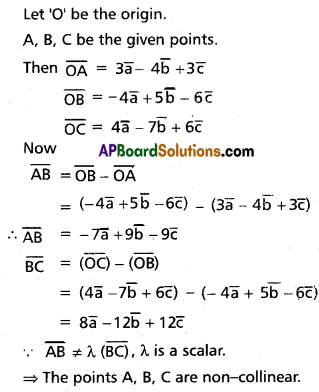
  1. Deduct it from the concerned expenditure either in trading A/c or in Profit & Loss A/c for the first instance and
  2. Record as asset on assets side of the balance sheet as second time.

1) Add either in trading A/c or in profite & loss A/c to the concerned expenditures item.

Trading A/c
AP Inter 1st Year Accountancy Study Material Chapter 13 Final Accounts with Adjustments 8

Balance Sheet
AP Inter 1st Year Accountancy Study Material Chapter 13 Final Accounts with Adjustments 9
Note: If prepaid expenditure is given only in Trial balance, show it as asset in Balance sheet.

3. Income:
a) Accrued Income: Income relating to current year which is not received during the current year but to be received in the next year is called Accured income or income receivable.
Adjustment entry:
AP Inter 1st Year Accountancy Study Material Chapter 13 Final Accounts with Adjustments 10
(Being the income receivable)

Accounting treatment in final accounts: If accrued income is given as adjustment –

  1. For the first instance add to the concerned income in profit and loss a/c on credit side and then.
  2. Show it as an asset in balance sheet on assets side.

Profit & Loss A/c

AP Inter 1st Year Accountancy Study Material Chapter 13 Final Accounts with Adjustments 11

Balance Sheet

AP Inter 1st Year Accountancy Study Material Chapter 13 Final Accounts with Adjustments 12

Note : If accrued income is given in trial balance, show it on assets side of Balance sheet.

b) Income Received in Advance : The income relating to the next year but received in the current year is called income received in advances.
Adjustment entry:
AP Inter 1st Year Accountancy Study Material Chapter 13 Final Accounts with Adjustments 13
(Being the income received in advance)

Accounting treatment in final accounts: When income received in advance is given adjustment

  1. Deduct it from the concerned income in Profit & Loss a/c on credit side and
  2. Record it as a liability on the liabilities side in the balance sheet.

Profit & Loss A/c

AP Inter 1st Year Accountancy Study Material Chapter 13 Final Accounts with Adjustments 14

Balance Sheet

AP Inter 1st Year Accountancy Study Material Chapter 13 Final Accounts with Adjustments 15

Note: If Income received in advance is given in the trial balance show it on liabilities side in the balance sheet.

4. Depreciation: Decline in the value of fixed assets is called “Depreciation”.
Adjustment entry:
AP Inter 1st Year Accountancy Study Material Chapter 13 Final Accounts with Adjustments 16
(Being the depreciation provided on asset)

Accounting treatment in final accounts: When depreciation is given as an adjustment:

  1. Debit it to profit & loss A/c.
  2. Deduct it from the value of concerned asset in balance sheet on assets side.

Trial Balance
AP Inter 1st Year Accountancy Study Material Chapter 13 Final Accounts with Adjustments 17
Adj : Provide depreciation on machinery 10%

Profit & Loss A/c
AP Inter 1st Year Accountancy Study Material Chapter 13 Final Accounts with Adjustments 18
Note : If depreciation is given in trial balance, it should be shown on debit side in P & L A/c only.

5. Debtors : In final accounts bad debts, provision for bad debts may be given as adjustments relating to debtors.
A) Bad debts: To debts which are not collected or irrecoverable are known as bad debts.

Adjustment entry:
AP Inter 1st Year Accountancy Study Material Chapter 13 Final Accounts with Adjustments 19
(Being bad debts written off)

Accounting treatment in final accounts:

a) When bad debts are given, only in the adjustments –

  1. Debit to profit & loss A/c and
  2. Deduct from debtors in the balance sheet on assets side.

Trial Balance

AP Inter 1st Year Accountancy Study Material Chapter 13 Final Accounts with Adjustments 20

Adjustment: Bad debts : 500

AP Inter 1st Year Accountancy Study Material Chapter 13 Final Accounts with Adjustments 21

Note : If the bad debts are given in trial balance only, it should be shown on debit side in Profit & Loss A/c.

b) When Bad debts are given in both Trial Balance and adjustments:

  1. In Profit & Loss A/c, both the bad debts (Bad debts given in Trial balance and given in adjustment) are to be shown on debit side.
  2. Bad debts given only in the adjustments are to be deducted from debtors in the balance sheet.

Trial Balance
AP Inter 1st Year Accountancy Study Material Chapter 13 Final Accounts with Adjustments 22
Adjustments: 1) Bad debts : 400

AP Inter 1st Year Accountancy Study Material Chapter 13 Final Accounts with Adjustments 23

B) Provision for bad and doubtful debts: Some debts of a particular year may or may not be recovered in the next year. These debts are known as doubtful debts. So traders create same amount on current year debtors and keep the same to meet the doubtful bad debts of the next year, which is called provision for bad and doubtful debts.

a) When provision for doubtful debts is given as adjustment:
Adjustment entry:
AP Inter 1st Year Accountancy Study Material Chapter 13 Final Accounts with Adjustments 24
(Being provision created on debtors)

Accounting treatment in final accounts:

  1. Show it on debit side in profit & Loss A/c and
  2. Deduct it from debtors in Balance sheet,

e.g.:
Trial Balance
AP Inter 1st Year Accountancy Study Material Chapter 13 Final Accounts with Adjustments 25
Adjustment: Create provision for bad and doubtful debts 5%.

Profit & Loss A/c
AP Inter 1st Year Accountancy Study Material Chapter 13 Final Accounts with Adjustments 26

Balance Sheet
AP Inter 1st Year Accountancy Study Material Chapter 13 Final Accounts with Adjustments 27

b) When provision for doubtful debts is given in Trial Balance and also in adjustments: Accounting treatment in final accounts:

1. Compare the old provision (given in trial balance) with new provision (given in the adjustments), if the new provision is more than the old provision, the difference amount (New provision – old provision) should be debited to the Profit & Loss A/c.
On the other hand, new provision is less than the old provision, the difference amount (old provision – new provision) should be recorded on the credit side of Profit & Loss A/c.

2. In balance sheet, deduct the amount of new provision of bad and doubtful debts from sundry debtors.

Trial Balance
AP Inter 1st Year Accountancy Study Material Chapter 13 Final Accounts with Adjustments 28
Adjustments : Create 5% provision for doubtful debts.

Profit & Loss A/c

AP Inter 1st Year Accountancy Study Material Chapter 13 Final Accounts with Adjustments 29

Balance Sheet

AP Inter 1st Year Accountancy Study Material Chapter 13 Final Accounts with Adjustments 30

c) If the bad debts are given both in trial balance and in adjustments, and also provision for bad debts given in adjustments.
Accounting treatment in final accounts:

  1. Don’t calculate the provision directly on sundry debtors.
  2. Calculate the provision after deducting the further bad debts.

Trial Balance

AP Inter 1st Year Accountancy Study Material Chapter 13 Final Accounts with Adjustments 31

Adjustments:

  1. Further bad debts : Rs. 600
  2. Provision for bad debts : 5%

Profit & Loss A/c

AP Inter 1st Year Accountancy Study Material Chapter 13 Final Accounts with Adjustments 32

6. Interest on capital : It is the amount of interest payable on owner’s capital by the business organisation.

Adjustment entry:
AP Inter 1st Year Accountancy Study Material Chapter 13 Final Accounts with Adjustments 33
(Being the interest payable on capital)

Accounting treatment in final A/cs:

  1. Debit in profit & Loss A/c and
  2. It should be added to the capital in balance sheet.

Trial Balance
AP Inter 1st Year Accountancy Study Material Chapter 13 Final Accounts with Adjustments 34
Adjustment: Interest on capital: 12%

AP Inter 1st Year Accountancy Study Material Chapter 13 Final Accounts with Adjustments 35

7. Interest on Drawings : Drawings mean the amount of cash or goods taken by the trader for personal use. The amount of interest payable by the owner to the business is called interest on drawings.
Adjustment entry:
AP Inter 1st Year Accountancy Study Material Chapter 13 Final Accounts with Adjustments 36
(Being the interest on drawings)
Accounting treatment in final A/cs:

  1. It is to be recorded on credit side of P & L a/c and
  2. It should be deducted from capital in balance sheet.

Trial Balance
AP Inter 1st Year Accountancy Study Material Chapter 13 Final Accounts with Adjustments 37
Adjustment: Interest on drawings : 5%
AP Inter 1st Year Accountancy Study Material Chapter 13 Final Accounts with Adjustments 38

Note: When interest on drawings is given in trial balance, it should be shown on credit side in Profit & Loss A/c only.

Short Answer Questions

Question 1.
Write the following:
a) Interest on Capital:
Answer:
The amount of interest payable on owner’s capital by the business organisation is called interest on capital.
Adjustment entry:
AP Inter 1st Year Accountancy Study Material Chapter 13 Final Accounts with Adjustments 39
(Being the interest payable on capital)
Accounting treatment in final accounts:
When interest on capital is given as an adjustment.
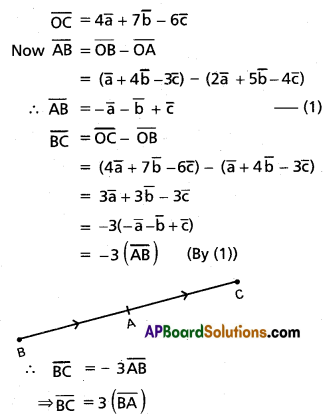
1. Debit in P & L A/c and
2. It should be added to the capital in balance sheet.
Note : When it is given in trial balance, debit it in P & L A/c only.

b) Interest on Drawings :
Answer:
Drawings mean the amount of cash or goods taken by the trader for personal use.
The amount of interest payable by the owner to the business is called Interest on drawings.
Adjustment entry:
AP Inter 1st Year Accountancy Study Material Chapter 13 Final Accounts with Adjustments 40
(Being the interest on drawings)
Accounting treatment In final accounts:

When interest on drawings given as adjustment.
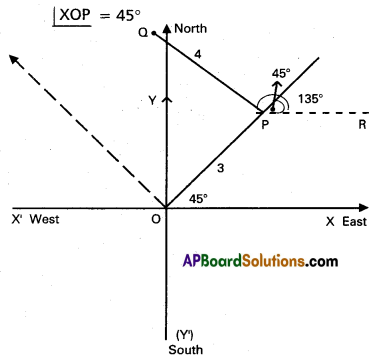
  1. It is to be recorded on credit side of P & L A/c and
  2. Deduct the amount from capital in Balance sheet.
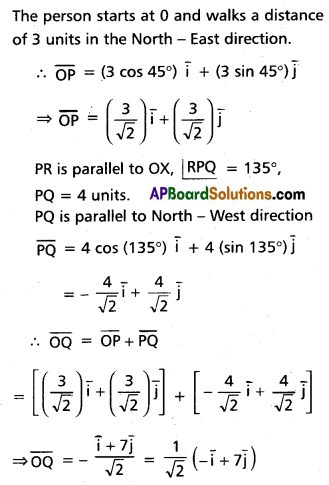
Note: When interest on drawings is given in trial balance, it should be shown on credit side in Profit & Loss A/c.
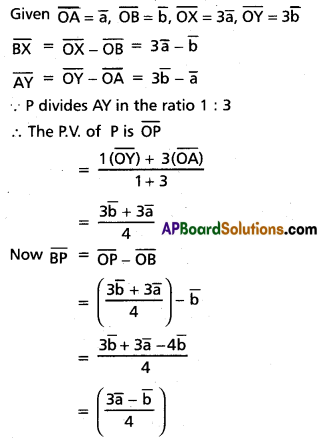
Very Short Answer Questions

Question 1.
What is the meaning of adjustment ?
Answer:
To find out net profit and true financial position, all expenses relating to current year whether actually paid or not, all incomes received or yet to be received should be taken into account. Some of the incomes and expenses relating to next year, but received and paid in the current year should not be included in the accounts of current year. The amount to be adjusted to the concerned items is called adjustment. e.g: Outstanding salaries, prepaid insurance, etc.

AP Inter 1st Year Accountancy Study Material Chapter 13 Final Accounts with Adjustments

Question 2.
Explain the importance of adjustment:
Answer:

  1. Expenses or incomes relating to the accounting period can be known accurately.
  2. Profit or loss can be ascertained accurately.
  3. Real value of assets and liabilities can be ascertained easily.

Question 3.
Give the meaning of bad debts. (Mar. 2018 T.S.)
Answer:
The debts which are not collected or Irrecoverable are known as bad debts.
Adjuštment entry:
AP Inter 1st Year Accountancy Study Material Chapter 13 Final Accounts with Adjustments 41
(Being bad debts written off)

Adjustments Summary

AP Inter 1st Year Accountancy Study Material Chapter 13 Final Accounts with Adjustments 42
AP Inter 1st Year Accountancy Study Material Chapter 13 Final Accounts with Adjustments 43
AP Inter 1st Year Accountancy Study Material Chapter 13 Final Accounts with Adjustments 44
AP Inter 1st Year Accountancy Study Material Chapter 13 Final Accounts with Adjustments 45
AP Inter 1st Year Accountancy Study Material Chapter 13 Final Accounts with Adjustments 46
AP Inter 1st Year Accountancy Study Material Chapter 13 Final Accounts with Adjustments 47
AP Inter 1st Year Accountancy Study Material Chapter 13 Final Accounts with Adjustments 48

Problems

Question 1.
From the following trial balance, prepare final accounts of Praveen Traders as on 31.12.2013:
AP Inter 1st Year Accountancy Study Material Chapter 13 Final Accounts with Adjustments 49
Adjustments:

  1. Closing stock: 4500;
  2. Outstanding wages : 390;
  3. Outstanding salaries : 500
  4. Prepaid Insurance: 400

Answer:

AP Inter 1st Year Accountancy Study Material Chapter 13 Final Accounts with Adjustments 50
AP Inter 1st Year Accountancy Study Material Chapter 13 Final Accounts with Adjustments 51

AP Inter 1st Year Accountancy Study Material Chapter 13 Final Accounts with Adjustments

Question 2.
From the following particulars, prepare final accounts : (May ’17 – T.S.)
AP Inter 1st Year Accountancy Study Material Chapter 13 Final Accounts with Adjustments 52
Adjustments:

  1. Closing stock: 6000
  2. Prepaid Insurance: 200
  3. Outstanding salaries :600
  4. Accrued interest : 500

Answer:
AP Inter 1st Year Accountancy Study Material Chapter 13 Final Accounts with Adjustments 53
AP Inter 1st Year Accountancy Study Material Chapter 13 Final Accounts with Adjustments 54

Question 3.
From the following particulars, prepare final accounts of Giri for the year ending 31.12.2013.
AP Inter 1st Year Accountancy Study Material Chapter 13 Final Accounts with Adjustments 55

Adjustments:

  1. Closing stock value: 3500
  2. Outstanding wages : 860
  3. Prepaid insurance: 100
  4. Provide depreciation on furniture: 10% and on land & buildings : 10%
  5. Interest received in advance : 500

Answer:
AP Inter 1st Year Accountancy Study Material Chapter 13 Final Accounts with Adjustments 56
AP Inter 1st Year Accountancy Study Material Chapter 13 Final Accounts with Adjustments 57

AP Inter 1st Year Accountancy Study Material Chapter 13 Final Accounts with Adjustments 58

AP Inter 1st Year Accountancy Study Material Chapter 13 Final Accounts with Adjustments

Question 4.
From the following Trialbalance o1 Mr.kapil, prepare Trading P & L A/c and Balance Sheet or the year ended (Mar. 2018 – A.P.)
Trial Balance
AP Inter 1st Year Accountancy Study Material Chapter 13 Final Accounts with Adjustments 59
Adjustments:

  1. Outstanding wages: 2000;
  2. Outstanding salaries: 1000;
  3. Prepaid insurance: 50;
  4. Create 5% reserve for bad debts on debtors;
  5. Depreciation on furniture: 150, Dep. on machinery: 500;
  6. Closing stock: 11,000.

Answer:
AP Inter 1st Year Accountancy Study Material Chapter 13 Final Accounts with Adjustments 60
AP Inter 1st Year Accountancy Study Material Chapter 13 Final Accounts with Adjustments 61

Question 5.
From the following particulars, prepare final accounts for the year ended 31.3.2010.
Trial Balance
AP Inter 1st Year Accountancy Study Material Chapter 13 Final Accounts with Adjustments 62
Adjustments:

  1. Closing stock: 16,800;
  2. Interest on capital :9%;
  3. Write off : 2,000 as bad debt and provide 5% reserve for doubtful debts;
  4. Outstanding wages: 1,000.

Answer:
AP Inter 1st Year Accountancy Study Material Chapter 13 Final Accounts with Adjustments 63
AP Inter 1st Year Accountancy Study Material Chapter 13 Final Accounts with Adjustments 64

AP Inter 1st Year Accountancy Study Material Chapter 13 Final Accounts with Adjustments

Question 6.
Prepare final accounts of Praveen Traders for the year ending 31.03.2014.
Trial Balance
AP Inter 1st Year Accountancy Study Material Chapter 13 Final Accounts with Adjustments 65
Adjustments:

  1. Closing stock : 5,800;
  2. Depreciation on motor van: 10%;
  3. Reserve for bad & doubtful debts : 5%;
  4. Outstanding rent Rs. 500;
  5. Prepaid taxes: Rs. 200/-.

Answer:
AP Inter 1st Year Accountancy Study Material Chapter 13 Final Accounts with Adjustments 66
AP Inter 1st Year Accountancy Study Material Chapter 13 Final Accounts with Adjustments 67

Question 7.
Prepare final accounts from the following trial balance for the year ended 31.12.2013.
Trial Balance
AP Inter 1st Year Accountancy Study Material Chapter 13 Final Accounts with Adjustments 68
Adjustments:

  1. Closing stock: 2,100
  2. Outstanding stationery bill : 600
  3. Depreciation on machinery: 10%
  4. Bad Debts : 500
  5. Prepaid wages :500

Answer:
AP Inter 1st Year Accountancy Study Material Chapter 13 Final Accounts with Adjustments 69
AP Inter 1st Year Accountancy Study Material Chapter 13 Final Accounts with Adjustments 70

AP Inter 1st Year Accountancy Study Material Chapter 13 Final Accounts with Adjustments

Question 8.
From the following Trial balance of Vinod Traders, prepare final accounts:
Trial Balance
AP Inter 1st Year Accountancy Study Material Chapter 13 Final Accounts with Adjustments 71
Adjustments:

  1. Closing stock: 9,500
  2. Bad debts : 1,500
  3. Provide reserve for bad debts : 5%
  4. Outstanding wages : 300
  5. Depreciation on machinery: 10%
  6. Interest received in advance : 500.

Answer:
AP Inter 1st Year Accountancy Study Material Chapter 13 Final Accounts with Adjustments 72
AP Inter 1st Year Accountancy Study Material Chapter 13 Final Accounts with Adjustments 73
AP Inter 1st Year Accountancy Study Material Chapter 13 Final Accounts with Adjustments 74

Question 9.
Prepare sole traders final accounts for the year ending 31.03.2014.
Trial Balance
AP Inter 1st Year Accountancy Study Material Chapter 13 Final Accounts with Adjustments 75
Adjustments:

  1. Closing stock value : 7,500;
  2. Depreciation on machinery : 12%;
  3. Commission received in advance : 1,200;
  4. Interest receivable : 1,500;
  5. Further bad debts : 400;
  6. Prepaid insurance: 500.

Answer:
AP Inter 1st Year Accountancy Study Material Chapter 13 Final Accounts with Adjustments 76
AP Inter 1st Year Accountancy Study Material Chapter 13 Final Accounts with Adjustments 77

AP Inter 1st Year Accountancy Study Material Chapter 13 Final Accounts with Adjustments

Question 10.
Prepare Final Accounts of Ramakrishna Traders as on 31.12.2013:
AP Inter 1st Year Accountancy Study Material Chapter 13 Final Accounts with Adjustments 78
Adjustments:

  1. Closing stock: 3,500
  2. Outstanding rent: 500
  3. Prepaid salaries & wages : 400
  4. Interest received in advance: 300
  5. Depreciation on machinery: 10%

Answer:
AP Inter 1st Year Accountancy Study Material Chapter 13 Final Accounts with Adjustments 79
AP Inter 1st Year Accountancy Study Material Chapter 13 Final Accounts with Adjustments 80

Question 11.
Prepare Ravi Traders’ Final Accounts for the fear ended 31.12.2013:
Trial Balance
AP Inter 1st Year Accountancy Study Material Chapter 13 Final Accounts with Adjustments 81

Adjustments:

  1. Closing Stock Value : 5,100
  2. Reserve for Bad Debts : 5%
  3. Depreciation on patents : 20%
  4. Outstanding Rent :300
  5. Commission Receivable : 200

Answer:
AP Inter 1st Year Accountancy Study Material Chapter 13 Final Accounts with Adjustments 82
AP Inter 1st Year Accountancy Study Material Chapter 13 Final Accounts with Adjustments 83

Question 12.
Prepare Final Accounts of Srinivasa Traders as on 31.12.2012.
Trial Balance
AP Inter 1st Year Accountancy Study Material Chapter 13 Final Accounts with Adjustments 84
Adjustments:

  1. Closing stock value: Rs. 5,000
  2. Calculate Interest on Capital : 8%
  3. Interest on Drawings: 10%
  4. Provide Reserve for Debts : 5%
  5. Depredation on premises: 10%

Answer:
AP Inter 1st Year Accountancy Study Material Chapter 13 Final Accounts with Adjustments 85
AP Inter 1st Year Accountancy Study Material Chapter 13 Final Accounts with Adjustments 86
AP Inter 1st Year Accountancy Study Material Chapter 13 Final Accounts with Adjustments 87

Question 13.
From the following Trial Balance prepare Final Accounts.
Trial Balance
AP Inter 1st Year Accountancy Study Material Chapter 13 Final Accounts with Adjustments 88
Adjustments:

  1. Closing Stock Value : Rs. 16,800;
  2. Outstanding Salaries : 400
  3. Prepaid Rent & Taxes: 201
  4. Provide Reserve on Sundry Debtors : 5%
  5. Depreciation on Machinery: 10%
  6. Interest on Capital: 5%

Answer:
AP Inter 1st Year Accountancy Study Material Chapter 13 Final Accounts with Adjustments 89
AP Inter 1st Year Accountancy Study Material Chapter 13 Final Accounts with Adjustments 90

AP Inter 1st Year Accountancy Study Material Chapter 13 Final Accounts with Adjustments

Question 14.
From the following Trial Balance of Vishnu traders prepare Final Accounts for the year ended 31.3.2014.
Trial Balance
AP Inter 1st Year Accountancy Study Material Chapter 13 Final Accounts with Adjustments 91
Adjustments

  1. Closing Stock Value: Rs. 14,000;
  2. Depreciation on Furniture: 250, on Machinery: 750
  3. Outstanding Wages : Rs. 500;
  4. Bad Debts : 600;
  5. Interest on Drawings : 5%

Answer:
AP Inter 1st Year Accountancy Study Material Chapter 13 Final Accounts with Adjustments 92
AP Inter 1st Year Accountancy Study Material Chapter 13 Final Accounts with Adjustments 93

Question 15.
Prepare Final Accounts:
Trial Balance
AP Inter 1st Year Accountancy Study Material Chapter 13 Final Accounts with Adjustments 94
Adjustments:

  1. Closing Stock Value : Rs. 56,000
  2. Outstanding Salaries : 6,000
  3. Bad Debts : 2000, and Create Reserve for Bad debts : 3%
  4. Depreciation on Machinery: 5%
  5. Interest on Capital: 5%

Answer:
AP Inter 1st Year Accountancy Study Material Chapter 13 Final Accounts with Adjustments 95
AP Inter 1st Year Accountancy Study Material Chapter 13 Final Accounts with Adjustments 96
AP Inter 1st Year Accountancy Study Material Chapter 13 Final Accounts with Adjustments 97

Question 16.
From the following Trial Balance and additional information of Latha, prepare Trading and Profit and Loss Account for the year ended 3l Dec. 2008 and Balance Sheet as on that date.
Trial Balance
AP Inter 1st Year Accountancy Study Material Chapter 13 Final Accounts with Adjustments 98

Adjustments:

  1. Closing Stock : Rs. 26,800
  2. Depreciate 10% on Machinery and 20% on Patents
  3. Outstanding Salaries : Rs. 1,500
  4. Unexpired Insurance: Rs. 170
  5. Provide 5% provision for bad debts on Debtors

Answer:
AP Inter 1st Year Accountancy Study Material Chapter 13 Final Accounts with Adjustments 99
AP Inter 1st Year Accountancy Study Material Chapter 13 Final Accounts with Adjustments 100

AP Inter 1st Year Accountancy Study Material Chapter 13 Final Accounts with Adjustments

Question 17.
From the following Trial Balance of Mr. Paramesh, prepare the Trading, Profit and Loss account and Balance Sheet for the year ended 31.12.2012.
Trial Balance as on 31.12.2012
AP Inter 1st Year Accountancy Study Material Chapter 13 Final Accounts with Adjustments 101
Adjustments:

  1. Closing Stock : Rs. 34,500
  2. Outstanding salaries : Rs. 5,500
  3. Depreciate plant and machinery by 5%
  4. Prepaid insurance: Rs. 1,500
  5. 5% provision is to be made for bad debts on debtors

Answer:
AP Inter 1st Year Accountancy Study Material Chapter 13 Final Accounts with Adjustments 102
AP Inter 1st Year Accountancy Study Material Chapter 13 Final Accounts with Adjustments 103

Student Activity

Visit any organisation and note the adjustments made during the last year’s final accounts.

AP Inter 1st Year Accountancy Study Material Chapter 13 ముగింపు లెక్కలు సర్దుబాట్లు సర్దుబాట్లు

Andhra Pradesh BIEAP AP Inter 1st Year Accountancy Study Material 13th Lesson ముగింపు లెక్కలు సర్దుబాట్లు Textbook Questions and Answers.

AP Inter 1st Year Accountancy Study Material 13th Lesson ముగింపు లెక్కలు సర్దుబాట్లు

వ్యాసరూప సమాధాన ప్రశ్నలు

ప్రశ్న 1.
సర్దుబాట్ల రకాలను, ఉదాహరణలతో వ్రాయండి.
జవాబు:
దిగువ తెలిపినవి ముఖ్యమైన సర్దుబాట్లు:
1) చెల్లించవలసిన వ్యయాలు: చెల్లించవలసిన వ్యయాలు ‘అంటే ప్రస్తుత సంవత్సరానికి సంబంధించిన వ్యయాలు ఈ సంవత్సరములో కాకుండా వచ్చే సంవత్సరములో చెల్లింపబడేవి. ఉదా: మార్చి నెలకు జీతాలు లేదా అద్దె చెల్లించవలసి ఉన్నది. ఈ వ్యయాలు వర్తకపు, లాభనష్టాల ఖాతాలో డెబిట్ వైపు సంబంధిత వ్యయాంశాలకు కలిపి, మరల ఆస్తి అప్పుల పట్టీలో అప్పులవైపు చూపాలి.

2) ముందుగా చెల్లించిన వ్యయాలు వచ్చే సంవత్సరానికి సంబంధించినవి’ అయినప్పటికీ ప్రస్తుత సంవత్సరములో చెల్లించిన వ్యయాలను ముందుగా చెల్లించిన వ్యయాలు అంటారు.
ఉదా: పన్నులు, భీమా తరువాత సంవత్సరానికి చెల్లించడము. ఈ వ్యయాలను వర్తకపు, లాభనష్టాల ఖాతాలో డెబిట్ వైపు సంబంధిత వ్యయాల నుంచి తీసి, మరల ఆస్తి అప్పుల పట్టీలో ఆస్తులవైపు చూపాలి.

3) రావలసిన ఆదాయము: ప్రస్తుత సంవత్సరానికి సంబంధించి వచ్చే సంవత్సరములో వసూలు అయ్యే ఆదాయాలను సంచిత లేదా రావలసిన ఆదాయాలు అంటారు. వీటిని లాభనష్టాల ఖాతాలో క్రెడిట్ వైపు సంబంధిత ఆదాయానికి కలిపి, ఆస్తి అప్పుల పట్టీలో ఆస్తులవైపు చూపాలి.

4) ముందుగా వచ్చిన ఆదాయాలు: వచ్చే సంవత్సరానికి సంబంధించి ప్రస్తుత సంవత్సరములో వసూలయ్యే ఆదాయాలను ముందుగా వచ్చిన ఆదాయాలు అంటారు. వీటిని లాభనష్టాల ఖాతాలో ఆదాయ అంశము నుంచి తీసివేసి, ఆస్తి అప్పుల పట్టీలో అప్పులవైపు చూపాలి.

5) స్థిరాస్తులపై తరుగుదల: స్థిరాస్తులైన ప్లాంటు-యంత్రాలు, భవనాలు మొదలైనవి వాడకము వలన లేదా కాలగమనము వలన వాటి విలువ ప్రతి సంవత్సరము తగ్గుతూ ఉంటుంది. దీనిని తరుగుదల అంటారు. దీనిని వ్యయముగా భావిస్తారు. సాధారణముగా దీనిని ఆస్తి విలువపై కొంతశాతంగా నిర్ణయిస్తారు. ఈ మొత్తాన్ని లాభనష్టాలఖాతాకు డెబిట్ చేసి, ఆస్తి అప్పుల పట్టీలో ఆస్తుల విలువ నుంచి తీసివేస్తారు.

6) మూలధనముపై వడ్డీ: యజమాని మూలధనముపై చెల్లించిన వడ్డీ వ్యయముగా భావించి లాభనష్టాల ఖాతాకు డెబిట్ చేస్తారు. ఈ మొత్తాన్ని ఆస్తి అప్పుల పట్టీలో అప్పులవైపు మూలధనానికి కలుపుతారు. సొంతవాడకాలపై వడ్డీ: యజమాని నగదుగాని, సరుకుగాని సొంతానికి వాడుకుంటే వాటిని సొంత వాడకాలు అంటారు.

7) సొంతవాడకాలపై వడ్డీని లాభనష్టాల ఖాతాకు క్రెడిట్ చేసి, ఆస్తి అప్పుల పట్టీలో అప్పులవైపు మూలధనము నుంచి తీసివేయాలి.

8) ముగింపు సరుకు: ముగింపు సరుకు సర్దుబాట్లుగా ఇచ్చినపుడు వర్తకపు ఖాతాకు క్రెడిట్ చేసి, అప్పుల పట్టీలో ఆస్తులవైపు చూపాలి.

9) రాని బాకీలు: సరుకును అరువు మీద అమ్మినపుడు ఋణగ్రస్తులు ఏర్పడతారు. ఋణగ్రస్తుల నుంచి రావలసిన బాకీలు వసూలు కాకపోతే వాటిని రాని బాకీలు అంటారు. ఇది వ్యాపార నష్టము.

i) రాని బాకీలు అంకణాలో ఇచ్చినపుడు, వీటిని లాభనష్టాల ఖాతాకు మాత్రమే డెబిట్ చేయాలి.
ii) రాని బాకీలు అంకణాలోను, సర్దుబాట్లుగా ఇచ్చినపుడు, ఈ రెండింటిని కలిపి లాభనష్టాల ఖాతాకు డెబిట్ చేయాలి. సర్దుబాట్లుగా ఇచ్చిన రాని బాకీలు మాత్రమే ఆస్తి అప్పుల పట్టీలో ఋణగ్రస్తుల నుంచి తీసివేయాలి.

10) రాని బాకీలకు ఏర్పాటు: ఈ సంవత్సరములో రావలసిన బాకీలు వచ్చే సంవత్సరములో వసూలు కావచ్చు, కాకపోవచ్చు. వీటిని సంశయాత్మక బాకీలు అంటారు. అందువలన వ్యాపారస్తుడు ప్రస్తుత సంవత్సరములో కొంత మొత్తాన్ని వచ్చే సంవత్సరానికి చెందిన సంశయాత్మక బాకీలకై ఏర్పాటు చేస్తాడు. దీనిని సంశయాత్మక బాకీల నిధి అంటారు. సంశయాత్మక బాకీల ఏర్పాటు సర్దుబాట్లుగా ఇచ్చినపుడు, ఈ మొత్తాన్ని ఋణగ్రస్తులపై లెక్కించి, లాభనష్టాల ఖాతాకు డెబిట్ చేసి, ఆస్తి అప్పుల పట్టీలో ఋణగ్రస్తుల నుంచి ఈ మొత్తాన్ని తీసివేయాలి.

11) రాని బాకీల ఏర్పాటు, అంకణాలోను, సర్దుబాట్లుగా ఇచ్చినపుడు: అంకణాలో ఇచ్చిన రిజర్వు గత సంవత్సరానికి చెందినది. దీనిని పాత రిజర్వు అంటారు. కొత్త రిజర్వు పాత రిజర్వు కంటే ఎక్కువగా ఉంటే, ఈ తేడాను లాభనష్టాల ఖాతాకు డెబిట్ చేసి, కొత్త రిజర్వును ఋణగ్రస్తులనుంచి తీసివేయాలి. ఒకవేళ కొత్త రిజర్వు పాత రిజర్వు కంటే తక్కువగా ఉంటే, ఈ తేడాను లాభనష్టాల ఖాతాకు క్రెడిట్ చేసి, కొత్త రిజర్వును ఋణగ్రస్తుల నుంచి తీసివేయాలి.

స్వల్ప సమాధాన ప్రశ్నలు

ప్రశ్న 1.
ఈ క్రింది వాటిని వివరించండి.
ఎ) మూలధనం మీద వడ్డీ
బి) సొంతవాడకాలపై వడ్డీ
జవాబు:
ఎ) మూలధనం మీద వడ్డీ: వ్యాపార సంస్థ యజమాని మూలధనము మీద చెల్లించే వడ్డీని మూలధనంపై వడ్డీ అంటారు. ఇది వ్యాపారానికి వ్యయం.
సర్దుబాటు పద్దు:
మూలధనంపై వడ్డీ ఖాతా Dr
To మూలధనము ఖాతా
(మూలధనంపై వడ్డీ లెక్కించినందున)

మూలధనముపై వడ్డీని కొంతశాతముగా ఇచ్చినపుడు, దీనిని లెక్కించి లాభనష్టాల ఖాతాకు డెబిట్ చేయాలి. మరల ఆస్తి అప్పుల పట్టీలో అప్పులవైపు మూలధనానికి కలపవలెను.

బి) సొంతవాడకాలపై వడ్డీ: యజమాని వ్యాపారము నుంచి నగదు గాని, సరుకుగాని సొంతానికి వాడుకుంటే వాటిని సొంతవాడకాలు అంటారు. సొంతవాడకాలపై వడ్డీని ఇవ్వబడిన రేటుతో లెక్కించి లాభనష్టాల ఖాతాకు క్రెడిట్ చేయాలి. ఆస్తి అప్పుల పట్టీలో అప్పులవైపు మూలధనము నుంచి తీసివేయాలి.

లఘు సమాధాన ప్రశ్నలు

ప్రశ్న 1.
సర్దుబాట్లు అంటే ఏమిటి ?
జవాబు:
ఆస్తి అప్పుల పట్టీ తయారు చేసే తేదీ నాటికి అన్ని ఖర్చులను చెల్లించినా, చెల్లించవలసినా మరియు అన్ని ఆదాయాలు వచ్చిన లేదా రావలసినా లెక్కలోకి తీసుకొనవలెను. అదే విధముగా రాబోయే సంవత్సరానికి చెందిన వ్యయాలను, ఆదాయాలను లెక్కలోకి తీసుకొనరాదు. ఈ అంశాలన్నీ ముగింపు లెక్కలలో సర్దుబాటు పద్దుల ద్వారా సర్దుబాటు చేయాలి. రాబడి అంశాలకు కలపడం గాని, తీసివేయడం గాని సర్దుబాటు చేయడం అంటారు.

ప్రశ్న 2.
సర్దుబాట్ల ప్రాముఖ్యతను వివరించండి.
జవాబు:
సర్దుబాట్ల ప్రాముఖ్యత:

  1. అకౌంటింగ్ సంవత్సరానికి చెందిన వ్యయాలను, ఆదాయాలను ఖచ్చితముగా తెలుసుకోవచ్చును.
  2. లాభనష్టాలను ఖచ్చితముగా లెక్కించవచ్చును.
  3. ఆస్తి, అప్పుల నిజమైన విలువను తేలికగా తెలుసుకొనవచ్చును.

ప్రశ్న 3.
రాని బాకీలు అంటే ఏమిటి ?
జవాబు:
వ్యాపారస్తుడు కొద్దిమంది ఖాతాదారులకు సరుకును అరువు మీద అమ్మకం చేయవచ్చు. అరువు తీసుకున్న ఖాతాదారుడు బాకీని చెల్లించకపోవచ్చును. వసూలు కాని బాకీలను, వసూలవుతాయని ఆశలేని బాకీలను రాని బాకీలు అంటారు. రాని బాకీలు వ్యాపారానికి నష్టము.

TEXTUAL PROBLEMS

ప్రశ్న 1.
కింద ఇచ్చిన అంకణా నుంచి ప్రవీణ్ ట్రేడర్స్ వారి ముగింపు లెక్కలను 31-12-2013 నాటికి తయారుచేయండి.
AP Inter 1st Year Accountancy Study Material Chapter 13 ముగింపు లెక్కలు సర్దుబాట్లు సర్దుబాట్లు 1
సర్దుబాట్లు:

  1. ముగింపు సరుకు: ₹ 4,500
  2. చెల్లించవలసిన వేతనాలు: ₹ 300
  3. చెల్లించాల్సిన జీతాలు: ₹ 500
  4. ముందుగా చెల్లించిన బీమా: ₹ 400

సాధన.
AP Inter 1st Year Accountancy Study Material Chapter 13 ముగింపు లెక్కలు సర్దుబాట్లు సర్దుబాట్లు 2
AP Inter 1st Year Accountancy Study Material Chapter 13 ముగింపు లెక్కలు సర్దుబాట్లు సర్దుబాట్లు 3
31.12.2013 నాటి ప్రవీణ్ ట్రేడర్స్ ఆస్తి అప్పుల పట్టీ
AP Inter 1st Year Accountancy Study Material Chapter 13 ముగింపు లెక్కలు సర్దుబాట్లు సర్దుబాట్లు 4

ప్రశ్న 2.
కింద ఇచ్చిన అంకణా నుంచి ముగింపు లెక్కలు తయారుచేయండి.
అంకణా
AP Inter 1st Year Accountancy Study Material Chapter 13 ముగింపు లెక్కలు సర్దుబాట్లు సర్దుబాట్లు 5
సర్దుబాట్లు:

  1. ముగింపు సరుకు: ₹ 6,000
  2. ముందుగా చెల్లించిన బీమా: ₹ 200
  3. చెల్లించాల్సిన జీతాలు: ₹ 600
  4. రావాల్సిన వడ్డీ: ₹ 500

సాధన.
AP Inter 1st Year Accountancy Study Material Chapter 13 ముగింపు లెక్కలు సర్దుబాట్లు సర్దుబాట్లు 6
AP Inter 1st Year Accountancy Study Material Chapter 13 ముగింపు లెక్కలు సర్దుబాట్లు సర్దుబాట్లు 7
AP Inter 1st Year Accountancy Study Material Chapter 13 ముగింపు లెక్కలు సర్దుబాట్లు సర్దుబాట్లు 8

ప్రశ్న 3.
కింద ఇచ్చిన వివరాల నుంచి గిరి ట్రేడర్స్ ముగింపు లెక్కలను 31.03.2013 నాటికి తయారు చేయండి.
అంకణా
AP Inter 1st Year Accountancy Study Material Chapter 13 ముగింపు లెక్కలు సర్దుబాట్లు సర్దుబాట్లు 9
సర్దుబాట్లు:

  1. ముగింపు సరుకు: ₹ 3,500.
  2. చెల్లించాల్సిన వేతనాలు: ₹ 800
  3. ముందుగా చెల్లించిన బీమా: ₹ 100
  4. ఫర్నిచర్ మీద తరుగుదల: 10%
  5. భూమి, భవనాల మీద తరుగుదల: ₹ 10%
  6. ముందుగా వచ్చిన వడ్డీ: ₹ 500

సాధన.
AP Inter 1st Year Accountancy Study Material Chapter 13 ముగింపు లెక్కలు సర్దుబాట్లు సర్దుబాట్లు 10
AP Inter 1st Year Accountancy Study Material Chapter 13 ముగింపు లెక్కలు సర్దుబాట్లు సర్దుబాట్లు 11
31.03.2013 నాటి గిరి ట్రేడర్స్ ఆస్తి అప్పుల పట్టీ
AP Inter 1st Year Accountancy Study Material Chapter 13 ముగింపు లెక్కలు సర్దుబాట్లు సర్దుబాట్లు 12
AP Inter 1st Year Accountancy Study Material Chapter 13 ముగింపు లెక్కలు సర్దుబాట్లు సర్దుబాట్లు 13

ప్రశ్న 4.
కింద ఇచ్చిన Mr. కపిల్ అంకణా ఆధారంగా 31.03.2009 నాటి వర్తక, లాభనష్టాల ఖాతా, ఆస్తి అప్పుల పట్టీ తయారుచేయండి.
అంకణా
AP Inter 1st Year Accountancy Study Material Chapter 13 ముగింపు లెక్కలు సర్దుబాట్లు సర్దుబాట్లు 14
సర్దుబాట్లు:

  1. చెల్లించాల్సిన వేతనాలు: ₹ 2,000
  2. ముందుగా చెల్లించిన బీమా: ₹ 50
  3. చెల్లించాల్సిన జీతాలు: ₹ 1,000
  4. రుణగ్రస్తుల రిజర్వు 5%
  5. ఫర్నిచర్ తరుగుదల: ₹ 150, యంత్రాలపై తరుగుదల: ₹ 500.
  6. ముగింపు సరుకు: ₹ 11,000

సాధన.
AP Inter 1st Year Accountancy Study Material Chapter 13 ముగింపు లెక్కలు సర్దుబాట్లు సర్దుబాట్లు 15
31.03.2009 నాటి Mr. కపిల్ ఆస్తి అప్పుల పట్టీ
AP Inter 1st Year Accountancy Study Material Chapter 13 ముగింపు లెక్కలు సర్దుబాట్లు సర్దుబాట్లు 16
AP Inter 1st Year Accountancy Study Material Chapter 13 ముగింపు లెక్కలు సర్దుబాట్లు సర్దుబాట్లు 17

ప్రశ్న 5.
కింద ఇచ్చిన వివరాల నుంచి 31.03.2010 నాటికి ముగింపు లెక్కలు తయారుచేయండి.
అంకణా
AP Inter 1st Year Accountancy Study Material Chapter 13 ముగింపు లెక్కలు సర్దుబాట్లు సర్దుబాట్లు 18
సర్దుబాట్లు:

  1. ముగింపు సరుకు: ₹ 16,800.
  2. మూలధనంపై వడ్డీ: 9%
  3. రాని బాకీలు: ₹ 2,000, రాని బాకీల నిధి 5% ఏర్పాటు చేయాలి.
  4. చెల్లించాల్సిన వేతనాలు: ₹ 1,000

సాధన.
AP Inter 1st Year Accountancy Study Material Chapter 13 ముగింపు లెక్కలు సర్దుబాట్లు సర్దుబాట్లు 19
AP Inter 1st Year Accountancy Study Material Chapter 13 ముగింపు లెక్కలు సర్దుబాట్లు సర్దుబాట్లు 20
31.03.2010 నాటి ఆస్తి అప్పుల పట్టీ
AP Inter 1st Year Accountancy Study Material Chapter 13 ముగింపు లెక్కలు సర్దుబాట్లు సర్దుబాట్లు 21
AP Inter 1st Year Accountancy Study Material Chapter 13 ముగింపు లెక్కలు సర్దుబాట్లు సర్దుబాట్లు 22

ప్రశ్న 6.
ప్రవీణ్ ట్రేడర్స్ ముగింపు లెక్కలను 31.03.2014 నాటికి తయారుచేయండి.
అంకణా
AP Inter 1st Year Accountancy Study Material Chapter 13 ముగింపు లెక్కలు సర్దుబాట్లు సర్దుబాట్లు 23
సర్దుబాట్లు:

  1. ముగింపు సరుకు: ₹ 5,800
  2. మోటారు వాహనం తరుగుదల: 10%
  3. రాని బాకీల నిధి 5 % ఏర్పాటు చేయాలి.
  4. చెల్లించవలసిన అద్దె ₹ 500
  5. ముందుగా చెల్లించిన పన్నులు: ₹ 200

సాధన.
AP Inter 1st Year Accountancy Study Material Chapter 13 ముగింపు లెక్కలు సర్దుబాట్లు సర్దుబాట్లు 24
31.03.2014 నాటి ప్రవీణ్ ట్రేడర్స్ ఆస్తి అప్పుల పట్టీ
AP Inter 1st Year Accountancy Study Material Chapter 13 ముగింపు లెక్కలు సర్దుబాట్లు సర్దుబాట్లు 25
AP Inter 1st Year Accountancy Study Material Chapter 13 ముగింపు లెక్కలు సర్దుబాట్లు సర్దుబాట్లు 26

ప్రశ్న 7.
కింద ఇచ్చిన అంకణా నుంచి ముగింపు లెక్కలను 31.12.2013 నాటికి తయారుచేయండి.
అంకణా
AP Inter 1st Year Accountancy Study Material Chapter 13 ముగింపు లెక్కలు సర్దుబాట్లు సర్దుబాట్లు 27
సర్దుబాట్లు:

  1. ముగింపు సరుకు: ₹ 2,100
  2. చెల్లించవలసిన స్టేషనరీ బిల్లు: ₹ 600
  3. యంత్రాలపై తరుగుదల: 10%
  4. రాని బాకీలు: ₹ 7500
  5. ముందుగా చెల్లించిన వేతనాలు: ₹ 500

సాధన.
AP Inter 1st Year Accountancy Study Material Chapter 13 ముగింపు లెక్కలు సర్దుబాట్లు సర్దుబాట్లు 28
AP Inter 1st Year Accountancy Study Material Chapter 13 ముగింపు లెక్కలు సర్దుబాట్లు సర్దుబాట్లు 29
31.12.2013 నాటి ఆస్తి అప్పుల పట్టీ
AP Inter 1st Year Accountancy Study Material Chapter 13 ముగింపు లెక్కలు సర్దుబాట్లు సర్దుబాట్లు 30
AP Inter 1st Year Accountancy Study Material Chapter 13 ముగింపు లెక్కలు సర్దుబాట్లు సర్దుబాట్లు 31

ప్రశ్న 8.
కింద ఇచ్చిన అంకణా నుంచి వినోద్ ట్రేడర్స్ ముగింపు లెక్కలు తయారుచేయండి.
అంకణా
AP Inter 1st Year Accountancy Study Material Chapter 13 ముగింపు లెక్కలు సర్దుబాట్లు సర్దుబాట్లు 32
సర్దుబాట్లు:

  1. ముగింపు సరుకు: ₹ 9,500
  2. రాని బాకీలు: 1500, రాని బాకీల నిధి 5%
  3. చెల్లించాల్సిన వేతనాలు: ₹ 300
  4. యంత్రాల మీద తరుగుదల: 10%
  5. ముందుగా వచ్చిన వడ్డీ: ₹ 500

సాధన.
AP Inter 1st Year Accountancy Study Material Chapter 13 ముగింపు లెక్కలు సర్దుబాట్లు సర్దుబాట్లు 33
AP Inter 1st Year Accountancy Study Material Chapter 13 ముగింపు లెక్కలు సర్దుబాట్లు సర్దుబాట్లు 34
వినోద్ ట్రేడర్స్ ఆస్తి అప్పుల పట్టీ
AP Inter 1st Year Accountancy Study Material Chapter 13 ముగింపు లెక్కలు సర్దుబాట్లు సర్దుబాట్లు 35
AP Inter 1st Year Accountancy Study Material Chapter 13 ముగింపు లెక్కలు సర్దుబాట్లు సర్దుబాట్లు 36

ప్రశ్న 9.
కింద ఇచ్చిన అంకణా నుంచి 31.03.2014 నాటికి ముగింపు లెక్కలను తయారుచేయండి.
అంకణా
AP Inter 1st Year Accountancy Study Material Chapter 13 ముగింపు లెక్కలు సర్దుబాట్లు సర్దుబాట్లు 37
సర్దుబాట్లు:

  1. ముగింపు సరుకు ₹ 7,500
  2. యంత్రాల మీద తరుగుదతల: 12%
  3. ముందుగా వచ్చిన కమీషన్: ₹ 1,200
  4. రావల్సిన వడ్డీ: ₹ 1,500
  5. రాని బాకీలు: ₹ 400
  6. ముందుగా చెల్లించిన బీమా: ₹ 500

సాధన.
AP Inter 1st Year Accountancy Study Material Chapter 13 ముగింపు లెక్కలు సర్దుబాట్లు సర్దుబాట్లు 38
AP Inter 1st Year Accountancy Study Material Chapter 13 ముగింపు లెక్కలు సర్దుబాట్లు సర్దుబాట్లు 39
31.03.2014 నాటి ఆస్తి అప్పుల పట్టీ
AP Inter 1st Year Accountancy Study Material Chapter 13 ముగింపు లెక్కలు సర్దుబాట్లు సర్దుబాట్లు 40

ప్రశ్న 10.
కింద ఇచ్చిన అంకణా నుంచి రామకృష్ణా ట్రేడర్స్ ముగింపు లెక్కలు 31.12.2013 నాటికి తయారుచేయండి.
అంకణా
AP Inter 1st Year Accountancy Study Material Chapter 13 ముగింపు లెక్కలు సర్దుబాట్లు సర్దుబాట్లు 41
సర్దుబాట్లు:

  1. ముగింపు సరుకు: ₹ 3,500
  2. చెల్లించాల్సిన అద్దె: ₹ 500
  3. ముందుగా చెల్లించాల్సిన జీతాలు, వేతనాలు: ₹ 400
  4. ముందుగా వచ్చిన వడ్డీ: ₹ 300
  5. యంత్రాలపై తరుగుదల: 10%

సాధన.
AP Inter 1st Year Accountancy Study Material Chapter 13 ముగింపు లెక్కలు సర్దుబాట్లు సర్దుబాట్లు 42
31.12.2013 నాటి ఆస్తి అప్పుల పట్టీ
AP Inter 1st Year Accountancy Study Material Chapter 13 ముగింపు లెక్కలు సర్దుబాట్లు సర్దుబాట్లు 43
AP Inter 1st Year Accountancy Study Material Chapter 13 ముగింపు లెక్కలు సర్దుబాట్లు సర్దుబాట్లు 44

ప్రశ్న 11.
కింద ఇచ్చిన అంకణా నుంచి రవి ట్రేడర్స్ ముగింపు లెక్కలను 31.12.2013 నాటికి తయారుచేయండి.
అంకణా
AP Inter 1st Year Accountancy Study Material Chapter 13 ముగింపు లెక్కలు సర్దుబాట్లు సర్దుబాట్లు 45
సర్దుబాట్లు:

  1. ముగింపు సరుకు ₹ 5,100
  2. రాని బాకీల నిధి: 5%
  3. పేటెంట్లపై తరుగుదల: 20%
  4. చెల్లించాల్సిన అద్దె: ₹ 300
  5. రావలసిన కమీషన్: ₹ 200

సాధన.
AP Inter 1st Year Accountancy Study Material Chapter 13 ముగింపు లెక్కలు సర్దుబాట్లు సర్దుబాట్లు 46
31.12.2013 నాటి ఆస్తి అప్పుల పట్టీ
AP Inter 1st Year Accountancy Study Material Chapter 13 ముగింపు లెక్కలు సర్దుబాట్లు సర్దుబాట్లు 47
AP Inter 1st Year Accountancy Study Material Chapter 13 ముగింపు లెక్కలు సర్దుబాట్లు సర్దుబాట్లు 48

ప్రశ్న 12.
కింద ఇచ్చిన అంకణా నుంచి శ్రీనివాస్ ట్రేడర్స్ ముగింపు లెక్కలు 31.12.2012 నాటికి తయారు చేయండి.
అంకణా
AP Inter 1st Year Accountancy Study Material Chapter 13 ముగింపు లెక్కలు సర్దుబాట్లు సర్దుబాట్లు 49
సర్దుబాట్లు:

  1. ముగింపు సరుకు: ₹ 5,000
  2. మూలధనం మీద వడ్డీ: 8%
  3. సొంతవాడకాల మీద వడ్డీ: 10%
  4. రాని బాకీల నిధి: 5%
  5. ఆవరణల మీద తరుగుదల: 10%

సాధన.
AP Inter 1st Year Accountancy Study Material Chapter 13 ముగింపు లెక్కలు సర్దుబాట్లు సర్దుబాట్లు 50
31.12.2012 నాటి శ్రీనివాస్ ట్రేడర్స్ ఆస్తి అప్పుల పట్టీ….
AP Inter 1st Year Accountancy Study Material Chapter 13 ముగింపు లెక్కలు సర్దుబాట్లు సర్దుబాట్లు 51
AP Inter 1st Year Accountancy Study Material Chapter 13 ముగింపు లెక్కలు సర్దుబాట్లు సర్దుబాట్లు 52

ప్రశ్న 13.
కింద ఇచ్చిన అంకణా నుంచి ముగింపు లెక్కలు తయారుచేయండి.
అంకణా
AP Inter 1st Year Accountancy Study Material Chapter 13 ముగింపు లెక్కలు సర్దుబాట్లు సర్దుబాట్లు 53
సర్దుబాట్లు:

  1. ముగింపు సరుకు: ₹ 16,800
  2. చెల్లించాల్సిన జీతాలు: ₹ 400
  3. ముందుగా చెల్లించిన అద్దె, పన్నులు: ₹ 200
  4. రాని బాకీల నిధి: 5%
  5. యంత్రాలపై తరుగుదల: 10%
  6. మూలధనంపై వడ్డీ: 5%

సాధన.
AP Inter 1st Year Accountancy Study Material Chapter 13 ముగింపు లెక్కలు సర్దుబాట్లు సర్దుబాట్లు 54
AP Inter 1st Year Accountancy Study Material Chapter 13 ముగింపు లెక్కలు సర్దుబాట్లు సర్దుబాట్లు 55
ఆస్తి అప్పుల పట్టీ
AP Inter 1st Year Accountancy Study Material Chapter 13 ముగింపు లెక్కలు సర్దుబాట్లు సర్దుబాట్లు 56
AP Inter 1st Year Accountancy Study Material Chapter 13 ముగింపు లెక్కలు సర్దుబాట్లు సర్దుబాట్లు 57
సూచన: అంకణాలో వ్యత్యాసము 3600 (Dr) బీమాగా తీసుకోవడమైనది.

ప్రశ్న 14.
కింద ఇచ్చిన అంకణా నుంచి విష్ణు ట్రేడర్స్ ముగింపు లెక్కలు 31.03.2014 నాటికి తయారుచేయండి.
అంకణా
AP Inter 1st Year Accountancy Study Material Chapter 13 ముగింపు లెక్కలు సర్దుబాట్లు సర్దుబాట్లు 58
సర్దుబాట్లు:

  1. ముగింపు సరుకు: ₹ 14,000
  2. ఫర్నిచర్పై తరుగుదల 250, యంత్రాలపై ₹ 750
  3. చెల్లించాల్సిన జీతాలు ₹ 500
  4. రాని బాకీలు ₹ 7600
  5. సొంతవాడకాలపై వడ్డీ 5%

సాధన.
AP Inter 1st Year Accountancy Study Material Chapter 13 ముగింపు లెక్కలు సర్దుబాట్లు సర్దుబాట్లు 59
31.03.2014 నాటి ఆస్తి అప్పుల పట్టీ
AP Inter 1st Year Accountancy Study Material Chapter 13 ముగింపు లెక్కలు సర్దుబాట్లు సర్దుబాట్లు 60
AP Inter 1st Year Accountancy Study Material Chapter 13 ముగింపు లెక్కలు సర్దుబాట్లు సర్దుబాట్లు 61

ప్రశ్న 15.
కింద ఇచ్చిన అంకణా నుంచి ముగింపు లెక్కలు తయారుచేయండి.
అంకణా
AP Inter 1st Year Accountancy Study Material Chapter 13 ముగింపు లెక్కలు సర్దుబాట్లు సర్దుబాట్లు 62
సర్దుబాట్లు:

  1. ముగింపు సరుకు: ₹ 56,000
  2. చెల్లించాల్సిన జీతాలు’: ₹ 6,000
  3. రాని బాకీలు: ₹ 72,000, రాని బాకీల నిధి: 3%
  4. యంత్రాలపై తరుగుదల: 5 %
  5. మూలధనంపై వడ్డీ: 5%

సాధన.
AP Inter 1st Year Accountancy Study Material Chapter 13 ముగింపు లెక్కలు సర్దుబాట్లు సర్దుబాట్లు 63
AP Inter 1st Year Accountancy Study Material Chapter 13 ముగింపు లెక్కలు సర్దుబాట్లు సర్దుబాట్లు 64
ఆస్తి అప్పుల పట్టీ
AP Inter 1st Year Accountancy Study Material Chapter 13 ముగింపు లెక్కలు సర్దుబాట్లు సర్దుబాట్లు 65

ప్రశ్న 16.
కింద ఇచ్చిన వివరాల నుంచి పరమేశ్ ఖాతా, లాభనష్టాల ఖాతా, ఆస్తి అప్పుల పట్టీ తయారుచేయండి.
AP Inter 1st Year Accountancy Study Material Chapter 13 ముగింపు లెక్కలు సర్దుబాట్లు సర్దుబాట్లు 66
సర్దుబాట్లు:

  1. ముగింపు సరుకు: ₹ 34,500
  2. చెల్లించాల్సిన జీతాలు: ₹ 5,500
  3. యంత్రాలపై తరుగుదల: 5%
  4. ముందుగా చెల్లించిన బీమా: ₹ 1,500
  5. రాని బాకీల నిధికి 5% ఏర్పాటు చేయాలి

సాధన.
AP Inter 1st Year Accountancy Study Material Chapter 13 ముగింపు లెక్కలు సర్దుబాట్లు సర్దుబాట్లు 67
AP Inter 1st Year Accountancy Study Material Chapter 13 ముగింపు లెక్కలు సర్దుబాట్లు సర్దుబాట్లు 68
పరమేశ్ ఆస్తి అప్పుల పట్టీ
AP Inter 1st Year Accountancy Study Material Chapter 13 ముగింపు లెక్కలు సర్దుబాట్లు సర్దుబాట్లు 69

ప్రశ్న 17.
కింద ఇచ్చిన అంకణా నుంచి లతా ట్రేడర్స్ వర్తక, లాభనష్టాల ఖాతాలు, ఆస్తి, అప్పుల పట్టీ 31.12.2008 నాటికి తయారుచేయండి.
అంకణా
AP Inter 1st Year Accountancy Study Material Chapter 13 ముగింపు లెక్కలు సర్దుబాట్లు సర్దుబాట్లు 70
AP Inter 1st Year Accountancy Study Material Chapter 13 ముగింపు లెక్కలు సర్దుబాట్లు సర్దుబాట్లు 71
సర్దుబాట్లు:

  1. ముగింపు సరుకు: ₹ 26,800
  2. యంత్రంపై తరుగుదల: 10%
  3. పేటెంట్లపై తరుగుదల: 20%
  4. చెల్లించాల్సిన జీతాలు: ₹ 1500
  5. అసమాప్త బీమా: ₹ 170
  6. రాని బాకీల నిధి: 5%.

సాధన.
AP Inter 1st Year Accountancy Study Material Chapter 13 ముగింపు లెక్కలు సర్దుబాట్లు సర్దుబాట్లు 72
AP Inter 1st Year Accountancy Study Material Chapter 13 ముగింపు లెక్కలు సర్దుబాట్లు సర్దుబాట్లు 73
31.12.2008 నాటి లతా ట్రేడర్స్ ఆస్తి అప్పుల పట్టీ
AP Inter 1st Year Accountancy Study Material Chapter 13 ముగింపు లెక్కలు సర్దుబాట్లు సర్దుబాట్లు 74
AP Inter 1st Year Accountancy Study Material Chapter 13 ముగింపు లెక్కలు సర్దుబాట్లు సర్దుబాట్లు 75

ADDITIONAL EXAMPLES

ప్రశ్న 1.
ఈ క్రింది అంకణా వివరాల నుండి ముగింపు ఖాతాలను తయారుచేయండి.
AP Inter 1st Year Accountancy Study Material Chapter 13 ముగింపు లెక్కలు సర్దుబాట్లు సర్దుబాట్లు 76
అదనపు సమాచారం:

  1. ముగింపు సరుకు: ₹ 1,500.
  2. బకాయి అద్దె, పన్నులు ₹ 500
  3. భవనాలపై 5%, యంత్రాలపై 10% తరుగుదల లెక్కించాలి.
  4. ముందుగా చెల్లించిన వేతనాలు: ₹ 500
  5. రాని బాకీలను ఇంకా ₹ 200తో పెంచాలి.

సాధన.
AP Inter 1st Year Accountancy Study Material Chapter 13 ముగింపు లెక్కలు సర్దుబాట్లు సర్దుబాట్లు 77
AP Inter 1st Year Accountancy Study Material Chapter 13 ముగింపు లెక్కలు సర్దుబాట్లు సర్దుబాట్లు 78
AP Inter 1st Year Accountancy Study Material Chapter 13 ముగింపు లెక్కలు సర్దుబాట్లు సర్దుబాట్లు 79

ప్రశ్న 2.
రవికి చెందిన క్రింది అంకణా 31.03.2009న తయారు చేశారు.
AP Inter 1st Year Accountancy Study Material Chapter 13 ముగింపు లెక్కలు సర్దుబాట్లు సర్దుబాట్లు 80
క్రింది సర్దుబాట్లు చేస్తూ, అతని ముగింపు ఖాతాలు తయారు చేయండి.

  1. ప్లాంటు యంత్రాలను 10% తరుగుదల చేయండి.
  2. ఋణగ్రస్తులపై 5% రాని బాకీలపై ఏర్పాటును ఉండేట్లు చూడండి.
  3. చెల్లించాల్సిన అద్దె: ₹ 400
  4. ₹ 800 రేట్లు ముందుగా చెల్లించడమైనది.
  5. ముందుగా వచ్చిన అప్రంటీస్ ప్రీమియమ్: ₹ 200
  6. 31-3-2009న సరుకు కొన్న ధర ₹ 17,000 కాగా, దాని మార్కెట్ విలువ ₹ 20,000గా అంచనా కట్టడమైనది.

సాధన.
AP Inter 1st Year Accountancy Study Material Chapter 13 ముగింపు లెక్కలు సర్దుబాట్లు సర్దుబాట్లు 81
31.03.2009 నాటి రవి ఆస్తి అప్పుల పట్టీ
AP Inter 1st Year Accountancy Study Material Chapter 13 ముగింపు లెక్కలు సర్దుబాట్లు సర్దుబాట్లు 82
సూచన: ముగింపు సరుకును అసలు ధర లేదా మార్కెట్ ధర ఏది తక్కువైతే దానికి విలువ కట్టవలెను.

ప్రశ్న 3.
కింద ఇచ్చిన శ్రీమురళి అంకణా ఆధారంగా 31.3.2009 నాటి ముగింపు లెక్కలను తయారుచేయండి.
AP Inter 1st Year Accountancy Study Material Chapter 13 ముగింపు లెక్కలు సర్దుబాట్లు సర్దుబాట్లు 83
సర్దుబాట్లు:

  1. 31-3-2009 నాటి నిల్వను ₹ 5,800గా అంచనా వేశారు.
  2. యంత్రాలపై తరుగుదల: 10%
  3. బీమా పాలసీ 30-9-2009నాడు పరిసమాప్తమవుతుంది.
  4. షెడ్ నిర్మాణానికైన ₹ 2,000 వేతనాలలో కలిశాయి.
  5. 5–3–2009 నాడు గోడౌన్లో జరిగిన అగ్ని ప్రమాదంలో ₹ 1,000 విలువ గల సరుకు నాశనం కాగా, బీమా కంపెనీ క్లెయిము పూర్తిగా అంగీకరించింది.
  6. రాని బాకీలను ఇంకా ₹ 200లతో పెంచాలి

సాధన.
AP Inter 1st Year Accountancy Study Material Chapter 13 ముగింపు లెక్కలు సర్దుబాట్లు సర్దుబాట్లు 84
AP Inter 1st Year Accountancy Study Material Chapter 13 ముగింపు లెక్కలు సర్దుబాట్లు సర్దుబాట్లు 85
31.03.2009 ఆస్తి అప్పుల పట్టీ
AP Inter 1st Year Accountancy Study Material Chapter 13 ముగింపు లెక్కలు సర్దుబాట్లు సర్దుబాట్లు 86

ప్రశ్న 4.
31.3.2002న గల రామారావ్ అంకణా ఈ దిగువ చూపడమయినది.
AP Inter 1st Year Accountancy Study Material Chapter 13 ముగింపు లెక్కలు సర్దుబాట్లు సర్దుబాట్లు 87
AP Inter 1st Year Accountancy Study Material Chapter 13 ముగింపు లెక్కలు సర్దుబాట్లు సర్దుబాట్లు 88
సర్దుబాట్లు:

  1. 31-3-2002 న సరుకు నిల్వ: ₹ 14,000
  2. ₹ 600 రాని బాకీలుగా రద్దు చేయుము
  3. రానిబాకీలపై 5% ఏర్పాటు చేయుము.
  4. యంత్రాలపై 20%, ఫర్నిచర్ పై 5% తరుగుదల రద్దు చేయవలెను.
  5. ముందుగా చెల్లించిన బీమా ₹ 100
  6. 25. 3. 2002న అగ్ని ప్రమాదము వల్ల ₹ 5,000 సరుకు నష్టపోగా బీమా కంపెనీ మొత్మఉ క్లెయిమ్ ఇవ్వడానికి అంగీకరించింది. ముగింపు లెక్కలు తయారు చేయుము.

సాధన.
AP Inter 1st Year Accountancy Study Material Chapter 13 ముగింపు లెక్కలు సర్దుబాట్లు సర్దుబాట్లు 89
AP Inter 1st Year Accountancy Study Material Chapter 13 ముగింపు లెక్కలు సర్దుబాట్లు సర్దుబాట్లు 90
31.03.2002 నాటి రామారావ్ ఆస్తి అప్పుల పట్టీ
AP Inter 1st Year Accountancy Study Material Chapter 13 ముగింపు లెక్కలు సర్దుబాట్లు సర్దుబాట్లు 91

ప్రశ్న 5.
రాహుల్ దిగువ అంకణా నుండి డిసెంబర్ 31, 2004 తేదీతో అంతమగు సంవత్సరానికి వర్తక, లాభనష్టాల ఖాతాను అదే తేదీన ఆస్తి, అప్పుల పట్టీని తయారుచేయుము.
AP Inter 1st Year Accountancy Study Material Chapter 13 ముగింపు లెక్కలు సర్దుబాట్లు సర్దుబాట్లు 92
AP Inter 1st Year Accountancy Study Material Chapter 13 ముగింపు లెక్కలు సర్దుబాట్లు సర్దుబాట్లు 93
సర్దుబాట్లు:

  1. రద్దు చేయవలసిన రాని బాకీలు ₹ 500, వివిధ ఋణగ్రస్తులకై 5%గా సంశయాత్మక బాకీలకై ఏర్పాటు చేయవలెను.
  2. 31 డిసెంబరు, 2004న సరుకు నిల్వ ₹ 27,000
  3. గడువు తీరని బీమా ₹ 300
  4. యంత్రాలపై 5% మరియు ఫర్నిచర్పై 10% తరుగుదల ఏర్పాటు చేయుము.
  5. డిసెంబరు 24, 2004న సంభవించిన అగ్నిప్రమాదంలో ₹ 10,000 సరుకు నష్టపోగా బీమా కంపెనీ ₹ 6,000 క్లెయిము మాత్రమే అనుమతించింది.

సాధన.
AP Inter 1st Year Accountancy Study Material Chapter 13 ముగింపు లెక్కలు సర్దుబాట్లు సర్దుబాట్లు 94
AP Inter 1st Year Accountancy Study Material Chapter 13 ముగింపు లెక్కలు సర్దుబాట్లు సర్దుబాట్లు 95
డిసెంబరు 31, 2004 నాటి రాహుల్ ఆస్తి అప్పుల పట్టీ
AP Inter 1st Year Accountancy Study Material Chapter 13 ముగింపు లెక్కలు సర్దుబాట్లు సర్దుబాట్లు 96
AP Inter 1st Year Accountancy Study Material Chapter 13 ముగింపు లెక్కలు సర్దుబాట్లు సర్దుబాట్లు 97

ప్రశ్న 6.
దిగువ ఇవ్వబడిన Mr. జగన్ అంకణా నుంచి 31.12.2005తో అంతమయ్యే కాలానికి వర్తకపు, లాభనష్టాల ఖాతాను ఆ తేదీన ఆస్తి అప్పుల పట్టీను తయారుచేయుము.
అంకణా
AP Inter 1st Year Accountancy Study Material Chapter 13 ముగింపు లెక్కలు సర్దుబాట్లు సర్దుబాట్లు 98

సర్దుబాట్లు

  1. ముగింపు సరుకు: ₹ 22,000
  2. చెల్లించవలసిన వేతనాలు: ₹ 4,000
  3. ముందుగా చెల్లించిన బీమా: ₹ 100
  4. రాని బాకీలకై 5% ఏర్పాటు చేయండి.
  5. యంత్రాలు, ఫర్నిచర్పై తరుగుదలను 5% లెక్కించండి.

సాధన.
AP Inter 1st Year Accountancy Study Material Chapter 13 ముగింపు లెక్కలు సర్దుబాట్లు సర్దుబాట్లు 99
AP Inter 1st Year Accountancy Study Material Chapter 13 ముగింపు లెక్కలు సర్దుబాట్లు సర్దుబాట్లు 100
31.12.2005 నాటి Mr. జగన్ ఆస్తి అప్పుల పట్టీ
AP Inter 1st Year Accountancy Study Material Chapter 13 ముగింపు లెక్కలు సర్దుబాట్లు సర్దుబాట్లు 101

ప్రశ్న 7.
దిగువ ఇవ్వబడిన శరత్ అంకణా నుంచి 31.03.2013తో అంతమయ్యే సంవత్సరానికి వర్తకపు, లాభ నష్టాల ఖాతా, ఆస్తి అప్పుల పట్టీ తయారుచేయండి.
అంకణా
AP Inter 1st Year Accountancy Study Material Chapter 13 ముగింపు లెక్కలు సర్దుబాట్లు సర్దుబాట్లు 102
AP Inter 1st Year Accountancy Study Material Chapter 13 ముగింపు లెక్కలు సర్దుబాట్లు సర్దుబాట్లు 103
సర్దుబాట్లు:

  1. 31. 12. 2009 నాటి ముగింపు సరుకు: ₹ 8,000
  2. ముందుగా చెల్లించిన బీమా: ₹ 400, చెల్లించవలసిన వేతనాలు, జీతాలు: ₹ 200
  3. ఋణగ్రస్తులకై 10% రాని బాకీల రిజర్వు ఏర్పాటు చేయండి.
  4. యంత్రాల మీద 10%, ఫర్నిచర్పై 15% తరుగుదలను లెక్కించండి.
  5. యజమాని ₹ 1,000 విలువ గల సరుకు సొంతానికి తీసుకున్నాడు. ఈ వ్యవహారాన్ని పుస్తకాలలో నమోదు చేయలేదు.

సాధన.
AP Inter 1st Year Accountancy Study Material Chapter 13 ముగింపు లెక్కలు సర్దుబాట్లు సర్దుబాట్లు 104
AP Inter 1st Year Accountancy Study Material Chapter 13 ముగింపు లెక్కలు సర్దుబాట్లు సర్దుబాట్లు 105
31.03.2013నాటి శరత్ ఆస్తి అప్పుల పట్టీ
AP Inter 1st Year Accountancy Study Material Chapter 13 ముగింపు లెక్కలు సర్దుబాట్లు సర్దుబాట్లు 106

TEXTUAL EXAMPLES

ప్రశ్న 1.
కింద ఇచ్చిన అంకణా నుంచి ముగింపు లెక్కలు తయారుచేయండి.
అంకణా
AP Inter 1st Year Accountancy Study Material Chapter 13 ముగింపు లెక్కలు సర్దుబాట్లు సర్దుబాట్లు 107
సాధన.
AP Inter 1st Year Accountancy Study Material Chapter 13 ముగింపు లెక్కలు సర్దుబాట్లు సర్దుబాట్లు 108

ప్రశ్న 2.
కింద ఇచ్చిన అంకణా నుంచి ముగింపు లెక్కలను 31.12.2013 నాటికి తయారు చేయండి.
అంకణా
AP Inter 1st Year Accountancy Study Material Chapter 13 ముగింపు లెక్కలు సర్దుబాట్లు సర్దుబాట్లు 109
AP Inter 1st Year Accountancy Study Material Chapter 13 ముగింపు లెక్కలు సర్దుబాట్లు సర్దుబాట్లు 110
సర్దుబాట్లు:

  1. ముగింపు సరుకు విలువ: ₹ 2,200
  2. చెల్లించాల్సిన జీతాలు: ₹ 200
  3. ముందుగా చెల్లించిన అద్దె: ₹ 150

సాధన.
AP Inter 1st Year Accountancy Study Material Chapter 13 ముగింపు లెక్కలు సర్దుబాట్లు సర్దుబాట్లు 111
AP Inter 1st Year Accountancy Study Material Chapter 13 ముగింపు లెక్కలు సర్దుబాట్లు సర్దుబాట్లు 112
31.12.2013 నాటి ఆస్తి అప్పుల పట్టీ
AP Inter 1st Year Accountancy Study Material Chapter 13 ముగింపు లెక్కలు సర్దుబాట్లు సర్దుబాట్లు 113

ప్రశ్న 3.
కింద ఇచ్చిన అంకణా నుంచి లాభనష్టాల ఖాతా, ఆస్తి అప్పుల పట్టీ తయారు చేయండి.
అంకణా
AP Inter 1st Year Accountancy Study Material Chapter 13 ముగింపు లెక్కలు సర్దుబాట్లు సర్దుబాట్లు 114
సర్దుబాట్లు:

  1. రావలసిన కమీషన్: ₹ 600
  2. ఇంకా రావలసిన వడ్డీ: ₹ 300

సాధన.
AP Inter 1st Year Accountancy Study Material Chapter 13 ముగింపు లెక్కలు సర్దుబాట్లు సర్దుబాట్లు 115

ప్రశ్న 4.
కింద ఇచ్చిన అంకణానుంచి లాభనష్టాల ఖాతా, ఆస్తి అప్పుల పట్టీ తయారుచేయండి.
అంకణా
AP Inter 1st Year Accountancy Study Material Chapter 13 ముగింపు లెక్కలు సర్దుబాట్లు సర్దుబాట్లు 116
సర్దుబాట్లు:

  1. ముందుగా వసూలైన వడ్డీ: ₹ 500
  2. ముందుగా వచ్చిన కమీషన్ ₹ 400

సాధన.
AP Inter 1st Year Accountancy Study Material Chapter 13 ముగింపు లెక్కలు సర్దుబాట్లు సర్దుబాట్లు 117
AP Inter 1st Year Accountancy Study Material Chapter 13 ముగింపు లెక్కలు సర్దుబాట్లు సర్దుబాట్లు 118
సూచన: ముందుగా వచ్చిన ఆదాయాన్ని అంకణాలో మాత్రమే ఇచ్చినప్పుడు దాన్నిఆస్తి అప్పుల పట్టీలో అప్పుగా
మాత్రమే చూపాలి.

ప్రశ్న 5.
హైదరాబాద్ ట్రేడర్స్ ముగింపు లెక్కలను 31.12.2013 నాటికి తయారు చేయండి.
అంకణా
AP Inter 1st Year Accountancy Study Material Chapter 13 ముగింపు లెక్కలు సర్దుబాట్లు సర్దుబాట్లు 119
సర్దుబాట్లు:

  1. ముగింపు సరుకు: ₹ 10,000,
  2. ముందుగా వచ్చిన వడ్డీ: ₹ 400,
  3. చెల్లించాల్సిన వేతనాలు: ₹ 200
  4. రావలసిన కమీషన్ ₹ 300

సాధన.
AP Inter 1st Year Accountancy Study Material Chapter 13 ముగింపు లెక్కలు సర్దుబాట్లు సర్దుబాట్లు 120
AP Inter 1st Year Accountancy Study Material Chapter 13 ముగింపు లెక్కలు సర్దుబాట్లు సర్దుబాట్లు 121
31.12.2013 నాటి హైదరాబాద్ ట్రేడర్స్ ఆస్తి అప్పుల పట్టీ
AP Inter 1st Year Accountancy Study Material Chapter 13 ముగింపు లెక్కలు సర్దుబాట్లు సర్దుబాట్లు 122

ప్రశ్న 6.
కింద ఇచ్చిన అంకణా నుంచి లాభనష్టాల ఖాతా, ఆస్తి అప్పుల పట్టీ తయారు చేయండి.
అంకణా
AP Inter 1st Year Accountancy Study Material Chapter 13 ముగింపు లెక్కలు సర్దుబాట్లు సర్దుబాట్లు 123
సర్దుబాట్లు:

  1. యంత్రాల మీద తరుగుదల: 10%
  2. ఫర్నిచర్ మీద తరుగుదల: 5%
  3. భవనాల మీద తరుగుదల: 2%

సాధన.
AP Inter 1st Year Accountancy Study Material Chapter 13 ముగింపు లెక్కలు సర్దుబాట్లు సర్దుబాట్లు 124

ప్రశ్న 7.
కింద ఇచ్చిన అంకణా నుంచి కృష్ణా ట్రేడర్స్ ముగింపు లెక్కలు 31.03.2014 నాటికి తయారు చేయండి. [T.S. Mar. ’15]
అంకణా
AP Inter 1st Year Accountancy Study Material Chapter 13 ముగింపు లెక్కలు సర్దుబాట్లు సర్దుబాట్లు 125
AP Inter 1st Year Accountancy Study Material Chapter 13 ముగింపు లెక్కలు సర్దుబాట్లు సర్దుబాట్లు 126
సర్దుబాట్లు:

  1. ముగింపు సరుకు: ₹ 4,500,
  2. చెల్లించవలసిన అద్దె: ₹ 200,
  3. ముందుగా చెల్లించిన వేతనాలు: ₹ 200
  4. యంత్రాల మీద తరుగుదల: 10%
  5. ఫర్నిచర్ మీద తరుగుదల: 5%

సాధన.
AP Inter 1st Year Accountancy Study Material Chapter 13 ముగింపు లెక్కలు సర్దుబాట్లు సర్దుబాట్లు 127
AP Inter 1st Year Accountancy Study Material Chapter 13 ముగింపు లెక్కలు సర్దుబాట్లు సర్దుబాట్లు 128
31.03.2014 నాటి కృష్ణా ట్రేడర్స్ ఆస్తి అప్పుల పట్టీ
AP Inter 1st Year Accountancy Study Material Chapter 13 ముగింపు లెక్కలు సర్దుబాట్లు సర్దుబాట్లు 129

ప్రశ్న 8.
కింద ఇచ్చిన అంకణా నుంచి లాభనష్టాల ఖాతా, ఆస్తి అప్పుల పట్టీ తయారుచేయండి.
అంకణా
AP Inter 1st Year Accountancy Study Material Chapter 13 ముగింపు లెక్కలు సర్దుబాట్లు సర్దుబాట్లు 130
సర్దుబాట్లు:
రాని బాకీలు: ₹ 800
సాధన.
AP Inter 1st Year Accountancy Study Material Chapter 13 ముగింపు లెక్కలు సర్దుబాట్లు సర్దుబాట్లు 131

ప్రశ్న 9.
క్రింద ఇచ్ని అంకణా నుంచి లాభనష్టాల ఖాతా, ఆస్తి అప్పుల పట్టీ తయారుచేయండి.
అంకణా
AP Inter 1st Year Accountancy Study Material Chapter 13 ముగింపు లెక్కలు సర్దుబాట్లు సర్దుబాట్లు 132
సర్దుబాట్లు:
రాని బాకీలు: ₹ 450
సాధన.
AP Inter 1st Year Accountancy Study Material Chapter 13 ముగింపు లెక్కలు సర్దుబాట్లు సర్దుబాట్లు 133

ప్రశ్న 10.
కింద ఇచ్చిన అంకనా నుంచి లాభనష్టాల ఖాతా, ఆస్తి అప్పుల పట్టీ తయారుచేయండి.
అంకణా
AP Inter 1st Year Accountancy Study Material Chapter 13 ముగింపు లెక్కలు సర్దుబాట్లు సర్దుబాట్లు 134
సర్దుబాట్లు: రాని బాకీల నిధి: 5% ఉండాలి.
సాధన.
AP Inter 1st Year Accountancy Study Material Chapter 13 ముగింపు లెక్కలు సర్దుబాట్లు సర్దుబాట్లు 135

ప్రశ్న 11.
కింద ఇచ్చిన అంకణా నుంచి లాభనష్టాల ఖాతా, ఆస్తి అప్పుల పట్టీ తయారుచేయండి.
అంకణా
AP Inter 1st Year Accountancy Study Material Chapter 13 ముగింపు లెక్కలు సర్దుబాట్లు సర్దుబాట్లు 136
సర్దుబాట్లు: రానిబాకీల నిధికై 5% ఏర్పాటు చేయాలి.
సాధన.
AP Inter 1st Year Accountancy Study Material Chapter 13 ముగింపు లెక్కలు సర్దుబాట్లు సర్దుబాట్లు 137
ఆస్తి అప్పుల పట్టీ
AP Inter 1st Year Accountancy Study Material Chapter 13 ముగింపు లెక్కలు సర్దుబాట్లు సర్దుబాట్లు 138

ప్రశ్న 12.
కింద ఇచ్చిన అంకణా నుంచి లాభనష్టాల ఖాతా, ఆస్తి అప్పుల పట్టీ తయారుచేయండి.
అంకణా
AP Inter 1st Year Accountancy Study Material Chapter 13 ముగింపు లెక్కలు సర్దుబాట్లు సర్దుబాట్లు 139
సర్దుబాట్లు:

  1. రాని బాకీలు: ₹ 1,000.
  2. సంశయాత్మక బాకీల నిధికై 5% ఏర్పాటు చేయాలి.

సాధన.
AP Inter 1st Year Accountancy Study Material Chapter 13 ముగింపు లెక్కలు సర్దుబాట్లు సర్దుబాట్లు 140

ప్రశ్న 13.
కింద ఇచ్చిన అంకణా నుంచి లాభనష్టాల ఖాతా, ఆస్తి అప్పుల పట్టీ తయారుచేయండి.
అంకణా
AP Inter 1st Year Accountancy Study Material Chapter 13 ముగింపు లెక్కలు సర్దుబాట్లు సర్దుబాట్లు 141
సర్దుబాటు: మూలధనం మీద వడ్డీ 12%
సాధన.
AP Inter 1st Year Accountancy Study Material Chapter 13 ముగింపు లెక్కలు సర్దుబాట్లు సర్దుబాట్లు 142

ప్రశ్న 14.
కింద ఇచ్చిన అంకణా నుంచి లాభనష్టాల ఖాతా, ఆస్తి అప్పుల పట్టీ తయారుచేయండి.
అంకణా
AP Inter 1st Year Accountancy Study Material Chapter 13 ముగింపు లెక్కలు సర్దుబాట్లు సర్దుబాట్లు 143
సర్దుబాట్లు: సొంతవాడకాల మీద వడ్డీ: 5%
సాధన.
AP Inter 1st Year Accountancy Study Material Chapter 13 ముగింపు లెక్కలు సర్దుబాట్లు సర్దుబాట్లు 144
AP Inter 1st Year Accountancy Study Material Chapter 13 ముగింపు లెక్కలు సర్దుబాట్లు సర్దుబాట్లు 145
సూచన: సొంతవాడకాల మీద వడ్డీ అంకణాలో ఇచ్చినప్పుడు లాభనష్టాల ఖాతాలో క్రెడిట్ వైపు చూపాలి. ఆస్తి అప్పుల పట్టీలో నమోదు చేయకూడదు.

ప్రశ్న 15.
కింద ఇచ్చిన అంకణా, సర్దుబాట్లు నుంచి రఘు వర్తక సంస్థ ముగింపు లెక్కలను 31.3.2014 నాటికి తయారుచేయండి.
అంకణా
AP Inter 1st Year Accountancy Study Material Chapter 13 ముగింపు లెక్కలు సర్దుబాట్లు సర్దుబాట్లు 146
సర్దుబాట్లు:

  1. ముగింపు సరుకు: ₹ 4,000,
  2. ముందుగా చెల్లించిన జీతాలు: 3 300
  3. రాని బాకీల నిధి: ₹ 500,
  4. ఆవరణల మీద తరుగుదల 5% లెక్కించండి.

సాధన.
AP Inter 1st Year Accountancy Study Material Chapter 13 ముగింపు లెక్కలు సర్దుబాట్లు సర్దుబాట్లు 147
AP Inter 1st Year Accountancy Study Material Chapter 13 ముగింపు లెక్కలు సర్దుబాట్లు సర్దుబాట్లు 148
31.3:2014 నాటి రఘు వర్తక సంస్థ ఆస్తి అప్పుల పట్టీ
AP Inter 1st Year Accountancy Study Material Chapter 13 ముగింపు లెక్కలు సర్దుబాట్లు సర్దుబాట్లు 149
AP Inter 1st Year Accountancy Study Material Chapter 13 ముగింపు లెక్కలు సర్దుబాట్లు సర్దుబాట్లు 150

ప్రశ్న 16.
దిగువ వివరాల ఆధారాంతో దీప్తి ట్రేడర్స్ వారి 31.03.2014 నాటికి ముగింపు లెక్కలను తయారుచేయండి.
అంకణా
AP Inter 1st Year Accountancy Study Material Chapter 13 ముగింపు లెక్కలు సర్దుబాట్లు సర్దుబాట్లు 151
సర్దుబాట్లు:

  1. ముగింపు సరుకు: ₹ 5,000,
  2. రాని బాకీల నిధి: 5% ఉండాలి.
  3. మూలధనంపై వడ్డీ సంవత్సరానికి: 10%
  4. సొంతవాడకాలపై వడ్డీ సంవత్సరానికి: 10%
  5. యంత్రాల మీద తరుగుదల: 5% లెక్కించాలి

సాధన.
AP Inter 1st Year Accountancy Study Material Chapter 13 ముగింపు లెక్కలు సర్దుబాట్లు సర్దుబాట్లు 152
AP Inter 1st Year Accountancy Study Material Chapter 13 ముగింపు లెక్కలు సర్దుబాట్లు సర్దుబాట్లు 153
31.03.2014నాటి దీప్తి ట్రేడర్స్ ఆస్తి అప్పుల పట్టీ
AP Inter 1st Year Accountancy Study Material Chapter 13 ముగింపు లెక్కలు సర్దుబాట్లు సర్దుబాట్లు 154
AP Inter 1st Year Accountancy Study Material Chapter 13 ముగింపు లెక్కలు సర్దుబాట్లు సర్దుబాట్లు 155

ప్రశ్న 17.
కింద ఇచ్చిన అంకణా నుంచి సరోజా ట్రేడర్స్ ముగింపు లెక్కలను 31.12.2012 నాటికి తయారు
చేయండి.
అంకణా
AP Inter 1st Year Accountancy Study Material Chapter 13 ముగింపు లెక్కలు సర్దుబాట్లు సర్దుబాట్లు 156
సర్దుబాట్లు:

  1. ముగింపు సరుకు: ₹ 4,500,
  2. ముందుగా చెల్లించిన జీతాలు: ₹ 500
  3. చెల్లించవలసిన అద్దె: ₹ 200,
  4. రాని బాకీల నిధి: 5%, రాని బాకీలు: ₹ 1,000
  5. రుణగ్రస్తుల మీద వడ్డీ: 5%

సాధన.
AP Inter 1st Year Accountancy Study Material Chapter 13 ముగింపు లెక్కలు సర్దుబాట్లు సర్దుబాట్లు 157
AP Inter 1st Year Accountancy Study Material Chapter 13 ముగింపు లెక్కలు సర్దుబాట్లు సర్దుబాట్లు 158
31.12.2012 నాటి సరోజా ట్రేడర్స్ ఆస్తి అప్పుల పట్టీ
AP Inter 1st Year Accountancy Study Material Chapter 13 ముగింపు లెక్కలు సర్దుబాట్లు సర్దుబాట్లు 159
AP Inter 1st Year Accountancy Study Material Chapter 13 ముగింపు లెక్కలు సర్దుబాట్లు సర్దుబాట్లు 160

ప్రశ్న 18.
జ్యోతి ట్రేడర్స్ అంకణా నుంచి 31.3.2014 నాటి ముగింపు లెక్కలు తయారుచేయండి.
అంకణా
AP Inter 1st Year Accountancy Study Material Chapter 13 ముగింపు లెక్కలు సర్దుబాట్లు సర్దుబాట్లు 161
సర్దుబాట్లు:

  1. ముగింపు సరుకు: ₹ 10,000,
  2. మూలధనంపై వడ్డీ సంవత్సరానికి 5%
  3. రాని బాకీలు: ₹ 1,000,
  4. రానిబాకీల నిధి: 5%
  5. యంత్రాలపై తరుగుదల సంవత్సరానికి 10%

సాధన.
AP Inter 1st Year Accountancy Study Material Chapter 13 ముగింపు లెక్కలు సర్దుబాట్లు సర్దుబాట్లు 162
AP Inter 1st Year Accountancy Study Material Chapter 13 ముగింపు లెక్కలు సర్దుబాట్లు సర్దుబాట్లు 163
31.3.2014 నాటి జ్యోతి ట్రేడర్స్ ఆస్తి అప్పుల పట్టీ
AP Inter 1st Year Accountancy Study Material Chapter 13 ముగింపు లెక్కలు సర్దుబాట్లు సర్దుబాట్లు 164

AP Inter 1st Year Accountancy Study Material Chapter 12 ముగింపు లెక్కలు

Andhra Pradesh BIEAP AP Inter 1st Year Accountancy Study Material 12th Lesson ముగింపు లెక్కలు Textbook Questions and Answers.

AP Inter 1st Year Accountancy Study Material 12th Lesson ముగింపు లెక్కలు

వ్యాసరూప సమాధాన ప్రశ్నలు

ప్రశ్న 1.
ముగింపు లెక్కల ప్రయోజనాలు వివరించండి.
జవాబు:
ముగింపు లెక్కలలో క్రింది ఆర్థిక నివేదికలు చేరి ఉంటాయి.

  1. వర్తకపు ఖాతా
  2. లాభనష్టాల ఖాతా
  3. ఆస్తి అప్పుల పట్టీ

ముగింపు లెక్కల వలన ప్రయోజనాలు : ముగింపు లెక్కలను తయారుచేయడం వలన ఈ క్రింది ప్రయోజనాలు కలుగుతాయి.
1) లాభము లేదా నష్టాన్ని తెలుసుకోవడము : ప్రతి వ్యాపారస్తుడు, ప్రతి వ్యాపార సంస్థ నిర్దిష్ట కాలానికి ఆర్థిక కార్యకలాపాల ఫలితాలను తెలుసుకోవాలి. వర్తకపు, లాభనష్టాల ఖాతాల ద్వారా వ్యాపార సంస్థ లాభనష్టాలను తెలియజేస్తాయి.

2) ఆర్థిక స్థితి : ఆస్తి అప్పుల పట్టీ సంస్థ ఆర్థిక స్థితిగతులను తెలియజేస్తుంది.

3) ఆర్థిక ప్రణాళిక : ముగింపు లెక్కల ద్వారా ఆర్థిక సమాచారము తెలుసుకొని వ్యాపార సంస్థ ఆర్థిక ప్రణాళికలు తయారు. చేయడములో నిర్వాహకులకు, వ్యాపారస్తులకు సహాయపడుతుంది.

AP Inter 1st Year Accountancy Study Material Chapter 12 ముగింపు లెక్కలు

4) వ్యాపార నిర్ణయాలు : ప్రస్తుత ఆర్థిక నివేదికల ఫలితాలు, గత సంవత్సరము ఫలితాలతో పోల్చుకొని ముఖ్యమైన ఆర్థిక నిర్ణయాలు తీసుకోవడానికి తోడ్పడుతుంది.

5) రుణాలు పొందడానికి : వ్యాపార సంస్థ ఆర్థిక స్థితి, పటిష్టత, ఆర్థిక నివేదికలు ప్రతిబింబిస్తాయి కాబట్టి వ్యాపారస్తులు బాంకుల నుంచి, ఇతర మార్గాల ద్వారా ఋణాలు తీసుకోవడములో సహాయపడుతుంది. 6) పన్నులు చెల్లించడానికి: లాభనష్టాల ఖాతా ద్వారా లాభనష్టాలు తెలుసుకొని వ్యాపార సంస్థ పన్నులు చెల్లించడానికి వీలవుతుంది. ఆర్థిక నివేదికలు సమర్పించడం చట్టరీత్యా తప్పనిసరి.

ప్రశ్న 2.
మూలధన రాబడి, ఖర్చులు, ఆదాయాలను ఉదాహరణలతో వివరించండి. Imp.
జవాబు:
ముగింపు లెక్కలను తయారుచేసేటపుడు పెట్టుబడి అంశాలు, రాబడి అంశాలకు మధ్యగల తేడాను గమనించవలెను సంస్థ యొక్క ఖచ్చితమైన, నిజమైన ఆర్థిక నివేదికలను తయారుచేయడములో వ్యయాలు మరియు ఆదాయాలను పెట్టుబడి, రాబడికి కేటాయించడములో ముఖ్యపాత్రను వహిస్తాయి.
ఒక వ్యాపార సంస్థ తాలూకు వ్యయాన్ని 1) పెట్టుబడి వ్యయము 2) రాబడి వ్యయము 3) విలంబిత రాబడి వ్యయముగా విభజిస్తారు.
1) పెట్టుబడి వ్యయము : స్థిరాస్తులను కొనుగోలు చేయడం ద్వారా సంస్థ లాభార్జన శక్తిని పెంపొందించడానికి చేసిన ఖర్చులను పెట్టుబడి వ్యయము అంటారు. ఈ వ్యయము ద్వారా సంస్థకు కొన్ని సంవత్సరాలు ప్రయోజనము కలుగుతుంది.

మూలధన వ్యయానికి ఉదా : ప్లాంటు-యంత్రాలు, భవనాలు మొదలైన స్థిరాలస్తుల కొనుగోలు, యంత్రాల స్థాపన వాటి అభివృద్ధికి అయిన వ్యయము. ఈ వ్యయాలను ఆస్తి అప్పుల పట్టీలో ఆస్తులవైపు చూపుతారు.

2) రాబడి వ్యయము : సాధారణ వ్యాపార కార్యకలాపాలలో సంస్థ పెట్టిన ఖర్చులను రాబడి వ్యయము అంటారు. ఈ ఖర్చుల వలన సంస్థకు ప్రయోజనము ఒక అకౌంటింగ్ సంవత్సరానికి పరిమితము. రాబడి వ్యయాలకు ఉదా : జీతాలు, అద్దె, రవాణా, ఆఫీసు ఖర్చులు, అమ్మకాల ఖర్చులు మొదలైనవి. ఈ ఖర్చులను లాభనష్టాల ఖాతాకు డెబిట్ చేస్తారు.

3) విలంబిత రాబడి వ్యయము : రాబడి వ్యయాల లక్షణము కలిగి ఉండి, పెద్ద మొత్తములో ఖర్చు చేసి, ప్రయోజనము ఒకటి కంటే ఎక్కువ సంవత్సరాలు సంభవిస్తే వీటిని విలంబిత రాబడి వ్యయాలు అంటారు. విలంబిత రాబడి వ్యయాలకు ఉదా : ప్రాథమిక ఖర్చులు, వాటాలు, డిబెంచర్ల జారీపై డిస్కౌంట్, పెద్ద మొత్తములో చేసిన ప్రకటన ఖర్చు, వ్యాపార ఆవరణాల మార్పిడి మొదలైనవి.

ఆదాయాలను 1. మూలధన వసూళ్ళు 2. రాబడి వసూళ్ళు 3. విలంబిత రాబడి వసూళ్ళుగా విభజించవచ్చు.

1) మూలధన వసూళ్ళు : సంస్థ యజమానుల నుంచి పెట్టుబడి రూపములో వచ్చినవి, అప్పులు తీసుకున్నవి, ఆస్తుల అమ్మకము ద్వారా వచ్చిన వసూళ్ళను మూలధన వసూళ్ళు అంటారు.
ఉదా : మూలధనము, యంత్రాల అమ్మకం మొదలైనవి. మూలధన వసూళ్ళను ఆస్తి అప్పుల పట్టీలో అప్పులపై చూపాలి.

2) రాబడి వసూళ్ళు : సాధారణ వ్యాపార వ్యవహారాల ద్వారా ఆర్జించిన వసూళ్ళను రాబడి వసూళ్ళు అంటారు.
ఉదా : వచ్చిన కమీషన్, వచ్చిన వడ్డీ మొ||నవి. రాబడి వసూళ్ళను లాభనష్టాల ఖాతాకు క్రెడిట్ చేయాలి.

3) విలంబిత ఆదాయము : ఈ ఆదాయము రాబడి మూలధన ఆదాయము స్వభావము వలన వచ్చిన ఆదాయ ప్రయోజనాన్ని రాబోయే సంవత్సరాలకు కూడా విస్తరించవచ్చును.
ఉదా : రెండు, మూడు సంవత్సరాలకు కలిపే ఒకేసారి వచ్చిన వడ్డీ’ లేదా అద్దె.

ప్రశ్న 3.
ఆస్తి – అప్పుల పట్టీ నమూనాను వ్రాయండి.
జవాబు:
31 డిసెంబరు 2013 నాటికి XYZలి. వారి ఆస్తి – అప్పుల పట్టీ
AP Inter 1st Year Accountancy Study Material Chapter 12 ముగింపు లెక్కలు 1

AP Inter 1st Year Accountancy Study Material Chapter 12 ముగింపు లెక్కలు

స్వల్ప సమాధాన ప్రశ్నలు

ప్రశ్న 1.
ముగింపు లెక్కల అర్థం, ప్రాముఖ్యతను రాయండి.
జవాబు:
వ్యాపారములో లాభము వచ్చినదా లేదా నష్టము వచ్చినదా అనేది తెలుసుకోవడానికి వర్తకపు, లాభనష్టాల ఖాతాను తయారు చేస్తారు. సంస్థ యొక్క ఆర్థిక స్థితిగతులను తెలుసుకోవడానికి వ్యాపార సంస్థ ఆస్తి అప్పుల పట్టీని తయారు చేస్తుంది. వర్తకపు, లాభనష్టాల ఖాతా మరియు ఆస్తి అప్పుల పట్టీ, ఈ మూడింటిని సాధారణముగా ముగింపు లెక్కలు అని వ్యవహరిస్తారు.

ముగింపు లెక్కలు అనగా ఆవర్జా ఖాతాల సంక్షిప్తి. ఏదైనా ఒక కాలములో వ్యాపార సంస్థ యొక్క ఆర్థిక ఫలితాలు తెలుసుకొనడానికి, అదే కాలానికి సంస్థ యొక్క ఆర్థిక పరిస్థితిని అంచనా వేయడానికి ఈ ఆవర్జా ఖాతాలను ” నిర్వహిస్తారు.

ముగింపు లెక్కల వలన ప్రయోజనాలు :

  1. ముగింపు లెక్కలు వ్యాపార సంస్థ యొక్క ఆర్థిక ఫలితాలను అనగా లాభనష్టాలను తెలియజేస్తాయి.
  2. ఇవి వ్యాపారము యొక్క ఆర్థిక స్థితిగతులను తెలియజేస్తాయి.
  3. వ్యాపారము యొక్క ద్రవ్యత్వ పరిస్థితిని, సాల్వెన్సీ పరిస్థితిని కూడా వెల్లడి చేస్తాయి.
  4. ఇవి వ్యాపార కార్యకలాపాలను ప్రణాళీకరించడానికి కూడా తోడ్పడతాయి.
  5. ముగింపు లెక్కల ఆధారముగా వ్యాపార నిర్ణయాలను తీసుకొనవచ్చును.
  6. ఒక వ్యాపార సంస్థ యొక్క పన్ను బాధ్యతను లెక్కించడానికి ఇవి తోడ్పడతాయి.

ప్రశ్న 2.
వర్తకపు ఖాతా అర్థము, ప్రయోజనాలు వివరించండి.
జవాబు:
సాధారణముగా వ్యాపారసంస్థలు ఇతరుల నుంచి సరుకులను కొని వాటిని అమ్మకము చేయడము ద్వారా లాభాన్ని ఆర్జిస్తాయి. దీనిని వర్తకపు ప్రక్రియ అంటారు. ఏదైనా ఒక నిర్దిష్ట కాలానికి వర్తక కార్యకలాపాల ద్వారా ఫలితాన్ని తెలుసుకొనడానికి ఒక ఖాతాను తయారు చేస్తారు. ఈ ఖాతాను వర్తకపు ఖాతా అంటారు.

వర్తకపు ఖాతా నామమాత్రపు ఖాతా స్వభావమును కలిగి ఉంటుంది. వర్తకపు ఖర్చులన్నింటిని ఈ ఖాతాకు డెబిట్ చేస్తారు. వర్తకపు ఆదాయాన్ని క్రెడిట్ చేస్తారు. ఈ ఖాతా నిల్వ స్థూల లాభాన్ని లేదా స్థూల నష్టాన్ని తెలుపుతుంది.

ప్రయోజనాలు:

  1. స్థూల లాభాన్ని లేదా స్థూల నష్టాన్ని తెలుసుకోవచ్చును.
  2. ప్రత్యక్ష ఖర్చులలో మార్పులను గమనించవచ్చును.
  3. అమ్మిన సరుకు వ్యయమును కనుక్కోవచ్చు.
  4. వ్యయాలకు, రాబడికి ఉన్న సంబంధాన్ని తెలుసుకోవచ్చును.
  5. అమ్మకాల ధోరణి విశ్లేషించవచ్చు.
  6. సంస్థ యొక్క లాభార్జన శక్తిని నిర్ణయించవచ్చును.
  7. స్థూల లాభ నిష్పత్తిని లెక్కించవచ్చును.

ప్రశ్న 3.
లాభనష్టాల ఖాతా అర్థము, ప్రాముఖ్యతను వివరించండి.
జవాబు:
వర్తకపు ఖాతా తయారు చేసిన తర్వాత నికర లాభాన్ని లేదా నష్టాన్ని తెలుసుకొనడానికి లాభనష్టాల ఖాతాను తయారు చేస్తారు. ఇది కూడా నామమాత్రపు ఖాతా. అందువలన అన్ని వ్యయాలను, నష్టాలను ఈ ఖాతాకు డెబిట్ చేయాలి. అలాగే లాభాలను, ఆదాయాలను క్రెడిట్ చేయాలి. లాభనష్టాల ఖాతా చూపే నిల్వ నికర లాభమును లేదా నికర నష్టమును సూచిస్తుంది. ఈ మొత్తాన్ని ఆస్తి అప్పుల పట్టీలో మూలధన ఖాతాకు కలపడంగాని, తీసివేయడంగాని చేస్తారు.

లాభనష్టాల ఖాతా ప్రాముఖ్యత:

  1. ఇది నికర లాభాన్ని లేదా నికర నష్టాన్ని తెలియజేస్తుంది.
  2. నికర లాభ నిష్పత్తిని కనుక్కోవడానికి ఉపయోగపడుతుంది.
  3. ప్రస్తుత సంవత్సరము పరిపాలనా ఖర్చులను, అమ్మకము ఖర్చులను గత సంవత్సరము ఖర్చులతో పోల్చవచ్చును.
  4. ఆస్తి అప్పుల పట్టీని తయారుచేయడానికి సహాయపడుతుంది.

AP Inter 1st Year Accountancy Study Material Chapter 12 ముగింపు లెక్కలు

ప్రశ్న 4.
క్రింది వాటిని ఉదాహరణలతో వివరించండి.
జవాబు:

  1. చరాస్తులు (Current Liabilities)
  2. ప్రస్తుత అప్పులు(Current Assets)

ఎ) చరాస్తులు : తిరిగి అమ్మడానికిగాని లేదా స్వల్పకాలములో అనగా ఒక సంవత్సరములోపు నగదులోకి మార్చుకునే ఆస్తులను చరాస్తులు అంటారు. వీటిని ఫ్లోటింగ్ లేదా సర్క్యులేటింగ్ ఆస్తులని కూడా అంటారు. ఉదా : చేతిలో నగదు, బాంకులో నగదు, వివిధ ఋణగ్రస్తులు, సరుకు నిల్వ మొదలైనవి.

బి) ప్రస్తుత అప్పులు : ఒక అకౌంటింగ్ సంవత్సరములో వ్యాపార సంస్థ తిరిగి చెల్లించవలసిన అప్పులను ప్రస్తుత అప్పులు అంటారు. ఇవి స్వల్పకాలిక ఋణబాధ్యతలు. కారణము అప్పు తీసుకున్న తేదీ నుంచి సంవత్సరములోపు చెల్లించవలసి ఉంటుంంది.
ఉదా : చెల్లింపు బిల్లులు, వివిధ ఋణదాతలు, బాంకు ఓవర్ డ్రాఫ్ట్ మొదలైనవి.

లఘు సమాధాన ప్రశ్నలు

ప్రశ్న 1.
మూలధన వ్యయాన్ని నిర్వచించి, రెండు ఉదాహరణలిమ్ము.
జవాబు:
స్థిరాస్తులను కొనుగోలు చేయడం ద్వారా సంస్థ లాభార్జన శక్తిని పెంపొందించడానికి చేసే వ్యయాన్ని మూలధన వ్యయము అంటారు. ఈ వ్యయం ద్వారా సంస్థకు కొన్ని సంవత్సరాలపాటు ప్రయోజనము కలుగుతుంది. ప్లాంటు- యంత్రాలు, భవనాలు మొదలైన స్థిరాస్తుల కొనుగోలు, యంత్రాల స్థాపన, వాటి అభివృద్ధి ఖర్చులు మూలధన వ్యయాలకు ఉదాహరణలు.

ప్రశ్న 2.
రెండు ఉదాహరణలతో రాబడి వ్యయాన్ని నిర్వచించండి.
జవాబు:
సాధారణ వ్యాపార సరళిలో సంస్థ పెట్టిన ఖర్చులను రాబడి వ్యయము అంటారు. ఈ ఖర్చుల వలన సంస్థకు కలిగే ప్రయోజనము ఒక అకౌంటింగ్ సంవత్సరానికి పరిమితమవుతుంది.
ఉదా : జీతాలు, అద్దె, రవాణా, ఆఫీసు ఖర్చులు, అమ్మకాల ఖర్చులు మొదలైనవి.

ప్రశ్న 3.
మూలధన ఆదాయమంటే ఏమిటి ? రెండు ఉదాహరణలు రాయండి. [A.P Mar. ’15]
జవాబు:
సంస్థ యజమానుల నుంచి పెట్టుబడి రూపములో వచ్చినవి, తీసుకున్న అప్పులు, ఆస్తుల అమ్మకము ద్వారా వచ్చిన వసూళ్ళను మూలధన ఆదాయము అంటారు.
ఉదా : మూలధనము, యంత్రాల అమ్మకము.

ప్రశ్న 4.
కంటికి కనిపించే (Tangible), కనిపించని ఆస్తులను (Intangible Assets) ఉదాహరణలతో వివరించండి.
జవాబు:
కంటికి కనిపించే ఆస్తులు : ఏ ఆస్తులనయితే కంటితో చూడగలిగి, అస్థిత్వముతో ఉంటాయో వాటిని కంటికి కనిపించే ఆస్తులు అంటారు.
ఉదా : యంత్రాలు, ఫర్నిచర్, భవనాలు.

కంటికి కనిపించని ఆస్తులు : ఏ ఆస్తులయితే కంటికి కనిపించకుండా అదృశ్యముగా ఉంటాయో వాటిని కంటికి కనిపించని ఆస్తులు అంటారు. ఉదా : గుడ్విల్, పేటెంట్లు, ట్రేడ్మార్కులు.

ప్రశ్న 5.
సొంతవాడకాలను నిర్వచించండి.
జవాబు:
తన సొంత అవసరాల కోసము యజమాని సంస్థ నుంచి వాడుకున్న నగదు, వస్తువులను సొంతవాడకాలు అంటారు. ఆస్తి అప్పుల పట్టీలో ఈ సొంతవాడకాలను అప్పులవైపు మూలధనము నుంచి తీసివేయబడతాయి.

AP Inter 1st Year Accountancy Study Material Chapter 12 ముగింపు లెక్కలు

TEXTUAL PROBLEMS

ప్రశ్న 1.
31-12-2013 నాటి శ్రీకాంత్ ట్రేడర్స్ వర్తకపు ఖాతా తయారుచేయండి.
AP Inter 1st Year Accountancy Study Material Chapter 12 ముగింపు లెక్కలు 2
సాధన.
AP Inter 1st Year Accountancy Study Material Chapter 12 ముగింపు లెక్కలు 3

ప్రశ్న 2.
31.03.2014 నాటి వర్తకపు ఖాతా తయారుచేయండి.
AP Inter 1st Year Accountancy Study Material Chapter 12 ముగింపు లెక్కలు 4
సాధన.
AP Inter 1st Year Accountancy Study Material Chapter 12 ముగింపు లెక్కలు 5

AP Inter 1st Year Accountancy Study Material Chapter 12 ముగింపు లెక్కలు

ప్రశ్న 3.
వర్తకపు ఖాతా తయారుచేయండి.
AP Inter 1st Year Accountancy Study Material Chapter 12 ముగింపు లెక్కలు 6
సాధన.
AP Inter 1st Year Accountancy Study Material Chapter 12 ముగింపు లెక్కలు 7

ప్రశ్న 4.
హైదరాబాద్ ట్రేడర్స్ వర్తకపు ఖాతాను 31.12.2012 నాటికి తయారుచేయండి.
AP Inter 1st Year Accountancy Study Material Chapter 12 ముగింపు లెక్కలు 8
సాధన.
AP Inter 1st Year Accountancy Study Material Chapter 12 ముగింపు లెక్కలు 9
AP Inter 1st Year Accountancy Study Material Chapter 12 ముగింపు లెక్కలు 10

ప్రశ్న 5.
కింది వివరాలతో 31.12.2013 నాటి లాభనష్టాల ఖాతా తయారుచేయండి.
AP Inter 1st Year Accountancy Study Material Chapter 12 ముగింపు లెక్కలు 11
సాధన.
AP Inter 1st Year Accountancy Study Material Chapter 12 ముగింపు లెక్కలు 12

AP Inter 1st Year Accountancy Study Material Chapter 12 ముగింపు లెక్కలు

ప్రశ్న 6.
కింద ఇచ్చిన వివరాల నుంచి లాభనష్టాల ఖాతా తయారుచేయండి.”
AP Inter 1st Year Accountancy Study Material Chapter 12 ముగింపు లెక్కలు 13
AP Inter 1st Year Accountancy Study Material Chapter 12 ముగింపు లెక్కలు 14
సాధన.
AP Inter 1st Year Accountancy Study Material Chapter 12 ముగింపు లెక్కలు 15

ప్రశ్న 7.
కింద ఇచ్చిన వివరాల నుంచి వర్తకపు ఖాతా, లాభనష్టాల ఖాతా తయారుచేయండి.
AP Inter 1st Year Accountancy Study Material Chapter 12 ముగింపు లెక్కలు 16
సాధన.
AP Inter 1st Year Accountancy Study Material Chapter 12 ముగింపు లెక్కలు 17

ప్రశ్న 8.
కింద ఇచ్చిన వివరాలతో సురేష్ ట్రేడర్స్ 31-12-2012 నాటి వర్తకపు ఖాతా, లాభనష్టాల ఖాతా తయారుచేయండి.
AP Inter 1st Year Accountancy Study Material Chapter 12 ముగింపు లెక్కలు 18
సాధన.
AP Inter 1st Year Accountancy Study Material Chapter 12 ముగింపు లెక్కలు 19

AP Inter 1st Year Accountancy Study Material Chapter 12 ముగింపు లెక్కలు

ప్రశ్న 9.
కింద ఇచ్చిన అంకణా సహాయంతో వర్తకపు ఖాతా, లాభనష్టాల ఖాతా 31.12.2013 నాటికి తయారుచేయండి.
AP Inter 1st Year Accountancy Study Material Chapter 12 ముగింపు లెక్కలు 20
AP Inter 1st Year Accountancy Study Material Chapter 12 ముగింపు లెక్కలు 21
సాధన.
AP Inter 1st Year Accountancy Study Material Chapter 12 ముగింపు లెక్కలు 22
AP Inter 1st Year Accountancy Study Material Chapter 12 ముగింపు లెక్కలు 23

ప్రశ్న 10.
కింద ఇచ్చిన వివరాలతో వర్తకపు ఖాతా, లాభనష్టాల ఖాతా తయారుచేయండి.
AP Inter 1st Year Accountancy Study Material Chapter 12 ముగింపు లెక్కలు 24
సాధన.
AP Inter 1st Year Accountancy Study Material Chapter 12 ముగింపు లెక్కలు 25
AP Inter 1st Year Accountancy Study Material Chapter 12 ముగింపు లెక్కలు 26

AP Inter 1st Year Accountancy Study Material Chapter 12 ముగింపు లెక్కలు

ప్రశ్న 11.
కింది వివరాలతో ఆస్తి అప్పుల పట్టీ తయారుచేయండి.
AP Inter 1st Year Accountancy Study Material Chapter 12 ముగింపు లెక్కలు 27
సాధన.
ఆస్తి అప్పుల పట్టీ
AP Inter 1st Year Accountancy Study Material Chapter 12 ముగింపు లెక్కలు 28

ప్రశ్న 12.
31-03-2013 నాటి కిరణ్ ట్రేడర్స్ ఆస్తి అప్పుల పట్టీ తయారుచేయండి.
AP Inter 1st Year Accountancy Study Material Chapter 12 ముగింపు లెక్కలు 29
సాధన.
31.03.2013 నాటి కిరణ్ ట్రేడర్స్ ఆస్తి అప్పుల పట్టిక
AP Inter 1st Year Accountancy Study Material Chapter 12 ముగింపు లెక్కలు 30

ప్రశ్న 13.
31-12-2013 నాటి వంశీ ట్రేడర్స్ ఆస్తి అప్పుల పట్టీ తయారుచేయండి.
AP Inter 1st Year Accountancy Study Material Chapter 12 ముగింపు లెక్కలు 31
సాధన.
ఆస్తి అప్పుల పట్టీ
AP Inter 1st Year Accountancy Study Material Chapter 12 ముగింపు లెక్కలు 32

AP Inter 1st Year Accountancy Study Material Chapter 12 ముగింపు లెక్కలు
ఆస్తి అప్పుల పట్టీ
AP Inter 1st Year Accountancy Study Material Chapter 12 ముగింపు లెక్కలు 33

ప్రశ్న 15.
కింద ఇచ్చిన అంకణా నుంచి ముగింపు లెక్కలను 31.03.2014 నాటి ఆస్తి అప్పుల పట్టీ తయారుచేయండి.
AP Inter 1st Year Accountancy Study Material Chapter 12 ముగింపు లెక్కలు 34
సాధన.
AP Inter 1st Year Accountancy Study Material Chapter 12 ముగింపు లెక్కలు 35
AP Inter 1st Year Accountancy Study Material Chapter 12 ముగింపు లెక్కలు 36
31.03.2014 నాటి ఆస్తి అప్పుల పట్టీ

AP Inter 1st Year Accountancy Study Material Chapter 12 ముగింపు లెక్కలు 37

TEXTUAL EXAMPLES

ప్రశ్న 1.
కింద ఇచ్చిన వివరాల నుంచి అనిరుధ్ ట్రేడర్స్ వర్తకపు ఖాతాను 31-03-2014 నాటికి తయారుచేయండి.
AP Inter 1st Year Accountancy Study Material Chapter 12 ముగింపు లెక్కలు 38
సాధన.
AP Inter 1st Year Accountancy Study Material Chapter 12 ముగింపు లెక్కలు 39

AP Inter 1st Year Accountancy Study Material Chapter 12 ముగింపు లెక్కలు

ప్రశ్న 2.
కింద ఇచ్చిన వివరాల నుంచి వర్తకపు ఖాతా 31-12-2013 నాటికి తయారుచేయండి.
AP Inter 1st Year Accountancy Study Material Chapter 12 ముగింపు లెక్కలు 40
సాధన.
AP Inter 1st Year Accountancy Study Material Chapter 12 ముగింపు లెక్కలు 41

ప్రశ్న 3.
కృష్ణా ట్రేడర్స్ వర్తకపు ఖాతాను 31.12.2013 నాటికి తయారుచేయండి.
AP Inter 1st Year Accountancy Study Material Chapter 12 ముగింపు లెక్కలు 42
సాధన.
AP Inter 1st Year Accountancy Study Material Chapter 12 ముగింపు లెక్కలు 43

AP Inter 1st Year Accountancy Study Material Chapter 12 ముగింపు లెక్కలు

ప్రశ్న 4.
31-03-2013 నాటి లాభనష్టాల ఖాతా తయారుచేయండి.
AP Inter 1st Year Accountancy Study Material Chapter 12 ముగింపు లెక్కలు 44
సాధన.
AP Inter 1st Year Accountancy Study Material Chapter 12 ముగింపు లెక్కలు 45
AP Inter 1st Year Accountancy Study Material Chapter 12 ముగింపు లెక్కలు 46

ప్రశ్న 5.
ప్రవీణ్ ట్రేడర్స్ లాభనష్టాల ఖాతాను 31.12.2013 నాటికి తయారుచేయండి.
AP Inter 1st Year Accountancy Study Material Chapter 12 ముగింపు లెక్కలు 47
సాధన.
AP Inter 1st Year Accountancy Study Material Chapter 12 ముగింపు లెక్కలు 48
AP Inter 1st Year Accountancy Study Material Chapter 12 ముగింపు లెక్కలు 49

AP Inter 1st Year Accountancy Study Material Chapter 12 ముగింపు లెక్కలు

ప్రశ్న 6.
కింద ఇచ్చిన నిల్వలతో 31-12-2013 నాటి లాభనష్టాల ఖాతా తయారుచేయండి.
AP Inter 1st Year Accountancy Study Material Chapter 12 ముగింపు లెక్కలు 50
సాధన.
AP Inter 1st Year Accountancy Study Material Chapter 12 ముగింపు లెక్కలు 51

ప్రశ్న 7.
కింద ఇచ్చిన వివరాలతో వర్తకపు ఖాతాను, లాభనష్టాల ఖాతాను తయారుచేయండి..
AP Inter 1st Year Accountancy Study Material Chapter 12 ముగింపు లెక్కలు 52
సాధన.
AP Inter 1st Year Accountancy Study Material Chapter 12 ముగింపు లెక్కలు 53
AP Inter 1st Year Accountancy Study Material Chapter 12 ముగింపు లెక్కలు 56

AP Inter 1st Year Accountancy Study Material Chapter 12 ముగింపు లెక్కలు

ప్రశ్న 8.
కింద ఇచ్చిన వివరాల నుంచి ఆస్తి అప్పుల పట్టీ తయారుచేయండి.
AP Inter 1st Year Accountancy Study Material Chapter 12 ముగింపు లెక్కలు 57
సాధన.
ఆస్తి అప్పుల పట్టీ
AP Inter 1st Year Accountancy Study Material Chapter 12 ముగింపు లెక్కలు 58

ప్రశ్న 9.
కింద ఇచ్చిన వివరాల నుంచి రమేష్ ఆస్తి అప్పుల పట్టీ తయారుచేయండి.
AP Inter 1st Year Accountancy Study Material Chapter 12 ముగింపు లెక్కలు 59
సాధన.
AP Inter 1st Year Accountancy Study Material Chapter 12 ముగింపు లెక్కలు 60

ప్రశ్న 10.
కింద ఇచ్చిన అంకణా నుంచి వర్తకపు ఖాతా, లాభనష్టాల ఖాతా, ఆస్తి అప్పుల పట్టీని తయారుచేయండి.
AP Inter 1st Year Accountancy Study Material Chapter 12 ముగింపు లెక్కలు 61
AP Inter 1st Year Accountancy Study Material Chapter 12 ముగింపు లెక్కలు 62
సాధన.
AP Inter 1st Year Accountancy Study Material Chapter 12 ముగింపు లెక్కలు 63
AP Inter 1st Year Accountancy Study Material Chapter 12 ముగింపు లెక్కలు 64

AP Inter 1st Year Accountancy Study Material Chapter 12 ముగింపు లెక్కలు
ఆస్తి అప్పుల పట్టీ
AP Inter 1st Year Accountancy Study Material Chapter 12 ముగింపు లెక్కలు 65