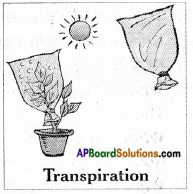
AP Board 6th Class Science Solutions Chapter 3 Animals and their Food

AP State Syllabus AP Board 6th Class Science Solutions Chapter 3 Animals and their Food Textbook Questions and Answers.

AP State Syllabus 6th Class Science Solutions 3rd Lesson Animals and their Food

6th Class Science 3rd Lesson Animals and their Food Textbook Questions and Answers

Improve Your Learning

Fill in the Blanks.

1. The butterfly uses ——– to suck honey from flowers.
Answer:
Proboscis.
2. Tiger is a ——– because it eats only meat.
Answer:
carnivore.
3. Decomposers are also called ——–
Answer:
Recyclers.

AP Board 6th Class Science Solutions Chapter 3 Animals and their Food

Choose the correct answer.

1. The source of energy for a food chain is
A) Producers
B) Consumers
C) Sun
D) Decomposers
Answer:
C) Sun

2. Identify the omnivore from the following.
A) Lion
B) Cow
C) Dog
D) Tiger
Answer:
C) Dog

3. At which position of the food chain would you place a human being
A) Primary consumer
B) Secondary consumer
C) Tertiary consumer
D) All the above
Answer:
C) Tertiary consumer

Answer the Following Questions.

1. List some animals in your surroundings which have the same kind of food habit.
Answer:

  • Cow, buffalo, goat and sheep have some kind of food habit as an herbivore depend upon the plants for food.
  • Dog and cat depend upon meat, milk and curd.

2. Compare the legs and nails of a dog and hen and say why they are different?
Answer:

DogHen
1. Legs of dog is longer and has four legs.1. Legs of hen is shorter and has 2 legs.
2. The legs are muscular and strongly jointed.2. The legs are thin them dog’s leg.
3. It has hard and slight curved nails.3. It has thin, sharp and slightly elongated nails.
4. It uses its legs to run and catch the prey.4. It uses legs to dig the ground to find food.
5. The nails are used for tearing the flesh.5. Nails are useful for scratching the soil to pick up worms.

3. Name some animals which use tongue as a tool for taking in food.
Answer:
Frogs, lizards, garden lizard, chameleon, echidna use tongue as a tool for taking in food.

AP Board 6th Class Science Solutions Chapter 3 Animals and their Food

4. Identify which of the following statements are wrong and give reasons.
(a) All the animals living in water feed only on plants.
(b) Elephants and deer are herbivores living in the forest.
(c) Birds’ beaks are designed to suit their food habits.
(d) Sharp claws are useful for hunting.
(e) Most of the food chains end with herbivores.
Answer:
a) All the animals living in water feed only on plants.

  • This statement is wrong. There are many animals living in water which eat animals.
    Ex: A blue whale in the sea eats tiny animals called krill.

b) Elephants and deer are herbivores living in the forest.

  • This statement is correct as elephants and deer are herbivores living in the forest.

c) Bird’s beaks are designed to their food habits.

  • This statement is correct as bird’s beaks are designed to their food habits.

d) Sharp claws are useful for hunting.

  • This statement is correct.
  • Sharp claws of some animals meant for tearing the flesh of prey. And also help to increase traction to run faster as in the case of cheetah.
  • In some animals claws help holding the grip for running while hunting.
  • In the hen the claws are helpful to scratch the soil to find worms.

e) Most of the food chains end with herbivores.

  • This statement is wrong.
  • The food chain starts with herbivores and ends with carnivores which are wild.

5. Write the importance of the food chain.
Answer:

  • The food chain shows how energy is transferred from one living organism to another organism.
  • It describes energy and nutrients move through an ecosystem.
  •  It shows the relationship between producers and consumers.
  • It explains the interdependence of diverse organisms in nature.

6. Arrange the following in a correct sequence and form a food chain
1. Rabbit → Carrot → Eagle → Snake
2. Human → Insect → Algae → Fish
Answer:
1. Carrot → Rabbit → Snake → Eagle
2. Algae → Insect → Fish → Human

7. If you want to understand more about food chain what questions would you like to ask?
Answer:

  • What is food chain?
  • How does animals and plants dependent on one another?
  • How does energy flow with in an ecosystem?
  • Is there any relation of food habits of animals with that of living ecosystem?
  • How the nature balances the ecosystem?
  • Why the food chain always starts with plants?

8. What happens if there are no decomposers on the earth?
Answer:

  • Bacteria and fungi are get energy by breakdown of dead plants and animals. So, they are called decomposers.
  • They help in the cycling of materials in the environment.
  • If there were no decomposers the dead and waste materials remains on earth.
  • The nutrients would not be replenished.
  • Natural enrichment of the soil cannot takes place.
  • Because of the dead organisms remain on earth, the existence of life on earth would have been impossible.

AP Board 6th Class Science Solutions Chapter 3 Animals and their Food

9. Draw a food chain of your choice.
Answer:

10. How can you appreciate the role of producers in a food chain?
Answer:

  • Plants are known as producers, as they make their own food.
  • Plants are the only organisms which provide food for all organisms in an ecosystem.
  • In an ecosystem, Producers are at base of entire food chain.
  • Plants not only provide the food but also oxygen to the earth.
  • Plants are the precious things to continue the life on earth.

Activities and Projects

Question 1.
Go to a nearby pond where cranes are usually seen. Observe how they catch fish. Write about the process of catching fish. (Take care of yourself when you are near water places.)
Answer:

  • The crane usually has been seen in lakes and the fishes are food for that.
  • The long thin legs that it has helps it to move in the water without disturbing the water.
  • While catching the fish it tries to move very slowly.
  • So that the fishes don’t know its presence it also can stand still for a long time for hunting of fishes.
  • Crane used to catch the fish with the help of their long beak.

Question 2.
Collect one or two earthworms and put them in a bottle containing wet soil. Close it with a lid that has holes. Observe how earthworms get their food. Record your observations.
Answer:
Aim: To observe the eating activity of earthworms in the wet soil.
What we want: Two earthworms, one glass bottle, wet soil.
What to do: Take a glass bottle and fill it with some wet soil.

  • Now kept the two earthworms in the soil filled bottle.
  • Observe them for sometime.

What do we see: We observed that the earthworms are started swallowing soil in, little quantities.
What we learned: With the above observations we concluded that the earthworms are feed on moist soil which contains nutrients.

Question 3.
Fill up the following table

Body part used to collect foodExamples
BeakHens,…
Tongue
Teeth
Sucker
Strong legs with claws

Answer:

Body part used to collect foodExamples
BeakHens, crane, parrot, eagle, humming bird.
TongueLizard, frog, snake, garden lizard, chameleon, dog.
TeethCat, dog, tiger, lion.
SuckerLeech.
Strong legs with clawsTiger, lion, dog.

Question 4.
Make your own food chain and display it in your classroom.
Answer:
Plant → Caterpillar → Chameleon → Snake → Mangoose
(This food chain can make with diagrams of those animals) (Student Activity)

AP Board 6th Class Science Solutions Chapter 3 Animals and their Food

Question 5.
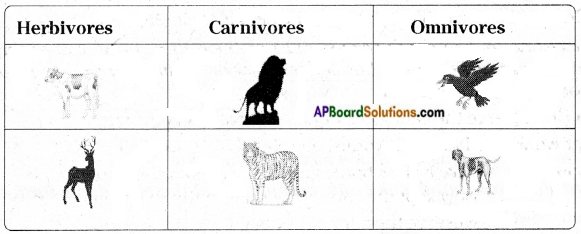
Prepare a scrapbook of animals and separate them into carnivores, omnivores and herbivores.
Answer:
Students can collect the pictures of different animals and after dividing them into carnivores, omnivores and herbivores they can be pasted under these heads separately in the scrapbook. (Student Activity)
AP Board 6th Class Science Solutions Chapter 3 Animals and their Food 2

6th Class Science 3rd Lesson Animals and their Food Activities

Activity – 1

Some animals are listed in the given Table -1. For some the animals, the type of food they eat is also given. Fill the blanks in Table.

Name of the animalFood the animal eats
BuffalloGrass, oil cake, hay, grains
CatSmall animals, Birds, Milk
Rat
Lion
Tiger
Spider
House Lizard
Cow
Human Beings
Butterfly
Crow
Others

Answer:

Name of the animalFood the animal eats
BuffalloGrass, oil cake, hay, grains
CatSmall animals, Birds, Milk
RatSeeds, insects, small animals
LionDeer, jiraffee, fox etc.
TigerOther animals
SpiderBeetles, flies
House lizardWorms, insects
CowGrass, oil cake, hay, grains.
Homan beingsRice, eggs, milk, meat etc.
ButterflyNectar
CrowSmall animals, insects

Answer the following questions based on the table.
i) List the animals that depend only on plants and their products for food.
Answer:
Buffalo, cow, butterfly.

ii) List the animals that depend only on animals and their products for food.
Answer:
Cat, lion, tiger, house lizard, spider.

iii) List the animals that depend on both plants and animals for food.
Answer:
Rat, cow, crow and human beings.

AP Board 6th Class Science Solutions Chapter 3 Animals and their Food

Activity – 2

2. Write the parts of the body animals that are used to collect or capture food in the given table.

S. No.AnimalSense used in tracking foodBody parts-used in taking food
1.DogSmellSharp teeth, Tongue
2.Cow
3.HenBeak
4.Frog
5.Snake
6.Bat
7.Lizard
8.Vulture
9LionLegs, Claws, Mouth ….
10.Humming Bird

Answer:

S. No.AnimalSense used in tracking foodBody parts used in taking food
1.DogSmellSharp teeth, tongue
2.CowSmell, visionMouth, tongue
3.HenVisionBeak, claws
4.FrogTouchTongue
5.SnakeTaste, SmellMouth, teeth
6.BatHearingMouth, tongue
7.LizardVision, hearingMouth, tongue
8.VultureVision, smellBeak, claws
9.LionVision, hearingLegs, claws, mouth
10.Humming birdSmell, tasteBeak

Answer the following questions based on the above table.
i) Do all the animals use similar parts in taking in food?
Answer:

  • No. All animals do not use similar parts in taking in food.
  • Ex: Cow and lizard uses mouth and tongue, whereas hen and humming bird uses beak taking in food.

AP Board 6th Class Science Solutions Chapter 3 Animals and their Food

ii) Name some animals which use similar parts in taking in food?
Answer:
The animals that use some parts for taking food are

  1. Hen, humming bird, vulture use their beak to get food.
  2. Cat and dog – use their sharp teeth to tear the food in pieces.
  3. Lizard and frog – use their tdngue to capture the food.
  4. Lion and tiger – uses their strong legs to run for chasing the animal, sharp claws to catch and sharp teeth to tear flesh.

iii) Compare the parts of dog to that of frog. Note down the similarities as well as differences observed by you.
Answer:
Dog uses smell sense to trick the food whereas frog have a smell organ in the roof of their mouth called the jacobsons organ. This detects food.

  • Dog and frog both use the tongue in taking food.
  • The dog uses its teeth and nails in capturing the food, while frog uses its sticky tongue to capture the food and swallows it.

iv) Compare the parts of hen and sparrow in eating food. Note down the similarities as well as differences you observed.
Answer:
Similarites:

  • Hen and sparrow use their beaks to take the food in.
  • Both are finding out their food by using the vision, as a sense.
  • Hen and sparrow both feeds on grains, worms and insects.

Difference:

  • Hen uses its claws to scratch the soil to find out worms whereas sparrows feed on the insects / worms which are present on plants.

v) What are the similarities between a dog and a lion in the parts involved in taking in food?
Answer:

  • The dog licks with its tongue and runs fast.
  • The lion hunts the other animals. It uses strong legs to run sharp claws to catch and sharp teeth to tear the flesh.
  • The claws of the lion are also sharp to hold the animal.
  • Dog also uses its teeth and nails in capturing its food.

AP Board 6th Class Science Solutions Chapter 3 Animals and their Food

vi) What are the similarities and differences between a vulture and a lion in their mode of taking in food?
Answer:

  • Both lion and vulture are carnivores.
  • They both have sharp vision and use their sharp claws to tear the flesh.
  • Lion hunts animals staying on land.
  • Vulture hunts its food by flying high in the sky.

Activity – 3

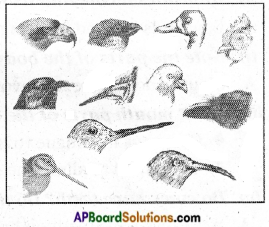
3. Look at the picture. Different birds have different beaks. Do you know why they are different?
AP Board 6th Class Science Solutions Chapter 3 Animals and their Food 3
Answer:
The beaks are different because the birds eat different kinds of food.

  • So, the type of beaks depends upon their habitat, environment and food habits also.
  • The beaks of birds are help to them to kill the prey, to fight, to get food and feeding their young ones. Based on their food habit the birds have different types of beaks such as strong hooked beak, hooked beak, long beak, long thin beak etc.

Activity – 4

4. i) Observe how a lizard catches its food. Write down your observations.
Answer:

  • Lizard uses its visionary sense to track the food.
  • Lizard concentrates its attention on the movements of the insect.
  • Lizard moves so fast towards the insect.
  • It catches the insect by using tongue and eats it.

ii) Find out the differences between a frog and a lizard’s way of taking in food.
Answer:

FrogLizard
1. Frog is carnivore as it feed on insects and worms.1. Lizard is insectivore in nature as it feed on insects.
2. Frog senses the food through a social organ called jacobsons organ in the roof of their mouth-2. Lizard uses its visionary sense to track the food.
3. Frog throws its sticky tongue towards an insect. The insect stuck to the tongue. Then the frog swallows it.3. Lizard moves so fast towards the insect, and catches the insect with the tongue and eats it.

iii) How do these animals (Frog, lizard) use their tongue?
Answer:
These animals (Frog, lizard) use their tongue to capture the food.

AP Board 6th Class Science Solutions Chapter 3 Animals and their Food

Activity – 5

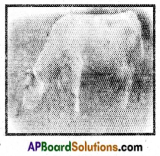
5. Observe a cow/buffalo while eating its food. Write your observations in your notebook by following the given questions.
AP Board 6th Class Science Solutions Chapter 3 Animals and their Food 4
i) How does a cow find its food?
Answer:
Cow finds its food by using the sense of smell.

ii) Note the parts of the body involved in it?
Answer:
Mouth and tongue are involved to take the food in.

iii) What mouthparts of the cow are involved in eating its food?
Answer:

  • The cow uses its tongue to grasp a clump of grass.
  • Teeth help to shred the grass into small pieces.

iv) Do cows have teeth? Do they have teeth on both jaws?
Answer:
Yes. Cows have teeth on both jaws. But don’t have top front teeth.

v) In what way can you justify it is herbivore?
Answer:

  • Cow depends only on plant and plant products for food.
  • They eat different parts of plants like green/dry grass, leaves, branches arid fruits.
  • So that, we can say cow is herbivore.

vi) You may have observed cows and buffaloes sitting under the trees and moving their jaws. Do you know why they do that?
Answer:

  • Cow and buffalo chew food very quickly, swallow and store it in a part of their stomach.
  • After some time, they back the food material from the stomach to the mouth and chew it again leisurely.

AP Board 6th Class Science Solutions Chapter 3 Animals and their Food

Activity – 6

6. Observe a dog in your surroundings. How does it get its food? Write your observations by following the given questions.

AP Board 6th Class Science Solutions Chapter 3 Animals and their Food 5
i) What does it do to find food?
Answer:
The dog finds its food by smelling. Dog’s nose is a thousand times more sensitive than ours.

ii) Which parts are involved in taking in food?
Answer:
The mouth and tongue are involved in taking in food.

iii) How does a dog eat meat?
Answer:

  • The dog catches another animal with its legs.
  • It tears the meat using its sharp teeth.
  • It eats the meat and chews it with the help of teeth and uses its tongue to swallow it.

iv) How does a dog drink water?
Answer:
The dog licks water with its tongue and drinks it.

v) Is there any difference in using its tongue when compared with a frog or a cow? Write in the space provided below.

AnimalUse of tongue
Frog
Cow
Dog

Answer:

AnimalUse of tongue
FrogTo catch the food
CowTo swallow grass
DogTo lick water

AP Board 6th Class Science Solutions Chapter 3 Animals and their Food

Activity – 7

7. Observe the picture and answer the following questions.
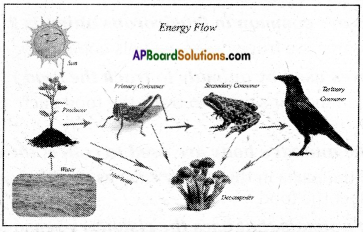
AP Board 6th Class Science Solutions Chapter 3 Animals and their Food 6
i) What is the source of energy in a food chain?
Answer:
Sunlight is the source of energy in a food chain.

ii) How does grasshopper get its energy?
Answer:

  • In a food chain grasshopper is a primary consumer so that it depends on grass for food.
  • Then grasshopper gets its energy by eating grass.

iii) What happens to the crow if the frog was removed from this food chain?
Answer:

  • In this food chain frog is a secondary consumer as its feed on grasshopper.
  • If the frog was removed in this food chain, the grasshopper population will be increased.
  • In this food chain crow is a tertiary consumer as its feed on frogs.
  • If the frog was removed from this food chain, the crows will go hungry and their population will be decreased.

AP Board 6th Class Science Solutions Chapter 3 Animals and their Food

iv) What is the role of mushrooms in the given picture?
Answer:

  • Mushroom is a decomposer.
  • Mushroom get it energy by the breakdown of dead matter.
  • It helps in the cycling of materials in between producers, consumers and to the soil.
AP Board 6th Class Science Solutions Chapter 6 Fun with Magnets

AP State Syllabus AP Board 6th Class Science Solutions Chapter 6 Fun with Magnets Textbook Questions and Answers.

AP State Syllabus 6th Class Science Solutions 6th Lesson Fun with Magnets

6th Class Science 6th Lesson Fun with Magnets Textbook Questions and Answers

Improve Your Learning

Fill in the Blanks.

1. The materials which are attracted towards a magnet are called ——–.
Answer:
Magnetic material.
2. Paper is not a ——– material.
Answer:
magnetic
3. In the olden days, sailors used to find direction by suspending a piece of ——–.
Answer:
natural magnet with thread.
4. A magnet always has ——– poles.
Answer:
two

AP Board 6th Class Science Solutions Chapter 6 Fun with Magnets

Choose the correct answer.

1. Which of the following object is attracted by magnet?
A) wooden piece
B) plain pins
C) eraser
D) a piece of paper
Answer:
B) plain pins

2. A freely suspended magnet always comes to rest in the direction
A) North – East
B) South – West
C) East-West
D) North-South
Answer:
D) North-South

3. Magnets lose their properties when they are
A) used
B) stored
C) heated
D) cleaned
Answer:
C) heated

Answer the Following Questions.

Question 1.
List the magnetic and non-magnetic materials in your classroom.
Answer:

S.No.MaterialMagnetic / Non-magnetic
1.Wooden benchesNon-magnetic
2.Two iron benchesMagnetic
‘3.Teacher’s wooden chairNon-magnetic
4.Teacher’s wooden tableNon-magnetic
5.Wooden blackboardNon-magnetic
6.Metal box attached to the blackboard for putting chalk piecesMagnetic
7.Plastic dust binNon-magnetic
8.Nail in the wall for hanging mapsMagnetic

Question 2.
If you have two similar bars, one a magnet and another a piece of iron. Can you find out which one of these is a magnet? Explain the process.
Answer:

  1. We will take a bar magnet. We have to identify two identical bars A and B. One as a magnet and the other as a simple bar.
  2. To identify, we have to bring our magnet to both the ends of bars A and B one after another.
  3. It is easy to locate the magnet. It attracts the bar magnet when pointed to its one end and repels if pointed to the other end.
  4. The iron bar will be attracted by the magnet in both situations.

Question 3.
The teacher said that the Earth is a magnet. But Sreevidya has some doubts and she asked her teacher some questions. What may be the questions?
Answer:

  1. Is there any big magnet present inside the Earth?
  2. Who has put that magnet inside the Earth?
  3. Where are the South and North poles of Earth’s magnet?
  4. How is this magnet inside the earth discovered?
  5. Is the magnet inside the earth there from the time of formation of the earth?
    Such questions are likely to be asked by Sreevidya.

AP Board 6th Class Science Solutions Chapter 6 Fun with Magnets

Question 4.
Does the Earth behave as a magnet? How do you prove it?
Answer:

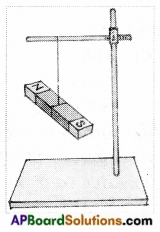
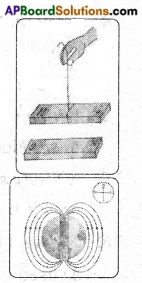
  1. A bar magnet is placed on the table.
  2. Another bar magnet is suspended very close to the first one kept on the table.
  3. It is observed that the N – pole of the suspended bar magnet points towards the S – pole of the magnet placed on the table.
    AP Board 6th Class Science Solutions Chapter 6 Fun with Magnets 1
  4. The S – pole of the suspended bar magnet points towards the N – pole of the bar magnet kept on the table.
  5. Later the first bar magnet is removed from the table.
  6. Now the suspended bar magnet aligns itself in the North-South directions of the earth.
  7. This is because the earth influenced the Suspended bar magnet as the first magnet done.
  8. With this, it is evident that the earth behaves as a magnet.

Question 5.
Predict which of the following materials are magnetic and non-magnetic. Test with a bar magnet and check your predictions. What do you say after testing all materials? Plastic, Iron, Stainless steel, Wood, Aluminum, Gold, Silver, Copper, Paper, Cloth.
Answer:
My predictions and tests are recorded in the table given below.

S.No.MaterialPredictionTest with a bar magnet
1.PlasticNon-magneticNon-magnetic
2.IronMagneticMagnetic
3.Stainless steelNon-magneticNon-magnetic
4.WoodNon-magneticNon-magnetic
5.AluminiumNon-magneticNon-magnetic
6.GoldNon-magneticNon-magnetic
7.SilverNon-magneticNon-magnetic
8.CopperNon-magneticNon-magnetic
9.PaperNon-magneticNon-magnetic
10.ClothNon-magneticNon-magnetic

Question 6.
Draw a bar magnet and locate the poles.
Answer:
AP Board 6th Class Science Solutions Chapter 6 Fun with Magnets 2

Question 7.
Surya was wonderstruck to know that Earth is a big magnet and appreciated the efforts of scientists to discover this. Do you notice any such things in magnets to appreciate? Explain.
Answer:
I found the following things in magnets to appreciate.

  1. Every magnet has two poles. If we break a magnet into two pieces, each piece develops two poles and act as individual magnets.
  2. A freely suspended magnet always rests in the north-south direction. This helps in identifying the directions in new places.
  3. Iron nail kept near magnet act as magnet due to magnetic induction.
  4. Magnetic levitation helps to run electro-magnetic trains.
  5. The attraction property of magnets helps in the separation of magnetic materials from their mixtures.
  6. Electrical cranes are used to lift the huge weight of magnetic materials using this attraction property.
  7. Magnets are useful in various equipment such as motors, speakers, etc.

AP Board 6th Class Science Solutions Chapter 6 Fun with Magnets

Question 8.
Mention some situations where you use magnets in your day-to-day life?
Answer:
A magnet finds its use at a number of places.

S.No.UsesS.No.Uses
1.Refrigerator doors6.Pin stand
2.Some pencil boxes7.Fans
3.Many toys8.Automobile dynamos
4.Magnetic stickers9.Loud speaker
5.Soap stand10.Microphones

In addition, magnets are used in audio and videotapes and computer hard disks to store information. Magnets are also used for magnetotherapy.

Activities and Projects

6th Class Science Textbook Page No. 69

Question 1.
Think and say, in which directions your house is facing? Use the compass and find out the exact direction of your house and compare it with your prediction. Similarly predict and find out in which direction you keep your head while sleeping at night, the directions you face while you are reading, eating etc.
Answer:

  1. I felt my house is facing towards east.
  2. By using compass I found that it is very slightly towards north east.
  3. I predicted that I keep my head towards east while sleeping but found it is also very slightly towards north east.
  4. I predicted that I face towards east while reading and eating also. But I found it also same as above.

Question 2.
Prepare a toy using magnets and write the procedure of preparation briefly.
Answer:

  1. Secure a plastic toy car. Fix a small bar magnet in it by using tape.
  2. Now, keep the car on a table and hold it in your hand.
  3. Keep the N-pole of the magnet facing the S-pole of the magnet in the toy car.
  4. The car moves forward as your gradually draw the magnet in your hand backwards. (∵ unlike poles of magnets attract each other)

Question 3.
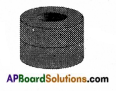
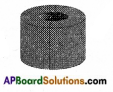
Think and say where the poles will be located in a ring magnet? Try to find out its poles using a bar magnet and check your prediction.
Answer:
Prediction: Magnetic poles are located on the upper and lower surfaces of a ring magnet.
Check:

  1. When I bring south pole of a bar magnet near the upper surface of the ring magnet they repel each other indicating that the upper surface of the ring magnet is its south pole.
  2. When I bring south pole of a bar magnet near the lower surface of the ring magnet they attract each other indicating that the lower surface of the ring magnet is its north pole.
  3. But I came to know from my teacher that there are three possibilities of having poles position basing on their mode of preparation.
    i) Upper & lower surfaces( Axial)
    AP Board 6th Class Science Solutions Chapter 6 Fun with Magnets 3
    ii) Parallel to the Height ( side by side )( Diametral)
    AP Board 6th Class Science Solutions Chapter 6 Fun with Magnets 4
    iii) Inner and outer surfaces. (Radial)
    AP Board 6th Class Science Solutions Chapter 6 Fun with Magnets 5

AP Board 6th Class Science Solutions Chapter 6 Fun with Magnets

Question 4.
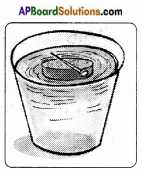
Magnetize a needle using a bar magnet. Make a compass with that needle by following the process explained in activity.
Answer:

  1. Take a bar magnet and place one of its poles near to sharp edge of needle.
  2. Move the bar magnet along the length of the needle till we reach the other end.
  3. Then the bar magnet is lifted from the other end and brought to the same pole of the bar magnet.
  4. On repeating the process for at least 20 to 30 times the needle will became magnetized.
    AP Board 6th Class Science Solutions Chapter 6 Fun with Magnets 6
  5. Tape the magnetized needle to a light cork.
  6. Float the cork in a glass of soap water as shown in fig.
  7. The needle points in North-South direction. Thus it acts as a magnetic compass.

Question 5.
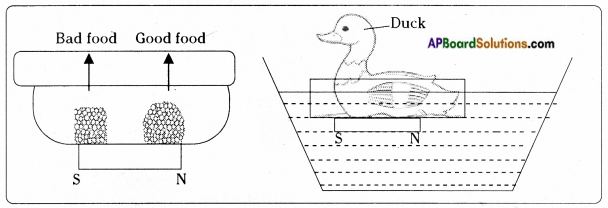
Kiran wants to prepare a toy using some magnets to make people understand the slogan “Reject bad food and accept only good food”. Can you help him to prepare the toy? If yes, how?
Answer:

  1. The toy can be prepared like this.
  2. Take a plate. Put good food on one side and bad food on the opposite side in the plate and label accordingly.
  3. A magnet is attached at the bottom of this plate with its N-pole pointing towards good food and S-pole pointing towards bad food.
  4. A magnet is fitted in the bottom of a duck where its S-pole points towards the mouth and N-pole points towards the tail of the duck.
  5. When good food portion of the plate is brought closer to the duck, the duck placed in a tub of water moves towards the plate because unlike poles of the magnets attract each other.
  6. When the bad food portion of the plate is brought closer to the duck, the duck moves away because like poles of the two magnets repel each other.
    AP Board 6th Class Science Solutions Chapter 6 Fun with Magnets 7

6th Class Science 6th Lesson Fun with Magnets Activities

Activity – 1

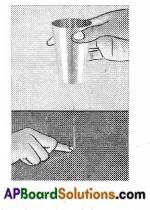
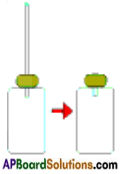
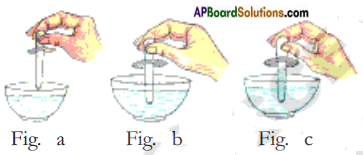
1. Take a steel glass. Put a magnet in it. Take a needle through which thread is passed. Press the thread with a finger near the eye of the needle as shown in figure 2 and raise the glass upward slowly. (Page No. 60)
AP Board 6th Class Science Solutions Chapter 6 Fun with Magnets 8
i) What happens?
Answer:
The needle stand vertically up without touching the glass.

ii) Does the needle stand vertically up without touching the glass? Why does this happen?
Answer:
Yes. This is because the magnet in the glass is attracting the needle.

Activity – 2

Finding Materials attracted by Magnets. (Page No. 61)

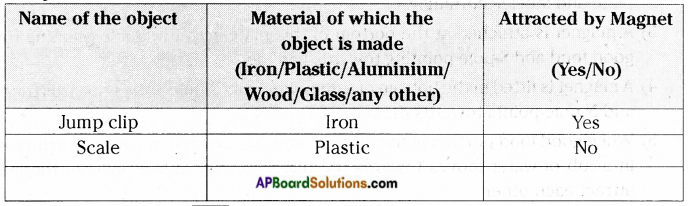
2. Take a bar magnet, nail, jump-clip, plastic scale, a piece of glass, key, paper, iron bolt, pen, blade, pencil, knife, stainless steel spoon, piece of chalk, wood, and touch the magnet to each item. Does the magnet attract every object? Observe and record your observations duly mentioning the name of the material of which the object is made in the table.
AP Board 6th Class Science Solutions Chapter 6 Fun with Magnets 9
Answer:

S.No.Name of the objectMaterial of which the object is madeAttracted by Magnet (Yes / No)
1.Jump clipIronYes
2.ScalePlasticNo
3.NailIronYes
4.A piece of glassGlassNo
5.KeyIronYes
6.PaperPaperNo
7.Iron boltIronYes
8.PenPlasticNo
9.BladeIronYes
10.PencilWoodNo
11.KnifeIronYes
12.Stainless steel spoonAlloyNo
13.Piece of chalkMineral of CalciumNo
14.WoodWoodNo

i) Which materials are attracted by a magnet?
Answer:
Nail, jump-clip, key, iron bolt, blade, knife.

AP Board 6th Class Science Solutions Chapter 6 Fun with Magnets

ii) Which materials are not attracted by a magnet?
Answer:
Plastic scale, a piece of glass, paper, pen, pencil, stainless steel spoon, piece of chalk, wood.

iii) Give your own examples for magnetic materials.
Answer:
Iron, cobalt, nickel.

iv) Give your own examples for non-magnetic materials.
Answer:
Gold, Silver, Copper, wood, paper, plastic.

Activity – 3

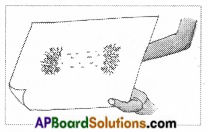
3. Spread some iron fillings uniformly on a sheet of paper. Place a bar magnet below this sheet. (Page No. 62)
AP Board 6th Class Science Solutions Chapter 6 Fun with Magnets 10
i) What do you observe?
Answer:
I observe that the uniformly spread iron filings come close and get concentrate at two points of the paper sheet. At some distance, I found some scattered iron filings between these two points.

ii) Does the property of attracting iron filings remain the same for all parts of a bar magnet?
Answer:
No. the ends of the bar magnet attract more iron filings than the middle part of the magnet.

iii) Do you observe any change in the pattern of iron filings spread over the sheet?
Answer:
Yes, uniformly spread iron filings changed their pattern and concentrated more at endpoints of the bar magnet. Scattered iron filings between these two points are somehow in some lines from one point to other.

Activity – 4

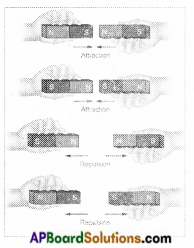
4. Attraction and Repulsion between Two Magnets. Take two similar magnets, place them in four different ways as shown in Figure, and record your observations. (Page No. 63)
AP Board 6th Class Science Solutions Chapter 6 Fun with Magnets 11
i) What do you observe?
Answer:
I observe that magnets not only attracts but also repel each other

ii) When do the magnets attract each other?
Answer:
In the first two situations, they attract each other. That means when unlike poles come close to each other they attract.

iii) When do the magnets repel each other?
Answer:
In the last two situations, they repel each other. That means when like poles come close to each other they repels.

AP Board 6th Class Science Solutions Chapter 6 Fun with Magnets

Activity – 5

Finding directions with a bar magnet. (Page No. 63)

5. Suspend the bar magnet freely with the help of a thread tied around its center as shown in figure.
AP Board 6th Class Science Solutions Chapter 6 Fun with Magnets 12
i) Does the magnet remain stationary?
Answer:
After some time it becomes stationary.

ii) Wait for some time. What do you find now?
Answer:
I found that the magnet rests in a north-south direction.
You will notice that the magnet finally takes a position in the North-South direction. Mark the endpoints towards the North with some color. Now disturb the magnet and again wait for some time.

iii) Where does the colored portion come to rest?
Answer:
The colored portion comes to rest towards the north.

iv) Repeat this experiment at another place. What do you observe?
Answer:
I observed that the magnets always come to rest in the North-South direction.

Activity – 6

Making Magnet (Page No. 64)

6. Aim: To make a magnet
What do you need? (Materials required): Iron nail/ piece of iron. Bar magnet, pin/ iron fillings.
What to do? (Procedure):

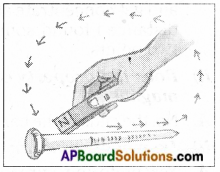
  1. Take a nail /a piece of Iron and place it on a table.
  2. AP Board 6th Class Science Solutions Chapter 6 Fun with Magnets 13
  3. Now take a bar magnet and place one of its poles near one edge of the nail / piece of iron and rub from one end to another end without changing the direction of the pole of the magnet.
  4. Repeat the process for 30 to 40 times.
  5. Bring a pin or some iron filings near the nail / piece of iron to check whether if has become a magnet.

What do you see?(Observation): The nail/ piece of iron attract the pin / iron filings. What do you learn? (Result): Iron nail,/ piece become a magnet.

AP Board 6th Class Science Solutions Chapter 6 Fun with Magnets

Activity – 7

Making your own Magnetic Compass. (Page No. 65)

7. Aim: To make a magnetic compass
What you need? (Materials required: magnetized needle, tape, water, detergent.
What to do? (Procedure):

  1. Take a magnetized needle.
  2. Attach the needle with a tape to a light cork.
  3. Float the cork in a glass of water.
  4. Add a little detergent to the water to help the cork float freely.

What do you see? (Observation): The magnetized needle points in North- South direction.
What do you learn? (Result): This acts as a magnetic compass.

Activity – 8

Magnetic Induction (Page No. 65)

8. Aim: To observe and understand magnetic induction.
What you need? (Materials required): safety pin, alpin, bar magnet
What to do? (Procedure):

  1. Take a safety pin and bring it close to an alpin.
  2. Bring the safety pin close to one pole of a bar magnet and see how it gets attached to the magnet.
  3. Now bring an alpin and touch it to the safety pin.

What do you see?(Observation):

  1. Safety pin does not attract the Alpin when it is not in contact with magnet.
  2. But when it is in contact with a magnet it attracts the alpin.
  3. From the above two cases, we notice that the safety pin acts as a magnet when it is in contact with another magnet.

What do you learn? (Result): Magnetic property is induced in the safety pin due to the bar magnet. The magnetic property possessed by a magnetic substance due to the presence of a magnet near it, is called magnetic induction.

AP Board 6th Class Science Solutions Chapter 6 Fun with Magnets

Activity – 9

9. Finding out whether the given object is a magnet or not. (Page No. 66)
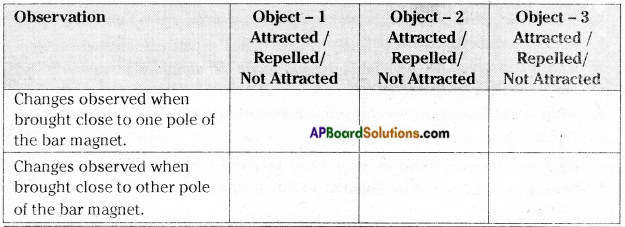
You have been given three objects of the same size, shape and colour and a bar magnet. You have to decide which one among them is a magnet, which is not a magnet but made up of magnetic material or a non-magnetic material Bring three objects one after the other close to one pole of the bar magnet and observe whether they get attracted, repelled or not attracted. Record your observation in table 2. After that bring those objects close to the other pole of the bar magnet in the same way and record your observations.
AP Board 6th Class Science Solutions Chapter 6 Fun with Magnets 16
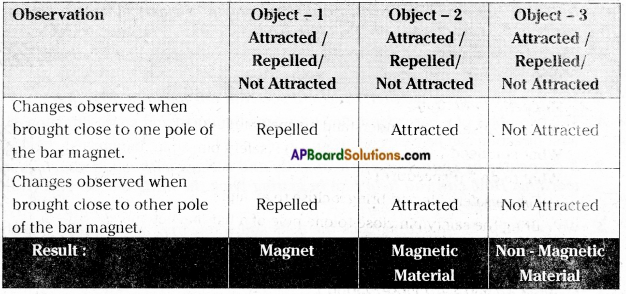
Answer:
AP Board 6th Class Science Solutions Chapter 6 Fun with Magnets 17
If an object is attracted by one pole of the bar magnet and repelled by its other pole, then it is a magnet. So object -1 is magnet.
If an object is attracted by both the poles of a bar magnet and not repelled by any pole, then it is not a magnet but a magnetic substance. So object -2 is made up of magnetic material.
If an object is neither attracted by a magnet nor repelled by it, then it is a non-magnetic substance. So object – 3 is made up of non- magnetic material.

AP Board 6th Class Science Important Questions Chapter 2 Knowing About Plants

AP State Syllabus AP Board 6th Class Science Important Questions Chapter 2 Knowing About Plants

AP State Syllabus 6th Class Science Important Questions 2nd Lesson Knowing About Plants

6th Class Science 2nd Lesson Knowing About Plants 2 Mark Important Questions and Answers

Question 1.
What are the types of venation?
Answer:
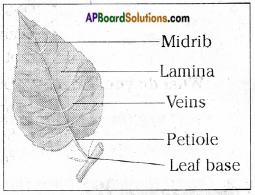
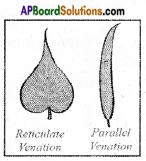
There are two types of venation 1. Reticulate venation 2. Parallel venation.

Question 2.
What are the functions of stomata?
Answer:
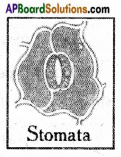
Stomata regulate the gaseous exchange between the plant and environment and transpiration.

Question 3.
What are the main parts of the plant?
Answer:
Roots, stem, leaves, flowers are the main parts of the plant.

Question 4.
How many types of root system? What are they?
Answer:
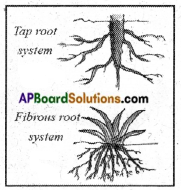
There are two types of root system. 1. Tap root system 2. Fibrous root system.

AP Board 6th Class Science Important Questions Chapter 2 Knowing About Plants

Question 5.
Give examples for the fibrous root system.
Answer:
Monocot plants have the fibrous root system. Ex. Grass, rice, wheat etc.

Question 6.
What is cotyledon?
Answer:
The seed leaf present within the seed is called cotyledon.

Question 7.
Give examples for monocots and dicots.
Answer:
Monocots: Grass, rice, wheat, maize etc.
Dicots: Mango, pulses, fruits

Question 8.
In a bean how many cotyledons are present?
Answer:
In a bean seed two cotyledons are present.

Question 9.
Which type of root system the dicot plants have?
Answer:
The dicot plants have tap root system.

Question 10.
Give examples of tuberous roots.
Answer:
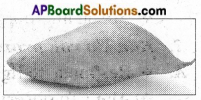
Radish, carrot, beetroot, sweet potato are examples for tuberous roots.

Question 11.
What is stem?
Answer:
The main axis of the shoot system is called the stem.

Question 12.
What is a node ?
Answer:
Node is the part of stem where the leaf arises.

Question 13.
What is internode?
Answer:
The part of the stem between two successive nodes is called the internode.

Question 14.
In which plant do you observe the parallel venation ?
Answer:
In monocot plants such as grass, cereals, millet plants we will observe the parallel venation.

Question 15.
What is transpiration?
Answer:
Plants release excess of water in their body through stomata in the form of vapour is called transpiration.

Question 16.
What do you know about the flower?
Answer:
The flower is colourful and attractive part in a plant.

Question 17.
What are petals?
Answer:
The colourful and fragrant parts of a flower is petals.

AP Board 6th Class Science Important Questions Chapter 2 Knowing About Plants

Question 18.
How do you say the millet plant is a monocot?
Answer:
Millet has only one cotyledon in a seed. So, millet is a monocot.

Question 19.
Name the traditional food of Konaseema, prepared with the help of jackfruit leaves.
Answer:
Pottikkalu.

Question 20.
What type of venation is found in the leaves of plants with fibrous roots?
Answer:
Parallel venation is found in the leaves of plants with fibrous roots.

Question 21.
If the leaves have the reticulate venation what would be the type of root?
Answer:
The plants having the reticulate venation have the tap root system.

Question 22.
Give examples for modified stems.
Answer:
Potato, turmeric, garlic, ginger and sugarcane are examples for modified stems.

Question 23.
Define fibrous root system.
Answer:
A cluster of thin and uniform roots arising from the base of the stem is called fibrous root system.

Question 24.
Why Pottikkalu have jack fruit flavour?
Answer:
The leaves of jack fruit are used in the preparation of Pottikkalu. So, Pottikkalu have jack fruit flavour.

Question 25.
Give examples of plants having supporting roots.
Answer:
Banyan tree, Sugarcane and Maize plants have supporting roots which grown above the ground level.

AP Board 6th Class Science Important Questions Chapter 2 Knowing About Plants

6th Class Science 2nd Lesson Knowing About Plants 4 Mark Important Questions and Answers

Question 1.
Write the differences between potato and sweet potato?
Answer:

PotatoSweet potato
1. It is a modification of stem.1. It is a modification of root.
2. As it stores the food in the stem it is known as tuber.2. As it stores the food in the root, it is known as a tuberous root.

Question 2.
Write the differences between tap root system and fibrous root system?
Answer:

Tap root systemFibrous root system .
1. A tap root differentiated primary root of the plant.1. The fibrous root is different from the primary root of the plant.
2. Tap root system consists of tap root and lateral roots.2. A cluster of thin and uniform roots round here.
3. Tap root penetrates deep into the soil.3. Fibrous root is shallow and does not penetrate as deeply.
4. It helps the pLant to survive in drought conditions.4. It helps the plant to prevent the soil erosion.
5. Tap root system found in dicot plants.5. Fibrous root system found in monocot plants.

Question 3.
In drought conditions which root system is help the plant to survive?
Answer:

  • When there is no rainfall for several years it leads to drought.
  • When a drought hits, soil dries out, the crops with deep roots have access to deep stored moisture.
  • The taproot system has the access to get the moisture from deep levels of the soil.
  • So, tap root system help the plant to survive in drought conditions.

Question 4.
What are the differences between terminal bud and auxiliary bud?
Answer:

Terminal budAuxiliary bud
1. It occurs at the end or top of the stem.1. It occurs at a leaf node.
2. It helps the plant to grow taller so that the plant gains more height.2. It helps to provide support to the plant holding leaves, buds and flowers.
3. Due to this the plant grow in a straight forward.3. Due to this the plant have more branches like a bush.

Question 5.
What are the stem modifications?
Answer:

  • In some plants, the stems are modified to perform the function of storage of food, support, protection and vegetative propagation.
  • Potato, turmeric, garlic, ginger, sugarcane store food materials in the stem so that the stem bulges in size. These are known as modified stems or tubers.

AP Board 6th Class Science Important Questions Chapter 2 Knowing About Plants

Question 6.
What is venation? What are the types in it?
Answer:

  • The arrangement of veins in a leaf is called venation.
  • There are two types of venation. 1. Reticulate venation 2. Parallel venation
  • The veins are arranged in either web-like or network all over the lamina it is called reticulate venation.
  • The veins are arranged parallel to one another all over the lamina is called parallel venation.

Question 7.
How do you distinguish the differences between reticulate and parallel venation?
Answer:

Reticulate venationParallel venation
1. The veins are arranged in the form of a network or a web like arrangement all over the lamina.1. The veins are parallelly arranged with one another ail over the lamina.
2. It is seen in the dicot plants.2. It is seen in the monocot plants.
3. Ex. Mango, Hibiscus, Ficus etc.3. Banana, bamboo, wheat, maize etc

Question 8.
How do you find the root system without pulling it out?
Answer:

  • It is possible to find the root system without pulling it out.
  • By observing the leaf venation, we will identify whether that plant has tap root or fibrous roots.
  • If the leaf is having a parallel venation, that root of the plant will be fibrous root system.
  • If the leaf is having reticulate venation, that root of the plant will be a tap root system.

Question 9.
Write the differences between monocots and dicots?
Answer:

DicotsMonocots
1. Dicots have two cotyledons in the seed.1. Monocots have only one cotyledon in the seed.
2. Dicots have taproot system.2. Monocots have fibrous root system.
3. Leaves in dicots have reticulate venation.3. Leaves in monocots have parallel venation.
4. Ex. Apple, mango, brinjal, beans.4. Ex. Wheat, corn, rice.

Question 10.
What are stomata? What is it importance?
Answer:

  • The small pores present on the leaf surface is called stomata.
  • The stomata act like our nose in the plant.
  • These are helpful in the exchange of gases between the plant and the atmosphere.
  • Plants release excess water in their body through stomata by the process of transpiration.

AP Board 6th Class Science Important Questions Chapter 2 Knowing About Plants

Question 11.
What are the functions of root?
Answer:

  • Fixes the plant to the soil.
  • Absorbs water and minerals from the soil.
  • It stores the food in some plants like carrot and beet root.

Question 12.
What is transpiration and what its importance?
Answer:

  • The process of releasing water in the form of vapour through stomata is called transpiration.
  • It helps to keep the leaves healthy.
  • It helps to provide water to leaf cells for photosynthesis.
  • The temperature of the plant body maintained constant.

Question 13.
Write the functions of the stem?
Answer:
The stem,

  • supports the branches, leaves, flowers and fruits.
  • transports water and minerals from root to other parts.
  • transports food from leaves to other parts through stem.
  • stored food in the plant’s potato, ginger, turmeric, garlic, etc.

Question 14.
Which questions do you pose to know about the plants and its parts?
Answer:

  • Which part of the plant absorbs water?
  • What are the important parts in a plant?
  • What is the function of stem?
  • Why some of the roots are modified?

Question 15.
Write the functions of leaf.
Answer:
Leaves play an important role in the life of plant, they are

  • help in respiration
  • to carry out transpiration
  • to prepare food by the process of photosynthesis

Question 16.
What are the root modifications?
Answer:

  • In some plants, the roots change their shape and modified to store the food materials.
  • The roots of radish, carrot, beet root modified to store the starch.
  • Aerial roots grow above the ground, typically providing support to the plant.
    Ex: Banyan tree, sugarcane, Maize etc.
  • In mangroves the aerial roots helpful in respiration.

Question 17.
Write about Pottikkalu?
Answer:

  • Pottikkalu is a traditional food of Konaseema of Godavari districts.
  • Leaves of jack fruit are used in its preparation.
  • They make cups with these leaves and fill them batter made of black gram and rice rawa.
  • These cups are steamed to get Pottikkalu. These are healthy and delicious with jack fruit flavour.

Question 18.
How do you appreciate the beauty of a flower?
Answer:

  • Flowers are the colourful parts of the plants.
  • They attract insects for pollination and produce fruits.
  • Colourful flowers give beauty to nature.
  • By seeing the colourful flowers, we get happiness and they give us a positive effect on mood.

Question 19.
What is a root? Write about its function?
Answer:

  • The underground part of the main axis of a plant is known as the root.
  • It fixes the plant to the soil.
  • It absorbs water and minerals from the soil.
  • It stores food in some plants like carrot and beet root.

AP Board 6th Class Science Important Questions Chapter 2 Knowing About Plants

Question 20.
Which roots are known as tuberous roots? Why?
Answer:

  • Radish, carrot, beetroot, sweet potato is known as tuberous roots.
  • These plants store food materials in their roots so that they were known as tuberous roots.

Question 21.
How will you tell which part of a plant is the stem and which is the root?
Answer:

  • The part of the plant that presents above the surface of soil is the stem.
  • The part of the plant that presents below the soil surface is the stem.
  • Stem possess nodes, inter nodes and leaves etc. whereas root cannot have these.

Question 22.
What would happen if flowers do not have different colourful petals?
Answer:

  • The flower has colourful parts called petals.
  • The beautiful petals attract insects for pollination and produce fruits.
  • If flowers do not have different colourful petals, they can’t have a fragrance to attract the insects.
  • If the plant does not have colourful petals and fragrance, they cannot attract the insects so that fruits are not formed.

Question 23.
What questions do you ask to know more about the aerial roots of Mangroves?
Answer:

  • What are mangroves?
  • Where do we find these mangroves?
  • What is the importance of mangroves?
  • What is the special character of mangroves?

Question 24.
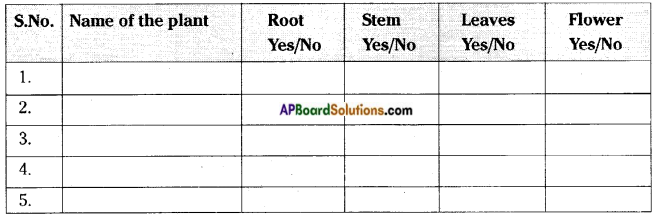
Fill the following table by observing the plant leaves?

Sl.NoName of the plantType of venation
1.Hibiscus (Mandara)
2.Paddy
3.Peeple (Raavi)
4.Jo war

Answer:

Sl.NoName of the plantType of venation
1.Hibiscus (Mandara)Reticulate venation
2.PaddyParallel venation
3.Peeple (Raavi)Reticulate venation
4.JowarParallel venation

Question 25.
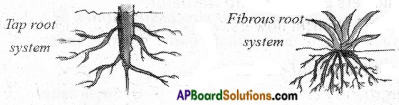
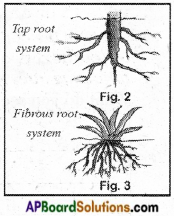
Draw the diagram of the tap root system and fibrous root system of a plant?
Answer:
AP Board 6th Class Science Important Questions Chapter 2 Knowing About Plants 1

AP Board 6th Class Science Important Questions Chapter 2 Knowing About Plants

6th Class Science 2nd Lesson Knowing About Plants 8 Mark Important Questions and Answers

Question 1.
What will happen if plants cannot store their food?
Answer:

  • Plants can store their food by the process of photosynthesis.
  • Some of the food is used by the plants for various metabolic processes.
  • The remaining food is stored in the various parts of the body such as roots, stem, leaves, seeds, fruits etc.
  • This stored food helps the plants to survive in unfavourable conditions.
  • Other animals also depend on plants for their food.
  • If the plants cannot store the food, the animals that depend on plants get hungry and gradually die.
  • When unfavourable conditions like drought appear, the plants will also ultimately die.

Question 2.
How do you prove that stem conducts water?
Answer:
Aim: To observe the conduction of water by a stem.
What you need: A small twig of balsam plant, a glass of water, red ink.
What to do:

  • Take a glass of water and add a few drops of ink to it.
  • Now place the small twig in the water.

What do you see: The stem turns reddish.
What do you learn: The red ink is taken and transported by the stem upwards.

AP Board 7th Class Science Important Questions Chapter 6 Weather and Climate

AP State Syllabus AP Board 7th Class Science Important Questions Chapter 6 Weather and Climate

AP State Syllabus 7th Class Science Important Questions 6th Lesson Weather and Climate

7th Class Science 6th Lesson Temperature and Its Measurement Important Questions and Answers

Question 1.
How do elders predict rain?
Answer:

  1. It is a common experience for everybody to hear elder people talking about the possible weather on a day before planning to celebrate a function of the family.
  2. They do it by observation of different seasons.
    AP Board 7th Class Science Important Questions Chapter 6 Weather and Climate 1
  3. Farmers listen to radio or watch T.V. for weather forecast.
  4. They depend on these weather predictions to plan their agricultural activities.
  5. These weather predictions effect our daily life.

AP Board 7th Class Science Important Questions Chapter 6 Weather and Climate

Question 2.
How does the meteorological department make weather predictions?
Answer:

  1. The meteorological department collects data and uses it to make predictions.
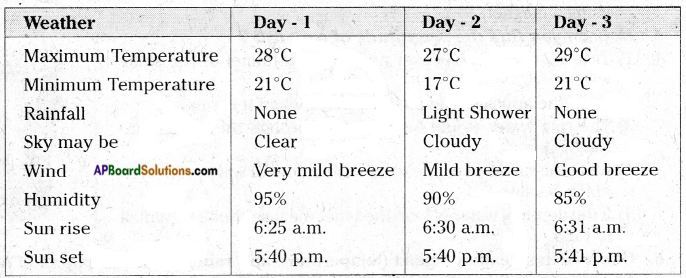
  2. This is about weather of Hyderabad for three consecutive days.
    AP Board 7th Class Science Important Questions Chapter 6 Weather and Climate 2
  3. We find that these aspects of weather keep changing.
  4. The humidity, changes, the wind changes, the temperature changes the sunrise and sunset times change too.
  5. Keeping all these things in consideration the department make weather predictions.

Question 3.
What aspects do you see in the weather record?
Answer:

  1. We find that there are some changes in a day. But most of the day is normal.
  2. The weather is a complex phenomenon that it can vary over very short periods of time.
  3. Sometimes its sunny in the morning but clouds appear from somewhere and it starts raining.
  4. Within a matter of a few minutes this gives way to bright sunshine.
  5. We must have had several such experiences. The temperature, humidity, rain, wind speed change.
  6. All this effects the life of human beings and other living organisms. This constitutes weather.

AP Board 7th Class Science Important Questions Chapter 6 Weather and Climate

Question 4.
Describe the construction and working of six’s maximum and minimum thermometer.
Answer:
Description – and working:

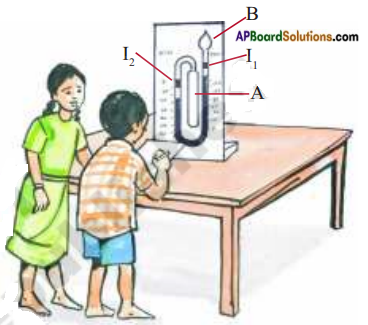
  1. Six invented the maximum minimum thermometer (MMT) thermometer to measure highest and lowest temperatures of’a place.
  2. This consists of a cylindrical bulb A, connected through a U-shaped tube to spherical bulb B that contains alcohol.
    AP Board 7th Class Science Important Questions Chapter 6 Weather and Climate 3
  3. When the temperature increases, the alcohol in the bulb A expands.
  4. The mercury in the U tube goes up to the bulb B side and the indicatorfl^also moves up.
  5. This indicates maximum temperature of the day.
  6. If the temperature decreases,alcohol in the bulb A contracts then the mercury in the U-tube goes to the A bulb side and the indicator (I2 ) also moves up.
  7. This indicates the minimum temperature of the day.
  8. After taking readings the indicators I2 and I1 are brought to their original places by using a magnet.

Question 5.
How do you find the magnitude of rain fall?
Answer:

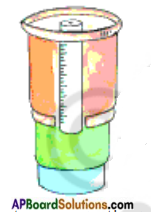
  1. Take a 10cm wide beaker and insert a funnel of the same width.
  2. Keep the apparatus in an open place when it is raining.
    AP Board 7th Class Science Important Questions Chapter 6 Weather and Climate 4
  3. The rain water would be collected through the funnel into the beaker.
  4. After the rain is over, measure the amount of water collected in the beaker.
  5. If the depth of water is 1 cm then that the magnitude of rainfall is 1 cm.

AP Board 7th Class Science Important Questions Chapter 6 Weather and Climate

Question 6.
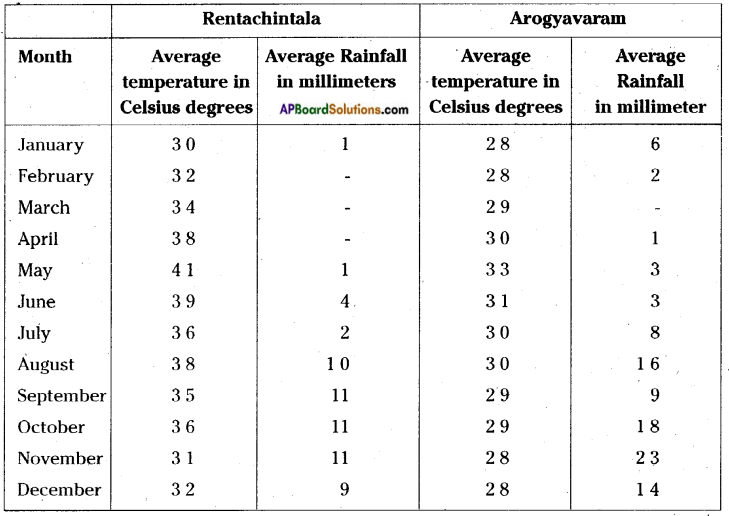
Observe the weather report (temperature and rain fall) of two places in our state. The average temperature and rain fall for the last 25 years of the particular month is given in the table.
AP Board 7th Class Science Important Questions Chapter 6 Weather and Climate 5
Answer the following questions:
a) In which month was maximum temperatures recorded? Why?
Answer:
In the month of may maximum temperatures were recorded.
b) Comparatively which place is hot? Why?
Answer:
Rentachintala is comparatively hot because the average rainfall is less compared to Arogyavaram.
c) How can you say Arogyavaram is cooler than Rentachintala in summer?
Answer:

  1. In Arogyavaram, in the mid summer, the maximum temperature recorded was only 33°C as against 41°C recorded in Rentachintala.
  2. So Arogyavaram is cooler than Rentachintala.

Question 7.
What is meant by climate?
Answer:

  1. The average weather pattern taken over a long time, say 25 years, is called climate of that place.
  2. Broadly, the same patterns of temperature, rainfall, humidity wind speed that have been generally continuing for a long time, say the last 25 years, at a place gives the climate of that place.
  3. If we find that temperature at a place is generally high for large part of the year, we say the climate of that place is hot.

AP Board 7th Class Science Important Questions Chapter 6 Weather and Climate

Question 8.
How do we compare a place which is hot with a place which is cool?
Answer:
With the help of six’s maximum and minimum thermometer we compare a place which is hot with a place which is cool.

Question 9.
How do meteorologists measure the rain fall? What are its units?
Answer:
Meteorologists measure the rainfall using a ‘Rain gauge’. It is also called Udometer or Pulviometer or Ombrometer. They can measure exact amount of rainfall. Rainfall is expressed in centimeters or millimeters.

Question 10.
Why is it sweaty in Vijayawada and relatively less in Hyderabad in summer?
Answer:

  1. Even though it is hotter, we do not sweat as much in Hyderabad.
  2. In places near a river or in coastal regions the weather in summer is sweaty.
  3. If we are in coastal region in summer we would feel very sweaty in addition to feeling hot winds.
  4. That is why Vijaywada is more humid than Hyderabad.

Question 11.
Which region on the globe is very hot and which region is very cold?
Answer:
We know that in the equatorial region it is very hot and in the polar region, it is very cold.

AP Board 7th Class Science Important Questions Chapter 6 Weather and Climate

Question 12.
Take a newspaper or watch the TV news and record the maximum and minimum temperature, rainfall, humidity and wind pattern of any 3 cities or towns in a table. Do this over a week.
Answer:

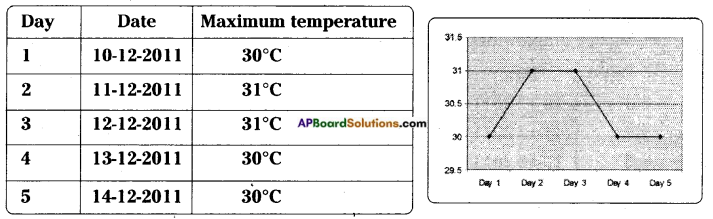
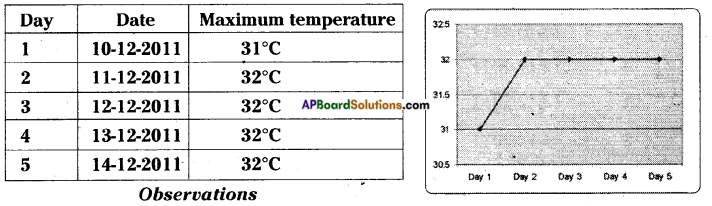
  1. Here the maximum temperature recorded over a week in Hyderabad is taken.
  2. We will plot the graph.
    AP Board 7th Class Science Important Questions Chapter 6 Weather and Climate 6
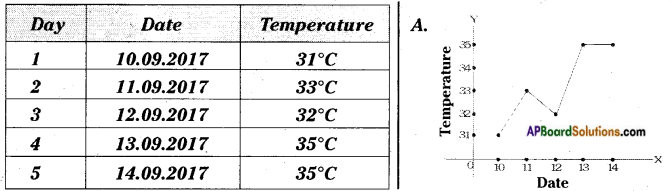
  3. Graph showing the variation of maximum temperature during 10-14 Dec. 2011 at Hyderabad.

Question 13.
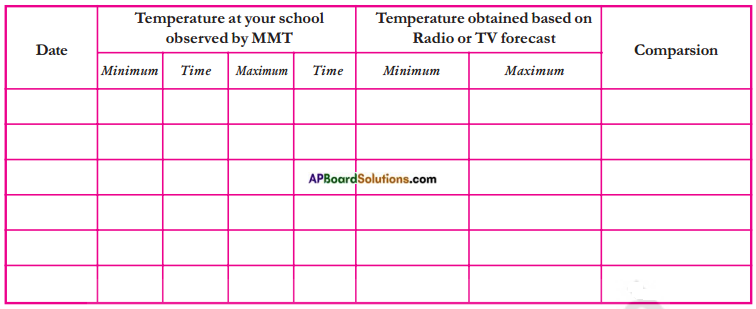
Collect weather reports of a nearby city from newspapers. Tabulate your Observations for a week and compare them.
Answer:

  1. For guidance sample tabular form is given.
  2. The student has to perform this activity.
    AP Board 7th Class Science Important Questions Chapter 6 Weather and Climate 7

Question 14.
Answer the following questions from the data collected.
a) When was the maximum temperature recorded?
b) When was the minimum temperature recorded? Why?
c) Is there any similarity in temperatures between your school and the nearest city?
Answer:
a) …………………………………..
b) …………………………………..
c) …………………………………..

AP Board 7th Class Science Important Questions Chapter 6 Weather and Climate

Question 15.
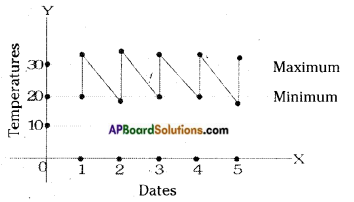
a) Pravin has measured temperature of his village with the help of MMT (Maximum, Minimum thermometer.)
b) He expressed his observations through a graph.
c) The observations are also tabulated.
d) Look into them and answer the following questions.
a) For how many days did Pravin observe the temperature of his village?
b) On which day was the highest temperature recorded?
c) On which days did the lowest temperature fall?
d) Do you find any relation between 10th and 14th of December 2011? What is that?
e) Make a graph with your observations of maximum and minimum temperatures.
AP Board 7th Class Science Important Questions Chapter 6 Weather and Climate 8
Answer:
a) For five days.
b) On 2nd, 3rd, 4th and 5th days the highest temperature was recorded.
c) On the 1st day the lowest temperature fall.
d) There is an increase in temperature and the rise in temperature was maintained for four days.
e) The student can do this activity.

Question 16.
How do you find the direction of the wind? Describe an activity.
Answer:

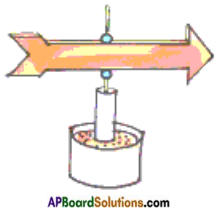
  1. Let us find the direction of wind by using card board pieces and a thin nail.
  2. Take two cardboard pieces and cut them the shape of an arrow and paste them together.
    AP Board 7th Class Science Important Questions Chapter 6 Weather and Climate 9
  3. Insert a thin needle or iron wire as shown the figure in the middle of the arrow.
  4. The needle must be long enough to be fixed on a strong base and should allow the arrow to move along the direction of the wind.

AP Board 7th Class Science Important Questions Chapter 6 Weather and Climate

Question 17.
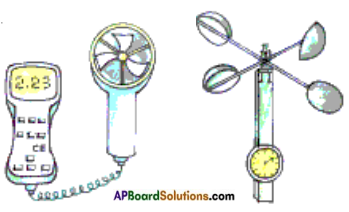
With the help of an anemometer observe the directions of the wind and tabulate your observations in the table given here.
AP Board 7th Class Science Important Questions Chapter 6 Weather and Climate 10
Now answer the following questions:
a) Does the wind move in the same direction the whole day?
Answer:
The student can answer this by observing the data collected by him / her.
b) In which direction does it move in the morning?
Answer:
This question also can be answered by the student.

Question 18.
What is humidity? Explain it with an activity.
Answer:
Humidity: The quantity of moisture in the air is the ’humidity’ of the place. If the humidity is high when it is hot, we feel sweaty.
Activity:

  1. Take about 10 ml. of water in a test tube. Heat it on a Bunsen burner or a candle.
  2. When water is heated, it changes into water vapour. The vapour enters into the air.
  3. In the same way sea water changes into vapour due to heating by the sun.
  4. That water vapour in the atmosphere is the humidity.

Question 19.
What happend during the tsunami in Andaman and Nicobar islands in 2004?
Answer:

  1. Many people died during the tsunami in Andaman and Nicobar islands in 2004.
  2. But the tribals who observed the ocean moving back and birds making sounds moved away from danger.
  3. They could predict the danger and save their lives.

AP Board 7th Class Science Important Questions Chapter 6 Weather and Climate

Question 20.
Write a weather report similar to the weather report given in Television.
Answer:

  1. Isolated rain or thunder showers are lightly to occur over Chittoor, Nellore, Prakasham and some parts of Kadapa districts.
  2. Mainly dry weather will prevail over southern Telangana districts and northern coastal districts of Andhra Pradesh.
  3. Sky should be cloudy for the next two days in Kurnool and Ananthapur districts.

Question 20.
Describe a weather report actually given by the department.
Answer:

  1. According to meteorological department report 42°C maximum temperature recorded at Ramagundam of Karimnagar district and 29°C minimum temperature recorded at Aarogyavaram of Chittore district.
  2. Because of cumulonimbus clouds 2mm of rainfall was recorded in Hyderabad.
  3. Scattered rainfall recorded in some parts of interior Rayalaseema.
  4. Remaining part of the state was dry.

Question 21.
What is the difference between a weather forecast and a weather report?
Answer:

  1. The report that explains future conditions is a weather forecast.
  2. The report that explains about past conditions is a weather report.
  3. In common conversation we often refer to both as weather report.

Question 22.
What are the weather components?
Answer:
Temperature, rain fall, wind speed, humidity…. etc., are the weather components.

AP Board 7th Class Science Important Questions Chapter 6 Weather and Climate

Question 23.
How do farmers estimate the rain fall?
Answer:

  1. Farmers estimate the rainfall based on the wetness of the soil after the rain.
  2. They call-it as “PADUNU”.
  3. This much of rainfall is sufficient to start agriculture activities like ploughing.
  4. This is an approximate measure.

Question 24.
Draw the diagram of an Anemometer what is its use?
Answer:
We can measure wind speed and direction with an Anemometer.
AP Board 7th Class Science Important Questions Chapter 6 Weather and Climate 11

Question 25.
Observe features of the following states, and specific places in India from an ATLAS. Try to write down something about the climate in these areas.

StateClimatic Condition
Kerala
Andhra Pradesh
Rajasthan
Jammu & Kashmir
West Bengal

Answer:
The student with the help of the teacher can write something about the climate in those areas.

Question 26.
Describe the climate of our country as per the studies of IMD.
Answer:

  1. The Indian Meteorological Department (IMD) studies climate of our country.
  2. Climate describes the weather condition occurring over a relatively longer period of time in a given place.
  3. For example in the month of June.
  4. We expect the weather to be mild in Bangalore, humid in Kolkata, hot and dry in parts of Rajasthan, cold in Kashmir and rainy in Coastal Kerala.
  5. Does it mean that in coastal Kerala it is always rainy in the month of June or if it would be always humid in Kolkata?
  6. Nowadays there is a complaint that climate is not as ordered as it was .
  7. Seasonal climatic condition do not appear as predictable and known.

AP Board 7th Class Science Important Questions Chapter 6 Weather and Climate

Question 27.
How do people adjust to the climate? Why in 2010 Kurnool and other parts in Rayalaseema submerged infloods?
Answer:

  1. The people living in an area adjust to the conditions of climate.
  2. For example the rain fall has being relatively less for the past two decades.
  3. Even in Rayalaseema during rainy season the tanks and canals remain dry.
  4. The dried canals and tanks are now used for other purposes.
  5. The less rainfall has also led to developing ways to use less water.
  6. The change in rainfall pattern shows there may be shifts in climate over long periods of time.
  7. In areas which do not have a climate of rain when it rains heavily there is no way to drain out the water.
  8. As a result many areas were flooded and submerged in Kurnool in 2010 and also in other parts of Rayalaseema.

Question 28.
How does climate effect our life style?
Answer:

  1. Climate mostly effects on our daily life. We change our life style to suit that climate.
  2. We wear cotton clothes in summer.
  3. We want to drink cool water also.
  4. We take care to protect ourselves from rain.
  5. We take many precautions we need to take if we were going to visit Kashmir or Ooty during winter.

Question 29.
a) The students of Sanjamala village collected the information about the temperature of their village in 5 days and reported in the table. Observe the table.

DateMinimum TemperatureMaximum Temperature
0101-201820°C32°C
02-01-201819°C33°C
03:01-201820°C32°C
04-01-201820°C32°C
05-01-201818°C31°C

Answer the following questions:
i) On which day was Maximum Temperature recorded?
ii) On which day was Minimum Temperatrue recorded?
iii) What is the average Minimum Temperature of 5 days?
iv) What changes did you observe in the Temperature?
b) Draw a graph based on the information in the table.
Answer:
a) i) 02-01-2018
ii) 05-01-2018
iii) 19°C
iv) Lowest and highest temperatures.
b)
AP Board 7th Class Science Important Questions Chapter 6 Weather and Climate 12

Question 30.
What aspects should you observe to predict the weather of your village, by watching sky?
Answer:
The time of sunrise and sunset, wind flow, percentage rainfall in that area should be taken into consideration to estimate the type of weather in that given area.

AP Board 7th Class Science Important Questions Chapter 6 Weather and Climate

Question 31.
Table showing the variation of maximum and minimum temperature during the period between 10 and 14 September 2017 at Guntur. Based on this draw a graph.
Answer:
AP Board 7th Class Science Important Questions Chapter 6 Weather and Climate 13

Question 32.
Observe the table and write answers for the following questions.

MonthTemperatureRainfall
May48°C0 mm
July39°C7 mm
October37° C10 mm
November34°C15 mm

i) This table indicates ………….
ii) In which month was maximum rainfall recorded?
iii) Least temperature was recorded in which month?
iv) Why is maximum temperature recorded in the month of May?
Answer:
i) The above table tells us about the temperature and rainfall from May to November.
ii) November.
iii) November.
iv) Because May falls in summer.

Question 33.
Observe the below table and write answers for the following questions.

WeatherDay 1Day 2Day 3
Maximum temperature28°C27°C29°C
Minimum temperature21 °C17°C21°C
RainfallNoneLight showerNone
Sky may beClearCloudyCloudy
WindVery mild breezeMild breezeGood breeze
Humidity95%90%85%
Sunrise6.25 a.m.6.30 a.m.6.31 a.m.
Sunset5.40 p.m.5.40 p.m.5.41 p.m.

i) What aspects did you see in the weather record?
ii) Rainfall was recorded on which day?
iii) On which day was maximum temperature recorded?
iv) Among these three days, long day is observed on?
Answer:
i) Maximum temperature, minimum temperature, rainfall, sky, air, humidity, sunrise, and sunset.
ii) Second day
iii) Third day
iv) First day

Question 34.
Observe the diagram and answer the following questions.
AP Board 7th Class Science Important Questions Chapter 5 Temperature and Its Measurement 22
i) What is the name of the apparatus in the picture?
ii) Name the liquid present in bulb – A.
iii) Name the liquid present in U-shaped tube.
iv) How is it useful in daily life?
Answer:
i) Six’s maximum minimum thermometer
ii) Alcohol
iii) Mercury
iv) To measure the maximum and minimum temperature of a day.

AP Board 7th Class Science Important Questions Chapter 6 Weather and Climate

Question 35.
Observe the graph showing rainfall of a place from August to December. Write down the observations from it and answer the following questions.
AP Board 7th Class Science Important Questions Chapter 6 Weather and Climate 15
i) Name the month in which minimum rainfall was recorded.
ii) Name the month in which maximum rainfall was recorded.
iii) Name the months in which less than 50 mm rainfall I was recorded.
iv) In which months was the rainfall recorded more than 50 nun?
Answer:
i) September.
ii) November.
iii) August, September and October.
iv) November and December.

Question 36.
Ritwik observed the temperature of his village and drew the following graph Analyse the graph and answer the following questions.
AP Board 7th Class Science Important Questions Chapter 6 Weather and Climate 14
a) How many days does Ritwik observe temperature?
b) On which day the lowest temperature is recorded?
c) In which days does the temperature remain same?
d) What apparatus is used to measure the temperature?
Answer:
a) 5 days.
b) First day
c) 2nd, 3rd, 4th and 5th days.
d) Six’s maximum-minimum thermometer.

AP Board 6th Class Science Important Questions Chapter 1 The Food we Need

AP State Syllabus AP Board 6th Class Science Important Questions Chapter 1 The Food we Need

AP State Syllabus 6th Class Science Important Questions 1st Lesson The Food we Need

6th Class Science 1st Lesson The Food we Need 2 Mark Important Questions and Answers

Question 1.
What is the theme of World Food day 2019?
Answer:
The World Food day theme was “Zero Hunger”.

Question 2.
What are ingredients?
Answer:
The materials which are required to prepare food are known as Ingredients.

Question 3.
What are the different food sources for human beings?
Answer:
Plants, animals and seawater are the food sources for human beings.

Question 4.
Write the ingredients to prepare chicken curry.
Answer:
Chicken, tomato, chilli powder, turmeric powder, garam masala, cinnamon, ginger and garlic paste, oil, onion, salt and coriander leaves.

Question 5.
Which food item do you like? Why?
Answer:
I like payasam because I like the food items which are sweety in taste.

AP Board 6th Class Science Important Questions Chapter 1 The Food we Need

Question 6.
Give some examples of cereals.
Answer:
Rice, Wheat, Maize, etc.

Question 7.
What are the food items that are taken in breakfast?
Answer:
Idli, dosa and chutney, bread, milk, egg are the food items that are commonly taken in breakfast by different people.

Question 8.
What are the different methods used in the preparation of food?
Answer:
Boiling, Steaming, Fermentation, Roasting, Deep frying are the different methods used in the preparation of food.

Question 9.
Why rice items are very common in our area?
Answer:
In our state, geographical and climatic conditions are more suitable for growing rice. So we prefer rice items more in our area.

Question 10.
What is FAO?
Answer:
Food and Agriculture Organisation.

Question 11.
Expand UNDP.
Answer:
United Nations Development Programme.

Question 12.
What is boiling?
Answer:
It is a food preparation method used to make the food items Rice, dal, eggs and potato etc.

Question 13.
Give examples of food items prepared by the fermentation process.
Answer:
Bread, Jilebi, Cake, Dosa, Idli are the food items prepared by the fermentation process.

Question 14.
List out the junk foods that are commonly eaten by us.
Answer:
Pizza, Burger, Chips, Fried fast food, Noodles, Samosa, French fries, etc. are junk foods.

Question 15.
What is vegetable carving?
Answer:
Making of different types of designs and decorations with vegetables is called vegetable carving.

Question 16.
What are natural preservatives?
Answer:
Salt, oil, turmeric powder, sugar and honey are natural preservatives.

Question 17.
Give examples of artificial preservatives.
Answer:
Benzoates, Nitrates, Sulphates are artificial preservatives.

AP Board 6th Class Science Important Questions Chapter 1 The Food we Need

Question 18.
How does food get its taste?
Answer:
The taste of food depends on its ingredients, method of preparation and cultural habits.

Question 19.
What do we get from animals?
Answer:
We get milk, meat, egg and honey from animals.

Question 20.
Give examples of the stem that stores food.
Answer:
Sugarcane, onion, garlic, turmeric, ginger plants store food in the stem.

Question 21.
Why do we keep certain fruits in sugar syrup or honey?
Answer:
Sugar syrup or honey is used in the canning and freezing of fruits to improve its flavour and to preserve its natural colour and taste.

Question 22.
Name the vegetables/fruits that are used in the preparation of pickles.
Answer:
Mango, lemon, tamarind”, amla, tomato, chillies etc.

Question 23.
Why fishes are dried or smoked?
Answer:
Drying and smoking is help to reduce the moisture content in fish. So that it can be preserved properly without getting spoiled.

Question 24.
Is there ‘any a relationship’ of food habits and growing crop for that particular
area?
Answer:
Yes. People living in one region thy have some food habits. So that farmers cultivate that type of food crops which are suitable for that geographical and climatic conditions.

Question 25.
What are the common ingredients that used in making pickles?
Answer:
Salt, oil, turmeric powder, chilli powder, garlic, fenugreek powder and asafoetida are commonly used ingredients in the preparation of pickles.

AP Board 6th Class Science Important Questions Chapter 1 The Food we Need

Question 26.
What are the different food items that are prepared by using rice?
Answer:
Idli, dosa, dal rice, vegetable rice, biryani, Pongal, kichadi are the food items prepared by using rice.

6th Class Science 1st Lesson The Food we Need 4 Mark Important Questions and Answers

Question 1.
We take some of the food in large quantities whereas the others in small quantity. Why is it so?
Answer:
Body needs calories to perform the metabolisms.

  • Our body needs calories so that we take carbohydrate rich food in large quantities.
  • Proteins are the body building nutrients which are necessary for growth and development.
  • • Vitamins and minerals are present in vegetables and fruits. These nutrients required to our body in small quantities.

Question 2.
What are the Indian spices? What is its role in the preparation of food?
Answer:

  • Indian spices are aromatic parts of a plant which are added in a variety of dishes.
  • We get spices from the bark and roots of certain plants, leaves, flowers or stems of the plant.
  • These are used for the flavouring, colouring or preserving food.
  • Ex. Cardamom, black pepper, curry leaves, fenugreek, fennel, ajwain, bay leaves, cumin, coriander leaves, turmeric, cloves, ginger, nutmeg and cinnamon.

Question 3.
Ramu said that all food items are sources of plants and animals. Do you support this statement? Why? Why not?
Answer:

  • Vegetables, fruits, cereals and pulses etc. are the ingredients obtaining from the plants.
  • Egg, milk, meat etc are the food ingredients obtaining from the animals.
  • So, I support this statement as all these food ingredients are derived from the plant and animal sources.
    (OR)
  • We get food from plants and animal sources.
  • At the same time salt is derived from the other sources.
  • Salt is an important ingredient for preparing the all food items.
  • So that I can’t support the statement that all food items are sources of plants and animals.

AP Board 6th Class Science Important Questions Chapter 1 The Food we Need

Question 4.
What questions do you pose to know about the food sources of human being?
Answer:

  • Where do we get ingredients?
  • Where does the food ingredients of food come from?
  • What are the main food sources?
  • Is there any source other than plants and animals?

Question 5.
How will you appreciate plants and animals in the view of food sources?
Answer:

  • Plants and animals are the main food sources for us.
  • We get vegetables, fruits, cereals and pulses etc. from the plants.
  • We get milk, meat, egg and honey from the animals.
  • If we have not these food sources on earth the existence of life become impossible.

Question 6.
What are the effects of the junk foods on human health?
Answer:
Eating of junk food causes,

  • increased obesity,
  • loss of memory and learning problems,
  • worsens appetite and digestion,
  • inadequate growth and development,
  • heart diseases and stroke.

Question 7.
Prepare some slogans to avoid the junk food.
Answer:

  1. Know your health -Say no to junk food
  2. Fast food – Fast death
  3. Put junk food into dustbin not into the stomach
  4. Eating pizzas and burgers daily, gives you a round belly
  5. Junk food is an injurious to health

Question 8.
Write about the steaming process.
Answer:

  • Steaming process is a method of preparation of food.
  • In this process boiling of water causes it to vaporize into steam.
  • The steam carries heat to the food, thus cooking the food.
  • Idli, cake, egg is cooked by steaming process.

AP Board 6th Class Science Important Questions Chapter 1 The Food we Need

Question 9.
Why do you follow different methods for preparing the food?
Answer:

  • Preparation of food is an art. It is prepared in different ways.
  • There should be no loss of nutrients while cooking.
  • Some food items are delicious in certain food preparing methods.
  • The taste of the food depends on its ingredients and the method of preparation also. So that we use different methods for preparing the food.

Question 10.
Why do we preserve the food?
Answer:

  • Food preservation is the process of treating and handling food to stop or slow down spoilage.
  • It provides food availability throughout the year.
  • Food preservation stop the food wastage.
  • If food is not preserved properly, it can attack by microorganisms that lead to spoilage of food.

Question 11.
What are preservatives? What is it need?
Answer:

  • The materials or substances that use in preserving food are called preservatives.
  • The preservatives may be natural such as salt, oil, turmeric powder, sugar, honey and artificial such as Benzoates, Nitrates, Sulphates.
  • Preservatives are essential to preserving food properly.
  • Preservatives keep food fresher for longer periods of time and prevent spoilage of food.

Question 12.
Natural preservatives are more preferable than artificial preservatives? Why?
Answer:

  • Natural preservatives include salt, oil, turmeric powder, sugar and honey.
  • The artificial preservatives are prepared by using some chemicals.
  • The natural preservatives retain the nutritional value of the food items, whereas
    artificial preservatives reduce the moisture level in the food and they slow down the nutritional value of the food.
  • Artificial preservatives are also harmful to our health.
    So that natural preservatives are more preferable than artificial preservatives.

Question 13.
What are the Indian traditional preservative methods?
Answer:

  • Generally, some food items are salted and dried for preservation Ex: Mango; tomato, fish, appeal, vadiyalu.
  • Salt, turmeric powder, chilli powder and oil are added while making pickles.
  • Fish, meat, vegetables are freeze in refrigerators.
  • Certain fruits are preserved in sugar syrup or honey.

AP Board 6th Class Science Important Questions Chapter 1 The Food we Need

Question 14.
What are the preservative techniques used in the preparation of pickles?
Answer:

  • To prepare a pickle, we need some preservative ingredients such as salt, edible oil, red chilli powder, fenu greek powder, mustard powder, turmeric powder, garlic and asafoetida.
  • Salt and turmeric powder control the growth of micro-organisms.
  • Garlic and asafoetida add flavour and taste to the pickle.
  • And other preservatives are used to taste and preserve the pickle for few months.

Question 15.
List out the healthy food habits.
Answer:

  • Eat a variety of vegetables and fruits every day.
  • Drink fat-free and low-fat milk for every day.
  • Don’t take junk foods.
  • Drink plenty of water instead of sweetened drinks and cool drinks.

Question 16.
Write about millets.
Answer:

  • Millets are stapled food and important sources Of nutrients.
  • They contain energy source, proteins and fibres.
  • Ex. Finger millets (raagulu), Pearl millets (sajjalu), Great millets (Jonnalu), Foxtail millets (Korralu), Proso millets (samalu) etc.
  • Millets are good for health.

Question 17.
Which day is celebrated as World Food Day? What is the aim of the celebration of world food day?
Answer:

  • World Food Day is celebrated every year across the world on 16 th October.
  • To promote worldwide awareness on the problem of hunger, malnutrition, and poverty as well as focus attention on agriculture and food production.

Question 18.
Plant roots are also food sources for human beings. How do you support this statement?
Answer:

  • Carrot, beetroot, sweet potato, radish store food materials in their roots.
  • These tuberous roots are used as food sources for human beings.
    Thus, plant roots are also a food sources for human beings.

Question 19.
How do you prevent the wastage of food?
Answer:

  • By using of proper storage methods.
  • Avoid the optimum temperature.
  • Decrease the water percentage up to 5%.
  • Adding the preservatives.

Question 20.
How will you appreciate people who offer food to the needy?
Answer:

  • It is a very great attitude to offer food for the needy.
  • It avoids the hunger for the world.
  • It increases empathy in society.
  • It is an opportunity to show their humanity towards the needy.

AP Board 6th Class Science Important Questions Chapter 1 The Food we Need

6th Class Science 1st Lesson The Food we Need 8 Mark Important Questions and Answers

Question 1.
To present a symposium in your school, prepare a note about junk food.
Answer:

  • Junk food containing high levels of calories with less vitamins and minerals.
  • Most of the fast-food is junk food.
  • Pizza, burger, chips, fried fast food, samosa, French fries etc. are junk foods.
  • Junk foods do not contain nutritional value.
  • Junk food is not easy to digest.
  • Eating Junk food causes obesity, digestion issues and loss of appetite.
  • It causes drowsiness and harmful to health.
  • It causes diabetes, cholesterol and heart diseases.

AP Board 6th Class Science Solutions Chapter 10 Basic Electric Circuits

AP State Syllabus AP Board 6th Class Science Solutions Chapter 10 Basic Electric Circuits Textbook Questions and Answers.

AP State Syllabus 6th Class Science Solutions 10th Lesson Basic Electric Circuits

6th Class Science 10th Lesson Basic Electric Circuits Textbook Questions and Answers

Improve Your Learning

Fill in the Blanks.

1. The flow of electricity in a circuit is called ——–.
Answer:
current
2. A ——– helps us to allow or break the flow of electricity in a circuit.
Answer:
switch
3. Substances that allow electricity to pass through them are known as ——–.
Answer:
conductors
4. The electric bulb was invented by ——–.
Answer:
Thomas Alva Edison

AP Board 6th Class Science Solutions Chapter 10 Basic Electric Circuits

Choose the correct answer.

1. In a bulb the part which gives us light is
A) Metal Base
B) Glass Chamber
C) Filament
D) Terminals
Answer:
C) Filament

2. Which of the following is an insulator?
A) Hairpin
B) Iron Nail
C) Plastic Scale
D) Pencil Lead
Answer:
C) Plastic Scale

3. The metal used in making filaments of present-day bulbs is
A) Iron
B) Copper
C) Tungsten
D) Cotton
Answer:
C) Tungsten

Answer the Following Questions.

Question 1.
What is an electric circuit? Explain with a diagram.
Answer:

  1. An arrangement in which a cell and a bulb are connected by using wires is called a simple electric circuit.
    AP Board 6th Class Science Solutions Chapter 10 Basic Electric Circuits 1
  2. A simple electric circuit is a path for the flow of electric current between cell and the bulb.

Question 2.
What are the parts of a torchlight?
Answer:
The parts of a torchlight are

  1. Hollow cylindrical barrel
  2. Torch cells
  3. Bulb
  4. Glass cover
  5. Reflector
  6. Switch
  7. Metal spring

AP Board 6th Class Science Solutions Chapter 10 Basic Electric Circuits

Question 3.
Classify the following into conductors and insulators:
Water, Plastic pen, Pencil lead, Dry cotton cloth, Wet cotton cloth, Dry wood, Wet wood.
Answer:

S.No.ConductorsS.No.Insulators
1Pencil lead4Water
2Wet cotton cloth5Plastic pen
3Wet wood6Dry cotton cloth
7       –Dry wood

Question 4.
What will happen if the cells in a torch are arranged as shown in the following figure? Why?
AP Board 6th Class Science Solutions Chapter 10 Basic Electric Circuits 2
Answer:

  1. The bulb does not glow.
  2. Because two positive terminals of the cells are connected to each other which does not provide a closed path.

Question 5.
Niharika observed an electrician repairing a street light wearing gloves on his hand. She asked him some questions. What would be those questions?
Answer:

  1. Why do you wear gloves?
  2. With what the gloves are made up of?
  3. How do these gloves help in your work?
  4. What will happen if the glows are made up of cloth instead of rubber?

Question 6.
A circuit is connected with a cell, bulb, and a switch, but the bulb is not glowing. Write all possible reasons for this.
Answer:

  1. The cell used might have been totally discharged.
  2. The bulb taken might have been fused.
  3. The switch arranged may not be in touch with the wires as expected.
  4. Any breakages in the circuit cause failure.

Question 7.
How do you test the materials given to you, to know whether they are conductors or insulators?
Answer:
Aim: To test the given materials to know whether they are conductors or insulators What you need? (Materials required): a cell (power source), a bulb, connecting wires, wooden plank or thermocol sheet, two drawing pins, and the materials provided to test.
How to do? (Procedure):

  1. Connect a circuit on a wooden plank or on a thermocol sheet as shown in Fig.
    AP Board 6th Class Science Solutions Chapter 10 Basic Electric Circuits 3
  2. Insert two drawing pins at A and B.
  3. insert the given materials in the gap between A and B one after another.
  4. With each insertion, check whether the bulb glows or not.

What do you see? (Observation): The bulb glows only when some materials like a safety pin, iron nail were inserted. It does not glow when the materials like paper, eraser were inserted.
What do you learn? (Result): Bulb glows only when an electric current passes through the materials. So all the materials which made the bulb glow are conductors and the remaining are insulators.

AP Board 6th Class Science Solutions Chapter 10 Basic Electric Circuits

Question 8.
Draw a circuit diagram showing a cell, switch, and bulb.
Answer:
AP Board 6th Class Science Solutions Chapter 10 Basic Electric Circuits 4

Question 9.
If you put the switch on, a light will glow, a fan will rotate, an iron box heats up etc. All these different functions will be performed by electricity. How do you feel about the comforts given by this great invention to human beings?
Answer:

  1. Electricity plays a key role in modern technology.
  2. Without electricity, most of the things could never work. (i.e. TV, Computer, bulb, etc…)
  3. We can’t imagine our life without electricity.
  4. Electricity is a gift given by scientists to human beings.
  5. Electricity is a basis for new inventions.

Question 10.
List the daily activities in which we use electricity.
Answer:
Following are our daily activities in which we use electricity.

  1. Electric bulb and fluorescent lights etc.
  2. Washing machine and Grinder
  3. Electric fan and Electric iron
  4. Television and Tape recorders
  5. Computers and Motors to lift water etc.

Activities and Projects

6th Class Science Textbook Page No. 115

Question 1.
In activity 4, we observed some situations where the torch bulb glows. Niharika challenged her friends that she could make the bulb not glow even with the cells kept in the proper position. What would she have done?
Answer:

  1. Niharika might have put an insulator in between the two cells.
  2. Or she might have used the powerless batteries.

AP Board 6th Class Science Solutions Chapter 10 Basic Electric Circuits

Question 2.
Connect a circuit as shown in the given diagram.
AP Board 6th Class Science Solutions Chapter 10 Basic Electric Circuits 5
a) Does the bulb glow? Why?
b) Draw the circuit so that the bulb glows.
c) Verify it by connecting cells and bulbs as per the circuit drawn.
Answer:
a) The bulb does not glow. As the positive terminals of the two cells are connected. So current does not flow and bulb does not glow.
b)
AP Board 6th Class Science Solutions Chapter 10 Basic Electric Circuits 6
c) I have connected the circuit as shown in (b) and found the bulb glowing.

Question 3.
You have studied the story of Thomas Alva Edison. Write a note appreciating his efforts in inventing the bulb.
Answer:

  1. Thomas Alva Edison was a famous scientist who invented the bulb.
  2. He experimented with a number of different filaments.
  3. His goal was to find materials that would light well and last for a long time.
  4. Though he failed a number of times he worked hard continuously to get success.
  5. Without an electric bulb, we can’t imagine our life.

Question 4.
Connect circuits as shown in the following figure. Write your observation in each case.
AP Board 6th Class Science Solutions Chapter 10 Basic Electric Circuits 7
Answer:
a) The bulb does not glow as the +ve terminals of the two cells are directly connected.
b) The bulb glows as the cells are connected correctly.
c) The bulb glows and gives dim light as only one cell is connected.
d) The bulb glows brilliantly as the three cells are connected in series and more current flows in the bulb.

6th Class Science 10th Lesson Basic Electric Circuits Activities

Activity – 1

1. Let us take a torch cell and observe it. Can you describe it? (Page No. 108)
Answer:

  1. The cell consists of a cylindrical metal can.
  2. Its heaviness suggests that it is filled with some chemicals.
  3. The protrusion on one end is due to a carbon rod in the centre.
  4. At the top of the cell, a metal cap is fixed.
  5. This metal cap act as the positive (+) terminal of the cell.
  6. Opposite to this, the bottom of the cell (metal can) act as a negative (-) terminal of the cell.
  7. The entire can is sealed.
  8. Positive and negative terminals of the cell are labelled on it as + and – respectively.

AP Board 6th Class Science Solutions Chapter 10 Basic Electric Circuits

Activity – 2

Simple electric circuits (Page No. 108)

2. Take four wires of different colours, say blue, green, red and yellow, each about 15 cm long. Electric wires are often covered with plastic. First, remove about two centimetres of the plastic covering, from both ends of each wire. Now attach two wires (Blue and Green) to a bulb and two wires (Red and Yellow) to a cell with a cello-tape or cell-holder as shown in Fig. 4(a). We can use a cell holder to hold the cells and wires together tightly.
Now connect the wires in different forms as shown in Fig. 4(b) to 4(g). In each case, check whether the bulb glows or not. Record your observations in Table 1.
AP Board 6th Class Science Solutions Chapter 10 Basic Electric Circuits 9a
Answer:

ConnectionDoes the bulb glow (Yes / No)
Fig (b)No
Fig (c)No
Fig (d)Yes
Fig (e)Yes
Fig (f)No
Fig (g)No
  • In which case does the bulb glow? Why?
    Answer:
    The bulb glows in connections shown in Fig. 4(d) and Fig. 4(e). This is because in these connections form a closed path.
  • In which case the bulb does not glow? Why?
    Answer:
    In the remaining cases means like in Figs. 4(b), 4(C), 4KO, and 4(g), bulb does not glow.
    This is because there is some gap in the path. (circuit is open)

Activity – 3

Electric Switch (Page No. 110)

3. Connect a circuit on a wooden plank or on a thermocol sheet as shown in Figure. Insert two drawing pins at A and B. Insert a safety pin in between A and B. such that one end of the pin is completely in contact with B and the other end is left free. Now observe the bulb.
AP Board 6th Class Science Solutions Chapter 10 Basic Electric Circuits 10

  • What do you notice?
    Answer:
    The bulb does not glow.
    Now touch the safety pin to pin A and observe the bulb again.
  • What happens?
    Answer:
    The bulb glows.
  • Why doesn’t the bulb glow when the safety pin is left free at one end?
    Answer:
    In this activity, the safety pin is used to close /open the circuit. When the safety pin is left free at one end, the circuit is open. So the bulb doesn’t glow.

AP Board 6th Class Science Solutions Chapter 10 Basic Electric Circuits

Activity – 4

4. Take a torch that has two cells. Arrange the cells in the torch in as many ways as you can. In which cases does the bulb glow and in which cases it doesn’t? Draw pictures showing different positions of cells and glowing of bulb. Can you find out why the bulb glows only when cells are placed in a particular position? (Page No. 111)
AP Board 6th Class Science Solutions Chapter 10 Basic Electric Circuits 11
Answer:
The bulb glows only in the first position. This is because in the remaining positions the circuit is being open as the cell’s terminals are not in a proper sequence. In the first position they are in proper sequence, so the circuit is closed. As a result the bulb glows.

Activity – 5

Identifying conductors and insulators (Page No. 111)

5. Take the circuit which we used in activity-3, as shown in Figure. Remove the safety pin from the drawing pins so that you have two open terminals A and B.
AP Board 6th Class Science Solutions Chapter 10 Basic Electric Circuits 12
Insert different objects like a hair pin, safety pin, eraser, plastic scale, match stick, piece of a metal bangle, piece of a glass bangle, paper clip etc. in the gap between A and B. With each insertion, check whether the bulb glows or not. Record your observations in table 2 for each case.
Answer:

S.No.ObjectName of the MaterialDoes the bulb glow (Yes/No)Conductor/Insulator
1.Hair pinMetalYesConductor
2.Pencil leadLeadYesConductor
3.EraserRubberNoInsulator
4.Plastic scalePlasticNoInsulator
5.Match stickWoodNoInsulator
6.Divider from geometry boxMetalYesConductor
7.Piece of paperPaperNoInsulator
8.Iron nailIronYesConductor
9.Piece of Metal bangleMetalYesConductor
10.Piece of Glass bangleGlassNoInsulator
11.Paper clipMetalYesConductor
12.Piece of chalkChalkNoInsulator
13.Safety pinMetalYesConductor
  • If you look at table 2, after recording your observations you will find that the bulb glows in some cases and does not glow in other cases. Can you guess the reason?
    Answer:
    Bulb glows in some cases as they allow an electric current to pass through them. They are conductors.
    Bulb does not glow in other cases as they do not allow the electric current to pass through them. They are insulators.
  • Can you group the objects you observed in your daily life as conductors and insulators? Make a list of objects and group them as conductors and insulators and write in table-3
    Answer:

    S.No.ConductorsInsulators
    1MetalsWater
    2IronAir
    3SilverPlastic
    4Salt waterWood
    5CopperRubber
    6AluminiumPaper

AP Board 6th Class Science Solutions Chapter 12 Movement and Locomotion

AP State Syllabus AP Board 6th Class Science Solutions Chapter 12 Movement and Locomotion Textbook Questions and Answers.

AP State Syllabus 6th Class Science Solutions 12th Lesson Movement and Locomotion

6th Class Science 12th Lesson Movement and Locomotion Textbook Questions and Answers

Improve Your Learning

Fill in the Blanks.

1. Joints of the bone helps in the ——–.
Answer:
movements.
2. The contraction of the ——– pulls the bones during movement.
Answer:
muscle.
3. The bones at the elbow are joined by a ——– joint.
Answer:
hinge.

AP Board 6th Class Science Solutions Chapter 12 Movement and Locomotion

Choose the correct answer.

1. The immovable joints are present in
A) Knee
B) Shoulder
C) Neck
D) Skull
Answer:

2. The hollow bones are present in
A) Cow
B) Sparrow
C) Buffalo
D) Snake
Answer:

3. The fibers join the muscles to the bones.
A) Tendon
B) Ligament
C) Cartilage
D) None
Answer:
A) Tendon

The joint response to move our head up and down and side to side is
A) Sliding joint
B) Hinge joint
C) Ball and socket joint
D) Pivot joint
Answer:
D) Pivot joint

AP Board 6th Class Science Solutions Chapter 12 Movement and Locomotion

Answer the Following Questions.

Question 1.
Write short notes on different types of joints in our body.
Answer:
1. The point where two bones meet is called a joint.
2. Joints are of two types. They are movable and immovable (fixed).
3. Movable joints are four types namely 1. Ball and socket 2. Hinge 3. Sliding 4. Pivot
joints.

  1. Ball and socket: The rounded end of one bone fits into the hollow end of the other bone. Such a joint allows movement in all directions. This joint is known as the ball and socket joint. It is present at the shoulder and at the hip region.
    AP Board 6th Class Science Solutions Chapter 12 Movement and Locomotion 1
  2. Hinge joint: Like the hinge of a door, the joint which helps the bones to move in one direction is called a hinge joint. These are present at the elbow and knee.
    AP Board 6th Class Science Solutions Chapter 12 Movement and Locomotion 2
  3. Sliding joint: The joint where the bones slide over each other is called the sliding joint. It is present in the vertebral column, wrist, and ankle.
    AP Board 6th Class Science Solutions Chapter 12 Movement and Locomotion 3
  4. Pivot joint: The joint that joins the skull to the backbone is called the pivot or neck joint, pivot or neck joint.
    AP Board 6th Class Science Solutions Chapter 12 Movement and Locomotion 4

Question 2.
What are the uses of muscles and bones?
Answer:

  1. Muscles helps in the locomotion and movements of the body, they also provide shape and structure to the body.
  2. Bones provide a base to muscles. They have a key role in body movements and the shape of the body.

AP Board 6th Class Science Solutions Chapter 12 Movement and Locomotion

Question 3.
Differentiate the ball and socket joint from the hinge joint.
Answer:
AP Board 6th Class Science Solutions Chapter 12 Movement and Locomotion 6

Question 4.
How is the body of a fish suitable for swimming?
Answer:

  1. The skeleton of the fish is covered with strong muscles.
  2. While swimming,-muscles make the front part of the body swing towards one side while the tail swings its body towards the opposite.
  3. This creates a jerk and pushes the body forward.
  4. A series of such jerks help the fish swim forward.
  5. The tail fins also aid in this movement.

Question 5.
Guess who I am?
i) I am a joint that works like a joint of doors and windows.
Answer:
Hinge joint.

ii) I help to join two bones.
Answer:
Ligament.

iii) I am a joint between the upper jaw and skull.
Answer:
Fixed joint.

iv) I am a chain of small-small bones.
Answer:
Vertebral column or backbone.

v) I join the bone and muscle.
Answer:
Tendon.

AP Board 6th Class Science Solutions Chapter 12 Movement and Locomotion

Question 6.
What would happen if there are no bones and joints in our body?
Answer:
If there are no bones and joints in our body

  1. we do not have a particular body shape,
  2. movements and locomotions are not possible.
  3. Simply we become round as mass body.

Question 7.
What would happen if there is a single bone in your fingers?
Answer:
If we have a single bone in our fingers.

  1. we can’t fold the fingers.
  2. we can’t catch or hold anything.
  3. it becomes hard to get food.
  4. we cant manage any apparatus.
  5. in the evaluation, we become so backward.

Question 8.
Draw a neat and labeled diagram of the Ball and socket joint and write its location and uses.
Answer:
AP Board 6th Class Science Solutions Chapter 12 Movement and Locomotion 5
These joints are located in the shoulders and hip region. It is used in swinging and rotating movements.

Question 9.
How do you appreciate locomotion in birds?
Answer:
I feel wonder about flying of birds.
They have wonderful wings and attractive feathers. Birds are only creatures that fly easy to escape.
This feature also help them in long journey to migrate. I feel its beautiful if I have wings to fly.

Activities and Projects

6th Class Science Textbook Page No. 139

Question 1.
Collect information regarding joint pains from an orthopedic.
Answer:
Joint pain can be discomfort, pain or inflammation arising from any part of a joint — including cartilage, bone, ligaments, tendons or muscles. Most commonly, however, joint pain refers to arthritis or arthralgia, which is inflammation or pain from within the joint itself.

  • Inflammatory foods. “Arthritis” is a general term encompassing conditions that share joint pain and inflammation ….
  • Fried and processed foods …
  • Lower your Ages ….
  • Sugars and refined carbs ….
  • Dairy products ….
  • Alcohol and tobacco ….
  • Salt and preservatives ….
  • Corn oil
  • Non-steroidal anti-inflammatory drugs called NSAIDs help relieve joint swelling, stiffness, arid pain — and are among the most commonly used pain killers for people with any type of arthritis.

Natural relief from Arthritis pain

  • Weight.
  • Exercise.
  • Heat and cold.
  • Acupuncture.
  • Meditation.
  • Fatty acids.
  • Turmeric.
  • Massage.

AP Board 6th Class Science Solutions Chapter 12 Movement and Locomotion

Question 2.
List out the activities that you performed at your home and which joints were involved in each activity.
Answer:
We cannot perform any movement without the involvement of joints. They have key role in our daily activities.
ACTIVITIES                     INVOLVED JOINTS
1. Walking                     Hinge and gliding joints
2. Running                     Hinge and gliding joints
3. Bowling                      Ball and socket joint
4. Playing                       Ball and socket, hinge, gliding, and pivot joints
5. Dancing                      Ball and socket, hinge, gliding, and pivot joints
6. Painting                      Gliding joint
7. Driving                        Hinge, gliding joints

Question 3.
Observe the whole body of a hen from the internet and make a list of different joints, bones, muscles, tendons and ligaments present in it.
Answer:
AP Board 6th Class Science Solutions Chapter 12 Movement and Locomotion 7

Question 4.
Try to identify the joints in the body of a goat through the internet and make a list of those joints.
Answer:
AP Board 6th Class Science Solutions Chapter 12 Movement and Locomotion 8

AP Board 6th Class Science Solutions Chapter 12 Movement and Locomotion

Question 5.
Collect X-ray films and identify which body part they represent and write a note on them.
Answer:

  • Gliding joint: A gliding joint is a joint which allows only gliding movement.
    AP Board 6th Class Science Solutions Chapter 12 Movement and Locomotion 9
    The gliding joint allows one bone to slide over the other. The gliding joint in your wrist allows you to flex your wrist. It also allows you to make very small side-to-side motions. There are also gliding joints in your ankles and backbone.
  • Pivot joint: Only allows rotating movement. The joint that joins the skull to the backbone is called the pivot or neck joint.
    AP Board 6th Class Science Solutions Chapter 12 Movement and Locomotion 10
  • Ball-and-socket joint: The ball-shaped surface of one bone fits into the cup-like shape of another. Examples of a ball-and-socket joint include the hip and the shoulder.
    AP Board 6th Class Science Solutions Chapter 12 Movement and Locomotion 11
  • Hinge joint: The ends of the bones are shaped in a way that allows motion in two directions, forward and backward. Examples of hinge joints are the knees and elbows.
    AP Board 6th Class Science Solutions Chapter 12 Movement and Locomotion 12
  • Rib cage: Ribs are bent which joins the chest bone and the backbone together to form a box. This is called the rib cage.
    AP Board 6th Class Science Solutions Chapter 12 Movement and Locomotion 13

6th Class Science 12th Lesson Movement and Locomotion Activities

Activity – 1

1. Human body and its movement (Page No. 128)
Do the following actions:

  • Bowl an imaginary ball at an imaginary wicket.
  • Lie down and try to rotate your leg at the hip.
  • Bend your arm at the elbow and your leg at the knee.
  • Stretch your arms sideways, chew some food, bend your arm to touch your shoulder with your finger and try to move other body parts as well.

AP Board 6th Class Science Solutions Chapter 12 Movement and Locomotion

Record your observations in table
Table

S.No.Body PartRotates Partially/CompletelyBends (Yes/No)Lifts (Yes/No)Moves (Yes/No)
1.Neck
2.Wrist
3.Finger
4.Knee
5.Ankle
6.Toes
7.Back
8.Head
9.Elbow
10.Arm
11.Upper Jaw

Answer:

S.No.Body PartRotates Partially/CompletelyBends (Yes/No)Lifts (Yes/No)Moves (Yes/No)’
1.NeckPartiallyYesYesYes
2.Wristr PartiallyYesYesYes
3.FingerPartiallyYesYesYes
4.KneePartiallyYesYesYes
5.AnklePartiallyYesYesYes
6.ToesPartiallyYesYesYes
7.BackPartiallyYesYesYes
8.HeadPartiallyYesYesYes
9.ElbowPartiallyYesYesYes
10.ArmPartiallyYesYesYes
11.Upper JawNoNoNoNo

AP Board 6th Class Science Solutions Chapter 12 Movement and Locomotion

Activity – 2

2. Let us see how animals move from one place to another. Fill in your observations in the table. (Page No. 136)

AnimalBody parts used for movingHow does the animal move
CowLegs
HumanWalks, Jumps,…..
Snake
BirdHope flies……
Insect
Fish

Answer:

AnimalBody parts used for movingHow does the animal move
CowLegsWalks, runs
HumanLegsWalks, Jumps,…..
SnakeScalesCrawls
BirdLegs, WingsHope flies……
InsectLegs, wingsWalk, jump, fly
FishFinsSwimming

AP Board 7th Class Science Important Questions Chapter 8 Air, Winds and Cyclones

AP State Syllabus AP Board 7th Class Science Important Questions Chapter 8 Air, Winds and Cyclones

AP State Syllabus 7th Class Science Important Questions 8th Lesson Air, Winds and Cyclones

7th Class Science 8th Lesson Air, Winds and Cyclones Important Questions and Answers

Question 1.
How do you prove that air exerts pressure?
Answer:

  1. We know that a bicycle tube or tube of any other vehicle can burst when it is over filled with air.
  2. Take a balloon and fill it with air. Keep blowing more and more air into it.
  3. The balloon expands and after a point bursts.
  4. The reason for the burst is the increase in air pressure inside them.
  5. For example a balloon being filled with air, the air filled football that becomes hard, water rising through a hand pump, the tubes of cycle, scooter or car are all due to the pressure exerted by air.

AP Board 7th Class Science Important Questions Chapter 8 Air, Winds and Cyclones

Question 2.
How do you show that air exerts pressure by a simple experiment?
Answer:

  1. Take a syringe and draw out its plunger (piston) to the limit.
    AP Board 7th Class Science Important Questions Chapter 8 Air, Winds and Cyclones 1
  2. Close the nozzle of the syringe with a finger and press the piston.
  3. The finger experiences the pressure exerted by air.

Question 3.
What happens on heating air? How is pressure related to this?
Answer:

  1. It is important to remember that on heating the air expands and occupies more space.
  2. When something occupies more space, it becomes less dense.
  3. The warm air is therefore less dense than cold air. Thus smoke and hot air go up.
  4. Similar to observations of activities done so far, numerous factors contribute to heat air.
  5. When the air rises up, air pressure at the place becomes low and we have many kinds of winds as air comes into occupying areas of lower pressure.
  6. The differential heating of land and water by the sun leads to land and sea breeze.

Question 4.
How are land breeze and sea breeze developed?
Answer:

  1. The land heats up faster than the sea, so warm air rises over the land during the day as it is warmed by the Sun.
  2. At certain times of a year, this can create a sea breeze which is a gentle breeze blowing into the land.
    AP Board 7th Class Science Important Questions Chapter 8 Air, Winds and Cyclones 2
  3. At night, the land cools faster than the sea, reversing the air flow.
  4. This creates a land breeze that blows out to sea.

AP Board 7th Class Science Important Questions Chapter 8 Air, Winds and Cyclones

Question 5.
How are we getting monsoon winds? In which months do they come?
Answer:

  1. We have read about the sea breeze and the land breezes.
  2. In summer, near the equator the land heats up faster and during the day the temperature of the land is higher than the water in the ocean.
  3. The air over the land gets heated and rises.
  4. This causes the winds to flow from the oceans towards the land.
  5. These are monsoon winds.
  6. This is usual during the months of June to September.

Question 6.
How are winds useful in our life?
Answer:

  1. The direction of the wind flow gets usually reversed in the months from December to early March.
  2. The wind flows from the land to ocean as the sea cools more slowly.
  3. The winds from the oceans carry water and bring rains.
  4. Farmers in our country depend mainly on rains for their harvests.
  5. We can also generate energy from high-speed wind.
  6. Thus we can see the usefulness of winds in our life.

Question 7.
Describe how cyclones are formed.
Answer:

  1. Tropical cyclones are like giant engines that use warm moist air as fuel.
  2. The warm moist air rises upward from near the surface.
  3. The warm air rises causing an area of lower air pressure below.
    AP Board 7th Class Science Important Questions Chapter 8 Air, Winds and Cyclones 3
  4. Air from surrounding areas of high air pressure pushes into the low pressure area.
  5. Then this “new” air becomes warm and rises too.
  6. As the warm air continues to rise, the surrounding air swirls – into take its place and the water from the sea surface also comes up with the air.
  7. As the warmed moist air rises and cools off, the water in the air forms clouds.
  8. The whole system of clouds and winds spins and grows, fed by the ocean’s heat and water evaporating from the surface. See the figure.
  9. These kinds of satellite images help us to predict the path of the cyclones to some extent.

Question 8.
Write the Do’s and Don ‘ts during cyclones.
Answer:
Cyclones – Do’s and Don’ts:

  1. We should not ignore the warnings issued by the meteorological department through T.V., Radio or newspapers: Pass on the information to others and ignore rumors.
  2. When a cyclone alert is on for your area, continue normal working but stay alert to the radio warnings.
  3. We should make necessary arrangements to shift essential household goods, domestic animals and vehicles, etc. to safer places.
  4. Switch off electrical mains in your house.
  5. Keep ready the phone numbers of all emergency services like police, fire brigade, and medical centres.
  6. Pack essentials for yourself and your family to last few days, including medicines, special food for those who would need it. This may include babies and elders.

AP Board 7th Class Science Important Questions Chapter 8 Air, Winds and Cyclones

Question 9.
Write the precautions to be taken before the cyclone.
Answer:
Precautions to be taken before a cyclone:

  1. We should be cautious about rumours.
  2. If we feel that houses are not safe at the time of cyclone, we have move into a pucca building in the vicinity.
  3. We should keep mobile phones in a waterproof bag, fully charged. If we have more than one mobile phone, we have to use one phone at a time, leaving the other phones switched off and using them one after the other to ensure communication to the longest possible period.
  4. If we have to vacate the house close the toilet seat with sandbags.
  5. We should close the drainage holes to prevent reverse flow of sewage.
  6. The trained students should cooperate with the response teams.
  7. We should make necessary arrangements to shift essential household goods, domestic animals and vehicles, etc. to safer places.

Question 10.
What are the post-cyclone measures?
Answer:
Post cyclone measures :
If you are staying in a cyclone hit area-

  1. Strictly avoid any loose and dangling wires.
  2. Do not drink water that could be contaminated. Always store drinking water for emergencies.
  3. Whenever there is an outbreak of dysentery, we should take tea, decoction and starch solution (Ganji).
  4. We should not go near to bunds of tanks, streams, the river banks, fallen trees, buildings, poles and seashores to play or sight-seeing and taking selfies.
  5. Cooperate and help your neighbours and friends. First aid should be provided to the injured.
  6. At the time of cyclones, some people lose their beloved family members and children or pets. In such situations, we should give assurance, guidance and counselling in order not to go to a depressed state.

Question 11.
Establish the fact that moving air creates low pressure.
Answer:

  1. Take a glass and a postcard.
  2. Keep the glass on a table and the postcard on the glass.
    AP Board 7th Class Science Important Questions Chapter 8 Air, Winds and Cyclones 4
  3. Wave our hand or note book above the postcard to displace the air just above the postcard.
  4. As the card moves, it moves the air there creating low pressure.
  5. Due to this low pressure the card on the glass rises up.
  6. It means moving air creates low pressure.

AP Board 7th Class Science Important Questions Chapter 8 Air, Winds and Cyclones

Question 12.
What are the reasons that different areas have different temperatures? How does this help in getting rain?
Answer:

  1. Uneven heating takes place on the surface of the earth.
  2. We know that regions close to the equator gets more heat from the sun.
  3. This is because of the direction of the sunlight being straighter close to the equator.
  4. The air in these regions gets warmer.
  5. The warm air rises, and the cooler air from the regions in the 0 – 30° latitude belt on either side of the equator moves in.
  6. This movement of air sets forth winds that move over the earth.
  7. We have also seen that the increased wind speed is accompanied by a reduced air pressure and this aids rains.

Question 13.
Do winds cause harm? Explain.
Answer:

  1. We are familiar with the word cyclone.
  2. During the months of May – June or October – November reports about them can be seen in the Newspapers and TV.
  3. This way winds cause harm.

Question 14.
Where do we And air? Explain it with an activity.
Answer:

  1. Take a bucket full of water and transparent glass.
  2. Take a paper, crumple it into a ball and push it to the bottom of the glass.
  3. Invert this glass and immerse it into the bucket of water. Keep the glass straight and press it so that the glass is completely under water.
    AP Board 7th Class Science Important Questions Chapter 8 Air, Winds and Cyclones 5
  4. Take it out and observe what happens.
  5. The paper in the glass did not wet.
  6. However if the glass is tilted air in the glass escapes as bubbles through water and water enters the glass.

Question 15.
Describe a simple activity to show the presence of air.
Answer:

  1. Fill a bucket with water.
  2. Take a bottle with a narrow mouth and immerse it in the bucket till it fills with water.
    AP Board 7th Class Science Important Questions Chapter 8 Air, Winds and Cyclones 6
  3. During the time the bottle is filling with water bubbles of air come out of the glass.
  4. This air is earlier filled in the glass. So the glass is not empty but full of air.
  5. Any bottle, glass or any other container that appears empty is actually full of air.
  6. Nothing can be added to it unless the air inside is removed.
  7. It is only when some air is removed that something else can enter.
  8. Air occupies the space around us.

AP Board 7th Class Science Important Questions Chapter 8 Air, Winds and Cyclones

Question 16.
Show by a simple experiment that air expands on heating.
Answer:

  1. Take an empty injection bottle and one empty ball point refill.
  2. Remove the pin of the refill and insert one of its ends in the cork of the injection bottle as shown in Fig.
  3. Put a water drop on the upper end of the refill.
    AP Board 7th Class Science Important Questions Chapter 8 Air, Winds and Cyclones 7
  4. Rub your hands together so that they become warm.
  5. Carefully pick up the bottle and hold it in both your hands for sometime.
  6. So that the bottle also becomes warm.
  7. The water drop inflate in the refill.
  8. This is because air in the bottle expands due to the heat supplied by the hands.

Question 17.
‘Hot air is lighter than cold air’. How do you prove it?
Answer:

  1. Take two paper bags or empty paper cups of the same size.
  2. Take a broomstick. Hang the two bags in the inverted position on the two ends of the broomstick.
  3. Tie a piece of thread in the middle of the stick. Hold the stick by the thread, like a weighing balance.
    AP Board 7th Class Science Important Questions Chapter 8 Air, Winds and Cyclones 8
  4. Put a burning candle below one of the bags as shown in the figure (b) and observe what happens.
  5. Note that we have used paper bags or cups as they are of a light weight and it would be easier to see the results of this experiment if we take any such light objects to hang on the thread.
  6. The balance of the bags is disturbed.
  7. This proves that hot air is lighter than cold air.

Question 18.
‘Air moves from a region of higher pressure to a lower pressure’. Prove this statement by a simple experiment.
Answer:

  1. Take a balloon. Blow air into it. As we fill it up, it expands and it becomes harder to press the walls of the balloon. The inside air exerts pressure on the walls of the balloon.
  2. Open the mouth of the balloon slightly. Air from the balloon comes out.
  3. We can open the mouth less or more and control the flow of air.
  4. The air in the balloon is at high pressure and it goes towards low pressure area.
  5. We already know that when air moves, it is called wind. Air moves from the region where the air pressure is high to the region where the pressure is low.

AP Board 7th Class Science Important Questions Chapter 8 Air, Winds and Cyclones

Question 19.
How can you demonstrate that warm air rises up?
Answer:

  1. Take an incense stick (agarbati) and light it. Observe the smoke of the incense stick.
  2. When something occupies more space, it becomes less dense. The warm air is therefore less dense than cold air.
  3. The smoke rises up indicating that warm air rises up.

Question 20.
Write an activity to prove that moving air creates low pressure.
Answer:

  1. Wet the edges of glass and put a postcard on it, and hold it inverted with our left hand as shown in figure and move your right hand or note book to move the air form under the paper.
    AP Board 7th Class Science Important Questions Chapter 8 Air, Winds and Cyclones 9
  2. Due to the movement of the hand or note book, air there moves fast.
  3. This moving air creates low pressure and the postcard is pushed out by the air inside the glass.

Question 21.
Prove by an activity that increased wind speed is accompanied by a reduced pressure.
Answer:

  1. Take a glass containing water and two straws. Keep one straw in the water and another in horizontal direction as shown in figure and blow through the horizontal straw.
    AP Board 7th Class Science Important Questions Chapter 8 Air, Winds and Cyclones 10
  2. When you blow over the straw the water comes out due to low pressure which forms inside the straw.
  3. So the water from the glass reaches up in the straw due to high pressure.
  4. We see that the increased wind speed is accompanied by a reduced air pressure.

Question 22.
What is a cyclone? What are the other names for it?
Answer:

  1. Cyclones are a form of violent storms on earth.
  2. People call these storms by names such as typhoons, hurricanes, etc. depending on where they occur.

Question 23.
What factors contribute to cyclone? When and where do they likely to occur?
Answer:

  1. Factors like wind speed, wind direction, temperature and humidity contribute to the development of cyclones.
  2. In India cyclones usually occur in the month of May – June and October – November.
  3. More cyclones tend to occur on the eastern side i.e. towards Bay of Bengal.

AP Board 7th Class Science Important Questions Chapter 8 Air, Winds and Cyclones

Question 24.
What are the effects of cyclone? On what factors the destruction of a cyclone depends?
Answer:

  1. Cyclones can be very destructive.
  2. The main effects of cyclones include heavy rain and strong wind.
    AP Board 7th Class Science Important Questions Chapter 8 Air, Winds and Cyclones 11
  3. The destruction of a cyclone depends mainly on its intensity, its size and its location.

Question 25.
What are the steps needed to use a dropper? Explain its functioning.
AP Board 7th Class Science Important Questions Chapter 8 Air, Winds and Cyclones 11
Answer:
Fig. (a): The air present in the tube of the dropper is removed by pressing the rubber head.
Fig. (b): Putting the open end of the tube of the dropper in water and releasing the pressed rubber head.
Due to low pressure in the tube water enters into it.
Fig. (c): Rubber head is made free from pressing. Water entered in to the tube of the dropper as air there was already sent out.

Question 26.
What is wind?
Answer:

  1. The air around us is rarely still. It moves continuously from one direction to another.
  2. The movement is in many directions.
  3. This is what we call winds.
  4. So we know that wind is moving air.

Question 27.
What are the advantages of advanced technology with regard to cyclones? How do you appreciate it?
Answer:

  1. Advanced Technology has helped and these days we are better protected.
  2. In the early part of last century, coastal residents may have had less than a day to prepare or evacuate their homes from an oncoming cyclone.
  3. The world today is very different.
  4. Thanks to satellites and radars, a cyclone alert or cyclone watch is issued 48 hours in advance of any expected storm and a cyclone warning is issued 24 hours in advance.
  5. The message is broadcast every hour or half an hour when a cyclone is near the coast.
  6. Information about cyclones will be given by the Indian Meteorological Department (IMD).

AP Board 7th Class Science Important Questions Chapter 8 Air, Winds and Cyclones

Question 28.
What are the post cyclone measures we have to take?
Answer:
Post cyclone measures: If you are staying in a cyclone hit area

  • Strictly avoid any loose and dangling wires.
  • Do not drink water that could be contaminated. Always store drinking water for emergencies.
  • Do not go out for the sake of fun.
  • Cooperate and help your neighbors and friends.

Question 29.
Observe the experiment and answer the following questions.
AP Board 7th Class Science Important Questions Chapter 8 Air, Winds and Cyclones 7

  1. What happens to the water drop in the refill?
  2. Why is the position of water drop changed?

Answer:

  1. The water drop inflates in the refill.
  2. Because we know that air expands on heating. So. the water drop is moved upwards. Hence, there is a change in the position of the water drop.

Question 30.
Observe the experiment and answer the following question. When two identical, inverted paper bags are hung on a balance, they balance each other as shown in right figure.
AP Board 7th Class Science Important Questions Chapter 8 Air, Winds and Cyclones 8
i) After a burning candle is placed under one of the bags as shown in the left figure, why is the balance of the bags disturbed?
Answer:
As the air beneath the cup heats up and moves, the cup of the balance raises up.

AP Board 7th Class Science Important Questions Chapter 8 Air, Winds and Cyclones

Question 31.
What measures will you take to protect your village from an approaching cyclone?
Answer:
I would follow the below methods to protect my village during cyclone.

  1. I would convey the information of cyclone throughout the village.
  2. I would store all the food grains, medicines, first aid things sufficient for a few days.
  3. I would help people to move to a safe place.
  4. I would make sure to keep a radio and batteries along with me.
  5. I would keep necessary phone numbers of fire, police, etc. to get emergency services.
  6. I would help people whenever they are in danger.

AP Board 6th Class Science Solutions Chapter 9 Organisms and Habitat

AP State Syllabus AP Board 6th Class Science Solutions Chapter 9 Organisms and Habitat Textbook Questions and Answers.

AP State Syllabus 6th Class Science Solutions 9th Lesson Organisms and Habitat

6th Class Science 9th Lesson Organisms and Habitat Textbook Questions and Answers

Improve Your Learning

Fill in the Blanks.
1. ——– is a dwelling place for plants and animals.
Answer:
Habitat
2. Soil is an ——– component of a habitat.
Answer:
Non-living

Choose the Correct Answer.
1. Which of the following is not a character ofa living thing?
A) Reproduction
B) Growth
C) Breathless
D) Excretion
Answer:
C) Breathless

2. Which of the following is a terrestrial habitat?
A) Pond
B) Garden
C) Lake
D) River
Answer:
B) Garden

AP Board 6th Class Science Solutions Chapter 9 Organisms and Habitat

Answer the Following Questions.

Question 1.
What are the common characteristics of living things?
Answer:
The living things show different specific characters.
1. Movement: – Most of the living things move from one place to another. They have the organs for movement like legs, wings, fins etc. Certain living things such as plants do not move from one place to another as they are fixed to the soil.
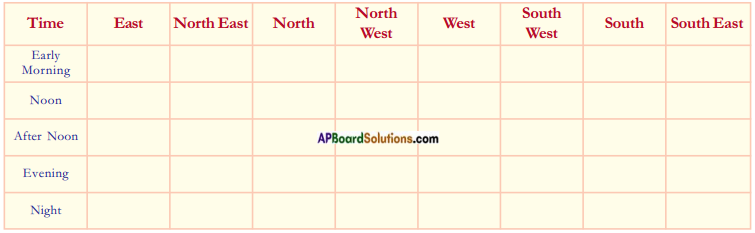
2. Food: – Acquiring food is also a character of living things. They acquire food for getting energy.
3. Growth: – Living things grow from time to time. Growth is a common phenomenon among them.
4. Breathing: – All living organisms inhale and exhale air from their surroundings. Many organisms have specialized organs for it. Plants have specialized organs called stomata for the exchange of gases.
5. Get rid of wastes: – Both plants and animals produce waste materials during life processes. They get rid of it by a process called Excretion.
6. Giving birth to young ones: – All living organisms give birth to young ones. Among them some animals lay eggs called Oviparous and some give birth to young ones called Viviparous. Plants produce seeds.
7. Responding to stimuli: The living things show response to stimulus in their surroundings. A change in the surroundings that make organisms respond to it is called stimulus.

Question 2.
How can you say that a tree is living even though it doesn 7 move?
Answer:

  • Tree has got the following characteristics of living beings though it cannot move.
  • The plant body shows growth, taking food, breathing, getting rid of wastes, response to stimuli giving birth to young ones through seeds.
  • So I can say that tree is living.

Question 3.
What is a habitat? How can you say our house is a habitat?
Answer:

  • A habitat is a dwelling place for plants and animals that gives them optimum conditions for life.
  • We live in houses that protect us from heat, cold and rain, etc. and are a shelter for us.
  • We keep some animals and birds as pets in our houses.
  • We also grow some plants which give us fruits and vegetables.

Question 4.
List out the organisms living in various regions of a pond?
Answer:

Region of the pondOrganisms living in that region
Above the surfacedragonfly, mayfly and kingfisher, hovering above the pond and then resting over a bamboo pole or a stick jutting out of the surface of the pond. They get food from the surface of the pond.
On the surfacewhirling beetle, pond skater, larva of mayfly and dragon­fly, Plants like pistia float on the surface completely while those like the lotus have roots going deep under. [Organisms on the surface are easily eaten up by others because there is little protection for them.] However, there is plenty of food and air. Fish usually come to the surface for food.
Pond marginsSeveral grasses, frogs, cranes, crabs etc. Fish usually lay eggs here.
MidwaterGreat water boatman, leech and mosquito larva are found in this region. Fish and crabs also swim around this region.
Bottom of the pondThis region has plants like Hydrilla and animals like mussels, flatworms and some maggots (larvae of some insects). Light is minimum here, but food, in the form of dead and decaying matter is plenty.

AP Board 6th Class Science Solutions Chapter 9 Organisms and Habitat

Question 5.
I am a living being. I have four legs. I live in water and also on land. “Who am I? And who are there in my habitat along with me?
Answer:

  • The four-legged organism which lives in water and also on land is a frog.
  • Turtles will also be in the habitat of frogs.

Question 6.
What questions do you ask to know more about microorganisms?
Answer:

  • What are microorganisms?
  • What is the smallest microorganism?
  • Can we see microorganisms with the naked eye?
  • What is the instrument using for observing microorganisms?
  • Are all microorganisms harmful to us?

Question 7.
How do you prove that earthworms respond to stimulus?
Answer:
Response to light by earthworm:
AP Board 6th Class Science Solutions Chapter 9 Organisms and Habitat 1
Aim: To observe the response of earthworm to light.
What we need: – Glass jar, Black Paper, Torch, Moist soil, Earthworm.
How to do:

  • Get an earthworm from a nearby moist soil.
  • Take a glass jar.
  • Cover half of the glass jar with black paper, pour the moist oil in the jar and put the earthworm in the uncovered portion of the jar.
  • Close the jar with a lid that contains small holes.
  • Shed some light on the jar.

What do we see: – The earthworm moves to the dark portion of the jar
What do we learn: – The earthworm shows a response to the light (Stimulus).

AP Board 6th Class Science Solutions Chapter 9 Organisms and Habitat

Question 8.
Draw the diagram showing different regions of a pond.
Answer:
AP Board 6th Class Science Solutions Chapter 9 Organisms and Habitat 2

Question 9.
What steps do you take to keep a habitat good?
Answer:

  • We should not dump the wastes in nearby ponds, lakes, rivers, and ground.
  • We should not cut down the forest.
  • The industries should not release wastes into air.
  • We should not dump polythene covers on the soil.
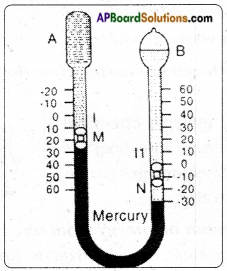
  • We should not burn the plastic, tires, and polythene covers.
  • We should not dig bore wells indiscriminately.

Activities and Projects

6th Class Science Textbook Page No. 106

Question 1.
Collect sweet potato, bottle, salt, and water. Take a bottle full of water and add salt, then put the sweet potato inside the bottle. Observe for a few days. What happens? Note your observations. How can you prove that sweet potato is also a living thing?
Answer:

  • The sweet potato bulges by absorbing saltwater.
    AP Board 6th Class Science Solutions Chapter 9 Organisms and Habitat 3
  • The metabolic changes continue in the potato, though removed from the parent plant.
  • It forms roots and stem.
  • This proves that sweet potato is also a living thing.

AP Board 6th Class Science Solutions Chapter 9 Organisms and Habitat

Question 2.
Identify the habitat in which the following live. More than one organism may be present in one habitat (use information given in the help box).
Our intestine, pond margin, kitchen, garden, tree, underground, grass,
Answer:

  1. Our intestine: Bacteria, Roundworms, Hookworms
  2. Pond margin: Several green types of grass, frogs, cranes, crabs, snails etc.
  3. Kitchen: Cockroach, lizards, rats, ants, flies, etc.
  4. Garden: Rats, bees, butterfly, ants, earthworms, garden lizard, beetles etc.
  5. Tree: Birds, bees, squirrels, mosquitoes, insect larvas, ants, termites etc.
  6. Underground: Snakes, rats, earthworms, snails, crabs, Termites, ants, etc.
  7. Grass: Crickets, grasshopper, ants, insects, larvas, etc.

Question 3.
Observe a spider in its web and write how a spider shares its habitat.
Answer:

  • The web of the spiders is made up of a special protein that solidifies to form silken threads.
  • The spider spins a web to trap insects.
  • When an insect accidentally flies over the web it gets stuck in the web.
  • The vibrations in the web are received by the spider and it attacks on the insect.
  • The spider releases some poisonous materials into the body of an insect to paralyzes it and makes the prey into liquid form.
  • This liquid form of food is absorbed by the spider.
  • This is how a spider shares its habitat.

Question 4.
Collect a hydrilla plant. Put it in a glass of water and observe for a week, how it grows.
Answer:

  • Hydrilla is a submerged plant.
  • It does not contain specialized roots.
  • The leaves are very small and strap-shaped with pointed tips.
  • The leaves have a distinct midrib.
  • The leaves are directly attached to the stem without a petiole.
  • When we put this Hydrilla in a glass of water it grows an inch in a day.
  • The plant gets it food from sunlight by a process called photosynthesis.

Question 5.
Take a map of Andhra Pradesh and color the areas where mangroves grow.
Answer:
Student Activity. Ex :
AP Board 6th Class Science Solutions Chapter 9 Organisms and Habitat 4

AP Board 6th Class Science Solutions Chapter 9 Organisms and Habitat

Question 6.
Write your experiences with your pet dog/cat/cow etc, that shows its affection on you.
Answer:

  • The animals like dogs/cat/cow are called as pet animals.
  • Man domesticated these organisms in earlier days to fulfill his needs.
  • He domesticated these for protection and food.
  • So we should take care of our pet animals.
  • In this process we clean them, we supply food and fodder to them.
  • If we show concern on these organisms, they become more affectionate to us.
  • So sometimes we can see the dogs licks our feet and wags its tails and sit near us. This is the way they show their affection on us.
  • Our motto should be “Live and Let Live”.

Question 7.
Prepare a map that represents different habitats that exist in your school.
Answer:
AP Board 6th Class Science Solutions Chapter 9 Organisms and Habitat 5

Question 8.
Prepare an article to deliver a speech in Literary Association meeting on “Animals also have right to live. ”
Answer:
“Animals also have the right to live”,

  • In this beautiful world, animals have as much right to live as human beings.
  • In totality, the entire earth is a common property of all of us.
  • It is our world and it is their world. People often ask if animals should have rights, and quite simply, the answer is “Yes !”
  • Animals surely deserve to live their lives free from suffering and exploitation. Just because we are at the top of the food chain.
  • Life is life and it should be valued, no matter what you are.
  • Animals cannot speak for themselves and for that reason we need to protect them.
  • Protecting them is something we should take pride in, it is our responsibility.
  • By respecting animal rights and having consideration for animal welfare, we also support ecological balance.

AP Board 6th Class Science Solutions Chapter 9 Organisms and Habitat

6th Class Science 9th Lesson Organisms and Habitat Activities

Activity – 1

Living things & Non-living things. (Page No. 93)

1. List some living things. Don’t forget to give reasons for why you think something is living.
Answer:
Dog – it takes a breath
Tree – it has growth
Buffalo – moves with legs

i) Chairs and tables also have four legs like buffalo. But they can’t move, why?
Answer:
Chairs and tables are non-living things. So they can’t move.

ii) Trees cannot move but they can produce seeds that give birth to new plants. Are they living things?
Answer:
Yes, trees are living things, but they can’t move. Except for this (movement), it has all living characters.

iii) How do we know whether some things are living and some others are nonliving?
Answer:
Living things have some special characters like growth and breath. By these charac¬ters we find living things.

iv) Will you notice that there are many characteristics of living things?
Answer:
Yes, living things have many characters.

v) Do all living things have common characteristics that make them different from non-living things?
Answer:
Yes, all living things have common characteristics that make them different from non-living things.

vi) Do you know that you are a living being? How can you say that?
Answer:
Yes, human beings are living things, they have living characters like growth, breath, and reproduction.

Activity – 2

Compare the characteristics. (Page No. 94)

2. Some characteristics are listed in table. Compare these characteristics with plants, animals and rocks.
AP Board 6th Class Science Solutions Chapter 9 Organisms and Habitat 6
Answer:
AP Board 6th Class Science Solutions Chapter 9 Organisms and Habitat 7

i) Do plants and animals possess the same characteristics as you do?
Answer:
Yes, mostly plants and animals possess the same characteristics as me, but plants can’t move.

AP Board 6th Class Science Solutions Chapter 9 Organisms and Habitat

ii) In which way do the characteristics of plants differ from you or from other animals?
Answer:
Plants can’t move.

iii) What characteristics are the same in plants and animals?
Answer:

  1. Growth
  2. Movement
  3. Taking food
  4. Breathing
  5. Getting rid of waste
  6. Respond to heat
  7. Respond to touch
  8. Respond to light
  9. Giving birth to young ones

iv) Do you agree that you are the same as other animals?
Answer:
Yes, I agree that living characters are the same as animals, but human beings are more intellectual and cultural.

v) What characteristics do you observe in rocks?
Answer:
Rocks do not have any living characters, so they are non-living things.

Activity – 3

Response to stimulus. (Page No. 95)

3. When you step on a sharp object what would you do? You will take back your feet. Is it not? Fill your responses to the stimulus in the below table.

StimulusResponse
When you step on a sharp object
Touch a flame or fire
Touch a block of ice
See a bright lightBlink……….
Get bitten by an ant or mosquito
When you hear the word ‘ice-cream’Mouth waters………..

Answer:

StimulusResponse
When you step on a sharp objectI will take back my foot
Touch a flame or fireI will withdraw my hand
Touch a block of iceI will withdraw the touched part
See a bright lightI will blink my eyes
Get bitten by an ant or mosquitoI will scratch the place of bite
When you hear the word ‘ice-cream’Mouth watering

i) Do all living beings possess the characteristic feature of response to stimulus.
Answer:
Yes, all living beings possess the characteristic feature of response to stimulus

ii) Do other animals also respond to stimuli like us?
Answer:
Yes, all other animals also respond to stimuli like us.

iii) Do plants respond to stimuli like animals?
Answer:
Yes, plants respond to stimuli like animals.

AP Board 6th Class Science Solutions Chapter 9 Organisms and Habitat

Activity – 4

Mimosa (Atti-Patti) (Page No. 96)

4. It is very interesting to observe a touch-me-not (Attipatti or mimosa) plant Touch it. Record your observations.
Answer:
i) How does this plant respond when you touch it?
Answer:
When we touch the mimosa, it closes its leaves.

ii) How much time does it take to return to its previous position?
Answer:
It takes nearly 15 to 20 minutes.

Activity – 5

Seeds – Living or not: (Page No. 96)

5. Seeds are produced from plants. We know that plant is a living being. Can we say that seeds are also living things? Let us discuss the characteristics of living seeds?
Answer:

i) Does a seed take in food? From where?
Answer:
Seed has stored food in it. So it does not take in food. The food store is in the endosperm, and/or in the cotyledons.

ii) Will it die if stored for a long time?
Answer:
Yes, if we preserve it carefully we can store the food for a long time.

iii) What happens when a seed is sown in soil?
Answer:
When a seed is sown in the soil it will germinate.

Activity – 6

Microorganisms in water. (Page No. 98)

6. Collect water samples from a pond, well, bore well. Keep them separately. Put a drop of water on a slide. Keep a coverslip on it. Observe under the microscope.
Draw what you have observed. Describe the shapes of the micro-organisms.
AP Board 6th Class Science Solutions Chapter 9 Organisms and Habitat 8
i) What type of micro-organisms do you see in water samples?
Answer:
I found different types of microorganisms some are thread-like structures and some are round.

ii) Do all water samples have the same type of microorganisms?
Answer:
No.different water samples have different types of microorganisms.

iii) Is there any water without micro-organisms?
Answer:
No all water samples have microorganisms, but few in topwater.

iv) Which water contains a larger number of micro-organisms? Why?
Answer:
Pond water has more microorganisms because it is an open-source to grow micro¬organisms.

v) What kind of micro-organisms do you find in the water from a pond and borewell?
Answer:
Pond water has more greenish microorganisms and the bore well has moving organisms.

AP Board 6th Class Science Solutions Chapter 9 Organisms and Habitat

Activity – 7

Who lives where. (Page No. 98)

7. Write the names of organisms in the box below according to where they are found. Some examples are filled to help you.

Under the groundOn the groundIn/On waterSome other place
SnakeSnakeSnake
Earthworm
CatLotus
Sparrow (in homes)

Answer:

Under the groundOn the groundIn/On waterSome other place
SnakeSnakeSnakeBirds (tree)
EarthwormFrogFrogEagle (rocks)
RabitCatLotussquirrel (tree holes)
AntAntDragon flySparrow (in homes)
RatSquirrelLeechHoney bees (trees and rocks
CrabSnailCrab, snail

i) Which organisms are found mostly in your area often?
Answer:
Crows and cows are found mostly in my area often.

ii) How many organisms are present in more than one column?
Answer:
Two organisms are present in more than one column.

iii) Why did you place them there?
Answer:
They live in more than one place.

iv) In which column will you put a frog?
Answer:
I will put the frog in the second and third columns.

Activity – 8

8. Read the table and answer the following questions. (Page No. 100)

S.No.Region of the pondOrganisms living in that region
1.Above the surfacedragonfly, mayfly and kingfisher, hovering above the pond and then resting over a bamboo pole or a stick jutting out of the surface of the pond. They get food from the surface of the pond.
2.On the surfacewhirling beetle, pond skater, larva of mayfly and dragon­fly, Plants like pistia float on the surface completely while those like the lotus have roots going deep under. [Organisms on the surface are easily eaten up by others because there is little protection for them.] However, there is plenty of food and air. Fish usually come to the surface for food.
3.Pond marginsSeveral grasses, frogs, cranes, crabs etc. Fish usually lay eggs here.
4.MidwaterGreat water boatman, leech and mosquito larva are found in this region. Fish and crabs also swim around this region.
5.Bottom of the pondThis region has plants like Hydrilla and animals like mussels, flatworms and some maggots (larvae of some insects). Light is minimum here, but food, in the form of dead and decaying matter is plenty.

i) Name some organisms in the pond that can stay in different regions in the same pond?
Answer:
Frogs, cranes, crabs.

ii) What makes them stay in different regions in the pond?
Answer:
Their food habits and body structure makes them stay in different regions in the pond.

iii) Can different places in the pond also be called as habitat? Why? or why not?
Answer:
Yes, particular organisms are live in different places in the pond. So it be called as habitat.

AP Board 6th Class Science Solutions Chapter 9 Organisms and Habitat

iv) Is there any animal with legs in the pond?
Answer:
Yes, the frog has legs.

v) Do all animals in the pond have tails?
Answer:
No, all the animals in the pond does not have tail.

vi) Do all animals in the pond swim?
Answer:
No, crane can’t swim.

vii) What are the animals that share the surface of the pond as habitat?
Answer:
Whirling beetle, pond skater, larva of mayfly and dragonfly.

viii) Are the leaves of all plants growing in a pond, similar?
Answer:
No, the leaves of all plants growing in a pond are not similar. They are of different types. Ex : Hydrilla, Lotus.

ix) What is the difference between the leaves of a plant growing at the bottom (hydrilla) and that floating on the surface (lotus)? Try to think and write why we find such differences.
Answer:
a) The leaves of a plant growing at the bottom (hydrilla) have small tubular leaves to pass water flow.
b) Floating on the surface (lotus) plants have large leaves to grasp sunlight.

Activity – 9

Now, in the same way, let us study a plant or a tree as habitat. Birds, monkeys, squirrels, snakes, ants, spiders, caterpillars, moths, bees, wasps, small plants (mosses), mosquitoes are some organisms that you may find on a tree. Try to classify them in table based on where you find them. Add some more examples that you know. (Page No. 101)

At the base of the treeants, ……..
On the trunk
Between the branchesmonkeys, ………
On or within the leaves

Answer:

At the base of the treeants, snakes, caterpillars, moths, small plants, mosquitoes.
On the trunkants, caterpillars, moths, mosquitoes, squirrels, bees, wasps, spiders.
Between the branchesmonkeys, birds, caterpillars, squirrels, mosquitoes, bees, wasps, snakes, ants, spiders.
On or within the leavesbirds, monkeys, squirrels, snakes, ants, spiders, caterpillars, bees, small plants.

Activity – 10

10. i) Can animals that are our pets live in other places as well? (Page No. 101)
Answer:
Yes, our pets live in other places.

ii) Name the animals and also write the places where they can live.
Answer:
Dog – it lives in the streets.
Cat – it lives in the forest.
Parrots – lives on the tree.

AP Board 6th Class Science Solutions Chapter 9 Organisms and Habitat

iii) Why do only certain types of animals and plants live along with us?
Answer:
For food and shelter, some animals live along with us
For our food and needs, we cultivate some plants.

Activity – 11

11. Compare water (Aquatic) plants with land (Terrestrial) plants. (Page No. 103)
i) Collect an aquatic plant like Hydrilla or Vallisneria, also collect any terrestrial plant. Now compare the two and write your observations in the below table.

PartsTerrestrial plant (Tulsi)Aquatic plant (Valisneria / Hydrilla)
Stem
Leaf
Root
Others

Answer:

PartsTerrestrial plant (Tulsi)Aquatic plant (Valisneria / Hydrilla)
StemWoody, grows towards the sunlight.Weak, less availability of sunlight.
LeafGrows on stem with petiole and veinsNo petiole and simple leaf.
RootTap root is present.Fibrous roots are present.
OthersGrown on land, terrestrial plant.Grown in water. aquatic plant.

ii) Good Habit – Good Life:
Which habitat do you like more? Habitat – A or Habitat – B. Why?
AP Board 6th Class Science Solutions Chapter 9 Organisms and Habitat 9
Answer:
Habitat – A: I like more which is clean and tidy. Whereas in Habitat B there is environmental degradation which causes danger to plants and animals life.

AP Board 7th Class Science Important Questions Chapter 5 Temperature and Its Measurement

AP State Syllabus AP Board 7th Class Science Important Questions Chapter 5 Temperature and Its Measurement

AP State Syllabus 7th Class Science Important Questions 5th Lesson Temperature and Its Measurement

7th Class Science 5th Lesson Temperature and Its Measurement Important Questions and Answers

Question 1.
What are the different clothes we wear in different seasons?
Answer:

  1. We wear woolen and dark coloured clothes during winter when it is cold outside.
  2. Woolen and dark coloured clothes keep us warm.
    AP Board 7th Class Science Important Questions Chapter 5 Temperature and Its Measurement 1
  3. We prefer to wear light coloured cotton clothes when it is hot.
  4. They give us a feeling of coolness.
  5. It is a wonder why a particular type of cloth is suitable for a particular season.

AP Board 7th Class Science Important Questions Chapter 5 Temperature and Its Measurement

Question 2.
When rice is being cooked you observe the plate on the rice bowl jumps! Why is it happening?
Answer:
The heat energy converts water into steam and the pressure of steam throws away the lid.
AP Board 7th Class Science Important Questions Chapter 5 Temperature and Its Measurement 2

Question 3.
Have you observed water boiling in a vessel with a lid on it? What do you notice? How can you establish that heat is a form of energy?
Answer:

  1. We know that boiled water is being converted to water vapour.
  2. The volume of the water vapour increases.
  3. The increased volume of vapour tries to go out. In this process it tries to lift the lid up.
  4. We need energy to lift any object. This energy comes from the heated water.
  5. Water gets the energy from the heat of the fire. Thus heat is a form of energy:

Question 4.
What is heat?
Answer:

  1. We feel hot when we sit in sunlight or near fire. We feel cold when we put a piece of ice on our palm.
  2. We know that heat is a form of energy that is transferred from an object at higher temperature to one at lower temperature.
    AP Board 7th Class Science Important Questions Chapter 5 Temperature and Its Measurement 3
  3. When we stand in the sun or near fire, heat energy enters our body and we feel hot. When ice is put on our palm, heat energy moves from our body to the piece of ice.
  4. That’s why we feel cold.
  5. “The energy which makes an object appear hot or cold is called heat.”.

AP Board 7th Class Science Important Questions Chapter 5 Temperature and Its Measurement

Question 5.
What happens in the following?
a) Rub your palms together. How do you feel?
b) Have you ever observed that iron becomes hot when it is beaten with a hammer?
c) Take a soapnut seed. Rub it on a stone and touch it. How do you feel?
Answer:
In above cases mechanical energy is converted into heat energy.

Question 6.
Explain the terms ‘heat’ and ‘temperature’.
Answer:

  1. If we stand close to fire, we feel warm.
  2. When a warm object is placed close to a cooler object, heat energy moves from the warmer object to the cooler one until both objects attain the same temperature.
  3. Often we think that heat and temperature are the same things. This is wrong.
  4. Temperature is a measure of the heat energy in a body which indicates the ability of a body to give heat to another body or absorb heat from another body.
  5. We use thermometers to measure temperature.

Question 7.
What are the properties of mercury?
Answer:
Properties of Mercury:

  1. Its expansion is uniform. (For equal amounts of heat it expands by equal lengths.)
  2. It is opaque and shining.
  3. It does not stick to the sides of the glass tube.
  4. It is a good conductor of heat.
  5. It is easily available in pure state.

Question 8.
Write the properties of alcohol.
Answer:
Properties of Alcohol:

  1. It can record very low temperatures.
  2. Its expansion per degree Celsius rise in temperature is very large.
  3. It can be coloured brightly and hence is easily visible.

AP Board 7th Class Science Important Questions Chapter 5 Temperature and Its Measurement

Question 9.
Who first designed the thermometer? What do you know about it?
Answer:

  1. First thermometer was invented by Galileo in 1593 AD.
    AP Board 7th Class Science Important Questions Chapter 5 Temperature and Its Measurement 4
  2. In this thermometer air was used as the thermometric substance as air rapidly expands on heating and contracts on cooling.
  3. Further, the substance that is used in the thermometer has uniform expansion or contraction with the rise or fall in temperature.

Question 10.
Do you find any difference in temperature of air in shadow and in the sun?
AP Board 7th Class Science Important Questions Chapter 5 Temperature and Its Measurement 5
Measure temperature of air using a thermometer. What will you do to keep a thermometer in close contact with air?
Answer:

  1. The temperature of air will be more as it receives heat directly from the sun and from reflected radiations.
  2. The temperature in the shadow will be relatively less as only reflected radiant heat reaches there.

Question 11.
Is there any difference in temperature with variation of time or place?
Answer:
There is difference in temperature with variation of time or place.

Question 12.
Why do you use an umbrella in the hot sun during summer?
Answer:
To avoid direct heat radiations from the sun.
AP Board 7th Class Science Important Questions Chapter 5 Temperature and Its Measurement 6

AP Board 7th Class Science Important Questions Chapter 5 Temperature and Its Measurement

Question 13.
Write a note on the variations of temperature on different occasions and at different places over the globe?
Answer:

  1. In Lybia (Africa) on a particular day in the year 1922, it became so hot that the temperature of air even in shade was as high as 58 °C.
  2. At some places (Rentachintala of Guntur District) in Andhra Pradesh, the maximum temperature of air sometimes reaches 48 °C and more.
  3. When it is so hot we feel extremely uncomfortable as the normal temperature of the human body is 37 °C.
  4. The lowest temperature in the world has been measured in Antarctica where it once went down to about -89 °C.
  5. The minus sign is used for temperature which is less than 0 °C. Water freezes at 0 °C, just think how cold -89 °C must be.
  6. In winter when the atmospheric temperature around us becomes 15 °C – 20 °C we begin to feel cold.

Question 14.
What is a clinical thermometer ? Describe its construction.
Answer:

  1. Thermometer which is used to find out the temperature of our bodies is called Clinical Thermometer.
    If we observe Thermometer carefully. There are two types of scales marked on the clinical thermometer one that starts with 35 degrees and ends at 45 degrees is Celsius scale. While the other that starts with 95 degrees and ends at 110 degrees is the Fahrenheit scale.
  2. We see a kink in the capillary near the bulb.
    AP Board 7th Class Science Important Questions Chapter 5 Temperature and Its Measurement 7
  3. This kink prevents Mercury level from falling on its own.

Question 15.
What is the value of one division on the fahrenheit scale on thermometer?
Answer:

  1. Note the temperature difference indicated between the two bigger marks.
  2. Also note down the number of divisions between these marks.
    AP Board 7th Class Science Important Questions Chapter 5 Temperature and Its Measurement 8
  3. Suppose two consecutive bigger marks differ by one degree and there are five divisions between them.
  4. Then one small division reads
    1/5 = 0.2 °F

AP Board 7th Class Science Important Questions Chapter 5 Temperature and Its Measurement

Question 16.
Describe how do we use a clinical thermometer.
Answer:

  1. We should wash the thermometer preferably with an antiseptic solution.
  2. Holding it firmly by the end and give it a few jerks. These jerks will bring the level of mercury down. Ensure that it falls below 35 °C (95 °F).
  3. Now we should plape the thermometer under our tongue or arm pit.
  4. After one minute, we have to take the thermometer out and note the reading. It tells our body temperature.

Question 17.
How can you decide whether one has fever or not?
Answer:
The normal temperature of human body is 37°C (98.6°F). If one has body more than 98.6°F can consider as fever.

Question 18.
Write a note on a) Thermister thermometer and b) Digital thermometer.
Answer:
a) Thermister thermometer:
It is available in market to measure the human body tempera¬tures, particularly for infants and children.
AP Board 7th Class Science Important Questions Chapter 5 Temperature and Its Measurement 9
b) Digital thermometer:

  1. There is a lot.of concern over the use of Mercury in thermometer.
    AP Board 7th Class Science Important Questions Chapter 5 Temperature and Its Measurement 10
  2. Mercury is a toxic substance and is very difficult to dispose of if a thermometer breaks.
  3. These days digital thermometers are also available which do not use Mercury.

AP Board 7th Class Science Important Questions Chapter 5 Temperature and Its Measurement

Question 19.
What precautions are suggested in using a clinical thermometer?
Answer:

  1. We are advised not to use a clinical thermometer for measuring the temperature of any object other than human body.
    AP Board 7th Class Science Important Questions Chapter 5 Temperature and Its Measurement 11
  2. Also we are advised to avoid keeping it in the sun or near a flame.

Question 20.
Measure the temperature of a person with clinical and digital thermometers.
Are the temperature readings same or different? Explain your observations.
Answer:
The temperature readings in both clinical and digital thermometers are the same.

Question 21.
What is value of one small division on the Celsius scale?
Answer:
Reading the Celsius scale on thermometer.

  1. Temperature difference is indicated between two bigger marks.
  2. Between these two bigger marks divisions are there.
    AP Board 7th Class Science Important Questions Chapter 5 Temperature and Its Measurement 12
  3. Suppose two consecutive bigger marks differ by one degree and there are 10 divisions between them then one small division reads
    1/10 = 0.1°C
    ∴ The value of one small division on the Celsius scale is 0.1 °C.

Question 22.
How do you measure the temperature of other objects?
Answer:

  1. To measure the temperature of other objects there are other thermometers.
  2. One such thermometer is known as the laboratory thermometer used to measure temperature of water.
  3. Six’s maximum and minimum therometer is used to measure maximum and minimum temperatures of a day.

AP Board 7th Class Science Important Questions Chapter 5 Temperature and Its Measurement

Question 23.
Can you make use of laboratory thermometer like a clinical thermometer?
Answer:

  1. We should take some hot water in a beaker, dip thermometer in it for one minute.
  2. Record the temperature while the thermometer is in water.
    AP Board 7th Class Science Important Questions Chapter 5 Temperature and Its Measurement 13
  3. Take out the thermometer from water. Observed the mercury thread carefully.
  4. As there is no kink in the laboratory thermometer mercury falls down in the glass tube of its own when taken out of the water. So we cannot use a laboratory thermometer like a clinical thermometer.

Question 24.
Measure the temperature of different students by touching them and noting in the clinical thermometer.
Make sure that you have cleaned the thermometer before each measurement.
AP Board 7th Class Science Important Questions Chapter 5 Temperature and Its Measurement 14
Compare the values in the table after completion of recording.
a) What do you observe in the table?
b) Are the estimated temperature and measured temperature same?
c) Is the body temperature of every person 37 °C (98.6 °F)?
d) What is the average body temperature of your friends?
The average body temperature of a large number of healthy persons is known as normal temperature (98.6 °F).
Answer:
The student is advised to do this work as a project work.

Question 25.
Some of the objects are given in the table. Mark these objects as hot or cold. What is your conclusion?
AP Board 7th Class Science Important Questions Chapter 5 Temperature and Its Measurement 15
Answer:
AP Board 7th Class Science Important Questions Chapter 5 Temperature and Its Measurement 16

  1. We see that some objects are cold and some are hot.
  2. We also know that some objects are hotter than others while some are colder than
    others.
  3. To decide which object is hotter than the other, and which object is colder than the other.
  4. We need a reliable method to decide the hotness/coldness of an object.
  5. Generally, hotness or coldness is expressed in terms of temperature.
  6. Temperature is a measure of the degree of hotness or coldness of an object.

AP Board 7th Class Science Important Questions Chapter 5 Temperature and Its Measurement

Question 26.
How can find out the hotness or coldness of a substance by touch? Explain.
Answer:

  1. By touching with our hands, we can guess whether a cup of milk is still worth sipping or has become too cold, whether milk is hot enough for making curds etc.
  2. But estimating temperature with our hands can, sometimes mislead or confuse us.
  3. Take some cold water, luke-warm water and hot water in three different vessels.
    AP Board 7th Class Science Important Questions Chapter 5 Temperature and Its Measurement 17
  4. Immerse your left hand in the cold wa¬ter vessel and right hand in hot water vessel simultaneously. Wait for two or three minutes.
  5. Take off both your hands and dip them in the luke-warm water vessel.
  6. Though both hands are in the same glass of water, one hand feels it cold and the other feels it hot! Look how our hands are confused!
  7. We can not exactly decide the hotness/coldness of a substance just by touching it?. It is not possible to guess the hotness of a substance only on the basis of feel/touch.
  8. It is certain that water in different tubs has different degrees of hotness which can¬not be exactly determined simply by touching.

Question 27.
How do we establish by experiment that liquids expand due to heat?
Answer:

  1. We should take a flat bottom flask and fill it with coloured water.
  2. Fix a cork, having a capillary tube, in the mouth of flask such that level of water is as shown (fig).
    AP Board 7th Class Science Important Questions Chapter 5 Temperature and Its Measurement 18
  3. We should place the flask in a metal trough.
  4. We should pour boiling hot water into the trough and carefully observe the level of coloured water. The level rises.
  5. If we take the flask out of the trough and keep it outside for some time, the level of coloured water decreases.
  6. In the above activity we see that water expands on heating and contracts on cooling.

Question 28.
Record your observations in the following.
AP Board 7th Class Science Important Questions Chapter 5 Temperature and Its Measurement 19
Answer:
Do the above observation independently.

Question 29.
Did you ever bathe with cold water during winter? What happens?
Answer:

  1. I have taken bathe with cold water during winter.
  2. My body shivered with chill.

AP Board 7th Class Science Important Questions Chapter 5 Temperature and Its Measurement

Question 29.
What do you do to protect yourself from cold?
Answer:

  1. I wear woolen and dark coloured clothes to protect myself from cold.
  2. I will cover my body with a blanket to protect myself from cold in the night.

Question 30.
How do you get hot water in winter?
Answer:
By heating water, I get hot water in winter.

Question 31.
Generally we heat water to get hot water. How do you heat water? What sources do you use?
Answer:
By converting electrical energy, chemical energy and mechanical energy into heat we heat water. We use electric heaters, gas stoves and solar heaters to heat water.
AP Board 7th Class Science Important Questions Chapter 5 Temperature and Its Measurement 20

Question 32.
Give examples of conversion of energy from one form to another.
Answer:

  1. Different kinds of energies can be converted to heat.
  2. In the same way heat energy can be converted to other forms of energy.
  3. We have heard that in a thermal power station, heat energy is converted to electrical energy.
  4. In a steam engine, heat energy is converted to mechanical energy which helps in moving the engine.
  5. In electrical heater electrical energy, in gas stove chemical energy and in solar heaters solar energy are converted to heat.

Question 33.
What are the liquids used as thermometer liquids?
Answer:

  1. Mercury is used as liquid for indicating temperature in thermometers.
  2. Apart from Mercury we also use alcohol as thermometer liquid.

Question 34.
Describe the construction of a thermometer with a neat diagram.
Answer:

  1. At one end of the tube we observe a bulb. It is filled with Mercury.
  2. The other end of the tube is sealed after removing air from it.
    AP Board 7th Class Science Important Questions Chapter 5 Temperature and Its Measurement 21
  3. We find a scale which is marked to express temperature in degree Celsius.
  4. We read the temperature with the help of these markings.
  5. The readings range from 0° to 100°
  6. This arrangement of the marks is called scale of temperature.
  7. All thermometers are based on the fact that matter expands on heating.

AP Board 7th Class Science Important Questions Chapter 5 Temperature and Its Measurement

Question 35.
Draw a neat diagram of Six’s maximum and minimum thermometer. What is its importance.
Answer:
1) The maximum (highest) and minimum (lowest) temperatures of a day are measured by a thermometer called the Six’s maximum-minimum thermometer.
AP Board 7th Class Science Important Questions Chapter 5 Temperature and Its Measurement 22

Question 36.
How do you use a thermometer? Write an example.
Answer:

  1. To find the temperature of an object, the bulb of the thermometer needs to be in close contact with that object.
  2. Watch the shiny line of mercury in the tube. .
  3. The highest point on the scale, at which the rise of mercury stops, shows the temperature of the object.
  4. Example: To find the temperature of your palm, place the bulb of thermometer in contact with palm for two minutes and see the mercury rise.
  5. When mercury stops rising and its level becomes steady, note the position of its upper end.
  6. This is the temperature of your palm.

Question 37.
If markings on thermometer are wiped out, how do we create new markings?
Answer:

  1. Take some ice in a beaker. Immerse a thermometer in ice for two minutes. Mark the Mercury level. Now let the ice melt.
  2. The level of Mercury remains same while ice melts. This means that temperature is constant.
  3. This constant temperature at which ice melts is called melting point of ice and mark it 0 °C.
  4. Take some water in a beaker. Immerse the thermometer in it and start heating the water. It will start boiling while getting converted into steam.
  5. Mercury level starts rising and reaches a point beyond which it doesn’t rise. Mark the level of mercury at this point.
  6. Observe the constant level at which Mercury stays while water is boiling, this constant temperature is called boiling point of water. We mark the level of mercury at this point as 100 °C.
  7. Thus temperature at which ice melts or water boils is constant. These values are fixed as 0 °C and 100 °C respectively. Like water, all substances in pure form melt and boil at certain fixed temperatures.
  8. To create a scale, we need two fixed points. Let us choose the melting point (0 °C) and boiling point (100 °C) as two fixed points for the scale of thermometer. Now divide the distance between these two points on the thermometer into 100 equal parts.
  9. Each of the 100 equal parts represents 1 °C. We further divide 1 °C into 10 small divisions. It can be read as 1/10 = 0.1 °C.

AP Board 7th Class Science Important Questions Chapter 5 Temperature and Its Measurement

Question 38.
Feel the body temperature of some of your friends by placing your hand on their forehead. Estimate the temperature and record it in the table.
AP Board 7th Class Science Important Questions Chapter 5 Temperature and Its Measurement 23
Answer:
The student is advised to do this with the help of the teacher.

Question 39.
How do you note the temperature of water taken in a beaker?
Answer:

  1. Take some tap water in a beaker.
  2. Dip the thermometer in water so that the bulb is immersed in water but does not touch the bottom or side of the beaker.
  3. Hold thermometer vertically, wait till the mercury thread becomes steady.
  4. Note the reading. That is the temperature of water at that time.

Question 40.
Observe the diagram and answer the following questions.
AP Board 7th Class Science Important Questions Chapter 5 Temperature and Its Measurement 18

  1. What is the aim of the experiment?
  2. Write down the apparatus required.
  3. What are your observations?
  4. Where do you find this type of phenomenon in your daily life?

Answer:

  1. Liquids expand on heating.
  2. A flat bottom flask, cork, coloured water, metal trough, boiling hot water.
  3. Water expands on heating and the level in coloured water is increased.
  4. We can observe this phenomenon in the thermometer in our day to day life.

AP Board 7th Class Science Important Questions Chapter 5 Temperature and Its Measurement

Question 41.
Read the paragraph and answer the following questions:
Heat is a type of Energy. It is transferred from hot object to cold object. We know the hotness and coolness of an object due to the transformation of energy. It is called “Heat”. If you want to heat the water with electric heater, Electric Energy is turned into Heat Energy. If you heat the water on gas stove, Chemical Energy is turned into Heat Energy.
i) What is Heat?
ii) How is heat transferred from one object to other?
iii) Which equipment is used to turn Electric Energy into Heat Energy?
iv) When we heat water on the gas stove, which energy is turned into Heat Energy?
Answer:
i) It is a form of energy. The energy which makes an object appear hot or cold is called heat.
ii) Heat flows from an object at high temperature to another at lower temperature.
iii) Electric heater.
iv) Chemical energy.

Question 42.
What questions would you ask the doctor to clarify your doubts on the usage of the thermometer?
Answer:

  1. Why do we use thermometer in our daily life?
  2. Why is mercury used in thermometers?
  3. How do we measure the temperature in thermometer?
  4. How many types of scales are marked on the thermometer?

Question 43.
Read the paragraph given below and answer the following questions.
Temperature is a measure of the heat energy in a body. We use thermometers to measure temperature. Mercury is a good conductor of heat and is a liquid at room
temperature. It is used in most thermometers. In some thermometers, alcohol is used. Alcohol can record very, low temperatures.
i) What is temperature?
ii) Name the device used to measure the temperature.
iii) Name the liquid used commonly in the thermometers.
iv) Name the liquid used in thermometers to measure low temperature.
Answer:
i) Temperature is a measure of heat energy in a body.
ii) The device used to measure temperature is thermometer.
iii) Mercury is the liquid used in thermometers.
iv) Alcohol is used in thermometers to measure low temperature.

AP Board 7th Class Science Important Questions Chapter 5 Temperature and Its Measurement

Question 44.
Observe the table and answer the following questions.

DayDateMaximum Temperature
101.01.201930°C
202.01.201932°C
301.04.201935°C
402.05.201939°C
515.05.201942°C

i) Name the month and date when the minimum temperature was recorded.
ii) On which date was the maximum temperature recorded?
iii) Between which two consecutive months, the difference in temperature was the highest?
iv) In which month people could most likely have used air-conditioner to get relief from heat?
Answer:
i) 1st January, 2019.
ii) 15th May, 2019
iii) April and May
iv) In May month

AP Board 6th Class Science Solutions Chapter 11 Shadows – Images

AP State Syllabus AP Board 6th Class Science Solutions Chapter 11 Shadows – Images Textbook Questions and Answers.

AP State Syllabus 6th Class Science Solutions 11th Lesson Shadows – Images

6th Class Science 11th Lesson Shadows – Images Textbook Questions and Answers

Improve Your Learning

Fill in the Blanks.

1. Light travels in a ——–.
Answer:
straight line.
2. A substance that gives light is known as ——–.
Answer:
light source.
3. The bouncing back of light after hitting an object is called ——–.
Answer:
reflection.
4. The color of the shadow formed by a green tree is ——–.
Answer:
Black.

AP Board 6th Class Science Solutions Chapter 11 Shadows - Images

Choose the correct answer.

1. Identify the transparent substance
A) Paper
B) Wood
C) Glass
D) Oil Paper
Answer:
C) Glass

2. Which of the following substance forms shadows?
A) Transparent
B) Translucent
C) Opaque
D) All the above
Answer:
C) Opaque

3. What do you need to get a shadow?
A) Light Source
B) Opaque Object
C) Screen
D) All the above
Answer:
D) All the above

Answer the Following Questions.

Question 1.
Classify the following objects into transparent, translucent, and opaque:
Cardboard, duster, polythene cover, oily paper, glass, spectacle lens, piece of chalk, ball, table, book, window glass, palm, school bag, mirror, air, water.
Which type of materials do you find more in your surroundings?
Answer:
A. Transperent Objects: glass, spectacle lens
B. Translucent Objects: polythene cover, oil paper
C. Opaque Objects: cardboard, duster, piece of chalk
I find opaque materials are more in our surroundings.

Question 2.
We can’t identify the type presence of completely transparent objects even in light. Is it correct or not? Support your answer.
Answer:
Yes, we can’t identify the presence of completely transparent objects even in Light. Because it allows light to pass through it. So we can’t find it.

Question 3.
Why can’t we see objects which are behind us?
Answer:
The reflected light behind objects of us can’t reach our eyes. So we can’t see objects which are behind us.

AP Board 6th Class Science Solutions Chapter 11 Shadows - Images

Question 4.
What is required to get a shadow of an opaque body?
Answer:
To get a shadow we need

  1. light source
  2. opaque body
  3. screen.

Question 5.
Can we use a plain mirror as a rearview mirror? If not why not?
Answer:
No, we can’t use the plain mirror as a rearview mirror. Because the plain mirror can’t cover all objects behind the vehicle. So we use the concave mirror as a rearview mirror.

Question 6.
Why do we get shadows of different shapes of the same object?
Answer:

  1. We get different shadows for the same object.
  2. because shadow shape is changed depending upon the position of the light source
  3. and angle position of the object.
  4. So we may get different shadows shapes from a same object and same shadows from different objects.

Question 7.
What are the differences between a shadow and an image?
Answer:

IMAGESHADOW
1. Images are colour full.1. Shadows does not have colour.
2. Image is formed due to the reflection or refraction of light.2. Shadows are formed when opaque objects obstruct the path of light.
3. Image gives more information such as colour, structure, etc. about the object.3. Shadow does not provide any details about the object but it gives an idea about the shape of the object.
4. An image in a plane mirror doesn’t change in size at all; it is always of the same size as that of the object.4. Shadow size may be changed depend on light sources position.
5. An image in a mirror can be seen without a screen, whereas it is mandatory to have a screen to form a shadow.5. A dark patch formed on a surface behind an opaque object placed in the path of light is called a shadow.

Question 8.
Malati noticed changes in the lengths of her shadows during the daytime. She had some doubts about this. What could be those doubts?
Answer:

  1. Why shadows are always black?
  2. Why sometimes shadows are small and large?
  3. Why our shadows always follows us?
  4. Can we guess the time when see the shadow?

AP Board 6th Class Science Solutions Chapter 11 Shadows - Images

Question 9.
How can you explain the straight-line motion of light?
Answer:

  1. Observe the objects, the formation of shadows and the path of light as shown, in the figure.
  2. Similarly draw the shadows for the objects given in the fig. Extend the path of light and draw a shadow on the given screen.
    AP Board 6th Class Science Solutions Chapter 11 Shadows - Images 1
  3. We have drawn arrows in the above figures assuming that light travels like rays that are straight.
  4. We can predict the shapes of the shadows only when we consider that light travel as rays along a straight path.
  5. In ancient days, by observing the shapes of shadows people came to an understanding that light travels in a straight line.

Question 10.
We would not be able to see any object around us if light does not get reflected. How do you appreciate this property of objects?
Answer:

  1. Vision is the vital sense to organisms.
  2. Its possible by light reflection.
  3. I feel wonder by this phenomena that provide the vision.
  4. I also feel happy by seeing beauty nature by light.

Question 11.
Where do you find reflection of light in your daily life?
Answer:

  • Due to the regular reflection of light, we look at our image in the plane mirror.
  • We can turn the sunlight towards dark places by the regular reflection of light with the help of a shiny surface.
  • The wing and rear-view mirrors of a car are made of a convex and a plane mirror
    respectively.
  • A microscope uses a mirror to reflect light to the specimen under the microscope.

Activities and Projects

6th Class Science Textbook Page No. 126

Question 1.
Hold a glass slab at one end with your hand and stand in the sunlight. See the shadows of your hand and glass slab. Explain what you observed.
Answer:

  1. I find that glass slab does not form a shadow.
  2. I observed the shadow of my hand.
  3. It means glass slab is a transparent object and hand is opaque object.
  4. My conclusion is that only opaque objects form clear shadow.
  5. And transparent objects does not form shadows.

AP Board 6th Class Science Solutions Chapter 11 Shadows - Images

Question 2.
If we focus a coloured light on an opaque object, does the shadow of the object possess colour or not? Predict and do the experiment to verify your predictions. (Coloured light can be obtained by covering torch glass with a transparent coloured paper).
Answer:

  1. In the colour light opaque objects forms shadows.
  2. But they does not have any colour.
  3. because shadow is the place where the light is prevented.
  4. It does not effected by colour light.

Question 3.
Between an electric bulb and a tube light, which forms sharp shadows of objects? Do an experiment to find out and give the reasons.
Answer:

  1. Between electric bulb and tube light electric bulb forms clear and sharp image.
  2. Electric bulb is round in shape.
  3. It takes more voltage and forms intensity light
  4. That’s why electric bulb forms sharp and clear shadows.
  5. But at the tube light shadow it is not sharp.
  6. Here light source is lengthy.
  7. And light fell on objects from different side.
  8. So the shadow does not sharp.

Question 4.
A mirror is kept on the wall of your room. Your friend is sitting on a chair in that room. You are not visible to him in the mirror. How do you adjust your place so that you are visible to your friend in the mirror? Explain.
Answer:

  1. Its simple technique to appear to my friend in mirror.
  2. In mirror image formed by reflection.
  3. In reflection light bounce in same angle.
  4. That’s why I am visible to my friend when he is visible to me.
  5. So, I adjust my place until my friend appear to me.
  6. When my friend visible to me, I am also visible to my friend.

Activity – 1

1. Make your room dark by shutting the door and windows; and then put on the light. Look at any one of the objects in the room. After that, hold a plank or a writing pad in front of your face.  (Page No. 117)
AP Board 6th Class Science Solutions Chapter 11 Shadows - Images 2
i) Is the object visible to you?
Answer:
No the object can’t visible to me.

ii) Why is it not visible though there is light?
Answer:
Light can’t reach the eyes. So it is not visible.

iii) What happens when you hold a plank between the object and you?
Answer:
Plank prevent the light. So it can’t reach the eyes.

iv) What is that something coming from the object?
Answer:
Its light that causes sight sense.

v) Where does light come from?
Answer:
A substance which gives light is known as a light source.

AP Board 6th Class Science Solutions Chapter 11 Shadows - Images

vi) Which objects give us light?
Answer:
Objects give us light are Sun, a glowing bulb, lighted candle etc.

vii) Can you give some more examples for source of light?
Answer:
Sun, stars, torch, candle, bulb, flame, glowing worm.

viii) When did you see shadow? Is it during day time or at night?
Answer:
I saw the shadow at day time.

ix) Are shadows formed at night?
Answer:
No, generally shadows does not form at night time. We may form shadows by using light at night time.

x) Is it possible to form shadows when there is no sunlight, bulb or any other light?
Answer:
Its not possible to form shadows without light.

xi) What do we need to form a shadow?
Answer:
We need light to get the shadow of any object.

Activity – 2

2. Try to form shadows of a book, a pen, a duster, a polythene cover, and a glass plate on the wall of your classroom with the help of a torch.  (Page No. 117)
Do you find any differences in the shadow of the above objects? Do all objects form shadow?
i) Which objects form shadows?
Answer:
Book, plank, table, chair.

ii) Which objects do not form shadows?
Answer:
Glass, air, polyethene sheet.

iii) Think and write why some objects form shadows? And others do not?
Answer:
The objects which allow light does not form shadows. And which objects does don’t allow the light form the shadows. It means prevention of light forms shadows.

iv) Observe the figure. Write whether the sheet held by the boy is transparent, translucent or opaque below each of the picture?
AP Board 6th Class Science Solutions Chapter 11 Shadows - Images 3
Answer:
a) Opaque sheet b) Transparent sheet c) Translucent sheet

v) Think and guess and write in table which objects in your class room form shadows, which do not form shadows and which form an unclear objects?

Objects which form shadows.
Objects which form unclear shadows.
Objects which don’t form shadows.

Answer:

Objects which form shadows.Benches, Chairs, Blackboard, Towel, Bicycle, Shoes
Objects which form unclear shadows.Oil paper, Window, Glass pans (some), polythene
Objects which don’t form shadows.Glass, Water, Petrol, Spirit, etc.

vi) Where do you find the shadow of the leaf?
Answer:
We find the shadow of the leaf on the wall.

vii) Where do you find the shadow of the lea fin the room?
Answer:
On the ceiling.

AP Board 6th Class Science Solutions Chapter 11 Shadows - Images

viii) Do you find the shadow of the leaf if you remove the sheet?
Answer:
No, we do not find the shadow of the leaf.

ix) What do you understand from the above activity?
Answer:
Only light and an opaque object are not enough to form the shadow of an object. In addition to these we need a screen.

x) Can you guess the object by observing its shadow?
Guess and write the names of the objects which form the shadows?
AP Board 6th Class Science Solutions Chapter 11 Shadows - Images 4
Answer:
a) Tree
AP Board 6th Class Science Solutions Chapter 11 Shadows - Images 5
b) Ball
AP Board 6th Class Science Solutions Chapter 11 Shadows - Images 6
c) Rabbit formed as shadow with fingers
AP Board 6th Class Science Solutions Chapter 11 Shadows - Images 7
d) Musical instrument
AP Board 6th Class Science Solutions Chapter 11 Shadows - Images 8
e) Bird formed as shadow with hands
AP Board 6th Class Science Solutions Chapter 11 Shadows - Images 9

xi) What do you find?
Answer:
I found shadows which are in dark colour.

xii) Are you able to guess the object correctly in all cases?
Answer:
No, it is not possible.

xiii) What can you conclude from the above activity?
Answer:
Shadows have no colour. We can’t guess the object by observing its shadow.

xiv) Can we guess the object by observing its shadow?
Answer:
No, not possible in all cases.

Activity – 3

3. Colour of a Shadow.  (Page No. 120)

Take four balls of equal size of different colours. Try to form a shadow of each ball as shown in fig. Ask your friend who is facing the screen and not able to see the balls to guess the colour of.
AP Board 6th Class Science Solutions Chapter 11 Shadows - Images 10
i) Is your friend able to guess the colour of the ball correctly?
Answer:
No, he not able to guess the colour.

AP Board 6th Class Science Solutions Chapter 11 Shadows - Images

ii) Is it possible to guess the colour of the object by observing it’s shadow? If not why?
Answer:
No, its not possible to guess the colour of the object by observing its shadow. Because any colour of object forms only dark shadows. A shadow is an area/where light is absent. Hence, the shadow is colourless irrespective of the colour of the object.

Activity – 4

Shape of Shadow.  (Page No. 121)

4. Observe the shadows of a book, a pen, a duster, a ball and a round plate, one by one, in sunlight While doing this, rotate the objects to change their positions and observe the changes in shadows. Try to answer the following questions on the basis of your observations:

i) Is there any similarity between the shadows of the ball and the plate? If yes, what?
Answer:
Yes, both shadows are round in shape.

ii) What change do you observe in the shadows formed when you hold the pen horizontally and then vertically?
Answer:
The pen shadow is different when you hold the pen horizontally and then vertically. When you hold the pen vertically the shadow seems as object. When you turn the pen horizontally the shadow become round in shape.

iii) What differences do you observe ip the shadows when the duster is kept in different positions by rotating it?
Answer:
I found that duster have different shadows in different positions by rotating it. Some times the shadow seems as duster and sometimes not.

iv) Why are the shapes of the shadows of the same object different when you change the position of the object?
Answer:
A. shadow is a dark area where light from a light source is blocked by an opaque object.
B. The object may have different shapes in different angles.
C. So, the shadow shape is changed.

Activity – 5

GETTING DIFFERENT SHAPES OF SHADOWS OF A SINGLE OBJECT:  (Page No. 122)

5. Take a rectangular piece of cardboard. Try to form shadows of different shapes by using it. You can do this in the sunlight or with the light from a torch. Now, answer the following questions:
i) Were you able to make a square shaped shadow?
Answer:
When I just bend the rectangular cardboard in front of light source, it forms square shaped shadow.

ii) Were you able to make a triangular shadow?
Answer:
When we gradually rotate the object towards the light source, the square shadow change into triangle.

iii) Were you able to make a circular shadow?
Answer:
No. I am not able to make a circular shadow.

AP Board 6th Class Science Solutions Chapter 11 Shadows - Images

iv) What are the other possible shapes?
Answer:
Rectangular, square, line, rhombus, triangle.

v) Why are we getting different shapes of shadows when the object is the same?
Answer:
Because of the straight line path followed by light rays, we can get different shaped shadows for a single object by changing its position.

Activity – 6

FUN WITH A MAGNIFYING LENS        (Page No. 123)

6. Take a magnifying lens and try to form an image of a tree on a white drawing sheet.
i) What do you observe in the image formed on the sheet?
Answer:
The image on the white drawing sheet is inverted.

ii) What difference do you notice between the images formed through the pinhole camera and through the magnifying glass?
Answer:
I notice that the image formed through the magnifying lens is clearer than that formed with a pinhole camera.

iii) Can you find any other differences or similarities between shadows arid images? Write in your note book.
Answer:
Similarity:
Shadow and image are related to light.
Without light both are not visible.

Difference:
The key difference between image and shadow is that the image is the reflection of the light rays by an object, whereas the shadow is a dark shape projected onto a surface when an opaque object obstruct the light rays.
The term image generally refers to an optical representation of a real object. A shadow is black in color while an image is colorful, and represents the real colors of the object it represents.

Activity – 7

OBSERVE THE REFLECTION  (Page No. 124)

7. Make your classroom dark by closing the doors and windows. Ask one of your friends to hold a mirror in his hand. Take a torch and cover its glass with a black paper leaving only slit in the middle. Now switch on the torch and adjust it so that light falls on the mirror in your friend’s hand. Ask your friend to adjust the mirror so that the patch of light falls on another friend standing in front of him at some distance.
AP Board 6th Class Science Solutions Chapter 11 Shadows - Images 11

i) What do you observe from the above activity?
Answer:
When light falls on any object, it rebounds back. This is called reflection.

AP Board 6th Class Science Solutions Chapter 11 Shadows - Images

ii) Ask your friend A to cover the mirror with a book. Now switch on the torch and focus it on the book, Can you see the patch of light on your friend? Why?
Answer:
When mirror is covered with book I can’t found patch of light on my friend. Because the surface of book is not smooth as mirror. On smooth surfaces reflection is effective.

iii) Did the light that fell on the book not get reflected?
Answer:
The light fell on the book is reflected. But its irregular reflection. Because the book surface is not smooth as mirror.

AP Board 6th Class Science Solutions Chapter 2 Knowing About Plants

AP State Syllabus AP Board 6th Class Science Solutions Chapter 2 Knowing About Plants Textbook Questions and Answers.

AP State Syllabus 6th Class Science Solutions 2nd Lesson Knowing About Plants

6th Class Science 2nd Lesson Knowing About Plants Textbook Questions and Answers

Improve Your Learning

Fill in the Blanks.

1. Tap root system is present in ——– plants.
Answer:
dicot.
2. The bud at the tip of the stem is known as ——–.
Answer:
terminal bud.
3. Part of the leaf that helps in the exchange of gases is ——–.
Answer:
stomata.
4. Primary organs of photosynthesis are ——–
Answer:
Leaves.

AP Board 6th Class Science Solutions Chapter 2 Knowing About Plants

Choose the correct Answer.

1. The important function of stomata is
A) Conduction
B) Transpiration
C) Photosynthesis
D) Absorption
Answer:
B) Transpiration

2. Part of plant that helps in absorption of water and minerals
A) Root
B) Stem
C) Leaf
D) Flower
Answer:
A) Root

3. Part of the stem from where leaves arise is called
A) Node
B) Bud
C) Cotyledon
D) Internodes
Answer:
A) Node

Answer the Following Questions.

Question 1.
What are the important parts of a plant?
Answer:
The important parts of a plant are: a) Roots, b) Stem, c) Leaves, e) Flower and e) Fruit.

Question 2.
How does the stem help the plant?
Answer:
The stem of a plant,

  • supports the branches, leaves, flowers and fruits.
  • transports water and minerals from roots to upper aerial parts of the plant.
  • transports food from leaves to other parts.
  • in some plants, it stores the food so that they are known as the modified stem.
    Ex. Potato, turmeric, ginger, garlic and sugarcane.

AP Board 6th Class Science Solutions Chapter 2 Knowing About Plants

Question 3.
What is the relation between the type of root system and venation?
Answer:
The relation between the type of root system and leaf venation is,
a) The plants having tap root system has reticulate venation.
b) The plants having a fibrous root system has parallel venation.

Question 4.
Rajani said “Respiration takes place in leaves” she correct? How can you support this statement?
Answer:

  1. What Rajani said is correct.
  2. The leaves of plants have tiny pores on their surface, which are called stomata.
  3. Stomata acts like a nose to the leaf.
  4. So that exchange of gases in the leaves takes place through stomata during respiration.

Question 5.
What will happen if a plant does not have any leaves?
Answer:

  • Leaves are the sites of photosynthesis for the preparation of food.
  • Gaseous exchange in plants takes place through leaves by the process of respiration.
  • Excess of water in the plant is removed in the form of vapours through the leaf surface.
  • If the plant does not have any leaves it will not able to make its own food and cannot perform the functions of respiration and transpiration.
  • Stem can perform these functions in those plants that does not have leaves.

Question 6.
How can you show that plants absorb water through their roots?
Answer:
Aim: To observe the absorption of water by root.
What you need: A carrot, a glass of water and blue ink.
What to do:

  • Take a glass of water and add a few drops of blue ink to it.
  • Now place a carrot in the glass.
  • Leave the carrot in water for 2 or 3 days.
  • Then cut the carrot in water, lengthwise and observe.

What do you see: Blue colour appears in the carrot.
What do you learn: The blue colour indicates that water moved upward in the carrot showing that root absorbs water.

Question 7.
Explain the various parts of a plant with the help of a diagram.
Answer:
The important parts of a plant are:
a) root b) stem c) leaf d) flower e) fruit
a) Root: The underground part of the main axis of the plant is the root.

  • Roots absorb water and minerals from the soil.
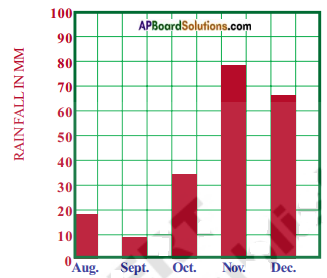
b) Stem: The aerial part of the plant above the ground is the stem.

  • It bears branches, leaves, flowers and fruits.
  • It transports water, minerals and nutrients to the various parts.

c) Leaf: The flat, green portion of a plant that arises from a node is a leaf.

  • It helps in photosynthesis, respiration and transpiration.

d) Flower: The bright and beautiful part of the plant.

  • It is a reproductive part of a plant.

e) Fruit: It is an edible part of a plant that contains seeds.

  • It developed from the flower.

AP Board 6th Class Science Solutions Chapter 2 Knowing About Plants

Question 8.
Explain the parts of a leaf with the help of a diagram.
Answer:
The main part of a leaf is,
a) Leaf base b) Petiole c) Lamina d) Midrib e) Veins
a) Leaf base: Lower part of the leaf that joins the leaf to the stem near the node.
b) Petiole: A stalk-like/structure that connects leaf to the stem of the plant.
c) Lamina: The thin, flat, green portion of the leaf is lamina.
d) Midrib: The long vein that present in the middle of the lamina.
e) Veins: The branches arising from the midrib and spread over all the lamina.

Question 9.
John has no sufficient place around his house to grow plants. But he wants to grow vegetables like tomato or brinjal. Suggest him some ways to grow plants.
Answer:
Terrace garden, Kitchen garden, Vertical garden are some methods for growing the plants in limited space.
a) Terrace garden: It is a simple garden growing on the terrace. In this process, we use water bottles, plant pots and other waste vessels to grow the plants.
b) Kitchen garden: A garden in which plants for use in the kitchen are cultivated.
c) Vertical garden: A garden in which the plants are supported to grow vertical, especially fences, posts, walls rather than along the ground.

Activities and Projects

Question 1.
Collect any plant from your surroundings. Draw its root structure. What can you say about its root system?
Answer:
AP Board 6th Class Science Solutions Chapter 2 Knowing About Plants 3

  • The root system collected in the plant exhibit tap root system.
  • In this plant, the main root is thick and grows straight down into the ground is Tap root.
  • And the smaller roots arising from the tap root are Lateral roots.
  • The root system helps the plant to penetrate into deep layers of the soil.
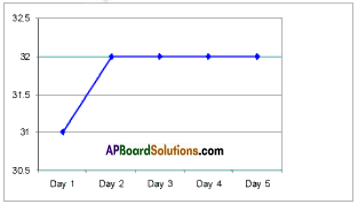
(OR)

  • The root system collected in the plant exhibit tuberous root system.
  • In this plant all roots are thin and uniform in size.
  • This root system consists of a cluster of roots arising from the base of the stem.
  • The root system helps the plant to hold the soil firmly and prevent soil erosion.

Question 2.
Collect the leaves of various plants and prepare a herbarium. Write a brief report on their shapes size and venation.
Answer:
Students collect different shapes and sizes of leaves.
AP Board 6th Class Science Solutions Chapter 2 Knowing About Plants 4

  • A Herbarium is a store house of plant specimens which are collected, dried and mounted on paper sheets.
  • There are different shapes such as linear, elongated elliptical etc.
  • The collected leaves showing reticulate venation and parallel venation in some plants.

AP Board 6th Class Science Solutions Chapter 2 Knowing About Plants

Question 3.
Prepare a greeting card with dry leaves.
Answer:
The student can prepare this in a way of his choice. (Student Activity)
AP Board 6th Class Science Solutions Chapter 2 Knowing About Plants 5

Question 4.
Observe a plant that has healthy green leaves and beautiful flowers. Write your feelings about the plant in your note book.
Answer:

  • When we see a plant with healthy green leaves and beautiful flowers, we wonder at the glance of such point.
  • The green colour of the leaves gives us good scenery and good visibility.
  • Green colour is pleasant to our eyes so that it is quite healthy for our eyes.
  • On seeing the healthy plant, our mind gets refreshed and tries to forget all the worries.
  • The colour and beauty of the flowers makes us relax and its fragrance gives us aroma.

6th Class Science 2nd Lesson Knowing About Plants Activities

Activity – 1

1. Collect 5 or 6 different types of plants from your garden.    (Page No. 13)
a) Observe the collected plants and try to identify their parts. Take the help of fig. 1 in your text book and write your observations in Table given Let us discuss the following questions.
AP Board 6th Class Science Solutions Chapter 2 Knowing About Plants 6
Answer:

Sl.No.Name of the plantRoot
Yes/No
Stem
Yes/No
Leaves
Yes/No
Flower
Yes/No
1.RiceYesYesYesYes
2.TulasiYesYesYesYes
3.MangoYesYesYesYes
4.RoseYesYesYesYes
5.NeemYesYesYesYes

i) Did you find any plant which does not have roots?
Answer:
No. I don’t find any plant without roots.
ii) Are the leaves of all plants similar in size?
Answer:
No. The leaves of all the plants are not in similar in size.
iii) Is there any plant without flowers?
Answer:
Ferns, mosses and liverworts are non flowering plants.
iv) What are the common parts that you observe in all plants?
Answer:
Roots, stem, leaves and flowers are the common parts that I observed in all plants.
v) Observe the roots of the plants you collected. How are they?
Answer:
They are not alike.
vi) Do all plants have a similar type of root?
Answer:
No, they have different roots.
vii) Is there any difference?
Answer:
Yes, we can observe the differences some plants have tap root system and some have fibrous

AP Board 6th Class Science Solutions Chapter 2 Knowing About Plants

b) Compare the roots of your sample plants with pictures fig 2 and fig 3 and write your observations in table and answer the following questions.
AP Board 6th Class Science Solutions Chapter 2 Knowing About Plants 7

S.No.Name of the plantType of root system
1.Tridax plant
2.
3.
4.
5.

Answer:

S.No.Name of the plantType of root system
1.Tridax plantTap root system
2.RiceFibrous root system
3.TulasiTap root system
4.MangoTap root system
5.RoseTap root system
6.NeemTap root system

i) In the tap root system, how does the middle root look like?
Answer:
Middle main root become thick and has thin rootlets.
ii) Compare the middle root with the remaining roots in the tap root system?
Answer:
The middle root is thick and known as Tap root, and the remaining rootlets are thin and known as Lateral roots.
iii) Do you find any such main root in fibrous root system? How are the roots of this plant?
Answer:
No. There is no main root in fibrous root system. Here all roots are similar in size.
iv) Do you find any other differences between tap root system and fibrous root system?
Taproot system consists of Taproot and Lateral roots in different sizes whereas in fibrous root system all roots are thin and uniform in size.

AP Board 6th Class Science Solutions Chapter 2 Knowing About Plants

Activity – 2

2. Write an activity to identify an emerging point that belong to either monocot or dicot in your science lab.  (Page No. 14)
Answer:
Aim: To observe the cotyledons of bean seeds and finger millets comparatively with their root systems.
What you need: Two paper cups, soil, bean seeds, finger millet seeds, water.
What to do?:

  • Take two paper cups and fill them with fertile soil.
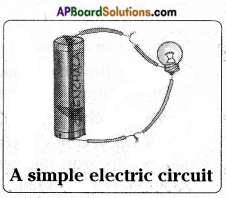
  • Sow 2 or 3 bean seeds in a cup and few finger millets in another cup.

  • Sprinkle water over them.
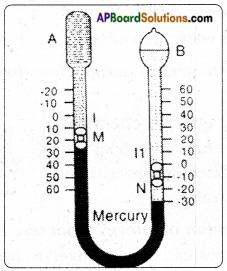
  • After a couple of days, we will see the sprouts.
  • Observe the newly emerging leaves of that sprouts.
  • Take out the plants out of the soil carefully and observe their roots.

What do you see: Two leaves are emerged from the bean seed and only one leaf emerged from the finger millet seedlings. These are the cotyledons.

  • Bean has two cotyledons so it is a dicot plant.
  • Finger millet has one cotyledon so it is a monocot plant.
  • Bean plant has tap root system whereas finger millet has fibrous root system.

What do you learn:

  • Dicot plants have tap root system whereas monocot plants have fibrous System.
  • So that there is a relation between the cotyledons and the root system.

Activity – 3

Water absorption by Root.   (Page No. 13)

3. How can you explain that plants absorb water through their roots?
Answer:
Aim: To observe the absorption of water by root.
What you need: A carrot, a glass of water and blue ink.
What to do: Take a glass of water and add a few drops of blue ink to it.

  • Now place a carrot in the glass.
  • Leave the carrot in water for 2 or 3 days.
  • Then cut the carrot in water, lengthwise and observe.

What do you see: Blue colour appears in the carrot.
What do you learn: The blue colour indicates that water moved upward in the carrot showing that root absorbs water.

  • Observe the figure. Which part of the plant does that boy hold to swing?
    AP Board 6th Class Science Solutions Chapter 2 Knowing About Plants 8
    Answer:
    Roots of Banyan (Aerial roots).

AP Board 6th Class Science Solutions Chapter 2 Knowing About Plants

Activity – 4
4. How can you prove that the water absorbed by the root is carried cut through stem to all parts of the plants?
Answer:
Aim: To observe the conduction of water by a stem.
AP Board 6th Class Science Solutions Chapter 2 Knowing About Plants 9
What you need: A small twig of balsam plant, a glass of water, red ink.
What to do: Take a glass of water and add a few drops of ink to it.

  • Now place the small twig in the water.

What do you see: The stem turns reddish.
What do you learn: The red ink is taken and transported by the stem upwards.
Observe the given picture of a leaf and its parts.
AP Board 6th Class Science Solutions Chapter 2 Knowing About Plants 10

  • Where is the leaf attached to the stem?
    Answer:
    Leaf base.
  • What is the flat portion of the leaf called?
    Answer:
    Lamina (or) Leaf plate.
  • What do you call the small line like structure in the flat portion of the leaf?
    Answer:
    Veins.
  • Which part connects leaf lamina with the stem?
    Answer:
    Petiole.

Activity – 5

Are all leaves the same?   (Page No. 17)

5. a) Observe the leaves of the plants that you collected in activity 1.

  • How are they?
    Answer:
    They are thin and flattened green structures.
  • Are all the leaves being same size and shape?
    Answer:
    No. The leaves are not the same size and shape.

b) Compare the leaves of the plants collected in activity 1. Write your observation in the table given. You can also draw what you see in the shape and edge columns if describing is difficult.

S.No.Name of the plantLeaf base Yes/NoPetiole
Yes/No
Lamina
Yes/No
Shape of the leafEdges of the leaf
1.
2.
3.
4.
5.

Answer:

S.No.Name of the plantLeaf base Yes/NoPetiole
Yes/No
Lamina
Yes/No
Shape of
the leaf
Edges of the leaf
1.RiceYesNoYesLinearHairy
2.TulasiYesYesYesOvalSlightly toothed
3.MangoYesYesYesOvalSmooth
4.RoseYesYesYesOvalSharply toothed
5.NeemYesYesYesLinearDentate
  • What are the common parts that you observe in all the leaves?
    Answer:
    Leaf base, petiole, lamina are the common parts I observed in all the leaves.
  • Do all the leaves have the same shape?
    Answer:
    No. All the leaves have not the same shape.

AP Board 6th Class Science Solutions Chapter 2 Knowing About Plants

Activity – 6

6. Put a leaf under a white sheet of paper or a sheet in your notebook. Hold the tip of the pencil flat and rub it on the paper.        (Page No. 18)
AP Board 6th Class Science Solutions Chapter 2 Knowing About Plants 11

  • Did you get any impression?
    Answer:
    Yes. I get the impression of leaf.
  • Is this pattern being similar to that of the leaf?
    Answer:
    Yes. It is similar to that of the leaf.

Activity – 7

Types of Venation. (Page No. 18)

7. Observe the venation of the leaves that you collected in activity 1. With the help of fig. 6 right your observations in table 4.
AP Board 6th Class Science Solutions Chapter 2 Knowing About Plants 12

S.No.Name of the PlantVenation (Reticulate / Parallel)
1.
2.
3.
4.
5.

Answer:

S.No.Name of the PlantVenation (Reticulate / Parallel)
1.RiceParallel venation
2.TulasiReticulate venation
3.MangoReticulate venation
4.RoseReticulate venation
5.NeemReticulate venation

a) Now compare the results obtained in table-2 with table-4.

  • What type of roots are there in plants having parallel venation in their leaves?
    Answer:
    Fibrous roots are there in plants having parallel venation in their leaves.
  • What type of roots are there in plants having web-like venation in their leaves?
    Answer:
    Taproot system is there in plants having web-like venation in their leaves.
  • Is there any relation between venation and root system?
    Answer:
    Yes. There is a relation between venation and the root system.
    The plants with taproot system have leaves with web-like or reticulate venation and plants with fibrous roots have parallel venation.

AP Board 6th Class Science Solutions Chapter 2 Knowing About Plants

Activity – 8

Stomata Observation. (Page No. 19)

8. What procedure do you follow to observe the stomata in your school lab?
Answer:
Aim: To observe stomata in a leaf.
AP Board 6th Class Science Solutions Chapter 2 Knowing About Plants 13
What you need: Fleshy leaf, water, microscope, slide.
What to do:

  • Take a fleshy leaf.
  • Peel the outer layer of the leaf and place it on a slide.
  • Put a drop of water on it and observe it under a microscope.

What do you see: We find some bean-shaped parts.
What do you learn: The bean-shaped parts are stomata. Its acts like our nose.

Activity – 9

Transpiration. (Page No. 19)

9. Write an activity to explain transpiration in plants.
Answer:
Aim: To observe that excess water is removed in the form of vapours from the leaf surface.
AP Board 6th Class Science Solutions Chapter 2 Knowing About Plants 14
What you need: Well-watered potted plant, polythene bags, thread.
What to do:

  • Take a well-watered potted plant.
  • Enclose a leafy branch of the plant in a polythene bag and tie its mouth.
  • Take another polythene bag and tie its mouth without keeping any plant.
  • Keep both polythene bags under the sun.

AP Board 6th Class Science Solutions Chapter 2 Knowing About Plants

What do you see:

  • We see some droplets in the polythene bag that ties on the plant.
  • There are no droplets in another polythene bag.

What do you learn: Plants release excess water in the body through the stomata of the leaves.

  • This process of releasing water in the form of vapour by the process called transpiration.