AP Board 6th Class Science Important Questions Chapter 5 Materials: Separating Methods

AP State Syllabus AP Board 6th Class Science Important Questions Chapter 5 Materials: Separating Methods

AP State Syllabus 6th Class Science Important Questions 5th Lesson Materials: Separating Methods

Question 1.
Name any five objects which are made up of only one material.
Answer:
The following objects are made up of only iron.

  1. Iron pan
  2. Iron lock
  3. Iron key
  4. Iron trunk
  5. Iron cot
  6. Iron crow bar
  7. Bodkin (Iron)
  8. Blowpipe (Iron).

Question 2.
Name any five objects which are made up of more than two materials.
Answer:

  1. Pen (Plastic + Metal)
  2. Cycle (Steel + Iron + Rubber)
  3. Scissors (Steel + Plastic top)
  4. Mirror (Glass + Metal frame)
  5. Axe (Iron + Wooden handle)
  6. Table (Wood + Steel)

AP Board 6th Class Science Important Questions Chapter 5 Materials: Separating Methods

Question 3.
With what material is your pen made?
Answer:
My pen is made of plastic, whereas its clip is made of iron.

Question 4.
How do we decide which material should be used for making an object?
Answer:
Depending upon the use and purpose they serve, we decide which material should be used for making an object.

Question 5.
What are soluble substances?
Answer:
Substances which dissolve in water are said to be soluble substances.

Question 6.
Select those objects from the following which are made up of plastic.
Table, mug, utensils, chair, iron gate, wood, cotton shirt, plastic toy, pen, computer
Answer:
Table, mug, utensils, chair, plastic toy, pen, computer.

Question 7.
Write two substances that are made from leather.
Answer:

  1. Belt and
  2. shoes.

Question 8.
List out any 5 items that float on water.
Answer:
List of 5 items that float on water:

  1. Paper
  2. Wood
  3. Wax
  4. Ice
  5. Oil

Question 9. (You might come across some situations where you have to separate some components from a mixture. Write down two examples of such situations.
1. …………………………
2. …………………………
Ex: 1) Rice and small stones. 2) Muddy water.
What do you do to separate the components?
Answer:

  1. Rice and small stones are separated by handpicking.
  2. Muddy water is filtered with filter paper.

Question 10.
How are stones separated from pulses and rice?
Answer:
Stones are separated by handpicking from rice and pulses.

AP Board 6th Class Science Important Questions Chapter 5 Materials: Separating Methods

Question 11.
Give some examples of the handpicking method of separation.
Answer:
Examples for handpicking method of separation:

  1. Rotten fruits are removed from fresh fruits.
  2. Separating oranges and apples.

Question 12.
When can winnowing be used?
Answer:
Winnowing can be used to separate lighter and heavier components of a mixture. Eg: To
separate husk from grain with the help of air.

Question 13.
Where do we use the chromatography method?
Answer:
We use chromatography to separate colours or pigments from their mixtures.
Ex: 1. To separate colours from ink.
2. To separate colouring pigments from the leaf extract, etc.

Question 14.
Identify the mixtures among the following:
Jangree, coffee, sand, haldi, red chilli.
Answer:
Mixtures:

  1. Jangree
  2. Coffee
  3. Sand with impurities
  4. Haldi with impurities.

Question 15.
Can you filter mud water with filter paper?
Answer:
Yes, we can filter the mud water with filter paper.

Question 16.
Is the water clean after the mud water is sieved with filter paper?
Answer:
The mud water filtered after using the filter paper is clean.

Question 17.
Are you able to separate the salt from the saltwater with filter paper?
Answer:
We cannot separate the salt from the saltwater with filter paper.

AP Board 6th Class Science Important Questions Chapter 5 Materials: Separating Methods

Question 18.
A solid substance is dissolved in water which method is used for separating it?
Answer:
Filtration.

Question 19.
20. Name the process by which water is separated from rice and pulses after washing them.
Answer:
Sedimentation.

Question 20.
Which process is used to separate a mixture of camphor and salt?
Answer:
Sublimation is the process that is used to separate the mixture of camphor and salt.

Question 21.
How do farmers use sieving?
Answer:
Farmers separate grains which are bigger in size from the smaller ones by sieving. The bigger grains are then used as seeds or sold at a higher price.

Question 22.
What is filter paper? How is it useful?
Answer:
Filter paper is a sieve made of paper that has very fine holes. We can filter very small particles using this type of sieve.

Question 23.
What is sublimation?
Answer:
The process in which a substance changes directly from solid to gaseous form and vice-versa is called sublimation.

Question 24.
What is Chromatography?
Answer:
The process of separating colours from a mixture of colours is called chromatography.

6th Class Science 5th Lesson Materials: Separating Methods 4 Mark Important Questions and Answers

Question 1.
Give a list of objects which would be broken and which might not be broken when they fall on the floor.
Answer:

ObjectsExamples
Would be brokenglass cups, earthenware pots, ceramic utensils … etc.
Might not be brokenstainless steel plates, wooden items, iron pans … etc.

Question 2.
How do you sort materials as solids, liquids and gases? Write your answer with an example.
Answer:
1) We sort materials as solids, liquids and gases based on their state at normal temperature.
AP Board 6th Class Science Important Questions Chapter 4 Water 2

AP Board 6th Class Science Important Questions Chapter 5 Materials: Separating Methods

Question 3.
Can you think of any material other than ice that goes from solid to liquid, liquid to gas (vapour)?
Answer:

  1. Many materials change their state from solid to liquid and from liquid to gas.
  2. Ghee at slightly low temperature will be in solid state.
  3. If it is heated it comes to liquid state and on further heating it becomes vapour.

Another example:

  1. At room temperature candle wax will be in solid state (candle).
  2. When it is lighted it starts burning and liquid wax is seen at the wick of the candle.
  3. The white smoke on the top of the wick is wax vapour.

Question 4.
What are the properties of solids and liquids?
Answer:

  1. The materials which do not change shape are solids.
    Example: Wood, rock, brick, plastic objects, vegetables … etc.
  2. The materials which change shape are liquids.
    Example: Water, rasam, milk, kerosene, oil… etc.

Question 5.
Explain the terms ‘soluble’ and ’insoluble’ with reference to water.
Answer:

  1. Substances that get dissolved in water are called soluble substances.
  2. Substances that do not dissolve in water are called insoluble substances.

Question 6.
Can you make a cricket ball, with mud or glass?
Answer:

  1. We cannot make a cricket baH with mud or glass.
  2. If that ball is struck with the bat it breaks into pieces.
  3. This ball cannot withstand hard strokes.

Question 7.
Can you make a chair with glass or mud? If not why?
Answer:

  1. No. We cannot make a chair with glass or mud.
  2. Both are brittle materials and can be broken easily.

Question 8.
Give two examples for soluble and insoluble substances in water
Answer:

  1. Soluble substances in water: 1) Sugar 2) Salt
  2. Insoluble substances in water: 1) Wood 2) Sand

AP Board 6th Class Science Important Questions Chapter 5 Materials: Separating Methods

Question 9.
Create table of objects different types that are made from the same material.
Answer:

S.No.MaterialsObjects made of these materials
1.IronTable, doors, mesh
2.WoodCart, plough, doors
3.LeatherShoes, belt
4.CottonBed, pillow, dress
5.PlasticsChairs, buckets

Question 10.
Kiran observed his father separating husk and grains by winnowing method in the field and appreciated how wind flow helped in separation. On evaporation, salt is formed from seawater. Isn’t it? How would you appreciate this process?
Answer:

  1. The flowing wind carries the lighter husk with it and the heavy grains fall vertically downwards.
  2. This winnowing is done with the help of flowing wind which is nature’s gift.
  3. Similarly, the evaporation of seawater leaves salt for us. This is done with the help of sunlight. This is also nature’s gift.

Question 11.
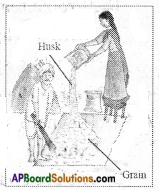
When farmers thresh their crops, they get a mixture of husk and grain. How do the farmers separate the husk from the grains?
Answer:

  1. On a windy day, a farmer stands on a high platform and allows the mixture of grain and husk to drop slowly from the flat Pan.
    AP Board 6th Class Science Important Questions Chapter 4 Water 3
  2. The wind carries the husk forward and the grips fall vertically downward.
  3. A separate heap of grain is formed.

Question 12.
How will you separate the tea leaves from tea? Which property helped in the separation of tea leaves from tea?
Answer:

  1. Tea leaves are separated from tea using a strainer.
  2. The size of the tea leaves is more when compared to the size of the holes in the Strainer.
    This property helped in the separation of tea leaves from the tea.

AP Board 6th Class Science Important Questions Chapter 5 Materials: Separating Methods

Question 13.
Laxmi says that sedimentation and decantation are used at home while cleaning rice and pulses for cooking. Describe the sediments in this process.
Answer:

  1. While cleaning rice we wash rice with water. Rice settles down in the water as sediments and the lighter impurities float. This is called sedimentation.
  2. The water gets separated from the sediment (rice). This process is called decantation.
  3. The same process takes place while washing pulses.

Question 14.
We use sieves to separate tea leaves from tea and sand from gravel. What are the differences between the sieves used in the two instances?
Answer:

  1. The holes of the sieve to separate tea leaves from tea are small.
  2. The holes of the sieve to separate sand from gravel, are relatively large.

Question 15.
With what liquid do doctors mix injection powder before administering injections to patients?
Answer:

  1. Before administering injections to patients, doctors mix injection powder with some liquid.
  2. This liquid is water and it is known as distilled water.

Question 16.
What is a mixture? Give examples.
Answer:

  1. Mixtures contain more than one substance.
  2. A combination of more than one substance forms a mixture.
  3. Some mixtures are natural like soil.
  4. Some mixtures are man-made like laddu, lemon juice etc.

Question 17.
What is a filter paper made of? For what purpose is it useful?
Answer:

  1. Filter paper is a sieve made of paper that has very fine holes.
  2. We can filter very small particles using this type of sieve.

Question 18.
Can you separate mad from muddy water using a sieve?
Answer:

  1. Yes. We can separate mud from muddy water using a sieve.
  2. Mud water can be filtered with filter paper. The pores of the sieve (filter paper) are very small.

Question 19.
After using the Filter paper to filter water what do you find? What do you see left behind on the paper? What is obtained in the beaker?
Answer:

  1. After using the filter paper to filter mud water. 1 find pure water free from mud in the filtrate.
  2. Mud is left behind on the paper.
  3. Pure water is obtained in the beaker.

Question 20.
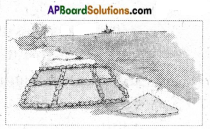
How is salt manufactured?
Answer:

  1. Water is generally evaporated in sunlight.
    AP Board 6th Class Science Important Questions Chapter 4 Water 4
  2. We use this property while extracting salt from seawater.
  3. Seawater is captured in wide pans and is exposed to air and sunlight.
  4. Then water evaporates and the salt is left behind in the pans.

AP Board 6th Class Science Important Questions Chapter 5 Materials: Separating Methods

Question 21.
AP Board 6th Class Science Important Questions Chapter 4 Water 5

  1. Identify the part labelled X’.
  2. Write a short note about it.

Answer:

  1. The name of the part ’X’ is filter paper.
  2. Filter paper is a sieve made of paper that has very fine holes.
  3. Very small particles using this type of sieve.

Question 22.
Distinguish between the separation methods of winnowing and sieving.
Answer:

WinnowingSieving
1. If mixtures have light and heavy substances winnowing can be used for separation.1. Sieving can be used for separating longer and smaller substances in a mixture.
2. Ex: Husk from grains.2. Ex: Sand from gravel.

Question 23.
What is meant by solvent? Why water is called a universal solvent?
Answer:

  1. A solvent is a liquid that dissolves other substances in it.
  2. Water can dissolve more substances than any other solvents. So it is called Universal Solvent.

6th Class Science 5th Lesson Materials: Separating Methods 8 Mark Important Questions and Answers

Question 1.
Write at least two properties of solids, liquids and gases.
Answer:
A) Solids:

  1. Solids have a definite shape.
  2. Solids are incompressible.
  3. Solids do not flow.

B) Liquids:

  1. Liquids occupy the shape of the container.
  2. Liquids are incompressible.
  3. Liquids can flow.

C) Gases:

  1. Gases have no fixed shape.
  2. Gases can be compressible.
  3. Gases flow and diffuse.

AP Board 6th Class Science Important Questions Chapter 5 Materials: Separating Methods

Question 2.
What is the sweet dilemma? How do you support the argument of the student Razia?
Answer:

  1. Sugar takes the shape of the container. So one group of students concluded that sugar is a liquid.
  2. Razia, a student, took a single crystal of sugar and one drop of water and declared that sugar is solid while water is a liquid.
  3. As sugar crystals are very small they assumed the shape of the container. Razia argued that sugar crystal has a definite shape and can be held independently.
  4. She showed that a drop of water has no definite shape and is not possible to hold it independently as is done with the sugar crystal.
  5. This sweet dilemma is thus solved.

Question 3.
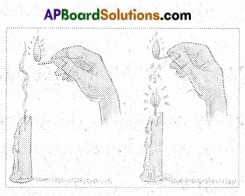
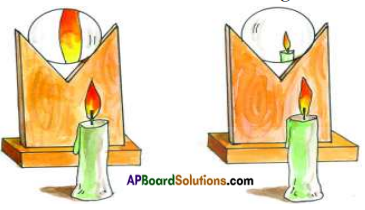
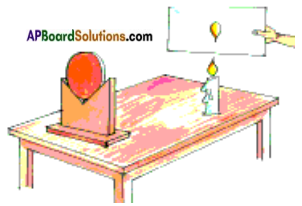
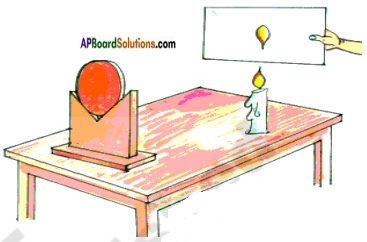
Observe the diagram and answer the following.
AP Board 6th Class Science Important Questions Chapter 4 Water 6

  1. What is the aim of the experiment?
  2. Write two gaseous substances.
  3. Did the candle not catch fire from a distance?
  4. Does the white smoke represent candle wax in the state of gas?

Answer:

  1. Aim: Lighting a candle without touching its wick.
  2. a) Oxygen, b) carbon dioxide
  3. Yes. It catches fire, as there is vapour around the wick.
  4. Yes, the smoke is the gas of wax.

Question 4.
Srikar accidentally mixed mustard seeds with rice and salt. How can he separate them?
Answer:

  1. First, this mixture should be sieved through the sieve of small holes.
  2. Then rice will remain in the sieve and mustered seeds along with salt will come down.
  3. Now take the mixture of mustard seeds and salt in a vessel and add water to it.
  4. Let the salt dissolve in the water.
  5. Filter it into another vessel using a cloth or filter paper.
  6. Mustered seeds will remain on the cloth/ filter paper and saltwater goes down into the vessel.
  7. Heat the saltwater till the water completely get evaporate living behind the salt crystals in the vessel.
  8. Thus by using three methods- sieving, filtration and crystallization, he can separate
    mustered seeds, rice and salt from their mixture.

Question 5.
Divya suggested some methods to separate mixtures given below. Are they correct? Find whether they are possible or not. Give reasons.
a) Pure water can be obtained from seawater by the process of filtration.
b) Cheese is removed from curdled milk by the process of decantation.
c) Separation of sugar from tea can be done by filtration.
Answer:
a) 1) No. Filteration is used to remove the insoluble substances only. But salt is soluble in water.
2) So, filtration is not used to obtain pure water from seawater.
b) 1) Yes. The decantation method is used to .separate an insoluble substance (cheese) in liquid (milk).
2) So, it can be removed from curdled milk.
c) 1) No. Filtration is used to remove the insoluble substances only. But sugar is soluble in tea it cannot be removed by filtration.

AP Board 6th Class Science Important Questions Chapter 5 Materials: Separating Methods

Question 6.
Collect information from your parents regarding various methods used by us to clean food grains at home and prepare a chart to show them.
Answer:
Methods used to clean food grains at home:

  1. Handpicking: This method is used for separating small particles of dirt, stone, husk etc., from the grains of wheaL rice, pulses …. etc.
  2. Sieving:
    a) Sieving is used when two components of a mixture have different particle size.
    b) Sieving allows the fine particles to pass through the holes of the sieve, while the bigger-particlesTepnain on the sieve. Eg: Sieving of wheat flour.
  3. Threshing: The process that is used to separate the grain from stalks is called threshing.

Question 7.
How do you separate mud and sand from muddy water? What is sedimentation and decantation?
Answer:

  1. Take a mixture of soil and. water in a glass tumbler and keep it undisturbed for some time.
  2. We will find that the sand and the mud particles in the soil settle down at the bottom of the glass tumbler.
    AP Board 6th Class Science Important Questions Chapter 4 Water 7
  3. These are called sediments. This process of separation of mud and sand is called sedimentation.
  4. After sedimentation, the tumbler is gently lifted.
  5. The tip of the tumbler is inclined on the edge of another tumbler without disturbing the sediments. The water gets separated from the sediment (mud).
  6. This process is called decantation.

Question 8.
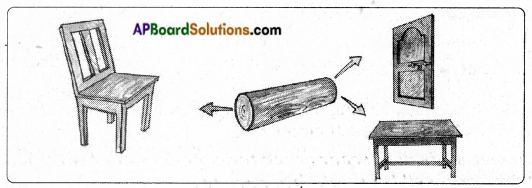
Draw different objects made up of wood which we use in our daily life.
Answer:
AP Board 6th Class Science Important Questions Chapter 4 Water 8

AP Board 6th Class Science Important Questions Chapter 5 Materials: Separating Methods

Question 9.
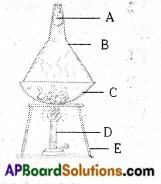
Identify the parts labelled ‘A’ ‘B’ ‘C’ and ‘E’ in the following figure.
AP Board 6th Class Science Important Questions Chapter 4 Water 9
1. Name of the part A: ……………………..
2. Name of the part B: ……………………..
3. Name of the part C: ……………………..
4. Name of the part D: ……………………..
5. Name of the part E: ……………………..
Answer:
A: Cotton,
B: Funnel,
C: China dish,
D: Burner,
E: Stand


AP Board 6th Class Science Important Questions Chapter 4 Water

AP State Syllabus AP Board 6th Class Science Important Questions Chapter 4 Water

AP State Syllabus 6th Class Science Important Questions 4th Lesson Water

6th Class Science 4th Lesson Water 2 Mark Important Questions and Answers

Question 1.
Where do we get water from?
Answer:
We get water from rivers, ponds, lakes, canals and borewells.

Question 2.
For what purpose do we need water?
Answer:
We need water to perform day to day activities like cooking food, washing clothes, cleaning utensils, bathing etc.

Question 3.
Name the two processes responsible for the formation of clouds.
Answer:
Two processes are responsible for the formation of clouds.

  1. Evaporation
  2. Condensation

AP Board 6th Class Science Important Questions Chapter 4 Water

Question 4.
Write any natural disasters that are related to water.
Answer:

  1. Floods
  2. Tsunami
  3. Drought

Question 5.
Give some examples of fruits and vegetables that contain more water.
Answer:
Vegetables: Cucumber, tomato, bottle gourd, snake gourd, etc.
Fruits: Watermelon, lemon, orange, muskmelon, mango, etc.

Question 6.
What are the main water sources in villages?
Answer:
In villages wells, canals, tanks, ponds, rivers, etc. are the main water sources.

Question 7.
What are juicy fruits ? Give examples.
A. The fruits that contains more water are called juicy fruits. Ex : Watermelon, grapes, orange, muskmelon. .

Question 8.
What are the forms of water?
Answer:
There are three forms of water in nature. They are
Ice (Solid form), Water (Liquid form) arid Water vapour (Gaseous form)

Question 9.
What is evaporation?
Answer:
The process of water changing into water vapour is called evaporation.

Question 10.
What is a cloud?
Answer:
The water vapour which enters into air through the process of evaporation forms clouds in the sky. .

Question 11.
Define condensation.
Answer:
The process of conversion of water vapour into water is called condensation.

Question 12.
When does a drought occur?
Answer:
If there is no rain for a long period, it may cause drought.

Question 13.
What are hailstones?
Answer:
Big drops of water solidify into ice and fall as pieces of ice known as hailstones.

Question 14.
What do you understand by the word ‘Precipitation’?
Answer:
The kind of weather condition where rain, snow, sleet or hail fall from the sky is called precipitation.

AP Board 6th Class Science Important Questions Chapter 4 Water

Question 15.
Define the Hydrological cycle.
Answer:
The circulation of water between the earth surface and air is called the Hydrological cycle or water cycle.

Question 16.
What are the main reasons that disturb the water cycle?
Answer:
Deforestation and pollution are the main reasons that disturb the water cycle.

Question 17.
What happens if there is less rainfall or too much rainfall?
Answer:
If there is less rainfall its results in droughts or water scarcity and too much rainfall results in floods.

Question 18.
Name the drought-prone districts in Andhra Pradesh.
Answer:
Ananthapur, Kadapa and Kurnool are drought-prone districts in AP.

Question 19.
Fill the blanks with suitable answers.
A → Water → B
Answer:
A. Ice,
B. water vapour

Question 20.
What is the specific measurement of volume for liquids?
Answer:
Water and other liquids are measured in litres.

AP Board 6th Class Science Important Questions Chapter 4 Water

6th Class Science 4th Lesson Water 4 Mark Important Questions and Answers

Question 1.
What is evaporation? What its importance in our life?
Answer:

  • Evaporation is the process of water changing into water by applying heat.
  • Evaporation of water helps the atmosphere to provide moisture.
  • It helps in the formation of clouds.
  • It cools our body from the sweat.

Question 2.
Write the situations of evaporation that we see in our daily life?
Answer:
We observe evaporation by the following situations in our daily life.

  • Wet clothes drying under the sun.
  • Hot tea getting cold.
  • Drying of mopped floor.
  • Drying of lakes and rivers
  • In the preparation of salt from the sea.
  • Grains and fishes dry under the sun.
  • In the formation of clouds.

Question 3.
What is the importance of water in our daily life?
Answer:

  • Our body needs water to maintain temperature and bodily functions.
  • Water helps in digestion of food.
  • Water helps to removal of toxins from the body.
  • It improves skin moisture.

Question 4.
How do you appreciate the people who dicing a well?
Answer:

  • Tapping of ground water by digging a well is tough job.
  • The place where the well is to be dug is selected first.
  • Workers using cow bars and spades begin to remove the soil at that place.
  • The process of digging continues till water in the underground found.

AP Board 6th Class Science Important Questions Chapter 4 Water

Question 5.
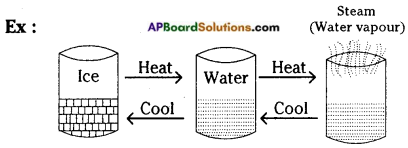
How can you say that three forms of water are interchangeable?
Answer:

  • Water is available naturally in three forms as ice, water and water vapour.
  • When ice is heated it converts into water and if water is heated it turns into water vapour,
  • Where water vapour is cooled it converts into water. If water cooled further, we will get ice.
  • So, we can say that three forms of water are interchangeable.
    AP Board 6th Class Science Important Questions Chapter 4 Water 1

Question 6.
Explain how the evaporation takes place.
Answer:

  • If water is gently heated, it will become warm and vapour is produced.
  • If we heat more it .starts boiling and converts completely into water vapour.
  • The amount of heat absorbed by water affects its evaporation.
  • If water is heated more, it will evaporate more.

Question 7.
What is the relation between rains arid clouds?
Answer:

  • Clouds are formed by evaporation of water.
  • When water vapour rises in the sky it forms clouds.
  • The clouds are coolecl by cool breeze.
  • Then the water present in the clouds condense and they become heavy and descend towards the earth as rain.

Question 8.
Why don’t all clouds cause rain?
Answer:

  • The clouds moving in the air are generally at higher levels.
  • The cool breeze along with the air makes the clouds cooler.
  • Due to this water vapour condenses and causes rain.
  • When the warmer air touches the clouds, it makes the water evaporate easily. So that that clouds cannot cause rain.

Question 9.
You might have observed a small dew-drops appeared on grass and leaves of plants. From where do these water-drops came on the leaves and grass?
Answer:

  • During the winter season due to low temperature, the fog in the air settle on the grass and plants.
  • Due to the transpiration process water is also evaporate through stomata. It also condensed to form fog.
  • This fog condensed into tiny droplets of water which is called as dew.
  • We can observe this dew only in the early hours of the day.

AP Board 6th Class Science Important Questions Chapter 4 Water

Question 10.
Have you observed in your daily life where water vapour changes into water? List out them.
Answer:
Yes. Here are the following situations where water vapour changes into water.

  • Dew forming on grass and plants in early morning.
  • Eye glasses fogging up in a cold winter day.
  • Water drops forming a glass holding a cool drink or ice cream.
  • Cooked food lid get water drops when the vessel cooled.

Question 11.
What changes do you notice in the sky and in the atmosphere before it rains?
Answer:

  • Before the rain the sky becomes dark due to the condensation of the water or the formation of clouds.
  • The atmosphere becomes very humid so that we feel so suffocated.
  • The sky is covered with rainy clouds and cool wind.
  • Some times thundering and sparkling may be occurring.

Question 12.
What are the types of monsoons?
Answer:
There are two types of monsoons in India.
1. South-West monsoon 2. North-East mortsoon

  1. South-West monsoon: During the months of June to September clouds are moving along with the winds blowing from western direction. These winds are called SouthWest Monsoon.
  2. North-East monsoon: In the months of November and December rains occur due to the movement of clouds in the direction of winds blowing from Eastern side. These winds are called North-East monsoon

Question 13.
How the rain water restores in water sources?
Answer:

  • Water that comes from rainfall runs down as small streams.
  • These small streams join together and make bigger streams.
  • These bigger streams join the rivers.
  • The rivers flow down to seas and oceans.
  • Some of the rain water seeps into the ground and becomes ground water.

Question 14.
Prepare slogans on Water Conservation.
Answer:

  • Water is gift from the creator. Protect it!
  • Do the earth a favour- Be a saver.
  • Save the water and save the life on the earth.
  • Water is essence of life, save rain water.

Question 15.
What precautions do you follow to prevent the water scarcity?
Answer:

  • Educate the people to change consumption of water and their life styles.
  • Recycle the waste water.
  • By following the water management techniques.
  • Improve irrigation and agricultural practises
  • By following water conservation methods such as rain water harvesting etc.

AP Board 6th Class Science Important Questions Chapter 4 Water

Question 16.
Which departments serve in natural disaster condition?
Answer:

  • National Disaster Relief Force, State Disaster Relief Force, local fire, Health, Police and Revenue department helps the victims of natural disaster.
  • Military also participate in relief activities of natural disaster.

Question 17.
What are the reasons for water scarcity?
Answer:
The main reasons for water scarcity are

  • Population explosion
  • Uneven distribution of rainfall
  • Decline of ground water table
  • Pollution of water
  • Careless use of water

6th Class Science 4th Lesson Water 8 Mark Important Questions and Answers

Question 1.
Why the rainy season important for us?
Answer:

  • In India, the rainy season is known as Monsoon.
  • The season lasts in India for about 3-4 months.
  • Indian population mainly depends on agriculture.
  • So, the harvesting is largely depending on the quality of rain.
  • The rainy season also significant to maintain groundwater levels.
  • All the living and non-living things directly of indirectly depend upon the rainy season.
  • The monsoon provides us to collect the runoff water by different methods of rainwater harvesting.
  • The rains help to replenish the freshwater which is essential for life on the planet.

Question 2.
What are the main types of precipitation? Explain.
Answer:
There are four main types of precipitation. They are rain, sleet, snow and hail.

  1. Rain: Water droplets fall when the air temperature is above freezing.
  2. Sleet: This occurs when raindrops fall through freezing air, then they turn into pellets of ice.
  3. Snow: When the water vapour passes through the very cold air, the water vapour crystallizes and forms snowflakes.
  4. Hail: These forms when thunderstorm winds push water back up into the atmosphere. The water turns into ice coated with more water and pushed up to freeze again.

AP Board 6th Class Science Important Questions Chapter 4 Water

Question 3.
Classify the uses of water in three groups. Uses in a house or a family, for agriculture purposes and others.
Answer:

  • Uses of water in a house: For drinking, bathing, washing, cleaning of vessels, toilets etc.
  • For agriculture: Water is essential for germination of seeds, irrigation of crops,
  • Others: Water helps to maintain our body temperature constant.
    Water is used to generate electricity.
    Water is used in many industries.

Question 4.
Write briefly about the water sources.
Answer:
Water is mainly available in three forms. 1. Ice 2. Water 3. Water vapour
1. Ice:

  • It is a solid form of water. Snow occurs naturally.
  • It is present in snow-covered mountains, glaciers and polar regions.
  • 10% of the land area is covered with glaciers.

2. Water:

  • It is a liquid form of water.
  • 3/4 th of the earth surface is covered with water.
  • It was present in oceans, seas, lakes, rivers and even underground.
  • Seawater is salty. But water used by us in our daily purpose is not salty. It is known as freshwater.
  • 3% of freshwater is available on earth.

3. Water vapour: The gaseous form of water. It was present in the atmosphere is 0.01%.

Question 5.
How the floods affect human life?
Answer:
Too much rainfall causes floods.
The immediate impacts of flooding include the following:

  • Loss of human life,
  • Damage to property,
  • Destruction of crops,
  • Loss of livestock,
  • Deterioration of health conditions due to water-borne diseases,
  • Destruction of power plants, roads and bridges,
  • People forced to leave their own homes,
  • Disruption of supply of clean water, transport, electricity, communicating etc.

Question 6.
What are the causes of the droughts? How it affects human life?
Answer:

  • When a rainfall is less than normal for a long period of years for a particular region results in drought.
  • Deforestation and pollution from factories lead to global warming.
  • Global warming changes the atmospheric conditions which are not favourable for clouds to get cooled.
  • Consequently, it leads to a decrease the rainfall.

It effects of Human life:

  • It is very difficult to get food and fodder.
  • Drinking water is scarce.
  • People need to travel long distances to collect water.
  • The soil becomes dry, agriculture and cultivation become difficult.
  • Many people who depend on farming for their livelihood, migrate to other places in search of jobs.
  • There is a higher incidence of heatstroke.
  • Economic loss and reduced income.

AP Board 6th Class Science Important Questions Chapter 4 Water

Question 7.
What are the methods of water conservation? Write about water management in briefly.
Answer:
There are mainly two methods followed by us to conserve the water.
1. Water management 2. Rainwater harvesting
1. Water management: Water management consists of the following factors.
a) Bringing awareness about the bad effects of throwing wastes into the water bodies
b) Recycling of water by separating pollutants.
c) Minimizing the use of chemical fertilizers in agriculture. It reduces the pollution of underground water.
d) Controlling deforestation.
e) Adopting drip irrigation and sprinkler irrigation in agriculture. In this way, a lesser amount of water can be used for irrigation.

Question 8.
Write about the water conservation method of rainwater harvesting.
Answer:
Direct collection and use of rainwater is called rainwater harvesting There are two types of rainwater harvesting.
a) Collecting water from where it falls.
Ex: Collecting water from the rooftops of the houses or buildings (Roof water harvesting)
b) Collecting flowing rainwater.
Ex: Collecting rainwater by constructing ponds with bund.

AP Board 6th Class Science Important Questions Chapter 9 Organisms and Habitat

AP State Syllabus AP Board 6th Class Science Important Questions Chapter 9 Organisms and Habitat

AP State Syllabus 6th Class Science Important Questions 9th Lesson Organisms and Habitat

6th Class Science 9th Lesson Organisms and Habitat 2 Mark Important Questions and Answers

Question 1.
What are living things and non-living things?
Answer:

  • The things which possess the characters like growth movement, food, breathing, get rid of wastes, and giving birth to young ones are called living things.
  • The things which do not possess these characters are called non-living things.

Question 2.
What are oviparous organisms? Give examples,
Answer:
The organisms which lay eggs are called oviparous organisms. Ex Hen, Crow. Lizard, Snake.

Question 3.
What are viviparous organisms? Give examples.
Answer:
The organisms which give birth to 3’oung ones are called viviparous organisms. Ex: – Man, Cat, Dog, Elephant.

Question 4.
What is a microscope?
Answer:
The microscope is an instrument using for observing minute organisms that we cannot see with our naked eye.

AP Board 6th Class Science Important Questions Chapter 9 Organisms and Habitat

Question 5.
How do you feel when you touch the “Touch me not “plant?
Answer:

  • When I touched the leaves of the ‘touch me not’ plant (mimose pudica), The leaves drooped.
  • Here, touch is a stimulus to the plant, and folding of leaves are the response of the plant.

Question 6.
Do all the living things grow through out the life?
Answer:

  • No all living things do not grow throughout life.
  • The plants grow through out life, but the animals grow upto some age only.

Question 7.
Is a dead plant or an animal non-living things?
Answer:

  • No, the dead plant, ainimals or any other living beings decompose to form non¬living constituents.
  • So we can’t say dead things are non-living things.
  • These are intermediate things between living and non-living things.

Question 8.
What are microorganisms?
Answer:
The living things that we can see only under the microscope are called microorganisms.

Question 9.
What is Stimulus?
Answer:
A change in the surrounding that makes an organism to respond is called stimulus.

Question 10.
In which months Pelicans are seen in Kolleru lake?
Answer:
October to March

Question 11.
What is Terrestrial habitat? Name some plants and animals of terrestrial habitat?
Answer:
The plants and animals that live in different places on the land is called Terrestrial habitat. Ex: – Mango, Guava, Sapota, Birds, Man, Snakes, Ants etc.

AP Board 6th Class Science Important Questions Chapter 9 Organisms and Habitat

Question 12.
How can you say “Animals skin is a habitat for some organisms?
Answer:
We often find some insects like a leech on the skin of a buffalo. So buffalo skin is the habitat for that insect.

Question 13.
Where do usually the living organisms stay?
Answer:

  • Living organisms have different needs.
  • They usually stay in the places where most of their needs are met, that is they get sufficient food, shelter and other conditions necessary for life.

Question 14.
Which animals and plants do you think would like on the surface of the pond?
Answer:
The organisms like a snail, whirling beetle and pond skaters live on the surface of water.

Question 15.
Can different places in the pond also be called habitat? Why? or why not?
Answer:
Yes, different places in the pond can also be called habitat. Why because. Ex : Plant. The plant in a pond habitat provide food oxygen and shelter for the animals. There are different places where plants and animals live. A pond is a habitat too.

Question 16.
Name the different organisms that you find on the tree?
Answer:
Birds, Monkeys, Squirrels, Snakes, Ants, Spiders, Caterpillars, Moths, Bees, Wasps, Small plants (mosses), mosquitoes are some organisms that I find on a tree.

Question 17.
Why do only certain types of animals and plants live along with us?
Answer:

  • Because these plants and animals serve us.
  • These plants and animals are sure of their shelter, and food.
  • We domesticate some types of animals and plants for our needs such as food.

Question 18.
Are all plants that grow in an orchard the same as the plants in a forest? Why is it so?
Answer:

  • In an orchard, only fruit plants are grown.
  • Tamarind, mango, amla are examples of plants that grow in forests.

AP Board 6th Class Science Important Questions Chapter 9 Organisms and Habitat

Question 19.
Give examples for desert plants?
Answer:
Cactus, Optunia, Aloevera.

Question 20.
Which animals and plants do you think would live in midwater?
Answer:
Great water boatman, Leech, Mosquito larvae, Fish and Crabs.

6th Class Science 9th Lesson Organisms and Habitat 4 Mark Important Questions and Answers

Question 1.
Which characteristics are same in the both living and non-living things?
Answer:

  • All living and non-living things are made up of matter.
  • All living and non-living things have mass and occupy space.
  • Both are made up of structural units.
  • Molecule is the structural unit of living and non-living things of the cell.

Question 2.
Do you think both living and non-living things are necessary for our environment, why?
Answer:

  • Yes, both living and non-living things are necessary for our environment.
  • For example, a plant is a living thing. It takes water and minerals from the soil for its survival.
  • It means living things depend upon non-living things. This keeps our environment, well.

Question 3.
Vamsi argues with his friend Ramu about seed is living one. Think what questions does Ramu ask?
Answer:

  • Is seed growing?
  • Is there movement in a seed?
  • Does the seed take food?
  • Can the seed breathe?
  • How can the seed get rid of wastes in it?

Question 4.
Write down the steps of the experiment that you did in the lab to observe micro-organisms in pond water, well and borewell?
Answer:

  • Collect water samples from a pond, well, and bore well.
  • Keep them separately.
  • Put a water drop on a slide keep a coverslip on it.
  • Observe under a microscope.
  • We can see different types of micro-organisms in the above three.

Question 5.
What are the different habitats around us?
Answer:

  • We find animals living on trees, in our houses, in different areas in the pond, in a small pool of water after rains and in several other places.
  • As the area increases, the type and number of organisms living there usually increase.
  • You would find more type of organisms living in your house than your hair, and more in the pond than your house, more in the lake than your pond and so on.
  • These larger areas are suitable for supporting the life of more organisms.

AP Board 6th Class Science Important Questions Chapter 9 Organisms and Habitat

Question 6.
What are aquatic plants, aquatic animals and aquatic habitat?
Answer:

  • In all ponds we can see both plants and animals.
  • The plants that we see in water are called aquatic plants.
  • Animals are called aquatic animals.

Question 7.
Our house is also a habitat comment on this?
Answer:

  • We can say that our house is also a habitat.
  • Several animals like dogs, cats, goats, cows, birds, spiders, ants and cockroaches live with us.
  • Plants like the money plant and some crotons are also kept inside our houses.

Question 8.
Write a note on desert plants?
Answer:

  • Cactus, acacia, aloe vera, plants do not need water.
  • They are called desert plants. We can see camels frequently in the desert.
  • Desert plants and animals are suited to dry conditions and vast temperature differences.

Question 9.
Rajesh does not want to disturb squirrels that eat fruits on the guava tree at his house. Why does he do so?
Answer:

  • The animals take food whenever they get it.
  • If they are disturbed during their eating, they get annoyed and may behave with perversion.
  • Rajesh does not like to interfere with the nature as its adverse effects reflects on our quality of life.

Question 10.
Why should we take responsibility towards our pet animals?
Answer:

  • We should take care of our pet animals. Ex : Dog, Parrots, Cow, etc.
  • Keeping their sheds clean, supplying fodder and water to them is our responsibility.
  • If we show concern for animals they become affectionate to us.
  • You notice your pet dog licks your feet, wags its tail, sits near you and walks with you.

6th Class Science 9th Lesson Organisms and Habitat 8 Mark Important Questions and Answers

Question 1.
Describe the structure of the microscope.
Answer:

  • The microscope is an instrument with the help of which we are able to see minute things that we cannot see with our eyes.
  • It works like a hand or magnifying lens but it is much more powerful.
  • Basically, there are two components in a microscope the structural component and a visual component.
  • The structural component are the head/body base and arm.
  • Visual components are eyepiece, objective, nose piece coarse and fine adjustment knobs, stage, aperture etc.

AP Board 6th Class Science Important Questions Chapter 9 Organisms and Habitat

Question 2.
What happens if a habitat is disturbed or destroyed?
Answer:
Habitat is a place where many kinds of species that are diversified in nature stays together. When a habitat is being destroyed or destructed due to the less availability of food and other resources they either die or shift to some place else. This results in the instability of the balance in ecosystem.

Question 3.
Why birds are migrating from one place to other place?
Answer:

  • Different kinds of birds come from long distances to Kolleru and Pulicat lakes of our state.
  • During the months of October to March, Pelican birds appear on those lakes.
  • Generally we can see birds flying over long distances to find suitable conditions for reproduction.
  • Animals like turtles move away from coasts of West Bengal and Odisha to the coasts of Vishakhapatnam.
  • Some fishes like Pulasa migrate from sea water to river water.

Question 4.
Write a note on organisms in water?
Answer:

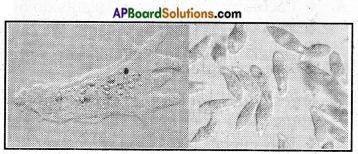
  • Collect water samples from a pond well, bore well and keep them separately.
  • Put a drop of water in a slide. Keep another slide on it.
    AP Board 6th Class Science Important Questions Chapter 9 Organisms and Habitat 1
  • Observe under microscope.
  • All water samples do not have the same type of microorganisms.
  • There is no water without microorganisms.
  • We find difference in the appearance of microorganisms in pond water and bore well water.

Question 5.
Observe the figure and answer the following questions.
AP Board 6th Class Science Important Questions Chapter 9 Organisms and Habitat 2
a) Does the seed take in food?
b) Is it possible to store the seed for long time?
c) What happens when a seed is shown in soil?
d) How can say that seed is a living thing?
Answer:
a) No. The seed doesn’t take in food. Seed itself carry the food that helps the new plant begin to grow.
b) Yes if we preserve it carefully we can store the food for a long time.
c) It starts to germinate.
d) Seeds germinate and turn into a whole plant. So we can say that seed is a living thing.

AP Board 6th Class Science Important Questions Chapter 9 Organisms and Habitat

Question 6.
What happens if we encroach the habitat of animals?
Answer:
If we encroach the habitat of animals, they may fall in danger.

  • Animals are partners of our Habitat.
  • They also have a right to live.
  • We people are encroaching their habitats.
  • If we cut a tree, birds that live on it lose their nests and fall in danger.
  • We often see dogs, cows, monkeys suffering from lack of food and shelter.
  • There are some voluntary organizations that work for animal rights and protection.
  • We have to provide food and protect them, it is our responsibility.

Question 7.
Name some organisms in the pond that can stay in different regions in the same pound. What makes them stay in different regions in pond?
Answer:
The surface of pond:

  • Dragonfly, mayfly, snail, kingfisher whirling beetle and pond skater, etc. are found on the surface of the pond.
  • However there is plenty of food and air and this is why fish usually come to the surface for feed.

Mid water:

  • In mid-water great water boatman, leech and mosquito, larvae fish, and crab are found.

Pond margins:

  • In the pond margins animals like frogs, cranes, crabs are found.
  • Fish usually lay eggs here.

Bottom of the pond:

  • At the bottom plants like hydrilla, and animals like mussels and flatworms live here. Because of their habitat and adaptation, the organisms’ make them to stay at different regions in the pond.
  • Light is minimum here but food in the form of dead and decaying matter is in plenty.

AP Inter 2nd Year Zoology Study Material Chapter 1(a) Digestion and Absorption

Andhra Pradesh BIEAP AP Inter 2nd Year Zoology Study Material Lesson 1(a) Digestion and Absorption Textbook Questions and Answers.

AP Inter 2nd Year Zoology Study Material Lesson 1(a) Digestion and Absorption

Very Short Answer Questions

Question 1.
Give the dental formula of an adult human being.
Answer:
The arrangement of different types of teeth in each half of both the jaws in the order I, C, PM, M is represented by the dental formula.
In adult it is = \(\frac{2123}{2123}\) = 32.

Question 2.
Bile juice contains no digestive enzymes, yet it is important for digestion. How?
Answer:
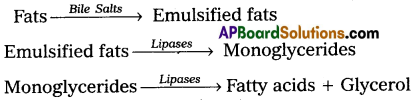
Bile juice doesn’t contain enzymes, but it contains bile salts such as sodium/potassium glycocholates and taurocholates, which help in the digestion and absorption of lipids. Bile salts emulsify fats and also render them water-soluble. Bile salts activate the lipases. These lipases act on emulsified fats and convert them into fatty acids and glycerols.

Question 3.
Describe the role of chymotrypsin. Name two other digestive enzymes of the same category secreted by the same gland.
Answer:
Chymotrypsin plays an important role in digestion of proteins, proteoses and peptones and convert them into tripeptides and dipeptides. Chymotrypsin, trypsin and carboxy peptidase are ehdopeptidases, produced by the pancreas arid involved in the digestion of proteins.

Question 4.
What would happen if, HCl were not secreted in the stomach?
Answer:
HCl is secreted by the glands present on the stomach walls. It provides acidic pH which is optimal for the action of pepsin. HCl activates the pepsinogen into pepsin. Pepsin plays an important role in digestion of proteins. Therefore, if HCl were not secreted in the stomach, then pepsin would not be activated. This would affect on protein digestion.

Question 5.
Explain the terms thecodont and diphyodont dentitions.
Answer:
Thecodont:
Teeth of human beings are embedded in the sockets of the jaw bones is called thecodont.

Diphyodont:
Majority of mammals including human beings form two sets of teeth during their life time, a set of temporary / milk teeth replaced by a set of permanent teeth. This type of dentition is called diphyodont dentition.

AP Inter 2nd Year Zoology Study Material Chapter 1(a) Digestion and Absorption

Question 6.
What is Autocatalysis? Give two examples.
Answer:
Autocatalysis is the catalysis of a reaction in which the catalyst is one of the product of the reaction (or) catalysis caused by a catalytic agent formed during a chemical reaction.
AP Inter 2nd Year Zoology Study Material Chapter 1(a) Digestion and Absorption 1

Question 7.
What is chyme?
Answer:
Semi fluid mass of partly digested acidic food formed in the stomach is called chyme.

Question 8.
Name the different types of Salivary glands of man, and their locations in the human body?
Answer:
There are three pairs of Salivary glands in man.
1. Parotid glands — present below the pinna / inner surface of the cheeks.
2. Sub maxillary (or) Sub mandibular glands —.located at the angles of lower jaw.
3. Sublingual glands — present below the tongue.

Question 9.
Name different types of papillae present on the tongue of man.
Answer:
The upper surface of the tongue has small projections called papillae. In humans the tongue bears 3 (three) types of papillae namely 1) fungi form 2) filiform 3) Circumvallate papillae.

Question 10.
What is the hardest substance in the human body? What is its origin?
Answer:
Enamel of tooth is the hardest substance in the human body, which is secreted by ameloblasts of ectodermal origin.

Question 11.
Name the structure of gut which is vestigial in human beings, but well developed in herbivores. And mention the type of tissue with which it is mostly formed.
Answer:
Appendix is vestigial part in human beings. It is a narrow finger like tubular projection, arises from the caecum. In herbivores it is a functional part and useful in the digestion of cellulose materials. The appendix contain a high concentration of lymphoid tissues. These are highly specialized structures which are a part of the immune system.

Question 12.
Distinguish between deglutition and mastication.
Answer:
Deglutition :
Deglutition is the swallowing of food and involves a complex and coordinated process. It is divided into three phases.

Phase one :
The collection and swallowing of masticated food.

Phase two :
Passage of food through the pharynx into the beginning of the esophagus.

Phase three :
The passage of food into the stomach.

Mastication :
The mastication process includes the biting and tearing of food into manageable pieces. This usually involves using the incisors and canines teeth. The grinding of food is usually performed by the molars and premolars. During the mastication process, food is moistened and mixed with saliva.

AP Inter 2nd Year Zoology Study Material Chapter 1(a) Digestion and Absorption

Question 13.
Distinguish between diarrhoea and constipation.
Answer:
Diarrhoea :
The abnormal frequency of bowel movement and increased liquidity of the faecal discharge is known as diarrhoea. It reduces the absorption of fqod arid results in loss of water.

Constipation :
A condition ip which the faeces are retained within the rectum as it is hard due to low content of water and the movement of bowel occurs irregularly.

Question 14.
Name two hormones secreted by the duodenal mucosa.
Answer:
The epithelium of duodenum secretes the hormones namely secretin and cholecystokinin (cck).

Question 15.
Distinguish between absorption and assimilation.
Answer:
Absorption :
Absorption is the process by which the end products of digestion pass through the intestinal mucosa into blood (or) lymph. It is carried out by passive, active (or) facilitated transport mechanisms.

Assimilation:
The absorbed substances finally reach the tissues, where food materials become integral components of the living protoplasm and used for the production of energy, growth and repair. This process is called assimilation.

Short Answer Questions

Question 1.
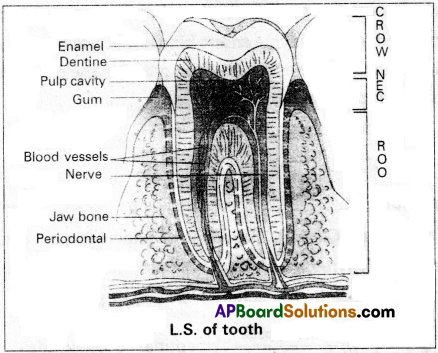
Draw a neat labelled diagram of L.S of a tooth. Ans.
Answer:
AP Inter 2nd Year Zoology Study Material Chapter 1(a) Digestion and Absorption 2

Question 2.
Describe the process of digestion of proteins in the stomach.
Answer:
Protein digestion begins in the stomach. The food entered into the stomach is mixed thoroughly with the gastric juice of the stomach by the churning movements of its muscular wall and the product is called chyme. The main components of gastric juice are protein digestive enzymes, hydrochloric acid and mucus.

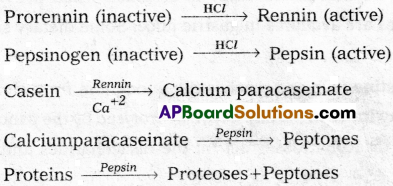
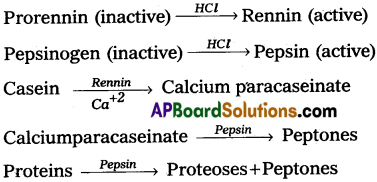
HCl provides the acidic pH (1.8) which is optimal for the action of pepsin. The proenzymes of gastric juice, the pepsinogen and prorennin, on exposure to hydrochloric acid are convened into the active enzymes, pepsin and rennin respectively. Pepsin converts proteins into proteoses and peptones. Rennin is a proteolytic enzyme found in the gastric juice of infants. It acts on the milk protein, the casein in the presence of calcium ions and converts it into calcium paracaseinate and proteoses. Pepsin acts on calcium paracaseinate and converts it into peptones. The entire process of protein digestion in the stomach takes about 4 hours.
AP Inter 2nd Year Zoology Study Material Chapter 1(a) Digestion and Absorption 3

Question 3.
Explain the role ofpancreatic juice in the digestion of proteins.
Answer:
Pancreatic juice is secreted by the pancreas and it plays an important role in protein ‘digestion. Pancreatic juice contains protein hydrolysing enzymes like trypsinogen, chymotrypsinogen and pro carboxy peptidases, but they are inactive enzymes.

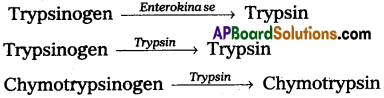
Trypsinogen is activated by the enzyme enterokinase, secreted by the intestinal mucosa into active trypsin, which in turn activates the other enzymes in the pancreatic juice. Trypsin itself can similarly activate trypsinogen into trypsin.
AP Inter 2nd Year Zoology Study Material Chapter 1(a) Digestion and Absorption 4

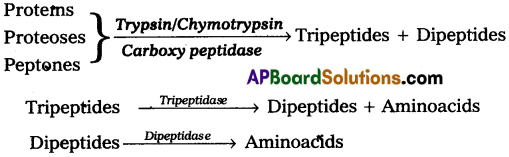
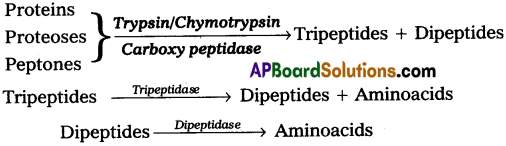
Chymotrypsin, Trypsin and Carboxy Peptidase of pancreatic juice act upon proteins, proteoses and peptones in the chyme, result in the formation of tri and dipeptides. Which in turn hydrolysed into aminoacids by the action Of tri aruj di peptidases.
AP Inter 2nd Year Zoology Study Material Chapter 1(a) Digestion and Absorption 5

Question 4.
How are polysaccharides and disaccharides digested?
Answer:
Dietary carbohydrates principally consist of polysaccharides :
Starch and glycogen. It contains disaccharides and small amounts of monosaccharides.

Digestion in mouth:
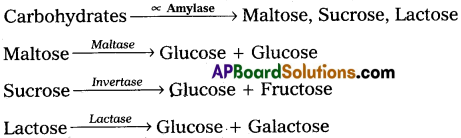
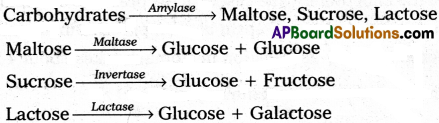
Digestion of carbohydrates starts at the mouth, where they come in contact with saliva during mastication. Saliva contains carbohydrate-splitting enzyme called Salivay amylase (ptyalin). This enzyme hydrolyses the starch into disaccharides (maltose).
AP Inter 2nd Year Zoology Study Material Chapter 1(a) Digestion and Absorption 6

Digestion in stomach:
Ptyalin action stops in stomach when pH falls to 3.0. No carbohydrate splitting enzymes are available in gastric juice. Some dietary sucrose may be hydrolysed by HCl.

Digestion in small intestine :
Chyme reaches the duodenum from stomach where it meets pancreatic juice. Carbohydrates in the chyme are hydrolysed by the pancreatic amylase into disaccharides. Intestinal disaccharidases act on the disaccharides and convert them into monosaccharides.
AP Inter 2nd Year Zoology Study Material Chapter 1(a) Digestion and Absorption 7

AP Inter 2nd Year Zoology Study Material Chapter 1(a) Digestion and Absorption

Question 5.
If you take butter in your food how does it get digested and absorbed in the body? Explain.
Answer:
Butter contains fat. Fats remain mostly undigested in stomach.

Digestion of fat in the small intestine :
The major site of fat digestion is the small intestine. This is due to the presence of a powerful lipase/(steapsin) in the pancreatic juice and bile juice. Bile juice contains bile salts such as Sodium/Potassium glycocholates and taurocholates, which helps in the emulsification of fat i.e., break down of fats into very small micelles. Bile also activates lipases of pancreatic juice (steapsin) and intestinal lipases. These lipases act on emulsified fats and convert them into fatty acids and glycerols.
AP Inter 2nd Year Zoology Study Material Chapter 1(a) Digestion and Absorption 8

Absorption :
Fatty acids and glycerol being insoluble in water cannot be absorbed into the blood directly. They are first modified into small droplets called micelles, which move into intestinal mucosal cells. They are reformed into very small protein coated fat globules called chylomicrons, which are transported into the lymph capillaries in the villi by exocytosis. Then they are ultimately released into blood stream through left subclavian vein via the thoracic duct. These chylomicrons are broken down to fatty acids and glycerol by the action of an enzyme lipoprotein lipase and they diffuse into the adipocytes of the adipose tissue and liver for storage.

Question 6.
What are the functions of liver?
Answer:
Liver performs a variety of functions such as synthesis, storage and secretion of various substances.

  1. Liver secretes bile juice, it contains bile salts such as sodium / potassium glycocholates and taurocholates, which helps in digestion and absorption of lipids.
  2. Liver plays the key role in carbohydrate metabolism.
    a) Glycogenesis : formation of glycogen from glucose.
    b) Glycogenolysis : breakdown of glycogen into glucose.
    c) Gluconeogenesis : Synthesis of glucose from certain amino acids, lactate (or) glycerol.
  3. Liver also plays an important role in synthesis of cholesterol and production of triglycerides.
  4. Deamination of proteins occurs in the liver.
  5. Liver is the chief organ of detoxification of toxic substances that enter the gut along with food.
  6. Liver acts as thermoregulatory organ.
  7. Liver acts as a haemopoietic organ in the foetus and erythroclastic organ in the adult.
  8. The liver synthesizes the plasma proteins such as albumin, globulins, blood clotting factors such as fibrinogen / prothrombin, etc., and the anticoagulant called heparin.
  9. The lactic acid formed during anaerobic muscle contraction is converted into glycogen (gluconeogenesis) in the liver by Cori cycle.
  10. Kupffer cells are the largest phagocytic cells which remove unwanted substances and microbes that attack the liver by phagocytosis.

Long Answer Questions

Question 1.
Describe the physiology of digestion of various types of food in the human digestive system
Answer:
Digestion is the process of convertion of complex non-diffusible food substances into simple diffusible forms. The process of digestion is accomplished by mechanical and biochemical process.

I. Digestion in the buccal cavity :
Buccal cavity performs two major functions, mastication of food and facilitation of swallowing. Teeth and tongue with the help of saliva masticate and mix up the food thoroughly. Mucus in saliva helps in lubricating and adhering the masticated food particles into bolus. The saliva secreted into oral cavity contains electrolytes such as Na+, K+, Cl, HCO3 arid enzymes like salivary amylase (ptyalin) and lysozyme. Carbohydrates digestion starts in the buccal cavity, about 30% of starch is hydrolysed here into a disaccharide called maltose by the enzyme amylase (ptyaline). Lysozyme acts as antibacterial agent that prevents infections.

II. Digestion in the stomach :
As the bolus enters into stomach starch digestion stops and protein digestion begins. The food entered into stomach is mixed thoroughly with gastric juice of the stomach by the churning movement of its muscular wall and the product is called chyme. The mucus and bicarbonates present in the gastric juice act as lubricant and protect the mucosal epithelium from HCl. HCl in the stomach provides the acidic pH (1.8) which is optimal for the action of pepsin.

The proenzymes of gastric juice, the pepsinogen and prorennin on exposure to HCl are converted into the active enzymes, pepsin and rennin respectively. Pepsin converts proteins into proteoses and peptones. Rennin found in gastric juice of infants. It acts on the milk protein, the casein in the presence of calcium ions convert into calcium paracaseinate and proteoses. Pepsin acts on paracaseinate and convert it into peptones. The entire process of protein digestion in stomach takes about 4 hours.
AP Inter 2nd Year Zoology Study Material Chapter 1(a) Digestion and Absorption 9

III. Digestion in the small intestine :
Various types of movements are generated by the muscular external layer of small intestine. These movements help in thorough mixing of the food with bile, pancreatic juice and intestinal juice in the intestine and thereby facilitate digestion. The duodenal cells of the proximal part produces large amount of bicarbonates to completely neutralize any gastric acid that passes further down into the digestive tract.

i) Digestion of proteins :
Pancreatic juice contains protein hydrolysing enzymes like trypsinogen, chymotrypsin and procarboxy peptidases, but they are inactive enzymes.

Trypsinogen is activated by the enzyme enterokinase secreted by the intestinal mucosa into active trypsin which intum activate the other enzymes in the pancreatic juice. Trypsin itself can similarly activate trypsinogen into trypsin.

Chymotrypsin, trypsin and carboxy peptidase of pancreatic juice act upon proteins, proteoses and peptones in the chyme, result in the formation of tri and dipeptides which inturn hydrolysed into amino acids by the action of tri and dipeptidases.
AP Inter 2nd Year Zoology Study Material Chapter 1(a) Digestion and Absorption 10

ii) Digestion of fats:
Bile salts of bile help in the emulsification of fat i.e., breakdown of fats into very small micelles. Bile also activates lipases of pancreatic juice (steapsin) and intestinal lipases. These lipases act on emulsified fats and convert them into fatty acids and glycerols.
AP Inter 2nd Year Zoology Study Material Chapter 1(a) Digestion and Absorption 11

iii) Digestion of Carbohydrates :
Carbohydrates in the chyme are hydrolysed by the pancreatic amylase into disaccharides. Intestinal disaccharidases act on the disaccharides and convert them into monosacharides.
AP Inter 2nd Year Zoology Study Material Chapter 1(a) Digestion and Absorption 12

iv) Digestion of nucleic acids :
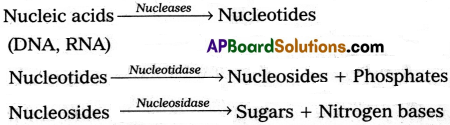
Nucleases of the pancreatic juice act on the nucleic acids to form nucleotides and nucleosides. Nucleotidases and nucleosidases of the intestinal juice convert the nucleotides and nucleosides into pentose sugar and nitrogen bases.
AP Inter 2nd Year Zoology Study Material Chapter 1(a) Digestion and Absorption 13

The end products of digestion pass through the intestinal mucosa into blood (or) lymph is carriedout by passive, active (or) facilitated transport mechanisms.

AP Inter 2nd Year Zoology Study Material Chapter 1(a) Digestion and Absorption

Question 2.
Explain the digestive system of man with neat labelled diagram.
Answer:
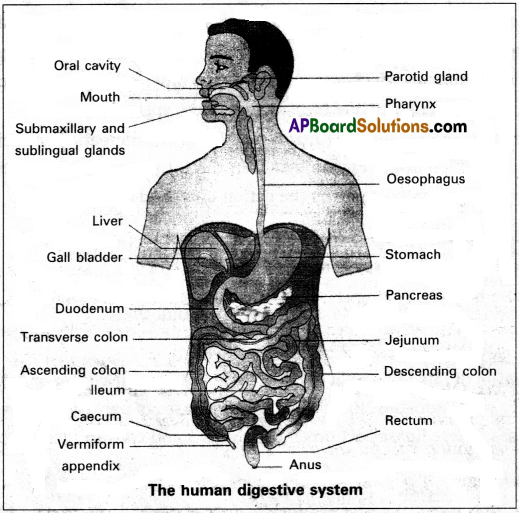
AP Inter 2nd Year Zoology Study Material Chapter 1(a) Digestion and Absorption 14
The digestive system is a group of organs and tissues involve in the breaking down of ingested food in the alimentary canal into a form that can be absorbed ai a assimilated by the tissues of the body.

Human digestive system consists of the alimentary canal and the associated glands. Alimentary canal / Digestive tract:

The alimentary canal of man begins with the anterior opening, the mouth and ends with the posterior opening, the anus.

Parts of the alimentary canal / digestive tract:

  1. Mouth and Buccal (oral) cavity
  2. Pharynx
  3. Oesophagus
  4. Stomach
  5. Small intestine
  6. Large intestine

1. Mouth and Buccal (oral) cavity:
Mouth is the first part of the alimentary canal. It is formed by the cheek on either side and boardered by the movable upper and lower lips, leads into the buccal (or) oral cavity. The palate separate the ventral buccal cavity from the dorsal nasal chamber and facilitates chewing and breathing simultaneously. The jaw bones bear teeth and tongue occurs at the base of the buccal cavity.

i) Teeth :
These are ecto-mesodermal in origin. An adult human has 32 permanent teeth, which are of four different types namely, incisors (I), canines (C), premolars (PM), and molars (M). These are useful in cutting, tearing and grinding of food. The arrangement’ of teeth is represented by dental formula. In adult human
it is = \(\frac{2123}{2123}\) = 32

ii) Tongue :
It is a freeely movable muscular sense organ, attached to the floor of the oral cavity by a fold of tissue called frenulum. The upper surface of the tongue has small projections called papillae, some of which bear taste buds. The tongue acts as universal toothbrush and helps in mixing saliva with food, taste detection, deglutition and speaking.

2. Pharynx:
It is a muscular tube connecting the oral cavity and oesophagus and trachea. It is a common passage for food and air. It is divided into nasopharynx, oropharynx and laryngo pharynx. Oesophagus and trachea open into the laryngopharynx. The trachea open into the laryngopharynx through the glottis. A cartilaginous flap called epiglottis prevents the entry of food into glottis during swallowing.

3. Oesophagus:
It is a thin long muscular tube (9 to 12 inches). The semisolid digested food from pharynx enters the oesophagus. Oesophagus is separated by the Cardiac sphincter from stomach. When the food reaches lower end of Oesophagus the cardiac sphincter opens allowing the food to enter the stomach.

4. Stomach :
It is a wide ‘J’ shaped muscular sac, located iii the upper left portion of the abdominal cavity just below the diaphragm. It has three major parts, an anterior cardiac portion into which the oesophagus opens, a middle large fundic region and a posterior pyloric portion which opens into the first part of the small intestine through the pyloric aperture which is guarded by the pyloric sphincter.

5. Small intestine :
The small intestine is the longest part of alimentary canal. It has three regions namely proximal duodenum middle long coiled jejunum and distal highly coiled ileum. Duodenum receives the hepato-pancreatic duct. Ileum opens into the large intestine.

6. Large intestine :
It consist of caecum, colon and rectum. Caecum is a small blind sac. A narrow finger like vestigial tubular organ arises from caecum called appendix. The caecum opens into colon which is‘divided into an ascending, a transverse, a descending parts and a sigmoid colon that continues behind into rectum. Rectum is a small dilated sac which leads into anal canal that opens out through the anus.

Digestive glands :
1. Salivary glands : There are three pairs of glands in man.
i) Parotid glands
ii) Sub-maxillary glands
iii) Sub-lingual glands
They secrete saliva, which mainly contains salivary amylase and lysozyme.

2. Gastric glands :
These are located in the wall of the stomach beneath the surface
epithelium, Gastric glands are of three types namely
i) Cardiac glands – secrete mucus
ii) Pyloric glands – secrete mucus and hormone gastrin
iii) Fundic / Oxyntic glands – secrete mucus, proenzymes like pepsinogen and prorennin, HCl, intrensic factor and some amount of gastric lipase.

3. Intestinal glands :
They are of two types
i) Brunner’s glands
ii) Crypts of lieberkuhn
which secrete intestinal juice contains peptidases, disaccharidases, enterokinase and lysozyme.

4. Liver :
Liver is the largest gland in human. Liver secretes bile juice, contains bile salts, which play a very important role in lipid digestion.

5. Pancreas :
The pancreas is the second largest gland in human. Exocrine part of pancreas secretes pancreas juice contains sodium bicarbonates, trypsinogen, chymotrypsinogen, carboxy peptidase, steapsin, -pancreatic amylase and nucleases such as DNAase and RNAase.

AP Inter 1st Year Civics Study Material Chapter 1 Scope and Significance of Political Science

Andhra Pradesh BIEAP AP Inter 1st Year Civics Study Material 1st Lesson Scope and Significance of Political Science Textbook Questions and Answers.

AP Inter 1st Year Civics Study Material 1st Lesson Scope and Significance of Political Science

Long Answer Questions

Question 1.
Define Political Science and explain its scope. [A.P. Mar, 17, 16, 15]
(or)
Explain the scope of Political Science.
Answer:
Introduction:
Political Science is a premier social science. It is mainly concerned with the study of the state in its relation to Society, Citizens, Associations, and the world at large. Aristotle is hailed as the Father of Political Science. He wrote famous book “THE POLITICS”.

Origin of the word Politics :
Aristotle, the Father of Political Science used the term “POLITICS” for the first time in his famous book “POUTICS”. The term “POLITICS” is derived from a greek word “POLIS” and latin word “POLITICUS” which means the city state.

Definitions of Political Science :
Political Scientists gave various definitions on Political Science. They are as follows :
1. J.W. Gamer:
“Political Science begins and ends with the state”.

2. Stephen Leacock:
“Political Science deals with the government”.

3. David Easton :
“Political Science is concerned with the authoritative allocation of values for a society”.

Scope of Political Science :
The scope of Political Science means the subject matter covered by it or the topics which are included in its study. It may be explained in the following ways :

i) Study of man in Relation to the Society and State :
Aristotle stated that “Man is a Social Animal”. Man can satisfy his basic needs like food, clothing, shelter and protection in the society. Political Science explains the relationship beween man and society. It examines how man should adjust himself with the societys. It is imperative that the modem man should develop proper attitude towards the society. This is possible only when he identifies himself with the society.

Political Science is concerned with the perennial and central issue of establishing proper relationship between the state and the individuals. It deals with many topics of state activity, such as limitations of Political Authority and sphere of Individual Freedoms.

ii) Study of State :
Aristotle also stated that man is a Political Animal. State is a human and political institution. It came into existence for the sake of man and continue in existence for providing happy and prosperous life for man. Individuals became members of the state since, its inception. We can’t imagine the life of individuals outside of the state. Political Science studies the intimate Relationship between the state and the citizens. It also studies the Nature, Functions and Various theories of state authority.

It also comprises a study of the various activities of the state from that of ancient police state to the modem welfare state. Thus, Political Science deals with the Present, Past and FUture aspects of the state.

iii) Study of the Government :
Government is an important essential element of Modem State. It is an instrument which fulfills aims and goals of the state. There can be no state with out a government. Government formulates, expresses and implements the will of the state. Government consists of three organs namely Legislature, Executive and Judiciary. Legislature makes the laws, Executive implements the laws and Judiciary interpretes the laws. Political Science studies the meaning, forms, structure, nature and functions of the government. It also discusses the relationship among the various organs of the government. Hence, Political Science is treated as a science of government.

iv) Study of Associations and Institutions :
Associations and Institutions help the Individuals for their moral, religious, cultural, scientific and technological progress. These carry on their activities at local, regional, national and international levels. Individuals join as members in these Associations out of their interests or purposes. There prevails a great linkage between these voluntary Associations and Institutions. Associations and Institutions in Modem times play a significant role in the Formulation and Implementation of policies of the state and government. Voluntary bodies such as trade unions, peasant groups, professional bodies etc., will have a great impact on the state and government. Political Science explains the nature, structure and functions of the various Associations and Insti-tutions.

v) Study of Rights and Responsibilities:
Scope of Political Science includes the study of Rights and Responsibilities of citizens. Citizens in democratic states enjoy certain rights such as right to life, right to liberty, right to property etc. Political Science enumerates the definition, classification and different theories of Rights. Similarly, citizens will have some Responsibilities towards the state. These include paying taxes, obeying the laws etc. It explains the significance of Rights and Responsibilities of the citizens. Hence, Political Science examines the Realtionship between Rights and Responsibilities.

vi) Study of National and International Issues:
The scope of Political Science covers various issues of Modem state in relation with other states in matters of safeguarding Ter-ritorial integrity and Sovereignty. It studies the topics like Cold war, Balance of power, Disarmament, Detente etc. Modem states are not isolated. They depend upon other states in many spheres like importing raw materials, exporting finished goods, transport, technology, services and communications. This requires close relations among the states in international sphere. Political Science discusses not only the domestic policies of the state but also the issues of international dimensions. It covers a wide range of topics such as diplomacy, international politics, international law, international organisations etc.

vii) Study of Power:
The behaviouralists of 20th century regarded Political Science as a study of sharing and shaping of power. They pointed out that Political Science discusses how power is grabbed, manipulated anti perpetuated to have a control over the society. Morgenthau defined the power as “Man’s control over the Minds and Actions of other Men”.

viii) Study of Public Policy:
Modem Political Scientists like David Easton and Gabriel Almond argued that Political Science is a “Policy Science”. They considered Political Science as the study Of formulation, execution and evaluation of Public Policy, with the advent of Public Policy the scope of Political Science has further widened to include the dimensions of vital topics such as Industrial Policy, Agricultural Policy, Land Reform Policy, Education Policy, Population Policy etc. Public Policy of a Nation in the context of International Relations plays a crucial role in the formulation of diplomatic, economic, military and scientific strategies.

Conclusion:
The above contents show the wide range of subjects that come under the purview of Political Science.

AP Inter 1st Year Civics Study Material Chapter 1 Scope and Significance of Political Science

Question 2.
Discuss the significance of the study of Political Science. [A.P. Mar. 19]
Answer:
The study of Political Science is very useful and valuable. It’s knowledge is indispensible to the rulers as well as the ruled. Its significance or importance is analysed as follows.

i) Information about the State :
The primary aim of studying Political Science is to inculcate knowledge of the state. It’s origin, nature, Structure and functions. Knowledge of the state is of great significance to every one. Solutions to various political issues are found only when we have a proper understanding of the political institutions.

ii) Knowledge of Government and Administration :
The Administrators, political leaders and diplomats who manipulate the affairs of the state require a sound knowledge of political science in order to perform their functions with efficiency. Political Science creates awareness about the organisation, control and coordination of Administrative machinery. It also covers the study of local self-governments like Gram Panchayats, Mandal Parishads, Zilla Parishads, Municipalities, Corporations etc.

iii) Provides information about Democratic values :
Political Science provides accurate information about the various political terms such as State, Government, Nation, Con-stitution, Democracy, Sovereignty, Law etc., which are used commonly. Political Science also provides a good knowledge and awareness about the Democratic values like Liberty, Equality, Fraternity, Justice and Rights.

iv) Makes Democracy Successful:
At present Democracy is in vogue in several coun-tries of the world. It is the best form of government. People in democracy elect their repre-sentatives and are ruled by them. If honest, selfless and committed representatives are not elected, the expectations of the people will not be fulfilled. Political Science explains the significance of Franchise. It educates the common men on the conditions essential for the successful functioning of democratic government.

v) Awareness about rights and responsibilities:
The study of Political Science makes people conscious of their rights and responsibilities. It also enables the citizens to be familiar with their rights and responsibilities and the interrelationship between the two. Its study makes the citizens to realize the fact that a proper exercise of rights and responsibilities is a must for leading civilised life.

vi) Teaches the Qualities of Good Citizenship :
Political Science impacts the best civic knowledge by explaining the qualities of good citizenship like cooperation, sacrifice, patriotism, obedience to the state and to the laws, farsightedness, social service etc. It trains the people to become ideal citizens.

vii) Knowledge about World Affairs:
The study of Political Science enriches individual’s knowledge on World Affairs. Political Science is useful for observing and understanding the contemporary world affairs. It stimulates right thinking, broad vision and universal understanding of various phenomena of international politics. It’s study is useful for proper’ analysis and solution of various National and International Issues.

viii) Provides knowledge about International Organizations :
A citizen of the present is not only a member of the state but also a member of the world at large. The study of Political Science promotes the spirit of internationalism. It provides a good knowledge about International Organizations like United Nations Organisation, SAARC, ASEAN, NAM, OPEC etc. It teaches about the need for harmonious relations among the nations.

ix) Develops Political Awareness :
The study of Political Science is of great impor-tance in the sense that it imports best political knowledge. It explains about the structure and functioning of different political institutions like State Government, Political parties, Occupational Associations. Hence the study of Political Science is the best training ground for knowing, following and practising the art of leadership.

x) Explains the need for Co-Operation and Toleration :
National Integration has become a crucial factor in several states. Many obstacles like communalism, linguism, sub-national regional and sub-regional feelings etc., have been threatening the national inte-gration in these states. In this context, the study of Political Science teaches about the need for adjustment, cooperation and toleration.

xi) Knowledge of Political Science is Indispensable :
The study of Political Science helps everyone to understand the mechanism and constitutional system of modem govern-ments. It creates awareness about the contemporary issues in national and international spheres. If creates awareness about Rights and Responsibilities. It’s study is essentially indispensable for the people in developing nations like India. As the majority people in these states are poor, ignorant, illiterate and sentimental in their out look. The study of Political Science inculcates a good political knowledge among them.

Aristotle regarded Political Science as the supreme science and the master of all social sciences.

Question 3.
Define Political Science and explain its nature.
Answe:
Political Science is a premier Social Science. It is mainly concerned with the study of the state in it’s relation with society, citizens, associations and the world at large. Aristotle is hailed as the Father of Political Science. He wrote famous book ‘THE POLITICS”. The term “politics” is derived from a greek word” “POLIS” and latin word “POLiTICUS” which means the city state.

Definition of Political Science:
Political Scientists gave various definitions on Political Science. They are as follows :
1. J.W. Gamer:
“Political Science begins and ends with the state”.

2. Stephen Leacock:
“Political Science deals with the government”.

Nature of Political Science:
There prevailed a controversy among the political scien-tists in regard to the nature of Political Science. Some viewed Political Science as a science others treated it as an art. Let us examine the two aspects (Science and Art) of Political Science.

i) Political Science is a SCIENCE :
According to political philosophers like Aristotle, Bluntschli, Hobbes, Montesque and others Political Science is considered as a science on the following grounds.

  1. Political Science is studied in a systematic manner.
  2. Experimentation is possible in politics. Principles are applied in the actual organisation of Political Institutions.
  3. Political Science, like other sciences, has absolute and universal laws.
  4. Predictions are easily applicable in politics.
  5. Certain generally agreed principles can be incorporated into the study of Political Science.
  6. Political Science, like other sciences, gives scope for establishing relationship be-tween cause and effect.

ii) Political Science is an ART :
According to political writers like Barker, J.S. Mill, Laski and others Political Science is considered as an ART on the following grounds.

  1. Political Science has no absolute and universal laws like physical sciences.
  2. The phenomena studied in Political Science are interpreted in various ways de-pending upon the context and situation. So it lacks uniformity in the interpretation of various concepts.
  3. Political Science is not evolutionary in nature as its concepts are not developed in a steady, regular and continuous manner.
  4. Scientific methods of observation and experimentation are not applicable in political science.
  5. Complete objectivity and detachment are not found in the case of various phenom-ena in Political Science.
  6. Political Science gives no scope for accuracy.

Short Answer Questions

Question 1.
Write about the traditional definitions of Political Science.
Answer:
Traditional definitions of Political Science may be classified under three sub catego-ries. They are mentioned as follows.
i) Political Science – A Study of the State :
Political philosophers like J.W.Gamer, R.G.Gettle, Appadovai and others defined Political Science as a study of the state.

1. J.W.Gamer:
“Political Science begins and ends with the state”.

2. R.G.GettIe :
“Political Science is a historical investigation of what the state has been, an analytical study of what the state is and a politico-ettical discussion of what the state should be”.

3. Appadorai:
“Political Science is concerned with the conditions essential for the existence and development of the state”.

ii) Political Science – A study of the Government:
Some political philosophers like Stephen Leacock, J.R.Seely and others defined Political Science as a study of the govern-ment.

1. Stephen Leacock :
“Political Science deals with the Government”.

2. J.R.Seely :
“Political Science investigates the phenomenon of the Government”.

iii) Political Science – A study of the State and the Government:
Political philoso-phers like Paul Janet, Gilchrist, Catlin and others defined political science as a study of the state and the government.

1. Paul Janet:
“Political Science is that part of social science which treats the founda-tions of state and the principles of the government”.

2. R.N.Gilchrist :
“Political Science is a study of foundations of the state and the government”.

3. Catlin :
“Political Science is a study of the political activities of individuals and various organs of government”.

AP Inter 1st Year Civics Study Material Chapter 1 Scope and Significance of Political Science

Question 2.
What are the various modem definitions of Political Science?
Answer:
Modem definitions of Political Science can be classified into two sub-categories. They are discussed as follows..
i) Political Science – A study of power:
1. Lasswell and Kaplan :
“Political Science as an empirical discipline, is the study of shaping and sharing of power”.

2. William A.Robson :
“Political Science is primarily concerned with the power in society”.

ii) Political Science – A study of Allocation of values :
1. David Easton :
“Political Science is concerned with the authoritative allocation of values for a society”.

2. Hill Man :
“Politics is the Science of who gets what, when, and why”.

Question 3.
Explain about the nature of Political Science.
Answer:
Political Science is a premier Social Science. It is mainly concerned with the study of the state in it’s relation with society, citizens, associations and the world at large. Aristotle is hailed as the Father of Political Science. He wrote famous book ‘THE POLITICS”. The term “politics” is derived from a greek word” “POLIS” and latin word “POLiTICUS” which means the city state.

Definition of Political Science:
Political Scientists gave various definitions on Political Science. They are as follows :
1. J.W. Gamer:
“Political Science begins and ends with the state”.

2. Stephen Leacock:
“Political Science deals with the government”.

Nature of Political Science:
There prevailed a controversy among the political scien-tists in regard to the nature of Political Science. Some viewed Political Science as a science others treated it as an art. Let us examine the two aspects (Science and Art) of Political Science.

i) Political Science is a SCIENCE :
According to political philosophers like Aristotle, Bluntschli, Hobbes, Montesque and others Political Science is considered as a science on the following grounds.

  1. Political Science is studied in a systematic manner.
  2. Experimentation is possible in politics. Principles are applied in the actual organisation of Political Institutions.
  3. Political Science, like other sciences, has absolute and universal laws.
  4. Predictions are easily applicable in politics.
  5. Certain generally agreed principles can be incorporated into the study of Political Science.
  6. Political Science, like other sciences, gives scope for establishing relationship be-tween cause and effect.

ii) Political Science is an ART :
According to political writers like Barker, J.S. Mill, Laski and others Political Science is considered as an ART on the following grounds.

  1. Political Science has no absolute and universal laws like physical sciences.
  2. The phenomena studied in Political Science are interpreted in various ways de-pending upon the context and situation. So it lacks uniformity in the interpretation of various concepts.
  3. Political Science is not evolutionary in nature as its concepts are not developed in a steady, regular and continuous manner.
  4. Scientific methods of observation and experimentation are not applicable in political science.
  5. Complete objectivity and detachment are not found in the case of various phenom-ena in Political Science.
  6. Political Science gives no scope for accuracy.

Question 4.
Mention any three topics coverd under the scope of Political Science.
Answer:
i) Study of man in Relation to the Society and State:
Aristotle stated that “Man is a Social Animal”. Man can satisfy his basic needs like food, clothing, shelter and protection in the society. Political Science explains the relationship beween man and society. It exam- ines how man should adjust himself with the societys. It is imperative that the modem man should develop proper attitude towards the society. This is possible only when he identifies himself with the society.

Political Science is concerned with the perennial and central issue of establishing proper relationship between the state and the individuals. It deals with many topics of state activity, such as limitations of Political Authority and sphere of Individual Freedoms.

ii) Study of State :
Aristotle also stated that man is a Political Animal. State is a hu-man and political institution. It came into existence for the sake of man and continue in existence for providing happy and prosperous life for man. Individuals became members of the state since its inception. We can’t imagine the life of individuals outside of the state. Political Science studies the intimate Relationship between the state and the citizens. It also studies the Nature, Functions and Various theories of state authority.

It also comprises a study of the various activities of the state from that of ancient police state to the modem welfare state. Thus, Political Science deals with the Present, Past and Future aspects of the state.

iii) Study of Associations and Institutions :
Associations and Institutions help the Individuals for their moral, religious, cultural, scientific and technological progress. These cany on their activities at local, regional, national and international levels. Individuals join as members in these Associations out of their interests or purposes. There prevails a great link-age between these voluntary Associations and Institutions. Associations and Institutions in Modem times play a significant role in the Formulation and Implementation of policies of the state and government. Voluntary bodies such as trade unions, peasant groups, professional bodies etc., will have a great impact on the state and government. Political Science explains the nature, structure and functions of the various Associations and Institutions.

Question 5.
Describe the scope of Political Science in the sphere of Government.
Ansnswer:
Scope of Political Science includes the study of government. Some political scientists like Stephen Leacock and John Richard Seeley confined the scope of the discipline to the government alone. Political Science mainly studies about the government Government is an agency of the state. There can be no State without a government. The state realises its aims through the instrument of government. Government formulates, expresses and implements the will of the state. There must be some men or body of men who are authorised to issue orders on behalf of the state. They are known as the government.

Political Science studies the meaning, forms, structure, nature and functions of the government. It discusses the relationship among the various organs of the government. It makes a differentiation between the State and Government. While dealing with the government, Political Science narrates the classification of various governments as given by Aristotle, Leacock and others. Political Science discusses the various merits and demerits, essential conditions and manifold activities of the above governments. Hence, political Science is treated as a science of government.

AP Inter 1st Year Civics Study Material Chapter 1 Scope and Significance of Political Science

Question 6.
”Political Science is a study of the present, past and future of the state”. Analyse this statement
Answer:
Political scientists like Gamer and Paul Janet viewed Political Science as a study of the affairs of the state. They conceived the state as a Political Institution. The state is indispensable for every individual. Political Science studies the intimate relationship between the state and the citizens. Political Science studies the state in present, in the past and in future.

i) Study of state in the Present :
Political Science deals with the state as it exists today. It explains the meaning, nature, purpose, growth and functioning of the state. It also deals with public opinion, political parties and pressure groups which seek to capture the political power or influence public policies.

ii) Study of state in the Past:
Political Science explains about the origin and transfor-mation of the state. It also discusses about the diverse political institutions that existed within the state. It studies various factors that influenced the origin and evolution of the state. This sort of historical study is possible only in political science.

iii) Study of State in Future :
Political Science tries to determine the principles and concepts of a model state. It lays down the conditions under which a perfect state is real-ized. Political Scientists conceive the future with a view to improve the standards of political institutions and their activities in the light of changing conditions.

On the whole, the scope of Political Science includes the study of various activities; of the state from that of ancient police state to the modem welfare state. Thus, Political Science deals with the present, past and future aspects of the state.

Very Short Answer Questions

Question 1.
Write about Ancient city states.
Answer:
Ancient Greece consisted of a large number of city states. They were small both in size and population. For example, Athens,Sparta, Corinth. Each city state had its own gov-ernment. The greeks based their political philosophy on the concept of city-state. The popu-lation of the city-state was divided into three groups : 1) Citizens 2) Aliens and 3) Slaves.

Question 2.
Give any two traditional definitions of Political Science.
Answer:
Political scientists gave various definitions on Political Science. They are as follows.

1. J.W.Gamer:
“Political Science begins and ends with the State”.

2. Stephen Leacock:
“Political Science deals with the Government”.

3. David Easton :
“Political Science is concerned with the authoritative allocation of values for a society”.

Question 3.
Write about any two modem definitions of Political Science.
Answer:
Modem definitions of Political Science can be classified into two sub-categories. They are discussed as follows..
i) Political Science – A study of power:
1. Lasswell and Kaplan :
“Political Science as an empirical discipline, is the study of shaping and sharing of power”.

2. William A.Robson :
“Political Science is primarily concerned with the power in society”.

ii) Political Science – A study of Allocation of values :
1. David Easton :
“Political Science is concerned with the authoritative allocation of values for a society”.

2. Hill Man :
“Politics is the Science of who gets what, when and why”.

AP Inter 1st Year Civics Study Material Chapter 1 Scope and Significance of Political Science

Question 4.
How does Political Science teach the qualities of good citizenship?
Answer:
Political Science imparts the best civic knowledge by explaining the qualities of good citizenship like cooperation, sacrifice, patriotism, obedience to the state and to the laws, forsightedness, social service etc. It trains the people to become ideal citizens.

Question 5.
Justify the statement that Political Science in an Art.
Answer:
Political Science is an ART:
According to political writers like Barker, J.S. Mill, Laski and others Political Science is considered as an ART on the following grounds.

  1. Political,Science has no absolute and universal laws like physical sciences.
  2. The phenomena studied in Political Science are interpreted in various ways de pending upon the context and situation. So it lacks uniformity in the interpretation of various concepts.
  3. Political Science is not evolutionary in nature as its concepts are not developed in a steady, regular and continuous manner.
  4. Scientific methods of observation and experimentation are not applicable in political science.
  5. Complete objectivity and detachment are not found in the case of various phenom-ena in Political Science.
  6. Political Science gives no scope for accuracy.

Question 6.
On what grounds is Political Science considered as a Science?
Answer:
Political Science is a SCIENCE :
According to political philosophers like Aristotle, Bluntschli, Hobbes, Montesque and others Political Science is considered as a science on the following grounds.

  1. Political Science is studied in a systematic manner.
  2. Experimentation is possible in politics. Principles are applied in the actual organisation of Political Institutions.
  3. Political Science, like other sciences, has absolute and universal laws.

Question 7.
Name any four topics covered under the scope of Political Science.
Answer:
The scope of Political Science comprises the following points.

  1. Study of man in relation to the society and state.
  2. Study of the state.
  3. Study of the government.
  4. Study of Associations and Institutions.

AP Inter 1st Year Civics Study Material Chapter 1 Scope and Significance of Political Science

Question 8.
In what way is Political Science considered as a study of Government?
Answer:
Study of the Government: Government is an important essential element of Modem State. It is an instrument which fulfills aims and goals of the state. There can be no state with out a government. Government formulates, expresses and implements the will of the state. Government consists of three organs namely Legislature, Executive and Judiciary. Legislature makes the laws, Executive implements the laws and Judiciary interpretes the laws. Political Science studies the meaning, forms, structure, nature and functions of the government. It also discusses the relationship among the various organs of the government. Hence, Political Science is treated as a science of government.

AP Board 7th Class Maths Solutions Chapter 8 Exponents and Powers Ex 8.1

SCERT AP 7th Class Maths Solutions Pdf Chapter 8 Exponents and Powers Ex 8.1 Textbook Exercise Questions and Answers.

AP State Syllabus 7th Class Maths Solutions 8th Lesson Exponents and Powers Ex 8.1

Questions 1.
Express the following into the exponential form:
(i) 14 × 14 × 14
Answer:
14 × 14 × 14 = 143

(ii) 25 × 25 × 25 × 25 × 25
Answer:
25 × 25 × 25 × 25 × 25 = 25

(iii) ab × ab × ab × ab
Answer:
ab × ab × ab × ab = (ab)4

(iv) 7 × p × p × q
Answer:
7 × p × p × q = 7 × p2 × q

AP Board 7th Class Maths Solutions Chapter 8 Exponents and Powers Ex 8.1

Question 2.
Express the following into expanded form:
(i) 276
Answer:
276 = 27 × 27 × 27 × 27 × 27 × 27

(ii) 1015
Answer:
1015 = 101 × 101 × 101 × 101 × 101

(iii) (2b)4
Answer:
2b4 = 2b × 2b × 2b × 2b

(iv) 3a8
Answer:
3a8 = 3 × a× a × a × a × a × a × a × a

Question 3.
Express the following In exponential form through prime factorisation: .
(i) 81
Answer:
AP Board 7th Class Maths Solutions Chapter 8 Exponents and Powers Ex 8.1 1

81 = 3 × 27
= 3 × 3 × 9
= 3 × 3 × 3 × 3
∴ 81 = 34

(ii) 125
Answer:
AP Board 7th Class Maths Solutions Chapter 8 Exponents and Powers Ex 8.1 2
125 = 5 × 25
= 5 × 5 × 5
∴ 125 = 53

(iii) 324
Answer:
AP Board 7th Class Maths Solutions Chapter 8 Exponents and Powers Ex 8.1 3
324 = 2 × 162
= 2 × 2 × 81
= 2 × 2 × 3 × 11
= 2 × 2 × 3 × 3 × 9
= 2 × 2 × 3 × 3 × 3 × 3
∴ 324 = 22 × 34

(iv) 1080
Answer:
AP Board 7th Class Maths Solutions Chapter 8 Exponents and Powers Ex 8.1 4
1080 = 2 × 540
= 2 × 2 × 270
= 2 × 2 × 2 × 135
= 2 × 2 × 2 × 3 × 45
= 2 × 2 × 2 × 3 × 3 × 15
= 2 × 2 × 2 × 3 × 3 × 3 × 5
∴ 1080 = 23 × 31 × 51

AP Board 7th Class Maths Solutions Chapter 8 Exponents and Powers Ex 8.1

Question 4.
Compute and identify the greater num-ber in the following pairs : 7
(i) 25 or 52
Answer:
25 = 2 × 2 × 2 × 2 × 2 = 32
52 = 5 × 5 = 25
32 > 25
Therefore, 25 > 52

(ii) 73 or 37
Answer:
73 = 7 × 7 × 7 = 343
37 = 3 × 3 × 3 × 3 × 3 × 3 × 3 = 2187
2187 > 343
Therefore, 37 > 73

(iii) 23 or 32
Answer:
23 = 2 × 2 × 2 = 8
32 = 3 × 3 = 9
9 > 8
Therefore, 32 > 23

Question 5.
Expand 33 × 42 and 43 × 32. Are they equal? Justify.
Answer:
33 × 42 = 3 × 3 × 3 × 4 × 4
= 27 × 16 = 432

43 × 32 = 4 × 4 × 4 × 3 × 3
= 64 × 9 = 576

432 × 576 (They are not equal)
Therefore, 576 > 432
So, 43 × 32 > 33 × 42

Question 6.
Express the following numbers in exponential form with the given base.
(i) 1000, base 10
Answer:
AP Board 7th Class Maths Solutions Chapter 8 Exponents and Powers Ex 8.1 5
∴ 1000 = 10 × 10 × 10 = 103

(ii) 512 base 2
Answer:
AP Board 7th Class Maths Solutions Chapter 8 Exponents and Powers Ex 8.1 6
512 = 2 × 2 × 2 × 2 × 2 × 2 × 2 × 2 × 2
∴ 512 = 29

(iii) 243 base 3
Answer:
AP Board 7th Class Maths Solutions Chapter 8 Exponents and Powers Ex 8.1 7
243 = 3 × 3 × 3 × 3 × 3
∴ 243 = 35

AP Board 7th Class Maths Solutions Chapter 8 Exponents and Powers Ex 8.1

Question 7.
If a = 2, b = 3 find the value of
(i) aa + bb
Answer:
Given a = 2, b = 3
aa + bb = 22 + 33
= (2 × 2) + (3 × 3 × 3)
= 4 + 27 = 31
Therefore, if a = 2, b = 3 then aa + bb = 31

(ii) ab + ba
Answer:
Given a = 2, b = 3
ab + ba = 23 + 32
= (2 × 2 × 2) + (3 × 3).
= 8 + 9 = 17
Therefore, if a = 2, b = 3
then ab + ba = 17

(iii) (a + b)b
Answer:
Given a = 2, b = 3
(a + b)b = (2 + 3)3 = 53
= 5 × 5 × 5 = 125
Therefore, if a = 2, b == 3
then (a + b)b =125

Question 8.
Write the following in Exponential form:
(i) The speed of light in vacuum is about 30,00,00,000 m/sec.
Answer:
Given the speed of light = 30,00,00,000 m/sec
= 3 × 10 × 10 × 10 × 10 × 10 × 10 × 10 × 10
∴ Speed of light = 3 × 10⁸ m/sec.

(ii) The population of India is about 121,00,00,000 as per 2011 census.
Answer:
Given population of India
= 121,00,00,000
= 121 × 10 × 10 × 10 × 10 × 10 × 10 × 10
= 11 × 11 × 107
∴ Population of India = 112 × 107 as per 2011 census.

AP SSC 10th Class Social Studies Solutions Chapter 19 Emerging Political Trends 1977 to 2000

SCERT AP Board 10th Class Social Solutions 19th Lesson Emerging Political Trends 1977 to 2000 Textbook Questions and Answers.

AP State Syllabus SSC 10th Class Social Studies Solutions 19th Lesson Emerging Political Trends 1977 to 2000

10th Class Social Studies 19th Lesson Emerging Political Trends 1977 to 2000 Textbook Questions and Answers

Improve your learning

Question 1.
i) Economic liberalisation        A) restriction in foreign import tax
ii) Arbitrary dismissal               B) of state governments by central government
iii) Ethnic cleansing                  C) towards people who are different from themselves
iv) Federal principle                 D) greater autonomy for state governments
Answer:
i) A
ii) B
iii) C
iv) D

AP SSC 10th Class Social Studies Solutions Chapter 19 Emerging Political Trends 1977 to 2000

Question 2.
Identify the major changes in party system during the second phase of Independence.
Answer:

  1. The second phase of Independence is from 1977 to 2000.
  2. There were many major changes in party system during the second phase of independence.
  3. It prevented India from sliding into a single party democracy.
  4. A new system of coalition governments are introduced at the central level.
  5. Coalition succumbed to fractional struggles.
  6. Parties acted in a manner which weakened federal principles.
  7. From a time when the term regional party was considered not a very respectable one, now they are much sought after. The state parties also entered into national politics.
  8. They form common front to resist the misuse of powers of Governor and arbitrary imposition of President’s rule.
  9. They also demanded greater say in national-level decision making, greater financial autonomy and low interference in state matters.

Question 3.
What are the major economic policies discussed in this (chapter) and the previous chapters of various governments at the centre and the state? How are they similar or different?
Answer:
Similarities :

  1. Green Revolution was implemented with the co-operation of state governments to increase food grain production.
  2. Reservations which are announced by V.P. Singh government to OBC’s are already Implemented in South Indian States.

Differences:

Central Level Economic PoliciesState Level Economic Policies
Nehru’s governmnet policies:Jyothi Basu:
1. Implementation of Five Year Plans.1. In West Bengal Jyothi Basu government
launched operation Barga.
2. Land reforms, agricultural co-operatives and localself government etc.2. As a result of operation Barga, the landlords were largely prevented from forcibly throwing the bargadars off the land.
3. Abolition of Zamindari system, tenancy reform and land ceilings etc.3. The Bargadar rights were made hereditary and thus perpetual.
4. Green Revolution for increasings of Food-grain production.In Andhra Pradesh N.T.R. Governments policies
Indira Gandhi’s policies:1. Sale of rice at Rs. 2 per kg to poor.
1. Nationalisation of Private Banks and abolishing princely pensions.2. Liquor prohibition.
V.P. Singh’s policies: OBC reservations.3. Mid-day meal scheme in government schools.
P.V. Narasimha Rao policies:
Liberalisation of Economic policies.
4. Provide the loans to the poor farmers through the banks.

AP SSC 10th Class Social Studies Solutions Chapter 19 Emerging Political Trends 1977 to 2000

Question 4.
How did regional aspirations lead to the formation of regional parties? Compare the similarities and differences between the two different phases.
Answer:
Regional aspirations have a major role in the formation of regional parties. We can show the following reasons to prove this.
The history of so many states like Andhra Pradesh, Assom shows that the emergence of new regional parties was mainly due to regional aspirations.

Andhra Pradesh:

  1. The frequent change of Chief Ministers by the central congress leadership and imposition of leaders from above created a bad taste.
  2. There was a feeling that the Andhra Pradesh leadership was not getting respect from the national congress leadership.
  3. This was perceived as an insult to the pride of the Telugu people.

Assom:

  1. From the British time, Bengalis occupied the lower and middle rungs of the administration in the state.
  2. The Assamese speaking people felt that Bengali officialdom did not treat them as equals but as second class citizens.
  3. Not only this, Bangladesh people also migrated to Assom.
  4. The local people felt that they would lose their cultural roots and soon be out numbered by the ‘outsiders’.

Punjab:

  1. In Punjab the difference in language and religion of the dominant population became a point of mobilisation.
  2. They also believed that the state had received an unfair bargain when it was created.
  3. It laid claims to the new capital city of Chandigarh which remained a union territory directly administered by the centre.
  4. Punjab also claimed more water from Bhakra Nangal dam and greater recruitment of Sikhs in the Army.

AP SSC 10th Class Social Studies Solutions Chapter 19 Emerging Political Trends 1977 to 2000

Question 5.
In order to form governments, it becomes necessary for political parties to attract people from different sections of society. How did different political parties raise these objectives in the
second phase after Independence?
Answer:

  1. At the end of emergency Indira Gandhi removed censorship on freedom of movement, campaigns and meetings.
  2. Janata Party promised freedom from authoritarian rule and restoration of democracy.
  3. Telugu Desam Party promised sale of rice at ₹ 2 per kg to the poor, mid-day meals in government schools and liquor prohibition.
  4. Assam Gana Parishad promised to remove the outsiders i.e., Bengalis and migrants from Bangladesh.

Question 6.
What were the developments that weakened the inclusive nature of Indian polity? How is the ability to accommodate different communities and regional aspirations changing?
Answer:

  1. There were a few developments that weakened the inclusive nature of Indian polity.
  2. After emergency the victorious Janata Party dismissed nine Congress governments in the states.
  3. In 1980, when Congress came to power, it dismissed nine Janata governments in the states.
  4. The actions of both these, weakened the inclusive nature of Indian polity.
  5. The people of many states felt alienated and wanted either greater autonomy or decision making.
  6. They demanded centre’s lower interfence in state matters, stopping the misuse of the powers of governor and imposition of President Rule arbitrarily.

AP SSC 10th Class Social Studies Solutions Chapter 19 Emerging Political Trends 1977 to 2000

Question 7.
How do different types of regional aspirations draw from cultural, and economic dimensions?
Answer:

  1. In combined Andhra Pradesh, N.T.Ramarao set up Telugu Desam party and stood for the honour and self-respect of the Telugu speaking people.
  2. State could not be treated as a lower office of the Congress party.
  3. The Assamese speaking people felt that Bengali officialdom did not treat them as equal but as second class citizens.
  4. The local people felt that they would loose their cultural roots and soon be out numbered by the outsiders.
  5. Trade and other establishments were in the hands of non-Assamese communities.
  6. The major resources of state, including tea and oil were not benefitting the locals but people from Calcutta.
  7. In Punjab, people asked for greater recruitment of Sikhs in the army.
  8. They belive that the contribution of the state was ignored.
  9. They laid claim to the new capital city of Chandigarh, which remained a union territory.

Question 8.
In the early half of India after independence there was importance given to planned development. In the later part emphasis was given to liberalisation. Discuss and find out how does it reflect political ideals.
Answer:

  1. In the early half of India after independence Prime Minister was Nehru.
  2. For Nehru planning was not only good economics but good politics as well.
  3. He hoped that planning development would dissolve the divisions of caste and religion, community and help India to emerge as a strong and modern nation.
  4. After that, Indira Gandhi gave the slogan ‘Garibi Hatao’ and decimated the opposition.
  5. She tried to achieve the goal of social and economic transformation.
  6. In 1992, when P.V. Narasimha Rao formed Government faced a dearth of reserves of foreign currency due to political instability.
  7. So he was forced to accept the policy of Economic liberalism.
  8. It demanded cuts in subsidies, reduction in restrictions and taxes on import and this period faced still competition to India from global foreign industries.
  9. Thus the above economic implications reflected the various political ideas discussed above.

AP SSC 10th Class Social Studies Solutions Chapter 19 Emerging Political Trends 1977 to 2000

Question 9.
Study newspapers and magazines to identify at least one example each of moderation in policies due to the coalition and how does different political parties in coalition emphasise their regional demands?
Answer:

  1. United Progressive Alliance government, led by Congress brought Women Reservation Bill.
  2. It was unable to make it pass, as it got stern opposition from partners of a coalition like Samajwadi Party and Rashtriya Janata Dal.
  3. So under policy paralysis, though many times it was introduced, it had to be repeated.
  4. Another such bill was Lok Pal, which was primarily aimed to bring all the rulers of state and centre to be brought under it.
  5. But later due to the opposition from its coalition partners UPA let a number of dignatories outside its purview. The bill was passed.
  6. It is an example of moderation in principles.

10th Class Social Studies 19th Lesson Emerging Political Trends 1977 to 2000 InText Questions and Answers

10th Class Social Textbook Page No. 264

Question 1.
Write a brief summary of political events discussed about in the previous chapter on independent India.
Answer:

  1. Congress party’s dominance in politics in first three general elections.
  2. Planning Commission introduced five year plans to bring socio-ecohomic change in the country.
  3. Land reforms, agriculture cooperatives and local self governments served the purpose.
  4. First challenge was demand for reorganisation of states on the basis of language.
  5. Have to face few wars with Pakistan and China.
  6. Green Revolution marked substantial growth in food production.
  7. There was a tendency of regional movements and regional parties.
  8. This phase ended with the imposition of emergency.
  9. Panchsheel Treaty was held between India and China.
  10. India followed Non-alignment policy.
  11. Meghalaya state was formed in 1969.
  12. Indo-Pak war was held in 1971 on the issue of liberation of Bangladesh.
  13. In 1973 Arab-lsraeli was raised oil prices, and increased inflation in India.

10th Class Social Textbook Page No. 265

AP SSC 10th Class Social Studies Solutions Chapter 19 Emerging Political Trends 1977 to 2000

Question 2.
Do you think ‘single party democracy’ would have been a better alternative to multi-party democracy ?
Answer:

  1. I don’t think single party democracy would have been a better alternative to multi-party democracy.
  2. Single Party keeps on winning takes decisions which are arbitrary and not in compliance with Constitution.
  3. They may become authoritarian and over power the democracy system, itself.
  4. There was a greater threat for civil liberties and freedoms in single party democracies.

Question 3.
In what ways does a multi-party democracy create favourable conditions for social movements of protest and change ?
Answer:

  1. A multi-party democracy creates favourable conditions for social movements of protest and change.
  2. JP movement supported the restoration of democracy and freedom from authoritarian rule got support from Janata Party.
  3. Anti-outsiders movement for change got support from Assam Gana Parishad.
  4. Movement for autonomy in Punjab was supported by Shiromani Akali Dal.
  5. Political view points of Socialists, Hindu nationalists, Communists, as well as sectional interests like those of farmers, dalits, backward castes, and regions among others now came to the fore ‘ and asserted their claims.
  6. A number of non-political movements like environmental movements, feminist movement, civil liberties movement, literacy movements and so on also emerged and became powerful motors of social change.
  7. Protects against the constructions of dams, nuclear power projects, etc.

10th Class Social Textbook Page No. 267

AP SSC 10th Class Social Studies Solutions Chapter 19 Emerging Political Trends 1977 to 2000

Question 4.
There have been many instances in which governments at centre removed governments at the state, if they are from different political parties. Discuss how does it violate democratic principles.
Answer:

  1. There have been many instances in which government at the centre removed governments at state, if they are from different political parties.
  2. It completely violates the democratic principles.
  3. When there is a majority government functioning in the state it is not fair to dismiss it.
  4. Government at the centre misuses the powers of governors and Article 356.

10th Class Social Textbook Page No. 268

Question 5.
Discuss the importance of the following factors in the politics of NTR:
i. Background of being a filgi hero.
ii. Fight for self-respect of the state.
iii. Popular welfare schemes for the poor.
iv. Alliance with other regional parties.
Answer:

  1. NTR was a popular film actor with nearly 300 movies to his credit.
  2. He had vast following and fan base.
  3. Congress leadership at the centre frequently changing Chief Ministers of Andhra Pradesh, people believed not getting respect.
  4. He stood for the honour and self rgspect of Telugu speaking people and started Telugu Desam Party.
  5. He promised mid-day meal scheme in government schools, sale of rice at ₹ 2 per kg to the poor and liquor prohibition.
  6. In his struggle against arbitrary dismissal he was supported by CPI(M), DMK, SAD and National Conference.

10th Class Social Textbook Page No. 270

AP SSC 10th Class Social Studies Solutions Chapter 19 Emerging Political Trends 1977 to 2000

Question 6.
In what ways do you think the Assom movement is similar or different from the movement of NTR in Andhra Pradesh ?
Answer:

  1. Both the movements are of regional nature.
  2. Both the movements set up political parties.
  3. Both of them secured political power.
  4. Movement of NTR stood for the honour and self respect of Telugu speaking people.
  5. Whereas movement in Assom is against Bengalis officialdom and outsiders influx.
  6. NTR promised welfare measures such as midday meal scheme in schools, sale of rice ₹ 2 per kg to the poor and liquor prohibition.
  7. In Assom,- the movement paved the way for many such movements and even to ethnic cleansing.

Question 7.
Organise a debate in your class on the following themes:
Only one community should live in a region and all posts and trade-business should be in the hands of the people of that specific community only. (OR) All people of India should be free to move from one part to another and settle and work in places of their choice.
Answer:

  1. All people of India should be free to move from one part to another and settle and work in place of their choice.
  2. Constitution guarantees us the above right.
  3. There were nearly 6,748 castes in India.
  4. Organise only one community in a region is almost impossible.
  5. All posts and trade business cannot be taken up by same community.
  6. India fs a country which has unity in diversity and diversity in unity.

Question 8.
Will an open policy of free movement of people cause rich and powerful outsiders to buy up all land and resources and leave the original people of a locality poor and impoverished ?
Answer:

  1. Open policy of free movement may cause some rich and powerful outsiders to buy land and own resources.
  2. Original people of a locality may also have some native people who are rich and powerful.
  3. So it does never happen that outsiders leave original people of a locality poor and impoverished.

10th Class Social Textbook Page No. 272

AP SSC 10th Class Social Studies Solutions Chapter 19 Emerging Political Trends 1977 to 2000

Question 9.
What was the role of anti-Sikh riots of Delhi in 1984 in fuelling Sikh separatism and extremism?
Answer:

  1. 4 thousand Sikhs were killed and state government seemed to do little to stop the violence.
  2. To apprehend and punish the guilt also took many years.
  3. This created anguish and anger among the Sikhs.
  4. Militant Sikhs killed Longoyyal, who made agreement with centre.
  5. Akal Takht made declaration of Khalistan.
  6. Several groups engaged in terrorist activities for separate state.
  7. This anti-Sikh riots of Delhi in 1984 fuelled Sikh separation and extremism.

Question 10.
Compare the similarities and differences between Assam and Punjab movements. What kind of challenge did they pose to our political system ?
Answer:

  1. Assam movement was first anti-outsiders movement then transformed into anti-Bengali, anti¬left and anti-non-Assamese movement and even anti-India stand.
  2. It did not subside, even led to ethnic cleansing.
  3. Punjab movement went into the hands of militant Sikhs.
  4. Anti-Sikh riots and after effected culminated the movement into extremist way.
  5. These two movements needed army to restore peace.
  6. Military powers were used and civil liberties and freedoms were suspended.
  7. They posed a great threat to our unity and integrity.

Question 11.
The way the government handled the two problems, did it strengthen our democratic polity or weaken it ?
Answer:

  1. The way the government handled the two problems, it did not strengthen our democratic polity, it weakens it.
  2. Government used very harsh methods for the suppression of militancy in Punjab.
  3. There were thousands of suspected militants executed.
  4. Many were disappeared in police custody.
  5. In Assam also army was deployed to reduce tension and bring peace.
  6. Civil liberties and freedoms were suspended.
  7. Government resorted to undemocratic methods to survive democracy.
  8. It would strengthen undemocratic tendencies in the polity.

10th Class Social Textbook Page No. 273

AP SSC 10th Class Social Studies Solutions Chapter 19 Emerging Political Trends 1977 to 2000

Question 12.
Looking back from the present, what do you think were the lasting contributions of Rajiv Gandhi to the country ?
Answer:

  1. There were many lasting contributions of Rajiv Gandhi to the country.
  2. He was instrumental in initiating peace process in Assam, Punjab and even in Sri Lanka.
  3. He was the best supporter of Panchayat Raj institutions.
  4. His government’s first budget moved towards more liberalised system.
  5. He invited telecom revolution in India.
  6. He believed poor are not successful in getting access to the fruits of development.

Question 13.
Discuss in your class why the poorest people often do not get to benefit from schemes intended for them. What long-term steps should be taken to ensure that such benefits really reach the poor ?
Answer:

  1. The poorest people often do not get to benefit from schemes intended for them.
  2. Despite huge increases in development expenditure, the story of the poor remained the same.
  3. They have no access to the schemes or knowledge of them.
  4. There exists inbuilt corruption at higher level.
  5. Participation of mass in governance is very low.
  6. So Panchayat Raj Institutions were introduced.
  7. Right Information Act was made available.
  8. Whistle blowers were given complete protection.

Question 14.
Find out and list all the benefits students of your school are entitled to. Do they manage to get them properly? Discuss in both the class and outside the school in your homes or playground.
Answer:
Benefits of our school:

  1. Free textbooks
  2. Free uniform
  3. Library facility
  4. Play ground facility
  5. Lab facilities
  6. Mid-day meals.

They do manage to get them properly.

10th Class Social Textbook Page No. 274

AP SSC 10th Class Social Studies Solutions Chapter 19 Emerging Political Trends 1977 to 2000

Question 15.
Read the following and answer the given questions.

The Prime Ministers Apology

Dr. Manmohan Singh’s statement in the Rajya Sabha
… Four thousand people were killed in this great national tragedy that took place in 1984. This should be an occasion for introspection, how working together as a united nation, we can find new pathways to ensure that such ghastly tragedies never again take place in our country. … / have no hesitation in apologising not only to the Sikh community but the whole Indian nation because what took place in 1984 is the negation of the concept of nationhood and what is enshrined in our Constitution. So, I am not standing on any false prestige. On behalf of our Government, on behalf of the entire people of this country, I bow my head in shame that such a thing took place. But, Sir, there are ebbs, there are tides in the affairs of nations. The past is with us. We cannot rewrite the past. But as human beings, we have the willpower and we have the ability to write better future for all of us….

a) What is the most important message in this speech?
Answer:
Prime Minister apologises for what happened to Sikhs in 1984.
b) What signals does this speech send out?
Answer:
The speech sends out the signals such tragedies could never repeat, we can make our future better by letting this behind us.
c) Why is it important that the Prime Minister made this speech?
Answer:
What took place in 1984 is the negation of the concept of nationhood and what is enshrined in our constitution. So it is important that Prime Minister made this speech.

10th Class Social Textbook Page No. 276

Question 16.
While some people feel that coalition politics has weakened the government others feel that it has prevented any party from steamrolling its agenda on the country. Discuss this with examples.
Answer:

  1. It became mere impossible for any single party to win a majority of the seats to form government on its own.
  2. No party could pursue its extreme agendas and tone down their approaches.
  3. Early coalitions were instable.
  4. Now coalitions are getting re-elected.
  5. So keeping ail in the view coalitions are must.
  6. They are preventing any party from steamrolling its agenda on the country.

10th Class Social Textbook Page No. 277

AP SSC 10th Class Social Studies Solutions Chapter 19 Emerging Political Trends 1977 to 2000

Question 17.
Compare the land reforms in West Bengal and the land reforms in Vietnam or China. In what ways were they similar or different ?
Answer:
Land Reforms in China: The major steps in land reforms were a class identification of all village inhabitants, followed by the confiscation and redistribution of landlord land and other properties. Land Reforms in Vietnam : A reduction of 25% in land rents, the cancellation of all secondary rents and the cancellation of all areas in rent owed by tenants before August, 1945.

Land Reforms in West Bengal: Operation Barga was introduced. West Bengal Government recorded the names of the sharecroppers and secured their rights. All the legal documents were issued and distributed on the spot immediately. As a result the sharecroppers felt secured.
In all the three issues the governments created a security feeling in the winds of the tenants. They controlled the inhumane acts of the landlords.

AP SSC 10th Class Social Studies Solutions Chapter 19 Emerging Political Trends 1977 to 2000

Question 18.
Why do you think the protection of sharecroppers led to an increase in production?
Answer:
As a result of Operation Barga, the landlords were largely prevented from forcibly throwing the bargadars off the land. In fact, the bargadar rights were made hereditary and thus perpetual. Secondly, the State guaranteed that the bargadars would receive a fair share of the crop (75 per cent if the bargadar provided the non-labour inputs and 50 per cent if the landlord provides those inputs). In all, approximately half of rural households in West Bengal have received land reform benefits.
As a result of these measures, agricultural production in West Bengal had increased.

AP Board 3rd Class Telugu Solutions 3rd Lesson మంచి బాలుడు

Andhra Pradesh AP Board 3rd Class Telugu Solutions 3rd Lesson మంచి బాలుడు Textbook Exercise Questions and Answers.

AP State Syllabus 3rd Class Telugu Solutions Chapter 3 మంచి బాలుడు

చిత్రం చూడండి. ఆలోచించి మాట్లాడండి.
AP Board 3rd Class Telugu Solutions 3rd Lesson మంచి బాలుడు 1
ప్రశ్నలకు జవాబులు చెప్పండి.

ప్రశ్న 1.
చిత్రంలోని సన్నివేశాల గురించి మాట్లాడండి ?
జవాబు:
వన్య మృగాలు, కౄరమృగాలు కలిసి మృగరాజైన సింహాన్ని మోసుకుంటూ దగ్గరలోని వైద్యశాలకు తీసుకొచ్చాయి.
లేదా
ఒక అడవిలో వన్యమృగాలు, కౄరమృగాలు కలిసి మెలిసి జీవనం సాగిస్తున్నాయి. ఒకసారి- మృగరాజైన సింహానికి ఆరోగ్యం బాగుండలేదు. ఆ సంగతి తెలుసుకుని అక్కడున్న కొన్ని జంతువులు – స్నేహ ధర్మానికి ప్రధాన్యతచ్చి- ఆ సింహాన్ని దగ్గరలోని వైద్యశాలకు తీసుకొచ్చాయి.

ప్రశ్న 2.
చిత్రంలో ఏయే జంతువులు ఉన్నాయి? ఏం చేస్తున్నాయి ?
జవాబు:
చిత్రంలో పులి, ఏనుగు, ఎలుగుబంటి, కోతి, సింహం ఉన్నాయి. సింహాన్ని మిగతా నాలుగు జంతువులు మోసుకెళ్తున్నాయి.

AP Board 3rd Class Telugu Solutions 3rd Lesson మంచి బాలుడు

ప్రశ్న 3.
మీరు మీ ఇంట్లో ఎవరెవరికి ఏ విధంగా సహాయం చేస్తారో చెప్పండి.
జవాబు:
నేను మా అమ్మకు : ఇల్లు శుభ్రం చేసే విషయంలో సహాయ పడతాను. వంట చేసే విషయంలో సహాయపడతాను. అమ్మకు అన్ని విషయాలలో సహాయపడతాను.

నేను నాన్నకు : అడగంగానే మంచినీళ్ళు – టీ, కాఫీ ఫలహారం- అమ్మనడిగి తీసుకొచ్చి ఇస్తాను. నాన్నగారు అడిగిన వస్తువులు వెంటనే వెతికి పెడతాను.

తాతగారికి, అమ్మమ్మ గారికి : సమయానికి అన్ని అందేలా సహాయపడతాను. మందులు చక్కగా తీసి చేతికి అందిస్తాను. తాతగారికి మామ్మగారికి అన్ని విధాలుగా సహాయపడతాను.

పిల్లలూ! పై చిత్రం నుండి మీరు రాయగలిగినన్ని పదాలు రాయండి:
జవాబు:

  1. వైద్యశాల
  2. రహదారి
  3. సింహాం
  4. ఏనుగు
  5. పులి
  6. ఎలుగుబంటి
  7. కోతి
  8. రోగిని మోసుకెళ్ళే మంచం

ఇవి చేయండి

వినడం – ఆలోచించి మాట్లాడటం

ప్రశ్న 1.
గేయాన్ని అభినయం చేస్తూ పాడండి.
జవాబు:
ముందుగా ఉపాధ్యాయ కృత్యం. ఆ పై విద్యార్థి కృత్యం

AP Board 3rd Class Telugu Solutions 3rd Lesson మంచి బాలుడు

ప్రశ్న 2.
గేయ కథలో బాలుడు ముసలమ్మకు సహాయం చేశాడు కదా! మీరెప్పుడైనా ఎవరికైనా అటువంటి సహాయం చేశారా! చెప్పండి.
జవాబు:
కథలో బాలుడు లా నేను కూడా ఒకసారి సహాయం చేశాను. ఎలాగంటే… రోజూలాగే ఆ రోజు కూడా సంచి తీసుకుని పాఠశాలకు వద్దామని నడుస్తున్నాను. మధ్యలో రహదారి దాటాలి. వాహనాల రద్దీ కొంచెం ఆగగానే నాతో పాటున్న చాలా మంది దాటి వెళ్ళిపోయారు. కాని ఒక ముసలాయిన దాటలేక అక్కడ ఉండిపోయాడు. అది చూచి నేను ఆ పెద్దాయన చేయి పట్టుకుని జాగ్రత్తగా ఆ రహదారి దాటించాను. అప్పుడు ఆయన చాలా ఆనందించాడు. నాకు కూడా చాలా ఆనందం కలిగింది.

ప్రశ్న 3.
గేయ కథను మీ సొంతమాటల్లో చెప్పండి ?
జవాబు:
వర్షం ఎక్కువగా కురవటం వల్ల కాల్వలు బాగా నిండాయి. వీధులు నీళ్ళతో నిండాయి. చెప్పులు బట్టలు తడిసిపోయి జనులందరూ జాగ్రత్తగా వెళ్తున్నారు. ఆ దోవలోనే ఒక ముసలమ్మ కూడా వెల్తోంది. వణికిపోతోంది. నడవలేక నడవలేక నడుస్తోంది. చాలా మంది పిల్లలు, పెద్దలు ఆ దారిలోనే ఆ ముసలమ్మ ప్రక్కగానే వెళ్తున్నారు. కాని ఎవ్వరూ సాయం చేయటం లేదు.

ఇంతలో ఆ దగెరలోని బడి వదిలారు. పిల్లలందరూ వడి వడిగా ఆనందంగా ఇళ్ళకు పరుగులు తీస్తున్నారు. ఆ పరిగెత్తే పిల్లల్లో ఒక పిల్లాడు ఆ ముసలమ్మ బాధను చూసి, ఆమె చేయి పట్టుకుని జాగ్రత్తగా నడిపిస్తూ ఆమె ఇంటి దగ్గర దించి వచ్చాడు.

AP Board 3rd Class Telugu Solutions 3rd Lesson మంచి బాలుడు

దించి వచ్చి, తనతోటి స్నేహితులతో – స్నేహితుల్లారా! అమ్మ ఎవరికైనా అమ్మేకదా! ” ఏదో ఒక రోజు మా అమ్మకు కూడా ఎవరో ఒకరు సాయం చెయ్యాలి కదా!” అన్నాడు. ఆ మాటలకు అందరూ ఆనందపడ్డారు. కష్టాల్లో ఉన్న వారికి సాయం చెయ్యని మనిషి జీవితం అనవసరమని వారు తెలుసుకున్నారు.

చదవడం – వ్యక్త పరచడం

అ) కింది వాక్యాలకు సమాన అర్థాన్నిచ్చే గేయ పాదాలను గేయంలోత గుర్తించి గీత గీయండి.

ప్రశ్న 1.
వీధులన్నీ నీళ్ళతో నిండాయి :
జవాబు:
వీధుల్లో కాల్వలు కట్టాయి, కాల్వల నిండా నీళ్ళొచ్చాయి.

ప్రశ్న 2.
పిల్లల పాదాలు నేలపై ఆనడం లేదు :
జవాబు:
బాలుర అడుగులు ఆనవు భూమిని

ప్రశ్న 3.
మనుషులు నెమ్మదిగా నడుచుకుంటూ వెళ్తున్నారు :
జవాబు:
జనులు మెల్లగా పోతున్నారు.

ప్రశ్న 4.
సందడి చేస్తూ వచ్చారు :
జవాబు:
కేకలు వేస్తూ, పరుగులు తీస్తూ వచ్చారెంతో సందడి చేస్తూ.

AP Board 3rd Class Telugu Solutions 3rd Lesson మంచి బాలుడు

ప్రశ్న 5.
ఇంటి దగ్గర దిగబెట్టి వచ్చాడు.
జవాబు:
విడిచి వచ్చి నాడాయె భవనమున

ఆ) కింది పేరాను చదవండి. పేరా ఆధారంగా జతపరచండి.

జోరున వాన కురిసింది. నేలంతా బురదగా వుంది. ముసలమ్మ వణకుతు నడుస్తున్నది. ఒక పిల్లవాడు ఆమెను చేయి పట్టుకొని రోడ్డు దాటించాడు. అందరూ అతడిని అభినందించాడు.
AP Board 3rd Class Telugu Solutions 3rd Lesson మంచి బాలుడు 4
జవాబు:
AP Board 3rd Class Telugu Solutions 3rd Lesson మంచి బాలుడు 5
ఉదా :

  1. జోరున వాన కురిసింది
  2. నేలంతా బురదగా మారింది
  3. ముసలమ్మ గడగడ వణికింది
  4. పిల్లవాడు చేయి పట్టుకొని నడిపించాడు
  5. అందరూ అభినందించారు.

ఇ) కింది కథను చదవండి. ప్రశ్నలకు సమాధానాలు రాయండి.

ఒకరోజు కాకికి దాహం వేసింది. పెరట్లో ఓ నీళ్ళ కుండ కనిపించింది. కాని అందులో నీళ్ళు అడుగున ఉన్నాయి. అవి కాకికి అందడం లేదు. కుండలో కొన్ని గులక రాళ్ళు వేసింది కాకి. అప్పుడు నీళ్ళు పైకి వచ్చాయి. కాకి ఆ నీళ్ళు తాగింది. హాయిగా ఎగిరిపోయింది.
AP Board 3rd Class Telugu Solutions 3rd Lesson మంచి బాలుడు 6

ప్రశ్న 1.
కాకికి నీటి కుండ ఎక్కడ కనిపించింది?
జవాబు:
కాకికి నీటి కుండ పెరట్లో కనిపించింది.

AP Board 3rd Class Telugu Solutions 3rd Lesson మంచి బాలుడు

ప్రశ్న 2.
కాకికి కుండలో నీరు ఎందుకు అందలేదు?
జవాబు:
కుండలో నీళ్ళు అడుగున ఉన్నాయి. అందుకు కాకికి నీళ్ళు అందలేదు.

ప్రశ్న 3.
కాకి కుండలోని నీరు పైకి రావడానికి ఏం చేసింది?
జవాబు:
కుండలో కొన్ని గులక రాళ్ళు వేసింది. అప్పుడు కుండలో నీళ్ళు పైకి వచ్చాయి.

పదజాలం

అ) పాఠంలోని జంట పదాలను గుర్తించి రాయండి.
జవాబు:
ఉదా :

  1. తళ తళ
  2. మిల మిల
  3. గడ గడ
  4. వడివడి
  5. కిల కిల

ఆ) కింది మాటలు గమనించండి.

మెరుపు – మెరుపులు

పై మాటల్లో మొదటిది ఒకటే (ఏకవచనం). అంటే ఒక మెరుపు. రెండో మాట మొదటి దానికి ‘లు’ చేర్చినది. అంటే ఒకటికంటే ఎక్కువ ఉన్నాయని అర్థం (బహువచనం). కింది పదాలకు బహువచనాలు రాయండి.
ఏకవచనం – బహువచనం
కేక – ……………………..
కల – ……………………..
పిల్ల – ……………………..
అడుగు – ……………………..
జవాబు:
ఏకవచనం  –  బహువచనం
కేక  –  కేకలు
కల  –  కలలు
పిల్ల  –  పిల్లలు
అడుగు  –  అడుగులు

AP Board 3rd Class Telugu Solutions 3rd Lesson మంచి బాలుడు

స్వీయరచన

కింది పదాల ఆధారంగా ‘వర్షం’కు సంబంధించిన రెండు వాక్యాలు రాయండి.
AP Board 3rd Class Telugu Solutions 3rd Lesson మంచి బాలుడు 7
జవాబు:

  1. వర్షం జోరుగా కురింసింది.
  2. వర్షం కురిసి వీధులు నిండాయి.
  3. వర్షం కురిసి కాలువలు నిండాయి.
  4. వర్షం కురిసే ముందు మెరుపులు మెరిసాయి.
  5. వర్షం వలన దారులన్నీ బురదమయం అయ్యాయి.

సృజనాత్మకత

సాయం చేసిన పిల్లవాడికి అవ్వ మూడు బహుమతులు ఇచ్చింది అనుకోండి. ఆ తరువాత ఏం జరిగి ఉంటుందో చిత్రాలు చూసి కథ చెప్పండి.

ప్రశ్న 1.
AP Board 3rd Class Telugu Solutions 3rd Lesson మంచి బాలుడు 8
జవాబు:
అవ్వబాలుడికి లడ్డూ, పూలమొక్క విసనకర్ర ఇచ్చింది.

AP Board 3rd Class Telugu Solutions 3rd Lesson మంచి బాలుడు

ప్రశ్న 2.
AP Board 3rd Class Telugu Solutions 3rd Lesson మంచి బాలుడు 9
జవాబు:
లడ్డు తన ముద్దుల చెల్లికి ఇచ్చాడు.

ప్రశ్న 3.
AP Board 3rd Class Telugu Solutions 3rd Lesson మంచి బాలుడు 10
జవాబు:
తనూ, తన చెల్లెలు కలసిమొక్కనాటి నీళ్ళు పోసారు.

ప్రశ్న 4.
AP Board 3rd Class Telugu Solutions 3rd Lesson మంచి బాలుడు 11
జవాబు:
విసన కర్రతనకు ఇష్టమైన-ఉపాధ్యాయురాలికి ఇచ్చాడు.

ప్రశంస

గేయంలో బాలుడు ముసలమ్మకు సహాయం చేసి, మంచి పని చేశాడు కదా! మీరు ఏయే మంచి పనులు చేస్తారో చెప్పండి.
జవాబు:

  1. రద్దీగా ఉండే రహదారి దాటలేని వారికి, పెద్ద వారికి కళ్ళు, కాళ్ళు లేని వారికి చేయూత నిస్తాను.
  2. ఆకలితో అలమటిస్తున్న అనాధలను ఆదుకుంటాను.
  3. నాతోటి స్నేహితులలో చదువులో వెనుకబడిన వారిని (ముందుకు నడిపిస్తాను) చదివిస్తాను.
  4. పుస్తకాలు లేని పేద విద్యార్ధులకు – మా తల్లిదండ్రులను అడిగి సాయం చేస్తాను.
  5. ఈ విధంగా సమాజానికి అన్ని విధాలుగా – మంచి పనులు చేస్తాను.

AP Board 3rd Class Telugu Solutions 3rd Lesson మంచి బాలుడు

భాషాంశాలు

అ) కింది వాక్యాలు చదవండి.
AP Board 3rd Class Telugu Solutions 3rd Lesson మంచి బాలుడు 12

  1. తేజ బడికి వెళ్ళాడు.
  2. నేను రేపు సినిమాకు వెళ్తాను.
  3. మా తోట చాలా అందంగా ఉంది.

పై వాక్యాల చివర చుక్క ( ) గుర్తు ఉందికదూ! ఇలా వాక్యం చివరన ఉంచే (.)ను వాక్యాంతబిందువు (పూర్ణ విరామం) అంటారు. దీన్ని ఆంగ్లంలో ‘పుల్ స్టాప్” అంటారు. ఈ పూర్ణ విరామ బిందువు ఉంటే ఆ వాక్యం అక్కడికి పూర్తి అయింది అని అర్థం.

ఆ) కింది పేరాను చదవండి. పూర్ణవిరామాన్ని సరైన చోట ఉంచండి.

ఒక అడవిలో కుందేలు ఉంది అది ఆడుకుంటూ కాలుజారి పడింది దాని కాలికి దెబ్బ తగిలింది కదలలేక ఏడ్చిండి కోతి వచ్చింది కుందేలును ఆసుపత్రికి తీసుకొని పోయింది.
జవాబు :
ఒక అడవిలో కుందేలు ఉంది. అది ఆడుకుంటూ కాలుజారి పడింది. దాని కాలికి దెబ్బ తగిలింది. కదలలేక ఏడ్చిండి. కోతి వచ్చింది. కుందేలును ఆసుపత్రికి తీసుకొని పోయింది.

AP Board 3rd Class Telugu Solutions 3rd Lesson మంచి బాలుడు

ఇ) కింది వాక్యాలు చదవండి. పదాల మధ్య ఉన్న గుర్తును గమనించండి.

  1. తోటలో జామ చెట్లు, సపోట చెట్లు, మామిడి చెట్లు ఉన్నాయి.
  2. రాము, అంజి, జగ్గు మంచి స్నేహితులు.
    AP Board 3rd Class Telugu Solutions 3rd Lesson మంచి బాలుడు 13

పై వాక్యాలు చదివేటప్పుడు కొన్ని చోట్ల కొద్దిగా ఆపి చదువుతాం కదా! అట్లా ఆపి చదవటాన్ని స్వల్ప నిరామం అంటారు. అట్లా స్వల్ప విరామం ఇచ్చే చోట [,] గుర్తు ఉంది కదూ! దీన్ని స్వల్ప విరామ చిహ్నం అంటారు. ఆంగ్లంలో ‘కామా’ అంటారు.

ఈ) ఈ కింది పేరాను చదవండి. స్వల్ప విరామ చిహ్నాన్ని (కామాను) సరైన చోట ఉంచండి.

ఒక చెరువులో కప్పలు చేపలు తామరపూలు ఉన్నాయి. అక్కడికి జయ జలజ రాకేష్ వెళ్ళారు. తామర పూలను చూసి ఆనందించారు.
జవాబు:
ఒక చెరువులో కప్పలూ, చేపలూ, తామరపూలు ఉన్నాయి. అక్కడికి జయ, జలజ, రాకేష్ వెళ్ళారు. తామర పూలను చూసి, ఆనందించారు.

AP Board 3rd Class Telugu Solutions 3rd Lesson మంచి బాలుడు

సారాంశం

ఒకరోజు జోరున వాన కురుస్తుంది. నేలంతా బురదగా మారింది. ఆ జోరు వానలో ఒక ముసలమ్మ గడగడ వణుకుతూ నడుస్తున్నది. ఆమె అడుగులు తడబడుతున్నాయి. ఆమెను ఎవరు పట్టించుకోవటం లేదు. ఆ సమయంలో బడి వదిలారు. 4 పిల్లలు సందడి చేస్తూ బయటకి వచ్చారు. ఆనందంగా గెంతులు వేస్తూ వెళ్తున్నారు.

ముసలమ్మను చూసిన ఒక పిల్లవాడు నేరుగా ఆమె వద్దకు వెళ్ళాడు. చేయి పట్టుకొని రోడ్డు దాటించాడు. ఆమెను వాళ్ళ ఇంటిదగ్గర దిగబెట్టి వచ్చాడు. అప్పుడు అవ్వ అబ్బాయిని దీవించింది. ఆ అబ్బాయి స్నేహితుల దగ్గరకు తిరిగి వచ్చాడు. “అమ్మ ఎవరికైనా అమ్మే” అన్నాడు. ఏదో ఒకరోజు మా అమ్మకు కూడా ఎవరో ఒకరు సాయం చేయ్యాలి గదా! అన్నాడు.

పిల్లలందరికి అతని మాటలు నచ్చాయి. ముసలమ్మకు సాయం చేయనందుకు వారంతా సిగ్గుపడ్డారు. కష్టాలలో ఉన్నవారికి సాయం చెయ్యని మనిషి జీవితం వ్యర్థం అని వారు తెలుసుకున్నారు.

పదాలు – అర్థాలు

వీథులు = బజారులు
జడిసి = భయపడి
జనులు = ప్రజలు, జనం
త్రోవ = దారి
వడి = వేగం
సాయం = సహాయం
ముదుసలి = ముసలి
జాలి = దయ
కొనిపోవు = తీసుకుపోవు
మనము = మనస్సు
దుర్బలులు = బలం లేనివారు
మనుజుడు = మనిషి
మనుగడ = జీవనం, జీవితం

కవి పరిచయం

కవి : ఆలూరి బైరాగి
కాలము . : 5.11.1925 – 9.9.1978
రచనలు : చీకటిమేడలు, నూతిలో గొతుకలు, ఆగమగీతి, దివ్యభవనం
విశేషాలు : 20వ శతాబ్దపు ఆగ్రశ్రేణి తెలుగు కవుల్లో ఒకరు. మానవుడి అస్తిత్వ వేదనని కవిత్వంగా వెలువరించారు. కేంద్రసాహిత్య అకాడమి పురస్కారం పొందారు.

AP Board 3rd Class Telugu Solutions 3rd Lesson మంచి బాలుడు
AP Board 3rd Class Telugu Solutions 3rd Lesson మంచి బాలుడు 3

ఈ మాసపు పాట

కలపండి చేయి చేయి

ప॥ కలపండి చేయి చేయి కలపండి
పదిమంది భుజం భుజం కలపండి
చేయి చేయి కలపండి.

చ॥ కొండరాళ్ళు పగులగొట్టి కోన చదును చేద్దాం…
కోస వెంట దారితీసి రాదారులు వేద్దాం
కొండరాళ్ళు పగులగొట్టి కోన చదును చేద్దాం
కోన వెంట దారితీసి గోదారులు వేద్దాం
కొండ కోన లొంగ దీసి కొల్లలు పండిద్దాం
|| కలపండి ||
AP Board 3rd Class Telugu Solutions 3rd Lesson మంచి బాలుడు 14

AP Board 3rd Class Telugu Solutions 3rd Lesson మంచి బాలుడు

చ॥ పాదుకుంటు పనిచేస్తే పదిమందికి లాహిరి
ఆడుకుంటు పనిచేస్తే అనిసించదు చాకిరి
పాడుకుంటు పనిచేస్తే పదిమందికి లాహిరి
ఆడుకుంటు పనిచేస్తే అనిపించదు చాకిరి
కలకత్తా కాశ్మీరం కాశీ కన్యాకుమారి
కలిపేస్తాం రైలుదారి కానకోన రహదారి
|| కలపండి ||

కవి పరిచయం

కవి : దేవులపల్లి వేంకట కృష్ణశాస్త్రి
కాలము : 1-11-1897 – 24-2-1980
రచనలు : ‘కృష్ణపక్షం’, ‘ఊర్వశి’, ‘ప్రవాసము”
విశేషాలు : ఆధునిక తెలుగు కవిత్వంలో భావకవిత్వ యుగానికి తలుపులు తెరిచారు. అచ్చమైన తెలుగు కవి. అక్షర రమ్యత, భావనా సౌకుమార్యం, శబ్ద సంస్కారం కృష్ణశాస్త్రి కవిత్వ లక్షణాలు అందుకనే వారి కవిత్వాన్ని శ్రీ శ్రీ ఇక్షు సముద్రంతో పోల్చారు. పద్మభూషణ్ పురస్కారం అందుకున్నారు.
AP Board 3rd Class Telugu Solutions 3rd Lesson మంచి బాలుడు 15

ఈ మాషపు కథ

బావిలో నీళ్ళు
లక్టర్ – ఉరుల కథ

అక్బర్ ఆస్థానంలో బీర్బల్ అనే మంత్రి ఉండేవాడు. ఆయన ఏ సమస్యనైనా తన తెలివితేటలతో సులువుగా పరిష్కరించేవాడు.

ఆ రాజ్యంలో ఒక జమీందారు ఉన్నాడు. అతను రైతుకి ఒక బావి అమ్మాడు. ఆ రైతు బావిలో నీళ్ళు తోడుకోవడానికి వెళ్ళాడు. అప్పుడు జమీందారు రైతుని ఆపాడు. “ నేను నీకు బావిని అమ్మాను కానీ, అందులోని నీళ్ళు అమ్మలేదు. అవి నావి. ఆ నీళ్ళు కావాలంటే తగిన ధనం ఇచ్చి తోడుకో!” అన్నాడు.

AP Board 3rd Class Telugu Solutions 3rd Lesson మంచి బాలుడు

రైతుకి కోపం వచ్చింది. వారిద్దరి మధ్య గొడవ మొదలైంది. నాయ్యం కోసం అక్బర్ ఆస్థానానికి వెళ్ళారు. అక్బర్ వారు చెప్పినదంతా విని బీర్బల్ వైపు చూశాడు. సమస్యను పరిష్కరించమన్నాడు.

బీర్బల్ కొద్దిసేపు ఆలోచించాడు. జమీందారు వైపు చూసి ఇలా అన్నాడు “సరే నువ్వు బావి ఒక్కటే అమ్మావు, నీళ్ళు అమ్మలేదు కదా!” జమీందారు సంతోషంగా “అవును” అన్నాడు. బీర్బల్ అడిగాడు “బావి రైతుదేనా?” జమీందారు ” అవును ” అన్నాడు.

” సరే, రైతు బావిలో నీ నీళ్లు ఉన్నాయి. వెంటనే బావిలోని నీళ్ళన్నీ తోడుకొని వెళ్ళిపో లేదా నీళ్ళు పెట్టుకున్నందుకు రైతుకు అద్దె చెల్లించు” అని తీర్మానించాడు.

జమీందారు ముఖం పాలిపోయింది. చేసిన తప్పుకు తలదించుకున్నాడు. రైతుని మోసం చేయాలనుకున్నందుకు తనను క్షమించమని అక్బర్ పాదుషాని వేడుకున్నాడు. రైతు సంతోషించాడు. అక్బర్ బీర్బల్ ని అభినందించాడు.
AP Board 3rd Class Telugu Solutions 3rd Lesson మంచి బాలుడు 16

AP 10th Class Social Important Questions Chapter 20 ప్రపంచ యుద్దాల తరువాత ప్రపంచం, భారతదేశం

These AP 10th Class Social Studies Important Questions 20th Lesson ప్రపంచ యుద్దాల తరువాత ప్రపంచం, భారతదేశం will help students prepare well for the exams.

AP Board 10th Class Social 20th Lesson Important Questions and Answers ప్రపంచ యుద్దాల తరువాత ప్రపంచం, భారతదేశం

10th Class Social 20th Lesson ½ Mark Important Questions and Answers in Telugu Medium

1. రెండవ ప్రపంచ యుద్ధం వలన ప్రపంచంలోకెల్లా శక్తివంతమైన దేశంగా ఆవిర్భవించిన దేశమేది?
జవాబు:
అమెరికా.

2. ఐక్యరాజ్యసమితి ఏర్పడినప్పుడు సభ్యదేశాల సంఖ్య ఎంత?
జవాబు:
54.

3. ఐక్యరాజ్యసమితి ప్రధాన కార్యాలయం ఏ నగరంలో కలదు?
జవాబు:
న్యూయార్క్

4. UNESCO ప్రధాన కార్యాలయం ఏ నగరంలో ఉంది?
జవాబు:
పారిస్.

5. UNICEF ప్రధాన కార్యాలయం ఏ నగరంలో ఉంది?
జవాబు:
న్యూయార్క్

AP 10th Class Social Important Questions Chapter 20 ప్రపంచ యుద్దాల తరువాత ప్రపంచం, భారతదేశం

6. WHO ప్రధాన కార్యాలయం ఏ నగరంలో ఉంది?
జవాబు:
జెనీవా.

7. అంతర్జాతీయ న్యాయస్థానం ప్రధాన కార్యాలయం ఏ నగరంలో ఉంది?
జవాబు:
హేగ్.

8. యుద్ధం, శాంతికి సంబంధించిన నిర్ణయాలు UNO లోని ఏ అంగం తీసుకుంటుంది?
జవాబు:
భద్రతా మండలి.

9. కాంగోలో హత్యకు గురైన కమ్యూనిస్ట్ నాయకుడు ఎవరు?
జవాబు:
పాట్రిక్ లుమాంబా.

10. అంగోలా ఎవరి వలస రాజ్యం?
జవాబు:
పోర్చుగల్.

11. అంతరిక్షంలోకి వెళ్ళిన మొదటి వ్యక్తి ఎవరు? ఏ దేశస్థుడు?
జవాబు:
యూరి గగారిన్, రష్యా.

AP 10th Class Social Important Questions Chapter 20 ప్రపంచ యుద్దాల తరువాత ప్రపంచం, భారతదేశం

12. తొలిసారిగా చంద్రమండలంపై కాలుమోపినది ఎవరు? ఏ దేశస్థుడు?
జవాబు:
నీల్ ఆర్మ్ స్ట్రాంగ్, అమెరికా.

13. సూయజ్ కెనాల్ ను జాతీయం చేసిన ఈజిప్టు అధ్యక్షుడు ఎవరు?
జవాబు:
గమల్. అబెల్ నాసర్

14. 1965లో భారత్ – పాకిస్తాన్ల మధ్య యుద్ధ విరమణకు కృషిచేసిన UNO కార్యదర్శి ఎవరు?
జవాబు:
యుథాంట్.

15. 1948లో యూదుల కోసం ఏర్పడిన దేశ మేది?
జవాబు:
ఇజ్రాయిల్.

16. తూర్పు పాకిస్తాన్ నుంచి ముజిబుర్ రెహ్మాన్ మద్దతు దారులు ఏ పేరుతో విముక్తి పోరాటాన్ని చేపట్టారు?
జవాబు:
ముక్తి బాహిని

17. అలీనోద్యమ మొదటి సమావేశం 1961లో ఎక్కడ జరిగింది?
జవాబు:
బెల్ గ్రేడ్.

18. లాటిన్ అమెరికా దేశాలలో సామ్యవాద వ్యవస్థను నిర్మించటానికి కృషిచేసిన ప్రముఖ నాయకుడు ఎవరు?
జవాబు:
ఫిడెల్ కాస్ట్రో.

19. శాశ్వత సభ్య దేశాలకు గల ప్రత్యేక (తిరస్కరించే) అధికారాన్ని ఏమంటారు?
జవాబు:
వీటో అధికారం.

20. యూదులకు ప్రత్యేక దేశాన్ని నిర్మించటానికి యూదులలో మొదలైన ఉద్యమం ఏది?
జవాబు:
జియానిస్ట్ ఉద్యమం.

AP 10th Class Social Important Questions Chapter 20 ప్రపంచ యుద్దాల తరువాత ప్రపంచం, భారతదేశం

21. నాటో (NATO)కు వ్యతిరేకంగా రష్యా ఏర్పాటు చేసిన కూటమి ఏది?
జవాబు:
వార్సా (WARSAW) కూటమి.

22. మూడవ ప్రపంచ దేశాలు అని ఏ దేశాలను పిలుస్తారు?
జవాబు:
అలీన దేశాలను.

23. భారత్ లో ఆశ్రయం పొందిన టిబెట్ బౌద్ధ మత నాయకుడు ఎవరు?
జవాబు:
దలైలామా

24. USSR రద్దును ప్రకటించిన రష్యా అధ్యక్షుడు ఎవరు?
జవాబు:
బొరిస్ ఎల్సిన్.

25. కాంగో ఏ దేశపు వలస రాజ్యం?
జవాబు:
బెల్జియం

26. ఇజ్రాయిల్‌కు చెందిన క్రీడాకారులను చంపిన ఘటన జరిగిన సంవత్సరం ఏది?
జవాబు:
1972

27. NATOని విస్తరింపుము.
జవాబు:
ఉత్తర అట్లాంటిక్ సంధి వ్యవస్థ.

AP 10th Class Social Important Questions Chapter 20 ప్రపంచ యుద్దాల తరువాత ప్రపంచం, భారతదేశం

28. SEATOని విస్తరింపుము.
జవాబు:
సౌత్ ఈస్ట్ ఏషియన్ టీ ఆర్గనైజేషన్.

29. CENTOని విస్తరింపుము.
జవాబు:
సెంట్రల్ ట్రీటీ ఆర్గనైజేషన్.

30. PLOని విస్తరింపుము.
జవాబు:
పాలస్తీనా విముక్తి సంఘం.

31. తాలిబన్లు అనే తీవ్రవాదులు ఏ దేశానికి చెందినవారు?
జవాబు:
ఆఫ్ఘనిస్తాన్

32. UNOలో ప్రస్తుతం (2014 నాటికి) ఎన్ని సభ్య దేశాలు కలవు?
జవాబు:
193.

33. యూరప్, ఆసియా మధ్య ప్రాంతాన్ని ఏమంటారు?
జవాబు:
పశ్చిమ ఆసియా.

34. ఏ సంవత్సరంలో ఇరాన్లో విప్లవం సంభవించింది?
జవాబు:
1979.

35. USSR ను ఏ సంవత్సరంలో రద్దు పరుస్తున్నట్లు ప్రకటించారు?
జవాబు:
1991.

36. PLO నాయకుడు ఎవరు?
జవాబు:
యాసర్ అరాఫత్.

AP 10th Class Social Important Questions Chapter 20 ప్రపంచ యుద్దాల తరువాత ప్రపంచం, భారతదేశం

37. 1968లో ఇరాక్ లో నియంతృత్వ ప్రభుత్వాన్ని ఏర్పాటు చేసిన సైనిక నియంత ఎవరు?
జవాబు:
సద్దాం హుస్సేన్.

38. పంచశీల సిద్ధాంత రూపకర్త ఎవరు?
జవాబు:
J.L. నెహ్రు

39. భారత, చైనాల మధ్య సరిహద్దు రేఖ ఏది?
జవాబు:
మెక్ మోహన్ రేఖ.

40. POK అనగా?
జవాబు:
పాక్ ఆక్రమిత కాశ్మీర్.

41. తూర్పు పాకిస్తాన్‌ను ప్రస్తుతం ఏమని పిలుస్తున్నాం?
జవాబు:
బంగ్లాదేశ్.

42. శ్రీలంక ఏ సంవత్సరంలో స్వాతంత్ర్యం పొందింది?
జవాబు:
1948.

43. తాష్కెంట్ ఒప్పందం భారత్ మరియు ఏ దేశానికి మధ్య జరిగింది?
జవాబు:
పాకిస్తాన్.

AP 10th Class Social Important Questions Chapter 20 ప్రపంచ యుద్దాల తరువాత ప్రపంచం, భారతదేశం

44. శ్రీలంక ఏ మహాసముద్రంలోని ద్వీప దేశం?
జవాబు:
హిందూ

45. భద్రతా మండలిలో ఎన్ని దేశాలు శాశ్వత సభ్యదేశాలుగా ఉంటాయి?
జవాబు:
అయిదు (5).

46. మత ప్రమేయం లేని రాజ్యంను ఏమంటారు?
జవాబు:
లౌకిక దేశం.

47. రెండవ ప్రపంచ యుద్ధ కాలంలో అమెరికా అధ్యక్షుడు ఎవరు?
జవాబు:
F.D. రూజ్వెల్ట్.

48. క్రింది ఏ సందర్భాలలో మాత్రమే UNO దేశాల అంతర్గత వ్యవహారాలలో జోక్యం చేసుకుంటుంది?
i) తీవ్ర మానవ హక్కుల ఉల్లంఘన
ii) ప్రపంచ శాంతికి ముప్పు.
iii) రాజకీయ ఆందోళనలు
జవాబు:
(i) & (ii)

49. ఐక్యరాజ్య సమితిలో ఎన్ని ప్రధాన సంస్థలు (అంగాలు) ఉన్నాయి?
జవాబు:
ఆరు.

50. ఐక్యరాజ్య సమితి ముఖ్య అధికారి ఎవరు?
జవాబు:
సెక్రటరీ జనరల్.

51. ప్రచ్ఛన్న యుద్ధ దశ ఏది?
జవాబు:
1945 – 1991

AP 10th Class Social Important Questions Chapter 20 ప్రపంచ యుద్దాల తరువాత ప్రపంచం, భారతదేశం

52. కాంగో స్వాతంత్రం పొందిన సంవత్సరం ఏది?
జవాబు:
1960.

53. రష్యా, ఆఫ్ఘనిస్తాన్ పై ఏ సంవత్సరంలో దాడి చేసింది?
జవాబు:
1971.

54. NATO ఏ సంవత్సరంలో ఏర్పడింది?
జవాబు:
1949.

55. నాటో, సీటో, సెంటో, వార్సాకూటమి లలో భిన్నంగా ఉన్న దానిని గుర్తించండి.
జవాబు:
వార్సా కూటమి.

56. ప్రచ్ఛన్న యుద్ధ కాలంలో కమ్యూనిస్ట్ కూటమి యొక్క సైనిక సంధి ఏది?
జవాబు:
వార్సా సంధి.

57. మానవులచే అంతరిక్షంలోకి పంపబడిన తొలి కృత్రిమ ఉపగ్రహం పేరేమి?
జవాబు:
స్పుట్నిక్.

58. U2 అనగా
జవాబు:
అమెరికా గూఢచర్య విమానం.

AP 10th Class Social Important Questions Chapter 20 ప్రపంచ యుద్దాల తరువాత ప్రపంచం, భారతదేశం

59. NAM అనగా?
జవాబు:
అలీనోద్యమం (నాన్ అలైన్ మెంట్ మూవ్ మెంట్)

60. బాండుంగ్ సమావేశం ఏ సంవత్సరంలో జరిగింది?
జవాబు:
1955.

61. మొదటి ఆసియా – ఆఫ్రికా సమావేశం ఎక్కడ జరిగింది?
జవాబు:
బాండుంగ్.

62. పశ్చిమాసియా సంక్షోభం ప్రధానంగా ఎవరెవరికి చెందినది?
జవాబు:
అరబ్బులు, యూదులు.

63. రెండవ ప్రపంచ యుద్ధానికి ముందు పాలస్తీనా ఎవరి ఆధీనంలో ఉండేది?
జవాబు:
బ్రిటన్.

64. యూదులు, క్రైస్తవులు, ముస్లింలకు పవిత్రమైన ప్రాంతం ఏది?
జవాబు:
జెరూసలెం.

65. యూదుల వాగ్దాత్తా భూమి ఏది?
జవాబు:
పాలస్తీనా.

AP 10th Class Social Important Questions Chapter 20 ప్రపంచ యుద్దాల తరువాత ప్రపంచం, భారతదేశం

66. ఇజ్రాయిల్ పై దాడి చేయటానికి అరబ్బులను ఏకం చేయటానికి ప్రయత్నించినది ఎవరు?
జవాబు:
నాసర్.

67. ఆశ్వాన్ డామ్ ఏ నదిపై నిర్మించబడింది?
జవాబు:
నైలునది.

68. ప్రపంచ వాణిజ్య కేంద్రం ఎక్కడ ఉంది?
జవాబు:
న్యూయార్క్

69. USSR లో (రష్యాలో) గ్లాస్ నోస్తే, పెరిస్తోయికా వంటి సంస్కరణలను ప్రారంభించింది ఎవరు?
జవాబు:
మిహయిల్ గోర్బచెవ్

70. సిమ్లా ఒప్పందంపై సంతకాలు చేసినవారు ఎవరు?
జవాబు:
జుల్ఫికర్ ఆలి భుట్టో – ఇందిరాగాంధీ.

71. పంచశీల ఒప్పొందాన్ని చేసుకున్న దేశాలు ఏవి?
జవాబు:
భారత్ – చైనా

72. క్రింది వానిని సరిగా జతపరచండి.
i) సద్దాం హుస్సేన్ ( ) a) టిబెట్
ii) నాసర్ ( ) b) ఈజిప్టు
iii)దలైలామా ( ) c) ఇరాక్
iv) గోర్బచెవ్ ( ) d) రష్యా
జవాబు:
i – c, ii – b, iii – a, iv – d

AP 10th Class Social Important Questions Chapter 20 ప్రపంచ యుద్దాల తరువాత ప్రపంచం, భారతదేశం

73. క్రింది వానిని సరిగా జతపరచండి.
i) ఎస్ అల్లెండి ( ) a) చిలీ
ii) చేగువేరా ( ) b) లాటిన్ అమెరికా
iii)లుమంబా ( ) c) కాంగో
జవాబు:
i – a, ii – b, iii – c

74. టిబెటను 1950లో ఆక్రమించిన దేశం ఏది?
జవాబు:
చైనా.

75. కార్గిల్ యుద్ధం జరిగిన సంవత్సరం ఏది?
జవాబు:
1999.

76. చైనా భారతదేశంపై ఏ సంవత్సరంలో దాడి చేసింది?
జవాబు:
1962.

77. ఏ దేశం స్వాతంత్ర్యానంతరం భారతదేశంతో 25 సంవత్సరాల శాంతి సంధి చేసుకుంది?
జవాబు:
బంగ్లాదేశ్.

78. “యుద్ధం వలన మనం ప్రపంచంలోకెల్లా శక్తివంతమైన దేశంగా ఆవిర్భవించాం. చరిత్ర మొత్తంలోనే ఇంతటి శక్తివంతమైన దేశం మరొకటిలేదు”. ఈ వ్యాఖ్య చేసింది ఎవరు?
జవాబు:
హారీ ట్రుమన్ (అమెరికా అధ్యక్షుడు)

79. ప్రస్తుత ఐక్యరాజ్యసమితి సెక్రటరీ జనరల్ ఎవరు?
జవాబు:
ఆంటోనియా గెటరస్.

80. అమెరికా, జర్మనీ, ఫ్రాన్స్, చైనాలలో భిన్నమైనది ఏది?
జవాబు:
జర్మనీ.

81. మొదటి జతలోని సంబంధం ఆధారంగా రెండవ జతను పూరించండి.
బెల్జియం : కాంగో : : పోర్చుగల్ : ?
జవాబు:
అంగోలా.

AP 10th Class Social Important Questions Chapter 20 ప్రపంచ యుద్దాల తరువాత ప్రపంచం, భారతదేశం

82. మొదటి ప్రపంచ యుద్ధం : నానాజాతి సమితి : : రెండవ ప్రపంచ యుద్ధం 😕
జవాబు:
ఐక్యరాజ్య సమితి.

83. NATO : అమెరికా : : వార్సా కూటమి 😕
జవాబు:
రష్యా

84. లిబియా : గఢాఫి : : ఇరాక్ : ?
జవాబు:
సద్దాం హుస్సేన్

85. CIA ఏ దేశపు గుడచారి సంస్థ?
జవాబు:
అమెరికా.

86. ఆఫ్ఘనిస్తాన్ నుంచి రష్యా తన సైన్యాలను ఎప్పుడు విరమించుకుంది?
జవాబు:
1985 లో

87. అలీనోద్యమంకి సంబంధించిన సమాచారం పూరించండి.
మొదటి సమావేశం – 1961
1961లో సభ్యదేశాలు – 25
2012 నాటికి సభ్య దేశాలు -?
జవాబు:
120.

88. క్రింది వానిని సరియైన కాలక్రమంలో ఉంచండి.
i) ఈజిప్టుపై ఇజ్రాయిల్ దాడి
ii) పాలస్తీనా విముక్తి సంఘం ఏర్పాటు
iii) మ్యూనిచ్ ఒలంపిక్స్.
iv) యాసర్ అరాఫత్ మరణం.
జవాబు:
i, ii, iii & iv

AP 10th Class Social Important Questions Chapter 20 ప్రపంచ యుద్దాల తరువాత ప్రపంచం, భారతదేశం

89. 2001 సెప్టెంబర్ 11 న ప్రపంచ వాణిజ్య కేంద్రంపై దాడి చేసిన ఉగ్రవాద సంస్థ ఏది?
జవాబు:
ఆల్‌ఖైదా.

90. క్రింది వానిలో సరికాని జతను గుర్తించి రాయండి.
→ పాలస్తీనా విముక్తి సంఘ అధ్యక్షుడు – అరాఫత్
→ USSR చివరి అధ్యక్షుడు – గోర్బచెవ్.
→ చైనా గణతంత్రం – చియాంగ్ కై షేక్
→ గోర్బచెవ్ కి వ్యతిరేకంగా తిరుగుబాటు- బోరిస్ ఎల్సిన్
జవాబు:
గోర్బచెవ్ కి వ్యతిరేకంగా తిరుగుబాటు – బోరిస్ ఎల్సిన్.

91. తాష్కెంట్ ఎక్కడ ఉంది?
జవాబు:
ఉజ్బెకిస్తాన్లో

92. క్రింది వానిని సరిగా జతపరచండి.
i) కమ్యూనిస్ట్ శిబిరం ( ) a) USSR
ii) పెట్టుబడిదారీ శిబిరం ( ) b) USA
iii)తటస్థ శిబిరం ( ) c) NAM
iv) తీవ్రవాద శిబిరం ( ) d) PLO
జవాబు:
i – a, ii – b, iii – c, iv – d

93. బ్రహ్మపుత్ర – గంగా నదుల విషయంలో ఏ దేశంతో మనం వివాదం కల్గి ఉన్నాం?
జవాబు:
బంగ్లాదేశ్ తో

94. ఐక్యరాజ్య సమితి ఎప్పుడు ఏర్పడింది (తేది)?
జవాబు:
1945, అక్టోబర్ 24న

AP 10th Class Social Important Questions Chapter 20 ప్రపంచ యుద్దాల తరువాత ప్రపంచం, భారతదేశం

95. 1947లో టర్కీ గ్రీకు దేశాలలో కమ్యూనిస్ట్ వ్యతిరేక శక్తులకు మద్దతు నిచ్చింది ఎవరు?
జవాబు:
హరీట్రుమన్ (అమెరికా)

96. అస్వాన్ ఆనకట్ట కట్టినందుకు ఈజిప్టుకు ఆర్థిక సహాయాన్ని నిలిపివేసిన దేశం ఏది?
జవాబు:
అమెరికా.

97. 1948, 1962, 1965, 1971 సంవత్సరాలలో ఏ సంవత్సరం భారత్ – పాకిస్తాన్ యుద్ధం జరగలేదు?
జవాబు:
1962 లో

98. క్రింది వాక్యాలను పరిగణించండి.
i) తూర్పు పాకిస్తాన్లో ముజిబుర్ రెహ్మన్ మద్దతు దారులు “ముక్తి బాహిని” పేరుతో ఉద్యమాన్ని చేపట్టారు.
ii) భారత ప్రధాని ఇందిరా గాంధీ దీనికి మద్దతుగా నిలిచింది.
పై వాక్యా లలో సరైనది ఏది?
A) (i) మాత్రమే
B) (ii) మాత్రమే
C) (i) మరియు (ii)
D) రెండూ కావు
జవాబు:
C) (i) మరియు (ii)

99. శ్రీలంకకు సంబంధించిన క్రింది వాక్యాలను పరిగణించండి.
i) 1948లో స్వాతంత్ర్యం పొందింది.
ii) శ్రీలంకలో తమిళభాష మాట్లాడేవారు అధిక సంఖ్యలో ఉన్నారు.
పై వాక్యా లలో సరైనది ఏది?
A) (i) మాత్రమే
B) (ii) మాత్రమే
C) (i) మరియు (ii)
D) రెండూ కావు
జవాబు:
A (i) మాత్రమే

100. 1965లో భారతదేశ ప్రధాన మంత్రి ఎవరు?
జవాబు:
లాల్ బహాదుర్ శాస్త్రి.

AP 10th Class Social Important Questions Chapter 20 ప్రపంచ యుద్దాల తరువాత ప్రపంచం, భారతదేశం

101. క్రింది వానిలో సరికాని జతను గుర్తించి రాయండి.
→ క్వాచక్రూమా – కెన్యా
→ మార్షల్ టీటో – యుగోస్లావియా
→ సుకర్నో – ఇండోనేషియా
→ నాజర్ – ఇజ్రాయిల్
జవాబు:
నాజర్ – ఇజ్రాయిల్

102. USSRలో తీవ్ర మార్పులు తెచ్చి, మరింత పారదర్శకంగా చేసి దాని రాజకీయాలను మార్చటానికి ప్రయత్నించినది
జవాబు:
గోర్బచెవ్

103. 1954 ఏప్రిల్ 29న పంచశీల ఒప్పందంపై సంతకాలు చేసినది ఎవరు?
జవాబు:
చౌ-ఎన్-లై-నెహ్రూ

104. లడఖ్ ప్రాంతంలోని ఆక్సాయి-చిన్ ప్రాంతం, అరుణాచల్ ప్రదేశ్ లోని చాలా ప్రాంతం తమదేనంటున్న దేశం ఏది?
జవాబు:
చైనా

105. 1965లో పాకిస్తాన్ నియంత ఎవరు?
జవాబు:
బెనజీర్ భుట్టో

106. ‘క్రింది స్టేట్మెంట్లను పరిశీలించి, సరియైన సమాధానము ఎంచుకోండి.
I. రెండవ ప్రపంచ యుద్ధంలో రష్యా, ఇతర ఐరోపాదేశాలు ఆర్థికంగా నష్టపోయాయి.
II. అమెరికాకు జరిగిన నష్టం తక్కువ, వాస్తవానికి ఆర్థిక మాంద్యం కారణంగా ఏర్పడిన ఆర్థిక సంక్షోభం నుంచి బయటపడటానికి రెండవ ప్రపంచ యుద్ధం దోహదపడింది.
A) I & II సరియైనవి
B) I & II సరియైనవి కావు
C) I మాత్రమే సరియైనది
D) II మాత్రమే సరియైనది
జవాబు:
A) I & II సరియైనవి

107. “యుద్ధం వలన మనం ప్రపంచంలో కెల్లా శక్తివంతమైన దేశంగా ఆవిర్భవించాం – చరిత్ర మొత్తంలోనే ఇంతటి శక్తిమంతదేశం మరొకటి లేదు” – అమెరికా అధ్యక్షుడు హారీ ట్రుమన్ ఈ వ్యాఖ్యలను ఎందుకు చేసాడు?
జవాబు:
యుద్ధకాలంలో అమెరికా ఎక్కువ ఉపాధి, అధిక ఉత్పాదకత సాధించటం వల్ల

AP 10th Class Social Important Questions Chapter 20 ప్రపంచ యుద్దాల తరువాత ప్రపంచం, భారతదేశం

108. “రెండవ ప్రపంచ యుద్ధ వినాశనానికి గురైన దేశాలు తమ ఆర్థిక పరిస్థితిని పునఃనిర్మించుకుంటున్న క్రమంలో ప్రపంచం కొత్త ప్రక్రియలను చూసింది.” ఈ ప్రక్రియలలో ముఖ్యమైనది కానిది.
A) ఐక్యరాజ్యసమితి ఏర్పాటు
B) పెట్టుబడిదారీ విధానము
C) ప్రచ్ఛన్న యుద్ధం
D) వలసపాలన నుంచి విముక్తి
జవాబు:
(B) పెట్టుబడిదారీ విధానము

109. ఐక్యరాజ్యసమితి యొక్క ప్రధాన ఉద్దేశం.
జవాబు:
శాశ్వత శాంతి, మానవ అభివృద్ధి

110. క్రిందివానిలో సరియైన జత కానిది.
A) అంతర్జాతీయ న్యాయస్థానం – ది హేగ్
B) ప్రపంచ ఆరోగ్య సంస్థ – జెనీవా
C) UNESCO – పారిస్
D) UNICEF – వాషింగ్టన్
జవాబు:
D) UNICEF – వాషింగ్టన్

111. క్రింది స్టేట్మెంట్లను పరిశీలించి, సరియైన సమాధానము ఎంచుకోండి.
I. యుద్ధం, శాంతికి సంబంధించిన నిర్ణయాలు భద్రతా సమితిలో తీసుకుంటారు.
II. దీనిలో 5 శాశ్వత సభ్య దేశాలకు ప్రత్యేకహోదా ఉంది.
III. భద్రతా సమితి నిర్ణయాలను ఈ 5 దేశాలలో ఏ ఒకటైనా జోక్యం చేసుకుని తిరస్కరించవచ్చు.
A) I, II & III సరియైనవి
B) I, II మాత్రమే సరియైనవి
C) II, III మాత్రమే సరియైనవి
D) I, III మాత్రమే సరియైనవి
జవాబు:
A) I, II & III సరియైనవి

112. క్రింది స్టేట్ మెంట్లను పరిశీలించి, సరియైన సమాధానము ఎంచుకోండి.
I. సమానత్వం అన్న భావన, ప్రభుత్వ నియంత్రిత అభివృద్ధి; ఈ సిద్ధాంతాలను వ్యతిరేకించే వాళ్ల అణచివేత వంటి వాటిని అమెరికా అవలంభించింది.
II. పలుపార్టీల ప్రజాస్వామ్యం ప్రైవేటు పెట్టుబడు దారుల నియంత్రణలో అభివృద్ధి అన్న భావాలను రష్యా ప్రోత్సహించింది.
A) I & II సరియైనవి
B) I & II సరియైనవి కావు
C) Iమాత్రమే సరియైనది
D) II మాత్రమే సరియైనది
జవాబు:
B) I & II సరియైనవి కావు

AP 10th Class Social Important Questions Chapter 20 ప్రపంచ యుద్దాల తరువాత ప్రపంచం, భారతదేశం

113. ఈ క్రింది వానిలో సరియైన వ్యాఖ్య కానిది
A) బెల్జియం వలస పాలన కింద ఉన్న కాంగోకి 1960లో స్వాతంత్రం వచ్చింది.
B) పోర్చుగల్ వలస పాలన కింద ఉన్న అంగోలాకి 1975లో స్వాతంత్రం వచ్చింది.
C) లాటిన్ అమెరికాలో ఫిడేల్ క్యాస్ట్రో సామ్యవాద వ్యవస్థని నిర్మించటానికి కృషి చేశాడు.
D) చిలీలో ఎస్. అల్లెండీ ప్రభుత్వాన్ని కమ్యూనిస్ట్ శక్తులు పడదోసాయి.
జవాబు:
D) చిలీలో ఎస్. అల్లెండీ ప్రభుత్వాన్ని కమ్యూనిస్ట్ శక్తులు పడదోసాయి.

114. సైనిక ఒప్పందాల ద్వారా అగ్రరాజ్యాల ప్రభావ పరిధి పెరిగి వాటికి అందుబాటులోకి రాని అంశం.
A) చమురు, ఖనిజాలు వంటి కీలక వనరులు
B) సైనిక స్థావరాల ఏర్పాటు
C) వివిధ సంస్కృతుల సమ్మేళనం గావించబడటం
D) అగ్రదేశాల వజాల వ్యాప్తి
జవాబు:
C) వివిధ సంస్కృతుల సమ్మేళనం గావించబడటం

115. క్రింది స్టేట్ మెంట్లను పరిశీలించి, సరియైన సమాధానము ఎంచుకోండి.
I. మొదటి ఉపగ్రహం అయిన స్పుట్నిక్ ని రష్యా ప్రయోగించింది.
II. అంతరిక్షంలోకి వెళ్ళిన మొదటి వ్యక్తి యూరిగగారిన్ని రష్యా పంపించింది.
III. నీల్ ఆర్న్ స్ట్రాంగ్ ను చంద్రమండలం మీదకి 1969లో రష్యా పంపింది.
A) I, II & III సరియైనవి
B) I, II సరియైనవి
C) II, III సరియైన
D) I, III సరియైనవి
జవాబు:
B) I, II సరియైనవి

116. కొత్తగా స్వతంత్రం పొందిన దేశాలు అభద్రతా భావంతో కూడిన పరిస్థితుల నుంచి మార్పు కావాలని కోరుకున్నాయి, ఈ ఉద్దేశంతో నిర్వహించిన సమావేశం.
జవాబు:
బాండుంగ్ సమావేశం

117. అలీనోద్యమం (NAM)కు సంబంధించి సరియైన వాక్యం ఎంచుకోండి.
A) NAM మొదటి సమావేశం 1961లో బెల్ గ్రేడ్ లో జరిగింది.
B) మొదటి సమావేశానికి 25 సభ్యదేశాలు హాజరయ్యాయి.
C) 2012 నాటికి NAM లో సభ్యదేశాలు 193.
D) NAM లో 17 పరిశీలన దేశాలు ఉన్నాయి.
జవాబు:
C) 2012 నాటికి NAM లో సభ్యదేశాలు 193.

118. అలీనోద్యమ ముఖ్య ఉద్దేశం కానిది.
A) సభ్యదేశాల మద్య సహకారం
B) వలస పాలన నుంచి విముక్తి
C) ప్రచ్ఛన్న యుద్ధ ప్రభావానికి దూరం
D) యుద్ధ సమయంలో సైనిక సాయం
జవాబు:
D) యుద్ధ సమయంలో సైనిక సాయం

AP 10th Class Social Important Questions Chapter 20 ప్రపంచ యుద్దాల తరువాత ప్రపంచం, భారతదేశం

119. క్రింది సేట్మెంటను పరిశీలించి, సరియైన సమాధానము ఎంచుకోండి.
I. అరబ్బులు, యూదులు మధ్య ఏర్పడిన ఘర్షణలను పశ్చిమాసియా సంక్షోభం అంటారు.
II. అరబ్బులు నివాసముంటున్న పాలస్తీనా రెండవ ప్రపంచ యుద్ధానికి ముందు ఫ్రాన్స్ నియంత్రణలో ఉండేది.
III. ఇక్కడ ఉన్న జెరూసలేం యూదులు, క్రైస్తవులు, ముస్లింలకు పవిత్ర స్థలం.
A) I, II & III సరియైనవి
B) I, II సరియైనవి
C) II, III సరియైనవి
D) I, III సరియైనవి
జవాబు:
D) I, III సరియైనవి

120. జియోనిస్ట్ ఉద్యమం మొదలవ్వడానికి ప్రధాన ఉద్దేశం కానిది.
A) ప్రపంచవ్యాప్తంగా ఉన్న యూదులను ఏకం చేయటం
B) మాతృభూమి అయిన పాలస్తీనాను తిరిగి పొందటం
C) ప్రపంచంలో యూదులను శక్తివంతంగా చేయటం
D) యూదులకు ప్రత్యేక దేశాన్ని నిర్మించటం
జవాబు:
C) ప్రపంచంలో యూదులను శక్తివంతంగా చేయటం

121. జర్మనీలో నాజీ పాలన కింద లక్షలాది యూదులను చంపటం, జైలుపాలు చెయ్యటం అలాగే యూరలో ఉన్న క్రైస్తవులు, యూదులను వేధింపులకు గురి చెయ్యటానికి ప్రధాన కారణం.
జవాబు:
యేసుక్రీస్తుని శిలువ వెయ్యటానికి యూదులను బాధ్యులను చేయటం

122. ఈజిప్టుకి అమెరికా తన ఆర్థిక సహాయాన్ని నిలిపివేయ టానికి కారణం.
జవాబు:
ఆస్వాస్ ఆనకట్ట కట్టినందుకు సంవత్సరం

123. క్రింది స్టేట్ మెంట్లను పరిశీలించి, సరియైన సమాధానము కానిది.
I. గోర్బచెవ్ ఉదారవాద సిద్ధాంతాలు, కలవాడు, ఆర్థిక వ్యవస్థ తిరిగి పుంజుకోవడానికి కొన్ని సంస్కరణలు చేపట్టాడు, వాటిని గ్లాస్ నోస్తే, పెరిస్తోయికాగా వ్యవహరిస్తారు.
II. బోరిస్ ఎల్సిన్ రష్యా అధ్యక్ష ఎన్నికల్లో గెలుపొంది, 1991లో USSR నీ రద్దు చేసాడు.
III. దీనితో ఏక ధృవ ప్రపంచంగా మారి, ప్రపంచీకరణ
మొదలయ్యింది.
A) I, II & III సరియైనవి ,
B) I&TI సరియైనవి ,
C) II & III సరియైనవి
D) I & III సరియైనవి
జవాబు:
A) I, II & III సరియైనవి

124. 1968లో ఇరాక్ లో తిరుగుబాటు చేసి, ఈ నినాదంతో సద్దాం హుస్సేన్ అధికారంలోకి వచ్చాడు.
జవాబు:
జాతీయతావాదం, సోషలిజం

125. క్రింది స్టేట్ మెంట్లను పరిశీలించి, సరియైన సమాధానము ఎంచుకోండి.
I. చైనా, భారత్ కు మధ్య’ పంచశీల ఒప్పందం జరిగింది.
II. 1954, ఏప్రిల్ 29న రెండు దేశాలు పంచశీలపై సంతకాలు చేశాయి.
III. చైనా, భారత్ కు మధ్య సరిహద్దుగా రాడ్ క్లిఫ్ రేఖ గీశారు.
A) I, II & III సరియైనవి
B) I & II సరియైనవి.
C) II & III సరియైనవి
D) 1& III సరియైనవి
జవాబు:
B) I & II సరియైనవి

AP 10th Class Social Important Questions Chapter 20 ప్రపంచ యుద్దాల తరువాత ప్రపంచం, భారతదేశం

126. కారణం : భారతదేశం దలైలామాకు ఆశ్రయం ఇచ్చింది.
ఫలితం : భారత్, చైనాల మధ్య వైరుధ్యం మొదలయ్యింది.
జవాబు:
కారణం, ఫలితం సరియైనవే.
AP 10th Class Social Important Questions Chapter 20 ప్రపంచ యుద్దాల తరువాత ప్రపంచం, భారతదేశం 2

పై గ్రాను పరిశీలించి, ఇచ్చిన ప్రశ్నలకు సరియైన సమాధానము ఎంచుకోండి.
127. 1945 తర్వాత USA మరియు USSR మధ్య ఆయుధ పోటీకి కారణం ఏది?
A) తర్వాత జరిగే ప్రపంచ యుద్ధానికి సన్నద్ధమవ్వడం.
B) దురాక్రమణ పూరక జాతీయతావాదం.
C) ప్రచ్ఛన్న యుద్ధంలో భాగం
D) పైవన్నీ
జవాబు:
C) ప్రచ్ఛన్న యుద్ధంలో భాగం

128. 2005 నాటికి ఏ దేశం వద్ద ఆయుధాలు తక్కువగా ఉన్నాయి?
జవాబు:
అమెరికా.

10th Class Social 20th Lesson 1 Mark Important Questions and Answers in Telugu Medium

ప్రశ్న 1.
NATO ను విస్తరించండి.
(లేదా)
నాటో (NATO) ఎప్పుడు ఏర్పడింది. ఎవరు ఏర్పాటు చేశారు?
జవాబు:
1949లో నాటో ఏర్పడింది (ఉత్తర అట్లాంటిక్ సంధి వ్యవస్థ). దీనిని అమెరికా ఏర్పాటు చేసింది.

ప్రశ్న 2.
భారతదేశం, బంగ్లాదేశ్ ఉన్న పటం చూసి రెండు దేశాల మధ్య సహకారం ఆ రెండింటికి ఎందుకు ముఖ్యమైనదో వివరించండి.
AP 10th Class Social Important Questions Chapter 20 ప్రపంచ యుద్దాల తరువాత ప్రపంచం, భారతదేశం 1
జవాబు:

  1. రెండు దేశాలు అనేక రంగాలలో ప్రత్యేకించి ఆర్థిక రంగంలోనూ, నదీ జలాల విషయంలోనూ సహకరించుకుంటున్నాయి. మరియు ప్రకృతి వైపరీత్యాల నిర్వహణలోనూ రెండు దేశాల మధ్య సహకార ఒప్పందం ఉంది.
  2. దక్షిణ ఆసియాని మయన్మార్ ద్వారా తూర్పు ఆసియాతో అనుసంధానం చెయ్యాలన్న భారతదేశ విధానంలో బంగ్లాదేశ్ ఒక భాగమైంది.

ప్రశ్న 3.
భారత, చైనాల మధ్య గల సరిహద్దు రేఖ ఏది?
జవాబు:
మెక్మ హన్ రేఖ

ప్రశ్న 4.
‘పంచశీల’ అనగానేమి?
జవాబు:
శాంతి, అహింస, సహజీవనం అనేవి మన విదేశాంగ నీతి సూత్రాలు. 1954లో టిబెట్టు విషయంపై భారతదేశం, చైనాలు చేసుకున్న ఒడంబడికలో శాంతియుత సహజీవన సూత్రం వివరించబడింది. దీనిలో 5 సూత్రాలు ఉంటాయి. అందుకే దీనిని ‘పంచశీల’ అంటారు.

ప్రశ్న 5.
రెందు ధృవాల, ఏక ధృవ ప్రపంచం అన్న పదాలను వివరింపుము.
జవాబు:
రెండవ ప్రపంచ యుద్ధం తర్వాత అమెరికా, రష్యా దేశాల నాయకత్వంలో ప్రపంచం విభిన్న సిద్దాంతాలు గల రెండు బృందాలుగా విడిపోయింది. ఈ పరిస్తితిని రెండు ధృవాల ప్రపంచం అంటారు….

USSR పతనంతో అమెరికా ఒక్కటే ప్రపంచంలో బలమైన శక్తిగా మిగిలింది. ఈ పరిస్థితిని ఏకధృవ ప్రపంచం అంటారు.

AP 10th Class Social Important Questions Chapter 20 ప్రపంచ యుద్దాల తరువాత ప్రపంచం, భారతదేశం

ప్రశ్న 6.
అలీనోద్యమం అనగానేమి?
జవాబు:
రెండవ ప్రపంచ యుద్ధం తర్వాత స్వాతంత్ర్యం పొందిన దేశాలు ఏ సైనిక కూటమిలోనూ చేరకుండా అంతర్జాతీయ రాజకీయాలలో తటస్థ విధానాన్ని అనుసరించడాన్ని అలీన ఉద్యమం అంటారు.

ప్రశ్న 7.
క్రింది ఫోను పరిశీలించి ఇచ్చిన ప్రశ్నలకు జవాబులు వ్రాయుము.
AP 10th Class Social Important Questions Chapter 20 ప్రపంచ యుద్దాల తరువాత ప్రపంచం, భారతదేశం 2
గ్రాఫ్ : అమెరికా, రష్యాల వద్ద అణ్వాయుధ నిల్వలు
1) 1955-2005 మధ్య కాలంలో ఏ దేశం యొక్క అణ్వాయుధాల సంఖ్య ఎక్కువగా ఉన్నది?
జవాబు:
1955-2005 మధ్యకాలంలో రష్యా యొక్క అణ్వాయుధాల సంఖ్య ఎక్కువగా ఉన్నది.

2) 1985 సం|| తరువాత నుండి అణ్వాయుధాల నిల్వలలో తగ్గుదల ఎందుకు వచ్చింది?
జవాబు:
ప్రజల ఒత్తిడి మేరకు మరియు యుద్ధాలను నిరోధించే పనిలో భాగంగా శాంతిని పెంపొందించే దిశగా చర్చలు ప్రారంభించి ప్రపంచ శాంతిని నెలకొల్పాలనే ఉద్దేశ్యంతో అణ్వాయుధాల తయారీ తగ్గి నిల్వలు తగ్గాయి.

ప్రశ్న 8.
ఈ క్రింది పటాన్ని పరిశీలించి క్రింది ప్రశ్నలకు జవాబులు రాయంది.
AP 10th Class Social Important Questions Chapter 20 ప్రపంచ యుద్దాల తరువాత ప్రపంచం, భారతదేశం 3
A) “నాటో” స్థాపన నాటి రెండు దేశాలు ఏవి?
జవాబు:
నార్వే, యునైటెడ్ కింగ్డమ్, ఫ్రాన్స్, ఇటలీ, పోర్చుగల్, బెల్జియం, డెన్మార్క్ ఐల్యాండ్, లక్సెంబర్గ్, నెదర్లాండ్.

B) “వార్సా” క్రింద ఉన్న రెండు దేశాలు ఏవి?
జవాబు:
సోవియట్ యూనియన్, అల్బేనియా, పోలాండ్, రుమేనియా, హంగరీ, చెకొస్లోవేకియా, బల్గేరియా.

C) పై పటం దేనిని గురించి తెలియజేస్తుంది?
జవాబు:
పై పటం ప్రచ్ఛన్న యుద్ధంలో సైనిక ఒప్పందాల గురించి తెలియజేస్తుంది.

D) యునైటెడ్ కింగ్డమ్ ను ‘ద్వీపం’ అని ఎందుకు అంటారు?
జవాబు:
యునైటెడ్ కింగ్డమ్ చుట్టూ నీటిచే ఆవరించబడి ఉండడం వలన ‘ద్వీపం’ అని అంటారు.

ప్రశ్న 9.
పంచశీల సూత్రాల ప్రధాన ఉద్దేశ్యం ఏమిటి?
జవాబు:
గాంధేయవాద సిద్ధాంతాలైన శాంతి, అహింస ఆధారంగా విదేశాంగ నీతిని మలచుకోవడం.

ప్రశ్న 10.
ప్రచ్ఛన్న యుద్ధం అనగా నేమి?
జవాబు:
ప్రపంచంలో ఏ రెండు చిన్న దేశాల మధ్య ఘర్షణ తలెత్తినా అగ్రరాజ్యాలు రెండూ చెరొక పక్షం వహించి మాటలు, ప్రచారం ద్వారా యుద్ధం చేశాయి. సంప్రదాయ యుద్ధాలలో మాదిరి పోరు లేదు కనుక దీనిని ప్రచ్ఛన్న యుద్ధం అంటారు.

AP 10th Class Social Important Questions Chapter 20 ప్రపంచ యుద్దాల తరువాత ప్రపంచం, భారతదేశం

ప్రశ్న 11.
‘జియానిస్ట్ ఉద్యమం’ ఎందుకు మొదలయ్యింది?
జవాబు:
ప్రపంచ వ్యాప్తంగా ఉన్న యూదులను ఏకం చేసి, తమ మాతృభూమి అయిన పాలస్తీనాను తిరిగి పొంది, యూదులకు ప్రత్యేక దేశాన్ని నిర్మించటానికిగాను యూదులలో ‘జియానిస్ట్ ఉద్యమం’ మొదలయ్యింది.

ప్రశ్న 12.
పంచశీల సూత్రాలలో రెండింటిని పేర్కొనండి..
జవాబు:
పంచశీల సూత్రాలు:

  1. ఒకరి సర్వసత్తాకతను, భౌగోళిక సమగ్రతను మరొకరు గౌరవించటం.
  2. ఇతర దేశాల అంతర్గత వ్యవహారాలలో జోక్యం చేసుకోకపోవటం.
  3. దాడులకు దిగకపోవటం, వివాదాలను పరస్పర అవగాహనతో పరిష్కరించుకోవటం.
  4. అంతర్జాతీయ సంబంధాలతో పరస్పర గౌరవం, సహకారాల కోసం కృషి చేయటం.
  5. శాంతియుత సహజీవనాన్ని ప్రోత్సహించటం.

ప్రశ్న 13.
ఐక్యరాజ్యసమితి యొక్క ఏవైనా రెండు ఉద్దేశ్యములను తెలపండి.
జవాబు:

  1. ప్రపంచ శాంతి
  2. అభివృద్ధి
  3. మానవ హక్కులను కాపాడటం
  4. అంతర్జాతీయ చట్టాలను గౌరవించడం

ప్రశ్న 14.
ప్రస్తుత ఐక్య రాజ్య సమితి సెక్రటరీ జనరల్ ఎవరు?
జవాబు:
ఆంటోనియో గెటరస్

ప్రశ్న 15.
“యుద్ధం వల్ల గెలిచిన దేశాలకు కూడా నష్టం వాటిల్లుతుంది.” – వ్యాఖ్యానించంది.
జవాబు:
యుద్ధాల్లో గెలిచిన దేశాలకు కూడా ధన, ప్రాణ, ఆస్తి నష్టం జరుగుతుంది. యుద్ధంలో పాల్గొన్న ఏ దేశానికైనా ఈ నష్టం తప్పదు.

ప్రశ్న 16.
బాక్స్ ‘ఏ’ లో ఉన్న లోగో బాక్స్ ‘బి’ లో ఉన్న ఏ అంతర్జాతీయ సంస్థకు చెందినది?
జవాబు:
AP 10th Class Social Important Questions Chapter 20 ప్రపంచ యుద్దాల తరువాత ప్రపంచం, భారతదేశం 5
UNO.

ప్రశ్న 17.
చంద్రునిపై కాలు మోపిన మొదటి వ్యక్తి ఎవరు?
జవాబు:
నీల్ ఆర్మ్ స్ట్రాంగ్.

ప్రశ్న 18.
అమెరికా అభివృద్ధి చెందడానికి కారణమేమి?
జవాబు:
యుధ రంగాలకు దూరంగా ఉన్నందున అమెరికా పరిశ్రమలు, వ్యవసాయం వృద్ధి చెందాయి.

ప్రశ్న 19.
రెండవ ప్రపంచ యుద్ధం తరువాత ప్రపంచం ఏ విధంగా విభజింపబడింది?
జవాబు:
రెండవ ప్రపంచ యుద్ధం తరువాత ప్రపంచ పెట్టుబడిదారీ విధానం – కమ్యూనిజం మధ్య (అమెరికా – రష్యాల మధ్య) విభజింపబడింది.

ప్రశ్న 20.
ఐక్యరాజ్య సమితి ఎప్పుడు ఏర్పడింది?
జవాబు:
1945 అక్టోబరు 24న ఐక్యరాజ్య సమితి ఏర్పడింది.

ప్రశ్న 21.
ఐక్యరాజ్య సమితి ఏ విధంగా పనిచేస్తుంది?
జవాబు:
ఇది ఆరు వేరువేరు సంస్థల ద్వారా పనిచేస్తుంది.

ప్రశ్న 22.
భద్రతా సమితిలోని శాశ్వత సభ్యదేశాలేవి?
జవాబు:
భద్రతా సమితిలో చైనా, ఫ్రాన్స్, బ్రిటన్, యుఎస్ఎస్ఆర్ (ఇప్పుడు రష్యా), అమెరికాలు శాశ్వత సభ్య దేశాలు.

AP 10th Class Social Important Questions Chapter 20 ప్రపంచ యుద్దాల తరువాత ప్రపంచం, భారతదేశం

ప్రశ్న 23.
అమెరికా, రష్యాలు పెద్ద ఎత్తున నిధులు దేని మీద ఖర్చు చేశాయి?
జవాబు:
అమెరికా, రష్యాలు పెద్ద ఎత్తున నిధులు ఆయుధ సేకరణ మీద ఖర్చుచేశాయి.

ప్రశ్న 24.
మొదటి ఉపగ్రహం ఏది? ఎవరు ప్రయోగించారు?
జవాబు:
మొదటి ఉపగ్రహం స్పుత్నిక్, దీనిని రష్యా ప్రయోగించింది.

ప్రశ్న 25.
అంతరిక్షంలోకి వెళ్ళిన మొదటి వ్యక్తి ఎవరు?
జవాబు:
అంతరిక్షంలోకి వెళ్ళిన మొదటి వ్యక్తి “యూరిగగారిన్”. ఇతనిని రష్యా పంపింది.

ప్రశ్న 26.
అమెరికా చంద్రమండలం మీదకి ఎవరిని, ఎప్పుడు పంపించింది?
జవాబు:
అమెరికా “నీల్ ఆస్ట్రాంగ్”ని 1969లో చంద్రమండలం మీదకి పంపించింది.

ప్రశ్న 27.
అలీనోద్యమ మొదటి సమావేశం ఎప్పుడు, ఎక్కడ జరిగింది?
జవాబు:
అలీనోద్యమ మొదటి సమావేశం 1961 సెప్టెంబరులో యుగోస్లావియాలోని బెల్ గ్రేడ్ లో జరిగింది.

ప్రశ్న 28.
పశ్చిమ ఆసియా అని దేనినంటారు?
జవాబు:
యూరప్, ఆసియా మధ్య ప్రాంతాన్ని పశ్చిమ ఆసియా అంటారు.

ప్రశ్న 29.
పశ్చిమ ఆసియా సంక్షోభమని దేనిని అంటాము?
జవాబు:
‘అరబ్బులు, యూదుల మధ్య ఏర్పడిన ఘర్షణలను’ పశ్చిమ ఆసియా సంక్షోభమని అంటారు.

ప్రశ్న 30.
పశ్చిమ ఆసియా సంక్షోభం మరింత క్లిష్టరూపం దాల్చడానికి కారణమేమి?
జవాబు:
మధ్యప్రాచ్యంలో ప్రత్యేకించి అరబ్బు ద్వీప ఖండంలో పెద్ద ఎత్తున చమురు నిల్వలను కనుగొనటంతో సమస్య మరింత సంక్లిష్టరూపం దాల్చింది.

ప్రశ్న 31.
మిహాయిల్ గోర్బచెవ్ ప్రవేశపెట్టిన సంస్కరణలను ఏమంటారు?
జవాబు:
గోర్బచెవ్ ప్రవేశ పెట్టిన సంస్కరణలను “గ్లాసెస్”, ‘పెరిస్తోయికా’గా పిలుస్తారు.

ప్రశ్న 32.
చైనా గణతంత్ర రాజ్యం ఎప్పుడు అయింది?
జవాబు:
సుదీర్ఘపోరాటం, హింసాత్మక విప్లవం తరువాత 1949లో చైనా కమ్యూనిస్టు గణతంత్ర రాజ్యం అయింది.

ప్రశ్న 33.
తాష్కెంట్ ఒప్పందం ఎవరెవరి మధ్య జరిగింది?
జవాబు:
భారత ప్రధానమంత్రి లాల్ బహాదుర్ శాస్త్రి, పాకిస్తాన్ సైనిక నియంత ‘జనరల్ ఆయుబ్ ఖాన్’ల మధ్య 1966లో తాష్కెంట్ ఒప్పందం జరిగింది.

ప్రశ్న 34.
బంగ్లాదేశ్ కు, భారతదేశానికి మధ్య విభేదాంశాలు ఏమిటి?
జవాబు:
బ్రహ్మపుత్ర, గంగానదీ జలాల పంపిణీ, బంగ్లాదేశ్ ప్రజలు చట్టవిరుద్ధంగా భారతదేశంలోకి రావడమనే అంశాలమీద విభేదాలున్నాయి.

ప్రశ్న 35.
సిమ్లా ఒప్పందం ఎవరెవరి మధ్యన జరిగింది?
జవాబు:
1971లో పాకిస్తాన్‌తో యుద్ధం ముగిసిన తరువాత జుల్ఫికర్ అలీ భుట్టో, మన ప్రధాన మంత్రి ఇందిరాగాంధీ మధ్యన ఈ సిమ్లా ఒప్పందం జరిగింది.

AP 10th Class Social Important Questions Chapter 20 ప్రపంచ యుద్దాల తరువాత ప్రపంచం, భారతదేశం

ప్రశ్న 36.
ఐక్యరాజ్య సమితి స్థాపనకు కారణమేమిటి?
జవాబు:
అన్ని దేశాలలో శాంతి, అభివృద్ధి జగడానికి ఒక ప్రపంచ సంస్థను ఏర్పాటు చేయటమనేది ఐక్యరాజ్య సమితి ఏర్పాటుకు దారితీసింది.

ప్రశ్న 37.
యుఎస్ఎస్ఆర్ ఎప్పుడు రద్దు అయ్యింది?
జవాబు:
1991లో గోర్బచెవ్ యుఎస్ఎస్ఆర్ ని రద్దుపరిచారు. అలా రద్దయిన యుఎస్ఎస్ఆర్ లోని రాజ్యాలు స్వతంత్ర దేశాలు అయ్యా యి.

10th Class Social 20th Lesson 2 Marks Important Questions and Answers in Telugu Medium

ప్రశ్న 1.
క్రింది విషయాన్ని చదివి, అర్థం చేసుకొని ప్రశ్నకు సమాధానం రాయండి.

ఐక్యరాజ్యసమితి శాశ్వత శాంతి, మానవ అభివృద్ధి అన్న రెండు ఉద్దేశాలతో ఏర్పడింది. అదే సమయంలో అది దేశాల స్వయంప్రతిపత్తిని గుర్తించి ప్రపంచశాంతికి ముప్పు లేదా తీవ్ర మానవహక్కుల ఉల్లంఘన వంటి సందర్భాల్లో తప్పించి దేశాల అంతర్గత వ్యవహారాల్లో జోక్యం చేసుకోనని మాట ఇచ్చింది.
ప్రశ్న. ఐక్యరాజ్యసమితి ఉద్దేశాలపై వ్యాఖ్యానించండి.
జవాబు:
ఐక్యరాజ్యసమితి అక్టోబరు 24, 1945 వ సంవత్సరం ఏర్పడింది.

  1. ఐక్యరాజ్యసమితి ప్రపంచ శాంతిని నెలకొల్పడం కోసం ఏర్పాటు చేయబడింది.
  2. ప్రపంచ శాంతిని నెలకొల్పడం కోసం 6 ప్రధాన అంగాలతో పాటు, 8 ప్రత్యేక ఏజన్సీలతో పనిచేస్తుంది.
  3. ఐక్యరాజ్యసమితి 2 ప్రధానమైన ఉద్దేశాలతో ఏర్పడింది. అవి
    1) శాశ్వతశాంతి,
    2) మానవ అభివృద్ధి.
  4. ఇవే కాకుండా మానవ హక్కులను కాపాడటం, అంతర్జాతీయ చట్టాలను గౌరవించడం, సామాజిక ప్రగతిని ప్రోత్సహించడం అనే అంశాలతో ఇది పనిచేస్తుంది. అంతేకాక ఐక్యరాజ్యసమితి ఏ దేశం యొక్క అంతరంగిక వ్యవహారాలలో తలదూర్చనని, కాని ఏ దేశం అయిన మానవ హక్కులను ఉల్లంఘించిన లేదా ప్రపంచ శాంతికి ముప్పు కలిగించినట్లయితే వారి మీద చర్యలు తీసుకోవడం జరుగుతుందని ఐక్యరాజ్య సమితి పేర్కొన్నది.

ప్రశ్న 2.
ప్రచ్ఛన్న యుద్ధాన్ని ఎలా అర్థం చేసుకుంటావు?
జవాబు:

  • ప్రపంచంలో ఏ రెండు చిన్న దేశాల మధ్య ఘర్షణ తలెత్తినా అగ్రరాజ్యాలు రెండూ చెరొక పక్షం వహించి మాటలు, ప్రచారం ద్వారా యుద్ధం చేశాయి. వాస్తవానికి యుద్ధం జరుగదు. కనుక దీనిని ‘ప్రచ్ఛన్న యుద్ధం’ అంటారు.
  • రెండు కూటముల మధ్య పరస్పర ద్వేషం, అపనమ్మకం, శత్రుత్వ భావనలు ఏర్పడినాయి.
  • ఆయుధ పరిశోధనల పైనా, ఖండాంతర క్షిపణులు, విధ్వంసకర అణ్వాయుధాల నిల్వలపైనా అమెరికా, రష్యాలు పెద్ద ఎత్తున నిధులు ఖర్చు చేసినాయి.
  • వివిధ దేశాలు అభద్రతా భావంతో రహస్య కూటములుగా ఏర్పడటం, ఒప్పందాలు కుదుర్చుకోవటం జరిగింది.
  • యుద్ధం జరగకపోయినప్పటికి యుద్ధ నీడలో బితుకు బితుకుమంటూ రెండు దేశాల శిబిరాలు గడిపాయి.
  • పలుమార్లు ప్రపంచం యుద్ధం అంచున నిలిచింది. ఉద్రిక్త వాతావరణం నెలకొంది.
  • సామ్యవాదం, పెట్టుబడిదారీవిధానం మొదలైన సైద్ధాంతికపరమైన విభేదాలు కూడా పొడ చూపినాయి.

AP 10th Class Social Important Questions Chapter 20 ప్రపంచ యుద్దాల తరువాత ప్రపంచం, భారతదేశం

ప్రశ్న 3.
శాంతి పట్ల తన నిబద్ధతను చాటటానికి జవహర్‌లాల్ నెహ్రూ ప్రఖ్యాతిగాంచిన పంచశీల సూత్రాలను ప్రతిపాదించాడు.
1) ఒకరి సర్వసత్తాకతను, భౌగోళిక సమగ్రతను మరొకరు గౌరవించుట.
2) ఇతర దేశాల అంతర్గత వ్యవహారాలలో జోక్యం చేసుకోకపోవటం.
3) దాడులకు దిగకపోవటం, వివాదాలను పరస్పర అవగాహనతో పరిష్కరించుకోవటం.
4) అంతర్జాతీయ సంబంధాలలో పరస్పర గౌరవం, సహకారం కోసం కృషి చేయటం.
5) శాంతియుత సహజీవనాన్ని ప్రోత్సహించటం.
ప్రశ్నలు:
1) పంచశీల ఒప్పందం ఏ ఏ దేశాల మధ్య జరిగింది?
2) ఏవైనా రెండు పంచశీల ఒప్పందాలను వ్రాయండి.
జవాబు:
1) పంచశీల ఒప్పందం భారత్-చైనా దేశాల మధ్య జరిగింది.

2) a) ఒకరి సర్వసత్తాకతను, భౌగోళిక సమగ్రతను మరొకరు గౌరవించుట
b) ఇతర దేశాల అంతర్గత వ్యవహారాలలో జోక్యం చేసుకోకపోవడం
c) దాడులకు దిగకపోవటం, వివాదాలను పరస్పర అవగాహనతో పరిష్కరించుకోవటం
d) అంతర్జాతీయ సంబంధాలలో పరస్పర గౌరవం, సహకారం కోసం కృషి చేయడం
e) శాంతియుత సహజీవనాన్ని ప్రోత్సహించడం.

ప్రశ్న 4.
ఒక దేశం తన పొరుగు దేశాలతో స్నేహపూరిత సంబంధాలను కలిగి ఉండటానికి నీవు యిచ్చే సూచనలు ఏవి?
జవాబు:
ఏ దేశము ప్రస్తుత కాలంలో ఒంటరిగా మనుగడ సాగించలేదు, అలాగే తమ ప్రజల అవసరాలకు కావలసిన వనరులు తమ దేశంలో లభ్యం కావు, కావున ప్రతి దేశానికి పొరుగు దేశం యొక్క సహాయ సహకారాలు తప్పనిసరిగా అవసరం అవుతాయి. అందువలన ప్రతిదేశం పొరుగుదేశంతో సత్సంబంధాలను కొనసాగించాలి.
a) పొరుగు దేశాలతో ఉన్న వివాదాలను శాంతియుతంగా పరిష్కరించుకోవాలి.
b) మనదేశం యొక్క శాంతి, సౌభాగ్యాలను పొరుగు దేశాలతో పంచుకోవాలి.
c) ఒకరికి ఒకరు పోటీతత్త్వం మానివేసి పరస్పరం ఆర్థిక సహాయ సహకారాలు అందించుకుంటూ ఎదగాలి.
d) సైనికవాదాన్ని వీడి సోదరభావాన్ని నెలకొల్పుకోవాలి.
e) ఇతరదేశాల అంతర్గత విషయాలలో జోక్యం చేసుకోకుండా శాంతియుత సహజీవనాన్ని ప్రోత్సహించుకోవాలి.

ప్రశ్న 5.
క్రింది పటాన్ని పరిశీలించి, ప్రశ్నలకు సమాధానాలు రాయండి.
AP 10th Class Social Important Questions Chapter 20 ప్రపంచ యుద్దాల తరువాత ప్రపంచం, భారతదేశం 6
ప్రశ్నలు:
A) భారతదేశ ఈశాన్య సరిహద్దు దేశాలు రెండింటిని పేర్కొనండి..
B) భారతదేశంతో సముద్రతీర సరిహద్దు గల దేశాలు రెండింటిని పేర్కొనండి.
జవాబు:
A) భూటాన్, చైనా, నేపాలు భారతదేశానికి ఈశాన్య సరిహద్దులో ఉన్న దేశాలు.
B) శ్రీలంక మరియు మాల్దీవులు భారతదేశంతో సముద్రతీర సరిహద్దులో గల దేశాలు.

ప్రశ్న 6.
AP 10th Class Social Important Questions Chapter 20 ప్రపంచ యుద్దాల తరువాత ప్రపంచం, భారతదేశం 7
ప్రశ్నలు:
1) నాటో సైనిక ఒప్పందాన్ని ప్రతిపాదించిన దేశమేది?
జవాబు:
అమెరికా సంయుక్త రాష్ట్రాలు / అమెరికా

2) ఆఫ్రికా, ఐరోపా ఖండాల మధ్య ఉన్న సముద్రమేది?
జవాబు:
మధ్యధరా సముద్రము

ప్రశ్న 7.
క్రింది విషయాన్ని చదివి, అర్థం చేసుకొని సమాధానం రాయంది.
“వాస్తవానికి ఆర్థిక మాంద్యం కారణంగా ఏర్పడిన ఆర్థిక సంక్షోభం నుంచి అమెరికా బయటపడటానికి రెండవ ప్రపంచ యుద్ధం దోహదపడింది. యుద్ధ రంగాలకు దూరంగా ఉన్నందున అమెరికా పరిశ్రమలు, వ్యవసాయం వృద్ధి చెందాయి. ఎక్కువ ఉత్పత్తి, ఉపాధి సాధించారు. హారీ ట్రూమన్ “యుద్ధం వలన మనం ప్రపంచంలో కెల్లా శక్తిమంత మైన దేశంగా ఆవిర్భవించాం” అన్నాడు.
రెండవ ప్రపంచ యుద్ధం అమెరికాను ఆర్థిక సంక్షోభం నుంచి ఎలా బయటపడేటట్లు చేసిందని భావించవచ్చు?
జవాబు:

  1. రెండో ప్రపంచ యుద్ధ ప్రారంభంలో అమెరికా యుద్ధరంగాలకు దూరంగా ఉంది.
  2. యుద్ధ రంగాలకు దూరంగా ఉన్నందున అమెరికా పరిశ్రమలు, వ్యవసాయం వృద్ధి చెందాయి.
  3. యుద్ధరంగానికి కావలసిన ఆయుధాలను అమెరికా యూరోపియన్ దేశాలకు సరఫరా చేసి లాభాలను గడించింది.
  4. అమెరికా భూభాగం మీద యుద్ధం జరగలేదు. కాబట్టి దానికి జరిగిన నష్టం తక్కువ.
  5. రెండవ ప్రపంచ యుద్ధకాలంలో అమెరికా ఎక్కువ ఉపాధి, అధిక ఉత్పాదకత సాధించింది. అందువల్ల అమెరికా రెండవ ప్రపంచ యుద్ధ కాలంలో ఆర్థిక సంక్షోభం నుండి బయటపడింది.

AP 10th Class Social Important Questions Chapter 20 ప్రపంచ యుద్దాల తరువాత ప్రపంచం, భారతదేశం

ప్రశ్న 8.
ఈ క్రింది పాఠ్యాంశాన్ని చదివి, ప్రశ్నలకు సమాధానాలు వ్రాయండి.

అమెరికా, రష్యా రెండింటి దగ్గర అణ్వాయుధాలు ఉన్నాయి. అయితే అణు యుద్ధమే జరిగితే ఏ దేశము గెలవదని ఆ రెండింటికీ తెలుసు అయినప్పటికీ అవి సైనిక, కీలక ఒప్పందాలు కుదుర్చుకోసాగాయి. 1949లో అమెరికా తన మైత్రిని ఉత్తర అట్లాంటికా సంధి వ్యవస్థ (నాటో) అన్న దాని ద్వారా బలపరుచుకుంది. దీనికి ప్రతి చర్యగా కమ్యూనిస్టు దేశాలు వార్సా ఒప్పందం కుదుర్చుకున్నాయి. అమెరికా వివిధ ప్రాంతాలలో మిలటరీ మిత్రత్వ ఒప్పందాలైన – సౌత్ ఈస్ట్ ఏసియన్ ట్రీటీ ఆర్గనైజేషన్ (సీటో), సెంట్రల్ ట్రీటీ ఆర్గనైజేషన్ (సెటో)లను కుదుర్చుకుంది.
a) నాటోకి ప్రతిచర్యగా కమ్యూనిస్టు దేశాలు ఏర్పాటు చేసుకున్న ఒప్పందం ఏది?
జవాబు:
వార్సా ఒప్పందం

b) అమెరికా ఏర్పాటు చేసుకున్న మిలటరీ, మిత్రత్వ ఒప్పందాలు ఏవి?
జవాబు:
సౌత్ ఈస్ట్ ఏసియన్ ట్రీటీ ఆర్గనైజేషన్ (సీటో), సెంట్రల్ ట్రీటీ ఆర్గనైజేషన్ (సెట్స్)

ప్రశ్న 9.
ప్రస్తుత భారత్-పాకిస్తాన్ మధ్య సంబంధాలను సమీక్షించండి.
జవాబు:
1) కాశ్మీర్ విషయంలో భారత్, పాకిస్థాన్ దేశాల మధ్య ఏర్పడిన వైరుధ్యాలు కొనసాగుతున్నాయి.
2) శాంతి స్థాపనకై ప్రయత్నాలు కొనసాగించడంతో పాటు వర్తక వాణిజ్యం, క్రీడలు, పర్యాటకం మొదలైన అంశాలలో మంచి సంబంధాలు నెలకొల్పే ప్రయత్నం భారతదేశం వైపు నుండి జరుగుతున్నది.

ప్రశ్న 10.
భారత్-పాకిస్తాన్ యొక్క ప్రస్తుత సంబంధాలను గురించి సంక్షిప్తంగా వ్రాయండి.
జవాబు:
భారత్-పాకిస్తాన్ల మధ్య సంబంధాలు :

  • కాశ్మీర్ సమస్య
  • నియంత్రణ రేఖ వద్ద కాల్పుల విరమణ ఉల్లంఘన
  • సరిహద్దు గ్రామాలపై దాడులు
  • అక్రమ చొరబాట్లు
  • తీవ్రవాదాన్ని ప్రోత్సహించడం.

ప్రశ్న 11.
క్రింద యివ్వబడిన గ్రాఫ్ ను విశ్లేషించి మీ పరిశీలనను వ్రాయుము.
AP 10th Class Social Important Questions Chapter 20 ప్రపంచ యుద్దాల తరువాత ప్రపంచం, భారతదేశం 2
జవాబు:

  1. రెండవ ప్రపంచయుద్ధం తర్వాత ప్రపంచం రెండు ప్రధాన రాజకీయ శిబిరాలుగా విడిపోయింది.
  2. ఒక శిబిరానికి రష్యా (USSR) నాయకత్వం వహించింది.
  3. రెండవ శిబిరానికి అమెరికా (USA) నాయకత్వం వహించింది.
  4. అమెరికా, రష్యాలు అణ్వాయుధ నిల్వలకై పోటీపడ్డాయి.
  5. 1965 నాటికి అమెరికా వద్ద అత్యధిక అణ్వాయుధ నిల్వలు ఉన్నాయి.
  6. 1985 నాటికి రష్యా వద్ద అత్యధిక అణ్వాయుధ నిల్వలు ఉన్నాయి.
  7. 2005 నాటికి రెండు దేశాలు అణ్వాయుధ నిల్వలు తగ్గించుకున్నాయి.

ప్రశ్న 12.
భారత దేశం అలీన విధానాన్ని ఎందుకు స్వీకరించింది?
జవాబు:

  1. అమెరికా, రష్యా మధ్య సైనిక ఆధిపత్యం, సైద్ధాంతిక విరోధాలు, ఆర్థిక ఆధిపత్యం కోసం జరిగిన పోటీ కారణంగా ప్రపంచం రెండు ధృవాలుగా విడిపోయింది.
  2. ఈ రెండు పక్షాలలో దేనివైపునా లేకుండా ఉండటాన్ని అలీనోద్యమం అంటారు.
  3. (వలస పాలన నుంచి విముక్తి పొంది) కొత్తగా స్వాతంత్ర్యం పొందిన దేశం కనుక ఏ సైనిక శిబిరంలోనూ చేరకుండా ఉండాలని.
  4. మిగతా దేశాలతో సాంస్కృతిక, ఆర్థిక సహకారాన్ని పెంపొందించుకునేందుకుగాను భారతదేశం అలీనోద్యమంను స్వీకరించింది.

ప్రశ్న 13.
ఐక్యరాజ్య సమితి అంగాలేవి?
జవాబు:
ఐక్యరాజ్య సమితి ఆరు అంగాలతో విధులు నిర్వహిస్తుంది.

  1. సాధారణ సభ
  2. భద్రతాసమితి
  3. ఆర్థిక, సామాజిక మండలి.
  4. ధర్మకర్తృత్వ మండలి
  5. అంతర్జాతీయ న్యాయస్థానం
  6. కార్యదర్శి వర్గం

ప్రశ్న 14.
ఐక్యరాజ్య సమితిలోని శాశ్వత సభ్యదేశాలేవి? వాటికున్న ప్రత్యేక హోదా ఏమిటి?
జవాబు:
ఐక్యరాజ్య సమితిలో శాశ్వత సభ్య దేశాలైన చైనా, ఫ్రాన్స్, బ్రిటన్, యుఎస్ఎస్ఆర్ (ఇప్పుడు రష్యా), అమెరికాలకు ప్రత్యేక హెూదా ఉంది. భద్రతాసమితి తీసుకున్న నిర్ణయాలను ఈ అయిదు దేశాలలో ఏ ఒక్కటైనా జోక్యం చేసుకుని వీటో చెయ్యవచ్చు అంటే తిరస్కరించవచ్చు.

ప్రశ్న 15.
ప్రచ్ఛన్న యుద్ధ కాలంలో ఆయుధ పోటీ ఏవిధంగా జరిగింది?
జవాబు:
ఆయుధ పరిశోధనల పైనా, ఖండాంతర క్షిపణులు, విధ్వంసకర అణ్వాయుధాల నిల్వల పైనా అమెరికా, రష్యాలు పెద్ద ఎత్తున నిధులు ఖర్చు చేశాయి. ఈ రెండు దేశాలలో ఒక్కొక్క దాని దగ్గర ప్రపంచాన్ని పలుమార్లు మట్టుపెట్టగల అణ్వాయుధాలు ఉన్నాయి.

ప్రశ్న 16.
ప్రచ్ఛన్న యుద్ధ కాలంలో అంతరిక్ష పోటీ ఏ విధంగా జరిగింది?
జవాబు:
మొదటి ఉపగ్రహం అయిన స్పుత్నికిని రష్యా ప్రయోగించింది. అలాగే అంతరిక్షంలోకి మొదటి వ్యక్తి యూరి గగారిన్ని రష్యా పంపించింది. దీంతో రెండు అగ్ర రాజ్యాల మధ్య ఉపగ్రహాలను ప్రయోగించటంలో పోటీ మొదలయ్యింది. నీల్ ఆ స్ట్రాంగ్ ని, ఇతరులను చంద్రమండలం మీదకి పంపటంలో 1969లో అమెరికా సఫలమయ్యింది.

AP 10th Class Social Important Questions Chapter 20 ప్రపంచ యుద్దాల తరువాత ప్రపంచం, భారతదేశం

ప్రశ్న 5.
అలీనోద్యమం యొక్క ఆశయాలేమిటి?
జవాబు:
ఆసియా, ఆఫ్రికా, ఆ తరువాత లాటిన్ అమెరికాలో కొత్తగా స్వాతంత్రం పొందిన దేశాల మధ్య సాంస్కృతిక, ఆర్థిక సహకారాన్ని ప్రోత్సహించటానికి అంతర్జాతీయ సంస్థగా అలీనోద్యమం రూపొందింది.

ప్రశ్న 17.
అలీనోద్యమం మొదటి సమావేశ ఉద్దేశాలేమిటి?
జవాబు:

  1. అలీనోద్యమ సభ్యదేశాల మధ్య సహకారం’, వీటిల్లో ‘అనేకం కొత్తగా స్వతంత్ర దేశాలు అయ్యాయి.
  2. పెరుగుతున్న ప్రచ్ఛన్న యుద్ధ తీవ్రతలు, మిగిలిన ప్రపంచంపై దాని ప్రభావం.
  3. వలస పాలననుంచి విముక్తి అయిన దేశాలు ఏ సైనిక శిబిరంలోనూ చేరకుండా చూడటం.
    ఇవి అలీనోద్యమ మొదటి సమావేశ ఉద్దేశాలు.

10th Class Social 20th Lesson 4 Marks Important Questions and Answers in Telugu Medium

ప్రశ్న 1.
అలీన ఉద్యమం (NAM) అనగానేమి? దాని ప్రధాన లక్ష్యాలు ఏవి?
జవాబు:

  • అమెరికా, రష్యా మధ్య సైనిక ఆధిపత్యం, సైద్ధాంతిక విరోధాలు, ఆర్థిక ఆధిపత్యం కోసం జరిగిన పోటీ కారణంగా ప్రపంచం రెండు ధృవాలుగా విడిపోయింది.
  • ఈ రెండు పక్షాలలో దేనివైపునా లేకుండా ఉండటాన్ని అలీనోద్యమం అంటారు.
  • అలీనోద్యమ (NAM) ప్రధాన లక్ష్యాలు :
    1) అలీనోద్యమ సభ్యదేశాల మధ్య సహకారం పెంపొందించుకోవడం.
    2) పెరుగుతున్న ప్రచ్ఛన్న యుద్ద తీవ్రతలు, మిగిలిన ప్రపంచంపై దాని ప్రభావంను అంచనా వేయటం.
    3) వలస పాలన నుంచి విముక్తి అయిన దేశాలు ఏ సైనిక శిబిరంలోనూ చేరకుండా చూడటం.
    4) ఆసియా, ఆఫ్రికా, లాటిన్ అమెరికాలో కొత్తగా స్వాతంత్ర్యం పొందిన దేశాల మధ్య సాంస్కృతిక, ఆర్థిక సహకారాన్ని ప్రోత్సహించటం.

ప్రశ్న 2.
ప్రపంచ శాంతి స్థాపనలో ఐక్యరాజ్యసమితి (UNO) పాత్ర ఏమిటి?
జవాబు:
ప్రపంచ శాంతి స్థాపనలో ఐక్యరాజ్యసమితి (UNO) పాత్ర : ఐక్యరాజ్యసమితి 1945, అక్టోబరు 24న ఏర్పడింది.
ప్రపంచ శాంతి పరిరక్షణలో ముఖ్య పాత్ర పోషిస్తుంది. అది ఎలాగంటే,

  • ప్రచ్ఛన్న యుద్ధాన్ని నివారించటంలో ఐక్యరాజ్యసమితి ప్రశంసనీయ కృషి చేసింది.
  • అణ్వాయుధాల తగ్గింపుకై రష్యా, అమెరికాలపై ఒత్తిడి తెచ్చి ఆ ప్రయత్నంలో సఫలీకృతమైంది.
  • మూడో ప్రపంచ యుద్ధం సంభవించకుండా శాంతి స్థాపనకు కృషి చేస్తూ ఉంది.
  • కాంగో స్వాతంత్ర్య సాధనలో సహాయ సహకారాలు అందించింది.
  • పోర్చుగల్ నుండి అంగోలా స్వాతంత్ర్యం పొందడంలో తోడ్పడింది.
  • ఆఫ్ఘనిస్థాన్ నుండి రష్యా సైన్యం తొలగించేలా కృషి సల్పింది.
  • పాలస్తీనా సమస్యకు కొంతమేర పరిష్కారం చూపడం జరిగింది.
  • భారత్, పాక్ మధ్య కాశ్మీర్ సమస్య పరిష్కారానికి తన వంతు కృషి చేస్తుంది.
  • ఇరాన్, ఇరాక మధ్య యుద్ధ నివారణా చర్యలు చేపట్టింది.
  • ఈజిప్ట్ నుండి ఇజ్రాయేల్ సైన్యాల ఉపసంహరణకు ప్రయత్నం చేసింది. ఈ విధంగా ఎన్నో సమస్యలలో యుద్ధం సంభవిస్తుందనుకున్న సమయంలో ఐక్యరాజ్యసమితి జోక్యం చేసుకుని శాంతియుతంగా పరిష్కరించటం జరిగింది.

ప్రశ్న 3.
భారత, పాకిస్తాన్‌ అభివృద్ధికి శాంతియుత పరిస్థితులు ఎంత మేరకు దోహదపడతాయి? చర్చించండి.
(లేదా)
భారతదేశము, పాకిస్తాన్ మధ్య శాంతి ఇరుదేశాల అభివృద్ధికి అవసరం. ఎందువలన? ఇటీవలి పరిణామాలను దృష్టిలో ఉంచుకుని వివరించండి.
జవాబు:
భారతదేశం, పాకిస్తాన్‌ అభివృద్ధికి రెండు దేశాల మధ్య శాంతి అవసరమే. ఎందుకనగా …….
1) యుద్ధ ఖర్చు :
ఈ రెండు దేశాల మధ్య నిరంతరం ఘర్షణలు కొనసాగుతుండడంతో ఇరు దేశాలు ఆయుధాలను, సైనికసంపత్తిని సమీకరించుకొనుటకు అధిక ధనాన్ని వెచ్చిస్తున్నారు. ఈ రెండు దేశాల మధ్య శాంతి నెలకొంటే యుద్ధ ఖర్చు తగ్గుతుంది.

2) ప్రశాంత వాతావరణం ఏర్పడుతుంది :
ఇరు దేశాల మధ్య యుద్ధ భయం లేకపోతే ఇరు దేశాల ప్రజలు శాంతి, సుఖ సంతోషాలతో జీవిస్తారు.

3) సరిహద్దు రాష్ట్రాలలో యుద్ధభీతి తగ్గుతుంది :
సరిహద్దు రాష్ట్రాల వాళ్లు యుద్ధ భయం లేకుండా ప్రశాంత జీవనం సాగించవచ్చు.

4) సంస్కృతి, నాగరికతలను పంచుకున్న సుదీర్ఘ చరిత్ర ఇరుదేశాలకూ ఉండటంతో ఇరు దేశాల మధ్య స్నేహం, శాంతి నెలకొనవలసిన అవసరం ఎంతైనా ఉంది.

ప్రశ్న 4.
క్రింది పట్టికను పరిశీలించి, విశ్లేషిస్తూ ఒక పేరాను వ్రాయుము.
AP 10th Class Social Important Questions Chapter 20 ప్రపంచ యుద్దాల తరువాత ప్రపంచం, భారతదేశం 8
జవాబు:

  1. పై పట్టిక మనకు బ్రిటన్, జర్మనీ దేశాలు 1933వ సంవత్సరము నుండి 1939వ సంవత్సరము వరకు రక్షణకు ఎంతఖర్చు పెట్టినారో తెలియజేస్తుంది.
  2. మొదటి ప్రపంచ యుద్ధము తరువాత ప్రపంచ దేశాలు వాటి స్వీయరక్షణకు మరియు శత్రువుల నుంచి కాపాడటానికి ఆయుధాల తయారీకి మరియు సైన్యమును పెంచుకోవటానికి ఎక్కువ ఖర్చు చేశాయి.
  3. బ్రిటన్ ని తీసుకున్నట్లయితే 1933 నుండి 1939 వరకు తాను 455 మిలియన్ డాలర్ల నుండి 1817 మిలియన్ డాలర్ల వరకు ఖర్చు పెట్టినది.
  4. జర్మనీని పరిశీలించినట్లయితే జర్మనీ దేశ రక్షణకోసం 253 మిలియన్ డాలర్ల నుండి 4400 మిలియన్ డాలర్ల వరకు ఖర్చు పెట్టినది. బ్రిటన్ కన్న జర్మనీ దేశరక్షణకు ఎక్కువగా ఖర్చు పెట్టినది. అంతేగాక మొదటి ప్రపంచ యుద్ధంలో ఓడిపోయిన జర్మనీ రెండవ ప్రపంచ యుద్ధంలో బ్రిటన్ ని ఓడించాలని మిలటరీ మీద బాగా ఖర్చు చేసినది.
  5. రెండు ప్రపంచ యుద్దాల మధ్య కాలంలో దేశ రక్షణకు ఖర్చు పెడుతూ ప్రతిదేశం ఇంకొక దేశమును శత్రువుగా చూడటం వలన వైరుధ్యం పెరిగి రెండవ ప్రపంచ యుద్ధానికి దారితీసింది.
  6. ప్రతిదేశము రక్షణ కోసం చేసే ఖర్చుకన్న శాంతి కోసం చేసినట్లయితే ఈ యుద్ధాలు వచ్చే వికాదు. ప్రజలు సుఖశాంతులతో విలసిల్లేవారు.

ప్రశ్న 5.
క్రింది గ్రాఫ్ ను పరిశీలించి దిగువన యివ్వబడిన ప్రశ్నలకు జవాబులు వ్రాయుము.
AP 10th Class Social Important Questions Chapter 20 ప్రపంచ యుద్దాల తరువాత ప్రపంచం, భారతదేశం 2
i) 1955-1975 మధ్య కాలంలో ఏ దేశం ఎక్కువ ఆయుధ నిల్వలు కలిగి ఉంది?
జవాబు:
1955-1975 మధ్య కాలంలో అమెరికా దేశం ఎక్కువ ఆయుధ నిల్వలను కలిగి ఉంది.

ii) 1965లో అమెరికా కలిగి ఉన్న అణ్వాయుధాల సంఖ్య ఎంత?
జవాబు:
1965లో అమెరికా దగ్గర ఉన్న అణ్వాయుధాల సంఖ్య – 30,000

iii) రెండవ ప్రపంచ యుద్ధం తరువాత ప్రపంచ దేశాలు రెండు శిబిరాలుగా విడిపోవడానికి దారితీసిన పరిస్థితులేమిటి?
జవాబు:
రెండవ ప్రపంచ యుద్ధం తరువాత సమానత్వం అన్న భావన ప్రభుత్వ నియంత్రణతో అభివృద్ధి అనే భావాలతోను మరియు బహుపార్టీ ప్రజాస్వామ్యం, ప్రైవేటు పెట్టుబడిదారులతో నియంత్రణ ద్వారా అభివృద్ధి సాధించాలనే భావాలతో రెండు సైద్ధాంతిక పరమైన రాజకీయ శిభిరాలుగా ప్రపంచం విడిపోయింది.

iv) 1990 తరువాత దేశాల అణ్వాయుధ నిల్వలు తగ్గిపోవటానికి గల కారణమేమిటి?
జవాబు:
రష్యా అధ్యక్షుడు ఆయుధ పోటీకి స్వస్తిపలకాలని “గ్లాస్ నోస్త్”, “పెరిస్తోయికా” అనే సంస్కరణలను చేపట్టాడు. ఈ సిద్ధాంతాలను అనుసరించి దేశాలు అణ్వాయుధాల సేకరణను తగ్గించాయి. అంతేకాక యుద్ధాల వలన ప్రపంచ శాంతికి ముప్పు వాటిల్లుతుందని గ్రహించటం జరిగింది.

ప్రశ్న 6.
ఐక్యరాజ్య సమితిలో కొన్ని దేశాలకు వీటో అధికారం ఉండడం శాంతికి దోహదమా? విఘాతమా? చర్చించండి.
జవాబు:
1) వీటో అధికారం – వీటో దేశాలు (అమెరికా, రష్యా, ఇంగ్లాండ్, ఫ్రాన్స్, చైనా)

2) శాంతికి దోహదం.

  • వీటో అధికారం ఉపయోగించడం ద్వారా ప్రపంచ శాంతి పరిరక్షణ.
  • ఐక్యరాజ్యసమితిని నియంత్రించటం.
  • ఐక్యరాజ్యసమితిని మధ్యస్థంగా నడిచేలా చూడడం.

3) శాంతికి విఘాతం.

  • యుద్దాలను నివారించలేకపోవడం.
  • వీటో అధికారం గల దేశాల పోరులో తరచూ బందీగా మారడం.
  • అనుకూలమైన దేశాలను రక్షించుకోవడం.

ప్రశ్న 7.
ఈ క్రింది గ్రాఫ్ ను పరిశీలించి విశ్లేషించుము.
AP 10th Class Social Important Questions Chapter 20 ప్రపంచ యుద్దాల తరువాత ప్రపంచం, భారతదేశం 9
OX = సంవత్సరాలు, OY = ఖర్చు రూపాయలలో
జవాబు:
రేఖాచిత్రం ఇరుగు పొరుగు దాయాది దేశాలైన భారత్, పాకిస్థాన్ సైనిక ఖర్చును తెలియచేస్తుంది.

వారీ సైనిక ఖర్చును, వారి ఖర్చు జిడిపిలో ఎంత శాతమో తెలియచేస్తుంది.

రూపాయలలో చూసినట్లయితే పాకిస్థాన్ సైనిక ఖర్చు కన్నా భారతదేశ సైనిక ఖర్చు చాలా ఎక్కువగా ఉంది. జిడిపిలో శాతాలను పోల్చినట్లయితే కొంచెం దగ్గరగానే ఉన్నాయి.

భారత్ చాలా పెద్ద దేశం. కాబట్టి దేశ రక్షణ కోసం తన సైనిక ఖర్చును యింకా పెంచవలసిన అవసరం ఎంతైనా ఉంది.

ప్రశ్న 8.
పశ్చిమాసియా ఘర్షణల గురించి వివరించండి.
జవాబు:
పశ్చిమాసియా ఘర్షణలు :
1) యూరపు, ఆసియా మధ్య ప్రాంతాన్ని పశ్చిమ ఆసియా అంటారు. ఇదే ప్రాంతాన్ని మధ్యప్రాచ్యం అని కూడా అంటారు. అరబ్బులు, యూదుల మధ్య ఏర్పడిన ఘర్షణలను పశ్చిమ ఆసియా సంక్షోభమని అంటారు. ఇది ప్రధానంగా పాలస్తీనా ఆక్రమణకు సంబంధించినది. అరబ్బులు నివాసముంటున్న ఫాలస్తీనా రెండవ ప్రపంచ యుద్ధానికి ముందు బ్రిటిష్ నియంత్రణలో ఉండేది. అక్కడ ఉన్న జెరూసలెం యూదులు, క్రైస్తవులు, ముస్లిములందరికీ పవిత్రస్థలం.

2) యూదులు పాలస్తీనాని తమ ‘వాగ్దత్త భూమి’గా పరిగణిస్తారు. ప్రాచీనకాలంలో అక్కడి నుంచి వాళ్లను నిర్వాసితులను చేయడంతో వారు యూరపు, ఆసియా అంతటా వలసలు పోయారు.

3) ప్రపంచవ్యాప్తంగా ఉన్న యూదులను ఏకం చేసి, తమ మాతృభూమి అయిన పాలస్తీనాను తిరిగి పొంది, యూదులకు ప్రత్యేక దేశాన్ని నిర్మించటానికి యూదులలో ‘జియానిస్ట్ ఉద్యమం’ మొదలయ్యింది. 1945లో దీనికి పాశ్చాత్య శక్తుల మద్దతు కూడా లభించింది. అయితే అప్పటికే పాలస్తీనియన్లు (వీళ్లల్లో ఎక్కువమంది అరబ్బు ముస్లిములు) అక్కడ నివసిస్తున్నారు. దీంతో ఆ ప్రాంతం కోసం ఇరు ప్రజల మధ్య ఘర్షణ మొదలయ్యింది.

4) మధ్య ప్రాచ్యంలో, ప్రత్యేకించి అరబ్బు ద్వీపఖండంలో పెద్ద ఎత్తున చమురు నిల్వలను కనుగొనటంతో సమస్య మరింత సంక్లిష్టరూపం దాల్చింది. అమెరికా, రష్యాలు ఈ ప్రాంతాన్ని తమ ప్రాభవంలోకి తీసుకోవాలని ప్రయత్నించాయి. ఇతర దేశాలు దానిపై నియంత్రణ సాధించకుండా అడ్డుకున్నాయి.

ప్రశ్న 9.
ఈ క్రింది పట్టికను పరిశీలించి, న్యూక్లియర్ ఆయుధాల నిల్వ యొక్క ధోరణిని విశ్లేషించండి.

AP 10th Class Social Important Questions Chapter 20 ప్రపంచ యుద్దాల తరువాత ప్రపంచం, భారతదేశం 10
జవాబు:
ఈ పట్టిక మనకు ఏమి తెలియచేస్తుందంటే 1990 నుండి 2014 వరకు అమెరికా, రష్యాలు నిల్వ ఉంచిన ఆయుధాల సంఖ్యను ఇవ్వడం జరిగింది. 1990లో USA 10,904 ఆయుధాల నిల్వలను కలిగి ఉంటే రష్యా 37,000లకు కలిగి ఉంది. అంటే ఇది అమెరికా కంటే నాలుగు రెట్లు ఎక్కువ అని అర్థం. కాని 2014తో పోలిస్తే అమెరికా, రష్యాలు చాలా వరకు ఆయుధాల నిల్వలలో సమానంగా ఉన్నారు అని చెప్పవచ్చు. అయితే 1995 నుంచి 2014 వరకు మనం గమనించినట్లయితే ఆయుధాల నిల్వల సంఖ్య తగ్గుతూ వచ్చింది. దానికి కారణం రెండవ ప్రపంచ యుద్ధంలో జరిగిన తీవ్ర పరిణామాలు విధ్వంసాలు, మానవ నష్టం ఇవి అన్ని కారణాలుగా చెప్పవచ్చు. అంతేకాక ఐక్యరాజ్యసమితి USA, USSR లకు ఆయుధాల సంఖ్యను తగ్గించమని శాంతికి దోహదం చేయమని కోరటం జరిగింది. అంతే కాకుండా మూడవ ప్రపంచ యుద్ధం వస్తే ప్రపంచ వినాశనం తప్ప ఏమీ లేదని గమనించడం జరిగింది. దానికి తోడు NPT మీద మరియు CTBT ల మీద రెండు దశలు సంతకాలు చేయడం జరిగింది. ఈ రెండు దేశాలు ఆయుధ నిల్వల వలన జరిగే అనర్ధాలను కూడా గ్రహించి ఆయుధాల సంఖ్యను తగ్గించి శాంతికి కృషి చేయడం జరుగుతుంది.

ప్రశ్న 10.
భారత్, చైనాల మధ్య శాశ్వత శాంతి నెలకొనటానికి ఆ దేశాలు ఎటువంటి చర్యలు తీసుకోవాలి?
జవాబు:

  1. ఇరుదేశాలు సార్వభౌమత్వాన్ని పరస్పరం గౌరవించుకోవాలి.
  2. సరిహద్దు వివాదాలను శాంతియుతంగా పరిష్కరించుకోవాలి.
  3. దౌత్య సంబంధాలను మెరుగుపరచుకోవాలి.
  4. ఒక దేశాన్ని మరోదేశం పోటీదారుగా పరిగణించకూడదు.
  5. పంచశీల ఒప్పందం స్ఫూర్తిని ఇరుదేశాలే అనుసరించాలి.
  6. ఇరుదేశాలు సాంస్కృతిక అనుసంధానం ద్వారా స్నేహ సంబంధాలను పెంపొందించుకోవాలి.

ప్రశ్న 11.
ప్రస్తుత పరిస్థితులలో భారతదేశం, పొరుగు దేశాలతో మంచి స్నేహ సంబంధాలు నెలకొల్పుటకు తగు సలహాలు రాయండి.
జవాబు:

  1. సామరస్య ధోరణితో సమస్యల పరిష్కరించుకోవాలి.
  2. పరస్పర గౌరవంతో మెలగాలి.
  3. ప్రాంతీయ సహకార సంస్థలను బలోపేతం చేయాలి.
  4. దేశాల మధ్య ఆర్థిక సంబంధాలను బలోపేతం చేయాలి.
  5. ప్రకృతి వైపరీత్యాలు సంభవించినప్పుడు సహకారాన్ని అందించాలి
  6. ఉగ్రవాదానికి వ్యతిరేకంగా సంఘటిత పోరు సాగించాలి.
  7. ఆయుధాలు తగ్గించుకోవాలి.
  8. నూతన సాంకేతిక ఆవిష్కరణల పరస్పర బదిలీ జరగాలి.
  9. సాంస్కృతిక ఉత్సవాలను నిర్వహించాలి.

AP 10th Class Social Important Questions Chapter 20 ప్రపంచ యుద్దాల తరువాత ప్రపంచం, భారతదేశం

ప్రశ్న 12.
ప్రపంచ శాంతికి విఘాతం కలిగించే ప్రస్తుత పరిస్థితులను వివరించండి.
జవాబు:

  1. టెర్రరిజం
  2. యుద్ధాలు
  3. ఆయుధ పోటీ
  4. ఆక్రమణలు
  5. మతతత్వం
  6. వనరుల దోపిడి
  7. అభివృద్ధి చెందుతున్న దేశాల వ్యవహారాల్లో, అభివృద్ధి చెందిన దేశాలు జోక్యం చేసుకోవటం
  8. దురహంకారపూరిత జాతీయవాదం

ప్రశ్న 13.
క్రింది పట్టికను పరిశీలించి, విశ్లేషించండి.
అమెరికా, రష్యా అణ్వాయుధ నిల్వలు


సంవత్సరంఅమెరికారష్యా
196533,00010,000
197525,00032,000
198524,00045,000
199512,00025,000
200511,00016,000

జవాబు:
రెండవ ప్రపంచ యుద్ధానంతర కాలంలో రెండు ప్రధాన సైద్ధాంతిక, రాజకీయ శిబిరాలు ఏర్పడ్డాయి. యుఎస్ఎస్ ఆర్ నేతృత్వంలో కమ్యూనిస్టు శిబిరం, అమెరికా నేతృత్వంలో పెట్టుబడిదారీ శిబిరం. ఈ రెండు శిబిరాల మధ్య, రెండవ ప్రపంచ యుద్ధం తర్వాత 45 సంవత్సరాలపాటు ఒక వింత యుద్ధం జరిగింది. ప్రపంచంలో ఏ రెండు చిన్న దేశాల మధ్య ఘర్షణ తలెత్తినా ఈ అగ్రరాజ్యాలు చెరొక పక్షం వహించి మాటలు, ప్రచారం ద్వారా యుద్ధం చేశాయి. సంప్రదాయ యుద్ధాలలో మాదిరి నిజమైన పోరు లేదు కాబట్టి దీనిని ప్రచ్ఛన్న యుద్ధం అన్నారు. ఈ ప్రచ్ఛన్న యుద్ధం వల్ల అమెరికా, రష్యాల మధ్య తీవ్ర ఘర్షణపూరిత వాతావరణం ఉండేది. ఆ నేపథ్యంలో అవి అణ్వాయుధ నిల్వలను సమకూర్చుకున్నాయి.

పై పట్టికలో ఈ రెండు అగ్రరాజ్యా ల అణ్వాయుధ నిల్వల గురించిన సమాచారం ఇవ్వబడింది. దీనిని పరిశీలిస్తే, 1965 నుండి 2005 వరకు అమెరికా అణ్వాయుధ నిల్వలు క్రమేపి తగ్గుతూ వచ్చాయి. రష్యా విషయానికి వస్తే, 1965 నుండి 1985 అణ్వాయుధ నిల్వలు భారీగా పెరుగుతూపోయి, 1995 నుండి 2005 వరకు తగ్గుతూ వచ్చాయి.

రెండవ ప్రపంచ యుద్ధం తర్వాత ఏర్పడిన ఈ రెండు అగ్రరాజ్యాల మధ్య సైనిక ఆధిపత్యం, ఆర్థిక ఆధిపత్యం కోసం జరిగిన పోరుగా భాగంగా తొలుత అణ్వాయుధ నిల్వలను పెంచుకున్నాయి. తర్వాతి కాలంలో యుద్ధకాంక్ష, ఆయుధ పోటీ ప్రపంచ వినాశనానికి హేతువులు కాగలవన్న వాస్తవాన్ని గ్రహించాయి. అణు యుద్ధమే చెలరేగితే ఏ దేశమూ గెలవదని, మొత్తం నాగరికతలకే ముప్పు తెచ్చే స్థాయిలో మానవ నష్టం జరుగుతుందని ఈ శిబిరాలకు తెలుసు. అదీ కాక, అంతర్జాతీయ ఒత్తిడుల మూలంగా, ఇవి తమ ఆయుధ నిల్వలను తగ్గించుకుంటూ వచ్చాయి.

ప్రశ్న 14.
నేడు అలీనోద్యమ దేశాల మధ్య విభేదాలను పరిష్కరించడానికి తగు సలహాలను రాయండి.
జవాబు:
అలీనోద్యమ దేశాల మధ్య విభేదాలను పరిష్కరించడానికి తగు సలహాలు :

  1. ఒకరి సర్వసత్తాకతను, భౌగోళిక సమగ్రతను మరొకరు గౌరవించుకోవాలి.
  2. ఇతర దేశాల అంతర్గత వ్యవహారాలలో జోక్యం చేసుకోకపోవడం మంచిది.
  3. దాడులకు దిగకపోవడం, వివాదాలను పరస్పర అవగాహనతోను, సామరస్య ధోరణితోనూ పరిష్కరించుకోవాలి.
  4. పరస్పర గౌరవం, సహకారాల కోసం కృషి చేయాలి.
  5. శాంతియుత సహజీవనాన్ని ప్రోత్సహించాలి.
  6. అలీనోద్యము దేశాల మధ్య ఆర్థిక సంబంధాలను బలోపేతం చేసుకోవాలి.
  7. ఈ దేశాల మధ్య ప్రకృతి వైపరీత్యాలు సంభవించినప్పుడు సహకారాన్ని అందించుకోవాలి.

ప్రశ్న 15.
భారత్ – పాకిస్తాన్ సంబంధాల గురించి వివరించండి.
జవాబు:
పాకిస్తాన్‌తో భారతదేశ సంబంధాలు :

  1. విభజన తరువాత రెండు దేశాల మధ్య నిరంతరం ఘర్షణలు కొనసాగుతున్నాయి. కాశ్మీరు రెండింటి మధ్య ముఖ్యమైనవివాదాంశంలుగా పరిణమించింది.
  2. రెండు దేశాల మధ్య మొదటి యుద్ధం కాశ్మీరు కోసం 1947-48 మధ్య జరిగింది. అయితే ఇది సమస్యను పరిష్కరించలేదు. యుద్ధం వల్ల కాశ్మీరు రెండుగా విభజింపబడింది. పాకిస్తాన్ ఆక్రమిత కాశ్మీరు (పిఓకె), భారతదేశంలోని జమ్మూ-కాశ్మీర్ రాష్ట్రం. ఈ రెండింటిని వాస్తవాధీన రేఖ విడదీస్తోంది.
  3. 1965లో భారతదేశానికి ప్రధాన మంత్రిగా లాల్ బహదూర్ శాస్త్రి ఉన్నాడు. పాకిస్తాన్లో సైనిక నియంత జనరల్ ఆయుబ్ ఖాన్ అధికారంలో ఉన్నాడు. కాశ్మీరుని విముక్తి చెయ్యటం అన్న పేరుతో భారతదేశంపై దాడి చేస్తే కాశ్మీరులో తిరుగుబాటు సంభవిస్తుందని ఆయుబ్ ఖాన్ ఆశించాడు, అయితే కాశ్మీరు ప్రజలు ఇందుకు స్పందించలేదు.
  4. భారతదేశ యుద్ధం చేయడంతో కాశ్మీరు నుంచి పాకిస్తాన్ వెనక్కి తగ్గక తప్పలేదు. కాల్పుల విరమణకు అంగీకరించేట్లు రెండు దేశాలను ఐక్యరాజ్య సమితి సెక్రటరీ జనరల్ అయిన యుథాంట్ ఒప్పించాడు.
  5. కాల్పుల విమరణ తరువాత 1966లో తాష్కెంట్ లో రెండు దేశాల ప్రధాన మంత్రులు ఒక ఒప్పందంపై సంతకం చేశారు.
  6. 1971 డిసెంబరులో పాకిస్తాన్తో పూర్తిస్థాయి యుద్ధం చెలరేగింది. తూర్పు పాకిస్తాన్ విముక్తి చెంది బంగ్లాదేశ్ గా ఏర్పడింది. దీనితో భారతదేశం కాల్పుల విరమణ ప్రకటించటంతో యుద్ధం ముగిసింది. తరువాత జుల్ఫికర్ ఆలి భుట్టో, ప్రధానమంత్రి ఇందిరాగాంధి నేతృత్వంలో రెండు దేశాల మధ్య సిమ్లా ఒప్పందం కుదిరింది.
  7. 1971 యుద్ధం తరువాత రెండు దేశాల మధ్య బహిరంగ యుద్ధమేదీ జరగలేదు. కాని సరిహద్దు వెంట అనేకసార్లు కాల్పులు, ఘర్షణలు చోటు చేసుకున్నాయి. మీరు ‘కార్గిల్ యుద్ధం’ గురించి విని ఉంటారు. 1999లో పాకిస్తాన్ సైన్యం సహాయంతో భారత వ్యతిరేక తీవ్రవాదులు భారత భూ భాగాలను ఆక్రమించుకోగా సైనిక చర్యతో వాళ్లను తిప్పికొట్టాల్సి వచ్చింది.
  8. భారతదేశ సరిహద్దు రాష్ట్రాలైన పంజాబు, జమ్ము-కాశ్మీరులలో పాకిస్తాన్ వేర్పాటు ఉద్యమాలను బలపరుస్తూ వస్తోంది. ఇటువంటి ఉద్యమాలకు మద్దతు ఇవ్వటమే కాకుండా మతతత్వ తీవ్రవాదులకు శిక్షణనిచ్చి భారతదేశంలో సమస్యలు సృష్టించడానికి పాకిస్తాన్ నిరంతరం ప్రయత్నిస్తోందని భారతదేశం ఆరోపిస్తుంది.
  9. అందుకు బదులుగా భారతదేశం తమ దేశంలో అస్థిరత సృష్టిస్తోందని అణ్యాయుధాలు, ఇతర ఆయుధాల నిల్వల ద్వారా, సైనిక చర్య ద్వారా తనను నిత్యం బెదిరిస్తోందని పాకిస్తాన్ ఆరోపణలు చేస్తుంది.
  10. అదే సమయంలో సంస్కృతి, నాగరికతలను పంచుకున్న సుదీర్ఘ చరిత్ర ఇరు దేశాలకు ఉండటంతో స్వార్ధపరశక్తులు ద్వేషాన్ని పెంపొందించినప్పటికీ వాటిని అధిగమించటానికి పాకిస్తాన్, భారతదేశ ప్రజలు ప్రయత్నిస్తున్నారు.
  11. వాణిజ్యం, క్రీడలు, సినిమాలు, పర్యటన, సాంస్కృతిక అనుసంధానాల ద్వారా స్నేహవారధులు నిర్మించటానికి ప్రయత్నిస్తున్నారు. రెండు దేశాలలో లౌకికవాదం, ప్రజాస్వామ్యం, స్వేచ్ఛ ఉంటే ఇది ఇరు దేశ ప్రజల మధ్య మరింత అవగాహన, సహకారం ఏర్పడటానికి దోహదం చేస్తుందని భారతీయులు, పాకిస్తానీ ప్రజలు భావిస్తున్నారు.
  12. ఇలాంటి తరుణంలో కాశ్మీరుకు ప్రతిపత్తి పోదా కల్పించే 370 ఆర్టికల్ ను ప్రస్తుత ప్రభుత్వం (2019) రద్దు చేయటంతో పాకిస్తాన్ మన దేశంపై అనేక అర్థం లేని ఆరోపణలు చేస్తూ, ఇరు దేశాల సంబంధాలను మరింత క్షిణించేలా చేస్తుంది.

AP 10th Class Social Important Questions Chapter 20 ప్రపంచ యుద్దాల తరువాత ప్రపంచం, భారతదేశం

ప్రశ్న 16.
ప్రపంచం మీద ప్రచ్ఛన్న యుద్ధ ప్రభావమెటువంటిది?
జవాబు:
ప్రత్యర్థి శిబిరాలు విధ్వంసకర ఆయుధాల నిల్వలను పెంచుకుంటూ పోవటంతో ప్రపంచం అణ్వాయుధ యుద్ధ విధ్వంస నీడలో బితుకుబితుకుమంటూ ఉంది. అన్ని దేశాల ప్రజలు యుద్ధ భయంతో గడపసాగారు. రెండు అగ్ర రాజ్యాల మధ్య యుద్ధం అనివార్యమనిపించిన సందర్భాలు అనేకం ఎదురైనప్పటికీ దౌత్యంతో వీటిని ఎలాగో నివారించగలిగారు. రష్యా తమ దేశంలోని అమెరికాకి చెందిన గూఢచర్య విమానాన్ని కూల్చివెయ్యటం, క్యూబాలో రష్యా ఆయుధ నిల్వలను అమెరికా గుర్తించటం, కొరియా, గల్ఫ్ యుద్దాల వంటి సందర్భాలలో పలుమార్లు ప్రపంచం యుద్ధం అంచున నిలిచింది.

ప్రశ్న 17.
అలీనోద్యమ స్థాపనకు దారి తీసిన అంశాలేవి?
జవాబు:
1950లలో ప్రపంచం రెండు ప్రత్యర్థి శిబిరాల మధ్య తీవ్ర ఆయుధీకరణకు లోనయ్యింది. రెండు అగ్రరాజ్యాల మధ్య సైనిక ఆధిపత్యం, సైద్ధాంతిక విరోధాలు, ఆర్థిక ఆధిపత్యం కోసం జరిగిన పోటీలు కారణంగా ప్రపంచం రెండు ధృవాలుగా విడిపోయింది. ఈ రెండు పక్షాలలో దేనివైపునా లేకుండా ఉండటానికి అంతగా అవకాశాలు లేకపోయినా అటువంటి ప్రయత్నం ఒకటి జరిగింది. అగ్ర రాజ్యాల మధ్య పోటీ వల్ల ఇటీవల వలసపాలన నుంచి విముక్తి పొందిన దేశాల సమస్యలైన పేదరికం, అనారోగ్యం, అసమానత్వం, వలసవాదం వంటివి ఏవీ పరిష్కారం కాలేదు. ఇటువంటి అంశాలు అలీనోద్యమ స్థాపనకు దారితీశాయి.

ప్రశ్న 18.
భారత్-పాకు తమ ఆదాయంలో అధిక మొత్తాన్ని ఆయుధాల సేకరణ కోసం ఖర్చు చేయుటలో కారణాలేమిటో చెప్పగలవా?
జవాబు:
భారతదేశ సరిహద్దు రాష్ట్రాలైన పంజాబు, జమ్ము-కాశ్మీరులలో పాకిస్తాన్ వేర్పాటు ఉద్యమాలను బలపరుస్తూ వస్తోంది. ఇటువంటి ఉద్యమాలకు మద్దతు ఇవ్వటమే కాకుండా మతతత్వ తీవ్రవాదులకు శిక్షణనిచ్చి భారతదేశంలో సమస్యలు సృష్టించటానికి పాకిస్తాన్ నిరంతరం ప్రయత్నిస్తోందని భారతదేశం ఆరోపిస్తుంది. అందుకు బదులుగా భారతదేశం తమ దేశంలో అస్థిరత సృష్టిస్తోందని అణ్వాయుధాలు, ఇతర ఆయుధాల నిల్వల ద్వారా, సైనిక చర్య ద్వారా తనను నిత్యం బెదిరిస్తోందని పాకిస్తాన్ ఆరోపణలు చేస్తుంది. దీని ఫలితంగా రెండు దేశాలు ఒకదానికి వ్యతిరేకంగా మరొకటి ఆయుధాలను సమకూర్చుకోటానికి పెద్ద ఎత్తున నిధులను ఖర్చు చేస్తున్నాయి. రెండు దేశాల దగ్గర అణ్వాయుధాలు ఉన్నాయి. రెండవదేశం తమపై దాడికి దిగకుండా ఈ అణ్వాయుధాలు నిరోధిస్తాయని రెండు దేశాలూ నమ్ముతున్నాయి.

ప్రశ్న 19.
1965లో ఇండియా – పాకిస్తాన్ల మధ్య యుద్ధం ముగిసిన తరువాత లాల్ బహాదుర్ శాస్త్రి వెలువరించిన అభిప్రాయాలేమిటి?
జవాబు:
“మన దేశ ప్రత్యేకత ఏమంటే ఇక్కడ హిందువులు, ముస్లింలు, క్రైస్తవులు, సిక్కులు, పార్సీలు, ఇంకా ఎన్నో మతాల ప్రజలు ఉన్నారు. ఇక్కడ గుడులు, మసీదులు, గురుద్వారాలు, చర్చిలు ఉన్నాయి. అయితే వీటిని మనం రాజకీయాల్లో జోక్యం చేసుకోనివ్వం…. భారతదేశానికి, పాకిస్తాన్ కి మధ్య ఉన్న తేడా ఇదే. పాకిస్తాన్ తనని తాను ఇస్లామిక్ దేశంగా పేర్కొంటూ మతాన్ని రాజకీయ అంశంగా ఉపయోగించుకుంటోంది. భారతదేశ ప్రజలు ఏ మతాన్ని అయినా ఆచరించవచ్చు, ఏ విధంగానైనా దేవుడిని ఆరాధించవచ్చు. రాజకీయాలకు వచ్చేసరికి ప్రతి ఒక్కరూ భారతీయులే.”

ప్రశ్న 20.
AP 10th Class Social Important Questions Chapter 20 ప్రపంచ యుద్దాల తరువాత ప్రపంచం, భారతదేశం 2
రేఖాచిత్రంను పరిశీలించి, 1945 నుండి అమెరికా, రష్యాలు ఆయుధ నిల్వలు ఏ విధంగా పెంచుకుంటూ వచ్చాయో వ్యాఖ్యానించుము.
జవాబు:
రెండవ ప్రపంచ యుద్ధం తరువాత రెండు ప్రధాన సైద్ధాంతిక, రాజకీయ శిబిరాలు ఏర్పడ్డాయి. అవే యు.ఎస్.ఎస్.ఆర్ నేతృత్వంలో కమ్యూనిస్ట్ శిబిరం, అమెరికా నేతృత్వంలో ప్రజాస్వామిక పెట్టుబడిదారీ శిబిరం. సమానత్వం అన్న భావన, ప్రభుత్వ నియంత్రణతో అభివృద్ధి అనే భావనలను రష్యా అవలంబించింది. బహుపార్టీ ప్రజాస్వామ్యం, ప్రైవేటు – పెట్టుబడిదారులతో నియంత్రణ ద్వారా అభివృద్ధి సాధించాలని అమెరికా భావించింది. తూర్పు యూరప్ అనగా పోలాండ్, హంగరీ, తూర్పు జర్మనీ మరియు చైనా, వియత్నాంలు కూడా రష్యాకు సన్నిహితంగా ఉండేవి. పశ్చిమ యూరప్ దేశాలు బ్రిటన్, ఫ్రాన్స్, స్పెయిన్లు అమెరికాకు మద్దతుగా ఉండేవి. ప్రపంచంలోని దేశాలను తమ తమ శిబిరాలలో చేర్చుకోవటానికి ఈ రెండు అగ్రరాజ్యాలు పోటీపడుతూ ప్రచ్ఛన్న యుద్ధాన్ని కొనసాగించాయి. ఈ ప్రచ్ఛన్న యుద్ధంలో భాగంగా ఈ రెండు దేశాలు ఆయుధ సమీకరణలో కూడా పోటీ పడుతున్నాయని పై రేఖాచిత్రం ద్వారా తెలియుచున్నది.

పై రేఖాచిత్రం గమనించినట్లయితే 1945లో ఆయుధాల సంఖ్య చాలా తక్కువగా 5000 కంటే తక్కువగా కనిపిస్తుంది. 1955 నుండి అమెరికా, రష్యాల అయుధ సమీకరణ పెరుగుతూనే ఉంది. అమెరికా 1955 నుండి 1965 మధ్యలో ఆయుధాలను అత్యధికంగా 30,000కు పైగా సేకరించింది. ఆ తరువాత కాలంలో అమెరికా యొక్క ఆయుధ సేకరణ తగ్గుముఖం పట్టిందని తెలుస్తుంది. రష్యా యొక్క ఆయుధ సేకరణ క్రమంగా పెరుగుతూ, 1985 నాటికి అత్యధికంగా 45,000 అణ్వాయుధాలను సేకరించింది. ఆ తరువాత కాలంలో అమెరికా, రష్యాల ఆయుధ సేకరణ తగ్గుతూ వచ్చింది.

1985 తరువాత రష్యా అధ్యక్షుడు గోర్బచేవ్ ఆయుధ పోటీకి స్వస్తి పలకాలని “గ్లాస్ నోస్”, “పెరిస్తాయికా” అనే సంస్కరణలను చేపట్టినాడు. గోర్బచేవ్ ఉదారవాద సిద్ధాంతాల మూలంగా అమెరికా, రష్యాల ఆయుధ సేకరణ తగ్గుతూ వచ్చి, 1991 నాటికి ప్రచ్ఛన్న యుద్ధం ముగిసింది.

ప్రశ్న 21.
AP 10th Class Social Important Questions Chapter 20 ప్రపంచ యుద్దాల తరువాత ప్రపంచం, భారతదేశం 3
పై యూరప్ పటంను గమనించి నాటో స్థాపన దేశాలు ఏమిటి? ప్రవేశించిన దేశాలేమిటి? వార్సా ఒప్పంద దేశాలేమిటి? వార్సాలోకి ప్రవేశించిన దేశాలేమిటి? విరమించుకున్న దేశాలేమిటో వివరించుము.
జవాబు:
ప్రచన్నయుద్ధంలో సైనిక ఒప్పందాలతో కూడిన పై పటంను పరిశీలించగా ఈ క్రింది విషయాలు తెలియుచున్నవి.
1) నాటో (NATO) ను 1942లో ఏర్పాటు చేశారు. నాటో స్థాపనలో సభ్యులుగా ఉన్న దేశాలు :
ఎ) స్వీడన్ బి) ఇంగ్లాండు సి) పోర్చుగల్ డి) ఐలాండ్ ఇ) డెన్మార్క్ ఎఫ్) నెదర్లాండ్ జి) బెల్జియం హెచ్) లర్జెంబర్గ్ ఐ) ఫ్రాన్స్ జె) మొనాకో 3) ఇటలీ.

2) ఆ తరువాత నాటోలో సభ్యులుగా చేరిన దేశాలు :
ఎ) గ్రీస్, 1952 బి) టర్కీ, 1952 సి) పశ్చిమ జర్మనీ, 1955 డి) స్పెయిన్, 1982

3) వార్సా స్థాపన 1966లో జరిగింది. వార్సా స్థాపనలోనే సభ్యులుగా ఉన్న దేశాలు :
ఎ) సోవియట్ యూనియన్ (రష్యా) బి) పోలాండ్ సి) చెకోస్లోవేకియా డి) హంగరీ ఇ) రుమేనియా ఎఫ్) బల్గేరియా.

4) ఆ తరువాత వార్సాలో చేరిన దేశం : తూర్పు జర్మనీ 1956
5) వార్సా నుండి సభ్యత్వాన్ని విరమించుకున్న దేశం : అల్బేనియా 1968

AP 10th Class Social Important Questions Chapter 20 ప్రపంచ యుద్దాల తరువాత ప్రపంచం, భారతదేశం

ప్రశ్న 22.
వలస పాలనా కాలంలో రెండు దేశాల మధ్య సరిహద్దుగా మెక్ మోహన్ రేఖ గీశారు. నెహ్రూ దానిని అంగీకరించాడు. చైనా, భారతదేశాల మధ్యనున్న టిబెట్ స్వతంత్ర బఫర్ ప్రాంతంగా ఉండేది. అయితే ఒకప్పటి చైనా సామ్రాజ్యంలో టిబెట్ పరాధీన దేశంగా ఉందని పేర్కొంటూ 1950లో టిబెట్ ని చైనా తనలో కలిపేసుకుంది. దీంతో భారత – చైనా దేశాల మధ్య బఫర్ ప్రాంతం లేకుండాపోయింది. టిబెట్లో జరిగిన తిరుగుబాటుని చైనా అణిచివేసింది. దలైలామాతో సహా వేలాది టిబెటన్లు తప్పించుకుని భారతదేశంలో ఆశ్రయం తీసుకున్నారు. భారతదేశం దలైలామాకి ఆశ్రయం ఇచ్చింది. దీంతో భారత్ – చైనాల మధ్య వైరుధ్యం మొదలయ్యింది. భారతదేశాన్ని చైనా ప్రత్యర్థిగా భావించటం మొదలు పెట్టింది. అంతకుముందే రెండు దేశాల మధ్య సరిహద్దు వివాదం ఏర్పడింది. లడఖ్ ప్రాంతంలోని ఆక్సాయి – చిన్ ప్రాంతం, అరుణాచల్ ప్రదేశ్ లోని చాలా ప్రాంతం తమదని చైనా పేర్కొంది. అనేక ప్రయత్నాలు, సుదీర్ఘ చర్చలు తరువాత కూడా ఈ వివాదాలు ఈనాటికీ పరిష్కృతం కాలేదు.
ప్రశ్న : భారత్ – చైనా సంబంధాల స్థితి గురించి వ్యాఖ్యానించండి.
జవాబు:

  1. మె మోహన్ రేఖ భారత్, చైనాల మధ్య సరిహద్దు రేఖ.
  2. చైనా, భారత్ మధ్య ఉన్న టిబెటను చైనా కలిపేసుకుంది.
  3. టిబెట్ నుండి వచ్చిన దలైలామాకు భారతదేశం ఆశ్రయం ఇచ్చింది.
  4. భారతదేశాన్ని చైనా ప్రత్యర్థిగా భావిస్తున్నది.
  5. లడఖ్ ప్రాంతంలోని ఆక్సాయి, చిన్ ప్రాంతం ; అరుణాచల్ ప్రదేశ్ లోని చాలా ప్రాంతం తమదని చైనా పేర్కొంది.
  6. దానికి భారతదేశం అంగీకరించలేదు
  7. ఆ సమస్యలు పరిష్కృతం కాలేదు.
  8. అయితే శాంతి, సామరస్యాలు నెలకొనేలా ఇరుదేశాలు చర్యలు తీసుకుంటున్నాయి.

ప్రశ్న 23.
ఇచ్చిన రేఖాచిత్రాన్ని పరిశీలించి క్రింది ప్రశ్నలకు జవాబులు వ్రాయండి.
AP 10th Class Social Important Questions Chapter 20 ప్రపంచ యుద్దాల తరువాత ప్రపంచం, భారతదేశం 2
ప్ర: 1. పై గ్రాఫ్ దేనిని సూచిస్తుంది?
జవాబు:
పై గ్రాఫ్ అమెరికా, రష్యాల వద్ద ఉన్న అణ్వాయుధ నిల్వలు సూచిస్తోంది.

2. 1985లో ఏ దేశం అత్యధిక సంఖ్యలో ఆయుధాలను కలిగి ఉంది?
జవాబు:
1985 నాటికి రష్యా అత్యధిక అణ్వాయుధాలు కల్గి ఉంది.

3. 1945 తర్వాత USA, USSR మధ్య ఆయుధపోటీ ఎందుకు సంభవించింది?
జవాబు:
1945 తర్వాత ప్రచ్ఛన్న యుద్ధంలో భాగంగా ఆయుధపోటీ సంభవించింది.

4. 2005లో ఏ దేశం వద్ద ఆయుధాలు తక్కువగా ఉన్నాయి?
జవాబు:
2005 లో అమెరికా వద్ద తక్కువ అణ్వాయుధ నిల్వలు ఉన్నాయి.

ప్రశ్న24.
ఇచ్చిన రేఖాచిత్రాన్ని పరిశీలించి క్రింది ప్రశ్నలకు జవాబులు వ్రాయండి.
AP 10th Class Social Important Questions Chapter 20 ప్రపంచ యుద్దాల తరువాత ప్రపంచం, భారతదేశం 9
1) ఈ సమాచారాన్ని ప్రచురించిన సంస్థ పేరేమి?
జవాబు:
సమాచారాన్ని ప్రచురించిన సంస్థ – ‘స్టాక్ హోం అంతర్జాతీయ శాంతి పరిశోధన సంస్థ’.

2) 2000 సంవత్సరం నాటికి ఏ దేశం తన జి.డి.పి.లో ఎక్కువ శాతం సైన్యంపై ఖర్చు చేస్తున్నది?జవాబు:
పాకిస్తాన్.

3) GDP పరంగా చూస్తే ఏ దేశం అత్యధికంగా సైనిక ఖర్చు చేసింది?
జవాబు:
GDP లో శాతంగా చూస్తే పాకిస్తాన్ అత్యధికంగా సైనిక ఖర్చు చేసింది.

4) పై గ్రాఫ్ దేనిని సూచిస్తుంది?
జవాబు:
పై గ్రాఫ్ భారత్, పాకిస్తాన్ దేశాల సైనిక ఖర్చును సూచిస్తుంది.

AP 7th Class Hindi Important Questions 9th Lesson साहसी बालक

These AP 7th Class Hindi Important Questions 9th Lesson साहसी बालक will help students prepare well for the exams.
AP Board 7th Class Hindi 9th Lesson Important Questions and Answers साहसी बालक

व्याकरण कार्य

सूचना के अनुसार उत्तर लिखिए।

1. रेखांकित शब्दों के पर्यायवाची शब्द लिखिए।

1. डर पर विजय पाना चाहिए।
उत्तर:
भय

2. धैर्य से काम लेना चाहिए।
उत्तर:
धीरज

3. वह बचपन से ही साहस के लिए प्रसिद्ध था।
उत्तर:
विख्यात

4. रास्ते में नदी बहती है।
उत्तर:
मार्ग

5. नाव से जाने उसके पास पैसे नहीं।
उत्तर:
पोत/जहाज

2. रेखांकित शब्दों के विलोम शब्द लिखिए।

1. उसका स्कूल गाँव से दूर था।
उत्तर:
पास

2. सर्दी के दिन थे।
उत्तर:
गर्मी

3. बालक बड़ा बुद्धिमान है।
उत्तर:
वृद्ध/बूढा

4. इतना छोटा इतना साहसी।
उत्तर:
बडा

5. उन्होंने देश को जय-जवान जय-किसान का नारा दिया।
उत्तर:
विदेश

AP 7th Class Hindi Important Questions 9th Lesson साहसी बालक

3. रेखांकित शब्दों के अर्थ अपनी प्रांतीय भाषा में लिखिए।

1. लालबहादुर शास्त्री बचपन से ही अपने साहस के लिए प्रसिद्ध था।
उत्तर:
బాల్యము

2. वे अपनी नाव बालक के पास ले गए।
उत्तर:
పడవ

3. बालक के चेहरे पर कोई डर या घबराहट नहीं थी।
उत्तर:
ముఖము

4. सारा संसार उसे जानता है।
उत्तर:
ప్రపంచము

5. उन्होंने जय-जवान जय – किसान का नारा दिया।
उत्तर:
నినాదము

6. डर पर विजय पाना चाहिए।
उत्तर:
భయము

4. नीचे दिये गये शब्दों को अपने वाक्यों में प्रयोग कीजिए।

1. प्रतिदिन : मैं प्रतिदिन पैदल ही स्कूल जाता हूँ।
2. संसार : इस संसार में कई देश हैं।
3. गाँव : गाँव का वातावरण शांत होता है।
4. घबराहट : उसके चेहरे पर घबराहट नहीं थी।
5. साहस : कभी भी ऐसा साहस नहीं करना चाहिए।

5. अंकों को अक्षरों में लिखिए।

1. 15 = पंद्रह
2. 40 = चालीस
3. 27 = सत्ताईस
4. 62 = बासठ
5. 36 = छत्तीस
6. 51 = इक्कावन

6. रेखांकित शब्दों के वर्तनी शुद्ध कीजिए।

1. सर् रदी के दिन थे।
उत्तर:
सर्दी

2. उसे कीच कर नाव में बिठा लिया।
उत्तर:
खींच

3. ऐसा शाहस नहीं करना चाहिए।
उत्तर:
साहस

4. यही साहसी बालक आगे चलकर भारत का परदानमतरी बना।
उत्तर:
प्रधानमंत्री

5. उन्होंने जय – जवान जय – किसान का णारा दिया।
उत्तर:
नारा

7. अंकों में लिखिए।

1. ग्यारह = 11
2. बाईस = 22
3. तैंतीस = 33
4. चौंतालीस = 44
5. पचपन = 55
6. छियासठ = 66

AP 7th Class Hindi Important Questions 9th Lesson साहसी बालक

8. सही कारक चिह्नों से खाली जगहें भरिए।

1. मैं स्कूल रोज नदी …….. तैरकर ही जाता हूँ।
2. उस ….. स्कूल गाँव से दूर था।
3. वे अपनी नाव बालक ……. पास ले गये।
4. यात्री नाव ……….. सवार कर रहे थे।
5. वह बचपन ……. ही अपने साहस के लिए प्रसिद्ध था।

9. सही क्रिया शब्दों से खाली जगहें भरिए।

1. सभी लोग चकित रह ………। (गए/जाए)
उत्तर:
गए

2. बालक नदी में कूद ……….। (बैठा/पडा)
उत्तर:
पडा

3. उसे खींचकर नाव में बिठा ………..। (गया/लिया)
उत्तर:
लिया

4. बडे – बड़े काम कैसे ………. सकूँगा। (किया/कर)
उत्तर:
कर

5. साहस करना ही ………. है। (पडता/गिरता)
उत्तर:
पडता

10. अशुद्ध वर्तनीवाले कोष्ठक में ‘×’ लगाइए।

1. अ) गाँव ( ) आ) नाव ( ) इ) पैदल ( ) ई) सकूल ( )
उत्तर:
ई) ×

2. अ) कुछ ( ) आ) झानता ( ) इ) देश ( ) ई) जवान ( )
उत्तर:
आ) ×

3. अ) सरधी ( ) आ) बहती ( ) इ) ढूँढ़ ( ) ई) रोज ( )
उत्तर:
अ) ×

4. अ) तैरकर ( ) आ) समय ( ) इ) ढूब ( ) ई) जय ( )
उत्तर:
इ) ×

5. अ) डर ( ) आ) भिटा ( ) इ) बालक ( ) ई) स्कूल ( )
उत्तर:
आ) ×

11. रेखांकित शब्दों के लिंग बदलकर वाक्य फिर से लिखिए।

1. बालक नदी में तैरता है।
उत्तर:
बालिका नदी में तैरती है।

2. उस बच्चे में साहस दिखाई देता।
उत्तर:
उस बच्ची में साहस दिखाई देता।

3. प्रधानाध्यापक भाषण देता है।
उत्तर:
प्रधानाध्यापिका भाषण देती है।

4. युवक साइकिल सवारी करता है।
उत्तर:
युवती साइकिल सवारी करती है।

5. लड़की रस्सी कूदती है।
उत्तर:
लडका रस्सी कूदता है।

AP 7th Class Hindi Important Questions 9th Lesson साहसी बालक

12. उचित शब्दों से खाली जगह भरिए।

1. उसका स्कूल ……… से दूर था। (शहर/गाँव)
उत्तर:
गाँव

2. वह …. चलकर स्कूल जाता था। (घोडे पर/पैदल)
उत्तर:
पैदल

3. सर्दी के ………. थे। (साल/दिन)
उत्तर:
दिन

4. वह नदी में ……… पडा। (कूद/डूब)
उत्तर:
कूद

5. ऐसा ……. नहीं करना चाहिए। (साहस/डरपोक)
उत्तर:
साहस

13. रेखांकित शब्दों का भाषा भाग पहचानकर लिखिए।

1. वह चौथी कक्षा में पढ़ता था।
उत्तर:
सर्वनाम

2. बालक के चेहरे पर डर नहीं था।
उत्तर:
संज्ञा

3. इतना छोटा इतना साहसी।
उत्तर:
विशेषण

4. उसे खींचकर नाव में बिठा लिया
उत्तर:
क्रिया

5. सर्दी के दिन थे।
उत्तर:
संज्ञा

AP 7th Class Hindi Important Questions 9th Lesson साहसी बालक

14. रेखांकित शब्दों के वचन बदलिए।

1. मैं कल स्कूल जाता हूँ।
उत्तर:
हम

2. उस कुर्सी को लाओ।
उत्तर:
कुर्सियाँ

3. मैंदान में एक घोड़ा है।
उत्तर:
घोडे

4. वह मिठाई खाता है।
उत्तर:
मिठाइयाँ

5. दुर्गुण को जीतना चाहिए।
उत्तर:
दुर्गुण

पठित – गद्यांश

निम्न लिखित गद्यांश पढ़कर दिये गये प्रश्नों के उत्तर एक वाक्य में लिखिए।

I. एक बालक था। वह चौथी कक्षा में पढ़ता था। उसका स्कूल गाँव से दूर था। वह प्रतिदिन पैदल चलकर स्कूल जाता था। रास्ते में नदी बहती थी। नाव से जाने के लिए उसके पास पैसे नहीं होते थे। वह रोज़ तैरकर ही स्कूल जाता था।
प्रश्न :
1. बालक किस कक्षा में पढ़ता था?
उत्तर:
बालक चौथी कक्षा में पढ़ता था।

2. वह प्रतिदिन स्कूल कैसे जाता था?
उत्तर:
वह प्रतिदिन स्कूल पैदल चलकर जाता था।

3. रास्ते में क्या बहती थी?
उत्तर:
रास्ते में नदी बहती थी।

4. वह रोज स्कूल कैसे जाता था?
उत्तर:
वह रोज स्कूल नदी में तैरकर जाता था।

5. ‘गाँव’ शब्द का अर्थ लिखिए।
उत्तर:
‘गाँव’ शब्द का अर्थ है “ग्राम”।

II. सर्दी के दिन थे। बालक स्कूल जाने के लिए नदी में कूद पडा। तैरते – तैरते नदी के बीच जा पहुँचा। उसी समय कुछ यात्री नाव पर सवार कर नदी पार कर रहे थे। उन्होंने सोचा कि बालक नदी में डूब जाएगा। वे अपनी नाव बालक के पास ले गए। उसे खींचकर नाव में बिठा लिया।
प्रश्न :
1. बालक नदी में क्यों कूद पडा?
उत्तर:
बालक तैरकर स्कूल जाने के लिए नदी में कूद पडा।

2. वे कैसे दिन थे?
उत्तर:
वे सर्दी के दिन थे।

3. यात्रियों ने क्या सोचा?
उत्तर:
यात्रियों ने सोचा कि बालक नदी में डूब जाएगा।

4. उन्होंने क्या किया?
उत्तर:
वे अपनी नाव बालक के पास ले गए। उसे खींचकर नाव में बिठा लिया।

5. उपर्युक्त गद्यांश किस पाठ से दिया गया है?
उत्तर:
उपर्युक्त गद्यांश ‘साहसी बालक’ पाठ से दिया गया है।

AP 7th Class Hindi Important Questions 9th Lesson साहसी बालक

III. बालक के चेहरे पर कोई डर या घबराहट नहीं थी। सभी लोग चकित रह गए। इतना छोटा, इतना साहसी ! वे बोले तू ! डूब मरोगे क्या? कभी भी ऐसा साहस नहीं करना चाहिए।”
प्रश्न: 1. किसके चेहरे पर डर या घबराहट नहीं थी?
उत्तर:
बालक के चेहरे पर डर या घबराहट नहीं थी।

2. कौन चकित रह गये?
उत्तर:
सभी लोग चकित रह गये।

3. वे क्या बोले?
उत्तर:
वे बोले तू ! डूब मरोगे क्या ? कभी भी ऐसा साहस नहीं करना चाहिए।

4. ‘घबराहट’ शब्द का अर्थ क्या है?
उत्तर:
घबराहट शब्द का अर्थ है ‘भय’।

5. सभी लोग क्यों चकित हो गये?
उत्तर:
सभी लोग इसलिए चकित हो गये कि वह लडका छोटा होने पर भी बडा साहसी है’।

IV. तब बालक बोला – “साहस करना ही पड़ता है जी, अब साहस नहीं करूँगा तो आगे चलकर मैं बड़े – बड़े काम कैसे कर सकूँगा? मैं रोज स्कूल नदी में तैरकर ही जाता हूँ” लोग उसकी बात सुन कर दंग रह गये। यही साहसी बालक आगे चलकर भारत का प्रधानमंत्री बना। इन्हें सारा संसार लाल बहादुर शास्त्री के नाम से जानता है। इन्होंने ही देश को जय – जवान जय-किसान का नारा दिया।
प्रश्न :
1. बालक रोज़ स्कूल कैसे जाता है?
उत्तर:
बालक रोज़ स्कूल नदी में तैरकर जाता है।

2. प्रधान मंत्री कौन बना?
उत्तर:
यह साहसी बालक (लालबहादुर शास्त्री) ही आगे चलकर प्रधान मंत्री बना।

3. उस बालक को सारी दुनिया किस नाम से जानती है?
उत्तर:
उस बालक को सारी दुनिया शास्त्री नाम से जानती है।

4. जय – जवान, जय – किसान का नारा किसने दिया?
उत्तर:
जय – जवान जय – किसान का नारा लाल बहादुर शास्त्री जी ने दिया।

5. “दंग रह जाना” – इस शब्द का अर्थ क्या है?
उत्तर:
‘दंग रह जाना’ इस शब्द का अर्थ है – “आश्चर्यचकित होना”।

अपठित – गद्यांश

निम्न लिखित गद्यांश पढ़कर दिये गये प्रश्नों के उत्तर विकल्पों में से चुनकर लिखिए।

I. हमारे झंडे में तीन रंग हैं। सबसे ऊपर केसरी बीच में सफेद और नीचे हरा रंग। इन तीनों रंगों के कारण इसे तिरंगा भी कहते हैं। इसके मध्यभाग में 24 तीलियों वाला एक चक्र है। झंडे का यह रूप सन् 1931 में भारतीय कांग्रेस द्वारा स्वीकार किया गया था।
प्रश्न :
1. हमारे झंडे में कितने रंग हैं?
A) चार
B) दो
C) तीन
D) कई
उत्तर:
C) तीन

2. तीन रंग क्रम में क्या – क्या हैं?
A) केसरी, सफ़ेद, हरा
B) हरा, केसरी, सफ़ेद
C) सफ़ेद, हरा, केसरी
D) केसरी, हरा, सफ़ेद
उत्तर:
A) केसरी, सफ़ेद, हरा

3. हमारे झंडे को क्या कहते हैं?
A) सतरंगा
B) तिरंगा
C) द्विरंगा
D) इंद्रधनुष
उत्तर:
B) तिरंगा

4. मध्यभाग के चक्र में कितने तीलियाँ हैं?
A) बीस
B) तीस
C) चौंतीस
D) चौबीस
उत्तर:
D) चौबीस

5. झंडे के रूप को कब भारतीय कांग्रेस द्वारा स्वीकार किया गया?
A) सन् 1928 में
B) सन् 1930 में
C) सन् 1931 में
D) सन् 1947 में
उत्तर:
C) सन् 1931 में

AP 7th Class Hindi Important Questions 9th Lesson साहसी बालक

II. मिजोराम जंगल में एक बारहसींगा रहता था। एक दिन वह तालाब के किनारे खडा स्वच्छ जल में अपनी परछाई देख रहा था। उसने मन ही मन सोचा – “मेरे सींग कितने सुंदर हैं। अन्य किसी जानवर के ऐसे सुंदर सींग नहीं है”। किंतु अपने टांगों को देखकर मुझे बडा दुःख होता है ये कितनी पतली और कमजोर है। उसी समय उसने एक बाघ की गुर्राहट सुनी वह उससे कुछ ही दूर पर था।
प्रश्न :
1. बारहसींगा कहाँ रहता था?
A) कान्हा जंगल
B) मदुमलाई जंगल
C) काजीरंगा जंगल
D) मिजोराम जंगल में
उत्तर:
D) मिजोराम जंगल में

2. बारह सींगा अपनी परछाई कहाँ देख रहा था?
A) धूप में
B) दर्पण में
C) जल में
D) चांदनी में
उत्तर:
C) जल में

3. बारह सींगा अपने सींगों के बारे में क्या सोचा?
A) सुंदर हैं
B) कुरूप हैं
C) तेज़ हैं
D) छोटे हैं
उत्तर:
A) सुंदर हैं

4. उसके टाँग कैसे हैं?
A) कमज़ोर
B) मज़बूत
C) सुंदर
D) लंबे हैं
उत्तर:
A) कमज़ोर

5. उसी समय उसने किसकी गुर्राहट सुनी?
A) शेर की
B) बाघ की
C) चीता की
D) भालू की
उत्तर:
B) बाघ की

III. छोटी – सी इंदिरा उन दिनों इलाहाबाद में अपने आनंद भवन नामक बड़े घर में रहती थीं। घर में क्रांतिकारी आते – जाते रहते थे। देश को आजाद कराने के लिए नई – नई योजनाएं बनाती रहती | थीं। सभी लोग देश के लिए कुछ – न – कुछ कार्य करना चाहते थे। इंदिरा ने भी छोटे – छोटे बच्चों की टोली बनाई। उसे वह वानर सेना कहती थी।
प्रश्न :
1. छोटी सी इंदिरा कहाँ रहती थी?
A) दिल्ली में
B) हैदराबाद में
C) इलाहाबाद में
D) चेन्नै में
उत्तर:
C) इलाहाबाद में

2. घर में कौन आते – जाते रहते थे?
A) क्रांतिकारी
B) मज़दूर
C) नेता
D) भक्त
उत्तर:
A) क्रांतिकारी

3. नयी – नयी योजनाएँ क्यों बनाती रहती थी?
A) आज़ादी के लिए
B) गुलामी के लिए
C) लूटने के लिए
D) मारने के
उत्तर:
A) आज़ादी के लिए

4. सभी लोग किसके लिए कुछ न कुछ कार्य करना चाहते थे?
A) अपने लिए
B) दूसरों के लिए
C) रिश्तेदार के लिए
D) देश के लिए
उत्तर:
D) देश के लिए

5. बच्चों की टोली को वह क्या कहती थी?
A) वाय सेना
B) नर सेना
C) वानर सेना
D) देव सेना
उत्तर:
C) वानर सेना

बहुविकल्पीय प्रश्न

निम्न लिखित प्रश्नों के सही उत्तर विकल्पों से चुनकर कोष्ठक में लिखिए।

1. डर पर विजय पाना चाहिए। (रेखांकित शब्द का विलोम शब्द लिखिए।)
A) जीत
B) पराजय
C) जय
D) कामयाब
उत्तर:
B) पराजय

AP 7th Class Hindi Important Questions 9th Lesson साहसी बालक

2. हमें साहस और धैर्य से काम करना चाहिए। (रेखांकित शब्द का पर्यायवाची शब्द लिखिए।)
A) बहादुर
B) डरपोक
C) डर
D) भय
उत्तर:
A) बहादुर

3. उन्होंने जय – जवान, जय – किसान का नारा दिया। (रेखांकित शब्द अर्थ पहचानिए।)
A) घोषणा
B) शोषण
C) पोषण
D) ये सब
उत्तर:
A) घोषणा

4. वे अपनी नाव बालक के पास ले गये। (इस | वाक्य में सर्वनाम शब्द पहचानिए।)
A) वे
B) बालक
C) लगाये
D) पास
उत्तर:
A) वे

5. एक बालक था। (रेखांकित शब्द का भाषा भाग क्या है?)
A) संज्ञा
B) सर्वनाम
C) विशेषण
D) क्रिया
उत्तर:
A) संज्ञा

6. मैं नदी में तैरकर ही जाता हूँ। (वाक्य में क्रिया शब्द पहचानिए।)
A) नदी
B) जाता
C) मैं
D) हूँ
उत्तर:
B) जाता

7. इतना छोटा, इतना साहसी। (रेखांकित शब्द का भाषा – भाग क्या है?)
A) सर्वनाम
B) संज्ञा
C) विशेषण
D) क्रिया
उत्तर:
C) विशेषण

8. तैरते-तैरते नदी के ……. जा पहुँचा। (उचित क्रिया शब्द से खाली जगह भरिए।)
A) पास
B) बीच
C) ज़्यादा
D) पडा
उत्तर:
B) बीच

9. इन्होंने जय – जवान जय – किसान का नारा …….। (उचित क्रिया शब्द से खाली जगह भरिए।)
A) गिरा
B) गया
C) पडा
D) दिया
उत्तर:
D) दिया

10. बेमेल शब्द पहचानिए।
A) भूमि
B) आकाश
C) पृथ्वी
D) ज़मीन
उत्तर:
B) आकाश

AP 7th Class Hindi Important Questions 9th Lesson साहसी बालक

11. बेमेल शब्द पहचानिए।
A) गेहूँ
B) गन्ना
C) चावल
D) बाजरा
उत्तर:
B) गन्ना

12. अशुद्ध वर्तनी पहचानिए।
A) ढर
B) साहस
C) दया
D) बीच
उत्तर:
A) ढर

13. शुद्ध वर्तनी वाला शब्द पहचानिए।
A) फार
B) चेहरा
C) धिन
D) नधी
उत्तर:
B) चेहरा

14. सही क्रम वाला वाक्य पहचानिए।
A) क्या मरोगे डूब?
B) क्या डूब मरोगे?
C) डूब मरोगे क्या?
D) डूब क्या मरोगे?
उत्तर:
B) क्या डूब मरोगे?

15. शुद्ध वाक्य पहचानिए।
A) मैं जाता हूँ।
B) वह जाता हो।
C) सीता गाती हूँ!
D) वे पढ़ते हो।
उत्तर:
A) मैं जाता हूँ।

16. वह साहसी बालक है। रेखांकित शब्द का स्त्री लिंग रूप पहचानिए।
A) बालकी
B) बालका
C) लडका
D) बालिका
उत्तर:
D) बालिका

17. गंगा पवित्र नदी है। रेखांकित शब्द का बहुवचन रूप पहचानिए।
A) नदें
B) नदों
C) नदियाँ
D) नदी
उत्तर:
C) नदियाँ

18. 80 – हिंदी अक्षरों में पहचानिए।
A) सत्तर
B) अस्सी
C) नब्बे
D) साठ
उत्तर:
B) अस्सी

AP 7th Class Hindi Important Questions 9th Lesson साहसी बालक

19. तिरानवे ….. इसे अंकों में पहचानिए।
A) 93
B) 60
C) 70
D) 81
उत्तर:
A) 93

20. लोग उस ……. बात सुनकर दंग रह गये। (उचित कारक चिहन से रिक्त स्थान की पूर्ति कीजिए।)
A) का
B) के
C) को
D) की
उत्तर:
D) की

21. बालक सो रहा है। (रेखांकित शब्द का पर्यायवाची शब्द पहचानिए।)
A) लडका
B) लडकी
C) बच्ची
D) युवती
उत्तर:
A) लडका

22. तब बालक बोला … (इस वाक्य का काल पहचानिए।)
A) भूत
B) भविष्यत
C) वर्तमान
D) संधिकाल
उत्तर:
A) भूत

23. सर्दी के दिन थे। (रेखांकित शब्द का भाषा भाग पहचानिए।)
A) सर्वनाम
B) क्रिया
C) संज्ञा
D) विशेषण
उत्तर:
C) संज्ञा

24. वह नदी में तैर रहा है। (व्याकरण की दृष्टि से रेखांकित शब्द को पहचानकर लिखिए।)
A) संज्ञा
B) क्रया
C) विशेषण
D) सर्वनाम
उत्तर:
D) सर्वनाम

AP 7th Class Hindi Important Questions 9th Lesson साहसी बालक

25. वह पैदल चलकर स्कूल जाता था। (इस वाक्य में क्रिया शब्द पहचानिए)
A) वह
B) स्कूल
C) चलकर
D) ये सब
उत्तर:
C) चलकर

26. बेमेल शब्द पहचानिए।
A) मंदिर
B) घर
C) मकान
D) झोपडी
उत्तर:
A) मंदिर

27. बेमेल शब्द पहचानिए।
A) नदी
B) तालाब
C) कुआ
D) झरनी
उत्तर:
C) कुआ

28. सारा संसार ही दुःखमय है। (विशेषण शब्द पहचानिए।)
A) संसार
B) सारा
C) दुख
D) मय
उत्तर:
B) सारा

29. 76 – इसे अक्षरों में पहचानिए।
A) छहत्तर
B) अडहत्तर
C) अट्टासी
D) नवासी
उत्तर:
A) छहत्तर

30. अठ्ठानवे – इसे अंकों में पहचानिए।
A) 86
B) 98
C) 90
D) 68
उत्तर:
B) 98

31. त्रास शब्द का अर्थ पहचानिए।
A) भय
B) नींद
C) सोच
D) हाँस
उत्तर:
A) भय

AP 7th Class Hindi Important Questions 9th Lesson साहसी बालक

32. उसी समय कुछ यात्री …. पर सवार कर नदी पार कर रहे थे। (उचित शब्द से रिक्त स्थान भरिए।)
A) रेल
B) बस
C) कार
D) नाव
उत्तर:
D) नाव

33. वह साहसी बालक है। (इस वाक्य में विशेषण शब्द पहचानिए।)
A) वह
B) बालक
C) साहसी
D) है
उत्तर:
C) साहसी

34. बालक छोटा है। (व्याकरण की दृष्टि से रेखांकित शब्द पहचानिए।)
A) संज्ञा
B) सर्वनाम
C) क्रिया
D) विशेषण
उत्तर:
D) विशेषण

35. मोटा आदमी गीत गाता है।
(क्रिया शब्द पहचानिए।)
A) गाता
B) मोटा
C) आदमी
D) गीत
उत्तर:
A) गाता

36. सही क्रम वाला वाक्य पहचानिए।
A) पढ़ता था चौथी कक्षा में वह
B) वह चौथी कक्षा में पढता था।
C) चौथी पढता कक्षा में वह था।
D) वह चौथी पढ़ता में कक्षा।
उत्तर:
B) वह चौथी कक्षा में पढता था।

37. शुद्ध वाक्य पहचानिए।
A) मैं जाता है।
B) वह जाता हूँ।
C) तुम जाते हो।
D) वे जाते हूँ।
उत्तर:
C) तुम जाते हो।

38. शुद्ध वर्तनीवाला शब्द पहचानिए।
A) तैरना
B) नधी
C) भालख
D) ये सब
उत्तर:
A) तैरना

39. अशुद्ध वर्तनी वाला शब्द पहचानिए।
A) स्कूल
B) पैधल
C) रोज़
D) तैर
उत्तर:
B) पैधल

AP 7th Class Hindi Important Questions 9th Lesson साहसी बालक

40. यह लाल आम है। (वाक्य में विशेषण शब्द पहचानिए।)
A) यह
B) लाल
C) आम
D) है
उत्तर:
B) लाल

AP Board 7th Class Science Important Questions Chapter 9 Reflection of Light

AP State Syllabus AP Board 7th Class Science Important Questions Chapter 9 Reflection of Light

AP State Syllabus 7th Class Science Important Questions 9th Lesson Reflection of Light

7th Class Science 9th Lesson Reflection of Light Important Questions and Answers

Question 1.
When will you be able to see clear image of yourself in a plane mirror?
Answer:

  1. Point a torch towards the mirror so that it’s light falls on the mirror which we hold up as shown in figure (a), and try to see our image in the mirror.
    AP Board 7th Class Science Important Questions Chapter 9 Reflection of Light 1
  2. Now turn the torch towards our face as shown in figure (b), and see our image in the mirror.
    AP Board 7th Class Science Important Questions Chapter 9 Reflection of Light 2
  3. We will find that when light is focused on our face we can see our image clearly in the mirror.
  4. We also notice that when light is focused on the mirror we find a dim image of our face in the mirror.

AP Board 7th Class Science Important Questions Chapter 9 Reflection of Light

Question 2.
Explain by a simple activity what are incident and reflected rays of light. What is reflection of light?
Answer:

  1. Place a blank sheet of paper on the ground such that part of it is in the sunlight and other part of it is in the shadow.
  2. Hold the mirror strip with the slit facing the sun.
  3. Let a ray of light from the slit fall on the paper.
  4. Now take another mirror strip and place it in the path of this light ray such that the ray coming from first mirror falls on the second mirror as shown in figure.
    AP Board 7th Class Science Important Questions Chapter 9 Reflection of Light 3
  5. We did not see any other ray of light, apart from the one from the mirror slit, on the paper.
  6. This effect of the mirror strip on the ray of light is called reflection.
  7. The ray of light falling on the mirror is called the incident ray and the ray returning from it is called the reflected ray.

Question 3.
Explain the terms ‘Angle of incidence’, ‘Angle of reflection’ and ‘Normal at the point of incidence.’
Answer:

  1. Take a sheet of blank paper. Draw a line segment AC across the middle.
  2. Draw another straight fine at right angles (90 degrees) to segment AC.
  3. The second line should bisect segment AC at point B. We shall call this line as Normal. See in figure, (a)
    AP Board 7th Class Science Important Questions Chapter 9 Reflection of Light 4
  4. Draw two lines from point B on the left side of the normal and two on the right side. The lines should be at angles of 30° and 60° respectively from the normal. Number these lines 1, 2, 3, 4 as shown in figure, (b)
    AP Board 7th Class Science Important Questions Chapter 9 Reflection of Light 5
  5. Place a mirror strip vertically on segment AC with its reflecting surface facing the normal.
  6. See that the back of the mirror coincides with segment with a slit and let its light ray fall along line 4.
  7. Now this ray is the incident ray for the mirror.
  8. The angle between the normal and the incident ray is called the Angle of Incidence (∠i).
  9. The angle between normal and the reflected ray (along line 1) is called the Angle of Reflection (∠r).
  10. Adjust the mirror strip with the slit so that its light ray falls along line 3 and we find that the reflected ray falls along line 2.
  11. Adjust the mirror strip with the slit so that its light ray falls along normal, then the angle of incidence is 0° (the angle between normal and incident ray “that is also normal here”, is 0°)
  12. The reflected light reflects back along the normal itself.

AP Board 7th Class Science Important Questions Chapter 9 Reflection of Light

Question 4.
What relationship exists between angle of incidence and angle of reflection? State it and prove the relation by a simple activity.
Answer:

  1. In the case of reflection on mirrors the law of reflection is Angle of incidence ∠i = Angle of reflection ∠r.
  2. Proof : by a simple activity.
    • Take a sheet of blank paper. Draw a line AC on it.
    • Draw another straight line at right angles to AC.
    • This line should bisect AC. This line is normal.
    • Draw two lines from point B on the left side of the normal and two lines on the right side of the normal.
    • The lines should make angles of 30° and 60° respectively from the normal. Number these lines as 1, 2, 3 and 4 as shown in figure.
      AP Board 7th Class Science Important Questions Chapter 9 Reflection of Light 5
    • Place the mirror strip vertically on AC. With its reflecting surface facing the normal.
    • Take the mirror strip with a slit and let its light ray fall along line 4.
    • We find the reflected ray coming along the line 1.
    • Note the angle of incidence and angle of reflection.
    • Repeat the experiment by sending the light ray along line 3.
    • The reflected ray is found to be along line 2.
    • Record the observations.
      AP Board 7th Class Science Important Questions Chapter 9 Reflection of Light 6
      It is clear from the above activity that angle of incidence ∠i = angle of reflection ∠r.

Question 5.
Describe a small activity to prove that it is possible to see the image of an object only when the incident ray, reflected ray and normal are at the same plane.
Answer:

  1. Place a mirror (1ft. × 1ft.) on the floor. You and your friends A, B, C stand on four sides of the mirror as shown in figure.
  2. Adjust your places of standing, in such a way that each one of you can see the image of the person opposite to you in the mirror kept on the floor.
  3. Your friends A, C are able to see images of each other in the mirror.
  4. Ask your friend – B, who is in front of you to move a feet aside from his place. You cannot see his image in the mirror.
    AP Board 7th Class Science Important Questions Chapter 9 Reflection of Light 7
  5. Imagine a normal to the mirror. It would be perpendicular to the mirror as well as to the floor.
  6. Imagine an incident ray coming from your friend B, falls on the mirror then the reflected ray from mirror reaches you.
  7. Observe that the incident ray, reflected ray and normal lie in the same plane.
  8. Now think why the image of your friend B is not visible to you when he moves aside. Where should.you stand to see his image? Once again imagine the incident, reflected rays and normal and assumed plane.
  9. It is evident that the incident ray, reflected ray and normal should be in same plane, then only you can see your friend.

AP Board 7th Class Science Important Questions Chapter 9 Reflection of Light

Question 6.
How would you get an image in a mirror?
Answer:

  1. We see our image in a mirror many times. How it is formed?
  2. During day time the light which falls on us gets reflected and a number of reflected light rays from us that fall on the mirror also get reflected back.
  3. These reflected rays reach your eye and make us see our image.
  4. See figure (a). Thus formation of image in mirrors is due to reflection of light rays from the mirror.
    AP Board 7th Class Science Important Questions Chapter 9 Reflection of Light 8
  5. See the figure (b) and observe the lines. They will explain how the image of a candle is formed in the mirror and how we are able to see the image of the candle in the mirror.
    AP Board 7th Class Science Important Questions Chapter 9 Reflection of Light 9

Question 7.
What is the difference between you and your image in a mirror?
Answer:

  1. Stand in front of a mirror as shown in figure (a) and observe on which side of you does the pocket on your shirt appear, when you look into the mirror.
    AP Board 7th Class Science Important Questions Chapter 9 Reflection of Light 10
  2. Raise your right hand infront of a mirror as shown in figure (b). Which hand of your image appears raised?
  3. To make your image to comb hair with its right hand, what will you have to do?
  4. What do these observations suggest?
  5. In a mirror, right of an object appears as left and left of the object appears as right.
  6. Note that only sides are interchanged. This is called lateral inversion.

AP Board 7th Class Science Important Questions Chapter 9 Reflection of Light

Question 8.
How can you make a garden in a box ? Describe the procedure.
Answer:

  1. Take an empty shoe box. Place two plane mirrors along the edges.
  2. See that the pair of mirrors are parallel to each other and their reflecting surfaces face each other as shown in figure.
    AP Board 7th Class Science Important Questions Chapter 9 Reflection of Light 11
  3. Scratch the centre part of a mirror at its back and make a hole to the wall of the box such that it coincides with the scratched portion of the mirror.
  4. Put some flowers in the box. Make a few holes in the lid before closing the box so that light enters into the box.
  5. Now look through the hole. You can see a wonderful and beautiful vast garden.

Question 9.
Why does the small area look like a vast garden?
Answer:

  1. The light which enters the box falls on the flowers, gets reflected and travels in all directions.
  2. The rays which fall on the mirrors reflect back to the opposite mirror.
  3. This process happens again and again.
  4. Due to this multiple reflection we can see that small area as a big garden.

Question 10.
Explain what do you understand by regular reflection and irregular reflection.
Answer:

  1. Reflection from a smooth surface like that of a mirror is called regular reflection (see figure a).
  2. Clear images are formed in case of regular reflection.
  3. Reflection from a rough or irregular surface is called irregular reflection or diffused reflection (see figure b).
  4. Images are not clear in case of irregular reflection.
  5. In some cases we can’t find the image at all.
    AP Board 7th Class Science Important Questions Chapter 9 Reflection of Light 12

AP Board 7th Class Science Important Questions Chapter 9 Reflection of Light

Question 11.
Can we use rear view mirror in place of plain mirror? Yes /No give the reason.
Answer:
No. We cannot use rear view mirror in place of plane mirror. The reasons are:

  1. In plane mirror we can see our images.
  2. But in rear view mirror we cannot see our images. So there is no use to use rear view mirror.

Question 12.
A mirror is hanging in your room. Your friend is sitting in the same room in a chair. If your friend wants to see you in a mirror, how will you adjust your position? Explain. ’
Answer:
I will adjust my position according to the laws of reflection. According to the laws of reflection Angle of incidence = Angle of reflection. If my friend wants to see me in a mirror, I will adjust my position (i.e) the angle of incidence is equal to angle of reflection. Then my friend will see me in that mirror.

Question 13.
What are rays of light? How do you produce rays of light?
Answer:

  1. Take a mirror strip and a black paper as shown in figure, (a)
  2. Cover the mirror strip with black paper and cut a 1 mm wide slit in the black paper, as shown in figure b.
  3. Hold the mirror strip with the slit facing the sun as shown in figure, (c).
    AP Board 7th Class Science Important Questions Chapter 9 Reflection of Light 13
  4. We will see some light coming through the slit. Let this light fall on a sheet of paper spread on the ground.
  5. Light coming from such a slit or any other small hole looks like a ray of light.

Question 14.
Why should we keep mirror strips parallel to each other in periscope? What happens if they are not parallel?
Answer:

  1. In a periscope the incident ray for the second mirror is the reflected ray of the first mirror.
  2. When these two mirrors are parallel to each other, only then the rays lie in the same plane and can pass through the windows of the periscope.
  3. If these mirrors make some angle with each other, then the reflected ray of the first mirror may not reach the second mirror or the reflected ray of second mirror may not pass through the window of periscope.
  4. In both cases we can’t see the object with the periscope.

AP Board 7th Class Science Important Questions Chapter 9 Reflection of Light

Question 15.
Can you spell your name as it appears in a mirror? Spelling of my name is …………………..  It appears in the mirror as ……………
Answer:
The student has to do it.

Question 16.
Show that the size of an object and its image are same.
Answer:

  1. Stand in front of a big mirror. Observe your image.
  2. Step back two feet and step forward one foot. Observe your image while you move to and fro.
  3. You notice that your image also move.
  4. Estimate the distance from you to the mirror and the distance from the mirror to the image.
  5. Is the size of your image equal to your size? Place an object in front of the mirror. Compare the size of the object with its image.
  6. We notice that irrespective of the size of mirrors, the size of image and the size of object are equal.

Question 17.
How are multiple images of an object formed?
Answer:

  1. Take two plain mirrors of same size and join them with a cellophane tape as shown in figure.
    AP Board 7th Class Science Important Questions Chapter 9 Reflection of Light 14
  2. Fold the mirrors through certain angle and place an object between them. We see multiple images of the object.
  3. Count the number of images after changing the angle between the mirrors.
  4. If we change the angle between the mirrors the number of images of the object also changes.

Question 18.
Explain the formation of images with spherical mirrors.
Answer:

  1. Place the concave and convex mirrors on two different V – stands.
  2. Put two candles of same size in front of them as shown in figure.
    AP Board 7th Class Science Important Questions Chapter 9 Reflection of Light 15
  3. Adjust the position of candles, to form clear images in the mirrors.
  4. Observe the sizes of images.

AP Board 7th Class Science Important Questions Chapter 9 Reflection of Light

Question 19.
What are real and virtual images? Explain with the help of an activity.
Answer:

  1. Place a concave mirror on a V-stand.
  2. Place a lighted candle in front of it. Place a thick white paper or white drawing sheet behind the candle.
  3. This acts as a screen. See figure.
    AP Board 7th Class Science Important Questions Chapter 9 Reflection of Light 16
  4. Adjust distances between candle and mirror, screen and mirror by moving them either forward or backward till a clear image appear on the screen.
  5. Repeat the activity using a convex mirror and plane mirror in place of concave mirror.
  6. The image that can be obtained on a screen is called a Real Image. We can see this image in the mirror too.
  7. The image that can’t be obtained on a screen but can be seen only in the mirror is
    called a virtual image.

Question 20.
Explain how are we able to see the objects around us in day time?
Answer:

  1. We already know that, to see any object, light should fall on it.
  2. In daytime we are able to see all objects which are in our room even though sunlight does not fall directly on those objects.
  3. The multiple reflection of sunlight from surfaces like wall, floor, ceiling etc, finally falls on the object and gets reflected by it and reaches us.
  4. This enables us to see the object.

Question 21.
How do you make a periscope?
Answer:

  1. We have to secure the following materials to make a periscope. Empty agarbatti box, two mirror strips, scale, pencil, blade, match box, candle, glue.
  2. Close both ends of the agarbatti box. Draw squares at both ends.
  3. Draw the diagonal to these squares as shown in figure.
  4. Slit the diagonals with a blade. The slits should equal to the length of the mirror strips.
  5. Fix the mirror strips in these slits as shown in figure (b). Take care to see that these mirror strips lie parallel to each other, with their reflecting surfaces facing each other.
    AP Board 7th Class Science Important Questions Chapter 9 Reflection of Light 17
  6. Fix the mirror strips firmly to the box with a few drops of molten wax from a burning candle. We can also use glue or fevicol instead of wax.
  7. Cut out two windows on the narrow sides of the box as shown in figure (c). The windows should open directly on the reflecting surfaces of the mirror strips.
  8. Now the periscope is ready.

AP Board 7th Class Science Important Questions Chapter 9 Reflection of Light

Question 22.
How would you use the periscope?
Answer:

  1. When we look through window 2, We will be able to see things lying in front of window 1.
  2. We hide behind a tree, we can easily see that is happening on the other side of the tree with this periscope.
    AP Board 7th Class Science Important Questions Chapter 9 Reflection of Light 18
  3. Observe in figure the girl is viewing objects outside the room through the window while hiding herself in the room, with the help of a periscope.

Question 23.
Keep the mirrors in such a way that the angle between the mirrors is 90 degrees and observe the images and compare them with the object. What do you notice? Is there any difference between those images? Imagine the reason for that.
Answer:

  1. We observe 5 images of the object .
  2. The intensity of the images decreases.

Question 24.
What are spherical mirrors?
Answer:

  1. We have seen the mirrors whose reflecting surfaces look like the head of a steel spoon.
  2. The mirrors which contain curved reflecting surfaces are called spherical mirrors.

Question 25.
Why do we call concave and convex mirrors as spherical mirrors?
Answer:

  1. Take a rubber ball and cut a portion of it with knife as shown in figure. Be careful. Ask your teacher to help you in cutting the ball).
    AP Board 7th Class Science Important Questions Chapter 9 Reflection of Light 19
  2. The inner surface of the cut piece of ball is called concave surface and the outer surface of it is called convex surface.
  3. If the reflecting surface of a mirror is concave, it is called a concave mirror see figure (a)
    AP Board 7th Class Science Important Questions Chapter 9 Reflection of Light 20
  4. If the reflecting surface is convex, then it is called as convex mirror. See figure (b).
    AP Board 7th Class Science Important Questions Chapter 9 Reflection of Light 21
  5. Any concave or convex mirror is a part of a sphere. Hence these mirrors are called spherical mirrors.

AP Board 7th Class Science Important Questions Chapter 9 Reflection of Light

Question 26.
How is the image of a candle is seen in a mirror. Draw a diagram to explain.
Answer:

  1. See the diagram below.
  2. The ray of light from the candle is reflected at the mirror, and bounces off at the same angle as it come to the mirror.
    AP Board 7th Class Science Important Questions Chapter 9 Reflection of Light 22
  3. Our eye does not know that the light has been reflected.
  4. Our eye sees the object (the candle) in the mirror, and feels that light is coming from that candle which seems to be behind the mirror.
  5. In this way we see an image of the candle.

Question 27.
Take a drawing sheet and cut it into a few pieces. Write an English letter in capitals on each piece of drawing sheet. Observe the images of the letters formed in the mirror as shown in figure.
AP Board 7th Class Science Important Questions Chapter 9 Reflection of Light 23

  1. Which of the images appear same as the original letter?
  2. Which of them appear reversed? Why?

Repeat above activity with Telugu / Hindi / Urdu letters and also with numbers 1 to 9, then try to answer the above questions.
Answer:
This can be done by the student.

Question 28.
On the front side of ambulances, the word AMBULANCE is written AP Board 7th Class Science Important Questions Chapter 9 Reflection of Light 32 like why?
Answer:

  1. All vehicles should give way to an Ambulance.
  2. When the driver has seen the vehicle behind it, letters written on it must be clearly visible.
  3. So the letters Ambulance are written on the vehicle with lateral inversion.
  4. When the image of these letters are seen in the rear mirror, they will be laterally inverted and the name Ambulance will be clearly visible to him.
  5. The driver immediately gives way to that Ambulance.

Question 29.
Every day we see our image in a plane mirror. Is it a real or virtual image? How can you decide?
Answer:

  1. It is a virtual image.
  2. The image formed in a plane mirror cannot be caught on a screen.

Question 30.
Keep a mirror close to your face and look into it. Move the mirror backward and observe the image. What change do you observe? Try this activity using Convex, Concave mirrors. In which mirror do you get an inverted image ?At what distance does it happen?
Answer:

  1. When the mirror moves by a distance of minimum 25 cm. then only we can see our image in the plane mirror.
  2. If it is a concave mirror, as long as our face it with in the focus of the concave mirror a small virtual image of the face is seen.
  3. When the concave mirror is at a distance beyond its focus, then the image formed will be bigger in size.
  4. In the case of convex mirror a virtual, small image is formed in it when it is kept at a suitable distance form the face.

Question 31.
Why are rearview mirrors arranged for vehicles?
Answer:

  1. The mirrors at both sides of driver in motor vehicles like bus, car, motor vehicles are rearview mirrors.
    AP Board 7th Class Science Important Questions Chapter 9 Reflection of Light 24
  2. These are used by drivers to see vehicles which are moving behind or beside of the vehicle without turning
    their heads.

AP Board 7th Class Science Important Questions Chapter 9 Reflection of Light

Question 32.
Take a plane mirror. Go to a vehicle. Observe your image in the rearview mirror and as well as in the plane mirror. What difference do you find?
Answer:
We have noticed that the image formed by the rearview mirror is smaller than the image in a plane mirror.

Question 33.
a) How is the image on the outer portion of the spoon?
b) How is the image on the inner portion of the spoon?
Answer:
a) The image on the outer portion of the spoon is small in size.
AP Board 7th Class Science Important Questions Chapter 9 Reflection of Light 25
b) The image on the inner portion of the spoon is reversed.

Question 34.
Have you noticed the surface of reflection in a torch light or in a head light of a vehicle? What is its specialty?
Answer:

  1. Observe the torch light or headlight of a vehicle.
  2. We notice a concave mirror behind the bulb (see figure)
  3. Due to this concave surface the brightness of a small bulb is increased.
    AP Board 7th Class Science Important Questions Chapter 9 Reflection of Light 26

Question 35.
What happens if the surface of reflection in the torch or in a head light of a vehicle is convex like in figure?
AP Board 7th Class Science Important Questions Chapter 9 Reflection of Light 27
Answer:

  1. The intensity of light totally decreases.
  2. A convex mirror diverges the light rays.
  3. So the rays of light from the bulb diverge out. Giving small intensity of light on the road.

Question 36.
How is concave mirror useful to dentists?
Answer:

  1. Dentists use concave mirrors to examine our teeth (See figure).
    AP Board 7th Class Science Important Questions Chapter 9 Reflection of Light 28
  2. These concave mirrors used by doctor help to see a bigger image of teeth.

Question 37.
In our daily life while we stand in front of windows we observe our images on the glass of some windows but don’t find images on the glass of some other windows. Why?
Answer:

  1. Our image is clear when we stand in front of certain types of glass as shown in figure (a).
    AP Board 7th Class Science Important Questions Chapter 9 Reflection of Light 29
  2. Our image is not clear when we stand in front of some other types of glass as shown in figure (b).
  3. If the surface of the window glass is smooth, due to the regular reflection we are able to see our image in that glass.
  4. But if the surface of the window glass is rough, due to the irregular reflection we can’t find our image or we find unclear images in that glass.

AP Board 7th Class Science Important Questions Chapter 9 Reflection of Light

Question 38.
Observe the image of the sun or a tree in still water. Later, disturb the water by throwing a pebble. How does the image of the Sun or the tree appear now? Why?
Answer:

  1. When the water is still, its surface will be smooth and regular reflection takes place on it.
  2. The image of an object formed due to still water will be clear.
  3. When water is disturbed, the surface of water becomes rough and irregular reflection takes palce.
  4. Due to this irregular reflection the image of an object may not be formed, if formed it will not be clear.

Question 39.
How many images are formed if two mirrors are kept in 60° angle to each other?
Answer:
The angle between two plane mirrors = 60°
Number of images formed
AP Board 7th Class Science Important Questions Chapter 9 Reflection of Light 30
5 images are formed.

Question 40.
Sasi asked her father to fix mirrors on her new house for elevation. But her father did not accepted. Imagine why he said like that.
Answer:

  1. If we decorate the front portion of the house, accidents may happen.
  2. Because sunlight falls on these mirrors and reflects back.
  3. This reflected light may fall on the men and vehicles, leading to accidents.

Question 41.
You are given a mirror. How can you identify whether it is convex mirror or concave mirror?
Answer:
A)

  1. If the reflecting surface of a mirror is concave, it is called a concave mirror.
  2. These mirrors form real and inverted images.
  3. These are used in headlights of vehicles. ENT doctors also use these mirrors for their observations.

B)

  1. If the reflecting surface is convex, then it is called a convex mirror.
  2. They always form erect and virtual images.
  3. These are used in rear view mirrors of the vehicles.

Question 42.
The following experiment has been conducted in your laboratory.
AP Board 7th Class Science Important Questions Chapter 9 Reflection of Light 31
Answer the following questions based on this.

  1. Which mirror is used in this experiment?
  2. How does the image of candle appear on the screen?
  3. Since the image is caught on the screen, what is the name of the image?
  4. What are the apparatus required to conduct this experiment?

Answer:

  1. Concave mirror
  2. Inverted
  3. Real image
  4. U-stand, mirrors, candle, matchbox, screen, scale.

AP Board 7th Class Science Important Questions Chapter 9 Reflection of Light

Question 43.
List out the properties of a convex mirror.
Answer:
Properties of a convex mirror :

  1. If the reflecting surface is convex, then it is called a convex mirror.
  2. Always form erect and virtual images.
  3. These are used in rear view mirrors of the vehicles.

AP Board 6th Class Science Important Questions Chapter 3 Animals and their Food

AP State Syllabus AP Board 6th Class Science Important Questions Chapter 3 Animals and their Food

AP State Syllabus 6th Class Science Important Questions 3rd Lesson Animals and their Food

6th Class Science 3rd Lesson Animals and their Food 2 Mark Important Questions and Answers

Question 1.
Define herbivores.
Answer:
The animals which feed on only plants and plant products is called herbivores.

Question 2.
Define carnivores.
Answer:
The animals that feed on only animals are called carnivores.

Question 3.
Define omnivores.
Answer:
The animals that feed on both plants and animals are known as omnivores.

Question 4.
What are frugivorous animals?
Answer:
The animals feed mostly on raw fruits, succulent fruits like vegetables, roots,, shoots, nuts and seeds are called frugivorous animals.

AP Board 6th Class Science Important Questions Chapter 3 Animals and their Food

Question 5.
In which animals are common in frugivorous animals?
Answer:
Mammalian herbivores are frugivorous animals commonly.

Question 6.
What are the senses used by animals to track food?
Answer:
Animals use a wide range of senses to track food such as – smell, sight, hearing, taste and touch.

Question 7.
Which parts in the animal’s body are used to collect the food?
Answer:
Many animals use the parts in their body such as mouth,- hands, or feet-, teeth, claws, and tongue to collect the food.

Question 8.
Give examples of animals that use the visionary sense to find its food.
Answer:
Vulture and eagle use their visionary sense to find their food.

Question 9.
Give examples of animals use the sense of touch to find their food.
Answer:
Spiders and pond skaters use the sense of touch to find their food.

Question 10.
What are pond skaters?
Answer:
Pond skaters are the insects that lives on the surface of the pond and feed op other insects at the pond.

Question 11.
Name some animals which use the tongue as a tool for taking food.
Answer:
Frog, lizard, dog, chameleon, echidna etc.

Question 12.
Which part helps the leech to lake food in?
Answer:
Suckers in the mouth help the leech to take food in.

AP Board 6th Class Science Important Questions Chapter 3 Animals and their Food

Question 13.
Name the birds which have strongly hooked beak, and long beak?
Answer:
Strongly hooked beak – Vulture.
Long beek- Crane.

Question 14.
How the hummingbird takes its food?
Answer:
Hummingbird sucks nectar from the flowers with its long thin beak.

Question 15.
What is the similarity do you find in the duck teeth and fish teeth?
Answer:
Duck teeth and fish teeth act as filters to get food from the water.

Question 16.
Which parts of a cow’s mouth involved in eating its food?
Answer:
Jaws, teeth, and tongue are involved in eating its food.

Question 17.
Give examples for natural scavengers.
Answer:
Crows, Vultures are examples for natural scavengers.

Question 18.
Which parts help the wild animals for hunting?
Answer:
Wild animals like tiger and lion has strong legs to run, sharp claws to catch and sharp teeth to tear flesh.

Question 19.
Which animals have a similar mechanism as frogs to get in food?
Answer:
Lizard and chameleon have a similar mechanism to get their food.
These animals use their tongue as a tool to pick its food.

Question 20.
What is a food chain?
Answer:
The feeding relationship between different organisms in a particular habitat is called food chain.

AP Board 6th Class Science Important Questions Chapter 3 Animals and their Food

Question 21.
Define food web.
Answer:
A food web is the natural interconnection of food Chains in a particular habitat.

Question 22.
How can you say that ants are good farmers also?
Answer:

  • The ants cut leaves into pieces and create a bed to grow a type of fungus which they eat.
  • As they cultivate a fungus, they are said be good farmers also.

Question 23.
What are producers? Give examples.
Answer:
Producers are organisms that make their own food. Ex: All plants.

Question 24.
What is a primary consumer? Give examples.
Answer:
A primary consumer is an organism that feeds on producers for their energy. Ex: Deer, Cow, Goat.

Question 25.
What is a secondary consumer? Give examples.
Answer:
A secondary consumer is an organism that feeds on the primary consumer for energy. Ex: Hen, Wolf, Fox, Fish

Question 26.
What is a tertiary consumer? Give examples.
Answer:
A tertiary consumer is an organism that feeds on a secondary consumer. Ex: Tiger, Lion.

Question 27.
What are decomposers? Give examples.
Answer:
Decomposers are an organism that breakdown dead or decaying organisms. Ex: Bacteria, Fungi.

AP Board 6th Class Science Important Questions Chapter 3 Animals and their Food

6th Class Science 3rd Lesson Animals and their Food 4 Mark Important Questions and Answers

Question 1.
How can you say that animals use some senses more strongly than the others?
Answer:

  • Animals use different senses to find out their food.
  • They are – smell, touch, hearing, sight and taste.
  • For example, dogs use the sense of smell, while vulture use vision.
  • Bats depends on hearing, while some reptiles on taste.

Question 2.
How the pond skaters found their food?
Answer:

  • Pond skaters are insectivorous as they eat insects.
  • Pond skaters detect ripples produced in water by other insects.
  • They compare the ripples on the opposite sides of the pond caused by the legs of the insect struggling to move out.
  • Pond skater calculate the distance and set out to grab it.

Question 3.
“The same part may be used in different ways by different animals. How can you support this?
Answer:

  • The same part of animals used by different ways by different animals.
  • Ex: Tongue used by dog in a different manner as compared to frog.
  • The dog licks with its tongue while the frog captures and swallows it.

Question 4.
“Different parts may be used to take in the same type of food. ” How can you agree with this statement?
Answer:

  • The same type of food is taken by different animals by using their different body parts.
  • Ex: Insects are the food for hen and frog, but the body parts are different to take in.
    Hens use their beak to pick insects, while frogs use their tongue to grab the insect into the mouth.

AP Board 6th Class Science Important Questions Chapter 3 Animals and their Food

Question 5.
How leeches get their food?
Answer:

  • We will find leeches near water.
  • Leeches stick on to the skin and suck the blood of cattle as well as humans.
  • They have special structures called suckers in their mouth.
  • With the help of sucker, the suck the blood from the animal.

Question 6.
How is the shape of bird’s beak related to what it eats?
Answer:

  • The beaks are different because the birds eat different kind of food.
  • The shape of bird’s beak is designed for eating a particular type of food such as seeds, fruits, insects, nectar, fishes and other small animals.

Question 7.
What is the speciality duck beak than other birds?
Answer:

  • Ducks are mostly aquatic birds.
  • Ducks have teeth, but they are not like the teeth of a cow or lion.
  • They are not useful in grinding food.
  • They act as filters: to get food from water.

Question 8.
How do animals eat?
Answer:

  • Plants and animals are the main sources of food in our surroundings.
  • Every animal has its own style of getting food.
  • They track down, collect, grab or hunt to get their food.
  • They use the various parts of the body to take food into the mouth finally.

Question 9.
How does a frog get its food?
Answer:

  • Frog eat bugs, spiders, larvae and small fish etc.
  • The frog throws out its sticky tongue towards the art insect.
  • The insect gets stuck on the frog’s tongue.
  • Then the frog swallows it.

Question 10.
How does a cow get its food?
Answer:

  • Cow depend on plants for food, so it is an herbivore.
  • Cows chew the food quickly and swallows and store it in a part of their stomach.
  • After sometime, they take food material back from the stomach to the mouth and chew it again.
  • This process is called rumination. In this process jaws, tongue, teeth are involved.

AP Board 6th Class Science Important Questions Chapter 3 Animals and their Food

Question 11.
Write about rumination?
Answer:

  • Rumination is a process in which the animals bring the previously consumed food into the mouth once again and chew it.
  • It is also defined as the action of chewing.
  • This process is commonly seen in the animals such as cattle, sheep, goat, deer, camel, buffalo, giraffes.
  • Jaws, tongue, teeth are involved in this process.

Question 12.
How a dog gets its food?
Answer:

  • Dog is an omnivorous animal.
  • It senses the food with smell.
  • Mouth, teeth, tongue, legs, nails are involved in taking the food.
  • The dog licks water with its tongue and drink it.

Question 13.
Distinguish the difference between food chain and food web.
Answer:

Food chainFood web
1. It is a single path of energy flow in an ecosystem.1. It is a multiple paths of energy flow in an ecosystem.
2. It is a feeding relationship between  different organisms in a particular habitat.2. It is an inter connection of food chains in a particular habitat.
3. It can be represented in a straight line.3. It is branched structure with several food chains.

Question 14.
What is the importance of decomposers in a food chain?
Answer:

  • Bacteria and fungi are decomposers.
  • Decomposers break down dead plants and animals.
  • They return the nutrients into the soil for other organisms to use.
  • They help in the cycling of materials between producers, consumers, and soil.

Question 15.
What are the similarities and differences found in the birds’ duck and crane?
Answer:

  • Duck and crane both are aquatic birds.
  • Duck and crane use their beaks to catch the fish.
  • The crane has a long beak to catch the fish in the water.
  • The duck beak is broad and flat and has teeth. The teeth act as filters to get food from the water.

AP Board 6th Class Science Important Questions Chapter 3 Animals and their Food

Question 16.
How the beak of a crow differs from the beak of a parrot?
Answer:

  • Parrot and crow both are omnivorous animals that eat both plants and animals.
  • The parrot has a hooked bill to eat fruits and crack the nuts.
  • It is also used for climbing as well as manipulating and crushing objects.
  • The crow has a large strong beak to eat fruits, seeds, insects, fishes, and other small animals.

Question 17.
What are natural scavengers? What it’s importance in nature?
Answer:

  • Scavengers are the organisms that feed on the dead and decaying matter.
  • these help the environment to be clean by eating out all the waste matter.
  • They keep our surroundings clean in this manner.
  • Ex: Crows, vultures, and some insects.

Question 18.
What is the difference between producers and consumers?
Answer:

ProducersConsumers
1. Producers make their own food.1. Consumers depends on plants and animals for their food.
2. Producers get energy from sunlight to prepare the food.2. Consumers get energy from producers or from other consumers.
3. Plants are producers.3. Animals are consumers.

Question 19.
Draw a neat diagram of the beaks of a parrot and eagle.
Answer:
AP Board 6th Class Science Important Questions Chapter 3 Animals and their Food 1

Question 20.
Draw a neat diagram of the beaks of duck and sparrow.
Answer:
AP Board 6th Class Science Important Questions Chapter 3 Animals and their Food 2

Question 21.
Draw a schematic diagram showing the energy flow in a food chain.
Answer:
AP Board 6th Class Science Important Questions Chapter 3 Animals and their Food 3

AP Board 6th Class Science Important Questions Chapter 3 Animals and their Food

6th Class Science 3rd Lesson Animals and their Food 8 Mark Important Questions and Answers

Question 1.
Write any four birds and their food habits and their beak types in a tabular form.
Answer:

Bird nameBeakFeed on
WoodpeckerLong and strong beakAnts and pest
CraneLong beakFish
VultureStrong hooked beakFlesh of animals
ParrotHooked beakFruits and nuts

Question 2.
Collect the information from the library or internet about the examples of animals and what their colonies are called?
Answer:
Group of birds – Folk
Honey bees colony – Beehive
Group of grasshopper – Locust
Group of camels – Caravan
Elephant colony – A parade
Leopard colony – A leap
Tiger colony – Ambush
Kangaroo colony – Mob
Lions colony – A pride
Owls colony – A parliament

AP Board 6th Class Science Important Questions Chapter 3 Animals and their Food

Question 3.
Write a note on the wonderful world of ants.
Answer:

  • Ants are social insects, which means they lice in a group or colony by sharing works.
  • Ant colonies are highly organized, usually ruled by a single queen ant.
  • In a colony the ants are categorized as workers, soldiers, female and male ants.
  • The workers collect and maintain food stock for others in the colony along with several other duties.
  • Ants kept a type of insect called aphid for honeydew.
  • Ants are good farmers as well.
  • They cut leaves into pieces and create a bed to grow a type of fungus that they eat.

Question 4.
What are the levels of the food chain? Describe.
Answer:
There are four levels in a food chain. They are:

  1. Producers: The first level of the food chain. They make their own food and provide food to all other organisms.
  2. Primary consumers: This is the second level of the food chain. They depend on producers for food. They include herbivores such as insects, rabbits, cows etc.
  3. Secondary consumers: This is the third level of the food chain. They depend on primary consumers for their food. They include carnivores such as birds, frogs, fox, etc.
  4. Tertiary consumers: The fourth or top level of the food chain. They depend on secondary consumers for their food. They include carnivores that feed on other carnivores. Ex: Lion, Eagle, Tiger, etc.

AP Board 6th Class Science Important Questions Chapter 3 Animals and their Food

Question 5.
Draw the diagrams of different beaks of birds.
Answer:
AP Board 6th Class Science Important Questions Chapter 3 Animals and their Food 4