AP Board 7th Class Science Important Questions Chapter 5 Temperature and Its Measurement

AP State Syllabus AP Board 7th Class Science Important Questions Chapter 5 Temperature and Its Measurement

AP State Syllabus 7th Class Science Important Questions 5th Lesson Temperature and Its Measurement

7th Class Science 5th Lesson Temperature and Its Measurement Important Questions and Answers

Question 1.
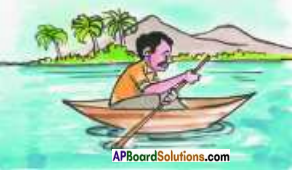
What are the different clothes we wear in different seasons?
Answer:

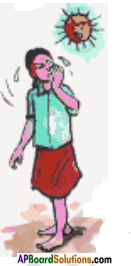
  1. We wear woolen and dark coloured clothes during winter when it is cold outside.
  2. Woolen and dark coloured clothes keep us warm.
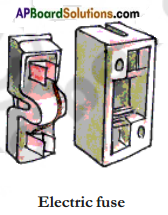
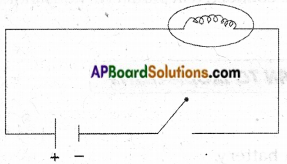
    AP Board 7th Class Science Important Questions Chapter 5 Temperature and Its Measurement 1
  3. We prefer to wear light coloured cotton clothes when it is hot.
  4. They give us a feeling of coolness.
  5. It is a wonder why a particular type of cloth is suitable for a particular season.

AP Board 7th Class Science Important Questions Chapter 5 Temperature and Its Measurement

Question 2.
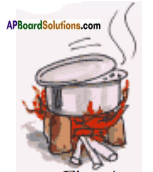
When rice is being cooked you observe the plate on the rice bowl jumps! Why is it happening?
Answer:
The heat energy converts water into steam and the pressure of steam throws away the lid.
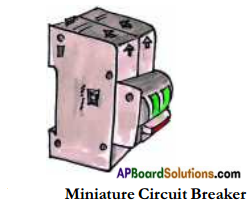
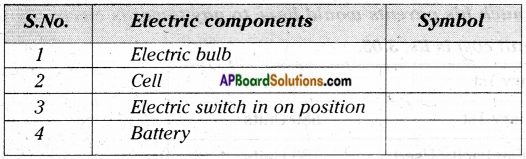
AP Board 7th Class Science Important Questions Chapter 5 Temperature and Its Measurement 2

Question 3.
Have you observed water boiling in a vessel with a lid on it? What do you notice? How can you establish that heat is a form of energy?
Answer:

  1. We know that boiled water is being converted to water vapour.
  2. The volume of the water vapour increases.
  3. The increased volume of vapour tries to go out. In this process it tries to lift the lid up.
  4. We need energy to lift any object. This energy comes from the heated water.
  5. Water gets the energy from the heat of the fire. Thus heat is a form of energy:

Question 4.
What is heat?
Answer:

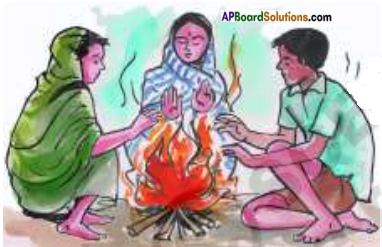
  1. We feel hot when we sit in sunlight or near fire. We feel cold when we put a piece of ice on our palm.
  2. We know that heat is a form of energy that is transferred from an object at higher temperature to one at lower temperature.
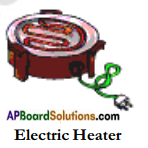
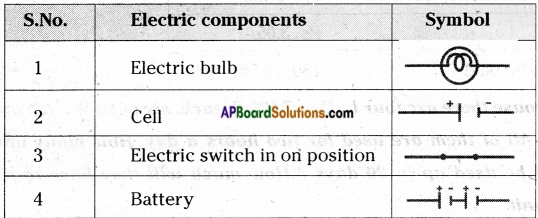
    AP Board 7th Class Science Important Questions Chapter 5 Temperature and Its Measurement 3
  3. When we stand in the sun or near fire, heat energy enters our body and we feel hot. When ice is put on our palm, heat energy moves from our body to the piece of ice.
  4. That’s why we feel cold.
  5. “The energy which makes an object appear hot or cold is called heat.”.

AP Board 7th Class Science Important Questions Chapter 5 Temperature and Its Measurement

Question 5.
What happens in the following?
a) Rub your palms together. How do you feel?
b) Have you ever observed that iron becomes hot when it is beaten with a hammer?
c) Take a soapnut seed. Rub it on a stone and touch it. How do you feel?
Answer:
In above cases mechanical energy is converted into heat energy.

Question 6.
Explain the terms ‘heat’ and ‘temperature’.
Answer:

  1. If we stand close to fire, we feel warm.
  2. When a warm object is placed close to a cooler object, heat energy moves from the warmer object to the cooler one until both objects attain the same temperature.
  3. Often we think that heat and temperature are the same things. This is wrong.
  4. Temperature is a measure of the heat energy in a body which indicates the ability of a body to give heat to another body or absorb heat from another body.
  5. We use thermometers to measure temperature.

Question 7.
What are the properties of mercury?
Answer:
Properties of Mercury:

  1. Its expansion is uniform. (For equal amounts of heat it expands by equal lengths.)
  2. It is opaque and shining.
  3. It does not stick to the sides of the glass tube.
  4. It is a good conductor of heat.
  5. It is easily available in pure state.

Question 8.
Write the properties of alcohol.
Answer:
Properties of Alcohol:

  1. It can record very low temperatures.
  2. Its expansion per degree Celsius rise in temperature is very large.
  3. It can be coloured brightly and hence is easily visible.

AP Board 7th Class Science Important Questions Chapter 5 Temperature and Its Measurement

Question 9.
Who first designed the thermometer? What do you know about it?
Answer:

  1. First thermometer was invented by Galileo in 1593 AD.

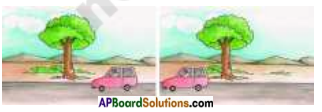
    AP Board 7th Class Science Important Questions Chapter 5 Temperature and Its Measurement 4
  2. In this thermometer air was used as the thermometric substance as air rapidly expands on heating and contracts on cooling.
  3. Further, the substance that is used in the thermometer has uniform expansion or contraction with the rise or fall in temperature.

Question 10.
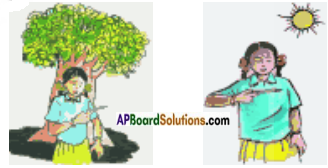
Do you find any difference in temperature of air in shadow and in the sun?
AP Board 7th Class Science Important Questions Chapter 5 Temperature and Its Measurement 5
Measure temperature of air using a thermometer. What will you do to keep a thermometer in close contact with air?
Answer:

  1. The temperature of air will be more as it receives heat directly from the sun and from reflected radiations.
  2. The temperature in the shadow will be relatively less as only reflected radiant heat reaches there.

Question 11.
Is there any difference in temperature with variation of time or place?
Answer:
There is difference in temperature with variation of time or place.

Question 12.
Why do you use an umbrella in the hot sun during summer?
Answer:
To avoid direct heat radiations from the sun.

AP Board 7th Class Science Important Questions Chapter 5 Temperature and Its Measurement 6

AP Board 7th Class Science Important Questions Chapter 5 Temperature and Its Measurement

Question 13.
Write a note on the variations of temperature on different occasions and at different places over the globe?
Answer:

  1. In Lybia (Africa) on a particular day in the year 1922, it became so hot that the temperature of air even in shade was as high as 58 °C.
  2. At some places (Rentachintala of Guntur District) in Andhra Pradesh, the maximum temperature of air sometimes reaches 48 °C and more.
  3. When it is so hot we feel extremely uncomfortable as the normal temperature of the human body is 37 °C.
  4. The lowest temperature in the world has been measured in Antarctica where it once went down to about -89 °C.
  5. The minus sign is used for temperature which is less than 0 °C. Water freezes at 0 °C, just think how cold -89 °C must be.
  6. In winter when the atmospheric temperature around us becomes 15 °C – 20 °C we begin to feel cold.

Question 14.
What is a clinical thermometer ? Describe its construction.
Answer:

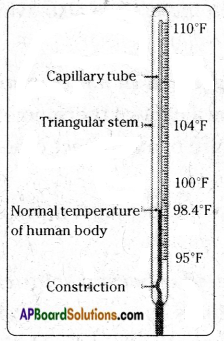
  1. Thermometer which is used to find out the temperature of our bodies is called Clinical Thermometer.
    If we observe Thermometer carefully. There are two types of scales marked on the clinical thermometer one that starts with 35 degrees and ends at 45 degrees is Celsius scale. While the other that starts with 95 degrees and ends at 110 degrees is the Fahrenheit scale.
  2. We see a kink in the capillary near the bulb.
    AP Board 7th Class Science Important Questions Chapter 5 Temperature and Its Measurement 7
  3. This kink prevents Mercury level from falling on its own.

Question 15.
What is the value of one division on the fahrenheit scale on thermometer?
Answer:

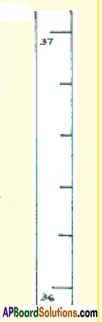
  1. Note the temperature difference indicated between the two bigger marks.
  2. Also note down the number of divisions between these marks.
    AP Board 7th Class Science Important Questions Chapter 5 Temperature and Its Measurement 8
  3. Suppose two consecutive bigger marks differ by one degree and there are five divisions between them.
  4. Then one small division reads
    1/5 = 0.2 °F

AP Board 7th Class Science Important Questions Chapter 5 Temperature and Its Measurement

Question 16.
Describe how do we use a clinical thermometer.
Answer:

  1. We should wash the thermometer preferably with an antiseptic solution.
  2. Holding it firmly by the end and give it a few jerks. These jerks will bring the level of mercury down. Ensure that it falls below 35 °C (95 °F).
  3. Now we should plape the thermometer under our tongue or arm pit.
  4. After one minute, we have to take the thermometer out and note the reading. It tells our body temperature.

Question 17.
How can you decide whether one has fever or not?
Answer:
The normal temperature of human body is 37°C (98.6°F). If one has body more than 98.6°F can consider as fever.

Question 18.
Write a note on a) Thermister thermometer and b) Digital thermometer.
Answer:
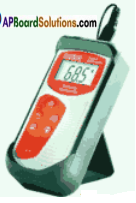
a) Thermister thermometer:
It is available in market to measure the human body tempera¬tures, particularly for infants and children.
AP Board 7th Class Science Important Questions Chapter 5 Temperature and Its Measurement 9
b) Digital thermometer:

  1. There is a lot.of concern over the use of Mercury in thermometer.

    AP Board 7th Class Science Important Questions Chapter 5 Temperature and Its Measurement 10
  2. Mercury is a toxic substance and is very difficult to dispose of if a thermometer breaks.
  3. These days digital thermometers are also available which do not use Mercury.

AP Board 7th Class Science Important Questions Chapter 5 Temperature and Its Measurement

Question 19.
What precautions are suggested in using a clinical thermometer?
Answer:

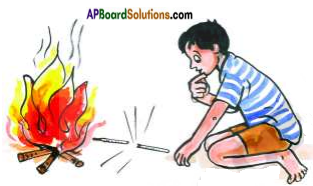
  1. We are advised not to use a clinical thermometer for measuring the temperature of any object other than human body.
    AP Board 7th Class Science Important Questions Chapter 5 Temperature and Its Measurement 11
  2. Also we are advised to avoid keeping it in the sun or near a flame.

Question 20.
Measure the temperature of a person with clinical and digital thermometers.
Are the temperature readings same or different? Explain your observations.
Answer:
The temperature readings in both clinical and digital thermometers are the same.

Question 21.
What is value of one small division on the Celsius scale?
Answer:
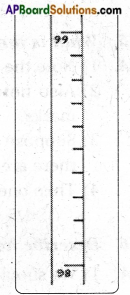
Reading the Celsius scale on thermometer.

  1. Temperature difference is indicated between two bigger marks.
  2. Between these two bigger marks divisions are there.
    AP Board 7th Class Science Important Questions Chapter 5 Temperature and Its Measurement 12
  3. Suppose two consecutive bigger marks differ by one degree and there are 10 divisions between them then one small division reads
    1/10 = 0.1°C
    ∴ The value of one small division on the Celsius scale is 0.1 °C.

Question 22.
How do you measure the temperature of other objects?
Answer:

  1. To measure the temperature of other objects there are other thermometers.
  2. One such thermometer is known as the laboratory thermometer used to measure temperature of water.
  3. Six’s maximum and minimum therometer is used to measure maximum and minimum temperatures of a day.

AP Board 7th Class Science Important Questions Chapter 5 Temperature and Its Measurement

Question 23.
Can you make use of laboratory thermometer like a clinical thermometer?
Answer:

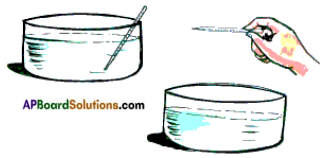
  1. We should take some hot water in a beaker, dip thermometer in it for one minute.
  2. Record the temperature while the thermometer is in water.
    AP Board 7th Class Science Important Questions Chapter 5 Temperature and Its Measurement 13
  3. Take out the thermometer from water. Observed the mercury thread carefully.
  4. As there is no kink in the laboratory thermometer mercury falls down in the glass tube of its own when taken out of the water. So we cannot use a laboratory thermometer like a clinical thermometer.

Question 24.
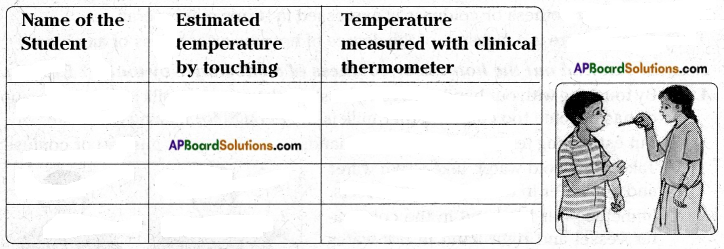
Measure the temperature of different students by touching them and noting in the clinical thermometer.
Make sure that you have cleaned the thermometer before each measurement.
AP Board 7th Class Science Important Questions Chapter 5 Temperature and Its Measurement 14
Compare the values in the table after completion of recording.
a) What do you observe in the table?
b) Are the estimated temperature and measured temperature same?
c) Is the body temperature of every person 37 °C (98.6 °F)?
d) What is the average body temperature of your friends?
The average body temperature of a large number of healthy persons is known as normal temperature (98.6 °F).
Answer:
The student is advised to do this work as a project work.

Question 25.
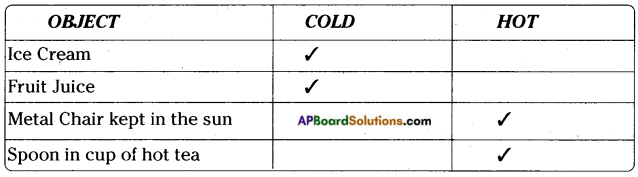
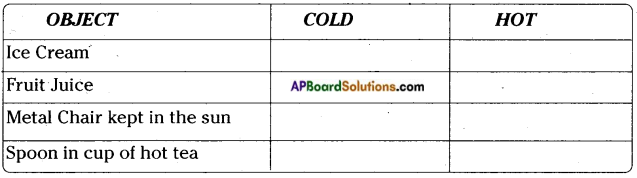
Some of the objects are given in the table. Mark these objects as hot or cold. What is your conclusion?
AP Board 7th Class Science Important Questions Chapter 5 Temperature and Its Measurement 15
Answer:
AP Board 7th Class Science Important Questions Chapter 5 Temperature and Its Measurement 16

  1. We see that some objects are cold and some are hot.
  2. We also know that some objects are hotter than others while some are colder than
    others.
  3. To decide which object is hotter than the other, and which object is colder than the other.
  4. We need a reliable method to decide the hotness/coldness of an object.
  5. Generally, hotness or coldness is expressed in terms of temperature.
  6. Temperature is a measure of the degree of hotness or coldness of an object.

AP Board 7th Class Science Important Questions Chapter 5 Temperature and Its Measurement

Question 26.
How can find out the hotness or coldness of a substance by touch? Explain.
Answer:

  1. By touching with our hands, we can guess whether a cup of milk is still worth sipping or has become too cold, whether milk is hot enough for making curds etc.
  2. But estimating temperature with our hands can, sometimes mislead or confuse us.
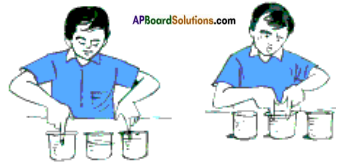
  3. Take some cold water, luke-warm water and hot water in three different vessels.
    AP Board 7th Class Science Important Questions Chapter 5 Temperature and Its Measurement 17
  4. Immerse your left hand in the cold wa¬ter vessel and right hand in hot water vessel simultaneously. Wait for two or three minutes.
  5. Take off both your hands and dip them in the luke-warm water vessel.
  6. Though both hands are in the same glass of water, one hand feels it cold and the other feels it hot! Look how our hands are confused!
  7. We can not exactly decide the hotness/coldness of a substance just by touching it?. It is not possible to guess the hotness of a substance only on the basis of feel/touch.
  8. It is certain that water in different tubs has different degrees of hotness which can¬not be exactly determined simply by touching.

Question 27.
How do we establish by experiment that liquids expand due to heat?
Answer:

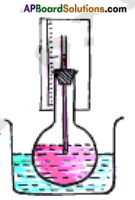
  1. We should take a flat bottom flask and fill it with coloured water.
  2. Fix a cork, having a capillary tube, in the mouth of flask such that level of water is as shown (fig).
    AP Board 7th Class Science Important Questions Chapter 5 Temperature and Its Measurement 18
  3. We should place the flask in a metal trough.
  4. We should pour boiling hot water into the trough and carefully observe the level of coloured water. The level rises.
  5. If we take the flask out of the trough and keep it outside for some time, the level of coloured water decreases.
  6. In the above activity we see that water expands on heating and contracts on cooling.

Question 28.
Record your observations in the following.
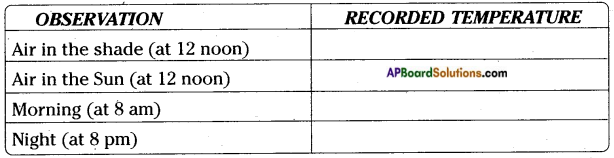
AP Board 7th Class Science Important Questions Chapter 5 Temperature and Its Measurement 19
Answer:
Do the above observation independently.

Question 29.
Did you ever bathe with cold water during winter? What happens?
Answer:

  1. I have taken bathe with cold water during winter.
  2. My body shivered with chill.

AP Board 7th Class Science Important Questions Chapter 5 Temperature and Its Measurement

Question 29.
What do you do to protect yourself from cold?
Answer:

  1. I wear woolen and dark coloured clothes to protect myself from cold.
  2. I will cover my body with a blanket to protect myself from cold in the night.

Question 30.
How do you get hot water in winter?
Answer:
By heating water, I get hot water in winter.

Question 31.
Generally we heat water to get hot water. How do you heat water? What sources do you use?
Answer:
By converting electrical energy, chemical energy and mechanical energy into heat we heat water. We use electric heaters, gas stoves and solar heaters to heat water.
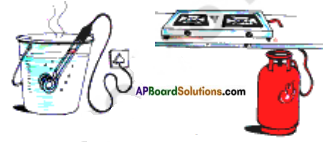
AP Board 7th Class Science Important Questions Chapter 5 Temperature and Its Measurement 20

Question 32.
Give examples of conversion of energy from one form to another.
Answer:

  1. Different kinds of energies can be converted to heat.
  2. In the same way heat energy can be converted to other forms of energy.
  3. We have heard that in a thermal power station, heat energy is converted to electrical energy.
  4. In a steam engine, heat energy is converted to mechanical energy which helps in moving the engine.
  5. In electrical heater electrical energy, in gas stove chemical energy and in solar heaters solar energy are converted to heat.

Question 33.
What are the liquids used as thermometer liquids?
Answer:

  1. Mercury is used as liquid for indicating temperature in thermometers.
  2. Apart from Mercury we also use alcohol as thermometer liquid.

Question 34.
Describe the construction of a thermometer with a neat diagram.
Answer:

  1. At one end of the tube we observe a bulb. It is filled with Mercury.
  2. The other end of the tube is sealed after removing air from it.
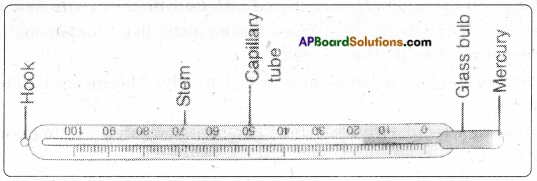
    AP Board 7th Class Science Important Questions Chapter 5 Temperature and Its Measurement 21
  3. We find a scale which is marked to express temperature in degree Celsius.
  4. We read the temperature with the help of these markings.
  5. The readings range from 0° to 100°
  6. This arrangement of the marks is called scale of temperature.
  7. All thermometers are based on the fact that matter expands on heating.

AP Board 7th Class Science Important Questions Chapter 5 Temperature and Its Measurement

Question 35.
Draw a neat diagram of Six’s maximum and minimum thermometer. What is its importance.
Answer:
1) The maximum (highest) and minimum (lowest) temperatures of a day are measured by a thermometer called the Six’s maximum-minimum thermometer.
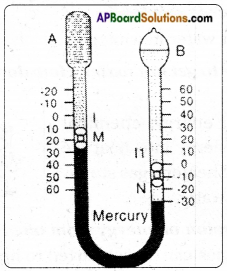
AP Board 7th Class Science Important Questions Chapter 5 Temperature and Its Measurement 22

Question 36.
How do you use a thermometer? Write an example.
Answer:

  1. To find the temperature of an object, the bulb of the thermometer needs to be in close contact with that object.
  2. Watch the shiny line of mercury in the tube. .
  3. The highest point on the scale, at which the rise of mercury stops, shows the temperature of the object.
  4. Example: To find the temperature of your palm, place the bulb of thermometer in contact with palm for two minutes and see the mercury rise.
  5. When mercury stops rising and its level becomes steady, note the position of its upper end.
  6. This is the temperature of your palm.

Question 37.
If markings on thermometer are wiped out, how do we create new markings?
Answer:

  1. Take some ice in a beaker. Immerse a thermometer in ice for two minutes. Mark the Mercury level. Now let the ice melt.
  2. The level of Mercury remains same while ice melts. This means that temperature is constant.
  3. This constant temperature at which ice melts is called melting point of ice and mark it 0 °C.
  4. Take some water in a beaker. Immerse the thermometer in it and start heating the water. It will start boiling while getting converted into steam.
  5. Mercury level starts rising and reaches a point beyond which it doesn’t rise. Mark the level of mercury at this point.
  6. Observe the constant level at which Mercury stays while water is boiling, this constant temperature is called boiling point of water. We mark the level of mercury at this point as 100 °C.
  7. Thus temperature at which ice melts or water boils is constant. These values are fixed as 0 °C and 100 °C respectively. Like water, all substances in pure form melt and boil at certain fixed temperatures.
  8. To create a scale, we need two fixed points. Let us choose the melting point (0 °C) and boiling point (100 °C) as two fixed points for the scale of thermometer. Now divide the distance between these two points on the thermometer into 100 equal parts.
  9. Each of the 100 equal parts represents 1 °C. We further divide 1 °C into 10 small divisions. It can be read as 1/10 = 0.1 °C.

AP Board 7th Class Science Important Questions Chapter 5 Temperature and Its Measurement

Question 38.
Feel the body temperature of some of your friends by placing your hand on their forehead. Estimate the temperature and record it in the table.
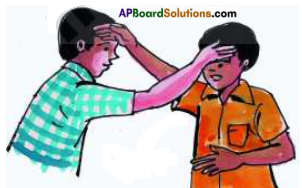
AP Board 7th Class Science Important Questions Chapter 5 Temperature and Its Measurement 23
Answer:
The student is advised to do this with the help of the teacher.

Question 39.
How do you note the temperature of water taken in a beaker?
Answer:

  1. Take some tap water in a beaker.
  2. Dip the thermometer in water so that the bulb is immersed in water but does not touch the bottom or side of the beaker.
  3. Hold thermometer vertically, wait till the mercury thread becomes steady.
  4. Note the reading. That is the temperature of water at that time.

Question 40.
Observe the diagram and answer the following questions.
AP Board 7th Class Science Important Questions Chapter 5 Temperature and Its Measurement 18

  1. What is the aim of the experiment?
  2. Write down the apparatus required.
  3. What are your observations?
  4. Where do you find this type of phenomenon in your daily life?

Answer:

  1. Liquids expand on heating.
  2. A flat bottom flask, cork, coloured water, metal trough, boiling hot water.
  3. Water expands on heating and the level in coloured water is increased.
  4. We can observe this phenomenon in the thermometer in our day to day life.

AP Board 7th Class Science Important Questions Chapter 5 Temperature and Its Measurement

Question 41.
Read the paragraph and answer the following questions:
Heat is a type of Energy. It is transferred from hot object to cold object. We know the hotness and coolness of an object due to the transformation of energy. It is called “Heat”. If you want to heat the water with electric heater, Electric Energy is turned into Heat Energy. If you heat the water on gas stove, Chemical Energy is turned into Heat Energy.
i) What is Heat?
ii) How is heat transferred from one object to other?
iii) Which equipment is used to turn Electric Energy into Heat Energy?
iv) When we heat water on the gas stove, which energy is turned into Heat Energy?
Answer:
i) It is a form of energy. The energy which makes an object appear hot or cold is called heat.
ii) Heat flows from an object at high temperature to another at lower temperature.
iii) Electric heater.
iv) Chemical energy.

Question 42.
What questions would you ask the doctor to clarify your doubts on the usage of the thermometer?
Answer:

  1. Why do we use thermometer in our daily life?
  2. Why is mercury used in thermometers?
  3. How do we measure the temperature in thermometer?
  4. How many types of scales are marked on the thermometer?

Question 43.
Read the paragraph given below and answer the following questions.
Temperature is a measure of the heat energy in a body. We use thermometers to measure temperature. Mercury is a good conductor of heat and is a liquid at room
temperature. It is used in most thermometers. In some thermometers, alcohol is used. Alcohol can record very, low temperatures.
i) What is temperature?
ii) Name the device used to measure the temperature.
iii) Name the liquid used commonly in the thermometers.
iv) Name the liquid used in thermometers to measure low temperature.
Answer:
i) Temperature is a measure of heat energy in a body.
ii) The device used to measure temperature is thermometer.
iii) Mercury is the liquid used in thermometers.
iv) Alcohol is used in thermometers to measure low temperature.

AP Board 7th Class Science Important Questions Chapter 5 Temperature and Its Measurement

Question 44.
Observe the table and answer the following questions.

DayDateMaximum Temperature
101.01.201930°C
202.01.201932°C
301.04.201935°C
402.05.201939°C
515.05.201942°C

i) Name the month and date when the minimum temperature was recorded.
ii) On which date was the maximum temperature recorded?
iii) Between which two consecutive months, the difference in temperature was the highest?
iv) In which month people could most likely have used air-conditioner to get relief from heat?
Answer:
i) 1st January, 2019.
ii) 15th May, 2019
iii) April and May
iv) In May month
AP Board 6th Class Science Solutions Chapter 11 Shadows – Images

AP State Syllabus AP Board 6th Class Science Solutions Chapter 11 Shadows – Images Textbook Questions and Answers.

AP State Syllabus 6th Class Science Solutions 11th Lesson Shadows – Images

6th Class Science 11th Lesson Shadows – Images Textbook Questions and Answers

Improve Your Learning

Fill in the Blanks.

1. Light travels in a ——–.
Answer:
straight line.
2. A substance that gives light is known as ——–.
Answer:
light source.
3. The bouncing back of light after hitting an object is called ——–.
Answer:
reflection.
4. The color of the shadow formed by a green tree is ——–.
Answer:
Black.

AP Board 6th Class Science Solutions Chapter 11 Shadows - Images

Choose the correct answer.

1. Identify the transparent substance
A) Paper
B) Wood
C) Glass
D) Oil Paper
Answer:
C) Glass

2. Which of the following substance forms shadows?
A) Transparent
B) Translucent
C) Opaque
D) All the above
Answer:
C) Opaque

3. What do you need to get a shadow?
A) Light Source
B) Opaque Object
C) Screen
D) All the above
Answer:
D) All the above

Answer the Following Questions.

Question 1.
Classify the following objects into transparent, translucent, and opaque:
Cardboard, duster, polythene cover, oily paper, glass, spectacle lens, piece of chalk, ball, table, book, window glass, palm, school bag, mirror, air, water.
Which type of materials do you find more in your surroundings?
Answer:
A. Transperent Objects: glass, spectacle lens
B. Translucent Objects: polythene cover, oil paper
C. Opaque Objects: cardboard, duster, piece of chalk
I find opaque materials are more in our surroundings.

Question 2.
We can’t identify the type presence of completely transparent objects even in light. Is it correct or not? Support your answer.
Answer:
Yes, we can’t identify the presence of completely transparent objects even in Light. Because it allows light to pass through it. So we can’t find it.

Question 3.
Why can’t we see objects which are behind us?
Answer:
The reflected light behind objects of us can’t reach our eyes. So we can’t see objects which are behind us.

AP Board 6th Class Science Solutions Chapter 11 Shadows - Images

Question 4.
What is required to get a shadow of an opaque body?
Answer:
To get a shadow we need

  1. light source
  2. opaque body
  3. screen.

Question 5.
Can we use a plain mirror as a rearview mirror? If not why not?
Answer:
No, we can’t use the plain mirror as a rearview mirror. Because the plain mirror can’t cover all objects behind the vehicle. So we use the concave mirror as a rearview mirror.

Question 6.
Why do we get shadows of different shapes of the same object?
Answer:

  1. We get different shadows for the same object.
  2. because shadow shape is changed depending upon the position of the light source
  3. and angle position of the object.
  4. So we may get different shadows shapes from a same object and same shadows from different objects.

Question 7.
What are the differences between a shadow and an image?
Answer:

IMAGESHADOW
1. Images are colour full.1. Shadows does not have colour.
2. Image is formed due to the reflection or refraction of light.2. Shadows are formed when opaque objects obstruct the path of light.
3. Image gives more information such as colour, structure, etc. about the object.3. Shadow does not provide any details about the object but it gives an idea about the shape of the object.
4. An image in a plane mirror doesn’t change in size at all; it is always of the same size as that of the object.4. Shadow size may be changed depend on light sources position.
5. An image in a mirror can be seen without a screen, whereas it is mandatory to have a screen to form a shadow.5. A dark patch formed on a surface behind an opaque object placed in the path of light is called a shadow.

Question 8.
Malati noticed changes in the lengths of her shadows during the daytime. She had some doubts about this. What could be those doubts?
Answer:

  1. Why shadows are always black?
  2. Why sometimes shadows are small and large?
  3. Why our shadows always follows us?
  4. Can we guess the time when see the shadow?

AP Board 6th Class Science Solutions Chapter 11 Shadows - Images

Question 9.
How can you explain the straight-line motion of light?
Answer:

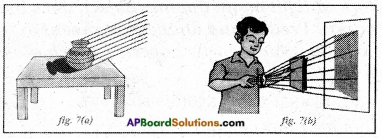
  1. Observe the objects, the formation of shadows and the path of light as shown, in the figure.
  2. Similarly draw the shadows for the objects given in the fig. Extend the path of light and draw a shadow on the given screen.
    AP Board 6th Class Science Solutions Chapter 11 Shadows - Images 1
  3. We have drawn arrows in the above figures assuming that light travels like rays that are straight.
  4. We can predict the shapes of the shadows only when we consider that light travel as rays along a straight path.
  5. In ancient days, by observing the shapes of shadows people came to an understanding that light travels in a straight line.

Question 10.
We would not be able to see any object around us if light does not get reflected. How do you appreciate this property of objects?
Answer:

  1. Vision is the vital sense to organisms.
  2. Its possible by light reflection.
  3. I feel wonder by this phenomena that provide the vision.
  4. I also feel happy by seeing beauty nature by light.

Question 11.
Where do you find reflection of light in your daily life?
Answer:

  • Due to the regular reflection of light, we look at our image in the plane mirror.
  • We can turn the sunlight towards dark places by the regular reflection of light with the help of a shiny surface.
  • The wing and rear-view mirrors of a car are made of a convex and a plane mirror
    respectively.
  • A microscope uses a mirror to reflect light to the specimen under the microscope.

Activities and Projects

6th Class Science Textbook Page No. 126

Question 1.
Hold a glass slab at one end with your hand and stand in the sunlight. See the shadows of your hand and glass slab. Explain what you observed.
Answer:

  1. I find that glass slab does not form a shadow.
  2. I observed the shadow of my hand.
  3. It means glass slab is a transparent object and hand is opaque object.
  4. My conclusion is that only opaque objects form clear shadow.
  5. And transparent objects does not form shadows.

AP Board 6th Class Science Solutions Chapter 11 Shadows - Images

Question 2.
If we focus a coloured light on an opaque object, does the shadow of the object possess colour or not? Predict and do the experiment to verify your predictions. (Coloured light can be obtained by covering torch glass with a transparent coloured paper).
Answer:

  1. In the colour light opaque objects forms shadows.
  2. But they does not have any colour.
  3. because shadow is the place where the light is prevented.
  4. It does not effected by colour light.

Question 3.
Between an electric bulb and a tube light, which forms sharp shadows of objects? Do an experiment to find out and give the reasons.
Answer:

  1. Between electric bulb and tube light electric bulb forms clear and sharp image.
  2. Electric bulb is round in shape.
  3. It takes more voltage and forms intensity light
  4. That’s why electric bulb forms sharp and clear shadows.
  5. But at the tube light shadow it is not sharp.
  6. Here light source is lengthy.
  7. And light fell on objects from different side.
  8. So the shadow does not sharp.

Question 4.
A mirror is kept on the wall of your room. Your friend is sitting on a chair in that room. You are not visible to him in the mirror. How do you adjust your place so that you are visible to your friend in the mirror? Explain.
Answer:

  1. Its simple technique to appear to my friend in mirror.
  2. In mirror image formed by reflection.
  3. In reflection light bounce in same angle.
  4. That’s why I am visible to my friend when he is visible to me.
  5. So, I adjust my place until my friend appear to me.
  6. When my friend visible to me, I am also visible to my friend.

Activity – 1

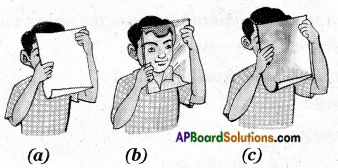
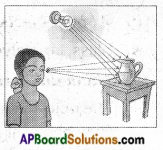
1. Make your room dark by shutting the door and windows; and then put on the light. Look at any one of the objects in the room. After that, hold a plank or a writing pad in front of your face.  (Page No. 117)
AP Board 6th Class Science Solutions Chapter 11 Shadows - Images 2
i) Is the object visible to you?
Answer:
No the object can’t visible to me.

ii) Why is it not visible though there is light?
Answer:
Light can’t reach the eyes. So it is not visible.

iii) What happens when you hold a plank between the object and you?
Answer:
Plank prevent the light. So it can’t reach the eyes.

iv) What is that something coming from the object?
Answer:
Its light that causes sight sense.

v) Where does light come from?
Answer:
A substance which gives light is known as a light source.

AP Board 6th Class Science Solutions Chapter 11 Shadows - Images

vi) Which objects give us light?
Answer:
Objects give us light are Sun, a glowing bulb, lighted candle etc.

vii) Can you give some more examples for source of light?
Answer:
Sun, stars, torch, candle, bulb, flame, glowing worm.

viii) When did you see shadow? Is it during day time or at night?
Answer:
I saw the shadow at day time.

ix) Are shadows formed at night?
Answer:
No, generally shadows does not form at night time. We may form shadows by using light at night time.

x) Is it possible to form shadows when there is no sunlight, bulb or any other light?
Answer:
Its not possible to form shadows without light.

xi) What do we need to form a shadow?
Answer:
We need light to get the shadow of any object.

Activity – 2

2. Try to form shadows of a book, a pen, a duster, a polythene cover, and a glass plate on the wall of your classroom with the help of a torch.  (Page No. 117)
Do you find any differences in the shadow of the above objects? Do all objects form shadow?
i) Which objects form shadows?
Answer:
Book, plank, table, chair.

ii) Which objects do not form shadows?
Answer:
Glass, air, polyethene sheet.

iii) Think and write why some objects form shadows? And others do not?
Answer:
The objects which allow light does not form shadows. And which objects does don’t allow the light form the shadows. It means prevention of light forms shadows.

iv) Observe the figure. Write whether the sheet held by the boy is transparent, translucent or opaque below each of the picture?
AP Board 6th Class Science Solutions Chapter 11 Shadows - Images 3
Answer:
a) Opaque sheet b) Transparent sheet c) Translucent sheet

v) Think and guess and write in table which objects in your class room form shadows, which do not form shadows and which form an unclear objects?

Objects which form shadows.
Objects which form unclear shadows.
Objects which don’t form shadows.

Answer:

Objects which form shadows.Benches, Chairs, Blackboard, Towel, Bicycle, Shoes
Objects which form unclear shadows.Oil paper, Window, Glass pans (some), polythene
Objects which don’t form shadows.Glass, Water, Petrol, Spirit, etc.

vi) Where do you find the shadow of the leaf?
Answer:
We find the shadow of the leaf on the wall.

vii) Where do you find the shadow of the lea fin the room?
Answer:
On the ceiling.

AP Board 6th Class Science Solutions Chapter 11 Shadows - Images

viii) Do you find the shadow of the leaf if you remove the sheet?
Answer:
No, we do not find the shadow of the leaf.

ix) What do you understand from the above activity?
Answer:
Only light and an opaque object are not enough to form the shadow of an object. In addition to these we need a screen.

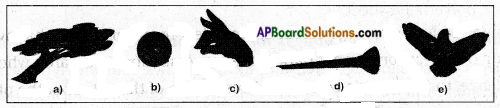
x) Can you guess the object by observing its shadow?
Guess and write the names of the objects which form the shadows?
AP Board 6th Class Science Solutions Chapter 11 Shadows - Images 4
Answer:
a) Tree
AP Board 6th Class Science Solutions Chapter 11 Shadows - Images 5
b) Ball
AP Board 6th Class Science Solutions Chapter 11 Shadows - Images 6
c) Rabbit formed as shadow with fingers
AP Board 6th Class Science Solutions Chapter 11 Shadows - Images 7
d) Musical instrument
AP Board 6th Class Science Solutions Chapter 11 Shadows - Images 8
e) Bird formed as shadow with hands
AP Board 6th Class Science Solutions Chapter 11 Shadows - Images 9

xi) What do you find?
Answer:
I found shadows which are in dark colour.

xii) Are you able to guess the object correctly in all cases?
Answer:
No, it is not possible.

xiii) What can you conclude from the above activity?
Answer:
Shadows have no colour. We can’t guess the object by observing its shadow.

xiv) Can we guess the object by observing its shadow?
Answer:
No, not possible in all cases.

Activity – 3

3. Colour of a Shadow.  (Page No. 120)

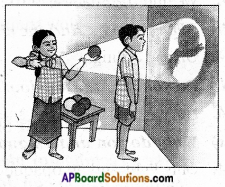
Take four balls of equal size of different colours. Try to form a shadow of each ball as shown in fig. Ask your friend who is facing the screen and not able to see the balls to guess the colour of.
AP Board 6th Class Science Solutions Chapter 11 Shadows - Images 10
i) Is your friend able to guess the colour of the ball correctly?
Answer:
No, he not able to guess the colour.

AP Board 6th Class Science Solutions Chapter 11 Shadows - Images

ii) Is it possible to guess the colour of the object by observing it’s shadow? If not why?
Answer:
No, its not possible to guess the colour of the object by observing its shadow. Because any colour of object forms only dark shadows. A shadow is an area/where light is absent. Hence, the shadow is colourless irrespective of the colour of the object.

Activity – 4

Shape of Shadow.  (Page No. 121)

4. Observe the shadows of a book, a pen, a duster, a ball and a round plate, one by one, in sunlight While doing this, rotate the objects to change their positions and observe the changes in shadows. Try to answer the following questions on the basis of your observations:

i) Is there any similarity between the shadows of the ball and the plate? If yes, what?
Answer:
Yes, both shadows are round in shape.

ii) What change do you observe in the shadows formed when you hold the pen horizontally and then vertically?
Answer:
The pen shadow is different when you hold the pen horizontally and then vertically. When you hold the pen vertically the shadow seems as object. When you turn the pen horizontally the shadow become round in shape.

iii) What differences do you observe ip the shadows when the duster is kept in different positions by rotating it?
Answer:
I found that duster have different shadows in different positions by rotating it. Some times the shadow seems as duster and sometimes not.

iv) Why are the shapes of the shadows of the same object different when you change the position of the object?
Answer:
A. shadow is a dark area where light from a light source is blocked by an opaque object.
B. The object may have different shapes in different angles.
C. So, the shadow shape is changed.

Activity – 5

GETTING DIFFERENT SHAPES OF SHADOWS OF A SINGLE OBJECT:  (Page No. 122)

5. Take a rectangular piece of cardboard. Try to form shadows of different shapes by using it. You can do this in the sunlight or with the light from a torch. Now, answer the following questions:
i) Were you able to make a square shaped shadow?
Answer:
When I just bend the rectangular cardboard in front of light source, it forms square shaped shadow.

ii) Were you able to make a triangular shadow?
Answer:
When we gradually rotate the object towards the light source, the square shadow change into triangle.

iii) Were you able to make a circular shadow?
Answer:
No. I am not able to make a circular shadow.

AP Board 6th Class Science Solutions Chapter 11 Shadows - Images

iv) What are the other possible shapes?
Answer:
Rectangular, square, line, rhombus, triangle.

v) Why are we getting different shapes of shadows when the object is the same?
Answer:
Because of the straight line path followed by light rays, we can get different shaped shadows for a single object by changing its position.

Activity – 6

FUN WITH A MAGNIFYING LENS        (Page No. 123)

6. Take a magnifying lens and try to form an image of a tree on a white drawing sheet.
i) What do you observe in the image formed on the sheet?
Answer:
The image on the white drawing sheet is inverted.

ii) What difference do you notice between the images formed through the pinhole camera and through the magnifying glass?
Answer:
I notice that the image formed through the magnifying lens is clearer than that formed with a pinhole camera.

iii) Can you find any other differences or similarities between shadows arid images? Write in your note book.
Answer:
Similarity:
Shadow and image are related to light.
Without light both are not visible.

Difference:
The key difference between image and shadow is that the image is the reflection of the light rays by an object, whereas the shadow is a dark shape projected onto a surface when an opaque object obstruct the light rays.
The term image generally refers to an optical representation of a real object. A shadow is black in color while an image is colorful, and represents the real colors of the object it represents.

Activity – 7

OBSERVE THE REFLECTION  (Page No. 124)

7. Make your classroom dark by closing the doors and windows. Ask one of your friends to hold a mirror in his hand. Take a torch and cover its glass with a black paper leaving only slit in the middle. Now switch on the torch and adjust it so that light falls on the mirror in your friend’s hand. Ask your friend to adjust the mirror so that the patch of light falls on another friend standing in front of him at some distance.
AP Board 6th Class Science Solutions Chapter 11 Shadows - Images 11

i) What do you observe from the above activity?
Answer:
When light falls on any object, it rebounds back. This is called reflection.

AP Board 6th Class Science Solutions Chapter 11 Shadows - Images

ii) Ask your friend A to cover the mirror with a book. Now switch on the torch and focus it on the book, Can you see the patch of light on your friend? Why?
Answer:
When mirror is covered with book I can’t found patch of light on my friend. Because the surface of book is not smooth as mirror. On smooth surfaces reflection is effective.

iii) Did the light that fell on the book not get reflected?
Answer:
The light fell on the book is reflected. But its irregular reflection. Because the book surface is not smooth as mirror.

AP Board 6th Class Science Solutions Chapter 2 Knowing About Plants

AP State Syllabus AP Board 6th Class Science Solutions Chapter 2 Knowing About Plants Textbook Questions and Answers.

AP State Syllabus 6th Class Science Solutions 2nd Lesson Knowing About Plants

6th Class Science 2nd Lesson Knowing About Plants Textbook Questions and Answers

Improve Your Learning

Fill in the Blanks.

1. Tap root system is present in ——– plants.
Answer:
dicot.
2. The bud at the tip of the stem is known as ——–.
Answer:
terminal bud.
3. Part of the leaf that helps in the exchange of gases is ——–.
Answer:
stomata.
4. Primary organs of photosynthesis are ——–
Answer:
Leaves.

AP Board 6th Class Science Solutions Chapter 2 Knowing About Plants

Choose the correct Answer.

1. The important function of stomata is
A) Conduction
B) Transpiration
C) Photosynthesis
D) Absorption
Answer:
B) Transpiration

2. Part of plant that helps in absorption of water and minerals
A) Root
B) Stem
C) Leaf
D) Flower
Answer:
A) Root

3. Part of the stem from where leaves arise is called
A) Node
B) Bud
C) Cotyledon
D) Internodes
Answer:
A) Node

Answer the Following Questions.

Question 1.
What are the important parts of a plant?
Answer:
The important parts of a plant are: a) Roots, b) Stem, c) Leaves, e) Flower and e) Fruit.

Question 2.
How does the stem help the plant?
Answer:
The stem of a plant,

  • supports the branches, leaves, flowers and fruits.
  • transports water and minerals from roots to upper aerial parts of the plant.
  • transports food from leaves to other parts.
  • in some plants, it stores the food so that they are known as the modified stem.
    Ex. Potato, turmeric, ginger, garlic and sugarcane.

AP Board 6th Class Science Solutions Chapter 2 Knowing About Plants

Question 3.
What is the relation between the type of root system and venation?
Answer:
The relation between the type of root system and leaf venation is,
a) The plants having tap root system has reticulate venation.
b) The plants having a fibrous root system has parallel venation.

Question 4.
Rajani said “Respiration takes place in leaves” she correct? How can you support this statement?
Answer:

  1. What Rajani said is correct.
  2. The leaves of plants have tiny pores on their surface, which are called stomata.
  3. Stomata acts like a nose to the leaf.
  4. So that exchange of gases in the leaves takes place through stomata during respiration.

Question 5.
What will happen if a plant does not have any leaves?
Answer:

  • Leaves are the sites of photosynthesis for the preparation of food.
  • Gaseous exchange in plants takes place through leaves by the process of respiration.
  • Excess of water in the plant is removed in the form of vapours through the leaf surface.
  • If the plant does not have any leaves it will not able to make its own food and cannot perform the functions of respiration and transpiration.
  • Stem can perform these functions in those plants that does not have leaves.

Question 6.
How can you show that plants absorb water through their roots?
Answer:
Aim: To observe the absorption of water by root.
What you need: A carrot, a glass of water and blue ink.
What to do:

  • Take a glass of water and add a few drops of blue ink to it.
  • Now place a carrot in the glass.
  • Leave the carrot in water for 2 or 3 days.
  • Then cut the carrot in water, lengthwise and observe.

What do you see: Blue colour appears in the carrot.
What do you learn: The blue colour indicates that water moved upward in the carrot showing that root absorbs water.

Question 7.
Explain the various parts of a plant with the help of a diagram.
Answer:
The important parts of a plant are:
a) root b) stem c) leaf d) flower e) fruit
a) Root: The underground part of the main axis of the plant is the root.

  • Roots absorb water and minerals from the soil.

b) Stem: The aerial part of the plant above the ground is the stem.

  • It bears branches, leaves, flowers and fruits.
  • It transports water, minerals and nutrients to the various parts.

c) Leaf: The flat, green portion of a plant that arises from a node is a leaf.

  • It helps in photosynthesis, respiration and transpiration.

d) Flower: The bright and beautiful part of the plant.

  • It is a reproductive part of a plant.

e) Fruit: It is an edible part of a plant that contains seeds.

  • It developed from the flower.

AP Board 6th Class Science Solutions Chapter 2 Knowing About Plants

Question 8.
Explain the parts of a leaf with the help of a diagram.
Answer:
The main part of a leaf is,
a) Leaf base b) Petiole c) Lamina d) Midrib e) Veins
a) Leaf base: Lower part of the leaf that joins the leaf to the stem near the node.
b) Petiole: A stalk-like/structure that connects leaf to the stem of the plant.
c) Lamina: The thin, flat, green portion of the leaf is lamina.
d) Midrib: The long vein that present in the middle of the lamina.
e) Veins: The branches arising from the midrib and spread over all the lamina.

Question 9.
John has no sufficient place around his house to grow plants. But he wants to grow vegetables like tomato or brinjal. Suggest him some ways to grow plants.
Answer:
Terrace garden, Kitchen garden, Vertical garden are some methods for growing the plants in limited space.
a) Terrace garden: It is a simple garden growing on the terrace. In this process, we use water bottles, plant pots and other waste vessels to grow the plants.
b) Kitchen garden: A garden in which plants for use in the kitchen are cultivated.
c) Vertical garden: A garden in which the plants are supported to grow vertical, especially fences, posts, walls rather than along the ground.

Activities and Projects

Question 1.
Collect any plant from your surroundings. Draw its root structure. What can you say about its root system?
Answer:
AP Board 6th Class Science Solutions Chapter 2 Knowing About Plants 3

  • The root system collected in the plant exhibit tap root system.
  • In this plant, the main root is thick and grows straight down into the ground is Tap root.
  • And the smaller roots arising from the tap root are Lateral roots.
  • The root system helps the plant to penetrate into deep layers of the soil.

(OR)

  • The root system collected in the plant exhibit tuberous root system.
  • In this plant all roots are thin and uniform in size.
  • This root system consists of a cluster of roots arising from the base of the stem.
  • The root system helps the plant to hold the soil firmly and prevent soil erosion.

Question 2.
Collect the leaves of various plants and prepare a herbarium. Write a brief report on their shapes size and venation.
Answer:
Students collect different shapes and sizes of leaves.
AP Board 6th Class Science Solutions Chapter 2 Knowing About Plants 4

  • A Herbarium is a store house of plant specimens which are collected, dried and mounted on paper sheets.
  • There are different shapes such as linear, elongated elliptical etc.
  • The collected leaves showing reticulate venation and parallel venation in some plants.

AP Board 6th Class Science Solutions Chapter 2 Knowing About Plants

Question 3.
Prepare a greeting card with dry leaves.
Answer:
The student can prepare this in a way of his choice. (Student Activity)
AP Board 6th Class Science Solutions Chapter 2 Knowing About Plants 5

Question 4.
Observe a plant that has healthy green leaves and beautiful flowers. Write your feelings about the plant in your note book.
Answer:

  • When we see a plant with healthy green leaves and beautiful flowers, we wonder at the glance of such point.
  • The green colour of the leaves gives us good scenery and good visibility.
  • Green colour is pleasant to our eyes so that it is quite healthy for our eyes.
  • On seeing the healthy plant, our mind gets refreshed and tries to forget all the worries.
  • The colour and beauty of the flowers makes us relax and its fragrance gives us aroma.

6th Class Science 2nd Lesson Knowing About Plants Activities

Activity – 1

1. Collect 5 or 6 different types of plants from your garden.    (Page No. 13)
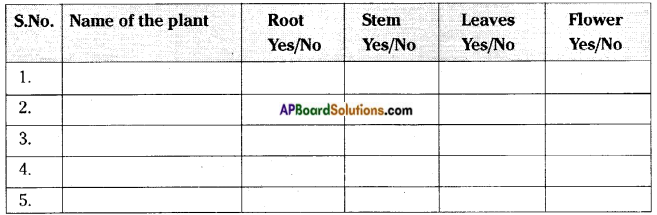
a) Observe the collected plants and try to identify their parts. Take the help of fig. 1 in your text book and write your observations in Table given Let us discuss the following questions.
AP Board 6th Class Science Solutions Chapter 2 Knowing About Plants 6
Answer:

Sl.No.Name of the plantRoot
Yes/No
Stem
Yes/No
Leaves
Yes/No
Flower
Yes/No
1.RiceYesYesYesYes
2.TulasiYesYesYesYes
3.MangoYesYesYesYes
4.RoseYesYesYesYes
5.NeemYesYesYesYes

i) Did you find any plant which does not have roots?
Answer:
No. I don’t find any plant without roots.
ii) Are the leaves of all plants similar in size?
Answer:
No. The leaves of all the plants are not in similar in size.
iii) Is there any plant without flowers?
Answer:
Ferns, mosses and liverworts are non flowering plants.
iv) What are the common parts that you observe in all plants?
Answer:
Roots, stem, leaves and flowers are the common parts that I observed in all plants.
v) Observe the roots of the plants you collected. How are they?
Answer:
They are not alike.
vi) Do all plants have a similar type of root?
Answer:
No, they have different roots.
vii) Is there any difference?
Answer:
Yes, we can observe the differences some plants have tap root system and some have fibrous

AP Board 6th Class Science Solutions Chapter 2 Knowing About Plants

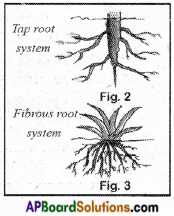
b) Compare the roots of your sample plants with pictures fig 2 and fig 3 and write your observations in table and answer the following questions.
AP Board 6th Class Science Solutions Chapter 2 Knowing About Plants 7

S.No.Name of the plantType of root system
1.Tridax plant
2.
3.
4.
5.

Answer:

S.No.Name of the plantType of root system
1.Tridax plantTap root system
2.RiceFibrous root system
3.TulasiTap root system
4.MangoTap root system
5.RoseTap root system
6.NeemTap root system

i) In the tap root system, how does the middle root look like?
Answer:
Middle main root become thick and has thin rootlets.
ii) Compare the middle root with the remaining roots in the tap root system?
Answer:
The middle root is thick and known as Tap root, and the remaining rootlets are thin and known as Lateral roots.
iii) Do you find any such main root in fibrous root system? How are the roots of this plant?
Answer:
No. There is no main root in fibrous root system. Here all roots are similar in size.
iv) Do you find any other differences between tap root system and fibrous root system?
Taproot system consists of Taproot and Lateral roots in different sizes whereas in fibrous root system all roots are thin and uniform in size.

AP Board 6th Class Science Solutions Chapter 2 Knowing About Plants

Activity – 2

2. Write an activity to identify an emerging point that belong to either monocot or dicot in your science lab.  (Page No. 14)
Answer:
Aim: To observe the cotyledons of bean seeds and finger millets comparatively with their root systems.
What you need: Two paper cups, soil, bean seeds, finger millet seeds, water.
What to do?:

  • Take two paper cups and fill them with fertile soil.
  • Sow 2 or 3 bean seeds in a cup and few finger millets in another cup.
  • Sprinkle water over them.
  • After a couple of days, we will see the sprouts.
  • Observe the newly emerging leaves of that sprouts.
  • Take out the plants out of the soil carefully and observe their roots.

What do you see: Two leaves are emerged from the bean seed and only one leaf emerged from the finger millet seedlings. These are the cotyledons.

  • Bean has two cotyledons so it is a dicot plant.
  • Finger millet has one cotyledon so it is a monocot plant.
  • Bean plant has tap root system whereas finger millet has fibrous root system.

What do you learn:

  • Dicot plants have tap root system whereas monocot plants have fibrous System.
  • So that there is a relation between the cotyledons and the root system.

Activity – 3

Water absorption by Root.   (Page No. 13)

3. How can you explain that plants absorb water through their roots?
Answer:
Aim: To observe the absorption of water by root.
What you need: A carrot, a glass of water and blue ink.
What to do: Take a glass of water and add a few drops of blue ink to it.

  • Now place a carrot in the glass.
  • Leave the carrot in water for 2 or 3 days.
  • Then cut the carrot in water, lengthwise and observe.

What do you see: Blue colour appears in the carrot.
What do you learn: The blue colour indicates that water moved upward in the carrot showing that root absorbs water.

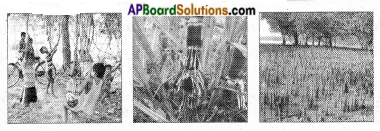
  • Observe the figure. Which part of the plant does that boy hold to swing?
    AP Board 6th Class Science Solutions Chapter 2 Knowing About Plants 8
    Answer:
    Roots of Banyan (Aerial roots).

AP Board 6th Class Science Solutions Chapter 2 Knowing About Plants

Activity – 4
4. How can you prove that the water absorbed by the root is carried cut through stem to all parts of the plants?
Answer:
Aim: To observe the conduction of water by a stem.
AP Board 6th Class Science Solutions Chapter 2 Knowing About Plants 9
What you need: A small twig of balsam plant, a glass of water, red ink.
What to do: Take a glass of water and add a few drops of ink to it.

  • Now place the small twig in the water.

What do you see: The stem turns reddish.
What do you learn: The red ink is taken and transported by the stem upwards.
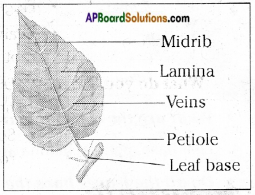
Observe the given picture of a leaf and its parts.
AP Board 6th Class Science Solutions Chapter 2 Knowing About Plants 10

  • Where is the leaf attached to the stem?
    Answer:
    Leaf base.
  • What is the flat portion of the leaf called?
    Answer:
    Lamina (or) Leaf plate.
  • What do you call the small line like structure in the flat portion of the leaf?
    Answer:
    Veins.
  • Which part connects leaf lamina with the stem?
    Answer:
    Petiole.

Activity – 5

Are all leaves the same?   (Page No. 17)

5. a) Observe the leaves of the plants that you collected in activity 1.

  • How are they?
    Answer:
    They are thin and flattened green structures.
  • Are all the leaves being same size and shape?
    Answer:
    No. The leaves are not the same size and shape.

b) Compare the leaves of the plants collected in activity 1. Write your observation in the table given. You can also draw what you see in the shape and edge columns if describing is difficult.

S.No.Name of the plantLeaf base Yes/NoPetiole
Yes/No
Lamina
Yes/No
Shape of the leafEdges of the leaf
1.
2.
3.
4.
5.

Answer:

S.No.Name of the plantLeaf base Yes/NoPetiole
Yes/No
Lamina
Yes/No
Shape of
the leaf
Edges of the leaf
1.RiceYesNoYesLinearHairy
2.TulasiYesYesYesOvalSlightly toothed
3.MangoYesYesYesOvalSmooth
4.RoseYesYesYesOvalSharply toothed
5.NeemYesYesYesLinearDentate
  • What are the common parts that you observe in all the leaves?
    Answer:
    Leaf base, petiole, lamina are the common parts I observed in all the leaves.
  • Do all the leaves have the same shape?
    Answer:
    No. All the leaves have not the same shape.

AP Board 6th Class Science Solutions Chapter 2 Knowing About Plants

Activity – 6

6. Put a leaf under a white sheet of paper or a sheet in your notebook. Hold the tip of the pencil flat and rub it on the paper.        (Page No. 18)
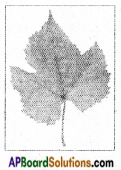
AP Board 6th Class Science Solutions Chapter 2 Knowing About Plants 11

  • Did you get any impression?
    Answer:
    Yes. I get the impression of leaf.
  • Is this pattern being similar to that of the leaf?
    Answer:
    Yes. It is similar to that of the leaf.

Activity – 7

Types of Venation. (Page No. 18)

7. Observe the venation of the leaves that you collected in activity 1. With the help of fig. 6 right your observations in table 4.
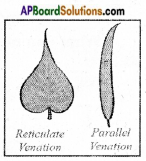
AP Board 6th Class Science Solutions Chapter 2 Knowing About Plants 12

S.No.Name of the PlantVenation (Reticulate / Parallel)
1.
2.
3.
4.
5.

Answer:

S.No.Name of the PlantVenation (Reticulate / Parallel)
1.RiceParallel venation
2.TulasiReticulate venation
3.MangoReticulate venation
4.RoseReticulate venation
5.NeemReticulate venation

a) Now compare the results obtained in table-2 with table-4.

  • What type of roots are there in plants having parallel venation in their leaves?
    Answer:
    Fibrous roots are there in plants having parallel venation in their leaves.
  • What type of roots are there in plants having web-like venation in their leaves?
    Answer:
    Taproot system is there in plants having web-like venation in their leaves.
  • Is there any relation between venation and root system?
    Answer:
    Yes. There is a relation between venation and the root system.
    The plants with taproot system have leaves with web-like or reticulate venation and plants with fibrous roots have parallel venation.

AP Board 6th Class Science Solutions Chapter 2 Knowing About Plants

Activity – 8

Stomata Observation. (Page No. 19)

8. What procedure do you follow to observe the stomata in your school lab?
Answer:
Aim: To observe stomata in a leaf.
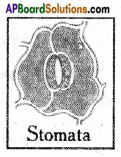
AP Board 6th Class Science Solutions Chapter 2 Knowing About Plants 13
What you need: Fleshy leaf, water, microscope, slide.
What to do:

  • Take a fleshy leaf.
  • Peel the outer layer of the leaf and place it on a slide.
  • Put a drop of water on it and observe it under a microscope.

What do you see: We find some bean-shaped parts.
What do you learn: The bean-shaped parts are stomata. Its acts like our nose.

Activity – 9

Transpiration. (Page No. 19)

9. Write an activity to explain transpiration in plants.
Answer:
Aim: To observe that excess water is removed in the form of vapours from the leaf surface.
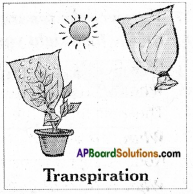
AP Board 6th Class Science Solutions Chapter 2 Knowing About Plants 14
What you need: Well-watered potted plant, polythene bags, thread.
What to do:

  • Take a well-watered potted plant.
  • Enclose a leafy branch of the plant in a polythene bag and tie its mouth.
  • Take another polythene bag and tie its mouth without keeping any plant.
  • Keep both polythene bags under the sun.

AP Board 6th Class Science Solutions Chapter 2 Knowing About Plants

What do you see:

  • We see some droplets in the polythene bag that ties on the plant.
  • There are no droplets in another polythene bag.

What do you learn: Plants release excess water in the body through the stomata of the leaves.

  • This process of releasing water in the form of vapour by the process called transpiration.

AP Board 7th Class Social Studies Solutions Chapter 18 Caste Discrimination and the Struggle for Equality

SCERT AP Board 7th Class Social Solutions 18th Lesson Caste Discrimination and the Struggle for Equality Textbook Questions and Answers.

AP State Syllabus 7th Class Social Studies Solutions 18th Lesson Caste Discrimination and the Struggle for Equality

7th Class Social Studies 18th Lesson Caste Discrimination and the Struggle for Equality Textbook Questions and Answers

Improve Your Learning

Question 1.
What is the difference between being punished for a mistake and being discriminated against? Was the child Ambedkar being punished or discriminated against?
Answer:
There is a lot of difference between being punished for a mistake and being discriminated against. Punishment is given to those who commit a mistake or a wrong without showing any discrimination. More than that punishment is corporal but discrimination has an effect on one’s psyche, dignity, and character. But the discrimination is shown based on one’s birth and social status. Punishing those who commit wrongs defends the rights of other people. But discrimination denies the people their freedom, equality, respect, and dignity of the victims.
The child Ambedkar did no wrong, so he was not supposed to be punished. But he was discriminated against because of his caste and thus he was denied social equality, self-respect, and dignity.

AP Board 7th Class Social Studies Solutions Chapter 18 Caste Discrimination and the Struggle for Equality

Question 2.
Do you think it is possible to make friends across castes – what kind of problems will you have to overcome this?
Answer:
It is possible to make friends across states. I have no problems.

Question 3.
Our Constitution abolished the practice of untouchability and declared it a crime.
Do you think it has been fully abolished in practice?
Answer:
Article No: 17 abolished the practice of untouchability and declared it to be a crime. But in practice, it has not been fully abolished from society.
One of the main reasons for this is that attitudes change very slowly. Even though persons are aware that discrimination is against the law, they continue to treat people unequally on the basis of their caste, religion, disability, economic status, and gender. It is only when people begin to believe that no one is inferior and that every person deserved to be treated with the dignity that present attitudes can change.

Question 4.
Why do you think people want to marry within their caste? Will this help to preserve caste inequality?
Answer:
A group of people, who follow some common rules and customs, worship the common deities, follow the same profession or work, and are bonded together said to be one caste Every caste has its own identity its own rules and customs, its own deities. Each case wants to keep its own identity by keeping itself into an undivided element. They don’t want to mix with others. They feel it as contamination of caste if their young ones marry other caste people.
If people go on negating inter-caste marriages the caste system keeps on strengthening itself. As it goes on strengthening all the social evils that remain alive, Thus it will help to preserve caste inequality.

AP Board 7th Class Social Studies Solutions Chapter 18 Caste Discrimination and the Struggle for Equality

Question 5.
Savitri Bai Phule was the first headmistress of the country’s first school for girls in Pune. She devoted her life to educating Dalits. She started a night school for agriculturists and laborers. She died while serving plague patients.
Answer:
She was a social reformer along with her husband Jyothi Rao Phule, who played an important role in women’s rights in India during British, rule. She pioneered the campaign for women’s education, staging the first school for girls at Pune in 1848. Savitribai was the first female teacher of the first women’s school in India. In 1852, she opened a school for untouchable girls. Even though she faced many problems, she continued her teaching for the welfare of Dalits.

AP Board 7th Class Social Studies Solutions Chapter 6 Africa

SCERT AP Board 7th Class Social Solutions 6th Lesson Africa Textbook Questions and Answers.

AP State Syllabus 7th Class Social Studies Solutions 6th Lesson Africa

7th Class Social Studies 6th Lesson Africa Textbook Questions and Answers

Improve Your Learning

Question 1.
From Europe, which sea does one have to cross to reach northern Africa?
Answer:
One has to cross the Mediterranean sea from Europe to reach northern Africa.

Question 2.
State three difficulties that the Europeans faced in reaching the interior parts of Africa.
Answer:
The three difficulties that the Europeans faced in reaching the interior parts of Africa are:

  1. Besides attempting to build their colonies in Africa, the Europeans continued to explore the interior of the continent.
  2. They travelled to the source of the Nile in the north.
  3. In the west, they explored the entire valley of the Niger and in the south, they moved northwards from Cape Town.
  4. There they explored the region around the river Zambezi.

AP Board 7th Class Social Studies Solutions Chapter 6 Africa

Question 3.
Name the two large deserts of Africa.
Answer:

  1. The Sahara Desert is in Africa. It extends to Mauritania, Mali, Niger, Chad, Sudan, Morocco, Tunisia, Algeria, Libya, Egypt, Ethiopia and Somalia.
  2. The Kalahari Desert extends in Namibia, Botswana and Angola in South – West of Africa. These deserts are not suitable for agriculture due to scanty rainfall and infertile soils.

Question 4.
a) The zone between the Tropics of Cancer and Capricorn is the zone of ………… climate.
Answer:
Hot.

b) The main vegetation of Savanna lands is …………
Answer:
Grass.

c) The two main rivers emptying themselves into the Atlantic ocean are ………. and ………….
Answer:
Congo, Nigeria.

d) The regions in Africa to the north of the Tropic of Cancer and to the south of the Tropic of Capricorn are of …………. climate.
Answer:
Cold.

Question 5.
Two political maps of Africa have been given in the chapter. Compare the two to find out which European country controlled the present day countries of Nigeria and Zimbabwe?
Answer:
Britain controlled the present day countries of Nigeria and Zimbabwe.

AP Board 7th Class Social Studies Solutions Chapter 6 Africa

Question 6.
Name two countries of Africa where equatorial forests are found.
Answer:

  1. Republic of Congo, Gabon
  2. Cameroon.

Question 7.
What goods did Europeans trade with Africa? What kind of agricultural products did they promote for trade purposes?
Answer:

  1. Gold, copper and diamonds were the Europeans traded with Africa.
  2. Tea, coffee, rubber, tobacco were the agricultural products they promoted for trade purposes.

Question 8.
Who benefited from the slave trade? Why did America need slaves?
Answer:
In the 16th century, many Europeans began migrating to America and started cultivation there. There was plenty of land in America, but not enough people to work in the fields. It was to fulfil this need for additional working hands in America that the slave trade from Africa began. America benefited a lot from the slave trade.

Question 9.
How can you say that the slave trade is highly heinous?
Answer:
The slave trace (Trans Atlantic Slave Trade) is one of the most heinous crimes committed against people over the course of more than 400 years. Millions of Africans were turned from their homes, were deported to the American continent and sold as slaves.
The slave trade resulted in the loss of human life. The savage nature of the slave trade led to the destruction of families, individuals and cultures and the vestiges of the immense loss of human capital to the African continent are still felt to this present day.

AP Board 7th Class Social Studies Solutions Chapter 6 Africa

Question 10.
Read the last para of this lesson Africa and comment on it.
The foreign companies do bring in new technologies and investments into the mining and processing industries, thus creating employment for the local people. However; they use cheap labour to make huge profits which are taken away from the African people most of these companies are also careless about environmental protection and have caused immense damage to the natural environment. This has affected the quality of land and life of the people adversely.
Answer:

  1. Africa is very rich in minerals like coal, copper, tin, etc.
  2. So many of the European countries and their companies to this day control much of the mineral resources of even the independent African countries.
  3. The foreign companies do bring in new technologies and investments into the mining and processing industries, thus creating employment for the local people.
  4. They are using their cheap labour to make huge profits and exploiting the mineral resources.
  5. Most of these companies have caused immense damage to the natural environment which has affected the quality of land life of the local people adversely.
  6. Thus, we can say that the foreign companies are exploiting the mineral wealth of Africa irrespective of the local people’s welfare.

AP Board 3rd Class Telugu Solutions 6th Lesson మేమే మేక పిల్ల

Andhra Pradesh AP Board 3rd Class Telugu Solutions 6th Lesson మేమే మేక పిల్ల Textbook Exercise Questions and Answers.

AP State Syllabus 3rd Class Telugu Solutions Chapter 6 మేమే మేక పిల్ల

చిత్రం చూడండి. ఆలోచించి మాట్లాడండి.

AP Board 3rd Class Telugu Solutions 6th Lesson మేమే మేక పిల్ల 1
ప్రశ్నలకు జవాబులు చెప్పండి.

ప్రశ్న 1.
చిత్రంలోని సన్నివేశాల గురించి మాట్లాడండి ?
జవాబు:
మొదటి చిత్రంలో – పై నున్న పెద్ద చిత్రంలో ఒక పిల్లవాడు – ఒక పెద్దాయనను చేయి పుచ్చుకుని నడిపిస్తున్నాడు. ఇది పెద్దల పట్ల గౌరవం, మానవత్వం.

క్రింద ఉన్న చిత్రంలో – కింద పడిన పిల్లాడిని మరొక పిల్లాడు చేయందించి సహాయం చేస్తున్నాడు. ఇది తోటి వారి పట్ల ఉండాల్సిన స్నేహభావం, మానవత్వం.

మరొక చిత్రంలో – నేల మీద నీళ్ళను తుడిచి ఇంటిని శుభ్రం చేస్తున్నది. ఒక చిన్నారి. ఇది ఇంటి పట్ల ఉండాల్సిన జాగ్రత్త. ఉండవలసిన మంచి లక్షణాలలో పరిశుభ్రత ఒకటి.

ప్రశ్న 2.
చిత్రంలో ఎవరెవరు ఏం చేస్తున్నారు ?
జవాబు:
చిన్నతనం నుండే సామాజిక సృహ కలిగి, సేవాధర్మంతో మెలిగే విధానం ఈ మూడు చిత్రాలలో కనిపిస్తున్నది. నడవలేని పెద్దాయనకు – చేయి పుచ్చుకుని నడిపించడం, కింద పడిన తోటి బాలుడికి చేయందించి లేపటం, ఎవరికీ ఇబ్బంది కలగకుండా కింద పడిన నీటిని వెంటనే శుభ్రం చేయడం అనే పనులు చేస్తున్నారు చిన్నారులు.

AP Board 3rd Class Telugu Solutions 6th Lesson మేమే మేక పిల్ల

ప్రశ్న 3.
మీ తోటి పిల్లలతో మీరు ఎలా ఉంటారు?
జవాబు:
నాతోటి పిల్లలతో స్నేహభావంతో ఉంటాను. ఇచ్చి పుచ్చుకునే గుణం కలిగి ఉంటాను. సహాయకారిగా ఉంటాను. మంచి మాట కలిగి ఉంటాను. అందరూ ఇష్టపడే ప్రవర్తన, గుణాలు కలిగి ఉంటాను.

పిల్లలూ! పై చిత్రం నుండి మీరు రాయగలిగినన్ని పదాలు రాయండి:
జవాబు:

  1. పెద్దాయన, తాతగారు
  2. చేతి కర్ర
  3. కాళ్ళకు చెప్పులు
  4. చిన్న పిల్లవాడు
  5. చిన్న పిల్ల
  6. తుడుపు కర్ర
  7. నీరు
  8. నీళ్ళ లోటాలు
  9. బకెట్
  10. తలుపు

ఇవి చేయండి

వినడం – ఆలోచించి మాట్లాడటం

ప్రశ్న 1.
పాఠంలోని చిత్రాన్ని చూడండి. ఎవరెవరున్నారో! ఏం చేస్తున్నారో చెప్పండి.
జవాబు:
మొదటి చిత్రంలో – ఏరు, ఆకులతో ఊగిపోతున్న కొమ్మ, మేమే (మేమే)
రెండవ చిత్రంలో – కట్టెలతో మండుతున్న మంట, మేమే
మూడవ చిత్రంలో – చెట్టు చుట్టుకున్న ముళ్ళ కంచె, గాలి, మేమే
నాల్గవ చిత్రంలో – వంటవాడు, మేమే ఉన్నారు.
వీళ్ళందరూ ఢిల్లీ వెళ్తున్న మేమేను సాయం కోరుతున్నారు. మేమే వంటవాడిని సాయం కోరింది.

AP Board 3rd Class Telugu Solutions 6th Lesson మేమే మేక పిల్ల

ప్రశ్న 2.
మేకపిల్లకు ఎవరెవరెదురయ్యారో, ఏమిని అడిగారో చెప్పండి.
జవాబు:

  1. మేకపిల్లకు మొదట ప్రవహిస్తున్న ఏరు ఎదురైంది. దానికి అడ్డంగా ఒక కొమ్మ పడి ఉంది. ఆ ఏరు మేక పిల్లతో…… మేక పిల్లా….. మేకపిల్లా! కొమ్మ నాకు బరువుగా ఉంది. దీని ఆకులన్నీ తినమని కోరింది.
  2. తోవలో మంట కనిపించి “ మేకపిల్లా…. మేకపిల్లా…! నేను ఆరిపోతున్నాను, కొంచెం నాలుగు పుల్లలు ఎగదోయమ్మా ! అని అడిగింది.
  3. దారిలో యింకొంచెం ముందు కెళ్ళాక చెట్టుకు ఆనుకుని చల్లగా వీచె ‘గాలి’ ఎదురై…. మేకపిల్లా!… మేకపిల్లా!…. ఈ చెట్టూ చుట్టి ఉన్న ముళ్ళకంచెను జరపవా! గుచ్చు కుంటున్నాయి. అని కోరింది.

ప్రశ్న 3.
మేకపిల్లకు వంటవాడు కాకుండా రాజు ఎదురయితే ఏమి జరిగి ఉండేదో ఊహించి చెప్పండి.
జవాబు:
మేకకు రాజును చూసిన ఆనందం కలిగింది. రాజుగారు ముచ్చటపడి మేకపిల్లను తనతో పాటు తీసికెళ్ళి వంటవాడికి ఇచ్చేవాడు. వంటవాడు తనపని తాను పూర్తి చేసేవాడు. కొన్ని జీవితాలింతే……. “తనకు మాలిన ఆశలు అనర్ధదాయకాలు” ఎవరు ఎక్కడ ఉండాలో అక్కడే ఉండాలి – అప్పుడే క్షేమం. ఇది సృష్టి ధర్మం .

AP Board 3rd Class Telugu Solutions 6th Lesson మేమే మేక పిల్ల

ప్రశ్న 4.
మీరు మేకపిల్ల స్థానంలో ఉంటే ఏం చేసేవారో చెప్పండి?
జవాబు:
1వ జవాబు : అమ్మమాట వింటాను. అమ్మ చెప్పింది చేస్తాను. అమ్మకు చెప్పకుండా ఏ పని చేయను. ఆపదలను కొని తెచ్చుకోను.

2వ జవాబు : జీవితంలో ఎప్పుడూ! ఎక్కడ ఎవరితో అవసరం ఏర్పడుతుందో తెలియదు కనుక- దారిలో ఎదురైన గాలికి, నిప్పుకు, నీటికి సాయం చేస్తాను. ఆపదలో వాటి సాయాన్ని పొంది బయటపడతాను.

చదవడం – వ్యక్త పరచడం

అ) కింది మాటలు ఎవరు ఎవరితో అన్నారో పాఠంలో గుర్తించి రాయండి.

ప్రశ్న 1.
“అమ్మా నాకు తీరిక లేదు. ఢిల్లీకి పోవాలి, రాజును చూడాలి”
జవాబు:
(మేక) “మే మే” – ఏరుతో పలికినది.

ప్రశ్న 2.
” కొంచెం నాలుగు పుల్లలు ఏగదోయమ్మా”
జవాబు:
మంట – మేమేతో పలికినది.

ప్రశ్న 3.
“ఓహూ అలాగా, నేను రాజు దగ్గరే ఉంటా. నాతోరా చూపిస్తా” .
జవాబు:
వంటవాడు మేమేతో పలికాడు.

ప్రశ్న 4.
“చూశావా మరి. నీవు ఎవరికీ సాయం చేయలేదు. మరి నీకెవరు సాయం చేస్తారు?”
జవాబు:
గాలి – మేమేతో పలికినది.

ఆ) కింది పేరాను చదవండి. కింద ఇచ్చిన ప్రశ్నలకు జవాబులు రాయండి.

అనగనగా ఒక కూరగాయల తోట. ఆ తోటలోని కూరగాయలకు పక్షుల్లా ఎగరాలని కోరిక. వనదేవత వరంతో వాటికి రెక్కలు వచ్చాయి. కూరగాయలు ఎగరటం ప్రారంభించాయి. దొండ, కాకర, మిరప హుషారుగా ఎగిరాయి. సొరకాయ, గుమ్మడి కాయలు ఎగరలేక ఆయాస పడుతున్నాయి. క్యారెట్టు, ముల్లంగి, బెండ చక్కర్లు కొడుతూ ఎగురుతున్నాయి.
AP Board 3rd Class Telugu Solutions 6th Lesson మేమే మేక పిల్ల 3
అంతలో ఒక పక్షుల గుంపు కూరగాయల పై దాడి చేసింది. పక్షులు పొడుస్తుంటే తప్పించుకోవడానికి కూరగాయలు – నానా తిప్పలు పడ్డాయి. చివరకి ఎలాగోలా తప్పించుకోవడానికి తోటలోకి చేరాయి. వనదేవతను ప్రార్థించి తమకు రెక్కలు వద్దన్నాయి. తిరిగి వాటి యథాస్థానానికి చేరిపోయాయి.

ప్రశ్న 1.
పై పేరాలో ఉన్న కూరగాయల పేర్లు రాయండి.
జవాబు:
దొండకాయ, కాకర, మిరప, సొరకాయ, గుమ్మడి, క్యారెట్టు, ముల్లంగి, బెండ.

AP Board 3rd Class Telugu Solutions 6th Lesson మేమే మేక పిల్ల

ప్రశ్న 2.
కూరగాయలకు కలిగిన కోరిక ఏమిటి?
జవాబు:
కూరగాయలకు పక్షుల్లా ఎగరాలని కోరిక. కలగింది.

ప్రశ్న 3.
కూరగాయలు చివరకు వనదేవతను ఏమిని ప్రార్థించాయి?
జవాబు:
తమకు రెక్కలు వద్దని ప్రార్థించాయి.

ప్రశ్న 4.
పక్షులు కూరగాయలను ఏమి చేశాయి?
జవాబు:
పక్షులు కూరగాయల పై దాడి చేశాయి. పొడిచి పొడిచి తిప్పలు పెట్టాయి.

ఇ) అ- అభ్యాసంలో ఇచ్చిన పేరా ఆధారంగా కింది వాక్యాలలోని ఖాళీలను పూరించండి.

ప్రశ్న 1.
………………………. వరంతో కూరగాయలకు రెక్కలు వచ్చాయి.
జవాబు:
వనదేవత

ప్రశ్న 2.
…………………….. ఎగరలేక ఆయాసపడ్డాయి.
జవాబు:
సొరకాయ, గుమ్మడికాయ

AP Board 3rd Class Telugu Solutions 6th Lesson మేమే మేక పిల్ల

ప్రశ్న 3.
కూరగాయల ………………………. గుంపు దాడి చేసింది.
జవాబు:
పక్షులు

ప్రశ్న 4.
కూరగాయలు తప్పించుకొని ……………………. లోకి చేరాయి.
జవాబు:
తోట

పదజాలం

అ) ముందు పాఠంలో ‘వికటకవి’ కథను చదివారు కదా! ‘వికటకవి’ పదం ఎటునుండి చదివినా ఒకేలా ఉంటుంది. వీటిని భ్రమక పదాలు అని అంటారు. కింద భ్రమక పదాలను చదవండి. అలాంటివి మరికొన్ని మీరు రాయండి.
ఉదా :
జలజ
మిసిమి
ముత్యము
కిటికి
జవాబు:
ఫులుపు
కనుకు
విరివి
కలక
కులుకు
వారెవా

ఆ) కింది ఆధారాలతో గళ్ళమ పూరించి మాటలు తయారు చేయండి.

AP Board 3rd Class Telugu Solutions 6th Lesson మేమే మేక పిల్ల 4

AP Board 3rd Class Telugu Solutions 6th Lesson మేమే మేక పిల్ల

  1. గోడకు కొట్టేవి (   )
  2. పశువులకు వేసేది (   )
  3. భవనానికి మరో పేరు (   )
  4. పొలం దున్నడానికి ఉపయోగించేది  (   )
  5. పక్షిని ఇలా కూడా పిలుస్తారు (   )
  6. చెక్కతో చేసేది (  )

జవాబు:

  1. గోడకు కొట్టేవి   ( మేకులు )
  2. పశువులకు వేసేది   ( మేత )
  3. భవనానికి మరో పేరు   ( మేడ )
  4. పొలం దున్నడానికి ఉపయోగించేది   ( అరక )
  5. పక్షిని ఇలా కూడా పిలుస్తారు   ( పికం )
  6. చెక్కతో చేసేది  ( బల్ల)

స్వీయరచన

అ) కింది ప్రశ్నలకు సొంత మాటల్లో జవాబులు రాయండి.

ప్రశ్న 1.
పాఠం ఆధారంగా మేకపిల్లకు ఎదురైన సంఘటనల గురించి రాయండి.
జవాబు:
‘ఢిల్లీ వెళదాం- రాజును చూద్దాం’ అని పాడుకుంటూ పరిగెత్తుతున్న మేకపిల్లకు దారి మధ్యలో ఒక ఏరు ఎదురైంది. ఆ ఏరు తనకు అడ్డంగా పడి ఉన్న కొమ్మకున్న ఆకులను తినమని అడిగింది మేకపిల్లను. అమ్మో! నాకు తీరిక లేదు ఢిల్లీ పోవాలి రాజును చూడాలి అని పరిగెత్తుతున్న మేకపిల్లకు తోవలో ఒక మంట ఎదురైంది. ‘నేను ఆరిపోతున్నాను’ ‘కొంచెం నాలుగు పుల్లలు ఎగదోయమ్మా’ అని అడిగింది.

అమ్మో! ఢిల్లీకి వెళ్ళాలి. రాజును చూడాలి. నాకు తీరిక లేదని పరిగెడుతున్న మేకపిల్లకు దారిలో ఒక చెట్టు ఎదురైంది. ఆ చెట్టుమీదగా వచ్చే ‘గాలి’ మేకపిల్లను ఆపి- మేకపిల్లా ! మేకపిల్లా! కాస్త ఆ చెట్టుకు చుట్టూ ఉన్న ముళ్ళ కంచెను జరపవూ – నాకు ముళ్ళు గుచ్చుకుంటున్నాయి అని అడిగింది.

అమ్మో! నేను ఢిల్లీ వెళుతున్నా, రాజును చూడాలి నాకు తీరకలేదు ఫో ఫో అని పరిగెడుతున్న మేకపిల్ల ఢిల్లీలో అడుగు పెట్టింది. ఆ గందరగోళం చూసి ఎటు వెళ్ళాలో తెలియక ఆలోచిస్తున్నది. అంతలో- రాజుగారి కోటలోని వంటవాడిని ఆశ్రయించింది. వంటవాడు మేకపిల్లను తెచ్చి వండబోయాడు.

ప్రశ్న 2.
మే మే మేకపిల్లకు గాలి ఏమని హితబోధ చేసింది?
జవాబు:
గాలికి జాలివేసి ” చూశావా మరీ, నీవు ఎవరికీ సాయం చేయలేదు. మరి నీకెవరు సాయం చేస్తారు! అని హిత బోధ చేసింది.

AP Board 3rd Class Telugu Solutions 6th Lesson మేమే మేక పిల్ల

ప్రశ్న 3.
మీరెప్పుడైనా అమ్మ వద్దన్న పనులు చేసారా? ఏమిటవి?
జవాబు:
విద్యార్థి కృత్యము.

సృజనాత్మకత

అ) కింది చిత్రాల ఆధారంగా సంభాషణలు రాయండి.

AP Board 3rd Class Telugu Solutions 6th Lesson మేమే మేక పిల్ల 5
జవాబు:
గాలి : నువ్వు చాలా మారిపోయావు
మేక : అవును ఇకనుండి మనం స్నేహితులం

AP Board 3rd Class Telugu Solutions 6th Lesson మేమే మేక పిల్ల 6
జవాబు:
నిప్పు : నువ్వు చాలా మారిపోయావు
మేక : అవును ఇకనుండి మనం స్నేహితులం

AP Board 3rd Class Telugu Solutions 6th Lesson మేమే మేక పిల్ల 7
జవాబు:
ఏరు : నువ్వు చాలా మారిపోయావు
మేక : అవును ఇకనుండి మనం స్నేహితులం

ప్రశంస

మీ ఇంటికి వచ్చిన స్నేహితులను మీరు ఎట్లా గౌరవిస్తారో చెప్పండి.
జవాబు:
ముందుగా సాదరంగా ప్రేమతో లోపలకి ఆహ్వానిస్తాను. కుర్చీలు చూపించి కూర్చోమంటాను. త్రాగటానికి మంచినీరు ఇస్తాను. వాళ్ళ రాకకు కారణం తెలుసుకుని వారితో చక్కటి సంభాషణ చేస్తాను. వారు నానుండి కోరుకుంటున్న విషయానికి సాయం చేస్తాను.

AP Board 3rd Class Telugu Solutions 6th Lesson మేమే మేక పిల్ల

వారు వచ్చిన సమయాన్ని బట్టి అల్పాహారానికి గాని, భోజనానికి గాని, ఆహ్వానించి అమ్మ చేసిన రుచికర మిఠాయిలను గాని తినిపిస్తాను. వారిపట్ల ఈ విధంగా స్నేహ పూరిత గౌరవాన్ని చూపిస్తాను.

ప్రాజెక్టుపని

ఏవైనా జంతువుల కథలను సేకరించి మీ తరగతిలో ప్రదర్శించండి.
జవాబు:
విద్యార్థి కృత్యము.

భాషాంశాలు

అ) కింది వాక్యాలు చదవండి. గీత గీసిన పదాలు గమనించండి.

  1. విజయ్ తెలివైన బాలుడు
    అతడు మూడవ తరగతి చదువుతున్నాడు.
    AP Board 3rd Class Telugu Solutions 6th Lesson మేమే మేక పిల్ల 8

మొదటి వాక్యంలో ‘విజయ్’ నామవాచక పదం కదా! రెండవ వాక్యంలో ‘అతను’ అనే పదాన్ని ‘విజయ్’కి బదులుగా వాడారు. ఇలా నామవాచకాలకు బదులుగా వాడే పదాలను సర్వనామాలు’ అంటారు.
అతడు, ఆమె. అది, మేము, నేను, వారు, వీరు మొదలైనవి “సర్వనామాలు”

ఆ) కింది పట్టికలోని సర్వనామాలను గుర్తించి రాయండి.

లత, అతను, ఆమె, వీరు, రాజు, చిలుక, అది, చెట్టు, వారు, ఇతను, మేము, వనజ, బడి, నేను, నీవు మనం
ఉదా : మనం
జవాబు:

  1. అతను
  2. ఆమె
  3. వీరు
  4. అది
  5. వారు
  6. ఇతను
  7. మేము
  8. నేను
  9. నీవు

AP Board 3rd Class Telugu Solutions 6th Lesson మేమే మేక పిల్ల

ఆ) కింది సర్వనామాలను గమనించండి.

నేను  –  మేము/మనం
నీవు  –  మీరు
వాడు/ఆమె  –  వారు/వాళ్లు
వీడు/ఈమె  –  వీరు/వాళ్లు
అది  –  అవి
ఇది  –  ఇవి
జవాబు:
ఏక వచనం  –  బహువచనం
నేను  –  మేము/మనం
నీవు  –  మీరు
వాడు/ఆమె  –  వారు/వాళ్లు
వీడు/ఈమె  –  వీరు/వాళ్లు
అది  –  అవి
ఇది  –  ఇవి

కవి పరిచయం

చందమామ కథలు
1949లో బాపట్లకు చెందిన ఆర్. శకుంతల రచించిన చందమామ కథ
AP Board 3rd Class Telugu Solutions 6th Lesson మేమే మేక పిల్ల 2

పదాలు – అర్థాలు

బుద్ధి = ఆలోచన
వాలకం = తీరు
గందరగోళం = తికమక
అదృశ్యం = మాయం
పొగరు = గర్వం
తిన్నగ = నేరుగా
మరగడం = కాగడం
కాగు = పెద్ద బిందె

AP Board 3rd Class Telugu Solutions 6th Lesson మేమే మేక పిల్ల

ఈ మాసపు పాట

తెలుగు తోట

పల్లవి :
ఎంత చక్కనిదోయి ఈ తెలుగు తోట
ఎంత పరిమళమోయి ఈ తోట పూలు
|| ఎంత ॥

చరణం :
ఏ నందనమునుండి ఈ నారు తెచ్చిరో
ఏ స్వర్ణనదీజలము ఈ మడుల కెత్తిరో
ఎంత వింతల జాతులీ తోటలో పెరుగు
ఈ తోట ఏపులో ఇంత నవకము విరియ
||ఎంత ||
AP Board 3rd Class Telugu Solutions 6th Lesson మేమే మేక పిల్ల 9
చరణం:
ఏ అమృత హస్తాల ఏసురలు తాకిరో
ఏ అచ్చెరల మరుపులితీరు దిద్దిరో
ఈ పూల తీరులో ఇంత తీయందనము
ఈ లతల పోకళ్ళ కింత వయ్యారము
|| ఎంత ||

కవి పరిచయం

కవి : కందుకూరి రామభద్రరావు
కాలము : (31-1-1905 – 8-10-1976)
రచనలు : ‘లెమొగ్గ’, ‘తరంగిణి’, ‘గేయమంజరి’
విశేషాలు : కందుకూరి రామభద్రరావు కవి, విద్యావేత్త,
AP Board 3rd Class Telugu Solutions 6th Lesson మేమే మేక పిల్ల 10

ఈ మాసపు కథ

మేకపోతు గాంభీర్యం

ఒక రోజు ఒక మేక మంద నుండి తప్పిపోయింది. ఇంటిదారి కోసం వెతుకుతూ.. అడివిలోపలికి వెళ్లి పోయింది. చీకటి పడింది. కాని ఇంటికి వెళ్ళే మార్గం కనిపించలేదు. ఏం చేయాలో పాలుపోక అటూ… ఇటూ తిరుగుతున్న దానికి ఒక రాతి గుహ కనిపించింది. అ గుహ లోపలికి వెళ్ళి పడుకుంది.

కొంత సమయం గడిచాక సింహం అక్కడికి వచ్చింది. అ గుహ సింహానిదే . లోపలికి వెళ్ళబోయిన సింహానికి ఆ చికట్లో మిలమిలా మెరుస్తున్న మేక కళ్ళు కనిపించాయి. దాంతో భయపడింది సింహం. లోపలికి వెళ్ళకుండా ఆ రాత్రంతా బయటే కూర్చుంది.

AP Board 3rd Class Telugu Solutions 6th Lesson మేమే మేక పిల్ల

సింహం జాడ పసికట్టిన మేకపోతు కూడా భయంతో గడగడ వణికిపోయింది. ‘ అమ్మో ఇది సింహం గుహా? తెలీక వచ్చి చిక్కుకుపోయాను. దాని కంట్లో పడితే ఇంకేమైనా వుందా! గుటుక్కున మింగేయదూ.. ఎలా ఆపద నుండి గట్టేక్కేది’ అనుకుని వున్న చోటే కూలబడి పోయింది మేకపోతు.

తెల్లవారింది. మేకపోతు దడదడలాడే గుండెను చిక్కబట్టుకుంది. పైకి మాత్రం ధైర్యం ప్రదర్శిస్తూ గుహబయటకు వచ్చింది. ” ఏయ్ ఎవర్నువ్వు? ” సింహాన్ని గద్దించి అడిగింది. ఆ గద్దింపు వినగానే సింహం భయంగా ” అయ్యా నేను ఈ అడివికి రాజుని. తమరెవరు?” అంది.

” నా గురించి నీవు వినలేదా? ఇప్పటి వరకు నేను తోంభై తొమ్మిది సింహాలను చంపి తిన్నాను. నూరు సింహాలను చంపితే కాని నా గెడ్డం తీయనని వ్రతం పట్టాను. నీకోసమే ఎదురు చూస్తు నీ గుహలోనే మాటు వేసాను. నిన్ను చంపితే నా వ్రతం పూర్తవుతుంది” అని మేకపోతు గంభీరంగా అంది.

అంతేకాదు రెండు కాళ్ళు పైకెత్తి సింహం మీదకు దూకడానికి సిద్ధం అయింది. మేకపోతు మాటలు నమ్మిన సింహం భయపడి అక్కడి నుండి పారిపోయింది. ఈ విధంగా ఉపాయంతో అపాయాన్ని తప్పించుకుంది మేకపోతు.
AP Board 3rd Class Telugu Solutions 6th Lesson మేమే మేక పిల్ల 11

AP Board 7th Class Science Important Questions Chapter 11 Respiration in Organisms

AP State Syllabus AP Board 7th Class Science Important Questions Chapter 11 Respiration in Organisms

AP State Syllabus 7th Class Science Important Questions 11th Lesson Respiration in Organisms

7th Class Science 11th Lesson Respiration in Organisms Important Questions and Answers

Question 1.
What is breathing?
Answer:
The process by which air goes in and out of our body is called breathing.

Question 2.
What is inspiration and expiration ?Explain the term ‘respiration rate’.
Answer:

  1. The process of breathing in air is called inspiration and that of breathing out air is called expiration.
  2. The number of times we breathe in and breathe out air in a minute is called the respiration rate.

AP Board 7th Class Science Important Questions Chapter 11 Respiration in Organisms

Question 3.
What does our breath contain?
Answer:

  1. We know that we inhale and exhale air.
  2. The exhaled air is warm and has moisture in it.
  3. What we do not know is about the gases our body takes from the inhaled air and throws out in exhaled air.
  4. We know that air is a mixture of several gases not only Oxygen and Carbon dioxide, there are others as well. Air also contains several suspended particles.
  5. We inhale all these.
  6. We exhale Carbon dioxide, Oxygen, Nitrogen and other gases.

Question 4.
How does a fish breathe?
Answer:

  1. Observe fishes in an aquarium. Fishes continuously open and close their mouth in water.
  2. Why do the flaps on both sides of the head alternately open and close?
    AP Board 7th Class Science Important Questions Chapter 11 Respiration in Organisms 1
  3. If you look below the flaps, you will see gills. These are the respiratory organs of the fish.
  4. The water that enters the mouth flows through both the gills as it comes out of the flaps.
  5. The gills absorb the oxygen that is dissolved in the water. This oxygen is carried to different parts of the body.

Question 5.
Describe how does a frog take its breathe.
Answer:

  1. We know that frog is able to stay on land, in water and even underground.
  2. To breathe on land it has lungs while it goes deep underground and sleeps twice every year, its moist skin takes over the function of its lungs.
    AP Board 7th Class Science Important Questions Chapter 11 Respiration in Organisms 2
  3. In baby frogs or tadpoles there are special organs like that of fishes called gills.
  4. These gills help them to breathe in water by taking in the air dissolved in water.
  5. Tadpoles of the frog live only in water but the frog lives either on land or in water. Sometimes you may see frogs under the soil also.
    AP Board 7th Class Science Important Questions Chapter 11 Respiration in Organisms 3

AP Board 7th Class Science Important Questions Chapter 11 Respiration in Organisms

Question 6.
Explain the breathing process in cockroach.
Answer:

  1. A cockroach has small openings on the sides of its body.
  2. Other insects have similar openings.
    AP Board 7th Class Science Important Questions Chapter 11 Respiration in Organisms 4
  3. On the underside of the cockroach in each segment, there are small holes which are connected through respiratory tubes in a network.
  4. These help the cockroach to breathe. These holes are called spiracles.
  5. The network of respiratory tubes called trachea take air from these spiracles, circulate it throughout the body, collect it back and send it out through these spiracles.
    AP Board 7th Class Science Important Questions Chapter 11 Respiration in Organisms 5
  6. To know more about this process you may observe a live cockroach by keeping it covered by a transparent bottle or glass.

Question 7.
Describe how does an earthworm breathe.
Answer:

  1. Earthworms breathe through their skin.
  2. It is thin and moist with minute holes.
    AP Board 7th Class Science Important Questions Chapter 11 Respiration in Organisms 6
  3. Through the skin, air passes in and out.
  4. The earthworm thus breathes through its whole body surface.

Question 8.
How do plants respire?
Answer:

  1. In human beings gaseous exchange with the surroundings takes place through nose and mouth.
  2. We know the parts in plants that help in gaseous exchange.
  3. They are stomata present on surface of leaves and lenticels present on the surface of stems.
  4. They respire through them.

AP Board 7th Class Science Important Questions Chapter 11 Respiration in Organisms

Question 9.
At what time plants respire and photosynthesize?
Answer:

  1. In day time plants respire as well as photosynthesize.
  2. At night only part of the process of photosynthesis takes place and carbon dioxide is not used up completely by this process.
  3. Respiration continues at night also.

Question 10.
What is use of oxygen in hospitals?
Answer:

  1. You may have heard of big hospitals keeping cylinders filled with oxygen.
  2. When a person has breathing problems he is given oxygen.
  3. An oxygen mask is fitted to the nose and mouth of the person and a rubber tube connects the mask to the oxygen cylinder.
  4. Sometimes a patient is given oxygen during an operation.

Question 11.
In your opinion does the expiration rate increase or decrease after exercising?
Answer:

  1. The air we breathe in fills our lungs that are located in our chest.
  2. Exercise and running increase the rate of our breathing.

Question 12.
What happens to your chest when you take a breath?
Answer:

  1. Take a length of twine or a measuring tape. Wrap the tape around the chest of one of your friends and measure the width of her / his chest.
    AP Board 7th Class Science Important Questions Chapter 11 Respiration in Organisms 7
  2. Hold the tape lightly and ask your friend to breathe in and out deeply a few seconds.
  3. You find that the chest expands when air is inhaled, it reaches the lungs and chest expands.

Question 13.
What is the difference between inhaled and exhaled air?
Answer:

  1. Exhaled air is warm and contains moisture and carbon dioxide.
  2. Inhaled air is at room temperature and contains oxygen along with other gases.

AP Board 7th Class Science Important Questions Chapter 11 Respiration in Organisms

Question 14.
How long a person can hold his / her breath? How do you find?
Answer:

  1. Use a watch with a seconds needle to time our breathing.
  2. If we don’t have a watch, then practice counting at a uniform rate.
    AP Board 7th Class Science Important Questions Chapter 11 Respiration in Organisms 8
  3. We can measure the time by counting.
  4. Close our mouth and close our nose with our fingers so that air cannot pass through it.
  5. We can find the time for how long could we keep our mouth and nose closed.

Question 15.
How many breathes do you have in a minute?
Answer:

  1. Hold a finger under the nose of one of your friends.
  2. The side with the fingernail should face the nostrils.
    AP Board 7th Class Science Important Questions Chapter 11 Respiration in Organisms 9
  3. Ask your friend to breathe in and out normally.
  4. When your friend exhaled your finger felt the warmness of the air.
  5. Using this method you can find out how many times your friend inhales and exhales in a minute.

Question 16.
How much air do you breath? Do a simple activity to know it?
Answer:

  1. Make a measuring cylinder with a two-litre plastic bottle and 100 ml injection bottle.
  2. To do this, pour 100 ml of water at a time in the bottle and mark the water level after each addition.
  3. Now fill the bottle to the brim and invert it in a bucket or a large container of water.
  4. But remember, no air bubbles should remain in the bottle after you invert it.
    AP Board 7th Class Science Important Questions Chapter 11 Respiration in Organisms 10
  5. Insert one end of a rubber tube into the mouth of the bottle under water.
  6. Hold the other end of the tube in your hand. Inhale as much air as you can and blow the air into the measuring cylinder through the rubber tube.
  7. Don’t breathe in while blowing the air out.
  8. Blow out as much air as you can in a single breath.
  9. This air will collect in the measuring cylinder.
  10. As a result,-the water level in the cylinder will fall.
    The reduction in water level is equal to the air you breath.

AP Board 7th Class Science Important Questions Chapter 11 Respiration in Organisms

Question 17.
How do you find the gases that are present in our breath? Describe the activity you perform.
Answer:

  1. Set up the apparatus shown in Figure (a) for this experiment. Be careful while inserting the glass tube in the cork. It could break. So take the help of your teacher to do this.
    AP Board 7th Class Science Important Questions Chapter 11 Respiration in Organisms 11
  2. Fill both boiling tubes one fourth with phenolphthalein solution. Mark them A and B.
  3. Now repeatedly blow in and suck out air in this apparatus as shown in Figure (b).
    AP Board 7th Class Science Important Questions Chapter 11 Respiration in Organisms 12
  4. Note the boiling tube in to which air flows when you suck in air.
  5. Note the boiling tube through which air flows out when you blow out air.
  6. You find that there is a difference between inhaled air and exhaled air.
  7. Repeat the experiment by replacing the boiling tubes with lime water filled one fourth in them.
  8. You will find that the lime water in the tube through which exhaled air passed turned milky.
  9. This indicates that the exhaled air contains carbon dioxide.
  10. The table given here under shows the components in the inhaled air and exhaled air.
    AP Board 7th Class Science Important Questions Chapter 11 Respiration in Organisms 13

Question 18.
How can you find out the respiration in plants by an experiment?
Answer:

  1. Take a conical flask. Fit a two-holed rubber cork tightly into its mouth and insert glass tubes into the two holes.
  2. Fit a rubber tube on one of the glass tubes and a funnel on the other. If the funnel does not sit tightly on the glass tube, make a funnel with an ink dropper.
  3. Fill a test tube about one-fourth with lime water and dip the rubber tube into it.
  4. Now add water to the funnel drop by drop. Keep adding water till the conical flask is filled one-fourth with water. Observe the test tube carefully while you add water.
  5. You find no change in the colour of lime water.
  6. Now remove the water from the conical flask and put some flowers and buds in it. Fit a cork on the flask and let it stand for half an hour.
  7. Now add water drop by drop to the conical flask through the funnel as you did in the previous experiment. Look carefully at the test tube while doing so.
  8. The lime water turns milky indicating the release of carbon dioxide.
  9. This is how plants respire. They take oxygen and release carbon dioxide.

AP Board 7th Class Science Important Questions Chapter 11 Respiration in Organisms

Question 19.
How do you find respiration in sprouted seeds?
Answer:

  1. Take sprouted seeds is the conical flask.
  2. Pour water drop by drop in to the funnel through the funnel.
    AP Board 7th Class Science Important Questions Chapter 11 Respiration in Organisms 14
  3. The released gases are allowed to pass through lime water.
  4. Lime water turns milky indicating the release of carbon dioxide.
  5. Sprouted seeds respire taking oxygen and releasing carbon dioxide.

Question 20.
Write a note on the discovery of carbon dioxide.
Answer:

  1. The first step towards trying to find out what air contained was carried out by Von Helmont.
    AP Board 7th Class Science Important Questions Chapter 11 Respiration in Organisms 15
  2. He conducted an experiment of burning charcoal which leads to the formation of ash.
  3. He found the weight of ash to be much less as compared to charcoal.
  4. On the basis of this, he concluded that the decrease in mass was due to the formation of an invisible substance which he named “gas”.
  5. In the year 1756, Joseph Black studied this gas in more detail.
    AP Board 7th Class Science Important Questions Chapter 11 Respiration in Organisms 16
  6. He found that when limestone is heated or reacted with acids, it gives rise to a gas which he called “fixed air”.
  7. He studied several properties of this gas. One of the properties was, lime water turned milky when this gas was passed through it.
  8. Now we know this gas as carbon dioxide.

AP Board 7th Class Science Important Questions Chapter 11 Respiration in Organisms

Question 21.
How is oxygen discovered? Write the history of its discovery.
Answer:

  1. After nearly two decades of discovery of carbon dioxide, oxygen was discovered.
  2. Joseph Priestley, published his“Experiments and observations on different kinds of air” and was the first to prove the different qualities of the gases released by plants and the one’s exhaled by animals (mice).
    AP Board 7th Class Science Important Questions Chapter 11 Respiration in Organisms 17
  3. He discovered that, although a candle burned out in a closed container, when he added a living sprig of mint to the container, the candle would continue to burn.
  4. At the time, Priestley did not know of Oxygen, but he correctly concluded that the mint sprig “restored” the air that the burning candle (or mice which he used in a similar set of experiments) had spoiled.
  5. Priestley shared his observations with Lavoiser.
    AP Board 7th Class Science Important Questions Chapter 11 Respiration in Organisms 18
  6. Lavoiser had also conducted several experiments on atmospheric air and knew that it contained many gases, and he identified Priestley’s discovery as the active component of air for which he had been searching.
  7. He called it oxygen (Greek: acid former), in the belief that all acids contained it.

Question 22.
Do plants respire?
Answer:

  1. Plants respire like us.
  2. But it is difficult to observe this through experiments.
  3. Both plants and animals use oxygen during respiration.

Question 23.
Read the table and answer the following questions.

Respiratory organName of the organism
GillsFish, Tadpole
SkinFrog, Earthworm
TracheaScorpion, Cockroach, Grasshopper
LungsFrog, Hen, Man
  1. Which animals respire through the trachea?
  2. Why does fish respire only in water?
  3. In how many ways does frog respire?
  4. Give some more examples for animals that respire with lungs.

Answer:

  1. Scorpion, Cockroach, Grasshopper.
  2. Gills are the respiratory organs of the fish. The gills absorb the oxygen that is dissolved in water. Hence, fish respire only in water.
  3. Gills, Lungs, Skin.
  4. Frog, Monkey, Man.

AP Board 7th Class Science Important Questions Chapter 11 Respiration in Organisms

Question 24.
Name the respiratory organs of the following animals,
a) Fish b) Earthworm
Answer:
a) Fish ——– Gills.
b) Earthworm ——– Skin.

Question 25.
Read the table. Answer the questions given below.

GasesAvailable in Inhaled gas (ml)Available in Exhaled gas (ml)
Oxygen210165
Carbon dioxide0.440
Nitrogen790795

a) Which gas is more in inhaled air?
b) What changes do you observe in the percentage of carbon dioxide in the exhaled air? Where does it come from?
c) How much Oxygen is retained in our body?
d) Which gas is more useful in our respiration process?
Answer:
a) Nitrogen
b) The volume of carbon dioxide is increased. CO2 is released during respiration.
c) 45 ml
d) Oxygen.

Question 26.
Latha’s teacher conducted an experiment in the classroom. Look at the picture and answer the following questions.

  1. What is the aim of this experiment?
  2. Which equipment is required to conduct this experiment?
  3. Which gas is released during the experiment?
  4. What other material can be used in this experiment instead of seeds?

Answer:

  1. To prove that respiration takes place in plants.
  2. Conical flask, a two-holed rubber cork, test tube, funnel, rubber tube and lime water.
  3. CO2 (Carbon dioxide)
  4. Moong, Bengal gram.

AP Board 6th Class Science Solutions Chapter 5 Materials: Separating Methods

AP State Syllabus AP Board 6th Class Science Solutions Chapter 5 Materials: Separating Methods Textbook Questions and Answers.

AP State Syllabus 6th Class Science Solutions 5th Lesson Materials: Separating Methods

6th Class Science 5th Lesson Materials: Separating Methods Textbook Questions and Answers

Improve Your Learning

Fill in the Blanks.

1. Combination of more than one substance forms a ——–.
Answer:
Mixture
2. The method used to separate stones from rice is ——–.
Answer:
handpicking
3. The process in which a substance changes directly from solid to gaseous form and vice-versa is called ——–.
Answer:
Sublimation

AP Board 6th Class Science Solutions Chapter 5 Materials: Separating Methods

Choose the Correct Answer.

1. Which of the following does not change its shape?
A) Solid
B) Liquid
C) Gas
D) None of these
Answer:
D) None of these

2. This method is useful for the separation of dissolved substances from a liquid
A) Sedimentation
B) Chromatography
C) Crystallization
D) Filtration
Answer:
C) Crystallization

3. Chromatography is the method used to separate
A) Mud from Water
B) Colours
C) Impurities from water
D) Husk from grains
Answer:
B) Colours

Answer the Following Questions.

Question 1.
List five things that we can make using each of the following materials:
a) glass b) metal c) plastic d) wood
Answer:
A) Five things made of glass:

  1. Drinking a glass
  2. Glass bowl
  3. Glass paperweight
  4. Glass jar
  5. Glass beaker
  6. Round bottomed glass flask

B) Five things made of metal:

  1. Metal metre scale
  2. Metal box
  3. Metal sheet
  4. Metal cauldron
  5. Metal pan

C) Five things made of plastic:

  1. Plastic chair
  2. Plastic comb
  3. Plastic bottle
  4. Plastic cup
  5. Plastic bags
  6. Plastic dish

D) Five things made of wood:

  1. Wooden chairs
  2. Wooden doors
  3. Wooden tables
  4. Wooden almirah
  5. Wooden sheet
  6. Wooden cot
  7. Wooden cup-board

AP Board 6th Class Science Solutions Chapter 5 Materials: Separating Methods

Question 2.
Why is handpicking necessary after winnowing?
Answer:

  1. During winnowing, only husk and light particles can be separated from grains.
  2. But small stones and clay pieces will remain in the grains heap as they are heavy.
  3. To remove these stones and other particles, we have to pick them by hand and separate them.
  4. Hence handpicking is necessary after winnowing.

Question 3.
Which separation process is used when one component is in a mixture,
a. Heavier than the other?
b. Bigger than the other?
c. Different shape and colour from the other?
d. One is soluble in water and the other is not?
e. One floats and the other sinks in water?
Answer:
a) Winnowing
b) Sieving
c) Handpicking
d) Filteration
e) Decantation

Question 4.
Siri saw a ship travelling on a sea. She knows that iron nail sinks in water. She has many doubts. What are her doubts? Write them.
Answer:

  1. Why is the ship not sinking in water though it is made up of iron?
  2. Does iron float in salty water?
  3. Why did such a huge body like ship not sink in sea?
  4. What is the secret of ships floating in the sea?
  5. What is the science behind this floating?

Question 5.
We use so many wooden items in our daily life. Is it good to use wood? What happens by excessive use of it? What is the reason? Is there any alternative for this?
Answer:

  1. In fact it is good to use wooden items then the plastic items as it is biodegradable.
  2. But excessive use of it may lead to deforestation as we have to cut more trees for making wooden items.
  3. It may lead to several consequences such as
    i) disturbance in the water cycle,
    ii) decrease in rainfall,
    iii) decrease in the amount of oxygen in the atmosphere,
    iv) increase in carbon dioxide and pollution,
    v) imbalance in nature etc,
  4. We can use items made up of bamboo instead of wood as bamboo is a type of grass and grow quickly when compared to woody trees.
  5. We can also use items made up of metals as they lost longer and can be recycled.

Question 6.
How can you get your own distilled water in the laboratory?
Answer:
Aim: To get distilled water from normal water.
What do you need? (Materials required):
1. Water, 2 conical flasks, 2 one holed rubber cork, delivery tube, bunsen burner, stand.
What to do? (Procedure):

  1. Fill a conical flask with water, close it with a cork having a hole.
  2. Take another conical flask with a cork having a hole.
    AP Board 6th Class Science Solutions Chapter 5 Materials Separating Methods 1
  3. Connect both flasks with a delivery tube.
  4. Now heat the flask containing water using a burner.

What do you see? (Observation): After some time, water vapour goes into the second conical flask through the delivery tube. The water vapour will slowly turn to water.
What do you learn? (Result) : This water is called a distilled water. It is free from impurities.
Thus Impurities can be removed from water by distillation get our own distilled water.

AP Board 6th Class Science Solutions Chapter 5 Materials: Separating Methods

Question 7.
Draw a labelled diagram showing the experimental setup required for the sublimation of camphor?
Answer:
AP Board 6th Class Science Solutions Chapter 5 Materials Separating Methods 2

Question 8.
We know that a ship, even though it is made up of tonnes of iron, floats on water. How do you feel about the scientists who found the scientific principles and efforts in making a ship?
Answer:

  1. The ship is so constructed that it is full of air which keeps it a float.
  2. Air makes the ship lighter than the surrounding water.
  3. The displaced water of the ship pushes back up against the ship holding it up.
  4. The observation of the scientists who felt that the shape of the ship can hold more air to make it light made them to construct this.
  5. Observation of scientists as well as putting it to practical use is very much appreciable on the part of the scientists.

Activities and Projects

6th Class Science Textbook Page No. 58

Question 1.
Drop an egg in a beaker of water. Now drop the same egg in another beaker of water in which excessive salt is added. Write your observation.
Answer:

  1. When the egg is droped in a beaker of water the egg sinks in the water.
  2. When the egg is droped in the beaker of water in which excessive salt is added, the egg floats in that water.
  3. In the first case the density of water is less so no upward force act on the egg to float.
  4. But in the later case salt water density is more then normal water, so it exerts upward force on the egg as a result egg floats.

Question 2.
Do the following activities. Write down your observations. What do you conclude.
a. Mix chalk powder in water.
b. Place a piece of candle in water.
c. Add some oil drops to a beaker of water.
Answer:
a) Chalk powder is insoluble in water and is precipitated in water.
b) The candle floats in water. The density of the candle is less than the density of water.
c) The oil drop spreads as a thin film on the water surface. The density of oil is less than the density of water.

Question 3.
Make a list of items from your kitchen like utensils, food ingredients etc. Classify them as sinks /floats and soluble/insoluble.
Answer:

S. No.ItemSink/Float in waterSoluble / Insoluble in water
1.Plastic glassfloatinsoluble
2.Steel glasssinkinsoluble
3.Sugarsinksoluble
4.Oilfloatinsoluble
5.Saltsinksoluble
6.Pansinkinsoluble
7.Ricesinkinsoluble
8.Green chillifloatinsoluble

AP Board 6th Class Science Solutions Chapter 5 Materials: Separating Methods

Question 4.
Is it possible to separate sugar mixed with wheat flour? If yes, how will you do it? If powdered sugar is mixed with wheat flour, how do you separate them?
Answer:

  1. Yes. This can be done through the process of sieving.
  2. The mixture of sugar and wheat flour is allowed to pass through a sieve.
  3. The fine wheat flour passes through the sieve while sugar remains on the sieve.
  4. To separate powdered sugar from wheat flour, first we have to add excess water to the mixture of powdered sugar with wheat flour.
  5. As sugar is soluble in water it get dissolves in water.
  6. Wheat flour is insoluble in water so it settles down.
  7. Now wheat flour can be separated from sugar solution by decantation or filtration.
  8. Now sugar can be obtained from sugar solution by crystallization (heating till the water evaporates leaving behind the sugar in crystalized form).

6th Class Science 5th Lesson Materials: Separating Methods Activities

Activity – 1

Finding the materials used to make different objects. (Page No. 46)

1. A list of things in a house are given in table. Name the materials from which each object is may possibly be made of:

S.No.ObjectMaterial
1.t) oorWood, metal, rubber, paint.
2.Towel
3.Eraser
4.Knife
5.Mirror
6.Shoes
7.Water bottle
8.Pot

Answer:

S.No.ObjectMaterial
1.DoorWood, metal, rubber, paint.
2.TowelCotton, dye.
3.EraserSynthetic rubber, synthetic soy based gum, vinyl
4.KnifeWood, stainless steel.
5.MirrorGlass, metal or wooden or plastic frame.
6.ShoesLeather or cotton or rubber
7.Water bottlePlastic or glass or fibre
8.PotClay

i) Which objects are made of one material?
Answer:

  1. Pot
  2. Towel (if not dyed)
  3. Shoes
  4. Water bottle.

ii) Which objects are made of more than one material?
Answer:

  1. Door
  2. Rubber
  3. Knife
  4. Mirror

iii) How many materials can be used for making chairs? List them.
Answer:
AP Board 6th Class Science Solutions Chapter 5 Materials Separating Methods 3

  1. Wood
  2. Iron nails
  3. Plywood

AP Board 6th Class Science Solutions Chapter 5 Materials: Separating Methods

Activity – 2

Finding the objects made from different materials: (Page No. 47)

2. Name as many things/objects as you can, made using the materials given in the table shown.

S. No.MaterialThings/Objects
1.MetalUtensils……….
2.PlasticBag,……..
3.GlassMirror,……….
4.WoodTable,……..
5.CottonCloth,………
6.LeatherShoes,……..
7.CeramicCup……….
8.RockIdols,……….

Answer:

S. No.MaterialThings/Objects
1.MetalUtensils, chairs, cots, crowbar, pans
2.PlasticBag, chairs, combs, tubs, buckets, covers
3.GlassMirror, window pans, spectacles, paper weight, jars
4.WoodTable, chair, windows, doors, rafters
5.CottonCloth, sarees, covers, dress, shoes
6.LeatherShoes, purses, belts, suitcases, bags
7.CeramicCup, saucers, plates, plugs, tails
8.RockIdols, statues, walls, paper weights, buildings

Activity – 3

Light a candle (Page No. 48)

3. You may have lit a candle with a matchstick many times, holding the burning matchstick to touch the wick of the candle until the wick catches fire. But, can you light the candle without touching the wick with a burning matchstick? Do you think this is impossible? Let us see how it can be done.
Answer:
AP Board 6th Class Science Solutions Chapter 5 Materials Separating Methods 4

  1. A candle is taken and is lighted. The candle is lit only when the burning match stick touched its wick.
  2. When the candle is burning at the bottom of the wick liquid wax can be observed.
  3. White smoke is observed over the flame of the candle, when the flame is put off. This is the vapour state of wax.
  4. If a burning match stick is brought near this smoke, the candle catches fire though match stick does not touch the wick.

i) Did the candle catch fire from a distance?
Answer:
Yes, It catches fire from a distance.

ii) Discuss with your friends how and why the candle got lit from a distance.
Answer:
The candle got lit from a distance because the white smoke rising from the wick is flammable. It catches fire as a result candle got lit.

iii) Does the white smoke represent candle wax in the state of gas?
Answer:
Yes, that white smoke is nothing but the wax in the gaseous state.

AP Board 6th Class Science Solutions Chapter 5 Materials: Separating Methods

Activity – 4

Classification of Materials: (Page No. 49)

4. Think of different solids, liquids and gases around you and group them in the table.
AP Board 6th Class Science Solutions Chapter 5 Materials Separating Methods 5
Answer:

SolidsLiquidsGases
1. StoneMilkSmoke
2. IceWaterSteam
3. WoodKeroseneButane
4. PenInkCarbon dioxide
5. CoalOilCoal gas
6. SaltSea waterChlorine
7. RubberGum pasteIodine vapours

Discuss with your friends and find out who had the longest list. Can you list their properties? For example, liquids take the shape of the container they are put into. Write all possible properties of solids, liquids and gases in your notebook. Discuss them with your friends and teachers.
Answer:
A) Solids:

  1. Solids have a definite shape.
  2. Solids are incompressible.
  3. Solids do not flow.

B) Liquids

  1. Liquids occupy the shape of the container.
  2. Liquids are incompressible.
  3. Liquids can flow.

C) Gases:

  1. Gases have no fixed shape.
  2. Gases can be compressible.
  3. Gases flow and diffuse.

AP Board 6th Class Science Solutions Chapter 5 Materials: Separating Methods

Activity – 5

Sinking or Floating in Water (Page No. 50)

Let us assume that a tomato, brinjal, potato, iron nail, sponge, wood, stone, leaf, piece of chalk and paper are given to you. Predict which of them will sink or float in water. Record your predictions in table.

PredictionObjects
SinksStone …
Floats

Answer:

PredictionObjects
SinksStone, Iron nail, piece of chalk, potato.
FloatsSponge, wood, leaf, paper, tomato, brinjal.

i) Now try to test whether your predictions are correct or wrong by dropping the above objects in a beaker of water one by one. What do you find? Record your observations in the following table.
AP Board 6th Class Science Solutions Chapter 5 Materials Separating Methods 7

AP Board 6th Class Science Solutions Chapter 5 Materials Separating Methods 6
Answer:

ObjectPredictionFinding
StoneSinksSunk
Iron nailSinksSunk
Piece of chalkSinksSunk
TomatoFloatsFloated
BrinjalFloatsFloated
PotatoSinksSunk
SpongeFloatsFloated
WoodFloatsFloated
LeafFloatsFloated
PaperFloatsFloated

ii) For which of these objects your prediction is wrong? Why?
Answer:
1) All my predictions proved correct.
2) I have taken good quality tomato, brinjal and potato.
Now, add a lot of salt to the water in the beaker. Try this same activity with water which is excessively salty..

iii) What do you observe?
Answer:
Some of the objects which sinks previously now began to float.

iv) Do you get the same result? Discuss.
Answer:
No, some of the objects which sink previously now began to float. This is because the density of salt water is more than that of freshwater. As the density of water increases objects with less density than this water will float.

AP Board 6th Class Science Solutions Chapter 5 Materials: Separating Methods

Activity – 6

Do Iron Objects of boat (Page No. 50)

6. i) Take some water in a wide-mouthed bowl. Put an iron nail in it. What do you observe?
Answer:
The wooden nail will sink to the bottom.

ii) Put an empty iron tin in that bowl. What do you observe?
Answer:
The iron tin float on the water.

iii) Also try to observe whether a wooden piece floats on water. What happens when a wooden bowl is dipped in water?
Answer:
When a wooden bowl is dipped in water, it again floats.

iv) What do you conclude from this activity?
Answer:
Some materials in one shape will sink in water but float on water when they are in another shape. The materials that can sink can be made to float, but all the materials that float cannot be made to sink.

Activity – 7

Soluble or Insoluble in Water: (Page No. 51)

7. i) Take five beakers with water. Take small quantities of sugar, salt, chalk powder, sand and sawdust. Add each material to separate beakers and stir- Observe the changes and record your observations in the table.

S.No.Material addedDissolves (Yes /No)
1.Sugar
2.Salt
3.Sand
4.Saw dust
5.Chalk powder

Answer:

S.No.Material addedDissolves (Yes / No)
1.SugarYes
2.SaltYes
3.SandNo
4.Saw dustNo.
5.Chalk powderNo

AP Board 6th Class Science Solutions Chapter 5 Materials: Separating Methods

ii) Repeat the above activity with different liquids like vinegar; lemon juice, coconut oil and kerosene and add them to water. What do you observe? Discuss.
Answer:

S. No.Liquid added to waterDissolves (Yes /No)Soluble/Insoluble
1.vinegarYesSoluble
2.lemon juiceYesSoluble
3.coconut oilNoInsoluble
4.keroseneNoInsoluble

iii) List out the different substances that are used to make the items given in table.

ItemSubstances
TeaMilk……….
Laddu
Lemon Juice
Concrete
Soil

Answer:

ItemSubstances
TeaMilk, Tea powder, Sugar, Elachi
LadduSugar, Boondi, Elachi, Ghee
Lemon JuiceLemon Juice, Sugar, Water
ConcreteSand, Cement, Water, Gravel Iron
SoilFind Sand, Humus, Gravel, Clay, Coarse Sand

iv) Complete the following table.
AP Board 6th Class Science Solutions Chapter 5 Materials Separating Methods 8
Answer:

MixtureComponentsNatural / Man made
Lemon waterLemon juice, water, sugarMan-made
LadduSugar, boodi, elachi, gheeMan-made
ConcreteSand, cement, water, gravelMan-made
SoilFine sand, humus, gravel, clay, coarse sandeNatural
Rock saltSalt – soil – sandNatural

Activity – 8

Sedimentation and Decantation: (Page No. 53)

8. How do you separate mud and sand from muddy water? What is sedimentation and decantation?
Answer:

  1. Take a mixture of soil and water in a glass tumbler and keep it undisturbed for some time.
  2. You will find that the sand and the mud particles in the soil settle down at the bottom of the glass tumbler.
    AP Board 6th Class Science Solutions Chapter 5 Materials Separating Methods 9
  3. These are called sediments and this process of sepa¬ration of mud and sand is called sedimentation.
  4. After sedimentation, the tumbler is gently lifted.
  5. The tip of the tumbler is inclined on the edge of another tumbler without disturbing the sediments.
  6. The water gets separated from the sediment(mud).
  7. This process is called decantation.

i) Why did mud particle settle at the bottom of the tumbler?
Answer:
Mud particles settle at the bottom of the tumbler as they are insoluble in water and heavier in weight.
Sedimentation and decantation are used in your home while cleaning rice and pulses for cooking.

AP Board 6th Class Science Solutions Chapter 5 Materials: Separating Methods

ii) Think of other examples where we use this method of separation and list them.
Answer:
Example of sedimentation are: Tea leaves settling down on cup of tea, soil settling in pond water.
Example of decantation: Oil and vinegar mixture decanting in the experiment, water is poured out from cooked peas etc.

Activity – 9

9. Why can’t we filter salt from salt water? (Page No. 54)
Answer:
Take water in a beaker. Dissolve some salt in it. Filter this mixture with a filter paper.
i) Are you able to separate the salt from the salt water with a niter paper?
Answer:
We cannot separate the salt from the salt water with a filter paper.

ii) Why could you not niter the salt from salt water?

  1. The pores in a filter paper are so minute that we cannot see them with naked eyes.
  2. The dissolved salt particles are very minute and they pass through the filter paper.
  3. So we cannot filter the salt from salt water with a filter paper.

Activity – 10

Crystallization. (Page No. 54)

10. Explain the process of Crystallization.
Answer:
Aim: To separate salt from salt water.
What you need? Salt, water, beaker, glass rod, tripod Stand, Bunsen burner, wire guage.
AP Board 6th Class Science Solutions Chapter 5 Materials Separating Methods 10
What to do?

  1. Heat some salt water in a beaker, over a flame.
  2. Stir the solution with a glass rod.
  3. Continue heating till all the water in the beaker has evaporated.

What do you see? Crystals of salt remain in the beaker.
What do you learn? Salt can be separated from salt water by heating (Crystallization). Some dissolved substances can be separated from the liquids by heating. On heating water evaporates and dissolved substances will form their crystals. This method of separation is called Crystallization.

AP Board 6th Class Science Solutions Chapter 5 Materials: Separating Methods

Activity – 11

Get your own Distilled Water (Page No. 55)

11. How do you prepare distilled water ? (Or) Explain the process of distilling water.
Answer:
Aim To get distilled water from normal water.
What you need?:
1. Water, 2 conical flasks, 2 one holed rubber cork, delivery tube, bunsen burner, stand.
What to do?:

  1. Fill a conical flask with water, close it with a cork having a hole.
  2. Take another conical flask with a cork having a hole.
    AP Board 6th Class Science Solutions Chapter 5 Materials Separating Methods 1
  3. Connect both flasks with a delivery tube.
  4. Now heat the flask containing water using a burner.

What do you see? After some time, water vapour goes into the second conical flask through the delivery tube. The water vapour will slowly turn to water. This water is called a distilled water. It is free from impurities.
What do you learn? Impurities can be removed from water by distillation.

Activity – 12

Sublimation of camphor (Page No. 55)

12. How do you demonstrate the sublimation of camphor?
Answer:
Aim To understand the process of sublimation.
What you need? Mixture of camphor and powdered salt, china dish, funnel, cotton, stand burner.
What to do?

  1. Take a mixture of camphor and powdered salt in a china dish and cover it with a funnel.
  2. Close the tube of the funnel with cotton.
    AP Board 6th Class Science Solutions Chapter 5 Materials Separating Methods 2
  3. Place the dish on a stand and heat it with a burner.

What do you see? When camphor is heated, it transforms to gaseous form without changing into liquid leaving the salt powder in the dish. On reaching the cotton it cools, the gaseous form of camphor changes directly into a solid without going to the liquid state.
What do you learn? The process in which a substance changes directly from solid to gaseous form and vice-versa is called sublimation.

AP Board 6th Class Science Solutions Chapter 5 Materials: Separating Methods

Activity – 13

A Chalk with different colours (Page No. 56)

13. How do you separate colour from a miture of colours?
Answer:

Aim : To separate colours from a mixture of colours (ink).
What you need?: stick of white chalk, ink, plate, water
What to do?:

  1. Take a whole stick of white chalk.
  2. Around the curved surface of the chalk put an ink mark with blue or black ink.
    AP Board 6th Class Science Solutions Chapter 5 Materials Separating Methods 11
  3. Now pour some water in a plate and keep the piece of chalk in the water.
  4. Ensure that the water in the plate is very little and does not touch the ink mark.
  5. Observe the colour patterns that form on the piece of chalk after some time.
  6. Remove the chalk before the water reaches its top.

What do you see?: Different colours are formed around the chalk from the bottom to top.
What do you learn?: The ink appears to be made of a single colour but it is actually a mixture of many colours hidden in it. Those colours are separated by this method. It is an example of chromatography.

AP Board 7th Class Science Important Questions Chapter 7 Electricity – Current and Its Effect

AP State Syllabus AP Board 7th Class Science Important Questions Chapter 7 Electricity – Current and Its Effect

AP State Syllabus 7th Class Science Important Questions 7th Lesson Electricity – Current and Its Effect

7th Class Science 7th Lesson Electricity – Current and Its Effect Important Questions and Answers

Question 1.
What are Series and Parallel electric circuits?
Answer:
A) Series circuits:

  1. In a series circuit, electricity has only one path to flow through.
  2. All the electrical components are connected in this path.
  3. If any one of them is removed or is not functioning properly, the circuit will be incomplete.

B) Parallel circuits:

  1. A parallel circuit has more than one path for the flow of electricity.
  2. Each bulb in the circuit is connected in a separate path through which electricity can flow.

AP Board 7th Class Science Important Questions Chapter 7 Electricity – Current and Its Effect

Question 2.
Describe the effect of connecting electrical cells in series. How would you connect them in series?
Answer:
Connecting Electrical cells in series:

  1. Take a dry cell and torch bulb.
  2. Connect the bulb to a cell using copper wires shown in figure-a. Observe the intensity of light.
    AP Board 7th Class Science Important Questions Chapter 7 Electricity – Current and Its Effect 1
  3. Now take one more dry cell and connect two cells as shown in figure-b.
    AP Board 7th Class Science Important Questions Chapter 7 Electricity – Current and Its Effect 2
  4. In this method the positive terminal of the first cell and the negative terminal of the second cell are connected to the bulb.
  5. .When the cells are connected in series more electricity flows in the circuit and the bulb glows with greater brightness.

Question 3.
Describe the connection of cells in parallel. Draw the circuit diagram also.
Answer:
Connecting Electric Cells in Parallel:

  1. Take three dry cells and connect them as shown in figure-a.
    AP Board 7th Class Science Important Questions Chapter 7 Electricity – Current and Its Effect 3
  2. That is all the positive terminals of the three cells are connected together and all the three negative terminals are connected together.
  3. These three positives and three negatives are connected together to a bulb.
  4. There is no difference in the intensity of the bulb glow compared to that in the case of only one cell.
    AP Board 7th Class Science Important Questions Chapter 7 Electricity – Current and Its Effect 4

AP Board 7th Class Science Important Questions Chapter 7 Electricity – Current and Its Effect

Question 4.
How are electric bulbs connected in series? Where do you find such connections in your daily life? What is the disadvantage with this arrangement?
Answer:
Connecting electric bulbs in series:

  1. Connect three torch bulbs in series as shown in figure.
    AP Board 7th Class Science Important Questions Chapter 7 Electricity – Current and Its Effect 6
  2. Connect this to a dry cell. Observe the brightness of each of the three bulbs.
  3. Now connect one more dry cell in series with the first cell.
  4. Observe the brightness of each of the bulb.
  5. Then connect one more dry cell in series with the first two cells. Again observe the bulbs. The brightness of the bulbs increases with the addition of cells.
  6. In series connection of bulbs, if one bulb gets fused, all the other bulbs in the series will stop glowing.
  7. It means that if one bulb is disconnected the other bulbs do not glow. This is the disadvantage.
  8. This can be observed in serial bulbs used in decorative items at the time of marriages and other festivals.

Question 5.
a) How are electric bulbs connected in parallel?
b) What is, the advantage with this type of connection?
c) Where do you find such connections?
Answer:
Connecting bulbs in parallel:
a)

  1. Connect three bulbs in parallel as shown in figure.
    AP Board 7th Class Science Important Questions Chapter 7 Electricity – Current and Its Effect 5
  2. That is, one end of each of the three bulbs are connected to one wire.
  3. The other ends of the three bulbs are connected to another wire.
  4. These two wires are connected to a cell. All the three bulbs glow dimly.
  5. Now disconnect one of the bulbs.

b)

  1. It means that if one bulb is disconnected the other bulbs continue to glow.
  2. This is the advantage with this type of connection.
  3. This can be observed in our household electric circuit. All components in our houses are connected in parallel.

AP Board 7th Class Science Important Questions Chapter 7 Electricity – Current and Its Effect

Question 6.
What are the advantages of using tube lights and compact fluorescent lamps.
Answer:

  1. Wastage of electricity can be reduced by using fluorescent tube lights in place of the bulbs, as shown in figure, (a).
    AP Board 7th Class Science Important Questions Chapter 7 Electricity – Current and Its Effect 7
  2. Compact Fluorescent Lamp (CFLs) shown in figure, (b) also reduces wastage and can be fixed in ordinary bulb holders.
    AP Board 7th Class Science Important Questions Chapter 7 Electricity – Current and Its Effect 8
  3. The ISI mark of a lamp ensures that the appliance is safe.

Question 7.
What is an electric fuse? Explain its importance. How does it work?
Answer:
Electric Fuses:

  1. When excessive electric current flows through a circuit the wires or the appliances may get heated and can catch fire.
  2. To avoid fire, a safety device known as a fuse is connected in series in the circuit.
  3. A fuse is a small piece of wire as shown in figure.
    AP Board 7th Class Science Important Questions Chapter 7 Electricity – Current and Its Effect 9
  4. It is made of a special alloy that gets heated quickly and melts.
  5. If the current in the circuit is too high, the fuse wire gets hot and melts.
  6. This leaves a gap in the circuit. Automatically the circuit is broken and flow of electricity is stopped.
  7. This protects appliances from getting burnt due to the passage of too large a current through them.

AP Board 7th Class Science Important Questions Chapter 7 Electricity – Current and Its Effect

Question 8.
What is a Miniature Circuit Breaker (MCB)? What is its advantage? For which mark should we look at it?
Answer:
Miniature Circuit Breaker (MCB):

  1. These days Miniature Circuit Breaker (MCB) is increasingly being used in place of fuses.
  2. These are switches which automatically turn off when current in a circuit exceeds the safe limit.
  3. It has a switch which goes OFF automatically if there is overheating.
    AP Board 7th Class Science Important Questions Chapter 7 Electricity – Current and Its Effect 10
  4. This breaks the circuit. If we turn them on, the circuit is once Miniature Circuit again complete.
  5. The advantage miniature circuit breakers have over fuses is that they can be reset (manually or automatically) to restore normal operation, whereas fuses need to be replaced after every single operation.
  6. The MCB can be reset by hand and the circuit becomes complete once again.
  7. Look for ISI mark on MCBs.

Question 9.
What are the inventions of Michael Faraday?
Answer:
Michael Faraday (1791-1867): Michael Faraday observed that by moving a magnet in and out of a coil we can make electric current flow through the coil. Using this he built the first electric generator or dynamo in 1831. He also invented the transformer.

Question 10.
What is the importance of symbols? What role do they play in our life?
Answer:

  1. We know about symbols. We do indicate to our teacher that we wish to go out to drink water.
  2. We know the signs for addition, subtraction, multiplication and division.
  3. We might have used the symbols for ‘greater than’, ‘less than’, ‘equal to’ etc.
  4. Symbols play an important role in our life.
  5. They convey precise meaning with few descriptions.
  6. Some common electric components can be represented by standard symbols.

Question 11.
What happens to the electric bulb when the current is passed?
Answer:

  1. The bulb becomes hot when we put it on for some time.
    AP Board 7th Class Science Important Questions Chapter 7 Electricity – Current and Its Effect 11
  2. It is the filament of the bulb that heats up due to current flowing through it.

AP Board 7th Class Science Important Questions Chapter 7 Electricity – Current and Its Effect

Question 12.
What do you understand by the term ‘the filament of an electrical appliance’?
Answer:

  1. We have seen an electric iron, electric cooker and electric heater.
    AP Board 7th Class Science Important Questions Chapter 7 Electricity – Current and Its Effect 12
  2. All these contain a coil of wire made up of Nichrome.
  3. This coil is called a filament of the appliance.

Question 13.
What happens when electrical appliances like electric iron, electric heater etc., are switched on?
Answer:

  1. We have noticed that when these appliances electric heater, electric iron are switched on, their filaments become red hot and give out heat.
  2. The amount of heat produced in a wire depends on its materials, length and thickness.
  3. Thus, for different requirements, the wires of different materials, lengths and thicknesses are used.

Question 14.
What happens when an electric current passes through wires used for making electric circuits and through the elements of some electric appliances?
Answer:

  1. The wires used for making electric circuits do not normally become hot.
  2. On the other hand, the elements of some electric appliances become so hot that they are easily visible.
  3. The filament of an electric bulb gets heated to such a high temperature that is starts glowing and giving out light.

Question 15.
Describe how can you make your own cell. Explain how do you test the working condition of that cell.
Answer:

  1. We will need a few things to make a cell.
  2. First get two injection bottles. Then cut two 3 cm long bits of thick copper wire. Use sandpaper to scrape about 1 cm of the coating off both ends of the wires.
  3. Break open a discharged dry cell and remove its outer metal covering (made of Zinc). Cut two 2 mm wide and 3 cm long strips from this zinc plate.
  4. Insert the copper wires and zinc strips separately into the rubber caps of the injection bottles as shown in Fig.
    AP Board 7th Class Science Important Questions Chapter 7 Electricity – Current and Its Effect 13
  5. Ensure that the copper wires and zinc strips do not touch each other.
  6. Now take a wire and connect the zinc plate of one bottle with the copper wire of the other bottle.
  7. Fill both bottles with sulphuric acid. Carefully close the bottles with the caps in which the copper wires and zinc strips are inserted.
  8. The cell is ready. To test its working take a LED.
  9. Attach two wires to its two terminals. Touch the wire from one terminal to the copper wire of the first bottle and the wire from the other terminal to the zinc plate of the second bottle.
  10. The LED lights up. It means the cell is working.

AP Board 7th Class Science Important Questions Chapter 7 Electricity – Current and Its Effect

Question 16.
What can you see inside a dry cell when it is cut open?
Answer:

  1. With the help of your teacher cut open a dry cell.
    AP Board 7th Class Science Important Questions Chapter 7 Electricity – Current and Its Effect 14
  2. Observe the chemical components in the dry cell.
  3. Inside a dry cell there are certain chemicals which react with one another to produce electric energy.

Question 17.
Think of the main use of electrical appliances and write their names in a table.
Answer:

Question 18.
How is electricity supplied to our houses ? Are we getting it free of cost?
Answer:

  1. Most of the electricity that we use at home and at school is alternating current.
  2. The main electricity that is supplied to our houses comes from power stations and sub-stations distribute electricity.
  3. Electricity is not free of cost.
  4. We have to pay for it according to how much we consume.

Question 19.
How can you know the current consumed in your house?
Answer:

  1. We notice that a person belonging to the electricity department, the meter reader, visits houses every month and takes the meter readings.
    AP Board 7th Class Science Important Questions Chapter 7 Electricity – Current and Its Effect 15
  2. If we look at the meter in our house we will notice a wheel that goes around and the numbers in the window keep changing.
  3. Modern meters have digital displays.

Question 20.
What does the term ’one unit’ mean? How is the usage of electricity measured?
Answer:

  1. If we look at the bulbs used in our home, we will notice that they are marked in watts 25 W, 40W, 60W, 100W.
  2. The wattage measures how ‘powerful’ the bulb is.
  3. The brighter the bulb, the higher its wattage and the more the electricity used by it.
  4. 1 kilowatt (KW) is 1000 watts (W).
  5. When any appliance of 1 Kilo Watt is used for one hour, it uses up one Kilo Watt – hour (KWH) or ‘one unit’ of electricity.
  6. If it runs for two hours it will use up two units of electricity.

AP Board 7th Class Science Important Questions Chapter 7 Electricity – Current and Its Effect

Question 21.
Draw a neat diagram of the dry cell and label its parts.
Answer:
AP Board 7th Class Science Important Questions Chapter 7 Electricity – Current and Its Effect 16

Question 22.
Describe the construction of a dry cell.
Answer:
Description of a dry cell:

  1. A dry cell consists of a container made up of zinc metal.
  2. The container also serves as the negative terminal in the centre.
  3. A carbon (graphite) rod with a metal cap serves as a positive terminal.
  4. The carbon rod is surrounded by a mixture of carbon particles and a chemical called ammonium chloride.
  5. The cell is sealed from the top.
  6. The dry cell can supply electric current in a circuit for a certain time.
  7. After that/its chemicals get exhausted and it cannot be used any more.
  8. Dry cell converts chemical energy into electrical energy.

Question 23.
Write the symbols of some common electric components and describe their use.
Answer:
AP Board 7th Class Science Important Questions Chapter 7 Electricity – Current and Its Effect 17

AP Board 7th Class Science Important Questions Chapter 7 Electricity – Current and Its Effect

Question 24.
Draw a simple switch to close the circuit. For that draw the circuit diagram.
Answer:
AP Board 7th Class Science Important Questions Chapter 7 Electricity – Current and Its Effect 18AP Board 7th Class Science Important Questions Chapter 7 Electricity – Current and Its Effect 19

  1. See figure (a). A bulb, battery and switch are connected as shown.
  2. Can we make this drawing simpler using symbols ?
  3. The picture of circuit using symbols is called a circuit diagram.
  4. Figure (b) shows a circuit diagram of the same circuit as shown in figure (a).

Question 25.
What is a circuit diagram? Explain it appreciating the simplification.
Answer:
Circuit Diagram: The picture of a circuit using symbols is called a circuit diagram.

  1. There should be a source, which is one or more electric cells (battery).
  2. The switch can be placed anywhere in the circuit. If the switch is in the ON position, the circuit is complete from the positive terminal of the battery to its negative terminal.
    AP Board 7th Class Science Important Questions Chapter 7 Electricity – Current and Its Effect 20
  3. The circuit is then said to be closed and the current flows throughout the circuit constantly.
  4. The wires should not have any discontinuity (gaps).
  5. When the switch is in the OFF position, the circuit is incomplete. It is said to be open. No current flows through any part of the circuit.
  6. Observe the sequence in which the cell, bulb and switch are connected in the circuit.
  7. The sequence of components is as follows:
    Positive terminal of the cell → Wire → Switch → Wire → Bulb → Wire → Negative terminal of the cell

Question 26.
Why does the bulb glow brighter and brighter when electric cells are connected in series?
Answer:

  1. The electricity can flow through one path when electric cells are connected in series.
  2. Addition of a cell in such a circuit adds strength to the electricity flowing.
  3. As more electricity flows into the bulb its glow becomes brighter.

Question 27.
Does electric bulb in your house glow with dry cell? Why?
Answer:

  1. The electric bulb in our house does not glow with dry cell.
  2. The electric bulb in our houses glows with the supply of A.C. at high voltage.
  3. Dry cell supplies only D.C. at a low voltage.

Question 28.
Are the cells used in a torch light and wrist watch the same?
Answer:
They are not the same.

AP Board 7th Class Science Important Questions Chapter 7 Electricity – Current and Its Effect

Question 29.
What is the reason for connecting electric bulbs in parallel in household electric appliances?
Answer:

  1. In the house every bulb should glow independently without depending upon the working condition of other bulbs.
  2. This is possible only with parallel connection.
  3. So electric bulbs or electric appliances are connected in parallel in household electric connections.

Question 30.
How do we get a battery?
Answer:
By connecting small cells in series we get a battery.

Question 31.
The meter reading in Ayub’s house in January is 400 units, February 580 units. Calculate how much his parents would have to pay towards electricity bill of February. The unit cost is Rs. 3.05.
Answer:

Reading on January 1st400 Units
Reading on February 1st580 Units
Number of units Electricity Used180 Units
Cost per unitRs. 3.05/-
Total Amount to be paid180 × 3.05 = 549/­

Question 32.
Suppose in a house there are four bulbs of 100 W each, six of 60 W each and six of 40 W each. All of them are used for two hours a day. How many units of electricity will be used up in 30 days? How much will they have to pay at Rs. 2.80/- per unit.
Answer:

  1. Total power used = (4 × 100 W) + (6 × 60 W) + (6 × 40 W) = 1000 W = 1 KW
  2. Total power used every day = 2 hrs × 1 KW = 2 KWH
    In 30 days, power used = 2 × 30 KWH = 60 KWH
  3. The cost of the power is = Rs. 2.80 × 60 = Rs. 168/-

Question 33.
Why should we use electricity carefully and only when needed?
Answer:

  1. Our country faces a shortage of electricity.
  2. So wasting electricity means we are depriving someone else of electricity.
  3. Our bill also goes up.
  4. So use electricity carefully and only when it is needed.

AP Board 7th Class Science Important Questions Chapter 7 Electricity – Current and Its Effect

Question 34.
a) Look at the diagram, correct it and redraw.
AP Board 7th Class Science Important Questions Chapter 7 Electricity – Current and Its Effect 21
b) Guess the reasons why the bulb did not glow in the circuit.
Answer:
a)
AP Board 7th Class Science Important Questions Chapter 7 Electricity – Current and Its Effect 22
b)

  1. The wires are not properly connected.
  2. The battery lost its efficiency
  3. The battery is not set properly.
  4. The bulb has lost its filament.

Question 35.
Fill the table with suitable symbol of electric components listed in the table.
AP Board 7th Class Science Important Questions Chapter 7 Electricity – Current and Its Effect 23
Answer:
AP Board 7th Class Science Important Questions Chapter 7 Electricity – Current and Its Effect 24

AP Board 7th Class Science Important Questions Chapter 4 Motion and Time

AP State Syllabus AP Board 7th Class Science Important Questions Chapter 4 Motion and Time

AP State Syllabus 7th Class Science Important Questions 4th Lesson Motion and Time

7th Class Science 4th Lesson Motion and Time Important Questions and Answers

Question 1.
Give few examples of motion you observe in day to day life.
Answer:

  1. Motion is a common experience in our life. We observe birds flying in air, buses, autos, cars, bullock carts, moving on roads, trains on railway tracks and many other objects around us in motion.
  2. Apart from observing motions of objects around us, we ourselves experience motion while we are walking, running, playing, riding a bicycle etc.
  3. Similarly, we observe many objects like trees, buildings, display boards, electric poles etc., at rest while we walk to school.

AP Board 7th Class Science Important Questions Chapter 4 Motion and Time

Question 2.
How do you explain the terms motion and rest? Give an illustrative answer.
Answer:

  1. We know that the position of the car has changed with respect to the tree in ‘2’ seconds. But there is no change in the position of the tree with respect to its surroundings.
    AP Board 7th Class Science Important Questions Chapter 4 Motion and Time 1
  2. An object is said to be in motion if it changes its position with respect to its surroundings in a given time.
  3. An object is said to be at rest if there is no change in its position with respect to its surroundings in a given time.
  4. Thus, we can say that the tree is at rest and the car is in motion while we observe them over a period of time (2 seconds in this case).

Question 3.
Explain the terms uniform and non-uniform motions and define them.
Answer:
Uniform and non-uniform motion:

  1. A body is said to be in motion if its position keeps on changing with time (with respect to the observer).
  2. But in our daily life we experience certain motions in which, the change in position of objects remains the same for a time interval, in some other motions, the change in position of the object will not be the same for a given time interval.
  3. Uniform motion (Definition): If a body covers equal distances in equal intervals of time it is said to be in uniform motion.
  4. Non – Uniform motion (Definition): If a body covers unequal distances in equal intervals of time, it is said to be in non – uniform motion.

AP Board 7th Class Science Important Questions Chapter 4 Motion and Time

Question 4.
Explain the types of motion with suitable examples.
Answer:
Types of Motions:

  1. When we discuss about motion, it is important to be aware that there exist different types of motions and each type is dependent on a particular situation.
  2. Let us consider the following examples.
  3. A car travelling along a straight road.
  4. Motion of blades of a ceiling fan.
  5. Motion of needle in a running sewing machine.
  6. Motion of pendulum in an old wall clock.
  7. Considering the direction of motion what differences do we notice in above examples?
  8. The motions in the above examples are different in terms of direction of motion.
    a) Car is moving in same direction along a straight line.
    AP Board 7th Class Science Important Questions Chapter 4 Motion and Time 2
    b) Blades of ceiling fan rotate about a fixed line in a circular path.
    AP Board 7th Class Science Important Questions Chapter 4 Motion and Time 3
    c) Needle of sewing machine moves up and down about a fixed point.
    AP Board 7th Class Science Important Questions Chapter 4 Motion and Time 4
    d) Pendulum of the wall clock oscillates ‘to’ and ‘fro’ about a fixed point.
    AP Board 7th Class Science Important Questions Chapter 4 Motion and Time 5
  9. Based on the path taken by the bodies in motion we classify motion of bodies as,
    1) Translatory motion
    2) Rotatory motion
    3) Oscillatory motion

Question 5.
Define rectilinear motion and curvilinear motion.
Answer:

  1. Rectilinear motion (Definition): If a body in translatory motion moves along a straight line then motion is called rectilinear motion.
  2. Curvilinear motion (Definition): If a body in translatory motion moves along a curved path then motion is called curvilinear motion.

AP Board 7th Class Science Important Questions Chapter 4 Motion and Time

Question 6.
Identify the types of motion in the examples given below.
We notice everyday some motions which are rectilinear and curvilinear at a time. Some examples of motions are given below; Label them as rectilinear (R) or curvilinear (C) or Rectilinear and curvilinear (RC) motions.
1. Seconds hand of a watch. ( )
2. Movement of a train on tracks. ( )
3. Movement of a tape in a tape recorder. ( )
4. Movement of a needle in a speedometer of car. ( )
5. Movement of a bus on hill station road. ( )
6. Motion of coins on a carrom board. ( )
7. Motion of the ball in pin board. ( )
8. Motion of a mango falling from tree.  ( )
Answer:
1. Seconds hand of a watch. ( C )
2. Movement of a train on tracks. ( R )
3. Movement of a tape in a tape recorder. ( C )
4. Movement of a needle in a speedometer of car. ( C )
5. Movement of a bus on a hill station road. ( RC )
6. Motion of coins on a carrom board. ( R )
7. Motion of ball in pinboard. ( RC )
8. Motion of a mango falling from tree. ( R )

Question 7.
Explain Rotatory motion with suitable examples.
Answer:
Observe the following diagrams.
AP Board 7th Class Science Important Questions Chapter 4 Motion and Time 6
AP Board 7th Class Science Important Questions Chapter 4 Motion and Time 7
1. What similarity do we find in all the motions?
Answer:
We find all the bodies rotating around an axis.

2. What is the path of motion of each particle of the body that moves?
Answer:
The path of motion of each particle of the body that moves is circular.

3. Is there any change in the position of a body while it is in motion?
Answer:
Except car there is no change in the position of the bodies while they are in motion.
The motion of all these bodies is rotatory motion.

AP Board 7th Class Science Important Questions Chapter 4 Motion and Time

Question 8.
Explain rotatory motion by taking the blades of a fan moving as an example. Define rotatory motion.
Answer:

  1. While the blade of a fan is moving, the points A, B, and C on the blade move to Av Br Cj first and then move to A2, B, and C2 position,
  2. Thus when a fan is in motion, each point on the blade moves in a circular path around the centre of the fan which is fixed.
  3. Here, we observe that the position of a fan is not changing.
    Only the blades of fan are changing their position continuously and moving in circular path around a fixed point.
    AP Board 7th Class Science Important Questions Chapter 4 Motion and Time 8
  4. The imaginary line passing through this fixed point is called axis of rotation.
  5. This type of motion is called Rotatory Motion.
  6. Rotatory motion (Definition) : Rotatory motion means that, motion of all particles of a moving body follow a circular path with respect to a fixed centre or axis of rotation.

Question 9.
Explain the terms ‘slow’ and ‘fast motions’.
Answer:

  1. We observe many objects in motion in our daily life.
  2. In some cases objects move slowly and in other cases they move fast.
  3. To know whether the motion is slow or fast

Let us assume that you started to school on a bicycle and your friend started in a bus at the same time from a place.
a) Who reaches the school first? Why?
b) Do you find any difference in the time taken by bicycle and bus to reach the school?
Answer:
a) My friend reached the school first. Because he started in a bus and I started on a bicycle.
b) Bus reaches the school fast. It means bus took less time to reach the school. Bicycle took more time to reach the school.

AP Board 7th Class Science Important Questions Chapter 4 Motion and Time

Question 10.
Observe following pairs of objects that are in motion. Compare their motions and decide which moves slower and which move faster. Mark (S) in relevant box.
a) Whether the motion of a body is slow or fast?
Answer:
AP Board 7th Class Science Important Questions Chapter 4 Motion and Time 9
a) The body is said to be moving fast if it takes less time to travel the given distance as compared to another body.

Question 11.
Do we need to know about distance covered, time taken by the body in motion to decide whether the motion is slow or fast?
Answer:
Yes, we need to know about distance covered, time taken by the body in motion, to decide whether the motion is slow or fast.

Question 12.
Priya, Karthik, Divya and Kiran participated in a 100 m. running race. They took 20 s, 22s, 25s and 28s respectively to reach the finishing line. Who do you think ran the fastest and whose running is slowest? Why?
Answer:

  1. Obviously we can see that all of them ran the same distance of 100 m but time taken to cover the distance was different.
  2. Priya took the shortest time of 20 seconds which shows that she was the fastest.
  3. Kiran took the longest time of 28 seconds which shows that he was the lowest.

Question 13.
Write the units of time.
Answer:
The basic unit of time is a second(s). Larger units of time are minutes (min) and hours (h).
Table: Units of time
AP Board 7th Class Science Important Questions Chapter 4 Motion and Time 10

AP Board 7th Class Science Important Questions Chapter 4 Motion and Time

Question 14.
What is the need to know the speed? How do we know it?
Answer:

  1. Many objects in the world around us are moving.
  2. To compare how fast they are moving, we need to know their speed.
  3. You may have observed the speedometer in motor cars which tells us how fast the car is travelling.
  4. Usually, the speedometer in a vehicle shows the distance travelled in kilometers and the needle shows the speed of the journey in kilometers per hour.
  5. Look at the speedometers of two vehicles shown here and decide which vehicle is slower.
    Car – 1 is slower.
    AP Board 7th Class Science Important Questions Chapter 4 Motion and Time 11

Question 15.
How do you calculate the average speed of any object?
Answer:

  1. Average speed = Total distance travelled / Total time taken to travel the distance.
  2. Thus we can define speed of an object as the distance travelled by it in a unit of time.

Question 16.
What are the units of speed?
Answer:
Units of speed.

  1. Depending on the need and context, speed is measured in different units.
  2. Unit of speed in S.I. system is meter per second (m/s)
  3. Another unit commonly used for speed is kilometer per hour (Km/h).
  4. The basic unit of speed is m/s.

Question 17.
Observe motion of the car.
AP Board 7th Class Science Important Questions Chapter 4 Motion and Time 13

  1. The distance between the driver and the car changes. ( )
  2. The distance between the car and gate of the house is changed. ( )
  3. There is no change in the position of gate of the house with respect to its surroundings. ( )
  4. There is no change in the position of the car with respect to its surroundings. ( )

Answer:

  1. The distance between the driver and the car does not change.
  2. The distance between the car and gate of the house is changed. (Correct statement)
  3. There is no change in the position of the gate of the house with respect to its sourroundings (Correct statement)
  4. There is change in the position of the car with respect to its surroundings.

Question 18.
Show that 1 km/h = 5/18 m/s.
Answer:
1 km = 1000 m
and 1 h = 3600 s
1 km / h = 1000 m/3600 s = 5/18 m/s

AP Board 7th Class Science Important Questions Chapter 4 Motion and Time

Question 19.
Consider a car driven on a road. A person seated beside the driver recorded the distance travelled after every 10 minutes by noting the distance reading in the
speedometer. The distance travelled by the car at different instances of time is as follow.
a) What is the total distance travelled by the car?
b) What is the time taken to travel the distance?

TimeReading of Distance Covered
0 minute0 km
10 minute15 km
20 minute25 km
30 minute38 km
40 minute60 km

c) How do you find the speed of the car?
d) Is the speed of the car uniform throughout the journey?
Answer:
a) Total distance travelled by the car = 60 km.
b) Time taken = 40 min.
c) To find the speed of the car in the journey we should calculate total distance travelled by the car and the total time taken to cover that distance.
Total distance travelled by the car = 60 km
Time taken = 40 min.
The distance must be either in meters or kilometers and time in seconds or hours. We express the speed either in m/s or in km/h. In this example distance is 60 km and time is 40 min.
1 hour = 60 min
AP Board 7th Class Science Important Questions Chapter 4 Motion and Time 12
Thus, the car travelled with an average speed of 90 km/h.
d) From the table, we notice that the car has covered unequal distances in equal intervals of time (10 min), which shows the speed of the car is not uniform.

Question 20.
The speed of a bus is 72 km/h, whereas the speed of a car is 12.5 m/s. Which vehicle moves faster?
Answer:
1) The speed of the bus is = 72 km/h
= 72 × \(\frac{5}{18}\) = 20 m/s
2) The speed of the car is = 12.5 m/s
3) As the speed of the bus is more than the speed of the car, the bus moves faster.
Note: To compare two speeds. They must be expressed in the same units. In the above example, speed of a bus is expressed in km/h and the speed of a car in m/s, tp compare these speeds, one of them must be converted to other.
Speed of a bus = 72 km/h = 20 m/s

AP Board 7th Class Science Important Questions Chapter 4 Motion and Time

Question 21.
How can you prove that motion is relative to the observer?
Answer:
Observing motion of the car.
Look at the pictures.

  1. Imagine that you sat in the moving car beside the driver.
  2. As the car moves, the distance between you and the landmarks like buildings, trees, poles etc., outside the car changes.
  3. This change in the scene you view through the window indicates that the car is moving.
  4. However your position with respect to the driver of the car remains the same.
  5. That is you and the driver of the car are at rest with respect to each other, but both of you are in motion with respect to the surroundings outside the car.
  6. A body may be at rest with respect to one set of surroundings and at the same time be in motion with respect to another set of the surroundings.
    Thus motion is relative to the observer.

Question 22.
Observe the following pictures. Read the statement below the first picture and write similar statements about other pictures.
a) 1) The man in the boat is moving in respect to the bank of river.
AP Board 7th Class Science Important Questions Chapter 4 Motion and Time 14
2) He is at rest with respect to the boat.

b) 1) The girl on the swing is with respect to the to seat of the swing.
AP Board 7th Class Science Important Questions Chapter 4 Motion and Time 15
A) The girl on the swing is at rest with respect to the seat of the swing.
2) She is with respect to the garden.
A) She is moving with respect to the garden.

c) 1) The girl on the bicycle is in respect to the road.
AP Board 7th Class Science Important Questions Chapter 4 Motion and Time 16
A) The girl on the bicycle is in motion in respect to the road.
2) She is in respect to the bicycle.
A) She is at rest in respect to the bicycle.

AP Board 7th Class Science Important Questions Chapter 4 Motion and Time

Question 23.
How are the hands of wall clock and the movement of a butterfly in a garden described?
Answer:

  1. Imagine the movement of hands in a wall clock and the movement of a butterfly in a garden.
    AP Board 7th Class Science Important Questions Chapter 4 Motion and Time 17
  2. In these two cases hands of wall clock and the butterfly are in motion.
  3. They change their positions with time.

Question 24.
a) What difference do you find in the movement of hands of clock and the body of butterfly?
b) In which case is the change of position with time constant?
Answer:
a)

  1. We observe that in case of the wall clock, Change in position of minute hand is same for every minute.
  2. How do we know this?
  3. Measuring the angle between two positions of the minute hand is the way.

b) 1) But in the case of the butterfly, the change in its position is not constant while it is flying from one flower to another in the garden.

Question 25.
Observe the following tables, showing distances travelled by two different cars for different instances of time.
AP Board 7th Class Science Important Questions Chapter 4 Motion and Time 18
1) Which car has travelled equal distances in equal intervals of time?
2) Which car has travelled unequal distances in equal intervals of time?
Answer:

  1. Obviously we notice that for car – A, the change in position in every 10 seconds is 150 m. But for car – B, the change in position is not constant.
  2. For 1st 10 seconds, it is 50 m, for 2nd 10 seconds, it is 40 m, for 3rd 10 seconds it is 90 m, and for 4th 10 seconds it is 50 m.
  3. Thus motion of car – A is uniform and motion of car – B is non – uniform.

AP Board 7th Class Science Important Questions Chapter 4 Motion and Time

Question 26.
Define uniform motion and non- uniform motion.
Answer:

  1. Uniform motion : If a body covers equal distances in equal intervals of time, it is said to be in uniform motion.
  2. Non – uniform motion : If a body covers unequal distances in equal intervals of time, it is said to be in non – uniform motion.

Question 27.
Observe the following motions of objects, State whether they are in rotatory motion? Draw a line showing axis of rotation by using pencil.
Answer:
AP Board 7th Class Science Important Questions Chapter 4 Motion and Time 19

Question 28.
Take a table tennis ball, and keep it on the surface of a table. Push the ball with your finger and observe its motion. Is it in Rotatory motion or in Translatory motion?
Answer:

  1. When you push the ball on the surface of a table, it moves from one end to the other end and all the particles of the ball also move along the direction of motion of the ball.
    AP Board 7th Class Science Important Questions Chapter 4 Motion and Time 20
  2. Hence the balls is in translatory motion.
  3. Similarly, each particle of the ball moves in a circular path about a particular line, when the ball rolls on the surface.
  4. Therefore it is in rotatory motion.
  5. Thus in the above example the ball possesses both translatory and rotatory motions.

AP Board 7th Class Science Important Questions Chapter 4 Motion and Time

Question 29.
Observe following motions of bodies and label them as Rotatory (R), Translatory(T), Translatory and Rotatory (TR).
Answer:
AP Board 7th Class Science Important Questions Chapter 4 Motion and Time 21

Question 30.
Take a cell phone. Go to ‘setting’ and open ‘stop clock’ option. If you are not able to do this take help from your friend or teacher. Measure the time taken for the events mentioned in the table.
AP Board 7th Class Science Important Questions Chapter 4 Motion and Time 22
Which event has taken more time to complete? Think! How much time does it take to sing the national anthem?
Answer:
The student is advised to do this activity in the school and fill up the columns.

Question 31.
Write the motion of different parts of a bicycle while it is in motion.
Answer:
a) The wheel: Rotatory and Translatory motion.
b) The cycle chain: Rotatory motion.
c) The pedal with its arm: Rotatory.
d) The movement of feet pedaling Rotatory.
e) The rider along with the bicycle; Translatory.

Question 32.
Identifying Uniform and Non – Uniform motion.
Identify uniform and non uniform motions among the following examples and mark Uniform as (U) and Non-Uniform as (NU).
Answer:
1. Movement of hands of a clock. ( U )
2. A boy cycling in a crowded place. ( NU )
3. Movement of a housefly. ( NU )
4. The fan in an air cooler running at fixed speed. ( U )
5. A train entering into a railway station,. ( NU )
6. Kite in the air ( NU )
7. Rotation of the earth. ( U )

AP Board 7th Class Science Important Questions Chapter 4 Motion and Time

Question 33.
Look at the following pictures.
AP Board 7th Class Science Important Questions Chapter 4 Motion and Time 23
The bus moved from point ‘A’ to ‘B’ in a certain interval of time.
Think and answer the following questions:
1. Do all the parts of bus (like wheels, head lights, windows etc., move along from point A’ to B’?
2. Is the direction of motion of bus along straight line or curved line?
Answer:

  1. Yes all parts of bus (like wheels, head lights, windows … etc.,) move along from point A to B.
  2. The direction of motion of bus is along straight line.
  3. If all parts of a moving body move in the direction of motion then the motion is said to be translatory motion.

Question 34.
Observe the following table, and state the paths of motion for each case by putting (✓) mark in the relevant column.
AP Board 7th Class Science Important Questions Chapter 4 Motion and Time 24
Answer:
AP Board 7th Class Science Important Questions Chapter 4 Motion and Time 25

AP Board 7th Class Science Important Questions Chapter 4 Motion and Time

Question 35.
Identify oscillatory motion among the following and put (✓) mark in the brackets given.
Answer:
A spinning top (- )
Bullet from a gun (-)
Typewriter key (✓)
Motion of a potter’s wheel. (-)
Motion of a vibrating sitar string. (✓)
Motion of a car taking a turn while moving. (-)
Ringing of a bell (✓)
A bouncing belli (✓)

Question 36.
Observe the following pictures and answer the following questions.
AP Board 7th Class Science Important Questions Chapter 4 Motion and Time 26

  1. What similarity do you find in the motions of the above given situations?
  2. Are the objects in motion following the same path again and again?
  3. Is the direction of motion constant?
  4. What type of motion is this?
  5. Define oscillatory motion.

Answer:

  1. If we critically examine the above mentioned motions, we understand that in each case the objects move backwards and forwards or upward and downward, on the either side of a fixed point or a line.
  2. Yes. For example, the girl on a swing moves backwards and forwards, on either side of the rest position of the swing.
  3. Similarly in other cases also the body is in ‘to’ and ‘fro’ motion along the same path of motion.
  4. This type of motion is called oscillatory motion.
  5. Oscillatory motion: (Definition)
    The ‘to’ and ‘fro’ motion of an object about a fixed point always following the same path is called oscillatory motion.

AP Board 7th Class Science Important Questions Chapter 4 Motion and Time

Question 37.
How do you communicate the meaning of the terms ‘faster’ and ‘slower’ with the help of situation showing drawings?
Answer:
We understand that the distance travelled by an object in a given interval of time can help us to decide which one is faster and which one is slower.
AP Board 7th Class Science Important Questions Chapter 4 Motion and Time 27

  1. We use the word time very often in our daily life. Look at the following examples.
  2. If we observe the above examples, we use the word ‘time’ for different purposes.
  3. In some situations, without using the word ‘time’, we express the duration of time like ‘so late’, so early’ etc.

Question 38.
How do we measure or estimate time? Explain with an example.
Answer:

  1. Ravi and Sathish started for school at 8.00 a.m. from their houses which are side by side. Ravi started on a bicycle and Sathish by walk.
    • Who will reach the school first? How much earlier will he be compared to the other?
    • How do you measure ‘early’ or ‘late’ arrival at school?
      AP Board 7th Class Science Important Questions Chapter 4 Motion and Time 28
  2. You can easily estimate that Ravi reaches the school earlier than Sathish.
  3. But to answer the question of how early Ravi reached, we need to measure the times taken by both Ravi and Sathish and find the difference of time between both the cases.
  4. For this we need time measuring instruments like watches, clocks etc.
  5. Nowadays, we use different instruments like electronic clocks, digital clocks, quartz clocks etc. to measure time.
  6. A few decades ago people used pendulum clocks that have now become rare.

AP Board 7th Class Science Important Questions Chapter 4 Motion and Time

Question 39.
What are the different units for measuring time?
Answer:
Like minutes and hours, week, fortnight, month, season, ayanam are also units for measuring time.

Question 40.
How is the measurement of time done?
Answer:

  1. Stop Clocks are used to measure time accurately.
  2. We have seen stop clocks in the laboratory.
    AP Board 7th Class Science Important Questions Chapter 4 Motion and Time 29
  3. We use stop clocks in the laboratory to measure short intervals of time like time taken for completion of chemical reaction, time taken by the pendulum for one oscillation etc.
  4. Nowadays we find stop clocks almost in all cell phones.
  5. In our daily life stop clocks help measure pulse rate etc.
  6. Apart from this, they also help us to accurately measure the times in running races, swimming races, etc.

Question 41.
Travel on a motor vehicle with your father to market or any other place and observe the changes in speedometer reading.
Note the exact time when you started from home and observe the speedometer reading carefully and note it and the corresponding time in the table. Some examples are given in the table.

Speedometer ReadingCorresponding Time
(Speed)(Time)
0Started at home 9-10 a.m.
209.15 a.m.
309.20 a.m.

a) Does the speed of the vehicle remain the same throughout the journey?
b) If not, what can you say about the speed of the vehicle during the journey?
Answer:

  1. We experience in our everyday life that most of the objects in motion do not have the same speed throughout the journey.
  2. To express the speed of the object, we consider its average speed.
    a) The speed of the vehicle is not the same throughout the journey.
    b) If such is the case, we consider its average speed.

Question 42.
We can classify motion based on the path taken by the bodies during motion. What are translatory motion and rotatory motion?
Answer:
Translatory motion: If all parts of a moving body move in the direction of motion, then the motion is said to be translatory motion.
Rotatory motion: Movement of any object about an axis.

AP Board 7th Class Science Important Questions Chapter 4 Motion and Time

Question 43.
i) How many types of motions are there and what are they?
ii) Read the table and identify the motion.
If the motion is Rotatory, put (R), Translatory (T), both Rotation and Translatory (RT), Oscillatory (O).

1. Motion of ceiling fan
2. Motion of needle in the sewing machine
3. Motion of Earth around the sun
4. Drilling bit while drilling a wood plank
5. Motion of wheels in moving cycle
6. Motion of moving top (Bongaram)
7. Motion of the wire in the harp (Veena)
8. Raising the rubber ball from the floor

Answer:
a) There are 3 types of motions.
They are: 1) Translatory motion; 2) Rotatory motion and 3) Oscillatory motion.

b)

1. Motion of ceiling fanR
2. Motion of needle in the sewing machineO
3. Motion of Earth around the sunTR
4. Drilling bit while drilling a wood plankTR
5. Motion of wheels in moving cycleTR
6. Motion of moving top (Bongaram)R
7. Motion of the wire in the harp (Veena)T
8. Raising the rubber ball from the floorO

Question 43.
Why do you think the objects like trees, buildings, electric poles, etc. appear to be moving when you are sitting inside a moving bus or train?
Answer:

  1. An object may be in the state of movement and at the state of rest at the same time.
  2. It happens when the objects compared with different surroundings.

AP Board 7th Class Science Important Questions Chapter 4 Motion and Time

Question 44.
Write the motion of different parts of a bicycle while it is in motion.
i) The wheel
ii) The cycle chain
iii) The pedal with its arm
iv) The movement of the rider along with the bicycle
Answer:
1) The wheel – Rotatory motion
2) The cycle chain – Rotatory and transverse motion
3) The pedal with its arm – Rotatory motion
4) The movement of the rider along with the bicycle – Transverse motion

AP Board 6th Class Science Solutions Chapter 8 How Fabrics are Made

AP State Syllabus AP Board 6th Class Science Solutions Chapter 8 How Fabrics are Made Textbook Questions and Answers.

AP State Syllabus 6th Class Science Solutions 8th Lesson How Fabrics are Made

6th Class Science 8th Lesson How Fabrics are Made Textbook Questions and Answers

Improve Your Learning

Fill in the Blanks.

1. When we burn artificial fibres it gives a ——– smell.
Answer:
Pungent
2. Fibre → ——– → Fabric.
Answer:
Yarn
3. The process of removing seeds from cotton wool is called ——–.
Answer:
ginning
4. ——– fibre is called golden fibre.
Answer:
Jute
5. An example of a natural fibre ——–.
Answer:
cotton, wool, silk

AP Board 6th Class Science Solutions Chapter 8 How Fabrics are Made

Choose the correct answer.
1. Artificial fibre is
A) Cotton
B) Wool
C) Acrylic
D) Jute
Answer:
C) Acrylic

2. An instrument for spinning
A) Needle
B) Knife
C) Spindle
D) Scissor
Answer:
C) Spindle

3. Making fabric from cotton yarn is called
A) Spinning
B) Ginning
C) Weaving
D) Cutting
Answer:
C) Weaving

4. Jute fibre is obtained from this part of a jute plant
A) Root
B) Leaves
C) Flowers
D) Stem
Answer:
D) Stem

Answer the following questions.

Question 1.
Name the things you find in your home that are made of different fibres.
Answer:
Shirt – Cotton
Swetter – Wool
Carry bag – Polythene
Raincoat – Pvc
Saree – Silk
Doormat – Coir
Umbrella – Pvc
Gunny bag – Jute

Question 2.
Yarn is stronger than fibre. Why?
Answer:

  • The tiny strands like structures are called fibres.
  • A single fibre can easily break up.
  • But the yarn is a strand made up of multiple fibres.
  • The number of fibres increases the thickness or fitness of yarn will increases.
  • So the yarn is stronger than fibre.

AP Board 6th Class Science Solutions Chapter 8 How Fabrics are Made

Question 3.
Write differences between natural fabrics and artificial fabrics.
Answer:

Natural fibresArtificial fibres
1) Those are deriving from plants and animals.1) These are deriving from chemicals.
2) Water absorbing capacity is good.2) Poor in water absorption.
3) Produce ash when burn.3) Produces pungent smell.
4) Takes much time to dry.4) Takes less time to dry.
5) These fibres are coarse and rough in nature.5) These fibres are smooth in nature.

Question 4.
How do you get jute yarn? Write the process.
Answer:

  • Jute fibre is obtained from stem of jute plant.
  • The stem of the harvested plant is cut and immersed in water for some days.
  • When the stem is soaked in water it becomes rotten and easy to peel.
  • Then the fibres are separated from the stem and twisted in to yarn.
  • By weaving of these yarn, we can make gunny bags.

Question 5.
What will happen if a raincoat is made from cotton fabric?
Answer:

  • The raincoat is fully waterproof.
    (The raincoat should allow the flow of water on it without absorbing any drop of water.
  • But if the raincoat is made from cotton fabric it absorbs rainwater falling on it.

Question 6.
Make a flowchart showing the process of getting fabric from the cotton plant?
Answer:
AP Board 6th Class Science Solutions Chapter 8 How Fabrics are Made 1

Question 7.
Siri donated cloth bags to her schoolmates on her birthday. Why should we appreciate her?
Answer:

  • Siri donated cloth bags on her birthday. This can be practised by all in the world.
  • Because the polythene covers take much time to decompose and pollute the soil.
  • They also (polythene covers) prevent the percolation of rainwater into the ground.
  • But the cloth bags decompose easily and mixes in the soil and do not cause any harm to the environment.
  • So this is a good step to protect the environment.

Question 8.
Prepare some slogans to promote using natural fibre bags instead of polythene bags.
Answer:

  • Stop using plastic bags
  • No Plastic – Yes Fabric
  • Say no to plastic bags
  • Long live earth – Not Plastic
  • Be a part of the solution – Not a part of pollution
  • Save our planet – use reusable bags

AP Board 6th Class Science Solutions Chapter 8 How Fabrics are Made

Activities and Projects

6th Class Science Textbook Page No. 92

Question 1.
Prepare a bag using cloth. Collect pieces of fabric and make designs on your bag by using them. Display it in your school.
Answer:
The students can do this activity depending upon their skill. (Student Activity)

Question 2.
Make a scrapbook containing pictures of different types of fabric and name them.
Answer:
(Student Activity)
They can take the help of cloth shop people to identify the different fabric in naming them.

Question 3.
Discuss with your teacher or your parents and prepare a chart showing spinning mills in our state.
Answer:
The student has to collect information from internet. (Student Activity)

Question 4.
Collect news items about handloom workers and cotton growers. Analyze one news item in your own way.
Answer:
Student can do this activity depending on their skill. (Student Activity)

Question 5.
What did you do to know whether artificial fibres give a pungent smell while burning? Write the steps of your experiment.
Answer:

  • Cloth pieces of different artificial fibres are taken and they are burnt one after another.
  • Wool does not burn quickly.
  • Fibres like Nylon. Polyester, Terylene, Rayon, when they are burnt they give out the pungent smell.
  • These materials shrink while burning.

AP Board 6th Class Science Solutions Chapter 8 How Fabrics are Made

Question 6.
Observe these logos. What do they mean? Collect information about this from your school library.
Answer:

  • ‘apco’ is the abbreviation of Andhra Pradesh State Handlooms Weavers Co-operative Society Limited.
    AP Board 6th Class Science Solutions Chapter 8 How Fabrics are Made 2
  • apco was registered in 1976.
  • Co-optex is the abbreviation of the Tamilnadu Handloom Weavers Cooperative Society Limited.
  • Co-optex is a pioneer marketing organization of handloom fabrics, through its network of 203 showrooms spread all over India with an annual turnover of around Rs.1000 crores established in 1935.
  • The multi-hued butterfly logo is today synonymous with the quality, durability and fair trade practice of Co-Optex.

6th Class Science 8th Lesson How Fabrics are Made Activities

Activity – 1

I. List the fabric items in your house and state what type of fabric they are made of. Classify them into cotton, silk, wool, polyester, terylene, etc. (Page No. 85)
Try to enrich the list as much as you can. For identifying the fabrics, you can take the help of your elders and teachers.

S.No.Type of FabricFabric Items
1.Cotton
2.SilkKurta, Saree, …
3.Wool
4.Polyester
5.LinenTrousers,…

Answer:

S.No.Type of FabricFabric Items
1.CottonShirts, Sarees, Dresses, Dhotis, Doors curtains etc
2.SilkKurtha, Sari, Ropes
3.WoolSweaters, Socks
4.PolyesterShirts, Sarees, Dhotis, Trousers
5.LinenTrousers, Sarees

i) Which kind of fabric is mostly used in your house?
Answer:
Cotton and silk fabrics used mostly in my house.

ii) How can you identify the type of fabric?
Answer:
By touch and look, generally, we identify the type of fabric.

AP Board 6th Class Science Solutions Chapter 8 How Fabrics are Made

Activity – 2

Fibre. (Page No. 85)

2. Take a piece of fabric. With the help of a magnifying lens, observe how the fabric is. Pull out threads one by one from the fabric. Observe these threads.
AP Board 6th Class Science Solutions Chapter 8 How Fabrics are Made 3

i) What did you observe?
Answer:
The thread has small fine like structures.
Take one thread. Scratch its end. Observe it through a magnifying lens.

ii) Are you able to see the fine structure of the thread?
Answer:
Yes, it has fine structures.
Take a needle and try to insert this thread into the eye of the needle. Can you? Isn’t it difficult?

iii) Have you ever seen what people do to overcome this problem?
Answer:
Generally when we are not able to put a thread into the eye of the needle, either we twist the end of the thread or we wet the end using saliva.

Activity – 3

Characteristics of Fabrics. (Page No. 86)

3. Collect some natural and artificial fabrics and observe the following chara- cterstics. Record your observations in table.

S. No.CharacterNatural fabricArtificial fabric
1.Water absorbing nature
2.Time taken to dry
3.Smell while burning
4. ‘Result after burning
5.Stretching capacity of yarn
6.Smoothness

Answer:

S. No.CharacterNatural fabricArtificial fabric
1.Water absorbing naturegoodpoor
2.Time taken to drymore timeLess time
3.Smell while burningnormalpungent smell
4.Result after burningturn into ashshrink during burning
5.Stretching capacity of yarnlessmore
6.Smoothnesscoarsesmooth

i) Which type of fabrics are smooth in nature?
Answer:
Natural fabrics are smooth in nature.

ii) Which type of fabrics dry in a short time?
Answer:
Artificial fabrics dry in a short time.

iii) Do you find any relation between smoothness and time to dry?
Answer:
Yes, the smooth clothes take less time to dry.

iv) Which fabrics give ash when they are burnt?
Answer:
Natural fabrics give ash when they are burnt.

AP Board 6th Class Science Solutions Chapter 8 How Fabrics are Made

Activity – 4

Making Cotton Yarn. (Page No. 87)

4. Collect cotton bolls from nearby houses or cotton-growing fields.
AP Board 6th Class Science Solutions Chapter 8 How Fabrics are Made 4
Remove seeds from the cotton bolls and separate cotton. Take a small piece of cotton; observe it using a magnifying lens or under a microscope.
Answer:
i) What do you observe?
Answer:
I observe small hairy structures. These are the fibres of cotton.

Activity – 5

Spinning Yarn. (Page No. 87)

5. Take a cotton boll and remove the seeds from it. Take some cotton in one hand and gently start pulling out cotton by using the thumb and forefinger figure.
AP Board 6th Class Science Solutions Chapter 8 How Fabrics are Made 5
Continuous twisting of the fiber will make yarn. Is it strong or not?
Answer:
The yarn that we make from cotton wool is not strong enough to be used for weaving. To get strong yarn from fibre an instrument is used as wheel and spindle.

Activity – 6

How is jute yarn? (Page No. 89)

6. Collect gunny bags. Pull out the threads from the bag and observe under a magnifying lens. You will see strands of yarn. Observe how the fibre looks like? Compare these fibres with cotton fibres.
Answer:
Like cotton, jute yarn is also useful in making fabric. It is also called golden fibre. Jute fabric is not the same as cotton fabric. It is harder, stronger and rougher.

AP Board 6th Class Science Solutions Chapter 8 How Fabrics are Made

Activity – 7

Mat Making. (Page No. 90)

7. Write the produce of mat making.
Answer:
Take coconut leaves or two different colour paper strips. Cut and remove the middle vein of the leaf to get two halves. Now put these strips parallel to each other. Take one more strip and insert horizontally and alternately between the vertical strips. Finally, you will get a sheet-like structure. This is the way a mat is made. In the same manner, weave a paper sheet by using paper strips.
AP Board 6th Class Science Solutions Chapter 8 How Fabrics are Made 6

AP Board 6th Class Science Solutions Chapter 4 Water

AP State Syllabus AP Board 6th Class Science Solutions Chapter 4 Water Textbook Questions and Answers.

AP State Syllabus 6th Class Science Solutions 4th Lesson Water

6th Class Science 4th Lesson Water Textbook Questions and Answers

Improve Your Learning

Fill in the Blanks.

1. The process of changing water into its vapour is called ——–.
Answer:
evaporation
2. The water cycle is also called as ——–.
Answer:
Hydrological cycle
3. No rainfall for a year or more may lead to ——– in that region.
Answer:
drought
4. Excessive rains may cause ——–.
Answer:
floods.

AP Board 6th Class Science Solutions Chapter 4 Water

Choose the correct Answer.

1. The nature of sea water is
A) Salty
B) Tasteless
C) Odourless
D) Sweet
Answer:
A) Salty

2. Which of the following is not a part of water cycle?
A) Evaporation
B) Condensation
C) Rain
D) Distillation
Answer:
D) Distillation

3. Which of the following processes add water vapour to the atmosphere?
A) Solidification
B) Precipitation
C) Condensation
D) Evaporation
Answer:
D) Evaporation

AP Board 6th Class Science Solutions Chapter 4 Water

Answer the following questions.

Question 1.
List out the activities in our daily life where we use water.
Answer:
We need water to perform day to day activities like
a) drinking b) toilets c) bathing d) washing clothes e) for cleaning utensils

  • Water is essential for the germination of seed.
  • Water is used to generate electricity.
  • Water is used for irrigation in the crops.
  • Water is essential for our body metabolic activities.
  • Water is used in many industries.

Question 2.
How are clouds formed? Explain.
Answer:

  • The process of evaporation followed by condensation causes the formation of clouds.
  • On a warm day, the sun heats up the water in oceans, seas, rivers, ponds etc.
  • It helps the water convert to water vapour by the process of evaporation.
  • When the water vapour rises up into the atmosphere it becomes cooler.
  • When water vapour reaches a higher level, it condenses due to contact with cool air and forms small drops or water droplets.
  • These tiny droplets remain floating in the air at higher levels of the atmosphere and appear as clouds.

Question 3.
Which of the following days is more suitable for drying of washed clothes? Explain
why. (a) Windy day (b) Cloudy day
Answer:

  • A windy day is more suitable for drying washed clothes.
  • In the case of a cloudy day, the amount of moisture is high. So evaporation will occur slowly.
  • On a windy day, the amount of moisture in the atmosphere is less so the rate of evaporation will be higher.
  • Hence, the windy air reaches the washed clothes and makes them dry.

AP Board 6th Class Science Solutions Chapter 4 Water

Question 4.
Why do we experience cloud-like smoke near our mouth while we speak during the winter season?
Answer:

  • In the winter season, the atmospheric temperature is less than the body temperature.
  • This causes the water vapour to condense into a fog of tiny droplets of liquid water.
  • So, the water vapour in the mouth cools suddenly when it reaches the outside of the mouth.
  • So that we experience cloud-like smoke near our mouth while we speak during the winter season.

Question 5.
Why does the driver of a vehicle wipe the glass inside, even if the wiper is working on the outer surface of the glass when he drives in rain?
Answer:

  • The outside wiper of a vehicle wipes off the rainwater.
  • The coolness of the rain causes condensation of natural moisture on the inner surface of the glass.
  • Due to this condensation of moisture, it makes invisibility to the driver, to drive
  • To maintain the visibility through the glass the driver wipes off the glass manually.

Question 6.
What is the water cycle? Explain its main parts briefly.
Answer:
The circulation of water between the earth surface and air is called the water cycle. !t is also called the Hydrological cycle.
There are four main stages in the water cycle.

  1. Evaporation: As the sun heats up the water bodies, water becomes water vapour.
  2. Condensation: As the vapour rises high levels into the air it cools and forms a cloud.
  3. Precipitation: When the clouds cool the water vapour it becomes water which is heavy and falls down as rain.
  4. Collection and runoff: Water collects on the earth’s surface and flows into the water bodies like lakes, ponds, oceans, rivers etc.

Question 7.
Revanth blew air from his mouth onto the mirror while he was getting ready to go to school. He observed that the image in the mirror was not clear. Do you know, why? Prepare questions to get clarity.
Answer:

  • Why the image in the mirror was not clear when I blow air onto the mirror?
  • Which process is responsible for this?
  • Does this happen in all seasons?
  • In which atmospheric conditions it happens frequently?

AP Board 6th Class Science Solutions Chapter 4 Water

Question 8.
If we use water in the same way what will happen in future?
Answer:

  • If we use water in the same way it causes scarcity of water in future.
  • We will not be able to do various activities where water is required.
  • Life is not possible on earth without water.
  • It also leads to global warming.
  • It is very difficult to get food and fodder.

Question 9.
How can you demonstrate condensation of water by using glass, water and pieces of ice?
Answer:
Aim: To demonstrate condensation of water.
What do we need?: A glass, water, and ice cubes.
How to do?:

  • Take a glass half-filled with water.
  • Wipe the glass from the outside with a cloth.
  • Add some ice cubes into the water.
  • Wait for one or two minutes.
  • Observe the changes that take place on the outer surface of the glass.

What do we see? :

  • Water drops appear on the outer surface of the glass.

What we learn?:

  • The cold surface of the glass cools the air around it.
  • The surrounded water vapour condenses and forms water droplets on the surface of the glass.

AP Board 6th Class Science Solutions Chapter 4 Water

Question 10.
Draw the diagram showing water cycle.
Answer:
AP Board 6th Class Science Solutions Chapter 4 Water 1

Question 11.
How do you appreciate the contribution of the water cycle in making water available for various needs of plants and animals?
Answer:

  • Water is the basic need of living organisms to survive.
  • Water cycle is responsible for rainfall and it contributes healthy growth of crops.
  • Water cycle maintains the ecological balance of earth.
  • Water cycle maintains the temperature of the earth constant.
  • Water is a habitat for so many plants and animals.

Question 12.
Write your suggestions to prevent water wastage.
Answer:

  • Turn off taps quickly after use.
  • Reuse water directly from other sources like collected rainwater.
  • Switch off the water pumping motor in time to save water.
  • Check all pipes and toilets for leaks and other purposes.
  • Drinking water should not be used for other purposes.
  • Recycle the water by separating the pollutants.
  • Follow the water management techniques such as rainwater harvesting.

Question 13.
If people are suffering due to severe floods, what would you do to help them?
Answer:
If people are suffering due to severe floods, I will help them by following the ways.

  • By providing food.
  • By providing the drinking water.
  • By providing blankets, clothing to them.
  • By providing the basic needs related to sanitary hygiene and medicines.
  • By providing shelter.
  • By approaching individual charity institutions and non-govt, organisations to take their help.

AP Board 6th Class Science Solutions Chapter 4 Water

Activities and Projects

6th Class Science Textbook Page No. 44

Question 1.
Prepare a map of your village showing different water sources.
Answer:
(Student Activity)
Water sources differ from place to place. So, the student is advised to observe the water sources available in his or her area and prepare a map accordingly.

Question 2.
Make a pamphlet on “Don’t wastewater. ” Display it on wall magazine.
Answer:

  • Our primary needs are air, water and food.
  • We need water for many activities in our daily life.
  • Water is a precious gift of nature.
  • We can’t live a single day without water.
  • In some areas, people are suffering from a lack of drinking water.
  • Some areas are slowly becoming deserts due to lack of water.
  • In some areas, people need to travel long distances to collect water.
  • If water is scarce, it is very difficult to get food and fodder,
  • Water is precious. Let us not waste even a single drop of water.
  • We must preserve water not only for us but also for future generations.
  • So don’t wastewater.

Question 3.
Collect information about water-related games and make a scrapbook.
Answer:
Water games are the games played in a body of water such as a swimming pool, pond, lake, river or sea.
Following are some water-related games.

  1. Swimming
    AP Board 6th Class Science Solutions Chapter 4 Water 2
  2. Jumping into water from a height
    AP Board 6th Class Science Solutions Chapter 4 Water 3
  3. Boat competitions
    AP Board 6th Class Science Solutions Chapter 4 Water 4
  4. Diving
    AP Board 6th Class Science Solutions Chapter 4 Water 5
  5. Water polo
    AP Board 6th Class Science Solutions Chapter 4 Water 6
  6. Surfing
    AP Board 6th Class Science Solutions Chapter 4 Water 7
  7. Yachting
    AP Board 6th Class Science Solutions Chapter 4 Water 8

AP Board 6th Class Science Solutions Chapter 4 Water

Question 4.
Justify the statement “droughts and floods are a result of actions made by man. ” Investigate your reasons.
Answer:

  • Droughts and floods are a result of the actions of man.
  • This is due to deforestation, wastage of water in huge amount, drilling of several borewells.
  • Pollution from factories causes global warming.
  • Global warming disturbs the water cycle and causes either less rainfall or too much rainfall.
  • Due to the human activities mainly destroying the vegetation, causes no rain for a long period results in drought.
  • In the same way human being clears the vegetation when the rain falls in that region the excess water will overflow results floods.
  • Hence, we can say that droughts and floods are the results of the action of man.

Question 5.
Conduct a seminar on drought control activities.
Answer:

  • If there is no rain for a long period, it may cause drought.
  • It creates a water shortage that damage crops, livestock and the environment.
  • To control drought, we have to follow the given activities.
    • We should control the emission of gases which causes pollution.
    • Control deforestation and encourage forestation.
    • We should promote water conservation techniques.
    • Wastewater treatment should be implemented.
    • We should follow wastewater recycling, desert landscaping.
    • We should use water judiciously to prevent water scarcity.
    • We should follow the water conservation methods.

Question 6.
Collect information from your grandparents and their experiences about the drought they experienced.
Answer:
The student is advised to collect the information from his/her grandparents and their experiences about the drought.

Activity – 1

Water and its uses: (Page No. 33)

1. Arjun used buckets of water to bathe and to wash his clothes. He said that he had used four buckets of water. Answer the following questions.
i) Is bucket a measure of the volume of water used?
Answer:
No. a Bucket is not a measure of the volume of water used.
ii) How do we measure the volume of water?
Answer:
We measure the volume of water by using the shape of the vessel containing the water.
iii) Do you know any specific unit of measurement of volume?
Answer:
Yes. Water and other liquids have a specific unit to measure the volume in litres.

AP Board 6th Class Science Solutions Chapter 4 Water

Activity – 2

How much water do we use daily? (Page No. 33 & 34)
Can you estimate how much water your family uses in a day? Record your estimates in a table. How you could reduce the amount of water and write how much water can you save?
Answer:

ActivityWater used (In litres)How much can you save?
Drinking2 litresNo saving
Toilets10 litres5 litres
Bathing30 litres10 litres
Washing clothes60 litres20 litres
Other80 litres30 litres
Total182 litres65 litres

Answer (the following questions from the observations and data collected by you.
a) Approximate quantity of water used per day by a person …………………
b) Number of people in the colony/village etc. …………………..
c) Approximate quantity of water used per day in the colony/village etc.
d) Approximate quantity of water used per month in the colony/village.
e) Approximate quantity of water per year in the colony/village etc.
f) Imagine how much water is needed across the world!
Answer:
a) Approximate quantity of water used per day by a person = 182 litres
b) Number of people in the colony/village etc.
= 100 people in the colony = 5000 people in the village
c) Approximate quantity of water used per day in the colony/village.
i) In the colony = 100 x 182 = 18200 litres
ii) In the village = 5000 x 182 = 910000 litres.
d) Approximate quantity of water used per month in the colony/village.
i) In the colony = 18200 x 30 = 546000 litres.
ii) in the village = 910000 x 30 = 27300000 litres.
e) You can calculate in a similar way for the quantity of water used per year in the colony/village.
f) Same procedure is adopted to imagine the water needed across the world.

Activity – 3

How is a well dug? (Page No. 34)

3. Collect information from elders in the village about the level of water in the wells over the years and answer the following questions.
i) Is the water level constant or has it changed?
Answer:
No. The water level is not constant, in the rainy season the water level in the good increases. In the summer season, the water level decreases.

ii) How was the well dug?
Answer:

  • The place where the well is to be dug is selected first.
  • Workers using crowbars and spades begin to remove the soil at that place.
  • The process of digging continues till the water in the underground fills in this well.
  • The level of water in the well goes down in the summer as the water table in the groundwater goes down.

iii) Have you seen a bore well being dug? Write the process.
Answer:

  • A bore well is a deep, narrow hole drilled into the ground.
  • Water is drawn through a pipe and pump.
  • The depth to be drilled should be at least 40 metres.
  • Borewells are typically small in diameter ranging from 4.5-12 inches.

AP Board 6th Class Science Solutions Chapter 4 Water

Activity – 4

4. i) Can you convert water into ice? Explain what should we do. (Page No. 35)
Answer:
Yes. We can convert water into ice.
Fill the ice cube box with water and kept it in the refrigerator for some time. After some time, the water converts into ice.
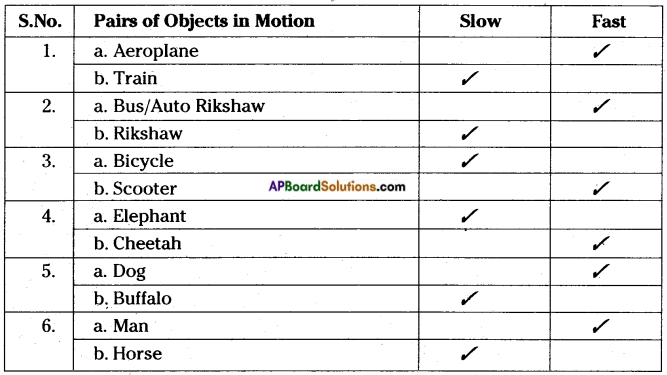
ii) What happens if ice is kept in the open air?
Answer:
If we kept ice in the open air it melts and converts into water.
iii) What happens when water is heated?
Answer:
When we heat water, it turns into water vapour.

Activity – 5

5. i) Spread a piece of wet cloth in the sunlight. Observe after some time. Where has the water in the wet cloth gone? (Page No. 36)
Answer:
The water in the wet cloth evaporates into the atmosphere due to the heat of the sun.
ii) Does the water in wet clothes dry up only due to sunlight or due to other reasons?
Answer:
The water in the wet clothes dry up not only due to sunlight but also wind.
iii) Where does this water go after drying up?
Answer:
The water is heated by sunlight, it gets converted to vapour and mixes with the air.
iv) Where does this water vapour go after evaporation?
Answer:
The water vapour which enters into the air through the process of evaporation forms clouds in the sky.

Activity – 6

6. Take some water in a glass. Add a piece of ice to it. Observe for a few minutes. Answer the following questions.
i) What changes do you observe on the outer surface of the glass? (Page No. 37)
Answer:
We observed the formation of small drops of water on the outer surface of the glass.
ii) Why are these drops formed?
Answer:
The water vapour which surrounds the glass gets condensed due to the low temperature of the glass outer surface.
iii) Do they form if there is no ice in the glass?
Answer:
No. It does not form any water drops if there is no ice in the glass.

AP Board 6th Class Science Solutions Chapter 4 Water

Activity – 7

Drought & Water Scarcity. (Page No. 40)
7. i) What will happen if rainfall this year is less than last year?
Answer:
If rainfall this year is less than last year, it may cause less production of crop yield, depletion of water levels, water scarcity and the atmospheric temperature raises.

ii) What would happen if there was no rainfall for five years?
Answer:

  • If there was no rainfall for five years its cause drought.
  • All the water sources are dried up.
  • There will be no vegetation, animals die due to lack of fodder.
  • The soil will be getting dried and cracked.
  • Drinking water scarce.

iii) What could be the possible reason for water scarcity in a particular place?
Answer:

  • Water scarcity may be caused by climate change due to deforestation and pollution from industries.
  • Less amount of rainfall for so many years leads to water scarcity.

iv) What problems can rise due to water scarcity in a particular place?
Answer:

  • It is very difficult to get food and fodder.
  • Drinking water is scarce.
  • People need to travel long distances to collect water.
  • Soil becomes dry, agriculture and cultivation become difficult.
  • People migrate to other places in search of jobs.

Activity – 8

8. Drought affects our life: (Page No. 41)
Read the letter and answer the following questions.
Dear Firoz,
I hope you are fine there. Nowadays, we are facing severe problems due to drought. For the last five years, we have no rains. All our fields have dried and there are cracks in them’ We fail to grow any crop. My father invested money on bore wells with no results. Now we get water, after a great struggle from the bore-well which is five kilometres from our village. The days have become very bad. Several people have sold their cattle and migrated to Hyderabad and Bengaluru. My family also wants to do so. I request you to ask your parents to search for a job for my father at your place. My father may have been a well-known, rich farmer here but he is willing to do any kind of job there.

Your loving friend
Ramanna

i) What problems did Ramanna face?
Answer:

  • Ramanna faced severe problems due to drought.
  • Fields are dried and cannot grow a crop.
  • Borewells are dried and water scarcity is there.
  • People collect water from far away to their village.
  • People are migrated to cities to search a job.

AP Board 6th Class Science Solutions Chapter 4 Water

ii) How can Firoz help him?
Answer:
Firoz father can search a job for Ramanna’s father to escape from the crucial drought conditions.

iii) What will happen if a farmer grows a crop that required more water in drought-prone districts?
If a farmer grows a crop that required more water in a drought area,

  • It leads to water scarcity.
  • it increases the investment of the crop.
  • it reduces the groundwater level.
  • it makes it more expensive to dig deep wells.
  • moreover, it is a hot condition so the crops do not give a good yield.

iv) What will happen to the source of groundwater when we constantly dug several bore wells?

  • The groundwater level is decreased more and more.
  • To get the water farmers to need to dig deep bore wells which are expensive.
  • If it continues for some time the bore wells will be dried up.

Activity – 9

Floods a natural hazard. (Page No. 33)
Observe the picture and answer the following questions.
AP Board 6th Class Science Solutions Chapter 4 Water 9
i) What does the picture tell us?
Answer:
It tells us about the floods.

ii) Does excessive rainfall in certain areas of our country lead to such a condition?
Answer:
Yes. Recently we saw this situation in Madras, Kerala and Mumbai.

iii) Are there any reasons that can lead to this situation?
Answer:
Climatic changes, pollution, deforestation, El Nino etc. are some factors for this situation.

AP Board 6th Class Science Solutions Chapter 4 Water

iv) Have you ever faced or heard about the flood? Write about your experiences.
Answer:
Yes. I heard about the floods named Hud hud in 2014 and Tithli in 2018.

  • A powerful Titli cyclone tore into coastal areas of Odisha and Andhra Pradesh with winds of up to 150 km/h.
  • About 3 lakh people have been evacuated from low lying districts in Odisha.
  • Roads are blocked and power supply has been lost in many areas.
  • There is a shortage of drinking water in many areas.