AP Board 8th Class Social Studies Important Questions Chapter 20 Understanding Secularism

AP State Syllabus AP Board 8th Class Social Studies Important Questions Chapter 20 Understanding Secularism.

AP State Syllabus 8th Class Social Studies Important Questions 20th Lesson Understanding Secularism

Question 1.
In what way is Indian secularism different from that of other democratic countries?
Answer:
The governments of other democratic countries will not interfere in the religions of its people. But the Indian government interferes in the religious matters. Thus it is different from other democratic countries.

Question 2.
Can there be different views within the same religion?
Answer:
Yes. There can be different views within the same religion. Many religions in the world have different views.

AP Board 8th Class Social Studies Important Questions Chapter 20 Understanding Secularism

Question 3.
Will the government intervene if some religious group says that their religion allows them to practise infanticide? Give reasons for your answer.
Answer:
The government intervenes in this issue.
Reasons:

  1. In Indian secularism the state can intervene in religious affairs.
  2. This interference will be according to the ideals of the Constitution.

Question 4.
What are the three main schools of thoughts in Buddhism?
Answer:

  1. Theravada
  2. Mahayana
  3. Vajrayana

AP Board 8th Class Social Studies Important Questions Chapter 20 Understanding Secularism

Question 5.
Read the following passage and answer the questions that follow.
In February 2004, France passed a law banning students from wearing any conspicuous religious or political signs or symbols such as the Islamic headscarf, the Jewish skullcap, or large Christian crosses. This law has encountered a lot of resistance from immigrants who are mainly from the former French colonies of Algeria, Tunisia and Morocco. In the 1960s, France had faced a shortage of workers and, therefore, had provided visas for these immi
grants to come and work in the country. The daughters of these immigrants often wear headscaives while attending school. However, with the passing of this new law, they have been expelled from their schools for wearing headscatves.
1. What was the law?
Answer:
The law was to ban any conspicuous religious or political signs or symbols.

2. Who opposed the law?
Answer:
The immigrants of France opposed this.

3. When was the law passed?
Answer:
In February, 2004.

AP Board 8th Class Social Studies Important Questions Chapter 20 Understanding Secularism

Question 6.
Read the first two paras and prepare two questions on this.
The most important aspect of secularism is its separation of religion from State power. This is important for a country to function democratically. Almost all the countries of the world will have more than one religious group living in them. Within these religious groups, there will most likely be one group that is in a majority. If this majority religious group has access to State power, then it could quite easily use its power and financial resources to discriminate against and persecute the persons of other religions. This tyranny of the majority could result in the discrimination, coercion and at times, even the killing of religious minorities. The majority could quite easily prevent minorities from practising their religions. Any form of domination based on religion is in violation of the rights that a democratic society guarantees to each and every citizen, irrespective of their religion. Therefore, the tyranny of the majority and the violation of Fundamental Rights that can result from it is one reason why it is important to separate the State and religion in democratic societies.
Another reason that it is important to separate religion from the State in democratic soci-eties is because we also need to protect the freedom of individuals to exit from their religion, embrace another religion or have the freedom to interpret religious teachings differently.
Answer:
1. What is the most important aspect of secularism?
2. Who were in majority in India?

AP Board 8th Class Social Studies Important Questions Chapter 20 Understanding Secularism

AP Board 8th Class Social Studies Important Questions Chapter 19 Social and Religious Reform Movements

AP State Syllabus AP Board 8th Class Social Studies Important Questions Chapter 19 Social and Religious Reform Movements.

AP State Syllabus 8th Class Social Studies Important Questions 19th Lesson Social and Religious Reform Movements

Question 1.
Compare the efforts of Narayana Guru and Jyotiba Phule. What similarities do you see between them?
Answer:

  1. Both opposed caste system.
  2. Both established many schools.
  3. Both opposed the supremacy of Brahmins.

Question 2.
Recall the teachings of Buddha with regard to the caste system.
Answer:
Buddha preached that ‘All are equal’. He opposed caste and religious discriminations. He treated all his followers equal.

AP Board 8th Class Social Studies Important Questions Chapter 19 Social and Religious Reform Movements

Question 3.
What are the similarities in the approaches of Gandhiji and Ambedkar towards dalits?
Answer:

  1. Both worked for dalits.
  2. Both were the members of Congress Party.

Question 4.
Do you find any religious idea advocated by the above reformers which was not part of the Bhakti Movement?
Answer:
No. All the reformers advocated the religious ideas of the Bhakti Movement only.

Question 5.
Do you think dalits have equal access to temples, water sources and schools today? What problems do they still face?
Answer:
At present dalits have equal access to temples, water sources and schools. To say frankly they have equal access and reservations also. So we can say that there were no social problems to them.

AP Board 8th Class Social Studies Important Questions Chapter 19 Social and Religious Reform Movements

Question 6.
What did Ambedkar want to achieve through the temple entry movement?
Answer:
Ambedkar wanted to say that ‘All are equal before God and everyone has rights on God”.

Question 7.
Do you think today equal importance is given to the education of girls or do girls still face discrimination?
Answer:
Equal importance is given to girls education with boys. To be frank the girl enrolment is more than boys in some schools and colleges. But in some families girls face discrimination, mostly in some backward states.

Question 8.
What problems do girls face in getting educated which boys do not face?
Answer:

  1. Girls are not encouraged for higher education.
  2. Girls are not permitted to far off places for education.
  3. Some courses are only meant for boys.

AP Board 8th Class Social Studies Important Questions Chapter 19 Social and Religious Reform Movements

Question 9.
To what extent has the treatment of widows changed today?
Answer:
We can say that the attitude of the society is changed. Widows are treated equally with other women. Their elders are only arranging remarriages for them.

Question 10.
Do dalit girls and Muslim girls face special problems in education even today?
Answer:
Nowadays we seldom hear such a news from newspapers that dalit girls are facing some problems from others. They are also receiving education in classrooms along with others. Muslim girls also have separate schools. They are also studying without problems.

Question 11.
Who founded Brahmo Samaj in combined Andhra Pradesh?
Answer:
Veeresalingam founded Brahma Samaj in combined Andhra Pradesh.

AP Board 8th Class Social Studies Important Questions Chapter 19 Social and Religious Reform Movements

Question 12.
On what did Veeresalingam concentrate all his efforts and energies?
Answer:
Veerasalingam concentrated all his efforts and energies on the widow remarriage and abolition of child marriage.

Question 13.
Why was Veeresalingam called ‘Gadya Tikkana’?
Answer:
He was called ‘Gadya Tikkana’ for his writings in prose.

Question 14.
How would the feeling that the dalits were the orginal inhabitants of Telangana and Andhra have helped in boosting the confidence of the dalits?
Answer:
The feeling would raise the confidence in dalits. This confidence would strengthen them in fighting against the discrimination. That led them to their success.

Question 15.
Did all women get the right to vote in independent India?
Answer:
Yes, all women get the right to vote in independent India.

AP Board 8th Class Social Studies Important Questions Chapter 19 Social and Religious Reform Movements

Question 16.
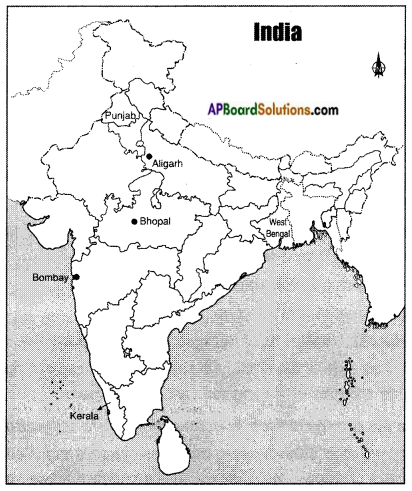
Locate the following in the given India Map.

  1. West Bengal
  2. Punjab
  3. Bombay
  4. Aligarh
  5. Bhopal
  6. Kerala

Answer:
AP Board 8th Class Social Studies Important Questions Chapter 19 Social and Religious Reform Movements 1

AP Board 8th Class Social Studies Important Questions Chapter 19 Social and Religious Reform Movements

AP SSC 10th Class Maths Solutions Chapter 14 Statistics Ex 14.3

AP State Board Syllabus AP SSC 10th Class Maths Textbook Solutions Chapter 14 Statistics Ex 14.3 Textbook Questions and Answers.

AP State Syllabus SSC 10th Class Maths Solutions 14th Lesson Statistics Exercise 14.3

10th Class Maths 14th Lesson Statistics Ex 14.3 Textbook Questions and Answers

Question 1.
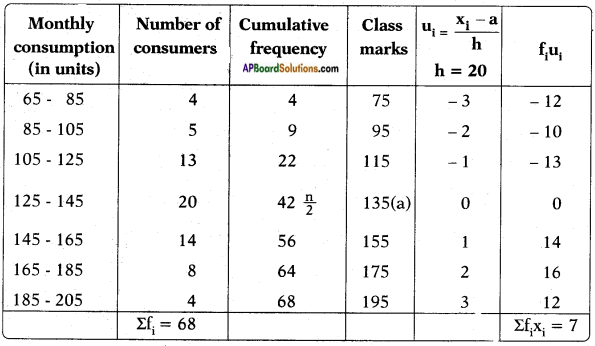
The following frequency distribution gives the monthly consumption of electricity of 68 consumers of a locality. Find the median, mean and mode of the data and compare them.
AP SSC 10th Class Maths Solutions Chapter 14 Statistics Ex 14.3 1
Answer:
AP SSC 10th Class Maths Solutions Chapter 14 Statistics Ex 14.3 2

AP SSC 10th Class Maths Solutions Chapter 14 Statistics Ex 14.3
Sum of the frequencies = 68
∴ \(\frac{n}{2}\) = \(\frac{68}{2}\) = 34
Hence median class = 125 – 145
Lower boundary of the median class, l = 125
cf – cumulative frequency of the class preceding the median class = 22
f – frequency of the median class = 20
h = class size = 20
Median = \(l+\frac{\left[\frac{\mathrm{n}}{2}-\mathrm{cf}\right]}{\mathrm{f}} \times \mathrm{h}\)
= 125 + \(\frac{[34-22]}{20}\) × 20
∴ Median = 125 + 12 = 137
Maximum number of consumers lie in the class 125 – 145
Modal class is 125 -145
l – lower limit of the modal class =125
f1 – frequency of the modal class = 20
f0 – frequency of the class preceding the modal class =13
f2 – frequency of the class succeeding the modal class =14
h – size of the class = 20
Mode (Z) = \(l+\frac{f_{1}-f_{0}}{\left(f_{1}-f_{0}\right)+\left(f_{1}-f_{2}\right)} \times h\)
Mode (Z) = 125 + \(\frac{20-13}{(20-13)+(20-14)} \times 20\)
= 125 + \(\frac{7}{7+6}\) × 20
= 125 + \(\frac{140}{13}\)
= 125 + 10.76923
∴ Mode = 135.769
Mean \(\overline{\mathrm{x}}=\mathrm{a}+\frac{\Sigma \mathrm{f}_{\mathrm{i}} \mathrm{u}_{\mathrm{i}}}{\Sigma \mathrm{f}_{\mathrm{i}}} \times \mathrm{h}\)
a = assumed mean = 135
∴ \(\overline{\mathbf{x}}\) = 135 + \(\frac{7}{68}\)
= 135 + 0.102941
≃ 135.1
Mean, Median and Mode are approximately same in this case.

AP SSC 10th Class Maths Solutions Chapter 14 Statistics Ex 14.3

Question 2.
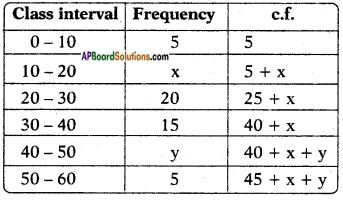
If the median of 60 observations, given below is 28.5, find the values of x and y.
AP SSC 10th Class Maths Solutions Chapter 14 Statistics Ex 14.3 3
Answer:
AP SSC 10th Class Maths Solutions Chapter 14 Statistics Ex 14.3 4
Median = \(l+\frac{\left[\frac{\mathrm{n}}{2}-\mathrm{cf}\right]}{\mathrm{f}} \times \mathrm{h}\)
It is given that ∑f = n = 60
So, 45 + x + y = 60
x + y = 60 – 45 = 15
x + y = 15 ….. (1)
The median is 28.5 which lies be-tween 20 and 30.
Median class = 20 – 30
Lower boundary of the median class ‘l’ = 20
\(\frac{N}{2}\) = \(\frac{60}{2}\) = 30
cf – cumulative frequency = 5 + x
h = 10
Median = \(l+\frac{\left[\frac{\mathrm{n}}{2}-\mathrm{cf}\right]}{\mathrm{f}} \times \mathrm{h}\)
⇒ 28.5 = 20 + \(\frac{30-5-x}{20}\) × 10
⇒ 28.5 = 20 + \(\frac{25-x}{2}\)
\(\frac{25-x}{2}\) = 28.5 – 20 = 8.5
25 – x = 2 × 8.5
x = 25- 17 = 8
also from (1); x + y = 15
8 + y = 15
y = 7
∴ x = 8; y = 7.

AP SSC 10th Class Maths Solutions Chapter 14 Statistics Ex 14.3

Question 3.
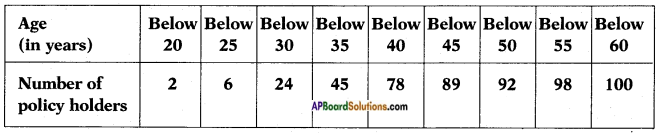
A life insurance agent found the following data about distribution of ages of 100 policy holders. Calculate the median age. [Policies are given only to persons having age 18 years onwards but less than 60 years.
AP SSC 10th Class Maths Solutions Chapter 14 Statistics Ex 14.3 5
Answer:
AP SSC 10th Class Maths Solutions Chapter 14 Statistics Ex 14.3 6
The given distribution being of the less than type, 25, 30, 35, give the upper limits of corresponding class intervals. So the classes should be 20 – 25, 25 – 30, 30 – 35, ………. 55 – 60.
Observe that from the given distribution 2 persons with age less than 20.
i.e., frequency of the class below 20 is 2.
Now there are 6 persons with age less than 25 and 2 persons with age less than 20.
∴ The number of persons with age in the interval 20 – 25 is 6 – 2 = 4.
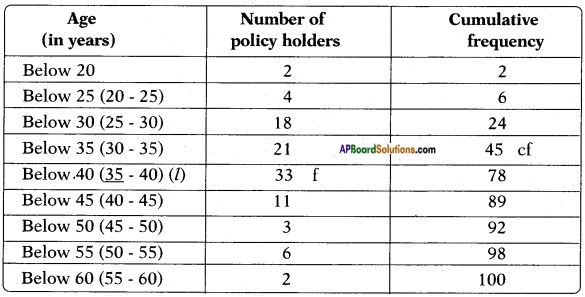
Similarly, the frequencies can be calculated as shown in table.
Number of observations = 100
n = 100
\(\frac{n}{2}\) = \(\frac{100}{2}\) = 50, which lies in the class 35-40
∴ 35 – 40 is the median class and lower boundary l = 35
cf = 45;
h = 5;
f = 33
Median = \(l+\frac{\left[\frac{\mathrm{n}}{2}-\mathrm{cf}\right]}{\mathrm{f}} \times \mathrm{h}\)
= 35 + \(\frac{50-45}{33}\) × 5
= 35 + \(\frac{5}{33}\) × 5
= 35 + 0.7575
= 35.7575
∴ Median ≃ 35.76

AP SSC 10th Class Maths Solutions Chapter 14 Statistics Ex 14.3

Question 4.
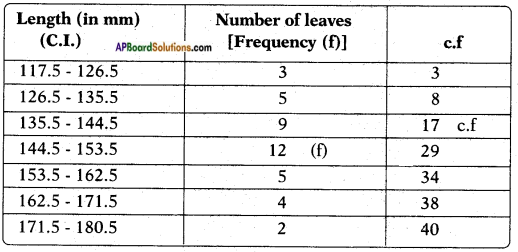
The lengths of 40 leaves of a plant are measured correct to the nearest millimetre, and the data obtained is represented in the following table:
AP SSC 10th Class Maths Solutions Chapter 14 Statistics Ex 14.3 7
Find the median length of the leaves. (Hint: The data needs to be converted to continuous classes for finding the median, since the formula assumes continuous classes. The classes then change to 117.5 – 126.5, 126.5 – 135.5,…, 171.5 – 180.5.)
Answer:
Since the formula, Median = \(l+\frac{\left[\frac{\mathrm{n}}{2}-\mathrm{cf}\right]}{\mathrm{f}} \times \mathrm{h}\) assumes continuous classes assumes continuous class, the data needs to be converted to continuous classes.
The classes then changes to 117.5 – 126.5; 126.5 – 133.5, …… 171.5 – 180.5.
AP SSC 10th Class Maths Solutions Chapter 14 Statistics Ex 14.3 8
∑fi = n = 40
\(\frac{n}{2}\) = \(\frac{40}{2}\) = 20
\(\frac{n}{2}\)th observation lie in the class 144.5- 153.5
∴ Median class = 144.5 – 153.5
Lower boundary, l = 144.5
Frequency of the median class, f = 12
c.f. = 17
h = 9
∴ Median = \(l+\frac{\left[\frac{\mathrm{n}}{2}-\mathrm{cf}\right]}{\mathrm{f}} \times \mathrm{h}\)
= 144.5 + \(\frac{20-17}{12}\) × 9
= 144.5 + \(\frac{3}{12}\) × 9
= 144.5 + \(\frac{9}{4}\)
= 144.5 + 2.25
∴ Median length = 146.75 mm.

AP SSC 10th Class Maths Solutions Chapter 14 Statistics Ex 14.3

Question 5.
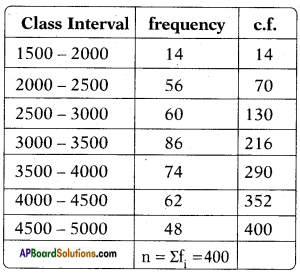
The following table gives the distribution of the life-time of 400 neon lamps.
AP SSC 10th Class Maths Solutions Chapter 14 Statistics Ex 14.3 9
Find the median life-time of a lamp.
Answer:
AP SSC 10th Class Maths Solutions Chapter 14 Statistics Ex 14.3 10
Total observations are n = 400
\(\frac{n}{2}\)th observation i.e \(\frac{400}{2}\) = 200
200 lies in the class 3000 – 3500
∴ Median class = 3000 – 3500
Lower boundary l = 3000
frequency of the median class f = 86
c.f = 130
Class size, h = 500
Median = \(l+\frac{\left[\frac{\mathrm{n}}{2}-\mathrm{cf}\right]}{\mathrm{f}} \times \mathrm{h}\)
= 3000 + \(\frac{200-130}{86}\) × 500
= 3000 + \(\frac{70}{86}\) × 500
= 3000 + 406.977
= 3406.98
∴ Median life ≃ 3406.98 hours

AP SSC 10th Class Maths Solutions Chapter 14 Statistics Ex 14.3

Question 6.
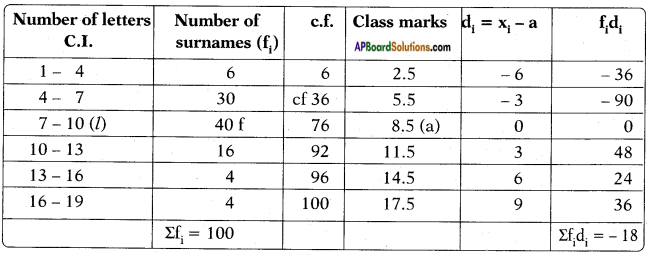
100 surnames were randomly picked up from a local telephone directory and the frequency distribution of the number of letters in the English alphabet in the surnames was obtained as follows.
AP SSC 10th Class Maths Solutions Chapter 14 Statistics Ex 14.3 11
Determine the median number of letters in the surnames. Find the mean number of letters in the surnames ? Also, find the modal size of the surnames.
Answer:
Number of letters in the surnames.
Also find the modal size of the surnames.
AP SSC 10th Class Maths Solutions Chapter 14 Statistics Ex 14.3 12
Total observations are n = 100
\(\frac{n}{2}\) = \(\frac{100}{2}\) = 50
50 lies in the class 7 – 10
∴ Median class = 7 – 10
l – lower boundary = 7
f – frequency of the median class = 40
cf = 36
Class size h = 3
Median:
Median = \(l+\frac{\left[\frac{\mathrm{n}}{2}-\mathrm{cf}\right]}{\mathrm{f}} \times \mathrm{h}\)
= 7 + \(\frac{50-36}{40}\) × 3
= 7 + \(\frac{14}{40}\) × 3
= 7 + \(\frac{42}{40}\)
= 7 + 1.05
= 8.05
∴ Median = 8.05.

Mean:
Assumed mean, a = 8.5
Mean \(\overline{\mathrm{x}}=\mathrm{a}+\frac{\Sigma \mathrm{f}_{\mathrm{i}} \mathrm{d}_{\mathrm{i}}}{\Sigma \mathrm{f}_{\mathrm{i}}}\)
= 8.5 + \(\frac{(-18)}{100}\)
= 8.5 – 0.18
= 8.32
∴ Mean = 8.32.

Mode:
Maximum number of surnames = 40
∴ Modal class = 7-10
l – lower boundary of the modal class = 7
Mode (Z) = \(l+\frac{f_{1}-f_{0}}{\left(f_{1}-f_{0}\right)+\left(f_{1}-f_{2}\right)} \times h\)
l = 7; f1 = 40, f0 = 30, f2 = 16, h = 3
Mode (Z) = 7 + \(\frac{40-30}{(40-30)+(40-16)}\) × 3
= 7 + \(\frac{10}{10+24}\) × 3
= 7 + \(\frac{30}{34}\)
= 7 + 0.882
= 7.882

Median = 8.0.5; Mean = 8.32; Modal size = 7.88.

AP SSC 10th Class Maths Solutions Chapter 14 Statistics Ex 14.3

Question 7.
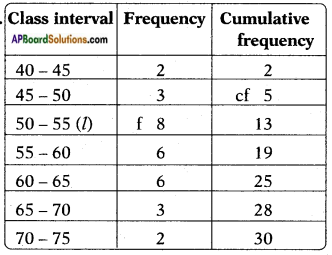
The distribution below gives the weights of 30 students of a class. Find the median weight of the students.
AP SSC 10th Class Maths Solutions Chapter 14 Statistics Ex 14.3 13
Answer:
AP SSC 10th Class Maths Solutions Chapter 14 Statistics Ex 14.3 14
Number of observations (n) = ∑fi
\(\frac{n}{2}\) = \(\frac{30}{2}\) = 15
15 lies in the class 50 – 55
∴ Median class = 50-55
l – lower boundary of the median class = 55
f – frequency of the median class = 8
c.f = 5
Class size h = 6
Median = \(l+\frac{\left[\frac{\mathrm{n}}{2}-\mathrm{cf}\right]}{\mathrm{f}} \times \mathrm{h}\)
= 50 + \(\frac{15-5}{8}\) × 6
= 50 + 7.5
= 57.5
= 50 + 7.5 = 57.5
∴ Median weight = 57.5 kg.

AP Board 8th Class Social Studies Important Questions Chapter 3 Earth Movements and Seasons

AP State Syllabus AP Board 8th Class Social Studies Important Questions Chapter 3 Earth Movements and Seasons.

AP State Syllabus 8th Class Social Studies Important Questions 3rd Lesson Earth Movements and Seasons

Question 1.
Can you relate what are the major seasons you have seen?
Answer:
The major seasons I have seen are Summer season, Rainy season and Winter season.

Question 2.
Write any two factors that influence the order of seasons.
Answer:
The factors are:
a) The spherical shape of the Earth and the curvature of its surface.
b) Daily rotation of the Earth on its own Axis.

AP Board 8th Class Social Studies Important Questions Chapter 3 Earth Movements and Seasons

Question 3.
From where can we see the axis of the earth?
Answer:
The axis of the earth is an imaginary line. We cannot see it.

Question 4.
What are the reasons behind the formation of seasons?
Answer:
Earth’s revolution and inclination of the axis are the reasons behind it.

Question 5.
What happens if there are no seasons?
Answer:
If there are no seasons, there will be no life on the earth.

Question 6.
Find out if Andhra Pradesh is in the Tropical Belt or in the Temperate Beit.
Answer:
Andhra Pradesh is extended between 18°N to 79°N latitude (approximately). It is in Tropical Belt.

AP Board 8th Class Social Studies Important Questions Chapter 3 Earth Movements and Seasons

Question 7.
Will the Sun shine directly on our heads in Andhra Pradesh during any month? If yes, in which month?
Answer:
The Sun’s rays fall straightly on Andhra Pradesh in the month of May.

Question 8.
Find out in which belt is Delhi and if it would receive snowfall in winters.
Answer:
Delhi is located between 28°22″ N. latitude and 28°54″ N. latitude. It is in Temperate Belt. It records low temperatures but there is no snowfall.

Question 9.
The earth is rotating daily in such a high speed. But why don’t we feel this?
Answer:
The earth is rotating in such a speed with all its – atmosphere, human, animal and plant kingdoms. So we don’t feel this.

AP Board 8th Class Social Studies Important Questions Chapter 3 Earth Movements and Seasons

Question 10.
Appreciate the rotation and revolution.
Answer:
The Earth is rotating and revolving since her birth without any rest. If it stops for a while, the life on the Earth may get disappeared. So a lot of thanks to Mother Earth.

Question 11.
Which season is important out of all the seasons?
Answer:
All the seasons are important. The existence of all the seasons only supports the life on the earth.

Question 12.
What are the factors that influence the order of seasons?
Answer:
The factors that influence the order of seasons are:

  1. The spherical shape of the Earth and the curvature of its surface.
  2. Daily rotation of the Earth on its own Axis.
  3. The tilt of the Axis of rotation compared to the plane on which the Earth moves.
  4. The Earth’s movement around the Sun once a year (revolution).

AP Board 8th Class Social Studies Important Questions Chapter 3 Earth Movements and Seasons

Question 13.
From where can we see the axis of the earth?
Answer:
The axis of the earth is an imaginary line. We cannot see it.

Question 14.
The earth is rotating daily in such a high speed. But why don’t we feel this?
Answer:
The earth is rotating in such a speed with all its – atmosphere, human, animal and plant kingdoms. So we don’t feel this.

Question 15.
Appreciate the rotation and revolution.
Answer:
The Earth is rotating and revolving since her birth without any rest. If it stops for a while, the life on the Earth may get disappeared. So a lot of thanks to Mother Earth.

Question 16.
Which season is important out of all the seasons?
Answer:
All the seasons are important. The existence of all the seasons only supports the life on the earth.

AP Board 8th Class Social Studies Important Questions Chapter 3 Earth Movements and Seasons

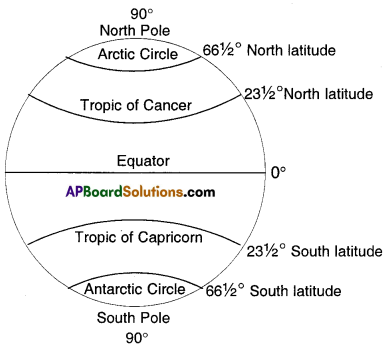
Question 17.
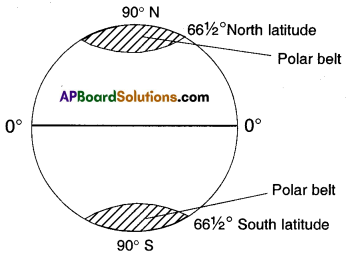
Draw the important latitudes.
Answer:
AP Board 8th Class Social Studies Important Questions Chapter 3 Earth Movements and Seasons 1

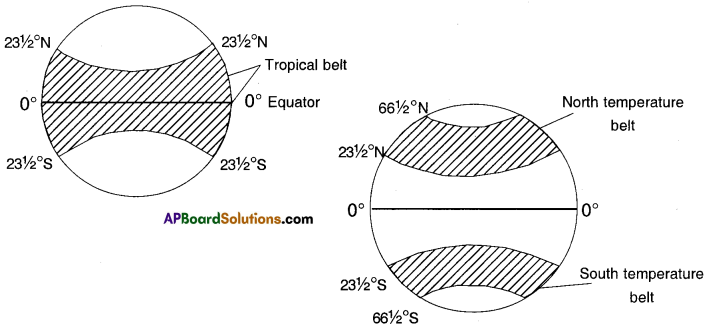
Question 18.
Draw the temperature belts on the earth.
Answer:
AP Board 8th Class Social Studies Important Questions Chapter 3 Earth Movements and Seasons 2
AP Board 8th Class Social Studies Important Questions Chapter 3 Earth Movements and Seasons 3

AP Board 8th Class Social Studies Important Questions Chapter 3 Earth Movements and Seasons

AP Board 6th Class Social Studies Solutions Chapter 2 Globe – Model of the Earth

SCERT AP Board 6th Class Social Solutions 2nd Lesson Globe – Model of the Earth Textbook Questions and Answers.

AP State Syllabus 6th Class Social Studies Solutions 2nd Lesson Globe – Model of the Earth

6th Class Social Studies 2nd Lesson Globe – Model of the Earth Textbook Questions and Answers

Improve Your Learning

Question 1.
What is a globe?
Answer:
Globe is a true model of the Earth.

Question 2.
What are the movements of the Earth?
Answer:
Rotation and Revolution are the movements of the Earth.

Question 3.
Which movement of the Earth causes Day and Night?
Answer:
Rotation of the Earth causes Day and Night.

AP Board 6th Class Social Studies Solutions Chapter 2 Globe – Model of the Earth

Question 4.
What happens when the Earth rotates?
Answer:
During rotation, half portion of the Earth receives Sun’s rays and the remaining half portion remains in darkness.

Question 5.
Define the Earth’s Rotation and Revolution.
Answer:
Rotation: Planet Earth rotates around itself on its own axis. This movement is called Rotation.
Revolution: Planet Earth rotates around the Sun. This movement is called Revolution.

Question 6.
What is the true shape of the Earth?
Answer:
The Earth is round in shape. The Earth is slightly flattened at the poles and bulges in the middle or at the equator.

Question 7.
Which Latitude is known as the Tropic of Cancer?
Answer:
The latitude which is located at 23\(\frac{1}{2}\)° north of the equator is known as the Tropic of Cancer.

AP Board 6th Class Social Studies Solutions Chapter 2 Globe – Model of the Earth

Question 8.
Read the Paragraph under the title ‘Equinox’ and comment on it.
On 21st March and September 23rd direct rays of the Sun fall on the equator. At this position, neither of the poles is tilted towards the Sun. So, the whole earth experiences equal days and nights. This is called an equinox.
On 23rd September, it is autumn season in the Northern Hemisphere and spring season in the Southern Hemisphere. The opposite is the case on 21st March when it is spring in the Northern Hemisphere and autumn in the Southern Hemisphere. Thus, you find days and nights and changes in the seasons because of the rotation and revolution of the earth.
Answer:
On 21st March and 23rd, September Sun’s rays fall directly on the Equator. So we experience equal day and night on both these days. This is called equinox. On 21st March it is autumn in the Northern Hemisphere and spring in the Southern Hemisphere. Because of Earth’s rotation, half portion of the Earth receives Sun’s rays and the remaining half remains in darkness. So we find changes on Earth because of Earth’s rotation and revolution.

Question 9.
Create a table and list out the similarities and differences between Latitudes and Longitudes.
Answer:
Similarities between latitudes and longitudes:

  1. Latitudes and longitudes are both artificial.
  2. Latitudes and Longitudes are both invisible lines.
  3. Latitude is based on the 0° latitude while longitude is based on Greenwich.
  4. They both help us to locate a place on earth

Differences:

LatitudesLongitudes
1) Latitudes are the horizontal lines.1) Longitudes are vertical lines
2) Lines of latitudes are parallel to the equator.2) Lines of longitude are not parallel and come to a singular point.
3) Latitudes lines run in the East and West directions.3) Longitude lines run in the North to South direction.

AP Board 6th Class Social Studies Solutions Chapter 2 Globe – Model of the Earth

Question 10.
If India has day, it is night in America. What is the reason for this difference?
Answer:
The part of the Earth that faces the Sun gets illuminated and experiences the day. The opposite part of the earth that does not face the Sun, experiences night. As India is opposite to America the difference in day and night occurs.

Question 11.
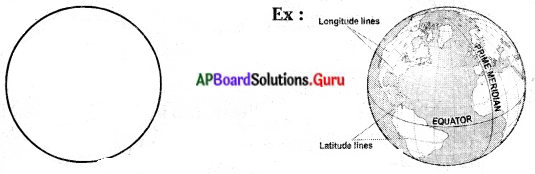
Take a ball and draw the latitudes and longitudes on the surface.
Answer:
Project Work: Student Activity.
AP Board 6th Class Social Studies Solutions Chapter 2 Globe – Model of the Earth 1

Question 12.
Prepare a note on the difference between a globe and an atlas.
Answer:

  1. A globe is a three-dimensional sphere. An atlas is two-dimensional.
  2. A globe represents the whole earth. An atlas represents the whole earth or a part of it.
  3. A globe can be used to get a broad-level picture of the world. An atlas provides more specific information about different places.

Question 13.
Find out the latest leap year and the coming leap year.
Answer:
The present year 2020 is a leap year. 2024 is the coming leap year.

Question 14.
What preparations should be taken to watch a solar eclipse safely?
Answer:
The Sun outputs more power than our eye is designed and so it damages the retina. So we should not watch the Sun or the solar eclipse directly. We should use special-purpose solar filters, such as eclipse glasses to watch Solar eclipses safely. Projecting the Sun through a box projector is another safe way to watch the solar eclipse.

AP Board 6th Class Social Studies Solutions Chapter 2 Globe – Model of the Earth

Question 15.
It is difficult to understand the geographical location, time, and distance in the absence of the imaginary lines – latitudes and longitudes. Appreciate the design of the imaginary lines of latitudes and longitudes.
Answer:

  1. Latitudes are used to define the North-South position of a location on the planet.
    The general climatic division of a place can be studied with the help of latitudes.
  2. Longitudes are used to define the East-West position of a location on the planet. Longitudes also help us to calculate the time of a particular place.
  3. If the latitude and longitude are known any position on earth can be located. Even- though, longitudes and latitudes are imaginary lines they play an important role.

So we should appreciate the design of the imaginary lines of the latitudes and longitudes.

Question 16.
Venu met some children from different cities at a youth festival. They were: Geethika, John, Nihal, and Uma. Venu collected some information about their cities.
Venu has given us certain clues. Can you find out the cities with the help of an Atlas?

  • Geethika – A girl from a city where 19° Northern Latitude and 72° Eastern Longitude nearly coordinates.
    Find and write the city name: ………………………………………………………
  • John – A boy from a city where 12° Northern Latitude and 77° Eastern Longitude nearly coordinates.
    Find and write the city name: ………………………………………………………
  • Nihal – A boy from a city where 28° Northern Latitude and 77° Eastern Longitude nearly coordinates.
    Find and write the city name: ………………………………………………………
  • Uma – A girl from a city where 22° Northern Latitude and 88° Eastern Longitude nearly coordinates.
    Find and write the city name: ………………………………………………………

Answer:

  • Geethika – A girl from a city where 19° Northern Latitude and 72° Eastern Longitude nearly coordinates.
    Find and write the city name: ( Bombay)
  • John – A boy from a city where 12° Northern Latitude and 77° Eastern Longitude nearly coordinates.
    Find and write the city name: (Bangalore)
  • Nihal – A boy from a city where 28° Northern Latitude and 77° Eastern Longitude nearly coordinates.
    Find and write the city name: (Delhi)
  • Uma – A girl from a city where 22° Northern Latitude and 88° Eastern Longitude nearly coordinates.
    Find and write the city name: (Kolkata)

AP Board 6th Class Social Studies Solutions Chapter 2 Globe – Model of the Earth

Question 17.
If an astronaut from a spaceship looks down at the Earth, can he/she see the rotation of the earth?
Answer:
Yes. From a spaceship, an astronaut can see the rotation of the earth. Spaceships move around the Earth at a different speed. So the astronaut can see the Earth’s rotation.

Question 18.
Why can’t we sense the rotation and revolution of the Earth?
Answer:
The Earth is moving at a fixed speed and we are also moving along with it at the same speed. That is why we can’t sense the Earth’s spin. If Earth’s spin changes we would definitely sense it. If we are in a car that is moving at a constant speed on a smooth surface, we will not know that we are moving. However, when the car accelerates or when the brakes are applied, we will feel the motion. Another example is, we can drink coffee or tea on a moving train which is moving at a constant speed* because we are traveling by the train at the same speed. If the speed of the train changes we can’t drink. The spin of Earth doesn’t make those kinds of changes. So we can’t sense the rotation and revolution of the Earth.

Question 19.
Choose the correct answer.
i) The movement of the Earth around the Sun is known as
A) Rotation
B) Revolution
C) Inclination
D) Meridian
Answer:
B) Revolution

AP Board 6th Class Social Studies Solutions Chapter 2 Globe – Model of the Earth

ii) Sun rays fall directly on the Equator on:
A) 21 March
B) 21 June
C) 22 December
D) 22 October
Answer:
A) 21 March

iii) Christmas is celebrated in summer in:
A) Japan
B) Australia
C) India
D) The USA
Answer:
B) Australia

iv) The cycle of the seasons is caused due to:
A) Rotation
B) Revolution
C) Gravitation
D) Inclination
Answer:
B) Revolution

Question 20.
Find and fill the latitudes and longitudes in the given table with the help of Atlas and Globe.

S.No.PLACELATITUDESLONGITUDES
1.Vijayawada
2.Kadapa
3.Tirupati
4.Visakhapatnam
5.Your Village (Chittor)

Answer:

S.No.PLACELATITUDESLONGITUDES
1.Vijayawada16°50′ N80°64′ E
2.Kadapa14°46’ N78°82′ E
3.Tirupati13°62’ N79°41′ E
4.Visakhapatnam17°68′ N83°21′ E
5.Your Village (Ex: Chittoor)13°21′ N79°10’ E

AP Board 6th Class Social Studies Solutions Chapter 2 Globe – Model of the Earth

Question 21.
Find and fill the latitudes and longitudes extent of India and Andhra Pradesh in the given table with the help of Google Maps or Atlas.

PLACELATITUDESLONGITUDES
FromToFromTo
India
Andhra Pradesh
Your district (Kurnool)
Your Mandal (Nandyal)

Answer:

PLACELATITUDESLONGITUDES
FromToFromTo
India8°4′ N37°6′ N68°7′ E97°25′ E
Andhra Pradesh12°41′ N19°07’ N77° E84°40′ E
Your district (Ex: Kurnool)15°50′ N4°32′ N78° 1′ E45° 71′ E
Your Mandal (Ex: Nandyal)15°28′ N42°84′ N78°28′ E59°13′ E

Question 22.
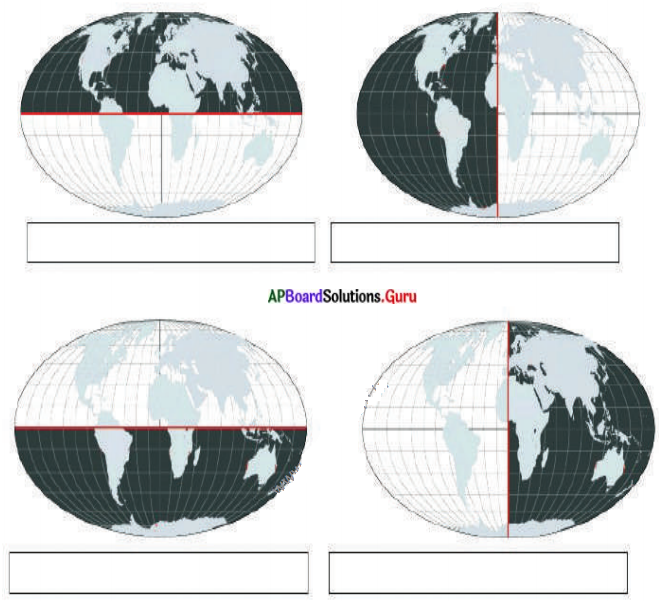
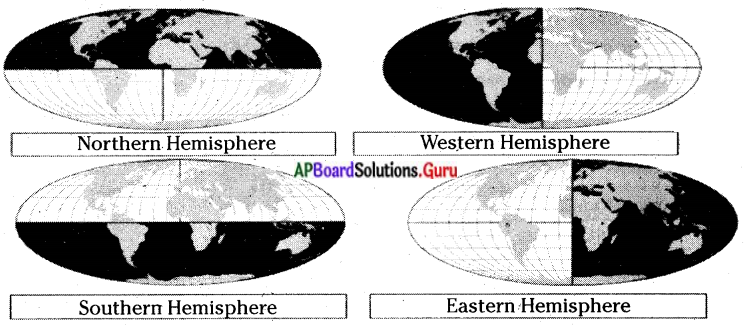
Observe the following pictures and fill the boxes with the name of the shaded hemispheres.
AP Board 6th Class Social Studies Solutions Chapter 2 Globe – Model of the Earth 2
Answer:
AP Board 6th Class Social Studies Solutions Chapter 2 Globe – Model of the Earth 3

Project Work

Draw a diagram of the globe showing the earth’s axis, the Equator, Tropic of Cancer and Capricorn, Arctic Circle, and Antarctic Circle.
Answer:
Student Activity.

AP Board 6th Class Social Studies Solutions Chapter 2 Globe – Model of the Earth

6th Class Social Studies 2nd Lesson Globe – Model of the Earth InText Questions and Answers

Let’s Do

(Textbook Page No. 17)

Question 1.
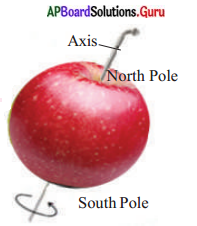
Take a big round apple. Pierce a cycle spoke through it. The spoke resembles the axis shown in a globe. You can now move the apple around this axis from left to right.
Answer:
Student Activity.
AP Board 6th Class Social Studies Solutions Chapter 2 Globe – Model of the Earth 4

Think and Respond

(Textbook Page No. 16)

Question 1.
How does the earth rotate and revolve without any needle, unlike the Globe? Discuss with the teacher.
Answer:
Our Solar System formed about 4.6 billion years ago when a huge cloud of gas and dust started to collapse under its own gravity. As the cloud collapsed, it started to spin. The Solar system is made up of the Sun and everything that orbits around it includes the planets and their moons as well as numerous asteroids, meteoroids, and comets. Without any unbalanced forces acting on them, the tremendous gravity of the Sun and the planets have kept them rotating for billions of years. Either the Earth or any other planet does not have any needle to rotate or to revolve.

AP Board 6th Class Social Studies Solutions Chapter 2 Globe – Model of the Earth

Question 2.
All the celestial bodies are round in shape. Why?
Answer:
A planet is round because of its gravity. Gravity pulls from the center to the edges like the spokes of a bicycle wheel. This makes the overall shape of a planet a sphere, which is a three-dimensional circle.

(Textbook Page No. 17)

Question 3.
In which hemisphere is India located?
Answer:
India is located within both the Northern and Eastern hemispheres.

Question 4.
Which hemisphere has the maximum number of continents?
Answer:
Northern Hemisphere has the maximum number of continents.

Question 5.
In which hemisphere is the continent Antarctica located?
Answer:
Antarctica is located in the Southern hemisphere.

AP Board 6th Class Social Studies Solutions Chapter 2 Globe – Model of the Earth

(Textbook Page No. 17)

Question 6.
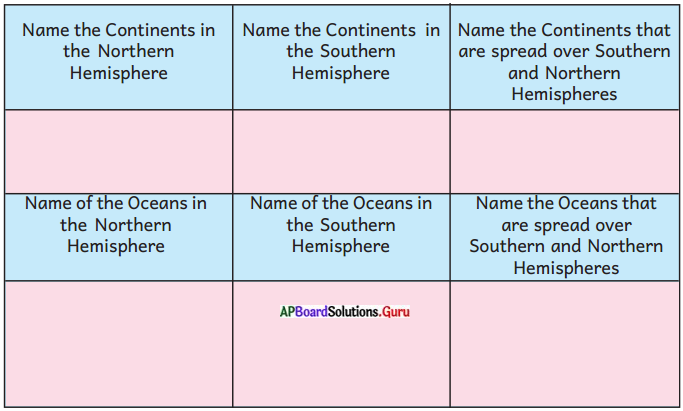
Complete the table with the help of a world map, globe, or internet.
AP Board 6th Class Social Studies Solutions Chapter 2 Globe – Model of the Earth 5
Answer:

Name the Continents in the Northern HemisphereName the Continents in the Southern HemisphereName the Continents that are spread over Southern and Northern Hemispheres
Europe
North America
Australia
Antarctica
Africa
Asia
South America
Name the Continents in the Northern HemisphereName the Continents in the Southern HemisphereName the Continents that are spread over Southern and Northern Hemispheres
Arctic OceanSouthern OceanPacific Ocean Atlantic Ocean Indian Ocean

Question 7.
Why do latitudes get smaller towards the pole? Which latitude is the biggest circle?
Answer:
The equator is the largest circle and divides the globe into two equal halves. So it is at the center of the Earth. Circles of latitude are all great circles with the center of Earth in the middle. The circles of latitude get smaller as the distance from the Equator increases. So the latitudes get smaller towards the poles. The Equator is the biggest latitude.

AP Board 6th Class Social Studies Solutions Chapter 2 Globe – Model of the Earth

(Textbook Page No. 18)

Question 8.
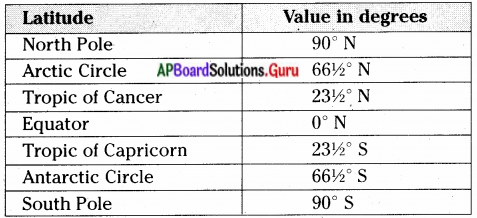
Fill in the table with the help of a globe/map.

LatitudeValue in degrees
North Pole
Arctic Circle
Tropic of Cancer
Equator
Tropic of Capricorn
Antarctic Circle
South Pole

Answer:
AP Board 6th Class Social Studies Solutions Chapter 2 Globe – Model of the Earth 6

(Textbook Page No. 20)

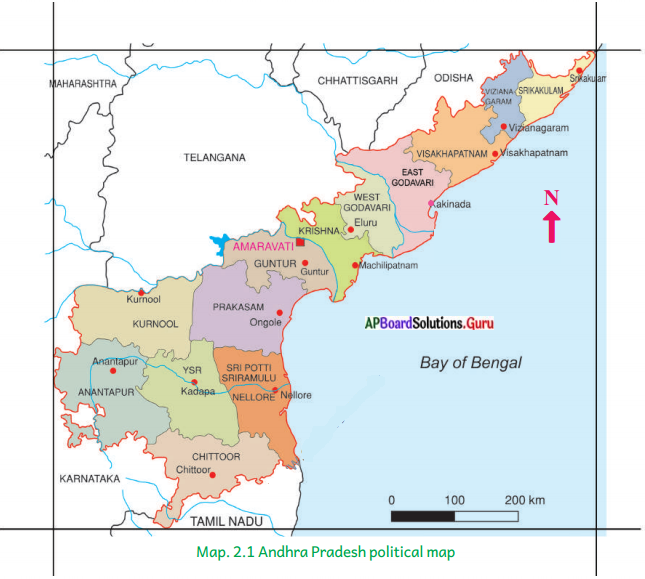
Question 9.
Identify and write down the Latitude and Longitude between the extents of the given Andhra Pradesh map. You can take the help of Atlas.
AP Board 6th Class Social Studies Solutions Chapter 2 Globe – Model of the Earth 7
Answer:
Andhra Pradesh Latitude: 12°41’ N to – 19°07′ N
Longitude : 77° – 84°40′ E.

AP Board 8th Class Social Studies Important Questions Chapter 18 Rights Approach to Development

AP State Syllabus AP Board 8th Class Social Studies Important Questions Chapter 18 Rights Approach to Development.

AP State Syllabus 8th Class Social Studies Important Questions 18th Lesson Rights Approach to Development

Question 1.
What would give the poor people like Pavan and his mother a life with dignity?
Answer:
“Work hard – Lead the life”.
This only gives them a life with dignity.

Question 2.
Whose duty is it to ensure that Pa van and his mother are able to live a life of dignity and freedom?
Answer:
It is the duty of the society and the government to ensure that Pavan and his mother are able to live a life of dignity and freedom.

AP Board 8th Class Social Studies Important Questions Chapter 18 Rights Approach to Development

Question 3.
What are the arguments of people in “disclosing the information?”
Answer:
Their arguments are as follows.

  1. Information is crucial to the human development, and democratic rights. People can participate in government and ensure just development only if they have sufficient information in the form of official documents.
  2. Information will make governments more accountable in their functioning. It is possible to monitor the functioning and check possibility of corrupt practices. Information is crucial to the survival of the poor.
  3. In a situation where information has to be made public, arbitrary decisions by the elected representatives or the officials can be controlled.

Question 4.
How did the movement begin for disclosing information?
Answer:
A group of people in Rajasthan, organised themselves under the banner of Mazdoor Kisan Shakti Sangathan (MKSS) and demanded information. There was no legal provision to get the details of information as mentioned in the above paragraph from government to the people. Initially, these documents were collected with the help of officials. People evaluated these documents through public meetings. Soon officials began to resist the idea of disclosing the information. This led to a people’s movement.

AP Board 8th Class Social Studies Important Questions Chapter 18 Rights Approach to Development

Question 5.
Write about six main points of RTE.
Answer:
Right of Children to Free and Compulsory Education (RTE) Act, 2009
The RTE Act is meant for providing free and Compulsory Education to all Children in the age group of 6 – 14 years and came into force from 1st April 2010.
Important provisions of RTE Act

  • Ensure availability of schools within the reach of the children.
  • Improve School infrastructure facilities.
  • Enroll children in the class appropriate to his / her age.
  • Children have a right to receive special training in order to be at par with other children.
  • Providing appropriate facilities for the education of children with special needs on par with other children.
  • No child shall be liable to pay any kind of fee or charges or expenses which may prevent him or her from pursuing and completing the elementary education. No test for admitting the children in schools.

Question 6.
Comment this figure.
AP Board 8th Class Social Studies Important Questions Chapter 18 Rights Approach to Development 1
Answer:
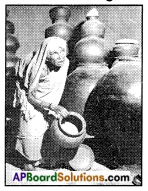
There is an old lady in this picture. She belongs to a poor family. All the vessels are empty. We can see the rice in a vessel in a small quantity. The woman is also very weak due to lack of food. It is because of monsoon failure. She is a victim of famine.

AP Board 8th Class Social Studies Important Questions Chapter 18 Rights Approach to Development

Question 7.
Read the following passages and answer the given questions.
Answer:
Pavan is a boy of about 13 years, who lives with his mother. He lives in a temple town visited by a large number of pilgrims. Pavan stands outside the temple gate and begs the pilgrims for food by falling at their feet. Sometime, some of them give him stale left over food from their tiffin boxes. Sometimes, he carries heavy bags for them and is paid a small amount.

His mother works in a house as domestic help. She works almost for twelve hours everyday, through out the month. She is constantly ordered about by her employers including young children. She is given left over food after everyone else has eaten. She is not allowed to sit before the employers, and has to always talk to them meekly. She is often insulted for some minor errors or delays and has to fight back her tears and anger lest she be thrown out of job.
1) How old is Pavan?
Answer:
He is 13 years old.

2) Why do the people give Pavan some money?
Answer:
Sometimes he lifts heavy bags for them. So they give Pavan some small amount.

3) What does his mother do?
Answer:
She works in a house as domestic help.

4) Try to write any two of her problems.
Answer:

  1. She is not allowed to sit before the employers.
  2. She is often insulted for some minor errors.

5) Why does Pavan fall at their feet?
Answer:
To create pity and sympathy in the minds of pilgrims for money.

AP Board 8th Class Social Studies Important Questions Chapter 18 Rights Approach to Development

Question 8.
Read the following passage and answer the given questions.
JAN SUNVAYI: MKSS used to conduct meetings, called ‘jan sunvayi’ (or people’s hearings). It is true that many people cannot read the government documents themselves. But every person in a village would like to know what the documents say. Thus, these were read out and explained. A muster roll would give names of people for whom wages were paid for making a hand-pump. The villagers can identify if the people mentioned in the muster roll were present during those days or were migrants, or if they were paid the amount stated in the document. This would bring out the corrupt in practices. Through these events people brought in necessary action. Officials were also given opportunity to defend and talk about the details given in the documents. The district administration and panchayat officials also participated in these meetings. When corruption was identified, criminal cases were registered against the concerned persons.

1) What is the meaning of ‘Jan Sunvayi’?
Answer:
It means people’s hearings.

2) Why do they read out the documents?
Answer:
Many people cannot read the government documents, so they read out.

3) What is a muster roll?
Answer:
It is an attendance register.

4) What did they do through these events?
Answer:
Through these events they brought in necessary action.

5) When did they register criminal cases?
Answer:
When corruption was identified, they registered criminal cases.

AP Board 8th Class Social Studies Important Questions Chapter 18 Rights Approach to Development

AP SSC 10th Class Maths Solutions Chapter 14 Statistics Ex 14.1

AP State Board Syllabus AP SSC 10th Class Maths Textbook Solutions Chapter 14 Statistics Ex 14.1 Textbook Questions and Answers.

AP State Syllabus SSC 10th Class Maths Solutions 14th Lesson Statistics Exercise 14.1

10th Class Maths 14th Lesson Statistics Ex 14.1 Textbook Questions and Answers

Question 1.
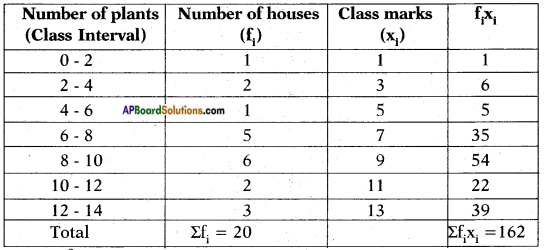
A survey was conducted by a group of students as a part of their environment awareness programme, in which they collected the following data regarding the number of plants in 20 houses in a locality. Find the mean number of plants per house.
AP SSC 10th Class Maths Solutions Chapter 14 Statistics Ex 14.1 q1
Answer:
AP SSC 10th Class Maths Solutions Chapter 14 Statistics Ex 14.1 q2
Since fi and xi are of small values we use direct method.
∴ \(\overline{\mathrm{x}}=\frac{\Sigma \mathrm{f}_{\mathrm{i}} \mathrm{x}_{\mathrm{i}}}{\Sigma \mathrm{f}_{\mathrm{i}}}\)
= \(\frac{162}{20}\)
= 8.1

AP SSC 10th Class Maths Solutions Chapter 14 Statistics Ex 14.1

Question 2.
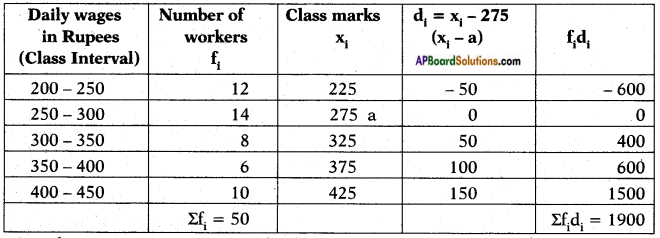
Consider the following distribution of daily wages of 50 workers of a factory.
AP SSC 10th Class Maths Solutions Chapter 14 Statistics Ex 14.1 3
Find the mean daily wages of the workers of the factory by using an appropriate method.
Answer:
AP SSC 10th Class Maths Solutions Chapter 14 Statistics Ex 14.1 4
Here the xi are of large numerical values.
So we use deviation method then,
\(\overline{\mathbf{x}}=\mathbf{a}+\frac{\Sigma \mathbf{f}_{\mathbf{i}} \mathbf{d}_{\mathbf{i}}}{\Sigma \mathbf{f}_{\mathbf{i}}}\)
Here the assumed mean is taken as 275.
∴ \(\overline{\mathrm{x}}=\mathrm{a}+\frac{\Sigma \mathrm{f}_{\mathrm{i}} \mathrm{d}_{\mathrm{i}}}{\Sigma \mathrm{f}_{\mathrm{i}}}\)
= 275 + \(\frac{1900}{50}\)
= 275 + 38
= 313.

AP SSC 10th Class Maths Solutions Chapter 14 Statistics Ex 14.1

Question 3.
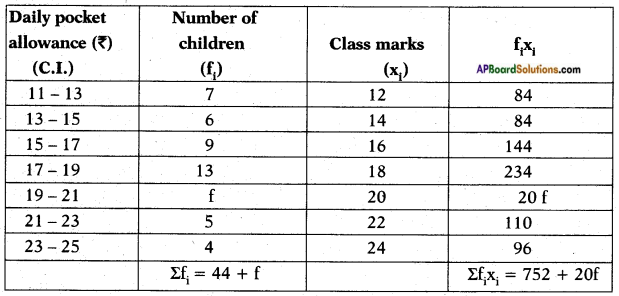
The following distribution shows the daily pocket allowance of children of a locality. The mean pocket allowance is Rs. 18. Find the missing frequency f.
AP SSC 10th Class Maths Solutions Chapter 14 Statistics Ex 14.1 5
Answer:
AP SSC 10th Class Maths Solutions Chapter 14 Statistics Ex 14.1 6
\(\overline{\mathrm{x}}=\frac{\Sigma \mathrm{f}_{\mathrm{i}} \mathrm{x}_{\mathrm{i}}}{\Sigma \mathrm{f}_{\mathrm{i}}}\)
xi = 18 (given)
\(\Rightarrow 18=\frac{752+20 \mathrm{f}}{(44+\mathrm{f})}\)
18 (44 + f) = 752 + 20 f
⇒ 20f- 18f= 792-752
⇒ 2f = 40
∴ f = \(\frac{40}{20}\) = 20.

AP SSC 10th Class Maths Solutions Chapter 14 Statistics Ex 14.1

Question 4.
Thirty women were examined in a hospital by a doctor and their of heart beats per minute were recorded and summarised as shown. Find the mean heart beats per minute for these women, choosing a suitable method.
AP SSC 10th Class Maths Solutions Chapter 14 Statistics Ex 14.1 7
Answer:
AP SSC 10th Class Maths Solutions Chapter 14 Statistics Ex 14.1 8
\(\overline{\mathbf{x}}=\mathbf{a}+\frac{\Sigma \mathbf{f}_{\mathbf{i}} \mathbf{d}_{\mathbf{i}}}{\Sigma \mathbf{f}_{\mathbf{i}}}\)
75.5 + \(\frac{12}{30}\)
= 75.5 + 0.4
= 75.9.

AP SSC 10th Class Maths Solutions Chapter 14 Statistics Ex 14.1

Question 5.
In a retail market, fruit vendors were selling oranges kept in packing baskets. These baskets contained varying number of oranges. The following was the distribution of oranges.
AP SSC 10th Class Maths Solutions Chapter 14 Statistics Ex 14.1 9
Find the mean number of oranges kept in each basket. Which method of finding the mean did you choose?
Answer:
AP SSC 10th Class Maths Solutions Chapter 14 Statistics Ex 14.1 10
Here we use step deviation method where a = 135, h = 5,a multiple of all di
\(\overline{\mathrm{x}}=\mathrm{a}+\left(\frac{\Sigma \mathrm{f}_{\mathrm{i}} \mathrm{u}_{\mathrm{i}}}{\Sigma \mathrm{f}_{\mathrm{i}}}\right) \times \mathrm{h}\)
= 22 + \(\frac{25}{400}\) × 5
= 22 + 0.31
= 22.31

AP SSC 10th Class Maths Solutions Chapter 14 Statistics Ex 14.1

Question 6.
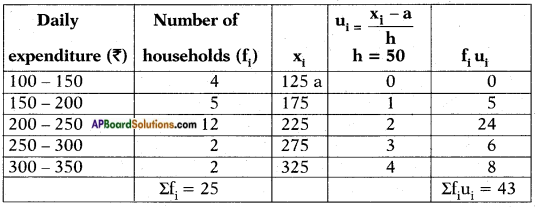
The table below shows the daily expenditure on food of 25 households in a locality.AP SSC 10th Class Maths Solutions Chapter 14 Statistics Ex 14.1 11
Find the mean daily expenditure on food by a suitable method.
Answer:
AP SSC 10th Class Maths Solutions Chapter 14 Statistics Ex 14.1 12
Here a = 125, h = 50, ∑fiui = 43
Now
\(\overline{\mathrm{x}}=\mathrm{a}+\left(\frac{\Sigma \mathrm{f}_{\mathrm{i}} \mathrm{u}_{\mathrm{i}}}{\Sigma \mathrm{f}_{\mathrm{i}}}\right) \times \mathrm{h}\)
= 125 + \(\frac{43}{25}\) × 50
= 125 + (43 × 2)
= 125 + 86
= 211.
NOTE: If we consider first value as “a” then we dont get negative values in ui, fiui columns. Then it becomes easy for calculation.

AP SSC 10th Class Maths Solutions Chapter 14 Statistics Ex 14.1

Question 7.
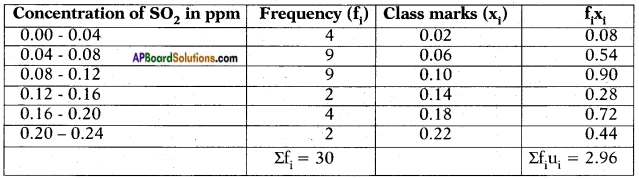
To find out the concentration of SO2 in the air (in parts per million, i.e., ppm), the data was collected for 30 localities in a certain city and is presented below:
AP SSC 10th Class Maths Solutions Chapter 14 Statistics Ex 14.1 13
Find the mean concentration of SO2 in the air.
Answer:
AP SSC 10th Class Maths Solutions Chapter 14 Statistics Ex 14.1 14
∴ \(\overline{\mathrm{x}}=\frac{\Sigma \mathrm{f}_{\mathrm{i}} \mathrm{x}_{\mathrm{i}}}{\Sigma \mathrm{f}_{\mathrm{i}}}\)
= \(\frac{2.96}{30}\)
= 0.00986666…….
≃ 0.099

AP SSC 10th Class Maths Solutions Chapter 14 Statistics Ex 14.1

Question 8.
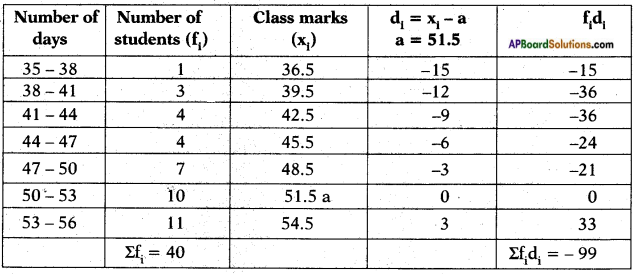
A class teacher has the following attendance record of 40 students of a class for the whole term. Find the mean number of days a student was present out of 56 days in the term.
AP SSC 10th Class Maths Solutions Chapter 14 Statistics Ex 14.1 15
Answer:
AP SSC 10th Class Maths Solutions Chapter 14 Statistics Ex 14.1 16
Here, a = 51.5
∴ \(\overline{\mathbf{x}}=\mathbf{a}+\frac{\Sigma \mathbf{f}_{\mathbf{i}} \mathbf{d}_{\mathbf{i}}}{\Sigma \mathbf{f}_{\mathbf{i}}}\)
= 51.5 – \(\frac{99}{40}\)
= 51.5 – 2.475
= 49.025
≃ 49 days

AP SSC 10th Class Maths Solutions Chapter 14 Statistics Ex 14.1

Question 9.
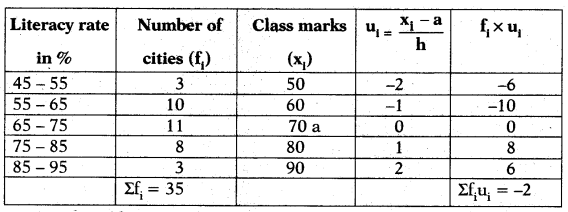
The following table gives the literacy rate (in percentage) of 35 cities. Find the mean literacy rate.
AP SSC 10th Class Maths Solutions Chapter 14 Statistics Ex 14.1 17
Answer:
AP SSC 10th Class Maths Solutions Chapter 14 Statistics Ex 14.1 18
a = 70; h = 10
∴ \(\overline{\mathbf{x}}=\mathbf{a}+\frac{\Sigma \mathbf{f}_{\mathbf{i}} \mathbf{u}_{\mathbf{i}}}{\Sigma \mathbf{f}_{\mathbf{i}}} \times \mathbf{h}\)
\(\Rightarrow \bar{x}=70-\frac{2}{35} \times 10\)
= 70 – \(\frac{2}{35}\) × 10
= 70 – \(\frac{20}{35}\)
= 70 – 0.57142
= 69.4285
≃ 69.43%

AP Board 8th Class Social Studies Important Questions Chapter 17 Understanding Poverty

AP State Syllabus AP Board 8th Class Social Studies Important Questions Chapter 17 Understanding Poverty.

AP State Syllabus 8th Class Social Studies Important Questions 17th Lesson Understanding Poverty

Question 1.
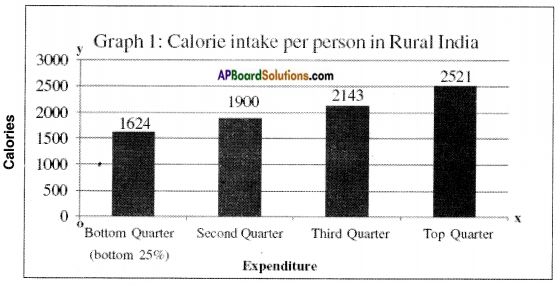
What is the average calorie intake of persons in the top quarter in the country?
Answer:
The average calorie intake of persons in the top quarter in the country is 2521.

Question 2.
By what percentage does the calorie intake of persons in the bottom quarter fall short of the daily calorie standard?
Answer:
23% of the calorie intake of persons in the bottom quarter fall short of the daily calorie standard.

AP Board 8th Class Social Studies Important Questions Chapter 17 Understanding Poverty

Question 3.
Do you find any relationship between economic background of person and his/her nutritional status?
Answer:
Yes, I find the relationship between economic background of person and his/her nutritional status. If the economic standard is less, the nutritional status is also low and vice versa.

Question 4.
What do you think can be done such that Ramachari and his family get two square meals a day?
Answer:
Ramachari should also go to the nearest town with his wife for daily works. Then only he and his family can get two square meals a day.

Question 5.
How would you describe the exchange between Ramachari and the farmers in the village?
Answer:
I discribe the exchange between Ramachari and the farmers in the village as follows:
“One for all and all for one”.

AP Board 8th Class Social Studies Important Questions Chapter 17 Understanding Poverty

Question 6.
Why do you think the MNREGA places priority on provision of irrigation facility to land owned by households belonging to the SCs and STs?
Answer:
The government sanctioned some funds for the development of SCs and STs from many years. These funds were remained unused. So these are used for irrigation and drinking water facilities to them only. With this they feel self-reliance.

Question 7.
Why do you think the calorie intakes of the people are so low?
Answer:
As they have low earnings, they cannot purchase costly foods which have high calories. They cannot eat and cannot work. So they.are habituated to eat stomachful of food, e.g.: Rice & chutney / rice & curry or rice & sambar.
So they are taking so low calories.

AP Board 8th Class Social Studies Important Questions Chapter 17 Understanding Poverty

Question 8.
Do you think the poor will be served better now with new policy? Provide reasons in favour of your answer.
Answer:
I think that the poor will be served better now with new policy.
Reasons:

  1. The government takes back the white cards from ineligibles.
  2. So the provisions are supplied only to the poor and the poorest.

Question 9.
Ration shops are also called fair price shops. Can you guess why?
Answer:
The provisions in ration shops are available at low prices when compared to open market. So they are called fair price shops.

Question 10.
Why are people without employment also often without assets, such as land, cattle, shops etc.?
Answer:
The people those who have no employment cannot save their earnings. Without savings they cannot purchase assets. So they do not have assets.

AP Board 8th Class Social Studies Important Questions Chapter 17 Understanding Poverty

Question 11.
Read the paragraph under the heading ‘Why Poverty? How can it be eliminated?’ and answer the following: What are the other reasons for poverty?
Answer:
The other reasons for poverty:

  1. Big families
  2. Only one person works hard in the family while all others eat.
  3. Lack of chances according to their capacity or eligibility.
  4. Less wages / salaries.

Question 12.
Give your comments on the given picture.
AP Board 8th Class Social Studies Important Questions Chapter 17 Understanding Poverty 1Answer:
This picture belongs to ‘Mid day meals scheme’. The girls are the beneficiaries of this scheme. In some poor families, children are not provided nutrious food and they are often suffered from hunger. The children studying in government schools, especially from such families will get benefited by this scheme. Undernourished children do not grow as quickly as healthy children. They will feel hard to study, work or otherwise perform physical activities. Mentally, they may develop more slowly. Keeping all these in view, the government is implementing Mid-day meal scheme for the well-being of the children belonging to poor families.

AP Board 8th Class Social Studies Important Questions Chapter 17 Understanding Poverty

Question 13.
Observe the graph and answer the following questions.
AP Board 8th Class Social Studies Important Questions Chapter 17 Understanding Poverty 2
1. Who are taking more calories?
Answer:
The rich

2. What is the difference between the top quarter and second quarter in calories?
Answer:
621 calories.

3. Who are taking least calories?
Answer:
The bottom quarter

4. What do you understand by observing this picture?
Answer:
Economic standard dictates the nutrition status.

Question 14.
Activity: One way to find out if adults are undernourished is to calculate what Nutrition Scientists call Body Mass Index (BMI). This is easy to calculate. Measure the weight of the person in kgs. Then measure the height in metres. Divide the weight by the square of the height. If this figure is less than 18.5 then the person would be considered undernourished. However, if this BMI is more than 25, then a person is overweight. Do remember that this criterion is not applicable to growing children.
Let each student in the class find out the weight and height of three adult persons of different economic backgrounds like office workers, servants, business person etc. Collect the data from all the students and make a combined table. Calculate their BMI.
Answer:

S.No.Years of AgeM/FTheir workHeight
(inches)
Weight
(kgs.)
BMI
1.35MLabourer1655720.94 Normal
2.42MLabourer1616130.68 Fat
3.28FLabourer1635018.82 Normal
4.37MWorker1685619.84 Thin
5.40MWorker1575221.1 Normal
6.42FWorker1615621.6 Normal
7.54MBusiness person1586626.44 Fat
8.46MBusiness person1707124.57 Fat
9.32FBusiness person1576827.59 Fat

AP Board 8th Class Social Studies Important Questions Chapter 17 Understanding Poverty

Question 15.
Read the following passage and answer the given questions.
The poorest families are issued Antyodaya cards. Next, the people whose situations are slightly better but still can be considered poor are issued BPL (Below Poverty Line) cards. The remaining families are issued APL (Above Poverty Line) cards.
Quantities and prices of ration given to each cardholder are different. For example, the Antyodaya cardholders are entitled to get 35 kgs of foodgrains (rice and wheat) per month per family. The BPL cardholders in Andhra Prasdesh can receive 4 kgs of foodgrains per head not exceeding 20 kgs per family. The Annapurna Scheme card holders who are the poorest of the poor (Indigent senior citizens) get 10 kgs of rice free of cost.
1. Who are issued Antyodaya cards?
Answer:
The poorest families.

2. Which colour cards are issued to BPL families?
Answer:
White cards.

3. What is meant by BPL?
Answer:
Below Poverty Line.

4. How much food grains can receive the BPL card holders in Andhra Pradesh?
Answer:
4 kgs of food grains per head.

5. Who are the Annapurna scheme card holders?
Answer:
The poorest of the poor (Indigent senior citizens).

AP Board 8th Class Social Studies Important Questions Chapter 17 Understanding Poverty

AP SSC 10th Class English Solutions Chapter 1A Attitude is Altitude

AP State Board Syllabus AP SSC 10th Class English Textbook Solutions Chapter 1A Attitude is Altitude Textbook Questions and Answers.

AP State Syllabus SSC 10th Class English Solutions Chapter 1A Attitude is Altitude

10th Class English Chapter 1A Attitude is Altitude Textbook Questions and Answers

Look at the pictures and answer the questions.
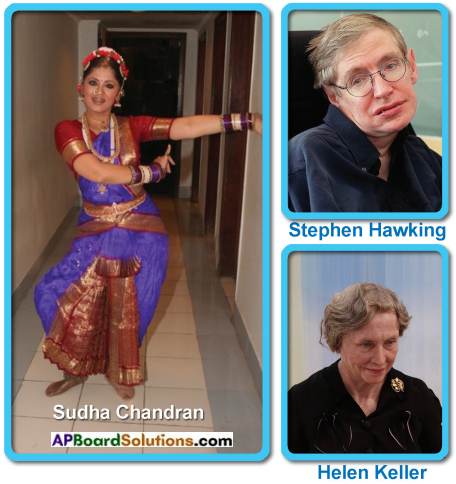
AP SSC 10th Class English Solutions Chapter 1A Attitude is Altitude 1

AP SSC 10th Class English Solutions Chapter 1A Attitude is Altitude

Question 1.
What qualities have made these persons great?
Answer:
The persons in the above pictures are Sudha Chandran, Stephen Hawking and Helen Keller.
Sudha Chandran is an accomplished Bharatanatyam dancer, Indian film and television actress, who showed great courage even though she had lost her leg in an accident.

Stephen Hawking is one of the famous scientists. Despite his debilitating illness, he has done ground-breaking work in physics.

Helen Keller overcame the adversity of being blind and deaf to become one of the 20th century’s leading humanitarians.
These three great persons showed that anything can be done, if one tries hard enough. From their lives, it is understood that one need not lose hope. Their lives show us that disability need not prevent one from reaching great heights. The qualities such as grit, determination, confidence, will power, dedication, discipline, etc. have made these persons great.

Question 2.
What qualities do you think a person requires to become successful ?
Answer:
The qualities a person requires to become successful are determination, dedication, discipline, grit, courage, faith, positive thinking, responsibility, hard work, commitment, desire, persistence, good character, etc. These qualities make a person highly successful.

AP SSC 10th Class English Solutions Chapter 1A Attitude is Altitude

Comprehension

I. Answer the following questions.

Question 1.
‘I call it my chicken drumstick,’ joked Nick. What does ‘it’ refer to? How does it help him ?
Answer:
‘It’ refers to the small foot that Nick has on his left hip. It helps him balance and enables him to kick. Nick uses his one foot to type, write with a pen and pick things up between his toes.

Question 2.
‘His parents decided not to send him to a special school.’ Was Nick happy about his parents’ decision? Why or why not? What do you think about this decision?
Answer:
Nick’s was not happy with his parents’ decision because there might be the risk of bullying. His companions at mainstream school might tease him.
But later, he realised that his parents’ decision was the best one. I think that this decision was the best one his parents could have made for him as he was able to achieve a degree in Financial Planning and Real Estate. The decision made him independent.

Question 3.
How did Nick’s parents help him to become independent?
Answer:
Right from the start Nick’s parents did their best to make him independent. His father put Nick in the water at 18 months and gave him the courage to learn how to swim. He encouraged Nick to get into football and skating. He taught Nick how to type with his toe at just six years old. Nick’s mother invented a special plastic device that meant Nick could hold a pen and pencil. Despite the risk of bullying, Nick’s parents insisted on his attending mainstream school.

AP SSC 10th Class English Solutions Chapter 1A Attitude is Altitude

Question 4.
Pick out the symptoms of Nick’s depression. Do you think his depression was normal or something unique about him? Give reasons for your opinion.
Answer:
Nick was deeply depressed when he was eight years old. When he was in depression, he went to his mother crying and told her that he wanted to kill himself. He felt cold and bitter. He hated God for doing this to him. He was terrified about his future without his parents. At age ten Nick tried to drown himself in the bath. These were the symptoms of Nick’s depression. I think his depression was normal. Any human being born like Nick might have the same depression.

Question 5.
Which incident in this text is funny? What makes it funny?
Answer:
Once Nick was in a car and a girl at traffic lights was looking at him interestingly. She could only see Nick’s head so he decided to do a 360 in the car seat to freak her out. When she saw the torso, she sped off really quickly. This is the funny incident in the text. The idea of Nick showing the girl his torso makes the scene funny.

Question 6.
What made Nick choose Bethany Hamilton as his teacher to learn surfing?
Answer:
Nick went to Hawaii in 2008 and met surfing master Bethany Hamilton. She had her arm bitten off by a shark when she was 12. Nick chose Bethany Hamilton as she too was a disabled person and still she performed surfing very well. Though she had no arm she did well. As a disabled person, she could know how a disabled person could learn how to surf. She could know the psychological condition of a disabled person.

Question 7.
Which aspect of Nick’s physical condition helps him to do a 360 degree spin?
Answer:
Nick has a very low centre of gravity so he has got pretty good balance. This condition helps Nick to do 360 degree spin.

AP SSC 10th Class English Solutions Chapter 1A Attitude is Altitude

Question 8.
What are the distinct features of this text? List them.
Answer:

  1. It is an autobiography.
  2. Varied sentences are used.
  3. Ideas are arranged in a logical sequence.
  4. Emotive and persuasive language is used.
  5. Ideas are exemplified very well.
  6. Cohesion is found in the text. The sentences are connected with proper linkers.
  7. Unity of ideas is maintained for coherence. The sentences are connected in a clear and reasonable way.
  8. Certain quotations and examples are given.
  9. Proper introduction, development and conclusion are ensured.
  10. The ideas are given formally and precisely.
  11. As far as the content is concerned, it touches the emotions of a reader.
  12. The content is message-oriented.
  13. Physical description of the main character is given properly.
  14. The main character’s attitudes, likes, dislikes, strengths and weaknesses are given effectively.

Question 9.
What do you learn from the life of Nick Vujicic?
Answer:
Nick Vujicic uses his life story to inspire people of all around the world. From the life of Nick, we learn that if we fail, we should try again and again until we succeed. Nick shows us that anything can be done, if we try hard enough. Undoubtedly, I feel that his life is a source of inspiration to everyone of us. He has been able to do all these because of his faith, hope, perseverance and strong will power. Nick proves that disability need not prevent one from reaching great heights. Hence I learn that we shouldn’t lose our faith and hope under any circumstances.

AP SSC 10th Class English Solutions Chapter 1A Attitude is Altitude

II. Given below are some of the statements made by Nick Vujicic. Which of these are substantiated by Nick’s life ?

  • I realised why God had made us like this – to give hope to others.
  • I wanted to concentrate on something good that / had.
  • I tell people to keep on getting up when they fall and to always love themselves.
  • If I can encourage just one person, then my job in this life is done.

Answer:
I think all the above statements are substantiated by Nick’s life.
i) I realised why God had made us like this – to give hope to others:
When Nick was 13, he read a newspaper article about a disabled man who had managed to achieve great things and help others. Nick was inspired very much by the disabled man mentioned in the article. He got a hope from him. Then he decided to use his life to encourage others and give them hope.

ii) I wanted to concentrate on something good that I had:
Nick was not discouraged with his disability. He knew that he had no arms and legs but he thought that they would never take away the beauty of his eyes. With his positive approach, he thought that his eyes were very good ones for him. He wanted to love his positive qualities such as faith, will power and perseverance. Further, he was quite satisfied with what he had, i.e. a small foot on his left hip. He said he would be lost with it.

iii) I tell people to keep on getting up when they fall and to always love themselves: If Nick fails, he tries again and again until he succeeds. When Nick was learning how to surf, he was terrified at first but later he did very well. Though he has no limbs, he always loves himself. I know this by his statement, “I decided to be thankful for what I do have, not get angry about what I don’t.”

iv) If I can encourage just one person, then my job in this life is done:
This statement was substantiated by Nick aptly. He encouraged many people in the world. He used his life story to inspire others. He made many people realise their inner beauty and personality. He was able to rise many people from the state of despair to the state of great hope.

AP SSC 10th Class English Solutions Chapter 1A Attitude is Altitude

Vocabulary

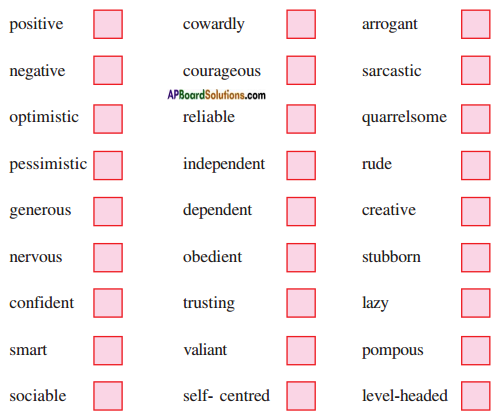
I. Look at the list of adjectives in the box. Which of them describe Nick Vujicic. Tick (✓) them.
AP SSC 10th Class English Solutions Chapter 1A Attitude is Altitude 2
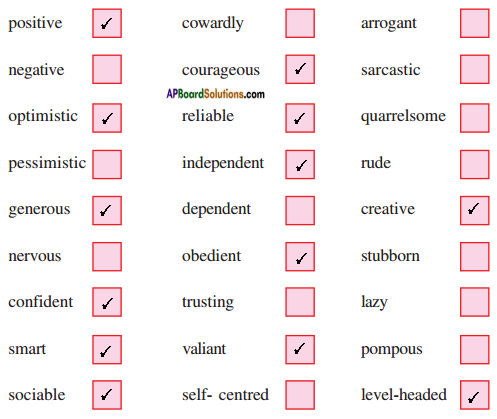
Answer:
AP SSC 10th Class English Solutions Chapter 1A Attitude is Altitude 3

Explanation:

  1. positive: hopeful and confident
  2. negative: harmful, unpleasant or not wanted
  3. optimistic: believing that good things will happen In the future
  4. pessimistic: expecting that bad things will happen in the future
  5. generous: willing to give money, spend time, etc. in order to help people or give them pleasure
  6. nervous: worried or frightened about something
  7. confident: sure that something will happen in the way that you want or expect
  8. smart: fashionable, clever
  9. sociable: friendly and enjoys being with other people
  10. cowardly: not at all brave
  11. courageous: brave
  12. reliable: dependable
  13. Independent: confident and able to do things by oneself in ones own way
  14. dependent: needing someone or something in order to exist, be successful, be healthy, etc.
  15. obedient: always doing what one is told to do
  16.  trusting: willing to believe that other people are good and honest
  17. valiant: very brave in difficult situation
  18. self-centred: paying so much attention to oneself that one doesn’t notice what is happening
  19. arrogant: behaving in an unpleasant or rude way
  20. sarcastic: saying things that are the opposite of what one means, in order to make an unkind joke
  21. quarrelsome: one who quarrels a lot with people
  22. rude: not polite and annoys others
  23. creative: good at using imagination to make things
  24. stubborn: determined not to change one’s mind when people think one is being unreasonable
  25. lazy: not making any effort to do anything
  26. pompous: trying to seem magnificent or very important; fond of display, acting too proudly, self-important.
  27. level-headed: sensible in making judgements

AP SSC 10th Class English Solutions Chapter 1A Attitude is Altitude

Pick out from the text the examples that support these attributes.

AttributeExample from the text
1. PositiveIn spite of his disability he has become great.
2. OptimisticHe always thinks, “If I fail, I try again, and again, and again. If I can encourage just one person, then my job is done.”
3. GenerousHe spends most of his time delivering motivational speeches all over the world.
4. ConfidentThough he has no limbs, he gains faith and hope and tries to give them to others.
5. SmartHe appears to be smart and shows his cleverness in learning things.
6. SociableHe enjoys being with others by delivering speeches, playing football, golf, surfing, etc.
7. CourageousDespite the absence of his limbs, he didn’t get discouraged. With great courage, he tries again and again and becomes a football player, a swimmer and a surfer.
8. ReliableHe is the most reliable person. As an Evangelical Christian he has faith and gives the same to others with his motivational speeches. The people believe his reliability and are attracted towards him.
9. IndependentHe independently has done the things what he has wanted to do. e.g.: Playing football and golf, swimming, surfing, delivering speeches, etc.
10. ObedientHe seems to be obedient in accepting the unlucky birth.
11. ValiantWith great determination, he has reached a great position in his life. He becomes an international symbol of triumph over adversity.
12. CreativeHe also plays golf with a club tucked under his chin.
13. Level-headedHe judges well when he says, “The challenges in our lives are there to strengthen our convictions. They are not there to run us over.”

AP SSC 10th Class English Solutions Chapter 1A Attitude is Altitude

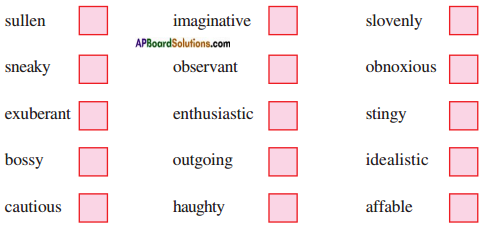
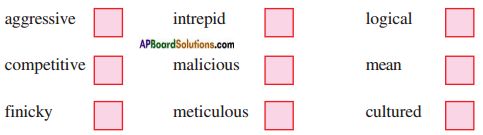
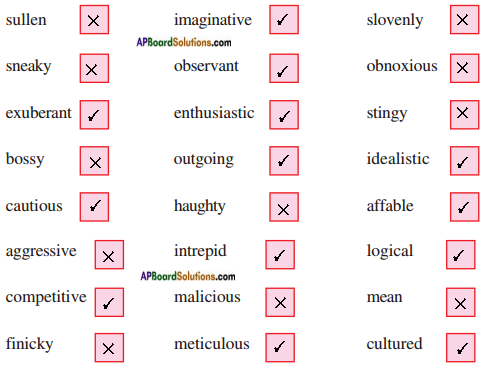
II. Given below are words that describe the positive or negative attitude of a person. Discuss them with your partner and put a tick (✓) against the positive qualities and a cross (✕) against the negative qualities.

AP SSC 10th Class English Solutions Chapter 1A Attitude is Altitude 4AP SSC 10th Class English Solutions Chapter 1A Attitude is Altitude 5
Answer:
AP SSC 10th Class English Solutions Chapter 1A Attitude is Altitude 6

Explanation:

  1. sullen: angry and silent (negative quality)
  2. sneaky: doing things in a secret and dishonest way (negative quality)
  3. exuberant: happy and full of energy and excitement (positive quality)
  4. bossy: always telling other people what to do in a way that is annoying (negative quality)
  5. cautious: careful to avoid danger or risk (positive quality)
  6. aggressive: behaving in an angry threatening way (negative quality)
  7. competitive: determined or trying very hard to he more successful than other people (positive quality)
  8. finicky: too concerned with unimportant details and small things that you like or dislike (negative quality)
  9. imaginative: good at thinking of new and interesting ideas (positive quality)
  10. observant: good or quick at noticing things (positive quality)
  11. enthusiastic: showing a lot of interest and excitement about something (positive quality)
  12. outgoing: someone who Is outgoing likes to meet and talk to new people (positive quality)
  13. haughty: behaving in a proud. unfriendly way (negative quality)
  14. intrepid: willing to do dangerous things; fearless, brave (positive quality)
  15. malicious: very unkind and cruel and is trying to do harm to others (negative quality)
  16. meticulous: very careful about small details and always makes sure that everything is done correctly (positive quality)
  17. slovenly: lazy untidy and careless (negative quality)
  18. obnoxious: very offensive, unpleasant or rude (negative quality)
  19. stingy: not generous. especially with money (negative quality)
  20. Idealistic: believing that one should live according to high standards and principles, even when they are very difficult to achieve (positive quality)
  21. affable: friendly and easy to talk to (positive quality)
  22. logical: reasonable and sensible (positive quality)
  23. mean: cruel (negative quality)
  24. cultured: intelligent, polite and interested in art, literature, music etc. (positive quality)

AP SSC 10th Class English Solutions Chapter 1A Attitude is Altitude

III. Tick (✓) the word/expression which is nearest in meaning to the word underlined in each sentence given below.

1. Water sports aren’t Nick’s only thing – he also plays golf with a dub tucked under his chin.
a) kept
b) pulled
c) covered
d) tied
Answer: a

2. His distraught mother couldn’t bring herself to hold him until he was four months old.
a) angry
b) careless
c) shy
d) anxious
Answer: d

3. Despite the risk of bullying, his parents insisted on Nick’s attending mainstream school.
a) discrimination
b) humiliation
c) negligence
d) failure
Answer: b

4. Nick, who was teased and bullied, had an electric wheelchair for mobility, and a team of carers to help him.
a) socialising
b) movement
c) travel
d) safety
Answer: b

5. Nick managed to pull through to become an international symbol of triumph over adversity.
a) disability
b) poverty
c) difficulties
d) opposition
Answer: c

6. The challenges in our lives are there to strengthen our convictions.
a) feelings
b) practices
c) beliefs
d) characters
Answer: c

AP SSC 10th Class English Solutions Chapter 1A Attitude is Altitude

IV. Read the following descriptions about persons and fill in the blanks with the words that match with these descriptions.

AP SSC 10th Class English Solutions Chapter 1A Attitude is Altitude 8

1. Ashok is a very unpleasant and rude fellow. I don’t talk to him. He is ———–.
2. Srinu is very confident, elegant and polite. But sometimes he does not appear to be sincere. He is ———–.
3. Sujatha is quiet and calm. She doesn’t like to spend time with others. She is interested in her thoughts and feelings. So she is an ———–.
4. Ramesh is very sensitive. He always shows sympathy for people who are suffering. He is ———–.
5. My neighbour is such a person that he has a feeling of hatred for others. He desires to hurt others’ feelings. He is ———–.
6. My father pays careful attention to every detail. He makes thorough planning for everything in our home. He is ———–.
7. Prem is an extremely unpleasant person. He always tries to offend people. He is ———–.
8. My mother is very calm and peaceful. She doesn’t get excited or irritated easily. She is ———–.
9. Rahul is a very lively and confident person. He enjoys being with his friends. He is an ———–.
10. Sridhar is always afraid of speaking in the class. He is ———–.
Answers:
1. boorish
2. suave
3. introvert
4. compassionate
5. malicious
6. meticulous
7. obnoxious
8. placid
9. extrovert
10. timid

AP SSC 10th Class English Solutions Chapter 1A Attitude is Altitude

GRAMMAR

I. Read the text again and identify some more Defining and Non-defining Relative Clauses.

1. —————————————————————
2. —————————————————————
3. —————————————————————
4. —————————————————————
5. —————————————————————
Answer:
1. Nick has a small foot, which helps him balance. (Non-defining Relative Clause)
2. Nick, who was born in Melbourne, now lives in Los Angeles. (Non-defining Relative Clause)
3. I read about a disabled man who had managed to achieve great things and help others. (Defining Relative Clause)
4. I decided to give people the courage that the article had given me. (Defining Relative Clause)
5. Nick, who later achieved a degree, says this. (Non-defining Relative Clause)

II. Read the following sentences and circle the Non-defining Relative Clauses and put a comma/a hyphen wherever necessary.

1. The meeting which was held in the town hall was a great success.
2. The people who live in glass houses must not throw stones.
3. The teachers who have taught Abhiram say that he is an exceptionally creative student.
4. Napoleon who won the French honour died at St. Helena.
5. The silk sarees which are made in Banares are popular all over the world.
Answer:
1. The meeting which was held in the town hall was a great success. (Defining Relative Clause)
2. The people who live in glass houses must not throw stones. (Defining Relative Clause)
3. The teachers who have taught Abhiram say that he is an exceptionally creative student. (Defining Relative Clause)
4. Napoleon, who won the French honour, died at St. Helena. (Non-defining Relative Clause)
5. The silk sarees which are made in Benares are popular all over the world. (Defining Relative Clause)

AP SSC 10th Class English Solutions Chapter 1A Attitude is Altitude

III. Complete the sentences with Defining or Non-defining Relative Clauses.

1. This is the peaceful place __________________________ .
2. The Mahaprasthanam’ is a popular book __________________________ .
3. Suresh ____________________________ has left the school just now.
4. Is this the street _______________________________________________ ?
5. The express __________________________________ has just arrived.
6. The place ___________________________ has been closed to traffic.
7. This is a famous engineering college _____________________________ .
8. My sister_______________ has secured ajob as an engineer in BHEL.
9. The theatre _____________________________ was designed by Mr Rao.
10. Viswanath is one of the outstanding directors in Telugu film industry______________________ .
Answer:
1. This is the peaceful place that is liked by every naturalist.
2. The Mahaprasthanam’ is a popular book which I have bought in Hyderabad.
3. Suresh, who is mv cousin, has left the school just now.
4. Is this the street where meat is sold?
5. The express which runs between Delhi and Chennai has just arrived.
6. The place which is behind our house has been closed to traffic.
7. This is a famous engineering college that is founded by Mr. Yashwanth.
8. My sister, who has completed her education in Bengaluru, has secured a job as an engineer in BHEL.
9. The theatre which was built in 2012 was designed by Mr. Rao.
10. Viswanath is one of the outstanding directors in Telugu film industry which produces a number of creative directors.

AP SSC 10th Class English Solutions Chapter 1A Attitude is Altitude

WRITING

I. Writing a biographical sketch

A biographical sketch is an account of the life and activities of an individual. It includes information about the person’s name, place of residence, education, occupation, life and activities and other important details. It is written by another person. If a person writes an account of his/her own life, it is called an autobiography.

Given below in the table is the biographical information about Stephen Hawking. Based on this information write a biographical sketch.

Points to be coveredDetails of the person
Date and place of birthJanuary 8,1942, Oxford, England
Information about the family
  • Eldest one of four sons
  • Mother: Isobel Hawking
  • Father: Frank Hawking, a medical researcher with a speciality in tropical diseases
Important events in life
  • Early academic life: recognized as a bright student
  • High school years: third from the bottom of his class
  • Pursuits outside of school: loved board games, constructed a computer out of recycled parts at the age of 16, solved rudimentary mathematical equations
  • Marriage: married Jane Wilde
  • Health: Suffered from Amyotrophic Lateral Sclerosis
  • Research: on black holes
  • Discovery: Hawking Radiation
Awards, prizes, honours
  • Fellow of the Royal Society at the age of 32
  • Albert Einstein Award.
  • The Pius XI- Gold Medal for Science from Pope Paul VI in 1975
Contribution to his field and societyContributed to the advancement of science and research

Answer:

Biographical Sketch of Stephen Hawking

Stephen William Hawking is one of the greatest scientists of the world. He was born at Oxford in England on 8 January, 1942 to Isobel Hawking and Frank Hawking. He was the eldest of four sons. His father, Frank Hawking, was a medical researcher with a speciality in tropical diseases.

Hawking was recognised as a bright student. But he was not initially successful academically. During his high school years, Stephen stood the third from the bottom of his class.

Hawking used to remain with a close group of friends with whom he enjoyed board games, the manufacture of fireworks, model aeroplanes and boats. With the help of the mathematics teacher, Dickran Tahta, Hawking and his companions built a computer from clock parts, an old telephone switchboard and other recycled components when he was 16. Hawking solved rudimentary mathematical equations.

He married Jane Wilde on 14 July, 1965. The first years after their marriage were hectic. Hawking has achieved many things in the field of science in spite of his prolonged illness. He has been suffering from an incurable disease, Amyotrophic Lateral Sclerosis (ALS) which has weakened his muscles since he was 17 years old.

Stephen Hawking is known for his work regarding black holes and for authoring several popular science books. In 1974, Hawking’s research turned him into a celebrity within the scientific world when he showed that black holes are not the information vacuums that scientists had thought they were. In simple terms, Hawking demonstrated that matter, in the form of radiation, can escape the gravitational force of a collapsed star. Thus Hawking Radiation was invented.

As a mark of his eminence, Professor Hawking obtained twelve honorary degrees which he deserved. He was named a Fellow of the Royal Society at the age of 32, and later earned the prestigious Albert Einstein Award. In 1975, Hawking journeyed to Rome, where he was honoured with the Pius XI – Gold Medal for science from Pope Paul VI in 1975.

Attitude is Altitude Summary in English

This is the story of a great person, Nicholas James Nick Vujicic, who stands as an inspiration to other people with his great qualities-faith, will power and perseverance- even though he is a disabled person. His disability has not stopped him from doing what he has wanted to do. Nick Vujicic was born on 4 December 1982 in Melbourne, Australia with a rare disability called Phocomelia characterised by the absence of all four limbs. Despite the absence of his limbs, he plays football and golf, swims and surfs. He is an Australian Christian evangelist and motivational speaker. As a child, he struggled mentally and emotionally as well as physically. It was a shock to Nick’s parents that he was born without limbs. His mother was a nurse and his father was a computer programmer and accountant. His parents did their very best when they decided to send him to mainstream school despite the risk of humiliation.

Nick has a small foot on his left hip. It gives him balance and enables him to kick. With his foot, he writes with a pen and picks things up between his toes. He also plays golf with a heavy stick tucked under his chin. He is a huge fan of the English Premier League. His parents did their best to make him independent from the start. His father gave him the courage to learn how to swim by putting him in water at 18 months. His mother invented a special plastic device to enable him to hold a pen and pencil.

At age eight, Nick was deeply depressed and went to his mother crying. He told her that he wanted to kill himself. When he was ten years old, he decided to end his life by drowning himself in a bathtub but luckily he was unsuccessful in his attempt. When Nick was 13, he was inspired when he read about a disabled man who had managed to achieve great things and helped others. He understood that God had given him the life to give hope to others and so he decided to use his life to encourage other people and give them the courage. He believes that challenges strengthen our opinions. With the help of his religion, friends and family, Nick becomes an international symbol of triumph over adversity. Nick won the Australian Young Citizen of the Year award in 1990 for his bravery and perseverance. His persistence made him achieve a degree in Financial Planning and Real Estate. He went to Hawaii in 2008 and was trained in surfing by Bethany Hamilton. Nick was on the cover of Surfer magazine with his feat of doing the 360 degree spins. He is able to do this feat because of his low centre of gravity.
Nick and Kanae Miyahara, whose mother was a Mexican and father was a Japanese, got married on February 12, 2012 and on February 13, 2013 they were blessed with the birth of a healthy baby boy with full body.

Nick has travelled to over 24 countries speaking to groups of up to 110,000 people. He keeps telling the people to keep on getting up when they fall and to always love themselves. He spreads his messages of faith and hope around the world.

Nick uses his story to inspire and inform people all around the world. Nick presents values, principles, attitudes and perspectives that challenge and equip people from all walks of life to overcome their adversities.

Attitude is Altitude Glossary

stretch (v): to straighten one’s arms, legs or body

wrap (v): put ones arms around something

skateboard (n): a short narrow board with small wheels at each end, which you stand on and ride as a sport

torso (n): the main part of the body, not including the head, arms or legs

surf: to take part in the sport of riding on waves on a surfboard

despite (pre): In spite of

limb (n): an arm or leg

hip (n): one of the two parts on each side of one’s body between the top of one’s leg and one’s waist

chicken drumstick (n): the lower part of the leg of a chicken or other bird that is cooked and eaten as food

faith (n): belief or trust in God

virgin (n): someone who has never had sex

modest (adj): shy about attracting sexual interest

publicist (n): someone whose job is to make sure that people know about a new product, film, book, etc.

club (n): a heavy stick with one end thicker than the other

tuck (v): to put something into a space

distraught (adj): so upset and worried

bully (v): to threaten to hurt someone or frighten them

bullying (n): humiliation

carer (n): someone who looks alter an old or ill person at home

wall-mounted (adj): attached to a wall

pump-action (adj): a pump-action piece of equipment is operated by pulling or pressing a part in or out. so that the contents come out in short bursts

drown (v): to die from being under water for too long time

lack: to not have something that one needs

triumph (n): an important success or victory

adversity (n): a difficulty or unpleasant situation

Inspirational (adj): providing encouragement or new ideas for what one should do

conviction (n): a very strong belief or opinion

run over (phr.v.): to hit someone or something with something (a vehicle, challenge, etc.) and drive over them

perseverance (n): the quality of continuing to try to achieve a particular aim despite difficulties

give somebody the eye (n.phrase): to look at someone in a way that shows one thinks they are sexually attractive

freak out (phr.v.): make someone very anxious. upset or afraid

amazing (adj): (here) very good

spin (n): an act of turning around quickly

centre of gravity (n.phrase): the point in any object on which it can balance

AP SSC 10th Class Maths Solutions Chapter 13 Probability Ex 13.2

AP State Board Syllabus AP SSC 10th Class Maths Textbook Solutions Chapter 13 Probability Ex 13.2 Textbook Questions and Answers.

AP State Syllabus SSC 10th Class Maths Solutions 13th Lesson Probability Exercise 13.2

10th Class Maths 13th Lesson Probability Ex 13.2 Textbook Questions and Answers

Question 1.
A bag contains 3 red balls and 5 black balls. A ball is drawn at random from the bag. What is the probability that the ball drawn is (i) red ? (ii) not red?
Answer:
i) Total number of balls in the bag = 3 red + 5 black = 8 balls.
Number of total outcomes when a ball is drawn at random = 3 + 5 = 8
Now, number of favourable outcomes of red ball = 3.
∴ Probability of getting a red ball = \(\frac{\text { No. of favourable outcomes }}{\text { No. of total outcomes }}\) = \(\frac{3}{8}\)
ii) If P( E) is the probability of drawing no red ball, then P(E) + P(\(\overline{\mathrm{E}}\)) = 1
P(\(\overline{\mathrm{E}}\)) = 1 – P(E)= 1 – \(\frac{3}{8}\) = \(\frac{5}{8}\)

AP SSC 10th Class Maths Solutions Chapter 13 Probability Ex 13.2

Question 2.
A box contains 5 red marbles, 8 white marbles and 4 green marbles. One marble is taken out of the box at random. What is the probability that the marble taken out will be (i) red? (ii) white? (iii) not green?
Answer:
Total number of marbles in the box = 5 red + 8 white + 4 green = 5 + 8 + 4= 17
Number of total outcomes in drawing a marble at random from the box =17.
i) Number of red marbles = 5
Number of favourable outcomes in drawing a red ball = 5
∴ Probability of getting a red ball P(R) = \(\frac{\text { No. of favourable outcomes }}{\text { No. of total outcomes }}\)
P(R) = \(\frac{5}{17}\)

ii) Number of white marbles = 8
Number of favourable outcomes in drawing a white marble = 8
∴ Probability of getting a white marble
P(W) = \(\frac{8}{17}\)

iii) Number of ‘non-green’ marbles = 5 red + 8 white = 5 + 8 = 13
Number of outcomes favourable to drawing a non-green marble =13.
∴ Probability of getting a non- green marble
P(non – green) = \(\frac{\text { No. of favourable outcomes }}{\text { No. of total outcomes }}\)
P(non – green) = \(\frac{13}{17}\)
Probability of getting a green ball = \(\frac{\text { No. of green balls }}{\text { Total no. of balls }}\) = \(\frac{4}{17}\)
Now P(G) = \(\frac{4}{17}\)
and P(G) + P(\(\overline{\mathrm{ G}}\)) = 1
∴ P(\(\overline{\mathrm{G}}\)) = 1 – P(G)
= 1 – \(\frac{4}{17}\)
= \(\frac{13}{17}\)

AP SSC 10th Class Maths Solutions Chapter 13 Probability Ex 13.2

Question 3.
A Kiddy bank contains hundred 50p coins, fifty Rs. 1 coins, twenty Rs. 2 coins and ten Rs. 5 coins. If it is equally likely that one of the coins will fall out when the bank is turned upside down, what is the probability that the coin (i) will be a 50 p coin? (ii) will not be a Rs. 5 coin?
Answer:
i) Number of 50 p coins = 100
Number of Rs. 1 coins = 50
Number of Rs. 2 coins = 20
Number of Rs. 5 coins = 10
Total number of coins = 180
Number of total outcomes for a coin to fall down = 180.
Number of outcomes favourable to 50 p coins to fall down = 100.
∴ Probability of a 50 p coin to fall down = \(\frac{\text { No. of favourable outcomes }}{\text { No. of total outcomes }}\)
= \(\frac{100}{180}\) = \(\frac{5}{9}\)

ii) Let P(E) be the probability for a Rs. 5 coin to fall down.
Number of outcomes favourable to Rs. 5 coin = 10.
∴ Probability for a Rs. 5 coin to fall down = \(\frac{\text { No. of favourable outcomes }}{\text { No. of total outcomes }}\)
= \(\frac{10}{180}\) = \(\frac{1}{18}\)
Then P(\(\overline{\mathrm{E}}\)) is the probability of a coin which fall down is not a Rs. 5 coin.
Again P(E) + P(\(\overline{\mathrm{E}}\)) = 1
∴ P(\(\overline{\mathrm{E}}\))= l-P(E)
= 1 – \(\frac{1}{18}\)
= \(\frac{17}{18}\).

AP SSC 10th Class Maths Solutions Chapter 13 Probability Ex 13.2

Question 4.
Gopi buys a fish from a shop for his aquarium. The shopkeeper takes out one fish at random from a tank containing 5 male fish and 8 female fish (See figure). What is the probability that the fish taken out is a male fish?
AP SSC 10th Class Maths Solutions Chapter 13 Probability Ex 13.2 1Answer:
Number of male fish = 5
Number of female fish = 8
Total number of fish = 5 m + 8 f
= 13 fishes.
∴ Number of total outcomes in taking a fish at random from the aquarium =13.
Number of male fish = 5
∴ Number of outcomes favourable to male fish = 5.
∴ The probability of taking a male fish = \(\frac{\text { No. of favourable outcomes }}{\text { No. of total outcomes }}\)
= \(\frac{5}{13}\)
= 0.38

Question 5.
A game of chance consists of spinning an arrow which comes to rest pointing at one of the numbers 1, 2, 3, 4, 5, 6, 7, 8 (See figure), and these are equally likely outcomes. What is the probability that it will point at
(i) 8?
(ii) an odd number?
(iii) a number greater than 2?
(iv) a number less than 9?
AP SSC 10th Class Maths Solutions Chapter 13 Probability Ex 13.2 2
Answer:
Number of total outcomes are (1,2,……….., 8) = 8

i) Number of outcomes favourable to 8 = 1.
∴ P(8) = \(\frac{\text { No. of favourable outcomes }}{\text { No. of total outcomes }}\)
= \(\frac{1}{8}\)

ii) Number of ‘odd numbers’ on the spinning wheel = (1, 3, 5, 7) = 4
∴ Number of outcomes favourable to an odd number.
∴ Probability of getting an odd number = \(\frac{\text { No. of favourable outcomes }}{\text { No. of total outcomes }}\)
= \(\frac{4}{8}\) = \(\frac{1}{2}\)

iii) Number greater than 2 are (3, 4, 5, 6, 7, 8)
Number of outcomes favourable to ‘greater than 2’ are = 6.
Probability of pointing a number greater than 2
P(E) = \(\frac{\text { No. of favourable outcomes }}{\text { No. of total outcomes }}\)
= \(\frac{6}{8}\) = \(\frac{3}{4}\)

iv) Number less than 9 are: (1,2, 3, 4, 5, 6, 7, 8 …… 8)
∴ Number of outcomes favourable to pointing a number less than 9 = 8.
∴ Probability of a number less than 9
P(E) = \(\frac{\text { No. of outcomes favourable to less than } 9}{\text { No.of total outcomes }}\)
= \(\frac{8}{8}\) = 1
Note : This is a sure event and hence probability is 1.

AP SSC 10th Class Maths Solutions Chapter 13 Probability Ex 13.2

Question 6.
One card is drawn from, a well-shuffled deck of 52 cards. Find the probability of getting
(i) a king of red colour
(ii) a face card
(iii) a red face card
(iv) the jack of hearts
(v) a spade
(vi) the queen of diamonds.
Answer:
Total number of cards = 52.
∴ Number of all possible outcomes in drawing a card at random = 52.
i) Number of outcomes favourable to the king of red colour = 2(♥ K, ♦ K)
∴ Probability of getting the king of red colour
P(E) = \(\frac{\text { No. of favourable outcomes }}{\text { No. of total outcomes }}\)
= \(\frac{2}{52}\) = \(\frac{1}{26}\)

ii) Number of face cards in a deck of cards = 4 × 3 = 12 (K, Q, J)
Number of outcomes favourable to select a face card = 12.
∴ Probability of getting a face card
= \(\frac{\text { No. of favourable outcomes }}{\text { No. of total outcomes }}\)
= \(\frac{12}{52}\) = \(\frac{3}{13}\)

iii) Number of red face cards = 2 × 3 = 6.
∴ Number of outcomes favourable to select a red face card = 6.
∴ Probability of getting a red face
= \(\frac{\text { No. of favourable outcomes }}{\text { No. of total outcomes }}\)
= \(\frac{6}{52}\) = \(\frac{3}{26}\)

iv) Number of outcomes favourable to the jack of hearts = 1.
∴ Probability of getting jack of hearts
= \(\frac{\text { No. of favourable outcomes }}{\text { No. of total outcomes }}\)
= \(\frac{1}{52}\)

v) Number of spade cards = 13
∴ Number of outcomes favourable to ‘a spade card’ = 13.
∴ Probability of drawing a spade
= \(\frac{\text { No. of favourable outcomes }}{\text { No. of total outcomes }}\)
= \(\frac{13}{52}\) = \(\frac{1}{4}\)

vi) Number of outcomes favourable to the queen of diamonds = 1.
∴ Probability of drawing the queen of diamonds
= \(\frac{\text { No. of favourable outcomes }}{\text { No. of total outcomes }}\)
= \(\frac{1}{52}\)

AP SSC 10th Class Maths Solutions Chapter 13 Probability Ex 13.2

Question 7.
Five cards-the ten, jack, queen, king and ace of diamonds, are well-shuffled with their face downwards. One card is then picked up at random.
i) What is the probability that the card is the queen?
ii) If the queen is drawn and put aside, what is the probability that the second card picked is (a) an ace? (b) a queen?
Answer:
Total number of cards = 5.
∴ Number of total outcomes in picking up a card at random = 5.
i) Number of outcomes favourable to queen = 1.
∴ Probability of getting the queen
= \(\frac{\text { No.of outcomes favourable to the ‘Q’ }}{\text { No.of total outcomes }}\)
= \(\frac{1}{5}\)

ii) When queen is drawn and put aside, remaining cards are four.
∴ Number of total outcomes in drawing a card at random = 4.
a) Number of favourable outcomes to ace 1
Probability of getting an ace
= \(\frac{\text { No. of favourable outcomes }}{\text { No. of total outcomes }}\)
= \(\frac{1}{4}\)

b) Number of favourable outcomes to ‘Q’ = 0 (as it was already drawn and put aside)
∴ Probability that the card is Q = \(\frac{0}{4}\) = 0
After putting queen aside, selecting the queen from the rest is an impossible event and hence the probability is zero.

Question 8.
12 defective pens are accidentally mixed with 132 good ones. It is not possible to just look at a pen and tell whether or not it is defective. One pen is taken out at random from this lot. Determine the probability that the pen taken out is a good one.
Answer:
Number of good pens = 132
Number of defective pens = 12
Total number of pens = 132 + 12 = 144
∴ Total number of outcomes in taking a pen at random = 144.
No. of favourable outcomes in taking a good pen = 132.
∴ Probability of taking a good pen
= \(\frac{\text { No. of favourable outcomes }}{\text { No. of total outcomes }}\)
= \(\frac{132}{144}\) = \(\frac{11}{12}\)

AP SSC 10th Class Maths Solutions Chapter 13 Probability Ex 13.2

Question 9.
A lot of 20 bulbs contain 4 defective ones. One bulb is drawn at random from the lot. What is the probability that this bulb is defective? Suppose the bulb drawn in previous case is not defective and is not replaced. Now one bulb is drawn at random from the rest. What is the probability that this bulb is not defective?
Answer:
Given :
4 out of 20 bulbs are defective
(i.e.) Number of defective bulbs = 4
Number of non-defective bulbs = 20 – 4 = 16
If a bulb is drawn at random, the total outcomes are = 20
Number of outcomes favourable to ‘defective bulb’ = 4
∴ Probability of getting a defective bulb
= \(\frac{\text { No. of favourable outcomes }}{\text { No. of total outcomes }}\)
= \(\frac{4}{20}\) = \(\frac{1}{5}\)
Suppose a non-defective bulb is drawn and not replaced, then the bulbs remaining are = 19
∴ Total outcomes in drawing a bulb from the rest = 19
Number of favourable outcomes in drawing non-defective bulb from the rest = 16 – 1 = 15
∴ Probability of getting a non-defective bulb in the second draw
= \(\frac{\text { No. of favourable outcomes }}{\text { No. of total outcomes }}\)
= \(\frac{15}{19}\)

Question 10.
A box contains 90 discs which are numbered from 1 to 90. If one disc is drawn at random from the box, find the probability that it bears
(i) a two digit number
(ii) a perfect square number
(iii) a number divisible by 5.
Answer:
Total number of discs in the box = 90
∴ Number of total outcomes in drawing a disc at random from the box = 90.

i) Number of 2-digit numbers in the box (10, 11,….., 90) = 81
i.e., Number of favourable outcomes in drawing a 2 – digit numbers = 81
∴ Probability of selecting a disc bearing a 2 – digit number
= \(\frac{\text { No. of favourable outcomes }}{\text { No. of total outcomes }}\)
= \(\frac{81}{90}\) = \(\frac{9}{10}\) = 0.9

ii) Number of perfect squares in the box (12 = 1, 22 = 4, 32 = 9, 42 = 16, 52 = 25, 62 = 36, 72 = 49, 82 = 64 and 92 = 81) = 9
i.e., Number of favourable out-comes in drawning a disc bearing a perfect square = 9
∴ Probability of drawning a disc with a perfect square
= \(\frac{\text { No. of favourable outcomes }}{\text { No. of total outcomes }}\)
= \(\frac{9}{90}\) = \(\frac{1}{10}\)

iii) Number of multiples of 5 from 1 to 90 are (5, 10, 15, ……….., 90) = 18
i.e., Number of favourable outcomes in drawing a disc with a multiple of 5 = 18
∴ Probability of drawing a disc bearing a number divisible by 5
= \(\frac{\text { No. of favourable outcomes }}{\text { No. of total outcomes }}\)
= \(\frac{18}{90}\) = \(\frac{1}{5}\)

AP SSC 10th Class Maths Solutions Chapter 13 Probability Ex 13.2

Question 11.
Suppose you drop a die at random on the rectangular region shown in figure. What is the probability that it will land inside the circle with diameter 1 m?
AP SSC 10th Class Maths Solutions Chapter 13 Probability Ex 13.2 3
Answer:
3 m.
Length of the given rectangle = 3 m.
and its breadth = 2 m.
Area of the rectangle
= length × breadth = 3 × 2 = 6 m2
∴ Total area of the region for landing = 6 m2.
Diameter of the given circle = 1 m.
Area of the circle = \(\frac{\pi \mathrm{d}^{2}}{4}\)
= \(\frac{22}{7} \times \frac{1 \times 1}{4}\left[\text { or } \pi r^{2}=\frac{22}{7} \times \frac{1}{2} \times \frac{1}{2}\right]\)
= \(\frac{22}{28}\)
∴ Probability of the coin to land on the circle
= \(\frac{\frac{22}{28}}{6}\)
= \(\frac{22}{28×6}\)
= \(\frac{11}{28×3}\)
= \(\frac{11}{84}\)

Question 12.
A lot consists of 144 ball pens of which 20 are defective and the others are good. The shopkeeper draws one pen at random and gives it to Sudha. What is the probability that (i) She will buy it? (ii) She will not buy it?
Answer:
Given : 20 out of 144 are defective i.e., no. of defective ball pens = 20
no. of good ball pens = 144 – 20 = 124
∴ Total outcomes in drawing a ball pen at random = 144.

i) Sudha buys it if it is not defective / a good one.
No. of outcomes favourable to a good pen = 124.
∴ Probability of buying it
= \(\frac{\text { No. of favourable outcomes }}{\text { No. of total outcomes }}\)
= \(\frac{124}{144}\) = \(\frac{31}{36}\)

ii) Sudha will not buy it-if it is a defective pen
No. of outcomes favourable to a defective pen = 20
∴ Probability of not buying it
= \(\frac{\text { No. of favourable outcomes }}{\text { No. of total outcomes }}\)
= \(\frac{20}{144}\) = \(\frac{5}{36}\)

!! (not buying) = 1 – P (buying)
= 1 – \(\frac{31}{36}\) = \(\frac{5}{36}\)

AP SSC 10th Class Maths Solutions Chapter 13 Probability Ex 13.2

Question 13.
Two dice are rolled simultaneously and counts are added
(i) Complete the table given below:
AP SSC 10th Class Maths Solutions Chapter 13 Probability Ex 13.2 4
(ii) A student argues that ‘there are 11 possible outcomes 2, 3, 4, 5, 6, 7, 8, 9, 10, 11 and 12. Therefore, each of them has a probability \(\frac{1}{11}\). Do you agree with this argument? Justify your answer.
Answer:
When two dice are rolled, total number of outcomes = 36 (see the given table).
AP SSC 10th Class Maths Solutions Chapter 13 Probability Ex 13.2 5(i)
AP SSC 10th Class Maths Solutions Chapter 13 Probability Ex 13.2 6(ii) The above (given) argument is wrong [from the above table].
The sum 2, 3, 4, ………… and 12 have different no. of favourable outcomes, moreover total number of outcomes are 36.

AP SSC 10th Class Maths Solutions Chapter 13 Probability Ex 13.2

Question 14.
A game consists of tossing a one rupee coin 3 times and noting its outcome each time. Hanif wins if all the tosses give the same result i.e., three heads or three tails, and loses otherwise. Calculate the probability that Hanif will lose the game.
Answer:
When a coin is tossed for n – times, the total number of outcomes = 2n.
∴ If a coin is tossed for 3 – times, then the total number of outcomes = 23 = 8
Note the following :
TTT
TTH
THT
HTT
HHT
HTH
THH
HHH
Of the above, no. of outcomes with different results = 6.
Probability of losing the game
= \(\frac{\text { No. of favourable outcomes to lose }}{\text { No. of total outcomes }}\)
= \(\frac{6}{8}\) = \(\frac{3}{4}\)

Question 15.
A dice is thrown twice. What is the probability that (i) 5 will not come up either time? (ii) 5 will come up atleast once? [Hint : Throwing a dice twice and throwing two dice simultaneously are treated as the same experiment].
Answer:
If a dice is thrown n-times or n-dice are thrown simultaneously then the total
number of outcomes = 6×6×6….×6
(n – times) = 6n.
No. of total outcomes in throwing a dice for two times = 62 = 36.
AP SSC 10th Class Maths Solutions Chapter 13 Probability Ex 13.2 5i) Let E be the event that 5 will not come up either time, then the favourable outcomes are
(1, 1), (1, 2), (1, 3), (1, 4), (1, 6), (2, 1), (2, 2), (2, 3), (2, 4), (2, 6), (3, 1), (3/2), (3, 3), (3, 4), (3, 6), (4, 1), (4, 2), (4, 3), (4, 4), (4, 6), (6, 1), (6, 2), (6, 3), (6, 4), (6, 6) = 25.
AP SSC 10th Class Maths Solutions Chapter 13 Probability Ex 13.2 7∴ P(E) = \(\frac{\text { No. of favourable outcomes }}{\text { No. of total outcomes }}\)
= \(\frac{25}{36}\)

AP SSC 10th Class Maths Solutions Chapter 13 Probability Ex 13.2

ii) Let E be the event that 5 will come up atleast once.
Then the favourable outcomes are (1,5), (2, 5), (3, 5), (4, 5), (5, 5), (6, 5), (5, 1), (5, 2), (5, 3), (5, 4), (5, 6) = 11 No. of favourable outcomes = 11
∴ P(E) = \(\frac{\text { No. of favourable outcomes }}{\text { No. of total outcomes }}\)
= \(\frac{11}{36}\)

AP SSC 10th Class English Solutions Chapter 2A The Dear Departed Part 1

AP State Board Syllabus AP SSC 10th Class English Textbook Solutions Chapter 2A The Dear Departed Part 1 Textbook Questions and Answers.

AP State Syllabus SSC 10th Class English Solutions Chapter 2A The Dear Departed Part 1

10th Class English Chapter 2A The Dear Departed Part 1 Textbook Questions and Answers

Look at the pictures and answer the questions.

AP SSC 10th Class English Solutions Chapter 2A The Dear Departed Part 1

Question 1.
What do you understand from the picture?
Answer:
The rat is pointing a pistol at the cat and intimidating him. I understand that it is a funny picture. One can easily open one’s lips without knowing to smile on seeing this unusual picture.

AP SSC 10th Class English Solutions Chapter 2A The Dear Departed Part 1

Question 2.
Can you recall anything comic associated with these animals?
Answer:
The most popular comic Tom and Jerry’ is associated with them.
‘Tom and Jerry’ is a series of animated cartoon films. We find humour with the rivalry between a cat (Tom) and a mouse (Jerry), Tom’s chasing Jerry and slapstick scenes. “Tom’s making numerous attempts to capture Jerry which leads to destruction” – it creates fun. The scenes such as slicing Tom in half, shutting his head in a window or a door, stuffing Tom’s tail in a mangle, kicking him into a refrigerator, plugging his tail into an electric socket, sticking matches into his feet and lighting them, etc. amuse all the viewers.

(Or)
Yes. I can recall an incident which happened a long time ago in my old house. We used to see many mice in our old house because we stored paddy bags in the house. One day our pet cat jumped on a little mouse which was eating the paddy grains. The little mouse began running. Our cat ran after it. The funny thing was that the mouse did not run away from the place. It began running around the paddy bags. After some time both the cat and the mouse stopped running as they were tired much. At that stage 1 interfered and drove the cat away to save the life of the rat.

Question 3.
Can you imagine, what may be the conversation between the rat and the cat?
Answer:
Conversation between the rat and the cat:
Rat : Hands up!
Cat : Don’t shoot me. I will not eat you.
Rat : No, I don’t believe you. You are cruel.
Cat : Believe me. I decided not to eat rats.
Rat : I don’t believe you. You ran after me yesterday, didn’t you?
Cat : Yes. But not to kill you.
Rat : Then, why?
Cat : I just wanted to tell that I would not kill you thereafter.
Well, how did you get the pistol?
Rat : I stole it from the owner of the house last night.
Cat : Ok. Do you know how to shoot with it?
Rat : I will not tell you.
Cat : Ok. Bye.
Rat : Bye.

AP SSC 10th Class English Solutions Chapter 2A The Dear Departed Part 1

Comprehension

Answer the following questions.

Question 1.
What qualities of Mrs. Slater have you noticed?
Answer:
Mrs. Slater is unscrupulous, greedy, deceitful, dishonest, selfish, impolite and insensitive. She unfairly claims her father s things. This shows her unscrupulous and dishonest manner. She has shifted her father’s bureau and clock from his room before her sister’s arrival. Hence 1 can say Mrs. Slater is greedy. She wants to deceive her sister by pinching their father’s things. 1 can say that she is impolite and insensitive as she doesn’t even wait for her father s funeral and has started dividing things between them (the two sisters).

Question 2.
Why does Mrs. Slater decide to shift the bureau from her father’s room before the arrival of the Jordans? How does Henry react to the suggestion?
Answer:
Mrs. Slater wants to own her father’s bureau as he likes it very much. After her father’s death, she decides to shift the bureau to sitting room before the arrival of the Jordans. She thinks that her sister will lay a claim to it. At first, Henry is shocked at her decision. He feels that the two sisters should amicably divide their father’s things. Henry suggests her that it is not a good thing pinching her father’s things in an unfair way. Moreover, Henry is worried about the arrival of the Jordans while they are shifting the bureau.

Question 3.
Why do the Jordans take a long time to get to the house of the Slaters? What does it show about the two sisters’ attitude towards each other?
Answer:
I think the Jordans are late as they have bought mourning dresses to wear before they come to Slater’s house. They are not sorrowful at their father’s death but they are worried about their appearances and how they can come out to each other. In their relationship, we don’t find any kind of emotions and sisterly love.

Question 4.
Ben appreciates his father-in-law saying, ‘It’s a good thing he did’. Later, he calls him a ‘drunken old beggar’. Why does he change his opinion about his father-in-law?
Answer:
Ben appreciates his father-in-law saying it’s a good thing he did’ when he comes to know from Mrs. Slater that the old man has gone out to pay his insurance premium on the day of his death. Later, he comes to know that he has not paid the premium and therefore calls him a drunken old beggar’. Ben has changed his opinion about his father-in-law when be realises that he hasn’t paid premium because, now after his death, they can t claim the insurance company.

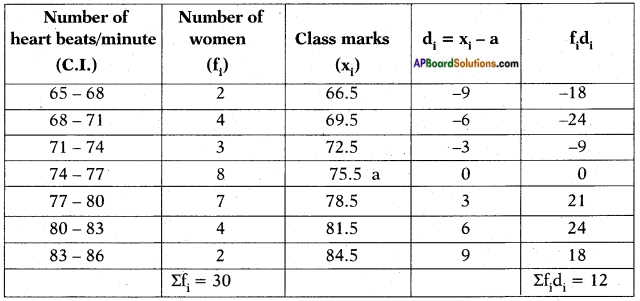
Question 5.
What made Mr.Henry feel shocked to hear Victoria say ‘Are you planning to pinch it ?’?
Answer:
When Victoria asked Slaters “Are you planning to pinch it ?”, Mr. Henry felt shocked. He thought that Victoria was innocent. But when she asked him the above question, Mr. Henry came to know that Victoria had wisdom beyond her age. He actually didn’t expect that question from his little daughter.He came to know that she was a precocious girl and had the ability to distinguish between good and bad.

AP SSC 10th Class English Solutions Chapter 2A The Dear Departed Part 1

The Dear Departed Part 1 Summary in English

The one-act play “The Dear Departed” by William Stanley Houghton is a satirical play that explores family relationships and the falsehood and hypocrisy and greed that often lie beneath it. The story exposes the sad fact that human beings often become dehumanized in the face of greed and minor material gains. This play satirizes the degradation of moral values in respect and care within the members of the family itself. This story clearly reveals how elderly people are mistreated. Stanley Houghton uses various literary devices to criticize basic human characteristics in his play. He uses irony, sarcasm, humour and a twist in the plot to criticize human traits. He tries to bring out the qualities of the two daughters called Mrs. Slater and Mrs. Jordan towards their father. He tries to show how the sisters are interested in the property of their father rather than to show true care and affection towards their father.

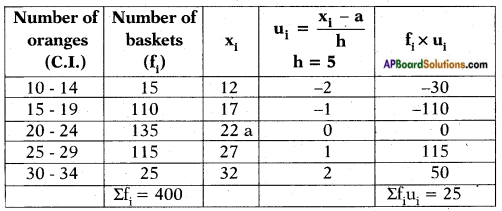
The story begins with Mrs. Slater telling her daughter, Victoria to change her dress before the arrival of her sister (Slater’s sister) Elizabeth and Elizabeth’s husband, Ben. Mrs. Slater’s husband, Henry has sent them a telegram with the message of the death of his father-in-law and Elizabeth and Ben are coming to talk over the old man’s affairs. Henry wonders if they would come at all because Elizabeth has said that she would never set foot in their house again. But Mrs. Slater says that her sister will come fast enough after her share of what their father has left. Mrs. Slater asks her husband to wear the new slippers of her father. She also suggests that they should replace their shabby old chest of drawers with the valuable bureau of her father which is in his bedroom. He agrees to do it after some hesitation. Mrs. Slater wants to do it before their arrival.

Mrs. Slater fastens the door and she and her husband carry the old chest of drawers upstairs. Henry is shocked when Victoria asks him if they are pinching grandpa’s bureau. He replies that grandpa has given it to her mother before his death. Mrs. Slater carries a handsome clock and puts it on the mantelpiece. Mrs. Slater and her husband carry the pretty old-fashioned bureau downstairs and put it in the place of the chest of drawers. At the same time Victoria ushers in Mrs. Jordan and Ben. Mrs. Jordan goes straight to Mrs. Slater and kisses her and the men shake hands. Mrs. Jordan remarks that their father has gone at last. Mrs. Slater replies that he is seventy-two a fortnight the previous Sunday. She tells them that the old man has been merry that morning and has gone out to pay his insurance. Ben and Mrs. Jordan remark that it is a good thing on his part.

According to Mrs. Slater, their father is found dead when she takes up a bit of something for him on tray.
Ben and Mrs. Jordan don’t want to look at the old man ; they prefer to have tea and so Mrs. Slater gets tea ready. They think of publishing the announcement of the death of the old man in the papers. Then they decide to look through the old man’s things and make a list of them. Mrs. Jordan tells that the old man has promised his gold watch to their Jimmy. Then Victoria tells them that grandpa hasn’t paid his insurance. Ben calls him “the drunken old beggar”. Both the sisters complain that they have to put up with their father for all those years. Then Mrs. Slater asks Victoria to go and bring the bunch of keys from grandpa’s room. Victoria is afraid to go but she does. After some time, she gets back very scared and tells them that grandpa is getting up. They are transfixed with amazement. The vigorous and well coloured old man Abel Merry weather comes in.

AP SSC 10th Class English Solutions Chapter 2A The Dear Departed Part 1

The Dear Departed Part 1 Glossary

lay (v): (here) to put the cloth, plates, knives, forks etc. on a table, ready for a meal

vigorous (adj): using a lot of energy and strength or determination

plump (adj): slightly fat in a fairly pleasant way

vulgar adj): rude and offensive

get her own way (idiom): persuade other people to allow you to do what you want

D’ye: Do you (used in awkward situations)

amazed (adj): very surprised

ages (n): long time

stooping (adj): bent towards and down

drooping (adj): hanging or bending down

come after (phr.v.): to look for someone to get something from them

worn out (adj): too old or damaged to be used

break down (phr.v.): stop working in a successful way

trifle (n): something unimportant or not valuable

precocious (adj): Intelligent/gifted/talented

bureau (n): a writing desk with drawers

drive a liard bargain (idiom): work hard to negotiate agreements in on&s own favour

startled (v): made someone suddenly surprised or slightly shocked

stupefied (adj): so surprised, tired or bored thai one cant think clearly

daft (adj): stupid/silly

shabby (adj): untidy and bad

fasten (v): to firmly close a window, door etc. so that it will not open

pinch (w): steal

mantelpiece (n): a shelf projecting from the wail over the fireplace

usher (v): lead/show the way/welcome

appeal: be attractive

stagger (v): to walk or move unsteadily, almost falling over

complacent (adj): sell-satisfied/unconcerned

mourning (n): feeling of sadness to miss someone after they have died

fortnight (n): two weeks

chirpily (adv): cheerfully and actively

snug (adj): warm and comfortable

wipe (v): to rub a surface with something in order to remove liquid, dirt, etc.

look through (phr.v.): look for something

overdue (adj): not paid by the expected time

annoy (v): to make someone feel slightly angry and unhappy about something

put up with (phr.v.): to accept an unpleasant situation or person without complaining

swindling (v): cheating somebody for property or money

reluctantly (adv): unwillingly

AP Board 8th Class Social Studies Important Questions Chapter 16 Abolition of Zamindari System

AP State Syllabus AP Board 8th Class Social Studies Important Questions Chapter 16 Abolition of Zamindari System.

AP State Syllabus 8th Class Social Studies Important Questions 16th Lesson Abolition of Zamindari System

Question 1.
While the slogan Land to the Tiller meant that the tenant will get the land, what will happen to the landless agricultural worker, who works for wages?
Answer:
The conditions of the tenants were somehow improved. But the conditions of the landless agricultural workers remain the same. They are still in the same poverty.

AP Board 8th Class Social Studies Important Questions Chapter 16 Abolition of Zamindari System

Question 2.
Some people feel that the land reform laws only tried to help the landlords. Do you agree with them?
Answer:
Yes, I agree with them.
Giving compensation to the zamindars, continuing them as owners of the Khudkasht etc., reveal this.

Question 3.
Do you think there was any other way of giving gainful employment to the rural poor?
Answer:
At present there are many ways of giving gainful employment. But there were less opportunities at that time. The British destroyed the occupational system of India. The people lost all their chances of employment. So I think there were no other ways.

AP Board 8th Class Social Studies Important Questions Chapter 16 Abolition of Zamindari System

Question 4.
How many acres of land does a family of four persons need to get a decent living in your area? (Give the figures separately for both irrigated and unirrigated land.)
Answer:
A family of four persons needs 8 acres of irrigated land and 30 acres of dry land to get a decent living in our area.

Question 5.
To what extent did the landless service castes benefit from these reforms?
Answer:
They were not benefited in any way from these reforms.

Question 6.
Why did the Land Ceiling Act become necessary?
Answer:
Many Acts after independence have not changed the ownership of lands in India. It changed Zamindars as landlords, landlords as big farmers. But it did nothing to the common poor.
The ownership of the land was only a few hands. So the Land Ceiling Act became necessary.

AP Board 8th Class Social Studies Important Questions Chapter 16 Abolition of Zamindari System

Question 7.
Why was the end to vetti important for all kinds of peasants?
Answer:
‘Vetti’ is a black spot for humanity. Many struggles were led against this. So the end of it was important for all kinds of peasants.

Question 8.
Is vettis prevalent still in your region ? If it is there, prepare a report?
Answer:
No, at present vetti is not prevalent in my region. But it is not completely abolished from our society still in some villages the poor people who are taken money from land lords for their needs, they are unable to repay that, due to this they are working in their lands as bounded labourers.

Question 9.
Why do you think the spirit of Bhoodan did not help to end landlordism and get land to the tiller?
Answer:
In this movement the landlords should donate their land with their own interest. This kind of humanity was not in them. Some of them donated only ‘Banjar’ and ‘Porambok’ lands only instead of cultivated land. 90% of the fertile lands were remained with the landlords. So the movement did not help to end landlordism and get land to the tiller.

AP Board 8th Class Social Studies Important Questions Chapter 16 Abolition of Zamindari System