AP SSC 10th Class Social Studies Important Questions Chapter 10 Globalisation

AP State Board Syllabus AP SSC 10th Class Social Studies Important Questions Chapter 10 Globalisation.

AP State Syllabus SSC 10th Class Social Studies Important Questions 10th Lesson Globalisation

10th Class Social 10th Lesson Globalisation 1 Mark Important Questions and Answers

Question 1.
Expand the term I.B.R.D.
Answer:
International Bank for Reconstruction and Development. (OR) World Bank.

AP SSC 10th Class Social Studies Important Questions Chapter 10 Globalisation

Question 2.
Explain SEZ.
Answer:

  1. The full form of SEZ is Special Economic Zone.
  2. They are meant for free establishment of industries.

Question 3.
What is the difference between foreign trade and foreign investment ?
Answer:
Foreign trade Foreign trade is any kind of trade (exports and imports) with other countries of the world.
Foreign investment: Private capital invest-ment by firms of one country into those of another country is called foreign investment.

Question 4.
Expand WTO.
Answer:
World Trade Organisation.

Question 5.
What is the Arab Spring?
Answer:
In 2013 several nations in Western Asia and Northern Africa like Tunisia, Egypt was influenced by each other’s revolutions and uprooting of dictators. This was called ‘Arab Spring’ in the media.

Question 6.
Mention any two factors which led to Globalisation.
Answer:
Globalization is a process of connecting countries across the globe.
Technology, Liberalisation of foreign trade and investment, foreign investment policy, WTO and other global institutions led to this globalization.

Question 7.
What is an MNC?
Answer:
An MNC is a multinational corporation, owns and controls production in more than one nation.

Question 8.
What do you mean by foreign investment?
Answer:
Investments made by MNCs is called foreign investment.

AP SSC 10th Class Social Studies Important Questions Chapter 10 Globalisation

Question 9.
What is the investment?
Answer:
The money that is spent to buy assets such as land, building, machines and other equipment is called investment.

Question 10.
What is foreign trade?
Answer:
Foreign trade is any kind of trade with other countries of the world.

Question 11.
What do you mean by trade barrier?
Answer:
It is called a barrier since some restrictions have been set up by the Indian government on foreign trade and foreign investment. It can be tax on imports.

Question 12.
What is Globalisation?
Answer:
Globalization is a major change that occurred across the globe in the late 20th century. This has political, cultural as well as economic dimensions.

Question 13.
What was called ‘Arab Spring’?
Answer:
In 2013 several nations in Western Asia and Northern Africa like Tunisia, Egypt was influenced by each other’s revolutions and uprooting of dictators. This was called ‘Arab Spring’ in the media.

Question 14.
Where do MNCs set up offices and factories for production? Give reason.
Answer:
MNCs set up offices and factories for production in regions where they can get cheap labour and other resources.
This is done so that cost of production is low and the MNCs can earn greater profits.

AP SSC 10th Class Social Studies Important Questions Chapter 10 Globalisation

Question 15.
Define Economic reforms of NEP 1991.
Answer:
The economic policy adopted by the Government of India since July, 1991 is termed as new economic policy or economic reforms.

Question 16.
What is Privatisation?
Answer:
Privatization means reduced government intervention and increased private investment in production activities.

Question 17.
What is Outsourcing?
Answer:
Outsourcing means going out to a source outside the company to buy regular service.

Question 18.
How many countries are currently members of the WTO?
Answer:
The WTO has 164 member countries as on 29th July 2016.

Question 19.
In which year, the government started to remove barriers on foreign trade and foreign investment?
Answer:
In 1991.

Question 20.
Why are Chinese toys popular in the world?
Answer:
Chinese toys are comparatively cheaper and have new designs. So they are popular in the world.

Question 21.
Why are the MNCs making investments in India?
Answer:
In India labour cost is very low when compared to rest of the world. So, many MNCs are making investments in India.

AP SSC 10th Class Social Studies Important Questions Chapter 10 Globalisation

Question 22.
Which organization lay emphasis on liberalization of foreign trade and foreign investment in India?
Answer:
The WTO.

Question 23.
When was the WTO established?
Answer:
The WTO was established On 01-01-1995.

Question 24.
Where is the main head office of the WTO?
Answer:
It is in Geneva – Switzerland.

Question 25.
What is the purpose of foreign trade?
Answer:
Foreign trade creates an opportunity for the producers to reach beyond the domestic markets. They can sell their products in other countries also.

Question 26.
State a positive aspect of India’s development strategy prior to 1991.
Answer:
The strategy has helped India in creating a large industrial base and an increase in industrial production.

Question 27.
What do you mean by export quotas?
Answer:
For the protection of local consumers, the government restricts giving limit of export of particular goods. This is called an export quota.

Question 28.
What is an import quota?
Answer:
For the protection of local manufacturers from the competition of producers of another country, the government imposes taxes on imported goods. This is called an import quota.

Question 29.
State any two impacts of liberalization and globalization in India.
Answer:

  1. There are better services in the communication sector.
  2. Many food processing companies have taken over the market.

AP SSC 10th Class Social Studies Important Questions Chapter 10 Globalisation

Question 30.
State the new strategies of NEP.
Answer:

  1. Liberalization
  2. Privatization
  3. Globalization.

Question 31.
What is meant by modernization of the economy?
Answer:
The NEP accords top priority to modern techniques and technologies. It also promotes computers and electronics industries. It has made the Indian industries dynamic.

Question 32.
What is Joint Venture?
Answer:
At times MNCs set up production jointly with the local companies of the countries where they established their MNC operations.

Question 33.
Expand W.T.O. How does it work?
Answer:

  1. WTO-World Trade Organisation. It lays emphasis on the liberalization of foreign trade and foreign investments.
  2. It was established in 1995 with headquarters in Geneva – Switzerland.

10th Class Social 10th Lesson Globalisation 2 Marks Important Questions and Answers

Question 1.
Explain the effects of Globalisation in India.
Answer:

  1. The impact of globalization in India is not uniform.
  2. It has benefited well-off consumers.
  3. It has also benefited the producers with skill, education and huge wealth.
  4. Certain services enabled with technology have expanded.
  5. Some new jobs are created.
  6. Some large Indian companies have grown as M.N.C.s.
  7. On the other hand, most of the small producers and workers are not happy with globalization.

AP SSC 10th Class Social Studies Important Questions Chapter 10 Globalisation

Question 2.
Estimate the impact of globalization on local industries of India.
Answer:
Impact of globalization:
Positive effect:

  1. Several of the top Indian companies have been able to benefit from the increased competition.
  2. They have invested in newer technology and production methods and raised their production standards.
  3. Some have gained from a successful collaboration with foreign companies.

Negative effect:

  1. Some of the small industries have been hit hard due to competition.
  2. Several units have been shut down rendering many workers jobless.

Question 3.
“Globalisation by connecting countries results in greater competition among producers.” Justify the statement.
Answer:

  1. Globalization is a major change that occurred across the globe in the late 20th century. This has political, cultural as well as economic dimensions.
  2. An MNC does different operations related to its business at different locations across the globe.
  3. An MNC is able to take advantage of cost-benefit and also of easier access to important markets.
  4. There is a greater choice before the consumers who now enjoy the improved quality and lower prices for several products.
  5. Competition held between local producers and foreign companies.

Question 4.
Write about the problems of Urbanization.
Answer:
Problems of urbanization:

  1. The rapid inflows of rural population to urban places give rise to the housing problem and thus slums are developed in these places.
  2. The decrease in rural population affects agricultural production due to a shortage of work¬ers in rural areas.
  3. Due to use of more vehicles, air, water, sound pollutions are increased.
  4. Traffic problems will arise.
  5. Proper drainage facilities are not expanded.
  6. Using of plastic covers are increased.
  7. Unemployment increases in urban areas.
  8. Due to this, various criminal activities, corruption, etc. increase affecting the law and order system.

AP SSC 10th Class Social Studies Important Questions Chapter 10 Globalisation

Question 5.
Give four reasons to the factors that helped Globalisation.
Answer:
Globalization means interconnecting the markets and countries also. Factors that helped globalization are:

  1. Technology: The development in Information and Communication Technology have been even more remarkable and rapid.
    Rapid improvement in technology has been one major factor that has stimulated the globalization process.
  2. Transportation: As a result, goods are delivered faster across long distances at lower costs. The Internet also allows us to send instant electronic mail and talk across the world at negligible costs.
  3. Liberalization of Foreign Trade: With the liberalization of trade, businesses are allowed to make decisions freely about what they wish to import or export.
  4. Liberalization of Foreign Investment: Due to this so many companies are going to invest on new products.
  5. Political climate: We must remember that political decisions are taken in a particular context, which accounts for the economic and technological change that has already taken place.

Question 6.
How are the Indian companies benefited from Globalisation at present?
Answer:
Benefit for Indian companies with globalization at present

  1. Invested in newer technology and production methods
  2. Raised their production standards
  3. Gained from collaboration with foreign companies

Question 7.
What will be the consequences of Globalisation, if it spreads to all sectors in future?
Answer:
More products will be available if globalization process is continued and spread. Quality of goods will be increased prices come down. Foreign investment is increased. Many new jobs will come up. IT services will be increased. Technology will be more used. Small scale industries will be closed. Culture and nationalism are also affected. Soil lose its fertility.

AP SSC 10th Class Social Studies Important Questions Chapter 10 Globalisation

Question 8.
What do you understand by globalization?
Answer:
Globalization is a process associating with increasing openness, growing economic independence and deepening economic integration with the world economy. In other words, it means opening up of the domestic economy for foreign countries.

Question 9.
What is the role of media in ‘Arab Spring’?
Answer:
Media played a crucial role during the Arab Spring. Television Channels that were owned and run by people from other countries supported such mobilization which resulted in regulating the powers of local leaders. While events like Civil War or natural disasters like Tsunami are discussed within the national boundaries they also receive support and sympathy from around the world.

Question 10.
Give a picture of ‘Production across countries before large MNCs’.
Answer:
Until the middle of the twentieth century, production was largely organized within countries. Raw materials, food grains and finished products only crossed the boundaries of these countries. Colonies such as India exported raw materials and food grains and imported finished goods. Trade was the main channel connecting distant countries. This was before large multinational corporations (MNCs) emerged on the scene.

Question 11.
What is important regarding MNCs?
Answer:
MNCs not only sell their finished products globally but more important, the goods and services are produced globally. As a result, production is organized in increasingly complex ways. The production process is divided into small parts and spread out across the globe.

AP SSC 10th Class Social Studies Important Questions Chapter 10 Globalisation

Question 12.
“Previously important decisions regarding the value of currency were taken by sovereign governments are today made by market player and forces”. Comment with an example.
Answer:

  1. Previously important decisions regarding the value of currency were taken by sovereign governments are today made by market players and forces.
  2. In fact many of the MNCs have wealth exceeding the entire budgets of the developing country governments.
  3. With such enormous wealth, imagine the power and the influence of these MNCs.
  4. This is how the decision making powers of sovereign governments are at a risk.

10th Class Social 10th Lesson Globalisation 4 Marks Important Questions and Answers

Question 1.
What is the influence of globalization on the Indian economic system? What are the advantages of extending globalization to India? Express your opinion.
Answer:

  1. The Globalization has benefited both the customers and the industrialists.
  2. There are greater choices for the customers, who now enjoying quality items at lower prices.
  3. As such, their standard of living is improved.
  4. Among producer and workers, the influence has not been uniform.
  5. The MNCs have invested in Indian Companies.
  6. New jobs have been created and local companies supplying raw materials etc. to these companies prospered.
  7. Top Indian companies have been benefited as new technology is implemented.
  8. Some large Indian companies emerged as MNCs.
  9. The Globalization has also created new opportunities for companies providing services.
  10. Besides, a host of services, such as data entry, accounting, engineering etc. are now done cheaply in India.

AP SSC 10th Class Social Studies Important Questions Chapter 10 Globalisation

Question 2.
Do you support or oppose the setting up of the Special Economic Zones? Why?
Answer:
I strongly oppose the setting up of Special Economic Zones:
The reasons:

  1. Accumulation of land for SEZs disturb the livelihood of agricultural dependents.
  2. SEZs are not offering as much employment as they have assured.
  3. They disturb the ecological balance in certain cases.

(OR)

I support the setting up of Special Economic Zones:
The reasons:

  1. They provide more employment opportunities.
  2. They provide world-class infrastructural facilities in a particular place.
  3. They attract foreign investments and help to the establishment of industries.

Question 3.
“Among producers and workers, the impact of globalisation has not been uniform.” Write your opinions on it.
Answer:

  1. The benefits of globalisation have been unevenly distributed.
  2. It has benefited the producers with huge wealth and well-off consumers.
  3. But the small producers and workers have seen their employment and workers’ rights erode.
  4. Globalisation should be fair. It has to create opportunities for all.
  5. The government has to play a major role in making this possible.
  6. The government has to ensure that labour laws are properly implemented and the workers get their rights.

Question 4.
Explain the factors that have enabled Globalisation.
Answer:

  1. Technology has been improved rapidly.
  2. Due to this, many revolutionary changes occurred in the fields of production, trade and especially in information and communication.
  3. Nowadays computer and internet has made the world a hamlet.
  4. After 1991, the barriers on foreign trade and foreign investment were removed to a large extent in India.
  5. This had speeded up the process of globalisation in India.
  6. The policies implemented by international organisations like WTO, promoted the interests of MNCs, all over the world.

AP SSC 10th Class Social Studies Important Questions Chapter 10 Globalisation

Question 5.
Explain with examples, how small and cottage industries are extinct because of multinational companies.
Answer:
Small and cottage industries are going the extinct because of multinational companies due to the following reasons.

  1. Small industries are not having the capacity to compete with M.N.C.’s
  2. Imported goods quality is high and the cost is low.
  3. People are attracted to machine-made goods. But cottage industries are not following.

Example:
a) Basket making:

  1. Small industries did not get good quality of plastic, because its cost is high.
  2. Instead of traditional baskets MNC’s imported steel and metal baskets.

b) Weaving:

  1. Small and cottage industries using old traditional methods for weaving, only handlooms.
  2. MNC’s using power looms for weaving and using machines and imported machine-made cloth.

Question 6.
Write the advantages and disadvantages of Multi-National Companies.
Answer:
Advantages and disadvantages of Multinational Companies :
Advantages:

  1. Competition among countries increased.
  2. Quality improvement.
  3. The decrease in prices.
  4. Increase in production.
  5. Increase in access of goods and services.
  6. Development in research and technology.
  7. Increase in employment opportunities.

Disadvantages:

  1. The decline in small scale industries.
  2. No employment opportunities for unskilled labourers.
  3. Agriculture is affected.
  4. The environment is affected.
  5. The exploitation of natural resources.
  6. Value of currency is determined internationally.
  7. Indigenous languages and culture is affected.

Question 7.
How can flexibility in labour laws support the present companies?
Answer:

  1. Flexibility in labour laws can help the companies to decrease their production cost by employing labourers only for a short period of time when there is need instead of employing them for long period of time or yearly basis.
  2. By easing upon labour laws, company heads can negotiate wages and terminate employment, depending on market conditions.

AP SSC 10th Class Social Studies Important Questions Chapter 10 Globalisation

Question 8.
Read the following paragraph and interpret.

The developments in information and communication technology have been even more remarkable and rapid. Telecommunication facilities are used to contact one another around the world to access information instantly and to communicate from remote areas.

Answer:
The given paragraph is about developments in technology especially with regard to information and communication technology. It has various effects on society and made the task of many people easy.

In the fast-growing world, every field is being updated and upgraded. There are so many reasons for these changes in technology. Due to globalization, getting and sending information should be fast. Email, Google, Internet, Wikipedia all these made our task easy. People also changed their lifestyles. Even in mobile phones various activities like e-banking, different payments like electricity bill, phone bill are paid. Many of the GOs and Memos are sent by mail.

It has negative effects also. Some youth are attracted by abscence films and pornographic videos are watched. Students can utilise it for their study. The government should take necessary action.

Question 9.
Read the paragraph given below and comment.

The benefits of globalisation have been unevenly distributed. It has benefited well-off consumers and also producers with skill, education and huge wealth. Certain services, enabled with technology, have expanded. On the other hand, thousands of small producers and workers have seen their employment and workers’ rights erode. It is important to understand the two¬sided nature of globalisation.

Answer:

  1. The costs and benefits of globalization are unevenly distributed both within and in between cities.
  2. Homeless people are living in cardboard boxes on sidewalks of gleaming corporate skyscrapers, whose budgets exceed those of many countries.
  3. In many countries real incomes have fallen, the costs of living gone up and the number of poor households has grown, particularly in urban areas.
  4. More urban inhabitants live in inadequate housing, mostly in the slums and scattered settlements in developing countries.

Conclusion: Finally developed countries and rich people are benefited and poor people are not benefited.

AP SSC 10th Class Social Studies Important Questions Chapter 10 Globalisation

Question 10.

Read the following paragraph and write whether you agree with this paragraph or not. Mention why/why not.

At times, MNCs set up production jointly with the local companies of these countries. The local company benefits by the additional investments and the latest technology that the MNCs bring.

Answer:

  1. According to the paragraph given, it says that the multinational companies invest for the production of goods jointly with the local companies.
  2. This additional investment is a sort of benefit for the local companies as they have access to technology.
  3. To some extent it is true.
  4. When foreign companies want to establish a new factory they bring some new technology and provide job opportunities for the local people.
  5. They utilize the local resources along with the human resource.
  6. The companies keep the local companies in their grip and gradually they lose their control on their own production.
  7. Some people say that multinational companies are helpful to local companies.
  8. It is true in the initial stage but in due course, it leads to downfall.
  9. So I don’t fully agree with this paragraph.
  10. The government should put barriers which are useful for the local companies.

Question 11.
Read the following paragraph and interpret.

For a long time trade has been the main channel of connecting countries. In history, you would have read about the trade routes connecting India and South Asia to markets both in the East and West and the extensive trade that took place along these routes. You would also remember that it was trading interests which attracted various trading companies such as the East India Company to India.

Answer:

  1. According to the paragraph given, trade is the main channel bringing the nations together.
  2. East India Company came to India in such a way. In the name of trade, the Europeans tried to find out new sea routes and in the series of efforts, they explore many countries and estab¬lished markets.
  3. The exploration doesn’t stop with spreading the markets.
  4. It leads to the exploitation of natural resources.
  5. East India Company came to India and looted the country. Trade doesn’t mean exploitation.
  6. In conclusion, I would like to say that it is not so easy to decide whether the trade is really linking the markets and leading to exploitation.
  7. Every country should think whether foreign companies are useful to their country or not.

Question 12.
Read the following paragraph and write your comments on it.

To put it simply, foreign trade creates an opportunity for the producers to reach beyond the domestic markets. Similarly, for the buyers, trade expands the choice of goods beyond what is domestically produced. Foreign trade thus results in connecting the markets or integration of markets in different countries.

Answer:

  1. The given paragraph says that because of foreign companies opportunities are created and
    the producers send their goods to other markets also.
  2. The buyers also have the choice to select the commodities or goods whatever they like.
  3. Foreign trade helps in connecting markets of the globe. The international market system will be increased.
  4. My comments on this paragraph are that many of the foreign products like Coca-cola, Pepsi and other cool drinks are available in our country.
  5. Local coconuts and buttermilk are not being utilized.
  6. Though there is a choice for buyers, they should think of their domestic market also.
  7. Foreign trade connects the markets in different countries.
  8. The integration of the market system doesn’t collapse the domestic economic system.

AP SSC 10th Class Social Studies Important Questions Chapter 10 Globalisation

Question 13.
Read the following paragraph and write’ your opinion on it.

Rapid improvement in technology has been one major factor that has stimulated the globalization process. For instance, the past fifty years have seen several improvements in transporta¬tion technology. As a result, goods are delivered faster across long distances at lower costs.

Answer:

  1. According to the given paragraph technology is one major factor in the process of globalization.
  2. Recently there are many changes in transportation technology.
  3. It led to faster movement in reaching the destination.
  4. My opinion is that technology is a part of globalization.
  5. Many multinational companies use different technology for various purposes.
  6. In this paragraph, it is discussed about transportation technology.
  7. Improved transportation makes travel easy. Construction and management of roads including vehicle maintenance are to be concentrated.
    8) Better roads help in minimizing the prices because of fuel consumption.

Question 14.
Read the following paragraph and write your comments.

Let us return to the example of imports of Chinese toys in India. Suppose the Indian government puts a tax on the import of toys. And because of the tax, buyers will have to pay a higher price on imported toys. Chinese toys will no longer be as cheap in the Indian markets and imports from China will automatically reduce. Indian toy-makers will prosper.

Answer:

  1. According to the paragraph given, the government has to put barriers on Chinese toys.
  2. Thus the prices of the Chinese toys rise.
  3. Automatically Indian toys will have positive market. Indian toy makers will get benefits. My comments on this paragraph are as follows. This is only an example.
  4. Like Chinese toys, there are so many goods coming from abroad and making good business.
  5. They are getting good profits.
  6. The same Indian manufacturers face many troubles.
  7. In conclusion, I would like to say that the government should take necessary steps to strengthen the Indian companies and small scale industries along with artisans and handicrafts.

AP SSC 10th Class Social Studies Important Questions Chapter 10 Globalisation

Question 15.
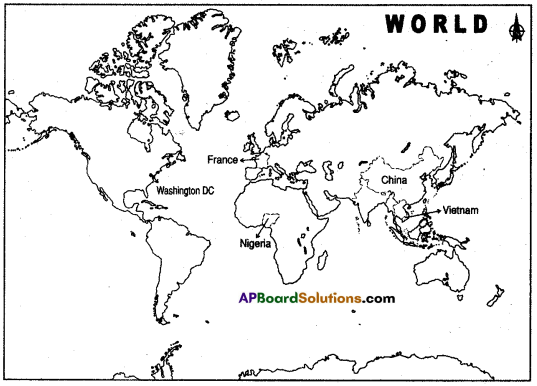
Identify these countries on an outline map of world.

  1. United States of America
  2. China
  3. Mexico
  4. Eastern European countries
    i) Poland
    ii) Ukraine
    iii) Romania
    iv) Bulgaria
    v) Czech Republic
    vi) Slovakia
  5. India

Answer:

AP SSC 10th Class Social Studies Important Questions Chapter 10 Globalisation 1

AP SSC 10th Class Social Studies Important Questions Chapter 10 Globalisation

AP SSC 10th Class Social Studies Important Questions Chapter 3 Production and Employment

AP State Board Syllabus AP SSC 10th Class Social Studies Important Questions Chapter 3 Production and Employment.

AP State Syllabus SSC 10th Class Social Studies Important Questions 3rd Lesson Production and Employment

10th Class Social 3rd Lesson Production and Employment 1 Mark Important Questions and Answers

Question 1.
What is under employment?
Answer:
Under employment is the situation, where people are apparently working but all of them are made to work less than their potential.

AP SSC 10th Class Social Studies Important Questions Chapter 3 Production and Employment

Question 2.
In which sector is the disguised unemployment found predominantly in India today? Why?
Answer:
In agricultural sector we find disguised unemployment, because more than the required persons are engaged in the work of agriculture.

Question 3.
Suggest the reforms for the betterment of unorganized sector workers.
Answer:
Reforms for the betterment of unorganized sector workers:

  1. Increase in wages.
  2. Security in jobs.
  3. Overtime work should be paid.
  4. Facilities and safety at work places.
  5. Medical facilities.
  6. Sick leave provision.

Question 4.
Write examples for intermediate goods.
Answer:

  1. Paddy
  2. Rice
  3. Yarn
  4. Rubber

Question 5.
Give an example for underemployment.
Answer:

  1. Though there is no sufficient work, many agricultural labourers work less than their potential.
  2. In the service sector – painters, plumbers, repair persons, etc.

Question 6.
What does the unorganized sector consist of?
Answer:
The sector in which small and scattered units are outside the control of the government is called unorganized sector. It consists of low wages, no job security, no paid leaves, no health facilities, etc.

AP SSC 10th Class Social Studies Important Questions Chapter 3 Production and Employment

Question 7.
Observe the pie chart and answer the following questions.
Sectoral shares of employment, 2011 – 12
AP SSC 10th Class Social Studies Important Questions Chapter 3 Production and Employment 1(a) Which sector provides less employment?
Answer:
Industry (24%)

(b) Mention any two reasons for more employment in the agriculture sector.
Answer:

  1. Not enough jobs were created in the industry and service sector.
  2. Irrespective of the literacy rate rural people depend on agriculture.
  3. Easy employment opportunities.

Observe the information given in the table and answer questions 8 and 9.
Table: Share of Employment and Gross Domestic Product in Three Sectors

SectorEmployment (%) 2011-12Gross Domestic Product (%) 2011-12
Agriculture4916
Industry2426
Services2758

Question 8.
What was the share of the agricultural sector in Gross Domestic Product?
Answer:
The share of the agricultural sector in Gross Domestic Product is 16%.

AP SSC 10th Class Social Studies Important Questions Chapter 3 Production and Employment

Question 9.
What was the reason for low employment in service sector though it has a major contribution to Gross Domestic Product?
Answer:
The reason for low employment In service sector though it has a major contribution to Gross Domestic Products is

  • Lack of skill
  • Lack of access to employment opportunities

Question 10.
Give any two examples for final goods.
Answer:
Idli, Dosa, Gar, Computer, Notebook, etc.

Question 11.
Why do people prefer to work in an organized sector ?
Answer:
Security of employment Regular salary Paid Holiday, safe working environment Gets provident fund, etc.

Question 12.
Define service sector.
Answer:
Services like transportation, communication, financing, insurance, banking, etc. are auxi¬liaries to trade or aid to trade. These services constitute service sector of trade.

Question 13.
What is primary sector?
Answer:
Primary sector is the sector which involves agricultural activities, and related activities like mining, poultry, etc.

Question 14.
What is secondary sector?
Answer:
It is the sector which is engaged in the manufacturing of goods from the raw material provided by the primary sector.

Question 15.
Define unemployment.
Answer:
Unemployment is a situation where the able-bodied persons are willing to work but are not able to get work. They are not engaged in any productive activity.

AP SSC 10th Class Social Studies Important Questions Chapter 3 Production and Employment

Question 16.
What is employment?
Answer:
Employment is a situation where the able-bodied persons are willing to work and are engaged in some productive activity to earn an income.

Question 17.
What is the other name of underemployment?
Answer:
The other name of underemployment is disguised unemployment.

Question 18.
What is GDP?
Answer:
The value of goods and services produced in an economy in a financial year is known as GDP.

Question 19.
Which sector is called organised sector?
Answer:
The sector which covers those enterprises where the terms of employment are regular and they have assured work is called organised sector.

Question 20.
Which sector is called unorganized sector?
Answer:
The sector in which small and scattered units are outside the control of the government is called unorganized sector.

Question 21.
Which sector is also called the service sector?
Answer:
Tertiary sector is also called service sector.

Question 22.
Which is called disguised unemployment?
Answer:
Unemployment which exists when marginal physical productivity of labour is zero or sometimes it becomes negative is called disguised unemployment.

Question 23.
Why does small scale industry need government’s support?
Answer:
Small scale industry needs government’s support for procuring raw-material and mar¬keting of output.

AP SSC 10th Class Social Studies Important Questions Chapter 3 Production and Employment

Question 24.
In what ways can employment be increased in urban areas? Write any two suggestions.
Answer:
Suggestions:

  1. Heavy investments should be created in basic industries.
  2. Means of transportation and communi¬cation should be developed.

Question 25.
Which sector is continued to prove the largest employer between 1973 to 2000?
Answer:
The agricultural sector is continued to prove the largest employer between 1973-2000.

Question 26.
Write any two activities which are the primary responsibility of the government.
Answer:
Health and Education.

Question 27.
What is meant by “final goods and services”?
Answer:
Final goods and services refer to the goods and services which are meant either for consumption by consumers or for investment by firms or organizations.

Question 28.
What are intermediate goods?
Answer:
Intermediate goods are those goods that are used in producing final goods and services.

AP SSC 10th Class Social Studies Important Questions Chapter 3 Production and Employment

Question 29.
Which sector is growing fast in India?
Answer:
Service sector is growing fast in India.

Question 30.
By whom is the task of measuring GDP done?
Answer:
The task of measuring GDP is done by the Ministry of Central government.

Question 31.
What does the GDP record?
Answer:
The GDP records the market value of final goods and services produced.

Question 32.
Name some acts of organized sector.
Answer:

  1. Factories Act
  2. Minimum Wages Act
  3. Shops and Establishments Act, etc.

Question 33.
Who are in the organized sector?
Answer:
People who work in the government or with companies or large establishments are all in the organized sector.

AP SSC 10th Class Social Studies Important Questions Chapter 3 Production and Employment

Question 34.
Name some organizations in the service sector.
Answer:

  1. Indian Railways
  2. Postal & Telegraphs
  3. Indian Airlines
  4. All India Radio
  5. BSNL, MTNL.

Question 35.
How do we count the various goods and services of each economic sector?
Answer:
We count the value of final goods and services produced in each sector during a particular year. This provides the total production of the sector for that year.

Question 36.
Why should we worry about underemployment?
Answer:
We should worry about underemployment as it decreases the standard of living of the people.

Question 37.
What do you mean by underemployment?
Answer:
Everyone is engaged in working, but no one is working to his full capacity, such employ¬ment Is underemployment.

Question 38.
Into how many sectors economic activities are divided?
Answer:
The economic activities are divided into 3 sectors primary, secondary and services.

Question 39.
What do you mean by Gross Domestic Product?
Answer:
The money value of all the finished goods and services produced within a country borders during the year.

Question 40.
What is the main source of income to your family? Among the three sectors, under which can it be categorized?
Answer:

  1. My father is a farmer.
  2. Hence we can say he works in the primary sector.

10th Class Social 3rd Lesson Production and Employment 2 Marks Important Questions and Answers

Question 1.
How is the Organised sector different from an Unorganised sector?
Answer:
1) The organised sector is the enterprises or places of work where the terms of employment are regular and therefore, people have assured work.
2) The unorganised sector s characterised by small and scattered units which have remained largely outside the control of the Government. In this way the organised sector is different from the unorganised sector.

AP SSC 10th Class Social Studies Important Questions Chapter 3 Production and Employment

Question 2.
Observe the following table and answer the questions given below,
Contribution of organised and unorganised sectors

SectorContribution (% of total)
EmploymentGross Domestic Product
Organised850
Unorganised9250
Total100100

a) What percentage of labour in the unorganized sector get employment?
Answer:
92%
b) Which sector get decent job security?
Answer:
Organized sector

Question 3.
What are the facilities provided to workers in the organised sector?
Answer:

  1. Job security
  2. Limited working hours.
  3. Paid holidays.
  4. Safe working environment.

Question 4.
Which measures do you suggest to improve the employment opportunities in rural area?
Answer:

  1. Agriculture should be supported by the government.
  2. Household industries should be encouraged.
  3. Rural employment schemes should be implemented effectively.

Question 5.
Study the following pie-charts and answer the questions given below:
Shares of three sectors in GDP
AP SSC 10th Class Social Studies Important Questions Chapter 3 Production and Employment 2
a) Which sector got tremendous increase?
Answer:
Service sector.
b) Why did the share of agricultural sector decrease in G.D.P?
Answer:
Production in agriculture has not developed as per the expectations.

AP SSC 10th Class Social Studies Important Questions Chapter 3 Production and Employment

Question 6.
Draw the bar graph on the basis of information given in the table below.

SectorsEmployment (%)
1972 – 732009 -10
Agriculture7453
Industrial1122
Service1525

Answer:
AP SSC 10th Class Social Studies Important Questions Chapter 3 Production and Employment 3
It shows how people depend upon these sectors for employment.

Question 7.
Observe the table and answer the questions.

YearAgricultureIndustryServices
1972-7374%11%15%
2008-0953%22%25%

The table shows the percentage of workers employed in different sectors in India in 1972-73 and 2009-10.

a) What are the major changes you observe from the above table?
Answer:

  1. The agriculture sector is decreased.
  2. Industry and services are increased.
  3. Industry is increased two times.
  4. There is a great shift from the agricultural sector to the industrial and service sectors.

b) What would be the reasons for the changes?
Answer:
Employment opportunities in the agricultural sector are reduced from 74% to 53%. In industrial sector employment opportunities are increased from 11% to 22%. Like that service sector employment opportunities are also increased from 15% to 25%.
Reasons:

  1. Decline in agriculture (Problems of seeds, rainfall, MSP, power cut, water.)
  2. Privatization is increased.
  3. IT increased.
  4. Opportunities in the second and third sector.

AP SSC 10th Class Social Studies Important Questions Chapter 3 Production and Employment

Question 8.
Observe below ‘Pie’ chart and analyse it.
AP SSC 10th Class Social Studies Important Questions Chapter 3 Production and Employment 4
Employment in three sectors in 2011-12
Answer:

  1. There is a great shift from the agricultural sector to the industrial and service sector, (or)
  2. The major changes like the percentage of workers employed decrease in agriculture and increased both in industry and ser¬vice sector are observed from the above pie chart compare with before years.
    Reasons :
  3. The important reasons like change in farming methods setting up of new industries, and factories, mass production of goods by factories of lower rates than agricultural goods, high payment for workers in other sectors compared to agriculture led to employment shift from agriculture sector to service and manufacturing sectors.

Question 9.
Observe the given graph and analyse it.
Shares of different sectors in Gross Domestic Product
AP SSC 10th Class Social Studies Important Questions Chapter 3 Production and Employment 5
A – Agriculture
B – Industry
C – Trade, hotels, transport and communications.
D – Finance, insurance, real estate.
E – Community, social and personal services.
Answer:
The graph explains about the share of different sectors in Gross Domestic Product in the year of 1972 – 73.
The share of Agriculture is 43%.
The share of Industry is 22%.
The share of service sector joined together is 35%.
When compared to 1972 – 73 the share of different sectors in 2011 -12 changed,
In 2011 -12 the agriculture share is only 16%. Industrial sector share is 26%. The share of service sector joined together is – 58%. Totally in 2011 & 12 the share of agriculture is reduced. The Industrial sector share is increasing. Finally service sector share increases very high.
Suggestions: To increase the share in the agriculture sector the government should take the following measures.

  1. Provide seeds, fertilizers, pesticides motors to the farmers with the subsidy.
  2. The government should see that the people who are engaged in Industrial and Service sectors more than required are shifted to the agricultural sector so that the share of the agricultural sector in GDP increases.
  3. The government should implement welfare schemes so that the agricultural sector flourishes.

AP SSC 10th Class Social Studies Important Questions Chapter 3 Production and Employment

Question 10.
Name the facilities enjoyed by the workers in the organised sector.
Answer:
Organised sector covers those enterprises or places of work where the terms of employment are regular and therefore, people have assured work. They are registered by the government and have to follow its rules and regulations which are given in various laws such as the Factories Act, Minimum Wages ] Act, Shops and Establishments Act etc. It is called organised because it has some formal processes and procedures. Workers in the organised sector enjoy the security of employment, They are expected to work only for a fixed number of hours. If they work more, they have to be paid overtime by the employer. They also get several other benefits from the employers, They get paid leave, payment during holidays, provident fund, etc. They are supposed to get medical benefits and, j under the laws, the employer has to ensure facilities like drinking water and safe working environment. When they retire, many of j these workers get pensions as well. People j who work in the government or with companies or large establishments are all in the organised sector.

Question 11.
Based on the pie charts given below write how the share of agriculture sector in the GDP has changed between 1972-73 and 2009-10?
AP SSC 10th Class Social Studies Important Questions Chapter 3 Production and Employment 6
Answer:
The share of agriculture sector in GDP has reduced from 43% to 26% from the period 1972 – 73 to 2009 -10.
The main reason is the secondary and service sector’s both gradually increase in their employment and production activities.

Question 12.
Observe the pie diagrams and answer the following.
AP SSC 10th Class Social Studies Important Questions Chapter 3 Production and Employment 7
Analyse the above two diagrams.
Answer:

  1. The pie diagrams depict the sectorial share of employment.
  2. The people who depend on agriculture has reduced from 74% in 1972-73 to 53% in 2009-10,
  3. The employment in service sector has increased from 15% to 25%.
  4. The employment in the industrial sector is doubled, i.e., increased from 11% to 22%.

Question 13.
Study the following table and prepare a paragraph describing it.

SectorContribution (% of total)
EmploymentGross Domestic Product
Organised850
Unorganised9250
Total100100

Answer:

  1. This table tells about the employment in organized and unorganized sector and its contribution in GDP.
  2. Employment in organized sector is only 8% whereas it is 92% in unorganized sector.
  3. The share in GDP is the same.
  4. It focuses on the conditions of the work-force depend on the unorganized sector in which the wages are low, security and respect is not observed.
  5. In organized sector the employees get regular salaries, they have specific work-ing hours and they avail leaves, medical benefits and other facilities.
  6. These are not available in the unorganized sector.

AP SSC 10th Class Social Studies Important Questions Chapter 3 Production and Employment

Question 14.
Discus different sectors of Economy.
Answer:
People are engaged in different activities to earn their livelihoods. These activities are broadly categorized into three:

  1. Agriculture and related activities such as fishing, forestry, mining where nature has a dominant role in the production process.
  2. Manufacture processes and other industries where goods are produced by people using tools or machines.
  3. Those activities that don’t directly produce a good but provide services that are required in production and other services for people.
  4. These three different sectors of the economy contribute to the national income.

Question 15.
How many types are there in services? Explain.
Answer:
Services are seen to comprise of three types.
They are a) Community, social and personal services b) Finance, insurance and real estate services and Trades, hotels, transport and communication services.

  1. Community, social and personal services include public administration, defence, education, health, veterinary activities, media, library, museums and other cultural activities, etc.
  2. Finance, insurance and real estate servi-ces include services of banks, post office savings accounts, non-bank financial companies, Life Insurance and General Insurance Corporation, services of brokers and real estate companies, etc.
  3. Trades, hotels, transport and communication services include business, exports and imports, hotels, resorts, rail, road, water ways and airways and radio, tele¬vision, newspapers, magazines and satel¬lite services, etc.

Question 16.
Table : Read the following pie charts and answer the question.
AP SSC 10th Class Social Studies Important Questions Chapter 3 Production and Employment 8

What changes do you observe in these two pie diagrams?
Answer:

  1. The above pie diagrams show the share of different sectors in GDP.
  2. The share of agriculture sector has fallen from 43% to 17%.
  3. The share of industrial sector has increa-sed from 22% to 26%.
  4. The share of service sector has increased from 35% to 57%.
    i.e., trade and hotels from 15% to 27%, finance, insurance and real estate from 8% to 17% and community, social and personal services from 12% to 13%.

AP SSC 10th Class Social Studies Important Questions Chapter 3 Production and Employment

Question 17.
What is the relation between population and employment?
Answer:
The Gross Domestic Product of a country has a close relation with the total number of work¬ing people in that country. In every country, as population increases, it is essential that the country provides opportunities for those who are looking for work.

Question 18.
“The workers in the agricultural sector are underdeveloped” – support this statement.
Answer:
There are more people in agriculture than is necessary. So, even if a few people move out, 1 production will not be affected. In other words, workers in the agricultural sector are underdeveloped.

Question 19.
Explain GDP. Why are only ‘final goods and services’ counted in GDP?
Answer:

  1. GDP is the sum of the money value of final goods and services produced in each sector during a particular year within a country.
  2. Only the value of final goods and services are counted in GDP because the value of final goods already includes the value of all the intermediate goods.
  3. To avoid double-counting we take up only intermediate goods.
  4. Animal husbandry and dairy are to be encouraged. :

Question 20.
Where are most of the people employed? Why did not a similar shift out of primary sector happen in case of employment?
Answer:

  1. Most of the working people are still employed in primary sector.
  2. There had not been a similar shift out of agricultural sector in case of employment. The reason is:
    Secondary and tertiary sectors did not create enough jobs.

AP SSC 10th Class Social Studies Important Questions Chapter 3 Production and Employment

Question 21.
Suggest any two measures to create more employment in rural India.
Answer:
Some measures to create more employment in rural India :

  1. Irrigation facilities should be improved.
  2. Roads should be constructed.
  3. More education and health facilities should be provided.
  4. Agro-based industries should be encouraged.

Question 22.
Describe any three problems faced by workers in the unorganised sector.
Answer:

  1. This sector follows no government rules and regulations.
  2. There is no regular employment.
  3. They have no job security.

Question 23.
How are the activities in the economy classified on the basis of employment conditions?
Answer:
Economic activities are classified into two sectors on the basis of employment conditions:

  1. Organised sector
  2. Unorganised sector.

In the organised sector, the rules and regulations of employment are given to employees and everyone has to follow these rules.
In the unorganised sector, there are no rules and regulations.

AP SSC 10th Class Social Studies Important Questions Chapter 3 Production and Employment

Question 24.
Write any two differences between intermediate goods and final goods.
Answer:

Intermediate goodsFinal goods
1. These goods are meant for further production.1. These are used for final consumption.
2. These are not included in GDP.2. These are included in GDP.

Question 25.
How is the unorganised sector in the rural areas?
Answer:
In the rural areas, the unorganised sector: mostly comprises of landless agricultural labourers, small and marginal farmers, share croppers and artisans.

Question 26.
How is the unorganised sector in the urban areas?
Answer:
In the urban areas, unorganised sector comprises mainly of workers in the small-scale industry, casual workers in construction, trade I and transport, etc. and those who work as steel vendors, head load workers, garment makers, rag pickers, etc.

Question 27.
Service sector in India employs two different kinds of people. Who are they?
Answer:
Service sector in India employs the following two different kinds of people. They are:

  1. The people involved in such services that man directly help in the production of goods, e.g.: people involved in transportation, communication, etc.
  2. The people involved in such services that may not directly help in the production of goods, e.g: teachers, lawyers, etc.

Question 28.
“Tertiary sector is not playing any significant role in the development of Indian economy.” Do you agree? Support your answer.
Answer:
No, I do not agree with the statement.
Over the last 5 decades, the most production has increased in the tertiary sector. It replaced the primary sector. The basic services are also provided by the government and; private sector. As the income levels of the people raised, people are able to enjoy many more services like shopping, tourism, etc.
Therefore it is disputable that the tertiary sector is playing a significant role in the development of Indian economy.

Question 29.
Classify the Service Sector.
Answer:

  1. Services sector comprises of community, social and personal services like public administration, defence, education, etc.
  2. They also comprise finance, insurance and real estate services like banks, post-offices, LIC, etc.
  3. It also comprises of services like trades, hotels, transports and communication.

AP SSC 10th Class Social Studies Important Questions Chapter 3 Production and Employment

Question 30.
How is gross domestic product is calculated? Give example.
Answer:

  1. The total value of goods and services produced in a country is the Gross Domestic Product.
  2. The value of intermediate goods is not considered for GDP.
  3. Economists take the value of goods and services rather than adding the number of goods.
  4. People engaged in various economic activities in the three sectors viz, primary, secondary and services produce large number of goods and services whose total is GDP.

Question 31.
What are the aims and objectives of land-less rural labourers or workers?
Answer:

  1. More days of work.
  2. Better wages.
  3. Provision of Educational and health facilities by the government.
  4. Infrastructural facilities like transportation communication, etc.

10th Class Social 3rd Lesson Production and Employment 4 Marks Important Questions and Answers

Question 1.
State why the organized sector is better than the unorganized sector.
(OR)
The organised sector offers jobs that are the most sought-after. But the employment opportunities in the organised sector have been expanding very slowly. As a result, a large number of workers are forced to enter the unorganised sector jobs, which pay a very low salary.
Do you think organised sector is better than unorganised sector? Give your opinion.
Answer:
Organised sector is better sector. The reasons are:

  1. Organised sector covers those enterprises or places of work where the terms of employment are regular and therefore, people have assured work.
  2. They are registered by the government 3 and have to follow its rules and regulations which are given in various laws such as the Factories Act, Minimum Wages Act, Shops and Establishments Act, etc.
  3. It is called organised because it has some formal processes and procedures.
  4. Workers in the organised sector enjoy j security of employment. They are expected to work only for a fixed number of j hours. If they work more, they have to be j paid overtime by the employer.
  5. They also get several other benefits from the employers. They get paid leave, payment during holidays, provident fund, etc.
  6. They are supposed to get medical benefits and, under the laws, the employer has j to ensure facilities like drinking water and a safe working environment.
  7. When they retire, many of these workers get pensions as well.
  8. People who work in the government or with companies or large establishments are all in the organised sector

Question 2.
What is GDP ? How do we estimate GDP?
Answer:
G.D.P. (Gross Domestic Product):

  1. For the country as a whole, we use the total value of goods and services produced in a country as the indicator of income for the country.
  2. The technical term to denote this value is Gross Domestic Product (GDP).

Estimation of G.D.P.:

  1. G.D.P. records the market value of all final goods and services produced.
  2. G.D.P. records all of public and private consumption, government outlays, investments and exports less imports that occur within a defined territory.
  3. Many items/services that are not sold /purchased in the market are not recorded in the G.D.P.
    Ex : Household works done by women.

AP SSC 10th Class Social Studies Important Questions Chapter 3 Production and Employment

Question 3.
“In the past 50 years, there has been a further shift from industry to service sector for developed countries. The service sector has become the most important in terms I of total production. Most of the working people have also shifted and are now employed in the service sector and most of the production activities are those of services and not manufactured goods. This is the general pattern observed for developed countries.”

Is there a similar pattern observed for India or is it different? Write your opinion.
Answer:

  1. The pattern in India is somehow similar to that of developed countries.
  2. But, there are some main differences also.
  3. In India also, service sector is becoming more important nowadays.
  4. But, even today the largest employer in India is the agricultural sector only.

Question 4.
“While service sector has grown, all service sector activities are not growing equally well. The service sector in India employs many different kinds of people. At one end there are a limited number of services that employ highly skilled and educated workers. At the other end, there are a very large number of workers engaged in services such as small shopkeepers, repair persons, transport persons, etc. These people barely manage to earn a living and yet they perform these services because no alternative opportunities for work are available to them.”

“The life conditions of all the people in ser¬vice sector are not the same.” – Comment.
Answer:

  1. Regarding service sector, limited number of skilled workers in organised sector are getting higher wages.
  2. On the other hand, the large number of unskilled workers in unorganised sector are not able to get minimum wages. They are living in miserable conditions.
  3. Self employed, shop keepers, migrant labourers etc., do not have better working conditions, regular employment and other allowances.
  4. They are being forced to continue in the same job due to the lack of required skills and alternative employment sources.
  5. By considering these situations, the government has to plan suitable programmes for the balanced development of service sector.

Question 5.
Based on the information given below, write your observations:

SectorPlace of ResidenceSexAll workers
RuralUrbanMaleFemale
Agriculture Sector688476953
Industry Sector1734341622
Service Sector1558191525
Total100100100100100

Answer:

  1. Most of the rural workers are employed in agriculture.
  2. Most of the urban workers are employed in service sector.
  3. Most of the agricultural labourers are women.
  4. Female workers are very less in service sector.
  5. Agriculture sector offers the largest employment on the whole.
  6. Industrial sector offers the least employment.

(OR)
Plot the information given below on a rough bar-graph and analyse it:
Employment in different sectors

SectorEmployment
Agriculture53%
Industry22%
Service25%

Answer:

AP SSC 10th Class Social Studies Important Questions Chapter 3 Production and Employment 9

  1. Agricultural sector is the largest employer In 2009-10.
  2. Service sector is the second largest employer.
  3. Industrial sector offers the least employment.

AP SSC 10th Class Social Studies Important Questions Chapter 3 Production and Employment

Question 6.
Observe the graph given below and answer the following questions:
AP SSC 10th Class Social Studies Important Questions Chapter 3 Production and Employment 10

  1.  What does this graph explain about?
  2. Which sector is the largest employer in India?
  3. In which sector do most of the people want to be employed today?
  4. Which sector offers the least employment?

Answer:

  1. The graph explains about the shares of different sectors of employment in the years of 1972-73 and 2009-2010
  2. The agriculture sector is the largest employer in India.
  3. Service sector
  4. Industrial sector.

Question 7.
Nowadays in which economic sector the job opportunities are increasing? Give reasons.
Answer:
(i) Nowadays employment opportunities are available more in secondary and tertiary sectors.
(ii) Last 50 years onwards the changes are occurred in GDP in all sectors, but employment is not increased. Yet, employment opportunities are increased in secondary and tertiary sectors.
Reasons:

  1. Establishment of industries in public and private sectors.
  2. Increasing of technological methods.
  3. Increasing of educational facilities.
  4. Due to globalisation, Multi-national companies are entered and industrial and service sectors are developed.
  5. Transportation facilities are developing.
  6. Migrations are increased.
  7. Increasing of local foreign investment.

Question 8.
Suggest to improve labour conditions in unorganized sector.
Answer:

  1. Wages to be increased
  2. Regular payment of wages
  3. Overtime work should be paid
  4. Sick leave provision and paid leave.
  5. Better working conditions
  6. Retirement benefits to be provided
  7. Security in jobs
  8. Medical and health facilities

AP SSC 10th Class Social Studies Important Questions Chapter 3 Production and Employment

Question 9.
What are the differences between organised and unorganised sectors in Employment.
(OR)
How is unorganised sector different from organised sector? Explain.
Answer:

Organised Sector CenterUnorganised Sector Center
1. It has some formal processes and procedures.1. It has small and scattered units largely outside the control of government.
2. It gives security of employment.2. Rules and regulations are not enforced here.
3. It has fixed number of work hours, overtime will be paid by the employer.3. Jobs here are low-paid and non-regular.
4. It provides paid leave, payment during holidays, provident fund, medical benefits, etc.4. There is no provision of overtime, paid leave, holidays leave due to sickness, etc.
5. It also ensures pensions.5. When there is less work, some people are asked to leave.
6. It has workers of government, companies and large establishment.6. A lot also depends on the whims of the employer or changes in the market situation.

Question 10.
What measures should be taken to create employment in your area?
Answer:
I should implement some steps to create employment in my area.

  1. At first, in which the various non-farming activities are performed in a location which falls with in a designated rural area.
  2. Promoting dairy industry.
  3. Should give more important to local handicrafts.
  4. The second way hints at labour intensive use.
  5. For self employment:
    Should provide bank loans with low rate of interests.
  6. By creating cost effective school. Cyber cafes, retail outlets, transport systems etc.
  7. Linking with industrial enterprises to rural citizens, better policies such as limit on work capacity and payment of minimum wages, etc.

Question 11.
Read the following paragraph and write your comments on it.
In the past 50 years, there has been a further shift from industry to service sector for developed countries. The service sector has become the most important sector in terms of total production. Most of the working people have also made a shift and are now employed in the service sector and most of the production activities are those of services and not manufactured goods.
Answer:

  1. According to this paragraph many workers are shifting from industries to service sectors in developed countries.
  2. The service sector plays an important and key role in economy.
  3. Most of the production activities are now in service sector.
  4. There are three sectors in the economy. They are agriculture, industrial and service sectors.
  5. In developing countries many people depend upon agriculture sector whereas In developed countries it is the industrial sector which gives more work but recently we observe the trend that many people are shifting from industrial sector to service sector for their livelihoods.
  6. I think that the people want to work in the sector which is providing more opportunities and where security, safety and respect are available.
  7. Job in service sector provides these to some extent better than the other sectors the people shift toward service sector.

AP SSC 10th Class Social Studies Important Questions Chapter 3 Production and Employment

Question 12.
Observe the given table and analyse the share of GDP.

Sectors201220132014201520162017
Agriculture16.85%17.15%16.79%16.17%16.28%15.45%
Industry29.4%28.4%27.66%27.22%26.58%26.16%
Services46.3%46.7%47.82%47.91%47.88%48.93%

Answer:
The given table is about share of GDP. The GDP is taken from 2012 to 2017. The sectors of economy are analysed In data form. The share of GDP from agriculture is very less and it has been reducing year by year. Industries are slightly decreasing from 2013. it is 29% only in 2012. But service sector is gradually increasing.
Many people nowadays are interested in working with service sector as they feel that it is white collar job. Nobody Is interested in agriculture. No farmer is interested to make his son a farmer because in agriculture more distress is seen. Irregular rainfall, low prices (MSP), shortage of seeds, pesticides problem, fertiliser problem and so many problems, the agriculture sector is facing. In Industries also work conditions are not supportive. Agriculture is technologically up¬graded. Agriculture labourers are shifting to service, industrial sectors. Though 92% of workers are there In unorganised sector, they are contributing about 50% in GDP, Government should support the farmers and agriculture should be made a benefitable one.

Question 13.
Read the passage and comment on it.
While service sector has grown, all service sector activities are not growing equally well, Service sector In India employs many different kinds of people. At one end there are a limited number of services that employ highly skilled and educated workers. At the other end, there are a very large number of workers engaged in services such as small shopkeepers,repair persons, transport persons, etc. These people barely manage to earn a living and yet they perform these services because no alternative opportunities for work are available to them. Hence, only a part of this sector Is growing in Importance.
Answer:

  1. The contribution of service sector to GDP has grown considerably.
  2. But all service activities are not grown equally.
  3. Only highly skilled and educated workers, which are limited in number, are earning good income.
  4. Whereas a very large number of workers engaged in services such as small shopkeepers, repair persons, transport persons, etc. are a part of service sector.
  5. But they barely manage to earn a good income.
  6. They have no other alternative opportunity for work.
  7. Hence, we can conclude that only a part of the service sector is growing.

AP SSC 10th Class Social Studies Important Questions Chapter 3 Production and Employment

Question 14.
Read the following paragraph and interpret it.
GDP records the market value of all final goods and services produced. But there are many items that are not sold/ purchased in the market. One important example is the work that is done at home like cooking, cleaning, organizing, bringing up children, tending to plants and cattle, etc. In most instances, these do not involve any monetary transaction and therefore remain outside the GDP measure, though they are extremely important for the economy. Also, the unpaid work is done mostly by women even today, in India and across the globe.
Answer:

  1. According to this paragraph the domestic work done by mainly women is not calculated under GDP and it is ignored. Women are mostly engaged in this work.
  2. These services of women are not included in the GDP. The women’s work is unpaid work.
  3. Woman is the nucleus of the family in India. In our country we give much importance to woman.
  4. The woman in a family discharges her duties as a mother, wife and daughter in law and so on but not as an employee.
  5. Employees can be paid for their work but the work of a woman in a family cannot be paid.
  6. I agree with this because families depend on this work. It is not monitorial work but a work of responsibility and affection.
  7. The work of the woman also can be considered as a part of GDP.
  8. The economists should consider their work and calculate in GDP.
  9. The work done by women at home is not worthless.

Question 15.
Read the following paragraph and write whether you agree with this or not.
It means that there are more people in agriculture but everyone may not be fully occupied.
So, even if few people move out, production will not be affected. In other words, workers in agricultural sector are underemployed.
Answer:

  1. According to this paragraph there is no full employment in agriculture.
  2. Partial employment is there. It means many people depend on agriculture but they are not fully employed.
  3. If some of them move to another sector it will not affect the production.
  4. In other words, it is called disguised unemployment. There are so many farmers like Gayathri owning about 2 or less acres of land.
  5. All the five members are working in the same fields though they don’t have sufficient work.
  6. My suggestion is that the government should collect data of this situation throughout the state and prepare plans to provide work by implementing programmes like MGNREGA, Watershed Development Program, Water Conservation Movement (Neeti Samrakshana Udyamam), and other activities.
  7. Thus the people are engaged in some useful work and so they get sufficient work and improve their living conditions.

Question 16.
Read the following paragraph and write your opinion.
There are lakhs of farmers like Gayathri in India. This means that even if several people from agricultural sector are provided with proper work elsewhere, agricultural production will not suffer. The incomes of the people who take up other work would increase the total family income.
Answer:

  1. It is explained in this paragraph that the small farmers in India have not sufficient work in the fields but they are not getting sufficient work as well as income.
  2. There is a suggestion for the families like Gayathri to go elsewhere for additional work so as to earn more income.
  3. Lakhs of families in India are small families having less than two acres of cultivable land.
  4. All the family members depend on the small piece of land.
  5. They get less work and they don’t work up to their potentials.
  6. This condition is called underemployment.
  7. According to my opinion the government should identify these people and plan to design various schemes to be implemented.
  8. In villages many people have no sufficient work. Many developmental works are needed for villages and towns.
  9. These people will be involved in that works and so they earn some income.
  10. People also think to work by organizing small shops, working as repair persons, transport persons and so on.

AP SSC 10th Class Social Studies Important Questions Chapter 3 Production and Employment

Question 17.
Read the following paragraph and write your opinion on it.
Today, we not only have to generate new employment opportunities but also train many workers to work efficiently and with machines, We should invest in many industries, in both rural and semi-urban areas, so that we are able to produce many more goods and services. 
Answer:

  1. According to this paragraph two things are very important.
  2. They are providing employment opportunities and giving training to them to work with machines.
  3. Without skill the workers and employees do not work efficiently.
  4. One more point is that the industries are to be opened in rural and semi-urban areas to increase in production of goods and services.
  5. My opinion is that it is better to provide quality and skill oriented training before generating employment to the people.
  6. If skill is provided they can work at any place it demands. Many industries are being established in urban areas only.
  7. Technology is bringing many changes in our daily life.
  8. In agriculture, industry and service sectors technology is used.
  9. Even in agriculture many machines like tractors, Combined Harvesters are there.
  10. Everyone should learn how to deal with these. For that training is necessary.
  11. If skill in performing jobs and access to various opportunities are provided by establishing industries in rural and semi-urban areas.

Question 18.
Observe the following table and answer the questions that follow.

SectorEmployment (%)Gross Domestic Product (%)
1972- 732009-101972-732009-10
Agriculture74%53%43%17%
Industry11%22%22%26%
Services15%25%35%57%
  1. What are the major changes that you observe from the above table?
    Answer:
    There is a great shift from the agricultural sector to industrial and service sectors.
  2. What is the table about?
    Answer:
    The table is about the percentage of workers employed in different sectors in India in 1972-73 and in 2009-10.
  3. Which sector is providing more employment in 1972-73?
    Answer:
    Agriculture sector is providing more employment in 1972-73. It is about 74%.
  4. Which sector has doubled in providing employment?
    Answer:
    The sector which has doubled in providing employment is industrial sector. 11% has become 22% from 1972-73 to 2009-10.
  5. What percentage of employment is decreased in agriculture sector?
    Answer:
    21% of employment is decreased in agriculture sector. (74% – 53%)
  6. Why is the employment in agriculture decreasing?
    Answer:
    The employment in agriculture is decreasing because the workers are shifting to other sectors as there is no prosperity in agriculture.

AP SSC 10th Class Social Studies Important Questions Chapter 3 Production and Employment

Question 19.
Observe the graph and answer the following questions.
AP SSC 10th Class Social Studies Important Questions Chapter 3 Production and Employment 11

  1. What is the graph about?
    Answer:
    The graph is about GDP by agriculture, industry and service sector.
  2. Which was the largest producing sector in 1972-73?
    Answer:
    Agriculture sector was the largest producing sector with Rs. 2,43,082 crore.
  3. Which was the largest producing sector in 2009-10?
    Answer:
    Service sector was the largest producing sector in 2009-10 with Rs. 25,78,165 crore.
  4. What is the aggregate GDP in 2009-10?
    Answer:
    The aggregate GDP in 2009-10 is Rs. 45,16, 071 crore.
  5. What is the aggregate GDP in 1972-73?
    Answer:
    The aggregate GDP in 1972-73 is Rs. 5,86, 346 crore.
  6. Mention any two service activities.
    Answer:
    Tailoring, courier service, etc.

Question 20.
Observe the table and answer the following questions.
Distribution of Workers in India, 2009-10 (%)

SectorPlace of ResidenceSexAll workers
RuralUrbanMaleFemale
Agriculture Sector688476953
Industry Sector1734341622
Services Sector1558191525
Total100100100100100
  1. What does this table tell us ?
    Answer:
    This table tells us about the distribution of workers in India.
  2. In which sector the female workers are more ?
    Answer:
    The female workers are more in agriculture sector.
  3. Which sector is prosperous in rural areas ?
    Answer:
    Agriculture sector is prosperous in rural areas.
  4. Why is agriculture sector very low in urban areas ?
    Answer:
    In urban areas many people depend upon service sector and industries and there is no scope for agriculture.
  5. Which sector is decreasing gradually ?
    Answer:
    Agriculture sector is decreasing gradually.
  6. What have you observed in industrial sector with regard to place of residence ?
    Answer:
    Industrial sector in urban areas is double in comparison to rural areas.

AP SSC 10th Class Social Studies Important Questions Chapter 3 Production and Employment

Question 21.
Discuss the changes in importance of different sectors over a period of time.
Answer:

  1. At the beginning as the methods of farming changed and agriculture began to prosper, it produced much more food than before.
  2. After Industrial Revolution, the mass production by factories were at much lower rates and these goods reached markets all over the world.
  3. So, for these countries industrial production gradually became the most important sector.
  4. Hence, in overtime a shift took place.
  5. In the past 50 years, there has been a further shift from industry to service sector for developed countries.
  6. The service sector has become the most important in terms of total production.
  7. Most of the working people also shifted and are now employed in the service sector.
  8. This is the general pattern observed for developed countries.

Question 22.
Who do constitute the unorganised sector ?
Answer:

  1. In the rural areas, the unorganised sector mostly comprises of landless agricultural labourers, small and marginal farmers, sharecroppers and artisans, etc.
  2. In the urban areas, unorganised sector comprises mainly of workers in small-scale industry, casual workers in construction, trade and transport, etc. those who work as street vendors, head load workers, garment workers, rag pickers, etc.
  3. We also find that majority of workers from scheduled castes, tribes and backward communities find themselves In the unorganised sector,
  4. It is worse if one is a woman from these communities,
  5. Besides getting the irregular and low paid work, these workers also face social discrimination.

AP SSC 10th Class Social Studies Important Questions Chapter 3 Production and Employment

Question 23.
Locate the following in the given map of India.

  1. The monsoons first enter into India into this state.
    Answer:
    Kerala
  2. Locate the Jammu Hills.
    Answer: Jammu
  3. The dun which is in Uttarakhand.
    Answer: Patli Dun
  4. The wettest place in India.
    Answer: Mawsynram
  5. The Great Indian Desert.
    Answer: Thar desert
  6. The submerged point of Andaman and Nicobar Islands.
    Answer: Indira Point,
  7. The capital of Andhra Pradesh.
    Answer: Amaravathi
  8. The second largest river in South India.
    Answer: Krishna
  9. Mahadev hills.
  10. Maikal plateau.

AP SSC 10th Class Social Studies Important Questions Chapter 3 Production and Employment 12

AP SSC 10th Class Social Studies Important Questions Chapter 6 The People

AP State Board Syllabus AP SSC 10th Class Social Studies Important Questions Chapter 6 The People.

AP State Syllabus SSC 10th Class Social Studies Important Questions 6th Lesson The People

10th Class Social 6th Lesson The People 1 Mark Important Questions and Answers

Question 1.
How is sex-ratio calculated?
Answer:
Sex ratio can be calculated with the number of females per 1000 males in the population.

AP SSC 10th Class Social Studies Important Questions Chapter 6 The People

Question 2.
As 2011 Census, the population has increased to 121 crores approximately in India. Write any two reasons for it.
Answer:

  1. Early marriages.
  2. Illiteracy.
  3. Superstitions.
  4. Advancement in Medical Science.

Question 3.
Give the main reason for decreasing the death rate during the last decade in India.
Answer:

  1. Decline in the death rate is due to effective control of dreadful epidemic diseases through the advancement of medical technology and the health-care delivery system.
  2. Spread of education, development of science and technology and effective use of the resources have given greater scope and prospects for sustainability.

Question 4.
Observe the following table and answer the questions a, b, c and d.

Male, Female Literacy rate in India.

YearFemale LiteracyMale LiteracyLiteracy rate
196115.35%40.45%28.30%
197121.97%45.96%34.45%
198129.76%56.38%43.57%
199139.29%63.13%52.21%
200154.67%75.26%64.84%
201165.46%82.14%74.04%

(a) By what percentage is male literacy more than that of female in 2011?
Answer:
Male literacy is more than that of female in 2011 is 16.68%.

(b) What information does the above table give us?
Answer:
The above table gives us the information about male and female literacy rate in India during 1961 – 2011.

(c) In which period is the literacy rate increased more?
Answer:
The literacy rate increased more during the period 1991 – 2001.

(d) How do you understand female literacy?
Answer:

  1. When compared with male literacy, female literacy rate is low.
  2. In 1961 female literacy is very low. But it is an increasing level. During 1991 – 2001 female literacy is highly increased.

AP SSC 10th Class Social Studies Important Questions Chapter 6 The People

Question 5.
Observe the given bar graph and answer the questions.
NCERT Solutions for Class 12 Chemistry Chapter 11 Alcohols, Phenols and Ehers 6
(a) What does the above graph tell about?
Answer:
The above graph tells about India Population – Sex Ratio (1951 – 2011).

(b) What does the change in sex ratio show when compared with 1991 year to that of 2011 year ?
Answer:
The sex ratio is increased (929 to 940)

(c) What do you mean by sex ratio?
Answer:
Sex ratio is the number of females per 1000 males in the population.

(d) Mention the reason behind the low female population in India.
Answer:

  1. Gender discrimination
  2. Illiteracy
  3. Lack of Medical facilities
  4. Not providing nutritious food.
  5. Parental attitude

Question 6.
What processes influence the change in population size?
Answer:
The processes that influence the change in population size are

  1. births
  2. deaths
  3. migrations

Question 7.
Observe the following table and answer questions a and b.
Census 2011 – Data related to literacy rate in Kerala and Bihar

Rank StateLiteracy rateMale literacy rateFemale literacy rate
1Kerala94%96%92%
2Bihar64%73%53%

(a) What is table about?
Answer:
The table is about literary rate in Kerala and Bihar considering census 2011.

(b) Mention one reason for low literacy rate among the women.
Answer:
Reasons for low literacy rate among the women:

  • Following traditions and conventions
  • Less priority to girl education

AP SSC 10th Class Social Studies Important Questions Chapter 6 The People

Question 8.
How much percent of the working people in India are in the unorganised sector?
Answer:
Ninety-two percent of the working people in India are in the unorganised sector.

Question 9.
What is important regarding population study?
Answer:
It is important to understand population numbers, its distribution and characteristics that provide the basic background for understanding and appreciating the other aspects.

Question 10.
What does the Census of India provide?
Answer:
The Census of India provides us with infor-mation regarding the population of our country.

Question 11.
What is a census?
Answer:
A census is a procedure of systematically acquiring and recording information about the members of a given population.

Question 12.
Who collects the census?
Answer:
A central government institution, the Census of India, organizes the collection and record¬ing of this information.

Question 13.
What does the age structure of a population refer to?
Answer:
The age structure of a population refers to the number of males and females in different age groups in a country.

Question 14.
How can we group the population of a nation?
Answer:
The population of a nation is generally grouped into three broad categories:

  1. Children (Below 15 years),
  2. Working-age (15-59 years),
  3. Aged (Above 59 years)

AP SSC 10th Class Social Studies Important Questions Chapter 6 The People

Question 15.
Who gets retirement pension?
Answer:
Those who work and retire in organised sector may get retirement pension.

Question 16.
What is sex ratio?
Answer:
Sex ratio is the number of females per 1000 males in the population.

Question 17.
What does the sex ratio indicate?
Answer:
The sex ratio indicates a hidden form of discrimination.

Question 18.
What does medical research show?
Answer:
Medical research shows that given similar circumstances girl children survive much better than boys.

Question 19.
What does the census show regarding child births? Give reasons for that.
Answer:
The census shows that in the age group 0-5, the number of girls who survive is much lower than boys. This can only happen if there is some discrimination in their care and nutrition otherwise the physical chance of survival is better for girls.

Question 20.
Which tend towards unequal sex ratios? Give reason for that.
Answer:
Regions that have unequal gender relations that favour the males and discriminate against the females tend towards unequal sex ratios. This can happen even though they have high incomes.

Question 21.
Give an example of the state which has positive sex ratio.
Answer:
Kerala.

Question 22.
What are the reasons for female foetus infanticide?
Answer:
Due to the preference for male children parents may decide to abort female child before birth. Many adults consider female children as a burden.

AP SSC 10th Class Social Studies Important Questions Chapter 6 The People

Question 23.
Write about women’s education.
Answer:
Women’s education has been a powerful force in reducing discrimination against women. There is definitive evidence that women’s literacy and schooling reduce child mortality and work against the selective neglect of the health of girls.

Question 24.
Who is treated as literate?
Answer:
According to the Census of 2011, a person aged 7 years and above who can read and write with understanding in any language is treated as literate.

Question 25.
What is literacy?
Answer:
Literacy: Literacy is key for socio-economic progress.

Question 26.
Write an account of literacy rate.
Answer:
At independence in 1947,12% of the population was literate. In 2001, it was 64.84%.lt grew to 74.04% by 2011. However, the 2011 Census shows that there is a wide disparity in literacy rates for men (82.14%) and women (65.46%).

Question 27.
Write the equation of population change.
Answer:
Population change (absolute numbers) = (Population at later date) – (Population at earlier date)

Question 28.
Write the equation of population change in a place.
Answer:
Population change in a place = (number of births + number of in-migrants) -(number of deaths + number of out-migrants). A positive number means the population has increased by that number. A negative number shows it has decreased by that number.

AP SSC 10th Class Social Studies Important Questions Chapter 6 The People

Question 29.
What is birth rate?
Answer:
Birth rate is the number of live births per thousand persons in a year.

Question 30.
What is death rate?
Answer:
Death rate is the number of deaths per thousand persons in a year.

Question 31.
What is the change in birth rate and death rate at present?
Answer:
There has been the rapid decline in death rates but till recent times, birth rates were not decreasing substantially.

Question 32.
Why did the famines decline after 1900?
Answer:
After 1900 famines declined because of famine relief, movement of grain, ration shops and an active public voice in a democracy.

Question 33.
Why are some children forced to work?
Answer:
Some children are forced to work because of economic conditions.

Question 34.
Why does the population size change?
Answer:
The population is dynamic. The numbers, distribution and composition of the population are always changing. This is because of the interaction of the three processes:

  1. births,
  2. deaths and
  3. migrations.

Question 35.
What is the change in population size? How it can be expressed?
Answer:
The change in the size of a population is the difference in the number of inhabitants of a country/territory during a say during the last ten years. Such a change can be expressed in two ways, (1) as absolute numbers, or (2) as a percentage change.

AP SSC 10th Class Social Studies Important Questions Chapter 6 The People

Question 36.
Write some reasons for population growth in India.
Answer:

  1. High birth rate
  2. Low death rate
  3. Improvement in medical facilities.
  4. High fertility rate in young couples.
  5. A decline in fancies
  6. Illiteracy.

Question 37.
What are the factors that influence population densities in states like Assam?
Answer:
Assam and most of the peninsular states have moderate population densities. Hilly, dissected and rocky nature of the terrain, moderate to low rainfall, shallow and less fertile soils have influenced population densities in these areas.

Question 38.
Why do the plains have very high density of population?
Answer:
The northern Plains and the plain in the south have, high to very high population, densities, because of the flat plains with fertile soils and abundant rainfall.

10th Class Social 6th Lesson The People 2 Marks Important Questions and Answers

Question 1.
Read the following paragraph.
A distressing aspect of gender bias in India that shows little sign of going away is the preference for boys over girls. One of the worst manifestations of this pro-male bias is the relatively high mortality rates of girls compared with boys. Many families consider female children as a burden. Women’s education has been a powerful force in reducing discrimination against women.
“Due to the difference in sex ratio, what would be the impact on society ?” Explain.
Answer:

  1. Female population will decrease.
  2. In future male population may not get marriages.
  3. Family system may collapse.
  4. Gender bias may increase in the society.
  5. The problem of criminality in our society will increase.

AP SSC 10th Class Social Studies Important Questions Chapter 6 The People

Question 2.
Read the following paragraph and answer the given question.
India is one of the most densely populated countries of the world. The population density of India in the year 2011 was 382 persons per sq km. Densities vary from 904 persons per sq km in West Bengal to only 13 persons per sq km in Arunachal Pradesh.
What are the reasons for high population density in West Bengal and low population density in Arunachal Pradesh?
Answer:

  1. West Bengal is located in fertile deltas of River Ganga.
  2. It supports agriculture and industrial development and suitable for living.
  3. Arunachal Pradesh is in hilly terrain and covered by snow in vast areas.
  4. So, it is not suitable for human habitation and have low density of population.

Question 3.
“Sex ratio is the number of females per 1000 males in the population. In 1951 there were 946 females per 1000 males in India. In 1991 there were 929 per 1000 males and 933 in 2001 and 940 in 2011 respectively.”
Draw a table based on the information given below:
Answer:

S.No.YearSex ratio
1.1951946
2.1991929
3.2001933
4.2011940

Question 4.
Study the following graph and answer the given questions.
AP SSC 10th Class Social Studies Important Questions Chapter 6 The People 2a) In which year, the highest sex-ratio was recorded?
Answer: 1951.
b) Identify the reasons for low sex-ratio in India.
Answer:

  1. Gender Bias.
  2. Superstitions

AP SSC 10th Class Social Studies Important Questions Chapter 6 The People

Question 5.
People often talk of population growth in alarmed tones. Why?
Answer:

  1. It population increases, availability of infrastructural facilities will become less.
  2. It may also leads to food shortage.
  3. Deforestation and global natural destruction is one of the problem.
  4. A huge population causes huge demands like foods, water, clothes etc. As per the population growth the trees were cut down for construction of the house and factories.
  5. Due to this natural resources will be depleted.

Question 6.
Write your observations about the population growth in india, from the graph given below:
AP SSC 10th Class Social Studies Important Questions Chapter 6 The People 3Answer:
I observed the following reasons:

  1. Population census have been taken for every 10 years.
  2. From the year 1921 onwards population increases very highly due to the following reasons.
    1. Improved medical facilities.
    2. Declination of the impact of famines.

The other factors which are responsible for high growth rate of population:

  1. Contact with western nations, in particular Great Britain, brought with it western medicine.
  2. The infant mortality rate dropped.
  3. The life expectancy rose.
  4. As the largest democratic nation in the world, India has been unable to force population controls.
  5. High fertility rate due to early marriages.
  6. Some religious superstitions, etc.

AP SSC 10th Class Social Studies Important Questions Chapter 6 The People

Question 7.
Observe the following graph and write a paragraph analyzing it.
AP SSC 10th Class Social Studies Important Questions Chapter 6 The People 4Answer:

  1. The bar graph is about male, female sex ratio of India.
  2. It gives the sex ratio in 1991, 2001 and 2011.
  3. Sex ratio is increasing from 1991 to 2011.
  4. The sex ratio in India is a cause of concern. Ever since independence, it has been constantly decreasing and with 940 in 2011 it is also alarming.

Question 8.
Prepare two slogans on ‘Control of popula-tion growth’.
Answer:

  1. Slogan should reflect the theme of controlling population growth.
  2. Slogan should be divided around two equal halves.

Examples:

  1. More Population – More problems.
  2. Control the Population – Enjoy nature.
  3. Small family – Happy family.
  4. Reduce the crowd – Have a better future.

Question 9.
Give some examples of gender discrimination.
Answer:
Women and girls in particular face unequal opportunities for education and development. In the most basic needs of nutrition, child care and health also they are discriminated against – they get less of these things than males. This can happen even within the same family. This discrimination is not always obvious. Nor is it accepted.

AP SSC 10th Class Social Studies Important Questions Chapter 6 The People

Question 10.
What is rate or pace of population increase?
Answer:
The rate or the pace of population increase is important. It is studied in per cent per annum, e.g.: a rate of increase of 2 per cent per annum means that in a given year, there was an increase of two persons for every 100 persons in the base year. This works like compound interest. This is referred to as the annual growth rate. India’s population has been steadily increasing.

Question 11.
Describe the categories of the working population.
Answer:
The Census of India, groups the working population into four categories. Cultivators are farmers, who farm or supervise the land that they own or take on rent. Agricultural labourers are those who work on another’s farm for wages in cash or kind. Workers in household industries would be those who are manufacturing or repairing some product at home such as dehusking of paddy, bidi workers, potters, weavers, repair of footwear, manufacture of toys, matches, etc. Other workers would be those who are employed in factories, trading, casual labour and all other occupations.

Question 12.
Why did the birth rate remain high for such a long period?
Answer:
One set of reasons has to do with what has happened in the past. If in the overall population the percentage of young people is high, then in the coming years they would grow up, get married and have children. The total number of such children added would be high because we began with a population with a large number of young people.
The other reason is the number of children that couples wish to have. This in turn is related to how many children survive, what social security people have and the preference of male child in society.

AP SSC 10th Class Social Studies Important Questions Chapter 6 The People

Question 13.
Prepare a rough bar diagram using the following information.

AreaHaryanaPunjabA.PKeralaUSA
Sex Ratio87088097010401050

Answer:
AP SSC 10th Class Social Studies Important Questions Chapter 6 The People 5

Question 14.
Read the following paragraph and comment on it.
The Census of India provides us with information regarding the population of our country. A’ census is the procedure of systematically acquiring and recording information about the members of a given population. Once in ten years information is collected about all people living in India. The people who do this survey go from house to house and find out the number of people living in every house in every village,town and city. This census provides us with a lot of information such as how old people are, their occupation, houses, education, religion, etc. The Registrar General & Census Commission of India, organises the collection and recording of this information.
Answer:
A census is the procedure of systematically acquiring and recording information about the members of a given population. It is a regularly occurring and official count of a particular population. In India this information is collected once in ten years. This census provides us a lot of information. The census is conducted by the Registrar General and Census Commission of India.

Question 15.
It is noted that within India certain parts like Kerala have a positive sex ratio. How can you appreciate it?
Answer:

  1. Kerala have a positive sex ratio while some other states are extremely biased against women.
  2. Women’s education has been a powerful force in reducing discrimination against women.
  3. Women’s literacy and schooling reduce child mortality and work against the selective neglect of the health of girls.
  4. As Kerala worked on these front, remaining states need to follow its footsteps.

Question 16.
“Over population creates many problems” Do you support this statement? Write in your own words.
Answer:

  1. The number of non-working people increases.
  2. Per capita income decreases with increase in population.
  3. Production has to be increased to provide facilities like houses, educational institutions, health centres, transport, etc., to the increasing population.
  4. There is a danger of occurrence of famine if sufficient food is not produced.

10th Class Social 6th Lesson The People 4 Marks Important Questions and Answers

Question 1.
Answer the following of questions based on the graph given below.
AP SSC 10th Class Social Studies Important Questions Chapter 6 The People 6

  1. From which year did the population increase continuously?
    Answer:
    From the year 1921 the population increased continuously.
  2. What is the present population of India?
    Answer:
    The present population of India is 121 crores.
  3. In which decade is the population growth less?
    Answer:
    The population growth is less in the decade 1911-21.
  4. For how many years is the census being taken in India?
    Answer:
    The census is being taken in India for ten years once.

AP SSC 10th Class Social Studies Important Questions Chapter 6 The People

Question 2.
Observe the following graph and answer the questions that given below.
AP SSC 10th Class Social Studies Important Questions Chapter 6 The People 7

  1. How many times census was taken up after independence ?
    Answer:
    7 times.
  2. What do you mean by sex ratio ?
    Answer:
    Sex ratio is the number of females per every 1000 males in the population.
  3. Give two reasons for low sex ratio.
    Answer:

    1. Traditionally our society is male-dominated. Gender discrimination is one cause.
    2. Women are getting inequal opportunities for education and development.
  4. In which year the sex ratio is better ?
    Answer:
    1951

Question 3.
Observe the graph given below and answer the following questions.
AP SSC 10th Class Social Studies Important Questions Chapter 6 The People 8

  1. What does the above graph explain?
    Answer:
    It explains the Sex ratio of India from 1951 to 2011.
  2. In which year, the least sex ratio is recorded ?
    Answer:
    The least sex ratio recorded in 1991.
  3. How was the sex ratio calculated?
    Answer:
    The sex ratio is calculated as the number of females per 1000 males in the population.
  4. How many times the female number is recorded more than 935?
    Answer:
    3 times.

AP SSC 10th Class Social Studies Important Questions Chapter 6 The People

Question 4.
Study the graph and answer the following.
AP SSC 10th Class Social Studies Important Questions Chapter 6 The People 9

  1. In which year, did the population decrease?
    Answer:
    1921
  2. For how many years, census have been held regularly?
    Answer:
    10 years
  3. Why was the population of India increasing after independence?
    Answer:
    Improved medical facilities
    Declination of the impact of famines.
  4. What problems would arise with the population explosion?
    Answer:

    1. Stress on environment.
    2. Unemployment.
    3. Scarcity of resources.
    4. Lock of food.

Question 5.
Read the text given below and write your opinion.
In India, 103 female babies are born as against 100 male babies. However, more female babies die than the male babies. The census shows that in the age group 0-5 years, the number of girls who survive is much lower than boys. This can only happen if there is some discrimination in their care and nutrition because otherwise the physical chance of survival is better for girls.
Answer:
More female babies are born, yet at the age of 0-5 years the number of girls who survive is much lower than boys.
The following reasons give us why the sex ratio has been declining.

  1. Most of the women are illiterate, so they are unable to realise the importance of a girl child.
  2. Most of the families in India are patriarchal, so men dominate the women and force them to abort against for a girl child.
  3. Most of the families give importance for a boy child to increase their clan.
  4. Even though they have high income, parents give less importance for girl child in all spheres.

AP SSC 10th Class Social Studies Important Questions Chapter 6 The People

Question 6.
Observe the following graph.
AP SSC 10th Class Social Studies Important Questions Chapter 6 The People 10Now answer the following questions.

  1. Which year has the least number of females?
    Answer:
    In the year 1991, the number of females is least.
  2. What do you mean by Sex ratio?
    Answer:
    The number of females per 1000 males is called sex ratio.
  3. Since 1951, what changes do you observe in Sex ratio?
    Answer:
    During 1951-1971 the sex ratio is decreasing whereas 1991 onwards it has been increasing gradually though the literacy rate in 1951 is low, the sex ratio is high.
  4. What is to be done to prevent a decrease in female number?
    Answer:
    Concept of equality between male and female is to be developed by organizing campaigns.

    • The laws related to pre-natal diagnostic tests should be brought out.
    • They should be implemented in true spirit.

Question 7.
What is the influence on society when female percentage decreases in sex ratio?
Answer:
Influence on society when female percentage decreases in sex ratio:

  1. Marriage related problems.
  2. Crimes related to sexual assault increase.
  3. Kanyasulkam may revive.
  4. Gender discrimination reduces.
  5. Mankind struggles to survive.
  6. Population decreases.
  7. Family relations may be affected
  8. Human relations get disturbed.
  9. Importance to women – increased.

AP SSC 10th Class Social Studies Important Questions Chapter 6 The People

Question 8.
Plot the below information on a bar-graph. Write your observation.
Table : India Population: Sex Ratio 1951 – 2011

SI. No.YearNo. of females for 1000 males
1.1951946
2.1961941
3.1971930
4.1981934
5.1991929
6.2001933
7.2011943

Answer:

  1. The above graph explains the Sex Ratio of India from 1951 to 2011.
  2. During 1951 -1971 the Sex Ratio is decreasing whereas in 1991 onwards it has been increasing gradually though the literacy rate in 1951 is low, but the Sex Ratio is high.
  3. The least Sex Ratio recorded in 1991.
  4. The female ratio is very low in India due to gender discrimination, illiteracy, lack of medical facilities, not providing nutritious food, parental attitude etc.

Question 9.
Read the given paragraph and comment.
We often hear people talk of population growth in alarming tones. These people are often literate and talk about others not benefitting because there are too many people who have to share very few resources.
Answer:
According to the given paragraph, the population growth affects many ways people should aware of this and the literate people talk about the benefits share of resources is not balancing. Very few people are using more resources whereas many people are using very less resources.
Countries like USA are using more natural resources though its population is less than 5% of the world population. In India, it is less than 16% of the population of the world is using less natural resources. In India population is steadily increasing. If population increases in this way, one day India would be the first in world population. Population is not a curse to the country development, it is a boon for the development of the country. People in any country can be divided into three categories. They are skilled, semi-skilled and unskilled. The Government has to utilise the services of the skilled for the nation’s development. The semi skilled should be made skilled. The unskilled should be provided with some training and so they would be doing some sort of productive work which would be strengthening Gross Domestic Product. Equal distribution of resources should be the target of the Government. The underdeveloped countries should focus on improving the qualities of work force. So population is not a problem. It’s a boon.

AP SSC 10th Class Social Studies Important Questions Chapter 6 The People

Question 10.
Observe the population pyramids and answer the questions.

AP SSC 10th Class Social Studies Important Questions Chapter 6 The People 11a) What are group in India has the largest percentage of people?
b) What is the total percentage of the population in the 90 and above age group?
c) What is the total percentage of the population between 0-14 age group?
d) Based on the population pyramid given above, how do you think.the population of the India will grow? Will it grow quickly or slowly? Why?
Answer:
a) 10-14 years.
b) 0.1 % .
c) 4.7 + 4.7 + 4.9 + 4.3 + 4.3 + 4.4 = 27.3
d) Quickly. Because young pouplation currently is high in number. So for future the population of the India will grow.

Question 11.
Read the following paragraph and write your opinion on it.
The third component of population change is migration. Migration is the movement of people across regions and territories. Migration can be internal (within the country) or international (between the countries). Internal migration does not change the size of the population but influences the distribution of population within the nation. Migration plays a very significant role in changing the composition and distribution of the population.
Answer:

  1. Migration is the third component of population growth.
  2. Migration plays a significant role in changing the composition and distribution of the population.
  3. Migration is the movement of people from one region to another.
  4. Migration is both internal and international.
  5. Internal migration does not affect the size of the population but changes the composition of the population.
  6. Internal migration includes movement of people from rural to urban and from urban to rural.
  7. Whereas international migration changes the size of the population.

Question 12.
Read the following paragraph and interpret.
Think of various ways in which the government should have special schemes for different groups. Examples could be midday meal schemes; Anganwadi programmes, etc. Why are they necessary?
Answer:

  1. The given paragraph focuses on special schemes suggestive for the sake of the poor and the needy people.
  2. According to my opinion the midday meal scheme came out with the initiation of the Su¬preme Court of India.
  3. Many of the poor students are not attending schools in the afternoon. Their parents may go to fields for work.
  4. As the people are poor many programmes are to be taken up. In many of the schools it is not functioning well.
  5. They should be provided with sufficient mechanism so as to make them lead their lives with satisfaction.
  6. Whatever the programme or scheme taken up, it should be worked out in a right way with the true spirit.
  7. The objective is not fulfilled in many of the schemes.
  8. How many schemes are running is different from how they are running. So implementation is important.

AP SSC 10th Class Social Studies Important Questions Chapter 6 The People

Question 13.
Read the following paragraph and write your comments.
Women’s education has been a powerful force in reducing discrimination against women. There is definitive evidence that women’s literacy and schooling reduces child mortality and work against the selective neglect of the health of girls.
Answer:

  1. It is very important to educate the girls. Their literacy and schooling should be increased so as to bring social change with regard to discrimination against women.
  2. My comments on this paragraph are that the village people are mostly illiterates and they don’t want to send their daughters to schools and colleges for education.
  3. In this decade, we observe that many of the parents in villages changed their notions and started sending them even to cities and towns and encouraging in getting higher education.
  4. An educated mother can take care of both male and female child in a better way.

Question 14.
Read the following paragraph and interpret.
Why did the birth rate remain high for such a long period? One set of reasons has to do with what has happened in the past. If in the overall population, the percentage of young people is high, then in the coming years they would grow up, get married and have children. The total number of such children added would be high because we began with a population with a large number of young people. 
Answer:

  1. The given paragraph says that the young people are more in number and in due course of time, they get married and have children.
  2. This adding of population is going on over the period.
  3. There are so many reasons for high birth rate in our country.
  4. Early marriages also cause for population growth. The family planning programmes are not successfully implemented.
  5. They understand that they may not provide sufficient food, clothes, education and health facilities to their children.
  6. Awareness programmes should be initiated among the people.
  7. People also should participate in the campaign. Everyone should take responsibility. Increase in population is not the problem of the nation but it affects the lives of the people.

Question 15.
Observe the following graph.
AP SSC 10th Class Social Studies Important Questions Chapter 6 The People 12Now answer the following questions.

  1. What is the graph about?
    Answer:
    This graph is about sex ration of Indian Population during 1951-2011.
  2. In which year is the least sex ratio recorded?
    Answer:
    The least sex ratio is recorded in 1991.
  3. How often does the Census take place?
    Answer:
    Once in ten years.
  4. How many times it is recorded less than 940?
    Answer:
    It is recorded four times (1971,1981,1991,2001).
  5. What do you mean by sex ratio?
    Answer:
    Sex ratio is the number of females per one thousand males in the total population.
  6. From which year onwards is sex ratio constantly increasing?
    Answer:
    It is increasing constantly from 1991.
  7. In which year the ratio is high?
    Answer:
    The ratio is high in 1951.

AP SSC 10th Class Social Studies Important Questions Chapter 6 The People

Question 16.
Observe the graph and describe it.
AP SSC 10th Class Social Studies Important Questions Chapter 6 The People 13Answer:

  1. The above graph depicts the fertility rate in India.
  2. The fertility rate is nothing but total births per women.
  3. The fertility rate in India has been decreasing.
  4. That means the number of children a family wants is decreasing.
  5. In 1961, the fertility rate was 5.9 that means an average women is likely to bear five to six children.
  6. Now the outlook is completely changed.
  7. The present fertility rate as per 2011 census is 2.7.

Question 17.
What are the steps to be taken restrict the overgrowth of population in India?
Answer:
The following are the steps to be taken to restrict the over growth of population in India :

  1. Family planning measures should be implemented by the government.
  2. Child marriages must be stopped.
  3. Education should be provided to all women in the country.
  4. Family planning counselling centres must be maintained.
  5. Newly married couples should wait at least three years to get children.
  6. They should maintain 3 years gap between two children.

AP SSC 10th Class Social Studies Important Questions Chapter 6 The People

Question 18.
“Over population creates many problems”. Do you support this statement? Write in your own words.
Answer:

  1. The number of non-working people increases.
  2. Per capita income decreases with increase in population.
  3. Production has to be increased to provide facilities like houses, educational institutions, health centres, transport, etc. to the increasing population.
  4. There is a danger of the occurrence of famine if sufficient food is not produced.

Question 19.
Locate the following in the given map of India.

  1. Aila super cyclone affected the Delta Region.
    Answer: Sunderban
  2. Capital of Lakshadweep Islands.
    Answer: Kavaratti
  3. The density of population is very high in this state.
    Answer: Bihar
  4. The density of population is very low in this state.
    Answer: Arunachal Pradesh
  5. The highest populous state.
    Answer: Uttar Pradesh
  6. The lowest populous state.
    Answer: Sikkim
  7. Sardar Sarovar dam is constructed on.
    Answer: Narmada River
  8. The capital of Tamilnadu.
    Answer: Chennai
  9. Cardamom hills.
  10. The capital of West Bengal.
    Answer: Kolkata

AP SSC 10th Class Social Studies Important Questions Chapter 6 The People 14

AP SSC 10th Class Social Studies Important Questions Chapter 6 The People

AP SSC 10th Class Social Studies Important Questions Chapter 15 National Liberation Movements in the Colonies

AP State Board Syllabus AP SSC 10th Class Social Studies Important Questions Chapter 15 National Liberation Movements in the Colonies.

AP State Syllabus SSC 10th Class Social Studies Important Questions 15th Lesson National Liberation Movements in the Colonies

10th Class Social 15th Lesson National Liberation Movements in the Colonies 1 Mark Important Questions and Answers

Question 1.
What is meant by “Pan Africanism”?
Answer:

  1. Pan Africanism is an idea that promotes the unity of all African peoples irrespective of country or tribe.
  2. One key person in this regard was Kwame Nkrumah.

Question 2.
Write down the ill effects of reckless oil extraction in Nigeria.
Answer:

  1. Environment got polluted.
  2. The Mangrove forests have been destroyed.
  3. Crops have been destroyed through contamination of ground water and soils.
  4. Local fish production was declined.

AP SSC 10th Class Social Studies Important Questions Chapter 15 National Liberation Movements in the Colonies

Question 3.
Mention any two reasons for not establishing sustainable Democracy in Nigeria.
Answer:

  1. Civil War
  2. Military Rule
  3. Support of Multi-National Oil Corporations

Question 4.
Why was the Civil war started in Nigeria?
Answer:
The Civil war was started in Nigeria because a just and democratic balance could not happen. Soon Civil war started in Nigeria. The corruption of rulers and Multi-National Oil Corporations suppressed human rights in Nigeria.

Question 5.
Why did America interfere into the Vietnam war?
Answer:
America interfered into Vietnam war because it was worried that communists would become powerful in Vietnam.

Question 6.
What were the twin tasks of Nigerian nationalists?
Answer:
The twin tasks of Nigerian nationalists were:

  1. Fighting the British
  2. Unifying the diverse and conflicting ethnic group of Nigeria.

Question 7.
Why did US intervene in the Vietnam War?
Answer:
With the help of the Ho Chi Minh government in the north, the NLF fought for the unification
of the country. The US watched this alliance with fear. Worried about communists gaining power, it decided to intervene decisively, sending in troops and arms.
(OR)
To arrest the spread of Communism from Vietnam, US intervene in the Vietnam war.

Question 8.
How did the oil extraction affect agriculture in Nigeria?
Answer:
Spills destroy crops and aqua culture through contamination of the ground water and soils.

AP SSC 10th Class Social Studies Important Questions Chapter 15 National Liberation Movements in the Colonies

Question 9.
Oil spillage from oil wells in Nigeria had several impacts on its ecosystem. Write any two such impacts.
Answer:

  1. Large tracts of the mangrove forests, which are especially susceptible to oil have been destroyed.
  2. Spills destroy crops and aquaculture through contamination of the groundwater and soils.
  3. Drinking water is also frequently contaminated, and a sheen of oil is visible in many local bodies of water. (any two)

Question 10.
Who was Ken Saro Wiwa?
Answer:
Ken Saro Wiwa was an eminent human rights activist and environmentalist and was executed by the military government despite international protests.

Question 11.
Who is regarded as the founder of Modern China?
Answer:
Sun Yat-sen is regarded as the founder of modern China.

Question 12.
When was a republic established in China?
Answer:
The Manchu empire was overthrown and a republic was established in 1911 under Sun Yat-sen who is regarded as the founder of modern China.

Question 13.
Who ruled China at the turn of the 20th century?
Answer:
The emperors of the Manchu dynasty ruled China at the turn of the 20th century.

Question 14.
What was the programme of Sun-Yat-sen?
Answer:
The programme of Sun Yat-sen was called the three principles – (San min chui)
San means – nationalism
Min means – democracy
Chui means – socialism

Question 15.
Who were called warlords?
Answer:
Regional military powers of China were called warlords. China came to be controlled by them.

AP SSC 10th Class Social Studies Important Questions Chapter 15 National Liberation Movements in the Colonies

Question 16.
What happened on 4th May 1919 in China?
Answer:
On 4th May 1919, an angry demonstration was held in Beijing to protest against the decisions of the Versailles peace conference.

Question 17.
What was called the May Fourth Movement?
Answer:
Despite being an ally of the victorious side led by Britain, China did not get back the territories seized from it by Japan. The pro-test became a movement, called the “May- Fourth Movement”.

Question 18.
What emerged as major forces striving to unite China and bring stability?
Answer:
The Guomindang and the Chinese Commu¬nist Party emerged as major forces striving to unite the country and bring stability.

Question 19.
Where was the social base of Guomindang?
Answer:
The Guomindang’s social base was in urban areas.

Question 20.
When was Peking University established?
Answer:
Peking University was established in 1902.

Question 21.
What were the four virtues that the women had to cultivate?
Answer:
Chastity, appearance, speech, and work.

Question 22.
What was the practice of foot-binding?
Answer:
Foot-binding was a cruel practice of not allowing women to have fully grown feet.

Question 23.
Who invaded China in 1937?
Answer:
Japan invaded China in 1937.

Question 24.
When had the CCP (Chinese Communist Party) been founded?
Answer:
The CCP had been founded in 1921, soon after the Russian Revolution.

AP SSC 10th Class Social Studies Important Questions Chapter 15 National Liberation Movements in the Colonies

Question 25.
Why did Lenin go on to establish the Comintern?
Answer:
Lenin went on to establish the Comintern in March 1918 to help bring about a world government that would end exploitation.

Question 26.
Who emerged as a major CCP leader?
Answer:
Mao Zedong.

Question 27.
Where can Mao Zedong’s radical approach be seen?
Answer:
Mao Zedong’s radical approach can be seen in Jiangxi, in the mountains, where they camped from 1928 to 1934, secure from Guomindang attacks.

Question 28.
What was the three-fold strategy of the French?
Answer:

  1. Improving irrigation network.
  2. Encouraging landlords and
  3. Facilitating the marketing of agricultural produce.

Question 29.
Who was called ‘colons’?
Answer:
The French citizens living in Vietnam were called colons.

Question 30.
Who established Vietnam Cong San Dang (the Vietnamese Communist Party)?
Answer:
Ho Chi Minh established Vietnam Cong San Dang.

AP SSC 10th Class Social Studies Important Questions Chapter 15 National Liberation Movements in the Colonies

Question 31.
Who took power in North and South Vietnam?
Answer:
Ho Chi Minh and the communists took power in the north.
An old emperor took power in the south who was soon ousted by Ngo Dinh Diem.

Question 32.
How was the new era of land reforms after 1954 in North Vietnam?
Answer:

  1. After 1954 a new era of land reforms was started in North Vietnam.
  2. The land of the landlords was confiscated and distributed among the land-hungry landless peasants and poor peasants.

Question 33.
What is Agent Orange and why is it so-called?
Answer:
Agent Orange is a defoliant plant killer, so-called because it was stored in drums marked with an orange band.

Question 34.
Name some chemical weapons used by the US.
Answer:

  1. Napalm
  2. Agent Orange and
  3. Phosphorous Bombs

Question 35.
Explain the formation of Nigeria.
Answer:
The country we know as Nigeria today was actually created by the British by bringing together distinct regions inhabited by different tribal groups around the Niger river system.

Question 36.
How is the region of river Niger?
Answer:
The region of river Niger is one of the most populous countries of Africa, which has been suffering from different kinds of colonial rule.

Question 37.
Expand NNDP.
Answer:
The Nigerian National Democratic Party.

AP SSC 10th Class Social Studies Important Questions Chapter 15 National Liberation Movements in the Colonies

Question 38.
Expand A.G.
Answer:
Action Group.

Question 39.
When did Nigeria become independent?
Answer:
Nigeria became independent on 1st October, 1963.

Question 40.
When did Nigerians elect a democratic government?
Answer:
Nigerians elected a democratic government in 1999.

Question 41.
When was oil discovered in the Niger Delta?
Answer:
Oil was discovered in 1950s in the Niger Delta.

10th Class Social 15th Lesson National Liberation Movements in the Colonies 2 Marks Important Questions and Answers

Question 1.
Write about the May Fourth movement in China.
Answer:

  1. On 4th May 1919, an angry demonstration was held in Beijing to protest against the decisions of the Versailles peace conference.
  2. Despite being an ally of the victorious side led by Britain, China did not get back the territories seized from it by Japan.
  3. The protest became a movement, called the “May Fourth Movement”.
  4. The revolutionaries called for driving out of foreigners, who were controlling the country’s resources, to remove inequalities and reduce poverty.

AP SSC 10th Class Social Studies Important Questions Chapter 15 National Liberation Movements in the Colonies

Question 2.
Study the map given below and answer the question that follows.
AP SSC 10th Class Social Studies Important Questions Chapter 15 National Liberation Movements in the Colonies 1How were the British able to implement their ‘divide and rule’ policy in Nigeria?
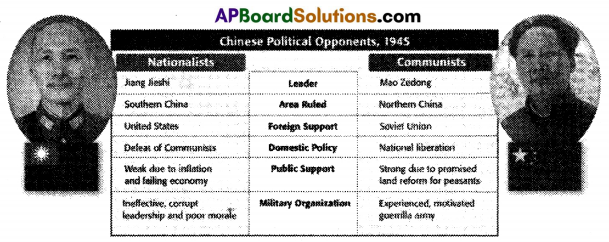
Answer:

  1. There are three major tribal groups in Nigeria.
    1. Hausa-Fulani,
    2. Yoruba,
    3. Igbo.
  2. The British were able to implement the divide and rule policy in Nigeria by encouraging competition and conflict among these three groups.

Question 3.
How did the education system in Vietnam contribute to the emergence of nationalist ideas?
Answer:

  1. In Vietnam, teachers and students did not blindly follow the curriculum given by the French.
  2. While teaching, Vietnamese teachers quietly modified the text and criticized what was stated.
  3. The students were inspired by patriotic feelings.
  4. The primary objective of the students who went to Japan for modern education was to drive out the French from Vietnam.

Question 4.
Why does the oil spillage from oil wells have a major impact on the ecosystem?
(OR)
What are the environmental problems faced by independent Nigeria?
Answer:

  1. Oil spillage from oil wells has a major impact on the ecosystem.
  2. Large tracts of the mangrove forests, which are especially susceptible to oil have been destroyed.
  3. Spills destroy crops and aquaculture through contamination of the groundwater and soils.
  4. Drinking water is also frequently contaminated, and a sheen of oil is visible in many local bodies of water.
  5. Offshore spills, which are usually much greater in scale, contaminate coastal environments and cause a decline in local fish production.

AP SSC 10th Class Social Studies Important Questions Chapter 15 National Liberation Movements in the Colonies

Question 5.
What is the impact of over-extraction of oil in Nigeria?
Answer:
Destruction of mangrove forests destroyal of :

  1. Ecosystem
  2. Crops
  3. Agriculture
  4. Soil
  5. Water contamination
  6. The decline in fish production
  7. Cause for cancer

Question 6.
Explain the ‘Pan Africanism’.
(OR)
What do you know about Pan Africanism?
Answer:

  1. Pan Africanism is an idea that promotes the unity of all African peoples irrespective of country or tribe.
  2. One key person in this regard was Kwame Nkrumah.

Question 7.
Observe the below map and answer the following questions.

1. Which country colonized Nigeria?
Answer:
The country of Nigeria was colonized by the British.

2. South-eastern Nigeria was dominated by which tribe?
Answer:
The South-Eastern part of Nigeria is dominated by Igbo tribes.

Question 8.
How can you appreciate the role of teachers in the Emergence of Vietnamese Nationalism?
Answer:
I appreciate the teachers by the following reasons.

  1. Blindly they did not follow the curriculum given by the French.
  2. Teachers quietly modified the text and criticized what was stated.

Question 9.
Based on the chart given below answer the question.
AP SSC 10th Class Social Studies Important Questions Chapter 15 National Liberation Movements in the Colonies 2Which aspect of the Communist approach do you think led to Mao’s victory? Explain.
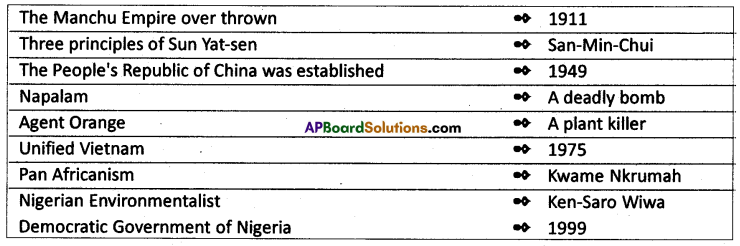
Answer:
Strong due to promised land reform for peasants.
The above aspect introduces equality among all and distributes the lands to landless poor confiscated from rich landlords.
With this programme majority of people enjoy their own lands and lived happily without pressure.

AP SSC 10th Class Social Studies Important Questions Chapter 15 National Liberation Movements in the Colonies

Question 10.
What do you know about Chiang Kai-shek?
Answer:
After the death of Sun, Chiang Kai-shek emerged as the leader of the Guomindang as he launched a military campaign to control the ‘warlords’, regional leaders who had usurped authority and to eliminate the communists. He sought to militarise the nation. The people, he said, must develop a ‘habit and instinct for unified behavior’.

Question 11.
What were the evil practices against women in China?
Answer:

  1. Practice of foot-binding.
  2. The subordination of women and
  3. Equality in marriage
  4. Four virtues:
    1. Chastity,
    2. Appearance,
    3. Speech and
    4. Work and
    5. Length of hemlines were also prescribed

Question 12.
What were the two crises faced by rural China?
Answer:
Rural China faced two crises:

  1. Ecological, with soil exhaustion deforestation and floods and
  2. A socio-economic one caused by exploitative land-tenure systems, indebtedness, primitive technology and poor communications.

Question 13.
What was the massive effort to spread literacy?
Answer:
A massive effort for setting up adult peasant schools to spread literacy and political education was undertaken along with the land reforms. This was also accompanied by the setting up of primary schools for both young children and adults in all the villages.

Question 14.
Why did the standard of living for the peasant’s decline in Vietnam?
Answer:
The colonial economy in Vietnam was primarily based on rice cultivation and rubber plantations owned by the French and few Vietnamese elites. Bonded labour was widely used in the rubber plantations. The French did little to industrialize the economy. In the rural areas landlordism, spread and large landlords took over the lands of small peasants and made them work as tenant farmers. As a result, the standard of living for the peasants declined.

AP SSC 10th Class Social Studies Important Questions Chapter 15 National Liberation Movements in the Colonies

Question 15.
What were the conditions of the peasants in Vietnam who rented the land of landlords?
Answer:
The peasants who rented the land of landlords had to pay rent in both share of produce and also by working on the fields and homes of the landlords and also pay different kinds of taxes imposed at will by the landlords. This forced them to borrow rice and money from the landlords and push them further into debt bondage.

Question 16.
Why did the Vietnamese students go to Japan in early 20th century?
Answer:
In early 20th century, Vietnamese students went to Japan to acquire modern education. For many of them, the primary objective was to drive out the French from Vietnam, overthrow the puppet emperor and re-establish the Nguyen dynasty that had been deposed by the French.

Question 17.
What was the impact of the Great Depression of the 1930s?
Answer:
The Great Depression of the 1930s had a profound impact on Vietnam. The prices of rubber and rice fell, leading to rising rural debts, unemployment, and rural uprising. The French put these uprisings down with great severity, even using planes to bomb demonstrators.

Question 18.
What were the challenges faced by the New Republic of Vietnam?
Answer:
The new republic faced a number of challenges. The French tried to regain control by using the emperor, Bao Dai, as their puppet. Faced with the French offensive, the Vietminh were forced to retreat to the hills. After eight years of fighting, the French were defeated in 1954 at Dien Bien Phu and over 16000 French soldiers and officers were taken, prisoners.

Question 19.
Write about China at the turn of the 20th century.
Answer:
At the turn of the 20th century, China was ruled by emperors of the Manchu dynasty, which had become powerless to defend the interests of China vis a vis the western colonial powers. These powers had carved out their ‘spheres of influence’ in different parts of China and had forced the emperors to give them economic and political concessions like low import taxes, immunity from Chinese laws, maintaining armed forces, etc. Both the common people and administrators of the empire were unhappy with this state of affairs. There were several revolts by the people and attempts at reform by the administrators.

AP SSC 10th Class Social Studies Important Questions Chapter 15 National Liberation Movements in the Colonies

Question 20.
Why did the Guomindang fail?
Answer:

  1. The Guomindang, despite its attempts to unite the country, failed because of its narrow social base and limited political vision.
  2. A major plank in Sun Yat-sen’s programme – regulating capital and equalizing land was never carried out because the party ignored the peasantry and the rising social inequalities.
  3. It sought to impose military order rather than address the problems faced by the people.

Question 21.
‘Mao was unlike other leaders’ – Why?
Answer:

  1. Mao stressed the need for an independent government and army.
  2. He had become aware of women’s problems and supported the emergence of rural women’s associations.
  3. He promulgated a new marriage law that forbade arranged marriages, stopped purchase or sale of marriage contracts and simplified divorce. So Mao was unlike other leaders.

Question 22.
Write about the Peoples Republic of China government.
Answer:

  1. The Peoples Republic of China government was established in 1949.
  2. It was based on the principles of the ‘New Democracy’, an alliance of all social classes opposed to landlordism and imperialism.
  3. Critical areas of the economy were put under government control.
  4. Once in power the CCP carried out large-scale land reform measures which meant taking away the land of landlords and distributing them among poor peasants.
  5. The new government also managed to enact laws to protect women, their rights and the abolition of polygamy.
  6. This enabled women to assume new roles and enjoy equal status vis a vis men in various
    fields.

Question 23.
Read the paragraph and answer the following question.

The Great Depression of the 1930s had a profound impact on Vietnam. The prices of rubber and rice fell, leading to rising rural debts, unemployment and rural uprising. The French put these uprisings down with great severity, even using planes to bomb demonstrators.

Why did the fall in price of rice lead to the rise of rural indebtedness?
Answer:

  1. Two-thirds of the rice production in Vietnam is exported.
  2. By that time it was the third-largest exporter of rice in the world.
  3. Great depression of 1929-30 has a great negative impact on Vietnam.
  4. The prices of Rice and Rubber has fallen drastically and there is rise in rural indebtedness.

10th Class Social 15th Lesson National Liberation Movements in the Colonies 4 Marks Important Questions and Answers

Question 1.
What are the reforms implemented after the formation of democracy in China?
Answer:

  1. The Peoples Republic of China was based on the principles of the ‘New Democracy’, an alliance of all social classes opposed to landlordism and imperialism.
  2. Critical areas of the economy were put under government control.
  3. They carried out large scale and reform measures.
  4. They took away the land of landlords and distributed among poor peasants.
  5. The new government also managed to enact laws to protect women, their rights and abolition of polygamy.
  6. This enabled women to assume new roles and enjoy equal status vis a vis men in various fields.

AP SSC 10th Class Social Studies Important Questions Chapter 15 National Liberation Movements in the Colonies

Question 2.
Explain the role of schooling played in Vietnam national movements.
(OR)
Explain the role of education in the national movement by taking Vietnam as an example.
Answer:

  1. The teachers did not blindly follow the curriculum given by the French.
  2. While teaching, Vietnamese teachers quietly modified the text and criticised what was stated.
  3. Students fought against the colonial government’s efforts to prevent the Vietnamese from qualifying for white-collar jobs.
  4. They were inspired by patriotic feelings and the conviction that it was the duty of the educated to fight for the benefit of society.

Question 3.
Explain the policies followed by the French in Vietnam.
Answer:

  1. French colonial rule influenced all aspects of Vietnamese life.
  2. The French were keen to develop Vietnam as an exporter of rice.
  3. They improved irrigation net work by building canals.
  4. They encouraged landlords and facilitated marketing of agricultural produce.
  5. The French did little to industrialise the economy.
  6. Vietnamese peasants became entrenched in a cycle of debt.
  7. There was no access for all to get good education.
  8. All the higher education was in French only.

Question 4.
How were the Land reforms implemented in China?
Answer:
Land reforms of China.

  1. Land reforms were launched in 1950-51.
  2. The major steps involved were,
    1. Identification of all village inhabitants.
    2. Confiscation of all village lands and redistribution of land lord’s land and other productive property.

AP SSC 10th Class Social Studies Important Questions Chapter 15 National Liberation Movements in the Colonies

Question 5.
Read the following paragraph and write your opinion.

Racism became common in the British colonial empire in late 19th and early 20th centuries. Educated Africans were excluded from the civil service, and there was discrimination against African entrepreneurs. At the same time, the authorities from ruling country gave control to the tribal chiefs and elite and promoted them.

Answer:
The given paragraph is about Racial Discrimination between the Black and the White people. It is related to Africa. One more point is that tribal chiefs were given control and the government promoted them.

Nigeria is an African country. It was a colony of the British. The British created Nigeria by bringing together different regions around the Niger river system where people of different tribes lived.

Before bringing all together, they faced many problems. Hausa-Fulani, Igbo and Yoruba tribes were there. Due to long years of missionary activity, many people still practice tribal religious beliefs.

The British implemented their divide and rule policy. A section of the people were educated and developed. If all the people were united in Nigeria, then the British would face the problem. The British always wanted to divide the Vietnamese based on colour or religious practices. That Was what the Britishers followed in India to divide Indians. All the Indians came together and fought against the British. Then the Britishers encouraged the Muslims to form a separate party for Muslims. They emphasised that Indian National Congress was the party of Brahmins and of upper caste. Gradually Hindus and Muslims were separated and so the national movement was weakened.

Now all the Independent countries should give equal opportunities to all and equality is to be maintained. There will be no racial discrimination at any level.

Question 6.
“America was very cruel in the Vietnam war” – Comment.
Answer:

  1. America behaves very wild manner on Vietnam.
  2. America with the fear of Communism to stop the spread of Communism in Vietnam, it declared war on Vietnam.
  3. It uses chemical bombs and weapons like Agent Orange – B 52s. and Napalm.
  4. Agent Orange destroyed plants & trees and made the land barren for a long time.
  5. Phosphorous bombs – destroyed many villages and decimated jungles.
  6. Civilians died in large numbers.
  7. Thousands of troops were used by America.
  8. Due to cruelty of America, America got agitation from world wide and from their mother land also.
  9. Finally, America made a peace settlement and withdrawn from the war.

Question 7.
Answer the questions with the help of the given information.
AP SSC 10th Class Social Studies Important Questions Chapter 15 National Liberation Movements in the Colonies 5a) Which nation was ruled by the Manchu Dynasty?
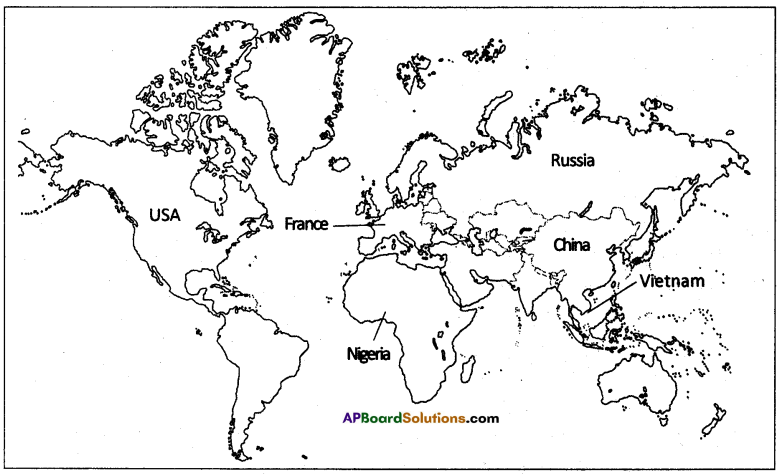
Answer:
China was ruled by the Manchu dynasty.

b) Who is considered as the ‘founder of modern China’?
Answer:
Sun-Yat-Sen was regarded as the founder of modern China.

c) Who was an eminent Human Rights activist and environmentalist of Nigeria?
Answer:
Ken – Saro- Wiwa was an eminent Human Rights activist and environmentalist of Nigeria.

d) What is meant by the Pan Africanism?
Answer:

  1. Pan Africanism is an idea which promotes the unity of all African peoples irrespective of country or tribe.
  2. One key person in this regard was Kwame Nkrumah.

AP SSC 10th Class Social Studies Important Questions Chapter 15 National Liberation Movements in the Colonies

Question 8.
Read the given paragraph and write your Opinion.

The coastal environment of Nigeria has been disturbed because of reckless oil extraction by foreign oil companies. Oil spillage from oil wells has a major impact on the ecosystem.

Answer:
The given paragraph emphasises that the coastal environment of Nigeria has been disturbed because the oil companies extracted more than their share. It is talking about the consequences of over spillage of oil.

Over spillage of oil has various negative consequences:
Oil spillage from oil wells has a major impact on the ecosystem. Large areas of the mangrove forests, which are especially susceptible to oil, have been destroyed. This is mainly because oil is stored in the soil and re-released annually. Around 5-10% of Nigerian mangrove ecosystems have been destroyed either by clearing or oil. Spills destroy crops and aqua culture through contamination of the groundwater and soil. Drinking water is also frequently contaminated, and sheen of oil is visible in many local bodies of water. Even if there is no immediate health effect of this water contamination, it can cause cancer in the long term. Offshore spills, which are usually much bigger in scale, contaminate the coastal environments and cause a decline in the local fish production.

If the same is continued the whole world be affected. Oil is a natural resource. So natural resources are to be saved.

Question 9.
“The United States approach in Vietnamese’s struggle was brutal.” Do you agree with this statement? Why? Why not?
Answer:
“Yes, I agree with this statement. Because:

  1. Until 1950’s Vietnamese were under the control of French.
  2. And in some years it was under control of Japan.
  3. People were suffered with high rents and taxes.
  4. They did not get proper food also.
  5. Ho-Chi-Minh’s idea land distribution in North Vietnam provide something to them and they lived happily.
  6. So the North Vietnam peasants fulfilled their long cherished dream.
  7. At the same manner South Vietnam people also wished that reforms introduced in that area and established Communism and get happy life.

Conclusion: But America brutally declare war on them to fulfill its desire.

Question 10.
Read the following paragraph given below and answer the questions.

Agent Orange: The Deadly Poison

Agent Orange is a defoliant, a plant killer, so called because it was stored in drums marked with an orange band. Between 1961 and 1971, some 11 million gallons of this chemical was sprayed from cargo planes by US forces. Their plan was to destroy forests and fields, so that it would be easier to kill if there was no jungle cover for people to hide in. Over 14 percent of the country’s farmland was affected by this poison. Its effect has been staggering, continuing to affect people till today. Dioxin, an element of Agent Orange, is known to cause cancer and brain damage in children and according to a study, is also the cause of the high incidence of deformities found in the sprayed areas.
The tonnage of bombs, including chemical arms, used during US intervention (mostly against civilian targets) in Vietnam exceeds that used throughout the Second World War.

a) What is Agent Orange ?
Answer:
Agent Orange is a defoliant, a plant killer.

b) How does Agent Orange affect the children?
Answer:
Agent Orange causes cancer, brain damage and deformities in children.

c) Why did they destroy forests and fields?
Answer:
That it would be easier to kill if there were no forests and fields cover for people to hide in.

d) Do you think America was justified in using chemical weapons and civilian population and forests?
Answer:
No, it was not justified.

AP SSC 10th Class Social Studies Important Questions Chapter 15 National Liberation Movements in the Colonies

Question 11.
What do you know about the administration of Chiang Kai-shek?
Answer:

  1. Chiang was a conservative and he encouraged women to cultivate the four virtues of ‘chastity,
    appearance, speech and work’ and recognize their role as confined to the household.
  2. He also tried to suppress the trade union movement to encourage factory owners.
  3. The Guomindang was failed because of its narrow social base and limited political vision.
  4. A major plank in Sun-Yat-sen’s programme – regulating capital and equalising land – was never carried out because the party ignored the peasantry and the rising social inequalities.
  5. It sought to impose military order rather than address the problems faced by the people.

Question 12.
How was the French education system in Vietnam?
Answer:

  1. The French colonisers like the British were convinced that the people of the colony were uncivilised and the objective of their rule was to bring the benefits of modern civilisation. Education was seen as one way to civilize the ‘natives’.
  2. The French needed an educated local labour force but they feared that education might create problems.
  3. Once educated, the Vietnamese may begin to question colonial domination.
  4. Even though Vietnamese language was taught in the primary level, all higher education was in French.
  5. Only the Vietnamese elite -comprising a small fraction of the population – could enroll in the schools and only a few among those admitted ultimately passed the school-leaving examination.

Question 13.
Read the following paragraph and answer the given questions.

The Manchu empire was overthrown and a republic established in 1911 under Sun Yat-sen (1866-1925) who is regarded as the founder of modern China. He came from a poor family and studied in missionary schools where he was introduced to democracy and Christianity. He studied medicine but was greatly concerned about the fate of China. He studied the problems of China and worked out a programme of action. His programme was called the Three Principles (San min chui). These were: “nationalism”- this meant overthrowing the Manchu who were seen as a foreign dynasty, as well as other foreign imperialists; “democracy” or establishing democratic government; and “socialism” regulating industries and land reforms to distribute land to the landless peasants. Even though the Manchu dynasty was overthrown and a republic was declared, the republican government led by Sun-Yat-sen could not consolidate itself. The country came to be controlled by regional military powers called “warlords”.

a) Why was Sun Yat-sen regarded as the founder of modern China?
Answer:
Because he established a republic in China by overthrowing the Manchu empire.

b) What were the Three Principles?
Answer:
San min chui (Nationalism, Democracy, Socialism)

c) What is meant by Nationalism here?
Answer:
Nationalism meant overthrowing the Manchu who were seen as foreign dynasty as well as other foreign imperialists.

d) What is meant by Socialism?
Answer:
Regulating industries and land reforms.

e) Who were war lords?
Answer:
The regional military powers were called warlords.

Question 14.
Read the following paragraph and answer the given questions.

Japan attacked and occupied much of China between 1937 and 1945. They tried to impose a barbaric colonial militaristic rule over China which had a disastrous impact on the Chinese society and economy. Both Guomindang and CCP now tried to join forces to fight Japanese occupation. After the surrender of Japan to the US in August 1945, Guomindang and CCP engaged with each other in an all out warfare for control over China. Eventually CCP was successful in establishing its rule over mainland China while Guomindang was forced to set up its government on the island of Taiwan.

a) How was the Japanese rule over China?
Answer:
It was a barbaric colonial militaristic rule.

b) Name the two political parties.
Answer:
Guomingdang and CCP.

c) To whom did Japan surrender?
Answer:
Japan surrendered to the US.

d) Which party was successful?
Answer:
The CCP was successful.

e) Which party established rule in Taiwan?
Answer:
The Guomindang.

AP SSC 10th Class Social Studies Important Questions Chapter 15 National Liberation Movements in the Colonies

Question 15.
Read the following paragraph and answer the given questions.

The French were keen to develop Vietnam as an exporter of rice and for this purpose they adopted a threefold strategy – improving irrigation network, encouraging landlords and facilitating marketing of agricultural produce like rice and rubber. The French began by building canals and draining lands fa the Mekong delta to increase cultivation. The vast system of irrigation works – canals and earthworks – built mainly with forced labour, increased rice production and allowed the export of rice to the international market. Vietnam exported two- thirds of its rice production and by 1931 had become the third largest exporter of rice in the world. This was followed by infrastructure projects (roads and railways) to help transport goods for trade, move military garrisons and control the entire region. Construction of a trans- Indo-China rail network that would link the northern and southern parts of Vietnam and China was begun.

a) Why were the French keen to develop Vietnam?
Answer:
Because it was an exporter of rice.

b) What was the other crop?
Answer:
Rubber plantations.

c) Which Delta was developed?
Answer:
The Mekong Delta was developed.

d) exported two-thirds of its rice production.
Answer:
Vietnam.

e) Who developed Vietnam?
Answer:
The French developed Vietnam.

Question 16.
Read the following paragraph and answer the questions that follow.

This phase of struggle with the US was brutal. Thousands of US troops arrived equipped with heavy weapons and tanks and backed by the most powerful bombers of the time – B52s. The wide spread attacks and use of chemical weapons – Napalm (a deadly bomb which caused intense damage to humans), Agent Orange (which destroyed plants and trees and made the land barren for a long time), and phosphorous bombs – destroyed many villages and decimated jungles. Civilians died in large numbers.

a) Which struggle was brutal?
Answer:
The struggle with the US was brutal.

b) What were B52s?
Answer:
B52s were powerful bombers.

c) What was “Napalm’?
Answer:
It was a chemical weapon.

d) Which was used on forest areas?
Answer:
Agent Orange was used on forest areas.

e) How were phosphorous bombs?
Answer:
They destroyed many villages and decimated jungles, civilians died in large numbers.

AP SSC 10th Class Social Studies Important Questions Chapter 15 National Liberation Movements in the Colonies

Question 17.
Read the following paragraph and answer the given questions.

Nigerian nationalism had the twin task of fighting the British and also welding the. very diverse and conflicting ethnic groups. The national movement was stronger in the more developed south rather than in the north and this created a north-south divide. Even in the south, nationalism was plagued by ethnic conflict between the Yoruba and the Igbos. By the 1950s these three regions also had their own anti-colonial movements led by regional parties: the conservative Northern People’s Congress (NPC) in the north; the National Council for Nigeria and the Cameroons (NCNC) in the east, and the Action Group (AG) in the west.

a) What were the two tasks?
Answer:

  1. Fighting the British
  2. Welding the very diverse and conflicting ethnic groups.

b) In which region was the national movement stronger?
Answer:
It was strong in south.

c) What were the two tribes?
Answer:
Yoruba and Igbos.

4) Expand NPC.
Answer:
Northern People’s Congress.

e) Expand AG.
Answer:
Action Group.

Question 18.
Read the passage and answer the following question.
The effect of the war was felt within the US as well. Many were critical of the government for getting involved in a war that they saw as indefensible.
How do you appreciate the role of the people of the USA in ending the war?
Answer:

  1. Vietnam was a small country.
  2. The USA was very brutal in the war.
  3. It used even chemical weapons.
  4. The effects of the war was felt within the US as well.
  5. When youth were drafted for the war, the anger spread.
  6. People opposed the war.
  7. They questioned the government’s policy.
  8. Finally the people were instrumental in ending the war.
  9. A peace settlement was signed in Paris in 1974.

AP SSC 10th Class Social Studies Important Questions Chapter 15 National Liberation Movements in the Colonies

Question 19.
Read the following text and interpret it.

Pan Africanism

Pan Africanism is an idea which promotes the unity of all African peoples irrespective of country or tribe. This unity was to be used not only to fight colonialism and racial discrimination, but also to build unity among tribes and communities inhabiting the continent based on principles of equality, social justice and human dignity. One key person in this regard was Kwame Nkrumah, a freedom^ghter from Ghana.

Answer:

  1. Africa was colonized by the European imperialistic powers and different tribes were residing in Africa.
  2. The European powers plundered the resources of Africa both the mineral and agricultural resources.
  3. Slave trade was also carried in this region.
  4. Pan Africanism promoted the idea of the unity of all the Africans.
  5. It helped them to fight against colonization and racial discrimination.
  6. Pan Africanism has a higher sphere and it breaks the limits of nationalism.
  7. It unites all the tribes living on the continent based on the principles of equality, social justice and human dignity.

Question 20.
Locate the following on the outline map of the world.

  1. China
  2. USA
  3. Vietnam
  4. France
  5. Nigeria
  6. Russia

Answer:
AP SSC 10th Class Social Studies Important Questions Chapter 15 National Liberation Movements in the Colonies 3

AP SSC 10th Class Social Studies Important Questions Chapter 15 National Liberation Movements in the Colonies

Question 21.
Locate the following in the given map of world.
1) The third largest exporter of rice in the world.
Answer: Vietnam

2) These country people were called colons.
Answer: France

3) Manchu dynasty rule this country.
Answer: China

4) Yoruba people are belongs to this country.
Answer: Nigeria

5) America used agent orange on this country.
Answer: Vietnam

6) Washington

AP SSC 10th Class Social Studies Important Questions Chapter 15 National Liberation Movements in the Colonies 4

AP SSC 10th Class Social Studies Important Questions Chapter 15 National Liberation Movements in the Colonies

AP SSC 10th Class Biology Solutions Chapter 5 Coordination – The Linking System

AP State Board Syllabus AP SSC 10th Class Biology Solutions Chapter 5 Coordination – The Linking System Textbook Questions and Answers.

AP State Syllabus SSC 10th Class Biology Solutions 5th Lesson Coordination – The Linking System

10th Class Biology 5th Lesson Coordination – The Linking System Textbook Questions and Answers

Improve your learning

Question 1.
Fill In the missing sections In the following flow-chart.
AP SSC 10th Class Biology Solutions Chapter 5 Coordination – The Linking System 1
Answer:
AP SSC 10th Class Biology Solutions Chapter 5 Coordination – The Linking System 2

AP SSC 10th Class Biology Solutions Chapter 5 Coordination – The Linking System

Question 2.
Do you think body’s team work maintains functioning of our body? Justify your answer with an example.
Answer:

  1. Yes. Body’s team work maintains functioning of our body.
  2. All our functions are carried out by an effort of several systems working together.
  3. The human body has a set of systems which regulate the internal environment and strive to give our cells the necessary condition as they need to function.
  4. We cannot use only the skeletal system or muscular system.
  5. To do any function several other systems also have their own roles to play.
  6. The pathway involving the way that our organs tissues and cells pickup signals from their surroundings and respond to them that triggers different functions in our body as well as by our body.
  7. When all the organs and organ systems work as a unit then the organism will survive.
  8. For example our eyes, ears, legs should coordinate with each other when crossing the road. Otherwise we may met with an accident.

Question 3.
Give an example of coordination in your body where both hormonal and nervous controls function together.
Answer:

  1. Several functions in our body are controlled by nerves, while many others are controlled by hormones.
  2. When we are afraid, the rate of heart beat increases, the breath rate will be faster, blood pressure increases, the hair on the body becomes errect and we get goose bumps.
  3. We might not observe our pupil dilation, skin becomes more sensitive. We come to normally only after we reach a safe spot.
  4. The various actions of the body are controlled by hormones and coordinated by nervous system.
  5. In these type of conditions nervous system and endocrine system work together to bring about control and coordination.
  6. Another example for nervous and hormonal coordination. When the mother feeds the baby, the baby sucks the nipple for milk. This information is send to the brain by sensory nerve. Brain orders the pituitary gland to release the hormone oxytocin. Oxytocin helps in the ejection of milk from the mammary glands.

AP SSC 10th Class Biology Solutions Chapter 5 Coordination – The Linking System

Question 4.
Consider that you are passing by a garbage disposal area and you immediately
cover your nose. Arrange the events below in a logical order by marking them from 1 to 5 to trace the events that happen in the nervous system from detection of foul smell (stimulus generation) to covering your nose (response).
i) At the end of the axon, electrical impulse releases chemicals.
ii) Stimulus received by the dendrites of a neuron sets off chemical reaction that creates an electrical impulse.
iii) Electrical impulse transmitted through cell body and axon.
iv) The chemicals cross the synapse and reach the next neuron. Similarly, the electrical impulse crosses several neurons.
v) Finally, the impulse is delivered from neuron to the gland that helps in recognition of the foul smell and muscle cells that help in covering the nose.
Answer:
The following events occur in nervous system for detecting foul smell of garbage, ii, iii, i, iv, v

Question 5.
What is a Synapse? How is it useful in transfer information?
Answer:

  1. Definition: Synapse is a functional region between two neurons where information from one neuron is transmitted or relayed to another neuron.
  2. Through synaptic region is with minute gaps it does not have any protoplasmic connection between them.
  3. Information is passed from one nerve cell to the other through these gaps either in the form of chemical or electrical signals or both.

Question 6.
Distinguish between
a) Stimulus and Response
b) Afferent and Efferent nerves
c) Central nervous system and peripheral nervous system
d) Receptor and effector
Answer:
a) Stimulus and Response

StimulusResponse
1. It is the cause or change in organism’s surroundings that causes the organism to react1. It is the act done by the organism.
2. Stimulus can not be always controlled especially external stimuli.2. It could be controlled.
3. Stimulus could be of any magnitude.3. The response could never go beyond the highest capability of an organism.
4. Response can not determines the stimulus.4. Stimulus determines the response.

b) Afferent and Efferent nerves

Afferent nervesEfferent nerves
1. Nerves coming from receptors or sense organs are called afferent nerves.1. Nerves that carry impulses from brain or spinal cord are called efferent nerves.
2. These are also called sensory nerves.2. These are also called motor nerves.
3. Sensory nerves carry information from sensory organs like ears, eyes, from brain or spinal cord.3. The motor nerves carry impulses to effector nose, tongue and skin to brain and organs (muscles) and are responsible for the movement of hands and legs.
4. These are incoming nerves.4. These are outgoing nerves.

c) Central nervous system and peripheral nervous system :

Central nervous systemPeripheral nervous system
1. It consists of Brain and spinal cord.1. It consists of nerves that arise from brain and spinal nerves.
2. Both of them have nerve cells and glial cells.2. It has 43 pairs of nerves. Among them 12 pairs are cranial nerves and 31 pairs are spinal nerves.
3. Brain and spinal cord are continuous with each other.3. Cranial nerves take their origin from brain and spinal nerves take their origin from spinal cord.
4. Brain and spinal cord receive infor­mation.4. The cranial nerves carry information to the sense organs and spinal nerves from organs to spinal cord.
5. Central nervous system coordinates all neural functions.5. These supply information required for the movement of the muscles.

d) Receptor and effector:

ReceptorEffector
1. The sense organs which are made up of cells called receptors.1. Muscles or tissues which are linked with nerves are called an effector.
2. Receptors respond to stimulus.2. Effectors are the organs that produce response.
3. These send information to central nervous system.3. They follow the commands of central nervous system.
4. These are connected to sensory organs.4. These follow the motor nerves.
5. Nervous system sense the changes inside and outside the body through receptors.5. Effectors receive messages from brain or spinal cord through motor nerves.

Question 7.
How does phototropism occur in plants?
Answer:

  1. Bending of plants towards light is called phototropism. (Photo = light) (tropism = movement)
  2. For example a creeper which is growing near the window bend towards sunlight.
  3. Auxins are the phyto hormones which are present at the tip of the shoot respond the plant to bend towards sunlight.

AP SSC 10th Class Biology Solutions Chapter 5 Coordination – The Linking System

Question 8.
Give an example and explain how plants may immediately respond to a stimulus.
Answer:

  1. The plant responding to stimulus is mimosa pudica is the example.
  2. Mimosa pudica leaves have pad like sweelings at the base are called PULVINI.
  3. Here cells contain water and large intercellular spaces. Due to water pressure pulvini hold the leaf errect.
  4. When we touch the leaves, an electrical impulse is generated due to plant hormone.
  5. Because of this hormone water in the pulvini cells which are closer to the leaf vein migrate to other side’of the cells.
  6. Then pulvini loss its fitness hence leaves become fold. After 20 to 30 minutes water comes back leaves become errect.

Question 9.
Suggest an experiment to show how roots grow away from light in most plants.
Answer:
Aim: To prove that roots grow away from light in most plants.
Material required: Glass jar, Bean seed.
Procedure:

  1. A plant jar is taken and filled with mud.
    AP SSC 10th Class Biology Solutions Chapter 5 Coordination – The Linking System 3
  2. A bean seed is sown just adjacent in the inner wall of the jar.
  3. So that it is easy to observe the growth of root and shoot.
  4. After 4-5 days the germination of the seed is observed.
  5. Keep the jar in the sunlight. We observe the growth of roots and shoot.
  6. Finally the jar is tilted to keep the growing plant horizontally.
  7. After the growth of 4-5 days, tilt the glass jar and keep the plant horizontally.

Observation: It is observed that the roots extends downwards to the earth that is away from the sun light and the shoot grows towards sunlight.
Conclusion: By the above experiment it is proved that roots grow towards gravity (earth) away from sun light.

AP SSC 10th Class Biology Solutions Chapter 5 Coordination – The Linking System

Question 10.
Give an example to show how hormones can influence visible changes in your body.
(OR)
What are the effects of hormones on human beings?
Answer:

  1. Endocrine glands secrete chemical substances called Hormones directly into blood.
  2. Hormones act on the cells of other organs and increase or decrease the metabolism of carbohydrates, proteins and fats.
  3. The external features by which the males and females can be distinguished are called secondary sexual characters.
  4. Testosterone in males and estrogen in females promotes the development of secondary sexual characteristics.
  5. For example, if a dog chases us, our nervous system stimulate the adrenal glands to secrete more adrenaline hormone into our body.
  6. When we are afraid, the rate of heart beat increases, the breath rate will be faster, blood pressure increases, the hair on the body becomes errect.
  7. All these changes occur due to the production of Adrenaline hormone.

Question 11.
How does a neuron differ from an ordinary cell in structure? Write notes.
Answer:

Neuron (Nerve cell)Ordinary cell
1. It is the longest cell in our body.1. Generally cells are round or oval shaped.
2. It belongs to only nervous system.2. These are the structural units of body.
3. Nerve cell has three parts: 1. Cyton 2. Axon 3. Dendrites3. Commonly divided as 1. Cytoplasm and 2. Nucleoplasm
4. These cells carry impulses to brain and spinal cord.4. Involve in metabolic activities.
5. These are not regenerated.5. The cells have cell division and replace the death cells.
6. Nerve cells end with dendrites.6. These cells do not have end points.
7. Some nerve cells are covered with lipid coat.7. Generally these are covered with plasma membrane.
8. Nissl granules are special character of nerve cells.8. These cells do not have Nissl granules.

Question 12.
Is the structure of neuron suitable for transmission of impulses? Analyse.
Answer:

  1. Yes. The structure of neuron is suitable for transmission of impulses.
  2. Neurons are the functional units which receive and process information and generate responses.
  3. Cell body is the centre for all the synthetic activity of the neuron.
  4. Dendrites arise from the cell body receive information from other neurons and carry this information to the cell body.
  5. The axon or nerve fibre gives out several branches that end in nerve terminals. These make connect with the dendrites or the axons of another neuron.
  6. Myelinated sheath prevents the leakage of electrical currents from axon. Myelinated axons conduct impulses much faster than unmyelinated axons.

AP SSC 10th Class Biology Solutions Chapter 5 Coordination – The Linking System

Question 13.
Man is the most intelligent animal. What could be the fact that helped us to reach such a conclusion?
Answer:

  1. Man is the most intelligent animal in animal kingdom.
  2. This is possible by well development of brain and its marvellous function.
  3. Human brain has abilities to learn from concepts.
  4. It understands, applies logic and reason.
  5. The brain also recognizes patterns and comprehends ideas.
  6. The human brain has ability in making plans, solving problems, making decisions and retaining information.
  7. Man is the only animal who uses language to communicate.
  8. Intelligence enables humans to experience and think.
  9. It has also consciousness and self-awareness.

Question 14.
The axon of nerve cell in hand is shorter than the axon of nerve cell in leg. Do you support this statement? Why?
Answer:

  1. Yes, I support the above statement.
  2. The axon of nerve cell in hand is shorter than the axon of nerve cell in leg.
  3. The sciatic nerve is the large nerve in humans and animals. It begins in the lower back and runs through the buttock and lower limbs.
  4. Sciatic nerve present in the leg is the largest and widest single nerve in the human body. It measures about 1 mt in length.
  5. Usually the length of leg is more in size than hand. Hence the axon of nerve cell in hand is shorter than the axon of nerve cell in leg.

Question 15.
Organs respond to the external stimulus by a fraction of second. How do you feel about such controlling mechanism of human body?
Answer:

  1. Organs responding for the external stimuli by a fraction of second are due to reflex action.
  2. Reflex actions are very important as they save us from painful or dangerous stimuli.
  3. Reflex actions or reflexus are fast, immediate automatic and involuntary responses of the body.
  4. They help in the body as they save us from painful or dangerous stimuli.
  5. Reflexes occur without our thinking.
  6. Brain is not involved in the execution of several reflexes.
    Ex: Withdrawing our hand when we touch hot subject.

AP SSC 10th Class Biology Solutions Chapter 5 Coordination – The Linking System

Question 16.
State whether the following actions are voluntary action, reflex action or conditioned reflex.

  1. Blinking
  2. Cleaning the table
  3. Playing on the key board
  4. Salivating when food is put in the mouth
  5. We close our ears when we hear unbearable sound

Answer:

  1. Blinking: Involuntary action or reflex action.
  2. Cleaning the table: Voluntary action.
  3. Playing on the keyboard: Conditioned reflex.
  4. Salivating when food is put in the mouth: Involuntary or Reflex action.
  5. We close our ears when we hear unbearable sound: Involuntary or reflex action.

Question 17.
What will happen to the potted plant kept near window in the room?
(OR)
Draw a diagram of a plant showing phototropism. Explain why plants possess such type of response.
(OR)
A plant which grows near a window bends towards sun light. Write the reason for it.
Answer:

  1. The potted plant which is kept near the window in the room, grows towards light.
    AP SSC 10th Class Biology Solutions Chapter 5 Coordination – The Linking System 4
  2. Auxins acts on bending of stem of show a response to the sun light.
  3. More auxin collects on the light illuminated side of the stem. So cells on that side grow faster.
  4. On opposite side cells grow slow to make the stem bend.
  5. Auxins are the plant hormones responsible for the growing of the stem towards light.
  6. Auxins are synthesized at the tip of the stem (meristematic tissue).
  7. Bending of the plant towards light is called phototropism.

AP SSC 10th Class Biology Solutions Chapter 5 Coordination – The Linking System

Question 18.
What happens if all the functions of the human body are controlled only by brain?
Brain controls all the functions of the human body. Comment on it.
Answer:

  1. If all actions of the human body are controlled by brain, our body will get harm in dangerous situations.
  2. Some actions may be delayed and our brain could not conduct reflex actions, which require immediate action to a stimulus.
  3. For example, when we touch a hot object, we require an immediate response to save our hand. If the brain controls this action, the time taken will be more and our hand will burn.
  4. So, it is controlled by spinal cord, the response will be quick, and we may escape the danger.
  5. Nerves can not reach the every corner of the body, whereas hormones of endocrine glands can do that.
  6. So it’s not good that all functions are controlled by brain.

Question 19.
If you visit a doctor, what doubts you would like to clarify about pancreas?
Answer:

  1. What is pancreas?
  2. Where is pancreas located in our body?
  3. Why is it called mixed gland?
  4. What is the exocrine part of pancreas?
  5. What is the endocrine part of pancreas?
  6. What are the cells that secrete hormone insulin?
  7. What is the function of insulin?
  8. What happens if required amounts of insulin is not produced?
  9. What are the symptoms of diabetes?
  10. How can diabetes be controlled?

AP SSC 10th Class Biology Solutions Chapter 5 Coordination – The Linking System

Question 20.
Take a small potted plant. Cover base portion of the plant tightly and hang the part upside down. Observe the plant for a week. Based on your observation how can you support phototropism?
Answer:
Aim: To prove that phototropism is a character that is carried by stem.
AP SSC 10th Class Biology Solutions Chapter 5 Coordination – The Linking System 5
Apparatus: Potted plant, a strong small rope.
Procedure : Take a small potted plant. Cover the base portion of the plant tightly so that the plant along with soil do not fell down. Now take a rope and hang the potted plant upside down to a support firmly.
Observe the plant after a week.
Observation: We observe that the end of the stem which is upside down takes ‘U’ turn and grows towards light.
Conclusion: Phototropism is a response of plants towards light. That the stem grows towards light that is negatively to gravitation. Auxins are responsible for phototropism.

Question 21.
Take a cock feather touch smoothly at different parts of your body. Findout which portion of the body has high sensation. Is this similar during sleeping ? Prepare a report on it.
Answer:
Aim: To prove that our body shows high sensation in different parts.
Apparatus : Cock feather.
Procedure: Take a cock feather. Touch smoothly at different parts of our body with the cock feather.
Observation : It is observed that some of the body parts like palms of hands and soles of feet there is less sensation than the other body parts because the skin is thick. Some other parts where the skin is thin, the sensation is more.
Report: The nerve endings are situated in the skin. These nerve endings are responsible for the sensation of the body.

Question 22.
What procedure you follow to understand the effect of plant growth hormones (in agar medium) in the terminal portion of the tip of stem (coleoptile)?
Answer:
Aim: To show the growth of Avena coleoptile involves a chemical substance.
Apparatus: Oat seedlings (Avena sativa), coleoptile, a slice of agar, a sharp blade. Procedure:

  1. Take some oat seedlings.
  2. Their coleoptile tips are cut off.
  3. Place the tips on a slice of agar and leave them for about an hour.
  4. Cut the agar into small blocks and place a block on one side each stump of the decapitated plants.
  5. The plants were kept in the dark during the entire experiment.
  6. Observe the plants after one hour.

Observation :

  1. Within one hour a distinct bending away from the side on which the agar block was placed is observed.
  2. Agar block that had not been contact with coleoptile doesn’t show any bending.
    AP SSC 10th Class Biology Solutions Chapter 5 Coordination – The Linking System 6

Conclusion : The coleoptile tip exerted its effect by means of a chemical stimulus such as an electrical impulse. This chemical stimuls came to be known as auxin.

AP SSC 10th Class Biology Solutions Chapter 5 Coordination – The Linking System

Question 23.
Collect information on the actions controlled by spinal cord by using reference books from your school library.
Answer:
Spinal cord:

  1. Spinal cord is a long and cylindrical structure. It passes through vertibral column extending all along the dorsal surface of trunk.
    AP SSC 10th Class Biology Solutions Chapter 5 Coordination – The Linking System 7
  2. Vertebrae of the vertebral column protects the spinal cord.
  3. The spinal cord has two major functions, a) carrying information b) coordinating reflexes.
  4. It receives sensory information through the afferent nerves from the sensory receptors throughout the body and send them to the brain.
  5. It also carries information from the brain through efferent fibres to the muscles and glands.
  6. It coordinates reflexes without the involvement of the brain.

Thus the spinal cord has both communicative and integrative functions.

Reflex actions:

  1. Excepting the sensory and motor functions spinal cord controls some other important function also. These are called as reflex actions.
  2. The spinal cord does not take any assistance from the brain. Reflex actions are automatic, unlearned, involuntary and in born responses.
  3. Therefore these actions are suddenly in nature and have a purpose of protecting the individuals or his / her organs from sudden danger.

AP SSC 10th Class Biology Solutions Chapter 5 Coordination – The Linking System

Question 24.
Read the following sentences and compare with endocrine glands.

Pheromones are chemical substances secreted by organisms. These act as chemical signals secreted by exocrine glands. Pheromones are used as signals by the members of same species. Honey bee secretes pheromones that attract other bees to the location of food.
Answer:

PheromonesSecretions of Endocrine glands (or) Hormones
1. Pheromones are chemical substances secreted by organisms.1. Hormones are chemical substances secreted by endocrine glands.
2. These act as chemical signals.2. These are the chemical messengers.
3. Pheromones are used as signals by the members of same species.3. Hormones change or control the metabolic activities in the organisms.
4. Honey bee secretes pheromones that attract other bees to the location of food.4. Hormones help for growth, and stimulated organs’ function.

Question 25.
Collect the information about cranial nerves, spinal nerves from internet or from your school library.
Answer:
Spinal cord :

  1. Spinal cord is a long and cylindrical structure passing through the vertebral column.
  2. The vertebrae (back bones) of the vertebral column protect the spinal cord from injuries.
  3. From the sides of spinal cord, 31 pairs of nerves take their origin one from each side and supply branches to various parts of the body.
  4. Basic function of spinal cord is to act as a relay station – receiving information from various parts of the body parts below the head and send this information to the brain.
  5. Similarly, it receives information from brain and sends this information to other parts of the body.
  6. In addition to this, spinal cord also plays a major role in the RFELEX ACTIONS.
  7. The message received from the sensory nerve is passed into spinal cord. It is analyzed by the INTER NEURON present in the spinal cord and response is given. It is conveyed to the effector organ through motor nerve. The effector organ shows the response.
  8. Thus spinal cord saves us from dangerous stimuli through it’s REFLEX ACTIONS.

Question 26.
Draw a picture representing connection between dendrite – dendrite, axon – dendrite. Why do they connect like that?
Answer:

  1. The nerve cell is the structural and functional unit of nervous system.
    AP SSC 10th Class Biology Solutions Chapter 5 Coordination – The Linking System 8
  2. It consists of more than 100 billion of them, which communicate with each other in a specific manner.
  3. Dendrites of one nerve cell connects to the other or to the axons of another nerve cell through connect points called as a synapse.

AP SSC 10th Class Biology Solutions Chapter 5 Coordination – The Linking System

Question 27.
Draw a neatly labelled diagram of Brain and write few points how it is protected.
Answer:
Protection of Brain :

  1. Brain is present in the hard bony box called CRANIUM.
    AP SSC 10th Class Biology Solutions Chapter 5 Coordination – The Linking System 9
  2. It is covered by three layers called MENINGES.
  3. The space between the inner layer is filled with fluid called cerebrospinal fluid,
  4. It serves a shock-absorbing medium and protects brain against shocks/ jerks along with the meninges and cranium.

Question 28.
You are walking in the traffic suddenly you heard a loud sound. How does coordination take place in this situation among respected organs? Draw a block diagram to explain this situation.
Answer:
AP SSC 10th Class Biology Solutions Chapter 5 Coordination – The Linking System 10

Question 29.
Make a model of neuron using suitable materials.
Answer:
AP SSC 10th Class Biology Solutions Chapter 5 Coordination – The Linking System 15Required materials: A chart, twine thread, fevicol, sticker.

AP SSC 10th Class Biology Solutions Chapter 5 Coordination – The Linking System

Question 30.
Observe different actions performed by your classmate for a period of 45 minutes. Out of these actions which are controlled by voluntary and involuntary pathways?
Answer:
Voluntary actions:

  1. Standing
  2. sitting
  3. laughing
  4. drinking
  5. moving
  6. clapping
  7. carrying books
  8. reading
  9. writing
  10. talking

Involuntary actions:

  1. Blinking of eyes
  2. swallowing
  3. breathing
  4. listening etc.

Question 31.
Its very interesting to watch a creeper entwining its tendril to the support. Is not it? How do you express your feelings in this situation?
(OR)
Plants also respond to external stimuli. How do you feel about this?
Answer:

  1. A very interesting thing in plants is movement of tendrils.
    AP SSC 10th Class Biology Solutions Chapter 5 Coordination – The Linking System 12
  2. All plants show positive response to phototropism.
  3. But creepers like cucumber, bittergourd the stem is weak and thin. Hence plant cannot grow erect.
  4. Tendrils play a vital role to make the plant erect. Tendrils are thin thread-like growth on the leaves or stems of climbing plants.
  5. They grows towards support and wind around them.
  6. This type of response to make contact or touch is called thigmotropism.
  7. Nature only finds it’s way to grow and survive on the earth.

AP SSC 10th Class Biology Solutions Chapter 5 Coordination – The Linking System

Question 32.
Hormones are released at a specific place, specific time for a specific function. Prepare a cartoon on the hormones with a nice caption.
Answer:
AP SSC 10th Class Biology Solutions Chapter 5 Coordination – The Linking System 13

Fill in the blanks.

  1. The largest region of the brain is ———–.
  2. A point of contact between two neurons is ———–.
  3. ———– phytohormone is responsible for cell elongation and differentiation of shoots and roots.
  4. Thyroxine is responsible for ———–.
  5. Gibberellins and auxins promote growth in plants while absciscic acid arrests the same. Some situations are discussed here. State which hormones would be needed and why?
    a) A gardener wants large dahlias, he should use along with nutrients and other things ———– hormone.
    b) In a dwarf plant the branches have to be thickened one would use the ———– hormone.
    c) Seeds are to be stored a long time ———– hormone can help.
    d) Cutting the apex or tip of plants so that there are several lateral buds ———– hormone can be used.
    e) The part of the brain that helps you in solving puzzles is ———–.

Answer:

  1. cerebrum
  2. synapse
  3. Auxin
  4. General growth rate and metabolic rate
  5. a) Auxin b) Gibberellin c) Absciscic acid d) Cytokinins e) Cerebrum

AP SSC 10th Class Biology Solutions Chapter 5 Coordination – The Linking System

Choose the correct answer.

  1. A person has loss of control on emotions, which part of brain stops its function ? [ ]
    A) Cerebrum
    B) Diencephalon
    C) Mid brain
    D) Cerebellum
  2. Leaf movement in mimosa helps to [ ]
    A) Reduce photosynthesis
    B) Protect from grazers
    C) Releasing phytohormones
    D) Regulate its growth
  3. Diabetes is related to this gland. [ ]
    A) Thyroid
    B) Pancreas
    C) Adrenal
    D) Pituitary

10th Class Biology 5th Lesson Coordination – The Linking System InText Questions and Answers

10th Class Biology Textbook Page No. 95

AP SSC 10th Class Biology Solutions Chapter 5 Coordination – The Linking System

Question 1.
What helps us to respond to such signals?
Answer:
There is a sequence of events that bring about responses. They start from detecting changes in environment.

Question 2.
Why does the living body respond to such signals?
Answer:
The ability to react to particular stimulus in a particular situation must be of great importance in ensuring the survival of the organism.

10th Class Biology Textbook Page No. 96

Question 3.
What did Galen conclude after his observations?
Answer:
After the observations of his patient, Galen a Greek physiologist concluded that nerves were of two types – those of sensation and those of action.

Question 4.
Why do you think Galen drew such a conclusion?
Answer:
According to Galen the blow in the neck of his patient had damaged the nerves of sensation but had not affected its action. Then Galen concluded that nerves were of two types.

10th Class Biology Textbook Page No. 98

AP SSC 10th Class Biology Solutions Chapter 5 Coordination – The Linking System

Question 5.
Which organ of our body was the detector and which was the effector in Activity -1?
Answer:
In Activity -1, Eye was the detector and fingers were the effector.

Question 6.
What do you think that the information carried on the afferent and efferent nerves?
Answer:
The information carried by afferent nerve is “scale is falling”.
The information carried by the efferent nerve is “to hold the scale”.

10th Class Biology Textbook Page No. 99

Question 7.
What other effectors would act under these circumstances?
Answer:

  1. Withdraw our hands, when our fingers touch a hot object.
  2. Closing eyes when bright light is focussed on eyes.
  3. We sneeze when something enters the nose.
  4. We cough when inhaled dust or some other circumstances.

Question 8.
What does this tell us about the association nerves?
Answer:
The sensory nerves in the spinal cord makes connections with other neurons in the grey matter. These neurons are called association neurons or interneurons. The association neurons process the information and generate responses.

10th Class Biology Textbook Page No. 100

AP SSC 10th Class Biology Solutions Chapter 5 Coordination – The Linking System

Question 9.
Think of any action and try to make a sketch of reflex arc.
Answer:
AP SSC 10th Class Biology Solutions Chapter 5 Coordination – The Linking System 19

10th Class Biology Textbook Page No. 102

Question 10.
According to you what would be the function of the spinal cord?
Answer:
Functions of the spinal cord :

  1. Spinal cord sends information received from different parts of the body to brain.
  2. Also it sends the information to various parts received from brain.
  3. Spinal cord also play a major role in reflex actions.

Question 11.
Are all functions of our body under direct control of the brain and spinal cord? Why do you think so?
Answer:
Yes. All the functions of our body are under direct control of the brain and spinal cord. The 43 pairs of peripheral nervous system associated with brain and spinal cord plays an important role in disposing our body functions.

10th Class Biology Textbook Page No. 103

AP SSC 10th Class Biology Solutions Chapter 5 Coordination – The Linking System

Question 12.
Which root according to you gets signals from afferent nerves?
Answer:
The dorsal root of the spinal cord gets signals from afferent nerves.

Question 13.
What do you think the end of these nerves act at the muscular end?
Answer:
At the ends of these nerves can involuntarily control several functions of regions like internal organs, blood vessels, smooth and cardiac muscles and is called an autonomous nervous system. It has voluntary control of muscles of some areas of skin and the skeletal muscle.

10th Class Biology Textbook Page No. 104

Question 14.
To which organs of the body do the nerves go from the ganglions near the vertebral column?
Answer:
The organs like heart, lungs, stomach, intestines, urinary bladder, kidneys, hand fingers of the body, the nerves go from the ganglions near the vertebral column.

10th Class Biology Textbook Page No. 105

AP SSC 10th Class Biology Solutions Chapter 5 Coordination – The Linking System

Question 15.
What are the organs that receives nerves starting from the brain?
Answer:
Eye, mouth, tongue, salivary glands are the organs receives nerves starting from the brain.

Question 16.
Which are the organs whose activities are influenced by the sympathetic nervous system?
Answer:
Eye – pupil, heart, lungs, blood vessels, sweat glands, digestive tract, kidneys, penis are the organs influenced by the sympathetic nervous system.

Question 17.
Which are the organs whose activities are influenced by the parasympathetic system?
Answer:
Stomach, intestines, salivary glands, reproductive organs, etc., are influenced by para sympathetic system.

Question 18.
What do you understand about the functions of parasympathetic nervous system?
Answer:
Parasympathetic nervous system slows down the body functions such as feed & breed, rest & digest, sexual arose, lacrimation, urination, defecation and digestion.

AP SSC 10th Class Biology Solutions Chapter 5 Coordination – The Linking System

Question 19.
What do you understand about the functions of sympathetic nervous system?
Answer:
Sympathetic nervous system speeds up the body functions. Dilates pupil, heart – increases rate, force of contraction, lungs dilates, blood vessels contraction, etc. are the functions controlled by sympathetic nervous system.

10th Class Biology Textbook Page No. 107

Question 20.
Have you ever observed the duration of anger?
Answer:
The duration of anger will be sometimes ten minutes or fifteen minutes or according to the situation.

Question 21.
Why does anger come down?
Answer:
Anger is always short lived factor. Increased levels of adrenalin are responsible for anger. When the levels of adrenalin in the blood come down slowly. We came to normal state.

Question 22.
What may happen if anger persists for a longer period?
Answer:
If anger persists for longer time, regular metabolic activities are disturbed.

Question 23.
What will happen if it is continued for longer periods of time?
Answer:
The sugar levels in the blood rise than normal level. Blood pressure increases, burning sensation in the heart, stomach upsets are the some of the abnormal conditions may happen.

10th Class Biology 5th Lesson Coordination – The Linking System Activities

AP SSC 10th Class Biology Solutions Chapter 5 Coordination – The Linking System

Activity – 1

Holding a falling stick.
Answer:
Take a long scale or stick at least around V2 meter. Keep your fingers in holding position. Ask your friend to hold the stick / scale near the end and let the other end be suspended between your fingers.
Let there be a very small gap around a centimeter between your thumb and stick/scale and fore finger. Now let you friend allow it to fall. Try to hold it.
AP SSC 10th Class Biology Solutions Chapter 5 Coordination – The Linking System 14

  1. Could you hold it exactly at the point where it was suspended between your fingers?
    Answer:
    No. I cannot hold it exactly at the point.
  2. How far up was this point from the end suspended between your fingers?
    Answer:
    2 cm up (nearly at the end of the scale).
  3. Why did this happen?
    Answer:
    Because it is the sudden action. To hold it fastly. The exact point went up.
  4. How fast do you think the process was?
    Answer:
    The process was so fast in a fraction of a second.
  5. What makes this kind of communication possible?
    Answer:
    Rapidity of response indicates an efficient communication system linking those parts that pick up stimuli that trigger a response by the nervous system.

Activity – 2

Observe the permanent slide of nerve cell or neuron under microscope and try to find out its parts. Compare with the following diagram.
Answer:
AP SSC 10th Class Biology Solutions Chapter 5 Coordination – The Linking System 11Structural unit of the nervous system is the nerve cell or neuron. Neuron is highly specialised cell. Neurons carry impulses or messages. New nerve cells are not produced to replace the damaged or destroyed nerve cell. A neuron has three parts. They are

  1. cyton
  2. axon and
  3. dendrites

1. The cyton:

  1. It is also called the cell body.
  2. It has a large and round nucleus.
  3. In the cytoplasm of the cyton, nissl granules are present.

2. Axon:

  1. It is the long and cylindrical process that arises from the cyton.
  2. In some nerve cells, axon is surrounded by a layer of fatty material known as myelin sheath.
  3. The myelin sheath is not continuous throughout length of the axon.
  4. It is broken at regular intervals.
  5. These broken spots are called as nodes of Ranvier.

3. Dendrites: Arise from the cyton they are much branched, when compared to axon.

Activity – 3

What is knee jerk reflex?
Answer:
Cross the legs, in a seated position, so that the lower half of the uppermost leg hangs freely over the other. Strike the area below the knee cap sharply, while firmly grasping the front part of the thigh with the other hand. Note the changes in shape of the thigh muscles.
AP SSC 10th Class Biology Solutions Chapter 5 Coordination – The Linking System 16

  1. What changes do you observe in the thigh muscle?
    Answer:
    The thigh muscles get contracted and becomes short.
  2. What do we call this type of response?
    Answer:
    This type of responses are called involuntary actions. Such type of actions in the body are carried by without our involvement and our knowledge.
  3. What do we call the action of kicking a foot ball?
    Answer:
    Kicking of a foot ball is a voluntary action’ These actions are within our control.
  4. How is the knee jerk action takes place?
    Answer:
    In the knee jerk action a nerve pathway was involved.
    v) Do you think most of the functions in our body go about in an involuntary manner? Why ? Why not ?
    Answer:
    Most of our body functions are done without the involvement of our knowledge. For example, heart beating, respiration, digestion, etc., are the involuntary actions which are carried by our body.

AP SSC 10th Class Biology Solutions Chapter 5 Coordination – The Linking System

Activity – 4

Touch the leaves of Mimosa pudica (athipathi, touch me not) plant and observe the response of leaves.
AP SSC 10th Class Biology Solutions Chapter 5 Coordination – The Linking System 17

  1. Are they folding?
    Answer:
    When the leaves of Mimosa are touched the leaves get folding. Touching the leaves is the stimulus and folding is the response.
  2. In which direction the folding of the leaves take place?
    Answer:
    The folding of the leaves take place inward direction.
  3. Give some examples of situations in plants responding to a certain stimulus.
    Answer:
    Examples: The sun flower turning to the direction of sun, the bending response of the plant when it is kept in the dark. Some of leaves of the trees opens at the day time and closes after sun set.
    Phototropism of stem and geotropism of roots, hydrotropism of roots of plants growing towards water and thigmotropism where the creepers like cucumber, bitter – gourd takes the help of tendrils and wind around the support are some of the examples of response to stimulus in plants.

Activity – 5

AP SSC 10th Class Biology Solutions Chapter 5 Coordination – The Linking System

Take a glass jar and fill with soil. Sow a bean seed near the wall of the jar. After 4 – 5 days you will notice seed germination. Keep the jar under the sun. Observe how root and shoot grows. Then tilt the glass jar and keep the plant horizontally. Observe the direction of the root and shoot growth for more than a week.
AP SSC 10th Class Biology Solutions Chapter 5 Coordination – The Linking System 18

  1. Does the shoot take a horizontal tilt after a week?
    Answer:
    After a week the shoot takes a horizontal tilt.
  2. Which side of the shoot may have grown more and which side less to bring about this effect?
    Answer:
    The shoot grown more towards the light and less where light is not falling.
  3. Do you find any difference in the shape of epidermal cells?
    Answer:
    The straight portions of the epidermal cells shows no bending but the bending portions of epidermal cells shows bending.
  4. Who performed experiments on phototropism?
    Answer:
    Charles Darwin and his son Francis Darwin performed some experiments on phototropism.
  5. What did they do in their experiment?
    Answer:
    Charles Darwin and his son Francis Darwin performed experiments on phototropism. They covered the terminal portion of the tip of stem (coleoptile) with a cylinder of metal foil. Exposed the plant to light coming from the side.
  6. What did they observe by that experiment?
    Answer:
    They observed that the bending towards the light (characteristic) of the seedling did not occur. If light was permitted to penetrate the cylinder bending occurred normally.
  7. What did Charles Darwin and his son Francis Darwin state on their experiment?
    Answer:
    They stated that when seedlings are freely exposed to a lateral light some ‘influence’ is transmitted from upper to the lower part causing the material to bend.
  8. What are the experiments of F.W. Went and how did he succeeded in separating ‘influence’ from the plant?
    Answer:
    F.W. Went cut off coleoptile tips from oat seedlings. He placed the tips on a slice of agar and left them for about an hour.
    He then cut agar into small blocks and placed a block on one side each stump of the decapitated plants. They were kept in the dark during the entire experiment. Within one hour he observed a distinct bending away from the side on which agar block was placed.
  9. How did Went come to know about auxin?
    Answer:
    AP SSC 10th Class Biology Solutions Chapter 5 Coordination – The Linking System 6Went interpreted these experiments as showing that the coleoptile tip exerted it’s effect by means of chemical stimulus rather than a physical stimulus such as an electrical impulse.
    This chemical stimulus came to be known as auxin. In this way the first plant hormone auxin was discovered by F.W. Went.
  10. What is the meaning of auxin in Greek?
    Answer:
    The Greek word auxin means to increase.


AP SSC 10th Class Social Studies Important Questions Chapter 9 Rampur: A Village Economy

AP State Board Syllabus AP SSC 10th Class Social Studies Important Questions Chapter 9 Rampur: A Village Economy.

AP State Syllabus SSC 10th Class Social Studies Important Questions 9th Lesson Rampur: A Village Economy

10th Class Social 9th Lesson Rampur: A Village Economy 1 Mark Important Questions and Answers

Question 1.
What is the main factor of production in the agricultural sector?
Answer:
The main factor of production in the agriculture sector is land.

AP SSC 10th Class Social Studies Important Questions Chapter 9 Rampur: A Village Economy

Question 2.
Why were usually men paid more wages than women for the same work?
Answer:

  1. Because ours is a male-dominated society.
  2. Women are paid less wages because of gender bias.

Question 3.
Write any two aspects of Rampur village’s economy which you like.
Answer:

  1. In Rampur no land is left idle.
  2. The non-agricultural sector also developed.
  3. Due to the development of the transport sector, other sectors of the economy also developed.

Question 4.
What is multiple cropping?
Answer:
To grow more than one crop on a piece of land during the same year is called multiple cropping.

Question 5.
What are the main non-farm production activities taking place in your region?
Answer:

  1. Transportation
  2. Dairy farming
  3. Brick making
  4. Carpentry
  5. Basket making
  6. Poultry
  7. Shopkeeping
  8. Fishing, etc.

AP SSC 10th Class Social Studies Important Questions Chapter 9 Rampur: A Village Economy

Question 6.
Who are called as labour force?
Answer:
Labour force: People, in the age group of 15 – 59 are labour force, (or)
People who are employed are called labour force.

Question 7.
How do the small farmers procure the capital needed for farming?
Answer:
The small farmers procure the capital needed for farming by borrowing money from

  1. Large farmers
  2. Moneylenders
  3. The traders who supply various inputs for cultivation.

Question 8.
Create a slogan on the importance of agriculture.
Answer:
Without agriculture – there is no future.
No farmer-No food.

Question 9.
Which is the main production activity in villages across India?
Answer:
Farming is the main production activity in villages across India.

Question 10.
Name any two non-farming activities in Rampur village.
Answer:
Small scale manufacturing, dairy farming, transport services, etc.

Question 11.
Who owns the majority of land in Rampur village?
Answer:
80 upper-caste families own the majority of land in Rampur village.

AP SSC 10th Class Social Studies Important Questions Chapter 9 Rampur: A Village Economy

Question 12.
What educational facilities are available in Rampur village?
Answer:
Rampur has two primary schools and one high school.

Question 13.
What health facilities are available in Rampur village?
Answer:
Rampur has a primary health centre run by the government and one private dispensary where the sick are treated.

Question 14.
What is the main aim of production?
Answer:
The main aim of production is to produce goods and services required by the people.

Question 15.
What is a marketable surplus?
Answer:
The difference between the quantity of output that a farmer produces during a year and the quantity that he keeps with himself for his own and family’s consumption is called a marketable surplus.

AP SSC 10th Class Social Studies Important Questions Chapter 9 Rampur: A Village Economy

Question 16.
Who are small farmers?
Answer:
Farmers who own less than 2 hectares of land are known as small farmers.

Question 17.
Who are the medium farmers?
Answer:
Farmers who own more than 2 hectares and less than 10 hectares of land are called medium farmers.

Question 18.
Who are large farmers?
Answer:
The farmers who own more than 10 hectares of land are known as large farmers.

Question 19.
What is the basic constraint in raising farm production?
Answer:
Land area under cultivation is the basic constraint in raising farm production because it is fixed and scarce.

Question 20.
What is the minimum wage rate for a farm labourer?
Answer:
The minimum wages for a farm labourer set by the government is Rs. 60/- per day.

Question 21.
Which is the most abundant factor of production?
Answer:
Labour is the most abundant factor of production.

Question 22.
What do medium and large farmers do with their earnings from surplus farm produce?
Answer:
A part of the earning from surplus farm produce is saved and kept for buying capital for the next season. Another part may be utilized for lending to small farmers who require a loan.

AP SSC 10th Class Social Studies Important Questions Chapter 9 Rampur: A Village Economy

Question 23.
How did the spread of electricity help the people of Rampur?
Answer:
a) Electricity helped farmers in running tubewells in the fields.
b) It is also used for carrying out various small scale business in the village.

Question 24.
What are the sources of irrigation?
Answer:

  1. Canals
  2. Tubewells
  3. Tanks and
  4. Rains.

Question 25.
What is fixed capital?
Answer:
Tools, machines and buildings are called ‘fixed’ capital because these can be used in production for several years.

Question 26.
What is working capital?
Answer:
Raw materials and money form part of working capital. The capital which is used for production is known as working capital.

Question 27.
Classify the capital investment on various items in production.
Answer:
There are two types of capital investments in production.

  1. Physical or fixed capital
  2. Working capital

Question 28.
Name the items/factors that are needed for production.
Answer:
There are four factors of production. They are:

  1. land 2
  2. labour
  3. capital and
  4. organisation.

AP SSC 10th Class Social Studies Important Questions Chapter 9 Rampur: A Village Economy

10th Class Social 9th Lesson Rampur: A Village Economy 2 Marks Important Questions and Answers

Question 1.
What are the aims and objectives that are directed by the landless rural workers or labourers?
Answer:
The aims and objectives that are directed by the landless rural workers or labourers:

  1. Some more days of work.
  2. Still better wages.
  3. Better education to their children in the local govt, schools.
  4. No social discrimination.
  5. Chances of leadership activities, etc.

Question 2.
Study the information given below and write your observations.
AP SSC 10th Class Social Studies Important Questions Chapter 9 Rampur A Village Economy 1

Answer:

  1. 87% of the farmers are small farmers are holding only 48% of the cultivated land.
  2. 13% are the medium and large farmers.
  3. There is unequal land distribution in India.

AP SSC 10th Class Social Studies Important Questions Chapter 9 Rampur: A Village Economy

Question 3.
Convert the information given below into a pie-chart (rough diagram). Write your observation.

Type of farmersPercentage of cultivated area
Small farmers48%
Medium and large farmers52%

Answer:
Cultivated Area
AP SSC 10th Class Social Studies Important Questions Chapter 9 Rampur A Village Economy 2
Observation: While a major part of the land (52%) is under control of medium and large farmers, minor part of land (48%) is under the control of small farmers.

Question 4.
Write a letter to the Tahasildar (MRO), explaining the problems faced by the farmers because of famine.
Answer:

Kalyandurg,
Date : xx xx xxxx.

To,
The Tahsildar,
Mandal Revenue office,
Anantapur

Sub: Problems faced by farmers due to famine – request for write off old loans.

Respected Sir,

I am from Kalyandurg I would like bring to your notice the following one and for favourable help. The rains are very less in the before year. So, crops left much loss. The farmers get into debt. They can’t repay the loans. They need money for purchasing seeds, fertilizers, pesticides and to cultivate the land. It will be highly difficult to get a loan again from bank.

Hence, I request you place it in front of the government, write – off the old loans and give them the new loans. I hope you provide immediate help to the farmers without loss to them to grow the crop this year.

Thanking you sir,

Yours truly,
x x x x x

AP SSC 10th Class Social Studies Important Questions Chapter 9 Rampur A Village Economy 3

AP SSC 10th Class Social Studies Important Questions Chapter 9 Rampur: A Village Economy

Question 5.
Mention the factors of production.
(OR)
Explain any one factor of production.
Answer:
Land: An area of ground, especially when used for a particular purpose such as farming or building; A necessary factor for production.
Labour: Workers especially people who do practical work with their hands.
Working capital: The requirement of raw material and money which are used up in the production cycle.
Fixed capital: Physical Capital = Tools, machine and buildings, which are not used up or consumed immediately in the production process.
Knowledge: It is essential to use all the above in a meaningful way to produce some goods or services.

Question 6.
Today, why is there a need for expansion of non-farm activities in rural areas?
Answer:
Nowadays farming is not providing regular employment to rural people and they are not getting sufficient income also. That’s why the expansion of non – farm activities in rural areas is needed. Nowadays people with some amount of capital can set up non-farm activities.

It requires very little land. Banks provide loans to self-employment purpose. People can get market facilities to sell their goods. Neighbouring towns and cities provide more demand to village goods.
Ex: Milk, jaggery, broomsticks etc.

Question 7.
How do the farmers get their capital for agriculture?
Answer:
For capital, farmers face many troubles. They get their capital by borrowing from large farmers and village money lenders. They take loans from traders who supply various inputs for cultivation. They get from banks also but very less and rare.

AP SSC 10th Class Social Studies Important Questions Chapter 9 Rampur: A Village Economy

Question 8.
What can be done so that more non-farm production activities can be started in the villages?
Answer:

  1. At present, non-farm production activities engage less number of people in villages.
  2. Many things can be done so that more non-farm production activities can be started in the villages.
  3. It is important to see that loan available to people, who are interested in setting up non-farm production activities, at low rate of interest.
  4. It is good to have markets where these goods and services produced can be sold.
  5. To connect more and more villages to towns and cities through good roads.
  6. As these require little land and some capital, entrepreneurs should be encouraged.

Question 9.
Describe the work of a farmer with 1 hectare of land.
Answer:

  1. The farmer with 1 hectare of land is considered as a small farmer.
  2. He usually keeps large share of production for household needs.
  3. He does not have much saving for capital.
  4. When he thinks of inputs expenditure, he may borrow money from large farmer or moneylender.
  5. In case of borrowing from large farmer, he not only pays high rate of interest but he is also forced to work as a labourer in the large farmer’s fields.
  6. In case of borrowing from money lender, he has to pay high rates of interests.

Question 10.
Modern farming methods require more inputs which are manufactured in industry. Do you agree?
Answer:
Yes, modern farming methods like the use of fertilizers, pesticides, high yielding variety of seeds, power-driven tubewells of irrigation, latest tools and implements like tractors, harvesters, threshers, etc. require more inputs which are manufactured in industry.

Question 11.
Is it important to increase the area under irrigation? Why?
Answer:

  1. It is very important to increase the area under irrigation because it is not wise to depend on monsoon rains which were uncertain and erratic.
  2. To increase production we have to bring more area under irrigation.
  3. It helps us to improve the farming pattern or adopt modern farming methods in those areas.

Question 12.
Give the characteristics of Rural industries.
Answer:

  1. Rural industries are small scale manufacturing units.
  2. They involve very simple production methods.
  3. The output is very small.
  4. The work is usually carried out by the members of the family.
  5. The work is carried out at home and not in workshops.
  6. The profits earned are also less.

AP SSC 10th Class Social Studies Important Questions Chapter 9 Rampur: A Village Economy

Question 13.
Explain ‘Multiple Cropping’ in your own words.
Answer:

  1. Growing more than one crop on a piece of land during the year is known as multiple cropping.
  2. It is the most common and traditional practice to increase production on a given piece of land.
  3. All farmers in Rampur grow at least two main crops.

Question 14.
Which changes have taken place in the way of farming practised in India?
Answer:

  1. Traditional seeds have been replaced by HYVS.
  2. Natural manures were replaced by chemical fertilizers.
  3. Use of pesticides.
  4. Use of farm machinery.
  5. Use of tubewells for irrigation, instead of Persian wheels.

Question 15.
“Excessive use of chemical Fertiliser and pesticides declines the Fertility of land”.
Give your opinion on this.
Answer:

  1. Experience shows fertility of the land is declining due to overuse, excessive use of chemical fertilisers and pesticides.
  2. The situation of water is equally alarming.
  3. Underground water tables have fallen rapidly across the country.
  4. The use of natural resources also not always been judicious while increasing production.

Question 16.
“Labour in an essential item for production”. Read the statement and interpretate.
Answer:

  1. Labour means people who do the work either highly trained and educated or who can do manual work.
  2. Each worker is providing necessary labour for production.
  3. Skilled or semi-skilled or unskilled labour – all are providing labour for production.
  4. Thus labour is an essential item in production.

Question 17.
The expenditure on tools, machines and buildings is called as physical capital. Ex¬plain why.
Answer:

  1. The expenditure on tools, machines and building is called physical capital.
  2. They are not used up or consumed immediately in the process of production.
  3. They help to produce goods over many years.
  4. They require some repair and maintenance so that they remain useful and can be used year after year.
  5. That is why they are called fixed or physical capital.

Question 18.
Ground-level waters are rigorously declining nationwide. Suggest some alternatives.
Answer:

  1. Underground water levels are deteriorating at a faster rate throughout India.
  2. To conserve water schemes like a watershed, soaking pit, check dams, afforestation, bund construction, etc., should be taken up.
  3. Digging borewells should be allowed only for drinking water but not irrigation.
  4. Farmers should look for alternate crops which use lesser water.

AP SSC 10th Class Social Studies Important Questions Chapter 9 Rampur: A Village Economy

Question 19.
Name some Dairy activities in your area.
Answer:

  1. Many families in my region are engaged in milk production.
  2. Various types of grass, maize, bajra, etc., is used to feed the cattle.
  3. Two tradesmen established milk collection and storing points.
  4. Family labour and especially women take care of the rearing of animals.

Question 20.
Explain the business tactics of a small businessman in your area.
Answer:

  1. Once Mr. Venkateswara Rao organised a cloth business in my region.
  2. At the beginning, he used to wander every household to sell cloths and collects money weekly.
  3. By conducting his business reliably and supplying quality items he became popular.
  4. Later he set up his own business firm and till date it is running well.

10th Class Social 9th Lesson Rampur: A Village Economy 4 Marks Important Questions and Answers

Question 1.
Based on the pie chart and the particulars given below, answer the questions.
AP SSC 10th Class Social Studies Important Questions Chapter 9 Rampur A Village Economy 4

  1. Which kind of houses are more in Rampur Village?
    Answer:
    Huts and thatched houses are more in Rampur village.
  2. In which category does 60% of Rampur village belong?
    Answer:
    60% of Rampur village belong to the poor class.
  3. State approximately, the number of middle-class people in Rampur village.
    Answer:
    25% people of Rampur belong to the middle class.
  4. Which category of people live in the terraced houses built with cement and bricks?
    Answer:
    Rich people live in the terraced houses built with cement and bricks.

AP SSC 10th Class Social Studies Important Questions Chapter 9 Rampur: A Village Economy

Question 2.
Read the table given below and answer the following questions.

WorkersPloughingSowingWeedingTransplantingHarvestingWinnowingThreshingPicking Cotton
Male214197215–164168152–
Female–152130143126124118136
  1. What are the works done only by male workers?
    Answer:
    Ploughing.
  2. What are the works done only by female workers?
    Answer:
    Transplanting, Picking cotton.
  3. In which works, the wages are different for male and female?
    Answer:
    Sowing, Weeding, Harvesting, Winnowing, Threshing.
  4. What are the reasons for paying less wages to female workers than male workers?
    Answer:
    The concept existing in the society is that, the women do less work than men.

Question 3.
Read the given paragraph and interpret.

Labour being the most abundant factor of production, it would be ideal if the new ways of farming used much more labour. Unfortunately, such a thing has not happened. The use of labour on farms is limited. The labour, looking for opportunities is thus migrating to neighbouring villages, towns and cities. Some labour has entered the non – farm sector in the village.

Answer:

  1. Labour means people who do the work either highly trained and educated or who can do manual work.
  2. Each worker is providing necessary labour for production.
  3. Skilled or semi-skilled or unskilled labour – all are providing labour for production.
  4. Thus labour is essential item in production.

Conclusion: If government provides loans to landless labour for agriculture purpose, motor pumpsets, engines, etc. more labour we will find in the agricultural sector.

AP SSC 10th Class Social Studies Important Questions Chapter 9 Rampur: A Village Economy

Question 4.
Mention the factors of production and explain any two of them.
Answer:

  1. The aim of production is to produce the goods and services that we want.
  2. There are four requirements for the production of goods and services.

They are:

  1. Land
  2. Labour
  3. Capital – (a) Physical or fixed capital (b) Working capital
  4. Knowledge and enterprise

1. Land: The first requirement is land, and other natural resources such as water, forests, minerals.
It is a free gift of nature and it is neither created nor destroyed.
2. Labour: It is a factor which helps in production. There are three types of labour – skilled, semi-skilled and unskilled. Some production activities require highly educated workers to per¬form the necessary task. Other activities require manual work. Each worker provides the labour necessary for production.

Question 5.
Observe the following table and analyse it.
Data refers to the land cultivated by farmers).

Type of farmersSize of plots% of farmers% of cultivated area
Small farmersLess than 2 hectares87%48%
Medium and Large farmersMore than 2 hectares13%52%

Answer:

  1. The given data refers to the land cultivated by farmers.
  2. As per the data, 87% of the total farmers, i.e. small farmers are cultivating only 48% of the total land.
  3. The remaining 13% of the farmers are medium and large farmers. They are cultivating the remaining 52% of the land.
  4. This indicates that there is no equal distribution of land among farmers.
  5. I opine that the distribution of cultivated land is unequal in India.

AP SSC 10th Class Social Studies Important Questions Chapter 9 Rampur: A Village Economy

Question 6.
Read the following paragraph and write your opinion.

The land is the most crucial factor necessary for farm production. Land area under cultivation, however^practically fixed. In Rampur, since 1921 there has been no expansion in land area under cultivation. By then, the nearby forests had been cleared and some of the wastelands in the village Were converted to cultivable land. There is no further scope to increase agriculture production by longing new land under cultivation.

Answer:

  1. The given paragraph says that land is essential for agriculture.
  2. The cultivable land is not expanding.
  3. In some areas a few forest lands are cleared and the waste land is being converted to agriculture land. There is no other way of expansion of land.
  4. My opinion is that the issue discussed in this paragraph is correct. The basic factor of production is land.
  5. The population is increasing day by day.
  6. The food grain production is not increasing or expanding in proportion to the population. It is the time for searching for new ways of increasing the production of food grains.
  7. Green revolution is also to be encouraged.
  8. Rampur village is a model for us.
  9. In conclusion I would like to say that there is much land without irrigation.
  10. Due to some other reasons like power cut, lack of capital, non-availability of ground water the farmers are not able to involve in farm activities.
  11. The government should concentrate on these issues and try to solve them so as to increase the cultivable land and increase the food grains.

Question 7.
Read the following paragraph and write your comments.

Most small farmers have to borrow money to arrange for the working capital. They borrow from large farmers or the village moneylenders or the traders who supply various inputs for cultivation. The rate of interest on such loans is very high. They are put to a great distress to repay the loan.

Answer:

  1. According to the given paragraph, small farmers in villages take loans from the moneylenders.
  2. They don’t have sufficient capital for farming activities.
  3. As they are charged a high rate of interest, they are put to distress.
  4. This is the real situation of small farmers.
  5. I do agree with this. My comments on this paragraph are as follows.
  6. Generally, large farmers have sufficient capital for next crop.
  7. Small farmers depend on others for loans.
  8. The government should concentrate on providing a loan facility to the small farmers without collateral.
  9. Farmers’ cooperative societies are to be encouraged.
  10. Minimum facilities and needs are to be identified and fulfilled.

AP SSC 10th Class Social Studies Important Questions Chapter 9 Rampur: A Village Economy

Question 8.
Read the following paragraph and interpret.

There is often a loss inform activities, especially when crops are damaged because of floods, pests, etc. The other risk is sudden fall in price of agricultural produce. In such situations, farm¬ers find it difficult to recover the working capital they had spent.

Answer:

  1. According to the paragraph given it is clearly understood that when there is a natural hazard like floods or pests the farmer’s life will be in risk.
  2. In those conditions, they hardly survive.
  3. Many of the farmers commit suicide because of this situation.
  4. Farmers normally desire to grow more food grains.
  5. They hope the yield must be more. They spend much on agriculture.
  6. They depend on moneylenders for loans. Sometimes they take loans from banks also. They have to pay all these loans when the yield comes. Due to the pests, floods or drought, they don’t have money to pay the loans or for their survival.
  7. Many a time, they commit suicides.
  8. When they face this type of situation the government should give them a helping hand.
  9. They should be saved from losing their lives.
  10. New schemes should be launched for the sake of farmers who lose because of these natural hazards.

Question 9.
From your field visit find out at what rate of interest do farmers borrow when they need money for inputs. Compare with interest charged by the bank.
Answer:

  1. Farmers need money for inputs like seeds, fertilizers, pesticides and repair of tools, etc.
  2. Small farmers cannot mobilise that money.
  3. They borrow from medium and large farmers or moneylenders.
  4. They charge higher rate of interest, usually 36% per annum.
  5. Whereas banks provide crop loan to farmers.
  6. But banks charge only 8% per annum.
  7. Thus there is great variation in the rate of interest.

Question 10.
Groundwater levels are deplected dangerously day by day. If this is continued, what would be the consequences?
Answer:

  1. The groundwater levels are depleted dangerously day by day.
  2. Excessive use of groundwater for irrigation and industrial purposes has resulted in a decrease of groundwater levels.
  3. It affects the stock of water that would be available for future generations.
  4. We will face the problem of scarcity of water.
  5. Water will not be available for domestic purposes also.
  6. Hence we should not over-extract water from tube wells.
  7. Water should be allowed to sink into the ground.
  8. Under any cost we should conserve groundwater for future generations.

Question 11.
Locate the following in the given map of India.

  1. Capital of Maharashtra
    Answer:
    Mumbai
  2. The birth place of river Godavari.
    Answer:
    Triyambak
  3. The birth place of river Krishna.
    Answer:
    Mahabaleswar
  4. Santal tribal people are in this state.
    Answer:
    Odisha
  5. Uttar Pradesh
  6. Kerala
  7. Punjab
  8. Jammu & Kashmir
  9. Assam
  10. Tripura

AP SSC 10th Class Social Studies Important Questions Chapter 9 Rampur A Village Economy 5

AP SSC 10th Class Social Studies Important Questions Chapter 9 Rampur: A Village Economy

AP Inter 2nd Year Maths 2A Solutions Chapter 3 వర్గసమాసాలు Ex 3(a)

Practicing the Intermediate 2nd Year Maths 2A Textbook Solutions Chapter 3 వర్గసమాసాలు Exercise 3(a) will help students to clear their doubts quickly.

AP Inter 2nd Year Maths 2A Solutions Chapter 3 వర్గసమాసాలు Exercise 3(a)

అభ్యాసం -3(ఎ)

I.

ప్రశ్న 1.
క్రింది సమీకరణాల మూలాలు కనుక్కోండి.
(i) x2 – 7x + 12 = 0
సాధన:
AP Inter 2nd Year Maths 2A Solutions Chapter 3 వర్గసమాసాలు Ex 3(a) I Q1(i)

(ii) -x2 + x + 2 = 0
సాధన:
AP Inter 2nd Year Maths 2A Solutions Chapter 3 వర్గసమాసాలు Ex 3(a) I Q1(ii)

(iii) 2x2 + 3x + 2 = 0
సాధన:
AP Inter 2nd Year Maths 2A Solutions Chapter 3 వర్గసమాసాలు Ex 3(a) I Q1(iii)

(iv) √3x2 + 10x – 8√3 = 0
సాధన:
AP Inter 2nd Year Maths 2A Solutions Chapter 3 వర్గసమాసాలు Ex 3(a) I Q1(iv)

(v) 6√5x2 – 9x – 3√5 = 0
సాధన:
AP Inter 2nd Year Maths 2A Solutions Chapter 3 వర్గసమాసాలు Ex 3(a) I Q1(v)

AP Inter 2nd Year Maths 2A Solutions Chapter 3 వర్గసమాసాలు Ex 3(a)

ప్రశ్న 2.
క్రింద ఇచ్చిన మూలాలు గల వర్గ సమీకరణాలను రూపొందించండి.
(i) 2, 5
సాధన:
α + β = 2 + 5 = 7, αβ = 2 × 5 = 10
కావలసిన వర్గ సమీకరణం
x2 – (α + β)x + αβ = 0
x2 – 7x + 10 = 0

(ii) \(\frac{m}{n}, \frac{-n}{m}\), (m ≠ 0, n ≠ 0)
సాధన:
AP Inter 2nd Year Maths 2A Solutions Chapter 3 వర్గసమాసాలు Ex 3(a) I Q2(ii)

(iii) \(\frac{p-q}{p+q}, \frac{-(p+q)}{p-q}\), (p ≠ ±q) [Mar. ’06]
సాధన:
AP Inter 2nd Year Maths 2A Solutions Chapter 3 వర్గసమాసాలు Ex 3(a) I Q2(iii)

(iv) 7 ± 2√5 [Mar. ’11, ’05]
సాధన:
α + β = 7 + 2√5 + 7 – 2√5 = 14
αβ = (7 + 2√5) (7 – 2√5) = 49 – 20 = 29
కావలసిన వర్గ సమీకరణం
x2 – (α + β)x + αβ = 0
x2 – 14x + 29 = 0

(v) -3 ± 5i [Mar. ’07]
సాధన:
α + β = -3 + 5i – 3 – 5i = -6
αβ = (-3 + 5i) (-3 – 5i) = 9 + 25 = 34
కావలసిన వర్గ సమీకరణం
x2 – (α + β)x + αβ = 0
x2 + 6x + 34 = 0

ప్రశ్న 3.
క్రింది సమీకరణాలకు మూలాలను కనుక్కోకుండా, మూలాల స్వభావాన్ని కనుక్కోండి.
(i) 2x2 – 8x + 3 = 0
సాధన:
a = 2, b = -8, c = 3
b2 – 4ac = 64 – 24 = 40 > 0
∴ మూలాలు విభిన్న వాస్తవ సంఖ్యలు.

(ii) 9x2 – 30x + 25 = 0
సాధన:
a = 9, b = -30, c = 25
b2 – 4ac = 900 – 900 = 0
∴ మూలాలు సమాన అకరణీయ సంఖ్యలు.

(iii) x2 – 12x + 32 = 0
సాధన:
a = 1, b = -12, c = 32
b2 – 4ac = 144 – 128
= 16
= (4)2
= సంపూర్ణ వర్గం
∴ మూలాలు విభిన్న అకరణీయ సంఖ్యలు.

(iv) 2x2 – 7x + 10 = 0
సాధన:
a = 2, b = -7, c = 10
b2 – 4ac = 49 – 80 = -31 < 0
∴ మూలాలు సంయుగ్మ సంకీర్ణ సంఖ్యలు.

AP Inter 2nd Year Maths 2A Solutions Chapter 3 వర్గసమాసాలు Ex 3(a)

ప్రశ్న 4.
ax2 + bx + c = 0 సమీకరణం మూలాలు α, β అయితే, క్రింది సమాసాల విలువలను a, b, c లలో కనుక్కోండి.
(i) \(\frac{1}{\alpha}+\frac{1}{\beta}\)
సాధన:
సమీకరణం మూలాలు α, β
ax2 + bx + c = 0
∴ α + β = \(\frac{-b}{a}\), αβ = \(\frac{c}{a}\)
\(\frac{1}{\alpha}+\frac{1}{\beta}=\frac{\alpha+\beta}{\alpha \beta}\)
= \(\frac{\left(-\frac{b}{a}\right)}{\left(\frac{c}{a}\right)}\)
= \(\frac{-b}{c}\)

(ii) \(\frac{1}{\alpha^2}+\frac{1}{\beta^2}\) [A.P.&T.S. Mar. ’16, Mar. ’08]
సాధన:
AP Inter 2nd Year Maths 2A Solutions Chapter 3 వర్గసమాసాలు Ex 3(a) I Q4(ii)

(iii) α4β7 + α7β4
సాధన:
AP Inter 2nd Year Maths 2A Solutions Chapter 3 వర్గసమాసాలు Ex 3(a) I Q4(iii)

(iv) \(\left(\frac{\alpha}{\beta}-\frac{\beta}{\alpha}\right)^2\), c ≠ 0 అయితే
సాధన:
AP Inter 2nd Year Maths 2A Solutions Chapter 3 వర్గసమాసాలు Ex 3(a) I Q4(iv)

(v) \(\frac{\alpha^2+\beta^2}{\alpha^{-2}+\beta^{-2}}\), c ≠ 0 అయితే
సాధన:
AP Inter 2nd Year Maths 2A Solutions Chapter 3 వర్గసమాసాలు Ex 3(a) I Q4(v)

ప్రశ్న 5.
క్రింద ఇవ్వబడిన సమీకరణాలకు సమాన మూలాలు ఉంటే వాటియొక్క ‘m’ విలువలు కనుక్కోండి.
(i) x2 – 15 – m(2x – 8) = 0
సాధన:
దత్త సమీకరణం x2 – 15 – m(2x – 8) = 0
x2 – 2mx + 8m – 15 = 0
a = 1, b = -2m, c = 8m – 15
b2 – 4ac = (-2m)2 – 4(1) (8m – 15)
= 4m2 – 32m + 60
= 4(m2 – 8m + 15)
= 4(m – 3) (m – 5)
ax2 + bx + c = 0 కు సమాన మూలాలు ఉంటే, దాని విచక్షణి = 0.
∴ మూలాల సమానం
b2 – 4ac = 0
⇒ 4(m – 3) (m – 5) = 0
⇒ m – 3 = 0 లేదా m – 5 = 0
⇒ m = 3 లేదా m = 5

(ii) (m + 1)x2 + 2(m + 3)x + (m + 8) = 0 [Mar. ’03]
సాధన:
దత్త సమీకరణం (m + 1)x2 + 2(m + 3)x + (m + 8) = 0
a = m + 1, b = 2(m + 3), c = m + 8
b2 – 4ac = [2(m + 3)]2 – 4(m + 1) (m + 8)]
= 4(m2 + 6m + 9) – 4(m2 + 8m + m + 8)
= 4m2 + 24m + 36 – 4m2 – 36m – 32
= -12m + 4
= -4(3m – 1)
∴ మూలాలు సమానం
⇒ b2 – 4ac = 0
⇒ -4(3m – 1) = 0
⇒ 3m – 1 = 0
⇒ 3m = 1
⇒ m = \(\frac{1}{3}\)

AP Inter 2nd Year Maths 2A Solutions Chapter 3 వర్గసమాసాలు Ex 3(a)

(iii) x2 + (m + 3)x + (m + 6) = 0
సాధన:
దత్త సమీకరణము x2 + (m + 3)x + m + 6 = 0
a = 1, b = m + 3, c = m + 6
∴ మూలాలు సమానం
⇒ b2 – 4ac = 0
⇒ (m + 3)2 – 4(1) (m + 6) = 0
⇒ m2 + 6m + 9 – 4m – 24 = 0
⇒ m2 + 2m – 15 = 0
⇒ m2 + 5m – 3m – 15 = 0
⇒ m(m + 5) – 3(m + 5) = 0
⇒ (m + 5) (m – 3) = 0
⇒ m = -5, 3

(iv) (3m + 1)x2 + 2(m + 1)x + m = 0
సాధన:
దత్త సమీకరణము (3m + 1)x2 + 2(m + 1)x + m = 0
a = 3m + 1, b = 2(m + 1), c = m
b2 – 4ac = 4(m + 1)2 – 4m(3m + 1)
= 4[(m + 1)2 – m(3m + 1)]
= 4(m2 + 2m + 1 – 3m2 – m)
= 4(-2m2 + m + 1)
= -4(2m2 – m – 1)
= 4(m – 1) (2m + 1)
మూలాలు సమానము ⇒ విచక్షణి = 0
∴ -4(m – 1) (2m + 1) = 0
m – 1 = 0 లేదా 2m + 1 = 0
m = 1 లేదా m = \(\frac{-1}{2}\)

(v) (2m + 1)x2 + 2(m + 3)x + (m + 5) = 0
సాధన:
దత్త సమీకరణము (2m + 1)x2 + 2(m + 3)x + m + 5 = 0
a = 2m + 1, b = 2(m + 3), c = m + 5
మూలాలు సమానము ⇒ b2 – 4ac = 0
⇒ 4(m + 3)2 – 4(2m + 1) (m + 5) = 0
⇒ 4(m2 + 6m + 9 – 2m2 – 10m – m – 5) = 0
⇒ -m2 – 5m + 4 = 0
⇒ m2 + 5m – 4 = 0
⇒ m = \(\frac{-5 \pm \sqrt{25+16}}{2}\)
⇒ m = \(\frac{-5 \pm \sqrt{41}}{2}\)

AP Inter 2nd Year Maths 2A Solutions Chapter 3 వర్గసమాసాలు Ex 3(a)

ప్రశ్న 6.
x2 + px + q = 0 సమీకరణం మూలాలు α, β అయితే, (α – β)2, (α + β)2 లు మూలాలుగా గల సమీకరణాన్ని రూపొందించండి.
సాధన:
x2 + px + q = 0 కు α, β లు మూలాలు కనుక
α + β = -p, αβ = q
(α – β)2 + (α + β)2 = 2(α2 + β2)
= 2[(α + β)2 – 2αβ]
= 2[p2 – 2q]
(α – β)2 (α + β)2 = [(α + β)2 – 4αβ)](α + β)2
= (p2 – 4q) (p2)
∴ కావలసిన సమీకరణం x2 – (మూలాల మొత్తం)x + (మూలాల లబ్దం) = 0
x2 – 2(p2 – 2q)x + p2(p2 – 4q) = 0

ప్రశ్న 7.
x2 + bx + c = 0, x2 + cx + b = 0 (b ≠ c) లకు ఉమ్మడి మూలం ఉంటే అప్పుడు b + c + 1 = 0 అని చూపండి. [Mar. ’05]
సాధన:
ఉమ్మడి మూలం ‘α’ అయిన
α2 + bα + c = 0 ……(1)
α2 + cα + b = 0 ………(2)
(1) – (2)
⇒ (b – c)α + c – b = 0
⇒ α = 1
(1) నుండి 1 + b + c = 0

ప్రశ్న 8.
(x – a)(x – b) = h2 సమీకరణం మూలాలు ఎల్లప్పుడూ వాస్తవ సంఖ్యలైన నిరూపించండి.
సాధన:
దత్త సమీకరణం (x – a) (x – b) = h2
x2 – (a + b)x + (ab – h2) = 0
విచక్షణి = (a + b)2 – 4(ab – h2)
= (a + b)2 – 4ab + 4h2
= (a – b)2 + (2h)2 > 0
∴ మూలాలు వాస్తవాలు.

AP Inter 2nd Year Maths 2A Solutions Chapter 3 వర్గసమాసాలు Ex 3(a)

ప్రశ్న 9.
ax2 + bx + c = 0 వర్గ సమీకరణం ఒక మూలం మరో మూలానికి n రెట్లు (n ధన పూర్ణసంఖ్య) కావటానికి నియమం కనుక్కోండి.
సాధన:
ax2 + bx + c = 0 సమీకరణానికి మూలాలు α, nα అనుకుందాం.
అపుడు α + nα = \(-\frac{b}{a}\), α . nα = \(\frac{c}{a}\)
α(1 + n) = \(-\frac{b}{a}\), nα2 = \(\frac{c}{a}\)
α2(1 + n)2 = \(\frac{b^2}{a^2}\) ……(1)
α2 = \(\frac{\mathrm{c}}{\mathrm{na}}\) ……(2)
(1), (2) ల నుండి,
\(\frac{c}{n a}(1+n)^2=\frac{b^2}{a^2}\)
nb2 = ac(1 + n)2
∴ కావలసిన నియమం nb2 = ac(1 + n)2

ప్రశ్న 10.
వరుసగా రెండు ధనాత్మక సరిపూర్ణ సంఖ్యల వర్గాల మొత్తం 340 అయ్యేటట్లు, రెండు వరుస సరిసంఖ్యలు కనుక్కోండి.
సాధన:
రెండు వరుస సరి ధనాత్మక సరి పూర్ణ సంఖ్యలు 2λ, 2λ + 2 అనుకుందాం.
వాటి వర్గాల మొత్తం = 340
⇒ (2λ)2 + (2λ + 2)2 = 340
⇒ λ2 + (λ + 1)2 = 85
⇒ λ2 + λ2 + 2λ + 1 – 85 = 0
⇒ 2λ2 + 2λ – 84 = 0
⇒ λ2 + λ – 42 = 0
⇒ (λ + 7) (λ – 6) = 0
⇒ λ = 6, λ = -7
∴ దత్త సంఖ్యలు ధనాత్మకాలు కనుక λ = 6
2λ = 2(6) = 12
2λ + 2 = 12 + 2 = 14
∴ రెండు వరుస ధనాత్మక సరి పూర్ణాంకాలు 12, 14.

II.

ప్రశ్న 1.
ax2 + bx + c = 0 వర్గ సమీకరణం మూలాలు x1, x2 లు c ≠ 0 అయితే (ax1 + b)-2 + (ax2 + b)-2 సమాసం విలువను a, b, c లలో కనుక్కోండి.
సాధన:
AP Inter 2nd Year Maths 2A Solutions Chapter 3 వర్గసమాసాలు Ex 3(a) II Q1
AP Inter 2nd Year Maths 2A Solutions Chapter 3 వర్గసమాసాలు Ex 3(a) II Q1.1

AP Inter 2nd Year Maths 2A Solutions Chapter 3 వర్గసమాసాలు Ex 3(a)

ప్రశ్న 2.
ax2 + bx + c = 0 వర్గ సమీకరణం మూలాలు α, β లు అయితే α2 + β2, α-2 + β-2 మూలాలుగా గల వర్గ సమీకరణాన్ని కనుక్కోండి.
సాధన:
AP Inter 2nd Year Maths 2A Solutions Chapter 3 వర్గసమాసాలు Ex 3(a) II Q2
AP Inter 2nd Year Maths 2A Solutions Chapter 3 వర్గసమాసాలు Ex 3(a) II Q2.1

క్రింది సమీకరణాలను సాధించండి.

ప్రశ్న 3.
2x4 + x3 – 11x2 + x + 2 = 0
సాధన:
దత్తసమీకరణం 2x4 + x3 – 11x2 + x + 2 = 0 ను x2 చే భాగించగా
AP Inter 2nd Year Maths 2A Solutions Chapter 3 వర్గసమాసాలు Ex 3(a) II Q3
AP Inter 2nd Year Maths 2A Solutions Chapter 3 వర్గసమాసాలు Ex 3(a) II Q3.1
AP Inter 2nd Year Maths 2A Solutions Chapter 3 వర్గసమాసాలు Ex 3(a) II Q3.2

ప్రశ్న 4.
\(3^{1+x}+3^{1-x}=10\)
సాధన:
దత్తసమీకరణం 31+x + 31-x = 10
\(3.3^x+\frac{3}{3^x}=10\)
3x = a అనుకుంటే 3a + \(\frac{3}{a}\) = 10
⇒ 3a2 + 3 = 10a
⇒ 3a2 – 10a + 3 = 0
⇒ (a – 3) (3a – 1) = 0
⇒ a – 3 = 0 లేదా 3a – 1 = 0
⇒ a = 3 లేదా a = \(\frac{1}{3}\)
Case (i): a = 3 అయిన
3x = 31
⇒ x = 1
Case (ii): a = \(\frac{1}{3}\) అయిన
3x = 3-1
⇒ x = -1
∴ మూలాలు 1, -1.

AP Inter 2nd Year Maths 2A Solutions Chapter 3 వర్గసమాసాలు Ex 3(a)

ప్రశ్న 5.
4x-1 – 3 . 2x-1 + 2 = 0
సాధన:
దత్తసమీకరణం 4x-1 – 3. 2x-1 + 2 = 0
a = 2x – 1 అనుకుంటే a2 = (2x-1)2 = 4x-1
∴ a2 – 3a + 2 = 0
(a – 2) (a – 1) = 0
a – 2 = 0 లేదా a – 1 = 0
a = 2 లేదా 1
Case (i): a = 2 అయిన
2x-1 = 21
⇒ x – 1 = 1
⇒ x = 2
Case (ii): a = 1 అయిన
2x-1 = 20
⇒ x – 1 = 0
⇒ x = 1
∴ మూలాలు 1, 2.

ప్రశ్న 6.
x ≠ 0, x ≠ 3 అయినప్పుడు \(\sqrt{\frac{x}{x-3}}+\sqrt{\frac{x-3}{x}}=\frac{5}{2}\)
సాధన:
a = \(\sqrt{\frac{x}{x-3}}\) అనుకోండి.
అప్పుడు \(a+\frac{1}{a}=\frac{5}{2}\)
⇒ \(\frac{a^2+1}{a}=\frac{5}{2}\)
⇒ 2a2 + 2 = 5a
⇒ 2a2 – 5a + 2 = 0
⇒ (2a – 1) (a – 2) = 0
⇒ 2a – 1 = 0 లేదా a – 2 = 0
⇒ a = \(\frac{1}{2}\) లేదా 2
Case (i): a = 2 అయిన
\(\sqrt{\frac{x}{x-3}}\) = 2
⇒ \(\frac{x}{x-3}\) = 4
⇒ x = 4x – 12
⇒ 3x = 12
⇒ x = 4
Case (ii): a = \(\frac{1}{2}\) అయిన
\(\sqrt{\frac{x}{x-3}}=\frac{1}{2}\)
⇒ \(\frac{x}{x-3}=\frac{1}{4}\)
⇒ 4x = x – 3
⇒ 3x = -3
⇒ x = -1
∴ మూలాలు -1, 4.

ప్రశ్న 7.
x ≠ 0, x ≠ -1 అయినప్పుడు \(\sqrt{\frac{3 x}{x+1}}+\sqrt{\frac{x+1}{3 x}}\) = 2
సాధన:
a = \(\sqrt{\frac{3 x}{x+1}}\) అనుకుంటే
అప్పుడు a + \(\frac{1}{a}\) = 2
⇒ \(\frac{a^2+1}{a}\) = 2
⇒ a2 + 1 = 2a
⇒ a2 – 2a + 1 = 0
⇒ (a – 1)2 = 0
⇒ a – 1 = 0
⇒ a = 1, 1
∴ \(\sqrt{\frac{3 x}{x+1}}\) = 1
⇒ \(\frac{3 x}{x+1}\) = 1
⇒ 3x = x + 1
⇒ 2x = 1
⇒ x = \(\frac{1}{2}\)
∴ మూలం \(\frac{1}{2}\)

AP Inter 2nd Year Maths 2A Solutions Chapter 3 వర్గసమాసాలు Ex 3(a)

ప్రశ్న 8.
x ≠ 0 అయినప్పుడు \(2\left(x+\frac{1}{x}\right)^2-7\left(x+\frac{1}{x}\right)+5\) = 0
సాధన:
a = x + \(\frac{1}{x}\) అనుకుంటే
⇒ 2a2 – 7a + 5 = 0
⇒ (2a – 5) (a – 1) = 0
⇒ 2a – 5 = 0 లేదా a – 1 = 0
⇒ a = \(\frac{5}{2}\) లేదా 1
Case (i): a = \(\frac{5}{2}\) అయిన
\(x+\frac{1}{x}=\frac{5}{2}\)
⇒ \(\frac{x^2+1}{x}=\frac{5}{2}\)
⇒ 2x2 + 2 = 5x
⇒ 2x2 – 5x + 2 = 0
⇒ (2x – 1) (x – 2) = 0
⇒ 2x – 1 = 0 లేదా x – 2 = 0
⇒ x = \(\frac{1}{2}\) లేదా 2
Case (ii): a = 1 అయిన
x + \(\frac{1}{x}\) = 1
⇒ \(\frac{x^2+1}{x}\) = 1
⇒ x2 + 1 = x
⇒ x2 – x + 1 = 0
⇒ x = \(\frac{1 \pm \sqrt{1-4}}{2}\)
⇒ x = \(\frac{1 \pm \sqrt{3 i}}{2}\)
∴ మూలాలు \(\frac{1 \pm \sqrt{3 i}}{2}\), \(\frac{1}{2}\), 2

ప్రశ్న 9.
x ≠ 0 అయినప్పుడు \(\left(x^2+\frac{1}{x^2}\right)-5\left(x+\frac{1}{x}\right)\) + 6 = 0
సాధన:
a = x + \(\frac{1}{x}\) అనుకుంటే
అప్పుడు a2 = \(\left(x+\frac{1}{x}\right)^2=x^2+\frac{1}{x^2}+2\)
x2 + \(\frac{1}{x^2}\) = a2 – 2
⇒ a2 – 2 – 5a + 6 = 0
⇒ a2 – 5a + 4 = 0
⇒ (a – 1) (a – 4) = 0
⇒ a = 1 లేదా 4
Case (i) a = 1 అయిన
x + \(\frac{1}{x}\) = 1
⇒ \(\frac{x^2+1}{x}\) = 1
⇒ x2 + 1 = x
⇒ x2 – x + 1 = 0
⇒ x = \(\frac{1 \pm \sqrt{1-4}}{2}=\frac{1 \pm \sqrt{3 i}}{2}\) (∵ i = -1)
Case (ii): a = 4
x + \(\frac{1}{x}\) = 4
⇒ \(\frac{x^2+1}{x}\) = 4
⇒ x2 + 1 = 4x
⇒ x2 – 4x + 1 = 0
⇒ x = \(\frac{4 \pm \sqrt{16-4}}{2}=\frac{4 \pm 2 \sqrt{3}}{2}\)
⇒ x = 2 ± √3
∴ మూలాలు 2 ± √3, \(\frac{1 \pm \sqrt{3 i}}{2}\)

AP Inter 2nd Year Maths 2A Solutions Chapter 3 వర్గసమాసాలు Ex 3(a)

ప్రశ్న 10.
మూలాల మొత్తం 7గా, మూలాల వర్గాల మొత్తం 25 గా ఉండే వర్గ సమీకరణాన్ని కనుక్కోండి.
సాధన:
కావలసిన వర్గ సమీకరణానికి మూలాలు α, β అనుకొనుము.
α + β = 7, α2 + β2 = 25
⇒ (α + β)2 – 2αβ = 25
⇒ 49 – 25 = 2αβ
⇒ 2αβ = 24
⇒ αβ = 12
∴ కావలసిన సమీకరణం x2 – (α + β)x + αβ = 0
x2 – 7x + 12 = 0

AP SSC 10th Class Biology Solutions Chapter 6 Reproduction – The Generating System

AP State Board Syllabus AP SSC 10th Class Biology Solutions Chapter 6 Reproduction – The Generating System Textbook Questions and Answers.

AP State Syllabus SSC 10th Class Biology Solutions 6th Lesson Reproduction – The Generating System

10th Class Biology 6th Lesson Reproduction – The Generating System Textbook Questions and Answers

Improve your learning

AP SSC 10th Class Biology Solutions Chapter 6 Reproduction - The Generating System

Question 1.
Why do fish and frog produce a huge number of eggs each year?
Answer:

  1. External fertilisation occurs in fish and frog.
  2. The female lays a vast number of eggs in water and male releases some millions of sperms on to them in water.
  3. Eggs may be carried to a long-distance by water currents or they may be eaten by predators.
  4. So fertilisation is a chance factor and controlled by nature.
  5. Fertilisation occurs externally hence it is inevitable to give rise to vast number of eggs by fish and frog.

Question 2.
Give examples and explain what is meant by external fertilisation?
Answer:

  1. Fusion of the male and female gametes is called fertilisation.
  2. The fertilized egg (ovum) is called zygote.
  3. If the fertilisation occurs outside the body of the female organism then it is called external fertilisation.
  4. External fertilisation is seen in fish, frog and earthworm, etc.

Question 3.
Write the differences between
a) Grafting – Layering b) Stamen – Carpel.
Answer:
a) Differences between Grafting and Layering.

GraftingLayering
1. Grafting is a technique of inserting a part of one plant into another plant in such a way that the two will unite and continue their growth.1. Stems that form roots while still attached to the parent plants are called layers. Propagating the plants in this method is known as layering.
2. Two plants of the same species are required for grafting.2. Only one plant is required for layering.
3. Grafting helps to pressure and perpetuate varieties that cannot reproduce by vegetative method.3. In layering we can propagate the plant varieties which are required by us.
4. Grafting is used to obtain a plant with desirable characters.4. In layering the plant already has desirable characters is propagated.
5. The two plants stock and scion and joined together in such a way that two stems join and grow as a single plant.5. The common practice in layering is to injure the portion to be layered by notching, cutting, girdling.
6. Ex: Mango, apple, guava, etc.6. Ex: Jasmine, rose, grapevine, etc.

b) Differences between Stamen and Carpel.

StamenCarpel
1. Male reproductive organ of the flowering plant.1. Female reproductive organ of the flowering plant.
2. It has two parts – anther and filament.2. It has three parts – style, stigma and ovary.
3. Stamen produces pollen grains.3. Carpel produces ovule.
4. Pollen grain contains the male gamete.4. Ovule contains the female gamete ovum or egg.

AP SSC 10th Class Biology Solutions Chapter 6 Reproduction - The Generating System

Question 4.
Describe the mode of fertilization in plants with a diagram.
Answer:

  1. Fertilisation is the process of fusion of male and female gametes.
  2. For the fusion of male and female gametes pollen grains have to reach the surface of the stigma. This is called pollination.
  3. Pollen grains received by the stigma germinate and give rise to pollen tubes. Only one pollen tube finally reaches the embryo-sac.
  4. This tube will have two male nuclei, which migrate to the tip of the pollen tube at the time of fertilization.
    AP SSC 10th Class Biology Solutions Chapter 6 Reproduction - The Generating System 1a
  5. Usually the pollen tube enters the ovule through micropyle and discharges the two male gametes into its embryo-sac.
  6. One male nucleus (n) or (gamete) approaches the egg and fuses with it to form a diploid (2n) zygote. This is first fertilisation.
  7. The other male nucleus (n) or (gamete) reaches the secondary nucleus (2n) and fuses with it to form the endosperm nucleus which will be triploid. This is second fertilization in the embryo-sac.
  8. Thus double fertilisation occurs in embryo-sac which is unique in flowering plants.

Question 5.
What are the different modes of asexual reproduction? Cite them with examples.
Answer:
Asexual reproduction takes place by six different methods. They are:

  1. Fission
  2. Budding
  3. Spore formation
  4. Regeneration
  5. Fragmentation and
  6. Vegetative propagation.

1. Fission: Single-celled organisms split into two equal offsprings or more offsprings. Ex: Paramoecium, bacteria.

2. Budding: A growth on the body as a bud grows to form identical copy of parent. Ex: Yeast.

3. Spore formation : Spores are produced in the sporangium.
Ex : Rhizopus, mucor, bacteria, ferns and mosses.

4. Regeneration :
a) Ability of organisms to give rise to new individual organisms from their body parts.
b) That is if the individual is some how cut or broken up into many pieces, many of these pieces grow into separate individuals.
Ex: Hydra and Planaria.

5. Fragmentation:
a) In multicellular organisms with relatively simple body organisation breaks up into smaller pieces upon maturation.
b) These pieces of fragments grow into new individuals.
Ex: Flatworms, Spirogyra, moulds, lichens.

6. Parthenogenesis: In the process generally the female gametes or ova develop into zygote without fertilization.
Ex : Bees, ants and wasps.

7. Vegetative propagation: When a vegetative part like stem, root and leaf can produce a new organism it is called vegetative propagation. It is of two types.
a) Natural propagation:
Bryophyllum Dahlia, Carrot, Radish
b) Artificial propagation:
i) Layering: Eg: Nerium, Guava, Orange, Rose
ii) Cutting: Eg: Rose, Hibiscus, Sugarcane
iii) Grafting: Eg: Sapota, Guava, Mango, etc.

Question 6.
In what ways does sexual reproduction differ from asexual one? State at least three reasons.
(OR)
What are the differences between sexual and asexual reproduction?
Answer:

Sexual reproductionAsexual reproduction
1. Two parents are required.1. One parent is needed.
2. Gametes are formed.2. Gametes are not formed.
3. Fertilization takes place.3. Fertilization does not take place.
4. Zygote is formed.4. Zygote is not formed.
5. New characters are formed.5. New characters are not formed but only through mutation.
6. Meiosis takes place.6. Meiosis does not take place.
7. Found in higher animals.7. Found in lower animals.
8. Support to evolution process.8. Supports evolution but not frequently.
9. Takes several months to complete.9. Takes very short period to complete.

Apart from the above differences Sexual and Asexual reproduction differs in the following ways:

  1. The unit of reproduction in sexual reproduction is gamete whereas in asexual repro-duction it may be whole parent body or bud or a fragment or a single somatic cell.
  2. Sexual reproduction need more time to complete and it is less time in asexual reproduction.

AP SSC 10th Class Biology Solutions Chapter 6 Reproduction - The Generating System

Question 7.
How are sperm cells adapted for their function?
Answer:

  1. Sperm cell is adapted to its function by carrying genetic information to an egg.
  2. Its body consists of four parts :
    1. Head
    2. Neck
    3. Middle piece and
    4. Tail.
  3. Sperm has a streamlined body that allows it to move quickly.
  4. Nucleus is present in the head.
  5. Special structure on the head called acrosome helps in penetrating the ovum during fertilisation.
  6. The head of sperms also contain enzymes to breakdown and digest the zone on the egg through which it penetrates and fertilise it.
  7. Large number of mitochondria are present in the mid-region, so it is able to produce a lot of energy in order to operate tail.
  8. Its tail allows it to swim towards the egg for fertilisation.

AP SSC 10th Class Biology Solutions Chapter 6 Reproduction - The Generating System

Question 8.
The menstrual cycle prepares the uterus for a fertilised egg. How long is an average menstrual cycle from start to finish?
Answer:

  1. The cycle of changes that occur in the female reproductive system is called menstrual cycle.
  2. The average menstrual cycle from start to finish is 28 days long.

Question 9.
When the foetus is growing inside the uterus it needs nutrients? What provides these nutrients?
Answer:

  1. When the foetus is growing inside the uterus it needs nutrients for its growth and development.
  2. These nutrients are provided by the mother’s blood through a special structure called placenta.
  3. Placenta is a tissue formed by the cells from the embryo and the mother.
  4. It is formed around 12 weeks of pregnancy and becomes an important structure for nourishment of the embryo.
  5. The foetus is connected to placenta in mother’s body through umbilical cord.

Question 10.
Which type of substances are absorbed by foetus from the mother?
Answer:

  1. The digested food from the mother travel through the mother’s blood stream and exchange to the blood stream of the foetus through the placenta.
  2. In addition to ingested food the mother’s body continuously breakes down muscles, fat and bones.
  3. Releasing proteins, fat and calcium to the mother’s blood that can be absorbed through the placenta to provide nutrients to the foetus.
  4. Some hormones also transfer to baby.

Question 11.
What is the job of Amniotic sac?
Answer:

  1. The amniotic sac is a bag of fluid inside a women’s womb (uterus) where the embryo and foetus develops and grows.
  2. The cavity within the amnion becomes filled with fluid called amniotic fluid.
  3. The embryo or unborn baby floats and moves in the amniotic fluid.
  4. Amniotic sac and amniotic fluid give protection against minor mechanical injury.
  5. This fluid also provides a stable temperature and assists in maintaining a consistent body temperature for the unborn child.

AP SSC 10th Class Biology Solutions Chapter 6 Reproduction - The Generating System

Question 12.
What are the advantages of sexual reproduction?
(OR)
What are uses of sexual reproduction?
Answer:
Advantages of sexual reproduction:

  1. Sexual reproduction promotes diversity of characters in the offsprings by providing genetic variation.
  2. It plays an important role in the origin of new species have different characters.
  3. This genetic variation leads to the continuous evolution of various species to form better and still better organisms.
  4. Sexual reproduction influences in diversity of characters in offsprings.
  5. It helps to maintain the continuty of organisms.
  6. It leads to new generation to tolerate adverse or diseased conditions.
  7. It helps the spreading of population to new areas.

Question 13.
How does reproduction help in providing stability to population of species?
Answer:

  1. The reproduction is directly linked to the stability of the population of species because it helps in replacing the lost or aging population with the new population and thus ensures the survival of the species.
  2. The process of reproduction ensure continuity of life on earth.
  3. In the absence of reproduction one particular species will disappear with time.
  4. Reproduction induces variations in the population which help the population to tide over adverse environmental conditions and adapt to changing environment.
  5. Reproduction also helps to generate copies of individuals which are suited to a particular environment.

Question 14.
Write the differences between mitosis and meiosis.
Answer:

MitosisMeiosis
1. It occurs in somatic cells.1. It occurs in germ cells.
2. Nucleus divides only once.2. Nucleus divides twice.
3. Two daughter cells are formed.3. Four daughter cells are formed.
4. Daughter cells are diploid.4. Daughter cells are haploid.
5. It occurs more frequently.5. It occurs less frequently.
6. Daughter cells form somatic organs.6. Daughter cells form gametes.
7. There is only one prophase, one metaphase one anaphase and one telophase.7. There are two of each phase and five sub-phases in prophase -1.
8. Number of chromosomes are not changed in the daughter cells.8. Number of chromosomes are reduced to half.
9. Chromosome number doubles at the beginning of each cell division.9. Chromosome number is not doubled. It doubles after the end of first meiotic division.
10. No crossing over in chromosomes.10. Crossing over occurs chromosomes.
11. Equation division.11. Reduction division.

AP SSC 10th Class Biology Solutions Chapter 6 Reproduction - The Generating System

Question 15.
What happens to the wall of the uterus during menstruation? (OR)
What changes occur in the wall of the uterus during menstruation?
Answer:

  1. During the early stage of menstruation the cells in the wall of uterus increase in number by repeated mitotic divisions.
  2. The inner lining of uterus becomes thick and soft with lot of blood capillaries in it.
  3. These changes in the uterus are necessary because in case the ovum released by the ovary gets fertilised by the sperm, then the uterus has to keep this fertilised ovum for further development and supply it with food and oxygen etc.
  4. If fertilisation does not occur the additional growth of the uterus is detached and expelled along with some amount of blood.

Question 16.
“All unicellular organisms undergo only mitotic cell division during favourable conditions” – Do you support this statement? Why?
Answer:

  1. Unicellular organisms undergo mitotic cell division not only during favourable conditions but also in unfavourable conditions.
    So I don’t support the given statement.
  2. When the organism finds favourable conditions it deserves to perform division called Fission. Ex: Amoeba.
  3. Sometimes scarcity of food or to save it life, some organisms undergo mitotic cell division.
  4. Organisms like paramoecium undergo a type of sexual reproduction called conjugation during unfavourable conditions.

Question 17.
What would be the consequences if there is no meiosis in organisms that reproduce sexually?
(OR)
What happens if Meiosis does not take place in reproductive cells?
Answer:

  1. If meiosis did not occur, a fusion of gametes would result in a doubling of the chromosomes for each successive reproduced generation.
  2. For example, in case of man egg cells and sperm cells like other cells must contain 46 chromosomes.
    AP SSC 10th Class Biology Solutions Chapter 6 Reproduction - The Generating System 2
  3. This results in the formation of abnormalities in each generation.
  4. If meiosis did not occur, there is no genetic variation in the offsprings produced by random fusion of the gametes.
  5. New characters will not appear in the offsprings.
  6. The process of evolution will be stopped.

Question 18.
Vicky’s father wants to grow a single plant having two desirable characters colourful flowers and big fruits. What method will you suggest to him and why?
Answer:

  1. I will suggest the method of grafting to him.
  2. Grafting enables us to combine the most desirable characteristics of two plants into a single plant with colourful flowers and big fruits.
  3. By grafting method, a very young scion can be made to flower and produce fruits fast when it is grafted to the stock.
  4. Vicky’s father can grow one of the two plants as stock and second plant can be graft to some of its branches as scions.
  5. Then he can get the plant with both the desirable characters.

AP SSC 10th Class Biology Solutions Chapter 6 Reproduction - The Generating System

Question 19.
Uproot an onion plant and take a thin section of its root tip. Stain it and observe under the microscope. Draw as you see and identify the stages of the cell division.
Answer:
AP SSC 10th Class Biology Solutions Chapter 6 Reproduction - The Generating System 3

Question 20.
Visit a nearby village and collect information on how farmers grow sugarcane, flowering plants like chrysanthemum, primerose and vegetables like stem tubers, plump gourd (dondakaya), etc. Make a report and present in class.
Answer:
Report on growing methods of various plants :

Plant nameGrowing method
SugarcaneStem bits with nodes called seed pieces or sets can be planted horizontally in the farrows.
ChrysanthemumIt propagates often by means of suckers (the basal shoot). But some farmers grow these using seeds or the transplanted nursery plants.
PrimeroseThese are generally grown using cuttings. Its root ball should be cut vertically making sure that each half has at least 2 plant stems.
PotatoesThese are the stem tubers. The nodes on the potato are called eyes which sprout out and grow into a new plant.
PlumpgourdThese have tubers just below the ground which on cutting and planting in soil can give rise to new plants.

Question 21.
Collect the information from school library or using internet what vegetative methods are followed in your district as well as in your state to propagate various plants of economic importance. Represent it with a graph.
Answer:
Vegetative methods followed in our district as well as in our state to propagate various plants of economic importance.
I) Natural vegetative propagation: In this method of vegetative propagation, a part of the plant which may be stem, root-leaf or flower gets detached from the body of the mother plant.

  1. Vegetative propagation: Roots of radish, carrot, dahlia develop adventious buds which grow into leafy shoots.
  2. Vegetative propagation by stems: Stolons – Vallisneria, offsets – Eichhornia, Rhizome – Banana, Ginger Bulbs – Alliumcepa (Onion); Corn – Colacasia; Tuber – Potato.
  3. Vegetative propagation by leaves: Bryophyllum.
  4. Vegetative propagation by modified flowers (Bulbils): Agave.

II) Artificial vegetative propagation: Certain flowering plants have the capacity to develop a part of their somatic body into a new independent plant. In artificial vegetative propagation such plants are identified and special techniques are applied to obtain new independent plant.

  1. Cutting (Stems): Sugarcane, Roses, Hibiscus, Citrus plants.
  2. Cutting (Root): Lemon, Tamarind.
  3. Layering: Jasmine, Strawberry, Gooseberry.
  4. Grafting: Rubber, Apple, Pear, Citrus, Mango, Guava.
  5. Propagation by tissue culture technique: Lily, Rose, Magnolia, Fern, Banana for micropropagation, a small amount of tissue from a suitable part of the parent plant is excised and grown on a nutrient medium under aseptic conditions.

AP SSC 10th Class Biology Solutions Chapter 6 Reproduction - The Generating System 4

AP SSC 10th Class Biology Solutions Chapter 6 Reproduction - The Generating System

Question 22.
Make a flow chart to show the cell cycle and explain cell division describing different stages of mitosis.
Answer:
AP SSC 10th Class Biology Solutions Chapter 6 Reproduction - The Generating System 5

Different stages of mitotic cell division:

StageDescription
1) ProphaseChromatin condenses to form chromosomes. Chrormisomes split length ways to form chromatids, connected by centromeres. Nuclear membrane breaks down.
2) MetaphaseChromosomes move to spindle equator, centromeres attached to spindle fibres. Centromeres split, separating the chromatids.
3) AnaphaseSpindle fibres attached to centromeres contract, pulling chromatids towards poles.
4) TelophaseChromatids elongate, become invisible. Nuclear membranes form round daughter nuclei. Nucleus divides into two and division of cytoplasm starts.
5) CytokinesisCytoplasm divides to form two daughter cells.

Question 23.
Draw neat labelled diagrams of male and female reproductive systems of plant.
Answer:
AP SSC 10th Class Biology Solutions Chapter 6 Reproduction - The Generating System 6

Question 24.
Observe the following part of flowering plant and prepare a note.
Answer:
The given diagram is the structure of ovule which is present in the ovary (carpel) of plant.

  1. An ovule is an egg shaped structure attached by a stalk (Funicle) to the inner side of the ovary.
  2. Depending upon the species of plant involved, an ovary may have one, two, several or even hundreds of ovules.
    AP SSC 10th Class Biology Solutions Chapter 6 Reproduction - The Generating System 7
  3. At the centre of each ovule is a microscopic embryo sac filled with food and water.
  4. The embryo-sac is composed of gametophyte cells.
  5. The majority of flowering plants have an embryo sac consisting of seven cells and eight nuclei.
  6. They are one egg (female gamete), two synergids, one central cell (secondary nucleus) and three antipodals.
  7. Central cell contains two nuclei, they are called polar nuclei.

AP SSC 10th Class Biology Solutions Chapter 6 Reproduction - The Generating System

Question 25.
Prepare a flow chart to explain the process of sexual reproduction in plants
Answer:
AP SSC 10th Class Biology Solutions Chapter 6 Reproduction - The Generating System 8

Question 26.
Draw a neat labelled diagram to explain plant fertilisation. Write few points on Pollen grain.
Answer:
AP SSC 10th Class Biology Solutions Chapter 6 Reproduction - The Generating System 1a
Pollen grains:

  1. Pollen grains develop in anther.
  2. Anther consists of spore-forming tissue. Some of the cells in the spore-forming tissue develop as pollen mother cells.
  3. Each pollen mother cell undergoes meiosis to form four daughter cells which develop into pollen grains
  4. Pollen grains are haploid (‘n’) and are otherwise known as microspores or male gametes.
  5. They contain only one set of chromosomes (‘n’).
  6. The study of pollen grain is called palynology.
  7. During pollination pollen grains are dispersed by wind and insects.
  8. Pollen grains are formed in large numbers. They are light in weight and are easily carried by wind currents.

Question 27.
How will you appreciate cell division that helps in perpetuation of life?
Answer:

  1. Perpetuation means continuation of life.
  2. The perpetuation of life is based on the cell division.
  3. Both mitotic and meiotic divisions are very essential for perpetuation of life.
  4. In unicellular organisms, the mitotic cell divisions form the entire organisms.
  5. Mitotic division is essential for all types of asexual reproductions.
  6. In sexually reproducing organisms meiotic cell division helps in formation of gametes with haploid number of chromosomes which fuses to form diploid zygote during fertilization.
  7. Zygote further divides by mitosis again and grows into an embryo and then to offspring.
  8. Thus both mitotic and meiotic cell divisions play a key role in perpetuation of life. Without cell division, there is no perpetuation of life.

Question 28.
What precautions will you take to keep away from various sexually transmitted?
Answer:
Precautions to be taken to keep away from various sexually transmitted diseases:

  1. Avoid sex with any one who has genital sores, a rash, discharge or other symptoms.
  2. The only time unprotected sex is a safe if the partners have sex only with each other.
  3. I use latex condoms every time 1 participate in sex. I use it for the entire sex act.
  4. I avoid sharing towels or under clothing.
  5. I wash genital organ before and after intercourse.
  6. I will get a vaccination for hepatitis B. This is a series of three shots.
  7. I will get tested for HIV for every six months.
  8. I will not drunk or take drugs. Under these conditions, I may fail to have safe sex.
  9. I consider that not having sex is the only way, sure way to prevent sexually transmitted diseases.
  10. Sexual act is supposed to be an act between husband and wife. Hence I will not participate in sex before marriage.
  11. When I grow up and get married, I will be upright and faithful to the life partner and will not behave immorally.
  12. Hence as a student I will concentrate on studies and create activities to achieve success in life.

AP SSC 10th Class Biology Solutions Chapter 6 Reproduction - The Generating System

Question 29.
Conduct a seminar on child marriages and foeticide.
Answer:
child marriages can also be defined as “any marriage carried out under the age of 18 years and involves the girl who is physically, psychologically, mentally and physiologically immature”.

Causes of Child marriages :

  1. Poverty in the families due to unemployment.
  2. Illiteracy among people.
  3. Ignorance of consequences of child marriages.
  4. Strong superstitions among people about child marriages.
  5. Religious and traditions are also responsible for occurance of child marriages.

Steps to prevent Child marriages:

  1. By creating awareness among the people about the ill effects of child marriages.
  2. By educating the people especially in rural areas of backward districts.
  3. By providing employment opportunities to all the people.
  4. Performing live plays, skits and stage shows to create enlightenment among the rural illiterate women about the pathetic future of kids who are forced to get married.

Foeticide:

  1. Foeticide is the illegal practice of killing a foetus. Female foeticide is prevalent in our country as a major social evil.
  2. Some kinds of complications in pregnancy can also demand surgical termination of pregnancy after 8 weeks of conception.
  3. This is where the abortion is legal and doctors may have to suggest for discontinuous of pregnancy for the sake of health of the mother. However the technique of surgical termination is misused by some people by getting rid of the unborn child.
  4. Abortion of foetus is an act of murder. God is the author of life and nobody should have right to take it.

Choose the correct answer.

1. The part of the female reproductive system produces the eggs [ ]
A) Ovary
B) Epididymis
C) Cervix
D) Fallopian tube
Answer: A

AP SSC 10th Class Biology Solutions Chapter 6 Reproduction - The Generating System

2. The term that we use to describe a sperm cell fusing with an egg cell [ ]
A) Fragmentation
B) Fermentation
C) Fertilisation
D) Fusion
Answer: C

3. Which part of the male reproductive system produces (human) the sperm cells ? [ ]
A) Vas deference
B) Epididymis
C) Seminiferous tubules
D) Scrotum
Answer: C

4. How does the sperm break through the egg cell membrane? Choose the option you think is right.   [ ]
A) Tears a hole in the membrane
B) Dissolves the membrane with chemicals
C) Bites through the membrane with teeth
D) Squeezes through gaps in the membrane
Answer: B

5. Why are egg cells larger than sperm cells? Choose the option you think is right. [ ]
A) Egg cells have more cells in them
B) Have food store to help growth after fertilisation
C) Have thicker cell membranes
D) Have larger nuclei
Answer: B

6. Which of these things will affect the way a foetus grows? Choose the option you think is right. [ ]
A) Chemicals in cigarette smoke
B) Alcohol
C) Drugs
D) All of the above
Answer: D

7. Which of the following is the correct sequence of steps in the human life cycle? Choose the right option. [ ]
A) Babyhood, childhood, adolescence, adulthood
B) Childhood, babyhood, adulthood, adolescence
C) Adolescence, babyhood, adulthood, childhood
D) None of the above
Answer: A

10th Class Biology 6th Lesson Reproduction – The Generating System InText Questions and Answers

10th Class Biology Textbook Page No. 117

AP SSC 10th Class Biology Solutions Chapter 6 Reproduction - The Generating System

Question 1.
How do you think bacteria were dividing to form curd?
Answer:
Curdling indicates that the increase in number of bacteria by fission.

10th Class Biology Textbook Page No. 118

Question 2.
How do you think this process (parthenogenesis) happens?
Answer:
This process occurs by the development of female gamete or ovum directly develops into zygote without fertilisation.

Question 3.
What about animals?
Answer:

  1. Normally the fertilized ovum (zygote) develops into a young one. But the unfertilized ovum also develops into a young one generally the male.
  2. The process of development of young ones from unfertilized ovum is called parthenogenesis.
  3. In this process sperms develop by mitotic division whereas ova develop by meiotic division.
  4. This strange kind of reproduction occurs in animals like bees and wasps.

Question 4.
Is regeneration can also be known as a type of fragmentation? Do you agree? Why? Why not?
Answer:

  1. Yes. I agree that regeneration could be also called as a type of fragmentation. Because in both cases pieces or parts from the body of the organism can develop into a new individual.
  2. Fragmentation and regeneration occur in multicellular animals.
  3. Fragmentation occurs in organisms with relatively simple body organisation.
  4. Whereas regeneration occurs in organisms with fully differentiated body organisation.

Question 5.
Which type of fission would produce larger colonies in less period of time. Why?
Answer:
Multiple fission would produce larger colonies in less period of time because more number of daughter cells are formed by multiple fission.

AP SSC 10th Class Biology Solutions Chapter 6 Reproduction - The Generating System

Question 6.
Which mode of asexual reproduction provides maximum scope of choice of desirable characters?
Answer:
Parthenogenesis provides maximum scope of choice of desirable characters.

10th Class Biology Textbook Page No. 120

Question 7.
What are the characters that would you like to select?
Answer:
The characters that I would like to select are plant with large number of fruits which are big in size and taste sweet with less or no seeds.

Question 8.
What mode of propagation would help you to produce the plants with selected characters?
Answer:
Mode of propagation that would help me to produce the plants with selected characters is grafting.

Question 9.
Whether they reproduce by budding or fission or fragmentation, organisms are copies of their parents. Is it true? Why ?
Answer:

  1. Yes, it is true that organisms reproduced by budding or fission or fragmentation are copies of their parents.
  2. Because budding or fission or fragments are not the methods of sexual reproduction.
  3. No gametes were formed or fused in these methods.
  4. Exchange of chromosomes or crossing over do not take place. Hence the offsprings produced are similar to their parents.

10th Class Biology Textbook Page No. 122

Question 10.
Do you find any similarities between rhizopus and fern spores and sporangia?
Answer:

  1. Both rhizopus and fern reproduce asexually through spores.
  2. In both the spores are microscopic, unicellular bodies produced in the sporangia.

Question 11.
What about mushrooms, how do they grow? Discuss in your class.
Answer:
Fungi grow from the fragmentation of hypae. They also form buds which are bulged from out side of cells which detaches after division of the nucleus. A special reproduc¬tive sac called sporangium produces asexual spores which are released outside. Fun¬gal sexual reproduction includes plasmogamy, Karyogamy and gametangia.

10th Class Biology Textbook Page No. 123

Question 12.
Think why testis are located outside the abdominal cavity?
Answer:
The testis are located outside the abdominal cavity because the temperature required for proper functioning of spermatogenesis is generally 2 to 3 degrees less than the body temperature,

10th Class Biology Textbook Page No. 127

AP SSC 10th Class Biology Solutions Chapter 6 Reproduction - The Generating System

Question 13.
What function do you think is served by petals and sepals?
Answer:

  1. Calyx consists of sepals give protection to the flower particularly in bud condition.
  2. Corolla consists of bright coloured petals and are useful in attracting insects for pollination.

Question 14.
Draw the diagram of the flower that you collect and label the parts shown and write their functions.
Answer:
AP SSC 10th Class Biology Solutions Chapter 6 Reproduction - The Generating System 13Functions of flower parts:

  1. Calyx: Consists of sepals – protects flower in bud conditions.
  2. Corolla: Consists of coloured petals – helps in pollination.
  3. Androecium: Consists of stamens – produce male gametes pollen grains,
  4. Gynoecium: Female reproductive part – produce ovules inside the ovary. Stigma receives pollen grain.

10th Class Biology Textbook Page No. 128

AP SSC 10th Class Biology Solutions Chapter 6 Reproduction - The Generating System

Question 15.
How does the male reproductive cell fertilise the female reproductive cell in flowers of such plants (pea plants)?
Answer:

  1. In self pollinated plants anthers are usually present above the stigma.
  2. Pollen from the anthers drop on the stigma.
  3. A process that takes place as the flowers close for the night,
  4. And sometimes occurs before they are completely developed and ready to open.
  5. At the time of pollination slightest movement of the flower’s petals stimulate the stamen to dislodge its pollen and transfer it to the near by stigma in pea plant.
  6. Pollination usually occurs before the flower is fully open, .

10th Class Biology Textbook Page No. 129

Question 16.
How many nuclei are present in the pollen grain?
Answer:
Pollen grain has two nuclei. One is called a tube cell and the another is generative cell.

10th Class Biology Textbook Page No. 131

AP SSC 10th Class Biology Solutions Chapter 6 Reproduction - The Generating System

Question 17.
Which floral part may be seen in a fruit?
Answer:
Sometimes calyx may remain with fruit.

Question 18.
How cotyledons are useful for the plant?
Answer:

  1. The cotyledons digest and absorb the endosperm.
  2. They make the stored food available for the growth of the epicotyl and hypocotyl.
  3. The cotyledons of some flowering plants, digest, absorb, and store the foods from the endosperm as the ovule is maturing into a seed. Eg: beans
  4. As a consequence, the cotyledons become greatly enlarged because of stored food and the endosperm disappears more or less completely.

10th Class Biology Textbook Page No. 137

Question 19.
What differences do you find in mitosis and meiosis? Write in a tabular form.
Answer:

MitosisMeiosis
1. It occurs in somatic cells.1. It occurs in germ cells.
2. Nucleus divides only once.2. Nucleus divides twice.
3. Two daughter cells are formed.3. Four daughter cells are formed.
4. Daughter cells are diploid.4. Daughter cells are haploid.
5. It occurs more frequently.5. It occurs less frequently.
6. Daughter cells form somatic organs.6. Daughter cells form gametes.
7. There is only one prophase, one metaphase one anaphase and one telophase.7. There are two of each phase and five sub-phases in prophase -1.
8. Number of chromosomes are not changed in the daughter cells.8. Number of chromosomes are reduced to half.
9. Chromosome number doubles at the beginning of each cell division.9. Chromosome number is not doubled. It doubles after the end of first meiotic division.
10. No crossing over in chromosomes.10. Crossing over occurs chromosomes.
11. Equation division.11. Reduction division.

Question 20.
What would happen if the gametes do not have half the chromosome number as the skin parent?
Answer:

  1. Daughter cells formed in meiosis are gametes.
  2. These gametes have half of the chromosomes in number as the parent,
  3. If the gametes do not have half of the chromosomes in number as the parent, when they fuse, they form zygote with double the number of chromosomes when compared to parent cell.
  4. If it continues, cells in the offspring will have thousands of chromosomes within few generations.
  5. If the chromosome number increases in a species it leads to the formation of abnormalities.

AP SSC 10th Class Biology Solutions Chapter 6 Reproduction - The Generating System

Question 21.
How would it affect the progeny formed by sexual reproduction?
Answer:
If the progeny have thousands of chromosomes in them, it results in formation of abnormalities in each generation.

Question 22.
Why did the government of India fixed the legal marriage age of boys (21 years) and girls (18 years)?
Answer:

  1. Government of India fixed legal marriage age of boys as 21 years, and girls as 18 years.
  2. This is because teenage mothers are not prepared mentally or physically for motherhood.
  3. Early marriage and motherhood cause health problems for the mother and child.
  4. It may also cause mental agony, as teenage mother is not ready for responsibilities of motherhood.

Question 23.
Do you feel that it is a social responsibility to control birth after having one or two children?
Answer:

  1. Yes, it is a social responsibility of every individual to control birth after having one or two children.
  2. If we don’t control birth after having one or two children, population will grow rapidly.
  3. If the population increases we will not be able to provide all the facilities such as education, medicine, employment etc., to all the people.
  4. It shows impact on the economic conditions of the family and the society.
  5. The quality of life will decrease.

AP SSC 10th Class Biology Solutions Chapter 6 Reproduction - The Generating System

Question 24.
What do you understand by the term ‘Healthy Society’?
Answer:

  1. If all the people in a society are in the state of complete physical, mental and social well being, then the society is said to be healthy society.
  2. To be in a healthy society, every one in the society should take care of their own personal hygiene and cleanliness of the surroundings.
  3. Avoiding child marriages, unprotected sex and creating awareness among the people regarding adverse effects of these are very essential to form a healthy society.

Question 25.
Will you encourage child marriage? Why?
Answer:

  1. No. I will never encourage child marriage.
  2. This is because, the sexual act always has potential to lead to pregnancy.
  3. In case of child marriage, the age of girls is less than 18 years and so they are not prepared mentally or physically for motherhood.
  4. If they got pregnancy the health of them and their child will be affected.

Question 26.
How does HIV is transmitted?
Answer:
Hiv is transmitted by unsafe sexual contacts, using infected devices,infected blood
transfusion, from an infected mother to child, etc.

10th Class Biology Textbook Page No. 138

Question 27.
Social discrimination against AIDS patients is also a social evil. Can you support this? Why?
Answer:

  1. Yes, I will support this statement.
  2. The persons suffering from HIV/AIDS are shown lot of social discrimination in the society.
  3. This happens even with their own family members.
  4. This is due to lack of awarness among public about spreading of disease, illiteracy misconception about AIDS.
  5. If everyone knows how it will not spread they will treat HIV + ves with love and effection.
  6. HIV +ves are patients. It will spread through sexual contact, blood transfusion, mother to child and not with other modes.
  7. Hence they can live with us without any discrimination they need our love and family support.
  8. If anybody shows discrimination, it is definitely a social evil.

10th Class Biology Textbook Page No. 140

AP SSC 10th Class Biology Solutions Chapter 6 Reproduction - The Generating System

Question 28.
Do you think you have moral right to kill a foetus?
Answer:
No, I don’t think that we have moral right to kill a foetus. It is our social responsibility to protect the foetus.

Question 29.
Why doctors are prohibited to do sex determination through ultrasound scanping for pregnant women?
Answer:
Knowing the sex of foetus inside mother’s womb is a severe crime as per the acfmade by government. Ultrasound tests are mend to know the growing condition of the foetus and also to see whether it is suffering with severe ailments. By knowing the sex of the foetus, if it is female, people are ready for aborting it. This leads to reduction in male female ratio in the country. That’s why doctors are prohibited to do sex determination through ultrasound scanning for pregnant women.

10th Class Biology 5th Lesson Reproduction – The Generating System Activities

Activity – 1

Formation of bacterial colony in milk.
Answer:

  1. Take a tea spoon full of curd and mix it thoroughly with around tea spoon full of (half of the glass) luke warm milk in a bowl.
  2. Take another tea spoon full of curd and mix it with 30 tea spoon full of cold milk in another bowl,
  3. Cover both the bowls and note the initial time.
  4. Keep observing every hour to see whether curd has formed.
  5. Curdling indicates that the increase in number of bacteria.
  6. Note the time taken for formation of curd in both the bowls.
  • Does it take the same time to form curd in both the bowls?
    Answer: No. Formation of curd in the bowl containing luke warm milk takes nearly 5 – 6 hours. In the second bowl in which cold milk is present no curdling took place.
  • What does the time taken to form nearly 30 times the size of the bacterial colony indicate?
    Answer: Time taken to form nearly 30 times the size of the bacterial colony indicates how fast bacteria are growing.

Activity – 2

AP SSC 10th Class Biology Solutions Chapter 6 Reproduction - The Generating System

Examine Rhizopus or common mould under Microscope.
(OR)
Write the materials required and the procedure followed by you to observe Rhizopus in the lab.
(OR)
Write the procedure which you follow to observe bread-mould Sporangium m your laboratory. What precautions do you take during the activity?
(OR)
Suneetha wanted to observe Rhizopus on the piece of bread,
(i) Suggest the apparatus needed. (ii) Write the procedure to be followed.
Answer:
Aim: To grow and examine rhizopus or common mould.
Materials required: Bread, plastic bag, plain glass slide, cover slip, water, eye dropper, disposable gloves, compound microscope.
Procedure to grow mould:

  1. Take a soft bread and leave it in the open for about an hour so it is exposed to contaminants in the air.
  2. Place the bread in a plastic bag, sprinkle water over it, so it is damp and seal the bag living some air inside.
  3. Check on the piece of bread every few days and add more water if it is becoming dried out.
  4. We can find whitish thread like growth with masses of black, gray and green fine dotted structures, the black dotted structure is that of bread mould.
  5. A good sample of mould may take up to two weeks to form.
  6. Using this mould make a slide and observe under the microscope.

Procedure to make a slide:

  1. Place a drop of water in the centre of the slide, using an eye dropper if you have one, or the tip of a clean finger.
  2. Using a tooth pick, scrape some of the mould off, and place it on the drop of water.
  3. Take the coverslip and set it at an angle to the slide so that one edge of it touches the water drop.
  4. Then carefully lower it over the drop, so that the coverslip covers the specimen without trapping air bubbles underneath.
  5. Use the corner of a tissue paper or blotting paper to blot up any excess water at the edges of the coverslip.
  6. View the slide with a compound microscope, starting with a low objective.

Observations:

AP SSC 10th Class Biology Solutions Chapter 6 Reproduction - The Generating System 9

  1. The common bread mould plant consists of fine thread like projections called hyphae and thin stems having knob like structures called sporangia.
  2. Each sporangium contains hundreds of minute spores.

Precautions:

  1. This should not be done by those with allergies to mould or with severe asthma.
  2. Avoid opening the plastic bag as much as you can.
  3. If you touch the bread, be sure to thoroughly wash your hands afterwards.

Activity – 3

AP SSC 10th Class Biology Solutions Chapter 6 Reproduction - The Generating System

Observation of pollen grain.

  1. Take a slide and put a few drops of water on it.
  2. Take any flower like hibiscus, tridax, marigold, etc. Tap the anther over the drop of water.
  3. We will see small dot like structures in water. These are pollen grains.
  4. Take permanent slide of pollen grain from your lab.
  5. Also see a permanent slide of pollen grain from our lab.
  6. Observe under a microscope. We will make a drawing of what we observe and compare with the given diagram.

Observation: Pollen grain germinates only on stigma. Pollen grain consists of two to three cel Is surrounded by a protective wall in Angiosperms. In gymnosperms the pollen grain consists of several living cells.
AP SSC 10th Class Biology Solutions Chapter 6 Reproduction - The Generating System 10

Activity – 4

Seed germination.
Answer:

  1. Soak a few groundnut or bengal gram (chana) seeds overnight.
  2. Drain the excess water and cover the seeds with wet cloth. Leave them for a day.
  3. Keep sprinkling water at regular intervals so that they do not dry up.
  4. Open the seeds carefully and observe the parts.

Observation: The seed is germinated i.e., the seed embryo is developed into seedling plumule which grows into plant.
AP SSC 10th Class Biology Solutions Chapter 6 Reproduction - The Generating System 11

Activity – 5

Observe different stages of mitotic cell division. (OR)
Describe various stages of mitosis with the help of neat diagrams.
Answer:
AP SSC 10th Class Biology Solutions Chapter 6 Reproduction - The Generating System 12

  1. Take permanent slides which shows different stages of mitotic cell division from your lab kit.
  2. Observe carefully under microscope.
  3. Draw diagrams what you observe, and compare your observations with the following chart.
StageDescription
1. Prophase
  1. Chromosomes contract, spiral and become visible even in light microscope and nucleoli become smaller (material to chromosomes).
  2. Chromosomes split lengthwise to form chromatids, connected by centromeres.
  3. Nuclear membrane disappears.
  4. Centrosome, containing rod-like centrioles, divides and forms ends of spindle (probably animal cells only).
    (Note : No pairing of chromosomes as in meiosis).
2. Metaphase
  1. Chromosomes move to spindle equator, spindle fibres attached to centromeres.
3. Anaphase
  1. Centromeres split, separating the chromatids.
  2. Spindle fibres attached to centromeres contract, pulling chromatids towards poles.
4. Telophase
  1. Chromatids elongate, become invisible, (replication at this stage to become chromosomes).
  2. Nuclear membranes form round daughter nuclei.
  3. Cell membrane pinches in to form daughter cells (animals) or new cell wall material becomes laid down across spindle equator (plants).
  4. Nucleus divides into two and division of cytoplasm starts.


AP SSC 10th Class Social Studies Important Questions Chapter 5 Indian Rivers and Water Resources

AP State Board Syllabus AP SSC 10th Class Social Studies Important Questions Chapter 5 Indian Rivers and Water Resources.

AP State Syllabus SSC 10th Class Social Studies Important Questions 5th Lesson Indian Rivers and Water Resources

10th Class Social 5th Lesson Indian Rivers and Water Resources 1 Mark Important Questions and Answers

Question 1.
1. What are the twin sources of ‘Ganga’?
Answer:
The twin sources of Ganga are:

  1. Bhagirathi,
  2. Alakananda

AP SSC 10th Class Social Studies Important Questions Chapter 5 Indian Rivers and Water Resources

Question 2.
Why are the Himalayan rivers called perennial?
Answer:
Himalayan rivers are called perennial because they flow throughout the year.

Question 3.
Suggest two activities that can be taken up so that the groundwater can be restored.
Answer:
The following activities are suggested to restore the ground water.

  1. Check dams,
  2. Percolation tanks,
  3. Loose boulder structures,
  4. Plantations on forest lands and roadsides etc. (Any two you can write).

Question 4.
What are the tributaries of the Indus river?
Answer:
The tributaries of the Indus river are the Jhelum, the Chenab, the Ravi, the Beas, and the Sutlej.

Question 5.
Name any two tributaries of river Indus.
Answer:
Jhelum, Chenab, Ravi, Beas, Sutlej.

Question 6.
What are the two branches of south-west monsoons which bring rains to India?
Answer:
The two branches of south-west monsoons which bring rains to India are

  1. The Arabian sea branch
  2. The Bay of Bengal branch

Observe the map given and answer questions 7 and 8.
AP SSC 10th Class Social Studies Important Questions Chapter 5 Indian Rivers and Water Resources 1
Question 7.
Name the two rivers that flow into the Arabian sea.
Answer:
The rivers that flow into the Arabian sea are

  1. Sabarmati
  2. Mahi
  3. Narmada
  4. Tapati

AP SSC 10th Class Social Studies Important Questions Chapter 5 Indian Rivers and Water Resources

Question 8.
Through which states, river Tungabhadra flows?
Answer:
River Tungabhadra flows through Karnataka, Telangana, and Andhra Pradesh

Question 9.
Observe the map and answer the questions below?
AP SSC 10th Class Social Studies Important Questions Chapter 5 Indian Rivers and Water Resources 2
a) Which river is shown in the map?
b) Which state does the river form a delta?
Answer:
a) River Godavari
b) Andhra Pradesh.

Question 10.
What are the three physiographic units of the drainage of India?
Answer:

  1. The Himalayas
  2. The Peninsular Plateau and
  3. The Indo-Gangetic plain

Question 11.
Divide the Indian drainage system on the basis of its origin.
Answer:

  1. The Himalayan rivers.
  2. The Peninsular rivers.

Question 12.
Name the three Himalayan rivers. (OR)
Mention the three principal river system to which the Himalayan Rivers belong.
Answer:

  1. The Indus
  2. The Ganges
  3. The Brahmaputra

AP SSC 10th Class Social Studies Important Questions Chapter 5 Indian Rivers and Water Resources

Question 13.
Which rivers are perennial? Write the reason.
Answer:
The Himalayan rivers are perennial. This is because the rivers are supplied on rainfall as well as the melting snow.

Question 14.
Where does the Indus originate? What is its route?
Answer:
The Indus originates in the northern slopes of the Kailash range in Tibet near lake Manasarovar. It follows a north-westerly course through Tibet.

Question 15.
Where does the Indus enter India?
Answer:
It enters Indian territory in Jammu and Kashmir.

Question 16.
What do the water resources require?
Answer:
The water resources require both collective action at the local level and appropriate laws and policies at the state and national level.

Question 17.
What is the significance of ‘Devaprayag’?
Answer:
Bhagirathi and Alakananda join at ‘Devaprayag’ to form the Ganga.

Question 18.
Where does the Brahmaputra rise?
Answer:
The Brahmaputra in Tibet rises from the snout of the Chemayungdung glacier of the Kailash range near Manasarovar.

Question 19.
Where does the Brahmaputra enter India?
Answer:
The Brahmaputra enters in a great loop southwest through Arunachal Pradesh in India, first as Siang and then as Dihang.

AP SSC 10th Class Social Studies Important Questions Chapter 5 Indian Rivers and Water Resources

Question 20.
What are the two tributaries of the Brahmaputra?
Answer:
The Dibang and the Lohit are the two tributaries of the Brahmaputra.

Question 21.
Where do the peninsular rivers originate?
Answer:
The peninsular rivers the Krishna, the Godavari and the Cauveri originate in the Western Ghats. The Mahanadi originates in the Vindhya Satpura ranges.

Question 22.
Which is the largest peninsular river system?
Answer:
The Godavari is the largest peninsular river system.

Question 23.
What is the source of the river Godavari?
Answer:
The source of the Godavari is in the Triambak plateau near Nasik in Maharashtra and discharges its water into the Bay of Bengal.”

Question 24.
Write the ‘inflow’ as a formula?
Answer:
Inflow = Precipitation + Surface flow + Groundwater flow.

Question 25.
What is called evaporation?
Answer:
The turning of water into vapour is called evaporation.

Question 26.
What is called transpiration?
Answer:
Living things give off water into the atmosphere through their breathing process, this is called transpiration.

AP SSC 10th Class Social Studies Important Questions Chapter 5 Indian Rivers and Water Resources

Question 27.
What is called evapotranspiration?
Answer:
The total amount of water added to the atmosphere from both evaporation and transpiration is called evapotranspiration.

Question 28.
When would the surface flow increase?
Answer:
The surface flow would increase during the monsoon months.

Question 29.
How does the water reach the root zone of crops?
Answer:
Water reaches the root zone of crops either through rainfall or some process of irrigation.

Question 30.
Which kind of water is the vital need?
Answer:
Water used for drinking, cooking, washing, cleaning and for animals is vital need.

Question 31.
Name the surface storages.
Answer:
Tanks, ponds, lakes, etc. are the surface storages.

Question 32.
What is the question that we face today about the groundwater?
Answer:
The question that we face today is the depletion of groundwater storage and tendency not to care about the availability for future generations.

Question 33.
What are the two parts of the Tungabhadra basin?
Answer:

  1. The upper and middle catchment in Karnataka and
  2. The lower portion of the catchment in Andhra Pradesh.

AP SSC 10th Class Social Studies Important Questions Chapter 5 Indian Rivers and Water Resources

Question 34.
Which water is available to us?
Answer:
The annual flows and stocks that recharge wells and tubewells is the water that is available for us.

Question 35.
When can the mining water be done?
Answer:
The mining water can be done only in extreme drought situations and replenished in good rainfall years.

Question 36.
How are the low portions of the Tungabhadra basin characterized in Andhra Pradesh?
Answer:
They are characterized by low rainfall and drought.

Question 37.
What is the result of the encroachment of public land for cultivation?
Answer:
It results in more land being brought under cultivation at the expense of tree cover.

Question 38.
What is the result of the rampant felling of trees and mining activity?
Answer:
Rampant felling of trees and mining activity is resulting in forest degradation, along with the destruction of the habitat of highly threatened flora and fauna.

Question 39.
Why did the Tungabhadra basin lose its water storage capacity?
Answer:
With the accumulation of silt due to mining, dust, soil erosion, debris the Tungabhadra Dam lost its water storage capacity.

Question 40.
How is water shared?
Answer:
Water is shared based on agreements between state governments.

Question 41.
What is the result of industrialization and urbanization?
Answer:
While increased industrialization and urbanization have improved standards of living for some, the same activities have caused pollution, especially by industrial units.

AP SSC 10th Class Social Studies Important Questions Chapter 5 Indian Rivers and Water Resources

Question 42.
Why do the interstate disputes arise between Andhra Pradesh and Karnataka?
Answer:
Interstate disputes between Andhra Pradesh and Karnataka arise due to the trans-boundary nature of the river.

Question 43.
Where is Hiware Bazar located?
Answer:
Hiware Bazar is located in the Ahmednagar district in Maharashtra. It is situated on the eastern side of the Sahyadri mountain ranges that run north-south and separate Konkan, the coastal region, from the rest of Maharashtra.

Question 44.
Expand CCT.
Answer:
Continuous Contour Trenches.

Question 45.
Why were CCTs dug?
Answer:
The CCTs were dug on the hill slopes to arrest the erosion of soil, harvest water and encourage growth of grass.

Question 46.
Name some water harvesting structures.
Answer:
Check dams, percolation tanks and loose boulder structures.

Question 47.
Name the four bandis.
Answer:

  1. Kurhad bandi
  2. Charai bandi
  3. Nasbandi
  4. Nashabandi

Question 48.
What are the other bans which were added later?
Answer:

  1. The ban on borewells for irrigation,
  2. Growing sugarcane and banana and
  3. Selling one’s own land to any outsider.

Question 49.
Why do the farmers in Hiware Bazar keep rainfall data meticulously?
Answer:
They keep rainfall data meticulously and use it for crop planning and water use prioritization.

AP SSC 10th Class Social Studies Important Questions Chapter 5 Indian Rivers and Water Resources

Question 50.
What happens when there is so much extraction of water?
Answer:
When there is so much extraction, it affects others in connected areas. It affects the stock of water that would be available for future generations.

Question 51.
What laws and regulations are needed for water consumption?
Answer:
Drinking water is the first priority as well as a human right and that, Panchayati Raj institutions must have control over the use of groundwater.

Question 52.
Which judgments illustrate the confusion over our laws today?
Answer:
The judgments in the case of Perumatty Gram Panchayat in Kerala and Coca Cola company illustrate the confusion over our laws today.

Question 53.
What do water resources require?
Answer:
The water resources require both collective action at the local level and appropriate laws and policies at the state and national level.

10th Class Social 5th Lesson Indian Rivers and Water Resources 2 Marks Important Questions and Answers

Question 1.
The Himalayan rivers are perennial, which means these rivers are filled with water throughout the year.
What are the two reasons that they are called perennial rivers?
Answer:

  1. The Himalayan rivers are perennial rivers as a result of the melting of ice and glaciers.
  2. During rainy season they depend on rainfall.

So they are filled with water throughout the year.

AP SSC 10th Class Social Studies Important Questions Chapter 5 Indian Rivers and Water Resources

Question 2.
Observe the map and answer the following questions.
AP SSC 10th Class Social Studies Important Questions Chapter 5 Indian Rivers and Water Resources 3a) What is the River Ganga called in Bangladesh?
Answer:
River Padma.
b) On the banks of which River is Kolkata situated?
Answer:
River Hooghly. (Hugly)

Question 3.
Create two slogans on water conservation or the importance of water. (OR)
Write two slogans to bring awareness on saving of water in consumption.
Answer:
a) Save water – Save future.
b) Without water – there’s no future.
(Students can create a few of their own)

Question 4.
What were the conditions set by the Maharashtra government for the selection of villages under Adarsh Gram Yojana?
Answer:
The conditions set by the Maharashtra government for the selection of villages under the Adarsh Gram Yojana are

  1. Kurhad bandi – ban of felling trees
  2. Charai bandi – ban of free grazing
  3. Nasbandi – family planning
  4. Nashabandi – ban on liquor
  5. Shramadan – voluntary physical labour.

Question 5.
Categories the drainage system based on its origin.
Answer:
On the basis of the origin, the drainage system in India is categorized into
AP SSC 10th Class Social Studies Important Questions Chapter 5 Indian Rivers and Water Resources 4

Question 6.
Suggest measures to be taken to conserve water.
Answer:
Measures to conserve water:

  1. Check dams
  2. Percolation tanks
  3. Loose boulder structures
  4. Plantation

AP SSC 10th Class Social Studies Important Questions Chapter 5 Indian Rivers and Water Resources

Question 7.
Give a few suggestions for the betterment of groundwater level in Telangana in the present situation.
Answer:

  1. All people should maintain rainwater harvesting pits.
  2. They should construct and maintain check dams. The government should take responsibility.
  3. Continuous contour trenches are to be built up.
  4. Silt is to be removed every year from the tanks.
  5. Plantation should be taken up seriously.
  6. Digging of deep borewells should be avoided.

Question 8.
Even in years of continuous drought, there was no drinking water shortage in Hiware Bazar.
What are the reasons for this?
Answer:

  1. The main thing is the social control over groundwater extraction and no bore-wells usage for irrigation, no water-intensive crops like sugarcane.
  2. Water for irrigation was taken only through dug wells.
  3. They also worked out certain thumb rule type of things like if they get good rainfall, then they can take full rabi crop; if the rainfall is less, then they bring down the area under rabi crop etc.
  4. They keep rainfall data meticulously and use it for crop planning and water use prioritization.

Question 9.
As a student, how do you save water in your house and in your school?
Answer:

  1. Make it a classroom activity to check for leaks regularly.
  2. Install rainwater tanks.
  3. Fix any leaking taps, toilets.
  4. Raise awareness of the importance of water.

Question 10.
Create a poster on water importance.
Answer:

WATER IS LIFE

AP SSC 10th Class Social Studies Important Questions Chapter 5 Indian Rivers and Water Resources 5

Water has been important for people for thousands of years. Without water there would be no life on earth.
We use water in our houses for cooking, bathing and washing the dishes. Water is used to grow food. In many dry areas farmers must bring water to the fields through canals and expensive irrigation systems.

Industries and factories also use water. Fruits and vegetables must be cleaned before they can be processed and sold in supermarkets. Water is used for cooling in many areas, for example in steel production.

Many countries around the world use water to produce energy. Power stations burn coal which turns water into steam. Countries with many mountains and rivers use the power of water to produce electricity.

Water is important for our free time. People enjoy themselves at seaside resorts or on cruise trips.

Transportation was at first carried out on waterways. Ancient civilizations traded goods across the Mediterranean Sea. Today oil, coal, wheat and other products are transported on waterways.

AP SSC 10th Class Social Studies Important Questions Chapter 5 Indian Rivers and Water Resources

Question 11.
Write about the drainage of India.
Answer:
The drainage of India has evolved and adjusted itself with the evolution of the three physiographic units:

  1. the Himalayas
  2. the Peninsular plateau and
  3. the Indo- Gangetic plain. On the basis of its origin, the drainage system in India can be broadly divided into two categories,
    i) The Himalayan rivers and ii) The Peninsular rivers.

Question 12.
“Rivers of India play an important role in the lives of the Indian people” – Comment on it.
Answer:

  1. The river system provides irrigation, potable water, cheap transportation, electricity and livelihoods for a large number of people all over the country and to rural areas.
  2. This easily explains why nearly all the major cities of India are located by the banks of rivers.
  3. Several major rivers along with their tributaries make up the river system of India.
  4. So rivers of India play an important role in the lives of the Indian people.

10th Class Social 5th Lesson Indian Rivers and Water Resources 4 Marks Important Questions and Answers

Question 1.
In which place has the water level gone down in your area? What are the reasons for the reduction of water levels according to your opinion?
Answer:
The water level has gone down in many of our areas. The groundwater is useful for both domestic purpose and for agriculture. If groundwater is not available, there will be many problems.
My opinion is that because of modernization of agriculture motor pumps of high horsepower are being used. Very deep borewells cause for drawing out water from the ground. Water has become a source of business. Many multinational companies draw water and sell in the form of bottles. Water conservation is also a major issue and it is taken as a serious one.

AP SSC 10th Class Social Studies Important Questions Chapter 5 Indian Rivers and Water Resources

Question 2.
Explain any four river systems of India in the prescribed table form.

Sl No.Nameof the RiverOrigin or Birth placeDirection of FlowTributariesFlow through which States

Answer:
AP SSC 10th Class Social Studies Important Questions Chapter 5 Indian Rivers and Water Resources 8AP SSC 10th Class Social Studies Important Questions Chapter 5 Indian Rivers and Water Resources 9

Question 3.
Today underground water is the main source of water for people. When there is so much extraction it affects others in connected areas. It affects the stock of water that would be available for future generations. Therefore one can’t allow individual land owners to extract as much water as they wish from the land. There should be some restrictions.
Do you agree, with this? Write your opinion.
Answer:
Yes. I agree with this statement.

  1. Water should be treated as a common pool resource.
  2. There are no boundaries in the flowing water underground.
  3. Land ownership should not be applied to underground water.
  4. Drinking water should be the first priority as well as a human right.
  5. Panchayat Raj Institutions must have control over the use of groundwater.

AP SSC 10th Class Social Studies Important Questions Chapter 5 Indian Rivers and Water Resources

Question 4.
“The current laws about groundwater in many states are both outdated and inappropriate. They were developed at a time when groundwater was a marginal source of water. Today shallow and deep tubewells have the potential to draw a lot of water.”
Write your comment on the judicious way of using and equal distribution of groundwater and suggest few measures in this regard.
Answer:

  1. Today underground water is the major source of water for people.
  2. When there is so much extraction, it affects the stock of water that would be available to future generations.
  3. Therefore the landowners cannot be allowed to extract as much as they wish from their land. There should be some restrictions.
  4. These restrictions will be acceptable if we first delink the connection between ownership of land and water drawn through tube wells on the land.

Question 5.
“Usage of water without keeping in view about the future leads to non-availability of underground water for future generations.” Comment.
Answer:

  1. Today groundwater is the major source of water for people.
  2. When there is so much extraction, it affects others in connected areas.
  3. It affects the stock of water that would be available for future generations.
  4. So individual land owners should not be allowed to extract as much water as they wish.
  5. There should be some restrictions.
  6. The relation between the land ownership and the extraction of water should be delinked.
  7. They only the restrictions will be implemented properly.
  8. Groundwater should be treated as a common pool resource.

AP SSC 10th Class Social Studies Important Questions Chapter 5 Indian Rivers and Water Resources

Question 6.
Read the following paragraph and write your opinion on it.
What is required are laws and rules to recognize that water is common flowing resource? Drinking water is the first priority as well as a human right and that Panchayat Raj institutions must have control over the use of groundwater.
Answer:
In my opinion.

  1. Groundwater benefits a wide range of people and the environment.
  2. But there are number of threats to the sustainability of this natural resource, which are compounded by a lack of understanding it.
  3. Groundwater is often seen as a resource that can be drawn on when surface water is scarce.
  4. Due to over use of groundwater the quality of water is deteriorating.
  5. If the people drink that polluted water, they will get diseases.
  6. Drinking water is the first priority as well as a human right.
  7. So, the Panchayat Raj institution think about water is common flowing resource at the same time these institutions have control on groundwater for the sake of future generations and provide it equitable manner.
    Example: In Kerala, Perumatti grama panchayat, the Panchayat Raj institution give first priority to drinking water and next will give importance to Cocacola company. Here, the people’s health is most important.

Question 7.
Read the following paragraph and write your opinion on it.
Today, this is the major source of water for people. When there is so much extraction, it affects others in connected areas. It affects the stock of water that would be available for future generations. Therefore, one can’t allow individual landowners to extract as much water as they wish from their land. There should be some restrictions. These restrictions will be acceptable if we first delink the connection between ownership of land and water drawn from the underground system through tube-wells on the land.
Answer:

  1. Today groundwater is the main source for people.
  2. But excessive extraction of the groundwater is more effect to not only present people but also future generations.
  3. But there are no appropriate laws to regulate the usage of the groundwater resources.
  4. All the present laws were designed when the usage was minimum.
  5. The owner of the land is not the owner of the groundwater beneath his land.
  6. A link should be designed between the land ownership and control.
  7. The government should control the individuals in using underground water resources.

AP SSC 10th Class Social Studies Important Questions Chapter 5 Indian Rivers and Water Resources

Question 8.
Explain the use of water in the river basin of Tungabhadra.
Answer:

  1. River water of Tungabhadra is shared by Karnataka, Telangana and the Andhra Pradesh States.
  2. Approximately 80% of rural area people are dependent on agriculture with Tungabhadra water.
  3. In some areas people constructed storage tanks based on Tunghabhadra water.
  4. Surface flows by canals that carry water from dams built along Tungabhadra in other areas.
  5. More land is brought under cultivation at the expense of tree cover.
  6. There are 27 large industries and 2543 small industries are depend on Tungabhadra water.
  7. It provides supply of drinking water to neighbour areas.
  8. Improved standard of living for some.
  9. Disputes also arised between Karnataka and Andhra on the base of availability of water.

Question 9.
Explain the Himalayan river systems.
Answer:

Himalayan River Systems

The Indus system, The Ganga system and the Brahmaputra system come under the Himalayan river systems:

  1. The Indus System: The Indus originates in Kailash range near Manasarovar. It enters Indian territory in Jammu and Kashmir. The Ravi, the Jhelum, the Chenab, the Beas and the Sutlej are its tributaries.
  2. The Ganga System: The Ganga is formed joining Bhagirathi with Alakananda which join at Devaprayag. It has large number of tributaries.
  3. The Brahmaputra System: The Brahmaputra rises from Kailash range near Manasarovar. It covers Tibet, and joins Arunachal Pradesh in India. It has different names in different places and is known as the Brahmaputra. The Dibang and the Lohit are its tributaries.

Question 10.
Read the given paragraph and write your opinion.
Regulation is not easy. This is also because for some resources like water, electricity, oil, natural gas, etc. consumption by one person or a sector affects what is available for others. In fact, in a number of states, the answer to falling water tables has not been to address the issue itself. State governments have thus often chosen to increase power subsidies to make extraction of ever deeper layers of groundwater possible.
Answer:
The given paragraph says that the regulation of natural resources like water, natural gas, etc. is not easy. Gradually water table is decreasing. Governments increase power subsidies to make extraction of ever deeper layers of ground water possible.

My interpretation is that water, electricity, oil and natural gas are essential for all people. These are to be used in control. Whatever we use should be useful to the next coming genera¬tion. Natural resources are sustainable. They can be useful to all generations. Water is an essen¬tial commodity. It is the people who decide the future. For a few decades we have been observ¬ing that more groundwater is being pumped out. Sinking water is gradually decreasing. In forests also water is not available. So monkeys, leopards are coming to villages. Deforestation is increased. Quarrying is also increased. Clouds are coming but they are not giving rain. Temperature is increasing day by day. People should understand the need of the future and act accordingly. Per head consumption is increasing drastically. Water conservation is an essential one. Not only human beings, birds, animals, plants also depend on water. Water harvesting pits are promoted at every house. Water shed programs are to be taken up. Every drop of water should be caught perfectly and saved with proper proposals. Government concentrates on the conservation of water to make the next coming generation happy.

Question 11.
“India is heading towards water scarcity.” Trace the possible solutions to tackle this problem.
Answer:

  1. Construction of multi purpose projects and canals.
  2. Solving river water disputes quickly.
  3. Inter-basin transfer of water.
  4. Measures to raise the underground water table.
  5. Rainwater harvesting.
  6. Watershed development.
  7. Avoiding pollution of water bodies.
  8. Preventing the wastage of water.
  9. Interlinking of Rivers.

AP SSC 10th Class Social Studies Important Questions Chapter 5 Indian Rivers and Water Resources

Question 12.
Read the following paragraph and state your opinion on it.
Encroachment of public lands for cultivation is common. It results in more land being brought under cultivation at the expense of tree cover. Rampant felling of trees and mining activity is resulting in forest degradation, along with the destruction of the habitat of highly threatened flora and fauna. Inflows of groundwater depend on the tree cover in the catchment areas. Inadequate tree hover leads to water run-off as surface flow without getting a chance to recharge the underground system. Moreover, this also causes flash floods. If we wish to be fair to both the rainfed and canal irrigated regions, we must adopt a different plan for water conservation and a system of sharing water.
Answer:

  1. In recent years public land is brought under cultivation at the expense of tree cover.
  2. The felling of trees and other mining activities threatened flora and fauna.
  3. The inadequate free cover leads to water run off.
  4. There is less chance for recharging groundwater.
  5. It causes flash floods.
  6. The felling of trees threatened flora and fauna.
  7. Hence we must be alert and adopt a different plan for water conservation.

Question 13.
Read the para and answer the following questions.
Let us see the dispute over water use between the Perumatty Grama Panchayat in Kerala and the Coca Cola Company. The Panchayat decided not to renew the license for extraction of water because of the lowering of the water table in neighbouring areas. There was also decreasing water quality to the extent that the local government primary health centre had concluded that the water was not fit for drinking. The issue was brought to the courts and is now pending in the Supreme Court as on January 2014. The two decisions given by the judges in Kerala gave two opposing views of groundwater regulation. The first judge found that groundwater is a public resource meant for all, and that the state has a duty to protect it against excessive exploitation. Additionally the judge made the link that drinking water is a priority. The second judge took a completely different perspective and asserted the primacy of landowners’ control over groundwater. These two contradictory decisions illustrate the confusion over our laws today.
Answer:

  1. The para is an example of the confusion over our laws today.
  2. The Coca Cola company was extracting more and more underground water.
  3. This was reducing the groundwater levels and the water is getting polluted.
  4. The issue was brought to the court.
  5. Two judges gave contradicting judgments.
  6. The first judge stated that the state has a duty to protect it against excessive
  7. The second judge insisted the primacy of landowners’ control over groundwater.
  8. Hence we can conclude that there should be some clarity regarding the laws relating to ground-water.
  9. The laws are outdated and inappropriate.
  10. There should not be any contradiction regarding public interest.

Question 14.
Read the following paragraph and write your comments.
During the fast two decades there has been an increasing trend in the number of small towns and industrial areas. This has made the competing demands for water more complex. While increased industrialization and growth of urban areas have improved standards of living for some, the same activities have caused pollution especially by industrial units.
Answer:

  1. According to the given paragraph, it is clear that urbanization leads to water problems.
  2. Another point is that some people are leading prosperous life whereas many poor people are facing the problems of pollution.
  3. In my opinion, in this modern age urbanization has become mandatory.
  4. People from villages are coming to cities and towns for different reasons.
  5. Education for children, medical facilities and different livelihoods are the needs of the rural people.
  6. As they come to cities and towns they face the problems of basic need like food, water, shelter and cloth.
  7. In conclusion I don’t say that urbanization is not necessary but the problems of the poor migrants also should be considered.
  8. At industries and working cites water facility is to be provided.
  9. In all the areas protected water supply is necessary.

AP SSC 10th Class Social Studies Important Questions Chapter 5 Indian Rivers and Water Resources

Question 15.
Read the following paragraph and write your comment on it.
Over the past few decades groundwater has become the main source, especially for domes¬tic use and agriculture. This tremendous increase in the use of groundwater has significant impact on water availability and access to it.
Answer:

  1. According to this paragraph the groundwater level is the crucial one to all the people.
  2. The groundwater is useful for both domestic purpose and for agriculture.
  3. If groundwater is not available there will be many problems.
  4. My opinion is that because of the modernization of agriculture motor pumps of high horsepower are being used.
  5. Very deep bore wells cause for drawing out water from the ground.
  6. Water has become a source of business many Multinational companies draw water and sell in the form of bottles.
  7. Every individual should think about the importance of water as it is useful to all people.

Question 16.
Read the following paragraph and comment on it.
Current laws on groundwater use are inappropriate because the basic links between access to groundwater and land ownership on which these rules are based are flawed. Since groundwater has to be extracted from the land above, a link was established between land ownership and control.
Answer:

  1. The given paragraph says that the current laws are not appropriate and there is no link between accesses to groundwater and land ownership.
  2. Proper laws are to be made and implemented otherwise there will be a mass problem of water.
  3. I would like to comment on this paragraph that current laws are not being implemented in a right way.
  4. The government should have true spirit of implementation of laws. There are so many laws made in the time of the British rule.
  5. After independence these would have been modified or changed according to the present needs or new laws according to the situations and necessities have to be made time to time. This was not done.
  6. The government should take necessary action to bring in new laws and they should be implemented in a right way.

Question 17.
People are facing the problem of water scarcity in all the areas. It may be there in your locality also. Write a note on the condition of water scarcity that you recently observed.
Answer:

  1. Scarcity of water has become a common problem everywhere.
  2. People of all corners are facing the same problem.
  3. They purchase even two glasses of water by paying twenty or twenty five rupees.
  4. Human activities like deforestation, using plastic, cement and concrete roads are a few rea¬sons for the depletion of groundwater level.
  5. Deforestation leads to low rainfall.
  6. Rainwater is not percolated properly because of two reasons.
  7. By constructing small check dams, it is better to store the water and so it could be useful to restore the groundwater.
  8. Then it will be expected that drinking water is available.

Question 18.
Observe the map and answer the following questions.
AP SSC 10th Class Social Studies Important Questions Chapter 5 Indian Rivers and Water Resources 6a) Mention any two tributaries of river Ganga.
Answer:
Gandak, Ghagra, Gomati, Son, Betwa, Chambal, Yamuna are the tributaries of river Ganga. (Any two can be written)
b) River Brahmaputra joins a river before joining into Bay of Bengal. What is the name of the river?
Answer:
The river in which the Brahmaputra joins is the Ganga.
c) Two countries are sharing the water of the river Teesta. What are the two countries?
Answer:
India and Bangladesh.
d) Which river is called ‘Padma’ in Bangladesh?
Answer:
River Ganga.

AP SSC 10th Class Social Studies Important Questions Chapter 5 Indian Rivers and Water Resources

Question 19.
Locate the following in the given map of India.

  1. Brahmaputra river
  2. Drainage area of Indus river
  3. Nagarjuna Sagar Dam
  4. The project on Sutlej river
    Answer: Bhakra Nangal
  5. The river which is parallel to river Narmada.
    Answer: Tapti
  6. The lake which in between Krishna and Godavari rivers.
    Answer: Kolleru
  7. Locate Hiware Bazar.
  8. Konkan Coast.
  9. The Coast of Tamilnadu
    Answer: Coromandel
  10. Capital of Madhya Pradesh.
    Answer: Bhopal

AP SSC 10th Class Social Studies Important Questions Chapter 5 Indian Rivers and Water Resources 7

AP SSC 10th Class Social Studies Important Questions Chapter 5 Indian Rivers and Water Resources

AP SSC 10th Class Social Studies Important Questions Chapter 14 The World Between Wars 1900-1950 Part II

AP State Board Syllabus AP SSC 10th Class Social Studies Important Questions Chapter 14 The World Between Wars 1900-1950 Part II.

AP State Syllabus SSC 10th Class Social Studies Important Questions 14th Lesson The World Between Wars 1900-1950 Part II

10th Class Social 14th Lesson The World Between Wars 1900-1950 Part II 1 Mark Important Questions and Answers

Question 1.
What does the term “Great Depression” signify?
Answer:

  1. There was a worldwide economic decline triggered by a decline in demand and fall in prices. It was called “Great Depression”.
  2. The Great Depression began around the end of 1929 and lasted almost till 1939.

AP SSC 10th Class Social Studies Important Questions Chapter 14 The World Between Wars 1900-1950 Part II

Question 2.
Read the following map and answer the question.
AP SSC 10th Class Social Studies Important Questions Chapter 14 The World Between Wars 1900-1950 Part II 1Name any one country that shared land boundary with India and not under the control of Japan.
Answer:
Nepal, Tibet, Bhutan.

Question 3.
What was your opinion on Hitler’s treatment of the Jews in Germany?
Answer:
The treatment of Hitler towards Jews is very cruel and unjust.

Question 4.
Mention the important aspects of “New Deal”.
Answer:

  1. Relief to the victims of depression.
  2. Reform of financial institutions.
  3. Steps to ensure economic recovery.

Question 5.
Write any two consequences of economic depression.
Answer:

  1. Decline in demand and fall in prices.
  2. Massive unemployment.
  3. Decline of real incomes of ordinary people.

Question 6.
Write any two economic reforms of Hitler.
Answer:
Hitler’s Economic Policies:

  1. Hitler banned all strikes.
  2. He reduced tax burden on people.
  3. He established war industries.
  4. He created employment opportunities.

AP SSC 10th Class Social Studies Important Questions Chapter 14 The World Between Wars 1900-1950 Part II

Question 7.
Write about collective farming.
Answer:

  1. In U.S.S.R all small and large farmers were forced to join collective farms.
  2. These farms were united and mechanised farming was introduced and the produce was divided among the members.

Question 8.
How did Hitler get all powers to sideline Parliament?
Answer:
Hitler got all powers to sideline parliament by passing the Enabling Act.

Question 9.
What was the intention of the Communist Party of India for helping Britain during the Second World War?
Answer:
The Communist Party of India helped Britain during the Second World War as the Nazis attacked on the soviet union. Intentionally the communists helped Britain.

Question 10.
What was the ‘New Deal Policy’ of Franklin D. Roosevelt?
Answer:
Relief to the victims of depression.
Reform of financial institutions and steps to ensure Economic Recovery by undertaking large public works.

Question 11.
Who was the leader of Bolsheviks in Russia?
Answer:
Lenin was the leader of Bolsheviks in Russia.

AP SSC 10th Class Social Studies Important Questions Chapter 14 The World Between Wars 1900-1950 Part II

Question 12.
What was the major incidence occurred in 1924 in Russia?
Answer:
Union of Soviet Socialistic Republic was established.

Question 13.
Who became the leader of Russia after Lenin in 1924?
Answer:
Stalin.

Question 14.
Enlist Indians that were inspired by communism.
Answer:
M.N. Roy, Tagore and Nehru.

Question 15.
Name the book written on the violation against the opposition in Russia and who wrote it.
Answer:
George Orwell wrote his famous satire “Animal farm” to highlight how the ideals of Russian Revolution were compromised in USSR.

Question 16.
What were the famous “3 Rs” of New Deal Policy?
Answer:
The famous “three Rs” of New Deal are …

  1. Relief to the victims of depression.
  2. Reform of financial institutions.
  3. Recovery of the economy.

Question 17.
What happened to Germany after World War – II?
Answer:
Eventually, Germany was divided into

  1. German Democratic Republic of Germany (GDR).
  2. Federal Republic of Germany (FRG).

Question 18.
Where were the Nazi generals put to trial?
Answer:
The leaders and Nazi generals were captured and put to trial in the famous “Nuremberg trials.”

AP SSC 10th Class Social Studies Important Questions Chapter 14 The World Between Wars 1900-1950 Part II

Question 19.
Name the organization formed after World War – II to establish peace.
Answer:
United Nations Organization.

Question 20.
Enlist the countries that got independence by 1950.
Answer:
India,. China, Indonesia, Vietnam, Egypt, Nigeria, etc.

Question 21.
What were the super powers emerged after 1945?
Answer:
The USA and the USSR.

Question 22.
What was “Socialistic camp”?
Answer:
Eastern Europe and China together came to be known as “the Socialistic camp.”

Question 23.
Why did the common people not want the war?
Answer:
Fatigued by military reserves and upset at economic shortages, the common people did not want the war.

Question 24.
Who led Bolsheviks?
Answer:
Vladimir Lenin led the Bolsheviks.

Question 25.
Why could full peace not return to Russia after October Revolution?
Answer:
Full peace could not return to Russia, as the liberals decided to continue the war to preserve the honour of their land.

Question 26.
Expand the USSR.
Answer:
The Union of Soviet Socialist Republics.

Question 27.
When did the Great Depression begin?
Answer:
The Great Depression began around the end of 1929 and lasted almost till 1939 when the Second World War began.

AP SSC 10th Class Social Studies Important Questions Chapter 14 The World Between Wars 1900-1950 Part II

Question 28.
Who was the President during the Depression?
Answer:
Franklin Delano Roosevelt.

Question 29.
What was the ‘New Deal’?
Answer:
It was a programme created by the US to help the Americans and the economy.

Question 30.
What were ‘Three Rs’?
Answer:
The Three Rs are:

  1. Belief to the victims of Depression.
  2. Reform of financial institutions and
  3. Steps to ensure economic Recovery.

Question 31.
What else was introduced in the US?
Answer:
The Social Security system was introduced.

Question 32.
What is meant by Social Security system?
Answer:
It is a permanent system of universal retirement pensions, unemployment insurance, and welfare benefits for handicapped and needy children in families without father present.

Question 33.
Why did Germany face severe crises of the war?
Answer:
German economy faced severe crises after the war as it was saddled with the burden of paying war damages, etc.

Question 34.
Which act of the German government resulted in unheard of inflation?
Answer:
The German government began to print currency notes on a large scale and this resulted in unheard of inflation.

Question 35.
How did Hitler mobilise his supporters?
Answer:

  1. Hitler mobilized his supporters on the promise of establishing the racial supremacy of Aryan Germans over the world and by targeting minority communities like Jews as the main cause of all problems.
  2. He also guaranteed employment to people.

Question 36.
How did Hitler attack communism and capitalism?
Answer:
Hitler attacked communism and capitalism terming both of them as Jewish conspiracies and promised to build a strong state which would counter both.

Question 37.
How did he appeal to the middle class?
Answer:
Hitler appealed especially to the middle class which felt threatened by capitalism and the Great Depression and at the the same time was opposed to working-class movement led by the Communists and Socialists.

Question 38.
Name the security forces in Germany.
Answer:
Regular police in a green uniform and the SA or the Storm Troopers, Gestapo (secret state police), the SS (the protection squads), criminal police and the Security Service (SD).

AP SSC 10th Class Social Studies Important Questions Chapter 14 The World Between Wars 1900-1950 Part II

Question 39.
What was Auschwitz?
Answer:
Auschwitz was a killing centre.

Question 40.
Why were Soviet forces welcomed all over Eastern Europe?
Answer:
Soviet forces were welcomed all over Eastern Europe as liberators from the hated Nazi rule and eventually captured Berlin, the capital of Germany.

Question 41.
What happened to Hitler and his close associates?
Answer:
Hitler and his close associates committed suicide to avoid being captured and tried.

Question 42.
Who sentenced the Nazis?
Answer:
The Nuremberg Tribunal sentenced only eleven leading Nazis to death.

Question 43.
What were the two super powers?
Answer:
The USA and the USSR.

Question 44.
What did Hitler promise?
Answer:

  1. Hitler promised employment for those looking for work and a secure future for the youth.
  2. He promised to weed out all foreign influences and resist all foreign ‘conspiracies’ against Germany.

Question 45.
Who laid way for planned economic development in Russia?
Answer:
Stalin in 1928.

Question 46.
What were the policies of Stalin?
Answer:
Stalin followed a twin policy of rapid industrialization and collectivization of agriculture.

Question 47.
Name Indian Leaders who were inspired by the Russian Revolution.
Answer:
M.N. Roy, Tagore and Nehru were inspired by the Russian Revolution.

Question 48.
What does the book “Animal Form” mention about?
Answer:
The book highlighted, how the ideals of the Russian Revolution were compromised in USSR.

Question 49.
What was the Enabling Act?
Answer:
The Act was passed in 1933. This act established a dictatorship in Germany.

Question 50.
Who was the famous economist of Hitler?
Answer:
Hjalmar Schacht.

AP SSC 10th Class Social Studies Important Questions Chapter 14 The World Between Wars 1900-1950 Part II

Question 51.
Expand GDR and FDR.
Answer:
G.D.R – German Democratic Republic.
F.D.R – Federal Republic of Germany.

Question 52.
What happened to Germany after World War – II?
Answer:
Germany was divided into two portions.

  1. The Eastern Part – GDR.
  2. The Western Part – FDR.

Question 53.
Which countries came under “the socialist camp”?
Answer:
Russia along with the Eastern European countries and China came under the socialistic camp.

10th Class Social 14th Lesson The World Between Wars 1900-1950 Part II 2 Marks Important Questions and Answers

Question 1.
Read the following paragraph and answer the question.

“In fact, the second World War helped USA grow out of its economic misery caused by the Great Depression. Far from the theatres of war, the industries and agriculture of USA prospered and achieved full employment and high productivity. In Harry Truman’s words, “We have emerged from this war as the most powerful nation in the world.”

How do you think the Second World War helped USA grow out of its economic misery from the Great Depression? Write your comment.
Answer:
The Great Depression began around the end of 1929 and lasted almost till 1939 when the World War-II began. There was a sudden fall in the American stock market.

This effected almost all the nations in the world. Roosevelt, the US President, announced ‘The New Deal which promised Relief to the victims of Depression. However, the real break came from the outbreak of war when state expenditure on armies and armaments suddenly increased giving a big boost to factory production and demand for farm produce. Thus the Second World War helped USA grow out of its economic misery from the Great Depression.

AP SSC 10th Class Social Studies Important Questions Chapter 14 The World Between Wars 1900-1950 Part II

Question 2.
Observe the given timeline chart and answer the following questions.
AP SSC 10th Class Social Studies Important Questions Chapter 14 The World Between Wars 1900-1950 Part II 8
a) How do you think the victory on Auschwitz and liberation by the Soviet Union led to an easy success for the Allied nations?
Answer:
After the liberation of Auschwitz the Allied got victory in Europe. So I can say so.

b) What were the main incidents which occurred in 1941 in world’s history?
Answer:

  1. Germany invaded the USSR.
  2. Mass murder of the Jews begins.
  3. The United States joins the Second World War.

Question 3.
Observe the given map and answer the questions:
AP SSC 10th Class Social Studies Important Questions Chapter 14 The World Between Wars 1900-1950 Part II 1a) What is Dutch East India called now?
Answer:
Indonesia

b) Which Chinese region was under the control of Japan?
Answer:
Manchuria

AP SSC 10th Class Social Studies Important Questions Chapter 14 The World Between Wars 1900-1950 Part II

Question 4.
Write any two effects of great depression.
Answer:

  1. Increase in unemployment.
  2. Fall in prices.
  3. Closure of industries.
  4. Decrease in the purchasing capacity of the people.

Question 5.
Read the below paragraph.

“This earth is not allotted to anyone nor is it presented to anyone as a gift. It is awarded by providence to people who in their hearts have the courage to conquer it, the strength to preserve it, and the industry to put it to the plough. A vigorous nation will always find ways pf adapting its territory to its population size.”

Do you think world should belong to those who have power and strength alone – Comment.
Answer:

  1. No. I don’t think like that.
  2. The world belongs to all. All are equal by birth.

Question 6.
“Constitution is a living and changing document.” Would you agree with it? Justify it.
Answer:

  1. Yes, I agree with it.
  2. Our constitutional makers are aware that laws will have to be amended from time to time. So they provided an opportunity to amend laws.

Question 7.
Observe the Map and answer the questions given below:
AP SSC 10th Class Social Studies Important Questions Chapter 14 The World Between Wars 1900-1950 Part II 1

1. Name any two countries which were not under the control of Japan.
Answer:
India, Nepal and Tibet.

2. Dutch East Indies was the former name of which country?
Answer:
Indonesia.

AP SSC 10th Class Social Studies Important Questions Chapter 14 The World Between Wars 1900-1950 Part II

Question 8.
What will be the consequences of the World War that may happen after the Second World War?
Answer:
The consequences of the World War that may happen after the Second World War are

  1. Huge loss of life on the earth
  2. Destruction of properties
  3. Increase of environmental damage
  4. The existence of life becomes difficult

Question 9.
What were the changes brought about by Russian revolution of 1917 in the Russian Society?
Answer:

  1. The immediate change was the elimination of the democratic provisional councils called Soviets in various larger cities.
  2. Under Bolshevik rule Russia got out of World War-II.
  3. A Socialist system was imposed on the country which all but the smallest businesses were taken over by the government.
  4. Land was redistributed to peasant farmers and food distribution was temporarily improved.
  5. Soon though, many people became disenchanted with the Bolsheviks and the Russian Civil war broke out in 1918 and lasted until 1920.

Question 10
Observe the map and answer the questions.
AP SSC 10th Class Social Studies Important Questions Chapter 14 The World Between Wars 1900-1950 Part II 1

1. Mention any two countries that were NOT under Japanese control.
Answer:
India, Tibet, Nepal, Mongolia, U.S.S.R. (any two)

2. Which part of the Ocean did Japan dominant in 1942?
Answer:
North Part of Pacific Ocean.

AP SSC 10th Class Social Studies Important Questions Chapter 14 The World Between Wars 1900-1950 Part II

Question 11.
Read the following paragraph and write your opinion on it.

“With this began a great experiment of building a country without exploiters like feudal lords, Kings or capitalists. The USSR tried to build a society that was industrialized and modern and yet did not have inequality or exclusion of people on basis of birth, gender, language, etc.”

Answer:

  1. The Soviets under the leadership of Bolsheviks seized power from the provisional government in 1917.
  2. Peace could not be established as civil war lasted from 1918-20.
  3. Finally the USSR was established in 1924.
  4. This was an experiment as there was no place for feudal lords, kings or capitalists.
  5. The USSR tried to establish a society where there was no scope for inequality or exploitation on the basis of birth, gender, language, etc.
  6. Socialism was established and gave a big’ blow to the capitalistic world.

Question 12.
Observe the map and answer the following questions.
AP SSC 10th Class Social Studies Important Questions Chapter 14 The World Between Wars 1900-1950 Part II 1

1. Mention any two countries which are not under the control of Japan.
Answer:
India and China are not under the control of Japan.

2. Mention any two places which are under f ‘ the control of Japan and lying on its western side.
Answer:
Korea and Manchuria.

Question 13.
What do you know about Tsarist Russia?
Answer:
Tsarist Russia was vast landmass spread over two continents and making it a Euro Asian Power. It had the third-largest population in the world, viz. 156 million, after China and India. It comprised of several nations like the Russia, Ukraine, Uzbekistan, .’Kazakhstan, Tajikistan, Turkomania, etc.

AP SSC 10th Class Social Studies Important Questions Chapter 14 The World Between Wars 1900-1950 Part II

Question 14.
What was the first Russian revolution of 1917?
Answer:
On March 8th 1917, around 10,000 women of the capital, St Petersburg, took out a procession demanding ‘Peace and Bread’. Workers joined them in this protest. Unnerved at the protest in the capital, Tsar Nicholas II ordered the army to suppress the demon¬strators, even by firing at them. Instead, the soldiers joined the demonstrators. In just two days, the situation went so much out of hand that the Tsar abdicated and non-aristocratic Russians made a Provisional government. This was the first Russian revolution of 1917 and it was called the March Revolution.

Question 15.
“The October Revolution was not spontaneous” – Why?
Answer:
A bigger revolution was made later in October 1917 and it was not spontaneous. The liberals and aristocrats, who ruled Russia after the abdication of the Tsar, decided to continue the War to preserve the honor of the fatherland. Fatigued by military reverses and upset at economic shortages, the common people did not want the War. They began organizing themselves in councils which were called Soviets. Such Soviets of soldiers, industrial workers, and also people in rural areas were the expression of com-mon people’s power which was channelized by a group of Russian Communist party called Bolsheviks.

Question 16.
Why were Bolsheviks able to win the confidence of the Soviets?
Answer:
Bolsheviks were able to win the confidence of the Soviets because they took up the demand for immediate and unconditional peace, nationalization of all land and its redistribution to the peasants and control over prices and nationalization of all factories and banks.

AP SSC 10th Class Social Studies Important Questions Chapter 14 The World Between Wars 1900-1950 Part II

Question 17.
What effect did the war have, on the industry of Russia?
Answer:
Russian industries were very few numbers and the country was cut off from other suppliers of industrial goods by German control of the Baltic sea. Industrial equipment disintegrated more rapidly in Russia than elsewhere in Europe. By 1916 railway, lines began to breakdown. Able-bodied men were called up to the war. As a result, there were labour shortages and small workshops producing essential commodities were shut down.

Question 18.
Discuss briefly the Five-Year Plans.
Answer:

  1. A process of centralized planning was introduced by Stalin in 1928. Officials assessed how the economy could work and set targets for a five-year period, on this basis they made five-year plans.
  2. The government fixed all prices to pro-mote industrial growth during the first two plans. (1927-32, 1933 – 38)
  3. Centralised planning led to economic growth.

Question 19.
Appreciate the role of Lenin in the Revolu¬tion and his economic policy.
Answer:

  1. Vladimir Lenin played an important role in the Russian Revolution of 1917.
  2. He led the revolutionaries after the fall of the war.
  3. The Bolshevik party put forward clear policies to end the war.
  4. He transferred land to the peasants and advance the slogan ‘All power to the Soviets’.
  5. These were the real objectives of the Russian Revolution and he fulfilled them. So, Lenin’s name has become inseparable from the Russian Revolution.

Question 20.
Write any two conditions which led to the Russian civil war in 1918-1920.
Answer:

  1. The Russian army began to break up after the Bolsheviks ordered land redistribution. Soldiers who were mostly peasants wished to go home for the land and desert.
  2. Supporters of private property among ‘Whites’ took harsh steps with peasants who had seized land.

Question 21.
How can you say that the experience of the USSR inspired people all over the world including India?
Answer:
The experience of the USSR inspired people all over the world who were committed to the ideals of equality and national liberation. A large number of them now became communists and tried for a communist revolution in their countries. Many of them like MN Roy, Tagore and Nehru were inspired by it even though they did not agree with many aspects of communism like suppression of opposition political parties.

AP SSC 10th Class Social Studies Important Questions Chapter 14 The World Between Wars 1900-1950 Part II

Question 22.
Describe what happened to Germany after its defeat in the First World War.
Answer:

  1. World War -1, ended with the Allies defeating Germany and the Central Powers in November 1918.
  2. The Peace Treaty of Versailles with the Allies was a harsh and humiliating treaty.
  3. Germany lost its overseas colonies, a tenth of its population, 13 percent of its territories, 75 percent of its iron and 26 percent of its coal to France, Poland, Denmark and Lithuania.
  4. The Allied Powers demilitarised Germany to weaken its power. Germany was forced to pay compensation amounting to 6 billion.

Question 23.
Explain the role of women in Nazi Germany.
Answer:

  1. According to Hitler’s ideology, women were radically different from men.
  2. The democratic idea of equal rights for men and women was wrong and would destroy society.
  3. While boys were taught to be aggressive, masculine and steel-hearted, girls were told that they bad to become good mothers and rear pure-blooded Aryan children.

Question 24.
Explain the rallies of Nazis.
Answer:
Hitler devised a new style of politics. He understood the significance of rituals and spectacle in mass mobilization. Nazis held massive rallies and public meetings to demonstrate the support for Hitler and instill a sense of unity among the people. The Red banners with the Swastika, the Nazi salute, and the ritualized rounds of applause after the speeches were all part of this spectacle of power.

Question 25.
Write about the Enabling Act.
Answer:
On 3 March 1933, the famous Enabling Act was passed. This Act established a dictatorship in Germany. It gave Hitler all powers to sideline Parliament and rule by decree. All political parties and trade unions were banned except for the Nazi Party and its affiliates. The state established complete control over the economy, media, army and judiciary.

Question 26.
Explain the condition of the people of Germany after the famous Enabling Act passed.
Answer:
People could now be detained in Gestapo torture chambers, rounded up and sent to concentration camps, deported at will or arrested without any legal procedures. The police forces acquired powers to rule with impunity.
These powers were used to arrest and torture millions of political activists, trade unionists and people of minority communities and build a state of unprecedented horror and fear.

Question 27.
What happened in the far east with the bombing of Hiroshima and Nagasaki?
Answer:
In the far east with the bombing of Hiroshima and Nagasaki Japan surrendered to the USA. US armies occupied Japan but keeping in the sentiments of Japanese allowed the Japanese Emperor to continue. But it built a Constitutional Monarchy like in England. Japan was to be ruled by the elected government responsible to the Parliament (DIET).

AP SSC 10th Class Social Studies Important Questions Chapter 14 The World Between Wars 1900-1950 Part II

Question 28.
Name the Indian leaders inspired by the USSR Communist regime.
Answer:

  1. The experience of the USSR inspired people all over the world who were committed to the ideals of equality and national liberation.
  2. Many of them like Manavendra Nath Roy, Rabindranath Tagore, and Jawaharlal Nehru were inspired by it even though they did not agree with many aspects of communism like suppression of opposition political parties, etc.

Question 29.
How was the economic revival planned after World War II?
Answer:

  1. There were many economies that collapsed after World War II.
  2. The USA came up with the Marshall Plan to fund the economic revival of West European countries.
  3. The USSR came up with a package for the revival of East European countries.

10th Class Social 14th Lesson The World Between Wars 1900-1950 Part II 4 Marks Important Questions and Answers

Question 1.
Write a short note on the measures taken by the USSR under the great depression.
Answer:

  1. USSR was not integrated with the international market.
  2. It had a planned economy.
  3. The state decided what and how much has to be produced.
  4. This enabled them to maintain a balance between demand and supply.

Question 2.
A) Locate and Label any four of the permanent members of United Nations Security Council on the World map given.
Point out the following countries on the World map given.
B) 1) Portugal 2) Nigeria S) Chile 4) Japan
Answer:
AP SSC 10th Class Social Studies Important Questions Chapter 14 The World Between Wars 1900-1950 Part II 2Question 3.
Explain the rise of Nazism in Germany.
Answer:

  1. German economy was the worst hit by the Great Depression.
  2. This economic crisis created deep anxieties and fears in people.
  3. Hitler and his Nazi party used this situation in an intelligent manner.
  4. Hitler, by his words and passion, moved the people.
  5. He promised them to construct a strong Germany in all aspects.
  6. He devised a new style of politics and attracted people.
  7. As a result of this, the Nazi Party has become the largest party by 1932.
  8. By passing the Enabling Act in 1933, Hitler became the dictator of Germany. Nazi government had become most powerful.

AP SSC 10th Class Social Studies Important Questions Chapter 14 The World Between Wars 1900-1950 Part II

Question 4.
Answer the questions with the help of Time-line chart.

AP SSC 10th Class Social Studies Important Questions Chapter 14 The World Between Wars 1900-1950 Part II 8

1. What was the immediate cause for the Second World War?
Answer:
Invasion of Poland by Germany.

2. When did the United States enter into the World War – II?
Answer:
Dec. 8, 1941

3. The Weimar Republic belongs to which country ?
Answer:
Germany

4. Write any two important incidents occurred in 1941.
Answer:
Germany invades the USSR Mass murder of the Jews begins The United States joins Second World War

Question 5.
Observe the graph and answer the questions given below:
AP SSC 10th Class Social Studies Important Questions Chapter 14 The World Between Wars 1900-1950 Part II 3

1. Which was the first country that established the socialist government in the world?
Answer:
Russia (OR) USSR.

2. Why did the Civil war occur in Russia?
Answer:
Civil war was broke out between Bolshevik group and White army for establishment of Socialism and political monarchism, ecomonic capitalism. Bolsheviks were favour to Socialism and White group was favour to Economic capitalism.

3. What were the Russian emperors called?
Answer:
Tzars.

4. Name the international organization which was formed to promote socialist ideology.
Answer:
Formation of Comintern (Third international at Moscow in 1919).

Question 6.
Russian revolution brought in many changes in their society. What were they? And what challenges did they face?
Answer:
Changes in the Russian Society:

  1. The immediate change was the elimination of the democratic provisional councils called Sovi¬ets in various larger cities.
  2. Under Bolshevik rule Russia got out of World War – II.
  3. A Socialist system was imposed on the country which all but the smallest businesses were taken over by the government.
  4. Land was redistributed to peasant farmers and food distribution was temporarily improved.
  5. Soon though, many people became disenchanted with the Bolsheviks and the Russian Civil war broke out in 1918 and lasted until 1920.

Challenges they faced:

  1. Famines
  2. Resistances
  3. Low standards of living
  4. The Great Depression
  5. Unemployment
  6. Lack of educational facilities
  7. Cheap public health care, etc.

AP SSC 10th Class Social Studies Important Questions Chapter 14 The World Between Wars 1900-1950 Part II

Question 7.
What were the agricultural reforms of Joseph Stalin in the USSR?
Answer:

  1. After the death of Lenin in 1924 Stalin emerged as the leader of the Communist Party.
  2. The USSR began a programme of planned economic development with its Five Year Plans in 1928.
  3. This pursued a twin policy of rapid industrialization and collectivization of agriculture.
  4. The USSR under the leadership of Joseph Stalin tried to end small peasant production by forcing all small and large farmers to surrender their lands and join “Collective Farms” and share the products.
  5. Farmers worked together and the produce was divided among the members of the farms.
  6. After an initial period of decline, agricultural production soon rose and helped the USSR to also build its industries on an unprecedented scale.
  7. All industries were owned by the state which did not allow a free-market system.
  8. An extended schooling system developed, and arrangements were made for factory workers and peasants to enter universities.

Question 8.
What are the impacts of the great economic depression in the USA?
Answer:
Impacts of the great economic depression in the USA:

  1. The Great Depression began around the end of 1929 and lasted almost till 1939 when the Second World War began.
  2. In this period decline in demand and fall in prices.
  3. The decline in demand led to closure of factory production which in turn meant further de-cline in the purchasing power of people.
  4. It initially began with a stock market collapse in the U.S.A., but before long affected almost every country.
  5. As many as 25% Americans were unemployed.
  6. This in turn caused a collapse of prices (up to 60%) for agricultural produce causing pauperisation of millions of farmers and stopping of cultivation.
  7. It had devastating social consequences sharply increasing poverty, desolation, homelessness, etc.
  8. F.D. Roosvelt who became the President of the US announced “the New Deal” policy to re-cover America from Great Depression.

Question 9.
What are the consequences of the World Wars?
Answer:
The World Wars had a long-lasting impact on the politics, society and economy of the world.
These can be enumerated as follows:

  1. Enormous human cost: The first consequence of the wars was widespread deaths and injuries. Many persons who were under forty years of age died.
  2. Democratic principles asserted : The two wars also brought home the dangers of having un-democratic governments and greatly strengthened the case for democratisation of power.
  3. New balance of power: With World War I the German, Austro-Hungarian, Russian and Turk-ish empires came to an end. When World War II came to an end, the map of the world changed yet again as ex-colonies rose to become independent nations.
  4. New international organisations After World War I, the League of Nations was formed to resolve disputes peacefully and the United Nations Organisation (UNO) was formed after World War II.
  5. Enfranchisement of women : After a long struggle for political right like right to vote – British women got these rights in 1918. With men away in the battle fields, more women had to work in factories, shops, offices, voluntary services, hospitals and schools. Beginning with the confidence of being bread-winners, women began raising their voice for equality in all walks of life.

AP SSC 10th Class Social Studies Important Questions Chapter 14 The World Between Wars 1900-1950 Part II

Question 10.
Read the following paragraph and write your interpretation.
“USSR, started a great experiment of building a country without exploiters like feudal lords, kings or capitalists. The USSR tried to build a society that was industrialized and modern and yet didn’t have inequality or exclusion of people on the basis of birth, gender, language, etc.”
Answer:

  1. The given paragraph says that USSR has established a country with equality.
  2. There are no exploiters, no dominants and no sufferers.
  3. Though if followed industrialisation and modern technology and updated life, it didn’t have no inequality in any form.
  4. It is the real spirit of socialism.
  5. A country with equality and modern development is never expected in any country but it happened in USSR at that time.
  6. In any country, we can see some sort of discrimination.
  7. In some countries, discrimination is seen in the form of colour, i.e. the Blacks and the Whites.
  8. In our country, some castes are treated as high castes and some other castes as low.
  9. Boys are sent to higher education whereas the girls are not sent because of various reasons like safety and security.
  10. Many countries have mentioned in the preamble of their constitutions that they give impor¬tance to equality and there will be no discrimination in any form.
  11. In conclusion, I would say that every country should maintain equality.
  12. The downtrodden should be uplifted.
  13. A country with equal treatment is always an ideal one to all the nations.

Question 11.
Read the following paragraph and write your interpretation.
“The Nazi’s police powers were used to arrest and torture millions of political activists, trade unionists and people of minority communities, especially the Jews. They did all this to build a state of horror and fear”.
Answer:

  1. The given paragraph conveys about the cruel policy of the Nazi soldiers.
  2. Hitler arrested and tortured millions of German political leaders and activists, trade union leaders.
  3. Minorities were also targeted.
  4. This situation created a horrible state under the leadership of Hitler in Germany.
  5. When Hitler won the elections of 1932 he brought the Enabling Act and many special forces like Gestapo, protection squads, security services besides different troopers.
  6. These forces worked brutally and created horror and fear among the people.
  7. Hitler did not allow any political party or trade union to work out.
  8. He instructed all the people to follow the Nazis.
  9. There was no peace.
  10. He treated the Jewish people as his enemies.
  11. Everyone criticized Hitler mainly because of his cruel treatment with the Jewish people.
  12. The whole Germany was horrified of his activities.
  13. In conclusion, I feel that Hitler’s activities are unlawful and undemocratic.
  14. Nowadays all the countries are moving towards democratic governments.
  15. All the countries should concentrate on literacy rate and so various programmes are to be taken up and implement strictly.
  16. So that there will be no scope for such situation in any country.

Question 12.
What are the situations that led to strengthening Nazism in Germany?
Answer:
The situations that led to strengthening Nazim in Germany:

  1. The burden of paying war-damages.
  2. Inflation increased.
  3. The economy was worst hit by depression.
  4. Unemployment increased.
  5. Savings of the people diminished.
  6. Small businessmen were ruined.
  7. Big businessmen were in a crisis.
  8. Organized workers could manage to survive.
  9. Peasants were affected by fall in agricultural prices.
  10. Women were unable to feed their children.
  11. No stable rule.

AP SSC 10th Class Social Studies Important Questions Chapter 14 The World Between Wars 1900-1950 Part II

Question 13.
Observe the following table and write a paragraph analysing it.
AP SSC 10th Class Social Studies Important Questions Chapter 14 The World Between Wars 1900-1950 Part II 9
Answer:
Annual National Defence Expenditure

  1. The table shows that the annual defence expenditure of great countries Britain and Germany has been increasing since 1933.
  2. In the year of 1939, the expenditure increases because of the armament race, protection from enemies why because already they tasted the World War -1.
  3. The government of these countries also helped to them to spend more money on defence. Ag-gressive nationalism also created proud of their country and desire of superiority in the world and also responsible to more expenditure on defence.
  4. Million dollars spend for defence only during the period of 1933 to 1939.
  5. At present some countries also spend more money on defence because of enemies. If every country realise and maintain friendly relations with other countries, and they spend million dollars for peace and development of poor people, automatically the world peace will de¬velop and every person live with without fear of war and tension in the world.

Question 14.
Observe the following Bar-graph and analyse it.
AP SSC 10th Class Social Studies Important Questions Chapter 14 The World Between Wars 1900-1950 Part II 4Answer:

  1. The given bar graph is about the Explosive Production of two developed industrialised countries of West, i.e. Britain and Germany during World War-1.
  2. Both countries belonged to two enemy groups or blocks.
  3. In 1914 the explosive production of Britain and Germany is 4 tonnes and 8 tonnes respectively.
  4. From that year onwards the production increased on a large scale in both the countries.
  5. The difference is that the explosive production is less for Britain when compared to Germany in 1914.
  6. But this situation reversed in 1917. The explosive production of Britain increased by over 45 times, i.e. from 4 tonnes to 184 tonnes during the years from 1914 to 1917 whereas the production of Germany increased by approximately 18 times, i.e. from 8 tonnes to 140 tonnes for the same period.

Question 15.
Explain briefly about the consequences of the World Wars.
Answer:
The World Wars had a long-lasting impact on the politics, society and economy of the world.
These can be enumerated as follows:

  1. Enormous human cost: The first consequence of the wars was widespread deaths and injuries. Many persons who were under forty years of age died.
  2. Democratic principles asserted: The two wars also brought home the dangers of having un-democratic governments and greatly strengthened the case for democratisation of power.
  3. New balance of power: With World War I the German, Austro-Hungarian, Russian and Turkish empires came to an end. When World War II came to an end, the map of the world changed yet again as ex-colonies rose to become independent nations.
  4. New international organisations: After World War I, the League of Nations was formed to resolve disputes peacefully and the United Nations Organisation (UNO) was formed after World War II.
  5. Enfranchisement of women: After a Jong struggle for political right like right to vote – British women got these rights in 1918. With men away in the battle fields, more women had to work in factories, shops, offices, voluntary services, hospitals and schools. Beginning with the confidence of being bread-winners, women began raising their voice for equality in all walks of life.

AP SSC 10th Class Social Studies Important Questions Chapter 14 The World Between Wars 1900-1950 Part II

Question 16.
Observe the poster and answer the questions.
a) Which country issued this poster?
b) What was the purpose of this poster?
c) What does the Swastika in the poster stand for?
d) During which war was this poster was published?
Answer:
a) U.S.A issued this poster.
b) War bonds were offered by the U.S.A. Government for purchase by the public to fulfill the military operations and other expenditure in times of war.
c) The three young children, apprehensive and fearful, as they are enveloped by the large dark arm of swastika shadow.
(OR)
Simply, Germany is going to occupy the U.S.A also.
d) This war bonds poster was published during the time of second World War.

AP SSC 10th Class Social Studies Important Questions Chapter 14 The World Between Wars 1900-1950 Part II 5a

Question 17.
Describe the course of Russian Socialist Revolution.
Answer:

  1. Russian socialist revolution in 1917 took place in two phases – March 1917 and November 1917.
  2. 10,000 women took procession demanding ‘Peace and Bread’ and supported by many later.
  3. In just two days Tsar Nicolas II abdicated throne and provisional government was set up in search 1917.
  4. It wished to continue the war and economic shortage was not addressed.
  5. Soviets (the councils of peasants, workers and soldiers) were organised by Bolshevik leader Lenin.
  6. They seized political power from provisional government.
  7. They took steps to end the war and redistributed land.
  8. They made control over prices and nationalized industries, banks, etc.
  9. They suppressed the long-drawn civil wars.
  10. By 1924, the USSR – Union of Soviet Socialist Republics was formed.

AP SSC 10th Class Social Studies Important Questions Chapter 14 The World Between Wars 1900-1950 Part II

Question 18.
Give an estimate of the world at the end of first half of the 20th century.
Answer:

  1. The first half of the 20th century ended with the nightmare of Hiroshima and Nagasaki and with the hopes generated by the founding of the UNO.
  2. The Second World War ended with the ending of large colonial empires of Britain, France, Japan, Italy and Germany.
  3. By 1950, countries like India, China, Indonesia, Vietnam, Egypt, Nigeria etc. became independent.
  4. Britain which was the most powerful country now became a secondary power.
  5. Two new superpowers emerged on the World scene : the USSR and the USA.
  6. The USSR, which bore the main burnt of Hitler’s war and faced enormous destruction, gradually rebuilt its economy.
  7. Its victory however, greatly enhanced its prestige in the world and it was now joined by the entire Eastern Europe and China to form a large ‘Socialist Camp’.

Question 19.
Observe the timeline chart and answer the following questions.
AP SSC 10th Class Social Studies Important Questions Chapter 14 The World Between Wars 1900-1950 Part II 3

1. When and how were the foundation for socialism laid?
Answer:
The foundations for socialism were laid between 1850¬1880 due to debates over socialism.

2. How many revolutions took place in Russia?
Answer:

  1. Revolution of 1905 .
  2. The February Revolution of 1917 and the October revolution of 1917.

3. Did the peace establish in Russia after 1917?
Answer:
No, civil war broke out between 1918-20.

4. What do you mean by collectivization?
Answer:
The land was collected and farmer worked together and shared the produce. This was collectivization.

AP SSC 10th Class Social Studies Important Questions Chapter 14 The World Between Wars 1900-1950 Part II

Question 20.
Locate the following points in the world map.

  1. St. Petersberg
  2. Moscow
  3. Kyrgyzstan
  4. Ukraine
  5. Uzbekistan
  6. Tajikistan
  7. Kazakistan
  8. Turkomania

Answer:
AP SSC 10th Class Social Studies Important Questions Chapter 14 The World Between Wars 1900-1950 Part II 6

Question 21.
Observe the following map.
AP SSC 10th Class Social Studies Important Questions Chapter 14 The World Between Wars 1900-1950 Part II 1

Answer the following questions after reading the map.

1. Which neighbouring country of India was occupied by Japan?
Answer:
The neighbouring country of India that was occupied by Japan was Burma.

2. What is Dutch East India called now ?
Answer:
Dutch East India is now called ‘Indonesia’.

3. Most of the area under control of Japan is a part of which ocean?
Answer:
Most of the area under the control of Japan is a part of Pacific Ocean.

4. Which Chinese region was under the control of Japan ?
Answer:
Manchuria was the Chinese region that was under the control of Japan.

5. Was Mongolia under the control of Japan in 1942?
Answer:
No. It was not under the control of Japan in 1942.

AP SSC 10th Class Social Studies Important Questions Chapter 14 The World Between Wars 1900-1950 Part II

Question 22.
Locate the following in the given map of World.

1. Stalingrad

2. In 1939 Germany attacked on this country
Answer:
Poland

3. St. Petersberg

4. This country faced more destruction due to releasing atom bombs by America
Answer:
Japan

5. Capital of Poland
Answer:
Warsaw

6. Capital of Austria
Answer:
Vienna

7. Corsica Island

AP SSC 10th Class Social Studies Important Questions Chapter 14 The World Between Wars 1900-1950 Part II 7

AP SSC 10th Class Social Studies Important Questions Chapter 14 The World Between Wars 1900-1950 Part II

AP SSC 10th Class Social Studies Important Questions Chapter 12 Sustainable Development with Equity

AP State Board Syllabus AP SSC 10th Class Social Studies Important Questions Chapter 12 Sustainable Development with Equity.

AP State Syllabus SSC 10th Class Social Studies Important Questions 12th Lesson Sustainable Development with Equity

10th Class Social 12th Lesson Sustainable Development with Equity 1 Mark Important Questions and Answers

Question 1.
1. How does the Green Revolution lead to an increase in food grains?
Answer:

  1. Use of high yielding varieties.
  2. Improvement of irrigational facilities.
  3. Use of new methods of cultivation.
  4. Use of pesticides and fertilisers.

AP SSC 10th Class Social Studies Important Questions Chapter 12 Sustainable Development with Equity

Question 2.
What is the main theme of Rachel Carson’s book ‘Silent Spring’?
Answer:
The impact on birds and human beings of spraying DDT for mosquito control.

Question 3.
What is the aim of Chipko movement?
Answer:
The main aim of Chipko Movement is to protect forests.

Question 4.
Write any two slogans on the environmental protection.
Answer:

  1. Save the environment, save life.
  2. Save the nature to save the future.
  3. Go green and eliminate the global warming.

Question 5.
Write one main characteristic of organic farming.
Answer:
In organic farming the farmers use local resources including on-farm biological processes. Pest predators available them. Micro-organisms which make nutrients more accessible to the plants. Chemical fertilizers and pesticides are not used only for animal manure.

Question 6.
What is HDI as a measure of development?
Answer:
As a measure of development, HDI is an improvement over GDP and per capita income.

AP SSC 10th Class Social Studies Important Questions Chapter 12 Sustainable Development with Equity

Question 7.
Which expands the meaning of development?
Answer:
HDI expands the meaning of development to include social indicators of education and health.

Question 8.
Which are central to the production process?
Answer:
Many naturally existing substances like land, water, minerals and ores, products from trees and animals are central to the production
process.

Question 9.
What does the overuse of ground water imply?
Answer:
Over use of ground water implies that the stock of groundwater is being depleted. Very rapidly the ground water has been falling to lower and lower levels.

Question 10.
Which are central to modern development?
Answer:
Irrigation and power have been produced and both are central to modern development.

Question 11.
What is called NBA?
A. The resistance to Sardar Sarovar and other
dams with similar consequences in the Narmada valley has taken the form of a social movement. It is called Narmada Bachao Andolan (NBA).

Question 12.
“It is unjust to ask the poor people”
What is it?
Answer:
We have several thousands of communities living off the environment. To destroy the environment means to destroy these communities. It is unjust to ask poor people to bear the cost of development.

Question 13.
Which governments banned chemical fertilizers and pesticides?
Answer:
The Sikkim government and Uttarakhand government.

AP SSC 10th Class Social Studies Important Questions Chapter 12 Sustainable Development with Equity

Question 14.
When did the Chipko movement start and where?
Answer:
The Chipko movement started in the early 1970s in the Garhwal Himalayas of Uttarakhand.

Question 15.
Expand HDI.
Answer:
Human Development Index.

Question 16.
What is meant by “Water Recharge”?
Answer:
Water Recharge means the percolation of water into the ground to be extracted.

Question 17.
Write about Chipko Andolan?
Answer:
Chipko means embrace the villagers hugged the trees saving them interposing their bodies between them and the contractor’s axes.

Question 18.
What are the natural resources to use in production?
Answer:
Natural resources used in production are land, water, and minerals, forests, etc.

Question 19.
What is meant by sustainable development?
Answer:
Sustainable development is a development that meets the needs of the present without compromising the ability of future generations to meet their own needs.

AP SSC 10th Class Social Studies Important Questions Chapter 12 Sustainable Development with Equity

Question 20.
What are the activities to take up through an alternative Public Distribution System?
Answer:
Alternate PDS advocates the practice of millets, establishment of community grain bank, issue of cards and ensuring food security in the village.

10th Class Social 12th Lesson Sustainable Development with Equity 2 Marks Important Questions and Answers

Question 1.
Observe the table which shows the growth in the extraction of some key-minerals in India.
Answer:
Extraction of minerals in a thousand Tonnes

Minerals1997-19982008-2009
Bauxite6,10815,250
Coal2,97,0004,93,000
Iron ore 75,7232,25,544
Chromite1,5153,976

After your observation, what do you think about the environmental loss of such rapid growth of mining.

  1. Ground water pollution would increase.
  2. Temperatures would increase.
  3. Air pollution would increase near the mining areas.
  4. Water storage capacity would decrease due to soil erosion.
  5. Extreme burning of coal leads to ozone depletion.
  6. Accidents may occur due to heavy mining.
  7. People may face natural calamities like earthquakes.

Question 2.
What is meant by sustainable development?
Answer:
Sustainable development is a development that meets the needs of the present without compromising the ability of future generations to meet their own needs. In other words, a better quality of life for everyone – now and for generations to come.

AP SSC 10th Class Social Studies Important Questions Chapter 12 Sustainable Development with Equity

Question 3.
How does organic farming promote bio-diversity?
Answer:

  1. Chemical fertilizers and pesticides are not used in organic farming.
  2. Only echo friendly farming techniques are used.
  3. Methods like crop rotation, using compost and use of Local resources are used.
  4. Number of crops are produced in farms instead of one or two crops.

Question 4.
Write two slogans on enlightening people regarding “environment protection”.
Answer:
Slogans on Environment Protection.

  1. Grow plants – Get oxygen
  2. Avoid plastic bags – Promote cotton bags.

Question 5.
What are the aspects taken as indicators to measure Human Development?
Answer:
Indicators of development:

  1. Per capita income
  2. Literacy rate
  3. Average years of schooling
  4. Expected years of schooling
  5. Life expectancy at birth
  6. Health status
  7. Employment status
  8. Equal distribution

Question 6.
Create two slogans to prevent Global warming.
Answer:

  1. All be nice – Save the ice
  2. Global warming – Not charming
  3. Protect Mother Earth – It protects all

Question 7.
Identify the importance of the environment in the development of a nation.
Answer:
The development has to be achieved at any cost. Growth in GDP and modern industrial development are necessary, it is argued, for raising the living standards of people and reducing poverty. Since modern industrial and agricultural development are intensive in use of natural resources including energy, depletion of resources and pollution of the environment is to be expected. It is a sacrifice that has to be borne for higher growth. Once high economic growth and prosperity is achieved, pollution and environmental degradation can be handled. One can spend money and clean up the air and rivers, drink bottled water and build cars that are fuel efficient. After all this is the route the developed countries have taken.

AP SSC 10th Class Social Studies Important Questions Chapter 12 Sustainable Development with Equity

Question 8.
Prepare a pamphlet on the importance of ‘Sustainable Development’.
Answer:

Importance of Sustainable Development

The development which meets the needs of the present people without compromising the ability of future generations to meet their own needs is called sustainable development. Better quality of life is necessary not only for us but for the next coming generations also. The present concept of development is not like this.

The present scenario is quite adversary. There is no such feeling of future generations and their needs. All generations have the right on utilizing the natural resources like water, air and soil and so on. If we do not consider this, how the next generations survive that everyone should think of.

To what extent the natural resources we need to that extent only we should use. This concept is to be spread among the people.

Government should take up awareness programmes on this issue. Stringent actions should be initiated against who violate the eco laws and acts. In some areas multinational companies have taken up the lands and pumping out the water and selling them. How does the government give permission to such companies which lead to fall down of ground water level? Government should think about this and take action to make sustainable development a real concept.

Question 9.
Why is it necessary to focus on sustainable development now a days?
Answer:
Focus on sustainable development nowadays is compulsory to meet the needs of the present as well as future generations. We have to provide better quality of life for everyone. Conservation of fertility of soil is also essential for future crops. Factory emissions are to be prevented to make the air and water pure.

Question 10.
Differentiate between the environment’s ‘Source function’ and ‘Sink function’.
Answer:
Differences between the Environment’s source function and Sink function.

Source functionSink function
1. The sectors of the economy are dependent on natural resources in various degrees.1. It is (environment) to absorb and render harmless the waste and pollution from various activities.
2. The potential of an environment to provide these resources is referred to as an environment’s source function.2. Unwanted byproducts of production and consumption say exhaust gases from combustion, water used to clean products, discarded packaging and goods no longer wanted are absorbed by the environment.

Question 11.
How is environmental protection linked with our lifestyle?
Answer:
Our life style is linked with environment protection. We should be habituated to use organic productions. We should avoid plastic. Use renewable energy sources. Reducing quarrying and deforestation to zero. Industrial waste should be disposed in a proper manner. Public transport with compressed Natural Gas is to be encouraged. Radiating devices are to be minimized.

AP SSC 10th Class Social Studies Important Questions Chapter 12 Sustainable Development with Equity

Question 12.
On what does the primary sector depend?
Answer:
In primary sector activities – agriculture, mining, quarrying – and in the manufacturing and energy sector, production is hugely dependent on natural resources. The other sectors of the economy too are dependent on natural resources in various degrees.

Question 13.
What is environment’s source function?
Answer:
The potential of an environment to provide these resources is referred to as an “environment’s source function”. This function is depleted as resources are consumed or pollution contaminates the resources.

Question 14.
What is another function that the environment provides?
Answer:
There is another function that the environment provides. It is to absorb and render harmless the waste and pollution from various activities. Unwanted by-products of production and consumption say exhaust gases from combustion, water used to clean products, discarded packaging and goods no longer wanted are absorbed by the environment. This is as important as the source function.

Question 15.
What does the ‘sink function’ describe?
Answer:
The “sink function” describes an environment’s ability to absorb and render harmless waste and pollution. When waste output exceeds the limit of the sink function, long-term damage to the environment occurs.

Question 16.
What happened in the past fifty years?
Answer:
In the past fifty years of economic development, both these functions of the environment have been overused. This has been said to affect the carrying capacity of the environment, i.e., the capacity of the environment to support economic production and consumption in the future.

Question 17.
What is modern development for people who have been displaced? Why?
Answer:
For people who have been displaced modern development has been unjust and destructive. Because they have lost access to their greater resource, the local environment. Without the local environment, their lives would be reduced to nothing.

AP SSC 10th Class Social Studies Important Questions Chapter 12 Sustainable Development with Equity

Question 18.
How are environmental movements?
Answer:
While each of these movements has slightly different contexts, they are essentially demanding the rights of the local communities over the environment. Chipko movement acted to prevent the cutting of trees and reclaim their traditional forest rights that were threatened by contractors. Narmada Bachao Andolan has stood for the rights of the people over land, forests and river.

Question 19.
What is the impact on the environment that the use of pesticides and chemicals?
Answer:

  1. The excessive use of pesticides and chemical fertilizer exhibit a negative impact on society.
  2. Environment cannot absorb harmful substances than a limit.
  3. When waste output exceeds the limit the sink function limit, danger occurs to the environment.
  4. It pressures on environment’s ability to provide different resources for production.

Question 20.
Is it correct to take HDI (Human Development Index) as a measure of development?
Answer:

  1. As a measure of development HDI is an improvement over GDP and per capita income.
  2. The idea of development hardly limited to production of goods and services.
  3. Rapid expansion of production and income coexist with malnutrition and lack of education and health.
  4. HDI expands the meaning of development to include social indicators of health and education.

Question 21.
A high % workforce in low-paid employment, an increase in GDP and the enormous variety of goods and services being produced can benefit only a select groups. Read this and interpretate?
Answer:

  1. In India 90% of workforce is in the unorganized sector, where the conditions of working are not encouraging at all.
  2. Incomes of both self employed and wage workers in unorganized sectors are generally low and at times pitiably so.
  3. With, such a high percentage of the workforce is low paid employment, an increase in GDP and the enormous variety of goods and services being produced can benefit only to select groups.

AP SSC 10th Class Social Studies Important Questions Chapter 12 Sustainable Development with Equity

Question 22.
Construction of big dams “leads to environmental problems”. Read this and interpretate.
Answer:

  1. They disrupt the lives and livelihoods of lakhs of people.
  2. Many people lose their access to local environment.
  3. Many people drop from a state of self – sufficiency to scarcity.
  4. They were at times made to depend on external forces.
  5. Many lose their needs without access to the environment.
  6. Rich biodiversity and treasure of knowledge is lost which comes traditionally.

10th Class Social 12th Lesson Sustainable Development with Equity 4 Marks Important Questions and Answers

Question 1.
How does the lifestyle of people influence the environment? What are your suggestions to protect the environment ?
Answer:
Influence:

  1. There is a strong bondage between the lifestyle of human kingdom and environment.
  2. Environment fulfills many of our needs.
  3. There are various ways in which our lifestyles of people influence the environment.
  4. The people of a region lives according to their environment. Their traditions, cultures, festivals, etc. are based on their environment.

My Suggestions:

  1. Natural resources should be used limitedly.
  2. Forests should not be cut down. We should take care of them.
  3. Industrial wastes should be recycled.
  4. The establishment of industries which release more pollution should be restricted.
  5. People should be enriched with the knowledge of environment.

Question 2.
Observe the following Graph diagram.
AP SSC 10th Class Social Studies Important Questions Chapter 12 Sustainable Development with Equity 1Write a brief note on the inequality in India based on the graph.
Answer:

  1. 3 million households with annual income above Rs. 17 lakh are classified as rich.
  2. 31 million households with annual income between Rs. 3.4 to Rs. 17 lakh are classified as middle class.
  3. 71 million households income is between Rs. 1.5 to Rs. 3.4 lakh classified as aspirers.
  4. 135 million lakhs classified as deprived.
  5. In our country, more than 90% of the people are in unorganised sector.
  6. It clearly says that the rich are becoming more rich, whereas the poor remain poor.
  7. There is inequality in holding wealth as well as opportunities.
  8. Wide inequalities in incomes and opportunities across people cannot be the basis for a just society.

AP SSC 10th Class Social Studies Important Questions Chapter 12 Sustainable Development with Equity

Question 3.
Read the text given below and write your opinion.

It is also important to realize that not only do people lose out as they are removed from their local environments, equally, the environment is denuded of Its rich biodlverslty as the traditional knowledge is lost along with the people.

Answer:

The largest of the dams constructed is the Sardar Sarovar, which floods more than 37,000 hectares of forest and agricultural land, displacing more than half a million people and destroying some of India’s most fertile land. The project has devastated human lives and bio-diversity by inundating thousands of acres of forest and agricultural land. A disproportionate number of those being displaced are Adivasi’s and Dalits.

Access to the environment serves a large number of their needs which otherwise they would have to pay for.
As they lose access to environment either because of displacement, or because the environment is destroyed and polluted, the poor are the greatest sufferers. The question of environment and sustainability is intimately connected to the issue of equity.

Question 4.
Write a letter to your district collector on the problems of environment in your area.
Answer:

Anandnagar Colony,
Visakhapatnam,
Date: xxxxxxxxx.

To,
The District Collector,
Visakhapatnam District,
Visakhapatnam.

Respected Sir,

I am Srinivasa Rao, the resident of Gajuwaka. I would like to bring a few lines to your notice about problems of environment in our local area.

In our locality the migrant number is increasing. They are coming to city because of their needs and problems but it leads to new problems here. Water supply, sewage and other waste disposal, transportation and pollution problems are arising. There are plastic covers on the roads everywhere. Many animals on the roads eat those covers and die. As the garbage is increasing and it is not properly cleaned, unbearable stench is spread. There may be a scope for different diseases.

I request you to take proper effective measures wherever polluted industries are there and they should be shut down and minimise polluted plying vehicles and reduce the release of greenhouse gases.

Yours faithfully,
…………………………
…………………………

Question 5.
Study the table given below and answer the questions.
Growth in Extraction of Some Key Minerals in India (in thousand tonnes)

a) What do the particulars of above table tell about?
Answer:
Growth in extraction of some key minerals in India

b) In comparison to other minerals, which one is not being extracted more than double in 2008-09?
Answer:
Coal is not being extracted more than double in 2008 – 09.

c) What might be the reasons for increase in mining?
Answer:

  1. Number of industries increased.
  2. Using machinery in mining.
  3. Consumption of minerals increase.
  4. Greed of human beings.

d) What do you think would be the environmental and human costs of such rapid growth in mining?
Answer:

  1. Sustainability of minerals
  2. Diversion in the direction of river flow
  3. Causes for floods.
  4. Extinction of forest cover.

AP SSC 10th Class Social Studies Important Questions Chapter 12 Sustainable Development with Equity

Question 6.
Read the following paragraph and write your opinion on it.
We are already experiencing the negative consequences of rapid economic growth on several fronts – the problem of groundwater and pesticides being two stark examples. We have several thousands of communities living off the environment. To destroy the environment means to destroy these communities.

  1. The idea of development has been contested through problems of environment.
  2. The groundwater levels fell rapidly and groundwater recharge is also not to the expected level.
  3. Fertilizers made the soil less fertile and ever increasing costs to farmers.
  4. Industrialisation has resulted in a world where natural resources are threatened.

My Opinion: Always we should be able to integrate enviromental concerns with the idea of progress, along with issues of equity and justice. We have to find an environmentally sustainable pathway out of poverty.

Question 7.
Read the paragraph, understand and write your opinion on it.

While industrialisation has brought a lot of material comforts, at least to some, it has resulted in a world where natural resources are threatened and now even the climate is being disrupted. This pattern of growth clearly cannot continue.

Answer:
Opinion on Paragraph :

  1. Industrialisation in the world has brought a lot of material comforts for humans to lead a happy life.
  2. Man has invented from small pin to big plane with these metals obtained by mining.
  3. But at the same time the minerals are reducing in their quantity because man’s short sighted ness.
  4. As a result of man’s greediness the natural resources such as metals and fossil fuels are declin-ing and threatening our planet to fell in danger.
  5. Because of over use of these resources, climatic changes are going on with the depletion of ozone layer damage and environment degradation.

I conclude that this type of growth does not create sustainable development to the planet and further it becomes unjustifiable in degrading our environment.

AP SSC 10th Class Social Studies Important Questions Chapter 12 Sustainable Development with Equity

Question 8.
How would the rapid extraction of natural resources effect the future development prospects?
Explain.
Answer:

  1. Yes, I agree with this statement.
  2. We are extracting minerals and natural resources rapidly.
  3. Modern industrial development and agricultural development are intensive in use of minerals and natural resources.
  4. If this extraction goes on like this, the mineral deposits and natural resources will be depleted.
  5. The extent of our current use of minerals and natural resources is such that the chances of future generations to have access to their fair share of scarce resources are endangered.
  6. Moreover, the consequences in terms of impacts on the environment may induce serious damages that go beyond the carrying capacity of the environment.

Question 9.
Read the following paragraph and interpret in your own words.

Recent data on the status of groundwater resources in India suggests that the groundwater is under serious threat of overuse in many parts of the country. Nearly one-third of the country is pumping out more groundwater than what goes in as recharge. About 300 districts have reported a water level decline of over 4 meters during the past 20 years, which points to an alarming rate of extraction.

Answer:

  1. According to this paragraph the groundwater resources are decreasing as we are overusing it.
  2. Maximum of water is pumped out from deep layers.
  3. Recharging is less and pumping is more.
  4. In future it will become a major problem to all people.
  5. The rate of extraction of water is dangerous for our existence.
  6. Extraction of groundwater doesn’t affect the particular area where the extraction is going on but it affects all surrounding areas also.
  7. The depth of the bore wells is increasing day by day.
  8. There should be a change in the human attitude.
  9. Our behavior should be environment friendly.
  10. We should not over use ground water.
  11. Deep wells should be discouraged.
  12. Plastic usage should be prohibited.
  13. The government should take stringent action against the people who do not follow these conditions.

Question 10.
Read the following paragraph and interpret in your own words.

This pattern of development is in direct contrast to what sustainable development stands for Sustainable development is development that meets the needs of the present without compromising the ability of future generations to meet their own needs. In other words, a better quality of life for everyone-now and for generations to come.

Answer:

  1. According to the paragraph given, the development which meets the needs of the present people without compromising the ability of future generations to meet their own needs is called sustainable development.
  2. Better quality of life is necessary not only for us but for the next coming generations also. The present concept of development is not like this.
  3. The present scenario is quite adversary to the paragraph. There is no such feeling of future
    generations and their needs.
  4. All generations have the right on utilizing the natural resources like water, air and soil and so on.
  5. The government should take up awareness programmes on this issue.
  6. Stringent actions should be initiated against who violate the eco laws and acts.
  7. The government should think about this take action to make sustainable development a real concept.

AP SSC 10th Class Social Studies Important Questions Chapter 12 Sustainable Development with Equity

Question 11.
Read the following paragraph and write your opinion.

For most rural communities, the link between the environment and the lives of the people is very strong. Access to the environment serves a large number of their needs (like food, firewood, fodder, economically valuable articles, etc.) which otherwise they would have to pay for. As they lose this access to environment either because of displacement, or the environment is destroyed and polluted, the poor are the greatest losers. The question of environment and sustainability is intimately connected to the issue of equity.

Answer:

  1. According to the paragraph given here, the rural people are attached with environment for their food and other commodities.
  2. When there is a displacement they don’t have this facility of getting commodities.
  3. These poor people suffer a lot when the environment is destroyed and polluted.
  4. My opinion on this paragraph is that many a time it is happening in many places.
  5. When displacement takes place, the forest dwellers have to face many problems.
  6. They don’t have sufficient food and land for cultivation.
  7. They don’t get loans as they are new to the money lenders of that place.
  8. The government should think about the troubles of these people when they are asked to move from their living places.
  9. I am not opposing to construct dams and projects but the displacement should not lead to troubles.
  10. Alternate arrangements should be made keeping their problems in mind.

Question 12.
Locate the following points in the Indian map provided.

  1. Mumbai
  2. Hyderabad
  3. Madhya Pradesh
  4. Gujarat
  5. Tamil Nadu
  6. Kerala
  7. Punjab
  8. Uttar Pradesh
  9. River Narmada
  10. Sardar Sarovar Project
  11. Andhra Pradesh
  12. Delhi.

Answer:
AP SSC 10th Class Social Studies Important Questions Chapter 12 Sustainable Development with Equity 2

AP SSC 10th Class Social Studies Important Questions Chapter 12 Sustainable Development with Equity

AP SSC 10th Class Social Studies Important Questions Chapter 8 People and Migration

AP State Board Syllabus AP SSC 10th Class Social Studies Important Questions Chapter 8 People and Migration.

AP State Syllabus SSC 10th Class Social Studies Important Questions 8th Lesson People and Migration

10th Class Social 8th Lesson People and Migration 1 Mark Important Questions and Answers

Question 1.
What are Kopis?
Answer:
Kopis are conical huts made of bamboo mats and poles.

AP SSC 10th Class Social Studies Important Questions Chapter 8 People and Migration

Question 2.
Write any one reason for international migration.
Answer:
Education and Employment are the main reasons for international migration.

Observe the graph below and answer questions 3, 4.
AP SSC 10th Class Social Studies Important Questions Chapter 8 People and Migration 1

Question 3.
Which social background people are migrating more?
Answer:
OBC are migrating more.

Question 4.
What is the reason for short term migration?
Answer:
The reason for short term migration in rural areas is distress caused there.

Question 5.
Draw a rough pie chart to represent the information given in the table.
Population Expansion in Urban Regions 2001 – 2011

Causes%
Natural Increases44%
Expansion of Urban Area32%
Migration24%

Answer:
AP SSC 10th Class Social Studies Important Questions Chapter 8 People and Migration 2

Question 6.
How does migration arise?
Answer:
Migration arises out of various social, economic or political reasons.

AP SSC 10th Class Social Studies Important Questions Chapter 8 People and Migration

Question 7.
How can we identify a person as a migrant?
Answer:
For identifying a person as a migrant, two criteria are used by the centres :

  • birthplace
  • last usual place of residence.

Question 8.
What is the most common reason for male migration?
Answer:
Employment or seeking employment is the most common reason for male migration.

Question 9.
Give some other reasons for migration.
Answer:
Dissatisfaction with employment opportunities for studies, loss in business, family, friends, etc. are also some other reasons for migration.

Question 10.
Where do the urban migrants have to work?
Answer:
Most urban migrants have to work in the unorganised sector. They could be working as hawkers, painters, repair persons, rickshaw pullers, construction labour, etc.

Question 11.
Which has been recognised as a natural response?
Answer:
For some people from rural areas moving to cities and towns to work in industry and other service activities have been recognised as a natural response to increase their in¬come and for better family prospects.

Question 12.
Why do migrants continue to live as daily workers?
Answer:
The migrants from rural to urban are not able to find jobs in the organised sector and therefore there’s no job security and decent income that they were aspiring for. They continue to live as daily workers.

Question 13.
Why is the number of seasonal migrants underestimated in India?
Answer:
The number of seasonal migrants is underestimated in India due to limitations in the definition of the term ‘migrant’ used in national surveys.

AP SSC 10th Class Social Studies Important Questions Chapter 8 People and Migration

Question 14.
What is the Emigration Act, 1983?
Answer:
The Emigration Act, 1983 is the Indian law governing migration and employment of Indians abroad.

Question 15.
What are living areas of the sugarcane cutters?
Answer:
The Kopis are cramped together and bullocks are parked in front. Animals and humans live together in congested conditions.

Question 16.
Who are the rural seasonal migrants?
Answer:
The rural seasonal migrants are mainly agricultural labourers or marginal farmers in their place of origin and mostly belong to low-income households, dalits and Adivasis.

Question 17.
Where do rural seasonal migrants work?
Answer:
The rural seasonal migrants work in agriculture and plantations, brick kilns, quarries, construction sites and fish processing.

Question 18.
Who have a long history of migrating?
Answer:
Male from Saora tribals have a long history of migrating to work in Assam plantation, Munda and Santhal men migrate to work in mining sites in Odisha.

Question 19.
Which depend on migrant workers?
Answer:
Construction sites in most urban areas depend on migrant workers.

AP SSC 10th Class Social Studies Important Questions Chapter 8 People and Migration

Question 20.
“It is also common to see migrants”
What is it?
Answer:
It is also common to see migrants selling plastic goods, vegetables, and engage in their petty businesses and casual labour.

Question 21.
What is the economic condition of the seasonal migrants?
Answer:
Seasonal migrants are not only poor but have little or no land at their native place.

Question 22.
What did the N.C.R.L. find?
Answer:
The National Commission of Rural Labour in its reports in 1990s found that uneven development and regional disparity triggered and accelerated seasonal migration.

Question 23.
How do the migrant labourers spend?
Answer:
Migrant labourers spend more on food as they cannot get food grains from fair price shops at their workplaces.

Question 24.
Why do they suffer from health problems?
Answer:
As they live in harsh circumstances and in unhygienic conditions, they suffer from health problems and are prone to diseases.

Question 25.
Name some health problems from which they suffer.
Answer:
Bodyache, sunstroke, skin irritation and lung diseases.

Question 26.
Why are migrants not able to access various health and family care programmes?
Answer:
Migrants are not able to access various health and family care programmes as they do not belong to the organised sector.

AP SSC 10th Class Social Studies Important Questions Chapter 8 People and Migration

Question 27.
Do the migrant workers have maternity leave?
Answer:
No, they do not have maternity leave.

Question 28.
Which leaves a deep impact on migrants?
Answer:
Exposure to a different environment, stress associated with it, food available and social atmosphere leave a deep impact on migrants.

Question 29.
What does migration allow?
Answer:
Migration allows households to meet debt and other obligations without having to sell assets. It is also common to find migrant families buying house, land, agricultural machinery and consumer durables.

Question 30.
How do some migrants migrate regularly?
Answer:
Some migrants might take up jobs in the destination, acquire skills required in the destination area, become aware of how to get regular jobs and migrate regularly or permanently.

Question 31.
How many kinds of migrations are there? What are they?
Answer:
There are two kinds of migrations.
They are:

  1. Internal migrations
  2. International migrations.

Question 32.
Where do the skilled Indians migrate?
Answer:
The skilled Indians migrate to the U.S.A., the U.K., Canada, Germany, Norway, Japan and Malaysia.

AP SSC 10th Class Social Studies Important Questions Chapter 8 People and Migration

Question 33.
What is the second type of international migration?
Answer:
The second type of international migration is unskilled and semi-skilled workers migrating to oil-exporting countries of West Asia on temporary contracts.

10th Class Social 8th Lesson People and Migration 2 Marks Important Questions and Answers

Question 1.
Read the following paragraph and answer the following question.

When males leave their families, this is also a major challenge for women who have to take care of all the responsibilities of the family and elderly people who need care. Young girls in such families are required to take care of siblings and many of them become dropouts.

What is the effect on girls if the head of the family migrates?
Answer:
When the head of the family migrates, the burden of the family falls on the woman. She has to work, earn and lead the family. As she works outside of the house, the girl children should take care of the younger children and elder people in the home, So they are becoming dropouts.

Question 2.
What do you suggest to overcome the problems of foreign migrants?
Answer:

  1. The government should take care of their security i.e., the embassies.
  2. They should not believe on unauthorized intermediators.
  3. Legal documents should be verified properly.

Question 3.
Do you think migrants are trouble makers? Justify your answer.
Answer:

  1. Yes. I think migrants are trouble makers.
  2. The migrants may not be provided with proper facilities by the government.
  3. The migrants may question for proper facilities in the long course.
  4. If the migrants begin to fight for their identity, then the trouble will start.
    Ex: Tamil people in Sri Lanka.

(OR)

  1. No. I think migrants are not trouble makers.
  2. Generally migrants go for their livelihood.
  3. Therefore no scope to fight for domination.
  4. Migrants won’t trouble anybody because they won’t fight for identity and domination.
    Ex: Sugarcane cutters in Maharashtra.

AP SSC 10th Class Social Studies Important Questions Chapter 8 People and Migration

Question 4.
What are the problems faced by migrant labourers from villages to cities?
Answer:

  1. They have to face the problem for proper shelter and settlement.
  2. They may require references for jobs.
  3. As they have to work in the unorganised sector, they would have neither job security nor any incentives.
  4. They have to spend more on food.

Question 5.
Read the following paragraph and answer the question.

People migrate from rural areas mainly due to insufficient employment opportunities and the inadequate income available in rural employment. People also migrate with the expectation of higher incomes.

In urban areas, what are the common sectors of the economy in which migrants from the rural areas find employment? Give examples.
Answer:
In urban areas the unorganised sector is the common sector of the economy in which migrants from the rural areas find employment.

Question 6.
List out the reasons why the people have been migrating from your area.
Answer:
The following are the reasons for the people migrating from my area :

  1. Marriage is one of the most common reasons for female migration.
  2. Employment or seeking employment is another reason for males to migrate.
  3. Dissatisfaction with employment opportunities in the native place, better opportunity for studies, loss in business, family feuds etc. is the other causes for migrating.

Question 7.
What are the reasons for migration?
Answer:

  1. Migrations can happen due to many reasons.
  2. Females reported marriage as the most common reason.
  3. Males migrate on employment or seeking employment opportunities.
  4. Dissatisfaction with employment opportunities in the native place is one reason.
  5. Better opportunity for studies, loss in business, family feuds are some other reasons for migration.

Question 8.
Create a pamphlet on “Prevention of Migration”.
Answer:

PREVENTION OF MIGRATION

Reasons: When families migrate, they live in harsh circumstances and in unhygienic conditions, they suffer from health problems and are prone to diseases.

Migratory pressures on communities of origin can be related social and economic distress. They can be linked to environmental degradation as well as natural man made hazards and they can be due persecution on conflict and violence. By supporting disaster preparedness and building resilence at the community level.

Conclusion: Why should we prevent means reduce the problems. National societies contributing to elevating pressures that can induce people to migrate against their will and desire.

AP SSC 10th Class Social Studies Important Questions Chapter 8 People and Migration

Question 9.
How does the gender bias effect when the women work outside of the home nowadays?
Answer:
Before the rise of large scale industrialization, home and workplace were one and the same. But now the disparity between men and women in the workplaces is a common issue.

Workers acknowledge gender discrimination is possible in modem organizations, but at the same time maintain their workplaces to be gender-neutral.

Women are facing a high degree of gender bias when it comes to their career. There is a general perception that women are less capable than men in matters of business and decision making.

It is often a strenuous struggle for a woman not just to her mettle but also to make a deserving way to the top. Career goals of women are considered less important compared to male counterparts. The disparity is also seen in the wages and salaries also. Thus the relationship is negative.

Question 10.
Study the information given below and write your observations.

AP SSC 10th Class Social Studies Important Questions Chapter 8 People and Migration 3Answer:

  1. The above pie diagram is about the social background of short term migrants.
  2. OBC and ST account for 40% and 23% of the migrants respectively.
  3. Most of the OBC are skilled in making some items.
  4. So they produce the articles and migrate to cities to sell their products.
  5. SC people are benefited by the schemes provided by the government and their share is less.

AP SSC 10th Class Social Studies Important Questions Chapter 8 People and Migration

Question 11.
‘Most children of migrant families become drop-outs.’ Do you agree with this statement? Justify your answer.
Answer:

  1. Yes, I agree that children become dropout if the parents are migrants.
  2. When families migrate, children also accompany their parents.
  3. They cannot get admission in schools in their parents workplace without transfer certificate.
  4. Schools in their native place refuse to take them when they come back.
  5. When parents migrate, the elder child especially the girl child, has to take care of the younger siblings.
  6. Due to the above reasons, the children become dropouts.

Question 12.
Why are Embassies set up?
Answer:
Embassies set up by the Indian Government in different countries are expected to follow the legal procedures and protect the welfare of the international migrants as given in the Emigration Act.

Question 13.
Which depends upon the needs of rural family members?
Answer:
Remittances – money sent by migrants from their destination – are an important means of supplementing, or generating additional incomes for the rural family. The amount of remittances and the pressure to remain in the urban areas depends upon the needs of rural family members.

Question 14.
Why do migrants retain the economic ties in rural areas?
Answer:
Migrants retain the economic ties in rural areas because they want to safeguard their rights over land and homestead. Families left in rural areas are important for most urban migrants. In feet, it is the family which decides whether their family member should migrate or not.

Question 15.
Write about Sugar belt.
Answer:
The seven districts in western Maharashtra- Nasik, Ahmadnagar, Pune, Satara, Sangli, Kolhapur and Sholapur – comprise the”sugar belt” which extends into Surat(Gujarat) in the north and Belgaum(Karnataka) in the south. Five districts of the arid Marathwada region – Beed, Jalgaon, Ahmadnagar, Nasik and Jalna – send out labour to this sugar belt for six months every year for sugarcane harvesting.

AP SSC 10th Class Social Studies Important Questions Chapter 8 People and Migration

Question 16.
Why do people migrate from rural areas?
Answer:
People migrate from rural areas mainly due to insufficient employment opportunities, inadequate income available in rural employment. They also migrate with the expectation of higher incomes and more opportunities for family members and may be better services.

Question 17.
Why do many families have residences at both the ends?
Answer:
Many families have residences both at their origin- (native place) and at the destination. They shift between the two depending on work and seasons. The migration does not necessarily involve the movement of all members of the family, and often the wife remains in the rural area.

Question 18.
Why do migrants also pass on the urban opportunities to the rural areas?
Answer:
Migrants also pass on the urban opportunities to the rural areas so that potential migrants can engage in the rural-based job search. In most cases, migration is a survival strategy for many families.

Question 19.
AP SSC 10th Class Social Studies Important Questions Chapter 8 People and Migration 4

Estimate the rural to urban migration from Bihar to Lucknow, Kolkata and Delhi.
Answer:

  1. Rural to urban migration from Bihar to Lucknow = 2 lakhs
  2. Rural to urban migration from Bihar to Kolkata = 2 lakhs
  3. Rural to urban migration from Bihar to Delhi = 6 lakhs

AP SSC 10th Class Social Studies Important Questions Chapter 8 People and Migration

Question 20.
From which states in migrations are high? Give reasons.
AP SSC 10th Class Social Studies Important Questions Chapter 8 People and Migration 5Answer:
Migrations are high from states of Uttar Pradesh, Bihar and Kerala. Western Uttar Pradesh and Delhi are industrially developed.

Question 21.
Read the above graph and answer the following questions.
AP SSC 10th Class Social Studies Important Questions Chapter 8 People and Migration 6

  1. In the Decade of 1961-71 the urban population of India is ………..
    Answer:
    The urban population of India in 1961 – 71 is 31 million.
  2. At the end of 2001-11 decade the urban population is ………..
    Answer:
    The urban population of India in 2001 -11 is 91 mn.
  3. How many times did the urban population increase from 1961-71 decade to 2001-11 decade?
    Answer:
    The urban population increased from 1961 – 71 to 2001 -11 is by 3 times.

Question 22.
Graph: Social Background of short term migrants in India, 2007-08
AP SSC 10th Class Social Studies Important Questions Chapter 8 People and Migration 7
Read the given Pie diagram and answer the following questions.

  1. How much per cent of STis migrated in 2007-08?
    Answer:
    ST’s constitute 23% of the migrated in 2007 – 08.
  2. Which is the maximum migrated class In 2007-08? what is its percentage?
    Answer:
    The maximum migration is from the class of OBCs and it is 40%.
  3. In which class we notice minimum migrants?
    Answer:
    The minimum migrants are there from others which is 18%.

10th Class Social 8th Lesson People and Migration 4 Marks Important Questions and Answers

Question 1.
What is the meaning of international migration? Identify the reasons and consequences of it.
Answer:
Migration of the people from one country to another country due to various reasons is called “international migration”.
Reasons:

  1. For higher education
  2. For better employment opportunities
  3. For business needs Consequences:
  4. Financial conditions of the migrant families improve.
  5. They are able to pay back loans and buy assets.
  6. Changes occur in their lifestyle.
  7. Brain drain has become a major hazard to the progress of the country’s economy.

AP SSC 10th Class Social Studies Important Questions Chapter 8 People and Migration

Question 2.

When families migrate, children accompanying their parents do not have creche facilities. Grown-up children are not able to continue their studies at their parents’ new workplaces. Schools in their native place refuse to take them again when they come back. They finally become dropouts. When males leave their families this is also a major challenge for women who have to take care of all the responsibilities of the family and elderly people who need care. Young girls in such families are required to take care of siblings and many of them become dropouts.

“Most of the children of migrant families become dropouts” – Comment.
Answer:

  1. Yes, it is true. When families migrate most of the children of migrant families become dropouts.
  2. At the place of migration, creche facilities are not available for the children.
  3. Even if there are such facilities poor families cannot afford them.
  4. Sometimes even schools are not available at migrant places.
  5. Schools in their native places refuse to take them again when they come back.
  6. This is damaging their interest in studies.
  7. Young girls in migrant families often required to take care of their siblings.
  8. Now – a – days government schools are admitting such students.
  9. But even then, they are lagging behind in their studies.
  10. Special training should be given to them during the holidays.

Question 3.
Write your reflections on the vulnerable conditions of Indian migrants to West Asia.
Answer:
Vulnerable conditions of Indian migrants to West Asia :

  1. At times, migrant workers are not paid their salaries, recruitment agents cheat prospective workers or collect more than the prescribed fees for their role in getting work for workers abroad.
  2. Employers also terminate the job contract before its expiry, change the employment contract to the disadvantage of migrant workers.
  3. Pay less than the agreed salary and freeze fringe benefits and other perks.
  4. They often force workers to do overtime without making additional payments and deny permission to keep one’s own passport.
  5. Indian migrant workers seldom lodge any complaint against their foreign employers for the fear of losing their jobs.

Question 4.
Observe the given pie chart and answer the question that follows:
AP SSC 10th Class Social Studies Important Questions Chapter 8 People and Migration 8Write a paragraph analyzing it.
Answer:
This pie chart is about the social background of short term migrants in India, 2007-08. It gives category wise information of SC, ST, OBC and Others. On the overall observation, it is clearly understood that major number is from OBCs and others are less in percentage.

Normally in population, the number of people from other backward classes is more. It is also observed in rural areas. People belong to scheduled castes and scheduled tribes have very less land and in some cases they have no lands. Recently the trend is changing. Due to some welfare schemes, they are also leading a better life. The percentage of others is also nearly equal to the scheduled castes. Their migration purpose may be different. Many of these migrants work in unorganized sector like, construction work, brick industries, selling plastic goods and vegetables or in casual work.

The government should take care of these migrants and think why these people are migrating from their places. If possible rural prosperity is to be focused. Public facilities are to be provided at the rural areas and so this migration can be stopped or decreased.

Question 5.
Read the given paragraph and interpret.

Labour being the most abundant factor of production, it would be ideal if the new ways of farming used much more labour. Unfortunately, such a thing has not happened. The use of labour on farms is limited. The labour, looking for opportunities is thus migrating to neighbouring villages, towns and cities. Some labour has entered the nonfarm sector in the village.

Answer:

  1. Labour means people who do the work either highly trained and educated or who can do manual work.
  2. Each worker is providing necessary labour for production.
  3. Skilled or semi-skilled or unskilled labour – all are providing labour for production.
  4. Thus labour is an essential item in production.

Conclusion : If government provide loans to landless labour for Agriculture purpose, motor pump sets, engines, etc. more labour we will find in agricultural sector.

AP SSC 10th Class Social Studies Important Questions Chapter 8 People and Migration

Question 6.
Write down the advantages and disadvantages of the people when they migrate.
Answer:

  1. Urban migrants have plenty of opportunities for education and acquire new skills and take us new jobs effectively.
  2. Thus they earn more incomes.
  3. Remittances are an important means of supplementing or generating additional income for rural families.
  4. Migration allows households to meet debt and other obligations without having to sell assets.
  5. Migrant families buy house, land, gold, agricultural machinery and consumer durables.
  6. Majority of migrants either remit or bring back savings.
  7. Thus their purchasing power increases.

Disadvantages:

  1. Migrant labourers spend more on food as they cannot get food grains from fair prices shops.
  2. They live in harsh circumstances and in unhygienic conditions.
  3. They suffer from health problems and are prone to disease.
  4. They do not have creche facilities.
  5. Grown up children are not able to continue their studies at their parent’s new workplaces.
  6. Exposure to different environment, stress associated with it, food available and social atmo¬sphere leave a deep impact on migrants.

Question 7.
Observe the information given in the table and analyse.
Table: Migrations in India [Census 1991-2001]

Migration by place of birthCensus 1991 (excluding J & K in millions)Census 2001 (including J & K in millions)Variation (%)
1991-2001
Total population838.51028.621.5
Total migrations229.8307.132.9
Migrants from within the districts136.2181.732.6
Migrants from other districts of state59.176.829.5
Migrants from other states in India27.242.354.5
Migrants from other countries6.96.1(-) 11.6

Answer:
Table Analysis:
According to 1991 & 2001 census,

  1. The total population in 1991 was 838.5 million excluding J & K. At the same time in 2001 it was 1028.6 million including J&K. There was a variation of 21.5% growth in the population.
  2. Total migrated people in 1991 were 229.8 million and they were in 2001, 307.1 million. There was 32.9% variation from 1991 to 2001.
  3. Migrants from within the districts in 1991 were 136.2 million and in 2001 were 181.7 million. The variation is 32.6%.
  4. Migrants from other districts of the state in 1991 were only 59.1 million and in 2001 were 76.8 million. The variation is 29.5%.
  5. In 1991 migrants from other states in India were 27.2 million and in 2001 they were 42.3 million. The variation is 54.5%.
  6. Migrants from other countries were 6.9 million in 1991. This number reduced to 6.1 million in 2001. Hence, the variation is (-) 11.6%.

From the above information, it is evident that the total migrations increased from 1991 to 2001. Migrants within the district and migrants from other districts of the state increased. Because of employment, facilities and education also increased.
Some areas are not developed, that’s why people are migrating from one place to other places.

Conclusion: Finally from the above information we understand that migrants from other countries to India decreased. So we understand that foreigners are not preferring to migrate India because of lack of resources and employment and low paid salaries.

AP SSC 10th Class Social Studies Important Questions Chapter 8 People and Migration

Question 8.
Read the following paragraph and answer the following question.

The men drive the carts to the factory where they might have to wait in queue for several hours before they get to offload the cane. The women, meanwhile, walk several kilometres back to the settlement. They have to fight exhaustion all the time.

How far is the household work done by the women in these circumstances justified?
Answer:

  1. Both men and women work in the sugarcane fields.
  2. The cane piles are tied into bundles, carried on the head by men and women.
  3. Men drive the carts to the factories.
  4. After doing heavy work on cane fields, women walk several kilometres back to the settlement.
  5. Then they have to perform household work.
  6. They have to fight exhaustion all the time.
  7. But the wage paid to the women is less when compared to the men.
  8. Hence we can conclude this discrimination is not justified on any grounds.

People migrate from rural areas mainly due to insufficient employment opportunities and the inadequate income available in rural employment. People also migrate with the expectation of higher incomes and more opportunities for family members and may be better servicing. Ramaiah was able to find work in the organized sector. However, most urban migrants have to work as labourers and find employment in the unorganized sector. They could be working as hawkers, painters, repair persons, rickshaw pullers, construction labour, etc.

Question 9.
Read the following paragraph and write your opinion on it.

People migrate from rural areas mainly due to insufficient employment opportunities and the inadequate income available in rural employment. People also migrate with the expectation of higher incomes and more opportunities for family members and may be better services. Ramaiah was able to find work in the organized sector. However, most urban migrants have to work as labourers and find employment in the unorganized sector. They could be working as hawkers, painters, repair persons, rickshaw pullers, construction labour, etc.

Answer:

  1. According to the paragraph the people migrate to urban areas as there is no sufficient work in rural areas.
  2. They expect high income from urban areas but they settle in unorganized sector.
  3. They also have no job security and they face many problems.
  4. My opinion is that nowadays every individual want high income for their families.
  5. The people are ready to go anywhere for that.
  6. They are forcibly settling in the unorganized sector.
  7. Some of them don’t find even daily wages.
  8. In conclusion I suggest the government to take care of these labourers of the unorganized sector and launch new schemes for these migrants.

A large section of rural workers migrate for a short duration and particularly due to distress caused in rural areas. They are mainly agricultural labourers or marginal farmers in their place of origin and mostly belong to low Income households, dalits and adivasis.

AP SSC 10th Class Social Studies Important Questions Chapter 8 People and Migration

Question 10.
Read the following paragraph and write your opinion on it.
Answer:

  1. As per the paragraph given, it is understood that most of the labourers migrating from rural areas to urban areas are from marginalized families.
  2. Their income is low and they are SCs and STs.
  3. They come to cities and towns in distress.
  4. My opinion is that most of the dalits and adivasis have no agricultural lands. They are agricul¬tural labourers working in others fields.
  5. When they find no work in some peculiar seasons they migrate to urban areas.
  6. Especially the adivasis are still leading their lives based on the forest produce.
  7. I suggest the government to take up new initiatives for the sake of these low-income groups. MNREGA programmes should be launched in needy areas.

Question 11.
Read the following paragraph and write your comments.

Construction sites in most urban areas depend on migrant workers. It is also common to see migrants selling plastic goods, vegetables, and engage in other petty businesses and casual labour. A large section of such migrants are from tribal communities and from drought-prone areas of the state. Seasonal migrants are not only poor but have little or no land at their native place.

Answer:

  1. The given paragraph says that different activities in urban areas depend on migrant workers.
  2. Drought is also one of the reasons for migration. Many of the migrants are from tribal communities. They have no lands and so they are very poor.
  3. My comments on this paragraph are that it is true the many of the migrants are working on construction sites and they are in the unorganized sector.
  4. They don’t find work on all the days.
  5. When there is a work they get wages. Many a time they spend their time waiting for work.
  6. I conclude by saying these unorganized sector people are to be identified.
  7. Special schemes are to be designed and launched. They should be provided with work but not simply financial help.
  8. Banks should provide loans without collateral and so they can survive for themselves.

Question 12.
AP SSC 10th Class Social Studies Important Questions Chapter 8 People and Migration 9

Prepare a paragraph on the above pie chart.
Answer:

  1. This pie chart is about the social background of short term migrants in India, 2007-08. It gives category wise information of SC, ST, OBC and Others.
  2. On the overall observation, it is clearly understood that major number is from OBCs and others are less in percentage.
  3. Normally In population, the number of people from other backward classes is more.
  4. It is also observed in rural areas.
  5. People belong to scheduled castes and scheduled tribes have very less land and in some cases, they have no lands.
  6. The government should take care of these migrants and think why these people are migrating from their places.
  7. If possible rural prosperity is to be focused.
  8. If Public facilities are to be provided at the rural areas and so this migration can be stopped or decreased.

AP SSC 10th Class Social Studies Important Questions Chapter 8 People and Migration

Question 13.
Draw and locate the following.

  1. Draw the Andhra Pradesh map and locate Amaravathi.
  2. Draw the Andhra Pradesh map and locate Krishna, East & West Godavari districts.

Answer:
AP SSC 10th Class Social Studies Important Questions Chapter 8 People and Migration 10

Question 14.
In the following map, estimate the urban migration to Delhi from UP and Bihar.
AP SSC 10th Class Social Studies Important Questions Chapter 8 People and Migration 11
Answer:

  1. Approximately 2 lakh persons migrated from Bihar to Delhi.
  2. Approximately 4 lakh persons migrated from UP to Delhi.

Question 15.
In the following map, estimate the rural to urban migration from Karnataka to AP.
AP SSC 10th Class Social Studies Important Questions Chapter 8 People and Migration 12
Answer:
Approximately 0.5 lakh persons migrated from Karnataka to AP.

AP SSC 10th Class Social Studies Important Questions Chapter 8 People and Migration