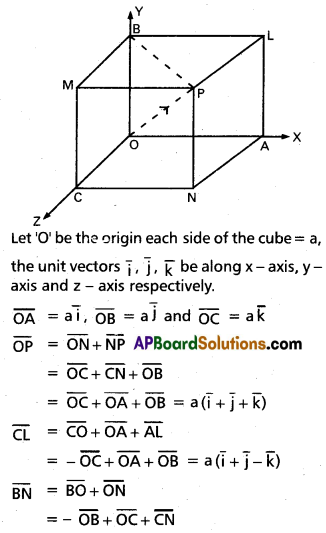
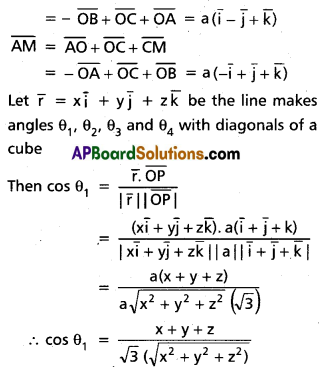
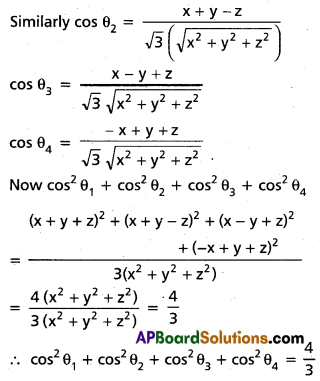
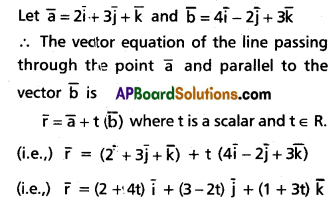
Inter 1st Year Maths 1A Trigonometric Ratios up to Transformations Solutions Ex 6(d)

Practicing the Intermediate 1st Year Maths 1A Textbook Solutions Inter 1st Year Maths 1A Trigonometric Ratios up to Transformations Solutions Exercise 6(d) will help students to clear their doubts quickly.

Intermediate 1st Year Maths 1A Trigonometric Ratios up to Transformations Solutions Exercise 6(d)

I.

Question 1.
Simplify
(i) \(\frac{\sin 2 \theta}{1+\cos 2 \theta}\)
Solution:
\(\frac{\sin 2 \theta}{1+\cos 2 \theta}\)
= \(\frac{2 \sin \theta \cos \theta}{2 \cos ^{2} \theta}\)
= tan θ

(ii) \(\frac{3 \cos \theta+\cos 3 \theta}{3 \sin \theta-\sin 3 \theta}\)
Solution:
\(\frac{3 \cos \theta+\cos 3 \theta}{3 \sin \theta-\sin 3 \theta}\)
= \(\frac{3 \cos \theta+4 \cos ^{3} \theta-3 \cos \theta}{3 \sin \theta-\left(3 \sin \theta-4 \sin ^{3} \theta\right)}\)
= \(\frac{4 \cos ^{3} \theta}{4 \sin ^{3} \theta}\)
= cot3θ

Inter 1st Year Maths 1A Trigonometric Ratios up to Transformations Solutions Ex 6(d)

Question 2.
Evaluate the following.
(i) 6 sin 20° – 8 sin3 20°
Solution:
6 sin 20° – 8 sin320°
= 2(3 sin 20° – 4 sin320°)
= 2 sin (3 × 20)
= 2 sin 60°
= 2 \(\left[\frac{\sqrt{3}}{2}\right]\)
= √3

(ii) cos272° – sin254°
Solution:
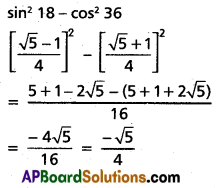
Inter 1st Year Maths 1A Trigonometric Ratios up to Transformations Solutions Ex 6(d) I Q2(ii)

(iii) sin242° – sin212°
Solution:
sin (42 + 12) sin (42 – 12)
= sin 54° . sin 30°
= \(\left[\frac{\sqrt{5}+1}{4}\right] \frac{1}{2}\)
= \(\frac{\sqrt{5}+1}{8}\)

Question 3.
(i) Express \(\frac{\sin 4 \theta}{\sin \theta}\) interms of cos3θ and cos θ.
Solution:
consider sin 4θ = sin(3θ + θ)
= sin 3θ cos θ + cos 3θ sin θ
= (3 sin θ – 4 sin3θ) cos θ + (4 cos3θ – 3 cos θ) sin θ
= 3 sin θ cos θ – 4 sin3θ cos θ + 4 cos3θ sin θ – 3 cos θ sin θ
= 4 cos3θ sin θ – 4 sin3θ cos θ
= sin θ (4 cos3θ – 4 sin2θ cos θ)
\(\frac{\sin 4 \theta}{\sin \theta}=\frac{\sin \theta\left(4 \cos ^{3} \theta-4 \sin ^{2} \theta \cos \theta\right)}{\sin \theta}\)
= 4 cos3θ – 4(1 – cos2θ) cos θ
= 4 cos3θ – 4 cos θ + 4 cos3θ
= 8 cos3θ – 4 cos θ

(ii) Express cos6A + sin6A in terms of sin 2A.
Solution:
cos6A + sin6A
= (cos2A)3 + (sin2A)3
= (cos2A + sin2A)3 – 3 cos2A sin2A (cos2A + sin2A)
= 1 – 3 cos2A sin2A
= 1 – \(\frac{3}{4}\) (4 cos2A sin2A)
= 1 – \(\frac{3}{4}\) (sin22A)

(iii) Express \(\frac{1-\cos \theta+\sin \theta}{1+\cos \theta+\sin \theta}\) in terms of tan θ/2
Solution:
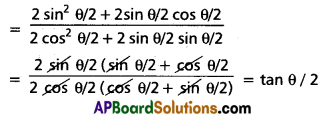
Inter 1st Year Maths 1A Trigonometric Ratios up to Transformations Solutions Ex 6(d) I Q3(iii)

Question 4.
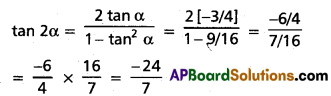
(i) If sin α = \(\frac{3}{5}\), where \(\frac{\pi}{2}\) < α < π, evaluate cos 3α and tan 2α.
Solution:
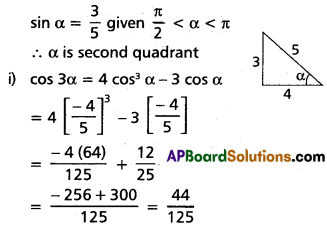
Inter 1st Year Maths 1A Trigonometric Ratios up to Transformations Solutions Ex 6(d) I Q4(i)
Inter 1st Year Maths 1A Trigonometric Ratios up to Transformations Solutions Ex 6(d) I Q4(i).1

(ii) If cos A = \(\frac{7}{25}\) and \(\frac{3 \pi}{2}\) < A < 2π, then find the value of cot A/2.
Solution:
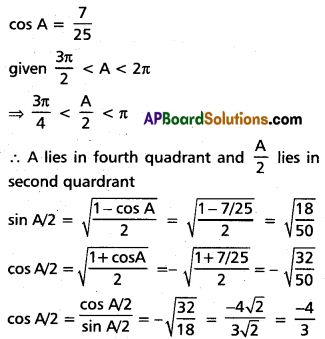
Inter 1st Year Maths 1A Trigonometric Ratios up to Transformations Solutions Ex 6(d) I Q4(ii)

(iii) If 0 < θ < \(\frac{\pi}{8}\), show that \(\sqrt{2+\sqrt{2+\sqrt{2+2 \cos 4 \theta)}}}=2 \cos (\theta / 2)\)
Solution:
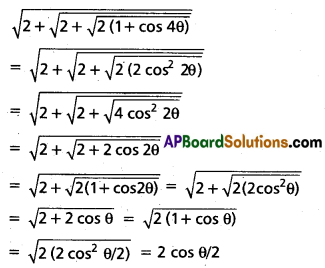
Inter 1st Year Maths 1A Trigonometric Ratios up to Transformations Solutions Ex 6(d) I Q4(iii)

Question 5.
Find the extreme values of
(i) cos 2x + cos2x
Solution:
cos 2x + cos2x
= 2 cos2x – 1 + cos2x
= 3 cos2x – 1
-1 ≤ cos x ≤ 1
0 ≤ cos2x ≤ 1
0 ≤ 3 cos2x ≤ 3
-1 ≤ 3 cos2x – 1 ≤ 2
maximum value = 2
minimum value = -1

(ii) 3 sin2x + 5 cos2x
Solution:
3 sin2x + 5 cos2x
= 3(1 – cos2x) + 5 cos2x
= 3 – 3 cos2x + 5 cos2x
= 3 + 2 cos2x
-1 ≤ cos x ≤ 1
0 ≤ cos2x ≤ 1
0 ≤ 2 cos2x ≤ 2
3 ≤ 3 + 2 cos2x ≤ 5
maximum value = 5
minimum value = 3

Inter 1st Year Maths 1A Trigonometric Ratios up to Transformations Solutions Ex 6(d)

Question 6.
If a ≤ cos θ + 3√2 sin[θ + \(\frac{\pi}{4}\)] + 6 ≤ b, then find the largest value of a and smallest value of b.
Solution:
a ≤ cos θ + 3√2 sin[θ + \(\frac{\pi}{4}\)] + 6 ≤ b
consider cos θ + 3√2 sin[θ + \(\frac{\pi}{4}\)] + 6
= cos θ + 3√2[sin θ cos \(\frac{\pi}{4}\) + cos θ sin \(\frac{\pi}{4}\)] + 6
= cos θ + 3√2 sin θ \(\frac{1}{\sqrt{2}}\) + 3√2 cos θ \(\frac{1}{\sqrt{2}}\) + 6
= cos θ + 3 sin θ + 3 cos θ + 6
= 4 cos θ + 3 sin θ + 6
∴ a = 4, b = 3, c = 6
maximum value = c + \(\sqrt{a^{2}+b^{2}}\)
= 6 + \(\sqrt{16+9}\)
= 6 + 5
= 11
minimum value = c – \(\sqrt{a^{2}+b^{2}}\)
= 6 – 5
= 1

Question 7.
Find the periods for the following functions.
(i) cos4x
Solution:
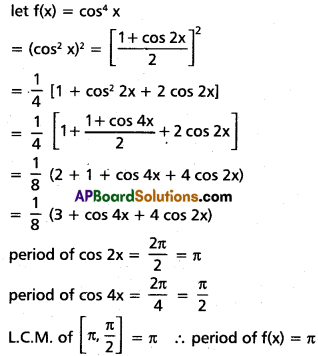
Inter 1st Year Maths 1A Trigonometric Ratios up to Transformations Solutions Ex 6(d) I Q7(i)

(ii) \(2 \sin \left[\frac{\pi x}{4}\right]+3 \cos \left[\frac{\pi x}{3}\right]\)
Solution:
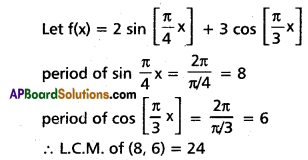
Inter 1st Year Maths 1A Trigonometric Ratios up to Transformations Solutions Ex 6(d) I Q7(ii)

(iii) sin2x + 2 cos2x
Solution:
Let f(x) = sin2x + 2 cos2x
= 1 – cos2x + 2 cos2x
= 1 + cos2x
= 1 + \(\frac{1+\cos 2 x}{2}\)
∴ period of cos 2x = \(\frac{2 \pi}{2}\) = π
∴ period of f(x) = π

(iv) \(2 \sin \left[\frac{\pi}{4}+x\right] \cos x\)
Solution:
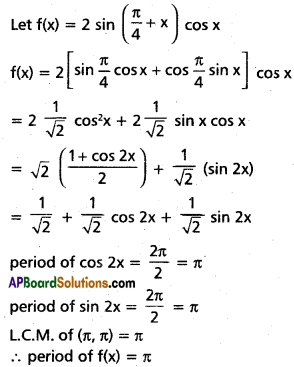
Inter 1st Year Maths 1A Trigonometric Ratios up to Transformations Solutions Ex 6(d) I Q7(iv)

(v) \(\frac{5 \sin x+3 \cos x}{4 \sin 2 x+5 \cos x}\)
Solution:
Let f(x) = \(\frac{5 \sin x+3 \cos x}{4 \sin 2 x+5 \cos x}\)
period of sin x = 2π
period of cos x = 2π
period of sin 2x = \(\frac{2 \pi}{2}\) = π
period of cos x = 2π
L.C.M. of (2π, 2π, π, 2π) = 2π
∴ period of f(x) = 2π

II.

Question 1.
(i) If 0 < A < \(\frac{\pi}{4}\) and cos A = \(\frac{4}{5}\), find the values of sin 2A and cos 2A.
Solution:
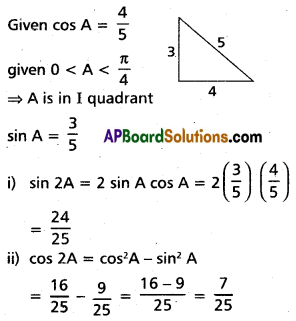
Inter 1st Year Maths 1A Trigonometric Ratios up to Transformations Solutions Ex 6(d) II Q1(i)

(ii) For what values of A in the first quadrant, the expression \(\frac{\cot ^{3} A-3 \cot A}{3 \cot ^{2} A-1}\) is positive?
Solution:
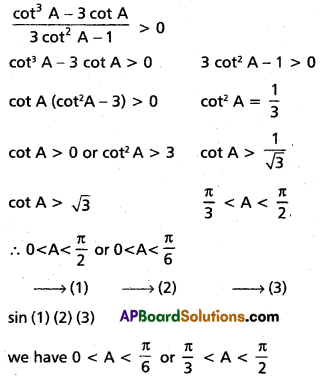
Inter 1st Year Maths 1A Trigonometric Ratios up to Transformations Solutions Ex 6(d) II Q1(ii)

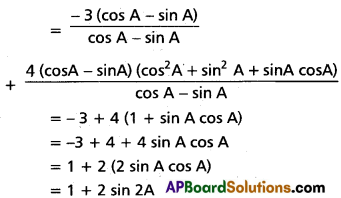
(iii) Prove that \(\frac{\cos 3 A+\sin 3 A}{\cos A-\sin A}=1+2 \sin A\)
Solution:
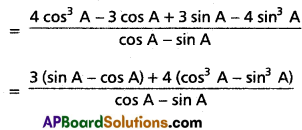
Inter 1st Year Maths 1A Trigonometric Ratios up to Transformations Solutions Ex 6(d) II Q1(iii)
Inter 1st Year Maths 1A Trigonometric Ratios up to Transformations Solutions Ex 6(d) II Q1(iii).1

Question 2.
(i) Prove that \(\cot \left[\frac{\pi}{4}-\theta\right]=\frac{\cos 2 \theta}{1-\sin 2 \theta}\) and hence find the value of cot 15°.
Solution:
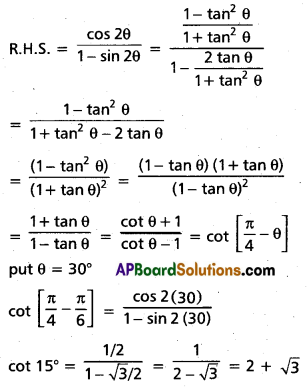
Inter 1st Year Maths 1A Trigonometric Ratios up to Transformations Solutions Ex 6(d) II Q2(i)

(ii) If θ lies in third quadrant and sin θ = \(\frac{-4}{5}\), find the values of cosec (θ/2) and tan (θ/2).
Solution:
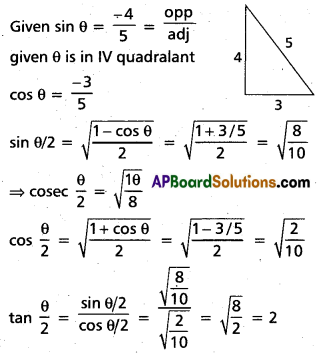
Inter 1st Year Maths 1A Trigonometric Ratios up to Transformations Solutions Ex 6(d) II Q2(ii)

(iii) If 450° < θ < 540° and sin θ = \(\frac{12}{13}\), then calculate sin (θ/2) and cos (θ/2)
Solution:
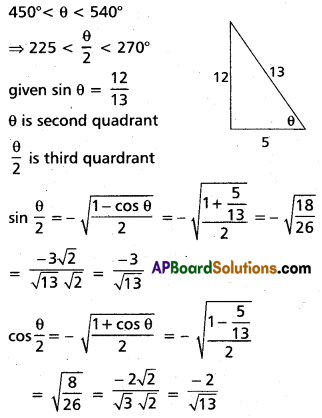
Inter 1st Year Maths 1A Trigonometric Ratios up to Transformations Solutions Ex 6(d) II Q2(iii)

(iv) Prove that \(\frac{1}{\cos 290^{\circ}}+\frac{1}{\sqrt{3} \sin 250^{\circ}}=\frac{4}{\sqrt{3}}\)
Solution:
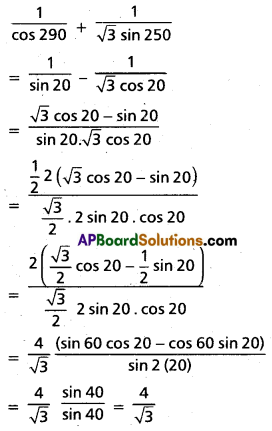
Inter 1st Year Maths 1A Trigonometric Ratios up to Transformations Solutions Ex 6(d) II Q2(iv)

Inter 1st Year Maths 1A Trigonometric Ratios up to Transformations Solutions Ex 6(d)

Question 3.
Prove that
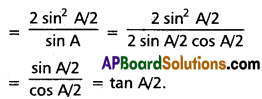
(i) \(\frac{\sin 2 A}{(1-\cos 2 A)} \cdot \frac{(1-\cos A)}{\cos A}=\tan \frac{A}{2}\)
Solution:
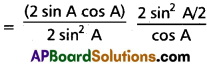
Inter 1st Year Maths 1A Trigonometric Ratios up to Transformations Solutions Ex 6(d) II Q3(i)
Inter 1st Year Maths 1A Trigonometric Ratios up to Transformations Solutions Ex 6(d) II Q3(i).1

(ii) \(\frac{\sin 2 x}{(\sec x+1)} \cdot \frac{\sec 2 x}{(\sec 2 x+1)}\) = \(\tan \frac{x}{2}\)
Solution:
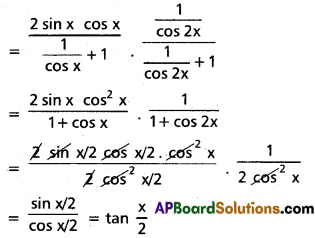
Inter 1st Year Maths 1A Trigonometric Ratios up to Transformations Solutions Ex 6(d) II Q3(ii)

(iii) \(\frac{\left(\cos ^{3} \theta-\cos 3 \theta\right)}{\cos \theta}+\frac{\left(\sin ^{3} \theta+\sin 3 \theta\right)}{\sin \theta}=\mathbf{3}\)
Solution:
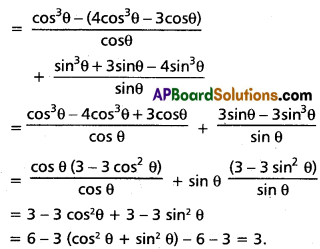
Inter 1st Year Maths 1A Trigonometric Ratios up to Transformations Solutions Ex 6(d) II Q3(iii)

Question 4.
(i) Show that cos A = \(\frac{\cos 3 A}{(2 \cos 2 A-1)}\). Hence find the value of cos 15°.
Solution:
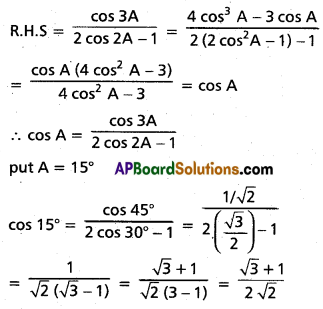
Inter 1st Year Maths 1A Trigonometric Ratios up to Transformations Solutions Ex 6(d) II Q4(i)

(ii) Show that sin A = \(\frac{\sin 3 A}{1+2 \cos 2 A}\). Hence find the value of sin 15°.
Solution:
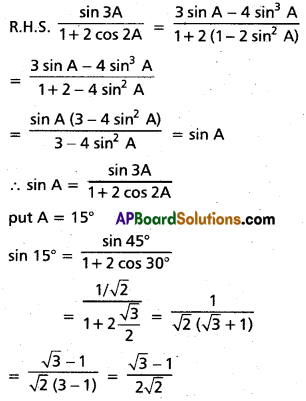
Inter 1st Year Maths 1A Trigonometric Ratios up to Transformations Solutions Ex 6(d) II Q4(ii)

(iii) Prove that tan α = \(\frac{\sin 2 \alpha}{1+\cos 2 \alpha}\) and hence deduce the values tan 15° and tan 22\(\frac{1^{\circ}}{2}\).
Solution:
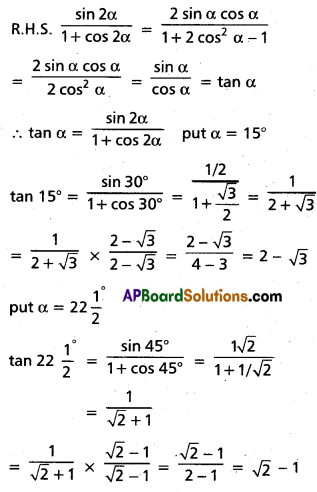
Inter 1st Year Maths 1A Trigonometric Ratios up to Transformations Solutions Ex 6(d) II Q4(iii)

Question 5.
Prove that
(i) \(\frac{1}{\sin 10^{\circ}}-\frac{\sqrt{3}}{\cos 10^{\circ}}=4\)
Solution:
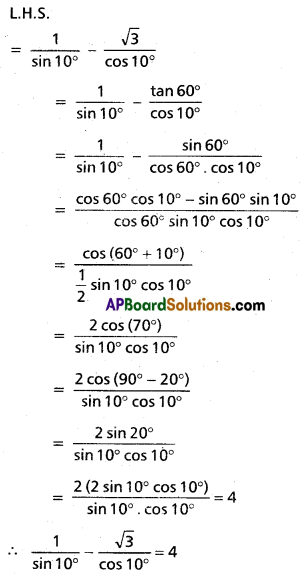
Inter 1st Year Maths 1A Trigonometric Ratios up to Transformations Solutions Ex 6(d) II Q5(i)

(ii) √3 cosec 20° – sec 20° = 4
Solution:
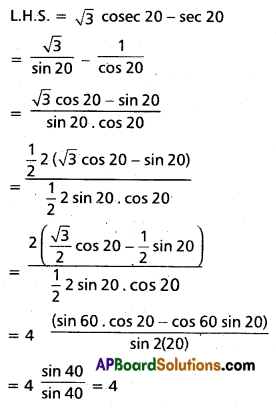
Inter 1st Year Maths 1A Trigonometric Ratios up to Transformations Solutions Ex 6(d) II Q5(ii)

(iii) tan 9° – tan 27° – cot 27° + cot 9° = 4
Solution:
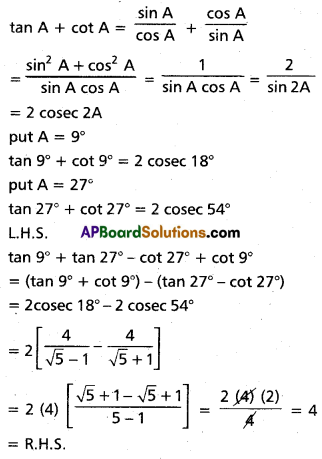
Inter 1st Year Maths 1A Trigonometric Ratios up to Transformations Solutions Ex 6(d) II Q5(iii)

(iv) If \(\frac{\sin \alpha}{a}=\frac{\cos \alpha}{b}\), then prove that a sin 2α + b cos 2α = b
Solution:
Given \(\frac{\sin \alpha}{a}=\frac{\cos \alpha}{b}\)
b sin α = a cos α
L.H.S. = a sin 2α + b cos 2α
= a 2 sin α cos α + b (1 – 2 sin2α)
= 2 sin α (a cos α) + b – 2b sin2α
= 2 sin α (b sin α) + b – 2b sin2α
= 2b sin2α + b – 2b sin2α
= b

Inter 1st Year Maths 1A Trigonometric Ratios up to Transformations Solutions Ex 6(d)

Question 6.
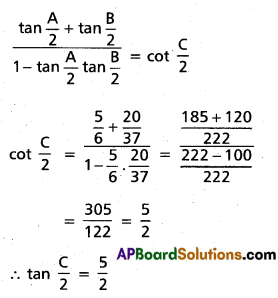
(i) In a ∆ABC; if \(\tan \frac{A}{2}=\frac{5}{6}\) and tan\(\tan \frac{B}{2}=\frac{20}{37}\), then show that \(\tan \frac{C}{2}=\frac{2}{5}\)
Solution:
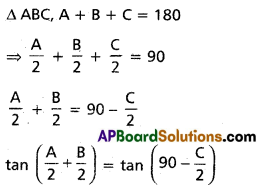
Inter 1st Year Maths 1A Trigonometric Ratios up to Transformations Solutions Ex 6(d) II Q6(i)
Inter 1st Year Maths 1A Trigonometric Ratios up to Transformations Solutions Ex 6(d) II Q6(i).1

(ii) If cos θ = \(\frac{5}{13}\) and 270° < θ < 360°, evaluate sin (θ/2) and cos (θ/2).
Solution:
cos θ = \(\frac{5}{13}\)
given 270 < θ < 360°
⇒ 135 < \(\frac{\theta}{2}\) < 180°
∴ θ lies in the fourth quadrant
θ/2 lies is second quadrant
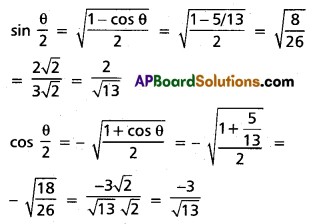
Inter 1st Year Maths 1A Trigonometric Ratios up to Transformations Solutions Ex 6(d) II Q6(ii)

(iii) If 180° < θ < 270° and sin θ = \(\frac{-4}{5}\) calculate sin[θ/2] cos[θ/2]
Solution:
Given sin θ = \(\frac{-4}{5}\)
⇒ cos θ = \(\frac{-3}{5}\)
given 180 < θ < 270
∴ θ in the III quadrant
Now 90 < \(\frac{\theta}{2}\) < 135
∴ \(\frac{\theta}{2}\) is in II quadrant
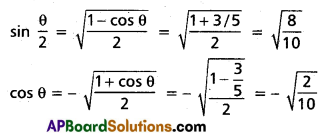
Inter 1st Year Maths 1A Trigonometric Ratios up to Transformations Solutions Ex 6(d) II Q6(iii)

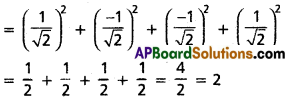
Question 7.
(i) Prove that \(\cos ^{2} \frac{\pi}{8}+\cos ^{2} \frac{3 \pi}{8}+\cos ^{2} \frac{5 \pi}{8}+\cos ^{2} \frac{7 \pi}{8}\) = 2
Solution:
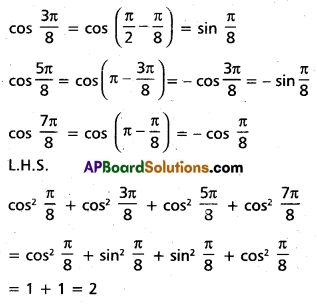
Inter 1st Year Maths 1A Trigonometric Ratios up to Transformations Solutions Ex 6(d) II Q7(i)

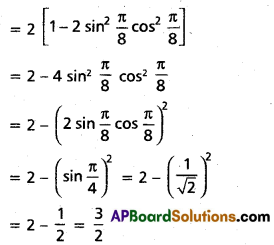
(ii) Show that \(\cos ^{4}\left(\frac{\pi}{8}\right)+\cos ^{4}\left(\frac{3 \pi}{8}\right)+\cos ^{4}\left(\frac{5 \pi}{8}\right)+\cos ^{4}\left(\frac{7 \pi}{8}\right)\) = \(\frac{3}{2}\)
Solution:
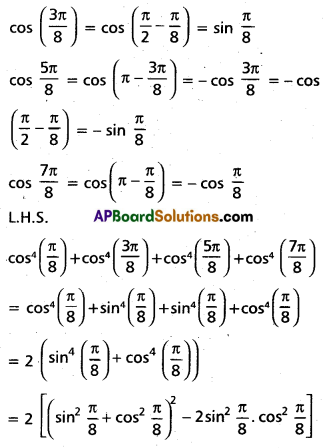
Inter 1st Year Maths 1A Trigonometric Ratios up to Transformations Solutions Ex 6(d) II Q7(ii)
Inter 1st Year Maths 1A Trigonometric Ratios up to Transformations Solutions Ex 6(d) II Q7(ii).1

III.

Question 1.
(i) If tan x + tan(x + \(\frac{\pi}{3}\)) + tan(x + \(\frac{2 \pi}{3}\)) = 3, show that tan 3x = 1
Solution:
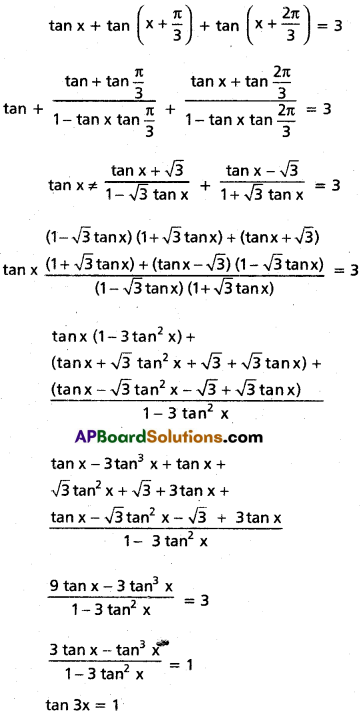
Inter 1st Year Maths 1A Trigonometric Ratios up to Transformations Solutions Ex 6(d) III Q1(i)

(ii) Prove that \(\sin \frac{\pi}{5} \sin \frac{2 \pi}{5} \cdot \sin \frac{3 \pi}{5} \cdot \sin \frac{4 \pi}{5}\) = \(\frac{5}{16}\)
Solution:
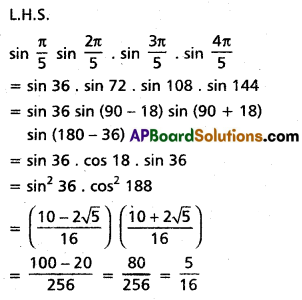
Inter 1st Year Maths 1A Trigonometric Ratios up to Transformations Solutions Ex 6(d) III Q1(ii)

(iii) Show that \(\cos ^{2}\left(\frac{\pi}{10}\right)+\cos ^{2}\left(\frac{2 \pi}{5}\right)+\cos ^{2}\left(\frac{3 \pi}{5}\right)\) + \(\cos ^{2}\left(\frac{9 \pi}{10}\right)\) = 2
Solution:
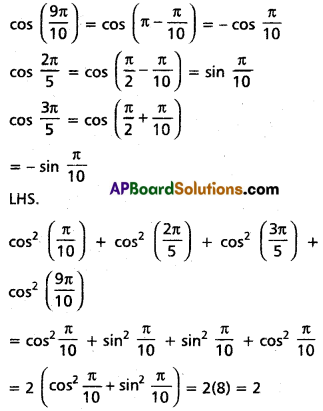
Inter 1st Year Maths 1A Trigonometric Ratios up to Transformations Solutions Ex 6(d) III Q1(iii)

Question 2.
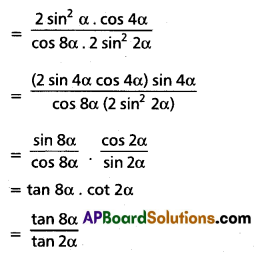
(i) \(\frac{1-\sec 8 \alpha}{1-\sec 4 \alpha}=\frac{\tan 8 \alpha}{\tan 2 \alpha}\)
Solution:
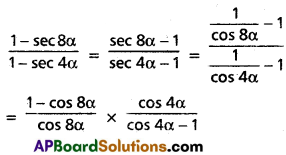
Inter 1st Year Maths 1A Trigonometric Ratios up to Transformations Solutions Ex 6(d) III Q2(i)
Inter 1st Year Maths 1A Trigonometric Ratios up to Transformations Solutions Ex 6(d) III Q2(i).1

(ii) \(\left[1+\cos \frac{\pi}{10}\right]\left[1+\cos \frac{3 \pi}{10}\right]\left[1+\cos \frac{7 \pi}{10}\right]\) \(\left[1+\cos \frac{9 \pi}{10}\right]=\frac{1}{16}\)
Solution:
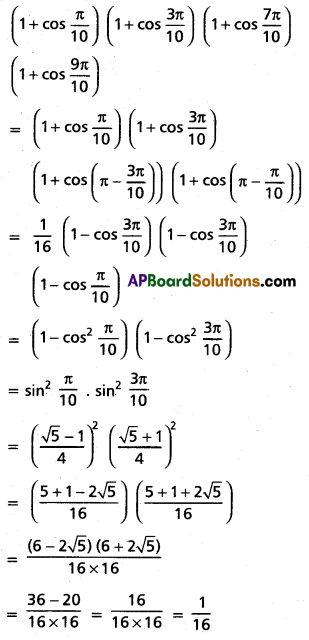
Inter 1st Year Maths 1A Trigonometric Ratios up to Transformations Solutions Ex 6(d) III Q2(ii)

Inter 1st Year Maths 1A Trigonometric Ratios up to Transformations Solutions Ex 6(d)

Question 3.
(i) Prove that \(\cos \frac{2 \pi}{7} \cdot \cos \frac{4 \pi}{7} \cdot \cos \frac{8 \pi}{7}=\frac{1}{8}\)
Solution:
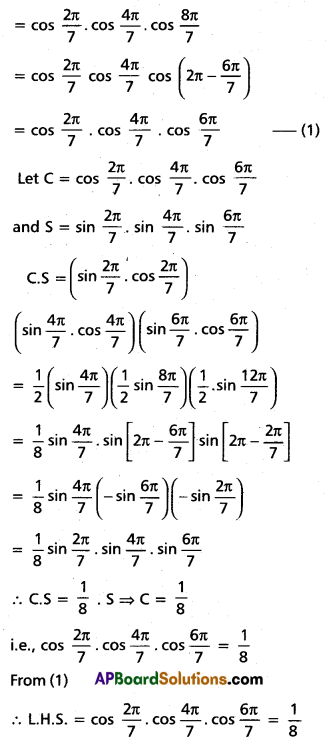
Inter 1st Year Maths 1A Trigonometric Ratios up to Transformations Solutions Ex 6(d) III Q3(i)

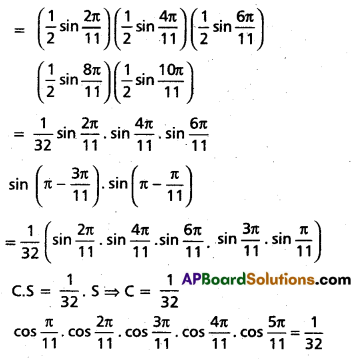
(ii) \(\cos \frac{\pi}{11} \cdot \cos \frac{2 \pi}{11} \cdot \cos \frac{3 \pi}{11} \cdot \cos \frac{4 \pi}{11}\) \(\cos \frac{5 \pi}{11}=\frac{1}{32}\)
Solution:
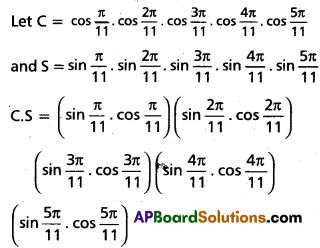
Inter 1st Year Maths 1A Trigonometric Ratios up to Transformations Solutions Ex 6(d) III Q3(ii)
Inter 1st Year Maths 1A Trigonometric Ratios up to Transformations Solutions Ex 6(d) III Q3(ii).1

Question 4.
(i) If cos α = \(\frac{3}{5}\) and cos β = \(\frac{5}{13}\) and α, β are acute angles, then prove that
(a) \(\sin ^{2}\left[\frac{\alpha-\beta}{2}\right]=\frac{1}{65}\)
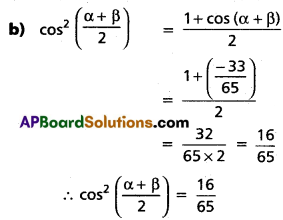
(b) \(\cos ^{2}\left[\frac{\alpha+\beta}{2}\right]=\frac{16}{65}\)
Solution:
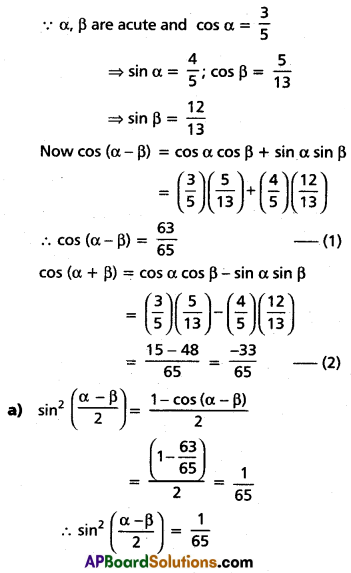
Inter 1st Year Maths 1A Trigonometric Ratios up to Transformations Solutions Ex 6(d) III Q4(i)
Inter 1st Year Maths 1A Trigonometric Ratios up to Transformations Solutions Ex 6(d) III Q4(i).1

(ii) If A is not an integral multiple of π, prove that cos A . cos 2A . cos 4A . cos 8A = \(\frac{\sin 16 A}{16 \sin A}\) and hence deduce that \(\cos \frac{2 \pi}{15} \cdot \cos \frac{4 \pi}{15} \cdot \cos \frac{8 \pi}{15} \cdot \cos \frac{16 \pi}{15}=\frac{1}{16}\)
Solution:
Take 16 sin A {cos A . cos 2A . cos 4A . cos 8A}
= 8(2 sin A . cos A) cos 2A . cos 4A . cos 8A
= 8 sin 2A . cos 2A . cos 4A . cos 8A
= 4(2 sin 2A . cos 2A) . cos 4A . cos 8A
= 4 sin 4A . cos 4A . cos 8A
= 2 (2 sin 4A . cos 4A) . cos 8A
= 2 sin 8A . cos 8A
= sin (16A)
∴ 16 sin A {cos A . cos 2A . cos 4A . cos 8A} = sin (16A)
∴ cos A . cos 2A . cos 4A . cos 8A = \(\frac{\sin (16 A)}{16 \sin A}\)
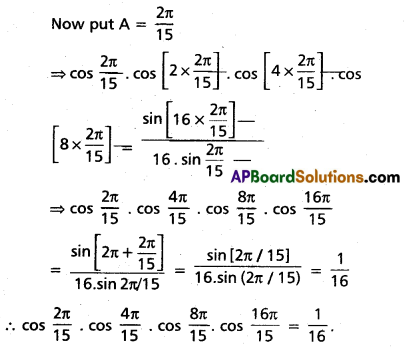
Inter 1st Year Maths 1A Trigonometric Ratios up to Transformations Solutions Ex 6(d) III Q4(ii)

Inter 1st Year Maths 1A Trigonometric Ratios up to Transformations Solutions Ex 6(b)

Practicing the Intermediate 1st Year Maths 1A Textbook Solutions Inter 1st Year Maths 1A Trigonometric Ratios up to Transformations Solutions Exercise 6(b) will help students to clear their doubts quickly.

Intermediate 1st Year Maths 1A Trigonometric Ratios up to Transformations Solutions Exercise 6(b)

I. Find the periods for the given 1 – 5 functions.

Question 1.
cos(3x + 5) + 7
Solution:
f(x) = cos(3x + 5) + 7
We know that the function g(x) = cos x for all x ∈ R has the period 2π.
Now f(x) = cos(3x + 5) + 7
We get that f(x) is periodic and the period of f is \(\frac{2 \pi}{|3|}=\frac{2 \pi}{3}\)

Question 2.
tan 5x
Solution:
The function g(x) = tan x periodic and π is the period.
∴ f(x) = tan 5x periodic and its period is \(\frac{\pi}{|5|}=\frac{\pi}{5}\)

Inter 1st Year Maths 1A Trigonometric Ratios up to Transformations Solutions Ex 6(b)

Question 3.
\(\cos \left(\frac{4 x+9}{5}\right)\)
Solution:
The function h(x) = cos x for all x ∈ R has the period 2π.
Now f(x) = \(\cos \left(\frac{4 x}{5}+\frac{9}{5}\right)\) is periodic and period of f is \(\frac{2 \pi}{\left(\frac{4}{5}\right)}=\frac{5 \pi}{2}\)

Question 4.
|sin x|
Solution:
The function h(x) = sin x for all x ∈ R has the period 2π.
But f(x) = |sin x| is periodic and its period is π.
∵ f(x + π) = |sin(x + π)|
= |-sin x|
= sin x

Question 5.
tan(x + 4x + 9x + …… + n2x) (n any positive integer)
Solution:
tan(12 + 22 + 32 + …… + n2) x = \(\tan \left[\frac{n(n+1)(2 n+1)}{6}\right] x\)
period = \(\frac{6 \pi}{n(n+1)(2 n+1)}\)

Question 6.
Find a sine function whose period is \(\frac{2}{3}\)
Solution:
\(\frac{2 \pi}{|k|}=\frac{2}{3}\)
3π = |k|
∴ sin kx = sin 3πx

Inter 1st Year Maths 1A Trigonometric Ratios up to Transformations Solutions Ex 6(b)

Question 7.
Find a cosine function whose period is 7.
Solution:
\(\frac{2 \pi}{|k|}\) = 7
\(\frac{2 \pi}{7}\) = |k|
∴ cos kx = cos \(\frac{2 \pi}{7}\) x

II. Sketch the graph of the following functions.

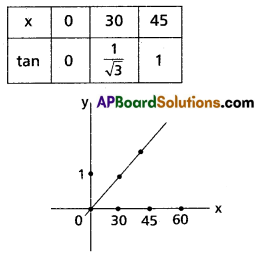
Question 1.
tan x between 0 and \(\frac{\pi}{4}\)
Solution:
Inter 1st Year Maths 1A Trigonometric Ratios up to Transformations Solutions Ex 6(b) II Q1

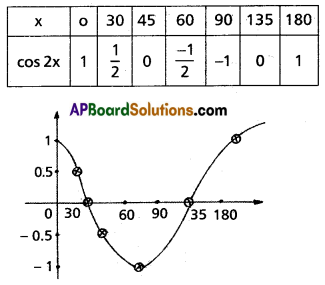
Question 2.
cos 2x in [0, π]
Solution:
Inter 1st Year Maths 1A Trigonometric Ratios up to Transformations Solutions Ex 6(b) II Q2

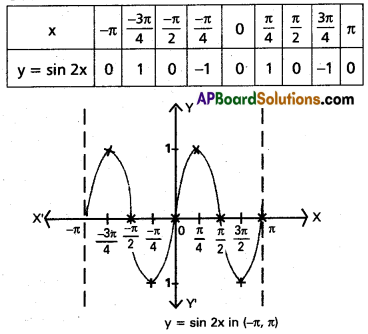
Question 3.
sin 2x in the interval (0, π)
Solution:
Inter 1st Year Maths 1A Trigonometric Ratios up to Transformations Solutions Ex 6(b) II Q3

Inter 1st Year Maths 1A Trigonometric Ratios up to Transformations Solutions Ex 6(b)

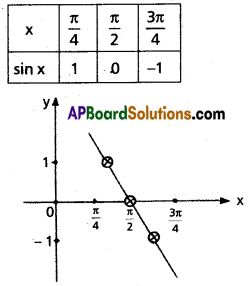
Question 4.
sin x in the interval [-π, +π]
Solution:
Inter 1st Year Maths 1A Trigonometric Ratios up to Transformations Solutions Ex 6(b) II Q4

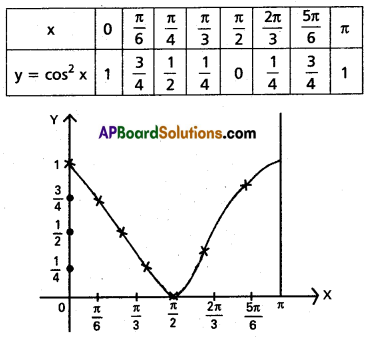
Question 5.
cos2x in [0, π]
Solution:
Inter 1st Year Maths 1A Trigonometric Ratios up to Transformations Solutions Ex 6(b) II Q5

III.

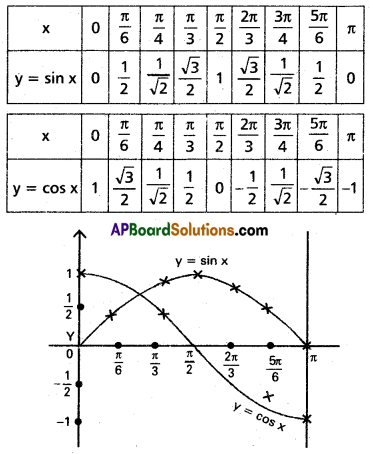
Question 1.
Sketch the region enclosed by y = sin x, y = cos x and X-axis in the interval [0, π].
Solution:
Inter 1st Year Maths 1A Trigonometric Ratios up to Transformations Solutions Ex 6(b) III Q1

Inter 1st Year Maths 1A Trigonometric Ratios up to Transformations Solutions Ex 6(a)

Practicing the Intermediate 1st Year Maths 1A Textbook Solutions Inter 1st Year Maths 1A Trigonometric Ratios up to Transformations Solutions Exercise 6(a) will help students to clear their doubts quickly.

Intermediate 1st Year Maths 1A Trigonometric Ratios up to Transformations Solutions Exercise 6(a)

I. Convert the following into the simplest form.

Question 1.
(i) tan(θ – 14π)
Solution:
= tan(14π – θ)
= tan(2 . (7π) – θ)
= tan θ

(ii) \(\cot \left(\frac{21 \pi}{2}-\theta\right)\)
Solution:
\(\cot \left(\frac{21 \pi}{2}-\theta\right)\)
= \(\cot \left(10 \pi+\left(\frac{\pi}{2}-\theta\right)\right)\)
= \(\cot \left(\frac{\pi}{2}-\theta\right)\)
= tan θ

(iii) cosec(5π + θ)
Solution:
cosec(5π + θ) = cosec(2π + (3π + θ))
= cosec(3π + θ)
= cosec(2π + (π + θ))
= cosec(π + θ)
= -cosec θ

(iv) sec(4π – θ?)
Solution:
sec(4π – θ)
= sec(2π + (2π – θ))
= sec(2π – θ)
= sec θ

Inter 1st Year Maths 1A Trigonometric Ratios up to Transformations Solutions Ex 6(a)

Question 2.
Find the value of each of the following.
(i) sin(-405°)
Solution:
sin(-405°) = -sin(360° + 45)
= -sin 45°
= \(-\frac{1}{\sqrt{2}}\)

(ii) \(\cos \left(-\frac{7 \pi}{2}\right)\)
Solution:
\(\cos \left(-\frac{7 \pi}{2}\right)\)
= -cos 630°
= -cos(360° + 270°)
= -cos 270°
= -cos(180° + 90°)
= -cos 90°
= 0

(iii) sec(2100°)
Solution:
sec(2100°) = sec (5 × 360° + 300°)
= sec 300°
= sec(360 – 60°)
= sec 60°
= 2

(iv) cot(-315°)
Solution:
cot(-315°) = -cot 315°
= -cot(360° – 45°)
= -cot 45°
= 1

Question 3.
Evaluate.
(i) cos2 45° + cos2 135° + cos2 225° + cos2 315°
Solution:
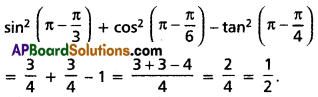
Inter 1st Year Maths 1A Trigonometric Ratios up to Transformations Solutions Ex 6(a) I Q3(i)

(ii) \(\sin ^{2} \frac{2 \pi}{3}+\cos ^{2} \frac{5 \pi}{6}-\tan ^{2} \frac{3 \pi}{4}\)
Solution:
Inter 1st Year Maths 1A Trigonometric Ratios up to Transformations Solutions Ex 6(a) I Q3(ii)

(iii) cos 225° – sin 225° + tan 495° – cot 495°
Solution:
cos (180° + 45°) – sin(180° + 45°) + tan(360° + 135°) – cot(360° + 135°)
= -cos 45° + sin 45° – tan 135° + cot 135°
= \(-\frac{1}{\sqrt{2}}+\frac{1}{\sqrt{2}}+1-1\)
= 0

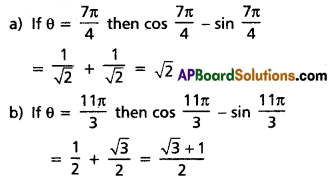
(iv) (cos θ – sin θ) if (a) θ = \(\frac{7 \pi}{4}\) (b) θ = \(\frac{11 \pi}{3}\)
Solution:
Inter 1st Year Maths 1A Trigonometric Ratios up to Transformations Solutions Ex 6(a) I Q3(iv)

Question 4.
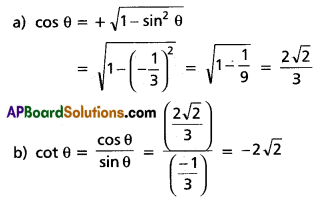
(i) If sin θ = \(\frac{-1}{3}\) and θ does not lie in the third quadrant, find the values of (a) cos θ (b) cot θ
Solution:
∵ sin θ = \(\frac{-1}{3}\) and sin θ is negative and θ does not lie in the IIIrd quadrant.
⇒ θ lies in IV quadrant.
∴ In the IV quadrant, cos θ is positive and cot θ is negative.
Inter 1st Year Maths 1A Trigonometric Ratios up to Transformations Solutions Ex 6(a) I Q4(i)

(ii) If cos θ = t (0 < t < 1) and θ does not lie in the first quadrant, find the values of (a) sin θ (b) tan θ.
Solution:
cos θ = t, (0 < t < 1)
⇒ cos θ is positive and θ does not lie in the first quadrant.
⇒ θ lies in IV quadrant.
(a) sin θ = \(-\sqrt{1-\cos ^{2} \theta}=-\sqrt{1-t^{2}}\)
(b) tan θ = \(\frac{\sin \theta}{\cos \theta}=\frac{-\sqrt{1-t^{2}}}{t}\)

(iii) Find the value of sin 330°. cos 120° + cos 210°. sin 300°.
Solution:
sin 330°. cos 120° + cos 210°. sin 300°
= sin(360° – 30°) . cos(180° – 60°) + cos(180° + 30°) . sin(360° – 60°)
= (-sin 30°) (-cos 60°) + (-cos 30°) (-sin 60°)
= sin 30° cos 60° + cos 30° sin 60°
= sin(30° + 60°) [∵ sin A cos B + cos A sin B = sin(A + B)]
= sin (90°)
= 1

(iv) If cosec θ + cot θ = \(\frac{1}{3}\), find cos θ and determine the quadrant in which θ lies.
Solution:
cosec θ + cot θ = \(\frac{1}{3}\)
⇒ cosec θ – cot θ = 3 (∵ cosec2θ – cot2θ = 1)
∴ 2 cosec θ = \(\frac{1}{3}\) + 3 = \(\frac{10}{3}\)
∴ cosec θ = \(\frac{5}{3}\) and sin θ = \(\frac{3}{5}\)
2 cot θ = \(\frac{1}{3}\) – 3 = \(\frac{-8}{3}\)
∴ cot θ = \(\frac{-4}{3}\), tan θ = \(\frac{-3}{4}\)
cos θ = (cot θ) . sin θ = \(\left(\frac{-4}{3}\right)\left(\frac{3}{5}\right)=\frac{-4}{5}\)
∵ sin θ is +ve and cos θ is -ve
⇒ θ lies in II quadrant.

Inter 1st Year Maths 1A Trigonometric Ratios up to Transformations Solutions Ex 6(a)

Question 5.
(i) If sin α + cosec α = 2. Find the value of sinnα + cosecnα, n ∈ z.
Solution:
Given sin α + cosec α = 2
Squaring on both sides
sin2α + cosec2α + 2 = 4
sin2α + cosec2α = 2
sin α + cosec α = 2
Cubing on both sides
sin3α + cosec3α + 3 sin α . cosec α (sin α + cosec α) = 8
sin3α + cosec3α + 3(2) = 8
sin3α + cosec3α = 8 – 6
sin3α + cosec3α = 2
similarly sinnα + cosecnα = -2

(ii) If sec θ + tan θ = 5. Find the quadrant in which θ lies and find the value of sin θ.
Solution:
sec θ + tan θ = 5
⇒ sec θ – tan θ = \(\frac{1}{5}\) (∵ sec2θ – tan2θ = 1)
2 sec θ = 5 + \(\frac{1}{5}\) = \(\frac{26}{5}\)
sec θ = \(\frac{26}{10}=\frac{13}{5}\)
Aquir 2 tan θ = 5 – \(\frac{1}{5}\) = \(\frac{24}{5}\)
tan θ = \(\frac{24}{10}=\frac{12}{5}\)
Now sin θ = \(\frac{\tan \theta}{\sec \theta}=\frac{\frac{12}{5}}{\frac{13}{5}}=\frac{12}{13}\)
tan θ is +ve, sec θ is +ve
⇒ θ lies in the first quadrant.

II.

Question 1.
Prove that
(i) \(\frac{\cos (\pi-A) \cdot \cot \left(\frac{\pi}{2}+A\right) \cos (-A)}{\tan (\pi+A) \tan \left[\frac{3 \pi}{2}+A\right] \sin (2 \pi-A)}\) = cos A
Solution:
\(\frac{\cos (\pi-A) \cdot \cot \left(\frac{\pi}{2}+A\right) \cos (-A)}{\tan (\pi+A) \tan \left[\frac{3 \pi}{2}+A\right] \sin (2 \pi-A)}\)
= \(\frac{-\cos A(-\tan A) \cos A}{\tan A(-\cot A)(-\sin A)}\)
= cos A

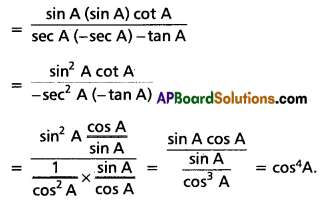
(ii) \(\frac{\sin (3 \pi-A) \cos \left(A-\frac{\pi}{2}\right) \tan \left(\frac{3 \pi}{2}-A\right)}{{cosec}\left(\frac{13 \pi}{2}+A\right) \sec (3 \pi+A) \cot \left(A-\frac{\pi}{2}\right)}\) = cos4A
Solution:
Inter 1st Year Maths 1A Trigonometric Ratios up to Transformations Solutions Ex 6(a) II Q1(ii)

(iii) sin 780° sin 480° + cos 240°. cos 300° = \(\frac{1}{2}\)
Solution:
sin(2(360°) + 60°) . sin(360° + 120°) + cos(270° – 30°) . cos(360° – 60°)
= sin 60° . sin 120° – sin 30° . cos 60°
= \(\frac{\sqrt{3}}{2} \cdot \frac{\sqrt{3}}{2}-\frac{1}{2} \cdot \frac{1}{2}\)
= \(\frac{3}{4}-\frac{1}{4}\)
= \(\frac{1}{2}\)

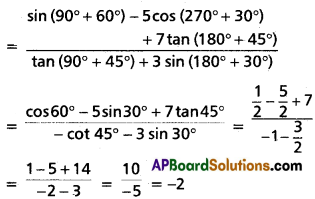
(iv) \(\frac{\sin 150^{\circ}-5 \cos 300^{\circ}+7 \tan 225^{\circ}}{\tan 135^{\circ}+3 \sin 210^{\circ}}\) = -2
Solution:
Inter 1st Year Maths 1A Trigonometric Ratios up to Transformations Solutions Ex 6(a) II Q1(iv)

(v) cot(\(\frac{\pi}{20}\)) . cot(\(\frac{3\pi}{20}\)) . cot(\(\frac{5\pi}{20}\)) . cot(\(\frac{7\pi}{20}\)) . cot(\(\frac{9\pi}{20}\)) = 1
Solution:
L.H.S. = cot(\(\frac{\pi}{20}\)) . cot(\(\frac{3\pi}{20}\)) . cot(\(\frac{5\pi}{20}\)) . cot(\(\frac{7\pi}{20}\)) . cot(\(\frac{9\pi}{20}\))
= cot (9°) cot (27°) cot (45°) cot (63°) cot (81°)
= cot (9°) cot (27°) (1) cot (90° – 27°) cot (90° – 9°)
= cot (9°) cot (27°) tan 27° tan 9°
= (tan 9° cot 9°) (tan 27° cot 27°)
= (1) (1)
= 1

Inter 1st Year Maths 1A Trigonometric Ratios up to Transformations Solutions Ex 6(a)

Question 2.
Simplify.
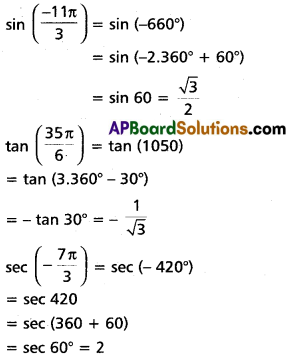
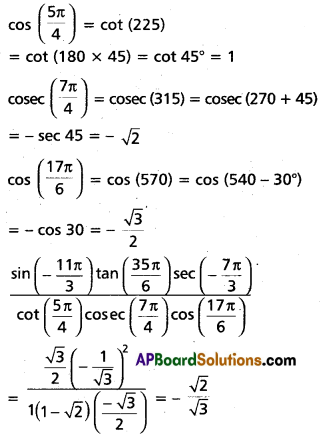
(i) \(\frac{\sin \left(-\frac{11 \pi}{3}\right) \tan \left(\frac{35 \pi}{6}\right) \sec \left(-\frac{7 \pi}{3}\right)}{\cot \left(\frac{5 \pi}{4}\right) {cosec}\left(\frac{7 \pi}{4}\right) \cos \left(\frac{17 \pi}{6}\right)}\)
Solution:
Inter 1st Year Maths 1A Trigonometric Ratios up to Transformations Solutions Ex 6(a) II Q2(i)
Inter 1st Year Maths 1A Trigonometric Ratios up to Transformations Solutions Ex 6(a) II Q2(i).1

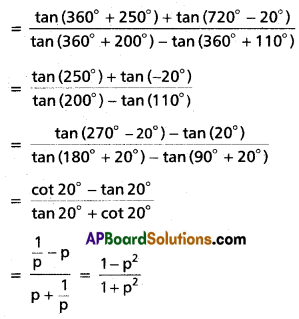
(ii) If tan 20° = p, prove that \(\frac{\tan 610^{\circ}+\tan 700^{\circ}}{\tan 560^{\circ}-\tan 470^{\circ}}=\frac{1-p^{2}}{1+p^{2}}\)
Solution:
Given tan 20° = p
L.H.S. = \(\frac{\tan 610^{\circ}+\tan 700^{\circ}}{\tan 560^{\circ}-\tan 470^{\circ}}\)
Inter 1st Year Maths 1A Trigonometric Ratios up to Transformations Solutions Ex 6(a) II Q2(ii)

(iii) If α, β are complementary angles such that b sin α = a, then find the value of (sin α cos β – cos α sin β).
Solution:
∵ α, β are complementary angles
⇒ α + β = 90°
⇒ β = 90° – α
Now sin α cos β – cos α sin β
= sin (α – β)
= sin [(α – (90° – α)]
= sin [2α – 90°]
= -sin (90° – 2α)
= -cos 2α
= -(1 – 2 sin2α) (∵ cos 2α = 1 – 2 sin2α)
= \(-1+2\left(\frac{a}{b}\right)^{2}\) (∵ sin α = \(\frac{a}{b}\))
= \(\frac{-b^{2}+2 a^{2}}{b^{2}}\)
= \(\frac{2 a^{2}-b^{2}}{b^{2}}\)

Inter 1st Year Maths 1A Trigonometric Ratios up to Transformations Solutions Ex 6(a)

Question 3.
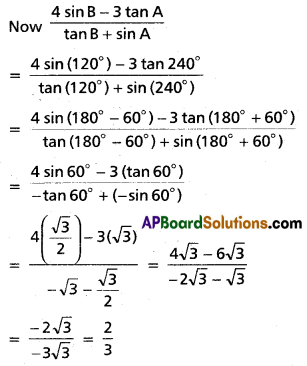
(i) If cos A = cos B = \(-\frac{1}{2}\), A does not lie in the second quadrant and B does not lie in the third quadrant, then find the value of \(\frac{4 \sin B-3 \tan A}{\tan B+\sin A}\)
Solution:
∵ cos A = \(-\frac{1}{2}\) and A does not lie in second quadrant.
⇒ A lies in the third quadrant, (∵ cos A is -ve)
and cos B = \(-\frac{1}{2}\) and B does not lie in third quadrant.
⇒ B lies in second quadrant.
∵ cos A = \(-\frac{1}{2}\) and A lies in third quadrant.
⇒ A = 240°
∵ cos B = \(-\frac{1}{2}\) and B lies in second quadrant.
⇒ B = 120°
Inter 1st Year Maths 1A Trigonometric Ratios up to Transformations Solutions Ex 6(a) II Q3(i)

(ii) If 8 tan A = -15 and 25 sin B = -7 and neither A nor B is in the fourth quadrant, then show that sin A cos B + cos A sin B = \(\frac{-304}{425}\)
Solution:
8 tan A = -15 ⇒ tan A = \(\frac{-15}{8}\)
25 sin B = -7 ⇒ sin B = \(-\frac{7}{25}\)
Given neither A nor B is in the fourth quadrant.
Clearly, A is the second quadrant B is the third quadrant
sin A cos B + cos A sin B = \(\left(\frac{15}{17}\right)\left(\frac{-24}{25}\right)+\left(\frac{-8}{17}\right)\left(\frac{-7}{25}\right)\)
= \(\frac{-360}{425}+\frac{56}{425}\)
= \(\frac{-304}{425}\)

(iii) If A, B, C, D are angles of a cyclic quadrilateral, then prove that
(a) sin A – sin C = sin D – sin B
(b) cos A + cos B + cos C + cos D = 0
Solution:
∵ A, B, C, D are angles of a cyclic quadrilateral.
⇒ A + C = 180° and B + D = 180° ……..(1)
C = 180° – A and D = 180° – B
(a) L.H.S. = sin A – sin C
= sin A – sin(180° – A)
= sin A – sin A
= 0
R.H.S. = sin D – sin B
= sin(180°- B) – sin B
= sin B – sin B
= 0
∴ L.H.S. = R.H.S.
i.e., sin A – sin C = sin D – sin B
(b) L.H.S. = cos A + cos B + cos C + cos D
= cos A + cos B + cos(180° – A) + cos(180° – B)
= cos A + cos B – cos A – cos B
= 0
∴ cos A + cos B + cos C + cos D = 0

Inter 1st Year Maths 1A Trigonometric Ratios up to Transformations Solutions Ex 6(a)

Question 4.
(i) If a cos θ – b sin θ = c, then show that a sin θ + b sin θ = \(\pm \sqrt{a^{2}+b^{2}-c^{2}}\).
Solution:
a cos θ – b sin θ = c
let a sin θ + b cos θ = x
by squaring and adding
(a cos θ – b sin θ)2 + (a sin θ + b cos θ)2 = c2 + x2
a2 cos2θ + b2 sin2θ – 2ab sin θ cos θ + a2 sin2θ + b2 cos2θ + 2ab sin θ cos θ = c2 + x2
a2 + b2 = c2 + x2
a2 + b2 – c2 = x2
x = \(\pm \sqrt{a^{2}+b^{2}-c^{2}}\)
∴ a sin θ + b cos θ = \(\pm \sqrt{a^{2}+b^{2}-c^{2}}\)

(ii) If 3 sin A + 5 cos A = 5, then show that 5 sin A – 3 cos A = ±3.
Solution:
3 sin A + 5 cos A = 5
Let 5 sec A – 3 cos A = x
by squaring and adding
(3 sin A + 5 cos A)2 + (5 sin A – 3 cos A)2 = 52 + x2
9 sin2 A + 25 cos2 A + 30 sin A cos A + 25 sin2 A + 9 cos2 A – 30 sin A cos A = 25
9 + 25 = 25 + x2
x2 = 9
x = ±3
∴ 5 sin A – 3 cos A = ±3

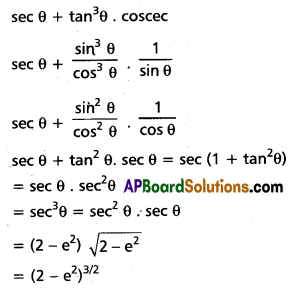
(iii) If tan2θ = (1 – e2), show that sec θ + tan3θ . cosec θ = (2 – e2)3/2.
Solution:
tan2θ = 1 – e2
sec2θ = 1 + tan2θ = 2 – e2
Inter 1st Year Maths 1A Trigonometric Ratios up to Transformations Solutions Ex 6(a) II Q4(iii)

III. Prove the following.

Question 1.
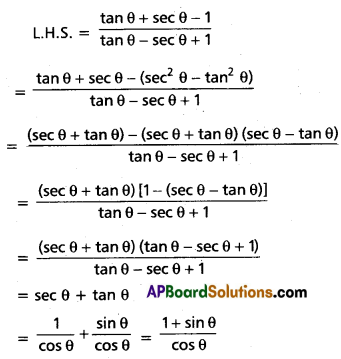
(i) \(\frac{(\tan \theta+\sec \theta-1)}{(\tan \theta-\sec \theta+1)}=\frac{1+\sin \theta}{\cos \theta}\)
Solution:
Inter 1st Year Maths 1A Trigonometric Ratios up to Transformations Solutions Ex 6(a) III Q1(i)

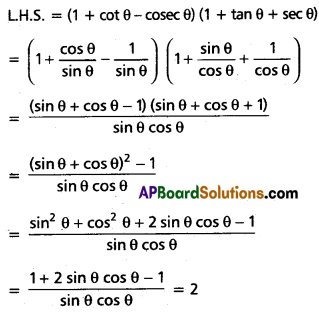
(ii) (1 + cot θ – cosec θ) (1 + tan θ + sec θ) = 2.
Solution:
Inter 1st Year Maths 1A Trigonometric Ratios up to Transformations Solutions Ex 6(a) III Q1(ii)

(iii) 3(sin θ – cos θ)4 + 6(sin θ + cos θ)2 + 4(sin6θ + cos6θ) = 13.
Solution:
(sin θ – cos θ)2 = sin2θ + cos2θ – 2 sin θ . cos θ
= 1 – 2 sin θ cos θ
(sin θ – cos θ)4 = (1 – 2 sin θ cos θ)2
= 1 + 4 sin2θ cos2θ – 4 sin θ cos θ ……(1)
(sin θ + cos θ)2 = sin2θ + cos2θ + 2 sin θ cos θ
= 1 + 2 sin θ cos θ …….(2)
sin6θ + cos6θ = (sin2θ +cos2θ)3 – 3 sin2θ cos2θ (sin2θ + cos2θ)
= 1 – 3 sin2θ cos2θ ……..(3)
L.H.S. = 3(1 + 4 sin2θ cos2θ – 4 sin θ cos θ) + 6(1 + 2 sin θ cos θ) + 4(1 – 3 sin2θ cos2θ)
= 3 + 12 sin2θ cos2θ – 12 sin θ cos θ + 6 + 12 sin θ cos θ + 4 – 12 sin2θ cos2θ
= 3 + 6 + 4
= 13
= R.H.S.

Inter 1st Year Maths 1A Trigonometric Ratios up to Transformations Solutions Ex 6(a)

Question 2.
(i) Prove that (sin θ + cosec θ)2 + (cos θ + sec θ)2 – (tan2θ + cot2θ) = 7.
Solution:
L.H.S. = (sin θ + cosec θ)2 + (cos θ + sec θ)2 – (tan2θ + cot2θ)
= (sin2θ + cosec2θ + 2 sin θ cosec θ) + (cos2θ + sec2θ + 2 cos θ sec θ) – (tan2θ + cot2θ)
= (sin2θ + cos2θ) + (1 + cot2θ) + (1 + tan2θ) + 4 – tan2θ – cot2θ
= 1 + 1 + 1 + 4
= 7

(ii) cos4α + 2 cos2α \(\left(1-\frac{1}{\sec ^{2} \alpha}\right)\) = (1 – sin4α)
Solution:
L.H.S. = cos4α + 2 cos2α \(\left(1-\frac{1}{\sec ^{2} \alpha}\right)\)
= cos4α + 2 cos2α (1 – cos2α)
= cos2α [cos2α + 2 sin2α]
= (1 – sin2α) [cos2α + sin2α + sin2α]
= (1 – sin2α) (1 + sin2α)
= 1 – sin4α

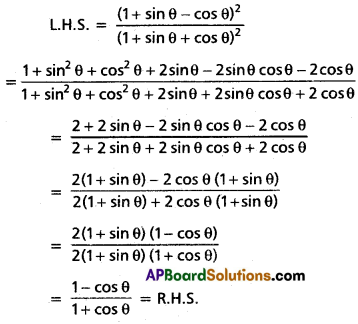
(iii) \(\frac{(1+\sin \theta-\cos \theta)^{2}}{(1+\sin \theta+\cos \theta)^{2}}=\frac{1-\cos \theta}{1+\cos \theta}\)
Solution:
Inter 1st Year Maths 1A Trigonometric Ratios up to Transformations Solutions Ex 6(a) III Q2(iii)

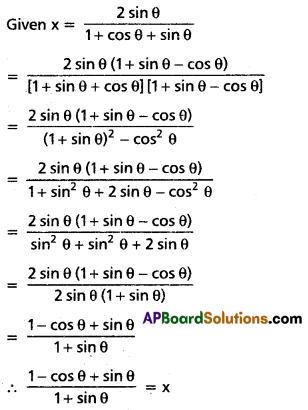
(iv) If \(\frac{2 \sin \theta}{(1+\cos \theta+\sin \theta)}\) = x, then find the value of \(\frac{(1-\cos \theta+\sin \theta)}{(1+\sin \theta)}\)
Solution:
Inter 1st Year Maths 1A Trigonometric Ratios up to Transformations Solutions Ex 6(a) III Q2(iv)

Inter 1st Year Maths 1A Trigonometric Ratios up to Transformations Solutions Ex 6(a)

Question 3.
Eliminate θ from the following.
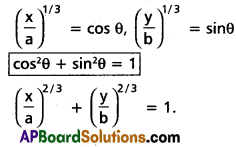
(i) x = a cos3θ; y = b sin3θ
Solution:
Inter 1st Year Maths 1A Trigonometric Ratios up to Transformations Solutions Ex 6(a) III Q3(i)

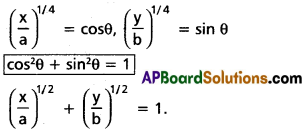
(ii) x = a cos4θ; y = b sin4θ
Solution:
Inter 1st Year Maths 1A Trigonometric Ratios up to Transformations Solutions Ex 6(a) III Q3(ii)

(iii) x = a(sec θ + tan θ); y = b(sec θ – tan θ)
Solution:
\(\frac{x}{a}\) = sec θ + tan θ; \(\frac{y}{b}\) = (sec θ – tan θ)
\(\frac{x}{a} \times \frac{y}{b}\) = (sec θ + tan θ) (sec θ – tan θ)
\(\frac{x y}{a b}\) = sec2θ – tan2θ
\(\frac{x y}{a b}\) = 1
xy = ab

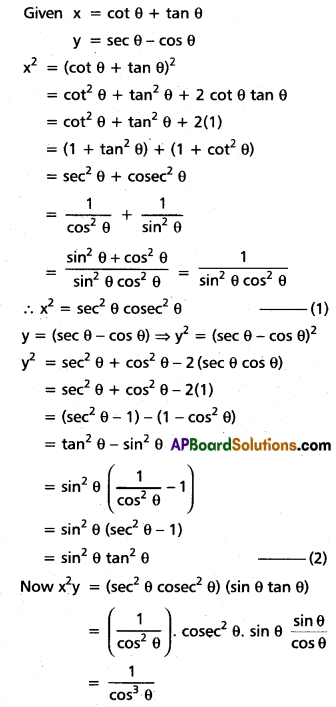
(iv) x = cot θ + tan θ; y = sec θ – cos θ
Solution:
Inter 1st Year Maths 1A Trigonometric Ratios up to Transformations Solutions Ex 6(a) III Q3(iv)
Inter 1st Year Maths 1A Trigonometric Ratios up to Transformations Solutions Ex 6(a) III Q3(iv).1

Inter 1st Year Maths 1A Products of Vectors Solutions Ex 5(c)

Practicing the Intermediate 1st Year Maths 1A Textbook Solutions Inter 1st Year Maths 1A Products of Vectors Solutions Exercise 5(c) will help students to clear their doubts quickly.

Intermediate 1st Year Maths 1A Products of Vectors Solutions Exercise 5(c)

I.

Question 1.
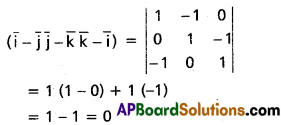
Compute \([\overline{\mathbf{i}}-\overline{\mathbf{j}} \overline{\mathbf{j}}-\overline{\mathbf{k}} \overline{\mathbf{k}}-\overline{\mathbf{i}}]\)
Solution:
Inter 1st Year Maths 1A Products of Vectors Solutions Ex 5(c) I Q1

Question 2.
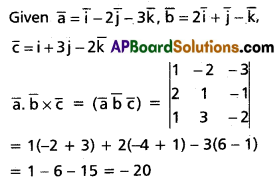
If \(\overline{\mathbf{a}}=\overline{\mathbf{i}}-2 \overline{\mathbf{j}}-3 \overline{\mathbf{k}}, \overline{\mathbf{b}}=2 \overline{\mathbf{i}}+\overline{\mathbf{j}}-\overline{\mathbf{k}}\), \(\bar{c}=\bar{i}+3 \bar{j}-2 \bar{k}\), then compute \(\overline{\mathbf{a}} \cdot(\overline{\mathbf{b}} \times \overline{\mathbf{c}})\).
Solution:
Inter 1st Year Maths 1A Products of Vectors Solutions Ex 5(c) I Q2

Inter 1st Year Maths 1A Products of Vectors Solutions Ex 5(c)

Question 3.
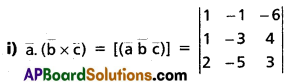
If \(\bar{a}\) = (1, -1, -6), \(\bar{b}\) = (1, -3, 4) and \(\bar{c}\) = (2, -5, 3), then compute the following
(i) \(\overline{\mathbf{a}} \cdot(\bar{b} \times \bar{c})\)
(ii) \(\overline{\mathbf{a}} \times(\overline{\mathbf{b}} \times \overline{\mathbf{c}})\)
(iii) \((\overline{\mathbf{a}} \times \overline{\mathbf{b}}) \times \overline{\mathbf{c}}\)
Solution:
Inter 1st Year Maths 1A Products of Vectors Solutions Ex 5(c) I Q3
Inter 1st Year Maths 1A Products of Vectors Solutions Ex 5(c) I Q3.1

Question 4.
Simplify the following.
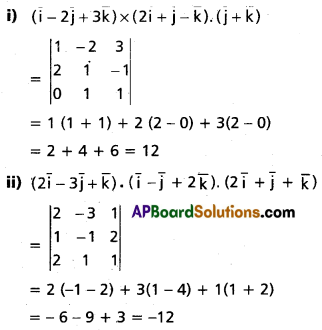
(i) \((\bar{i}-2 \bar{j}+3 \bar{k}) \times(2 i+j-\bar{k}) \cdot(\bar{j}+\bar{k})\)
(ii) \((2 \bar{i}-3 \bar{j}+\bar{k}) \cdot(\bar{i}-\bar{j}+2 \bar{k}) \cdot(2 \bar{i}+\bar{j}+\bar{k})\)
Solution:
Inter 1st Year Maths 1A Products of Vectors Solutions Ex 5(c) I Q4

Question 5.
Find the volume of the parallelopiped having coterminous edges.
\(\overline{\mathbf{i}}+\overline{\mathbf{j}}+\overline{\mathbf{k}}, \overline{\mathbf{i}}-\overline{\mathbf{j}}\) and \(\overline{\mathbf{i}}+\mathbf{2} \overline{\mathbf{j}}-\overline{\mathbf{k}}\)
Solution:
Let \(\overline{\mathrm{a}}=\overline{\mathrm{i}}+\overline{\mathrm{j}}+\overline{\mathrm{k}}, \overline{\mathrm{b}}=\overline{\mathrm{i}}-\overline{\mathrm{j}}\) and \(\overline{\mathrm{c}}=\overline{\mathrm{i}}+2 \overline{\mathrm{j}}-\overline{\mathrm{k}}\)
Volume of the parallelopiped = \([(\bar{a} \bar{b} \bar{c})]\)
= \(\left|\begin{array}{ccc}
1 & 1 & 1 \\
1 & -1 & 0 \\
1 & 2 & -1
\end{array}\right|\)
= 1(1 – 0) – 1(-1 – 0) + 1(2 + 1)
= 1 + 1 + 3
= 5 cubic units.

Question 6.
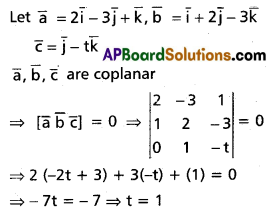
Find t for which the vectors \(\mathbf{2} \overline{\mathbf{i}}-\mathbf{3} \overline{\mathbf{j}}+\overline{\mathbf{k}}\), \(\bar{i}+2 \mathbf{j}-3 \bar{k}\) and \(\bar{j}-t \bar{k}\) are coplanar.
Solution:
Inter 1st Year Maths 1A Products of Vectors Solutions Ex 5(c) I Q6

Inter 1st Year Maths 1A Products of Vectors Solutions Ex 5(c)

Question 7.
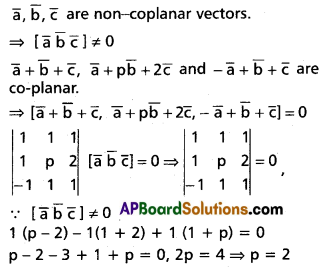
For non-coplanar vectors, \(\bar{a}\), \(\bar{b}\) and \(\bar{c}\) determine p for which the vector \(\overline{\mathbf{a}}+\overline{\mathbf{b}}+\overline{\mathbf{c}}, \overline{\mathbf{a}}+\mathbf{p} \overline{\mathbf{b}}+\mathbf{2} \overline{\mathbf{c}}\) and \(-\overline{\mathbf{a}}+\overline{\mathbf{b}}+\overline{\mathbf{c}}\) are coplanar.
Solution:
Inter 1st Year Maths 1A Products of Vectors Solutions Ex 5(c) I Q7

Question 8.
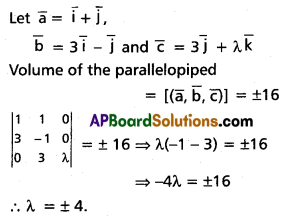
Determine λ, for which the volume of the parallelopiped having coterminous edges \(\bar{i}+\bar{j}\), \(3 \overline{\mathbf{i}}-\overline{\mathbf{j}}\) and \(3 \bar{j}+\lambda \bar{k}\) is 16 cubic units.
Solution:
Inter 1st Year Maths 1A Products of Vectors Solutions Ex 5(c) I Q8

Question 9.
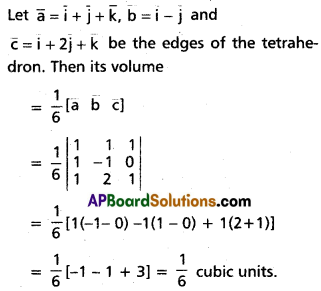
Find the volume of the tetrahedron having the edges \(\overline{\mathbf{i}}+\overline{\mathbf{j}}+\overline{\mathbf{k}}, \quad \mathbf{i}-\overline{\mathbf{j}}\) and \(\bar{i}+2 \bar{j}+\bar{k}\).
Solution:
Inter 1st Year Maths 1A Products of Vectors Solutions Ex 5(c) I Q9

Question 10.
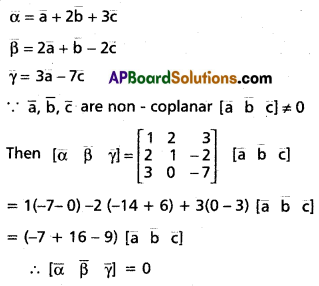
Let \(\bar{a}\), \(\bar{b}\) and \(\bar{c}\) be non-coplanar vectors and \(\bar{\alpha}=\bar{a}+2 \bar{b}+3 c, \quad \bar{\beta}=2 \bar{a}+\bar{b}-2 c\) and \(\bar{\gamma}=3 \bar{a}-7 \bar{c}\), then find \(\left[\begin{array}{lll}
\bar{\alpha} & \bar{\beta} & \bar{\gamma}
\end{array}\right]\).
Solution:
Inter 1st Year Maths 1A Products of Vectors Solutions Ex 5(c) I Q10

Question 11.
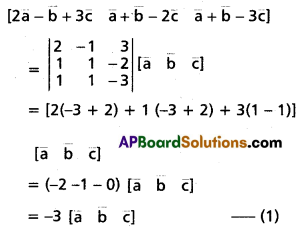
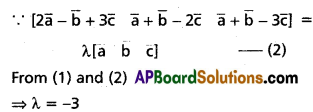
Let \(\bar{a}\), \(\bar{b}\) and \(\bar{c}\) be non-coplanar vectors. If \(|2 \bar{a}-\bar{b}+3 \bar{c}|, \bar{a}+\bar{b}-2 \bar{c},|\bar{a}+\bar{b}-3 \bar{c}|\) = \(\lambda[\overline{\mathbf{a}} \overline{\mathbf{b}} \overline{\mathbf{c}}]\), then find the value of λ.
Solution:
Inter 1st Year Maths 1A Products of Vectors Solutions Ex 5(c) I Q11
Inter 1st Year Maths 1A Products of Vectors Solutions Ex 5(c) I Q11.1

Question 12.
Let \(\bar{a}\), \(\bar{b}\) and \(\bar{c}\) be non-coplanar vectors, if \(\left[\begin{array}{lll}
\bar{a}+2 \bar{b} & 2 \bar{b}+\bar{c} & 5 \bar{c}+\bar{a}
\end{array}\right]\) = \(\lambda\left[\begin{array}{lll}
\bar{a} & \bar{b} & \bar{c}
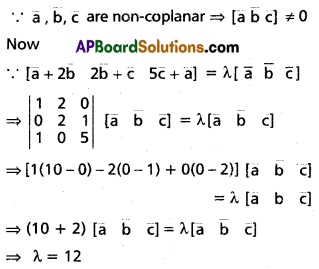
\end{array}\right]\), then find λ.
Solution:
Inter 1st Year Maths 1A Products of Vectors Solutions Ex 5(c) I Q12

Inter 1st Year Maths 1A Products of Vectors Solutions Ex 5(c)

Question 13.
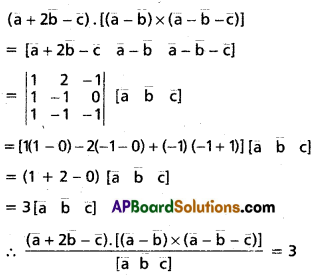
If \(\bar{a}\), \(\bar{b}\) and \(\bar{c}\) are non-coplanar vectors, then find the value of \(\frac{(\bar{a}+2 \bar{b}-\bar{c}) \cdot[(\bar{a}-\bar{b}) \times(\bar{a}-\bar{b}-\bar{c})]}{[\bar{a} \bar{b} \bar{c}]}\)
Solution:
Inter 1st Year Maths 1A Products of Vectors Solutions Ex 5(c) I Q13

Question 14.
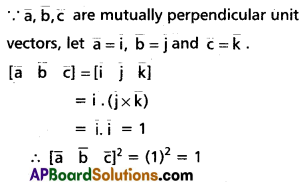
If \(\bar{a}\), \(\bar{b}\) and \(\bar{c}\) are mutually perpendicular unit vectors, then find the value of \(\left[\begin{array}{lll}
\bar{a} & \bar{b} & \bar{c}
\end{array}\right]^{2}\).
Solution:
Inter 1st Year Maths 1A Products of Vectors Solutions Ex 5(c) I Q14

Question 15.
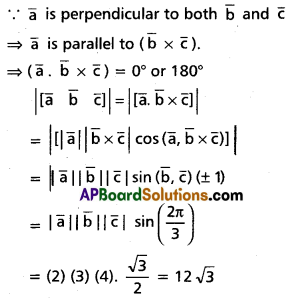
\(\overline{\mathbf{a}}, \overline{\mathbf{b}}, \overline{\mathbf{c}}\) are non-zero vectors and \(\overline{\mathbf{a}}\) is perpendicular to both \(\overline{\mathbf{b}}\) and \(\overline{\mathbf{c}}\). If \(|\overline{\mathbf{a}}|\) = 2, \(|\overline{\mathbf{b}}|\) = 3, \(|\overline{\mathbf{c}}|\) = 4 and \((\bar{b}, \bar{c})=\frac{2 \pi}{3}\), then find \(|[\bar{a} \bar{b} \bar{c}]|\).
Solution:
Inter 1st Year Maths 1A Products of Vectors Solutions Ex 5(c) I Q15

Question 16.
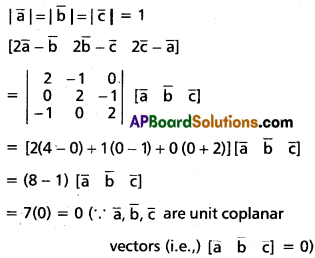
If \(\overline{\mathbf{a}}, \overline{\mathbf{b}}, \overline{\mathbf{c}}\) are unit coplanar vectors, then find \(\left[\begin{array}{lll}
2 \bar{a}-\bar{b} & 2 \bar{b}-\bar{c} & 2 \bar{c}-\bar{a}
\end{array}\right]\)
Solution:
Inter 1st Year Maths 1A Products of Vectors Solutions Ex 5(c) I Q16

II.

Question 1.
If \(\left[\begin{array}{lll}
\bar{b} & \bar{c} & \bar{d}
\end{array}\right]+\left[\begin{array}{lll}
\bar{c} & \bar{a} & \bar{d}
\end{array}\right]+\left[\begin{array}{lll}
\bar{a} & \bar{b} & \bar{d}
\end{array}\right]\) = \(\left[\begin{array}{lll}
\overline{\mathbf{a}} & \overline{\mathbf{b}} & \overline{\mathbf{c}}
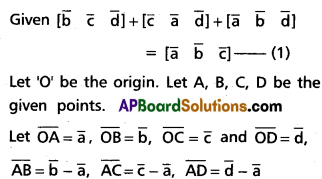
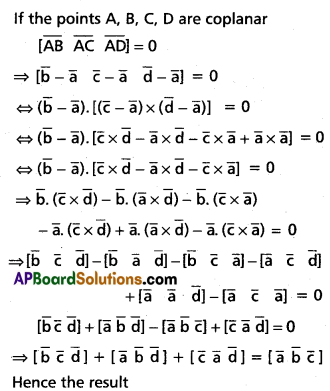
\end{array}\right]\) then show that the points with position vectors \(\overline{\mathbf{a}}, \overline{\mathbf{b}}, \overline{\mathbf{c}}\) and \(\bar{d}\) are coplanar.
Solution:
Inter 1st Year Maths 1A Products of Vectors Solutions Ex 5(c) II Q1
Inter 1st Year Maths 1A Products of Vectors Solutions Ex 5(c) II Q1.1

Inter 1st Year Maths 1A Products of Vectors Solutions Ex 5(c)

Question 2.
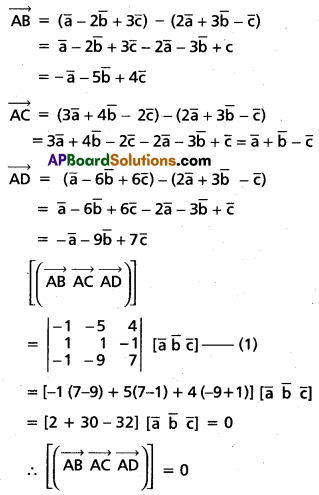
If \(\overline{\mathbf{a}}, \overline{\mathbf{b}}\) and \(\overline{\mathbf{c}}\) non-coplanar vectors, then prove that the four points with position vectors \(2 \bar{a}+3 \bar{b}-\bar{c}\), \(\overline{\mathrm{a}}-2 \overline{\mathrm{b}}+3 \overline{\mathrm{c}}, 3 \overline{\mathrm{a}}+4 \overline{\mathrm{b}}-2 \overline{\mathrm{c}}\) and \(\bar{a}-6 \bar{b}+6 \bar{c}\) are coplanar.
Solution:
Suppose A, B, C, D are the given points.
Inter 1st Year Maths 1A Products of Vectors Solutions Ex 5(c) II Q2
The vectors \(\overrightarrow{\mathrm{AB}}, \overrightarrow{\mathrm{AC}}, \overrightarrow{\mathrm{AD}}\) are coplanar.
The given points A, B, C, D are coplanar.

Question 3.
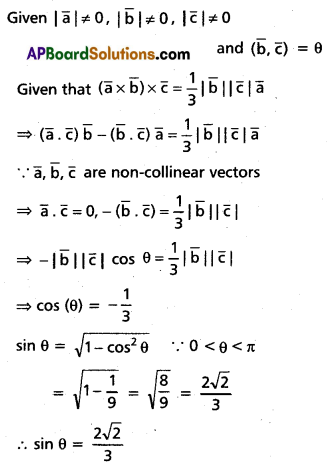
\(\overline{\mathbf{a}}, \overline{\mathbf{b}}\) and \(\overline{\mathbf{c}}\) are non-zero and non- collinear vectors and θ ≠ 0, is the angle between \(\overline{\mathbf{b}}\) and \(\overline{\mathbf{c}}\). If \((\overline{\mathbf{a}} \times \overline{\mathbf{b}}) \times \overline{\mathbf{c}}\) = \(\frac{1}{3}|\bar{b}||\bar{c}|\bar{a}|\), then find sin θ.
Solution:
Inter 1st Year Maths 1A Products of Vectors Solutions Ex 5(c) II Q3

Question 4.
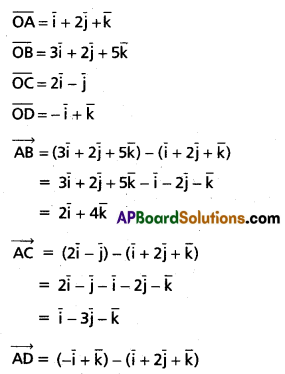
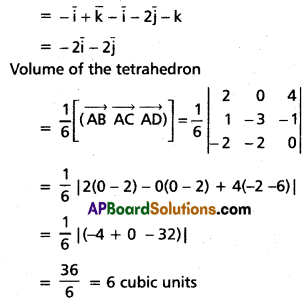
Find the volume of the tetrahedron whose vertices are (1, 2, 1), (3, 2, 5), (2, -1, 0) and (-1, 0, 1).
Solution:
Let ‘O’ be the given A, B, C, D be the vertices of the ten tetrahedrons. Then
Inter 1st Year Maths 1A Products of Vectors Solutions Ex 5(c) II Q4
Inter 1st Year Maths 1A Products of Vectors Solutions Ex 5(c) II Q4.1

Question 5.
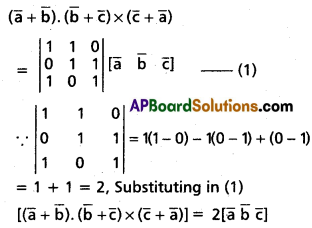
Show that \((\bar{a}+\bar{b}) \cdot(\bar{b}+\bar{c}) \times(\bar{c}+\bar{a})\) = \(2\left[\begin{array}{lll}
\bar{a} & \bar{b} & \bar{c}
\end{array}\right]\)
Solution:
Inter 1st Year Maths 1A Products of Vectors Solutions Ex 5(c) II Q5

Question 6.
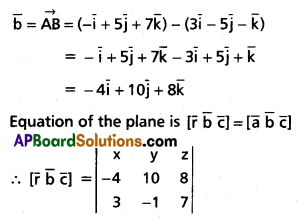
Show that equation of the plane passing through the points with position vectors. \(3 \bar{i}-5 \bar{j}-\overline{\mathbf{k}},-\overline{\mathbf{i}}+5 \bar{j}+7 \overline{\mathbf{k}}\) and parallel to the vector \(3 \overline{\mathbf{i}}-\overline{\mathbf{j}}+7 \overline{\mathbf{k}}\) is 3x + 2y – z = 0.
Solution:
The given plane passes through the points A, B (i.e.,) \(3 \bar{i}-5 \bar{j}-\overline{\mathbf{k}},-\overline{\mathbf{i}}+5 \bar{j}+7 \overline{\mathbf{k}}\) and parallel to the vector \(3 \overline{\mathbf{i}}-\overline{\mathbf{j}}+7 \overline{\mathbf{k}}\)
Inter 1st Year Maths 1A Products of Vectors Solutions Ex 5(c) II Q6
= x(70 + 8) – y(-28 – 24) + z(4 – 30)
= 78x + 52y – 26z
= 26(3x + 2y – z)
\(\left[\begin{array}{lll}
\bar{a} & \bar{b} & \bar{c}
\end{array}\right]\) = \(\left|\begin{array}{rrr}
3 & -5 & -1 \\
-4 & 10 & 8 \\
3 & -1 & 7
\end{array}\right|\)
= 3(70 + 8) + 5(-28 – 24) – 1(4 – 30)
= 234 – 260 + 26
= 0
Equation of the required plane is 26(3x + 2y – z) = 0
i.e., 3x + 2y – z = 0

Inter 1st Year Maths 1A Products of Vectors Solutions Ex 5(c)

Question 7.
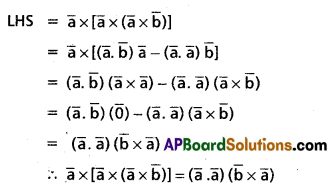
Prove that \(\overline{\mathbf{a}} \times[\overline{\mathbf{a}} \times(\overline{\mathbf{a}} \times \overline{\mathbf{b}})]\) = \((\overline{\mathbf{a}} \cdot \overline{\mathbf{a}})(\overline{\mathbf{b}} \times \overline{\mathbf{a}})\)
Solution:
Inter 1st Year Maths 1A Products of Vectors Solutions Ex 5(c) II Q7

Question 8.
If \(\overline{\mathbf{a}}, \overline{\mathbf{b}}, \overline{\mathbf{c}}\) and \(\bar{d}\) are coplanar vectors, then show that \((\bar{a} \times \bar{b}) \times(\bar{c} \times \bar{d})=0\).
Solution:
\(\overline{\mathbf{a}}, \overline{\mathbf{b}}, \overline{\mathbf{c}}\) and \(\bar{d}\) are coplanar
⇒ \(\overline{\mathbf{a}} \times \overline{\mathbf{b}}\) is perpendicular to the plane π.
similarly \(\bar{c} \times \bar{d}\) is perpendicular to the plane π.
\(\bar{a} \times \bar{b}\) and \(\bar{c} \times \bar{d}\) are parallel vectors.
⇒ \((\bar{a} \times \bar{b}) \times(\bar{c} \times \bar{d})\) = 0.

Question 9.
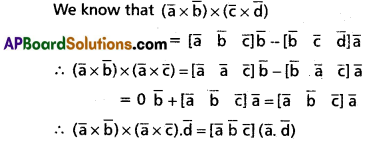
Show that \((\overline{\mathrm{a}} \times \overline{\mathrm{b}}) \times(\overline{\mathrm{a}} \times \overline{\mathrm{c}}) \cdot \overline{\mathrm{d}}=[\overline{\mathrm{a}} \overline{\mathrm{b}} \overline{\mathrm{c}}](\overline{\mathrm{a}} \cdot \overline{\mathrm{d}})\).
Solution:
Inter 1st Year Maths 1A Products of Vectors Solutions Ex 5(c) II Q9

Question 10.
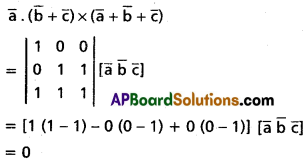
Show that \(\bar{a} \cdot[(\bar{b}+\bar{c}) \times(\bar{a}+\bar{b}+\bar{c})]=0\)
Solution:
Inter 1st Year Maths 1A Products of Vectors Solutions Ex 5(c) II Q10

Question 11.
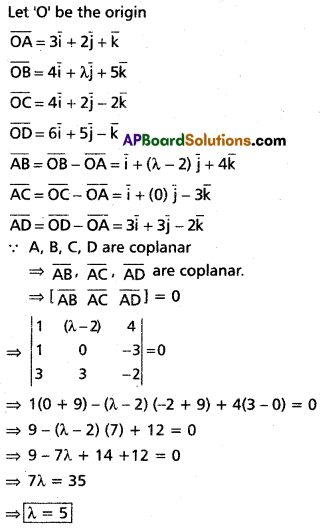
Find λ in order that the four points A(3, 2, 1), B(4, λ, 5), C(4, 2, -2) and D(6, 5, -1) be coplanar.
Solution:
Inter 1st Year Maths 1A Products of Vectors Solutions Ex 5(c) II Q11

Question 12.
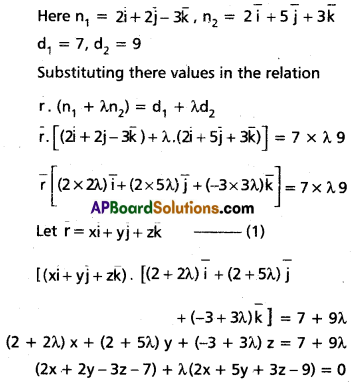
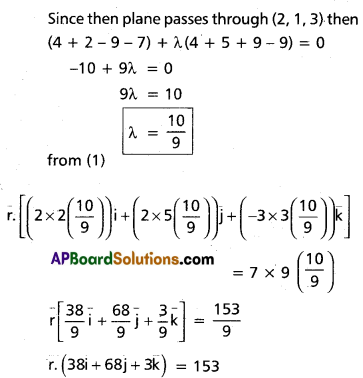
Find the vector equation of the plane passing through the intersection of planes \(\bar{r} \cdot(2 \bar{i}+2 \bar{j}-3 \bar{k})=7, \bar{r} \cdot(2 \bar{i}+5 \bar{j}+3 \bar{k})=9\) and through the point (2, 1, 3)
Solution:
Inter 1st Year Maths 1A Products of Vectors Solutions Ex 5(c) II Q12
Inter 1st Year Maths 1A Products of Vectors Solutions Ex 5(c) II Q12.1

Question 13.
Find the equation of the plane passing through (a, b, c) and parallel to the plane \(\bar{r} \cdot(\bar{i}+\bar{i}+\bar{k})=2\).
Solution:
Given equation plane is \(\bar{r} \cdot(\bar{i}+\bar{i}+\bar{k})=2\)
Let \(\bar{r}=x \bar{i}+y \bar{j}+z \bar{k}\)
∴ \(\bar{r} \cdot(\bar{i}+\bar{i}+\bar{k})=2\)
\((x \bar{i}+y \bar{j}+z \bar{k}) \cdot(i+j+k)=2\)
x + y + z = 2
Required plane equation is x + y + z = k …….(1)
Equation (1) passes through (a, b, c)
∴ a + b + c = k
Substitute ‘k’ in equation (1)
∴ x + y + z = a + b + c

Inter 1st Year Maths 1A Products of Vectors Solutions Ex 5(c)

Question 14.
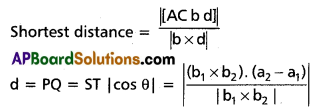
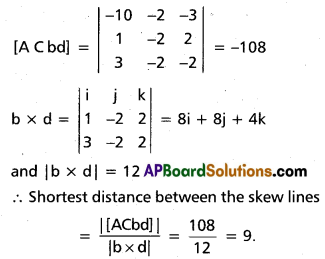
Find the shortest distance between the lines \(\bar{r}=6 \bar{i}+2 \bar{j}+2 \bar{k}+\lambda, \bar{i}-2 \bar{j}+2 \bar{k}\) and \(\bar{r}=-4 \bar{j}-\bar{k}+\mu=3 \bar{j}-2 \bar{j}-2 \bar{k}\).
Solution:
The first line passes through point A(6, 2, 2) and is parallel to the vector b = i – 2j + 2k.
Second line passes through the point C(-4, 0, -1) and is parallel to the vector d = 3i – 2j – 2k
Inter 1st Year Maths 1A Products of Vectors Solutions Ex 5(c) II Q14
Inter 1st Year Maths 1A Products of Vectors Solutions Ex 5(c) II Q14.1

Question 15.
Find the equation of the plane passing through the line of intersection of the planes \(\bar{r} \cdot(\bar{i}+\bar{j}+\bar{k})=1\) and \(\bar{r} \cdot(2 \bar{i}+3 \bar{i}-\bar{k})+4=0\) and parallel to X-axis.
Solution:
Given the equation of planes are
Inter 1st Year Maths 1A Products of Vectors Solutions Ex 5(c) II Q15
Since it is parallel to X-axis.

Question 16.
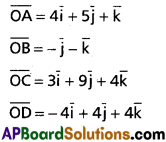
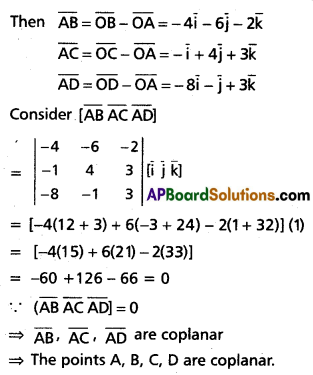
Prove that the four points \(4 \bar{i}+5 \bar{j}+\bar{k}\), \(-(\overline{\mathbf{j}}+\overline{\mathbf{k}}), 3 \overline{\mathbf{i}}+9 \overline{\mathbf{j}}+4 \overline{\mathbf{k}}\) and \(-4 \bar{i}+4 \bar{j}+4 \bar{k}\) are coplanar.
Solution:
Let ‘O’ be the origin. A, B, C, D be the given points. Then
Inter 1st Year Maths 1A Products of Vectors Solutions Ex 5(c) II Q16
Inter 1st Year Maths 1A Products of Vectors Solutions Ex 5(c) II Q16.1

Question 17.
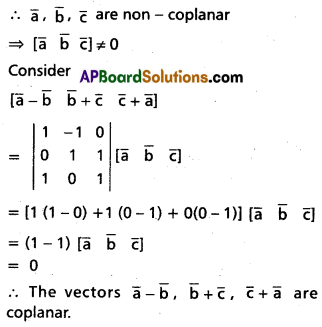
If \(\bar{a}, \bar{b}, \bar{c}\) are non – copianar, then show that the vectors \(\overline{\mathbf{a}}-\overline{\mathbf{b}}, \overline{\mathbf{b}}+\overline{\mathbf{c}}\), \(\overline{\mathbf{c}}+\overline{\mathbf{a}}\) are coplanar.
Solution:
Inter 1st Year Maths 1A Products of Vectors Solutions Ex 5(c) II Q17

Inter 1st Year Maths 1A Products of Vectors Solutions Ex 5(c)

Question 18.
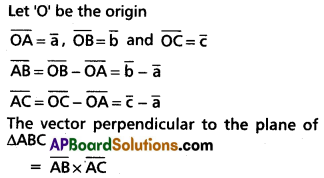
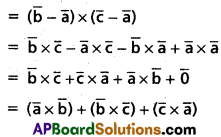
If \(\overline{\mathbf{a}}, \overline{\mathbf{b}}, \overline{\mathbf{c}}\) are the position vectors of the points A, B and C respectively, then prove that the vector \(\overline{\mathbf{a}} \times \overline{\mathbf{b}}+\overline{\mathbf{b}} \times \overline{\mathbf{c}}+\overline{\mathbf{c}} \times \overline{\mathbf{a}}\) is perpendicular to the plane of ∆ABC.
Solution:
Inter 1st Year Maths 1A Products of Vectors Solutions Ex 5(c) II Q18
Inter 1st Year Maths 1A Products of Vectors Solutions Ex 5(c) II Q18.1

III.

Question 1.
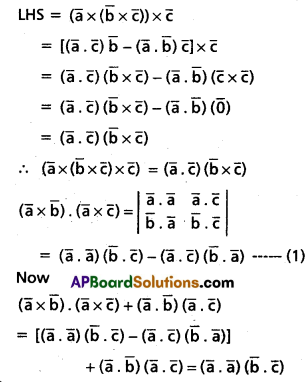
Show that \((\bar{a} \times(\bar{b} \times \bar{c}) \times \bar{c})=(\bar{a} \cdot \bar{c})(\bar{b} \times \bar{c})\) and \((\overline{\mathbf{a}} \times \overline{\mathbf{b}}) \cdot(\overline{\mathbf{a}} \times \overline{\mathbf{c}})+(\overline{\mathbf{a}} \cdot \overline{\mathbf{b}})(\overline{\mathbf{a}} \cdot \overline{\mathbf{c}})\) = \((\overline{\mathbf{a}} \cdot \overline{\mathbf{a}})(\overline{\mathbf{b}} \cdot \overline{\mathbf{c}})\)
Solution:
Inter 1st Year Maths 1A Products of Vectors Solutions Ex 5(c) III Q1

Question 2.
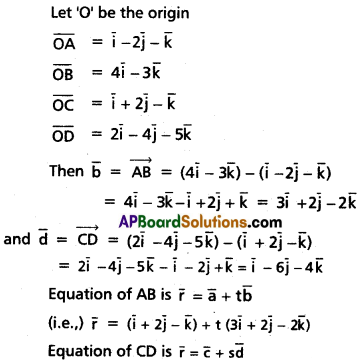
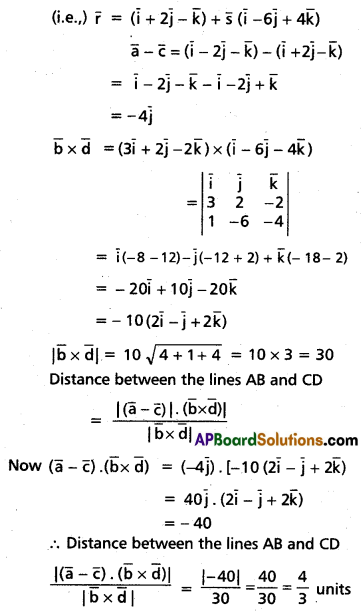
If A = (1, -2, -1), B = (4, 0, -3), C = (1, 2, -1) and D = (2, -4, -5), find the distance between AB and CD.
Solution:
Inter 1st Year Maths 1A Products of Vectors Solutions Ex 5(c) III Q2
Inter 1st Year Maths 1A Products of Vectors Solutions Ex 5(c) III Q2.1

Question 3.
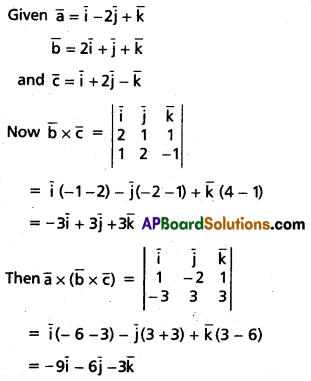
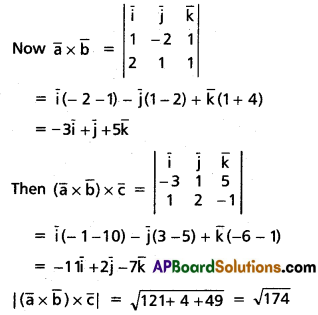
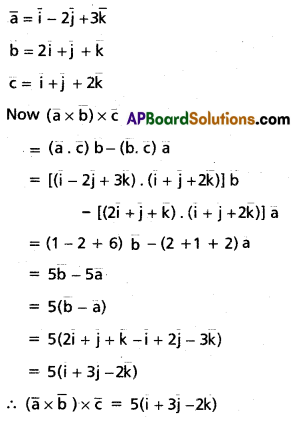
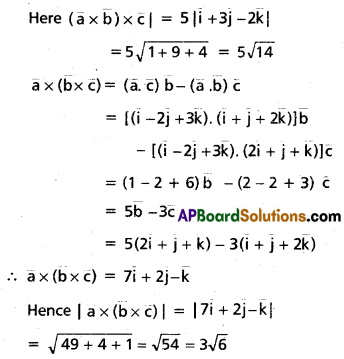
If \(\overline{\mathbf{a}}=\overline{\mathbf{i}}-2 \overline{\mathbf{j}}+\overline{\mathbf{k}}, \overline{\mathbf{b}}=2 \overline{\mathbf{i}}+\overline{\mathbf{j}}+\overline{\mathbf{k}}\) and \(\overline{\mathbf{c}}=\overline{\mathbf{i}}+2 \overline{\mathbf{j}}-\overline{\mathbf{k}}\), find \(\bar{a} \times(\bar{b} \times \bar{c})\) and \(|(\overline{\mathbf{a}} \times \overline{\mathbf{b}}) \times \overline{\mathbf{c}}|\).
Solution:
Inter 1st Year Maths 1A Products of Vectors Solutions Ex 5(c) III Q3
Inter 1st Year Maths 1A Products of Vectors Solutions Ex 5(c) III Q3.1

Inter 1st Year Maths 1A Products of Vectors Solutions Ex 5(c)

Question 4.
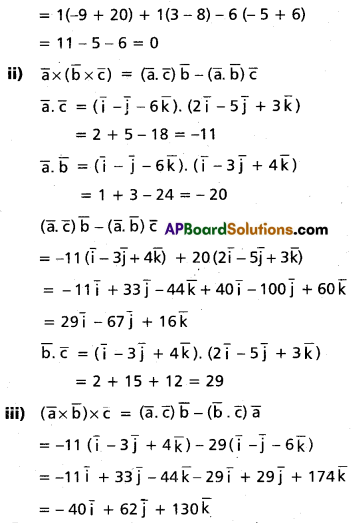
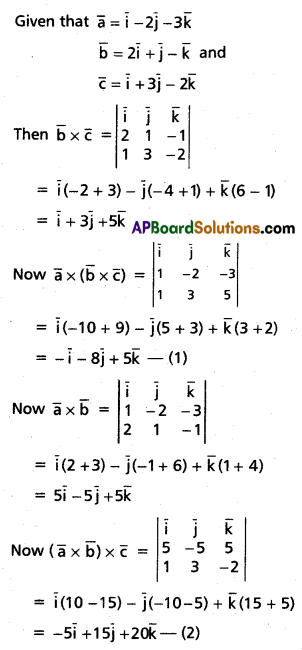
If \(\overline{\mathbf{a}}=\overline{\mathbf{i}}-2 \overline{\mathbf{j}}-3 \overline{\mathbf{k}}, \overline{\mathbf{b}}=2 \overline{\mathbf{i}}+\overline{\mathbf{j}}-\overline{\mathbf{k}}\) and \(\bar{c}=\bar{i}+3 \bar{j}-2 \bar{k}\), verift that \(\overline{\mathbf{a}} \times(\overline{\mathbf{b}} \times \overline{\mathbf{c}}) \neq(\overline{\mathbf{a}} \times \overline{\mathbf{b}}) \times \overline{\mathbf{c}}\)
Solution:
Inter 1st Year Maths 1A Products of Vectors Solutions Ex 5(c) III Q4
From (1) and (2), we get
\(\overline{\mathbf{a}} \times(\overline{\mathbf{b}} \times \overline{\mathbf{c}}) \neq(\overline{\mathbf{a}} \times \overline{\mathbf{b}}) \times \overline{\mathbf{c}}\)
i.e., vector multiplication is not associative.

Question 5.
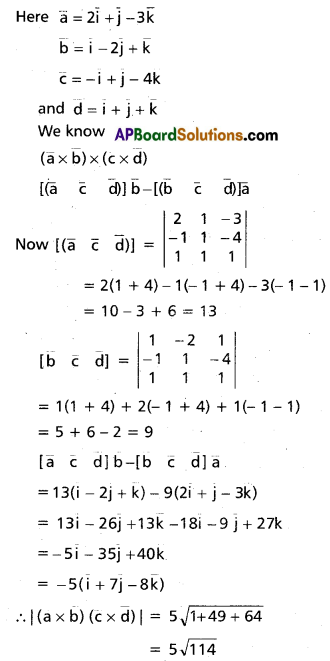
If \(\overline{\mathbf{a}}=2 \overline{\mathbf{i}}+\overline{\mathbf{j}}-3 \overline{\mathbf{k}}, \overline{\mathbf{b}}=\overline{\mathbf{i}}-\mathbf{2} \mathbf{j}+\overline{\mathbf{k}}\), \(\bar{c}=-\bar{i}+\bar{j}-4 \bar{k}\) and \(\overline{\mathbf{d}}=\overline{\mathbf{i}}+\overline{\mathbf{j}}+\overline{\mathbf{k}}\), then compute \(|(\overline{\mathrm{a}} \times \overline{\mathrm{b}}) \times(\overline{\mathrm{c}} \times \overline{\mathrm{d}})|\)
Solution:
Inter 1st Year Maths 1A Products of Vectors Solutions Ex 5(c) III Q5

Question 6.
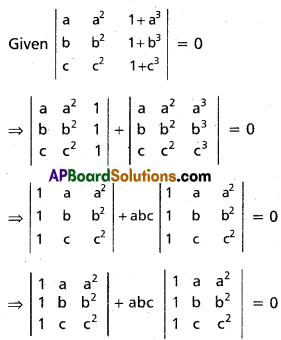
If A = (1, a, a2), B = (1, b, b2) and C = (1, c, c2) are non-coplanar vectors and \(\left|\begin{array}{lll}
a & a^{2} & 1+a^{3} \\
b & b^{2} & 1+b^{3} \\
c & c^{2} & 1+c^{3}
\end{array}\right|\) = 0, then show that abc + 1 = 0
Solution:
\(\bar{A}, \bar{B}, \bar{C}\) are non-coplanar vectors.
∆ = \(\left|\begin{array}{lll}
1 & a & a^{2} \\
1 & b & b^{2} \\
1 & c & c^{2}
\end{array}\right|\) ≠ 0 ………..(1)
Inter 1st Year Maths 1A Products of Vectors Solutions Ex 5(c) III Q6
∆ + (abc) ∆ = 0; ∆(1 + abc) = 0
∆ ≠ 0 ⇒ 1 + abc = 0

Inter 1st Year Maths 1A Products of Vectors Solutions Ex 5(c)

Question 7.
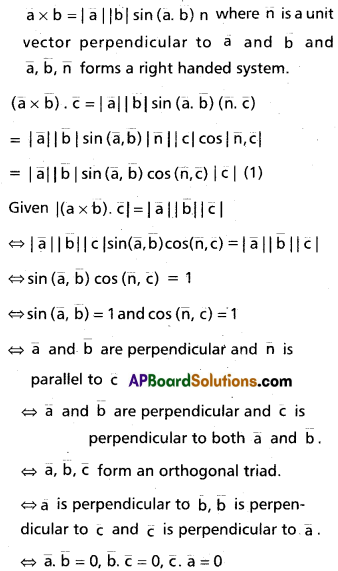
If \(\overline{\mathbf{a}}, \overline{\mathbf{b}}, \overline{\mathbf{c}}\) are non-zero vectors, then \(|(\overline{\mathbf{a}} \times \mathbf{b} \cdot \overline{\mathbf{c}})|=|\overline{\mathbf{a}}||\mathbf{b}||\overline{\mathbf{c}}|\) \(\Leftrightarrow \overline{\mathbf{a}} \cdot \overline{\mathbf{b}}=\overline{\mathbf{b}} \cdot \overline{\mathbf{c}}=\overline{\mathbf{c}} \cdot \overline{\mathbf{a}}=\mathbf{0}\)
Solution:
Inter 1st Year Maths 1A Products of Vectors Solutions Ex 5(c) III Q7

Question 8.
If \(\overline{\mathbf{a}}=\overline{\mathbf{i}}-\mathbf{2} \overline{\mathbf{j}}+3 \overline{\mathbf{k}}, \quad \mathbf{b}=2 \overline{\mathbf{i}}+\overline{\mathbf{j}}+\overline{\mathbf{k}}\), \(\bar{c}=\overline{\mathbf{i}}+\overline{\mathbf{j}}+2 \overline{\mathbf{k}}\) then find \(|(\bar{a} \times \bar{b}) \times \bar{c}|\) and \(|\overline{\mathbf{a}} \times(\mathbf{b} \times \mathbf{c})|\).
Solution:
Inter 1st Year Maths 1A Products of Vectors Solutions Ex 5(c) III Q8
Inter 1st Year Maths 1A Products of Vectors Solutions Ex 5(c) III Q8.1

Question 9.
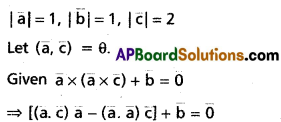
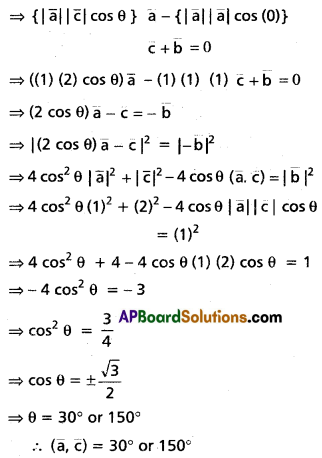
If \(|\bar{a}|=1,|\bar{b}|=1,|\bar{c}|=2\) and \(\bar{a} \times(a \times \bar{c})+\bar{b}=0\) then find the angle between \(\bar{a}\) and \(\bar{c}\).
Solution:
Inter 1st Year Maths 1A Products of Vectors Solutions Ex 5(c) III Q9
Inter 1st Year Maths 1A Products of Vectors Solutions Ex 5(c) III Q9.1

Question 10.
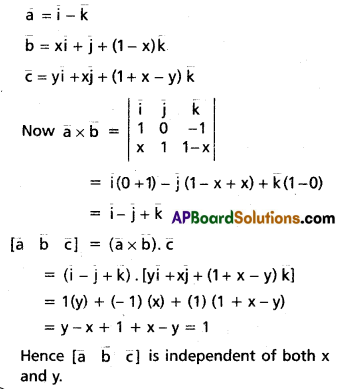
Let \(\overline{\mathbf{a}}=\overline{\mathbf{i}}-\overline{\mathbf{k}}, \quad \overline{\mathbf{b}}=\mathbf{x} \overline{\mathbf{i}}+\overline{\mathbf{j}}+(\mathbf{1}-\mathbf{x}) \overline{\mathbf{k}}\) and \(\bar{c}=y \bar{i}+x \bar{j}+(1+x-y) \bar{k}\), prove that the scalar triple product \(\left[\begin{array}{lll}
\bar{a} & \bar{b} & \bar{c}
\end{array}\right]\) is independent of both x and y.
Solution:
Inter 1st Year Maths 1A Products of Vectors Solutions Ex 5(c) III Q10

Question 11.
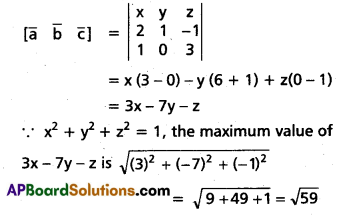
Let \(\overline{\mathbf{b}}=\mathbf{2} \overline{\mathbf{i}}+\overline{\mathbf{j}}-\overline{\mathbf{k}}, \overline{\mathbf{c}}=\overline{\mathbf{i}}+\mathbf{3} \overline{\mathbf{k}}\). If \(\overline{\mathrm{a}}\) is a unit vector then find the maximum value of \(\left[\begin{array}{lll}
\overline{\mathbf{a}} & \overline{\mathbf{b}} & \bar{c}
\end{array}\right]\).
Solution:
Let \(\bar{a}=x \bar{i}+y \bar{j}+z \bar{k}\) and x2 + y2 + z2 = 1
∵ \(\overline{\mathrm{a}}\) unit vector
Inter 1st Year Maths 1A Products of Vectors Solutions Ex 5(c) III Q11

Inter 1st Year Maths 1A Products of Vectors Solutions Ex 5(c)

Question 12.
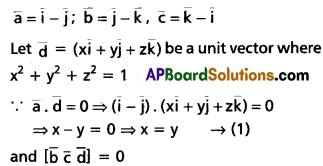
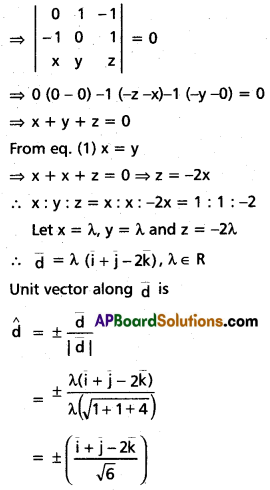
Let \(\overline{\mathrm{a}}=\overline{\mathrm{i}}-\overline{\mathrm{i}}, \overline{\mathrm{b}}=\overline{\mathrm{i}}-\overline{\mathrm{k}}, \overline{\mathrm{c}}=\overline{\mathrm{k}}-\overline{\mathrm{i}}\) Find unit vector \(\bar{d}\) such that \(\overline{\mathrm{a}} \cdot \overline{\mathrm{d}}=0=[\bar{b} \overline{\mathrm{c}} \overline{\mathrm{d}}]\)
Solution:
Inter 1st Year Maths 1A Products of Vectors Solutions Ex 5(c) III Q12
Inter 1st Year Maths 1A Products of Vectors Solutions Ex 5(c) III Q12.1

Inter 1st Year Maths 1A Products of Vectors Solutions Ex 5(b)

Practicing the Intermediate 1st Year Maths 1A Textbook Solutions Inter 1st Year Maths 1A Products of Vectors Solutions Exercise 5(b) will help students to clear their doubts quickly.

Intermediate 1st Year Maths 1A Products of Vectors Solutions Exercise 5(b)

I.

Question 1.
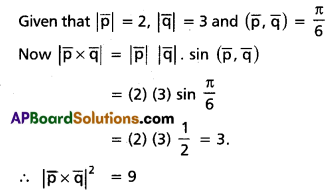
If \(|\overline{\mathbf{p}}|=2,|\overline{\mathbf{q}}|=3\) and \((\bar{p}, \bar{q})=\frac{\pi}{6}\), then find \(|\bar{p} \times \bar{q}|^{2}\).
Solution:
Inter 1st Year Maths 1A Products of Vectors Solutions Ex 5(b) I Q1

Question 2.
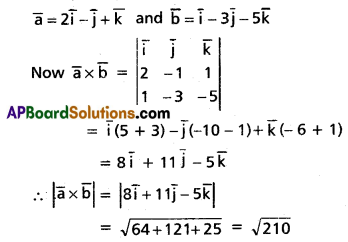
If \(\overline{\mathbf{a}}=2 \overline{\mathbf{i}}-\overline{\mathbf{j}}+\overline{\mathbf{k}}\) and \(\overline{\mathbf{b}}=\overline{\mathbf{i}}-3 \overline{\mathbf{j}}-5 \overline{\mathbf{k}}\), then find \(|\overline{\mathbf{a}} \times \overline{\mathbf{b}}|\).
Solution:
Inter 1st Year Maths 1A Products of Vectors Solutions Ex 5(b) I Q2

Inter 1st Year Maths 1A Products of Vectors Solutions Ex 5(b)

Question 3.
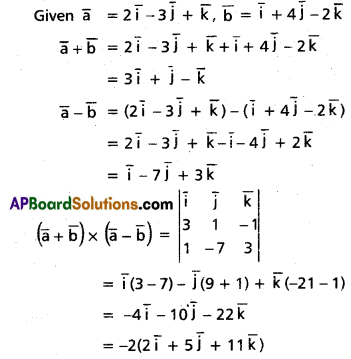
If \(\bar{a}=2 \bar{i}-3 \bar{j}+\overline{\mathbf{k}}\) and \(\bar{b}=\bar{i}+4 \bar{j}-2 \bar{k}\), then find \((\overline{\mathbf{a}}+\overline{\mathbf{b}}) \times(\overline{\mathbf{a}}-\overline{\mathbf{b}})\).
Solution:
Inter 1st Year Maths 1A Products of Vectors Solutions Ex 5(b) I Q3

Question 4.
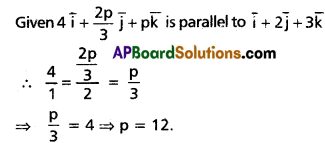
If \(4 \bar{i}+\frac{2 p}{3} \bar{j}+p \bar{k}\) is parallel to the vector \(\overline{\mathbf{i}}+2 \overline{\mathbf{j}}+3 \overline{\mathbf{k}}\), find p.
Solution:
Inter 1st Year Maths 1A Products of Vectors Solutions Ex 5(b) I Q4

Question 5.
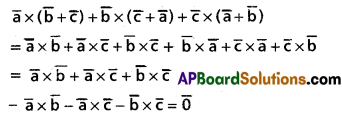
Compute \(\overline{\mathbf{a}} \times(\overline{\mathbf{b}}+\overline{\mathbf{c}})+\overline{\mathbf{b}} \times(\overline{\mathbf{c}}+\overline{\mathbf{a}})+\overline{\mathbf{c}} \times(\overline{\mathbf{a}}+\overline{\mathbf{b}})\)
Solution:
Inter 1st Year Maths 1A Products of Vectors Solutions Ex 5(b) I Q5

Question 6.
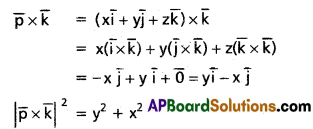
If \(\overline{\mathbf{p}}=\mathbf{x} \overline{\mathbf{i}}+\mathbf{y} \overline{\mathbf{j}}+\mathbf{z} \overline{\mathbf{k}}\), find the value of \(|\overline{\boldsymbol{p}} \times \overline{\mathbf{k}}|^{2}\)
Solution:
Inter 1st Year Maths 1A Products of Vectors Solutions Ex 5(b) I Q6

Question 7.
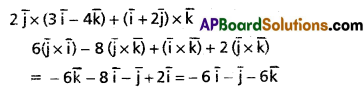
Compute \(2 \bar{j} \times(3 \bar{i}-4 \bar{k})+(\bar{i}+2 \hat{j}) \times \bar{k}\).
Solution:
Inter 1st Year Maths 1A Products of Vectors Solutions Ex 5(b) I Q7

Inter 1st Year Maths 1A Products of Vectors Solutions Ex 5(b)

Question 8.
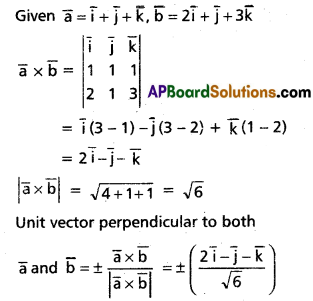
Find a unit vector perpendicular to both \(\overline{\mathbf{i}}+\overline{\mathbf{j}}+\overline{\mathbf{k}}\) and \(2 \bar{i}+\bar{j}+3 \bar{k}\).
Solution:
Inter 1st Year Maths 1A Products of Vectors Solutions Ex 5(b) I Q8

Question 9.
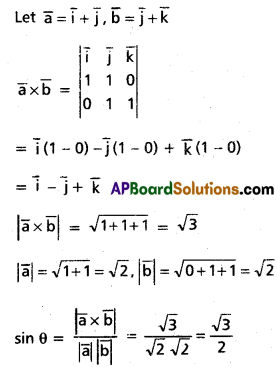
If θ is the angle between the vectors \(\overline{\mathbf{i}}+\overline{\mathbf{j}}\) and \(\overline{\mathbf{j}}+\overline{\mathbf{k}}\), then find sin ?.
Solution:
Inter 1st Year Maths 1A Products of Vectors Solutions Ex 5(b) I Q9

Question 10.
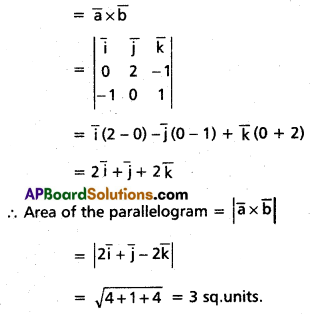
Find the area of the parallelogram having \(\bar{a}=2 \bar{j}-\bar{k}\) and \(\overline{\mathbf{b}}=-\overline{\mathbf{i}}+\overline{\mathbf{k}}\) as adjacent sides.
Solution:
Vector area of the parallelogram having \(\bar{a}=2 \bar{j}-\bar{k}\) and \(\overline{\mathbf{b}}=-\overline{\mathbf{i}}+\overline{\mathbf{k}}\) as adjacent sides.
Inter 1st Year Maths 1A Products of Vectors Solutions Ex 5(b) I Q10

Question 11.
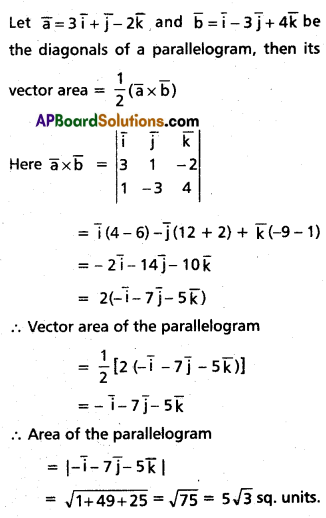
Find the area of the parallelogram, whose diagonals are \(3 \overline{\mathbf{i}}+\overline{\mathbf{j}}-2 \overline{\mathbf{k}}\) and \(\bar{i}-3 \bar{j}+4 \bar{k}\).
Solution:
Inter 1st Year Maths 1A Products of Vectors Solutions Ex 5(b) I Q11

Question 12.
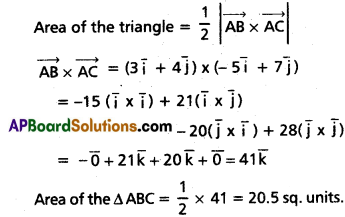
Find the area of the triangle having \(3 \bar{i}+4 \bar{j}\) and \(-5 \bar{i}+7 \bar{j}\) as two of its sides.
Solution:
Inter 1st Year Maths 1A Products of Vectors Solutions Ex 5(b) I Q12

Inter 1st Year Maths 1A Products of Vectors Solutions Ex 5(b)

Question 13.
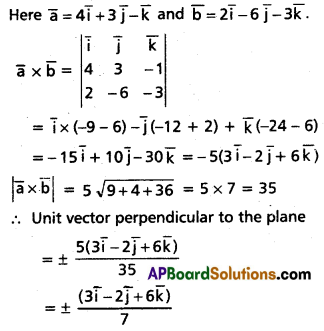
Find unit vector perpendicular to the plane determined by the vectors \(\bar{a}=4 \bar{i}+3 \bar{j}-\bar{k}\) and \(\overline{\mathbf{b}}=2 \tilde{i}-6 \overline{\mathbf{j}}-3 \overline{\mathbf{k}}\).
Solution:
Inter 1st Year Maths 1A Products of Vectors Solutions Ex 5(b) I Q13

Question 14.
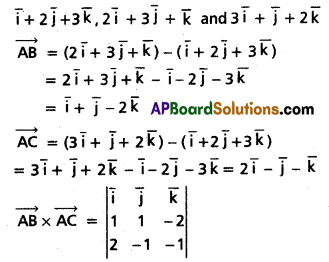
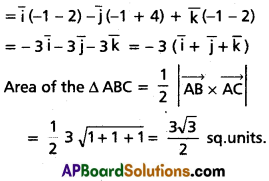
Find the area of the triangle whose vertices are A(1, 2, 3), B(2, 3, 1) and C(3, 1, 2).
Solution:
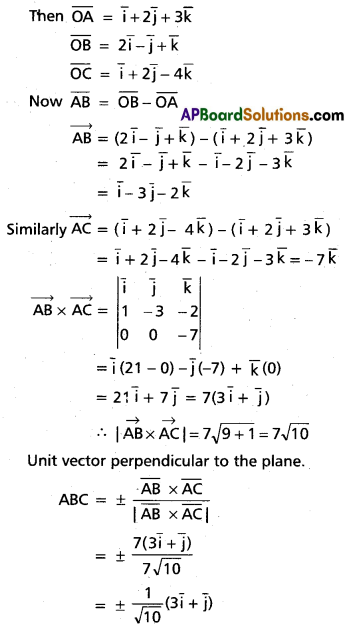
Suppose \(\bar{i}, \bar{j}, \bar{k}\) are unit vectors along the co-ordinate axes.
Position vectors of A, B, C are
Inter 1st Year Maths 1A Products of Vectors Solutions Ex 5(b) I Q14
Inter 1st Year Maths 1A Products of Vectors Solutions Ex 5(b) I Q14.1

II.

Question 1.
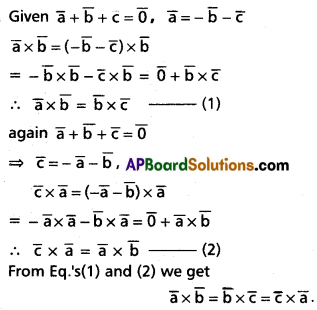
If \(\overline{\mathbf{a}}+\overline{\mathbf{b}}+\overline{\mathbf{c}}=\overline{\mathbf{0}}\), then prove that \(\overline{\mathbf{a}} \times \overline{\mathbf{b}}=\overline{\mathbf{b}} \times \overline{\mathbf{c}}=\overline{\mathbf{c}} \times \overline{\mathbf{a}}\).
Solution:
Inter 1st Year Maths 1A Products of Vectors Solutions Ex 5(b) II Q1

Question 2.
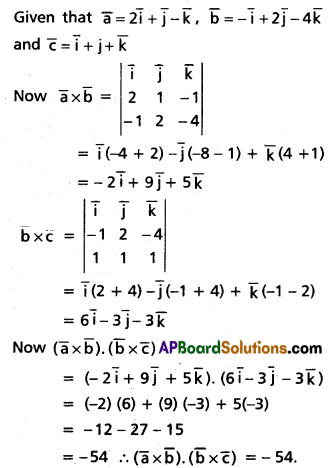
If \(\overline{\mathbf{a}}=2 \bar{i}+\bar{j}-\bar{k}, \quad \bar{b}=-\bar{i}+2 \bar{j}-4 \bar{k}\) and \(\overline{\mathbf{c}}=\overline{\mathbf{i}}+\mathbf{j}+\overline{\mathbf{k}}\), then find \((\bar{a} \times \bar{b}) \cdot(\bar{b} \times \bar{c})\).
Solution:
Inter 1st Year Maths 1A Products of Vectors Solutions Ex 5(b) II Q2

Question 3.
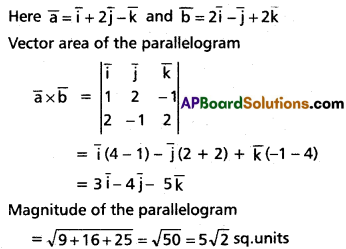
Find the vector area and the area of the parallelogram having \(\overline{\mathbf{a}}=\overline{\mathbf{i}}+2 \overline{\mathbf{j}}-\overline{\mathbf{k}}\) and \(\overline{\mathbf{b}}=2 \overline{\mathbf{i}}-\overline{\mathbf{j}}+\mathbf{2} \overline{\mathbf{k}}\) as adjacent sides.
Solution:
Inter 1st Year Maths 1A Products of Vectors Solutions Ex 5(b) II Q3

Question 4.
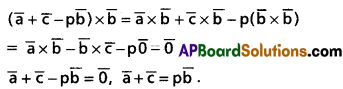
If \(\overline{\mathbf{a}} \times \overline{\mathbf{b}}=\overline{\mathbf{b}} \times \overline{\mathbf{c}} \neq \overline{\mathbf{0}}\), show that, \(\overline{\mathbf{a}}+\overline{\mathbf{c}}=\mathbf{p} \overline{\mathbf{b}}\), where p is some scalar.
Solution:
Inter 1st Year Maths 1A Products of Vectors Solutions Ex 5(b) II Q4

Inter 1st Year Maths 1A Products of Vectors Solutions Ex 5(b)

Question 5.
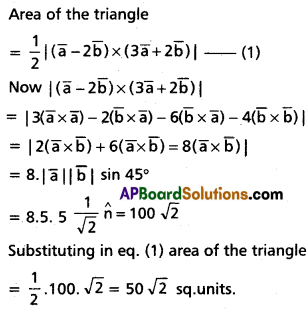
Let \(\overline{\mathbf{a}}\) and \(\overline{\mathbf{b}}\) be vectors, satisfying \(|\overline{\mathbf{a}}|=|\overline{\mathbf{b}}|=5\) and \((\bar{a}, \bar{b})=45^{\circ}\). Find the area of the triangle having \(\overline{\mathbf{a}}-\mathbf{2} \overline{\mathbf{b}}\) and \(3 \bar{a}+2 \bar{b}\) as two of its sides.
Solution:
Inter 1st Year Maths 1A Products of Vectors Solutions Ex 5(b) II Q5

Question 6.
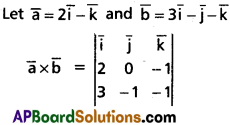
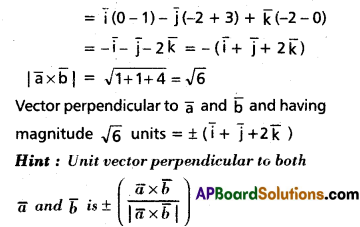
Find the vector having magnitude ?6 units and perpendicular to both \(\mathbf{2} \overline{\mathbf{i}}-\overline{\mathbf{k}}\) and \(\mathbf{3} \overline{\mathbf{i}}-\overline{\mathbf{j}}-\overline{\mathbf{k}}\).
Solution:
Inter 1st Year Maths 1A Products of Vectors Solutions Ex 5(b) II Q6
Inter 1st Year Maths 1A Products of Vectors Solutions Ex 5(b) II Q6.1

Question 7.
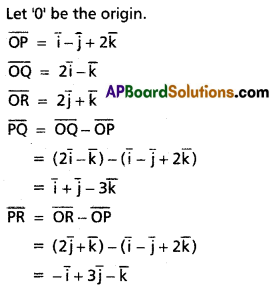
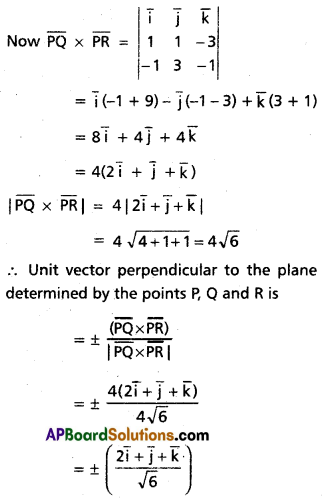
Find a unit vector perpendicular to the plane determined by the points P(1, -1, 2), Q(2, 0, -1) and R(0, 2, 1).
Solution:
Inter 1st Year Maths 1A Products of Vectors Solutions Ex 5(b) II Q7
Inter 1st Year Maths 1A Products of Vectors Solutions Ex 5(b) II Q7.1

Question 8.
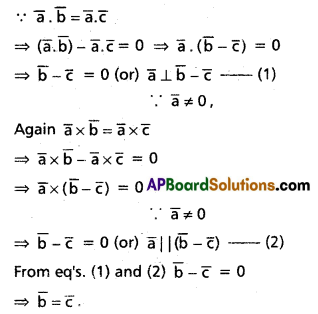
If \(\overline{\mathbf{a}} \cdot \overline{\mathbf{b}}=\overline{\mathbf{a}} \cdot \overline{\mathbf{c}}\) and \(\overline{\mathbf{a}} \times \overline{\mathrm{b}}=\overline{\mathrm{a}} \times \overline{\mathrm{c}}, \overline{\mathbf{a}} \neq 0\), then show that \(\overline{\mathbf{b}}=\overline{\mathbf{c}}\).
Solution:
Inter 1st Year Maths 1A Products of Vectors Solutions Ex 5(b) II Q8

Inter 1st Year Maths 1A Products of Vectors Solutions Ex 5(b)

Question 9.
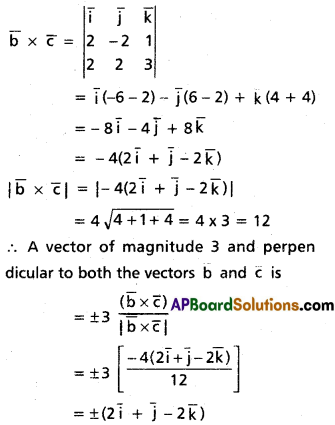
Find a vector of magnitude 3 and perpendicular to both the vector \(\overline{\mathbf{b}}=2 \bar{i}-2 \bar{j}+\bar{k}\) and \(\bar{c}=2 \bar{i}+2 \bar{j}+3 \bar{k}\).
Solution:
Inter 1st Year Maths 1A Products of Vectors Solutions Ex 5(b) II Q9

Question 10.
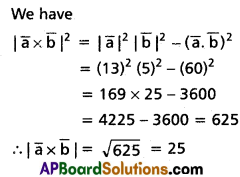
If \(|\overline{\mathbf{a}}|\) = 13, \(|\overline{\mathbf{b}}|\) = 5 and \(\overline{\mathbf{a}} \cdot \overline{\mathbf{b}}=\mathbf{6 0}\), then find \(|\overline{\mathbf{a}} \times \overline{\mathbf{b}}|\).
Solution:
Inter 1st Year Maths 1A Products of Vectors Solutions Ex 5(b) II Q10

Question 11.
Find a unit vector perpendicular to the plane passing through the points (1, 2, 3), (2, -1, 1) and (1, 2, -4).
Solution:
Let ‘O’ be the origin and let A, B, C be the given points.
Inter 1st Year Maths 1A Products of Vectors Solutions Ex 5(b) II Q11

III.

Question 1.
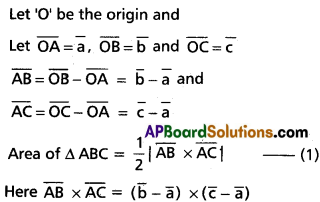
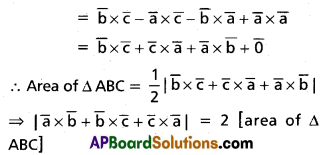
If \(\overline{\mathbf{a}}\), \(\overline{\mathbf{b}}\) and \(\overline{\mathbf{c}}\) represent the vertices A, B and C respectively of ∆ABC, then prove that \(|(\overline{\mathbf{a}} \times \overline{\mathbf{b}})+(\overline{\mathbf{b}} \times \overline{\mathbf{c}})+(\overline{\mathbf{c}} \times \overline{\mathbf{a}})|\) is twice the area of ∆ABC.
Solution:
Inter 1st Year Maths 1A Products of Vectors Solutions Ex 5(b) III Q1
Inter 1st Year Maths 1A Products of Vectors Solutions Ex 5(b) III Q1.1

Question 2.
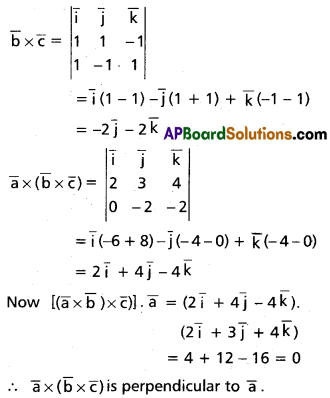
If \(\overline{\mathbf{a}}=2 \overline{\mathbf{i}}+3 \overline{\mathbf{j}}+4 \overline{\mathbf{k}}, \overline{\mathbf{b}}=\overline{\mathbf{i}}+\overline{\mathbf{j}}-\overline{\mathbf{k}}\) and \(\overline{\mathbf{c}}=\overline{\mathbf{i}}-\overline{\mathbf{j}}+\overline{\mathbf{k}}\), then compute \(\overline{\mathbf{a}} \times(\overline{\mathbf{b}} \times \overline{\mathbf{c}})\) and verify that it is perpendicular to \(\bar{a}\).
Solution:
Inter 1st Year Maths 1A Products of Vectors Solutions Ex 5(b) III Q2

Question 3.
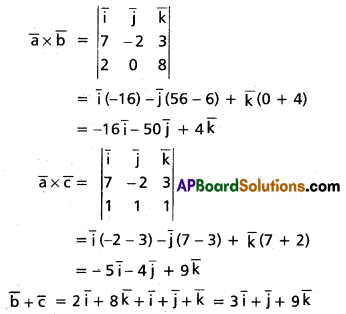
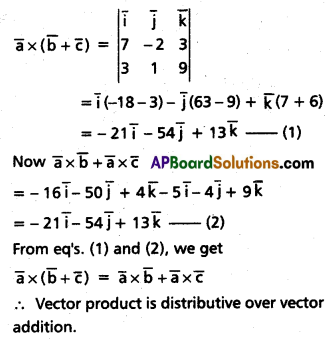
If \(\overline{\mathbf{a}}=7 \overline{\mathbf{i}}-2 \overline{\mathbf{j}}+3 \overline{\mathbf{k}}, \overline{\mathbf{b}}=2 \overline{\mathbf{i}}+8 \overline{\mathbf{k}}\) and \(\overline{\mathbf{c}}=\overline{\mathbf{i}}+\overline{\mathbf{j}}+\overline{\mathbf{k}}\) then compute \(\overline{\mathbf{a}} \times \mathbf{b}, \overline{\mathbf{a}} \times \overline{\mathbf{c}}\) and \(\bar{a} \times(\bar{b}+\bar{c})\). Verify whether cross product is distributive over vector addition.
Solution:
Inter 1st Year Maths 1A Products of Vectors Solutions Ex 5(b) III Q3
Inter 1st Year Maths 1A Products of Vectors Solutions Ex 5(b) III Q3.1

Inter 1st Year Maths 1A Products of Vectors Solutions Ex 5(b)

Question 4.
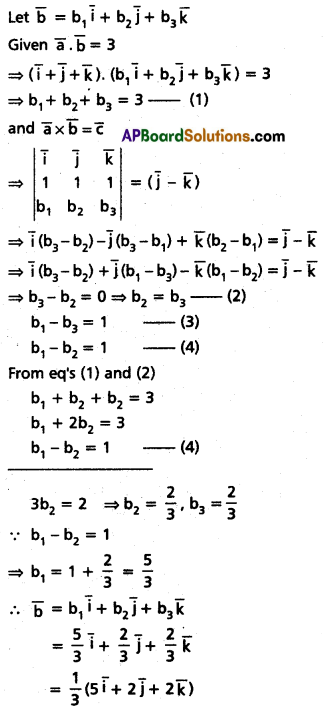
If \(\overline{\mathbf{a}}=\overline{\mathbf{i}}+\overline{\mathbf{j}}+\overline{\mathbf{k}}, \overline{\mathbf{c}}=\overline{\mathbf{j}}-\overline{\mathbf{k}}\), then find vector \(\overline{\mathbf{b}}\) such that \(\overline{\mathbf{a}} \times \overline{\mathbf{b}}=\overline{\mathbf{c}}\) and \(\bar{a} \cdot \bar{b}=3\).
Solution:
Inter 1st Year Maths 1A Products of Vectors Solutions Ex 5(b) III Q4

Question 5.
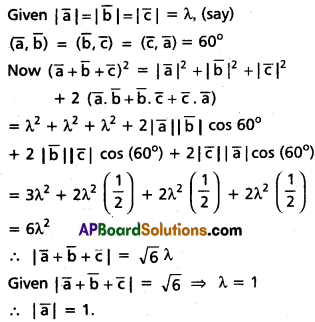
\(\overline{\mathbf{a}}, \overline{\mathbf{b}}, \overline{\mathbf{c}}\) are three vectors of equal magnitudes and each of them is inclined at an angle of 60° to the others. If \(|\bar{a}+\bar{b}+\bar{c}|=\sqrt{6}\), then find \(|\overline{\mathbf{a}}|\).
Solution:
Inter 1st Year Maths 1A Products of Vectors Solutions Ex 5(b) III Q5

Question 6.
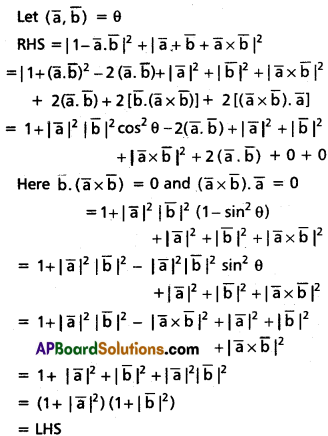
For any two vectors \(\bar{a}\) and \(\bar{b}\), show that \(\left(1+|\bar{a}|^{2}\right)\left(1+|\bar{b}|^{2}\right)\) = \(|\mathbf{1}-\overline{\mathbf{a}} \cdot \overline{\mathbf{b}}|^{2}+|\overline{\mathbf{a}}+\overline{\mathbf{b}}+\overline{\mathbf{a}} \times \overline{\mathbf{b}}|^{2}\)
Solution:
Inter 1st Year Maths 1A Products of Vectors Solutions Ex 5(b) III Q6

Question 7.
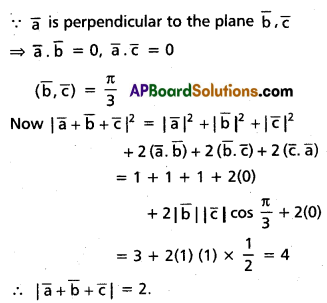
If \(\overline{\mathbf{a}}, \overline{\mathbf{b}}, \overline{\mathbf{c}}\) are unit vectors such that \(\overline{\mathbf{a}}\) is perpendicular to the plane of \(\overline{\mathbf{b}}, \overline{\mathbf{c}}\) and the angle between \(\overline{\mathbf{b}}\) and \(\overline{\mathbf{c}}\) is \(\frac{\pi}{3}\), then find \(|\bar{a}+\bar{b}+\bar{c}|\).
Solution:
Given that \(|\bar{a}|=|\bar{b}|=|\bar{c}|=1\)
Inter 1st Year Maths 1A Products of Vectors Solutions Ex 5(b) III Q7

Inter 1st Year Maths 1A Products of Vectors Solutions Ex 5(b)

Question 8.
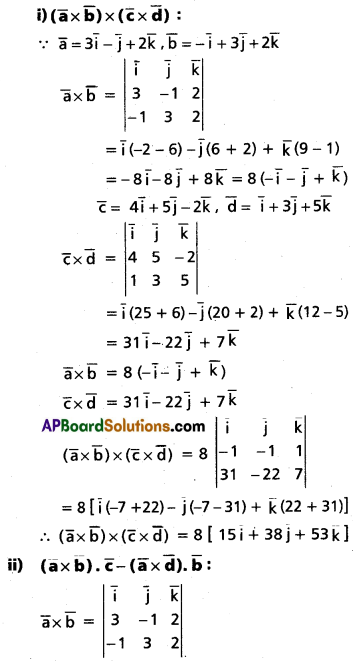
\(\overline{\mathbf{a}}=3 \overline{\mathbf{i}}-\overline{\mathbf{j}}+2 \overline{\mathbf{k}}, \overline{\mathbf{b}}=-\overline{\mathbf{i}}+3 \overline{\mathbf{j}}+2 \overline{\mathbf{k}}\), \(\bar{c}=4 \bar{i}+5 \bar{j}-2 \bar{k}\) and \(\bar{d}=\bar{i}+3 \bar{j}+5 \bar{k}\) then compute the following.
(i) \((\overline{\mathbf{a}} \times \overline{\mathbf{b}}) \times(\bar{c} \times \bar{d})\) and
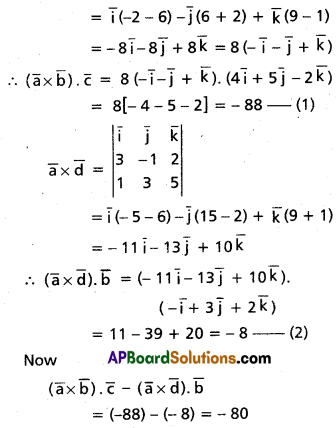
(ii) \((\overline{\mathbf{a}} \times \overline{\mathbf{b}}) \cdot \overline{\mathbf{c}}-(\overline{\mathbf{a}} \times \overline{\mathbf{d}}) \cdot \overline{\mathbf{b}}\)
Solution:
Inter 1st Year Maths 1A Products of Vectors Solutions Ex 5(b) III Q8
Inter 1st Year Maths 1A Products of Vectors Solutions Ex 5(b) III Q8.1

Inter 1st Year Maths 1A Products of Vectors Solutions Ex 5(a)

Practicing the Intermediate 1st Year Maths 1A Textbook Solutions Inter 1st Year Maths 1A Products of Vectors Solutions Exercise 5(a) will help students to clear their doubts quickly.

Intermediate 1st Year Maths 1A Products of Vectors Solutions Exercise 5(a)

I.

Question 1.
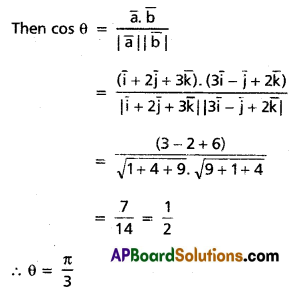
Find the angle between the vectors \(\bar{i}+2 \bar{j}+3 \bar{k}\) and \(3 \bar{i}-\bar{j}+2 \bar{k}\).
Solution:
Let \(\overline{\mathrm{a}}=\overline{\mathrm{i}}+2 \overline{\mathrm{j}}+3 \overline{\mathrm{k}}\) and \(\overline{\mathrm{b}}=3 \overline{\mathrm{i}}-\overline{\mathrm{j}}+2 \overline{\mathrm{k}}\) and ‘θ’ be the angle between them (i.e.,) \((\bar{a}, \bar{b})\) = θ
Inter 1st Year Maths 1A Products of Vectors Solutions Ex 5(a) I Q1

Question 2.
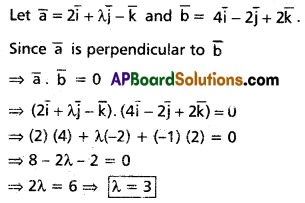
If the vectors \(\mathbf{2} \overline{\mathbf{i}}+\lambda \overline{\mathbf{j}}-\overline{\mathbf{k}}\) and \(4 \bar{i}-2 \bar{j}+2 \bar{k}\) are perpendicular to each other, then find λ.
Solution:
Inter 1st Year Maths 1A Products of Vectors Solutions Ex 5(a) I Q2

Inter 1st Year Maths 1A Products of Vectors Solutions Ex 5(a)

Question 3.
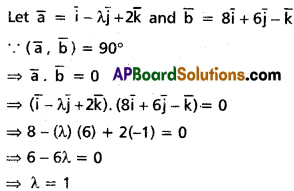
For what values of λ, the vectors \(\overline{\mathbf{i}}-\lambda \overline{\mathbf{j}}+2 \overline{\mathbf{k}}\) and \(8 \overline{\mathbf{i}}+6 \overline{\mathbf{j}}-\overline{\mathbf{k}}\) are at right angles?
Solution:
Inter 1st Year Maths 1A Products of Vectors Solutions Ex 5(a) I Q3

Question 4.
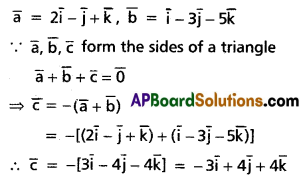
\(\overline{\mathbf{a}}=2 \overline{\mathbf{i}}-\overline{\mathbf{j}}+\overline{\mathbf{k}}, \overline{\mathbf{b}}=\overline{\mathbf{i}}-3 \overline{\mathbf{j}}-5 \overline{\mathbf{k}}\). Find the vector C such that \(\overline{\mathbf{a}}\), \(\overline{\mathbf{b}}\) and \(\overline{\mathbf{c}}\) form the sides of a triangle.
Solution:
Inter 1st Year Maths 1A Products of Vectors Solutions Ex 5(a) I Q4

Question 5.
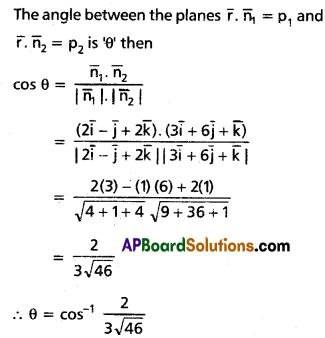
Find the angle between the planes \(\bar{r} \cdot(2 \bar{i}-\bar{j}+2 \bar{k})=3\) and \(\overline{\mathrm{r}} \cdot(3 \overline{\mathrm{i}}+6 \bar{j}+\bar{k})=4\).
Solution:
Inter 1st Year Maths 1A Products of Vectors Solutions Ex 5(a) I Q5

Question 6.
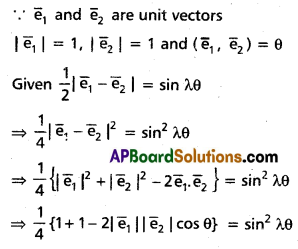
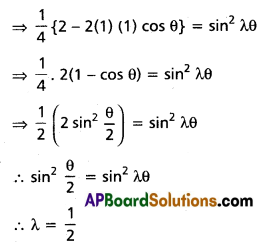
Let \(\overline{\mathbf{e}}_{1}\) and \(\overline{\mathbf{e}}_{2}\) be unit vectors makingangle θ. If \(\frac{1}{2}\left|\bar{e}_{1}-\bar{e}_{2}\right|=\sin \lambda \theta\), then find λ.
Solution:
Inter 1st Year Maths 1A Products of Vectors Solutions Ex 5(a) I Q6
Inter 1st Year Maths 1A Products of Vectors Solutions Ex 5(a) I Q6.1

Inter 1st Year Maths 1A Products of Vectors Solutions Ex 5(a)

Question 7.
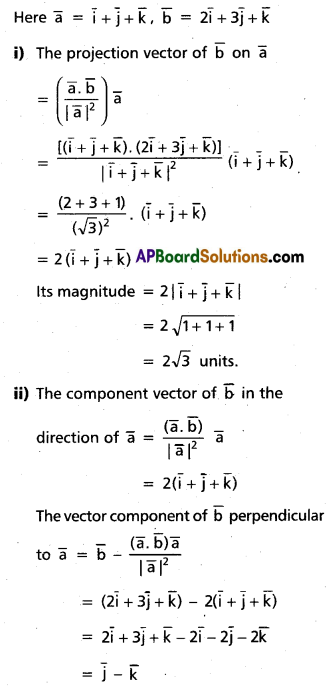
Let \(\overline{\mathbf{a}}=\overline{\mathbf{i}}+\overline{\mathbf{j}}+\overline{\mathbf{k}}\) and \(\overline{\mathbf{b}}=\mathbf{2} \overline{\mathbf{i}}+3 \overline{\mathbf{j}}+\overline{\mathbf{k}}\). Find
(i) The projection vector of \(\overline{\mathbf{b}}\) on \(\overline{\mathbf{a}}\) and its magnitude.
(ii) The vector components of \(\overline{\mathbf{b}}\) in the direction of a and perpendicular to \(\overline{\mathbf{a}}\).
Solution:
Inter 1st Year Maths 1A Products of Vectors Solutions Ex 5(a) I Q7

Question 8.
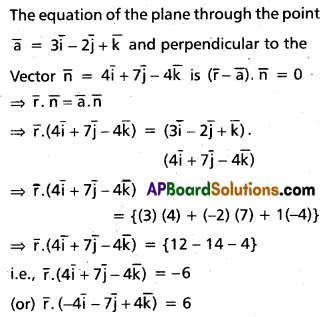
Find the equation of the plane through the point (3, -2, 1) and perpendicular to the vector (4, 7, -4).
Solution:
Inter 1st Year Maths 1A Products of Vectors Solutions Ex 5(a) I Q8

Question 9.
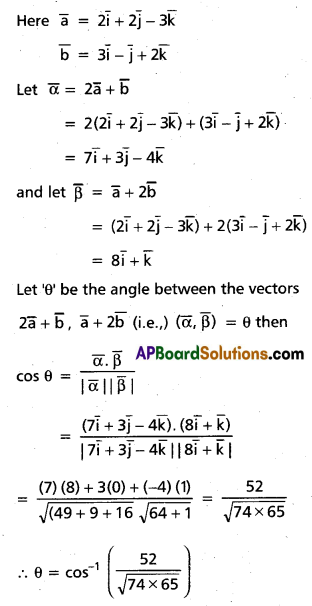
If \(\overline{\mathbf{a}}=2 \bar{i}+2 \bar{j}-3 \bar{k}\); \(\overline{\mathbf{b}}=3 \overline{\mathbf{i}}-\overline{\mathbf{j}}+2 \overline{\mathbf{k}}\), then find the angle between \(2 \overline{\mathbf{a}}+\overline{\mathbf{b}}\) and \(\bar{a}+2 \bar{b}\).
Solution:
Inter 1st Year Maths 1A Products of Vectors Solutions Ex 5(a) I Q9

II.

Question 1.
Find unit vector parallel to the XOY- plane and perpendicular to the vector \(4 \bar{i}-3 \bar{j}+\bar{k}\).
Solution:
Any vector parallel to XOY-plane will be of the form \(p \bar{i}+q \bar{j}\)
∴ The vector parallel to the XOY-plane and perpendicular to the vector \(4 \bar{i}-3 \bar{j}+\bar{k}\) is \(3 \bar{i}+4 \bar{j}\)
Its magnitude = \(|3 \bar{i}+\overline{4 j}|=\sqrt{9+16}=5\)
∴ Unit vector parallel to the XOY-plane and perpendicular to the vector \(4 \bar{i}-3 \bar{j}+\bar{k}\) is \(\pm \frac{(3 \overline{\mathrm{i}}+4 \overline{\mathrm{j}})}{5}\)

Inter 1st Year Maths 1A Products of Vectors Solutions Ex 5(a)

Question 2.
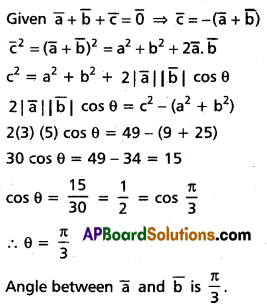
If \(\overline{\mathbf{a}}+\overline{\mathbf{b}}+\overline{\mathrm{c}}=0,|\overline{\mathbf{a}}|=3,|\overline{\mathbf{b}}|=5\) and \(|\bar{c}|=7\), then find the angle between \(\overline{\mathbf{a}}\) and \(\overline{\mathbf{b}}\).
Solution:
Inter 1st Year Maths 1A Products of Vectors Solutions Ex 5(a) II Q2

Question 3.
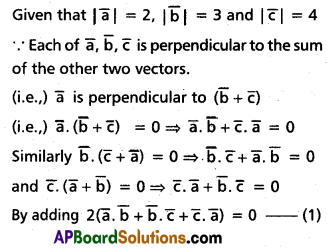
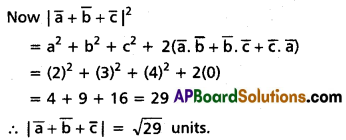
If \(|\overline{\mathbf{a}}|\) = 2, \(|\overline{\mathbf{b}}|\) = 3 and \(|\overline{\mathbf{c}}|\) = 4 and each of \(\overline{\mathbf{a}}, \overline{\mathbf{b}}, \overline{\mathbf{c}}\) is perpendicular to the sum of the other two vectors, then find the magnitude of \(\overline{\mathbf{a}}+\overline{\mathbf{b}}+\overline{\mathbf{c}}\).
Solution:
Inter 1st Year Maths 1A Products of Vectors Solutions Ex 5(a) II Q3
Inter 1st Year Maths 1A Products of Vectors Solutions Ex 5(a) II Q3.1

Question 4.
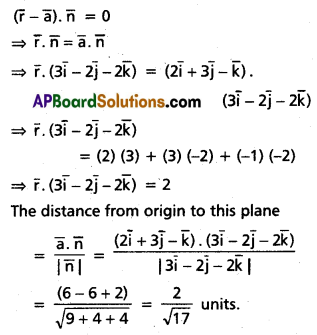
Find the equation of the plane passing through the point \(\overline{\mathbf{a}}=\mathbf{2} \overline{\mathbf{i}}+3 \bar{j}-\overline{\mathbf{k}}\) and perpendicular to the vector \(3 \bar{i}-2 \bar{j}-2 \bar{k}\) and the distance of this plane from the origin.
Solution:
Equation of the plane passing through the point \(\overline{\mathbf{a}}=\mathbf{2} \overline{\mathbf{i}}+3 \bar{j}-\overline{\mathbf{k}}\) and perpendicular to the vector \(\bar{n}=3 \bar{i}-2 \bar{j}-2 \bar{k}\) is
Inter 1st Year Maths 1A Products of Vectors Solutions Ex 5(a) II Q4

Inter 1st Year Maths 1A Products of Vectors Solutions Ex 5(a)

Question 5.
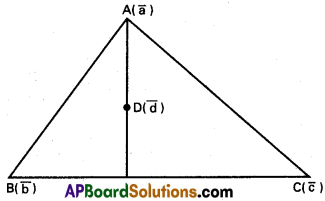
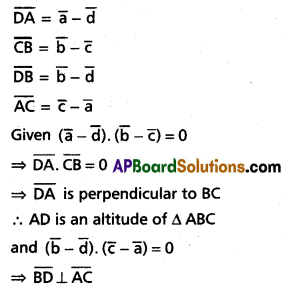
\(\overline{\mathbf{a}}, \overline{\mathbf{b}}, \overline{\mathbf{c}}\) and \(\overline{\mathbf{d}}\) are the position vectors of four coplanar points such that \((\mathbf{a}-\overline{\mathbf{d}}) \cdot(\bar{b}-\bar{c})=(\bar{b}-\bar{d}) \cdot(\bar{c}-\bar{a})=0\). Show that the point \(\bar{d}\) represents the orthocentre of the triangle with \(\bar{a}\), \(\bar{b}\) and \(\bar{c}\) as its vertices.
Solution:
Position vectors of A, B, C, D are \(\bar{a}\), \(\bar{b}\), \(\bar{c}\) and \(\bar{d}\) respectively.
Inter 1st Year Maths 1A Products of Vectors Solutions Ex 5(a) II Q5
Inter 1st Year Maths 1A Products of Vectors Solutions Ex 5(a) II Q5.1
⇒ BD is perpendicular to AC
∴ BD is another altitude of ∆ABC.
Altitudes AD and BD intersect at D.
∴ D is the orthocentre of ∆ABC.

III.

Question 1.
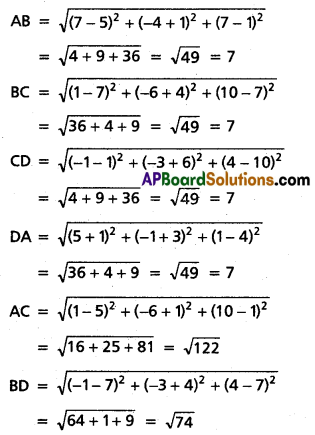
Show that the points (5, -1, 1), (7, -4, 7), (1, -6, 10) and (-1, -3, 4) are the vertices of a rhombus.
Solution:
Let A(5, -1, 1), B(7, -4, 7), C(1, -6, 10) and D(-1, -3, 4) are the given points.
Inter 1st Year Maths 1A Products of Vectors Solutions Ex 5(a) III Q1
∵ AB = BC = CD = DA = 7 units
AC ≠ BD
∴ A, B, C, D points are the vertices of a rhombus.

Inter 1st Year Maths 1A Products of Vectors Solutions Ex 5(a)

Question 2.
Let \(\bar{a}=4 \bar{i}+5 \bar{j}-\bar{k}, \quad \bar{b}=\bar{i}-4 \bar{j}+5 \bar{k}\) and \(\overline{\mathbf{c}}=\mathbf{3} \overline{\mathbf{i}}+\overline{\mathbf{j}}-\overline{\mathbf{k}}\). Find the vector which is perpendicular to both \(\overline{\mathbf{a}}\) and \(\overline{\mathbf{b}}\) and whose magnitude is twenty one times the magnitude of \(\overline{\mathbf{c}}\).
Solution:
Inter 1st Year Maths 1A Products of Vectors Solutions Ex 5(a) III Q2
Inter 1st Year Maths 1A Products of Vectors Solutions Ex 5(a) III Q2.1

Question 3.
G is the centroid of ΔABC and a, b, c are the lengths of the sides BC, CA and AB respectively prove that a2 + b2 + c2 = 3 (OA2 + OB2 + OC2) – 9(OG)2 where O is any point.
Solution:
Given that \(\overline{\mathrm{BC}}=\overline{\mathrm{a}}, \overline{\mathrm{CA}}=\overline{\mathrm{b}}, \overline{\mathrm{AB}}=\overline{\mathrm{c}}\)
Let ‘O’ be the origin and let \(\overline{\mathrm{OA}}=\overline{\mathrm{p}}, \overline{\mathrm{OB}}=\overline{\mathrm{q}} \text { and } \overline{\mathrm{OC}}=\overline{\mathrm{r}}\)
Then P.V. of the centroid of ΔABC is
Inter 1st Year Maths 1A Products of Vectors Solutions Ex 5(a) III Q3
From (1) and (2)
∴ a2 + b2 + c2 = 3(OA2 + OB2 + OC2) – 9(OG)2.

Inter 1st Year Maths 1A Products of Vectors Solutions Ex 5(a)

Question 4.
A line makes angles θ1, θ2, θ3, and θ4 with the diagonals of a cube. Show that cos2θ1 + cos2θ2 + cos2θ3 + cos2θ4 = \(\frac{4}{3}\).
Solution:
Inter 1st Year Maths 1A Products of Vectors Solutions Ex 5(a) III Q4
Inter 1st Year Maths 1A Products of Vectors Solutions Ex 5(a) III Q4.1
Inter 1st Year Maths 1A Products of Vectors Solutions Ex 5(a) III Q4.2

Inter 1st Year Maths 1A Addition of Vectors Solutions Ex 4(b)

Practicing the Intermediate 1st Year Maths 1A Textbook Solutions Inter 1st Year Maths 1A Addition of Vectors Solutions Exercise 4(b) will help students to clear their doubts quickly.

Intermediate 1st Year Maths 1A Addition of Vectors Solutions Exercise 4(b)

I.

Question 1.
Find the vector equation of the line passing through the point \(2 \bar{i}+3 \bar{j}+\bar{k}\) and parallel to the vector \(4 \bar{i}-2 \bar{j}+3 \bar{k}\).
Solution:
Inter 1st Year Maths 1A Addition of Vectors Solutions Ex 4(b) I Q1

Question 2.
OABC is a parallelogram. If \(\overline{O A}=\bar{a}\) and \(\overline{O C}=\bar{c}\), find the vector equation of the side BC.
Solution:
Inter 1st Year Maths 1A Addition of Vectors Solutions Ex 4(b) I Q2

Inter 1st Year Maths 1A Addition of Vectors Solutions Ex 4(b)

Question 3.
If \(\overline{\mathbf{a}}, \overline{\mathbf{b}}, \overline{\mathbf{c}}\) are the position vectors of the vertices A, B and C respectively of ∆ABC, theind the vector equation of the median through the vertex A.
Solution:
Inter 1st Year Maths 1A Addition of Vectors Solutions Ex 4(b) I Q3

Question 4.
Find the vertor equation of the line joining the points \(2 \bar{i}+\bar{j}+3 \bar{k}\) and \(-4 \bar{i}+3 \bar{j}-\bar{k}\).
Solution:
Inter 1st Year Maths 1A Addition of Vectors Solutions Ex 4(b) I Q4

Question 5.
Find the vector equation of the plane passing through the points \(\overline{\mathbf{i}}-2 \overline{\mathbf{j}}+5 \overline{\mathbf{k}},-5 \overline{\mathbf{j}}-\overline{\mathbf{k}} \text { and }-3 \overline{\mathbf{i}}+5 \overline{\mathbf{j}}\).
Solution:
Inter 1st Year Maths 1A Addition of Vectors Solutions Ex 4(b) I Q5

Inter 1st Year Maths 1A Addition of Vectors Solutions Ex 4(b)

Question 6.
Find the vector equation of the plane through the points (0, 0, 0), (0, 5, 0) and (2, 0, 1).
Solution:
Inter 1st Year Maths 1A Addition of Vectors Solutions Ex 4(b) I Q6

II.

Question 1.
If \(\overline{\mathbf{a}}, \overline{\mathbf{b}}, \overline{\mathbf{c}}\) are noncoplanar find the point of intersection of the line passing through the points \(2 \bar{a}+3 \bar{b}-\bar{c}\), \(3 \bar{a}+4 \bar{b}-2 \bar{c}\) with the line joining the points \(\bar{a}-2 \bar{b}+3 \bar{c}, \bar{a}-6 \bar{b}+6 \bar{c}\).
Solution:
Inter 1st Year Maths 1A Addition of Vectors Solutions Ex 4(b) II Q1

Question 2.
ABCD is a trapezium in which AB and CD are parallel. Prove by vector methods, that the mid points of the sides AB, CD and the intersection of the diagonals are collinear.
Solution:
Inter 1st Year Maths 1A Addition of Vectors Solutions Ex 4(b) II Q2
Inter 1st Year Maths 1A Addition of Vectors Solutions Ex 4(b) II Q2.1
Inter 1st Year Maths 1A Addition of Vectors Solutions Ex 4(b) II Q2.2
Inter 1st Year Maths 1A Addition of Vectors Solutions Ex 4(b) II Q2.3
⇒ M, P, N are collinear
Hence the midpoints of parallel sides of a trapezium and the point of intersection of the diagonals are collinear.

Inter 1st Year Maths 1A Addition of Vectors Solutions Ex 4(b)

Question 3.
In a quadrilateral ABCD, if the midpoints of one pair of opposite sides and the point of intersection of the diagonals are collinear, using vector methods, prove that the quadrilateral ABCD is a trapezium.
Solution:
Inter 1st Year Maths 1A Addition of Vectors Solutions Ex 4(b) II Q3
Inter 1st Year Maths 1A Addition of Vectors Solutions Ex 4(b) II Q3.1

III.

Question 1.
Find the vector equation of the plane which passes through the points \(2 \bar{i}+4 \bar{j}+2 \bar{k}, 2 \bar{i}+3 \bar{j}+5 \bar{k}\) and parallel to the vector \(3 \overline{\mathbf{i}}-2 \overline{\mathbf{j}}+\overline{\mathbf{k}}\). Also find the point where this plane meets the line joining the points \(2 \overline{\mathbf{i}}+\overline{\mathbf{j}}+3 \overline{\mathbf{k}}\) and \(4 \bar{i}-2 \bar{j}+3 \bar{k}\).
Solution:
Inter 1st Year Maths 1A Addition of Vectors Solutions Ex 4(b) III Q1
Inter 1st Year Maths 1A Addition of Vectors Solutions Ex 4(b) III Q1.1
Inter 1st Year Maths 1A Addition of Vectors Solutions Ex 4(b) III Q1.2

Inter 1st Year Maths 1A Addition of Vectors Solutions Ex 4(b)

Question 2.
Find the vector equation of the plane passing through points \(4 \overline{\mathbf{i}}-3 \overline{\mathbf{j}}-\overline{\mathbf{k}}\), \(3 \overline{\mathbf{i}}+7 \overline{\mathbf{j}}-10 \overline{\mathbf{k}}\) and \(2 \bar{i}+5 \bar{j}-7 \bar{k}\), and show that the point \(\overline{\mathbf{i}}+2 \bar{j}-3 \overline{\mathbf{k}}\) lies in the plane.
Solution:
Inter 1st Year Maths 1A Addition of Vectors Solutions Ex 4(b) III Q2
Inter 1st Year Maths 1A Addition of Vectors Solutions Ex 4(b) III Q2.1
Inter 1st Year Maths 1A Addition of Vectors Solutions Ex 4(b) III Q2.2

Inter 1st Year Maths 1A Matrices Solutions Ex 3(i)

Practicing the Intermediate 1st Year Maths 1A Textbook Solutions Inter 1st Year Maths 1A Matrices Solutions Exercise 3(i) will help students to clear their doubts quickly.

Intermediate 1st Year Maths 1A Matrices Solutions Exercise 3(i)

Solve the following systems of homogeneous equations.

Question 1.
2x + 3y – z = 0, x – y – 2z = 0, 3x + y + 3z = 0
Solution:
The Coefficient matrix is \(\left[\begin{array}{ccc}
2 & 3 & -1 \\
1 & -1 & -2 \\
3 & 1 & 3
\end{array}\right]\)
det of \(\left[\begin{array}{ccc}
2 & 3 & -1 \\
1 & -1 & -2 \\
3 & 1 & 3
\end{array}\right]=\left[\begin{array}{ccc}
2 & 3 & -1 \\
1 & -1 & -2 \\
3 & 1 & 3
\end{array}\right]\)
= 2(-3 + 2) – 3(3 + 6) – 1(1 + 3)
= -2 – 27 – 4
= -33 ≠ 0, ρ(A) = 3
Hence the system has the trivial solution x = y = z = 0 only.

Inter 1st Year Maths 1A Matrices Solutions Ex 3(i)

Question 2.
3x + y – 2z = 0, x + y + z = 0, x – 2y + z = 0
Hint: If the determinant of the coefficient matrix ≠ 0 then the system has a trivial solution (i.e.) ρ(A) = 3.
Solution:
The coefficient matrix is \(\left[\begin{array}{ccc}
3 & 1 & -2 \\
1 & 1 & 1 \\
1 & -2 & 1
\end{array}\right]\)
\(\left|\begin{array}{ccc}
3 & 1 & -2 \\
1 & 1 & 1 \\
1 & -2 & 1
\end{array}\right|\)
= 3(1 + 2) – 1(1 – 1) – 2(-2 – 1)
= 9 + 6
= 15 ≠ 0, ρ(A) = 3
Hence the system has the trivial solutions x = y = z = 0 only.

Inter 1st Year Maths 1A Matrices Solutions Ex 3(i)

Question 3.
x + y – 2z = 0, 2x + y – 3z = 0, 5x + 4y – 9z = 0
Solution:
The coefficient matrix is \(\left[\begin{array}{rrr}
1 & 1 & -2 \\
2 & 1 & -3 \\
5 & 4 & -9
\end{array}\right]\) = A (say)
|A| = \(\left|\begin{array}{rrr}
1 & 1 & -2 \\
2 & 1 & -3 \\
5 & 4 & -9
\end{array}\right|\)
= 1(-9 + 12) – 1(-18 + 15) – 2(8 – 5)
= 3 + 3 – 6
= 0
∴ Rank of A = 2 as the submatrix \(\left[\begin{array}{ll}
1 & 1 \\
2 & 1
\end{array}\right]\) is non-singular, ρ(A) < 3
Hence the system has a non-trivial solution.
A = \(\left[\begin{array}{lll}
1 & 1 & -2 \\
2 & 1 & -3 \\
5 & 4 & -9
\end{array}\right]\)
R2 → R2 – 2R1, R3 → R3 – 3R1
A ~ \(\left[\begin{array}{ccc}
1 & 1 & -2 \\
0 & -1 & 1 \\
0 & -1 & -1
\end{array}\right]\)
The system of equation is equivalent to the given system of equations are x + y – 2z = 0, -y + z = 0
Let z = k
⇒ y = k, x = k
∴ x = y = z = k for real number k.

Inter 1st Year Maths 1A Matrices Solutions Ex 3(i)

Question 4.
x + y – z = 0, x – 2y + z = 0, 3x + 6y – 5z = 0
Solution:
Coefficient matrix A = \(\left[\begin{array}{ccc}
1 & 1 & -1 \\
1 & -2 & 1 \\
3 & 6 & -5
\end{array}\right]\)
R2 → R2 – R1, R3 → R3 – 3R1
A ~ \(\left[\begin{array}{ccc}
1 & 1 & -1 \\
0 & -3 & 2 \\
0 & 3 & -2
\end{array}\right]\)
⇒ det A = 0 as R2, R3 are identical.
and rank (A) = 2 as the submatrix \(\left[\begin{array}{cc}
1 & 1 \\
0 & -3
\end{array}\right]\) is non-singular.
Hence the system has a non-trivial solution, ∵ ρ(A) < 3
The system of equations equivalent to the given system of equations are
x + y – z = 0
3y – 2z = 0
Let z = k
⇒ y = \(\frac{2 k}{3}\)
x = \(\frac{k}{3}\)
∴ x = \(\frac{k}{3}\), y = \(\frac{2 k}{3}\), z = k for any real number of k.

Inter 1st Year Maths 1A Matrices Solutions Ex 3(h)

Practicing the Intermediate 1st Year Maths 1A Textbook Solutions Inter 1st Year Maths 1A Matrices Solutions Exercise 3(h) will help students to clear their doubts quickly.

Intermediate 1st Year Maths 1A Matrices Solutions Exercise 3(h)

Solve the following systems of equations.
(i) by using Cramer’s rule and matrix inversion method, when the coefficient matrix is non-singular.
(ii) by using the Gauss-Jordan method. Also, determine whether the system has a unique solution or an infinite number of solutions, or no solution, and find the solutions if exist.

Question 1.
5x – 6y + 4z = 15
7x + 4y – 3z = 19
2x + y + 6z = 46
Solution:
(i) Cramer’s rule:
Δ = \(\left|\begin{array}{ccc}
5 & -6 & 4 \\
7 & 4 & -3 \\
2 & 1 & 6
\end{array}\right|\)
= 5(24 + 3) + 6(42 + 6) + 4(7 – 8)
= 135 + 288 – 4
= 419
Δ1 = \(\left|\begin{array}{ccc}
15 & -6 & 4 \\
19 & 4 & -3 \\
46 & 1 & 6
\end{array}\right|\)
= 15(24 + 3) + 6(114 + 138) + 4(19 – 184)
= 405 + 1512 – 660
= 1917 – 660
= 1257
Δ2 = \(\left|\begin{array}{ccc}
5 & 15 & 4 \\
7 & 19 & -3 \\
2 & 46 & 6
\end{array}\right|\)
= 5(114 + 138) – 15(42 + 6) + 4(322 – 38)
= 1260 – 720 + 1136
= 1676
Δ3 = \(\left|\begin{array}{ccc}
5 & -6 & 15 \\
7 & 4 & 19 \\
2 & 1 & 46
\end{array}\right|\)
= 5(184 – 19) + 6(322 – 38) + 15(7 – 8)
= 825 + 1704 – 15
= 2529 – 15
= 2514
Inter 1st Year Maths 1A Matrices Solutions Ex 3(h) Q1(i)
Solution is x = 3, y = 4, z = 6.

(ii) Matrix inversion method:
Inter 1st Year Maths 1A Matrices Solutions Ex 3(h) Q1(ii)
Inter 1st Year Maths 1A Matrices Solutions Ex 3(h) Q1(ii).1
Inter 1st Year Maths 1A Matrices Solutions Ex 3(h) Q1(ii).2
Solution is x = 3, y = 4, z = 6

(iii) Gauss-Jordan method:
Inter 1st Year Maths 1A Matrices Solutions Ex 3(h) Q1(iii)
∴ Unique solution exists.
Solution is x = 3, y = 4, z = 6.

Inter 1st Year Maths 1A Matrices Solutions Ex 3(h)

Question 2.
x + y + z = 1
2x + 2y + 3z = 6
x + 4y + 9z = 3
Solution:
(i) Cramer’s rule:
Δ = \(\left|\begin{array}{lll}
1 & 1 & 1 \\
2 & 2 & 3 \\
1 & 4 & 9
\end{array}\right|\)
= 1(18 – 12) – 1(18 – 3) + 1(8 – 2)
= 6 – 15 + 6
= -3
Δ1 = \(\left|\begin{array}{lll}
1 & 1 & 1 \\
6 & 2 & 3 \\
3 & 4 & 9
\end{array}\right|\)
= 1(18 – 12) – 1(54 – 9) + 1(24 – 6)
= 6 – 45 + 18
= -21
Δ2 = \(\left|\begin{array}{lll}
1 & 1 & 1 \\
2 & 6 & 3 \\
1 & 3 & 9
\end{array}\right|\)
= 1(54 – 9) – 1(18 – 3) + 1(6 – 6)
= 45 – 15
= 30
Δ3 = \(\left|\begin{array}{lll}
1 & 1 & 1 \\
2 & 2 & 6 \\
1 & 4 & 3
\end{array}\right|\)
= 1(6 – 24) – 1(6 – 6) + 1(8 – 2)
= -18 – 0 + 6
= -12
Inter 1st Year Maths 1A Matrices Solutions Ex 3(h) Q2(i)
Solution is x = 7, y = -10, z = 4

(ii) Matrix inversion method:
Inter 1st Year Maths 1A Matrices Solutions Ex 3(h) Q2(ii)
Inter 1st Year Maths 1A Matrices Solutions Ex 3(h) Q2(ii).1
Inter 1st Year Maths 1A Matrices Solutions Ex 3(h) Q2(ii).2
∴ Solution is x = 7, y = -10, z = 4

(iii) Gauss-Jordan method:
Augmented matrix is A = \(\left[\begin{array}{llll}
1 & 1 & 1 & 1 \\
2 & 2 & 3 & 6 \\
1 & 4 & 9 & 3
\end{array}\right]\)
R2 → R2 – 2R1, R3 → R3 – R1
Inter 1st Year Maths 1A Matrices Solutions Ex 3(h) Q2(iii)
Unique solution exists.
∴ Solution is x = 7, y = -10, z = 4

Inter 1st Year Maths 1A Matrices Solutions Ex 3(h)

Question 3.
x – y + 3z = 5
4x + 2y – z = 0
-x + 3y + z = 5
Solution:
(i) Cramer’s rule:
Δ = \(\left|\begin{array}{ccc}
1 & -1 & 3 \\
4 & 2 & -1 \\
-1 & 3 & 1
\end{array}\right|\)
= 1(2 + 3) + 1(4 – 1) + 3(12 + 2)
= 5 + 3 + 42
= 50
Δ1 = \(\left|\begin{array}{ccc}
5 & -1 & 3 \\
0 & 2 & -1 \\
5 & 3 & 1
\end{array}\right|\)
= 5(2 + 3) + 1(0 + 5) + 3(0 – 10)
= 25 + 5 – 30
= 0
Δ2 = \(\left|\begin{array}{ccc}
1 & 5 & 3 \\
4 & 0 & -1 \\
-1 & 5 & 1
\end{array}\right|\)
= 1(0 + 5) – 5(4 – 1) + 3(20 – 0)
= 5 – 15 + 60
= 50
Δ3 = \(\left|\begin{array}{ccc}
1 & -1 & 5 \\
4 & 2 & 0 \\
-1 & 3 & 5
\end{array}\right|\)
= 1(10 – 0) + 1(20 – 0) + 5(12 + 2)
= 10 + 20 + 70
= 100
Inter 1st Year Maths 1A Matrices Solutions Ex 3(h) Q3(i)
∴ Solution is x = 0, y = 1, z = 2.

(ii) Matrix inversion method:
Inter 1st Year Maths 1A Matrices Solutions Ex 3(h) Q3(ii)
Inter 1st Year Maths 1A Matrices Solutions Ex 3(h) Q3(ii).1
Inter 1st Year Maths 1A Matrices Solutions Ex 3(h) Q3(ii).2
Solution is x = 0, y = 1, z = 2

(iii) Gauss Jordan method:
Inter 1st Year Maths 1A Matrices Solutions Ex 3(h) Q3(iii)
Unique solution exists.
∴ Solution is x = 0, y = 1, z = 2

Inter 1st Year Maths 1A Matrices Solutions Ex 3(h)

Question 4.
2x + 6y + 11 = 0
6x + 20y – 6z + 3 = 0
6y – 18z + 1 = 0
Solution:
(i) Cramer’s rule:
Δ = \(\left|\begin{array}{ccc}
2 & 6 & 0 \\
6 & 20 & -6 \\
0 & 6 & -18
\end{array}\right|\)
= 2(-360 + 36) – 6(-108 – 0)
= -648 + 648
= 0
∴ Cramer’s rule and matrix inversion method cannot be used.
∵ Δ = 0

(ii) Gauss Jordan method:
Inter 1st Year Maths 1A Matrices Solutions Ex 3(h) Q4(ii)
ρ(A) = 2, ρ(AB) = 3
ρ(A) ≠ ρ(AB)
∴ The given system of equations does not have a solution.

Inter 1st Year Maths 1A Matrices Solutions Ex 3(h)

Question 5.
2x – y + 3z = 9
x + y + z = 6
x – y + z = 2
Solution:
(i) Cramer’s rule:
Δ = \(\left|\begin{array}{ccc}
2 & -1 & 3 \\
1 & 1 & 1 \\
1 & -1 & 1
\end{array}\right|\)
= 2(1 + 1) + 1(1 – 1) + 3(-1 – 1)
= 4 + 0 – 6
= -2
Δ1 = \(\left|\begin{array}{ccc}
9 & -1 & 3 \\
6 & 1 & 1 \\
2 & -1 & 1
\end{array}\right|\)
= 9(1 + 1) + 1(6 – 2) + 3(-6 – 2)
= 18 + 4 – 24
= -2
Δ2 = \(\left|\begin{array}{lll}
2 & 9 & 3 \\
1 & 6 & 1 \\
1 & 2 & 1
\end{array}\right|\)
= 2(6 – 2) – 9(1 – 1) + 3(2 – 6)
= 8 – 0 – 12
= -4
Δ3 = \(\left|\begin{array}{ccc}
2 & -1 & 9 \\
1 & 1 & 6 \\
1 & -1 & 2
\end{array}\right|\)
= 2(2 + 6) + 1(2 – 6) + 9(-1 – 1)
= 16 – 4 – 18
= -6
Inter 1st Year Maths 1A Matrices Solutions Ex 3(h) Q5(i)
Solution is x = 1, y = 2, z = 3.

(ii) Matrix inversion method:
Inter 1st Year Maths 1A Matrices Solutions Ex 3(h) Q5(ii)
Inter 1st Year Maths 1A Matrices Solutions Ex 3(h) Q5(ii).1
Solution is x = 1, y = 2, z = 3.

(iii) Gauss-Jordan method:
Inter 1st Year Maths 1A Matrices Solutions Ex 3(h) Q5(iii)
∴ The given equations have a unique solution.
Solution is x = 1, y = 2, z = 3

Inter 1st Year Maths 1A Matrices Solutions Ex 3(h)

Question 6.
2x – y + 8z = 13
3x + 4y + 5z = 18
5x – 2y + 7z = 20
Solution:
(i) Cramer’s rule:
Δ = \(\left|\begin{array}{ccc}
2 & -1 & 8 \\
3 & 4 & 5 \\
5 & -2 & 7
\end{array}\right|\)
= 2(28 + 10) + 1(21 – 25) + 8(-6 – 20)
= 76 – 4 – 208
= -136
Δ1 = \(\left|\begin{array}{ccc}
13 & -1 & 8 \\
18 & 4 & 5 \\
20 & -2 & 7
\end{array}\right|\)
= 13(28 + 10) + 1(126 – 100) + 8(-36 – 80)
= 494 + 26 – 928
= -408
Δ2 = \(\left|\begin{array}{lll}
2 & 13 & 8 \\
3 & 18 & 5 \\
5 & 20 & 7
\end{array}\right|\)
= 2(126 – 100) – 13(21 – 25) + 8(60 – 90)
= 52 + 52 – 240
= -136
Δ3 = \(\left|\begin{array}{ccc}
2 & -1 & 13 \\
3 & 4 & 18 \\
5 & -2 & 20
\end{array}\right|\)
= 2(80 + 36) + 1(60 – 90) + 13(-6 – 20)
= 232 – 30 – 338
= -136
Inter 1st Year Maths 1A Matrices Solutions Ex 3(h) Q6(i)
∴ Solution is x = 3, y = 1, z = 1

(ii) Matrix inversion method:
Inter 1st Year Maths 1A Matrices Solutions Ex 3(h) Q6(ii)
Inter 1st Year Maths 1A Matrices Solutions Ex 3(h) Q6(ii).1
Inter 1st Year Maths 1A Matrices Solutions Ex 3(h) Q6(ii).2
∴ Solution is x = 3, y = 1, z = 1

(iii) Gauss Jordan method:
Inter 1st Year Maths 1A Matrices Solutions Ex 3(h) Q6(iii)
∴ The given equations have a unique solution and Solution is x = 3, y = 1, z = 1.

Inter 1st Year Maths 1A Matrices Solutions Ex 3(h)

Question 7.
2x – y + 3z = 8
-x + 2y + z = 4
3x + y – 4z = 0
Solution:
(i) Cramer’s rule:
Δ = \(\left|\begin{array}{ccc}
2 & -1 & 3 \\
-1 & 2 & 1 \\
3 & 1 & -4
\end{array}\right|\)
= 2(-8 – 1) + 1(4 – 3) + 3(-1 – 6)
= -18 + 1 – 21
= -38
Δ1 = \(\left|\begin{array}{ccc}
8 & -1 & 3 \\
4 & 2 & 1 \\
0 & 1 & -4
\end{array}\right|\)
= 8(-8 – 1) + 1(-16 – 0) + 3(4 – 0)
= -72 – 16 + 12
= -76
Δ2 = \(\left|\begin{array}{ccc}
2 & 8 & 3 \\
-1 & 4 & 1 \\
3 & 0 & -4
\end{array}\right|\)
= 2(-16 – 0) – 8(4 – 3) + 3(-0 – 12)
= -32 – 8 – 36
= -76
Δ3 = \(\left|\begin{array}{ccc}
2 & -1 & 8 \\
-1 & 2 & 4 \\
3 & 1 & 0
\end{array}\right|\)
= 2(0 – 4) + 1(0 – 12) + 8(-1 – 6)
= -8 – 12 – 56
= -76
Inter 1st Year Maths 1A Matrices Solutions Ex 3(h) Q7(i)
∴ Solution is x = 2, y = 2, z = 2.

(ii) Matrix inversion method:
Inter 1st Year Maths 1A Matrices Solutions Ex 3(h) Q7(ii)
Inter 1st Year Maths 1A Matrices Solutions Ex 3(h) Q7(ii).1
Solution is x = 2, y = 2, z = 2

(iii) Gauss Jordan method:
Inter 1st Year Maths 1A Matrices Solutions Ex 3(h) Q7(iii)
Inter 1st Year Maths 1A Matrices Solutions Ex 3(h) Q7(iii).1
∴ The given equations have a unique solution and solution is x = 2, y = 2, z = 2.

Inter 1st Year Maths 1A Matrices Solutions Ex 3(h)

Question 8.
x + y + z = 9
2x + 5y + 7z = 52
2x + y – z = 0
Solution:
(i) Cramer’s rule:
Δ = \(\left|\begin{array}{ccc}
1 & 1 & 1 \\
2 & 5 & 7 \\
2 & 1 & -1
\end{array}\right|\)
= 1(-5 – 7) – 1(-2 – 14) + 1(2 – 10)
= -12 + 16 – 8
= -4
Δ1 = \(\left|\begin{array}{ccc}
9 & 1 & 1 \\
52 & 5 & 7 \\
0 & 1 & -1
\end{array}\right|\)
= 9(-5 – 7) – 1(-52 – 0) + 1(52 – 0)
= -108 + 52 + 52
= -4
Δ2 = \(\left|\begin{array}{ccc}
1 & 9 & 1 \\
2 & 52 & 7 \\
2 & 0 & -1
\end{array}\right|\)
= 1(-52 – 0) – 9(-2 – 14) + 1(0 – 104)
= -52 + 144 – 104
= -12
Δ3 = \(\left|\begin{array}{ccc}
1 & 1 & 9 \\
2 & 5 & 52 \\
2 & 1 & 0
\end{array}\right|\)
= 1(0 – 52) – 1(0 – 104) + 9(2 – 10)
= -52 + 104 – 72
= -20
Inter 1st Year Maths 1A Matrices Solutions Ex 3(h) Q8(i)

(ii) Matrix inversion method:
Inter 1st Year Maths 1A Matrices Solutions Ex 3(h) Q8(ii)
Inter 1st Year Maths 1A Matrices Solutions Ex 3(h) Q8(ii).1
Solution is x = 1, y = 3, z = 5

(iii) Gauss Jordan method:
Inter 1st Year Maths 1A Matrices Solutions Ex 3(h) Q8(iii)
∴ The given equations have a unique solution and solution is x = 1, y = 3, z = 5.

Inter 1st Year Maths 1A Matrices Solutions Ex 3(g)

Practicing the Intermediate 1st Year Maths 1A Textbook Solutions Inter 1st Year Maths 1A Matrices Solutions Exercise 3(g) will help students to clear their doubts quickly.

Intermediate 1st Year Maths 1A Matrices Solutions Exercise 3(g)

Examine whether the following systems of equations are consistent or inconsistent and if consistent find the complete solutions.

Question 1.
x + y + z = 4
2x + 5y – 2z = 3
x + 7y – 7z = 5
Solution:
Inter 1st Year Maths 1A Matrices Solutions Ex 3(g) Q1
ρ(A) = 2, ρ(AB) = 3
ρ(A) ≠ ρ(AB)
∴ The given system of equations are in consistent.

Inter 1st Year Maths 1A Matrices Solutions Ex 3(g)

Question 2.
x + y + z = 6
x – y + z = 2
2x – y + 3z = 9
Solution:
Inter 1st Year Maths 1A Matrices Solutions Ex 3(g) Q2
Inter 1st Year Maths 1A Matrices Solutions Ex 3(g) Q2.1

Question 3.
x + y + z = 1
2x + y + z = 2
x + 2y + 2z = 1
Solution:
Inter 1st Year Maths 1A Matrices Solutions Ex 3(g) Q3
ρ(A) = 2 = ρ(AB) < 3
The given system of equations are consistent and have infinitely many solutions.
The solutions are given by [(x, y, z) 1x = 1, y + z = 0].

Question 4.
x + y + z = 9
2x + 5y + 7z = 52
2x + y – z = 0
Solution:
Inter 1st Year Maths 1A Matrices Solutions Ex 3(g) Q4
∴ ρ(A) = ρ(AB) = 3
The given system of equations are consistent have a unique solution.
∴ Solution is given by x = 1, y = 3, z = 5.

Inter 1st Year Maths 1A Matrices Solutions Ex 3(g)

Question 5.
x + y + z = 6
x + 2y + 3z = 10
x + 2y + 4z = 1
Solution:
Augmented matrix A = \(\left[\begin{array}{cccc}
1 & 1 & 1 & 6 \\
1 & 2 & 3 & 10 \\
1 & 2 & 4 & 1
\end{array}\right]\)
By R2 → R2 – R1, R3 → R3 – R2, we obtain
Inter 1st Year Maths 1A Matrices Solutions Ex 3(g) Q5
∴ ρ(A) = ρ(AB) = 3
The given system of equations are consistent.
They have a unique solution.
∴ Solution is given by x = -7, y = 22, z = -9.

Question 6.
x – 3y – 8z = -10
3x + y – 4z = 0
2x + 5y + 6z = 13
Solution:
The Augmented matrix
Inter 1st Year Maths 1A Matrices Solutions Ex 3(g) Q6
ρ(A) = ρ(AB) = 2 < 3
∴ The given system of equations are consistent have infinitely many solutions.
x + y = 2 and y + 2z = 3
Taking z = k, y = 3 – 2z = 3-2k
x = 2 – y
= 2 – (3 – 2k)
= 2 – 3 + 2k
= 2k – 1
∴ The solutions are given by x = -1 + 2k, y = 3 – 2k, z = k where ‘k’ is any scalar.

Question 7.
2x + 3y + z = 9
x + 2y + 3z = 6
3x + y + 2z = 8
Solution:
Inter 1st Year Maths 1A Matrices Solutions Ex 3(g) Q7
∴ ρ(A) = ρ(AB) = 3
The given system of equations are consistent have a unique solution.
∴ Solution is given by x = \(\frac{35}{18}\), y = \(\frac{29}{18}\), z = \(\frac{5}{18}\)

Inter 1st Year Maths 1A Matrices Solutions Ex 3(g)

Question 8.
x + y + 4z = 6
3x + 2y – 2z = 9
5x + y + 2z = 13
Solution:
Inter 1st Year Maths 1A Matrices Solutions Ex 3(g) Q8
∴ ρ(A) = ρ(AB) = 3
∴ The given system of equations are consistent have a unique solution.
∴ Solution is given by x = 2, y = 2, z = \(\frac{1}{2}\)

Inter 1st Year Maths 1A Matrices Solutions Ex 3(f)

Practicing the Intermediate 1st Year Maths 1A Textbook Solutions Inter 1st Year Maths 1A Matrices Solutions Exercise 3(f) will help students to clear their doubts quickly.

Intermediate 1st Year Maths 1A Matrices Solutions Exercise 3(f)

I. Find the rank of each of the following matrices.

Question 1.
\(\left[\begin{array}{ll}
1 & 0 \\
0 & 0
\end{array}\right]\)
Solution:
Det A = \(\left|\begin{array}{ll}
1 & 0 \\
0 & 0
\end{array}\right|\) = 0 – 0 = 0
and |1| = 1 ≠ 0
∴ ρ(A) = 1

Inter 1st Year Maths 1A Matrices Solutions Ex 3(f)

Question 2.
\(\left[\begin{array}{ll}
1 & 0 \\
0 & 1
\end{array}\right]\)
Solution:
Det A = \(\left|\begin{array}{ll}
1 & 0 \\
0 & 1
\end{array}\right|\) = 1 – 0 = 1 ≠ 0
∴ ρ(A) = 2

Question 3.
\(\left[\begin{array}{ll}
1 & 1 \\
0 & 0
\end{array}\right]\)
Solution:
Det A = \(\left|\begin{array}{ll}
1 & 1 \\
0 & 0
\end{array}\right|\) = 0 – 0 = 0
|1| = 1 ≠ 0
∴ ρ(A) = 1

Question 4.
\(\left[\begin{array}{ll}
1 & 1 \\
1 & 0
\end{array}\right]\)
Solution:
Det A = \(\left|\begin{array}{ll}
1 & 1 \\
1 & 0
\end{array}\right|\) = 0 – 1 = -1 ≠ 0
∴ ρ(A) = 2

Inter 1st Year Maths 1A Matrices Solutions Ex 3(f)

Question 5.
\(\left[\begin{array}{ccc}
1 & 0 & -4 \\
2 & -1 & 3
\end{array}\right]\)
Solution:
\(\left|\begin{array}{cc}
1 & -4 \\
2 & 3
\end{array}\right|\) = 3 + 8 = -11 ≠ 0
∴ ρ(A) = 2

Question 6.
\(\left[\begin{array}{lll}
1 & 2 & 6 \\
2 & 4 & 3
\end{array}\right]\)
Solution:
\(\left|\begin{array}{ll}
2 & 6 \\
4 & 3
\end{array}\right|\) = 6 – 24 = -18 ≠ 0
∴ ρ(A) = 2

II.

Question 1.
\(\left[\begin{array}{lll}
1 & 0 & 0 \\
0 & 0 & 1 \\
0 & 1 & 0
\end{array}\right]\)
Solution:
Det A = \(\left|\begin{array}{lll}
1 & 0 & 0 \\
0 & 1 & 0 \\
0 & 0 & 1
\end{array}\right|\)
= 1(1 – 0) – 0(0 – 0) + 0(0 – 0)
= 1 – 0 + 0
= 1 ≠ 0
∴ ρ(A) = 3

Inter 1st Year Maths 1A Matrices Solutions Ex 3(f)

Question 2.
\(\left[\begin{array}{ccc}
1 & 4 & -1 \\
2 & 3 & 0 \\
0 & 1 & 2
\end{array}\right]\)
Solution:
Det A = \(\left|\begin{array}{ccc}
1 & 4 & -1 \\
2 & 3 & 0 \\
0 & 1 & 2
\end{array}\right|\)
= 1(6 – 0) – 2(8 + 1) + 0(0 + 3)
= 6 – 18
= -12 ≠ 0
∴ ρ(A) = 3

Question 3.
\(\left[\begin{array}{lll}
1 & 2 & 3 \\
2 & 3 & 4 \\
0 & 1 & 2
\end{array}\right]\)
Solution:
Det A = \(\left|\begin{array}{lll}
1 & 2 & 3 \\
2 & 3 & 4 \\
0 & 1 & 2
\end{array}\right|\)
= 1(6 – 4) – 2(4 – 3) + 0(8 – 9)
= 2 – 2 + 0
= 0
∴ ρ(A) ≠ 3, ρ(A) < 3
Take \(\left|\begin{array}{ll}
1 & 2 \\
2 & 3
\end{array}\right|\) = 3 – 4 = -1 ≠ 0
∴ ρ(A) = 2

Question 4.
\(\left[\begin{array}{lll}
1 & 1 & 1 \\
1 & 1 & 1 \\
1 & 1 & 1
\end{array}\right]\)
Solution:
Let A = \(\left[\begin{array}{lll}
1 & 1 & 1 \\
1 & 1 & 1 \\
1 & 1 & 1
\end{array}\right]\), det A = 0, ρ(A) ≠ 3
All 2 × 2 sub-matrix det. is zero
∴ ρ(A) ≠ 2
|1| = 1 ≠ 0
∴ ρ(A) = 1

Inter 1st Year Maths 1A Matrices Solutions Ex 3(f)

Question 5.
\(\left[\begin{array}{cccc}
1 & 2 & 0 & -1 \\
3 & 4 & 1 & 2 \\
-2 & 3 & 2 & 5
\end{array}\right]\)
Solution:
Take sub-matrix B = \(\left|\begin{array}{ccc}
1 & 2 & 0 \\
3 & 4 & 1 \\
-2 & 3 & 2
\end{array}\right|\)
= 1(8 – 3) – 2(6 + 2)
= 5 – 16
= -11 ≠ 0
Rank of the given matrix is 3.

Question 6.
\(\left[\begin{array}{cccc}
0 & 1 & 1 & -2 \\
4 & 0 & 2 & 5 \\
2 & 1 & 3 & 1
\end{array}\right]\)
Solution:
Take sub matrix A = \(\left[\begin{array}{lll}
0 & 1 & 1 \\
4 & 0 & 2 \\
2 & 1 & 3
\end{array}\right]\)
= -1(12 – 4) + 1(4 – 0)
= -8 + 4
= -4 ≠ 0
∴ ρ(A) = 3

AP Board 9th Class Physical Science Solutions 11th Lesson ధ్వని

SCERT AP 9th Class Physics Study Material Pdf Download 11th Lesson ధ్వని Textbook Questions and Answers.

AP State Syllabus 9th Class Physical Science 11th Lesson Questions and Answers ధ్వని

9th Class Physical Science 11th Lesson ధ్వని Textbook Questions and Answers

అభ్యసనాన్ని మెరుగుపరుచుకోండి

ప్రశ్న 1.
యానకంలో ధ్వని ప్రయాణిస్తుందని మనం ఎప్పుడు అంటాం?
A) యానకం ప్రయాణిస్తున్నప్పుడు
B) యానకంలోని కణాలు ప్రయాణిస్తున్నప్పుడు
C) ధ్వనిజనకం ప్రయాణిస్తున్నప్పుడు
D) అలజడి ప్రయాణిస్తున్నప్పుడు
జవాబు:
D) అలజడి ప్రయాణిస్తున్నప్పుడు

ప్రశ్న 2.
ధ్వని తరంగం కింది వాటిని కలిగి ఉంటుంది.
A) సంపీడనాలు మాత్రమే
B) విరళీకరణాలు మాత్రమే
C) సంపీడనాలను, విరళీకరణాలను ఒకదాని తర్వాత ఒకటి
D) శూన్యాన్ని
జవాబు:
శృంగాలను, ద్రోణులను ఒకదాని తర్వాత ఒకటి

ప్రశ్న 3.
హెర్ట్ అనగా
A) సెకనుకు ఉత్పత్తి అయ్యే తరంగాల సంఖ్య
B) నిమిషానికి ఉత్పత్తి అయ్యే తరంగాల సంఖ్య
C) గంటకు ఉత్పత్తి అయ్యే తరంగాల సంఖ్య
D) మిల్లీ సెకనుకు ఉత్పత్తి అయ్యే తరంగాల సంఖ్య
జవాబు:
A) సెకనుకు ఉత్పత్తి అయ్యే తరంగాల సంఖ్య

ప్రశ్న 4.
TV ధ్వనిని పెంచితే, ధ్వని యొక్క లక్షణాలలో మారేది.
A) కంపనపరిమితి
B) పౌనఃపున్యం
C) తరంగదైర్ఘ్యం
D) వేగం
జవాబు:
A) కంపనపరిమితి

ప్రశ్న 5.
ధ్వని వలన మెదడు పొందే అనుభూతిని తెలియజేసే ధ్వని లక్షణం
A) పిచ్ (స్థాయి)
B) తీవ్రత
C) నాణ్యత
D) ధ్వని
జవాబు:
A) పిచ్ (స్థాయి)

AP Board 9th Class Physical Science Solutions 11th Lesson ధ్వని

ప్రశ్న 6.
స్టెతస్కోప్ ట్యూబ్ గుండా ధ్వని ఎలా ప్రయాణిస్తుంది?
A) ట్యూబ్ తో పాటు వంగి ప్రయాణిస్తుంది
B) సరళరేఖా మార్గంలో ప్రయాణిస్తుంది
C) బహుళ పరావర్తనాల వల్ల
D) పైవన్నీ
జవాబు:
C) బహుళ పరావర్తనాల వల్ల

ప్రశ్న 7.
కింది పదాలను వివరించండి.
ఎ) కంపన పరిమితి
బి) తరంగ దైర్ఘ్యం
సి) పౌనఃపున్యము
జవాబు:
ఎ) కంపన పరిమితి :
AP Board 9th Class Physical Science Solutions 11th Lesson ధ్వని 1

  1. తరంగ చలనములో ఏదైనా ఒక కణము పొందు గరిష్ఠ కంపన పరిమితి స్థానభ్రంశమును కంపన పరిమితి అంటారు.
  2. దీనిని ‘a’ తో సూచిస్తారు.
  3. దీనిని వివరించే అంశాలు సాంద్రత, పీడనం మరియు స్థానభ్రంశము.
  4. దీనికి ప్రమాణాలు కి.గ్రా/మీ ‘, పాస్కల్ మరియు మీటర్.

బి) తరంగ దైర్ఘ్యం :

  1. ఒకే కంపన దశలో ఉన్న రెండు వరుస కణముల (సంపీడనాలు లేక విరళీకరణాలు) మధ్య దూరమును తరంగ దైర్ఘ్యం అంటారు.
  2. దీనిని “లాంబా (2)” తో సూచిస్తారు.
  3. ఇది పొడవును సూచించును కావున దీనికి S.I పద్దతిలో ప్రమాణం మీటరు.

సి) పౌనఃపున్యము :

  1. యానకములోని కణము ఒక సెకనులో చేయు డోలనముల సంఖ్యను (లేదా) జనకము నుండి ఒక సెకను కాలములో ప్రసారమయిన తరంగముల సంఖ్యను కూడా పౌనఃపున్యము అంటారు.
  2. దీని ప్రమాణాలు హెర్లు (లేదా) సైకిల్స్/సెకను (లేదా) కంపనాలు / సెకను.

ప్రశ్న 8.
గాలిలో ధ్వని ప్రయాణిస్తున్నప్పుడు గాలిలో ఒకానొక ప్రదేశంలో కాలానుగుణంగా మారే రెండు రాశులను తెలపండి.
జవాబు:

  1. గాలిలో ధ్వని ప్రయాణిస్తున్నపుడు ఒకానొక ప్రదేశంలో కాలానుగుణంగా సాంద్రత మరియు పీడనాలు మారతాయి.
  2. గాలిలో ధ్వని అనుదైర్ఘ్య తరంగాల రూపంలో ప్రయాణిస్తుంది.
  3. అనుదైర్ఘ్య తరంగాల యొక్క సంపీడనాల వద్ద సాంద్రత, పీడనాలు ఎక్కువగా ఉంటాయి.
  4. అనుదైర్ఘ్య తరంగాల యొక్క విరళీకరణాల వద్ద సాంద్రత, పీడనాలు తక్కువగా ఉంటాయి.

ప్రశ్న 9.
ధ్వని తరంగం యొక్క తరంగదైర్ఘ్యాన్ని నిర్వచించండి. ఇది పౌనఃపున్యం మరియు ధ్వని వేగాలతో ఏ విధమైన సంబంధం కలిగి ఉంటుంది?
జవాబు:
తరంగదైర్ఘ్యం (λ) :
ఏవైనా రెండు వరుస సంపీడనాల (లేదా) విరళీకరణాల మధ్య దూరమును తరంగదైర్ఘ్యం (λ) అంటారు.

తరంగదైర్ఘ్యం (λ) = తరంగ వేగము (v) / పౌనఃపున్యము (η)
తరంగదైర్యాన్ని S.I. పద్ధతి నందు మీటర్లలో కొలుస్తారు.

ప్రశ్న 10.
గబ్బిలాలు తమకెదురుగా ఉన్న అవరోధాలను గుర్తించటంలో ప్రతిధ్వనులను ఎలా వినియోగించుకుంటాయి?
జవాబు:

  1. గబ్బిలాలు వాటి నోటి ద్వారా అతిధ్వనులను ఉత్పత్తి చేస్తాయి.
  2. ఈ ధ్వని అవి ప్రయాణించే మార్గంలో ఏవైనా అవరోధాలు ఉంటే వాటిని తాకి పరావర్తనం చెందుతాయి.
  3. ఈ పరావర్తన ధ్వనులను గ్రహించిన గబ్బిలాలు వాటి మార్గదిశను మార్చుకుంటాయి.

ప్రశ్న 11.
సోనార్ పనిచేయు విధానాన్ని, ఉపయోగాలను వివరించండి. (లేదా) సోనార్ పనితీరును మరియు అనువర్తనాలను వివరించంది.
జవాబు:
సోనార్ అనగా సౌండ్ నావిగేషన్ అండ్ రేంజింగ్.
AP Board 9th Class Physical Science Solutions 11th Lesson ధ్వని 2

పనిచేయు విధానము :

  1. ఈ వ్యవస్థలో ప్రసారిణి (transmitter) మరియు గ్రాహకం (receiver) అనే పరికరాలు ఓడలోని పరిశీలన కేంద్రంలో అమర్చబడి ఉంటాయి.
  2. పరిశీలనా కేంద్రంలోని ప్రసారిణి ద్వారా దాదాపు 1000 Hz పౌనఃపున్యంగల అతిధ్వనులను నీటిలోని అన్ని దిశలకు ప్రసారం చేస్తారు.
  3. ఈ తరంగాలు తమ మార్గంలో ఏదైనా అవరోధం తగిలే వరకు సరళరేఖా మార్గంలో ప్రయాణిస్తాయి.
  4. పటంలో చూపినట్లుగా అవరోధానికి తగిలిన తరంగాలు పరావర్తనం చెంది ఓడ పరిశీలనా కేంద్రంలోని గ్రాహకాన్ని చేరతాయి.
  5. పరిశీలనా కేంద్రానికి ఈ తరంగాలు ఏ దిశ నుండి వచ్చాయో ఆ దిశలో అవరోధ వస్తువున్నట్లు తెలుస్తుంది.
  6. అతిధ్వనుల పరావర్తనం వల్ల వచ్చిన ప్రతిధ్వని ఓడను చేరడానికి పట్టే కాలం మరియు సముద్రనీటిలో అతిధ్వనుల వేగాన్ని బట్టి పరిశీలనా కేంద్రం నుండి వస్తువు ఎంత దూరంలో గలదో లెక్కిస్తారు.
  7. ప్రతిధ్వనులు ఏర్పరచిన/వచ్చిన కోణాలను బట్టి ఆ వస్తువు ఆకృతి, పరిమాణాలను తెలుసుకుంటారు.

ఉపయోగాలు :

  1. ఈ పద్ధతిని ఉపయోగించి సముద్రపు లోతును కనుగొనవచ్చును. దీనినే “ఈకోరేంజింగ్” అంటారు.
  2. సముద్ర భూగర్భశాస్త్రవేత్తలు సముద్రంలోని పర్వతాలను కనుగొంటారు.
  3. చేపల వేటకు వెళ్ళేవారు చేపల గుంపు ఉనికి కోసం వీటిని వాడుతారు.
  4. సముద్రంలోని సబ్ మెరైన్స్, మునిగిన ఓడల జాడను తెలుసుకునేందుకు ఈ వ్యవస్థను వాడతారు.

AP Board 9th Class Physical Science Solutions 11th Lesson ధ్వని

ప్రశ్న 12.
400 Hz పౌనఃపున్యం గల ధ్వనితరంగం యొక్క ఆవర్తన కాలాన్ని కనుగొనండి.
జవాబు:
పౌనఃపున్యం = (η) = 400 Hz
AP Board 9th Class Physical Science Solutions 11th Lesson ధ్వని 3

ప్రశ్న 13.
ఒక ధ్వని తరంగ వేగం 340 మీ/సె మరియు తరంగదైర్ఘ్యం 2 సెం.మీ. అయిన ఆ తరంగం యొక్క పౌనఃపున్యం ఎంత? అది శ్రవ్య అవధిలో ఉంటుందా?
జవాబు:
AP Board 9th Class Physical Science Solutions 11th Lesson ధ్వని 4
∴ ఇచ్చిన ధ్వని తరంగము శ్రవ్య అవధిలో కలదు.

ప్రశ్న 14.
పరశ్రావ్యాలు, అతిధ్వనులలో వేటి పౌనఃపున్యం ఎక్కువ?
జవాబు:
పరశ్రావ్యాల పౌనఃపున్యం 20 Hz కంటే తక్కువ, అతిధ్వనుల పౌనఃపున్యం 20,000 Hz కంటే ఎక్కువ. కావున అతిధ్వనుల పౌనఃపున్యం పరశ్రావ్యాల కంటే ఎక్కువ.

ప్రశ్న 15.
ఒక్కొక్కసారి మన పెంపుడు కుక్క దాని పరిసరాలలో ఎవరూ లేకపోయినా, ఏ శబ్దం వినపడకపోయినా అరుస్తూ ఉండటం చూస్తుంటాం. “శ్రవ్య అవధి” అనే భావన తెలిశాక మీరు గమనించిన కుక్క ప్రవర్తన గురించి మీకేమైనా సందేహాలు కలిగాయా? అయితే అవి ఏమిటి?
జవాబు:

  1. కుక్క శ్రవ్య అవధి ఎంత?
  2. మనము వినలేని ధ్వని దానికి స్పష్టంగా వినబడుతుందా?
  3. ఇది ఈ కుక్క విషయంలోనేనా? అన్నింటి విషయంలలో కూడా ఇదే నియమమా?
  4. కుక్క మన మాటలను ఎలా అర్థం చేసుకోగలదు?
  5. దాని తక్కువ శ్రవ్య అవధి ఎంత?

ప్రశ్న 16.
ఒక ధ్వని జనకం సమీపంలోని గాలిలో సంపీడనాలు, విరళీకరణాలు ఎలా ఏర్పడతాయో పటం గీచి వివరించండి.
జవాబు:
AP Board 9th Class Physical Science Solutions 11th Lesson ధ్వని 5

  1. ఒక ధ్వని జనకం కంపించినపుడు అది సమీప యానకంలో అలజడి సృష్టిస్తుంది.
  2. యానకంలో ఏర్పడే ఈ అలజడి ధ్వని జనకానికి దగ్గరగా ఉన్న చోట సంపీడన రూపంలోకి మారును.
  3. ఈ సంపీడనము వలన ఆ యానకంలో కణాలకు సాంద్రత పెరిగి, తర్వాతి పొరలోని కణాలకు అందిస్తుంది.
  4. తర్వాతి పొరలోని కణాలు ఒకదాని తర్వాత ఒకటి ఉత్పత్తి అయి యానకంలో అలజడిని ముందుకు తీసుకొని సాగిపోతాయి.
  5. ఈ విధంగా యానకంలో ధ్వని ప్రసారం జరుగును.

ప్రశ్న 17.
రెండు సంవత్సరాల వయస్సు గల పాప యొక్క తల్లిదండ్రులు మరియు ఆ పాప యొక్క అవ్వ, తాత ఆ పాపతో పాటు ఒక గదిలో ఆటలాడుతున్నారు. ఒక శబ్దజనకం 28 KHz ధ్వనిని ఉత్పత్తి చేస్తే ఆ ధ్వనిని ఎవరు స్పష్టంగా వినగలరు?
జవాబు:
శబ్దజనక పౌనఃపున్యము 28 KHz అనగా 28000 Hz అర్ధము.

మానవుని శ్రవ్య అవధి 20 Hz – 20,000 Hz. పిల్లలు సుమారుగా 30,000 Hz వరకు వినగలరు. కావున ఆ గదిలో రెండు సంవత్సరాల వయస్సుగల పాప 28 KHz ధ్వనిని స్పష్టంగా వినగలదు. మిగిలిన వారికి ఈ ధ్వని అతిధ్వని అగును.

ప్రశ్న 18.
ఆడిటోరియంలలో, పెద్ద పెద్ద హాళ్ళలోని గోడలు, నేలభాగాలను నునుపుగా ఉంచరు. ఎందుకు?
జవాబు:

  1. ధ్వని పరావర్తనం అనేది పరావర్తన తలంపై ఆధారపడి ఉంటుంది.
  2. ధ్వని నునుపైన తలాల కంటే గరుకు తలాలపై అధిక పరావర్తనం చెందుతుంది.
  3. సాధారణంగా సినిమాహాళ్ళు, ఆడిటోరియంలు, ఫంక్షన్‌హాళ్ళు నిర్మించేటప్పుడు ధ్వని పరావర్తనం చెందిన తర్వాత హాల్ మొత్తం ఏకరీతిలో విస్తరించేందుకు వీలుగా ఉండేందుకు గోడలు, నేల భాగాలు నునుపుగా ఉంచరు.

ప్రశ్న 19.
గాలిలో ధ్వనివేగం 340 మీ/సె. అయిన 20 KHz పౌనఃపున్యం గల ఒక ధ్వనిజనకం ఉత్పత్తి చేసే ధ్వని తరంగం యొక్క తరంగదైర్ఘ్యం కనుగొనండి. అదే ధ్వని జనకాన్ని నీటిలో ఉంచితే అది ఉత్పత్తి చేసే ధ్వనితరంగ తరంగదైర్ఘ్యం ఎంత ఉంటుంది? (నీటిలో ధ్వని వేగం = 1480 మీ/సె)
జవాబు:
గాలిలో ధ్వనివేగం = v = 340 మీ./సె. ; ధ్వని జనక పౌనఃపున్యం = η = 20 KHz = 20000 Hz
AP Board 9th Class Physical Science Solutions 11th Lesson ధ్వని 6

ప్రశ్న 20.
తరంగదైర్ఘ్యం, పౌనఃపున్యము, ధ్వనివేగాల మధ్య సంబంధాన్ని రాబట్టండి. (AS 1)
జవాబు:
తరంగదైర్ఘ్యం λ, డోలనావర్తన కాలము (T) మరియు పౌనఃపున్యము η గల తరంగము ఒక యానకంలో ప్రయాణించుచున్నదనుకొనుము.
T సెకనులలో తరంగము ప్రయాణించిన దూరము = λ మీటర్లు
ఒక సెకనులో తరంగం ప్రయాణించిన దూరము = λ/T మీటర్లు
AP Board 9th Class Physical Science Solutions 11th Lesson ధ్వని 7

ప్రశ్న 21.
కాంతి పరావర్తన నియమాలను ధ్వని పరావర్తనం కూడా పాటిస్తుందా? (AS 1)
జవాబు:
ధ్వని పరావర్తనం చెందిన తలంపై పతన బిందువు వద్ద గల లంబంతో పతన, పరావర్తన ధ్వని తరంగాలు సమాన కోణాలను ఏర్పరుస్తాయి. కావున ధ్వని పరావర్తనం కూడా కాంతి పరావర్తన నియమాలను పాటిస్తుంది.

ప్రశ్న 22.
ఎ, బి లనే శబ్ద జనకాలు ఒకే కంపన పరిమితితో కంపిస్తున్నాయి. అవి వరుసగా 1 KHz, 30 KHz పౌనఃపున్యాలు గల ధ్వనులను ఉత్పత్తి చేస్తున్నాయి. ఏ తరంగానికి అధిక శక్తి ఉంటుంది? (AS 1)
జవాబు:
శబ్ద జనకాల కంపన పరిమితులు స్థిరముగా ఉన్నవి. కావున ఏ జనక పౌనఃపున్యము అధికమో ఆ జనకము అధిక శక్తిగల తరంగమును విడుదలచేయును.
∴ 30 KHz పౌనఃపున్యంగల శబ్ద జనకము అధిక శక్తిగల తరంగమును విడుదలచేయును.

ప్రశ్న 23.
ధ్వని తరంగం గురించి మీరేం అవగాహన చేసుకున్నారు? (AS 1)
జవాబు:

  1. ధ్వని తరంగం ఒక శక్తి వాహకము.
  2. ధ్వని తరంగము అనుదైర్ఘ్య తరంగాల రూపంలో ఒక స్థానము నుండి మరొక స్థానమునకు ప్రయాణించును.
  3. అనుదైర్ఘ్య తరంగాలలో వరుసగా సంపీడనాలు, విరళీకరణాలు ఏర్పడతాయి.
  4. ధ్వని తరంగమునకు తరంగదైర్ఘ్యం, కంపన పరిమితి, పౌనఃపున్యం మరియు తరంగ వేగం అను లక్షణాలు కలవు.
  5. ధ్వని యొక్క ఒక రకము సంగీత ధ్వనులు.
  6. సంగీత ధ్వనుల అభిలక్షణాలు పిచ్, తీవ్రత, నాణ్యత.
  7. ధ్వనులకు పరావర్తన లక్షణము కలదు.
  8. ఈ పరావర్తన లక్షణము వలన ప్రతిధ్వని, ప్రతినాదములు ఏర్పడును.

AP Board 9th Class Physical Science Solutions 11th Lesson ధ్వని

ప్రశ్న 24.
పరశ్రావ్యాల (లేదా) అతిధ్వనుల ద్వారా భావ ప్రసారాలను చేసుకునే జంతువుల పేర్లను రాయండి. వాటి ఫోటోలను ఇంటర్నెట్ ద్వారా సేకరించి బుక్ తయారుచేయంది. (AS 4)
జవాబు:
AP Board 9th Class Physical Science Solutions 11th Lesson ధ్వని 8

ప్రశ్న 25.
ఒక సంగీత వాయిద్యం నుండి ఉత్పత్తి అయిన ధ్వని యొక్క పౌనఃపున్యం, కంపనపరిమితులను ఏక కాలంలో నియంత్రిస్తూ శ్రావ్యమైన ధ్వనిని ఉత్పత్తి చేయడంలో సంగీత వాద్యకారుని కృషిని నీవెలా అభినందిస్తావు? (AS 6)
జవాబు:
ఒక సంగీత వాయిద్యం నుండి ఉత్పత్తయిన ధ్వనిని ఏక కాలంలో నిరంతరం నియంత్రిస్తూ మనకు శ్రావ్యమైన సంగీత స్వరంను వినిపిస్తున్న వాయిద్య కళాకారుని ప్రతిభాపాటవాలను నేను అభినందిస్తున్నాను.

ప్రశ్న 26.
ధ్వని యొక్క బహుళ పరావర్తనాల వల్ల డాక్టర్లకు, ఇంజనీర్లకు కలిగే ఉపయోగమేమిటి? (AS 7)
జవాబు:
AP Board 9th Class Physical Science Solutions 11th Lesson ధ్వని 9

  1. నిర్మాణ రంగంలో పనిచేయు ఇంజనీర్లు వారి కింద పనిచేయు పనివారికి సూచనలు ఇచ్చుటకు మెగా ఫోన్ వంటి పరికరాలను వాడతారు.
  2. ఈ మెగాఫోన్లు ధ్వని యొక్క బహుళ పరావర్తనాలపై ఆధారపడి పనిచేస్తాయి.
  3. వైద్యులు వాడే స్టెతస్కోపు ధ్వని యొక్క బహుళ పరావర్తనాలపై ఆధారపడి పనిచేస్తుంది.
  4. ఏ విధముగా అంటే స్టెతస్కోపు ద్వారా శరీరం అంతర్భాగంలో ఉండే వివిధ భాగాలైన గుండె, ఊపిరితిత్తుల శబ్దాలు దానికి ఉండే గొట్టం ద్వారా అనేకమార్లు పరావర్తనం చెందుతూ వైద్యుని చెవికి చేరుతాయి.

ప్రశ్న 27.
సాధారణ గదులలో మనం వినే ధ్వని నాణ్యతపై ప్రతిధ్వనుల ప్రభావమేమిటి?
జవాబు:
సాధారణ గదులలో మనము విడుదల చేసే ధ్వని 0.1 సెకనులోపు మన చెవికి చేరాలి. లేనిచో ప్రతినాదం ఏర్పడి ధ్వని నాణ్యతలో తేడా వచ్చి, మాటల యొక్క స్పష్టతలో మార్పు వస్తుంది.

ప్రశ్న 28.
అర్ధగోళాకృతి కలిగి ఉన్న గదిలో, దాని కేంద్రం వద్ద తల ఉండేట్లుగా నేలపై ఒక వ్యక్తి పడుకున్నాడు. అతను ‘హలో’ అని అరచిన 0.2 సె. తర్వాత ప్రతిధ్వని వింటే ఆ అర్ధగోళాకృతి గది యొక్క వ్యాసార్థం ఎంత? (గాలిలో ధ్వ ని వేగం = 340 మీ/సె)
జవాబు:
ప్రతిధ్వని రావటానికి పట్టుకాలం = t = 0.2 సె. ; గాలిలో ధ్వని వేగం = 340 మీ./సె.
అర్ధగోళాకృతి ఆకారంలో ఉన్న గది వ్యాసార్ధం ‘d’ అయిన ప్రతిధ్వని ఇచ్చారు కాబట్టి ధ్వని ప్రయాణించిన దూరము ‘2d’ అగును.
AP Board 9th Class Physical Science Solutions 11th Lesson ధ్వని 10

ప్రశ్న 29.
“ధ్వని ఒక శక్తిస్వరూపమని తెలుసు. అయితే మహానగరాలలో ధ్వని కాలుష్యానికి కారణమవుతున్న ధ్వని ద్వారా ఉత్పత్తయిన శక్తిని నిత్యజీవితంలో మన శక్తి అవసరాలకు వాడుకోవచ్చు. ఇలా చేస్తే మహానగరాలలో జీవవైవిధ్యాన్ని కాపాడుటకు వీలవుతుంది. ” ఈ వాక్యాన్ని నీవు అంగీకరిస్తావా ? అంగీకరిస్తే ఎందుకో వివరించండి. (AS 7)
జవాబు:
ధ్వని ఒక శక్తి స్వరూపము. ధ్వని శక్తిని మన నిత్యజీవితంలో శక్తి అవసరాలకు ఉపయోగించుకొనవచ్చును. ప్రస్తుత రోజుల్లో ఈ ధ్వని శక్తిని వైద్యరంగంలో, పారిశ్రామిక రంగంలో విరివిగా ఉపయోగిస్తున్నాము.

పారిశ్రామిక రంగం :

  1. లోహపు వస్తువులకు మరియు గాజు వస్తువులకు రంధ్రాలు వేయుటకు, కోరిన ఆకృతులలో కట్ చేయుటకు.
  2. పాత్రలు, మురికి బట్టల వంటి సామాన్లలో మురికిని తొలగించలేని ప్రాంతాలలో మురికిని తొలగించుటకు.
  3. యంత్రాలు, లోహ వంతెనలు, సైన్సు పరికరాలు మొదలగు లోహపు వస్తువులలో ఏర్పడు సన్నని పగుళ్ళు లేదా రంధ్రాలు ఉన్నట్లైతే వాటిని గుర్తించుటకు.

వైద్యరంగం:

  1. ఇకోకార్డియోగ్రఫి ద్వారా గుండె యొక్క చిత్రాన్ని తీయుటకు.
  2. అల్ట్రాసోనోగ్రఫి ద్వారా కాలేయం, పిత్తాశయం, గర్భాశయం వంటి శరీర భాగాలలో ఏర్పడే కణితులు, రాళ్ళను గుర్తించుటకు.
  3. కంటిలోని శుక్లాలను తొలగించుటకు.
  4. మూత్రపిండాలలో తయారైన రాళ్ళను తొలగించుటకు వాడతారు.
    పై విధముగా మన నిత్యజీవితంలో శక్తి అవసరాలకు ధ్వనిని ఉపయోగించుకొనుచున్నాము.

9th Class Physical Science 11th Lesson ధ్వని Textbook InText Questions and Answers

9th Class Physical Science Textbook Page No. 189

ప్రశ్న 1.
ధ్వని తరంగంలో సంపీడనాలు, విరళీకరణాలు ఒకే దిశలో ప్రయాణిస్తాయా లేక ఒకదానికొకటి వ్యతిరేక దిశలో ప్రయాణిస్తాయా?
జవాబు:
ధ్వని తరంగంలో సంపీడనాలు, విరళీకరణాలు ఒకే దిశలో ప్రయాణిసాయి.
ఉదా :
ఒక తబలా కంపించినపుడు దాని పొర నిరంతరంగా ముందుకు, వెనుకకు కదులుతూ ఉండును.

9th Class Physical Science Textbook Page No. 193

ప్రశ్న 2.
ధ్వని తరంగపు పౌనఃపున్యం అది ప్రయాణించే యానకంపై ఆధారపడుతుందా? ఎలా?
జవాబు:
ధ్వని తరంగ ప్రసారంలో యానకపు సాంద్రత కణాలు ఒక సెకనులో చేయు డోలనాల సంఖ్య పౌనఃపున్యం. కావున యానకపు సాంద్రత పెరిగిన పౌనఃపున్యం మారును. యానకపు సాంద్రత తగ్గిన పౌనఃపున్యం మారును.

ఉదాహరణకు ధ్వని ప్రసారంలో సంపీడనాల వద్ద అధిక సాంద్రత, విరళీకరణాల వద్ద అల్ప సాంద్రత ఉండును.

AP Board 9th Class Physical Science Solutions 11th Lesson ధ్వని

ప్రశ్న 3.
ఒక ధ్వని జనకపు పౌనఃపున్యం 10 హెర్ట్ (Hz) అయితే ఒక నిమిషంలో అది ఎన్ని కంపనాలు చేస్తుంది?
జవాబు:
పౌనఃపున్యం = η = 10 Hz ; కాలము = T = 1 నిమిషం = 60 సెకనులు
పౌనఃపున్యం = కంపనాల సంఖ్య / కాలము
కంపనాల సంఖ్య = 10 x 60 = 600

ప్రశ్న 4.
ఒక గంటను మెల్లగా చేతితో కొట్టి దాని నుండి ఉత్పత్తి అయిన ధ్వనిని స్టెతస్కోప్ సహాయంతో వినడానికి ప్రయత్నించండి. స్టెతస్కోపు గంట యొక్క పైభాగం వద్ద, కింది భాగం వద్ద ఉంచి విన్నప్పుడు మీరు వినే ధ్వనిలో ఏం తేడాను గమనించారు? గంట యొక్క ఈ రెండు భాగాల నుండి ఉత్పత్తి అయిన ధ్వనుల కీచుదనం మరియు శబ్ద తీవ్రతలు ఒకే విధంగా ఉంటాయా? ఎందుకు?
జవాబు:
ఈ రెండు భాగాల నుండి ఉత్పత్తి అయిన ధ్వనుల కీచుదనం మరియు శబ్ద తీవ్రతలు వేరుగా ఉంటాయి. దీనికి కారణమేమనగా గంట యొక్క పై భాగంతో పోల్చగా క్రింది భాగము యొక్క పౌనఃపున్యం అధికము.

ప్రశ్న 5.
ఉరుములు వచ్చే ఒక సందర్భంలో మెరుపు కనబడిన 3 సెకన్ల తర్వాత ఉరుము శబ్దం వినిపిస్తే ఆ మెరుపు మీకు ఎంత దూరంలో ఉందో లెక్కించండి.
జవాబు:
మెరుపుకు, ఉరుముకు మధ్య గల సమయం = 3 సెకనులు
మెరుపు వేగము = కాంతి వేగము = 3 × 10⁸మీ/సె.
దూరము = వేగం × కాలం = 3 × 108 × 3 = 9 × 10⁸ మీటర్లు
∴ మెరుపుకు నాకు గల దూరము = 9 × 10⁸ మీటర్లు.

9th Class Physical Science Textbook Page No. 196

ప్రశ్న 6.
ఇద్దరు అమ్మాయిలు ఒకే రకమైన తీగవాయిద్యాలతో ఆడుకుంటున్నారు. వాటి తీగలను ఒకే పిచ్ (pitch) గల స్వరాలను ఇచ్చే విధంగా సర్దుబాటు చేశారు. వాటి నాణ్యత కూడా సమానమౌతుందా? మీ జవాబును సమర్థించండి.
జవాబు:
ఆ రెండు తీగ వాయిద్యాల నాణ్యత సమానము కాదు ఎందుకనగా వాటి తరంగ రూపములో మార్పు ఉంటుంది కాబట్టి. ఒక సంగీత స్వరం యొక్క నాణ్యత దాని తరంగ రూపముపై ఆధారపడి ఉంటుంది.

ప్రశ్న 7.
ఒకసారి పౌనఃపున్యాన్ని, మరొకసారి కంపన పరిమితిని పెంచినపుడు సంగీతస్వరం యొక్క లక్షణములలో ఎలాంటి మార్పులను గమనించవచ్చు?
జవాబు:

  1. ఒక సంగీత స్వరం యొక్క పౌనఃపున్యాన్ని పెంచితే దాని పిచ్ పెరుగును.
  2. కంపన పరిమితిని పెంచితే సంగీత స్వరం యొక్క శబ్ద తీవ్రత పెరుగును.

9th Class Physical Science Textbook Page No. 197

ప్రశ్న 8.
ధ్వని నునుపైన తలాల కంటే గరుకు తలాలపై అధిక పరావర్తనం చెందటానికి కారణమేంటి?
జవాబు:
గరుకు తలాలపై ధ్వని అక్రమ పరావర్తనం చెందుతుంది కావున.

9th Class Physical Science Textbook Page No. 198

ప్రశ్న 9.
ధ్వని కన్నా ప్రతిధ్వని బలహీనంగా ఉంటుంది. ఎందుకు?
జవాబు:
సహజ ధ్వని ఒక పరావర్తన తలంను తాకినపుడు ఆ పరావర్తన తలం కొంత శక్తిని సంగ్రహించుకుంటుంది. దానితో ప్రతిధ్వని (పరావర్తన ధ్వని), నిజ ధ్వని కంటే బలహీనంగా ఉంటుంది.

ప్రశ్న 10.
ఒక మూసివున్న పెట్టెలో నీవు “హలో” అని అరిస్తే అది మీకు “హలో ……” అని ఎక్కువ సమయం వినిపిస్తుంది. ఎందువలన?
జవాబు:
ధ్వని మూసివున్న పెట్టెలో అనేక పర్యాయాలు పరావర్తనం చెందటం వలన ప్రతిధ్వని వచ్చేందుకు ఎక్కువ సమయం తీసుకుంటుంది.

9th Class Physical Science Textbook Page No. 199

ప్రశ్న 11.
మెగాఫోన్ వంటి పరికరాలకు శంఖాకారపు ముందు భాగాలు ఉండటం వల్ల ఏమి ఉపయోగం?
జవాబు:
శంఖాకారపు గొట్టం ద్వారా ప్రయోగించే ధ్వని అనేక పర్యాయాలు పరావర్తనం చెందడం ద్వారా ఉత్పత్తి అయిన ధ్వని తరంగాలు ఎదుటివారికి నేరుగా పంపబడతాయి.

ప్రశ్న 12.
సినిమా హాల్ లో కుర్చీలకు మెత్తని పదార్థాలు, నేలపై తివాచీలు, గోడపై రంపపు పొట్టుతో తయారైన అట్టలు ఎందుకు ఏర్పాటు చేస్తారు?
జవాబు:
సాధారణంగా ప్రతినాదము కనిష్టముగా ఉండేందుకు, సినిమా హాల్ లో కుర్చీలకు మెత్తని పదార్థాలు, నేలపై తివాచీలు, గోడపై రంపపు పొట్టుతో తయారైన అట్టలు ఏర్పాటు చేస్తారు.

9th Class Physical Science Textbook Page No. 187

ప్రశ్న 13.
కంపించే వస్తువు ధ్వనిని ఉత్పత్తి చేస్తుందనటానికి ఉదాహరణలిమ్ము.
జవాబు:
సైకిలు బెల్ ను మ్రోగించినప్పుడు, చేతితో కొట్టిన తబల, మీటిన వీణ తంత్రులు, తంబూరా మొ||వి.

ప్రశ్న 14.
మాట్లాడేటప్పుడు మన శరీరంలో ఏ అవయవం కంపిస్తుంది?
జవాబు:
మాట్లాడేటప్పుడు మన శరీరంలోని స్వరపేటిక కంపిస్తుంది.

AP Board 9th Class Physical Science Solutions 11th Lesson ధ్వని

ప్రశ్న 15.
కంపించే ప్రతి వస్తువు ధ్వనిని ఉత్పత్తి చేస్తుందా?
జవాబు:
కచ్చితముగా కంపనంలో ఉన్న వస్తువు దాని చుట్టుప్రక్కల గల యానకంలోనికి ధ్వని తరంగాలను ప్రసారం చేస్తుంది.

9th Class Physical Science Textbook Page No. 194

ప్రశ్న 16.
ఎ) దోమలు చేసే శబ్దం కీచుగా ఉంటుంది. కాని సింహాలు బిగ్గరగా గర్జిస్తాయి.
బి) ఆడవారి స్వరం మగవారి కంటే ఎక్కువ కీచుదనం కలిగి ఉంటుంది.
పైన తెలిపిన ధ్వనుల ఏ లక్షణం రెండు ధ్వనులు భిన్నమైనవి అని తెల్పుతుంది.
జవాబు:
పై ఉదాహరణలలో తెలిపిన ధ్వనుల యొక్క పిచ్ రెండు ధ్వనులు భిన్నమైనవి అని తెల్పుతుంది.

9th Class Physical Science Textbook Page No. 197

ప్రశ్న 17.
గట్టి తలాలు మెత్తని తలాల కంటే స్పష్టంగా ధ్వనిని పరావర్తనం చెందిస్తాయా?
జవాబు:
గట్టి తలాలు మెత్తని తలాల కంటే స్పష్టంగా ధ్వనిని పరావర్తనం చెందిస్తాయి.

ప్రశ్న 18.
0.1 సెకన్ల తర్వాత ప్రతిధ్వని రావాలంటే శబ్ద జనకానికి, అవరోధానికి (పరావర్తన తలానికి) మధ్య అవసరమైన కనీస దూరం ఎంత? ప్రతిధ్వని యొక్క వేగాన్ని కనుగొనటానికి ఒక సూత్రాన్ని రాబట్టండి.
జవాబు:
ధ్వని జనకం నుండి పరావర్తన తలం వరకు ధ్వని ప్రయాణించిన దూరము = d అవుతుంది.
పరావర్తన తలం నుండి ధ్వని జనకం వరకు ధ్వని ప్రయాణించిన దూరం కూడా ‘d’ అవుతుంది.
ధ్వని ప్రయాణించిన మొత్తం దూరం = 2d; ప్రతిధ్వని కాలం = t = 0.1 సె.
AP Board 9th Class Physical Science Solutions 11th Lesson ధ్వని 12
∴ దూరము = 344 x 0.1 = 34.4 మీ.
∴ 0.1 సెకన్ల తర్వాత ప్రతిధ్వని రావాలంటే శబ్దజనకానికి, అవరోధానికి మధ్య 34.4 మీటర్ల కనీస దూరం ఉండాలి.

ఉదాహరణ సమస్యలు

9th Class Physical Science Textbook Page No. 193

ప్రశ్న 1.
500 హెర్ట్ (Hz) పౌనఃపున్యం గల తరంగపు ఆవర్తన కాలాన్ని కనుగొనండి.
సాధన:
AP Board 9th Class Physical Science Solutions 11th Lesson ధ్వని 13

ప్రశ్న 2.
ఒక వాయువులో ధ్వని జనకం ఒక సెకనులో 40,000 సంపీడనాలను మరియు 40,000 విరళీకరణాలను ఉత్పత్తి చేసింది. రెండవ సంపీడనం ఏర్పడినపుడు మొదటి జనకము నుండి ఒక సెంటీమీటరు దూరంలో ఉన్నది. తరంగవేగాన్ని కనుగొనండి.
సాధన:
ఒక సెకనులో ప్రయాణించిన సంపీడన లేక విరళీకరణాల సంఖ్యను పౌనఃపున్యం అంటారు.
పౌనఃపున్యం = 40000 Hz
రెండు వరుస సంపీడన లేక విరళీకరణాల మధ్య దూరాన్ని తరంగ దైర్ఘ్యం అంటాం.
λ = 1 సెం.మీ.
తరంగ వేగం సూత్రం ప్రకారం V = ηλ
v= 40000 Hz x 1సెం.మీ. = 40000 సెం.మీ./సె. = 400 మీ/సె.

9th Class Physical Science Textbook Page No. 198

ప్రశ్న 3.
ఒక అబ్బాయి ఒక ఎత్తైన భవంతికి 132 మీటర్ల దూరంలో ఒక టపాకాయను పేల్చగా దాని ప్రతిధ్వని 0.8 సెకన్ల తర్వాత వినబడినది. అయితే ధ్వని వేగాన్ని కనుగొనండి.
సాధన:
ప్రతిధ్వని కాలం (t) = 0.8 సెకన్లు
ధ్వని ప్రయాణించిన మొత్తం దూరం 2d = 2 × 132 మీ. = 264 మీ.
AP Board 9th Class Physical Science Solutions 11th Lesson ధ్వని 14

9th Class Physical Science Textbook Page No. 202

ప్రశ్న 4.
సముద్రం లోతును కనుగొనడానికి సోనార్ నుండి తరంగం పంపబడింది. 6 సె. తర్వాత ప్రతిధ్వని సోనారను చేరితే సముద్రం లోతును కనుగొనండి. (సముద్రం నీటిలో ధ్వనివేగం 1500 మీ/సె)
సాధన:
సముద్రం లోతు = d మీ అనుకుందాం ; తరంగం ప్రయాణించిన మొత్తం దూరం = 20 మీ.
సముద్ర నీటిలో ధ్వని వేగం (u) = 1500 మీ./సె. ; పట్టిన కాలం (t) = 6 సె.
s = ut = 2d = 1500 మీ./సె. × 6 సె. ⇒ 2d = 9000 మీ.
⇒ d = 9000/2 = 4500 మీ. = 4.5 కి. మీ.

పరికరాల జాబితా

శృతిదండం, రాగి తీగ, తీగలు, స్ప్రింగ్, స్టెతస్కోపు

9th Class Physical Science 11th Lesson ధ్వని Textbook Activities (కృత్యములు)

కృత్యం – 1

ధ్వని ఒక శక్తి స్వరూపం :

ప్రశ్న 1.
ధ్వని ఒక శక్తి స్వరూపమని ప్రయోగపూర్వకముగా తెల్పుము.
జవాబు:
AP Board 9th Class Physical Science Solutions 11th Lesson ధ్వని 11

  1. ఒక స్థూపాకార డబ్బాను తీసుకొనుము.
  2. దానికి ఇరువైపులా గల మూతలను తొలగించి, ఒక బెలూనను పటంలో చూపినట్లు డబ్బా ఒక మూతకు తొడిగి అది కదలకుండా రబ్బరు బ్యాండు వేయండి.
  3. చిన్న చతురస్రాకారపు సమతల దర్పణాన్ని తీసుకుని బెలూను పైభాగంలో అతికించండి.
  4. పటంలో చూపినట్లు డబ్బాను స్టాండుకు అమర్చండి.
  5. లేజర్ లైటును తీసుకొని దాని కాంతిని దర్పణంపై పడేటట్లు చేయండి.
  6. పరావర్తనం చెందిన కాంతి గోడపై పడుతుంది.
  7. ఇప్పుడు డబ్బా రెండవ రంధ్రం ద్వారా బిగ్గరగా మాట్లాడండి.
  8. ధ్వని ప్రభావము వలన బెలూన్ పొర ముందుకు, వెనుకకు కదులుతుంది. దీనితో కాంతి బిందువు పైకి, కిందకు గాని లేక ప్రక్కలకు గాని కదలటం జరుగుతుంది.
  9. దీనిని బట్టి ధ్వనికి యాంత్రికశక్తి కలదని చెప్పవచ్చును.

కృత్యం – 2

శృతిదండం కంపనాలను పరిశీలించడం :

ప్రశ్న 2.
శృతిదండం కంపనాలను ఏ విధముగా పరిశీలించవచ్చో ప్రయోగపూర్వకముగా తెల్పుము.
(లేదా)
ధ్వని యొక్క ఉత్పత్తిని ఒక కృత్యం ద్వారా తెల్పుము.
జవాబు:
AP Board 9th Class Physical Science Solutions 11th Lesson ధ్వని 15

  1. ఒక సన్నని ఇనుప తీగను శృతిదండపు ఒక భుజంకు పటములో చూపినట్లుగా అతికించండి.
  2. ఒక గాజు అద్దమునకు ఇరువైపులా మసిపూసి దానిపై కంపిస్తున్న శృతిదండానికి అతికించిన తీగ అద్దమునకు తాకే విధంగా పటంలో చూపినట్లు ఉంచాలి.
  3. ముందుగా ఒక సరళరేఖను నిటారుగా గీసిన, ఆ తీగ అద్దంపై ఒక తరంగాన్ని ఏర్పరుస్తుంది.
  4. ఇదే ప్రయోగాన్ని శృతిదండం కంపన స్థితిలో లేనపుడు చేయగా తీగ, గీతతో ఏకీభవించును.
  5. పై రెండు సందర్భాల్లో అద్దంపై ఏర్పరచిన రేఖలలో తేడాను గమనించగా, శృతిదండం కంపనాలను చేస్తుందని మరియు కంపించే వస్తువులు ధ్వనిని ఉత్పత్తి చేస్తాయని తెలుసుకోవచ్చును.

AP Board 9th Class Physical Science Solutions 11th Lesson ధ్వని

కృత్యం – 3

ప్రశ్న 3.
తరంగ రకాలను పరిశీలిద్దాం :
ఎ) స్ప్రింగులో ఏర్పడే అనుదైర్ఘ్య తరంగాలను పరిశీలించే ప్రయోగంను వ్రాయుము.
జవాబు:
AP Board 9th Class Physical Science Solutions 11th Lesson ధ్వని 16

  1. రంగు రంగుల ప్లాస్టిక్ స్ప్రింగ్ ను తీసుకోండి.
  2. దీనిని సులభంగా కుదించడంగాని, సాగదీయడంగాని చేయవచ్చును.
  3. ఈ స్ప్రింగును ఒక బల్లపై ఉంచి, మీ స్నేహితునితో ఆ స్ప్రింగు ఒకవైపు కొనను పట్టుకోమని చెప్పండి.
  4. మీరు రెండవ కొనను పట్టుకొని స్ప్రింగ్ ను కొంత సాగదీయండి.
  5. స్ప్రింగు యొక్క రెండవ కొనను దాని పొడవు వెంట ముందుకు, వెనుకకు కదిలించండి.
  6. మీరు ఏకాంతరంగా సంపీడన, వీరళీకరణాలను స్ప్రింగు వెంబడి ముందుకు కదలడం గమనించవచ్చును.
  7. ఈ సందర్భంలో స్ప్రింగ్ కంపనాలు తరంగ చలన దిశలోనే ఉన్నాయి. కావున ఈ తరంగాలను అనుదైర్ఘ్య తరంగాలు అంటారు.
  8. అనుదైర్ఘ్య తరంగాలు ధ్వని తరంగాలకు ఉదాహరణ కాబట్టి ఇవి యానకంలో సాంద్రతలో మార్పును తెలియచేయును.

బి) స్ప్రింగులో ఏర్పడే తిర్యక్ తరంగాలను పరిశీలించే ప్రయోగంను వ్రాయుము.
(లేదా)
ఒక యానకంలో తిర్యక్ తరంగాలు ఏర్పడు కృత్యమును తెల్పుము.
జవాబు:
AP Board 9th Class Physical Science Solutions 11th Lesson ధ్వని 17

  1. రంగు రంగుల ప్లాస్టిక్ స్ప్రింగును తీసుకోండి.
  2. స్ప్రింగును ఒక స్టాండుకు పటంలో చూపినట్లు వ్రేలాడదీయండి.
  3. స్ప్రింగు కింది కొనను పట్టుకొని కుడి, ఎడమలకు కదిలించండి.
  4. ఇప్పుడు స్ప్రింగ్ కింది కొనలో ఒక అలజడి సృష్టించబడి పటంలో చూపిన విధంగా క్రమంగా పైకి ఎగబాకుతుంది.
  5. స్ప్రింగ్ యొక్క కిందికొన పైకి పోవడం జరగదు. అలజడి మాత్రమే పైకి వెళుతుంది. స్ప్రింగ్లో తిర్యక్ దీనిద్వారా మనము ఒక తరంగం స్ప్రింగ్ ద్వారా పైకి కదిలిందని చెప్పవచ్చును.
  6. ఇక్కడ స్ప్రింగ్ కంపనాలు తరంగ చలనదిశకు లంబముగా ఉన్నాయని గమనించవచ్చును.
  7. ఈ విధమైన చలనాలు గల తరంగాలను తిర్యక్ తరంగాలు అంటారు.
  8. ఈ చలనాలు యానకపు ఆకృతిలో మార్పునకు కారణమవుతాయి.

AP Board 9th Class Physical Science Solutions 11th Lesson ధ్వని

కృత్యం – 4

పరావర్తనం చెందిన ధ్వనిని విందాం :

ప్రశ్న 4.
ధ్వని పరావర్తనంను తెల్పు ప్రయోగంను వివరింపుము.
(లేదా)
ధ్వని పరావర్తనం కూడా కాంతి పరావర్తన నియమాలను పాటిస్తుందని తెల్పు ప్రయోగంను వ్రాయుము.
జవాబు:
AP Board 9th Class Physical Science Solutions 11th Lesson ధ్వని 18


  1. గోడకు దగ్గరగా, ఒక టేబుల్‌ నుంచి, ఒకే పొడవుగల రెండు పొడవైన గొట్టాలను పటంలో చూపినట్లు అమర్చుము.
  2. ఒక గొట్టంద్వారా మాట్లాడమని మీ స్నేహితునితో చెప్పి, రెండవ గొట్టం ద్వారా వినండి.
  3. మీరు ఒకవేళ ధ్వనిని స్పష్టంగా వినలేకపోతే, గొట్టాన్ని సర్దుబాటు చేయండి.
  4. గమనించగా, రెండు గొట్టాలు గోడ యొక్క లంబంతో సమాన కోణాన్ని చేసేటప్పుడు మీ స్నేహితుని ధ్వనిని స్పష్టంగా వినగలరు.
  5. దీనినిబట్టి ధ్వని పరావర్తనం చెందునని అవగాహన చేసుకోవచ్చును.
  6. ధ్వని పరావర్తనం చెందిన తలంపై పతన బిందువు వద్దగల లంబంతో పతన, పరావర్తన ధ్వనులు సమానకోణాలను చేయుచున్నాయి.
  7. అనగా ధ్వని పరావర్తనం కూడా కాంతి పరావర్తన నియమాలను పాటిస్తుందని చెప్పవచ్చును.