AP Board 9th Class Maths Solutions Chapter 2 Polynomials and Factorisation InText Questions

AP State Syllabus AP Board 9th Class Maths Solutions Chapter 2 Polynomials and Factorisation InText Questions and Answers.

AP State Syllabus 9th Class Maths Solutions 2nd Lesson Polynomials and Factorisation InText Questions

AP Board 9th Class Maths Solutions Chapter 2 Polynomials and Factorisation InText Questions

Think, Discuss and Write

Question
Which of the following expressions are polynomials ? Which are not ? Give reasons. [Page No. 28]
Solution:
i) 4x2 + 5x – 2 is a polynomial.
ii) y2 – 8 is a polynomial.
iii) 5 is a constant polynomial.
iv) \(2 x^{2}+\frac{3}{x}-5\) is not a polynomial as x is in denominator.
v) √3x2 + 5y is a polynomial.
vi) \(\frac{1}{x+1}\) is not a polynomial as the variable x is in denominator.
vii) √x is not a polynomial as its exponent is not an integer.
viii) 3xyz is a polynomial.

AP Board 9th Class Maths Solutions Chapter 2 Polynomials and Factorisation InText Questions

Do These

Question
Write two polynomials with variable ‘x’. [Page No. 29]
Solution:
5x2 + 2x – 8 and 3x2 – 2x + 6.

Question
Write three polynomials with variable ‘y’.
Solution:
y3 – y2 + y ; 2y2 + 7y – 9 + 3y3; y4 – y + 6 + 2y2.

Question
Is the polynomial 2x2 + 3xy + 5y2 in one variable ?
Solution:
No. It is in two variables x and y.

AP Board 9th Class Maths Solutions Chapter 2 Polynomials and Factorisation InText Questions

Question
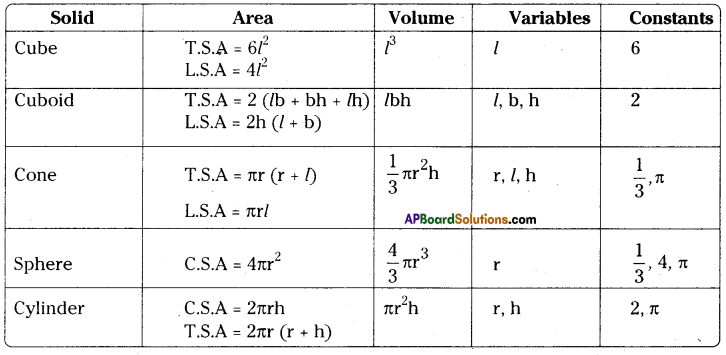
Write the formulae of area and volume of different solid shapes. Find out the variables and constants in them. [Page No. 29]
Solution:
AP Board 9th Class Maths Solutions Chapter 2 Polynomials and Factorisation InText Questions 1

Question 1.
Write the degree of each of the following polynomials. [Page No. 30]
Solution:
i) 7x3 + 5x2 + 2x – 6 – degree 3
ii) 7 – x + 3x2 – degree 2
iii) 5p – √3 – degree 1
iv) 2 – degree 0
v) – 5 xy2 – degree 3

AP Board 9th Class Maths Solutions Chapter 2 Polynomials and Factorisation InText Questions

Question 2.
Write the co-efficient of x2 in each of the following. [Page No. 30]
Solution:
i) 15 – 3x + 2x2 : co-efficient of x2 is 2
ii) 1 -x2 : co-efficient of x2 is -1
iii) πx2 – 3x + 5 : co-efficient of x2 is π
iv) √2x2 + 5x – 1 : co-efficient of x2 is √2

Think, Discuss and Write

Question
How many terms a cubic (degree 3) polynomial with one variable can have? Give examples. [Page No. 31]
Solution:
A cubic polynomial can have atmost 4 terms.
E.g.: 5x3 + 3x2 – 8x + 4; x3 – 8

Try These

Question 1.
Write a polynomial with 2 terms in variable x. [Page No. 31]
Solution:
2x + 3x2

AP Board 9th Class Maths Solutions Chapter 2 Polynomials and Factorisation InText Questions

Question 2.
How can you write a polynomial with 15 terms in variable ‘x’. [Page No. 31]
Solution:
a14p14 + a13p13 + a12p12+ …………….+ a1p + a0

Do This

Question
Find the value of each of the follow ing polynomials for the indicated value of variables. [Page No. 33]
(i) p(x) = 4x2 – 3x + 7 at x = 1.
Solution:
The value of p(x) at x = 1 is
4(1)2 – 3(1) + 7 = 8

ii) q(y) = 2y3 – 4y + √11 at y = 1.
Solution:
The value of q(y) at y = 1 is
2(1)3 – 4(1) + √11 = -2 + √11

iii) r(t) = 4t4 + 3t3 – t2 + 6 at t = p, t ∈ R.
Solution:
The value of r(t) at t = p is
4p4 + 3p3 – p2 + 6

AP Board 9th Class Maths Solutions Chapter 2 Polynomials and Factorisation InText Questions

iv) s(z) = z3 – 1 at z – 1.
Solution:
The value of s(z) at z = 1 is 13 – 1 = 0

v) p(x) = 3x2 + 5x – 7 at x = 1.
Solution:
The value of p(x) at x = 1 is
3(1)2 + 5(1) — 7 = 1.

vi) q(z) = 5z3 – 4z + √2 at 7. = 2.
Solution:
The value of q(z) at z = 2 is
5(2)3 – 4(2) + √2 = 40 – 8 + √2
= 32 + √2

AP Board 9th Class Maths Solutions Chapter 2 Polynomials and Factorisation InText Questions

Try These

Question
Find zeroes of the following polyno¬mials. [Page No. 34]

1. 2x-3
Solution:
2x – 3 = 0
2x = 3
x = \(\frac{3}{2}\)
∴ x = \(\frac{3}{2}\) is the zero of 2x – 3.

2. x2 – 5x + 6
Solution:
x2 – 5x + 6 = 0
⇒ x2 – 3x – 2x + 6 = 0
⇒ x (x – 3) – 2 (x – 3) = 0
⇒ (x – 2) (x – 3) = 0
⇒ x – 2 = 0 or x – 3 = 0
⇒ x = 2 or x = 3
∴ x = 2 or 3 are the zeroes of x2 – 5x + 6.

AP Board 9th Class Maths Solutions Chapter 2 Polynomials and Factorisation InText Questions

3. x + 5
Solution:
x + 5 = 0
x = – 5
∴ x = – 5

Do This

Fill in the bianks : [Page No. 35]

Linear polynomialZero of the polynomial
x + a– a
x – aa
ax + b\( \frac{-b}{a} \)
ax – b\( \frac{b}{a} \)

Solution:

Linear polynomialZero of the polynomial
x + a– a
x – aa
ax + b\( \frac{-b}{a} \)
ax – b\( \frac{b}{a} \)

Think, and Discuss

Question 1.
x2 + 1 has no zeroes. Why ? [Page No. 36]
Solution:
x2 + 1 = 0 ⇒ x2 = -1
No real number exists such that whose root is – 1.
∴ x2 + 1 has no zeroes.

AP Board 9th Class Maths Solutions Chapter 2 Polynomials and Factorisation InText Questions

Question 2.
Can you tell the number of zeroes of a polynomial of degree ‘n’ will have? [Page No. 36]
Solution:
A polynomial of degree n will have n- zeroes.

Do These

Question 1.
Divide 3y3 + 2y2 + y by ‘y’ and write division fact. [Page No. 38]
Solution:
(3y3 + 2y2 + y) ÷ y = \(\frac{3 y^{3}}{y}+\frac{2 y^{2}}{y}+\frac{y}{y}\)
= 3y2 + 2y + 1
Division fact = (3y2 + 2y + 1) y
= 3y3 + 2y2 + y

AP Board 9th Class Maths Solutions Chapter 2 Polynomials and Factorisation InText Questions

Question 2.
Divide 4p2 + 2p + 2 by ‘2p’ and write division fact.
Solution:
4p2 + 2p ÷ 2 = \(\frac{4 p^{2}}{2 p}+\frac{2 p}{2 p}+\frac{2}{2 p}\)
= 2p + 1 + \(\frac{1}{\mathrm{P}}\)
Division fact:
(2p + 1 + \(\frac{1}{\mathrm{P}}\)).2p = 4p2 + 2p + 2

Try These

Show that (x – 1) is a factor of xn – 1. [Page No. 45]
Solution:
Let p(x) = xn – 1
Then p(1) = 1n – 1 = 1 – 1 = 0
As p(1) = 0, (x – 1) is a factor of p(x).

Do These

Question
Factorise the following. [Page No. 46]

1. 6x2 + 19x + 15
Solution:
6x2 + 19x + 15 = 6x2 + 10x + 9x + 15
= 2x (3x + 5) + 3 (3x + 5)
= (3x + 5) (2x + 3)

AP Board 9th Class Maths Solutions Chapter 2 Polynomials and Factorisation InText Questions

2. 10m2 – 31m – 132
Solution:
10m2 – 31m – 132
= 10m2 – 55m + 24m – 132
= 5m (2m- 11) + 12 (2m- 11)
= (2m – 11) (5m + 12)

3. 12x2 + 11x + 2
Solution:
12x2 + 11x + 2
= 12x2 + 8x + 3x + 2
= 4x (3x + 2) + 1 (3x + 2)
= (3x + 2) (4x + 1)

AP Board 9th Class Maths Solutions Chapter 2 Polynomials and Factorisation InText Questions

Try This

Question
Try to draw the geometrical figures for other identities. [Page No. 49]
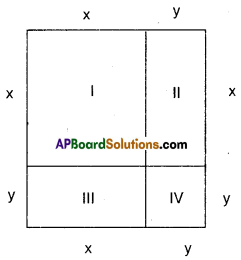
i) (x + y)2 ≡ x2 + 2xy + y2
AP Board 9th Class Maths Solutions Chapter 2 Polynomials and Factorisation InText Questions 2
Step – 1 : Area of fig. I = x x = x2
Step – 2 : Area of fig. II = x y = xy
Step – 3 : Area of fig. III = x y = xy
Step – 4 : Area of fig. IV = y y = y2

Area of big square = sum of the areas of figures I, II, III and IV
∴ (x + y) (x + y) = x2 + xy + xy + y2
(x + y)2 = x2 + 2xy + y2

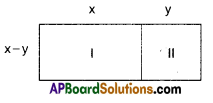
ii) (x + y) (x – y) ≡ x2 – y2
AP Board 9th Class Maths Solutions Chapter 2 Polynomials and Factorisation InText Questions 3
Step -1: Area of fig! I = x (x – y) = x2 – xy
Step – 2: Area of fig. II = (x – y) y = xy – y2
Area of big rectangle = sum of areas of figures I & II
(x + y) (x – y) = x2 – xy + xy – y2
= x2 – y2
∴ (x + y) (x-y) = x2-y2

AP Board 9th Class Maths Solutions Chapter 2 Polynomials and Factorisation InText Questions

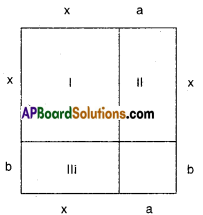
iii) (x + a) (x + b) ≡ x2 + (a + b) x + ab
AP Board 9th Class Maths Solutions Chapter 2 Polynomials and Factorisation InText Questions 4
Step – 1 : Area of fig. I = x2
Step – 2 : Area of fig. II = ax
Step – 3 : Area of fig. Ill = bx
Step – 4 : Area of fig. IV = ab
∴ Area of big rectangle = Sum of areas of four small figures.
∴ (x + a) (x + b) = x2 + ax + bx + ab
(x + a) (x + b) = x2 + (a + b) x + ab

Do These

Question
Find the following product using appropriate identities. [Page No. 49]
i) (x + 5) (x + 5)
Solution:
(x + 5) (X + 5) = (x + 5)2
= x2 + 2(x) (5) + 52
= x2 + 10x + 25

ii) (p – 3) (p + 3)
Solution:
(p – 3) (p + 3)
= p2 – 32
= p2 – 9

iii) (y – 1) (y – 1)
Solution:
(y – 1) (y – 1)
= (y – 1)2
= y2 – 2y + 1

AP Board 9th Class Maths Solutions Chapter 2 Polynomials and Factorisation InText Questions

iv) (t + 2) (t + 4)
Solution:
(t + 2) (t + 4)
= t2 + t(2 + 4) + 2 x 4
= t2 + 6t + 8

v) 102 x 98
Solution:
102 x 98 = (100 + 2) (100 -2)
= 1002 – 22
= 10000 – 4
= 9996

AP Board 9th Class Maths Solutions Chapter 2 Polynomials and Factorisation InText Questions

Do These

Question
Factorise the following using appro-priate identities. [Page No. 50]
i) 49a2 + 70ab + 25b2
Solution:
49a2 + 70ab + 25b2
= (7a)2 + 2 (7a) (5b) + (5b)2
= (7a + 5b)2
= (7a + 5b)(7a + 5b)

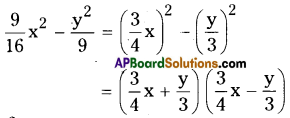
ii) \(\frac{9}{16} x^{2}-\frac{y^{2}}{9}\)
Solution:
AP Board 9th Class Maths Solutions Chapter 2 Polynomials and Factorisation InText Questions 5

iii) t2 – 2t + 1
= (t)2 – 2(t) (1) + (1)2
= (t – 1)2 = (t – 1) (t – 1)

iv) x2 + 3x + 2
Solution:
x2 + 3x + 2 = x2 + (2 + 1) x + (2 x 1)
(x + 2) (x + 1)

AP Board 9th Class Maths Solutions Chapter 2 Polynomials and Factorisation InText Questions

Do These

Question i)
Write (p + 2q + r)2 in expanded form. [Page No. 52]
Solution:
(p + 2q + r)2 = (p)2 + (2q)2 + (r)2
+ 2 (P) (2q) + 2 (2q) (r) + 2(r) (p)
= p2 + 4q2 + r2 + 4pq + 4qr + 2rp

Question ii)
Expand (4x – 2y – 3z)2 using identity. [Page No. 52]
Solution:
(4x – 2y – 3z)2 = (4x)2 + (- 2y)2 + (- 3z)2 + 2 (4x) (- 2y) + 2 (- 2y) (- 3z) + 2 (- 3z) (4x)
= 16x2 + 4y2 + 9z2 – 16xy + 12yz – 24zx.

Question iii)
Factorise 4a2 + b2 + c2 – 4ab + 2bc – 4ca
using identity. [Page No. 52]
Solution:
4a2 + b2 + c2 – 4ab + 2bc – 4ca
= (2a)2 + (- b)2 + (- c)2 + 2(2a) (- b) + 2 (- b) (- c) + 2(- c) (2a)
= (2a – b – c)2 = (2a – b – c) (2a – b – c)

AP Board 9th Class Maths Solutions Chapter 2 Polynomials and Factorisation InText Questions

Try These

Question
How can you find (x – y)3 without actual multiplication ? Verify with actual multiplication. [Page No. 52]
Solution:
(x – y)3 = x3 – 3x2y + 3xy2 – 3y3 from identity.
By actual multiplication
(x – y)3 = (x – y)2 (x – y)
= (x2 – 2xy + y2) (x – y)
= x3 – 2x2y + xy2 – x2y + 2xy2 – y3
= x3 – 3x2 y + 3xy2 – y3
Both are equal.

Do These

Question 1.
Expand (x + 1)3 using an identity. [Page No. 54]
Solution:
(x + 1)3 = (x)3 + (1)3 + 3 (x) (1) (x + 1)
= x3 + 1 + 3x (x + 1)
= x3 + 1 + 3x2 + 3x = x3 + 3x2 + 3x + 1

Question 2.
Compute (3m – 2n)3. [Page No. 54]
Solution:
(3m-2n)3
=(3m)3 – 3 (3m)2 (2n) + 3 (3m) (2n)2 – (2n)3
= 27m3 – 54m2n + 36mn2 – 8n3

AP Board 9th Class Maths Solutions Chapter 2 Polynomials and Factorisation InText Questions

Question 3.
Factorise a3 – 3a2b + 3ab2 – b3. [Page No. 54]
Solution:
a3 – 3a2b + 3ab2 – b3
= (a)3 – 3 (a)2 (b) + 3 (a) (b)2 – (b)3
= (a – b)3
= (a – b) (a – b) (a – b)

Do These

Question 1.
Find the product (a – b – c) (a2 + b2 + c2 – ab + be – ca) without actual multi-plication. [Page No. 55]
Solution:
The problem is incorrect.

AP Board 9th Class Maths Solutions Chapter 2 Polynomials and Factorisation InText Questions

Question 2.
Factorise 27a3 + b3 + 8c3 – 18abc using identity. [Page No. 55]
Solution:
27a3 + b3 + 8c3 – 18abc
= (3a)3 + (b)3 + (2c)3 – 3(3a) (b) (2c)
= (3a + b + 2c) (9a2 + b2 + 4c2 – 3ab – 2be – 6ca)
AP Board 9th Class Maths Solutions Chapter 8 Quadrilaterals Ex 8.2

AP State Syllabus AP Board 9th Class Maths Solutions Chapter 8 Quadrilaterals Ex 8.2 Textbook Questions and Answers.

AP State Syllabus 9th Class Maths Solutions 8th Lesson Quadrilaterals Exercise 8.2

Question 1.
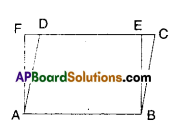
In the given figure ABCD is a parallelogram. ABEF is a rectangle. Show that ΔAFD ≅ ΔBEC
AP Board 9th Class Maths Solutions Chapter 8 Quadrilaterals Ex 8.2 1
Solution:
Given that □ABCD is a parallelogram.
□ABEF is a rectangle.
In ΔAFD and ΔBEC
AF = BE ( ∵ opp. sides of rectangle □ABEF)
AD = BC (∵ opp. sides of //gm □ABCD)
DF = CE (∵ AB = DC = DE + EC , AB = EF = DE + DF)
∴ ΔAFD ≅ ΔBEC (SSS congruence)

AP Board 9th Class Maths Solutions Chapter 8 Quadrilaterals Ex 8.2

Question 2.
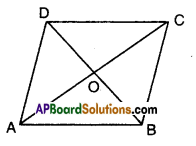
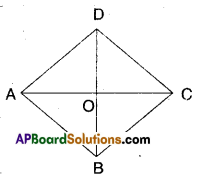
Show that the diagonals of a rhombus divide it into four congruent triangles.
Solution:
AP Board 9th Class Maths Solutions Chapter 8 Quadrilaterals Ex 8.2 2
□ABCD is a rhombus.
Let AC and BD meet at O’.
In ΔAOB and ΔCOD
∠OAB = ∠OCD (alt.int. angles)
AB = CD (def. of rhombus)
∠OBA = ∠ODC ………………….(1) (alt. int. angles)
∴ ΔAOB ≅ ΔCOD (ASA congruence)
Thus AO = OC (CPCT)
Also ΔAOD ≅ ΔCOD …………..(2)
[ ∵ AO = OC; AD = CD; OD = OD SSS congruence]
Similarly we can prove
ΔAOD ≅ ΔCOB ……………. (3)
From (1), (2) and (3) we have
ΔAOB ≅ ΔBOC ≅ ΔCOD ≅ ΔAOD
∴ Diagonals of a rhombus divide it into four congruent triangles.

AP Board 9th Class Maths Solutions Chapter 8 Quadrilaterals Ex 8.2

Question 3.
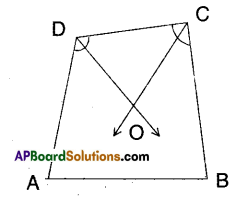
In a quadrilateral ABCD, the bisector of ∠C and ∠D intersect at O. Prove that ∠COD = \(\frac{1}{2}\) (∠A + ∠B) .
(OR)
In a quadrilateral ABCD, the bisectors of ∠A and ∠B are intersects at ‘O’ then prove that ∠AOB = \(\frac{1}{2}\) (∠C + ∠D)
Solution:
AP Board 9th Class Maths Solutions Chapter 8 Quadrilaterals Ex 8.2 3
In a quadrilateral □ABCD
∠A + ∠B + ∠C + ∠D = 360°
(angle sum property)
∠C + ∠D = 360° – (∠A + ∠B)
\(\frac{1}{2}\) (∠C + ∠D) = 180 – \(\frac{1}{2}\) (∠A + ∠B) ………….. (1)
(∵ dividing both sides by 2) .
But in ΔCOD
\(\frac{1}{2}\)∠C + \(\frac{1}{2}\)∠D + ∠COD = 180°
\(\frac{1}{2}\)∠C + \(\frac{1}{2}\)∠D = 180° – ∠COD
∴\(\frac{1}{2}\)(∠C +∠D) = 180° -∠COD………….(2)
From (1) and (2);
180° – ∠COD = 180° – \(\frac{1}{2}\) (∠A + ∠B)
∴ ∠COD = \(\frac{1}{2}\) (∠A + ∠B)
Hence proved.

AP Board 9th Class Maths Solutions Chapter 8 Quadrilaterals Ex 8.1

AP State Syllabus AP Board 9th Class Maths Solutions Chapter 8 Quadrilaterals Ex 8.1 Textbook Questions and Answers.

AP State Syllabus 9th Class Maths Solutions 8th Lesson Quadrilaterals Exercise 8.1

Question 1.
State whether the statements are true or false.
i) Every parallelogram is a trapezium.
ii) All parallelograms are quadrilaterals.
iii) All trapeziums are parallelograms.
iv) A square is a rhombus.
v) Every rhombus is a square.
vi) All parallelograms are rectangles.
Solution:
i) True
ii) True
iii) False
iv) True
v) False
vi) False

AP Board 9th Class Maths Solutions Chapter 8 Quadrilaterals Ex 8.1

Question 2.
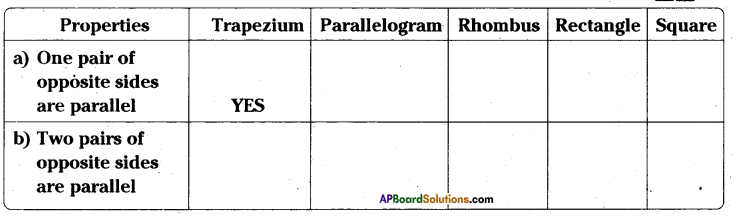
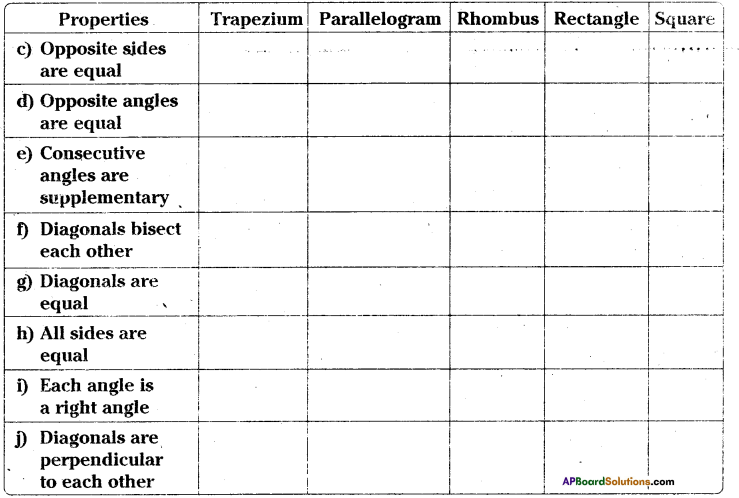
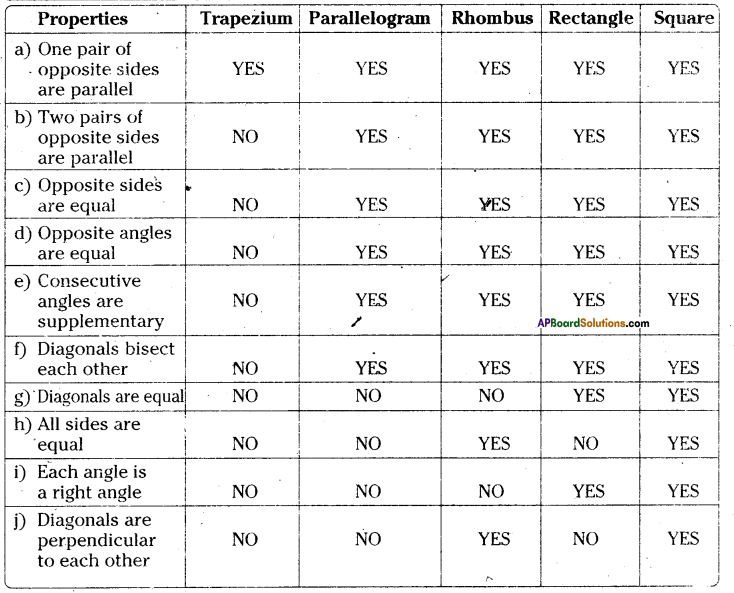
Complete the following table by writing YES if the property holds for the particular quadrilateral and NO if property does not holds.
AP Board 9th Class Maths Solutions Chapter 8 Quadrilaterals Ex 8.1 1 AP Board 9th Class Maths Solutions Chapter 8 Quadrilaterals Ex 8.1 2
Solution:
AP Board 9th Class Maths Solutions Chapter 8 Quadrilaterals Ex 8.1 3

Question 3.
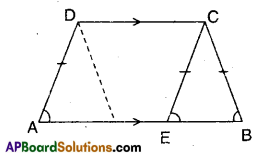
ABCD is a trapezium in which AB || CD. If AD = BC, show that ∠A = ∠B and ∠C = ∠D.
Solution:
Given that in □ABCD AB || CD; AD = BC
Mark a point ‘E’ on AB such DC = AE.
AP Board 9th Class Maths Solutions Chapter 8 Quadrilaterals Ex 8.1 4
Join E, C.
Now in AECD quadrilateral
AE // DC and AE = DC
∴ □AECD is a parallelogram.
∴ AD//EC
∠DAE = ∠CEB (corresponding angles) ……………..(1)
In ΔCEB; CE = CB (∵ CE = AD)
∴ ∠CEB = ∠CBE (angles opp. to equal sides) …………….. (2)
From (1) & (2)
∠DAE = ∠CBE
⇒ ∠A = ∠B
Also ∠D = ∠AEC (∵ Opp. angles of a parallelogram)
= ∠ECB + ∠CBE [ ∵ ∠AEC is ext. angle of ΔBCE] |
= ∠ECB + ∠CEB [ ∵∠CBE = ∠CEB]
= ∠ECB + ∠ECD [∵ ∠ECD = ∠CEB alt. int. angles]
= ∠BCD = ∠C
∴ ∠C = ∠D

AP Board 9th Class Maths Solutions Chapter 8 Quadrilaterals Ex 8.1

Question 4.
The four angles of a quadrilateral are in the ratio of 1 : 2 : 3 : 4. Find the measure of each angle of the quadri-lateral.
Solution:
Given that, the ratio of angles of a quad-rilateral = 1 : 2 : 3 : 4
Sum of the terms of the ratio
= 1 +2 + 3 + 4= 10
Sum of the four interior angles of a quadrilateral = 360°
∴ The measure of first angle
= \(\frac{1}{10}\) × 360° = 36°
The measure of second angle
= \(\frac{2}{10}\) × 360° = 72°
The measure of third angle
= \(\frac{3}{10}\) × 360° = 108°
The measure of fourth angle
= \(\frac{4}{10}\) × 360° = 144°

AP Board 9th Class Maths Solutions Chapter 8 Quadrilaterals Ex 8.1

Question 5.
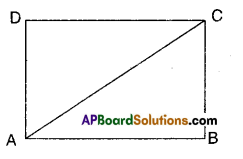
ABCD is a rectangle, AC is diagonal. Find the angles of ΔACD. Give reasons.
Solution:
AP Board 9th Class Maths Solutions Chapter 8 Quadrilaterals Ex 8.1 5
Given that □ABCD is a rectangle;
AC is its diagonal.
In ΔACD; ∠D = 90° [ ∵ ∠D is also angle of the rectangle]
∠A + ∠C = 90° [ ∵ ∠D = 90° ⇒ ∠A + ∠C = 180°-90° = 90°]
(i.e,,) ∠D right angle and
∠A, ∠C are complementary angles.

AP Board 9th Class Maths Solutions Chapter 12 Circles Ex 12.4

AP State Syllabus AP Board 9th Class Maths Solutions Chapter 12 Circles Ex 12.4 Textbook Questions and Answers.

AP State Syllabus 9th Class Maths Solutions 12th Lesson Circles Exercise 12.4

AP Board 9th Class Maths Solutions Chapter 12 Circles Ex 12.4

Question 1.
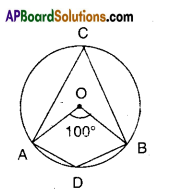
In the figure, ‘O’ is the centre of the circle. ∠AOB = 100°, find ∠ADB.
AP Board 9th Class Maths Solutions Chapter 12 Circles Ex 12.4 1
Solution:
’O’ is the centre
∠AOB = 100°
AP Board 9th Class Maths Solutions Chapter 12 Circles Ex 12.4 2
Thus ∠ACB = \(\frac{1}{2}\) ∠AOB
[∵ angle made by an arc at the centre is twice the angle made by it on the remaining part]]
= \(\frac{1}{2}\) x 100° = 50°
∠ACB and ∠ADB are supplementary
[ ∵ Opp. angles of a cyclic quadrilateral]
∴ ∠ADB = 180°-50° = 130°
[OR]
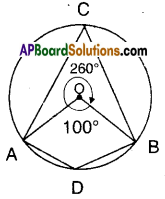
∠ADB is the angle made by the major arc \(\widehat{\mathrm{ACB}}\) at D.
∴ ∠ADB = \(\frac{1}{2}\)∠AOB [where ∠AOB is the angle; made by \(\widehat{\mathrm{ACB}}\) at the centre]
= \(\frac{1}{2}\) [360° – 100°] [from the figure]
= \(\frac{1}{2}\) x 260° = 130°

AP Board 9th Class Maths Solutions Chapter 12 Circles Ex 12.4

Question 2.
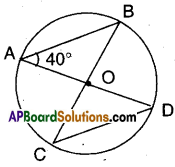
In the figure, ∠BAD = 40° then find ∠BCD.
AP Board 9th Class Maths Solutions Chapter 12 Circles Ex 12.4 3
Solution:
‘O’ is the centre of the circle.
∴ In ΔOAB; OA = OB (radii)
∴ ∠OAB = ∠OBA = 40°
(∵ angles opp. to equal sides)
Now ∠AOB = 180° – (40° + 40°)
(∵ angle sum property of ΔOAB)
= 180°-80° = 100°
But ∠AOB = ∠COD = 100°
Also ∠OCD = ∠ODC [OC = OD]
= 40° as in ΔOAB
∴ ∠BCD = 40°
(OR)
In ΔOAB and ΔOCD
OA = OD (radii)
OB = OC (radii)
∠AOB = ∠COD (vertically opp. angles)
∴ ΔOAB ≅ ΔOCD
∴ ∠BCD = ∠OBA = 40°
[ ∵ OB = OA ⇒ ∠DAB = ∠DBA]

AP Board 9th Class Maths Solutions Chapter 12 Circles Ex 12.4

Question 3.
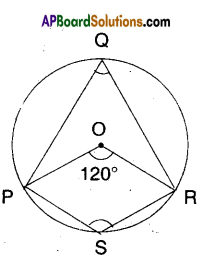
In the figure, ‘O’ is the centre of the circle and ∠POR = 120°. Find ∠PQR and ∠PSR.
AP Board 9th Class Maths Solutions Chapter 12 Circles Ex 12.4 4
Solution:
‘O’ is the centre; ∠POR = 120°
∠PQR = \(\frac{1}{2}\)∠POR [∵ angle made by an arc at the centre is, twice the angle made by it on the remaining part]
∠PSR = \(\frac{1}{2}\) [Angle made by \(\widehat{\mathrm{PQR}}\) at the centre]
∠PSR = \(\frac{1}{2}\) [360° – 120°] from the fig.
= \(\frac{1}{2}\) x 240 = 120°

Question 4.
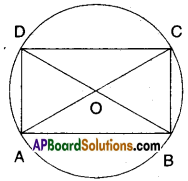
If a parallelogram is cyclic, then it is a rectangle. Justify.
Solution:
AP Board 9th Class Maths Solutions Chapter 12 Circles Ex 12.4 5
Let □ABCD be a parallelogram such
that A, B, C and D lie on the circle.
∴∠A + ∠C = 180° and ∠B + ∠D = 180°
[Opp. angles of a cyclic quadri lateral are supplementary]
But ∠A = ∠C and ∠B = ∠D
[∵ Opp. angles of a ||gm are equal]
∴∠A = ∠C =∠B =∠D = \(\frac{180}{2}\) = 90°
Hence □ABCD is a rectangle

AP Board 9th Class Maths Solutions Chapter 12 Circles Ex 12.4

Question 5.
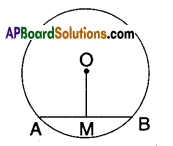
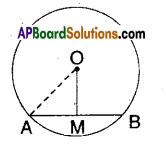
In the figure, ‘O’ is the centr of the circle. 0M = 3 cm and AB = 8 cm. Find the radius of the circle.
AP Board 9th Class Maths Solutions Chapter 12 Circles Ex 12.4 6
Solution:
AP Board 9th Class Maths Solutions Chapter 12 Circles Ex 12.4 7
‘O’ is the centre of the circle.
OM bisects AB.
∴ AM = \(\frac{\mathrm{AB}}{2}=\frac{8}{2}\) = 4 cm
OA2 = OM2 + AM2 [ ∵ Pythagoras theorem]
OA \(\begin{array}{l}
=\sqrt{3^{2}+4^{2}} \\
=\sqrt{9+16}=\sqrt{25}
\end{array}\)
= 5cm

Question 6.
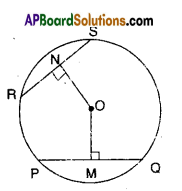
In the figure, ‘O’ is the centre of the circle and OM, ON are the perpen-diculars from the centre to the chords PQ and RS. If OM = ON and PQ = 6 cm. Find RS.
AP Board 9th Class Maths Solutions Chapter 12 Circles Ex 12.4 8
Solution:
‘O’ is the centre of the circle.
OM = ON and 0M ⊥ PQ; ON ⊥ RS
Thus the chords FQ and RS are equal.
[ ∵ chords which are equidistant from the centre are equal in length]
∴ RS = PQ = 6cm

AP Board 9th Class Maths Solutions Chapter 12 Circles Ex 12.4

Question 7.
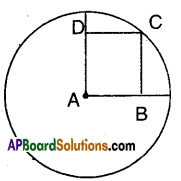
A is the centre of the circle and ABCD is a square. If BD = 4 cm then find the
radius of the circle.
AP Board 9th Class Maths Solutions Chapter 12 Circles Ex 12.4 9
Solution:
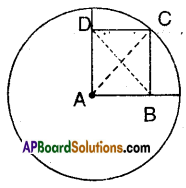
AP Board 9th Class Maths Solutions Chapter 12 Circles Ex 12.4 10
A is the centre of the circle and ABCD is a square, then AC and BD are its diagonals. Also AC = BD = 4 cm But AC is the radius of the circle.
∴ Radius = 4 cm.

Question 8.
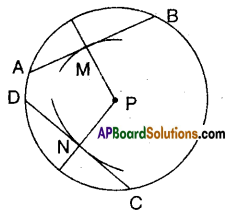
Draw a circle with any radius and then draw two chords equidistant
from the centre.
Solution:
AP Board 9th Class Maths Solutions Chapter 12 Circles Ex 12.4 11

  1. Draw a circle with centre P.
  2. Draw any two radii.
  3. Mark off two points M and N oh these radii. Such that PM = PN.
  4. Draw perpendicular through M and N to these radii.

AP Board 9th Class Maths Solutions Chapter 12 Circles Ex 12.4

Question 9.
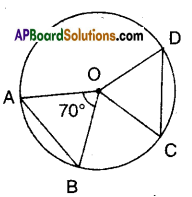
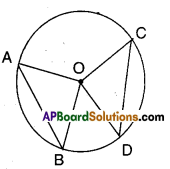
In the given figure, ‘O’ is the centre of the circle and AB, CD are equal chords. If ∠AOB = 70°. Find the angles of ΔOCD.
AP Board 9th Class Maths Solutions Chapter 12 Circles Ex 12.4 12
Solution:
‘O’ is the centre of the circle.
AB, CD are equal chords
⇒ They subtend equal angles at the centre.
∴ ∠AOB =∠COD = 70°
Now in ΔOCD
∠OCD = ∠ODC [∵ OC = OD; radii angles opp. to equal sides]
∴ ∠OCD + ∠ODC + 70° = 180°
= ∠OCD +∠ODC = 180° – 70° = 110°
∴ ∠OCD + ∠ODC = 110° = 55°

AP Board 9th Class Maths Solutions Chapter 7 Triangles Ex 7.1

AP State Syllabus AP Board 9th Class Maths Solutions Chapter 7 Triangles Ex 7.1 Textbook Questions and Answers.

AP State Syllabus 9th Class Maths Solutions 7th Lesson Triangles Exercise 7.1

AP Board 9th Class Maths Solutions Chapter 7 Triangles Ex 7.1

Question 1.
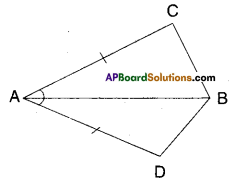
In quadrilateral ACBD, AC = AD and AB bisects ∠A. Show that ΔABC ≅ ΔABD What can you say about BC and BD ?
AP Board 9th Class Maths Solutions Chapter 7 Triangles Ex 7.1 1
Solution:
Given that AC = AD
∠BAC = ∠BAD (∵ AB bisects∠A)
Now in ΔABC and ΔABD
AC = AD (∵ given)
∠BAC = ∠BAD (Y given)
AB = AB (common side)
∴ ΔABC ≅ ΔABD
(∵ SAS congruence rule)

AP Board 9th Class Maths Solutions Chapter 7 Triangles Ex 7.1

Question 2.
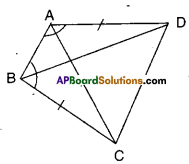
ABCD is a quadrilateral in which AD = BC and ∠DAB = ∠CBA, prove that i) ΔABD ≅ΔBAC ii) BD = AC
iii) ∠ABD = ∠BAC.
AP Board 9th Class Maths Solutions Chapter 7 Triangles Ex 7.1 2
Solution :
i) Given that AD = BC and
∠DAB = ∠CBA
Now in ΔABD and ΔBAC
AB = AB (∵ Common side)
AD = BC (∵ given)
∠DAB = ∠CBA (∵ given)
∴ ΔABD ≅ ΔBAC
(∵ SAS congruence)
ii) From (i) AC = BD (∵ CPCT)
iii) ∠ABD = ∠BAC [ ∵ CPCT from (i)]

Question 3.
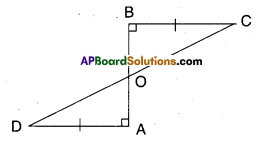
AD and BC are equal and perpendi-culars to a line segment AB. Show that CD bisects AB.
AP Board 9th Class Maths Solutions Chapter 7 Triangles Ex 7.1 3
Solution:
Given that AD = BC; AD ⊥ AB; BC ⊥ AB
In ΔBOC and ΔAOD
∠BOC = ∠AOD (∵ vertically opposite angles)
∴ ΔOBC = ΔOAD (∵ right angle)
BC = AD
ΔOBC ≅ ΔOAD (∵ AAS congruence)
∴ OB = OA (∵ CPCT)
∴ ‘O’ bisects AB
Also OD = OC
∴ ‘O’ bisects CD
⇒ AB bisects CD

AP Board 9th Class Maths Solutions Chapter 7 Triangles Ex 7.1

Question 4.
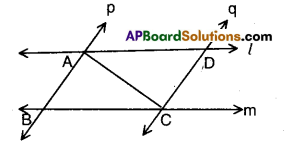
l and m are two parallel lines inter-sected by another pair of parallel lines p and q. Show that ΔABC ≅ ΔCDA.
AP Board 9th Class Maths Solutions Chapter 7 Triangles Ex 7.1 4
Solution:
Given that l // m; p // q.
In ΔABC and ΔCDA
∠BAC = ∠DCA (∵ alternate interior angles)
∠ACB = ∠CAD
AC = AC
∴ ΔABC ≅ ΔCDA (∵ ASA congruence)

Question 5.
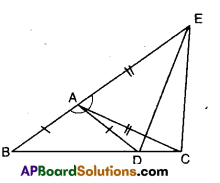
In the figure given below AC = AE; AB = AD and ∠BAD = ∠EAC. Show that BC = DE.
AP Board 9th Class Maths Solutions Chapter 7 Triangles Ex 7.1 5
Solution:
Given that AC = AE, AB = AD and
∠BAD = ∠EAC
In ΔABC and ΔADE
AB = AD
AC = AE
∠BAD = ∠EAC
∴ ΔABC ≅ ΔADE (∵ SAS congruence)
⇒ BC = DE (CPCT)

AP Board 9th Class Maths Solutions Chapter 7 Triangles Ex 7.1

Question 6.
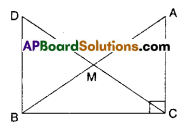
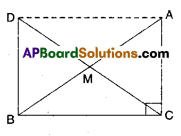
In right triangle ABC, right angle is at ‘C’ M is the mid-point of hypotenuse AB. C is joined to M and produced to a point D such that DM = CM. Point D is joined to point B (see fig.). Show that
AP Board 9th Class Maths Solutions Chapter 7 Triangles Ex 7.1 6
i) ΔAMC = ΔBMD
ii) ∠DBC is a right angle
iii) ΔDBC = ΔACB
iv) CM = \(\frac{1}{2}\) AB
Solution:
Given that ∠C = 90°
M is mid point of AB;
DM = CM (i.e., M is mid point of DC)
AP Board 9th Class Maths Solutions Chapter 7 Triangles Ex 7.1 7
i) In ΔAMC and ΔBMD
AM = BM (∵ M is mid point of AB)
CM = DM ( ∵ M is mid point of CD)
∠AMC = ∠BMD ( ∵ Vertically opposite angles)
∴ ΔAMC ≅ ΔBMD
(∵ SAS congruence)

AP Board 9th Class Maths Solutions Chapter 7 Triangles Ex 7.1

ii) ∠MDB = ∠MCA
(CPCT of ΔAMC and ΔBMD)
But these are alternate interior angles for the lines DB and AC and DC as transversal.
∴DB || AC
As AC ⊥ BC; DB is also perpendicular to BC.
∴ ∠DBC is a right angle.

iii) In ΔDBC and ΔACB
DB = AC (CPCT of ΔBMD and ΔAMC)
∠DBC = ∠ACB = 90°(already proved)
BC = BC (Common side)
∴ ΔDBC ≅ ΔACB (SAS congruence rule)

iv) DC = AB (CPCT of ΔDBC and ΔACB)
\(\frac { 1 }{ 2 }\) DC = \(\frac { 1 }{ 2 }\) AB (Dividing both sides by 2)
CM = \(\frac { 1 }{ 2 }\)AB

Question 7.
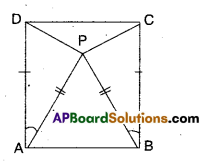
In the given figure ΔBCD is a square and ΔAPB is an equilateral triangle.
Prove that ΔAPD ≅ ΔBPC.
[Hint: In ΔAPD and ΔBPC; \(\overline{\mathbf{A D}}=\overline{\mathbf{B C}}\), \(\overline{\mathbf{AP}}=\overline{\mathbf{BP}}\) and ∠PAD = ∠PBC = 90° – 60° = 30°]
AP Board 9th Class Maths Solutions Chapter 7 Triangles Ex 7.1 8
Solution:
Given that □ABCD is a square.
ΔAPB is an equilateral triangle.
Now in ΔAPD and ΔBPC
AP = BP ( ∵ sides of an equilateral triangle)
AD = BC (∵ sides of a square)
∠PAD = ∠PBC [ ∵ 90° – 60°]
∴ ΔAPD ≅ ΔBPC (by SAS congruence)

AP Board 9th Class Maths Solutions Chapter 7 Triangles Ex 7.1

Question 8.
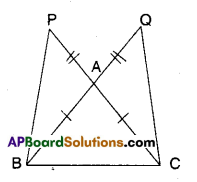
In the figure given below ΔABC is isosceles as \(\overline{\mathbf{A B}}=\overline{\mathbf{A C}} ; \overline{\mathbf{B A}}\) and \(\overline{\mathbf{CA}}\) are produced to Q and P such that \(\overline{\mathbf{A Q}}=\overline{\mathbf{AP}}\). Show that \(\overline{\mathbf{PB}}=\overline{\mathbf{QC}}\) .
(Hint: Compare ΔAPB and ΔACQ)
AP Board 9th Class Maths Solutions Chapter 7 Triangles Ex 7.1 9
Solution:
Given that ΔABC is isosceles and
AP = AQ
Now in ΔAPB and ΔAQC
AP = AQ (given)
AB = AC (given)
∠PAB = ∠QAC (∵ Vertically opposite angles)
∴ ΔAPB ≅ ΔAQC (SAS congruence)
∴ \(\overline{\mathbf{PB}}=\overline{\mathbf{QC}}\) (CPCT of ΔAPB and ΔAQC)

AP Board 9th Class Maths Solutions Chapter 7 Triangles Ex 7.1

Question 9.
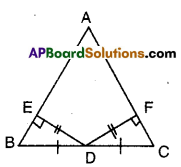
In the figure given below AABC, D is the midpoint of BC. DE ⊥ AB, DF ⊥ AC and DE = DF. Show that ΔBED ≅ AΔCFD.
AP Board 9th Class Maths Solutions Chapter 7 Triangles Ex 7.1 10
Solution:
Given that D is the mid point of BC of ΔABC.
DF ⊥ AC; DE = DF
DE ⊥ AB
In ΔBED and ΔCFD
∠BED = ∠CFD (given as 90°)
BD = CD (∵D is mid point of BC)
ED = FD (given)
∴ ΔBED ≅ ΔCFD (RHS congruence)

Question 10.
If the bisector of an angle of a triangle also bisects the opposite side, prove that the triangle is isosceles.
Solution:
AP Board 9th Class Maths Solutions Chapter 7 Triangles Ex 7.1 11
Let ΔABC be a triangle.
The bisector of ∠A bisects BC
To prove: ΔABC is isosceles
(i.e., AB = AC)
We know that bisector of vertical angle divides the base of the triangle in the ratio of other two sides.
∴ \(\frac{\mathrm{AB}}{\mathrm{AC}}=\frac{\mathrm{BD}}{\mathrm{BC}}\)
Thus \(\frac{\mathrm{AB}}{\mathrm{AC}}\) = 1( ∵ given)
⇒ AB = AC
Hence the Triangle is isosceless.

AP Board 9th Class Maths Solutions Chapter 7 Triangles Ex 7.1

Question 11.
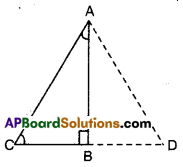
In the given figure ΔABC is a right triangle and right angled at B such that ∠BCA = 2 ∠BAC. Show that the hypotenuse AC = 2BC.
AP Board 9th Class Maths Solutions Chapter 7 Triangles Ex 7.1 12
[Hint : Produce CB to a point D that BC = BD]
Solution:
AP Board 9th Class Maths Solutions Chapter 7 Triangles Ex 7.1 13
Given that ∠B = 90°; ∠BCA = 2∠BAC
To prove : AC = 2BC
Produce CB to a point D such that
BC = BD
Now in ΔABC and ΔABD
AB = AB (common)
BC = BD (construction)
∠ABC =∠ABD (∵ each 90°)
∴ ΔABC ≅ ΔABD
Thus AC = AD and ∠BAC = ∠BAD = 30° [CPCT]
[ ∵ If ∠BAC = x then
∠BCA = 2x
x + 2x = 90°
3x = 90°
⇒ x = 30°
∴ ∠ACB = 60°]
Now in ΔACD,
∠ACD = ∠ADC = ∠CAD = 60°
∴∠ACD is equilateral ⇒ AC = CD = AD
⇒ AC = 2BC (∵ C is mid point)

AP Board 9th Class Maths Solutions Chapter 12 Circles Ex 12.3

AP State Syllabus AP Board 9th Class Maths Solutions Chapter 12 Circles Ex 12.3 Textbook Questions and Answers.

AP State Syllabus 9th Class Maths Solutions 12th Lesson Circles Exercise 12.3

AP Board 9th Class Maths Solutions Chapter 12 Circles Ex 12.3

Question 1.
Draw the following triangles and construct circumcircles for them.
(OR)
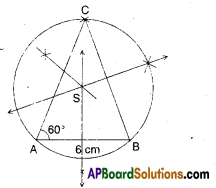
In ΔABC, AB = 6 cm, BC = 7 cm and ∠A = 60°.
Construct a circumcircle to the triangle XYZ given XY = 6cm, YZ = 7cm and ∠Y = 60°. Also, write steps of construction.
Solution:
AP Board 9th Class Maths Solutions Chapter 12 Circles Ex 12.3 1
Steps of construction :

  1. Draw the triangle with given mea-sures.
  2. Draw perpendicular bisectors to the sides.
  3. The point of concurrence of per-pendicular bisectors be S’.
  4. With centre S; SA as radius, draw a circle which also passes through B and C.
  5. This is the required circumcircle.

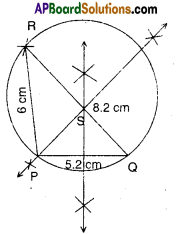
ii) In ΔPQR; PQ = 5 cm, QR = 6 cm and RP = 8.2 cm.
AP Board 9th Class Maths Solutions Chapter 12 Circles Ex 12.3 2
Steps of construction:

  1. Draw ΔPQR with given measures.
  2. Draw perpendicular to PQ, QR and RS; let they meet at ‘S’.
  3. With S as centre and SP as radius draw a circle.
  4. This is the required circumcircle.

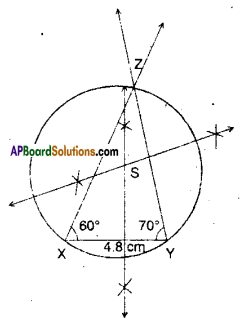
iii) In ΔXYZ, XY = 4.8 cm, ∠X = 60°and ∠Y = 70°.
AP Board 9th Class Maths Solutions Chapter 12 Circles Ex 12.3 3
Steps of construction:

  1. Draw ΔXYZ with given measures.
  2. Draw perpendicular bisectors to the sides of ΔXYZ, let the point of con-currence be S’.
  3. Draw the circle (S, \(\overline{\mathrm{SX}}\)).
  4. This is the required circumcircle.

AP Board 9th Class Maths Solutions Chapter 12 Circles Ex 12.3

Question 2.
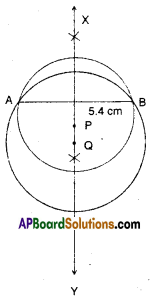
Draw two circles passing A, B where AB = 5.4 cm.
(OR)
Draw a line segment AB with 5.4 cm. length and draw two different circles that passes through both A and B.
Solution:
AP Board 9th Class Maths Solutions Chapter 12 Circles Ex 12.3 4
Steps of construction:

  1. Draw a line segment AB = 5.4 cm.
  2. Draw the perpendicular bisector \(\stackrel{\leftrightarrow}{X Y}\) of AB.
  3. Take any point P on \(\stackrel{\leftrightarrow}{X Y}\).
  4. With P as centre and PA as radius draw a circle.
  5. Let Q be another point on XY.
  6. Draw the circle (Q, \(\overline{\mathrm{QA}}\)).

Question 3.
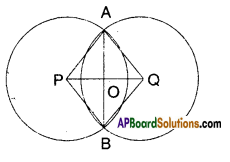
If two circles intersect at two points, then prove that their centres lie on the perpendicular bisector of the common chord.
Solution:
AP Board 9th Class Maths Solutions Chapter 12 Circles Ex 12.3 5
Let two circles with centre P and Q intersect at two distinct points say A and B.
Join A, B to form the common chord
\(\overline{\mathrm{AB}}\). Let ‘O’ be the midpoint of AB.
Join ‘O’ with P and Q.
Now in ΔAPO and ΔBPO
AP = BP (radii)
PO = PO (common)
AO = BO (∵ O is the midpoint)
∴ ΔAPO ≅ ΔBPO (S.S.S. congruence)
Also ∠AOP = ∠BOP (CPCT)
But these are linear pair of angles.
∴ ∠AOP = ∠BOP = 90°
Similarly in ΔAOQ and ΔBOQ
AQ = BQ (radii)
AO = BO (∵ O is the midpoint of AB)
OQ = OQ (common)
∴ AAOQ ≅ ABOQ
Also ∠AOQ = ∠BOQ (CPCT)
Also ∠AOQ + ∠BOQ = 180° (linear pair of angles)
∴ ∠AOQ = ∠BOQ = \(\frac{180^{\circ}}{2}\) = 90°
Now ∠AOP + ∠AOQ = 180°
∴ PQ is a line.
Hence the proof.

AP Board 9th Class Maths Solutions Chapter 12 Circles Ex 12.3

Question 4.
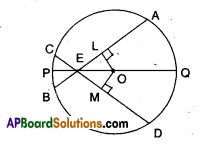
If two intersecting chords of a circle make equal angles with diameter pass¬ing through their point of intersection, prove that the chords are equal.
AP Board 9th Class Maths Solutions Chapter 12 Circles Ex 12.3 6
Solution:
Let ‘O’ be the centre of the circle.
PQ is a drametre.
\(\overline{\mathrm{AB}}\) and \(\overline{\mathrm{CD}}\) are two chords meeting at E, a point on the diameter.
∠AEO = ∠DEO
Drop two perpendiculars OL and OM from ‘O’ to AB and CD;
Now in ΔLEO and ΔMEO
∠LEO = ∠MEO [given]
EO = EO [Common]
∠ELO = ∠EMO [construction 90°]
∴ ΔLEO ≅ ΔMEO
[ ∵ A.A.S. congruence]
∴ OL = OM [CPCT]
i.e., The two chords \(\overline{\mathrm{AB}}\) and \(\overline{\mathrm{CD}}\) are at equidistant from the centre ‘O’.
∴ AB = CD
[∵ Chords which are equi-distant from the centre are equal]
Hence proved.

AP Board 9th Class Maths Solutions Chapter 12 Circles Ex 12.3

Question 5.
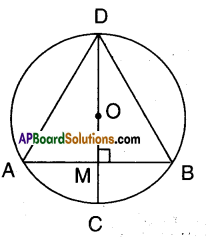
In the given figure, AB is a chord of circle with centre ‘O’. CD is the diam-eter perpendicular to AB. Show that AD = BD.
AP Board 9th Class Maths Solutions Chapter 12 Circles Ex 12.3 7
Solution:
CD is diameter, O is the centre.
CD ⊥ AB; Let M be the point of inter-section.
Now in ΔAMD and ΔBMD
AM = BM [ ∵ radius perpendicular to a chord bisects it]
∠AMD =∠BMD [given]
DM = DM (common)
∴ ΔAMD ≅ ΔBMD
⇒ AD = BD [C.P.C.T]

AP Board 9th Class Maths Solutions Chapter 12 Circles Ex 12.2

AP State Syllabus AP Board 9th Class Maths Solutions Chapter 12 Circles Ex 12.2 Textbook Questions and Answers.

AP State Syllabus 9th Class Maths Solutions 12th Lesson Circles Exercise 12.2

AP Board 9th Class Maths Solutions Chapter 12 Circles Ex 12.2

Question 1.
In the figure, if AB = CD and ∠AOB = 90° find ∠COD.
AP Board 9th Class Maths Solutions Chapter 12 Circles Ex 12.2 1
Solution:
‘O’ is the centre of the circle.
AB = CD (equal chords from the figure)
∴ ∠AOB = ∠COD
[ ∵ equal chords make equal angles at the centre]
∴ ∠COD = 90° [ ∵ ∠AOB = 90° given]

AP Board 9th Class Maths Solutions Chapter 12 Circles Ex 12.2

Question 2.
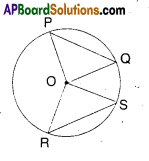
In the figure, PQ = RS and ∠ORS = 48°.
Find ∠OPQ and ∠ROS.
AP Board 9th Class Maths Solutions Chapter 12 Circles Ex 12.2 2
Solution:
‘O’ is the centre of the circle.
PQ = RS [given, equal chords]
∴∠POQ = ∠ROS [ ∵ equal chords make equal angles at the centre]
∴ In ΔROS
∠ORS + ∠OSR + ∠ROS = 180°
[angle sum property]
∴ 48° + 48° + ∠ROS = 180°
[ ∵ OR = OS(radii); ΔORS is isosceles]
∴ ∠ROS = 180° – 96° = 84°
Also ∠POQ = ∠ROS = 84°
∴ ∠OPQ = ∠OQP
[∵ OP = OQ; radii]
= \(\frac { 1 }{ 2 }\)[180°-84°] = 48°

AP Board 9th Class Maths Solutions Chapter 12 Circles Ex 12.2

Question 3.
In the figure, PR and QS are two diameters. Is PQ = RS ?
AP Board 9th Class Maths Solutions Chapter 12 Circles Ex 12.2 3
Solution:
‘O’ is the centre of the circle.
[ ∵ PR, QS are diameters]
OP = OR (∵ radii) .
OQ = OS (∵ radii)
∠POQ = ∠ROS [vertically opp. angles]
∴ ΔOPQ ≅ ΔORS [SAS congruence]
∴ PQ = RS [CPCT]

AP Board 9th Class Maths Solutions Chapter 12 Circles Ex 12.1

AP State Syllabus AP Board 9th Class Maths Solutions Chapter 12 Circles Ex 12.1 Textbook Questions and Answers.

AP State Syllabus 9th Class Maths Solutions 12th Lesson Circles Exercise 12.1

AP Board 9th Class Maths Solutions Chapter 12 Circles Ex 12.1

Question 1.
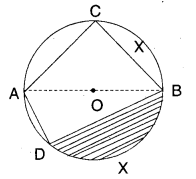
Name the following from the given figure where ’O’ is the centre of the circle.
i) \(\overline{\mathbf{A O}}\)
ii) \(\overline{\mathbf{A B}}\)
iii) \(\widehat{\mathrm{BC}}\)
iv) \(\overline{\mathbf{A C}}\)
v) \(\widehat{\mathrm{DCB}}\)
vi) \(\widehat{\mathrm{ACB }}\)
vii) \(\overline{\mathbf{A D}}\)
viii) Shaded region
AP Board 9th Class Maths Solutions Chapter 12 Circles Ex 12.1 1
Solution:
i) \(\overline{\mathbf{A O}}\) – radius
ii) \(\overline{\mathbf{A B}}\) – diameter
iii) \(\widehat{\mathrm{BC}}\) – minor arc
iv) \(\overline{\mathbf{A C}}\) – chord
v) \(\widehat{\mathrm{DCB}}\) – major arc
vi) \(\widehat{\mathrm{ACB }}\) – semi circle
vii) \(\overline{\mathbf{A D}}\) – chord
viii) Shaded region – Minor segment

AP Board 9th Class Maths Solutions Chapter 12 Circles Ex 12.1

Question 2.
State true or false.
i) A circle divides the plane on which it lies into three parts. ( )
ii) The area enclosed by a chord and the minor arc is minor segment. ( )
iii) The area enclosed by a chord and the major arc is major segment. ( )
iv) A diameter divides the circle into two unequal parts. ( )
v) A sector is the area enclosed by two radii and a chord. ( )
vi) The longest of all chords of a circle is called a diameter. ( )
vii) The mid point of any diameter of a circle is the centre. ( )
Solution:
i) True
ii) True
iii) True
iv) False
v) False
vi)True
vii) True

AP Board 9th Class Maths Solutions Chapter 11 Areas Ex 11.3

AP State Syllabus AP Board 9th Class Maths Solutions Chapter 11 Areas Ex 11.3 Textbook Questions and Answers.

AP State Syllabus 9th Class Maths Solutions 11th Lesson Areas Exercise 11.3

Question 1.
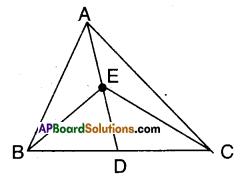
In a triangle ABC, E is the midpoint of median AD. Show that
AP Board 9th Class Maths Solutions Chapter 11 Areas Ex 11.3 1
i) ar ΔABE = ar ΔACE
Solution:
In ΔABC; AD is a median.
∴ ΔABD = ΔACD …………….. (1)
(∵ Median divides a triangle in two equal triangles)
Also in ΔABD; BE is a median.
∴ ΔABE = ΔBED = \(\frac{1}{2}\)ΔABD …………..(2)
Also in ΔACD; CE is a median.
∴ ΔACE = ΔCDE = \(\frac{1}{2}\)ΔACD …………….(3)
From (1), (2) and (3);
ΔABE = ΔACE

(OR)

ΔABD = ΔACD [∵ AD is median in ΔABC]
\(\frac{1}{2}\) ΔABD = \(\frac{1}{2}\) ΔACD
[Dividing both sides by 2]
ΔABE = ΔAEC
[∵ BE is median of ΔABD, CE is median of ΔACD]
Hence proved.

ii) arΔABE = \(\frac{1}{2}\) ar(ΔABC)
Solution:
ΔABE = \(\frac{1}{2}\) (ΔABD)
[From (i); BE is median of ΔABD]
ΔABE = \(\frac{1}{2}\) [\(\frac{1}{2}\) ΔABC]
[∵ AD is median of ΔABC]
= \(\frac{1}{4}\) ΔABC
Hence,proved.

AP Board 9th Class Maths Solutions Chapter 11 Areas Ex 11.3

Question 2.
Show that the diagonals of a paral¬lelogram divide it into four triangles of equal area.
Solution:
□ABCD is a parallelogram.
The diagonals AC and BD bisect each other at ‘O’.
ΔABC and □ABCD lie on the same base AB and between the same parallels AB//CD.
AP Board 9th Class Maths Solutions Chapter 11 Areas Ex 11.3 2
∴ ΔABC = \(\frac{1}{4}\) □ABCD
Now in ΔABC; BO is a median
[∵ O is the midpoint of both diagonals AC and BD]
∴ ΔAOB = ΔBOC ………….(1)
[ ∵ Median divides a triangle into two triangles of equal area]
Similarly ∵ABD and □ABCD lie on the same base AB and between the same parallels AB//CD.]
∴ ΔABD = \(\frac{1}{2}\)□ ABCD
Also ΔAOB = ΔAOD …………..(2)
[ ∵ AO is the median of AABD]
From (1) & (2)
ΔAOB = ΔBOC = ΔAOD
Similarly we can prove that
ΔAOD = ΔCOD [ ∵ OD is the median of ΔACD]
∴ ΔAOB = ΔBOC = ΔCOD = ΔAOD
Hence proved.

AP Board 9th Class Maths Solutions Chapter 11 Areas Ex 11.3

Question 3.
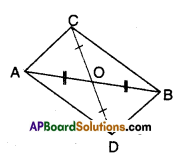
In the figure, ΔABC and ΔABD are two triangles on the same base AB. If line segment CD is bisected by \(\overline{\mathbf{A B}}\) at O, show that ar (ΔABC) = ar (ΔABD).
AP Board 9th Class Maths Solutions Chapter 11 Areas Ex 11.3 3
Solution:
From the figure, in ΔAOC; ΔBOD
OA = OB [ ∵ given]
∠AOC = ∠BOD [Vertically opp. angles]
∴ ΔAOC ≅ ΔBOD (SAS congruence)
Thus AC = BD (CPCT)
∠OAC = ∠OBD (CPCT) .
But these are alternate interior angles for the lines AC, BD.
∴ AC // BD
As AC = BD and AC // BD;
□ABCD is a parallelogram.
AB is a diagonal of oABCD
⇒ ΔABC ≅ ΔABD
(∵ diagonal divides a parallelogram into two congruent triangles)
∴ ar(ΔABC) = ar (ΔABD)

AP Board 9th Class Maths Solutions Chapter 11 Areas Ex 11.3

Question 4.
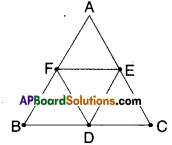
In the figure ΔABC; D, E and F are the midpoints of sides BC, CA and AB respectively. Show that
i)BDEF is a parallelogram
ii) ar (ΔDEF) = \(\frac { 1 }{ 4 }\) ar(ΔABC)
iii) ar (BDEF) = \(\frac { 1 }{ 2 }\) ar(ΔABC)
AP Board 9th Class Maths Solutions Chapter 11 Areas Ex 11.3 4
Solution:
i) In ΔABC; D, E and F are the mid¬points of the sides.
∴ EF//BC FD//AC ED//AB
EF = \(\frac { 1 }{ 2 }\)BC FD = \(\frac { 1 }{ 2 }\)AC ED = \(\frac { 1 }{ 2 }\)AB
[ ∵ line joining the mid points of any two sides of a triangle is parallel to third side and equal to half of it]
∴ In □BDEF
BD = EF [ ∵ D is mid point of BC and \(\frac { 1 }{ 2 }\) BC = EF]
DE = BF
∴ □BDEF is a parallelogram.

ii) □BDEF is a parallelogram (from (i))
Thus ΔBDF = ΔDEF
Similarly □CDFE; □AEDF are also parallelograms.
∴ ΔDEF = ΔCDE =ΔAEF
∴ ΔABC = ΔAEF+ ΔBDF + ΔCDF + ΔDEF
= 4ΔDEF
⇒ ΔDEF = \(\frac { 1 }{ 4 }\)ΔABC

iii) □BDEF = 2 ΔDEF …………..(1)
(from (ii))
ΔABC = 4 ΔDEF (2)
(from (ii))
From (1) & (2);
ΔABC = 2 (2ΔDEF) = 2 □BDEF
Hence proved.

AP Board 9th Class Maths Solutions Chapter 11 Areas Ex 11.3

Question 5.
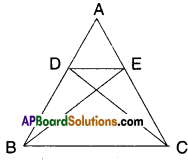
In the figure D, E are points on the sides AB and AC respectively of ΔABC such that ar (ΔDBC) = ar (ΔEBC). Prove that DE // BC.
AP Board 9th Class Maths Solutions Chapter 11 Areas Ex 11.3 5
Solution:
ΔDBC = ΔEBC
The two triangles are on the same base BC and between the same pair of lines BC and DE.
As they are equal in area.
∴ BC // DE.

Question 6.
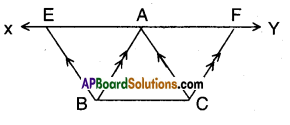
In the figure, XY is a line parallel to BC is drawn through A. If BE // CA and CF // BA are drawn to meet XY at E and F respectively. Show that ar (ΔABE) = ar (ΔACF).
AP Board 9th Class Maths Solutions Chapter 11 Areas Ex 11.3 6
Solution:
Given that XY//BC; BE//CA; CF//BA
In quad ABCF; AB//CF and BC//AF
Hence □ABCF is a parallelogram.
Also in □ACBE ; BC//AE and AC//BE
Hence □ACBE is a parallelogram.
Now in □ABCF and □ACBE
ΔABC = ΔACF …………..(1);
ΔABC = ΔABE …………..(2)
[∵ Diagonal divides a parallelogram into two congruent triangles]
∴ ΔACF = ΔABE [from (1) & (2)]
Hence proved.

AP Board 9th Class Maths Solutions Chapter 11 Areas Ex 11.3

Question 7.
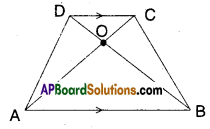
In the figure, diagonals AC and BD of a trapezium ABCD with AB//DC inter¬sect each other at ‘O’. Prove that ar (ΔAOD) = ar (ΔBOC)
AP Board 9th Class Maths Solutions Chapter 11 Areas Ex 11.3 7
Solution:
Given that AB // CD
Now ΔADC and ΔBCD are on the same base and between the same parallels AB // CD.
∴ ΔADC = ΔBCD
⇒ ΔADC – ΔCOD = ΔBCD – ΔCOD
⇒ ΔAOD = ΔBOC [from the figure]

Question 8.
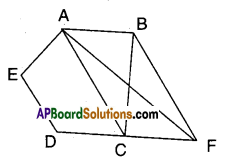
In the figure ABCDE is a pentagon. A line through B parallel to AC meets DC produced at F. Show that
(i) ar (ΔACB) = ar (ΔACF)
(ii) ar (AEDF) = ar (ABCDE)
AP Board 9th Class Maths Solutions Chapter 11 Areas Ex 11.3 8
Solution:
ABCDE is a pentagon.
AC//BF
i) ΔACB and ΔACF are on the same base AC and between the same parallels AC//BF.
∴ ΔACB = ΔACF

ii) □AEDF = □AEDC + ΔACF
= □AEDC + ΔABC
[ ∵ ΔACF = ΔACB]
= area (ABCDE)
Hence proved.

AP Board 9th Class Maths Solutions Chapter 11 Areas Ex 11.3

Question 9.
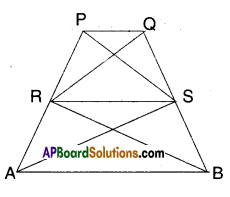
In the figure, if ar (ΔRAS) = ar (ΔRBS) and ar (ΔQRB) = ar (ΔPAS) then show that both the quadrilaterals PQSR and RSBA are trapeziums.
AP Board 9th Class Maths Solutions Chapter 11 Areas Ex 11.3 9
ΔRAS = ΔRBS ………….. (1)
Both the triangles are on the same base RS and between the same pair of lines RS and AB.
As their areas are equal RS must be parallel to AB.
⇒ RS//AB
∴ □ABRS is a quadrilateral in which AB//RS.
∴ □ABRS (or) □RSBA is a trapezium.
Now AQRB = APAS (given)
⇒ ΔQRB – ΔRBS = ΔPAS – ΔRAS
[from (1) ΔRBS = ΔRAS]
⇒ ΔQRS = ΔPRS
These two triangles are on the same base RS and between the same pair of lines RS and PQ.
As these two triangles have same area RS must be parallel to PQ.
⇒ RS // PQ
Now in quad PQRS; PQ//RS.
Hence □PQRS is a trapezium.

AP Board 9th Class Maths Solutions Chapter 11 Areas Ex 11.3

Question 10.
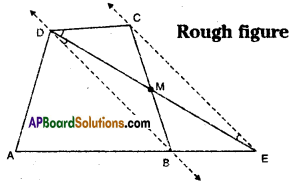
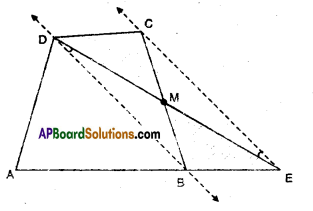
A villager Ramayya has a plot of land in the shape of a quadrilateral. The grampanchayat of the village decided to take over some portion of his plot from one of the comers to construct a school. Ramayya agrees to the above proposal with the condition that he should be given equal amount of land in exchange of his land adjoining his plot so as to form a triangular plot. Explain how this proposal will implemented. (Draw a rough sketch of the plot.)
AP Board 9th Class Maths Solutions Chapter 11 Areas Ex 11.3 10
Solution:
Let □ABCD is the plot of Ramayya.
School be constructed in the region ΔMCD where M is a point on BC such that □ABCD ≅ ΔADE
Draw the diagonal BD.
Draw a line parallel to BD through C which meets AB produced at E.
Join D, E
ΔADE is the required triangle.
AP Board 9th Class Maths Solutions Chapter 11 Areas Ex 11.3 11
Analysis:
ΔCED and ΔCEB are on the same base CE and between the same parallels CE and DB.
∴ ΔCED = ΔCEB [also from the figure]
ΔCEM + ΔCMD = ΔCEM + ΔBME
∴ ΔCMD = ΔBME
∴ ΔADE = □ABCD

AP Board 9th Class Maths Solutions Chapter 11 Areas Ex 11.2

AP State Syllabus AP Board 9th Class Maths Solutions Chapter 11 Areas Ex 11.2 Textbook Questions and Answers.

AP State Syllabus 9th Class Maths Solutions 11th Lesson Areas Exercise 11.2

AP Board 9th Class Maths Solutions Chapter 11 Areas Ex 11.2

Question 1.
The area of parallelogram ABCD is 36cm2. Calculate the height of parallelogram ABEF if AB = 4.2 cm.
AP Board 9th Class Maths Solutions Chapter 11 Areas Ex 11.2 1
Solution:
Area of □ABCD = 36 cm2
AB = 4.2 cm
then □ABCD = AB X Height
[ ∵ base x height]
36 = 4.2 x h
∴ h = \(\frac { 36 }{ 4.2 }\)
But □ ABCD and □ ABEF are on the same base and between the same parallels.
∴ □ABCD = □ABEF
□ABEF = base x height = AB x height
∴ height = \(\frac { 36 }{ 4.2 }\) = 8.571cm 5

Question 2.
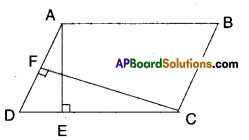
ABCD is a parallelogram. AE is perpendicular on DC and CF is perpendicular on AD. If AB = 10 cm; AE = 8 cm and CF = 12 cm. Find AD.
AP Board 9th Class Maths Solutions Chapter 11 Areas Ex 11.2 2
Solution:
Area of parallelogram = base x height
AB x AE = AD x CF
⇒ 10 x 8 = 12 x AD
⇒ AD = \(\frac{10 \times 8}{12}\) = 6.666 ……….
∴ AD ≅ 6.7 cm

AP Board 9th Class Maths Solutions Chapter 11 Areas Ex 11.2

Question 3.
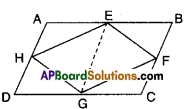
If E, F, G and H are respectively the midpoints of the sides AB, BC, CD and AD of a parallelogram ABCD, show that ar (EFGH) = \(\frac { 1 }{ 2 }\) ar (ABCD).
AP Board 9th Class Maths Solutions Chapter 11 Areas Ex 11.2 3
Solution:
Given that □ABCD is a parallelogram.
E, F, G and H are the midpoints of the sides.
Join E, G.
Now
ΔEFG and □EBCG he on the same base EG and between the same parallels
EG // BC.
∴ ΔEFG = \(\frac { 1 }{ 2 }\)□EBCG ……………(1)
Similarly,
ΔEHG = \(\frac { 1 }{ 2 }\)□EGDA …………….(2)
Adding (1) and (2);
ΔEFG + ΔEHG = \(\frac { 1 }{ 2 }\) □EBCG + \(\frac { 1 }{ 2 }\) □EGDA
□EFGH = \(\frac { 1 }{ 2 }\)[□EBCG +□ EGDA]
□EFGH = \(\frac { 1 }{ 2 }\) [□ABCD]
Hence proved.

Question 4.
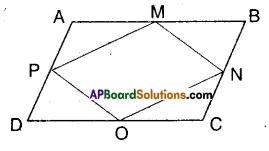
What figure do you get, if you join ΔAPM, ΔDPO, ΔOCN and ΔMNB in the example 3 ?
Solution:
AP Board 9th Class Maths Solutions Chapter 11 Areas Ex 11.2 4
□ABCD is a rhombus.
M, N, O and P are the midpoints of its sides. By joining ΔAPM, ΔDPO, ΔOCN and ΔMNB we get the figure shown by shaded region.

AP Board 9th Class Maths Solutions Chapter 11 Areas Ex 11.2

Question 5.
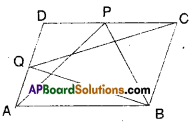
P and Q are any two points lying on the sides DC and AD .respectively of a parallelogram ABCD. Show that ar (ΔAPB) = ar (ΔBQC).
AP Board 9th Class Maths Solutions Chapter 11 Areas Ex 11.2 5
Solution:
ΔAPB and □ABCD are on the same base
AB and between the same parallel lines
AB//CD.
∴ ΔAPB = \(\frac { 1 }{ 2 }\) □ABCD …………… (1)
Also ΔBCQ and □BCDA are on the same base BC and between the same paral¬lel lines BC//AD.
∴ ΔBCQ = \(\frac { 1 }{ 2 }\) □BCDA …………….. (2)
But □ABCD and □BCDA represent same parallelogram.
∴ΔAPB = ΔBCQ [from (1) & (2)]

Question 6.
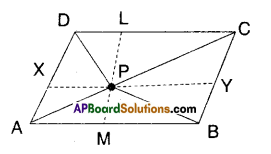
P is a point in the interior of a parallelogram ABCD. Show that
i) ar (ΔAPB) + ar (ΔPCD) = \(\frac { 1 }{ 2 }\)ar(ABCD)
(Hint : Through P, draw a line paral¬lel to AB)
AP Board 9th Class Maths Solutions Chapter 11 Areas Ex 11.2 6
Solution:
□ABCD is a parallelogram.
P is any interior point.
Draw a line \(\overline{\mathrm{XY}}\) parallel to AB through P.
Now ΔAPB = \(\frac { 1 }{ 2 }\) □AXYB ……………(1)
[∵ ΔAPB, □AXYB lie on the same base AB and beween AB//XY]
Also ΔPCD = \(\frac { 1 }{ 2 }\) □CDXY ………………… (2)
[ ∵ ΔPCD; □CDXY lie on the same
base CD and between CD//XY]
Adding (1) & (2), we get
Δ APB + ΔPCD = \(\frac { 1 }{ 2 }\) □AXYB + \(\frac { 1 }{ 2 }\) □CDXY
= \(\frac { 1 }{ 2 }\) [□ AXYB + □ CDXY] [from the fig.)
= \(\frac { 1 }{ 2 }\) □ABCD
Hence Proved.

AP Board 9th Class Maths Solutions Chapter 11 Areas Ex 11.2

(ii) ar (ΔAPD) + ar (ΔPBQ = ar (ΔAPB) + ar (ΔPCD)
Solution:
Draw LM // AD.
ΔAPD + ΔPBC = \(\frac { 1 }{ 2 }\) □AMLD + \(\frac { 1 }{ 2 }\) □BMLC
= \(\frac { 1 }{ 2 }\) [□AMLD + \(\frac { 1 }{ 2 }\) BMLC].
= \(\frac { 1 }{ 2 }\) □ABCD
= ΔAPB +ΔPCD [from(i)]
Hence proved.
[ ∵ ΔAPD, □AMLD are on same base AD and between same parallels AD and LM]

Question 7.
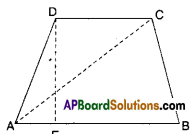
Prove that the area of a trapezium is half the sum of the parallel sides mul¬tiplied by the distance between them.
Solution:
AP Board 9th Class Maths Solutions Chapter 11 Areas Ex 11.2 7
Let □ABCD is a trapezium; AB//CD and
DE ⊥ AB
□ABCD = ΔABC + ΔADC
= \(\frac { 1 }{ 2 }\) AB x DE + \(\frac { 1 }{ 2 }\) DC x DE
[∵ Δ = \(\frac { 1 }{ 2 }\) x base x height]
= \(\frac { 1 }{ 2 }\) x DE [AB + DC]
Hence proved.

AP Board 9th Class Maths Solutions Chapter 11 Areas Ex 11.2

Question 8.
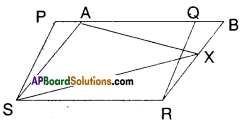
PQRS and ABRS are parallelograms and X is any point on the side BR.
Show that
AP Board 9th Class Maths Solutions Chapter 11 Areas Ex 11.2 8
i) ar (PQRS) = ar (ABRS)
Solution:
□PQRS and □ABRS are on the same base SR and between the same parallels SR//PB.
∴ □PQRS = □ABRS

ii) ar (ΔAXS) = \(\frac { 1 }{ 2 }\) ar (PQRS)
Solution:
From (1) □PQRS = □ABRS
And □ABRS and ΔAXS are on the same base AS and between the same paral¬lels AS//BR.
∴ ΔAXS = \(\frac { 1 }{ 2 }\) □ABRS
= \(\frac { 1 }{ 2 }\) □PQRS from (1)
Hence proved.

AP Board 9th Class Maths Solutions Chapter 11 Areas Ex 11.2

Question 9.
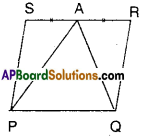
A farmer has a held in the form of a parallelogram PQRS as shown in the figure. He took the midpoint A on RS and joined it to points P and Q. In how many parts the field is divided ? What are the shapes of these parts ? The farmer wants to sow groundnuts which are equal to the sum of pulses and paddy. How should he sow ? State reasons.
AP Board 9th Class Maths Solutions Chapter 11 Areas Ex 11.2 9
Solution:
From the figure ΔAPQ, □PQRS are on the same base PQ and between the same parallels PQ//SR.
∴ ΔAPQ = \(\frac { 1 }{ 2 }\)□PQRS
⇒ □PQRS – AAPQ = \(\frac { 1 }{ 2 }\)□PQRS
∴ \(\frac { 1 }{ 2 }\)□PQRS = ΔASP + ΔARQ
∴ The farmer may sow groundnuts on ΔAPQ region.
The farmer may sow pulses on ΔASP region.
The farmer may sow paddy on ΔARQ region.

AP Board 9th Class Maths Solutions Chapter 11 Areas Ex 11.2

Question 10.
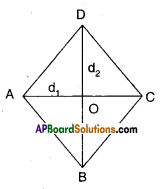
Prove that the area of a rhombus is equal to half of the product of the diagonals.
AP Board 9th Class Maths Solutions Chapter 11 Areas Ex 11.2 10
Solution:
Let □ABCD be a Rhombus.
d1, d2 are its diagonals bisecting at ‘O’
We know that d1 ⊥ d1
∴ ΔABC = \(\frac{1}{2} \mathrm{~d}_{1} \cdot\left(\frac{\mathrm{d}_{2}}{2}\right)\)
[∵ base = d1; height = \frac{\mathrm{d}_{2}}{2}[/latex] ]
ΔADC = \(\frac{1}{2} \mathrm{~d}_{1} \cdot\left(\frac{\mathrm{d}_{2}}{2}\right)\)
[ ∵ base = d1;height= \(\frac{\mathrm{d}_{2}}{2}\)]
∴ □ABCD = ΔABC + ΔADC
= \(\frac{\mathrm{d}_{1} \mathrm{~d}_{2}}{4}+\frac{\mathrm{d}_{1} \mathrm{~d}_{2}}{4}=\frac{\mathrm{d}_{1} \mathrm{~d}_{2}}{2}\)
Hence Proved.

AP Board 9th Class Maths Solutions Chapter 9 Statistics Ex 9.1

AP State Syllabus AP Board 9th Class Maths Solutions Chapter 9 Statistics Ex 9.1 Textbook Questions and Answers.

AP State Syllabus 9th Class Maths Solutions 9th Lesson Statistics Exercise 9.1

AP Board 9th Class Maths Solutions Chapter 9 Statistics Ex 9.1

Question 1.
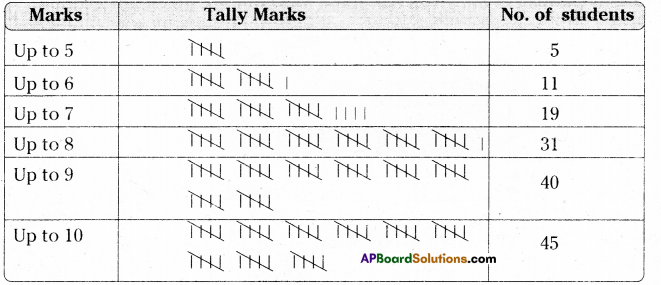
Write the mark wise frequencies in the following frequency distribution table.
AP Board 9th Class Maths Solutions Chapter 9 Statistics Ex 9.1 1
Solution:
AP Board 9th Class Maths Solutions Chapter 9 Statistics Ex 9.1 2

AP Board 9th Class Maths Solutions Chapter 9 Statistics Ex 9.1

Question 2.
The blood groups of 36 students of IX class are recorded as follows.
AP Board 9th Class Maths Solutions Chapter 9 Statistics Ex 9.1 3
Represent the data in the form of a frequency distribution table. Which is the most common and which is the rarest blood group among these groups ?

Blood groupABABO
Frequency109215

From the table, most common group is O and rarest group is AB.

Question 3.
Three coins were tossed 30 times simultaneously. Each time the occurring was noted down as follows :
AP Board 9th Class Maths Solutions Chapter 9 Statistics Ex 9.1 4
Prepare a frequency distribution table for the data given above.
Solution:

No. of heads0123
Frequency310107

AP Board 9th Class Maths Solutions Chapter 9 Statistics Ex 9.1

Question 4.
A T.V. channel organized a SMS (Short Message Service) poll on prohibition on smoking giving options like A – complete prohibitions, B – prohibition in public places only, C – not necessary. SMS results in one hour were
AP Board 9th Class Maths Solutions Chapter 9 Statistics Ex 9.1 5
Represent the above data as grouped frequency distribution table. How many appropriate answers were received ? What was the majority of people’s opinion ?
Solution:

OptionsABC
Frequency(f)193610

Total appropriate answers received = 19 + 36 + 10 = 65
Majority of people’s opinion is prohibition in public places only i.e., B.

Question 5.
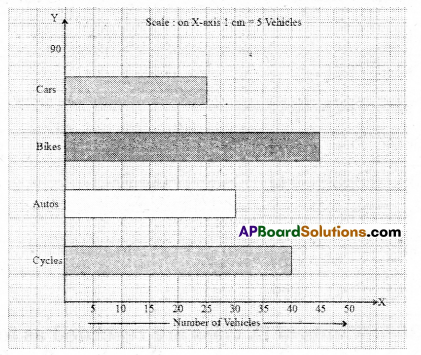
Represent the data in the given bar graph as frequency distribution table.
AP Board 9th Class Maths Solutions Chapter 9 Statistics Ex 9.1 6
Solution:
AP Board 9th Class Maths Solutions Chapter 9 Statistics Ex 9.1 7

AP Board 9th Class Maths Solutions Chapter 9 Statistics Ex 9.1

Question 6.
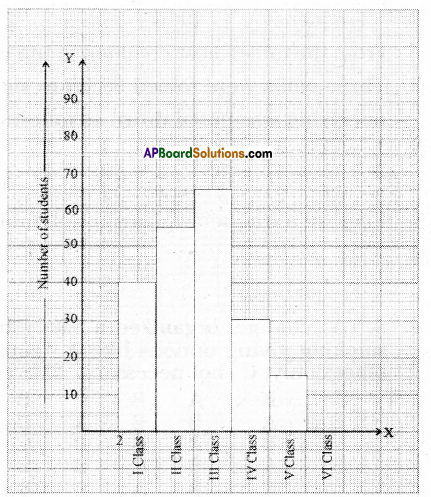
Identify the scale used on the axes of the given graph. Write the frequency distribu- tion from it.
Solution:
Frequency distribution table :

ClassNo. of students
I40
II55
III65
IV30
V15

AP Board 9th Class Maths Solutions Chapter 9 Statistics Ex 9.1 8
Scale : X – axis : 1 cm = 1 class interval
Y – axis : 1 cm = 10 students

AP Board 9th Class Maths Solutions Chapter 9 Statistics Ex 9.1

Question 7.
The marks of 30 students of a class, obtained in a test (out of 75), are given below : 42, 21, 50, 37, 42, 37, 38, 42, 49, 52, 38, 53, 57, 47, 29, 59, 61, 33, 17, 17, 39, 44, 42, 39, 14, 7, 27, 19, 54, 51. Form a frequency table with equal class intervals.
(Hint: One of them being 0 – 10)
Solution:
AP Board 9th Class Maths Solutions Chapter 9 Statistics Ex 9.1 9

Question 8.
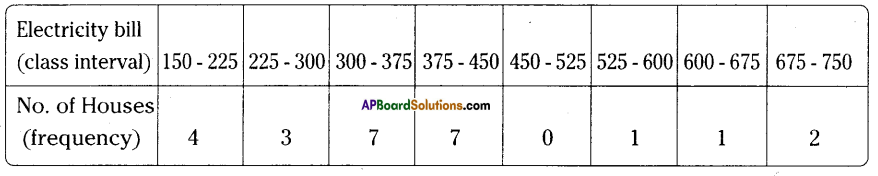
The electricity bill (in rupees) of 25 houses in a locality are given below. Construct a grouped frequency distribution table with a class size of 75.
170, 212, 252, 225, 310, 712, 412, 425, 322, 325, 192, 198, 230, 320, 412, 530, 602, 724, 370, 402, 317, 403, 405, 372, 413.
Solution:
The least value of observations = 170
The height value of observations = 724
AP Board 9th Class Maths Solutions Chapter 9 Statistics Ex 9.1 10

Question 9.
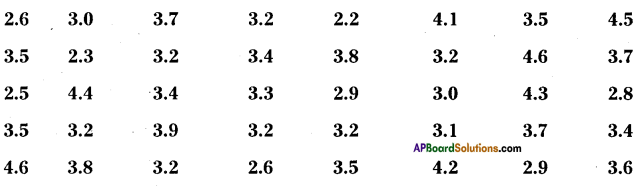
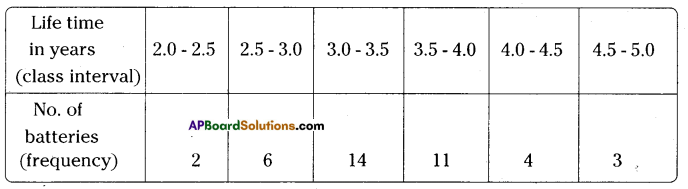
A company manufactures car batteries of a particular type. The life (in years) of 40 batteries were recorded as follows.
AP Board 9th Class Maths Solutions Chapter 9 Statistics Ex 9.1 11
Construct a grouped frequency distribution table with exclusive classes for this data, using class intervals of size 0.5 starting from the interval 2 – 2.5.
Solution:
AP Board 9th Class Maths Solutions Chapter 9 Statistics Ex 9.1 12

AP Board 9th Class Maths Solutions Chapter 8 Quadrilaterals Ex 8.4

AP State Syllabus AP Board 9th Class Maths Solutions Chapter 8 Quadrilaterals Ex 8.4 Textbook Questions and Answers.

AP State Syllabus 9th Class Maths Solutions 8th Lesson Quadrilaterals Exercise 8.4

Question 1.
ABC is a triangle. D is a point on AB such that AD = \(\frac { 1 }{ 4 }\) AB and E is a point on AC such that AE = \(\frac { 1 }{ 4 }\) AC. If DE = 2 cm find BC.
Solution:
AP Board 9th Class Maths Solutions Chapter 8 Quadrilaterals Ex 8.4 1
Given that D and E are points on AB and AC.
Such that AD = \(\frac { 1 }{ 4 }\) AB and AE = \(\frac { 1 }{ 4 }\) AC
Let X, Y be midpoints of AB and AC.
Joint D, E and X, Y.
Now in ΔAXY; D, E are the midpoints of sides AX and AY.
∴ DE // XY and DE = \(\frac { 1 }{ 2 }\) XY
⇒ 2 cm = \(\frac { 1 }{2 }\) XY
⇒ XY = 2 x 2 = 4cm
Also in ΔABC; X, Y are the midpoints of AB and AC.
∴ XY//BC and XY = \(\frac { 1 }{2 }\) BC
4 cm = \(\frac { 1 }{2 }\) BC
⇒ BC = 4 x 2 = 8 cm

AP Board 9th Class Maths Solutions Chapter 8 Quadrilaterals Ex 8.4

Question 2.
ABCD is a quadrilateral. E, F, G and H are the midpoints of AB, BC, CD and DA respectively. Prove that EFGH is a parallelogram.
AP Board 9th Class Maths Solutions Chapter 8 Quadrilaterals Ex 8.4 2
Solution:
Given that E, F, G and H are the midpoints of the sides of quad. ABCD.
In ΔABC; E, F are the midpoints of the sides AB and BC.
∴ EF//AC and EF = \(\frac { 1 }{2 }\) AC
Also in ΔACD; HG // AC
and HG = \(\frac { 1 }{ 2 }\) AC
∴ EF // HG and EF = HG
Now in □EFGH; EF = HG and EF // HG
∴ □EFGH is a parallelogram.

AP Board 9th Class Maths Solutions Chapter 8 Quadrilaterals Ex 8.4

Question 3.
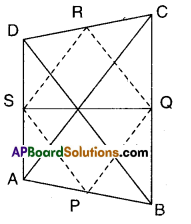
Show that the figure formed by joining the midpoints of sides of a rhom¬bus successively is a rectangle.
Solution:
AP Board 9th Class Maths Solutions Chapter 8 Quadrilaterals Ex 8.4 3
Let □ABCD be a rhombus.
P, Q, R and S be the midpoints of sides of □ABCD
In ΔABC,
P, Q are the midpoints of AB and BC.
∴ PQ//AC and PQ = \(\frac { 1 }{2 }\)AC …………………..(1)
Also in ΔADC, ,
S, R are the midpoints of AD and CD.
∴ SR//AC and SR = \(\frac { 1 }{2 }\)AC ………………(2)
From (1) and (2);
PQ // SR and PQ = SR
Similarly QR // PS and QR = PS
∴ □PQRS is a parallelogram.
As the diagonals of a rhombus bisect at right angles.
∠AOB – 90°
∴ ∠P = ∠AOB = 90°
[opp. angles of //gm PYOX] Hence □PQRS is a rectangle as both pairs of opp. sides are equal and parallel, one angle being 90°.

AP Board 9th Class Maths Solutions Chapter 8 Quadrilaterals Ex 8.4

Question 4.
In a parallelogram ABCD, E and F are the midpoints of the sides AB and DC respectively. Show that the line segments AF and EC trisect the diagonal BD.
AP Board 9th Class Maths Solutions Chapter 8 Quadrilaterals Ex 8.4 4
Solution:
□ABCD is a parallelogram. E and F are the mid points of AB and CD.
∴ AE = \(\frac { 1 }{2 }\)AB and CF = \(\frac { 1 }{2 }\)CD
Thus AE = CF [∵ AB – CD]
Now in □AECF, AE = CF and AE ||CF
Thus □AECF is a parallelogram.
Now in ΔEQB and ΔFDP
EB = FD [Half of equal sides of a //gm]
∠EBQ = ∠FDP[alt. int.angles of EB//FD]
∠QEB = ∠PFD
[∵∠QED = ∠QCF = ∠PFD]
∴ ΔEQB ≅ ΔFPD [A.S.A. congruence]
∴ BQ = DP [CPCT] ……………… (1)
Now in ΔDQC; PF // QC and F is the midpoint of DC.
Hence P must be the midpoint of DQ
Thus DP = PQ …………….. (2)
From (1) and (2), DP = PQ = QB
Hence AF and CE trisect the diagonal BD.

AP Board 9th Class Maths Solutions Chapter 8 Quadrilaterals Ex 8.4

Question 5.
Show that the line segments joining the mid points of the opposite sides of a quadrilateral and bisect each other.
AP Board 9th Class Maths Solutions Chapter 8 Quadrilaterals Ex 8.4 5
Solution:
Let ABCD be a quadrilateral.
P, Q, R, S are the midpoints of sides of □ABCD.
Join (P, Q), (Q, R), (R, S) and (S, P).
In ΔABC; P, Q are the midpoints of AB and BC.
∴ PQ // AC and PQ = \(\frac { 1 }{2 }\)AC ………….(1)
Also from ΔADC
S, R are the midpoints of AD and CD
SR // AC and SR = \(\frac { 1 }{2 }\) AC …………………(2)
∴ From (1) & (2)
PQ = SR and PQ //SR
∴ □PQRS is a parallelogram.
Now PR and QS are the diagonals of □ PQRS.
∴ PR and QS bisect each other.

AP Board 9th Class Maths Solutions Chapter 8 Quadrilaterals Ex 8.4

Question 6.
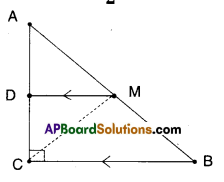
ABC is a triangle right angled at’C’. A line through the midpoint M of hypotenuse AB and parallel to BC intersects AC at D. Show that
i) D is the midpoint of AC
ii) MD ⊥ AC
iii) CM = MA= \(\frac { 1 }{2 }\)AB
AP Board 9th Class Maths Solutions Chapter 8 Quadrilaterals Ex 8.4 6
Solution:
AP Board 9th Class Maths Solutions Chapter 8 Quadrilaterals Ex 8.4 7
Given that in ΔABC; ∠C = 90°
M is the midpoint of AB.
i) If ‘D’ is the midpoints of AC.
The proof is trivial.
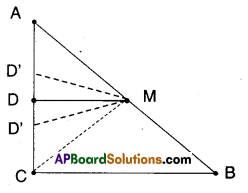
Let us suppose D is not the mid point of AC.
Then there exists D’ such that AD’ = D’C
Then D’M is a line parallel to BC through M.
Also DM is a line parallel to BC through M.
There exist two lines parallel to same line through a point M.
This is a contradiction.
There exists only one line parallel to a given line through a point not on the line.
∴ D’ must coincides with D
∴ D is the midpoint of AC

ii) From (i) DM // BC
Thus ∠ADM = ∠ACB = 90°
[corresponding angles]
⇒ MD ⊥ AC

AP Board 9th Class Maths Solutions Chapter 8 Quadrilaterals Ex 8.4

iii) In ∆ADM and ∆CDM
AD = CD [ ∵ D is midpoint from (i)]
∠ADM = ∠MDC (∵ 90° each)
DM = DM (Common side)
∴ ∆ADM = ∆CDM (SAS congruence)
⇒ CM = MA (CPCT)
CM = \(\frac { 1 }{2 }\) AB (∵ M is the midpoint of AB)
∴ CM = MA = \(\frac { 1 }{2 }\)AB