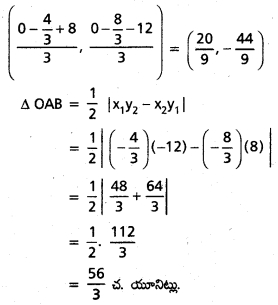
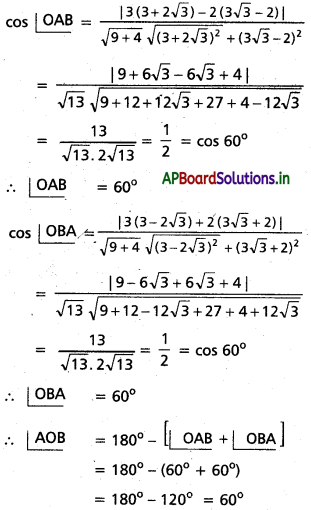
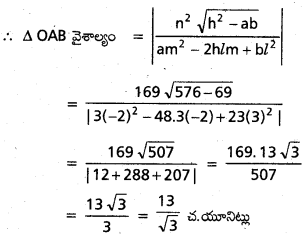
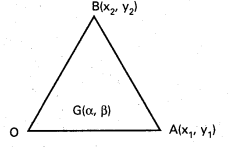
AP Inter 1st Year Maths 1B Solutions Chapter 4 సరళరేఖాయుగ్మాలు Ex 4(c)

Practicing the Intermediate 1st Year Maths 1B Textbook Solutions Chapter 4 సరళరేఖాయుగ్మాలు Exercise 4(c) will help students to clear their doubts quickly.

AP Inter 1st Year Maths 1B Solutions Chapter 4 సరళరేఖాయుగ్మాలు Exercise 4(c)

అభ్యాసం 4 (సి)

I.

ప్రశ్న 1.
x2 + y2 = 1, x + y = 1 ల ఖండన బిందువులను మూలబిందువుకు కలిపితే వచ్చే సరళరేఖల సమీకరణన్ని కనుక్కోండి.
సాధన:
దత్త వక్రాలు x2 + y 2 = 1 ………………. (1)
x + y = 1 ………………. (2)
(2) సహాయంతో (1) ని సమఘాత పరిస్తే
OA, OB ల ఉమ్మడి సమీకరణం
AP Inter 1st Year Maths 1B Solutions Chapter 4 సరళరేఖాయుగ్మాలు Ex 4(c) 1
x2 + y2 = (x + y)2
= x2 + y2 + 2xy
i.e., 2xy = 0 ⇒ xy = 0

ప్రశ్న 2.
y2 = x, x + y = 1 ల ఖండన బిందువులను మూలబిందువుకు కలిపితే వచ్చే సరళరేఖల మధ్య కోణాన్ని కనుక్కోండి.
సాధన:
వక్రం సమీకరణం y2 = x ……………. (1)
AB సమీకరణం x + y = 1 ……………… (2)
(2) సహాయంతో (1) ని సమఘాతపరిస్తే
OA, OB ల ఉమ్మడి సమీకరణం
y2 = x(x + y) = x2+ xy
x2 + xy – y2 = 0
a + b = 1 – 1 = 0
OA, OB లు లంబంగా ఉన్నాయి.
∴ ∠AOB

AP Inter 1st Year Maths 1B Solutions Chapter 4 సరళరేఖాయుగ్మాలు Ex 4(c)

II.

ప్రశ్న 1.
x – y – \(\sqrt{2}\) = 0 అనే సరళరేఖల x2 – xy + y2 + 3x + 3y + 2 = 0 అనే వక్రాన్ని ఖండించే బిందువులను మూలబిందువుకు కలిపితే వచ్చే సరళరేఖలు పరస్పరం లంబంగా ఉంటాయని చూపండి. [A.P Mar. ’15, ’12; May. ’12]
సాధన:
AP Inter 1st Year Maths 1B Solutions Chapter 4 సరళరేఖాయుగ్మాలు Ex 4(c) 2
వక్రం సమీకరణం
x2 – xy + y2 + 3x + 3y – 2 = 0 ………………. (1)
AB సమీకరణము x – y – \(\sqrt{2}\) = 0
x – y = \(\sqrt{2}\)
\(\frac{x-y}{\sqrt{2}}\) = 1 ……………… (2)
(2) సహాయంతో (1) ని సమఘాతపరిస్తే OA, OB ల ఉమ్మడి సమీకరణం
x2 – xy + y2 + 3x.1 + 3y.1 – 2.12 = 0
x2 – xy + y2 + 3(x + y) \(\frac{x-y}{\sqrt{2}}\) – 2 \(\frac{(x-y)^2}{2}\) = 0
x2 – xy + y2 + \(\frac{3}{\sqrt{2}}\) (x2 – y2) – (x2 – 2xy + y2) = 0
x2 – xy + y2 + \(\frac{3}{\sqrt{2}}\) x2 – \(\frac{3}{\sqrt{2}}\) y2 – x2 + 2xy – y2 = 0
\(\frac{3}{\sqrt{2}}\)x2 + xy – \(\frac{3}{\sqrt{2}}\)y2 = 0
a + b = \(\frac{3}{\sqrt{2}}\) – \(\frac{3}{\sqrt{2}}\) = 0
∴ OA, OB లు లంబంగా ఉన్నాయి.

AP Inter 1st Year Maths 1B Solutions Chapter 4 సరళరేఖాయుగ్మాలు Ex 4(c)

ప్రశ్న 2.
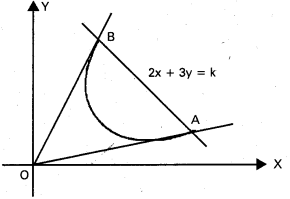
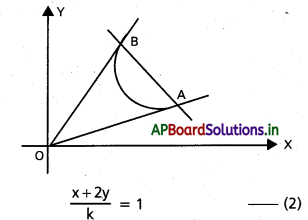
x + 2y = k అనే రేఖ 2x2 – 2xy + 3y2 + 2x – y – 1 = 0 అనేక వక్రాన్ని ఖండించే బిందువులను మూలబిందువుకు కలిపితే వచ్చే రేఖలు పరస్పరం లంబంగా ఉంటే, k విలువలు కనుక్కోండి. [T.S Mar. ’15]
సాధన:
దత్త వక్రం సమీకరణం
S ≡ 2x2 + 2xy + 3y2 + 2x – y – 1 = 0 ……………….. (1)
AB సమీకరణము x + 2y = k
AP Inter 1st Year Maths 1B Solutions Chapter 4 సరళరేఖాయుగ్మాలు Ex 4(c) 3
(2) సహాయంతో (1) ని సమఘాత పరిస్తే OA, OB ల ఉమ్మడి సమీకరణం
2x2 – 2xy + 3y2 + 2x.1 – y.1 – 12 = 0
2x2 – 2xy + 3y2 + 2x \(\frac{(x+2 y)}{k}\) – y \(\frac{(x+2 y)}{k}\) – \(\frac{(x+2 y)^2}{k^2}\) = 0
k2 తో గుణించగా
2k2x2 – 2k2xy + 3k2y2 + 2kx (x + 2y) – ky (x + 2y) – (x + 2y)2 = 0
2k2x2 – 2k2xy + 3k2y2 + 2kx2 + 4kxy – kxy – 2ky2 – x2 – 4xy – 4y2 = 0
(2k2 + 2k – 1) x2 + (- 2k2 + 3k – 4) xy + (3k2 – 2k – 4) y2 = 0
OA, OB లు లంబంగా ఉన్నాయి కనుక
x2 గుణకం + y2 గుణకం 0.
2k2 + 2k – 1 + 3k2 – 2k – 4 = 0
5k2 = 5 ⇒ k2 = 1
∴ k = ±1

AP Inter 1st Year Maths 1B Solutions Chapter 4 సరళరేఖాయుగ్మాలు Ex 4(c)

ప్రశ్న 3.
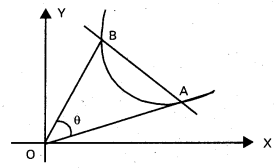
3x – y + 1 = 0 అనే రేఖ x2 + 2xy + y2 + 2x + 2y – 5 = 0 అనే వక్రాన్ని ఖండించే బిందువులను మూలబిందువుకు కలిపితే వచ్చే రేఖల మధ్యకోణాన్ని కనుక్కోండి. [Mar. ’13, ’07; May ’11; June ’04]
సాధన:
AP Inter 1st Year Maths 1B Solutions Chapter 4 సరళరేఖాయుగ్మాలు Ex 4(c) 4
వక్రం సమీకరణం
x2 + 2xy + y2 + 2x + 2y – 5 = 0 ……………… (1)
AB సమీకరణము 3x – y + 1 = 0
y – 3x = 1 ……………….. (2)
(2) సహాయంతో (1) ని సమఘాత పరిస్తే OA, OB ల
ఉమ్మడి సమీకరణం
x2 + 2xy + y2 + 2x.1 + 2y.1 – 5.12 = 0
x2 + 2xy + y2 + 2x (y – 3x) + 2y (y – 3x) − 5 (y – 3x)2 = 0
x2 + 2xy + y2 + 2xy – 6x2 + 2y2 – 6xy – 5(y2 + 9x2 – 6xy) = 0
-5x2 – 2xy + 3y2 – 5y2 – 45x2 + 30 xy = 0
-50x2+ 28xy – 2y2 = 0
i.e, 25x2 – 14xy + y2 = 0
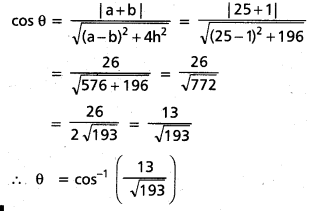
OA, OB ల మధ్య కోణము θ అనుకొందాం.
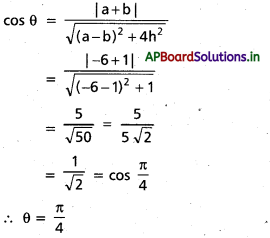
AP Inter 1st Year Maths 1B Solutions Chapter 4 సరళరేఖాయుగ్మాలు Ex 4(c) 5

AP Inter 1st Year Maths 1B Solutions Chapter 4 సరళరేఖాయుగ్మాలు Ex 4(c)

III.

ప్రశ్న 1.
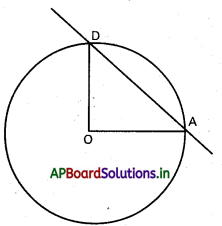
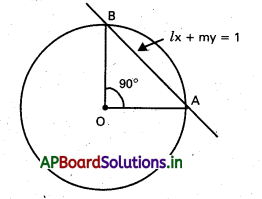
మూలబిందువు కేంద్రంగా గల వృత్తం x2 + y2 = a2 కు lx + my = 1 అనేది ఒక జ్యా. ఈ జ్యా మూలబిందువు వద్ద లంబకోణం చేయడానికి నియమాన్ని కనుక్కోండి. [Mar. ’14, May ’13]
సాధన:
AP Inter 1st Year Maths 1B Solutions Chapter 4 సరళరేఖాయుగ్మాలు Ex 4(c) 6
వృత్త సమీకరణము x2 + y2 = a2 ……………….. (1)
AB సమీకరణము lx + my = 1 ……………….. (2)
(2) సహాయంతో (1) ని సమఘాతపరిస్తే OA, OBల ఉమ్మడి సమీకరణం
x2 + y2 = a2 . 12
x2 + y2 = a2 (lx + my)2
= a2(l2x2 + m2y2 + 2lmxy)
= a2l2x2 + a2m2y2 + 2a2lmxy
i.e., a2l2x2 + 2a2 lmxy + a2 m2y2 – x2 – y2 = 0
(a2l2 – 1) x2 + 2a2 lmxy + (a2m2 – 1) y2 = 0
OA, OB లు లంబాలు కనుక
x2 గుణకం + y2 గుణకం = 0
a2 l2 – 1 + a2m2 – 1 = 0
a2(l2 + m2) = 2
ఇది కావలసిన నియమము.

AP Inter 1st Year Maths 1B Solutions Chapter 4 సరళరేఖాయుగ్మాలు Ex 4(c)

ప్రశ్న 2.
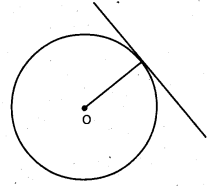
lx + my = 1 అనే రేఖ x2 + y2 = a2 అనే వృత్తాన్ని ఖండించే బిందువులను మూలబిందువుకు కలిపితే వచ్చే రేఖలు ఏకీభవించడానికి నియమం కనుక్కోండి.
సాధన:
AP Inter 1st Year Maths 1B Solutions Chapter 4 సరళరేఖాయుగ్మాలు Ex 4(c) 7
వృత్త సమీకరణము x2 + y2 = a2 …………….. (1)
AB సమీకరణము lx + my = 1 ………………… (2)
(2) సహాయంతో (1) ని సమఘాతపరిస్తే OA, OB ల ఉమ్మడి సమీకరణం.
x2 + y2 = a2 . 12
= a2 (lx + my) 2
= a2(l2x2 + m2y2 + 2lmxy)
i.e., x2 + y2 · a2l2x2 + a2 m2y2 + 2a2lmxy
(a2l2 – 1) x2 + 2a2lmxy + (a2m2 – 1) y2 = 0
OA, OB లు వక్రీభవిస్తున్నాయి.
⇒ h2 = ab
a4 l2m2 = (a2 l2 – 1)(a2m2 – 1)
a4 l2m2 = a4 l2m2 – a2 l2 – a2 m2 + 1
∴ a2 l2 – a2m2 + 1 = 0
a2 (l2 + m2) = 1
ఇది కావలసిన నియమము.

AP Inter 1st Year Maths 1B Solutions Chapter 4 సరళరేఖాయుగ్మాలు Ex 4(c)

ప్రశ్న 3.
6x − y + 8 = 0 అనే రేఖ 3x2 + 4xy – 4y2 – 11x + 2y + 6 = 0 అనే సరళరేఖాయుగ్మాన్ని ఖండించే బిందువులను మూలబిందువుకు కలిపితే వచ్చే రేఖలు నిరూపకాక్షాలతో సమానకోణాలు చేస్తాయని చూపండి.
సాధన:
దత్త రేఖాయుగ్మం
3x2 + 4xy – 4y2 – 11 x + 2y + 6 = 0 ……………… (1)
దత్త రేఖ సమీకరణము
6x – y + 8 = 0 ⇒ \(\frac{6 x-y}{-8}\) = 1
⇒ \(\frac{y-6 x}{8}\) = 1
(2) సహాయంతో (1) ని సమఘాతపరచగా
3x2 + 4xy – 4y2 – (11x – 2y) \(\left(\frac{y-6 x}{8}\right)\) + 6 \(\left(\frac{y-6 x}{8}\right)^2\) = 0
= 64 [3x2 + 4xy – 4y2] – 8[11xy – 66x2 – 2y2 + 12xy] + 6[y2 + 36x2 – 12xy] = 0
936x2 + 256 xy – 256 xy – 234y2 = 0
∴ 468 x2 – 117 y2 = 0
⇒ 4x2 – y2 = 0
ఖండన బిందువులను మూలబిందువుకు కలిపే రేఖాయుగ్మ సమీకరణం
(3) యొక్క కోణ సమద్విఖండన రేఖల సమీకరణాలు
h(x2 – y2) – (a – b) xy = 0
0 (x2 – y ) – (4 – 1) xy = 0
⇒ xy = 0
x = 0 లేదా y
= 0 [నిరూపకాక్షాల సమీకరణాలు]
∴ దత్త రేఖల నిరూపకాక్షాల సమాన నిమ్నత కలిగి ఉన్నాయి.

AP Inter 1st Year Maths 1B Solutions Chapter 4 సరళరేఖాయుగ్మాలు Ex 4(b)

Practicing the Intermediate 1st Year Maths 1B Textbook Solutions Chapter 4 సరళరేఖాయుగ్మాలు Exercise 4(b) will help students to clear their doubts quickly.

AP Inter 1st Year Maths 1B Solutions Chapter 4 సరళరేఖాయుగ్మాలు Exercise 4(b)

అభ్యాసం – 4 (బి)

I.

ప్రశ్న 1.
2x2 + xy – 6y2 + 7y – 2 = 0 లు సూచించే సరళ రేఖల మధ్యకోణం కనుక్కోండి.
సాధన:
దత్త సమీకరణము 2x2 + xy – 6y2 + 7y – 2 = 0
2x2 + xy – 6y2 = 2x2 + 4xy – 3xy – 6y2
= 2x (x + 2y) – 3y (x + 2y)
= (2x – 3y) (x + 2y)
2x2 + xy – 6y2 + 7y – 2 = 0 = (2x – 3y + c1) (x + 2y + c2)
x గుణకాలు సమానం చేస్తే c1 + 2 = 0
y గుణకాలు సమానం చేస్తే 2c1 – 3c2 = 7
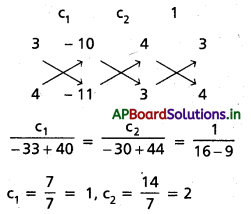
సాధించగా c1 = 2, c2 = -1
సరళరేఖల సమీకరణాలు 2x – 3y + 2 = 0, x + 2y – 1 = 0

AP Inter 1st Year Maths 1B Solutions Chapter 4 సరళరేఖాయుగ్మాలు Ex 4(b)

ప్రశ్న 2.
2x2 + 3xy – 2y2 + 3x + y + 1 = 0 సమీకరణం ఒక లంబరేఖాయుగ్మాన్ని సూచిస్తుందని నిరూపించండి.
సాధన:
a = 2, f = 1/2
b = -2 , g = 3/2
c = 1, h = 3/2
abc + 2fgh – af2 – bg2 – ch2
= 2(-2)(1) + 2.\(\frac{1}{2}\) . \(\frac{31}{2}\) . \(\frac{3}{2}\) – 2 . \(\frac{1}{4}\) + 2 . \(\frac{9}{4}\) – 1 \(\frac{9}{4}\)
= -4 + \(\frac{9}{4}\) – \(\frac{1}{2}\) + \(\frac{18}{4}\) – \(\frac{9}{4}\)
= -4 + \(\frac{9}{4}\) – \(\frac{1}{2}\) + \(\frac{9}{2}\) – \(\frac{9}{4}\)
= 0
h2 – ab = \(\frac{9}{4}\) + 4 = \(\frac{25}{4}\) > 0,
g2 – ac = \(\frac{9}{4}\) – 2 = \(\frac{1}{4}\) > 0,
f2 – bc = \(\frac{1}{4}\) + 2 = \(\frac{9}{4}\) > 0
a + b = 2 – 2 = 0 దత్తరేఖలు లంబంగా ఉన్నాయి.

AP Inter 1st Year Maths 1B Solutions Chapter 4 సరళరేఖాయుగ్మాలు Ex 4(b)

II.

ప్రశ్న 1.
3x2 + 7xy + 2y2 + 5x + 5y + 2 సమీకరణం ఒక సరళరేఖాయుగ్నాన్ని సూచిస్తుందని నిరూపించి, ఆ సరళరేఖల ఖండన బిందువును కనుక్కోండి
సాధన:
3x2 + 7xy +2y2 + 5x + 5y + 2 = 0
పోల్చగా a= 3 ; 2f = 5 ⇒ f = \(\frac{5}{2}\)
b = 2 ; 2g = 5 ⇒ g = \(\frac{5}{2}\)
c = 2 ; 2h = 7 ⇒ h = \(\frac{7}{2}\)
∆ = abc + 2fgh – af2 – bg2 – ch2
= 3(2) (2) + 2 . \(\frac{5}{2}\) . \(\frac{5}{2}\) . \(\frac{7}{2}\)– 3 . \(\frac{25}{4}\) – 2 . \(\frac{25}{4}\) – 2 . \(\frac{49}{4}\)
= \(\frac{1}{2}\) (48 + 175 – 75 – 50 – 98)
= \(\frac{1}{2}\) (223 – 223) = 0
h2 – ab = \(\left(\frac{7}{2}\right)^2\) – 2.6 = \(\frac{49}{4}\) – 12 = \(\frac{1}{4}\) > 0
f2 – bc = \(\left(\frac{5}{2}\right)^2\) – 2.2 = \(\frac{25}{4}\) – 4 = \(\frac{9}{4}\) > 0
g2 – ac = \(\left(\frac{5}{2}\right)^2\) – 3.2 = \(\frac{25}{4}\) – 6 = \(\frac{1}{4}\) > 0
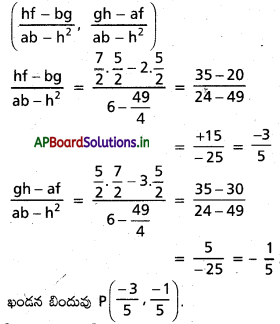
∴ దత్త సమీకరణము రేఖాయుగ్మాన్ని సూచించే ఖండన బిందువు
AP Inter 1st Year Maths 1B Solutions Chapter 4 సరళరేఖాయుగ్మాలు Ex 4(b) 1

ప్రశ్న 2.
2x2 + kxy – 6y2 + 3x + y + 1 = 0 సమీకరణం ఒక సరళరేఖాయుగ్మాన్ని సూచిస్తే K విలువ కనుక్కోండి. K యొక్క ఆ విలువకు ఆ సరళరేఖల ఖండన బిందువును, వాటి మధ్యకోణాన్ని కనుక్కోండి.
సాధన:
దత్త సమీకరణము
2x2 + kxy – 6y2 + 3x + y + 1 = 0
a = 2. ; 2f = 1 ⇒ f = \(\frac{1}{2}\)
b = -6 ; 2g = 3 ⇒ g = \(\frac{3}{2}\)
c = 1 ; 2h = k ⇒ h = \(\frac{k}{2}\)
దత్త సమీకరణము రేఖాయుగ్మాన్ని సూచిస్తే
abc + 2fgh – af2 – bg2 – ch2 = 0
-12 + 2 . \(\frac{1}{2}\) . \(\frac{3}{2}\) . (+\(\frac{k}{2}\)) – 2 . \(\frac{1}{4}\) + 6 . \(\frac{9}{4}\) – \(\frac{k^2}{4}\) = 0
-48 + 3k – 2 + 54 – k2 = 0
-k2 + 3k + 4 = 0 ⇒ k2 – 3k – 4 = 0
(k – 4) (k + 1) = 0
k = 4 లేదా. – 1.
సందర్భం i) : k = -1
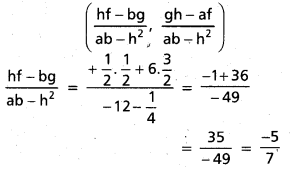
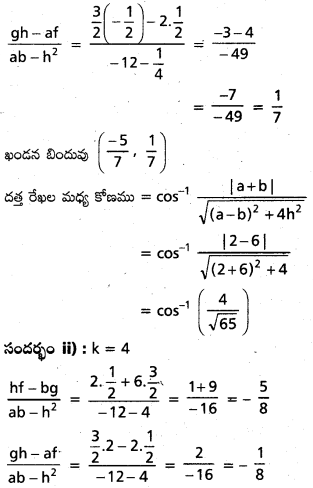
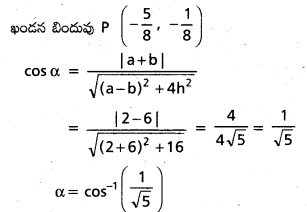
ఖండన బిందువు
AP Inter 1st Year Maths 1B Solutions Chapter 4 సరళరేఖాయుగ్మాలు Ex 4(b) 2
AP Inter 1st Year Maths 1B Solutions Chapter 4 సరళరేఖాయుగ్మాలు Ex 4(b) 3
AP Inter 1st Year Maths 1B Solutions Chapter 4 సరళరేఖాయుగ్మాలు Ex 4(b) 4

AP Inter 1st Year Maths 1B Solutions Chapter 4 సరళరేఖాయుగ్మాలు Ex 4(b)

ప్రశ్న 3.
x2 – y2 – x + 3y – 2 0 సమీకరణం రెండు లంబరేఖలను సూచిస్తుందని నిరూపించి, వాటి సమీకరణాలను కనుక్కోండి.
సాధన:
పోల్చగా a = 1 ; f = \(\frac{3}{2}\)
b = -1 ; g = –\(\frac{1}{2}\)
c = -2 ; h = 0
abc + 2fgh – af2 – bg2 – ch2
= 1 (-1) (-2) + 0 – 1 . \(\frac{9}{4}\) + 1 . \(\frac{1}{4}\) + 0
= +2 – \(\frac{9}{4}\) + \(\frac{1}{4}\) = 0
h2 – ab = 0 – 1 (-1) = 1 > 0,
f2 – bc = \(\frac{9}{4}\) – 2 = \(\frac{1}{4}\) > 0
g2 – ac = \(\frac{1}{4}\) + 2 = \(\frac{9}{4}\) > 0
a + b = 1 – 1 = 0
దత్త సమీకరణము లంబరేఖా యుగ్మాన్ని సూచిస్తుంది.
x2 – y2 – x + 3y – 2 = (x + y + c1) (x – y + c2)
x గుణకాలు సమానం చేయగా,
⇒ c1 + c2 = -1
y గుణకాలు సమానం చేయగా,
⇒ -c1 + c2 = 3
కూడగా 2c2 = 2 ⇒ c2 = 1
c1 + c2 = 1 ⇒ c1 + 1 = -1
c1 = -2
రేఖల సమీకరణాలు x + y – 2 = 0 మరియు x – y + 1 = 0

AP Inter 1st Year Maths 1B Solutions Chapter 4 సరళరేఖాయుగ్మాలు Ex 4(b)

ప్రశ్న 4.
x2 + 2xy – 35y2 – 4x + 44y – 12 = 0 సూచించే రేఖాయుగ్మం 5x + 2y – 8 = 0 అనే సరళరేఖ అనుషక్తాలవుతాయని చూపండి.
సాధన:
దత్త రేఖల సమీకరణాలు
x2 + 2xy – 35y2 – 4x + 44y – 12 = 0
a = 1 ; f = 22
b = -35 ; g = -2
c = – 12 ; h = 1
AP Inter 1st Year Maths 1B Solutions Chapter 4 సరళరేఖాయుగ్మాలు Ex 4(b) 5
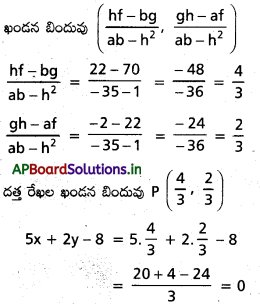
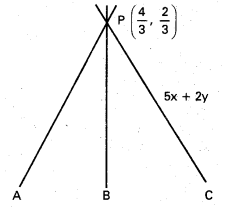
P బిందువు 5x + 2y – 8 = 0 రేఖ మీద ఉంది.
∴ దత్త రేఖలు అనుషక్తాలు.
AP Inter 1st Year Maths 1B Solutions Chapter 4 సరళరేఖాయుగ్మాలు Ex 4(b) 6

ప్రశ్న 5.
క్రింద ఇచ్చిన సమాంతర రేఖాయుగ్మాల మధ్య దూరాలను కనుక్కోండి.
i) 9x2 – 6xy + y2 + 18x – 6y + 8 = 0
సాధన:
సమాంతర రేఖల మధ్య దూరం = 2\(\sqrt{\frac{g^2-a c}{a(a+b)}}\)
= \(2 \sqrt{\frac{9^2-9.8}{9(9+1)}}=2 \sqrt{\frac{9}{9.10}}\)
= \(\sqrt{\frac{4}{10}}=\sqrt{\frac{2}{5}}\)

ii) x2 + 2\(\sqrt{3}\)xy + 3y2 – 3x – 3\(\sqrt{3}\)y – 4 = 0
సాధన:
సమాంతర రేఖల మధ్య దూరం = 2\(\sqrt{\frac{g^2-a c}{a(a+b)}}\)
= \(2 \sqrt{\frac{\frac{9}{4}+4}{1(1+3)}}=2 \sqrt{\frac{25}{4.4}}=\frac{5}{2}\)

AP Inter 1st Year Maths 1B Solutions Chapter 4 సరళరేఖాయుగ్మాలు Ex 4(b)

ప్రశ్న 6.
3x2 + 8xy – 3y2 = 0, 3x2 + 8xy – 3y2 + 2x – 4y – 1 = 0 అనే రేఖాయుగ్మాలతో ఒక చతురస్రం ఏర్పడుతుందని నిరూపించండి.
AP Inter 1st Year Maths 1B Solutions Chapter 4 సరళరేఖాయుగ్మాలు Ex 4(b) 7
సాధన:
OA, OB ల ఉమ్మడి సమీకరణాలు
3x2 + 8xy – 3y2
(x + 3y) (3x – y) = 0
3x – y = 0, x + 3y = 0
OA సమీకరణము 3x – y = 0 ……………….. (1)
OB సమీకరణము x + 3y = 0 ………………. (2)
CA, CB ల ఉమ్మడి సమీకరణాలు
3x2 + 8xy – 3y2 + 2x – 4y + 1 = 0
3x2 + 8xy – 3y2 + 2x – 4y + 1 = (3x – y + c1)(x + 3y + c2)
x గుణకాలను సమానం చేయగా c1 + 3c2 = 2
y గుణకాలను సమానం చేయగా 3c1 + c2 = – 4
AP Inter 1st Year Maths 1B Solutions Chapter 4 సరళరేఖాయుగ్మాలు Ex 4(b) 8
BC సమీకరణం 3x – y – 1 = 0 ……………… (3)
AC సమీకరణం x + 3y + 1 = 0 ……………… (4)
OA, BC లు సమీకరణాలు స్థిరపదాలలో మాత్రమే చేధిస్తున్నా
⇒ OA, BC లు సమాంతరాలు
OB, CA లు సమీకరణాలు స్థిరపదాలలో మాత్రమే చేధిస్తున్నా
⇒ OB, AC లు సమాంతరాలు
OA, OB ల ఉమ్మడి సమీకరణము.
a + b = 3 – 3 = 0, OACB దీర్ఘచతురస్రం.
OA = 0నుండి AC మీదకు లంబదూరము
= \(\frac{|0+0+1|}{\sqrt{1+9}}=\frac{1}{\sqrt{10}}\)
OB = 0 నుండి BC మీదకు లంబదూరము
= \(\frac{|0+0-1|}{\sqrt{9+1}}=\frac{1}{\sqrt{10}}\)
OA = OB మరియు OACB దీర్ఘచతురస్రం
OACB చతురస్రం.

AP Inter 1st Year Maths 1B Solutions Chapter 4 సరళరేఖాయుగ్మాలు Ex 4(b)

III.

ప్రశ్న 1.
(2, 1) బిందువు నుంచి 12x2 + 25xy + 12y2 10x + 11y + 2 = 0 సూచించే సరళరేఖలకు ఉన్న లంబ. దూరాల లబ్దం కనుక్కోండి.
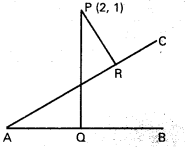
AP Inter 1st Year Maths 1B Solutions Chapter 4 సరళరేఖాయుగ్మాలు Ex 4(b) 9
సాధన:
AB, AC ల ఉమ్మడి సమీకరణాలు
12x2 + 25xy + 12y2 + 10x + 11y + 2 = 0
12x2 + 25xy + 12y2
= 12x2 + 16xy + 9xy + 12y2 = 0
= 4x (3x+4y) + 3y (3x+4y)
= (3x + 4y) (4x + 3y)
12x2 + 25xy + 12y2 + 10x + 11y + 2
= (3x + 4y + c1) (4x + 3y + c2)
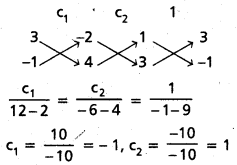
x గుణకాలను సమానం చేయగా,
4c1 +3c2 = 10 ……………. (1)
y గుణకాలను సమానం చేయగా,
3c1 + 4c2 = 11 ……………… (2)
i.e., 4c1 + 3c2 – 10 = 0
3c1 + 4c2 – 11 = 0
AP Inter 1st Year Maths 1B Solutions Chapter 4 సరళరేఖాయుగ్మాలు Ex 4(b) 10
AB సమీకరణం 3x + 4y + 1 = 0
AC సమీకరణం 4x + 3y + 2 = 0
PQ = P నుండి AB మీదకు లంబదూరము
AB = \(\frac{6+4+1}{\sqrt{9+16}}=\frac{11}{5}\)
PR = P నుండి AC మీదకు లంబదూరము
AC = \(\frac{|8+3+2|}{\sqrt{16+9}}=\frac{13}{5}\)
లంబదూరాల లబ్దము
= PQ × PR = \(\frac{11}{5}\) × \(\frac{13}{5}\) = \(\frac{143}{25}\)

AP Inter 1st Year Maths 1B Solutions Chapter 4 సరళరేఖాయుగ్మాలు Ex 4(b)

ప్రశ్న 2.
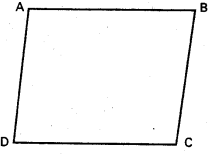
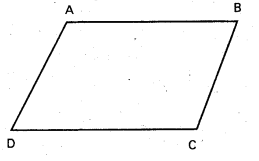
y2 – 4y + 3 = 0, x2 + 4xy + 4y2 + 5x + 10y + 4 = 0 అనే సరళరేఖాయుగ్మాలతో ఒక సమాంతర చతుర్భుజం ఏర్పడుతుందని నిరూపించి, దాని భుజాల పొడవులను కనుక్కోండి.
AP Inter 1st Year Maths 1B Solutions Chapter 4 సరళరేఖాయుగ్మాలు Ex 4(b) 11
సాధన:
మొదటి రేఖాయుగ్మం సమీకరణం y2 – 4y + 3 = 0
(y – 1) (y – 3) = 0
y – 1 = 0 లేదా y – 3 = 0
AB సమీకరణం y – 1 = 0 …………… (1)
CD సమీకరణం y – 3 = 0 ……………. (2)
AB, CDల సమీకరణాలలో స్థిరపదంలో మాత్రమే తేడా ఉంది.
∴ AB, CD లు సమాంతరాలు.
రెండవ రేఖా యుగ్మం సమీకరణం
x2 + 4xy + 4y2 + 5x + 10y + 4 = 0
(x + 2y)2 + 5(x + 2y ) + 4 = 0
(x + 2y)2 + 4 (x + 2y) + (x + 2y) + 4 = 0
(x + 2y)(x + 2y + 4) + 1 (x + 2y + 4) = 0
(x + 2y + 1) (x + 2y + 4) = 0
x + 2 y + 1 = 0, x + 2 y + 4 = 0
AD సమీకరణం x + 2y + 1 = 0 ……………… (3)
BC సమీకరణం x + 2 y + 4 = 0 …………….. (4)
AD, BC లు సమాంతరాలు.
(1); (3) లను సాధించగా x + 2 + 1 = 0
x = -3
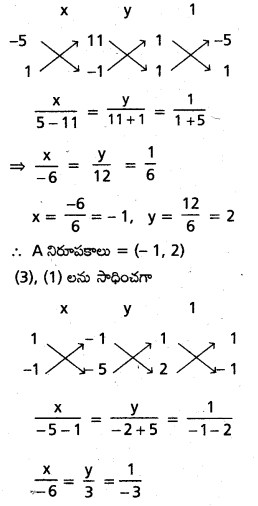
A నిరూపకాలు (-3, 1)
x = 3
(2), (3) లను సాధించగా x + 6 + 1 = = 0
x = -7
D నిరూపకాలు (-7, 3)
(1), (4) లను సాధించగా x + 2 + 4 = 0
x = – 6
B నిరూపకాలు (−6, 1)
AB = \(\sqrt{(-3+6)^2+(1-1)^2}\)
= \(\sqrt{9+0}\)
= 3
AD = \(\sqrt{(-3+7)^2+(1-3)^2}\)
= \(\sqrt{16+4}\)
= \(\sqrt{20}=2 \sqrt{5}\)
సమాంతర చతుర్భుజ భుజాల పొడవులు 3, \(2 \sqrt{5}\).

AP Inter 1st Year Maths 1B Solutions Chapter 4 సరళరేఖాయుగ్మాలు Ex 4(b)

ప్రశ్న 3.
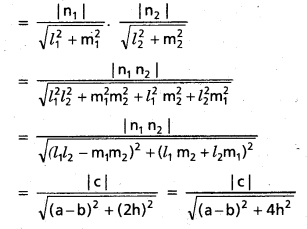
ax2 + 2hxy + by2 + 2gx + 2fy + c = 0 అనే సమీకరణం రేఖాయుగ్మాన్ని సూచిస్తే, మూలబిందువు నుంచి ఈ సరళరేఖలకు ఉన్న దూరాల లబ్ధం \(\frac{|c|}{\sqrt{(a-b)^2+4 h^2}}\) అని నిరూపించండి.
సాధన:
ax2 + 2hxy + by2 + 2gx + 2fy + c = 0
రేఖాయుగ్మాన్ని సూచిస్తుంది.
l1 x + m1y + n1 = 0 ………………… (1)
l2 x + m2y + n2 = 0 ………………. (2)
⇒ ax2 + 2hxy + by2 + 2gx + 2fy + c
= (l1 x + m1y + n1)(l2 x + m2y + n2)
l1l2 = a,
m1m2 = b, l1m2 + l2m1 = 2h,
l1n2 + l2n1 = 2g,
m1n2 + m2n1 = 2f,
n1n2 = c
మూలబిందువు నుండి (1) కి లంబదూరము = \(\frac{\left|n_1\right|}{\sqrt{l_1^2+m_1^2}}\)
మూలబిందువు నుండి (2) కి లంబదూరము = \(\frac{\left|n_2\right|}{\sqrt{l_2^2+m_2^2}}\)
లంబాల లబ్ధం
AP Inter 1st Year Maths 1B Solutions Chapter 4 సరళరేఖాయుగ్మాలు Ex 4(b) 12

AP Inter 1st Year Maths 1B Solutions Chapter 4 సరళరేఖాయుగ్మాలు Ex 4(b)

ప్రశ్న 4.
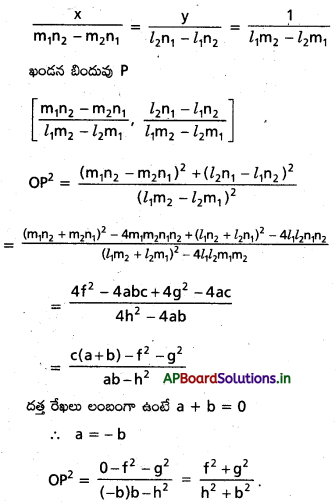
ax2 + 2hxy + by2 + 2gx + 2fy + c = 0 అనే సమీకరణం ఒక వ్యతిచ్ఛేదక రేఖాయుగ్మాన్ని సూచిస్తే, మూలబిందువు నుంచి వీటి ఖండన బిందువు దూరానికి వర్గం \(\frac{c(a+b)-f^2-g^2}{a b-h^2}\) అవుతుందని చూపండి. దత్త సరళరేఖలు లంబంగా ఉంటే ఈ దూరం యొక్క వర్గం \(\frac{f^2+g^2}{h^2+b^2}\) అని కూడ నిరూపించండి.
సాధన:
ax2 + 2hxy + by2 + 2gx + 2fy + c = 0
రేఖాయుగ్మాన్ని సూచిస్తుందనుకొందాం.
l1x + m1y + n1 = 0 ……………… (1)
l2x + m2y + n2 = 0 ………………. (2)
(l1x + m1y + n1)(l2x + m2y + n2)
= ax2 + 2hxy + by2 + 2gx + 2fy + c
l1l2 = a, m1m2 = b, n1n2 = c
l1m2 + l2m1 = 2h, l1n2 + l2n1, = 2g,
m1n2 + m2n1 = 2f
(1); (2) లను సాధించగా
AP Inter 1st Year Maths 1B Solutions Chapter 4 సరళరేఖాయుగ్మాలు Ex 4(b) 13

AP Inter 1st Year Maths 1B Solutions Chapter 3 సరళరేఖ Ex 3(c)

Practicing the Intermediate 1st Year Maths 1B Textbook Solutions Chapter 3 సరళరేఖ Exercise 3(c) will help students to clear their doubts quickly.

AP Inter 1st Year Maths 1B Solutions Chapter 3 సరళరేఖ Exercise 3(c)

అభ్యాసం – 3 (సి)

I.

ప్రశ్న 1.
కింద సూచించిన సరళరేఖలు దత్త బిందువులను కలిపే రేఖాఖండాలను విభజించే నిష్పత్తులను కనుక్కోండి. ఆ బిందువులు సరళరేఖకు ఒకే వైపున ఉన్నాయో, చెరొక వైపున ఉన్నాయో తెలపండి.
i) 3x −4y=7, (2, -7), (−1, 3)
సాధన:
3x – 4y – 7 = 0
AP Inter 1st Year Maths 1B Solutions Chapter 3 సరళరేఖ Ex 3(c) 1
L11, L22 లు వ్యతిరేక గుర్తులు కలిగి వున్నాయి.

ii) 3x + 4y = 6, (2, -1), (1, 1)
సాధన:
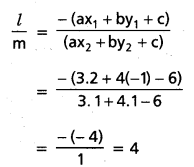
సరళరేఖ సమీకరణము 3x + 4y – 6 = 0
AP Inter 1st Year Maths 1B Solutions Chapter 3 సరళరేఖ Ex 3(c) 2
దత్త బిందువులు రేఖకు వ్యతిరేక దిశలలో ఉంటాయి.

iii) 2x + 3y = 5, (0, 0), (-2, 1) [Mar. ’14]
సాధన:
2x + 3y – 5 = 0.
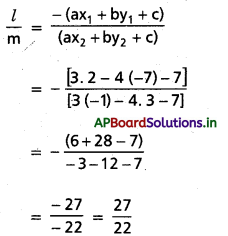
\(\frac{l}{m}=\frac{-(0+0-5)}{-4+3-5}\)
= \(\frac{-5}{6}\)
దత్త బిందువులు రేఖకు ఒకే వైపున ఉంటాయి.

AP Inter 1st Year Maths 1B Solutions Chapter 3 సరళరేఖ Ex 3(c)

ప్రశ్న 2.
కింది రేఖల ఖండన బిందువును కనుక్కోండి.

i) 4x + 8y 1 = 0, 2x − y + 1 = 0
సాధన:
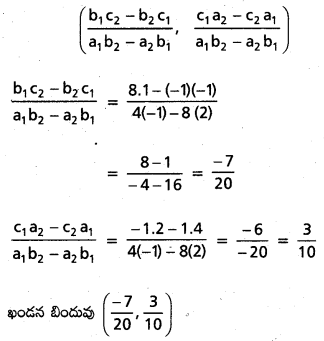
4x + 8y – 1 = 0, 2x – y + 1 = 0
ఖండన బిందువు
AP Inter 1st Year Maths 1B Solutions Chapter 3 సరళరేఖ Ex 3(c) 3

ii) 7x + y + 3 = 0, x + y = 0
సాధన:
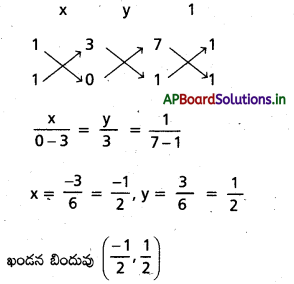
7x + y + 3 = 0, x + y = 0
AP Inter 1st Year Maths 1B Solutions Chapter 3 సరళరేఖ Ex 3(c) 4

ప్రశ్న 3.
(a – b) x + (b – c) y = c – a, (b – c)x + (c – a)y = (a – b), (c – a)x + (a – b)y b – c సరళరేఖలు అనుషక్తాలని చూపండి.
సాధన:
దత్త రేఖల సమీకరణాలు
(a – b) x + (b – c) y = c – a ……………… (1)
(b-c) x + (c – a) y = a – b ……………… (2)
(c – a) x + (a – b) y = b – c …………….. (3)
(1), (2) ల నుండి
AP Inter 1st Year Maths 1B Solutions Chapter 3 సరళరేఖ Ex 3(c) 5
AP Inter 1st Year Maths 1B Solutions Chapter 3 సరళరేఖ Ex 3(c) 6
(1), (2) ల ఖండన బిందువు P (-1, -1)
(3) లో ప్రతిక్షేపించగా
(c − a) (-1) + (a – b) (−1) = c + a – a + b = b – c
∴ P (−1, −1) బిందువు (3) మీద ఉంది.
దత్త రేఖలు అనుషక్తాలు.

AP Inter 1st Year Maths 1B Solutions Chapter 3 సరళరేఖ Ex 3(c)

ప్రశ్న 4.
కింద ఇచ్చిన సమీకరణాలను L1 + λL2 = 0 రూపంలోకి మార్చండి. ఈ సమీకరణం సూచించే సరళరేఖా కుటుంబం అనుషక్త బిందువును కనుక్కోండి.
i) (2 + 5k)x – 3(1 + 2k)y + (2 − k) = 0
సాధన:
(2 + 5k)x − 3(1 + 2k)y + (2 – k) = 0
(2x – 3y+ 2) + k (5x – 6y – 1) = 0
ఇది L1 + λL2 = 0 రూపంలో ఉంది.
L1 = 2x – 3y + 2 = 0
L2 = 5x – 6y – 1 = 0
AP Inter 1st Year Maths 1B Solutions Chapter 3 సరళరేఖ Ex 3(c) 7
P(5, 4) అనుషక్త బిందువు.

ii) (k + 1)x + (k + 2) y + 5 = 0
సాధన:
(k + 1)x + (k + 2) y + 5 = 0
k (x + y) + (x + 2y + 5) = 0
i.e., (x + 2y + 5) + k (x + y) = 0
ఇది L1 + λL2 = 0 రూపంలో ఉంది.
∴ L1 = x + 2y + 5 = 0
L2 = x + y = 0
AP Inter 1st Year Maths 1B Solutions Chapter 3 సరళరేఖ Ex 3(c) 8
అనుషక్త బిందువు P(5, – 5).

AP Inter 1st Year Maths 1B Solutions Chapter 3 సరళరేఖ Ex 3(c)

ప్రశ్న 5.
x + p = 0, y + 2 = 0, 3x + 2y + 5 = 0 సరళరేఖలు అనుషకాలయితే p విలువను కనుక్కోండి. [Mar. ’13]
సాధన:
దత్తరేఖల సమీకరణాలు
x + p = 0 …………… (1)
y + 2 = 0 …………… (2)
3x + 2y + 5 = 0 ……………… (3)
(2) నుండి y = -2
(3) లో ప్రతిక్షేపించగా 3x – 4 + 5 = 0
3x = 4 – 5 = -1
x = –\(\frac{1}{3}\)
(2), (3) ల ఖండన బిందువు P(-\(\frac{1}{3}\), 2)
దత్త రేఖలు అనుషక్తాలు.
బిందువు x + p = 0 పై ఉంది.
–\(\frac{1}{3}\) + p = 0 ⇒ p = \(\frac{1}{3}\)

ప్రశ్న 6.
నిరూపకాక్షాలతోను, కింద సూచించిన సరళరేఖలతోను ఏర్పడే త్రిభుజ వైశాల్యాలను కనుక్కోండి.
i) x – 4y + 2 = 0
సాధన:
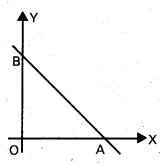
AB సమీకరణము x – 4y + 2 = 0
– x + 4y = 2
\(\frac{x}{-2}+\frac{y}{\left(\frac{1}{2}\right)}\) = 1
a = -2, b = \(\frac{1}{2}\)
∆OAB వైశాల్యము = \(\frac{1}{2}\)|ab|
= \(\frac{1}{2}\) |-2 × \(\frac{1}{2}\)| = \(\frac{1}{2}\) చ. యూనిట్లు.

ii) 3x – 4y + 12 = 0 [A.P Mar. ’15]
సాధన:
AB సమీకరణము 3x – 4y + 12 = 0
– 3x + 4y = 12
\(\frac{x}{-4}+\frac{y}{3}\) = 1
a = – 4, b = 3
∆OAB వైశాల్యము = \(\frac{1}{2}\)|ab|
= \(\frac{1}{2}\)|(-4) (3)|= \(\frac{1}{2}\) (12)
= 6 చ. యూనిట్లు.

AP Inter 1st Year Maths 1B Solutions Chapter 3 సరళరేఖ Ex 3(c)

II.

ప్రశ్న 1.
ఒక సరళరేఖ నిరూపకాక్షాలను A, B లలో కలుస్తుంది.
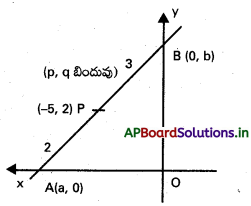
i) (−5, 2) వద్ద 2 : 3 నిష్పత్తిలో \(\overline{\mathrm{A B}}\) విభజించబడినప్పుడు
సాధన:
AP Inter 1st Year Maths 1B Solutions Chapter 3 సరళరేఖ Ex 3(c) 9
OA = a, OB = b అనుకుందాం.
A నిరూపకాలు (a, 0), B నిరూపకాలు (0, b)
P బిందువు AB ని 2 : 3 నిష్పత్తిలో విభజిస్తుంది.
P నిరూపకాలు \(\left(\frac{3 a}{5}, \frac{2 b}{5}\right)\) = (-5,2)
\(\frac{3 a}{5}\) = -5, \(\frac{3 b}{5}\) = 2
a = – \(\frac{25}{3}\), b = 5
AB సమీకరణము \(\frac{x}{a}+\frac{y}{b}\) = 1
\(\frac{x}{\left(-\frac{25}{3}\right)}+\frac{y}{5}\) = 1
\(\frac{-3 x}{25}+\frac{y}{5}\) = 1
-3x + 5y = 25
3x – 5y + 25 = 0

ii) (-5, 4) వద్ద 1:2 నిష్పత్తిలో \(\overline{\mathrm{A B}}\) ని విభజించబడినప్పుడు
సాధన:
OA = a, OB = b అనుకుందాం.
– A నిరూపకాలు (a, 0), B నిరూపకాలు (0, b)
P బిందువు AB ని 1 : 2 నిష్పత్తిలో విభజిస్తుంది.
P నిరూపకాలు \(\left(\frac{2 a}{3}, \frac{b}{3}\right)\) = (-5, 4)
\(\frac{2 a}{3}\) = -5, \(\frac{b}{3}\) = 4
a = –\(\frac{15}{2}\), b = 12
AB సమీకరణము \(\frac{x}{a}+\frac{y}{b}\) = 1
\(\frac{x}{\left(-\frac{15}{2}\right)}+\frac{y}{12}\) = 1
\(\frac{-2 x}{15}+\frac{y}{12}\) = 1
– 8x + 5y = 60
8x – 5y + 60 = 0

iii) (p, q) బిందువు \(\overline{\mathrm{A B}}\) ని సమద్విఖండన చేసినప్పుడు ఆ సరకరేఖ సమీకరణాన్ని కనుక్కోండి.
సాధన:
OA = a, OB = b అనుకుందాం.
A నిరూపకాలు (a, 0), B నిరూపకాలు (0, b)
AB మధ్యబిందువు = \(\left(\frac{a}{2}, \frac{b}{2}\right)\) = (p, q)
\(\frac{a}{2}\) = p, \(\frac{b}{2}\) = q
a = 2p, b = 2q
AB సమీకరణము \(\frac{x}{a}+\frac{y}{b}\) = 1
\(\frac{x}{2p}+\frac{y}{2q}\) = 1
\(\frac{x}{p}+\frac{y}{q}\) = 2

AP Inter 1st Year Maths 1B Solutions Chapter 3 సరళరేఖ Ex 3(c)

ప్రశ్న 2.
(−1, 2), (5, –1) బిందువుల గుండా పోయే సరళరేఖ సమీకరణం కనుక్కొని, ఈ రేఖతోను, నిరూపకాక్షాలతోను ఏర్పడే త్రిభుజ వైశాల్యాన్ని కూడా కనుక్కోండి.
సాధన:
P (-1, 2), Q (5, – 1) లు దత్త బిందువులు.
PQ సమీకరణము
(y − y1) (x1 − x2) = (x − x1) (y1 – y2)
(y – 2) (−1 – 5) = (x + 1) (2 + 1)
-6 (y – 2) = 3 (x + 1)
−2y + 4 = x + 1
x + 2y – 3 = 0
AP Inter 1st Year Maths 1B Solutions Chapter 3 సరళరేఖ Ex 3(c) 10
∆ OAB వైశాల్యము = \(\frac{c^2}{2|a b|}=\frac{9}{2|1.2|}=\frac{9}{4}\) చ. యూనిట్లు.

AP Inter 1st Year Maths 1B Solutions Chapter 3 సరళరేఖ Ex 3(c)

ప్రశ్న 3.
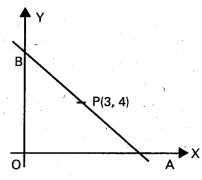
నిరూపకాక్షాలతో, ఒక సరళరేఖతోను మొదటి పాదంలో ఏర్పడిన త్రిభుజవైశాల్యం 24 చ. యూనిట్లు. ఆ సరళరేఖ (3, 4) బిందువు గుండా పోతూంటే, దాని సమీకరణం కనుక్కోండి.
AP Inter 1st Year Maths 1B Solutions Chapter 3 సరళరేఖ Ex 3(c) 11
సాధన:
అంతరఖండ రూపంలో AB సమీకరణము
\(\frac{x}{a}+\frac{y}{b}\) = 1
ఈ రేఖ P (3, 4) గుండా పోతుంది.
\(\frac{3}{a}+\frac{4}{b}\) = 1
\(\frac{4}{b}=1-\frac{3}{a}=\frac{a-3}{a}\)
b = \(\frac{4 a}{a-3}\)
∆ OAB వైశాల్యము = 24 ⇒ \(\frac{1}{2}\) |ab| = 24
\(\frac{1}{2} \frac{4 a^2}{a-3}\) = 24
a2 = 12 (a – 3)
= 12a – 36
a2 – 12a + 36 = 0
(a – 6)2 = 0 ⇒ a = 6
b = \(\frac{4 a}{a-3}=\frac{24}{3}\) = 8
AB సమీకరణము \(\frac{x}{6}+\frac{y}{8}\) = 1
4x + 3y = 24
4x + 3y – 24 = 0

ప్రశ్న 4.
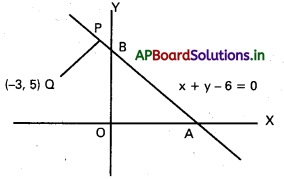
వాలు 1 కలిగి Q(- 3, 5) గుండా పోయే సరళరేఖ x + y − 6 = 0 సరళరేఖను P వద్ద ఖండిస్తోంది. PQ దూరాన్ని కనుక్కోండి. [T.S Mar. ’15]
AP Inter 1st Year Maths 1B Solutions Chapter 3 సరళరేఖ Ex 3(c) 12
సాధన:
వాలు = 1
tan α = 1 = tan 45°
α = 45°
ఈ రేఖ Q (−3, 5) గుండా పోతుంది.
P నిరూపకాలు (x1 + r cos α1, y1 + r sin α)
= (-3 + r cos 45°, 5 + r sin 45°)
= \(\left(-3+\frac{r}{\sqrt{2}}, 5+\frac{r}{\sqrt{2}}\right)\)
P బిందువు x + y − 6 = 0 రేఖపై ఉంది.
– 3 + \(\frac{r}{\sqrt{2}}\) + 5 + \(\frac{r}{\sqrt{2}}\) – 6 = 0
2 . \(\frac{r}{\sqrt{2}}\) = 4 ⇒ r = \(\frac{4 \sqrt{2}}{2}\) = 2\(\sqrt{2}\)
PQ = 2\(\sqrt{2}\)

AP Inter 1st Year Maths 1B Solutions Chapter 3 సరళరేఖ Ex 3(c)

ప్రశ్న 5.
(1, 2), (3, 4) బిందువులు 3x – 5y + a = 0 సరళరేఖకు ఒకే వైపున ఉంటే a విలువల సమితిని కనుక్కోంది.
సాధన:
P (1, 2), Q (3, 4) లు దత్త బిందువులు.
దత్తరేఖ సమీకరణము 3x – 5y + a = 0
L11 = 3.1 − 5.2 + a = a − 7
L22 = 3.3 – 5.4 + a = a – 11
a – 7, a – 11 లు రెండూ ధనాత్మకాలు లేదా రెండూ ఋణాత్మకాలు కావాలి.
సందర్భం (i): a – 7 > 0, a – 11 > 0
a > 7, a > 11
∴ a > 7. 11 ⇒ a ∈ (11, α)

సందర్భం (ii) : a – 7 < 0, a – 17 < 0
a < 7, a < 17
⇒ a < 17 ⇒ a = (-α, 27)
∴ a ∈ (α, 7) U (11, α)

ప్రశ్న 6.
2x + y – 3 = 0, 3x + 2y – 2 = 0, 2x – 3y – 23 = 0 సరళరేఖలు అనుషక్తాలని చూపి, అనుషక్త బిందువును కనుక్కోండి.
సాధన:
దత్త రేఖల సమీకరణాలు
2x + y – 3 = 0 ………………. (1)
3x + 2y – 2 = 0 ………………… (2)
2x – 3y – 23 = 0 …………………… (3)
AP Inter 1st Year Maths 1B Solutions Chapter 3 సరళరేఖ Ex 3(c) 13
x = 4, y = -5
ఖండన బిందువు P నిరూపకాలు (4, -5)
2x – 3y – 23 = 2(4) – 3(-5) – 23
= 8 + 15 – 23 = 0
P బిందువు (3) మీద ఉంది.
దత్త రేఖలు అనుషక్తాలు.
అనుషక్త బిందువు P (4, -5)

AP Inter 1st Year Maths 1B Solutions Chapter 3 సరళరేఖ Ex 3(c)

ప్రశ్న 7.
క్రింది రేఖలు అనుపకాలయితే, ఆ విలువ కనుక్కోండి.
(i) 3x + 4y = 5, 2x + 3y = 4, px + 4y = 6
(ii) 4x – 3y – 7 = 0, 2x + py + 2 = 0, 6x + 5y – 1 = 0. [May ’06]
సాధన:
(i) దత్తరేఖల సమీకరణాలు 3x + 4y – 5 = 0
2x + 3y – 4 = 0
AP Inter 1st Year Maths 1B Solutions Chapter 3 సరళరేఖ Ex 3(c) 14
x = −1, y = 2
(1), (2) ల ఖండన బిందువు P (-1, 2)
దత్త రేఖలు అనుషక్తాలు.
P బిందువు px + 4y = 6 మీద ఉంది.
-p + 8 = 6 ⇒ p = 8 – 6 = 2

(ii) దత్తరేఖల సమీకరణాలు 4x – 3y – 7 = 0
6x + 5y – 10
AP Inter 1st Year Maths 1B Solutions Chapter 3 సరళరేఖ Ex 3(c) 15
x = 1, y = -1
P నిరూపకాలు (1, −1)
దత్తరేఖలు అనుషక్తాలు.
P బిందువు 2x + py + 2 = 0 పై ఉంది.
2 – p + 2 = 0
p = 4

ప్రశ్న 8.
x + 2y – 3 = 0, 3x + 4y – 7 = 0, 2x + 3y – 4 = 0, 4x + 5y – 6 = 0 అనే నాలుగు సరళరేఖలు అనుషక్తాలు అవునో, కాదో నిర్ధారించండి.
సాధన:
దత్త రేఖల సమీకరణాలు
x + 2y – 3 = 0 …………………. (1)
3x + 4y – 7 = 0 ……………….. (2)
2x + 3y – 4 = 0 ……………….. (3)
4x + 5y – 6 = 0 ………………. (4)
(1), (2) లను సాధించగా
AP Inter 1st Year Maths 1B Solutions Chapter 3 సరళరేఖ Ex 3(c) 16
x = 1, y = 1
(1), (2) ల ఖండన బిందువు P (1, 1)
2x + 3y – 4 = 2.1 + 3.1 – 4 = 5 – 4 = 1 ≠ 0
4x + 5y – 6 = 4.1 + 5.1 – 6 = 9 – 6 = 3 ≠ 0
∴ P (1, 1) బిందువు (3), (4) ల మీద బిందువు కాదు.
∴ దత్త రేఖలు అనుషక్తాలు కావు.

AP Inter 1st Year Maths 1B Solutions Chapter 3 సరళరేఖ Ex 3(c)

ప్రశ్న 9.
3a + 2b + 4c = 0 అయితే ax + by + c = 0 సమీకరణము అనుషక్త రేఖల కుటుంబాన్ని సూచిస్తుందని చూపండి. అనుషక్త బిందువును కనుక్కోండి.
సాధన:
దత్త నియమము 3a + 2b + 4c = 0
\(\left(\frac{3}{4}\right)\)a + \(\left(\frac{1}{2}\right)\)b + c = 0
a, b ల అన్ని విలువలలో ax + by + c = 0 రేఖ
\(\left(\frac{3}{4}, \frac{1}{2}\right)\) బిందువు గుండా పోతుంది.
ax + by + c = 0 సమీకరణం అనుషక్త రేఖలను సూచిస్తుంది.
అనుషక్త బిందువు \(\left(\frac{3}{4}, \frac{1}{2}\right)\)

ప్రశ్న 10.
శూన్యేతర సంఖ్యలు a, b, c లు హరాత్మక శ్రేఢిలో ఉంటే \(\frac{x}{a}+\frac{y}{b}+\frac{1}{c}\) = 0 సమీకరణం ఒక అనుషక్త రేఖల కుటుంబాన్ని సూచిస్తుందని చూపి, అనుషక్త బిందువును కనుక్కోండి.
సాధన:
a, b, c లు H.P. లో వున్నాయి.
∴ \(\frac{2}{b}=\frac{1}{a}+\frac{1}{c}\)
\(\frac{1}{a}+\frac{(-2)}{b}+\frac{1}{c}\) = 0
∴ a, b, c అన్ని విలువలకు
\(\frac{x}{a}+\frac{y}{b}+\frac{1}{c}\) = 0
రేఖ (1, – 2) బిందువు గుండా పోయే రేఖను సూచిస్తుంది.
∴ \(\frac{x}{a}+\frac{y}{b}+\frac{1}{c}\) = 0 అనుషక్త రేఖలను సూచిస్తున్నాయి.
అనుషక్త బిందువు P (1, – 2)

AP Inter 1st Year Maths 1B Solutions Chapter 3 సరళరేఖ Ex 3(c)

III.

ప్రశ్న 1.
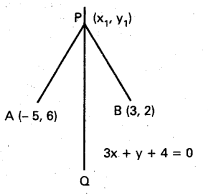
(−5, 6), (3, 2) బిందువుల నుంచి సమదూరంలో ఉంటూ, 3x + y + 4 = 0 సరళరేఖపై ఉన్న బిందువును కనుక్కోండి. [Mar. ’13]
సాధన:
P(x, y) బిందువు 3x + y + 4 = 0 మీద ఉంది.
3x + y + 4 = 0 …………….. (1)
దత్తాంశం ప్రకారం PA = PB ⇒ PA2 = PB2
AP Inter 1st Year Maths 1B Solutions Chapter 3 సరళరేఖ Ex 3(c) 17
(x1 + 5)2 + (y1 – 6)2 = (x1 – 3)2 + (y1 – 2)2
x12 + 10x1 + 25 + y12 – 12y1 + 36
= x12 – 6x1 + 9 + y12 – 4y1 + 4
16x1 – 8y1 +48 = 0
2x1 – y1 + 6 = 0 ………………. (2)
3x1 + y1 +4 = 0 ………………. (1)
కూడగా 5x1 + 10 = 0 ⇒ x1 = -2
(1) నుండి -6 + y1 + 4 = 0
У1 = 6 – 4 = 2
P నిరూపకాలు (-2, 2)

AP Inter 1st Year Maths 1B Solutions Chapter 3 సరళరేఖ Ex 3(c)

ప్రశ్న 2.
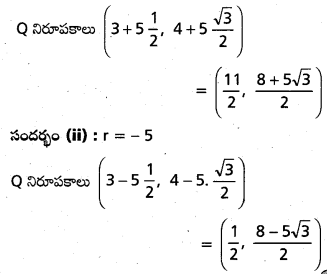
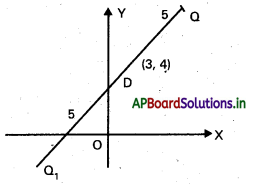
ఒక సరళరేఖ P (3, 4) గుండా పోతూ X – అక్షం ధన దిశతో 60° కోణం చేస్తుంది. P నుండి 5 యూనిట్ల దూరంలో ఆ రేఖపై ఉన్న బిందువులు నిరూపకాలను కనుక్కోండి.
సాధన:
రేఖ మీది ఏదేని బిందువు Q నిరూపకాలు
(x1 + r cos θ, y1 + r sin θ)
దత్తాంశం (x1, y1) = (3, 4) i.e., x1 = 3, y1 = 4
θ = 60° ⇒ cos = cos 60° = \(\frac{1}{2}\), sin θ = sin 60° = \(\frac{\sqrt{3}}{2}\)
సందర్భం (i) : r = 5
AP Inter 1st Year Maths 1B Solutions Chapter 3 సరళరేఖ Ex 3(c) 18
AP Inter 1st Year Maths 1B Solutions Chapter 3 సరళరేఖ Ex 3(c) 19

ప్రశ్న 3.
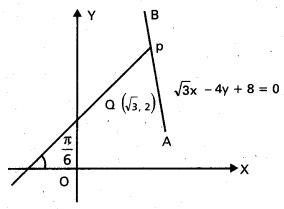
ఒక సరళరేఖ Q (\(\sqrt{3}\), 2) గుండా పోతూ, X – అక్షం ధన దిశలో \(\frac{\pi}{6}\) కోణం చేస్తుంది. ఆ సరళరేఖ \(\sqrt{3}\)x − 4y + 8 = 0 రేఖను P వద్ద ఖండిస్తూంటే PQ దూరం కనుక్కోండి. [Mar. ’04]
సూచన : AB, PQ లు లంబంగా లేవు.
కనుక మొదటి పద్ధతినుపయోగించాలి.
సాధన:
AP Inter 1st Year Maths 1B Solutions Chapter 3 సరళరేఖ Ex 3(c) 20
PQ రేఖ X – అక్షం ధన దిశలో \(\frac{\pi}{6}\) కోణం చేస్తుంది.
m = PQ వాలు = tan 30° = \(\frac{1}{\sqrt{3}}\)
PQ రేఖ Q (\(\sqrt{3}\), 2) గుండా పోతుంది.
PQ సమీకరణము y – 2 = \(\frac{1}{\sqrt{3}}\)(x – \(\sqrt{3}\))
\(\sqrt{3}\)y – 2\(\sqrt{3}\) = x – \(\sqrt{3}\)
x – \(\sqrt{3}\) y = – \(\sqrt{3}\) …………….. (1)
AB సమీకరణము \(\sqrt{3}\)x – 4y + 8 = 0
\(\sqrt{3}\)x – 4y = – 8 ………………. (2)
(1) × √3 = \(\sqrt{3}\)x – 3y = -3
తీసివేయగా – y = -5
y = 5
(1) నుండి x = \(\sqrt{3}\)y – \(\sqrt{3}\)
= 5\(\sqrt{3}\) – \(\sqrt{3}\) = 4\(\sqrt{3}\)
P నిరూపకాలు (4\(\sqrt{3}\), 5)
Q నిరూపకాలు (\(\sqrt{3}\), 2)
PQ2 = (4\(\sqrt{3}\) – \(\sqrt{3}\))2 + (5 – 2)2
27 + 9 = 36
PQ = 6 యూనిట్లు.

AP Inter 1st Year Maths 1B Solutions Chapter 3 సరళరేఖ Ex 3(c)

ప్రశ్న 4.
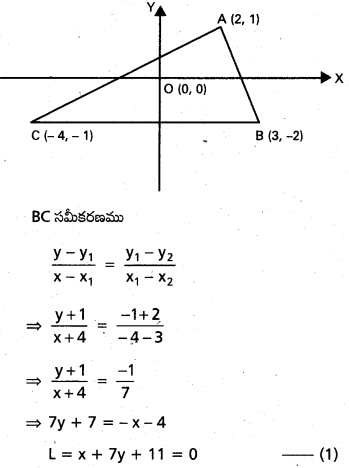
(2, 1), (3, – 2), (− 4, -1) బిందువులు శీర్షాలుగా గల త్రిభుజం లోపల మూలబిందువు ఉంటుందని చూపండి.
సాధన:
ABC త్రిభుజ శీర్షాలు
A (2, 1), B = (3,-2), C (-4, -1)
AP Inter 1st Year Maths 1B Solutions Chapter 3 సరళరేఖ Ex 3(c) 21
CA సమీకరణము
\(\frac{y+1}{x+4}=\frac{-1-1}{-4-2}\)
⇒ \(\frac{y+1}{x+4}=\frac{-2}{-6}\)
⇒ \(\frac{y+1}{x+4}=\frac{1}{3}\)
⇒ 3y + 3 = x + 4
⇒ L’ = x – 3y + 1 = 0 ……………….. (2)
AB సమీకరణము
\(\frac{y-1}{x-2}=\frac{1+2}{2-3}\)
⇒ \(\frac{y-1}{x-2}=\frac{3}{-1}\)
⇒ 3x – 6 = -y + 1
L” = -3x + y – 7 = 0 ………………. (3)
L” (-4, -1) = 3(-4) – 1 – 7
= – 20 ఋణాత్మకము.
L” (0, 0) = 3(0) + 0 – 7
= – 7 ఋణాత్మకము.
(- 4, -1), (0, 0) లు AB కి ఒకవైపున ఉంటాయి.
O (0, 0) – AB కి ఎడమవైపున ఉంది. ……………. (4)
L’ (3, -2) = 3 – 3 (-2) + 1
= 10 ధనాత్మకము .
L” (0, 0) = 0 – 3 (0) + 1
= 1 ధనాత్మకము
(0, 0), (3, -2) లు AC కి ఒకవైపున ఉంటాయి. …………….. (5)
L (2, 1) = 2 + 7 (1) + 11
= 20 ధనాత్మకం
L (0, 0) = 0 + 7 (0) + 11
= 11 ధనాత్మకం
(0, 0), (2, 1) లు BC కి ఒకే వైపున ఉంటాయి.
(0, 0) బిందువు BC కి ఎగువన ఉంది. …………….. (6)
(4), (5), (6) ల నుండి 0 (0,0) బిందువు AC కి దిగువన,
BC కి ఎగువన, AB కి ఎడమవైపున ఉంటుంది.
O (0, 0) బిందువు ∆ ABC లోపల ఉంటుంది.

AP Inter 1st Year Maths 1B Solutions Chapter 3 సరళరేఖ Ex 3(c)

ప్రశ్న 5.
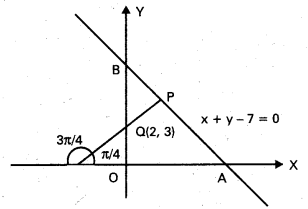
ఒక సరళరేఖ Q(2, 3) గుండా పోతూ X – అక్షం రుణ దిశ \(\frac{3\pi}{4}\) కోణం చేస్తోంది. x + y – 7 = 0 రేఖను P వద్ద ఆ సరళరేఖ ఖండిస్తూంటే, PQ దూరాన్ని కనుక్కోండి.
AP Inter 1st Year Maths 1B Solutions Chapter 3 సరళరేఖ Ex 3(c) 22
సాధన:
PQ రేఖ X – అక్షం ఋణదిశలో \(\frac{3\pi}{4}\) కోణం చేస్తుంది. PQ రేఖ X – అక్షం ధన దిశలో π – \(\frac{3\pi}{4}\) = \(\frac{\pi}{4}\) కోణం చేస్తుంది.
Q నిరూపకాలు (2, 3)
P నిరూపకాలు (x1 + r cos θ, y1 + r sin θ)
= (2 + r. cos \(\frac{\pi}{4}\), 3 + r . sin \(\frac{\pi}{4}\))
= \(\left(2+\frac{r}{\sqrt{2}}, 3+\frac{r}{\sqrt{2}}\right)\)
P బిందువు x + y − 7 = 0 రేఖపై ఉంది.
2 + \(\frac{r}{\sqrt{2}}\) + 3 + \(\frac{r}{\sqrt{2}}\) – 7 = 0
2 . \(\frac{r}{\sqrt{2}}\) = 7 – 2 – 3 = 2
∴ r = \(\sqrt{2}\)
PQ = r = \(\sqrt{2}\) యూనిట్లు.

AP Inter 1st Year Maths 1B Solutions Chapter 3 సరళరేఖ Ex 3(c)

ప్రశ్న 6.
x + y = 0, 3x + y – 4 = 0, x + 3y – 4 = 0 సరళరేఖలు ఒక సమబాహు త్రిభుజాన్ని ఏర్పరుస్తాయని చూపండి.
సాధన:
దత్త రేఖలు
x + y = 0 ………………… (1)
3x + y – 4 = 0 ……………….. (2)
x + 3y – 4 = 0 ………………. (3)
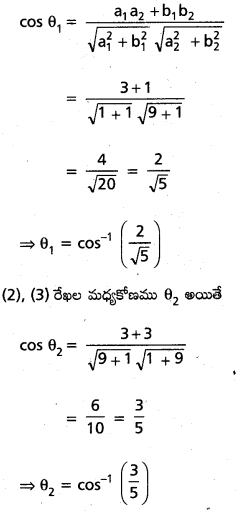
(1), (2) రేఖల మధ్యకోణము 8 అయితే
AP Inter 1st Year Maths 1B Solutions Chapter 3 సరళరేఖ Ex 3(c) 23
(3), (1) రేఖల మధ్యకోణము θ3 అయితే
cos θ3 = \(\frac{1+3}{\sqrt{1+1} \sqrt{1+9}}\)
= \(\frac{4}{\sqrt{20}}=\frac{2}{\sqrt{5}}\)
⇒ θ3 = cos-1 \(\left(\frac{2}{\sqrt{5}}\right)\)
θ1 = θ3
∴ కనుక దత్త త్రిభుజము సమద్విబాహు త్రిభుజము.

AP Inter 1st Year Maths 1B Solutions Chapter 3 సరళరేఖ Ex 3(c)

ప్రశ్న 7.
2x – y – 5 = 0, x – 5y + 11 = 0, x + y – 1 = 0 సరళరేఖలతో ఏర్పడిన త్రిభుజం వైశాల్యాన్ని కనుక్కోండి.
సాధన:
దత్త రేఖలు
2x – y – 5 = 0 ………………. (1)
x – 5y + 11 = 0 ………………. (2)
x + y – 1 = 0 ………………… (3)
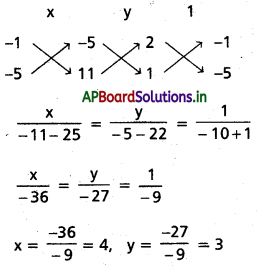
(1), (2) లను సాధించగా
AP Inter 1st Year Maths 1B Solutions Chapter 3 సరళరేఖ Ex 3(c) 24
C నిరూపకాలు = (4, 3)
(2), (3) లను సాధించగా
AP Inter 1st Year Maths 1B Solutions Chapter 3 సరళరేఖ Ex 3(c) 25

AP Inter 1st Year Maths 1B Solutions Chapter 3 సరళరేఖ Ex 3(c)

x = \(\frac{-6}{-3}\) = 2, y = \(\frac{3}{-3}\) = -1
∴ B నిరూపకాలు = (2, -1)
∆ ABC వైశాల్యం = \(\frac{1}{2}\left|\begin{array}{ll}
x_1-x_2 & x_1-x_3 \\
y_1-y_2 & y_1-y_3
\end{array}\right|\)
= \(\frac{1}{2}\left|\begin{array}{cc}
4+1 & 4-2 \\
3-2 & 3+1
\end{array}\right|\)
= \(\frac{1}{2}\left|\begin{array}{ll}
5 & 2 \\
1 & 4
\end{array}\right|\)
= \(\frac{1}{2}\) |20 – 2|
= \(\frac{1}{2}\) × 18 = 9 చ. యూనిట్లు .

AP Inter 1st Year Maths 1B Solutions Chapter 10 అవకలజాల అనువర్తనాలు Ex 10(d)

Practicing the Intermediate 1st Year Maths 1B Textbook Solutions Chapter 10 అవకలజాల అనువర్తనాలు Exercise 10(d) will help students to clear their doubts quickly.

AP Inter 1st Year Maths 1B Solutions Chapter 10 అవకలజాల అనువర్తనాలు Exercise 10(d)

అభ్యాసం – 10 (డి)

I. కింద ఇచ్చిన వక్రాల మధ్యకోణం కనుక్కోండి.

ప్రశ్న 1.
x + y + 2 = 0; x2 + y2 – 10y = 0 (Mar. 14)
సాధన:
x + y + 2 = 0 ⇒ x = -(y + 2)
x2 + y2 – 10y = 0.
(y + 2)2 + y2 – 10y = 0
y2 + 4y + 4 + y2 – 10y = 0
2y2 – 6y + 4 = 0
y2 – 3y + 2 = 0
(y + 1) (y – 2) = 0
y = 1 లేదా= 15 y = 2
x = – (y + 2)
y = 1 ⇒ x = -(1 + 2) = -3
y = 2 ⇒ x = -(2 + 2) = -4
ఖండన బిందువులు P(-3, 1) మరియు Q(-4, 2), వక్రం సమీకరణము
x2 + y2 – 10y = 0
x దృష్ట్యా అవకలనము చేయగా
2x + 2y\(\frac{d y}{d x}\) – 10\(\frac{d y}{d x}\) = 0
2\(\frac{d y}{d x}\)(y – 5) = -2x
\(\frac{d y}{d x}\) = –\(\frac{x}{y-5}\)
f'(x1) = –\(\frac{x}{y-5}\)
రేఖా సమీకరణ x + y + 2 = 0
1 + \(\frac{d y}{d x}\) = 0 ⇒ \(\frac{d y}{d x}\) = -1
g'(x1) = -1
సందర్భం (i) :
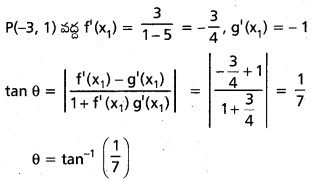
AP Inter 1st Year Maths 1B Solutions Chapter 10 అవకలజాల అనువర్తనాలు Ex 10(d) 8
సందర్భం (ii) :
Q (-4, 2) వద్ద f'(x1) = \(\frac{4}{2-5}\)
= –\(\frac{4}{3}\), g'(x1) = -1
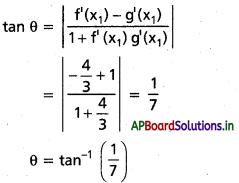
AP Inter 1st Year Maths 1B Solutions Chapter 10 అవకలజాల అనువర్తనాలు Ex 10(d) 9

ప్రశ్న 2.
y2 = 4x, x2 + y2 = 5
సాధన:
y ని తొలగించగా x2 + 4x = 5
x2 + 4x – 5 = 0
(x – 1) (x + 5) = 0
x – 1 = 0 లేదా -5
y2 = 4x
x = 1 లేదా – 5
y2 = 4x
x = 1 ⇒ y2 = 4
y = ±2
x = -5 ⇒ y వాస్తవం కాదు
∴ ఖండన బిందువులు (1, 2) మరియు Q(1, -2) మొదటి వక్రం సమీకరణము y2 = 4x
2y. \(\frac{d y}{d x}\) = 4
\(\frac{d y}{d x}\) = \(\frac{4}{2 y}\)
f'(x) = \(\frac{2}{y}\)
రెండవ వక్రం సమీకరణం x2 + y2 = 5
2x + 2y \(\frac{d y}{d x}\) = 0
2y. \(\frac{d y}{d x}\) = -2x
\(\frac{d y}{d x}\) = \(-\frac{2 x}{2 y}\) = –\(\frac{x}{y}\) ; g'(x) = \(-\frac{x}{y}\)
P(1, 2) వద్ద f'(x1) = \(\frac{2}{2}\) = 1, g'(x1) = –\(\frac{1}{2}\)
AP Inter 1st Year Maths 1B Solutions Chapter 10 అవకలజాల అనువర్తనాలు Ex 10(d) 1
θ = tan-1 (3)
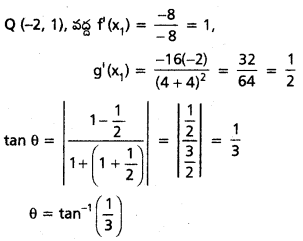
Q(1, -2) వద్ద f'(x1) = \(\frac{2}{-2}\) = -1, g'(x1) = \(\frac{1}{2}\)
AP Inter 1st Year Maths 1B Solutions Chapter 10 అవకలజాల అనువర్తనాలు Ex 10(d) 2

AP Inter 1st Year Maths 1B Solutions Chapter 10 అవకలజాల అనువర్తనాలు Ex 10(d)

ప్రశ్న 3.
x2 + 3y = 3, x2 – y2 + 25 = 0
సాధన:
x2 = 3 – 3y ; x2 – y2 + 25 = 0
3 – 3y – y2 + 25 = 0
y2 – 3y – 28 = 0
(y – 4) (y + 7) = 0
y – 4 = 0 (లేదా) y + 7 = 0
y = 4 లేదా -7
x2 = 3 – 3y
y = 4 ⇒ x2 = 3 – 12 = -9 ⇒ x వాస్తవం కాదు
y = -7 ⇒ x2 = 3 + 21 = 24
⇒ x = ± \(\sqrt{24}\) = ±2\(\sqrt{6}\)
ఖండన బిందువు P(\(2 \sqrt{6}\), 7), Q(\(-2 \sqrt{6}\), -7)
మొదటి వక్రం సమీకరణము x2 + 3y = 3
3y = 3 – x2
3 \(\frac{d y}{d x}\) = -2x
\(\frac{d y}{d x}\) = \(-\frac{2 x}{3}\) i.e., f'(x1) = \(-\frac{2 x}{3}\)
రెండవ వక్రం సమీకరణము
x2 – y2 + 25 = 0
y2 = x2 + 25
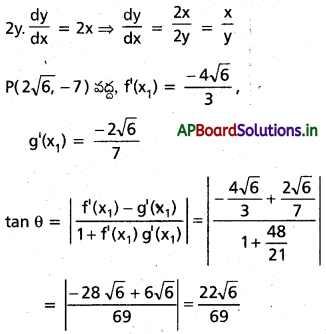
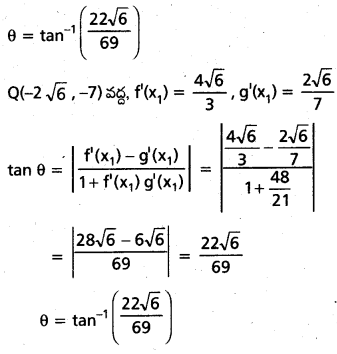
AP Inter 1st Year Maths 1B Solutions Chapter 10 అవకలజాల అనువర్తనాలు Ex 10(d) 3
AP Inter 1st Year Maths 1B Solutions Chapter 10 అవకలజాల అనువర్తనాలు Ex 10(d) 4

ప్రశ్న 4.
x2 = 2(y + 1); y = \(\frac{8}{x^2+4}\)
సాధన:
x2 = 2\(\left(\frac{8}{x^2+4}+1\right)\) = \(\frac{16+2 x^2+8}{x^2+4}\)
x2(x2 + 4) = 2x2 + 24
x4 + 4x2 – 2x2 – 24 = 0
x4 + 2x2 – 24 = 0
(x2 + 6) (x2 – 4) = 0
x2 = -6 లేదా x2 = 4
x2 = -6 ⇒ x = ±2
y = \(\frac{8}{x^2+4}\) = \(\frac{8}{4+4}\) = \(\frac{8}{8}\) = 1
∴ ఖండన బిందువులు P(2, 1) మరియు Q(-2, 1)
మొదటి వక్రం సమీకరణం x,sup>2 = 2(y + 1)
2x = 2. \(\frac{d y}{d x}\) ⇒ \(\frac{d y}{d x}\) = x
f'(x1) = x1
రెండవ వక్రం సమీకరణము y = \(\frac{8}{x^2+4}\)
\(\frac{d y}{d x}\) = \(\frac{8(-1)}{\left(x^2+4\right)^2}\) 2x = –\(\frac{16 x}{\left(x^2+4\right)^2}\)
g'(x1) = –\(\frac{16 x}{\left(x^2+4\right)^2}\)
P(2, 1) వద్ద f'(x1) = 2.
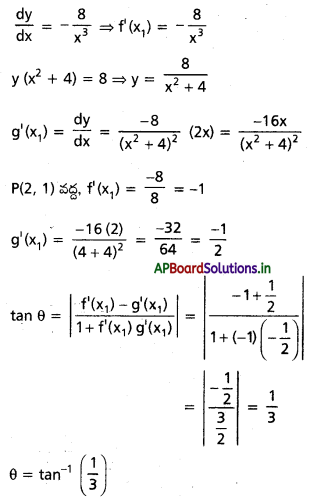
g'(x1) = \(\frac{-16 \times 2}{8^2}\) = \(-\frac{32}{64}\) = \(-\frac{1}{2}\)
f'(x1). g’ (x1) = 2 × (\(-\frac{1}{2}\)) = -1
∴ దత్త వక్రాలు లంబంగా ఖండించుకుంటున్నాయి.
i.e., θ = \(\frac{\pi}{2}\)

AP Inter 1st Year Maths 1B Solutions Chapter 10 అవకలజాల అనువర్తనాలు Ex 10(d)

ప్రశ్న 5.
2y2 – 9x = 0; 3x2 + 4y = 0 (4వ పాదంలో)
సాధన:
2y2 – 9x = 0 ⇒ 9x = 2y2
x = \(\frac{2}{9} y^2\)
3x2 + 4y = 0 ⇒ 3.\(\frac{4}{81}\)y4 + 4y = 0
\(\frac{4 y^4+108 y}{27}\) = 0
4y(y3 + 27) = 0
y = 0 లేదా y3 = -27 ⇒ y= -3.
9x = 2y2 = 2 × 9 ⇒ x = 2
ఖండన బిందువులు (4 వ పాదంలో) P(2, -3)
మొదటి వక్రం సమీకరణము 2y2 = 9x
4y\(\frac{d y}{d x}\) = 9 ⇒ \(\frac{d y}{d x}\) = \(\frac{9}{4 y}\)
f'(x) = \(\frac{9}{4 y}\)
P(2,-3) వద్ద f'(x) = \(\frac{9}{-12}\) = \(-\frac{3}{4}\)
రెండవ వక్రం సమీకరణము
3x2 + 4y = 0
4y = -3x2
4. \(\frac{d y}{d x}\) = -6x
\(\frac{d y}{d x}\) = \(\frac{-6 x}{4}\) = \(\frac{-3 x}{2}\)
P(2,-3) వద్ద g'(x1) = \(\frac{-6}{2}\) = -3
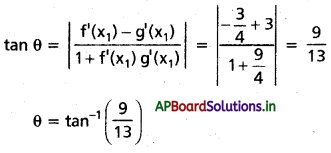
AP Inter 1st Year Maths 1B Solutions Chapter 10 అవకలజాల అనువర్తనాలు Ex 10(d) 5

ప్రశ్న 6.
y2 = 8x, 4x2 + y2 = 32
సాధన:
4x2 + 8x = 32 ⇒ x2 + 2x = 8
x2 + 2x – 8 = 0
(x – 2) (x + 4) = 0
x = 2 లేదా -4
y2 = 8x
x = -4 → y2 వాస్తవం కాదు
x = 2 ⇒ y2 = 16 ⇒ y = ±4
ఖండన బిందువులు P(2, 4), Q(2, – 4)
మొదటి వక్రం సమీకరణము y2 = 8x
2y. \(\frac{d y}{d x}\) = 8 ⇒ \(\frac{d y}{d x}\) = \(\frac{8}{2 y}\) = \(\frac{4}{y}\)
f'(x1) = \(\frac{4}{y}\)
రెండవ వక్రం సమీకరణము
4x2 + y2 = 32
8x + 2y. \(\frac{d y}{d x}\) = 0
2y\(\frac{d y}{d x}\) = -8x ⇒ \(\frac{d y}{d x}\) = \(\frac{-8 x}{2 y}\) = \(\frac{-4 x}{y}\)
g'(x1) = \(-\frac{4 x}{y}\)
P(2, 4) వద్ద f'(x1) = \(\frac{4}{4}\) = 1,
g'(x1) = \(\frac{-4.2}{4}\) = -2
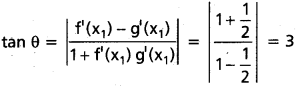
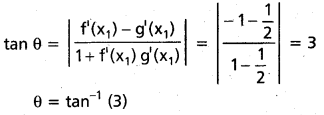
tan θ = |\(\frac{f^{\prime}\left(x_1\right)-g^{\prime}\left(x_1\right)}{1+f^{\prime}\left(x_1\right) g^{\prime}\left(x_1\right)}\)| = |\(\frac{1+2}{1-2}\)| = 3
θ = tan-1(3)
Q(2, -4) వద్ద f'(x1) = \(\frac{4}{-4}\) = -1,
g'(x1) = \(\frac{-4.2}{-4}\) = 2
tan θ = |\(\frac{f^{\prime}\left(x_1\right)-g^{\prime}\left(x_1\right)}{1+f^{\prime}\left(x_1\right) g^{\prime}\left(x_1\right)}\)| = |\(\frac{-1-2}{1+(-1) \cdot 2}\)|
= |\(\frac{-3}{-1}\)| = 3
θ = tan-1(3)

ప్రశ్న 7.
x2y = 4; y(x1 + 4) = 8.
సాధన:
x2y = 4 ⇒ x2 = \(\frac{4}{y}\)
y(x2 + 4) = 8
y\(\frac{(4+4 y)}{y}\) = 8
\(y \frac{(4+4 y)}{y}\) = 8
4y – 4 ⇒ y = 1
x2 = 4 ⇒ x2 = ±2
ఖండన బిందువులు P (2, 1), Q (-2, 1)
x2y = 4 ⇒ y = \(\frac{4}{x^2}\)
AP Inter 1st Year Maths 1B Solutions Chapter 10 అవకలజాల అనువర్తనాలు Ex 10(d) 6
AP Inter 1st Year Maths 1B Solutions Chapter 10 అవకలజాల అనువర్తనాలు Ex 10(d) 7

AP Inter 1st Year Maths 1B Solutions Chapter 10 అవకలజాల అనువర్తనాలు Ex 10(d)

ప్రశ్న 8.
6x2 – 5x + 2y = 0, 4x2 + 8y2 = 3 విక్రాలు (\(\frac{1}{2}\), \(\frac{1}{2}\)) బిందువు వద్ద స్పృశించుకొంటాయని చూపండి. (A.P Mar. ’15)
సాధన:
మొదటి వక్రం సమీకరణము
6x2 – 5x + 2y = 0
2y = 5x – 6x2
2. \(\frac{d y}{d x}\) = 5 – 12x
\(\frac{d y}{d x}\) = \(\frac{5-12 x}{2}\)
P(\(\frac{1}{2}\), \(\frac{1}{2}\)) వద్ద f'(x1) = \(\frac{5-12 \cdot \frac{1}{2}}{2}\)
= \(\frac{5-6}{2}\) = \(-\frac{1}{2}\)
రెండవ వక్రం సమీకరణము 4x2 + 8y2 = 3
8x + 16y. \(\frac{d y}{d x}\) = 0
16y. \(\frac{d y}{d x}\) = -8x
\(\frac{d y}{d x}\) = \(\frac{-8 x}{16 y}\) = \(-\frac{x}{2 y}\)
P(\(\frac{1}{2}\), \(\frac{1}{2}\)) వద్ద g'(x1) = \(\frac{-\frac{1}{2}}{2\left(\frac{1}{2}\right)}\) = \(-\frac{1}{2}\)
∴ f'(x1) = g'(x1)
దత్త వక్రాలు P(\(\frac{1}{2}\), \(\frac{1}{2}\)) వద్ద స్పృశించుకొంటాయి.

AP Inter 1st Year Maths 1B Solutions Chapter 2 అక్ష పరివర్తనం Ex 2(a)

Practicing the Intermediate 1st Year Maths 1B Textbook Solutions Chapter 2 అక్ష పరివర్తనం Exercise 2(a) will help students to clear their doubts quickly.

AP Inter 1st Year Maths 1B Solutions Chapter 2 అక్ష పరివర్తనం Exercise 2(a)

అభ్యాసం – 2 (ఎ)

I.

ప్రశ్న 1.
అక్షాల సమాంతరపరివర్తన ద్వారా మూలబిందువును (4, −5) కు మారిస్తే కొత్త అక్షాల దృష్ట్యా క్రింది బిందువుల నిరూపకాలు కనుక్కోండి.
i) (0, 3),
ii) (−2, 4)
iii) (4, -5)
సాధన:
i) కొత్త మూలబిందువు = (4, -5); h = 4, k = -5
పాత నిరూపకాలు (0, 3)
నిరూపకాక్షాలకు 8 కోణం భ్రమణం చేయవలెను.
tan 2θ = \(\frac{2 h}{a-b}\) ; x = 0, y = 3
x’ = x – h= 0 – 4 = -4
y’ = y – k = 3 + 5 = 8
నూతన నిరూపకాలు (-4, 8)

ii) పాత నిరూపకాలు (-2, 4)
x = -2, y = 4
x’ = x – h = -2 -4 = -6
y’ = y – k = 4 + 5 = 9
నూతన నిరూపకాలు (-6, 9)

iii) పాత నిరూపకాలు (4, -5)
x = 4, y = -5
x’ =x-h=4 – 4 = 0
y’ = y – k = -5 + 5 = 0
నూతన నిరూపకాలు (0, 0)

AP Inter 1st Year Maths 1B Solutions Chapter 2 అక్ష పరివర్తనం Ex 2(a)

ప్రశ్న 2.
అక్షాల సమాంతర పరివర్తనద్వారా మూలబిందువు (2, 3) కు మారింది. P బిందువు నిరూపకాలు క్రింది విధంగా మారితే, మూల వ్యవస్థలో P నిరూపకాలు కనుక్కోండి.
i) (4, 5)
ii) (4, -3),
iii) (0, 0)
సాధన:
i) నూతన నిరూపకాలు (4, 5)
x’ = 4, y’ = 5
x = x + h = 4 + 2= 6
y = y’ + k = 5 + 3 = 8
పాత నిరూపకాలు (6, 8)

ii) నూతన నిరూపకాలు (-4, 3)
x’ = -4, y’ = 3
x = x’ + h = 4 + 2 = -2
y = y’ + k = 3 + 3 = 6
పాత నిరూపకాలు (−2, 6)

iii) నూతన నిరూపకాలు (0, 0)
x’ = 0, y’ = 0
x = x’ + h = 0 + 2 = 2
y = y’ + k = 0 + 3 = 3
పాత నిరూపకాలు (2, 3)

AP Inter 1st Year Maths 1B Solutions Chapter 2 అక్ష పరివర్తనం Ex 2(a)

ప్రశ్న 3.
అక్షాల సమాంతర పరివర్తన ద్వారా బిందువు (3, 0)ను (2, −3) కు మార్చడానికి మూలబిందువును ఏబిందువుకు మార్చాలో తెలపండి.
సాధన:
(x, y) = (3, 0)
(x’, y’) = (2, −3)
మూల బిందువు (h, k) కు మార్చవలెను
h = x – x’ = 3 – 2 = 1
k = y – y = 0 + 3 = 3
∴ (h, k) = (1, 3)

ప్రశ్న 4.
అక్షాల సమాంతర పరివర్తన ద్వారా మూలబిందువును (−1, 2) కు మారిస్తే క్రింది సమీకరణల రూపాంతరాలను కనుక్కోండి.
i) x2 + y2 + 2x – 4y + 1 = 0
ii) 2x2 + y2 – 4x + 4y = 0
సాధన:
i) దత్త సమీకరణము
x2 + y2 + 2x – 4y + 1 = 0
మూల బిందువు (−1, 2) కు మార్చవలెను
h = -1, k = 2
పరివర్తన సమీకరణాలు
x = x’ + h, y = y + k
i.e., x = x’ – 1, y = y + 2
రూపాంతర సమీకరణము (x’ – 1)2 + (y + 2)2
+ 2(x’ – 1) – 4(y’ + 2) + 1 = 0
(x’)2 + 1 − 2x’ + (y’)2 + 4 + 4y’ + 2x’ – 2 – 4y’ – 8 + 1 = 0
(x’)2 + (y’)2 − 4 = 0

ii) పాత సమీకరణము 2x2 + y2 – 4x + 4y = 0
నూతన సమీకరణము 2 (x’ – 1)2 + (y + 2)2 -4(x’ – 1) + 4(y + 2) = 0
2[(x’)2 + 1 – 2x’] + (y’)2 + 4 + 4y’ – 4x’ + 4 + 4y’ + 8 = 0
2(x’)2 + 2 – 4x’ + (y’) 2 + 4 + 4y’ – 4x + 4 + 4y’ + 8 = 0
2(x’)2 + (y’)2 = 8x’ + 8y + 18 = 0

AP Inter 1st Year Maths 1B Solutions Chapter 2 అక్ష పరివర్తనం Ex 2(a)

ప్రశ్న 5.
అక్షాల సమాంతర పరివర్తన ద్వారా మూలబిందువును ఏ బిందువుకు మార్చిందీ, తద్వారా రూపాంతరం చెందిన సమీకరణము క్రింద ఇవ్వడమైంది. మూలసమీకరణాన్ని కనుక్కోండి.
i) (3, – 4); x2 + y2 = 4
ii) (-1, 2); x2 + 2 y2 + 16 = 0.
సాధన:
i) మూల బిందువును = (3, -4) = (h, k) కు మార్చవలెను
x’ = x -h,
= x – 3
y’ = y-k
= y + 4
మూల సమీకరణము (x’)2 + (y’)2 = 4
(x – 3)2 + (y + 4) 2 = 4
x2 – 6x + 9 + y2 + 8y + 16
∴ x2 + y2 – 6x + 8y + 21 = 0

ii) మూల బిందువు = (h, k) = (-1, 2) కు మార్చవలెను.
x’ = x – h,
= x + 1
y’ = y – k
= y – 2
= 4
x’2 + 2y’2 + 16 = 0 యొక్క మూల సమీకరణము
(x + 1)2 + 2(y – 2)2 + 16 = 0
x2 + 2x + 1 + 2y2 – 8y + 8 + 16 = 0
x2 + 2y2 + 2x – 8y + 25 = 0

ప్రశ్న 6.
4x2 + 9y2 – 8x + 36y + 4 = 0 సమీకరణంలో మొదటి తరగతి పదాలు లోపింపచేయడానికి మూల బిందువును ఏ బిందువుకు మార్చాలో కనుక్కోండి.
సాధన:
దత్త సమీకరణము
4x2 + 9y2 – 8x + 36y + 4 = 0
a = 4
b = 9
g = – 4
f = 18
– \(\frac{g}{a}=\frac{4}{4}\) = 1, –\(\frac{f}{b}=-\frac{18}{9}\) = -2
మూల బిందువు (1, 2) కు పరివర్తన చేయవలెను.

AP Inter 1st Year Maths 1B Solutions Chapter 2 అక్ష పరివర్తనం Ex 2(a)

ప్రశ్న 7.
30° కోణంతో అక్షాలను భ్రమణం చేసినప్పుడు, క్రింది బిందువుల కొత్త నిరూపకాలను కనుక్కోండి.
i) (0, 5)
ii) (−2, 4)
iii) (0, 0)
సాధన:
i) θ = 30° అని యివ్వబడింది. పాత నిరూపకాలు (0, 5)
x = 0, y = 5
x’ = x. cos θ + y. sin θ
= 0. cos 30° + 5. sin 30° = \(\frac{5}{2}\)
y’ = -x sin θ + y cos θ
=-0. sin 30° + 5 cos 30° = \(\frac{5 \sqrt{3}}{2}\)
పరివర్తన నిరూపకాలు \(\left(\frac{5}{2}, \frac{5 \sqrt{3}}{2}\right)\)

ii) పాత నిరూపకాలు (-2, 4)
x = -2, y = 4
x’ = x cos θ + y sin θ
= (-2). cos 30° + 4. sin 30°
= -2 . \(\frac{\sqrt{3}}{2}\) + 4 . \(\frac{1}{2}\) = –\(\sqrt{3}\) + 2
y’ = – x sin θ + y cos θ
= (− 2). sin 30° + 4. cos 30°
= -2 . \(\frac{1}{2}\) + 4 . \(\frac{\sqrt{3}}{2}\)
= 1 + 2\(\sqrt{3}\)
∴ పరివర్తన నిరూపకాలు (-\(\sqrt{3}\) + 2, 1+ 2\(\sqrt{3}\))

iii) (x, y) = (0, 0) మరియు θ = 30° అని యివ్వబడింది.
x = (0, y) ⇒ x = x. cos 30° – y sin 30°
= 0 . \(\frac{\sqrt{3}}{2}\) – 0 . \(\frac{1}{2}\) = 0
y = x. sin 30° + y.cos 30°
= 0 . \(\frac{1}{2}\) + 0 . \(\frac{\sqrt{3}}{2}\) = 0
పరివర్తన నిరూపకాలు (0, 0)

AP Inter 1st Year Maths 1B Solutions Chapter 2 అక్ష పరివర్తనం Ex 2(a)

ప్రశ్న 8.
60° కోణంతో అక్షాలను భ్రమణం చేసినప్పుడు, మూల బిందువుల కొత్త నిరూపకాలను ఇవ్వడమైంది.
i) (3, 4),
ii) (-7, 2)
iii) (2, 0) మూల వ్యవస్థలో ఈ బిందువుల నిరూపకాలు కనుక్కోండి.
సాధన:
i) θ = 60° అని యివ్వబడింది.
నూతన నిరూపకాలు (3, 4)
x’ = 3, y’ = 4
x = x’ cos θ – y’ sin θ
= 3. cos 60° – 4. sin 60°
= 3 . \(\frac{1}{2}\) – \(\frac{4 \cdot \sqrt{3}}{2}\) = \(\frac{3-4 \sqrt{3}}{2}\)

y = x’ sin θ + y’ cos θ
= 3 sin 60° + 4. cos 60°
= \(\text { 3. } \frac{\sqrt{3}}{2}+4 \cdot \frac{1}{2}=\frac{4+3 \sqrt{3}}{2}\)
P తొలి నిరూపకాలు \(\left(\frac{3-4 \sqrt{3}}{2}, \frac{4+3 \sqrt{3}}{2}\right)\)

ii) నూతన నిరూపకాలు (−7, 2)
x’ = 7, y’ = 2
x = x’ cos θ – y’ sin θ
= (-7) cos 60° – 2. sin 60°
= -7 . \(\frac{1}{2}-2 \cdot \frac{\sqrt{3}}{2}=\frac{-7-2 \sqrt{3}}{2}\)
y = x’ sin θ + y’. cos θ
= -7. sin 60° + 2. cos 60°
= -7 . \(\frac{\sqrt{3}}{2}+2 \cdot \frac{1}{2}=\frac{2-7 \sqrt{3}}{2}\)
Q తొలి నిరూపకాలు \(\left(\frac{-7-2 \sqrt{3}}{2}, \frac{2-7 \sqrt{3}}{2}\right)\)

iii) నూతన నిరూపకాలు (2, 0)
x’ = 2, y’ = 0
x = x’ cos θ – y’ sin θ
= 2. cos 60° – 0. sin 60°
= 2 . \(\frac{1}{2}\) – 0 . \(\frac{\sqrt{3}}{2}\) = 1 – 0 = 1
y = x’ sin θ + y’ cos θ
= 2. sin 60° + 0. cos 60°
= 2. \(\frac{\sqrt{3}}{2}\) + 0 . \(\frac{1}{2}\) = \(\sqrt{3}\)
Q తొలి నిరూపకాలు (1, \(\sqrt{3}\))

AP Inter 1st Year Maths 1B Solutions Chapter 2 అక్ష పరివర్తనం Ex 2(a)

ప్రశ్న 9.
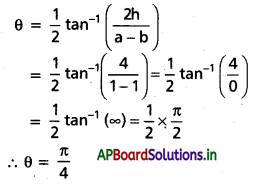
x2 + 4xy + y2 – 2x + 2y – 60 xy పదం లోపింపచేయడానికి అక్షాలను ఏ కోణంలో భ్రమణ పరివర్తన చేయాలో కనుక్కోండి. [June ’04]
సాధన:
x2 + 4xy + y2 – 2x + 2y – 6 = 0
ax2 + 2hxy + by2 + 2gx + 2fy + c = 0 తో
పోల్చగా a = 1, h = 2, b = 1, g = 1, f = 1, c = -6
నిరూపకాక్షాలకు ‘θ’ కోణం భ్రమణం చేస్తే
AP Inter 1st Year Maths 1B Solutions Chapter 2 అక్ష పరివర్తనం Ex 2(a) 1

II.

ప్రశ్న 1.
అక్షాల సమాంతర పరివర్తన ద్వారా మూల బిందువును (2, 3) కు మార్చినప్పుడు, ఒక వక్రం రూపాంతరం చెందిన సమీకరణము x2 + 3xy – 2y2 + 17x – 7y – 11 = 0 అయితే వక్రం యొక్క మూల సమీకరణము కనుక్కోండి. [May ’11]
సాధన:
పరివర్తన సమీకరణాలు
x = x + h, y = y + k
x’ = x – h = x – 2, y’ = y – 3
పరివర్తిత సమీకరణము
x2 + 3xy – 2y2 + 17x – 7y – 11 = 0
తొలి సమీకరణము
(x – 2)2 + 3(x – 2) (y – 3) – 2(y – 3)2 + 17(x – 2) – 7(y – 3) – 11 = 0
x2 – 4x + 4 + 3xy – 9x – 6y + 18 – 2y2 + 12y – 18 + 17x – 34 – 7y + 21 − 11 = 0
x2 + 3xy – 2y2 + 4x – y – 20 = 0
ఇది కావలసిన మూల సమీకరణము

AP Inter 1st Year Maths 1B Solutions Chapter 2 అక్ష పరివర్తనం Ex 2(a)

ప్రశ్న 2.
45°కోణంతో అక్షాలను భ్రమణం చేసినప్పుడు, రూపాంతరం చెందిన వక్రం సమీకరణము 17x2 – 16xy + 17y = 225. వక్రం మూల సమీకరణాన్ని కనుక్కోండి. [T.S Mar. ’15; May ’12]
సాధన:
భ్రమణ కోణము = θ = 45
x’ = x cos θ + y sin θ = x cos 45 + y sin 45
= \(\frac{x+y}{\sqrt{2}}\)
y’ = -x sin θ + y cos θ = − -x sin 45 + y cos 45
= \(\frac{-x+y}{\sqrt{2}}\)
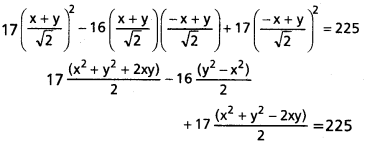
17x2 – 16xy + 17y2 = 225 యొక్క తొలి సమీకరణము
AP Inter 1st Year Maths 1B Solutions Chapter 2 అక్ష పరివర్తనం Ex 2(a) 2
17x2 + 17y2 + 34xy – 16y2 + 16x2 + 17x2 + 17y2 – 34xy = 450
50x2 + 18y2 = 450
తొలి సమీకరణము
25x2 + 9y2 = 225

ప్రశ్న 3.
అక్షాలను a కోణంతో భ్రమణం చేసినప్పుడు, x cos α. + y sin α = p యొక్క రూపాంతర సమీకరణము కనుక్కోండి. [Mar. ’14, May ’07]
సాధన:
దత్త సమీకరణము x cos α + y sin α = p
∵ నిరూపకాక్షాలను కోణం భ్రమణం చేసాయి.
x = x’ cos α – y’ sin α
y = x’ sin α + y’ cos α
దత్త సమీకరణము పరివర్తిత రూపము
(x’ cos α – y’ sin α) cos α + (x’ sin a + y’ cos α) sin α = p
⇒ x’ (cos2 α + sin2 α) = p ⇒ x’ = p
దత్త సమీకరణము పరివర్తిత రూపం x = p

AP Inter 1st Year Maths 1B Solutions Chapter 2 అక్ష పరివర్తనం Ex 2(a)

ప్రశ్న 4.
\(\frac{\pi}{6}\) కోణంతో అక్షాలను భ్రమణం చేసినప్పుడు, x2 + 2\(\sqrt{3}\)xy – y2 = 2a2 యొక్క సమీకరణము కనుక్కోండి. [A.P Mar. ’15, ’12, ’07, ’04; May ’13, ’12]
సాధన:
θ = \(\frac{\pi}{6}\), x = X cos α + Y sin α
x = X cos \(\frac{\pi}{6}\) – Y sin \(\frac{\pi}{6}\)
= \(X \cdot \frac{\sqrt{3}}{2}-Y \cdot \frac{1}{2}=\frac{\sqrt{3} X-Y}{2}\)
y = X sin α + Y cos α = X. sin \(\frac{\pi}{6}\) + Y cos \(\frac{\pi}{6}\)
= \(X \cdot \frac{1}{2}+Y . \frac{\sqrt{3}}{2}=\frac{X+\sqrt{3} Y}{2}\)
రూపాంతర సమీకరణము
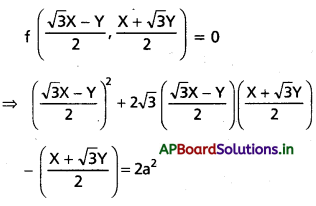
AP Inter 1st Year Maths 1B Solutions Chapter 2 అక్ష పరివర్తనం Ex 2(a) 3
⇒ \(\frac{3 x^2-2 \sqrt{3} X Y+Y^2}{4}\) + \(\frac{2 \sqrt{3}\left[\sqrt{3} X^2-X Y+3 X Y-\sqrt{3} Y^2\right]}{4}\) – \(\frac{X^2+3 Y^2+2 \sqrt{3} X Y}{4}\) = 2a2
⇒ 3X2 – 2\(\sqrt{3}\) XY + Y2 + 2\(\sqrt{3}\) [\(\sqrt{3}\)X2 + 2XY – \(\sqrt{3}\)Y2] – (x2 + 3Y2 + 2\(\sqrt{3}\)XY) = 8a2
⇒ 3x2 – 2\(\sqrt{3}\)XY + Y2 + 6X2 + 4\(\sqrt{3}\)XY – 6Y2 – X2 – 3Y2 – 2\(\sqrt{3}\) XY = 8a2
⇒ 8x2 – 8y2 = 8a2 ⇒ X2 – Y2 = a2

ప్రశ్న 5.
\(\frac{\pi}{4}\) కోణంతో అక్షాలను భ్రమణం చేసినప్పుడు, 3x2 + 10xy + 3y2 = 9 యొక్క రూపాంతర
సమీకరణము కనుక్కోండి. [May ’11]
సాధన:
దత్త సమీకరణము
3x2 + 10xy + 3y2 – 9 = 0 ……………… (1)
భ్రమణ కోణము θ = \(\frac{\pi}{4}\)
(X, Y) లు (x, y) యొక్క నూతన నిరూపకాలు అనుకొనుము.
x = X cos θ – Y sin θ
= X cos \(\frac{\pi}{4}\) – y sin \(\frac{\pi}{4}\) = \(\frac{X-Y}{\sqrt{2}}\)
y = X sin θ + Y cos θ = X sin \(\frac{\pi}{4}\) + Y cos \(\frac{\pi}{4}\) = 2 \(\frac{X+Y}{\sqrt{2}}\)
(1) యొక్క రూపాంతర సమీకరణము
\(3\left(\frac{X-Y}{\sqrt{2}}\right)^2+10\left(\frac{X-Y}{\sqrt{2}}\right)\left(\frac{X+Y}{\sqrt{2}}\right)+3\left(\frac{X+Y}{\sqrt{2}}\right)^2-9=0\)
⇒ 3 \(\frac{\left(X^2-2 X Y+Y^2\right)}{2}\) + 10 \(\frac{\left(X^2-Y^2\right)}{2}\) + 3 \(\frac{\left(X^2+2 X Y+Y^2\right)}{2}\) – 9 = 0
⇒ 3x2 – 6XY + 3y2 + 10X2 – 10Y2 + 3X2 + 6XY + 3Y2 – 18 = 0
16X2 – 4Y2 – 18 = 0
∴ 8X2 – 2Y2 = 9
∴ 8X2 – 2Y2 = 9

AP Inter 1st Year Maths 1B Solutions Chapter 2 అక్ష పరివర్తనం Ex 2(a)

AP Inter 1st Year Maths 1B Solutions Chapter 1 బిందుపథం Ex 1(a)

Practicing the Intermediate 1st Year Maths 1B Textbook Solutions Chapter 1 బిందుపథం Exercise 1(a) will help students to clear their doubts quickly.

AP Inter 1st Year Maths 1B Solutions Chapter 1 బిందుపథం Exercise 1(a)

అభ్యాసం – 1(ఎ)

I

ప్రశ్న 1.
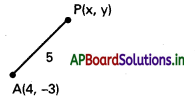
బిందువు A (4, – 3) నుంచి దూరం 5 గాగల బిందుపథ సమీకరణాన్ని కనుక్కోండి.
సాధన:
A (4, -3) దత్త బిందువు P(x, y) బిందుపథం మీది బిందువు
AP Inter 1st Year Maths 1B Solutions Chapter 1 బిందుపథం Ex 1(a) 1
దత్త నియమము AP = 5
AP2 = 25
(x – 4)2 + (y + 3)2 = 25
x2 – 8x + 16 + y2 + 6y + 9 − 25 = 0
P యొక్క బిందుపథ సమీకరణము
x2 + y2 – 8x + 6y = 0

ప్రశ్న 2.
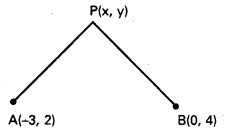
A (-3, 2), B (0, 4) బిందువుల నుంచి సమాన దూరంలో ఉండే బిందు పథ సమీకరణాన్ని కనుక్కోండి.
సాధన:
A (- 3, 2), B (0, 4) లు దత్త బిందువులు
P (x, y) బిందుపథం మీది ఏదేని బిందువు
AP Inter 1st Year Maths 1B Solutions Chapter 1 బిందుపథం Ex 1(a) 2
దత్త నియమము PA = PB
PA2 = PB2
(x + 3)2 + (y – 2)2 = (x – 0)2 + (y – 4)2
x2 + 6x + 9 + y2 – 4y + 4 = x2 + y2 – 8y + 16
6x + 4y = 3 బిందుపథం మీది సమీకరణము.

AP Inter 1st Year Maths 1B Solutions Chapter 1 బిందుపథం Ex 1(a)

ప్రశ్న 3.
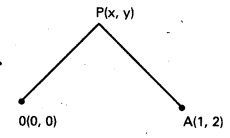
మూల బిందువు నుంచి P దూరం, A (1, 2) బిందువు నుంచి P దూరానికి రెట్టింపు అయితే బిందువు P పథ సమీకరణాన్ని కనుక్కోండి. [Mar. ’12]
సాధన:
O (0, 0), A (1, 2) లు దత్త బిందువులు.
P (x, y) బిందుపథం మీది ఏదేని బిందువు.
AP Inter 1st Year Maths 1B Solutions Chapter 1 బిందుపథం Ex 1(a) 3
దత్త నియమము OP = 2AP
OP2 = 4 AP2
x2 + y2 = 4 [(x – 1)2 + (y – 2)2]
= 4 (x2 – 2x + 1 + y2 – 4y+ 4)
x2 + y2 = 4x2 + 4y2 – 8x – 16 y + 20
P యొక్క బిందుపథ సమీకరణము
3x2 + 3y2 – 8x – 16y + 20 = 0

ప్రశ్న 4.
నిరూపకాక్షాల నుంచి సమాన దూరంలో ఉండే బిందువు పథ సమీకరణాన్ని కనుక్కోండి.
సాధన:
P(x, y) బిందుపథము మీది ఏదేని బిందువు
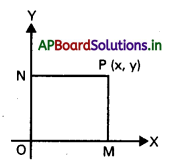
PM, PN లు P నుండి X, Y – అక్షాల మీదకు గీయబడిన లంబములు.
AP Inter 1st Year Maths 1B Solutions Chapter 1 బిందుపథం Ex 1(a) 4
దత్తాంశం PM = PN ⇒ PM2 = PN2
y2 = x2
P బిందుపథము x2 – y2 = 0

ప్రశ్న 5.
A (2, 0) బిందువుకు Y – అక్షానికి సమాన దూరంలో ఉండే. బిందుపథ సమీకరణాన్ని కనుక్కోండి.
సాధన:
A (2, 0) దత్త బిందువు.
P (x, y) బిందుపథం మీది ఏదేని బిందువు
AP Inter 1st Year Maths 1B Solutions Chapter 1 బిందుపథం Ex 1(a) 5
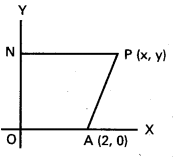
Y – అక్షానికి లంబంగా PN ను గీయండి.
దత్త నియమము PA = PN
PA2 = PN2
(x – 2)2 + (y – 0) 2 = x2
x2 − 4x + 4 + y2 = x2
P బిందుపథము y2 – 4x + 4 = 0

AP Inter 1st Year Maths 1B Solutions Chapter 1 బిందుపథం Ex 1(a)

ప్రశ్న 6.
మూల బిందువు నుంచి P బిందువు దూరానికి వర్గం, P- బిందువు Y– నిరూపకానికి నాలుగురెట్లుంటే బిందువు P – పథ సమీకరణాన్ని కనుక్కోండి. [Mar. 05; June 04]
AP Inter 1st Year Maths 1B Solutions Chapter 1 బిందుపథం Ex 1(a) 6
సాధన:
P(x, y) బిందుపథం మీది ఏదేని బిందువు.
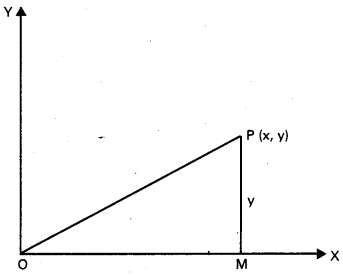
దత్త నియమము OP2 = 4y ⇒ x2 + y2 = 4y
P బిందుపథ సమీకరణము x2 + y2 – 4y = 0.

ప్రశ్న 7.
A = (a, 0), B = (-a, 0), 0 < |a|< |c|. PA2 + PB2 = 2c2 అయ్యేటట్లు బిందువు P పథ సమీకరణాన్ని కనుక్కోండి.
సాధన:
P (x, y) బిందుపథము మీది ఏదేని బిందువు.
A = (a, 0)
B = (-a, 0)
దత్త నియమము
PA2 + PB2 = 2c2
(x − a)2 + (y − 0)2 + (x + a)2 + (y − 0)2 = 2c2
x2 – 2ax + a2 + y2 + x2 + 2ax + a2 + y2 = 2c2
2x2 + 2y2 = 2c2 – 2a2
∴ x2 + y2 = c2 – a2 బిందుపథ సమీకరణము.

AP Inter 1st Year Maths 1B Solutions Chapter 1 బిందుపథం Ex 1(a)

II.

ప్రశ్న 1.
(2, 3), (−1, 5) బిందువులను కలిపే రేఖాఖండం, P వద్ద లంబకోణం చేస్తే, P బిందుపథ సమీకరణాన్ని కనుక్కోండి. [Mar. ’13; May ’12; Mar. ’05; June ’04]
సాధన:
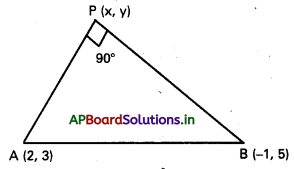
A(2, 3), B (−1, 5) లు దత్త బిందువులు.
P(x, y) బిందుపథం మీది ఏదేని బిందువు.
AP Inter 1st Year Maths 1B Solutions Chapter 1 బిందుపథం Ex 1(a) 7
దత్త నియమము ∠APB = 90°
AP2 + PB2 = AB2
(x − 2)2 + (y − 3)2 + (x + 1)2 + (y − 5)2 = (2 + 1)2 + (3 − 5)2
= x2 – 4x + 4 + y2 – 6y + 9 + x2 + 2x + 1 + y2 – 10y + 25 = 9 + 4
2x2 + 2y2 – 2x – 16y + 26 = 0
P యొక్క బిందుపథం x2 + y2 – x – 8y + 13 = 0
(x, y) ≠ (2, 3) మరియు (x, y) ≠ (-1, 5)

ప్రశ్న 2.
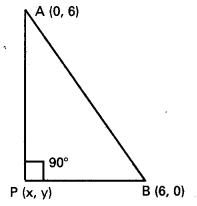
(0, 6), (6, 0) లు కర్ణాగ్రాలుగా గల లంబకోణ త్రిభుజం మూడో శీర్షం బిందుపథ సమీకరణాన్ని కనుక్కోండి.
సాధన:
A(0, 6), B (6, 0) లు కర్ణపు కోణాలు.
P (x, y) మూడవ శీర్షము
∴ దత్త నియమము ∠ APB = 90°
AP Inter 1st Year Maths 1B Solutions Chapter 1 బిందుపథం Ex 1(a) 8
AP2 + PB2 = AB2
(x – 0)2 + (y – 6)2 + (x – 6)2 + (y – 0)2 = (0 – 6)2 + (6 – 0)2
x2 + y2 -12y + 36 + x2 – 12x + 36 + y2 = 36 + 36
2x2 + 2y2 – 12x – 12y = 0
P బిందుపథము x2 + y2 – 6x – 6y = 0
(x, y) ≠ (0, 6) మరియు (x, y) ≠ (6, 0)

AP Inter 1st Year Maths 1B Solutions Chapter 1 బిందుపథం Ex 1(a)

ప్రశ్న 3.
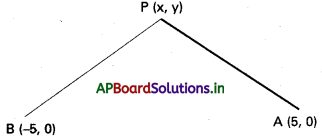
(−5, 0), (5, 0) బిందువుల నుంచి దూరాల భేదం 8గా గల బిందుపథ సమీకరణాన్ని కనుక్కోండి. [May ’11, ’06; Mar. ’04]
సాధన:
A(5, 0), B(-5, 0) లు దత్త బిందువులు.
AP Inter 1st Year Maths 1B Solutions Chapter 1 బిందుపథం Ex 1(a) 9
P(x, y) బిందుపథం మీది ఏదేని బిందువు.
దత్త నియమము |PA – PB| = 8
PA – PB = 8 …………………… (1)
PA2 – PB2 = [(x – 5)2 + (y – 0)2] – [(x + 5)2 + (y – o)2]
= x2 – 10x + 25+ y2 – x2 – 10x – 25 – y2
= – 20x
(PA + PB) (PA – PB) = – 20x
(PA + PB) 8 = – 20x
PA + PB = –\(\frac{5}{2}\) x ………………. (2)
(1), (2) లను కూడగా
2PA = –\(\frac{5x}{2}\) + 8 = \(\frac{-5x+16}{2}\)
4PA = – 5x + 16
16PA2 = (-5x + 16)2
16 [(x – 5)2 + y2] = (- 5x + 16)2
16 [x2 – 10x + 25+ y2] = [-5x + 16]2
16x2 + 16y2 – 160x + 400 = 25x2 + 256 – 160 x
9x2 – 16y2 = 144
144 తో భాగించగా, P బిందుపథం
\(\frac{9 x^2}{144}\) – \(\frac{16 y^2}{144}\) = 1
కనుక \(\frac{x^2}{16}\) – \(\frac{y^2}{9}\) = 1

AP Inter 1st Year Maths 1B Solutions Chapter 1 బిందుపథం Ex 1(a)

ప్రశ్న 4.
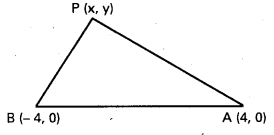
A = (4, 0), B = (-4, 0), |PA – PB|= 4x P బిందుపథ సమీకరణాన్ని కనుక్కోండి. [May ’13; May ’07]
సాధన:
A = (4, 0), B = (- 4, 0) లు దత్త బిందువులు.
P (x, y) బిందుపథం మీది ఏదేని బిందువు.
దత్త నియమము |PA – PB | = 4 ……………… (1)
PA2 – PB2 = [(x – 4)2 + (y – 0)2] – [(x + 4)2 + y2]
= x2 – 8x + 16 + y2 – x2 – 8x – 16 – y2
= – 16x
AP Inter 1st Year Maths 1B Solutions Chapter 1 బిందుపథం Ex 1(a) 10
(PA + PB) (PA – PB) = -16x
(PA + PB) 4 = -16x
PA + PB = – 4x ……………. (2)
(1), (2) లను కూడగా.
2PA = 4 – 4x
PA = 2 – 2x
PA2 = (2 – 2x)2
(x – 4)2 + (y – 0)2 = (2 – 2x)2
x2 – 8x + 16 + y2 = 4 + 4x2 – 8x
3x2 – y2 = 12
12 తో భాగించగా P యొక్క బిందుపథం \(\frac{3 x^2}{12}-\frac{y^2}{12}\) = 12
\(\frac{x^2}{4}-\frac{y^2}{12}\) = 1

AP Inter 1st Year Maths 1B Solutions Chapter 1 బిందుపథం Ex 1(a)

ప్రశ్న 5.
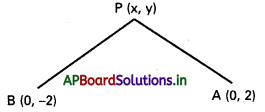
(0, 2), (0, – 2) బిందువుల నుంచి దూరాల మొత్తం 6గా గల బిందుపథ సమీకరణాన్ని కనుక్కోండి.
సాధన:
A (0, 2), B (0, 2) లు దత్త బిందువులు.
AP Inter 1st Year Maths 1B Solutions Chapter 1 బిందుపథం Ex 1(a) 11
P(x, y) బిందుపథం మీది ఏదేని బిందువు
దత్త నియమము PA + PB = 6 …………….. (1)
PA2 – PB2 = [(x – 0)2+(y – 2)2] – [(x – 0)2 + (y + 2)2]
= x2+ y2 – 4y + 4 – x2 – y2 – 4y – 4 = -8y
(PA + PB) (PA – PB) = – 8y
6 (PA – PB) = – 8y
PA – PB = – \(\frac{8 y}{6}\)
PA – PB = – \(\frac{4 y}{3}\) ………………. (2)
(1), (2) లను కూడగా 2PA = 6 – \(\frac{4 y}{3}\)
PA = 3 – \(\frac{2 y}{3}\)
PA2 = (3 – \(\frac{2 y}{3}\))2
x2 + (y – 2)2 = (3 – \(\frac{2 y}{3}\))2
x2 + y2 – 4y + 4 = 9 + \(\frac{4 y^2}{9}\) – 4y
9x2 + 9y2 + 36 = 81 + 4y2
9x2 + 5y2 = 45
45 తో భాగించగా
P యొక్క బిందుపథము \(\frac{9 x^2}{45}+\frac{5 y^2}{45}\) = 1
\(\frac{x^2}{5}+\frac{y^2}{9}\) = 1

AP Inter 1st Year Maths 1B Solutions Chapter 1 బిందుపథం Ex 1(a)

ప్రశ్న 6.
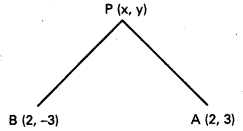
A = (2, 3), B = (2,-3), PA + PB = 8 అయితే P బిందుపథ సమీకరణాన్ని కనుక్కోండి. [A.P Mar. ’15]
సాధన:
A (2, 3), B (2, -3) లు దత్త బిందువులు.
AP Inter 1st Year Maths 1B Solutions Chapter 1 బిందుపథం Ex 1(a) 12
P(x, y) బిందుపథము మీది ఏదేని బిందువు.
దత్త నియమము PA + PB = 8 ……………. (1)
PA2 – PB2 = [(x – 2)2 + (y – 3)2] – [(x – 2)2 + (y + 3)2]
= (x – 2)2 + (y – 3)2 – (x – 2)2 – ( y + 3)2
= (y – 3)2 – (y + 3)2 = – 12y
(PA + PB) (PA – PB) = – 12y
8 (PA – PB) = -12y
PA – PB = \(\frac{-12 y}{8}\)
PA – PB = \(\frac{-3 y}{2}\) ……………… (2)
(1), (2) లను కూడగా
2PA = 8 – \(\frac{3 y}{2}\) = \(\frac{16-3 y}{2}\)
4PA = 16 – 3y
16PA2 = (16 – 3y)2
16 [(x – 2)2 + (y – 3)2] = (16 – 3y)2
16(x2 – 4x + 4 + y2 – 6y + 9) = (16 – 3y)2
16x2 + 16y2– 64x – 96y + 208 = 256 + 9y2 – 96y
16x2 + 7y2 – 64x – 48 = 0
P బిందుపథము 16x2 + 7y2 – 64x – 48 = 0

AP Inter 1st Year Maths 1B Solutions Chapter 1 బిందుపథం Ex 1(a)

ప్రశ్న 7.
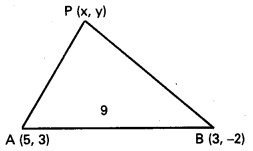
A(5, 3), B (3, −2) లు రెండు స్థిర బిందువులు. త్రిభుజం PAB వైశాల్యం 9గా ఉండేటట్లు P బిందుపథ సమీకరణాన్ని కనుక్కోండి.  [T.S. Mar. ’15, ’06]
సాధన:
A(5, 3), B(3, -2) లు దత్త బిందువులు.
P(x, y) బిందుపథం మీది ఏదేని బిందువు.
AP Inter 1st Year Maths 1B Solutions Chapter 1 బిందుపథం Ex 1(a) 13
దత్త నియమము ∆PAB = 9
\(\frac{1}{2}\) |5 (-2 – y) + 3 (y − 3) + x (3 + 2)| = 9
|-10 – 5y + 3y – 9 + 5x| = 18
5x – 2y – 19 = ±18
5x – 2y – 19 = 18 లేదా 5x – 2y – 19 = -18
5x – 2y – 37 = 0 లేదా 5x – 2y – 1 = 0
P యొక్క బిందుపథము (5x – 2y – 37) (5x – 2y – 1) = 0

ప్రశ్న 8.
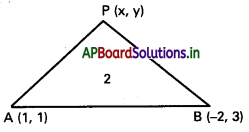
A(1, 1), B (−2, 3) బిందువులతో 2 వైశాల్యం గా గల త్రిభుజాన్ని ఏర్పరచే బిందుపథ సమీకరణాన్ని కనుక్కోండి.
సాధన:
A (1, 1), B(-2, 3) లు దత్త బిందువులు
AP Inter 1st Year Maths 1B Solutions Chapter 1 బిందుపథం Ex 1(a) 14
P(x, y) బిందుపథం మీది ఏదేని బిందువు.
దత్త నియమము ∆PAB = 2
\(\frac{1}{2}\) |1 (3) 2 (y – 1) + x (1 – 3)| = 2
|13 – y – 2y + 2 – 2x| = 4
-2x – 3y + 5 = ±4
-2x – 3y + 5 = 45 లేదా – 2x – 3y + 5 = -4
2x + 3y-10 లేదా 2x + 3y – 9 = 0
P బిందుపథము (2x + 3y – 1) (2x + 3y – 9) = 0

AP Inter 1st Year Maths 1B Solutions Chapter 1 బిందుపథం Ex 1(a)

ప్రశ్న 9.
(2, 3), (2, – 3) బిందువుల నుంచి P దూరం 2:3 నిష్పత్తిలో ఉంటే, బిందుపథ సమీకరణాన్ని కనుక్కోండి.
సాధన:
P (x, y) బిందుపథం మీది ఏదేని బిందువు
A = (2, 3), B = (2, – 3) లు దత్త బిందువులు.
దత్త నియమము
PA : PB = 2:3
⇒ 3PA = 2PB
⇒ 9PA2 = 4PB2
⇒ 9 [(x – 2)2 + (y – 3)2] = 4 [(x – 2)2 + (y + 3)2]
⇒ 9[x2 – 4x + 4 + y2 – 6y + 9] = 4 [x2 – 4x + 4 + y2 + 6y + 9]
∴ 5x2 + 5y2 – 20 x – 78 y + 65 = 0 బిందుపథ సమీకరణము.

ప్రశ్న 10.
A (1, 2), B (2, -3), C (-2, 3) లు మూడు బిందువులు. PA2 + PB2 = 2PC2 అయ్యేటట్లు P చరిస్తుంది. P బిందుపథ సమీకరణం 7x + 7y + 4 = 0 అని చూపండి. [May ’07]
సాధన:
P (x, y) బిందుపథం మీది ఏదేని బిందువు.
A = (1, 2), B(2, -3), C=(-2, 3) లు దత్త బిందువులు
దత్త నియమము
PA2 + PB2 = 2 PC2
⇒ (x – 1)2 + (y – 2)2 + (x – 2)2 + (y + 3)2 = 2 [(x + 2)2 + (y – 3)2].
⇒ 2x2 + 2y2 – 6x + 2y + 18 = 2x2 + 2y2 + 8x – 12y + 26
⇒ 14x – 14y + 8 = 0
∴ 7x – 7y + 4 = 0 బిందుపథ సమీకరణం.

AP Inter 1st Year Maths 1B Solutions Chapter 1 బిందుపథం Ex 1(a)

AP Inter 1st Year Maths 1A Solutions Chapter 3 మాత్రికలు Ex 3(c)

Practicing the Intermediate 1st Year Maths 1A Textbook Solutions Chapter 3 మాత్రికలు Exercise 3(c) will help students to clear their doubts quickly.

AP Inter 1st Year Maths 1A Solutions Chapter 3 మాత్రికలు Exercise 3(c)

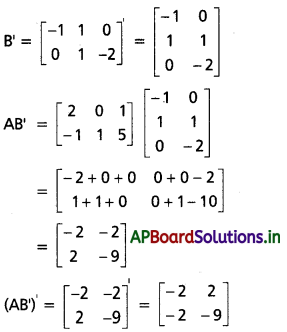
I.

Question 1.
A = \(\left[\begin{array}{ccc}
2 & 0 & 1 \\
-1 & 1 & 5
\end{array}\right]\), B = \(\left[\begin{array}{ccc}
-1 & 1 & 0 \\
0 & 1 & -2
\end{array}\right]\) అయితే (AB’)’ ను కనుక్కోండి.
Solution:
AP Inter 1st Year Maths 1A Solutions Chapter 3 మాత్రికలు Ex 3(c) I Q1

Question 2.
A = \(\left[\begin{array}{cc}
-2 & 1 \\
5 & 0 \\
-1 & 4
\end{array}\right]\), B = \(\left[\begin{array}{ccc}
-2 & 3 & 1 \\
4 & 0 & 2
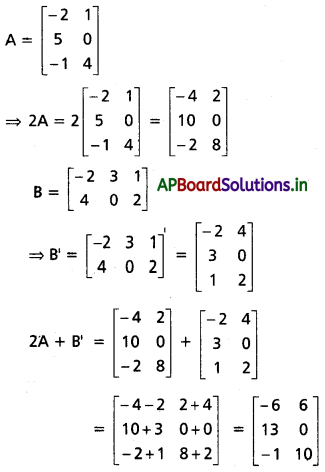
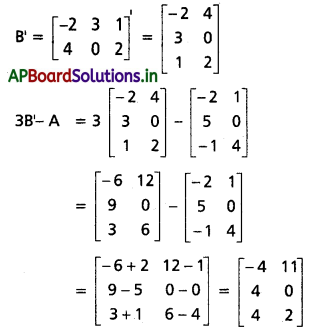
\end{array}\right]\) అయితే 2A + B’, 3B’ – A లను కనుక్కోండి.
Solution:
AP Inter 1st Year Maths 1A Solutions Chapter 3 మాత్రికలు Ex 3(c) I Q2
AP Inter 1st Year Maths 1A Solutions Chapter 3 మాత్రికలు Ex 3(c) I Q2.1

AP Inter 1st Year Maths 1A Solutions Chapter 3 మాత్రికలు Ex 3(c)

Question 3.
A = \(\left[\begin{array}{cc}
2 & -4 \\
-5 & 3
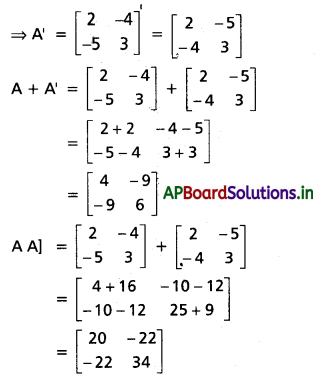
\end{array}\right]\) అయితే A + A’, A . A’ లను కనుక్కోండి. [May ’07]
Solution:
A = \(\left[\begin{array}{cc}
2 & -4 \\
-5 & 3
\end{array}\right]\)
AP Inter 1st Year Maths 1A Solutions Chapter 3 మాత్రికలు Ex 3(c) I Q3

Question 4.
A = \(\left[\begin{array}{ccc}
-1 & 2 & 3 \\
2 & 5 & 6 \\
3 & x & 7
\end{array}\right]\) ఒక సౌష్ఠవ మాత్రిక అయితే x విలువ ఎంత? [Mar. ’03]
సూచన : ‘A’ ఒక సౌష్ఠవ మాత్రిక ⇒ AT = A
Solution:
A సౌష్టవ మాత్రిక
⇒ AT = A
\(\left[\begin{array}{ccc}
-1 & 2 & 3 \\
2 & 5 & x \\
3 & 6 & 7
\end{array}\right]=\left[\begin{array}{ccc}
-1 & 2 & 3 \\
2 & 5 & 6 \\
3 & x & 7
\end{array}\right]\)
∴ x = 6

Question 5.
A = \(\left[\begin{array}{ccc}
0 & 2 & 1 \\
-2 & 0 & -2 \\
-1 & x & 0
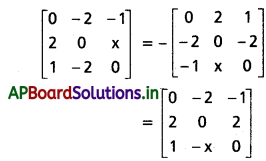
\end{array}\right]\) ఒక వక్ర సౌష్ఠవ మాత్రిక అయితే x విలువ ఎంత? [May ’13]
సూచన: ‘A’ ఒక వక్ర సౌష్ఠవ మాత్రిక ⇒ AT = -A
Solution:
A ఒక వక్ర సౌష్టవ మాత్రిక
⇒ AT = -A
AP Inter 1st Year Maths 1A Solutions Chapter 3 మాత్రికలు Ex 3(c) I Q5
∴ x = 2

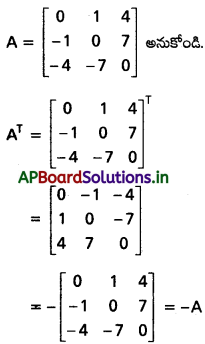
AP Inter 1st Year Maths 1A Solutions Chapter 3 మాత్రికలు Ex 3(c)

Question 6.
\(\left[\begin{array}{ccc}
0 & 1 & 4 \\
-1 & 0 & 7 \\
-4 & -7 & 0
\end{array}\right]\) ఒక సౌష్ఠవ మాత్రిక అవుతుందా, వక్ర సౌష్ఠవ మాత్రిక అవుతుందా?
Solution:
AP Inter 1st Year Maths 1A Solutions Chapter 3 మాత్రికలు Ex 3(c) I Q6
∴ A ఒక వక్ర సౌష్ఠవ మాత్రిక.

II.

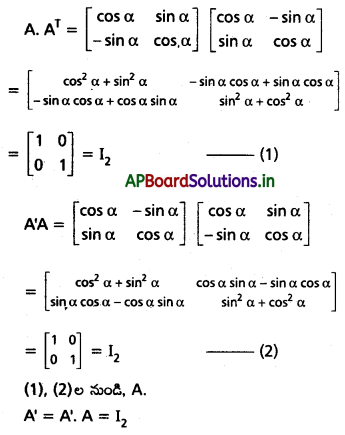
Question 1.
A = \(\left[\begin{array}{cc}
\cos \alpha & \sin \alpha \\
-\sin \alpha & \cos \alpha
\end{array}\right]\) అయితే AA’ = A’A = I అని చూపండి. [Mar. ’07]
Solution:
AP Inter 1st Year Maths 1A Solutions Chapter 3 మాత్రికలు Ex 3(c) II Q1

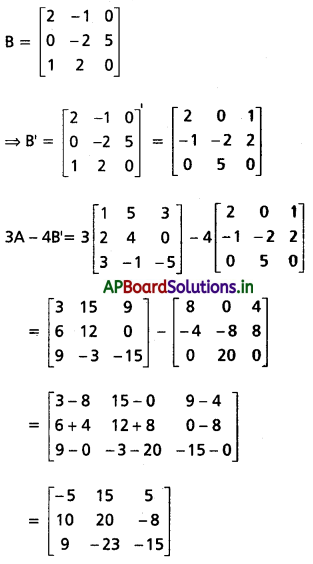
Question 2.
A = \(\left[\begin{array}{ccc}
1 & 5 & 3 \\
2 & 4 & 0 \\
3 & -1 & -5
\end{array}\right]\), B = \(\left[\begin{array}{ccc}
2 & -1 & 0 \\
0 & -2 & 5 \\
1 & 2 & 0
\end{array}\right]\) అయితే 3A – 4B’ ను కనుక్కోండి.
Solution:
AP Inter 1st Year Maths 1A Solutions Chapter 3 మాత్రికలు Ex 3(c) II Q2

AP Inter 1st Year Maths 1A Solutions Chapter 3 మాత్రికలు Ex 3(c)

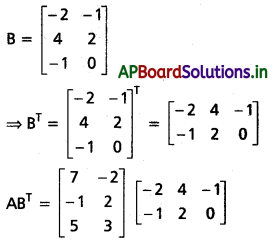
Question 3.
A = \(\left[\begin{array}{cc}
7 & -2 \\
-1 & 2 \\
5 & 3
\end{array}\right]\), B = \(\left[\begin{array}{cc}
-2 & -1 \\
4 & 2 \\
-1 & 0
\end{array}\right]\) అయితే AB’ మరియు BA’ లను కనుక్కోండి.
Solution:
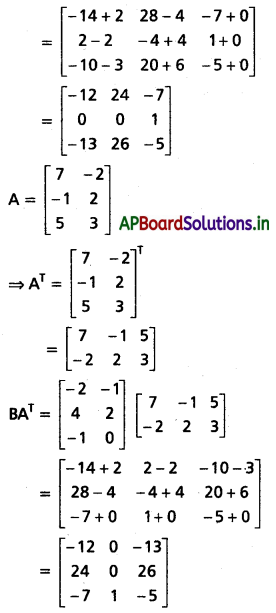
AP Inter 1st Year Maths 1A Solutions Chapter 3 మాత్రికలు Ex 3(c) II Q3
AP Inter 1st Year Maths 1A Solutions Chapter 3 మాత్రికలు Ex 3(c) II Q3.1

Question 4.
A ఒక చతురస్ర మాత్రిక అయితే AA’ సౌష్ఠవ మాత్రిక అని చూపండి. [(A.P) Mar. ’15]
Solution:
A చతురస్ర మాత్రిక
(AA’)’ = (A’)’ A’ = A . A’
∵ (AA’)’ = AA’
⇒ AA’ ఒక సౌష్ఠవ మాత్రిక.

AP Inter 1st Year Maths 1B Solutions Chapter 4 సరళరేఖాయుగ్మాలు Ex 4(a)

Practicing the Intermediate 1st Year Maths 1B Textbook Solutions Chapter 4 సరళరేఖాయుగ్మాలు Exercise 4(a) will help students to clear their doubts quickly.

AP Inter 1st Year Maths 1B Solutions Chapter 4 సరళరేఖాయుగ్మాలు Exercise 4(a)

అభ్యాసం – 4 (a)

I.

ప్రశ్న 1.
ఈ క్రింద ఇచ్చిన ప్రతీ సరళరేఖాయుగ్మపు మధ్య లఘు కోణాన్ని కనుక్కోండి.
i) x2 – 7xy + 12y2 = 0
ii) y2 – xy – 6x2 = 0
iii) (x cos α- y sin α)2 = (x2 + y2) sin2 α
iv) x2 + 2xy cot α – y2 = 0
సాధన:
i) x2 – 7xy + 12y2 = 0
a = 1, b = 12, h = –\(\frac{7}{2}\)
tan θ = \(\frac{2 \sqrt{h^2-a b}}{a+b}\)
= \(\frac{2 \sqrt{\frac{49}{4}-12}}{1+12}=\frac{2 \sqrt{\frac{1}{4}}}{13}=\frac{\sqrt{1}}{13}\)
tan θ = \(\frac{1}{13}\) ⇒ θ = tan-1 \(\left(\frac{1}{13}\right)\)

ii) y2 – xy – 6x2 = 0
a = – 6, b = 1, h = –\(\frac{1}{2}\)
AP Inter 1st Year Maths 1B Solutions Chapter 4 సరళరేఖాయుగ్మాలు Ex 4(a) 1

iii) (x cos α- y sin α)2 = (x2 + y2) sin2 α
x2 cos2 α + y2 sin2 α – 2xy cos α sin α = x2 sin2 α + y2 sin2α
.. x2 (cos2 α – sin2 α) – 2xy cos α sin α = 0
x2 . cos 2α – xy sin 2α = 0
a = cos 2α, b = 0, 2h = – sin 2α
cos θ = \(\frac{|\cos 2 \alpha+0|}{\sqrt{(\cos 2 \alpha-0)^2+\sin ^2 2 \alpha}}\)
= cos 2α
∴ θ = 2α

iv) x2 + 2xy cot α – y2 = 0
a + b = 1 – 1 = 0
∴ θ = \(\frac{\pi}{2}\)

AP Inter 1st Year Maths 1B Solutions Chapter 4 సరళరేఖాయుగ్మాలు Ex 4(a)

II.

ప్రశ్న 1.
క్రింద సరళరేఖాయుగ్మాల జతలు ఇవ్వడమైంది. వాటిలో ప్రతీ జతకి ఒకే కోణీయ సమద్విఖండన రేఖాయుగ్మం ఉంటుందని చూపండి. (అంటే ప్రతి జతలోను ఒకే రేఖా యుగ్మంలోని రేఖలు రెండో రేఖాయుగ్మంలోని రేఖలతో సమాన నిమ్నత కలిగి ఉంటాయి.)
i) 2x2 + 6xy + y2 = 0,
4x2 + 18xy + y2 = 0.
ii) a2x2 + 2h(a + b) xy + b2y2 = 0,
ax2 + 2hxy + by2 = 0; a + b ≠ 0.
iii) ax2 + 2hxy + by2 + 2(x2 + y2) = 0; (λ ∈ R),
ax2 + 2hxy + by2 = 0.
AP Inter 1st Year Maths 1B Solutions Chapter 4 సరళరేఖాయుగ్మాలు Ex 4(a) 2
సాధన:
i) OA, OB ల ఉమ్మడి సమీకరణము
2x2 + 6xy + y2 = 0
కోణ సమద్విఖండన రేఖల సమీకరణము
3(x2 – y2) = (2 – 1) xy
3(x2 – y2) = xy ……………….. (1)
OP, OQ ల ఉమ్మడి సమీకరణము
4x2 + 18xy + y2 = 0
కోణ సమద్విఖండన రేఖల సమీకరణం
9(x2 – y2) = (4 − 1) xy
9(x2 – y2) = 3xy
3(x2 – y2) = xy ……………….. (2)
(1), (2) ఒక్కటే కనుక
∴ OA, OB లు OP, OQ లు సమాన నిమ్నత కలిగి ఉన్నాయి.

AP Inter 1st Year Maths 1B Solutions Chapter 4 సరళరేఖాయుగ్మాలు Ex 4(a)

ii) OA, OB ల ఉమ్మడి సమీకరణము
a2x2 + 2h(a + b) xy + b2y2 = 0
కోణ సమద్విఖండన రేఖల సమీకరణము
h (a + b) (x2 – y2) = (a2 – b2) xy
h (a + b) (x2 – y2) = (a + b)(a – b) xy
i.e., h(x2 – y2) = (a – b) xy ……………. (1)
OP, OQ ల ఉమ్మడి సమీకరణము
ax2 + 2hxy + by2 = 0
కోణ సమద్విఖండన రేఖల సమీకరణము
h (x2 – y2) = (a – b) xy ………………. (2)
(1), (2) ఒకటే
∴ OA, OB లు OP, OQ లు సమాన నిమ్నత కలిగి ఉన్నాయి.

iii) OA, OB ల ఉమ్మడి సమీకరణము
ax2 + 2hxy + by2 + 2 (x2 + y2) = 0
(a + λ) x2 + 2hxy + (b + 2λ) y2 = 0
OA, OB ల కోణ సమద్విఖండన రేఖల సమీకరణము
h (x2 – y2) = (a + λ – b – λ)xy
= (a – b) xy ……………… (1)
OP, OQ ల ఉమ్మడి సమీకరణము
ax2 + 2hxy + by2 = 0
OP, OQ ల సమద్విఖండన రేఖల సమీకరణము
h(x2 – y2) = (a – b) xy ……………… (2)
(1), (2) ఒకటే కనుక
∴ OA, OB లు OP, OQ లు సమాన నిమ్నత కలిగి ఉన్నాయి.

ప్రశ్న 2.
6x2 + 2hxy + y2 = 0 తో సూచించే సరళరేఖల వాలులు 1 : 2 నిష్పత్తిలో ఉంటే h విలువ కనుక్కోండి.
సాధన:
దత్త రేఖల ఉమ్మడి సమీకరణము
6x2 + 2hxy + y2 = 0
వాటి విడివిడి సమీకరణాలు
y = m1x మరియు y = m2x అనుకొనుము.
∴ m1 + m2 = \(\frac{-2 h}{6}=-\frac{h}{3}\) , m1m2 = \(\frac{1}{6}\)
దత్తాంశం \(\) ⇒ m2 = 2m1
3m1 = –\(\frac{h}{3}\) ; 2m12 = \(\frac{1}{6}\)
m1 = –\(\frac{h}{9}\) ; m12 = \(\frac{1}{12}\)
\(\left(-\frac{\mathrm{h}}{9}\right)^2=\frac{1}{12}\)
\(\frac{h^2}{81}=\frac{1}{12}\)
h2 = \(\frac{81}{12}=\frac{27}{4}\)
h = ± \(\sqrt{\frac{27}{4}}=\pm \frac{3 \sqrt{3}}{2}\)

AP Inter 1st Year Maths 1B Solutions Chapter 4 సరళరేఖాయుగ్మాలు Ex 4(a)

ప్రశ్న 3.
ax2 + 2hxy + by2 = 0 ఒక రేఖాయుగ్మింలోని రేఖలలో ఒక దాని వాలు రెండో దాని వాలుకు రెట్టింపయితే 8h2 = 9ab అని చూపండి
సాధన:
దత్త రేఖలు ఉమ్మడి సమీకరణము
ax2 + 2hxy + by2 = 0
y = m1x మరియు y = m2x లు వాటి విడి విడి సమీకరణాలు అనుకొందాం.
∴ m1 + m2 = –\(\frac{2 h}{b}\), m1m2 = \(\frac{a}{b}\)
m2 = 2m1 కనుక
∴ 3m1 = –\(\frac{2 h}{b}\) ; 2m12 = \(\frac{a}{b}\)
m1 = – \(\frac{2 h}{3}\) ; m12 = \(\frac{a}{2b}\)
∴ \(\left(-\frac{2 h}{3 b}\right)^2=\frac{a}{2 b}\)
\(\frac{4 h^2}{9 b^2}=\frac{a}{2 b}\)
8h2 = 9ab.

ప్రశ్న 4.
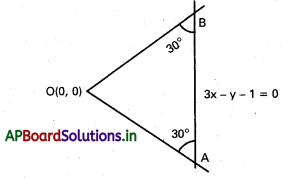
మూలబిందువు గుండా పోతూ 3x – y – 1 = 0 అనే సరళరేఖతో 30° కోణం చేసే సరళరేఖాయుగ్మం సమీకరణం 13x2 + 12xy – 3y = 0 అని చూపండి.
AP Inter 1st Year Maths 1B Solutions Chapter 4 సరళరేఖాయుగ్మాలు Ex 4(a) 3
సాధన:
AB సమీకరణము 3x – y – 1 = 0
OA, OB లు AB తో 30° కోణం చేస్తూ మూలబిందువు గుండా పోతుంది.
OA వాలు m అనుకొందాం.
∴ OA సమీకరణము
y – 0 = m (x − 0) = mx లేదా mx – y = 0
cos ∠OAB = \(\frac{|3 m+1|}{\sqrt{9+1} \sqrt{m^2+1}}\)
cos ∠OAB = cos 30° = \(\frac{\sqrt{3}}{2}\)
∴ \(\frac{\sqrt{3}}{2}=\frac{|3 m+1|}{\sqrt{10} \sqrt{m^2+1}}\)
వర్గీకరించి, అడ్డ గుణకారము చేయగా,
\(\frac{3\left(m^2+1\right)}{4}=\frac{(3 m+1)^2}{10}\)
15(m2 + 1) = 2 (3m + 1)2
15m2 + 15 = 2 (9m2 + 6m + 1)
= 18m2 + 12m + 2
3m2 + 12m – 13 = 0
m1, m2 లు మూలాలనుకుందాం.
m1 + m2 = -4, m1 m2 = \(\frac{-13}{3}\)
OA, OB ల ఉమ్మడి సమీకరణము
(m1x – y) (m1x – y) = 0
m1m1 x2 – (m1 + m2) xy + y2 = 0
\(\frac{-13}{3}\) x2 + 4xy + y2 = 0
-13x2 + 12 xy + 3y2 = 0 (లేదా)
13x2 – 12xy – 3y2 = 0

AP Inter 1st Year Maths 1B Solutions Chapter 4 సరళరేఖాయుగ్మాలు Ex 4(a)

ప్రశ్న 5.
మూలబిందువు గుండాపోతూ x + y + 5 = 0 సరళరేఖతో లఘుకోణం α చేసే సరళరేఖాయుగ్మం సమీకరణం కనుక్కోండి.
AP Inter 1st Year Maths 1B Solutions Chapter 4 సరళరేఖాయుగ్మాలు Ex 4(a) 4
సాధన:
AB సమీకరణము x + y + 5 = 0
AB వాలు = -1
OA, OB లు కావలసిన రేఖలు
OA సమీకరణము y = mx ⇒ mx – y = 0
cos α = \(\frac{\left|a_1 a_2+b_1 b_2\right|}{\sqrt{a_1^2+b_1^2} \sqrt{a_2^2+b_2^2}}\)
= \(\frac{|m-1|}{\sqrt{2} \sqrt{m^2+1}}\)
2(m2 + 1) cos2 α = (m – 1)2
2(m2 + 1) = \(\frac{(m-1)^2}{\cos ^2 \alpha}\) = (m – 1)2 sec2 α.
2m2 + 2 = m2 sec2 α – 2m sec2 α + sec2 α.
m2 (sec2 α – 2) – 2m sec2 α + (sec2 α – 2) = 0
m1 + m1 = \(\frac{2 \sec ^2 \alpha}{\sec ^2 \alpha-2}\), m1m2 = 1
OA, OB ల ఉమ్మడి సమీకరణము
(y – m1x) (y – m2x) = 0
y2 – (m1 + m2) xy + m1m2 x2 = 0
y2 + \(\frac{2 \sec ^2 \alpha}{\sec ^2 \alpha-2}\) . xy + x2 = 0
m1 + m2 = \(\frac{2 \sec ^2 \alpha}{\sec ^2 \alpha-2}=\frac{2}{1-2 \cos ^2 \alpha}\)
= \(\frac{-2}{2 \cos ^2 \alpha-1}=\frac{-2}{\cos 2 \alpha}\)
= 2 sec 2 α
OA, OB ల ఉమ్మడి సమీకరణాలు
x2 + 2xy sec 2α + y2 = 0

ప్రశ్న 6.
(x + 2a)2 – 3y2 = 0, x = లు సూచించే రేఖలు ఒక సమబాహు త్రిభుజాన్ని ఏర్పరుస్తాయని చూపండి.
సాధన:
OA, OB ల ఉమ్మడి సమీకరణము
(x + 2a)2 – 3y2 = 0
(x + 2a)2 – (\(\sqrt{3}\)y)2 = 0
(x + 2a + \(\sqrt{3}\) y) (x + 2a – \(\sqrt{3}\)y) = 0
AP Inter 1st Year Maths 1B Solutions Chapter 4 సరళరేఖాయుగ్మాలు Ex 4(a) 19
∴ ∆OAB సమబాహు త్రిభుజం.

AP Inter 1st Year Maths 1B Solutions Chapter 4 సరళరేఖాయుగ్మాలు Ex 4(a)

ప్రశ్న 7.
(ax + by)2 = c(bx – ay)2, c > 0 తో సూచించే సరళరేఖల మధ్యకోణాల సమద్విఖండన రేఖలు ax+ by + k= 0 సరళరేఖకు సమాంతరంగాను, లంబంగాను ఉంటాయని చూపండి.
సాధన:
దత్త రేఖల ఉమ్మడి సమీకరణాలు,
(ax + by)2 = c (bx – ay)2
a2x2 + b2y2 + 2ab xy = c (b2x2 + a2y2 – 2abxy)
= c b2x2 +ca2y2 – 2cabxy
(a2 – cb2)x2 + 2ab (1 + c2) xy + (b2 – ca2)y2 = 0
కోణ సమద్విఖండన రేఖల సమీకరణము
h (x – y2) = (a – h) xy
ab (1 + c) (x2 – y2)
= (a2 – cb2 – b2 + ca2) (x2 – y2) = 0
= (a2 – b2)(1 + c) xy.
i.e., ab (x2 – y2) – (a2 – b2) xy = 0
(ax + by) (bx – ay) = abx2 – a2xy + b2xy – aby2
= ab (x2 – y2) – (a2 – b2) xy
∴ కోణ సమద్విఖండన రేఖల సమీకరణము
(ax + by) (bx – ay) = 0
సమద్విఖండన రేఖలు ax + by = 0 మరియు bx – ay = 0
ax + by = 0 కు సుమాంతరం ax + by + k = 0
bx – ay = 0 కు సుమాంతరం ax + by + k = 0.

ప్రశ్న 8.
2x2 – 5xy + 3y2 = 0 అనే సమీకరణం ఒక సమాంతర చతుర్భుజపు రెండు పక్క భుజాలను సూచిస్తుంది. దీని వికర్ణాలలో ఒకదాని సమీకరణం x + y + 2 = 0 అయితే, ఆ సమాంతర చతుర్భుజపు శీర్షాలు, రెండో వికర్ణం సమీకరణం కనుక్కోండి.
AP Inter 1st Year Maths 1B Solutions Chapter 4 సరళరేఖాయుగ్మాలు Ex 4(a) 6
సాధన:
OA, OB ల ఉమ్మడి సమీకరణము
2x2 – 5xy + 3y2 = 0 …………… (1)
AB సమీకరణము x + y + 2 = 0
y = (x + 2)
(1) లో ప్రతిక్షేపించగా
2x2 + 5x (x + 2) + 3(x + 2)2 = 0
2x2 + 5x2 + 10x + 3(x2 + 4x + 4) = 0
7x2 + 10x + 3x2 + 12x + 12 = 0
10x2 + 22x + 12 = 0
5x2 + 11x + 6 = 0
(x + 1) (5x + 6) = 0
x + 1 = 0 లేదా 5x + 6 = 0
x = – 1 లేదా 5x = – 6
x = –\(\frac{6}{4}\)
y = (x + 2)
x = -1 ⇒ y = -(-1 + 2) = -1
⇒ A నిరూపకాలు (−1, -1)
x = –\(\frac{6}{5}\) ⇒ y = -(-\(\frac{6}{5}\) + 2) = –\(\frac{4}{5}\)
⇒ B నిరూపకాలు \(\left(-\frac{6}{5},-\frac{4}{5}\right)\)
కర్ణాలు AB, OC లు ‘O’ వద్ద ఖండించుకొంటాయి.
AB, OC ల మధ్యబిందువు
C నిరూపకాలు (x, y) అనుకుందాము.
OC మధ్యబిందువు = AB మధ్య బిందువు
\(\left(\frac{x}{2}, \frac{y}{2}\right)=\left(\frac{-1-\frac{6}{5}}{2}, \frac{-1-\frac{4}{5}}{2}\right)\)
∴ x = -1 – \(\frac{6}{5}\) = –\(\frac{11}{5}\) ;
y = -1 – \(\frac{4}{5}\) = –\(\frac{9}{5}\)
C నిరూపకాలు \(\left(-\frac{11}{5},-\frac{9}{5}\right)\)
∴ శీర్షాలు O(0, 0), A (-1, -1)
C\(\left(-\frac{11}{5},-\frac{9}{5}\right)\) , B\(\left(-\frac{6}{5},-\frac{4}{5}\right)\)
OC సమీకరణము y – 0 = \(\frac{\frac{-9}{5}}{\frac{-11}{5}}(x-0)\)
y = \(\frac{9}{11}\) ⇒ 11y = 9x
లేదా 9x – 11y = 0

AP Inter 1st Year Maths 1B Solutions Chapter 4 సరళరేఖాయుగ్మాలు Ex 4(a)

ప్రశ్న 9.
కింది రేఖలతో ఏర్పడే త్రిభుజం కేంద్రభాసం, వైశాల్యం కనుక్కోండి.
i) 2y2 – xy – 6x2 = 0, x + y + 4 = 0
ii) 3x2 – 4xy + y2 = 0, 2x – y = 6
AP Inter 1st Year Maths 1B Solutions Chapter 4 సరళరేఖాయుగ్మాలు Ex 4(a) 7
సాధన:
i) OA, OB ల ఉమ్మడి సమీకరణాలు
2y2 – xy – 6x2 = 0 …………….. (1)
AB సమీకరణము x + y + 4 = 0
y = -(x + 4) ……………… (2)
(1) లో ప్రతిక్షేపించగా
2(x + 4)2 + x (x + 4) – 6x2 = 0
2(x2 + 8x + 16) + x2 + 4x – 6x2 = 0
2x2 + 16x + 32 + x2 + 4x – 6x2 = 0
-3x2 + 20x + 32 = 0
3x2 – 20x – 32 = 0
(3x + 4) (x – 8) = 0
3x + 4 = 0 లేదా x – 8 = 0
3x = -4 లేదా x = 8
x = –\(\frac{4}{3}\) లేదా 8

సందర్భం (i) : x = –\(\frac{4}{3}\)
y = – (x + 4)
= -(\(\frac{-4}{3}\) + 4) = –\(\frac{8}{3}\)
A నిరూపకాలు \(\left(-\frac{4}{3},-\frac{8}{3}\right)\)

సందర్భం (ii) : x = 8
y = – (x + 4) = – (8 + 4) = -12
B నిరూపకాలు (8, – 12)
∆AOB కేంద్ర భాసము G అనుకుందాం.
G నిరూపకాలు
AP Inter 1st Year Maths 1B Solutions Chapter 4 సరళరేఖాయుగ్మాలు Ex 4(a) 8

AP Inter 1st Year Maths 1B Solutions Chapter 4 సరళరేఖాయుగ్మాలు Ex 4(a)

ii) OA, OB ల ఉమ్మడి సమీకరణము,
3x2 – 4xy + y2 = 0 ……………. (1)
AB సమీకరణము 2x – y = 6
y = 2x – 6 ……………… (2)
(1) లో ప్రతిక్షేపించగా
3x2 – 4x (2x – 6) + (2x – 6)2 = 0
3x2 – 8x2 + 24x + 4x2 + 36 – 24x = 0
-x2 + 36 = 0
x2 – 36 = 0
(x + 6) (x – 6) = 0
x + 6 = 0 లేదా x – 6 = 0
x = 6 లేదా 6
y = 2x – 6
x = 6y ⇒ y = 12 – 6 = 6
A నిరూపకాలు (6, 6)
x = -6y ⇒ u = -12 – 6 = -18
B నిరూపకాలు (-6, 18)
G నిరూపకాలు
\(\left(\frac{0+6-6}{3}, \frac{0+6-18}{3}\right)\) = (0, -4)
∆ OAB = \(\frac{1}{2}\)|x1y2 – x2y1|
= \(\frac{1}{2}\)|(6 (-18) – (-6) . 6|
= \(\frac{1}{2}\) |-108 + 36
= \(\frac{1}{2}\) . 72 = 36 చ. యూనిట్లు

ప్రశ్న 10.
(2, -1) బిందువు వద్ద ఖండించుకొంటూ 6x2 – 13xy – 5y2 = 0 సూచించే రేఖాయుగ్మానికి
i) లంబంగా ఉండే రేఖాయుగ్మపు సమీకరణం,
ii) సమాంతరంగా ఉండే రేఖాయుగ్మపు సమీకరణం కనుక్కోండి.
సాధన:
OA, OB ల సమీకరణము 6x2 – 13xy – 5y2 = 0
i) (x1, y1) గుండా పోతూ
ax2 + 2hxy + by2 = 0 కు లంబంగా ఉండే రేఖా సమీకరణము
b (x – x1)2 – 2h (x – x1) (y – y1) + a (y – y1)2 = 0
లంబరేఖల సమీకరణము
-5(x – 2)2 + 13(x – 2) (y + 1) + 6(y + 1)2 = 0
-5(x2 – 4x + 4) + 13 (xy + x – 2y – 2) + 6 (y2 + 2y + 1) = 0
-5x2 + 20x – 20 + 13xy + 13x – 26y – 26 + 6y2 + 12y + 6 = 0
-5x2 + 13xy + 6y2+ 33x – 14y – 40 = 0
లేదా 5x2 – 13xy – 6y2 – 33x + 14y + 40 = 0

ii) (x1, y1) గుండాపోతూ ax2 + 2hxy + by2 = 0
సమాంతరంగా ఉండే రేఖల సమీకరణము
a (x – x1)2 + 2h (x – x1) (y – y1) + b(y – y1)2 = 0
సమాంతర రేఖల సమీకరణము
6 (x − 2)2 – 13 (x − 2) (y + 1) − 5 (y + 1)2 = 0
6 (x2 – 4x + 4) – 13 (xy + x – 2y – 2) – 5 (y2 + 2y + 1) = 0
6x2 – 24x + 24 – 13xy – 13x + 26y + 26 – 5y2 – 10y – 5 = 0
6x2 – 13xy – 5y2 – 37x + 16y + 45 = 0.

AP Inter 1st Year Maths 1B Solutions Chapter 4 సరళరేఖాయుగ్మాలు Ex 4(a)

ప్రశ్న 11.
3x – 4y + 7 = 0, 12x + 5y – 2 = 0 సరళరేఖల మధ్య లఘుకోణ సమద్విఖండన రేఖ సమీకరణం కనుక్కోండి.
సాధన:
దత్త రేఖలు 3x – 4y + 7 = 0 ……………… (1)
12x + 5y – 2 = 0 ……………….. (2)
(1) & (2) రేఖల కోణ సమద్విఖండన రేఖల సమీకరణము
\(\frac{3 x-4 y+7}{\sqrt{3^2+4^2}} \pm \frac{12 x+5 y-2}{\sqrt{12^2+5^2}}\) = 0
⇒ \(\frac{3 x-4 y+7}{5} \pm \frac{12 x+5 y-2}{13}\) = 0
13 (3x – 4y + 7) ± 5 (12x + 5y – 2) = 0
(39x – 52y + 91) ± (60x + 25y -10) = 0
(i) 39x – 52y + 91 + 60x + 25y – 10 = 0
99x – 27y + 81 = 0 ……………… (3)
లేదా 11x – 3y + 9 = 0

(ii) (39x – 52y + 51) – (60x + 25y – 10) = 0
39x – 52y + 51 – 60x – 25y + 10 = 0
– 21x – 77y + 61 = 0
21x + 77y – 61 = 0 …………….. (4)
(1), (4) రేఖల మధ్య కోణము ‘0’ అయితే
tan θ = + \(\left|\frac{a_1 b_2-a_2 b_1}{a_1 a_2+b_1 b_2}\right|=\left|\frac{231+84}{63-308}\right|\)
= \(\frac{315}{225}\) > 1
∴ (4) గురు కోణ సమద్విఖండన రేఖ (3) సూచించే రెండవది లఘుకోణ సమద్విఖండన రేఖ.
∴ 11x – 3y + 9 = 0 రేఖ లఘుకోణ సమద్విఖండన రేఖ.

ప్రశ్న 12.
x + y – 5 = 0, x – 7y + 7 = 0 అనే సరళరేఖల మధ్య అధిక (గురు) కోణ సమద్విఖండన రేఖ సమీకరణం కనుక్కోండి.
సాధన:
దత్త రేఖలు
x + y – 5 = 0 …………….. (1)
x – 7y + 7 = 0 ………………… (2)
(1), (2) మధ్యకోణ సమద్విఖండన రేఖలు
\(\frac{x+y-5}{\sqrt{1+1}} \pm \frac{x-7 y+7}{\sqrt{1+49}}\) = 0
⇒ \(\frac{x+y-5}{\sqrt{2}} \pm \frac{x-7 y+7}{5 \sqrt{2}}\) = 0
⇒ (5x + 5y – 25) ± (x – 7y + 7) = 0
i) 5x + 5y – 25 + x – 7y + 7 = 0
6x – 2y – 18 = 0
3x – y – 9 = 0 ………………. (3)

AP Inter 1st Year Maths 1B Solutions Chapter 4 సరళరేఖాయుగ్మాలు Ex 4(a)

ii) (5x + 5y – 25) – (x – 7y + 7) = 0
4x + 12y – 32 = 0
x + 3y – 8 = 0 ………………. (4)
(1), (4) రేఖల మధ్య కోణము ‘θ’ అయితే
tan θ = \(\frac{a_1 b_2-a_2 b_1}{a_1 a_2+b_1 b_2}=\frac{3-1}{1+3}=\frac{2}{4}=\frac{1}{2}\) < 1
∴ (4) లఘుకోణ సమద్విఖండన రేఖ గురుకోణ సమద్విఖండన రేఖ సమీకరణము 3x – y – 9 = 0.

III.

ప్రశ్న 1.
(lx + my)2 – 3(mx – ly)2 = 0, lx + my + n = 0 అనే సరళరేఖలతో ఏర్పడే త్రిభుజం \(\frac{n^2}{\sqrt{3}\left(l^2+m^2\right)}\) వైశాల్యం గల సమబాహు త్రిభుజం అని నిరూపించండి. [T.S Mar. ’15]
సాధన:
OA, OB ల ఉమ్మడి సమీకరణము
(lx + my)2 – 3(mx – ly)2 = 0
l2x2 + m2y2 + 21mxy – 3m2x2 – 3l2 y2 + 6 lmxy = 0
(l2 – 3m2) x2 + 8lmxy + lm2 − 3l2) y2 = 0
cos ∠AOB = \(\frac{|a+b|}{\sqrt{(a-b)^2+4 n^2}}\)
= \(\frac{\left|l^2-\mathrm{m}^2+\mathrm{m}^2-3 l^2\right|}{\sqrt{\left(l^2-3 \mathrm{~m}^2-\mathrm{m}^2+3 l\right)^2+a l^2 \mathrm{~m}^2}}\)
= \(\frac{2\left|l^2+m^2\right|}{4 \sqrt{\left(l^2-m^2\right)^2+4 l^2 m^2}}=\frac{2\left|l^2+m^2\right|}{4\left(l^2+m^2\right)}=\frac{1}{2}\)
= cos 60°
∠AOB = 60°
OA, OB ల సమద్విఖండన రేఖ ఉమ్మడి సమీకరణము
h (x2 – y2) = (a – b) xy
4 lm (x2 – y2) = (x2 – 3m2 – m2 + 3l2 xy)
4 lm (x2 − y2) = 4(l2 – m2)
lmx2 – (l2 – m2)xy – lmy2 = 0
(lx – my) (mx – ly) = 0
lx + my = 0 మరియు mx – ly = 0
∴ సమద్విఖండన రేఖ mx – ly = 0 కు లంబంగా ఉంటే
lx + my + n = 0.
OAB సమద్విబాహు త్రిభుజం ∠AOB = 60°
OAB సమబాహు త్రిభుజం
P = P నుండి AB మీదకు లంబదూరం
= \(\frac{|n|}{\sqrt{l^2+m^2}}\)
ΔΟΑΒ = \(\frac{\mathrm{p}^2}{\sqrt{3}}=\frac{\mathrm{n}^2}{\sqrt{3}\left(l^2+\mathrm{m}^2\right)}\) చ. యూనిట్లు.

AP Inter 1st Year Maths 1B Solutions Chapter 4 సరళరేఖాయుగ్మాలు Ex 4(a)

ప్రశ్న 2.
3x2 + 48xy + 23y2 = 0, 3x – 2y + 13 = 0 అనే సరళరేఖలతో ఏర్పడే త్రిభుజం \(\frac{13}{\sqrt{3}}\) చ.యూ. వైశాల్యంగా గల సమబాహు త్రిభుజం అని నిరూపించండి.
సాధన:
OA, OB ల ఉమ్మడి సమీకరణాలు
3x2 + 48xy + 23y2 = 0 …………………. (1)
AB సమీకరణం 3x – 2y + 13 = 0 …………….. (2)
(1) ని
(9x2 – 12xy + 4y2) – 3(4x2 + 12xy + 9y2) = 0
ఈ విధంగా రాయగలము.
i.e., (3x – 2y)2 – 3(2x + 3y)2 = 0
⇒ [(3x – 2y) + \(\sqrt{3}\) (2x + 3y)] [(3x – 2y) – \(\sqrt{3}\) (2x + 3y)] = 0
⇒ [(3 + 2\(\sqrt{3}\))x + (3\(\sqrt{3}\) – 2)y] [(3 – 2\(\sqrt{3}\))x – (3\(\sqrt{3}\) + 2)y] = 0
OA సమీకరణము
(3 + 2 \(\sqrt{3}\))x − (3\(\sqrt{3}\) – 2)y = 0 ……………….. (1)
OB సమీకరణము
(3 – 2\(\sqrt{3}\))x – (3\(\sqrt{3}\) + 2)y = 0 ……………….. (2)
AP Inter 1st Year Maths 1B Solutions Chapter 4 సరళరేఖాయుగ్మాలు Ex 4(a) 9
∴ OAB సమబాహు త్రిభుజము
AP Inter 1st Year Maths 1B Solutions Chapter 4 సరళరేఖాయుగ్మాలు Ex 4(a) 10

AP Inter 1st Year Maths 1B Solutions Chapter 4 సరళరేఖాయుగ్మాలు Ex 4(a)

ప్రశ్న 3.
ax2 + 2hxy + by2 = 0 సూచించే రేఖాయుగ్మపు మధ్యకోణాల సమద్విఖండన రేఖాయుగ్మం మధ్య కోణాలను సమద్విఖండన చేసే రేఖాయుగ్మం సమీకరణం (a – b) (x2 – y2) + 4hxy = 0 అని నిరూపించండి.
సాధన:
దత్త రేఖల సమీకరణము
ax2 + 2hxy + by2 = 0
కోణ సమద్విఖండన రేఖల సమీకరణము
h (x2 – y2) = (a – b) xy ………………. (1)
hx2 – hy2 – (a – b) xy = 0
∴ A = h, B = – h; 2H = – (a – b)
(1) యొక్క సమద్విఖండన రేఖల సమీకరణము
H(x2 – y2) = (A – B) xy
– \(\frac{(a-b)}{2}\) (x2 – y2) = 2hxy
– (a – b) (x2 – y2) = 4hxy
లేదా (a – b) (x2 – y2) + 4hxy = 0
∴ ax2 + 2hyx + by2 = 0 ల సమద్విఖండన రేఖల ‘సమీకరణము
(a – b) (x2 – y2) + 4hxy = 0.

ప్రశ్న 4.
ax2 + 2hxy + by2 = 0 సూచించే సరళరేఖలలో ఒక సరళరేఖ నిరూపకాక్షాల మధ్య కోణాన్ని సమద్విఖండన చేస్తే (a + b)2 = 4h2 అని నిరూపించండి. [June ’04]
సాధన:
నిరూపకాక్షాల కోణ సమద్విఖండన రేఖల సమీకరణాలు
y = ±x.
సందర్భం (i) :
y = x రేఖ ax2 + 2hxy + by2 = 0 యొక్క ఒక కోణం సమద్విఖండన రేఖ
x2 (a + 2h + b) = 0
a + 2h + b = 0 ………………. (1)

సందర్భం (ii) : y = -x రేఖ
ax2 + 2hxy + by2 = 0 యొక్క ఒక కోణం సమద్విఖండన రేఖ
x2 (a – 2h + b) = 0
a – 2h + b = 0 ………………. (2)
(1), (2) లను గుణించగా
(a + b + 2h). (a + b – 2h) = 0
(a + b)2 – 4h2
(a + b)2 = 4h2

AP Inter 1st Year Maths 1B Solutions Chapter 4 సరళరేఖాయుగ్మాలు Ex 4(a)

ప్రశ్న 5.
ax2 + 2hxy + by2 = 0, lx + my = 1 అనే సరళరేఖలలో ఏర్పడే త్రిభుజం కేంద్రాభాసం (α, β) అయితే \(\frac{\alpha}{\mathrm{b} \boldsymbol{l}-\mathrm{hm}}=\frac{\beta}{\mathrm{am}-\mathrm{hl}}=\frac{2}{3\left(\mathrm{~b} \boldsymbol{l}^2-2 \mathrm{~h} \boldsymbol{l} \mathrm{m}+\mathrm{am}{ }^2\right)}\) అని నిరూపించండి.
AP Inter 1st Year Maths 1B Solutions Chapter 4 సరళరేఖాయుగ్మాలు Ex 4(a) 11
సాధన:
OA, OB ల ఉమ్మడి సమీకరణము
ax2 + 2hxy + by2 = 0 …………….. (1)
AB సమీకరణము lx + my = 1
my = 1 – lx
y = \(\frac{1-l x}{m}\) …………… (2)
(1) లో ప్రతిక్షేపించగా
ax2 + 2hx\(\frac{(1-l x)}{m}\) + b\(\frac{(1-l x)^2}{m^2}\) = 0
am2x2 + 2hmx (1 – lx) + b (1 + l2x2 – 2lx) = 0
am2x2 + 2hmx – 2hlmx2 + b + b2x2 – 2blx = 0
(am2 – 2hlm + bl2) x2 – 2(bl – hm) x + b = 0
అనుకుందాం.
A నిరూపకాలు (x1, y1), మరియు B నిరూపకాలు (x2, y2)
x1 + x2 = \(\frac{2(\mathrm{~b} l-\mathrm{hm})}{\mathrm{a} \mathrm{m}^2-2 \mathrm{~h} l \mathrm{~m}+\mathrm{b} l^2}\) ……………. (3)
A, B లు lx + my = 1 మధ్యబిందువులు.
lx1 + my1 = 1
lx2 + my2 = 1
l (x1 + x2) + m(y1 + y2) = 2
m(y1 + y2) = 2 – l(x1 + x2)
AP Inter 1st Year Maths 1B Solutions Chapter 4 సరళరేఖాయుగ్మాలు Ex 4(a) 12
త్రిభుజ శీర్షాల నిరూపకాలు
O (0, 0), A (x1, y1), B(x2, y2)
G నిరూపకాలు అనుకుందాం.
AP Inter 1st Year Maths 1B Solutions Chapter 4 సరళరేఖాయుగ్మాలు Ex 4(a) 13

AP Inter 1st Year Maths 1B Solutions Chapter 4 సరళరేఖాయుగ్మాలు Ex 4(a)

ప్రశ్న 6.
\(\frac{x}{\alpha}+\frac{y}{\beta}\) = 1, ax2 + 2hxy + by2 = 0 సరళరేఖలతో ఏర్పడే త్రిభుజం లంబకేంద్రానికి, మూలబిందువుకు గల మధ్య దూరం (α2 + β2)1/2 \(\left|\frac{(a+b) \alpha \beta}{a \alpha^2-2 h \alpha \beta+b \beta^2}\right|\) అని నిరూపించండి.
సాధన:
ax2 + 2hxy + by2 = 0 సూచించే రేఖలు
l1x + m1y = 0 ………………. (1)
l2x + m2y = 0 ………………… (2)
అనుకొందాం.
∴ (l1x + m1y) (l2x + m2y) = ax2 + 2hxy +by2
ఇరువైపులా పోల్చగా
l1l2 = a, m1m2 = b, l1m2 + l2 m1 = 2h
దత్త రేఖ lx + my = 1 ………………….. (3)
(1) & (2) ల ఖండన బిందువులు
(1) & (3) ల ఖండన బిందువు A అనుకొందాం.
AP Inter 1st Year Maths 1B Solutions Chapter 4 సరళరేఖాయుగ్మాలు Ex 4(a) 14
AP Inter 1st Year Maths 1B Solutions Chapter 4 సరళరేఖాయుగ్మాలు Ex 4(a) 15
AP Inter 1st Year Maths 1B Solutions Chapter 4 సరళరేఖాయుగ్మాలు Ex 4(a) 16
⇒y (l1α – m2β) – αβl1l2 = m2(xl1α – m1β) + m1αβ)
⇒ (l1α – m1β) (m2x – l2y) = m1m2αβ + l1l2αβ
AP Inter 1st Year Maths 1B Solutions Chapter 4 సరళరేఖాయుగ్మాలు Ex 4(a) 17
AP Inter 1st Year Maths 1B Solutions Chapter 4 సరళరేఖాయుగ్మాలు Ex 4(a) 18

AP Inter 1st Year Maths 1B Solutions Chapter 4 సరళరేఖాయుగ్మాలు Ex 4(a)

ప్రశ్న 7.
ఒక రేఖాయుగ్మంలో px + qy + r = 0 అనేది ఒక సరళరేఖ. ఆ రేఖాయుగ్మపు మధ్యకోణాల సమద్విఖండన రేఖలో ఒకటి lx + my + n = 0 అయితే, ఆ రేఖాయుగ్మంలో రెండో సరళరేఖ సమీకరణం (px + qy + r) (l2 + m2) – 2(lp + mq) (lx + my + n) = 0 అని నిరూపించండి.
సాధన:
lx + my + n = 0.కోణ సమద్విఖండన రేఖ (α, β) మీద బిందువు
lα + mβ + n = 0 ……………… (1)
రెండవ రేఖ, దత్త రేఖల ఖండన బిందువు, కోణ సమద్విఖండన రేఖల ఖండన బిందువు గుండా పోతూ p + λq = 0
దాని సమీకరణము
(px + qy + r) + 2(lx + my + n) = 0
px + py + r = 0
(α, β) కోణ సమద్విఖండన రేఖ మీది బిందువులు. దాని నుండి (2), (3) రేఖల లంబ దూరాలు సమానం.
\(\frac{(p \alpha+q \beta+r)+\lambda(l \alpha+m \beta+n)}{\sqrt{\left[(p+l \lambda)^2+(q+m \lambda)^2\right]}}=\pm \frac{p \alpha+q \beta+r}{\sqrt{p^2+q^2}}\)
(1) లో lα + mβ + n = 0 pα+ qβ + r కొట్టివేసి ఇరువైపుల వర్గీకరించగా
(p + lλ)2 + (q + mλ)2 = p2 + q2 లేదా
2λ (pl + qm) + λ2 (l2 + m2) = 0
.. λ = – 2 \(\frac{\mathrm{p} l+\mathrm{qm}}{l^2+\mathrm{m}^2}\)
λ. విలువ (2) లో ప్రతిక్షేపించగా,
(px + qy + r) + \(\left(\frac{-2 p l+q m}{l^2+m^2}\right)\) lx + my + n = 0
⇒ (px + qy + r) (l2 + m2) – 2(pl + qm) (lx + my + n ) = 0

AP Inter 1st Year Commerce Study Material Chapter 12 Emerging Trends in Business

Andhra Pradesh BIEAP AP Inter 1st Year Commerce Study Material 12th Lesson Emerging Trends in Business Textbook Questions and Answers.

AP Inter 1st Year Commerce Study Material 12th Lesson Emerging Trends in Business

Essay Answer Questions

Question 1.
Define E – business and explain the scope of E – business.
Answer:
Ther term E-business refers to the integration of business tools based on ICT to improve the functioning of the company. “E-business” refers to the use of an online support for the relationship building between a company and clients. E – business was first used by IBM in 1997. It defined E – business as “the transformation of key business processes through the use of internet technologies”. E – business is defined as the application of information and communication technologies (ICT) which support all the activities and realms of business.

E-Business uses web based technology to improve relationships with customers. Implementing an E-business project necessarily involves the deployment of a network or web – interface connecting company specific services to the client.

Scope of E – Business :
E – business can be divided into following areas.
a) E – business within the organisation

b) Business to business (B2B) :
E – business refers to an exchange of products and services by one business and another.

c) Business to customer (B2C) :
E – business refers to an exchange of products and services from a business to a customer.

d) Customer to customer (C2C) :
E – business refers to C2C transactions are being facilitated by websites like quicker, olx, where customers offer their products online to be bought by other customers.

e) Customer to business (C2B) :
C2B transactions involve provision of project work by customers on internet to the needy companies.

Most of us are aware of buying products online through some sites like Flipkart, Jabong and Amazon. Almost everything from gym equipment to laptops, apparels to Jewelries are available online in this age of E-commerce. Even people are also buying services online. Business consultants, lawyers and doctors are offering their services or advices to their potential clients via internet.

Electronic business is a super set of business cases. E – commerce is one of the aspects of e – business. Some other important aspects of e – business, which are successfully carried through the internet, are e – auctioning, e – banking, e – directories, e – engineering, e – franchising, e – gambling, e – learning, e – mailing, e – marketing e – operational resource management, etc.

i) E-commerce :
Transacting or facilitating business through internet is called e-commerce. E-commerce is short for “Electronic commerce”.

ii) E – auctioning :
The internet enables people to participate in the auction without sacrificing their personal time. In e – auctioning the people who want to participate in the auction, visit the website with a click and go through the details.

iii) E-banking :
Electronic banking is one of the most successful online businesses. E-banking allows customers to access their accounts and execute orders through use of website. Online banking allows the customers to get their money from an ATM.

iv) E-marketing :
Electronic marketing provides a worldwide platform for buying and selling of goods without having any geographical barriers. The internet allows companies to react to individual customer demands immediately without any loss of time. It does not matter where the customer is located.

v) E – trading :
E-trading is also known as “online trading” or e – broking. It is used for buying and selling stocks in stock exchanges.

Question 2.
Explain the benefits of E – business.
Answer:
E-business has many advantages which can be broadly classified into the following categories.
A) Benefits to Customer
B) Benefits to Organisation
C) Benefits to Society

A) Benefits to Customer:
i) Shopping at ease :
E – business enables customers to shop or do other transactions 24 hours a day, round the year from almost any location.

ii) Wide choice :
Customers will have more choices or more alternative products and services.

iii) Price savings :
E – business provides customers with less expensive products and services by allowing them to shop in many places and conduct quick comparisons.

iv) Exchange of information :
Allows customers to interact with other customers and exchange their opinions and experiences on products purchased.

B) Benefits to Organisation :
i) Reach beyond boundaries :
Extends the market place to national and international markets.

ii) Cost savings:
Reduces the cost of creating, processing, distributing, storing, and retrieving information. Allows reduced inventories and overheads.

iii) Competitive benefits :
Reduced processing time allows for customization of products and services for achieving competitive advantages.

iv) Earlier capital collection :
Reduces the time between the outlay of capital and the receipt of products and services.

C) Benefits to Society :
i) Environmental benefits :
Enables more individuals to work at home and to do less travelling for shopping, resulting in less traffic on the roads and lower air pollution.

ii) Public welfare :
Allows some merchandise to be sold at lower prices benefiting the poor ones.

iii) Availability of products :
Enables people in Third World countries and rural areas to enjoy produces and services which otherwise are not available to them.

AP Inter 1st Year Commerce Study Material Chapter 12 Emerging Trends in Business

Question 3.
Explain the opportunities of business enterprises in 21st century.
Answer:
The following are the opportunities of business enterprises in 21st century:

i) LPG :
The economic reforms initiated in the form of Liberalization, Privatization, and Globalization (LPG) have brought in structural changes which ultimately created favourable environment for business enterprises in India.

ii) Increase in size and diversification :
The 21st century business enterprises are characterized with large-sized and highly diversified organisations. Companies are able to reduce their costs and thereby increase in profits.

iii) Increase in per capita income :
India has emerged as the fourth largest economy globally with a high growth rate with its improved per capita income. Per capita income is the measure of living standards of its people in a country. As India’s per capita income is increasing, the business opportunities are also increasing in India.

iv) Market economies:
The Indian economy being one of the largest economies in the world with a population of more than 1.2 billion is flourishing and attracting industrial, trade and service sectors all around the world.

v) E-Commerce – A gate way to global markets :
Business enterprises across the globe are discovering the benefits of electronic commerce.

vi) Technological advancements :
21st century business enterprises are able to use ultramodern technology. With the advancement of technology, organisations are able to offer services.

vii) Expansion of financial services :
Banking insurance, debt and equity financing, micro finance sectors are helping the people to save money and to get liberal credit for their future needs.

viii) Automation of business processes :
Business Process Automotion (BPA) is the strategy that a business uses to automate processes in order to curtail costs. The objective of BPA is not only to automate business processes,but also to simplify and improve business workflows in terms of achieving greater efficiency, adapting to changing business needs and reducing potentiality human error.

ix) Growing mergers, acquisitions and foreign collaborations :
Mergers and acquisitions is a strategy of modern business enterprises for improving innovation, profitability, market share and stock prices. This helps in generating cost effectiveness.

x) Scope for international enterpreneurship :
In 21st century, many organizations are globalizing their businesses in terms of manufacturing, service delivery, capital sourcing, or talent acquisition as a defensive strategy. Similarly these are discovering a new business opportunities in more than one country to create new products or services to suit to the diversified needs of the customers.

Question 4.
Explain the challenges of business enterprises in 21st century.
Answer:
The following are the challenges of business enterprises in 21st century:
1) Threat of technology :
Business organisations have to adopt themselves in tune with the changing technology and modernize their plant and equipment and processes, if not they will become outdated in the market.

2) Growing consumer awareness:
Growing consumer awareness about the products and services will continue to drive sustainability of business in 21st century. Businesses need to respond to consumer demand to gain customers and avoid losing their market share.

3) Challenges of globalization :
Globalization is leading to strategic challenges of mixed cultures and languages in the business environment.

4) Depleting natural resources:
Most of the manufacturing enterprises depend upon certain natural resources which is a key source of raw materials.

5) Economic recession :
Economic recession took place in the United States and Europe is slowly showing its affects on performance of business enterprises in other countries also.

6) Information challenges :
Information technology supported by a new world infra-structure of data communications and telecommunications i.e. use of internet, wireless, e-commerce as part of management tools and easing of technology transfer has posed a bigger challenge for 21st century business enterprises.

7) The challenge of the environment :
Environmental degradation is one of the biggest challenges of business organisations facing today. Pollution and global warming are the challenges, which all countries are facing.

8) Corruption and bureaucratic hurdles :
Corruption is a very big hurdle for doing business. It is a barrier to the effective development of the private sector and poses business risks.

9) Changing regulatory frame work:
A changing regulatory environment is always of concern in certain industries. Two key areas of regulatory challenges are taxes and health care. The threat of increased costs due to new carbon taxes and presser to “go green” is another challenge.

10) Transparency and governance :
Corporate governance involves organizing and prioritizing a variety of interests. Modern companies are in surveillance of transparency and governance issues.

11) Corporate social responsibility:
The practical implementation of corporate social responsibility is facing lot of problems. Lack of understanding, inadequate trained personnel, coverage, etc. are a few hurdles of CSR programmes.

12) Foreign exchange risk :
Foreign exchange risk is another factor causing constant instability in the running of business organisation.

13) Security Issues:
Security threat to business has become more pronounced in 21st century. With the proliferation of Electronic Commerce and the “Virtual Office”, threats are becoming everyday occurrence to business.

14) Human resource challenges:
One of the biggest challenges of 21st century business is human resources – finding the right staff, training, and retaining them are concerns of the HR function.

Short Answer Questions

Question 1.
Explain the scope of E-business.
Answer:
The scope of E-business can be divided into following areas :
a) E-business within the organisation
b) Business to business (B2B) dealing
c) Business to customer (B2C) transactions
d) Customer to customer (C2C)
e) Customer to business (C2B)

The following a and b category E-business refers to an exchange of production and services by one business and another business from a business to a customer and c and d category E-business refers to transactions are being facilitated by websites where customers offer their products online, to be bought by other customers and provision of project work by customers on internet to the needy companies.

Some other important aspects of e – business, which are successfully carried through the internet, are e – auctioning, e – banking, e – directories, e – trading, etc. In the age of e – commerce almost everything from gym equipment to laptops are available online. Even people are also buying services online. Business consultants, lawyers and doctors are offering their services or advices to their potential clients via internet.

AP Inter 1st Year Commerce Study Material Chapter 12 Emerging Trends in Business

Question 2.
What are the benefits ofE – business to organizations?
Answer:
The following are the benefits of E-business to organizations.
i) Reach beyond boundaries:
Extends the market place to national and international markets.

ii) Cost savings :
Reduces the cost of creating, processing, distributing, storing and retrieving information. Allows reduced inventories and overheads.

iii) Competitive benefits:
Reduced processing time allows for customization of products and services for achieving competitive advantages.

iv) Earlier capital collection :
Reduces the time between the outlay of capital and the receipt of products and services.

Question 3.
What are the benefits ofE – business to customers?
Answer:
The following are the benefits of E – business to customers.
i) Shopping at ease:
E-business enables customers to shop or do other transactions 24 hours a day, round the year from almost any location.

ii) Wide choice :
Customers will have more choices or more alternative products and services.

iii) Price savings :
E-business provides customers with less expensive products and services.

iv) Exchange of information :
Allows customers to interact with other customers and exchange their opinions and experiences on products purchased.

Question 4.
Briefly outline the risks faced while involving in a E-business transaction.
Answer:
The following are the risks faced while involving in a E-business transaction.

  1. Risk of the information being unauthorized altered while travelling the internet.
  2. Risk related to confidentiality of personal information and banking information.
  3. Risk relating to legal enforceability of transactions.
  4. Risk of failure of electronic communications.
  5. Risk to the management in controlling and clearing the E-commerce transactions.
  6. Risks relating to technology like viruses and hacking.

Question 5.
What are the benefits of E-business to society?
Answer:
The following are the benefits of E-business to the society.

i) Environmental benefits:
Enables more individuals to work at home and to do less travelling for shopping, resulting in less traffic on the roads, and lower air pollution.

ii) Public welfare:
Allows some merchandise to be sold at lower prices benefiting the poor ones.

iii) Availability of products:
Enables people in Third World countries and rural areas to enjoy produces and services which otherwise are not available to them.

Very Short Answer Questions

Question 1.
business [May 17-T.S.]
Answer:
The term ‘E-business’ refers to the integration of business tools based on ICT to improve the functioning of the company. The term e-business was first used by IBM in 1997. It defined E-business as “the transformation of key business processes through the use of internet technologies”. E-business uses web based technology to improve relationship with customers.

Question 2.
E-banking [Mar. 2019, 15 -T.S.]
Answer:
Electronic banking is one of the most successful online businesses. E-banking allows customers to access their accounts and execute orders through use of website. Online banking allows the customers to get their money from an Automated Teller Machine (ATM), instead of walking up to the cash desk in the bank, can view their accounts, transfer funds and can pay bills. Eg. Net Banking.

AP Inter 1st Year Commerce Study Material Chapter 12 Emerging Trends in Business

Question 3.
E-marketing
Answer:
Electronic marketing provides a worldwide platform for buying and selling of goods without having any geographical barriers. The internet allows companies to react to individual customer demands immediately without any loss of time. It does not matter where the customer is located by e-mails, etc.

Question 4.
E-commerce
Answer:
Transacting or facilitating business through Internet is called E-commerce. E-commerce is short for “Electronic commerce”. A form of business transactions conducted electronically in E-commerce.

Question 5.
E – auctioning
Answer:
The internet enables people to participate in the auction without sacrificing their personal time. In E – auctioning the people, who want to participate in the auction, visit the website with a click and go through the details of goods offered.

AP Inter 1st Year Commerce Study Material Chapter 12 Emerging Trends in Business

Question 6.
E – trading [Mar. 17 – T.S.]
Answer:
E-trading is also known as “online trading” or E – broking. It is used for buying and selling stocks in stock exchanges.

AP Inter 1st Year Commerce Study Material Chapter 11 Multi National Corporations (MNCs)

Andhra Pradesh BIEAP AP Inter 1st Year Commerce Study Material 11th Lesson Multi National Corporations (MNCs) Textbook Questions and Answers.

AP Inter 1st Year Commerce Study Material 11th Lesson Multi National Corporations (MNCs)

Essay Answer Questions

Question 1.
Define MNC and explain its features.
Answer:
The word ‘Multinational’ consists of two words Multi and National. Multi means ‘many’ and national means “country or nation”. Therefore Multinational company means a company that operates in several countries.

Multinational companies are also known as Transnational corporations or International corporations or Global corporations. They conduct business in two or more countries. These corporations possess huge capital resources, latest technology along with world wide goodwill.

Definition :
According to International Labour Organisations (ILO) report –
“An enterprise whose managerial headquarters are located in one country, while it carries out operations in a number of other countries as well.”

According to Neil. H. Jocoby “A multinational corporation owns and manages business in two or more countries.”

David E. Liliental, considering a wider parameter, defines the MNCs as “Corporations which have their home in one country but operate and live under the laws and customs of other countries as well.” For brevity, MNC refers to the business enterprise operating in more than one nation.

The essential feature of a MNC is that headquarters are located in home country and they carry operations in a number of other countries i.e. host countries.

Characteristics of MNCs:
a) Giant size :
The sales and assets of MNCs are quite large. Hence they earn supernormal profits.

b) Global operations :
MNCs carry production and marketing operations in different countries of the world. They possess all the infrastructural facilities.

c) Centralized control :
MNC has its headquarters in the home country. It exercises control over all branches and subsidiaries.

d) Dominant position and status :
MNCs carry on operations in bulk and cover many people. Hence they control the market and enjoy a dominant position and status in all operated countries.

e) Sophisticated technology :
Generally MNCs had advance technology so as to produce quality goods and services to the consumers.

f) Professional management:
MNCs employ professional trained managers to integrate and manage world wide operations to maximize profits.

g) International research and development :
MNCs internationalize their research and development operations in order to caputre the market of the host countries.

h) Easy entry :
MNCs can enter into any country easily with their huge capital, technology, and managerial skills.

i) Higher revenues :
MNCs generate huge revenues with their large size sales and benefits of large scale economies

AP Inter 1st Year Commerce Study Material Chapter 11 Multi National Corporations (MNCs)

Question 2.
Define MNC and explain the advantages of MNCs.
Answer:
The word Multinational consists of two words Multi and National. Mutli means many and national means “nations or countries”. Therefore Multinational company means a company that operates in several countries.

Multinational companies are also known as Transnational Corporations or International Corporations-or Global Corporations. They conduct business in two or more countries. These corporations possess huge capital resources, latest technology along with worldwide goodwill.

According to Neil. H. Jocoby “A multinational corporation owns and manages business in two or more countries.”

David E. Liliental, considering a wider parameter, defines the MNCs as.”Corporations which have their home in one country but operate and live under the laws and customs of other countries as well.” For brevity, MNC refers to the business enterprise operating in more than one nation.

The essential feature of a MNC is that headquarters are located in home country and they carry operations in a number of other countries i.e. host countries.

Advantages to Host Countries:
1) Provide Capital :
The MNCs provide required capital for the development of industries in under developing countries. The direct foreign investment is quite useful to the developing countries.

2) Transfer of Technology:
MNCs serve as vehicles for transfer of advanced technology to the developing countries.

3) Generate Employment :
MNCs create employment in various cadres and pay attractive salaries in the host countries.

4) Foreign Exchange :
MNCs enable the host countries to increase their exports and reduce the imports. It improves the position of balance of payments.

5) Managerial Revolution :
MNCs help to professionalise management in host countries. They employ modern management techniques and trained manager.

6) Break Monopoly :
MNCs encourage healthy competition and break domestic monopolies.

7) Growth of Domestic Business Firms:
MNCs encourage domestic suppliers, ancillary units, bankers, and other institutions to expand their activites.

8) Innovation :
MNCs bring out innovation in their production and distribution activities which are required to provide goods and services to needs of the consumers of the host country.

9) Better Standard of Living :
MNCs help to improve standard of living in host countries by providing superior products and services at a reasonable rate.

10) Improves Public Relations among Nations :
They encourage international brotherhood through international business.

Advantages to Home Countries :
1) Availability of resources:
MNCs procure the land, labour, materials at cheap rates and can supply goods and services at reasonable rates.

2) Develop exports :
MNCs encourage the export of several products. This will imporve their foreign exchange earnings.

3) Generate income :
They can earn huge income from dividends, licenising fees, royalty and profits from their operations. This will improve the home country’s income.

4) Provides employment:
MNCs provide employment to the people of home country, as managers, technicians and other staff members.

5) Make use expertise :
The MNCs make use the latest technical knowledge and expertise of managers of different countries to run their business.

Question 3.
Define MNC and explain the limitations of MNCs.
Answer:
The word Multinational consists of two words Multi and National. Mutli means many and national means “nations or countries”. Therefore Multinational company means a company that operates in several countries.

Multinational companies are also known as Transnational Corporations or International Corporations or Globed Corporations. They conduct business in two or more countries. These corporations possess huge capital resources, latest technology along with worldwide goodwill.

According to Neil. H. Jocoby “A multinational corporation owns and manages business in two or more countries.”

David E. Liliental, considering a wider parameter, defines the MNCs as “Corporations which have their home in one country but operate and live under the laws and customs of other countries as well.” For brevity, MNC refers to the business enterprise operating in more than one nation.

The essential feature of a MNC is that headquarters are located in home country and they carry operations in a number of other countries i.e. host countries.

Disadvantages of MNCs:
1) Monopolize the markets :
MNC may join hands with big business units in host country to monopolize the markets. This ultimately leads to concentration of economic power.

2) Disregard host countries’ priorities :
MNCs invest only in porfitable business and ignore priorties set by the host countries. This results in regional backwardness in the host country.

3) Imbalance in the foreign exchange remittances :
MNCs and their subsidiaries collect huge amounts in the form of dividend. This creates an imbalance in the foreign exchange remittances.

4) Transfer of outdated technology :
The MNCs transfer the outdated technology, which is unsuitable and absolute by charging higher rates.

5) Impose restrictions :
MNCs try to impose restrictions with host countries related to non transfer of technical knowlege, determination of price, etc. to discourage the exports.

6) Threat to sovereignty :
MNCs may interfere in the political affairs of the country and try to create internal disturbances.

7) Spread of foreign culture :
MNCs cause damage to the cultural values of the host countries. They spread the foreign culture and change the attitudes, desires and fashions of the people.

8) Depletion of natural resources:
MNCs cause rapid depletion of some of the natural resources in host countries.

9) Retard growth of employment :
MNCs try to provide employment to their own nations. This bias attitude of the MNCs may lead to unemployment in the host country.

10) Business strategies and practices :
MNCs dump harmful products, give deceptive advertisements attract the consumers to purchase outdated and unwanted goods.

AP Inter 1st Year Commerce Study Material Chapter 11 Multi National Corporations (MNCs)

Question 4.
What is globalisation and explain the necessity of Globalisation?
Answer:
Globalisation refers to the increasing integration of markets (exchange) and production, to include the mobility of resources (capital, labour, ‘organisation and knowledge’).

The world is moving away from self-contained national economies toward an interdependent, integrated global economic system. Globalisation refers to the shift toward a more integrated and interdependent world economy.

Globalization has two facets :

  1. The globalization of markets
  2. The globalization of production

1) Globalization of Markets:

  • The globalization of markets refers to the merging of historically distinct and separate national markets into one huge global marketplace
  • Falling trade barriers make it easier to sell internationally
  • The tastes and preferences of consumers are converging on some global norm
  • Firms help create the global market by offering the same basic products worldwide

2) Globalization of Production :

  • The globalization of production refers to the sourcing of goods and services from locations around the globe to take advantages of national differences in the cost and quality of factors of production like land, labour and capital
  • Companies compete more effectively by lowering their overall cost structure or improving the quality or functionality of their product offering

There are two macro factors that underlie the trend toward greater globalization :
1) Low Trade Barriers:
The decline in barriers to the free flow of goods, services and capital. Advanced countries made a commitment to lower barriers to trade and investment.

2) Technological change:
Technological change has made the globalization of markets a reality. Important advances have occurred in microprocessors, telecommunications, Internet and World Wide Web, transportation technology, etc.

Short Answer Questions

Question 1.
Explain the meaning of MNC.
Answer:
The word Multinational consists of two words Multi and National. Mutli means many and national means “nations or countries”. Therefore Multinational company means a company that operates in several countries.

Multinational companies are also known as Transnational Corporations or International Corporations or Global Corporations. They conduct business in two or more countries. These corporations possess huge capital resources, latest technology along with worldwide goodwill.

According to Neil. H. Jocoby “A multinational corporation owns and manages business in two or more countries.”

David E. Liliental, considering a wider parameter, defines the MNCs as “Corporations which have their home in one country but operate and live under the laws and customs of other countries as well.” For brevity, MNC refers to the business enterprise operating in more than one nation.

The essential feature of a MNC is that headquarters are located in home country and they carry operations in a number of other countries i.e. host countries.

Question 2.
List out the features of MNCs. [Mar. 2018 – A.P. & T.S.]
Answer:
a) Giant size :
The sales and assets of MNCs are quite large. Hence they earn supernormal profits.

b) Global operations :
MNCs carfy production and marketing operations in different countries of the world. They possess ail the infrastructural facilities.

c) Centralized control :
MNC has its headquarters in the home country. It exercises control over all branches and subsidiaries.

d) Dominant position and status:
MNCs carry on operations in bulk and cover many people. Hence they control the market and enjoy a .dominant position and status in all operated countries.

e) Sophisticated Technology :
Generally MNCs had advance technology so as to produce quality goods and services to the consumers.

f) Professional Management :
MNCs employs professional trained managers to integrate and manage world wide operations to maximize profits.

g) International research and development:
MNCs internationalize their research and development operations in order to caputre the market of the’host countries.

h) Easy entry :
MNCs can enter into any country easily with their huge capital, technology and managerial skills.

i) Higher revenues :
MNCs generate huge revenues with their large size sales and benefits of large scale economies.

Question 3.
State any four merits of MNCs to host country. [Mar. 2019 – A.P. Mar. 17 – T.S.]
Answer:
MNCs help the host country in the following ways.

  1. The investment level, employment level and income level of the host country increases due to the operation of MNCs.
  2. The industries of host country get latest technology from foreign countries through MNCs.
  3. The host country’s business also gets management expertise from MNCs.
  4. The domestic traders and market intermediaries of the host country gets increased business from the operation of MNCs.
  5. MNCs break protectionalism, curb local monopolies, create competition among domestic companies and thus enhance their competitiveness.
  6. Domestic industries can make use of R & D outcomes of MNCs.
  7. The host country can reduce imports and increase exports due to goods produced by MNCs in the host country. This helps to improve balance of payment.
  8. Level of industrial and economic development increases due to the growth of MNCs in the host country.

Question 4.
Explain any four merits of MNCs to home country. [Mar. 15 – T.S.]
Answer:
MNCs home country has the following advantages.

  1. MNCs create opportunities for marketing the products produced in the home country throughout the world.
  2. They create employment opportunities to the people of home country both at home and abroad.
  3. It gives a boost to the industrial activities of home country.
  4. MNCs help to maintain favourable balance of payment of the home country in the long run.
  5. Home country can also get the benefit of foreign culture brought by MNCs.

AP Inter 1st Year Commerce Study Material Chapter 11 Multi National Corporations (MNCs)

Question 5.
Explain any four disadvantages to the host country. [Mar. 17, 15 – A.P.]
Answer:

  1. MNCs may transfer technology which has become outdated in the home country.
  2. As MNCs do not operate within the national autonomy, they may pose a threat to the economic and political sovereignty of host countries.
  3. MNCs may kill the domestic industry by monopolising the host country’s market.
  4. In order to make profit, MNCs may use natural resources of the home country indiscriminately and cause depletion of the resources.

Question 6.
State any four disadvantages to home country.
Answer:

  1. MNCs may join hands with big business units in host country to monopolize the markets. This ultimately leads to concentration of economic power.
  2. The MNCs transfer the outdated technology, which is unsuitable and absolute by charging higher rates.
  3. MNCs may interfere in the political affairs of the country and try to create internal disturbances.
  4. MNCs try to provide employment to their own nations. This bias attitude of the MNCs may lead to unemployment in the host country.

Very Short Answer Questions

Question 1.
Define Globalisation.
Answer:
The world is moving away from self contained national economies toward an interdependent integrated global economic system. Globalization refers to the shift toward a more integrated and interdependent world economy.

Globalisation has two facets :

  1. The globalization of markets
  2. The globalization of production

Question 2.
Define FDI.
Answer:
Foreign Direct Investment (FDI) is the control of production which takes place in one country (host country) by a firm based in another country (home). FDI is the defining feature of the MNC. Foreign direct investment (FDI) occurs when a firm invests resources in business activities outside its home country.

AP Inter 1st Year Commerce Study Material Chapter 11 Multi National Corporations (MNCs)

Question 3.
Define MNC. [May, 17 – A.P.]
Answer:
The word ‘Multinational’ consists of two words Multi and National. Multi means ‘many’ and national means “country or nation”. Therefore Multinational company means a company that operates in several countries.

Multinational companies are also known as Transnational corporations or International corporations or Global corporations. They conduct business in two or more countries. These corporations possess huge capital resources, latest technology along with world wide goodwill.

Examples of MNCs are :
Pepsi, Hyundai, Nike, Reebok, LG, Samsung and many more.

AP Inter 1st Year Commerce Study Material Chapter 10 Micro, Small and Medium Enterprises (MSMEs)

Andhra Pradesh BIEAP AP Inter 1st Year Commerce Study Material 10th Lesson Micro, Small and Medium Enterprises (MSMEs) Textbook Questions and Answers.

AP Inter 1st Year Commerce Study Material 10th Lesson Micro, Small and Medium Enterprises (MSMEs)

Essay Answer Questions

Question 1.
Define MSMEs and explain their significance. [Mar. 2019 – T.S.]
Answer:
The term (enterprise) has been defined under section 2(e) so as to mean ‘any industrial undertaking or a business concern or any other establishment, by whatever name called, engaged in the manufacture or production of goods, in any manner pertaining to any industry specified in the First Schedule to the Industries (Development and Regulation) Act, 1951 or engaged in providing or rendering of any service or services’.

In accordance with the provision of Micro, Small and Medium Enterprises Development (MSMED) Act, 2006 the Micro, Small and Medium Enterprises (MSME) are classified in two classes. They are

  1. Manufacturing enterprises
  2. Service enterprises.

1) Manufacturing enterprises :
Manufacturing enterprises are those business enterprises which are engaged in the manufacturing or production of goods or commodities. More specifically, these enterprises involve in converting the raw material into finished products by using plant and machinery for creating value addition to the final products.

  • A micro enterprise is an enterprise where investment in plant and machinery does not exceed Rs. 25 lakh.
  • A small enterprise is an enterprise where the investment in plant and machinery is more than Rs. 25 lakh but does not exceed Rs. 5 crore.
  • A medium enterprise is an enterprise where in the investment in plant and machinery is more than Rs. 5 crore but does not exceed Rs. 10 crore.

2) Service enterprises :
The enterprises involve in providing or rendering services are defined as below.

  1. A micro enterprise is an enterprise where the investment in equipment does not exceed Rs. 10 lakh.
  2. A small enterprise is an enterprise where the investment in equipment is more than Rs. 10 lakh but does not exceed Rs. 2 crore.
  3. A medium enterprise is an enterprise where the investment in equipment is more than Rs. 2 crore but does not exceed Rs. 5 crore.

Significance of MSMEs:
MSMEs contribute nearly 8% of the country’s GDP, 45% of the manufacturing output and 40% of the exports. They provide the largest share of employment after agriculture. They are the nurseries for entrepreneurship and innovation. The Ministry of MSME has undertaken number of programmes to help and assist entrepreneurs and small businesses. Entrepreneurs who are planning to set up business, may contact National Institute for Entrepreneurship and Small Business Development (National Institute for Micro, Small and Medium Enterprises).

The significance of MSMEs can be understood from the following :
a) 90% of MSMEs in India are unregistered (out of which nearly 80% are sole proprietor firms)
b) 40% of exports in India are through MSME channel
c) 40% of employment opportunity in India is provided by MSME sector
d) MSMEs provide opportunities to the budding entrepreneurs by providing various channels of investment opportunity according to their class of investment.
e) MSMEs provide a good market for foreign companies to start venture capital businesses in India.

AP Inter 1st Year Commerce Study Material Chapter 10 Micro, Small and Medium Enterprises (MSMEs)

Question 2.
Discuss the privileges enjoyed by MSMEs.
Answer:
MSMED Act 2006 provides the following privileges to Micro, Small and Medium Enterprises.

1) Buyer’s Liability to Make Timely Payment for Goods and Service :
Section 15 envisages to ensure timely receipt of payment for their goods and services by micro and small enterprises. It casts an obligation upon the buyer of any goods or services, to make payment to the supplier, by the specified date as follows :
a) When there is an agreement in writing :
On or before the date agreed upon between them in writing. Further, in no case the period so agreed shall exceed 45 days from the day of acceptance.

b) When there is no agreement:
Before the appointed day, which means the day following immediately after the expiry of 15 days from the day of acceptance or day of deemed acceptance.

The terms ‘buyer’, ‘supplier’, day of acceptance’ have been defined in the Act, as under:

  • Buyer’ means a person buying any goods or receiving any services from a supplier for consideration.
  • Supplier’ means a micro or small enterprise.
  • ‘Day of acceptance’ means the day of actual delivery of goods or rendering of services.

2) Interest for Delayed Payment by Buyer :
Where a buyer fails to make payment as required above, he shall be liable to pay interest on the outstanding amount. The interest shall be payable for the period of delay from the date immediately following the agreed date. The interest shall be payable at a rate three times the bank rate and compounded at monthly rests.

3) Reference of Disputes :
Any dispute relating to amount payable for any goods or services, and any interest thereon, may be referred by any party, to the Micro and Small Enterprises Facilitation Council, which shall conduct conciliation in the matter.

Short Answer Questions

Question 1.
Define Manufacturing enterprises as per MSMEs Act, 2006.
Answer:
Manufacturing enterprises are those business enterprises which are engaged in the manufacturing or production of goods or commodities. More specifically, these enterprises involve in converting the raw material into finished products by using plant and machinery for creating value addition to the final products. From the point of view of MSMEs, the manufacturing enterprises are defined in terms of investment made in plant and machinery.

  • A micro enterprise is an enterprise where investment in plant and machinery does not exceed Rs. 25 lakh.
  • A small enterprise is an enterprise where the investment in plant and machinery is more than Rs. 25 lakh but does not exceed Rs. 5 crore.
  • A medium enterprise is an enterprise where in the investment in plant and machinery is more than Rs. 5 crore but does not exceed Rs. 10 crore.

Question 2.
Define Service enterprises as per MSMEs Act, 2006.
Answer:
These enterprises involve in providing or rendering services. Service sector may be defined in terms of investment made in equipment.

  • A micro enterprise is an enterprise where the investment in equipment does not exceed Rs. 10 lakh.
  • A small enterprise is an enterprise where the investment in equipment is more than Rs.10 lakh but does not exceed Rs. 2 crore.
  • A medium enterprise is an enterprise where the investment in equipment is more than Rs. 2 crore but does not exceed Rs. 5 crore.

AP Inter 1st Year Commerce Study Material Chapter 10 Micro, Small and Medium Enterprises (MSMEs)

Question 3.
Briefly explain the registration process of MSMEs. [May 17 – A.P.]
Answer:
The following are the registration requirements under the MSMED Act, 2006. As per the Act any person intending to establish-

  • a micro or small enterprise, may, at his discretion.
  • a medium enterprise engaged in providing or rendering of services may, at his discretion.
  • a medium enterprise engaged in the manufacture or production of goods pertaining to any industry specified in the First Schedule to the Industries (Development and Regulation) Act, 1951, shall file the memorandum of micro, small or, as the case may be, of medium enterprise with authority specified by the State Government or the Central Government.

Very Short Answer Questions

Question 1.
Define Micro Enterprises. [May 17-T.S.]
Answer:
In case of manufacturing enterprises a micro enterprise is an enterprise where investment in plant and machinery does not exceed Rs. 25 lakh. In case of service enterprises a micro enterprise is an enterprise where the investment in equipment does not exceed Rs. 10 lakh.

Question 2.
Define Small Enterprieses. [Mar. 15- A.P.]
Answer:
In case of manufacturing enterprises small enterprise is an enterprise where the investment in plant and machinery is more than Rs. 25 lakh but does not exceed Rs. 5 crore. In case of service enterprises, a small enterprise is an enterprise where the investment in equipment is more than Rs. 10 lakh but does not exceed Rs. 2 crore.

Question 3.
Define Medium Enterprises. [Mar. 17 – A.P.]
Answer:
In case of manufacturing enterprises a medium enterprise is an enterprise where in the investment in plant and machinery is more than Rs. 5 crore but does not exceed Rs. 10 crore. In case of medium enterprises a medium enterprise is an enterprise where the investment in equipment is more than Rs. 2 crore but does not exceed Rs. 5 crore.

Question 4.
Define Manufacturing Enterprise. [(Mar. 2019 – A.P.) (Mar. 17 – T.S)]
Answer:
Manufacturing Enterprise :

  1. Micro – Investment in plant and machinery does not exceed Rs. 25 lakh
  2. Small – Investment in plant and machinery is more than Rs. 25 lakh but does not exceed Rs. 5 crore
  3. Medium – Investment in plant and machinery is more than Rs. 5 crore but does not exceed Rs. 10 crore

AP Inter 1st Year Commerce Study Material Chapter 10 Micro, Small and Medium Enterprises (MSMEs)

Question 5.
Define Service Enterprise. [(Mar. 2019, 15 – T.S.) (Mar. 2018 – A.P. – T.S.)]
Answer:
Micro – Investment in equipment does not exceed Rs. 10 lakh
Small – Investment in equipment is more than Rs. 10 lakh but does not exceed Rs.2 crore
Medium – Investment in equipment is more than Rs. 2 crore but does not exceed Rs.5 crore

AP Inter 1st Year Commerce Study Material Chapter 9 Sources of Business Finance-II

Andhra Pradesh BIEAP AP Inter 1st Year Commerce Study Material 9th Lesson Sources of Business Finance-II Textbook Questions and Answers.

AP Inter 1st Year Commerce Study Material 9th Lesson Sources of Business Finance-II

Essay Answer Questions

Question 1.
1. Explain various sources of business finance available to Indian businessmen.
Answer:
A businessman can raise funds from various sources. On the basis of the period, sources of finance can be categorized into three. They are

  1. Long-term sources
  2. Medium-term sources
  3. Short-term sources

1) Long-term sources of finance :
It includes i) Equity shares and preference shares ii) Debentures iii) Retained earnings.

i) Equity Shares :
Equity shares are the most important source of raising long-term capital by a company. Equity shares, also known as ordinary shares and also known as ownership capital or owner’s funds. Equity shareholders do not get a fixed divident but are paid on the basis of earnings by the company. They enjoy the rewards as well as bear the risk of ownership. Their liability, however, is limited to the extent of capital contributed by them in the company.

Preferences shares :
The capital raised by issue of preference shares is called preference share capital’. In other words, as compared to the equity shareholders, the preference shareholders have a preferentail claim over dividend and repayment of capital. Preference shareholders generally do not enjoy any voting rights. A company can issue different types of preference shares by raising capital.

ii) Debentures:
Debentures are an important instrument for raising long-term debt capital. A company can raise funds through issue of debentures. It bears a fixed rate of interest. The debenture issued by a company is an aknowledgement that the company has borrowed a certain amount of money, which it promises to repay on a future date. ‘Debenture holders’ are, therefore, termed as ‘creditors of the company’.

iii) Retained Earnings :
A company generally does not distribute all its earnings amongst the shareholders as dividends. A portion of the net earnings may be retained in the business for use in the future. This is known as ‘retained earnings’. It is a source of internal financing or self financing or ‘ploughing back of profits’.

2) Medium-term sources of finance :
It includes i) Public deposits ii) Loans, from banks iii) Lease financing

i) Public deposits:
The deposits that are raised by organisations directly from the public are known as ‘Public deposits’. Any person who is interested in depositing money in an organisation can do so by filling up a prescribed form. The organisation in return issues a deposit receipt as acknowledgement of the debt. Public deposits can take care of medium-term financial requirements of a business.

ii) Commercial Banks:
Commercial banks occupy a vital position as they provide funds for different purposes as well as for different time periods. Banks extend loans to firms of all sizes and in may ways, like, cash credits, overdrafts, term loans, purchase/discounting of bills, and issue of letter of credit.

iii) Lease Financing :
A lease is a contractual agreement whereby one party i.e. the owner of an asset grants the other party the right to use the asset in return for a periodic payment. In other words it is a renting of an asset for some specified period. The owner of the assets is called the “lessor” while the party that uses the assets is known as the ’lessee’. Lease finance is an important means for modernisation and diversification in the firm. Such financing is resorted to acquiring assets like computers and electronic equipment.

3) Short-term sources of finace :
It includes i) Bank credit ii) Trade credit iii) Installment credit iv) Advances v) C.P (Commercial Paper)

i) Bank credit :
Commercial banks extend the short-term financial assistance to business firms by means of bank credit. Bank credit may be provided in the following forms i) loans ii) cash credit iii) overdraft.

ii) Trade credit:
Trade credit is the credit extended by one trader to another for the purchase of goods and services. Trade credit facilitates the purchase of supplies without immediate payment. Trade credit is commonly used by business organisations as a source of short-term financing.

iii) Installment credit:
This is another method by which the assets are purchases and possession of goods is taken immediately but the payment is made in installment over a pre-determined period of time. Generally, interest is charged on the unpaid price.

iv) Advances:
Some business organisations get advances from their customers and agents against orders and this source is short term source of finance for them.

v) Commercial Paper (CP) :
Commercial paper is an unsecured promissory note issued by a firm to raise funds for short period, varying from 90 days to 364 days. It is issued by one firm to other business firms, insurance, companies, pension funds and banks. The amount raised by CP is generally very large. As the debt is totally unsecured, the firms having good credit rating can issue the CP.

Question 2.
Discuss the main sources of finance available to companies for meeting long-term as well as short-term financial requirements.
Answer:
A businessman can raise funds from various sources. On the basis of period, sources of finance can be categorized into three. They are Q

  1. Longterm sources
  2. Mediumterm sources
  3. Short-term sources

Long-term sources of finance :
It includes i) Equity shares and preference shares ii) Debentures iii) Retained earnings.

i) Equity Shares :
Equity shares are the most important source of raising long-term capital by a company. Equity shares, also known as ordinary shares and also known as ownership capital or owner’s funds. Equity shareholders do not get a fixed divident but are paid on the basis of earnings by the company. They enjoy the rewards as well as bear the risk of ownership. Their liability, however, is limited to the extent of capital contributed by them in the company.

Preferences shares :
The capital raised by issue of preference shares is called ‘preference share capital’. In other words, as compared to the equity shareholders, the preference shareholders have a preferentail claim over dividend and repayment of capital. Preference shareholders generally do not enjoy any voting rights. A company can issue different types of preference shares by raising capital.

ii) Debentures:
Debentures are an important instrument for raising long-term debt capital. A company can raise funds through issue of debentures. It bears a fixed rate of interest. The debenture issued by a company is an aknowledgement that the company has borrowed a certain amount of money, which it promises to repay on a future date. ‘Debenture holders’ are, therefore, termed as ‘creditors of the company’.

iii) Retained Earnings :
A company generally does not distribute all its earnings amongst the shareholders as dividends. A portion of the net earnings may be retained in the business for use in the future. This is known as ‘retained earnings’. It is a source of internal financing or self financing or ‘ploughing back of profits’.

Short-term sources of finance :
It includes i) Bank credit ii) Trade credit iii) Installment credit iv) Advances v) C.P
(Commercial Paper)

i) Bank credit:
Commercial banks extend the short-term financial assistance to business firms by means of bank credit. Bank credit may be provided in the following forms i) loans ii) cash credit iii) overdraft.

ii) Trade credit:
Trade credit is the credit extended by one trader to another for the purchase of goods and services. Trade credit facilitates the purchase of supplies without immediate payment. Trade credit is commonly used by business organisations as a source of short-term financing.

iii) Installment credit:
This is another method by which the assets are purchases and possession of goods is taken immediately but the payment is made in installment over a pre-determined period of time. Generally, interest is charged on the unpaid price.

iv) Advances:
Some business organisations get advances from their customers and agents against orders and this source is short term source of finance for them.

v) Commercial Paper (CP) :
Commercial paper is an unsecured promissory note issued by a firm to raise funds for short period, varying from 90 days to 364 days. It is issued by one firm to other business firms, insurance, companies, pension funds, and banks. The amount raised by CP is generally very large. As the debt is totally unsecured, the firms having good credit rating can issue the CP.

AP Inter 1st Year Commerce Study Material Chapter 9 Sources of Business Finance-II

Question 3.
Write a comparative evolution of the various methods that are opend to meet the financial requirements of a business firm.
Answer:
A businessman can raise funds from various sources. On the basis of period, sources of finance can be categorized into three. They are

  1. Long-term sources
  2. Medium-term sources
  3. Short-term sources

i) Long-term sources of finance :
It includes i) Equity shares and preference shares ii) Debentures iii) Retained earnings.

i) Equity Shares:
Equity shares are the most important source of raising long-term capital by a company. Equity shares, also known as ordinary shares and also known as ownership capital or owner’s funds. Equity shareholders do not get a fixed divident but are paid on the basis of earnings by the company. They enjoy the rewards as well as bear the risk of ownership. Their liability, however, is limited to the extent of capital contributed by them in the company.

Preferences shares :
The capital raised by issue of preference shares is called ‘preference share capital’. In other words, as compared to the equity shareholders, the preference shareholders have a preferentail claim over dividend and repayment of capital. Preference shareholders generally do not enjoy any voting rights. A company can issue different types of preference shares by raising capital.

ii) Debentures:
Debentures are an important instrument for raising long-term debt capital. A company can raise funds through issue of debentures. It bears a fixed rate of interest. The debenture issued by a company is an aknowledgement that the company has borrowed a certain amount of money, which it promises to repay on a future date. ‘Debenture holders’ are, therefore, termed as ‘creditors of the company’.

iii) Retained Earnings :
A company generally does not distribute all its earnings amongst the shareholders as dividends. A portion of the net earnings may be retained in the business for use in the future. This is known as ’retained earnings’. It is a source of internal financing or self financing or ‘ploughing back of profits’.

2) Medium-term sources of finance :
It includes i) Public deposits ii) Loans from banks iii) Lease financing

i) Public deposits :
The deposits that are raised by organisations directly from the public are known as ‘public deposits’. Any person who is interested in depositing money in an organisation can do so by filling up a prescribed form. The organisation in return issues a deposit receipt as acknowledgement of the debt. Public deposits can take care of medium-term financial requirements of a business.

ii) Commercial Banks :
Commercial banks occupy a vital position as they provide funds for different purposes as well as for different time periods. Banks extend loans to firms of all sizes and in may ways, like, cash credits, overdrafts, term loans, purchase/discounting of bills, and issue of letter of credit.

iii) Lease Financing :
A lease is a contractual agreement whereby one party i.e. the owner of an asset grants the other party the right to use the asset in return for a periodic payment. In other words it is a renting of an asset for some specified period. The owner of the assets is called the “lessor” while the party that uses the assets is known as the ‘lessee’. Lease finance is an important means for modernisation and diversification in the firm. Such financing is resorted to acquiring assets like computers and electronic equipment.

3) Short-term sources of finance :
It includes i) Bank credit ii) Trade credit iii) Installment credit iv) Advances v) C.P (Commercial Paper)

i) Bank credit:
Commercial banks extend the short-term financial assistance to business firms by means of bank credit. Bank credit may be provided in the following forms i) loans ii) cash credit iii) overdraft.

ii) Trade credit:
Trade credit is the credit extended by one trader to another for the purchase of goods and services. Trade credit facilitates the purchase of supplies without immediate payment. Trade credit is commonly used by business organisations as a source of short-term financing.

iii) Installment credit:
This is another method by which the assets are purchases and possession of goods is taken immediately but the payment is made in installment over a pre-determined period of time. Generally, interest is charged on the unpaid price.

iv) Advances:
Some business organisations get advances from their customers and agents against orders and this source is short term source of finance for them.

v) Commercial Paper (CP) :
Commercial paper is an unsecured promissory note issued by a firm to raise funds for short period, varying from 90 days to 364 days. It is issued by one firm to other business firms, insurance, companies, pension funds and banks. The amount raised by CP is generally very large. As the debt is totally unsecured, the firms having good credit rating can issue the CP.

Question 4.
What do you mean by Specialized Financial Institutions? Why are these needed?
Answer:
Specialised financial institutions are the institutions which have been set up to serve the increasing financial needs of commerce and trade in the area of venture capital, credit rating and leasing, etc.

1) IFCI Venture Capital Funds Ltd. (IVCF):
Formerly known as Risk Capital and Technology Finance Corporation Ltd. (RCTC), is a subsidiary of IFCI Ltd. It was promoted with the objective of broadening entrepreneurial base in the country by facilitating funding to ventures involving innovative product or process or. technology.

2) ICICI Venture Funds Ltd :
Formerly known as Technology Development and Information Company of India Limited (TDICI), was founded in 1988 as a joint venture with the UTI. Subsequently, it became a fully owned subsidiary of ICICI. It is a technology venture finance company, set up to sanction project finance for new technology ventures. The industrial units assisted by it are in the fields of computer, chemicals, drugs, diagnostics, engineering, etc.

3) Tourism Finance Corporation of India Ltd (TFCI) :
TFCI is a specialised financial institution set up by the Government of India for promotion and growth of tourist industry in the country. Apart from conventional tourism projects, it provides financial assistance for non-conventional tourism projects like amusement parks, ropeways, car rental services, ferries, etc.

AP Inter 1st Year Commerce Study Material Chapter 9 Sources of Business Finance-II

Question 5.
Critically examine the advantages and disadvantages of raising funds by issuing shares of different types.
Answer:
Joint stock companies’ capital is divided into number of equal parts known as shares. A company can issue different types of shares to get funds from the investors to suit their requirement. Under the Companies Act 1956 a company can issue only two types of shares.

  1. Preference shares
  2. Equity shares.

1) Preference shares :
As compared to the equity shareholders, the preference shareholders have a preferential claim over divided and repayment of capital. Preference shares resemble debentures as they bear fixed rate of return. Preference shares have some characteristics of both equity shares and debentures. Preference shareholders generally do not enjoy any voting rights.

Merits or Advantages:

  • Preference shares provide reasonably steady income in the form of fixed rate of return and safety of investment.
  • Preference shares are useful for those investors who want to get fixed rate of return with comparatively low risk.
  • It is a superior security over equity shares.
  • Payment of fixed rate of dividend to preference shares may enable a company to declare higher rates of dividend for the equity shareholders in good times.
  • Preference capital does not create any sort of charge against the assets of a company.

Limitations:

  • Preference shares are not suitable for those investors who are willing to take risk and are interested in higher returns.
  • Preference capital dilutes the claims of equity shareholders over assets of the company.
  • The rate of dividend on preference shares in generally higher than the rate of interest on debentures.

2) Equity shares :
Equity shares are the most important source of raising long-term capital by a company. Equity shares, also known as ordinary shares represent the ownership of a company and thus the capital raised by issue of such shares is known as ownership capital or owner’s funds. Equity shareholders do not get a fixed dividend but are paid on the basis of earnings by the company. Their liabilities, however, is limited to the extent of capital contributed by them in the company. They have a right to participate in the management of a company.

Merits:

  • Equity shares do not create any obligation to pay a fixed rate of dividend.
  • Equity shares can be issued without creating any charge over the assets of the company.
  • It s a permanent source of capital and the company need not repay it except under liquidation.
  • Equity shareholders are the real owners of the company who have the voting rights.

Limitations:

  • Investors who want steady income may not prefer equity shares as equity shares get fluctuating returns.
  • The cost of equity shares is generally more as compared to the cost of raising funds through other sources:
  • Issue of additional equity shares dilutes the voting power, and earnings of existing equity shareholders.
  • More legal formalities and procedural delays are involved while raising funds through issue of equity shares.

Short Answer Questions

Question 1.
What are the sources of Short-term finance?
Answer:
The short-term loans and credits are raised by a firm for meetings its working capital requirements. There are generally for short-period not exceeding accounting period, i.e. one year. The main sources of short-term funds are as follows.
1) Bank credit :
Commercial banks extend the short-term financial assistance to business firms by means of bank credit. Bank credit may be provided in the form of loans and cash credit, overdraft, etc.

2) Trade credit:
Trade credit is the credit extended by one trader to another for the purchase of goods and services. Trade credit facilitates the purchase of supplies without immediate payment. Trade credit is commonly used by business organisations as a source of short-term financing.

3) Installment credit:
This is another method by which the assets are purchases and possession of goods is taken immediately but the payment is made in installment over a pre-determined period of time.

4) Advances :
Some business organisations get advances from their customers and agents against orders and this source is short term source of finance.

5) Commercial paper :
Commercial paper emerged as a source of short term finance in our country in the early nineties. Commercial paper is an unsecured promissory note issued by a firm to raise funds for a short period, varying from 90 days to 364 days. It is issued by one firm to other business firms, insurance companies, pension funds and banks.

AP Inter 1st Year Commerce Study Material Chapter 9 Sources of Business Finance-II

Question 2.
What are the sources of Long-term finance?
Answer:
The sources of long-term finance are i) Issue of shares ii) Issue of debentures iii) Retained earnings.

i) Issue of shares:
The capital obtained by issue of shares is known as ‘share capital’. The capital of a company is divided into small units called ‘shares’. Each share has its nominal value. There are two types of shares normally issued by a company. These are ‘equity shares’ and ‘preference shares’. The money raised by issue of equity shares is called ‘equity share capital’ while the money raised by issue of preference share is called ‘preference share capital’. It is important method of raising long-term finance.

ii) Issue of debentures:
Debentures are an important instrument for raising long-term debt capital. A company can raise funds through issue of debentures. It bears a fixed rate of interest. The debenture issued by a company is an acknowledgment that the company has borrowed a certain amount of money, which it promises to repay on a future date. ‘Debenture holders’ are, therefore, termed as ‘creditors of the company’.

iii) Retained Earnings :
A company generally does not distribute all its earnings amongst the shareholders as dividends. A portion of the net earnings may be retained in the business for use in the future. This is known as ‘retained earnings’. It is a source of internal financing or self financing or ‘ploughing back of profits’.

Question 3.
What are the sources of Medium-term finance?
Answer:
The sources of Medium-term finance are

  1. Public deposits
  2. Loans from Banks
  3. Lease Financing

i) Public deposits :
Industries receive deposits from the public. These deposits are called public deposits. The period of public deposits used to be short (i.e for three years). So public deposits have been a very important source for working capital requirements.

ii) Loans from Banks :
Commercial banks occupy a vital position as they provide funds for different purposes and for different periods. They extend loan facility in the form of cash credit, overdraft, term loans and purchasing discounting bill of exchange. The borrower is required to provide some security or to create a charge on the assets of the firm before a loan is sanctioned.

iii) Lease Financing :
A lease is a contractual obligation whereby the lessor or owner grants the lessee the right to use the asset in return for a periodic payment known as lease rent. At the end of the lease period the asset goes back to the lessor. Lease financing is an Important means for modernisation and diversification in the firm. Such R&smcing is resorted to in acquiring assets like computers and electronic equipment.

Question 4.
Discuss the need for specialized financial institutions.
Answer:
Specialised financial institutions are the institutions which have been set up to serve the increasing financial needs of commerce and trade in the area of venture capital, credit rating and leasing, etc.
1) IFCI Venture Capital Funds Ltd. (TVCF) :
Formerly known as Risk Capital and Technology Finance Corporation Ltd. (RCTC), is a subsidiary of IFCI Ltd. It was promoted with the objective of broadening entrepreneurial base in the country by facilitating funding to ventures involving innovative product or process or technology.

2) ICICI Venture Funds Ltd :
Formerly known as Technology Development and Information Company of India Limited (TDICI), was founded in 1988 as a joint venture with the UTI. Subsequently, it became a fully owned subsidiary of ICICI. It is a technology venture finance company, set up to sanction project finance for new technology ventures. The industrial units assisted by it are in the fields of computer, chemicals, drugs, diagnostics, engineering, etc.

3) Tourism Finance Corporation of India Ltd (TFCI) :
TFCI is a specialised financial institution set up by the Government of India for promotion and growth of tourist industry in the country. Apart from conventional tourism projects, it provides financial assistance for non-conventional tourism projects like amusement parks, ropeways, car rental services, ferries, etc.

Question 5.
Explain the advantages and disadvantages of equity source of Finance. [Mar. 2019. 17 – A.P.]
Answer:
Advantages of equity source of Fiance :

  1. Equity shares do not create any obligation to pay a fixed rate of dividend.
  2. Equity shares can be issued without creating any charge over the assets of the company.
  3. It is a permanent source of capital and the company need not repay it except under liquidation.
  4. Equity shareholders are the real owners of the company who have the voting rights.
  5. In case of profits, equity shareholders are the real gainers by way of increased dividends and appreciation in the value of shares.

Limitations:

  • Investors who want steady income may not prefer equity shares as equity shares get fluctuating returns.
  • The cost of equity shares is generally more as compared to the cost of raising funds through other sources.
  • Issue of additional equity shares dilutes the voting power, and earnings of existing equity shareholders.
  • More legal formalities and procedural delays are involved while raising funds through issue of equity shares.

Question 6.
Differentiate between the Equity shares and Preference shares. [Mar. 2019; May 17 -T.S.]
Answer:

Basis of differencePreference SharesEquity Shares
1) Choice to issue these sharesIt is not compulsory to issue these shares.It is compulsory to issue these shares.
2) Payment of dividendDividend is paid before paying dividend on equity shares.Dividend is paid after paying dividend on preference shares.
3) Return of captialIn case of winding up capital is repaid before the payment of equity share capital.in case of winding up capital is refunded after the payment of preference share capital.
4) Voting rightsLimited voting -rights.Absolute voting rights.
5) Rate of dividendRate of dividend prefixed and precommunicated.Dividend rate is not fixed and it is rcommended by the Board of Directors.
6) SpeculationNo scope for speculation.Scope for speculation.
7) Trading on equityEnable the company to trade on equity.Company cannot take advantage of trading on equity.
8) RiskLess risk.High risk.
9) Bonus sharesBonus shares are not offered to preference shareholders.Bonus shares are offered to equity shareholders.
10) Participation in managementThe preference shareholders
have no right to participate in the management.
The equity shareholders as owners of the company can participate in the manage­ment.

Question 7.
Differentiate betwene a Share and a Debenture. [Mar. 2019, 18, 17 – A.P. & T.S.; May 17; Mar. ’15 – A.P.; May 17 – T.S.]
Answer:

SharesDebentures
1) A share is a part of owned capital.A debenture is an acknowledgement of a debt.
2) A share carries voting rights.A debenture does not carry voting rights.
3) Shareholders are paid dividend.Debenture holders are paid interest.
4) Dividends on share is appropriation of profits.Interest on debenture is a charge against profit.
5) Rate of dividends depends upon the profits.The rate of interest is fixed.
6) Shareholders have control over the company.Debenture holders have no control over the company.
7) Captial is repaid only at the time of  liquidation.Debentures are repaid after the expiry of specified period.
8) Shareholders have no charge on the assets of the company.They have charge on the assets of the company.
9) Shareholders have no priority over debentures in the repayment of capital.They have priority over shareholders in the repayment of capital.
10) Shareholders can attend the meetings.They have no right to in the meetings of the company.
11) Payment of dividend is not an obligation.Payment of interest is an obligation of the company.
12) Lucrative to adventurous investors.Lucrative to cautious investors.

Very Short Answer Questions

Question 1.
Business finance
Answer:
The rquirements of funds by business firm to accomplish its various activities is called business finance. Finance is considered as the life blood of any organisation. The success of an industry depends on the availability of adequate finance. Finance is also labeled as capital of a company.

AP Inter 1st Year Commerce Study Material Chapter 9 Sources of Business Finance-II

Question 2.
Bank loan
Answer:
A loan is a direct advance made in lumpsum against some security. A specified amount is sanctioned by the bankers to the customer. The loan amount is paid in cash or credited to customers a/c. The customer has to pay interest on the amount from the date of sanctioning the loan.

Question 3.
Debentures
Answer:
Debentures are an important instrument for raising long term debt capital. A company can raise funds through issue of debentures. It bears a fixed rate of interest. The debentures issued by a company is an acknowledgement that the company has borrowed a certain amount of money which it promises to repay on a future date. ‘Debenture holders’ are therefore, termed as ‘creditors of the company’.

Question 4.
Trade credit
Answer:
Trade credit is the credit extended by one trader to another for the purchase of goods and services. Trade credit facilitates the purchase of supplies without immediate payment. Such credit appears in the records of the buyer of goods as ‘sundry creditors’ or ‘accounts payable’.

Question 5.
Equity share [Mar. 2018, 15 -A.P.]
Answer:
According to Companies Act, 1956, shares which are not preference shares are equity shares. Equity shares are earlier known as ordinary shares. These are so called because they do not have any special right in payment of dividend and repayment of capital earlier all equity shareholders had equal voting rights. But the recent amendment in the Companies Act 2000, permits companies to issue equity shares with differential voting rights. Equity capital need not be refunded during the life time of the company. Equity shares facilitate the company to get the benefits of leverage.

Question 6.
Preference share [Mar. 2018 – T.S.; Mar. 17 – A.P. & T.S.]
Answer:
As per Section 85 of the Indian Companies Act 1956, preference shares are those shares which carry special rights in respect of dividends and also repayment of capital at the time of winding up. The rate of dividend on these shares are fixed.

Preference shareholders arerpaid dividends when the company makes profits.

If nothing is mentioned in the Articles of Association, preference means preference as to both the payment of dividend and repayment of capital.

Preference shareholders have no voting rights. Hence they have no voice in the management. Investors who prefer a constant rate of return and less risk purchase preference shares.

Question 7.
Retained earnings [Mar. 15; May, 17 – T.S.]
Answer:
Retained earnings is also known as “Ploughing back of profits”. Retained earnings refers to the reinvestment of undistributed profits. It is a very good source of business finance. A part of profit is transferred to the reserves every year. After a few years, it becomes a large amount which is then employed for modernisaton and expansion of business.

As per Indian Companies Act, 1956, Companies are required to transfer a part of their profits to reserve.

Question 8.
Deferred shares
Answer:
The rights of the deferred shareholders with regard to payment of dividend and repayment of capital are deferred (postponed). Deferred shareholders rank last so far as payment of dividend and return of capital is concerned. These shares are generally small in denomination. These shareholders try to manage the company with economy and efficiency.

These shares are issued to the promoters of the company. So these shares are also called promoters shares or management shares. When the company prospers, the deferred shareholders get dividend.

According to Companies Act 1956, no public company or which is subsidiary of a public company cannot issue deferred shares.

Question 9.
State Financial Corporation
Answer:
The State Financial Corporation was established by the Government of India in 1951 with a view to provide financial assitance to small and medium scale industries which are beyond the scope of Industrial Finance Corporation of India. Its share capital is subscribed by respective state governments, RBI, LIC and commercial banks.

Question 10.
Commercial Banks
Answer:
Commercial banks occupy a vital position as they provide funds f or different purposes as well as for different time periods. Banks extend loans to firms of all size and in many ways, like, cash credits, overdrafts, term loans, purchase/discounting of bills and issue of letter of credit.

AP Inter 1st Year Commerce Study Material Chapter 9 Sources of Business Finance-II

Question 11.
Financial Institutions
Answer:
Banks provide funds for different purposes. Another important source of rasing finance is from the finanical institutions like Industrial Finance Corporation of India, Industrial Development Bank of India, Industrial Credit and Investment Corporation of India. Such institutions provide long term and mediun terms on easy installments to big industrial and business houses.