AP Inter 2nd Year Accountancy Study Material Chapter 1 Bills of Exchange

Andhra Pradesh BIEAP AP Inter 2nd Year Accountancy Study Material 1st Lesson Bills of Exchange Textbook Questions and Answers.

AP Inter 2nd Year Accountancy Study Material 1st Lesson Bills of Exchange

Essay Questions

Question 1.
Define a bill of exchange. Explain the main features of a bill of exchange.
Answer:
Sec. 5 of the Negotiable Instruments Act, of 1881 defines a bill of exchange as follows:
“A bill of exchange is an instrument in writing containing an unconditional order signed by the maker, directing a certain person to pay a certain sum of money only to, or to the order of a certain person or to the bearer of the instrument”.
Features of a bill of exchange: The following are the features of a bill of exchange.

  • A bill of exchange must be in writing.
  • It must contain an order and not a request to make payment.
  • The order of payment must be unconditional.
  • The amount of the bill of exchange must be certain.
  • The date of the bill of exchange should be clearly mentioned.
  • It must be signed by the maker or drawer of the bill.
  • It must be accepted by the drawee by signing on it.
  • The amount is payable either to a certain person or to his order or to the bearer of the bill.
  • The amount of the bill of exchange is payable either on demand or on the expiry of a certain period.
  • It must be properly stamped as per legal requirements.

Question 2.
What are the advantages of a bill of exchange?
Answer:
A bill of exchange as an instrument or credit is used frequently in business because of the following advantages.

  • It helps in the purchase and sale of goods on a credit basis.
  • It is a legally valid document in the eyes of law. It assures an easier recovery to the drawer if the drawee fails to make payments.
  • It acts as a source of finance since it can be discounted from the file bank before the due date.
  • It is a written and signed acknowledgment of debt.
  • It can be easily transferred from one person to another person by endorsement.
  • By drawing accommodation bills on one another traders can raise money.

AP Inter 2nd Year Accountancy Study Material Chapter 1 Bills of Exchange

Question 3.
What are the different types of bills of exchange?
Answer:
Bills of exchange can be classified as follows:

  • Time bill: When the payment of a bill of exchange is to be made after a particular period of time. The bill is termed a time bill. In such a case, the date of maturity is always calculated by adding three days of grace.
  • Demand bill: In the case of a demand bill, payment is to be made on demand. Neither the acceptance of the drawee is necessary nor any days of grace allowed.
  • Trade bill: When a bill of exchange has been drawn and accepted for a genuine trade transaction, it is termed a trade bill.
    Ex: A sold goods to B on credit and draws a bill of exchange on B who accepted it. It is a trade bill.
  • Accommodation bill: Accommodation bills refer to those bills which are drawn, accepted endorsed without any consideration. These bills are drawn and accepted to meet the financial needs of drawer/drawee/both for a temporary period by getting bills disconnected at the bank.
  • Inland bill: A bill is termed as an Inland bill if it is drawn in India on a person residing in India whether payable in or outside India.
    Or
    It is drawn in India on a person residing outside India but payable in India.
  • Foreign bill: A bill that is not an inland bill is a foreign bill. A foreign bill is generally drawn up in triplicate and each copy is sent by separate post so that atleast one copy reaches the concerned party at the earliest. Of course, the drawer of the acceptor will sign on a single set. It becomes the actual bill and the payment will be made on the such bill.

Question 4.
Explain the differences between a bill of exchange and a promissory note.
Answer:
The differences between bill of exchange and promissory note are as follows:

Basis of differenceBills of exchangePromissory note
1. DrawerIt is drawn by the creditor.It is drawn by the debtor.
2. Order or promiseIt contains an order to make payment.It contains a promise to make payment.
3. No. of partiesIt has three parties namely

  • Drawer
  • Drawee
  • Payee
It has two parties namely

  • The maker
  • Payee
4. AcceptanceIt is valid only when it is accepted by the drawee.It does not require any acceptance.
5. PayeeThe drawer and payee can be the same person.The drawer cannot be the payee of it.
6. NotingIn case of dishonour of bill noting becomes important.Noting is not necessary in case of dishonour of promissory note.

Question 5.
Explain the differences between a bill of exchange and a cheque.
Answer:
A cheque is a bill of exchange drawn on a specified banker and payable on demand (sec 6 of N.I Act, 1881). A cheque is similar to a bill of exchange with two additional conditions. They are:

  • It is always drawn by a specified banker.
  • It is always payable on demand.

Differences between Bill of exchange and Cheque

Basis of differenceBills of exchangeCheque
1. AcceptanceIt requires acceptance to become a legal instrument.It does not require any acceptance.
2. Stamp dutyIt requires the necessary stamp as per the act.It does not require any stamp.
3. CrossingIt will not have any crossing on the instrument.It may be crossed.
4. Due date for paymentThe proceeds of the bill will be payable on the due date of the instrument.The cheque amount should be paid immediately as and when it is presented to the bank for payment.
5. Days of GraceThree days of grace are allowed after the due date of the bill for payment of the bill amount.Days of grace are not applicable in the case of cheques.
6. WithdrawalOnce accepted the bill cannot be withdrawn by the drawee.It can be withdrawn by the maker by giving a stop payment order to the bank.

Short Answer Questions

Question 1.
What is a bill of exchange?
Answer:
When goods are sold on credit, the buyer promises the seller that he will pay the number of goods purchased after a certain period. The buyer has to give a promise in writing. The bill of exchange contains an unconditional order to pay a certain amount on an agreed date.

Question 2.
State the three parties involved in a bill of exchange.
Answer:
There are three parties to a bill of exchange.

  • Drawer: The drawer is the person who writes the bill of exchange or the person who granted credit.
  • Drawee: Drawee is the person on whom the bill of exchange is drawn or to whom the credit is granted.
  • Payee: Payee is the person who receives the amount of the bill on maturity. Usually, the drawer and payee are the same people. But when the bill is discounted with a bank by the drawer then the payee is the banker. Similarly, when the bill is endorsed by the drawer to a third party then the payee is the endorsee.

AP Inter 2nd Year Accountancy Study Material Chapter 1 Bills of Exchange

Question 3.
What is a Promissory Note?
Answer:
A promissory note is an instrument in writing (not being a bank note or currency note) containing an unconditional undertaking signed by the maker, to pay a certain sum of money only to or to the order of a certain person or to the bearer of the instrument.

Question 4.
What is the due date of a bill?
Answer:
A bill payable on demand or at sight, presentment becomes due as soon as the bill is presented. A bill payable a certain period after the date or after sight becomes nominally due after the expiry of such period. The date which becomes after adding 3 days of grace to be nominally due date of a bill is called the date of maturity.

Question 5.
What are the days of Grace?
Answer:
For making the payment of the bill, the drawee is allowed three extra days after the normal due date. Such three days are known as ‘Days of Grace. If the due date is a public holiday previous day is the due date. If the due date is a sudden holiday, the next day is the due date.

Question 6.
What do you mean by Noting Charges?
Answer:
To obtain proof of dishonour, the bill is re-sent to the drawee through a legally authorized person called a notary public. Notary public charges a small fee for providing this service known as noting charges. Noting charges are paid to the notary public first by the holder of the bill but are ultimately recovered from the drawee because he is the responsible person for the dishonour.

Question 7.
What is meant by acceptance of a bill of exchange?
Answer:
The drawee has to accept the bill prepared by the drawer. Unless the drawee gives his acceptance by writing the word ‘accepted’ and also putting his signature along with the date, the bill does not become a legal document. Before the acceptance, the bill is called ‘Draft’. After acceptance, the bill is returned to the drawer. This is called acceptance of a bill of exchange.

Question 8.
What is meant by discounting a bill?
Answer:
When the bill is encashed from the bank before its due date, it is known as discounting of the bill. Bank deducts a small sum of money as a discount from the amount of the bill and disburses the balance amount to the drawer of the bill.

Question 9.
What is the retirement of the bill of exchange?
Answer:
When the drawee makes the payment of the bill before its due date it is called ‘retirement of the bill’. In such a case, the holder of the bill usually allows a certain amount as a rebate to the drawee.

AP Inter 2nd Year Accountancy Study Material Chapter 1 Bills of Exchange

Question 10.
What do you mean by the renewal of the bill of exchange?
Answer:
Sometimes the drawee of a bill finds himself unable to meet the bill on the due date. To avoid dishonouring of the bill, he may request the holder of the bill to cancel the original bill and draw a new bill in place of the old one. If the holder agrees, the old bill is cancelled and a new bill with new terms is drawn on the drawee and also accepted by him. This is called ‘Renewal of a bill’.

Question 11.
What is meant by ‘Dishonour of a Bill’?
Answer:
When the drawee or acceptor of the bill fails to make payment of the bill on the date of maturity it is called ‘Dishonour of the bill’.

Textual Exercises

A. Bills of Exchange Honoured

Question 1.
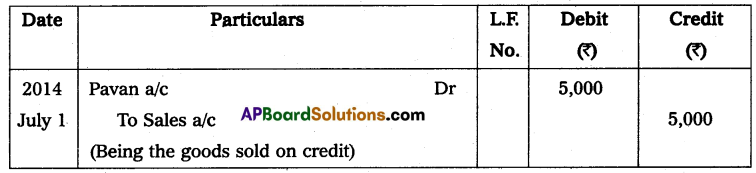
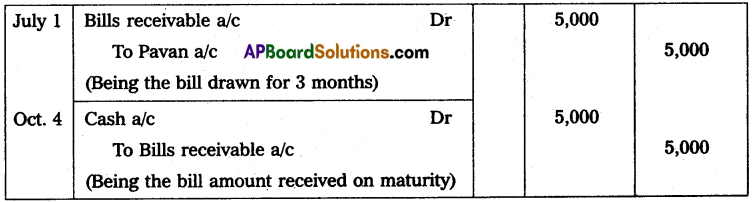
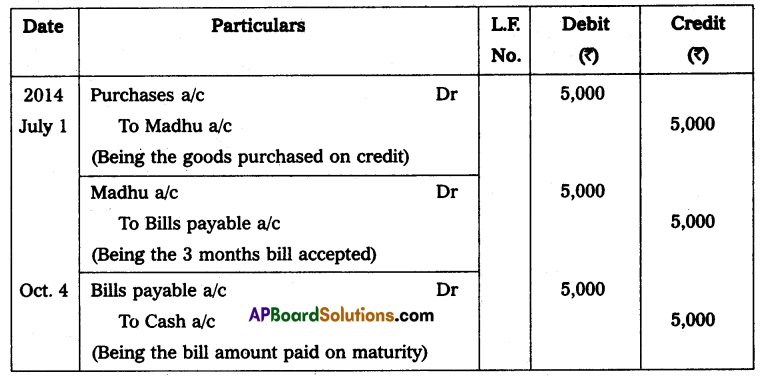
On 1st July 2014, Madhu sold goods to Pavan for ₹ 5,000 on credit and drew a bill of exchange for 3 months for the same amount. Pavan accepted the bill and returned it to Madhu. Pavan met his acceptance on maturity.
Pass the necessary Journal entries in the books of Madhu and Pavan.
Solution:
Journal entries in the books of Madhu
AP Inter 2nd Year Accountancy Study Material Chapter 1 Bills of Exchange Q1
AP Inter 2nd Year Accountancy Study Material Chapter 1 Bills of Exchange Q1.1
Journal entries in the books of Pavan
AP Inter 2nd Year Accountancy Study Material Chapter 1 Bills of Exchange Q1.2

Question 2.
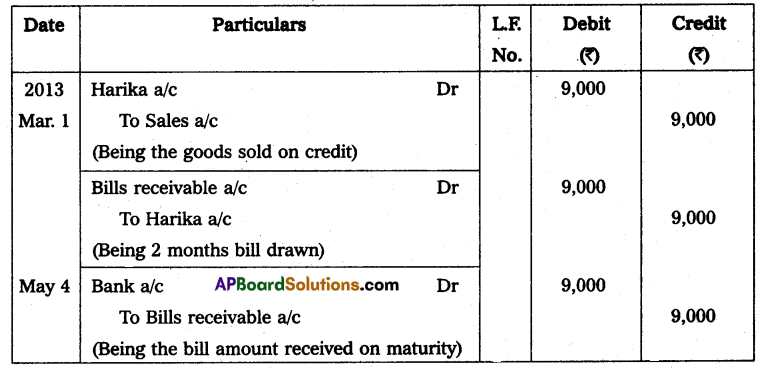
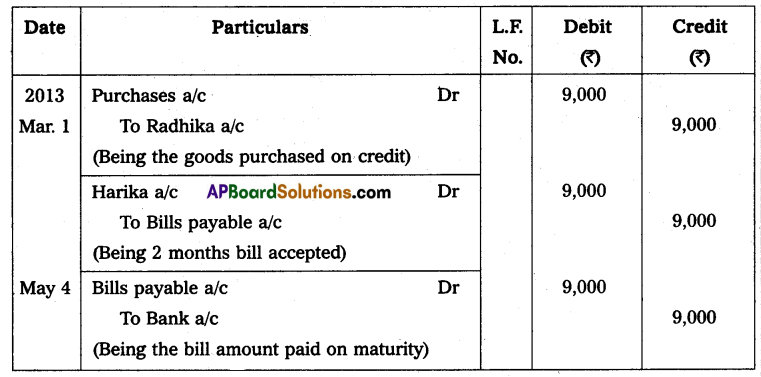
On 1st March 2013, Radhika sold goods to Harika worth ₹ 9,000 and drew a bill for 2 months for the same amount. Harika accepted the bill and returned it to Radhika. The bill is honoured on the date of maturity.
Pass the necessary Journal entries in the books of Radhika and Harika.
Solution:
Journal entries in the books of Radhika
AP Inter 2nd Year Accountancy Study Material Chapter 1 Bills of Exchange Q2
Journal entries in the books of Harika
AP Inter 2nd Year Accountancy Study Material Chapter 1 Bills of Exchange Q2.1

AP Inter 2nd Year Accountancy Study Material Chapter 1 Bills of Exchange

Question 3.
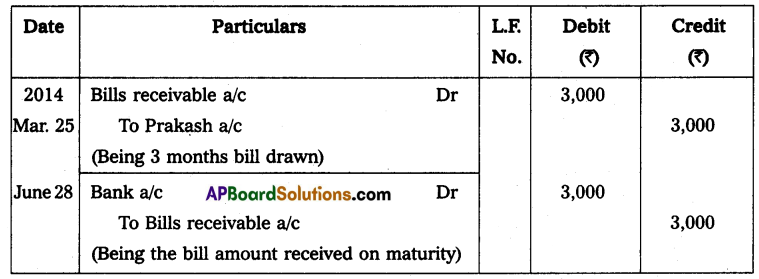
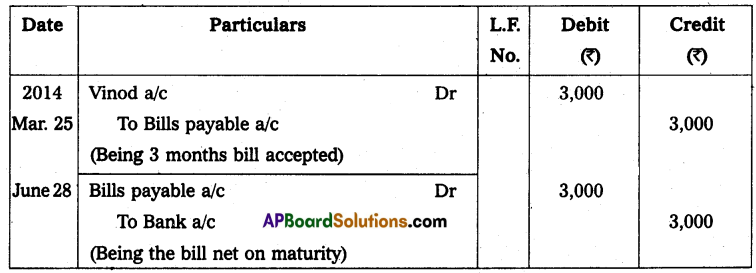
On 25th March 2014, Vinod drew a bill for 3 months on Prakash for ₹ 3,000. Prakash accepted the bill and handed it over the bill to Vinod. The bill is honoured on the date of maturity.
Show the journal entries in the books of Vinod and Prakash.
Solution:
Journal entries in the books of Vinod
AP Inter 2nd Year Accountancy Study Material Chapter 1 Bills of Exchange Q3
Journal entries in the books of Prakash
AP Inter 2nd Year Accountancy Study Material Chapter 1 Bills of Exchange Q3.1

Question 4.
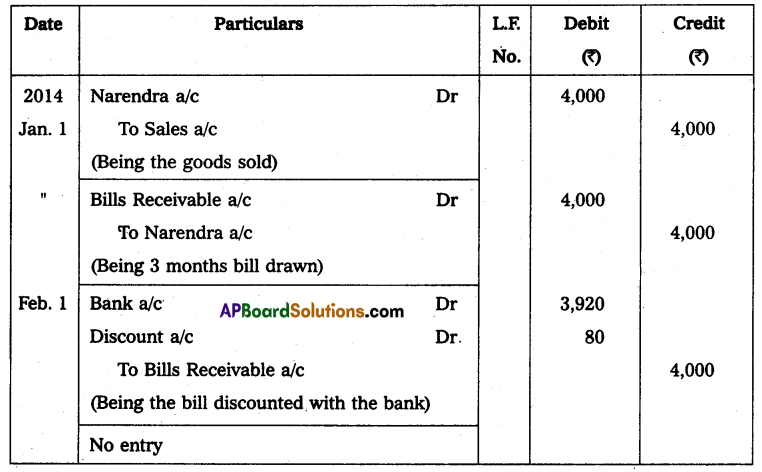
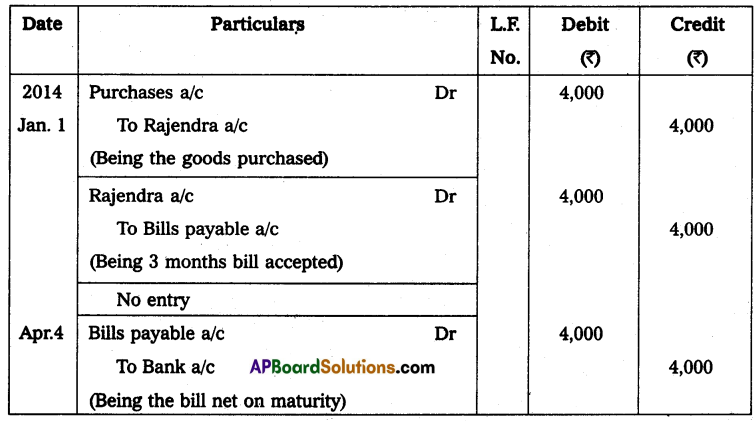
On 1st January 2014, Rajendra sold goods to Narendra worth ₹ 4,000 and drew a bill on Narendra payable after three months. After securing Narendra’s acceptance, Rajendra discounted the bill with his bank at 12% p.a. on 1st February 2014. On the due date, the bill is honoured.
Pass necessary journal entries in the books of Rajendra and Narendra.
Solution:
Journal entries in the books of Rajendra
AP Inter 2nd Year Accountancy Study Material Chapter 1 Bills of Exchange Q4
Journal entries in the books of Narendra
AP Inter 2nd Year Accountancy Study Material Chapter 1 Bills of Exchange Q4.1

Question 5.
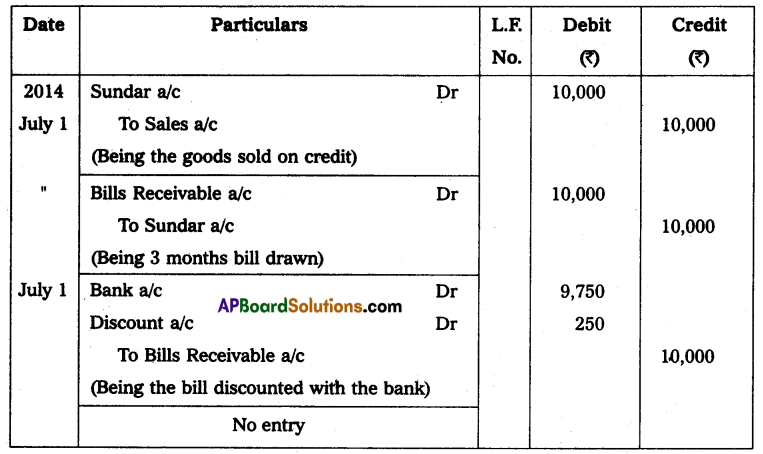
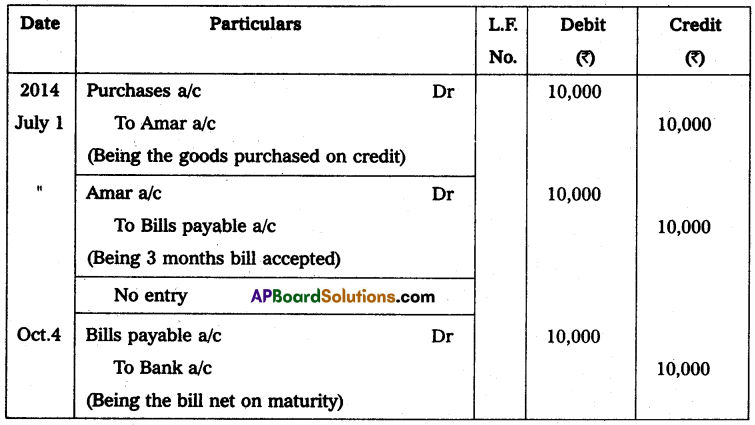
Amar sold goods for ₹ 10,000 to Sundar OD credit on 1st July 2014. Amar drew a bill of exchange on Sundar for the same amount for three months. Sundar accepted the bill and returned it to Amar. Amar discounted the bill with his bank at 10% per annum on the same day. Sundar met bis acceptance on maturity.
Pass necessary journal entries in the books of Amar and Sundar.
Solution:
Journal entries in the books of Amar
AP Inter 2nd Year Accountancy Study Material Chapter 1 Bills of Exchange Q5
Journal entries in the books of Sundar
AP Inter 2nd Year Accountancy Study Material Chapter 1 Bills of Exchange Q5.1

Question 6.
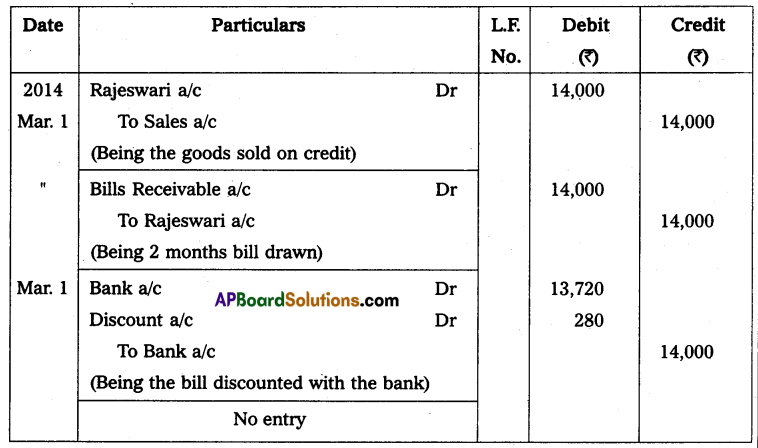
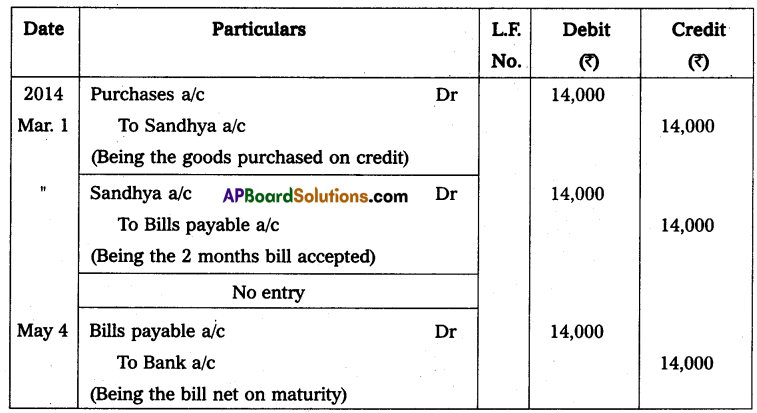
Sandhya sold goods for ₹ 14,000 to Rajeswari on 1st March 2014 and drew upon her a bill of exchange payable after 2 months. Rajeswari accepted the bill and handed over the same to Sandhya. Sandhya immediately discounted the bill with her bank @ 12% p.a. On the due date, Rajeswari met her acceptance.
Pass the necessary journal entries in the books of Sandhya and Rajeswari.
Solution:
Journal entries in the books of Sandhya
AP Inter 2nd Year Accountancy Study Material Chapter 1 Bills of Exchange Q6
Journal entries in the books of Rajeswari
AP Inter 2nd Year Accountancy Study Material Chapter 1 Bills of Exchange Q6.1

Question 7.
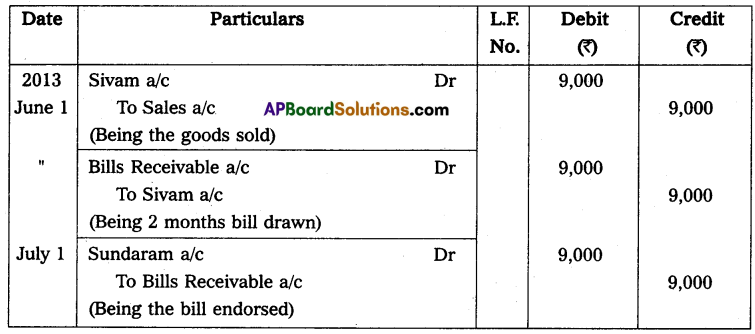
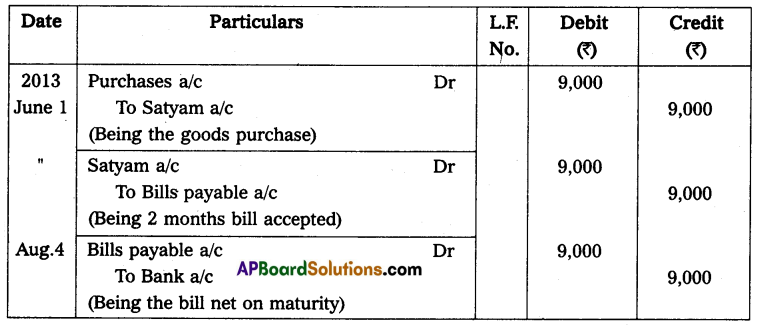
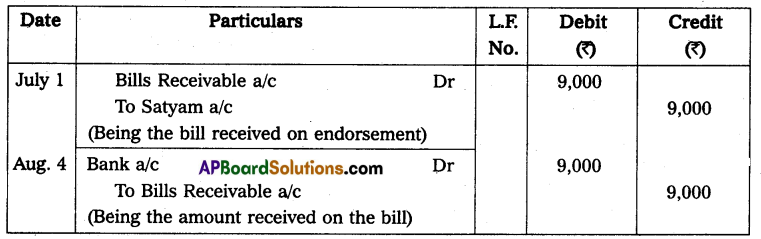
Satyam sold goods to Sivam worth ₹ 9,000 on 1st June 2013 and drew a bill for 2 months for the same amount. Sivam accepted the bill and returned it to Satyam. Satyam endorsed the bill to his creditor Sundaram on 1st July 2013. The bill was honoured on the due date.
Pass necessary journal entries in the books of Satyam, Sivam, and Sundaram.
Solution:
Journal entries in the books of Satyam
AP Inter 2nd Year Accountancy Study Material Chapter 1 Bills of Exchange Q7
Journal entries in the books of Sivam
AP Inter 2nd Year Accountancy Study Material Chapter 1 Bills of Exchange Q7.1
Journal entries in the books of Sundaram
AP Inter 2nd Year Accountancy Study Material Chapter 1 Bills of Exchange Q7.2

AP Inter 2nd Year Accountancy Study Material Chapter 1 Bills of Exchange

Question 8.
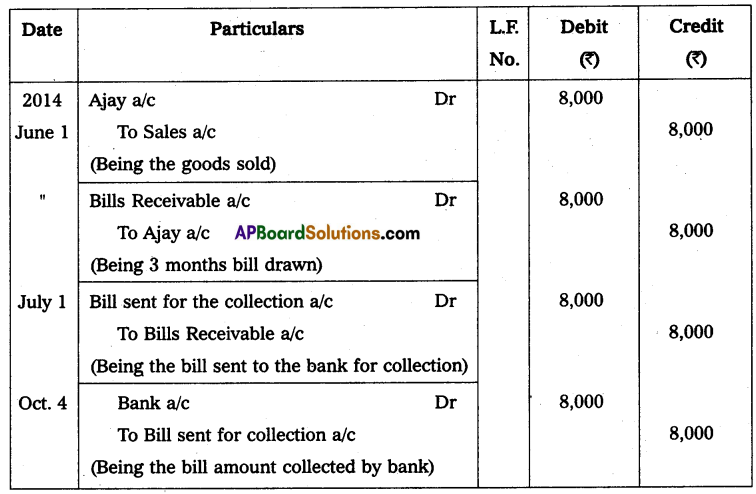
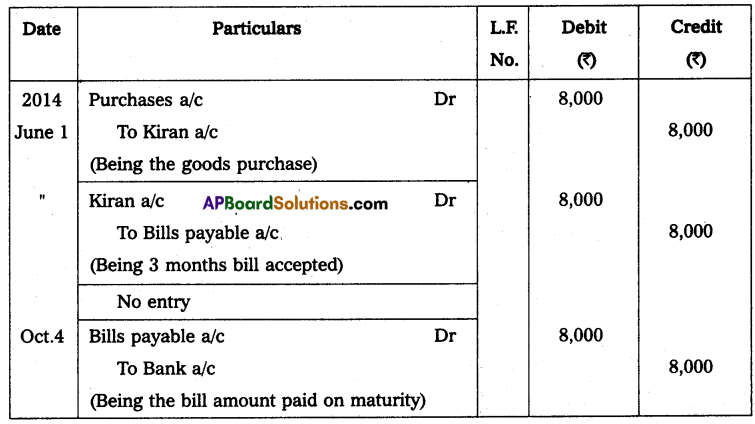
On 1st July 2014, Ajay purchased goods worth ₹ 8,000 from Kiran and accepted the bill which was drawn by Kiran payable after three months for the same amount. Kiran sent the bill to his bank for collection. The bill was honoured on the date of maturity.
Pass necessary journal entries in the books of Kiran and Ajay.
Solution:
Journal entries in the books of Kiran
AP Inter 2nd Year Accountancy Study Material Chapter 1 Bills of Exchange Q8
Journal entries in the books of Ajay
AP Inter 2nd Year Accountancy Study Material Chapter 1 Bills of Exchange Q8.1

Question 9.
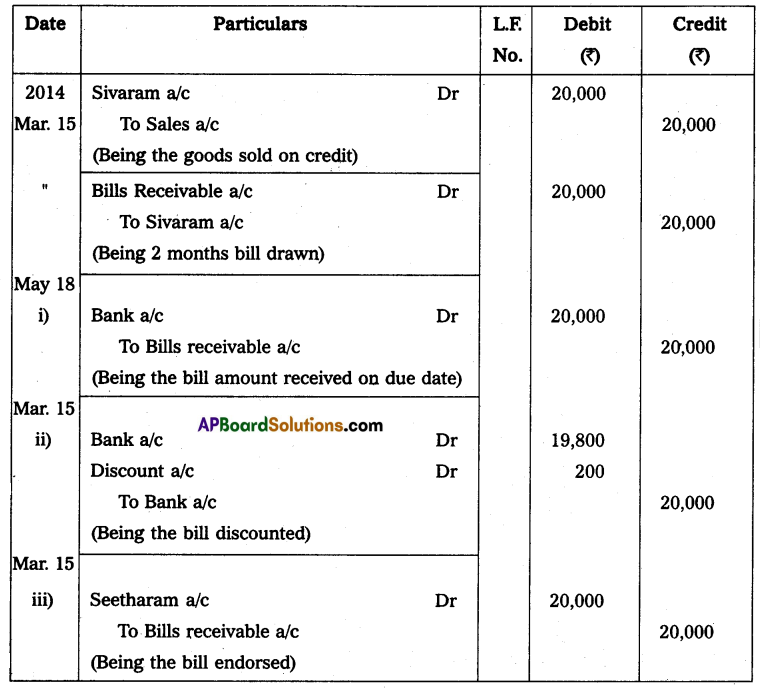
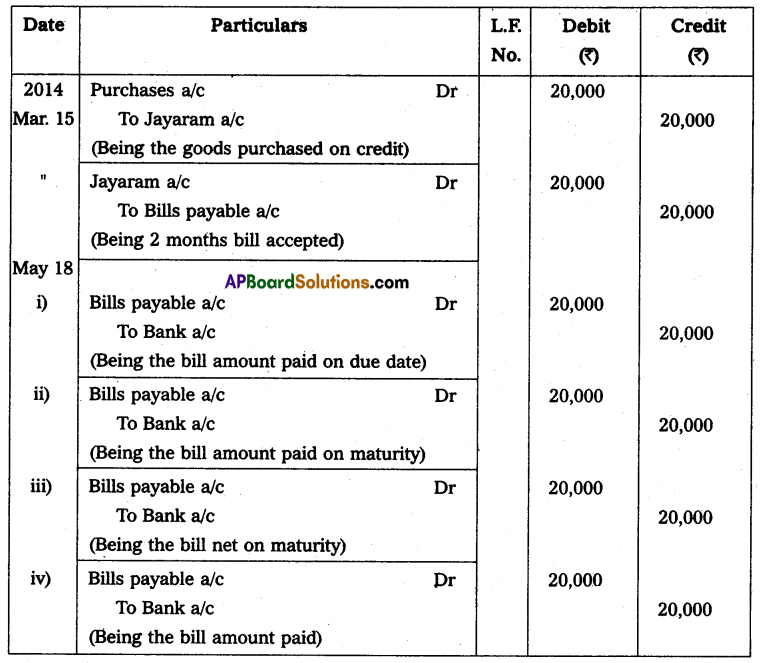
Jayaram sold goods for ₹ 20,000 to Sivaram on 15th March 2014 and drew upon him a bill of exchange payable after two months. Sivaram accepted the bill and returned the same to Jayaram. On the due date, the bill was honoured.
Pass the necessary journal entries in the books of Jayaram and Sivaram in the following circumstances.
I. When the bill was retained by Jayaram till the date of its maturity.
II. When Jayaram immediately discounted the bill @ 6% p.a. with his bank.
III. When the bill was endorsed immediately by Jayaram in favour of his creditor Seetharam.
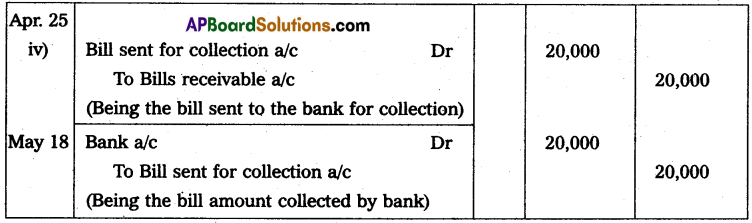
IV. When the bill was sent by Jayaram to his bank for collection on 25th April 2014.
Solution:
Journal entries in the books of Jayaram
AP Inter 2nd Year Accountancy Study Material Chapter 1 Bills of Exchange Q9
AP Inter 2nd Year Accountancy Study Material Chapter 1 Bills of Exchange Q9.1
Journal entries in the books of Sivaram
AP Inter 2nd Year Accountancy Study Material Chapter 1 Bills of Exchange Q9.2

B. Dishonour of bills of exchange

Question 10.
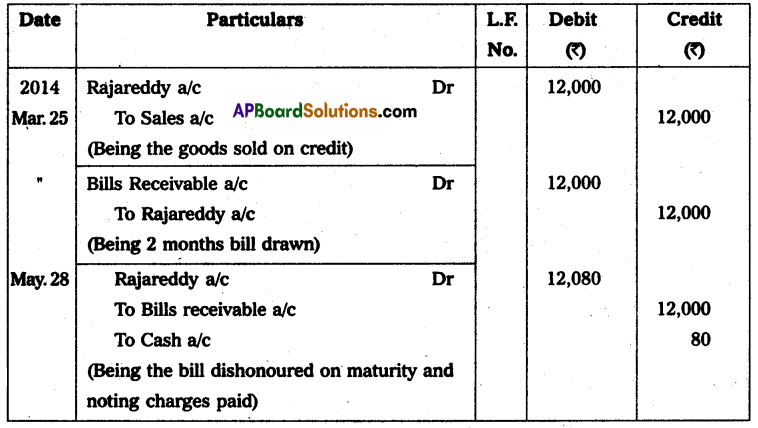
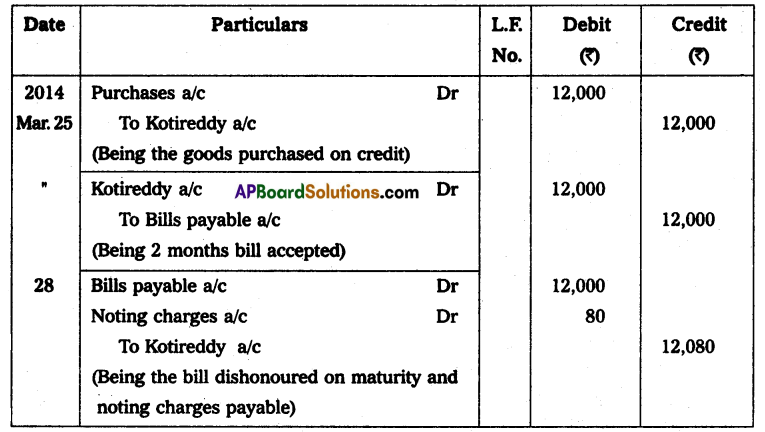
Kotireddy purchased goods worth ₹ 12,000 from Rajareddy on 25th March 2014 and accepted a bill of exchange drawn upon him by Rajareddy payable after two months. On the date of maturity, Kotireddy dishonoured the bill. Rajareddy paid ₹ 80 as noting charges.
Pass the necessary journal entries in the books of Rajareddy and Kotireddy.
Solution:
Journal entries in the books of Kotireddy
AP Inter 2nd Year Accountancy Study Material Chapter 1 Bills of Exchange Q10
Journal entries in the books of Rajareddy
AP Inter 2nd Year Accountancy Study Material Chapter 1 Bills of Exchange Q10.1

Question 11.
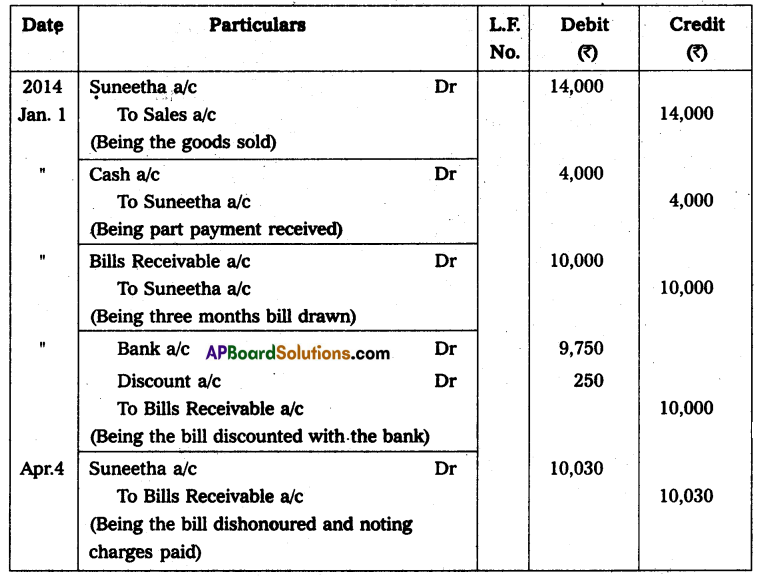
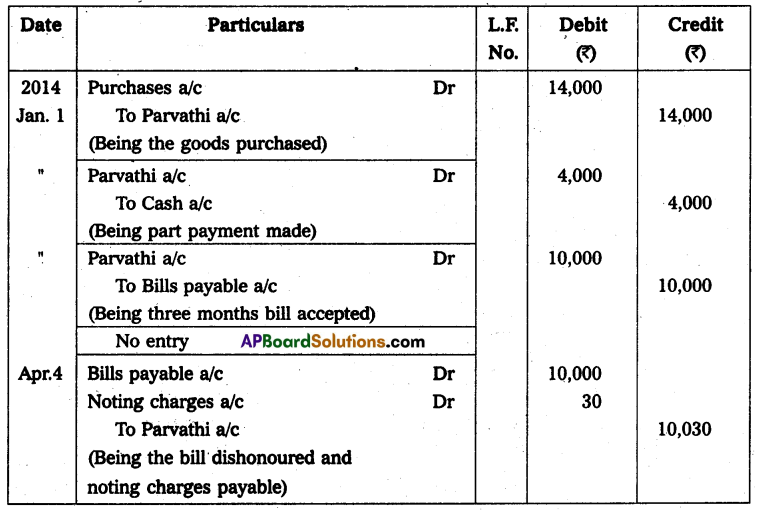
Parvathi sold goods worth ₹ 14,000 to Suneetha on 1st January 2014. Suneetha paid ₹ 4,000 immediately and for the balance, she accepted a bill of exchange drawn upon her by Parvathi payable after 3 months. Parvathi discounted the bill immediately with her bank @ 10% p.a. On the due date, Suneetha dishonoured the bill and the bank paid ₹ 30 as noting charges.
Pass the necessary journal entries in the books of Parvathi and Suneetha.
Solution:
Journal entries in the books of Parvathi
AP Inter 2nd Year Accountancy Study Material Chapter 1 Bills of Exchange Q11
Journal entries in the books of Suneetha
AP Inter 2nd Year Accountancy Study Material Chapter 1 Bills of Exchange Q11.1

Question 12.
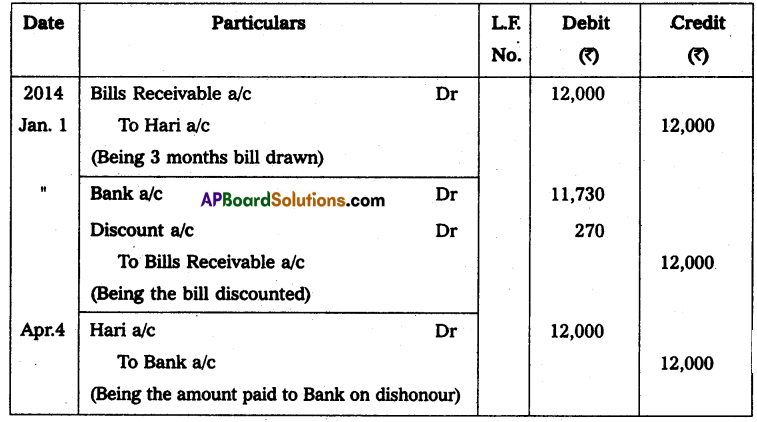
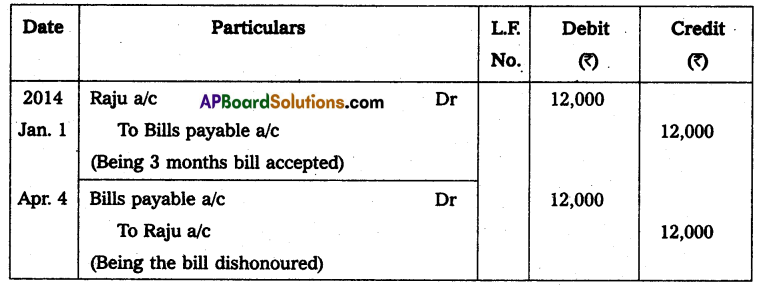
On 1st January 2014, Hari accepted 3 months bill for ₹ 12,000 drawn on him by Raju. Raju discounted the bill with his bank @ 9% p.a. on the Same day. On the due date, Hari dishonoured his acceptance.
Pass the necessary journal entries in the books of Raju and Hari.
Solution:
Journal entries in the books of Raju
AP Inter 2nd Year Accountancy Study Material Chapter 1 Bills of Exchange Q12
Journal entries in the books of Hari
AP Inter 2nd Year Accountancy Study Material Chapter 1 Bills of Exchange Q12.1

AP Inter 2nd Year Accountancy Study Material Chapter 1 Bills of Exchange

Question 13.
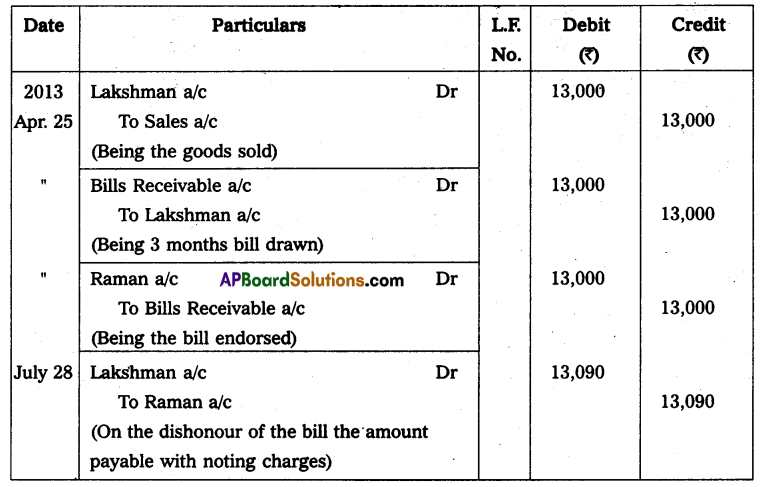
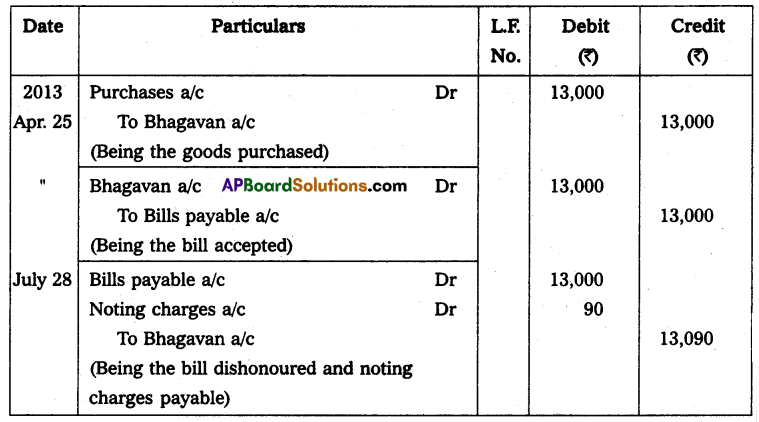
On 25th April 2013, Bhagavan sold goods for ₹ 13,000 to Lakshman and drew upon him a bill of exchange for 3 months for the same amount Lakshman accepted the bill and sent the same to Bhagavan. Bhagavan endorsed the bill in favour of his creditor Raman. On the due date, the bill was dishonoured and Raman paid ₹ 90 as Noting charges.
Pass the necessary journal entries in the books of Bhagavan and Lakshman.
Solution:
Journal entries in the books of Bhagavan
AP Inter 2nd Year Accountancy Study Material Chapter 1 Bills of Exchange Q13
Journal entries in the books of Lakshman
AP Inter 2nd Year Accountancy Study Material Chapter 1 Bills of Exchange Q13.1

Question 14.
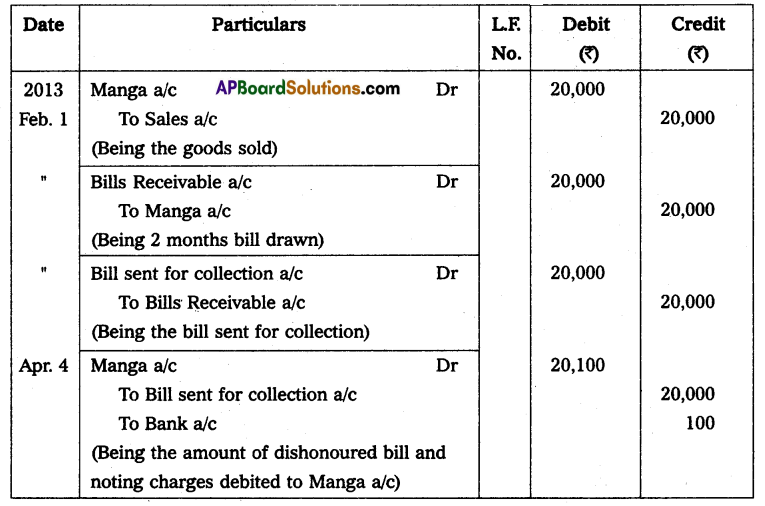
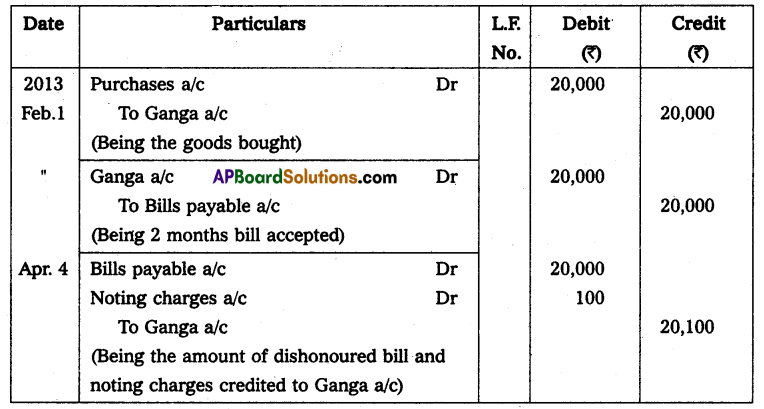
Manga purchased goods for ₹ 20,000 from Gangs on 1st February 2013 and accepted a bill of exchange drawn by Gangs for the same amount payable after 2 months. On 20th February 2013 Gangs sent the bill to her bank for collection. On the due date, Manga dishonoured the bill and the bank paid ₹ 100 as noting charges.
Pass the necessary journal entries in the books of Gangs and Manga.
Solution:
Journal entries in the books of Ganga
AP Inter 2nd Year Accountancy Study Material Chapter 1 Bills of Exchange Q14
Journal entries in the books of Manga
AP Inter 2nd Year Accountancy Study Material Chapter 1 Bills of Exchange Q14.1

Question 15.
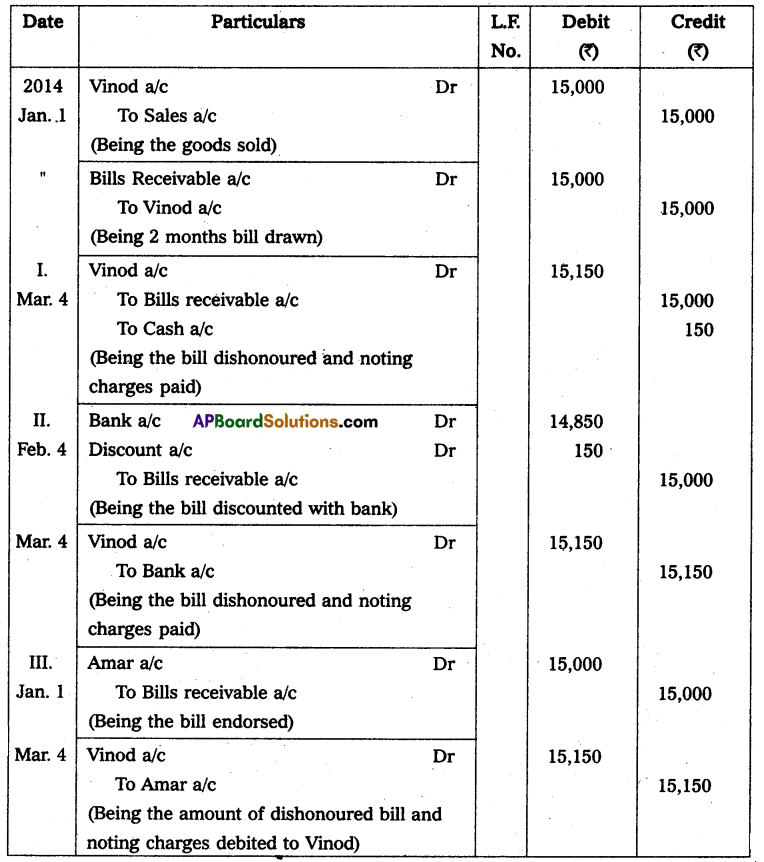
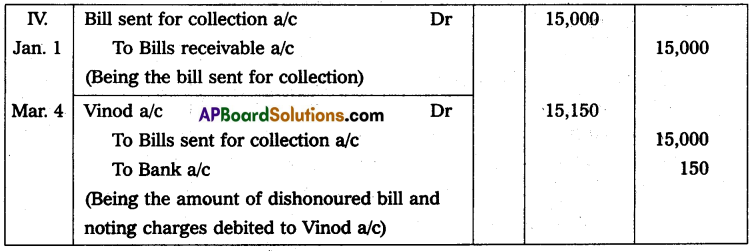
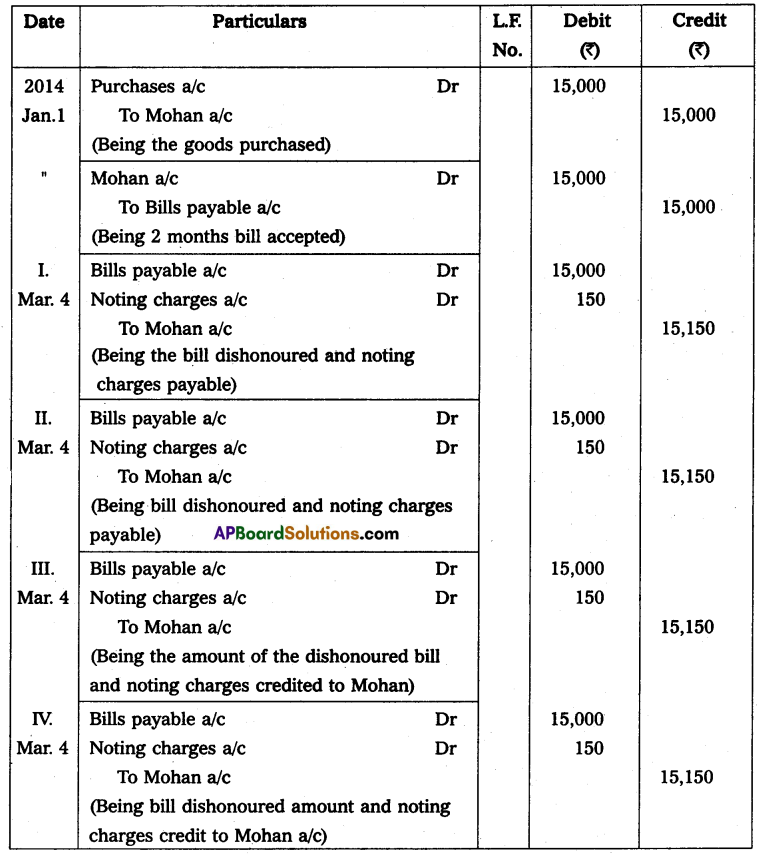
Mohan sold goods for ₹ 15,000 to Vinod on 1st January 2014 and drew upon him a bill of exchange for the same amount to payable after two months. Vinod accepted the bill and handed it over the bill to Mohan. On the due date, the bill was dishonoured.
Pass the necessary journal entries in the books of Mohan and Vinod in the following cases.
I. When Mohan retained the bill till the due date and paid ₹ 150 as noting charges.
II. When Mohan discounted the bill @ 12% p.a. on 4th February 2014 and the bank paid ₹ 150 as noting charges.
III. When Mohan endorsed the bill immediately in favour of his creditor Amar and paid ₹ 150 as noting charges.
IV. When Mohan sent the bill to his bank for collection on 25th January 2014 and bank paid ₹ 150 as noting charges.
Solution:
Journal entries in the books of Mohan
AP Inter 2nd Year Accountancy Study Material Chapter 1 Bills of Exchange Q15
AP Inter 2nd Year Accountancy Study Material Chapter 1 Bills of Exchange Q15.1
Journal entries in the books of Vinod
AP Inter 2nd Year Accountancy Study Material Chapter 1 Bills of Exchange Q15.2

C. Renewal of a bill

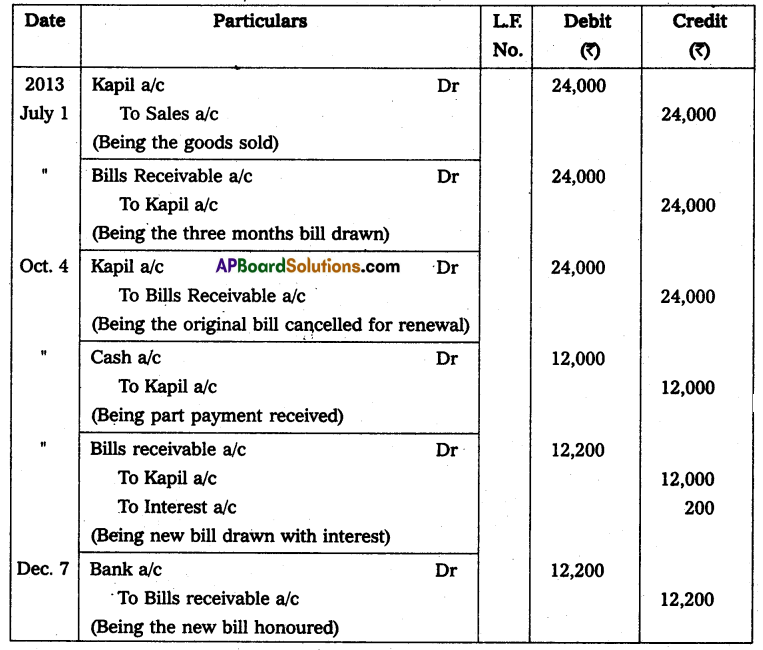
Question 16.
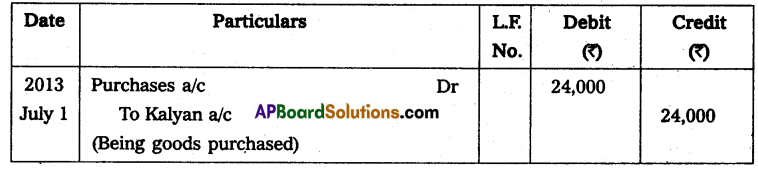
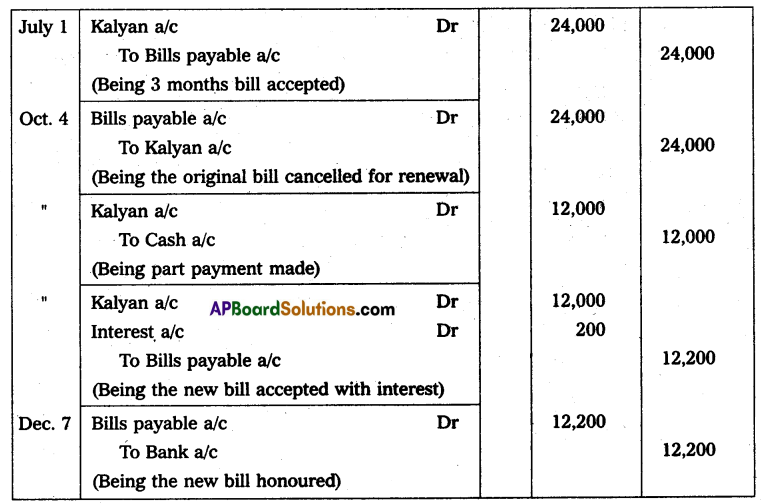
On 1st July 2013, Kalyan sold goods to Kapil for ₹ 24,000 and drew upon him a bill for the same amount payable after 3 months. Kapil accepted the bill and returned it to Kalyan. On the due date, Kapil expressed his inability to honour the bill and offered to pay ₹ 12,000 in cash and to accept a new bill for the balance amount including interest at 10% p.a. for 2 months. Kalyan agreed to this proposal. On the due date, the new bill was honoured.
Pass the necessary journal entries in the books of Kalyan and Kapil.
Solution:
Journal entries in the books of Kalyan
AP Inter 2nd Year Accountancy Study Material Chapter 1 Bills of Exchange Q16
Journal entries in the books of Kapil
AP Inter 2nd Year Accountancy Study Material Chapter 1 Bills of Exchange Q16.1
AP Inter 2nd Year Accountancy Study Material Chapter 1 Bills of Exchange Q16.2

Question 17.
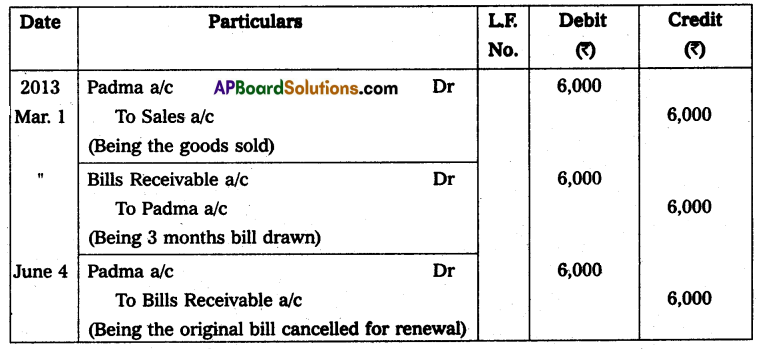
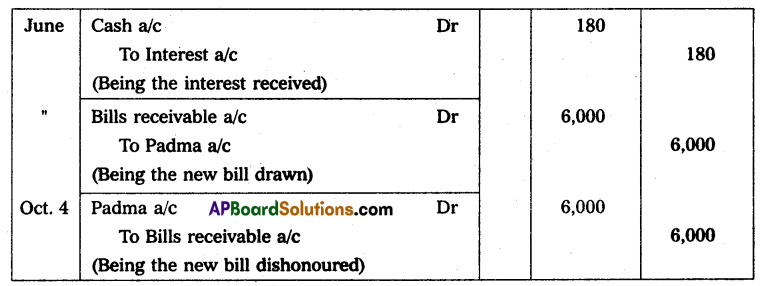
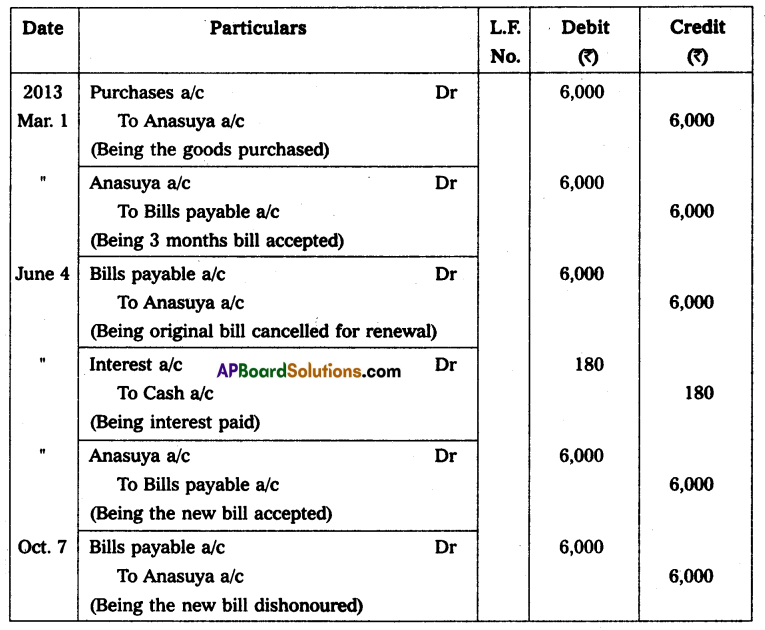
Anasuya sold goods worth ₹ 6,000 to the Padma on 1st March 2013 and drew upon her a bill for the same amount payable after three months. The Padma accepted the bill and sent it back to Anasuya. On the due date, Padma expressed her inability to honour the bill and requested Anasuya to cancel the original bill and draw a new bill for three months. Anasuya agreed the proposal provided interest at 12% was paid immediately in cash. The Padma paid such interest in cash and accepted a new bill. The new bill was dishonoured on the due date.
Pass the necessary journal entries in the books of Anasuya and Padma.
Solution:
Journal entries in the books of Anasuya
AP Inter 2nd Year Accountancy Study Material Chapter 1 Bills of Exchange Q17
AP Inter 2nd Year Accountancy Study Material Chapter 1 Bills of Exchange Q17.1
Journal entries in the books of Padma
AP Inter 2nd Year Accountancy Study Material Chapter 1 Bills of Exchange Q17.2

AP Inter 2nd Year Accountancy Study Material Chapter 1 Bills of Exchange

Question 18.
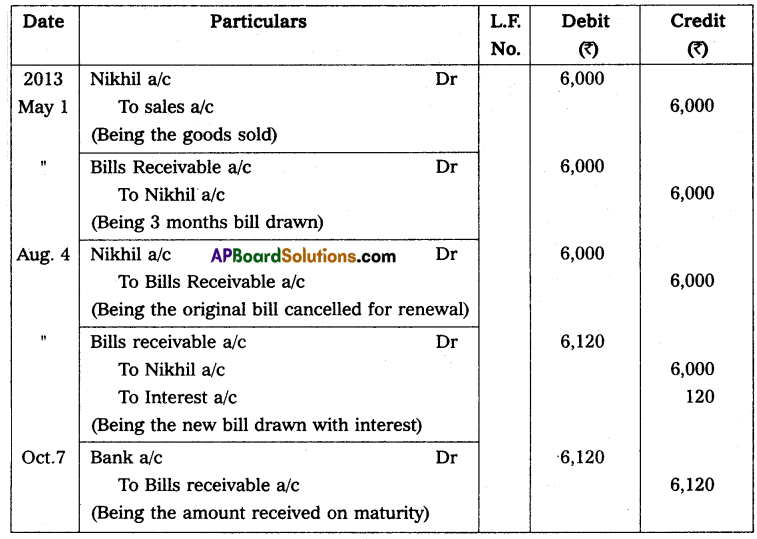
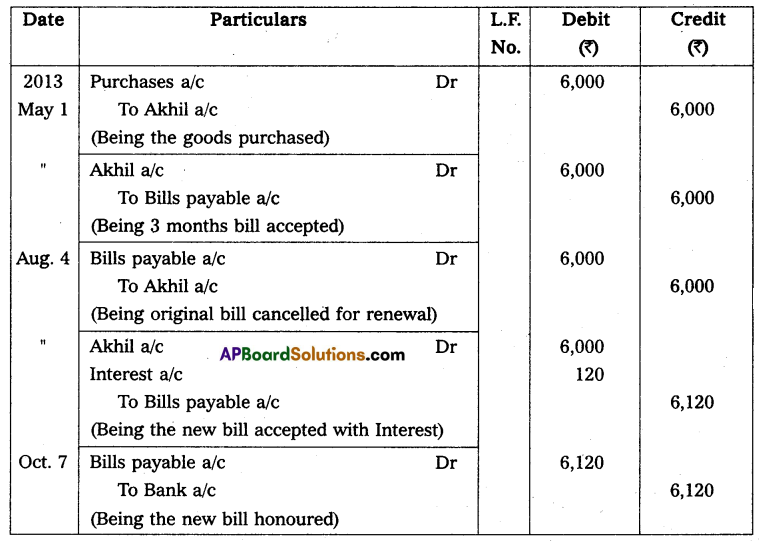
On 1st May 2014 Akhil sold goods to Nikhil for ₹ 6,000 on credit and drew a bill on him for three months for the same amount. Nikhil accepted the bill and returned it to Akhil. On 4th August 2014, Nikhil requested Akhil to draw a new bill for the amount due. Akhil agreed to draw a new bill for 2 months but he charged interest @ 12% p.a. This bill was honoured on its maturity.
Pass necessary journal entries in the books of Akhil and Nikhil.
Solution:
Journal entries in the books of Akhil
AP Inter 2nd Year Accountancy Study Material Chapter 1 Bills of Exchange Q18
Journal entries in the books of Nikhil
AP Inter 2nd Year Accountancy Study Material Chapter 1 Bills of Exchange Q18.1

D. Retiring of a bill under rebate

Question 19.
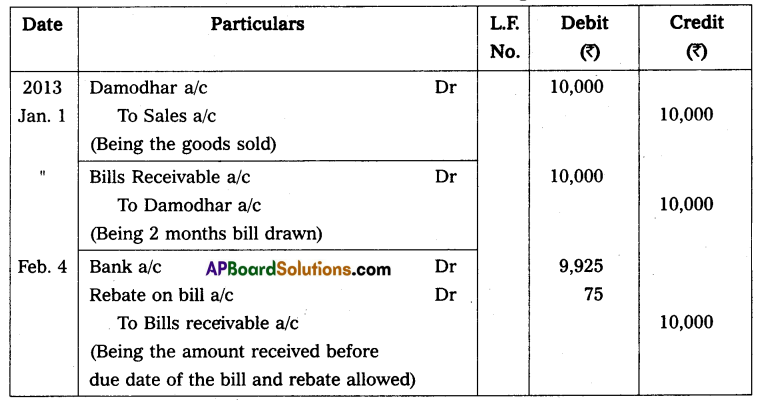
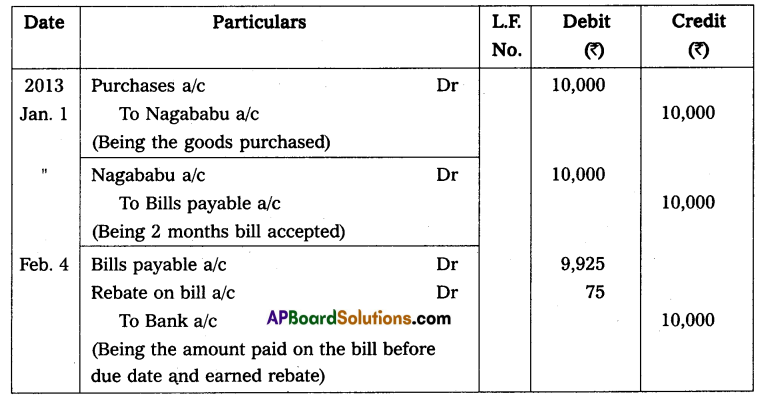
On 1st January 2013, Nagababu sold goods for ₹ 10,000 to Damodhar and drew upon him a bill of exchange payable after two months. Damodhar accepted the bill and handed over the same to Nagababu. One month before the maturity of the bill Damodhar approached Nagababu to accept the payment against the bill under a rebate of 9% p.a. Nagababu agreed to the request Damodhar. Damodhar retired the bill under the agreed rate of rebate.
Pass the necessary journal entries in the books of Nagababu and Damodhar.
Solution:
Journal entries in the books of Nagababu
AP Inter 2nd Year Accountancy Study Material Chapter 1 Bills of Exchange Q19
Journal entries in the books of Damodhar
AP Inter 2nd Year Accountancy Study Material Chapter 1 Bills of Exchange Q19.1

Question 20.
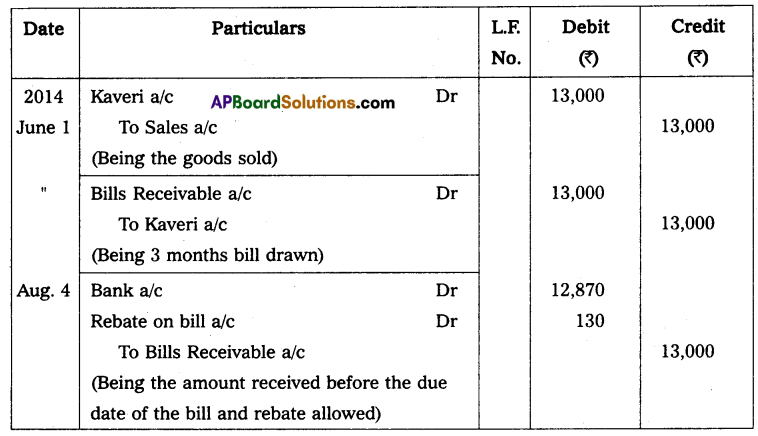
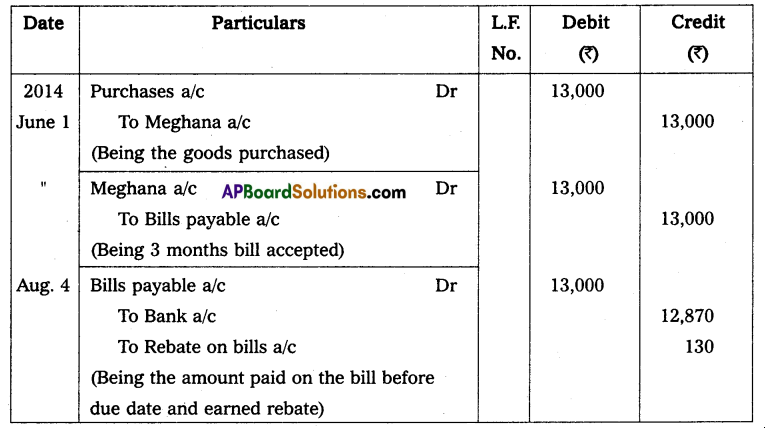
On 1st June 2014, Meghana sold goods for ₹ 13,000 to Kaveri and drew upon her a bill of exchange payable after 3 months. Kaveri accepted the bill and returned it to Meghana. One month before the maturity of the bill Kaveri approached Meghana to accept the payment against the bill under a rebate of 12% p.a. Meghana agreed to the request of Kaveri to retire the bill under the agreed rate of rebate.
Pass the necessary journal entries in the books of Meghana and Kaveri.
Solution:
Journal entries in the books of Meghana
AP Inter 2nd Year Accountancy Study Material Chapter 1 Bills of Exchange Q20
Journal entries in the books of Kaveri
AP Inter 2nd Year Accountancy Study Material Chapter 1 Bills of Exchange Q20.1

E. Insolvency of Drawee

Question 21.
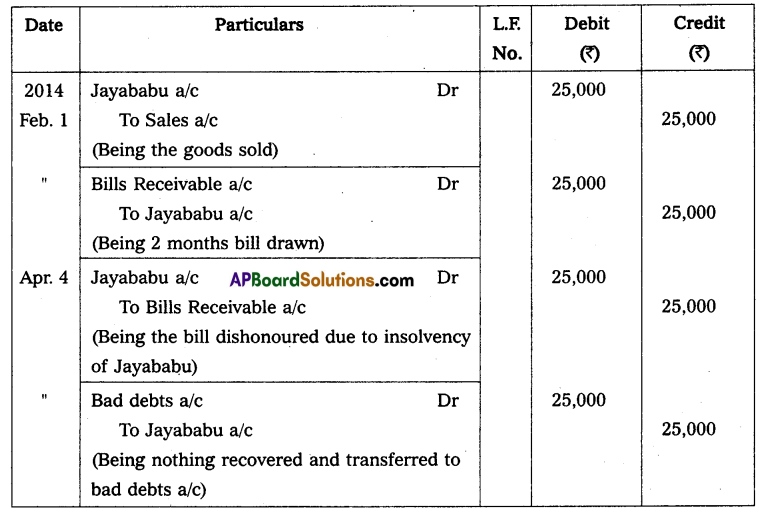
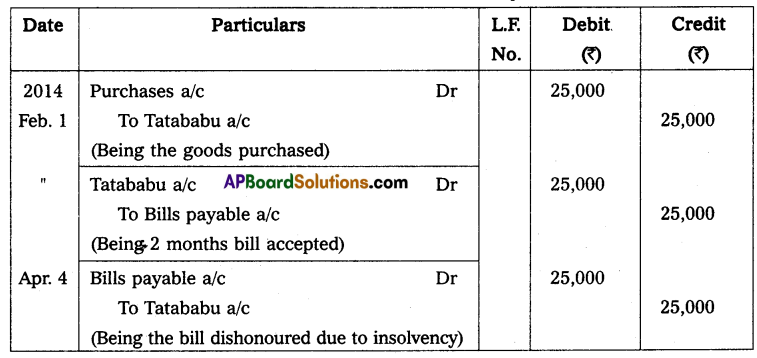
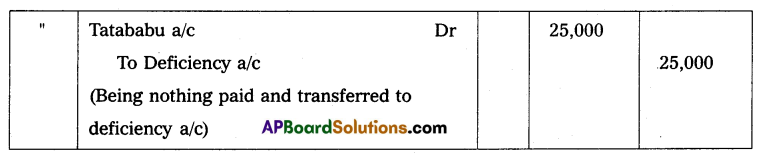
Jayababu purchased goods for ₹ 25,000 from Tatababu on 1st February 2014 and accepted a bill of exchange drawn by Tatababu for the same amount The bill was payable after 2 months. Before the due date of the bill, Jayababu became insolvent and nothing could be recovered from his estate.
Write necessary journal entries in the books of Tatababu and Jayababu.
Solution:
Journal entries in the books of Tatababu
AP Inter 2nd Year Accountancy Study Material Chapter 1 Bills of Exchange Q21
Journal entries in the books of Jayababu
AP Inter 2nd Year Accountancy Study Material Chapter 1 Bills of Exchange Q21.1
AP Inter 2nd Year Accountancy Study Material Chapter 1 Bills of Exchange Q21.2

AP Inter 2nd Year Accountancy Study Material Chapter 1 Bills of Exchange

Question 22.
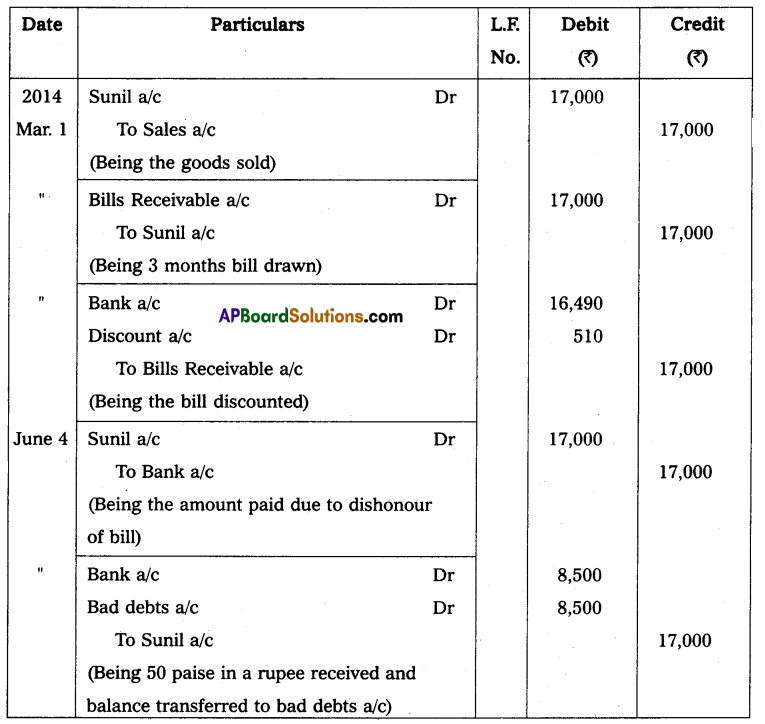
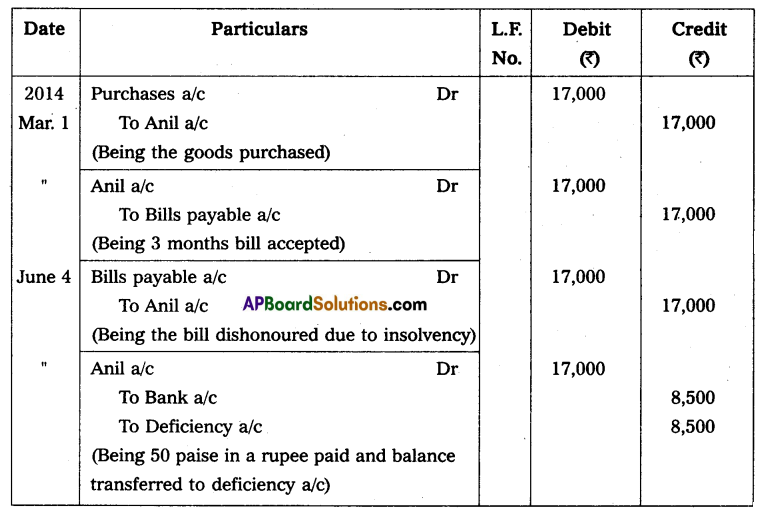
Anil sold goods worth ₹ 17,000 to Sunil on 1st March 2014 and drew upon him a bill for three months for the same amount Sunil accepted the bill and handed over it to Anil. On the same day, Anil discounted the bill @ 12% p.a. with his bank. Before the due date of the bill, Sunil became insolvent and only 50 paise in a rupee could be recovered from his estate.
Pass necessary journal entries in the books of Anil and Sunil.
Solution:
Journal entries in the books of Anil
AP Inter 2nd Year Accountancy Study Material Chapter 1 Bills of Exchange Q22
Journal entries in the books of Sunil
AP Inter 2nd Year Accountancy Study Material Chapter 1 Bills of Exchange Q22.1

Textual Examples

Question 1.
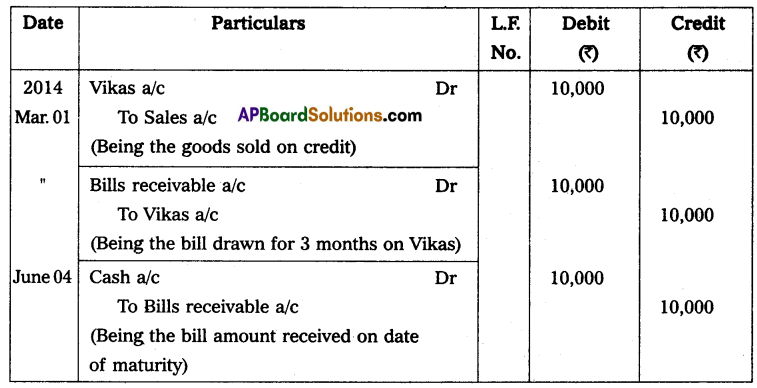
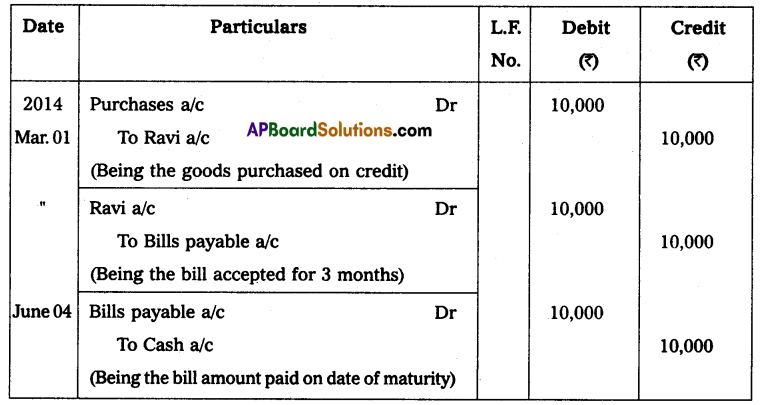
On 1st March 2014, Ravi sold goods for ₹ 10,000 to Vikas on credit and drew a bill for 3 months for the same amount Vikas accepted the bill and returned it to Ravi. This bill is honoured on the date of maturity.
Pass the necessary journal entries in the books of Ravi and Vikas.
Solution:
Journal entries in the books of Ravi (Drawer)
AP Inter 2nd Year Accountancy Study Material Chapter 1 Bills of Exchange Textual Examples Q1
Journal entries in the books of Vikas (Drawee)
AP Inter 2nd Year Accountancy Study Material Chapter 1 Bills of Exchange Textual Examples Q1.1

Question 2.
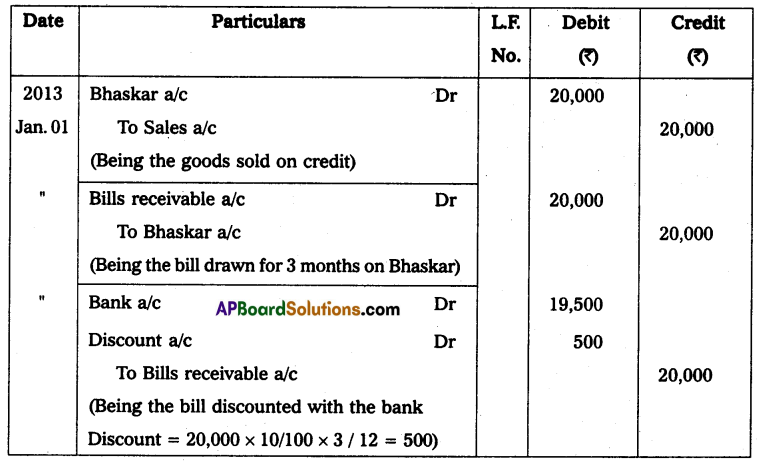
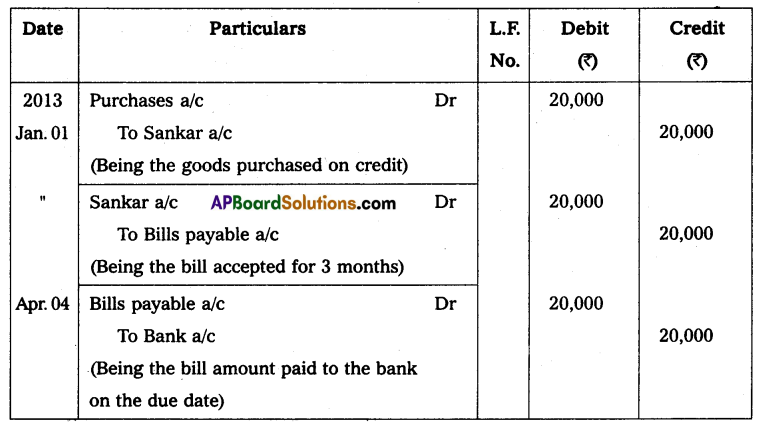
On 1st January 2013, Sankar sold goods worth ₹ 20,000 to Bhaskar on credit and drew a bill for 3 months for the same amount. Bhaskar accepted the bill and returned it to Sankar. On the same day, Sankar discounted the bill with his bank at 10% per annum. On the due date, the bill is honoured.
Pass the necessary journal entries in the books of Sankar and Bhaskar.
Solution:
Journal entries in the books of Sankar (Drawer)
AP Inter 2nd Year Accountancy Study Material Chapter 1 Bills of Exchange Textual Examples Q2
Journal entries in the books of Bhaskar (Drawee)
AP Inter 2nd Year Accountancy Study Material Chapter 1 Bills of Exchange Textual Examples Q2.1

AP Inter 2nd Year Accountancy Study Material Chapter 1 Bills of Exchange

Question 3.
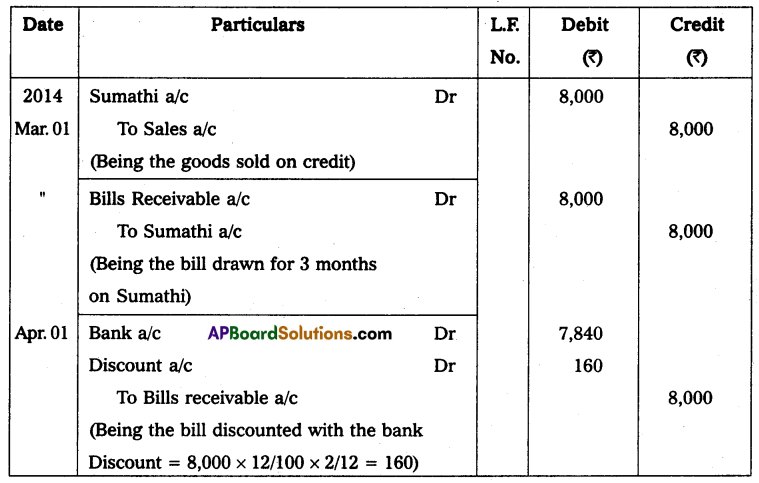
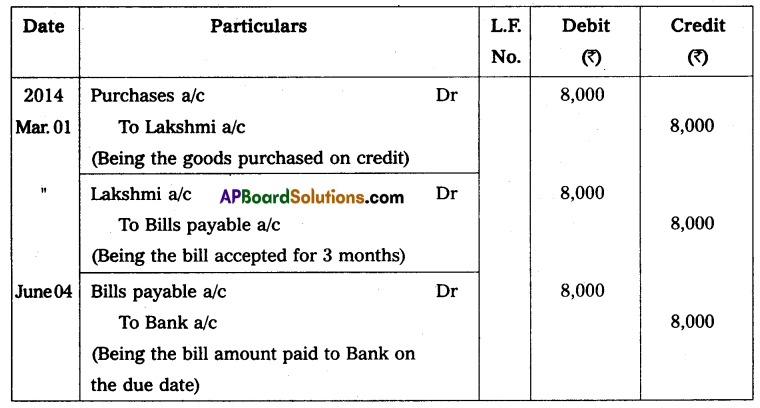
On 1st March 2014, Sumathi purchased goods for ₹ 8,000 from Lakshmi and accepted a bill for the same amount drawn by Lakshmi payable after 3 months. Lakshmi discounted the bill with her bank on 1st April 2014 at 12% per annum. Sumathi met her acceptance on the due date.
Pass the necessary journal entries in the books of Lakshmi and Sumathi.
Solution:
Journal entries in the books of Lakshmi (Drawer)
AP Inter 2nd Year Accountancy Study Material Chapter 1 Bills of Exchange Textual Examples Q3
Journal entries in the books of Sumathi (Drawee)
AP Inter 2nd Year Accountancy Study Material Chapter 1 Bills of Exchange Textual Examples Q3.1

Question 4.
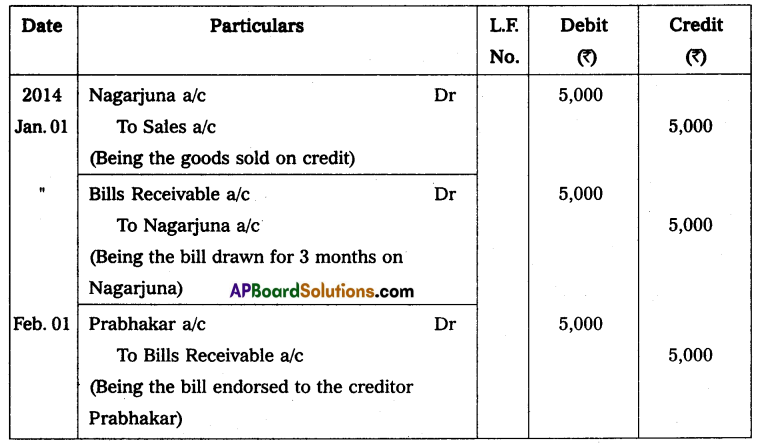
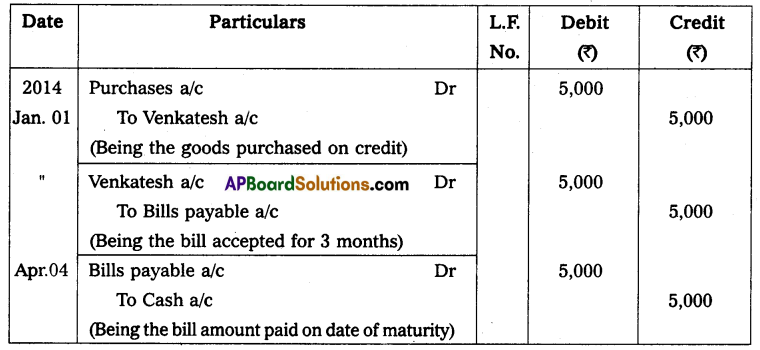
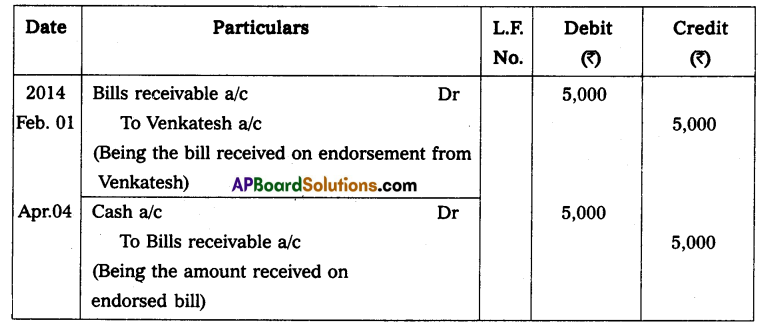
On 1st January 2014, Venkatesh sold goods worth ₹ 5,000 to Nagarjuna and drew a bill on Nagarjuna for 3 months for the same amount Nagaijuna accepted the bill and returned it to Venkatesh. On 1st February 2014, Venkatesh endorsed the bill in favour of his creditor Prabhakar in the settlement of his debt. The bill was honoured on the due date.
Pass the necessary journal entries in the books of Venkatesh, Nagarjuna, and Prabhakar.
Solution:
Journal entries in the books of Venkatesh (Drawer)
AP Inter 2nd Year Accountancy Study Material Chapter 1 Bills of Exchange Textual Examples Q4
Journal entries in the books of Nagarjuna (Drawee)
AP Inter 2nd Year Accountancy Study Material Chapter 1 Bills of Exchange Textual Examples Q4.1
Journal entries in the books of Prabhakar (Endorsee)
AP Inter 2nd Year Accountancy Study Material Chapter 1 Bills of Exchange Textual Examples Q4.2

Question 5.
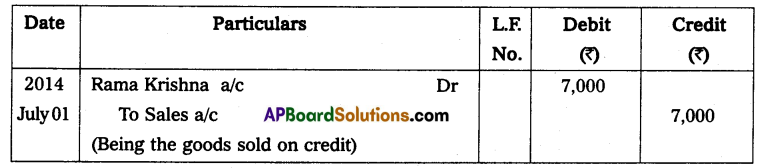
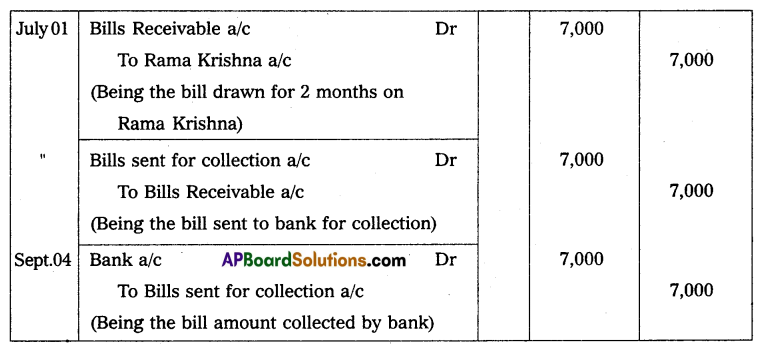
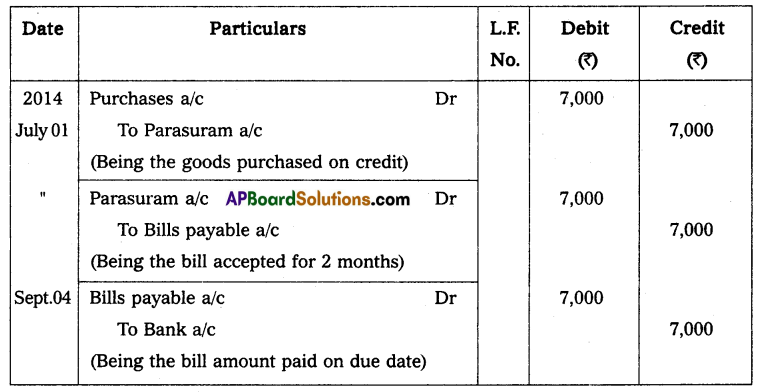
On 1st July 2014, Parasuram sold goods to Rama Krishna for ₹ 7,000 and drew a bill on him for the same amount for two months. Rama Krishna accepted the bill and returned the same to Parasuram. Immediately after its acceptance, Parasuram sent the bill to his bank for collection. On the due date, bill is honoured.
Pass necessary journal entries in the books of Parasuram and Rama Krishna.
Solution:
Journal entries in the books of Parasuram (Drawer)
AP Inter 2nd Year Accountancy Study Material Chapter 1 Bills of Exchange Textual Examples Q5
AP Inter 2nd Year Accountancy Study Material Chapter 1 Bills of Exchange Textual Examples Q5.1
Journal entries in the books of Rama Krishna (Drawee)
AP Inter 2nd Year Accountancy Study Material Chapter 1 Bills of Exchange Textual Examples Q5.2

AP Inter 2nd Year Accountancy Study Material Chapter 1 Bills of Exchange

Question 6.
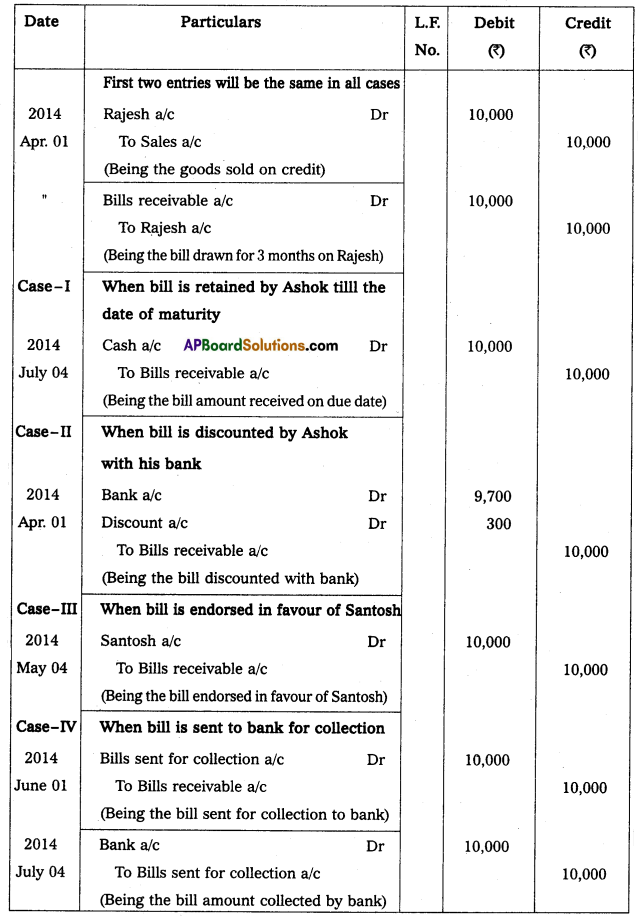
Ashok sold goods to Rajesh on 1st April 2014 for ₹ 10,000 on credit and drew upon him a bill for the same amount payable after 3 months. Rajesh accepted the bill and returned it to Ashok. On the date of maturity, a bill was presented to Rajesh for payment and he honoured it.
Pass the journal entries in the books of Ashok and Rajesh when
Case I: Bill is retained by Ashok till the date of maturity.
Case II: Bill is discounted by Ashok with his bank on the same date @ 12% p.a.
Case III: Bill is endorsed in favour of Santosh on 4th May 2014.
Case IV: Bill is sent to the bank for collection on 1st June 2014.
Also, record the journal entries in the books of Santosh.
Solution:
Journal entries in the books of Ashok (Drawer)
AP Inter 2nd Year Accountancy Study Material Chapter 1 Bills of Exchange Textual Examples Q6
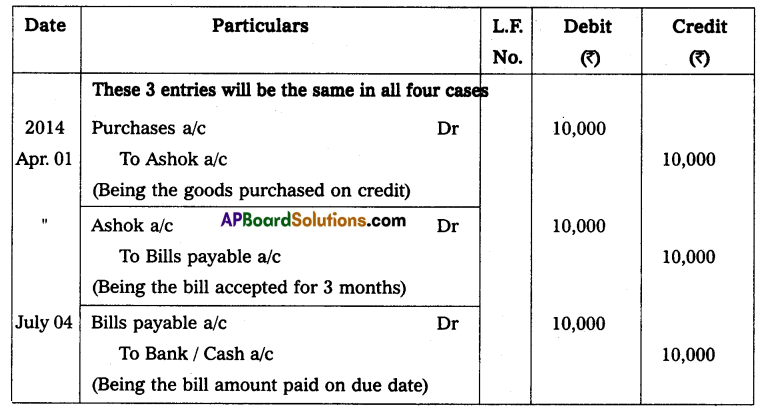
Journal entries in the books of Rajesh (Drawee)
AP Inter 2nd Year Accountancy Study Material Chapter 1 Bills of Exchange Textual Examples Q6.1
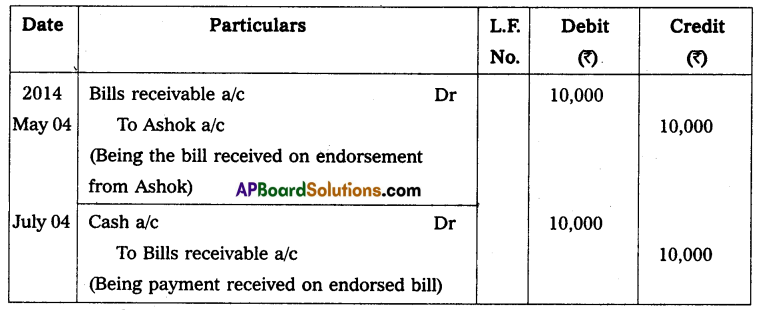
Journal entries in the books of Santosh (Endorsee)
AP Inter 2nd Year Accountancy Study Material Chapter 1 Bills of Exchange Textual Examples Q6.2

Question 7.
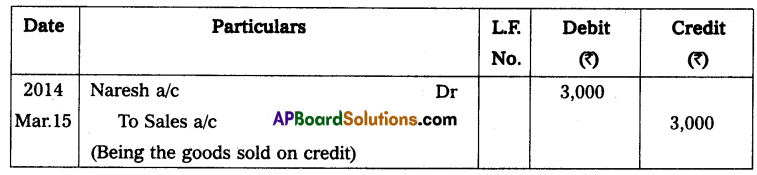
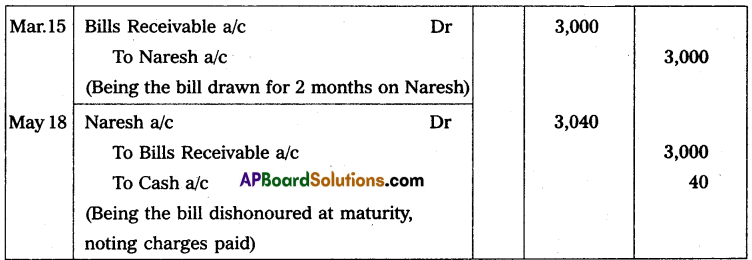
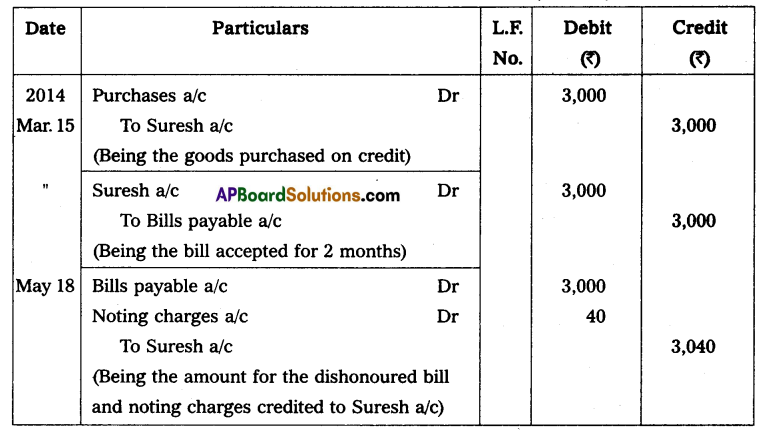
On 15th March 2014, Suresh sold goods for ₹ 3,000 to Naresh on credit. Naresh accepted the bill of exchange drawn upon him by Suresh payable after 2 months. On the due date, the bill was dishonoured and Suresh paid ₹ 40 as noting charges.
Pass the journal entries in the books of Suresh and Naresh.
Solution:
Journal entries in the books of Suresh (Drawer)
AP Inter 2nd Year Accountancy Study Material Chapter 1 Bills of Exchange Textual Examples Q7
AP Inter 2nd Year Accountancy Study Material Chapter 1 Bills of Exchange Textual Examples Q7.1
Journal entries in the books of Naresh (Drawee)
AP Inter 2nd Year Accountancy Study Material Chapter 1 Bills of Exchange Textual Examples Q7.2

Question 8.
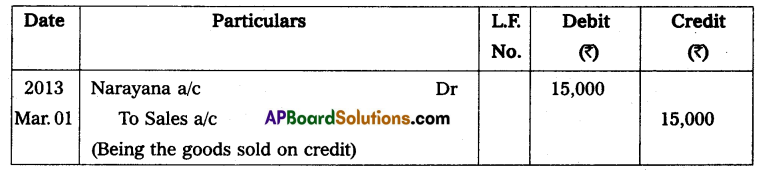
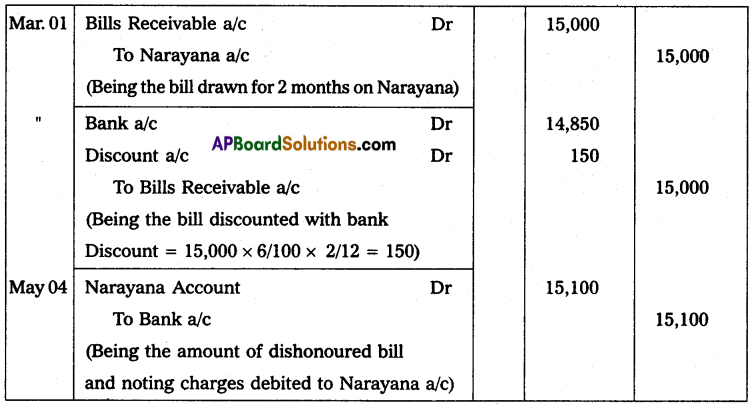
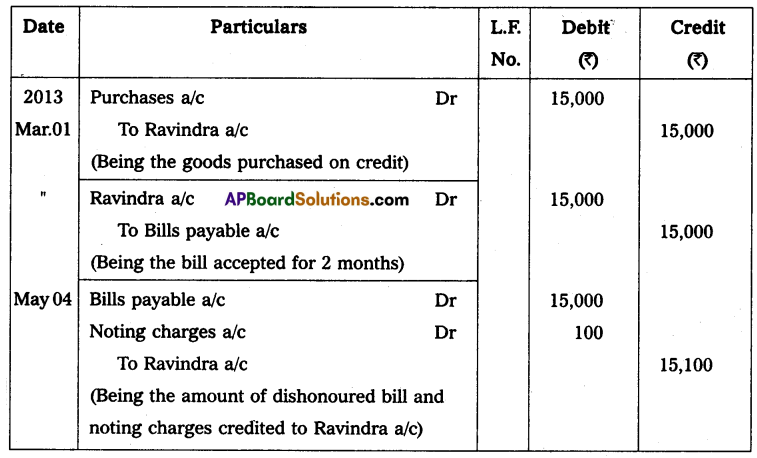
Narayana purchased goods for ₹ 15,000 from Ravindra on 1st March 2013. Ravindra drew upon Narayana a bill of exchange for the same amount payable after two months. The bill was immediately discounted by Ravindra with his bank @ 6% p.a. On the due date, the bill was dishonoured and Bank paid ₹ 100 as noting charges.
Pass the necessary journal entries in the books of Ravindra and Narayana.
Solution:
Journal entries in the books of Ravindra (Drawer)
AP Inter 2nd Year Accountancy Study Material Chapter 1 Bills of Exchange Textual Examples Q8
AP Inter 2nd Year Accountancy Study Material Chapter 1 Bills of Exchange Textual Examples Q8.1
Journal entries in the books of Narayana (Drawee)
AP Inter 2nd Year Accountancy Study Material Chapter 1 Bills of Exchange Textual Examples Q8.2

AP Inter 2nd Year Accountancy Study Material Chapter 1 Bills of Exchange

Question 9.
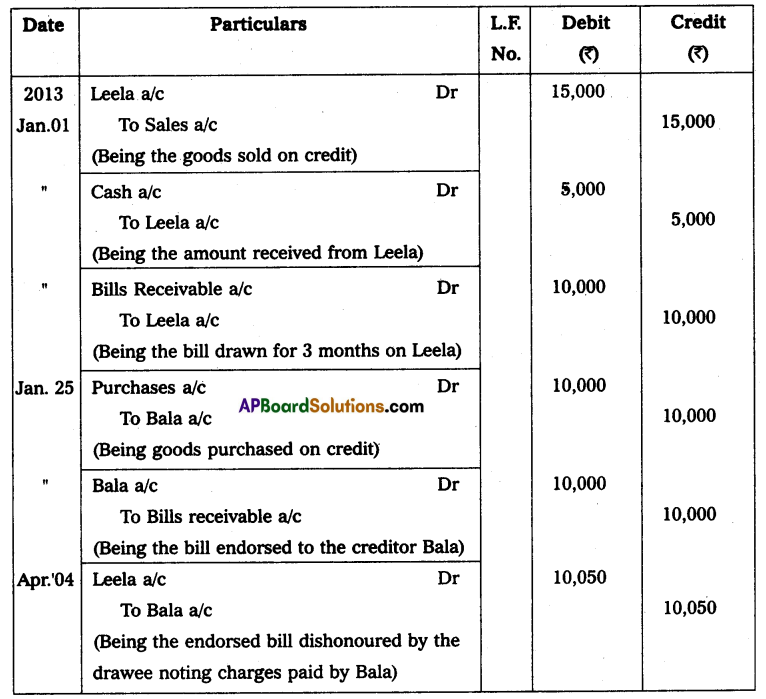
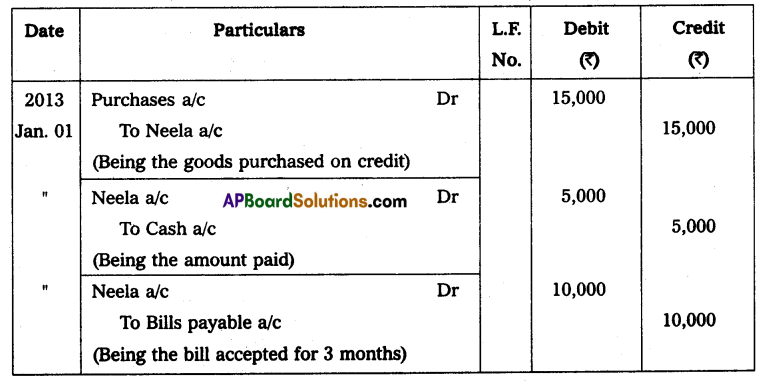
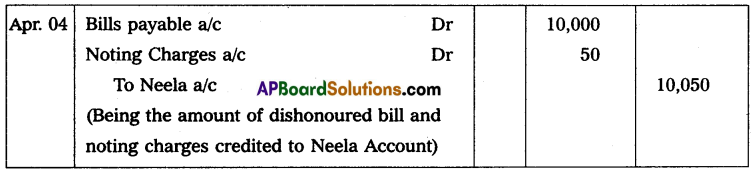
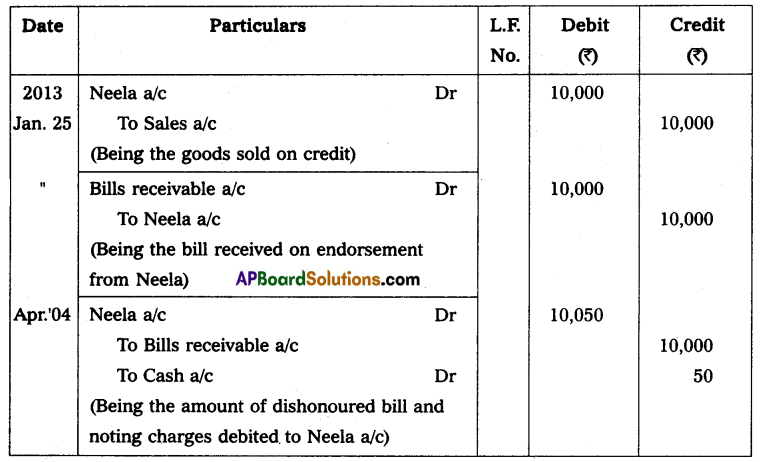
On 1st January 2013, Leela purchased goods for ₹ 15,000 from Neela. She immediately made a payment of ₹ 5,000 by cash and for the balance accepted the bill of exchange for 3 months drawn upon her by Neela. On 25th January 2013, Neela purchased goods worth ₹ 10,000 from Bala and endorsed the above bill to Bala. On the due date, the bill was dishonoured and Bala paid ₹ 50 as noting charges.
Pass the necessary journal entries in the books of Neela, Leela, and Bala.
Solution:
Journal entries in the books of Neela (Drawer)
AP Inter 2nd Year Accountancy Study Material Chapter 1 Bills of Exchange Textual Examples Q9
Journal entries in the books of Leela (Drawee)
AP Inter 2nd Year Accountancy Study Material Chapter 1 Bills of Exchange Textual Examples Q9.1
AP Inter 2nd Year Accountancy Study Material Chapter 1 Bills of Exchange Textual Examples Q9.2
Journal entries in the books of Bala (Endorsee)
AP Inter 2nd Year Accountancy Study Material Chapter 1 Bills of Exchange Textual Examples Q9.3

Question 10.
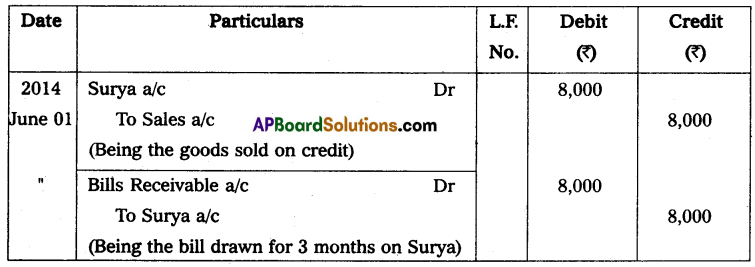
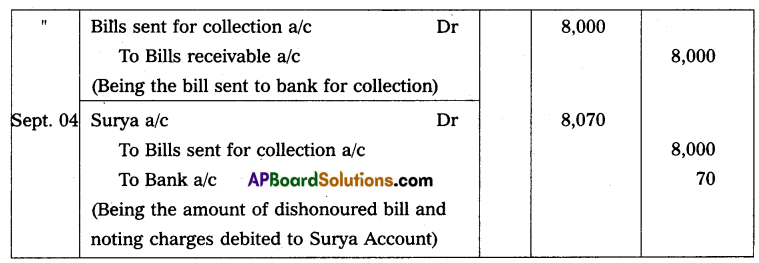
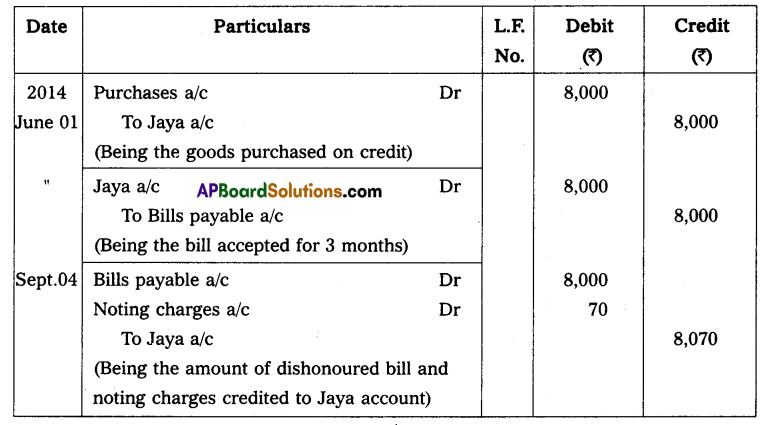
On 1st June 2014 Jaya sold goods to Surya for ₹ 8,000 on credit and drew a bill on Surya for the above amount payable after 3 months. Immediately after its acceptance, Jaya sent the bill to her bank for collection. On the due date, the bill was dishonoured and the noting charges amounted to ₹ 70.
Pass the necessary journal entries in the books of Jaya and Surya.
Solution:
Journal entries in the books of Jaya (Drawer)
AP Inter 2nd Year Accountancy Study Material Chapter 1 Bills of Exchange Textual Examples Q10
AP Inter 2nd Year Accountancy Study Material Chapter 1 Bills of Exchange Textual Examples Q10.1
Journal entries in the books of Surya (Drawee)
AP Inter 2nd Year Accountancy Study Material Chapter 1 Bills of Exchange Textual Examples Q10.2

Question 11.
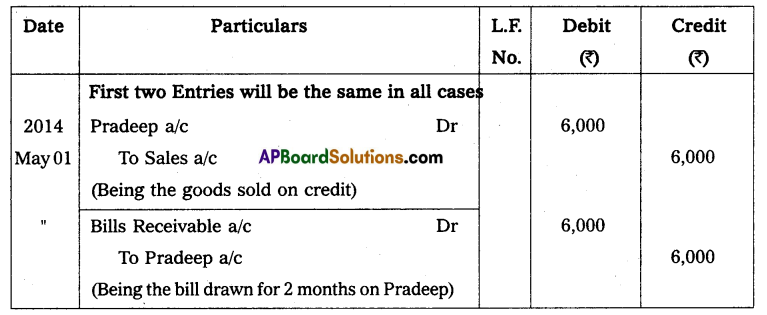
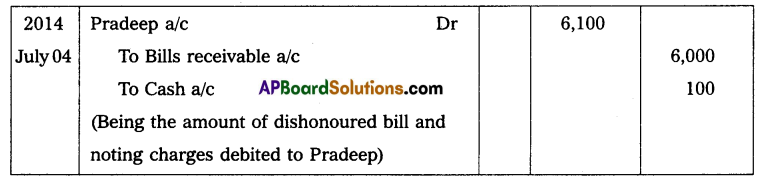
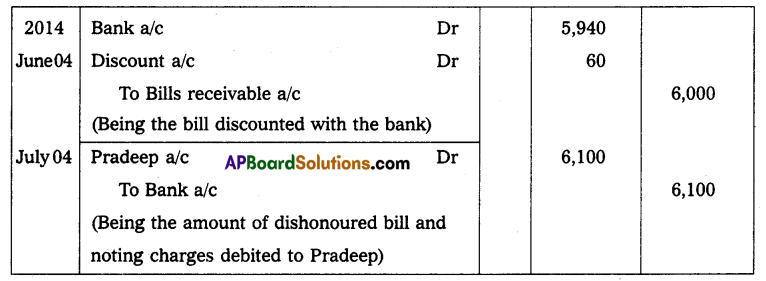
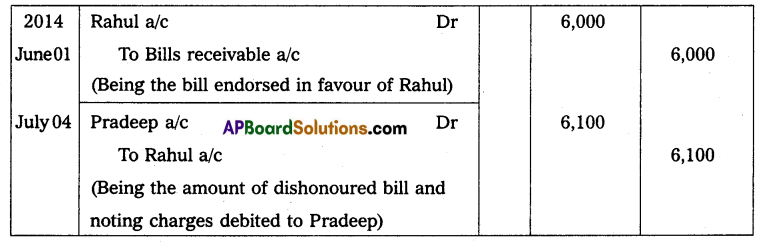
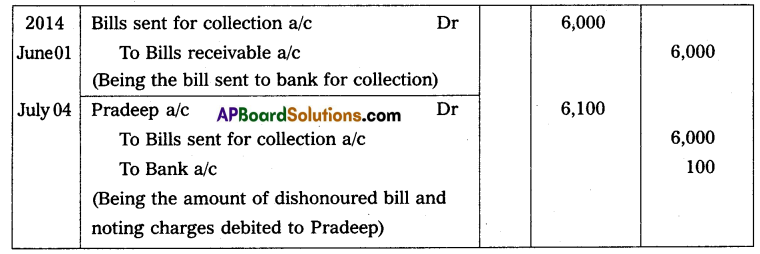
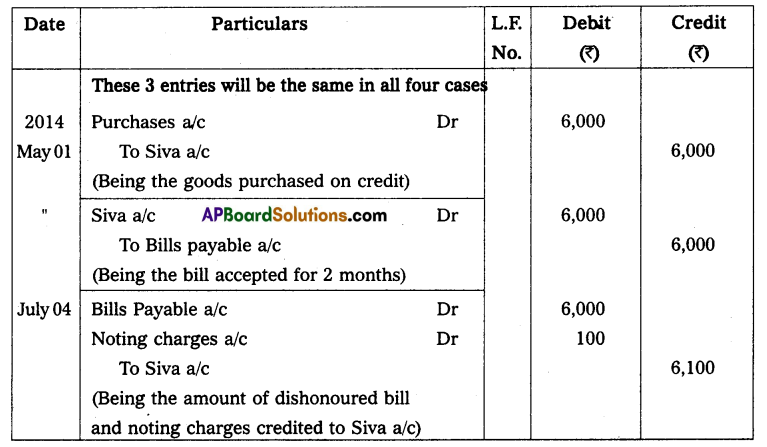
Siva sold goods to Pradeep on 1st May 2014 for ₹ 6,000 on credit and drew upon him a bill for the same amount payable after 2 months. Pradeep accepted the bill and returned it to Siva. On the date of maturity, Pradeep failed to make payment of the bill.
Pass the necessary journal entries in the books of Siva and Pradeep in the following cases:
Case I: When Siva retained the bill till the due date and paid noting charges of ₹ 100.
Case II: When Siva discounted the bill with his bank on 4th June 2014 @ 12% p.a. and the bank paid noting charges of ₹ 100.
Case III: When Siva endorsed the bill in favour of his creditor Rahul on 1st June 2014 and Rahul paid noting charges of ₹ 100.
Case IV: When Siva sent the bill to his bank for collection on 1st June 2014 and bank paid noting charges of ₹ 100.
Solution:
Journal entries in the books of Siva (Drawer)
AP Inter 2nd Year Accountancy Study Material Chapter 1 Bills of Exchange Textual Examples Q11
Case I: When the bill is retained by Siva till the date of maturity
AP Inter 2nd Year Accountancy Study Material Chapter 1 Bills of Exchange Textual Examples Q11.1
Case II: When the bill is discounted by Siva with his bank
AP Inter 2nd Year Accountancy Study Material Chapter 1 Bills of Exchange Textual Examples Q11.2
Case III: When the bill is endorsed in favour of Rahul
AP Inter 2nd Year Accountancy Study Material Chapter 1 Bills of Exchange Textual Examples Q11.3
Case IV: When the bill is sent to the bank for collection
AP Inter 2nd Year Accountancy Study Material Chapter 1 Bills of Exchange Textual Examples Q11.4
Journal entries in the books of Pradeep (Drawee)
AP Inter 2nd Year Accountancy Study Material Chapter 1 Bills of Exchange Textual Examples Q11.5

AP Inter 2nd Year Accountancy Study Material Chapter 1 Bills of Exchange

Question 12.
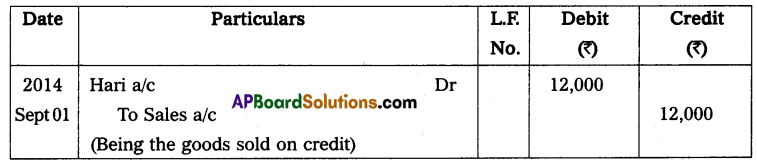
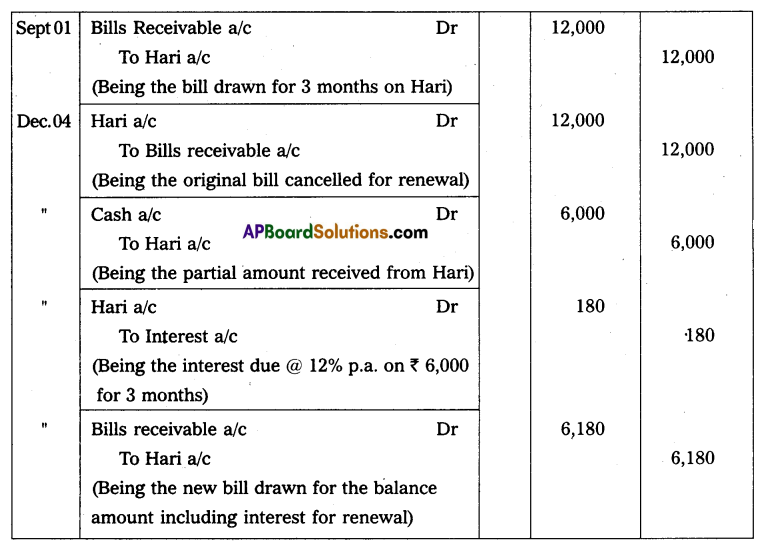
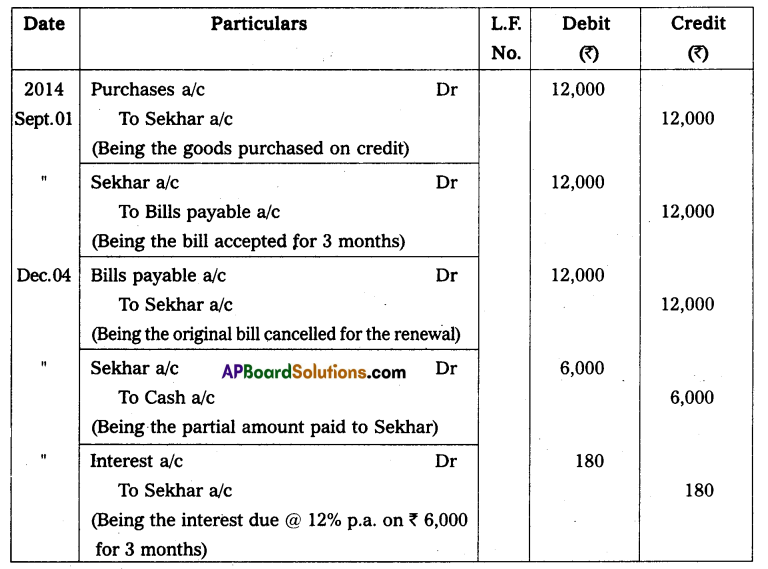
On 1st September 2014, Hari purchased goods for ₹ 12,000 from Sekhar and accepted a bill for the same amount drawn by Sekhar payable after 3 months. On the date of maturity, Hari offered to pay ₹ 6,000 and requested Sekhar to draw a new bill for 3 months for the balance amount including interest at 12% p.a. Sekhar agreed to this proposal.
Pass the necessary journal entries in the books of Sekhar and Hari.
Solution:
Journal entries in the books of Sekhar (Drawer)
AP Inter 2nd Year Accountancy Study Material Chapter 1 Bills of Exchange Textual Examples Q12
AP Inter 2nd Year Accountancy Study Material Chapter 1 Bills of Exchange Textual Examples Q12.1
Journal entries in the books of Hari (Drawee)
AP Inter 2nd Year Accountancy Study Material Chapter 1 Bills of Exchange Textual Examples Q12.2
AP Inter 2nd Year Accountancy Study Material Chapter 1 Bills of Exchange Textual Examples Q12.3

Question 13.
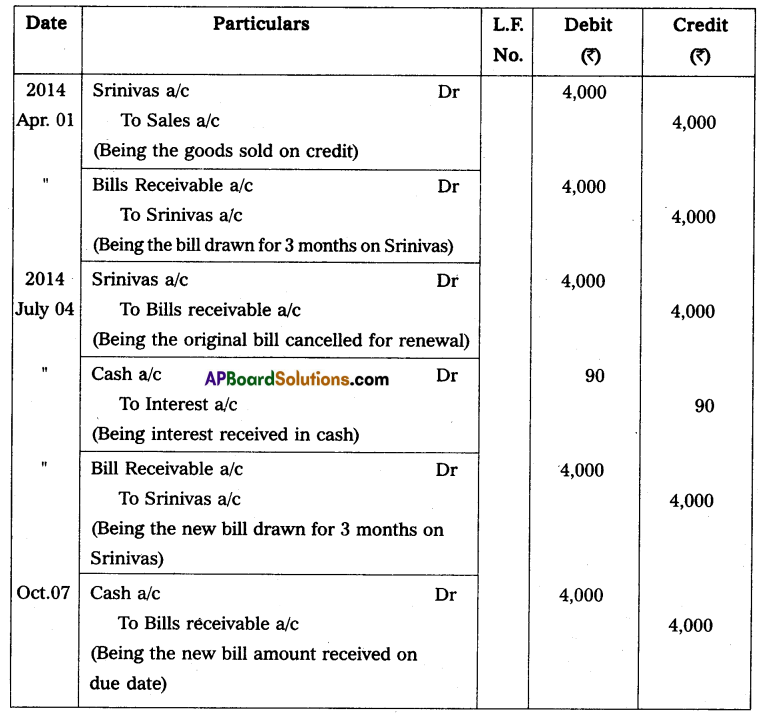
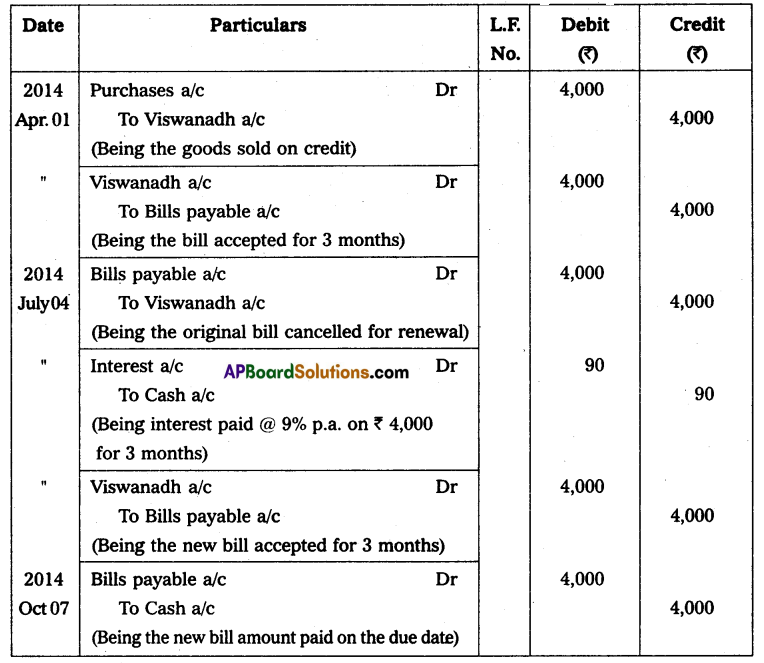
Viswanath sold goods to Srinivas on 1st April 2014 for ₹ 4,000 and drew a bill for 3 months on Srinivas for the same amount Srinivas accepted the bill and returned it to Viswanath. On the due date, Srinivas requested Viswanadh to draw a new bill for the period of 3 months. Srinivas agreed to pay interest in cash @ 9% p.a. immediately. Viswanath agreed to this proposal. The new bill was honoured on the due date.
Pass the necessary journal entries in the books of Viswanath and Srinivas.
Solution:
Journal entries in the books of Viswanath (Drawer)
AP Inter 2nd Year Accountancy Study Material Chapter 1 Bills of Exchange Textual Examples Q13
Journal entries in the books of Srinivas (Drawee)
AP Inter 2nd Year Accountancy Study Material Chapter 1 Bills of Exchange Textual Examples Q13.1

Question 14.
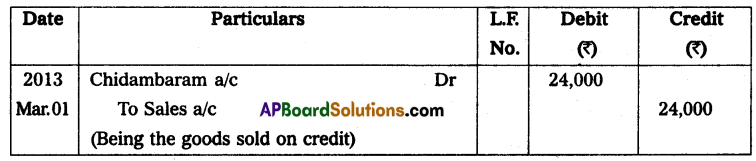
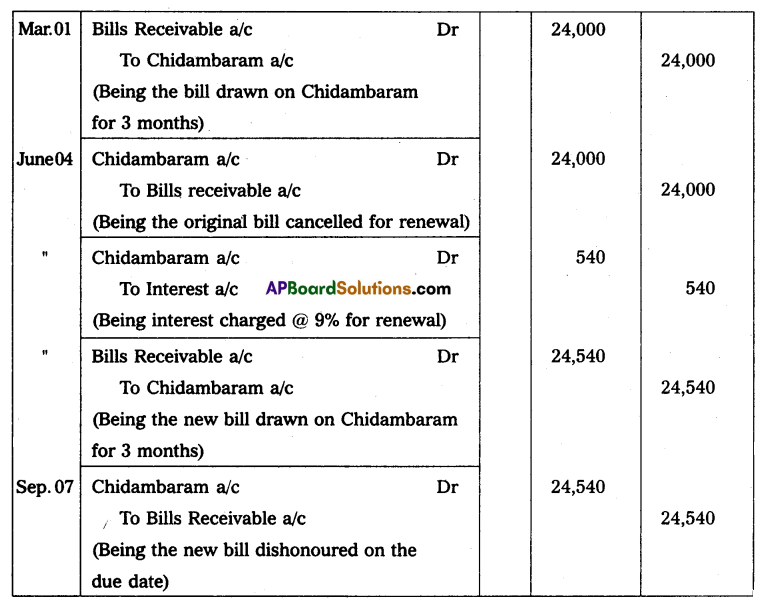
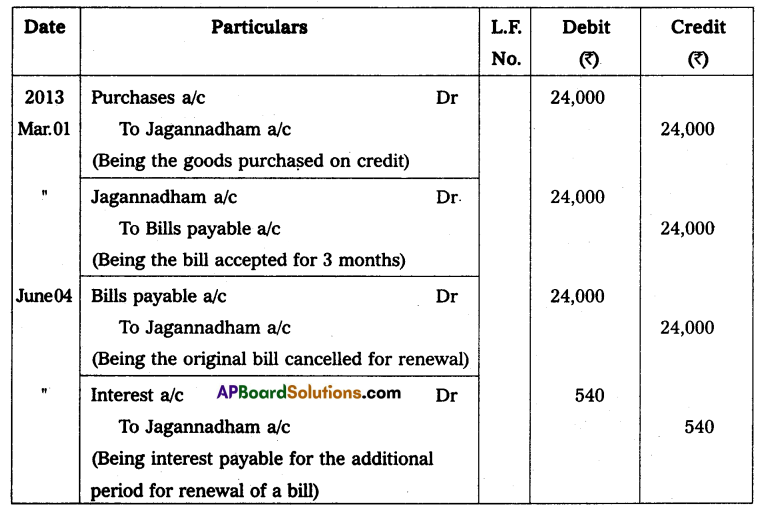
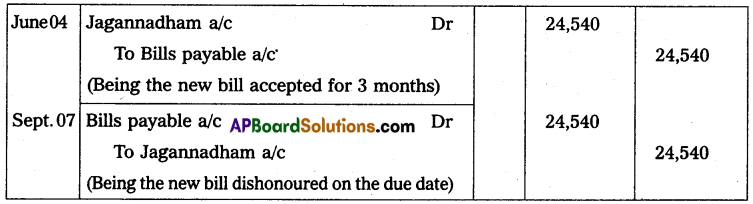
On 1st March 2013 Jagannadham sold goods to Chidambaram for ₹ 24,000 and drew upon him a bill for the same amount payable after 3 months. On the due date, Chidambaram requested Jagannadham to renew the bill for a further period of 3 months at 9% interest per annum. Jagannadham agreed to this proposal. Chidambaram accepted a new bill drawn by Jagannadham for the amount of the old bill including interest payable after 3 months. On the due date, a new bill was dishonoured.
Pass the necessary journal entries in the books of Jagannadham and Chidambaram.
Solution:
Journal entries in the books of Jagannadham (Drawer)
AP Inter 2nd Year Accountancy Study Material Chapter 1 Bills of Exchange Textual Examples Q14
AP Inter 2nd Year Accountancy Study Material Chapter 1 Bills of Exchange Textual Examples Q14.1
Journal entries in the books of Chidambaram (Drawee)
AP Inter 2nd Year Accountancy Study Material Chapter 1 Bills of Exchange Textual Examples Q14.2
AP Inter 2nd Year Accountancy Study Material Chapter 1 Bills of Exchange Textual Examples Q14.3

Question 15.
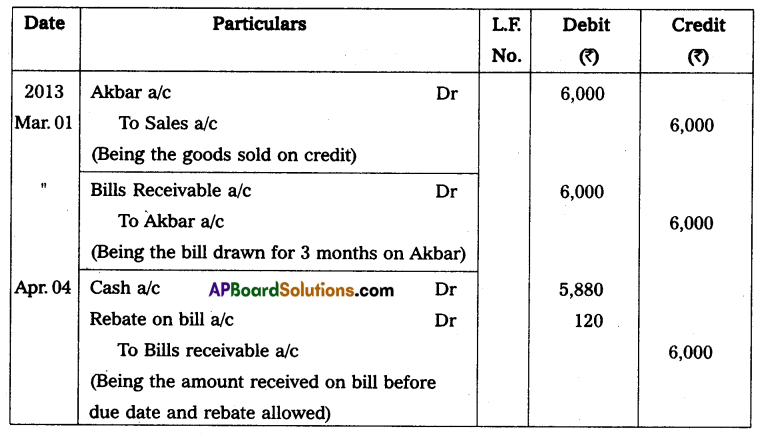
On 1st March 2013, Prudhvi sold goods to Akbar for ₹ 6,000 and drew upon him a bill for the same amount payable after 3 months. Akbar accepted the bill and returned it to Prudhvi. On 4th April 2013, Akbar retired the bill under a rebate of 12% p.a.
Pass the necessary journal entries in the books of Prudhvi and Akbar
Solution:
Journal entries in the books of Prudhvi (Drawer)
AP Inter 2nd Year Accountancy Study Material Chapter 1 Bills of Exchange Textual Examples Q15
Journal entries in the books of Akbar (Drawee)
AP Inter 2nd Year Accountancy Study Material Chapter 1 Bills of Exchange Textual Examples Q15.1
AP Inter 2nd Year Accountancy Study Material Chapter 1 Bills of Exchange Textual Examples Q15.2

AP Inter 2nd Year Accountancy Study Material Chapter 1 Bills of Exchange

Question 16.
On 1st January 2014 Revathi drew a bill for ₹ 4,000 on Savithri payable after 3 months. Savithri accepted the bill and returned it to Revathi. On 4th February 2014, Savithri retired the bill under a rebate of 9% p.a.
Pass the necessary journal entries in the books of Revathi and Savithri.
Solution:
Journal entries in the books of Revathi (Drawer)
AP Inter 2nd Year Accountancy Study Material Chapter 1 Bills of Exchange Textual Examples Q16
Journal entries in the books of Savithri (Drawee)
AP Inter 2nd Year Accountancy Study Material Chapter 1 Bills of Exchange Textual Examples Q16.1

Question 17.
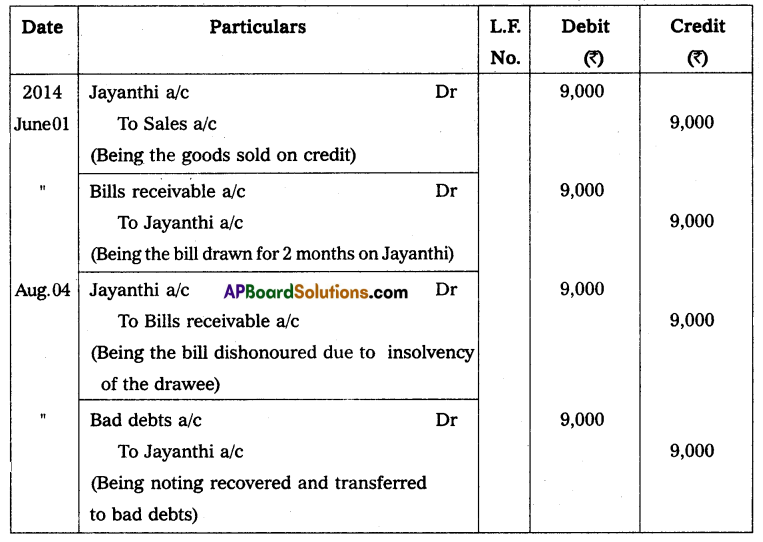
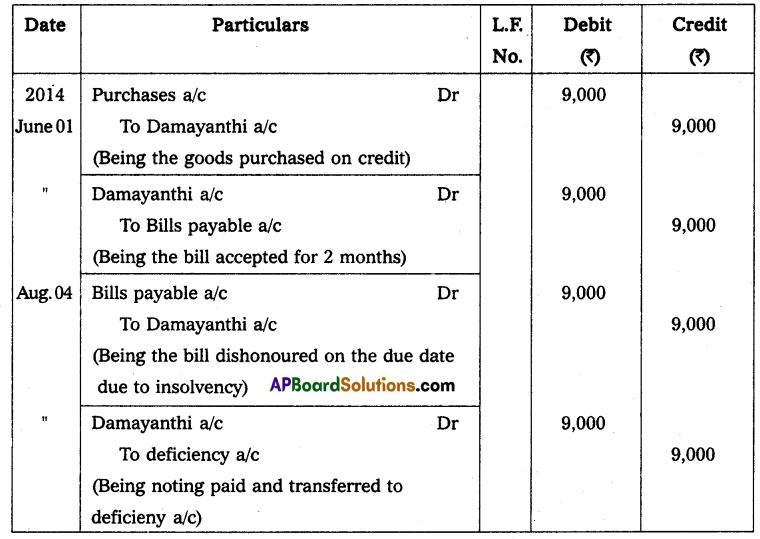
Damayanthi sold goods worth ₹ 9,000 to Jayanthi on 1st June 2014 and drew a bill for 2 months for the same amount Jayanthi accepted the bill and returned it to Damayanthi. Before the due date of the bill, Jayanthi became insolvent and nothing could be recovered from her estate.
Pass the necessary journal entries in the books of Damayanthi and Jayanthi.
Solution:
Journal entries in the books of Damayanthi (Drawer)
AP Inter 2nd Year Accountancy Study Material Chapter 1 Bills of Exchange Textual Examples Q17
Journal entries in the books of Jayanthi (Drawee)
AP Inter 2nd Year Accountancy Study Material Chapter 1 Bills of Exchange Textual Examples Q17.1

AP Inter 2nd Year Accountancy Study Material Chapter 1 Bills of Exchange

Question 18.
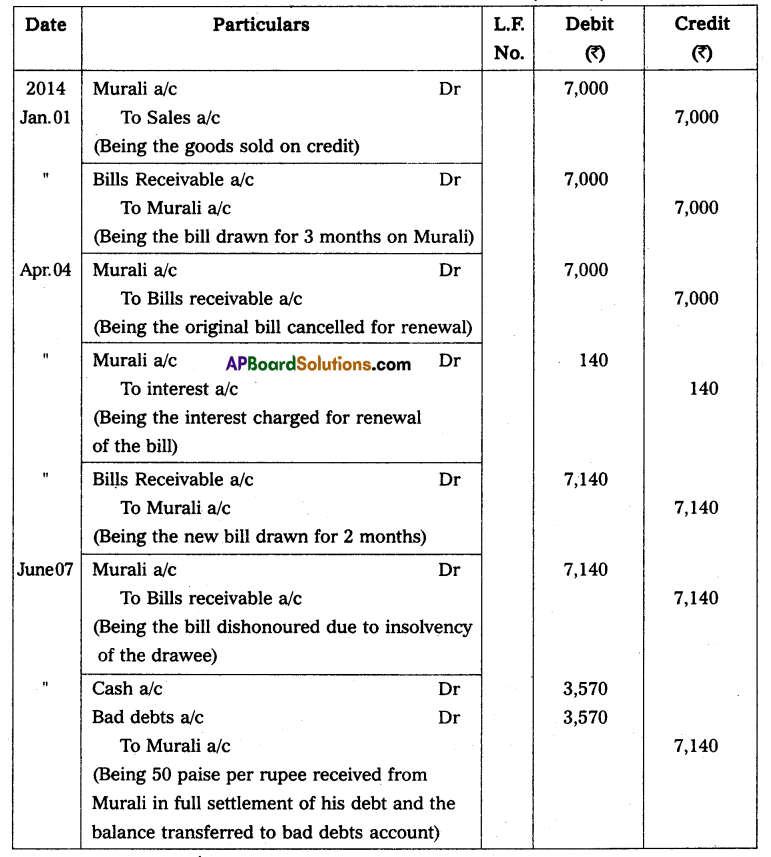
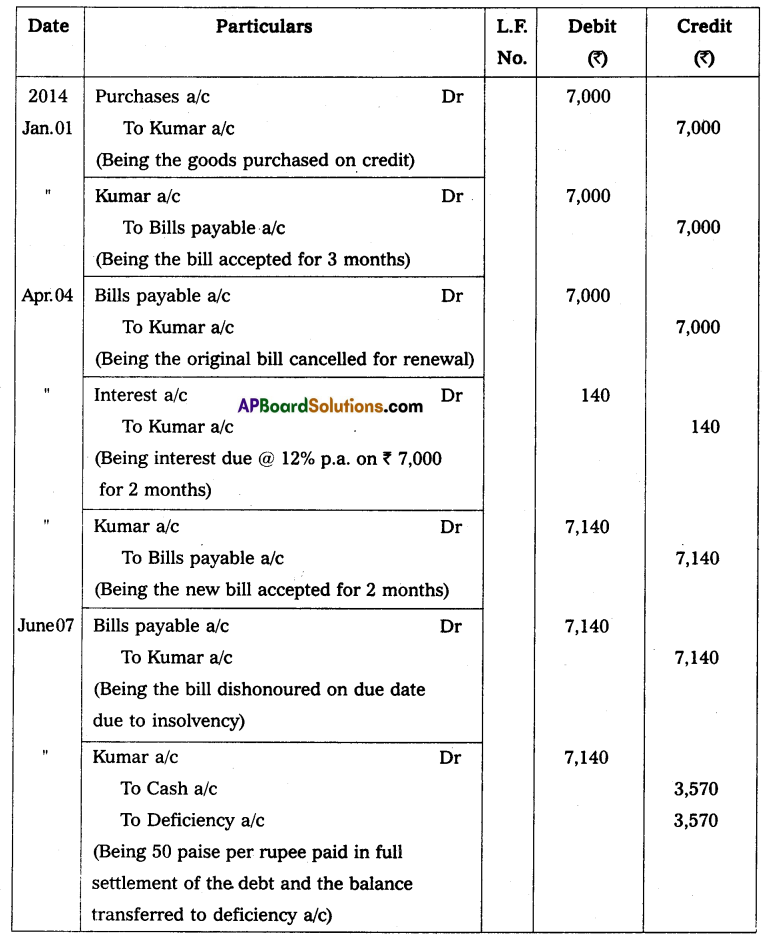
Kumar sold goods worth ₹ 7,000 to Murali on 1st January 2014 and drew upon him a bill for 3 months for the same amount Murali accepted the bill and returned it to Kumar. On the due date, murali requested Kumar to draw a new bill for the amount due. Kumar agreed to draw a new bill for 2 months but he charged interest @ 12% p.a. Murali accepted the new bill which was drawn by Kumar. Before the due date of the bill, Murali became insolvent and only 50 paise in a rupee could be recovered from his estate.
Pass the necessary journal entries in the books of Kumar and Murali.
Solution:
Journal entries in the books of Kumar (Drawer)
AP Inter 2nd Year Accountancy Study Material Chapter 1 Bills of Exchange Textual Examples Q18
Journal entries in the books of Murali (Drawee)
AP Inter 2nd Year Accountancy Study Material Chapter 1 Bills of Exchange Textual Examples Q18.1

AP Inter 2nd Year Economics Study Material Chapter 10 Economic Statistics

Andhra Pradesh BIEAP AP Inter 2nd Year Economics Study Material 10th Lesson Economic Statistics Textbook Questions and Answers.

AP Inter 2nd Year Economics Study Material 10th Lesson Economic Statistics

Essay Questions

Question 1.
What are the uses of dispersion?
Answer:
According to A.L.Bowley “Dispersion is the measure of the variation of the items”.
According to Brooks and Dick “Dispersion or spread is the degree of the scatter or variation of the variable about a central value”.
Uses of Dispersion :

  1. To use other statistical methods: After getting the value of dispersion we can proceed to other techniques such as locating co-relation or lines of regression (Regression Analysis).
  2. To compare variability: We are in the general habit of comparison, may it be income, weight, or temperature. To achieve the required degree of result one tries to improve to achieve the required result.
  3. To test the reliability of the average: If the total of differences between the central value and the given value is smaller, the uniformity is less i.e., it means that this sum should be minimum for the reliability of the average.
  4. To establish trends in time series: In time series we remove, cyclical, seasonal, or random fluctuations, which we from after studying central values.
  5. To control the undesired variability: According to Spurr and Bonini “In industrial production, the efficient operation requires control of quantity variation, the causes of which are sought through inspection and quality control programmes”.

Thus it is clear from the above definition that we have to find the cause for variation when we compare the degree of variability between two series.

AP Inter 2nd Year Economics Study Material Chapter 10 Economic Statistics

Question 2.
What is meant by dispersion ? Explain the various measures of dispersion.
Answer:
The measurement of the scatteredness of the mass of figures in a series about an average is called a measure of variation or dispersion. According to A.LBowley “Disper-sion is the measure of the variation of the items”.

According to Brooks and Dick “Dispersion or spread is the scatter or variation of the variable about a central value.
Methods of studying variation :

  1. The range
  2. The interquartile range and the quartile deviation
  3. The mean deviation or average deviation
  4. The standard deviation and
  5. The Lorenz curve

1) Range : It is the simplest of the values of dispersion. It is merely the difference between the largest and smallest term- symbolically,
R = L – S

2) Inter – quartile range or quartile deviation: In range we used to calculate L – S terms. But in this case we leave the 1st 25% and last 25% terms to avoid the undue importance of extreme values.
Q.D = \(\frac{\mathrm{Q}_3-\mathrm{Q}_1}{2}\)

3) Mean deviation : It is the average difference between the items in a series from the mean or median or mode.
M.D. = \(\frac{\Sigma f|D|}{N}\)

4) Standard deviation : It is also called Root – Mean Square deviation, as it is the square root of the mean of the squared deviations from the actual mean.
S.D = \(\sqrt{\Sigma \frac{(x-\bar{x})^2}{N}}\)
σ = \(\sqrt{\frac{\sum \mathrm{x}^2}{\mathrm{~N}}}\)

5) Lorenz curve : It is graphic method to study dispersion. It helps in studying the variability in different components of distribution.

Question 3.
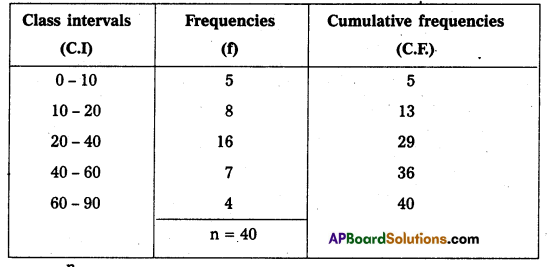
Calculate the quartile deviation for frequency distribution.
AP Inter 2nd Year Economics Study Material Chapter 10 Economic Statistics 1
Solution:
AP Inter 2nd Year Economics Study Material Chapter 10 Economic Statistics 2
Q1 = L + \(\frac{\frac{\mathrm{n}}{4}-\mathrm{CF}}{\mathrm{f}}\) × i
Where Q1 = Size of \(\left(\frac{\mathrm{n}}{4}\right)^{\mathrm{th}}\) value = \(\left(\frac{\mathrm{10}}{4}\right)^{\mathrm{th}}\) = 10th item
L = Lower limit = 10
C.F = 5 (value of C.F for the class preceeding the quartile class)
i = 10 (frequency of the quartile class)
Q1 = 10 + \(\frac{10-5}{8}\) × 10 = 16.25
Similarly Q3 = L + \(\frac{3\left(\frac{n}{4}\right)-\text { C.F }}{f}\) × i
Where Q3 =\(\frac{3(n)}{4}=\frac{3(40)}{4}=\frac{120}{4}\) = (30)th item
C.F = 29, f = 7, i = 20, L = 40
L = 40
Q3 = 40 + \(\frac{30-29}{7}\) × 20 = 42.87
Q3 = 42.87
Q.D. = \(\frac{\mathrm{Q}_3-\mathrm{Q}_1}{2}\)
Q.D. = \(\frac{42.87-16.25}{2}\) = 13.31
∴ Q.D. = 13.31

AP Inter 2nd Year Economics Study Material Chapter 10 Economic Statistics

Question 4.
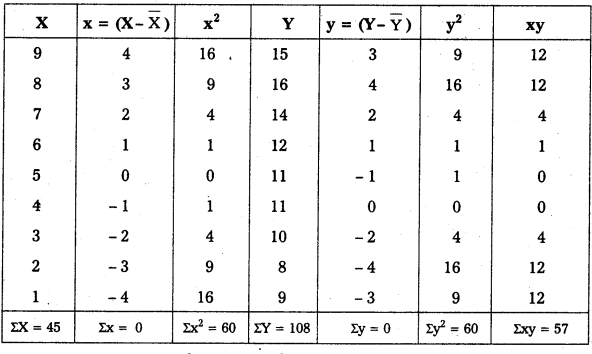
Calculate the Karl Pearson’s coefficient of correlation.
AP Inter 2nd Year Economics Study Material Chapter 10 Economic Statistics 3
Solution:
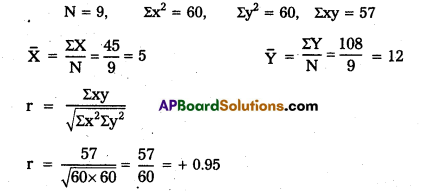
AP Inter 2nd Year Economics Study Material Chapter 10 Economic Statistics 4
AP Inter 2nd Year Economics Study Material Chapter 10 Economic Statistics 5

Short Answer Questions

Question 1.
Define relation between M.D, S.D and Q.D.
Answer:
Measures of dispersion can be classified into five types.

  1. The range
  2. The inter quartile range and the quartile deviation
  3. The mean deviation or average deviation
  4. The standard deviation
  5. The Lorenz curve

The range and quartile deviations are positional measures because they depend on the values at a particular position in the distribution.

The average deviation and the standard deviation are called calculation measures of deviation because all of the values are employed in their calculation while the last method is a graphic method.

Question 2.
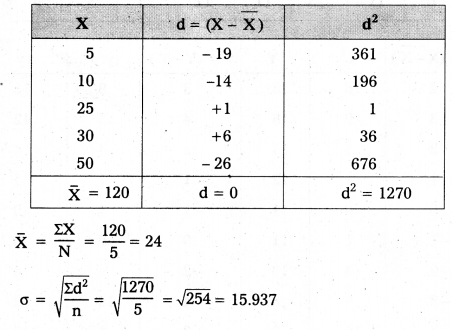
Calculate the standard deviation of the following values 5, 10, 25, 30, 50. [A.P. Mar. 17]
Solution:
AP Inter 2nd Year Economics Study Material Chapter 10 Economic Statistics 6

AP Inter 2nd Year Economics Study Material Chapter 10 Economic Statistics

Question 3.
Define Lorenz Curve. When is it used ?
Answer:
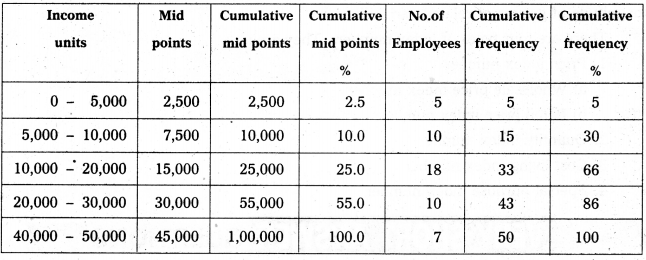
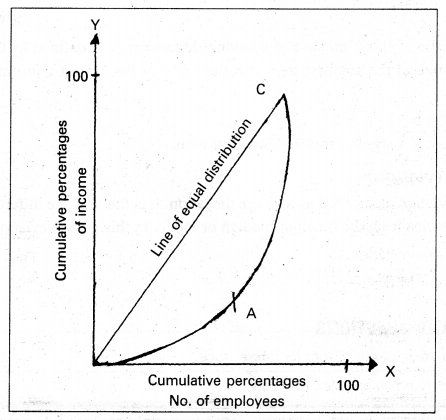
This curve was given by Dr. Max.O.Lorenz, a popular Economic statistician. He studied the distribution of wealth and income with its help. It is graphic method to study dispersion. It helps in studying the variability in different components of the distribution. The base of Lorenz curve is that we take cumulative percentage along X & Y axis. Joining these points we get the Lorenz curve.

Lorenz curve uses the information expressed in a cumulative manner to indicate the degree of variability.
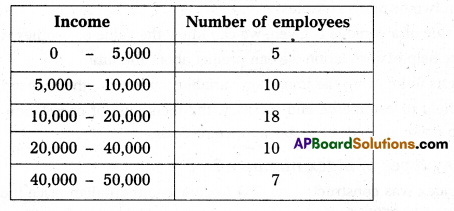
For example: The monthly incomes of employees of a company given below.
AP Inter 2nd Year Economics Study Material Chapter 10 Economic Statistics 7
Solution:
AP Inter 2nd Year Economics Study Material Chapter 10 Economic Statistics 8
AP Inter 2nd Year Economics Study Material Chapter 10 Economic Statistics 9

Question 4.
What is correlation ? State its importance.
Answer:
Correlation is an analysis of the co-variation between two or more variables.

  1. The correlation is a statistical device which help to analyzing the co-variation between two or more variables.
  2. If the value of a variable is given, we can know the value of another variable.
  3. With the help of correlation we can predict about the future.
  4. It helps us in knowing the important variables on which other depend.
  5. In the field of commerce and industry, the technique of correlation coefficient helps to make estimates like sales, price or costs.

AP Inter 2nd Year Economics Study Material Chapter 10 Economic Statistics

Question 5.
How many types of index numbers ?
Answer:
The first index was constructed in 1764 to compose the Italian price index in 1750 with the price level in 1500. Index numbers are devices for measuring difference in the magnitude of groups of related variabilities.
There are four types of index numbers. They are :

  1. Price index number
    a) Wholesale price index number
    b) Retail price index number
  2. Quantity index number
  3. Cost living index number
  4. Special purpose index number

Very Short Answer Questions

Question 1.
Range. [A.P. Mar. 17, 16]
Answer:
Range is the simplest method of studying dispersion. It is defined as the difference between the value of the smallest item and the value of the largest item included in the distribution.
Range = L – S
Where L = Largest item; S = Smallest item.

Question 2.
Mean deviation.
Answer:
Mean deviation also called as average deviation. It is the average difference between the items in a series from the mean or median or mode. In this mean deviation we ignored ± signs.
M.D. = \(\frac{\Sigma \mathrm{f}|\mathrm{D}|}{\mathrm{N}}\)

AP Inter 2nd Year Economics Study Material Chapter 10 Economic Statistics

Question 3.
Correlation. [A.P. Mar 17]
Answer:
Correlation is an analysis of the co-variation between two or more variables. There are two types of correlation.

  1. Karl Pearson’s method
  2. Spearman’s Rank method
    Karl Pearson’s correlation (r) = \(\frac{\Sigma x y}{\sqrt{\Sigma x^2 \times \Sigma y^2}}\)
    Spearman’s correlation (rk) = \(\frac{6 \Sigma D^2}{N\left(N^2-1\right)}\)
    (Or) 1 – \(\frac{6 \Sigma D^2}{N^3-\mathrm{N}}\)

Question 4.
Rank correlation.
Answer:
In 1904, Prof. Charter Edward Spearman had devised a method of rank correlation. It is based on the ranking of different items in the variable. This method is useful where actual item values are not given simply their ranks in the series are known.

Question 5.
Index number. [A.P. Mar. 18]
Answer:
Index numbers are devices for measuring difference in the magnitude of groups related variabilities. There are four types of index numbers.

  1. Price index number
  2. Quantity index number
  3. Cost living index number
  4. Special purpose index number

Question 6.
Laspeyre’s price index formula.
Answer:
P01 = \(\frac{\Sigma \mathrm{P}_1 \mathrm{Q}_0}{\Sigma \mathrm{P}_0 \mathrm{Q}_0}\) × 100

AP Inter 2nd Year Economics Study Material Chapter 10 Economic Statistics

Question 7.
Paasche’s price index formula. [A.P. Mar 16]
Answer:
P01 = \(\frac{\Sigma \mathrm{P}_1 \mathrm{Q}_1}{\Sigma \mathrm{P}_0 \mathrm{Q}_1}\) × 100

Question 8.
Fisher’s price index formula.
Answer:
P01 = \(\sqrt{\mathrm{L} \times \mathrm{P}}\)
= \(\sqrt{\frac{\Sigma \mathrm{P}_1 \mathrm{Q}_0}{\Sigma \mathrm{P}_0 \mathrm{Q}_0} \times \frac{\Sigma \mathrm{P}_1 \mathrm{Q}_1}{\Sigma \mathrm{P}_0 \mathrm{Q}_0}}\) × 100

AP Inter 2nd Year Economics Study Material Chapter 9 Economy of Andhra Pradesh

Andhra Pradesh BIEAP AP Inter 2nd Year Economics Study Material 9th Lesson Economy of Andhra Pradesh Textbook Questions and Answers.

AP Inter 2nd Year Economics Study Material 9th Lesson Economy of Andhra Pradesh

Essay Questions

Question 1.
Write an essay on the economy of Andhra Pradesh.
Answer:
Andhra Pradesh is one of the largest states in India in terms of area and population. It is the eighth largest state in terms of geographical area, accounting for 4.96% of the area of the country. The state has a total geographical area of 160.21 lakh hectares. In terms of population, it is the 10th largest state with 4.96 crores i.e., 4.10% of the country’s population.

State Gross Domestic Product (SGDP): The SGDP may also be called as state income. SGDP is defined as the total value of the finished goods and services produced within the boundaries of the state during a year.
The three sectors in A.P Economy are as follows.

  1. Primary sector: Agriculture, Animal husbandry, Forests etc.
  2. Industrial sector : Industries, Electricity, Irrigation.
  3. Tertiary sector: Trade, Hotels, Transport, Communication etc.

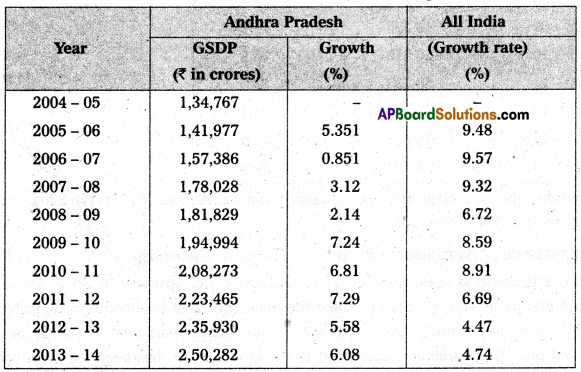
The SGDP A.P an increase trend from 2005 – 06 ₹ 1,41,977 crore to 2013 – 2014 it was ₹ 2,50,282 crores. The growth rate of SGDP of A.P 6.08% in 2013 – 14.

Per capita income : The per capita income gives a better idea of the standard of the people. A.P per capita income was ₹ 85,797 in 2013-14.

Agriculture: Agriculture and allied actives remained the main source of livelihood of the state population. During 2013-14 food crops are grown in 54.92 lakh hectors.

Industry: The industrial development in A.P in going on the same lines of the industrial development of India. The industrial sector contribution in GSDP undergoes slight changes. It shares decreased from 23.7 during 2007-08 to 20.7% by 2013-14.

Tertiary Sector: The share of tertiary sector in the SGDP has shown a tremendous increase from ₹ 64,411 crore to ₹ 1,40,054 crore in 2013-14.

AP Inter 2nd Year Economics Study Material Chapter 9 Economy of Andhra Pradesh

Question 2.
What is SGDP ? Explain the trends in SGDP of Andhra Pradesh.
Answer:
The State Gross Domestic Product may also be called as the State Income.

The State Gross Domestic Product is defined as the total value of the final/finished goods and services produced within the geographical boundaries of the state during a year.

The directorate of economics and statistics estimates the SGDP in Andhra Pradesh. The directorate makes use of the product and income methods for estimation of SGDP”. The three sectors in Andhra Pradesh Economy are as follows :

  1. Primary Sector : Agriculture, Animal husbandly, Forests, Mines and Quarries.
  2. Industrial Sector : Industries, Electricity/Gas, Irrigation, Construction.
  3. Tertiary Sector : Trade, Hostels, Transport, Communication, Real Estate, General Administration, Social Services.

The railway, insurance, banking and communication services are called supra regional sectors. The income generated in these sectors are estimated by the Central Statistical Organisation (CSO) and the centre allots the share to the states proportionately.

Andhra Pradesh makes use of the product method for estimating the SGDP in Agriculture sector, Forests, Animal husbandry, Industries, Mines and Quarries and the Income Method in Irrigation, Transport, Power Supply of Gas, Insurance, Banking and Communication sectors.

Trends of SGDP in Andhra Pradesh: The following table explains the trends in SGDP of Andhra Pradesh.
GSDP of A.P at Constant (2004 – 05) prices
AP Inter 2nd Year Economics Study Material Chapter 9 Economy of Andhra Pradesh 1
GSDP of AP in about 4.36% of Indian G.D.P. It is notical that the growth rates of both A.P and India are not showing a steady trend but are fluctuating.

AP Inter 2nd Year Economics Study Material Chapter 9 Economy of Andhra Pradesh

Question 3.
Explain the trends in population and percapita income growth in Andhra Pradesh.
Answer:
With 13 districts, A.P occupies tenth place among all states of India with 4.96 crores of population according to 2011 census, The population of A.P is 4.96 crores and that of India is 121.06 crores. So the percentage of A.P population is 4 in the total Indian population. The decadal growth rate of population of A.P is always lower than the Indian growth rate. By 2011 the population growth rate of A.P(9.21) is almost half of the national average 17.69.

The density of population in Andhra Pradesh has gone up. During 2011, the density of population per sq. km is 304 persons for the state, as against 382 persons for the country. Among the districts, the Krishna district having high density with 518 persons followed by West godavari district 470 persons per sq.km. The lowest density area is Y.S.R Kadapa with 188 persons.

The fertility rate in A.P is also showing downward trend in the recent decade.

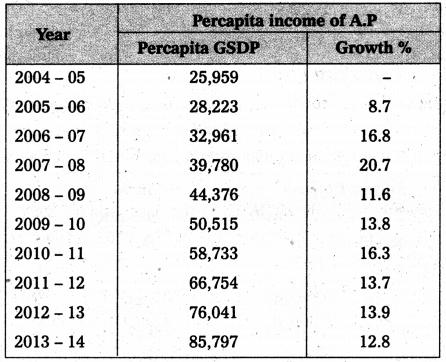
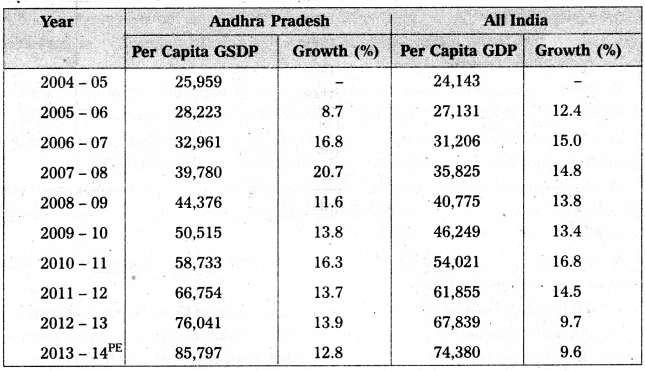
The percapita income gives a better idea of the standard of living of people. The following table reveals the changes in percapita income of Andhra Pradesh from 2004-05 to 2013-14.
AP Inter 2nd Year Economics Study Material Chapter 9 Economy of Andhra Pradesh 2
From the table, it is clear that the percapita income of A.P. was ₹ 25,959 in 2004 – 05 and has gone up to ₹ 85,797 at 2013 – 14.

Question 4.
Importance of Agriculture in Andhra Pradesh Economy.
Answer:
Andhra Pradesh is considered as the Annapurna, i.e., granary of South India. Agriculture and its allied activities remained the main source of livelihood for a sizable chunk of the state population in general and its labour force in particular. Ensuring food security and providing gainfaul employment to the labour force, has been the essential premise of the policy makers. Raising form incomes through crop diversification and encouraging alternative methods of forming perhaps help to improve the standards of the farmers in the state.

With regard to foodgrain production in India, Uttar Pradesh stands in the 1st place, Punjab in the second and A.P in the third. The table provides information on the food grain production in Andhra Pradesh.
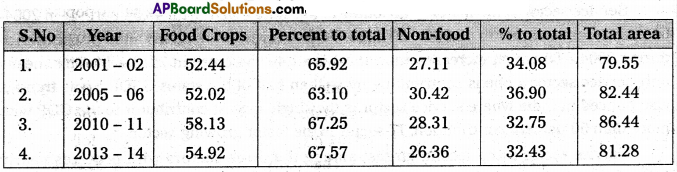
Area under Food & Non Food Crops in the State
AP Inter 2nd Year Economics Study Material Chapter 9 Economy of Andhra Pradesh 3
From the above table we can come to the conclusion that food crops are dominating with around 65% of are put for their production and the trend is continuing over the year. During 2013 – 14 food crops are grown in 54.92 lakh hectares which is 67.57% of total area in that year.

According to 2013 – 14 provisional estimates, 11,698 thousand tonnes of food grains are produced in which 10,618 thousand tonnes are cereals and millets and 1,080 thousand tonnes pulses. 2,242 thousand tonnes of oil also produced from various parts of the state.

AP Inter 2nd Year Economics Study Material Chapter 9 Economy of Andhra Pradesh

Question 5.
Importance of Industry in Andhra Pradesh Economy.
Answer:
The role of industrial sector in any economy decides its pace of development. The state of Andhra Pradesh is endowed with wide varieties of natural resources, longest coastline in South India. Infrastructure, communication system, experts in technical field and wide market opportunities.

The contribution of this sector was only 29,124 cr. in the base year ie., 2004 – 05 increased to 51,838 crores in 2013 – 14 continuously except for 2008 – 09. Infact it share decreased from 23.7 during 2007 – 08 to 20.7 percent by 2013 -14.

The share of industrial sector in providing employment opportunities to the labour force remained same in both state and the nation over the years. The share of this sector is increasing very sluggishly.

The value of industrial exports from the state is continuously increasing. It is ₹ 1,29,001 crore in 2012 – ’13. In the total silk units of the country, A.P’s sick units are 10.2 percent and state stood in fourth place. There are 44 State Level Public Enterprises (SLPEs) functioning in the combined state with the capital of ₹ 69,125 crore. Among them, APCPDCL, A.P. GENCO, APSPDCL, Housing Board etc., are top level SLPEs. Andhra Pradesh Industrial Infrastructure Corporation (APIIC) is the nodal agency for special economic zones in the state, A.P. is the first state in the country to announce an exclusive SEZ policy. As on March 2014, there were 32 number of SEZs in the state in which 10 were IT related, 6 multiproduct, 4 pharmaceuticals, 2 biotech and 10 sector specific SEZs. Recently, State Finalized Visakapatnam SEZ in an area of 3,500 acres.

Question 6.
Importance of tertiary sector in Andhra Pradesh economy.
Answer:
A service sector is the fastest growing sector in Andhra Pradesh as it is in total India. It is expanding as of agriculture is losing, the industrial sector being constant.

Service sector is the major contributor to the state GSDP with 48.54 percent in 2004- OS and increase further to 55.96 by 2013-14. ₹ 64.411 crore were contributed by the service during 2004 – 05 which increases enormously to 1,40,054 crore in 2013 – 14. This means only service sector alone is contributing more than half of the states GSDP. Same trend is also noticed in India where service sector is the single largest contributor to the GDP with more than 50 percent contribution. IT sector is the faster growing sector.

Service sector is the second largest among the three sectors with provides nearly 1/4th of the employment opportunities in the state. It is providing livelihood to nearly 25 percent of labour force, which is, on par with the national average (25.4 percent).

AP Inter 2nd Year Economics Study Material Chapter 9 Economy of Andhra Pradesh

Question 7.
Explain the Irrigation facilities in Andhra Pradesh.
Answer:
Irrigation : Andhra Pradesh is blessed with many major rivers. The most important being Godavari, Krishna, Thungabhadra, Penna and Vamsadhara. The State, share of dependable flows from all the rivers and streams is estimated at 2.746 TMC, and only 1.753 TMC has been utilized so far. Apart from rivers the state consists of many artificial lakes and reservoirs for irrigation and drinking water.

Irrigation development as well as management is of utmost importance in the State. Andhra Pradesh is rightly called “A River State” as it is blessed with major river systems like the Godavari, Krishna, Thungabhadra, Vamsadhara and other rivulets. Presently, 54 major, medium and other projects are being considered under Jalayagnam, with a hope to irrigate 52 lakh acres.

Polavaram project is a multi – purpose irrigation project witch has been accorded ’National Project Status’ by Central Government. This dam across the Godavari river is under construction located in West and East Godavari District in Andhra Pradesh and its reservoir spreads in parts of Chhattisgarh and Orissa States also. The project is expected to enabling irrigation of23,20,000 in Krishna, West Godavari, East Godavari, Visakhapatnam, Vizianagaram and Srikakulam districts of Andhra Pradesh.

The Pattiseema Project is crucial as it will lift 80 tmft of surplus Godavari water from Pattiseema to Krishna Basin and divert it through Srisailam to the parched Rayalaseema till Polavaram project is completed. Government also announced that Pattiseema project would not go aganist the interest of farmers of twin Godavari districts, but would meet drinking and irrigation water need of Rayalaseema.

Government of Andhra Pradesh is also encouraging drip irrigation system, in the State. It is supplying drip irrigation equipment on subsidized rates to the farmer. A.R ranks 1st in Micro irrigation system in the country and so far covers 5.63 lakh hectors.

Question 8.
Explain about the transport facilities in Andhra Pradesh.
Answer:
The transport facilities available in Andhra Pradesh can be classified into four categories.
They are :

  1. Railways
  2. Roadways
  3. Airways
  4. Waterways.

1) Railways : They have played a significant role in boosting the economy of the State alongside developing the industrial and the tourism sectors. Andhra Pradesh mainly served by three major railway zones viz., South Central Railway, Southern Railway and East Coast Railway. State has total 444 railway stations and having 3,355 km of rail network. State Government proposals are with Ministry of Railways to set a new Railway Zone in newly formed Andhra Pradesh.

One of the highest broad gauge tracks in the world is in Eastern Ghats route that runs from Visakhapatnam to Anantagiri. Vijayawada railway station is the highest grosser in the SCR zone and one of biggest railway junctions in India.

2) Roadways : Roads are one of the basic modes of transportation system and also an important priority sector of infrastructure. Systematic development of road is one of the important pre-requisites for development and acceleration of growth in the economy. Among the different modes of domestic transportation systems, road transport carries more than 80 percent of the goods and passenger traffic.

Andhra Pradesh has an extensive road network of 1,46,954 km with 42,511 km of State Highways, 3,144 km of National Highways and 101,484 km of District Roads. Andhra Pradesh Road Development Corporation (APRDC), established 1998 is responsible for Maintenance and Management of roads.

National highways and State highways connect to every village and town within the State, as well as to major cities of neighbouring States. National Highway 5, with a highway network of around 1,000 km runs from Srikakulam district to Nellore district.

The Andhra Pradesh State Road Transport Corporation (APSRTQ operates public bus services in the state owned by the State Government. Pandit Nehru Bus Station in Vijayawada is the largest bus terminus in the State.

3) Civil Aviation (or) Airways : Government has entered into Memorandum of understanding with Airports Authority of India (AAI) For up – gradation / modernization of non – metro airports at Vijayawada, Tirupati, Kadapa and Rajahmundry airports. The Airport Authority of India (AAI) has proposed to upgrade the Tirupati airport to International standards. AAI proposed Master plan for development of Rajahmundry airport.

4) Seaports (or) Waterways : Andhra Pradesh has the second longest coastline of 972 km after Gujarat in India. Ports provide development and growth of maritime activities such as international trade of exports and imports, ship repairs, tourism, fishing and water sports.

Ports are a gateway to trade and commerce. Visakhapatnam, the largest port in the State is also one of the largest ports in terms of handling cargo in the country.

AP Inter 2nd Year Economics Study Material Chapter 9 Economy of Andhra Pradesh

Question 9.
Role of Information Technology (I.T) in the economic development of Andhra Pradesh. .
Answer:
The combined State of A.P had taken a leadership position in E-Govemance and IT. However, the new state of A.P formed on 2nd June 2014, accounts for only 2 percent of the IT export Turnover of the combined State and about 1.8 percent of employment Significant, consistent and planned efforts have to be made if these figures have to attain respectability over the next 5 years.

A.P is called as Hi-tech Capital and Cilican Valley of India. But after bifurcation, Government announced that Vizag city having all potential to be developed as IT center. IT parks would be developed in all district headquarters across the State in a phased manner said minister for IT, P. Raghunatha Reddy. Following important points can be drawn from AP’s IT sector.

  • Vizag may be the IT Capital of the State.
  • Every district headquarter will have IT park.
  • IT sector contributes 38.22 percent of total exports from A.P (United Andhra)
  • IT sector provides employment opportunities to around 3 lakh employees by 2013.
  • This sector export value was nearly 36 thousand crore by 2013.
  • Out of 3 IT professionals working in USA, one is from India and out of 3 Indians, one is represented from A.P.
  • State having highest number of IT Special Economic Zones (SEZs) in India – 10 out of 56.
  • IT export expected to go up from current level of ₹ 36,000 crore to about ₹ 150,000 crore by 2017.
  • Direct employment from existing 3 lakh to 7 lakh.
  • State Government is looking forward to integrate IT and BT. It says Information Technology and Biotechnology need to come together to streamline manufacturing processes.

Latest IT policy of A.P – 2014 : To face the challenges in IT sector development after the bifurcation of the State, the Government of Andhra Pradesh has developed a blueprint “Re-imagining Andhra Pradesh – role of E-Govemance, Electronics and IT “for development of ICT Industry in the State.

Government shall endeavor to establish state-of-the-art infrastructure of international standards suiting to the requirements of the IT/ITESC Industry. Visakhapatnam will be developed as a Mega IT Hub, through an initial effort of developing an IT township with a built – up space of 5 million square feet. A signature tower of 1 million square feet shall form the nucleus of the Mega IT Hub. IT Hubs shall also be developed at Vijayawada, Kakinada, Tirupati and Anantapur. Fiscal and non – fiscal incentives are announced in the policy to attract investment in the field.

AP Inter 2nd Year Economics Study Material Chapter 9 Economy of Andhra Pradesh

Question 10.
Briefly give an account of the Welfare schemes of Andhra Pradesh.
Answer:
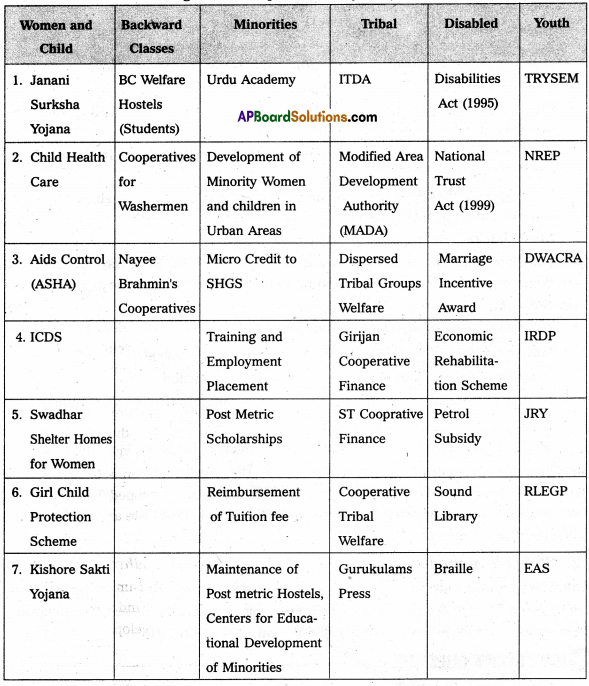
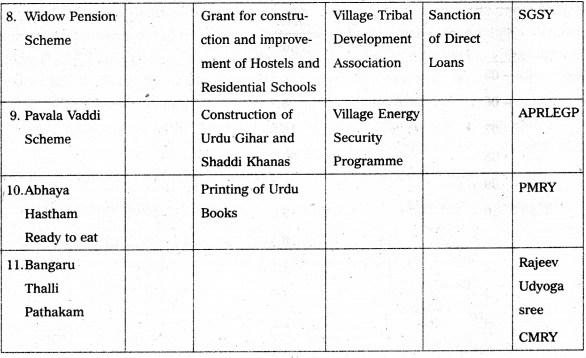
The foremost objective of any welfare state is to sustain and improve the living standards of people. Although since a long time, agriculture and industry have been recognized as prime drivers of economic growth; social sector development is gaining ground especially in the context of human development. The concept of human development invariably highlights the importance of bringing improvement in the social infrastructure like education, health care, nutrition, water supply, housing, social security etc. Further, public investment on these social overheads ensures social justice and equality in the society.! Government of A.P has been implementing various welfare programmes schemes. Some of the important welfare programmes. The following table shows section wise – welfare programmes by A.P Government.

Section-wise Welfare Programmes Implemented by Government of Andhra Pradesh
AP Inter 2nd Year Economics Study Material Chapter 9 Economy of Andhra Pradesh 4
AP Inter 2nd Year Economics Study Material Chapter 9 Economy of Andhra Pradesh 5

Short Answer Questions

Question 1.
State Gross Domestic Product (SGDP).
Answer:
The State Gross Domestic Product may also be called as the State Income. The State gross domestic product is defined as the total value of the final/finished goods and services produced within the geographical boundaries of the State during a year.
The three sectors in A.P economy are as follows.

  1. Primary sector : Agriculture, Animal husbandary, Forests etc.
  2. Industrial sector : Industries, Gas, Irrigation, Construction.
  3. Tertiary sector : Trade, Hotels, Transport, Communication, General Administration Social Services.

Andhra Pradesh makes use of the product method for estimating the SGDP in Agriculture sector, industrial sector, service sector. The GSDP in 2004 – 05 was 1,34,767 crores and it has incrosed to ₹ 2,50,282 crores in 2013 – 14. The annual growth in 2005 – 06 was 5.35 percent and it decreased to 2.14% in 2008 – 09 and picked up again and reached 7.29% in 2011-12.

AP Inter 2nd Year Economics Study Material Chapter 9 Economy of Andhra Pradesh

Question 2.
State percapitaincome.
Answer:
The percapita income gives better idea of the standard of living of the people. This can be taken as an indicator of improving living standards in A.P economy. The following table reveals changes in percapita income A.P from 2004 – 05 to 2013 – 14.

Percapita Income of A.P and All India at Current Prices
AP Inter 2nd Year Economics Study Material Chapter 9 Economy of Andhra Pradesh 6
The state PCI is always higher than the national average. For 2013-14 the gap between State and National percapita incomes is ₹ 11,417. Among the districts Viaskhapatnam with a percapita income ₹ 1,13,860 stands tall, while Srikakulam remains at the bottom with almost half of the PCI Visakhapatnam.

Question 3.
Occupational distribution of labour in A.P. [A.P. Mar- 18]
Answer:
Occupational distribution pattern in any country decides the level of economic growth. Any economy can be divided into

  1. Agriculture sector
  2. Industrial sector
  3. Service sector

Dividing the total population according to their occupation or work is known as occupational distribution of population or labour.

According to the statistical abstract of A.P 2014, prepared on the basis of the 2011 census, the total number of workers is A.P is 2,30,80,964. Among them, the total number of workers in industry sector in A.P is 33,40,133 which is 14.47% of total work force. Total number of workers related to primary sector is 1,43,92,736. i.e., 62.36% and 34.77% of total work force based on service sector.

The number of people depending on agriculture sector is still very high. Tertiary sector is in the second place and providing livelihood to the larger percent of population after agriculture sector. In A.P secondary sector’s contribution is steady and constant.

AP Inter 2nd Year Economics Study Material Chapter 9 Economy of Andhra Pradesh

Question 4.
Environmental protection activities in the state. [A.P. Mar. 17]
Answer:
Andhra Pradesh having good environmental conditions. Its coastline is second in India and first in South Indian states. To protect this rich environment, steps have been taken by the State Government.
1) Environmental Protection Programmes : State is implementing programmes like Community Forest Management (CFM), National Afforestation Programme (NAP) etc.

2) Chettu – Neeru Programme : The State Government launched ‘neeru – chettu’ a programme aimed at conserving water and saving trees, in all districts in 2015.

3) Non – Conventional Energy : A.P Department of Energy decided to make the State as a largest “Green Energy Corridor”, by increasing the production of renewable energy through solar.

4) Vanamahotsava : Forest Department celebrated 64th Vanamahotsava in 2013 with view of ‘Two million tree plantation”.

5) Wildlife conservation: To protect the rich bio-diversity of Flora, Fauna and ecosystem Govt, declared 66 protected areas which include 13 wildlife sanctuaries and 3 National Parks. Biodiversity conservation society of A.P has been constituted to take care of the conservation measures of wild life sanctuaries. The Seshachalam Biosphere Reserve has been notified and made functional.

Question 5.
Importance of Tourism in A.P. [A.P. Mar. 18, 16]
Answer:
Andhra Paradesh Tourism Development corporation is state government agency which promotes tourism in A.P. The state government is making efforts to bring the world to A.P and take A.P to the world. A new tourism policy was announced in 2010 and steps are initializing to make Andhra Pradesh as a tourist – friendly destination. The important types of tourism in A.P are as follows.

  1. Pilgrim Tourism
  2. Health Tourism
  3. Buddhist Tourism
  4. Beach Tourism
  5. Farm Tourism
  6. ECO Tourism
  7. Leisure Tourism

The tourist spots in A.P are attracting both domestic and foreign tourists.
The state is also famous for pilgrim tourism. All these attractions are increasing the inflow of foreign and domestic tourists in A.P.
Tourism is now becoming a revenue source for the state’s treasury along with IT sector.

AP Inter 2nd Year Economics Study Material Chapter 9 Economy of Andhra Pradesh

Question 6.
Population characteristics of Andhra Pradesh. A.P. Mar. 16]
Answer:
The demographic characteristics of newly formed State of Andhra Pradesh with 13 districts (Coastal Andhra & Rayalaseema). The population of 4.96 crore which accounts for 4.1% of the country’s population makes it the 10th most popular state in the Country of this male are 2,48,30,513. A female population is 2,47,46,950 in 2011 census. Sex ratio for every 1000 male is 997 and female is 943 in 2011. Where the rural population is 349.67 in 2011, in total population the density of population goes up 304 per sq.km in 2011 census. The fertility rate in A.P is also showing a downward trend in the recent years. The literacy rate is 67.35 in 2011 for A.P in which male literacy is 74.77 and that of female is 59.96. State has 5.64% less literates when compare to the Nation.

Question 7.
Welfare schemes related to different sections in Andhra Pradesh.
Answer:
The foremost objective of any welfare state is to sustain and improve the living standards of people. Government of A:P has been implementing various welfare progra-mmes/schemes some of the important programmes implemented by the government of Andhra Pradesh.

Welfare programmes of women and child they are Janani Suraksh Yojana, Child Health Care services, Kishore Sakti Yojana, Widow Pension Scheme, Pavala Vaddi Scheme, Abhaya Hastham Ready to eat etc. some of the youth welfare programmes are TRYSEM, DWACRA, Rajeev Udyoga Sree etc., some of minorities programmes are Urdu Academy, Micro credit to SHGS, Post Metrict Scholarships, Reimbursement of tution fee etc.

Very Short Answer Questions

Question 1.
SGDP [A.P. Mar. 18]
Answer:
The state gross domestic product is defined as the total value of the final goods and services produced with in the geographical boundaries of the state during a year.

AP Inter 2nd Year Economics Study Material Chapter 9 Economy of Andhra Pradesh

Question 2.
Density of population in A.P.
Answer:
The density of population determines the magnitude of the burden that State is being called upon to carry and to determine the future potential of growth.
Density of population = Total population in the area/total area in square k.m
In A.P the density of population is 304 per square km in 2011 census.

Question 3.
Literacy rate in A.P.
Answer:
Literacy is the reading and writing skill of the people. The literacy rate is 67.35 in 2011 for A.P. in which male literacy is 74.77 and that of female is 59.96. State has 5.64% less literates when compare to the Nation, West godavari stood in 1st place. Vizianagaram having lowest literacy rate.

Question 4.
Project Tiger. [A.P. Mar. 18, 16]
Answer:
This programme is being implemented with the objective of increase the number of our National animal tiger. The Nagarjuna Sagar, Srisailam Tiger Reserve Spreads over the districts of Kurnool, Prakasam, Guntur which is the home to over 50 tigers and able to support even more.

Question 5.
Sarva Siksha Abhiyan.
Answer:
This was introduced during 2001 – 2002 with an aim to provide universal elementary education for all children in the 6 to 14 age group by 2014 SSA has how been renamed as ‘Rajiv Vidya Mission’ in A.P.

AP Inter 2nd Year Economics Study Material Chapter 9 Economy of Andhra Pradesh

Question 6.
Any Welfare Programme.
Answer:
Government of A.P has been implemention various welfare programmes/schemes. Some of the welfare programmes are Pavala Vaddi scheme, Abhaya Hastam Ready to eat, Metric Scholarships, Micro credit to self help groups etc.

Question 7.
Eco – Tourism [A.P. Mar. 17]
Answer:
Andhra Pradesh vision – 2020 envisaged East Godavari tourism as a growth engine. It is one of the important type of tourism in A.P. Maredumilli, Nelapattu (Nellore) Mamandur, Talakona (Chittoor), Balapalli (Kadapa), Ethipothala (Guntur), Kambala Konda (Visakhapatnam) are the famous eco – tourism centres in A.P

Question 8.
Civil aviation in A.P
Answer:
Government has entered into memorandum of understanding with Airports Authority of India (AAI) for up – gradation / modernization of non metro airports at Vijayawada, Tirupati, Kadapa and Rajahmundary. AAI has proposed to upgrade the Tirupati airport International standards.

Question 9.
Roadways in A.P
Answer:
Roads are one of the basic modes of the transportation system and also an important priority sector of infrastructure. Road transport carries more than 80% of the goods and passenger traffic. A.P has extensive road network of 1,46,954 km with 42,511 km of State Highways 3,144 k.m of National Highway and 1,01,484 km of District Roads.

AP Inter 2nd Year Economics Study Material Chapter 9 Economy of Andhra Pradesh

Question 10.
Sea – ports in A.P [A.P. Mar. 17, 16]
Answer:
Ports are a gateway to trade and commerce. A.P has the second longest coastline of 972 km after Gujarat in India. Ports provide development and growth of maritime activities. Visakha is the largest port in the State and also one of the largest port in terms of handling cargo in Country.

AP Inter 2nd Year Economics Study Material Chapter 8 Environment and Sustainable Economic Development

Andhra Pradesh BIEAP AP Inter 2nd Year Economics Study Material 8th Lesson Environment and Sustainable Economic Development Textbook Questions and Answers.

AP Inter 2nd Year Economics Study Material 8th Lesson Environment and Sustainable Economic Development

Essay Questions

Question 1.
Define environment and explain the components of environment
Answer:
The word Environment is derived from the French word environner which means to surround or encircle. Everything which surround us may collectively be termed as the environment, we are surrounded by both living and non living things. The living things are called as biotic part (Physical environment) and non-living things as abiotic part (Biological environment) of the environment.

Components of Environment : According to National Environmental Policy Act (NEPA) of USA, 1969, the term “Environment” includes physical, social, cultural, economic and aesthetic dimensions. According to Rau & Wooten, environment can be viewed in four dimensions.

1) Physical Environment: It covers the physical, chemical and biological elements such as land, climate, vegetation, wild life surrounding land uses and physical character of the area, infrastructure, air and noise pollution levels.

2) Social Environment: It includes a large number of factors such as population and its density, community, composition, religious, education, community facilities like schools, parks, hospitals, recreational and cultural facilities. Some social factors will overlap the economic factors.

3) Economic Environment: All economic factors like employment, unemployment levels and sources of income, availability of factors of production, demand patterns, poverty level etc., are come under this category.

4) Aesthetic Environment : This category comprises historical archeological or architecture of objects or sites, scenic areas, views and landscapes. People derive pleasure by seeing such objects.

As the environment consists of all these different components, it is considered to be completely interdisciplinary discipline. We need the knowledge of Physics, Botany, Zoology, Geology, Geography, Agriculture, Chemistry, Economic Education, Demography, Ecology, Sociology, Philosophy, Political Science, Biotechnology, Biochemistry and Genetics to understand what an environment is.

AP Inter 2nd Year Economics Study Material Chapter 8 Environment and Sustainable Economic Development

Question 2.
Describe the relationship between environment and the economy.
Answer:
Relationship between environment and economy: The functions of the environment explain the importance of environment. It acts as the supplier of raw materials to the economy and absorbs the wastes discharged by the economy.

In economic terms, the resources supplied by the environment can be called as environmental goods. These goods are public goods. They can be used by many individuals at the same time without any competition from other individuals.

However, in modem days, the reckless and exploitative behaviour of the economic activity is setting a limit to the efficiency of environment to supply to the resources. Economist warned the world about the consequences of overuse of environmental resources. He said that earth is a spaceship with a limited amount of life support resources. He warned the mankind to minimize the consumption rather than to maximize it.

In the other words, there should be a balance between inputs and outputs. When we receive the inputs to produce goods and services, it must be equal to the consumption and the discharge of wastes. The quality of wastes and emission must be less, so that the environment can absorb them. Material balance model.provides and excellent.answer for the relationship that must exist between environment and the economy.
R = F + W1
The household sector consumes all the ‘F units of produced goods and services. While doing so, it also produces W2 units of wastes.
So in the consumption sector F = W2
Hence, in the consumption economy R = F = (W1 + W2)
Therefore R = (W1 + W2)
These equations show that the entire mass of inputs (raw materials) equal the entire mass of output (wastes). This entire amount of wastes is returned to the environment. Thus, the materials taken from the environment are again returned the environment in equal amounts. Hence, R = W1 + W2.
This equality shows the accounting identing of the material balance. Assuming this two sector model, material balance can be explained by the diagram.
AP Inter 2nd Year Economics Study Material Chapter 8 Environment and Sustainable Economic Development 1
Note: F = W and R = W1 + W2; F = Final goods and services; W = Wastes; R = Raw material the production sector uses R (Raw materials) units of raw materials from the environrhent to product F unit of final products./While producing the final products, it also produces W1 amount of wastes. So in the production sector.
R = F + W1
The household sector consumes all the ‘F units of produced goods and services. While doing so it also produces W2 units of wastes.
So in the consumption sector F = W2
Hence, in the economy R = F = (W1 + W2)
Therefore R = (W1 + W2)
These equations show that the entire mass of inputs (raw materials) equals the entire mass of output (wastes). This entire amount of wastes is returned to the environment. Thus, the materials taken from the environment are again returned to the environment in equal amounts. Hence, R = W1 + W2. This equality shows the accounting identity of the material balance.

It can be concluded that this material balance model depends upon the first two laws of thermodynamics. The first law explains that the energy can be changed from one form to another. But it can neither be created nor destroyed. The second law is the law of entropy. Economic activities of production and consumption are dependent on these two laws. Similarly generation and assimilation of wastes are also dependent on the two laws.

AP Inter 2nd Year Economics Study Material Chapter 8 Environment and Sustainable Economic Development

Question 3.
What is air pollution ? Explain the causes and consequences for air pollution.
Answer:
“The excessive concentration of contaminated substance in the air which adversely affects the well being of the individuals, living organs and property of all forms” is called as air pollution.

Causes for air pollution : It is estimated that 2 billion tonnes of air pollutants are released every year. Besides natural sources, a number of man-made sources are causing air pollution. Burning of fire woods for domestic purposes, burning of fossil fuels, industrialization, agricultural activities, vehicular emissions, nuclear tests, deforestation, mining power generation, refrigeration industries, etc., are the sources of air pollution.

Effects of Air Pollution :

  1. Air pollution adversely affects people, plants, animals, aquatic life and materials.
  2. It leads to health disorders in human beings.
  3. Damages the leaves of the plants and trees; interferes with photosynthesis and plant growth.
  4. Air pollution discolours the historical monuments; breakdown the exterior paint on cars and houses and deteriorates the quality of natural beauty sites. Ex : Taj Mahal in 1998, when the white marble of the famous monument began to turn yellow.
  5. Air pollution affects the stratosphere and climatic conditions.
  6. Global warming, acid rains, depletion of ozone layer, changes in the distribution of solar energy, rising temperatures, occurrence of droughts, changes in the natural plants, crops, insects, livestock
  7. Increased ultraviolet radiation are the effects of air pollution.

Question 4.
Briefly discuss the sources, effects of water pollution ?
Answer:
Water is blue gold like air, water is very essential for the existence of all the living organisms. It accounts tor about 70 percent of the weight of the human body. About 80 percent of the earths surface is covered by water.

Water pollution is defined as “the addition of some substance or factor which degrades the quality of water, so that it becomes unit for use”.
We have two sources of water surface and ground water.

Water that is found in streams, tanks, rivers and artificial reservoirs is called surface water. Water that per colates into the ground is called as ground water.

Sources of Water Pollution: The major pollutants that pollute water are :

  1. Domestic wastes and Sewage
  2. Surface run-off
  3. Silt
  4. Industrial effluents
  5. Hot effluents.
  6. Fertilizers and Pesticides
  7. Accidental Oil spills
  8. Compounds of toxic metals
  9. Mining wastes
  10. Untreated waste water and garbage etc.,

Effects of Water Pollution: Water pollution generates the following effects.

  1. Transmits the water – borne diseases.
  2. Deteriorates the quality of drinking water.
  3. Affects the productivity of irrigated agricultural lands.
  4. Sea food becomes contaminated.
  5. Depletes oxygen in water. Brings undesirable changes in temperature and breeding of fish.
  6. Makes water unfit even for swimming
  7. Produces offensive odours in water.
  8. Water-related diseases cause a heavy economic burden, particularly for poor people.
  9. Leads to loss of human days due to illness.
  10. Children suffer from intestinal diseases.

AP Inter 2nd Year Economics Study Material Chapter 8 Environment and Sustainable Economic Development

Question 5.
Define noise pollution and explain how it affects the quality of environment?
Answer:
Sound is different from ‘Noise’, though these words are used similarly. Not all sounds are noise. A deep, loud and unpleasant sound is called noise. It is undesirable and unwanted. To be precise, anything between 50 to 90 dB is considered as noise. The human ear can safely responds to pressures upto 120 dB. As per the Environment (protection) (Second Amendment) Rules, 1997, the permitted noise levels is 125 dB.

“Any noise generated above 125 dB and produces harmful effects in effects in environment and causes health hazards to human being” is called as noise pollution.

Noise becomes a pollutant when it exceeds certain limits. Noise pollution remains in the environment only for hazards to human being is called as noise pollution limited time. It is not so dangerous as air and water pollutions. They are

  1. Indoor sources
  2. Outdoor sources.

Sources of Noise Pollution : There are two board categories of sources for noise pollution. They are 1. Indoor sources 2. Outdoor sources.

1) Indoor Sources: Sounds generated by the use of home appliances, libraries, living rooms, business offices, sounds generated by alarm clocks, breathing, conversation, computer rooms etc., are the sources of indoor noise pollution.

2) Outdoor Sources: Noise generated by transport vehicles, loud speakers, industries, marriages, aeroplanes, cinema theatres, firing of crackers, heavy road traffic, festivals etc., are the outdoor noise pollutants.

Effects of Noise Pollution: Noise pollution affects the quality of environment as well as life on earth. Noise pollution leads to the following effects.

  1. Pollutes the essence of music and speech.
  2. Affects communications.
  3. Leads of temporary or permanent hearing loss.
  4. Affects the functioning of various systems of human body. Hypertension, sleeplessness, digestive disorders, peptic hinders, blood pressure changes are some of the ill effects of noise pollution.
  5. Disturbs the brain waves of the people at sleep.
  6. Causes irregular or faster pulse beats and increases in blood cholesterol levels.
  7. Causes increased heart-beat rate of the foetus.
  8. Causes irrepairable damage, to unborn babies.
  9. Ears, the first organ that develop of the unborn babies, are badly affected.

Question 6.
What are the economic implications of environmental degradation ?
Answer:
Environmental degradation is slightly different from pollution. Environmental degradation is decrease in the quality of environment, whereas, the pollution is the contamination of the nature (air, soil, water) with harmful substances. Environmental changes may be driven by many factors including economic growth, population growth, urbanization, intensification of agriculture, rising energy use and transportation etc. The basic factors for environmental degradation are discussed below.

1) Social factors: Social factors, which are responsible for environmental degradation are briefly discussed below.

a) Population : Population is an important source of development yet it is a major source of environmental degradation when it exceeds the threshold limits of the support systems.

b) Poverty : Poverty is said to be both the cause and effect of environmental degradation. The circular link between both concepts is an extremely complex phenomenon. Inequality may faster unsustainability because, the poor, who rely on natural resources more than the rich, deplete natural resources faster as they have no real prospects of gaining access to other types of resources.

c) Urbanisation : Lack of opportunities for gainful employment in villages and the ecological stresses is leading to an ever-increasing movement of poor families to town, Mega cities are emerging and urban slums are expanding. Such rapid and unplanned expansion of cities has resulted in degradation of urban environment.

2) Economic factors : Environmental degradation is the result of market failure. In this context, environmental degradation is a particular case of consumption or production of externalities reflected by divergence between private social costs.

3) Institution factors: The Ministry of Environment and Forest of the government of India is responsible for protection, conservation and development of environment. Environment Act, 1986 is the key legislation governing environment management. Wild life Act 1972, the forest conservation Act 1980 etc.

AP Inter 2nd Year Economics Study Material Chapter 8 Environment and Sustainable Economic Development

Question 7.
What are the various factors resulting in environmental pollution ?
Answer:
Pollutions are classified into different ways. They are classified according to their form, exsistence and natural disposal.
According to their natural disposal, the pollutants are classified into three groups.
1) Degradable pollutants: The pollutants are can be rapidly broken down by natural processes are called degradable pollutants. Ex : discorded vegetables, domestic sewage etc. These pollutants are called as Biodegradable pollutants.

2) Slowly Degradable pollutants : Some pollutants remain in the environment for many years in unchanged condition pollution results when their discharge exceeds the capacity of the environmental degrade them. These pollutants are actually waste products. Ex : DDT, Plastic etc.

3) Non – Degradable pollutants: The pollutants which can not be degraded by natural processes are called as nondegradable pollutants once they enter into the environment, it is difficult to eradicate them. They continue to accumulate in the environment. For Ex : Nuclear waste.

Short Answer Questions

Question 1.
Explain various concepts of Environment.
Answer:
Environment around us consists of living and non living things with their inter dependency and mutual interaction. A study of all these aspects is called as ecology. To understand environment and its nature, a primary information of its basic concepts is needed. Eco-system biodiversity, greenhouse effects, global warming, climate change, acid rains, ozone depletion are some of the basic concepts of environment.

A) Eco-System: The British Ecologist AG.Tansley coined the term Ecosystem in 1935. An ecosystem is a region with a specific and recognizable land, scape (form) such as forest, grassland, desert, or coastal area. The living community of plants and animals in any area together with the non-living components of the Environment constitute as ecosystem.

B) Biodiversity : The word biodiversity was coined by Walter Rosen in 1986. Living organisms are different in their size, colour, shape and structure. The genes, environment and ecosystem decide this variety and complexity in the living organisms. The variety and variability among living organisms is called as biodiversity.

C) Greenhouse effect: It is a phenomenon in which the atmosphere of a planet traps radiation emitted by the sun, caused by gases such as carbon dioxide, water vapour and methane that allow incoming sunlight to pass through but retain heat radiated back from the planet’s surface. It is a process by which thermal radiation from a planetary surface is absorbed by atmospheric greenhouse gases and is re-radiated in all directions.

Greenhouse effect may leads to many serious environmental issues such as radiation, climate change, mansoon, directions and its efficiency and so on.

D) Global Warming : Global warming is the increase of Earth’s average surface temperature due to the effect of greenhouse gases, such as carbon dioxide emissions from burning fossil fuels or from deforestation. Which trap heat that would otherwise escape from Earth.

E) Acid Rain : Acid rain is a broad term referring to a mixture of wet and dries deposition (deposited material) from the atmosphere containing higher than normal amounts of nitric and sulfuric acids. These acid rains are the result from both natural sources such as volcanoes and decaying vegetation and man-made sources, primarily emissions of sulfur dioxide (SO2) and nitrogen oxides (NOx) resulting from fossil fuel combustion.

F) Ozone Depletion : Reduction in the amount of Ozone (O3) in the stratosphere is called ozone depletion. It happens due to high levels of chlorine and bromine compounds in that layer.
As ozone depletes more ultraviolet (UV) radiation comes to earth and causes damages to all living organisms. UV radiation seems responsible for skin cancer and other skin complications.

AP Inter 2nd Year Economics Study Material Chapter 8 Environment and Sustainable Economic Development

Question 2.
Causes for soil or land pollution.
Answer:
Soil pollution is defined as “Unfavourable alteration of soil quality by disturbing the natural composition which decreased soil productivity.
Causes for Soil Pollution :

  1. Soil pollution or land degradation is primarily caused by soil erosion, in which the fertile upper surface of the land erode and land become barren. It happens due to deforestation, extensive cultivation, mining activities etc.
  2. Desertification is spreading due to over grazing, extensive use of poor soils, alkalization and salination of soil.
  3. Soil is also degrading because of excessive use of chemical fertilizers and pesticides leads to acidification which changes chemical properties and destroy plants and agricultural sector on the whole.
  4. Filling of wastages and other disposals into the land also causes land degradation.

Question 3.
Types of natural resources with suitable examples. [A.P. Mar. 16]
Answer:
Natural resources are classified on the basis of their quantity, mutability and re¬usability. However, it would be convenient to classify the natural resources in the following general categories.
AP Inter 2nd Year Economics Study Material Chapter 8 Environment and Sustainable Economic Development 2
Natural Resources
1) Renewable Resources : The natural resources which cam be used permanently without depletion are called renewable resources. They are not exhaustible. They have the capacity to regenerate themselves, within a short period. Ex: Solar; wind, tidal etc.

2) Non-Renewable Resources : The natural resources which will exhaust by use are called as non-renewable resources. They cannot be regenerated. Once we exhaust these resources, they will not be available for use. Ex : Gold, silver, copper etc.

Question 4.
What is pollution ? Explain the types of pollution.
Answer:
Pollutant is a physical agent which is found more than the normal levels, changes the physical, chemical or biological characteristics of the resources that environment is supplying.
Types of Pollution : Pollution can be classified into various types among which air, water, soil, noise pollutions are important forms.

Air Pollution: The excessive concentration of contaminated substance in the air which adversely affects the well being of the individuals, living organs and property of all forms is called as air pollution.

Water Pollution : It is defined as the addition of some substance or factor present in water which degrades its quality. So that it becomes health hazard or unfit for use”.

Soil Pollution : Unfavourable alteration of soil quality by disturbing the natural composition which decreases soil productivity.

Noise Pollution : Any noise generated above 125 dl. B and produces harmful effects in environment and causes health hazards to human being is called noise pollution.

AP Inter 2nd Year Economics Study Material Chapter 8 Environment and Sustainable Economic Development

Question 5.
What do you mean by ”Sustainability” ? Explain the Components of Sustainability.
Answer:
Sustainability can also be defined as achievement of constant real consumption through time keeping the capital intact. A flow of consumption without reducing the capital is called sustainability.

There are three basic components of sustainable developments namely economic, social and environmental components. These three components are interdependent.
AP Inter 2nd Year Economics Study Material Chapter 8 Environment and Sustainable Economic Development 3
Economic Component: Economic components of sustainability require that societies pursue growth path that generate, optimum flow of income while maintaining the basic stock of man-made capital, human capital and natural capital.

Social Components : Social components of sustainability are built on the twin principles of justice and equity. For development path to be sustained, wealth, resources and oppo’rtunities should be equally shared. All citizens should have access to minimum standards of security, human rights and social benefits such as food, health, education and opportunities of self-development.

Environmental Components : Environment components of sustainability require sustainable resource use, efficient sink function and maintainance of natural capital. The environment should be able to perform its three functions efficiently and uninterrupted so that ecological stability and resilience are not affected.

Question 6.
Explain the effects of pollution on human health.
Answer:
Enviommental degradation has adverse effects on human health; which may lead to raise the labour absenteesism. Ill health causes to decrease the efficiency of labour which intum leads to low productivity.

i) Air Pollution: Air pollutants like carbon monoxide, nitrogen oxides, hydrocarbons, particulate matter etc., attack human health through respiratory system. Diseases like bronchitis, lung cancer, eye irritation and skin irritation etc., are caused by air pollution.

ii) Water Pollution : Water is significant vehicle in transmission of diseases, various, disease – producing organisms such as viruses, bacteria and protozoa are transmitted through water. These organisms cause dysentery, typhoid, cholera and infectious hepatitis.

iii) Sound Pollution: Sound pollution affects human health in many ways. Loud noise causes disturbances in sleep and lead to different side effects. It leads to damage of hearing, interference with work tasks and speech, diversion of concentration, hypertension, tachycardia (fast heart beat) and irritation.

AP Inter 2nd Year Economics Study Material Chapter 8 Environment and Sustainable Economic Development

Question 7.
Measures for the conservation of forests. [A.P. Mar. 18, 17]
Answer:
Forests are the carbon sinks and treasures of scenic beauty. The following are some protective measures such important forests.

  1. Forest land should not be alloted to poor for house sites.
  2. Specific areas must be developed under social forestry programmes.
  3. Waste land must be brought under plantations.
  4. Forest must be protected from fires particularly in summer.
  5. Measures must be taken to refill the depleted forest area.
  6. Establishment of Joint Forest Management Communities is necessary.
  7. Cattle grazing and illegal cutting of trees should not be allowed.
  8. Local communities must be involved in the conservation of forests.

Question 8.
Need for environmental preservation.
Answer:
1) Moral persuasion, which is an appeal to reduce pollution in the broader interests of the society and making people involved in the environmental protection activities.

2) Methods of recycling should be made compulsory in which production units are restricted to maintain certain level of environmental quality or to install a specific treatment of pollutants.

3) Fiscal controlling techniques should be implemented such as
a) Levying of an affluent charge or pollution charge and revenue so collected should be redirected for the purpose of environmental protection.
b) Giving subsidies on pollution control equipment and encouragement of eco-friendly techniques of manufacturing.
c) Refundable deposit, which is collected from the polluters and refunded after his activities cease.
d) Pollution permits should be fixed and to see each production unit is functioning with in the limits.
e) Industrial permits should be linked with the maintenance of plantation in proportion to its production activity.

4) Government investment programmes such as waste treatment plants, slum clearance and management of wild like refugees, reforestration and afforestation are some policy instruments available to control pollution and preserve environmental equity.

5) As the children are the future citizens, awareness on environment and its protection should be introduced as a part of their curriculum. An effort is made by the government in this direction and now environmental education is mandatory part in education system from school level and onwards.

6) So far, government of India enacted some of the following acts for environmental protection.
a. The Wild life Protection Act, 1972.
b. The Water (prevention and control of pollution) Act, 1974 amended in 1978 and 1988.
c. The Air (Prevention and Control of Pollution) Act, 1981.
d. The Air (Prevention and Control of Pollution) Rules, 1982.
e. The Forest (conservation) Act, 1980 amended in 1988.
f. The Environment (protection) Act, 1986.

Very Short Answer Questions

Question 1.
Environment.
Answer:
The word environment is derived from French word environner which means to surround or encircle. Everything which surrounds us is collectively called as environment.

AP Inter 2nd Year Economics Study Material Chapter 8 Environment and Sustainable Economic Development

Question 2.
Ecosystem. [A.P. Mar. 16]
Answer:
The British ecologist A.G.Tansley coined the term Ecosystem in 1935. Eco system is the combination of natural and physical environment in a given geographical arc. It is two types. 1. Natural eco-system 2. Artificial eco-system.

Question 3.
Greenhouse effect. [A.P. Mar. 17]
Answer:
It is a phenomenon in which the atmosphere of a planet traps radiation emitted by the sun caused by gases such as CO2, water vapor and methane, that allow incoming sunlight to pass through but retain heat radiated back from the planet’s surface. It leads radiation climate changes etc.

Question 4.
Air Pollution.
Answer:
The excessive concentration of contaminated substance in the air which adversely affect the well being of the individuals, living organs and properly of all forms is called air pollution.

Question 5.
Water Pollution. [A.P. Mar. 18, 17]
Answer:
It is defined as “the addition of some substance or factor which degrades the quality of water, so that it becomes unfit for use”. The major pollutants that pollute water are, domestic wastes and sewage, slit etc.

Question 6.
Ozone Layer. [A.P. Mar 18, 17, 16]
Answer:
The Ozone layer is present in the stratosphere which is immediately above the troposphere at a height of 12 k.m from the earth. It is 40 k.m thick layer. Ozone absorbs the dangerous ultra violet rays from the sun and protects life on earth from death.

AP Inter 2nd Year Economics Study Material Chapter 8 Environment and Sustainable Economic Development

Question 7.
Global Warming.
Answer:
Global warming is the increase of Earth’s average surface temperature due to the effects of green house gases such as carbon dioxide emissions from burning fossil fuels or from deforestation, which trap heat that would otherwise escape from earth.

Question 8.
Sustainable Development [A.P. Mar. 18, 16]
Answer:
The process of development which sustains the human well being in future also.

Question 9.
Cost – benefit analysis of environment.
Answer:
Evaluation and comparison of capital and environmental costs of a project to estimate its relative merits and demerits. Every economic activity consists of both benefits as well as costs.

Question 10.
Reasons for Deforestation.
Answer:
Forests are deforestation due to various causes such as population growth, poverty and unemployment, fire wood, overgrazing, construction of danis, roads etc.

Question 11.
Biodiversity. [A.P. Mar. 18, 17]
Answer:
The word biodiversity was coined by Waiter Rosen in 1986. The variety and variability among living organisms is called as biodiversity or totality of genes species and ecosystems in a region.

AP Inter 2nd Year Economics Study Material Chapter 8 Environment and Sustainable Economic Development

Question 12.
What is “Noise”?
Answer:
A deep, loud and unpleasant sound which is undesirable and unwanted.

Question 13.
What is Land Degradation? .
Answer:
Land is a valuable resource wedepend for food, habitations and for all the basic necessities on land. The land is said to be degraded. Deforestation cultivation industrialisation, wind erosion, soil acidity are important sources for land degradation.

Question 14.
Environmental Externalities.
Answer:
An externality is a consequence of an economic activity that is experienced by unrelated third parties. It is either positive or negative. Whenever economic activity is held environmental externalities should be considered.

Question 15.
Swachh BharatAbhiyan. [A.P. Mar. 16]
Answer:
Mahatma Gandhi communicated a quintessential message to the ration through his efforts, to educate people around him about cleanliness. He wished to see a ‘Clean India’. To work seriously towards this vision of Gandhiji, R M. Shri Narendra Modi – External website that opens Swachh Bharat in October 2, 2014. This mission seeks to achieve the goal.

AP Inter 2nd Year Economics Study Material Chapter 7 Planning and Economic Reforms

Andhra Pradesh BIEAP AP Inter 2nd Year Economics Study Material 7th Lesson Planning and Economic Reforms Textbook Questions and Answers.

AP Inter 2nd Year Economics Study Material 7th Lesson Planning and Economic Reforms

Essay Questions

Question 1.
Define planning and what are the objectives of planning.
Answer:
There is no single opinion among economists with regard to the meaning of planning. From the economic growth point of view, planning stands for the actions taken during a particular period to achieve a targeted growth rate, economic planning implies deliberate control and direction of the economy by a central authority for the purpose of achieving definite targets and objectives within a specified period of time.

Thus planning means the efforts taken to reach the already set goals during a particular time period or directing the economic activities in a systematic way to get the set goals.

General objectives of planning :

  1. To increase the annual growth rate.
  2. Thereby, increasing the per capita income and standard of living of the people in the country.
  3. Speedy industrial development.
  4. Self-sufficiency with respect to the production of food grains.
  5. Removal of regional imbalances.
  6. Eradication of poverty by removing disparities in income and wealth.
  7. To increase the employment opportunities.
  8. To bring steady growth through price stabilisation.

AP Inter 2nd Year Economics Study Material Chapter 7 Planning and Economic Reforms

Question 2.
Explain the objectives of Twelth five year plan. [A.P. Mar. 17, 18]
Answer:
The Government on 4th October approved the 12th five year plan (2012 – 2017) to achieve annual average economic growth rate of 8.2 per cent, down from 9 per cent envisaged earlier, in view of fragile global recovery. According to officials the projected average rate gross capital formation in the 12th plan is 37 per cent of GDP. The projected gross domestic savings rate is 34.2 per cent of GDP.

Main objectives :
The main objectives of twelth five year plan with its central aim faster, sustainable and more inclusive growth are discussed under the following heads.
a) Economic Growth :

  • Real GDP Growth Rate of 8.0 per cent.
  • The per capita income should grow at 6.5 per cent per annum.
  • Agriculture growth rate of 4.0 per cent.
  • 10 percent annual growth rate of manufacturing or industrial sector.
  • Industrial sector growth rate of 7.6 percent.
  • Service sector growth rate of 9.0 per cent.
  • Every state must have a higher average growth rate in the Twelth plan than that achieved in the Eleventh plan.

b) Poverty and Employment:

  • Head – Count ratio of consumption poverty to be reduced by 10 percentage points over the proceeding estimates by the end of twelth five year plan.
  • Generate 50 million new work opportunities in the non-farm sector and provide skill certification to equivalent numbers during the twelth five year plan.

c) Education :

  • Increase in literacy to 85 percent by 2017.
  • Mean years of schoohng to increase to seven years by the end of twelth five year plan.
  • Enhance access to higher education by creating two million additional seats for each age cohort aligned to the skill needs of the economy (RUSA).
  • Eliminate gender and social gap in school enrollment (that is, between girls and boys, and between SCs, STs, Muslims and the rest of population) by the end of the twelth five year plan.

AP Inter 2nd Year Economics Study Material Chapter 7 Planning and Economic Reforms

d) Health :

  • Reduced IMR to 25 and MMR to 1 per 1000 live births, and improve child sex ratio (0-6 years) to 950 by the end of the twelth five year plan.
  • The outlay on health would include increased spending in related areas of drinking water and sanitation.
  • Reduce Total Fertility Rate to 2.1 by the end of Twelth five year plan.
  • Reduce under nutrition among children aged 0-3 yrs to half of the NFHS – 3 levels by the end of the plan.

e) Infrastructure, Including Rural Infrastructure :

  • Increase investment in infrastructure as a percentage of GDP to 9 percent.
  • Increase the Gross Irrigated Area from 90 million hectare to 103 million hectare.
  • Provide electricity to all villages and reduce AT & G losses to 20 percent by the end of twelth five year plan.
  • Connect all villages with all weather roads by the end of twelth five year plan.
  • Upgrade national and state highways to the minimum two – lane standard by the end of twelth five year plan.
  • Complete Eastern and Western Dedicated Freight Corridors by the end of twelth five year plan.
  • Increase rural tele – density to 70 percent.
  • Ensure 50 percent of rural population has access to 55 LPCD piped drinking water supply and 50 percent of gram panchayats achieve the Nirmal Gram Status by the end of plan.

f) Environment and Sustainability:

  • Increase in forest and tree cover to 33 percent.
  • Increase green cover (as measured by satellite imagery) by 1 million hectare eveiy year during the twelth five year plan.
  • Add 30,000 MW of renewable energy capacity in the plan.
  • Reduce emission intensity of GDP in line with the target of 20 percent to 25 percent reduction by 2020 over 2005 levels.
  • Cleaning of all major polluted rivers.

g) Service Delivery:

  • Provide access to banking services to 90 percent Indian households by the end of the plan.
  • Major subsidies and welfare related beneficiary payments to be shifted to a direct cash transfer by the end of the twelth plan, using the Aadhar platform with linked bank accounts.

Question 3.
Briefly review the achievements and failures of Eleven five year plans. [A.P. Mar. 18]
Answer:
Achievements :

  1. India attained self – sufficiency with regard to the food grain production increased from 50.8 million tonnes into 264 million tonnes.
  2. The growth rate in the national income increased from 3.6 percent in First plan to 8.3 percent by the end of 11 plan.
  3. The percapita income increased from ₹ 1.32 lakhs crores in the first plan to ₹ 47.67 lakh crores by the end of 11th plan. A considerable progress in progress in the production of various industries like steel, aluminium etc.
  4. Large scale development took place in infrastructural facilities like transportation irrigation tele communication etc.
  5. India attained commandable progress in science, technology and research.
  6. To control the increasing population, the family planning programme came into force for the first time in the sixth plan.
  7. The industrial growth increased from 32 million tones to 583 million tones by the end of 11th plan.

Failures of the plans: The Indian economy has made significant progress over more than fifty years of planning era. Still there are many weakness which point out towards the failures of Indian plans in many ways.

  1. Despite more than sixty years of planned economic development. Still there exist the problems of poverty and unemployment.
  2. Inspite of the several measures taken under land reforms. Still there exist inequalities with regard ownership of land. There is need for redistribution of land among the landless. So it can be said that the land reforms are not implemented properly.
  3. The plans are hot able to control the volume of black money and corruption.
  4. We are still have to go along way to reach the target of health to all.
  5. Plans are not been able to reduce the economic concentration of income and wealth in the few plans.
  6. Plans failed to achieved balanced regional development.

AP Inter 2nd Year Economics Study Material Chapter 7 Planning and Economic Reforms

Question 4.
Explain the causes of regional imbalance in India. [A.P. Mar 16]
Answer:
Regional imbalances stand in the way of a nation’s integrity, economic growth and development. Before taking the measures to rectify regional imbalances, it is imperative to know the causes of regional imbalances. They are :
a) Geographical reasons : Physical geography controls economic growth in developing countries than the developed countries. For Ex: Himachal Pradesh, Hill districts of UP, Northern Kashmir etc., remained backward mainly because of in accessibility.

b) Climate condition : Climate too plays an important role in the economic development of many regions in India, regions with adverse climatic conditions reflected in low agricultural output and absence of large – scale industries.

c) British rule: Historically, the existence of backward regions started from the British rule in India. The British helped the development of only those regions which are. endowed with conductive facilities to drain Indian wealth to their country like Calcutta, Bombay etc.

d) Concentration of Industries: New investment, in the private sector has a tendency to concentrate in already well developed areas, thus reaping the benefits of external economics. Since, well developed area offers private investors certain basic advantages viz., skilled labour, infrastructure, transport etc.

e) Scarcity of Natural Resources : Certain regions are endowed with natural resources, whereas some regions are not. Those regions with great natural resource endowment are developed faster.

f) Lack of Infrastructural Facilities: Those regions where there are no proper roads, electricity, telecommunication, drinking water, education, medical, technical, training facility, credit facilities etc., they tend to remain underdeveloped.

Question 5.
Explain the measures taken for balanced regional development
Answer:
As the problem of regional imbalance is multidimensional and peculiar one, it is very difficult to bring balanced regional development. Though steps have been launched since second five year plan in this direction, still a lot is required to do. However, following things can be done to attain a balance between different regions.

  • Transfer of funds from the central pool to backward states.
  • Starting of industries by the Government in the backward regions, as private sector having bias towards developed regions.
  • Providing infrastructural facilities like electricity, telecommunications, transport etc., in backward regions.
  • Encouragement to industrial decentralization through regional planning and micro level planning.
  • Formation of Industrial estates in backward areas.
  • Special policies to the regions where frequent floods and drought occur.
  • Central assistance to develop hill and tribal areas.
  • Encouragement to small scale industries.
  • Provision of subsidies, tax concessions, tax holidays etc.

AP Inter 2nd Year Economics Study Material Chapter 7 Planning and Economic Reforms

Question 6.
Explain the role of International Trade in Economic Development.
Answer:
The role of international trade in economic development is significant. In modem days all countries irrespective of their financial status are depending in participating in international trade. Economists found a positive association between country’s participation in international trade and its level of economic growth.

a) Increases output: Due to international trade when a country specializes in the production of few goods and division of labour, it exports the commodities which it produces cheaper in exchange for what others can produce at lower cost. It gains from trade through increased output, national income which is useful to break vicious circle of poverty and promotes development.

b) Expand mairket: Developing countries are hampered by the small size of domestic markets which fail to absorb sufficient volume of output. This leads to low inducement to investment. International trade widens the market arid increases the inducement to invest.

c) Increases Employment : Due to international market opportunities, under – developed countries started exploiting unutilized resources which will reduce unemployment and under employment. As people’s income rises, domestic savings and investments increase. Human resources will be utilized optimally.

d) Increases Internal and External Economies : Expansion of productive activities and expanded market opportunities leads to a number of internal and external economies, and hence to reduction of cost of production. There are the direct gains from international trade.

e) Indirect Benefits : By enlarging the size of the market and the scope of specialization, international trade makes a greater use of machinery, encourages inventions and innovation and raises labour productivity.

f) Import of capital goods against export of staple commodities : International trade helps to exchange domestic goods having low growth potential for the foreign goods with high growth potential.

g) Important Educative Effect : International trade helps in importation of ideas, skills and technical know – how from the developed countries and stimulates technical progress in UDCs. So underdeveloped countries have to change their poor educational, technical, productive systems so as to raise their competitiveness.

h) Basis for importation of foreign capital: Developing countries are capital scarce economies. This condition restricts the economy in all fields to move ahead. If a country actively participates in international trade, the unused capital resources of rich countries will flow and utilized effectively in capital poor countries. Foreign capital not only helps in increasing employment, output and income but also smoothen the adverse balance of payments and inflationary pressures.

AP Inter 2nd Year Economics Study Material Chapter 7 Planning and Economic Reforms

Question 7.
Define Globalization and what are the essential conditions of globalization in India.
Answer:
Globalization is the process of integrating or synchronizing domestic economy with the world economy or in simple words it is the process of opening up of domestic economy doors to the rest of the world.

Essential conditions for Globalization : There are some essential conditions to be satisfied on the domestic economy as well as the firm for successful globalization of the business. They are
a) Business Freedom : There should not be unnecessary government restrictions which come in the way of globalization. Like import restrictions, restrictions on sourcing finance, foreign investment etc. So, Liberalization is the pre condition for globalization.

b) Infrastructure facilities : The extent to which an enterprise and develop globally from home country base depends on the infrastructural facilities like water, transport, electricity, finance etc.

c) Government support : Although unnecessary government interference is a hindrance to globalization. Government support can encourage globalization. Government support may take the form of policy and procedural reforms, development of common facilities like infrastructural facilities.

d) Resources : Resources often decide the ability of a firm to globalize. Resourceful companies may find it easier to thrust ahead in the global market. Resources include finance, technology, R and D capabilities, managerial expertise etc.

e) Competitiveness : The competitive advantage of the company is an important determinant of success in global business. A firm may derive competitive advantage from any of the factors such as low costs and price, product quality, product differentiations, technological superiority etc.

f) Orientation : A global orientation on the part of the business firms and suitable globalization strategies are essential for globalization.

AP Inter 2nd Year Economics Study Material Chapter 7 Planning and Economic Reforms

Question 8.
Explain the impact of globalization on Indian Economy.
Answer:
Globalization is the process of integrating or synchronizing domestic economy with the world economy or in simple words it is the process of opening up of domestic economy doors to the rest of the world.
Impact of Globalisation on Indian Economy :
a) India’s share in the world exports raised from 0.53 percent in 1991 to 1.7 percent by 2013.
b) Foreign currency reserves which were as low as one billion U.S dollars, grow up to 333 billion U.S dollars by the end of February 2015.
c) Exports now finance more than 65 percent of imports.
d) Control over country’s current account deficit is observed.
e) The growing rate of external debt decreased drastically when compared to prereform period. .
f) International confidence in India has been restored.
g) Indian consumers are now enjoying wide variety of quality goods at lower prices.
h) Employment situation worsened in the era of globalization. The growth rate of employment actually declined from 2 percent to 0.98 percent after globalization.
i) The pressure of MNCs, IMF and World Bank force governments to take decisions regarding reforms actually leading to the closure of small and medium enterprises.
j) Globalization also widened the income inequalities among the people and even among regions too.

Short Answer Questions

Question 1.
Types of planning.
Answer:
Economic planning is the main characteristic feature of socialistic and mixed economic systems, which fallow planned development strategy.
Types of planning:
a) Perspective plan : A perspective plan is a macro plan formulated for a period of 15 to 20 years, keeping in view the long term needs and long term objectives.

b) Five year plans: Five year plans are designed for a period of five years. A five year plan is an integral part of perspective plan. After the completion of five years, the achieved targets will be reviewed.

c) Annual plans : Annual plan is part of a five year plan. The targets of five year plans are divided into annual targets and detailed plans will be prepared year – wise.

d) Rolling plans : This concept was introduced by Gunnar Myrdal. This kind of plan does not have a fixed period of time. It has only duration and moves forward, the completed year will be deleted and next year will be added.

AP Inter 2nd Year Economics Study Material Chapter 7 Planning and Economic Reforms

Question 2.
Planning commission.
Answer:
After independence on 1st March, 1950, the planning commission was setup by the Government of India. Planning Commission works independently and as an advisor to the central government. The Prime Minister of the country acts as the chairman and there will be an active deputy chairman and other members in the commission. Montek Singh Ahluwalia was its last Deputy Chairman. The cabinet minister of key portfolios also the ex-officio members. Experts in various fields like economics, industry, science and technology etc., will be appointed as full time members. From 1st January 2015, planning commission replaced by NITI Ayog.

Question 3.
Explain the objectives of planning commission. [A.P. Mar 17]
Answer:
Preparing plans for the most effective and balanced utilization of the country’s man power, physical and capital resources is the obligation of planning commission.
Objectives and functions:

  1. To make an assessment of the material, capital and human resources of the country and to examine whether they are sufficient to meet the nation’s requirement.
  2. To.define the stages, on the basis of priority in which the plan should be carried out and propose the allocation of resources for the due completion of each stage.
  3. To indicate the factors that tend to retard economic development and find feasible ways to overcome these factors.
  4. To determine the conditions for the successful execution of the’ plan.
  5. To determine the nature of the machinery required for securing the successful implementation of each stage of the plan in all its aspects.
  6. To appraise from time to time the progress achieved in the execution of each stage of the plan and to recommend alternative policy measures when they are needed.

AP Inter 2nd Year Economics Study Material Chapter 7 Planning and Economic Reforms

Question 4.
Explain atleast three failures of plans.
Answer:
The Indian economy has made significant progress over more than sixty five years of planning era. Still there are many weaknesses which point out towards the failures of Indian plans in many ways. Some of the failures are presented as under.

a) Despite more than sixty years of planned economic development, still there exist the problems of poverty and unemployment. In 2012 the Indian government stated 21.9 percent of its population is below its official poverty limit. (About 300 million people), like wise the from 1983 till 2011 unemployment rates in India averaged 9 percent reaching an all time low of 3.8 percent in December 2011. The NSS data reveals the number of unemployed to be of the order of 26.58 million during 1999 – 2000 and 28.1 million during 2009-10.

b) Inspite of the several measures taken under land reforms, still there exist inequalities regarding land, income and wealth. Distribution of surplus lands not completed.

c) One of the objectives of Indian Five Years Plans was to establish an egalitarian society. This could not be achieved so far.

d) The plans are not able to control the volume of black money and corruption. In Feb 2012 Central Bureau of Investigation (CBI) said that Indian have $ 500 billion illegal money (Black money) based on a statement made to India’s Supreme Court in July 2011.

e) We still have to go a long way to reach the target of Health to All.

Question 5.
Causes of Regional Imbalances in India. [A.P. Mar. 18, 17]
Answer:
Regional imbalances stand in the way of Nation’s Integrity, economic growth and development.

a) Geographical Reasons : Physical geography controls economic growth in developing countries than the developed countries. For example, Himachal Pradesh, Hill district of UP, Northern Kashmir etc., remained backward mainly because of inaccessibility.

b) Climatic Conditions : Climate too plays an important role in the economic development of many region in India, region with achierse climatic conditions reflected in low agricultural output and absence of large – scale industries.

c) British Rule : Historically the existence of backward regions started from the British rule in India. The British helped the developed of only those regions which are endowed with conducive facilities to drain Indian wealth to their country like Calcutta, Bombay etc.

d) Concentration of Industries: New investment, in the private sector has attendance to concentrate in already well developed areas, thus reaping the benefits of external economic. Since, well developed area offers private investors certain basic advantages viz., skilled labour, infrastructure, transport etc.

e) Scarcity of Natural Resources : Certain regions are endowed with natural resources, where as same regions are not. Those regions with great natural resources endowment are developed faster.

f) Lack of Infrastructural Facilities: Those regions where there are no proper roads, electricity, telecommunication, drinking water, education, medical, technical training facility etc., tend to remain underdeveloped.

AP Inter 2nd Year Economics Study Material Chapter 7 Planning and Economic Reforms

Question 6.
Enumerate 3 points in justification of privatization.
Answer:
1) Improvement in efficiency and performance : The Private sector introduces the profit oriented decision making process in the working of enterprise leading to improved efficiency and performance.

2) Fixing Responsibility is Easier : While personnel in the public enterprises cannot be held responsible for any lapse, the areas of responsibility in the private sector is clearly defined. This makes it possible to take people to task in the private sector units for blunders committed by them, whereas in the public sector units, it is easy to pass the buck.

3) Private units are subject to capital market discipline : Private sector firms are subject to capital market discipline and scrutiny by financial experts. In fact, the ability to raise funds in the capital market is critically dependent on performance, but not so in the case of public enterprises.

Question 7.
Rule of International Trade.
Answer:
The international trade plays avery vital role for the development of economic of the developing countries.
1) Due to international trade when a country specializes in the production of few goods and divisions of labour, it exports the commodities which it produces cheaper in exchange for what others can produce at lower cost.

2) Developing countries are hampered by the small size of domestic markets which fail to absorb sufficient volume of output. This leads to low inducement to investment. International trade widens the market and increases the inducement to invest.

3) Due to international market opportunities, under developed countries started exploiting unutilized resources which will reduce unemployment and under employment.

4) Expansion of productive activities and expanded market opportunities leads to a number of internal and external economics, and hence to reduction of cost of production.

5) By enlarging the size of the market and the scope of specialization, international trade makes a greater, use of machinery, encouraging inventions and innovation and raises labour productivity.

6) International trade helps to exchange domestic goods having low growth potential for the foreign goods with high growth potential.

7) International trade helps in importation of ideas, skills and technical know-how from the developed countries and stimulates technical progress in UDCs.

8) Developing countries are capital scarce economics. If a country actively participates in international trade, the unused capital resources of rich countries will fallow and utilized effectively in capital poor countries.

AP Inter 2nd Year Economics Study Material Chapter 7 Planning and Economic Reforms

Question 8.
Objectives of GATT.
Answer:

  1.  It had no legal status.
  2. It was not created by the governments and legislatures.
  3. It was not an agency of the United Nations Organization.
  4. It has a set of rules and producers relating to multilateral agreements of selective nature. There were separate agreements on on members.
  5. The GATT disputes settlements system was dilatory and not binding on the parties to the disputes
  6. The GATT was a forum where the member countries meet once in a decade to discuss and solve world trade problems.
  7. The GATT rules applied to trade in goods.
  8. It has a small secretariat managed by a Director General.

Question 9.
Objectives of W.T.O
Answer:
a) It aims at raising standard of living, ensuring full employment and large and steady growth, expanding the production and trade in goods and services among the global countries.

b) To allow for the optimal use of the world’s resources in accordance with the objectives of sustainable development. This also considers environmental protection with economic growth.

c) To ensure the developing and least developed countries secure a share in the growth in international trade.

d) To convince the member countries for reciprocal and mutually advantageous arrangements through reduction of tariffs and other trade harries.

e) To develop an integrated, more viable and durable multilateral trading system.

Question 10.
Differences between GATT and WTO.
Answer:
GATT

  1. It had no legal status.
  2. It was not created by the government and legislatures.
  3. It was not an agency of the united nations organization.
  4. It has a set of rules and procedures relating to multilateral agreements of selective nature. There were.separate agreements on separate issues which were not binding on members. Any member could stay out of an agreement. Only could be penalized on default.
  5. The GAIT disputes settlement system was dilatory and not binding on the parties to the disputes.
  6. The GATT was a forum where the member countries met once in a decade to discuss and solve world trade problems.
  7. The GAIT rules applied to trade in goods.
  8. It has a small secretariat managed by a Director General.

WTO

  1. It has legal status.
  2. It has been created by international treaty ratified by the governments and legislatures of the member states.
  3. It has co-operative relationship with the UNO. The agreements which form part of the WTO are permanent and binding on all members.
  4. Action can be taken against any defaulting member by all the member states.
  5. The WTO dispute settlement mechanism is automatic, faster and binding on the parties.
  6. Its properly established rule based World Trade Organisation where decisions on agreements are time bound.
  7. The WTO covers not only trade in goods and services but also trade related aspects of intellectual property rights and number of other agreements.
  8. It has a large secretariat and a huge organizational set-up.

AP Inter 2nd Year Economics Study Material Chapter 7 Planning and Economic Reforms

Question 11.
Functions of W.T.O [A.P. Mar. 18, 16]
Answer:
a) WT.O facilitates the implementation, administration and operation of world trade agreements.
b) It provides the forum for trade negotiations among its member countries.
c) It shall handle trade disputes.
d) It shall monitor national trade policies of member countries.
e) It shall provide technical assistance and training to developing countries.
f) It maintains harmonious and co-operative relationship with IMF and IBRD and its affiliated agencies.

Very Short Answer Questions

Question 1.
Define plan.
Answer:
Plan may be defined as an outline or broad statement of schemes Or programmes designed or evolved to relaise certain pre-determined economic objectives.
(Or)
The efforts taken to reach the already set gains during a particular time period.

Question 2.
What is Rolling plan ?
Answer:
Rolling Plan : This concept was introduced by Yunnar Myrdal. This kind of plan does not have a fixed period of time. It has only duration and moves forward, the completed year will be deleted and next year will be added.

AP Inter 2nd Year Economics Study Material Chapter 7 Planning and Economic Reforms

Question 3.
Concept of plan holiday.
Answer:
The gap that occurred in the planning process. There was official gap was 1966 – 69. A unofficial gap occurred in 1990 – 92 due to economic and political instability in the country.

Question 4.
Define perspective plan.
Answer:
A perspective plan is a macro plan formulated for a period of 15 to 20 years. Keeping in view the long term needs and long term objectives.

Question 5.
What is an Annual plan ? Give an example.
Answer:
Annual plan is a part of five year plan. The targets of five year plans are divided into annual targets and detailed plans will be prepared year – wise.
For example : There was a plan holiday for three years from 1966 – 69 at that time annual plans are implemented by postponing the commencement of 4th plan.

Question 6.
Backward states in India.
Answer:
We can classify the states in India into two categories on the basis of percapita income. Poverty and Human development index. They are 1. Developed states 2. Developing states Backward states are Orissa, Bihar, Utter Pradesh, Madhya Pradesh and Assam.

Question 7.
Define Regional imbalance.
Answer:
The co-existence of relatively developed and economically depressed states and even regions with each country or state is known as regional imbalance. It may be natural or mammal.

AP Inter 2nd Year Economics Study Material Chapter 7 Planning and Economic Reforms

Question 8.
Balanced regional development.
Answer:
It implies the extension of the economic progress to the backward area and widespread diffusion of industry. It does not mean equal development of the different regions in the country. The objective is to raise the standard of living of the people into backward regions.

Question 9.
What is Liberalisation ?
Answer:
It refers to relaxation of previous government restrictions usually in areas of social and economic policies. Thus, when government liberalised trade it means it has removed the tariff, subsidies and other under employment restrictions on the flow of goods and services between the countries.

Question 10.
Explain the concept of privatization.
Answer:
It is the general process of involving the private sector in the ownership or operation of a state owned enterprises. Privatisation is a process the government transfers the producing activity from the public sector to the private sector.

Question 11.
Define Globalisation. [A.P. Mar. 18]
Answer:
It is the process of integrating various economies of the world without creating any hindrance in the free flow of goods and services, technology, capital even labour or human capital.

Question 12.
Concepts of TRIPS.
Answer:
Trips refer to the legal ownership by a person or business of an invention attached to a particular product.

Question 13.
What do you mean by TRIMS ?
Answer:
Trade related investment measures refer to certain condition or restrictions imposed by a Governments is respect of foreign investment in the country. TRIMS were widely employed by developing countries. The agreement or trade. Related investment measures calls for introducing national treatment of foreign investment.

AP Inter 2nd Year Economics Study Material Chapter 7 Planning and Economic Reforms

Question 14.
The clause of MFN. [A.P. Mar. 16]
Answer:
Any concession given to any nation was automatically extended to all the member countries of the GATT. MFN means Most Favoured Nation.

Question 15.
Define Disinvestment.
Answer:
The sale of the public sector equity to the private sector is called disinvestment.

Question 16.
GATT.
Answer:
The general agreement on Tariffs and trade it came into force on 1st January 1948. As the name itself suggests, General Agreement was concerned only with tariffs and trade restrictions and regulated international trade matters. Geneva is the head quarter of GATT.

Question 17.
W.T.O. [A.P. Mar. 17]
Answer:
The WTO Agreement came into force from January 1, 1995. WTO is a new international organisation setup as a permanent body and is designed to play the role of a watch dog in the spheres of trade in goods, trade in services, foreign investment, intellectual property rights etc.

AP Inter 2nd Year Economics Study Material Chapter 7 Planning and Economic Reforms

Question 18.
Uruguay Round.
Answer:
There were 8 rounds of negotiations between participating countries. In GATT in 1947. The 1st six rounds were related to curtailing tariff rates. Seventh-round included non-tariff obstacles. 8th round is different from previous round. Because it included a number of new objects for consideration, this 8th round known as “Uruguay Round’.

Question 19.
F.D.I.
Answer:
Investment in a foreign country where the investor remains control over the investment. FDI means foreign direct investment.

AP Inter 2nd Year Economics Study Material Chapter 5 Industrial Sector

Andhra Pradesh BIEAP AP Inter 2nd Year Economics Study Material 5th Lesson Industrial Sector Textbook Questions and Answers.

AP Inter 2nd Year Economics Study Material 5th Lesson Industrial Sector

Essay Questions

Question 1.
Explain the importance of Industrial Sector in India.
Answer:
Industrialisation is a pre-requisite for any country, in a particular underdeveloped country like India. The major sectors like Agriculture and tertiary sectors depend upon the available production of equipment and machinery at reasonable prices by the industrial sector.

1) Raising Income: The first important role is that industrial development provides a secure basis for rapid growth of income. In industrially developed countries, for example the percapita income is very high where, as for the industrially backward countries is very low. Percapita income in 2012 in Germany was $ 44,010, Japan $ 47,870, U.K. $ 38,250, USA $ 50,120 and India only at $ 1530 per annum.

2) Changing the structure of the Economy: Secondly, in order to develop the economy underdeveloped countries need structural change through industrialization. The benefits of industrialization will ‘trickle down’ to the other sectors of the economy in the form of development of agricultural and service sectors leading to the rise in employment, output and income. In India sectoral contribution to gross domestic product is 13.9 percent from Agriculture, 26.2 percent from Industry and 59.9 percent from Service sector during the year 2013-14. (provisional)

3) Meeting High – Income Demands: Demands of the people are usually for industrial products alone. After having met the needs of food, income of the people is spent mostly on manufactured goods. To meet these demands and increase the economy’s output,’ underdeveloped countries need industialization.

4) Overcoming Deterioration in the terms of India : India need industrialization to free themselves from the adverse effects of fluctuations in the prices of primary products and deterioration in their terms of trade. Such countries mainly export primary products and import manufactured goods. For economic development such countries must shake off dependence on primary products. They should adopt import substituting and export oriented industrialization strategy.

5) Absorption of Surplus labour in Industries: The next advantage is underdeveloped countries like India are characterised by surplus labour and rapidly growing population. To absorb all the surplus labour it is essential to industrialise the country rapidly. It is the establishment of industries alone that can generate employment opportunities on an accelerated rate.

6) Bringing Technological Progress: Another advantage is research and development is associated with the process of industrialization. This results in bringing about an industrial civilization (or) environment for rapid progress which is necessary for any healthy economy.

7) Strengthening the Economy: Finally industrialization of the country can provide the necessary elements for strengthening the economy.

AP Inter 2nd Year Economics Study Material Chapter 5 Industrial Sector

Question 2.
Briefly review the 1948 Industrial Policy Resolution of India.
Answer:
After independence, Government of India issued the first important industrial policy statement on April 6, 1948. This resolution laid the foundation of mixed economy in India. Objectives:

  1. Establishment of a society where equal opportunities and justice to all.
  2. Increase in the standards of living of people.
  3. Removal of inequalities in income and wealth. In order to reach the objectives • mentioned above, the resolution divided the industries into four broad categories.
    1. Industries – where state (Government) had a monopoly.
    2. Mixed sector – Industries in the private sector and Government controls them.
    3. Those industries under the control of Government are the key industries. They are established by the Government. The existing private undertakings were allowed to continue for 10 years. After which Government will think of their Nationalisation.
    4. All over industries which are not included in the above were left open to the private sector. However, the state will have its control over these units. The important features noticed in the 1948 industrial policy resolution are :
      a) Industries are classified into four categories.
      b) The resolution accepted the importance of both private and public sectors in the speedy industrial development of Indian economy.
      c) The 1948 resolution also accepted the importance of small and cottage industries.
      d) The resolution also recognized the role of foreign capital and importance of regularization of its use.
      e) The resolution also mentioned about the Nationlisation of private undertakings in case of unsatisfactory progress.

Question 3.
Discuss the 1956 industrial policy resolution of India.
Answer:
1956 Industrial Policy Resolution: Agriculture sector achieved the desired progress during the first five year plan. Therefore, Government of India shifted the stress to the development of industry in the second five year plan. In the light of the socio-economic changes that took place during the 1st plan and all this necessitated a fresh statement of Industrial policy. As a result the second industrial policy resolutions were adopted in April 30, 1956.

Objectives : Following are the objectives of the 1956 industrial policy resolutions.

  1. Acclerating the rate of growth by speeding up the industrialisation process.
  2. Mutual co-operation between the public and private sectors.
  3. To develop heavy industries and machine making industries by expanding the public sector.
  4. Establishment of the socialistic pattern of society.
  5. To prevent private monopolies and the concentration of wealth and income.
  6. Reducing the regional imbalances.
  7. Encouragement to cottage and small scale industries.
  8. To build up a large and growing co-operative sector.

1956 Industrial policy resolutions gave importance to the establishment of socialistic pattern of society in India with an expanded public sector. In a nut-shall, we can say that this policy modernized the concept of mixed economy.

Important Provisions : The important provisions of the 1956 Industrial Policy Resolutions are :
1) New classification of Industries: The resolutions laid down three categories which bear a close resemblance of the 1948 resolutions.
a) Category A has 17 Industries : Arms of ammunition atomic energy iron and steel, heavy machinery for mining, machine tool manufacturers, heavy electrical, coal, mineral oils, aircrafts, air transports, railways, ship building, telephone, telegraph, wireless equipment, generation and distribution of electricity.

b) Category B includes : 12 Indusries mining industries, aluminium and other non ferrous metals not mentioned in category “A” chemical industry, antibiotics and other essential drugs fertilizers synthetic rubbur, chemicals, road and sea transport, carbonization of coal.

c) Category C includes : Industries which consisted of the rest. These industries and their future development would in general be left to the initiative and enterprise of the private sector.

2) Public and private sectors : This resolution also laid down the importance on the mutual co-operation between the public and private sectors.
The private sector was allowed to operate freely or its help could be obtained if the Government cleaned fit. However, the private sector was to remain subject to various regulations and controls of Government.

3) Cottage and Small scale Industries : The 1956 resolutions recognized the importance of small – scale and cottage industries as the 1948 resolutions.

4) Removing regional disparities ’: It also called for the reduction in regional imbalances and .income inequalities.

5) Role of labour : To provide the technical and training facilities for efficient management that helps for speedy industrialisation.
This resolutions also recognized the importance of industrial peace for the economic growth of the economy.

AP Inter 2nd Year Economics Study Material Chapter 5 Industrial Sector

Question 4.
Critically evaluate the 1991 New Industrial’Policy Resolution of India. [A.P. Mar. 16]
Answer:
Industrial policy statement 1991 brought rapid structural changes in the economy of India. Most of the State owned units were running with huge losses. Government was not interested to run the state owned units. So as part of economic reforms generally known as liberalization, privatization, globalization and a new industrial policy became inevitable.

Objectives :
a) To build on the going already made in the industrial sector.
b) To correct the distortions or weakness that may creep in the pattern of industrial growth.
c) To maintain a sustained growth in productivity and gainful employment and
d) To attain technological dynamism and international competitiveness.
Main features: In order to explore and exploit the industrial potential of the country the following decisions.

a) Delicensing:
i) Industrial licensing will be abolished for all projects except for these which are important for security, strategic, social and envirorimental reasons and items of elite’s consumption. License is not necessary for the items produced in small scale sector. License is required to establish the following industries viz, coal, petroleum, motor cars, alcoholic drugs, cigars, industrial explosives, hazardous chemicals.

ii) Reservation for the public sector: Establishment of key and strategic industries reserved for public sector are arms and ammunition, defense equipment, atomic energy, mineral oils, railway transport.

iii) Automatic clearance of capital goods: The Government permits imports of capital goods like machinery, without any conditions if the foreign exchange needed for the imports is met from foreign equity capital.

iv) Location policy : In locations other than cities of more than one million population, there will be no requirement of obtaining industrial approvals from the Central Government except for industries specified in Annexure II originally. In cities with a population of more than 1 million, industry other than those of a non-polluting in nature, were required to be located outside 25 kilometers of the periphery.

v) Abolition of convertibility clause : The mandatory convertibility clause will no longer be applicable for term loans from the financial institutions for new projects. This has provided them an option of converting part of their loans into equity, if felt, necessary by their management.

b) Foreign investment policy : According to the new industrial policy approval will be given for direct foreign investment up to 51 percent foreign equity in high priority industries. FDI is prohibited only in the following sectors in 1991 industrial resolution.

They are :

  1. Retail trading
  2. Atomic energy
  3. Lottery business
  4. Gambling and betting

c) Foreign technology agreement: Automatic approval for technology agreements in high priority industries should be given. No permission will be necessary for hiring of foreign technicians and foreign testing of indigenously developed technologies.

d) Public sector policy : Public sector will not be barred from entering areas are not specifically reserved for it. Board for Industrial and Financial Reconstruction (BIFR) is constituted to undertake the revival of rick public units and to protect the interest of workers affected by rehabilitation.

e) MRTP ACT: The conditions in the Monopoly Restrictive Grade Practices (MRTP) Act that monoploies should get prior approval of the Government for expansion, for establishment of new undertakings merger, amalgamation, take over and appointment of directors will be removed. The Act will concentrate more on controlling unfair or restrictive trade practices.

AP Inter 2nd Year Economics Study Material Chapter 5 Industrial Sector

Question 5.
Write about National Manufacturing Policy of India.
Answer:
After a long gap there was a major industrial policy initiated by the UPA Government in 2011. India’s manufacturing sector is only about 13% of that of China’s. Government of India brings back industrial policy into focus in the form of National Manufacturing Policy (NMP) on November 4, 2011.

National Manufacturing Polity : This policy envisages simplification of business requlations without diluting their purpose. Recognizing the importance of Small and Medium Enterprises (SMEs) in the country’s economy. These interventions relate primarily to technological up gradation, adoption of environment, friendly technology and equity investments. This policy has been given high priority in the policy through fiscal incentives for private sector and Government schemes. It also provided for on – lands which are degraded and uncultivable.

Objectives:

  1. Increase manufacturing sector growth 12 – 14% over the medium term.
  2. Increase the share of manufacturing in gross domestic product from the present level of about 16.0% to 25% by 2022.
  3. Create 1000 million additional jobs in the manufacturing sector by 2012.
  4. Create appropriate skills among the rural migrant and urban pour for their easy absorption.
  5. Increase domestic value addition and technological depth in manufacturing.
  6. Enchance global competitiveness of Indian manufacturing.

In India 60% of its population in the working age group. The manufacturing sector will have to create gainful employment opportunities for at least half this number.

Features:

  1. The State Government would be responsible for the selection of suitable land having an area of 50Q0 hectares in size.
  2. A Special Purpose Vehicle (SPV) will be constituted to discharge the affairs of NIMZs
  3. The State Government would facilitate the provision of water, power connectivity and other infrastructure and utilities linkages.
  4. The Central Government will bear the cost of master planning.

AP Inter 2nd Year Economics Study Material Chapter 5 Industrial Sector

Question 6.
Explain the disinvestment policy of India.
Answer:
The Government of India in July 1991 initiated the disinvestment progress in India. “In order to raise resources and encourage wide public participation, a part of the Government share holding in the public sector would be offered to mutual funds, financial institutions, general public and employees”. This is a process for disinvestment in the public enterprises.

Salient features of the disinvestment policy are :

  1. Citizens have every right to own part of the shares of public sector undertakings.
  2. Public sector undertakings are the wealth of the Nation and this wealth should rest in the hands of the people.
  3. While pursuing disinvestment, Government has to retain majority shareholding; i.e, at least 51 percent and management control of the public sector undertakings.

Development regarding Disinvestment:
On 5th November 2009, Government approved the following action plan for disinvestment in profit making Government companies.
i) Already listed profitable Central Public Sector Enterprises (CPSEs) (not meeting mandatory shareholding of 10 percent are to.be made compliant by offer for sale by Government (or) by the CPSEs through issue of fresh shares or a combination of both.

ii) Unlisted Central Public Sector Enterprises (CPSEs) with no accumulated losses and having earned net profit in three preceding consecuive years are to be listed.

iii) Follow on public offers would be considered taking into consideration the needs for capital investment of CPSE, on a case by case basis, and Government could simultaneously or independently offer a portion of its equity shareholding.

iv) In all cases of disinvestment, the Government would retain at least 51 percent equity and the managment control.

v) All cases of disinvestment are to be decided on a case by case basis.

Major disinvestment receipts, since 2004 – 05 have come from sale of equity shares of National of Thermal Power Corporation Limited. (NTPC) ? 2684.07 crore, Maruti Udyog Limited (MUL) (Not a CPSU) ₹ 2277.62 crore, Power Grid Corporation of India (PGCI) ₹ 994.82 crore, Oil India limited ₹ 2247.05 crore NMDC limited ₹ 9930.40 crore, Coal India limited ₹ 15,199 crore and Power Finance Corporation (PFQ) ₹ 1144.55 crore upto 30-1-15, the Government of India got ₹ 1,79,625.25 crores through disinvestment process that should be utilized to provide social infrastructure and to undertake other development activities in the country.

Question 7.
Explain the role of foreign Direct Investment in economic development of India.
Answer:
Foreign direct investment is a major source of non financial resources for the economic development of India. Foreign companies invest in India to take advantage of cheaper wages, special investment privileges like tax exemptions etc. The Government has taken many initiatives in recent years such as relaxing FDI norms across sectors such as defense, PSU oil refineries, telecom, power exchange, stock exchange, Auto mobile industries etc.

According to a recent report by global credit rating agency Moody’s, FDI inflows have increased significantly in India in the current fiscal. Net FDI inflow to take of US $ 14.1 billion in the 1st five months of 2014 – 15. Total FDI inflows into India in the period April 2000 – November 2014 touched US $ 350,963 millions.

Government initiatives towards (FDIs): India’s cabinet has cleared a proposal which allows 100% FDI in railway, infrastructure, excluding operations. The Government has notified easier FDI rules for construction sector, where 100% overseas investment is permitted, which will allow overeas investors to exist a project even before its completion.

With the objective of encouraging foreign firms to transfer state of the art technology in defence production, the Government increase the FDI cap for the sector to 74% from 49% at present. The Union Cabinet has cleared a bill to raise the foreign investement ceiling in private insurance companies from 26% to 49%.

The RBI has allowed a number of foreign investors to invest on repatriation basis, in non – convertible preference shares or debentures which are issued by Indian companies. The RBI has established a frame work for investments, which allows foreign port folio investors to take part in open offers, buyback of securities and disinvestment of shares by Central or State Governments.

India will require around US $ 1 trillion in 12th Five Year Plan to fund infrastructure growth covering sectors such as highways, ports and airways. This requires support in terms of FDI. During the year 2013 FDI was dumped into the automobiles, computer software, hardware, power and telecommunications.

AP Inter 2nd Year Economics Study Material Chapter 5 Industrial Sector

Question 8.
Critically examinethe role of Special Economic Zones in Indian economic development.
Anwer:
The Government of India announced Special Economic Zones policy in April 2000. This policy aims at rapid economic growth supported by quality infrastructure complemented by an attractive fiscal package, both at the-Central and State level, with the minimum possible regulations. In India, while passing the SEZ Act in May 2005 and came into effect from February 2006, the following objectives were laid down.

  1. Generation of additional economic activity.
  2. Promotion of exports of goods and services.
  3. Promotion of investment from domestic and foreign sources.
  4. Creation of employment opportunities; and
  5. Development of infrastructure facilities.

Special Economic Zones in India : Upto 2013 number of formal approval Special Economic zones were 577. Number of SEZ notified and functioning are 389 and 170 respectively. The total units approved are 3589 and these units provide employment to 10,74,904 persons (as on March 31,2013). The Special Economic Zones exports are ₹ 4,76,159 crore during the year 2012 – 13. As per the provision of the SEZ Act 2005, 100% Foregin Direct Investment is allowed.

Government Incentives to Special Economic Zones: Government of India offers the following fiscal and incentive packages to Special Economic Zones.

  1. Exemption from custom duties, central excise duties, service tax, central sales tax and securities transactions tax to both the developers and the units.
  2. Tax holidays for 15 years i.e, 100 percent tax exemption for 5 years, 50 percent for the next 5 years and 50 percent of the ploughed back export profits for the next 5 years
  3. 100 percent income tax exemption for 10 years in a block period of 15 years for SEZ devleopers.
  4. Provision of standard factories at low rents with extended lease period.
  5. Provision of infrastructure and utilities.
  6. Single window clearance and simplified procedures.

Advantages of Special Economic Zones : Special Economic Zones are expected to give a big push to exports, employment and investment. In fact, the Government of India has been systematically projecting SEZs as “Carriers of Economic Properity”. The advantages of SEZs are as follows.

  1. Boost economic growth at an extremely fast rate.
  2. Usher in affluence in rural areas.
  3. Provide large number of jobs in manufacturing and other services.
  4. Attract global manufacturing and technological skills. ‘
  5. Bring in private and public sector investment from both home and abroad.
  6. Made Indian firms more competitive and
  7. Help to slow down rural – urban migration.

To conclude, it may be stated that the standing committee report on SEZ in June 2007 is a path breaking document which indicates the direction in which the country must move if it wants to pursue industrialization with a human face.

AP Inter 2nd Year Economics Study Material Chapter 5 Industrial Sector

Question 9.
Mention the various causes for Industrial backwardness in India.
Answer:
India could not achieve the desired growth rate in the industrial sector even though it is rich in natural resources and has huge working population. Even after completion of eleven Five Year Plans, there is wide gap between targets fixed targets achieved. Rakesh Mohan opines that there is a gap of 20 percent on an average between the targets fixed and targets realized in each plan annually. The reasons for this are as follows.
Reasons for Industrial Backwardness in India
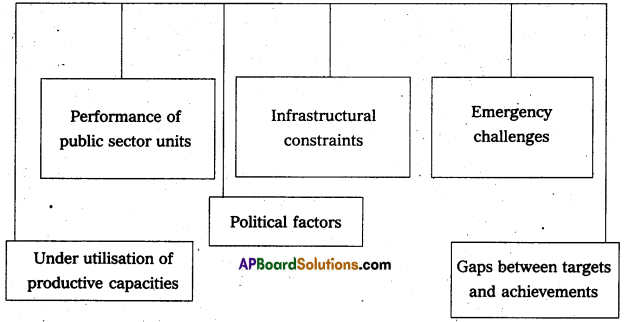
AP Inter 2nd Year Economics Study Material Chapter 5 Industrial Sector 1
1) Under – utilisation of productive capacities: Many of the industrial units failed to utilize the existing productive capacities fully. There are many reasons for this. Among them is raw material scarcity, low technical know-how etc. For example during 2005 – 2006, out of 203 public sector enterprises, the capacity utilization was below 50 percent by nearly 67 percent of the units.

2) Performance of public sector units: Prior to liberalization, there was a phenomenal growth of the public sector. Many of the public sector units were under losses. The number of loss making units decreased from 105 in 1999 – 00 to only 63 in 2011. However, the losses increased from ₹ 10,302 crores in 1999 – 00 to ₹ 27,602 crores in 2011-12.

3) Political factorsIn many situations, political factors influence decision about location of projects not considering feasibility. This approach leads to a considerable wastage of capital resources.

4) Infrastructural constraints: One of the major constraints in industrial development is poor quality and high cost of infrastructure particularly power and transport network. All such infrastructural constraints not only showed adverse effect on industrial growth but also reduced the competitiveness of Indian industries that were, fast emerging in the new global economic environment.

5) Gaps between targets and achievements : In the earlier period of planning achievements were below the targets. Rakesh Mohan has observed. “The average industrial growth rate achieved over thirty – five to forty years has been about 6.2 percent rate to the average of about 8 percent projected”.

6) Emergency challenges : As a founder member of the World Trade Orginization, India has withdrawn all quantitative restrictions on imports. This resulted into the closure of a nuclear of industrial units. Thus, the industrial sector facing so many problems.

Question 10.
What are the merits and demerits of small scale enterprises in Indian economy. [A.P. Mar. 18, 17]
Answer:
The small scale and cottage industries play apvital role in the Indian economy. As ancillary industries, they are contributing to the growth of the agriculture and industrial sectors in a developing country like India.

The recommendations of Abid Hussian Committee, the Government raised the investment limit on plant and machinery for small units and ancillaries to 3 crores and that for tiny units to ₹ 25 lakhs.
Merits:

  1. Expansion of small scale industrial sector and its share in industrial production: The rapid growth of small scale units from 2006 – 07 onwards contributing much to India’s gross domestic product.
  2. Employment opportunities : The small industries are labour intensive they could generate employment opportunities to the tune of 191.4 lakh persons in 1994 – 95, 249.3 lakh persons in 2001 – 02 and it increased to 1012.6 lakh persons in 2011 – 12.
  3. Capital formation: The spreading of industry over the country side would encourage the habits of thrift and investment in the rural areas.
  4. Low capital: The small scale units are best suited to the developing countries like India, which are labour intensive and capital scarce economics. It does not require much capital for the establishment Of these units.
  5. Skill formation : A small scale enterprise does not require any sophisticate skill. But it provide, industrial experience for large number of small scale managers.
  6. Low import intensity: Low import intensity in the capital structure of small scale .enterprises reduces the need for foreign capital.
  7. Decentralized industrial development : Development of small scale industries will bring about decentralization of industries. It will promote the object of balanced regional development.
  8. Equitable distribution : The profits earned by small scale enterprises distributed among large number of enterpreneurs leads to decentralization of income and wealth.
  9. Exports : The contribution of small scale enterprises to earn foreign exchange is very high. The share of exports from the small scale sector represents about 31.1% of total exports in 2006 – 07.

AP Inter 2nd Year Economics Study Material Chapter 5 Industrial Sector

Demerits:

  1. Inefficent human factor: Most of the rural people are illiterates and lack technical know-how in the areas of production, finance, accounting and marketing management.
  2. Lack of credit facilities : The small industrialists are generally poor and there are no facilities of cheap credit either. Thus, they are caught up in the vicious circle of debt trap.
  3. Problem of raw materials : The quantity, quality and regularity of the supply of raw materials are all highly unsatisfactory. According to an estimate, about 40 percent of such units have become sick owing to non – availability of raw materials regularly.
  4. Absence of organized marketing: Since marketing is not properly organized, the helpless artisans are completly at the mercy of middlemen. The small scale units cannot afford to spend lavishly on advertisement to promote their sales.
  5. Lack of machinery and equipment: Small scale untis are facing inadequate modem machines and equipment. This leads to low productivity in small scale units.
  6. Power shortage : In recent years power shortage and frequent power cuts played havoc with small scale industries. More hours of power cut are there in rural areas which affect the growth of small scale units.
  7. Lack of technological up – gradation : It is found that the levels of productivity and technology used by the small scale sector are not globally competitive. Without technological upgradation these units may not serve in a globally integrated economy.
  8. Heavy taxation : Cottage and small scale industries have also to bear a heavy burden of taxation both on raw materials and also on finished goods.

Question 11.
Briefly explain the Indian industrial growth rate during the Five Year Plans.
Answer:
The industrial pattern in India has undergone a marked change as a result of Five Year Pains, especially since the beginning of the Second Five Year Plan (1956 – 61). The number of bigger industrial establishments has multiplied and the proportion of producer goods in the composition of manufacturers has registered a striking is increase. Heavy and basic industries have come to occupy an important place in the industrial structure of India.

I. First Plan (1951 – 56): Owing to the small size of the First Plan, insufficiency of funds and greater urgency or agricultural development, the First Plan did not make any big provision for industrial development. The overall industrial production increased by 39 percent i.e about 8 percent per year.

II. Second Plan (1956 – 61) : The actual investment in the public sector on organized industry was ₹870 crores in the second plan. In comprised 27 percent in the Second Five Year Plan’s total outlay.

III. Third Plan (1961 – 66) : The overall financial outlay in industrial sector during the Thrid Plan was ₹ 3,000 crores, out of which the outlay in the public sector was about 1,700 crores and the private sector was ₹ 1,300 crores. An overall target of 7 per cent increase in industrial production was envisaged in the plan.

IV. Fourth Plan (1969 – 74): During the Fourth Plan on the actual out lay organized industry was ₹ 2,700 crores in the public sector. The private sector investment was around ₹ 2,250 crores. The actual performance during the Fourth Plan in the industrial sector was very disappointing. Its average annual growth rate was hardly 5 per cent as against the plan target of 8 per cent.

V. Fifth Plan (1974 – 79) : The Fifth Plan assigned a very important place to the development of industries with a view to achieving self – reliance and social justice. The public sector outlay on industrial development was around ₹ 9,700 crores. The average rate of industrial growth during the plan was targeted at 8.1 per cent per annum.

VI. Sixth Plan (1980 – 85): The public sector outlay of ₹ 23,000 crores was envisaged during the Sixth Plan period, during the sixth plan reveals that a growth rate of 5.45 percent as against 7 percent was achieved.

VII. Seventh Plan (1985 – 90) : The total investment in the industrial sector was ₹ 22,460 crores or 12.5 percent of the total plan outlay. The Seventh Plan achieved the targeted industrial growth rate of 8.5 per cent. It has been made possible because of adequate infrastructure and liberalization policy of the Government.

VIII. Eighth Plan (1992 – 97) : The Eighth Plan was formulated under a new environment when a number of reforms in industrial, fiscal, trade and foreign investment policies were introduced in the economy.

IX. Ninth Plan (1997 – 2002) : Ninth Plan allocated ₹ 69,972 crores for industry at 1996 – 97 prices. Ninth plan targeted a growth rate of 8% for industry. But it achieved only 5%.

X. Tenth Plan (2002 – 07): In the Tenth Plan public sector outlay was ₹ 44,695 crores at 2001 – 02 prices. Industrial performance in the Tenth plan period improved to 8.9% from very low level of growth rate of 4.3% in ninth plan.

XII. Eleventh Plan (2007 – 12): The total outlay in the Eleventh Plan is estimated at ₹ 36,44,718 crores. During this plan, the targeted growth rate is 10 – 11%. The target rate of growth achived more or less in case of industry.

XII. Twelfth Plan (2012 – 2017) : Twelfth Plan envisages an investment of 50 lakh crores in 5 years. The private sector is expected to provide 25 lakh crores. To achieve industrial growth rate to the tune of 9.5% it would require much faster growth in the manufacturing as well as in electricity, gas and water supply sectors.

AP Inter 2nd Year Economics Study Material Chapter 5 Industrial Sector

Question 12.
Discuss major sources of Industrial Finance in India.
Answer:
Industry needs capital expenditure for the purchase of land, construction of building, installation of machinery etc. Besides this, funds are also required for the purchase of raw materials, for stores, for marketing and for meeting day – to – day requirements of the industry.

The following are the main sources from which the Indian Industry draws finance:
a) Shares
b) Debentures
c) Public deposits
d) Commercial banks
e) Industrial financial institutions

Rapid industrialization needs adequate medium and long term loans. Industrilalization requires lot of funds to start up new units and to modernize existing units. Some of the industrial financial institutions are:
a) Industrial Finance Corporation of India (IFCI)
b) State Financial Corporations (SFC’s)
c) Industrial Credit and Investment Corporation of India (ICICI).
d) The Industrial Development Bank of India (IDBI)
e) Small Industries Devlopment Bank of India (SIDBI)
f) Industrial Investment Bank of India (IIB1)
g) Venture Capital Funds (VCF)
h) UC and GIC.

Short Answer Questions

Question 1.
Industrial Finance Corporation of India.
Answer:
The Government of India set up the Industrial Finance Corporation of India in July 1948 under a special Act. The corporation was authorized to issue bonds and debentures in the open market, accept deposits from the public and also borrow from the R.B.I.

Functions:

  1. It guaranteed loans raised by the industrial concerns in the capital market.
  2. It granted loans and advances to industrial concerns and subscribed to the debentures floated by them.
  3. If under wrote the issues of stocks, shares, bonds and debentures of industrial concerns. The loans sanctioned by IFCI increased from ₹ 210 crores in 1980 – 81 to ₹ 1,860 crores in 2000 – 01.

Question 2.
Industrial credit and Investment corporation of India.
Answer:
It played a role in consolidation in various sectors of the Indian Industry, by financing, mergers and acquisitions. The ICICI, groups financing and banking operations both wholesale and retail.

Functions :

  1. Guaranteed loans from other private Government source.
  2. Provided financial services such as deffered credit, leasing credit, installment sale, asset, credit and venture capital.
  3. It offered long term and medium – term loans, both indian currency arid foreign currency loan.
  4. Participated in equity capital and in debentures and under wrote new issues of shares and debentures.

AP Inter 2nd Year Economics Study Material Chapter 5 Industrial Sector

Question 3.
Industrial Estates.
Answer:
Industrial estates are very useful in the development of small scale industries. An industrial estates refers to an area in which a number of small industries are concentrated. As a number of manufacturing units are located with in the same area, they can have common advantages like good site, electricity, water, communication etc. The production costs of the industrial units decrease as they get all facilities at one place for lesser cost.

Advantages:

  1. It providing and opportunity both rural and semi-urban areas to develop industrially.
  2. Giving scope to use the available local resources.
  3. More scope for regional development.
  4. It makes possible for small industrial units to realise the benefits of economics of scale.
  5. They can become the best ancillary units, when they are situated nearby the large scale industries.
  6. The small scale industrial units can make their production profitable by using the available facilities at one place for a lower cost.

Question 4.
Special Economic zones.
Answer:
Special Economic Zones policy was announced by Government of India in April 2000. This policy aims at rapid economic growth by quality infrastructure complemented by an attractive fiscal package, both at the Central and State level. In India, while passing the SEZ Act in May 2005. It came into effect from February 2006.

Objectives:

  1. Development of infrastructure facilities.
  2. Generation of additional economic activity.
  3. Promotion of exports of goods and services.
  4. Promotion of investment from domestic and foreign sources.
  5. Creation of employment opportunities etc.

Question 5.
Explain the need of Foreign Direct Investment in India.
Answer:
Foreign Direct Investment is a major source of non – debt financial resource for the economic development of India. Foreign companies invest in India to take advantage of cheaperwages, special investment privileges like tax exemption.

  1. Encouraging foreign firms to transfer state – of – the art technology in defence production.
  2. For a country where foreign investments are being made, it also achieving technical know-how and generation of employment.
  3. The continuous inflow of FDI in India, which is allowed across several industries.

AP Inter 2nd Year Economics Study Material Chapter 5 Industrial Sector

Question 6.
National Investment Fund.
Answer:
The Government of India constituted the National Investment Rind (NIF) on 3rd November, 2005. The amount received in the form of Disinvestment will go into the National Investment Rind. The fund was to be maintained outside the consolidated fund of India. The NIF was initialized with the disinvestment proceeds of two CPSE. 1. Power Grid Corporation of India Limited (PGCIL) and Rural Electrification Corporation (REQ amounting to ₹ 1814.45.
Features:

  1. The corpus of the National Investment Rind will be of a permanent nature.
  2. The proceeds from disinvestment of CPSEs will be channelized into the national investment fund, which is to be maintained outside the consolidated fund of India.
  3. The Rind will be professionally managed to provide sustainable returns to the Government.
  4. 75% of annual income of the fund will be used to finance selected social sector schemes, which promote education, health and employment. Ex: Jawaharlal Nehru National Urban Renewal Mission (JNNURM), Rajiv Gandhi Gramin Vidyutikaran Yojana (RGGVY) etc.

Question 7.
Objectives of National Manufacturing Policy. [A.P. Mar. 18]
Answer:
Government of India brings back industrial policy into focus in the form of National manufacturing policy on November 4th 2011.

Objects:

  1. Increase manufacturing sector growth to 12-14% over the medium term.
  2. Create 100 million additional jobs in the manufacturing sector by 2012.
  3. Increase the share of. manufacturing in gross domestic product from 16% to 25% by 2022.
  4. Create appropriate skills among the rural and urban migrant.
  5. Increase domestic value addition and technological depth in manufacturing.
  6. Enhance global competitiveness of Indian manufacturing.

Question 8.
National Investment and Manufacturing Zones.
Answer:

  1. The State Government would be responsible for the selection of suitable land having an area of 5000 hectares in size.
  2. NIMZ’s will be utilised for location of manufacturing units at least 30% of total area proposed.
  3. The State Government would facilitate the provision of water power, connectivity and other infrastructure.
  4. The Central Government will provide financial support in the form of viability gap finding not exceeding J20% of project costs.
  5. The Central Government will bear the cost of master planning and will improve physicial infrastructures like rail, road, airports and telecommunications.

AP Inter 2nd Year Economics Study Material Chapter 5 Industrial Sector

Question 9.
Write briefly about MSMEs.
Answer:
On October 2, 2006, “Micro, Small and Medium Enterprise Development Act” came into force’ MSMEs sector in India constitutes enterprises with investment in plant and machinery less than 10 crore in manufacturing and less than 5 crore in case of service sector. In India MSMEs play a vital role in the industrial economy of the country. The major advantage of the sector is its employment potential of low capital cost.

Question 10.
The Industrial Investment Bank of India. [A.P. Mar. 16]
Answer:
To provide financial, technical and managerial assistance to sick units, Industrial Reconstruction Corporation of India was set up in 1971. The Government of India converted I the IRCI into Industrial Reconstruction Bank of India (IRBI) on March 20,1985. IRBI was reconstituted into full-fledged new financial institution called Industrial Investment Bank ; of India (TIBI) in March 1997.

The financial assistance sanctioned by IIBI in 2003 – 04 was ₹ 2,412 crore while assistance disbursed was ₹ 2,252 crore. As the IIBI was suffering operating losses and also poor financial position. IIBI is in the process of voluntary winding up.

Very Short Answer Questions

Question 1.
SIDBI. [A.P. Mar. 18]
Answer:
Small Industries Development Bank of India with a view to ensure largest flow of financial and non financial assistance to the small scale and cottage industries. The SIDBI Act was passed by the parliment in 1989 and the bank commenced its operation from April 2nd 1990.

AP Inter 2nd Year Economics Study Material Chapter 5 Industrial Sector

Question 2.
IDBI.
Answer:
The Industrial Development Bank of India. The IDBI was set up 1st 1964. The IDBI was initially set up as a wholly owned subsidiary of the R.B.I. In February 16, 1976 the IDBI was made an autonomous’ institution and its ownership passed on from the RBI to the Government of India.

Question 3.
State Finance Corporations.
Answer:
The SFC was set up to offer financial assistance to only large and medium sized undertakings. Therefore the need for separate level development banks which could cater to financial needs of small and medium sized industrial concerns was rightly felt. The 1st SFC setup in punjab in 1953. At present there are 18 SFCs in the country.

Question 4.
Disinvestment.
Answer:
The Government of India in July 1991 initiated the disinvestment process in India. The new industrial policy provides that in order to raise resources and encourage wide public participation, apart of the government share, holding in the public sector would be offered to mutual funds financial institutions, general public and employees.

Question 5.
MRTPAct.
Answer:
Monoploy Restrictive Trade Pratices Act. The Act will concentrate more on controlling unfair or restrictive trade practices.

AP Inter 2nd Year Economics Study Material Chapter 5 Industrial Sector

Question 6.
Special Economic Zones. [A.P. Mar. 17]
Answer:
The Government of India announced Special Economic Zones policy in April 2000. This policy objective is at rapid economic growth supported by quality infrastructure complemented by an attractive fiscal package both at central and state level with minimum possible regulations. This act came into effect from February 2006.

Question 7.
Foreign Direct Investment.
Answer:
Foreign Direct Investment is a major source of non – debt financial resource for the economic development of India. Foreign companies invest in India to take advantage of cheaper wages, special investment privilages like tax exemptions etc.

Question 8.
Industrial Estates.
Answer:
It was established in the year 1955 by small scale industries board for the development of small scale industries. An industrial estate is a group of small scale units constructed on an economic scale in suitable sizes with facilities of water transport, electricity, banks and is provided with special arrangements for technical guidance and common service facilities.

Question 9.
MSMEs.
Answer:
Micro, Small and Medium Enterprises. MSME sector in India constitutes enterprises with investment in plant and machinery less than 10 crore in manufacturing and less than 5 crore in case of service sector. The labour intensity of the MSME sector is much higher than that of the large enterprises.

AP Inter 2nd Year Economics Study Material Chapter 5 Industrial Sector

Question 10.
ICICI.
Answer:
Industrial Credit and Investment Corporation India.
It was set up in January 1955 and it commenced business in March of the same year. It was second all India development financial institution to be established in the country. It was a private sector development financial institution.

Question 11.
IFCI.
Answer:
Industrial Finance Corporation of India. It was set yp in July 1948, under a special Act. It was set up to provide medium and long term credit to industry to start new industries, expansion of old industries and for modernisation.

Question 12.
Globalization.
Answer:
It is the process of integrating various economies of the world without creating and hindrances the free flow of goods and services, technology, capital even labour or human capital.

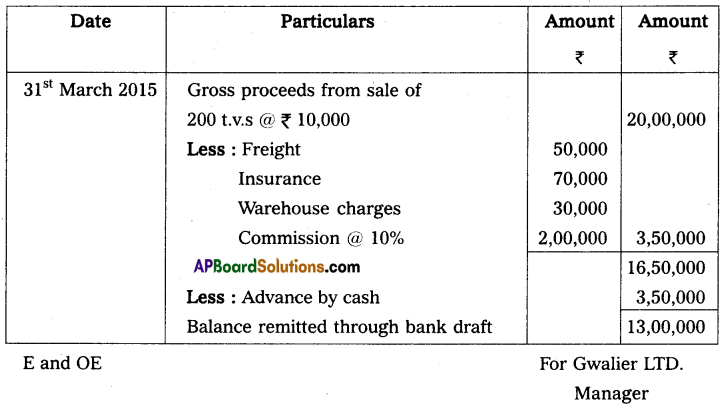
AP Inter 2nd Year Economics Study Material Chapter 3 National Income

Andhra Pradesh BIEAP AP Inter 2nd Year Economics Study Material 3rd Lesson National Income Textbook Questions and Answers.

AP Inter 2nd Year Economics Study Material 3rd Lesson National Income

Essay Questions

Question 1.
Explain the National income trends in India.
Answer:
National income means the total amount of goods and services produced in a country in a year. In order to understand in impact of planning in India, a study of trends in national income necessary. Therefore better if the trend in national income and changes in the structure of national product are analysed over the last 60 years of planning.
a) The increase in the production in real goods and services.
b) The rise in price.

If the increase in National.income is due to the first factor. It is an indicator of real growth because it implies that more goods and services became available to the people. If it is due to the second factor, it represent and unreal inflation of National income in terms of money. National income figure is deflated at constant prices, therefore, it becomes comparable but it conceals the population effect. To eliminate the effect of growth of population or percapita income is calculated.

C.S.O. has provided a series of National income data of 1999-2000 prices from 195051 to 2013-14. Although this indicates slightly different growth rates for different periods, this was inevitable because of the coverage and change in procedure.
Net National Product at Factor Cost and Per capita NNP
AP Inter 2nd Year Economics Study Material Chapter 3 National Income 1
The growth rates of both Net National Product and Per capita NNP at factor cost from 1950-51 to 2013-14 for a period of more than 6 decades. Per capita NNP at current prices in 1950-51 is ₹ 264, which rose to ₹ 5,621 and in the same period the per capita NNP at 2004-05 prices increased from ₹ 7,114 to ₹ 14,330.

Net National Product at current prices increased to ₹ 91,71,045 crore in 2013-14 from ₹ 4,71,619 crore in 1990-91 & at 2004-05 prices it was 49,20,183 crore and ₹ 12,02,305 crore respectively. Per capita NNP at 2004-05 prices rose to ₹ 74,380 in 2013-14 from ₹ 17,381 in 2000-2001.

AP Inter 2nd Year Economics Study Material Chapter 3 National Income

Question 2.
Briefly explain the sectoral contribution to the National income.
Answer:
Avery important aspect of the national income of a country is its sectoral composition i.e., the contribution made to it by the different sectors of the economy. The development mainly depends upon sectoral contribution. If the contributional from agricultural sector is high, generally a country is said to be underdeveloped one.
1) Contribution of the primary sector to GDP: The share of the primary sector in the Gross Domestic Product has varied from the maximum of 55.4% in 1950-51 to the minimum of 13.9% in 2013-14. The main cause of the decline is a rapid fall in the share of agriculture alone. There is a decline in the share of forestry to GDP. Transport and trade, banking and insurance and other service sectors have grown faster than agriculture still the agricultural’ sector remains an important sector in the Indian economy.

2) Contribution of the secondary sector to GDP: The share of industry which includes mining, quarrying, manufacturing, construction and electricity, gas & water supply has shown a steady increase from 15 percent in 1950-51 to 26.2 in 2013-14. Two major components of industry and manufacturing and construction increased from 8.9 percent in 1950-51 to 14.9 percent in 2013-14. Similarly, the sharerof construction increased from 4.4 percent in 1950-51 to 7.4 percent in 2013-14.

Tertiary sector contribution to GDP: The share of the tertiary sector (trade, transport, financing, insurance, real-estate, banking, social and personal services and business services) indicated a sharp improvement from 29.6 percent in 1950-51 to about 59.9% in 2013-14. There was a significant increase in share of trade, transport & communications from 11.3% in 1950-51 to 26.4% in 2013-14. This shows a good sign which is essential for an under developed country like India.

Question 3.
What are the causes for inequalities in the distribution of income and wealth ?
Answer:
Inequality in the distribution of National Income is one of the major problems which our planning process and economic policies have attempted to tackle. .
1) Inequalities in land ownership : There was concentration of landed property in India during the British period on account of Zamindari system. Minhas, Dandekar and Rath and Bardhan have clearly stated that all agricultural workers and marginal and small farmers with less than 2 hectare holdings are poor. Big and large farmers not only have capacity to save, they also have an access to institutional finance. Naturally, they are attempting to improve the farm techniques. This causes income inequalities.

2) Inflation : Since the mid -1950’s prices have been rising continuously eroding the real income of the working class, while the industrialists, traders and farmers with large marketable surplus have benefited a great deal from this inflationary process. In India, very little has been done to offset this redistributive effect of inflation and as a result, it has greatly accentuated income inequalities.

3) Inequality in credit facilities : In India, there is inequity in credit facilities which accentuates the inequalities arising from an unequal distribution of wealth. Business firms and individuals having an access to the formal capital markets manage to obtain finance on very favourable terms, while vast mass of small and marginal farmer agricultural labourers and artisans depend heavily on money lenders who charge an exorbitant rate of interest and also exploit these poor people in a number of ways.

4) Urban Bias in Private Investment: While 70 percent of the population in India lives in rural areas, about 70 percent of the private investment goes to industries in urban areas. Therefore, there is a distinct “urban bias” in the pattern of Private investment. This urban bias taken the form of highly mechanized projects in which the share of wages in value added is relatively low. This naturally leads to inequality in income distribution.

5) The Role of the Government: The public investment essentially plays a supportive role to private investment. The Govenment is no longer serious about reducing income inequalities.

AP Inter 2nd Year Economics Study Material Chapter 3 National Income

Question 4.
Briefly explain the measures to reduce income inequalities in India.
Answer:
The main objective economic planning is to reduce income inequalities and to maintain social justice. To achieve this the government of India initiated the following measures.
AP Inter 2nd Year Economics Study Material Chapter 3 National Income 2
i) Land reforms: Agricultural land was not property distributed among farmers. Thus, legislative measures were undertaken to abolish landlords and their intermediaries and ceiling on holdings were fixed. The implementation of land reforms in West Bengal states causes 18 percent increase in agricultural output and also reduced the income inequalities.

ii) Control over monopolies and restrictive trade practices : The monopolies and restrictive trade practices Act was passed in December 1969, which came into force on June 1st, 1970. The Act provides for the control of monopolies and for the prohibition of monopolistic and restrictive trade practices.

iii) Cooperative enterprises: Another instrument to balance the undue growth of big business in private sector is the decentralised sector in the farm of cooperative enterprises. This sector works for common good rather than for private and personal gain. Profits earned by cooperative sector are shared by very large number of members. This leads to reduce income inequalities.

iv) Encouragement of new enterprises: Special concessions and incentives provided to the new entrants in an industry can restrict the Concentration of economic power. If the government strictly implements the rule not to give licenses to start industries by the already existing farms, it would definitely reduce concentration of economic power.

v) Social security: The government has repeatedly declared that it aimed at “Growth with social justice”. The government undertook so many social security measures such as workmen’s compensations and maturity benefits, fixation of minimum wages, the employees Provident Fund, security for the old and disabled and family pension scheme for industrial workers and workers in mines and plantations.

vi) Taxation : Indian tax system is progressive and has been designed to prevent concentration of wealth in a few hands.

vii) Control over capital issues: Already the new capital issues are under government control. But it seems the control has not been effective checking monopolistic tendencies. In India many industries with monopolistic power yield huge incomes which are the cause for. income inequalities. As a result of this, the capital Issues Act 1956 was replead in May 1992.

viii) Employment and wage policies : The Government of India started many employment generation programmes to reduce income inequalities. For example, Integrated Rural Development Programme, National Rural Employment Programme etc. The wage rates allowed to the employees working in unorganized sector is very low. Implementation of minimum wages act leads to reduce income inequalities.

AP Inter 2nd Year Economics Study Material Chapter 3 National Income

Question 5.
What are the causes for poverty in India ? [A.P. Mar. 18, 17]
Answer:
Poverty can be defined as a social phenomenon in which a section of the society is unable to fulfill even its basic necessities of life.
There are two types of poverty.

  1. Absolute poverty
  2. Relative poverty

1) Absolute poverty : Absolute poverty of a person means that his income or consumption expenditure is so meager that he lives below the minimum subsistence level.

2) Relative poverty : Relative poverty merely indicates the large inequalities of income. Those who are in the lower income groups receive less than those in the higher income groups.

Causes of poverty: Poverty cannot be attributed to any one single set of causes. It is a complex phenomenon and as such is the outcome of interaction of diverse factors, economic and non-economic.
AP Inter 2nd Year Economics Study Material Chapter 3 National Income 3
1) Underdevelopment: The root cause of poverty is the underdevelopment of Indian economy. Dandekar and Rath have argued that unviable and unprofitable farms with little capacity for capital accumulation have been responsible for rural poverty in India. Small and scattered holdings, lack of adequate inputs, lack of credit facilities and insecure tenancy system are all responsible for backwardness of Indian agriculture which causes rural poverty. Industrial development has failed to make any dent on poverty.

2) Unemployment and low levels of wages: Poverty is caused by under-employment or unemployment coupled with low rates of wages. This is because supply of labour is more than that of demand for labour. Due to shortage of capital, the industrial sector is not in a position to absorb more number of people. This causes poverty.

3) Population explosion : In India population has increased from 361.09 millions in 1951 to 1210.19 millions in 2011. Due to scarce capital and low level of technology, it is not possible to provide sufficient goods services to the fast growing population. Rapid growth of population is another important cause for the prevailing poverty in the country.

4) Inequality in Assets and Income Distribution : The relative poverty is to be attributed to inequality in the distribution of National Income. Most of the agricultural labourers are in a states of poverty because; they have less than one hectares land to cultivate. Likewise, inequality in the ownership of industrial and commercial capital is one of the reasons of urban poverty in India.

5) Low availability of essentials : Another important cause for poverty in India is the low availability of essential commodities. The country is not able to produce sufficient goods and services as needed by the rapid growing population. The consumer goods shortage is responsible for low level of standard of living. There is a wide disparity in the consumption levels of the top rich and the bottom poor.

6) Inflation : Continuous rise in prices is another cause of poverty. When the prices rise, the purchasing power of money falls and it leads to improverishment of the lower middle and poorer sections of the society. Inflation affects the living standards of the people having low incomes.

7) Failure of five year plans: The main objective of the planning is to provide minimum level of living to all its citizens. It was felt that growth rate achieved during the five decades of planning would not be sufficient to remove poverty.

8) Social factors : Economic development depends not only on available resources but also on social factors. Indian people lack initiative and resourcefulness. In short, dogmatic and fatalistic attitude is responsible for inertia, lack of initiative and dynamism. Thus, Indian social institutions and attitudes hamper economic progress and are responsible for perpetuating poverty. The caste system and joint family system and the laws of inheritance are a great obstacle to economic progress.

9) Political Factors : Being under foreign rule, India was exploited under the British regime. Since Independence, the other political factors have adversely affected the economic progress. We have political leaders who have placed self before service and who do not hesitate to enrich themselves at the cost of the country. The Indian administration is known to be corrupt and inefficient. The legislators would not pass laws which may help the poor. Some times they may hit their interest.

10) Institutional factors : There are certain institutional factors operative in rural areas as well as urban area having a strong bearing on ownership, management and work. Semi-feudalism is an institutional factor responsible for rural poverty. The social and political institutions in rural areas have not allowed the land reforms and technological reforms to make a dent on rural poverty. The government is providing agricultural inputs like electricity seeds fertilizers and credit facilities at subsidized prices to be farmers. But these facilities are not catering the needs of poor farmers having small holdings and also the tenants. The institutional rigidities have not allowed equitable sharing of public goods such as education and health.

AP Inter 2nd Year Economics Study Material Chapter 3 National Income

Question 6.
Write about the remedial measures to reduce poverty in India.
Answer:
In recent years, a two-pronged strategy was introduced by the government toward a solution to the problem of poverty in India.

  1. The expansion of sectors which promise higher level absorption and
  2. Empowering the poor with education, skill formation and health, so that they can enter sectors which require higher competence and provide better remuneration which enable the poor to cross the poverty line. The problem solving strategies are :

i) Adoption of a strategy of proper growth instead of emphasizing liberalization and GDP growth : Former Prime Minister Atal Bihari Vajpayee in his Independence Day Message (15th August 2001) stated “The fruits of liberalization have not adequately reached the poor and the people living in rural areas, inequalities have increased. “The government has to pay attention to improve the economic conditions of 92 percent work force employed in unorganised sector. Government should give priority to the removal of unemployment in urorganised sector. “Right to work” should be made a basic human right. In this model emphasise should be laid on development of irrigation and watershed development with peoples participation. Agricultural cooperative should be strengthened.

ii) Stimulation Agricultural Growth: The growth rate of agriculture was 2.7% in the 9th plan and only 1.7% in the 10th plan. To overcome this type of slow growth rate, the Government of India appointed a high power commission under the chairmanship of Dr.M.S.Swaminathan which suggested the following 5 point action plan for the fanners.

  1. To undertake enhancement of soil health programmes.
  2. To promote water-harvesting, conservation and equitable use by empowering panchayats.
  3. To reduce the crop loan interest to 4 percent.
  4. To set up Krishi Vigyan Kendras for training the farmers.
  5. To reduce the gap between what the rural producer gets and the urban consumer pays should be reduced.

iii) Increasing the productivity and job quality of unorganized sector: The National Democratic Alliance Government appointed special group on targeting 10 million employment opportunities under the chairmanship of S.P. Gupta in 2002 to emphasize the growth of unorganized sector as surest method to reduce unemployment and poverty.

iv) Empowerment of the poor through education and skill formation : The development of a huge educational structure of 378 universities and 18,064 colleges, 152 lakh secondary and higher schools and 10.43 lakhs of primary and upper primary schools helps to enrich the human resources that leads to reduce the poverty.

v) Empowerment through provision of Better health : The strong link between poverty and health needs to be recognized. Long term illness and expensive illness can drive even the non-poor into poverty. National Rural Health Mission (NRHM) and National Urban Health Mission (NUHM) are the two major initiatives to help the poor in the availability of health facilities. There is a need to extend health insurance for workers in the unorganized sector, in order to overcome from poverty trap.

vi) Empowering the poor through provision of housing : House is the basic needs for both rural and urban poor. The country must launch a massive programme to provide housing in the form of Indira Aawas Yojana and basic civic amenities in a period of 20 years.

vii) Empowerment through skill formation for expanding IT sector : The development of Information and Technology sector provides number of employment opportunities which enable to reduce the poverty. This will be possible through the following measures.
a) Governments should provide subsidized higher education and vocational training to the poor.
b) Sanction a large number of merit scholarships for the poor.
c) Government should help the educational institutions both financially and infrastructure-wise to provide education to the poor.

viii) National Rural Employment Guarantee scheme : The National Rural Employment Guarantee Act came into force in 2006 in India. For removal of poverty, we need two sets of measures
a) We must accelerate economic growth by increasing substantially our National income.
b) Our efforts of re-distributing National Income in favour of the poor should be more pronounced. Thus, accelerated economic growth and reduction of inequalities are both indispensable for a successful attack on mass poverty.

AP Inter 2nd Year Economics Study Material Chapter 3 National Income

Question 7.
What is the role of Micro Finance in reducing the poverty in India ?
Answer:
Micro Finance institutions in India exist as non-governmental organizations. A section of 25 companies and Non-Banking Financial Companies (NBFC’s) and Commercial banks, Regional Rural banks, Co-operative societies and other large lenders have played an important role in providing refinance facility to Micro Finance Institutions.

“Micro Finance is the provision of Financial services to low income clients or solidarity lending groups including consumers and self-employed, who rationally lack access to banking and related services”. It covers a wide range of services like credit, savings, insurance, remittance and also non-financial services like training and counciling.

Micro Finance and Poverty reduction :
1) As an intervention to allieviate poverty, micro finance is viewed as the practice of extending small loans and other financial services such as savings and insurance to the poor for empowering them to protect themselves from economic setbocks.

2) Poverty can also be understood as vulnerability to downward in income. Such fluctuations may results from unexpected shocks such as crop failure, illness, funeral expenses or loss of assets such as livestock through theft or death. Micro Finance are the promise to reduce such vulnerable and protect livelihoods also reduce poverty.

3) An important dimension of poverty is powerlessness. Powerlessness can be experienced in a variety of situations, within the households, as a result of differences in gender and age and within the community, between socio economic groups, as a result of cost, electricity and wealth. Intervention with micro finance can influence the power relations of the society by fastering salidarity among the vulnerable through its group-based mechanism.

4) In most parts of the country micro finance services are being provided through group based systems that are advantageous of using peer pressure as social collateral.

5) These group-based systems can be broadly classified into two systems. They are Grameen, Group system, pioneered in Bangladesh and Self Help Group (SHG) system, Nurtured in India. Both these systems are widely replicated all over the world.

6) With the globalization and liberalization of the economy, opportunities for the unskilled and illiterate are not increasing fast enough, as compared to the first of the economy. This leeds to a lopsided growth in the economy thus increasing the gap between the rich and poor. It is in this context, the institutions involved in microfinance have a significant role to play to reduce this disparity and poverty.

AP Inter 2nd Year Economics Study Material Chapter 3 National Income

Question 8.
Explain the causes for unemployment and remedial measures to reduce unemployment. [A.P. Mar. 16]
Answer:
A man is willing to work but he is not getting work. Therefore he is called unemployed. Unemployment is too serious an evil to be ignored. Widespread and growing unemployment is not due to any single factor.
AP Inter 2nd Year Economics Study Material Chapter 3 National Income 4
1) Rapid rate of population growth :The most fundamental cause of widespread unemployment in India is the rapid rate of population growth which leads to increase in labour force. The rate of population growth rose to 2.2 percent per annum during the 1960s. As the population increased from 718.2 millions in 1983 to 1227.4 millions in 2011-12, corresponding the labour force also increased from 261.33 millions to 440.4 millions respectively. This is too big a number to be provided gainful employment at the present rate of growth of the economy.

2) Jobless growth : During the first three decades of economic planning, the GDP growth rate was as low as 3.5 percent per annum. In this period, employment increased at a moderate rate of 2 percent per annum. The rate of growth of employment picked up considerably to 2.90 percent per annum during the five year period 1990-00 to 2004-05 but again declined to almost zero present over the next five years i.e., from 2004-05 to 2009-10. Thus, the country could create only one million jobs during 2004-05 to 2009-10.

3) Inappropriate Technology.: In India, while capital is a scarce factor, labour is available in abundant quantity. Under such circumstances, if market forces operate freely and efficiently, the country would have adopted labour – intensive techniques of production.

4) Lack of Rural Industrialization : With regard to large rural unemployment and under employment, the underlying cause is the very heavy pressure of population on land and the backward nature of our farming. As a result, agriculture cannot provide employment opportunities for the far too numerous rural population.

5) Inappropriate Educational system : The educational system in India is defective. According to Gunnar Myrdal, India’s educational policy does not aim at development of human resources. It merely produces clerks and lower cadre executives for the government and private concerns. Any educational system which fails to develop human resources properly will not be able to provide employment to all those who have received it.

6) Lack of Manpower planning: The intake into various courses is not being plannned on the basis of the projections of the demand for skilled manpower in future.

7) Social factors : Since Independence, education among women has changed their attitude towards employment. Many of them now compete with men for jobs in the labour market. The economy has, however failed to respond to these challenges the net result is continuous increase in unemployment backlog.

8) Lack of self-employment opportunities : The rural marginal and landless households continue to remain unemployed (or) underemployed due to lack of self employment. The well educated youth lacking entrepreneurship qualities waiting for years together to get government jobs at meager wages.

9) Decline of cottage industries : In rural India, village (or) cottage industries are the only means of employment particularly of the landless people. They depend directly on various cottage industries for their livelihood. But, now-a-days, these are adversely affected the industrialisation process.

Short Answer Questions

Question 1.
Explain the incidence of unemployment in India.
Answer:
The size of unemployment in any country depends on the level of development. Therefore when a country makes progress and its production expands the employment opportunities grow. In India, during the past six decades production has expanded in all the sectors of the economy. Most of the developing countries face an acute problem of unemployment and underemployment.

The basic reason for this that the rural areas have failed miserably to generate adequate employment opportunities for the rapidly increasing population.

Unemployment as measured by UPs orientation declined from 4.23 percent in 1977-78 to 2.81 percent in 1999-2000, but indicated an increase to 3.06 percent in 2004-05. In 2011-12 unemployment on UPs criterion is estimated to be 2.7 percent.

Unemployment in Current Daily Status (CDS) declined from 8.18 percent in 1977-78 to 6.09 percent in 1987-88, but the declining trend reversed to 8.28 percent in 2004-05, in 2011-12, rate of unemployment on CDS basis is estimated to be 5.6 percent.

AP Inter 2nd Year Economics Study Material Chapter 3 National Income

Question 2.
What are the different concepts of poverty ? [A.P. Mar. 16]
Answer:
Poverty can be defined as a social phenomenon in which a section of the society is unable to fulfill even its basic necessities of life.

When a substantial segment of a society is deprived of minimum level of living and countries at a base subsistence level, that society is said to be played with mass poverty.
Concepts of poverty:
1) Absolute poverty : The population whose level of income or expenditure is below the figure considered to be the absolute poverty or a person whose income or consumption expenditure is so meagre that he lives belows the minimum subsistance level is called absolute poverty.

2) Relative poverty : According to the relative standard, income distribution of the population in different fractile groups is estimated and a comparison of the levels of living of the top 5 to 10 percent with the bottom 5 to 10 percent of the population is called relative poverty, or those who are in the lower income groups receive less than those in the higher income groups.

3) Poverty line : According to the planning commission a person who is not having monthly percapita total expenditure of ? 49.9 in rural area and ? 56.64 in urban area at 1973-74 prices is called as a person living below the poverty line.

Question 3.
What are the different types of unemployment ? [A.P. Mar. 17]
Answer:
Types of unemployment: Unemployment is broadly defined into two types.
A) Unemployment in Urban areas and
B) Unemployment in Rural areas.
AP Inter 2nd Year Economics Study Material Chapter 3 National Income 5
A) Unemployment in Urban areas :
i) Educated unemployment: The large number of educated unemployed shows, “a measurement between the kind of job opportunities that are needed and that are available in the job market”. The defective educational system, with its theoretical base, lack of aptitude and technical qualifications for various types of working among job-seekers and Maladjustments between demand on supply of education workers are some well-known causes of educated unemployment.

ii) Industrial unemployment: In India, the manufacturing sector has indeed expanded and employment in it has steadily increased. One of the reasons for this is the low employment elasticity in the manufacturing sector. As a result, industrial unemployment increased.

B) Unemployment in Rural areas :
i) Seasonal unemployment: If in agriculture is a normal phenomenon in India. In India farmers cultivating approximately 75 percent of their land remain involuntarily unemployed for 3 to 4 months in a year and most of them fail to find some temporary employment in this period. The main reason for its unemployment is lack of irrigation facilities.

ii) Disguised unemployment: Indian agriculture is characterized by the existence of considerable amount of surplus labour. In technological language, it is said that marginal productivity of such labour is zero. The kind of disguised unemployment is also comes underemployment.

Other types of unemployment:
1) Cyclical Unemployment: If unemployment occurs as a result of trade cycles, if it
is called cyclical unemployment. Trade cycles refers to the frequent booms and depression, up swings and low swings. Keynes said that cyclical unemployment is the result of the deficiency in efficient demand. Therefore, if effective demand increased, the level of employment can also be increased.

2) Structural Unemployment: It is one of the main type of unemployment within an economic system. If focuses on the structural unemployment within an economy and inefficiencies in labour markets. Structural unemployment occurs when a labour market is not able to provide jobs for everyone who is seeking unemployment.

3) Under employment: Labour that falls under the underdevelopment classification includes those workers that are highly skilled but working in low paying jobs.

4) Frictional Unemployment: It is another type of unemployment within an economy. It is the time period between jobs when a worker is searching for or transistioning from one job to another. Frictional unemployment is always present to some degree in an economy. It occurs when there is a mismatch between the workers and jobs.

AP Inter 2nd Year Economics Study Material Chapter 3 National Income

Question 4.
Write briefly about employment Guarantee Act.
Answer:
Mahatma Gandhi National Rural Employment Guarantee scheme) This scheme was launched from 2nd October 2009, MGNREGS seeks to provide at least 100 days of guaranteed wage employment in a financial year to at least one number of every rural household whose adult members volunteer to do unskilled manual work. At least 33% of the beneficiaries are to be women under MGNREGS wage disbursement through bank and post office is mandatory. This is to help in ‘financial inclusion” of the poor. It provides a wage rate of ₹ 100/- per day to a worker. The focus of MGNREGS is an workers relating to water conservation, drought proofing, land development, flood control and rural connectivity etc. Panchayats have a key role in planning, implementation and monitoring of MGNREGS. This Act is useful for decentralization and deepening gross root democratic structure.

Question 5.
Explain briefly about Deen Dayal Upadhyaya Grameena Kaushal Yojana. [A.P. Mar. 18]
Answer:
Deen Dayal Upadhaya Grameen Kaushal Yojana was launched on 25th September 2014 in view of 98th birth anniversary of Pandit Deenadayal Upadhyaya. Earlier the Yojana was known as Aajeevika Skills Development Programme (ASDP).

The Rational launching the yojana : The Yojana was launched in light of solving huge problem of unemployment among the rual youth despite the fact that they have merits. In order to correct this match, Union Government decided to launch skill development programme scheme.

Status of skilled workers In India : In India as against 12 million people entering the work force every year during the last 10 years only 1 million youth were trained. Further out of 12 million people, only 10 percent were skilled ones, while the percentage in European Unions is 75 percent and in China 50 percent.

Main features of DDUGKY : The main features of the Deena Dayal Upadhyaya Kaushal Yojana are :

  • The Yojana aims to give training 10 lakh rural youth for jobs in three years, that is by 2017.
  • The minimum age for entry under the Yojana is 15 years compared to 18 years under the Aajeevika skills programme.
  • Skill Development training centre’s to be launched. So as to address the unemployment problem in rural area.
  • The skills imparted under the Yojana will now be bench marked against international standards and will compliment the Prime Minister make in India compaign.

This scheme was launched to enhance the employability of rural youth which is the key to unlocking India’s demographic dividend. A sum of ₹ 1500 crores was allotted for this scheme in the 2015-16 budget.

AP Inter 2nd Year Economics Study Material Chapter 3 National Income

Question 6.
Micro finance .
Answer:
Micro finance is the provision of Financial services to low income clients or solidarity lending groups including consumers and self employed, who rationally lack access to banking and related services”. It covers a wide range of services like credit, savings, insurance, remittance and also non-financial services like training and counseling.
Features of Micro Finance:

  1. Borrowers are from the low income groups.
  2. Loans are of small amount (Micro loans).
  3. Short duration loans.
  4. Loans are offered without collateral securities.
  5. High frequency of re-payments.
  6. Loans are generally taken for income generation purpose.

Need for Micro finance : Micro finance plays a major contributor to provide credit facilities. In the past few decades it has helped out remarkably in eradicating poverty. Reports show that people who have taken Microfinance have been able to increase their income and thereby their standard of living.

Micro finance institutions serve as a supplement to banks and in some sense better one too. These institutions not only offer micro credit but they also provide other financial services like savings, insurance, remittancé and non-financial services like individual counseling, training and support to start own business. But all this comes at a cost and the interest rates charged by these institutions higher than commercial banks and vary widely from 10 to 30 percent.

Question 7.
MGNREGS
Answer:
Mahatma Gandhi National Rural Employment Guarantee scheme) This scheme was launched from 2nd October 2009, MGNREGS seeks to provide at least 100 days of guaranteed wage employment in a financial year to at least one number of every rural household whose adult members voluntar to do unskilled manual work. At least 33% of the beneficiaries are to be women under MGNREGS wage disbursement through bank and post office is mandatory. This is to help in ‘financial inclusion” of the poor. It provides a wage rate of ₹ 100/- per day to a worker. The focus of MGNREGS is an workers relating to water conservation, drought proofing, land development, flood control and rural connectivity etc. Panchayats have a key role in planning, implementation and monitoring of MGNREGS. This Act is useful for decentralization and deepening gross root democratic structure.

Very Short Answer Questions

Question 1.
National Rural Employment Guarantee Scheme
Answer:
The National Rural Employment Guarantee Act came into force in 2006. It helps to reduce the poverty.

AP Inter 2nd Year Economics Study Material Chapter 3 National Income

Question 2.
Relative poverty
Answer:
The people with lower income are relatively poor compared with higher incomes, eventhough they may be living above the minimum level of subsistance is called relative poverty.

Question 3.
Absolute poverty [A.P. Mar. 18]
Answer:
A person whose income or consumption expenditure is so mearge that he lies below the subsistance level they can called absolute poverty.

Question 4.
TRYSEM [A.P. Mar 16]
Answer:
This was initiated in 1979 with the objective of tackling unemployment problem among the rural youth. It aimed at training about 2 lakh rural youth every year to enable to become self employed. The TRYSEM was merged into Swamajayanthi Gram Swarozgar Yojana in April 1999.

Question 5.
Disguised unemployment
Answer:
A person whose marginal productivity is zero or when more people are engaged in a job than actually required.

Question 6.
Poverty Gap Index
Answer:
The poverty gap index is defined by the mean distance below the poverty line expressed as a proportion of that line. The poverty gap index is insensitive to the extent of inequality among the poor. If income is transferred from a person to someone who is poor, the poverty gap index will not change.

Question 7.
Usual status concept of unemployment.
Answer:
This concept is used to measure chronic or long-term unemployment. It measures the activity status i.e., a person who remains unemployed for most of the time in the year. Thus, it appropriately measures open unemployment.

AP Inter 2nd Year Economics Study Material Chapter 3 National Income

Question 8.
Micro Finance [A.P. Mar. 17]
Answer:
The provision of thrift, credit and other financial services and products of very small quantity to the poor in rural, semi-urban and urban areas for enabling them to raise their incomes and improving living standards.

Question 9.
Percapita income
Answer:
It is estimated dividing National income by population of the country as per the formula given below.
Percapita income = \(\frac{\text { National income }}{\text { Population }}\)

AP Inter 2nd Year Economics Study Material Chapter 2 Population and Human Resources Development

Andhra Pradesh BIEAP AP Inter 2nd Year Economics Study Material 2nd Lesson Population and Human Resources Development Textbook Questions and Answers.

AP Inter 2nd Year Economics Study Material 2nd Lesson Population and Human Resources Development

Essay Questions

Question 1.
Explain the theory of Demographic Transition.
Answer:
The theory demographic transition postulates a three stages sequence of birth and death rates as typically associated with economic development.
1. First Stage : According to this theory, death rates are high in the first stage of an agrarian economy on account of poor diets, primitive sanitation and absence of effective medical aid. Birth rates sire also high in this stage as a consequence of widespread prevalence of illiteracy, absence of knowledge about family planning techniques, early age of marriage, social beliefs and customs about the size of the family etc. In this stage, the actual growth rate of population is not high birth rate is balanced by high death rate.

It is a stage of high growth potential but of low actual growth. This stage prevailed in India before 1921.

2. Second Stage : Rise in income levels enables the people to improve their diet. Economic development also brings about an all-around improvement including the improvement in transport which makes the supply of food regular. This stage is characterized by rapid growth of population because the substantial reduction in the death rate as there is no corresponding decline in the birth rate. With the beginning of the process of development, the living standards of the people- improve education expands, medical and health facilities increase and government makes special efforts to check small pox,.malaria, cholera and plague etc. These developments generally bring down the mortality rate. But as long as society remains primarily agrarian and education remains confined to a narrow section of the society, attitude of the society towards the size of family does not change radically and birth rate remains high.

In this situation, population increases at an alarming rate. Economists call it population explosion. This stage has been prevailing in India since 1921.

3. Third Stage : A country can hope to overcome the problem of population explosion if the process of industrialisation accompained by urbanisation grows fast and education becomes wide spread. Only in this situation birth rate shows a tendency to fall. Life in a city is not the same as in village. Industrialisation results overcrowding in cities and the housing problems compel people to revise their attitudes towards size of family. When the process of economic development gets accelerated, women seek all kinds of employment in order to supplement family earnings for working women, up bring of children is not an easy task consequently.

The birth rate declines significantly and thus the rate of population growth remains low.

AP Inter 2nd Year Economics Study Material Chapter 2 Population and Human Resources Development

Question 2.
What are the causes of high birth rate and low death rate in India ?
Answer:
Population increases because of high birth rate, low death rate and immigration. The birth rate has not declined significantly in India during the last five decades because of a number of economic and social factors.
Causes of the high birth rate :
I. Economic factors :
a) Predominance of Agriculture : India is a predominantly agriculture economy. In an agrarian economy, children are considered assets and’ not burdens as they help in agricultural fields and also other sectors.

b) Slow urbanization process and Predominance of villages : The process of urbanization has been slow in this country and it has failed to generate social forces, which usually bring down the birth rate. The social system and family structure of rural life seem to survive transplantation to the town or city quite remarkably. According to sociological studies.

c) High incidence of Poverty : There is high incidence of poverty in India. Poor people tend to have large families as they consider every child as earning hand. In a poor country like India children are considered as an asset of generating income.

II. Social factors:
a) Compulsory Marriage : Marriage is both a religious and social necessity in India. Presently in India by the age of 50 only 5 out of 1000 Indian women remains unmarried. More marriages means more population.

b) Early Marriage : Not only marriages are almost compulsory, they take place at quite young age in India, which provides more time for women to give birth to children.

c) Religious beliefs and Superstitions : Most Indians due to their religious and superstitions desire to have more children having no regard to their economic conditions. Every child is considered as “Gift of God”.

d) Joint family system: Joint family system in India also encourages people to have large families.

e) Illiteracy: Lack of education among people especially among women causes people to have irrational attitudes and hence big families.

Causes of the low death rate :
a) Control over famines : Famines, which were widespread before independence have not occurred on a large scale since independence.

b) Control over epidermics : Cholera and smallpox often resulted in epidemics before independence. Now smallpox is completely eradicated and cholera is very much under control. Similarly there has been decline in the incidence of malaria and tuberculosis. These have resulted in reducing the death rate.

c) Other factors : Other factors which have reduced death rate are :

  • spread of literacy and education.
  • expanded medical facilities and health care awareness.
  • improved supply of safe drinking water.
  • improvement in the nutritional level.
  • improvement in sanitation.
  • agricultural development in terms of HYVR

AP Inter 2nd Year Economics Study Material Chapter 2 Population and Human Resources Development

Question 3.
What are the measures to control population explosion ?
Answer:
Population explosion is one of the obstacles for the development of the economy. Therefore it is not something to be welcomed and praised. Hence an attempt must be made to control population explosion.
Measures:

  1. Economic measures
  2. Social measured
  3. Family planning programmes

1. Economic Measures : The size of population in India is large and it is neither desirable nor possible to reduce it. Under these circumstances, vigorous efforts are to be taken on the economic front. As a matter of fact, only economic measures can ensure a permanent solution to the problem. The following measures are suggested by the economists, to reduce the intensity of population explosion.
i) Expansion of industrial sector : The family size of the people employed in the industrial sector is smaller than that of the people who are employed in the agricultural sector. In the country side any number of people can work on the family farm, through some of them will hardly make any contribution to the output. Most of the operational holdings in India are not economic and can thus provide only subsistence living. Most of the peasants think that the benefits from an additional child is greater than the cost of its upbringing. Industrial workers are aware of the difficulties in getting employment and interested in restricting the size of the family. Moreover, higher productivity in the industrial sector makes industrial worker’s conscious of their standard of living. They realise that in order to raise their standard-of living they must restrict the size of their family.

ii) Creation of employment opportunities in urban areas : Industrialisation in the country, there can be many other factors which contribute to the growth of urban centres. In order to check and reduce the people to migrate from the country side to cities, the Government has to create job opportunities in these places. If this programme is carried out in an effective manner and the migration of rural population to urban areas stops in a big way, it may prove to be a powerful check on the growth of population.

iii) Equitable distribution of income and removal of poverty : Poor people have virtually no interest in limiting the size of family. They have little stakes in their lives and are thus unconcerned about their families. While living in poor conditions, they often lose human qualities and at times get alienated even from themselves. Once the poor people get basic needs of life, they will have no economic compulsion to have more children and their attitude towards the size of family will undergo a change. In the change of situation not only will they become conscious of the number of children they should have, but will also undertake every possible effort to make the life of their children as comfortable as they can.

2. Social Measures : Population explosion is as much as a social problem as much it is a economic problem many of its causes are deep-rooted in the social life of the country. Literacy, superstitions and orthodoxy contribute to population explosion in the country. In order to bring down the birth rate, which is still very high, all the social evils must be removed.
(i) Education: Contribution of education in bringing down the birth rate is significant. Education often changes the attitude of person towards family, marriage and number of children he should have. Most educated people delay their marriage and prefer to have small family. Education, by making a frontal attack on orthodoxy and superstitions, induces people to family planning. When education is wide spread both boys and girls are sent to schools and colleges this automatically delays marriages and thus automatically reduces reproductive span of women.

(ii) Improving the status of women: Although the constitution of India has guranteed equality between men and women, there is discrimination in social life and position and status of women is inferior to that of men both socially and economically. This is perphaps the most important reason education is less among women and its absence, they are quite indifferent to family planning, however the discrimination between the men and women in the society leads to growth in family size. In backward society women are not generally allowed to exercise their discretion in respect of number of children they should have.

(iii) Raising the minimum age of marriage : Since fertility rate depends to a great extent on the age of women at the time of marriage. So it is necessary that every possible social, legal and educative measures in undertaken to raise it. In 1978, the child marriage restraint act was amended to raise the marriage to 21 years for men and 18 years for women, National population policy was amended to raise 21 years for men and 25 years for women with a view to restrict the rate of growth of population.

3. The Family planning programme: Importance of the family planning programme as a device to control population explosion is universally recognized.
(i) Public information programme: Under public information programme, couples in the reproductive age are explained the usefulness of family planning. Hence the Government has decided all media of publicity, including cinema, video, T.V to publicize the importance of family planning.

(ii) Incentives and Disincentives: The Government has introduced various schemes under which incentives are being given to those who accept family planning. The system of cash prizes has given some inducement to the people to go in for sterilization.

(iii) Family planning centres: Establishment of family planning centres is an integral part of any family planning programme. These centres provide various clinical facilities needed for family planning.

AP Inter 2nd Year Economics Study Material Chapter 2 Population and Human Resources Development

Question 4.
Bring out the main elements of population policy, 2000.
Answer:
National population policy : The national population policy, 2000 has outlined immediate, medium term and long-term objectives. The immediate objective is to meet needs of contraception, health infrastructure, personal health and to provide integrated service for basic reproductive and child health care. The medium term objective is to lower down the total fertility rates to the replacement level by 2010. The long term objective is to achieve a stable population by 2045. In this broad frame work, the national population policy, 2000 aims at the following:

  1. Reduce maternal mortality ratio to below 100 per 1 lakh live births.
  2. Reduce infant mortality rate to below 30 per one thousand live births.
  3. Achieve immunization of children against all vaccine preventable diseases.
  4. To achieve 100 percent deliveries in hospitals and dispensaries.
  5. Prevention and control of communicable diseases.
  6. Achieve universal access to information and counseling and services for fertility regularization and contraception with a wide basket of choice.
  7. Facilities for safe abortions to be increased.s
  8. Promote delayed marriage for girls, not .earlier than age 18 and preferably after 20 years of age.
  9. Promote the small family norm to achieve replacement levels of total fertility rates.

In pursuance of the National Population Policy 2000, a National Commission of Population has been set up. The commission will review the implementation of the National Population Policy in due time.

Question 5.
Explain the occupational distribution of population in India.
Answer:
The occupational structure of a country refers to the distribution or division of its population according to the different occupation. We can divided various occupations into three catagories.
1. Primary occupations: Primary occupation also called agriculture sector. Agriculture and allied activities it includes forestry, fishing, animal husbandary, poultry farming etc. Because their products are essential for human existence. They are carried with the help of the nature. In the developing countries a large portion of the population is engaged in these activities.

2. Secondary occupations : Secondary occupation also called industrial sector. It includes mining and quarrying, electricity, gas and water etc. This sector is invariably small in the third world countries and absorbs only a small section of the labor force.

3. Tertiary occupations : Tertiary occupation is also called service sector or third sector. It includes trade and commerce, transport, storage and communications, banking, insurance, real estate, education and health. Tertiary activities help primary and secondary activities in the country.

There is a close relationship between the development of economy and changes in occupational distribution of population.

According to Hans Singer Economic development can be achieved by transforming a 85% agricultural dependent country into a 15% agriculturally dependent country.
AP Inter 2nd Year Economics Study Material Chapter 2 Population and Human Resources Development 1
Trends in occupational structure during 1951 – 2011 : 2011 census reveals that 48.9% of the labour force was employed in the primary sector. It indicates in predominance of agriculture in the economy. Secondary sector in India still remains small inspite of all the attention that heavy industries got under the various plans. In 2011 secondary sector accounted 24.3% of the labour as against 10.7% of labour force employed in the manufacturing sector during planning period. The tertiary sector in India accounts for a little more than one fifth of the labour force.

AP Inter 2nd Year Economics Study Material Chapter 2 Population and Human Resources Development

Question 6.
Define Human Resource Development. How do you improve it ?
Answer:
Many statistical investigations carried out in the western countries have shown that out put increased at a much higher rate than can be explained by an increase in physical inputs like labour and physical capital. This has been consistently improving due to improvement education skills, availability of health services etc. Therefore, along with physical capital formation, human development has also been playing a vital role in economic development.

The term human resource development refers to the “Process of acquiring” an increasing the number of persons who have the skills, education and experience which are critical for economic and political development of a country. Human resource development is thus associated with investment in man and his development as a creative and productive resource. According to Schultz, there are five ways developing human resources.

  1. Health facilities and services, broadly conceived to include all expenditure that effect the life expectancy, strength and stamina and vigor and vitality of the people.
  2. And the job training, including old type apprenticeship organised by firms.
  3. Formally organised education at the elementary, secondary and higher levels.
  4. Study programmes for adults that are not organised by firms, including extension programmes notably in agriculture.
  5. Migration of individuals and families to adjust to changing job opportunities.

Importance of Human resource development: Human resource development plays an important role in economic development. Infact, effective use of physical capital itself is dependent on human resources. This is due to the reason that if there is under investment in human resources the rate at which additional physical capital can be productively utilised will be limited since technical, professional and administrative people required making effective use of material resources. Modem economists in recent years have pointed out that many third world countries have remained underdeveloped on account of under¬development of human resources. Therefore, large scale investment in human resources are needed if physical capital available in these countries is to be exploited more fully and in a more efficient way.

Question 7.
Explain the role of education in economic development.
Answer:
The expenditure on education in India is not considered an investment. Most of the people and particularly the decision makers in government think that education is just a social service and is meant only to improve the quality of mans life. The importance of education in production is rarely recognized.

Role of Education in Economic development:
1. Education and Economic growth : According to Todaro and Smith, education contributes to economic growth in the developed and developing countries in the following way.

  1. It helps in creating a more productive labour force and endowing it with increased knowledge and skills.
  2. It helps in providing wide spread employment and income earning opportunities when more schools, colleges and universities come in to existence.
  3. It helps in providing basic skills and encourages modem attitudes in the diverse segments of the population.

2. Education and Reduction in Income Inequalities : Though the linkages between education and economic growth are very much in evidence in both, developed and developing countries, those between education and reduction in income inequalities and poverty are difficult to establish.

Despite universal education and educational reforms carried out by the Governments, it is rich and middle income groups that have benefited most. This is due to the reason that the institutional and social structure within which the educational system has to function is unegalitarian and perpetuates inequalities. The childhood of the poor children is characterized by poor nutrition and illiterate home environment which has negative mental effect. Even if they are able to complete their education, they find it difficult to procure jobs which are covered by children belonging to the relatively rich classes on account of the better social contacts and influences.

3. Education and Rural Development: Education can contribute significantly to rural development in variety of ways. By widening the horizons of knowledge of the rural people, it can enable them to overcome ignorance and superstitions. Adoption of new agricultural techniques and new methods of production is rendered easier if the farmers are educated. Education can be oriented as to import skills such as health and nutrition, and improvement, family planning and child care etc. In labor surplus economies like India, education can help rural people in acquiring skills to set up cottage industries on their own so that, the disguised unemployed people can be faithfully employed in the villagers themselves.

4. Education and Family planning : Education helps in modernizing and revolutionizing the way of thinking of the people. It enlightens them of the need to improve their standards of living and for purpose to restrict the size of their families. Therefore, education serves as the best method of their families also as more and more women become literate and seek employment, the fertility rates show a tendency to decline because up bring of children is a comparatively a difficult task for working women.

5. Other benefits of Education :

  1. The current spillover income gains to persons other than those who have received extra education.
  2. The spillover income gains to subsequent generations from a better educated present generation.
  3. The supply of convenient mechanism for discovering and cultivating potential talents.
  4. The meeting of the skilled man power requirements of growing economy.
  5. The provisiory of an environment that stimulates research in science and technology.
  6. The tendency encourages lawful behaviour and promotes voluntary responsibility for welfare activities.
  7. The tendency to foster political stability by developing an informed electorate and competent political leadership.
  8. The supply of certain measures of “Social control” by the transmission of common cultural heritage. .
  9. The enhancement of the enjoyment of leisure by widening the intellectual horizons of both the educated and the uneducated.

AP Inter 2nd Year Economics Study Material Chapter 2 Population and Human Resources Development

Question 8.
Explain the importance of health in economic development.
Answer:
Efficiency of workers depends on their health. Workers whose health is not good and who fall sick quite often cannot do their job efficiently and thus there efficiency is bound to remain low and improvement in the health of the workers automatically raises the national output. World development 1993 stated “improved health contributes economic growth in favor of ways.

  1. It reduces production losses caused by worker illness.
  2. It permits the use of natural resources that had been totally or nearly inaccessible because of diseases.
  3. It increase the enrolment of the children in schools and makes them better to learn and it frees for alternative uses of resources that would otherwise have to be spent on treating illness.
  4. The economic gains are relatively greater for poor people who are typically most handicapped by ill health and who stands to gain the most from the development of under utilised natural resources.
    1. Balanced and nutritional food
    2. Medical care

Health goals set by 12th plan 2016 -17:

  1. Reducing Maternal Mortality Rate (MMR) to 75 per 1,00,000 live births.
  2. Reducing Infant Mortality Rato (IMR) to 19 per 1,000 live births.
  3. Reducing Total Fertility Rate (TFR) to 2.1.
  4. Providing safe drinking water to all. ‘
  5. Prevention and reduction of under weight children in under 3 years is expected to be 29 percent by 2015 and 27 percent by 2017.
  6. Reducing anemia among women and girls by 28 percent.
  7. Raising sex ratio of age 0 – 6 years from 914 to 935.

Question 9.
What are the different indexes to measure Human Development ?
Answer:
Human Development Index: In recent years the search for an alternative to GNP as a measure of economic development has led to computation of the Human Development Index (HDI). The United Nations Development Programme (UNDP) introduced the HDI in its first Human Development Report prepared under the able stewardship of Mohbub UI Haq and published in 1990.

The measure has been enlarged and refined over the years and many related indices of human development like Gender Related Development Index (GDI), Gender Empowerment Measure (GEM) and Human Poverty Index (HPI), Gender Inequality Index (GII), Multidimensional Poverty Index (MPI) have been developed in subsequent human development reports published annually by UNDP.

  1. A longevity of life is measured in terms of life expectancy at birth.
  2. Knowledge is measured interms of education.
  3. A standard of living is measured in terms of GDP percapita (PPPUS$).

Human Development Index measures the average achievement in three basic dimensions of Human Development.

Before calculating HDI, an idex for each of three dimensions is calculated. For this purpose, maximum and minimum values are chosen for each indicator.
Maximum and Minimum values for calculation of HDI.
AP Inter 2nd Year Economics Study Material Chapter 2 Population and Human Resources Development 2
Performance in each dimension is expressed as a value between 0 and 1 by applying the following formula.
HDI = \(\frac{\text { Actual value }-\text { Minimum value }}{\text { Maximum value }-\text { Minimum value }}\)
HDI report 2014 has classified the selected countries into four categories.

  1. Countries with the HDI value of 0.8 and above are grouped as the Very High Human Development Countries.
  2. Countries with the HDI value ranging from 0.7 to 0.8 are grouped as High Human Development Countries.
  3. Countries with the HDI value ranging from 0.5 to 0.7 are grouped as Medium Human Development Countries.
  4. Countries with the HDI values of less than 0.5 are in the Low human Development Countries. India has improved its HDI index from 0.42 in 1980 to 0.554 in 2012.
  5. India was ranked among 177 countries improved from 138 in 1994 to 128 in 2005, but now it has declined to 132 in 2007, 134 in 2008, 136 among 187 countries in latest report 2013.

Gender Related Development Index (GDI) : While HDI measures average achievement, the GDI adjusts the average achievement to reflect the inequalities between men and women, the three components used for the purpose are

  1. Female life expectancy.
  2. Female adult literacy and gross enrolment ratio.
  3. Female percapita income.

If gender inequalities did not exists, the value of GDI and HDI would be the same, but if the gender inequality exists, the value of GDI would be lower than that of HDI. The greater the difference between HDI and GDI, the more in the inequality.

Gender Empowerment Measure (GEM) : The Gender Empowerment Measure was also introduced by the human development report 1995. The GEM indicates whether women are able to actively participate in economic and political life. It focuses on participation, measuring gender inequality in key areas of economic and political participation and decision making. There are three components, which are used for measuring GEM.

  1. Participation of women in economic and political activities.
  2. Gender inequality in economic and political participation.
  3. Female empowerment.

Human Poverty Index (HPI) : The human development report 1997 introduced the human poverty index, which concentrates on deprivation in three essential elements of human life already reflected in HDI longevity knowledge and a decent living standard.

AP Inter 2nd Year Economics Study Material Chapter 2 Population and Human Resources Development

Question 10.
What are the advantages and disadvantages of population ?
Answer:
Population of India means the total number of people living in India. Population is very essential for the growth of country.
Advantages of Population :

  1. Population provides work force to produce goods and services.
  2. Population provides market for the products that are produced.
  3. Population promotes innovative ideas.
  4. Population promote division of labour and specialisation.

Disadvantages of Population:

  1. Population put pressure on means of subsistance.
  2. Population leads to unemployment if there are no adequate jobs.
  3. Population put pressure on social overheads like hospitals, schools, roads etc.
  4. Population may result in increased consumption and reduced savings and capital formation.
  5. Population may increase dependency.

Short Answer Questions

Question 1.
Trends of world population.
Answer:
In 1830, the total population of the world was one billion but it was doubled in 1930. By 1960 again population of the world increased by one more billion. By 1974 i.e., in 14 years the population increased 400 crores and it took only 13 years to reach the 500 crores mark in 1987. Therefore, the 12th July is known as World Population Day. In 2011 it was estimated 7.3 billion. Probably within next 3 to 4 decades by 2050 world population expected to be around 9.20 billion. 98% of world population growth will be developing countries.

AP Inter 2nd Year Economics Study Material Chapter 2 Population and Human Resources Development

Question 2.
Top 10 populous countries in the world. [A.P. Mar. 16]
Answer:
The following shows that the list of top 10 populous countries in the world.
AP Inter 2nd Year Economics Study Material Chapter 2 Population and Human Resources Development 3

Question 3.
Causes of high birth rate in India.
Answer:
Population increase because of high birth rate, low death rate and immigration. The birth rate has not declined significantly in India during the last five decades because a number of economic and social factors continue to favour high fertility.

  1. Economic factors :
    1. Predominance of agriculture
    2. low urbanisation process
    3. High incidence of poverty
  2. Social factors :
    1. Compulsory marriage
    2. Early marriage
    3. Religious belies and superstitions
    4. Joint family system
    5. Illiteracy

Question 4.
What are the family planning programmes in India ? [A.P. Mar. 17]
Answer:
Importance of the family planning programme as a device to control population explosion is now universally recognised. In China, the state approved of one child norm and has succeeded in bringing down the birth rate 21.6 per thousand as against 26 per thousand in India in 2012. China is successful in bringing down the birth rate because of wide spread use of contraceptives.

The following aspects of the family planning programme in this country deserve particular mention.
1. Public Information Programme: Under public information programme, couples in the reproductive age are explained the usefulness of adopting family planning. Hence, the Government has decided to use all kinds of publicity, including cinema, radio, television and newspapers to propagate the importance of family planning.

2. Incentives and Disincentives : The Government has introduced various schemes under which incentives are being given to those who accept family planning. The system of cash prizes has given some inducement to the people in it for sterilisation. Family planning is completely voluntary’ in this country, coercive methods have been generally avoided. During the emergency period, forcible sterilisation was done. The Govt, take policy of decision that preference for employment will be given to the people who accept small family norm and those who reject family planning may be denied certain facilities.

3. Family planning centres: Establishment of family planning centres is an integral part of any family planning programme. These centres provide various clinical facilities needed for family planning. In addition to these, clinical centres, a large number of contraceptive distribution centres should also be located in both urban and rural areas.

4. Research : Research in the field of demography, communication action, reproduction biology and fertility control has to be given a high priority in any family planning programme.

AP Inter 2nd Year Economics Study Material Chapter 2 Population and Human Resources Development

Question 5.
Importance of human resource development.
Answer:
Human resource development plays an important role in economic development. In¬fact, effective use of physical capital itself is dependent on human resources. This is due to the reason that if there is under investment in human resources the rate at which additional physical capital can be productively utilised will be limited since technical, professional and administrative people required to make effective use of material resources. Modem economists in recent times have pointed out that many third world countries have remained underdeveloped an account of underdevelopment of human resources.

Therefore, large scale investment in human resources are needed if physical capital available in these countries to be exploited more fully and in a more efficient way. It has also been observed that the development of human resources is intricately related to the process of the economic development. But proceed together and reinforce one another.

Question 6.
What is the role of education in rural development ? [A.P. Mar. ’18]
Answer:
Education can contribute significantly to rural development in a variety of ways. By widening the horizons of knowledge of the rural people, it can enable them to overcome ignorance and superstitions. Adoption of new agricultural techniques and new methods of production is rendered easier if the farmers are educated. Education can be oriented as to import skills and attitudes useful in improving the quality of family life. For example, through education on subjects such as health and nutrition and improvement, family planning and child care etc.

India, education help rural people in acquiring skills to setup cottage industries as their own. So that, the disguised unemployed people can be fruitfully employed in the villagers themselves.

These observations point to the necessity of reorienting the educational system to the requirements of rural population. If such a thing can be accomplished, there is redoubt that education will contributes significantly to the process of rural development in the country.

AP Inter 2nd Year Economics Study Material Chapter 2 Population and Human Resources Development

Question 7.
Explain the education system in India.
Answer:
The expenditure on education in India is not considered an investment most of the people and particularly the decision – makers in the Government think that education is just a social service and is meant only to improve the quality of man’s life. The importance of education in production is rarely recognized.

The present education system in India is not qualitatively different from the one introduced by macauley, a person who introduced British education system in India.

This system of education simply produces Clerks and Junior officers. Since independence this education system has not been changed much and therefore an educated person in India even now is for useful to society than could be. Infact, most of the so called educated people are just literate but are not helping much in improving the productivity.

Recognizing the importance of education, public expenditure on education was increased during the 11th plan. It is 4% of G.D.P. in 2011 -12 about 43% of public expenditure an education was incurred for elementary education, 25% for secondary education and balance 32% for higher education.

Question 8.
Health programmes in India.
Answer:
The Government of India have been making continuous efforts to provide universal access to comprehensive health and family welfare services of acceptable standards of quality human capital.
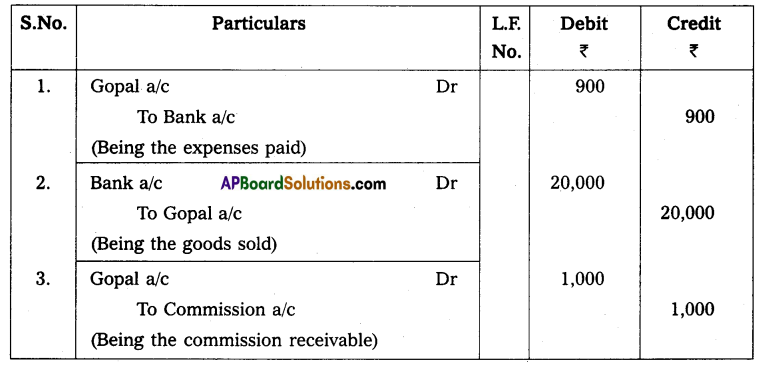
The family planning programme was started in 1951 as a purely demographic initiative.

  1. National Rural Health Mission (NRHM) was started in 2005 to provide accessible, affordable and quality health services to rural areas. In the rural areas the Government extended National Rural Health Mission (NRHM) to towns as National Urban Health Mission (NUHM) in 2013. By combining NRHM and NUHM Government renamed it as National Health Mission (NHM).
  2. Accredited Social Health Activities (ASHAs) have been selected and trained in health care for various villages.
  3. Janani Suraksha Yojana (JSY) was started to bring down Maternal Mortality Rate (MMR). According to this scheme nearly 3.5 crore women have been covered.
  4. Pradhan Mantri Swasthiya Yojana (PMSY) has been launched with the objectives of correcting regional imbalances in the availability of reliable health care services in the country.
  5. Rogi Kalyan Samitis.
  6. Village Health and Sanitation Committees.
  7. Mobile Medical Units.
  8. Ayurveda Yunani Siddha Homeo (AYUSH) Services.
  9. Janani Sishu Suraksha Karyakramam (JSSK) was launched for mother and child care.

The 12th plan main aim is Universal Health Coverage (UHQ for all in the countiy. UHC broadly means ensuring equitable access to affordable and quality health services to all the people in India. Regardless of Income level, Social status, Gender, Caste or Religion.

AP Inter 2nd Year Economics Study Material Chapter 2 Population and Human Resources Development

Question 9.
Physical Quality of Life Index (PQU).
Answer:
The Physical Quality of Life Index (PQLI) is an attempt to measure the quality of life or well being of a country. The value is the average of three statistics : basic literacy rate, infant mortality and life expectancy at age one, all equally weighted on a 0 to 100 scale. It was developed for the overseas development council, in the mid 1970s by Morris David Morris, as one of a number of a measures created due to dissatisfaction with use of GNP as an indicator of development.

PQU might be regarded as an improvement but shares the general problems of measuring quality of life in an quantitative way. It has also been criticized because there is considerable overlap between infant mortality and life expectancy. The UN Human Development Index is a more widely used means of measuring well-being.

Steps Calculate Physical Quality of Life:

  1. Find percentage of the population that is literate (literacy rate).
  2. Find the infant mortality rate (out of 1000 births)
    Indexed Infant Mortality Rate = (166 – Infant mortality) × 0.625
  3. Find the life expectancy. Indexed Life Expectancy
    (life + MO expectancy – 42) × 2.7
  4. Physical Quality of Life
    = \(\frac{\text { Literacy Rate + Indexed Infant Mortality Rate + Indexed Life Expectancy }}{3}\)

Very Short Answer Questions

Question 1.
Population Explosion. [A.P. Mar. 18, 17, 16]
Answer:
When the birth rate exceeds death rate during particular period of time.

Question 2.
Great dividing year of population.
Answer:
The year 1921 is regarded as great dividing year of population because both birth and death rates were high before 1921, later death rate has been decreasing more rapidly than birth rate in India.

AP Inter 2nd Year Economics Study Material Chapter 2 Population and Human Resources Development

Question 3.
Infant Mortality Rate (IMR).
Answer:
It is calculated at a ratio of the number of death among the 1000 born children in a year.

Question 4.
Maternal Mortality Rate (MMR).
Answer:
It is calculated at a ratio of the number of delivery deaths among the 1,00,000 women in a year.

Question 5.
Birth Rate.
Answer:
It is calculated at a ratio of the number of births among the 1000 population in a year.

Question 6.
Death Rate.
Answer:
It is calculated at a ratio of the number of deaths among the 1000 population in a year.

Question 7.
Urbanisation.
Answer:
The proportion of urban population in India in 2001 was 27.8 percent as against 17.3 percent in 1951. If the economic development is going on people are migrate backward areas to urban areas. So the population density will be increase in urban areas, facing number of problems like high cost living sanitation, drainage, housing problems and high male – female ratio.

Question 8.
Joint family System.
Answer:
Joint family system in India is very much common in rural areas. The joint family system induces young couples to have children since taking care of their bringing up at home is not a problem in a joint family their economic burden is carried and shered by the earning members.

AP Inter 2nd Year Economics Study Material Chapter 2 Population and Human Resources Development

Question 9.
Occupational Distribution of Population.
Answer:
Occupational Distribution of Population refers to the number and ratio work force participation in the total population. The working population of the country is engaged in three different kinds of occupations known as primary occupation, secondary occupation and tertiary occupation.

Question 10.
Primary Sector.
Answer:
The primary occupation include all these essential activities such as agriculture and allied activities like animal husbandry, forestry, fishery, poultry etc., changes in occupational structure are very much associated with economic development.

Question 11.
Tertiary Sector. [A.P. Mar. ’18]
Answer:
Tertiary sector is also called service sector. Trade, transport, communications, banking, insurance, education, health etc., are included in service sector. Tertiary activities help primary and secondary activities in the country.

Question 12.
Human. Resource Development.
Answer:
The term human resource development refers to the process of acquiring and increasing the number of persons who have the skill education and experience. Which are critical for the economic and political development of a country.

AP Inter 2nd Year Economics Study Material Chapter 2 Population and Human Resources Development

Question 13.
Literacy Rate.
Answer:
Literacy Rate = AP Inter 2nd Year Economics Study Material Chapter 2 Population and Human Resources Development 4 × 100

Question 14.
Sarva Siksha Abhiyan (SSA). [A.P. Mar. 18, 17, 16]
Answer:
Sarva Siksha Abhiyan has been introduced during 2001 – 2002. With an aim to provide universal elementary education for all children in the 6 to 14 age group by 2010. SSA has now been renamed as Rajiv Vidya Mission in Andhra Pradesh.

Question 15.
Janani Suraksha Yojana (JSY). [A.P. Mar. 18]
Answer:
The scheme has dual objectives of reducing maternal and infant mortality by promoting institial deliveries. JSY has started in the year 2005 – 2006.

Question 16.
Human Development Index (HDI).
Answer:
Human Development Index measures the average achievement in the three basic dimensions of human development. They are life expectancy adult literary rate and decent standard of living.

AP Inter 2nd Year Economics Study Material Chapter 2 Population and Human Resources Development

Question 17.
Gender Related Index (GDI).
Answer:
Gender related index adjusts the average achievement to reflect the inequalities between men and women. The three components used for the purpose are

  1. Female life expectancy
  2. Female adult literacy
  3. Female percapita income.

Question 18.
Gender Empowerment Measure (GEM).
Answer:
The Gender Empowerment Measure was also introduced by the human development index report 1995. There are three components, which are used for measuring GEM.

  1. Participation of women in economic and political activities.
  2. Gender inequality in economic and political participation.
  3. Female empowerment.

Question 19.
Human Poverty Index (HPI).
Answer:
The Human Development Report 1997 introduced the human poverty index, which concentrates on deprivation in three essential elements of human already reflected in HDI longevity, knowledge and a decent standard of living.

Question 20.
Total Fertility Rate. [A.P. Mar. 17]
Answer:
The number of live births by a woman during the entire reproductive period.

AP Inter 2nd Year Economics Study Material Chapter 1 Economic Growth and Development

Andhra Pradesh BIEAP AP Inter 2nd Year Economics Study Material 1st Lesson Economic Growth and Development Textbook Questions and Answers.

AP Inter 2nd Year Economics Study Material 1st Lesson Economic Growth and Development

Essay Questions

Question 1.
Explain the characteristic features of developed countries.
Answer:
The developed countries are also referred to as high income countries, industrialised countries and advanced countries. USA, UK, France, Germany, Canada, Japan are some of the developed countries.
1) High per capita income: The income per head per year is called per capita income.
The main feature of the developed countries is high per capita income.
The per capita GNI of developed countries is far higher than the per capita GN1 of the developing countries like India and China. In the year 2012 the per capita GNI of U.S.A ($ 50.120) at official exchange rate was nearly 33 times and at purchasing power parity ($ 50.610) was 13 times that of India ($ 1.530). So there are high difference in the per capita incomes of developed and developing countries.

2) Importance of Non-agricultural sectors : The developed economies are non¬agriculture in nature. The industry and service sectors are well developed in these economies. The contribution of these sectors to income and the employment generation is very high when compared to the agriculture sector.
The developed countries are industry and service sector oriented whereas the developing countries still depend on the agriculture sector. In the USA the proportion of people engaged in agriculture sector is just 1.6 percent and its contribution to GDP is 1.3 percent.

3) Abundance of capital and technology : The most important feature of developed countries is high rate of capital formation and wide spread use of modem and sophisticated technology. As the developed countries are high income countries their capacity to save is also very high. The banking system and financial institutions efficiently mobilize the savings.

4) Low level of unemployment: The unemployment in the developed countries is caused by the shortage of effective demand. The unemployment in these economies is cyclical and frictional.
The rate of unemployment is marginal and the skills and mobility of labour are higher in the developed countries.

5) Better quality of life : A better quality of life is ensured in the developed countries due to the effective social security system, better compliance of pollution standards, availability of safe drinking water, well organized health care system and sanitation. The expenditure on education, research, training, skill formation and health is more in these countries.

AP Inter 2nd Year Economics Study Material Chapter 1 Economic Growth and Development

Question 2.
India is a developing country – Discuss.
Answer:
The nature of the Indian economy is underdeveloped before the advent of planning. The pace of development has quickened since 1951. The following facts will prove that Indian economy is passing through a crucial phase of economic development.
1) National income trends : Over the four and half decades of economic planning, the economy registered significant advance. In 1950 – ’51 India’s net national product at factor cost at 1980 – ’81 prices was ₹ 40,454 crores. Since then it had increased to ₹ 91,71,045 crores in 2013 – ’14 from 4,71,619 crores in 1990 – ’91.

2) Rise in per capita income : A rise in per capita income is considered to be a better index of growth than the growth of net national product. In 1950 – ’51 India’s percapita net national product at 1980 – ’81 prices was ₹ 1,127. Since then it has raised by $ 1,070 to $ 1,530 in 2011.

3) Changing sectoral distribution of domestic product : An important index of development is a stealy decline in the contribution of agriculture and allied activities to gross domestic product. In 1950 – ’51 the share of agriculture and allied activites in the gross domestic product was 56.5%. The output of agriculture sector is 13.9%, secondary is 26.2% and tertiary sector is 59.9% in 2013 – ’14.

4) Occupational distribution of population : In India the occupational distribution of population has not changed significancy during plan period. In India where agriculture and allied activities accounted for 68.8% of work force in 1991 as against 72.1% in 1951. It is 48.9% in primary sector 24.3% in industrial sector 26.8% in tertiary sector in 2011.

5) Growth of production : The index of agriculture production increased by 100%. There is now in evidence much larger area under irrigation greater use of fertilisers and of improved agricultural practices. Indian agriculture has been greatly stabilised by the adoption of modem technology in farming.

6) Growth of basic capital goods industries : During British rule the share of basic and capital goods industries in the total industrial production was nearly one-fourth. From 1956, a large number of basic and heavy industries have been set up to make the country’s industrial structure strong.

7) Expansion in social overhead capital: Infrastructural facilities often referred to as economic and social overhead Indian planners were fully aware of the link between infrastructural facilities and general economic development. Their development can also be assured for better human-living. Tremendous amount of. progress achieved in the transport, banking, irrigation, education and communications. There has been a spectacular progress in the field of education and public health. The rate of literacy increased to 52% of population.

8) Science and Technology: For rapid economic progress, the application of science and technology to all economic and non-economic activities has become essential. 1958 the science policy resolution was adopted to provide positive incentives for the development and utilisation of science and technology in nation building activities. Our achievements in nuclear energy and in space technology have put India in the small select company of scientifically most developed countries.

AP Inter 2nd Year Economics Study Material Chapter 1 Economic Growth and Development

Question 3.
Explain the features of developing countries with special reference to India. [A.P. Mar. 18, 17, 16]
Answer:
Developing economies are distinguished from developed economies on the basis of their per capita income. Most of the economies are agarian in nature and their present rate of capital formation is low and inadequate to meet the requirements of their development.

According to United Nations ‘The countries which have real per capita income less than a quarter of the per capita income of the United States are developing countries”.
The following are the characteristic features of developing countries with special reference to India.
1) Low per capita income : One of the basic features of developing countries is low per capita income. The low income and middle income countries combined together are called developing countries.
The per capita G.N.I. of India has increased from $ 1,070 to $ 1,530 (2011) entered into the group of lower middle income countries.

2) Scarcity of capital :,The rate of capital formation is low in most of the developing countries. In the most of developing countries the saving rates range between 15 to 20%.
According to C.S.O estimates the growth of gross domestic saving was 27-9% and capital formation was 24% in the year 2011 – ’12.

3) Unemployment: Wide spread unemployment is one of the important features of developing countries. In India unemployment is due to the deficiency of capital. There is disguised unemployment in rural areas. Around 60% of the population is depending on agriculture for employment. The planning commission estimated that there was a back logo of 37 million unemployed at the beginning of 11th plan and it was expected that 82 million by the end of the plan.

4) Demographic characteristics : The developing countries are facing the problem of heavy population. They are successfully reducing the mortality rates by improving the medical facilities but failed to control the birth rates, this led to population explosion. India is also facing the problem of heavy population. It’s population was 1210 million in 2011 and it increased to 1278 million in 2015.

5) Predominance of agriculture : One of the basic features of developing countries is that they are predominantly agrarian economies. The share of agriculture in G.D.P is between 20 to 30%.

According to Indian economic survey 2013 – 14, 54.6% of the working population is engaged in the agriculture sector and it contributes 13.9% of the G.D.P.

6) High incidence of poverty: The another important feature of developing countries is the prevalence of mass poverty. The people in these countries suffer from low level of income, malnutrition, ill health and illiteracy.

India is also facing the problem of poverty. As per Tendulkar committee reports, the planning commission has updated the poverty line. Based on this; The percentage of population living below the poverty line was 29.8% in 2009 – 10.

7) Income inequalities : The most important feature of developing economies is the disparities in income and wealth. Compared to the developed countries, the income inequalities are larger in the developing countries.

According to 68th round of NSSO for the year 2011 – ’12 the monthly per capita consumption expenditure of the poorest 10% of the rural population rise by 11.5% in 2011 – ’12 compared with the 66th round for the year 2009 – TO. In urban areas, the growth was 17.2% and 30.2% respectively over the same period.

8) High density of population: The density of population is veiy high in the developing countries due to the large size of population. The density of population of the world was 50 per sq.km in 2011. It is in India was 382 per sq.km in 2011, where it was 3 in Australia, 33 in USA, 145 in China etc.

9) Low quality of life : The quality of life in the developing countries is very low in comparison with developed countries. These countries people suffer from malnutrition, high population, safe drinking water and lack of sanitation etc. The life expectancy at birth is below 65 years.

10) Technical backwardness: In the developing countries the production techniques backward due to lack of research and development. These countries use labour intensive technique because high population and capital deficiency.

Indian economy is also technically backward. Modem and traditional techniques are used side by side in different sectors of the economy. It has affected the productivity in the economy.

11) Dual economy: Economists talk of various types of dualism existing in developing economies. They are
(a) Social dualism
(b) Technological dualism
(c) Financial dualism.

Indian economy also characterised by the dualism, the product and factor markets in India are divided with different degree of imperfections. Technological dualism is existed in India. There prevailed two kinds of economic sectors i.e., organised and unorganised sectors. The industrial sector uses the modem technology and agriculture sector still follows old method of production.

12) Price instability : The price instability is also basic feature of the developing countries. In India there is continuous price instability because of shortage of essential commodities and gap between consumption and production.

Short Answer Questions

Question 1.
Differentiate between economic growth and development.
Answer:
The terms of Economic Growth and Economic Development are used synonymously, there exists some differences.

According to C.P. Kindle Berger “Economic growth means more output and economic development implies more output and changes in the technological and institutional arrangements by which it is produced”.

According to United Nations expert committee “Development concerns not only man’s material needs but also the improvement of the social conditions of his life. Development is therefore not only economic growth, but growth plus change social, cultural, institutional and economic”.

The following are the main differences between Economic Growth and Economic Development.

Economic growth

  1. Economic growth refers to an increases in a country real output, of goods and services.
  2. Economic growth is a single dimensional phenomenon.
  3. Economic growth is mainly related to developed countries.
  4. It is a narrow concept.
  5. It does not require governmental intervention.
  6. It denotes quantitative changes in the economy.
  7. Economic growth does not indicate the distribution of income and wealth in the economy.
  8. Economic growth can be compared with the physical growth of a person.
  9. It can be measured.

Economic development

  1. Economic development refers to not only economic growth but also progressive changes in the social economic structure of a country.
  2. Economic development is a multi dimensional phenomenon.
  3. Economic development is generally related to developing countries.
  4. It is a wider concept.
  5. It is not possible to achieve economic development without the intervention of the government.
  6. It denotes qualitative changes in the economy.
  7. Economic development indicates the distribution of income and wealth in the economy.
  8. Economic development is like overall improvement of a person. (Both physical as well as intellectual).
  9. It cannot be measured.

AP Inter 2nd Year Economics Study Material Chapter 1 Economic Growth and Development

Question 2.
Explain the determinants of economic development.
Answer:
Economic development is a complex process. It is influenced by both economic and non-economic factors. Broadly the factors determine economic development are classified as follows.
AP Inter 2nd Year Economics Study Material Chapter 1 Economic Growth and Development 1
1) Natural resources : The development of any country on the availability of natural resources. Jacob Viner, WilliamJ.Baumol and W.A. Lewis attached great importance to natural endowments of a country for its development. The availability of quality and quantity or size of the natural resources can induce the development of agriculture and industrialisation.

2) Economic factors :
(a) Capital formation: Economic development depends on capital formation. Capital formation depends on savings. It enlarges a country’s capacity to produce goods. Capital formation helps the formation of sound infrastructure.

(b) Marketable surplus : Marketable surplus raises the incomes in the rural areas which in turn stimulates the demand for goods and services. So the development of other sectors in an economy depends on the marketable surplus.

(c) Foreign trade : Foreign trade helps the countries to increase the production of goods and services through division of labour and specialisation. It will expand the output and employment in the economy. It also facilitates the developing countries to import capital, technology from the developed countries.

3. Non-economic factors :
(a) Human resources : Population is an important factor in economic development. If a country can manage to use its man power properly. But in case, human resources remain either unutilised or underutilised it will be a burden on the economy.

(b) Technical progress : Technology plays an important role in the economic development. The use of modem and sophisticated, technology enhances the productivity and production is all sectors of the economy. It minimizes the cost of production.

Political freedom : Majority of the developing countries were under the British rule in the past. After they got independence all these countries have initiated planning strategy to achieve faster economic development. Hence political freedom is necessary to take strong and independent decisions regarding the development process.

Social organisation : Development process requires the active participation of all sections of people in a country experiences suggest that the defective social organisation helped the rich to gamer the benefits of development. This has led to wide spread disparities among the people.

Corruption : The rampant corruption at various levels in the developing countries has become a negative factor in the process of development.
The factors like tax evasion, misappropriation of public funds and connivance of the officials are the major hindrances in the way of development.

Desire to develop : The development process in any country depends on the people desire to develop. According to Richard T. Gill “Economic development is not a mechanical process. It is a human enterprise. It’s outcome will depend on the skill, quality and attitudes of the people”.

Very Short Answer Questions

Question 1.
Economic growth.
Answer:
Economic growth refers to an increase in a country’s real output of goods and services. It related to developed countries.

AP Inter 2nd Year Economics Study Material Chapter 1 Economic Growth and Development

Question 2.
Economic development.
Answer:
Economic development refers to not only economic growth but also progressive changes in the socio-economic structure of a countiy.

Question 3.
Per capita income.
Answer:
The income per head per year is called per capita income. It is obtained by dividing the national income with population of the country.
Per capita income = \(\frac{\text { National income }}{\text { Population }}\)

Question 4.
Planning commission’s definition of a developing country.
Answer:
“An under developed economy is characterised by the existence, in greater or lesser degree of unutilised or underutilised man power on the one hand and of unexploited resources on the other”.

Question 5.
Human capital.
Answer:
Expenditure on education, training, skill formation research and improvement in health is called human capital.
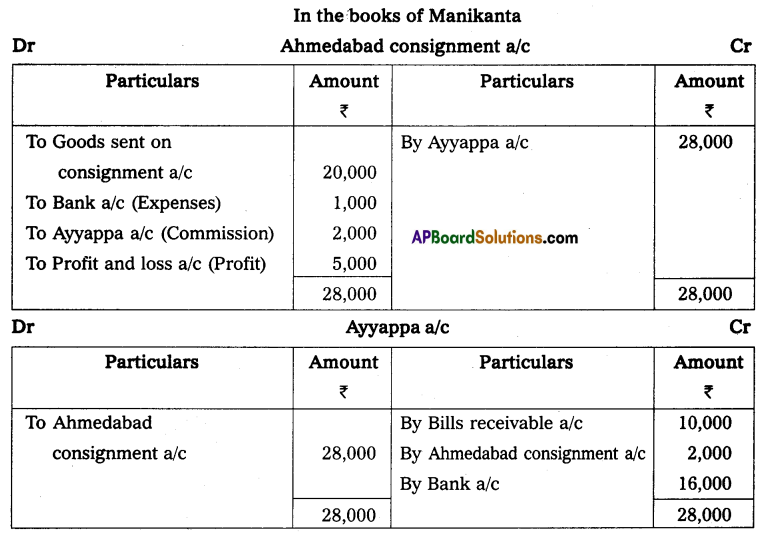
AP Inter 2nd Year Economics Study Material Chapter 1 Economic Growth and Development

Question 6.
World Bank’s classification of world countries.
Answer:
The World Bank in its world development report (2014) classified the countries on the basis of Gross National Income (G.N.I) per capita. Countries are divided into

  1. Low income countries : With G.N.I per capita of $ 1.045 and below.
  2. Middle income countries : With G.N.I per capita ranging between $ 1.046 and $ 12.746. The Middle income countries are again divided into
    a) Lower middle income countries with G.N.I per capita ranging between $ 1.046 and $4.125.
    b) Upper middle income countries with G.N.I per capita ranging between $ 4.126 and $ 12.746.
  3. High income countries : With G.N.I per capita of $ 12.747 or more

Question 7.
Dual Economy. [A.P. Mar. 17, 16]
Answer:
An economy where both technically advanced and technically primitive sectors exist side by side is called as dual economy.

AP Inter 2nd Year Civics Study Material Chapter 13 Recent Developments in Andhra Pradesh and India

Andhra Pradesh BIEAP AP Inter 2nd Year Civics Study Material 13th Lesson Recent Developments in Andhra Pradesh and India Textbook Questions and Answers.

AP Inter 2nd Year Civics Study Material 13th Lesson Recent Developments in Andhra Pradesh and India

Long Answer Questions

Question 1.
Describe the Formation of Andhra Pradesh State.
Answer:
The Desire of Formation of Andhra Pradesh is not a new one. Sri C.R. Reddy expressed his feeling of formation of Andhra Pradesh by virtue of their Telugu speaking on the eve of his guest lecture of convocation of Osmania University in 1938 later Proi. Mamidipudi Venkata Rangaiah expressed this view in an article.

1) Role of Communist Party:
The Credit of the development of concept of Visalandhra has goes to communists of Andhra. They got thumping majority in 1952 general elections both in Andhra and Telangana regions the formation of Visalandhra was also included in their election manifesto to they used to promote the feeling among the people by establishment of Andhra State in 1953, October 1st the politics has gone through the regions of Andhra and Telangana towards the formation of Visalandhra.

2) First Visalandhra Mahasabha :
In 1949, November 26 the first Visalandhra mahasabha was held at Vijayawada under the leadership of Sri Ayyadevara Kaleswara Rao.

3) Second Visalandhra Mahasabha:
In 1954, June 13 and 14 the second Visalandhra Mahasabha was held at Hyderabad led by Sri. Sri.

4) Fazal Ali Commission:
In the wake of formation of separate Andhra the Keralites, Kamatakas used to agitate for separate states. The Marathas’had also joined with them N.V Gadgil advised Nehruji, it is inevitable to the formation of linguistic state, unless and otherwise the congress party eould not survive in South India. By following this advice on 22nd December, 1953 the Indian government has announced the formation of State Reorganization Commission (SRC) under the chairmanship of Fazal Ali, Besides him H.N.,Kunzru and K.M. Phanikkar were other members. The committee had submitted its report to the union government on 30th September, 1955.

The contmittee in its report observed and examined merits and demerits by forming Visalandhra and it also studied deeply the formation of separate, Telangana and its positive arguments by mentioning positive and Negative views the committee advised it is better to make an agreement like Sri Bagh which was held in the case of formation of separate Andhra State which does not create any obstructions for development of Telangana and will not create any harm to job opportunities and to protect the interests of Telangana people then the Visalandhra can be formed in addition to the above the Telangana Legislators has to approve the resolution with 2/3 majority who were elected in 1952.

5. Gentlemen’s Agreement :
In order to clear the doubts among the people of Telangana that the Visalandhra may obstruct their interests, the gentlemen’s Agreement look place on 20th February, 1956 at Delhi basing on the recommendations of Fazal Ali Commission. It was attended by Sri Bezawada Gopala Reddy the then Chief Minister of Andhra State, and his Colleagues Sarvasri Neelam Sanjeeva Reddy, Gouthu Lanchanna, Alluri Satyanarayana Raju from Andhra Region.

Sri Burgula Ramakrishna Rao the then Chief Minister of Hyderabad state and his colleagues Savasri K.V. Ranga Reddy, Marri Chenna Reddy, J.V. Narsinga Rao from Telangana Region, They had signed on the Agreement which contains the follows aspects. ‘

  1. The administrative expenditure of the state shall be contributed in proportion of both Andhra and Telangana. The surplus of Telangana should be confined for its development up to five years and it may be extended for another five years at the request of Telangana legislators.
  2. The educational opportunities which are in Telangana shall be provided for them only more development is to be extended. Technical education and seats in Universities shall be allocated up to 1/3 for Telangana students.
  3. The Vacancies arise in Future shall be allocated to both Regions in proportion to their population.
  4. 12 years of Residency is must for Andhra people to get job in Telangana.
  5. Regional Development council shall be constituted for over all development of Telangana.
  6. In Council of ministers there shall be 60% from Andhra and 40% from Telangana respectively there must be one Muslim from Telangana part.
  7. If the chief minister is belongs to Andhra Region, the deputy chief minister must be from Telangana Region and vise-versa. At least 2 port folios must be given to Telangana out of Home, Finance, Revenue, Planning, Development, Commerce and Industry.

Decks had been cleared for formation of Visalandhra in the wake of gentle men’s agreement. The state Reorganization Bill was introduced in both houses of parliament on 16th March, 1956.

On 5th April, 1956 the bill was approved by the Andhra legislative assembly by the following amendments.

  1. The Name of the state should be Andhra Pradesh.
  2. The capital and the high court must be set up at Hyderabad.
  3. The general elections shall be held for the entire Andhra Pradesh in 1962.
  4. The legislative council with 72 members should be setup.

→ On 13 April, 1956 the bill was approved by the Hyderabad state legislative assembly.
→ On 25th August, 1956 the bill was approved by Rajya Sabha and later by Lok Sabha.
→ On 31st August, the president of India gave his assent to the bill.
→ On 1st November, 1956 on the eve of Diwali the first linguistic state of Andhra Pardesh was formed.
→ C.M. Trivedi was the first governor.
→ Neelam Sanjeev Reddy was the first chief minister.

AP Inter 2nd Year Civics Study Material Chapter 13 Recent Developments in Andhra Pradesh and India

Question 2.
Examine the causes that led to Bifurcation of Andhra Pradesh.
Answer:
The movement for separate Telangana state was revived with the creation of Chattisgarh, Jharkhand and Uttarakhand in 2000. This time, the political movement was spear headed by the Telangana Rashtra Samithi (TRS). Andhra Pradesh was the first state to be formed on the linguistic basis. But even after co-existence of 57 long years, the sense of same language has failed to keep the people of the state united.

The rationale behind the agitation for Telangana is not merely .’Economic Backwardness’ but the culmination of grievances such as intentional neglect of the region in water sharing, funds allocation, employment opportunities and even cultural discrimination. These claims may or may not pass the test of rationality. But, once a section of people start exhibiting their serious apprehensions and inconveniences to, live with their counterparts in other regions, it is difficult to sustain unity.

Causes that led to Bi-furcation :

  1. The congress party entered into an alliance with TRS in 2004 elections.
  2. The congress led UPA government promised that the decision on separate Telangana state will be taken at an appropriate time by getting consensus of all the political parties through the presidential address to the parliament during its first session on the eve of formation of 14th Lok Sabha. ,
  3. The U.P.A government constituted a cabinet sub-committee headed by Sri Pranab Mukhaijee to have wider consultations with all the political parties regarding credtion of separate Telangana. Sri Raghuvams Prasad Singh (RJD) and Sri Dayanidhi Maran (DMK) were the other two members.
  4. The Ruling party showed little interest in creating Telangana state. By the year 2009 when general elections are due, the congress party had gone back on its promise.
  5. During 2009 elections the Telugu Desam, CPI and CPM parties entered into electoral alliance with TRS by forming the grand Alliance that they are in favour of separate State of Telangana.
  6. In the Wake of Hunger Strike of Sri K. Chandra Sekhar Rao, the TRS supreme and with the intensification of agitation for separate Telangana. Home Minister Chidambaram said in December 2009, that is serious about Telangana.
  7. The government of India constituted a committee for consultations on the situation in Andhra Pradesh on 3rd February 2010. It was headed by Justice B.N. Sri Krishna. It examined two main issues namely, (i) the demand for separate statehood Telangana (ii) keeping the state united in the present form, Andhra Pradesh. The Committee submitted its report on 30 December, 2010 to the Ministry of Home Affairs.

The Sri Krishna Committee solicited suggestions and views from political parties, social organizations and other stakeholders. The Committee’s report contained six options. They are mentioned as follows.

  1. Maintaining the status quo.
  2. Bifurcation of the state into Seemandhra and Telangana. Each state is to develop its own capital. Hyderabad is to be converted into a Union Territory.
  3. Dividing A.P. into two states – one of Rayala Telangana with Hyderabad as its Capital and the second one of the coastal Andhra Pradesh.
  4. Dividing Andhra Pradesh into Seemandhra and Telangana with enlarged Hyderabad metropolis’as a separate Union Territory. It will be linked geographically to Guntur district in coastal Andhra via Nalgonda district in the south east and via Mahaboob Nagar district in the south to Kumool district in Rayalaseema.
  5. Bifurcation of the State into Telangana and Seemandhra as per existing boundaries with Hyderabad as capital of Telangana and Seemandhra to have new capital.
  6. Keeping the State united and providing for creation of statutorily empowered Telangana Regional Council for socio-economic development and political development of Telangana region.
  7. Telangana leaders rejected the recommendations of the Committee and insisted on the formation of Telangana state with Hyderabad as its capital, Protests in Telangana continued in the form of strikes, hunger strikes, suicides, giving petitions and roses to public officials and boycotting the public events. .
  8. The UPA coordination committee agrees to the division of Andhra Pradesh on July 30, 2013.
  9. Andhra Pradesh Reorganization Bill, 2014 was passed by the Parliament in February 2014 amidst pandemonium in the Parliament. The Seemandhra region was in turmoil.
  10. The Bill was attested by the President on March 1st 2014.
  11. The New 29th state of Telangana was created on 2nd June, 2014 with 119 members of Legislative Assembly and 40 members of Legislative Council, 17 members in the Lok Sabha and 7 members in Rajya Sabha.
  12. The Residuary state of Andhra Pradesh would-have 175 MLA’s, 58 MLC’s, 25 MP’s in Lok Sabha and 11 MP’s in Rajya Sabha. There would be a common High Court and the expenditure would be apportioned between the two states. Hyderabad will remain the common capital under the Governor’s supervision for not more than ten years. Later in May 2015 a nfew capital city for Andhra Pradesh was announced with ‘Aitiaravati’. The capital city would stretch to the parts of Guntur and Krishna districts of the new state.

Question 3.
Define Human Right? Describe the structure of National Human Rights Commission of India.
Answer:
Introduction :
People are human so they are entitled to human rights. Human Rights determine standards to states and governments to protect the vulnerable Individuals and groups against oppression.

Definition:

  1. Section 2(d) of the protection of Human Rights Act, 1993 defines Human Rights as “Rights relating to life, Liberty, Equality and dignity of the Individual, guaranteed by the constitution or embodied in the International covenants and enforceable by the courts in India”.
  2. According to UNO Human Rights are freedom to all irrespective of place, sex, religion, language etc.

As per the U.N. Declaration of human rights, the government of India too steps for its implementation. In 1993, it appointed National Human Rights Commission and also passed Human Rights Act in 1998.

Composition:
National human rights commission is a multi-member body. It consists of four members, headed by the former chief justice of the Supreme Court. There will be a Supreme Court judge (or former Judge). A high court judge (or former high court chief justice) and two other members who actively participated in the human rights activities. The chairman of scheduled castes, scheduled tribes, minorities commissions, chairperson of national women commission act as the ex-officio members of the commission. There will be a General Secretary having the status of Secretary general in the commission.

Appointment:
The chairman as well as members of the commission are appointed by the President of India.

Tenure :
The Chairman and members shall hold their office for five years or until the super annuation age of 70, years which ever is earlier.

Functions :
The following are some of the important functions of national human rights commission.

  1. The national human rights commission makes enquiry into the cases of violation of human rights by the public authorities.
  2. It enquires into the cases of human rights violation as permitted by the judicial organizations.
  3. It review the various legislative measures in regard to the implementation of human rights.
  4. It makes suggestions for averting terrorist operations affecting human rights.
  5. It makes research into the matter of human rights.
  6. It takes steps for creating awareness of human rights among the people.
  7. It gives encouragement to voluntary organizations in the mutters of preserving human rights.

Question 4.
Explain about the Right to Information Act.
Answer:
The Right to Information act 2005 is an act of the parliament “to provide a setting out the practical regime of right to information of citizens”. The act applies to all states and Union territories of India except to Jammu and Kashmir. According to the act all the citizens have the right to seek information from any quarter which under the control of the public authority. The idea’is tq give transparency, accountability and disclosure in Government administration.

The act specifies that citizens have a right to –

  • Request any information.
  • Obtain copies of documents.
  • Inspect document works and records,
  • Takes certified samples of materials of work.

Process :
Under the act all authorities covered must appoint their information officer (PIO). Any person may submit request to the PIO for information in writing. If the request has been made to the PIO the reply is to be given within thirty days of receipt.

If information is not provided within this period it is treated deemed refusal. This is a fee of Rs. 10 filling the request Rs. 2 for page of information Rs. 5 each hour of after the first hour. Persons Below the Poverty Line (BPL) are exempted from the fee payment. However he or she should submit a proof in support of his or her claim for belonging to the section below poverty line.

Exclusions :
IB, RAW, CBI, Directorate of revenue Intelligency, Central Economic Intelligency, Bureau, Narcotics Control Bureau, BFS, CRPF, ITBP, Dadra and Nagar Haveli and Special branch, Laksha Dweep Police for that information relating to all allegation of human right violation could be given but only with the approval of Central (or) state information commission.

The following exempt from disclosure section (8) Eight:
→ Information disclosure of which would prejudicially effect the sovereignty and integrity of India.
→ Information which has been expressly forbidden to be published by any court of law or tribunal or disclosure of which may constitute contempt of court. Information the disclosure of which would cause the breach of privilege of parliament (or) state legislature.
→ Information whjch would impact the process of investigation or apprehension of prosecution of offenders.
→ The administrator appointed under Article 239 of the constitution.

The central information commission :
The central information commission consisted of one chief commissioner, number of CIC not exceeding ten. All the commissioners shall be appointed by the president of India. Head quarter is in Delhi.

The state information commission :
The state information commission consisted of one chief commissioner and not more than ten. Information commissioners appointed by the state.

The central information commission or state information commission as the case may be shall while inquiring into any matter have the same powers as or vested in a civil court.

Short Answer Questions

Question 1.
Describe the formation of Andhra State. [Mar. 18, 16]
Answer:
During Vandhemataram movement, the senior congressmen of Andhra Region, Sri Bhoga Raju Pattabhi Seetha Ramaiah, Mutnuri Krishna Rao, Konda Venkatappiah and Tanguturi Prakasam Met at Machilipatnam and discussed about formation of an Integrated Andhra state by uniting the regions of Andhra, Rayalaseema and Telangana. In the Madras State, There are 58% of Telugu areas and 40% of Telugu people were remained backward.

This created the feeling of separate state of Andhra among them strongly. In 1912 the joint session of Godavari, Krishna and Guntur was held at Nidadavole under the chairmanship of Sri Vemavarapu Ramadas and passed a Resolution for formation of separate Andhra State.

1) The First Andhra Mahasabha, Bapatla 1913:
In 1913 at Bapatla of Guntur district, the First Andhra Mahasabha was held which was presided by Sri B.N.Sarma. It was attended by 800 delegates and 2000 Audience.

2) The Second Andhra-Mahasabha, Vijayawada 1914 :
On 11th April of 1914 the second Andhra Mahasabha was held at Vijayawada which was presided by Sri Nyapathi Subba Rao, Sri Ayyadevara Kaleswara Rao of Vijayawada was its Convener. It was attended by 1600 delegates.

3) The Third Andhra Mahasabha, Visakhapatnam 1915 :
In 1915, May the third Andhra Mahasabha was held at Visakhapatnam under the chairmanship of Sri Panagallu Raja Rama Rayanim. It pass two resolutions.

  1. Formation of separate Andhra State, Inevitable
  2. Teaching in mother tongue up to secondary school level

The Nagpur congress session in 1920 has declared officially by accepting the doctrine of linguistic states. It has Recoginsed 21 languages on that basis the separate Pradesh congress was launched. Article 52 of Indian council Act of 1919 which was made on the Report of Montague – Chelmsford stated that the government may accept the proposal of separate’Andhra State if such resolution is passed by majority in the state legislature.

In 1926, the Andhra university was established with a view to provide higher education to Andhra people due to sincere efforts by the then education minister, Sri Anem Parasuram Pathro.

In 1932, under the chairmanship of Sri Kadapa Kotireddy, The separate Andhra Mahasabha was held at Madras. Sri Kasinadhuni Nageswara Rao Pantulu and Prominent leaders of Andhra and Rayalaseema were participated.

4) Sri Bagh Pact :
On 14th November, 1937 at Madras in the residence of Sri Kasinadhuni Nageswara Rao panthulu namely “Sri Bagh” the meeting of leaders of Andhra and Rayalaseema was held.

Leaders from Andhra regio,n were Dr. Bhoga Raju, Pattabhi Seetha Ramaiah, Konda Venkatappaiah, Mahboob Alibegh, Desi Raju Hanumantha Rao, Mullapudi Pallam Raju and Kasinadhuni Nageswara Rao Pantulu.

Leaders from Rayalaseema were Sri Kadapa Kotireddy, Seetha Rami Reddy, Subbu Rami Reddy, T.N.Rama Krishna Reddy, Pappuri Ramachari and Varadachari.

On 30th march, 1938 Konda Venkatappaiah introduced a Resolution in Madras Assembly and it was seconded by Kadapa Koti Reddy. The then chief minister addressed the house on resolution. Later it was passed by the house unanimously.

In 1938 The Andhra Mahasabha was held which was presided by Dr. Sarvepalli Radha Krishna and discussed about capital.
The First Andhra Mahasabha, Bapatla 1913
The Second Andhra Mahasabha, Vijayawada 1914
The Third Andhra Mahasabha, Visakhapatnam, 1915
Sri Bagh Pact
Events that led to the formation of Andhra State.
J.VR Report
Hunger Strike of Swami Seetharam
Hunger Strike fast un to death of Potti Sreeramulu
Waanchu Committee 1953

5) J.VR Report:
The Jaipur congress session appointed three men committee which consists of Jawaharlal Nehru, Vallabhaipatel and Pattabhi Seetha Ramaiah, Popularly Known as JVP Committee to re consider the Separate state demand. The committee submitted report in 1949 April Stating that the separate state can be formed upon a condition that the Andhra people has to set a side the desire of Madras city.

6) Hunger Strike of Swami Seetha Ram :
With a view to get easy and speedy formation of separate Andhra State by over coming of all hurdles Sri Swami Seetha Ram (Sri Gollapudi Seetha Ram Sasthri) Started hunger strike on 15th August, 1952 at Guntur Town hall it was continued for 36 days.

7) Hunger Strike Fast un to death of Potti Sreeramulu:
For the Separate state hood of Andhra Potti Sreeramulu has started fast un to death on 19th October, 1952 at the Residence of Maharshi Bulusu Sambamurthy and it was later named as “Yagnasala”.

Under these circumstances on 9th December 1952 the union government announced that the government would consider the issue of Separate Andhra state if the Andhra people will agree for separate Andhra apart from Madras By that time Fast un to death of Potti Sreeramulu has gone to 52nd day on 15th December 1952 at 11.39 p.m. Potti Sreeramulu Possess away.

8) Waanchu Committee 1953 :
In Jan, 1953 the Government of India has appointed Justice Waanchu, the chief Justice of Rajasthan High Court to study the formation of separate Andhra state soon after the receipt of Waanchu report prime minister Nehru announced that the Andhra state will be formed on 18th October, 1953 and furtherly he stated it is the responsibility of Andhra Legislators to decide the capital, which has to be set up in Andhra region except Madras.

Formation of Andhra State:
The government of India appointed C.M.Trivedi as special officer to look into the New state formation activities. The separate state of Andhra was officially formed with “Kumool’ as its capital on 18th October, 1953 as announced earlier.

New Andhra State Consists of 11 Andhra districts Viz, Srikakulam, Visakhapatnam, East Godavari, West Godavari, Krishna, Guntur, Nellore, Chittoor, Kadapa, Anantapur and Kurnool.

High court was set up at Guntur on 4th July, 1954 Justice Koka Subba Rao was the first chief justice C.M.Trivedi was the First Governor of Andhra state.

“Tanguturi Prakasam Panthulu” was the first thief minister. Prime Minister Jawaharlala Nehru launched the Andhra State on 1st October, 1953. The people through out the state had Celebrated it as great event and Festival.

AP Inter 2nd Year Civics Study Material Chapter 13 Recent Developments in Andhra Pradesh and India

Question 2.
Examine the Factors that led to Jai Andhra Movement
Answer:
Jai Andhra Movement (1972) was a sequal to the Telangana agitation (1969) which demanded only “Mulkis” should be appointed to the posts in Telangana including Hyderabad city. The ‘Mulki’ issue had a long history behind it. As early as in 1969, the Nizam State of Hyderabad issued a farman laying down that only ‘Mulkis’ are eligible for public appointments in the state. ‘Mulki’ was defined as one who was bom in the State of Hyderabad or resided there continuously for fifteen years and had given an affidavit that he or she has abandoned the idea of returning to his or her native place.

Even after the formation of Andhra Pradesh, the Mulki rules continued to be in force in the Telangana region. As these rules stood in the way of the people of Andhra region to compete for the posts, their validity was challenged in the High Court. The High Court struck down Mulki rules. On an appeal by the state government, the Supreme Court declared that the Mulki rules were valid and were in force. The judgement created a great political crisis in the state. The people of Andhra region felt that they were reduced to the status of second class citizens in their own state capital. They have an agitation demanding separation of Andhra region from Andhra Pradesh.
As the agitation continued, President Rule was imposed in the state (1973) and a political settlement was arrived at with the initiative from the Central Government. A ‘Six Point formula’ was agreed upon by the leaders of two regions to prevent any recurrence of such agitations in future. It included, among others the following two points.

  1. The abolition of Mulki rules and the Telangana Regional Committee.
  2. The establishment of a Central University at Hyderabad to augment educational facilities.

Question 3.
What are the Initiative under taken by NHRC?
Answer:
The National Human Rights Commission (NHRC) is a statutory body. It was established on October 12th, 1993. The NHRC is the guardian of Human Rights in the country, i.e., the Rights relating to life, liberty, equality and dignity of the Individuals guaranteed by the constitution.

Initiatives under taken by NHRC :

  1. The enquire into any violation of human rights.
  2. To intervene in any proceeding involving allegation of violation of human rights pending before a court.
  3. To visit jails and detention places to study the living conditions of inmates and make recommendations thereon.
  4. To review the constitutional and other legal safeguards for the protection of human rights and recommended measures for their effective implementation.
  5. To review the factors including acts of terrorism that inhibits the enjoyment of human rights and recommend remedial measures.
  6. To study treatises and other international instruments on human rights and make recommendations for their effective implementation.
  7. To undertake and promote research in the field of human rights.
  8. To spread human rights literature among the people and promote awareness of the safeguards available for the protection of human rights.
  9. To encourage the efforts of NGO’s working in the field of human rights.
  10. To recommend to the concerned authorities to make payment of compensation or damage to the victims. .

Question 4.
Why are Human Rights commissions necessary at the National and State Level?
Answer:
People are human so they are entitled to Human Rights. Human rights determine standards to states and governments to protect the vulnerable individuals and groups against oppression.

The Human Rights Protection Act, 1993 facilitates not only the creation of National Human Rights Commission but also a State Human Rights Commission at the state level. At present 23 states in India have constituted the State Human Rights Commission and Andhra Pradesh is one among them. The main objective of State Human Rights Commission is to inquire into violation of human rights only in respect of subjects mentioned in the State List and concurrent List of the 7th schedule of Constitution.

The National Human Rights Commission is the guardian of human Rights in the country i.e. the rights relating to life, liberty equality, and dignity of the individuals guaranteed by the constitution.

Whereas the State Human Rights Commission is the guardian of human rights in the state.

Question 5.
What are the Powers and Functions of Information Commissions? [Mar. 17]
Answer:
The following are the powers and functions of information commissions both at central and state levels.

1. The Central Information Commission/State Information Commission (CIC/SCIC) has a duty to receive complaints from any person-

  • Who was not been able to submit an information request because a PIO has not been appointed?
  • Who has been refused information that was requested?
  • Who has received no response to his/her information request within the specified timelimits;
  • Who thinks the fees charged are unreasonable;
  • Who thinks the information given is incomplete or false or misleading; and
  • Any other matter relating to obtaining information under this law.

2. Power to order inquiry if there are reasonable grounds.
3. The Central Information Commission / State Information Commissions (CIC/SCIC) will have powers of Civil Court such as –

  • Summoning and enforcing attendance of persons, compelling them to give oral or written evidence on oath and to produce documents or things.
  • Requiring the discovery and inspecition of documents.
  • Receiving evidence on affidavit.
  • Requisitioning public records or copies from any court or office.
  • Issuing summons for examination of witnesses or documents.
  • Any other matter which may be prescribed.

4. All records covered by this law (including those covered by exemptions) must be given to Central Information Commission / State Information Commission (C.IC / SCIC) during inquiry for examination.

5. Power to secure compliance of its decisions from the Public Authority includes

  • Providing access to information in a particular form.
  • Directing the public authority to appoint a PIO / APIO where none exists.
  • Publishing information or categories of information.
  • Making necessary changes to the practices relating to management, maintenance and destruction of records.
  • Enhancing training provision for officials on RTI.
  • Seeking an annual report from the public authority on compliance with this law.
  • Require it to compensate for any loss or other detriment suffered by the applicant.
  • Impose penalties under this law.

AP Inter 2nd Year Civics Study Material Chapter 13 Recent Developments in Andhra Pradesh and India

Question 6.
How is the Central Information Commission Constituted?
Answer:
The Central Information Commission (CIQ is constituted by the central government through a Gazette Notification.

Composition:
The Central Information Commission consists of one Chief Information Commissioner (CIC) and 10 other information Commissioners (IQ.

The Commission shall have its head quarters in Delhi. Other offices may be established in other parts of the country.

Appointment:
The Chief Information Commissioner and Information Commissioners will be appointed by the president of India, basing on the recommendations of the appointment committee headed by the Prime Minister.

Eligibility (or) Qualifications :
The persons who wish to be appointed as chief information commissioner and information commissioner must possess the following

Qualifications:

  • He must be person of eminence in public life with wide knowledge and experience in law, science and Technology, Social service management, Journalism, Mass media or Administration and governance.
  • He shall not be a member of either union or State Legislature
  • He shall not hold any other office of profit
  • He shall not be connected with any political party
  • He shall not carrying on any business or pursuing any profession.

Tenure :
The Chief Information Commissioner and Information Commissioners shall remain in office for a period of 5 years or till they attains the age of 65 years, which ever is earlier.

Salary :
The salary of CIC and i.e will be the same as that of the chief Election Commissioner and the Election Commissioner.

The Commission will exercise its powers without being subjected to directions by any other authority.

Question 7.
What is the Time Limit to get the Information?
Answer:
Any citizen of the country can seek information from any agency subject to certain limitations. The applicant should submit an application to the Public Information Officer (PIO) or Assistant PIO or who is the officer to give information to a person, who seeks information under this Act, accompanied by a nominal fee (usually Rs. 10/-) in the form of demand draft / banker cheque / Indian Postal Order / Court Fee stamp. Persons below the poverty line (BPL) are exempted from the fee payment. However he / she should submit a proof in support of his or her claim for belonging to the section below poverty line.

Information is to be provided by the PIO / asst. PIO within 30 days if life and liberty is involved, the information should be furnished within 48 hours where third party is involved it is to be provided within 40 days. If the information is not forthcoming within the stipulated period, first appeal can be made to the head of the department. After a reasonable gap, the second appeal can be made to Information Commission. For refusing to furnish information or for unreasonable delay or for providing false information, a penalty of Rs. 250/- a day can be levied up to a maximum of Rs. 25000/-, and the employee can be prosecuted.

Question 8.
What are the different options suggested by Sri Krishna Committee regarding the status of Andhra Pradesh State? [Mar- 18, 16]
Answer:
The government of India constituted a Committee for consultations on the situation in Andhra Pradesh on 3rd February, 2010 headed by Justice B.N.Sfi Krishna. It Examined two main issues namely :

  • The demand for separate statehood of Telangana.
  • Keeping the state united in the present form, Andhra Pradesh.

The Committee submitted its report on 30 December, 2010 to the union home ministry.
The committee’s report contained the following six options.

  1. Maintaining the status quo.
  2. Bifurcation of the state into Seemandhra and Telangana. Each state is to develop its own capital. Hyderabad is to be converted into a union Territory.
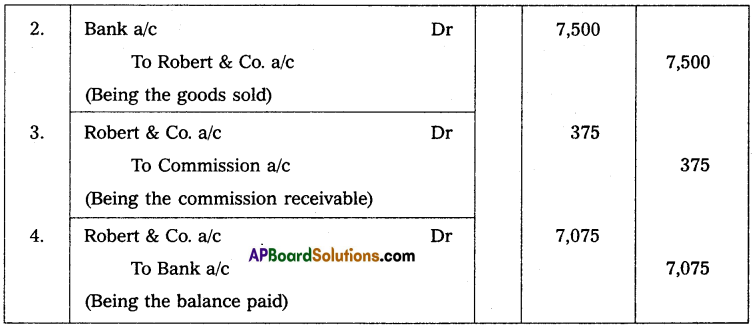
  3. Dividing A.P into two states – one of Rayala Telangana with Hyderabad as its capital and the second one of the coastal Andhra Pradesh.
  4. Dividing Andhra Pradesh into Seemandhra and Telangana with Hyderabad metropolis as a separate union Territory. It will be linked geographically to guntur district in coastal Andhra via Nalgonda district in the south East and via Mahaboob Nagar district in the South to Kumool district in Rayalaseema.
  5. Bifurcation of the state into Telangana and Seemandhra as per existing boundaries with Hyderabad as capital of Telangana and Seemandhra to have new capital.
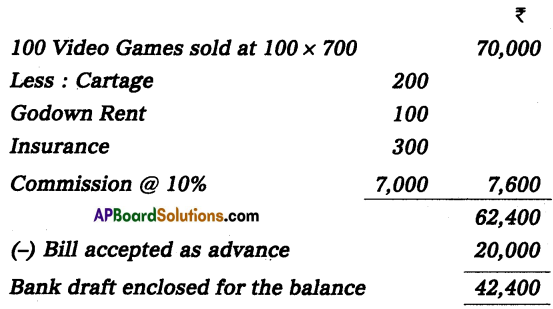
  6. Keeping the state united and providing for creation of statutorily empowered Telangana Regional council for Socio-economic development and political development of Telangana Region.

Very Short Answer Questions

Question 1.
Gentlemen Agreement.
Answer:
In order to clear the doubts among the people, of Telangana that the Visalandhra may obstruct their interest, the gentlemen’s agreement took place on 20th February, 1956 at Delhi basing on the recommendations of Fazal Ali Commission. It was attended by Sri Bezawada Gopala Reddy the then Chief Minister of Andhra State, and his colleagues Sarvasi Neelam, Sanjeeva Reddy, Gouthu Lanchanna, Alluri Satyanarayana Raju from Andhra region.

Sri Burgula Ramakrishna Rao the then Chief Minister of Hyderabad State and his colleagues Savaging K.VRanga Reddy Marri Chenna Reddy, J.V.Narsinga Rao from Telangana Region. They had signed on the Agreement.

AP Inter 2nd Year Civics Study Material Chapter 13 Recent Developments in Andhra Pradesh and India

Question 2.
JVP Committee. [Mar. 18, 16]
Answer:
The Jaipur Congress session appointed three men committee which consist of Jawaharlal Nehru, Vallabhaipatel and Pattabhi Seetha Ramaiah popularly known as JVP Committee to reconsider the separate state demand. The committee submitted report in 1949 April stating that the separate state can be formed upon a condition that the Andhra people has to set a side the desire of Madras city.

Question 3.
Sri Bagh Pact.
Answer:
When the Andhra movement was in full swing the leaders of Rayalseema and Andhra met at the residence of Sri Kasinadhuni Nageswara Rao Panttulu on 14th November, 1937 popularly known as “Sree Bagh” the following leaders were participated in the meeting.

The meeting was held in a peaceful atmosphere. The following were the chief provisions of the pact.

  1. The centres of Andhra universities will be established one at waltair and another , at Rayalaseema.
  2. Giving importance to the development of Rayalaseema.
  3. Equal representation in the assembly for all the districts.
  4. To set up either new capital or high court in Rayalaseema.

Question 4.
Fazal Ali Commission.
Answer:
On 22nd December 1953 the Indian government has announced the formation of States Re-organization Commission (SRC) under the chairmanship of Fazal Ali, besides him H.N Kunzty and K.M Phanikkar were other members. The committee had submitted its report to the union government on 30th September 1955.

Question 5.
Criteria to be followed to be appointed as the chairperson of NHRC. [Mar. 17]
Answer:
The Chairperson of the NHRC is appointed by the president of India, on the recommendations of a six (6) member committee consisting of further a sitting judge of the supreme court or a sitting chief justice of High Court can be appointed only after consultation with the chief justice of India. This high level and politically balanced committee, together with the statuatory requirements relating to the qualifications of the chairperson.

Question 6.
Procedure to be considered for the appointment of chairperson and members of the state HRC.
Answer:
The Chairman and members of state HRC are appointed by. the concerned state governor on the recommendations of a committee consisting of the chief minister as its head, the speaker of the legislative assembly. In the case of a state having legislative council, the chairman of the council and the leader of the opposition in the council would also be the members of the Committee. The sitting judge of a High Court or a sitting District judge can be appointed as members only after consulation with the chief justice of the high court of the concerned state.

Question 7.
Human Rights Commission as a civil court.
Answer:
The Human Rights Commission has the powers of a civil court under the code of civil procedure, 1908 in respect of-summoning and enforcning the attendance of witness; discovery and production of any document; receiving evidence on affidavits, requisitioning any public record or copy there of from any court or office ; issuing commissions for the examination of witnesses or documents and request of public record as listed under section 13 of the Act.

It has authority to grant interim relief.
It can recommend payment of compensation for the damages.

Question 8.
The Jurisdiction of NHRC on Armed forces.
Answer:
The National Human Rights Commission (NHRC) has limited role, powers, and Jurisdiction with respect to the violation of Human Rights by the Armed force. It has no power to punish the violation of Human Rights. The Commission’s Role is an advisory, Recommendatory. The government considers the cases forwarded by it.

Question 9.
Public Information Officer (PIO).
Answer:
Under the Right to Information Act, 2005 all authorities covered must appoint their information officer. Such an officer is called as Public Information Officer (PIO). In All Administrative Units PIO’s are designated to furnish information to any citizen. Any person may submit request to the PIO for information in writing.

AP Inter 2nd Year Civics Study Material Chapter 13 Recent Developments in Andhra Pradesh and India

Question 10.
What is Information?
Answer:
Information is any material in any form. It includes Records, documents, memos, e-mails, opinions, advice, press releases, circulars, orders, log books, contracts, reports, papers, samples, models and data material in any electronic form.

AP Inter 2nd Year Civics Study Material Chapter 12 Political Parties

Andhra Pradesh BIEAP AP Inter 2nd Year Civics Study Material 12th Lesson Political Parties Textbook Questions and Answers.

AP Inter 2nd Year Civics Study Material 12th Lesson Political Parties

Long Answer Questions

Question 1.
Write an essay on the major National Political Parties in India.
Answer:
India is the largest democratic country in the world. Political parties in India are classified into two types.

  1. All India Parties (or) National Parties and
  2. Regional Parties

1. National Parties :
A political party that participates in four or more states in Lok Sabha elections and secures 6% of valid polled votes plus 4 Lok Sabha- seats can be recognized as National Party by the Election Commission of India.

At present there are 6 major National parties in India they are :

  1. Indian National Congress (INC)
  2. Bharatiya Janata Party (BJP)
  3. Communist Party of India (CPI)
  4. Communist Party of India Marxist (CPM)
  5. Bahujan Samaj Party (BSP) .
  6. Nationalist Congress Party (NCP)

1. Indian National Congress (INC):
Indian National Congress is the oldest All India Political Party in our country. It was founded by A.O. Hume, a British Civil Servant on 28th December 1885. Womesh Chandra Banerjee was its first President. This party has played a prominent role in the Indian National movement agairist the Britishers and ultimately secured Independence. After Independence, the Congress kept on dominating the Indian Political science. It became the ruling party at the union and in majority of the Indian States upto March 1977.

Again it came to power during 1980-89 and 1991-1996. Between 1996 – 2004 it acted as a recognised opposition party at the centre. In 2004, it came to power at the centre as a major partner in United Progressive Alliance (UPA). It was the first congress led coalition at the centre. Again in 2009 general elections the congress led UPA, Secured Majority and formed government at centre with its allies.

2. Bharatiya Janata Party (BJP):
Bharatiya Janata Party is one of the All India Parties in India. It was founded in February 1980. It has been playing an active role in Indian Politics. It remained in power at the centre during 1998 – 2004. The party has remained as a major partner in the NDA government at the centre in the 13th Lok Sabha. The party remained as the main opposition party in the 14th and 15m Lok Sabha. Now it is in power at the centre under the leadership Sri Narendra Modi’, the Prime Minister of BJP led NDA government since 2014, May.

3. Communist Party of India (CPI) :
Revolutionary leaders and great intellectuals like M.N. Roy were very much fascinated by the Great October Revolution in Russia. Accordingly, the Communist P«arty of India was established on Dec. 26, 1925. Its main aims were to unify the workers, to fight against the colonial rule, to bring about a revolution through class war etc.

The party’s support was more concentrated in Andhra Pradesh, Telangana, West Bengal, Bihar and Kerala.

4. Communist Party of India Marxist (CPI(M)) :
The split in the Communist Party of India in 1964 at the Vijayawada session led to the birth CPI Marxist party. The extremists headed by Puchallapalli Sundarayya, Nambudripad, Jyoti Basu etc., formed the Marxist party. In fact there is not much difference in the ideology between the two parties. They differ only in the means. Of the CPI has moderate and rightist nature CPI (M) has extremist and leftest in nature. If the CPI is pro-Russia and CPI (M) is pro-China. The CPI(M) has a strong presence in the states of Kerala, West Bengal and Tripura.

5. Bahujan Samaj Party (BSP) :
Bahujan Samaj Party is a National Party in our country. It was founded by Kanshi Ram in 1984. The Bahujan Samaj Party – a party dominated by Dalits is the outcome of the merger of employees federation and Dalit Shoshit Samaj Samiti. Kanshi Ram was the torch bearer of this party and Mayawati its beacon light. Mayawati has been described as the guiding angel of the BSP and in fact its savior. The Scheduled Castes, Tribes, educationally and socially downtrodden classes, employees and workers of these classes are the members of this party. After the death of its mentor Kanshi Ram, Mayawati has become the savior of the party in all respects. The BSP has considerable hold in the U.P.

6. Nationalist Congress Party (NCP) :
The Nationalist Congress Party (NCP) is a Centre to Centre left political party primarily based in the states of Maharastra, Kerala and Meghalaya. NCP was formed on 25 May 1999, by Sharad Pawar, P.A. Sangma and Tariq Anwar after they were expelled from the Indian National Congress (INC) on 20th May 1999, for disputing the right of Italian – bom Sonia Gandhi to lead the party. Sharad Pawar is its president. It was an ally of congress led UPA government during 2004 to 2014.

AP Inter 2nd Year Civics Study Material Chapter 12 Political Parties

Question 2.
Explain the various types of Parties and estimate the role of Regional Parties in India.
Answer:
There are four types of Political Parties in the modem democratic states. They are:

  1. Reactionary Parties
  2. Conservative Parties
  3. Liberal Parties, and
  4. Radical Parties

The Reactionary Parties are those which are clinging to the old socio-economic and political institutions. The Conservatives believe in the status quo. The Liberal Parties aim at reforming the existing institutions. The Radical Parties aim at establishing a new order by overthrowing the existing institutions. Parties are also again classified on the basis of ideologies. The political scientists have placed the radical parties on the left, the liberal parties in the Centre and the reactionary and conservative parties on the right. In other words, they are described as the leftist parties’, ‘centrist parties’ and ‘rightist parties’.

After India became independent many political parties came into existence. Among these are some national parties, while some are regional parties D.M.K. in Tamil Nadu, Telugu Desam in A.P., National Conference in Jammu and Kashmir, Kranti Ranga in Karnataka and Assam Gana-Parishad in Assam have come into existence and have flourished as regional parties.

Reasons for the rise of regional parties :
Regional parties have been playing a vital role in the Indian politics. These regional parties have come into existence due to the causes mentioned here under.

Causes for the promotion of regional parties :

1) Regional parties based on regional issues :
India is a vast country with a great diversity. The Governments that came to power after Independence have not attempted to eliminate the economic imbalances and the differences between the different regions. Regional parties have come into existing basing on a problem in a certain region. In Tamil- Nadu at first D.K. and later D.M.K, have come into existence basing on the issues of preservation of Tamil culture, language issue and opposition to the imposition of Hindi.

In Punjab, Akali Dal was set up for the formation of a Punjabi Suba to safeguard the special status of Kashmir, National Conference was founded. Due to excessive intervention of the centre in Andhra Politics and the self-respect of Andhra Telugu Desam party come into existence and captured power in 1983. As regional parties have given prominence to the solution of the local issues, they have been reaping the sympathy of the people. So within a short time regional parties have flourished. ’

2) Failure of the Congress in solving regional issues :
The regional parties have flourished due to the failure of the Congress in solving regional issues. The Congress party has not taken regional disparities into account. It has not also tried to solve them in time and in a faetful way. D.M.K in Tamil Nadu became powerful on account of the language problem and the imposition of Hindi to which Tamilians are opposed. On account of the Centre’s frequent intervention in A.P Politics and disregard in selling up Central Government Industries Telugu Desam became powerful. In all the regions where regional parties have been formed, the failure of the Congress in solving regional issues is clearly seen.

3) Economic disparities between the states :
The Central Government has not implemented schemes to remove the economic disparties between the regions of the country and to ensure economic well being of all the regions. As economic disparties between the different states grew, the protests and agitations gave rise to the birth of the regional parties. With the vast economic resources at it’s disposal the centre did not attempt to remove the economic disparties. Economic inequalities are the main causes behind political agitations or movements. The frustration at the different provincial level gave rise to the rise and development of regional parties.

4) Individuality of regional leaders and their influence :
The individuality and influence of the regional leaders can be said to be one of the factors for the rise of regional parties. May parties have been founded only by leaders who have individuality and influence. These have been able to secure popularity.
Ex : Sri M.G. Ramachandran has founded the A.I.A.D.M.K. and Sri N.T. Rama Rao founded the Telugu Desam party. The strength behind these regional parties is derived from one individual. So, the party workers in a disciplined manner exhibit their allegiance to their leader; By this factor only regional parties have been thriving.
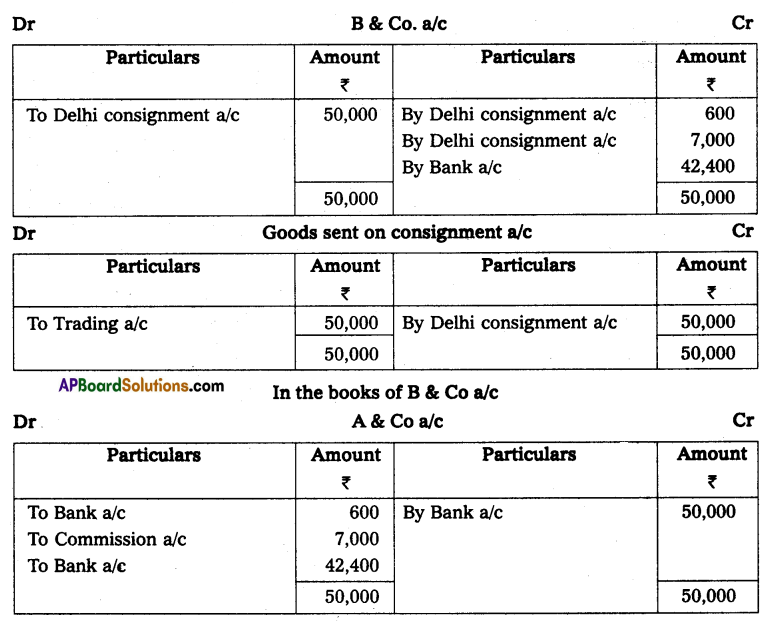
5) Electoral agreements or adjustments :
Where the regional parties are strong the national parties for their existence have been making electoral alliances with the regional parties. After the elections depending on the results these national parties have been joining the ministry or lending support from outside. So.these regional parties have been flourishing.

These factors have been responsible for the growth of regional parties in India.

Question 3.
Write an essay on “One Party Dominance” in India.
Answer:
Indian National Congress is the oldest All India Political Party in our country. It was founded by A.O. Hume, a British Civil Servant on 28th December 1885. Womesh Chandra Baneijee civil was its first president. This party has played a prominent role in the Indian National movement against the Britishers and ultimately secured independence. After independence, the Congress kept on dominating the Indian Political Science. It became the ruling party at the union and in majority of the Indian States. The Role of the Congress party was so great that India was often described as a single dominant Party System.,

Support Base :
During the freedom struggle, the Indian National Congress enjoyed the support of all sections of society, particularly the middle class and the new intellectual Elite. After independence it enjoyed a remarkable popular support among the masses. The congress has always tired to identify itself with the poor of India. Garibi Hatao has been its popular slogan.

During 1947 – 67 the congress ruled the union and almost all the states of the union. In 1967 it suffered a set back when in several states non-congress parties came to power. Its leaders Jawaharlal Nehru, Lai Bahadur Sastri and Indira Gandhi have acted as the Prime Ministers in succession from 1947 to 1977. In 1977 elections the Congress lost its power because of misrule and authoritarian rule during the emergency from 1975 to 1977. In 1980 and 1984 it came back to power under the leadership of Mrs. Indira Gandhi and Rajiv Gandhi. In 1991 elections congress formed government under the prime ministership of P.V. Narasimha Rao, after the assasination of Rajiv Gandhi.

The destruction of the controvercial Babri Masjid during Rao’s rule proved to be a great curse to the party. The economic reforms initiated in this period were not openly acknowledged. In 1996 election the party failed to win. In 14th and 15th Lok Sabha elections Under the leadership of Mrs. Sonia Gandhi the congress led UPA, won the majority and formed government at the centre under the Prime Minister of Dr. Manmohan Singh. In 15th Lok Sabha election the UPA contested with the Slogan “Jai ho”

Short Answer Questions

Question 1.
What is Political Party? Explain its characteristics and functions. [Mar. 16]
Answer:
Political Parties are the life blood of democracy. Political parties mould public opinion and create an order out of the choos of individual opinion. In general sense, political party is an organized group of citizens having the purpose of controlling the government through shared interest, by replacing some of its members in public office.

Political parties are defined by various political scientists in different ways. Some of them are given below :
1) Gilchrist:
“Political party as an organized group of citizens who profess to share the same political views and who acting as a political unit try to control the Government”.

2) Leacock :
“A political party is a more or less organized group of citizens who act together as a political unit”.
Characteristic of Political Parties : The following are the important characteristics of political parties. .

  1. A party should consist of a group of persons of common interest and shared values.
  2. A party should have its own ideology and programme.
  3. It should capture power only by constitutional means through elections.
  4. It should endeavour to promote the national interest and national welfare.

Functions of Political Parties: The following are the main functions of political parties.
1) They articulate and aggregate social interests of people :
Parties express public expectations and demands of social groups to the political system. Parties put forward different policies and programmes for the welfare of people. These political parties are articulate and aggregate the people’s demands and channelize into political system for policies.

2) Political recruitment :
Political parties perform the recruitment function in the political system. Parties recruit leaders, train them and then make them ministers to run the government in the way they want By this recruiting function, they provide leadership to the country.

3) Means of public opinion :
They raise and highlight the people’s problems and issues. Political parties may agitate and launch movements for the solution the problems faced by people. Political parties demand the government for welfare policies their- programmes will reflect the opinion of the people.

4) They promote political Socialization and participation of citizens:
Political parties create a link between citizens and the political system ; they enable political participation of individuals and groups with the prospect of success. They educate the citizens and prepare them for their adult roles are us citizens and voters.

5) Making laws :
When parties come to power, they make laws for the country. Irrespective of their personal options. Opposition parties also participate in the discussion and debates and suggest the changes in the policies and programmes of the government.

6) Role of opposition :
Parties that lose in elections play the role Of opposition to the parties in power by criticizing the government for its failures or wrong policies. They can evaluate the performance of the ruling party and inform to the public about the merits and demerits of the policies and acts made by it.

7) Access to government machinery and welfare Schemes :
For an ordinary citizen, it is easy to approach a local party leader than a government officer. That is why they feel close to parties ever when they do not fully trust them. Parties have to be responsive to people’s needs and demands.

8) They contribute legitimacy to the political system:
In establishing the connection between citizens social groups and the political system, the parties contribute in anchoring the political order in the consciousness of the citizens and in social forces.

AP Inter 2nd Year Civics Study Material Chapter 12 Political Parties

Question 2.
What do you know about Party System? Give a note on types of Party System.
Answer:
Party System :
Party System is a modem phenomenon which has less than 200 years of age. Parties and party system emerged in Europe, North America and Japan around the third decade of the 19th century.

The party system refers to complex social and political processes individual leaders, societal associations, political groups and organizations and their interaction and inter-relationships. These interaction patterns are governed by constitutions, statues, rules regulations and institutions.

Rajini Kothari has argued in his book “Politics in India” that the party system evolved from an identifiable political centre. This political centre, curved during the nationalist movement, comprised of the political elite sharing common socio – economic background i.e., educated, urban, upper-caste people belonging mainly to middle and upper classes.

Types of party system:
There are different types of party system which are discussed below. They are classified into a single party system, Bi-party system and Multiparty system.

Single party system :
In a single party system only one political party is in existence. The other political parties are not allowed to function. It is possible that the dissension and grouping may exist with in the same political party viz.., Nazi Party in Germany Fascist Party in Italy, Communist Party in China and in former USSR.

Bi-party System :
Under Bi-party system, two major political parties are in working in a political system, one forms the government and the other functions as opposition, political power in such cases alternate between the two major political parties, viz., the labour and the conservative parties in U.K. or Republican and Democratic parties in U.S.A.

Multi Party System:
In multi party system there are more than two parties operating in a political system. But in practice they are aligned with either the ruling party or the opposition party. This type of party system is in existence in India, France, Sweden and Norway etc.

Question 3.
Write briefly the characteristics of Indian party system.
Answer:
Political parties are essential for the success of Democracy. They acts as agencies of public opinion and link between the government and the people. Modem democracy is unthinkable in the absence of political parties.

Characteristics (or) Features of India party system: The Indian party system has the following characteristics (or) features.

1. Multi – Party System:
The continental size of the country, the diversified character of Indian Society, the adoption of universal adult franchise, the peculiar type of political process and other factors have given rise to a large number of political parties. In fact, India has the largest number of political parties in the world. At present there are 6 National parties, 64 State Parties and 1737 registered – unrecognized parties in the country. Further, India has all categories of parties – leftist parties, centrist parties, rightist parties, communal parties, non-communal parties and so on. Consequently, the hung Parliament, hung Assemblies and coalition governments have become a common phenomena in Indian. Political System.

2. One Party Dominance System :
In spite of the multi-party system, the political scence in India was dominated for a long period by the Congress party. Hence, Rajani Kothari, an eminent political scientist, preferred to call the Indian Party System as ‘one party dominance system’ or the ‘Congress System’.

3. Lack of Clear Ideology :
Except the BJP, CPI and CPM, all other parties do not have a clear-out ideology. They are ideologically close to the each, other. They have close resemblance in their policies and programmes. Almost every party advocates democracy, secularism, socialism and Gandhism. More than this, every party has only one consideration i.e., power capture.

4. Personality Cult:
Quite often the parties are organized around an eminent leader who becomes more important than the party and its ideology. Parties are known by their leaders rather than by their manifesto. It is a fact that the popularity of the Congress was mainly due to the leadership erf Nehru, Indira Gandhi and Rajiv Gandhi. Similarly, the AIADMK in Tamil Nadu and TDP in Andhra Pradesh got identified with M.G. Ramachandran and N.T. Rama Rao respectively. In Tamil Nadu, after M.G. Ramachandran, Jayalalitha became the icon of the party for this culture. Hence, it is said that “there are political personalities rather than political parties in India”.

5. Traditional Factors :
A large number of parties in India are formed on the basis of religion, caste, language, culture, race and so on. For example Shiv Sena, Muslim League, Hindu Maha Sabha, Akali Dal, Bahujan Samajwadi Party, Gorkha League etc., work for the promotion of communal and sectional interests and thereby undermine the general public interest.

6. Emergence of Regional Parties :
Another significant feature of the Indian Party System is the emergence of a large number of regional parties and their growing role. They have become the ruling parties in various states like BJD in Orissa, DMK and AIADMK in Tamil Nadu, Akali Dal in Punjab, AGP in Assom, National Conference in J & K, JD(U) in Bihar and so on.

These regional parties have come to play a significant role in the national politics due to coalition governments at the Centre. In 1984 elections, the TDP emerged as the largest opposition party in the Lok Sabha and played a decisive role in national politics. In one context, i.e., during the NDA Government when Vajpayee was the Prime Minister at the Centre, Nara Chandra Babu Naidu played a ‘King Maker’ role at the centre.

7. Factions and Defections:
Factionalism, defections, splits, mergers, fragmentation, polarization and so etc., have been important aspects of the functioning of political parties Dais, two Communist parties, two Congresses and so on.

8. Lack of Effective opposition :
In the last 63 years, an effective strong, organized and a viable national opposition could never emerge except in flashes. The opposition parties have no unity and very offen adopt mutually conflicting positions with respect to the ruling party.

Question 4.
Write a note on Congress Party In India.
Answer:
Indian National Congress is the oldest All India Political Party in our country. It was founded by A.O. Hume, a British Civil Servant on 28th December 1885. Womesh Chandra Baneijee was its first president. This party has played a prominent role in the Indian National movement against the Britishers and ultimately secured Independence. After Independence, the congress kept on dominating the Indian political scence. It became the ruling party at the union and in majority of the Indian states up to March 1977.

  • Jawaharlal Nehru was the Prime Minister from 1946 to 1964.
  • Lai Bahadur Shastri was the Prime Minister from 1964 to 1966.
  • Smt. Indira Gandhi was the prime minister from 1966 to 1977.
  • Again it came to power during 1980 to 1989, again Smt. Indira Gandhi became the Prime Minister from 1980 to 1984 October, 31st, the day on which she was assassinated.
  • Rajeev Gandhi was the Prime Minister from 1984 to 1989.
  • It became the Ruling party during 1991 to 1996 under the stewardship of Sri. P. V Narasimha Rao.
  • Between 1996 to 2004 it acted as a recognized opposition party at the centre.
  • In 2004 it came to power at the centre as a major partner in united progressive Alliance (UPA).
  • Again in 2009 general elections the Congress led UPA secured majority and formed government at centre with its allies.
  • Dr. Manmohan Singh was the Prime Minister from 2004 to 2014.

Policies:
The Indian National Congress, during the pre-independence era has worked with a single point programme, called Swaraj. After achieving independence it was committed to implementation of the policies like secularism, socialism, international peace, equality and Justice. It has the following policies :

  1. The party aims to eradicate poverty, unemployment, economic inequalities, discrimination, exploitation etc.
  2. It strives to achieve full employment, optimum production, promotion of cottage and small scale industries, provatization, globalization and liberalization programmes in the industrial sector.
  3. It stafids for world peace and security and has belief in the policy of noninterference, non-alignment, friendly relations with all countries and to end racial apartheid in international sphere.
  4. It dedicates itself to the implementation of land reforms rescuing farmers in times of natural calamities, provision of credit at lower rates of interest, marketing and warehousing facilities in agricultural sector.
  5. It abides by the values of democracy and decentralisation of authority in political field.

Party organization :
Its constitutions was first formulated at Nagpur session (1920). Now, let us know something about its organization.
1. All India Congress Committee (AICC) :
It consists of about 425 members. It meets annually. It decides all the policies of the party. It occupies the highest place in the organization.

2. Congress working committee (CWC) :
It consists of 21 members including the president. It is called the High command of the party. It includes the Prime Minister and all senior leaders of the party. It takes all important decisions and implements them with the approval of AICC.

3. Parliamentary Board :
It consists of president and seven senior members. It takes decisions regarding the appointment and removal of Chief Ministers, selection of candidates.

4. Central Election Committee (CEC) :
It selects candidates to contest elections at the state and national level.
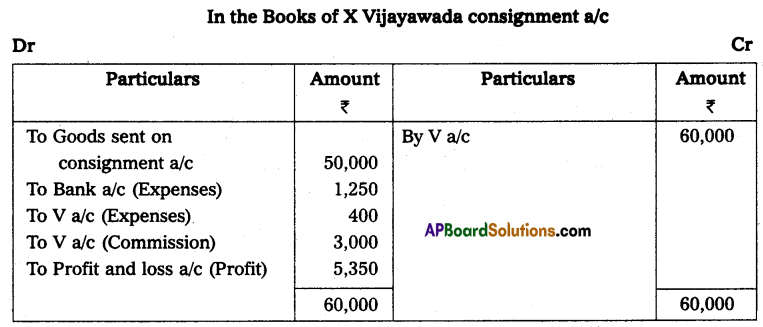
5. Pradesh Congress Committee (PCC) :
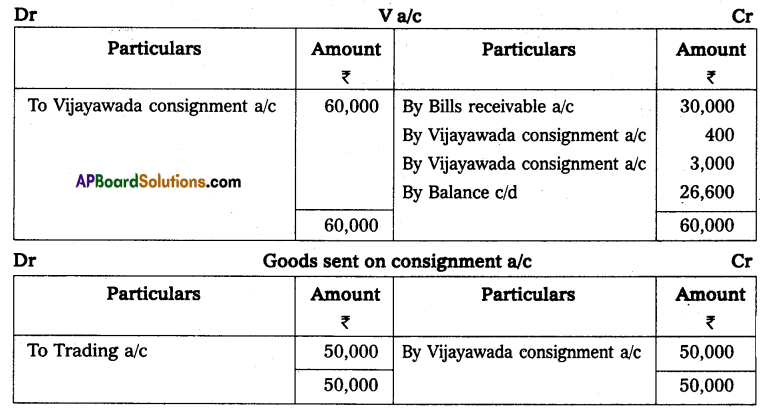
Every state has its own RC.C. It selects candidates to contest Assembly elections. At the lower level, it has District, Mandal and village committees. In reality, it acts as a centralized organisation.

AP Inter 2nd Year Civics Study Material Chapter 12 Political Parties

Question 5.
Explain briefly about Bharatiya Janata Party. [Mar. 18]
Answer:
Bharatiya Janatha Party is one of the All India Parties in India. It was established on April 6, 1980. Earlier it was known as Bharatiya Jan Sangh founded by shyam Prasad Mukherjee on October 21, 1951. DeenadayalTJpadhyaya, Atal Bihari Vaj Payee, Lai Krishna Advani, Murali Manohar Joshi, Jana Krishna Murthy, Kushbhav Thakre and Venkaiah Naidu acted at it’s presidents.

Although initially unsuccessful, winning only two seats in the 1984 general election, it grew in strength on the back of the Ram Janmabhoomi and Babri Majid issue. Following victories in several state elections and better performances in national elections, the BJP became the largest party in the Parliament in 1996; however, it lacked a majority in the lower house of Parliament, and its government lasted only 13 days. After the 1998 general election, the BJP-led coalition known as the National Democratic Alliance (NDA) formed a government under Prime Minister Atal Bihari Vajpayee for a year.

Following fresh elections, the NDA government, again headed by Vijpayee, lasted for a full term in office ; this was the first non-Congress government to do so. In the 2004 general election, the BJP led NDA suffered an unexpected defeat, and for the next ten years the BJP was the principal Opposition party. Long time Gujarat Chief Minister Narendra Modi, a principal campaigner and charismatic leader of the party, led it to a landslide victory in the 2014 general elections. Since that election, Narendra Modi leads the NDA government as Prime Minister with the alliance of 13 states owned parties.

Sri Amith Shah is the present President of the party.

The party had spread its influence in Madhya Pradesh, Chattisgarh, Jarkhand, Rajsthan, Gujarat, Himachal Pradesh, Delhi etc.

Policies:
Bharatiya Janatha Party favours a strong unitary state in place of the present quasi-federation. It has the following policies.

  1. The party is committed to adopt the principles of nationalism, democracy, value based politics, national integration, positive secularism and Gaiidhian socialism.
  2. It strives to implement five concepts, namely Suraksha, Sucharita, Swadeshi, Somrastha and Suvajya.
  3. It aims at the construction of Ram temple at Ayodhya, abrogation of Article 3 to and implementation of Uniform Civil code.
  4. It also aims at adopting electoral reforms.
  5. It believes in the implementation of Swadeshi and Swabhiman policies.
  6. It also aims at the adoption of a practical non-aligned policy in foreign affairs. It favours settlement of all disputes with the neighbouring states through dialogue and discussion. It strongly believes in the utilization of nuclear energy and arms for achieving peace and prosperity. It demands more democratization of the United Nations Organisation by expanding the membership of the security council.
  7. It favours the continuation of the economic reforms initiated by the earlier governments through the policies of liberalization, privatization and globalization.
  8. It vehemently opposes dynastic rule, assigning top executive offices and strongly supports decentralization of power and empowerment of women.

Question 6.
Estimate the significance of Regional Parties in India. [Mar. 17]
Answer:
In India’s federal democratic polity, regional and local parties would continue to have relevance and appeal, especially for certain dominant social and economic interests. The growing presence of regional parties is, undoubtedly, the most outstanding aspect of political I development in India over the past few years.

Till 1967, there was only one party ruling the nation that was ‘Congress Party’, but after 1967 a lot of other political parties came to the forefront along with power and started, to play an imperative and persuasive role in government. With the regional parties coming to the forefront the development of the state’s responsibility has gone to the regional parties as opposed to the Central Government taking care in the initial stages. Regional parties are playing a major role in influencing decisions and thought process in the government planning process and decisions.

After 1996, several regional parties have been emerging as key players in national politics in India. As partners of the NDA, 23 regional parties shared power at the Centre during 1999 and 2004. Some of the regional parties are ruling the states – AIADMK, TDP, JDU, BJD, UDF, NCP, SAD etc. All this reflects the continued and continuously growing importance of regional parties in the Indian politics.

During 1999 to 2004 the BJP, and several regional parties shared power at the Centre as constituents of the BJP led National Democratic Alliance (NDA). Later, the Congress led UPA was in power and in it along with Congress, several regional and local parties shared the power. The present BJP led NDA government is also a coalition government supported by several regional and local parties including Telugu Desam Party.

Question 7.
Write a note on Telugu Desam Party in Andhra Pradesh.
Answer:
Telugu Desam party is a prominent regional party in Andhra Pradesh. It was founded on March 29,1982 by N.T. Rama Rao, a popular Cine Star. It has achieved landslide victory in the A.R state Legislative Assembly elections held in December 1982. N.T.Rama Rao acted as the Chief Minister of Andhra Pradesh thrice – 1983, 1984 and 1994. There was a first split in the party in August 1984. N. Bhaskara Rao, a cabinet Minister quit the party and started a new party called Telugu Desam party (Democratic) and formed the ministry with the support of congress – I.

Consequently, Telugu Desam Party and some other parties launched agitation under the name of ‘Restoration of Democracy’. N.T. Rama Rao was reinstated as the Chief Minister by the then Governor, S.D. Sharma on the intervention of president Zail Singh. The party has lost its power in 1989. Assembly elections and has served as the main opposition in the state Legislative Assembly. It came to power again by winning majority seats in 1994 and 1999 elections. The party has undergone yet another split in August 1995 under the leadership of N. Chandra Babu Naidu and got recognition by the Election commission as the real one.

The party has joined as a partner in the United Front Ministry (1996-98) at the centre. It has extended its support from outside to the Union government led by National Democratic Alliance ministry (1999-2004). The party has continued in power in Andhra Pradesh between 1994 and April 2004. In the Andhra Pradesh general elections, 2004 and 2009 the Congress Party captured the power. The Telugu Desam Party gained a few more Assembly seats in 2009 elections than the 2004 election. In 14th Assembly General Elections held in 2014, the Telugu Desam Party under the leadership of Nara Chandra Babu Naidu got 102 seats out of 174 Seats and formed the government.

Sri N. Chandrababu Naidu became the first Chief Minister of bifurcated Andhra Pradesh in 2014.

Policies :
Following are the main policies of Telugu Desam Party.

  1. Provision of essential commodities at subsidised prices to the people living below poverty line (BPL).
  2. Construction of houses for the poor.
  3. Empowerment of women.
  4. Adoption of e-governance.
  5. Provision of education to every child between the age group of 6 -15.
  6. Promotion of welfare of the scheduled castes, scheduled tribes and other weaker sections.
  7. Administration at the doorsteps of the common man.
  8. Provision of better Civil amenities to the poor.
  9. Adopting secular policy.
  10. Support to economic reforms such as liberalization, privatization and globalization.

Question 8.
Estimate the conditions helped for the emergence of Telangana Rastriya Samithi Party.
Answer:
Telangana Rashtra Samithi (TRS) is a regional party which was established in the year 2001 in the integrated state of Andhra Pradesh by Sr. K. Chandra Sekhar Rao.

Conditions helped for the emergence of TRS :
i) Telangana state hood struggle is one of the longest people’s movement in the country. The six decade struggle, which began in early 1950s has reached its goal in February, 2014.

ii) The first statehood movement of 1950s led to the State Reorganization Commission recommending the Telangana state (then called Hyderabad State) in 1955 itself. Due to the political conditions that prevailed in Telangana then it had merged with Andhra State to form Andhra Pradesh.

iii) State in November, 1956. In May 1971, Telangana Praja Samithi headed by Marri Chenna Reddy won 10 of the Parliament seats in Telangana region. But, very soon, Chenna Reddy merged his party with Congress Party.

iv) While the statehood aspirations were alive in people it took sometimes before they found the right platform to intensify the agitation. In mid 1990s, several peoples organizations started organizing meeting on the statehood issue.

v) Sri Kalvakuntla Chandrashekar Rao (KCR), Who was the Deputy Speker of A.P State Assembly, had started background work on Telangana issue in early 2000. On 17th May, 2001, K.Chandra Sekhara.Rao announced the launch of Telangana Rashtra Samithi party. Prof. Jayashankar, ‘the ideologue of statehood movement extended his support to K.Chandra Sekhar Rao.

From then on wards it has been demanding separate state hood for Telangana Region. It contested in 2004 elections being an ally of congress party both for Lok Sabha as well as state legislative Assembly. In that elections T.R.S has won 5 Lok Sabha seats and 26 Assembly seats. It joined the Congress governments both at the centre and the state. Later, owing to certain political differences it came out from the government both at the centre and the state. In 2009 General elections. It contested to both Lok Sabha and Assembly being an ally of Grand Alliance with TDP CPI and CPM. It got 2 Lok Sabha seats and 10 Assembly seats.

On Nov 29th, 2009 K. Chandra Sekhara Rao had announced an indefinite hunger strike demanding statehood to Telangana, The movement spread like wildfire with students, employees, peoples’ organizations plunging into it. In the next 10 days, the whole of Telangana region came to a standstill. As K: Chandra Sekhara Rao’s health was deteriorating very fast on December 9th 2009, the UPA government announced that the process of statehood for Telangana would be initiated.

But within two weeks, the UPA backtrack on this issue. KChandra Sekhara Rao then brought all political forces in Telangana region together to form the Telangana JAC an umbrella body of several organizations and parties under the chairmanship of Prof. Kodandaram. TRS cadre and leaders actively participated in several agitations and protests launched by Telangana’ Joint Action Committee (TJAC).

After four years of peaceful and powerful protests, the UPA government started the statehood process in July 2013 and concluded by passing the statehood bill in both Houses of Parliament in February 2014. After the separate statehood of Telangana, in 2014 general elections of the state, TRS party won the majority of seats and formed the government headed by K. Chandra Sekhar Rao as its first Chief Minister.

Very Short Answer Questions

Question 1.
Functions of a Political Party.
Answer:
Functions of a Political Party:
The following are the main functions of Political Parties :

  1. They articulate and aggregate social interests of people
  2. Political recruitment
  3. Means of public opinion
  4. They promote political socialization and participation of – citizens
  5. Making laws
  6. Role of opposition
  7. Access to government machinery and welfare schemes
  8. They contribute legitimacy to the political system.

AP Inter 2nd Year Civics Study Material Chapter 12 Political Parties

Question 2.
Types of Party System. [Mar. 17]
Answer:
There are different types of party system which are discussed below. They are classified into a single party system, Bi-Party system and Multi-Party System.

1. Single party system :
Single party system only one political party is an existence.
Ex: Nazi party in Germany, Fascist party in Italy, Communist party in China and in former USSR.

2) Bi-Party System:
Under Bi-party system, two major political parties are in working in a political system; one forms the government and the other functions as opposition.
Ex : Viz, the labour and the conservative parties in UK or republican and democratic parties in U.S.A.

3) Multi party System:
In Multi-party system there are more than two parties operating in a political system.
Ex : This type of party system is in existence in India, Sweden, Norway, France etc.

Question 3.
National Parties. [Mar. 18]
Answer:
A political party which participates in four or more states in Lok Sabha elections and secures 6% of valid polled votes plus 4 Lok Sabha seats can be recognised as National Party by the election commission of India. At present there are 6 National Parties in India. Indian National Congress, BJP, CPI, CPM, BSP, NCP

Question 4.
Regional Parties. [Mar. 16]
Answer:
A political party which participates in state Assembly elections and secures 6% of valid polled votes and 2 Assembly seats can be recognised as a regional party.
Ex : TDP in Andhra Pradesh, DMK and AIADMK in Tamil Nadu, AGP in Assom, National conference in J & K, Akalidal in Punjab, BJD in Odissa etc.

Question 5.
DMK. (Draviuda Munnetra Khajagam)
Answer:
The term ‘Dravida Munnetra Kazhagm’ means Tamilian Development Party’. It was the product of South Indian Association (1916) and Justice Party (1917). E.V Ramaswamy Naicker was its founder. This party has opposed Vehemently.
a) The dominance of upper castes.
b) Vedas.
c) Puranas and
d) All religious ceremonies conducted by the priests.

When Ramaswamy Naicker refused to honour the national flag and the India constitution, C.N. Annadurai opposed his decision and seeded from the parent institution Dravida Kazhagm (DK) and formed the present Dravida Munnetra Kazhagam (DMK) on September 17, 1949.

Question 6.
AIADMK.
Answer:
All India Anna Dravida Munnetra Khazagam is a Prominent Regional Party in Tamil Nadu and Pondichery. It was established by Tamil Cine Star M.G. Ramachandran in October, 1972. M.G.R becameThe Chief Minister of Tamil Nadu in 1977 and continued in that office till his death in 1987. After his death Film Star Miss Jayalalitha became its general Secretary. She led the government in Tamil Nadu .during 1991 – 96 and again in 2001 and 2002. In 2011 state Assembly elections the party came to power. Jayalalitha became the Chief Minister for the third term on 16th May, 2011.

Question 7.
One Party Dominance.
Answer:
In the post independence politics of the country. The role of the Congress party was so great that India was often described as a single dominant party system. The congress was the party of consensus and its strategy was all inclusive. It was often described as a miniature Indian Society which reflected all the essentials in the nation. From First General Elections of 1952 to the present 16th Loksabha general elections of 2014. The Congress party was in power at the centre for 52 years out of 62 years. It shows that the Congress party dominating the political scence of our country.

Question 8.
Multi Party System. [Mar. 16]
Answer:
In Multi party system there are more than two parties operating in a political system.
Ex : This type of party system is in existence in India, France, Sweeden etc.

Question 9.
Bahujana Samaj Party. (BSP) [Mar. 18]
Answer:
It is a dominant party in India. It was established by Kanshi Ram in 1985 a retired civil servant. It’s main motto was the preservation and promotion of the interests of down trodden sections in the society. It vehemently opposes the preaching of many and practices of upper castes in society. That is why it always opposed in B.J.P. It’s strength in the Thirteen Lok Sabha, stood at 14. This party came to power in U.R Thrice under the leadership of Mayavathi. Mayavathi is the present President of this party.

AP Inter 2nd Year Civics Study Material Chapter 12 Political Parties

Question 10.
Nationalist Congress Party. (NCP)
Answer:
The Nationalist Congress Party (NCP) is a centre to centre left political party primarily based in the states of Maharastra, Kerala and Meghalaya. NCP was formed on 25 May 1999, by sharad pawar. P. A. Sangma and Tariq Anwar after they were expelled from the Indian National Congress (INC) on 20th May 1999, for disputing the right of Italian – bom Sonia Gandhi to lead Party. Sharad pawar is its president. It was an ally of Congress led UPA government during 2004 to 2014.

AP Inter 2nd Year Civics Study Material Chapter 10 Local Governments in India

Andhra Pradesh BIEAP AP Inter 2nd Year Civics Study Material 10th Lesson Local Governments in India Textbook Questions and Answers.

AP Inter 2nd Year Civics Study Material 10th Lesson Local Governments in India

Long Answer Questions

Question 1.
Explain the Functions of Panchayati Raj Institutions in India.
Answer:
Rural Governments in India after Independence were set up on the recommendations of the Balwant Raj Mehta Committee (1957) Earlier the new constitution (1950) made a reference to these bodies in Article 40 of the Directive Principles of State Policy.

The Rural Local Governments or Panchayati Raj Institutions are known by several names such as democratic decentralized institutions, local self-government institutions, three-tier democratic bodies, grass root level democratic agencies, etc. The Word Panchayati Raj denotes the name of local self-governments in rural in India.

At present Panchayati Raj Institutions in India are constituted on the basis of the Constitution (Seventy-Third Amendment) Act, 1992. Normally all the states in India (excepting those whose population is less than 20 lakhs) provided a three-tier system in the rural areas. The nomenclature, however, could differ from state to state. These relate to

  1. Village Panchayats.
  2. Panchayat Samithi (Mandal Parishads) and
  3. Zilla Parishads

1) Village Panchayat:
Village (or) Gram Panchayat is the lowest tier in the Panchayat Raj System. Normally there will be a village panchayat for a minimum population of 250.

Composition of Gram Panchayat
Every Gram Panchayat comprises four organs, namely ;
i. Panchayat ii. Sarpanch, iii. Panchayat Secretary and iv. Garm Sabha.

Essential Functions :
Essential functions have to be carried out by the Gram Panchayat without fail. These include the following items.

  • Construction, repair and maintenance of roads and other public places.
  • Construction/repair and maintenance of drainage canals.
  • Construction and maintenance of burial grounds.
  • Erection and maintenance of electric polls.
  • Maintenance of birth and death registers.
  • Conducting vaccinations for controlling rabbis and other contagious diseases.
  • Provision of drinking water facilities.
  • Constructions, repair and maintenance of footpaths, causeways, culverts, public parks, play grounds.
  • Manufacture and sale of manures.
  • Maintenance of cattle farms and so on.

Discretionary Functions :
Gram Panchayat performs these functions subject to the availability of financial resources. These include the following.

  • Construction and maintenance of rest houses.
  • Construction and maintenance of primary schools, dispensaries, libraries, reading rooms, market places etc.
  • Establishment and maintenance of maternal and child welfare centers.
  • Mobilizing voluntary labour for community development works.
  • Publicizing the modem methods of cultivation.
  • Implementation of land reforms and so on.

2) Mandal Parishad :
Mandal parishad is the intermediate tier in the Panchayat Raj System.

Composition :
Every Mandal Parishad comprises four organs namely,

  1. Mandal Parishad
  2. Mandal Parishad President
  3. Mandal Parishad Development Officer and
  4. Mandal Mahasabha

Functions of Mandal Parishad :
Mandal Parishad performs the following functions.

  1. It takes steps for implementing various community development programmes.
  2. It makes arrangements for providing amenities like dispensaries, drinking water, vaccination and non-choking gas stoves.
  3. It implements several programmes like community educations communications, cooperation, cottage industries, women welfare, social welfare etc.
  4. It takes steps for raising production in agricultural sector through the provision of superior quality seeds, manures, pesticides, latest technology etc.
  5. It implements programmes for improving the health and strength of cattle by furnishing improved fodder, artificial insemination centers, cattle grazing etc.

3) Zilla Parishad :
Zilla Parishad is the upper tier of the Panchayat Raj System. There will be a Zilla Parishad in every district. Zilla Parishad is the superior local body at the district level and has the corporate status. It is known as Zilla Panchayat in Gujarat, Zilla Vikasparishat in Timil Nadu and Mahakum Council in Assom, District Development Council in Karnataka.

Composition :
Zilla Parishad comprises six organs, namely ;

  • Zilla Parishad
  • Zilla Parishad Chairman
  • Zilla Mahasabha
  • Chief Executive Officer
  • Standing Committees and
  • District Collector

Functions of Zilla Parishad :
Zilla Parishad performs the following functions

  1. It approves the annual budget of the Mandal Parishads in the District.
  2. It allocates the grants sanctioned by the union and state governments among the Mandal Parishads. ,
  3. It takes steps for implementing the directives of the union and state governments.
  4. It acts as the supervising and coordinating agency of various programmes of Mandal Parishad in the district.
  5. It conducts statistical surveys as per the guidelines of various union and state governments.
  6. It maintains secondary schools in the district.
  7. It renders advice to the union and state governments on financial matters of the Village Panchayats and Mandal Parishads.

AP Inter 2nd Year Civics Study Material Chapter 10 Local Governments in India

Question 2.
Describe the various types of Urban Local Governments in India. [Mar. 17]
Answer:
As per the 74th Constitution Amendment Act, eight types of Urban Local Bodies are existing in India. They are mentioned as follows:

  1. Municipal Corporation
  2. Municipality
  3. Nagar Panchayat
  4. Notified Area Committee
  5. Town Area Committee
  6. Cantonment Board
  7. Township
  8. Port Trust
  9. Special Purpose Agency.

These may be explained as follows :
1. Municipal Corporation:
Municipal Corporation is an important category of urban local government. It is the highest local government institution working in each large urban area. It is constituted by a special Act of the State Government. The first Municipal Corporation was setup in the former presidency town of Madras in 1687. It was followed by similar Corporations in Bombay and Calcutta. The state government can declare the transformation of a Municipality into a Municipal Corporation when the population is at least three lakhs and annual income is four crores rupees.

Composition:
The number of members of each Municipal Corporation is determined on the basis of the population of the city concerned by the law passed by the state legislature. Every Municipal Corporation consists of four organs, namely (i) Corporation Council, (ii) Mayor, (iii) Commissioner and (iv) Standing Committees.

2. Municipalities :
Municipalities are a type of urban local bodies functioning below the level of Municipal Corporation and above that of the Nagar Panchayat / Notified Area. Normally, Municipalities are constituted for a population of 20,001 and above of when annual income is above Rs.60 lakhs. They are also constituted when annual income is above 20 lakhs acquiring from Trade Licenses, Profession taxes and non-agricultural sectors. Sometimes Panchayats are upgraded as Municipalities on the basis of population density and employment opportunities.

Municipalities are classified into five grades basing on their annual income. They are :

  1. Selection Grade Municipalities – Annual income over and above Rs. 4 Crores.
  2. Special Grade Municipalities – Annual income varying between Rs. 3 and 4 Crores.
  3. First Grade Municipalities – Annual income varying between Rs. 2 and 3 Crores:
  4. Second Grade Municipalities – Annual income varying between Rs. 1 and 2 Crores.
  5. Third Grade Municipalities – Annual income below Rs. One crore.

Composition :
There are four organs in every Municipality, namely, (i) Municipal Council, (ii) Municipal Chairman, (iii) Municipal Commissioner and (iv) Standing Committees.

3. Nagar Panchayat:
Nagar Panchayats are created for transitional areas (the area which is fast changing from a rural to an urban area) or for a very small urban area. For this purpose, several factors are taken into consideration; the density of the population therein, the revenue generated for local administration, the percentage of employment in non-agricultural activities, the economic importance of the area and some others.

Composition:
The strength of the members of Nagar Panchayat is fixed by the State Legislature from time to time. They are directly elected by the people of the area on the basis of adult franchise. For the purpose of election, the areas of Nagar Panchayat is divided into wards and each ward elects one member. Besides the elected members, the Member of the State Legislative Assembly (M.L.A) representing that area is also the ex-officio member of Nagar Panchayat. Every Nagar Panchayat elects one President and one Vice-President amongst its members. They are elected by all the elected members. The President presides over its meettings.

4. Notified Area Committee :
This is constituted either for a fast developing town or an area not fulfilling the conditions for the creation of Municipality. As it is created through a special notification of the state government, it is known as Notified Areas Committee. It does not possess statutory position. It will have a Chairman and some members who are nominated by the state government. Its functions are more or less same as9 that of a Municipality.

5. Town Area Committee :
Town area committee is setup by an act of State Legislature. It fulfils the public needs of a small town. It will have a chairman and members nominated by the state government. It performs limited functions like street lighting, drainage etc. Its authorities take steps for improving the conditions of the people living in the town area.

6. Cantonment Boards :
Cantonment Boards are established in India under the Cantonment Act of 1924. At present there are 62 Cantonment Boards in India. These bodies take steps for improving the conditions of civilian population and military personnel in their jurisdiction. There are three types of Cantonment Boards in India. They are created by an Act of the defense ministry. Each Board comprises some members belonging to the elected, nominated and ex-officio categories. There will be a General Officer on Command (GOC) for every Cantonment Board.

7. Township :
Township is established by the public sector undertakings to provide basic civic amenities to its personnel. It has no elected members. There will’ be a Town Administrator for every Township, He is appointed by the concerned ministry of union government. Its services are meant not for the general public but for the personnel working in the public sector undertakings.

8. Port Trust:
Port Trust is setup in the areas where port personnel are in considerable- member. It manages the affairs of ports. It takes proper steps for protecting the interests of personnel in the port areas. The union government constitutes port affairs committee. The committee comprises both nominated and elected members.

9. Special Purpose Agencies :
These agencies are meant for tackling some special issues faced by the people. They perform some peculiar functions for the people residing in municipalities and other notified urban areas. They are established by the special Acts of state legislature. Sometimes they came into vogue through a special order of the state government. Housing Board, Water Supply, Undertakings, Electricity Generation and Distributions Grids, Urban Development Authorities etc., are some examples of these Agencies.

Question 3.
Mention briefly the main provisions of the 73rd Constitution Amendment Act.
Answer:
The Union Government headed by the Prime Minister P.V Narasimha Rao strongly felt the need for immediate grant of Constitutional status to the Panchayat Raj Institutions. It introduced a Bill to that effect in the Parliament in September 1991. Later, the bill was referred to a joint select committee which studied the former and submitted its report in July 1992.

The bill was accepted by the Parliament and the same was referred to the state legislatures for their approval. As majority state legislative assemblies accepted the Bill, it became an Act in the name of the Constitution (Seventy Third Amendment) Act, The Act came into force from April 24, 1993.
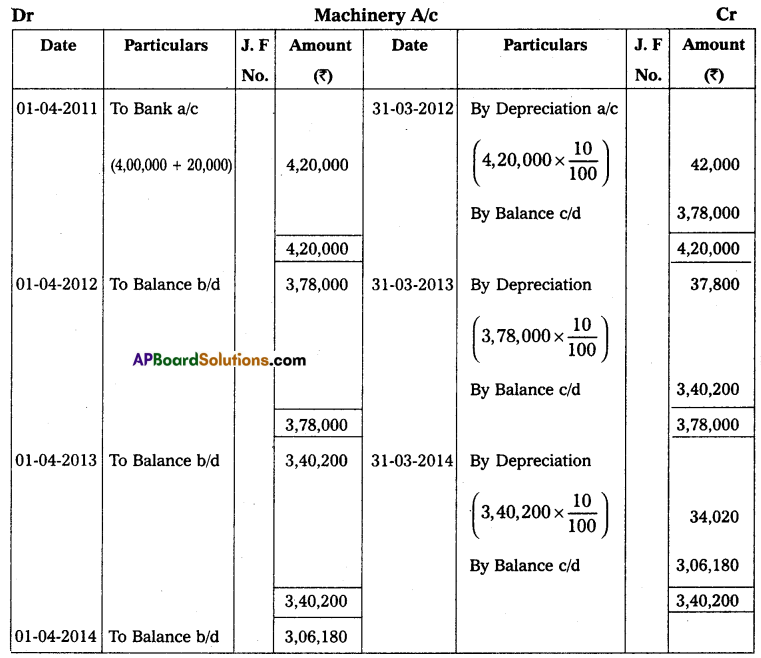
The Act reinserted Part IX which was deleted by the Constitution (Seventh Amendment) Act, 1956 and added a new Schedule, namely 11th schedule. The Act deals with Articles 243 to 243 (O) of the Indian Constitution.

Salient features
The 73rd Constitutional Amendment Act of 1992 has the following salient features:

  1. The Act defined clearly certain terms like District, Gram Sabha, Panchayat, Village etc.,
  2. It constituted a Gram Sabha for every village which acts as the legislative body at the village level.
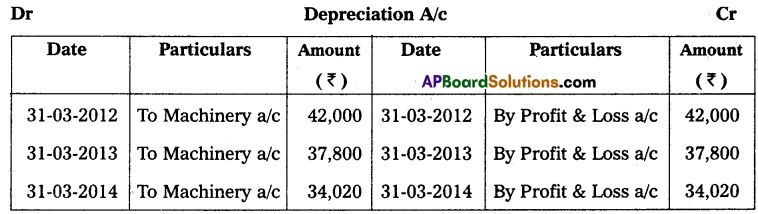
  3. It made obligatory for every state to implement three tire system of Panchayat Raj i.e., Panchayat at the Village, intermediate and district levels.
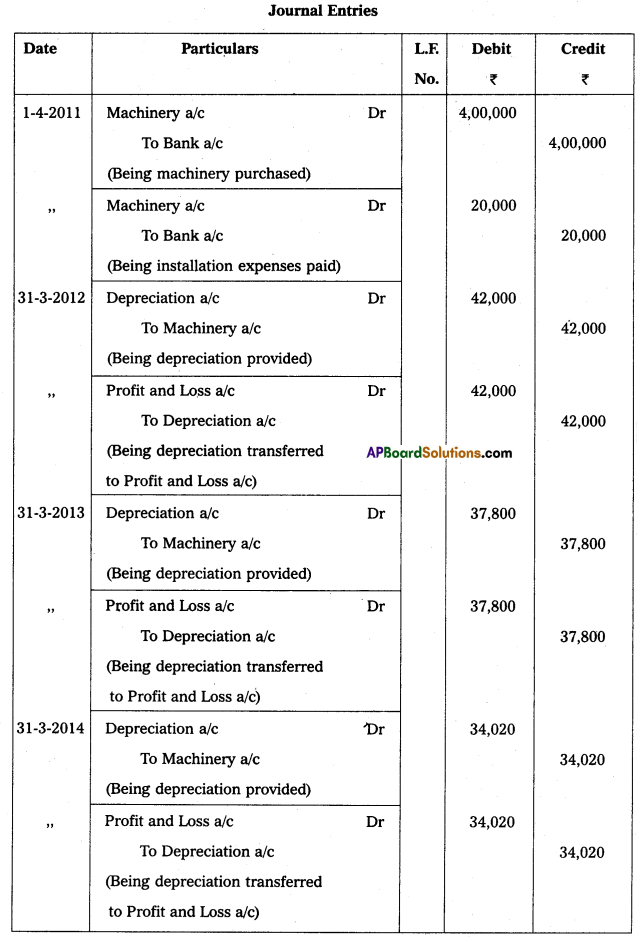
  4. It insisted every state legislature to make laws for the composition of Panchayat on uniform basis. It further specified direct elections to panchayat based on territorial constituencies. It provides right to vote to the chairpersons of Panchayat and other members whether directly elected or not.
  5. It provided reservation in every Panchayat for Schedule Castes and Schedule Tribes in proportion to their population to the total population in the Panchayat area and women not less than 1/3rd of the total seats (Andhra Pradesh Government enhanced the Women Reservation up to 50%).
  6. It specified the duration of Panchayat as five years and insisted on holding elections before the expiration of the term or in case of dissolution within six months.
  7. It prescribed the eligibility and disqualifications of the candidates in local government.
  8. It provided for the creation of a Finance Commission for local bodies.
  9. It provided for auditing the accounts of the Panchayats by the state account and audit officers.
  10. It also provided for State Election Commission for conducting elections to the local bodies.
  11. It stated that union territories shall follow the directives of the President of India in constituting or abolishing Panchayats.
  12. It mentioned some exemptions to the states having administrative councils in scheduled areas.
  13. It provided for special Tribunals for solving election disputes.

Question 4.
Explain briefly the important provisions of 74th Constitution Amendment Act.
Answer:
The Constitution (Seventy Fourth Amendment) Act, 1992 was approved by the Parliament in December, 1992. It was regarded as a progressive step in strengthening the urban local bodies in India. It provided a common framework for the effective functioning of these bodies. The Act came into force on June 1, 1993.

Main Provisions :

  1. The Act gave Constitutional status to the urban local bodies in India for the first time. It introduced a new part in the Constitution, namely part IX-A.
  2. It incorporated the 12th schedule in the Constitution.
  3. It listed out 18 subjects under the jurisdiction of urban local bodies.
  4. It gave definitions of various terms concerning the urban local bodies. It constituted metropolitan area for urban areas having a population of ten lakhs or more.
  5. It provided for the Constitution of various urban local bodies such as Municipal Corporation, Municipal Council, Nagar Panchayat etc. The Act authorized the state governments to designate and demarcate the urban local bodies as and when necessary.
  6. It specified the composition of the Municipalities. It declared that the elected members of the Legislative Assembly and the Lok Sabha of the concerned area will act as ex-officio members of the Municipalities. It also authorized and members of Legislative Council and the Rajya Sabha as members of Municipalities subject to their voting enumeration in the respective areas.
  7. It authorized the state legislature to make legislation for the composition of ward committees in Municipalities.
  8. It provided for reservation of some seats in urban local bodies for Scheduled Castes and Scheduled Tribes in proportion to their population in municipal areas. It also enabled one – third reservation for women in municipal areas and to the offices of Chairman / Chairperson of Municipalities on rotation basis.
  9. It prescribed the uniform term for 5 years for Municipalities. It also clarified that elections shall be held within the six months after its dissolution.
  10. It specified that the persons who are disqualified to become members of Legislative Assembly shall also become disqualified as members of Municipality. It also prescribes 21 years of age for becoming a member of Municipality.
  11. It empowered the state legislature to make laws enabling the Municipalities to impose and collect taxes, allocate funds and receive Grant-in-aid from the state government.
  12. It enabled the state government to appoint the State Finance Commission for every five years for making recommendations (to the Governor) on the principles for distribution of Grants-in-aid among the urban local bodies.
  13. It allowed the state legislature to make legislation for the audit of the accounts of urban local bodies.
  14. It provided for the appointment of State Election Commission to conduct, supervise, direct and control the elections to the urban local bodies.
  15. It also enabled the state legislature to create a district planning committee in each district for consolidating the plan activities.
  16. It provides for the establishment of metropolitan planning committees state.

AP Inter 2nd Year Civics Study Material Chapter 10 Local Governments in India

Question 5.
Estimate the Powers and Functions of the District Collector. [Mar. 18, 16]
Answer:
Power and Functions of District Collector: The District Collector enjoys vast power and performs several functions as the head of the district administration. These may be explained as follows :

A) The Collector as District Revenue Officer :
The Collector is the Chief District Revenue Officer. He, in that capacity, serves as the chief guide to the farmers in the district by fulfilling several obligations. His revenue functions include various activities such as collection of land revenue, sanction of agricultural loans to farmers, rescuing the farmers in times of natural calamities by assessing the loss incurred by them, rendering assistance to the union and state authorities in emergency relief measures etc.

B) The Collector as District Magistrate:
The Collector acts as the District Magistrate. He will have supervision over the activities of the district police personnel. He sees that law and order conditions in the district are normal. For this purpose he will be assisted by a large number of police personnel. The district superintendent of police and other police officers owe responsibility to the Collector in matters such as supervision over police personnel prisons etc,. The Collector can inspect the police stations in the district. He is empowered to issue prohibitory orders on the occasion of breakdown of law and order. He can issue firing orders when all peaceful efforts failed in the restoration of normal.

C) The Collector as Chief Coordinator :
The District Collector acts as the chief co-ordinator of various government departments in the district. He acts as the chief counsel and co-ordinator of the departments such as agriculture, irrigation, co-operation and labour affairs. The heads of these departments shall oblige and implement the suggestions and guidelines of the collector in the district. Even though these heads formulate their policies independently, they are answerable to the District Collector in their discharge of their obligations.

D) The Collector as District Electoral Officer :
The Collector acts the chief district electoral officer. He serves as the main agent of the Election Commission of India for conducting elections to the various representative bodies in the district. He takes steps for conducting the elections in fair and impartial manner. These include preparation of electoral list and its modification, hearing public grievances on voters list, registration of new voters, appointing returning officers assistant returning officers etc.

E) The Collector as the Chief Census Officer:
The Collector acts as the chief census officer in the district. He on behalf of the union and state governments, takes steps for holding census operations in the district for every ten years. He also sees that the statistical data regarding the number of milch cattle, trees and domesticated animals in the district is collected properly. He also compiles such other information as required by the higher ties in regard to the construction of houses for the poor, family welfare, women erment, rural infrastructure etc.

F) The Collector as Permanent invitee of Local Bodies :
The District Collector is a permanent invitee to the meetings of Panchayat Raj and urban local bodies in the district. He acts as a main link between the union and state governments and district local bodies on various matters. He participates in the normal/emergency meetings of Zilla Parishad and mandal parishads in the district. He sends confidential reports to the state government on the nature of functioning of these bodies. He conducts the meeting meant for considering the no confidence motion against the Zilla Parishad chairman.

Other Functions :
This District Collector also performs the following functions.

  1. Matters concerning the welfare of Ex-servicemen.
  2. Provision of irrigation facilities.
  3. Supervision over sub treasuries.
  4. Co-ordinating the activities of various government departments.
  5. Supervising the training programmes for Junior Officers.

Role of District Collector in Local Government:
The District Collector plays a crucial role in the affairs of local governments in the district. He serves as the friend, philosopher and guide to the common men living in the district. He also serves as a link between people and local bodies in the district. Normally the common men seek guidance and solace from the Collector in times of natural calamities and other unforeseen contengencies.

The Collector makes recommendations to the state government in regard to the working of the local bodies in the district. His valuable remarks are required for constituting new gram panchayats and mandal parishads in the district. The entire administrative, revenue, police, health, educational and agricultural personnel working in rural areas depend to a great extent upon the advice and suggestions forwarded by the Collector on may occasions.

He sees that the farmers in the district receive sufficient agricultural inputs such as fertilizers, water, rural credit, marketing facilities etc. He supervises the activities of village extension officers and sees that the farmers receive various types of assistance for carrying on their agricultural, operations smoothly. He also sees that all persons below poverty line will receive, ration and pension facilities.

The fact that the Collector heads more than one hundred committees at the district level demonstrates his role in district affairs. He, like the Chief Minister at the state level, will have tremendous influence and powers in the district. Many programmes of union and state governments like National Rural Employment Guarantee Scheme (NREGS), Pradhan Mantri Gram Sadak Yojana (PMGSY), Janani Suraksha Yojana (JSY), Aam Admi Bima Yojana (AABYj, Rural Landless Employment Guarantee Programme (RLEGP). Prime Ministers Employment Generation Programme (PMEGP).

The union and state governments, rely on the District Collector in tackling the financial, political and cultural matters of the people living in local areas, They nominate the District Collector as the chairman, co-ordinator or secretary of the above programmes at the district level. People regard the Collector as a repository of authority functioning independently with dedicated spirit. Eventhough some states like Gujarath and Maharashtra relieved the Collector from the perspective.

Short Answer Questions

Question 1.
Write briefly about the Historical background of Local Governments in India.
Answer:
Historical Background: Local governments in India have a long historical background. The Rigveda, the oldest of four Vedas, mentioned two institutions namely, Sabha and Samithi which performed several administrative and political functions at community level. They were the effective administrative state structures at local levels in ancient period. They relate to village panchayats and caste panchayats . Which managed the administrative and judicial affairs of a village community. These institutions continued for several years even without the effective support of the ruling classes of the time. Many eminent writers like Megasthanes, Kautilya and Fahien have cited the existence of these bodies in their writings.

In medieval period, village panchayats flourished during the chola dynasty in South India. The cholas were renowned for their patronage of the local bodies. However, the local governments of the present form is attributed to the efforts of some British officers at higher levels. They developed these bodies to promote the colonial interests. Lord Mayo’s Resolution (1870) and Lord Rippon’s Resolution (1882) paved the way for the progress of these institutions in India. Earlier the East India Company established the Municipal Corporation of Madras in 1688 with the consent of Emperor George II.

Some Mayor courts wefe set up in Madras in 1726 for collecting taxes and administering, justice. The Regulating Act of 1773 paved the way for the establishment of local governments at Calcutta (Kalkota), Madras and Bombay (Mumbai). Lord Rippon, the Governor General of India moved the famous resolution for devolving financial and administrative powers to the local governments. His resolution is known as the Magnacarta of Local Governments in India.

He was described as the father of local self-governments in India. Later on the successive British rulers in India have initiated many steps for providing more authority to the local bodies. Some of the notable legal enactments are Bengal Municipalities Act, 1884; Bengal Local Governments Act, 1885; Bengal Village self-government Act, 1919 etc. The Royal Commission on Decentralization headed by Sir Charles Hobhouse (1906) offered valuable suggestions for setting up of village panchayats, constitution of district boards, entrusting primary obligations to municipalities etc. The Government of India Act, 1919 introduced diarchy at state level. It gave impetus to the local governments. It empowered the Indian ministers to take decisions in regard to the maintenance of local bodies.

The Government of India Act, 1935 assigned the provincial governments with the obligation of making the local bodies energetic and efficient. It placed the subject of ‘Local Self Government’ under Entry 12 of the provincial governments. Consequently many provincial governments passed Acts delegating the local governments the powers of administration including criminal justice to the panchayats. Prominent leaders of national movement like Mahatina Gandhi supported the cause of local governments.

Question 2.
Explain the advantages of Local Government.
Answer:
Definition:
Local Government is defined in many ways by different political scientists. Some of them are cited below :

According to Sidgewick “Local government consists of certain subordinate bodies which have defined powers of making rules and regulations within their prescribed area of administration.” Prof. Finer. H defined that “the Local Government means authority to determine and execute measure within a restricted area inside and smaller than the whole state.” In the words of Duane Lockard “Public Organization authorized to decide and administer a large range of public policies within its small territory”.

Advantages- of Local Governments? Local governments have the following advantages :

  1. Local government institutions provide extensive range of service to the people.
  2. They lead to efficiency of administration at local as well as state and national level.
  3. They lead to economy in administration.
  4. They cultivate spirit of self – help and self – dependence.
  5. They promote spirit of liberty among people.
  6. The Local Governments facilitate the ventilation of people’s grievances and provide effective solution to local problems.
  7. They ensure the participation of the people in the formulation and implementation of development programmes at grass root level.

Question 3.
What are the Functions of Panchayat Secretary?
Answer:
Every Panchayat shall have a full time Secretary who is an officer of the government. He shall draw his salary and allowances from the Panchayat fund as per government rules. He will be iri charge of the office of the Panchayat. He will work under the direct supervision of the Panchayat Sarpanch.
Powers and Functions of the Panchayat Secretary.

Panchayat at Secretary performs the following functions. They are :

  • Preparation of budget and annual administration report.
  • Preparation of monthly / quarterly statements of accounts.
  • Maintenance of cash book.
  • Keeping all records of the Panchayat in safe custody.
  • Allotment of duties to the staff posted in Gram Panchayat.
  • Submission of application for grant-in-aid and maintain grant-in-aid register:
  • Visit the work sites and assess the work in progress.
  • Attend to complaints relating to developmental works etc.

Question 4.
What do you know about Gram Sabha?
Answer:
Gram Sabha :
There will be a Gram Sabha in every Panchayat. It comprises all the adult citizens who have been entitled to vote. It meets at least twice a year usually after Rabi and Kharif crops are harvested. It discusses and approves the administrative and audit reports. It identifies the beneficiaries of development schemes. It takes steps for mobilizing voluntary labour for community welfare programmes.

In many states Gram Sabhas are known with the same name. However, they are called Panchayats in Bihar and Palisabhas in Odisha. The Union Government declared the year 2009 – 2010 as the year of Gram Sabha on the eve of golden jubilee celebrations of village Panchayat. It directed the state governments to make arrangements for convening Gram Sabha on April 14 of every year. (Second one in the month of October)

Question 5.
Write a brief note on Mandal Parishad.
Answer:
Mandal Parishad is the intermediate tier in the Panchayat Raj System. It is set up according to the statutes of state government. In different states, the Panchayat Samiti has been given different names. Tamil Nadu calls them Panchayat Union Council, in Karnataka as the Taluka Development Board, in Gujarat as the Taluka Panchayat. However, the most popular name happens to be the Panchayat Samithi. 4
Composition
Every Mandal Parishad comprises four organs namely,

  1. Mandal Parishad
  2. Mandal Parishad President
  3. Mandal Parishad Development officer and
  4. Mandal Mahasabha

Question 6.
Explain the composition of Zilla Parishad.
Answer:
Composition
Zilla Parishad comprises six organs, namely ;

  1. Zilla Parishad
  2. Zilla Parishad Chairman
  3. Zilla Mahasabha
  4. Chief Executive Officer
  5. Standing Committees and
  6. District Collector

i) Zilla Parishad :
Zilla Parishad is the legislative wing at the district level. It comprises various types of members, i.e., elected, co-opted and ex-officio members. District level authorities like the District Collector, Chairmen of District Co-operative Central Bank, District Co-operative Marketing Society and Zilla Grandhalaya Samastha participate in the meetings as permanent invitees. Besides, the Members of State Legislative Assembly and Lok Sabha participate in the meetings as ex – officio members.

ii) Zilla Parishad Chairman :
The Chairman, being the political head, presides over the meeting of Zilla Parishad. He is elected by the elected members of Zilla Parishad, i.e., ZPTCs, MPs, MLAs and MLCs of the district concerned. The Chairman presides over the ordinary and special meetings of the Zilla Parishad. He conducts the meetings with dignity.

He permits the members for moving resolutions, allocates time for discussion and conducts voting on the resolutions. He also presides over the meetings of Zilla Mahasabha and some standing committees. He acts as a link between Zilla Parishad and the State Government. He-will have administrative control over the Z.P. Chief Executive Officer in the implementation of various resolutions. –

iii) Zilla Mahasabha :
There will be a Zilla Mahasabha in every Zilla Parishad. It comprises a chairman and some other members of Zilla Parishad. It serves as an advisory body to the Zilla Parishad. The Zilla Parishad Chairman presides over its meetings. The Chief Executive Officer attends its meetings in Ex-officio capacity. It performs three important functions, namely

  1. Examining the annual budget and audit reports of Zilla Parishad
  2. Administrative report of the previous year and
  3. Other matters of Zilla Parishad.

iv) Chief Executive Officer (C.E.O):
There will be a Chief Executive Officer in every Zilla Parishad. He is appointed by the state government and responsible to the State Government and Zilla Parishad in exercise of his powers and functions. He serves as the administrative head of Zill Parishad.

v) Standing Committees:
There are seven Standing Committees in Zilla Parishad. They render advice to the Zilla Parishad on several matters like planning, finance, agriculture, rural development, women, social welfare, education, health etc. The Chief Executive Officer prepares the agenda of the meeting and decides the venue of the standing committees on the advice of Zilla Parishad Chairman.

vi) The District Collector :
The District Collector participates in Zilla Parishad and standing committee meetings as a permanent invitee.

AP Inter 2nd Year Civics Study Material Chapter 10 Local Governments in India

Question 7.
Elucidate various Urban Local Bodies in India.
Answer:
As per the 74th Constitution Amendment Act, eight types of Urban Local Bodies are existing in India. They are mentioned as follows :

  1. Municipal Corporation
  2. Municipality
  3. Nagar Panchayat
  4. Notified Area Committee
  5. Town Area Committee
  6. Cantonment Board
  7. Township
  8. Port Trust
  9. Special Purpose Agency,

1) Municipal Corporation:
Municipal Corporation is an important category of urban local government. It is the highest local government institution working in each large urban area. It is constituted by a special Act of the State Government. The first Municipal Corporation was setup in the former presidency town of Madras in 1687. It was followed by similar Corporations in Bombay and Calcutta. The state government can declare the transformation of a Municipality into a Municipal Corporation when the population is at least three lakhs and annual income is four crore rupees.

2) Municipalities :
Municipalities are a type of urban local bodies functioning below the level of Municipal Corporation and above that of the Nagar Panchayat / Notified Area. Normally, Municipalities are constituted for a population of 20,001 and above or when annual income is above Rs. 60 lakhs. They are also constituted when annual income is above 20 lakhs acquiring from Trade Licenses, Profession taxes and non-agricultural sectors. Sometimes Panchayats are upgraded as Municipalities on the basis of population density and employment opportunities.

3) Nagar Panchayat:
Nagar Panchayats are created for transitional areas (the area which is fast changing from a rural to an urban area) or for a very small urban area. For this purpose, several factors are taken into consideration; the density of the population therein, the revenue generated for local administration, the percentage of employment in non-agricultural activities, the economic importance of the area and some others.

4) Notified Area Committee :
This is constituted either for a fast developing town or an area not fulfilling the conditions for the creation of Municipality. As it is created through a special notification of the state government, it is known as Notified Areas Committee. It does not possess statutory position. It will have a Chairman and some members who are nominated by the state government. Its functions are more or less same as that of a Municipality.

5) Town Area Committee :
Town area committee is setup by an act of State Legislature. It fulfils the public needs of a small town. It will have a chairman and members nominated by the state government. It performs limited functions like street lighting, drainage etc. Its authorities take steps for improving the conditions of the people living in the town area.

6) Cantonment Boards :
Cantonment Boards are established in India under the Cantonment Act of 1924. At present there are 62 Cantonment Boards in India. These bodies take steps for improving the conditions of civilian population and military personnel in their jurisdiction. There are three types of Cantonment Boards in India. They are created by an Act of the defense ministry. Each Board comprises some members belonging to the elected, nominated and ex-officio categories. There will be a General Officer on Command (GOC) for every Cantonment Board.

7) Township :
Township is established by the public sector undertakings to provide basic civic amenities to its personnel. It has no elected members. There will be a Town Administrator for every Township. He is appointed by the concerned ministry of union government. Its services are meant not for the general public but for the personnel working in the public sector undertakings.

8) Port Trust:
Port Trust is setup in the areas where port personnel are in considerable member. It manages the affairs of ports. It takes proper steps for protecting the interests of personnel in the port areas. The union government constitutes port affairs committee. The committee comprises both nominated and elected members.

9) Special Purpose Agencies :
These agencies are meant for tackling some special issues faced by the people. They perform some peculiar functions for the people residing in municipalities and other notified urban areas. They are established by the special Acts of state legislature. Sometimes they came into vogue through a special order of the state government. Housing Board, Water Supply, Undertakings, Electricity Generation and Distributions Grids, Urban Development Authorities etc., are some examples of these Agencies.

Question 8.
What do you know about the Municipalities?
Answer:
Municipalities are a type of urban local bodies functioning below the level of municipal corporation and above that of the Nagar Panchayat. Normally Municipalities are constituted for a population of 20,001 and above or when annual income is above Rs. 60 lakhs.
Municipalities are classified into five grades basing on their annual income. They are :

  1. Selection Grade Municipalities – Annual income over and above Rs. 4 Crores.
  2. Special Grade Municipalities – Annual income varying between Rs. 3 and 4 Crores.
  3. First Grade Municipalities – Annual income varying between Rs. 2 and 3 Crores.
  4. Second Grade Municipalities – Annual income varying between Rs. 1 and 2 Crores.
  5. Third Grade Municipalities – Annual income below Rs. 1 Crore.

Composition :
There are four organs in every Municipality, namely, (i) Municipal Council, (ii) Municipal Chairman, (iii) Municipal Commissioner and (iv) Standing Committees

The structure, powers and functions of these may be explained as under:

i) Municipal Council:
Municipal Council is the deliberative body of the Municipality. It consists of some (i) elected, (ii) co-opted and (iii) ex-officio members. Registered voters in the municipal area elect the first category of members. They are called councillors. The elected members will in turn elect the second category of members. They are called co¬opted members. The District Collector and the Municipal Commissioner; The members of the Lok Sabha and State Legislative Assembly of the area,concerned are called as the ex¬officio members.

Normally the Council meets once in a month. The Municipal Commissioner prepares the agenda of the Municipal Council after consulting the Municipal Chairman. Some seats in the Municipal Council are reserved for Scheduled Castes, Scheduled Tribes, Backward Classes and women. Municipal Council considers the matters relating to the Municipality.

ii) Municipal Chairman :
Municipal Chairman is the political head of the Municipal Council. He is elected by the councillors. He is the first citizen of the Town. The Chairman conducts the meetings of the Municipal Council. All the correspondence of the Municipality shall be carried on in his name.

iii) Municipal Commissioner :
Municipal Commissioner is the administrative head of the Municipality. He is responsible for discharging his functions in the Municipal Council and the State Government.

iv) Standing Committees :
Every Municipality consists of some standing committees. These Committees act as advisory bodies to the Municipality on matters of finance, works, health, education, women welfare, and welfare of the backward classes etc. Municipal Chairman presides over the meeting of these committees. The standing committees establish a liaison with the routine administrative matters of the Minicipality.

Functions of Municipality: Every Municipality, like that of the Municipal Corporation, performs two types of functions, namely (i) essential and (ii) discretionary.

Essential Functions
Essential functions of the Municipality include the following:

  1. Maintenance of birth and death registers.
  2. Establishment and maintenance of elementary, upper primary and secondary schools.
  3. Provision of purified drinking water and street lights.
  4. Maintenance of public health and sanitation.
  5. Construction and maintenance of roads and buildings.
  6. Safeguarding and preserving municipal properties etc.

Discretionary Functions
A Municipality performs the following discretionary functions.

  1. Reclamation of unhygienic places.
  2. Maintenance of parks, museums, gardens, rest houses, regarding rooms etc.
  3. Maintenance of child, women welfare and maternity centers.

Sources of Income
Every Municipality has the following five sources of income.

  1. Taxes collected from people
  2. Fees and duties
  3. Income in the form of rent from markets and buildings.
  4. Public borrowings and grants and
  5. Public contributions.

Question 9.
Write any three Functions of District Collector?
Answer:
1. Revenue Administration :
Revenue administration is a traditional function of the- Collector, (a) The Collector makes arrangements for the collection of land revenue (b) He hears the difficulties of the farmers on land revenue matters (c) He receives petitions from the farmers and tries to settle their problems (d) He collects land revenue. In this respect, he is assisted by officials of revenue department like Revenue Divisional Officers, Mandal Revenue Officers, Revenue Inspectors etc., (e) He is responsible for Land reforms, Land acquisition etc. (f) He recommends remissions of Land revenue during famines or other calamities, (g) He maintains land revenue records and agricultural statistics of the district.

2. District Magistrate:
The Collector acts as the District Magistrate. In that capacity, he

  • Issues orders for the maintenance of law and order in the district.
  • Disposes petitions and complaints from the private individuals and the Government.
  • Imposes prohibitory orders during disturbances.
  • Supervises Subordinate Courts.
  • Take steps for the provision of better facilities to prisoners.
  • Inspects police stations ….etc.

3. As a District Election Officer:
District Collector is the returning officer for elections to Parliament and State Legislature within the district. It is his responsibility to coordinate the election work at district level and conduct the polls freely and peacefully.

Thus the Collector plays a key role in district administration. He is considered as the friend, philosopher and guide of the people in the district.

AP Inter 2nd Year Civics Study Material Chapter 10 Local Governments in India

Question 10.
Estimate the Role of a District Collector.
Answer:
The fact that the Collector heads more than one hundred committees at the district level demonstrates his role in district affairs. He not only presides over such meetings but also takes steps for implementing the decisions taken there of. He visits various mandals and villages in the district for about twenty days in every month and supervises the development of local bodies at the field level. He, like the chief minister at the state level, will have tremendous influence and powers in the district.

Many programmes of union and state governments like National Rural employment Guarantee Scheme (NREGS), Pradhan Mantri Gram Sadak Yojana (PMGSY), Janani Suraksha Yojana (JSY), Aam Admi Bima Yojana (AABY), Rural Landless Employment Guarantee Programme (RLEGP). Prime Ministers Employment Generation Programme (PMEGP), Valmiki Ambedkar Awas Yojana (VAMBAY), National Rural Health Mission (NRHM), Mid-Day Meal (MDM) scheme etc, depend upon the dynamic leadership of the district collector.

The union and state governments, rely on the District Collector in tackling the financial, political and cultural matters of the people living in local areas. They nominate the District Collector as the chairman, co-ordinator or secretary of the above programmes at the district level. People regard the Collector as a repository of authority functioning independently with dedicated spirit.

Even though some states like Gujarath and Maharashtra relieved the Collector from the perspective of development functions, even today it is popularly felt about the prominence of the Collector due the popular confidence and credibility. The people of North India prefer to address the District Collector as their maa- baap (mother and father).

Question 11.
Explain the concept of Smart village.
Answer:
The concept of Smart Village is the recent development in Panchayat Raj System in A.P inaugurated by the Chief Minister of Andhra Pradesh Nara Chandrababu Naidu in 2015. Andhra Pradesh is committed to achieve holistic, inclusive and sustainable development of the state. The state has a vision “Swarnaandhra Vision 2029” to be a developed State and to be among the best three states in the country. To realize this vision, the government has adopted the mission based approach to create the social and economic infrastructure; has initiated campaigns to create awareness seeking participation of the stakeholders.

A ‘Smart Village / Ward’ displays sustainable and inclusive development with all sections of its community enjoying a high standard of living. This is achieved when the village/ward excels in the following indicators :

  1. Every household has vibrant livelihood opportunities and or micro-enterprise.
  2. Home for all – with access to toilet, safe- drinking water, and power.
  3. Open defecation free.
  4. 100% institutional deliveries.
  5. No maternal deaths.
  6. No infant deaths within one year of birth.
  7. Malnutrition free (children below 5 years of age).
  8. Zero school drop outs of boys and girls up to 12th class.
  9. No girl-child marriages (girls below 18 years of age).
  10. Functional toilet, portable water, electricity available in Anganwadi Centres, School, health centre, GP Building / ward.
  11. Gram Sabha / Ward Sabha held four times a year with 2/3rd attendance.
  12. Every village household has a functional bank account/Prime Minister Jan Dhan Bank Account.
  13. Every farm has soil health card and diversification with livestock, trees, etc.
  14. Gram Panchayat / Ward has it own dynamic development plan prepared by community participation.
  15. The Village has green trees all over its geographic boundaries.
  16. The Village has functional water conservation and harvesting structure.
  17. The Village has functional grievance redressal system.
  18. The Village has functional Village Information Centre, Village Computer Lab, and Mee-Seva Centre. .
  19. The Village has telecom/intemet connectivity.
  20. The Village has functional solid/liquid waste management system.

Very Short Answer Questions

Question 1.
Rural Local Government.
Answer:
Rural Local Governments or Panchayati Raj institutions in India, signifies the system of Rural Local Governments. They serve as the backbone of India’s political culture. These institutions are of three types, popularly known as three tier system.

  1. Gram Panchayats
  2. Mandal Parishads and
  3. Zilla Parishads .

Question 2.
The Constitution (Seventy Third Amendments) Act, 1992.
Answer:
The Union Government headed by the Prime Minister P. V Narasimha Rao strongly felt the need for immediate grant for constitutional status to the panchayat raj institutions. It introduced a bill to that effect in the Parliament in September 1991. After the bill was reffered to a joint select committee in July 1992. The bills was accepted by the Parliament and the same reffered to the State Legislatures for their approval. It become an act in the name of Seventy Third Amendment Act, 1992.

Question 3.
Gram Sabha.
Answer:
There will be a Gram Sabha in every Panchayat. it comprises all the adult citizens who have been entitled to vote. It meets at least twice a year. It discusses and approves the administrative and audit reports. It identifies the beneficiaries of development schemes. It takes steps for mobilizing voluntary labour for community welfare programmes. The Union Government directed the state governments to make arrangements for convening Gram Sabha on April 14 of every year. (Second one in the month of October).

Question 4.
Zilla Parishad.
Answer:
Zilla Parishad is the upper tier of the Panchayat Raj System. There will be a Zill Parishad in every district, zilla Parishad is the superior local body at the district level and has the corporate status.
Zilla Parishad comprises six organs, namely;

  • Zilla Parishad
  • Zilla Parishad Chairman
  • Zilla mahasabha
  • Chief Executive Officer
  • Standing Committees and
  • District Collector

Question 5.
M.P.D.O. [Mar. 18, 16]
Answer:
Mandal Parishad Development Officer (MPDO) is the administrative head of Mandal Parishad the plays a crucial role in the administrative affairs of the Mandal Parishad. He prepares the agenda of the parishad meetings and participates in the meeting and renders advice to the members on several matters of the Mandal Parishad. He prepares the annual budget of the Mandal Parishad. He takes steps for the effective working of the Mandal Parishad.

AP Inter 2nd Year Civics Study Material Chapter 10 Local Governments in India

Question 6.
Mandal Parishad.
Answer:
Mandal Parishad is the intermediate tier in the Panchayat Raj System. It is set up according to the statutes of state Government.
Every Mandal Parishad comprises four organs namely

  1. Mandal Parishad
  2. Mandal Parishad President
  3. Mandal Parishad Development Officer and
  4. Mandal Mahasabha

Question 7.
Zilla Mahasabha.
Answer:
There will be a Zilla Mahasabha in every Zilla Parishad. It comprises a chairman and some other members of Zilla Parishad. It serves as an advisory body to the Zilla Parishad.

The Zilla Parishad Chairman presides over its meetings in ex-officio capacity. It performs three important functions namely.

  1. Examining the annual budget and audit reports of Zilla Parishad.
  2. Administrative report of the previous year..
  3. Other matters of Zilla Parishad.

Question 8.
Zilla Parishad Standing Committees.
Answer:
There are seven standing committees in Zilla Parishad. They render advice to the Zilla Parishad on several matters like planning, finance, agriculture, rural development, women social welfare, education, health etc. The Chief Executive Officer prepares the agenda of the meeting and decides the venture of the standing committees on the advice of Zilla Parishad Chairman. The District collector participates in Zilla Parishad and standing committees meetings as a permanent invitee.

Question 9.
Zilla Parishad Chief Executive Officer.
Answer:
There will be a Chief Executive Officer in every Zilla Parishad. He is appointed by the state government and responsible to the State Government and Zilla Parishad in exercise of his powers and functions. He serves as the administrative head of Zilla Parishad.

He plays a key role in preparing the annual budget and agenda for the general meetings of the Zilla Parishad in consultation with Zill Parishad Chairman. He will have administrative control over the personnel, assets and records of the zilla parishad. He takes necessary steps for implementing the decisions of zilla parishad, zilla mahasabha and standing committees.

AP Inter 2nd Year Civics Study Material Chapter 10 Local Governments in India

Question 10.
Municipal Council.
Answer:
Municipal council is the deliberative body of the Municipality. It consists of some i) Elected ii) co-opted and iii) ex-officio members. Registered voters in the municipal area elect the first category of members. They are called councillors. The elected members will in turn elect the second category of members. They are called co-opted members. The District collector and the municipal commissioner; the members of the Lok Sabha and State Legislative Assembly of the area concerned are called as the ex-officio members. Normally the. Council meets once in a month. Municipal council considers the matters relating to the Municipality.

Question 11.
Nagar Panchay at.
Answer:
Nagar Panchayats are created for transitional areas (the area which is fast changing from a rural to an urban area) or for a very small urban area. For this purpose, several factors are taken into consideration; the density of the population therein, the revenue generated for local administration, the percentage of employment in non-agricultural activities, the economic important of the area and some others.

Question 12.
Notified Area Committee.
Answer:
This is constituted either for a fast developing town or an area not fulfilling the conditions for the creation of Municipality. As it is created through a special notification of the state government, it is known as notified areas committee, It does not possess statutory position. It will have a chairman and some members who are nominated by the state government. Its functions are more or less same as that of a municipality.

Question 13.
Cantonment Boards.
Answer:
Cantonment Boards are established in India under the Cantonment Act of 1924. At present there are 62 Cantonment Boards in India. These bodies take steps for improving the conditions of civilian population and military personnel in their jurisdiction. There are three types of Cantonment Boards in India. They are created by an Act of the defense ministry. Each Board comprises some members belonging to the elected, nominated and ex-officio categories. There will be a General Officer on Command (GOC) for every Cantonment Board.

Question 14.
Town Area Committee.
Answer:
Town area Committee is setup by an act of state Legislature. It fulfils the public needs of a small town. It will have a chairman and members nominated by the state government. It performs limited functions like street lighting, drainage etc. Its authorities take steps for improving the conditions of the people living in the town area.

Question 15.
Township.
Answer:
Township is established by the public sector undertakings to provide basic civic amenities to its personnel. It has no elected members. There will be a Town Administrator for every township. He is appointed by the concerned ministry of union government. Its services are meant not for the general public but for the personnel working in the public sector under takings.

Question 16.
Port Trust.
Answer:
Port Trust is setup in the areas where port personnel are in considerable member. It manages the affairs of ports. It takes proper steps for protecting the interests of personnel in the port areas. The union government constitutes port affairs committee. The committee comprises both nominated and elected members.

Question 17.
Collector as the District Revenue officer.
Answer:
The collector is the Chief District Revenue Officer. He in that capacity, serves as the chief guide to the farmers in the district by fulfilling several obligations. His revenue functions include various activities such as collection of land revenue, sanction of agricultural loans to farmer, rescusing the farmers in times of natural calamities by assessing the loss to incurred by them, rendering assistance to the union and state authorities in emergency relief measures etc.

Question 18.
Collector as Chief Electoral Officer in the district
Answer:
The collector acts as the chief district electoral officer. He serves as the main agent of the election commission of India for conducting elections to the various representative bodies in the district. He makes arrangements for conducting the elections in fair and impartial manner. These include preparation of electoral list and its modification, hearing public grievances on voters list, registration of new voters issue of voter IDS, appointing returning officers, assistant returning officers etc.

Question 19.
Smart Village.
Answer:
The concept of smart village is the recent development in Panchayat Raj System in A.P inaugurated by the Chief Minister of A.P to achieve holistic, inclusive and sustainable development of the state. The state has a vision “Swamandhra vision 2029″. To realize this vision, the Government has adopted the mission based approach to create the social and economic infrastructure; has adopted initiated campaigns to create awareness seeking participation of the share holder.

A smart village / ward” displays sustainable and inclusive development with all sections of its community enjoying a high standard of living.

AP Inter 2nd Year Civics Study Material Chapter 10 Local Governments in India

Question 20.
Smart City.
Answer:
A “Smart city” is an urban region that is highly advanced in terms of overall infrastructure sustainable real estate, communications and market viability. It is a city where information technology is the principal infrastructure and the basis for providing essential services to residents. They benefit everybody including citizens businesses, the government and the environment.

Smart cities are those that are ables to attract investments. Good infrastructure, simple and transparent online processes that make it easy to establish an enterprise and run it efficiently are important features of an investor friendly city.