AP Board 7th Class Maths Solutions Chapter 12 Symmetry Ex 12.4

SCERT AP 7th Class Maths Solutions Pdf Chapter 12 Symmetry Ex 12.4 Textbook Exercise Questions and Answers.

AP State Syllabus 7th Class Maths Solutions 12th Lesson Symmetry Ex 12.4

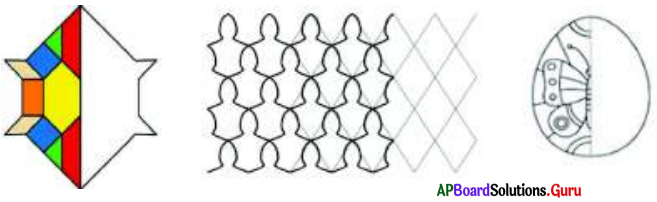
Question 1.
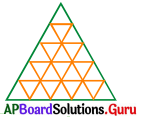
Observe the following pattern and complete it.
AP Board 7th Class Maths Solutions Chapter 12 Symmetry Ex 12.4 1
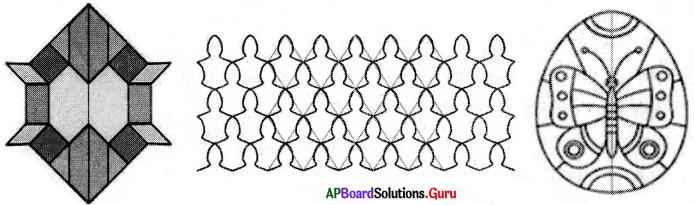
Answer:
AP Board 7th Class Maths Solutions Chapter 12 Symmetry Ex 12.4 2

AP Board 7th Class Maths Solutions Chapter 12 Symmetry Ex 12.4

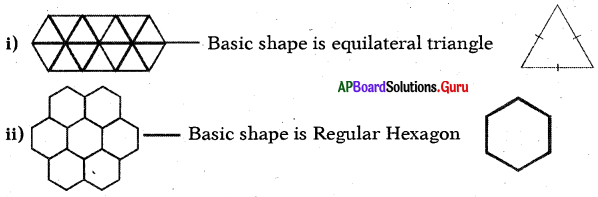
Question 2.
Draw any two tessellations and identify the basic shape.
Answer:
AP Board 7th Class Maths Solutions Chapter 12 Symmetry Ex 12.4 3
Note: Can be drawn with any regular polygon.

AP Board 7th Class Maths Solutions Chapter 12 Symmetry Ex 12.2

SCERT AP 7th Class Maths Solutions Pdf Chapter 12 Symmetry Ex 12.2 Textbook Exercise Questions and Answers.

AP State Syllabus 7th Class Maths Solutions 12th Lesson Symmetry Ex 12.2

Question 1.
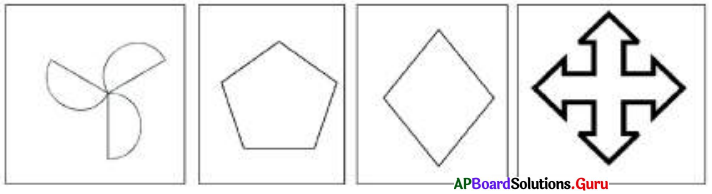
Which of the following shapes have line symmetry? Which have rotational symmetry?
AP Board 7th Class Maths Solutions Chapter 12 Symmetry Ex 12.2 1
Answer:
(a) Has no line of symmetry and rotational symmetry.
(b) Has line of symmetry and no rotational symmetry.
(c) Has line of symmetry and rotational symmetry.
(d) Has line of symmetry and rotational symmetry.

AP Board 7th Class Maths Solutions Chapter 12 Symmetry Ex 12.2

Question 2.
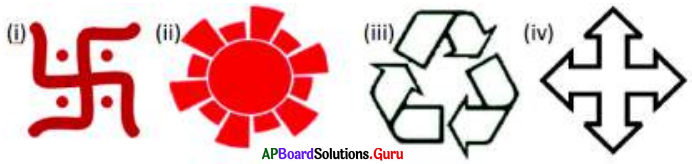
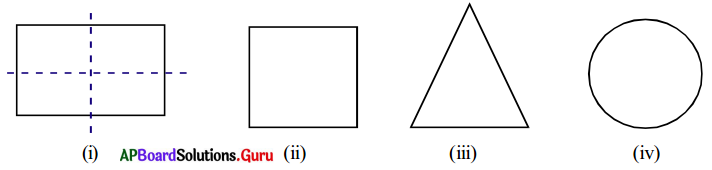
Determine the order of rotational symmetry in the figures given below.
AP Board 7th Class Maths Solutions Chapter 12 Symmetry Ex 12.2 2
Answer:
(i) The order of rotatiorlal symmetry of the figure is 4.
(ii) The order of rotational symmetry of the figure is 6.
(iii) The order of rotational symmetry of the figure is 3.
(iv) The order of rotational symmetry of the figure is 4.

Question 3.
Draw the 2 such figures which have line symmetry and rotational symmetry of order more than 1.
Answer:
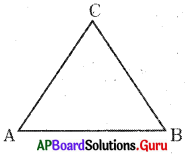
(a) Equilateral triangle has 3 lines of symmetry and rotational symmetry of order (3).
AP Board 7th Class Maths Solutions Chapter 12 Symmetry Ex 12.2 3
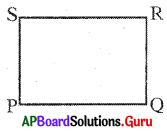
(b) Rectangle has 2 lines of symmetry and rotational symmetry of order (2).
AP Board 7th Class Maths Solutions Chapter 12 Symmetry Ex 12.2 4

Question 4.
Name the quadrilaterals which have both line symmetry and rotational symmetry of order more than 1.
Answer:
Rectangle, square and rhombus.

Question 5.
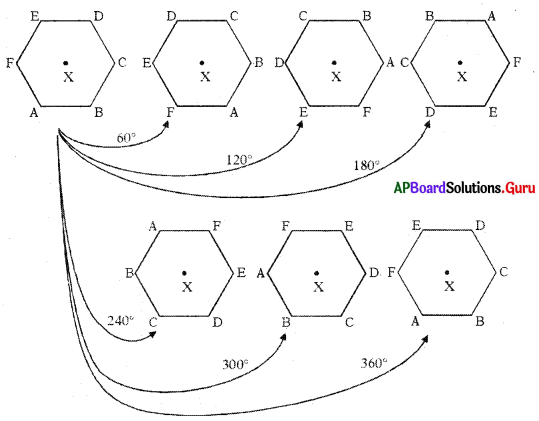
After rotating by 60° about its axis, a figure looks exactly the same as its original position. What other angles will this happen for the same figure?
Answer:
AP Board 7th Class Maths Solutions Chapter 12 Symmetry Ex 12.2 5

AP Board 7th Class Maths Solutions Chapter 12 Symmetry Ex 12.2

Question 6.
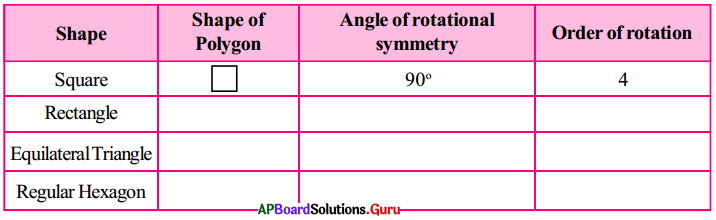
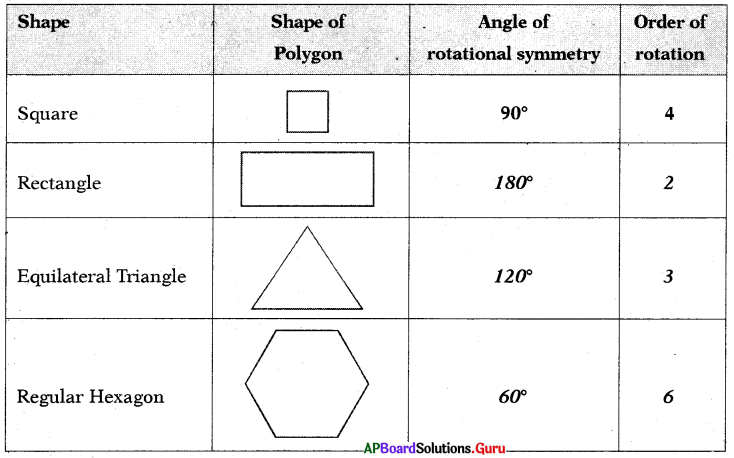
Fill in the blanks.
AP Board 7th Class Maths Solutions Chapter 12 Symmetry Ex 12.2 6
Answer:
AP Board 7th Class Maths Solutions Chapter 12 Symmetry Ex 12.2 7

AP Board 7th Class Maths Solutions Chapter 12 Symmetry Ex 12.1

SCERT AP 7th Class Maths Solutions Pdf Chapter 12 Symmetry Ex 12.1 Textbook Exercise Questions and Answers.

AP State Syllabus 7th Class Maths Solutions 12th Lesson Symmetry Ex 12.1

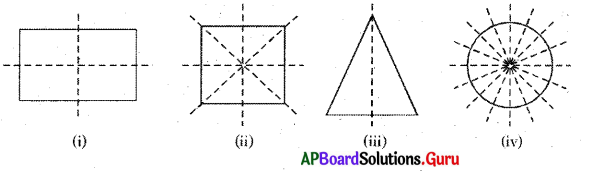
Question 1.
Draw the possible line(s) of symmetry for the following figures, as shown in Figure-(i).
AP Board 7th Class Maths Solutions Chapter 12 Symmetry Ex 12.1 1
Answer:
AP Board 7th Class Maths Solutions Chapter 12 Symmetry Ex 12.1 2

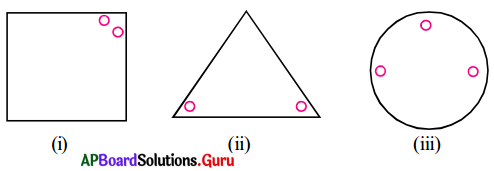
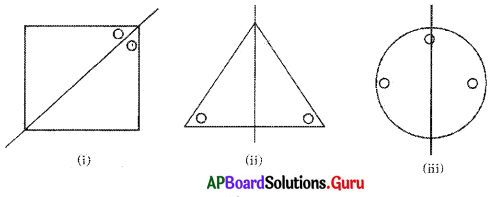
Question 2.
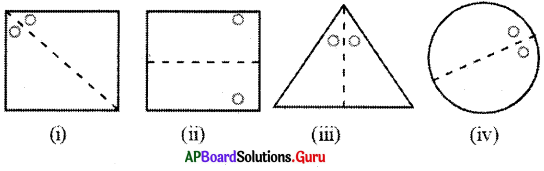
Observe the figures with punched holes and draw the axes of symmetry.
AP Board 7th Class Maths Solutions Chapter 12 Symmetry Ex 12.1 3
Answer:
AP Board 7th Class Maths Solutions Chapter 12 Symmetry Ex 12.1 4

AP Board 7th Class Maths Solutions Chapter 12 Symmetry Ex 12.1

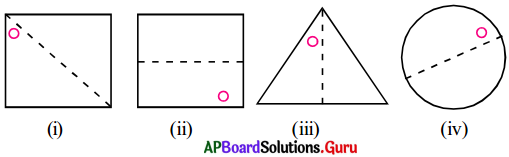
Question 3.
Mark the other dot to become the following dotted line in the picture as line symmetry.
AP Board 7th Class Maths Solutions Chapter 12 Symmetry Ex 12.1 5
Answer:
AP Board 7th Class Maths Solutions Chapter 12 Symmetry Ex 12.1 6

Question 4.
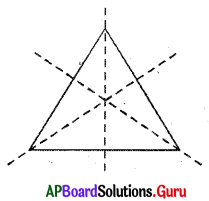
State the number of lines ofsyrnrnetry for the following figures and draw them.
(i) An equilateral triangle
Answer:
AP Board 7th Class Maths Solutions Chapter 12 Symmetry Ex 12.1 7
Number of lines of symmetry for an equilateral triangle is 3.

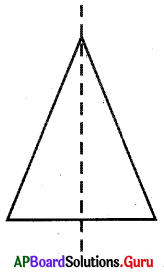
(ii) An isosceles triangle
Answer:
AP Board 7th Class Maths Solutions Chapter 12 Symmetry Ex 12.1 8
Number of lines of symmetry for an isosceles triangle is 1.
(It is the altitude on the unequal side)

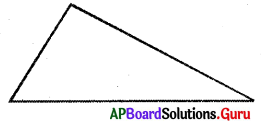
(iii) A scalene triangle
Answer:
AP Board 7th Class Maths Solutions Chapter 12 Symmetry Ex 12.1 9
We cannot draw the line of symmetry for scalene triangle.

Question 5.
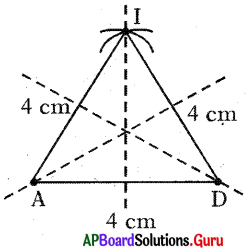
Construct an equilateral triangle with a length of side 4cm and draw all possible lines of symmetry (No need to write the steps of constructions).
Answer:
AP Board 7th Class Maths Solutions Chapter 12 Symmetry Ex 12.1 10
∆ADI is an equilateral triangle.
Number of lines of symmetry for an equilateral triangle is 3.

AP Board 7th Class Maths Solutions Chapter 12 Symmetry Ex 12.1

Question 6.
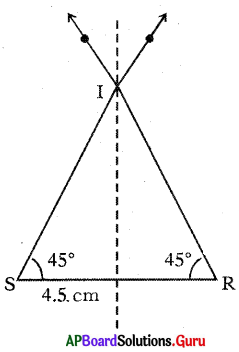
Construct the triangle with the base 4.5cm and base angle 45° each. Draw all possible lines of symmetry (No need to write the steps of constructions).
Answer:
AP Board 7th Class Maths Solutions Chapter 12 Symmetry Ex 12.1 11
∆SRI is an isosceles triangle.
The number of lines of symmetry for an isosceles triangle is 1.

AP Board 7th Class Maths Solutions Chapter 12 Symmetry Review Exercise

SCERT AP 7th Class Maths Solutions Pdf Chapter 12 Symmetry Review Exercise Questions and Answers.

AP State Syllabus 7th Class Maths Solutions 12th Lesson Symmetry Review Exercise

Question 1.
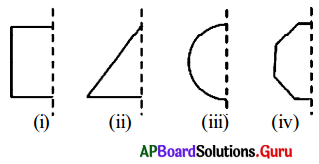
In the following figures, the mirror line (i.e., the line of symmetry) is given as a dotted line.
Complete each figure performing reflection in the dotted (mirror) line. (You might perhaps place a mirror along the dotted line and look into the mirror for the image).
AP Board 7th Class Maths Solutions Chapter 12 Symmetry Review Exercise 1
Answer:
AP Board 7th Class Maths Solutions Chapter 12 Symmetry Review Exercise 2

AP Board 7th Class Maths Solutions Chapter 12 Symmetry Review Exercise

Question 2.
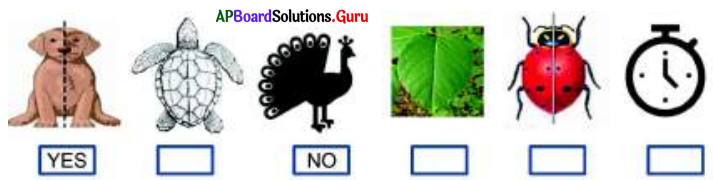
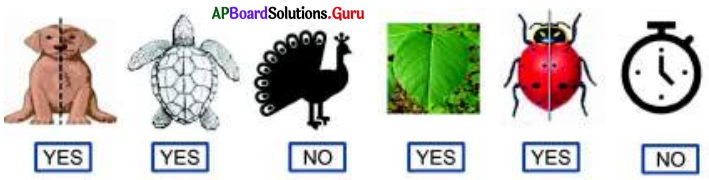
Which of the following figures are having line symmetry? Write YES or NO in the given below the figure boxes.
AP Board 7th Class Maths Solutions Chapter 12 Symmetry Review Exercise 3
Answer:
AP Board 7th Class Maths Solutions Chapter 12 Symmetry Review Exercise 4

Question 3.
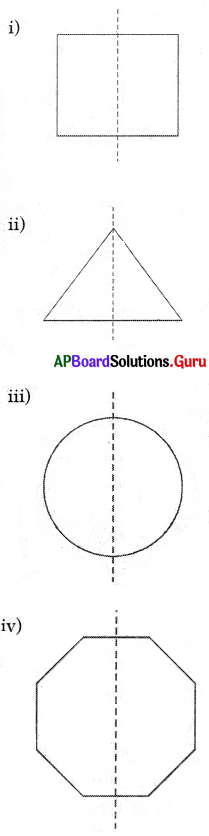
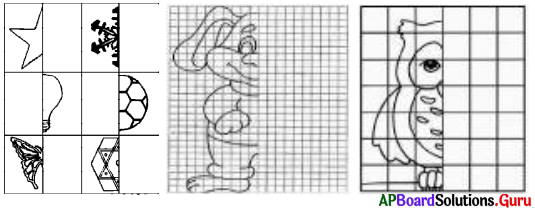
Draw the other half of each symmetrical shape for the following pictures.
AP Board 7th Class Maths Solutions Chapter 12 Symmetry Review Exercise 5
Answer:
AP Board 7th Class Maths Solutions Chapter 12 Symmetry Review Exercise 6

AP Board 7th Class Maths Solutions Chapter 11 Area of Plane Figures InText Questions

SCERT AP 7th Class Maths Solutions Pdf Chapter 11 Area of Plane Figures InText Questions and Answers.

AP State Syllabus 7th Class Maths Solutions 11th Lesson Area of Plane Figures InText Questions

Check Your Progress [Page No: 84]

Question 1.
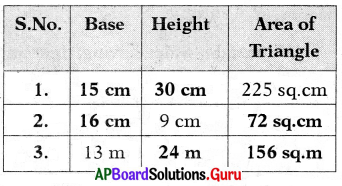
Fill the missing values in the following table.
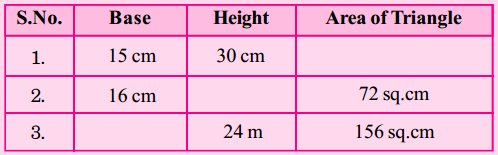
AP Board 7th Class Maths Solutions Chapter 11 Area of Plane Figures InText Questions 7
Answer:
AP Board 7th Class Maths Solutions Chapter 11 Area of Plane Figures InText Questions 6

AP Board 7th Class Maths Solutions Chapter 11 Area of Plane Figures InText Questions

Question 2.
Anu has 4 right angled triangles with same size. Using those triangles, she makes a star like toy given below. Calculate the area of this toy star.
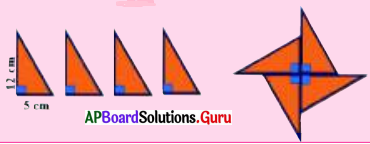
AP Board 7th Class Maths Solutions Chapter 11 Area of Plane Figures InText Questions 8
Answer:
Given base of the triangle b = 5 cm
Height of the triangle h = 12 cm
Area of the triangle = \(\frac{1}{2}\) × b × h
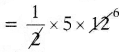
AP Board 7th Class Maths Solutions Chapter 11 Area of Plane Figures InText Questions 9
= 30 sq.cm
Area of star = Area of 4 triangles
∴ Area of the toy star = 4 × 30
= 120 sq.cm

Let’s Explore [Page No. 85]

Question 1.
The areas of triangular field ABC and rectangular field EFGH are equal. The length and breadth of EFGH are 15 m., 10 m. respectively. The base of ∆ABC 25 m. then find it’s height.
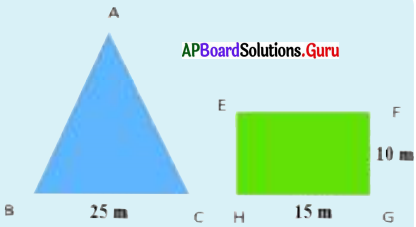
AP Board 7th Class Maths Solutions Chapter 11 Area of Plane Figures InText Questions 11
Answer:
Given length of rectangle l = 15 m
breadth of rectangle b = 10 m
Area of rectangle = l × b
= 15 × 10
= 150 sq.m.
Given base of the triangle b = 25 m
height of the triangle h = ? m
∴ Area of the triangle = \(\frac{1}{2}\) × b × h
⇒ \(\frac{1}{2}\) × 25 × h = 150
⇒ 25h = 150 × 2
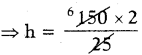
AP Board 7th Class Maths Solutions Chapter 11 Area of Plane Figures InText Questions 12
∴ Height of triangle h = 12 m.

AP Board 7th Class Maths Solutions Chapter 11 Area of Plane Figures InText Questions

Question 2.
All the triangles in the given figure are on the base AB =12 cm. Find the height of each of the triangles corresponding to the base AB, by counting the grids and find the area of each triangle. What do you observe?
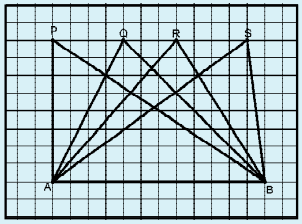
AP Board 7th Class Maths Solutions Chapter 11 Area of Plane Figures InText Questions 13
Answer:
Given in the figure,
Base of ∆ APB = 12 cm
Height = 8 cm
Area of ∆ APB = \(\frac{1}{2}\) × b × h
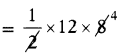
AP Board 7th Class Maths Solutions Chapter 11 Area of Plane Figures InText Questions 14
= 48 sq.cm
Base of ∆ AQB = 12 cm
Height = 8 cm
Area of ∆ AQB
AP Board 7th Class Maths Solutions Chapter 11 Area of Plane Figures InText Questions 14
= 48 sq.cm
Base of ∆ ARB = 12 cm
Height = 8 cm
Area of ∆ ARB
AP Board 7th Class Maths Solutions Chapter 11 Area of Plane Figures InText Questions 14
= 48 sq.cm
Base of ∆ ASB = 12 cm
Height = 8 cm
Area of ∆ ASB
AP Board 7th Class Maths Solutions Chapter 11 Area of Plane Figures InText Questions 14
= 48 sq.cm
By observing area of each triangle is same.

AP Board 7th Class Maths Solutions Chapter 11 Area of Plane Figures InText Questions

Let’s Explore [Page No: 88]

Question 1.
5 cm width white tiles arranged between square shaped blue tiles along sides as shown in the figure. If the side of the total arrangement is 150 cm, find the area of the arranged white tiles.
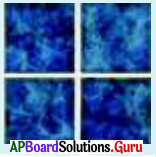
AP Board 7th Class Maths Solutions Chapter 11 Area of Plane Figures InText Questions 21
Answer:
In the given figure side of total arrangement ABCD = 150 cm.
Width of white tile = 5 cm
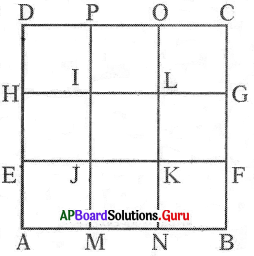
AP Board 7th Class Maths Solutions Chapter 11 Area of Plane Figures InText Questions 22
Area of white tile path EFGH = 150 × 5 = 750 sq.cm
Area of white tile path MNOP = 150 × 5 = 750 sq.cm
Area of common path IJKL = 5 × 5 = 25 sq.cm
Area of total white tile path
= Area of EFGH + Area of MNOP – Area of IJKL
= 750 + 750 – 25
∴ The area of the arranged white tiles
= 1475 sq.cm.

AP Board 7th Class Maths Solutions Chapter 11 Area of Plane Figures InText Questions

Question 2.
2 m wide path is present the outer side of the square grass land of side 80 m. Find the area of path and total expenditure of the path flooring with bricks, if the cost of flooring with bricks per sq.m is ₹ 200.
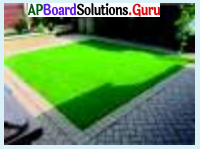
AP Board 7th Class Maths Solutions Chapter 11 Area of Plane Figures InText Questions 23
Answer:
Given side of the grass land = 80 m
Width of the path = 2 m
Path laid out side the grass land.
So, outer side of grassland
= side + 2 × width
= 80 + 2 × 2 = 84 m
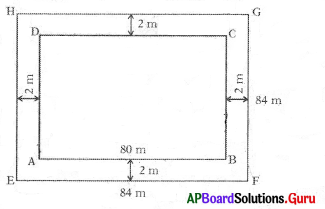
AP Board 7th Class Maths Solutions Chapter 11 Area of Plane Figures InText Questions 24
ABCD = 80 × 80 – 6400 sq.m
Area of the grass land with path
EFGH = 84 × 84 = 7056 sq.m
Area of the path = Area of EFGH – Area of ABCD
= 7056 – 6400 = 656 sq.m.
Cost of flooring per sq.m = ₹ 200
∴ Cost of flooring per 656 sq.m
= 656 × 200 = ₹ 1,31.200

AP Board 7th Class Maths Solutions Chapter 11 Area of Plane Figures InText Questions

Let’s Do Activity [Page No: 88]

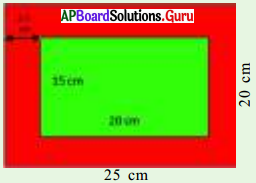
Prepare two coloured rectangles one is red colour of length 25 cm, breadth 20 cm. Another one is green of length 20 cm, breadth 15 cm and place smaller rectangle middle to the bigger rectangle, so, that 2.5 cm red colour formed outside to green colour rectangle. Find the area of red colour path.
AP Board 7th Class Maths Solutions Chapter 11 Area of Plane Figures InText Questions 25
Answer:
Area of red rectangle = 25 × 20 = 500 cm2
Area of green rectangle = 20 × 15 = 300 cm2
∴ Area of the coloured path = (Area of red rectangle) – (Area of green rectangle)
= 500 – 300
= 200 cm2

[Page No: 89]

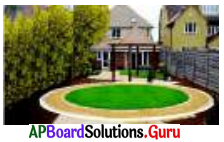
In the part of ‘Nadu-Nedu’ programme, Head master decided to arrange cir¬cular shape flower bed with radius 7 m in the premises of his school. How many flower plants needed if it takes 4 plants per sq. m. ?
Answer:
Here, length of the rectangle (l)
= Half of the perimeter of circle
= πr
breadth of the rectangle (b)
= radius of circle
= r
We know that the area of the rectangle = l × b = πr × r (∵ l = πr, b = r)
= πr2 – Area of the circle.
So, the area of the circle A = πr2
Now we solve above problem,
where ‘r’ = 7m
Area of flower bed = πr2
= \(\frac{22}{7}\) × 7 × 7
= 22 × 7
= 154 sq.m
Number of plants per sq.m = 4
Number of plants for 154 sq.m
= 154 × 4 = 616 plants.
So, Headmaster needs 616 plants for the flower bed.

AP Board 7th Class Maths Solutions Chapter 11 Area of Plane Figures InText Questions

Check Your Progress [Page No. 91]

Question 1.
The circumference of the circle shaped rangoli sheet is 88 cm. Find the radius of the circle and the area of the circle.
Answer:
Given circumference of the rangoli
2πr = 88 cm
⇒ 2 × \(\frac{22}{7}\) × r = 88
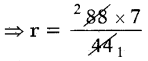
⇒ 44 r = 88 × 7
AP Board 7th Class Maths Solutions Chapter 11 Area of Plane Figures InText Questions 29
⇒ r = 14 cm
∴ Radius of rangoli r = 14 cm
Area of the rangoli = πr2
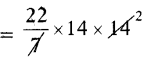
= \(\frac{22}{7}\) × 142
AP Board 7th Class Maths Solutions Chapter 11 Area of Plane Figures InText Questions 30
∴ Area of the circle = 616 sq.cm

AP Board 7th Class Maths Solutions Chapter 11 Area of Plane Figures InText Questions

Question 2.
Calculate the areas of circles shown in the figure.
(i)
AP Board 7th Class Maths Solutions Chapter 11 Area of Plane Figures InText Questions 31
Answer:
From the figure radius r = 7 cm
Area of the circle = πr2
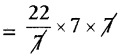
= \(\frac{22}{7}\) × 72
AP Board 7th Class Maths Solutions Chapter 11 Area of Plane Figures InText Questions 32
= 154 sq.cm

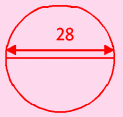
(ii)
AP Board 7th Class Maths Solutions Chapter 11 Area of Plane Figures InText Questions 33
Answer:
From the figure diameter of circle d = 28 cm
Radius of circle r = \(\frac{\mathrm{d}}{2}\) = \(\frac{28}{2}\) = 14 cm.
Area of the circle = πr2
= \(\frac{22}{7}\) × 142
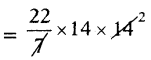
AP Board 7th Class Maths Solutions Chapter 11 Area of Plane Figures InText Questions 34
∴ Area of the circle = 616 sq.cm

AP Board 7th Class Maths Solutions Chapter 11 Area of Plane Figures InText Questions

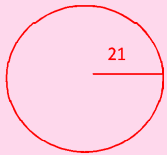
(iii)
AP Board 7th Class Maths Solutions Chapter 11 Area of Plane Figures InText Questions 35
Answer:
From the figure radius of circle (r) = 21 cm
Area of the circle = πr2
= \(\frac{22}{7}\) × 212
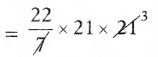
AP Board 7th Class Maths Solutions Chapter 11 Area of Plane Figures InText Questions 36
∴ Area of the circle = 1386 sq.cm

Let’s Explore [Page No: 93]

Radius of circular shaped grass land is 11 m. A goat is tied with a rope of length 4 m at the centre, then find the area of grass land that the goat cannot graze.
Answer:
Given the radius of grass land = 11 m
Area of grass land = πr2
= \(\frac{22}{7}\) × 11 × 11
= \(\frac{2662}{7}\)
∴ Area of grass land = 380.29 sq.m.
Radius of the small circle = length of rope to which goat tied = 4m
Area of land that the goat can graze = πr2
= \(\frac{22}{7}\) × 4 × 4
= \(\frac{352}{7}\) = 50.29 sq.m
∴ Area of land that the goat cannot graze
= Area of grass land – Area of grazed
= 380.29 – 50.29
= 330 sq.m.

AP Board 7th Class Maths Solutions Chapter 11 Area of Plane Figures InText Questions

Reasoning Corner (Non-Verbal) [Page No: 96 ]

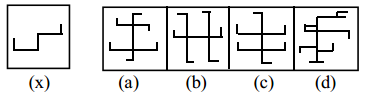
Question 1.
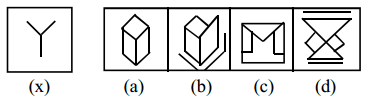
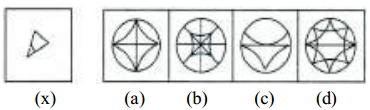
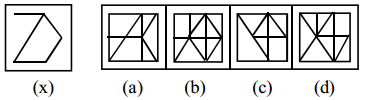
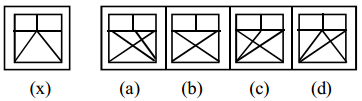
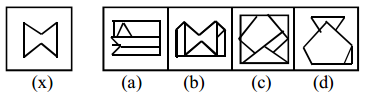
Embedded Figures :
The problem figure (X) is given, answer figures as (a), (b), (c) & (d) given besides. The problem figures as a hidden figure of answer figure and one should identify that figure.

AP Board 7th Class Maths Solutions Chapter 11 Area of Plane Figures InText Questions 39
Answer:
AP Board 7th Class Maths Solutions Chapter 11 Area of Plane Figures InText Questions 40

Examples

Question 1.
Find the area of the given triangles.
AP Board 7th Class Maths Solutions Chapter 11 Area of Plane Figures InText Questions 6
Answer:
(i) In ∆PQR, Base (QR) = 6 cm,
Height (PS) = 4 cm

Area of ∆PQR = \(\frac{1}{2}\) x base x height
= \(\frac{1}{2}\) × QR × PS
= \(\frac{1}{2}\) × 6 cm × 4 cm
= 12 sq.cm.

(ii) In ∆LMN, Base (MN) = 3 cm,
Height (LO) = 2 cm
Area of ∆LMN = \(\frac{1}{2}\) × base × height
= \(\frac{1}{2}\) × MN × LO
= \(\frac{1}{2}\) × 3 cm × 2 cm
= 3 sq.cm

AP Board 7th Class Maths Solutions Chapter 11 Area of Plane Figures InText Questions

Question 2.
The area of the ∆ XYZ is 12 sq.cm and the height XL is 3 cm, then find base YZ.
Answer:
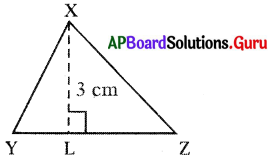
AP Board 7th Class Maths Solutions Chapter 11 Area of Plane Figures InText Questions 2
In ∆ XYZ, Base = YZ,
Height (XL) = 3 cm,
Area of the XYZ = 12 sq.cm.
Area of the ∆XYZ = \(\frac{1}{2}\) × base × height
= \(\frac{1}{2}\) × YZ × XL
⇒ 12 = \(\frac{1}{2}\) × YZ × 3
⇒ YZ = 12 × \(\frac{2}{3}\)
So, YZ = 8 cm

Question 3.
In ∆ ABC, AC = 8 cm, BC = 4 cm and AE = 5 cm.
Find (i) the area of the AABC (ii) BD.
Answer:
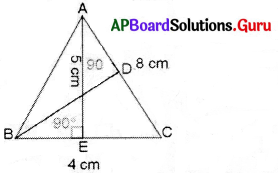
AP Board 7th Class Maths Solutions Chapter 11 Area of Plane Figures InText Questions 3
(i) In ∆ ABC, Base (BC) = 4 cm,
Height (AE) = 5 cm.
Area of the ∆ ABC = \(\frac{1}{2}\) × base × height
= = \(\frac{1}{2}\) × 4 × 5
10 sq.cm.

(ii) In ABAC, Base (AC) = 8 cm,
height (BD) = ?,
Area of ∆ BAC = 10 sq.cm
Area of the ∆ BAC = \(\frac{1}{2}\) × base × height
i. e. 10 = \(\frac{1}{2}\) × 8 × BD
BD = 10 × \(\frac{2}{8}\) = \(\frac{10}{4}\) = \(\frac{5}{2}\) = 2.5
So, height (BD) = 2.5 cm

AP Board 7th Class Maths Solutions Chapter 11 Area of Plane Figures InText Questions

Question 4.
Calculate the area of the given right-angled triangle with sides having right angle are 6 cm, 6 cm.
Answer:
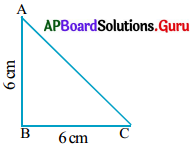
AP Board 7th Class Maths Solutions Chapter 11 Area of Plane Figures InText Questions 4
Method – 1: Sides having right angles are 6 cm, 6 cm.
Sides forming the right angle a = 6 cm, b = 6 cm
Area of a right-angled triangle
= \(\frac{1}{2}\) × Product of sides forming the right angle
= \(\frac{1}{2}\) × a × b
= \(\frac{1}{2}\) × 6 × 6
= 6 × 3 = 18 sq.cm.

(or)
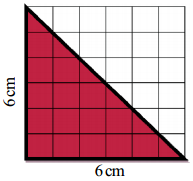
AP Board 7th Class Maths Solutions Chapter 11 Area of Plane Figures InText Questions 5
Method – 2: Observe the grid carefully, the right angled triangle covering half of the area of Square.
Area of a right-angled triangle
= \(\frac{1}{2}\) × Area of square
= \(\frac{1}{2}\) × 6 × 6 = 18 sq.cm.

Question 5.
Find the area of the triangle shaped lawn whose base and heights are 12m.,7m. respectively. Find the total cost of laying lawn, if cost of grass is ₹ 300 per Sq. m.
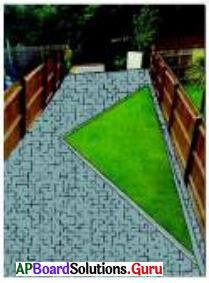
AP Board 7th Class Maths Solutions Chapter 11 Area of Plane Figures InText Questions 10
Answer:
Base of the triangle shaped lawn = 12 m.
Height = 7 m.
Area of triangle shaped lawn 1
= \(\frac{1}{2}\) × b × h
= \(\frac{1}{2}\) × 12 × 7
= 6 × 7 = 42 Sq.m
Cost of grass for laying in lawn per 1 Sq.m = ₹ 300
Cost of grass for laying in lawn for 42 Sq.m = ₹ 300 × 42 = ₹ 12,600

AP Board 7th Class Maths Solutions Chapter 11 Area of Plane Figures InText Questions

Question 6.
The length and breadth of a rectangular field is 65 m, 30 m respectively. A path of width 2.5 m is made around the park outside. Find the area of the path.
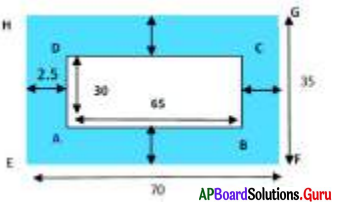
AP Board 7th Class Maths Solutions Chapter 11 Area of Plane Figures InText Questions 18
Answer:
In the fig, ABCD is a rectangular field and shaded area shows 2.5m. wide path. EFGH is a rectangle (field with path)
Length of ABCD (AB) = 65m.,
Breadth of ABCD (AD) = 30m.
Width of path = 2.5 m.
Area of path = Area of outer rectangular- field EFGH – Area of inner rectangular field ABCD
Length of rectangle EFGH = EF
= Length of field (AB) + (2 × Width of path)
= 65m + (2 × 2.5 m)
= 65m + 5m = 70m
Breadth of rectangle EFGH = EH
= Breadth of field (AD) + (2 × Width of path)
= 30 m + (2 × 2.5m)
= 30 m + 5m = 35m
Area of outer rectangle
EFGH = length × breadth
70m × 35m = 2450 Sq.m
Area of inner rectangle
ABCD = length × breadth
= 65 m × 30 m
= 1950 Sq.m
Area of path = Area of outer rectangle EFGH – Area of inner rectangle ABCD
= 2450 Sq.m – 1950 Sq.m
= 500 Sq.m.

Question 7.
A square shaped swimming pool of side 70m. It has 5m width path is present the outer side of the boundary. Find the area of this path. Find the expenditure of covering that path with tiles at the rate of ₹ 150 per sq.m.
Answer:
WXYZ shows a square shaped swimming pool of side 70m. 5m wide path to the outer side of the swimming pool.,
Area of the path = Area of swimming pool PQRS with path – Area of swimming pool WXYZ
PS = Side of swimming pool (WZ) + (2 × breadth of path)
= 70m + (2 × 5m)
= 70m + 10m = 80m
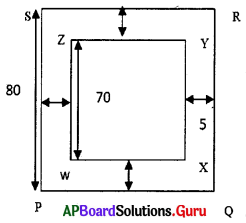
AP Board 7th Class Maths Solutions Chapter 11 Area of Plane Figures InText Questions 19
Area of swimming pool with path
PQRS = (Side)2 = (80 m)2
= 6400 Sq.m.
Area of swimming pool
WXYZ = (Side)2 = (70 m)2
= 4900 Sq.m.
Area of path = Area of swimming pool PQRS with path – Area of swimming pool WXYZ
= 6400 – 4900 = 1500 Sq.m.
If cost of covering tiles per 1 Sq.m.
= ₹ 150
Cost of covering tiles per 1500 Sq.m.
= ₹ 150 × 1500
= ₹ 2,25,000

AP Board 7th Class Maths Solutions Chapter 11 Area of Plane Figures InText Questions

Question 8.
The length of rectangular grass land is 55 m and breadth is 45 m in the centre of the grass land two paths of 3 m wide one parallel to the length and another parallel to breadth are situated in such a way that they intersect each other. Find the area of the path.
Answer:
In fig. ABCD is rectangular grass land.
Length of ABCD = 55 m
Breadth of ABCD = 45 m
Width of path = 3 m
Area of path EFGH = Length × Width
= 55 × 3
= 165 Sq.m
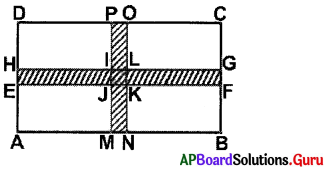
AP Board 7th Class Maths Solutions Chapter 11 Area of Plane Figures InText Questions 20
Area of path MNOP
= Breadth × Width
= 45 × 3 = 135 Sq.m.
Area of common path IJKL (situated on both paths)
= Width × Width = 3 m × 3 m = 9 Sq.m.
Area of square IJKL i.e., 9 Sq.m is included in both the paths. So we subtract one time.
Area of total path = Area of path EFGH + Area of path MNOP – Area of IJKL
= (165 Sq.m. + 135 Sq.m. – 9 Sq.m.)
= (300 9) Sq.m.
= 291 Sq.m.

Question 9.
Find the area of the rangoli of it’s radius is 21 cm.
(Use π = \(\frac{22}{7}\))
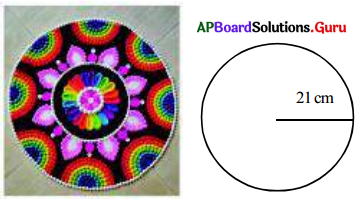
AP Board 7th Class Maths Solutions Chapter 11 Area of Plane Figures InText Questions 26
Answer:
Radius of rangoli (r) = 21 cm
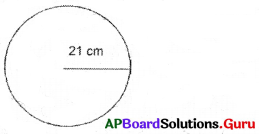
AP Board 7th Class Maths Solutions Chapter 11 Area of Plane Figures InText Questions 27
Area of circular shaped rangoli = πr2
= \(\frac{22}{7}\) × 21 cm × 21 cm
= 1386 sq. cm
∴ Area of the circle = 1386 sq. cm

AP Board 7th Class Maths Solutions Chapter 11 Area of Plane Figures InText Questions

Question 10.
Find the surface area of a circular shaped pool whose diameter is 28 m
(Use π = \(\frac{22}{7}\)).
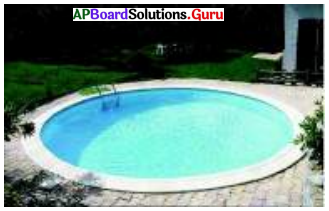
AP Board 7th Class Maths Solutions Chapter 11 Area of Plane Figures InText Questions 28
Answer:
The diameter of circular shaped pool (d) = 28 m
Radius (r) = \(\frac{28}{2}\) m = 14 m
Area of a circular shaped pool = πr2
= \(\frac{22}{7}\) × (14m)2
= \(\frac{22}{7}\) × 14 m × 14 m
= 22 × 2 × 14 sq.m.
= 616 sq.m.

Question 11.
In a circular shaped park inner portion is given for kids to play and outer portion is given for walking to elders. If outer radius is 35 m, width of walking track is 14 m, then find the area of walking path.
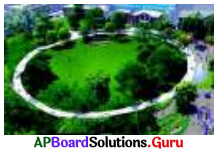
AP Board 7th Class Maths Solutions Chapter 11 Area of Plane Figures InText Questions 37
Answer:
Outer radius of park (R) = 35 m,
Width of walking track = 14 m.
Radius of playground (r) = R – w = 35 – 14 = 21m.
Area of walking track = Area of the park – Area of playing ground
= πR2 – πr2
= \(\frac{22}{7}\) × 352 – \(\frac{22}{7}\) × 212
= \(\frac{22}{7}\) (352 – 212)
= \(\frac{22}{7}\) (1225 – 441)
= \(\frac{22}{7}\) × 784
= 22 × 112 = 2464 sq.m

AP Board 7th Class Maths Solutions Chapter 11 Area of Plane Figures InText Questions

Question 12.
A water fountain is in circular shaped whose radius is 10 m. Its inner portion of radius 3m is arranged for fountain and remaining part is cemented. Find the area of that cemented part and total cost of cementing if cost of cementing is ₹ 200 per sq.m.
Answer:
Radius for total water fountain (R) = 10m
Radius of fountain arranged portion (r) = 3 m
Area of cemented part = Area of total water fountain – Area of fountain arranged portion
= πR2 – πr2
AP Board 7th Class Maths Solutions Chapter 11 Area of Plane Figures InText Questions 28
= \(\frac{22}{7}\) × (10)2 – \(\frac{22}{7}\) × (3)2
= \(\frac{22}{7}\) [(10)2 – (3)2)
= \(\frac{22}{7}\) (100 – 9) sq.m.
= \(\frac{22}{7}\) × 91 sq.m.
= 22 × 13
= 286 sq.m
Given the cost of cementing per sq.m = ₹ 200
∴ Total cost of cementing = 286 × 200 = ₹ 57,200

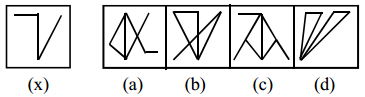
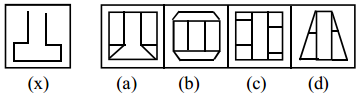
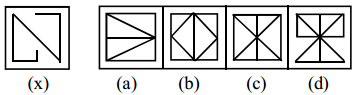
Practice Questions [Page No: 96]

In each question below, you are given a figure (X) followed by four figures (a), (b), (c) and (d) such that (X) is embedded in one of them. Trace out the correct alternative.

Question 1.
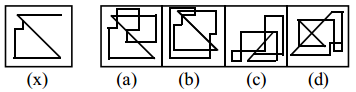
AP Board 7th Class Maths Solutions Chapter 11 Area of Plane Figures InText Questions 41
Answer:
a

Question 2.
AP Board 7th Class Maths Solutions Chapter 11 Area of Plane Figures InText Questions 42
Answer:
c

Question 3.
AP Board 7th Class Maths Solutions Chapter 11 Area of Plane Figures InText Questions 43
Answer:
b
AP Board 7th Class Maths Solutions Chapter 11 Area of Plane Figures InText Questions

Question 4.
AP Board 7th Class Maths Solutions Chapter 11 Area of Plane Figures InText Questions 44
Answer:
a

Question 5.
AP Board 7th Class Maths Solutions Chapter 11 Area of Plane Figures InText Questions 45
Answer:
c

Question 6.
AP Board 7th Class Maths Solutions Chapter 11 Area of Plane Figures InText Questions 46
Answer:
a

Question 7.
AP Board 7th Class Maths Solutions Chapter 11 Area of Plane Figures InText Questions 47
Answer:
b
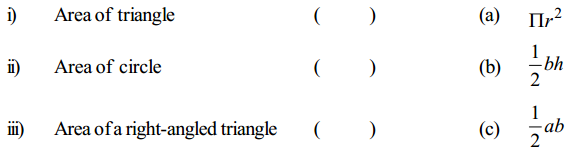
Question 8.
AP Board 7th Class Maths Solutions Chapter 11 Area of Plane Figures InText Questions 48
Answer:
b
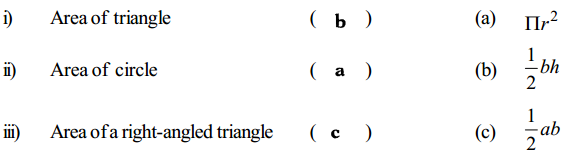
AP Board 7th Class Maths Solutions Chapter 11 Area of Plane Figures InText Questions

Question 9.
AP Board 7th Class Maths Solutions Chapter 11 Area of Plane Figures InText Questions 49
Answer:
d

Question 10.
AP Board 7th Class Maths Solutions Chapter 11 Area of Plane Figures InText Questions 50
Answer:
b
AP Board 7th Class Maths Solutions Chapter 11 Area of Plane Figures Unit Exercise

SCERT AP 7th Class Maths Solutions Pdf Chapter 11 Area of Plane Figures Unit Exercise Questions and Answers.

AP State Syllabus 7th Class Maths Solutions 11th Lesson Area of Plane Figures Unit Exercise

Question 1.
AP Board 7th Class Maths Solutions Chapter 11 Area of Plane Figures Unit Exercise 1
Answer:
AP Board 7th Class Maths Solutions Chapter 11 Area of Plane Figures Unit Exercise 2

AP Board 7th Class Maths Solutions Chapter 11 Area of Plane Figures Unit Exercise

Question 2.
Write the formulae of the following:
(i) Area of the rectangular path ……………….. .
Answer:
Area of the outer rectangle – Area of the inner rectangle.

(ii) Area of the square path ……………….. .
Answer:
Area of the outer square – Area of the – inner square.

(iii)
Area of the circular path ……………….. .
Answer:
Area of the outer circle – Area of the inner circle.
π(R + r)(R – r)

Question 3.
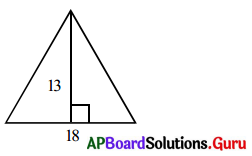
Find the area of a triangle if its base is 18 cm, height is 13 cm.
AP Board 7th Class Maths Solutions Chapter 11 Area of Plane Figures Unit Exercise 3
Answer:
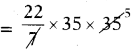
Given base of the triangle b = 18 cm
Height of the triangle h = 13 cm
Area of the triangle = \(\frac{1}{2}\) ∙ b ∙ h
AP Board 7th Class Maths Solutions Chapter 11 Area of Plane Figures Unit Exercise 4
∴ Area of the triangle = 117 sq.cm.

AP Board 7th Class Maths Solutions Chapter 11 Area of Plane Figures Unit Exercise

Question 4.
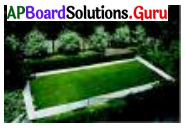
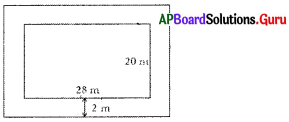
In a park a rectangular path given outside for walking around the grassland of length 28 m., and breadth 20m. If the width of the walking path is 2m., find the area of walking path.
AP Board 7th Class Maths Solutions Chapter 11 Area of Plane Figures Unit Exercise 5
Answer:
Given inner length of the park l = 28 m
Breadth b = 20 m

AP Board 7th Class Maths Solutions Chapter 11 Area of Plane Figures Unit Exercise 6
Area of the inner rectangle = l × b
= 28 × 20
= 560 sq.m
Path laid outside around the grassland.
Width of the path = 2 m
So, outer length of rectangle
l = Inner length + 2 × Width
= 28 + 2 × 2 = 28 + 4 = 32 m
Breadth b = 20 + 2 × 2
= 20 + 4 = 24m
Area of the outer rectangle = l × b = 32 × 24 = 768 sq.m
∴ Area of the walking path = outer area – inner area
= 768 – 560 = 208 sq.m.

AP Board 7th Class Maths Solutions Chapter 11 Area of Plane Figures Unit Exercise

Question 5.
The elevation of building have square – shaped window of a side 150 cm. Around this window tiles arranged with a width of 70 cm. Find the area of tiles and total cost of tiles arranged, if cost per sq.cm. is ₹ 5.
Answer:
Side of square window = 150 cm
Area of square window = 150 × 150 A
= 22500 cm2
Area of square formed by arranging tiles around the window
= (150 + 70)2 = 2202 = 48400 cm2
Area of tiles laid = (Area of outer square) – Area of inner square
= 48400 – 22500 = 25900
∴ Total cost by laying tiles around the window
@ ₹5 per cm2 is = 259 × 5 = ₹ 1295.00

Question 6.
Two cross roads, each of width 4 m, run at right angles through the centre of a rectangular park of length 60 m and breadth 40 m and parallel to its sides. Find the area of the roads. Also find the cost of constructing the roads at the rate of ₹ 100 sq.m.
AP Board 7th Class Maths Solutions Chapter 11 Area of Plane Figures Unit Exercise 7
Answer:
Length of the rectangular park = 60 m
Breadth of the rectangular park = 40 m
Length of the path along length of the park = 60 m
Width of the path along length of the park = 40 m
Area of the path along length of the park = 60 × 4 = 240 m2
Similarly,
Length of the path along breadth of the park = 40 m
Width = 4m
∴ Area of the path along its breadth = 40 × 4 = 160 m2
Hence, area of the paths = Area of the path along length + Area of the path along breadth – Area of the intersecting square
= 240 + 160 – 4 × 4
= 400 – 16 = 384
∴ Cost of construction at the rate of
₹ 100 per sq.m = 384 × 100 = ₹ 38400

AP Board 7th Class Maths Solutions Chapter 11 Area of Plane Figures Unit Exercise

Question 7.
Find the area of the circular-shaped photo frame whose radius is 28 cm. If the cost of decoration is ₹ 3 per sq. cm., find the total cost of decoration.
Answer:
Radius of the circle = 28 cm
Area = πr2
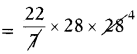
= \(\frac{22}{7}\) × 28 × 28 = 2464 cm2
Circumference of the photo frame 2πr
= 2 × \(\frac{22}{7}\) × 28 = 176 cm
∴ Cost of decorative piece at the rate of ₹ 3 per cm is 176 × 3 = ₹ 528

Question 8.
Find the path area of circular-shaped grassland of radius 42 m where the width of the path is 7 m. around and outside the circle. Find the area of path and total cost of flooring, if the cost of flooring is ₹ 150 per sq.m.
AP Board 7th Class Maths Solutions Chapter 11 Area of Plane Figures Unit Exercise 8
Answer:
Radius of circular floor = 42 m
Width around it = 7 m
Radius of outer circle = 42 + 7 = 49 m
Area of outside path = Area of outer circle – Area of inner cirlce
Area of inner circle = πr2 = \(\frac{22}{7}\) × 42 × 42
Area of the outer circle = πR2 = \(\frac{22}{7}\) × 49 × 49
Area of floor = \(\frac{22}{7}\) (49 × 49 – 42× 42)
= \(\frac{22}{7}\) (2401 – 1764)
= \(\frac{22}{7}\) × 637 = 2002 m2
∴ Cost of flooring at the rate of ₹ 150 per sq.m is 2002 × 150 = ₹ 300300

AP Board 7th Class Maths Solutions Chapter 11 Area of Plane Figures Ex 11.4

SCERT AP 7th Class Maths Solutions Pdf Chapter 11 Area of Plane Figures Ex 11.4 Textbook Exercise Questions and Answers.

AP State Syllabus 7th Class Maths Solutions 11th Lesson Area of Plane Figures Ex 11.4

Question 1.
The radius of a circular-shaped park is 40 m. A path of width 7 m. is played around outside the park. Find the area of the circular path.
Answer:
Given the radius of a park r = 40 m
Area of inner circle = πr2
= \(\frac{22}{7}\) × 40 × 40
= \(\frac{35200}{7}\)
Area of outer circle = πr2
= \(\frac{22}{7}\) × 47 × 47
= \(\frac{48,598}{7}\) = 6942.57 sq.m
Area of the path = Outer circle area – Inner circle area
= 6942.57 – 5028.57
∴ Area of circular path = 1914 sq.m

AP Board 7th Class Maths Solutions Chapter 11 Area of Plane Figures Ex 11.4

Question 2.
Bhuvanesh builds a circular lawn of radius 28 m. in front of his house. A path of 7 m. width is laid around outside the lawn. Find the area of the circular path.
Answer:
Radius of circular lawn r = 28 m
Area of inner circle = πr2
AP Board 7th Class Maths Solutions Chapter 11 Area of Plane Figures Ex 11.4 1
= 2464 sq.m
A path laid outside the lawn.
Width of the path = 7 m.
Radius of the outer circle
= Inner radius + width of path
= 28 + 7 = 35 m
Area of the outer circle = πr2
AP Board 7th Class Maths Solutions Chapter 11 Area of Plane Figures Ex 11.4 2
= 3850 sq.m.

Question 3.
A water fountain is in circular shaped whose radius is 12 m. Its inner portion 5 m. arranged for fountain remaining part cemented. Find the area of that cemented part. Find the cost for cementing, if the rate is ₹ 150 per Sq. m.
Answer:
Radius of water fountain r = 12 m
Area of the outer circle = πr2
= \(\frac{22}{7}\) × 12 × 12
= \(\frac{3168}{7}\)
= 452.57 sq.m
Path laid inner side.
So, width of the path = 7 m
Radius of inner circle = Outer radius – width of the path
= 12 – 7 = 5m
Area of the inner circle = πr2
= \(\frac{22}{7}\) × 5 × 5
= 78.57 sq.m.
Width of the path = 5 m
Area of the path = Outer area – Inner area = 452.57 – 78.57.
Area of the circular path = 374 sq.m
Cost of cementing per sq.m = ₹ 150
Cost of cementing per 374 sq.m = 374 × 150
Total cost of cementing = ₹ 56,100

AP Board 7th Class Maths Solutions Chapter 11 Area of Plane Figures Ex 11.4

Question 4.
The radius of circular shaped cricket ground is 55 m. A lobby of 5 m width has been constructed around the ground for spectators. Find the area of lobby. Find the cost of construction of the lobby for seating arrangement, if the rate of construction is ₹ 1500 per Sq. m.
Answer:
Radius of the cricket ground r = 55 m
Area of the cricket ground = πr2
= \(\frac{22}{7}\) × 55 × 55
= \(\frac{66550}{7}\)
= 9507.14 sq.m
Lobby in constructed around the ground.
Radius of the inner circle = Outer radius – width of the path
= 55 – 5 = 50m
Area of the inner circle = πr2
Area of the path = Outer area – Inner area
= 9507.14 – 7857.14 = 1650 sq.m
Cost of constructing seating arrangement per sq.m = ₹ 1500
Cost of seating arrangement per 1650 sq.m = 1650 × 1500 = ₹ 24,75,000

AP Board 7th Class Maths Solutions Chapter 11 Area of Plane Figures Ex 11.3

SCERT AP 7th Class Maths Solutions Pdf Chapter 11 Area of Plane Figures Ex 11.3 Textbook Exercise Questions and Answers.

AP State Syllabus 7th Class Maths Solutions 11th Lesson Area of Plane Figures Ex 11.3

Question 1.
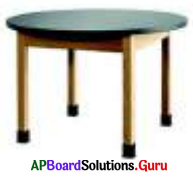
The diameter of the round table upper surface in the Science lab is 70 cm. Find the area.
AP Board 7th Class Maths Solutions Chapter 11 Area of Plane Figures Ex 11.3 1
Answer:
Given diameter of table d = 70 cm
Radius of table r = \(\frac{\mathrm{d}}{2}\) = \(\frac{70}{2}\) = 35 cm
Area of the table = πr2
AP Board 7th Class Maths Solutions Chapter 11 Area of Plane Figures Ex 11.3 2
∴ Area of the round table = 3,850 sq.cm.

AP Board 7th Class Maths Solutions Chapter 11 Area of Plane Figures Ex 11.3

Question 2.
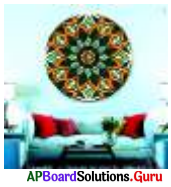
Radius of the circular shaped wall painting is 14 cm. Calculate the area of wall painting.
AP Board 7th Class Maths Solutions Chapter 11 Area of Plane Figures Ex 11.3 3
Answer:
Given radius of the wall painting
r = 14 cm
Area of the circle = πr2
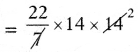
= \(\frac{22}{7}\) × 142
AP Board 7th Class Maths Solutions Chapter 11 Area of Plane Figures Ex 11.3 4
= 616
∴ Area of the wall painting = 616 sq.cm

Question 3.
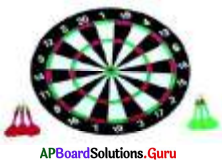
If the area of circular shaped dart board is 1386 sq.cm. Find its radius and diameter.
AP Board 7th Class Maths Solutions Chapter 11 Area of Plane Figures Ex 11.3 5
Answer:
Given the area of circular shaped dart board = 1386 sq.cm
Area of the circle = πr2 = 1386
⇒ \(\frac{22}{7}\) × r2 = 1386
⇒ 22 × r2 = 1386 × 7
AP Board 7th Class Maths Solutions Chapter 11 Area of Plane Figures Ex 11.3 6
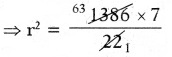
⇒ r2 = 441 = 212
⇒ r2 = 212
∴ Radius of dart board r = 21 cm
Diameter of dart board d 2r
= 2 × 21
= 42 cm

AP Board 7th Class Maths Solutions Chapter 11 Area of Plane Figures Ex 11.3

Question 4.
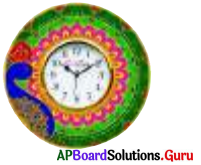
Circumference of the circular shaped clock is 44 cm. Find the radius and surface area of the clock.
AP Board 7th Class Maths Solutions Chapter 11 Area of Plane Figures Ex 11.3 7
Answer:
Given the circumference of clock = 44 cm
⇒ 2πr = 44 cm
⇒ 2 × \(\frac{22}{7}\) × r = 44
⇒ 44 × r = 44 × 7
AP Board 7th Class Maths Solutions Chapter 11 Area of Plane Figures Ex 11.3 8
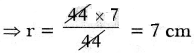
∴ Radius of the clock r = 7 cm
Surface area of the clock = πr2
= \(\frac{22}{7}\) × 72
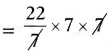
AP Board 7th Class Maths Solutions Chapter 11 Area of Plane Figures Ex 11.3 9
∴ Surface area of the clock = 154 sq.cm

AP Board 7th Class Maths Solutions Chapter 11 Area of Plane Figures Ex 11.3

Question 5.
The circumference of a circular-shaped lawn in a park is 352 m. Find the area of the circular-shaped lawn. If the cost of grass per sq. m is ₹ 30, then find the total cost of laying grass on the lawn.
AP Board 7th Class Maths Solutions Chapter 11 Area of Plane Figures Ex 11.3 10
Answer:
Given the circumference of lawn = 352 m
⇒ 2πr = 352 m
⇒ 2 × \(\frac{22}{7}\) × r = 352
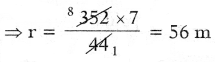
⇒ 44r = 352 × 7 7
AP Board 7th Class Maths Solutions Chapter 11 Area of Plane Figures Ex 11.3 11
∴ Radius of the lawn r = 56 m
Area of the lawn = πr2
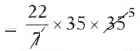
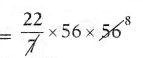
= \(\frac{22}{7}\) × 562
AP Board 7th Class Maths Solutions Chapter 11 Area of Plane Figures Ex 11.3 12
Area of the lawn = 9856 sq.m
Cost of grass per sq.m = ₹ 30
Cost of grass per 9856 sq.m = 9856 × 30
∴ Total cost of laying grass on lawn = ₹ 2,95,680

AP Board 7th Class Maths Solutions Chapter 11 Area of Plane Figures Ex 11.1

SCERT AP 7th Class Maths Solutions Pdf Chapter 11 Area of Plane Figures Ex 11.1 Textbook Exercise Questions and Answers.

AP State Syllabus 7th Class Maths Solutions 11th Lesson Area of Plane Figures Ex 11.1

Question 1.
Calculate the area of the following triangles given below:
(a)
AP Board 7th Class Maths Solutions Chapter 10 Area of Plane Figures Ex 11.1 1
Answer:
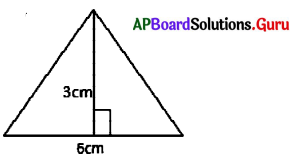
From the figure, base = 6 cm
Height = 3 cm
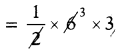
Area of the triangle = \(\frac{1}{2}\) ∙ b ∙ h
AP Board 7th Class Maths Solutions Chapter 10 Area of Plane Figures Ex 11.1 5
= 9 sq.cm

AP Board 7th Class Maths Solutions Chapter 11 Area of Plane Figures Ex 11.1

(b)
AP Board 7th Class Maths Solutions Chapter 10 Area of Plane Figures Ex 11.1 2
Answer:
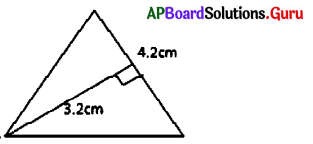
From the figure, base = 4.2 cm
Height = 3.2 cm
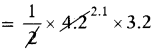
Area of the triangle = \(\frac{1}{2}\) ∙ b ∙ h
AP Board 7th Class Maths Solutions Chapter 10 Area of Plane Figures Ex 11.1 6
= 6.72 sq.cm

(a)
AP Board 7th Class Maths Solutions Chapter 10 Area of Plane Figures Ex 11.1 3
Answer:
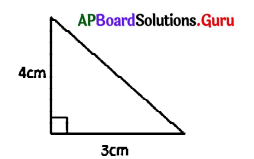
From the figure, base = 3 cm
Height = 4 cm
Area of the triangle = \(\frac{1}{2}\) ∙ b ∙ h
AP Board 7th Class Maths Solutions Chapter 10 Area of Plane Figures Ex 11.1 7
= 6 sq.cm

(a)
AP Board 7th Class Maths Solutions Chapter 10 Area of Plane Figures Ex 11.1 4
Answer:
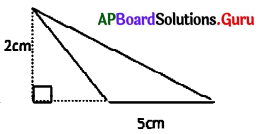
From the figure, base = 5 cm
Height = 2 cm
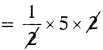
Area of the triangle = \(\frac{1}{2}\) ∙ b ∙ h
AP Board 7th Class Maths Solutions Chapter 10 Area of Plane Figures Ex 11.1 8
= 5 sq.cm

AP Board 7th Class Maths Solutions Chapter 11 Area of Plane Figures Ex 11.1

Question 2.
Find the area of triangle with base 3.8 cm and height 4.6 cm.
Answer:
Given base of the triangle b = 3.8 cm
Height of the triangle h = 4.6 cm
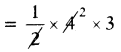
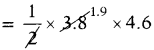
Area of the triangle = \(\frac{1}{2}\) ∙ b ∙ h
AP Board 7th Class Maths Solutions Chapter 10 Area of Plane Figures Ex 11.1 9
∴ Area of the triangle = 8.74 sq.cm.

Question 3.
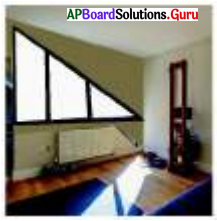
The surface area of a triangular shape window is 24 sq.m, and height is 6m., then find the base of the triangle, if the cost of glass fitting per sqm is ₹ 250, then find total cost of glass fitting for window.
AP Board 7th Class Maths Solutions Chapter 10 Area of Plane Figures Ex 11.1 11
Answer:
Let,
base of the triangular window = b m
Height of the triangular window h= 6m
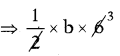
Area of triangular window = \(\frac{1}{2}\) ∙ b ∙ h
AP Board 7th Class Maths Solutions Chapter 10 Area of Plane Figures Ex 11.1 10
= 24 sq.cm
⇒ 3b = 24
⇒ b = \(\frac{24}{3}\)
= 8
∴ Base of the triangular window = 8m
Cost of glass fitting per sq.m = ₹ 250
Cost of glass fitting per 24 sq.m = 250 × 24
∴ Total cost of glass fitting for window = ₹ 6000/-

AP Board 7th Class Maths Solutions Chapter 11 Area of Plane Figures Ex 11.1

Question 4.
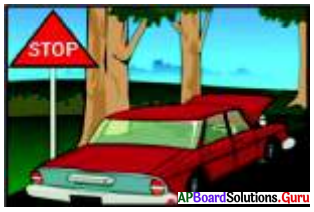
A traffic signal plate in the shape of triangle is having base 20 cm, height 15 cm. Find the area of the triangle. If the cost of painting is ₹ 2 per Sq.cm, then find the total cost for painting the signal board on one side.
AP Board 7th Class Maths Solutions Chapter 10 Area of Plane Figures Ex 11.1 12
Answer:
Given the base of the signal plate b = 20 cm
Height of the signal plate h = 15 cm
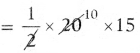
Area of the signal plate = \(\frac{1}{2}\) ∙ b ∙ h
AP Board 7th Class Maths Solutions Chapter 10 Area of Plane Figures Ex 11.1 13
= 150 sq.cm
∴ Area of the signal plate = 150 sq.cm
Cost of painting per sq.cm = ₹ 2
Cost of painting for 150 sq.cm = 150 × 2
∴ Total cost for painting the signal board = ₹ 300

Question 5.
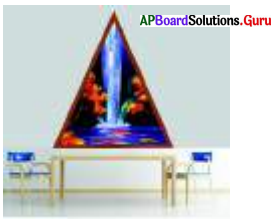
find the area of triangular shaped wall painting whose base is 24m, height is 38m. Find the area of the triangle, if the cost of painting is ₹ 50 per Sq. m. and also find the total cost of painting.
AP Board 7th Class Maths Solutions Chapter 10 Area of Plane Figures Ex 11.1 14
Answer:
Given base of the triangular wall painting = 24 m Height = 38 m
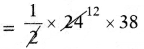
Area of wall painting = \(\frac{1}{2}\) ∙ b ∙ h
AP Board 7th Class Maths Solutions Chapter 10 Area of Plane Figures Ex 11.1 15
= 456 sq.m.
Cost of painting per 1 sq.m = ₹ 50
Cost of painting for 456 sq.m = 456 × 50
∴ Total cost for painting per 456 sq.m = ₹ 22,800

AP Board 7th Class Maths Solutions Chapter 11 Area of Plane Figures Ex 11.1

Question 6.
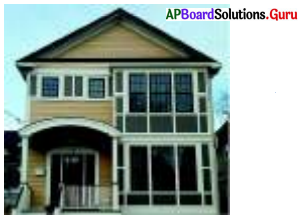
The area of triangle-shaped elevation of a house is 195 Sq.m. Its base is 26m. Find the height of elevation. Find the total cost of cementing, if the cost of cementing per Sq.m, is ₹ 250.
AP Board 7th Class Maths Solutions Chapter 10 Area of Plane Figures Ex 11.1 16
Answer:
Given, base of triangle shaped elevation of house b = 26 m height h = ?
Area of the triangular elevation = 195 sq.m
= \(\frac{1}{2}\) ∙ b ∙ h
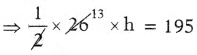
AP Board 7th Class Maths Solutions Chapter 10 Area of Plane Figures Ex 11.1 17
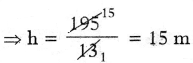
⇒ 13 h = 195
AP Board 7th Class Maths Solutions Chapter 10 Area of Plane Figures Ex 11.1 18
Height of triangular elevation = 15 m
Cost of cementing per sq.m = ₹ 250
Cost of cementing per 195 sq.m
= 195 × 250
∴ Total cost of cementing of triangular elevation = ₹ 48,750

AP Board 7th Class Maths Solutions Chapter 10 Construction of Triangles InText Questions

SCERT AP 7th Class Maths Solutions Pdf Chapter 10 Construction of Triangles InText Questions and Answers.

AP State Syllabus 7th Class Maths Solutions 10th Lesson Construction of Triangles InText Questions

[Page No. 67]

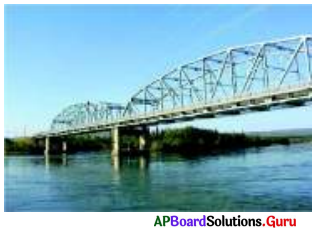
Look at the picture and answer the following questions
AP Board 7th Class Maths Solutions Chapter 10 Construction of Triangles InText Questions 1

Question 1.
Name some things from your daily life that look like triangles.
Answer:
Samosa, chapathi, window elevations, house tops, bridge trusses, floor tessellations.

Question 2.
What are the types of triangles can see in the picture?
Answer:
Right triangles,
Equilateral triangles.

Question 3.
Do you think all triangles shown are similar with their properties? What are they?
Answer:
Yes. All right triangles are similar.

All triangles are similar because they have
(a) right angle
(b) equal side and
(c) equal hypotenuse.

AP Board 7th Class Maths Solutions Chapter 10 Construction of Triangles InText Questions

Check Your Progress [Page No. 69]

Question 1.
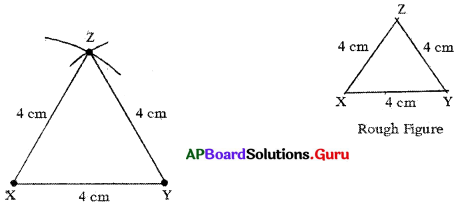
Construct an equilateral triangle ∆XYZ with XY = 4 cm.
Answer:
Given sides of an equilateral triangle ∆XYZ is XY = 4 cm.
In equilateral triangle all sides ,gresequal in length
∴ XY = YZ = ZX = 4 cm.
AP Board 7th Class Maths Solutions Chapter 10 Construction of Triangles InText Questions 2

Steps of Construction:

  1. Draw a rough sketch of the triangle and label it with the given measurements.
  2. Draw a line segment with XY = 4 cm,
  3. Draw an arc with centre X and radius 4 cm.
  4. Draw another arc with centre Y and radius 4 cm to intersecting the previous arc at Z.
  5. Join XZ andYZ.

Hence, required ∆XYZ is constructed with the given measurements.

Question 2.
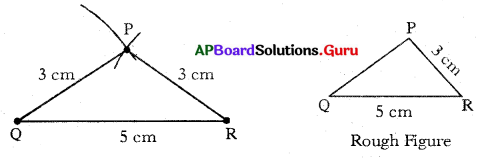
Construct an isosceles triangle ∆PQR With PQ = PR = 3 cm, QR = 5 cm.
Answer:
Given sides of an isosceles triangle ∆PQR are PQ = PR = 3 cm and QR = 5 cm
In isosceles triangle two sides are equal.
∴ PQ = PR = 3 cm
AP Board 7th Class Maths Solutions Chapter 10 Construction of Triangles InText Questions 3
Steps of construction:

  1. Draw a rough sketch of the triangle and label it with the given measurements.
  2. Draw a line segment QR = 5 cm.
  3. Draw an arc with centre Q and radius 3 cm.
  4. Draw another arc with centre R and same radius (3 cm) to intersect the previous arc at P.
  5. Join PQ and PR.

Hence, required APQR is constructed with the given measurements.

Let’s Think [Page No. 69]

Can you construct ∆ABC with AB = 4 cm, BC = 5 cm and CA =10 cm? Why? Justify your answer.
Answer:
Given sides of a ∆ABC are AB = 4 cm, BC = 5 cm and CA =10 cm.
In any triangle sum of any two sides is always greater than the third side.
AB + BC = 4 cm + 5 cm = 9 cm <10 cm.
Sum of AB + BC < AC
So, with the given measurements construction of ∆ABC is not possible.

Check Your Progress [Page No. 72]

Question 1.
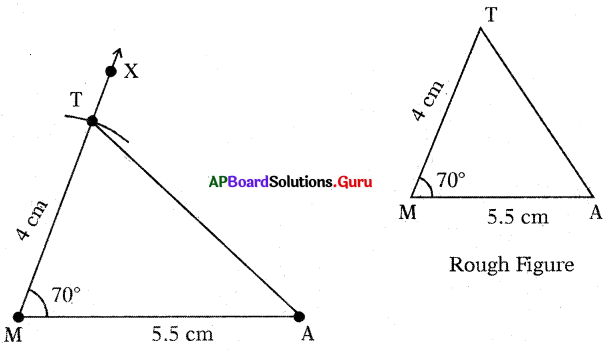
Construct ∆MAT with measurements MA = 5.5 cm, MT = 4 cm and ∠M=70°.
Answer:
Given measurements of ∆MAT are MA = 5.5 cm, MT = 4 cm and ∠M = 70°.
AP Board 7th Class Maths Solutions Chapter 10 Construction of Triangles InText Questions 4
Steps of Construction:

  1. Draw a rough sketch of the triangle and label it with the given measurements.
  2. Draw a line segment with MA = 5.5 cm.
  3. Draw a ray \(\overrightarrow{\mathrm{MX}}\) such that ∠AMX = 70°
  4. Draw an arc with centre M and radius 4 cm, to intersect the \(\overrightarrow{\mathrm{MX}}\) at point T.
  5. Join AT.

Hence, required ∆MAT is constructed with the given measurements.

AP Board 7th Class Maths Solutions Chapter 10 Construction of Triangles InText Questions

Let’s Explore [Page No. 72]

Question 1.
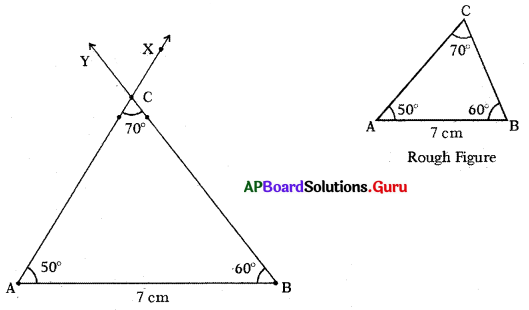
Construct the triangle with the measurements of AB = 7cm, ∠B = 60° and ∠C = 70°.
Answer:
Given measurements of ∆ABC are AB = 7 cm, ∠B = 60° and ∠C = 70°.
In ∆ABC, ∠A + ∠B + ∠C = 180°
∠A + 60° + 70° = 180° .
∠A + 130° = 180°
∠A = 180° – 130° = 50°
AP Board 7th Class Maths Solutions Chapter 10 Construction of Triangles InText Questions 5
Steps of Construction:

  1. Draw a rough sketch of triangle and label it with given measurements.
  2. Draw a line segment with AB = 7 cm.
  3. Draw a ray BY such that ABY = 60°.
  4. Draw another ray AX such that BAX = 50°.
  5. Name the intersecting of rays AX and BY is C.

Hence, required ∆ABC is constructed with the given measurements.

Check Your Progress [Page No. 73]

Question 1.
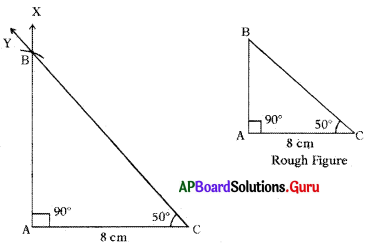
Construct ∆ABC with the measurements ∠A = 90°, ∠C = 50° and AC = 8 cm.
Answer:
Given measurements of ∆ABC are ∠A = 90°, ∠C = 50° and AC = 8 cm.
AP Board 7th Class Maths Solutions Chapter 10 Construction of Triangles InText Questions 6
Steps of Construction:

  1. Draw a rough sketch of triangle and label it with given measurements.
  2. Draw a line segment with AC = 8 cm.
  3. Draw a ray AX such that ∠CAX = 90°.
  4. Draw another ray CY such that ∠ACY = 50°.
  5. Name the intersecting point of AX and CY as B.

Thus, required ∆ABC is constructed with the given measurements.

Let’s Think [Page No. 73]

Construct a triangle with angles 100°, 95° and a side of length of your choice. Can1 you construct the triangle?
Answer:
No. It is not possible. We know that the sum of the angles of a triangle is 180°.
But, given two angles are 100° and 95°. Their sum is greater than 180°.
So, we cannot construct the triangle.

Examples:

Question 1.
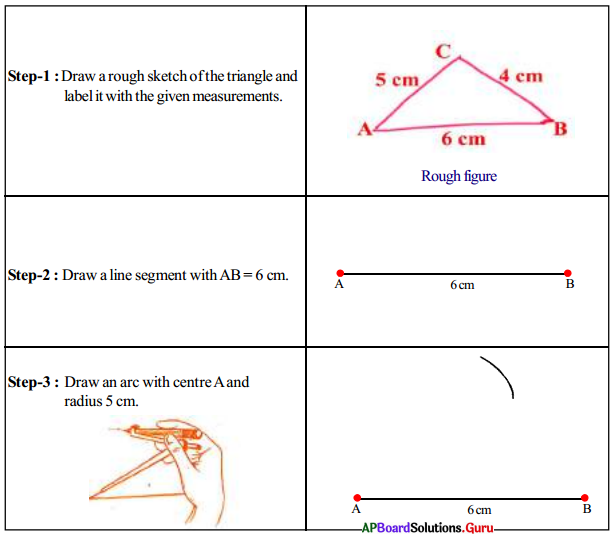
Construct ∆ABC with slides AB = 6 cm, BC = 4 cm and AC = 5 cm.
Answer:
AP Board 7th Class Maths Solutions Chapter 10 Construction of Triangles InText Questions 7

Question 2.
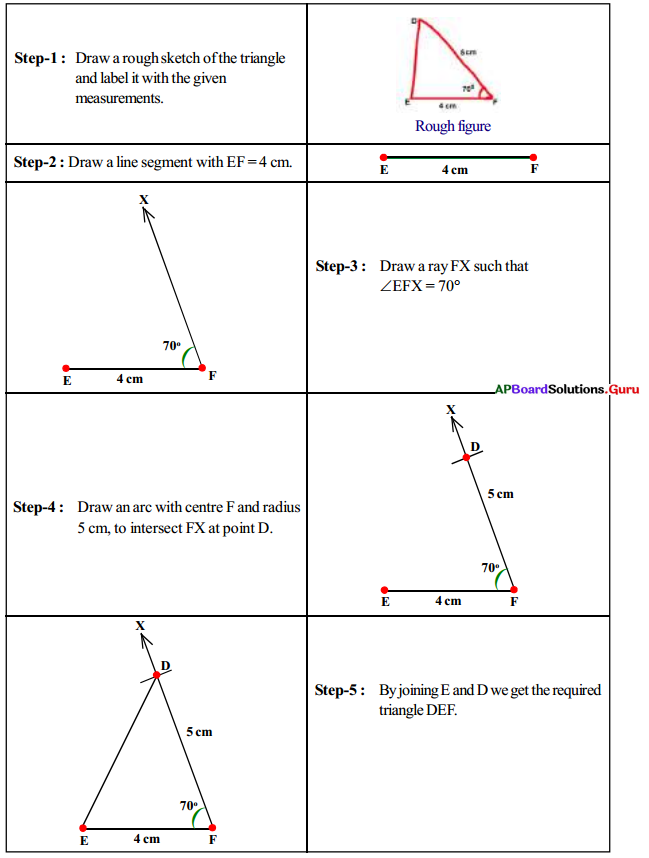
Construct ∆EFD with the measurements ∠F = 70°, EF = 4 cm and FD = 5 cm.
Answer:
AP Board 7th Class Maths Solutions Chapter 10 Construction of Triangles InText Questions 8

AP Board 7th Class Maths Solutions Chapter 10 Construction of Triangles InText Questions

Question 3.
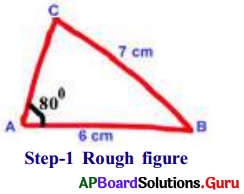
Construct ∆ABC with AB = 6 cm, BC = 7 cm, ∠BAC = 80°.
Answer:
AP Board 7th Class Maths Solutions Chapter 10 Construction of Triangles InText Questions 9
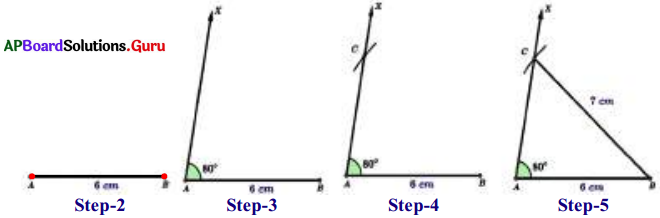
AP Board 7th Class Maths Solutions Chapter 10 Construction of Triangles InText Questions 10

  • Step-1: Draw a rough sketch of ∆ABC and label it with the given measurements.
  • Step-2: Draw a line segment AB of length 6 cm.
  • Step-3: Draw a ray AX such that ∠BAX = 80°.
  • Step-4: Draw an arc with center B and radius 7 cm to Intersect the ray AX at C.
  • Step-5: Join B and C to get the required ∆ABC.

Question 4.
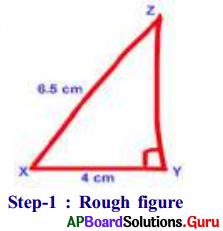
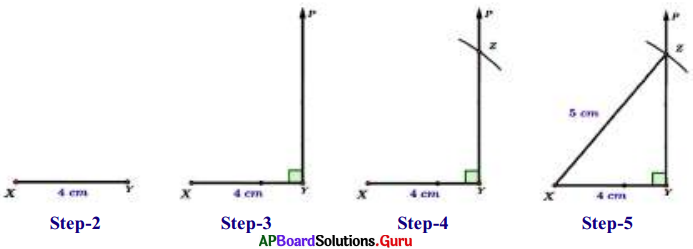
Construct a right angled triangle ∆XYZ, XY = 4 cm, XZ = 6.5 cm and ∠Y = 90°.
Answer:
AP Board 7th Class Maths Solutions Chapter 10 Construction of Triangles InText Questions 11
AP Board 7th Class Maths Solutions Chapter 10 Construction of Triangles InText Questions 12

  • Step-1: Draw a rough sketch of ∆XYZ and label it with given measurements.
  • Step-2: Draw a line segment with XY = 4 cm.
  • Step-3: Draw a ray YP such that ∠XYP = 90°.
  • Step-4: Draw an arc with center X and radius 6.5 cm to intersect the Ray YP at Z.
  • Step-5: Join X and Z to get the required ∆XYZ.

Question 5.
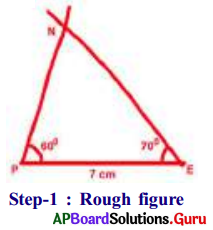
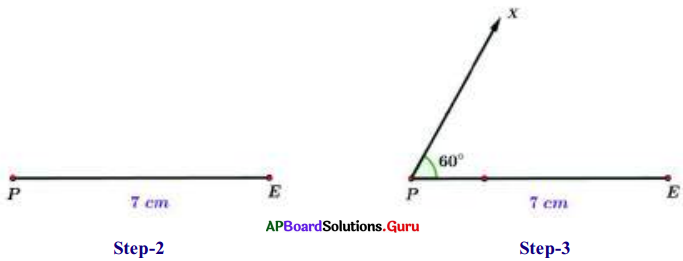
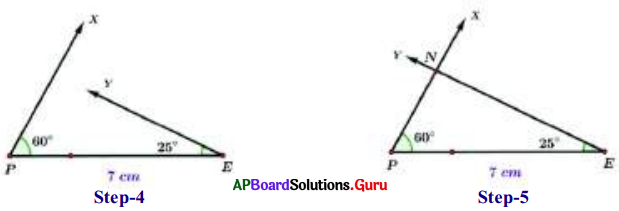
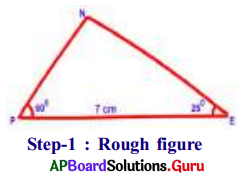
Construct ∆PEN with measurements PE. = 7 cm, ∠PEN = 25° and ∠EPN = 60°
Answer:
AP Board 7th Class Maths Solutions Chapter 10 Construction of Triangles InText Questions 13
AP Board 7th Class Maths Solutions Chapter 10 Construction of Triangles InText Questions 14
AP Board 7th Class Maths Solutions Chapter 10 Construction of Triangles InText Questions 15

  • Step-1: Draw a rough sketch of the triangle and label it with given measurements.
  • Step-2: Draw a line segment with PE = 7 cm,
  • Step-3: Draw a ray PX such that ∠EPX = 60°.
  • Step-4: Draw another ray EY such that ∠PEY = 25°.
  • Step-5: Rays PX and EY intersect each other at N.

Hence, we get the required ∆PEN.
(If necessary, extend the rays to form a triangle.)

Question 6.
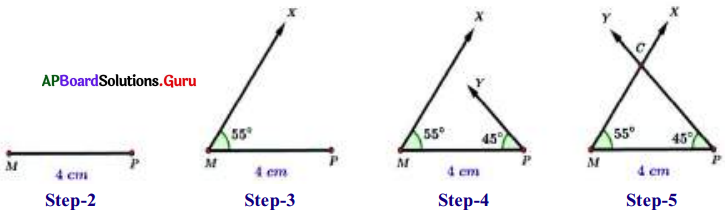
Construct ∆MPC the triangle with the measurements MP = 4 cm, ∠P = 45° arid ∠C = 80°.
Answer:
Now we have to find out the third angle.
We know that the sum of three angles in a triangle is 1800.
So, ∠M + ∠P + ∠C = 180°
⇒ ∠M + 450 + 80° = 180°
⇒ ∠M + 125° = 180°
⇒ ∠M = 180 – 125 = 55°
AP Board 7th Class Maths Solutions Chapter 10 Construction of Triangles InText Questions 16
AP Board 7th Class Maths Solutions Chapter 10 Construction of Triangles InText Questions 17

  • Step-1: Draw a rough sketch of the triangle and label it with given measurements.
  • Step-2: Draw a line segment with MP = 4 cm.
  • Step-3: Draw a ray MX such that ∠PMX = 55°.
  • Step-4: Draw another ray PY such that ∠MPY = 45°.
  • Step-5: Rays MX and PY intersect each other at C. (If necessary extend the rays to ‘ form a triangle.)

Hence, we get the required ∆MPC.
Verification: By using the protractor and check whether ∠C is equal to 80° or not.

AP Board 7th Class Maths Solutions Chapter 10 Construction of Triangles InText Questions

Practice Questions [Page No. 78]

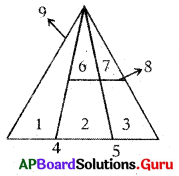
Find the number of triangles in the given figures.

Question 1.
AP Board 7th Class Maths Solutions Chapter 10 Construction of Triangles InText Questions 18
(a) 8
(b) 9
(c) 10
(d) 12
Answer:
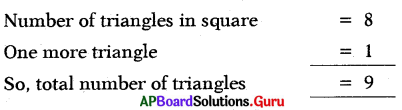
(b) 9

Explanation:
AP Board 7th Class Maths Solutions Chapter 10 Construction of Triangles InText Questions 19

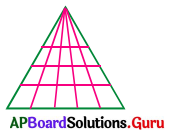
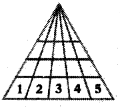
Question 2.
AP Board 7th Class Maths Solutions Chapter 10 Construction of Triangles InText Questions 20
(a) 60
(b) 65
(c) 84
(d) 90
Answer:
(a) 60

Explanation:
AP Board 7th Class Maths Solutions Chapter 10 Construction of Triangles InText Questions 21
Number of rows = 4
Sum of numbers in each row = 1 + 2 + 3 + 4 + 5 = 15
Number of triangles in the picture = 4 × 15 = 60

Question 3.
AP Board 7th Class Maths Solutions Chapter 10 Construction of Triangles InText Questions 22
(a) 12
(b) 13
(c) 14
(d) 15
Answer:
(b) 13

Explanation:
Formula to count number of triangles = 4n + 1
Here n = number of embedded triangles in outer triangle
In the figure n = 3
So, number of triangles = 4(3) + 1 = 12 + 1 = 13

Question 4.
AP Board 7th Class Maths Solutions Chapter 10 Construction of Triangles InText Questions 23
(a) 16
(b) 13
(c) 9
(d) 7
Answer:
(a) 16

Question 5.
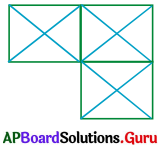
AP Board 7th Class Maths Solutions Chapter 10 Construction of Triangles InText Questions 24
(a) 21
(b) 23
(c) 25
(d) 29
Answer:
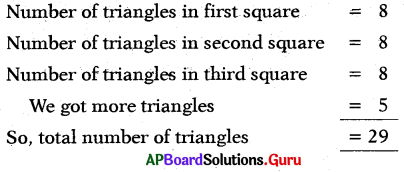
(d) 29

Explanation:
AP Board 7th Class Maths Solutions Chapter 10 Construction of Triangles InText Questions 25

Question 6.
AP Board 7th Class Maths Solutions Chapter 10 Construction of Triangles InText Questions 26
(a) 10
(b) 19
(c) 21
(d) 23
Answer:
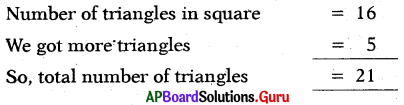
(c) 21

Explanation:
AP Board 7th Class Maths Solutions Chapter 10 Construction of Triangles InText Questions 27

Question 7.
AP Board 7th Class Maths Solutions Chapter 10 Construction of Triangles InText Questions 28
Answer:
(a) 5
(b) 6
(c) 8
(d) 10
Answer:
(c) 8

AP Board 7th Class Maths Solutions Chapter 10 Construction of Triangles InText Questions

Question 8.
AP Board 7th Class Maths Solutions Chapter 10 Construction of Triangles InText Questions 29
(a) 9
(b) 10
(c) 11
(d) 12
Answer:
(a) 9

Explanation:
AP Board 7th Class Maths Solutions Chapter 10 Construction of Triangles InText Questions 30

Question 9.
AP Board 7th Class Maths Solutions Chapter 10 Construction of Triangles InText Questions 31
(a) 19
(b) 20
(c) 16
(d) 14
Answer:
(a) 19

Question 10.
AP Board 7th Class Maths Solutions Chapter 10 Construction of Triangles InText Questions 32
(a) 56
(b) 48
(c) 32
(d) 60
Answer:
(b) 48

Explanation:
Formula to count number of triangles = \(\frac{\mathrm{n}(\mathrm{n}+2)(2 \mathrm{n}+1)}{8}\)
Where n = number of the angles formed in a side
Here in the given figure n = 5
Number of triangles = \(\frac{5(5+2)(2 \times 5+1)}{8}=\frac{5 \times 7 \times 11}{8}\) = 48.1
So, the total number of triangles = 48.

AP Board 7th Class Maths Solutions Chapter 10 Construction of Triangles Ex 10.3

SCERT AP 7th Class Maths Solutions Pdf Chapter 10 Construction of Triangles Ex 10.3 Textbook Exercise Questions and Answers.

AP State Syllabus 7th Class Maths Solutions 10th Lesson Construction of Triangles Ex 10.3

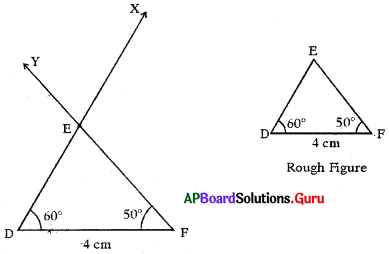
Question 1.
Construct ∆DEF with measurements ∠D = 60°, ∠F = 50° and DF = 4 cm.
Answer:
Given measurements of ∆DEF are ∠D = 60°, ∠F = 50° and DF = 4 cm.
AP Board 7th Class Maths Solutions Chapter 10 Construction of Triangles Ex 10.3 1
Steps of Construction :

  1. Draw a rough sketch of triangle and label it with given measurements.
  2. Draw a line segment with DF = 4 cm.
  3. Draw a ray DX such that ∠FDX = 60°.
  4. Draw another ray FY such that ∠DFY = 50° which intersects the previous ray at E. Thus, required ∆DEF is constructed with the given measurements.

AP Board 7th Class Maths Solutions Chapter 10 Construction of Triangles Ex 10.3

Question 2.
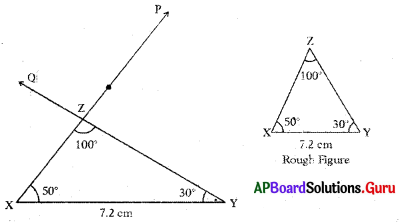
Construct the triangle with the measurements XY = 7.2 cm, ∠Y = 30° and ∠Z = 100°.
Answer:
Given measurements of ∆XYZ are XY = 7.2 cm, ∠Y = 30° and ∠Z = 100°.
We know stun of angles of triangle is 180°
So, ∠X + ∠Y + ∠Z = 180°
⇒ ∠X + 30° + 100° = 180°
⇒ ∠X= 180°-130°
∴ ∠X = 50°
AP Board 7th Class Maths Solutions Chapter 10 Construction of Triangles Ex 10.3 2
Steps of Construction:

  1. Draw a rough sketch of triangle and label it with given measurements.
  2. Draw a line segment with XY = 7.2 cm.
  3. Draw a ray \(\overrightarrow{\mathrm{XP}}\) such that ∠YXP = 50°
  4. Draw another ray \(\overrightarrow{\mathrm{YQ}}\) such that ∠XYQ = 30° which intersects the previous ray at Z. Thus, required ∆XYZ is constructed with the given measurements.

Question 3.
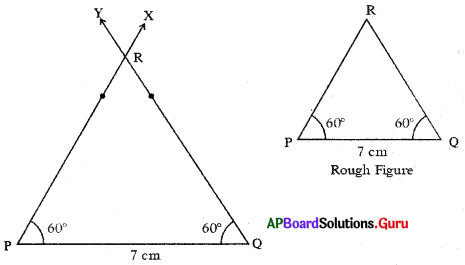
Construct ∆PQR with the measurements ∠P = ∠Q = 60° and PQ = 7 cm.
Answer:
Given measurements of ∆PQR are ∠P = ∠Q = 60° and PQ = 7 cm.
AP Board 7th Class Maths Solutions Chapter 10 Construction of Triangles Ex 10.3 3
Steps of Construction:

  1. Draw a rough sketch of the triangle and label it with given measurements.
  2. Draw a line segment with PQ = 7 cm.
  3. Draw a ray PX such that ∠QPX — 60°
  4. Draw another ray QY such that ∠PQY = 60° which intersects the previous ray at R. Thus, required ∆PQR is constructed with the given measurements.

AP Board 7th Class Maths Solutions Chapter 10 Construction of Triangles Ex 10.2

SCERT AP 7th Class Maths Solutions Pdf Chapter 10 Construction of Triangles Ex 10.2 Textbook Exercise Questions and Answers.

AP State Syllabus 7th Class Maths Solutions 10th Lesson Construction of Triangles Ex 10.2

Question 1.
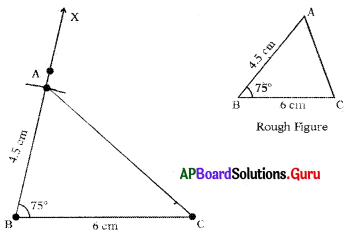
Construct ∆ABC with measurements AB = 4.5 cm, BC = 6 cm and ∠B=75°
Answer:
Given measurements of ∆ABC are AB = 4.5 cm, BC = 6 cm and ∠B = 75°.
AP Board 7th Class Maths Solutions Chapter 10 Construction of Triangles Ex 10.2 1
Steps of Construction :

  1. Draw a rough sketch of triangle and label it with given measurements.
  2. Draw a line segment with BC = 6 cm.
  3. Draw a ray \(\overrightarrow{\mathrm{BX}}\) such that ∠CBX = 15°.
  4. Draw an arc with centre B and radius 4.5 cm, to intersect \(\overrightarrow{\mathrm{BX}}\) at point A.
    Thus, required ∆ABC is constructed with the given measurements.

AP Board 7th Class Maths Solutions Chapter 10 Construction of Triangles Ex 10.2

Question 2.
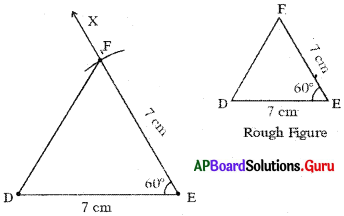
Construct an isosceles triangle with measurements DE = 7 cm, EF = 7 cm and ∠E = 60°
Answer:
Given measurements of ∆DEF are DE = 7 cm, EF = 7 cm and ∠E = 60°.
AP Board 7th Class Maths Solutions Chapter 10 Construction of Triangles Ex 10.2 2
Steps of Construction:

  1. Draw a rough sketch of triangle and label it with given measurements.
  2. Draw a line segment with DE = 7 cm.
  3. Draw a ray \(\overrightarrow{\mathrm{EX}}\) such that ∠DEX = 60°.
  4. Draw an arc with centre E and radius 7 cm to intersect \(\overrightarrow{\mathrm{EX}}\) at point F.
  5. Join DF.
    Hence, required ∆DEF is constructed with the given measurements.

Question 3.
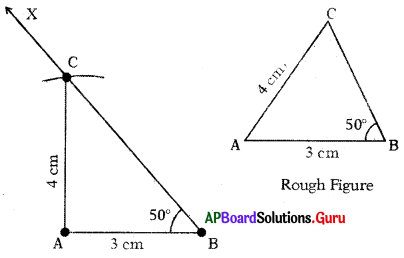
Draw a triangle with,measurements ∠B = 50°, AB = 3 cm and AC = 4 cm.
Answer:
Given measurements of a triangle are ∠B = 50°, AB = 3 cm and AC = 4cm..
AP Board 7th Class Maths Solutions Chapter 10 Construction of Triangles Ex 10.2 3
Steps of Construction:

  1. Draw a rough sketch of triangle and label it with given measurements.
  2. Draw a line segment with AB = 3 cm.
  3. Draw a ray \(\overrightarrow{\mathrm{BX}}\) such that ∠ABX = 50°.
  4. Draw an arc with centre A and radius 4 cm to intersect \(\overrightarrow{\mathrm{BX}}\) at point C.
  5. Join AC.
    Hence, required ∆ABC is constructed with the given measurements.

Question 4.
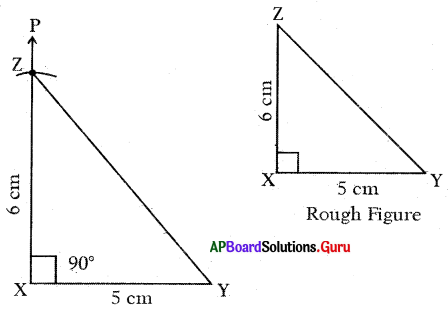
Construct a right angled triangle in which, XY = 5 cm, XZ = 6 cm and right tingle at X.
Answer:
Given measurements of ∆XYZ are XY = 5 cm, XZ = 6 cm and ZX = 90° (∠YXZ = 90°)
AP Board 7th Class Maths Solutions Chapter 10 Construction of Triangles Ex 10.2 4
Steps of Construction:

  1. Draw a rough sketch of triangle arid label it with given measurements.
  2. Draw a line segment with XY = 5 cm.
  3. Draw a ray \(\overrightarrow{\mathrm{XP}}\) such that ∠YXP = 90°.
  4. Draw an arc with centre X and radius 6 cm to intersect XP at point Z.
  5. Join YZ.
    Hence, required triangle ∆XYZ is constructed with the given measurements.

AP Board 7th Class Maths Solutions Chapter 10 Construction of Triangles Ex 10.2

Question 5.
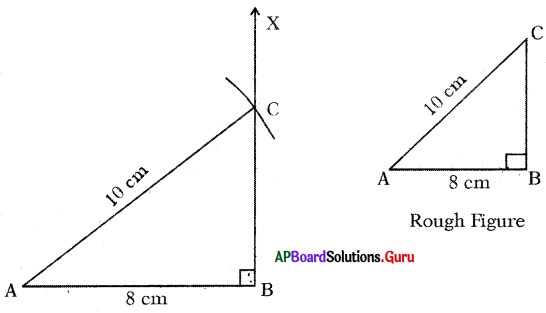
Construct a right angled with measurements ABC, ∠B = 90°, AB = 8 cm and AC = 10 cm.
Answer:
Given measurements of ∆ABC are ∠B = 90°, AB = 8 cm and AC = 10 cm.
AP Board 7th Class Maths Solutions Chapter 10 Construction of Triangles Ex 10.2 5
Steps of Construction :

  1. Draw a rough sketch of triangle and label it with given measurements.
  2. Draw a line segment with AB = 8 cm.
  3. Draw a ray \(\overrightarrow{\mathrm{BX}}\) such that ∠ABX = 90°.
  4. Draw an arc with centre A and radius 10 cm to intersect \(\overrightarrow{\mathrm{BX}}\) at point C.
  5. Join AC.
    Thus, the required ∆ABC is constructed with the given measurements.