AP Board 7th Class Maths Solutions Chapter 10 Construction of Triangles Review Exercise

SCERT AP 7th Class Maths Solutions Pdf Chapter 10 Construction of Triangles Review Exercise Questions and Answers.

AP State Syllabus 7th Class Maths Solutions 10th Lesson Construction of Triangles Review Exercise

Question 1.
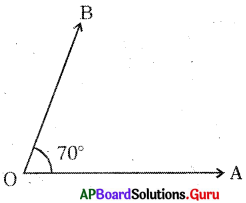
Draw the angles 70° and 110° by using a protractor,
(i) ∠AOB = 70°
Answer:
∠AOB = 70°
AP Board 7th Class Maths Solutions Chapter 10 Construction of Triangles Review Exercise 1

  1. Draw a ray \(\overrightarrow{\mathrm{OA}}\)
  2. At ‘O’ erect a ray OB such that ∠AOB = 70°

(ii) ∠AOB = 110°
Answer:
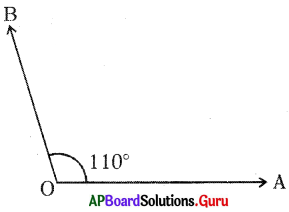
∠AOB = 110°
AP Board 7th Class Maths Solutions Chapter 10 Construction of Triangles Review Exercise 2

  1. Draw a ray \(\overrightarrow{\mathrm{OA}}\).
  2. At ‘O’ erect a ray \(\overrightarrow{\mathrm{OB}}\) such that ∠AOB = 110°

Question 2.
Construct the angles 60° and 120° by using ruler and compass.
(i) ∠AOB = 60°
Answer:
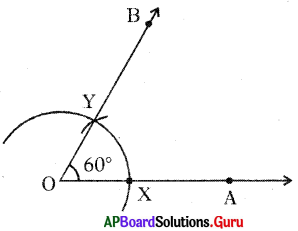
∠AOB = 60°
AP Board 7th Class Maths Solutions Chapter 10 Construction of Triangles Review Exercise 3

  1. Draw a ray \(\overrightarrow{\mathrm{OA}}\).
  2. Draw an arc with any radius (convenient) taking ‘O’ as a centre and cutting \(\overrightarrow{\mathrm{OA}}\) at X.
  3. Draw an arc with the same radius – taking X as a centre and meeting the previous arc at Y.
  4. Join OY and produce it to B.
  5. ∠AOB is formed.
  6. ∠AOB = 60°

(ii) ∠ADI = 120°
Answer:
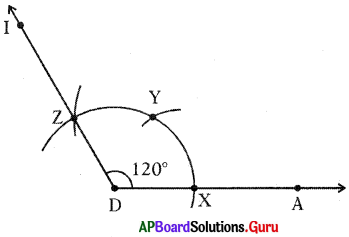
∠ADI = 120°
AP Board 7th Class Maths Solutions Chapter 10 Construction of Triangles Review Exercise 4

  1. Draw a ray \(\overrightarrow{\mathrm{DA}}\).
  2. Draw an arc with any radius taking ‘D’ as centre intersecting \(\overrightarrow{\mathrm{DA}}\) at X.
  3. Now draw two successive arcs from X intersecting the previous arc at Y and Z.
  4. Join D and Z and produce DZ to I.
  5. Now the angle formed ∠ADI is equal to 120°.

AP Board 7th Class Maths Solutions Chapter 10 Construction of Triangles Review Exercise

Question 3.
Draw a line segment PQ = 4.5 cm and construct its perpendicular bisector by using ruler and compass.
Answer:
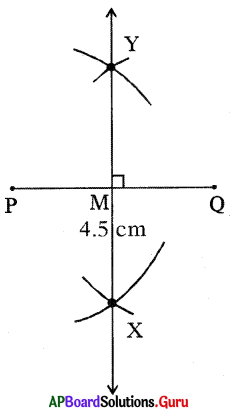
AP Board 7th Class Maths Solutions Chapter 10 Construction of Triangles Review Exercise 5
∠PMY = ∠QMY = 90°
So, PQ ⊥ XY

  1. Draw a line segment PQ of length 4.5 cm.
  2. Draw two arcs with centre P and radius > \(\frac{1}{2}\)PQ on both sides of PQ.
  3. Repeat step 2 with centre ‘Q’ intersecting the previous arc at X and Y.
  4. Join X and Y and produce it on either sides to form \(\overrightarrow{\mathrm{XY}}\).
  5. XY is the perpendicular bisector of PQ.

Question 4.
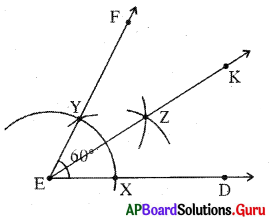
Construct ∠DEF = 60° and its angular bisector by using ruler and compass.
Answer:
AP Board 7th Class Maths Solutions Chapter 10 Construction of Triangles Review Exercise 6
∠DEF = 60°
∠DEK = ∠FEK = \(\frac{\angle \mathrm{DEF}}{2}=\frac{60^{\circ}}{2}\) = 30°

  1. Construct ∠DEF = 60°
  2. Draw an arc with a convenient radius taking E as centre intersecting ED at X and EF at Y.
  3. Draw two arcs with the same radius taking X and Y as centres intersecting at Z.
  4. Join E, Z and produce it to K.
  5. ∠DEK = ∠KEF = 30°.

AP Board 7th Class Maths Solutions Chapter 10 Construction of Triangles Review Exercise

Question 5.
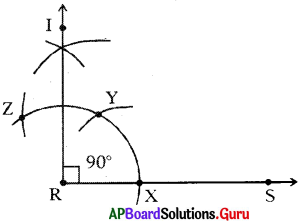
Construct an angle of 90° without using a protractor.
Answer:
∠SRI = 90°
AP Board 7th Class Maths Solutions Chapter 10 Construction of Triangles Review Exercise 7

  1. Draw a ray \(\overrightarrow{R S}\).
  2. Draw an arc of convenient radius taking R as a centre and intersecting \(\overrightarrow{R S}\) at X.
  3. With the same radius draw two successive arcs from X intersecting the previous arc at Y & Z.
  4. Draw bisector to \(\widehat{\mathrm{YZ}}\) intersecting at I.
  5. Join R, I.

AP Board 7th Class Maths Solutions Chapter 9 Algebraic Expressions InText Questions

SCERT AP 7th Class Maths Solutions Pdf Chapter 9 Algebraic Expressions InText Questions and Answers.

AP State Syllabus 7th Class Maths Solutions 9th Lesson Algebraic Expressions InText Questions

Check your progress [Page No. 49]

Question 1.
How many number of terms are there in each of the following expressions ?
(i) 5x2 + 3y + 7
Answer:
Given expression is 5x2 + 3y + 7 Number of terms = 3

AP Board 7th Class Maths Solutions Chapter 9 Algebraic Expressions InText Questions

(ii) 5x2y + 3
Answer:
Given expression is 5x2y + 3
Number of terms = 2

(iii) 3x2y
Answer:
Given expression is 3x2y
Number of terms = 1

(iv) 5x – 7
Answer:
Given expression is 5x – 7
Number of terms = 2

(v) 7x3 – 2x
Answer:
Given expression is 7x3 – 2x
Number of terms = 2

Question 2.
Write numeric and algebraic terms in ‘ the above expressions.
(i) 5x2 + 3y + 7
Answer:
Given expression is 5x2 + 3y + 7
Numerical terms = 7
Algebraic terms = 5x2, 3y

(ii) 5x2y + 3
Answer:
Given expression is 5x2y + 3
Numerical terms = 3
Algebraic terms = 5x2y

(iii) 3x2y
Answer:
Given expression is 3x2y
Numerical terms = No
Algebraic terms = 3x2y

(iv) 5x – 7
Answer:
Given expression is 5x – 7
Numerical terms = – 7
Algebraic terms = 5x

AP Board 7th Class Maths Solutions Chapter 9 Algebraic Expressions InText Questions

(v) 7x3 – 2x
Answer:
Given expression is 7x3 – 2x
Numerical terms = No
Algebraic terms = 7x3, – 2x

Question 3.
Write the terms in the following expressions.
– 3x + 4, 2x – 3y, \(\frac{4}{3}\)a2 + \(\frac{5}{2}\)b,
1.2ab + 5.1b – 3.2a
Answer:

ExpressionsTerms
– 3x+4– 3x, 4
2x – 3y2x, – 3y
\( \frac{4}{3} \)a2 + \( \frac{5}{2} \)b\( \frac{4}{3} \)a2 + \( \frac{5}{2} \)b
1.2 ab + 5.1 b – 3.2 a1.2 ab, 5.1 b, – 3.2a

Let’s Explore (Page No: 50)

Question 1.
Identify the terms which contain m2 and write the coefficients of m2.
(i) mn2 + m2n
Answer:
Given expression is mn2 + m2n

m2 termCoefficeint
m2nn

(ii) 7m2 – 5m – 3
Answer:
Given expression is 7m2 – 5m – 3

m2 termCoefficeint
7m27

AP Board 7th Class Maths Solutions Chapter 9 Algebraic Expressions InText Questions

(iii) 11 – 5m2 + n + 8 mn
Answer:
Given expression is 11 – 5m2 + n + 8 mn

m2 termCoefficeint
– 5m2-5

Check Your Progress [Page No. 52]

Question 1.
Write like terms from the following :
– xy2, – 4yx, 8x, 2xy2, 7y, – 11x2, – 100x, – 11yx, 20x2y, – 6x2, y, 2xy, 3x
Answer:
Given – xy2, – 4yx, 8x, 2xy2, 7y, – 11x2, – 100x, – 11yx, 20x2y, – 6x2, y, 2xy, 3x

  • – xy2, 2xy2 are like terms because they contain same algebraic factor xy2.
  • – 4yx, – 11yx, 2xy are like terms because they contain same algebraic factor xy.
  • 8x, – 100x, 3x are like terms because they contain same algebraic factor x.
  • 7y, y are like terms because they contain same algebraic factor y.
  • – 11x2, – 6x2. are like terms because they contain same algebraic factor x2.

Question 2.
Write 3 like terms for
(i) 3x2y
Answer:
Like terms of 3x2y are – 8x2y, \(\frac{5}{3}\) x2y, 2.9 x2y

(ii) – ab2c
Answer:
Like terms of – ab2c are 3ab2c, 5.8 ab2c, \(\frac{-1}{4}\) ab2c.

Let’s Explore [page No: 52]

Question 1.
Jasmin says that 3xyz is a trinomial. Is she right ? Give reason.
Answer:
Given expression 3xyz.
In this expression only one term is there. So, it is a monomial only. But, not trinomial.
So, Jasmin is wrong.

AP Board 7th Class Maths Solutions Chapter 9 Algebraic Expressions InText Questions

Question 2.
Give two examples each for Monomial and Binomial algebraic expression.
Answer:

Type of ExpressionsExpressions
Monomialx, b2c, xy2z, ………………..
Binomialx + 2y, 4b – 3c, x2y – yz, ……………

Check Your progress [Page No. 54]

Question 1.
Add the following like terms.
(i) 12ab, 9ab, ab
Answer:
Sum of 12ab, 9ab, ab
= 12ab + 9ab + ab
= (12 + 9 + 1) ab
= 22 ab.

(ii) 10x2, – 3x2, 5x2
Answer:
Sum of 10x2, – 3x2, 5x2
= 10x2 + (- 3x2) + 5x2
= 10x2 – 3x2 + 5x2
= (10 – 3 + 5) x2
= 12x2

(iii) – y2, 5y2, 8y2, – 14y2
Answer:
Sum of – y2, 5y2, 8y2, – 14y2
= – y2 + 5y2 + 8y2 + (- 14y2)
= – 1y2 + 5y2 + 8y2 – 14y2
= (- 1 + 5 + 8 – 14) y2
= – 2y2

(iv) 10mn, 6mn, – 2mn, – 7mn
Answer:
Sum of 10mn, 6mn, – 2mn, – 7mn
= 10mn + 6mn + (- 2mn) + (- 7mn)
= 10mn + 6mn – 2mn – 7mn
= (10 + 6 – 2 – 7) mn
= 7mn

AP Board 7th Class Maths Solutions Chapter 9 Algebraic Expressions InText Questions

Let’s Think [Page No: 54]

Reshma simplified the expression
4p + 6p + p like this.
4p + 6p + p = 10p. Is she correct ?
Answer:
4p + 6p + p = (4 + 6 + 1)p
= 11p ≠ 10p
So, Reshma simplified is wrong.

Check Your Progress [Page No: 54]

Question 1.
Write the standard form of the following expressions :
(i) – 5l + 2l2 + 4
Answer:
2l2 – 5l + A

(ii) 4b2 + 5 – 3b
Answer:
4b2 – 3b + 5

(iii) z – y – x
Answer:
– x – y + z.

AP Board 7th Class Maths Solutions Chapter 9 Algebraic Expressions InText Questions

Check Your Progress [Page No. 56]

Question 1.
Add the following expressions in both Row and Column methods:
(i) x – 2y, 3x + 4y
Answer:
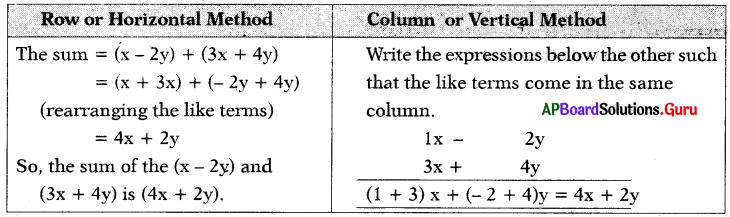
AP Board 7th Class Maths Solutions Chapter 9 Algebraic Expressions InText Questions 3

(ii) 4m2 – 7n2 + 5mn, 3n2 + 5m2 – 2mn
Answer:
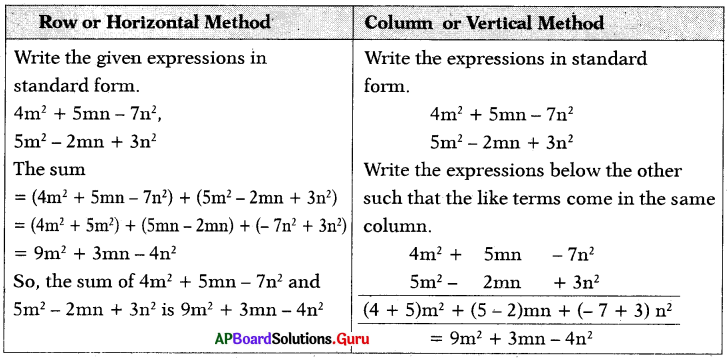
AP Board 7th Class Maths Solutions Chapter 9 Algebraic Expressions InText Questions 4

(iii) 3a – 4b, 5c – 7a + 2b
Answer:
AP Board 7th Class Maths Solutions Chapter 9 Algebraic Expressions InText Questions 5

AP Board 7th Class Maths Solutions Chapter 9 Algebraic Expressions InText Questions

Let’s Explore [Page No. 56]

Think of at least two situations in each of which you need to form two algebraic expressions and add them.

(i) Aditya and Madhu went to a store. Aditya bought 6 books and Madhu bought 2 books. All the books are same cost. How much money did both spend ₹
Answer:
Let the cost of each book ₹a.
Number of books Aditya bought = 6
Cost of 6 books = 6 × a = ₹ 6a
Number of books Madhu bought = 2
Cost of 2 books = 2 × a = ₹ 2a
Money spend on books bought by Aditya and Madhu
= 6a + 2a
= (6 + 2)a
= ₹ 8a

(ii) Sreeja and Sreekari went to icecream parlour. Sreeja bought Vineela icecreams 2 and Sreekari bought Butter Scotch 3. Cost of icecreams are different. How much money they gave to the shop keeper ₹
Answer:
Let the cost of Vineela is ₹x and cost of Butter Scotch is ₹y.
Number of Vineela icecreams Sreeja bought = 2
Cost of 2 iceqreams = 2 × x = ₹ 2x
Number of Butter Scotch icecreams Sreekari bought = 3
Cost of 3 icecreams = 3 × y = ₹ 3y
Money given to shopkeeper = 2x + 3y
= ₹(2x + 3y)

AP Board 7th Class Maths Solutions Chapter 9 Algebraic Expressions InText Questions

Check Your Progress [Page No. 57]

Question 1.
Subtract the first term from second term :
(i) 2xy, 7xy
Answer:
7xy – 2xy
= (7 – 2) xy
= 5xy

AP Board 7th Class Maths Solutions Chapter 9 Algebraic Expressions InText Questions

(ii) 4a2, 10a2
Answer:
10a2 – 4a2 = (10 – 4)a2 = 6a2

(iii) 15p, 3p
Answer:
3p – 15p = (3 – 15)p = – 12p

(iv) 6m2n, – 20m2n
Answer:
– 20 m2n – 6m2n = (- 20 – 6) m2n
= – 26m2n

(v) a2b2, – a2b2
Answer:
– a2b2 – a2b2 = (- 1 – 1)a2b2 = – 2a2b2

Let’s Explore [Page No. 58]

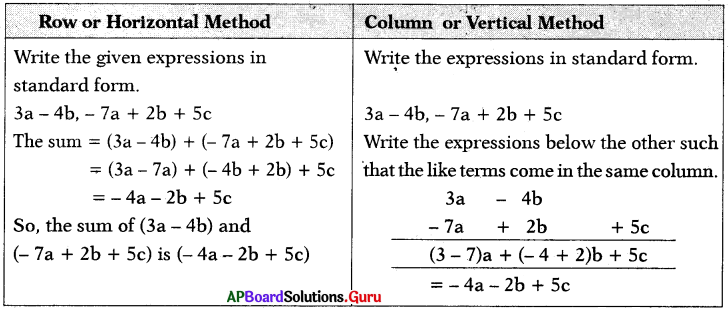
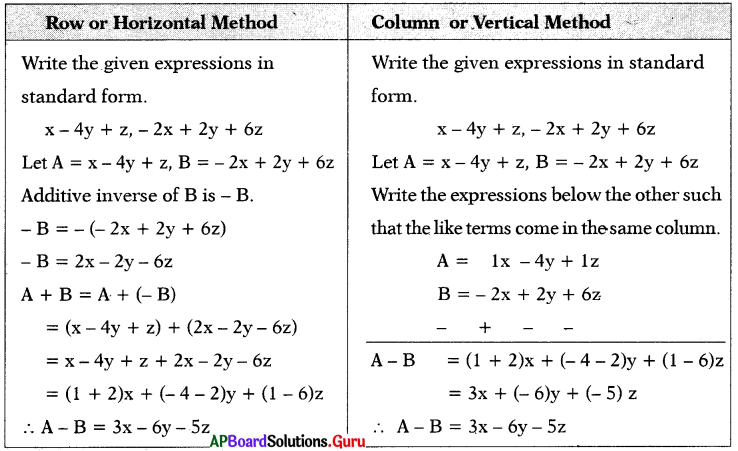
Add and subtract the following expressions in both Horizontal and Vertical method x – 4y + z, 6z – 2x + 2y
Answer:
Addition
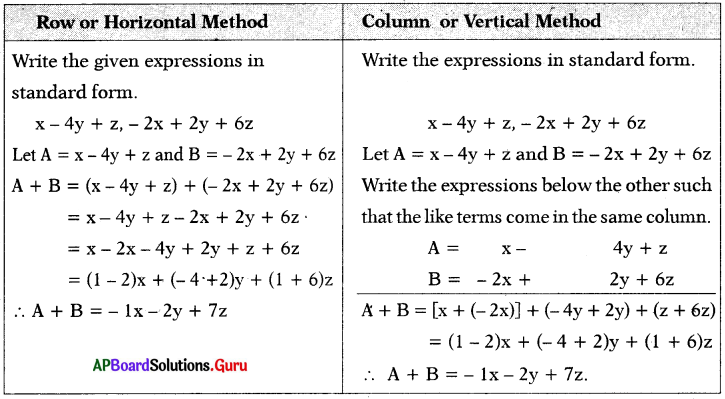
AP Board 7th Class Maths Solutions Chapter 9 Algebraic Expressions InText Questions 7

Subtraction:
AP Board 7th Class Maths Solutions Chapter 9 Algebraic Expressions InText Questions 8

AP Board 7th Class Maths Solutions Chapter 9 Algebraic Expressions InText Questions

Let’s Explore [Page No. 60]

Question 1.
Write an expression whose value is – 15 when x = – 5.
Answer:
Given x = – 5 and value = – 15
Value = – 15 ,
= 3 × – 5 ,
= – 3 × x (∵ x = – 5)
∴ Expression = 3x

Question 2.
Write an expression whose value is 15 when x = 2.
Answer:
Given x = 2 and value = 15
Value = 15
= \(\frac{30}{2}\)
= \(\frac{1}{2}\) × 15 × 2
= \(\frac{1}{2}\) × 15 × x (∵ x = 2)
∴ Expression = \(\frac{15 x}{2}\)

Lets Think [Page No. 60]

While finding the value of an algebraic expression 5x when x = – 2, two stu¬dents solved as follows:
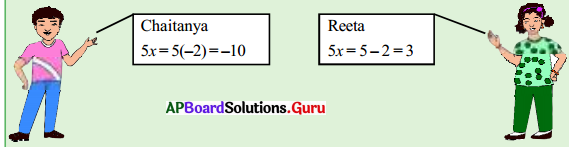
AP Board 7th Class Maths Solutions Chapter 9 Algebraic Expressions InText Questions 9
Can you guess who has done it correctly? Justify!
Answer:
Given expression is 5x when x = – 2
5x = 5(- 2) = – 10
Chaitanya is correct.
Here we have to multiply 5 and,- 2.
But Reeta subtracted.
So, Reeta is wrong.

Examples

Question 1.
How many number of terms are there in each of the following expressions ?
(i) a + b
Answer:
a + b ……….. 2 terms

(ii) 3t2
Answer:
3t2 ……….. 1 term

(iii) 9p3 + 10q – 15
Answer:
9p3 + 10q – 15 ……….. 3 terms

(iv) \(\frac{5 \mathrm{~m}}{3 \mathrm{n}}\)
Answer:
\(\frac{5 \mathrm{~m}}{3 \mathrm{n}}\) ……….. 1 term

(v) 4x + 5y – 3z – 1
Answer:
4x + 5y – 3z – 1 ……….. 4 terms

AP Board 7th Class Maths Solutions Chapter 9 Algebraic Expressions InText Questions

Question 2.
In the following expressions, write the number of terms and identify numeri¬cal and algebraic expressions in them.
(i) 8p
Answer:
8p = 1 term – Algebraic expression

(ii) 5c + s – 7
Answer:
5c + s – 7 = 3 terms – Algebraic expression

(iii) – 6
Answer:
– 6 = 1 term – Numerical expression

(iv) (2 + 1) – 6
Answer:
(2 + 1) – 6 = 2 terms – Numerical expression

(v) 9t + 15
Answer:
9t + 15 = 2 terms – Algebraic expression

Question 3.
Write the coefficients of
(i) p in 8pq
Answer:
8pq = p(8q)
so, coefficient of p in 8pq is 8q.

(ii) x in \(\frac{x y}{3}\)
Answer:
\(\frac{x y}{3}\) = x\(\left(\frac{\mathrm{y}}{3}\right)\)
so, coefficient of x in \(\frac{x y}{3}\) is \(\left(\frac{\mathrm{y}}{3}\right)\)

(iii) abc in (- abc)
Answer:
(- abc) = – (abc)
so, coefficient of abc is – 1.

Question 4.
Identify like terms among the following and group them:
10ab, 7a, 8b, – a2b2, – 7ba, – 105b, 9b2a2, – 5a2, 90a.
Answer:
(7a, 90a) are like terms because they
contain same algebraic factor ‘a’.
(10ab, – 7ba) are like terms as they have same algebraic factor ’ab’.
(8b, -105b) are like terms because they contain same algebraic factor ‘b’.
(- a2b2, 9b2a2) are like terms because they contain same algebraic factor ‘a2b2‘.

AP Board 7th Class Maths Solutions Chapter 9 Algebraic Expressions InText Questions

Question 5.
State with reasons, classify the following expressions into monomials, binomials, trinomials.
a + 4b, 3x2y, px2 + qx + 2, qz2, x2 + 2y, 7xyz, 7x2 + 9y3 – 10z4, 3l2 – m2, x, – abc.
Answer:

ExpressionsType of the Expression Reason
x, 7xyz, 3x2y, qz2, – abcMonomialOne term
a + 4b, x2 + 2y, 3l2 – m2BinomialTwo unlike terms
px2 + qx + 2, 7x2 + 9y3 – 10z4TrinomialThree unlike terms

Question 6.
Find the sum of the following like terms :
(i) 3a, 9a
Answer:
Sum of 3a, 9a = 3a + 9a
= (3 + 9)a = 12a

(ii) 5p2q, 2p2q
Answer:
Sum of 5p2q, 2p2q = 5p2q + 2p2q
= (5 – 2) p2q = 7p2q

(iii) 6m, – 15m, 2m
Answer:
Sum of 6m, – 15m, 2m
= 6m + (- 15m) + 2m
= 6m – 15m + 2m
= (6 – 15 + 2)m = – 7m

Question 7.
Write the perimeter of the given figure.
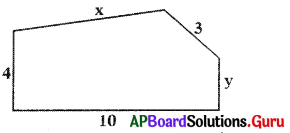
AP Board 7th Class Maths Solutions Chapter 9 Algebraic Expressions InText Questions 1
Answer:
The perimeter of the figure
= 10 + 4 + x + 3+ y
= x + y + (10 + 4 + 3)
= x + y + 17

AP Board 7th Class Maths Solutions Chapter 9 Algebraic Expressions InText Questions

Question 8.
Simplify:
6a2 + 3ab + 5b2 – 2ab – b2 + 2a2 + 4ab + 2b2 – a2
Answer:
6a2 + 3ab + 5b2 – 2ab – b2 + 2a2 + 4ab + 2b2 – a2
= (6a2 + 2a2 – a2) + (3ab – 2ab + 4ab) + (5b2 – b2 + 2b2)
= [(6 + 2 – 1) a2] + [(3 – 2 + 4)ab] + [(5 – 1 + 2)b2]
= 7a2 + 5ab + 6b2

Question 9.
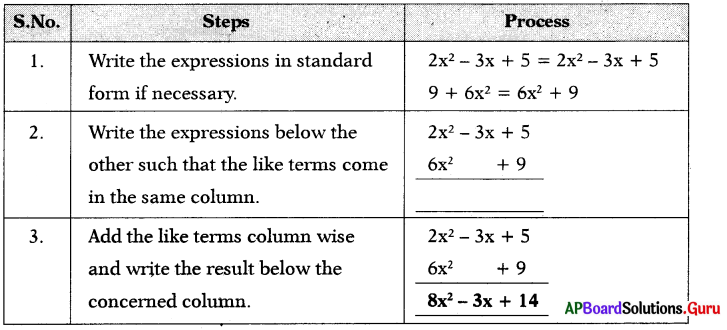
Add 2x2 – 3x + 5 and 9 + 6x2 in vertical method.
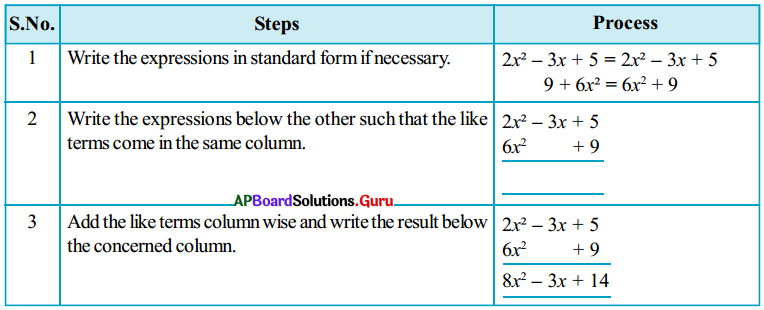
AP Board 7th Class Maths Solutions Chapter 9 Algebraic Expressions InText Questions 10
Answer:
AP Board 7th Class Maths Solutions Chapter 9 Algebraic Expressions InText Questions 2

Question 10.
Find the additive inverse of the follow-ing expressions:
(i) 35
Answer:
Additive inverse of 35 = – 35

AP Board 7th Class Maths Solutions Chapter 9 Algebraic Expressions InText Questions

(ii) – 5a
Answer:
Additive inverse of – 5a = – (-5a) = 5a

(iii) 3p – 7
Answer:
Additive inverse of 3p – 7 = – (3p – 7) = – 3p + 7

(iv) 6x2 – 4x + 5
Answer:
Additive inverse of 6x2 – 4x + 5
= (6x2 – 4x + 5) = – 6x2 + 4x – 5

Question 11.
Subtract 2p2 – 3 from 9p2 – 8.
Answer:
9p2 – 8 – (2p2 – 3) = 9p2 – 8 – 2p2 + 3
= (9 – 2) p2 – 8 + 3
= 7p2 – 5

Question 12.
Subtract 3a + 4b – 2c from 6a – 2b + 3c in row method.
Answer:
Let A = 6a – 2b + 3c, B = 3a + 4b – 2c
Subtracting 3a + 4b – 2c from 6a – 2b + 3c is equal to adding additive inverse of 3a + 4b – 2c to 6a – 2b + 3c
i.e., A – B = A + (-B)
additive inverse of (3a + 4b – 2c) = – (3a + 4b – 2c) = – 3a – 4b + 2c
A – B = A + (-B)
= 6a – 2b + 3c + (- 3a – 4b + 2c)
= 6a – 2b + 3c – 3a – 4b +2c = (6 – 3)a – (2 + 4)b + (3 + 2)c
Thus, the required answer = 3a – 6b + 5c

Question 13.
Subtract 3m3 + 4 from 6m3 + 4m2 + 7m – 3 in stepwise method.
Answer:
Let us solve this in stepwise.
Step 1: 6m3 + 4m2 + 7m – 3 – (3m3 + 4)
Step 2: 6m3 + 4m2 + 7m – 3 – 3m3 – 4
Step 3: 6m3 – 3m3 + 4m2 + 7m – 3 – 4 (rearranging like terms)
Step 4: (6 – 3)m3 + 4m2 + 7m – 7 (distributive law)
Thus, the required answer = 3m3 + 4m2 + 7m – 7

AP Board 7th Class Maths Solutions Chapter 9 Algebraic Expressions InText Questions

Question 14.
Subtract 4m2 – 7n2 + 5mn from 3n2 + 5m2 – 2mn.
(For easy understanding, same colours are taken to like terms)
Answer:
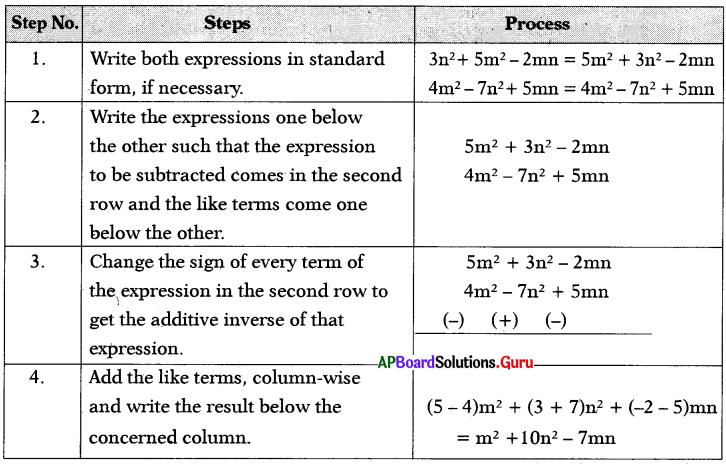
AP Board 7th Class Maths Solutions Chapter 9 Algebraic Expressions InText Questions 6

Question 15.
Find the value of the following expressions, when x = 3.
(i) x + 6
Answer:
When x = 3, the value of x + 6
(substituting 3 in the place of x) is
(3) + 6 = 9

(ii) 8x – 1
Answer:
When x = 3,
the value of 8x – 1 = 8(3) – 1
= 24 – 1 = 23

(iii) 14 – 5x
Answer:
When x = 3,
the value of 14 – 5x = 14 – 5(3)
= 14 – 15 = – 1

AP Board 7th Class Maths Solutions Chapter 9 Algebraic Expressions InText Questions

Practice Questions [Page No: 65]

Question 1.
In a certain code BOARD: CNBQE, how ANGLE will be written in that code?
(a) BMHKF
(b) CNIJE
(c) BLGIF
(d) CMIKF
Answer:
(a) BMHKF

Explaination:
Each letter in a word is shifted to 1 position is alphabetical order and went 1 position is backward like this.
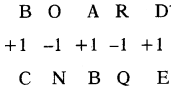
AP Board 7th Class Maths Solutions Chapter 9 Algebraic Expressions InText Questions 11
ANGLE = BMHKF

Question 2.
In a certain code, MOBILE: 56, how PHONE will be written in that code?
(a) 52
(b) 54
(c) 56
(d) 58
Answer:
(d) 58

Explaination:
Taking sum of positions of letters in for ward direction.
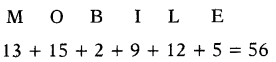
AP Board 7th Class Maths Solutions Chapter 9 Algebraic Expressions InText Questions 12
So, PHONE = 16 + 8 + 15 + 14 + 5 = 58

Question 3.
If BEAN: ABNE, then NEWS ?
(a) WSNE
(b) WSEN
(c) WNSE
(d) WNES
Answer:
(c) WNSE

Explaination:
Follow the same to decode the given word.
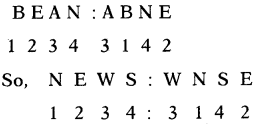
AP Board 7th Class Maths Solutions Chapter 9 Algebraic Expressions InText Questions 13

AP Board 7th Class Maths Solutions Chapter 9 Algebraic Expressions InText Questions

Question 4.
If ROSE : 6821, CHAIR : 73456, PREACH : 961473, then SEARCH ?
(a) 241673
(b) 214673
(c) 216473
(d) 216743
Answer:
(b) 214673

Explaination:
By comparing each letter with the symbol, by writing one below the other.
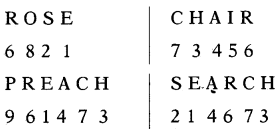
AP Board 7th Class Maths Solutions Chapter 9 Algebraic Expressions InText Questions 14

Question 5.
If COMPUTER: RFUVQNPC, then MEDICINE?
(a) EDJOJMEF
(b) EOJDJEFM
(c) EOJJDFEM
(d) EDJJOFME
Answer:
(b) EOJDJEFM

Explaination:
In the coded form the first & last letters have been interchanged while the rem¬aining letters are coded by taking their immediate next letters in the reverse order.

AP Board 7th Class Maths Solutions Chapter 9 Algebraic Expressions InText Questions 15

Question 6.
If LAKE = 7@$5, WALK = %@7$, then WAKE = ?
(a) @%75
(b) %@$5
(c) %5@7
(d) %@57
Answer:
(b) %@$5

Explaination:
By comparing each letter with symbol, by writing One below the other.

AP Board 7th Class Maths Solutions Chapter 9 Algebraic Expressions InText Questions 16

AP Board 7th Class Maths Solutions Chapter 9 Algebraic Expressions InText Questions

Question 7.
If MANY = OCPA, then LOOK = ?
(a) NQQM
(b) MQQN
(c) QMQN
(d) QNQM
Answer:
(a) NQQM

Explaination:
Each letter in a word is shifted to 2 position forward in alphabetical order.
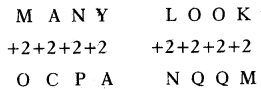
AP Board 7th Class Maths Solutions Chapter 9 Algebraic Expressions InText Questions 17
∴ LOOK = NQQM

Question 8.
If SOME = PUB, then BODY ?‘
(a) LABY
(b)YBAL
(c) YLAV
(d) ABLY
Answer:
(c) YLAV

Explaination:
Bach letter in a word is shifted to 3 position backward in alphabetical order.
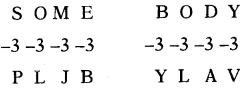
AP Board 7th Class Maths Solutions Chapter 9 Algebraic Expressions InText Questions 18
So, BODY = YLAV

Question 9.
If ARC = CVI, then RAY?
(a) TEU
(b) TEE
(c) TED
(d) TEF
Answer:
(b) TEE

Explaination:
Each letter in a word is forwarded alphabetical order as follows.
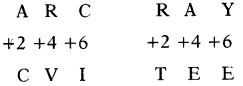
AP Board 7th Class Maths Solutions Chapter 9 Algebraic Expressions InText Questions 19
So, RAY = TEE

AP Board 7th Class Maths Solutions Chapter 9 Algebraic Expressions InText Questions

Question 10.
If MEAN = KGYI, then MODE = ?
(a) QBGK
(b) KBQC
(c) KGBQ
(d) kQBG
Answer:
(d) kQBG

Explaination:
Each letter in the word is shifted to 2 position backward and 2 position forward as following.
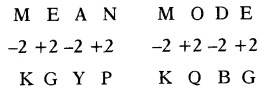
AP Board 7th Class Maths Solutions Chapter 9 Algebraic Expressions InText Questions 20
So, MODE = KQBG

Question 11.
If FIND = DNIF, then DONE ?
(a) ENOD
(b) ENDO
(c) NEOD
(d) ONED
Answer:
(a) ENOD

Explaination:
By reversing the word from left to right.
So, DONE = ENOD .

Question 12.
If BASE = SBEA, then AREA = ?
(a) AARE
(b) EAAR
(c) EARA
(d) REAA
Answer:
(b) EAAR

Explaination:
Follow the same to decode the given word.
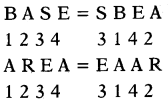
AP Board 7th Class Maths Solutions Chapter 9 Algebraic Expressions InText Questions 21

AP Board 7th Class Maths Solutions Chapter 9 Algebraic Expressions InText Questions

Question 13.
If LESS = 55, then MORE = ?
(a)54
(b)50
(c) 51
(d) 52
Answer:
(c) 51

Explaination:
Taking sum of positions of letters in forward direction.
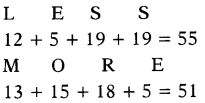
AP Board 7th Class Maths Solutions Chapter 9 Algebraic Expressions InText Questions 22

Question 14.
If BACK = 17, then CELL =?
(a) 33
(b) 30
(c) 31
(d) 32
Answer:
(d) 32

Explaination:
Taking sum of positions of letters in for ward direction.
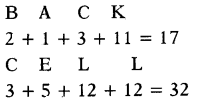
AP Board 7th Class Maths Solutions Chapter 9 Algebraic Expressions InText Questions 23
3 + 5 + 12 + 12 = 32

Question 15.
If BIG = 63, then SMALL =?
(a) 76
(b) 78
(c) 74
(d) 72
Answer:
(b) 78

Explaination:
Taking sum of positions of letters in reverse direction.
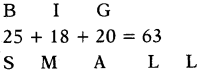
AP Board 7th Class Maths Solutions Chapter 9 Algebraic Expressions InText Questions 24
8 + 14 + 26 + 15 + 15 = 78
AP Board 7th Class Maths Solutions Chapter 9 Algebraic Expressions Unit Exercise

SCERT AP 7th Class Maths Solutions Pdf Chapter 6 Algebraic Expressions Unit Exercise Questions and Answers.

AP State Syllabus 7th Class Maths Solutions 6th Lesson Algebraic Expressions Unit Exercise

Question 1.
Fill in the blanks:
(i) The constant term in the expression a + b + 1 is ………………..
Answer:
1.

(ii) The variable in the expression 3x – 8 is ………………..
Answer:
x

AP Board 7th Class Maths Solutions Chapter 9 Algebraic Expressions Unit Exercise

(iii) The algebraic term in the expression 2d – 5 is ………………..
Answer:
2d

(iv) The number of terms in the expression ……………….. p2 – 3pq + q is
Answer:
3

(v) The numerical coefficient of the term – ab is …………………..
Answer:
– 1

Question 2.
Write below statements are True or False:
(i) \(\frac{3 x}{9 y}\) is a binomial.
Answer:
False

(ii) The coefficient of b in – 6abc is – 6a.
Answer:
False

(iii) 5pq and – 9qp are like terms.
Answer:
True

(iv) The sum of a + b and 2a + 7 is 3a + 7b.
Answer:
False

(v) When x = – 2, then the value of x + 2 is 0.
Answer:
True.

Question 3.
Identify like terms among the following:
3a, 6b, 5c, – 8a, 7c, 9c, – a, \(\frac{2}{3}\)b, \(\frac{7 c}{9}\), \(\frac{a}{2}\).
Answer:
Given terms are
3a, 6b, 5c, – 8a, 7c, 9c, – a, \(\frac{2}{3}\)b, \(\frac{7 c}{9}\), \(\frac{a}{2}\)
Like terms: 3a, – 8a, – a, \(\frac{a}{2}\)
6b, \(\frac{2}{3}\)b
5c, 7c, 9c, \(\frac{7 c}{9}\)

AP Board 7th Class Maths Solutions Chapter 9 Algebraic Expressions Unit Exercise

Question 4.
Arjun and his friend George went to a stationary shop. Arjun bought 3 pens and 2 pencils whereas George bought one pen and 4 pencils. If the price of each pen and pencil is ₹ x and ₹ y respectively, then find the total bill amount in x and y.
Answer:
Given cost of each pen is ₹ x and cost of each pencil is ₹ y .
Arjun bought 3 pens and 2 pencils. Cost of 3 pens = 3 × ₹ x = ₹ 3x
Cost of 2 pencils = 2 × ₹y = ₹ 2y
Amount paid by Arjun = 3x + 2y = ₹ (3x + 2v)
George bougth one pen and 4 pencils.
Cost of 1 pen = 1 × ₹ x = ₹ x
Cost of 4 pencils = 4 × ₹ y = ₹ 4y
Amount paid by George = x + 4y = ₹(x + 4y)
Total bill amount
= Arjun amout + George amount
= (3x + 2y) + (x + 4y)
= 3x + 2y + x + 4y
= 3x + x + 2y + 4y
= (3 + 1)x + (2 +4)y
∴ Total bill amount = ₹ (4x + 6y)

Question 5.
Find the errors and correct the following :
(i) 7x + 4y = 11xy
Answer:
7x and 4y are not like terms and different variables x, y.
So, we should not add the coefficients.

(ii) 8a2 + 6ac = 14a3c
Answer:
8a2 and 6ac are not like terms. So, we should not add the coefficients.

(iii) 6pq2 – 9pq2 = 3pq2
Answer:
6pq2 – 9pq2 = (6 – 9)pq2
= – 3pq2

(iv) 15mn – mn = 15
Answer:
15mn – mn = (15 – 1) mn
= 14 mn

(v) 7 – 3a = 4a
Answer:
7 and 3a are not like terms.
So, we should not subtract the coefficient 7 and 3.

AP Board 7th Class Maths Solutions Chapter 9 Algebraic Expressions Unit Exercise

Question 6.
Add the expressions
(i) 9a + 4, 2 – 3a
Answer:
Given expressions are 9a + 4; 2 – 3a
Write the given expressions in standard form.
9a + 4, – 3a + 2.
The sum = (9a + 4) + (- 3a + 2)
= 9a + 4 – 3a + 2
= (9a – 3a) + (4 + 2)
= (9 – 3)a + 6
= 6a + 6

(ii) 2m – 7n, 3n + 8m, m + n
Answer:
Given expressions are
2m – 7n, 3n + 8m, m + n
Write the given expressions in standard form.
2m – 7n, 8m + 3n, m + n
The sum
= (2m 7n) + (8m + 3n) + (m + n)
= 2m – 7n + 8m + 3n + m + n
= (2m + 8m + m) + (- 7n + 3n + n)
= (2 + 8 + 1)m + (- 7 + 3 + 1)n
= 11 m + (- 3)n
= 11 m – 3n

Question 7.
Subtract:
(i) – y from y
Answer:
– y from y = y – (-y) = y + y = 2y

(ii) 18 pq from 25pq
Answer:
18pq from 2 5pq
= 25 pq – 18 pq
= (25 – 18) pq = 7pq

AP Board 7th Class Maths Solutions Chapter 9 Algebraic Expressions Unit Exercise

(iii) 6t + 5 from 1 – 9t
Answer:
Given expressions are (6t + 5), (1 – 9t)
Write the given expressions in the standard form (6t + 5); (- 9t + 1)
(6t + 5) from (- 9t + 1)
= (- 9t + 1) – (6t + 5)
= – 9t + 1 – 6t – 5
= (- 9t – 6t) + (1 – 5)
= (- 9 – 6) t + (- 4) = – 15t – 4

Question 8.
Simplify the following :
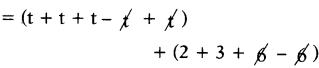
(i) t + 2 + t + 3 + t + 6- t- 6 + t
Answer:
Given t + 2 + t + 3+ t + 6 – t – 6 + t
AP Board 7th Class Maths Solutions Chapter 9 Algebraic Expressions Unit Exercise 1
= 3t + 5

(ii) (a + b + c) + (2a + 3b – c) – (4a + b – 2c)
Answer:
Given (a + b + c) + (2a + 3b – c) – (4a + b – 2c)
= a + b + c + 2a + 3b – c – 4a – b + 2c
= (a + 2a – 4a) + (b + 3b – b) + (c – c + 2c)
= (1 + 2 – 4)a + (1 + 3 – 1)b + (1 – 1 + 2)c
= (- 1) a + 3b + 2c
= – a + 3b + 2c

(iii) x + (y + 1) + (x + 2) + (y + 3) + (x + 4) + (y + 5)
Answer:
Given x + (y + 1) + (x + 2) + (y + 3) + (x + 4) + (y + 5)
= x + y + 1 + x + 2 + y + 3 + x + 4 + y + 5
= (x + x + x) + (y + y + y) + (1 + 2 + 3 + 4 + 5)
= 3x + 3y + 15

Question 9.
The perimeter of a triangle is 8x2 + 7x – 9 and two of its sides are x2 – 3x + 4, 2x2 + x – 9 respectively, then find third side.
Answer:
Let the sides of triangle are A, B, C.
A = x2 – 3x + 4; B = 2x2 + x – 9 ; C = ?
Perimeter = 8x2 + 7x – 9
Perimeter of the triangle = A + B + C
To get the third side (C). subtract sum of A and B from the perimeter.
∴ C = Perimeter – (A + B)
So,
A + B = (x2 – 3x + 4) + (2x2 + x – 9)
= x2 – 3x + 4 + 2x2 + x – 9
= x2 + 2x2 – 3x + x +4 – 9
= (1 + 2) x2 + (- 3 + 1) x – 5
A + B = 3x2 – 2x – 5
Additive inverse of A + B is – (A + B)
– (A + B) = – (3x2 – 2x – 5) .
– (A + B) = – 3x2 + 2x + 5
C = perimeter + [- (A + B)]
= (8x2 + 7x – 9) + (- 3x2 + 2x + 5)
= 8x2 + 7x – 9 – 3x2 + 2x + 5
= 8x2 – 3x2 + 7x + 2x – 9 + 5
= (8 – 3) x2 + (7 + 2) x – 4
C = 5x2 + 9x – 4
∴ Third side is 5x2 + 9x – 4.

AP Board 7th Class Maths Solutions Chapter 9 Algebraic Expressions Unit Exercise

Question 10.
The perimeter of a rectangle is 2a3 – 4a2 – 12a + 10, if length is 3a2 – 4, find its breadth.
Answer:
Given length of rectangle l = 3a2 – 4 and breadth b = ?
Perimeter of a rectangle = 2a3 – 4a2 – 12a + 10
Perimeter of a rectangle
= 2(l + b)
= 2a3 – 4a2 – 12a + 10
AP Board 7th Class Maths Solutions Chapter 9 Algebraic Expressions Unit Exercise 2
= \(\frac{1}{2}\) × 2(a3 – 2a2 – 6a + 5)
⇒ l + b = (a3 – 2a2 – 6a + 5)
⇒ l + b – l = (a3 – 2a2 – 6a + 5) – l
∴ b = (a3 – 2a2 – 6a + 5) – l
Additive inverse of 1 is – 1 = – (3a2 – 4)
∴ – l = – 3a2 + 4 .
b = (a3 – 2a2 – 6a + 5) + (- 1)
= (a3 – 2a2 – 6a + 5) + (- 3a2 + 4)
= a3 – 2a2 – 6a + 5 – 3a2 + 4
= a3 – 2a2 – 3a2 – 6a + 5 + 4
= a3 + (- 2 – 3) a2 – 6a + 9
= a3 + (- 5) a2 – 6a + 9
∴ Breadth of rectangle
= a3 – 5a2 – 6a + 9

AP Board 7th Class Maths Solutions Chapter 9 Algebraic Expressions Ex 9.4

SCERT AP 7th Class Maths Solutions Pdf Chapter 9 Algebraic Expressions Ex 9.4 Textbook Exercise Questions and Answers.

AP State Syllabus 7th Class Maths Solutions 9th Lesson Algebraic Expressions Ex 9.4

Question 1.
Find the value of the expression
2x2 – 4x + 5 when
(i) x = 1
(ii) x = – 2
(iii) x = 0.
Answer:
Given expression is 2x2 – 4x + 5

(i) When x = 1, then
= 2(1)2 – 4(1) + 5
= 2 × 1 – 4 + 5
= 2 – 4 + 5 = 3
When x = 1, then 2x2 – 4x + 5 = 3

AP Board 7th Class Maths Solutions Chapter 9 Algebraic Expressions Ex 9.4

(ii) When x = – 2, then
= 2(- 2)2 – 4(- 2) + 5
= 2(4) + 8 + 5
= 8 + 8 + 5 = 21
When x = – 2, then 2x2 – 4x + 5 = 21

(iii) When x = 0, then
= 2(0)2 – 4(0) + 5
= 2(0) – 0 + 5
= 0 – 0 + 5 = 5
When x = 0, then 2x2 – 4x + 5 = 5

Question 2.
Find the value of Expressions when m = 2, n = – 1.
(i) 2m + 2n
Answer:
Given expression is 2m + 2n
If m = 2, n = – 1, then
2m + 2n = 2(2) + 2(- 1) = 4 – 2 = 2
∴ If m = 2, n = – 1, then 2m + 2n = 2

(ii) 3m – n
Answer:
Given expression is 3m – n
If m = 2, n = – 1, then
3m – n = 3(2) -(-1) = 6 + 1 = 7
∴ If m = 2, n = – 1, then 3m – n = 7

(iii) mn – 2.
Answer:
Given expression is mn – 2
If m = 2, n = – 1, then
mn – 2 = 2 × (-1)-2
= – 2 – 2 = – 4
∴ If m = 2, n = – 1, then mn – 2 = – 4

AP Board 7th Class Maths Solutions Chapter 9 Algebraic Expressions Ex 9.4

Question 3.
Simplify and find the value of the expression 5x2 – 4 – 3x2 + 6x + 8 + 5x – 13 when x = – 2.
Answer:
Given expression is
5x2 – 4 – 3x2 + 6x + 8 + 5x – 13
= (5x2 – 3x2) + (6x + 5x) + (-4 + 8 – 13)
= (5 – 3)x2 + (6 + 5)x + (- 9)
= 2x2 + 11x – 9
If x = – 2, then 2x2 + 11x – 9
= 2(- 2)2 + 11 (- 2) – 9
= 2(4) – 22 – 9
= 8 – 22 – 9
∴ If x = – 2, then 2x2 + 11x – 9 = – 23

Question 4.
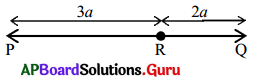
Find the length of the line segment PQ when a = 3 cm.
AP Board 7th Class Maths Solutions Chapter 9 Algebraic Expressions Ex 9.4 1
Answer:
From the figure,
Given PR = 3a and RQ = 2a
PQ = PR + RQ
= 3a + 2a
= (3 + 2)a
PQ = 5a
If a = 3 cm, then PQ = 5(3)
∴ PQ = 15 cm

Question 5.
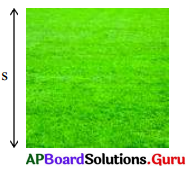
The area of a square field of side ‘s’ meters is s2 sq. m. Find the area of square field, when
(i) s = 5m
(ii) s =12m
(iii) s = 6.5m
AP Board 7th Class Maths Solutions Chapter 9 Algebraic Expressions Ex 9.4 2
Answer:
From the figure,
Area of square = s2 sq.m.
(i) If s = 5m, then
s2 = (5)2 = 5 × 5 = 25 sq.m

(ii) If s = 12 m, then
s2 = (12)2 = 12 × 12 = 144 sq.m

(iii) If s = 6.5m, then
s2 = (6.5)2 = 6.5 × 6.5 = 42.25 sq.m

AP Board 7th Class Maths Solutions Chapter 9 Algebraic Expressions Ex 9.4

Question 6.
The area of triangle is given by \(\frac{1}{2}\) ∙ b ∙ h and if b = 12 cm, h = 8 cm, then find the area of triangle.
Answer:
Given area of the triangle = \(\frac{1}{2}\) ∙ b ∙ h
If b = 12 cm, h = 8 cm
AP Board 7th Class Maths Solutions Chapter 9 Algebraic Expressions Ex 9.4 3
= 6 × 8 = 48 sq.cm.

Question 7.
Simple interest is given by I = \(\frac{\text { PTR }}{100}\), If P = ₹ 900, T = 2 years and R = 5%, then find the simple interest.
Answer:
Given simple interest I = \(\frac{\text { PTR }}{100}\)
If P = ₹ 900, T= 2 and R = 5% then
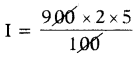
AP Board 7th Class Maths Solutions Chapter 9 Algebraic Expressions Ex 9.4 4
= 9 × 2 × 5 = 90

Question 8.
Find the errors and correct them in the following:
The value of following when a = – 3.
(i) 3 – a = 3 – 3 = 0
Answer:
3 – a = 3 – (- 3) (when a = – 3)
= 3 + 3 = 6
(Error is – (- 3) = – 3)

(ii) a2 + 3a = (- 3)2 + 3(- 3) = 9 + 0 = 9
Answer:
a2 + 3a = (- 3)2 + 3(- 3) (when a = – 3)
= (- 3 × – 3) – 9
(Error is 3(- 3) = 0)
= 9 – 9 = 0

AP Board 7th Class Maths Solutions Chapter 9 Algebraic Expressions Ex 9.4

(iii) a2 – a – 6 = (- 3)2 – (- 3) – 6 = 9 – 3 – 6 = 0
Answer:
a2 – a – 6
= (- 3)2 – (- 3) – 6 (when a = – 3)
= (- 3 × – 3) + 3 – 6
(Error is – (- 3) = – 3)
= 9 + 3 – 6
= 12 – 6 = 6

(iv) a2 + 4a + 4 = (- 3)2 + 4(-3) + 4 = 9 + 1 + 4 = 14
Answer:
a2 + 4a + 4
= (- 3)2 + 4(- 3) + 4 (when a = – 3)
= (- 3 × – 3)- 12 + 4
(Error is 4 (- 3) = 1)
= 9 – 12 + 4 = 13 – 12 = 1

(v) a3 – a2 – 3 = (- 3)3 – (-3)2 – 3 = – 9 + 6 – 3 = – 6
Answer:
a3 – a2 – 3
= (- 3)3 – (- 3)2 – 3 (when a = – 3)
= (- 3 × – 3 × – 3) – (- 3 × – 3) – 3
= – 27 – (9) – 3
(Error is (- 3)3 = – 9 and (- 3)2 = 6)
= – 27 – 9 – 3 = – 39

AP Board 7th Class Maths Solutions Chapter 9 Algebraic Expressions Ex 9.3

SCERT AP 7th Class Maths Solutions Pdf Chapter 9 Algebraic Expressions Ex 9.3 Textbook Exercise Questions and Answers.

AP State Syllabus 7th Class Maths Solutions 9th Lesson Algebraic Expressions Ex 9.3

Question 1.
Write standard form and additive inverse of the following expressions.
(i) – 6a
Answer:
Additive inverse of – 6a = – (- 6a) = 6a

AP Board 7th Class Maths Solutions Chapter 9 Algebraic Expressions Ex 9.3

(ii) 2 + 7c2
Answer:
Standard form of 2 + 7c2 = 7c2 + 2
Additive inverse of 7c2 + 2
= – (7c2 + 2)
= – 7c2 – 2

(iii) 6x2 + 4x – 5
Answer:
Given expression is in standard form.
Additive inverse of 6x2 + 4x – 5
= – (6x2 + 4x – 5)
= – 6x2 – 4x + 5

(iv) 3c + 7a – 9b
Answer:
Standard form of 3c + 7a – 9b = 7a – 9b + 3c
Additive inverse of 7a – 9b + 3c
= – (7a – 9b + 3c)
= – 7a + 9b – 3c

Question 2.
Write the following expressions in standard form:
(i) 6x + x2 – 5
Answer:
Standard form of 6x + x2 – 5
= x2 + 6x – 5

(ii) 3 – 4a2 – 5a
Answer:
Standard form of 3 – 4a2 – 5a
= – 4a2 – 5a + 3

(iii) – m + 6 + 3m2
Answer:
Standard form of – m + 6 + 3m2
= 3m2 – m + 6

AP Board 7th Class Maths Solutions Chapter 9 Algebraic Expressions Ex 9.3

(iv) c3 + 1 + c + 2c2
Answer:
Standard form of
c3 + 1 + c + 2c2 = c3 + 2c2 + c + 1

(v) 9 – p2
Answer:
Standard form of 9 – p2 = – p2 + 9

Question 3.
Add the following algebraic expressions using both horizontal and vertical methods. Did you get the same answer with both the methods? Verify.
(i) 2x2 – 6x +3; 4x2 + 9x + 5
Answer:
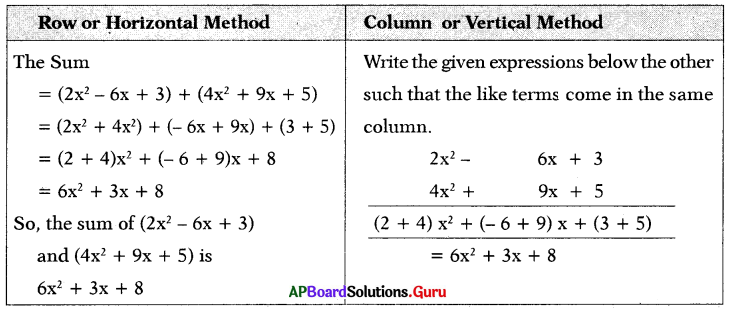
AP Board 7th Class Maths Solutions Chapter 9 Algebraic Expressions Ex 9.3 1

(ii) a2 + 6ab + 8; – 3a2 – ab – 2
Answer:
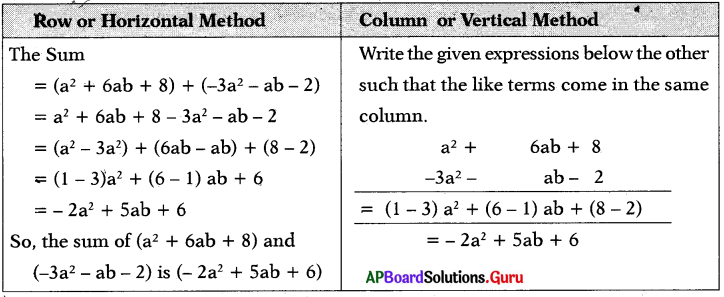
AP Board 7th Class Maths Solutions Chapter 9 Algebraic Expressions Ex 9.3 2

AP Board 7th Class Maths Solutions Chapter 9 Algebraic Expressions Ex 9.3

(iii) – p2 + 2p – 10; 4 – 5p – 2p2
Answer:
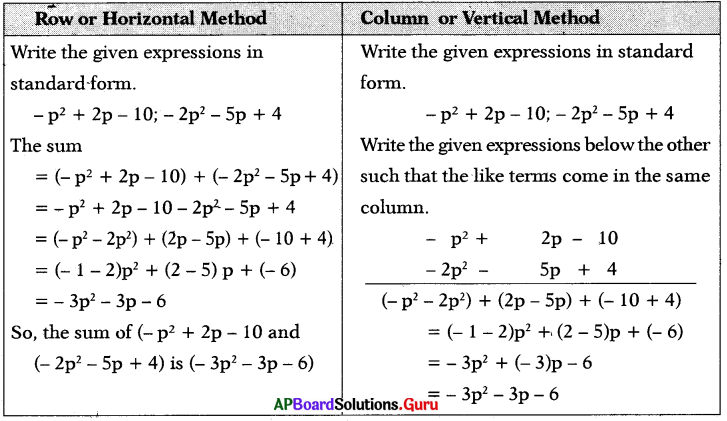
AP Board 7th Class Maths Solutions Chapter 9 Algebraic Expressions Ex 9.3 3

Question 4.
Subtract the second expression from the first expression:
(i) 2x + y , x – y
Answer:
Let A = 2x + y and B = x – y
A – B = A + (- B) Additive inverse of B is
-B = – (x – y) = – x + y
∴ A – B = A + (- B)
= 2x + y + (- x + y)
= 2x + y – x + y
= 2x – x + y + y
= (2 – 1)x + (1 + 1)y
∴ A – B = x + 2y

AP Board 7th Class Maths Solutions Chapter 9 Algebraic Expressions Ex 9.3

(ii) a + 2b + c, – a – b – 3c
Answer:
Let A = a + 2b + c and B = – a – b – 3c
A – B = A + (- B)
Additive inverse of B is
– B = – (- a – b – 3c)
= a + b + 3c
∴ A – B = A + (- B)
= a + 2b + c + (a + b + 3c)
= a + 2b + c + a + b + 3c
= (a + a) + (2b + lb) + (c + 3c)
∴ A – B = 2a + 3b + 4c

(iii) 2l2 – 3lm + 5m2, 3l2 – 4lm + 6m2
Answer:
Let A = 2l2 – 3lm + 5m2 and
B = 3l2 – 4lm + 6m2
A – B = A + (- B)
Additive inverse of B is
– B = – (3t2 – 4lm + 6m2)
= – 3l2 + 4lm – 6m2
∴ A – B = A + (- B)
= (2l2 – 3lm + 5m2) + (- 3l2 + 4lm – 6m2)
= 2l2 – 3lm + 5m2 – 3l2 + 4lm – 6m2
= 2l2 – 3l2 – 3lm + 4lm + 5m2 – 6m2
= (2 – 3)l2 + (- 3 + 4)lm + (5 – 6)m2
= (- 1) l2 + 1 lm + (- 1)m2
∴ A – B = – l2 + lm – m2

(iv) 7 – x – 3x2, 2x2 – 5x – 3
Answer:
Let A = 7 – x – 3x2 and B = 2x2 – 5x – 3
Write the given expressions in standard form.
∴ A = – 3x2 – x + 7 and B = 2x2 – 5x – 3
A – B = A + (- B)
Additive inverse of B is
– B = – (2x2 – 5x – 3)
= – 2x2 + 5x + 3
∴ A – B = A + (- B)
= (- 3x2 – x + 7) + (- 2x2 + 5x + 3)
= – 3x2 – x + 7 – 2x2 + 5x + 3
= (- 3x2 – 2x2) + (- x + 5x) + (7 + 3)
= (- 3 – 2)x2 + (- 1 + 5)x + 10
∴ A – B = – 5x2 + 4x + 10

AP Board 7th Class Maths Solutions Chapter 9 Algebraic Expressions Ex 9.3

(v) 6m3 + 4m2 + 7m – 3, 2m3 + 4
Answer:
Let A = 6m3 + 4m2 + 7m – 3 and
B = 2 m2 + 4
A – B = A + (- B)
Additive inverse of B is
– B = – (2m3 + 4)
= – 2m3 – 4
∴ A – B = A + (- B)
= (6m3 + 4m2 + 7m – 3) + (- 2m3 – 4)
= 6m3 + 4m2 + 7m – 3 – 2m3 – 4
= (6m3 – 2m3) + 4m2 + 7m + (- 3 – 4)
= (6 – 2)m3 + 4m2 + 7m + (- 7)
∴ A – B = 4m3 + 4m2 + 7m – 7

Question 5.
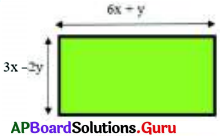
Find the perimeter of the beside rect¬angle whose length is 6x + y and breadth is 3x – 2y.
AP Board 7th Class Maths Solutions Chapter 9 Algebraic Expressions Ex 9.3 4
Answer:
Given length of rectangle l = 6x + y
breadth b = 3x – 2y
Perimeter of Rectangle = 2 (l + b)
= 2[(6x + y) + (3x – 2y)]
= 2[6x + y + 3x – 2y]
= 2[(6 + 3)x + (1 – 2)y]
= 2[9x + (- 1) y]
= 2[9x – 1y]
= 2 × (9x) – 2 × (1y)
∴ Perimeter of rectangle = (18x – 2y) units.

AP Board 7th Class Maths Solutions Chapter 9 Algebraic Expressions Ex 9.3

Question 6.
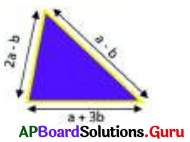
Find the perimeter of triangle whose sides are a + 3b, a – b and 2a – b.
AP Board 7th Class Maths Solutions Chapter 9 Algebraic Expressions Ex 9.3 5
Answer:
Let the sides of triangle are
x = a + 3b, y = a – b and z = 2a – b
Perimeter of triangle = x + y + z
= (a + 3b) + (a – b) + (2a – b)
= a + 3b + a – b + 2a – b
= (a + a + 2a) + (3b – b – b)
= (1 + 1 + 2)a + (3 – 1 – 1)b
Perimeter of triangle.
= (4a + b) units.

Question 7.
Subtract the sum of x2 – 5xy + 2y2 and y2 – 2xy – 3x2 from the sum of 6x2 – 8xy – y2 and 2xy – 2y2 – x2.
Answer:
Given expressions are
x2 – 5xy + 2y2 and y2 – 2xy – 3x2 and 6x2 – 8xy – y2 and 2xy – 2y2 – x2
Write the given expressions in the standard form
x2 – 5xy + 2y2 and – 3x2 – 2xy + y2 and 6x2 – 8xy – y2 and – x2 + 2xy – 2y2
Let the Sum
A = (x2 – 5xy + 2y2) + (- 3x2 – 2xy + y2)
= x2 – 5xy + 2y2 – 3x2 – 2xy + y2
= x2 – 3x2 – 5xy – 2xy + 2y2 + y2
= (1 – 3)x2 + (- 5 – 2)xy + (2 + 1)y2
A = – 2x2 – 7xy + 3y2

Let the Sum
B = (6x2 – 8xy – y2) + (- x2 + 2xy – 2y2)
= 6x2 – 8xy – y2 – x2 + 2xy – 2y2
= (6 – 1 )x2 + (- 8 + 2)xy + (- 1 – 2)y2
B = 5x2 – 6xy – 3y2
B – A = B + (- A)
Additive inverse of A is
– A = – (A)
= – (- 2x2 – 7xy + 3y2)
∴ – A = 2x2 + 7xy – 3y2
B – A = B + (- A)
= (5x2 – 6xy – 3y2) + (2x2 + 7xy – 3y2)
= (5 + 2)x2 + (- 6 + 7)xy + (- 3 – 3)y2
∴ B – A = 7x2 + xy – 6y2

AP Board 7th Class Maths Solutions Chapter 9 Algebraic Expressions Ex 9.3

Question 8.
What should be added to 1 + 2p – 3P2 to get p2 – p – 1 ?
Answer:
Given expressions are
1 + 2p – 3p2 and p2 – p – 1
Write the given expressions in the standard form.
– 3p2 + 2p + 1 and p2 – p – 1
Let A should be added to B to get C.
i.e. A + B = C
∴ A = C – B
Let B = – 3p2 + 2p + 1 and
C = p2 – p – 1
A = C + (- B )
Additive inverse B is
– B = – (- 3p2 + 2p + 1) .
– B = 3p2 – 2p – 1 .
A = (p2 – p – 1) + (3p2 – 2p – 1)
= p2 – p – 1 + 3p2 – 2p – 1
= (1 + 3)p2 + (- 1 – 2)p + (- 1 – 1)
∴ A = 4p2 – 3p – 2
∴ 4p2 – 3p – 2 is added to 1 + 2p – 3p2 to get p2 – p – 1.

Question 9.
What should be taken away from 3a2 – 4b2 + 5ab + 20 to get – a2 – b2 + 6ab + 3 ?
Answer:
Given expressions are
3a2 – 4b2 + 5ab + 20 and – a2 – b2 + 6ab +3
Let A be taken away from B to get C. that is A = B – C = B + (- C)
Let B = 3a2 – 4b2 + 5ab + 20 and C = – a2 – b2 + 6ab + 3 Additive inverse of C is
(- C) = – (- a2 – b2 + 6ab + 3)
= a2 + b2 – 6ab – 3
A = B + (- C)
= (3a2 – 4b2 + 5ab + 20) + (a2 + b2 – 6ab – 3)
= 3a2 – 4b2 + 5ab + 20 + a2 + b2 – 6ab – 3
= 3a2 + a2 – 4b2 + b2 + 5ab – 6ab + 20 – 3
= (3 + 1)a2 + (- 4 + 1)b2 + (5 – 6) ab + (20 – 3)
A = 4a2 – 3b2 – 1 ab + 17
So, 4a2 – 3b2 – 1 ab + 17 is taken away from 3a2 – 4b2 + 5ab + 20 to get – a2 – b2 + 6ab + 3.

AP Board 7th Class Maths Solutions Chapter 9 Algebraic Expressions Ex 9.3

Question 10.
If A = 4x2 + y2 – 6xy;
B = 3y2 + 12x2 + 8xy;
C = 6x2 + 8y2 + 6xy then,
find(i) A + B + C (ii) (A – B) – C
Answer:
Given A = 4x2 + y2 – 6xy
B = 3y2 + 12x2 + 8xy
C = 6x2 + 8y2 + 6xy
Write the given expressions in standard form.
A = 4x2 – 6xy + y2
B = 12x2 + 8xy + 3y2
C = 6x2 + 6xy + 8y2

(i) A + B + C = (4x2 – 6xy + y2) + (12x2 + 8xy + 3y2) + (6x2 + 6xy + 8y2)
= 4x2 – 6xy + y2 + 12x2 + 8xy + 3y2 + 6x2 + 6xy + 8y2
= (4x2 + 12x2 + 6x2) + (- 6xy + 8xy + 6xy) + (y2 + 3y2 + 8y2)
= (4 + 12 + 6) x2 + (- 6 + 8 + 6) xy + (1 + 3 + 8)y2
∴ A + B + C = 22x2 + 8xy + 12y2

(ii) (A – B) – C
A + (- B) + (- C)
Additive inverse of B is
– B = – (12x2 + 8xy + 3y2)
∴ – B = – 12x2 – 8xy – 3y2
Additive inverse of C is
– C = -(6x2 + 6xy + 8y2)
∴ – C = – 6x2 – 6xy – 8y2
A + (- B) + (- C)
= (4x2 – 6xy + y2) + (- 12x2 – 8xy – 3y2) + (- 6x2 – 6xy – 8y2)
= 4x2 – 6xy + y2 – 12x2 – 8xy – 3y2 – 6x2 – 6xy – 8y2
= (4x2 – 12x2 – 6x2) + (- 6xy – 8xy – 6xy) + (y2 – 3y2 – 8y2)
= (4 – 12 – 6)x2 + (- 6 – 8 – 6)xy + (1 – 3 – 8)y2
∴ (A – B) – C = – 14x2 – 20xy – 10y2

AP Board 7th Class Maths Solutions Chapter 9 Algebraic Expressions Ex 9.2

SCERT AP 7th Class Maths Solutions Pdf Chapter 9 Algebraic Expressions Ex 9.2 Textbook Exercise Questions and Answers.

AP State Syllabus 7th Class Maths Solutions 9th Lesson Algebraic Expressions Ex 9.2

Question 1.
State True or False and give reasons for your answer.
(i) 7x2 and 2x are unlike terms.
Answer:
True.
7x2 and 2x have different algebraic factors and terms contain variables with different exponents.

AP Board 7th Class Maths Solutions Chapter 9 Algebraic Expressions Ex 9.2

(ii) pq2 arid – 4pq2 are like terms.
Answer:
True.
pq2 and – 4pq2 are contain variables with same exponents. So, they are like terms.

(iii) xy, – 12x2y and 5xy2 are like terms.
Answer:
False.
xy, – 12x2y and 5xy2 are contain variables with different exponents. So, they are unlike terms.

Question 2.
Write like terms in the following :
(i) a2, b2, 2a2, c2
Answer:
Given a2, b2, 2a2, c2
Like terms: a2, 2 a2.

(ii) 5x, yz, 3xy, \(\frac{1}{9}\)yz
Answer:
Given 5x, yz, 3xy, \(\frac{1}{9}\)yz
Like terms : yz, \(\frac{1}{9}\)yz.

(iii) 4m2n, n2p, – m2n, m2n2
Answer:
Given 4m2n, n2p, – m2n, m2n2
Like terms: 4m2n, – m2n.

(iv) acb2, 2c2ab, 5b2ac, 3cab2
Answer:
Given acb2, 2c2ab, 5b2ac, 3cab2
Like terms: acb2, 5b2ac, 3cab2.

AP Board 7th Class Maths Solutions Chapter 9 Algebraic Expressions Ex 9.2

Question 3.
Write number of terms and name of the expression for the following algebraic expressions.
(i) p2q2p
(ii) 2020
(iii) 3ab – \(\frac{a}{2}\) + \(\frac{b}{5}\)
Answer:

Algebraic expressionNumber of termsName of the expression
(i) p2q + q2p2Binomial
(ii) 20201Monomial
(iii) 3ab – \(\frac{a}{2}\) + \(\frac{b}{5}\)3Trinomial

Question 4.
Classify the following into monomials, binomilas and trinomials:
(i) 8a + 7b2
(ii) 15xyz
(iii) p + q – 2r
(iv) l2m2n2
(v) cab2
(vi) 3t – 5s + 2u
(vii) 1000
(viii) \(\frac{\mathbf{c d}}{2}\) + ab
(ix) 5ab – 9a
(x) 2p2q2 + 4qr3
Answer:

Algebraic expressionName of the expression
(i) 8a + 7b2Binomial
(ii) 15xyzMonomial
(iii) p + q – 2rTrinomial
(iv) l2m2n2Monomial
(v) cab2Monomial
(vi) 3t – 5s + 2uTrinomial
(vii) 1000Monomial
(viii) \(\frac{\mathbf{c d}}{2}\) + abBinomial
(ix) 5ab – 9aBinomial
(x) 2p2q2 + 4qr3Binomial

AP Board 7th Class Maths Solutions Chapter 9 Algebraic Expressions Ex 9.1

SCERT AP 7th Class Maths Solutions Pdf Chapter 9 Algebraic Expressions Ex 9.1 Textbook Exercise Questions and Answers.

AP State Syllabus 7th Class Maths Solutions 9th Lesson Algebraic Expressions Ex 9.1

Question 1.
Write numerical and algebraic coefficients of the following terms.
(i) 4xy
Answer:
Given the term is 4xy
Numerical coefficient: 4
Algebraic coefficient: xy

AP Board 7th Class Maths Solutions Chapter 9 Algebraic Expressions Ex 9.1

(ii) – 7a2 b3 c
Answer:
Given term is – 7a2 b3 c
Numerical coefficient: – 7
Algebraic coefficient: a2b3c

(iii) \(\frac{p q}{2 r}\)
Answer:
Given terra is \(\frac{p q}{2 r}\)
Numerical coefficient: \(\frac{1}{2}\)
Algebraic coefficient: \(\frac{p q}{r}\)

(iv) – 6mn
Answer:
Given term is – 6mn
Numerical coefficient: – 6
Algebraic coefficient: mn

Question 2.
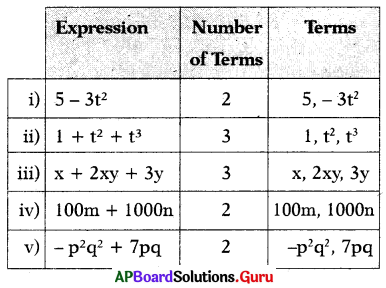
Write the number of terms in each of the following expressions and write ’ them:
(i) 5 – 3t2
(ii) 1 + t2 + t3
(iii) x + 2xy + 3y
(iv) 100m + 1000n
(v) – p2q2 + 7pq
Answer:
AP Board 7th Class Maths Solutions Chapter 9 Algebraic Expressions Ex 9.1 1

AP Board 7th Class Maths Solutions Chapter 9 Algebraic Expressions Ex 9.1

Question 3.
In – 5ab2c write the coefficients of
(i) b2c
(ii) – b2c
(iii) – 5abc
(iv) 5ac
(v) ab2
(vi) – 5ab
Answer:
Given term is – 5ab2c
(i) Coefficient of b2c is – 5a
(ii) Coefficient of – b2c is 5a
(iii) Coefficient of – 5abc is b
(iv) Coefficient of 5ac is – b2
(v) Coefficient of ab2 is – 5c
(vi) Coefficient of – 5ab is bc

Question 4.
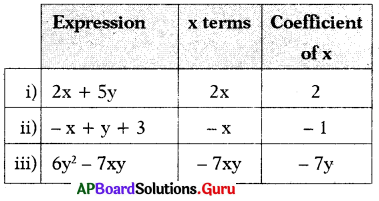
Write term containing x and coefficient of x for the following algebraic expressions.
(i) 2x + 5y
(ii) -x + y + 3
(iii) 6y2 – 7xy
Answer:
AP Board 7th Class Maths Solutions Chapter 9 Algebraic Expressions Ex 9.1 2

AP Board 7th Class Maths Solutions Chapter 9 Algebraic Expressions Review Exercise

SCERT AP 7th Class Maths Solutions Pdf Chapter 9 Algebraic Expressions Review Exercise Questions and Answers.

AP State Syllabus 7th Class Maths Solutions 9th Lesson Algebraic Expressions Review Exercise

Question 1.
Identify constants and variables in the following terms:
0, – x, 3t, – 5, 5ab, – m, 700, – n, 2pqr, – 1, ab, 10, – 6z
Answer:
Given, 0, – x, 3t, – 5, 5ab, – m, 700, – n, 2pqr, – 1, ab, 10, – 6z
Constants = 0, – 5, 700, – 1, 10
Variables = – x, 3t, 5ab, – m, – n, 2pqr, ab, – 6z.

AP Board 7th Class Maths Solutions Chapter 9 Algebraic Expressions Review Exercise

Question 2.
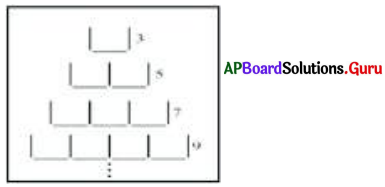
Observe the pattern the side and express the pattern in the form of an algebraic expression.
AP Board 7th Class Maths Solutions Chapter 9 Algebraic Expressions Review Exercise 1

AP Board 7th Class Maths Solutions Chapter 9 Algebraic Expressions Review Exercise 2
Answer:
In row = 1, 2(1) + 1 = 3
In row = 2, 2(2) + 1 = 5
In row = 3, 2(3) + 1 = 7
In row = 4, 2(4) + 1 = 9
In row = n, 2(n) + 1 = 2n + 1

Question 3.
Write the following statements as expressions
(i) x reduced by 5
Answer:
Given x reduced by 5 = x – 5

(ii) 8 more than twice of k
Answer:
Given 8 more than twice of k = 2k + 8

(iii) Half of y
Answer:
Given Half of y = \(\frac{1}{2}\) of y = \(\frac{y}{2}\)

(iv) One fourth of product of b and c
Answer:
Given One fourth of product of b and c
= \(\frac{1}{4}\) of b × c
= \(\frac{1}{4}\) × bc = \(\frac{b c}{4}\)

AP Board 7th Class Maths Solutions Chapter 9 Algebraic Expressions Review Exercise

(v) One less than three times of p
Answer:
Given One less than three times of p
= 3 times of p – 1
= 3 ∙ p – 1

Question 4.
Write the following expressions as statements :
(i) s + 3
Answer:
Given s + 3 = 3 added to s.

(ii) 3p + 10
Answer:
Given 3p + 10
= 10 more than thrice of p.

(iii) 5c – 8
Answer:
Given 5c – 8 = 8 less than 5 times of c.

(iv) 10z
Answer:
Given 10z = 10 times of z.

(v) \(\frac{b}{9}\)
Answer:
Given \(\frac{b}{9}\) = one nineth of b.

Question 5.
Write the following situations into algebraic expressions :
(i) Cost of one pen is double the cost of pencil.
Answer:
Let the cost of pencil = ₹x
then the cost of pen = double the cost of pencil = 2 × ₹ x
∴ The cost of pen = ₹ 2x

AP Board 7th Class Maths Solutions Chapter 9 Algebraic Expressions Review Exercise

(ii) Age of John is 10 more than age of Yusuf.
Answer:
Let the age of Yusuf = a years
then the age of John = (a + 10) years

(iii) Height of Siri is 15 cm less than height of Giri.
Answer:
Let the height of Giri = x cm
then the height of Siri = (x – 15) cm

(iv) Length of a rectangle is 2 more than three times of it’s breadth.
Answer:
Let the breadth = b units
then the length of rectangle
= 3 times b + 2
= (3 ∙ b + 2) units.

AP Inter 2nd Year Zoology Study Material Chapter 4(a) Endocrine System and Chemical Coordination

Andhra Pradesh BIEAP AP Inter 2nd Year Zoology Study Material Lesson 4(a) Endocrine System and Chemical Coordination Textbook Questions and Answers.

AP Inter 2nd Year Zoology Study Material Lesson 4(a) Endocrine System and Chemical Coordination

Very Short Answer Questions

Question 1.
What is acromegaly? Name the hormone responsible for this disorder.
Answer:
Acromegaly is a hormonal disorder that results when the pituitary gland produces excess growth hormone (GH). This disease is characterized by enlargement of the bones of the jaw, hand, and feet, thickened nose, lips, eyelids, and wide fingertips, and gorilla-like appearance of the person affected.

Question 2.
Which hormone is called anti-diuretic hormone? Write the name of the gland that secretes it.
Answer:
Vasopressin is also called an anti-diuretic hormone that is secreted by the posterior pituitary.

Question 3.
Name the gland that increases in size during childhood and decreases in size during adulthood. What important role does it play in case of infection?
Answer:
The thymus is small at birth, it increases in size during childhood and reaches the maximum size at puberty. During adulthood, it shrinks to its size at birth.

In an old person thymus gland is degenerated, resulting in a decreased production of thymosin. Thymosin plays an important role in immune development. Thus, the immune response against infections of old people becomes weak.

Question 4.
Distinguish between diabetes insipidus and diabetes mellitus.
Answer:
Diabetes insipidus :
Deficiency of Vasopressin causes a disease called diabetes insipidus. It does not involve loss of sugar in urine.

Diabetes mellitus :
Under secretion of insulin by the pancreatic gland increases the level Of glucose in blood is called hyperglycemia. Prolonged hyperglycemia leads to a disease called diabetes mellitus, associated with loss of glucose through urine and formation of ketone bodies.

AP Inter 2nd Year Zoology Study Material Chapter 4(a) Endocrine System and Chemical Coordination

Question 5.
What are Islets of langerhans?
Answer:
The endocrine region of pancreas is called Islets of langerhans where it contain 1 to 2 millions Islets of langerhans. There are two main types of cells α – cells and β – cells.

α – cells produce the hormone glucagon, whereas β – cells produce insulin.

Question 6.
What is insulin shock?
Answer:
Hyper secretion of insulin leads to decreased level of glucose in blood (hypoglycemia) resulting in insulin shock.

Question 7.
Which hormone is commonly known as fight and flight hormone?
Answer:
Epinephrine and norepinephrine hormones are called fight and flight hormones because these hormones are secreted in response to stress and emergency situations.

Question 8.
What are androgens, which cells secrete them?
Answer:
Androgens are male sex hormones usually steroid hormones. E. g: testosterone.
Androgens are produced by the Leydig cells of the testes and to a minor extent by the adrenal glands in both sexes.

AP Inter 2nd Year Zoology Study Material Chapter 4(a) Endocrine System and Chemical Coordination

Question 9.
What is erythropoietin? What is its function?
Answer:
Erythropoietin is a hormone secreted the juxtaglomerular cells of the kidney. It plays an important role in the erythropoiesis i.e., in formation of RBC. Erythropoietin controls the formation of RBC by regulating the differentiation and proliferation of erythroid progenitor cells in the bone marrow.

Short Answer Questions

Question 1.
List out the names of the endocrine glands present in human beings and mention the hormone they secrete.
Answer:
1) Hypothalamus:
It secretes thyrotropin releasing hormone, corticotropin releasing hormone, gonadotropin releasing hormone, growth hormone releasing hormone, growth hormone release inhibiting hormone, prolactin release inhibiting hormone.

2) Pituitary glands :
Anatomically, it is divided into anterior and posterior pituitary.

Anterior Pituitary :
Produces Growth hormone, Prolactin, Thyroid stimulating hormone, Adreno corticotropic hormone, Follicular stimulating hormone, Luteinizing hormone.

Posterior Pituitary:
It releases two hormones namely Oxytocin and Vasopressin/ADH.

3) Pineal gland :
It secretes a hormone called Melatonin.

4) Thyroid gland :
It produces two hormones namely Thyroxine (T4) and Tri iodothyronine (T3).

5) Parathyroid gland :
Secretes a hormone called Parathyroid hormone.

6) Thymus gland :
It secretes peptide hormone called Thymosin.

7) Adrenal gland:
a) Adrenal cortex: GluCo corticoids, Mineralo corticoids, Androgens and Estrogens.
b) Adrenal medulla : Produces Epinephrine, norepinephrine.

8) Pancreas:
It secretes Glucagon and Insulin.

9) Testes :
Which secrete Androgens and Testosterone.

10) Ovaries :
Which produce Estrogen and Progesterone.

Question 2.
Describe the role of hypothalamus as a neuroendocrine organ. ‘
Answer:
Hypothalamus is located below the thalamus. It connects the neural and endocrine systems, as it closely tied to the pituitary gland. It responds to the sensory impulses received from different receptors by sending out appropriate neural or endocrine signals.

The hypothalamus is the master control centre of the endocrine system, as it contains several group of neuro secretary cells called nuclei, which produce hormones, called neuro hormones; These hormones directly control the pituitary gland which in turn secrete hormone that regulate the growth and functioning of other endocrine glands.

For example :
The two types of hormones produced by the hypothalamus are :
1) Releasing hormones :
Which stimulates the secretions of pituitary hormones.
Eg: 1) Thyrotropin releasing hormone – acts on anterior pituitary to release thyroid stimulating hormone.
2) Growth hormone releasing hormone – stimulate the release of growth hormone.

2) Inhibiting hormones :
Which inhibits the secretion of pituitary hormones.
Eg: 1) Growth hormone release inhibiting hormone – which inhibit the release of growth hormone from anterior pituitary.
2) Prolactin release inhibiting hormone – Inhibit the release of prolactin from anterior pituitary.

Question 3.
Give an account of the secretions of pituitary gland.
Answer:
The pituitary gland is also called hypophysis. Anatomically pituitary gland is divided into anterior and posterior pituitary.
I. Anterior Pituitary :
It produces six important peptides. They are ;
1) Growth hormone (GH) Somatotropin :
They promote growth of the entire body by increasing protein synthesis, cell division and cell differentiation.

2) Prolactin:
It causes enlargement of the mammary glands of the breast and initiate the maintenance of lactation in mammals. Prolactin also promote the growth of corpus luteum and stimulate the production of progesterone.

3) Thyroid stimulating hormone” (TSH) :
It stimulates the production of thyroid hormones from thyroid gland.

4) Adreno corticotropic hormone (ACTH) :
Controls the production of steroid hormones called gluco corticoids, by the adrenal cortex.

5) Follicle stimulating hormone (FSH) :
It stimulates growth the development of the ovarian follicles in females. In males FSH along with the androgens, regulates spermatogenesis.

6) Luteinizing hormone (LH) :
In males it stimulates production of androgens. In females it stimulates the ovaries to produce estrogens and progesterone and it maintains corpus luteum.

II. Posterior pituitary :
It stores and releases two hormones called oxytocin and vasopressin.

Oxytocin :
In females it stimulates contraction of pregnant uterus during child birth and ejection of milk from the mammary gland.

Vasopressin (ADH) :
Affects the kidney and stimulates reabsorption of water and electrolytes by the DCT and collecting duct.

AP Inter 2nd Year Zoology Study Material Chapter 4(a) Endocrine System and Chemical Coordination

Question 4.
Compare a pituitary dwarf and a thyroid dwarf in respect of similarities and dismilarities they posses.
Answer:

Pituitary dwarfThyroid dwarf
1. Hypersecretion of growth hormone from pituitary during childhood retards growth resulting in pituitary dwarf.1. Hyposecretion of thyroid hormones during pregnancy, defective development of baby i.e., physical and mental growth get severely stunted, resulting in thyroid dwarf.
2. Human growth hormone deficiency results in abnormally slow growth and short structure with normal proportion.2. Deficiency of thyroid hormones by birth results in enlarged head, short limbs, puff eyes, a thick and protudding tongue, dry skin, tow. I Qetc.
3. The pituitary dwarf is sexually and intellectually a normal individual.3. If the condition not treated the child will grow up dwarf, mentally retarded and sexually sterile.
4. Administration of purified HGH has been shown to induce skeletal growth in these patients.4. Early treatment can result in normal growth and development.

Question 5.
Explain how hypothyroidism and hyperthyroidism can affect the body.
Answer:
Hypothyroidism:
Inadequate supply of iodine or impairment in the function of thyroid glands leads to decrease in production of thyroid hormones (T3 & T4) results in hypothyroidism and enlargement of the thyroid gland called Simple goiter.

During pregnancy due to hypothyroidism, defective development of the growing body leads to a disorder called Cretinism. Physical and mental growth gets severely stunted due to untreated congenital hypothyroidism, stunted growth, mental retardation, low IQ, deafness, and mutism are some characteristics features of this disease.

In adult women it may cause irregular menstrual cycles. Hypothyroidism in adult causes Myxoedema characterized by bagginess under the eyes, puffiness of face, dry skin, slowness in physical and mental activities.

Hyperthyroidism:
Over activity of thyroid, cancer of the gland or development of nodule of thyroid lead to hyper thyroidism. In adults it causes an abnormal growth leads to a disease called Exophthalmic goiter with characteristically protruded eyeballs. Hyperthyroidism also affects the physiology of the body i.e., increased metabolic rate, nervousness, rapid heartbeat, sweating, increased appetite etc.

Question 6.
Write a note on Addison’s disease and Cushing’s Syndrome.
Answer:
Addison’s disease: It is caused due to hyposecretion of glucocorticoids by the adrenal cortex. This disease is characterised by loss of weight, muscle weakness, fatigue and reduced blood pressure. Sometimes darkening of the skin in both exposed and non-exposed parts of the body occurs in this disorder.

Cushing’s Syndrome :
It results due to over production of glucocorticoids. This condition is characterised by breakdown of muscle proteins and redistribution of body fat resulting in spindly arms and legs, a round moon-face, buffalo hump on the back and pendulous abdomen is also observed. Wound healing is poor. The elevated level of cortisols causes hyperglycemia, over deposition of glycogen in liver and rapid gain of weight.

Question 7.
Why does sugar appear in the urine of a diabetic?
Answer:
Hyposecretion of insulin of pancreatic gland increases the level of glucose in blood called hyperglycemia. Prolonged hyperglycemia leads to a disease called diabetes mellitus.

In diabetic patients glucose or sugar appears in urine because kidney plays a special role in the homeostasis of blood glucose.’Glucose is continuously filtered by the glomeruli, reabsorbed and returned to the blood. If the level of glucose in blood is above 160 -180 mg/dl. i.e., in hyperglycemia condition glucose in primary urine is not completely reabsorbed, and returned to the blood. Some of which is retained and excreted in urine.

Question 8.
Describe the male and female sex hormones and their actions.
Answer:
The hormones, which are responsible for the development of secondary sexual characters and changes in different stages of life are called sex hormones.

Male sex hormones :
Androgens :
Androgens are produced by the Leydig cells of the testes and to a minor extent by the adrenal glands in both sexes.

Functions :
→ Growth, development and maintenance of male reproductive organs.
→ Sexual differentiation and secondary sexual characteristics.
→ Spermatogenesis.
→ Male pattern of aggressive behaviour.
→ Increases the protein synthesis and increases the glycolysis.

Female sex hormones:
1) Estrogens :
Synthesized by the follicles and corpus luteum of ovary.
Functions :
→ Development and maintenance of female reproductive organs.
→ Maintenance of menstrual cycle.
→ Development of secondary sexual characters.
→ Estrogen promotes the protein synthesis and calcification and bone growth.

2) Progesterone :
It is synthesized and secreted by corpus luteum and placenta. Functions: required for implantation of fertilised ovum and maintenance of pregnancy.

3) Follicle stimulating and Lutenizing hormones :
Both these hormones produced from anterior pituitary gland in both sexes.

Functions:
Both these hormones play an important role in secondary sexual characters in both sexes.

AP Inter 2nd Year Zoology Study Material Chapter 4(a) Endocrine System and Chemical Coordination

Question 9.
Write a note on the mechanism of action of hormones.
Answer:
Hormones are primary messengers which interacting with receptors and they generate secondary messengers. These secondary messengers regulate cellular metabolism in the target cells.

Mechanism of action of lipid insoluble hydrophillic hormone :
→ The Hormone binds to a stimulatory membrane bound receptor, and stimulate ‘G’protein.
→ ‘G’ protein of the cell membrane binds to GTP and activates adenylate cyclase.
→ Adenylate Cyclase forms cAMP from ATP.
→ cAMP activates the protein kinase, which activates the enzyme phosphorylase.
→ Phosphorylase further phosphorylate the inactive enzyme and convert it to active form and involved in the metabolic process. Eg : Epinephrine.

Mechanism of action of lipid soluble hormone:
Lipid soluble hormones easily diffuse through the cell membrane.
→ It binds to a specific receptor in the cytoplasm forming hormone receptor complex molecule.
→ This complex molecule enters the nucleus and binds to the DNA and stimulate the production of specific m-RNA molecule.
→ The m-RNA passes into the cytoplasm, where it is involved in the translation process and synthesizes a protein. These proteins produced by the cell as a response of hormone and plays an important role in their respective metabolism.
Eg : Aldosterone

AP Inter 1st Year Commerce Study Material Chapter 4 Joint Hindu Family Business & Co-op Society

Andhra Pradesh BIEAP AP Inter 1st Year Commerce Study Material 4th Lesson Joint Hindu Family Business & Co-op Society Textbook Questions and Answers.

AP Inter 1st Year Commerce Study Material 4th Lesson Joint Hindu Family Business & Co-op Society

Essay Answer Questions

Question 1.
What is Joint Hindu Family Business and discuss its main features? [May 17 – T.S.]
Answer:
Joint Hindu Family Business is a form of business, which is owned and managed by the members of a Joint Hindu Family. It is also known as a Hindu undivided family business. It is a unique Indian business institution, governed by the provisions of Hindu law. It is managed by the head of the family, known as Karta. The other members are called ‘Co-parceners’. All of them have equal ownership right over the properties of the business.

The membership of the JHF is acquired by virtue of birth in the same family. There is no restriction for minors to become members of the business. The Joint Hindu Family Business is governed by two Hindu laws. They are

  1. Dayabhaga
  2. Mitakshara

Features :
The important features of the Joint Hindu Family Business are as under.

1) Formation :
In JHF business there must be at least two members in the family, having some ancestral property. It is not created by an agreement but by operation of law.

2) Legal Status :
The Joint Hindu Family business is a jointly owned business. It is governed by the Hindu Succession Act, 1956.

3) Membership:
Outsiders are not allowed as members in the JHF. Only the members of undivided family acquire coparcenership rights by birth.

4) Profit Sharing :
Profits are distributed among coparceners in the JHF equally.

5) Management :
JHF is managed by the eldest male member of the family called Karta.

6) Liability:
The liability of Karta alone is unlimited while liability of other coparceners is limited to their share or interest in the coparcenary.

7) Continuity :
Death of any coparceners does not affect the continuity of business. Even on the death of the Karta, it continues to exist as the eldest of the coparceners takes position of Karta. However, JHF business can be dissolved either through mutual agreement or by partition suit in the court.

Question 2.
Define the Cooperative Society. Explain its features.
Answer:
The term ’cooperation’ is derived from the Latin word ’co-operari’. The word ‘Co’ means ’with’ and ’operari’ means ’to work’. Thus, the term cooperation means working together. So, those who want to work together with some common economic objective can form a society, which is termed as Cooperative Society.

Cooperative Society – Definition : “A society which has its objectives for the promotion of economic interests of its members in accordance with cooperative principles.” – The Indian Cooperative Societies Act 1912, Section – (4).

Features:
1) Voluntary association :
In cooperative society the membership is voluntary. Anybody having a common interest is free to join a cooperative society.

2) Number of members :
A minimum of 10 members are required to form a cooperative society. In case of multi-state cooperative societies, the minimum number of members should be 50 from each state in case the members are individuals. However, after the formation of the society, the member may specify the maximum number of members.

3) Separate legal entity :
A cooperative society is based on the service motive of its members. Its main objective is to provide service to the members and not to maximize profit.

4) Limited liability :
The liability of the members of the cooperative society is restricted to the extent of shares subscribed by them.

5) Capital :
The capital of the cooperative society is contributed by its members. Since the members’ contribution is very limited, it often depends on the loan from government, and apex cooperative institutions or on the grants and assistance from state and central government.

6) Service motive :
The primary objective of all cooperative societies is to provide services to its members.

7) Equal voting rights:
In a cooperative society, the principle of one man one vote is adopted.

8) Democractic management:
The management of a cooperative society is based on democratic lines. The members of the society elect directors to conduct and control the business.

9) Distribution of surplus :
After giving a limited dividend to the members of the society, the surplus is distributed in the form of bonus, keeping aside a certain percentage as reserve and for general welfare of the society.

10) Registration of the society :
In India, cooperative societies are reistered under the Cooperative Society Act 1912 or under the State Cooperative Societies Act. The Multi-state Cooperative Societies are registered under the Multi-state Cooperative Societies Act 2002. Once registered, the society becomes a separate legal entity and attains certain characteristics.

AP Inter 1st Year Commerce Study Material Chapter 4 Joint Hindu Family Business & Co-op Society

Question 3.
A cooperative form of organisation is a method of ‘Self Help’ – Discuss.
Answer:
The term ‘cooperation’ is derived from the Latin word ‘co-operari’. The word ‘Co’ means ‘with’ and ‘operari’ means ‘to work’. Thus, the term cooperation means working together. So, those who want to work together with some common economic objective can form a society, which is termed as ‘Cooperative Society’.

Cooperative Society is a voluntary association of persons who work together to promote their economic interests. It works on the principle of slef-help and mutual help. The primary objective is to provide support to the members. The motto of a cooperative society is “Each for all and all for each”. People come forward as a group, pool their individual resources, utilise them in the best possible manner and derive some common benefits out of it.

The primary objective of all cooperative societies is to provide services to its members. The membership is open to all those haying a common economic interest. Any person can become a member irrespective of his/her caste, creed, religion, colour, sex, etc. Cooperative societies are started not for profit but for service. The members are provided with goods at cheaper rates. Financial help is also given to members at concessional rates. A feeling of cooperation is created among members. So, a cooperative form of organisation is a method of “self help through mutual help”.

Question 4.
State the advantages and disadvantages of Hindu undivided family business organisation.
Answer:
Joint Hindu Family Business in the form of business which is owned and managed by the members of a Joint Hindu Family. It is also known as Hindu undivided family business.

JHF – Advantages:
1) Continuity :
It is not dissolved by the death or insanity of a coparcener.

2) Centralized and efficient management:
The management of Joint Hindu Family firm is vested in the hands of Karta only. This results in the unity of command and disciplined management.

3) No limit to membership:
It can have any number of members unlike other organisations. The members of the family become members only by birth. So there is no limit to membership.

4) Better credit:
This form of business firm is having better credit worthiness than the sole trader.

5) Limited liability :
The liability of the members is limited. But the liability of Kartha is unlimited.

JHF – Disadvantages:
1) Lack of direct relationship :
Karta alone looks after the business of the firm. But benefits are shared by all the coparceners. Thus incentive to Karta for efficient and painstaking management may be lacking.

2) Limited managerial ability :
For expansion and growth of the business in Joint Hindu Undivided Family, the managment and control of the business becomes difficult, as the Kartha alone has to manage.

3) Limited resources :
The resources of a Joint Hindu Family are limited as compared with the patnership and joint stock company.

AP Inter 1st Year Commerce Study Material Chapter 4 Joint Hindu Family Business & Co-op Society

Question 5.
Discuss the merits and demerits of cooperative form of organization.
Answer:
Cooperative Societies – Merits:
1) Simple Formation :
It is easy and simple to form a cooperative society. There is no need to comply with a number of legal formalities as in the case of a joint stock company. Cooperative society can be formed with minimum 10 members. The procedure for registration is very simple.

2) Democractic management:
Every member has only one vote irrespective of the number of shares held by him. Meeting are well attended and voting by proxy is not allowed. As such the management of the society is democratic.

3) Voluntary service :
The members serve the society voluntarily. Hence the management expenses are minimized. “Self help#through mutual help” is the main principle.

4) Low operating cost :
The administrative expenses of a cooperative society are usually low. Many members provide administrative services honorarily.

5) Limited liability :
The liability of the members, is limited to the extent of the value of their shares.

6) Perpetual existence :
A cooperative enterprise is not effected by the retirement, death, or insanity by any .member. It has continuous existence.

7) State patronage :
The government is helping cooperative organisation to their r success. A number of concessions and tax relief are given by the government for encouraging society form of organization.

8) Aim of mutual prosperity :
Cooperatives function on the principle of “Each for all . and all for each” with the aim of mutual prosperity.

Cooperative Societies – Demerits :
1) Limited financial resources :
Restriction on divided and the principle of “one member, one vote” discourage rich people from joining the society. Due to shortage of funds, there is limited scope for expansion and growth.

2) Lack of unity among members:
Many cooperatives fail because of constant group rivalry and quarrels among members.

3) Non-transferability of shares :
A member cannot transfer his shares freely but he can be allowed to withdraw his capital.

4) Political interference :
Government nominates members to the managing commit¬tees. Every government tries to send their own party members to these societies.

Short Answer Questions

Question 1.
Briefly explain the different types of cooperative societies.
Answer:
The main object of cooperative society is rendering services to its members. The members associate together on the basis of equity. They contribute capital to the business on democratic lines. Every person has one vote irrespective of the capital contributed by him. They undertake reasonable risk.

Types of Cooperative societies :
According to services rendered, cooperatives may be classified into the following categories.

  1. Consumers’ cooperative societies
  2. Producers’ cooperative societies
  3. Marketing cooperative societies
  4. Housing cooperative societies
  5. Farming cooperative societies
  6. Credit cooperative societies

1) Consumers’ cooperative societies :
A consumers cooperative society is set up to ensure a steady supply of essential goods of standard quality at fair prices.

2) Producers’ cooperative societies :
These societies are formed to protect the interest of small producers and artisans by making available items of their need for production, like raw materials, tools and equipments, etc.

3) Marketing cooperative societies :
Small producers form together as marketing cooperative societies to solve the marketing problems of their products.

4) Housing cooperative societies :
The housing cooperative societies are formed to provide residential accommodation to their members either on ownership basis or at fair rents. Housing cooperative buys land and constructs flats which are allotted to members.

5) Farming cooperative societies:
These societies are formed by the small farmers to get the benefit of large scale farming.

6) Credit cooperative societies :
There societies are started by persons who are in need of credit. They accept deposits from the members and grant them loans at reasonable rate of interest.

Very Short Answer Questions

Question 1.
Karta
Answer:
The business of a Joint Hindu Family is managed by the senior most male member of the family Who is known as Karta. The Karta has only the legal right to enter into contracts on behalf of the family business. Other members cannot question the decisions taken by the Karta.

AP Inter 1st Year Commerce Study Material Chapter 4 Joint Hindu Family Business & Co-op Society

Question 2.
Coparcener
Answer:
In a Joint Hindu Family business, the members of a Hindu Joint Family own the business jointly. Only the male members of the family up to three successive genera¬tions become members by virtue of their birth. They are called “Coparceners”.

Question 3.
Dayabhaga
Answer:
This school of Hindu law prevails only in West Bengal, Assam states. According to this law, if the deceased male coparcener has not left behind a male issue his widow (or in her absence daughter) will become a coparcener.

Question 4.
Mitakshara
Answer:
This school of HUF prevails in entire India except in West Bengal and Assam. Family members of male line and their wives, unmarried daughters are its members. By birth in the family, he gets the right on existing property. By birth a member gets a share in common propety, it continues till his death. In this way shares in the property get fluctuated in accordance with number of coparceners.

Question 5.
What do you mean by Cooperative Society?
Answer:
Cooperative society is a voluntary association of persons who work together to promote their economic interest. It works on the principle of self-help and mutual help. The primary objective is to provide support to the members. The motto of a cooperative society is “Each for all and all for each”.

Question 6.
Consumers’ cooperative societies
Answer:
Consumers’ cooperative societies are set up to ensure a steady supply of essential goods of standard quality at reasonable rates.
Eg : Vijay Krishna super markets.

Question 7.
Producers’cooperative societies
Answer:
These societies are formed to protect the interest of small producers and artisans by making available items of their need for production, like raw material, tools and equipments, etc.

Question 8.
Credit cooperative societies
Answer:
These societies are started by persons who are in need of credit. They accept deposits from the members and grant them loans at reasonable rate of interest.

Question 9.
Housing cooperative societies
Answer:
The housing cooperative societies are formed to provide residential accommodation to their members either on ownership basis or at fair rents. Housing cooperative buys land and constructs flats which are allotted to members.

AP Inter 1st Year Commerce Study Material Chapter 4 Joint Hindu Family Business & Co-op Society

Question 10.
Farming cooperative societies
Answer:
These societies are formed by the small farmers to get the benefit of large scale farming.

Question 11.
Marketing cooperative societies
Answer:
Small produces form together as marketing cooperative societies to solve the marketing problems of their products.

AP Inter 2nd Year Physics Important Questions Chapter 8 Magnetism and Matter

Students get through AP Inter 2nd Year Physics Important Questions 8th Lesson Magnetism and Matter which are most likely to be asked in the exam.

AP Inter 2nd Year Physics Important Questions 8th Lesson Magnetism and Matter

Very Short Answer Questions

Question 1.
A magnetic dipole placed in a magnetic field experiences a net force. What can you say about the nature of the magnetic field?
Answer:
The nature of the magnetic field is uniform, magnetic dipole (bar magnet) experiences a net force (or torque).

Question 2.
Do you find two magnetic field lines intersecting? Why?
Answer:
Two magnetic field lines never intersect. If they intersect, at the point of intersection the field can have two directions. This is impossible. So, two field lines never intersect.

AP Inter 2nd Year Physics Important Questions Chapter 8 Magnetism and Matter

Question 3.
What happens to the compass needles at the Earth’s poles? [T.S. Mar. 17; IPE 2014]
Answer:
At the Earth poles, the magnetic field lines are converging or diverging, vertically so that the horizontal component is negligible. Hence, the compass needle can point in any direction.

Question 4.
What do you understand by the ‘magnetisation’ of a sample ? Give its SI unit. [IPE 2016 (AP)]
Answer:
Magnetisation (M) of a sample is equal to its net magnetic moment per unit volume.
Magnetisation, M = \(\frac{m_{n e t}}{V}\), SI unit of magnetisation is Am-1.

Question 5.
What is the magnetic moment associated with a solenoid ? [IPE 2016 (TS)]
Answer:
The magnitude of magnetic moment of the solenoid is, M = n × 2l × i × πa2
where, ‘n’ is number of turns, ‘2l’ is length of the solenoid, ‘i’ is current passing through coil, and ‘a’ is area of cross section of solenoid.

Question 6.
What are the units of magnetic moment, magnetic induction and magnetic field ? [IPE 2016 (AP), (TS)]
Answer:
The unit of magnetic moment (M) is ampere-meter2 (Am2).
The unit of magnetic induction (B) is tesla (T) or N/A-m.
The unit of magnetic field (B) is tesla.

AP Inter 2nd Year Physics Important Questions Chapter 8 Magnetism and Matter

Question 7.
Magnetic lines form continuous closed loops. Why ? [T.S. 2017; IPE 2016(AP)]
Answer:
Magnetic lines are imaginary lines. Within the magnet, they move from south pole to north pole and outside the magnet they move from north pole to south pole. Hence, magnetic lines form continuous closed loops.

Question 8.
Define magnetic declination. [IPE 2016 (TS)]
Answer:
Magnetic declination at a place is the angle between magnetic meridian and geographic meridian at that place.

Question 9.
Define magnetic inclination or angle of dip. [A.P. Mar. 17; A.P. & T.S. 2015 (TS), 14]
Answer:
Magnetic inclination at a place is the angle between direction of total strength of earth’s magnetic field and horizontal line in magnetic meridian.

Question 10.
Classify the following materials with regard to magnetism: Manganese, Cobalt, Nickel, Bismuth, Oxygen, Copper. [T.S. 2015, 2016 (TS); A.P. Mar. 17]
Answer:
Manganese …………. Paramagnetic
Cobalt ………….. Ferromagnetic
Nickel …………….. Ferromagnetic
Bismuth ……………. Diamagnetic
Oxygen ………………. Paramagnetic
Copper …………………. Diamagnetic

AP Inter 2nd Year Physics Important Questions Chapter 8 Magnetism and Matter

Question 11.
The force between two magnet poles separated by a distance ‘d’ in air is ‘F’. At what distance between them does the force become doubled ?
Answer:
Force between two magnetic poles, F1 = F;
Distance between two magnetic poles, d1 = d
Force between two magnetic poles increased by double F2 = 2F
Distance between two magnetic poles, d2 = ?
From Coulombs law, F1d12 = F2 d22
Fd2 = 2 F d22
⇒ d22 = \(\frac{\mathrm{d}^2}{2}\)
d2 = \(\frac{\mathrm{d}}{\sqrt{2}}\)

Question 12.
If B is the magnetic field produced at the centre of a circular coil of one turn of length L carrying current I then what is the magnetic field at the centre of the same coil which is made into 10 turns ?
Answer:
For first circular coil; B1 = B, n1 = 1; I1 = I; a1 = \(\frac{\mathrm{L}}{2 \pi}\)
For second circular coil, B2 = ? n2 = 10; I2 = I; a2 = \(\frac{\mathrm{L}}{2 \pi}\)
As B = \(\frac{\mu_0 \mathrm{n} \mathrm{Ia}^2}{2 \mathrm{r}}\), B ∝ n.
\(\frac{\mathrm{B}_2}{\mathrm{~B}_1}=\frac{\mathrm{n}_2}{\mathrm{n}_1}\)
\(\frac{\mathrm{B}_2}{\mathrm{~B}}=\frac{10}{1}\)
∴ B2 = 10 B

Question 13.
If the number of turns of a solenoid is doubled, keeping the other factors constant, how does the magnetic field at the axis of the solenoid change ?
Answer:
B1 = B (say); n1 = n; n2 = 2n; B2 = ?
Magnetic field at the centre of a solenoid is given by B = \(\frac{\mu_0 \mathrm{nI} \mathrm{a}^2(2 l)}{2 \mathrm{r}^3}\)
As I, a2, 2l and r are constants, B ∝ n
⇒ \(\frac{\mathrm{B}_2}{\mathrm{~B}_1}=\frac{\mathrm{n}_2}{\mathrm{n}_1} \Rightarrow \frac{\mathrm{B}_2}{\mathrm{~B}}=\frac{2 \mathrm{n}}{\mathrm{n}}\)
∴ B2 = 2B

AP Inter 2nd Year Physics Important Questions Chapter 8 Magnetism and Matter

Question 14.
A closely wound solenoid of 800 turns and area of cross section 2.5 × 10⁻⁴ m2 carries a current of 3.0A. Explain the sense in which the solenoid acts like a bar magnet. What is its associated magnetic moment ?
Answer:
Here n = 800, a = 2.5 × 10⁻⁴ m2, I = 3.0 A
A magnetic field develop along the axis of the solenoid. Therefore the current carrying solenoid behaves like a bar magnet
m = N IA = 800 × 3.0 × 2.5 × 10-4
= 0.6 Am2 along the axis of solenoid.

Short Answer Questions

Question 1.
Compare the properties of para, dia and ferromagnetic substances.
Answer:
Diamagnetic substances
a) When these materials placed in a magnetic field, they are magnetised feebly in the opposite direction to the applied external field.
b) When a rod of diamagnetic material is suspended freely in a uniform magnetic field, it comes to rest in the perpe-ndicular direction to the magnetic field.
c) When they are kept in a non-uniform magnetic field, they move from the region of greater field strength to the region of less field strength.
d) The relative permeability is less than 1. μr < 1 and negative.
e) The susceptibility (χ) is low and negative.
E.g.: Copper, Silver, Water, Gold, Antimony, Bismuth, Mercury, Quartz Diamond etc.

Paramagnetic substances
a) When these materials placed in a magnetic field, they are magnetised feebly in the direction of the applied magnetic field.
b) When a rod of paramagnetic material is suspended freely in a uniform magnetic field, it comes to rest in the direction of the applied magnetic field.
c) When they are kept in a non-uniform magnetic field„they move from the region of less field strength to the region of greater field strength.
d) The relative permeability is greater than 1. μr > 1 and positive.
e) The susceptibility (χ) is small and positive.
E.g.: Aluminium, Magnesium, Tungsten, Platinum, Mang-anese, liquid oxygen, Ferric chloride, Cupric chloride etc.

Ferromagnetic substances
a) When these materials placed in a magnetic field,they are magnetised strongly in the direction of the applied external field.
b) When a rod of ferromagnetic material is suspended freely in a uniform magnetic field, it comes to rest in the direction of the applied magnetic field.
c) When they are kept in a non-uniform magnetic field they move from the regions of lesser (magnetic field) strength to the regions of stronger (magnetic field) strength.
d) The relative permeability is much greater than 1. μr >> 1 and positive.
e) The susceptibility (χ) is high and positive.
E.g.: Iron, Cobalt, Nickel, Gadolinium and their alloys.

AP Inter 2nd Year Physics Important Questions Chapter 8 Magnetism and Matter

Question 2.
Explain the elements of the Earth’s magnetic field and draw a sketch showing the relationship between the vertical component, horizontal component and angle of dip.
Answer:
The magnetic field of the earth at a point on its surface can be specified by the declination D, the angle of dip or the inclination I and the horizontal component of the earth’s field HE. These are known as the elements of the earth’s magnetic field.
AP Inter 2nd Year Physics Important Questions Chapter 8 Magnetism and Matter 1
Explanation:

  1. The total magnetic field at P can be resolved into a horizontal component HE and a vertical component ZE.
  2. The angle that BE makes with HE is the angle of dip, I.
  3. Representing the vertical component by ZE, we have
    ZE= BE Sin I
    HE = BE Cos I
    Which gives Tan I = \(\frac{\mathrm{Z}_{\mathrm{E}}}{\mathrm{H}_{\mathrm{E}}}\)

Question 3.
Define magnetic susceptibility of a material. Name two elements one having positive susceptibility and other having negative susceptibility.
Answer:

  1. Susceptibility: When a material is placed in a magnetic field, the ratio of the intensity of magnetization acquired by it to the intensity of the applied magnetic field is called its susceptibility.
    Suspectibility χ = \(\frac{\text { Intensity of magnetisation, } \mathrm{I}}{\text { Applied magnetic field, } \mathrm{H}}\)
  2. The susceptibility of a material represents its ability to get magnetism.
  3. Susceptibility is a dimension less quantity.
  4. Relation between μr and χ :
    a) Suppose that material is placed in a magnetic field of intensity H. Let I be the intensity of magnetisation acquired by it.
    b) Then the magnetic induction within the material is
    B = μ0H + μ0I ⇒ \(\frac{\mathrm{B}}{\mathrm{H}}\) = μ0[1 + \(\frac{\mathrm{I}}{\mathrm{H}}\)]
    ⇒ μ = μ0[1 + χ] ⇒ \(\frac{\mu}{\mu_0}\) = 1 + χ
    ∴ μr = 1 + χ [∵μr = \(\frac{\mu}{\mu_0}\)]
  5. Negative susceptibility (χ) of diamagnetic elements are Bismuth (-1.66 × 10⁻⁵) and copper (-9.8 × 10⁻⁶).
  6. Positive susceptibility of paramagnetic elements are Aluminium (2.3 × 10⁻⁵) and oxygen at STP (2.1 × 10⁻⁶).
  7. Large and positive susceptibility of Ferromagnetic elements are Cobalt and Nickel.

AP Inter 2nd Year Physics Important Questions Chapter 8 Magnetism and Matter

Question 4.
Derive an expression for magnetic field induction on the equatorial line of a barmagnet. [Board Model Paper]
Answer:
At a point on equatorial line: Let us consider a point ‘P’ at a distance ‘d’ on the equatorial line from the centre of a bar magnet.
AP Inter 2nd Year Physics Important Questions Chapter 8 Magnetism and Matter 2
AP Inter 2nd Year Physics Important Questions Chapter 8 Magnetism and Matter 3

Qeustion 5.
What do you understand by “hysteresis” ? How does this propertry influence the choice of materials used in different appliances where electromagnets are used ?
Answer:

  1. Cycle of magnetisation : When a ferromagnetic specimen is slowly magnetised, the intensity of magnetisation varies with magnetic field through a cycle is called cycle of magnetisation.
  2. Hysterisis : The lagging of intensity of magnetisation (I) and magnetic induction (B) behind magnetic field intensity (H) when a magnetic specimen is subjected to a cycle of magnetisation is called hysterisis.
  3. Retentivity : The value of I for which H = 0 is called retentivity or residual magnetism.
  4. Coercivity: The value of magnetising force required to reduce I is zero in reverse direction of H is called coercive force or coercivity.
  5. Hysterisis curve : The curve represents the relation between B or I of a ferromagnetic material with magnetising force or magnetic intensity H is known as Hysterisis curve.
  6. Explanation of hysterisis loop or curve :
    a) In fig, a closed curve ABCDEFA in H – I plane, called hysteris loop is shown in fig.
    AP Inter 2nd Year Physics Important Questions Chapter 8 Magnetism and Matter 4
    b) When ferromagnetic specimen is slowly magnetised, I increases with H.
    c) Part OA of the curve shows that I increases with H.
    d) At point A, the value I becomes constant is called saturation value.
    e) At B, I has some value while H is zero.
    f) In fig. BO represents retentivity. and OC represents coercivity.
  7. Uses : The properties of hysterisis curve, i.e., saturation, retentivity, coercivity and hysterisis loss help us to choose the material for specific purpose.
    1. Permanent magnets : A permanent magnet should have both large retentivity and large coercivity. Permanent magnets are used in galvanometers, voltmeres, ammeters, etc.
    2. An electromagnet core : The electromagnet core material should have maximum induction field B even with small fields H, low hysterisis loss and high initial permeability.
    3. Transformer cores, Dynamocore, Chokes, Telephone diaphragms: The core material should have high initial permeability, low hysterisis loss and high specific resistance to reduce eddy currents. Soft iron is the best suited material.

AP Inter 2nd Year Physics Important Questions Chapter 8 Magnetism and Matter

Question 6.
Prove that a bar magnet and a solenoid produce similar fields.
Answer:
Bar magnet produce similar field of Solenoid :

  1. We know that the current loop acts as a magnetic dipole. According to Ampere’s all magnetic phenomena can be explained in terms of circulating currents.
  2. Cutting a bar magnet is like a solenoid. We get two similar solenoids with weaker magnetic properties.
  3. The magnetic field lines remain continuous, emerging from one face of solenoid and entering into other face of solenoid.
  4. If we were to move a small compass needle in the neighbourhood of a bar magnet and a current carrying solenoid, we would find that the deflections of the needle are similar in both cases as shown in diagrams.
    AP Inter 2nd Year Physics Important Questions Chapter 8 Magnetism and Matter 5
    AP Inter 2nd Year Physics Important Questions Chapter 8 Magnetism and Matter 6
    The axial field of a finite solenoid in order to demonstrate its similarity to that of a bar magnet
  5. The magnetic field at point P due to bar magnet in the form of solenoid is B = \(\frac{\mu_0}{4 \pi} \cdot \frac{2 m}{r^3}\)
  6. The total magnetic field, at a point P due to solenoid is given by
    B = \(\frac{\mu_0 \mathrm{n} \mathrm{I}}{2} \frac{\mathrm{a}^2}{\mathrm{r}^3}(2 l)=\frac{\mu_0}{4 \pi} \frac{2 \mathrm{n}(2 l) \mathrm{I} \pi \mathrm{a}^2}{\mathrm{r}^3}\)
  7. The magnitude of the magnetic moment of the solenoid is, m = n(2l) I (πa2).
    ∴ B = \(\frac{\mu_0}{4 \pi} \frac{2 \mathrm{~m}}{\mathrm{r}^3}\)
  8. Therefore, magnetic moment of a bar magnet is equal to magnetic moment of an equivalent solenoid that produces the same magnetic field.

Question 7.
A small magnetic needle is set into oscillations in a magnetic field B obtain an expression for the time period of oscillation.
Answer:
Expression for time period of oscillation :

  1. A small compass needle (magnetic dipole) of known magnetic moment m and moment of Inertia i is placing in uniform magnetic field B and allowing it to oscillate in the magnetic field.
  2. This arrangement is shown in Figure.
  3. The torque on the needle is τ = m × B
  4. In magnitude τ = mB sin θ.
    Here τ is restoring torque and θ is the angle between m and B.
  5. Therefore, in equilibrium i \(\frac{\mathrm{d}^2 \theta}{\mathrm{dt}^2}\) = – mB sinθ. Negative sign with mB sin0 implies that restoring torque is in opposition to deflecting torque.
    AP Inter 2nd Year Physics Important Questions Chapter 8 Magnetism and Matter 7
  6. For small values of o in radians, we approximate sinθ ≃ θ and get \(i \frac{\mathrm{d}^2 \theta}{\mathrm{dt}^2}\) ≃ – mBθ
    \(\frac{\mathrm{d}^2 \theta}{\mathrm{dt}^2} \approx \frac{-\mathrm{mB}}{\mathcal{j}} \theta\) …………….. (1)
    This represents a simple harmonic motion. .
  7. From defination of simple harmonic motion, we have \(\frac{\mathrm{d}^2 \theta}{\mathrm{dt}^2}\) = – ω2θ …………… (2)
    From equation (I) and (II), we get ⇒ ω2 = \(\frac{\mathrm{mB}}{\mathcal{J}}\)
    ∴ ω = \(\sqrt{\frac{\mathrm{mB}}{\mathcal{J}}}\)
  8. Therefore, the time period is T = \(=\frac{2 \pi}{\omega}=2 \pi \sqrt{\frac{\mathcal{J}}{\mathrm{mB}}}\)

AP Inter 2nd Year Physics Important Questions Chapter 8 Magnetism and Matter

Qeustion 8.
A bar magnet, held horizontally, is set into angular oscillations in the Earth’s magnetic field. It has time periods T1 and T2 at two places, where the angles of dip are θ1 and θ2 respectively. Deduce an expression for the ratio of the resultant magnetic fields at the two places.
Answer:

  1. Suppose, the resultant magnetic fields is to be compared at two places A and B.
  2. A barmagnet, held horizontally at A and which is set into angular oscillations in the Earth’s magnetic field.
  3. Let time period of a bar magnet at place A’ is T1 and angular displacement or angle of dip is θ1.
  4. As the bar magnet is free to rotate horizontally, it does nqt remain vertical component (B1 sin θ1). It can have only horizontal component (B1 cosθ1).
  5. The time period of a bar magnet in uniform magnetic field is given by T = 2π \(\sqrt{\frac{\mathrm{I}}{\mathrm{mB}_{\mathrm{H}}}}\)
    AP Inter 2nd Year Physics Important Questions Chapter 8 Magnetism and Matter 8
  6. Now, in this case T = T1 and BH = B1Cosθ1
  7. Therefore time period of a bar magnet at place ‘A’ is given by
    T1 = 2π \(\sqrt{\frac{\mathrm{I}}{\mathrm{mB}_1 \cos \theta_1}}\) …………… (1) Where I is moment of Inertia of a barmagnet and m is magnitude of magnetic moment.
  8. Similarly, the same bar magnet is placed at B and which is set into angular oscillations in the earth’s magnetic field.
  9. Let time period of a bar magnet at place B is T2 and angle of dip is θ2.
  10. Since horizontal component of earths field at B is BH = B2 cos θ2, time period,
    T2 = 2π \(\sqrt{\frac{\mathrm{I}}{\mathrm{mB}_2 \cos \theta_2}}\) ………………… (2)
  11. Dividing equation (1) by equation (2), we get \(\frac{T_1}{T_2}=\sqrt{\frac{\mathrm{mB}_2 \cos \theta_2}{\mathrm{mB}_1 \cos \theta_1}}\)
    Squaring on both sides, we have \(\frac{\mathrm{T}_1^2}{\mathrm{~T}_2^2}=\frac{\mathrm{B}_2 \cos \theta_2}{\mathrm{~B}_1 \cos \theta_1}\)
  12. But B1 = μ0H1, and B2 = μ0H2
    \(\frac{\mathrm{T}_1^2}{\mathrm{~T}_2^2}=\frac{\mu_0 \mathrm{H}_2 \cos \theta_2}{\mu_0 \mathrm{H}_1 \cos \theta_1} \)
  13. Therefore, \(\frac{\mathrm{H}_1}{\mathrm{H}_2}=\frac{\mathrm{T}_2^2 \cos \theta_2}{\mathrm{~T}_1^2 \cos \theta_1}\)
  14. By knowing T1, T2 and θ1, θ2 at different places A and B, we can find the ratio of resultant magnetic fields.

AP Inter 2nd Year Physics Important Questions Chapter 8 Magnetism and Matter

Question 9.
Obtain Gauss’ Law for magnetism and explain it.
Answer:
Gauss law for Magnetism :

  1. According to Gauss’s law for magnetism, the net magnetic flux (ΦB) through any closed surface is always zero.
  2. The law implies that the no. of magnetic field lines leaving any closed surface is always equal to the number of magnetic field lines entering it.
  3. Suppose a closed surface S is held in a uniform magnetic field B. Consider a small vector area element ∆S of this surface as shown in figure.
  4. Magnetic flux through this area element is defined as ∆ΦB = B. ∆S. Then the net flux ΦB, is,
    ΦB = \(\sum_{\text {all }} \Delta \phi_B=\sum_{\text {all }} \text { B. } \Delta \mathrm{S}=0\)
  5. If the area elements are really small, we can rewrite this equation as
    ΦB = \(\oint\)B.ds = 0 …………………. (I)
    AP Inter 2nd Year Physics Important Questions Chapter 8 Magnetism and Matter 9
  6. Comparing this equation with Gauss’s law of electrostatics i.e., electric flux through a closed surface S is given by
    ΦE = \(\oint \text { E. } \Delta S=\frac{q}{\varepsilon_0}\) …………….. (II) Where q is the electric charge enclosed by the surface.
  7. In an electric dipole were enclosed by the surface equal and opposite charges in the dipole add upto zero. Therefore, ΦE would be zero.
  8. The fact that ΦB = 0 indicates that the simplest magnetic element is a dipole or current loop.
  9. The isolated magnetic poles, called magnetic monopoles are not known to exist.
  10. All magnetic phenomena can be explained interms of an arrangement of magnetic dipoles and /or current loops.
  11. Thus corresponding to equation (II) of Gauss’s theorem in electrostatics, we can visualize equation (I) as
    ΦE = \(\int_S\) B . dS = μ0 (m) + μ0 (-m) = 0 where m is strength of N-pole and -m is strength of
    S – pole of same magnet.
  12. The net magnetic flux through any closed surface is zero.

Question 10.
What are ferromagnetic materials ? Give examples. What happens to a ferromagnetic material at curie temperature ? [IPE 2015 (TS)]
Answer:
Ferro magnetic substances : (a) These are strongly attracted by magnet, (b) Susceptibility is large, positive and temperature dependent, (c) Relative permeability, μr > > 1 (d) Atoms have permanent dipole moments which are organised in domains. Ex: Iron, Cobalt, Nickel

Curie temperature : The temperature above which a ferro magnetic substance changes in to para magnetic substance changes in to para magnetic substance is called curie temperature.

Problems

Question 1.
A coil of 20 turns has an area of 800 mm2 and carries a current of 0.5A. If it is placed in a magnetic field of intensity 0.3T with its plane parallel to the field, what is the torque that it experiences ? ,
Answer:
n = 20; A = 800 mm2 = 800 × 10-6 m2; i = 0.5A; B = 0.3T; θ = 0°.
When the plane parallel to the field,
T = Bin A cos θ = 0.3 × 0.5 × 20 × 800× 10-6 × cos 0°
∴ τ = 2.4 10-3 Nm

AP Inter 2nd Year Physics Important Questions Chapter 8 Magnetism and Matter

Question 2.
In the Bohr atom model the electrons move around the nucleus in circular orbits. Obtain an expression the magnetic moment (p) of the electron in a Hydrogen atom in terms of its angular momentum L.
Answer:
Consider an electron of charge e, moves with constant speed v in a circular orbit of radius ‘r’ in Hydrogen atom as shown in fig.
AP Inter 2nd Year Physics Important Questions Chapter 8 Magnetism and Matter 10
The current constitute by revolving electron in circular motion around a nucleus, I = \(\).
Time period of orbiting electron, T = \(\frac{2 \pi \mathrm{r}}{\mathrm{v}}\) ⇒ I = \(\frac{e}{\frac{2 \pi r}{v}}=\frac{e v}{2 \pi r}\)
orbital magnetic moment, μ = IA = I (πr2)
⇒ μ = \(\frac{\mathrm{ev}}{2 \pi \mathrm{r}}\) (πr2) = \(\frac{\mathrm{evr}}{2}\)
μ = \(\frac{\mathrm{e}}{2 \mathrm{~m}}\) (mvr) [∵ Multiplying and dividing with ‘m’ on right side]
∴μ = \(\frac{\mathrm{e}}{2 \mathrm{~m}}\) L where L = mvr = angular momentum.

Qeustion 3.
A bar magnet of length 0.1m and with a magnetic moment of 5Am2 is placed in a uniform a magnetic field of intensity 0.4T, with its axis making an angle of 60° with the field. What is the torque on the magnet ?
Answer:
Given, 2l = 0.1m; m = 5A – m2; B = 0.4T; θ = 60°.
Torque, T = mB sin θ = 5 × 0.4 × sin 60° = 2 × \(\frac{\sqrt{3}}{2}\)
∴ T = 1.732 N – m

Question 4.
A solenoid of length 22.5 cm has a total of 900 turns and carries a current of 0.8 A. What is the magnetising field H near the centre and far away from the ends of the solenoid ?
Answer:
l = 22.5 cm = 22.5 × 10⁻² m = \(\frac{45}{2}\) × 10-2m
N = 900; I = 0.8A; H = ?
H = \(\frac{\mathrm{NI}}{l}=\frac{900 \times 0.8}{\left(\frac{45}{2}\right) \times 10^{-2}}\)
H = \(\frac{900}{45}\) × 0.8 × 102 × 2
∴ H = 3200 Am-1

AP Inter 2nd Year Physics Important Questions Chapter 8 Magnetism and Matter

Qeustion 5.
The horizontal component of the earth’s magnetic field at a certain place is 2.6 × 10⁻⁵T and the angle of dip is 60°. What is the magnetic field of the earth at this location ?
Answer:
Given HE = 2.6 × 10⁻⁵T;
D (or) δ = 60°
BE = \(\frac{\mathrm{H}_{\mathrm{E}}}{\cos \mathrm{D}}=\frac{2.6 \times 10^{-5}}{\cos 60^{\circ}}=\frac{2.6 \times 10^{-5}}{(1 / 2)}\) = 5.2 × 10⁻⁵ T
∴ BE = 5.2 × 10⁻⁵ T

Question 6.
In the magnetic meridian of a certain place, the horizontal component of the earth’s magnetic field is 0.26 G and the dip angle is 60°. What is the magnetic field of the earth at this location ?
Solution:
It is given that HE = 0.26 G. From Fig., we have
AP Inter 2nd Year Physics Important Questions Chapter 8 Magnetism and Matter 11
The earth’s magnetic field, BE, its horizontal and vertical components. HE and ZE. Also shown are the declination, D and the inclination or angle of dip, I.
cos 60° = \(\frac{\mathrm{H}_{\mathrm{E}}}{\mathrm{B}_{\mathrm{E}}}\)
BE = \(\frac{\mathrm{H}_{\mathrm{E}}}{\cos 60^{\circ}}\)
= \(\frac{0.26}{(1 / 2)}\) = 0.52 G

Qeustion 7.
What is the magnitude of the equatorial and axial fields due to a bar magnet of length 8.0 cm at a distance of 50 cm from its mid-point ? The magnetic moment of the bar magnet is 0.40 A m2.
Solution:
From Eq.
AP Inter 2nd Year Physics Important Questions Chapter 8 Magnetism and Matter 12

AP Inter 2nd Year Physics Important Questions Chapter 8 Magnetism and Matter

Question 8.
The earth’s magnetic field at the equator is approximately 0.4 G. Estimate the earth’s dipole moment. .
Solution:
The equatorial magnetic field is,
We are given that BE ~ 0.4 G = 4 × 10⁻⁵ T. For r, we take the radius of the earth 6.4 × 10⁶ m.
Hence,
m = \(\frac{4 \times 10^{-5} \times\left(6.4 \times 10^6\right)^3}{\mu_0 / 4 \pi}\) = 4 × 102 × (6.4 × 106)30/4π = 10-7)
= 1.05 × 10²³ A m2
This is close to the value 8 × 10²² A m2 quoted in geomagnetic texts.

Textual Examples

Question 1.
In Fig, the magnetic needle has magnetic moment 6.7 × 10⁻² Am2 and moment of inertia i = 7.5 × 10⁻⁶ kg m2. It performs 10 complete oscillations in 6.70 s. What is the magnitude of the magnetic field ?
Solution:
The time period of oscillation is, :
T = \(\frac{6.70}{10}\) = 0.67 s
AP Inter 2nd Year Physics Important Questions Chapter 8 Magnetism and Matter 13
The axial field of a finite solenoid in order to demonstrate its similarity to that of a bar magnet.
From Eq. B = AP Inter 2nd Year Physics Important Questions Chapter 8 Magnetism and Matter 14
= \(\frac{4 \times(3.14)^2 \times 7.5 \times 10^{-6}}{6.7 \times 10^{-2} \times(.067)^2}\)
= 0.01 T

Question 2.
A short bar magnet placed with its axis at 30° with an external field of 800 G experiences a torque of 0.016 Nm.
(a) What is the magnetic moment of the magnet ?
(b) What is the work done in moving it from its most stable to most unstable position ?
(c) The bar magnet is replaced by a solenoid of cross-sectional area 2 × 10⁻⁴ m2 and 1000 turns, but of the same magnetic moment. Determine the current flowing through the solenoid.
Solution:
a) From Eq., τ = m B sin θ, θ = 30°, hence sin θ = 1/2.
Thus, 0.016 = m × (800 × 10-4 T) × (1/2)
m = 160 × 2/800 =0.40 Am2

b) From Eq . Um = -m. B, the most stable position is θ = 0° and the most unstable position is q = 180°. Work done is given by
W = Um (θ = 180°) – Um (θ = 0°)
= 2 m B = 2 × 0.40 × 800 × 10-4 = 0.064 J

c) From Eq., ms = NIA. From part (a), ms = 0.40 Am2
0.40 = 1000 × I × 2 × 10⁻⁴
I = 0.40 × 10⁴/(1000 × 2) = 2A

AP Inter 2nd Year Physics Important Questions Chapter 8 Magnetism and Matter

Question 3.
a) What happens if a bar magnet is cut into two pieces :
(i) transverse to its length,
(ii) along its length ?
b) A magnetised needle in a uniform magnetic field experiences a torque but no net force. An iron nail near a bar magnet, however, experiences a force of attraction in addition to a torque. Why ?
c) Must every magnetic configuration have a north pole and a south pole ? What about the field due to a toroid ?
d) Two identical looking iron bars A and B are given, one of which is definitely known to be magnetised. (We do not know which one.) How would one ascertain whether or not both are magnetised ? If only one is magnetised how does one ascertain which one ? (Use nothing else but the bars A and B].
Solution:
a) In either case, one gets two magnets, each with a north and south pole.

b) No force if the field is uniform. The iron nail experiences a non-uniform field due to the bar magnet. There is induced magnetic moment in the nail, therefore, it experiences both force and torque. Then net force is attractive because the induced south pole (say) in the nail is closer to the north pole of magnet than induced north pole.

c) Not necessarily. True only if the source of the field has a net nonzero magnetic moment. This is not so for a toroid or even for a straight infinite conductor.

d) Try to bring different ends of the bars closer. A repulsive force in some situation establishes that both are magnetised. If it is always attractive, then one of them is not magnetised. In a bar magnet the intensity of the magnetic field is the strongest at the two ends (poles) and weakest at the central region. This fact may be used to determine whether A or B is the magnet. In this case, to see which one of the two bars is magnet, pick up one, (say, A) and lower one of its end first one of the ends of the other (say, B) and then on the middle of B. If you notice that in the middle of B, A experiences no force, then B is magnetised. If you do not notice any change from the end to the middle of B, then A is magnetised.

Question 4.
What is the magnitude of the equatorial and axial fields due to a bar magnet of length 8.0 cm at a distance of 50 cm from its mid-point ? The magnetic moment of the bar magnet is 0.40 A m2, the same as in Example – 2.
Solution:
From Eq.
AP Inter 2nd Year Physics Important Questions Chapter 8 Magnetism and Matter 12

AP Inter 2nd Year Physics Important Questions Chapter 8 Magnetism and Matter

Question 5.
Figure shows a small magnetised needle P placed at a point O. The arrow shows the direction of its magnetic moment. The other arrows show different positions (and orientations of the magnetic moment) of another identical magnetised needle Q.
AP Inter 2nd Year Physics Important Questions Chapter 8 Magnetism and Matter 15
a) In which configuration the system is not in equilibrium ?
b) In which configuration is the system in (i) stable, and (ii) unstable equilibrium ?
c) Which configuration corresponds to the lowest potential energy among all the configurations shown ?
Solution:
Potential energy of the configuration arises due to the potential energy of one dipole (say, Q) in the magnetic field due to other (P). Use the result that the field due to P is given by the expression. *
BP = –\(\frac{\mu_0}{4 \pi} \frac{\mathrm{m}_{\mathrm{p}}}{\mathrm{r}^3}\) (on the normal bisector)
BP = \(\frac{\mu_0 2}{4 \pi} \frac{\mathrm{m}_{\mathrm{p}}}{\mathrm{r}^3}\) (on axis)
where mp is the magnetic moment of the dipole P.
Equilibrium is stable when mQ is parallel to BP, and unstable when it is anti-parallel to BP. For instance for the configuration Q3 for which Q is along the perpendicular bisector of the dipole P, the magnetic moment of Q is parallel to the magnetic field at the position 3. Hence Q3 is stable. Thus,
a) PQ1 and PQ2
b) (i) PQ3, PQ6 (stable); (ii) PQ5, PQ4 (unstable)
c) PQ6.

Question 6.
Many of the diagrams given in Fig. show magnetic field lines (thick lines in the figure) wrongly. Point out what is wrong with them. Some of them may describe electrostatic field lines correctly. Point out which ones.
AP Inter 2nd Year Physics Important Questions Chapter 8 Magnetism and Matter 16
Solution:
AP Inter 2nd Year Physics Important Questions Chapter 8 Magnetism and Matter 17
a) Wrong: Magnetic field lines can never emanate from a point, as shown in figure. Over any closed surface, the net flux of B must always be zero, i.e., pictorially as many field lines should seem to enter the surface as the number of lines leaving it. The field lines shown, in fact, represent electric field of a long positively charged wire. The correct magnetic field lines are circling the straight conductor.

b) Wrong: Magnetic field lines (like electric lines) can never cross each other, because otherwise the direction of field at the point of intersection is ambiguous. There is further error in the figure. Magnetostatic field lines can never form closed loops around empty space. A closed loop of static magnetic field line must enclose a region across which a current is passing. By contrast, electrostatic field lines can never form closed loops, neither in empty space, nor when the loop encloses charges.

c) Right: Magnetic lines are completely confined within a toroid: Nothing wrong here in field lines forming closed loops, since each loop encloses a region across which a current passes. Note, for clarity of figure, only a few field lines within the toroid have been shown. Actually, the entire region enclosed by the windings contains magnetic field.,

d) Wrong: Field lines due to a solenoid at its ends and outside cannot be so completely straight and confined; such a thing violates Ampere’s law. The lines should curve out at both ends, and meet eventually to form closed loops.

e) Right: These are field lines outside and inside a bar magnet. Note carefully the direction of field lines inside. Not all field lines emanate out of a north pole (or converge into a south pole). Around both the N-pole, and the S-pole, the next flux of the field is zero.

f) Wrong: These field lines cannot possibly represent a magnetic field. Look at the upper region. All the field lines seem to emanate out of the shaded plate. The net flux through a surface surrounding the shaded plate is not zero. This is impossible for a magnetic field. The given field lines, in fact, show the electrostatic field lines around a positively charged upper plate and a negatively charged lower plate. The difference between Fig. [(e) and (f)] should be carefully grasped.

g) Wrong: Magnetic field lines between two pole pieces cannot be precisely straight at the ends. Some fringing of lines is inevitable. Otherwise, Ampere’s law is violated. This is also true for electric field lines.

AP Inter 2nd Year Physics Important Questions Chapter 8 Magnetism and Matter

Question 7.
a) Magnetic field lines show the direction (at every point) along which a small magnetised needle aligns (at the point). Do the magnetic field line’s also represent the lines of force on a moving charged particle at every point ?
b) Magnetic field lines can be entirely confined within the core of a toroid, but not within a straight solenoid. Why ?
c) If magnetic monopoles existed, how would the Gauss’s law of magnetism be modified ?
d) Does a bar magnet exert a torque on itself due to its own field ? Does one element of a current – carrying wire exert a force on another element of the same wire ?
e) Magnetic field arises due to charges in motion. Can a system have magnetic moments even though its net charge is zero ?
Solution:
a) No. The magnetic force is always normal to B (remember magnetic force = qv × B). It is misleading to call magnetic field lines as lines of force.

b) If field lines were entirely confined between two ends of a straight solenoid, the flux through the cross-section at each end would be non-zero. But the flux of field B through any closed surface must always be zero. For a toroid, this difficulty is absent because it has no ‘ends’.

c) Gauss’s law of magnetism states that the flux of,B thrugh any closed surface is always
zero \(\int_s B \cdot d s\) = o.
If monopoles existed, the right hand side would be equal to the monopole (magnetic charge) qm enclosed by S. [Analogous to Gauss’s law of electrostatics, \(\int_s B \cdot d s\) = μ0qm
where qm is the (monopole) magnetic charge enclosed by S.]

d) No. There is no force or torque on an element due to the field produced by that element itself. But there is a force (or torque) on an element of the same wire. (For the special case of a straight wire, this force is zero).

e) Yes. The average of the cahrge in the system may be zero. Yet, the mean of the magnetic moments due to various current loops may not be zero. We will come across such examples in connection with paramagnetic material where atoms have net dipole moment through their net charge is zero.

Question 8.
The earth’s magnetic field at the equator is approximately 0.4 G. Estimate the earth’s dipole moment.
Solution:
The equatorial magnetic field is,
BE = \(\frac{\mu_0 \mathrm{~m}}{4 \pi \mathrm{r}^3}\)
We are given that BE ~ 0.4 G = 4 × 10⁻⁵ T. For r, we take the radius of the earth 6.4 × 10⁶ m. Hence,
m = \(\frac{4 \times 10^{-5} \times\left(6.4 \times 10^6\right)^3}{\mu_0 / 4 \pi}\) = 4 × 102 × (6.4 × 106)30/4π = 10-7)
= 1.05 × 10²³ A m2
This is close to the value 8 × 10²² A m2 quoted in geomagnetic texts.

AP Inter 2nd Year Physics Important Questions Chapter 8 Magnetism and Matter

Question 9.
In the magnetic meridian of a certain place, the horizontal component of the earth’s magnetic field is 0.26 G and the dip angle is 60°. What is the magnetic field of the earth at this location ?
Solution:
It is given that HE = 0.26 G. From Fig., we have
AP Inter 2nd Year Physics Important Questions Chapter 8 Magnetism and Matter 11
The earth’s magnetic field, BE, its horizontal and vertical components. HE and ZE. Also shown are the declination, D and the inclination or angle of dip, I.
cos 60° = \(\frac{\mathrm{H}_{\mathrm{E}}}{\mathrm{B}_{\mathrm{E}}}\)
BE = \(\frac{\mathrm{H}_{\mathrm{E}}}{\cos 60^{\circ}}\)
= \(\frac{0.26}{(1 / 2)}\) = 0.52 G

Question 10.
A solenoid has a core of a material with relative permeability 400. The windings of the solenoid are insulated from the core and carry a current of 2A. If the number of turns is 1000 per metre, calculate (a) H, (b) M, (c) B and (d) the magnetising current Im.
Solution:
a) The field H is dependent of the material of the core, and is
H = nI = 1000 × 2.0 = 2 × 10³ A/m

b) The magnetic field B is given by
B = μrμ0H
= 400 × 4π × 10-7 (N/A3) × 2 × 103 (A/m) = 1.0 T

c) Magnetisation is given by
M = (B – μ0 H)/μ0
= (μrμ0H – μ0H)/μ0 = (μr – 1) H = 399 × H ≃ 8 × 10⁵ A/m

d) The magnetising current IM is the additional current that needs to be passed through the windings of the solenoid in the absence of the core which would give a B value as in the presence of the core. Thus B = μrn0 (I + IM). Using I = 2A, B = 1 T, we get IM = 794A.

AP Inter 2nd Year Physics Important Questions Chapter 8 Magnetism and Matter

Question 11.
A domain in ferromagnetic iron is in the form of a cube of side length 1 μm. Estimate the number of iron atoms in the domain and the maximum possible dipole moment and magnetisation of the domain. The molecular mass of iron is 55 g/mole and its density is 7.9 g/cm3. Assume that each iron atom has a dipole moment of 9.27 × 10⁻²⁴ A m3.
Solution:
The volume of the cubic domain is
V = (10-6 m)3 = 10-18 m3 = 10-12 cm3
Its mass is volume × density = 7.9 g cm-3 × 10-12 cm3 = 7.9 × 10⁻¹² g
It is given that Afagadro number (6.023 × 10²³) of iron atoms have a mass of 55g. Hence,the number of atoms in the domain is
N = \(\frac{7.9 \times 10^{-12} \times 6.023 \times 10^{23}}{55}\)
= 8.65 × 10¹⁰ atoms
The maximum possible dipole moment mmax is achieved for the (unrealistic) case when all the atomic moments are perfectly aligned. Thus,
mmax = (8.65 × 1010) × (9-27 × 10-24)
= 8.0 × 10⁻¹³ Am2
The consequent magnetisation is
Mmax = mmax/DomainVolume :
= 8.0 × 10⁻¹³ Am2/10-18 m3
= 8.0 × 10⁵ Am-1.

AP Board 7th Class Hindi Solutions 4th Lesson हम नन्हें बच्चे

SCERT AP Board 7th Class Hindi Study Material 4th Lesson हम नन्हें बच्चे Textbook Questions and Answers.

AP State Syllabus 7th Class Hindi 4th Lesson Questions and Answers हम नन्हें बच्चे

7th Class Hindi 4th Lesson हम नन्हें बच्चे Textbook Questions and Answers

सोचिए-बोलिए
AP Board 7th Class Hindi Solutions 4th Lesson हम नन्हें बच्चे 1

प्रश्न 1.
चित्र में क्या-क्या दिखाई दे रहे हैं? (చిత్రంలో ఏమేమి కన్పించుచున్నావి?)
उत्तर:
चित्र में भारत देश के कुछ सैनिक हैं। भारत देश का तिरंगा झंडा एक सैनिक के हाथ में है। सैनिकों के हाथों में बंदूक और सैनिक हिम से ढके पहाड़ों पर खड़े हुए हैं। वे कुछ नारा लगा रहे हैं।
(చిత్రంలో భారతదేశ సైనికులు కొంతమంది ఉన్నారు. భారతదేశ జాతీయ పతాకం మూడు రంగుల జెండా ఒక సైనికుని చేతిలో ఉన్నది. సైనికుల చేతుల్లో తుపాకులు ఉన్నాయి. మరియు సైనికులు మంచు కొండలపై నిలుచుని ఉన్నారు. వారు ఏదేని నినాదం చేస్తున్నారు.)

AP Board 7th Class Hindi Solutions 4th Lesson हम नन्हें बच्चे

प्रश्न 2.
सैनिक क्या कर रहे हैं? (సైనికులు ఏమి చేయుచున్నారు?)
उत्तर:
सैनिक मातृभूमि की रक्षा कर रहे हैं।
(సైనికులు మాతృభూమిని రక్షిస్తున్నారు.)

कविता

1. हम नन्हें – नन्हें बच्चे हैं, మేము చిన్న చిన్న పిల్లలం.
नादान, उमर के कच्चे हैं, అమాయకులం, తక్కువ వయస్సు ఉన్నవాళ్ళం,
पर अपनी धुन के सच्चे हैं। కానీ మా సంకల్పానికి నిజమైన వారము.
जननी की जय-जय गाएँगे, జన్మభూమికి జయజయలు పాడుతాం,
भारत की ध्वजा फहराएँगे। భారతదేశ పతాకం ఎగురవేస్తాం.

2. अपना पथ कभी न छोडेंगे, మా దారిని ఎప్పుడూ విడవం,
अपना प्रण कभी न तोड़ेंगे, మా ప్రతిభ ఎప్పటికీ వదలం,
हिम्मत से नाता जोड़ेंगे, ధైర్యంతో బంధుత్వం కలుపుతాం,
हम हिमगिरि पर चढ़ जाएँगे, మేము హిమాలయాలను ఎక్కుతాం,
भारत की ध्वजा फहराएँगे। భారతదేశ జెండాను ఎగురవేస్తాం.

3. हम भय से कभी न डोलेंगे, మేము భయంతో ఎప్పుడూ ఊగిసలాడం,
अपनी ताकत को तोलेंगे, మా శక్తిని నిరూపిస్తాం,
जननी की जय – जय बोलेंगे। జన్మభూమికి జయజయలు పలుకుతాం,
अपना सिर भेंट चढ़ाएँगे, మా ‘తలను’ కానుకగా అర్పిస్తాం,
भारत की ध्वजा फहराएंगे। భారతదేశ జాతీయ జెండాను ఎగురవేస్తాం.

POEM

1. हम नन्हें – नन्हें बच्चे हैं, We are children,
नादान, उमर के कच्चे हैं, We are innocent, we are kids,
पर अपनी धुन के सच्चे हैं। But we are true to our will.
जननी की जय-जय गाएँगे, We sing songs of praise of the motherland,
भारत की ध्वजा फहराएँगे। We hoist the Indian flag.

2. अपना पथ कभी न छोडेंगे, We never leave our path,
अपना प्रण कभी न तोड़ेंगे, We never forsake our talent,
हिम्मत से नाता जोड़ेंगे, We establish relationship with courage,
हम हिमगिरि पर चढ़ जाएँगे, We climb the Himalayas,
भारत की ध्वजा फहराएँगे We hoist the Indian flag.

3. हम भय से कभी न डोलेंगे, We never oscillate with fear,
अपनी ताकत को तोलेंगे, We prove our power,
जननी की जय – जय बोलेंगे। We sing songs of praise of the motherland,
अपना सिर भेंट चढ़ाएँगे, We offer our head as a gift,
भारत की ध्वजा फहराएंगे। We hoist the Indian flag.

Intext Questions & Answers

प्रश्न 1.
बच्चों में कौन – कौन से गुण होते हैं? (పిల్లలలో ఎలాంటి గుణాలు ఉంటాయి?)
उत्तर:
बच्चे नादान होते हैं, उमर के कच्चे होते हैं। छोटे – छोटे होते हैं। और धुन के सच्चे होते हैं।
(పిల్లలు అమాయకంగా ఉంటారు. తక్కువ వయస్సు కలవారై ఉంటారు. చిన్న చిన్న వారై ఉంటారు మరియు నిజమైన సంకల్పం కలిగినవారై ఉంటారు.)

प्रश्न 2.
शहीद किसे कहते हैं? (శహీద్ అని ఎవరిని అంటారు?)
उत्तर:
देश के लिए जो अपने प्राणों को खो देते हैं उन्हें शहीद कहते हैं।
(దేశం కొరకు తమ ప్రాణాలను ఎవరైతే అర్పిస్తారో వారిని శహీద్ అని అందురు. )

Improve Your Learning

सुनिए-बोलिए

प्रश्न 1.
बच्चे कैसे होते हैं? (పిల్లలు ఎలా ఉంటారు?)
उत्तर:
बच्चे नन्हें, नादान और उमर के कच्चे होते हैं।
(పిల్లలు చిన్నవారు, అమాయకులు, వయస్సులో చిన్నవారుగను ఉందురు.)

AP Board 7th Class Hindi Solutions 4th Lesson हम नन्हें बच्चे

प्रश्न 2.
बच्चे क्या तोडना नहीं चाहते हैं? (పిల్లలు దేనిని తప్పకుడదని కోరుకుంటున్నారు?)
उत्तर:
बच्चे अपना प्रण तोडना नहीं चाहते हैं।
(పిల్లలు తమ ప్రతిన తప్పకూడదని కోరుకొనుచుండిరి.)

प्रश्न 3.
बच्चे क्या फहराना चाहते हैं? (పిల్లలు దేనిని ఎగురవేయాలని కోరుచుండిరి?)
उत्तर:
बच्चे भारत ध्वजा (झंडे) को फहराना चाहते हैं।
(పిల్లలు భారతదేశ పతాకం (జెండాను) ఎగురవేయాలని కోరుచుండిరి.)

पढ़िए

अ) जोड़ी बनाइए।
AP Board 7th Class Hindi Solutions 4th Lesson हम नन्हें बच्चे 2

1. बच्चे जननीकी जय गाएँगे।
2. बच्चे हिम्मतसे नाता जोडेंगे।
3. अपना सिरभेंट चढ़ाएँगे।
4. भारत कीध्वजा फहराएंगे।
5. हम हिमगिरिपर चढ़ जाएँगे।

आ) पाठ में वाक्यों के सही क्रम को पहचानकर क्रम संख्या कोष्ठक में लिखिए।

1. हम भय से कभी न डोलेंगे। [ 3 ]
2. जननी की जय – जय गाएँगे। [ 4 ]
3. अपना सिर भेंट चढ़ाएँगे। [ 5 ]
4. नादान, उमर के कच्चे हैं। [ 1 ]
5. अपना प्रण कभी न तोड़ेंगे। [ 2 ]

इ) सही वर्तनी वाले शब्दों पर गोला “O” बनाइए।

AP Board 7th Class Hindi Solutions 4th Lesson हम नन्हें बच्चे 3

ई) चित्रों से संबंधित शब्दों पर गोला “O” बनाइए।

AP Board 7th Class Hindi Solutions 4th Lesson हम नन्हें बच्चे 4

लिखिए

अ) नीचे दिये गये प्रश्नों के उत्तर छोटे – छोटे वाक्यों में लिखिए।
క్రింది ఇవ్వబడిన ప్రశ్నలకు సమాధానములు చిన్న – చిన్న వాక్యములలో ఇవ్వండి.)

1. बच्चे अपनी धुन के कैसे हैं? (పిల్లలు తమ సంకల్పములో ఎటువంటివారు?)
उत्तर:
बच्चे अपनी धुन के सच्चे हैं।
(పిల్లలు తమ సంకల్పములో నిజమైనవారు.)

2. बच्चे किससे नाता जोड़ना चाहते हैं? (పిల్లలు ఎవరితో బంధుత్వం కలుపకోరుచున్నారు?)
उत्तर:
बच्चे हिम्मत से नाता जोडना चाहते हैं।
(పిల్లలు ధైర్యముతో బంధుత్వం కలుపకోరుచున్నారు.)

AP Board 7th Class Hindi Solutions 4th Lesson हम नन्हें बच्चे

3. भारत की शान कब बढ़ेगी?(భారతదేశ ప్రతిష్ఠ ఎప్పుడు పెరుగును?)
उत्तर:
बच्चे धैर्य से रहकर ताकत दिखाकर देश की रक्षा में अपने प्राणों को अर्पण करने पर भारत की शान बढेगी।
(పిల్లలు ధైర్యముతో నుండి తమ శక్తిని చూపించి దేశ రక్షణలో తమ ప్రాణాలను అర్పించిన భారతదేశ ప్రతిష్ఠ పెరుగును.)

आ) नीचे दिये गये प्रश्न का उत्तर पाँच – छह वाक्यों में लिखिए।
(క్రింది ఇవ్వబడిన ప్రశ్నకు సమాధానము చిన్న – చిన్న వాక్యములలో ఇవ్వండి.)

→ “हम नन्हें बच्चे” – कविता का सारांश लिखिए। (‘మేము చిన్న పిల్లలం’ కవిత సారాంశమును వ్రాయండి.)
उत्तर:
कवि कहते हैं कि – हम छोटे बच्चे हैं। हम नादान हैं। हम कम उम्र के हैं। हम सच बोलते हैं। हम भारतमाता की जय गाते हैं। हम भारत का झंडा फहराते हैं। हम अच्छे रास्ते पर चलते हैं। हम अपना वादा नहीं तोड़ते हैं। हम धैर्य से रहते हैं। हम कभी नहीं डरते हैं। जरूरत पड़ने पर हम अपनी ताकत
दिखाते हैं।
(మేము చిన్న పిల్లలం. మేము అమాయకులం. మేము తక్కువ వయస్సు కలవాళ్ళం. మేము నిజము మాట్లాడతాము. మేము భారతమాతకు జయగీతం పాడతాం. మేము భారతదేశ జెండా ఎగురువేస్తాం. మేము మంచి దారిలో నడుస్తాం. మేము ప్రతిజ్ఞను విడనాడం. మేము ధైర్యంతో ఉంటాం. మేము ఎప్పటికీ భయపడం. అవసరం వచ్చినప్పుడు మేము మా శక్తిని ప్రదర్శిస్తాము.)

इ) उचित शब्दों से खाली जगह भरिए।

1. बच्चे नादान उम्र के कच्चे होते हैं। (कच्चे / सच्चे)
उत्तर:
कच्चे

2. वे अपना ……… कभी न तोडेंगे। (प्रण | वन)
उत्तर:
प्रण

3. सब मिलकर भारत की …….. उड़ाएँगे। (ध्वजा / धुन)
उत्तर:
ध्वजा

4. बच्चे …….. से नाता जोड़ेंगे। (हिम्मत / हिमगिरि)
उत्तर:
हिम्मत

5. बालक अपनी …… को तोलेंगे। (ताकत / उमर)
उत्तर:
ताकत

ई) संकेतों के आधार पर शब्द बनाइए।
AP Board 7th Class Hindi Solutions 4th Lesson हम नन्हें बच्चे 5

उ) वर्ण विच्छेद कीजिए।

1. बच्चे : ब् + अ + च् + च् + ए
2. नन्हें : …………………………
उत्तर:
न् + अ + न् + इ + एं

3. धुन : …………………………
उत्तर:
ध् + उ + न् + अ

4. ध्वजा : …………………………
उत्तर:
ध् + व् + अ + ज् + आ

5. ताकत : …………………………
उत्तर:
त् + आ + क् + अ + त् + अ

भाषांश

अ) अंत्याक्षरी विधि के अनुसार नीचे दिये गये शब्दों के आधार पर चार शब्द बनाइए।

AP Board 7th Class Hindi Solutions 4th Lesson हम नन्हें बच्चे 6
उत्तर:
AP Board 7th Class Hindi Solutions 4th Lesson हम नन्हें बच्चे 7

आ) पर्यायवाची शब्द लिखिए।
1. रास्ता : राह, पथ
2. ताकत : …………………………………
3. जननी : …………………………………
4. प्रण : …………………………………
5. ध्वजा : …………………………………
उत्तर:
1. रास्ता : राह, पथ
2. ताकत : शक्ति, बल
3. जननी : माँ, माता
4. प्रण : प्रतिज्ञा, संकल्प
5. ध्वजा : झंडा, पताका

सृजनात्मकता

अ) चित्र देखकर दो शब्द लिखिए।
AP Board 7th Class Hindi Solutions 4th Lesson हम नन्हें बच्चे 8
उत्तर:
मोर, पंख

आ) परियोजना कार्य :

→ देशभक्ति से संबंधित दो नारे लिखकर कक्षा में दिखाइए।
(దేశభక్తికి సంబంధించిన రెండు నినాదములు వ్రాసి తరగతిలో చూపించండి.)
उत्तर:
1. “भारत माता की जय।”
2. “जय हिंद”।
3. “जन गण – मन अधिनायक जय है’।

इ) अनुवाद कीजिए।

1. झंडा राष्ट्र की शान है।
उत्तर:
झंडा राष्ट्र की शान है। జెండా దేశ ప్రతిష్ఠ.

2. मैं भारत का नागरिक हूँ।
उत्तर:
मैं भारत का नागरिक हूँ। నేను భారతదేశ పౌరుడను.

3. हिमालय ऊँचा पर्वत है।
उत्तर:
हिमालय ऊँचा पर्वत है। హిమాలయము ఎత్తైన పర్వతము.

4. बच्चे खेलना पसंद करते हैं।
उत्तर:
बच्चे खेलना पसंद करते हैं। పిల్లలు ఆడడం ఇష్టపడెదరు.

5. हम सब गीत गाते हैं।
उत्तर:
हम सब गीत गाते हैं। మేమందరము పాటలు పాడుతాము.

AP Board 7th Class Hindi Solutions 4th Lesson हम नन्हें बच्चे

व्याकरणांश

अ) नीचे दिये गये संकेतों के आधार पर शब्द लिखिए।
उत्तर:
प्रताप, प्रयोग, प्रकाश
सूर्य, आर्य, कार्य

आ) नीचे दिए गए वाक्यों में से “रेफ” शब्दों के नीचे रेखांकित कीजिए।

1. हमारे झंडे के बीच में अशोक चक्र है।
उत्तर:
हमारे झंडे के बीच में अशोक चक्र है।

2. सुरेश ड्रामा देखने गया।
उत्तर:
सुरेश ड्रामा देखने गया।

3. सूर्य की किरणें तेज़ होती हैं।
उत्तर:
सूर्य की किरणें तेज़ होती हैं।

4. चंद्र को चाँद भी कहते है।
उत्तर:
चंद्र को चाँद भी कहते हैं।

5. कर्ण को दान कर्ण कहते हैं।
उत्तर:
कर्ण को दान कर्ण कहते हैं।

अध्यापकों के लिए सूचना : ఉపాధ్యాయులకు సూచన :

→ सोहनलाल द्विवेदी जी के द्वारा लिखित देशभक्ति से संबंधित कविता को गाकर सुनाइए।
(సోహలాల్ ద్వివేదీ గారి ద్వారా రచించబడిన దేశభక్తికి సంబంధించిన కవిత పాడి వినిపించండి.)
उत्तर:
(मेरा देश)

ऊँचा खड़ा हिमालय आकाश चूमता है।
नीचे पखार पग तल, नित सिंधू झूमता है
गंगा पवित्र यमुना, नदियाँ लहर रही हैं।
पल – पल नई छटाएँ पग – पग छहर रही हैं।

वह पुण्य भूमि मेरी
वह जन्म भूमि मेरी
वह स्वर्ण भूमि मेरी
वह मात्रु भूमि मेरी

झरने अनेक झरते, जिसकी पहाड़ियों में
चिड़ियाँ चहक रही है, हो मस्त झाड़ियों में
अमराइयाँ घनी हैं, कोयल पुकारती है।
बहती मलय पवन है, तन – मन सँवारती है।

वह धर्म भूमि मेरी
वह कर्म भूमि मेरी,
वह जन्म भूमि मेरी
वह मात्रु भूमि मेरी।

जन्म जहाँ ये रघुपति, जन्मी जहाँ थी सीता,
श्रीकृष्ण ने सुनाई वंशी पुनीत गीता,
गौतम ने जन्म लेकर, जिसका सुयश बढ़ाया
जग को दया दिखाई, जग को दिया दिखाया।

वह युद्ध भूमि मेरी
वह बुद्ध भूमि मेरी
वह जन्म भूमि मेरी
वह मात्रुभूमि मेरी। – सोहनलाल द्विवेदी

AP Board 7th Class Hindi Solutions 4th Lesson हम नन्हें बच्चे

पाठ का सारांश

कवि कहते हैं कि – हम छोटे बच्चे हैं। हम नादान हैं। हम कम उम्र के हैं। हम सच बोलते हैं। हम भारतमाता की जय गाते हैं। हम भारत का झंडा फहराते हैं। हम अच्छे रास्ते पर चलते हैं। हम अपना वादा नहीं तोड़ते हैं। हम धेर्य से रहते हैं। हम कभी नहीं डरते हैं। ज़रूरत पड़ने पर हम अपनी ताकत दिखाते हैं।

పాఠ్య సారాంతం

మేము చిన్న పిల్లలం. మేము అమాయకులం. మేము తక్కువ వయస్సు కలవాళ్ళం. మేము నిజము మాట్లాడతాము. మేము భారతమాతకు జయగీతం పాడతాం. మేము భారతదేశ జెండా ఎగురవేస్తాం. మేము మంచి దారిలో నడుస్తాం. మేము ప్రతిజ్ఞను విడనాడం. మేము ధైర్యంతో ఉంటాం. మేము ఎప్పటికీ భయపడం. అవసరం వచ్చినప్పుడు మేము మా శక్తిని ప్రదర్శిస్తాము.

Summary

We are children. We are innocent. We are youngers. We speak truth. We sing songs of praise for the Mother India. We hoist the Indian flag. We follow the good path. We do not break the vow. We will be courageous. We will ever be fearless. In times of needs we will show our power.

व्याकरणांश (వ్యాకరణాంశాలు)

लिंग बदलिए (లింగములను మార్చండి)

बच्चा – बच्ची
सेवक – सेविका
नर्तक – नर्तकी
नायक – नायकी
युवक – युवती
माँ – बाप
सिंह – सिंहनी
ऋषि – ऋषि पत्नी
सखा – सखी

वचन बदलिए (వచనములను మార్చండి)

जवान – जवान
कर्तव्य – कर्तव्य
कविताएँ – कविता
बच्चा – बच्चे
जननी – जननी
पथ – पथ

AP Board 7th Class Hindi Solutions 4th Lesson हम नन्हें बच्चे

विलोम शब्द (వ్యతిరేక పదములు)

रक्षा × नाश
देश × विदेश
जय × अपजय/पराजय
छोडना × पकडना
भय × निर्भय
छोटे × बड़े
अच्छे × बुरे
डर × निडर
धैर्य × अधैर्य

शब्दार्थ (అర్థాలు) (Meanings)

उम्र = आयु, వయస్సు, age
धुन = लगन, లీనమగుట, determined
ताकत = शक्ति, శక్తి, strength, power
नाता = संबंध, సంబంధము, relationship
पथ = मार्ग, దారి, way
शान = प्रतिष्ठा, వైభవం, grandeur
प्रण = वादा, ప్రతిజ్ఞ, vow
हिम्मत = धैर्य, ధైర్యము, couarge
ध्वजा = झंडा, జెండా, flag.
नन्हें = छोटे, చిన్న, small
नादान = नासमझ, ఏమీ తెలియని, senseless
जननी = माँ, తల్లి, mother
हिमगिरि = हिमालय पहाड, హిమాలయ పర్వతములు, Himalayas
भय = डर, భయము, fear
सिर = सर, తల, head
भेंट = उपहार, కానుక, gift

AP Board 7th Class Hindi Solutions 4th Lesson हम नन्हें बच्चे

श्रुत लेख : శ్రుతలేఖనము : Dietations

अध्यापक या अध्यापिका निम्न लिखित शब्दों को श्रुत लेख के रूप में लिखवायें। छात्र अपनी – अपनी नोट पुस्तकों में लिखेंगे। अध्यापक या अध्यापिका इन्हें जाँचे।
ఉపాధ్యాయుడు లేదా ఉపాధ్యాయిని క్రింద వ్రాయబడిన శబ్దములను శ్రుతలేఖనంగా డిట్ చేయును. విద్యార్థులు వారి వారి నోట్ పుస్తకాలలో వ్రాసెదరు. ఉపాధ్యాయుడు లేదా ఉపాధ్యాయిని వాటిని దిద్దెదరు.