AP Board 6th Class English Solutions Chapter 4 What Can a Dollar and Eleven Cents do?

SCERT AP Board 6th Class English Solutions 4th Lesson What Can a Dollar and Eleven Cents do? Questions and Answers.

AP State Syllabus 6th Class English Solutions 4th Lesson What Can a Dollar and Eleven Cents do?

6th Class English 4th Lesson What Can a Dollar and Eleven Cents do? Textbook Questions and Answers

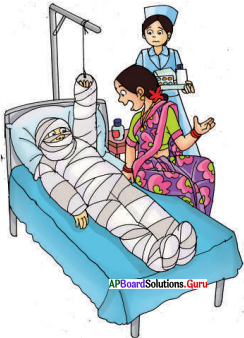
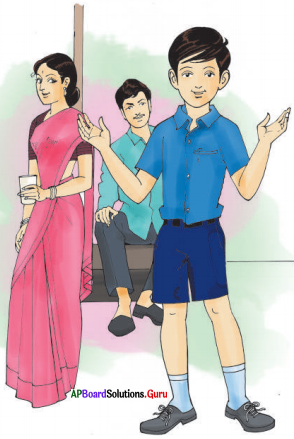
Observe the following picture and answer the questions.

AP Board 6th Class English Solutions Chapter 4 What Can a Dollar and Eleven Cents do 1

Question 1.
What can you say about the shop?
Answer:
It is a medical shop. Here we can buy medicines.

Question 2.
When does one go to such shops?
Answer:
One goes to such shops when one needs medicines.

Question 2.
Why do you think the girl has come to the shop?
Answer:
I think the girl has come to the shop to buy medicines for someone.

AP Board 6th Class English Solutions Chapter 4 What Can a Dollar and Eleven Cents do?

Question 3.
What do you think is the girl saying to the shopkeeper?
Answer:
I think the girl is requesting the shopkeeper to give some medicines.

Question 4.
Does she look happy? What makes you think so?
Answer:
I think she doesn’t look happy. I think someone who is very close to her is suffering from illness. So she is sad.

Question 5.
Who might be ill?
Answer:
Someone who is a relative

Reading Comprehension

I. Choose the correct answer.

1. Who was Andrew?
a) An eight year old child
b) Tess’s brother
c) Shopkeeper
d) Neurosurgeon
Answer:
b) Tess’s brother

2. “We don’t sell miracles here.” Who said these words?
a) Tess
b) Andrew
c) Chemist
d) Armstrong
Answer:
c) Chemist

AP Board 6th Class English Solutions Chapter 4 What Can a Dollar and Eleven Cents do?

3. The exact price of the miracle was
a) Dollar.
b) Eleven cents.
c) a dollar and eleven cents.
d) hundred cents.
Answer:
c) a dollar and eleven cents.

II. Say whether the following statements are True or False. Give reasons for your answer. Correct the false statements.

1. Andrew’s parents had very little money.
Answer:
True

2. Tess’s parents were very poor.
Answer:
True

3. Tess’s parents were not interested to take her little brother, Andrew, to the hospital.
Answer:
False

4. Andrew was seriously ill.
Answer:
True

5. Tess thought that “a miracle” was the medicine that was available in a medical store.
Answer:
True

Reasons:

  1. Andrew’s parents had very little money and, therefore, they couldn’t pay his doctor’s bills.
  2. Tess’s parents were very poor and so they were moving to a smaller house.
  3. Tess’s parents were interested to take her little brother, Andrew, to the hospital. But they had little money.
  4. Andrew was seriously ill and so he needed an operation.
  5. Tess thought that “a miracle” was the medicine that was available in a medical store and as such she asked the chemist to give her ‘a miracle’.

III. Tick the correct answer.

1. “I’m sorry,” the chemist said, because the miracle die girl had asked for……
a) was not available in his shop.
b) was very costly.
c) was not a medicine.
Answer:
c) was not a medicine.

2. Dr. Armstrong wanted
a) to help the child. t
b) to collect a lot of money,
c) to make fun of the child.
Answer:
a) to help the child.

IV. Answer the following questions.

Question 1.
Do you think less can buy the miracle with her savings? Why?
Answer:
I don’t think Tess can buy the miracle with her savings. Tess understands that the ‘miracle’ is also a kind of medicine and so she wants to buy it with the little money she has.

Question 2.
Why did the mother say that the surgery was a real miracle?
Answer:
The mother says that the surgery was a real miracle because their family was very poor. They couldn’t afford to $pend money for the operation. So they lost their hopes and gave up their efforts to save Andrew. At that time, Dr. Armstrong came as if he was a god and saved Andrew. So it was really a miracle for them.

AP Board 6th Class English Solutions Chapter 4 What Can a Dollar and Eleven Cents do?

Question 3.
What did the little girl understand by the word “miracle”?
Answer:
The little girl understood that ‘miracle’ was a kind of medicine.

Question 4.
What kind of a man was Dr. Armstrong?
Answer:
Dr. Armstrong was a man of generosity. When he understood Tess’s family position, without any other thoughts, he operated the boy without taking any money and succeeded. This incident shows us his helping nature.

Question 5.
Find out the words that have been used to describe Tess. Would you like to add some from your side?
Answer:
The words that have been used to describe Tess are ‘her eyes welling up’, ‘barely audible’ and ‘smiled’. Now l would like to add that she is a helpful, good-natured who has a lovable character. She determined to save her brother Andrew with the money she had.

Vocabulary

I. Read the following sentences.

Tess heard her parents talking.
She poured all the money on the floor.
Her mom whispered.

In the above sentences, the past forms of hear, pour and whisper are used to indicate completed actions.

Write the past forms of the following verbs.
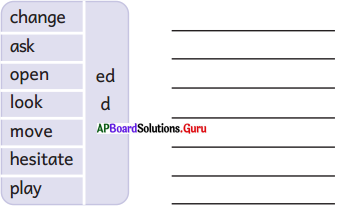
AP Board 6th Class English Solutions Chapter 4 What Can a Dollar and Eleven Cents do 2
Answer:
changed
asked
opened
looked
moved
hesitated
played

II. Fill in the blanks with suitable words given in the box.

AP Board 6th Class English Solutions Chapter 4 What Can a Dollar and Eleven Cents do 3
a) Last Sunday, I met my friends and we ……… for an hour.
b) My friend asked me to lend my gold chain to her. I ……….. to give it to her.
c) I heard some sounds in my room. I opened the door and ………… a small rat in the corner.
d) My father ………….. me to take a torchlight when I go out during nights.
e) He ……….. cricket yesterday.
Answer:
a) chatted
b) gave
c) noticed
d) cautioned
e) played

III. Read the following sentences.

My father is healthy. He never eats unhealthy food.
In the above sentences unhealthy is the antonym of healthy.
He understood me. But she misunderstood me.
Here the antonym is formed by adding ‘mis’ to ‘understood’.
We can form antonyms by adding certain prefixes to the words.

Make the opposites for the following, by adding suitable prefixes given in the brackets, (mis, un, im, dis, in, ir) Refer to a dictionary if necessary.
e.g. regular × irregular
A. discipline × …………………………
B. understand × …………………………
C. proper × …………………………
D: managed × …………………………
E. appeared × …………………………
F. comfortable × …………………………
G. known × …………………………
H. attentive × …………………………
I. happy × …………………………
J. real × …………………………
K. responsible × …………………………
Answer:
A. discipline × indiscipline
B. understand ×misunderstand
C. proper × improper
D. managed × mismanaged
E. appeared × disappeared
F. comfortable ×uncomfortable
G. known × unknown
H. attentive × inattentive
I. happy × unhappy
J. real × unreal
K. responsible × irresponsible

Grammar

I. Read the following sentences.

Tess smiled.
Tess answered.
The chemist said.
She knew that Andrew was sick.

All the above sentences speak about the actions completed in the past. They are said to be in the past tense. The verb used in such sentences is generally made by adding ‘ed’ or ‘d’ and by making some changes to their present tense form.
‘Said’ and ‘knew’ are the past forms of ‘say’ and ‘know’. Certain verbs like ‘cut’, ‘put’ are the same in their past form also. Verbs such as ‘sit’, ‘hold’ and ‘cut’ are called irregular verbs as they form their past tense differently.
Read the following table.

Present TensePast Tense
reachreached
addadded
touchtouched
playplayed
visitvisited
avoidavoided
completecomplete
diedied
livelived
keepkept
sitsat
teachtaught

II. Read the following text and fill in the blanks with the correct forms of the verbs given.

Last Sunday I …….(1)…….. (go) to Abhi’s birthday party. All my friends ………(2)…….. (gather) on that occasion. Rehman ………(3)……….. (play) music. John ……..(4)……… (sing) Hindi songs. Sobhan ………(5)……… (dance) to John’s songs. Abhi’s sister …….(6)…….. (distribute) sweets. Abhi ………(7)……… (cut) a cake. Abhi’s grandparents ……..(8)…… (bless) him. Abhi’s father ………(9)……. (present) him a new bicycle. Abhi …….(10)…….. (be) very happy. We all ……..(11)…….. (have) a good time.
Answer:

  1. went
  2. gathered
  3. played
  4. sang
  5. danced
  6. distributed
  7. cut
  8. blessed
  9. presented
  10. was
  11. had

III. Read the following pairs of sentences.
• She used to play with her brother.
• Ismail used to play kabaddi in his childhood. Now he plays tennis.
• Sarma used to watch English movies when he was eighteen. Now he watches Hindi movies only.
• Yasmin used to run five kilometers every morning when she was young. Now she walks two kilometers every morning.

‘Used to’ is used to speak about things that were habitually done in the past.
Now, write five sentences about the things you used to do when you were in Primary School.
Answer:

  1. I used to sit in the front row.
  2. I used to wear slippers.
  3. I used to eat chocolates.
  4. I used to go to school late.
  5. I used to play with my friends only.

Writing

I. Diary Writing
You have read in the story that the love of a little child saved the life of her brother. Andrew recovered completely and returned home. Tess was very happy. Let’s see what she wrote in her diary that night.
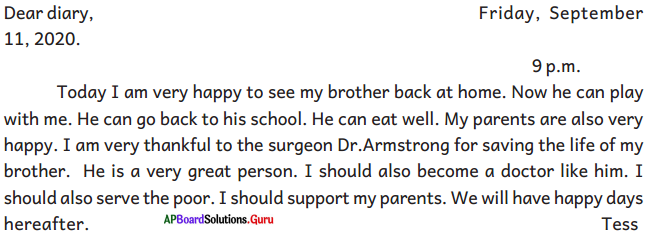
AP Board 6th Class English Solutions Chapter 4 What Can a Dollar and Eleven Cents do 4

Now imagine yourself as Tess’s brother Andrew and write a diary entry for the day.
Answer:

Friday, September 11, 2020.
9 p.m.

Dear diary,

Today I am very happy to be at home. Now I can play with my sister. I can go back to my school. I can eat well. My parents are also very happy. I am very thankful to the surgeon Dr.Armstrong for saving my life. He is a very great person. I should also become a doctor like him. I should also serve the poor. I should support my parents. We will have happy days hereafter. All the credit goes to my sister.

Andrew

AP Board 6th Class English Solutions Chapter 4 What Can a Dollar and Eleven Cents do?

II. Picture based story writing
Look at the picture and develop a story by using the words given in the box. Give a suitable title to the story. The beginning and the end of the story have been given. Write in your notebook.
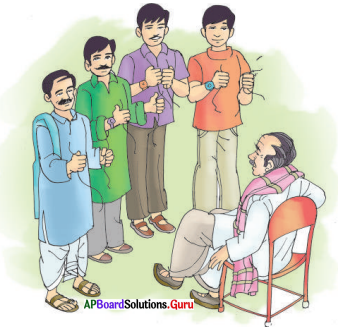
AP Board 6th Class English Solutions Chapter 4 What Can a Dollar and Eleven Cents do 5

a farmer – four sons – fell ill – quarrelled – sticks – broke – bundle of sticks – unable to break – decided not to quarrel

Once there lived a farmer. He had four sons ………………………………. They decided not to quarrel. They lived happily.
Answer:
THE OLD MAN AND HIS FOUR SONS
Once there lived a farmer. He had four sons. The four sons always quarrelled with one another. One day the farmer fell ill. He was worried about his sons’ disunity and their future. He wanted to teach them a lesson to make them know the importance of unity. He called his sons. He gave them a stick each and asked them to break. The sons broke them easily. This time he gave a bundle of sticks each but the sons were unable to break them. They understood the value of unity. They decided not to quarrel. They lived happily.
Moral: Unity is strength.

Talking Time

I. Debate : You have read in the story about the family’s struggle to save the life of their son. Dr.Carlton Armstrong operated on Andrew without any charges. Andrew recovered completely.

Now read the following statement.
‘All persons in the society should be given free medical and health care.’

Debate the above issue.
[Two or three students who support the idea that free medical and health care should be provided to everybody’ should sit on one side. Two or three students who oppose the idea should sit on the other side. Each group should give their opinion on the topic. All the remaining students in the class ask questions, challenge them on their views and present alternative viewpoints to them. The teacher or a student from the class can play the role of a moderator/anchor.]

You may use the following expressions:
• I agree with you, but ……………..
• I disagree with you ……………..
• I strongly feel that ……………..
• I oppose what you say ……………..
Answer:
Moderator : You all know the topic of today. Let’s start with the Supporting Group.

Supporting Group : I think healthcare should be free because humans shouldn’t have to worry about if they can pay to stay healthy.

Moderator : Now it is the turn of Opposing Group. Let’s listen what they will say.

Opposing Group : Health care could not be free because it will never be free. Even if we make it affordable to everyone in our country it will never be “free” because we will have to find a way to cover the cost… And every indication points to this being covered by taxes being raised.

Moderator : Here is a question from audience to Opposing Group.

Question from audience (To Opposing Group) : What about the poor people who cannot afford medical expenditure?

Opposing Group : Nothing in life is “free.” Health care services that a person doesn’t pay for might seem “free” to that person, but it is being paid for by someone else. Any good or service that a person receives should be paid for, and the person should now how much it costs. A problem in the American healthcare system is that because of government healthcare (Medicaid and Medicare) and low insurance co-pays, people are completely out of touch with the true and exorbitant cost of healthcare.

Moderator : Here is a question from audience to Supporting Group.

Question from audience (To Supporting Group): Government should not be obligated to take care of people’s health simply because they pay taxes.

Supporting Group : Government run universal health care is the best way to bring down the costs of health care. On top of that, it frees up businesses from having to find insurance for their employees. It also brings down stress levels in individuals since they don’t have to worry about a major illness bankrupting them.

Moderator: It’s ok. Let’s stop the debate here. Both the groups expressed their opinion very well. They expressed some valid points.

I appreciate their efforts to make the debate successful. Thank you one and all.

AP Board 6th Class English Solutions Chapter 4 What Can a Dollar and Eleven Cents do?

II. Read the following sentences.

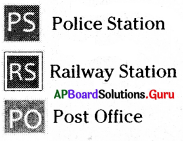
1. Show me the way to the railway station.
2. Please show me the way to the railway station.
3. Could you please show me the way to the railway station?

All these sentences are used for the same purpose. The second and the third are polite requests.
When we request somebody for something it is always better to be polite.
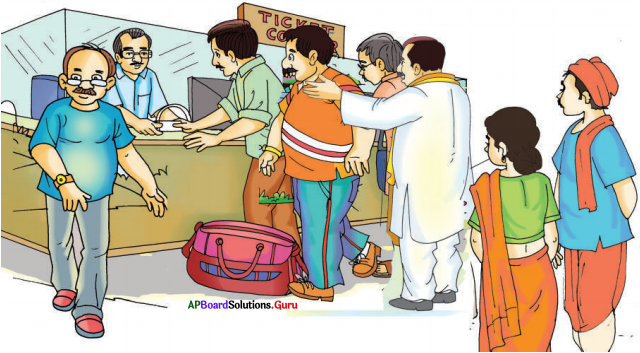
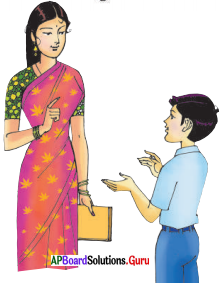
AP Board 6th Class English Solutions Chapter 4 What Can a Dollar and Eleven Cents do 6

Read the following sentences which indicate politeness.

  1. Please tell me the arrival time of the Charminar Express.
  2. Please tell me the platform number of the Godavari Express.
  3. Could you please tell me about the wheel chair availability?
  4. Could you please tell me whether the Prasanthi Express is running on time or delayed?
  5. Could you please tell me the way to the cloak room?

Use the expressions in polite forms. Your classmate/teacher will help you.
A) Bring me some stamps from the post office.
B) Help me in getting down the train.
C) ‘Hold this bag for a while.
D) Wait for me at the tower clock.
E) Lend me hundred rupees. ‘
F) Tell me the bus number to Trunk Road. ‘
G) Watch my luggage till I come back.
H) Feed my pets for two days.
I) Close all the windows.
J) Reduce your TV volume.
Answer:
A) Could you please bring me some stamps from the post office?
B) Please help me in getting down the train.
C) Please hold this bag for a while.
D) Could you wait for me at the tower clock?
E) Could you please lend me hundred rupees?
F) Please tell me the bus number to Trunk Road.
G) Could you please watch my luggage till I come back?
H) Could you please feed my pets for two days?
I) Please close all the windows.
J) Please reduce your TV volume.

AP Board 6th Class English Solutions Chapter 4 What Can a Dollar and Eleven Cents do?

III. Imagine that you attended a function last evening. While everybody was in a happy mood, suddenly a snake entered the function hall. Somehow the organizers managed to catch it and handed it over to the zoo authorities.

Now narrate the incident to your friends. You may also narrate some other incidents you came across.
Answer:
Yesterday evening I attended a birthday celebration of my cousin who lives at Santosh Nagar. The function was arranged at S.R.K. Function Hall. My cousin cut the cake in a happy mood while others were cheering. All were in a happy mood. Suddenly one of my relatives cried, ‘Snake! Snake!’. All of us became panic and moved in all directions as we did not know where the snake was. All of us pushed the chairs and they fell down.

But nobody was hurt. Later we came to know that it was an old function hall and there were some rats here and there. A snake entered the function hall chasing a small rat. Our uncle saw that. He informed the organizers about the arrival of the snake. The organizers immediately arrived at the function hall with a snake catcher. He was able to catch it and handed it over to the zoo authorities. All of us sighed.

IV. Say the following words aloud.
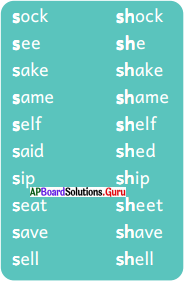
AP Board 6th Class English Solutions Chapter 4 What Can a Dollar and Eleven Cents do 7
Refer to a dictionary and say two more pairs of words with ‘s’ and ‘sh’.
Answer:

ssh
sitshit
sinshin
sunshun
sealedshield
sourshore
sinkshrink
sortshort
soshow
sootshoot

Project Work

Though Tess was a young girl and had a little money, she was able to save her brother. Collect a few success stories like that of Tess from magazines and newspapers. Talk about one of them in the class.

1. Kentucky Fried Chicken
The real-life story of Colonel Harland Sanders who was disappointed umpteen times in his life and still made his dream come true late in his life is really inspiring.

He is a seventh grade dropped out who tried many ventures in life but tasted bitter every time. He started selling chicken at his age of 40 but his dream of a restaurant was turned down many times due to conflicts and wars.

Later he attempted to franchise his restaurant. His recipe got rejected 1,009 times before the final approval. And soon the secret recipe, “Kentucky Fried Chicken” became a huge hit worldwide. KFC was expanded globally and the company was sold for 2 million dollars and his face is still celebrated in the logos.

Moral: Have you stopped your attempts to a venture just because you were rejected or failed a few times? Can you even accept a failure of 1009 times? This story inspires everyone to try hard and believe in yourself until you see success despite how many times you have failed.

2. Secret to Success
Once a young man asked the wise man, Socrates, the secret to success. Socrates patiently listened to the man’s question and told him to meet him near the river the next morning for the answer. The next morning Socrates asked the young man to walk with him towards the river. As they went in the river the water got up to their neck. But to the young man’s surprise Socrates ducked him into the water.

The young man struggled to get out of the water, but Socrates was strong and kept him there until the boy started turning blue. Socrates pulled the man’s head out of the water. The young man gasped and took a deep breath of air. Socrates asked, “What did you want the most when your head was in the water?” The young man replied, “Air.” Socrates said, “That is the secret to success. When you want success as badly as you wanted the air while you were in the water, then you will get it. There is no other secret.”

Moral: A burning desire is the starting point of all accomplishment. Just like a small fire cannot give much heat, a weak desire cannot produce great results.

Poem

MY DEPENDENCE
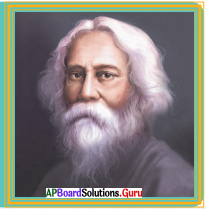
– Rabindranath Tagore
AP Board 6th Class English Solutions Chapter 4 What Can a Dollar and Eleven Cents do 8
I like to be dependent, and so for ever
with warmth and care of my mother
my father, to love, kiss and embrace
wear life happily in all their grace.

I like to be dependent, and so for ever
on my kith and kin, for they all shower
harsh and warm advices, complaints
full wondering, true and info giants.

I like to be dependent, and so for ever
for my friends, chat and want me near
with domestic, family and romantic
tips colleagues.as well, guide me work at risks.

I like to be dependent, and so for ever
for my neighbours too, envy at times
when at my rise of fortune like to hear
my daily steps, easy and odd things too.

Appreciation

Question 1.
Identify the rhyming words for the following.
embrace –
complaints –
Answer:
embrace – grace; complaints – giants

Question 2.
How do our parents care for our happy life?
Answer:
The mother cares with warmth and the father kisses and embraces with love.

Question 3.
Why should we depend on our kith and kin?
Answer:
We should depend on our kith and kin for getting harsh and warm advices, complaints which are true, helpful and informative.

Question 4.
Do you think we need friends? Why?
Answer:
Yes, I think we need friends. They are always with us in our troubles.

AP Board 6th Class English Solutions Chapter 4 What Can a Dollar and Eleven Cents do?

Question 5.
What is the message of the poet in this poem?
Answer:
We are always dependent on others for many things throughout life. Without our parents, relatives, friends, and neighbours we can’t lead our lives happily. They are helpful for us in many ways. They shape our life.

Question 6.
Which phrase in the poem means ‘relatives’?
Answer:
Kith and kin

Question 7.
Be a poet. Try to complete the following poem with words that rhyme with each Other.

I’d love to live a life that’s f……….,
Relax under a shady t………..,
And fall into a dreamy s …p,
With no strict hours to k ……….,
And sing a merry s………..,
Untrodden paths, as I walk a………..g.
You ask me what I’d get to ………..?
Fruits and nuts and berries sw………..t.
You ask me with whom I’d get to p………..
Birds and animals, happy and g………..
And if a woodcutter put a c………..p
Firmly, I would put a st………..
So that’s the life I’d like to I………..d
Free from worries, free from gr………..d.
Answer:
I’d love to live a life that’s free,
Relax under a shady tree,
And fall into a dreamy sleep.
With no strict hours to keep.
And sing a merry song.
Untrodden paths, as I walk along.
You ask me what I’d get to eat?
Fruits and nuts and berries sweet.
You ask me with whom I’d get to play.
Birds and animals, happy and gay.
And if a woodcutter put a chop.
Firmly, I would put a stop.
So that’s the life I’d like to lead.
Free from worries, free from greed.

Fun Time

I. Say the following sentences as fast as you can. Dp it as a pair-activity.

A) She sells seashells by the seashore.
B) I scream, you scream, all scream for ice cream.

AP Board 6th Class English Solutions Chapter 4 What Can a Dollar and Eleven Cents do?

II. Read (sing) and enjoy.

There was a young man of Niger Who went for a ride on a tiger.
They returned from their ride,
With the man inside,
And a smile on the face of the tiger.

What Can A Dollar And F.T Fvfn Cents Do? Summary

Tess was an eight year old child. One day she heard that her brother, Andrew was very sick and he needed some operation to be alive. But their family was very poor. Her parents lost their hope and gave up their efforts. Tess heard from her daddy that only a miracle could save her brother. She thought that miracle’ was a kind of medicine. Think¬ing so, she took her jar of coinsi and went to a medical shop. She asked the chemist to give her a miracle by taking the money. The chemist sadly told her that miracles were not sold there. Dr. Carlton Armstrong, a famous neurosurgeon, heard their conversation. Then he asked her how much money she had. She replied that she had one dollar and eleven cents and also told she could manage to get some more. He told her that was the exact price of a miracle for her little brother and asked her to show their house. Dr. Carlton Armstrong admitted Andrew to hospital and operated on him without any charges. Andrew recov¬ered well. Tess’s mum whispered that it was a miracle and she wondered how much it would have cost. Only one person knew the answer to that. That is none other than Tess.

My Dependence Poem Summary

Tagore’s poem ‘My Dependence’ tells us how human beings are dependent on others from birth to death. Tagore says that he is dependent on parents for their care and grace. Later he depends on his relatives for advice. He says that he depends on friends and colleagues for guidance and close friendship. Sometimes he depends on his neighbours to hear the words of envy when he rises his fortune.

My Dependence Poem About the Poet
AP Board 6th Class English Solutions Chapter 4 What Can a Dollar and Eleven Cents do 9
Rabindranath Tagore [1861-1941] was considered the greatest writer in modern Indian literature. A Bengali poet, novelist, educator, and Nobel Laureate for Literature [1913]. Tagore was awarded a Knighthood in 1915, but he surrendered it in 1919 in protest against the massacre at Amritsar.
AP Board 6th Class English Solutions Chapter 3 Little Hearts

SCERT AP Board 6th Class English Solutions 3rd Lesson Little Hearts Questions and Answers.

AP State Syllabus 6th Class English Solutions 3rd Lesson Little Hearts

6th Class English 3rd Lesson Little Hearts Textbook Questions and Answers

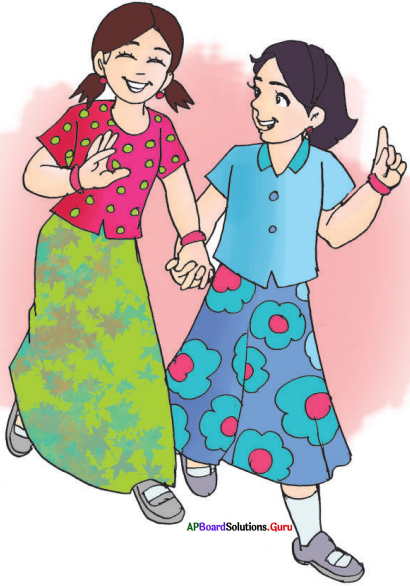
Look at the picture and answer the questions that follow.
AP Board 6th Class English Solutions Chapter 3 Little Hearts 1

Question 1.
Do you make friends easily?
Answer:
Yes, I make friends easily.

Question 2.
What are Mends for?
Answer:
Friends are toshare our feelings, to ehat and play together. Friends are helpful in times of need.

AP Board 6th Class English Solutions Chapter 3 Little Hearts

Question 3.
Have you ever quarrelled with your Mends? If so, for what?
Answer:
Yes, I have quarrelled with my friends many times at play.

Question 4.
Is it hard to forgive Mends?
Answer:
No, it is not hard. It is easy to forgive friends.

Reading Comprehension

I. Answer the following questions in one or two sentences.

Question 1.
How were the girls dressed?
Answer:
The two little girls were dressed in new clothes. The little girl was wearing a green skirt and the older a pink skirt.

Question 2.
Where did the two girls want to play?
Answer:
The two girls wanted to play at a large puddle across the street.

Question 3.
Akulka grew angry at Malasha. What made her angry?
Answer:
At the puddle, Malasha splashed muddy water on Akulka’s new dress and face. This made Akulka angry,

Question 4.
Who tried to stop the quarrel?
Answer:
Akulka’s grandmother tried to stop the quarrel.

AP Board 6th Class English Solutions Chapter 3 Little Hearts

Question 5.
How did the quarrel end?
Answer:
Parents realized their mistake after seeing Akulka and Malasha becoming friends again. They felt ashamed and stopped fighting. Thus the quarrel ended.

II. Complete the following choosing the correct options given after them.

1. “Don’t go Malasha!” Akulka warned her not to
a) get their shoes spoil
b) get their school bags wet
c) get injured
Answer:
a) get their shoes spoil

2. “Let’s remove our shoes and play.” It shows that Akulka was
a) careless
b) afraid of her parents
c) interested in cleanliness
Answer:
b) afraid of her parents

3. “Don’t be afraid !” said Akulka,………….
a) to warn Malasha
b) to threaten Malasha
c) to give confidence to Malasha
Answer:
c) to give confidence to Malasha

4. Akulka’s mother gave a slap on Malasha’s face because
a) she quarreled with her daughter
b) she made her daughter’s dress dirty
c) she committed theft in her house
Answer:
b) she made her daughter’s dress dirty

5. The men also joined the scene. Here‘scene’refers to the
a) quarrel
b) puddle
c) war
Answer:
a) quarrel

III. Read and rearrange the following sentences in the order of their occurrence in the story:
1. Akulka and Malasha threw pieces of paper in water and played together.
2. Akulka’s mother slapped Malasha.
3. They wanted to play in the puddle.
4. Akulka and Malasha made a new rill to let the water flow.
5. The members of the two families started fighting.
6. It was Sunday and the two little girls were in their new dresses.
7. s Grandma tried to stop the quarrel.
8. Malasha splashed the muddy water on Akulka’s dress.
Answer:

  1. It was Sunday and the two little girls were in their new dress. (6)
  2. They wanted to play in the puddle. (3)
  3. Malasha splashed the muddy water on Akulka’s dress. (8)
  4. Akulka’s mother slapped Malasha. (2)
  5. The members of the two families started fighting. (5)’
  6. Grandma tried to stop the’ quarrel. (7)
  7. Akulka and Malasha made a new rill to let the water flow. (4)
  8. Akulka and Malasha threw pieces of paper in water and played together. (1)

Vocabulary

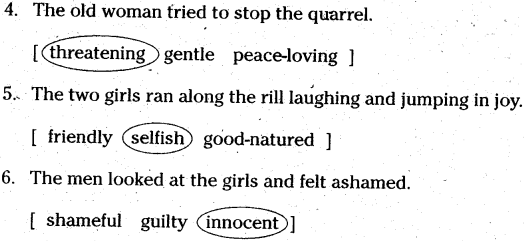
I. The following are sentences taken from the lesson ‘Little Hearts’. Read them and encircle the word that does not indicate the given context.

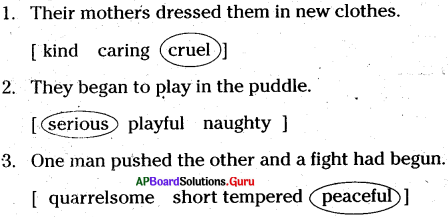
1. Their mothers dressed them in new clothes.
[kind caring cruel]
2. They began to play in the puddle.
[serious playful naughty]
3. One man pushed the other and a fight had begun.
[quarrelsome short tempered peaceful]
4. The old woman tried to stop the quarrel.
[threatening gentle peace-loving]
5. The two girls ran along the rill laughing and jumping in joy.
[friendly selfish good-natured]
6. The men looked at the girls and felt ashamed.
[shameful guilty innocent]
4. The old woman fried to stop the quarrel.
[(threatening^) gentle peace-loving]
5.. The two girls ran along the rill laughing and jumping in joy.
[friendly (selfish) good-natured]
6. The men looked at the girls and felt ashamed.
[shameful guilty (innocent)]
Answer:
AP Board 6th Class English Solutions Chapter 3 Little Hearts 2
AP Board 6th Class English Solutions Chapter 3 Little Hearts 3

II. Fill in the blanks in the following paragraph with the suitable words given in the box.
AP Board 6th Class English Solutions Chapter 3 Little Hearts 15

There was a …..(1)…… across the street. A dog was passing by it. He stopped and looked in it where there was a bird flying in the sky. The foolish dog suddenly ……..(2)…….. into the puddle. Poor thing! He became ………(3)…….. His eyes were filled with ……(4)…….. water. What should we do then? A ……(5)………. girl fetched a bucket of water to ……(6)….. the mud stains of the dog. The dog looked at the girl and jumped to his feet ……..(7)…….
Answer:

  1. puddle
  2. jumped
  3. soiled
  4. muddy
  5. little
  6. wipe off
  7. happily

AP Board 6th Class English Solutions Chapter 3 Little Hearts

III. Read the following paragraph and write antonyms of the underlined words.

Akulka’s mother caught Malasha and gave (a) a slap on her face. Malasha began (b) to howl, and her mother ran out of the house. “Why do you slap my daughter?” she began to scold (c) her neighbour. Soon, it turned to a Mg (d) quarrel. The men also joined (e) the scene. One man pushed (f) the other, and a fight had begun. Akulka’s grandmother tried to separate (g) them. They paid no attention (h).
a) ……………. b) ……………. c) ……………. d) …………….
e) ……………. f) ……………. g) ……………. h) …………….
Answer:
a) took
b) stopped
c) praise
d) small
e) left
f) pulled
g) unite
h) negligence

Grammar

I. In the previous lesson you have learnt writing sentences describing ‘ongoing’ actions using Present Continuous Tense. We can change them into questions to confirm the information.
Examples:
It is raining. – Is it raining?
The girls are playing. – Are the girls playing?
Men are still fighting. – Are men still fighting?

Such sentences are called ‘Interrogative sentences’. Here they are in Present Continuous Tense. A sentence that asks a question is called an Interrogaltive sentence. It ends with a question mark.
Do you know how to write them as interrogatives?

If the subjects are ‘he, she, it and any singular noun’, use ‘is’ before them. And for the subjects ‘we, you, they and any plural noun’, use ‘are’ before them. If the subject is ‘I’, use ‘am’ before it.

Observe the following examples.
She is singing. – Is she singing?
They are coming. – Are they coming?

Change the following statements into questions.
1. The children are playing.
2. Students are waiting for their bus.
3. The teacher is walking slowly.
4. They are drinking water.
5. Usha is cleaning her room.
6. The girl is preparing tea.
Answer:
1. Are the children playing?
2. Are students waiting for their bus?
3. Is the techer walking slowly?
4. Are they drinking water?
5. Is Usha cleaning her room?
6. Is the girl preparing tea?

AP Board 6th Class English Solutions Chapter 3 Little Hearts

II. Degrees of Comparison
The adjectives change in form to show comparison. They are called the three degrees of comparison.

Read the following sentences.
1. Gopal is the tallest of all in the class.
2. Rani is cleverer than Ramya.
3. My house is as big as yours.

In sentence 1„ the adjective ‘tallest’ denotes the superlative degree. In sentence 2, the adjective ‘cleverer’ denotes the comparative degree. In sentence 3, the adjective ‘big’ denotes positive degree.

Read the following sentences and point out the adjectives and name the Degree of Comparison of each.
1. The train runs faster than the bus.
2. Lead is the heaviest metal.
3. Hari is the laziest boy in the class.
4. The two little girls are wiser than the older people.
5. Mount Everest is the highest peak of the Himalayas.
6. Iron is more useful than copper.
7. This is the most interesting story.
8. Ooty is cooler than Chennai.
Answer:
1. The train runs faster than the bus:
Adjective → ‘faster’ → ‘Comparative Degree’

2. Lead is the heaviest metal.
Adjective → ‘heaviest’ → ‘Superlative Degree’

3. Hari is the laziest bov fn the class.
Adjective → ‘laziest’ → ‘Superlative Degree’

4. The two little girls are wiser than.the older people.
Adjective → ‘wiser’ → ‘Comparative Degree’

5. Mount Everest is the highest peak of the Himalayas.
Adjective → ‘highest’ → ‘Superlative Degree’

6. Iron is more useful than copper.
Adjective → ‘more useful’ → ‘Comparative Degree’

7. This is the most interesting story.
Adjective → ‘most interesting’ → ‘Superlative Degree’

8. Ootv is cooler than Chennai.
Adjective → ‘cooler’ → ‘Comparative Degree’

III. Articles

Read the following paragraph :

Sir C.V. Raman was a scholar in sound and sound related physics. His research in optics, the Science of light resulted in the discovery of the Raman Effect. The discovery won him the Nobel Prize for physics. It was the first time the prize was awarded to an Asian! The scholar was the Pride of India.

The underlined phrases begin with either ‘a / an’ or ‘the’. These are called ‘Articles’. There are rules for the use of articles. Let us learn them in detail.
a) We use ‘a’ before singular common nouns that begin with consonant sounds,
AP Board 6th Class English Solutions Chapter 3 Little Hearts 16

b) We use ‘an’ before singular common nouns that begin with a vowel sound,
AP Board 6th Class English Solutions Chapter 3 Little Hearts 17

c) We use ‘the’
1. before a common noun which is mentioned for the second time.
e.g. I saw a dog. The dog was barking.

2. before superlative adjectives.
e.g. the largest, the best, the smelliest, the most.

3. before ordinal numbers.
e.g. the first, the second ..

4. before the names of musical instruments.
e.g. the guitar, the Violin, etc.

5. before a noun when we mean something in particular.
e.g. the Raman Effect, the TV, the Radio

6. with unique things.
e.g. the sun, the moon, the earth, the sky, the universe.

7. before the names of awards.
e.g. the Nobel Prize, the Bharat Ratna, the Padmabhushan, etc.

Now, fill in the blanks in the following sentences with ‘a /an or the’.
1. Ravi Varma was ………….famous painter.
2. English is …………… international language.
3. ………… sun is ………… star.
4. ………… earth moves round ………. sun.
5. He is ………. expert in Robotics.
6. It is ……….. issue of Human Rights.
7. I listen to ………. radio a lot.
8. I met lawyer yesterday. ………….. lawyer was famous in the city.
9. My brother is learning to play ……… piano.
10. Raghu is ………. best batsman in our team.
Answer:

  1. a
  2. an
  3. The, a
  4. The, the
  5. an
  6. an
  7. the
  8. a, The
  9. the
  10. the

Writing

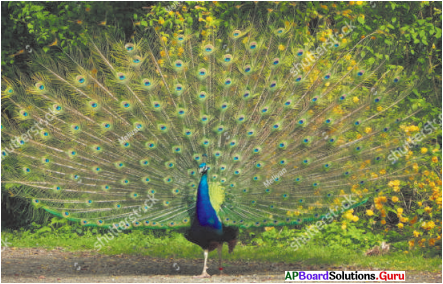
I. Look at the picture of ‘Peacock’. With the help of the following hints write a composition about the Peacock.
AP Board 6th Class English Solutions Chapter 3 Little Hearts 4
Hints : the peacock – our National bird – beautiful bird – different colours – long tail – about 2.25 mts. long – ‘eye markings’ on the tail – colours change in the sunlight – dances – rains – walks proudly
Answer:
The peacock is our National Bird. It is a beautiful bird with different colors of feathers. It has a long tail. The tail is about 2.25 mts long. We can see ‘eye markings’ on the tail. Their colours change in the sunlight. It dances in rain spreading the feathers of its tail. The peacock walks proudly with its colourful tail.

II. Message Writing

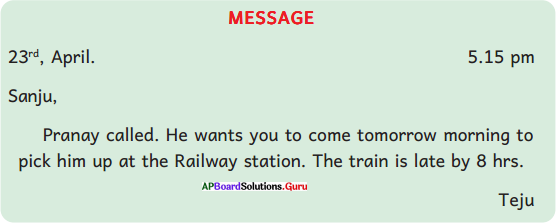
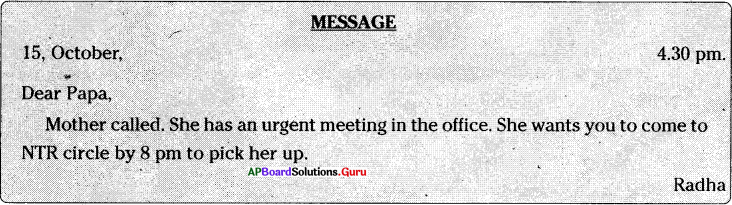
Read the following Telephone Conversation between Teju and Pranay. Teju’s brother Sanju is not at home. So, Teju writes a message for his brother as he has to leave for his tuition.
Pranay : Hello, can I speak to Sanju?
Teju : Sanju is not at home. I am his brother Teju.
Pranay : I am Pranay. Could you tell your brother not to come to Railway station today to pick me up? The train is running late by 8 hours.
Teju : Which train?
Pranay : The Rajadhani Express. It will arrive in Vijayawada by tomorrow at 8 o’clock in the morning. Tell him to come tomorrow morning.
Teju : I will surely pass the information.
Pranay : Thank you.

Read the message written by Teju after his telephone conversation.
AP Board 6th Class English Solutions Chapter 3 Little Hearts 5

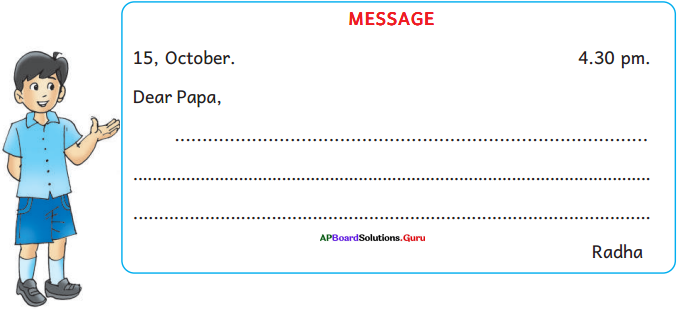
Read the following Telephone conversation between Radha and her mother.

Mother : Hello, Radha, I’ll not come home now. We have an urgent meeting in the office. Do you have your dance class today?
Radha : Yes, mom, I have to leave now. What’s the matter?
Mother : Tell your father to come to NTR circle by 8 pm to pick me up. I’ll wait there.
Radha : O.K. Mom.

Now, Radha leaves message for her father. Write her message in the box provided below.
AP Board 6th Class English Solutions Chapter 3 Little Hearts 6
Answer:
AP Board 6th Class English Solutions Chapter 3 Little Hearts 7

Talking Time

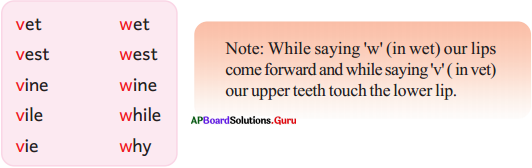
I. Say the following pairs of words aloud.
AP Board 6th Class English Solutions Chapter 3 Little Hearts 8

II. Here is an announcement in the School Assembly by the SPL. Read it.

Good morning to all. A good chance for us. Our school will organize an Inter¬School Science Exhibition on February, 22 from 10 am to 4 pm. Working models, informative charts and computer programmes will be exhibited. The best 10 models will be selected for District Level Science Exhibition. All the best. Thank you. Have a nice day.

Now make another announcement of your own, as your school students are going to Nagarjuna Sagar on an educational tour. Instruct them to get their parents’ permission letters for the two-day tour.
Answer:
Good morning to all. We are going to Nagarjuna Sagar on a pleasant educational tour, to get knowledge as well as pleasure. All the arrangements are made by our school management to make the trip successful. For this, we require letters of your parents’ permission for a two-day tour. Letters should be submitted to your class teachers within one week.

Listening

Listen to the following story and answer the questions.

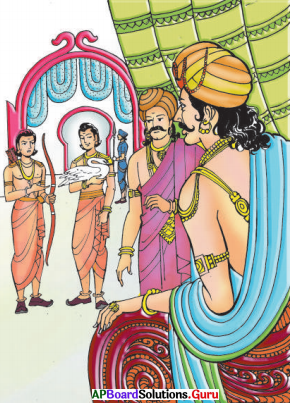
THE WISE JUDGEMENT

AP Board 6th Class English Solutions Chapter 3 Little Hearts 9
Suddodhana was the king of Kapilavasthu. Siddartha was his son and Devadutta his nephew.

One day Devadutta came to the king’s court in an angry mood, “Your Majesty! I want justice,” he shouted.
“What has happened?” asked the king.
“Siddhartha has taken my swan. He’s not giving it to me,” said Devadutta.

The king was surprised because he knew that Siddartha was good and gentle. He never takes anything from anyone.
Just then Siddartha entered the court with a swan in his arms.
“Is that your swan?” the king asked Devadutta.
“Yes it is. I shot it,” said Devadutta.

“But the swan fell at my feet. I picked it up and took out the arrow from its side and applied medicine on its wound. I saved its life. The swan is mine,” said Siddartha.
The king asked his Chief Minister for advice.

The Minister said, “Devadutta shot the swan. If Devadutta killed the swan, then it would be his. Siddartha saved its life. So, the swan is Siddartha’s.”
1. Who came to the king’s court? Why was he angry?
2. “Siddartha had taken away something!” What had he taken?
(Note : Q.No. 2 & Q.No. 3 are same.)
3. What had Siddartha taken away?
4. What did Siddartha bring in his arms?
5. Why did Devadutta say the swan was his?
6. Where did the swan fall? How did Siddartha save the swan’s life?
7. Which do you think is better —- killing a bird or looking after it?
8. This story shows us that Siddartha was ………….
a) cunning
b) cruel
c) kind
Answer:

  1. Devadutta came to the king’s court. He was angry because Siddartha took his swan and was not giving it to him.
  2. He had taken the injured swan shot by Devadutta.
  3. Siddartha had taken away the injured swan shot by Devadutta.
  4. Siddartha brought a swan in his arms.
  5. Devadutta had shot the swan.
  6. The swan fell at the feet of Siddartha. Siddartha took out the arrow from the bird and applied the medicine on its wound.
  7. Looking after the bird is better than killing a bird.
  8. (c) kind

Read it yourself

A Mother’s Wise Advice

The king of Kosala killed the king of Benares and took the queen as a prisoner. But her son escaped luckily and grew in a countryside. He raised a large army and declared war against the Kosala king.

The prince’s mother heard of this threat from her son by some faithful servants. She was a gentle and kind woman who wanted to prevent violence and suffering and killing. So she advised him to close every entrance to the city. The prince decided to follow his mother’s wise advice. His army blockaded the city for seven days and nights. Then the citizens captured their unlawful king, cut off his head, and delivered it to the prince. He entered the city triumphantly and became the new king of Benares.

Comprehension

Answer the following questions.

1. How did the prince escape?
Answer:
The prince escaped by sneaking away through the sewers.

2. Why did the prince’s mother try to stop the battle?
Answer:
The prince’s mother was a gentle and kind woman. She wanted to prevent violence, suffering, and killing in the battle.

AP Board 6th Class English Solutions Chapter 3 Little Hearts

3. How did the prince get his kingdom back?
Answer:
The prince blockaded the city and made people wore down. The citizens captured their unlawful king and cut off his head, and delivered it to the prince. He became the new king of Benares.

Study Skills

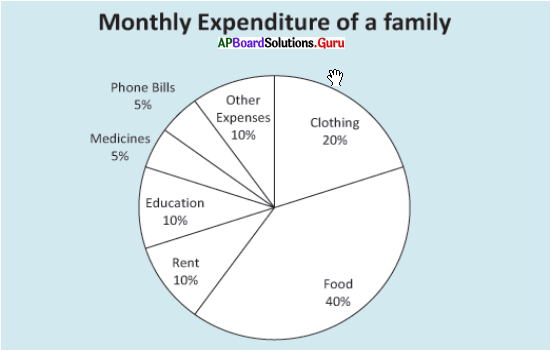
A. Study the following pie chart carefully.
AP Board 6th Class English Solutions Chapter 3 Little Hearts 10

Let’s go through the description of the Pie-chart.

The Pie-chart shows the percentage of a family’s household expenditure distributed into seven categories. These are food, clothes, education, medicines, phone bills, rent and other expenses. According to the chart, the family’s highest expenditure is on food. The lowest expenditure is on medicines and phone bills. If we make a list of the items of expenditure from the highest to the lowest, we find this order: food, clothing, rent, education, other expenses, medicines and phone bills.

Now, answer the following questions.
1. How many items are mentioned in the chart?
2. On which item does the family spend more mohey?

Choose the correct answer from the choices given below and put a tick (✓) mark.
3. Which of the following took the same percentage of expenditure?
a) rent and phone bills
b) rent and education
c) rent and medicine

4. Choose the correct statement.
a) The items with least expenditure are two in the chart.
b) The items with least expenditure are three in the chart.
c) The item with least expenditure is only one in the chart.

5. Choose the correct statement from the following.
a) The sum of expenditure on rent and education is equal to the expenditure of clothing.
b) Expenditure on food item is equal to the sum of clothing and rent.
c) The sum of expenditure on phone bills and medicines is double the expenditure of clothing.
Answer:

  1. Seven items are mentioned in the chart.
  2. The family spends more money on food items.
  3. b) rent and education
  4. a) The items with least expenditure are two in the chart.
  5. a) The sum of expenditure on rent and education is equal to the expenditure of clothing.

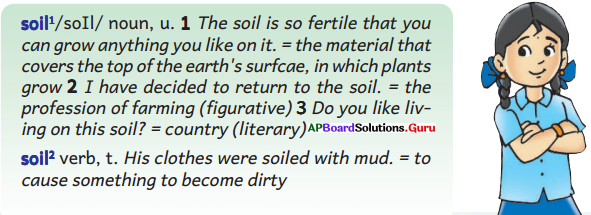
B. Here is the dictionary entry of the word ‘soil’. Read it carefully.
AP Board 6th Class English Solutions Chapter 3 Little Hearts 11
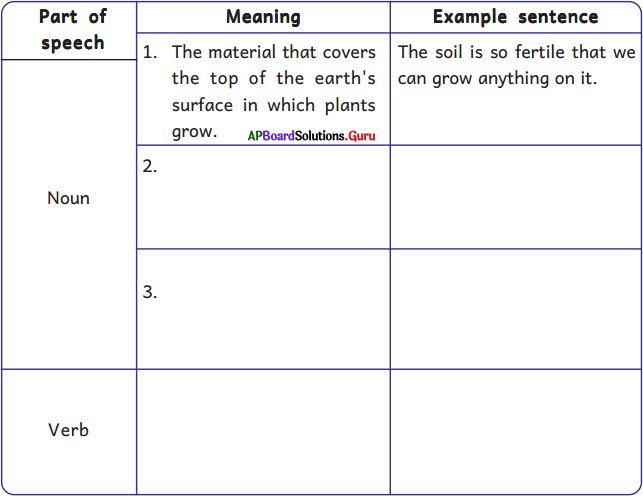
Fill the following table based on the information given above. The first one is done for you.
AP Board 6th Class English Solutions Chapter 3 Little Hearts 12
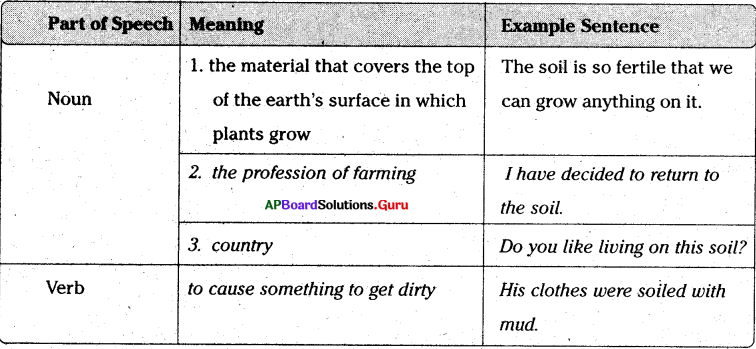
Answer:
AP Board 6th Class English Solutions Chapter 3 Little Hearts 13

Fun Time

I. Can you answer the following questions? Try.

1. What can travel the world while staying in a corner?
2. What is made of water but if you put it into water it will die?
3. I’m tall, when I’m young and I’m short, when I’m old. What am I?
4. What has hands but cannot clap?
5. What has a head and tail but no body?
6. What has an eye but cannot see?
7. What kind of room has no doors or windows? .
8. What kind of tree can you carry in your hand?
9. Which word in the dictionary is incorrect?
10. Feed me and I live, yet give me a drink and I die. Who am I?
Answer:

  1. Postal stamp
  2. Ice cube
  3. Candle
  4. Clock
  5. Coin
  6. Needle
  7. Mushroom
  8. Palm
  9. Incorrect
  10. fire

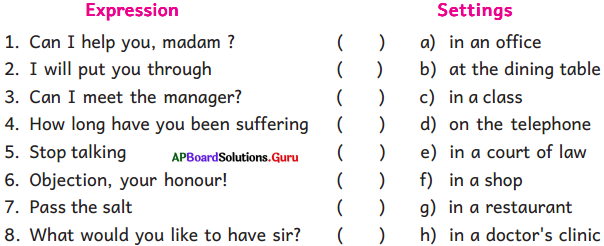
II. Match the expressions with their contextual settings.
AP Board 6th Class English Solutions Chapter 3 Little Hearts 14
Answer:

ExpressionSettings
1. Can I help you, madam?f) in a shop
2. I will put you throughd) on the telephone
3. Can I meet the manager?a) in an office
4. How long have you been sufferingh) in a doctor’s clinic
5. Stop talkingc) in a class
6. Objection, your honour!e) in a court of law
7. Pass the saltb) at the dining table
8. What would you like to have sir?g) in a restaurant

Little Hearts Summary

Malasha and Akulka were little girls studying sixth class. One day they were dressed in new clothes. It was a rainy day. They gathered at a large puddle across the street. They were playing at the puddle.. Malasha plumped her foot into the water. And the muddy water splashed and fell non-Akulka’s new dress. On seeing this Akulka became angry and ran after Malasha. Malasha started running towards her home. On their way, Akulka’s mother saw that and slapped Malasha’s face. There started a quarrel between the two families. The two families were busy with their quarrel. But the two girls forgot their quarrel and went to the puddle to play there. They were busy laughing, running, and jumping along the rill. An old woman showed the quarreling people how the two girls were playing happily forgetting their quarrel. On seeing the girls playing ‘ * together, they felt ashamed and left the place.

AP Board 6th Class English Solutions Chapter 2 The Snake Catcher

SCERT AP Board 6th Class English Solutions 2nd Lesson The Snake Catcher Questions and Answers.

AP State Syllabus 6th Class English Solutions 2nd Lesson The Snake Catcher

6th Class English 2nd Lesson The Snake Catcher Textbook Questions and Answers

Look at the following picture and answer the questions that follow.
AP Board 6th Class English Solutions Chapter 2 The Snake Catcher 1

Question 1.
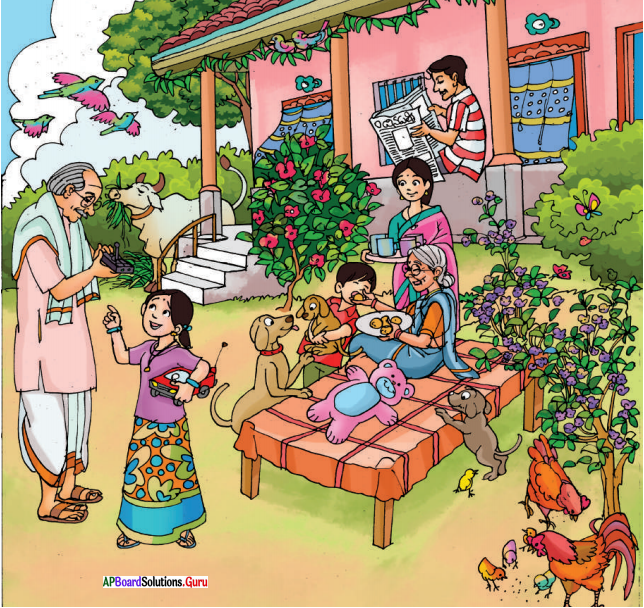
Do you have any pets at your house as shown in the picture?
Answer:
Yes. I have (We have) cats, dogs, hens, and cocks.

Question 2.
Are you comfortable with them?
Answer:
Yes, we are comfortable with the pets at our house.

Question 3.
Do you treat them in a friendly manner?
Answer:
Yes, we treat them in a friendly manner. We play with them.

AP Board 6th Class English Solutions Chapter 2 The Snake Catcher

Question 4.
If you find any strange animals, will you go near them?
Answer:
If we find any strange animals, we will not go near them because we are afraid of them. They may harm us.

Reading Comprehension

A. Answer the following questions in one or two sentences.

Question 1.
Why did the snake catcher go to the snowy mountains?
Answer:
The snake catcher went to the snowy mountains in search of new kinds of snakes. He wanted to display them to the town people and thereby raise a few coppers from the large crowd.

Question 2.
How was the dragon when the snake catcher found it in the snpwy mountains?
Answer:
When the snake catcher found the dragon in the snowy mountains, it was in dormant (inactive) state. It was big and looked attractive in golden yellow colour.

Question 3.
What made the snake catcher pick the dragon up with him?
Answer:
The dragon was big and looked attractive in golden yellow colour. The snake catcher thought that the dragon would change his fate. People would admire his brave act and treat him in a ceremonial (proud) way. He thought that he would get a lot of money and could lead a luxurious life. So he picked the dragon up with him.

AP Board 6th Class English Solutions Chapter 2 The Snake Catcher

Question 4.
In the end, the dragon began to move. How did that happen?
Answer:
When the snake catcher was displaying the dragon to the town people, the sun grew hotter. By the warmth of its rays, the dragon began to emerge (come out) slowly from its frozen state.

Question 5.
The snake catcher made a wrong choice. Do you agree with this statement? Why/Why not?
Answer:
Yes, the snake catcher made a wrong choice. I agree with this statement. He could not guess that the dragon was not dead.

B. Choose the correct option, to make the sentence meaningful.

1. The snake catcher caught the snakes because
a) he had a snake park.
b) it was his livelihood.
c) it was his passion.
Answer:
b) it was his livelihood.

2. The snake catcher found the dragon iu a ………… state.
a) sleeping
b) dead
c) frozen
Answer:
c) he wanted to sell it to the people.

3. He decided to take the dragon to the town because
a) it was big in size.
b) the town people had never seen it.
c) he wanted to sell it to the people.
Answer:
b) the town people had never seen it.

4. The crowd gathered in the bazaar because
a) of the attractive shouting of the snake catcher.
b) it was the usual practice of the towns people.
c) it was an announcement made by the government.
Answer:
a) of the attractive shouting of the snake catcher.

5. The mighty dragon swallowed
a) all the people in the street.
b) some people and the snake catcher.
c) only the snake catcher.
Answer:
b) some people and the snake catcher.

C. Read the following statements and say whether they are True or False. Write T’ for True and ‘F’ for False.

1. The snake catcher went trekking to the mountain.
Answer:
True

2. The snake catcher thought the dragon was dead.
Answer:
True

3. He put the dragon around his neck and came to the town.
Answer:
False

AP Board 6th Class English Solutions Chapter 2 The Snake Catcher

4. He told the town people that he had killed the mighty dragon.
Answer:
True

5. The dragon was a very familiar creature to the town people.
Answer:
False

6. The warmth of the sun?s rays brought the dragon to life.
Answer:
True

7. The dragon looked at the people and felt afraid.
Answer:
False

8. The snake catcher’s life ended in a tragic way.
Answer:
True

Vocabulary

Redd the following sentences from the lesson ‘The Snake Catcher’.

1. The snake catcher found a terrible and fierce-looking dragon.
2. It was big and looked attractive.
3. He bundled up the cold creature in a cloth.
4. People would admire his brave act.
5. This mighty snake would change his fate.
6. He could lead a luxurious life.

The underlined words in the above sentences tell us the quality of the nouns. Such words are called ‘adjectives’. What is an ‘Adjective? An adjective describes nouns. It provides further information about a noun like size, shape, colour and quality. Adjectives have different forms. They are Positive, Comparative and Superlative forms. They change their forms as follows. We know that the comparatives and superlatives take ‘-er’ and ‘-est’ respectively.

PositiveComparativeSuperlative
bigbiggerbiggest
coldcoldercoldest
mightymightiermightiest
smallsmelliersmallest
fewfewerfewest
strongstrongerstrongest

Adjectives with more than 2 syllables will take ‘more’ and ‘most’ in their comparative and superlative forms respectively. They are as follows:

PositiveComparativeSuperlative
beautifulmore beautifulmost beautiful
terriblemore terriblemost terrible
attractivemore attractivemost attractive
luxuriousmore luxuriousmost luxurious

Some adjectives take irregular forms as follows:

PositiveComparativeSuperlative
badworseworst
goodbetterbest
farfartherfarthest
littlelessleast

1. Now read the lesson thoroughly and find adjectives and write their other forms in your notebooks.
Answer:

PositiveComparativeSuperlative
commoncommonercommonest
coldcoldercoldest
snowysnowiersnowiest
fewfewerfewest
largelargerlargest
bigbiggerbiggest
bravebraverbravest
thickthickerthickest
fiercefiercerfiercest
strangestrangerstrangest
slowslowerslowest
loudlouderloudest
easyeasiereasiest
foolishmore foolishmost foolish
terriblemore terriblemost terrible
attractivemore attractivemost attractive
ceremonialmore ceremonialmost ceremonial
luxuriousmore luxuriousmost luxurious
farfartherfarthest
newnewernewest
dormantmore dormantmost dormant
hothotterhottest

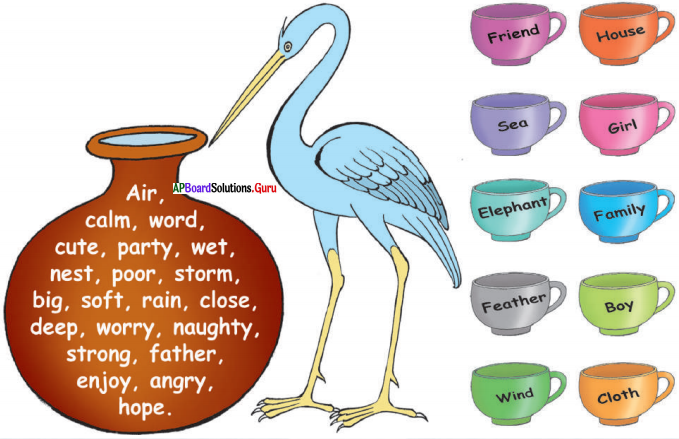
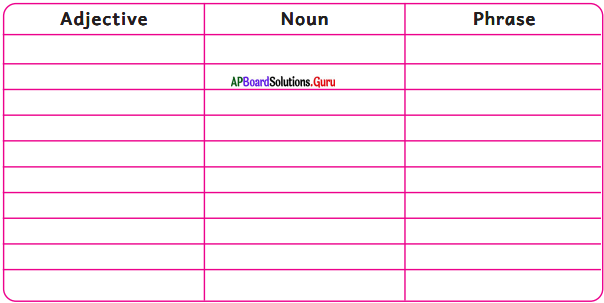
2. Look at the picture. The crane wants to fill the cups with suitable adjectives from the pot. Remember all words in the pot are not adjectives and fill in the table.
AP Board 6th Class English Solutions Chapter 2 The Snake Catcher 2
AP Board 6th Class English Solutions Chapter 2 The Snake Catcher 3
Answer:

AdjectiveNounPhrase
closefriendclose friend
deepseadeep sea
angryelephantangry elephant
softfeathersoft feather
strongwindstrong wind
bighousebig house
cute / naughtygirlcute / naughty girl
poorfamilypoor family
naughtyboynaughty boy
wetclothwet cloth
calmseacalm sea

3. Now, fill in the blanks in the following paragraph with suitable adjective forms given in the box.
AP Board 6th Class English Solutions Chapter 2 The Snake Catcher 4
It is my ……..(1)……. sister’s birthday. My father presented her a …….. (2)…………. watch. I gave her a ………(3)……….. English dictionary. My mother prepared a ………(4)…….. cake. She decorated the table with ……(5)……. roses. Then she served us pieces of cake in ……..(6)…….. plates and …….(7)…….. badam milk in cups.
Answer:

  1. younger
  2. smart
  3. small
  4. delicious
  5. lovely
  6. clean
  7. hot

AP Board 6th Class English Solutions Chapter 2 The Snake Catcher

4. In the previous lesson you have already learnt about Antonyms and Synonyms. Synonyms are words which mean the same to other words. Whereas Antonyms are the words which are opposite in meaning to other words. Let’s learn some more antonyms which you came across in the lesson.
big × small
cool × hot
common × uncommon
different × same
brave × coward.
easy × difficult
thick × thin
strange × familiar
strong × weak
alive × dead

Match the Antonyms. One is done for you.

1. newa) far
2. poorb) never
3. beautifulc) down
4. neard) old
5. alwayse) ugly
6. biggerf) rich
7. upg) smaller

Answer:

1. newd) old
2. poorf) rich
3. beautifule) ugly
4. neara) far
5. alwaysb) never
6. biggerg) smaller
7. upc) down

Grammer

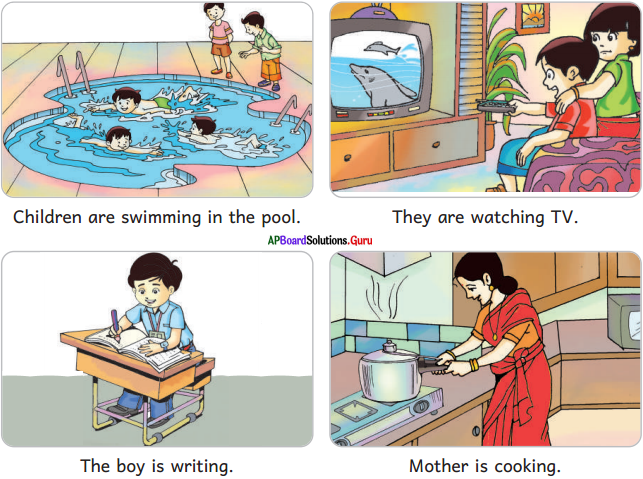
A. Present Continuous:
AP Board 6th Class English Solutions Chapter 2 The Snake Catcher 5
All the sentences in the above pictures are giving information about ‘ongoing actions’. We write sentences in the ‘Present Continuous (Present Progressive)’ to describe a continuing or ongoing action at the present time. The ‘-ing’ form of the verb is used in these contexts.

I. Now, fill in the blanks with suitable verb forms provided in brackets.
1. He is ………….. (complain) about my handwriting at present.
2. She is …………… (play) magnificent tennis in this match.
3. It is ………… (rain) now.
4. We’re …………. (have) dinner now.
5. Please be quiet. I’m ………… (work).
6. Look! Somebody is ……….. (swim) in the pool.
Answer:
1. He is complaining ( complain) about my handwriting at present.
2. She is playing (plav) magnificent tennis in this match.
3. It is raining (rain) now.
4. We’re having (have) dinner now.
5. Please be quiet. I’m working (work).
6. Look! Somebody is swimming (swim) in the pool.

AP Board 6th Class English Solutions Chapter 2 The Snake Catcher

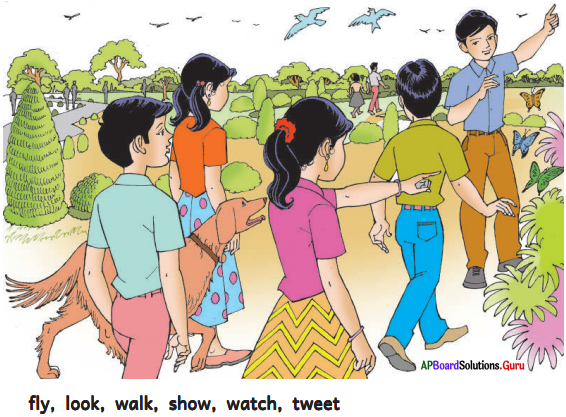
II. Look at the following picture. Sony, Rita, Bannu, Prasad and Hari visited the park along with their pet dog and a dove. Look! There are butterflies and two small birds in the picture. Now write sentences with verbs denoting actions (action at present).You can use the following verbs. One is done for you.
AP Board 6th Class English Solutions Chapter 2 The Snake Catcher 6
eg : A bird is tweeting.
Answer:
Birds are flying.
Children are looking at the flowers.
The dog is walking along with the children.
Rita is looking at the butterflies.
Prasad is showing something.
Sony is watching the birds.

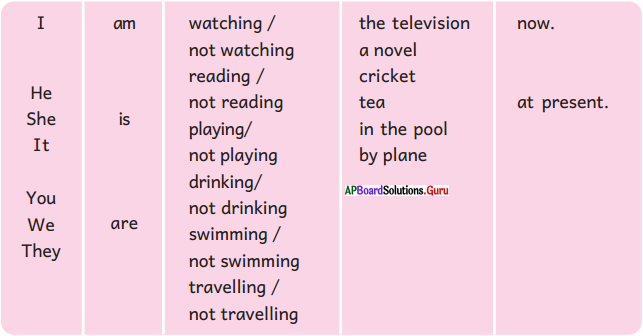
III. Look at the following table. This table enables you to write sentences in the Present Continuous Tense. Prepare more sentences of your own in the context of ‘something happening now’.
One is done for you.
1. He is playing cricket now.
2. He is not playing cricket now.
AP Board 6th Class English Solutions Chapter 2 The Snake Catcher 7
Answer:

  1. I am watching the television now.
  2. I am not watching the television at present.
  3. I am swimming in the pool at present.
  4. I am not travelling by plane now.
  5. I am not drinking tea at present.
  6. He is not swimming in the pool now.
  7. He is not watching the television at present.
  8. He is travelling by plane at present.
  9. He is reading a novel at present.
  10. She is watching the television at present.
  11. She is swimming in the pool at present.
  12. It is not swimming in the pool now.
  13. You are not watching the television at present.
  14. You are reading a novel now.
  15. We are not playing cricket now.
  16. We are watching cricket now.
  17. We are not drinking tea at present.
  18. They are not watching cricket now.
  19. They are not swimming in the pool at present.
  20. They are travelling by plane now.

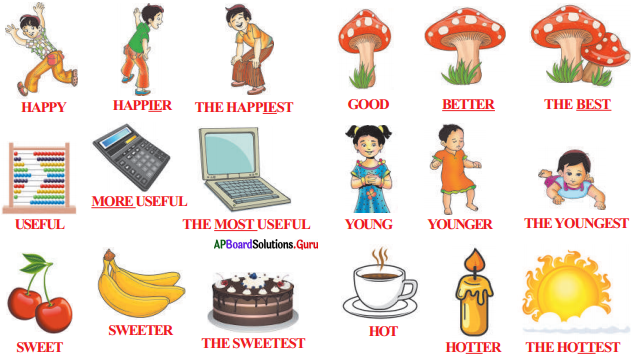
B. Degrees of Comparison :
You already know about ‘Adjectives’ and their functions in sentences. They not only describe nouns but also compare them in degrees in terms of quality as follows.
AP Board 6th Class English Solutions Chapter 2 The Snake Catcher 8

We use the comparative form of the adjective to compare one person or one thing with other person (s) or thing(s). We use the Superlative form of adjective to compare one person or thing with his/her/its/ whole group.

Read the following sentences.
1. My house is bigger than yours.
2. The Pacific Ocean is deeper than the Arctic Ocean.
3. The earth is larger than the moon.
4. The Jupiter is the biggest planet in our Solar system.
5. Sheela is the smartest girl in the class.
6. Mount Everest is the highest mountain in the world.

We use ‘than’ after Comparatives and in Superlative degree the article ‘the’ comes before the adjective form.

Now, fill in the blanks with suitable adjective forms.
1. Bhama is …………… Radha. (preety)
2. Harish is …………… boy in the class. (tall)
3. Elephant is …………… animal in the forest, (big)
4. Iron is …………… cotton. (heavy)
5. Anantapuramu is …………… district in Andhra Pradesh, (large)
Answer:
1. Bhama is prettier than Radha.
2. Harish is the tallest boy in the class.
3. Elephant is the biggest animal in the forest.
4. Iron is heavier than cotton.
5. Anantapuramu is the largest district in Andhra Pradesh.

Writing

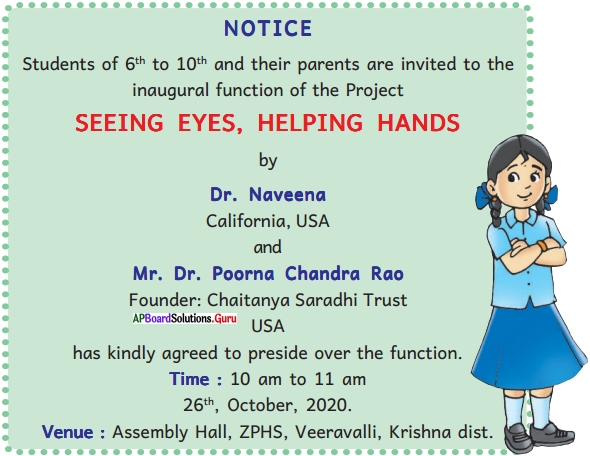
Read the following NOTICE which was put up on your school Notice Board.
AP Board 6th Class English Solutions Chapter 2 The Snake Catcher 9

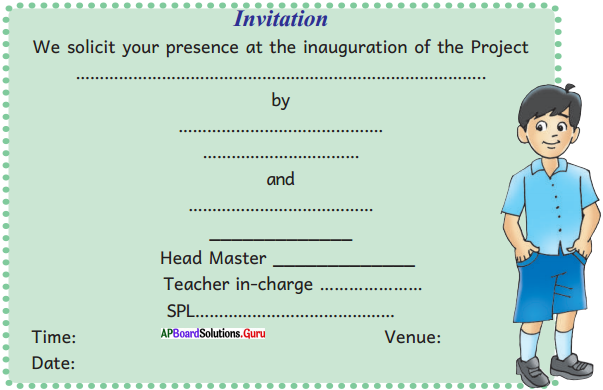
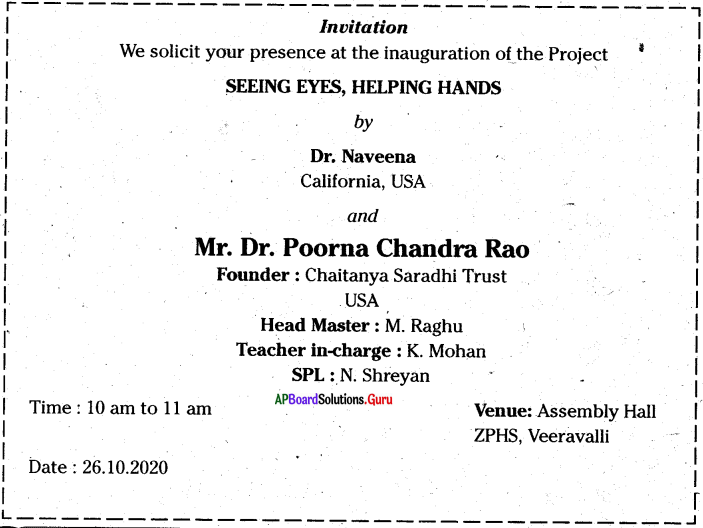
1. Now, to invite officials, donors and some other eminent persons of your village an Invitation card is needed. Prepare a formal invitation card based on the above notice in your text.
AP Board 6th Class English Solutions Chapter 2 The Snake Catcher 10
Answer:
AP Board 6th Class English Solutions Chapter 2 The Snake Catcher 11

2. Now prepare an oral invitation toJnvite some special invitees. Imagine that you are the School Pupil Leader and invite them over phone.
Eg .: You may invite your Sarpanch, newspaper journalist, SHO (SI) of Police Station, elders of your village, etc.

Now complete the following conversations.
You (on the phone with the Journalist)

School Pupil Leader : Hello, Good morning. I am Sudha, SPL from ZPH SCHOOL, Veeravalli. Could I speak to you now, sir?

Newspaper Journalist : Very good morning Sudha. You may talk now itself.

School Pupil Leader : I have a request. Our school is starting a new social work project ………..

Answer:
School Pupil Leader : Hello, Good morning. I am Sudha, SPL from ZPH SCHOOL, Veeravalli. Could I speak to you now, sir?

Newspaper Journalist : Very good morning Sudha. You may talk now itself.

School Pupil Leader : I have a request. Our school is starting a new social work project ……….. ‘SAY NO TO PLASTIC’. I cordially invite you to attend the event without fail.

Newspaper Journalist : Thank you! I will certainly attend. At what time does the programme start?

School Pupil Leader : At 10 am.

Newspaper Journalist : Where does it take place?

School Pupil Leader : At School Assembly

Newspaper Journalist : OK. It is alright.

3. Now prepare another oral invitation, i.e. convey this message to your parents.
Answer:
I : Amma, here is an invitation for you.

Mother : Invitation! What is it about?

I : Our school is starting a new social work project ‘SAY NO TO PLASTIC’. The school cordially invites you to attend the event without fail.

Mother : Thank you! I will certainly attend. At what time does the programme start?

I : At 10 am.

Mother : Where does it take place?

I : At School Assembly

Mother : Who will inaugurate the project?

I : Dr. Naveena from California and Dr. Poorna Chandra Rao, the founder of Chaitanya Saradhi Trust.

Mother : OK. It is alright.

Talking Time

I. Role-Play

Work in pairs and role play the following conversation.

Latha : Sudha! Let’s go out to play.
Sudha : Not now! I’m doing my homework.
Latha : You can do it later. Let’s go and play.
Sudha : Sorry. I’d like to do my work first.
Latha : You won’t get a medal for it.
Sudha : My grandfather has taught me ‘Work is worship’. I don’t care whether I get any reward for the work I do or not.
Latha : Are you joining me or not ?
Sudha : Of course, I’ll, but only after completing my homework.

AP Board 6th Class English Solutions Chapter 2 The Snake Catcher

II. Language Functions
Here is the conversation that happened between Tarak and Rajan at a birthday party. Read it..

Tarak : Hello, Mr. Rajan! Good evening and warm welcome. We are looking forward to have you in this party.

Rajan : Good evening, where is the birthday boy? Here is a small gift for him.

Tarak : Oh, Thank you. Would you like to have some fruit juice? Here it is.

Rajan : Yes, please.

Tarak : Here are some sweets and special snacks.

Rajan : No, thanks. I’ve got enough.

Tarak : Thank you very much for your warm wishes to my child. It’s so special that you remember.

Rajan: You are welcome.

In the above conversation the phrases in italics are used in different occasions. Do you know when we use them? Let’s learn in detail.

1. Thank You : It is used to show that you are grateful to Somebody for something they have done.
2. Would you like to : To say in a polite way to offer something to somebody.
3. Yes, please : This is used to accept an offer/invitation.
4. No, thanks: This is used to give a negative reply in a polite way.
5. You’re welcome : This is used as a polite reply when somebody thanks you for something.

Now, fill in the blanks in the following paragraph with suitable phrases given in the box. Some phrases can be used more than once.
D:\apAP Board 6th Class English Solutions Chapter 2 The Snake Catcher 12boardsolutions.guru\VGS Class 6 Blossoms English Question Bank\IMG\Ch 2\AP Board 6th Class English Solutions Chapter 2 The Snake Catcher 16.png
Phani is going to school on his bicycle. Suddenly he falls, as his bicycle tyre is flat. A mechanic, who is the owner of a nearby shop, approaches him and helps him stand. Phani says,”…………..” The mechanic replies,”……………” and asks “Are you alright?” “It’s paining,” says Phani. ”……… some water?” asks the mechanic.”…………….” says Phani; The mechanic serves him some water. “………..” says Phani.”………….. your bag?” asks the mechanic.” ……….. I can,” says Phani.
Answer:
Phani is going to school on his bicycle. Suddenly he falls, as his bicycle tyre is flat. A mechanic, who is the owner of a nearby shop, approaches him and helps him stand’. Phani says, “Thank you.” The mechanic replies, “It’s ok.” and asks “Are you alright?” “It’s paining,” says Phani. “Would YOU like to have some water?” asks the mechanic. “Yes, please.” says Phani. The mechanic serves him some water. “ Thank you.” says Phani. “Can I carry your bag?” asks the mechanic. “ No. please. 1 can,” says Phani.

III. Read the words aloud.
AP Board 6th Class English Solutions Chapter 2 The Snake Catcher 13
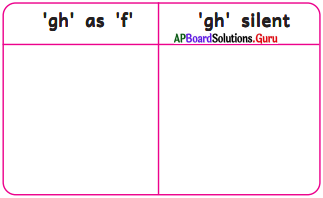
All these words ended in the ‘gh’ cluster. But they are pronounced in different ways. In some words ‘gh’ is pronounced as ‘f’ and in some words it is silent.
Arrange these words under correct headings based on their pronunciation.
AP Board 6th Class English Solutions Chapter 2 The Snake Catcher 14
Answer:

‘gh’ as ‘f’‘gh’ silent
coughbough
toughfight
enoughcaught
laughthigh
roughthough

Study Skills

Refer to a dictionary.
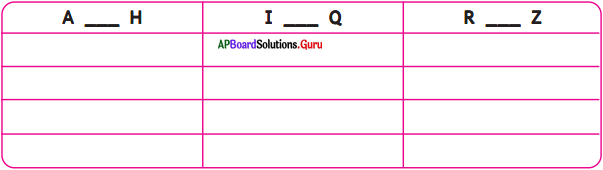
Arrange the following words in alphabetical order in the correct columns below.
dragon, raise, display, crowd, difficult, thick, stronger, warm, panic, mighty, pillar, luxurious
AP Board 6th Class English Solutions Chapter 2 The Snake Catcher 15

A___HI___QR___Z
crowdluxuriousraise
difficultmightystronger
displaypanicthick
dragonpillarwarm

Project Work

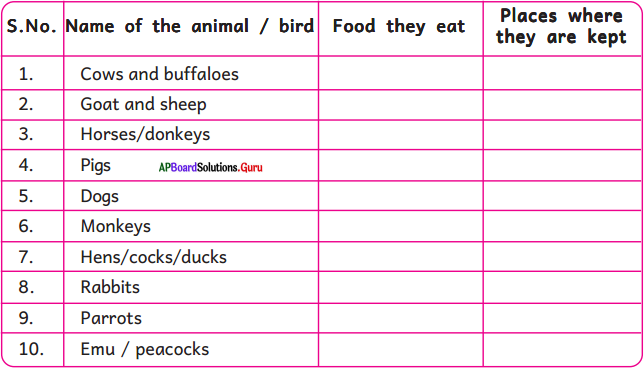
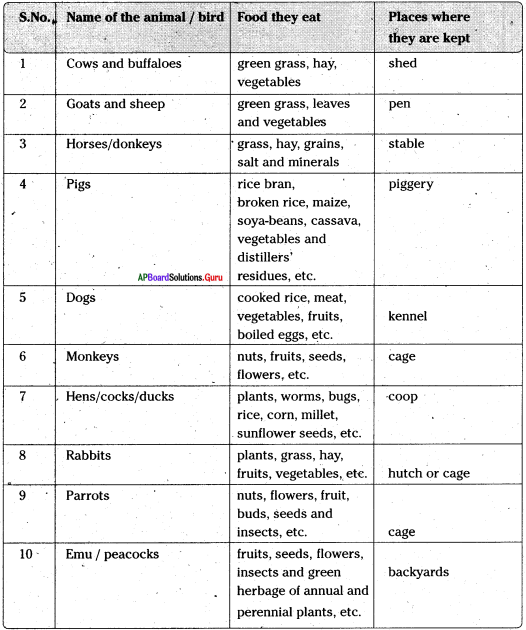
Collect the information relating to domestic / pet animals / birds in your location. Fill hi the information in the following table.
AP Board 6th Class English Solutions Chapter 2 The Snake Catcher 16
Display the table in the class. Remember all the animals / birds above may not be our pet animals.
Answer:
AP Board 6th Class English Solutions Chapter 2 The Snake Catcher 17

Fune Time

Anagrams:
Look at the following words:
Arc-car; elbow-below; eleven plus two-twelve plus one.

Look at this sentence.
Was it a cat I saw?

Have you noticed that letters in the left side word or phrase can be formed by rearranging the letters of right side words? This type of words are called Anagrams. Let’s observe some more words.

cat – act, inch – chin, night – thing, study – dusty

Can you frame some more anagrams like this? But remember, all the letters of the word or phrase must be used ONCE ONLY and ONLY ONCE. This is the basic rule of anagramming.
Answer:

spot – stop – postrange – anger
team – meat – mate – tameplate – petal
least – steal – stalering – grin
master – streamdawn – wand
three-therethrow-worth
gulp-plugform – from
page-gapesave – vase
hear – haremean – name – mane
draw – wardthese – sheet

Language Game

ONE, TWO, THREE

1. Step One : Letters
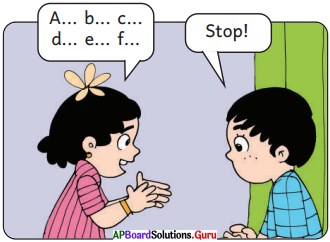
Form pairs. One person says the letters of the alphabet from A to Z in his mind till the other person stops him. Write down the letter you get.
AP Board 6th Class English Solutions Chapter 2 The Snake Catcher 18

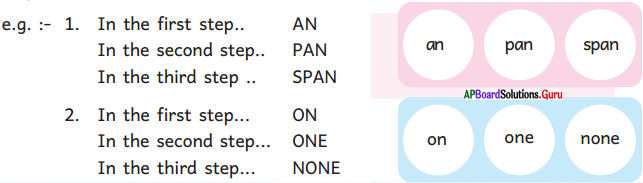
2. Step Two : Words
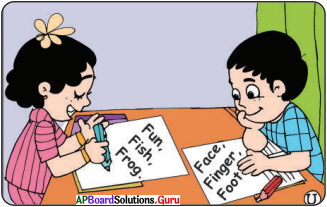
Both partners write 3 words each beginning with that letter.
AP Board 6th Class English Solutions Chapter 2 The Snake Catcher 19

3. Step Three : Phrases
Exchange the words you write. Then use the words you get to write meaningful phrases.
AP Board 6th Class English Solutions Chapter 2 The Snake Catcher 20

Link Puzzle
Here is a ‘Link Puzzle’ for you to solve. The last three letters of one word become the first three letters of the next word.
Clue
AP Board 6th Class English Solutions Chapter 2 The Snake Catcher 21
Answer:
AP Board 6th Class English Solutions Chapter 2 The Snake Catcher 22

The Coromandel Fishers

AP Board 6th Class English Solutions Chapter 2 The Snake Catcher 23
Rise, brothers, rise; the wakening skies pray to the morning light,
The wind lies asleep in the arms of the dawn like a child that has cried all night.
Come, let us gather our nets from the shore and set our catamarans free,
To capture the {gaping wealth of the tide, for we are the kings of the sea!

No longer delay, let us hasten away in the track of the sea gull’s call,
The sea ls our mother* the cloud is our brother* the waves are our comrades all.
What though we toss at the fall of the sun where the hand of the sea-god drives?
He who holds the storm by the hair, will hide in his breast our lives.

Sweet is the shade of the coconut glade, and the scent of the mango grove,
And sweet are the sands at the full o’ the moon with the sound of the voices
we love; But sweeter, 0 brothers, the kiss of the spray and the dance of the
wild fOctnfs glee; Row, brothers, row to the edge of the verge, where the low sky mates with the sea.

Figures of speech used in this poem :

  1. The wakening skies pray to the morning light. – Personification
  2. The wind lies asleep in the arms of the dawn like a child. – Simile
  3. The sea is our mother. – Metaphor
  4. The cloud is our brother. – Metaphor
  5. The waves are our comrades all. – Metaphor.

Appreciation

I. Match the rhyming words.

1. light – sea
2. free – lives
3. call – night
4. drives – all
Answer:
1. light – night
2. free – sea
3. call – all
4. drives – lives

II. Choose the correct options to complete the sentences.

1. The poet says that the sea is our………………
a) mother
b) brother
c) sister
d) comrades
Answer:
a) mother

2. The poet says that the cl6ud is our
a) mother
b) brother
c) sister
d) comrades
Answer:
b) brother

3. The poet says that the waves are our
a) mother
b) brother
c) sister
d) comrades
Answer:
d) comrades

III. Answer the following questions.

Question 1.
What sort of sounds can one hear early in the morning?
Answer:
One can hear the chirping of the birds, the sound of the leaves of the coconut tree, the sound of the rising waves, the voices of the fishermen gathering their nets and boats.

Question 2.
How is the wind described in line two?
Answer:
If the child cries all the night, it will sleep calmly in the early morning. Like that, the wind blowing all the night lies asleep in the arms of the dawn.

AP Board 6th Class English Solutions Chapter 2 The Snake Catcher

Question 3.
Why are the nets to be gathered?
Answer:
The fishermen put their nets on the sand to dry. In the morning before they set to go, the nets are to be gathered.

Question 4.
What do you think is the wealth of the fishermen?
Answer:
The fishes in the sea are the wealth of the fishermen.

Question 5.
What do you understand from the first line ‘The wakening skies pray to the morning light”?
Answer:
At night the sky might be sleeping, so the poetess describes the sky is wakening in the morning light, and it seems to pray.

Question 6.
The poet says, ‘Let us set our catamarans fr6e.’ What does it mean?
Answer:
The poet tells the fishermen to free the catamarans, because after fishing, the fishermen tied their catamarans to the pole. In the morning they have to go to fishing so they must untie their catamarans. ,

Question 7.
What happens if the fishermen are late in their work?
Answer:
If the fishermen are late in starting their work, the wind starts blowing, it will bb difficult to reach the deep part of ocean and they will not be able to follow the seagull’s call.

Question 8.
The poet describes many things as sweet. What are they? Among them what is considered to be the sweetest?
Answer:
The coconut tree’s shade is sweet. The smell of the mango grove is sweet. The sands at the full moon day are sweet. The voices of the people are sweet. The kiss of the spray means the water comes out of the. waves and sprinkles are sweeter. The dance of the wild foam’s sound [song] is also sweeter and the cool breeze on the sea is considered to be the best and.the sweetest.

The Snake Catcher Summary

Once there was a snake catcher in Iraq. He was a snake charmer and it was his livelihood. One day he went into the snowy mountains to search for a new kind of snake. He found a powerful and terrible dragon which seemed quite dead in frozen snow. It looked very attractive and he thought he would earn from that snake. He brought it down ih a bundle.
Later he started his show in a bazaar in a town. He announced that he killed the terrible snake and brought it to show them. People gathered curiously to watch it. As it was a hot day, the dragon moved slowly from its frozen state. Soon it burst forth from the bundle and came out. On seeing the terrible snake coming alive, people ran away from it in panic. The mighty serpent ate the people in its path and entwined itself around a pillar. It killed and ate the snake catcher also.

The Coromandel Fishers Summary

Sarojini Naidu as a poet belongs to an era of struggle, slavery, and freedom fighting. The poem is thought about the fishermen, yet it metaphorically reflects the poet’s desire for free India. The poem consists of three stanzas having four lines each. The rhyme scheme of the poem is AABB.

The wakening skies pray to the morning light, symbolizes the land which is welcoming independence after being in the darkness of slavery for so long. The wind lies asleep in the arms of the dawn like a child that has cried all night refers to the atrocities that the land of India and the people of India had suffered in the hands by the British during their cruel rule. The poet asks the freedom fighters to gather our nets from the shore and set our catamarans free. They are the kings of the sea which refers to India.

In the second stanza, the poet urges the freedom fighters not to delay andat ortce start fighting as the leaders (seagulls) have declared a war against the British and they should follow their leader’s path. The sea is our mother, the cloud is our brother, the waves are our comrades all i.e. the land is theirs and everything in it is their family and hence they (the freedom fighters) need not fear.

In the final stanza, the poet says that the comforts and the joys that the Indians enjoy might be sweet but the fragrance of independence and the feeling Of being free is quite sweeter and hence the freedom fighters should wage a final war on the British.

Explanation of the poem :

Stanza 1 :
In stanza 1, the poet asks the fishermen to “Rise” as the day is about to appear. She uses some symbols to fell this. First, she says that the wakening skies pray to the morning light which means that the sky which was sleeping in the night has woken up and is welcoming the light. Here the poet uses personification by using wakening (a human activity) for the sky (a non-living thing).

Next, she says the wind lies asleep in the arms of the dawn like a child that has cried all night meaning that the sea-wind that leads to the storm is now calm (as the tides rise in the night because of moon’s gravitational pull) because of the morning which is about to come.

Thus the wind is just like the child which kept crying throughout the night and now he is quiet. Here the poet uses Simile to compare now calm wind with a child. By using these two symbolic examples, she declares that the morning is near.

In the 3rd line, the poet asks the fishermen to gather their nets from the shore and set catamarans (a kind of boat used by fishermen) free in order to capture the leaping , wei lth of the tide, for they are the kings of the sea.

According to the poet, the fishermen should collect their nets from the sea-shores and take their boats because the tide is- full of wealth (fishes, sea-gulls, etc.) and they are the kings. They just need to go to the sea to capture the wealth that is theirs. Hence they should hurry.

Stanza 2:
In stanza 2, the poet asks the fishermen to do everything fast. The gull’s call is a symbol used to depict that morning is near.

The poet calls sea as their mother, cloud as brother and sea waves as their comrades, ^ i.e. companions. Here again, the poet uses personification.

Sea is considered the mother because it feeds them and helps them to sustain their life. Similarly, clouds are their brothers because they guide the fishermen while the waves are companions because they keep moving with them. The poet thus wants to say that they all are family and help each other.

She urges other not fear because even if they could not return back by the sunset, the sea-god which according to her, holds the sea-storm by the hair and Saves them (hide in his breast our lives).

Stanza 3:
In the final stanza, the poet says that the shade of the coconut glade, the scent of a mango grove, and the sands at the full of the moon with the sound of the voices they love are sweet and enjoyable but these joys are temporary.

Rather they should go for the kiss of the spray (the water drops falling on the face while in the sea) and the dance of the foam’s glee (the foam which forms by the up-down movement of the tides) which according to the poet are sweeter and work struggling.

In the last line, she asks the fishermen to depart for the point in the sea where the sun meets the sky i.e. horizon. Symbolically it refers to infinity or a place without an end. In this perspective, she asks the fishermen to dive into the infinite sea.

The Coromandel Fishers About the Poet

Sarojini Naidu was an Indian political leader born on February 13, 1879, in Hyderabad, India. In 1925, she was elected as the first female President of the Indian National Congress/ Naidu died on March 02, 1949, at Lucknow, Uttar Pradesh. Sarojini Naidu as a poet belongs to an era of struggle, slavery, and freedom fighting. Though the poem Coromandel Fishers is about fishermen, it metaphorically reflects the* poet’s desire for free India and thus she encourages the people of the nation to hasten their struggle.

AP Board 6th Class English Solutions Chapter 1 Clever Tenali Ramakrishna

SCERT AP Board 6th Class English Solutions 1st Lesson Clever Tenali Ramakrishna Questions and Answers.

AP State Syllabus 6th Class English Solutions 1st Lesson Clever Tenali Ramakrishna

6th Class English 1st Lesson Clever Tenali Ramakrishna Textbook Questions and Answers

Look at the picture and answer the questions that follow.
AP Board 6th Class English Solutions Chapter 1 Clever Tenali Ramakrishna 1

Question 1.
What do you see in the picture?
Answer:
I see a king, two poets / two courtiers, a man covering his head with a pot and a maid-servant.

Question 2.
Who is sitting on the throne?
Answer:
A king (Srikrishna Devaraya)

Question 3.
Can you guess the person who covered his head with a pot?
Answer:
Yes, he might be Tenali Ramakrishna.

Question 4.
Do you know any funny incidents related to Tenali Ramakrishna?
Answer:
Yes, I know one funny incident related to Tenali Ramakrishna. The following is a funny incident related to Tenali Ramakrishna.

Reading Comprehension

A. Answer the following questions

Question 1.
Who was Chitra Varma?
Answer:
Chitra Varma was a great painter in Srikrishna DeVaraya’s court. The king made him a chief advisor.

Question 2.
How did Chitra Varma feel when the emperor decided to reward him?
Answer:

The king’s reward was to make Chitra Varma his chief advisor. But Chitra Varma was afraid that he was not suitable for that post.

Question 3.
Why did Chitra Varma fail as a chief advisor?
Answer:
Chitra Varma was good at painting. He was not good at giving good advice. So he failed as a chief advisor.

Question 4.
Why was the emperor angry with Tenali Ramakrishna?
Answer:
Tenali Ramakrishna served the emperor horrible dishes. He made a carpenter cook food. So the emperor was angry with him.

Question 5.
Discuss in pairs what will happen when people are offered to do work that is not meant for them.
Answer:
Pah 1 : It is not a good idea to offer to do work that is not meant for them because they spoil the work.
Pah 2 : If we offer people to do work that is not meant for them, people will suffer.
Pah 3 : They may take improper decisions and they may lead to some problems.
Pair 4 : It may lead to the loss of time and money.

B. Put the following sentences in the order of events

1. People went to Tenali Ramakrishna and told him their problem.
2. Chitra Varma was appointed a chief advisor to the emperor.
3. Tenali Ramakrishna implemented his plan by engaging a carpenter as a cook.
4. Emperor Srikrishna Devaraya realized his mistake at the end.
5. Chitra Varma was a famous painter in the emperor’s court.
Answer:
1. Chitra Varma was a famous painter in the emperor’s court. (5)
2. Chitra Varma was appointed a .chief advisor to the emperor. (2)
3. People went to Tenali Ramakrishna and told him their problem. (1)
4. Tenali Ramakrishna implemented his plan by engaging a carpenter as a cook. (3)
5. Emperor Srikrishna Devaraya realized his mistake at the end, (4)

C. Say whether the following statements are True / False:

1. Chitra Varma was a famous carpenter.
Answer:
False

2. Emperor Srikrishna Devaraya awarded a lot of gold coins to Chitra Varma.
Answer:
False

3. Tenali Ramakrishna was a poet and jester in emperor Srikrishna Devaraya’s court.
Answer:
True

4. Tenali Ramakrishna prepared a delicious dinner for the emperor.
Answer:
False

5. Emperor Srikrishna Devaraya realized his mistake at the end.
Answer:
True

AP Board 6th Class English Solutions Chapter 1 Clever Tenali Ramakrishna 2
Correction of False Statements :
1. Chitra Varma was a famous painter.
2. Emperor Srikrishna Devaraya appointed Chitra Varma as his chief advisor.
4. Tenali Ramakrishna prepared horrible, spicy, salty, and undercooked food for the emperor.

Vocabulary

Look at these sentences. Observe the underlined words.
a. He took some irrelevant decisions.
b. With this the people grew impatient.
‘Here the prefixes such as “ir”, “il”, and “im” are fixed before the root/stem;
“relevant – irrelevant”
“logical – illogical”
“patient – impatient”

These prefixes change the meanings of words. By adding a prefix to a word we get another word. See more examples below.
AP Board 6th Class English Solutions Chapter 1 Clever Tenali Ramakrishna 3
happy – unhappy
sufficient – insufficient
mature – immature
agree – disagree
responsible – irresponsible

The prefixes ir, il, im, un, in, and dis are used to form the opposites in meaning. Now, write the opposite words using the prefixes mentioned above.

AP Board 6th Class English Solutions Chapter 1 Clever Tenali Ramakrishna 4
Word – Opposite Word
balance – imbalance
legal – illegal
regular – irregular
acceptable – unacceptable
comfort – discomfort
valid – invalid

In the story we have come across words such as encouragement, announcement, arrangement, confusion, etc. You might have observed that the part ‘-ment’ or ‘-sion ’ is added to the words encourage, announce, arrange and confuse in the end. The suffixes, ‘-ment’ and ‘-sion’ are used to form nouns out of verbs. Now, write the noun forms of the following using ‘-ment’, ‘-sion’.

AP Board 6th Class English Solutions Chapter 1 Clever Tenali Ramakrishna 5
Word – Noun Form
improve – improvement
discuss – discussion
depress – depression
confuse – confusion
enrich – enrichment
treat – treatment

You have come across certain words in the lesson such as “painter, grateful” etc; You can extract some other words from the parent words like

painter – pain
grateful – rate

Now make meaningful words from the following words.
1. reward – read, red, raw, war, ward, draw, drew, rear, rare, dew, wed, drawer, dear, ear, rear, rare
2. blessings – less, sing, sin, big, bin, leg, gel, bliss, sign
3. snapped – nap, pan, pen, pad, sad, sap, pane, sand, span
4. personal – son, reason, pearl, nose, slope, pole, sole, soap, lose, also, rope, rose
5. matter – mat, rat, art, arm, ram, mar, meat, team, tame, rate, tear, mate, mart, tram
6. continue – tin, cone, toe, tie, cut, cute, tune, cot, coin, none, note, nut, tone, not, ton, on, one, once
7. assure – sure, use, urea, ass
8. gold – old, go, god
9. properly – rope, role, pore, pole
10. slowly – low, sly, owl, sow

Grammer

A. i) Read the following sentences.

1. The emperor was pleased with Chitra Varma’s paintings.
2. Oh! What a beautiful picture!
3. Make an announcement.
4. Are you crazy, Ramakrishna?

The first one is a “Declarative sentence” as it makes a statement.
The second one is an “Exclamatory sentence” as it expresses a strong feeling.
The third one is an “Imperative sentence” as it gives an order.
The fourth one is ari “Interrogative sentence” as it asks a question.

AP Board 6th Class English Solutions Chapter 1 Clever Tenali Ramakrishna

ii) Read these sentences and write “D” for declarative, “E” for exclamatory, “In” for interrogative and “Im” for imperative in the brackets given.
1. Please show me the way to the library. (Im)
2. What a great painting this is! (E)
3. Where can I find a sweet shop? (In)
4. Mother looks after her children carefully. (D)
5. What happened? (In)

iii) Read the following sentences and put full stops, question marks and exclamation marks wherever necessary.
AP Board 6th Class English Solutions Chapter 1 Clever Tenali Ramakrishna 6
1. He got a good job
2. Did he get good job
3. What a great job
4. Get a great job first
5. What is your job
6. Have you finished your job
7. I am ready to finish my job
8. Is he ready to finish his job
Answers:
1. He got a good job. (full stop)
2. Did he get good job? (question mark)
3. What a great job! (exclamation mark)
4. Get a great job first. (full stop)
5. What is your job? (question mark)
6. Have you finished your job? (question mark)
7. I am ready to finish my job. (full stop)
8. Is he ready to finish his job? (question mark)

B. Conjunctions:

Read the following sentences and observe how the words in bold are used.
1. It is all your affection and encouragement.
2. People grew impatient but the emperor continued to support him.
3. Bring him at once or you will be punished.

The word “and” joins two words or phrases.
The word “but” is used to suggest a contrast.
The word “or” presents an alternative or a choice. These are called conjunctions. Conjunctions “and, but, or, yet, so, ” etc are joining words. They help to join two or more words, phrases or clauses.

Ex : He rushed into the hall and sat in the sofa.
It is raining heavily, so we won’t go out to play.

AP Board 6th Class English Solutions Chapter 1 Clever Tenali Ramakrishna

C. Read the passage carefully and underline the conjunctions.

AP Board 6th Class English Solutions Chapter 1 Clever Tenali Ramakrishna 7
Meena wants to go on holidays. Everyone is happy but Meena is not. She is unhappy because there are some baby sparrows in the nest on a corner of a room. If all the members of the family went out of the house, it would-be locked up, then how would the mother sparrow or the father sparrow feed their babies?

Meena’s mother said that they would remove all the things from the room, open the windows and lock the door from outside. Thus the house would be safe and sparrows could come anifl go freely. So Meena is happy again.
Answer
Meena wants to go on holidays. Everyone is happy but Meena is not. She is unhappy because there are some baby sparrows in the nest on a corner of a room. If all the members of the family went out of the house, it would be locked up, then how would the mother sparrow or the father sparrow feed their babies?

Meena’s mother said that they would remove all the things from the room, open the windows and lock the door from outside. Thus the house would be safe and sparrows could come and go freely. So Meena is happy again.

Writing

I. Conversation : Read the following conversation and write in the form of a narrative/story.

Ramakrishna : Good morning gentlemen.
People : Good morning Raman.
Ramakrishna : Happy to see you all. But.. .what made you come here?
People : You know everything. The emperor appointed Chitra Varma as his chief advisor.
Ramakrishna : Yes, I know.
People : The decisions.. ..the decisions taken by him confused us.
Ramakrishna : Yes, I’m also thinking about it.
People : Please do something and save us.
Ramakrishna : Don’t worry. I have an idea. Your problem will be solved soon.
People : Thank you Ramakrishna, we know you can do this.
Answer:
One day some people of Vijayanagara kingdom came to meet Tenali Ramakrishna. They both greeted each other. Ramakrishna told them that he was happy to see them all and asked them what was the reason for their arrival. The people told him that the emperor had appointed Chitra Varma as his chief advisor. They also informed him that the decisions taken by Chitra Varma were confusing them.

Then Ramakrishna told them that he was also thinking about it. They requested Ramakrishna to do something and save them. Ramakrishna told them not to worry. He also said that he had an idea. He assured them that their problem would be solved soon. The people felt happy and thanked Ramakrishna.

II. Read the following part from your lesson and write it in the form of a story.

Chitra Varma : Welcome, Your Highness.

Srikrishna Devaraya : Oh! What a beautiful picture! It looks so natural.

The courtiers : Yes, Your Majesty, really it is wonderful.

Srikrishna Devaraya : No painter on earth can compete with you, Chitra Varma. You are a unique painter. You shall be rewarded. What do you say Ramakrishna?

Ramakrishna : Yes, My Lord! Such an artist he is! He deserves your encouragement.

Srikrishna Devaraya : That’s great! Let him ask for anything. He shall get whatever he wants.

Chitra Varma : Thank you very much Your Majesty. It’s all your affection and encouragement.

Srikrishna Devaraya : Your presence on the council of advisors will be a boon to the Vijayanagar empire.

Chitra Varma : I am afraid I am not, Your Majesty! Your blessings are worth the strength of thousand elephants.

Srikrishna Devaraya : No, a great painter like you should be rewarded in a fitting manner.

Chitra Varma : Your highness is merciful.

Srikrishna Devaraya : (Thinking for a while, he snapped his fingers) You will be my chief advisor from today onwards.

Chitra Varma : What! I can’t understand, how I am blessed, Your Majesty.

Ramakrishna : Excuse me, Your Majesty! He is talented in painting but…would it be a right decision to make him…?

Srikrishna Devaraya : The emperor of Vijayanagar knows what is right. Minister, please make an announcement that Chitra Varma will be the chief advisor hereafter in our court.

Minister : Yes, Your Majesty. 1 will make an announcement in our empire.
Answer:
One day the king Srikrishna Devafaya visited the house of Chitra Varma, a great painter in his empire. Chitra Varma welcomed the king in great respect. The king saw a beautiful picture painted by Chitra Varma and praised that the painting was so natural. The courtiers who came along with the king appreciated that the painting , was wonderful. The king praised that Chitra Varma was a unique painter and no painter ‘ on earth could compete with him. He should be rewarded. The king asked for the opinion of Tenali Ramakrishna. Ramakrishna said that Chitra Varma deserved the king’s encouragement.

The king said that he would get whatever he wanted. Chitra Varma thanked the king for his affection and encouragement. The king felt that Chitra Varma’s presence on the council of advisors would be a boon to the Vijayanagar empire. But Chitra Varma was not willing and said that the king’s blessings were worth the strength of a thousand elephants. But the king wanted to reward him in a fitting manner as he was a great painter. The king appointed him his chief advisor. Chitra Varma felt that he was greatly blessed.

Ramakrishna opposed it by saying that Chitra Varma was talented in painting but he could nqt be a good advisor. It might not be a good decision to make him the chief advisor. But the king said that he knew what was right and asked the Minister to make an announcement that Chitra Varma would be the chief advisor thereafter in his court. The Minister said that he would make an announcement in the empire.

Talking Time

A. Announcement

AP Board 6th Class English Solutions Chapter 1 Clever Tenali Ramakrishna 8
Where do we listen to announcements?
At the bus station, at the railway station, at some public places, etc.
Here are some model announcements usually made at the Railway Station.

1. Your attention please… Train Number one, seven, four, eight, seven… the Tirumala Express… from Visakhapatnam to Kadapa is arriving on platform Number 7.
2. A Key Chain of a car has been found on the platform No.l. Whoever has lost it can collect it from Mrs Bharathi at the counter No 2.
3. Departmental announcement… Mr. Rajasekhar, the Electrical Engineer, is requested to attend to A-4 compartment of the Konark Express immediately.

B. Role play

AP Board 6th Class English Solutions Chapter 1 Clever Tenali Ramakrishna 9
Help me please…

Policeman : Who are you, little girl?

Girl : My name is Rishika.

Policeman : Why are you standing alone?

Rishika : I am lost.

Policeman : Oh, is it? Why did you come here?

Rishika : I came here with my parents to see the exhibition.

Policeman : Come, I will help you find your parents.

Rishika : Sorry, my parents and teachers advised me not to go with strangers Policeman : I will not harm you. You know, I am a policeman.

Rishika : OK. Then, I will give you my father’s phone number. Please call him.

Policeman : That’s good. 1 will call your father.

Rishika : Thank you sir.

AP Board 6th Class English Solutions Chapter 1 Clever Tenali Ramakrishna

C. Pronunciation (‘P”, “Ph” (/p/, /f/))

Read the following words aloud.

/p/ sound/f /sound
parrotphoto
parcelphone
pencilphrase
happyalphabet
paperelephant
applydolphin
capgraph
tripepitaph
taptriumph

Read the following sentences aloud.
Put the photo on the pad.
Pay up the penalty.
Post the parcel to the photographer.
Paste the graph and paint it.
Pay the price for a dolphin show.

Listeing

Listen to the following story carefully.

An Unexpected Reward

AP Board 6th Class English Solutions Chapter 1 Clever Tenali Ramakrishna 10
A boy and his grandfather were walking along a road. They passed a farmer working hard on his land. The farmer had taken his ragged shirt and worn-out shoes and placed them at the road’s edge. The boy felt he could play a little mischief. He said to his granddad, “Grandpa, why don’t we take the man’s shoes and shirt and hide behind the tree? When he finds them missing, he will be so angry. And we’ll have the fun of watching his expressions.”

But the grandfather replied, “Grandson, never make fun of a farmer or hurt his heart. If you just want to feel happy, then let’s do this instead. Take some coins and place them in each of the farmer’s shoes. Then we’ll hide behind the tree and see what happens.”

The boy did as his grandfather told him. After a little while, the farmer came for his clothes. He put on his ragged old shirt and his feet into his shoes. He felt something hard inside. Annoyed, he took the shoes off to see what it was. There were coins. He was astonished.

He looked up at the sky and fell to his knees.

“Oh! Great God! You are so kind. When I needed money the most, you sent me this gift. Thank you, God! And thank you to whoever you made your messenger.”

Then he walked home, overjoyed. The boy felt proud and happy. His grandfather said, “Grandson, the path to happiness is to make others happy.”

Answer the following questions:
1. Identify the characters in the story.
Answer:
A boy, his grandfather and a farmer are the characters in the story.

2. What did the boy and his grandfather observe while walking along the road?
Answer:
The boy and his grandfather observed a farmer working hard on his land. The farmer had taken his ragged shirt and worn-out shoes and placed them at the road’s edge.

3. Why did the boy want to hide the farmer’s clothes?
Answer:
The boy wanted to hide the farmer’s clothes to have fun of watching his expressions.

AP Board 6th Class English Solutions Chapter 1 Clever Tenali Ramakrishna

4. What advice did the grandfather give to the boy?
Answer:
The grandfather advised the boy not to make fun of a farmer or hurt his heart. He asked the boy to keep some coins in each of the farmer’s shoes to make him happy.

5. What was the unexpected reward to the farmer?
Answer:
The unexpected reward to the farmer was some coins kept by the boy on his grandfather’s advice.

The Thousand Gold Coins

Comprehension

Question 1.
Why did the neighbour throw a bag of coins to Nasruddin?
Answer:
The neighbour wanted to know whether Nasruddin would accept the coins or not if the coins were lesser than one thousand.

Question 2.
Who was the clever man in the story?
Answer:
The clever man was Nasruddin.

AP Board 6th Class English Solutions Chapter 1 Clever Tenali Ramakrishna

Question 3.
The neighbour said sorry. Why?
Answer:
The neighbour lost the case. Nasruddin gave him his money, coat and horse. The neighbour said that he was sorry for interfering in his business.

Fun Time

Laugh and make others laugh.
AP Board 6th Class English Solutions Chapter 1 Clever Tenali Ramakrishna 11
Friend : You are so lucky, no mosquito can bite you now.

AP Board 6th Class English Solutions Chapter 1 Clever Tenali Ramakrishna 12
Joke:
Teacher: If I give an apple to you and your sister, and ask you to share it equally, which part of the apple will you get?

I : The whole apple.

Teacher : How?

I : My sister doesn’t like apples.

You can use any two-letter word in the first step, three- letter word next step, four letter word last.
AP Board 6th Class English Solutions Chapter 1 Clever Tenali Ramakrishna 13

Study Skills

Study the bill and answer the questions.
AP Board 6th Class English Solutions Chapter 1 Clever Tenali Ramakrishna 14
1. What is the name of the shop?
Answer:
Mahalakshmi Stores

2. What is the customer’s name?
Answer:
Srinivas

3. When did he buy the above things?
Answer:
On 21st of July, 2020

4. How much money did he pay to the shopkeeper?
Answer:
Rs. 275

5. How many pens did the customer buy?
Answer:
10

6. W hat is the price of one notebook?
Answer:
Rs. 40

Clever Tenali Ramakrishna Summary

Chitra Varma was a great painter. On seeing his great painting, one day Srikrishna Devaraya appointed him the chief advisor. Chitra Varma accepted it unwillingly. Tenali Ramakrishna also opposed it. Thus the announcement was made in the kingdom.
As Chitra Varma had no experience in handling court matters, the people of the kingdom became impatient and they met and requested Tenali Ramakrishna for solving the problem.

According to his plan, Ramakrishna invited the emperor to bless his son on his naming ceremony. He made all the arrangements. The emperor attended the ceremony and blessed the baby boy. Later, lunch was arranged and dishes were served. The dishes were horrible. They were not good to eat. They were not cooked properly. Then Ramakrishna brought the cook before the emperor and said that he appointed the best carpenter in the kingdom to cook dishes.

The emperor asked Ramakrishna how an excellent carpenter could become a cook. Ramakrishna replied that if a painter could be the emperor’s chief advisor, why a carpenter could not be a cook. The emperor thought and realized his mistake in appointing Chitra Varma his chief advisor. He sent Chitra Varma back to his previous job and thanked Ramakrishna. All praised Tenali Ramakrishna’s presence of mind.

The Thousand Gold Coins Summary

Nasruddin was clever. He had a habit of praying aloud. Every day he used to pray for one thousand gold coins. In his prayer he said that if God gave him one coin lesser, he would not accept the money.

A neighbour who heard the prayer of Nasruddin wanted to test Nasruddin and threw a bag of 999 coins into Nasruddin’s house. Nasruddin counted the coins. Though there were no 1000 coins, he accepted the money. The neighbour asked him how he could accept the money when they were 999 coins only. He said that he was the person who had thrown the money into his house.

Nasruddin said that he would accept the money as it was given to him by God. But the neighbour wanted his money back. Nasruddin refused to give it back. The neighbour asked Nasruddin to come to the court for justice. He offered his coat and his horse to come to the court. He told everything to the judge. Nasruddin played a trick and made the judge believe that the money, the coat and the horse belonged to him.

The neighbour felt sorry and said that he would never interfere in Nasruddin’s matters. Then Nasruddin gave him his money, horse and coat back.

AP 6th Class Social Important Questions Chapter 12 Towards Equality

These AP 6th Class Social Important Questions 12th Lesson Towards Equality will help students prepare well for the exams.

AP State Syllabus 6th Class Social Important Questions 12th Lesson Towards Equality

Question 1.
What is called equality?
Answer:
The state of being equal is called equality.

Question 2.
Who is Mariappan Thangavelu?
Answer:
Mariyappan Thangavelu is a child with a disability in his right leg. He won the gold medal in the men’s high jump in 2016 at the Rio Paralympics.

AP Board 6th Class Social Studies Important Questions Chapter 12 Towards Equality

Question 3.
Mention some eminent women who can be treated as role models.
Answer:
Indira Gandhi worked as prime minister of India. Sindhu from badminton, cricket captain Mithaliraj, the female ISRO scientists, writer Arundhati Roy and the world’s number one boxer Marycom are role models to many people.

Question 4.
Define inequality and discrimination.
Answer:
Inequality means not being treated equally. We find economic, social, and political inequalities in society. Discrimination means being negative towards people basing on color, religion, and gender.

Question 5.
What is the discrimination Dr. Ambedkar faced?
Answer:
Dr. B.R. Ambedkar faced caste discrimination. He belonged to a depressed family and suffered discrimination throughout his childhood. Later he fought actively for equality among the citizens of India.

AP Board 6th Class Social Studies Important Questions Chapter 12 Towards Equality

Question 6.
Write about Gender discrimination.
Answer:
Gender discrimination refers to inequalities between men and women in India. A girl is hot allowed to go to college after finishing her schooling. Most of the girls are not allowed to select a career of their choice. They are forced to get married. When compared to the past this discrimination was less at present.

Question 7.
Explain racial discrimination.
Answer:
Racial discrimination is discrimination against individuals on the basis of their skin color, or racial or ethnic origin. While traveling by train to Pretoria in South Africa, Gandhiji experienced racial discrimination. Though he is traveling with a first-class ticket, he was indiscriminately thrown out of the brain by the authorities with the encouragement of a white man.

Question 8.
Write about Dr. Anandibai Joshi.
Answer:
Dr. Anandibai Joshi was the first Indian female doctor. Her son lived a life of only ten days and then died. This sorrow inspired her to study medicine. She got an M.D. degree in 1886. She suffered from tuberculosis. She died in 1887 in Pune.

Question 9
What is the root cause of inequalities or discrimination?
Answer:
Lack of education, power, faiths, occupations, wealth, and traditions had created inequality and discrimination in our society.

AP Board 6th Class Social Studies Important Questions Chapter 12 Towards Equality

Question 10.
Name some social reformers who fought against inequalities and discrimination.
Answer:
During the early 19th century Raja Ram Mohan Roy, Ishwara Chandra Vidyasagar, Swami Dayananda Saraswati, fought Kandukuri Veeresalingam Panthulu, and Pandita Ramabai against inequalities and discrimination. During the second half of the 19th century Shri Narayana Guru, Dr.B.R.Ambedkar, C.V.Ramaswamy Naiker, Jyotibai Phule, and Savitribai Phulefought against the caste system.

Question 11.
What are the steps taken to achieve equality after achieving independence in 1947?
Answer:
After achieving independence in 1947 our leaders focussed on different kinds of inequalities. Untouchability was abolished by Law. People are free to choose the kind of work they wish to do. Government jobs are Open to all people. The government treated all religions equally. All the people are given equal importance.

Question 12.
Name some articles framed by the Constitution to achieve equality.
Answer:

  1. Article 14 provides equality before the law.
  2. Article 15(1) of the Constitution states that the State shall not discriminate against any citizen on grounds only of religion, race, caste, sex, place of birth, or any of them.
  3. Article 16 provides equality of opportunities in matters of public employment.
  4. ARTICLE 17 of the constitution abolishes the practice of untouchability as an offense and anyone doing so is punishable by law.
  5. Reservations are given to suppressed classes to get equal status.
  6. Fundamental rights are also given.

AP Board 6th Class Social Studies Important Questions Chapter 12 Towards Equality

Question 13.
Write a few lines about Nelson Mandela.
Answer:
Former South African President Nelson Mandela, was freed in 1990 and successfully achieved victory over racial, discrimination in South Africa. He brought peace to a racially divided country. He was awarded Bharata Ratna in 1990 by the Indian Government. He is also known as Gandhi of South Africa.

Question 14.
Write about Sindhutai.
Answer:

  1. Sindhutai Sapkal is a renowned social worker who focused on the lives of orphaned children.
  2. Sindhutai was born in 1948.
  3. She adopted 1200 orphans. She won 750 awards.
  4. On International Women’s Day in 2018, President Ram Nath Kovind honored Sindhutai^with Nari Shakti Puraskar. Through her inspiring journey, we can know that nothing is impossible.

Question 15.
What can we know from the lives of great people?
Answer:
A committed individual can achieve anything in the world. As Dr. Abdul Kalam said we may not have equal talent. But we all have equal opportunities to develop our talent.

AP 6th Class Social Important Questions Chapter 9 Government

These AP 6th Class Social Important Questions 9th Lesson Government will help students prepare well for the exams.

AP State Syllabus 6th Class Social Important Questions 9th Lesson Government

Question 1.
What is a government? What are the different types of government mentioned in this lesson?
Answer:
The group of people that controls and makes decisions for a country or a state is called the government. There are two types of government mentioned in this lesson.
They are:

  1. Monarchy and
  2. Democracy.

1. Monarchy: The type of government that was ruled by a king or queen is called Monarchy. A monarch comes to power by inheritance. Ex: Ashoka came into power after his father BinduSara. Citizens can have the rights and facilities depending on the monarch/king.
2. Democracy: The type of government that was run by the people is called democracy. Here every citizen can cast vote. They participate in taking decisions directly or through their representatives. Power cannot be inherited.

AP Board 6th Class Social Studies Important Questions Chapter 9 Government

Question 2.
How is democracy different from monarchy?
Answer:
Democracy is a government of the people, by the people, and for the people. In a democracy, people are supreme because it is they who give the government power to rule. The government has to explain its actions and defend its decisions to the people.
In a monarchy, it is the king or queen who has the power to make decisions and run the government. The monarch may have a small group of advisors to discuss matters with, but the final decision-making power remains with the monarch. Unlike in a democracy, kings and queens do not have to explain their actions or defend the decisions they make.

Question 3.
What are the duties of the government?
Answer:

  1. The government ensures food and shelter for the citizens.
  2. Government helps the people during cyclones and floods.
  3. The government protects the boundaries.

Question 4.
What do you mean by representative democracy?
Answer:
Representative democracy means people participate indirectly in the decision-making process. They choose their representative through an election process. These representatives meet and make decisions for the entire population.

Question 5.
What do you mean by Universal Adult Franchise?
Answer:
Universal Adult Franchise means that all adults in the country have the right to vote.

AP Board 6th Class Social Studies Important Questions Chapter 9 Government

Question 6.
In the early period who were not allowed to vote?
Answer:
Before independence women and people of some communities were not allowed to vote.

Question 7.
What is meant by the government at the local level?
Answer:
The local level government refers to governance for a village, town, or city.

Question 8.
What are the organs of the government? What are its functions?
Answer:
There are three organs of the government.

  1. Legislature
  2. Executive
  3. Judiciary.

Legislature: Legislature makes decisions or laws.
Executive: The executive executes the laws made by the legislature.
Judiciary: Judiciary interprets the laws.

Question 9.
What does a government do?
Answer:
In addition to making laws government organizes so many activities like building schools, hospitals, and roads, the government implements various schemes for the welfare of the people.

AP Board 6th Class Social Studies Important Questions Chapter 9 Government

Question 10.
How do you understand the rule of majority? Explain with an example.
Answer:
The rule of the majority is one of the key principles in democracy. The election of the representatives is by a simple majority. The one who gets more votes, even if it is just by one vote will get elected. Most decisions of the elected representatives are validated on the same principle of the majority. If a decision is supported by more than half of the members, it will be implemented.
Example: Five friends are trying to decide which cinema they have to go whether Telugu or Hindi. Three of them opted for Telugu cinema. The remaining two friends should go to the Telugu cinema by respecting the majority of rules, though they wanted to go for a Hindi cinema.

Question 11.
How many types of democracies are there? Explain.
Answer:
There are 2 types of democracies. They are

  1. Direct democracy
  2. Indirect democracy.

1. Direct Democracy: People directly participate in decision-making. For example Switzerland. The citizens of Switzerland gather at a place and take decisions or make laws. This system is possible in Switzerland as there is less population.
2. Indirect Democracy (Representative Democracy): In this form of democracy, people participate in decision-making indirectly through their representatives. Due to a large population, most of the countries in the world including India are following indirect democracy.

Question 12.
Into how many types of indirect types of democracy can be divided? What are they?
Answer:
Basing on the relation between the legislature and executive indirect democracy can be divided into two. They are

  1. Parliamentary system
  2. Presidential system

1. Parliamentary system: In this system executive body is formed from the legislature. This executive body is responsible to the legislature. Ex: India.
2. Presidential system: In this system executive body is not formed from the legislature. So the executive body is not responsible to the legislature. Ex: USA.

AP Board 6th Class Social Studies Important Questions Chapter 9 Government

Question 13.
Every state in India has a Capital city. This is the headquarters of the state government. Point out the following state capitals which are the headquarters of the state governments concerned in the given India Map.

  1. Bangalore (Karnataka)
  2. Hyderabad (Telangana)
  3. Chennai (Tamilnadu)
  4. Kolkata (West Bengal)
  5. Mumbai (Maharashtra)
  6. Amaravati (Andhra Pradesh)

Answer:
AP Board 6th Class Social Studies Important Questions Chapter 9 Government 1

AP Board 6th Class Social Studies Important Questions Chapter 9 Government

Question 14.
Observe the world map and answer the following questions.
AP Board 6th Class Social Studies Important Questions Chapter 9 Government 2
1. Name any two countries that follow the Presidential system in Asia.
Answer:
Afghanistan, Indonesia.

2. Name any two countries that follow the Parliamentary system in Asia.
Answer:
India, Pakistan.

3. Name any two countries that follow the Presidential system in Africa.
Answer:
Nigeria, Zimbabwe.

4. Name any two countries that follow the Parliamentary system in Africa.
Answer:
South Africa, Somalia.

5. Is there any country that follows the Presidential system in North America.
Answer:
Brazil.

AP 6th Class Social Important Questions Chapter 8 Kingdoms and Empires

These AP 6th Class Social Important Questions 8th Lesson Kingdoms and Empires will help students prepare well for the exams.

AP State Syllabus 6th Class Social Important Questions 8th Lesson Kingdoms and Empires

Question 1.
What is the difference between a kingdom and an empire?
Answer:
A territory ruled by a king was called Kingdom, Larger Kingdoms were called empires.

Question 2.
Hereditary rule prevailed in the ancient kingdoms of India. How is the present rule different from that time?
Answer:
At present ruling will be done by the persons who are elected by the people of India.

AP Board 6th Class Social Studies Important Questions Chapter 8 Kingdoms and Empires

Question 3.
How was Ashoka a unique leader?
Answer:
Ashoka was one of the most famous Mauryan rulers. He was known for his inscriptions. His inscriptions were in the people’s language Prakrit. Ashoka also remains the only king in history who gave up war after winning one. He was so horrified when he saw the violence and bloodshed in the Kalinga war. Ashoka then became a Buddhist and got the idea of the ‘dhamma’. So we can say that Ashoka was a unique leader.

Question 4.
Why did Ashoka inscribe messages for the future especially for his son and grandson?
Answer:
Ashoka inscribed a message for the future. He thought that his son and grandson after him should not think of war, instead, they should try to think about how to spread dhamma.

Question 5.
What was the capital of the Mauryan Empire?
Answer:
Pataliputra was the capital of the Mauryan empire.

Question 6.
What is the name of the book in which the ideas of Kautilya were written down?
Answer:
Ideas of Kautilya were written down in the book ‘Arthashastra’.

Question 7.
Who was Kautilya?
Answer:
Kautilya was also known as Chanakya and Vishnugupta. He was the Prime Minister of Chandragupta Maurya. ‘Arthasasthra’ was his famous book.

AP Board 6th Class Social Studies Important Questions Chapter 8 Kingdoms and Empires

Question 8.
How was the Mauryan empire established?
Answer:
The Maurya empire was founded in 322 BCE by Chandragupta Maurya by dethroning the last Nanda ruler. Later his son Bindusara and grandson Ashoka expanded the Mauryan empire. Maurya empire rapidly expanded power westward across Central and Western India.

Question 9.
Name of the king who was dethroned by Chandragupta?
Answer:
Mahapadmananda was dethroned by Chandragupta.

Question 10.
Who was Chanakya?
Answer:
Chanakya (or Kautilya) was a wise man who served Chandragupta Maurya.

Question 11.
What is Ashoka after Kalinga War?
Answer:
Ashoka discovered that Buddhism reflects his new beliefs and the thoughts of the console. He began preaching Buddhist ideas. He carved his policies on rocks and pillars. Ashoka advised the people to live with compassion towards all humans as well as animals. He appointed special officers to read the messages for the illiterates.

Question 12.
Write about the structure of Ashoka in Sarnath.
Answer:
Ashoka carved his instructions on the stone pillars. A massive stone pillar was carved at Sarnath. It was an impressive structure with four lions at the top. This is chosen as the “National Emblem of India”. The three lions represent three qualities of power, courage, and confidence. The fourth lion represents pride. The elephant represents strength, the bull represents hard work, the horse represents loyalty speed, and energy, and the lion represents bravery.

AP Board 6th Class Social Studies Important Questions Chapter 8 Kingdoms and Empires

Question 13.
What were the reasons for the downfall of the Mauryan Empire?
Answer:

  1. After the death of Ashoka, the Mauryan empire collapsed shortly because of weak kings and invasions. .
  2. Small kingdoms fought with one another in North India.

Question 14.
Write about Aryabhatta.
Answer:
Aryabhatta was a well-known astronomer and mathematician. He was known to have used algebra.

Question 15.
Who calculated solar year?
Answer:
Brahmagupta, another mathematician and astronomer in the Guptas period calculated solar year.

Question 16.
Write about the scientists of the Guptas Period.
Answer:
Scientists of Gupta’s period made important contributions in Astronomy and Science. They mapped the movements of the planets and the stars. They understood that the earth was round and revolves around the sun. They correctly explained that eclipses happen when the moon comes between the Sun and the Earth. They also seem to have understood gravity.

Question 17.
Who were called “Navaratnas’?
Answer:
Nine great poets in Chandragupta – H’s court were called Navaratnas.

AP Board 6th Class Social Studies Important Questions Chapter 8 Kingdoms and Empires

Question 18.
Who is named as the father of Ayurvedic Medicine? To which dynasty he belongs?
Answer:
‘Charaka’ was named as the father of Ayurvedic Medicine. He belongs to Gupta dynasty.

Question 19.
What is the book written by Charaka?
Answer:
The book written by Charaka was ‘Charaka Samhita’ which was the basic text for Ayurvedic Medicines.

Question 20.
Write about the tools during the Gupta period.
Answer:
During Gupta period scientists made metal technology. They made iron tools and weapons. They also made steel tools too. They made sophisticated gold coins.

AP Board 6th Class Social Studies Important Questions Chapter 8 Kingdoms and Empires

Question 21.
What was the title of Gautamiputra Satakarni? How did he get the title of ‘Trisamudradheeswara’?
Answer:
‘Trisamudradheeswara’ was the title given to Gautamiputra Satakarni. His empire expanded from the Arabian Sea in the west to Rajputana in the north and the Bay of Bengal in the east to Cuddalore in the South. By this, he conquered the land between the three seas. So he was given the title ‘Samudradheeswara’.

Question 22.
Write about Ikshavakas.
Answer:
After the end of the Sathavahana kingdom, Ikshavakas established a kingdom with its capital at Vijayapuri. Vijayapuri was located near Nagarjunakonda on the banks of the Krishna river. They tried to bring various headmen by marrying the people from other tribes. They also claimed to be the descendants of Lord Rama of the Ramayana. The woman of Ikshavaka made large donations to Nagarjunakonda.

Question 23.
What is the style of architecture followed by Chalukyas?
Answer:
A new style of architecture developed by Chalukyas was known as Vesara and it is a combination of South Indian (Dravida) and North Indian (Nagara) building styles.

AP 6th Class Social Important Questions Chapter 7 Emergence of Kingdoms and Republics

These AP 6th Class Social Important Questions 7th Lesson Emergence of Kingdoms and Republics will help students prepare well for the exams.

AP State Syllabus 6th Class Social Important Questions 7th Lesson Emergence of Kingdoms and Republics

Question 1.
Write a short note on the governance system in ‘ganas’ or ‘sanghas’.
Answer:
In ‘ganas’ or ‘sanghas’, there were not one but many rulers. Even if there were several men together, each was called a ‘raja’. They performed rituals together. They met in assemblies and took decisions. Women, slaves and wage earners were not allowed to – participate in these assemblies. Both Buddha and Mahavira belonged to Ganas or Sanghas.

Question 2.
What are the books written at the time of Mahajanapadas?
Answer:
The books written at the time of Mahajanapadas were mostly religious. Though they were religious books, they also tell us a lot about the towns and villages and about the rulers and kings of those times. Greece writers wrote some books. Famous books written during the Mahajanapada period were ‘Dharmasutras’, ‘Upanishads’, Dighenikaya, Majjhimanikaya and Herodotus History.

AP Board 6th Class Social Studies Important Questions Chapter 7 Emergence of Kingdoms and Republics

Question 3.
Write about Upanishads.
Answer:
Upanishads were a part of the Vedic books. Upanishad means coming and sitting near’ and the books have dialogues between teachers and students. These books try to answer questions like, ‘Where have we come from?’ or ‘Where do we go after death?’

Question 4.
What do you know about the potters of before Mahajanapadas time?
Answer:
Potters made earthen pots. Some of these were grey in colour, others were red. One special type of pottery found at these sites is known as Painted GreyWare. These grey pots had painted designs, usually simple lines, and geometric patterns. Plates and bowls are the most common vessels made out of painted grey ware. These are extremely fine to touch.
AP Board 6th Class Social Studies Important Questions Chapter 7 Emergence of Kingdoms and Republics 1

Question 5.
Write about the craftsmen of the Mahajanapadas period.
Answer:
Craftsmen made beautiful and fine pots which were in great demand in all the great towns. They weaved fina clothes which were bought by rich people of other Mahajanapads also. They made gold and silver jewellery. They made vessels and tools of bronze, copper, and iron. They made wooden carts and furniture.

AP Board 6th Class Social Studies Important Questions Chapter 7 Emergence of Kingdoms and Republics

Question 6.
Explain the Magadha Kingdom.
Answer:
Magadha kingdom was spread on both sides of the river Ganga. The river made the land very fertile and the grihapatis could irrigate their lands easily. The river was also used for transporting goods and armies. Parts of the Magadha were forested. Elephants were captured from there and trained for fighting in the wars. Wood from the forests was used for building fortresses, palaces, and chariots. In the southern parts of Magadha, there were iron ore deposits that could be used for making weapons, etc.

Question 7.
Write about Gandhara School art.
Answer:
The Gandhara school of art developed in the region around Takshashila, under the influence of Greek art. Realistic, proportionate, and delicate work in stone were some of the characteristic features of this style. Many images of Gautama Buddha have been sculptured in this style.

Question 8.
Which rulers conquered the last of the ‘ganas’ or ‘sanghas’?
Answer:
Gupta rulers conquered the last of the ‘ganas’ or ‘sanghas’.

AP Board 6th Class Social Studies Important Questions Chapter 7 Emergence of Kingdoms and Republics

Question 9.
Briefly explain Janapada.
Answer:
The plains through which Ganga and Yamuna rivers flow, that plain is called the Gangetic Valley. This plain receives very high rainfall. It is very fertile. These rivers bring silt from the Himalayas and flow throughout the year. Initially, the people of different tribes settled down to practice agriculture inconvenient parts of the valley. These tribes were called ‘jana’ in Sanskrit and the place where they settled was called ‘Janapada’.

Question 10.
Who is Grihapati?
Answer:
Landowners were called Grihapati’s or Gahapatis at the time of janapadas.

Question 11.
What were the yagas performed at the time of Mahajanapadas?
Answer:
The yagas performed at the time of Mahajanapadas were Rajasuya and Ashwamedha.

Question 12.
Who were the early kings of the Magadha empire?
Answer:
Bimbisara and his son Ajatasatru were the early kings of the Magadha empire.

AP Board 6th Class Social Studies Important Questions Chapter 7 Emergence of Kingdoms and Republics

Question 13.
Observe the given map and answers the following questions.
AP Board 6th Class Social Studies Important Questions Chapter 7 Emergence of Kingdoms and Republics 2
1. What is shown in the above map?
Answer:
16 Mahajanapadas and their capitals.

2. What is the capital city of Kuru Mahajanapada?
Answer:
Hastinapura.

3. What was the Mahajanapada that was situated in the extreme northwest?
Answer:
Kambhoja.

4. What was the Mahajanapada that was situated on the banks of the river Jhelum.
Answer:
Gandhara.

AP Board 6th Class Social Studies Important Questions Chapter 7 Emergence of Kingdoms and Republics

5. In which area is Avanti Janapada in present India?
Answer:
Madhya Pradesh.

6. In which area is Surasena Janapada in present India?
Answer:
Uttar Pradesh.

7. Which Janapada is situated in Madhya Pradesh and to the south of the river Yamuna?
Answer:
Chedi.

8. What is the Janapada situated to the south of Matsya?
Answer:
Avanthi.

AP 6th Class Social Important Questions Chapter 5 Early Life to Settled Life

These AP 6th Class Social Important Questions 5th Lesson Early Life to Settled Life will help students prepare well for the exams.

AP State Syllabus 6th Class Social Important Questions 5th Lesson Early Life to Settled Life

Question 1.
How did early humans become farmers?
Answer:
Early humans observed places where edible plants were found, about seeds, plants, etc. They started growing their own plants. And thus; they became farmers.

Question 2.
Name two neolithic tools which are used to grind grain even today.
Answer:
Mortars and pestles are the Neolithic tools used even today for grinding grain.

AP Board 6th Class Social Studies Important Questions Chapter 5 Early Life to Settled Life

Question 3.
Describe the tools used by farmers and herders.
Answer:
Stone tools have been found from many sites. They are often different from the Palaeolithic tools and are called ‘Neolithic’. There were tools that were polished so as to give a fine cutting edge. Mortars and pestles were used for grinding grain and other plant produce. However, Palaeolithic tools were still used for some purposes. Some tools were also made of bone.

Question 4.
What was the significance of pottery in the Neolithic Age?
Answer:
Many kinds of pottery have been found. These Were sometimes decorated and were used for storing things.. Pots were also used for cooking and eating.

Question 5.
What is domestication?
Answer:
Domestication is the name given to the process in which people grow plants and look after animals.

Question 6.
When was domestication was begun?
Answer:
Domestication was a gradual process that began about 12,000 years ago.

Question 7.
Name the earliest plants to be domesticated.
Answer:
Barley and wheat are the earliest plants to be domesticated.

AP Board 6th Class Social Studies Important Questions Chapter 5 Early Life to Settled Life

Question 8.
How did the hunter-gatherers get their name?
Answer:
The hunter-gatherers got their name from the way in which they lived. They used to gather food either by hunting animals or gathering food from the forests.

Question 9.
Why it was difficult for hunter-gathers to collect food?
Answer:
It was difficult for hunter-gatherers to collect food because:

  1. As there were several animals that ran faster than human beings and they were stronger also.
  2. People do not know about the edible part of the plant.

Question 10.
What are the reasons for nomads to move from one place to another?
Answer:
Nomads consume all the available food from plants and animals of a particular place and later move on in search of food to another place. Animals move from place to place for various reasons and hence this made the nomads move along with them for hunting. Plants and trees bore fruits in different seasons. Thus, people had to move along with the seasons in search of food and survival. People, plants and animals need water for survival. Most of the water bodies like lakes, ponds, streams dry up during the summer. Thus, nomads move to places in search of water during the dry seasons.

AP Board 6th Class Social Studies Important Questions Chapter 5 Early Life to Settled Life

Question 11.
What are the tools that hunter-gathers used? How they used them?
Answer:
They used a wide range of tools made out of stone, wood and bone. They used these . tools to scrape animal skins and to clean the skins. They made clothes with the skins, hides with the help of these tools. They used stone tools to cut animal flesh and bones.
They dug soil for edible tubers and roots with these tools. They prepared spears and arrows for hunting, with these they hunted animals easily.

Question 12.
Observe the below given Andhra Pradesh map and answer the following questions.
AP Board 6th Class Social Studies Important Questions Chapter 5 Early Life to Settled Life 1
1. What is a rock art site?
Answer:
The rock shelters which have the paintings of the early people are called rock art sites.

2. Name the districts which have no rock art sites.
Answer:
Srikakulam, Vizianagaram, Visakhapatnam, East Godavari and Krishna districts have no rock sites.

AP Board 6th Class Social Studies Important Questions Chapter 5 Early Life to Settled Life

3. In which district Adoni is located?.
Answer:
Kurnool district

Question 13.
Who are archaeologists?
Answer:
Archaeologists are the people who study the past by digging up old places where people lived and taking out remains of their lives like tools, bones, pots, buildings etc.

Question 14.
Write about Belum Caves.
Answer:
Belum caves are situated in the Kurnool district near Betamcherla and Banaganapalli. Archaeologists recovered a number of stone tools from these caves. These caves seem to have been used by the stone tools using hunter-gatherers as resting places for thousands of years.
Animal bones, stone tools especially microliths and also tools made of bones have been found in them. Tools made of bones are found only in these caves in the entire Indian Subcontinent.

Question 15.
Write about the paintings of hunter-gatherers.
Answer:
The hunter-gatherers spent their leisure time paintings. They painted pictures of humans, animals and hunting scenes on the walls of the caves and on rock shelters. Different colour stones were used and mixed with animal fat to prepare colours. They used bamboo brushes to paint on rocks and walls.

AP Board 6th Class Social Studies Important Questions Chapter 5 Early Life to Settled Life

Question 16.
Write about the rock shelter in the YSR Kadapa district.
Answer:
Chintakanta is in Muddunur Mandal of Y.S.R. Kadapa District. There are ten rock shelters near it that have paintings of early people. There are more than 200 paintings in white and red colour. But there are only ten white paintings. In the red colour paintings, humped oxen are found in only one cave, which is locally called Eddula Aavula Gundu. In the remaining paintings, we can see pictures of deer, stag, fox, rabbits, birds, human beings, etc.

AP 6th Class Social Important Questions Chapter 4 Land Forms – Andhra Pradesh

These AP 6th Class Social Important Questions 4th Lesson Land Forms – Andhra Pradesh will help students prepare well for the exams.

AP State Syllabus 6th Class Social Important Questions 4th Lesson Land Forms – Andhra Pradesh

Question 1.
What is our state song?
Answer:
Maa Telugu Talliki Mallepudanda is a bur State song.

Question 2.
What does our state song describe?
Answer:
Our state song describes the rivers and the rich heritage of our state.

AP Board 6th Class Social Studies Important Questions Chapter 4 Land Forms – Andhra Pradesh

Question 3.
What does relief of the region mean?
Answer:
Relief of region means the shape of the surface of the earth.

Question 4.
What is the other name of relief of region?
Answer:
Landforms are the other name of relief of region.

Question 5.
Where is Andhra Pradesh situated?
Answer:
Andhra Pradesh is situated in the east coastal line of South India.

Question 6.
What are the boundaries of our state?
Answer:
Chattisgarh, Odisha is in the north, Tamilnadu in the south, Telangana is in the west and north – west, and Karnataka is in the South – West and Bay of Bengal are in the east are the boundaries of our state.

Question 7.
What is the length of the coastal line of Andhra Pradesh?
Answer:
The length of the coastal line of Andhra Pradesh is 972 km.

AP Board 6th Class Social Studies Important Questions Chapter 4 Land Forms – Andhra Pradesh

Question 8.
On the basis of physical and economic conditions into how many parts can Andhra Pradesh be divided. What are they?
Answer:
On the basis of physical and economic conditions, Andhra Pradesh can be divided into two parts. They are :

  1. Coastal Andhra Pradesh and
  2. Rayalaseema.

Question 9.
Write about Coastal Andhra Pradesh.
Answer:
Coastal Andhra Pradesh consists of 9 districts. This region has the fertile soils of the Godavari, Krishna, and Penna Delta. The density of the population is also very high.

Question 10.
Write about Rayalaseema.
Answer:
Rayalaseema is a group of 4 districts. This region comprises rocky and drylands. The uncertain and less rainfall is not favorable for agriculture. So, this land is known for droughts and famines.

Question 11.
Describe mountains.
Answer:
The Mountain range contains severed hills. A mountain is a natural elevation of the earth’s surface. Mountains may have a small summit and a broad base. It is considerably higher than the surrounding area.
Y.S.R. Kadapa, Chittoor, Kurnool, and Vijayanagaram districts have stretches of hilly terrain which we can see as pockets of scattered hills called the Eastern Ghats.
Arakuloya, Borra caves of Vishakhapatnam district, and Papikondalu of East and West Godavari are the famous tourist places in the mountain region.

AP Board 6th Class Social Studies Important Questions Chapter 4 Land Forms – Andhra Pradesh

Question 12.
Where is Lambasingi situated and why it is famous?
Answer:
Lambasingi was situated in the interior tribal hamlet in Chintapalli Mandal of the Visakhapatnam agency. It has recorded single-digit temperatures in the winter like in Kashmir. So it is also known as Kashmir of Andhra Pradesh.

Question 13.
Who are Chenchus?
Answer:
The Chenchus are a tribal group practicing a pre-agricultural mode of economy. The government of India recognized them as a particularly vulnerable Tribe. They have been the inhabitants of the Nallamala forest area. They are hunter-food gatherers. They spread over the districts of Kurnool, Guntur, and Prakasam in Andhra Pradesh.

Question 14.
What Is a plateau? Describe.
Answer:
A plateau is an elevated flat land. It is a flat-topped table land standing above the surrounding area. A plateau may have one or more sides with steep slopes. The height of plateaus often varies from a few hundred meters to several thousand meters. Like mountains, plateaus also may be differentiated as young or old. The Deccan plateau in India is the oldest plateau and it is of volcanic origin. A large part of Rayalaseema is located in this Deccan plateau region.

Question 15.
Write a few lines about the Deccan plateau.
Answer:
Deccan plateau is the oldest plateau in India. The Deccan plateau is a lava plateau. The larger part of Rayalaseema comes under the Deccan plateau region.

AP Board 6th Class Social Studies Important Questions Chapter 4 Land Forms – Andhra Pradesh

Question 16.
Describe the plateau region.
Answer:
Plateaus are very useful because they are rich in mineral deposits. Many of the mining areas are located in the plateau areas. Limestone, manganese, asbestos, iron ore, gold, diamonds, graphite, dolomite, quartz, silica sand are available in plateau regions. The lava plateaus are rich in black soil. They are fertile and good for cotton cultivation. Many plateaus have scenic spots and are great tourist attractions.

Question 17.
What are Plains? Describe.
Answer:
Plains are level lands with flat surfaces. These are densely populated areas as flatlands are suitable for building houses, as well as cultivation. Because of fertile soils, the land is highly productive. Construction of transportation facilities is also easy.
In Andhra Pradesh, several districts are situated in the plains. Our state has a long stretch of plains called ‘Coastal Plains’ stretching from Srikakulam district in the North to the Pulicat Lake in the South.

Question 18.
What is Kharif and Rabi?
Answer:
Paddy monsoon crop is called Kharif and the winter monsoon crop is called Rabi.

Question 19.
What is a horticulture hub?
Answer:
Horticulture hub is an area where plantation crops, especially ready-to-harvest crops like banana, mango, guava, and papaya crops are grown.

Question 20.
What are the main rivers of Andhra Pradesh?
Answer:
Krishna and The Godavari is the main rivers of Andhra Pradesh. They flow from the Western ghats and join into the Bay of Bengal in the east by forming a large delta.

AP Board 6th Class Social Studies Important Questions Chapter 4 Land Forms – Andhra Pradesh

Question 21.
What is ‘Podu’?
Answer:
Podu is an ancient agricultural practice in the hilly regions. It is also called shifting or jhuming cultivation. In this method, the people clear a patch of land and use it to grow crops for one or two years and later shift to some other place.

Question 22.
How are the soils in the delta region get enriched?
Answer:
Every year the floodwaters of the river enrich the soils of the delta region. The floods bring silt-laden with humus with them. They deposit it in the flooded areas. In this way, the floods enrich the soils of the delta region.

Question 23.
How crops can be grown throughout the year in plain areas?
Answer:
Plain areas receive plenty of rainfall from June to October from the Southwest monsoon. Besides rainfall, bore wells and canals provide plenty of water for agriculture. Warm temperature and good sunshine make it possible to grow crops throughout the year.

Question 24.
Why plain areas are important for agriculture?
Answer:
Plain areas are important for agriculture because alluvial soils are deposited as sediments in these plains. They are deep and fertile, and the flatness facilitates mechanizes of crop production. They also support grasslands which provide good grazing for livestock.

AP Board 6th Class Social Studies Important Questions Chapter 4 Land Forms – Andhra Pradesh

Question 25.
Why soils in plateau areas are not suitable for cultivation?
Answer:
Soils in plateau areas are of two types: red and saline soils. These soils cannot hold much water. So fields in the Rayalaseema region are left to be uncultivated. Saline soils have a high content of lime and salts. They cannot absorb water and are not suitable for any crop.

Question 26.
Which crops can be cultivated in hilly areas and why?
Answer:
In hilly areas, the soils are uneven and sloped. These soils belong to red and rocky. Because of their high elevation and the natural downward movement of water, these soils are mostly well-drained and suitable for plantation crops like coffee and tea.

Question 27.
What are the sources of water in plateaus and hilly regions?
Answer:
In plateaus sources of water are rainfall, borewells, and tanks. In hilly regions source of water is only rainfall.

Question 28.
What are the famous tourist places in the mountain region of Andhra Pradesh?
Answer:
Borra caves of Visakhapatnam district and Papikondalu of East and West Godavari districts are the famous tourist places in these mountain regions.

AP Board 6th Class Social Studies Important Questions Chapter 4 Land Forms – Andhra Pradesh

Question 29.
What is a drought-prone region?
Answer:
A region that receives low and uncertain rainfall is called a drought-prone region.

Question 30.
What is the difference between a cash crop and a food crop?
Answer:
Cash Crop gives more income or profit to the farmer. It is also known as a commercial crop. Ex: Groundnut, turmeric, sugarcane, tobacco, etc.
A food crop is a crop grown for consumption. Ex: Paddy, millets, vegetables, etc.

Question 31.
What is known as aquaculture? What is the effect shown by aquaculture?
Answer:
The rearing of aquatic animals for food is known as aquaculture. Ex: Fish, prawn, shrimp, crabs, etc. Most of the farmers in coastal districts are shifting to aquaculture. Most of the paddy-growing fields are converted into aquaculture ponds. This change is resulting in water pollution and contamination of water ponds in paddy-grown areas.

Question 32.
What is the impact of a landform on people’s lives?
Answer:
Change in landforms impacts the wellness of a region, occupation, and food patterns. The plant and animal wealth of a place also depends upon the natural habitat and the climate that prevails in that region. Food, clothing, occupation, and livelihood of the people are closely connected with the regional and physical surroundings and climate.

AP Board 6th Class Social Studies Important Questions Chapter 4 Land Forms – Andhra Pradesh

Question 33.
What is Mean Sea Level (MSL)?
Answer:
The height of a surface from the sea is called Mean Sea Level. India’s mean elevation is 160 m (525 ft) and is taken from Mumbai High.

Question 34.
Write a brief note on landforms of Andhra Pradesh.
Answer:

  • Andhra Pradesh is situated in the east coastal line of India.
  • Andhra Pradesh has varied landforms.
  • The important landforms are Deccan Plateau in the South West.
  • The Eastern Ghats towards the mid-eastern part.
  • Eastern coastal plains in the east where the land descands down into the Bay of Bengal.
  • Thus our state has mountains/hills, plains, and plateaus as major landforms.

Question 35.
Locate the Fast coastal plains In the below map.
Answer:
AP Board 6th Class Social Studies Important Questions Chapter 4 Land Forms – Andhra Pradesh 1

AP Board 6th Class Social Studies Important Questions Chapter 4 Land Forms – Andhra Pradesh

Question 36.
Locate the following places in the Andhra Pradesh outline map.
A) the Eastern Ghats
B) East Coastal Plains
C) Amaravathi
D) Armakonda
Answer:
AP Board 6th Class Social Studies Important Questions Chapter 4 Land Forms – Andhra Pradesh 2

Question 37.
Read the information and answer the following questions.

S.No.Name of the HillsName of the District
1.Yarada and Ananthagiri hillsVisakhapatnam
2.Bison hills and PapikondaluEast and West Godavari
3.Mogalrajapuram, Kondapalli hillsKrishna
4.Berumkonda, Nagarjunakonda and KotappakondaGuntur
5.VelikondaluSPSR Nellore
6.Nallamala, ErramalaKurnool
7.Velikondalu and PalakondaluYSR Kadapa
8.Seshachalam and Horsely hillsChittoor
9.Penukonda and Madakasira hillsAnanthapuram

1. In which district Nagarjunakonda is situated?
Answer:
Guntur district.

2. What is the other name of Bison hills?
Answer:
Papikondalu.

3. What are the hills situated in the SPSR Nellore district?
Answer:
Velikondalu.

4. What are the hills situated in the Chittoor district?
Answer:
Seshachalam and Horsely hills.

5. Name the hills situated in Visakhapatnam district?
Answer:
Yarada and Anantagiri hills.

6. How many types of hills are there in Andhra Pradesh?
Answer:
There are nine types of hills.

7. Name the hills situated in SPSR Nellore district.
Answer:
Velikondalu is situated in the SPSR Nellore district.

8. Where are Seshachalam Hills?
Answer:
Seshachalam hills are in the Chittoor district.

9. Where can we find Ananta Giri Hills?
Answer:
We can find Anantagiri hills in the Visakhapatnam district.

AP Board 6th Class Social Studies Important Questions Chapter 4 Land Forms – Andhra Pradesh

Question 38.
Mention any two groups, even now treated as nomads.
Answer:

  • It is a strange experience to know that some groups of people are still nomads in the 21st century.
  • There are a good number of nomads on the Earth.
  • Chenchus of Andhra Pradesh (Nallamala forest area) is one of the wondering groups for hunting and food gathering.
  • Erukula is another sect of nomads.
    They travel with a group of families by selling medicines with donkey milk, dolls with palm leaves, etc.

Question 39.
Read the map and answer the following questions.
AP Board 6th Class Social Studies Important Questions Chapter 4 Land Forms – Andhra Pradesh 3
1. What is the area represented by A?
Answer:
The Western Ghats.

2. What is the area represented by B?
Answer:
Deccan plateau.

3. What is the area represented by C?
Answer:
The Eastern Ghats.

4. What is the area represented by D?
Answer:
Coastal plains.

AP Board 6th Class Social Studies Important Questions Chapter 4 Land Forms – Andhra Pradesh

Question 40.
Read the passage and answer the following question.
Lammasingi / Lambasingi, the interior tribal hamlet in Chintapalli Mandal of Visakhapatnam agency, has recorded single-digit temperatures in the winter. It is also known as ‘Kashmir of Andhra Pradesh’.
★ Write some other hill stations like Lambasingi.
Answer:

  • Horsely hills near Gurram Konda of Chittoor district is famous. Hill resort is famous for its cool temperature in summer.
  • Mahendra Giri is one of the highest peaks in our state in Odisha Border.
  • Tirumala, Simhachalam, Gundala, Kotappakonda, Vijayawada (Kanaka Durga Temple) are some of the spiritual centers on hills stations.
  • Aruku Valley is famous for its pleasant climate and beautiful sceneries.

Question 41.
Appreciate the Diversity in lifestyles of Andhra Pradesh.
Answer:

  • Andhra Pradesh has different landforms.
  • We must appreciate the people for selecting their economic activities depending upon the physical and climatic features of their region.
  • People living in the plains thrive on agriculture.
  • People in the coastal areas depend on fishing.
  • Charcoal batti, making of cement bricks are in the plateau region.
  • Collection of forest products and animal rearing are some of the economic activities in the mountain region.

Question 42.
Read the map and answer the following questions.
AP Board 6th Class Social Studies Important Questions Chapter 4 Land Forms – Andhra Pradesh 4
a) In which district Amaravathi is located?
Answer:
Amaravathi is located in the Guntur district.

b) Which district has the boundary with Chattisgarh state?
Answer:
East Godavari district done has a boundary with Chattisgarh state.

c) What are the border districts of Karnataka State?
Answer:
Kurnool, Anantapuram, and Chittoor are the border districts of Karnataka.

AP Board 6th Class Social Studies Important Questions Chapter 4 Land Forms – Andhra Pradesh

Question 43.
How can you say that the tribal people follow distinct cultures?
Answer:

  1. The tribal people follow distinct cultures of their own.
  2. They do not destroy the forests they use.
  3. Their lifestyle is eco-friendly.
  4. They use naturally available things like medicines.

AP 6th Class Social Important Questions Chapter 3 Maps

These AP 6th Class Social Important Questions 3rd Lesson Maps will help students prepare well for the exams.

AP State Syllabus 6th Class Social Important Questions 3rd Lesson Maps

Question 1.
When a map is useful?
Answer:
When we want to study the Earth horizontally as a part, such as a country, state, district, town, village, and world as a whole maps are useful.

Question 2.
What is a map?
Answer:
A map is a representation of the whole Earth or a part of it, on a flat surface according to its proportionate scale.

AP Board 6th Class Social Studies Important Questions Chapter 3 Maps

Question 3.
What are the four cardinal directions and what are the components of a map?
Answer:
There are four major directions: North, East, West, South. They are called cardinal directions.
Components of a map are

  1. Distance,
  2. Direction,
  3. Symbols and
  4. Colours

Question 4.
What do you mean by the term the scale of the map?
Answer:
The scale of the map is the ratio between the actual distance of the ground and the distance shown on the map. Ex: 1 cm : 10 km.

Question 5.
How are maps prepared?
Answer:
Usually, maps are prepared in such a manner that the north direction is at the top of the map. Among the four directions, North is treated as the Principal direction. The south side is at the bottom. So the east side is on the right and the west side is on the left.

Question 6.
Define a sketch.
Answer:
A drawing that is drawn without scale and directions is called a sketch. A sketch is a drawing mainly based on memory and spot observation.

AP Board 6th Class Social Studies Important Questions Chapter 3 Maps

Question 7.
What are the intermediate directions? How they are useful?
Answer:
North East (NE), South East (SE), South West (SW) and North West (NW) are the intermediate directions. With the help of these intermediate directions, we can locate a place more accurately.

Question 8.
What is a scale? How is it useful?
Answer:
A scale is one of the main components of a map. On a map, we can’t show the actual distance between two places. We use a scale to show the actual distance on the ground by reducing it on a map. We can show the distance in proportion with the help of a scale.

Question 9.
Why symbols are used in the maps?
Answer:
With the use of symbols, maps can be drawn easily. With the Symbols, maps are simple to read. Symbols give a lot of information in a limited space. Even if we don’t know the language of an area we can know the information from maps with the help of symbols.

Question 10.
What are the neighbouring countries that share the land with India?
Answer:
Neighbouring countries that share the land with India are Pakistan, China, Nepal, Bangladesh, Bhutan and Myanmar.

Question 11.
Name different types of maps.
Answer:
Three types of maps are used frequently. They are :

  1. Political map,
  2. Physical map and
  3. Thematic map.

AP Board 6th Class Social Studies Important Questions Chapter 3 Maps

Question 12.
What does a political map show?
Answer:
A political map shows villages, cities, towns, districts, states with their capitals and countries with their capitals boundaries.

Question 13.
What does a physical map show?
Answer:
A physical map shows the physical features such as mountains, plateaus, plains, oceans, rivers and deserts.

Question 14.
What does a thematic map show?
Answer:
A thematic map shows the physical distribution of specific features such as land use, temperature, rainfall, population, soils, natural vegetation, crops, minerals, industries, railways, roads and waterways.

Question 15.
How many continents are there? What are they?
Answer:
There are 7 continents. They are Asia, Africa, North America, South America, Australia, Europe and Antarctica.

Question 16.
How many oceans are there? What are they?
Answer:
There are 5 Oceans. They are the Pacific Ocean, Indian Ocean, Arctic Ocean, Antarctic Ocean and the Atlantic Ocean.

AP Board 6th Class Social Studies Important Questions Chapter 3 Maps

Question 17.
Expand GPS.
Answer:
Global Positioning System.

Question 18.
How web-based maps are useful?
Answer:
Web-based maps provide detailed information about geographical regions and sites around the world. They offer aerial and satellite views of many places.

Question 19.
What are large scale maps?
Answer:
Large scale maps represent small areas. They can be divided into Cadastral maps and Topographical maps. Cadastral maps show the individual property. Topographical maps show detailed surface features.

Question 20.
What are small scale maps?
Answer:
Small scale maps represent large areas like World, Continents or Countries. They are of two types – Wall maps and Atlas maps.

AP Board 6th Class Social Studies Important Questions Chapter 3 Maps

Question 21.
What is the difference between Globe and Map?
Answer:

  • Globe is a model of Earth.
  • Globe is useful to study the shape of the Earth as a whole.
  • We can’t see details of a country/place in the Globe.
  • We can observe all particulars in Maps.
  • There are separate maps like Thematic maps, Political maps and Physical maps. We can use the specific map for a particular purpose.

Question 22.
What are small scale maps?
Answer:

  • Small scale maps represent large areas, i.e., World, Countries and Continents.
  • They are two types: One is Wall maps and the other is Atlas maps.
  • Wall maps are larger in size than the Atlas.
  • Small scale maps are used for teaching.

Question 23.
Observe the picture and answer the questions.
AP Board 6th Class Social Studies Important Questions Chapter 3 Maps 1
1. Where is the school situated?
Answer:
The school is situated in between Ramapuram and Krishnapuram.

2. Where the pond is located?
Answer:
The pond is located in the North-East direction.

3. Where is the masjid located?
Answer:
The masjid is located in the North-West direction.

4. What is RS. Shown in the picture?
Answer:
It is a Railway station.

5. AP Board 6th Class Social Studies Important Questions Chapter 3 Maps 2
What does this symbol denote?
Answer:
Broad Gauge Railway Line.

AP Board 6th Class Social Studies Important Questions Chapter 3 Maps

Question 24.
Based on the content or purpose maps can be classified into three types: 1. Political Map 2. Physical Map 3. Thematic Map
i) How many types of Maps are there? What are they?
Answer:
There are three types of Maps.
They are Political, Physical and Thematic Maps.

ii) What is the Political map?
Answer:
Maps showing villages, cities, towns, districts, states and countries with their boundaries are called Political Maps.

iii) What is the Physical map?
Answer:
Physical maps show physical features such as mountains, plateaus, plains, oceans, rivers, deserts, etc.

Question 25.
Observe the map and answer the following questions.
AP Board 6th Class Social Studies Important Questions Chapter 3 Maps 3
1. What is the country in the Southern direction to us?
Answer:
Sri Lanka.

2. What is the capital of Ladakh?
Answer:
Leh.

3. What is the country in the North-West direction?
Answer:
Afghanistan.

4. What is the capital of the Andaman and Nicobar islands?
Answer:
Port Blair

5. What is the capital city of Madhya Pradesh?
Answer:
Bhopal.

AP Board 6th Class Social Studies Important Questions Chapter 3 Maps

Question 26.
Observe the symbols printed below and answer the following.
AP Board 6th Class Social Studies Important Questions Chapter 3 Maps 4

a) Draw the symbols for various religious places from the table.
Answer:
AP Board 6th Class Social Studies Important Questions Chapter 3 Maps 5

b) Write the Symbols with Letters from the table.
Answer:
AP Board 6th Class Social Studies Important Questions Chapter 3 Maps 6

c) Draw different roads.
Answer:
AP Board 6th Class Social Studies Important Questions Chapter 3 Maps 7

d) Draw any other symbol know to you.
Answer:
AP Board 6th Class Social Studies Important Questions Chapter 3 Maps 8

Question 27.
People are often using other than traditional maps comment.
Answer:
Yes. People are often using other than conventional maps. They are web-based maps. They provide detailed information about different geographical regions. They also offer aerial and satellite views of many places.

Question 28.
Do you think that India and its surrounding countries are moving friendly?
Answer:

  1. Indian surrounding countries are Pakistan, Afghanistan, China, Nepal, Bhutan, Bangladesh and Myanmar.
  2. China and Pakistan are always trying to quarrel with India at the border.
  3. Now, Nepal is also ready to follow the same path.
  4. India always tries for peace and prosperity with border countries, but in vain.

AP Board 6th Class Social Studies Important Questions Chapter 3 Maps

Question 29.
Why should we appreciate the cartographers?
Answer:

  • We must appreciate the cartographers for their contribution to making maps.
  • Man’s thoughts are like in the story “Frog in the well”.
  • People of every country thought that their country is the centre point in the world.
  • When cartographers made maps, people realised the real world.

Question 30.
Read the below map and answer the following questions.
AP Board 6th Class Social Studies Important Questions Chapter 3 Maps 9
a) Name the continents that have a boundary with the Atlantic Ocean.
Answer:
North America, South America, Europe and Africa.

b) Name the Oceans that are around the poles.
Answer:

  • The Arctic Ocean is around the North pole.
  • The Antarctic Ocean is around the South pole.

c) What is the biggest Ocean on the Earth.
Answer:
The Pacific Ocean is the biggest ocean on Earth.

d) What are the continents that have their boundaries with the Indian Ocean?
Answer:
Africa, Asia and Australia are the continents that have their boundaries with the Indian Ocean.

e) The name of a continent and an ocean are similar, what are they?
Answer:
Ocean: Antarctic Ocean
Continent: Antarctica.

AP 6th Class Social Important Questions Chapter 2 Globe – Model of the Earth

These AP 6th Class Social Important Questions 2nd Lesson Globe – Model of the Earth will help students prepare well for the exams.

AP State Syllabus 6th Class Social Important Questions 2nd Lesson Globe – Model of the Earth

Question 1.
What is a Globe?
Answer:
Globe is an object shaped like a ball with a map of the world on its surface, usually on a stand so that it can be turned. It is a model of the Earth. It shows the shape of the earth, land, and water, the continents and oceans and the main countries of the world.

Question 2.
When was the oldest terrestrial globe was made and by whom?
Answer:
The oldest terrestrial globe was made in 1492 by Martin Behaim.

AP Board 6th Class Social Studies Important Questions Chapter 2 Globe – Model of the Earth

Question 3.
What are the advantages of the globe?
Answer:
The globe is small in shape. It is convenient to carry and use, and depicts all features of the earth.

Question 4.
Does the Earth have a needle-like globe?
Answer:
No. The Earth doesn’t have a needle-like a globe.

Question 5.
What is an axis?
Answer:
A needle fixed through the globe in a tilted manner is called the axis.

Question 6.
What is the Equator?
Answer:
The imaginary line that divides the globe into two spheres is called the Equator. It is 0° latitude.

Question 7.
What are latitudes?
Answer:
The imaginary lines that are drawn parallel to the Equator are called latitudes.

AP Board 6th Class Social Studies Important Questions Chapter 2 Globe – Model of the Earth

Question 8.
What are longitudes?
Answer:
The lines drawn perpendicular to latitudes on the globe are called Iogitudes. These longitudes connect the North pole and South pole.

Question 9.
Basing on the equator, how many spheres the Earth was divided into? What are they?
Answer:
Basing on the equator the Earth was divided into two equal spheres. They are Northern Hemisphere and Southern Hemisphere.
Northern hemisphere: The hemisphere that lies north of the equator is the Northern hemisphere.
Southern hemisphere: The hemisphere that lies south of the equator is the Southern hemisphere.

Question 10.
What are the important latitudes in the Northern hemisphere?
Answer:
North pole (90° N), The Arctic circle (66\(\frac{1}{2}\)° N), the Tropic of Cancer (23\(\frac{1}{2}\)° N) are the important latitudes in the Northern hemisphere.

Question 11.
What are the important latitudes in the Southern hemisphere?
Answer:
South pole (90°S), The Antarctic circle (66\(\frac{1}{2}\)°S), the Tropic of Capricorn (23\(\frac{1}{2}\)°S) are the important latitudes in the Southern hemisphere.

AP Board 6th Class Social Studies Important Questions Chapter 2 Globe – Model of the Earth

Question 12.
Basing on prime meridian into how many spheres the Earth was divided? What are they?
Answer:
Basing on the prime meridian the Earth was divided into two equal spheres. They are Eastern Hemisphere and Western Hemisphere.
Eastern hemisphere: The hemisphere that lies east of the prime meridian is the Eastern hemisphere.
Western hemisphere: The hemisphere that lies west to the prime meridian is the West¬ern hemisphere.

Question 13.
What are the two types of lines needed to locate any point on the earth’s surface?
Answer:
Latitudes and longitudes are required to locate any point on the earth’s surface.

Question 14.
What is the earth’s rotation?
Answer:
Earth spins on its own axis from west to east. This movement is called rotation.

Question 15.
How the day and night are caused?
Answer:
Day and night are caused due to earth’s rotation. While the earth is moving on its own axis half of the earth receives Sun’s rays. It is a day for that part of the Earth. The other half of the earth will remain in dark. It is a night for that part of the earth.

Question 16.
How much time it will take for a rotation of Earth?
Answer:
For one rotation of the earth, it takes 23 hours 56 minutes and 4.09 seconds.

AP Board 6th Class Social Studies Important Questions Chapter 2 Globe – Model of the Earth

Question 17.
What is called revolution? How many days it will take for one revolution?
Answer:
While moving on its own axis earth also moves around the Sun. This movement is called revolution. It will take 36554 days for one revolution.

Question 18.
How do the seasons change in the Northern and Southern hemispheres?
Answer:
When the Northern Hemisphere is oriented toward the sun, that region of Earth warms because the sun’s rays fall on that part of the Earth at a more direct angle. It’s summer in Northern Hemisphere.
When the Northern Hemisphere is oriented away from the sun, the sun’s rays are: less direct, and that part of Earth cools. It’s winter in Northern Hemisphere.
Seasons in the Southern Hemisphere occur at opposite times of the year from those in the Northern Hemisphere. Northern summer = Southern winter. Northern winter = Southern summer:

Question 19.
How many days a normal year has?
Answer:
A normal year consists of 365 days.

Question 20.
What is a leap year?
Answer:
A year which consists of 366 days instead of 365 days is called a leap year. Usually, a year consists of 365 days. In a leap year, we have 29 days in February, unlike 28 days. For every four years, a leap year will come.

Question 21.
What is the summer solstice?
Answer:
The day when the Earth’s North Pole is tilted closest to the Sun is called the summer solstice. The summer solstice marks the longest day and shortest night of the year. This happens on June 21st.

AP Board 6th Class Social Studies Important Questions Chapter 2 Globe – Model of the Earth

Question 22.
What is the winter solstice?
Answer:
The day when the Earth’s North Pole is tilted farthest to the Sun is called the winter solstice. The winter solstice marks the longest night and shortest day of the year. This happens on December 22nd.

Question 23.
What is an Equinox?
Answer:
The day when neither the North pole nor the South pole tilted towards the Sun is called Equinox. On this day direct rays of the Sun fall on the Equator. So, the whole earth experiences equal day and night. So, it is called an Equinox. This happens on 21st March and 23rd September.

Question 24.
When does an Eclipse happen?
Answer:
We know that Earth revolves around the Sun and Moon revolves around the Earth. Sometimes while revolving, the Sun, the Moon, and the Earth come into a straight line. At that time an eclipse occurs. During the time of eclipses, it appears that a shadow is cast either on the Sun or on the Moon.

Question 25.
When does a Solar Eclipse occur?
Answer:
A solar eclipse occurs when the Moon passes in a direct line between the Earth and the Sun. The Moon’s shadow travels over the Earth’s surface and blocks out the Sun’s light as seen from Earth. A solar eclipse occurs only on new moon day. But not on all new moon days.

Question 26.
When does a lunar eclipse occur?
Answer:
A lunar eclipse occurs when the Moon passes directly behind Earth and into its shadow, This can occur only when the Sun, Earth, and Moon are exactly or very closely aligned With Earth between the other two. During a toted lunar eclipse, Earth completely blocks direct sunlight from reaching the Moon. Lunar eclipses occur only on a full moon day. But lunar eclipse does not occur on all full moon days.

AP Board 6th Class Social Studies Important Questions Chapter 2 Globe – Model of the Earth

Question 27.
Which eclipse occurs commonly?
Answer:
A lunar eclipse occurs commonly than a Solar eclipse.

Question 28.
Illustrate the position of the Sun, the Earth, and the Moon during each Eclipse by usingS I M I E. Explain how their positions differ.
Answer:
AP Board 6th Class Social Studies Important Questions Chapter 2 Globe – Model of the Earth 1

  1. The Earth revolves around the Sun and the moon revolves around the Earth. Sometimes while revolving, the Sun, the Moon, and the Earth come into a straight line. At that time an eclipse occurs.
  2. If the moon comes in between the Sun and the Earth a Solar eclipse occurs.
  3. If the Earth comes in between the Sun and the Moon a Lunar eclipse occurs.

Question 29.
Write the names of imaginary lines on the Earth in their respective box:
Answer:
Tropic of Cancer, Tropic of Capricorn, Equator, North Pole South Pole, Prrfhelongitude, Arctic Circle, Antarctic Circle.
AP Board 6th Class Social Studies Important Questions Chapter 2 Globe – Model of the Earth 2

AP Board 6th Class Social Studies Important Questions Chapter 2 Globe – Model of the Earth

Question 30.
In Australia, Christmas is being celebrated In summer. Why?
Answer:
Australia is located in the Southern Hemisphere. On 22nd December, the Tropic of Capricorn receives direct rays of the Sun as the South Pole tilts towards the Sun. As the Sun rays fall vertically at the Tropic of Capricorn, a larger portion of the Southern Hemisphere gets light. So, it is summer in the Southern Hemisphere. As Christmas is celebrated on December 25 it is summer in Australia.

Question 31.
If the rotation of the earth stops, what will happen?
Answer:
Because of rotation we experience day and night. If the earth doesn’t rotate there would be no day and night. The eastern hemisphere is always in the day and the western hemisphere is always in the night. The eastern hemisphere is hot as it experiences always day and cold in the western hemisphere. So it would make the planet uninhabitable.

Question 32.
How do seasons occur?
Answer:
The Earth’s movement around the sun causes seasons. During this movement, if the earth leans towards the sun summer happens. It earth leans away from the sun winter happens. In between spring and Autumn occurs.

Question 33.
How do Eclipses form?
Answer:
Earth revolves round the Sun.
The moon revolves round the Earth.
While they revolve, they come in a straight line for some time.
Either solar eclipse or lunar eclipse occurs.

AP Board 6th Class Social Studies Important Questions Chapter 2 Globe – Model of the Earth

Question 34.
Globe has a history. Explain in brief.
Answer:

  • Globe is the model of the Earth. It is derived from the Latin word “Globus”.
  • The oldest terrestrial globe was made by Martin Behaim in 1492.
  • Modern looking terrestrial globe was made by Taqi AI-Din during 1950s.
  • The first seamless celestial globe was made by Moghal scientists in the Jahangir period.

Question 35.
The Indian Map given below identify the latitudes and longitude of the given states.
AP Board 6th Class Social Studies Important Questions Chapter 2 Globe – Model of the Earth 3

  1. Andhra Pradesh
  2. Karnataka
  3. Jharkhand
  4. Telangana
  5. Uttarakhand
  6. Himachal Pradesh
  7. Gujarat
  8. Assom
  9. Madhya Pradesh

Answer:

StateLatitudesLongitudes
Andhra Pradesh12°41′ – 19°07′ N77° – 84°40′ E
Karnataka11°30′ – 18°30’ N74° – 78°30′ E
Jharkhand21°87′ – 25°4′ N83°28′ – 88°02′ E
Telangana15°46′ -19°47′ N77°16′ – 81°43’E
Uttarakhand28°44’ – 31°28′ N77°35′ – 81°0r E
Himachal Pradesh30°22′ – 33°12’N75°45‘ – 79°04’ E
Gujarat20°06′ – 24°42′ N68°10′ – 74°28’E
Assom22°19′ – 28°16’N89°42′ – 96°30′ E
Madhya Pradesh21 °6′ – 26°3Q’ N74°9’ – 82°48′ E

AP Board 6th Class Social Studies Important Questions Chapter 2 Globe – Model of the Earth

Question 36.
What are the important longitudes on the globe?
Answer:

  • 0° longitude is called Prime Meridian.
  • 180° Greenwich longitude is called the International dateline.

Question 37.
Read the given picture “Revolution of the Earth and seasons and analyze it.
AP Board 6th Class Social Studies Important Questions Chapter 2 Globe – Model of the Earth 4
Answer:

  • The picture indicates the Earth’s revolution around Sun.
  • The fixed orbit of the Earth is elliptical in shape.
  • Day and Night are equal (Equinox) on 21st March and 23rd September.
  • Seasons occur due to Earth’s revolution.
  • Seasons are not common for the whole earth, but it differs between Hemispheres.

Question 38.
Name the countries to spread both the Hemisphere.
Answer:
Countries spread both in Northern & Southern Hemisphere

  1. Ecuador
  2. Colombia
  3. Brazil
  4. Gabon
  5. Congo
  6. the Congo Republic
  7. Uganda
  8. Kenya
  9. Indonesia

B. Countries spread both in Northern & Southern Hemisphere.

  1. U.K.
  2. France
  3. Spain
  4. Argentina
  5. Mali
  6. Ghana
  7. Togo
  8. Burkina Faso

AP Board 6th Class Social Studies Important Questions Chapter 2 Globe – Model of the Earth

Question 39.
Give an example of your personal experience on the rotation of the earth.
Answer:

  • Most of the important Games & Sports events were held at night.
  • It is clarified by studying the rotation of the earth that those places are in the Western Hemisphere.
  • The people in Western Hemisphere may also feel the same when the games are held in Eastern Hemisphere.

Question 40.
Appreciate the wonders of rotation and revolution.
Answer:

  • One must appreciate scientists for finding facts on earth.
  • Earth’s rotation continuously without an axis is nature’s magic.
  • Earth revolution on fixed orbit for a long & limitless time without any road/way.

Question 41.
Point out the starting & ending points of latitudes and longitudes of India in the India map.
Answer:
AP Board 6th Class Social Studies Important Questions Chapter 2 Globe – Model of the Earth 5