AP 6th Class Social Important Questions Chapter 1 Our Earth in the Solar System

These AP 6th Class Social Important Questions 1st Lesson Our Earth in the Solar System will help students prepare well for the exams.

AP State Syllabus 6th Class Social Important Questions 1st Lesson Our Earth in the Solar System

Question 1.
Why can’t we see the Moon and stars during the daytime?
Answer:
The bright light of the Sun does not allow us to see the moon and the stars during the daytime.

Question 2.
What are celestial bodies?
Answer:
The Sun, the Moon, and all those objects shining in the night sky and other bodies like the Earth are called celestial bodies.

AP Board 6th Class Social Studies Important Questions Chapter 1 Our Earth in the Solar System

Question 3.
What is a star?
Answer:
A celestial body that is made up of gases, and which has its own heat and light is called a star.

Question 4.
What is a planet? Give an example.
Answer:
A celestial body that does not have its own heat and light and gets them from a star is called a planet. The Earth on which we live is a planet and gets heat And light from the Sun.

Question 5.
How many galaxies does Universe contain?
Answer:
The universe contains millions of galaxies.

Question 6.
Who is the companion of the Earth?
Answer:
Moon is the companion of the Earth.

Question 7.
What is called a solar system?
Answer:
The sun, eight planets, satellites, and other celestial bodies like asteroids and meteoroids are together known as a solar system.

Question 8.
What is the source of light and heat in the solar system?
Answer:
The source of light and heat in the solar system is the Sun.

AP Board 6th Class Social Studies Important Questions Chapter 1 Our Earth in the Solar System

Question 9.
What is the distance of the sun from the earth?
Answer:
The sun is about 150 million kilometers away from the earth.

Question 10.
What is the speed of the light?
Answer:
3 lakhs kilometers per second is the speed of light.

Question 11.
How much time light will take to travel from Sun to the Earth?
Answer:
The light will take 8 minutes to travel from the Sun to the Earth.

Question 12.
How big is the Sun?
Answer:
Sun can include 13 lakhs Earths in it.

Question 13.
What are Constellations?
Answer:
Various patterns formed by different groups of stars in the sky are called Constellations.

Question 14.
What is Saptarshi?
Answer:
Saptarshi is one of the constellations with a group of seven stars.

AP Board 6th Class Social Studies Important Questions Chapter 1 Our Earth in the Solar System

Question 15.
What is an orbit?
Answer:
The fixed elongated path in which, all the 8 planets in the solar system move around the sun is called an orbit.

Question 16.
What are inner planets? What are they?
Answer:
The planets nearer to the Sun are called inner planets: They are Mercury, Venus, Earth, and Mars.

Question 17.
What are outer planets? What are they?
Answer:
The last four planets are called outer planets. They are Jupiter, Saturn, Uranus, and Neptune.

Question 18.
Which planet is called Earth’s twin? Why?
Answer:
Venus is called Earth’s twin. Venus’s size and shape are very much similar to that of the earth. So it is called Earth’s twin.

Question 19.
Why Earth’s shape is described as a Geoid?
Answer:
The Earth is slightly flattened at the poles and bulges in the middle. So Earth shapes in described as a Geoid.

AP Board 6th Class Social Studies Important Questions Chapter 1 Our Earth in the Solar System

Question 20.
Why earth Is called a blue planet?
Answer:
Two third of Earth’s surface is covered by water. The earth appears blue from outer space. So the Earth is called a blue planet.

Question 21.
What are the realms of the Earth?
Answer:
The lithosphere, hydrosphere, atmosphere, and biosphere are called the realms of the Earth.

Question 22.
What is the lithosphere?
Answer:
The solid outer layer of the earth which consists of rocks and soils is called the lithosphere. It is the land we live.

Question 23.
What does the hydrosphere consist of?
Answer:
Hydro means water. The hydrosphere consists of water bodies such as oceans, seas, rivers, lakes, and ice caps on mountains.

Question 24.
What is the atmosphere?
Answer:
The atmosphere is the layer of air that surrounds the Earth. Major gases like Nitrogen (78%), Oxygen (21 %), Carbon dioxide, Hydrogen, Helium, Argon, and Ozone are present in the atmosphere.

AP Board 6th Class Social Studies Important Questions Chapter 1 Our Earth in the Solar System

Question 25.
What is the biosphere? What does it consist of?
Answer:
All the living things that exist on the land, in the water, and in the air are together are called as Biosphere. The biosphere consists of plants animals, bacteria, and other tiny organisms.

Question 26.
What is a satellite?
Answer:
A satellite is a celestial body that moves around the planets in the same way as the planets move around the Sun.

Question 27.
Name the planets that do not have satellites.
Answer:
Mercury and Venus do not have any satellites.

Question 28.
What is the natural satellite of earth? Why moon appears big than other stars?
Answer:
Moon is the natural satellite of the Earth. It appears so big because it is nearer to our planet than other celestial bodies.

Question 29.
What are the shadows on the moon?
Answer:
Moon has mountains, plains, and depressions on its surface. These objects cast shadows, on the moon’s surface.

AP Board 6th Class Social Studies Important Questions Chapter 1 Our Earth in the Solar System

Question 30.
Expand ISRO.
Answer:
Indian Space Research Organisation.

Question 31.
Expand SHAR.
Answer:
Sriharikota High Altitude Range.

Question 32.
Who is Satish Dhawan?
Answer:
Satish Dhawan is a scientist and the Former Chairman of the ISRO.

Question 33.
What are asteroids?
Answer:
Apart from the stars, planets, and satellites, there are numerous tiny bodies which move around the sun are called asteroids.

Question 34.
What are meteoroids?
Answer:
The small pieces of rocks which move around the Sun are called meteoroids.

AP Board 6th Class Social Studies Important Questions Chapter 1 Our Earth in the Solar System

Question 35.
What is a Comet? Name one famous Comet.
Answer:
A comet is a celestial object made up of a head and a tail. Halley’s comet is one of the famous comets.

Question 36.
Explain Akash Ganga.
Answer:
A cluster of millions of stars is called Akash Ganga.

Question 37.
Why do we not fee! the heat and light of the stars, even though they are so big and hot?
Answer:
We do not feel the heat and light of the stars because they are very far away from us.

Question 38.
What is the shape of the orbits in which planets revolve around the sun?
Answer:
The orbits of planets are elliptical or elongated in shape.

Question 39.
What is the difference between the moon and INSAT?
Answer:
The moon is a natural satellite of the earth while INSAT is an artificial satellite.

AP Board 6th Class Social Studies Important Questions Chapter 1 Our Earth in the Solar System

Question 40.
Why do we only see one side of the Moon?
Answer:
The moon is tidally locked to the earth. The moon’s rotation on its axis is exactly the same as its orbital time around the earth. So we can see only one side of the moon ever facing the earth.

Question 41.
Write a short note on the Sun.
Answer:
The Sun is considered the head of the solar system. It is a star, although it is smaller and less bright than the other stars. It is a huge celestial body made up of extremely hot gases. It provides heat and light for the whole of the solar system. Life on the earth depends on many factors, and the sunlight is one of them. The Sun is about 150 million kilometers away from the earth.

Question 42.
Write a short note on the moon.
Answer:
The moon is the only natural satellite of our planet earth. Its diameter is just about 14th of the earth’s diameter. It is comparatively closer to the earth than all other celestial bodies. It does not support life. It moves around the earth in about 27 days and rotates ’ about its own axis in 27 days only. So we can see one side of the moon only.

Question 43.
What is a comet? Write about Halley’s comet.
Answer:
A comet is a celestial object made up of a head and a tail. Halley’s comet is one of the most famous comets. It comes close to the Earth every 76 years. It appeared in 1986 and will appear again in 2061.

AP Board 6th Class Social Studies Important Questions Chapter 1 Our Earth in the Solar System

Question 44.
All the celestial bodies spin in an anti-clockwise direction except two planets. What are they?
Answer:
Venus and Uranus are the two planets that spin around in a clockwise direction.

Question 45.
From where does the earth get light and heat?
Answer:
The earth gets light and heat from the Sun.

Question 46.
Who is the first man to step on the moon?
Answer:
Neil Armstrong, an American was the first man to step on the surface of the moon on 21st July 1969.

Question 47.
Where is ISRO located?
Answer:
Isro is located in Sriharikota in the SPSR Nellore district.

Question 48.
How did dead people in olden times determine the directions?
Answer:
People in olden times determined directions with the help of stars.

AP Board 6th Class Social Studies Important Questions Chapter 1 Our Earth in the Solar System

Question 49.
Who determined the directions with the help of north star?
Answer:
In the olden days, people in the northern hemisphere determined the directions with the help of the north star. With the help of the north star, they determine the north direction. It always remains in the same direction in the sky. It is also called the pole star.

Question 50.
What is the difference between Asteroids and Meteoroids?
Answer:
Asteroids are large rocky objects in space, in orbit around the Sun. Meteoroids are much smaller rocks or particles in orbit around the Sun. Sometimes these Meteoroids come near the Earth and tend to drop upon it.

Question 51.
What exists between inner planets and outer planets?
Answer:
An asteroid belt exists in between the inner planets and the outer planets. It separates the inner planets and the outer planets.

AP Board 6th Class Social Studies Important Questions Chapter 1 Our Earth in the Solar System

Question 52.
Is there any other planet that looks like Earth?
Answer:
Venus looks like Earth because of its shape and size.

Question 53.
Show the time needed for one orbit around the sun, one spin on the axis of all planets of the Solar Family.
Answer:

Name of the PlanetOne orbit around the sunOne spin on the axis
Mercury88 days59 days
Venus225 days243 days
Earth365\(\frac{1}{4}\) days1 day
Mars687 days1 day
Jupiter11 years, 11 months9 hours, 56 minutes
Saturn29 years, 5 months10 hours 40 minutes
Uranus84 years17 hours, 14 minutes
Neptune164 years16 years, 7 minutes.

AP Board 6th Class Social Studies Solutions Chapter 11 Indian Culture, Languages and Religions

SCERT AP Board 6th Class Social Solutions 11th Lesson Indian Culture, Languages and Religions Textbook Questions and Answers.

AP State Syllabus 6th Class Social Studies Solutions 11th Lesson Indian Culture, Languages and Religions

6th Class Social Studies 11th Lesson Indian Culture, Languages and Religions Textbook Questions and Answers

Improve Your Learning

Question 1.
Name the holy book of the Muslims?
Answer:
The Quran is the holy book of Muslims.

Question 2.
What is the eightfold path?
Answer:
According to Buddha, the final goal is attaining Nirvana. It could be achieved by following the Eightfold Path. These eight aspects are to be practiced to attain Nirvana. The eightfold path is also known as Ashtanga Marga.

AP Board 6th Class Social Studies Solutions Chapter 11 Indian Culture, Languages and Religions

Question 3.
Write two slogans to encourage religious unity.
Answer:
“We may have different religions, different languages, different colored skin, but we all belong to one human race – Kofi Annan “ Where there is Unity, there is Victory”.

Question 4.
What is the main philosophy of Christianity?
Answer:
Philosophy of Christianity are:

  1. We are the children of God.
  2. Lead a pure life without committing sins.
  3. Love your neighbor as yourself.
  4. When slapped on one cheek, show the other.
  5. Service to mankind is service to God.

Question 5.
What are the main teachings of Islam?
Answer:
Teachings of Islam are:

  1. All human beings are His creation.
  2. All human beings are equal before God.
  3. God has no shape and therefore it is wrong to worship idols.
  4. Every Muslim should become a servant of God and be honest.

Question 6.
What is Arya Sathyas?
Answer:
The teachings of Gautama Buddha are called four noble truths or Arya Sathyas They are:

  1. The world is full of suffering.
  2. Suffering is caused by human desires.
  3. The renunciation of desires is the path of salvation.
  4. Salvation can be attained easily by following the Eightfold Path.

Question 7.
“Unity in Diversity is the dominant cultural trait of India.” – Do you agree or not? Comment.
Answer:
I agree with the statement “Unity in Diversity is the dominant cultural trait of India.” Indians respect the great saints and philosophers who were born in all parts of the country like Mahavira, Buddha, Nanak, Kabir, etc.
Indians celebrate their festivals like Holi, Diwali, Eid, Christmas, Good Friday, Mahavir Jayanti, Buddha Jayanti, etc. very peacefully without disturbing other religious people. We find people of different cultures and different religions moving together, ft is the dominant cultural trait of India.

Question 8.
There are many problems that affect the Indian National Integration at present.
What are the reasons for this? How could these be addressed?
Answer:
Problems that are affecting the National integration are :

  1. Casteism: Caste is a significant part of our social framework of Indian society and the difference based on casteism affects National Integration.
  2. Communalism: Religious hostility has professed severe challenges to National Integration in India.
  3. Linguistic violence: Multi linguism is one of the primary characters in India due to which many residents faced violence.
  4. Social and Economic inequalities
  5. Regional disparities
  6. Extremism

All the parts of India have to develop equally in all fields. Oneness feeling is to be created and developed in all the people of India. Then this problem can be solved.

Question 9.
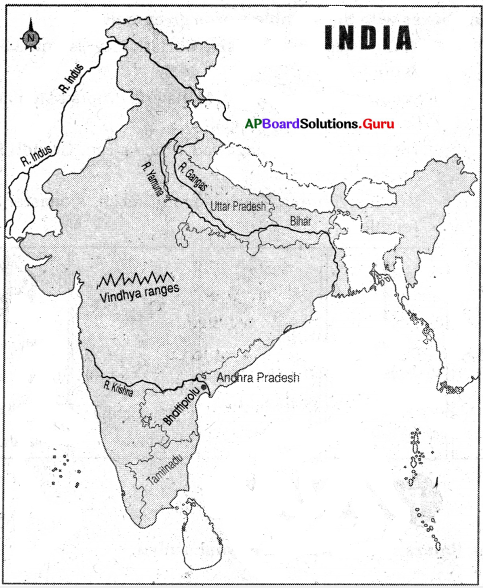
Locate the given places on the outline map of India.

  1. River Indus
  2. Tamilnadu
  3. Andhra Pradesh
  4. Bihar
  5. Bhattiprolu
  6. River Krishna
  7. River Ganga
  8. River Yamuna
  9. Vindhya ranges
  10. Uttar Pradesh

Answer:
AP Board 6th Class Social Studies Solutions Chapter 11 Indian Culture, Languages and Religions 1

AP Board 6th Class Social Studies Solutions Chapter 11 Indian Culture, Languages and Religions

Question 10.
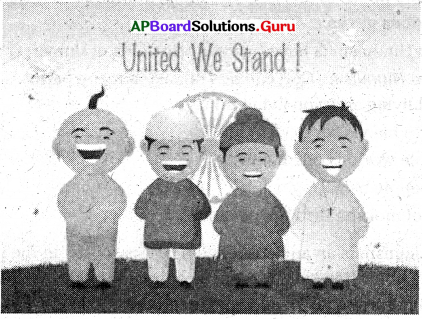
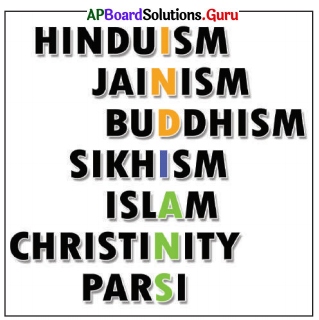
Prepare a picture of religious unity.
Answer:
AP Board 6th Class Social Studies Solutions Chapter 11 Indian Culture, Languages and Religions 2

Question 11.
Prepare four slogans to promote religious unity.
Answer:

  1. No one can win alone, but Unity can.
  2. Unity is for you and you for Unity.
  3. Let’s run for Unity, let’s run for India.
  4. We can change the world through Unity.

Question 12.
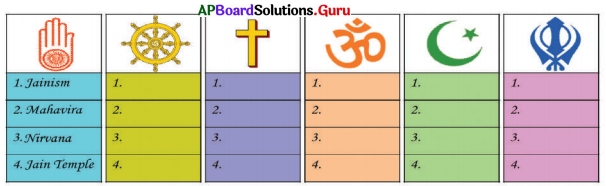
Fill the following blank boxes with the suitable words given below.
I. Religion: Hindu Religion, Sikhism, Christianity, Islam, Jainism, Buddhism
II. God/Messenger: Siddhartha, Jesus Christ, Mahavira, Prophet Muhammad, Lord Krishna, Guru Nanak
III. Holy Book: Tripitaka, Bible, Bhagawad Gita, Quran, Grandh Sahib, Angas
IV. Worshipping place: Mosque, Temple, Gurudwara, Church, Monastery, Jain
AP Board 6th Class Social Studies Solutions Chapter 11 Indian Culture, Languages and Religions 3
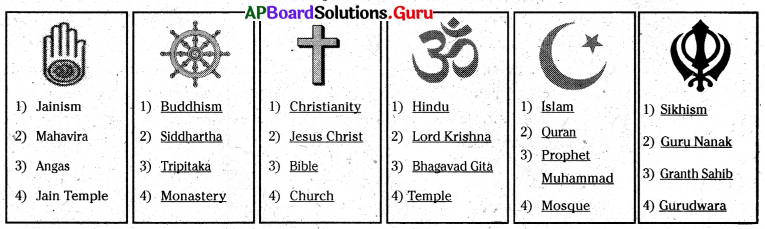
Answer:
AP Board 6th Class Social Studies Solutions Chapter 11 Indian Culture, Languages and Religions 4

AP Board 6th Class Social Studies Solutions Chapter 11 Indian Culture, Languages and Religions

Project Work

Question 1.
Celebrate Sankranthi, Ramzan, and Christmas in your school.
Answer:
Student Activity.

Question 2.
Read the holy books of all religions, know about the biography, teaching and theme of the religious gurus.
Answer:
Hinduism: Hinduism is based on the principles of Universal truth.
According to Hinduism – God can be realized in many paths. Hinduism says that God exists in all living and Non-living things.

  • Service to man is service to God.
  • The whole world is one family.
  • Let all people be happy.

Pursuit of moksha through penance.
Jainism: Jainism is an ancient religion that is rooted in the philosophy that teaches the way to liberation and a path to spiritual purity and enlightenment through disciplined non-violence to all living creatures.
Tenets of Jainism:

  • Belief in God.
  • It did not condemn the varna system but attempted to mitigate the evils of the Varna order.

Quran: Holy book of Muslims. Muslims believe that Quran was verbally revealed by Allah to Muhammed through the angel Gabriel.
In Quran God warns human beings to find a proper way to reach happiness and perfection.
Teachings:

  • All human beings are His Creation.
  • All human beings are equal before the law.
  • God has no shape.

Every Muslim should become a servant of God.
Buddhism: Buddha asked his followers to avoid indulgence in worldly pleasure and practice strict abstinence and asceticism. According to Buddha, everyone was responsible for their own happiness in life. The main teachings of Buddhism are encapsulated in the basic concept of Four noble truths.
Christianity: Jesus Christ was the eternal word of God who assumed human form to serve humanity and to rescue human beings. Jesus Christ suffered and died to redeem mankind from sin. Christians believe that Jesus Christ now sits at the right hand of God as the final judge of the dead and the He will return again as prophesized.

AP Board 6th Class Social Studies Solutions Chapter 11 Indian Culture, Languages and Religions

Question 3.
Field visit:
Visit a nearby place of worship, and observe the activities and discuss with your class.
Answer:
Student Activity.

6th Class Social Studies 11th Lesson Indian Culture, Languages and Religions InText Questions and Answers

Let’s Do

Question 1.
Invite a Mend of other language and interact with him/her. (Textbook Page No. 123)
Answer:
(This question is answered keeping in view the question given in the 2nd lesson)
Venu met some children from different cities at a youth festival. Venu wants to talk to them. He wants to know about their culture.
Venu: Hello Nihal. I am Venu. I am from Guntur, Andhra Pradesh.
Nihal: Hello Venu, I am from Delhi.
Venu: What is your father. My father is a bank officer.
Nihal: My father is working in railways.
Venu: What is your mother tongue? How many letters are there in your mother tongue?
Nihal: My mother tongue is Hindi. I will tell you some interesting facts. Hindi is an Indo-Aryan language. Hindi is mainly spoken in India. Hindi is the official language of India. Hindi script is Devanagari Script. No of the letters in Hindi is 44. But some authors say there are 52 letters. Tell me about your mother tongue also venu.
Venu: My mother tongue is Telugu. It is spoken mainly in Andhra Pradesh and Telangana. Telugu has 56 letters. Telugu has more letters in its alphabet than any other Indian language.
Nihal: Oh, great. OK. Bye Venu. My friends are calling me. We will meet again. Bye.

AP Board 6th Class Social Studies Solutions Chapter 11 Indian Culture, Languages and Religions

Question 2.
Meet the heads of different religions. Collect the theme and practices of the particular religion. Discuss in the classroom. (Textbook Page No. 126)
Answer:
Hinduism: According to Hinduism the proper goals or main aims of human life is Dharma, Artha, Kama, Moksha.
Islam: Belief in Allah, belief in the prophets, belief in the last day, that there is judgment.
Christianity: The central tenet of Christianity is the belief in Jesus as the son of God and Messiah.
Buddhism: Buddhism encourages its people to avoid self-indulgence but also self-denial.
Jainism: The central theme of Jainism considers religion as a science of ethical practice.
Sikhism: The emphasis is on moral actions, noble living, and working for the welfare of all the people.

Think and Respond

Question 1.
There are many languages in India. What is the need for a language? How did the languages evolve? (Textbook Page No. 124)
Answer:
Language is a medium of communication. With the help of language, we can communicate. Man is the only living being on the earth who uses language. Learning became easier with the evolution of language. In the olden days, people drawn pictures to communicate. They wrote on clothes, leaves, etc. After that, they developed a script. Like this languages evolved.

Question 2.
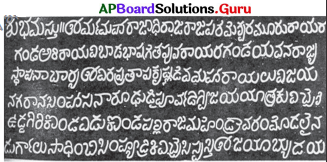
Try to read the inscription of Krishnadevaraya 1516. Take the help of your teacher to understand this inscription. (Textbook Page No. 125)
AP Board 6th Class Social Studies Solutions Chapter 11 Indian Culture, Languages and Religions 5
Answer:
Student Activity.

AP Board 6th Class Social Studies Solutions Chapter 11 Indian Culture, Languages and Religions

Question 3.
Discuss some customs and traditions of our ancestors which help to protect our health and hygiene. (Textbook Page No. 127)
Answer:

  1. Saying Namaste instead of shaking hands.
  2. Washing hands before eating.
  3. Taking off shoes before entering the house.
  4. Maintaining regular eating habits.
  5. Practicing yoga and meditation are some of the customs and traditions our ancestors followed.

These customs and traditions of our ancestors help, us to protect our health and hygiene in these days also.

Question 4.
Prepare and enact a role play on communal harmony in your school function. (Textbook Page No. 132)
Answer:

  • A girl stands as God having a placard with the word Temple.
  • A boy comes and prays to god and moves.
  • The girl now carries the placard with the word Mosque.
  • Another boy comes and performs prayer as a Muslim.
  • The girl now carries the placard with the word Church.
  • A boy comes with Bible in his hand and performs prayer.
  • Now the girl carries the placard Gurudwara.
  • Another boy comes and performs prayer.
  • Now the girl carries the placard with the word Monastery.
  • Another boy comes and prays.
  • The girl now carries a placard with the word Mahavira.
  • Another boy comes and Prays.
  • Now all the boys come together with the placard
    AP Board 6th Class Social Studies Solutions Chapter 11 Indian Culture, Languages and Religions 6
  • They say loudly though we are of different religions we are all Indians.

AP Board 6th Class Social Studies Solutions Chapter 11 Indian Culture, Languages and Religions

Do You Know

Question 1.
How was the script developed? (Textbook Page No. 124)
Answer:
People wrote on clothes, leaves, barks, etc. in the olden days. They used pins to write on the dried leaves. Initially, they drew pictures and symbols. Gradually the script developed.

Question 2.
There are 26 letters in English and 56 in Telugu. How many letters are there in Tamil, Kannada, Malayalam, and Odiya? (Textbook Page No. 125)
Answer:
Tamil: 247; Kannada: 49; Malayalam: 56; Odiya: 52

Question 3.
India is called a secular country. Why? (Textbook Page No. 125)
Answer:
India is called a secular state because there is no discrimination of religions. The government will not support any religion. The government cannot interfere in religious matters except if these matters can damage the public. So India is called a secular country.

AP Board 6th Class Social Studies Solutions Chapter 10 Local Self-Government

SCERT AP Board 6th Class Social Solutions 10th Lesson Local Self-Government Textbook Questions and Answers.

AP State Syllabus 6th Class Social Studies Solutions 10th Lesson Local Self-Government

6th Class Social Studies 10th Lesson Local Self-Government Textbook Questions and Answers

Improve Your Learning

Question 1.
What are the differences between Grama Sabha and Grama Panchayat?
Answer:

Question 2.
Suppose you are a representative in your local government body, what issues would you raise?
Answer:
If I am a representative in our locality or village, I shall keep in view the following issues.

  1. Schools, hospitals, sanitation, and library facilities.
  2. Cleaning and lighting of streets.
  3. Supply of drinking water.
  4. Supply of electricity.
  5. Garbage collection and disposal.
  6. Making and maintenance of gardens and parks.
  7. Eradication of malaria, dengue and taking care in preventing the outbreak of diseases.
  8. I can raise the above issues in Grama Sabha in making the Gram Panchayat work responsibly.

AP Board 6th Class Social Studies Solutions Chapter 10 Local Self-Government

Question 3.
Do you think common people are able to participate in the process of decision-making in your panchayat or municipality? Give some examples to illustrate your answer.
Answer:
I think common people are not able to participate in the process of decision-making in Panchayat or Municipality.

  1. The people may not be informed about the meeting. It will result in less attendance in Panchayat or Municipality meetings.
  2. Even people attend the meeting a few people only can express their opinions. Such situations occur because people find themselves in fear.

Question 4.
Do you think panchayats should rise more tax from the village to carry out development works or depend upon government funds?
Answer:
Panchayats should get government funds to carry out the development of Panchayat. Panchayat receives 95% of its revenue either from State or Central Governments. Only 5% of the revenue is from taxes. Though they increase Taxes the amount received may not increase abnormally. So it is better to get more funds from the government besides rising the tax from the village nominally

Question 5.
What challenges do the Sarpanch face in carrying out their work?
Answer:
In carrying works sometimes the Sarpanch has to face some challenges. Because he is known to all people in the village he may not express some issues freely. In the collection of house tax, he may not demand to pay the tax. If any encroachment is noticed he may not ask them effectively. If sufficient funds are not provided he cannot implement development activities. He cannot ask the government also to release funds to meet – all the requirements of the Panchayat.

AP Board 6th Class Social Studies Solutions Chapter 10 Local Self-Government

Question 6.
What are the public amenities provided by a Municipality but not a Panchayat?
Answer:
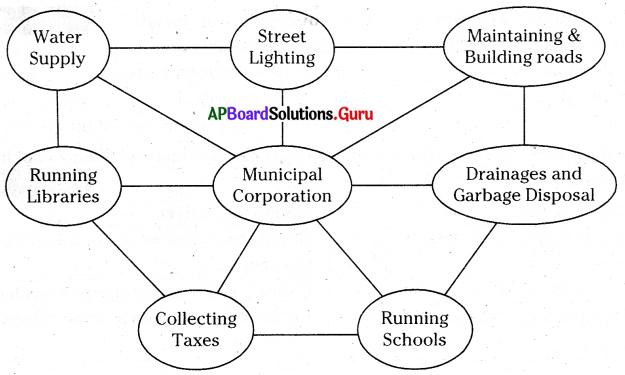
Amenities provided by Municipality: Roads, drainage and garbage disposal running schools, ration shops, hospitals, etc., besides taking up new developmental works.
Of these amenities running schools, ration shops, and hospitals are provided by a municipality only.

Question 7.
Geetika says that her street tap gives water only for half an hour and several people queue up to fill their buckets. What would you advise her to do to solve this problem?
Answer:
I will ask Geetika to take an individual tap connection so that she will get water for more time and she can get more water. For this individual connection, she has to pay tax and this will be useful for the municipality also. She can save time by not standing in the queue and can help the neighbors also.
She can write a letter to the municipal/panchayat officers to provide another tap in that area. She can consult that ward councilor or ward member and explain the problem to them. With the help of them, another tap can be provided there and it can ‘ reduce the problem of Geetika and many others also.

Question 8.
Frame a few questions to ask the local Corporator/Councillor to know the details of work done by the Municipality?
Answer:

  1. What are the works sanctioned for our area?
  2. What is the progress of that works?
  3. Is there any problem arising?
  4. What are the measures taking to kill mosquitoes which are causing diseases like dengue, malaria, chikungunya, etc?
  5. What are the steps following to improve drainage and garbage disposal which do not allow the mosquitoes to grow?

AP Board 6th Class Social Studies Solutions Chapter 10 Local Self-Government

Question 9.
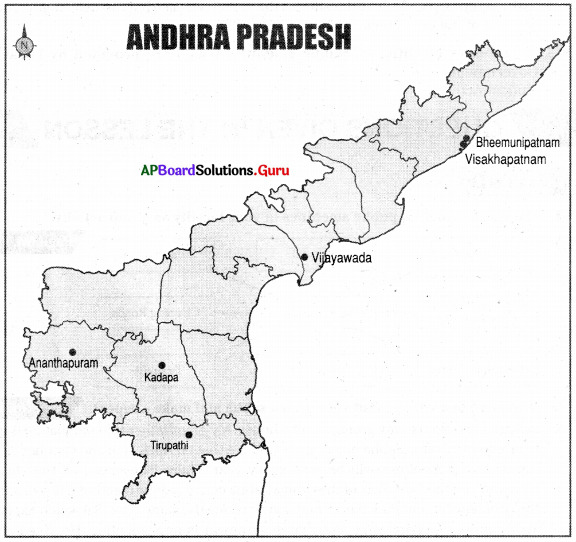
Locate the following municipalities and municipal corporations in Andhra Pradesh.
AP Board 6th Class Social Studies Solutions Chapter 10 Local Self-Government 1

  1. Visakhapatnam
  2. Vijayawada
  3. Bheemunipatnam
  4. Kadapa
  5. Anantapuram
  6. Tirupati

Answer:
AP Board 6th Class Social Studies Solutions Chapter 10 Local Self-Government 2

AP Board 6th Class Social Studies Solutions Chapter 10 Local Self-Government

Project Work

Visit your nearby Grama Sachivalayam/Ward Sachivalayam and interview the functionaries of Sachivalayam and make a report.
Answer:
Model Interview of one of the functionaries in Grama Sachivalayam: (Model was given.)

  1. I will ask the name of the functionary.
  2. His / Her designation.
  3. Enquire about the superiors.
  4. Duties he has to perform.
  5. Problems he identified in his ward.
  6. No of the problems he solved in his ward.
  7. How his superiors helped in solving the problems.
  8. Whether he is satisfied with the job or not.

I will tell him the story of Ashoka. Ashoka asked his officers to explain the inscriptions to the illiterate people. Like the officers, the volunteers also have to deliver government services at the doorsteps.
Make posters on different public amenities which are provided by Local self-Governments.
Answer:
Student Activity.

AP Board 6th Class Social Studies Solutions Chapter 10 Local Self-Government

6th Class Social Studies 10th Lesson Local Self-Government InText Questions and Answers

Let’s Do

Question 1.
Prepare a poster on public amenities in your locality as a group activity. (Textbook Page No. 111)
Answer:
AP Board 6th Class Social Studies Solutions Chapter 10 Local Self-Government 3

Question 2.
If you live in a village, visit your grama sabha and make a report. (Textbook Page No. 112)
Answer:
In April I had been to my grandparent’s house. My grandfather told me that he is going to attend the Grama Sabha meeting. He told me that on April 14th and October 3rd the Grama Sabha meetings will be held every year. There I observed all the villagers gathered and the Sarpanch of the Grama Sabha convened the meeting. They discussed the problems in that Panchayat and solutions for the same. The Sarpanch explained about various welfare programs that the government is implementing. He asked all the villagers whether all the amenities are coming to them or not. Later he concluded the meeting.

AP Board 6th Class Social Studies Solutions Chapter 10 Local Self-Government

Question 3.
With the help of your teacher/parents, try to know the services provided by the Grama Volunteers. (Textbook Page No. 115)
Answer:
Services provided by the Grama Volunteers:

  1. Government services are to be delivered at the doorstep of all eligible households irrespective of Caste/ Religion/Creed/Gender/Political affiliation.
  2. If any person in the ward request any service volunteer should transfer the data to the village secretariat.
  3. The services/schemes of the government should be explained in detail and also have to assist them to apply which is under him/her.
  4. The grama volunteer should attend the meeting held in the grama secretariat and have to maintain the record of the issues and requests which he collected to the authority.
  5. The volunteer should guide the people under him regarding security, education, health, and employment.
  6. The volunteer should resolve the issues such as roads, street lights, drains, and drinking water.

Question 4.
How many Nagara Panchayats, Municipalities, and Municipal Corporations are there in your district? (Textbook Page No. 117)
Answer:
Student Activity (One example is given for you. Students have to collect information about their own district and write the answer).
Ex: Our district is Guntur District.
There are 14 municipalities in our Guntur district. Municipal Corporation is there in our Guntur district.
There is no Nagar Panchayat in our district.

AP Board 6th Class Social Studies Solutions Chapter 10 Local Self-Government

Question 5.
Visit nearby Municipal council / Municipal corporation and observe the functions. And make a poster or storyboard as Individual activity. (Textbook Page No. 118)
Answer:
AP Board 6th Class Social Studies Solutions Chapter 10 Local Self-Government 4

Question 6.
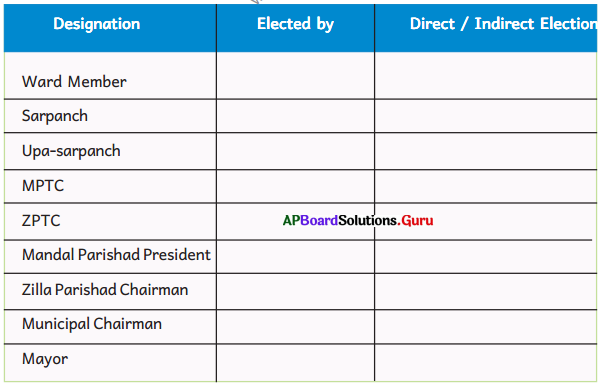
Fill the following table with the help of your teacher. (Textbook Page No. 118)
AP Board 6th Class Social Studies Solutions Chapter 10 Local Self-Government 5
Answer:

DesignationElected byDirect/Indirect Election
Ward MemberVillagersDirect
SarpanchVillagersDirect
Upa-sarpanchWard membersIndirect
MPTCVoters of mandalDirect
ZPTCVoters of the districtDirect
Mandal Parishad PresidentMembers of Mandal ParishadIndirect
Zilla Parishat ChairmanMembers of Zilla ParishadIndirect
Municipal ChairmanCouncilors of Municipal CouncilIndirect
MayorCorporators of Municipal CorporationIndirect

AP Board 6th Class Social Studies Solutions Chapter 10 Local Self-Government

Think and Respond

Question 1.
Name the public amenities which are provided in your locality. (Textbook Page No. 111)
Answer:
The public amenities which were provided in my locality are:

  1. Drinking water.
  2. Best drainage system.
  3. Street lights.
  4. Library.
  5. Park.
  6. Benches on one side of the road.

Question 2.
Write the similarities and differences between Grama Sabha and Grama Panchayat. (Textbook Page No. 112)
Answer:
Similarities:

Grama SabhaGrama Panchayat
1) Grama Sabha works for the welfare of the village.Grama Panchayat works for the welfare of the people.
2) Grama Sabha will be presided by the President/Sarpanch of the village.Grama Panchayat will also be presided by the President/Sarpanch of the village.

Differences:

Grama SabhaGrama Panchayat
1) It consists of all the adults of the village.Gram Panchayat is the executive body of the village consisting of the Sarpanch and the Panchs
2) It is a permanent body of the village.It is elected for a term of 5 years.
3) The area covered by a Gram Sabha is an entire village or sometimes a few villages.Gram Panchayat is divided into wards, where Sarpanch and Panch make it.

AP Board 6th Class Social Studies Solutions Chapter 10 Local Self-Government

Question 3.
Give some reasons, why additions or deletions to the voters list become necessary? (Textbook Page No. 113)
Answer:
If a person attains the age of 18 his name is to be included in the voter’s list. Similarly, if any person dies whose name is in the voter’s list, his name is to be deleted. With all these types of additions and deletions, a new voters list is to be prepared. So, additions or deletions are necessary to the voter’s list.

(Textbook Page No. 115)

Question 4.
Who are your MPTC and ZPTC?
Answer:
(Student Activity)

Question 5.
How many mandals are there in your district?
Answer:
(Student Activity)

Question 6.
List out the public amenities provided by the local body in your area. (Textbook Page No. 116)
Answer:
Public amenities in our area:

  1. Water supply.
  2. Drainage system.
  3. Sanitation.
  4. Street lights.
  5. Recording births and deaths.
  6. Necessary action to be taken to check contagious diseases.
  7. Building libraries, schools, gardens, and parks.
  8. Keeping the city clean.

AP Board 6th Class Social Studies Solutions Chapter 10 Local Self-Government

Question 7.
How is grama panchayat differ from the municipality in its functioning? (Textbook Page No. 118)
Answer:

PanchayatMunicipality
1) Panchayat is a rural local government body.A municipality is an urban local government body.
2) Panchayat is responsible for the local administration of a village-like maintaining roads and the village pond.The municipality is responsible to provide civic amenities like roads and drainage to the urban population.

AP Board 6th Class Social Studies Solutions Chapter 9 Government

SCERT AP Board 6th Class Social Solutions 9th Lesson Government Textbook Questions and Answers.

AP State Syllabus 6th Class Social Studies Solutions 9th Lesson Government

6th Class Social Studies 9th Lesson Government Textbook Questions and Answers

Improve Your Learning

Question 1.
Write the differences between Parliamentary and Presidential democracy.
Answer:
In the Parliamentary system, the executive body is formed from the legislature. The executive body is responsible to the legislature. (Ex: India & Britain).
In the Presidential system, the executive body is not formed from the legislature. The executive body is not responsible to the legislature. (Ex: America & Brazil)

Question 2.
What is a government? What are the different types of governments?
Answer:
A Group of people that controls and makes decisions for a country or a state is called the government. Monarchy and democracy are the different types of government.

AP Board 6th Class Social Studies Solutions Chapter 9 Government

Question 3.
Write any four activities organized by the government in our times.
Answer:

  1. The government ensures food, shelter for the citizens.
  2. Government helps the people during cyclones and floods.
  3. Government has the duty of protecting the boundaries.
  4. Government builds schools, hospitals, and roads.
  5. Government implements various schemes for the welfare of the people.

Question 4.
Is it possible to include the opinions of all the participants in taking a decision? Discuss with some more examples.
Answer:
No. It is not possible to include the opinions of all the participants in taking a decision. Only one decision can be implemented in a concept. If there are 20 members in a meeting and one proposal is supported by 11 members and 9 members oppose it. Even 9 members opposed the proposal, it will be implemented because the majority of the members supported the proposal. But some amendments can be done to the proposal.

Question 5.
How would your school function if it was run by all the students and teachers together? Would you want everyone to participate in taking decisions? or would you like to elect representatives? Give reasons?
Answer:
If a school is run by all the students and teachers so many good decisions can be taken for the prosperity of the school. Teachers can express the problems faced by the students and students can also express their problems.
This will lead to a friendly atmosphere in the school. Because a school is a small unit both ways can be implemented. Teachers’ and students’ interactions will help the students in the future also. They can express their views freely in the future also. Nowadays in so many job interviews and group discussions are followed. There are opinions are to be expressed. If we follow this method from the school level it will be beneficial for the students.

AP Board 6th Class Social Studies Solutions Chapter 9 Government

Question 6.
Do you think the decision-making in your school is democratic? Does everyone has a say in it?
Answer:
The decision-making in our school is democratic. We discuss the issues with our class leader and they can be discussed with our class teacher later and a solution can be found.

Question 7.
Satwik’s father consulted all the members of his family on setting up a shop but everyone had a different opinion. Finally, he decided to set up the shop. Do you think he was democratic?
Answer:
In my opinion, Satwik’s father was democratic. Because

  1. he consulted all the members and asked their opinion in setting the shop.
  2. I think the majority of the family members supported the idea of setting up a shop.

So, Satwik’s father might have decided to set up the shop.

Question 8.
Padma’s mother asked all children where they would like to go on Sunday. Two children wanted to go and watch a film and three wanted to go to the park. If you were in Padma’s place what decision would you take? Give reasons.
Answer:
If I am Padma’s mother I will take them to the park on that Sunday because three of them are interested to go to the park.
I will convince them that I will take them to the cinema another Sunday.

Question 9.
The place of origin of democracy is …………….
a) China
b) India,
c) Greece
d) Rome
Answer:
c) Greece

AP Board 6th Class Social Studies Solutions Chapter 9 Government

Question 10.
Who has the right to make decisions in direct democracy?
a) Men
b) Women
c) Representative
d) All eligible voters
Answer:
d) All eligible voters

Question 11.
In India, all the people above …………….. years of age enjoy Universal Adult Franchise.
a) 18 years
b) 21 years
c) 20 years
d) 19 years
Answer:
a) 18 years

Question 12.
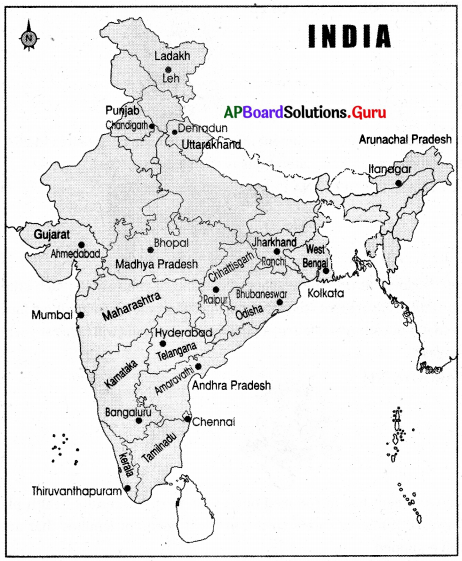
Every state and union territory in India has a Capital city. This is the headquarters of the state government. Point put the following state capitals which are the headquarters of the state governments concerned in the next page given India Map.
1. Maharashtra
2. Tamilnadu
3. Andhra Pradesh
4. Karnataka
5. West Bengal
6. Telangana
7. Ladakh
8. Punjab
9. Kerala
10. Arunachal Pradesh
11. Madhya Pradesh
12. Jharkhand
13. Chattisgarh
14. Uttarakhand
15. Gujarat
16. Odisha
Answer:
AP Board 6th Class Social Studies Solutions Chapter 9 Government 1

AP Board 6th Class Social Studies Solutions Chapter 9 Government

Project Work

1. Collect some logos and information about different welfare schemes of our government.
Answer:

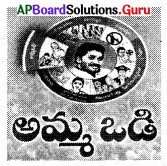
  1. AMMA VODI:
    AP Board 6th Class Social Studies Solutions Chapter 9 Government 2
    The Hon’ble Chief Minister, Government of Andhra Pradesh has announced a flagship programme “AMMA VODI” as a part of “NAVARATNALU” for providing financial assistance to each mother or recognized guardian in the absence of the mother, who is below the poverty line household, irrespective of caste, creed, religion, and region.
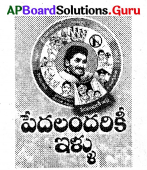
  2. HOUSING SCHEME FOR POOR PEOPLE:
    AP Board 6th Class Social Studies Solutions Chapter 9 Government 3
    Under the program, the government intends to provide house-sites to 26.6 lakh people below the poverty line. Later, houses will be constructed.
  3. JAGANNANA VASATHI DEEVANA:
    AP Board 6th Class Social Studies Solutions Chapter 9 Government 4
    The scheme is aimed at providing financial assistance to nearly 14 lakh students across the state and to ensure that students from lower-income households get financial assistance for their education “while Jagannana Vasathi Deevana will take care of hostel and mess charges.”
  4. Dr. YSR AAROGYASRI:
    AP Board 6th Class Social Studies Solutions Chapter 9 Government 5
    The state government has introduced one of the most successful health plans – Dr. YSR Aarogyasri. It mainly caters to the medical needs of families that are not financially well equipped.
  5. JALA YAGNAM:
    AP Board 6th Class Social Studies Solutions Chapter 9 Government 6
    This project accords the highest priority for the development of irrigation infrastructure, particularly in backward and drought-prone areas by taking up this program in a big way. Jala Yagnam includes a number of irrigation projects by the construction of reservoirs and lifts irrigation systems for lifting water from major rivers, particularly from the Godavari, to provide immediate irrigation benefits.

2. Collect the pictures of the President of India, Prime Minister, Governor and Chief Minister, your local M.P (Lok Sabha), and M.L.A from newspapers and prepare a scrapbook.
Answer:
Student Activity.

AP Board 6th Class Social Studies Solutions Chapter 9 Government

6th Class Social Studies 9th Lesson Government InText Questions and Answers

Let’s Do

Question 1.
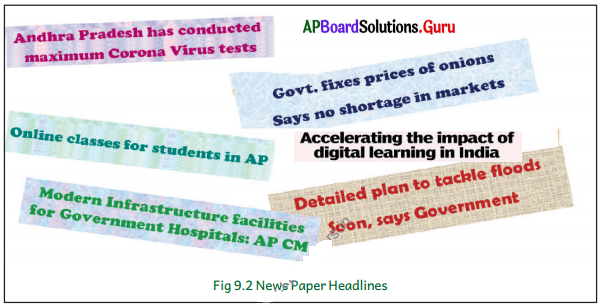
Look at the newspaper headlines below and list the different activities of the government. (Textbook Page No. 101)
AP Board 6th Class Social Studies Solutions Chapter 9 Government 7
Answer:

  1. Educational facilities like online classes to students.
  2. Government has a plan to tackle floods soon.
  3. Government fixes the price of onions. Onions will be put into the market and see that there will be no shortage.
  4. AP government has conducted maximum Coronavirus tests.
  5. Modern facilities will be provided in the hospitals to serve the poor.
  6. Accelerating the impact of digital learning in India.

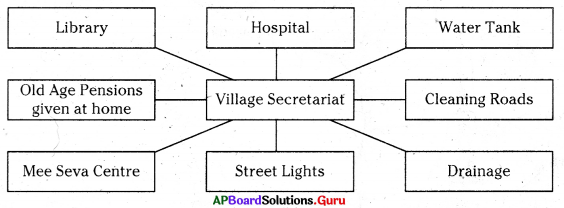
Question 2.
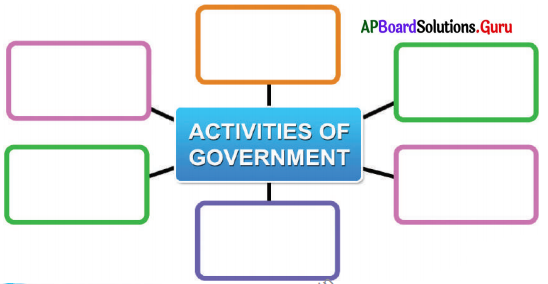
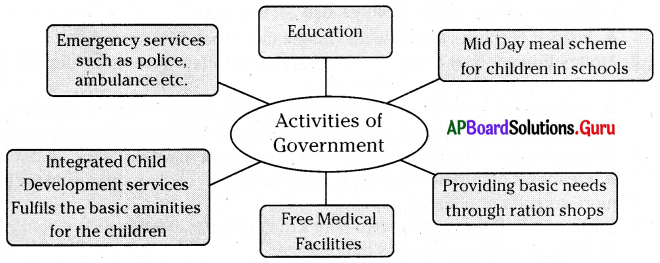
With the help of your teacher, try to know the above Logos and pictures of government schemes (Refer Text page 102 for the figure). Fill the following Mind map. (Textbook Page No. 102)
AP Board 6th Class Social Studies Solutions Chapter 9 Government 8
Answer:
AP Board 6th Class Social Studies Solutions Chapter 9 Government 9

AP Board 6th Class Social Studies Solutions Chapter 9 Government

Question 3.
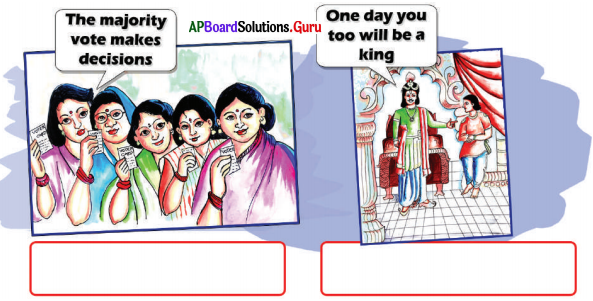
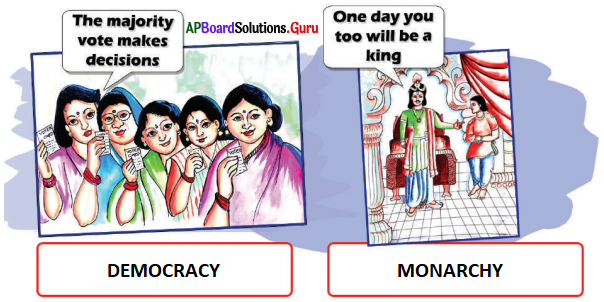
Observe the following pictures. Write the name of the government in respective boxes. (Textbook Page No. 103)
AP Board 6th Class Social Studies Solutions Chapter 9 Government 10
Answer:
AP Board 6th Class Social Studies Solutions Chapter 9 Government 11

Question 4.
Conduct a model election with the help of your teacher. Observe the process of the election. (Textbook Page No. 105)
Answer:
Students: Good morning teacher.
Teacher: Good morning my dear children. Today let us conduct a model election in the class. You all select a student among you as your class leader.
Students: OK teacher.
Teacher: Two of you can contest for the class leader post. Take a piece of paper of the same size.
Students: OK teacher.
Teacher: OK. Now write the name of the student whom you want to be the class leader on the piece of paper you have taken. Fold the paper and put that paper in the box kept in the corner of the room.
Teacher: Now open the box and count who got more votes. According to the majority who get more votes will be declared as the class leader. Like this in a democracy elections will be held. A candidate who gets more votes will be declared elected.

Question 5.
Ask your parents and, find out the problems they observed in the electoral system and prepare a report. Discuss it in your class and find solutions for these problems. (Textbook Page No. 105)
Answer:

  1. Majority System: Present majority system leads to many problems. Sometimes a candidate who gets 25% of the votes also gets elected.
    • Instead of this, a candidate should get more than 50% votes.
  2. Money Power: Nowadays elections are a costly affair. Votes are being as a market good through buying and selling.
    • A candidate should spend the amount told by the election commission. If it increases the candidate should be punished and suspended from the election.
  3. Muscle Power: Muscle power and domination are another major setbacks.
    • Election Commission should take measures to control this problem by giving more security at polling booths.
  4. Caste and Religion: These two play a major role in elections.
    • They should be given less importance.

AP Board 6th Class Social Studies Solutions Chapter 9 Government

Think and Respond

(Textbook Page No. 100)

Question 1.
How is the legislature is different from the executive?
Answer:
The legislature: Legislature is the law and policy-making body either in the Parliament or State assembly.
The Executive: Executive is responsible for the effective implementation of the laws/ policies passed in the legislature.

Question 2.
What is the prime duty of the judiciary?
Answer:
Interpreting the laws is the prime duty of the judiciary.

(Textbook Page No. 102)

Question 3.
Name some more works of the government.
Answer:

  • Amma Vodi
  • YSR Asara
  • Ban on Alcohol
  • Jalayagnam
  • Fee Reimbursement
  • Arogyasri
  • YSR Rythu Bharosa

Pedalandariki illu and Pensionla Pempu are some other welfare schemes of Andhra Pradesh.

AP Board 6th Class Social Studies Solutions Chapter 9 Government

Question 4.
What kind of facilities do you expect from the government?
Answer:
Important facilities we expect from the government are sanitation, public transport, health care, and water, etc.

(Textbook Page No. 103)

Question 5.
What kind of government do you like? Why?
Answer:
I like the democratic type of government. Because we can express our ideas freely without any hesitation and fear. If they are better, sometimes they can be followed also.

Question 6.
Which government respects the opinion of the people?
Answer:
The democratic type of government respects the opinion of the people.

(Textbook Page No. 104)

Question 7.
What are the differences between monarchy and democracy?
Answer:

MonarchyDemocracy
1) Ruling will be done by a king or queen.1) Ruling will be done by the representatives elected by the people.
2) A monarch comes into power by inheritance.2) Power can’t be inherited.
3) Powers will be with King only.3) People have rights.

AP Board 6th Class Social Studies Solutions Chapter 9 Government

Question 8.
Is it possible to implement direct democracy in India? Give reasons.
Answer:
It is not possible to implement direct democracy in India. In India, it may be difficult because of the huge population and vast area.

Question 9.
How is direct democracy different from indirect democracy?
Answer:
In direct democracy people directly participate in decision-making. It is possible in small countries.
In an indirect democracy, people participate in decision-making indirectly through their representatives. It is best to follow indirect democracy in large countries like India.

(Textbook Page No. 105)

Question 10.
How do you understand the rule of majority? Give another example.
Answer:
If the majority of the representatives do not support it, a good proposal may also be objected to. The shop setting of Satwik’s father may not be profitable. But the majority of the family members agreed to set the shop. So Satwik’s father decided to set the shop following the idea of the majority of family members.

Question 11.
Why do we have a government at different levels?
Answer:
Different levels of the government make it easy to distribute power among them. Administration can be easily managed with different levels of the government.

AP Board 6th Class Social Studies Solutions Chapter 9 Government

Explore

Question 1.
With the help of your teacher, try to know if any monarchies are there in the world at present? (Textbook Page No. 102)
Answer:
There are monarchies in some countries in the world at present. Some of them are:

  1. The kingdom of Saudi Arabia
  2. The United Arab Emirates
  3. The Sultanate of Oman.

Question 2.
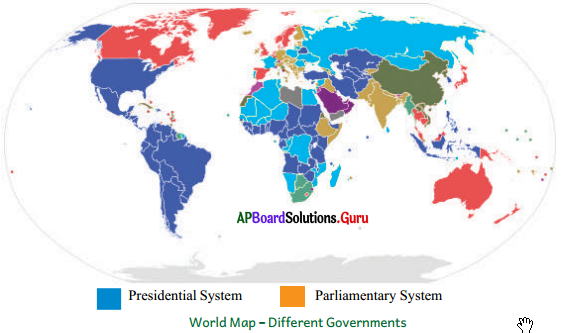
Observe the world map given below and list out the countries that are following the parliamentary system and the presidential system separately. (With the help of your teacher). Refer to the world map given at the end of the book. (Textbook Page No. 106)
AP Board 6th Class Social Studies Solutions Chapter 9 Government 12
Answer:
Parliamentary System

  • India (Asia)
  • Montenegro (Europe)
  • Pakistan (Asia)

Presidential System

  • Nigeria (Africa)
  • Philippines (Asia)
  • Paraguay (South America)

Parliamentary System

  • Singapore (Asia)
  • Somalia (Africa)
  • Slovenia (Europe)
  • Serbia (Europe)
  • Slovakia (Europe)
  • Turkey (Asia & Europe)
  • Trinidad and Tobago (South America)

Presidential System

  • Peru (South America)
  • USA (North America)
  • Uruguay (South America)
  • Uzbekistan (Asia)
  • Uganda (Africa)
  • Ukraine (Europe)
  • Tanzania (Africa)

AP Board 6th Class Social Studies Solutions Chapter 9 Government

Question 3.
With the help of your teacher try to know who is part of the central government and state government. (Textbook Page No. 107)
Answer:

  • Central Government: President, Vice-President, Prime Minister, Council of Central ministers and Members of Parliament,
  • State Government: Governor, Chief Minister, Council of State ministers, and members of Legislative Assemblies.

AP Board 6th Class Social Studies Solutions Chapter 8 Kingdoms and Empires

SCERT AP Board 6th Class Social Solutions 8th Lesson Kingdoms and Empires Textbook Questions and Answers.

AP State Syllabus 6th Class Social Studies Solutions 8th Lesson Kingdoms and Empires

6th Class Social Studies 8th Lesson Kingdoms and Empires Textbook Questions and Answers

Improve Your Learning

Question 1.
After the war of Kalinga, King Ashoka decided not to fight any more wars. Do you think this type of decision promotes world peace? How?
Answer:
This type of decision definitely promotes world peace. Ashoka said that winning people through dhamma is much better than conquering them through force. He believed that victory of dhamma was the best victory. Ashoka sent his missions of peace to the countries outside of the Maurya Empire and both inside and outside India. It showed an impact on Southern states. To achieve independence Gandhiji also followed non-violence. He brought all the nation together. India won independence. So I think this type of decision promotes world peace.

AP Board 6th Class Social Studies Solutions Chapter 8 Kingdoms and Empires

Question 2.
Explain the relevance of Ashoka Damma today? Appreciate the greatness of Ashoka.
Answer:
The main principles of Damma include :

  1. Be kind towards animals. We should be kind to animals all the time.
  2. Be obedient to father and mother. We should be grateful and obedient to our parents.
  3. Be kind towards the poor. Poor need the support of others to come out of their prob¬lems all the time.
  4. Respect the elders. May be of Ashoka’s time or today elders are to be respected.
  5. Never criticize other religions. We should be tolerant of other religions.
  6. Work for the welfare of mankind. We should work for all the men by not being selfish. So we can say that the principles of dhamma have relevance even today or in the future also.

Question 3.
Compare and contrast the public works undertaken during Ashoka’s period with those of today.
Answer:
Ashoka founded hospitals for people and animals and supplying medicines. Good roads with trees on both sides were provided. People draw water from the wells dug by the government. Travelers were provided with rest houses.
Even today the government is providing some of these facilities to us. But we have to pay some amount for these facilities. In widening the roads they are cutting the big trees. Because of this, the heat will increase and it will become difficult in day time particularly in summer.

Question 4.
Ashoka used his army to serve the people instead of war. What are relief operations do the present Indian army participate in other than war today?
Answer:
Relief operations attended by Army:

  1. Non – combat operations in support of national interest.
  2. Whenever unrest prevails they will go there and re-establish peace there.
  3. They will go to flood-hit areas and serve the people.

AP Board 6th Class Social Studies Solutions Chapter 8 Kingdoms and Empires

Question 5.
What is the contribution of the Guptas in the fields of literature, art, and architecture?
Answer:
The Gupta period was famous for great books and development in literature, art, architecture, Kalidasa was a great poet and play writer during this period. His master¬piece was the Shakuntala. Sophisticated gold coins were minted during the Gupta period. The Gupta period was famous for marvelous rock-cut caves. Some of the paintings and sculptures of Ajantha and Ellora Caves are the finest examples of that period.

Question 6.
Why do we call the Gupta period as a golden age in Indian History?
Answer:
The Gupta period became known as the golden age;> because there are inventions in science, technology, literature, mathematics and astronomy. There were nine great scholars in the court of Chandragupta – II. They were called ‘Navaratnas’. Aryabhatta and Brahmagupta were the two great mathematicians of that time. Char aka and Sushruta were the two great persons in medicine. Without any lab, the scientists of the Gupta period understood that the earth is round and it revolves around the Sun. They noticed the movements of stars and planets. The scientists of the Gupta period were also experts in metal technology. They made steel and iron weapons and tools. They minted sophisticated gold coins also. So we can say that the Gupta period is the golden age in Indian history.

Question 7.
How did Guptas contribute to the fields of medicine and metal technology?
Answer:
Medicine: Charaka and Sushruta were the two great persons in medical knowledge during the Gupta period. Sushruta was the first Indian doctor who carried out plastic surgery on the damaged noses. Doctors of the Gupta period could set broken bones and perform operations. Charaka composed ‘Charaka Samhitha’. This was the basic text for Ayurvedic medicine. He was a renowned physician of that period.
Metal technology: The scientists of the Gupta period were experts in metal technology. They made steel and iron tools and weapons. They minted gold coins.

AP Board 6th Class Social Studies Solutions Chapter 8 Kingdoms and Empires

Question 8.
What was the contribution of the Pallavas to architecture?
Answer:
Mahendravarman-I was a great patron of art and architecture. He introduced a new style of Dravidian architecture which was known as the Mahendra style. Narasimhavarman-I converted the port of Mahabalipuram into a beautiful city of art and architecture. Five rathas were built in Mahabalipuram. Each ratha has been carved out of a single rock. Narsimhavarman-II was another Pallava king and during his period temples were built by using soft sand rocks. It was known as the Rajasimha style. The famous Kailasnath temple at Kanchipuram is the best Example of Rajasimha style.

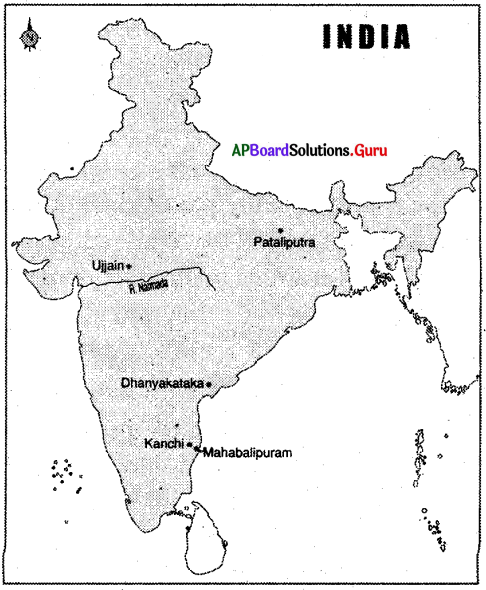
Question 9.
Locate the following places on the outline map of India.

  1. Pataliputra
  2. Ujjaini
  3. The river Narmada
  4. Kanchi
  5. Mahabalipuram
  6. Dhanyakataka

Answer:
AP Board 6th Class Social Studies Solutions Chapter 8 Kingdoms and Empires 1

Question 10.
Who am I ?
a) I am in the lion capital of Ashoka. I am at the center of our national flag. Who am I?
Answer:
Ashoka Chakra.
b) I belong to Gupta Dynasty. I defeated all the kings in India. Who am I?
Answer:
Samudragupta.
c) I am the Capital of Satavahana Empire. I am located on the banks of the river Krishna. Who am I?
Answer:
Dhanyakataka.
d) I completed the rock-cut temples of Mahabalipuram. I am the son of Mahendravarman-I. Who am I?
Answer:
Narasimhavarman -I.

AP Board 6th Class Social Studies Solutions Chapter 8 Kingdoms and Empires

Project Work

Collect the pictures of some rock-cut temples of Mahabalipuram and paste them in your scrapbook.
Answer:
Student Activity.

6th Class Social Studies 8th Lesson Kingdoms and Empires InText Questions and Answers

Let’s Do

(Textbook Page No. 89)

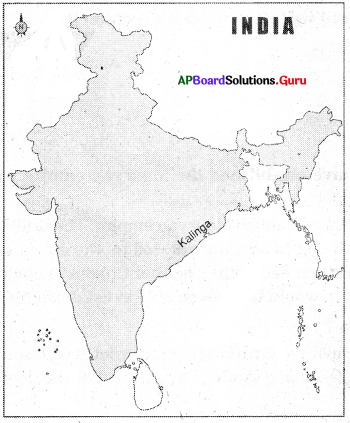
Question 1.
Identify the kingdom of Kalinga in the present map of India with the help of your teacher.
Answer:
AP Board 6th Class Social Studies Solutions Chapter 8 Kingdoms and Empires 2

Question 2.
What is the present name of Kalinga?
Answer:
Odisha state.

AP Board 6th Class Social Studies Solutions Chapter 8 Kingdoms and Empires

(Textbook Page No. 90)

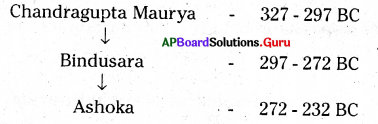
Question 3.
Prepare a timeline chart of the Mauryan Dynasty.
Answer:
AP Board 6th Class Social Studies Solutions Chapter 8 Kingdoms and Empires 3

Question 4.
Discuss the character of emperor Ashoka in the classroom.
Answer:

  1. Ashoka the Great was the third king of the Mauryan Dynasty.
  2. Ashoka was the most famous and unique Mauryan ruler.
  3. Ashoka was the only king in the world’s history who gave up the conquest even after winning the war.
  4. He converted to Buddhism after witnessing the mass deaths of the Kalinga War.
  5. He was the first ruler who tried to spread his message through inscriptions to the people.
  6. He started to follow a religious policy of his own and formulated various policies of Dhamma.
  7. Ashoka’s ‘Ashoka Chakra’ was adopted as the ‘Symbol of Independent India’.

Question 5.
Write any four important cities of the Gupta empire as shown in the map. (Textbook Page No. 92)
Answer:
Ujjain, Pataliputra, Sanchi and Bharukaccha.

Question 6.
Collect the pictures of the coins of the Mauryas and the Satavahana empires. Paste them in your scrapbook. (Textbook Page No. 94)
Answer:
Student Activity.

Question 7.
Collect the pictures of the local temple and write a note on its architecture. (Textbook Page No. 97)
Answer:
Student Activity.

AP Board 6th Class Social Studies Solutions Chapter 8 Kingdoms and Empires

Think and Respond

(Textbook Page No. 88)

Question 1.
Do you think Chandragupta could have established the Mauryan empire without Chanakya?
Answer:
I don’t think that Chandragupta alone can establish the Mauryan empire. The brilliance of Chanakya and the efficiency of Chandragupta as a warrior led to the establishment of the Mauryan empire. I think that without each other, neither Chanakya could have completed his dream nor Chandragupta would have been able to establish his rule.

Question 2.
Why did Ashoka want to win Kalinga?
Answer:
Kalinga was an important kingdom because it controlled the trade routes with Southeast Asia. Because of this, Ashoka, the Mauryan king wanted to capture it. So he declared a war on Kalinga.

Question 3.
Why was Ashoka not happy after the Kalinga war?
Answer:
In the Kalinga war both sides suffered heavy losses. More than one lakh people died in the war. The Kalinga war resulted in the great loss of life and property. Ashoka was so horrified wher^he saw the violence and bloodshed. This war was the most important event of Ashoka’s life. His heart was moved to see the misery of men. He decided not to fight any more wars, He realized that there is a need to be some other way to achieve or conquer. He started a new path which was known as Dhamma. He was the only king in the history of the world who gave up conquest after winning a war.

AP Board 6th Class Social Studies Solutions Chapter 8 Kingdoms and Empires

(Textbook Page No. 90)

Question 4.
Ashoka’s Inscriptions were understood by illiterates also. How do you think it was possible?
Answer:
Ashoka appointed special officers to read his inscriptions to the illiterates.

Question 5.
In what way do the messages of the government reach the people today?
Answer:
Today there are many newspapers and television channels. It is very easy to spread the message of the government to people today.

(Textbook Page No. 91)

Question 6.
Discuss the importance of our National Symbols in the classroom.
Answer:
The national symbol commands high respect and is used only for official purposes and events of national importance. It appears on all government official letterheads, Indian currency, and passports. It is the official seal of the state governments and the President of India also.

Question 7.
Do you think there was a relationship between trade and transport? If so justify your answer.
Answer:
There is a close relationship between trade and transport. Transportation helps in easy exchange of raw materials and finished goods. Transport is important because it enables trade between people, which is essential for the development of civilizations. Transport plays an important part in the economic growth of a particular place.

Question 8.
Do you think Samudra Gupta was a great conqueror? Support your answer. (Textbook Page No. 93)
Answer:
After Chandragupta’s death, his son Samudragupta took over and expanded the Gupta empire in north India. He was a great conqueror and remained undefeated. Nine important kingdoms of North India were made part of the Samudraguptas empire. 12 rulers of Dakshinapadha surrendered after defeat. Other neighboring countries like Nepal, Bhutan, and Srilanka accepted his authority. With all these, I can say that Samudragupta was a great conquerer.

AP Board 6th Class Social Studies Solutions Chapter 8 Kingdoms and Empires

Question 9.
Shall we say Gauthamiputhra Satakarni the greatest ruler of the Satavahanas? If so, why? (Textbook Page No. 95)
Answer:
Yes. we can say that Gautamiputra Satakarni was the greatest ruler of the Satavahanas. He defeated Sakas. He defeated Yawanas and Pallavas and conquered their kingdoms. He conquered the land between the three seas. He got the title of ‘Trisamudradhees-wara.’

Question 10.
Ikshvakus were able to bring all other clans together. Do you agree or disagree? If so, what were the ways they were used? (Textbook Page No. 96)
Answer:
I agree with the above statement. Ikshvakus tried to strengthen their kingdom by marrying people from the other clans. So that they will all get united and they will become strong and they will get support from other clans.

AP Board 6th Class Social Studies Solutions Chapter 5 Early Life to Settled Life

SCERT AP Board 6th Class Social Solutions 5th Lesson Early Life to Settled Life Textbook Questions and Answers.

AP State Syllabus 6th Class Social Studies Solutions 5th Lesson Early Life to Settled Life

6th Class Social Studies 5th Lesson Early Life to Settled Life Textbook Questions and Answers

Improve Your Learning

Question 1.
List out the products of the forests?
Answer:
Fruits, edible roots and tubers, nuts, seeds, leaves, honey, wild grains, medicinal herbs, fungi and other natural products.

Question 2.
What do you know about nomadic life?
Answer:
A nomad is someone who lived by travelling from place to place. The nomadic lifestyle is likely the oldest form of human society. Nomads generally move from place to place depending upon variables such as climate, season, water availability, food and movement of animal herds.

AP Board 6th Class Social Studies Solutions Chapter 5 Early Life to Settled Life

Question 3.
How do we use fire today?
Answer:
Today, we use fire

  1. to cook food,
  2. to heat the water
  3. for making steam from coal and water
  4. for moulding metals
  5. in rituals,
  6. in agriculture for clearing land,
  7. generating heat and light and many more.

Question 4.
Prepare a list of the food items eaten by the early people and the modern people. Do you notice any similarities or differences?
Answer:

Early peopleModern people
Similarities:
FruitsFruits
Edible roots and tubersEdible roots and tubers
NutsNuts
SeedsSeeds
LeavesLeaves
HoneyHoney
Differences:
Wild grainsCooked grains
Raw meatCooked meat
Fishes (uncooked)Cooked fish
Eggs (uncooked)Cooked eggs
MilkBoiled milk

Question 5.
“The earliest human life became easier by domesticating animals and plants” Do you agree or not? Support your answer.
Answer:
Yes. We can say that the lives of the earliest humans became easier on domesticating animals because.

  1. They will provide them with food.
  2. They help them in pulling cars.
  3. They are trustful so they can protect them from other animals also.

AP Board 6th Class Social Studies Solutions Chapter 5 Early Life to Settled Life

Question 6.
If there is no grinding stone, how would it affect our food habits?
Answer:
It would be a little tough for us to have food without a grinding stone. But still, we should remember our ancestors – the primitive humans, they had no grinding stone. But they survived. Instead of eating cooked items, we could eat fruits and vegetables. Our diet would completely consist of plants. We would be more conscious of plants and how to save them since they were our main diet.
But I can say cooking would be difficult without any stone or grinder.

Question 7.
What tools do you use for cutting fruits? What would they be made of?
Answer:
To cut fruits generally, I use a knife. They are made of iron or steel.

Question 8.
Where did the early people store food grains?
Answer:
The early people used large clay pots or woven baskets or fig pits into the ground to store food grains.

Question 9.
List out three ways in which the present lives of farmers and herders are different from that of the early people.
Answer:

  1. Hunter-gatherers kept travelling from place to place whereas farmers had to live at the same place for longer periods of time to take care of their crops.
  2. Hunter-gatherers depended on the meat of wild animals whereas farmers and herders used plants, crops and cattle.
  3. Hunter-gatherers did not have any settled life whereas farmers and herders gradually …… settled in huts, pit houses.

AP Board 6th Class Social Studies Solutions Chapter 5 Early Life to Settled Life

Question 10.
How did the lifestyle of farmer-herders lead to early civilisations?
Answer:
Farmer herders learnt to plant the seeds they wanted and grow them for food. They attracted animals by leaving food for them. These animals provided them milk, meat and carried loads. They protected them from wild animals. They stayed in a place for a long time taking care of the plants. They learned storing methods of food. So, people began to settle down inconvenient places for a long time. They built houses. They developed new kinds of tools made of stone. Toolmakers created better farming tools. These communities extended to different parts. In this way, the lifestyle of farmer- herders lead to early civilisations.

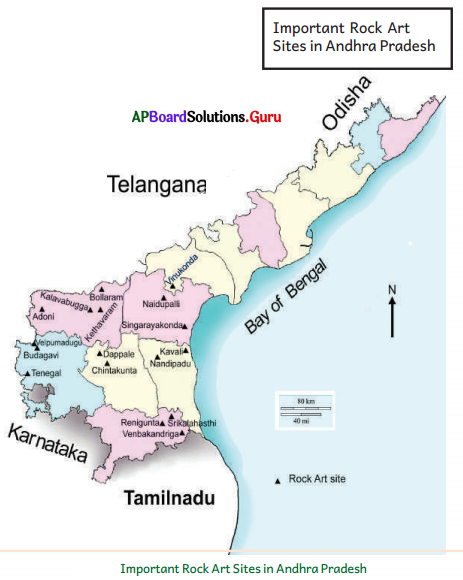
Question 11.
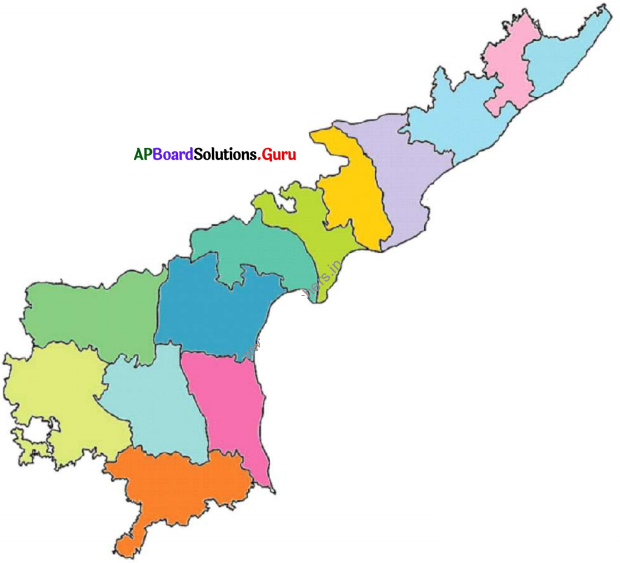
Locate the following Rock Art Sites on the map of Andhra Pradesh.
A) Chintakunta
B) Adoni
C) Kavali
D) Naidupalli
E) Velpumadugu
F) Srikalahasti
Answer:
AP Board 6th Class Social Studies Solutions Chapter 5 Early Life to Settled Life 1

AP Board 6th Class Social Studies Solutions Chapter 5 Early Life to Settled Life

Project Work

Question 1.
Collect the information about rock painting sites. Write a report and exhibit it in your class.
Answer:
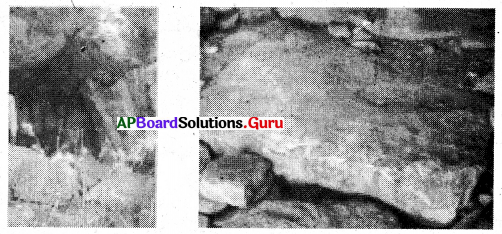
Recently I visited rock painting caves in Akkampalle Village in the Kurnool district with my parents. There are three sites to see. Of the three sites, one is a painted rock shelter locally known as “Mosalla-gundu” (‘Boulder of Crocodiles’), while the remaining two are naturally formed rock caves. Artworks found within the caves reflect the life, culture, traits and beliefs of the era.
AP Board 6th Class Social Studies Solutions Chapter 5 Early Life to Settled Life 2
The Boulder of Crocodiles is open on three sides towards the west, north and south, and contains a large number of paintings. The first crocodile is large in size compared with the other two. These paintings may be assigned to the Mesolithic period due to the nature of their depictions and application of red-ochre colour.
AP Board 6th Class Social Studies Solutions Chapter 5 Early Life to Settled Life 3
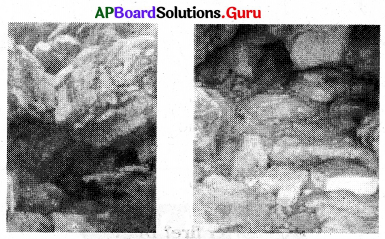
The second cave is a natural rock cave facing north and situated south of the Boulder of Crocodiles. The cave was intentionally closed on three sides with huge boulders, which might have been to offer protection from the cold winds and other natural hazards. The inner face of the cave is decorated with vertical strips of white lime coating.
AP Board 6th Class Social Studies Solutions Chapter 5 Early Life to Settled Life 4
The final cave is a natural formation facing towards the north, which appears to have been used for the purpose of dwelling. Its three sides – east, west, and south – are closed off with huge boulders of quartzite. There is a roughly rectangular area with uneven natural bedrock as its floor.

AP Board 6th Class Social Studies Solutions Chapter 5 Early Life to Settled Life

Question 2.
Collect some pictures of ancient people and prepare an album.
Answer:
Student Activity.

6th Class Social Studies 5th Lesson Early Life to Settled Life InText Questions and Answers

Let’s Do

Question 1.
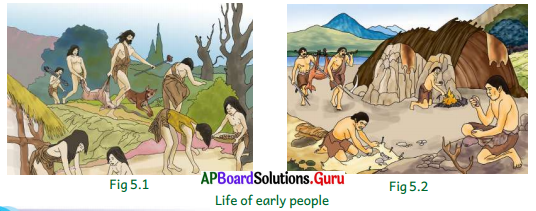
List out the activities of early people in the below pictures? (Textbook Page No. 54)
AP Board 6th Class Social Studies Solutions Chapter 5 Early Life to Settled Life 5
Answer:

Fig. – 1

  1. People fetching an animal for food.
  2. Women planting seeds.
  3. Man searching for something in bushes.

Fig. – 2

  1. People fetching an animal for food.
  2. The man was polishing a leather.
  3. Man trying to lit a fire with rocks,
  4. A man is frying food on fire.

Question 2.
List the items that you eat which are not grown but collected from the wild. (Textbook Page No. 55)
Answer:
Honey, tamarind, wood apple, nuts, berries, apricot and spices.

Question 3.
Apart from food, list out the other things that we get from the animals. (Textbook Page No. 60)
Answer:
Wool from sheep, silk from the silkworm, pearls from oyster, leather products from snakes, buffalo etc.,

AP Board 6th Class Social Studies Solutions Chapter 5 Early Life to Settled Life

Question 4.
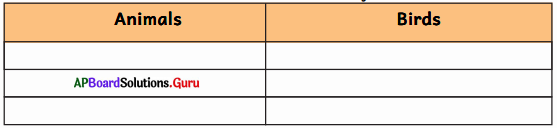
Make a list of animals and birds that are reared in your area. (Textbook Page No. 60)
AP Board 6th Class Social Studies Solutions Chapter 5 Early Life to Settled Life 6
Answer:
Animals: cow, buffalo, ox, dog, ass, horse, cat and rabbit.
Birds: Peacock, pigeon, parrot.

Think and Respond

Question 1.
How did the early people discover fire? Discuss with your teacher and write. (Textbook Page No. 55)
Answer:
Perhaps someone discovered fire while making a stone tool. When stones are rubbed or struck against each other, sparks can be seen. Strike means to hit very hard These sparks can start a fire. Maybe, once the sparks set fire to some dry grass or wood nearby. Or, perhaps some people saw a forest fire. When the fire was over they found many wild animals burnt in it. They also probably tasted a piece of the burnt meat and liked the new taste.
The discovery of fire changed the lives of the people forever.

Question 2.
How does the changing climate affect human life at present? Discuss with your teacher, friends and write.
(Textbook Page No. 58)
Answer:
Human health has always been influenced by climate and weather. Changes in climate patterns result in crop loss or drastically reduced yield. Hence more agriculturists are moving away from agriculture to other occupations which are less reliant on climate. The rise in ocean levels has forced people who live by the coastline, to move inwards and pursue other places.

AP Board 6th Class Social Studies Solutions Chapter 5 Early Life to Settled Life

Question 3.
How did the early humans become herders? (Textbook Page No. 58)
Answer:
People say that they could attract tame animals by leaving food for them. The first animal to be tamed was the ancestor of the dog. They started rearing sheep, goats, cattle, etc. that lived in herds and most of them eat grass! People often protected these animals from being attracted by other wild animals. This is how they became herders.

Question 4.
How can you say the rearing of animals paved the way to a settled life of the early humans? (Textbook Page No. 59)
Answer:
As early humans started farming, they realized that seeds will take time to grow. For this, the early man realized that he has stayed in that place for a long time. He realized that he has to take care of the plants, watering them and protecting them from birds and animals.
Besides, he realized that animals will get multiplied if they are taken care of. He realised that he will get milk and meat from them.
For these reasons, early humans began to settle down inconvenient places for a long time.

Question 5.
Compare the lifestyle of the modern farmers with the early farmers-herders.
Answer:

Modern farmerEarly farmers-herders
1. They are enjoying settled life.1. They enjoyed nomadic life.
2. They market the surplus food.2. They shared the food among the group.
3. They receive government help during the time of famines/natural calamities.3. They received no help during the time of famines/natural calamities.

AP Board 6th Class Social Studies Solutions Chapter 5 Early Life to Settled Life

Question 6.
What will happen if we don’t store food grains? (Textbook Page No. 59)
Answer:
Grains had to be stored for food and seeds. If we don’t store them scarcity arises and there will be no grains to put in the fields.

Question 7.
Prepare a list of articles that are using for cooking and storing in modern days. (Textbook Page No. 61)
Answer:
For cooking, we use gas stoves or electric induction stoves. For- storing we use refrigeration, vacuum packaging, pasteurization, canning, and irradiation.

AP Board 6th Class Social Studies Solutions Chapter 3 Maps

SCERT AP Board 6th Class Social Solutions 3rd Lesson Maps Textbook Questions and Answers.

AP State Syllabus 6th Class Social Studies Solutions 3rd Lesson Maps

6th Class Social Studies 3rd Lesson Maps Textbook Questions and Answers

Improve Your Learning

Question 1.
What are the components of a map?
Answer:
The components of the map are

  1. Directions,
  2. Scale,
  3. Symbols and
  4. Colours.

Question 2.
Why is the actual distance on the ground reduced on a map?
Answer:
It is impossible to draw a map showing actual distances. So we use ‘scale’ to show the actual distance on the ground in a reduced manner on a map.

Question 3.
Explain the need for symbols in preparing maps.
Answer:
Maps are too small for us to draw pictures of the things shown on them. For example, we can’t draw the real school or a bus stand or a tree as they will take too much space on the map. Therefore, we always show things with the help of symbols on the map.

AP Board 6th Class Social Studies Solutions Chapter 3 Maps

Question 4.
Find out the scale used in your district map to show the distance between your Mandal headquarter and district headquarter?
Answer:
Student Activity (One example is given for you).
Ex: Our mandal is Agiripalli. It is in the Krishna district. Our district headquarter is Machilipatnam.
On the map, the scale is given as 1 cm = 10 km.
The actual distance from Agiripalli to Machilipatnam is 83 km.
The distance between Agiripalli to Machilipatnam is 8.3 cms on the map.

Question 5.
How political maps are different from physical maps.
Answer:
Political maps show territorial features like country, cities, nations and their boundaries. A physical map indicates the natural features of a place like mountains, water bodies, plains etc.

Question 6.
What is the importance of thematic maps?
Answer:
A thematic map shows the spatial distribution of earth surface features. Thematic maps are used to display geographical concepts such as density, distribution, relative magnitudes, gradients, spatial relationships and movements. These maps focus on specific information like the map of rainfall, roads, tourist places etc..

Question 7.
What are the uses of maps in our daily life?
Answer:
Maps help us in many ways in our daily life. They help us to understand the concept of a subject.

  1. Maps help us to locate places like cities, districts, states and countries.
  2. Maps show the physical features such as mountains, plateaus, plains.
  3. Maps help us to know the major routes of transport such as roads, railways, etc.
  4. Maps help us to understand the distribution of crops, minerals, soils etc.
  5. Maps help the army at the time of war and for security reasons.
  6. Maps guide the tourists to their destination.
  7. Maps help us to understand history easily.

AP Board 6th Class Social Studies Solutions Chapter 3 Maps

Question 8.
Locate all continents and oceans on the given World map.
Answer:
AP Board 6th Class Social Studies Solutions Chapter 3 Maps 1

Choose the correct answer.

1) Maps showing the distribution of forests are …………….
A) Physical map
B) Thematic Map
C) Political map
D) none of the above
Answer:
B) Thematic Map

2) The blue colour is used for showing …………….
A) Waterbodies
B) Mountains
C) Land
D) Plains
Answer:
A) Waterbodies

3) A scale is a necessary component for …………….
A) Map
B) Sketch
C) Plan
D) None
Answer:
A) Map

AP Board 6th Class Social Studies Solutions Chapter 3 Maps

4) A compass is used …………….
A) To show symbols
B) To find the main direction
C) To measure distance.
D) To find the height
Answer:
B) To find the main direction

5) The intermediate direction between the North and East is called …………….
A) North-east
B) South-east
C) North-west
D) South-west
Answer:
A) North-east

Project Work

Question 1.
Draw a sketch of your school.
Answer:
Student Activity.

Question 2.
Collect different maps and make a scrapbook.
Answer:
Student Activity.

Question 3.
Draw a sketch map showing the route from your home to school by using appropriate symbols.
Answer:
Student Activity.

6th Class Social Studies 3rd Lesson Maps InText Questions and Answers

Let’s Do

Question 1.
Why was Mrudula not able to reach her destination with the help of the above sketch?  (Textbook Page No. 29 & 30)
Answer:
Mrudula was not able to reach her destination (Sathwika’s house) because there are no directions and scale in the given sketch.

AP Board 6th Class Social Studies Solutions Chapter 3 Maps

Question 2.
Go through the below picture and fill in the following table. (Textbook Page No. 30 & 31)
AP Board 6th Class Social Studies Solutions Chapter 3 Maps 2
AP Board 6th Class Social Studies Solutions Chapter 3 Maps 3
Answer:

DirectionObject
NorthHill, Trees
North – EastTemple
SouthWell
South – WestMasjid
EastRising Sun
South – EastSchool
WestHouse
North – WestChurch

AP Board 6th Class Social Studies Solutions Chapter 3 Maps

Question 3.
Observe the given picture and calculate the actual distance between the following places using the scale. (Textbook Page No. 32)
AP Board 6th Class Social Studies Solutions Chapter 3 Maps 4
Answer:
i. The distance between PO (A) and Raju’s house (C).
Answer:
Approximately 60 metres.
ii. The distance between Raju’s house (C) and Puja’s house (E).
Answer:
Approximately 30 metres.
iii. The distance between Chiru’s house (D) and the school.
Answer:
Approximately 55 metres.

Question 4.
Make a table with the states, UTs and their capital. (Textbook Page No. 35)
AP Board 6th Class Social Studies Solutions Chapter 3 Maps 5
Answer:

S.No.State/UTCapital
1.Andhra PradeshAmaravati
2.Arunachal PradeshItanagar
3.AssamDispur
4.BiharPatna
5.ChattisgarhRaipur
6.GoaPanaji
7.GujaratGandhinagar
8.HaryanaChandigarh
9.Himachal PradeshShimla
10.JharkhandRanchi
11.KarnatakaBengaluru
12.KeralaTiruvanantapuram
13.Madhya PradeshBhopal
14.MaharashtraMumbai
15.ManipurImphal
16.MeghalayaShillong
17.MizoramAizwal
18.NagalandKohima
19.OrissaBhubaneswar
20.PunjabChandigarh
21.RajasthanJaipur
22.SikkimGangtok
23.TamilnaduChennai
24.TelanganaHyderabad
25.TripuraAgartala
26.Uttar PradeshLucknow
27.UttarakhandDehradun
28.West BengalKolkata
Union Territories and Capitals :
Andaman Nicobar IslandsPort Blair
LakshadweepKavaratti
LadakhLeh
ChandigarhChandigarh
Dadar and Nagar Haveli Daman and DiuSilvassa
PuducherryPondicherry
National Capital RegionNew Delhi
Jammu & KashmirSrinagar (Summer) Jammu (Winter)

AP Board 6th Class Social Studies Solutions Chapter 3 Maps

Question 5.
Go through the below physical map and write some physical features of India. (Textbook Page No. 35)
AP Board 6th Class Social Studies Solutions Chapter 3 Maps 6
Answer:
India has all major physical features of the earth i.e., mountains, plains, deserts, plateaus, and islands.

  1. The Himalayan mountains or the Northern Mountains.
  2. The Northern plains or the Indo – Gangetic Plains.
  3. The Peninsular Plateau.
  4. The Great Indian desert
  5. The Coastal Plains.
  6. The Islands.

Question 6.
Collect different thematic maps and display them in your classroom. Discuss with your Mends. (Textbook Page No. 36)
Answer:
Student Activity.

Think and Respond

Question 1.
How do symbols give us information? (Textbook Page No. 32)
Answer:
With the help of symbols, maps can be drawn easily and are simple to read also. It is not possible to draw a map in the actual shape and size with different features such as buildings, rivers, bridges, trees, and railway lines, etc. So they are shown by using certain colours, letters, shades, pictures, and lines.

Question 2.
What does the map indicate? (Textbook Page No. 36)
AP Board 6th Class Social Studies Solutions Chapter 3 Maps 7
Answer:
This is a thematic map of India. Major crop-grown areas were shown on this map. From this map, we can know in which areas of India Rice, Wheat, Jowar, Bajra were grown. We can also know where two crops were grown.

AP Board 6th Class Social Studies Solutions Chapter 3 Maps

Question 3.
Why it is called a thematic map? (Textbook Page No. 36)
Answer:
Thematic maps are called so because they focus on a specific theme or subject relating to a particular theme or aspect of geography like the map of rainfall, roads, tourist places.

AP 7th Class Social Important Questions Chapter 22 Rulers and Buildings

AP State Syllabus 7th Class Social Important Questions 22nd Lesson Rulers and Buildings

Question 1.
Describe the main features of the ‘trabeate’ or ‘corbelled’ style of architecture.
Answer:
Between the seventh and tenth centuries, architects started adding more rooms, doors, and windows to buildings. Making large rooms with an elaborate superstructure requires more sophisticated skills. Roofs, doors, and windows were still made by placing a horizontal beam across two vertical columns, a style of architecture called trabeate or corbelled style of architecture. Between the eighth and thirteenth centuries, the trabeate style was used in the construction of temples, mosques, tombs, and in buildings attached to large stepped – wells.

AP 7th Class Social Important Questions Chapter 22 Rulers and Buildings

Question 2.
What are the two technological and stylistic developments?
Answer:
Two technological and stylistic developments are noticeable from the twelfth century.

  1. Arcuate style of architecture: The weight of the superstructure above the doors and windows was sometimes carried by arches. The roofs too used this principle and was converted into vaults and domes. This architectural firm is called ‘arcuate’.
  2. Use of Limestone Cement: Limestone cement was increasingly in the construction of heavy and large structures. This was very high-quality cement, which, when mixed with stone chips hardened into concrete. This made the construction of large structures easier and faster. Arches, domes, and limestone mortar were used extensively in buildings after 1190 A.D.

Question 3.
Describe the plan of the temples of the Chandela dynasty?
Answer:
To begin with, an ornamented gateway led to an entrance and the main hall (mahamandapa) where dances were performed. The image of the chief deity was kept in the main shrine (garbha griha). This was the place for ritual worship where only the king, his immediate family, and priests gathered.

Question 4.
What are the main characteristics of the Vijayanagara style of architecture?
Answer:
Vijayanagara kings wanted their architecture to reflect all the important imperial build¬ing traditions. They followed the architectural styles of Cholas and Pandyas. This included vimanas and the gopurams y/hich were built on a scale and height. The first floor of the gopuram was built of solid granite and the upper floors were built of brick and sunnam. Other distinctive features include mandapas or pavilions and long pillared corridors that often ran around the shrines within the temple complex. They built secular royal buildings modeled on the style and techniques of the sultanate architecture.

Question 5.
Look at the following picture.
AP 7th Class Social Important Questions Chapter 22 Rulers and Buildings 1
Now answer the following questions:
a. What does the picture show?
Answer:
The riverfront garden city of Agra.

b. Which river is flowing through the city?
Answer:
The Yamuna.

c. Which great monument is shown in the picture?
Answer:
The Taj Mahal.

d. Whose garden palaces are shown in the map?
Answer:
Garden palaces of the nobles.

e. Can you locate the Taj Mahal in the picture?
Answer:
Yes.

AP 7th Class Social Important Questions Chapter 22 Rulers and Buildings

Question 6.
Describe the arcuate style of architecture.
Answer:
The weight of the superstructure above the doors and windows was sometimes carried by arches. The roofs too used this principle and were converted into vaults and domes. This architectural firm is called the ‘arcuate’ style of architecture. This style is used from the twelfth century.

Question 7.
How were the tallest – shikhara constructed by using heavy stones?
Answer:
Constructing tall Shikharas was not easy because there were no cranes in those days and the 90 tonne stone for the top of the shikhara was too heavy to lift manually. So the architects built an inclined path to the top of the temple, placed the boulder on rollers, and rolled it all the way to the top. The path started more than four kilometers away so that it would not be too steep. This path was dismantled after the temple was constructed.

Question 8.
Study the following table.

Style of the architectureCharacteristicsUsed in
Trabeate (or) corbelledA roof can be made by placing a horizontal beam across two vertical columns, a style of ‘ architecture is called trabeate or corbelled.in the construction of temples, mosques and tombs.
Arcuate styleThe weight of the superstructure above the doors and windows was sometimes carried by arches. The roofs used this principle and was converted into vaults and domes. This architectural form is called arcuate’.in constructing roofs and domes.
Imperial style of the Vijayanagara period.The Vijayanagara style of architecture had been developed by using the techniques of Chola and Pandya styles. This included Vimanas and Gopurams. Towers on the central shrines were dwarfed. Other distinctive features of this style include mandapas or pavilions and long pillared corridors that often ran around the shrines within the temple complex.in building Gopurams, Vimanas and Mandapas of the temple.

Now answer the following questions:
a. Write the characteristic of trabeate style of architecture.
Answer:
A roof can be made by placing a horizontal beam across two vertical columns. This style of architecture is called trabeate or corbelled type of architecture. This style is used in the construction of temples, mosques, and tombs.

b. Write the characteristics of Arcuate style of architecture.
Answer:
The weight of the superstructure above the doors and windows was sometimes carried by arches. The roofs too used this principle and were converted into vaults and domes. This architectural form is called ‘Arcuate’. This is used in constructing roofs and domes of temples and mosques.

c. Write about the imperial style of Vijayanagara period.
Answer:
The Vijayanagara style of architecture had been developed by using the techniques of Chola and Pandyan styles. This included Vimanas and Gopurams. Towers on the central shrines were dwarfed other distinctive features of this style include mandapams or pavilions and long pillared corridors that ran around the shrines with in the temple complex.

AP 7th Class Social Important Questions Chapter 22 Rulers and Buildings

Question 9.
Read the following passage.
Temples and mosques were beautifully constructed because they were places of worship. They were also meant to demonstrate the power, wealth and devotion of the patron. Take the example of the Rajarajeshvara temple. An inscription mentions that it was built by King Rajarajadeva for the worship of his god, Rajarajeshvara. Notice how the name of the ruler and the god are very similar. The king took the god’s name because it was auspicious and he wanted to appear like a god. Through the rituals of worship in the temple, one god (Rajarajadeva) honored another (Rajarajeshvara).
Now answer the following questions.
a. Why were the temples and mosques constructed beautifully?
Answer:
Temples and mosques were built beautifully because they were places of worship.

b. What were the beautiful temples and mosques meant to?
Answer:
Temples and mosques were meant to demonstrate the power, wealth and devotion of the patron.

c. Who built the Rajarajesvara temple?
Answer:
The King Rajarajadeva built Rajarajeshvara temple.

d. Why did King Rajaraja take the name of God?
Answer:
King Rajarajadeva took the name of God – Rajarajesvara because it was auspicious and he wanted to appear like a god.

e. Who were the two gods mentioned in the passage?
Answer:
The Lord Rajarajeshvara and the King Rajarajadeva who himself wanted to appear like a god.

Question 10.
Read the following passage :
Sultan Mahmud of Ghazni was a contemporary of Rajendra I. During his campaigns in the subcontinent, he also attacked the temples of defeated kings and looted their wealth and idols. Sultan Mahmud was not a very important ruler at that time. But by destroying temples – especially the one at Somnath – he tried to win credit as a great hero of Islam. In the political culture of the Middle Ages, most rulers displayed their political might and military success by attacking and looting the places of worship of defeated rulers.
Now answer the following questions.
a. Which Chola ruler was the contemporary of Rajendra I?
Answer:
Sultan Mahmud of Ghazni

b. What is called the Subcontinent?
Answer:
India.

c. Why did Mahmud of Ghazni destroy temples?
Answer:
To win credit as a great hero of Islam.

d. What was the prevalent political culture of the middle ages?
Answer:
To display their political might and military success by attacking and looting the places of worship.

e. Who looted the Somanath temple?
Answer:
Mahmud of Ghazni.

AP 7th Class Social Important Questions Chapter 22 Rulers and Buildings

Question 11.
Read the following passage:
The city of Vijayanagara was developed by the Rayas to act as the imperial capital of the entire South India. Thus they wanted it to reflect all the important imperial building traditions. They built large temples for Sri Virupaksha, Ramachandra, Krishna, and Vitthala using a style that had been developed by Chola and Pandya emperors% of Tamil Nadu. This included the Vimanas and the Gopurams. The Rayas paid special attention to the Gopurams which were now built on d scale and height as drivers before. It consisted of a first floor usually built of solid granite and a series of upper. floors made of brick and sunnam.
Now answer the following questions.
a. Which city was developed as the imperial capital of the entire South India?
Answer:
Vijayanagara.

b. What were the temples built by Vijayanagara Kings?
Answer:
Sri Virupaksha, Ramachandra, Krishna and Vitthala.

c. Whose style of architecture was used by the Vijayanagara Kings?
Answer:
Chola and Pandya styles of Architecture.

d. Which elements of Chola and Pandyan style of architecture did Vijayanagara kings use in building temples?
Answer:
Vimanas and Gopurams?

e. What, were Gopurams?
Answer:
Gopurams were the towering gateways of the temples.

Question 12.
Read the following passage.
The most impressive remain of Vijayanagara, the Mahanavami Dibba is a very high platform, of 55 feet that is as tall as a five-floor building and 11000 feet in area. Its height was increased at least three times during two hundred years. The sides of the platform were covered with sculptures of various kinds. It did not have a complete building on the top. The platform Was covered by cloth shamiana or pandal sup¬ported by wooden pillars. On this platform, the Vijayanagara kings held their Navaratri Puja and held their Dussera court in which all their subordinate chiefs, nayakas and officers paid their tributes to the Emperor. Ambassadors from Europe and other sultan¬ates also attended the festival.
Now answer the following questions.
a. What was the most impressive remain of the Vijayanagara Kingdom?
Answer:
Mahanavami Dibba.

b. Why was it called ‘dibba’?
Answer:
Because it was built on a high platform of 55 feet.

c. How did Vijayanagara used this dibba for?
Answer:
The Vijayanagara Kings used this dibba for performing Navaratri puja and held Dussera court.

d. Who paid tributes during the Dussera court?
Answer:
Subordinate chiefs, nayakas and officers paid their tributes to the Emperor.

e. What were the sides of the platform covered with?
Answer:
The sides of the platform were covered with sculptures of various kinds.

AP 7th Class Social Important Questions Chapter 22 Rulers and Buildings

Question 13.
Read the following passage.
Under the Mughals, architecture became more complex. Mughal emperors were per¬sonally interested in literature, art and architecture. In his autobiography, Babur described his interest in planning and laying out formal gardens, placed within rectangular walled enclosures and divided into four quarters by artificial channels.
These gardens were called chahar baghs, four gardens, because of their symmetrical division into quarters. Beginning with Akbar, some of the most beautiful chahar baghs were constructed by Jahangir and Shah Jahan in Kashmir, Agra, and Delhi.
Now answer the following questions.
a. What were Mughal emperors interested in?
Answer:
The Mughal emperors were interested in literature, art and architecture.

b. What was Babur interested in?
Answer:
Babur was interested in planning and laying out formal gardens.

c. What are Chahar baghs’?
Answer:
Formal gardens are placed within rectangular walled enclosures and divided into four quarters by artificial channels. These gardens were called Chahar bagh, four gardens.

d. Why are chahar baghs called so?
Answer:
These gardens were called Chahar bagh “four gardens, because of their symmetrical division into quarters.

e. Where did Mughal emperors construct Chahar baghs?
Answer:
Chahar bags were constructed in Kashmir, Agra, and Delhi by Akbar, Jahangir, and Kashmir.

Question 14.
Read the following passage.
Qutb Minor is five stories high. The band of inscriptions you see is under its first balcony. The first floor was constructed by Qutbuddin Aybak and the rest by Iltutmish around 1229. Over the years it was damaged by lightning and earthquakes and repaired by later kings.
Now answer the following questions.
a. How tall is Qutub Minor?
Answer:
Qutub Minar is five storeys high.

b. Who started the construction of Qutb Minar?
Answer:
Qutbuddin Aybak.

c. Who completed the construction of Qutb Minar?
Answer:
Iltutmish.

d. When was the construction of Qutub Minar completed?
Answer:
In 1229 A.D.

e. What damaged Qutb Minar?
Answer:
Qutb Minar was damaged by lightning and earthquakes.

AP 7th Class Social Important Questions Chapter 22 Rulers and Buildings

Question 15.
Read the following passage.
Muslim Sultans and Badshahs did not claim to be incarnations of god but Persian court chronicles described the Sultan as the “Shadow of God”. An inscription in the Delhi mosque explained that God chose Alauddin as a king because he had the qualities of Moses and Solomon, the great law-givers of the past. The greatest law¬giver and architect was God himself. He created the world out of chaos and introduced order and symmetry.
Now answer the following questions.
a. What was it that described the Sultan as the: “Shadow of God”?
Answer:
The Persian court chronicles.

b. Did the Muslim Sultans and Badshahs claim themselves to be the incarnations of God?
Answer:
No.

c. Why did God choose Allauddin as a king according to the inscription in the Delhi mosque?
Answer:
Because he had the qualities of Moses and Solomon.

d. Who were Moses and Solomon?
Answer:
The great law-givers of the past.

e. Who is actually the greatest lawgiver and architect?
Answer:
God himself.

Question 16.
Read the following passage.
In the early ninth century, when the Pandyan king Shrimara Shrivallabha invaded Sri Lanka and defeated the king, Sena I (831-851), the Buddhist monk and chronicler Dhammakitti noted: “he removed all the valuables … The statue of the Buddha made entirely of gold in the Jewel Palace… and the golden images in the various monasteries – all these he seized. ” The blow to the pride of the Sinhalese ruler had to be avenged and the next Sinhalese ruler, Sena II, ordered his general to invade ‘Madurai, the capital of the Pandyas. The Buddhist chronicler noted that the expedition made a special effort to find and restore the gold statue of the Buddha.
Now answer the following questions.
a. Which Pandyan King invaded Srilanka?
Answer:
Shrimara Shrivallabha.

b. Who did Shrimara Srivallabha defeat?
Answer:
Sena I.

c. Who was Dhamma kitti?
Answer:
A Buddhist monk and chronicler.

d. What are the values to seized by Shrivallabha?
Answer:
The Golden statue of Buddha and the Golden images.

e. How was the golden statue of Buddha recaptured by the Sinhalese?
Answer:
According to Dhammakitti, the expedition led by Sena II made a special effort to find and restore the golden statue of the Buddha.

AP 7th Class Social Important Questions Chapter 22 Rulers and Buildings

Question 17.
Read the following passage.
Shah Jahan adapted the river-front garden in the layout of the Taj Mahal, the grand¬est architectural accomplishment of his reign. Here the white marble mausoleum was placed on a terrace by the edge of the river and the garden was to its South. The new city of Shahjahanabad that he constructed in Delhi, the imperial palace commanded the riverfront. Only especially favoured nobles – like his eldest son Dora Shukoh – were given access to the river. All others had to construct their homes in She city away from the River Yamuna.
Now answer the following questions.
a. What did Shah Jahan adapt in the layout of the Taj Mahal?
Answer:
The riverfront gardens.

b. What was the grandest architectural accomplishment of Shah -Jahan’s reign?
Answer:
The Taj Mahal.

c. What is referred to as *White marble mausoleum9 in the above passage?
Answer:
The Taj Mahal.

d. Who constructed the new Shah Jahanabad?
Answer:
Shah Jahan.

e. Who was Dara Shukoh?
Answer:
Shahjahan’s eldest son.

Question 18.
An Inscription in Shah Jahan’s diwan – i – khas in Delhi stated: “If there is Paradise on Earth, It is here, It is here. It is here”, How was this Image created?
Answer:
The ceremonial halls of the public and private audience – diwan – i – khas or diwan – i – aam were carefully planned. These courts were also described as chihil sutun or forty-pillared halls, placed within a large courtyard. Thus the beautiful courtyards, carefully planned halls with different elements of Mughal architecture Shah Jahan’s biwan – i – khas (or) diwan – i – aam were called the paradises on earth.

AP 7th Class Social Important Questions Chapter 22 Rulers and Buildings

Question 19.
Look at the picture.
AP 7th Class Social Important Questions Chapter 22 Rulers and Buildings 2
Now answer the following questions.
a. What does the above picture show?
Answer:
The above picture shows the plan of the temple of the Chandala dynasty.

b. How many main parts are there? What are they?
Answer:
There are three main parts in the plan – They are

  1. ornamented gateway,
  2. Maha mandapa and
  3. Garbhagriha.

c. Locate the Mahamandapa on the map.
Answer:
AP 7th Class Social Important Questions Chapter 22 Rulers and Buildings 3

d. Locate the garbhagriha in the map.
Answer:
AP 7th Class Social Important Questions Chapter 22 Rulers and Buildings 4

e. Locate the ornamented gateway.
Answer:
AP 7th Class Social Important Questions Chapter 22 Rulers and Buildings 5

AP 7th Class Social Important Questions Chapter 22 Rulers and Buildings

Question 20.
Look at the picture.
AP 7th Class Social Important Questions Chapter 22 Rulers and Buildings 6
Now answer the following questions.
a. What does the above picture show?
Answer:
The plan of the Jami Masjid.

b. Who built this structure?
Answer:
Shah Jahan.

c. Where was it built?
Answer:
At Shahjahanabad.

d. What was special about this?
Answer:
Qibla was built in direction of Mecca.

e. Which Masjid was shown in the picture?
Answer:
Jami Masjid.

AP 7th Class Social Important Questions

AP 7th Class Social Important Questions Chapter 21 Devotional Paths to the Divine

AP State Syllabus 7th Class Social Important Questions 21st Lesson Devotional Paths to the Divine

Question 1.
What were the major ideas expressed by Basavanna?
Answer:
The connection between the bhakti movement and temple worship in turn lead to a reaction that was best represented in the Virashaiva movement. It was initiated by Basavanna. This movement began in Karnataka in the mid-twelfth century The major ideas expressed by Basavanna were,

  • the Virashaivas argued strongly for the equality of all human beings.
  • they were against scriptural ideas about caste and the treatment of women.
  • they were also against all forms of ritual and idol worship.

AP 7th Class Social Important Questions Chapter 21 Devotional Paths to the Divine

Question 2.
Discuss the ideas of the saints of Maharashtra?
Answer:
The ideas of the saints of the Maharashtra were :

  1. They rejected all forms of ritualism, outward display of piety and social differences based on birth.
  2. They rejected the idea of renunciation.
  3. They insisted that bhakti lay in sharing others’ pain.

Question 3.
Study the following table.

Religious groupTheir teachings and beliefs
Nathpanthis, Siddhas, and Yogis1)    They criticized rituals and other aspects of conventional religion and social order.
2)    They advocated renunciation of the world.
3)    They believed salvation lay in meditation on the formless ultimate.
4)    To achieve salvation they advocated intense training of the mind and the body through practices like yogasanas breathing exercises and meditation.
The saints of Maharashtra1)    They rejected all forms of ritualism, outward display of piety.
2)    They opposed social differences based on birth.
3)    They rejected the idea of renunciation.
4)    They insisted that bhakti lay in sharing others’ pain.
The Sufi saints1)    The sufis rejected outward religiosity.
2)    They emphasized love and devotion to God and compassion towards all fellow human beings.
3)    They rejected the elaborate rituals and codes of behavior demanded by Muslim religious scholars.
4)    They sought union with God.
5)    They believed that the heart can be trained to look at the world in a different way.

Now answer the following questions.
a. Write about the teachings and beliefs of Nathpanthis, Siddhas, and Yogis.
Answer:

  1. They criticized rituals and other aspects of conventional religion and social order.
  2. They advocated renunciation of the world.
  3. They believed that salvation lay in meditation on the formless ultimate.
  4. To achieve salvation they advocated intense training of the mind and the body through practices like yogasanas, breathing exercises, and meditation.

AP 7th Class Social Important Questions Chapter 21 Devotional Paths to the Divine

b. What were the prevalent religious and social beliefs opposed by the saints of Maharashtra?
Answer:

  1. The saints of Maharashtra rejected all forms of ritualism. The outward display of piety.
  2. They opposed social differences based on birth.
  3. They rejected the idea of renunciation.

c. What were the teachings of Sufi Saints?
Answer:

  1. The Sufis rejected outward religiosity.
  2. They emphasized love and devotion to God and compassion towards all fellow human beings.
  3. They rejected the elaborate rituals and codes of behavior demanded by Muslim religious scholars.
  4. They sought union with God.
  5. They believed that the heart can be trained to look at the world in a different way.

Question 4.
Study the following table.

Name of the SaintHis teachings and beliefs
Basavanna1)      He argued strongly for the equality of all human beings
2)      He was against the scriptural ideas about caste and the treatment of women.
3)      He was against all forms of ritual and ritual and idol worship.
Kabir1)      He rejected the major religious traditions.
2)      He openly ridiculed all forms of external worship of both Hinduism and Islam.
3)      He ridiculed the pre-eminence of the priestly classes and caste system.
4)      He believed in a formless Supreme God.
5)      He preached that the only path to salvation was through bhakti or devotion.
Guru Nanak1)   He emphasized the importance of worship of one God.
2)    He insisted that caste, creed, or gender are irrelevant for attaining liberation.
3)    He emphasized right worship, the welfare of others, and purity of conduct.
4)    Guru Nanak’s idea of equality had social and political implications.

a. What were the views of Basavanna, Kabir, and Gurunanak about the caste?
Answer:
Basavanna strongly argued for the equality of all human beings. Kabir ridiculed the pre-eminence of priestly classes and the caste system. Guru Nanak insisted that greed and gender are irrelevant for attaining liberation. Thus all the three saints criticized the caste in pits prevalent form and proposed suggestions to reform it.

AP 7th Class Social Important Questions Chapter 21 Devotional Paths to the Divine

b. Write about the religious beliefs of Basavanna, Kabir, and Guru Nanak?
Answer:
Basavanna was against all forms of rituals and idol worship Kabir openly ridiculed all forms of external worship of both the Hindus and Muslims. He believed in a formless Supreme God. He preached that the only path to salvation was through bhakti or devotion. Guru Nanak emphasized the importance of worship of one god.

c. What were the views of Kabir and Guru Nanak about liberation and salvation?
Answer:
Kabir preached that the only path to salvation was through bhakti or devotion. Nanak insisted that caste, creed, and gender are irrelevant for attaining liberation.

Question 5.
Study the following table.

Name of the SaintLived inDoctrine PropoundedTeachings
Ramanujacharya11th CenturyVisishtadvaita or qualified monotheismThe best means of attaining salvation was through intense devotion to Vishnu.
BasavannaTwelfth-CenturyVirashaivismEquality of all human beings and against scriptural ideas about caste and the treatment of women. He was against all forms of ritual and idol worship.
KabirSixteenth CenturyHe ridiculed all forms of external worship of both Hinduism and Islam. He rejected the pre-eminence of priestly classes and the caste system.

Now answer the following questions.
a. What was the doctrine propounded by Ramanuja?
Answer:
Visishtadvaita

b. Who propounded the doctrine of Virashaivism?
Answer:
Basavanna

AP 7th Class Social Important Questions Chapter 21 Devotional Paths to the Divine

c. Who advocated the equality of all human beings?
Answer:
Basavanna

d. Who criticized all forms of external worship of both Hinduism and Islam?
Answer:
Kabir

e. Who believed that the best means of attaining salvation was through intense\devotion of Vishnu?
Answer:
Ramanujacharya

Question 6.
Read the following passage.
Ramanujacharya born in South India in the eleventh century was deeply influenced by the Alvars. According to him the best means of attaining salvation was through intense devotion of Vishnu. Vishnu in His grace helps the devotee to attain the bliss of union with Him. Ramanuja also ensured a place for people of lower castes in temple worship. He propounded the doctrine of Vishishtadvaita or qualified oneness according to which the soul even when united with the Supreme God remained distinct. Ramanuja’s doctrine greatly inspired the new strand of bhakti, which developed in north India subsequently.
Now answer the following questions.
a. By whose teachings were Ramanujacharya influenced?
Answer:
Ramanujacharya was influenced by Alvar’s teachings.

b. What was the best means of attaining salvation according to Ramanujacharya?
Answer:
Intense devotion to Vishnu was the best means of attaining salvation according to Ramanujacharya.

c. What was the doctrine propounded by Ramanujacharya?
Answer:
Visishtadvaita.

d. What does Visishtadvaita means?
Answer:
Visishtadvaita means the soul even when united with the Supreme God remained distinct.

e. What is the other name of Visishtadvaita?
Answer:
Qualified oneness.

AP 7th Class Social Important Questions Chapter 21 Devotional Paths to the Divine

Question 7.
Read the following passage.
From the thirteenth to the seventeenth centuries Maharashtra saw a great number of saint-poets, whose songs in simple Marathi continue to inspire people. The most important among them were Jnaneshwar, Namdev, Eknath, and Tukaram as well as women like Sakkubai and the family of Chokhamela, who belonged to the “untouchable ” Mahar caste. This regional tradition of bhakti focused on the Vitthala (a form of Vishnu) temple in Pandharpur, as well as on the notion of a personal god residing in the hearts of all people.
Now answer the following questions.
a. In which language did the saints of Maharashtra preach their teachings?
Answer:
Marathi

b. Name some important saints of Maharashtra.
Answer:
Jnaneshwar, Namdev, Eknath and Tukaram, Sakkubai, and the family of Chokhamela.

c. Which saint of Maharashtra belonged to the untouchable Mahar caste?
Answer:
Chokhamela

d. What was the center of the Marathi Bhakti movement?
Answer:
Vithala

e. Which form of Vishnu is mentioned in the above passage?
Answer:
Vithala

Question 8.
Read the following passage.
Many religious groups of this period criticized the ritual and other aspects of conventional religion and the social order, using simple, logical arguments. Among them were the Nathpanthis, Siddhacharas, and Yogis. They advocated renunciation of the world. To them, the path to salvation lay in meditation on the formless Ultimate Reality and the realization of oneness with it. To achieve this they advocated intense training of the mind and body through practices like yogasanas, breathing exercises, and meditation. These groups became particularly popular among low castes. Their criticism of conventional religion created the ground for devotional religion to become a popular force in northern India.
Now answer the following questions.
a. What were the prevalent social and religious conditions criticized by the religious groups?
Answer:
The rituals and other aspects of conventional religion and the social order.

b. Name some religious groups that emerged during the medieval period.
Answer:
The Nathpanthis, Siddhacharas, and Yogis.

c. What was the path of salvation according to Siddhacharas?
Answer:
Meditation on the formless ultimate Reality and the realization of oneness With it.

d. What were the practices advocated by Siddhacharas to achieve salvation?
Answer:
Practices like Yogasanas breathing exercises and meditation are the methods advocated by Siddhacharas to achieve salvation.

e. What created the ground for devotional religion, a popular force?
Answer:
The criticism of conventional religion by Siddhacharas, Nathpanthis, and Yogis created the ground for devotional religion.

AP 7th Class Social Important Questions Chapter 21 Devotional Paths to the Divine

Question 9.
Read the following passage.
Like the saint-poets, the Sufis too composed poems expressing their feelings, and a rich literature in prose, including anecdotes and fables, developed around them. Among the great Sufis of Central Asia were Ghazzali, Rumi, and Sadi. Like the Nathpanthis, Siddhas, and Yogis, the Sufis too believed that the heart can be trained to look at the world in a different way. They developed elaborate methods of training using zikr (chanting of a name or sacred formula), contemplation, sama (singing), raqs (dancing), discussion of parables, breath control, etc. under the guidance of a master or pir. Thus emerged the silsilas, a genealogy of Sufi teachers, each following a slightly different method (tariqa) of instruction and ritual practice.
Now answer the following questions.
a. Write the names of great Sufi saints of Central Asia.
Answer:
Ghazzali, Rumi, and Sadi were the great Sufi saints of Central Asia.

b. Write at least two comparisons between the Sufis and Nathpanthis, Siddhas and Yogis.
Answer:
a) Like the Saint – poets the Sufis too composed poems expressing their feelings,
b) Like the Nathpanthis, Siddhas, and Yogis, the Sufis too believed that the heart can be trained to look at the world in a different way.

c. What were the methods developed by Suits to train the heart?
Answer:
Zikr, Contemplation, Sama, Raqs, discussion of parables, breath control, etc., were the methods developed by Sufis to train the heart.

d. What are silsilas?
Answer:
A genealogy of Sufi teachers.

e. Who guides the people in methods of training heart?
Answer:
Pir, the master guides the people in methods of training heart.

AP 7th Class Social Important Questions Chapter 21 Devotional Paths to the Divine

Question 10.
Read the following passage.
These saints – poets rejected all forms of ritualism, outward display of piety, and social differences based on birth. In fact, they even rejected the idea of renunciation and preferred to live with their families, earning their livelihood like any other person, while humbly serving fellow human beings in need. A new humanist idea emerged as they insisted that bhakti lay in sharing other’s pain. As the famous Gujarati saint Narsi Mehta said, “Vaishnavas are those who understand the pain of others”.
Now answer the following questions :
a. Who were the saint poets mentioned in the passage?
Answer:
The saint poets were Jnaneshwar; Namdevi, Eknath, and Tukaram.

b. What were the unscrupulous religious practices rejected by the saint poets?
Answer:
Expensive rituals, outward, display piety and social differences based on birth.

c. Were these saint poets complete Sanyasis?
Answer:
No. They did not renounce but they preferred to live with their families earning their livelihood like any other person.

d. What was the humanist idea that emerged during the times of saints?
Answer:
“To humble serve the fellow human beings in need’ was the humanist idea that emerged during the saints of poets.

e. Who was Narsi Mehta?
Answer:
A famous Gujarati saint.

Question 11.
What do you think were the existing religious and social conditions that caused the outbreak of the Bhakti movement?
Answer:
In the medieval period, society was under the burden of evil social practices such as casteism. Untouchability, the dominance of priestly class over the people of other castes. So the saints of Bhakti wanted to reform the society. Therefore they argued strongly for the equality of all human beings and questioned the relevance of scriptural ideas about the caste. There were so many unscrupulous religious beliefs challenged by the saints of Bhakti. Idol worship, polytheism evil aspects of conventional religion expensive rituals, external worship, pre-eminence of the priestly classes, orthodox customs and beliefs, outward display of piety were the unscrupulous religious practices the saints of Bhakti wanted to do away with.
These social and religious conditions caused the outbreak of the bhakti movement.

AP 7th Class Social Important Questions Chapter 21 Devotional Paths to the Divine

Question 12.
What were the prevalent social evils and unscrupulous religious beliefs the saints of bhakti wanted to be reformed?
Answer:
The social evils that the saints of bhakti wanted to reform are:

  1. untouchability and
  2. casteism.

Almost all the saints opposed casteism and they criticized social differences based on birth. They opposed the pre-eminence of the priestly classes. Thus the saints argued strongly for the equality of all human beings.
The prevalent unscrupulous religious beliefs challenged by the saints of bhakti were (a) Idol worship (b) rituals (c) outward display of piety (d) narrow and unscrupulous aspects of conventional religion (e) polytheism.

Question 13.
Visit any dargahs, gurudwaras, or temples associated with saints of the bhakti tradition and describe what you saw and heard about them.
Answer:
Student Activity.

AP 7th Class Social Important Questions Chapter 21 Devotional Paths to the Divine

Question 14.
Get information about other works of the saint-poets mentioned in this chapter. Sing those songs in your school programs.
Answer:
Student Activity.

AP 7th Class Social Important Questions

AP 7th Class Social Important Questions Chapter 20 Folk Religion

AP State Syllabus 7th Class Social Important Questions 20th Lesson Folk Religion

Question 1.
Who are the Popular deities and when and by whom are they worshipped?
Answer:
Pochamma, Maisamma, Ganganamma, Yellamma, and Paidithalli are folk goddesses. Potharaju Beerappa and Katamaraju are folk gods.
Folk gods and goddesses belong to particular castes or even particular villages or even particular families. Many of the folk gods and goddesses were actually local heroes who either died fighting for the defense of their people or were themselves wronged by the powerful people of their times. Common people believed that such persons attained special powers to help people or cause problems if not worshipped. So people worship these folk gods and goddesses for good crops, for keeping away infectious diseases and evils from their families, for guarding the boundaries of the villages, and will not allow any disease or evil or enter the village.

AP 7th Class Social Important Questions Chapter 20 Folk Religion

Question 2.
How did Sammakka and Sarakka become folk goddesses?
Answer:
Medaraju was a tribal chief who was under the Kakatiya kings. His wife was Sammakka and their daughter was Sarakka and their son was Jampanna. He had a son-in-law named Pagididda Raju. Once due to drought, he could not pay the tribute to the Kakatiya king who sent his army against Medaraju. Medaraju’s entire family led the men and women of the tribe in the fierce battle. All of them got killed in the battle Jampana also fought bravely till his last breath and died in ‘Sampenga Vaagu’ to prevent the Kakatiya army from crossing the stream. Hence it is known as Jampanna vaagu. Sammakka and Sarakka fought against the army and sacrificed their lives for the sake of their tribe. From then onwards the tribal people of the entire region venerated them for their courage and sacrifice and to this, they celebrate the Medaram Jatara in their honour.

Question 3.
How do new technologies influence the devotee’s experience of their village deities?
Answer:
The new technologies influence the devotee’s experience of their village deities. People now use music players to play songs; at times they even play cinema songs based on village deities. Tube lights and coloured bulbs add glitter to the celebration Television and Newsprint media are giving a lot of advertisements to the village Jataras. Sometimes the local channels telecast the celebrations live. Sometimes the celebrations which attract the devotees in crores from all over the state are telecast in main channels all over the state.
Thus the new technologies give the devotees a novel experience of their village deities.

Question 4.
Which goddesses are worshipped in your area?
Answer:
In our area goddesses Ganganamma, Poleramma, Renuka, Ankamma, Perantalamma and Maddi Ravamma are worshipped.

AP 7th Class Social Important Questions Chapter 20 Folk Religion

Question 5.
Which gods are worshipped in your area?
Answer:
Potharaju and Madaru Sahib are worshipped in our area.

Question 6.
Which saints, pirs and Babas have you seen your family pay their respects to?
Answer:
In our area, people worship saints such as Brahmam guru, Yogi Vemana, the saints of Vaishnava- the Alvars are worshipped. In our area – Babas such as Shirdi Sai Baba, Puttaparthi Satya Sai Baba are worshipped.
In our area, people go to different dargahs. People visit and pay respects to Baba Mastanvali Dargah at Guntur; Baji baba at Peda Kakani and Kaleshavali Dargah at Kasmuru of Nellore district.

Question 7.
Which animals and trees have you seen people worship?
Answer:
I have seen people worship the animals – snake (Nagendra Swami); Dog (Kala Bhairava); Ox (Basavanna / Nandi); Gow (Gomatha).
I have seen the people worship trees such as – Tulasi, Neem and Peepal trees in our area.

Question 8.
Do you know how people worship?
Answer:
In the villages on special occasions, people of all castes go to the shrine with bonalu. They wash the deity and clean the shrine area. People pray to god/goddess in their own language according to their customs and traditions. They offer a part of the bonam and sometimes also offer a chicken or sheep.

AP 7th Class Social Important Questions Chapter 20 Folk Religion

Question 9.
How are the deities worshipped and who does they worship?
Answer:
People who are facing problems, who have been falling ill repeatedly worship the goddesses. They would offer her special worship to appease her. They offer bonalu and sacrifice a cock to the goddess.

Question 10.
In which languages are the deities addressed by the worshippers?
Answer:
The worshippers use their own language to address the deities. Like in the temples of main deities they don’t use any Sanskrit mantras and chantings.

Question 11.
Read the following passage:
Maisamma: She is believed to protect the cattle. Among the cattle sheds, a niche is whitewashed and decorated with “Kumkuma ” and called ‘Maisamma Goodu ’. In many places, Katta-Maisamma is also worshipped as a goddess of water and is worshipped in the form of a small stone on the tank bund. People believe that she will ensure that the tank is full. Thus, due to her blessings the crops flourish.
Now answer the following questions :
a. Which deity is talked about in the above passage?
Answer:
Maisamma.

b. What is called Maisamma goodu?
Answer:
The whitewashed and decorated with Kumkuma in the cattle she discalled “Maisamma goodu”.

c. Which goddess blesses the people with good crop?
Answer:
Katta Maisamma.

d. Which goddess protects cattle?
Answer:
Maisamma.

AP 7th Class Social Important Questions Chapter 20 Folk Religion

Question 12.
Read the following passage:
Yellamma: Yellamma is also called Polimeramma, ‘Mariaemma ’ ‘Renuka ’Mahankali,
Jogamma, Somalamma and other names. It is believed that she guards the boundaries of the village and will not allow any disease or evil to enter the village. People mainly pray to her to prevent epidemics like cholera.
Now answer the following questions:
a. Which deity is being talked about in the above passage?
Answer:
Yellamma.

b. What are the other names of Yellamma?
Answer:
The other names of Yellamma are Polimeramma. Mariaemma, Renuka, Mahankali, Jogamma, Somalamma.

c. Who guards the boundaries of the village?
Answer:
Yellamma.

d. What do the people mainly worship Yellamma for?
Answer:
People mainly pray for Yellamma to prevent epidemics like cholera.

Question 13.
Read the following passage:
Many of the folk gods and goddesses were actually local heroes who either died fighting for the defence of their people or were themselves wronged by the powerful people of their times. Common people believed that such persons attained special powers to help people or cause problems if not worshipped. Two such folk heroes who laid down their lives in defence of the tribal people were Sarakka and Sammakka in whose honour a Jatara is
conducted.
Now answer the following questions :

a. Who were folk gods and goddesses actually?
Answer:
The folk gods and goddesses were actually the local heroes who either died fighting for the defence of their people or were themselves wronged by the powerful people of their times.

b. What was the common belief about the heroes?
Answer:
The common belief was that the heroes attained special powers to help people or cause problems if not worshipped.

c. Name the goddesses who laid down their lives in defence of the tribal people.
Answer:
Sarakka and Sammakka.

d. On whose honour a Jatara is celebrated?
Answer:
Sammakka and Sarakka.

e. What would happen if folk deities were not worshipped according to the common belief?
Answer:
They would cause problems.

AP 7th Class Social Important Questions Chapter 20 Folk Religion

Question 14.
Read the following passage :
It is a celebration by the tribal people of Taadwai mandal in Warangal District at Medaram village. People from Andhra Pradesh, Telangana, Maharashtra, Madhya Pradesh, Odisha, Chattisgarh and Jharkhand assemble to celebrate the jatara. Nearly one crore people attend it.
Now answer the following questions:

a. Which celebration is being talked about in the above passage?
Answer:
Medaram jatara.

b. Where is the jatara celebrated?
Answer:
At Medaram, in Taadwai Mandal of Warangal district.

c. Which celebration is considered the largest Jatara in Andhra Pradesh?
Answer:
Medaram Jatara

d. Where do the people come from to attend the jatara?
Answer:
People from Telangana, Andhra Pradesh, Maharashtra, Madhya Pradesh, Odisha, Chattisgarh, Jharkhand assemble to attend the jatara.

AP 7th Class Social Important Questions Chapter 20 Folk Religion

Question 15.
Study the following table.

1.Medaram jataraat Medaram village in Taadwai Mandal of Warangal district.The Medaram Jatara is organised every two years. This is a three day fair. Sammakka and Sarakka are formless goddesses. Caskets representing them are brought from the forests in an elaborate procession, brightly decorated and placed on the platform under a tree. At that time devotees feel the spirits or goddess has taken possession of them. The people offer Bangaram Jaggery to the goddess.
2.UrsAt Ameenpeer Dargah, in Y.S.R. Kadapa district.Ameenpeer Dargah in Y.S.R Kadapa District, Khajapeerullah Hussaini’s tomb was founded around 400 years ago. In memory of his great-grandson, Syed Shah, Arifullah Hussainy, Urs is celebrated for seven days in which both Hindus and Muslims participate. Offerings of sandalwood paste (Gandhapu Chandanam) on the first day, ‘Chadar’ on the second day and ‘Mushaira’ on the third day take place in this seven day Urs in a grand manner. Qawwali programme is held on both nights.

Now answer the following questions.
a. Describe how medaram Jatara is celebrated.
Answer:
It’s a celebration by the tribal people of Taadwai mandal in Warangal district at Medaram village.
The Medaram Jatara is organised every two years. This is a three day fair. Sammakka and Sarakka are the formless goddesses. Caskets representing them are brought from the forests in an elaborate procession, gaily decorated and placed on the platform under a tree. At that time devotees feel the spirits or goddess has taken possession of them. The people offer Bangaram, Jaggery to the goddess.

b. Describe how Urs is celebrated.
Answer:
Ameenpeer Dargah in Y.S.R Kadapa district, Khajapeerullah Hussaini tomb was founded around 400 years ago. In memory of his great-grandson, Syed Shah Arifullah Hussainy Urs is celebrated for seven days in which both Hindus and Muslims participate. Offerings of sandalwood paste (Gandhapu Chandanam) on the first day, ‘Chadar’ offer on the second day and ‘Mushaira’ on the third day take place in this seven day Urs in a grand manner. Qawwali programme is held on both nights.

AP 7th Class Social Important Questions Chapter 20 Folk Religion

Question 16.
In these times of heavy rural migration to cities, what happens to the rural migrant’s relation to the village deity after the people move to the cities?
Answer:
In these times of heavy rural migration to cities to the rural migrant’s relation to the village, deity has been decreasing. After they migrated to cities people don’t get any regular employment. They end up as casual labours or domestic workers. They struggle to make both ends meet. Facing such economic hardships, the people don’t have any time and money to go back to their village to celebrate the rituals of the village deities.

Question 17.
Locate the following places in the map given below:

  1. Rayalaseema
  2. Palanadu
  3. North Andhra

Answer:
AP 7th Class Social Important Questions Chapter 20 Folk Religion 1

Question 18.
Animals buffaloes, in many cases, are usually sacrificed for the village deities. What are the possible consequences of the ban on animal slaughter?
Answer:
As a law of nature, we can kill those animals which we eat. For other purposes, for entertainment, hunting and for sacrifices we should not kill animals. It is a crime. If the ban on animal slaughter is strictly executed, it is better for society. In fact, laws and Acts stay on paper, still, these practices will continue. Because the governments are apathetic to interfere with religious practices. But with the awareness campaigns by the intellectuals and N.G.Os and with the teachings of Mahatma Gandhi and Ambedkar the buffalo sacrifice is on the decline.

AP 7th Class Social Important Questions Chapter 20 Folk Religion

Question 19.
Gel detailed information from your grandparents about any Jatara in your area. Prepare a report.
Answer:
Student Activity.

Question 20.
Collect stories and songs about any of the folk deities of your area and prepare a small booklet about it.
Answer:
Student Activity

Question 21.
Write about a Jatara or Urs celebrated by the people together in your area.
Answer:
I went to Venkatagiri in the Nellore district to visit Poleramma Jatara.
It is celebrated with great pomp and show. Thousands of devotees from far and near made a beeline to the handloom town to witness the centenary year celebrations organised by the Endowments department in veneration of the goddess in keeping with the tradition.
People offering prayers to the beautifully decorated idol of the goddess. This Jatara is celebrated for two days. All people participated and worship goddess Poleramma in a devotional manner.

AP 7th Class Social Important Questions

AP 7th Class Social Important Questions Chapter 19 Livelihood and Struggles of Urban Workers

AP State Syllabus 7th Class Social Important Questions 19th Lesson Livelihood and Struggles of Urban Workers

Question 1.
The details of workers in a paper mill are given in the table below. Study the table and answer the following questions.

Nature of EmploymentNature of WorkMonthly SalaryOther BenefitsNumber of  Workers
PermanentTechnical work15,000Provident fund. Free medical facility, paid leave, Bonus1800
ContractualUnloading wood, packing and loading paper8,000Get work throughout the year. May become permanent worker after 3 years1000
CasualCleaning the floors, Pasting labels on paper packets.2,500Nil500

a) How is the nature of the work of a permanent worker different from a contractual worker?
Answer:
The permanent worker is using his mental labour. But contract worker is using his physical labour.

b) How are contractual workers different from casual workers in terms of “Other benefits”?
Answer:
Contract labour job may or may not become permanent after 3 years.
But permanent worker enjoys all benefits along with the permanent job.

c) Why do you think a large number of workers in the mill are not permanent? Explain briefly.
Answer:
Skilled labour is need throughout the year. But unskilled labour is needed whenever the work is there. So companies appoint more labour temporarily why because if ‘ the worker is temporary in manner, there is no need to provide all facilities. This is the benefit to the owner.

AP 7th Class Social Important Questions Chapter 19 Livelihood and Struggles of Urban Workers

Question 2.
Read the table and answer the following questions.
AP 7th Class Social Important Questions Chapter 19 Livelihood and Struggles of Urban Workers 1
i) Write any two facilities of contract labour.
Answer:

  1. Security in working place.
  2. Formation of unions.
  3. Temporary employment.

ii) Which type of workers get paid holiday?
Answer:
Permanent workers.

iii) How can you. say the permanent worker get better facilities than oil…
Answer:
According to the above information maximum, all facilities are enjoyed by the permanent worker.

iv) What do you understand about daily labour?
Answer:
Daily labour enjoys only temporary employment if he did not do the work, not gaining any wage.

AP 7th Class Social Important Questions Chapter 19 Livelihood and Struggles of Urban Workers

Question 3.
What rights and securities have the workers been fighting for?
Answer:

  1. Right to Productive and Safe Employment.
  2. Right to Leisure and Rest.
  3. Right to Employment Security.
  4. Income Security.
  5. Work Security.
  6. Skill Improvement.
  7. Collective Voice so that they can form unions to express their problems and needs.

Question 4.
Who are called regular workers and who are called contract or casual workers?
Answer:
Workers in the factories who are properly registered with the government and who are provided security and workers’ rights under the laws of the government are called regular workers.
Workers in factories, registered and unregistered with the government; and who are not provided security and worker’s rights and who have not been given basic needs of the workers are called casual or contract workers.

Question 5.
What are the benefits available to the permanent workers?
Answer:

  1. Their wages were fixed through agreements with the union.
  2. Medical facilities through employees State Insurance and Provident Fund are provided for the permanent workers.
  3. Health checkups in big private hospitals and leave in case workers become sick are provided for the workers.
  4. Educational allowance for their children, travelling allowance and conveyance allowance for the workers are given.
  5. Companies provide quarters for the workers to live in.
  6. They will be given loans when needed.
  7. The company also provide training for workers.
  8. Contract workers should be regularised after a definite period of work.

AP 7th Class Social Important Questions Chapter 19 Livelihood and Struggles of Urban Workers

Question 6.
What is the difference between a permanent worker and a badli worker?
Answer:
Workers who are employed permanently, who are provided with regular and high wages and whose employment is secured, and who can enjoy all the facilities such as Provident Fund, Employees State Insurance and all types of allowances are called permanent workers.
Workers who are employed on a casual basis, who replaced permanent workers in their absence, are called badli workers. They get very little salary and very few benefits like Provident Fund and Health Insurance etc.,

Question 7.
Describe the process of making bricks.
Answer:

  1. Clay is to be prepared by mixing sand, clay and water.
  2. Clay is to be put in brick moulds.
  3. Once the clay is shaped into bricks, they are to be smoothened and the seal of the brick company is to be fixed on the bricks.
  4. They are allowed to dry and then loaded on bullock carts and taken to kilns for baking.

Question 8.
What kind of machines tools and sources of power are used in brick production?
Answer:
Any machines and tools are not used in brick making except the moulds to shape the clay into bricks. No power is used for making bricks. Only the muscle power of the workers is used for mixing the clay, shaping the clay into bricks by using moulds. In all levels of brick making, no machinery is used. For transport of the clay, sand and dried bricks to the kilns, bullock carts or tractors are used.

AP 7th Class Social Important Questions Chapter 19 Livelihood and Struggles of Urban Workers

Question 9.
Describe a lot of brick workers.
Answer:

  1. The workers have to work for 14 to 16 hours a day.
  2. They are paid Rs. 108 per 1000 bricks. They normally manage to make about 1000 bricks a day.
  3. If they are ill they are not paid anything.
  4. Most of the days they don’t get proper feed to eat-they neither have the time nor the money for it.
  5. Their children don’t get any education.
  6. Though the government frees from their bonded labour they are forced to come back to the kilns since they don’t have any employment opportunities at their home.
  7. There are no trade unions that fight for their rights.

Question 10.
Read the following passage.
Over the last two hundred years, workers all over the world have fought to get these rights recognised even though they may not be implemented in all places. In most countries, the governments have agreed that these are the basic needs of workers and made laws that ensure workers these rights. Governments also have Labour Departments which have the responsibility to ensure that these laws are followed. If the laws are not followed workers can file cases in courts.
Now answer the following questions.
a. What did the workers all over the world fight for?
Answer:
To get their rights recognised

b. Are the rights of the workers being implemented everywhere?
Answer:
No. Not in all places

c. What are considered the basic needs by the governments?
Answer:
The rights of the workers are considered as basic needs by the governments.

d. What did the governments do?
Answer:
The governments made laws that ensure workers these rights.

e. Which department has the responsibility to ensure that their laws are followed?
Answer:
The labour department.

AP 7th Class Social Important Questions Chapter 19 Livelihood and Struggles of Urban Workers

Question 11.
Read the following passage:
In our country, we find that many factories which are properly registered with the government often follow many of these laws. However even they try to give these rights only to some workers who are called the ‘Regular Workers’ of the factory and not to those called ‘casual’ or ‘contract workers’ who are employed irregularly. At the same time, there are many factories that are not properly registered with the government and the government does not supervise them.
Now answer the following questions.
a. Which factories follow the laws of the workers?
Answer:
Factories registered with the government.

b. Which workers have been given the rights of the workers?
Answer:
The regular workers.

c. What kind of workers have not been given the rights of the workers?
Answer:
Casual or contract workers.

d. Which type of factory is not supervised by the government?
Answer:
The factories are not properly registered with the government.

e. Which workers are employed irregularly?
Answer:
Casual or contract labour.

Question 12.
Read the following passage:
This company (not a real name) mixes and packs medicines for another big medicine company. It employed about 118 workers of whom about 104 workers were employed as daily casual workers. That is only 14 workers were regular and permanent and were used for the skilled work of mixing the chemicals to prepare the medicine powder. They were paid about Rs. 1500 to Rs 2500 per month and had security of employment. They also got ESI and PE The remaining 104 workers who were engaged on a daily basis mainly did the packaging and labelling of the medicine. About 56 of them were women. These daily workers were engaged by a labour contractor who was told every day by the manager how many workers to engage.
Now answer the following questions.
a. Which company is talked about in the above passage?
Answer:
A multinational medicine company.

b. How many workers work in the factory in total?
Answer:
118

c. How many workers are regular and permanent workers?
Answer:
Only 14 are permanent workers.

d. How many workers are skilled labour?
Answer:
Only 14

e. What are the benefits availed by the permanent workers?
Answer:
They get Rs. 2500/- as salary, they have the security of employment. They also get ESI, medical insurance and Provident Fund.

AP 7th Class Social Important Questions Chapter 19 Livelihood and Struggles of Urban Workers

Question 13.
Read the given passage.
A Trade Union is an organisation formed by workers to protect their interests. If every single worker has to negotiate with the employer separately, they will not be in a strong position. However, if all of them negotiate, their position will become stronger. Trade Unions negotiate on behalf of all workers with the government and the employers. They seek to ensure proper wages, other benefits and decent working conditions for their members. Collectively with their member workers, they secure social security benefits, medical facilities, houses, Provident Fund and pension. If any worker is harassed or is in need of help, the Trade Union takes up his or her cause. Unions adopt a variety of measures like negotiations, filing cases in the law courts and even strikes or stoppage of work to pressurise the employers.
Now answer the following questions :
a. What is a trade union?
Answer:
An organisation formed by workers for protecting their rights.

b. What do the trade unions work for?
Answer:
Ensuring proper wages, other benefits and decent working conditions for its number.

c. What are the measures adopted by the trade unions to pressurise the employers?
Answer:
Negotiations, filing cases in the law courts and even strikes or stoppage of work to pressurise the employers.

d. What is it that conducts negotiations with the government and employers?
Answer:
The trade union.

e. What are the social security benefits the workers should get?
Answer:
Medical facilities, houses, provident fund and pension.

Question 14.
Read the following Passage.
In Andhra Pradesh and other states of India, towns and cities are becoming bigger and bigger. People are rapidly shifting from villages to these towns. But many of them do hot get sufficient regular employment there and are doing a variety of odd jobs. They sell vegetables or other items, make and sell snacks, work in tea stalls, or small factories, stitch clothes, load and unload in markets, work as domestic maids, etc.
Many of them produce goods at home – weavings clothes, papads, pickles, doing embroidery, etc. and are engaged through the putting-out system.
Now answer the following questions:
a. Why are towns and cities becoming bigger and bigger?
Answer:
Because people are rapidly shifting from village to village.

b. Why, do the people end up as casual workers in cities?
Answer:
Because in cities they do not get any regular jobs.

c. Write some jobs that come under the informal sector.
Answer:
Selling vegetables, making snacks and selling, working in tea stalls and small factories.

d. What is the system that the workers of the informal sector are engaged through?
Answer:
Putting out system.

e. Growth of cities leads to the growth of ……….. labour in cities.
Answer:
Casual

AP 7th Class Social Important Questions Chapter 19 Livelihood and Struggles of Urban Workers

Question 15.
Here is a bar diagram. Based on the answer the questions below:
AP 7th Class Social Important Questions Chapter 19 Livelihood and Struggles of Urban Workers 2
Fill in the blanks.
i) In 2009 of all the 100 people employed ………… were causal labourers.
(54,52,57,51)
Answer:
52

ii) In 1999 of all the 100 people employed ………….. were women, casual workers.
(52, 54, 57, 51)
Answer:
54

iii) In 1993 of all the 100 people employed ………….. were men casual workers
(47, 45, 43, 48)
Answer:
43

iv) The total number of women casual labourers increased faster than male casual labourers between ………….. (a. 1993 to 1999; b. 1999 to 2009)
Answer:
a. 1993 to 1999

Question 16.
Correct the false statement,
a. The total number of casual labourers in rural Andhra Pradesh has decreased from 1993 to 2009.
Answer:
The total number of casual labourers in rural Andhra Pradesh has increased from 1993 to 2009.

b. There are more women casual labourers than male casual labours during all three years.
Answer:
The statement is true.

AP 7th Class Social Important Questions Chapter 19 Livelihood and Struggles of Urban Workers

Question 17.
Write a short note on how gender differences are making an impact on the labour market, drawing from previous chapters as well.
Answer:
Yes. Gender differences are making a great impact on the labour market. From the above bar diagram, it is proved. There are more women casual labourers than male casual labourers during all three years. It is because the female labourers are employed at cheaper rates than the male ones. Thus the gender differences are making a great impact on the labour market.

Question 18.
Below are three pie charts of working people in the entire Andhra Pradesh, rural and urban areas. Study them and answer the questions.
AP 7th Class Social Important Questions Chapter 19 Livelihood and Struggles of Urban Workers 3
a. Of all the working persons in Andhra Pradesh 45% are …………….
(self-employed, salaried, casual labourers)
Answer:
Casual labourers.

b. Of all the rural working people in Andhra Pradesh 7% are …………….
(self-employed, salaried, casual labourers)
Answer:
Salaried

c. Of all the urban working people in Andhra Pradesh 37% are ……………
(self-employed, salaried, casual labourers)
Answer:
self-employed

d. There are more …………. in the rural area than urban area (self-employed, salaried casual labourers) but there are more ………… in an urban area than rural area (self-employed; salaried; casual labourers)
Answer:
casual labourers; regular salaried workers.

e. More than half of the rural population are …………. (self-employed, salaried, casual labourers)
Answer:
casual labourers

AP 7th Class Social Important Questions Chapter 19 Livelihood and Struggles of Urban Workers

Question 19.
Write a short note on the differences in the rural and urban contexts of employment conditions.
Answer:
a) While casual labourers are more than half of the rural population, in urban areas only 18% of casual labourers are there.
b) Whole self-employed people occupy 41% of the rural population 37% of the working persons in urban areas are self-employed.
c) While 7% of the rural working persons are regular waged / salaried workers, but in urban areas regular waged / salaried workers occupy 45% of the urban working people.
d) In urban areas skilled employment in the organised sector than in the rural areas.
e) In rural areas unskilled employment in the unorganised primary sector is more than in urban areas.

Question 20.
Why do you think people migrate for work in other distant states?
Answer:
In their own place, people may have a small plot of land, with which they cannot get on. They are in debt and on the verge of selling their land. They don’t get regular employment in their villages. Because of the closing down of the factories and mills, the workers of these factories migrate to cities and join the ranks of casual workers.

AP 7th Class Social Important Questions Chapter 19 Livelihood and Struggles of Urban Workers

Question 21.
Which of the seven rights are available to brick kiln workers like Bandhani?
Answer:

  1. Right to productive and Safe Employment: Though the brick kiln workers’ employment is productive, their employment is not safe.
  2. Right to Leisure and Rest: They don’t have any Leisure and time to rest. They have to work for 14 to 16 hours a day.
  3. Right to Employment Security: No. Their employment is not at all called employment in legal terms. It is called a bonded labour. Moreover, it is seasonable employment.
  4. Income Security: The kiln workers do not have an adequate and regular income for taking care of the needs of their families and savings for living a dignified life in their old age.
  5. Work Security: If they fall ill or meet with an accident they won’t get proper care and won’t get paid for the period of illness.
  6. Skill Improvement: It is not a job in which skill is needed.
  7. Collective voice: There are not trading unions that fight for their rights as they are migrant workers and spread out in a number of sites.

AP 7th Class Social Important Questions

AP 7th Class Social Important Questions Chapter 18 Caste Discrimination and the Struggle for Equality

AP State Syllabus 7th Class Social Important Questions 18th Lesson Caste Discrimination and the Struggle for Equality

Question 1.
Write any two measures taken by the government of Andhra Pradesh to empower women?
Answer:

  1. To provide loans to women from Cooperative societies & Banks for their empower.
  2. Provide 33% reservations in local educational and employment institutions.

Question 2.
Classify the given items under suitable headings matching to the person and related issues?

  • Savithri Bai Phule, Narayan Guru, Bahadur Shah Jafar, Rani of Jhansi.
  • Sepoys revolt, First women teacher, Social reformer who worked on the abolition of the caste system, last Mughal Emperor.
    AP 7th Class Social Important Questions Chapter 18 Caste Discrimination and the Struggle for Equality 1

Answer:

S.No.PersonsRelated issues
1.Savithri Bhai PhuleFirst women Teacher
2.Jhansi Laxmi BhaiSepoy Revolt
3.Narayan GuruThe social reformer who worked on the abolition of the caste system
4.Bahadur ShahLast Mughal Emperor

AP 7th Class Social Important Questions Chapter 18 Caste Discrimination and the Struggle for Equality

Question 3.
What is the mid-day meal programme? Can you list three benefits of this, programme?
Answer:
The government is trying to implement the equality that is guaranteed in the Constitution through laws and several schemes. The government has set up several schemes to improve the lives of communities and individuals who have been treated unequally for several centuries. One such programme is the mid-day meal programme. This programme was introduced in all government elementary schools to provide children with cooked and nutritious food. This programme has many positive effects.
Some of them are:

  1. More poor children have begun enrolling and regularly attending schools,
  2. This programme has also helped to reduce caste prejudices because both lower and upper caste children in schools eat this meal together.
  3. A mid-day meal is prepared by the members of the women self-help groups that too from the deprived classes. Thus Dalit women have got employment with this programme.

Question 4.
Read the following passages:
“Long did we wait, but no one turned up. An hour elapsed and the station master came to enquire. He asked us for our tickets. We showed them to him. He asked us why we tarried. We told him that we were bound for Koregaon and that we were waiting for father or his servant to come, but that neither had turned up and that we did not know how to reach Koregaon. We were well-dressed children. From our dress or talk, no one \ could make out that we were children of the untouchables. Indeed the station master j was quite sure we were Brahmin children and was extremely touched at the plight in which he found us. As is usual among the Hindus, the stationmaster asked us who we j were. Without a moment’s thought, I blurted out that we were Mahars. (Mahar is one of the communities which are treated as untouchables in the Bombay Presidency.) He was stunned. His face underwent a sudden change. We could see that he was overpowered by a strange feeling of repulsion. As soon as he heard my reply, he went away to his room and we stood where we were.
Fifteen to twenty minutes elapsed; the sun was almost setting. Our father had not turned up nor had he sent his servant, and now the station master had also left us. We were quite bewildered, and the joy and happiness, which we felt at the beginning of the journey, gave way to a feeling of extreme sadness.
After half an hour the station master returned and asked us what we proposed to do. We said that if we could get a bullock-cart on hire we would go to Koregaon, and if it was not very far we would like to start straight away. There were many bullock-carts I plying for hire. But my reply to the station master that we were Mahars had gone round among the cart men and not one of them was prepared to suffer being polluted and to demean himself carrying passengers of the untouchable classes. We were prepared to pay double the fare but we found that money did not work. The station-master, who was negotiating on our behalf, stood silent, not knowing what to do.
Source: Dr B.R. Ambedkar, Writings and Speeches, Volume 12, Edited Vasant Moon,
Bombay Education Department, Govt, of Maharashtra.
Now answer the following questions:
a. Despite the children offering money the cartmen refused them. Why?
Answer:
The fact that the children belonged to the caste of Mahars had gone around the cartmen. Though the children offered money the cartmen refused them because a) they were not prepared to, suffer being polluted and to demean themselves by carrying passengers of untouchable classes, b) They feared that the upper caste people would never engage their carts if they carried the children of Mahars.

AP 7th Class Social Important Questions Chapter 18 Caste Discrimination and the Struggle for Equality

b. How did the people at the station discriminate against Dr Ambedkar and his brother?
Answer:
At the station, the station master showed no interest in them after he was told that they belonged to Mahars. He made them wait for a long time. He could not convince the cartmen to carry them in their carts to Koregaon. After they learnt that they belonged to Mahars, the cart- men refused to carry them in their carts because they were not prepared to suffer being polluted and to demean themselves by carrying the children of untouchables.

c. How do you think Dr B.R.Ambedkar felt as a child when he saw the station master’s reaction to his statement that they were Mahars?
Answer:
I don’t think Ambedkar should have repented for saying that they were Mahars when he saw the station master’s reaction. He was truthful and courageous and he knew that he would have to suffer a lot of discrimination if he revealed his caste. For the sake of convenience and comfort, he did not like to sacrifice his caste.

d. Have you ever experienced prejudice or witnessed an incident of discrimination?
Answer:
No. I have never experienced prejudice or witnessed an incident of discrimination
personally; I’ve read in newspapers that people are still showing discrimination by using special tumblers for offering water to the low caste people.

e. How did this make you feel?
Answer:
I feel very bad about this. I want to ask myself how I should feel if I were to face discrimination. I think there should not be any discrimination based on birth. It is very much insulting and hurtful. We should not violate anyone’s dignity by showing discrimination.

Question 5.
Read the following passage:
An example of Discrimination in schools
Omprakash Valmiki is a famous Dalit writer. In his autobiography, Jonathan, writes, “I had to sit away from the others in the class, and that too on the floor. The mat ran out before reaching the spot I sat on. Sometimes I would have to sit way behind everybody, right near the door sometimes they would beat me without any reason.
When he was in Class IV, the headmaster asked Omprakash to sweep the school and the playground. He writes, “The playground was way larger than my small physique could handle and in cleaning it, my back began to ache. My face was covered with dust. The dust had gone inside my mouth. The other children in my class were studying and I was sweeping. The headmaster was sitting in his room and watching me. I was not even allowed to get a drink of water. I swept the whole day,… From the doors and windows of the school rooms, the eyes of the teachers and the boys saw this spectacle. ” Omprakash was made to sweep the school and the playground for the next couple of days and this only came to an end when his father, who happened to be passing, saw his son sweeping. He confronted the teachers and then walking away from the school holding Omprakash’s hand, he said loudly for all of them to hear, “You are a teacher So I am leaving now. But remember this much Master…. (He) will study right here in this school. And not just him, but there will be more coming after him. ”
Now answer the following questions:
a. What acts of discrimination did Omprakash Valmiki face in his school?
Answer:

  1. He had to sit away from the others in the class, and that too on the floor. Sometimes he would have to sit way behind everybody, right near the door.
  2. He was beaten by the upper caste children without any reason.
  3. He was asked to sweep all the school and the playground.
  4. He was not allowed to drink water.

AP 7th Class Social Important Questions Chapter 18 Caste Discrimination and the Struggle for Equality

b. Why do you think, was Omprakash discriminated against at the school?
Answer:
Omprakash Valmiki belonged to a Dalit community that was looked down upon in those days as a lower caste. Omprakash was discriminated against because of his caste.

c. “Omprakash was made to sweep the school and the playground for the next couple of days” When did this come to an end? (or) How did his father react to seeing this?
Answer:
One day Omprakash’s father happened to be passing by and saw his son sweeping. He confronted the teachers. He took his son and walked away from the school. He was annoyed to see his son sweeping, while all the other children were listening to lessons in the classroom.

Picture Reading:

Question 6.
Observe the following photos of social reformers and write their names.

AP 7th Class Social Important Questions Chapter 18 Caste Discrimination and the Struggle for Equality 2AP 7th Class Social Important Questions Chapter 18 Caste Discrimination and the Struggle for Equality 3AP 7th Class Social Important Questions Chapter 18 Caste Discrimination and the Struggle for Equality 4AP 7th Class Social Important Questions Chapter 18 Caste Discrimination and the Struggle for Equality 5

Answer:

  1. Jyotirao Govindrao Phule
  2. Savitri Bai Phule
  3. Periyar E.V. Ramaswami
  4. Sri Narayana Guru

AP 7th Class Social Important Questions Chapter 18 Caste Discrimination and the Struggle for Equality

Question 7.
Observe the following table:

S.No.Social ReformerTheir contribution to achieving social equality
1.Jyotirao Govindarao Phule1)    He was the pioneer of women’s education in India.
2)    He founded the ‘Satyasodhak Samaj’ to secure human rights and social justice for low caste people.
2.Savitri Bai Phule1)    She devoted her life to educate Dalits.
2)    She was the pioneer of women’s education in India.
3)    She was the first headmistress of the country’s first girls’ school in Pune.
4)    She started a night school for agriculturists and labourers.
5)    She died while serving plague patients.
3.Periyar1)      Periyar is known as a rationalist and the leader of the lower caste movement in India.
2)    He made the people realise that all men are equal.
3)    He taught that it is the birthright of every individual to enjoy liberty and equality.
4.Sri Narayana Guru1)    He preached brotherhood for all.
2)    He fought against the ill effects of the caste system.
3)    He led the quiet but significant social revolution.
4)    He gave the watchwords ‘One Caste, One Religion, One God for all men.’

Now answer the following questions.
a. What was Jyotiba Phule’s contribution to achieving social equality?
Answer:
He was the pioneer of women’s education in India. He founded the ‘Satyasodhak Samaj’ to secure human rights and social justice for low caste people.

b. What was Savitri Bai Phule’s contribution to Indian society? (or)
Explain the efforts of any one of the social reformers.
Answer:
She devoted her life to educating Dalits. She was the pioneer of women’s education in India. She was the first headmistress of the country’s first girls’ school in Pune. She started a night school for agriculturists’ and labourers. She died while serving plague patients.

AP 7th Class Social Important Questions Chapter 18 Caste Discrimination and the Struggle for Equality

c. Write about Narayana Guru’s contribution to Indian society.
Answer:
He preached brotherhood for all. He fought against the ill effects of the caste system. He led the quiet but significant social revolution. He gave the watchwords ‘One Caste, One Religion, One God for all men.’

d. What was Periyar’s contribution to Indian society?
Answer:
Periyar is known as a rationalist and the leader of the lower caste movement in India. He made the people realize that all men are equal. He taught that it is the birthright of every individual to enjoy liberty and equality.

Question 8.
In what ways do you think the caste system promotes inequality among people?
Answer:

  1. People who take up dignified professions are considered as higher caste people and those who take up undignified professions are called people of low caste and are treated as untouchables.
  2. People of low castes are not allowed to enter temples, and the houses of the people of upper caste; their children are not allowed to sit with the children of higher caste people.
  3. They are not allowed to take water from the wells.
  4. This discrimination went on for ages based on the caste system. Thus the caste system promoted inequalities among people.

Question 9.
Why do you think Omprakash Valmiki was being treated unequally by his teacher and his classmates?
Answer:
Omprakash Valmiki was a Dalit by birth. Because he belonged to a lower caste, his schoolmates and teachers hurt his dignity badly and made him feel as if he was less than equal to all the other students in the school. Because of his caste, he was picked and was made to sweep the school, and he was made to sit on the floor behind all the other students in the class.

AP 7th Class Social Important Questions Chapter 18 Caste Discrimination and the Struggle for Equality

Question 10.
Find out about a government scheme in your area. What does this scheme do? To whom is this scheme intended to benefit?
Answer:
Student Activity.

Question 11.
Discuss with your parents or grandparents how the caste system functioned earlier to find out what has changed and what has not. Prepare a report and present it in the class.
Answer:
Student Activity.

AP 7th Class Social Important Questions