AP Board 6th Class Social Studies Solutions Chapter 4 Land Forms – Andhra Pradesh

SCERT AP Board 6th Class Social Solutions 4th Lesson Land Forms – Andhra Pradesh Textbook Questions and Answers.

AP State Syllabus 6th Class Social Studies Solutions 4th Lesson Land Forms – Andhra Pradesh

6th Class Social Studies 4th Lesson Land Forms – Andhra Pradesh Textbook Questions and Answers

Improve Your Learning

Question 1.
What is a landform?
Answer:
The ups and downs, uneven slopes on the surface of the earth is called a landform.

Question 2.
Into how many categories landforms can be divided?
Answer:
Landforms can be divided into mountains, plateaus, and plains depending upon their elevation and slope.

Question 3.
How is the delta formed?
Answer:
Before joining the sea, a river divides into a large number of small streams. Before joining the sea the water slows down and can’t carry the sediment which forms the delta.

AP Board 6th Class Social Studies Solutions Chapter 4 Land Forms - Andhra Pradesh

Question 4.
Why do plain areas have dense settlements?
Answer:
Plains are suitable for building houses and cultivation. Because of fertile soil, the land is highly productive and transportation is also easy in plains. So plains have dense settlements.

Question 5.
Compare the various types of soils that prevailed in different landforms.
Answer:

PlainsPlateauMountains
Alluvial soils Deep and FertileRed and saline soils.
Saline soils have a high content of lime and salts.
Lava Plateaus are rich in black soil that is fertile.
Soils are uneven and sloped Red and Rocky soil.

Question 6.
Why did the government declare some mandals as drought-hit?
Answer:
Drought means a long period where there is little or no rain. In plateau regions, rains are very little and unreliable. Because of low rainfall, farmers lost their crops. To aid them the government declares some mandals as drought-hit.

Question 7.
“Physical and climate feature determine the economic activities of a region”. Explain.
Answer:
Location and climate have large effects on income levels and income growth. People living in the plains depend on agriculture. Because of fertile soil, this region is highly productive. As transportation is also easy the plain regions have more economic activities than plateau and mountain regions. Plateau regions have fewer economic activities because of low rainfall. This region has an underlying influence on the people who live here. In hilly regions people completely depend on rainfall and transportation is also not easy in this region. When compared to the plain region hilly region is also underlying influence upon the people there. So we can say physical and climatic feature determines the economic activities of a region.

AP Board 6th Class Social Studies Solutions Chapter 4 Land Forms - Andhra Pradesh

Question 8.
Are all the lands in your village agriculturally productive? If not give reasons.
Answer:
All the lands in my village are agriculturally productive.

Question 9.
Do you think it is important to preserve the lifestyle of tribals – Why?
Answer:
I think that it is important to preserve the lifestyle of tribals because they do not destroy the forests they use. Their lifestyle is also ecofriendly. If they follow the lifestyle of the people who live in plains they too destroy the forests. This will lead to low rainfall in hilly areas also. They possess good knowledge of forest which leads to more productivity of forest products. They take care of the environment in a lot of ways than expected.

Question 10.
Why kitchen garden is more important for the tribal people?
Answer:
Tribal people do not have daily markets. They can’t go to the nearby cities and towns for essential commodities like vegetables. They may not have good transportation also. So, kitchen gardening is important for them as they grow vegetables in their backyards.

Question 11.
Why agriculture is a profitable trade in plains? Explain.
Answer:
The fertile soils in the plains are very deep and fertile. The alluvial soils are deposited as sediments. Using machines in cultivation is easy in plains. Rivers in plains forms deltas that are fertile. Underground water is also an added advantage in plains. They can cultivate two or three crops in a year. Good transportation facilities are available in plains. Produce can be easily transported to the markets. So, agriculture is a profitable trade in plains.

AP Board 6th Class Social Studies Solutions Chapter 4 Land Forms - Andhra Pradesh

Fill in the blanks:

12. The highest peak in eastern ghats is ………….. (Armakonda)
13. Large part of …………… is located in the Deccan plateau. (Rayalaseema)
14. In plain areas ………….. crop is extensively cultivated. (Paddy)
15. Hills of eastern ghats are composed of …………… (Charnockites and Khondalite rocks)
16. In hilly areas people fetch water from …………. (natural springs or down streams of downhills)
17. ………….. soils have a high content of lime and salts. (Saline)
18. Plain areas receive rainfall in …………….. (June to October)

Choose the correct answer.

19. Plateaus are rich in ………..
A) Vegetables
B) Minerals
C) Population
D) Crops
Answer:
B) Minerals

20. Black soils are fertile and good for …………..
A) Cotton
B) Millets
C) Vegetables
D) Wheat
Answer:
A) Cotton

21. There are …………… districts in coastal Andhra Pradesh.
A) 6
B) 4
C) 9
D) 5
Answer:
C) 9

AP Board 6th Class Social Studies Solutions Chapter 4 Land Forms - Andhra Pradesh

22. …………………………………
A) Rayalaseema
B) Coastal Andhra
C) Northern Andhra
D) Deccan Plateau
Answer:
A) Rayalaseema

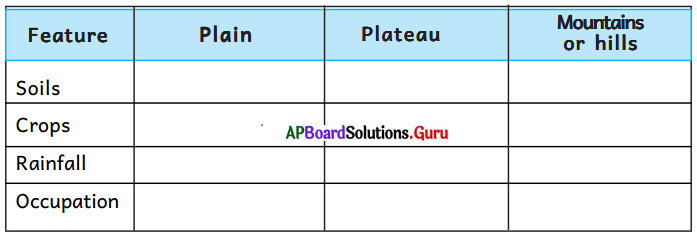
23. Fill this table with appropriate information.
AP Board 6th Class Social Studies Solutions Chapter 4 Land Forms - Andhra Pradesh 1
Answer:

FeaturePlainPlateauMountains or hills
SoilsFertile and Alluvial black soilRed soil with little nutrientsRed and Rocky soils
CropsPaddy and cash cropsOrchardsCoffee
RainfallAbove Average RainfallBelow Average rainfallAverage Rainfall
OccupationAgricultureAgricultureShifting Agriculture

Project Work

1. Make a poster of landforms.
Answer:
Student Activity.

AP Board 6th Class Social Studies Solutions Chapter 4 Land Forms - Andhra Pradesh

2. Make the day moulds of different landforms.
Answer:
Student Activity.

6th Class Social Studies 4th Lesson Land Forms – Andhra Pradesh InText Questions and Answers

Let’s Do

(Textbook Page No. 44)

Question 1.
The names of Coastal Districts from North to South.
Answer:

  1. Srikakulam,
  2. Vizianagaram,
  3. Visakhapatnam,
  4. East Godavari,
  5. West Godavari,
  6. Krishna,
  7. Guntur,
  8. Prakasam and
  9. Sri Potti Sriramulu Nellore District.

Question 2.
The names of Rayalaseema Districts:
Answer:

  1. Kurnool,
  2. Anantapur,
  3. YSR Kadapa and
  4. Chittoor Districts.

AP Board 6th Class Social Studies Solutions Chapter 4 Land Forms - Andhra Pradesh

Question 3.
Write your village/town/city name:
Answer:
Student Activity
Ex: Mandal: Giddalur
District: Prakasam
Neighbouring districts to your district: Kurnool, YSR Kadapa, SPS Nellore, Prakasam
Districts
Neighbouring state to your districts: Karnataka, Tamilnadu and Telangana.
(Note: Students can write their own districts and their Neighbouring districts & States)

Think and Respond

(Textbook Page No. 41)

Question 1.
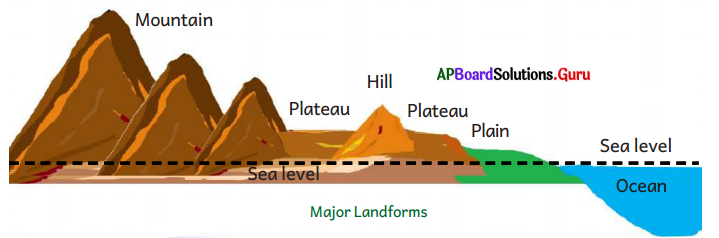
List out the landforms from the below picture?
AP Board 6th Class Social Studies Solutions Chapter 4 Land Forms - Andhra Pradesh 2
Answer:

  1. Mountain,
  2. Plateau and
  3. Plain are the landforms in the above picture.

Question 2.
Name the landforms around your village/town?
Answer:
Mountains, Plateau and Plains are the landforms that are found around our village.

(Textbook Page No. 42)

Question 3.
“The construction of a road is easy in plain areas”- Give the reason.
Answer:
Plains are level lands with flat surfaces. So it is easy to lay a road in plain areas.

AP Board 6th Class Social Studies Solutions Chapter 4 Land Forms - Andhra Pradesh

Question 4.
Why plain areas are densely populated? Write two reasons.
Answer:
The plains are densely populated because:

  1. Plains are more suitable to construct buildings as well as cultivation.
  2. Transport facilities are plenty.

Question 5.
Generally, the villages located in plains will have good employment and standard of living. Why?
Answer:
Plains in villages are fertile. They have plenty of water resources. Canals, underground water facilities are available in plains. They can use modern agricultural equipment also. So the production is also high. So, employment in agricultural activities is more. Transportation facilities are more and employment can be generated in this sector also. Construction of roads and buildings and for human inhabitation is suitable. So we can say that the villages located in plains will have good employment and standard of living.

Question 6.
Which type of soil is more suitable for cultivation?
Answer:
Fertile and alluvial black soils, nutrient soils and high water holding capacity soils are more suitable for crops.

Question 7.
Look at the pictures of a mountain, a plain and a plateau and identify which of them is similar to your region.
Answer:
Plateaus and plains are the landforms that are found in our region.

(Textbook Page No. 46)

Question 8.
Why hilly areas are suitable for plantation crops? Discuss with your Mends or teachers and write.
Answer:
In hilly areas, the soils are uneven and sloped. The soils in hilly areas are red and rocky. Due to their high elevation and the natural downward movement of water, the soils are well-drained. These soils are suitable for plantation crops like coffee and tea. For example, coffee is grown in the Araku valley in Andhra Pradesh.

AP Board 6th Class Social Studies Solutions Chapter 4 Land Forms - Andhra Pradesh

Question 9.
Name some forest products.
Answer:
Honey, fruits, gum, tamarind and wood pulp are some of the forest products.

Question 10.
Have you visited any forests? If so describe your experiences.
Answer:
Recently I visited Maredumilli in the East Godavari district. It is located in the deep forest area of Eastern Ghats quiet away from the urban concrete jungle. Maredumalli nestled in green nature’s lap. It is a pleasant place to visit as it is good for its scenic beauty with trees and lovely waterfalls pretty close to one another.

(Textbook Page No. 48)

Question 11.
What are the major changes in the cropping pattern of the plateau region?
Answer:
Due to the insufficient availability of water, only one crop can be grown here. Farmers in this region are trying to overcome this problem with various types of irrigation methods. Millet crops like ragi, sama, varagu, korra and groundnut are grown. Sometimes paddy, sugarcane, and fruit orchards are sown in this region. At present farmers are trying mixed crops like red gram, maize with groundnut. Farmers are trying contour bunding and organic farming to improve the soil quality As water facilities are fewer farmers are growing sweet lime, sapota and mango. These orchards require water in some seasons only and give regular returns. Wherever water is available plantation crops like banana, papaya, guava and pomegranate are being cultivated. In this way, major changes came in cropping patterns in plateau region when compared to the olden days.

Question 12.
What are the problems we may face in, future by digging more bore wells? Find out and discuss the causes and possible solutions.
Answer:
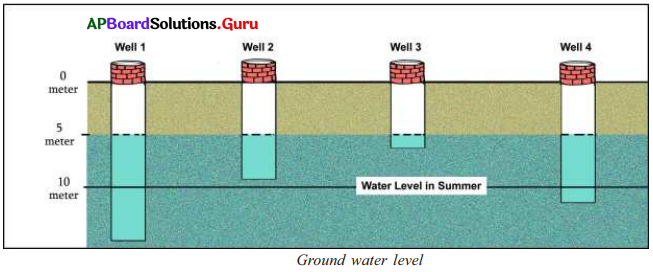
The impact of bore wells includes scarcity of water, vanishing moisture in the soil as well as the fertility of the soil. More and more borewells in the same area may cause earthquakes.
We have to plant more trees, create small ponds, create small check dams, save rainwater, make water holding tanks to overcome this problem.

AP Board 6th Class Social Studies Solutions Chapter 4 Land Forms - Andhra Pradesh

Question 13.
Compare the rainfall in the coastal plains and in the interior plateau.
Answer:
In regions closer to the coast, rainfall is heavy but in northern and western plateau regions, meagre rainfall is observed. During October and November, heavy rainfall occurs due to northeast monsoon winds.

(Textbook Page No. 49)

Question 14.
Name the main rivers that flow through the plains of Andhra Pradesh.
Answer:
Krishna and Godavari are the main rivers that flow through the plains of Andhra Pradesh.

Question 15.
What are the districts that come under the Krishna and Godavari deltas?
Answer:
Guntur, Krishna, West Godavari and East Godavari are the ‘districts that come under the Krishna and Godavari deltas.

Question 16.
Name the two main cities from where the two deltas begin. Find out the names of at least two rivers that join the Krishna river.
Answer:
Vijayawada and Rajahmundry are the two cities from where the two deltas begin. Ghataprabha River, Malaprabha River, Bhima River, Tungabhadra River are the rivers that join the Krishna river.

Question 17.
What are the reasons for the changes in cropping patterns?
Answer:
Farmers in plain areas change their cropping pattern towards cash crops and food crops. Some of the crops will make the soil fertile and the next will give high returns. Food crops like vegetables and fruits will give high returns. So they are changing the cropping pattern.

AP Board 6th Class Social Studies Solutions Chapter 4 Land Forms - Andhra Pradesh

Question 18.
Why coastal deltas are rich in infertility?
Answer:
Because of floods, the soil in these areas will get fertile due to the continuous deposition of sediments by the rivers.

Question 19.
Why agriculture is a main occupation in the plain areas?
Answer:
Plain areas are gifts to agriculture and farmers. Agriculture is the main occupation in these areas. Because of the fertility of the soil, more than one crop can be cultivated here.

Inter 2nd Year Maths 2A Permutations and Combinations Solutions Ex 5(e)

Practicing the Intermediate 2nd Year Maths 2A Textbook Solutions Inter 2nd Year Maths 2A Permutations and Combinations Solutions Exercise 5(e) will help students to clear their doubts quickly.

Intermediate 2nd Year Maths 2A Permutations and Combinations Solutions Exercise 5(e)

I.

Question 1.
If nC4 = 210, find n.
Solution:
nCr = \(\frac{n !}{(n-r) ! r !}\) = \(\frac{n(n-1)(n-2) \ldots \ldots[n-(r-1)]}{1.2 .3 \ldots \ldots \ldots . . . r}\)
Solution:
nC4 = 210
⇒ \(\frac{n(n-1)(n-2)(n-3)}{1.2 .3 .4}=10 \times 21^n C_{2 r-1}\)
⇒ n(n – 1) (n – 2) (n – 3) = 10 × 21 × 1 × 2 × 3 × 4
⇒ n(n – 1) (n – 2) (n – 3) = 10 × 7 × 3 × 2 × 3 × 4
⇒ n(n – 1) (n – 2) (n – 3) = 10 × 9 × 8 × 7
⇒ n = 10

Question 2.
If 12Cr = 495, find the possible values of r.
Solution:
Hint: nCr = nCn-r
12Cr = 495
= 5 × 99
= 11 × 9 × 5
= \(\frac{12 \times 11 \times 9 \times 5 \times 2}{12 \times 2}\)
= \(\frac{12 \times 11 \times 10 \times 9}{1.2 .3 .4}\)
= 12C4 or 12C8
∴ r = 4 or 8

Inter 2nd Year Maths 2A Permutations and Combinations Solutions Ex 5(e)

Question 3.
If 10 . nC2 = 3 . n+1C3, find n.
Solution:
10 . nC2 = 3 . n+1C3
⇒ 10 × \(\frac{n(n-1)}{1.2}=\frac{3(n+1)(n-1)}{1.2 .3}\)
⇒ 10 = n + 1
⇒ n = 9

Question 4.
If nPr = 5040 and nCr = 210, find n and r.
Solution:
Hint: nPr = r! nCr and nPr = n(n – 1) (n – 2) ……. [n – (r – 1)]
nPr = 5040, nCr = 210
r! = \(\frac{{ }^n P_r}{{ }^n C_r}=\frac{5040}{210}=\frac{504}{21}\) = 24 = 4!
∴ r = 4
nPr = 5040
nP4 = 5040
= 10 × 504
= 10 × 9 × 56
= 10 × 9 × 8 × 7
= 10P4
∴ n = 10
∴ n = 10, r = 4

Question 5.
If nC4 = nC6, find n.
Solution:
nCr = nCs ⇒ r = s or r + s = n
nC4 = nC6
∴ n = 4 + 6 = 10, (∵ 4 ≠ 6)

Question 6.
If 15C2r-1 = 15C2r+4, find r.
Solution:
15C2r-1 = 15C2r+4
2r – 1 = 2r + 4 or (2r – 1) + (2r + 4) = 15
(2r – 1) + (2r + 4) = 15
⇒ 4r + 3 = 15
⇒ 4r = 12
⇒ r = 3
∴ 2r – 1 = 2r + 4
⇒ -1 = 4 which is impossible
∴ r = 3

Inter 2nd Year Maths 2A Permutations and Combinations Solutions Ex 5(e)

Question 7.
If 17C2t+1 = 17C3t-5, find t.
Solution:
17C2t+1 = 17C3t-5
2t + 1 = 3t – 5 or (2t + 1) + (3t – 5) = 17
⇒ 1 + 5 = t or 5t = 21
⇒ t = 6 or t = \(\frac{21}{5}\) which is not an integer
∴ t = 6

Question 8.
If 12Cr+1 = 12C3r-5, find r.
Solution:
12Cr+1 = 12C3r-5
⇒ r + 1 = 3r – 5 or (r + 1) + (3r – 5) = 12
⇒ 1 + 5 = 2r or 4r – 4 = 12
⇒ 2r = 6 or 4r = 16
⇒ r = 3 or r = 4
∴ r = 3 or 4

Question 9.
If 9C3 + 9C5 = 10Cr then find r.
Solution:
nCr = nCn-r
10Cr = 9C3 + 9C5
9C3 + 9C5 = 9C3 + 9C5 = 10C6 or 10C4 = 10Cr (given)
⇒ r = 4 or 6

Question 10.
Find the number of ways of forming a committee of 5 members from 6 men and 3 ladies.
Solution:
Total number of persons = 6 + 3 = 9
∴ Number of ways of forming a committee of 5 members from 6 men and 3 ladies = 9C5
= \(\frac{9 \times 8 \times 7 \times 6 \times 5}{5 \times 4 \times 3 \times 2 \times 1}\)
= 126

Inter 2nd Year Maths 2A Permutations and Combinations Solutions Ex 5(e)

Question 11.
In question no. 10, how many committees contain atleast two ladies?
Solution:
Since a committee contains atleast 2 ladies, the members of the committee may be of the following two types.
(i) 3 men, 2 ladies
(ii) 2 men, 3 ladies
The number of selections in the first type = 6C3 × 3C2
= 20 × 3
= 60
The number of selections in the second type = 6C2 × 3C3
= 15 × 1
= 15
∴ The required number of ways of selecting the committee containing atleast 2 ladies = 60 + 15 = 75.

Question 12.
If nC5 = nC6, then find 13Cn.
Solution:
nC5 = nC6
⇒ n = 6 + 5 = 11
13Cn = 13C11 = 13C2
= \(\frac{13 \times 12}{1 \times 2}\)
= 78

II.

Question 1.
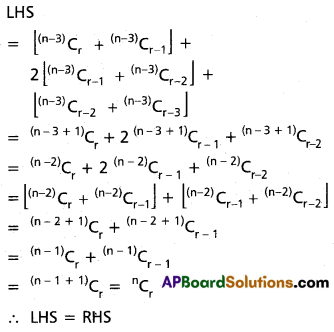
Prove that for 3 ≤ r ≤ n, (n-3)Cr . (n-3)C(r-1) + 3 . (n-3)C(r-2) + 3 . (n-3)C(r-3) = nCr
Solution:
Inter 2nd Year Maths 2A Permutations and Combinations Solutions Ex 5(e) II Q1

Question 2.
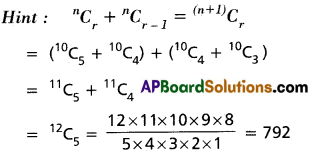
Find the value of 10C5 + 2 . 10C4 + 10C3
Solution:
Hint: nCr + nCr-1 = (n+1)Cr
Inter 2nd Year Maths 2A Permutations and Combinations Solutions Ex 5(e) II Q2

Inter 2nd Year Maths 2A Permutations and Combinations Solutions Ex 5(e)

Question 3.
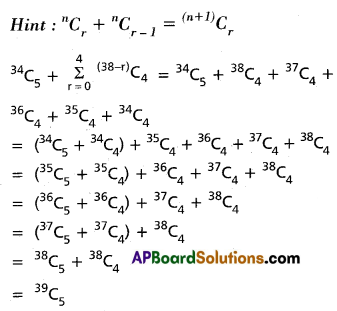
Simplify 34C5 + \(\sum_{r=0}^4{ }^{(38-r)} C_4\)
Solution:
Inter 2nd Year Maths 2A Permutations and Combinations Solutions Ex 5(e) II Q3

Question 4.
In a class, there are 30 students. If each student plays a chess game with each of the other students then find the total number of chess games played by them.
Solution:
Number of students in a class = 30
Since each student plays a chess game with each of the other students, the total number of chess games played by them = 30C2 = 435

Question 5.
Find the number of ways of selecting 3 girls and 3 boys out of 7 girls and 6 boys.
Solution:
The number of ways of selecting 3 girls and 3 boys Out of 7 girls and 6 boys = 7C3 × 6C3
= 35 × 20
= 700

Question 6.
Find the number of ways of selecting a committee of 6 members out of 10 members always including a specified member.
Solution:
Since a specified member is always included in a committee, the remaining 5 members can be selected from the remaining 9 members in 9C5 ways.
∴ Required number of ways selecting a committee = 9C5 = 126

Question 7.
Find the number of ways of selecting 5 books from 9 different mathematics books such that a particular book is not included.
Solution:
Since a particular book is not included in the selection, the 5 books can be selected from the remaining 8 books in 8C5 ways.
∴ The required number of ways of selecting 5 books = 8C5 = 56

Inter 2nd Year Maths 2A Permutations and Combinations Solutions Ex 5(e)

Question 8.
Find the number of ways of selecting 3 vowels and 2 consonants from the letters of the word EQUATION.
Solution:
The word EQUATION contains 5 vowels and 3 consonants.
The 3 vowels can be selected from 5 vowels in 5C3 = 10 ways.
The 2 consonants can be selected from 3 consonants in 3C2 = 3 ways.
∴ The required number of ways of selecting 3 vowels and 2 consonants = 10 × 3 = 30

Question 9.
Find the number of diagonals of a polygon with 12 sides.
Solution:
The number of diagonals of a polygon with sides = \(\frac{n(n-3)}{2}\)
= \(\frac{12(12-3)}{2}\)
= 54

Question 10.
If n persons are sitting in a row, find the number of ways of selecting two persons, who are sitting adjacent to each other.
Solution:
The number of ways of selecting 2 persons out of n persons sitting in a row, who are sitting adjacent to each other = n – 1

Inter 2nd Year Maths 2A Permutations and Combinations Solutions Ex 5(e)

Question 11.
Find the number of ways of giving away 4 similar coins to 5 boys if each boy can be given any number (less than or equal to 4) of coins.
Solution:
The 4 similar coins can be divided into different groups as follows.
(i) One group containing 4 coins
(ii) Two groups containing 1, 3 coins respectively
(iii) Two groups containing 2, 2 coins respectively
(iv) Two groups containing 3, 1 coins respectively
(v) Three groups containing 1, 1, 2 coins respectively
(vi) Three groups containing 1, 2, 1 coins respectively
(vii) Three groups containing 2, 1, 1 coins respectively
(viii) Four groups containing 1, 1, 1, 1 coins respectively
these groups can given away to 5 boys in = \({ }^5 C_1+2 \times{ }^5 C_2+{ }^5 C_2+{ }^5 C_3 \times \frac{3 !}{2 !}+{ }^5 C_4\)
= 5 + 20 + 10 + 30 + 5
= 70 ways

III.

Question 1.
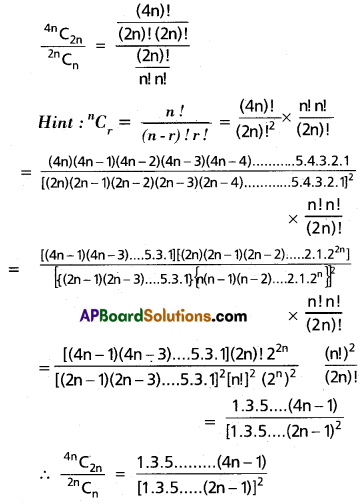
Prove that \(\frac{{ }^{4 n} C_{2 n}}{{ }^{2 n} C_n}=\frac{1.3 .5 \ldots \ldots(4 n-1)}{\{1.3 .5 \ldots \ldots(2 n-1)\}^2}\)
Solution:
Inter 2nd Year Maths 2A Permutations and Combinations Solutions Ex 5(e) III Q1

Question 2.
If a set A has 12 elements, find the number of subsets of A having
(i) 4 elements
(ii) Atleast 3 elements
(iii) Atmost 3 elements
Solution:
Number of elements in set A = 12
(i) Number of subsets of A with exactly 4 elements = 12C4 = 495

(ii) The required subset contains atleast 3 elements.
The number of subsets of A with exactly 0 elements is 12C0
The number of subsets of A with exactly 1 element is 12C1
The number of subsets of A with exactly 2 elements is 12C2
Total number of subsets of A formed = 212
∴ Number of subsets of A with atleast 3 elements = (Total number of subsets) – (number of subsets contains 0 or 1 or 2 elements)
= 212 – (12C0 + 12C1 + 12C2)
= 4096 – (1 + 12 + 66)
= 4096 – 79
= 4017

(iii) The required subset contains atmost 3 elements
i.e., it may contain 0 or 1 or 2 or 3 elements.
The number of subsets of A with exactly 0 elements is 12C0
The number of subsets of A with exactly 1 element is 12C1
The number of subsets of A with exactly 2 elements is 12C2
The number of subsets of A with exactly 3 elements is 12C3
∴ Number of subsets of A with atmost 3 elements = 12C0 + 12C1 + 12C2 + 12C3
= 1 + 12 + 66 + 220
= 299

Inter 2nd Year Maths 2A Permutations and Combinations Solutions Ex 5(e)

Question 3.
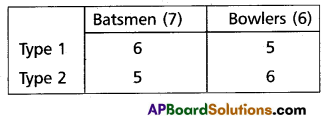
Find the number of ways of selecting a cricket team of 11 players from 7 batsmen and 6 bowlers such that there will be atleast 5 bowlers in the team.
Solution:
Since the team consists of at least 5 bowlers, the selection may be of the following types.
Inter 2nd Year Maths 2A Permutations and Combinations Solutions Ex 5(e) III Q3
The number of selections in the first type = 7C6 × 6C5
= 7 × 6
= 42
The number of selections in the second type = 7C5 × 6C6
= 21 × 1
= 21
∴ The required number of ways selecting the cricket team = 42 + 21 = 63

Question 4.
If 5 vowels and 6 consonants are given, then how many 6-letter words can be formed with 3 vowels and 3 consonants?
Solution:
No. of vowels given = 5
No.of consonants given = 6
We have to form a 6-letter word with 3 vowels and 3 consonants from given letters.
3 vowels can select from 5 in 5C3 ways.
3 consonants can select from 6 in 6C3 ways.
Total No. of words = 5C3 × 6C3 × 6! = 1,44,000

Question 5.
There are 8 railway stations along a railway line. In how many ways can a train be stopped at 3 of these stations such that no two of them are consecutive?
Solution:
Number of ways of selecting 3 stations out of 8 = 8C3 = 56
Number of ways of selecting 3 out of 8 stations such that 3 are consecutive = 6
Number of ways of selecting 3 out of 8 stations such that 2 of them are consecutive = 2 × 5 + 5 × 4
= 10 + 20
= 30
∴ Number of ways for a train to be stopped at 3 of 8 stations such that no two of them are consecutive = 56 – (6 + 30) = 20

Inter 2nd Year Maths 2A Permutations and Combinations Solutions Ex 5(e)

Question 6.
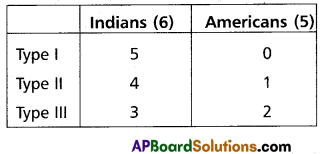
Find the number of ways of forming a committee of 5 members out of 6 Indians and 5 Americans so that always the Indians will be in majority in the committee.
Solution:
Since the committee contains the majority of Indians, the members of the committee may be of the following types.
Inter 2nd Year Maths 2A Permutations and Combinations Solutions Ex 5(e) III Q6
The number of selections in type I = 6C5 × 5C0 = 6 × 1 = 6
The number of selections in type II = 6C4 × 5C1 = 15 × 5 = 75
The number of selections in type III = 6C3 × 5C2 = 20 × 10 = 200
∴ The required number ways of selecting a committee = 6 + 75 + 200 = 281.

Question 7.
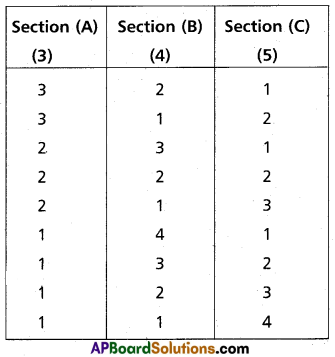
A question paper is divided into 3 sections A, B, C Containing 3, 4, 5 questions respectively. Find the number of ways of attempting 6 questions choosing at least one from each section.
Solution:
First Method: The selection of a question may be of the following
Inter 2nd Year Maths 2A Permutations and Combinations Solutions Ex 5(e) III Q7
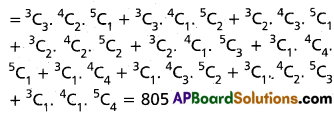
Total No. of ways of attempting 6 questions
Inter 2nd Year Maths 2A Permutations and Combinations Solutions Ex 5(e) III Q7.1
Second Method:
Required No.of attempting 6 questions = Total no. of arrangements – selection except question from C – selection except Q from A – selection except Q from B
= 12C67C69C66C6
= 805

Question 8.
Find the number of ways in which 12 things be
(i) divided into 4 equal groups
(ii) distributed to 4 persons equally.
Solution:
(i) The number of ways in which 12 things be divided into 4 equal groups = \(\frac{12 !}{3 ! 3 ! 3 ! 3 ! 4 !}\) = \(\frac{12 !}{(3 !)^4 4 !}\)
(ii) The number of ways in which 12 things be distributed to 4 persons equally = \(\frac{12 !}{3 ! 3 ! 3 ! 3 !}\) = \(\frac{12 !}{(3 !)^4}\)

Inter 2nd Year Maths 2A Permutations and Combinations Solutions Ex 5(e)

Question 9.
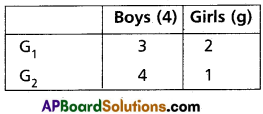
A class contains 4 boys and g girls. Every Sunday, five students with atleast 3boys go for a picnic. A different group is being sent every week. During the picnic, the class teacher gives each girl in the group a doll. If the total number of dolls distributed is 85, find g.
Solution:
No. of boys = 4
No. of girls = g
Since there should be atleast 3 boys it can be done in 2 ways as shown in the table
Inter 2nd Year Maths 2A Permutations and Combinations Solutions Ex 5(e) III Q9
The number of girls in G1 = [4C3 × gC2] × 2
Since each group contains 2 girls
The number of girls in G2 = [4C3 × gC2] × 1
Since each group contains 1 girl.
Given no. of dolls distributed = 85
⇒ [4C3 × gC2] × 2 + [4C4 × gC1] × 1 = 85
⇒ 4 . \(\frac{g(g-1)}{2}\) × 2 + 1 . g . 1 = 85
⇒ 4g2 – 4g + g – 85 = 0
⇒ 4g2 – 3g – 85 = 0
⇒ 4g2 – 20g + 17g – 85 = 0
⇒ 4g(g – 5) + 17(g – 5) = 0
⇒ (g – 5)(4g + 17) = 0
Since g ≠ \(\frac{-17}{4}\)
∴ g = 5
Hence No. of girls = 5

AP Board 1st Class English Solutions 2nd Lesson My Family

Andhra Pradesh AP Board 1st Class English Solutions 2nd Lesson My Family Textbook Exercise Questions and Answers.

AP State Syllabus 1st Class English Solutions Chapter 2 My Family

Textbook Page No. 20

1. Warm-up Time

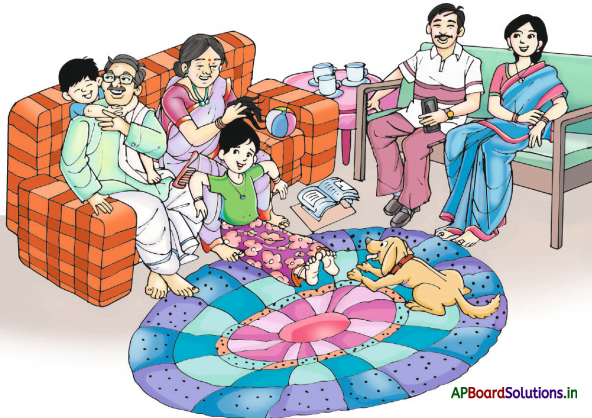
AP Board 1st Class English Solutions 2nd Lesson My Family 1
Ask the children to look at the picture and answer the following questions orally.

Question 1.
What do you see in the picture ?
Answer:
There is a family. There are father and mother, grand parents and children. There is a dog too.

Question 2.
How many persons are there in this picture ?
Answer:
There are six persons in this picture.

Question 3.
How many old persons do you see in the picture ?
Answer:
There are two old persons in the picture.

AP Board 1st Class English Solutions 2nd Lesson My Family

Question 4.
How many children are there in this picture ?
Answer:
There are two children in the picture.

Question 5.
Name the dress that the two women are wearing.
Answer:
The women are wearing sarees.

Textbook Page No. 21

2. Sharing Time

Ask the children to look at the picture. Read the text aloud. Encourage them to answer the following questions.
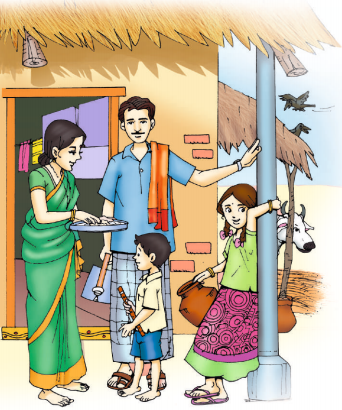
AP Board 1st Class English Solutions 2nd Lesson My Family 2
I am Rohit.
I am five years old.
My father is a farmer.
My mother is a teacher.
I have a sister.
Her name is Anu.
She is eight years old.

Comprehension

Question 1.
How many members are there in rohit’s family ?
Answer:
there are four (4) members in Rohit’s family.

Question 2.
What is the name of Rohit’s sister ?
Answer:
Anu is the name of Rohit’s sister.

AP Board 1st Class English Solutions 2nd Lesson My Family

Question 3.
What does Rohit’s father do ?
Answer:
Rohit father does farming.

Question 4.
What does rohit’s mother do ?
Answer:
Rohit mother is a teacher.

Question 5.
Who is the youngest member in the family ?
Answer:
Rohit is the youngest member in the family.

Question 6.
How old is Rohit ?
Answer:
Rohit is five years old.

Textbook Page No 22

3. Action Time

Say the following words aloud and ask children to repeat after you.
Activity – 1
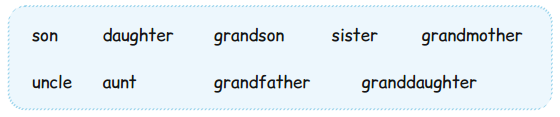
AP Board 1st Class English Solutions 2nd Lesson My Family 3
Answer:
Student activity

AP Board 1st Class English Solutions 2nd Lesson My Family

4. Circle Time

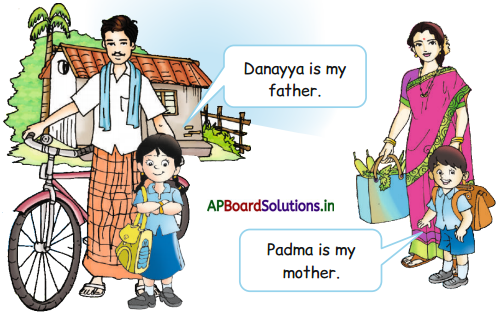
See the example below and ask the children in pairs to introduce their mother and father.
AP Board 1st Class English Solutions 2nd Lesson My Family 4
Children may extend the dialogue using language structures such as …
He / She is a mason.
He / she likes sweets…
Answer:
He is a farmer.
He works on farm.
He can ride a bicycle.
He takes me to school every day.

AP Board 1st Class English Solutions 2nd Lesson My Family

She is a home maker.
She takes care of us.
She also buys things market.
She takes me to school.
She loves us very much.

Textbook Page No. 23

5. Fun Time

Activity – 1
Read the words aloud.
AP Board 1st Class English Solutions 2nd Lesson My Family 5
Answer:
Student Activity

AP Board 1st Class English Solutions 2nd Lesson My Family

Activity – 2
Look at the picture and letters. Colour them
AP Board 1st Class English Solutions 2nd Lesson My Family 6
Answer:
Student Activity

Activity – 3
Find ‘A’ and ‘a’ in the picture. Colour them.
AP Board 1st Class English Solutions 2nd Lesson My Family 7
Answer:
Student Activity

Activity – 4
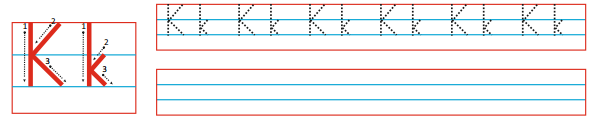
Trace and copy the following letters.
AP Board 1st Class English Solutions 2nd Lesson My Family 8
Answer:
Student Activity

AP Board 1st Class English Solutions 2nd Lesson My Family

Activity – 5
Read the words aloud.
AP Board 1st Class English Solutions 2nd Lesson My Family 9
Answer:
Student Activity

Activity – 6
Look at the picture and letters. Colour them
AP Board 1st Class English Solutions 2nd Lesson My Family 10
Answer:
Student Activity

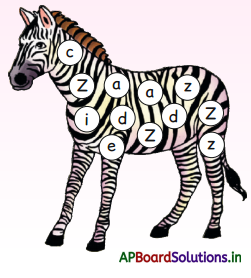
Activity – 7
Find ‘Z’ and ‘z’ in the picture. Colour them.
AP Board 1st Class English Solutions 2nd Lesson My Family 11
Answer:
Student Activity

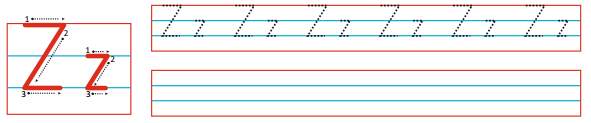
Activity – 8
Trace and copy the following letters.
AP Board 1st Class English Solutions 2nd Lesson My Family 12
Answer:
Student Activity

AP Board 1st Class English Solutions 2nd Lesson My Family

Activity – 9
Read the words aloud.
AP Board 1st Class English Solutions 2nd Lesson My Family 13
Answer:
Student Activity

Activity – 10
Look at the picture and letters. Colour them
AP Board 1st Class English Solutions 2nd Lesson My Family 14
Answer:
Student Activity

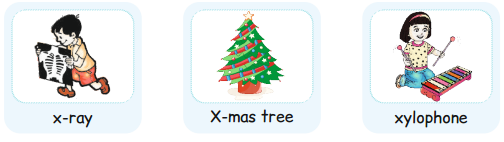
Activity – 11
Find ‘X’ and ‘x’ in the picture. Colour them.
AP Board 1st Class English Solutions 2nd Lesson My Family 15
Answer:
Student Activity

Activity – 12
Trace and copy the following letters.
AP Board 1st Class English Solutions 2nd Lesson My Family 16
Answer:
Student Activity

AP Board 1st Class English Solutions 2nd Lesson My Family

Activity – 13
Read the words aloud.
AP Board 1st Class English Solutions 2nd Lesson My Family 17
Answer:

Activity-14
Look at the picture and letters. Colour them
AP Board 1st Class English Solutions 2nd Lesson My Family 18
Answer:
Student Activity

Activity – 15
Find ‘Y’ and ‘y’ in the picture. Colour them.
AP Board 1st Class English Solutions 2nd Lesson My Family 19
Answer:
Student Activity

Activity – 16
Trace and copy the following letters.
AP Board 1st Class English Solutions 2nd Lesson My Family 20
Answer:
Student Activity

AP Board 1st Class English Solutions 2nd Lesson My Family

Activity – 17
Read the words aloud.
AP Board 1st Class English Solutions 2nd Lesson My Family 21
Answer:
Student Activity

Activity – 18
Look at the picture and letters. Colour them
AP Board 1st Class English Solutions 2nd Lesson My Family 22
Answer:
Student Activity

Activity – 19
Find ‘K’ and ‘k’ in the picture. Colour them.
AP Board 1st Class English Solutions 2nd Lesson My Family 23
Answer:
Student Activity

AP Board 1st Class English Solutions 2nd Lesson My Family

Activity – 20
Trace and copy the following letters.
AP Board 1st Class English Solutions 2nd Lesson My Family 24
Answer:
Student Activity

Textbook Page No. 28

6. Practice Time

Read with rhythm
AP Board 1st Class English Solutions 2nd Lesson My Family 25
Answer:
Student Activity

Read with rhythm

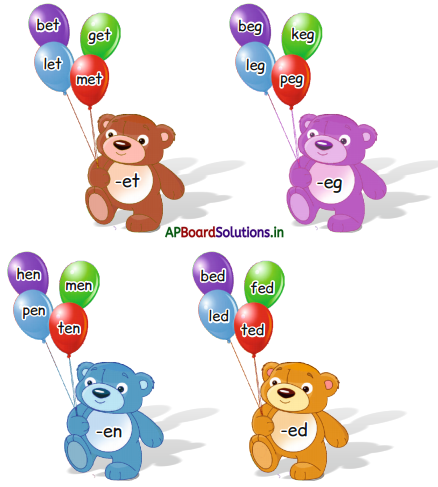
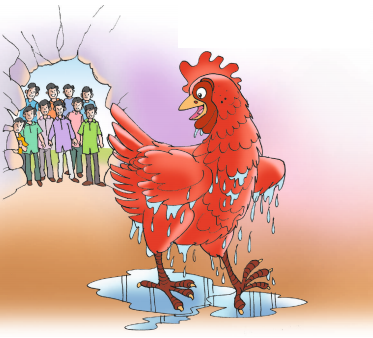
Elicit the answer by asking relevant questions on the picture below. Ask students to say the sentences given below to reinforce the short vowel sound of ‘e’. Let them repeat after you.
AP Board 1st Class English Solutions 2nd Lesson My Family 26

  • a hen
  • a red hen
  • A red hen yets wet.
  • A wet red hen met ten men.
  • A wet red hen met ten men in a den.

THE HELPFUL CRANE

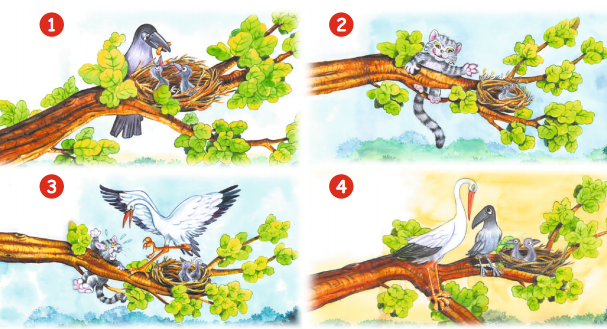
Show the following pictures and encourage the students to frame the story.
AP Board 1st Class English Solutions 2nd Lesson My Family 27
Answer:
Once a crow lived in a tree. It lived in its nest. It fell its young ones. One day a cat saw the young ones in the nest. It tried to take away the young ones. The crow was not there in the nest.

AP Board 1st Class English Solutions 2nd Lesson My Family

A crane saw this. It attacked the cat and drove him away. The crow returned and found the crane. It thanked the crane.

AP Inter 1st Year Economics Study Material Chapter 3 Theory of Demand

Andhra Pradesh BIEAP AP Inter 1st Year Economics Study Material 3rd Lesson Theory of Demand Textbook Questions and Answers.

AP Inter 1st Year Economics Study Material 3rd Lesson Theory of Demand

Essay Questions

Question 1.
Explain the Law of Demand and examine Exceptions to it.
Answer:
Demand means a desire which is backed up by ability to buy and willingness to pay the price is called demand in Economics. Thus demand will be always to a price and time. Demand has the following features.

  1. Desire for the commodity
  2. Ability to buy the commodity
  3. Willing to pay the price of commodity
  4. Demand is always at a price
  5. Demand is per unit of time i.e, per day, week etc.

Therefore the price demand may be expressed in the form of small equation.
Dx = f(Px)
Price demand explains the relation between price and quantity demanded of a commodity. Price demand states that there is an inverse relationship between price and demand.

Law of demand : Marshall defines the law of demand as, “The amount demanded increases with a fall in price and diminishes with arise in price when other things remain the same”. So, the law of demand explains the inverse relationship between the price and quantity demanded of a commodity.

Demand schedule : It means a list of the quantities demanded at various prices in a given period of time in a market. An imaginary example given below.
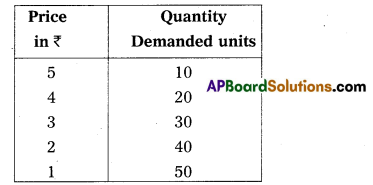
AP Inter 1st Year Economics Study Material Chapter 3 Theory of Demand 1
The table shows that as the price falls to ₹ 1/- the quantity demanded 50 units, when price ₹ 5/- he is buying 10 units. So, there is inverse relationship between price and demand. Price is low demand will be high and price is high demand will be low. We can illustrate the above schedule in a diagram.
AP Inter 1st Year Economics Study Material Chapter 3 Theory of Demand 2
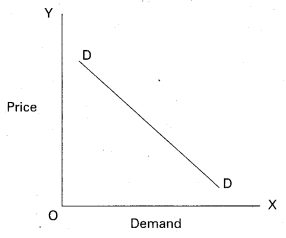
In the above diagram on X-axis demand is shown and price is on Y-axis. DD is the ad curve. Demand curves slopes downward from left to right.
Assumptions :

  1. No change in the income of consumer
  2. The taste and preferences consumers remain same.
  3. The prices of related goods remain the same.
  4. New substitutes are not discovered.
  5. No expectation of future price changes.

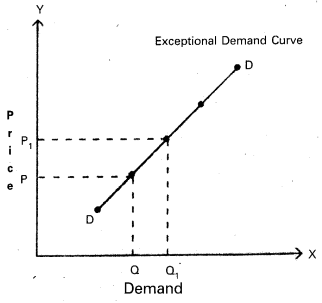
Exceptions : In certain situations, more will be demanded at higher price and less will be demanded at a lower price. In such cases the demand curve slopes upward from left to right which is called an exceptional demand curve. This can be shown in the following diagram.
AP Inter 1st Year Economics Study Material Chapter 3 Theory of Demand 3
In the diagram when price increases from OP to OP1, demand also increases from OQ to OQ1. This is opposite to law of demand.
1) Giffen’s Paradox: This was stated by Sir Robert Giffen. He observed that poor people will demand more of inferior goods, if their prices raise. Inferior goods are known as Giffen goods.
Ex : Ragee, Jowar etc. He pointed out that in case of the English workers, the law of demand does not apply to bread. Giffen noticed that workers spend a major portion of their income on bread and only small portion on meat.

2) Veblen Effect (Prestigious goods) : This exception was stated by Veblen. Costly goods like diamonds and precious stones are called prestige goods or veblen goods. Generally rich people purchase those goods for the sake of prestige. Hence rich people may buy more such goods when their prices rise.

3) Speculation : When the price of a commodity rises the group of speculators expect that it will rise still further. Therefore, they buy more of that commodity. If they expect that there is a fall in price, the demand may not expand.
Ex : Shares in the stock market.

4) Illusion : Some times, consumer develop to false idea that a high priced good will have a better quality instead of low priced good. If the price of such good falls, demand decreases, which is contrary to the law of demand.

AP Inter 1st Year Economics Study Material Chapter 3 Theory of Demand

Question 2.
What is Demand Function ? What are the factors that determine the demand for a good ? [March 16]
Answer:
The functional relationship between the demand for a commodity and its various determinants may be explained mathematically in terms of a demand function.
Dx = f(Px,P1, ………… Pn, Y, T)
Where Dx = Demand for good X;
Px = price of X;
P1 …. Pn = Prices of substitutes and complementaries
Y = Income,
T = Taste of the consumer.
Determinants of demand :

  1. Price of commodity: The demand for any good depends on its price, more will be demanded at lower price and vice-versa.
  2. Prices of substitutes and complementaries : Demand is influenced by changes in price of related goods either substitutes or complementary goods.
    Ex: Increase in the price of coffee leads an increase in the demand for tea in the case of substitutes positive relation and complementaries negative relationship between price and demand.
  3. Income of the consumer : Demand always changes with a change in the incomes of the people. When income increases the demand for several commodities increases and vice-versa.
  4. Population : A change in the size and composition of population will effect the demand for certain goods like food grains, clothes etc.
  5. Taste and preferences: A change in the taste and the fashions bring about a change in the demand for a commodity.
  6. Technological changes: Due to economic progress technological changes the quantity the quality of goods available to the consumers increase.
    Ex : Demand for cell phones reduced the demand for landline phones.
  7. Change in the weather : Demand for commodity may change due to change in a climatic condition.
    Ex : During summer demand for cool drinks, in winter demand for wollen clothes.
  8. State of business : During the period of prosperity demand for commodities will expand and during depression demand will contract.

Question 3.
Explain the Concept of Demand and various types of Demand.
Answer:
The concept of demand has immerse significance in economics. In general language demand means a desire but in economics the desire backed up by ability to buy and willingness to pay the price.
Types of demands :
The demand may be classified into 3 types.

  1. Price demand
  2. Income demand
  3. Cross demand

1) Price demand : Price demand explains the relation between price and quantity demanded by a commodity it shows the inverse relationship between price and demand when the other things like consumers income, taste etc., remains constant. It means the price falls demand extends and the price raises demand contracts. The price demand can be expressed Dx = f(Px).
whereDx = Demand for X commodity
Px = Price of X
F = Function.

2) Income demand: It explains the relationship between consumers income and various quantities of various levels of income assuming other factors like price of goods, related goods, taste etc; remain the same. It means if income increases quantity demand increases and vice versa. This can be shown in the following form.
Dx = F(Y)
Where Dx = demand of X good;
Y = income of consumer.

3) Cross demand: It refers to change in demand for a commodity as a result of change in prices of its related commodities when other factors remains constant. This can be shown
Dx = f(Py)
Dx = demand of X good;
Py = Price of Y commodity;
F = function
Related goods are 2 types,

  1. Substitutes : Goods which satisfy same want called substitutes.
    Ex : Coffee and tea. Here there is a positive relation between price and demand.
  2. Complementary goods : These goods which satisfy the same want jointly.
    Ex : Car and petrol, shoes and sockes etc; are complementary goods.
    Here there exists inverse relation between complementary goods.

AP Inter 1st Year Economics Study Material Chapter 3 Theory of Demand

Question 4.
Explain the three Forms of Demand with suitable diagrams.
Answer:
The concept of demand has great significance in economics. In general language demand means a desire but in economics the desire backed up by ability to buy and willingness to pay the price.
Types of demand : The demand may be classified into three types.

  1. Price demand
  2. Income demand
  3. Cross demand

1) Price demand : Price demand explains the relationship between price and quantity demanded of a commodity it shows the inverse relationship between price and demand when the other things like consumers income, taste etc., remains constant. It means the price falls demand extends and price raises demand contracts. The price demand can be expressed Dx = f(Px)
Price demand can be explained with the help of demand schedule.
AP Inter 1st Year Economics Study Material Chapter 3 Theory of Demand 4
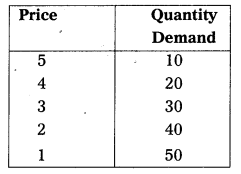
As price falls to ₹ 1/- the quantity demand is 50 units, when price of apple is ₹ 5/- he is buying 10 units. So, the table shows inverse relationship between price and demand. Price demand can be explained with the help of the demand curve.
AP Inter 1st Year Economics Study Material Chapter 3 Theory of Demand 5
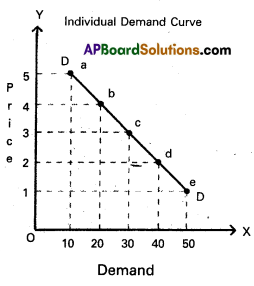
On OX axis shows demand, OY axis shows price. We can obtain the demand curve ‘DD’ by joining all the points A, B, C, D, E which represents various quantities of demand at various prices. ‘DD’ is demand curve. It slopes downwards from left to right. It shows the inverse relationship between price and demand.

2) Income demand: It explains the relationship between consumers income and various quantities of various levels of income assuming other factors like price of goods, related goods, taste etc; remain the same. It means if income increases quantity demand increases and vice versa. This can be shown in the following form.
Dx = f(Y)
The functional relationship between income and demand may be inverse or direct depending on the nature of the commodity. This can be shown in the following table.
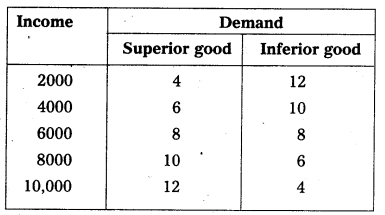
AP Inter 1st Year Economics Study Material Chapter 3 Theory of Demand 6
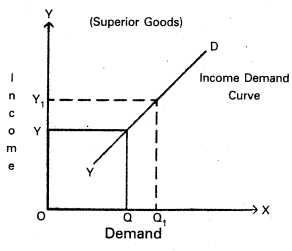
Superior goods : In case of superior goods quantity demanded will increase when there is an increase in the income of consumers.
In the diagram ‘X’ axis represents demand, OY axis represents income, YD represents the income demand curve. It showing positive slope whenever income increased from OY to OY1; the demand of superior or normal goods increases from OQ to OQ1.
This may happens in case of Veblen goods.
AP Inter 1st Year Economics Study Material Chapter 3 Theory of Demand 7
Inferior goods : On the contrary quantity demanded of inferior goods decreases with the increase in incomes of consumers.
In the diagram on ‘OX’ axis measures demand and OY axis represents income of the consumer. When the consumer income increases from OY to OY1 the demand for a commodity decreases from OQ to OQ1 So the YD’ curve is negative sloping.

3) Cross demand: Cross demand refers to the relationship between any two goods which are either complementary to each other or substitute for each other. It explains the functional relationship between the price of one commodity and quantity demanded of another commodity is called cross demand.
Dx = f(Py)
Where Dx – demand for ‘X’ commodity
Py Price of Y’ commodity
f = function
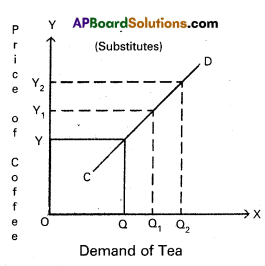
Substitutes : The goods which satisfy the same want are called substitutes.
Ex : Tea and coffee; pepsi and coca-cola etc. In the case of substitutes, the demand curve has a positive slope.
AP Inter 1st Year Economics Study Material Chapter 3 Theory of Demand 8
In the diagram ‘OX’ axis represents demand tea and OY axis represents price of coffee. Increase in the price of coffee from OY to OY2 leads to increase in the demand of tea from OQ to OQ2.

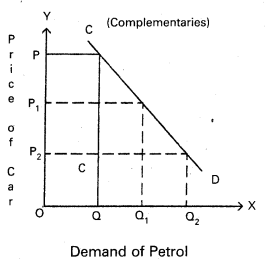
Complementaries : In case of complementary goods, with the increase in price of one commodity, the quantity demanded of another commodity falls.
Ex : Car and Petrol. Hence the demand curve of these goods slopes downward to the right.
AP Inter 1st Year Economics Study Material Chapter 3 Theory of Demand 9
In the diagram if price of car decreases from OP to OP2 the quantity demand of petrol increases from OQ to OQ2. So cross demand i.e., CD curve is downward slopes.

AP Inter 1st Year Economics Study Material Chapter 3 Theory of Demand

Question 5.
Define the Concept of Elasticity of Demand and explain the concepts of price, income and cross elasticity of demand.
Answer:
The concept of elasticity demand was first introduced by Cournot and Mill. Later it was developed in a scientific manner by Marshall. Elasticity of demand means the degree of sensitiveness or responsiveness of demand to a change in its price.

According to Marshall “The elasticity of demand in a market is great or small according as the amount demanded increases much or little for a given fall in price”.

The concept of elasticity of demand explains how much or to what extent a change in any one of the independent variables leads to change in the dependent variable.
There are three kinds of elasticity of demand.

  1. Price elasticity of demand
  2. Income elasticity of demand
  3. Cross elasticity of demand

1) Price Elasticity of Demand : Alfred Marshall developed the concept of price elasticity of demand. Price elasticity of demand is generally defined as the degree of responsiveness or sensitiveness of demand for a commodity to the changes in its price. Thus price elasticity of demand is the ratio of percentage change in quantity demanded of a good and percentage change in its price. The following formula to measure price elasticity of demand.
Ep = \(\frac{\text { Percentage change in quantity demanded }}{\text { Percentage change in price }}\)
= \(\frac{\text { Change in quantity demanded }}{\text { Original quantity demanded }} \times \frac{\text { Original price }}{\text { Change in price }}\)
= \(\frac{\Delta \mathrm{q}}{\mathrm{q}} \times \frac{\mathrm{p}}{\Delta \mathrm{p}}=\frac{\Delta \mathrm{q}}{\Delta \mathrm{p}} \times \frac{\mathrm{p}}{\mathrm{q}}\)
where q = quantity;
p = price;
∆q = change in quantity demanded;
∆p = change in price.
There are five kinds of price elasticity of demand. They are :

  1. Perfectly Elastic demand (Ed = α)
  2. Perfectly Inelastic demand (Ed = 0)
  3. Unitary Elastic demand (Ed = 1)
  4. Relatively Elastic demand (Ed > 1)
  5. Relatively Inelastic demand (Ed < 1)

2) Income Elasticity of Demand : Income elasticity of demand shows the degree of responsiveness of quantity demanded of a commodity to a change in the income of the consumer, other things remain constant.
Ey = \(=\frac{\text { Percentage change in quantity demanded }}{\text { Percentage change inconsumer’s income }}\)
= \(=\frac{\text { Change in quantity demanded }}{\text { Original quantity demanded }} \times \frac{\text { Original income }}{\text { Change in income }}\)
= \(\frac{\Delta \mathrm{q}}{\mathrm{q}} \times \frac{\mathrm{y}}{\Delta \mathrm{y}}=\frac{\Delta \mathrm{q}}{\Delta \mathrm{y}} \times \frac{\mathrm{y}}{\mathrm{q}}\)
where q = Quantity;
y = income;
∆Q = change in quantity demanded;
∆y = change in income.
Income elasticity of demand will be positive in case of superior goods like milk and meat and negative in case of inferior goods like porridge and broken rice.

3) Cross Elasticity of Demand : Cross elasticity of demand refers to change in the quantity demanded of one good in response to change in the price of related good, other things remaining constant. There are certain goods whose demand depend not only to their price but also on the prices of related goods.
Ec = \(\frac{\text { Percentage change in quantity demanded of X }}{\text { Percentage change in the price of } Y}\)
Ec = \(\frac{\Delta \mathrm{Qx}}{\mathrm{Qx}} \div \frac{\Delta \mathrm{Py}}{\mathrm{Py}}=\frac{\Delta \mathrm{Qx}}{\mathrm{Qx}} \times \frac{\mathrm{Py}}{\Delta \mathrm{Py}}=\frac{\Delta \mathrm{Qx}}{\Delta \mathrm{Px}} \times \frac{\mathrm{Py}}{\mathrm{Px}}\)
Where Q(x) = Quantity demanded for X; P(y) = price of commodity (Y), ∆Q(x) = change in quantity demanded of X commodity, ∆P(y) = change in price of commodity Y.
Substitute goods like tea and coffee have positive cross elasticity demand where as complementary goods like shoes and socks have negative cross elasticity of demand.

AP Inter 1st Year Economics Study Material Chapter 3 Theory of Demand

Question 6.
What is Price Elasticity of Demand ? Explain the various types of Price Elasticity of Demand.
Answer:
Alfred Marshall developed the concept of price elasticity of demand. Price elasticity measures, other things remaining constant, change in the demanded of a good in response to a change in its price. Thus price elasticity of demand is the ratio of percentage change in quantity demanded of a good and percentage change in its price. Price elasticity can be written as stated below.
Ep = \(\frac{\text { Percentage change in quantity demanded }}{\text { Percentage change in price }}\)
= \(\frac{\text { Change in demand }}{\text { Original demand }} \times \frac{\text { Original price }}{\text { Change in price }}\)
= \(\frac{\Delta \mathrm{q}}{\mathrm{q}} \times \frac{\mathrm{p}}{\Delta \mathrm{p}}=\frac{\Delta \mathrm{q}}{\Delta \mathrm{p}} \times \frac{\mathrm{p}}{\mathrm{q}}\)
Where q = quantity; p = price; ∆q = change in demand; ∆p = change in price
Types of price elasticity of demand : Based on numerical value, price elasticity of demand can be five types.

  1. Perfectly Elastic demand (Ed = ∞)
  2. Perfectly Inelastic demand (Ed = 0)
  3. Unitary Elastic demand (Ed = 1)
  4. Relatively Elastic demand (Ed > 1)
  5. Relatively Inelastic demand (Ed < 1)

1) Perfectly Elastic demand : It is also known as “infinite elastic demand”. A small change in price leads to an infinite change in demand is called perfectly elastic demand. It is horizontal straight line to ‘X’ axis. The numerical value of perfectly elastic demand is infinite (Ed = ∞). It can be shown in the diagram.
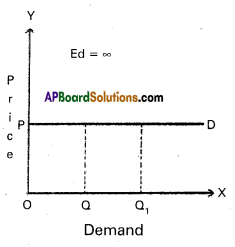
AP Inter 1st Year Economics Study Material Chapter 3 Theory of Demand 10
In the diagram, Ed = \(\frac{\mathrm{OQQ}_1}{\mathrm{OQ}} \div \frac{\mathrm{O}}{\mathrm{OP}}\)
= \(\frac{\mathrm{QQ}_1}{\mathrm{OQ}} \times \frac{\mathrm{OP}}{\mathrm{O}}\) = ∞

2) Perfectly Inelastic demand: It is also known as “zero elastic demand”. In this case even a great rise ‘or fall in price does not lead to any change in quantity demanded is known as perfectly inelastic demand. The ‘demand curve will be vertical to the Y axis. The numerical value is ‘OE. This can be shown in the following diagram.
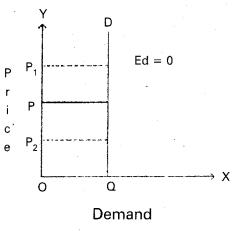
AP Inter 1st Year Economics Study Material Chapter 3 Theory of Demand 10
In the diagram, Ed = \(\frac{\text { Zero }}{\mathrm{OQ}} \div \frac{\mathrm{PP}_1}{\mathrm{OP}}\) = 0
∴ Ed = 0

3) Unitary Elastic demand: The percentage change in price leads to same percentage change in demand is called unitary elastic demand. In this case the elasticity of demand is equal to one. The shape of demand curve is “Rectangular Hyperbola”. This can be shown in the following.
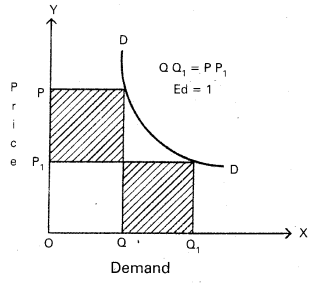
AP Inter 1st Year Economics Study Material Chapter 3 Theory of Demand 12
In the diagram, Ed = OP1Q1 = OPQ
(or) OQ1 = PP1
∴ Ed = 1

4) Relatively Elastic demand: When a percentage change in price leads to more than percentage change in quantity demand is called relatively elastic demand. In this case the numerical value of Ed is greater than one (Ed > 1)
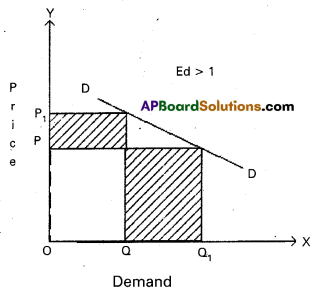
AP Inter 1st Year Economics Study Material Chapter 3 Theory of Demand 13
In the diagram, Ed = OQ1 > PP1
∴ Ed > 1

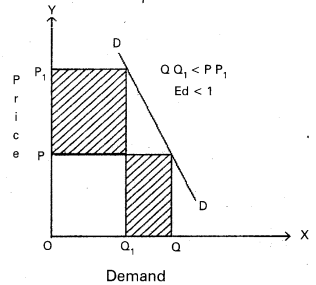
5) Relatively Inelastic demand : When the percentage change in price leads to a less than percentage change in quantity demand is called relatively inelastic demand. Here the numerical value is less than one (Ed < 1) . This can be shown to following diagram.
AP Inter 1st Year Economics Study Material Chapter 3 Theory of Demand 14
In the diagram, Ed = QQ1 < PP1
∴ Ed < 1

Question 7.
Explain the three methods of Measuring Price Elasticity of Demand.
Answer:
The concept of elasticity of demand is one of the original contributions of Dr.Marshall. The concepts of elasticity of demand clearly explains ‘how much’ demand increases due to a certain fall in price and ‘how much’ demand decreases due to certain rise in price.

According to Mrs. Joan Robinson, “The elasticity of demand at any price or at any output is the proportional change of amount purchased in response to a small change in price, divided by the proportional change in price”.

Methods of measurements of Price Elasticity of demand :
The Elasticity of demand can be measured mainly in three ways.

  1. Total outlay (or) Expenditure method
  2. Point method and
  3. Arc method.

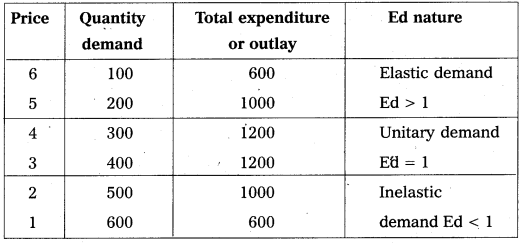
1) Total outlay (or) Expenditure method : This method was introduced by Alfred Marshall. Price elasticity of demand can be measured on the basis of change in the total outlay due to a change in the price of a commodity. This method helps us to compare the total expenditure from a buyer or total revenue from the seller before and after the change in price.
Total outlay = Price × Quantity demanded
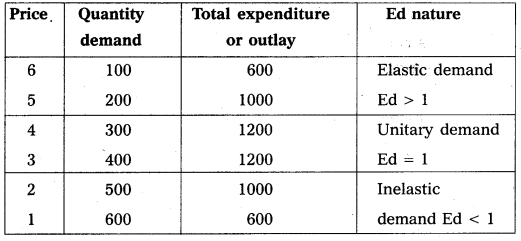
According to this method the price elasticity of demand is expressed in three forms, they are elastic demand, unitary elastic and inelastic demand. This can be explained with the help of table.
AP Inter 1st Year Economics Study Material Chapter 3 Theory of Demand 15
In this table shows that

  1. If the total expenditure increases due to a fall in price is known as relatively elastic demand.
  2. If total expenditure remains constant even the price falls is known as unitary elastic demand.
  3. If the total expenditure decreases due to a fall in price is known as relatively inelastic demand.

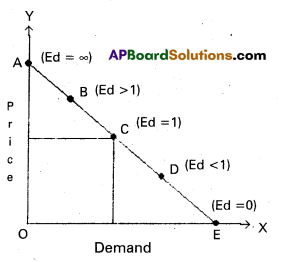
2) Point method : This method is introduced by Marshall. In this method elasticity of demand is measured at a point on the demand curve. So, this method is also called as “geometrical method”. In this method to measure elasticity at a point on demand curve the following formula is applied.
Ed = \(\frac{\text { The distance from the point to the } \mathrm{X} \text {-axis }}{\text { The distance from the point to the } \mathrm{Y} \text {-axis }}\)
In the below diagram ‘AE’ is straight line demand curve. Which is 10 cm length. Applying the formula we get
Ed = 1 Ed < 1 Ed = 0
AP Inter 1st Year Economics Study Material Chapter 3 Theory of Demand 16
Elasticity at point A, Ed = \(\frac{\mathrm{AE}}{\mathrm{A}}=\frac{10}{0}\) = 0
Elasticity at point B, Ed = \(\frac{\mathrm{BE}}{\mathrm{BA}}=\frac{7.5}{2.5}\) = 3 > 1
Elasticity at point C, Ed = \(\frac{\mathrm{CE}}{\mathrm{CA}}=\frac{5}{5}\) = 1
Elasticity at point D, Ed = \(\frac{\mathrm{DE}}{\mathrm{DA}}=\frac{1}{3}\) = < 1
Elasticity at point E, Ed = \(\frac{\mathrm{E}}{\mathrm{DA}}=\frac{0}{10}\) = 0
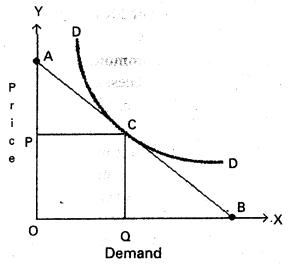
if the demand curve is non-linear. It means if the demand curve is not straight line will be drawn at the point on the demand curve where to measure elasticity.
AP Inter 1st Year Economics Study Material Chapter 3 Theory of Demand 17
In the diagram at C point where Elasticity of demand will be equal to \(\frac{\mathrm{CB}}{\mathrm{CA}}\).

3) Arc method : The word ‘ArC means a portion or a segment of a demand curve. In this method mid points between the old and new price and quantities demanded are used. This method used to known small changes in price. This method is also known as ‘Average Elasticity of demand”. This method studies a segment of the demand curve between two points the formula for measuring elasticity is given below.
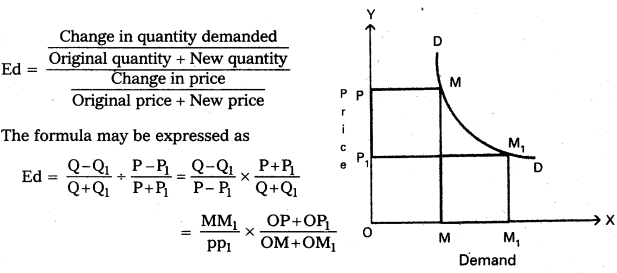
AP Inter 1st Year Economics Study Material Chapter 3 Theory of Demand 18
Suppose we take price of the commodity is ₹ 4/- demand is 300 units. If price falls ₹ 3/ – demand increases 400 units.
Then applying above formula Arc elasticity of demand is
\(\frac{100}{300+400} \div \frac{1}{4+3}=\frac{100}{700} \div \frac{1}{7}\)
= \(\frac{100}{700} \times \frac{7}{1}=\frac{700}{700}\) = 1
∴ Ed = 1

AP Inter 1st Year Economics Study Material Chapter 3 Theory of Demand

Question 8.
What are the factors that determine Price Elasticity of Demand ?
Answer:
The term elasticity refers to the measure of extent of relationship between two related variables. The elasticity of demand is the measure of responsiveness or sensitiveness of demand for a commodity to the change in it demand.
Determinants of Elasticity of Demand : The. elasticity of demand varies from commodity to commodity.
1) Nature of commodity: Commodities can be grouped as necessaries, comforts and luxuries. In case of necessaries, the elasticity of demand will be inelastic.
Ex : Rice, salt etc. On the other hand in case of luxuries the demand will be more elastic.
Ex : Diamonds & gold etc.

2) Availability of substitutes : Prices of substitutes influence the demand for a com-modity upto a certain extent. The closer the substitute, the greater the elasticity of demand for the commodity. For Ex : Cool drinks, soaps etc. but in case of non-availability of substitutes the elasticity of demand will be low.

3) Complementary goods: Price elasticity for a good is also depends on the nature of price elasticity of jointly demand goods. If the demand for car is elastic, then the demand for petrol will also be elastic.

4) Multiple uses of the commodity : The wider the range of alternative uses of a product, the higher the elasticity of demand and vice-versa.
Ex : Coal and electricity have multiple uses and will have elastic demand.

5) Proportion of income spent: If proportion of income spent on commodity is very small, its demand will be less elastic and vice-versa.

6) Period of time : In the long run, demand will be more elastic. Longer the time period considered, greater will be the possibility of substitution. For a cheaper good.
Ex : If the price of petrol increases in the short run, it may not be possible to replace the petrol engines with diesel engines but in the long run it can be possible.

7) Price level: Goods which are in very high range or in very low range have inelastic demand but it is high at moderate price.

8) Habit : The demand for a commodity to which the consumer is accustomed is generally inelastic.
Ex : Tobacco and alcohol.

9) Income group : The demand of higher income groups will be inelastic as they do not bother about price changes. On the other hand, the demand of middle and lower income groups will be elastic.

10) Postponement of purchase: The demand for a commodity, the consumption of which can be postponed is more eiastic than that of the use of the commodity cannot be postpone the purchases of such goods like life saving medicines.

AP Inter 1st Year Economics Study Material Chapter 3 Theory of Demand

Question 9.
Explain importance of Elasticity of Demand.
Answer:
The term elasticity refers to the measure of extent of relationship between two related variable. The elasticity of demand is the measure of responsiveness or sensitiveness of demand for a commodity to the change in it demand.
Importance :
1) Useful to monopolist: Monopolist should study the elasticity of demand for his commodity before fixing up the price. Monopolist will fix a higher price when the commodity inelastic demand, but he will fix a lower price when the commodity has elastic demand.

2) Useful to joint products : It is useful in the price fixation of joint goods like meat and fur. In such case the producer wall be guided by elasticity of demand to fix the prices of the joint goods.

3) Useful to the government: The concept of elasticity can be used in formulating government policies relating public utility service like Railways, drug industry etc.

4) Useful to international trade : In calculating the terms of trade both countries have to take into account the mutual elasticities of demand for the products.

5) Useful to finance minister : The concept of elasticity is useful to the Finance Minister in imposing taxes on goods. The finance minister studies the elasticity of commodities before he imposes new taxes or enhances old taxes.

6) Useful to Management: Before asking for higher wages trade union leaders must know the elasticity of demand of the product produced by them. Trade union leaders may demand for higher wages only when the goods produced by them have inelastic demand.

7) Useful to producers : Volume of goods must be produced in accordance with demand for the commodity. Whenever the demand for the commodity is inelastic, the producer will produce more commodities to take advantage of higher price. So, it helps in determining the volume of output.

Short Answer Questions

Question 1.
Explain the Law of Demand or Price Demand.
Answer:
Demand means a desire which is backed up by ability to buy and willingness to pay the price is called demand in Economics. Thus demand will be always to a price and time. Demand has the following features.

  1. Desire for the commodity
  2. Ability to buy the commodity
  3. Willing to pay the price of commodity
  4. Demand is always at a price ‘
  5. Demand is per unit of time i.e, per day, week etc.

Therefore the price demand may be expressed in the form of small equation.
Dx = f(Px)
Price demand explains the relation between price and quantity demanded of a commodity. Price demand states that there is an inverse relationship between price and demand.

Law of demand : Marshall defines the law of demand as, “The amount demanded increases with a fall in price and diminishes with arise in price when other things remain the same”. So, the law of demand explains the inverse relationship between the price and quantity demanded of a commodity.

Demand schedule : It means a list of the quantities demanded at various prices in a given period of time in a market. An imaginary example given below.
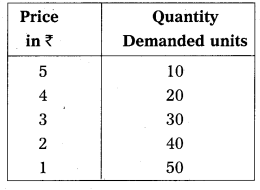
AP Inter 1st Year Economics Study Material Chapter 3 Theory of Demand 19
The table shows that as the price falls to ₹ 1/- the quantity demanded 50 units, when price ₹ 5/- he is buying 10 units. So, there is inverse relationship between price and demand. Price is low demand will be high and price is high demand will be low. We can illustrate the above schedule in a diagram.
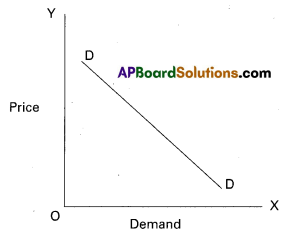
AP Inter 1st Year Economics Study Material Chapter 3 Theory of Demand 20
In the above diagram on X-axis demand is shown and price is on Y-axis. DD is the demand curve. Demand curves slopes downward from left to right.
Assumptions :

  1. No change in the income of consumer
  2. The taste and preferences consumers remain same.
  3. The prices of related goods remain the same.
  4. New substitutes are not discovered.
  5. No expectation of future price changes.

Exceptions : In certain situations, more will be demanded at higher price and less will be demanded at a lower price. In such cases the demand curve slopes upward from left to right which is called an exceptional demand curve. This can be shown in the following diagram.
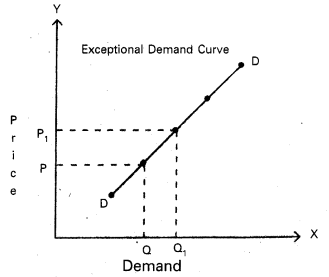
AP Inter 1st Year Economics Study Material Chapter 3 Theory of Demand 21
In the diagram when price increases from OP to OP1, demand also increases from OQ to OQ1. This is opposite to law of demand.

AP Inter 1st Year Economics Study Material Chapter 3 Theory of Demand

Question 2.
Explain the Exceptions to the Law of Demand or Price Demand.
Answer:
In Economics demand means a desire which is backed up by ability to buy and willingness to pay the price. Thus demand will be always at a price and time.

According to Marshal “The amount demanded increases with a fall in price and diminishes with rise in price when other things remain the same”.

Exceptions : In certain situations, more will be demanded at higher price and less will be demanded at a lower price. In such cases the demand curve slopes upward from left to right which is called an exceptional demand curve. This can be shown in the following diagram.
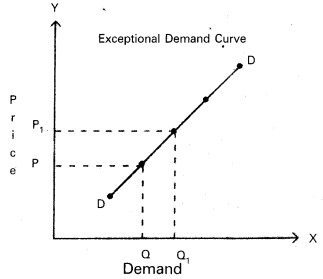
AP Inter 1st Year Economics Study Material Chapter 3 Theory of Demand 22
In the diagram when price increases from OP to OP1, demand also increases from OQ to OQ1. This is opposite to law of demand.

Question 3.
Why a Demand Curve has a negative slope or why Demand Curve slopes downward ? [March 18]
Answer:
According to Marshall “The amount demanded increases with a fall in price and diminishes with a rise in price when other things remain the same”.

The law of demand explains inverse relationship between the price and quantity demanded of a commodity. Therefore the demand curve slopes downward from left to right.
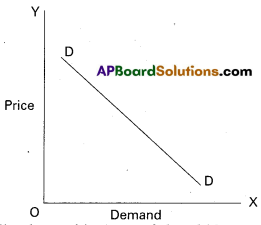
AP Inter 1st Year Economics Study Material Chapter 3 Theory of Demand 23
There are some other reasons also responsible for downward sloping demand curve.
1) Old and new buyers : If the price of a good falls, the real income of the old buyers will increase. Hence the demand for the good will increase. In the same way, the fall in price attracts new buyers and will be able to built after a fall in its price. So the demand curve slopes downards from left to right.

2) Income effect: Fall in price of commodity the real income of its consumers increase. The increase in real income encourages demand for the commodity with reduced price. The increase in demand on account of increased in real income is known as income effect.

3) Substitution effect: When the price of commodity falls, it will become relatively cheaper than its substitutes. The increase in demand on account of increased in real income is known as income effect.

4) Law of diminishing marginal utility: According to this law, if consumer goes on consuming more units of the commodity, the additional utility goes on diminishing. Therefore, the consumer prefers to buy at a lower price. As a result the demand curve has a negative slope.

AP Inter 1st Year Economics Study Material Chapter 3 Theory of Demand

Question 4.
Explain the concept of Income Demand.
Answer:
Income demand : It explains the relationship between consumers income and various quantities of various levels of income assuming other factors like price of goods, related goods, taste etc; remain the same. It means if income increases quantity demand increases and vice versa. This can be shown in the following form.
Dx = f(Y)
The functional relationship between income and demand may be inverse or direct depending on the nature of the commodity. This can be shown in the following table.
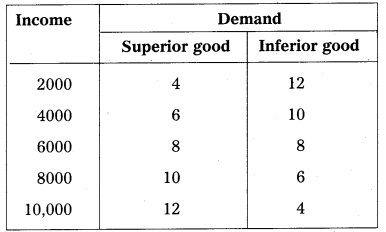
AP Inter 1st Year Economics Study Material Chapter 3 Theory of Demand 24
Superior goods : In case of superior goods quantity demanded will increase when there is an increase in the income of consumers.
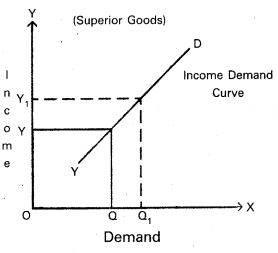
AP Inter 1st Year Economics Study Material Chapter 3 Theory of Demand 25
In the diagram ‘X’ axis represents demand, OY axis represents income, YD represents the income demand curve. It showing positive slope whenever income increased from OY to OY1 the demand of superior or normal goods increases from OQ to OQ1.
This may happens in case of Veblen goods.

Inferior goods : On the contrary quantity demanded of inferior goods decreases with the increase in incomes of consumers.
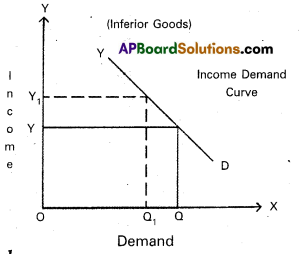
AP Inter 1st Year Economics Study Material Chapter 3 Theory of Demand 26
In the diagram on ‘OX’ axis measures demand and OY axis represents income of the consumer. When the consumer income increases from OY to OY1 the demand for a commodity decreases from OQ to OQ1 So the YD’ curve is negative sloping.

Question 5.
Explain the concept of Cross Demand.
Answer:
Cross demand: Cross demand refers to the relationship between any two goods which are either complementary to each other or substitute for each other. It explains the functional relationship between the price of one commodity and quantity demanded of another commodity is called cross demand.
Dx = f(Py)
Where Dx = demand for ‘X’ commodity
Px = Price of ‘y’ commodity
f = function
Substitutes : The goods which satisfy the same want are called substitutes.
Ex : Tea and coffee; pepsi and coca-cola etc. In the case of substitutes, the demand curve has a positive slope.
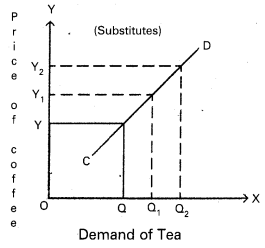
AP Inter 1st Year Economics Study Material Chapter 3 Theory of Demand 27
In the diagram ‘OX’ axis represents demand of tea and OY axis represents price of coffee. Increase in the price of coffee from OY to OY2 leads to increase in the demand of tea from OQ to OQ2.

Complementaries: In case of complementary goods, with the increase in price of one commodity, the quantity demanded of another commodity falls.
Ex : Car and Petrol. Hence the demand curve of these goods slopes downward to the right.
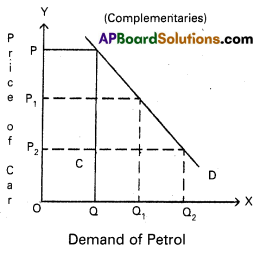
AP Inter 1st Year Economics Study Material Chapter 3 Theory of Demand 28
In the diagram if price of car decreases from OP to OP2 the quantity demand of petrol increases from OQ to OQ2. So cross demand i.e., CD curve is down ward slopes.

AP Inter 1st Year Economics Study Material Chapter 3 Theory of Demand

Question 6.
What are the factors that determine Demand ? [March 18, 17]
Answer:
The functional relationship between the demand for a commodity and its various determinants may be explained mathematically in terms of a demand function.
Dx = f(Px,P1, ………… Pn, Y, T)
Where Dx = Demand for good X;
Px = price of X;
P1 …. Pn = Prices of substitutes and complementaries
Y = Income,
T = Taste of the consumer.
Determinants of demand :
1) Price of commodity: The demand for any good depends on its price, more will be demanded at lower price and vice-versa.

2) Prices of substitutes and complementaries : Demand is influenced by changes in price of related goods either substitutes or complementary goods.
Ex: Increase in the price of coffee leads an increase in the demand for tea in the case of substitutes positive relation and complementaries negative relationship between price and demand.

3) Income of the consumer : Demand always changes with a change in the incomes of the people. When income increases the demand for several commodities increases and vice-versa.

4) Population : A change in the size and composition of population will effect the demand for certain goods like food grains, clothes etc.

5) Taste and preferences: A change in the taste and the fashions bring about a change in the demand for a commodity.

6) Technological changes: Due to economic progress technological changes the quantity the quality of goods available to the consumers increase.
Ex : Demand for cell phones reduced the demand for landline phones.

7) Change in the weather : Demand for commodity may change due to change in a climatic condition.
Ex : During summer demand for cool drinks, in winter demand for wollen clothes.

8) State of business : During the period of prosperity demand for commodities will expand and during depression demand will contract.

Question 7.
What is Elasticity of Demand ?
Answer:
In Economic theory, the concept of elasticity of demand has a significant role. Elasticity of demand means the percentage change in quantity demanded in response to the percentage change in one of the variables on which demand depends.
Elasticity of demand changes from person to person, place to place, time to time and one commodity to another.
Accoridng to Marshall “The elasticity of demand in a market is great or small according as the amount demanded increases much or little for a given fall in price”.
The concept of elasticity of demand explains how much or to what extent a change in any one of the independent variables leads to a change in the dependent variable.
There are three kinds of elasticity of demand.

  1. Price Elasticity of demand
  2. Income Elasticity of demand .
  3. Cross Elasticity of demand

AP Inter 1st Year Economics Study Material Chapter 3 Theory of Demand

Question 8.
Explain the three types of Elasticity of Demand.
Answer:
The concept of elasticity demand was first introduced by Cournot and Mill. Later it was developed in a scientific manner by Marshall. Elasticity of demand means the degree of sensitiveness or responsiveness of demand to a change in its price.

According to Marshall “The elasticity of demand in a market is great or small according as the amount demanded increases much or little for a given fall in price”.

The concept of elasticity of demand explains how much or to what extent a change in any one of the independent variables leads to change in the dependent variable.
There are three kinds of elasticity of demand.

  1. Price elasticity of demand
  2. Income elasticity of demand
  3. Cross elasticity of demand

1) Price Elasticity of Demand : Alfred Marshall developed the concept of price elasticity of demand. Price elasticity of demand is generally defined as the degree of responsiveness or sensitiveness of demand for a commodity to the changes in its price. Thus price elasticity of demand is the ratio of percentage change in quantity demanded of a good and percentage change in its price. The following formula to measure price elasticity of demand.
Ep = \(\frac{\text { Percentage change in quantity demanded }}{\text { Percentage change in price }}\)
= \(\frac{\text { Change in quantity demanded }}{\text { Original quantity demanded }} \times \frac{\text { Original price }}{\text { Change in price }}\)
= \(\frac{\Delta \mathrm{q}}{\mathrm{q}} \times \frac{\mathrm{p}}{\Delta \mathrm{p}}=\frac{\Delta \mathrm{q}}{\Delta \mathrm{p}} \times \frac{\mathrm{p}}{\mathrm{q}}\)
where q = quantity;
p = price;
∆q = change in quantity demanded;
∆p = change in price.
There are five kinds of price elasticity of demand. They are :

  1. Perfectly Elastic demand (Ed = α)
  2. Perfectly Inelastic demand (Ed = 0)
  3. Unitary Elastic demand (Ed = 1)
  4. Relatively Elastic demand (Ed > 1)
  5. Relatively Inelastic demand (Ed < 1)

2) Income Elasticity of Demand : Income elasticity of demand shows the degree of responsiveness of quantity demanded of a commodity to a change in the income of the consumer, other things remain constant.
Ey = \(=\frac{\text { Percentage change in quantity demanded }}{\text { Percentage change inconsumer’s income }}\)
= \(=\frac{\text { Change in quantity demanded }}{\text { Original quantity demanded }} \times \frac{\text { Original income }}{\text { Change in income }}\)
= \(\frac{\Delta \mathrm{q}}{\mathrm{q}} \times \frac{\mathrm{y}}{\Delta \mathrm{y}}=\frac{\Delta \mathrm{q}}{\Delta \mathrm{y}} \times \frac{\mathrm{y}}{\mathrm{q}}\)
where q = Quantity;
y = income;
∆Q = change in quantity demanded;
∆y = change in income.
Income elasticity of demand will be positive in case of superior goods like milk and meat and negative in case of inferior goods like porridge and broken rice.

3) Cross Elasticity of Demand : Cross elasticity of demand refers to change in the quantity demanded of one good in response to change in the price of related good, other things remaining constant. There are certain goods whose demand depend not only to their price but also on the prices of related goods.
Ec = \(\frac{\text { Percentage change in quantity demanded of X }}{\text { Percentage change in the price of } Y}\)
Ec = \(\frac{\Delta \mathrm{Qx}}{\mathrm{Qx}} \div \frac{\Delta \mathrm{Py}}{\mathrm{Py}}=\frac{\Delta \mathrm{Qx}}{\mathrm{Qx}} \times \frac{\mathrm{Py}}{\Delta \mathrm{Py}}=\frac{\Delta \mathrm{Qx}}{\Delta \mathrm{Px}} \times \frac{\mathrm{Py}}{\mathrm{Px}}\)
Where Q(x) = Quantity demanded for X; P(y) = price of commodity (Y), ∆Q(x) = change in quantity demanded of X commodity, ∆P(y) = change in price of commodity Y.
Substitute goods like tea and coffee have positive cross elasticity demand where as complementary goods like shoes and socks have negative cross elasticity of demand.

AP Inter 1st Year Economics Study Material Chapter 3 Theory of Demand

Quantity 9.
Define Price Elasticity of Demand. Explain briefly various types of Price Elasticity of Demand.
Answer:
Alfred Marshall developed the concept of price elasticity of demand. Price elasticity measures, other things remaining constant, change in the demanded of a good in response to a change in its price. Thus price elasticity of demand is the ratio of percentage change in quantity demanded of a good and percentage change in its price. Price elasticity can be written as stated below.
Ep = \(\frac{\text { Percentage change in quantity demanded }}{\text { Percentage change in price }}\)
= \(\frac{\text { Change in demand }}{\text { Original demand }} \times \frac{\text { Original price }}{\text { Change in price }}\)
= \(\frac{\Delta \mathrm{q}}{\mathrm{q}} \times \frac{\mathrm{p}}{\Delta \mathrm{p}}=\frac{\Delta \mathrm{q}}{\Delta \mathrm{p}} \times \frac{\mathrm{p}}{\mathrm{q}}\)
Where q = quantity; p = price; ∆q = change in demand; ∆p = change in price
Types of price elasticity of demand : Based on numerical value, price elasticity of demand can be five types.

  1. Perfectly Elastic demand (Ed = ∞)
  2. Perfectly Inelastic demand (Ed = 0)
  3. Unitary Elastic demand (Ed = 1)
  4. Relatively Elastic demand (Ed > 1)
  5. Relatively Inelastic demand (Ed < 1)

1) Perfectly Elastic demand : It is also known as “infinite elastic demand”. A small change in price leads to an infinite change in demand is called perfectly elastic demand. It is horizontal straight line to ‘X’ axis. The numerical value of perfectly elastic demand is infinite (Ed = ∞). It can be shown in the diagram.
AP Inter 1st Year Economics Study Material Chapter 3 Theory of Demand 10
In the diagram, Ed = \(\frac{\mathrm{OQQ}_1}{\mathrm{OQ}} \div \frac{\mathrm{O}}{\mathrm{OP}}\)
= \(\frac{\mathrm{QQ}_1}{\mathrm{OQ}} \times \frac{\mathrm{OP}}{\mathrm{O}}\) = ∞

2) Perfectly Inelastic demand: It is also known as “zero elastic demand”. In this case even a great rise ‘or fall in price does not lead to any change in quantity demanded is known as perfectly inelastic demand. The ‘demand curve will be vertical to the Y axis. The numerical value is ‘OE. This can be shown in the following diagram.
AP Inter 1st Year Economics Study Material Chapter 3 Theory of Demand 11
In the diagram, Ed = \(\frac{\text { Zero }}{\mathrm{OQ}} \div \frac{\mathrm{PP}_1}{\mathrm{OP}}\) = 0
∴ Ed = 0

3) Unitary Elastic demand: The percentage change in price leads to same percentage change in demand is called unitary elastic demand. In this case the elasticity of demand is equal to one. The shape of demand curve is “Rectangular Hyperbola”. This can be shown in the following.
AP Inter 1st Year Economics Study Material Chapter 3 Theory of Demand 12
In the diagram, Ed = OP1Q1 = OPQ
(or) OQ1 = PP1
∴ Ed = 1

4) Relatively Elastic demand: When a percentage change in price leads to more than percentage change in quantity demand is called relatively elastic demand. In this case the numerical value of Ed is greater than one (Ed > 1)
AP Inter 1st Year Economics Study Material Chapter 3 Theory of Demand 13
In the diagram, Ed = OQ1 > PP1
∴ Ed > 1

5) Relatively Inelastic demand : When the percentage change in price leads to a less than percentage change in quantity demand is called relatively inelastic demand. Here the numerical value is less than one (Ed < 1) . This can be shown to following diagram.
AP Inter 1st Year Economics Study Material Chapter 3 Theory of Demand 14
In the diagram, Ed = QQ1 < PP1
∴ Ed < 1

AP Inter 1st Year Economics Study Material Chapter 3 Theory of Demand

Question 10.
Explain the Total Outaly method of Measuring Elasticity of Demand.
Answer:
Total Outlay (or) Expenditure method : This method was introduced by Alfred Marshall. Price elasticity of demand can be measured on the basis of change in the total outlay due to a change in the price of a commodity. This method helps us to compare the total expenditure from a buyer or total revenue from the seller before and after the change in price.
Total outlay = Price × Quantity demanded
According to this method the price elasticity of demand is expressed in three forms, they are elastic demand, unitary elastic and inelastic demand. This can be explained with the help of table.
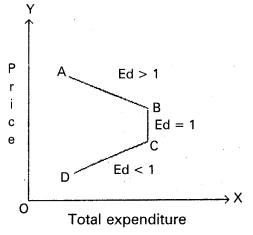
AP Inter 1st Year Economics Study Material Chapter 3 Theory of Demand 29
AP Inter 1st Year Economics Study Material Chapter 3 Theory of Demand 30
In this table shows that

  1. If the total expenditure increases due to a fall in price is known as relatively elastic demand.
  2. If total expenditure remains constant even the price falls is known as unitary elastic demand.
  3. If the total expenditure decreases due to a fall in price is known as relatively inelastic demand.

In the diagram on ‘OX’ axis measure total expenditure and ‘OY axis measures price. The total outlay curve AD is shown in three parts i.e., A to B; B to C and C to D.

Question 11.
Explain the Point method of Measuring Price Elasticity of Demand or How do you measure Elasticity of Demand on straight line Demand Curve ?
Answer:
Point method : This method is introduced by Marshall. In this method elasticity of demand is measured at a point on the demand curve. So, this method is also called as “geometrical method”. In this method to measure elasticity at a point on demand curve the following formula is applied.
Ed = \(\frac{\text { The distance from the point to the } \mathrm{X} \text {-axis }}{\text { The distance from the point to the } \mathrm{Y} \text {-axis }}\)
In the below diagram ‘AE’ is straight line demand curve. Which is 10 cm length. Applying the formula we get
Ed = 1 Ed < 1 Ed = 0
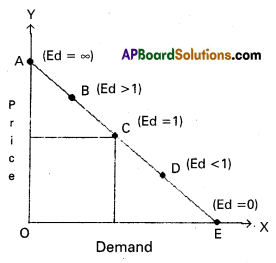
AP Inter 1st Year Economics Study Material Chapter 3 Theory of Demand 31
Elasticity at point A, Ed = \(\frac{\mathrm{AE}}{\mathrm{A}}=\frac{10}{0}\) = 0
Elasticity at point B, Ed = \(\frac{\mathrm{BE}}{\mathrm{BA}}=\frac{7.5}{2.5}\) = 3 > 1
Elasticity at point C, Ed = \(\frac{\mathrm{CE}}{\mathrm{CA}}=\frac{5}{5}\) = 1
Elasticity at point D, Ed = \(\frac{\mathrm{DE}}{\mathrm{DA}}=\frac{1}{3}\) = < 1
Elasticity at point E, Ed = \(\frac{\mathrm{E}}{\mathrm{DA}}=\frac{0}{10}\) = 0
If the demand curve is non-linear. It means if the demand curve is not straight line will be drawn at the point on the demand curve where to measure elasticity.
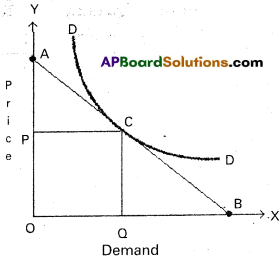
AP Inter 1st Year Economics Study Material Chapter 3 Theory of Demand 32
In the diagram at C point where Elasticity of demand will be equal to \(\frac{\mathrm{CB}}{\mathrm{CA}}\).

Question 12.
What are the basic determinants of Elasticity of Demand ?
Answer:
The term elasticity refers to the measure of extent of relationship between two related variables. The elasticity of demand is the measure of responsiveness or sensitiveness of demand for a commodity to the change in it demand.
Determinants of Elasticity of Demand : The. elasticity of demand varies from commodity to commodity.
1) Nature of commodity: Commodities can be grouped as necessaries, comforts and luxuries. In case of necessaries, the elasticity of demand will be inelastic.
Ex : Rice, salt etc. On the other hand in case of luxuries the demand will be more elastic.
Ex : Diamonds & gold etc.

2) Availability of substitutes : Prices of substitutes influence the demand for a com-modity upto a certain extent. The closer the substitute, the greater the elasticity of demand for the commodity. For Ex : Cool drinks, soaps etc. but in case of non-availability of substitutes the elasticity of demand will be low.

3) Complementary goods: Price elasticity for a good is also depends on the nature of price elasticity of jointly demand goods. If the demand for car is elastic, then the demand for petrol will also be elastic.

4) Multiple uses of the commodity : The wider the range of alternative uses of a product, the higher the elasticity of demand and vice-versa.
Ex : Coal and electricity have multiple uses and will have elastic demand.

5) Proportion of income spent: If proportion of income spent on commodity is very small, its demand will be less elastic and vice-versa.

6) Period of time : In the long run, demand will be more elastic. Longer the time period considered, greater will be the possibility of substitution. For a cheaper good.
Ex : If the price of petrol increases in the short run, it may not be possible to replace the petrol engines with diesel engines but in the long run it can be possible.

7) Price level: Goods which are in very high range or in very low range have inelastic demand but it is high at moderate price.

8) Habit : The demand for a commodity to which the consumer is accustomed is generally inelastic.
Ex : Tobacco and alcohol.

9) Income group : The demand of higher income groups will be inelastic as they do not bother about price changes. On the other hand, the demand of middle and lower income groups will be elastic.

10) Postponement of purchase: The demand for a commodity, the consumption of which can be postponed is more eiastic than that of the use of the commodity cannot be postpone the purchases of such goods like life saving medicines.

AP Inter 1st Year Economics Study Material Chapter 3 Theory of Demand

Question 13.
Explain the importance of the Concept of Elasticity of Demand.
Answer:
The term elasticity refers to the measure of extent of relationship between two related variable. The elasticity of demand is the measure of responsiveness or sensitiveness of demand for a commodity to the change in it demand.
Importance :
1) Useful to monopolist: Monopolist should study the elasticity of demand for his commodity before fixing up the price. Monopolist will fix a higher price when the commodity inelastic demand, but he will fix a lower price when the commodity has elastic demand.

2) Useful to joint products : It is useful in the price fixation of joint goods like meat and fur. In such case the producer wall be guided by elasticity of demand to fix the prices of the joint goods.

3) Useful to the government: The concept of elasticity can be used in formulating government policies relating public utility service like Railways, drug industry etc.

4) Useful to international trade : In calculating the terms of trade both countries have to take into account the mutual elasticities of demand for the products.

5) Useful to finance minister : The concept of elasticity is useful to the Finance Minister in imposing taxes on goods. The finance minister studies the elasticity of commodities before he imposes new taxes or enhances old taxes.

6) Useful to Management: Before asking for higher wages trade union leaders must know the elasticity of demand of the product produced by them. Trade union leaders may demand for higher wages only when the goods produced by them have inelastic demand.

7) Useful to producers : Volume of goods must be produced in accordance with demand for the commodity. Whenever the demand for the commodity is inelastic, the producer will produce more commodities to take advantage of higher price. So, it helps in determining the volume of output.

Very Short Answer Question

Question 1.
Demand
Answer:
The desire backed up by willingness and ability to pay a sum of money for some quantity of a good or service.

AP Inter 1st Year Economics Study Material Chapter 3 Theory of Demand

Question 2.
Demand Schedule [March 17]
Answer:
It shows the functional relationship between the quantity of commodity demanded and its price. The demand schedule may be two types.

  1. Individual demand schedule
  2. Market demand schedule

Question 3.
Individual Demand Schedule
Answer:
It explains the relationship between various quantities purchased at various prices by a single consumer in the market.

Question 4.
Market Demand Schedule
Answer:
It shows the total demand for a group at a particular time at different prices in the market.

Question 5.
Demand Function
Answer:
Demand function shows the functional relationship between quantity demanded at various factors that determine the demand for a commodity. It can be expressed as follows.
Dx = f(Px, P1, ………… Pn, Y, T)
Where
Dx = Demand for good X
Px = price of X
P1 …. Pn = Prices of substitutes and complementary
Y = Income of consumer
T = Tastes
f = Functional relationship

Question 6.
Giffen’s Paradox (or) Giffen Goods [March 18, 16]
Answer:
It means necessary goods Sir Robert Giffen in mid 19th century observed that the low paid workers in England purchased more bread when its price increase by decrease in the purchase of meat. The increase in demand for bread when price increased is an exception to the law of demand, it is known as Giffen’s paradox.

AP Inter 1st Year Economics Study Material Chapter 3 Theory of Demand

Question 7.
Veblen Goods (or) Prestigious Goods
Answer:
This is associated with the name of T.Veblen costly goods like diamonds and cars are called Veblen goods generally rich people purchase those goods. For the sake of prestage. Hence rich people may buy more such goods when their prises rise.

Question 8.
Speculation
Answer:
When the price of commodity rises the group of speculats except that be rise still further. Therefore, they buy more of the commodity. If they expect that there is a fallen price, the demand may not expand. Ex : shares.

Question 9.
Price Demand
Answer:
It explains the functional relationship between price of good and quantity of demanded when the remaining factors constant. It shows inverse relationship between price and demand.
Dx = f(Px)
Dx = Demand for X commodity
Px = Price of X

Question 10.
Income Demand [March 17]
Answer:
It shows the direct relationship between the income of the consumer and quantity demanded when the other factors remain constant. There is direct relationship between income and demand for superior goods. Inverse relationship between income and demand for inferior goods.
Dx = f(Y)

Question 11.
Cross Demand [March 18]
Answer:
Cross demand refers to the relationship between any two goods which are either complementary to each other or substitute of each other at different prices.
Dx = f(Py)

AP Inter 1st Year Economics Study Material Chapter 3 Theory of Demand

Question 12.
Substitutes
Answer:
These are goods which satisfy the same want.
Ex : tea and coffee. In this case the relationship between demand for a product and the price of its substitute is positive in its nature.

Question 13.
Complementaries
Answer:
These are goods which satisfy the same wants jointly.
Ex : Shoes and socks, car and petrol. The relationship between complementary goods is inverse.

Question 14.
Inferior Goods
Answer:
The goods whose income elasticity of demand is negative for levels of income are termed as inferior goods. In case of inferior goods if income increases demand decreases and vice-versa. The income demand for inferior goods has a negative slope.

Question 15.
Elasticity of Demand
Answer:
It means the degree of responsiveness of demand or the sensitiveness of demand to change in price. This was developed by Marshall It explains how much demand increases due to fall in price and how much demand decreases due to rise in price.

Question 16.
Price Elasticity of Demand
Answer:
It is the percentage change in quantity demanded of a commodity as a result of percentage change in price of a commodity.
Ed = \(\frac{\text { Percentage change in quantity demanded }}{\text { Percentage change in price }}\)

AP Inter 1st Year Economics Study Material Chapter 3 Theory of Demand

Question 17.
Income Elasticity of Demand
Answer:
It is the percentage change in quantity demanded of a commodity as a result of percentage change in the income of the consumer.
Ey = \(\frac{\text { Percentage change in quantity demanded }}{\text { Percentage change in consumer’s income }}\)

Question 18.
Cross Elasticity of Demand
Answer:
It is the percentage change in the quantity demanded of a commodity as a result of proportional change in the price of related commodity.
Ec = \(\frac{\text { Percentage change in quantity demanded of } \mathrm{X}}{\text { Percentage change in the price of } \mathrm{Y}}\)

Question 19.
Perfectly Elastic Demand
Answer:
If a negligible change in price leads to an infinite change in demand is called perfectly elastic demand. In this case the demand curve is horizontal to ‘X’ axis.

Question 20.
Perfectly Inelastic Demand [March 16]
Answer:
Even a great rise or fall in price does not lead and change in quantity demanded is known as perfectly inelastic demand. The demand curve is vertical to ‘Y’ axis.

Question 21.
Unitary Elastic Demand
Answer:
The proportionate change demand is equal to the proportionate change in price. In this case the demand curve will be a rectangular hyperbola.

AP Inter 1st Year Economics Study Material Chapter 3 Theory of Demand

Question 22.
Relatively Elastic Demand
Answer:
When a proportionate change in price leads to more than proportionate change in quantity demand is called relatively elastic demand.

Question 23.
Relatively Inelastic Demand
Answer:
When the proportionate change in price leads to a less than proportionate change in quantity demand is called relatively inelastic demand.

Question 24.
Arc method
Answer:
Arc method is the elasticity of the mid point of an arc of a demand curve. It studies a portion of the demand curve between two points. This is used when the change in price is not very large.

Question 25.
Importance of Price Elasticity of Demand.
Answer:

  1. It is useful to finance minister in imposing taxes.
  2. Useful to monopolist for fixing the price.
  3. Useful in determination of wages.
  4. Useful in determination of prices of factors of production.

Additional Questions

Question 26.
Terms of Trade
Answer:
It is the ratio of an index of a country’s export price to an index of its important price.

AP Inter 1st Year Economics Study Material Chapter 3 Theory of Demand

Question 27.
Tax
Answer:
Tax is a compulsory payment collected from individuals or firms by central, state and local governments.

AP 7th Class Social Important Questions Chapter 7 Handicrafts and Handlooms

AP State Syllabus 7th Class Social Important Questions 7th Lesson Handicrafts and Handlooms

Question 1.
What do you understand about raw material in the context of basket making? Who collects them?
Answer:
Spines of wild date palm (eatha chettu) tree leaves, knife, etc., are used for basket making. Using a knife basket maker shaves off the leaves and keeps them in hot sunshine to make them dry. The raw material, wild date palm leaves are brought in bundles. Basketmakers collect raw material like a wild date palm, cane and bamboo which are found in forests.

Question 2.
What are the tools used by the basket makers?
Answer:
Basket making is a craftwork that involves the use of wild date palm leaves, cane and bamboo which are found in forests. Using a knife, the basket maker shaves off the leaves and keeps them in hot sunshine to make them dry. The raw material, wild date palm leaves are brought from the forest. Basketmakers or their relatives collect the spines from bushes around their villages and sell them to market makers.

AP 7th Class Social Important Questions Chapter 7 Handicrafts and Handlooms

Question 3.
Do you think people like Polaiah should be given ration cards and allowed to vote in Hyderabad?
Answer:
Yes. People like Polaiah should be provided permanent housing and permanent address proof. He should be provided with a voter identity card and he should be allowed to vote in Hyderabad. In the same way, he should be provided with a ration card and it is allowed to avail all the benefits of it for himself.

Question 4.
Name the raw materials to make silk sarees.
Answer:

  1. To make silk sarees weavers need silk yarn, colours, cotton thread.
  2. These are not produced by weavers they buy them from the market.
  3. Silkworms from which silk yarn is made, grow on mulberry leaves.
  4. The rearing of silkworms is taken up by small farmers.
  5. Cotton is produced in farms and is made into thread either in factories or as a household craft.
  6. Colours are often made in factories.
  7. Weavers buy yarn and colours from the market.

Question 5.
What are the stages of weaving sarees
Answer:
There are different stages of making the saree.

  1. The first of these is preparing the yarn.
  2. These yarns are then marked with the design.
  3. Their markings of the designs help the weaver to identify what colours need to be dyed into which part of the yarn.
  4. Dyeing the yarn is a long repeated process.
  5. Each colour needs to be separated and dried one after the other.
  6. Only when the colouring is completed/the thread can be used for weaving.

AP 7th Class Social Important Questions Chapter 7 Handicrafts and Handlooms

Question 6.
What do you understand about the problems of weavers?
Answer:

  1. Andhra Pradesh has the second largest number of handlooms in the country, next to West Bengal.
  2. Handloom weavers are facing a serious problem.
  3. They face stiff competition from power loom and mill made cloth.
  4. Mill made cloth is cheaper. It is made from synthetic yarn which costs much less than cotton or silk.
  5. Even though it is popular due to its high quality and unique beauty, the Dharmavaram saree seems to be expensive. But the weavers are not getting rate due to middlemen’s involvement.
  6. Fashions in the cities change fast. It is difficult for the weavers to know which designs are in demand.
  7. They also have to depend on middlemen for getting raw materials like cotton or silk yarn.
  8. Thus middlemen have a good position and are getting the largest share than weavers.
  9. Co-operative societies do not provide opportunities for weavers to produce sarees to suit the changing preferences of consumers.
  10. This has once again pushed the weavers into the clutches of the middlemen and traders.

Question 7.
What is the role of cooperative societies to help the weavers?
Answer:

  1. Andhra Pradesh has the second largest number of handlooms in the country. Weavers are facing many problems.
  2. In order to overcome these problems the weavers are encouraged to form cooperative societies.
  3. The cooperative societies are meant to help the weavers in buying raw materials at a low price and to arrange for marketing of their cloth.
  4. This reduced their dependence upon middlemen and traders.
  5. The cooperative societies should help the weavers by training in new designs.

AP 7th Class Social Important Questions Chapter 7 Handicrafts and Handlooms

Question 8.
Observe the following table carefully and answer the questions.

Raw MaterialsTools
Basket making1. Wild date plam leaves
2. Cane
3. Bamboo
Knife
Handloom weaving1.   Silk yarn
2.    Colour
3.    Zari
1.   Maggam
2.    Stones
3.    Punched Jacquard cards

a. List the raw materials used to make baskets.
Answer:
Wild date palms, cane and bamboo.

b. What are the raw materials used to make Dharmavaram sarees?
Answer:
Silk yarn, colour and zari.

c. What is the tool used to shave off the leaves?
Answer:
A knife.

d. Where are basket making raw materials found?
Answer:
In forests.

e. How do weavers get silk yarn?
Answer:
Silk yarn is made from silkworms that grow on mulberry leaves.

Question 9.
How are raw materials of silk sarees produced?
Answer:
Weavers need raw materials to make silk sarees. These are not produced by weavers, they buy them from the market.

  1. Silk yarn is made from silkworms. They grow on mulberry leaves. The rearing of silkworms is taken up by small farmers.
  2. Cotton is produced in farms and is made into thread either in factories or as a household craft.
  3. Colours are often made in factories. Weavers buy yarn and colours from the market.

AP 7th Class Social Important Questions Chapter 7 Handicrafts and Handlooms

Question 10.
Describe Dharmavaram sarees.
Answer:

  1. Dharmavaram sarees one traditionally woven in the interlocked weft technique.
  2. Dharmavaram silk sarees are a benchmark in the traditional craft industry.
  3. They are very famous for stacking colour combinations with contrast pallu and border woven with exquisite brocade gold patterns.
  4. Additional designs are added to silk sarees using kunrians, chamkies, and stones and also opposite colours.
  5. Recently Dharmavaram sarees received patent rights.

Question 11.
Why has Venkatesu’s family begun to weave for a master weaver?
Answer:

  1. Venkatesu is a resident of Dharmavaram.
  2. All of his family members – he, his wife, son and daughter – in – law work as weavers.
  3. Weaving saree is a hereditary occupation for Venkatesu’s family.
  4. The income Venkatesu’s family gets from weaving silk sarees is insufficient to run the family.
  5. From March to May, Venkatesu’s family is able to weave only a few hours a day
  6. Women are distressed a lot because they have to do weaving related works and also take care of the household chores.
  7. Earlier, Venkatesu’s family used to weave only for the cooperative society.
  8. Later, they had to look for additional sources of income to run their families.

AP 7th Class Social Important Questions Chapter 7 Handicrafts and Handlooms

Question 12.
Why do basket makers migrate, from rural areas to urban areas?
Answer:

  1. Basket making is craftwork that involves the use of wild date palm leaves, cane and bamboo which are found in forests.
  2. There has been depletion of forests due to their extensive exploitation for big industries.
  3. This affects the livelihoods of people who have traditionally depended on forests.
  4. Further, the demand for such products has reduced considerably.
  5. This forces them to move out of rural areas and migrate to urban areas for survival.
  6. This is true for many involved in traditional activities.
  7. However, they have to often live in urban areas without basic amenities.

Question 13.
How do master weavers and merchants take control over the weavers to get profits?
Answer:

  1. A large amount of handloom cloth materials in Andhra Pradesh are produced and marketed by master weavers and merchants.
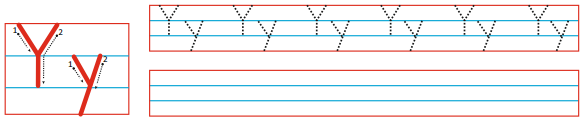
  2. The master weavers and merchants procure all the raw materials and supply them to weavers and collect the woven cloth.
  3. They then sell these materials to wholesale cloth merchants.
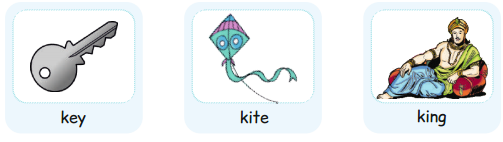
  4. They pay a stipulated amount as wages for the weaving work.
  5. Many master weavers also provide loans to weavers to set up looms, buy other tools and thus restrict them not to weave sarees for other master weavers.

  6. They also decide the wages for the work done by the weavers.
  7. Since they are interested in raising their incomes, it is natural for them to look for ways to pay less to the weavers.
  8. Distressed weaving families should be provided work from cooperative societies and saved from the master weavers.

AP 7th Class Social Important Questions Chapter 7 Handicrafts and Handlooms

Question 14.
Appreciate Venkatesu’s family for weaving sarees which is hereditary occupation?
Answer:

  1. Venkatesu is a resident of Dharmavaram. AH of his family members – he, his wife, son and daughter-in-law work as weavers.
  2. While he was winding yarn, his son Nagendra was engaged in weaving in the maggam (pit loom) set up inside the house.
  3. Katcha pattu, spindling of yarn, etc. were used to do different tasks in producing silk sarees.
  4. Venkatesu’s wife and daughter-in-law do bobbin winding.
  5. There is some work like making saratas for warping done collectively by group of weavers on streets or outside his house.
  6. His son Nagendra brings all the raw materials like dyed silk yarn, zari and design from master weaver and sometimes from cooperative society.
  7. Venkatesu gets raw materials at a time to weave ten sarees.
  8. The whole family has to work for 12 -15 hours a day for nearly 40 – 50 days to weave sarees. They get about Rs. 1300 per saree for the work.

AP 7th Class Social Important Questions Chapter 7 Handicrafts and Handlooms

Question 15.
Write a letter to Newspaper Editor explaining their problems of weavers at present?
Answer:

A Letter to Editor

Vijayawada
XXXXXXXX

From,
Y. Lakhmi,
7th Class,
77 – 28 – S/A,
Mangalagiri.

To,
The Editor,
The Hindu News Paper,
Vijayawada.

Dear Sir,

l am a proud reader of your newspaper for the last 10 years.
Here I would like to bring to your notice one burning issue of our society regarding the weaver’s community.
I request you to make a full-page report if possible regarding the facts & figures of Handloom weavers in our state.
Issues like daily wages, family welfare, delay in payment from mill owners. No help (subsidies) from the Government & Ministry.
Lack of collaboration between Designing & Marketing teams. By continuous ignorance of people of this sector cost nation’s heritage and colourful image at world level. We should not let die this fine art of many generations so easily.
I will be humble & society will be grateful to you & your newspaper for so long if we can make some good difference in the lives of weavers.

Thanking you sir,
Y. Lakshmi.

AP 7th Class Social Important Questions

AP 7th Class Social Important Questions Chapter 5 Europe

AP State Syllabus 7th Class Social Important Questions 5th Lesson Europe

Question 1.
Give one reason why the climate of Europe is cooler than that of India?
Answer:
Temperature decreases as the distance from the equator increases.
Since Europe is farther from the Equator than India, so the climate of Europe is cooler than that of India.

Question 2.
Distinguish between an Island and a Peninsula. (OR)
Distinguish between a Peninsula and an Island giving one example for each.
Answer:

IslandPeninsula
1. A piece of land surrounded by water on all sides.1. A piece of land surrounded by water on three sides and the fourth side is covered by land.
Ex: Sri Lanka, EnglandEx: India.

AP 7th Class Social Important Questions Chapter 5 Europe

Question 3.
Explain why the Mediterranean Sea was named so?
Answer:
The Mediterranean is derived from the Latin words meaning “the middle of the earth.” During the time of the Roman empire little was known about far Eastern Asia or the Americas or Southern Africa and so the Romans considered they lived in the hub of the universe.

Question 4.
Explain the location of Europe.
Answer:
Europe extends from 35° South to 72° North latitudes and from 10° West to 60° East longitudes. Europe has an area of 10,180,000 square kilometres approximately. It is the second smallest continent. The boundaries of Europe are North – Arctic ocean; South – Mediterranean sea, Caspian and Black seas; East – Ural mountains, West – Atlantic ocean.
The Ural Mountains separate Europe from Asia. The Mediterranean sea separates Europe from Africa. The Mediterranean sea separates Europe in the North from Africa in the South.

Question 5.
Mention the important rivers of Europe.
Answer:

  1. Many rivers in Europe originate from the Alphs mountains.
  2. River Volga is the largest river in Europe.
  3. The second-longest river is the Danube. It is known as an international river.
  4. The river Rhine is one of the most important rivers as it flows through several countries and empties itself into the North Sea.
  5. Unlike the Rhine, the Volga drains into the Caspian Sea, which is a vast lake.

AP 7th Class Social Important Questions Chapter 5 Europe

Question 6.
Explain about the mountains and plains of Europe.
Answer:

  1. The Alps, the most important mountain ranges of Europe, are covered with snow all year-round.
  2. The Caucasian Mountains, which lie between the Caspian Sea and the Black Sea form the southern boundary of Europe.
  3. They, too are very high and covered with snow all year-round.
  4. There are vast plains in Europe. The whole of Eastern Europe is a vast plain, which stretches across several countries like Russia, Ukraine, Poland, Bylorussia, etc. These plains experience heavy snowfall and bitter cold in winters.
  5. When the snow melts in summer, small streams start flowing.
  6. These join to form mighty rivers. It is from these plains that rivers like the Dnieper and the Volga, the longest river in Europe, originate.

Question 7.
Find out the names of some of the other Island countries of Europe.
Answer:

  1. The sea surrounds some of the European countries, not just on three sides but on all four sides.
  2. These are Island countries.
  3. Great Britain and Ireland are Island countries in Europe.

Question 8.
What are the important crops that are grown in Europe?
Answer:

  1. Food crops that are grown in Europe are wheat, maize, rye, barley and oats. Sugar is manufactured from beet in Russia, Ukraine and Germany.
  2. A commercial crop that is grown in Europe is ‘Tobacco’.
  3. Fruits that are farmed in Europe are apples, pears, peaches, grapes, oranges, palm and olive, etc.
  4. Fruits like grapes are used for making wine.

AP 7th Class Social Important Questions Chapter 5 Europe

Question 9.
What are trade winds? Explain.
Answer:
The ships of those times had sailed to harness wind power. They sailed with ease with the winds blowing westwards towards America. These winds blow westwards taking ships from Europe to America. These were not the Westerlies, which blew towards Europe. These were different winds, which blew from the south of Europe towards the southwest direction. They blew throughout the year and took ships from southwest Europe to the east coast of America. These winds are called ‘Trade Winds’.

Question 10.
The Alps stretch across several countries. Find out the names of these countries.
Answer:
France, Italy, Austria, Hungary, etc.

Question 11.
Write the names of two rivers starting from the Alps.
Answer:
Danube and Rhine.

Question 12.
Name the countries across whose borders the Pyrenees stretch.
Answer:
Spain and France.

Question 13.
Name the Mountains stretching Eastern Europe.
Answer:
Caucasus mountains.

AP 7th Class Social Important Questions Chapter 5 Europe

Question 14.
Identify the other mountains in Europe and prepare a table.
Answer:
Carpathian mountains; Ural mountains; Scandinavian ranges; Tatra mountains; Appnines and Dinaric Alps mountains; Cantabrian mountains.

Question 15.
Names of oceans or seas into which the following rivers empty themselves.
Answer:

S.No.RiverOcean/SeaS.No.RiverOcean/Sea
1.SeineNorth sea6.VistulaBaltic sea
2.RhineNorth sea7.VolgaCaspian sea
3.OderBaltic sea8.DniperBlack sea
4.PoAdriatic Sea9.DonBlack sea
5.DanubeBlack sea10.W DvinaBaltic sea

Question 16.
Compare Mediterranean and Andhra Pradesh climates on the following aspects:
Answer:

SeasonsRainfall
WintersSummers
MediterraneanToo coldWarmRainfall occurs only in winter.
Andhra PradeshColdToo hotRainfall occurs in rainy seasons.

AP 7th Class Social Important Questions Chapter 5 Europe

Question 17.
When does it rain most in your state, in the summer months or in the winter months?
Answer:
In rainy months.

Question 18.
Find out if your region gets light winter showers and the name given to it in the – regional language.
Answer:
Dussehra Musurlu.

Question 19.
Fishing is of importance in …………. whereas fruit growing is important in ……….
Answer:
Coastal areas; Mediterranean countries.

Question 20.
Why do you think the climate of Europe is so different from ours? Discuss among yourselves in the class.
Answer:
The climate of Europe is temperate and Continental in nature. The climate of India is tropical wet, tropical dry, subtropical humid, and mountain climate. So both are different from each other.

Question 21.
To begin with which part of Europe is along the Atlantic Ocean – the eastern or the western part?
Answer:
Western part.

AP 7th Class Social Important Questions Chapter 5 Europe

Question 22.
Observe the following table carefully and answer the questions.

S.No.CropsCountries where the crops are grown
1.WheatFrance, Italy, Germany, Spain, Poland, UK, and Hungary.
2.MaizeRussia, Romania, Yugoslavia, Hungary, France, Italy, etc.
3.RyePoland, Russia, Ukraine, Kazakhstan, and Germany.
4.BarleyRussia, UK, France, Denmark, Germany, Poland, and Spain.
5.TobaccoBulgaria, Greece, Italy, and Poland.
6.OatsRussia, Poland, France, Sweden, Germany, etc.
7.OlivesSpain, Italy, Greece, France, and Portugal.

1. Mention the important producers of maize in Europe.
Answer:
Russia, Romania, Yugoslavia, Hungary, etc.

2. Mention the important producers of barley in Europe.
Answer:
Russia, U.K., France, Denmark, Germany, Poland, and Spain.

3. Which countries are producing rye mainly?
Answer:
Poland, Russia, Ukraine, Kazakhstan, and Germany.

4. Which countries are producing Tobacco mainly?
Answer:
Bulgaria, Greece, Italy, and Poland.

5. Mention two important countries that are producing olives mainly.
Answer:
Spain, Italy, Greece, France, and Portugal.

AP 7th Class Social Important Questions Chapter 5 Europe

Question 23.
What is the Dogger Bank? Name the countries which would benefit from the Dogger Bank.
Answer:
The warm currents are very good for fish breeding as they contain ample food materials for the fish. As a result, the fishery industry is very well developed in the North Sea near Britain. This part of the North Sea is called ‘Dogger Bank’. Fish is an important part of the food of the Europeans and fishing is a very important industry in Europe. United Kingdom, Belgium, Netherland, Denmark, Norway, and Sweden would get benefit from Dogger Bank.

Question 24.
Why do you think the climate of Eastern Europe is not so strongly affected by the warm currents?
Answer:
The warm currents are from the west side of the continent. So it strongly affects western Europe only but not eastern Europe.

Question 25.
Can you guess the impact of the Westerlies on Europe?
Answer:
The westerlies play an important role in carrying the warm, equitornal wates and winds to the western coasts of continents, especially in the southern hemisphere because of its vast oceanic expanse.

Question 26.
What differences did you notice between the climates of India and west Europe?
Answer:
India has a hot type of climate while west Europe has a warm type of climate.

AP 7th Class Social Important Questions Chapter 5 Europe

Question 27.
Can you reason why is it possible to raise two crops in the Mediterranean countries?
Answer:
The Mediterranean countries are the southernmost countries in Europe. As a result, the winters here are not too cold and summers are warm. It does not rain all through the year as in Western Europe. It rains here only in winter. Such rainy winters and summers are termed Mediterranean climates. So it is possible to raise two crops a year.

Question 28.
Locate the following on the given map.
1. Austria
2. Spain
3. Portugal
4. Germany
5. Russia
6. Italy
7. France
8. Ukraine
9. Poland
10. Norway.
Answer:
AP 7th Class Social Important Questions Chapter 5 Europe 1

AP 7th Class Social Important Questions Chapter 5 Europe

Question 29.
Observe the map and answer the following.
AP 7th Class Social Important Questions Chapter 5 Europe 2
a. Name the mountains to the east of Europe.
Answer:
Ural mountains.

b. Name the ocean to the west of Europe.
Answer:
The Atlantic Ocean.

c. Look in the atlas and find the name of the sea just south of Europe.
Answer:
The Mediterranean Sea.

d. Name the island country of Europe.
Answer:
The United Kingdom.

e. Name the mountains that divide Europe from Asia.
Answer:
Ural mountains.

AP 7th Class Social Important Questions Chapter 5 Europe

Question 30.
Now you are familiar with the location of Europe. You can take a look at the countries of Europe. Look at the following map to find out their names. Have you heard of some of these countries before?
AP 7th Class Social Important Questions Chapter 5 Europe 3
Answer:
Norway, Sweden, Denmark, Finland, Ireland, U.K., Netherlands, France, Belgium, Germany, Spain, Portugal, Switzerland, Poland, Italy, Belarus, Austria, Hungary, Italy, Bulgaria, Turkey, Romania, Russia, Latvia, Lithuani, etc.
I heard about U.K., Russia, Switzerland, and Italy.

Question 31.
Observe the map and answer the following questions.
AP 7th Class Social Important Questions Chapter 5 Europe 4
a. Which of these is a peninsula Greece of France?
Answer:
Greece

b. Are Spain and Portugal peninsulas, too?
Answer:
Spain is a peninsula, but Portugal is not a peninsula.

c. Name the mountain range in the Scandinavian Peninsula.
Scandinavian ranges.

AP 7th Class Social Important Questions Chapter 5 Europe

Question 32.
i) Look at a globe to see how far is north Europe from the Equator.
Answer:
Europe is 350 latitudes North of the Equator.

ii) Is Europe even farther north than India?
Answer:
Yes.

iii) Will Norway be warmer than Italy? Why?
Answer:
No, Norway is cooler than Italy because it is on higher latitudes.

Question 33.
Look at the wall map or atlas to identify the names of at least six cities of Europe which are situated on the sea coast.
Answer:
Moscow – Russia
London – U.K.
Berlin – Germany
Istanbul – Turkey
St. Petersburg – Russia
Madrid – Spain

Question 34.
Look at Map 2 (Text P. 42) and name four Mediterranean countries.
Answer:
Turkey, Syria, Lebanon, and Israel.

Question 35.
Look at Map 6 (Text PAT) and answer the following questions.
i) Which winds would help the sailors to return to Europe from America?
Answer:
Trade winds.

ii) Could the sail-driven ships use the Trade Winds to return to Europe? Give reasons for your answer.
Answer:
No, they cannot use the Trade winds to return to Europe.
The reason is that the winds are blowing from south-east to north-west. Europe is on the northeast side of the Trade. Wind.

AP 7th Class Social Important Questions Chapter 5 Europe

Question 36.
i) Look at the map (Text P.No. 47 Map 6) can you tell what the new route could be?
Answer:
The new route is the Columbus route.

ii) Looking at the globe to check whether Columbus’ thinking was correct?
Answer:
Yes, he was correct.

iii) Look at the map to be able to tell whether it will be warmer in Spain or in Slovakia.
Answer:
In Spain – there will be mild winters and warm summers. In Slovakia – temperate cool summers, cold, cloudy, humid winters.

Question 37.
Which fruits are grown extensively in southern Europe?
Answer:
The Mediterranean climate is very good for growing juicy fruits. Thus regions with a Mediterranean climate are famous for their fruits. Fruits like olives, figs, grapes, oranges, etc., are grown extensively in southern Europe.

AP 7th Class Social Important Questions

AP 7th Class Social Important Questions Chapter 4 Oceans and Fishing

AP State Syllabus 7th Class Social Important Questions 4th Lesson Oceans and Fishing

Question 1.
Fishing with the mechanical boat is risky than the Karratheppa. Why?
Answer:
Compared to the Karrateppa, there is far more risk of life in Marapadava (Mechanised boat) because it goes far into the sea and it is difficult to swim over to shore in times of trouble.
What is worse, there is no first aid in the big boats, nor any life jacket. Fishing is a risky and brave occupation.

AP 7th Class Social Important Questions Chapter 4 Oceans and Fishing

Question 2.
Study the table given below and answer the following questions.
Distribution of Fresh Water on Earth

Sl.No.SourcePercentage
1Ice caps and Glaciers68.7%
2Groundwater30.1%
3Surface water (lakes, swamps, rivers)0.3%
4Others0.9%

a) Where do we have the highest percentage of fresh water on the Earth?
Answer:
Ice caps and Glaciers.

b) Give any two sources of surface water.
Answer:
Lakes, swamps, rivers, etc.

Question 3.
Read the info chart given below and answer questions a and b.
AP 7th Class Social Important Questions Chapter 4 Oceans and Fishing 1
a) Where is the most fresh water on the earth found?
Answer:
More fresh water on the earth is found in Icecaps & Glaciers.

b) What percentage of the freshwater is accessible?
Answer:
Accessible surface freshwater is 1%.

AP 7th Class Social Important Questions Chapter 4 Oceans and Fishing

Question 4.
“The lives of fishermen are risky and troublesome” – Comment in your own words.
Answer:
I agree with the above statement.

  1. Most of the Fishermen do not own mechanical boats. They depend on others boats and go fishing.
  2. Always they are taking money from middlemen for diesel and kit expenses.
  3. Again they sell the day’s catch of fish to the middlemen at the rate he fixes.
  4. They don’t have any profits.
  5. There is no First Aid in the big boats nor any life jacket.

Their life is risky and troublesome. While they go fishing, if any cyclone hits that area, they are not able to reach the coast of the ocean.

Question 5.
What is an ocean? Name the oceans in the world.
Answer:
The vast body of salt water that covers a considerable portion of the earth’s crust is called the ocean. There are three major oceans in the world. They are the Pacific, the Atlantic, and the Indian ocean. Apart from these three, waters of the Arctic and Antarctic are also described as oceans.

Question 6.
What are the two types of ocean currents? Give examples.
Answer:
Ocean currents are of two types. They are:
1) Warm currents: They flow from the equator towards poleward regions.
Eg: The Gulf stream and the Atlantic drift.
2) Cold currents: They flow from poleward regions towards the equator.
Eg: The Labrador current, The Greenland current.

AP 7th Class Social Important Questions Chapter 4 Oceans and Fishing

Question 7.
What are high tides and low tides?
Answer:
High tide: The bulge of seawater is high tide.
Low tide: The level of the seawater reduces. It is low tide.
High tides and low tides occur twice each day.

Question 8.
Explain the different types of nets.
Answer:
Nets are of different types based on different sizes of the Kannulu (Rings) and the layers of the net. Recently a net known as Ring Net which helps in getting a better catch is being increasingly used by the fishermen. This has helped to reduce migration from the village. Earlier there were nets made up of cotton thread. Now cotton nets have almost been replaced by plastic, nylon and other synthetic, materials. A net lasts for 4 – 5 years. Nets are purchased by weight and the type of rings they contain. Nets cost around Rs. 250-300 per kg. Ring nets weigh around 500 kgs.

Question 9.
What enables the middlemen in the fish business to earn much more money than the fishermen?
Answer:
Some middlemen temporarily store the fish, segregate them and carry them in cold container tanks to faraway places like Kolkata, Bangalore, Chennai, Hyderabad, Kerala, and so on. These people get four times more money than the catcher does. They also provide advances for the fishermen with interest. Fishermen have no option to sell the day’s catch of fish to the middlemen at the rate they choose to fix. Thus middlemen earn more money than fishermen.

AP 7th Class Social Important Questions Chapter 4 Oceans and Fishing

Question 10.
Is the water found in your village/town saline or potable? Is it different in different parts of the village/town?
Answer:
In our city, Vijayawada both saline and potable waters are found. The water supplied by Corporation is potable water. In many areas, people use bore pumps for domestic purposes. Of these, some are saline and some are potable.

Question 11.
What are the names you use for different water bodies? Do large or small water¬bodies have different names?
Answer:
Oceans, seas, rivers, lakes, ponds, waterfalls, canals, streams, and tanks are the names of different water bodies. All water bodies have different names.

Question 12.
How many meters deep are the water bodies you have seen?
Answer:
I have seen the Bay of Bengal, the Arabian Sea, and the Indian ocean at Kanya Kumari in Tamil Nadu the southernmost tip of India. The depth of the Bay of Bengal is 4,694 m, the Arabian sea is 4,652 m and the Indian ocean is 8,047 m.

Question 13.
Please share what you have seen or felt about what lies under the surface of water bodies.
Answer:
There will be many sea animals and many kinds of landforms under the surface of water bodies.

AP 7th Class Social Important Questions Chapter 4 Oceans and Fishing

Question 14.
Look at the image of Bhavanapadu village and find the following.
AP 7th Class Social Important Questions Chapter 4 Oceans and Fishing 2
i) Identify the water bodies in the image.
ii) Identify the land that is used for activities other than agriculture in this village.
If so, for what purpose?
Answer:
AP 7th Class Social Important Questions Chapter 4 Oceans and Fishing 3

Question 15.
Read the following para and answer the questions.
Tata Rao owns this boat which he purchased from Markonda in Odisha. It cost him around Rs. 6 lakhs. He borrowed the money from private moneylenders at a high rate of interest. He couldn’t get a bank loan, as he had no fixed assets. Even for daily fishing expenses, he has to get advances from middlemen. He has to invest a minimum of Rupees. 5,000/- per trip for diesel, wages, and other things. Because he has borrowed money from the middleman, Tata Rao has to sell the day’s catch of fish to the middleman at the rate he fixes. By this time the boat is ready for sale and all the twenty members are on the boat. They go up to 15-20 kilometers in the sea.
a. Where did Tata Rao purchase the boat?
Answer:
Tata Rao purchased the boat from Markonda in Odisha.

AP 7th Class Social Important Questions Chapter 4 Oceans and Fishing

b. Why could he not get a bank loan?
Answer:
Because he had no fixed assets.

c. Where did he get advance?
Answer:
From Middlemen.

d. How much money did he invest?
Answer:
He invested Rs. 6 lakhs and a minimum of Rs. 5000/- per trip for diesel, wages, and other things.

e. Did he have any other option to sell his day’s catch-offish to anyone at a high rate?
Answer:
No. He had no option but to sell the day’s catch of fish to the middleman.

Question 16.
For what purpose are thermocol boxes shown in the photo lined up in the middleman’s add?
AP 7th Class Social Important Questions Chapter 4 Oceans and Fishing 4
Answer:
Some middlemen temporarily store the fish, segregate them and carry them in cold container tanks faraway places like Kolkata, Bangalore, Chennai, Hyderabad, Kerala, and so on.
Their people store the fish in pheromonal boxes so that they won’t get damaged and middlemen store them for many days.

AP 7th Class Social Important Questions Chapter 4 Oceans and Fishing

Question 17.
Write the different crops cultivated in Bhavanapadu village.
Answer:
Fishing is not the only occupation of the people in Bhavanapdu village. They cultivate the land to grow crops and also rear animals and birds. The village soil is mainly loamy and rice is the principal crop grown on it.
They don’t grow any commercial crops.

Question 18.
Explain about the salinity and drinking water in the village.
Answer:
The water in the village is saline. If one digs up to 8 or 10 feet near the beach one can get potable water. But in summer these wells dry up. And it takes a long time for the water to fill up again. If you wait for an hour you may get another pot of water.
The government has sanctioned a protective water project that pumps water from the nearest village known as Suryamanipuram. It gave relief for some time. But cleaning of headwater tank and frequent repair of pumping motor is a hurdle.

Question 19.
In the world map or on the globe, find the names of five seas and five oceans.
Answer:
AP 7th Class Social Important Questions Chapter 4 Oceans and Fishing 5
Seas:

  1. The Mediterranean Sea
  2. the Arabian Sea
  3. Red Sea
  4. Dead Sea
  5. The Yellow Sea.

Oceans:

  1. The Pacific Ocean
  2. The Atlantic Ocean
  3. The Indian Ocean
  4. The Arctic Ocean
  5. The Antarctic ocean

AP 7th Class Social Important Questions Chapter 4 Oceans and Fishing

Question 20.
How are oceans useful to mankind?
Answer:

  1. Ocean water is saline. It contains several mineral salts’ dissolved in it.
  2. The oceans are the main source of rainfall.
  3. Oceans are storehouses of fish and other seafood.
  4. They are the main source of salts.
  5. Oceans provide natural highways for international trade.
  6. Oceans regulate the temperature of the coastal regions.
  7. Oceans are necessary for the balance of the ecological systems.
  8. Pearls are found in oysters.
  9. Some fish like cod and shark provide us with liver oil which is used as a tonic.
  10. Oceans provide us with large quantities and a variety of marine foods such as fish, shrimp, oysters, and crabs, etc.

Question 21.
Describe the social life of the people of Bhavanapadu.
Answer:
A large number of people of Bhavanapadu worship Gangamma, Gowri, and Shiva primarily. They perform puja to their boats and nets. The most important festival is Gowri Purnima. They spend the common good fund of the village on these festivals. Most of the men wear tattoos. There is an open stage, where the dramas, Burra Katha, Hari Katha, and record dances are performed. All these activities are led by the caste headmen called Pillas. They determine the customs and traditions of the people. They even resolve disputes and impose fines. The money collected goes to the common good fund.

AP 7th Class Social Important Questions

AP 7th Class Social Important Questions Chapter 3 Tanks and Ground Water

AP State Syllabus 7th Class Social Important Questions 3rd Lesson Tanks and Ground Water

Question 1.
Differentiate between previous rocks and impervious rocks?
Answer:
Previous rocks:
Rocks that have cracks or pores in them and can contain water are called previous rocks.
Impervious Rocks:
Some rocks like granite, Kadapa limestone, are very compact and do not have pores in them. Water cannot enter into them. Groundwater usually accumulates above such rocks. Since the water cannot go beneath them, these are called impervious rocks.

AP 7th Class Social Important Questions Chapter 3 Tanks and Ground Water

Question 2.
Suggest two ways to restore the groundwater. (or)
Suggest any two measures that recharge the groundwater?
Answer:
The following measures are useful for recharging the groundwater.

  1. Check dams
  2. Percolation tanks
  3. Loose boulder structures
  4. Plantations on forest land and roadsides etc.

Question 3.
Tanks are declining in our times. What are the reasons for this in your opinion?
Answer:
The reasons for the deterioration in tanks is due to groundwater exploitation, progress in individual pits and pumps in tank management area, the collapse of village organizations, poor preservation, and the Green Revolution. Tank irrigation has declined over time because of the depression in the farming output.

Question 4.
Prepare a Pie-chart by using the given information.
a) Lakes-87% b) Swamps – 11% c) Rivers-2%
Answer:
AP 7th Class Social Important Questions Chapter 3 Tanks and Ground Water 1

Question 5.
‘If we draw more water than what percolates down, the groundwater will decrease over time. Finally, there may be little groundwater left for us”.
This has been happening during the last few years.”
Why do we overuse groundwater? How can we ensure that the groundwater level doesn’t decrease over time? Comment.
Answer:
We use under-ground water for domestic purposes, for industrial production purposes, for cleaning machines and for increase agricultural production, etc.
We can protect the underground water in the following ways.

  1. Dig the percolation tanks,
  2. Rainwater harvesting pits.
  3. Loose boulders.
  4. Increasing vegetative cover.
  5. Floods are often caused by a sudden increase in underground water.

All the above methods we should recharge the underground water. So water levels don’t decrease over time.

AP 7th Class Social Important Questions Chapter 3 Tanks and Ground Water

Question 6.
Study the paragraph and answer the following questions.
“During the last twenty or thirty years, the tanks have been neglected and have been allowed to break down. Repairs to the tanks, desilting, etc., have not been done regularly. People also have gradually taken over the tank land for building houses or for agriculture”.
Q. Do you agree with the statement that “human activities have caused the decline of tanks”? Explain Why?
Answer:

  1. During the last 20 years, the tanks have been neglected and have been allowed to break down.
  2. Repairs to the tanks, desilting, etc. have not been done regularly.
  3. People also have gradually taken over the tank land for building houses or for agriculture.
  4. As a result, in almost every part of the state, we see the sad state of dry tanks lying uncared for.

Question 7.
Explain the reasons for the percolation of Groundwater and write its effects on Mankind.
Answer:

  1. If we recharge the groundwater we will get water for a long period of time.
  2. It is useful for multiple cropping.
  3. It is useful availability of water in dry seasons also for drinking purpose.
  4. It is useful for our animal wealth in the summer season and grass is also available.
  5. So development will be present.

Question 8.
“We should remember that no one person owned the tanks and they belonged to all people of the village. Tanks benefited not one or two people but the entire village.” How are Tanks benefited all people? Comment on it.
Answer:

  1. The tanks helped the people not only in giving them and their animals drinking water but also in irrigating their fields in such a way that even in drought years they could raise at least some crops.
  2. The Tanks also helped to increase the water level in the wells nearby.
  3. The tanks helped to prevent the run-off of rainwater and the erosion of topsoil.
  4. Every year people would collect tank silt and apply it to their field to the fertile soil.
  5. We should remember that no one person owned the tanks and they belonged to all people of the village.

AP 7th Class Social Important Questions Chapter 3 Tanks and Ground Water

Question 9.
Explain the objectives and importance of the Andhra Pradesh Water, Land, and Trees protection Act?
Answer:

  1. AP WALTA Act means Andhra Pradesh Water Land and Trees Act.
  2. Its objectives,
    1. It promotes water conservation.
    2. Its protection of forests.
    3. It promotes the construction of check dams.
    4. It encourages the setting up of watershed programs.

Question 10.
How were the tanks built?
Answer:

  1. The tanks were sometimes built by a king, sometimes by a military leader or nayaka, or often by the people of the village themselves.
  2. Usually, every village preserved the memory of those who were responsible for building the tank through stories or temples, or festivals.
  3. In building the tank, everyone in the village contributed to expenses and labour.
  4. All people of the village together maintained the tank by repairing the tank bund (wall) or removing silt from the tank bed.
  5. They also took care so that no one dirtied or stopped the water flowing into the tank.
  6. They also appointed a person to regulate the use of the water from the tank.
  7. The tanks were usually built by building a strong wall of stones and mud across a small stream in such a way that with a wall on just one side a large lake could be formed.

Question 11.
How did the tanks help?
Answer:

  1. The tanks helped the people not only in giving them and their animals drinking water, but also irrigating their fields in such a way that even in drought years they could raise at least some crops.
  2. The tanks also helped to increase the water level in the wells nearby.
  3. After the rains have stopped and the tank water decreased, the tank bed could be used for raising some crops.
  4. Most important thing is that the tanks helped to prevent the runoff of rain water and the erosion of topsoils.
  5. Every year people would collect tank silt and put it in their fields to fertilize the soil.
  6. Tanks belonged to all people of the village. Thus they benefited not one or two people but all people of the village.
  7. To this day most of the villages in the Telangana and Rayalaseema regions have at least one or two major tanks.

AP 7th Class Social Important Questions Chapter 3 Tanks and Ground Water

Question 12.
Explain the decline of tanks in our times.
Answer:

  1. During the last twenty or thirty years, the tanks have been neglected and have been allowed to break down.
  2. Repairs to the tanks, desilting, etc., have not been done regularly.
  3. People also have gradually taken land for building houses or for agriculture.
  4. As a result in almost every part of the state, we see the sad state of dry tanks lying uncared for.
  5. Instead of caring for the tanks, we have been digging deeper and deeper tube wells at great expense.
  6. But they only benefit a few and in the long run deplete water resources. On the other hand, tanks build resources for all.

Question 13.
Mention the differences between previous rocks and impervious rocks.
Answer:

Previous rocksImpervious rocks
1) Rocks that have cracks or pores in them and can contain water are called previous rocks.1) Some rocks like granite. Kadapa limestone is very compact and doesn’t have pores in them. Water cannot enter into them. Groundwater usually accumulates above such rocks, Since the water cannot go beneath them, these are called impervious rocks.
2) In Andhra Pradesh we have a few districts like Prakasam where such rocks as sandstones are found.2) Most of the rocks underlying the soil in our state are of this kind.

Question 14.
What are the minerals dissolved in the groundwater?
Answer:

  1. Minerals come from the rocks and soil underneath.
  2. Hence depending upon the minerals which mix with the water, the taste and nature of water change.
  3. In many mandals of our state, there is an excess quantity of certain minerals like Sodium, Fluoride, Chloride, Iron, Nitrate, etc.
  4. Drinking such water is not good for our health and can cause diseases that affect our bones, teeth, etc.

AP 7th Class Social Important Questions Chapter 3 Tanks and Ground Water

Question 15.
In what way can we increase or recharge groundwater?
Answer:

  1. Water flows swiftly on the naked ground, which has no cover of trees or grasses as there is nothing to stop the flow. However, if the flow of the rainwater is checked by vegetation or bunds, then there is a greater possibility of this water percolating into the soil to join the groundwater.
  2. Grasses are planted on the hill slopes from where a stream starts and small check dams are also built across streams to store water for a longer time. All this helps to increase or recharge groundwater.
  3. Over the last few years, great efforts have been undertaken to ‘harvest’ rainwater by these means.
  4. These measures are usually taken for a stream (or) river. Such efforts are called ‘Watershed development projects.
  5. Under these projects trees and grasses are planted on the hill slopes from where a stream starts and small bunds are built across small streams to stop the flow of water.
  6. Small check dams are also built across streams to store water for a long time.
  7. All this helps to increase or ‘recharge’ groundwater.

Question 16.
“Sometimes the water is sweet and sometimes salty.” Explain the reasons for this.
(or)
The groundwater in some areas is salty and in some areas it is sweet. Why?
Answer:
This difference is because of the minerals which are dissolved in the groundwater which is usually mixed with many minerals. These minerals come from the rocks and soils underneath. Hence, depending upon the minerals which mix with the water, the taste and nature of water change. In our state many mandals in Prakasam, Kadapa, and Ananthapur there is an excess quantity of certain minerals like Sodium, Fluoride, Chloride, Iron, Nitrate, etc. Drinking such water is not good for our health and can cause diseases that affect our bones, teeth, etc. In such situations, the drinking water should be properly treated to remove the excess minerals.

Question 17.
Why is the water polluted?
Answer:

  1. Many times water is polluted due to the excessive use of fertilizers and pesticides or poor: drainage.
  2. Sometimes the water is polluted by animals and human beings.
  3. Even the ashes of the dead persons and dead animals are thrown into rivers.
  4. In villages, people wash their clothes on the banks of rivers and bathe their cattle there.
  5. Sometimes the water is polluted by chemicals released from industries and factories reached of the rivers through the drainage system.

AP 7th Class Social Important Questions Chapter 3 Tanks and Ground Water

Question 18.
What is the need for groundwater sources in India?
Answer:

  1. India is an agricultural country. India needs sufficient water to the crops.
  2. Seasonal occurrence of rainfall
  3. Increase of agricultural production through multiple cropping systems
  4. To safeguard areas against droughts
  5. To utilize effectively the available water resources
  6. Today’s generation has received water from the past as a sacred asset.
  7. We should give it to the future generation just as we received it.
  8. We should also develop ways of using and conserving water in a restrained manner. Otherwise future generations will fight destructive wars over water and we will be responsible for it.

Question 19.
Can you recall the wells and tube wells in Penamakuru and Salakamcheruvu villages you studied in class VI?
Answer:
Yes, I can recall. The wells in Penamakuru have water at a depth of 15 to 25 feet. The wells in Salakamcheruvu have water at a depth of 100 to 125 feet. They are borewells.

Question 20.
Can you think of ways in which groundwater can be used less without wastage?
Answer:
Water quickly flows into streams and into rivers. However, if the flow of the rainwater were to be checked by vegetation or bunds, then there would be a greater possibility of the water percolating into the soil to join the groundwater.
This is why vegetation like trees and grasses and bunds are used to enhance groundwater. Over the last few years, great efforts have been made to ‘harvest’ rainwater by these means. These measures are usually taken for a stream or river. ” Such efforts are called ‘watershed development projects. Under these projects trees and grasses are planted on the hill slopes from where a stream starts. Also, small bunds are built across small nullahs and streams to stop the flow of water. Small check dams are also built across streams to store water for a longer time.

AP 7th Class Social Important Questions Chapter 3 Tanks and Ground Water

Question 21.
Explain the decline of tanks in our time.
Answer:
During the last twenty or thirty years, the tanks have been neglected and have been allowed to break down. Repairs to the tanks, desilting, etc., have not been done regularly. People also have gradually taken over the tank land for building houses or for agriculture. As a result in almost every part of the state, we see the sad state of dry tanks lying uncared for. Instead of caring for the tanks, we have been digging deeper and deeper tube wells at great expense. But they only benefit a few and in the long run deplete water resources. On the other hand, tanks build resources for all.

Question 22.
Can you think of a way in which the groundwater in your village can be used equitably so that all families – including those who do not have any land get water? Draw up such plans and discuss them in the class.
Answer:
The village Panchayat should dig a borewell, and pump the water to a tank, and then the water would be supplied to the villagers. Then only the water can be used equitably.

Question 23.
Project: Prepare a report with the following details about the tank in your village or town.
a. Prepare a sketch map of the tank and its nearby areas.
Answer:
AP 7th Class Social Important Questions Chapter 3 Tanks and Ground Water 2

b. Find out from where the water comes into the tank and where the excess water goes.
Answer:
Tanks get water from rain. As they are in the low-lying areas they get water when it rains. In times of flood, they overflow and the excess water goes out through drains.

c. Find out the name of the river or stream across which it has been built or the names of the hills near which it has been built.
Answer:
Godavari river / Eastern ghats.

AP 7th Class Social Important Questions Chapter 3 Tanks and Ground Water

d. Find out what the tank bund is made of and who maintains it.
Answer:
Tank bund is made of heavy stones. A person named ‘Ramulu’ maintains it.

e. Find out who built the tank and when it was built.
Answer:
The tank was built by Smt. Raja Rajeswaramma in 1908.

f. Prepare an illustration of the tank and various things around it or get photographs of the tank.
Answer:
The tank is in Bhimavaram in W.G. District. During the British rule Smt. Raja Rajeswaramma dug the tank for the purpose of drinking water. At the time of opening the tank, she performed ‘Santhi Homa’. She made ‘Annadaana’ also at that time. In those days she spent Rs. 2000/- for all these works. But later it was not in use. In recent years, Bhimavaram municipality is supplying drinking water through ‘Nallas’. Now many people occupied the surroundings of the tank and build shops and temples. Some rich people and politicians are planning to take over the land of the tank for their personal uses.

g. Find out what crops are grown, who controls the water, and how it is regulated and note down.
Answer:
It was a drinking water tank. Nobody is regulating it at present.

Question 24.
Look at the figure given below and answer the following questions:
AP 7th Class Social Important Questions Chapter 3 Tanks and Ground Water 3
a. The groundwater level is ………. meters below the ground level.
Answer:
5

b. In summer if the water level goes down to 10 meters below the ground level which of the four wells will go dry?
Answer:
Well 2 and well 3.

c. Which well will have maximum water available?
Answer:
Well-1.

AP 7th Class Social Important Questions Chapter 3 Tanks and Ground Water

Question 25.
Look at the figure given below and answer the following questions.
AP 7th Class Social Important Questions Chapter 3 Tanks and Ground Water 4
a. Can you find how water entered the level below the impervious rock and reached the crack in the rock below?
Answer:
The top portion of these rocks is broken and they carry water. Many of these rocks also have deep cracks going down to 50 or 100 meters in depth. These cracks too contain water.

b. During summer which well will go dry first? Give your reasons.
Answer:
Well ‘W’ will go dry first. The usage of the water will be high from this well.

c. Will there be water in the well even if there is no crack in the rock?
Answer:
Yes, there may be a chance.

Question 26.
Read the following para and answer the questions.
In many mandals the predominant rocks are not granites but rocks of the Kadapa type of limestones. They are also hard but are greatly broken and have a lot of gaps between them allowing water to accumulate in them. In these rocks, water is usually available between three to fifteen meters below the ground level. Wells are therefore dug up to 16 meters deep.
The areas adjacent to the great rivers like the Krishna and the Godavari have deep layers of sand and silt. The water level here depends upon the water in the river. Usually, there is plenty of water. It is nearly five to seven meters below the ground in these areas and it is very easy to dig wells in them.
1. Which rocks are too hard?
Answer:
Rocks of the Kadapa type of limestones

2. Which rocks have a lot of gaps between them?
Answer:
Rocks of Kadapa type of limestone

3. Which areas have deep layers of sand and silt?
Answer:
The areas adjacent to the rivers like the Krishna and Godavari have deep layers of sand and silt.

4. Is it very easy to dig wells in them?
Answer:
Yes, it is easy.

5. How is the water level in these areas?
Answer:
The water level depends upon the water in the river. Usually, there is plenty of water. It is nearly five to seven meters below the groundwater in these areas and it is very easy to dig wells in them.

AP 7th Class Social Important Questions Chapter 3 Tanks and Ground Water

Question 27.
What are the uses of groundwater?
Answer:

  1. Groundwater, like the rivers, is the common resource of all people and not just of those who have landed over aquifers.
  2. However, at present, it is being used only by those who have such lands.
  3. Those who own land over aquifers tend to overuse the water which decreases the water table for all neighboring people.
  4. Some of them dig deeper tube wells which causes a further decline in water level.
  5. As a result, the wells in the neighborhood are going dry.
  6. If we use the groundwater as a common resource and in a restrained manner, we can ensure that everyone is able to benefit from them.
  7. In fact, after a few years, even those who dig deeper tube wells will not have any water left to pump.

AP 7th Class Social Important Questions

AP 7th Class Social Important Questions Chapter 1 Reading Maps of Different Kinds

AP State Syllabus 7th Class Social Important Questions 1st Lesson Reading Maps of Different Kinds

Question 1.
What are contour lines?
Answer:
The lines which are joining the places with equal heights are called contour lines.

Question 2.
Write two uses of a physical map.
Answer:

  1. A physical map is one that shows the physical landscape features of a place.
  2. Mountains and elevation changes are usually shown with different colors and shades to show relief.
  3. Normally on physical maps, green shows lower elevations while browns show
    high elevations.

AP 7th Class Social Important Questions Chapter 1 Reading Maps of Different Kinds

Question 3.
What is a map? What are the different types of maps?
Answer:
A map is a representation of the total or a part of the earth’s surface drawn on flat surfaces.
Maps are of many types. They are political maps, physical maps, thematic maps, weather maps, railway route maps and population maps, etc.

Question 4.
Describe the contour lines. (or)
Write any two characteristics of the counter lines.
Answer:

  1. A contour is a line joining the places with equal heights.
    On the map of Nippur we would have seen that there is a line passing through the village, this is. the 50-meter contour line.
    AP 7th Class Social Important Questions Chapter 1 Reading Maps of Different Kinds 1a
  2. All places on this line will have the same height of 50 meters.
  3. Contour lines will be in irregular shape depending upon the landform.
  4. These can’t cut with each other.
  5. The distance between two contour lines will depend upon the landscape.
  6. If the land has a steep climb, then the contour lines will be near to each other.
  7. If the slope of the land is gentle, then the contour lines will be quite far from each other.

AP 7th Class Social Important Questions Chapter 1 Reading Maps of Different Kinds

Question 5.
What are physical maps?
Answer:
They show natural features of the earth like mountains, plateaus, plains, rivers, oceans, etc., and depict the heights of places.
Eg: Physical map of the world.
In these maps, we will usually find different parts of the land coloured in green, yellow, brown.

Question 6.
How do symbols help in reading maps?
Answer:
It is not possible to draw a map in the actual shape and size with different features such as buildings, roads, rivers, bridges, trees, railway lines, etc. So they are shown by using certain letters, shades, colours, pictures, and lines. These symbols give a lot of information and help in reading maps. These symbols are called conventional symbols.

Question 7.
What is a map? Describe its major features.
Answer:
It is a representation of the Earth’s surface or its part on a flat surface according to scale. Maps are useful for various purposes. A map shows a large area on a small scale.

  1. It gives much information as a book.
  2. Maps can be made for different purposes.
  3. A collection of these maps can give detailed information.

Question 8.
Observe the following and answer the given questions.
AP 7th Class Social Important Questions Chapter 1 Reading Maps of Different Kinds 2
a. Mark the direction of flow of the river.
Answer:
From North East to South West.

AP 7th Class Social Important Questions Chapter 1 Reading Maps of Different Kinds

b. The height of the lowest land is between ………. meters and ………… meters.
Answer:
Zero; Twenty.

c. There are two high points on this map. What are their heights?
Answer:
Their heights are 21 to 30 meters; 41 to 50 meters.

Question 9.
Look at a few maps in later chapters of this book and list out the objects in the given map in the following table:
Answer:

Print SymbolLine SymbolArea Symbol
1. Temple1. Road1. Play ground
2. Delhi2. River2. Play ground
3. Kalyani3. Fluctuating frontier3. Chola empire

Question 10.
Observe the following and answer the questions.
AP 7th Class Social Important Questions Chapter 1 Reading Maps of Different Kinds 3
a. How many meters above sea level is the temple?
Answer:
The temple is 100 meters above sea level.

b. Which settlement was located 50 meters above Sea level.
Answer:
Nimpur village is located 50 meters above sea level.

c. How many meters above sea level is the top of the hill?
Answer:
The top of the hill is 150 meters above sea level.

d. Tell whether Nimpur would be submerged if sea waters were to flood up to 30 meters?
Answer:
No, the village is 50 meters above sea level.

AP 7th Class Social Important Questions Chapter 1 Reading Maps of Different Kinds

Question 11.
Draw the symbols of the following.

  1. Broad Gauge Railway
  2. Metre Gauge Railway
  3. River
  4. Well
  5. Tank
  6. Temple
  7. Church
  8. Mosque
  9. Post Office
  10. Police Station
  11. Post and Telegraph Office
  12. Kutcha Road.

Answer:
AP 7th Class Social Important Questions Chapter 1 Reading Maps of Different Kinds 4
AP 7th Class Social Important Questions Chapter 1 Reading Maps of Different Kinds 5

Question 12.
Read the following para and answer the questions.
The point, Line, Area: We use symbols to show any physical object on the map.
If we are asked to show Delhi in India map, we will mark a point AP 7th Class Social Important Questions Chapter 1 Reading Maps of Different Kinds 6 and label it j as Delhi, To show the river Godavari, we draw a line AP 7th Class Social Important Questions Chapter 1 Reading Maps of Different Kinds 7 along its course, for the Railway line we will draw a track line AP 7th Class Social Important Questions Chapter 1 Reading Maps of Different Kinds 8 to represent it. In the Andhra Pradesh map, if we want to show the area of Krishna or Guntur district, we demarcate its boundary and mark it with some color or pattern, which is known as a real symbol. Thus all physical objects are shown on the map with the help of a point, line, or area symbol.


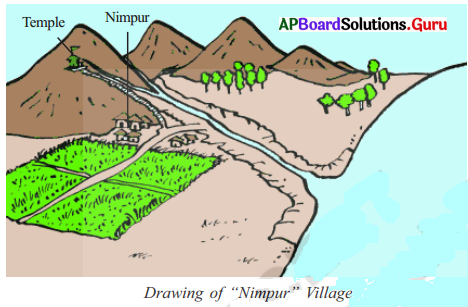
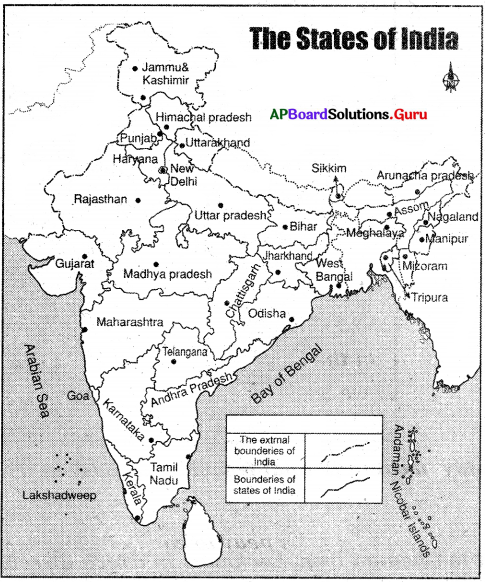
1. What are the symbols we use to show any physical object on the map?
Answer:
The point, Line, Area.

2. When do we use ‘AP 7th Class Social Important Questions Chapter 1 Reading Maps of Different Kinds 6’ symbol?
Answer:
We use AP 7th Class Social Important Questions Chapter 1 Reading Maps of Different Kinds 6 symbol to mark a city on the map.

3. When should we draw a line?
Answer:
To show a river on a map, we should draw a line.

4. How can we show the area of Krishna or Guntur in a map?
Answer:
If we want to show the area of Krishna or Guntur district, we demarcate its boundary and mark it with some colour or pattern, which is known as a real symbol.

AP 7th Class Social Important Questions Chapter 1 Reading Maps of Different Kinds

Question 13.
Read the following para and answer the questions.

Contour Lines

A contour is a line joining the places with equal heights. On the map of Nimpur you would have seen that there is a line passing through the village, this is the 50-meter contour line. All places on this line will have the same heights of 50 meters. Contour lines will be in irregular shape depending upon the landform. These cannot cut with each other. The distance between two contour lines will depend upon the landscape. If the land has a steep climb, then the contour lines will be near to each other. If the slope of the land is gentle, then the contour lines will be quite far from each other.
1. What is a contour?
Answer:
A contour is a line joining the places with equal heights.

2. What is the contour line on the map of Nimpur?
Answer:
On the map of Nimpur we can see a line passing through the village. This is the 50-meter contour line.

3. What is the shape of contour lines?
Answer:
Contour lines will be in irregular shape depending upon the land form.

4. When will be the contour lines near to each other?
Answer:
If the land has a steep climb, then the contour lines will be near to each other.

5. When will be the contour lines far from each other?
Answer:
If the slope of the land is gentle, then the contour lines will be quite far from each other.

Question 14.
How can we represent the heights of land on flat paper?
Answer:
Drawing of Nimpur Village:
AP 7th Class Social Important Questions Chapter 1 Reading Maps of Different Kinds 9
In Atlas, we can find some maps called ‘Physical Maps’. In these maps, we will find different types of land colored in green, yellow or brown. Actually, they show the variety of landforms and depict the heights of places. Here the height of the hills hides what is behind them. A map has to show all places without hiding them. One way in which we can show heights on maps is through the use of color.

AP 7th Class Social Important Questions Chapter 1 Reading Maps of Different Kinds

Question 15.
Observe the following map and answer the given questions.
AP 7th Class Social Important Questions Chapter 1 Reading Maps of Different Kinds 10
a. Look at the symbols shown on the map. Now try to find out the boundary of Andhra Pradesh. Trace your finger over the entire length of the boundary.
Answer:
Self exercise.

b. Draw the symbol for the boundary of a state and the symbol for the boundary of India (international boundary) in your notebook.
Answer:
Self exercise.

c. Can you make a list of states which lie to the North, South, West of Andhra Pradesh? What lies to the East of the state?
Answer:
North: Telangana, Chattisgarh
West: Karnataka
South: Tamilnadu
East: Bay of Bengal

d. In class VI you have also learned to measure distances between places with the help of the ‘scale’ given in the map. Now try to find out the distance between Hyderabad and various state capitals like Jaipur, Imphal, Gandhinagar, and Tiruvananthapuram.
Answer:
1. Jaipur: 1443 km.
2. Imphal: 2854 km
3. Tiruvananthapuram: 1315 km
4. Dehradun: 1677 km
5. Bengaluru: 562 km
6. Bhubaneshwar: 1075 km
7. Kolkata: 1516 km
8. Chennai: 688 km
9. Delhi: 1499 km

AP 7th Class Social Important Questions Chapter 1 Reading Maps of Different Kinds

Question 16.
Hang a political map of India in the class. Look at the map carefully and answer the following questions:
AP 7th Class Social Important Questions Chapter 1 Reading Maps of Different Kinds 11
i) Krishna Reddy went to Bhopal from, Hyderabad. In which direction did he travel?
Answer:
North.

ii) Ashok went to Chennai from Lucknow. In which direction did he travel?
Answer:
South

iii) Regina went to Bhubaneshwar from Mumbai. In which direction did she travel?
Answer:
East

iv) Weprechu went to Jaipur from Kohima. In which direction did he travel?
Answer:
West
Note: Make more such questions and ask each other students’ interactions.

AP 7th Class Social Important Questions Chapter 1 Reading Maps of Different Kinds

Question 17.
Read the map given below and answer the following questions.
AP 7th Class Social Important Questions Chapter 1 Reading Maps of Different Kinds 12
a) Name the city which is the common capital of two Northern states.
Answer:
Chandigarh.

b) Mention one state that shares its boundaries with Pakistan.
Answer:
Rajasthan, Gujarath, Punjab, Jammu & Kashmir.

c) Mention one state on Eastern Coast.
Answer:
Odisha, Andhra Pradesh, Tamilnadu, West Bengal.

d) Mention two states that are sharing their boundaries with Andhra Pradesh.
Answer:
Tamil Nadu, Karnataka, Telangana Chattisgarh, and Odisha.

AP 7th Class Social Important Questions

AP Board 7th Class Social Studies Solutions Chapter 22 Rulers and Buildings

SCERT AP Board 7th Class Social Solutions 22nd Lesson Rulers and Buildings Textbook Questions and Answers.

AP State Syllabus 7th Class Social Studies Solutions 22nd Lesson Rulers and Buildings

7th Class Social Studies 22nd Lesson Rulers and Buildings Textbook Questions and Answers

Improve Your Learning

Question 1.
How is the “trabeate” principle of architecture different from “arcuate”?
Answer:
Roofs, doors, and windows were made by placing a horizontal beam across two vertical columns. This style of architecture is called trabeate or corbelled. But in the arcuate style of architecture, the weight of the superstructure above the doors and windows was carried by arches. The roofs too used this principle and were converted into vaults and domes.

AP Board 7th Class Social Studies Solutions Chapter 22 Rulers and Buildings

Question 2.
What is a Shikhara?
Answer:
The multi-storeyed towering gateway – built on the central shrines on a scale and height is called a Shikhara. These structures of immense scale must have been a mark of imperial authority. They were probably meant as reminders of the power of the kings, able to command the sources techniques, and skills needed to construct these towering gateways.

Question 3.
What are the elements of a Mughal Chahar bagh garden?
Answer:
In his autobiography, Babur described his interest in planning and laying out formal gardens, placed within rectangular walled enclosures and divided into four quarters by artificial channels. These gardens were called Chahar bagh four gardens, because of their symmetrical divisions into quarters. Beginning with Akbar some of the most beautiful Chahar baghs were .constructed by Jahangir and Shah Jahan in Kashmir, Agra and Delhi.

Question 4.
How did a temple communicate the importance of a king?
Answer:
The largest temples were all constructed by kings. They were meant to demonstrate the power, wealth, and devotion of the patron. The temple was a miniature model of the world ruled by the king all his allies. As they worshipped their deities together in the royal temples, It seemed as if they brought the just rule of the gods on earth. The king and nobles endowed the temples with land, gold, and jewels so that worship of the gods could be carried on a grand scale. These temples are thus the center of political and economic power.

AP Board 7th Class Social Studies Solutions Chapter 22 Rulers and Buildings

Question 5.
Read the second part of the introduction part of page 189 and comment on it.
Between the eighth and the eighteenth centuries kings and their officers built two kinds of structures: The first were forts, palaces, and tombs – safe, protected, and grandiose places of rest in this world and the second were structures meant for public activity including temples, mosques, tanks, wells, caravanserais, and bazaars. Kings were expected to care for their subjects and by making structures for their use and comfort, rulers hoped to win their praise. Construction activity was also carried out by others, including merchants. They built temples, mosques, and wells. However, domestic architecture – large mansions (Havelis) of merchants – has survived only from the eighteenth century.
Answer:
During the period from 8 to 18th century, the kings were interested in construction activity. They constructed forts, palaces, tombs, temples, mosques, tanks, wells, etc. They constructed them as a mark of their art and architecture.

Question 6.
How did the Mughal court suggest that everyone – the rich and the poor, the powerful and the weak – received justice equally from the emperor?
Answer:
The connection between royal justice and the Imperial Court was emphasized by Shah Jahan in his newly constructed court in the Red Fort at Delhi. The construction of Shah Jahan’s audience hall aimed to communicate that the King’s justice would treat the high and the low as equals where all could live together in peace and harmony.

Question 7.
The rich and the powerful construct large houses today. In what ways were the constructions of kings and their courtiers different from them?
Answer:
Though the houses built by the rich and powerful nowadays are very large, they don’t have any beautiful gardens. Mughal nobility had constructed their homes on the banks of the river – Yamuna. These were set in the midst of formal gardens constructed in the Chahar bagh format.

AP Board 7th Class Social Studies Solutions Chapter 22 Rulers and Buildings

Question 8.
Is there a statue or a memorial in your village or town? Why was it placed there? What purpose does it serve?
Answer:
Yes, there is Dr. B. R. Ambedkar’s statue in our village. It was placed by some of our villagers. It is to honor him as a framer of our Constitution.

Question 9.
Visit and describe any park or garden in your neighborhood. In what ways is it similar to or different from the gardens of the Mughals?
Answer:
There is a park at the end of our street. Our park is in a rectangular shape. There is a compound wall around the park. There are no channels in our park. But there is a tap to water the plants.
Moghul gardens are in a rectangular shape. They are placed within walled enclosures constructed by Babur. They are divided into four quarters by artificial channels.

Question 10.
Locate the following on the India India map.
a) Delhi
b) Agra
c) Amritsar
d) Tanjavur
e) Hampi
f) River Yamuna
g) Khajuraho
Answer:
AP Board 7th Class Social Studies Solutions Chapter 22 Rulers and Buildings 1

AP Board 7th Class Social Studies Solutions Chapter 21 Devotional Paths to the Divine

SCERT AP Board 7th Class Social Solutions 21st Lesson Devotional Paths to the Divine Textbook Questions and Answers.

AP State Syllabus 7th Class Social Studies Solutions 21st Lesson Devotional Paths to the Divine

7th Class Social Studies 21st Lesson Devotional Paths to the Divine Textbook Questions and Answers

Improve Your Learning

Question 1.
Fill in the blanks:
a) Ramanuja was influenced by the ……………….
b) ……………. and ……………. were advocates of Virashaivism.
c) ……………. was an important center of the Bhakti tradition in Maharashtra.
Answer:
a) Alvars
b) Basavanna, Allama Prabhu and Akkamahadevi
c) Pandharpur

AP Board 7th Class Social Studies Solutions Chapter 21 Devotional Paths to the Divine

Question 2.
Describe the beliefs and practices of the Nathpanthis, Siddhas, and Yogis.
Answer:
The beliefs and practices of Nathpanthis, Siddhacharas, and Yogis were.

  1. They criticized rituals and others aspects of conventional religion and social order.
  2. They advocated renunciation of the world.
  3. They believed salvation lay in meditation on the formless ultimate reality and the realization of oneness with it.
  4. To achieve salvation they advocated intense training of the mind and body through practices like Yogasanas, breathing exercises, and meditation.
  5. Their criticism of conventional religion created the ground for devotional religion.

Question 3.
What were the major ideas, expressed by Kabir? How did he express them?
(or)
Write about the major idea of Kabir.
Answer:

  1. Kabir’s teachings were based on a complete rejection of the major religious traditions.
  2. He openly ridiculed fill forms of external worship of both Hinduism and Islam.
  3. Kabir ridiculed the pre-eminence of the priestly classes and the caste system.
  4. Kabir believed in a formless Supreme God.
  5. He preached that the only path to salvation was through bhakti or devotion.
  6. He expressed his ideas through a vast collection of verses called Sakhis and pads composed by him.

AP Board 7th Class Social Studies Solutions Chapter 21 Devotional Paths to the Divine

Question 4.
What were the major beliefs and practices of the Subs?
Answer:

  1. Sufis were Muslim mystics.
  2. Sufis rejected outward religiosity.
  3. They emphasized love and devotion to God and compassion towards all fellow human beings.
  4. The Sufis rejected the elaborate rituals and codes of behavior demanded by Muslim religious scholars.
  5. Sufis sought union with God.
  6. Sufis too believed that the heart can be trained to look at the world in a different way.
  7. They developed elaborate methods of training using zikr (chanting of a name), contemplation Sama (singing), raqs (dancing), discussion of parables, breath control, etc., under the guidance of a pir.

Question 5.
Why do you think many teachers rejected prevalent religious beliefs and practices?
Answer:
Up to the medieval period. Indian society was moaning under the burden of evil social practices and unscrupulous religious beliefs. There were social differences based on birth. Society was divided into many castes. The lower class of the people was treated as untouchables. The pre-eminency of the priestly classes was envied by the people of other castes. The burden of expensive rituals, evil aspects of conventional religion, Idol worship, polytheism, and unscrupulous religious beliefs made religion a burden on society. So many teachers rejected prevalent religious beliefs and practices.

Question 6.
What were the major teachings of Baba Guru Nanak?
Answer:

  1. Guru Nanak emphasized the importance of the worship of one God.
  2. He insisted that caste, creed or gender was irrelevant for attaining liberation.
  3. In his opinion liberation was not the state of inert bliss, but rather the pursuit of active life with a strong sense of social commitment.
  4. He emphasized right worship, the welfare of others, and purity of conduct.
  5. Guru Nanak’s idea of equality had social and political implications.

AP Board 7th Class Social Studies Solutions Chapter 21 Devotional Paths to the Divine

Question 7.
For either the Virashaivas or the saints of Maharashtra, discuss their attitude towards caste.
Answer:
Either the Virashaivas or the saints of Maharashtra strongly opposed the caste system. The Virashaivas strongly argued for the equality of all human beings. They were against scriptural ideas about caste. On the other hand, the saints of Maharashtra rejected the social differences based on birth. They encouraged universal brotherhood by insisting that bhakti lay in sharing others’ pain. They were taught to serve fellow human beings in need. ,

Question 8.
Why do ordinary people still remember Mirabai?
Answer:

  1. Though Mirabai was a princess, she became a disciple of Ravidas, an untouchable.
  2. She openly challenged the norms of the upper castes.
  3. So Mirabia became popular with the masses and the ordinary people would like to preserve the memory of Mirabai.

Question 9.
Read the para under the title ‘A Closer Look: Kabir’ on page 186 and comment on it.

A Closer Look: Kabir

Kabir, who probably lived in the fifteenth-sixteenth century, was one of the most influential saints. He was brought up in a family of Muslim julahas or weavers settled near the city of Benares (Varanasi). We have little reliable information about his life.
We get to know of his ideas from a vast collection of verses called sakhis and pads said to have been composed by him and sung by wandering bhajan singers. Some of these were later collected and preserved in the Guru Granth Sahib, Panch Vani, and Bijak.
Kabir’s teachings were based on a complete, indeed vehement, rejection of the major religious traditions. His teachings openly ridiculed all forms of external worship of both Hinduism and Islam, the pre-eminence of the priestly classes, and the caste system. The language of his poetry was a form of spoken Hindi, widely understood by ordinary people.
Kabir believed in a formless Supreme God and preached that the only path to salvation was through bhakti or devotion. Kabir drew his followers from among both Hindus and Muslims.
Answer:
Kabir was a mystic poet and saint of India. His writings have greatly influenced the Bhakti movement. He lives perhaps during 1398 – 1448. He had an enormous influence on Indian philosophy and on Hindi poetry. In India, he is perhaps the most quoted author, with the exception of Tulsidas.

AP Board 7th Class Social Studies Solutions Chapter 21 Devotional Paths to the Divine

Question 10.
Write about a festival celebrated by the people together in your area?
Answer:
We celebrate Ganesh Chaturthi together in our area. We have a committee in our area to organize this festival. We celebrate in a ‘Mandapam’ in our street. All the people in our street contribute to this festival. We celebrate this festival for 11 days.

AP Board 7th Class Social Studies Solutions Chapter 20 Folk Religion

SCERT AP Board 7th Class Social Solutions 20th Lesson Folk Religion Textbook Questions and Answers.

AP State Syllabus 7th Class Social Studies Solutions 20th Lesson Folk Religion

7th Class Social Studies 20th Lesson Folk Religion Textbook Questions and Answers

Improve Your Learning

Question 1.
What are the common elements in the worship of most of the village deities?
Answer:
Whatever the region they belong to, whichever deity they worship, people use the same elements to worship village deities. They offer bonalu and offer sacrifices such as cocks, goats, and buffaloes. There are no priests and people pray to the deities in their own languages. In worshipping the deities the customs and traditions followed by the people of the different regions are the same.

AP Board 7th Class Social Studies Solutions Chapter 20 Folk Religion

Question 2.
When people go to towns and settle there, do they continue to worship their old village deities? How do they do it?
Answer:
They don’t lose their relationship with their village deities even after moving into cities. This is important for them. The traditions and customs and religious beliefs, whether they are scrupulous or unscrupulous are not easily forgotten or neglected. So they attend their festivals in villages. Those who have made some money help made a chariot or a cupola, or help build a shrine. At times, the group of families from a village, live in the neighborhood of cities, arrange for the deity to come to their place. The deity comes in full splendor. There is great feasting and for the whole time, she is there.

Question 3.
Why do people use different languages while worshipping different kinds of deities?
Answer:
In the temples of village deities, there are no priests and people pray according to their own customs and traditions. People use different languages while worshipping different kinds of deities because in different places the same goddess is named differently. So people use different languages to worship different kinds of deities. Like in the Worship of main deities as Siva, Shakti, and Vishnu, the Sanskrit language is not used in worshipping the village deities.

Question 4.
Do you think the way people worship the village deities is changing now? What kind of changes do you see?
Answer:
Yes. The people’s relations to the village deities in rural society are changing as a result of their economic hardships. These days celebrations of festivals and offering bonalu and sacrifices have become very much expensive. Though traditions and religious customs are not easily vanished from society, the economic hardships and penury of the people made them alienated from the celebration of rituals. Awareness campaigns made by the intellectuals and non – governmental organizations against the animal sacrifices made the people do away with this expensive extravaganza.

AP Board 7th Class Social Studies Solutions Chapter 20 Folk Religion

Question 5.
Point out the main places of important jataras and urs in Andhra Pradesh Map.
Answer:
AP Board 7th Class Social Studies Solutions Chapter 20 Folk Religion 1

Question 6.
Read the fourth paragraph of page 178 and comment on it.
Most of these deities are worshipped by people irrespective of their caste or religion or economic status. For example, even Muslim farmers participate in many of the ravels of village gods. Similarly, people of all religions throng to the dargahs to seek the blessing of their peers. They tie strings on a tree or on the walls of the dargah making a vow in return for the wishes granted. They request the pirzadas to prepare tawiz for them to drive away evil spirits.
Answer:
Most religions have so much is common with each other, including their basic moral principles we can say that this is religious integrity in India.

AP Board 7th Class Social Studies Solutions Chapter 20 Folk Religion

Question 7.
Collect the following particulars by talking to the people of different religions of your area.
AP Board 7th Class Social Studies Solutions Chapter 20 Folk Religion 2
Answer:

S.No.NameReligion practicedGod worshippedFestivals celebrated
1.Y. Madhava RaoHinduismLord VenkateswaraHindu festivals like Divali, Dussera, etc.
2.T.G. DavidChristianityYehovah, JesusChristmas, Good Friday, etc.
3.Fazal – Ul – hakIslamMuhammadRamazan, Bakrid, etc.