AP Board 7th Class English Solutions Chapter 4B Dear Mum

AP State Syllabus AP Board 7th Class English Textbook Solutions Chapter 4B Dear Mum Textbook Questions and Answers.

AP State Syllabus 7th Class English Solutions Chapter 4B Dear Mum

7th Class English Chapter 4B Dear Mum Textbook Questions and Answers

I. Answer the following questions.

Question 1.
Who do you think is responsible for all the mischievous deeds?
Answer:
I think it is none but the’ naughty boy who is responsible for all the mischievous deeds.

Question 2.
Why was there a strange jam stain on the kitchen wall? How do you think did it happen?
Answer:
There was a strange jam stain on the kitchen wall because the boy must have taken out the jam in the kitchen in his mother’s absence and he might have touched the wall with the jam- stained fingers.

AP Board 7th Class English Solutions Chapter 4B Dear Mum

Question 3.
Did the boy play only indoors? Support your answer.
Answer:
Yes, I think the boy played only indoors. The things happened in the house during the absence of his mother clearly indicate that he had done all those while playing indoors.

Question 4.
What do the muddy foot prints on the carpet suggest?
Answer:
It suggests that the boy might have invited some of his friends into his house to play indoors and they all walked with muddy foot on the carpet.

II. Work in pairs and discuss.

Question 1.
Have you ever been mischievous? Share with your partner some mischievous deeds that you have done in the past.
Answer:
Yes. I have been mischievous quite often. I used to turn off the burning stove in the middle of cooking. Turning on lights during day time, allowing cat to drink milk, giving away new chappals of father to beggar, etc. are other activities of mischief. They are too many to list out.

Question 2.
If you were mischievous like the boy in the poem, how would your mother react?
Answer:
My mother would react with a smile and gentle warning most of the times. She would be very angry and beat me sometimes.

AP Board 7th Class English Solutions Chapter 4B Dear Mum

Project

I. Read one or two stories about Tenali Raman and share them in your groups.

A Story about Tenali Raman’s Wit

Tenali Ramalinga was a jester and courtier in the court of king Krishnadevaraya. He was known for his wit and humour.

Tenali Ramalinga’s wife had a lot of jewels. She wore them in the day. At night, she put them away, in a box. She kept the box in her bedroom.

Tenali Ramalinga had two servants. They were rogues.

One day the two servants decided to steal the jewels. One servant said to the other, “We will steal the jewels in the night.” Then the other servant said. ‘Yes, it’s a good idea because in the night, they will be asleep. Then we will easily take away the box of jewels.” At that time, Ramalinga was standing behind the two servants and overheard what they had said. It was dark and so they did not see Ramalinga.

At night, they stood behind the door of the bedroom. Ramalinga knew that they were behind the door. So he said loudly, to his wife, “My dear! We hear that these days thefts are increasing. So our bedroom is not the safe place to keep the box of your jewels, in. I shall drop this box of jewels into the well which is in our garden.” The servants thought that the box of jewels would be dropped into the well. But Ramalinga cleverly took out all the jewels from the box and filled the box with small stone-pieces. Later he came out with box, went to the well and dropped the box into the well. He then returned to his bedroom.

After sometime, the two servants went to the well. They began the work of drawing out the water from the well. They poured the water into the garden. They did this work all the night, yet they couldn’t draw out all the water from the well. At day break, one servant said, “Friend, we’ll stop the work now and do it again tonight.” When they were about to go out, Ramalinga called them to his side. They turned, saw him and were surprised and speechless. Ramalinga told them, “You dirty rogues ! You wanted to steal my wife’s jewels. That’s why 1 filled the box with stones and threw it into the well. Nevertheless, you did one good thing. You watered the garden completely by drawing out the water from the well, all the night. Because of your bad conduct, I dismiss you both. Get lost now itself.” The two servants lost their job and went away.

AP Board 7th Class English Solutions Chapter 4B Dear Mum

II. Make a fun cap.

Kings have gone. Jesters have gone. Now, we have only jokers in circuses or comedy shows. They wear fancy dresses and a round cap on their heads. Work in pair, one student should give the following instruction and other has to follow it and do accordingly.

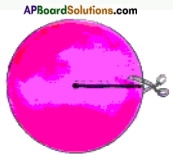
  1. Take a round colour drawing sheet and cut it along the dotted lines.
    AP Board 7th Class English Solutions Chapter 4B Dear Mum 1
  2. Hold both the corners of the sheet and overlap the cut parts to fit like a cap. Use two paper clips to hold the shape or apply gum along the edge to fix.
    AP Board 7th Class English Solutions Chapter 4B Dear Mum 2
  3. Decorate your cap by pasting shapes of different colours, (e.g. triangles, flowers, squares, circles, etc.)
    AP Board 7th Class English Solutions Chapter 4B Dear Mum 3
  4. Cut long strips of different colours.
  5. Make a small cut on the top of your cap and push the ends of the long strips inside through the hole and paste them inside.
    AP Board 7th Class English Solutions Chapter 4B Dear Mum 4

AP Board 7th Class English Solutions Chapter 4B Dear Mum

Dear Mum Summary in English

The poet says that some naughty children do naughty things both at home and at school. They cover their mistakes pr faults cleverly and nicely.

In this poem, a naughty boy made mischief when her mother was not at home. When she returned, before her mother’s asking him why he had done those things, the boy began to tell his mother the reasbns for various happenings in the house during her absence. He said that while she was out, a cup went and broke itself. A crack appeared in the blue vase. He did not turn on the tap but mysteriously the sink overflowed. He also expressed his surprise on how the cat managed to turn on the washing machine (especially from inside) or how the self-raising flour’ managed to self-raise. He said he was terribly afraid when a series of muddy footprints appeared on the new white carpet. He said he was not the cause of all these happenings and that he was good and honest. He said that he thought that the house was haunted, by ghosts, when he had gone over to his grandmother.

Dear Mum Glossary

mysteriously (adv): strangely

scared (v): frightened of something

haunted (adj): (of a building) believed to be visited by ghosts

have a fit (phr. v): to be shocked, upset or angry

self-raising flour (n): flour that contains a substance which makes cakes swell when they are cooked

gran (n): grandmother

AP Board 7th Class English Solutions Chapter 4B Dear Mum

for a bit: for a while

turn on (phr. v): switch on

AP Board 6th Class Maths Solutions Chapter 3 HCF and LCM InText Questions

AP State Syllabus AP Board 6th Class Maths Solutions Chapter 3 HCF and LCM InText Questions and Answers.

AP State Syllabus 6th Class Maths Solutions 3rd Lesson HCF and LCM InText Questions

AP Board 6th Class Maths Solutions Chapter 3 HCF and LCM InText Questions

(Page No. 35)

Question 1.
How does the Sieve of Eratosthenes work ?
Solution:
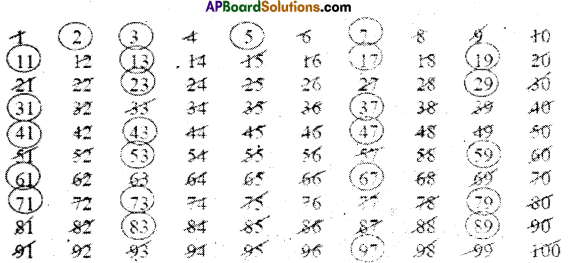
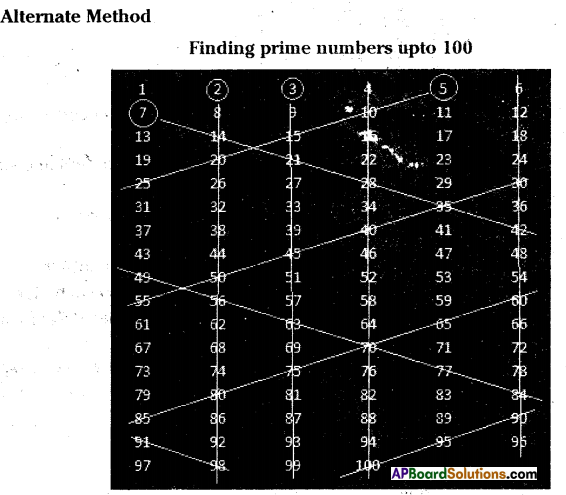
The following example illustrates how the Sieve of Eratosthenes, can be used to find all the prime numbers that are less than 100. .
Step 1: Write the numbers from 1. to 100 in ten rows as shown below.
Step 2: Cross out 1 as 1 is neither a prime nor a composite number.
Step 3: Circle 2 and cross out all the multiples of 2. (2, 4, 6, 8, 10, 12, ………… )
Step 4: Circle 3 and cross out all the multiples of 3. (3, 6, 9, 12, 15, 18,………….)
Step 5: Circle 5 and cross out all the multiples of 5. (5, 10. 15, 20, 25……………… )
Step 6: Circle 7 and cross out all multiples of 7. (7, 14, 21. 28, 35, ………………….. )

Circle all the numbers that are not crossed out and they are the required prime numbers less than 100.
AP Board 6th Class Maths Solutions Chapter 3 HCF and LCM InText Questions 1AP Board 6th Class Maths Solutions Chapter 3 HCF and LCM InText Questions 2

First arrange the numbers ffom 1 to 100 in a table as shown above.
Enter 6 numbers in each row until the last number 100 is reached.
First we select a number and we strike off all the multiples of it.
Start with 2 which is greater than 1.
Round off number 2 and strike off entire column until the end.
Similarly strike off 4th column and 6th column as they are divisible by 2.
Now round off next number 3 and strike off entire column until end.
The number 4 is already gone.

Now round off next number 5 and strike off numbers in inclined fashion as shown in the figure (they are all divisible by 5). When striking off ends in some row, start again striking off with number in another end which is divisible by 5. New striking off line should be parallel to previous strike off line as. shown in the figure.
The number 6 is already gone.
Now round off number 7 and strike off numbers as we did in case of number 5.
8,9,10 are also gone. .
Stop at this point.
Count all remaining numbers. Answer will be 25.

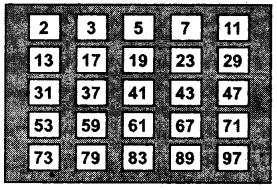
Prime numbers :
There are 25 prime numbers less than 100.
These are:
AP Board 6th Class Maths Solutions Chapter 3 HCF and LCM InText Questions 3

What if we go above 100 ? Around 400 BC the Greek mathematician. Euclid, proved that there are infinitely many prime numbers.

Co-primes: Two numbers are said to be co-prime if they have no factors in common. Example: (2, 9), (25, 28)
Any two consecutive numbers always form a pair of co-prime numbers.

Example:
Co-prime numbers are also called relatively prime number to one another.
Example: 3, 5, 8, 47 are relatively prime to one another/co-prime to each other.

Twin primes: Two prime numbers are said to be twin primes, if they differ by 2.
Example: (3, 5), (5, 7), (11, 13), …etc.

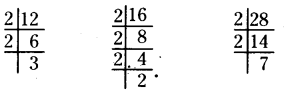
Prime factorization: The process of expressing the given number as the product of prime numbers is called prime factorization.
Example: Prime factorization of 24 is
24 = 2 x 12
= 2 x 2 x 6
= 2 x 2 x 2 x 3, this way is unique.

Every number can be expressed as product of primes in a unique manner. We can factorize a given number in to product of primes in two methods. They are
a) Division method
b) Factor tree method

Common factors: The set of all factors which divides all the given numbers are called their common factors.
Example: Common factors to 24, 36 & 48 are 1, 2, 3, 4, 6 & 12
Factors of 24 = 1, 2, 3, 4, 6, 8, 12 & 24
Factors of 36 = 1, 2, 3, 4, 6, 9, 12, 18 & 36
Factors of 48 = 1, 2, 3, 4, 6, 8, 12, 16, 24 & 48
Common factors to 24, 36 & 48 are 1, 2, 3, 4, 6 & 12
We can see that among their common factors 12 is the highest common factor. It is called H.C.F. of the given numbers. So H.C.F. of 24, 36 & 48 is 12.

H.C.F./G.C.D : The highest common factor or the greatest common divisor of given numbers is the greatest of their common factors.
H.C.F. of given two or more numbers can be found in two ways.
a) By prime factorization
b) By continued division
H.C.F. of any two consecutive numbers is always 1.
H.C.F. of relatively prime/co-prime numbers is always 1.
H.C.F. of any two consecutive even numbers is always 2.
H.C.F. of any two consecutive odd numbers is always 1.

AP Board 6th Class Maths Solutions Chapter 3 HCF and LCM InText Questions

Common multiples:
Multiples of 8: 8, 16, 24, 32, 40, 48,
Multiples of 12: 12, 24, 36, 48, … .
Multiples.common to 8 & 12: 24, 48; 72, 96, …
Least among the common multiple is 24. This is called L.C.M. of 8 & 12. The number of common multiples of given two or more numbers is infinite, as such greatest common multiple cannot be determined.

L.C.M.: The least common multiple of two or more numbers is the smallest natural number among their common multiples.
L.C.M. of given numbers can be found by the
a) Method of prime factorization.
b) Division method.
L.C.M. of any two consecutive numbers is always equal to their product.
L.C.M. of 8 &9 is 8 x 9 = 72
L.C.M. of co-prime numbers is always equal to their product.
L.C.M. of 8 & 15 is 8 x 15 = 120

Relation between the L.C.M. & H.C.F:
For a given two numbers Nj & N2 , the product of the numbers is equal to the product of their L.C.M.(L) & H.C.F.(H)
N1 x N2 = L x H

Check Your Progress (Page No. 29)

Question 1.
Are the numbers 900, 452, 9534, 788 divisible by 2? Why?
Solution:
Yes. Because these numbers have 0, 2, 4 and 8 in their ones place. The numbers having 0, 2, 4, 6 and 8 in their ones place are divisible by 2.

Question 2.
Are the numbers 953, 457, 781, 325, 269 divisible by 2? Why?
Solution:
No. Because, these numbers have 3, 7, 1, 5 and 9 in their ones place. The numbers having 0, 2,
4, 6 and 8 in their ones place are only divisible by 2. So, these are not divisible by 2.

AP Board 6th Class Maths Solutions Chapter 3 HCF and LCM InText Questions

Question 3.
Are the numbers 452, 673, 259, 356 divisible by 2? Verify.
Solution:
452 and 356 have 2 and 6 in their ones place respectively.
So, they are divisible by 2.
673 and 259 have 3 and 9 in their ones place respectively.
So, they are not divisible by 2.

Question 4.
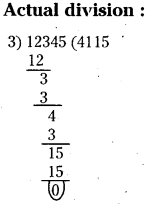
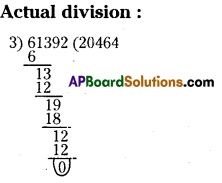
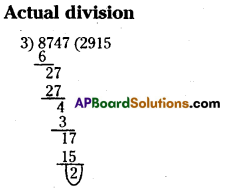
Check whether the following numbers are divisible by 3 (using rule). Verify by actual division.
(i) 12345 (ii) 61392 (iii)8747
Solution:
i)12345
1 + 2 + 3 + 4 + 5=15 is a multiple of 3.
If the sum of the digits of a number is the multiple of 3, then the number is divisible by 3.
So, 12345 is divisible by 3.
AP Board 6th Class Maths Solutions Chapter 3 HCF and LCM InText Questions 4

ii) 61392
6 + 1 + 3 + 9 + 2 = 21is a multiple,of 3.
If the sum of the digits of a number is a multiple of 3, then the number is divisible
by 3.

So, 61392 is divisible by 3.
AP Board 6th Class Maths Solutions Chapter 3 HCF and LCM InText Questions 5

AP Board 6th Class Maths Solutions Chapter 3 HCF and LCM InText Questions

iii) 8747
8 + 7 + 4 + 7 = 26is not a multiple of 3.
If the sum of the digits of a number is a multiple of 3, then the numbei is divisible by 3. So, 8747 is not divisible by 3.
AP Board 6th Class Maths Solutions Chapter 3 HCF and LCM InText Questions 6
So, 8747 is not divisible by 3.

Let’s Explore (Page No. 29)

Question 1.
Is 8430 divisible by 6? Why?
Given number is 8430.
The given number has zero in the ones place.
So, 8430 is divisible by 2. –
And the unit sum is8 + 4 + 3 + 0 = 15 is a multiple of 3.
So, 8430 is divisible by 3.
If a number is divisible by both 2 and 3, then only it is divisible by 6.
8430 is divisible by both 2 and 3.
Therefore 8430 is divisible by 6.

Question 2.
Take any three 4 digit numbers and check whether they are divisible by 6.
Solution:
Consider: i) 5632, ii) 6855, iii) 9600 are three 4 digit numbers.
i) 5632 has 2 in its ones place. So, 5632 is divisible by 2.
The unit sum is
5 + 6 + 3 + 2 = 16 is not a multiple of 3. So, 5632 is not divisible by 3.
If a number is divisible by both 2 and 3, then only it is divisible by 6.
5632 is qnly divisible by 2, but not divisible by 3.
So, 5632 is not divisible by 6.

ii) 6855 has 5 in the ones place. So, 6855 is not divisible by 2.
6 + 8 + 5 + 5 = 24 is a multiple of 3.
So, 6855 is divisible by 3.
If a number is divisible by both 2 and 3, then only it is divisible by 6.
6855 is not divisible by 2, but it is divisible by 3.
So, 6855 is not divisible by 6.

iii) 9600 has ‘0’ in the ones place. So, 9600 is divisible by 2.
9 + 6 + 0 + 0 = 15 is a multiple of 3.
So, 9600 is divisible by 3. .
If a number is divisible by both 2 and 3, then only it is divisible by 6, 9600 is divisible by 1 both 2 and 3.
So, 9600 is divisible by 6.

AP Board 6th Class Maths Solutions Chapter 3 HCF and LCM InText Questions

Question 3.
Can you give an example of a number which is divisible by 6 but not by 2 and 3? Why?
Solution:
No. We can’t give any example, because if any number is divisible by both 2 and 3, then only it is divisible by 6. Otherwise it is not possible.

Check Your Progress (Page No. 30 & 31))

Question 1.
Test whether 6669 is divisible by 9. ,
Solution:
Given number is 6669.
Sum of the digits = 6 + 6 + 6 + 9 = 27 is divisible by 9
If the sum of the digits of a number is divisible by 9 then, it is divisible by 9. ” 27 is divisible by 9. So, 6669 is divisible by 9.

Question 2.
Without actual division, find whether 8989794 is divisible by 9.
Solution:
Given number is 8989794.
Sum of the digits =8+9+8+9+7+9+4=54 – 1
If the sum of the digits of a number is divisible by 9.
Then, it is divisible by 9.
54 is divisible by 9. So, 8989794 is divisible by 9.

Question 3.
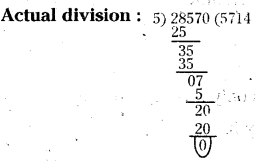
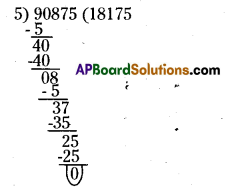
Are the numbers 28570, 90875 divisible by 5? Verify by actual division also.
Solution:
a) Given number be 28570.
The numbers with zero or five at ones place are divisible by 5
28570 has zero in its ones place. So, 28570 is divisible by 5.
Actual division :
AP Board 6th Class Maths Solutions Chapter 3 HCF and LCM InText Questions 7
So, 28570 is completely divisible by 5.

AP Board 6th Class Maths Solutions Chapter 3 HCF and LCM InText Questions

b) Given number is 90875
In 90875, ones place digit is 5. So, 90875 is divisible by 5.
Actual division :
AP Board 6th Class Maths Solutions Chapter 3 HCF and LCM InText Questions 8
In the given number 90875 the digit in the units place is 5,
‘ So, it is divisible by 5.
So, 90875 is divisible by 5.

Question 4.
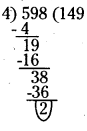
Check whether the number 598, 864, 4782 and 8976 are divisible by 4. Use divisibility rule and verify by actual division.
Solution:
a) Given number is 598.
The number formed by the digits in tens and ones places of 598 is 98.
If the number formed by last two digits (Ones and Tens) of the number is divisible
by 4, then the number is divisible by 4.
98 is not divisible by 4. So, 598 is not divisible by 4.
AP Board 6th Class Maths Solutions Chapter 3 HCF and LCM InText Questions 9

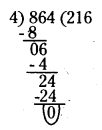
b) Given number is 864.
The number formed by tens and ones places of 864 is 64.
If the number formed by last two digits (ones and tens)
of the number is divisible by 4, then the number is divisible by 4.
64 is divisible by 4. So, 864 is divisible by 4.
AP Board 6th Class Maths Solutions Chapter 3 HCF and LCM InText Questions 10

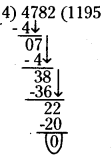
c) Given number is 4782.
The number formed by ones and tens places of 4782 is 82.
If the number formed by last two digits (ones and tens) of the number is divisible by 4, then the number is divisible by 4. 82 is not divisible by 4.
AP Board 6th Class Maths Solutions Chapter 3 HCF and LCM InText Questions 11

AP Board 6th Class Maths Solutions Chapter 3 HCF and LCM InText Questions

d) Given number is 8976.
The number formed by the digits in tens and ones places of 8976 is 76.
If the number formed by last two digits
(Tens and ones) of the number is divisible by 4. Then the number is divisible by 4.
76 is divisible by 4. So, 8976 is divisible by 4.
AP Board 6th Class Maths Solutions Chapter 3 HCF and LCM InText Questions 12

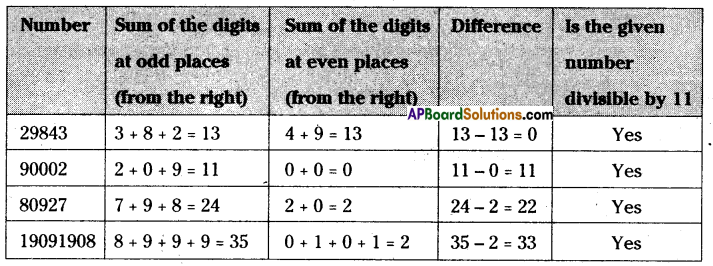
Question 1.
Fill the blanks and complete the table.
(Page No. 32)
Solution:
AP Board 6th Class Maths Solutions Chapter 3 HCF and LCM InText Questions 13

Lets Explore (Page No.33)

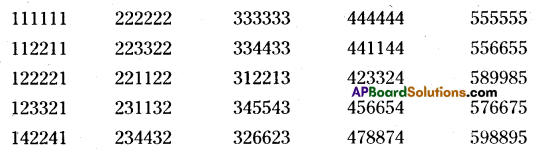
Question 1.
1221 is a polindrome number, which on reversing its digits gives the same number. Thus, every polindrome number with even number of digits is always divisible by 11. Write polindrome number of 6 – digits.
Solution:
AP Board 6th Class Maths Solutions Chapter 3 HCF and LCM InText Questions 14
There are some polindrome number of 6 – difits.

Check Your Progress (Page No.34)

Question 1.
Find the factors of 60.
Solution:
60 = 1 x 60
60 = 2 x 30
60 = 3 x 20
60 = 4 x 15
60 = 5 x 12
60 = 6 x 10
∴ The factors of 60 are 1, 2, 3, 4, 5, 6, 10, 12, 15, 20, 30, 60.

AP Board 6th Class Maths Solutions Chapter 3 HCF and LCM InText Questions

Question 2.
Do all the factors of a given number divide the number exactly? Find the factors of 30 and verify by division.
30 = 1 x 30
30 = 3 x 10
30 = 2 x 15
30 = 5 x 6
The factors of 30 are 1, 2, 3, 5, 6,10, 15 and 30.
AP Board 6th Class Maths Solutions Chapter 3 HCF and LCM InText Questions 15
Yes, the factors of a given numbers are divide the number exactly.

Question 3.
3 is a factor of 15 and 24. Is 3 a factor of their difference also?
Solution:
Difference = 24 – 15 = 9 is the multiple of 3.
Yes, 3 is a factor of difference of 15 and 24.

Let’s Explore (Page No. 35)

Question 1.
What is the smallest prime number?
Solution:
2

Question 2.
What is the smallest composite number?
Solution:
4

Question 3.
What is the smallest odd prime number?
Solution:
3

Question 4.
What is the smallest odd composite number?
Solution:
9

AP Board 6th Class Maths Solutions Chapter 3 HCF and LCM InText Questions

Question 5.
Write 10 odd and 10 even composite numbers.
Solution:
Odd composite numbers are 9, 15, 21, 25, 27, 33, 35, 39, 45, 49.
Even composite numbers are 4, 6, 8, 10, 12, 14, 16, 18, 20, 22.
Except 2, every even number is a composite number.

Let’s Explore (Page No. 36)

Question 1.
Can you guess a prime number which when on reversing its digits, gives another prime number? (Hint a 2 digit prime number)
Solution:
13 and 31; 17 and 71, 37 and 73 79 and 97.

Question 2.
311 is a prime number. Can you find the other two prime numbers just by rearrang-ing the digits?
Solution:
113, 131

Check Your Progress (Page No. 36)

Question 1.
From the following numbers identify different pairs of co-primes. 2, 3,4, 5,6,7, 8, 9 and 10.
Solution:
The numbers which have only 1 as the common factor are called co-primes, (or) Numbers having no common factors, other than 1 are called co-primes.
2,3; 2, 5; 2, 7; 2, 9; 3,4; 3, 5; 3, 7; 3, 8; 3,10; 4,5; 4, 7; 4, 9; 5, 6; 5, 7; 5,8; 5, 9; 6, 7; 8, 9 and 9,10. These are the different pairs of co-primes with 2, 3, 4, 5, 6, 7, 8, 9 and 10.
1) Any two primes always forms a pair of co-primes.
2) Any two consecutive numbers always form a pair of co-primes.
3) Any two primes cilways form a pair of co-primes. .

Question 2.
Write the pairs of twin primes less than 50.
Solution:
Two prime numbers are said to be twin primes, if they differ each other by 2.
Twin primes less than 50 are (3, 5); (5, 7); (11,13); (17, 19); (29, 31) and (41, 43).

(Page No. 36)

Question 1.
Find the HCF of 12, 16 and 28
Solution:

Thus 12 = 2 x 2 x 3
16 = 2 x 2 x 2 x 2
28 = 2 x 2 x 7
The common factor of 12, 16 and 28 ¡s 2 x 2 = 4.
Hence, H.C.F of 12, 16 and 28 is 4.

AP Board 6th Class Maths Solutions Chapter 3 HCF and LCM InText Questions

Let’s Explore (Page No. 40)

What is the HCF of any two
i) Consecutive numbers ?
ii) Consecutive even numbers ?
iii) Consecutive odd numbers? What do you observe? Discuss with your Mends.
Solution:
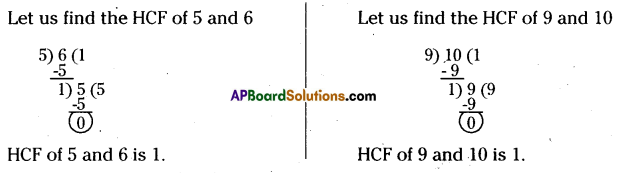
Consider the two consecutive number are 5, 6 and 9, 10.
AP Board 6th Class Maths Solutions Chapter 3 HCF and LCM InText Questions 16
We observed that HCF of any two consecutive numbers is always 1.

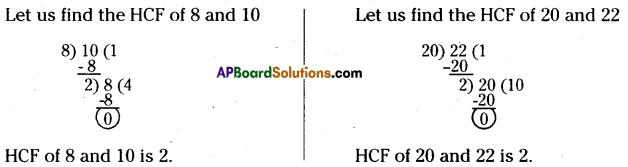
ii) Consider two consecutive even numbers are 8, 10 and 20, 22.
AP Board 6th Class Maths Solutions Chapter 3 HCF and LCM InText Questions 17
We observed that HCF of any two consecutive even numbers is always 2.

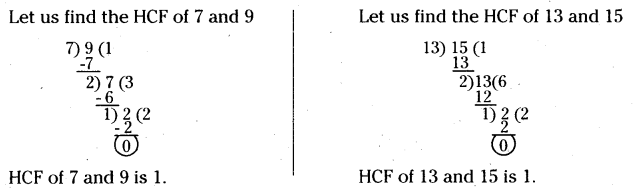
iii)Consider the consecutive odd numbers are 7, 9 and 13, 15.
AP Board 6th Class Maths Solutions Chapter 3 HCF and LCM InText Questions 18
We observed that HCF of any two consecutive odd numbers is always 1.

(Page No. 42)

Question 1.
Find LCM of (i) 3, 4 (ii) 10, 11 (iii) 10, 30 (iv) 12, 24 (v) 3, 12 by prime factorization method.
Solution:
i) Given numbers are 3, 4
Factors of 3 = 1 x 3
Factors of 4 = 2 x 2
LCM of 3, 4 = 1 x 3 x 2 x 2 = 12

ii) Given numbers are 10, 11
Factors of 10 = 2 x 5
Factors of 11 = 1 x 11
LCM of 10, 11 = 2 x 5 x 11 = 110

iii) Given numbers are 10, 30
Factors of 10 = 2×5
Factors of 30 = 2x3x5
LCM of 10, 30 = 2 x 3 x 5 = 30

iv) Given numbers are 12, 24
Factors of 12 = 2x2x3 ,
Factors of 24 =. 2 x 2 x 2 x 3
LCM of 12, 24 = 2 x 2 x 2 x 3 = 24

v) Given numbers are 3,12 Factors of 3 = 1×3
Factors of 12 =2 x 2 x 3,
LCM of 3, 12 = 3 x 2 x 2 = 12

AP Board 6th Class Maths Solutions Chapter 3 HCF and LCM InText Questions

(Page No. 43)

Question 1.
What is the LCM and HCF of twin prime numbers ?
Solution:
LCM = Product of the taken twin primes and HCF = 1

AP Board 7th Class English Solutions Chapter 4A Tenali Paints a Horse

AP State Syllabus AP Board 7th Class English Textbook Solutions Chapter 4A Tenali Paints a Horse Textbook Questions and Answers.

AP State Syllabus 7th Class English Solutions Chapter 4A Tenali Paints a Horse

7th Class English Chapter 4A Tenali Paints a Horse Textbook Questions and Answers

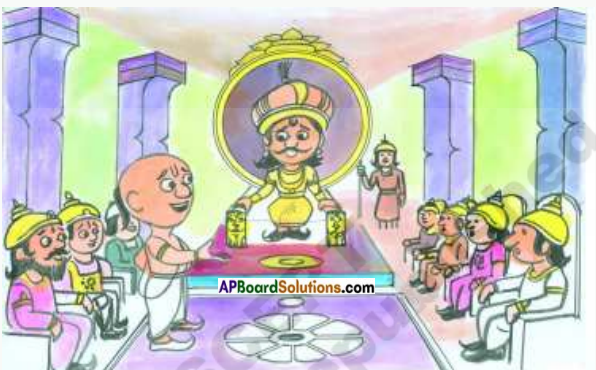
Look at the following picture and answer the questions that follow.

AP Board 7th Class English Solutions Chapter 4A Tenali Paints a Horse 1

Question 1.
Look at the title and guess what you are going to read about?
Answer:
I am going to learn about the painting of a horse, painted by Tenali Raman.

Question 2.
Who do you think is the person with the turban?
Answer:
He is Krishnadevaraya, the King of Vijayanagara.

Question 3.
Can you name the person sitting on the throne?
Answer:
He is King Krishnadevaraya.

AP Board 7th Class English Solutions Chapter 4A Tenali Paints a Horse

Question 4.
What do you think Tenali Raman will do its the story?
Answer:
As per the title, I think Tenali Raman will make painting of a horse, show it to the king and say something about it.

Question 5.
Can you share a story about Tenali Raman?
Answer:
Yes, I can’ tell a story.

I. Answer the following questions.

Question 1.
Why did Tenali Raman look displeased?
Answer:
Tenali Raman looked displeased because there was no completeness in the artist’s painting. The other side of the men in the painting and the face of the cow in the painting were not seen. He thought that it was not a good painting.

Question 2.
How did the king reward the artist? What would you have done if you had been in the king’s place?
Answer:
The king gave a bag of gold for his paintings saying that they were impressive. I would have given money or some valuable things to the artist.

Question 3.
Why did the king call Tenali Raman an ignorant fool?
Answer:
The king called Tenali Raman an ignorant fool because Raman said that only one side of the two men in the painting was seen. He also said that the face of the cow in the painting was not seen.

Question 4.
What do you think is the reason for the courtiers sniggering?
Answer:
The reason was that they strongly believed that Tenali Raman could not present a painting better than that of the artist and that Raman would lose the bet.

Question 5.
What was the bet between the king and Tenali Raman?
Answer:
The bet between the king and Tenali Raman was that if Raman could bring the king a painting that was at least half as good as the paintings of the artist, the king would give Raman a bag of gold and the title, ‘King of Artists’.

AP Board 7th Class English Solutions Chapter 4A Tenali Paints a Horse

Question 6.
If you were Tenali Raman, would you accept the bet?
Answer:
If I were Raman, I would accept the bet because in my view, I would certainly win the bet.

Question 7.
How did Tenali Raman win the bet?
Answer:
Tenali Raman painted only the tail of a horse and showed it to the king. He said he had painted a beautiful horse. When the king said that he couldn’t see a horse in his painting, Raman said that the missing parts were to be imagined as the king had earlier said. Thus he won the bet.

Question 8.
Could you predict that Tenali Raman would win the bag of gold?
Answer:
Yes, I could predict it because Tenali Raman was very clever and witty.

Question 9.
If you were Tenali Raman, what would you do?
Answer:
If I were Tenali Raman, I would also have painted an incomplete picture so as to say that the missing parts were to be imagined.

Question 10.
Can you suggest a different ending to the play? Discuss it in your group.
Answer:
The different ending is bringing the painting that could display completeness in it and showing it to the king to please him and get the reward from him.

Vocabulary

I. Fill in the blanks with suitable words given below.

AP Board 7th Class English Solutions Chapter 4A Tenali Paints a Horse 2

1. Birbal was a ——– in the court of Akbar.
2. The teacher was ——– with the nice work done by his pupils.
3. Sarada paid a ——– for not paying the fees on time.
4. When I visited Kashmir, the mountains were ——– with snow.
5. You should use your ——– when you look at a painting.
Answer:
1. jester
2. pleased
3. penalty
4. covered
5. imagination

AP Board 7th Class English Solutions Chapter 4A Tenali Paints a Horse

II. Phrasal Verbs:

A phrasal verb is a phrase which consists of a verb and a preposition or an adverb or both, the meaning of which is different from the meaning of its separate parts.
You have really caught him out, Sir.
Perhaps his painting is so good that he can’t bear to part with it.
The words in bold are Phrasal verbs. The phrase ‘caught out’ means ‘showed that somebody does not know much. The phrase ‘part with’ means ‘to give something to somebody else, especially something that you would prefer to keep.

1. Consult a dictionary and list other phrasal verbs beginning with ‘catch’ and‘part’ Write some sentences of your own for each phrasal verb.
Answer:
Some phrasal verbs with ‘catch’:
1. catch on: become popular or fashionable.
Example: Guravaiah invented a new game but it never really caught on.
2. catch out: surprise somebody and put them in a difficult position.
Example: Many investors were caught out by the fall in share prices.
3. catch up: reach somebody who is ahead by going faster.
Example: Go on ahead. I will catch up with you.
4. catch upon: spend extra time doing something because you haven’t done it earlier.
Example: I have a lot of work to catch upon.
Phrasal verb with ‘part’: part with: give up, give away
He won’t part with his money, no matter what.

AP Board 7th Class English Solutions Chapter 4A Tenali Paints a Horse

2. Read the following passages, circle the phrasal verbs, and guess their meanings. You may choose the meanings from the list given in the box. Write the phrasal verbs and their meanings in your notebook. Write one sentence of your own for each phrasal verb.
AP Board 7th Class English Solutions Chapter 4A Tenali Paints a Horse 3
1. Ramana Rao’s house was robbed of. Venkateswara Rao, the inspector of police who was looking into the case released the picture of the suspect and asked the people to look out for him. In a press release, he said that he had some clues and that the robber could not get out of the case.
2. Bhanu joined a new company. In the beginning, she had problems with her manager. But now she is getting on with her new boss very well. Initially, she had problems with her paying-guest accommodation too. But the superb food her host served made up for the uncomfortable room. Now the problem is with looking after the host’s children. They are like little devils. God only knows how she would get through this.
Answer:
1. Ramana Rao’s house was robbed of. Venkateswara Rao, the inspector of police who was looking into the case released the picture of the suspect and asked the people to look out for him. In a press release, he said that he had some clues and that the robber could not get out of the case.
2. Bhanu joined a new company. In the beginning, she had problems with her manager. But now she is getting on with her new boss very well. Initially, she had problems with her paying-guest accommodation too. But the superb food her host served made up for the uncomfortable room. Now the problem is with looking after the host’s children. They are like little devils. God only knows how she would get through this.
a) looking into: investigating
b) look out for: notice someone
c) get out of: avoid or escape
d) getting on: managing
f) looking after: take care of
e) made up for: compensated for
g) get through: succeed

Sentences using the above phrasal verbs:
a) The police are looking into Nitya’s murder case.
b) Look out for Pandu while you’re there.
c) I reckon her backache was just a way of getting out of the housework.
d) Of late, Prakash is getting on quite well with his superiors.
e) This year’s good harvest will make up for last year’s bad one.
f) We look after the neighbour’s pigeons while they’re away.
g) We can’t get through to the government just how serious the problem is!

AP Board 7th Class English Solutions Chapter 4A Tenali Paints a Horse

III. Idioms:
Read the following sentence from the play:
It’s only fair that if he doesn’t make good his boast…
The underlined phrase is an idiom. What is an idiom? An idiom is a phrase similar to the phrasal verbs you have just learnt. It is difficult to guess the meaning of an idiom by looking at the individual words. Here ‘make good’ means ‘to carry out a promise’.
Some other idioms that begin with make are: make merry, make do, make it, make the most of something, make something of yourself, and make like.
1) make merry: enjoy oneself by singing etc.
It is free time and all the students are making merry in the playground.
2) make do: manage
It is really my bad luck that I have always to make do.
3) make it: be successful
He has a strategy to make it in any area of activity.
4) make something of yourself: to be successful in life.
He made something of himself very quickly.
5) make like: act or behave in a specified way.
He was forced to make like the officer.

Look up these idioms in a dictionary and find out what they mean.
Here are some more idioms. Guess their meanings and use them in your own sentences:
1. once in a blue moon
2. bury the hatchet
3. to make both ends meet
4. to burn the midnight oil
Answer:
1. Once in a blue moon: Very rarely
Ex: My sister Padmaja lives in Australia, so I only see her once in a blue moon.
2. Bury the hatchet: forget the enmity.
Ex: They decided to bury the hatchet and try to be friends again.
3. To make both ends meet: earn money for one’s living
Ex: Jesse, to make both ends meet, had to run against horses.
4. To burn the midnight oil : work or study until late at night.
Ex: Just before examinations, she burns the midnight fail.

Grammar

I. Short forms

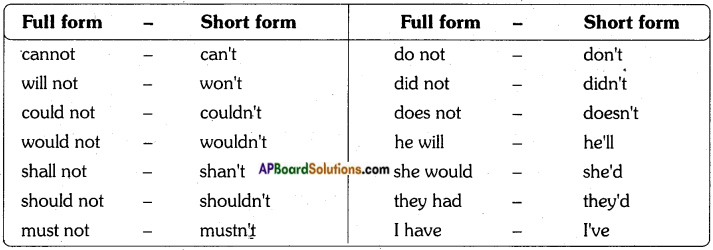
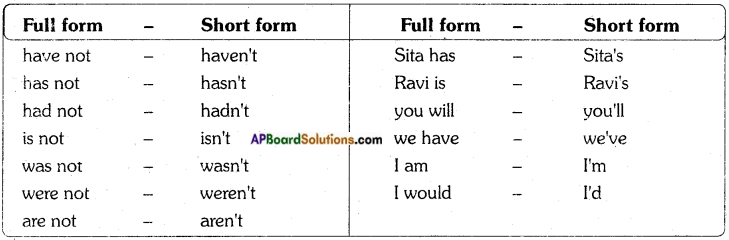
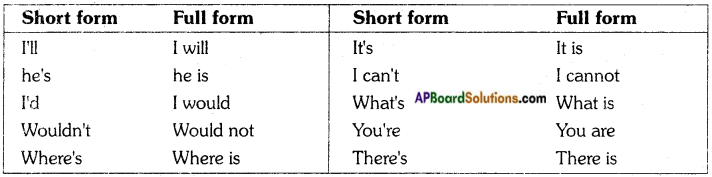
You have already learnt that an apostrophe shows that something belongs to someone or something before it. It has another use. When one or more letters are omitted in a phrase, an apostrophe is put where they have been left out; thus making it a short form of the original word. Short forms are used when we write a conversation, as it was done in the play you read. However, when these elements are used as main verbs, (Kamala is a lawyer) or used for emphasis (I will do it.), they are not contracted.
AP Board 7th Class English Solutions Chapter 4A Tenali Paints a Horse 4
AP Board 7th Class English Solutions Chapter 4A Tenali Paints a Horse 5

AP Board 7th Class English Solutions Chapter 4A Tenali Paints a Horse

1. Pick out some short forms( contracted forms) used in the play and write their full forms in your notebook as shown above.
Answer:
AP Board 7th Class English Solutions Chapter 4A Tenali Paints a Horse 6

2. Read the following conversation between Sarada and Usha and rewrite it in your notebook using the short forms.
Sarada: What are you going to do after school?
Usha: I will go home and take rest for an hour.
Sarada: Then, when will you cook supper for your children?
Usha: I need not cook today. I have made some Pulihora in the morning. We will eat it for supper too.
Sarada: Forgot to tell you this. I planned a quiz for 6th class children. Are you coming tomorrow?
Usha: I will not. I am taking leave for two days.
Sarada: Why? Are you going somewhere?
Usha: I would love to do that. But my mother-in-law is visiting us tomorrow.
Sarada: Then you will have a hard time, I suppose.
Usha: I do not think so.
Answer:
Sarada: What are you going to do after school?
Usha: I’ll go home and take rest for an hour.
Sarada: Then, when’ll you cook supper for your children?
Usha: I needn’t cook today. I’ve made some Pulihora in the morning. We’ll eat it for supper too.
Sarada: Forgot to tell you this. I planned a quiz for 6th class children. Are you coming tomorrow?
Usha: I’ll not. I’m taking leave for two days.
Sarada: Why? Are you going somewhere?
Usha: I’d love to do that. But my mother-in-law is visiting us tomorrow.
Sarada: Then you’ll have a hard time, I suppose.
Usha: I don’t think so.

AP Board 7th Class English Solutions Chapter 4A Tenali Paints a Horse

II. Adverbs of manner
Revision:
AP Board 7th Class English Solutions Chapter 4A Tenali Paints a Horse 7
We can make adverbs from adjectives by adding –ly as shown below:
Adjective + ly = adverb
safe + ly = safely
eager + ly = eagerly
However, you should remember that all adverbs are not formed in the same way.
For example you can’t add –ly to the following adjectives to make adverbs: good, fast.

Adverbs of manner tell us the manner in which something happens. They are usually placed after the main verb or after the object.
Look at the following sentences from the play you have read.
1. The courtiers are waiting eagerly for Tenali to bring in his painting.
2. Tenali looks at the giggling courtiers angrily and walks out.
In the first sentence the adverb ‘eagerly’ comes after the main verb Awaiting’.
In the second sentence the adverb ‘angrily’ comes after the object ‘courtiers’.

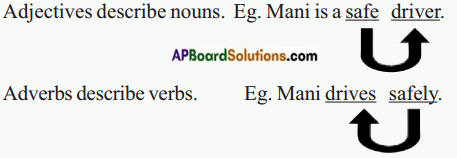
Difference between an adjective and an adverb:
An adjective qualifies or describes a noun or a pronoun.
Ex : She is beautiful. He is sad.
An adverb qualifies or describes a verb or an adjective or an adverb itself.
Ex : 1. He paints beautifully. (adv)
2. He paints very beautifully. (adv)
Generally, by adding ‘ly’ to adjectives, adverbs can be formed.

Adjective + ly = Adverb
Ex : 1. soft + ly = softly
2. safe + ly = safely
3. eager + ly = eagerly
4. sad + ly = sadly
5. slow + ly = slowly
6. slight + ly = slightly
7. sweet + ly = sweetly
8. nice + ly = nicely

AP Board 7th Class English Solutions Chapter 4A Tenali Paints a Horse

However, it is to be noted that all adverbs are not formed merely by adding – ‘ly’.
Example: The adverb of good is well but not goodly.
The adverb of fast is fast but not fastly.
Adverbs come after the main verbs.
Ex: They are waiting eagerly for my brother.
Adverbs can come after the objects.
Ex: She looks at them angrily.
Adverbs of manner indicate the manner or the way some action is done. Ex: He goes silently.
It says how he goes.
Adverbs of manner can be identified by getting the answer for the word ‘how’.

Complete the following sentences with the correct form of the words in brackets.
Tick (✓) the sentences where the adverb of manner is put after the object and put a cross(✕) against the sentences where the adverb of manner is put immediately after the main verb.
Answer:
1. Sriram speaks ______ English. He speaks English ______. (correct)
2. Saleem is a ______ tailor. He makes dresses __________. (careless)
3. You always speak _________ . Please speak _______. (loud, quiet)
4. Be _______ and do your homework __________. (careful, correct)
5. Nandu is a _______ reader. He reads books very _________. (slow)
6. Please be _______ or do your work ________. I want to sleep. (quiet)
7. My mother shouted _________ when I showed my progress card.(loud)
8. Please listen ________ .(careful)
9. P.T.Usha is a ________ runner. She runs very _______. (fast)
10. Raghavathi is a _________ teacher. She teaches very ______. (good, well)
Answer:
1) correct: correctly (✓)
2) careless; carelessly (✓)
3) loudly ; quietly (✕)
4) careful; carefully (✓)
5) slow, slowly (✓)
6) quiet; quietly (✓)
7) loudly (✕)
8) carefully (✕)
9) fast; fast (✕)
10) good; well (✕)

Writing

Imagine that you were the King Krishnadevaraya. Now narrate an account of what had happened in your court. You can start like this:

One day, an artist came to my court and showed me some paintings. They were very beautiful. I liked them very much. Everyone in the court liked them except Tenali Raman ….
Answer:
One day, an artist came to my court and showed me some paintings. They were very beautiful. I liked them very much. Everyone in the court except Tenali Raman liked them. Tenali Raman said that the other side of the two men and the face of the cow were not seen in the picture. So they were not such good paintings. I thought that he was an ignorant fool. I told him everything could not be painted and he should imagine the missing bits of the painting. Then he bet that hb could paint better than that picture. I also bet him if he could paint a picture that was half as good as the picture drawn by the artist. I said I would give him a bag of gold and the title “King of Artists”. All the courtiers thought how scornful he was. They were certain he would lose the bet. But I knew he was clever and somehow he would get out of it. Eventually the day on which Tenali Raman was to show his paintings came. Everyone was eagerly waiting for him. It was lunch time. Raman not yet came. The courtiers took advantage of the situation and made ridiculous remarks against him. I was hungry and impatient. Then there came Raman followed by two men carrying a painting covered with a sheet of cloth. When Tenali gestured, the men lifted the cloth to display the painting. The painting had only a few curved strokes of black on the right hand edge and a few lines of green at the bottom below it. Raman said that he had drawn a black magnificent black stallion with a white star on its forehead. But I did not see anything on it. I was very much angry. I thought he was insulting me. There was nothing on this canvas. When I expressed my wrath he said that we should use our imagination when we looked at the paintings. He said that the horse was just outside the canvas grazing at grass. I thought he paid me in my own coin. The old rascal, he was clever, a hard nut to crack, defeated all the courtiers as usual. I gave him a bag of gold, as I had promised earlier.

AP Board 7th Class English Solutions Chapter 4A Tenali Paints a Horse

Study Skills

Jesters used to entertain people with their wit and humour. Now we have comedians in films doing that job. Here is an interesting passage about one such comedian Mr. Rajababu.

Read on:
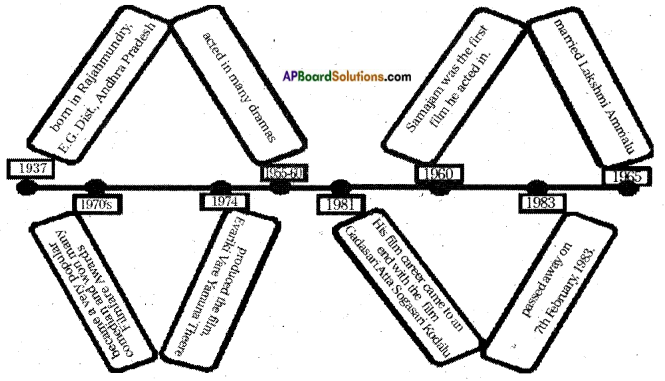
Sri Rajababu was a famous comedian in Tollywood. He was born in Rajahmundry, East Godavari District in Andhra Pradesh on 20 October 1937. He entered Tollywood in 1960 and acted until 1981. In his 21 year film career, he acted in more than 550 movies.
Can you imagine what he was doing before entering the Telugu Film Industry? Believe it or not, he was working as a Telugu teacher! Imagine how much fun his students might have had. Between 1955 and 60 he acted in many dramas. 1960 was a milestone in his life because that was the year in which he had his first chance to act in a film called ‘Samajam’. From that time onwards he never looked back. He married Lakshmi Ammalu in 1965. In 70’s he had become a very popular comedian and won many Filmfare Awards. His combination with Ramaprabha was a super hit and they were considered the best comedy pair.
In 1972 he acted as a hero for the first time in the movie Tata Manavadu.’ He acted as a hero in four more films. He produced films too. In 1974 he produced the film ‘Evariki Vare Yamuna Theere’. His film career came to an end in 1981 with the film ‘Gadasari Atta Sogasari Kodalu’. He could not act because of his ill health. This wonderful comedian, who was fondly called ‘Haasya Nata Chakravarthi’ passed away on 7 February, 1983.
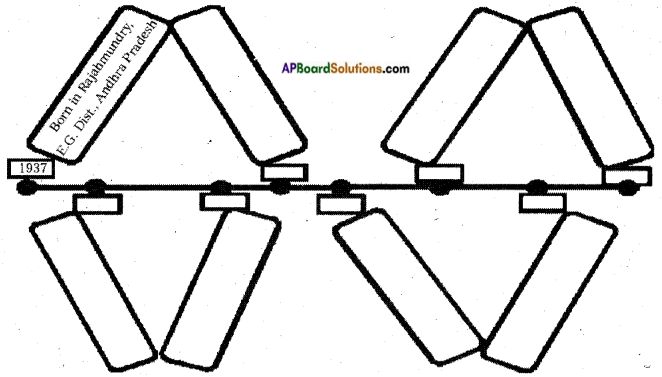
Now, write the important events in the life of Mr. Rajababu on the timeline given below:
AP Board 7th Class English Solutions Chapter 4A Tenali Paints a Horse 8
Answer:
AP Board 7th Class English Solutions Chapter 4A Tenali Paints a Horse 9

AP Board 7th Class English Solutions Chapter 4A Tenali Paints a Horse

Listening and Speaking

Your teacher will read the story ‘The Miser’ Listen carefully and answer the following questions :

The Miser
Once there was a very rich man. He was a miser. He ate cheap food and spent very little money. He lent money to small shopkeepers at a high rate of interest. In this way, he earned a lot of money.

Every morning he went out to see the shopkeepers and came home at midday. The miser had a watchman to look after his house. The watchman lived in a hut near the gate. He liked fish, and his wife cooked it for him every day. The watchman told his wife, “Cook the fish before midday. Our master will be out then. He doesn’t eat meat or fish, and he will not like the smell of fish.”

One day the master came home early. He walked past the watchman’s hut and caught the smell of fish. It was a nice smell and he liked it very much.

That afternoon, he called the watchman and asked him, “What were you cooking today?”
The watchman said quickly, “I won’t do it again, sir. Please forgive me.”
The miser said, “Don’t be afraid. I am not angry. What was your wife cooking? Please tell me.”
The watchman said, “We were cooking fish.”
The miser said, “Please cook it every day. I like the smell very much.”
The watchman and his wife thought, “Our master is mad.” But they cooked fish everyday.
After a month, one evening, the watchman and his wife came to see their master.

“Sir, you like the smell of fish,” the watchman said to his master, “so we cook it everyday. But fish is not cheap. It is very expensive. It costs us a lot of money. I earn only thirty rupees a month. You ordered us to cook fish even though we cannot afford it. So please give us money for the fish.”

The miser thought for a while. Then he said, “Oh, all right. Wait here.” He went into his room and shut the door behind him. He took out some silver coins from a bag. He dropped them one by one on the floor. The watchman and his wife heard the tinkle of the coins and were very happy. They said, “He is going to give us all that money!”
After sometime their master came out and sat down on a chair. He then asked the watchman and his wife, “Did you hear the tinkle of the coins?”

“Yes, sir, we did,” said the watchman.
“Did you enjoy it?” asked the miser.
“Yes, sir,” said’the watchman and his wife. –

The miser then said, “All right. I enjoyed the smell of your fish and you enjoyed the sound of my coins. I didn’t ask for your fish, so don’t ask me for my money. Now go away.”

AP Board 7th Class English Solutions Chapter 4A Tenali Paints a Horse

1. Why did the rich man eat cheap food ?
2. Did the rich man like the smell of fish? Do you think he likes eating fish too?
3. If you had a lot of money, would you be a miser? Give reasons.
4. “please cook it everyday. I like the smell very much.” Who said this?
5. Do you think the watchman is honest? Support your answer.
Answer:
1. The rich man ate cheap food because he was a miser and so did not want to spend more money.
2. Yes, the rich man liked the smell of fish very much. Yes, he liked eating fish too.
3. If I had a lot of money, I would not be a miser. I would spend money on having a comfortable living and eating rich and healthy food.
4. The rich man (miser) said those words.
5. Yes, he was. Because he cooked fish for his master with his money instead of demanding for money.

I. Work in groups. Some groups can work on scene 1 and the others on scene 2.Rehearse and then present it before the class.
Answer:
Practise reading and enacting the ‘Tenali Raman Paints a Horse’.

II. Put yourself in the shoes of Tenali Raman and narrate what had happened in the court.
Answer:
One day when I was in the court of King Krishnadevaraya along with the other courtiers, an artist came to the king.

He showed his beautiful paintings to the king. We all looked at his paintings. The king was very much impressed with his paintings. He praised the artist saying that his painting was so beautiful and natural that he could almost feel the peace of the village scene. The king said that he was a very talented artist: The king gave him a bag of gold and asked the artist to stay in his court for some days for presenting him some more beautiful paintings. The artist was well-pleased and accepted his proposal. All the other courtiers also praised the artist for his beautiful paintings. But I was not happy as I did not like them. I told the king that the paintings were not very good as they had no completeness. Some parts of the painting were not seen. They were missing. The king, then, said that everything could not be painted. He also said that the missing parts must be imagined. Then I told the king: I could paint a better painting. Then the king bet that if I could bring him a better painting in a month’s time, he would give me a bag of gold and the title ‘King of Artists’. I accepted his bet. He gave me the paints and the paper.

After a month, I showed the king my, painting. I said that I had drawn the beautiful picture of a horse. The king got angry, saying that he could not see any horse in my painting. Then I said the tail of that the horse was seen and the rest of the horse was outside the canvas. It was to be imagined as everything could not be painted, as had earlier been stated by the king. Then the king understood my words and said that I had got the better, of him. He gave me a bag of gold praising that I was the cleverest man in his kingdom.

AP Board 7th Class English Solutions Chapter 4A Tenali Paints a Horse

Tenali Paints a Horse Summary in English

Krishnadevaraya was the king of Vijayanagara. Tenali Raman was a poet and jester at his court: Tenali Raman was famous for his wit and intelligence. On many occasions, he made the king laugh at his jokes and witty answers.
The present drama ‘Tenali Paints a Horse’ is a proof of his wit.

One day, a great artist from another kingdom came to the court of the King. Krishnadevaraya. He showed the king his paintings. The king and all the courtiers except one were impressed with his paintings. It was only Tenali Raman who was not pleased with his paintings. The king said that the painting showed by the artist was indeed very beautiful and he could almost feel the peace of the village scene. He praised the artist and gave him a bag of gold. He asked the artist to stay in his court and paint some more beautiful paintings. Then Tenali Raman said that the paintings were not good. He said that the other side of the ‘ two men in the painting was not seen. Besides, the face of the cow, in the painting was missing. Then King Krishnadevaraya said that it was not possible for any painter to paint everything and that the missing bits in the paintings had to be imagined.

Then Tenali Raman told the king that he could paint better than the artist’s painting. King Krishnadevaraya told Tenali Raman that if he could paint a better painting, he would give him a bag of gold and the title ‘King of Artists’. He also told Raman to bring his painting in a month’s time. He said he would give Raman the paints and the paper. Tenali Raman replied he would return there after a month with his painting and show it to the king. Saying that, Raman left the court. All the other courtiers said that Raman could not paint a better painting nor would he complete and bring into the court in a month’s time.

A month’s time passed. The king was eagerly waiting with his courtiers for Tenali Raman’s return with his painting. As promised, Raman came into the court and showed the king his painting. Raman said that he had drawn the picture of a beautiful horse. Looking at the painting, the king got astonished and angrily said that he could see nothing on the canvas. Raman replied humbly that the edge of-the horse’s tail in the corner was clearly seen and that the rest of the horse was just outside the canvas grazing at some lush green grass. The rest of the horse was to be imagined because according to the king, the missing bits were to be imagined. The king understood his wit, felt happy and kept his promise to Raman.

Tenali Paints a Horse Glossary

1. wit (n): the ability to say clever and amusing things

2. jester (n): a man who tells jokes and funny stories

3. gestures (n): signals with hand

4. stallion (n): an adult male horse

5. imagination (n): guessing or expectation

6. paintings (n): pictures that have been painted

7. magnificent (adj): extremely attractive and impressive

AP Board 7th Class English Solutions Chapter 4A Tenali Paints a Horse

8. whisper (v): speak very quietly to somebody so that other people cannot hear

9. display (v): show something to people

10. graze (v): eat grass that is growing in a field

11. canvas (n): a strong heavy rough material used by artist for painting

12. bet (v): risk money on race/event by trying to predict the result

AP 10th Class Biology Important Questions 10th lesson సహజ వనరులు

These AP 10th Class Biology Important Questions 10th lesson సహజ వనరులు will help students prepare well for the exams.

AP Board 10th Class Biology 10th lesson Important Questions and Answers సహజ వనరులు

10th Class Biology 10th lesson సహజ వనరులు 1 Mark Important Questions and Answers

ప్రశ్న 1.
మృత్తికక్షయాన్ని అరికట్టుటకు మీరు ఇచ్చే ఏవైనా రెండు సలహాలను రాయండి.
జవాబు:

  1. అడవులను పెంచటం
  2. చెక్ డ్యామ్ లు నిర్మించటం
  3. ఖాళీ నేలలో గడ్డి పెంచటం మొదలైన వాటి వలన క్రమక్షయం నివారించవచ్చు.

ప్రశ్న 2.
మీ ప్రాంతములో “నీటి సంరక్షణ” పై చైతన్యము కల్గించడానికి ఏ నినాదమును సూచిస్తావు?
జవాబు:

  1. నీటిని పొదుపుగా వాడాలి
  2. నీటిని వృథా చేయవద్దు
  3. జలమే జీవం

ప్రశ్న 3.
AP 10th Class Biology Important Questions 10th lesson సహజ వనరులు 1గుర్తు దేనిని సూచిస్తుంది? దాని అర్థం ఏమిటి?
జవాబు:
పటంలోని గుర్తు పునఃవినియోగాన్ని సూచిస్తుంది. ఇది వాడిన వస్తువులను తిరిగి వాడటం గురించి తెలుపుతుంది.

ప్రశ్న 4.
అడవుల విస్తీర్ణం బాగా తగ్గితే ఏం జరుగుతుంది?
జవాబు:

  1. వన్యజీవుల ఆవాసాల విధ్వంసం జరుగును.
  2. నేల క్రమక్షయం జరుగును.
  3. గ్రీన్‌హౌస్ వాయువుల పెరుగుదల చేత భూతాపము పెరుగుతుంది.
  4. అడవులపై ఆధారపడి నివసించేవారు జీవనోపాధి కోల్పోతారు.
  5. అడవుల విస్తీర్ణం బాగా తగ్గితే వర్షపాతం తగ్గుతుంది.

ప్రశ్న 5.
విద్యుత్ పొదుపుకు మీరు చేస్తున్న రెండు పనులను రాయండి.
జవాబు:

  1. విద్యుత్ దీపాలు, పరికరాలు, ఫ్యాన్స్ వాడనప్పుడు స్వి ను ఆపివేయవలెను.
  2. విద్యుత్ను ఆదా చేసే పరికరాలైన LEDS మరియు CFL బలను ఉపయోగించవలెను.
  3. సాంప్రదాయేతర ఇంధన వనరులైన సౌరశక్తి మరియు పవనశక్తిని ఉపయోగించాలి.

AP 10th Class Biology Important Questions 10th lesson సహజ వనరులు

ప్రశ్న 6.
సహజవనరులను పునరుద్ధరించడానికి మీరు ఏఏ చర్యలు తీసుకొంటారు?
జవాబు:

  1. ప్రజలు నీటిని సంరక్షించుకునే విధంగా ప్రేరేపించాలి.
  2. నీటిని వీలైనంత వరకు సృధా చేయకూడదు.
  3. ఖాళీ ప్రదేశాలలో మొక్కలు నాటాలి
  4. నీటి వినియోగంపై రైతులకు అవగాహన కల్పించాలి.
  5. వీలైనంత వరకు నీటిని పునర్వినియోగించుకునేటట్లు చేయూలి.

ప్రశ్న 7.
తక్కువ నీటి సౌకర్యాలు ఉన్న ప్రాంతాలలో రైతులు అనుసరించదగిన ఏవైనా రెండు విధానాలు రాయుము.
జవాబు:

  1. ఇంకుడు గుంతలు త్రవ్వుట,
  2. బిందు సేద్యం మరియు స్ప్రింక్లర్స్ తో సూక్ష్మ నీటిపారుదల పద్ధతి.

ప్రశ్న 8.
మన రాష్ట్రంలో ఇటీవల ప్రకటించిన “వనం-మనం” అను కార్యక్రమమును ప్రజల్లోకి తీసుకెళ్ళడానికి మీరు ఏవైనా రెండు నినాదాలు తయారుచేయండి.
(లేదా)
మీ పాఠశాల ర్యాలిలో ప్రదర్శించడానికి “వనం-మనం” కార్యక్రమం గురించి కొన్ని నినాదాలు రాయండి.
జవాబు:

  1. మొక్కలు నాటుదాము – స్వచ్ఛమైన గాలిని పొందుదాము.
  2. మొక్కలు పెంచు – కాలుష్యం తగ్గించు.
  3. మొక్కలు పెంచుదాము – భౌగోళిక వెచ్చదనాన్ని తగ్గిద్దాము.
  4. చెట్లను నరికితే – జీవుల ప్రాణం తీసినట్లే.
  5. వృక్షోరక్షతి రక్షితః
  6. చెట్లను పెంచుదాం దండిగా – పరిసరాలను ఉంచుదాం పచ్చగా.

ప్రశ్న 9.
“పునరుద్దరింపబడని వనరుల సంరక్షణ” పై రెండు నినాదాలు తయారుచేయండి.
జవాబు:

  1. జీవ ఇంధనాలను వాడదాం – శిలాజ ఇంధనాలను తగ్గిదాం.
  2. ప్రత్యామ్నాయ ఇంధనాలను వాడదాం – పర్యావరణాన్ని కాపాడదాం.

ప్రశ్న 10.
అడవులను ఎందుకు సంరక్షించుకోవాలో రెండు కారణాలు తెల్పండి.
జవాబు:
అడవులను సంరక్షించుకోవటానికి గల కారణాలు :

  1. అడవులు వాతావరణంలో పెరుగుతున్న కార్బన్ డయాక్సెడ్ ను గ్రహించి భౌగోళిక వెచ్చదనాన్ని తగ్గిస్తాయి.
  2. అడవుల నుండి విలువైన వనరులు అనగా ఔషధాలు, కలప, లక్క తేనె మొదలైన వాటిని పొందుతున్నాము.
  3. అడవులు వర్షాలుపడటంలో ప్రముఖ పాత్ర వహిస్తాయి.

ప్రశ్న 11.
పునరుద్దరింపలేని వనరులకు రెండు ఉదాహరణలు రాయండి.
జవాబు:
1. బొగ్గు 2. పెట్రోల్ 3. సహజ వాయువు 4. ఆయిల్ (నూనె)

ప్రశ్న 12.
శిలాజ ఇంధనాలు ఎలా ఉత్పత్తి అవుతాయి?
జవాబు:
బొగ్గు, పెట్రోలియం, సహజవాయువు వంటి శిలాజ ఇంధనాలు వేల సంవత్సరాల క్రిందట భూగర్భంలో పాతుకుపోయిన వృక్ష, జంతు కళేబరాల నుండి ఉత్పత్తి అవుతాయి.

ప్రశ్న 13.
వనరులు అనగానేమి?
జవాబు:
అధిక మోతాదులో లభిస్తూ, భవిష్యత్ లో వాడకానికి వీలుగా ఉన్న పదార్థాలను “వనరులు” అంటారు.

ప్రశ్న 14.
సహజ వనరులు అనగానేమి?
జవాబు:
సహజ వనరులు :
పకృతిలో సహజంగా లభించే వనరులను సహజ వనరులు అంటారు.
ఉదా : గాలి, నీరు.

AP 10th Class Biology Important Questions 10th lesson సహజ వనరులు

ప్రశ్న 15.
సహజ వనరులు ఎన్ని రకాలు? అవి ఏవి?
జవాబు:
సహజ వనరులు రెండు రకాలు

  1. పునరుద్ధరింపబడేవి
  2. పునరుద్ధరింపబడనివి.

ప్రశ్న 16.
శ్రీరాం సాగర్ ప్రాజెక్టు ఏ జిల్లాల అవసరాలు తీర్చుతుంది?
జవాబు:
కరీంనగర్, వరంగల్, ఆదిలాబాద్, నల్గొండ, ఖమ్మం జిల్లావాసుల అవసరాలను శ్రీరాం సాగర్ ప్రాజెక్టు తీర్చుతుంది.

ప్రశ్న 17.
శ్రీరాం సాగర్ ప్రాజెక్టు నీటి నిల్వ సామర్థ్యం ఎంత?
జవాబు:
శ్రీరాం సాగర్ ప్రాజెక్టు నీటి నిల్వ సామర్థ్యం 80.66. టి.ఎమ్.సి.లు.

ప్రశ్న 18.
ఇంకుడు చెరువు అనగానేమి?
జవాబు:
ఇంకుడు చెరువు :
నీటి ప్రవాహాలకు అడ్డంగా రాళ్లు, మట్టితో అడ్డుకట్టలు కట్టి ఏర్పాటు చేసే నీటి నిల్వలను “ఇంకుడు చెరువులు” (Percolation tanks) అంటారు.

ప్రశ్న 19.
సెంటర్ ఫర్ వరల్డ్ సాలిడారిటీ సంస్థ ఎక్కడ ఉంది?
జవాబు:
సెంటర్ ఫర్ వరల్డ్ సాలిడారిటీ సంస్థ ఆంధ్రప్రదేశ్ లోని సికింద్రాబాద్ లో ఉంది.

ప్రశ్న 20.
మైక్రో ఇరిగేషన్ అనగానేమి?
జవాబు:
మైక్రో ఇరిగేషన్ :
డ్రిప్ మరియు స్ప్రింక్లర్లతో, తక్కువ నీటితో వ్యవసాయం చేసే పద్ధతిని “మైక్రో ఇరిగేషన్” అంటారు.

ప్రశ్న 21.
నేల వనరు సద్వినియోగానికి ఉపయోగపడే రైతు ఆధారిత విధానాలు ఏమిటి?
జవాబు:
వెడల్పు చాళ్లు తియ్యడం, తక్కువ ఎత్తు పెరిగే పంటలు పెంచడం, కాంటూర్ సేద్యం చేయటం వంటి పద్ధతుల ద్వారా నేలను సద్వినియోగం చేయవచ్చు.

ప్రశ్న 22.
నేలలో నైట్రోజన్ నిల్వలు ఎలా పెంచవచ్చు?
జవాబు:
గట్ల మీద గెరిసీడియా మొక్కలను, లెగ్యుమినేసి పంటలను పండించటం వలన నేలలో నైట్రోజన్ నిల్వలు పెంచవచ్చు.

ప్రశ్న 23.
‘సుస్థిరాభివృద్ధి’ అనగానేమి?
జవాబు:
సుస్థిరాభివృద్ధి :
అభివృద్ధికి, సంరక్షణకు రెండింటికి ప్రాధాన్యమిస్తూ భావితరాలకు అవసరమయ్యే సహజ వనరులను అందుబాటులో ఉండే విధంగా పర్యావరణాన్ని ఉపయోగించుకోవడాన్ని “సుస్థిరాభివృద్ధి” అంటారు.

ప్రశ్న 24.
సుస్థిర అటవీ పద్ధతులు కొన్ని తెలపండి.
జవాబు:
చెట్లు తక్కువగా నరకటం, చెట్లు తిరిగి ఎదగడానికి అవకాశం ఇవ్వటం, ఎత్తైన చెట్లను, పెద్దచెట్లను నరకకుండా చూడటం వలన అటవీ వనరులను కాపాడుకోవచ్చు. వీటినే “సుస్థిర అటవీ పద్దతులు” అంటారు.

ప్రశ్న 25.
కాంటూర్ పట్టీ పంటలు అనగానేమి?
జవాబు:
కాంటూర్ పట్టీ పంటలు: ఏటవాలు ప్రాంతాలలో నేల వాలుకు అడ్డంగా గాలి వీచే దిశకు అడ్డంగా నేలను దున్ని ఒక్కొక్క వరుసలో ఒక్కొక్క పంటను పండించే పద్ధతిని “కాంటూర్ పట్టి పంటలు” అంటారు.

ప్రశ్న 26.
జీవవైవిధ్య వినాశనానికి దారితీసే ప్రక్రియలు ఏమిటి?
జవాబు:
వేటాడడం, కాలుష్యం, ఆవాసాలు విధ్వంసం వంటి కార్యకలాపాలు జీవవైవిధ్య వినాశనానికి దారితీస్తున్నాయి.

ప్రశ్న 27.
శిలాజ ఇంధనాలు అనగానేమి?
జవాబు:
శిలాజ ఇంధనాలు :
బొగ్గు, పెట్రోలియం, సహజవాయువు వంటి శిలాజ ఇంధనాలు వేల సంవత్సరాల క్రిందట భూగర్భంలో పాతుకు పోయిన వృక్ష జంతు కళేబరాల నుండి ఉత్పత్తి అవుతాయి. వీటిని “శిలాజ ఇంధనాలు” అంటారు.

ప్రశ్న 28.
జీవ ఇంధనాలు అనగానేమి?
జవాబు:
జీవ ఇంధనాలు :
శక్తిని ఇచ్చే జీవ ద్రవ్యరాశిని “జీవ ఇంధనాలు” అంటారు.
ఉదా : బయోడీజిల్.

AP 10th Class Biology Important Questions 10th lesson సహజ వనరులు

ప్రశ్న 29.
బయోడీజిల్ ఉత్పత్తికి అనువైన మొక్కలు ఏమిటి?
జవాబు:
జట్రోపా (అడవి ఆముదం) కర్కాస్ మొక్కలు విత్తనాల నుండి బయోడీజిల్ తయారుచేస్తారు.

ప్రశ్న 30.
4R సూత్రం అనగానేమి?
జవాబు:
పర్యావరణ పరిరక్షణకు, వనరుల సద్వినియోగానికి 4R సూత్రం పాటించాలి. అవి:

  1. Reduce:తగ్గించటం
  2. Reuse :తిరిగివాడటం
  3. Recycle: పునఃచక్రీయం
  4. Recover : తిరిగి ఏర్పరచడం

ప్రశ్న 31.
ఈ క్రింది పటం దేనిని సూచిస్తుంది?
AP 10th Class Biology Important Questions 10th lesson సహజ వనరులు 1
జవాబు:
ఇది పునఃచక్రీయానికి గుర్తు.

ప్రశ్న 32.
IUCN అనగా నేమి?
జవాబు:
‘ఇంటర్నేషనల్ యూనియన్ ఫర్ ద కన్సర్వేషన్ ఆఫ్ నేచర్’ ను సంక్షిప్తంగా IUCN అంటారు. 1980లో ఇది ప్రపంచ సంరక్షణ విధానాన్ని ప్రతిపాదించింది.

ప్రశ్న 33.
తరగని వనరులు తరిగిపోయే వనరులుగా మారే అవకాశం ఉందా?
జవాబు:
విచక్షణారహిత వినియోగం వలన తరగని వనరులు తరిగిపోయే వనరులుగా మారే ప్రమాదం ఉంది.

ప్రశ్న 34.
భూగర్భజలాలు తగ్గటానికి కారణాలు ఏమిటి?
జవాబు:
ఋతుపవనాల రాకడలో మార్పులు, లోతైన గొట్టపు బావులు, భూగర్భ జల వినియోగంలో విచక్షణా రాహిత్యం మొదలయిన వాటి వలన భూగర్భజలాలు తగ్గుతున్నాయి.

ప్రశ్న 35.
ICRISAT పూర్తి పేరు ఏమిటి?
జవాబు:
“ఇంటర్ నేషనల్ క్రాప్ రీసెర్చి ఇన్స్టిట్యూట్ ఫర్ సెమి-ఎండ్ ట్రాపిక్స్” ను ఇక్రిసాట్ అంటారు. ఇది సికింద్రాబాదులో ఉంది.

10th Class Biology 10th lesson సహజ వనరులు 2 Marks Important Questions and Answers

ప్రశ్న 1.
“అడవి ఒక ప్రధాన పునరుద్ధరింపదగిన వనరు” – దీనిని నీవు ఎలా సమర్థిస్తావు?
జవాబు:
“అడవి ఒక ప్రధాన పునరుద్దరింపదగిన ప్రధాన వనరు.” దీనిని నేను సమర్థిస్తాను.
ఉదాహరణలు:

  1. చెట్లను నరికివేస్తే తిరిగి పెరుగుతాయి. వాటంతట అవే పెరుగుతాయి.
  2. అటవీ పదార్థాలు వాడిన కొద్ది తిరిగి ఏర్పడుతాయి.
  3. మొక్కలు పెంచటం, సామాజిక అడవుల అభివృద్ధి వంటి కార్యక్రమాల ద్వారా అడవులు పునరుద్ధరించబడతాయి.

ప్రశ్న 2.
శిలాజ ఇంధనాలు పొదుపుగా ఎందుకు వాడాలి?
జవాబు:

  1. శిలాజ ఇంధనాలు తరిగిపోయే ఇంధనాలు.
  2. ఇవి తిరిగి ఏర్పడటానికి లక్షల సంవత్సరాలు పడుతుంది.
  3. విచక్షణా రహితంగా వీటిని వాడినట్లయితే మనకు ఇంధన కొరత వస్తుంది.
  4. భవిష్యత్ అవసరాలకు ఇంధన పరిరక్షణ కొరకు వీటిని పొదుపుగా వాడాలి.

ప్రశ్న 3.
భూగర్భ జలాల సంరక్షణ గురించి అవగాహన కలిగించుటకు మీరిచ్చే రెండు సలహాలను రాయండి.
జవాబు:
భూగర్భ జలాల సంరక్షణ :

  1. ఇంకుడు గుంతలు త్రవ్వడం, చెక్ డ్యాం నిర్మించడం ద్వారా వర్షపు నీటిని నిల్వ చేయడం.
  2. ర్యాలీలు నిర్వహించడం, కరపత్రాలు, గోడ పత్రికల ద్వారా ప్రచారం చేయడం ద్వారా భూగర్భ జల సంరక్షణపై అవగాహన కల్పించడం.
  3. తక్కువ నీటితో వ్యవసాయ పద్ధతులను ప్రోత్సహించడం మొదలగునవి.

ప్రశ్న 4.
భూమి వేడెక్కుటలో గ్రీన్‌హౌస్ వాయువుల పాత్రను వివరించుము.
జవాబు:

  1. CO2, CFC’s, NO2, హైడ్రోకార్బన్లు మరియు మిథేన్ వంటి వాయువులను గ్రీన్‌హౌస్ వాయువులంటారు. ఇవి భూమిని వెచ్చగా ఉంచుతాయి.
  2. గ్రీన్‌హౌస్ వాయువుల గాఢత పెరుగుట వలన భూమి యొక్క ఉష్ణోగ్రత కూడా పెరుగుతుంది.
  3. గ్రీన్‌హౌస్ వాయువులు భూమి నుండి ఉద్గారమయ్యే వేడిమిని గ్రహించి భౌగోళిక వెచ్చదనానికి కారణమవుతున్నాయి.

ప్రశ్న 5.
సహజ వనరులను సద్వినియోగం చేసుకోవడమే దేశానికి మనం చేసే సేవ అని చెప్పవచ్చు. దీనిని నీవు సమర్థిస్తావా? ఎందుకు?
జవాబు:

  1. ఒక దేశపు సహజ వనరులు ఆ దేశం యొక్క ఆర్థిక, సామాజిక పురోభివృద్ధిని నిర్ణయిస్తాయి.
  2. సహజ వనరులు ప్రకృతిలో సహజంగా లభిస్తూ మానవ కార్యకలాపాలకు, మనుగడకు ఉపయోగపడతాయి.
  3. సహజ వనరులు తయారుకావడానికి చాలాకాలం పడుతుంది.
  4. వీటిని విచక్షణారహితంగా వాడినపుడు పూర్తిగా అంతరించిపోతాయి.
  5. కావున సహజ వనరులను భవిష్యత్ తరాలకు అందుబాటులో ఉండే విధంగా సద్వినియోగం చేసుకోవడమే దేశానికి మనం చేసే సేవ.

AP 10th Class Biology Important Questions 10th lesson సహజ వనరులు

ప్రశ్న 6.
శిలాజ ఇంధనాలను సంరక్షించుటకు మీరు పాటించే నాలుగు పద్ధతులు రాయండి.
జవాబు:

  1. ప్రత్యామ్నాయ ఇంధనాలను ఉపయోగించాలి.
  2. శిలాజ ఇంధనాల వాడకాన్ని తగ్గించాలి.
  3. కార్లవంటి సొంత వాహనాలలో కాకుండా బస్సులు, రైళ్ళ వంటి ప్రజారవాణా వ్యవస్థలను ఉపయోగించాలి.
  4. వీలైనప్పుడు నడవడం, సైకిలను ఉపయోగించాలి.
  5. విద్యుత్ ఆదా చేసే పరికరాలను ఉపయోగించాలి.

ప్రశ్న 7.
మానవులమైన మనము ప్రకృతి ప్రసాదించిన వనరులను విచక్షణా రహితంగా వినియోగిస్తున్నాము. ఫలితంగా ప్రకృతి వనరులు చాలా వేగంగా తరిగిపోతున్నాయి. దీనివల్ల భవిష్యత్ లో జరుగబోవు పరిణామాలను ఊహించి వ్రాయుము. జ. సహజ వనరులను విచక్షణారహితంగా వాడటం వలన ఈ క్రింది దుష్పరిణామాలు సంభవిస్తాయి.
జవాబు:

  1. వర్షపాతంలో తగ్గుదల.
  2. కరువు సంభవించుట.
  3. వాతావరణ ఉష్ణోగ్రతలలో పెరుగుదల.
  4. అరుదైన జాతులు అంతరించిపోయే ప్రమాదం గలదు.

ప్రశ్న 8.
సంవత్సరం నుండి మరో సంవత్సరానికి వాతావరణ ఉష్ణోగ్రతలు పెరుగుతున్నాయి కదా ! ఇలానే ఉష్ణోగ్రతలు పెరుగుతూ పోతే జరిగే పరిణామాలను ఊహించి వ్రాయండి.
జవాబు:

  1. ఉష్ణోగ్రతలు పెరిగే కొలది ధృవప్రాంతాలలో మంచు కరిగి, సముద్రాలలో నీటిమట్టం పెరుగుతుంది.
  2. సముద్రాలలో నీటిమట్టం పెరుగుట వల్ల చిన్న చిన్న దీవులు మునిగిపోతాయి.
  3. ఉష్ణోగ్రతలు పెరుగుట వల్ల వర్షాలు తగ్గి కరువులు ఏర్పడతాయి.
  4. ఉష్ణోగ్రతలు ఎక్కువ పెరిగినప్పుడు కొన్ని జీవజాతులు అంతరించవచ్చు.

ప్రశ్న 9.
స్వచ్ఛ భారత్ సాధనలో 4R’s ప్రాముఖ్యతను తెలియచేయండి.
జవాబు:

  1. చెత్తను ఉత్పత్తి చేయటాన్ని తగ్గించటము. .
  2. చెత్తను తిరిగి వాడుటము ద్వారా ఎరువులను, కరెంట్ ను ఉత్పత్తి చేయవచ్చును.
  3. చెత్తను పారవేసేముందు తడిచెత్త, పొడి చెత్తలను వేరు చేయటము ద్వారా పునఃచక్రీయం చేయవచ్చు.
  4. చెట్లను నరికివేసినప్పుడు ప్రత్యామ్నాయంగా మరో చోట చెట్లను పెంచడం.

ప్రశ్న 10.
ఇంకుడు చెరువులు అనగానేమి? వీటిని ఎలా నిర్మిస్తావు?
జవాబు:
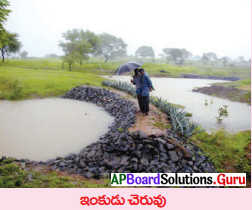
AP 10th Class Biology Important Questions 10th lesson సహజ వనరులు 2
నీటి ప్రవాహాలకు అడ్డంగా ‘ రాళ్లు, మట్టితో అడ్డుకట్టలు కట్టి ఏర్పాటు చేసే నీటి నిల్వలను ఇంకుడు చెరువులు (Percolation tanks) అంటారు. బంకమట్టి, ఇసుక, కంకర, గులకరాళ్లు మొదలైన వాటిని బాగా కలిపి ఒకదానిపైన ఒకటి వచ్చేటట్లుగా పొరలపొరలుగా చెరువు నేలను, అంచుల వెంబడి కప్పుతారు. తరువాత దీనిని గట్టిగా కుదురుకునేలా చేస్తారు. వ్యవసాయం కోసం నీటిని సరఫరా చేయడానికి మట్టికట్టకు తూము ఏర్పాటు చేస్తారు. పూర్తి నీటి నిల్వ మట్టానికి, అడుగు మట్టానికి మధ్య నాలుగోవంతు ఎత్తులో తూమును ఏర్పాటు చేస్తారు. అందువల్ల తగినంత నీటిని విడుదల చేసుకోవడానికి వీలుకలుగుతుంది.

ప్రశ్న 11.
కేడీ నిర్వహించిన వనపర్తి, వట్టిచెర్ల గ్రామాల మధ్యగల పోలికలు ఏమిటి?
జవాబు:
వృత్తులు, పంట విధానాలు, భౌగోళిక స్థితిగతులు, మౌలిక సదుపాయాలు, సామాజిక సేవలు వంటి అంశాల దృష్ట్యా వనపర్తి, వడ్డిచెర్ల గ్రామాలు ఒకే విధంగా ఉన్నాయి. రెండు గ్రామాలలో చిన్న రైతులు చాలా ఎక్కువ సంఖ్యలో ఉన్నారు. సరాసరి కుటుంబ ఆదాయం వనపర్తిలో ఎక్కువ. ఈ రెండు గ్రామాల్లో వ్యవసాయమే జీవనాధారం. బావులే నీటిపారుదలకు మూలం. కుటుంబ ఆదాయం, భూగర్భజలం యొక్క స్థాయిపైనే ఆధారపడి ఉంటుంది. కుటుంబ ఆదాయాన్ని ప్రభావితం చేసే పంటల క్రమం ఈ గ్రామాల్లో వేరు వేరుగా ఉంది.

ప్రశ్న 12.
భూగర్భజలం ఇటీవలి కాలంలో తగ్గటానికి గల కారణాలు ఏమిటి?
జవాబు:
గత కొన్ని సంవత్సరాల నుండి ఋతుపవనాల రాకడలో మార్పులు సంభవించడం వలన, భూగర్భజలాల వినియోగంపై ఒత్తిడి పెరిగింది. డ్రిల్లింగ్, లోతైన గొట్టపుబావులు, బోరుబావులను తవ్వడం వంటి చర్యల వలన, విచక్షణారహితంగా రాష్ట్రంలోని భూగర్భజలాన్ని వాడడం వలన ఈ వనరు బాగా తరిగిపోతున్నది. మన రాష్ట్రంలో 1998-2002 మధ్యకాలంలో సరాసరిగా నీటి స్థాయి 3 మీటర్ల దాక తగ్గింది.

ప్రశ్న 13.
భూగర్భ జల సంరక్షణకు సెంటర్ ఫర్ వరల్డ్ సాలిడారిటీ సంస్థ చేపట్టిన చర్యలు ఏమిటి?
జవాబు:
సెంటర్ ఫర్ వరల్డ్ సాలిడారిటీ (సికింద్రాబాదు, ఆంధ్రప్రదేశ్), గ్రామాలలో ఎండిపోతున్న బావులలో నీరు చేరుకునేలా, భూగర్భజలాలపై సుస్థిరత్వంపై దృష్టి కేంద్రీకరించింది. రైతులందరూ సమష్టిగా నీటిని పంచుకొని వాడుకునే విధంగా ప్రోత్సహించారు. ఒకే నీటి వనరును ఉపయోగించుకునే విధంగా, రైతులు చిన్న, పెద్ద గ్రూపులుగా ఏర్పడ్డారు. డ్రిప్ మరియు స్ప్రింక్లర్లతో సూక్ష్మ నీటిపారుదల (మైక్రో ఇరిగేషన్) పద్ధతులను అనుసరించేలా రైతులు స్ఫూర్తిని పొందారు. వర్షపు నీటి సంరక్షణకై ఇంకుడు గుంటలు తవ్వారు.

ప్రశ్న 14.
నీటిని విచక్షణాయుతంగా వాడవలసిన అవసరం ఏమిటి?
జవాబు:
భూమిపై ఉన్న మొత్తం నీటిలో సముద్రాలు, మహాసముద్రాలు, భూగర్భ జలాలలో ఉన్న నీటిలో 97 శాతం ఉప్పు నీరే. 2.5-2.75% మాత్రమే మంచినీరు. దీనిలో 1.75-2% (మూడింట రెండు వంతులు) నీరు గ్లేషియర్లు, మంచు, హిమపాతం రూపంలో గడ్డకట్టి ఉంటుంది. 0.7-0.8% మంచినీరు భూగర్భజలంగా, నేలలో నీటి ఆవిరి రూపంలో ఉంటుంది. 0.01%’ కంటే తక్కువ పరిమాణంలో మంచినీరు ఉపరితల జలం రూపంలో సరస్సులు, నదులలో ఉంటుంది. మంచినీరు చాలా తక్కువ ఉన్నప్పటికీ విచక్షణతో ఉపయోగించాలి.

AP 10th Class Biology Important Questions 10th lesson సహజ వనరులు

ప్రశ్న 15.
పూర్వకాలంలో గ్రామ సరిహద్దులను ఎలా నిర్ణయించేవారు?
జవాబు:
పూర్వం వాటర్ షెడ్ (రెండు నదులు లేదా కాలువల మధ్యగల భూ ప్రాంతం) ఆధారంగా, నిపుణులైన రైతులు గ్రామ సరిహద్దులను నిర్ణయించేవారు. రెండు గ్రామాల మధ్యగల మురుగు నీటిపారుదల వ్యవస్థ ఆధారంగా ఈ హద్దులు నిర్ణయించబడేవి. వ్యవస్థలోని సభ్యులందరూ వీటిని సామాజికంగా అంగీకరించేవారు.

ప్రశ్న 16.
సర్వే నిర్వహణకు ముందు కొత్తపల్లి గ్రామ ప్రజల పరిస్థితులు ఏమిటి?
జవాబు:
కొత్తపల్లి గ్రామంలో సర్వేకు పూర్వపరిస్థితులు:
1. సాగుభూమి కన్నా బీడు భూములు విస్తృతంగా ఉండేవి; 2. తక్కువ అక్షరాస్యత ; 3. శ్రామికులు తక్కువగా ఉండేవారు; 4. చిన్న కమతాలలో లేదా పొలాలలో క్రిమిసంహారకాలు లేదా ఎరువులు ఎక్కువగా వాడేవారు ; 5. పంట దిగుబడి తక్కువగా ఉండేది ; 6. గ్రామంలో నీటి సంరక్షణ నిర్మాణం ఒక్కటి కూడా లేదు. ఉత్పాదకత, ఆదాయాన్ని పెంపొందించే విధానాలు లేవు.

ప్రశ్న 17.
శ్రీరాం సాగర్ ప్రాజెక్ట్ గురించి రాయండి.
జవాబు:
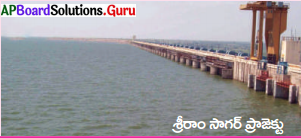
AP 10th Class Biology Important Questions 10th lesson సహజ వనరులు 3
శ్రీరాం సాగర్ ప్రాజెక్టు పోచంపాడు ప్రాజెక్టు అని కూడా అంటారు. ఇది గోదావరి నదిపై ఉన్న ప్రాజెక్టు, తెలంగాణా ప్రాంతంలో అధిక భాగానికి ఇది జీవనాధారం. కరీంనగర్, వరంగల్, ఆదిలాబాద్, నల్లగొండ, ఖమ్మం జిల్లా వాసుల అవసరాలను ఈ ప్రాజెక్టు తీరుస్తుంది. గోదావరి నదిపై, ఇతర రాష్ట్రంలో ఆనకట్ట నిర్మించడం వలన, ఎక్కువ శాతం నీరు ఆంధ్రప్రదేశ్ కు చేరకుండానే పై రాష్ట్రాలలో నిలువ చేయబడుతోంది. ఆగస్టు 2013 గణాంకాల ప్రకారం ఈ ప్రాజెక్టు యొక్క అంచనా వేయబడిన నీటి నిలువ సామర్థ్యం 80, 66 టి.ఎం.సి.లు.

ప్రశ్న 18.
బీడు భూములను ఎలా అభివృద్ధి పర్చవచ్చు?
జవాబు:
రోడ్ల వెంబడి, పొలాలు, కాలువల గట్ల వెంబడి ఉపయోగకరమైన జాతుల మొక్కలను పెంచడం ద్వారా బీడు భూములు అభివృద్ధి చేయవచ్చు. ఇందుకుగాను రైతులు అనేకచోట్ల 0.3 మీటర్ల ఎత్తు కట్టలను కట్టి, 10 మీటర్ల దూరానికి ఒకటి చొప్పున కాంటూర్ కందకాలను ఏర్పాటు చేశారు. సీతాఫలం మొక్కలతో పాటు అనేక ఉపయోగకరమైన జాతుల మొక్కలను, గెరిసీడియా మొక్కలను వారు పెంచడం మొదలు పెట్టారు. 2500 పండ్ల చెట్లు, టేకు చెట్లను నాటారు. ఇదే విధంగా బీడు భూములను అభివృద్ధి చేయవచ్చు.

ప్రశ్న 19.
పునరుద్దరించదగిన వనరులు (Reneuuable resources) అనగానేమి?
జవాబు:
మనం జీవించడానికి అవసరమయ్యే ఆహారం, నీరు, గాలి, నివాసం అన్నీ సహజ వనరుల నుండి లభిస్తాయి. కొన్ని సహజ వనరులు ఉపయోగించిన తరువాత, తిరిగి ఉత్పత్తి చేయబడుతాయి. వీటిని పునరుద్ధరింపదగిన వనరులు (Renewable resources) అంటారు.

ప్రశ్న 20.
పునరుద్దరింపలేని వనరులు (Non-reneuable resources) అనగానేమి?
జవాబు:
శిలాజ ఇంధనాలు వంటి వనరులను పునరుద్దరింపలేము. ఒకసారి వీటిని పూర్తిగా వాడుకున్నట్లయితే, అవి ఎప్పటికీ తరిగిపోయినట్లే. అతి తక్కువ కాలం ఇవి వినియోగించబడతాయి. కానీ, ఇవి తయారవ్వాలంటే చాలా కాలం పడుతుంది. వీటినే పునరుద్ధరింపలేని వనరులు (Non-renewable resources) అంటారు.

ప్రశ్న 21.
అదవులు చాలా ప్రాముఖ్యత గలవని అనుకోవటానికి కారణాలు ఏమిటి?
జవాబు:
అడవులు చాలా ప్రాముఖ్యత కలిగినవి. ఎందుకంటే అంటార్కిటికా తప్ప మిగిలిన ఖండాలన్నింటిలోనూ అడవులు ఉన్నాయి. మొక్కలకు, జంతువులకు ఒక గొప్ప ఆవాసంగా ఉన్నాయి. ప్రపంచానికి అడవులు ఊపిరితిత్తులు వంటివి మరియు కొత్త జీవితానికి పోషకాలనందించే ప్రముఖ స్థానం వంటివి లెక్కలేనన్ని ఉత్పత్తులు అడవుల నుండి లభిస్తున్నాయి.

ప్రశ్న 22.
అడవుల సంరక్షణలో రాజస్థానీయులు చూపిన చొరవ తెలపంది.
జవాబు:
రాజస్థాన్లో వైష్ణోయిలు చేసిన కార్యక్రమం మనకు మార్గదర్శకం. అమృతాదేవి, ఆమె కుమార్తెలు, వారి గ్రామస్తులందరూ కలిసి గ్రామ సమీపంలో ఉండే అడవుల్లోని వృక్షాలను కొట్టివేయకుండా కాపాడుకొన్నారు. ఇలాంటి అద్భుతమైన ఉద్యమాలు మనకు పర్యావరణాన్ని కాపాడుకోవడంలో స్ఫూర్తినిస్తాయి. అడవిని నరికి కలప సేకరించి రాజభవనం కట్టుకోవాలన్న రాజుగారికి వ్యతిరేకంగా పోరాటం చేసి అడవితో ప్రశాంతమైన సహసంబంధాన్ని గడపడానికి ప్రతిన పూనారు. ప్రకృతిని కాపాడేందుకు 29 నియమాలతో స్వయంచట్టం చేసుకున్నారు.

ప్రశ్న 23.
నేల ప్రాధాన్యత తెలపండి.
జవాబు:
ఆహారోత్పత్తికి నేల చాలా ముఖ్యమైనది. మనకు అవసరమైన పంటలు పండించాలంటే బాగా సారవంతమైన నేల ఉండాలి. వన్యజాతి మొక్కలు పెరగాలన్నా నేల అవసరం. మొక్కలు, జంతువులు మరియు ఇతర వనరులను సంరక్షించుకోవడానికి మనం చేసే అన్ని ప్రయత్నాలు నేల సంరక్షణ పైనే ఆధారపడి ఉంటాయి.

ప్రశ్న 24.
నేలకు నష్టాలు కలిగిస్తున్న కారకాలు తెలపండి.
జవాబు:
ఒక పొలంలో ఒకే రకం పంటను పలుమార్లు పండించడం వంటి లోపభూయిష్టమైన వ్యవసాయ పద్ధతులు నేలలోని పోషకాలను తొలగిస్తాయి. కొండ ప్రాంతాలను దున్నడం వలన నీరు, గాలి ద్వారా నేలకోత చాలా ఎక్కువవుతుంది.

ప్రశ్న 25.
జీవవైవిధ్యం అనగానేమి? దాని ప్రాముఖ్యత ఏమిటి?
జవాబు:
భూమిపై నివసిస్తున్న జీవులలో గల వైవిధ్యమే జీవవైవిధ్యం. ప్రకృతి నుండి మనకు లభించే ఉత్పత్తులు మరియు లాభాలన్నీ జీవవైవిధ్యం నుండి పొందుతున్నవే. ఆహార పదార్థాలు, వాటి నిర్మాణాలకు ఉపయోగించే పదార్థాలు, ఔషధాలు లభించాలన్నా మరియు పరిశుభ్రమైన, ఉపయోగకరమైన నేల ఉండాలన్నా జీవవైవిధ్యం ఎంతో అవసరం.

ఆహార వనరులు వైవిధ్యంగా, సమృద్ధిగా ఉండే విధంగా మనం జీవవైవిధ్యాన్ని కాపాడుకోవలసిన అవసరం ఉంది. ఆహారం కన్నా జీవవైవిధ్యం గొప్పది. ఉదాహరణకు ప్రపంచంలో మొత్తంలో 50,000 నుండి 70,000 వృక్ష జాతులను ఔషధాల తయారీలో వినియోగిస్తున్నారు.

AP 10th Class Biology Important Questions 10th lesson సహజ వనరులు

ప్రశ్న 26.
శిలాజ ఇంధనాల వినియోగం ఎలా తగ్గించవచ్చు?
జవాబు:
శిలాజ ఇంధనాలను జాగ్రత్తగా వినియోగిస్తూ, ప్రతి ఒక్కరూ వాటిని సంరక్షించాలి. విద్యుత్ దీపాలను, పరికరాలను వాడనప్పుడు స్వి ను ఆపివేయండి. విద్యుత్ను ఆదాచేసే పరికరాలను మాత్రమే కొనండి. వీలైనపుడు నడవడం, సైకిలను ఉపయోగించడం చేయాలి.

కార్ల వంటి సొంత వాహనాలలో కాకుండా బస్సులు, రైళ్లు వంటి ప్రజా రవాణా వ్యవస్థల ద్వారా ప్రయాణిస్తే లాభదాయకం. ఈ విధంగా చేస్తే సమాజానికి ఎంతో ఉపయోగం.

ప్రశ్న 27.
ఖనిజాల వినియోగం వలన భవిష్యత్ లో వచ్చే సమస్యలు ఏమిటి?
జవాబు:
భూమిలో ఖనిజ వనరులు తగ్గిపోతాయి. కనుగొనబడిన, గుర్తించబడిన చాలా ఖనిజాలు తరిగిపోతాయి. అల్యూమినియం, ఇనుము యొక్క ఖనిజ నిలువలు లేదా ఖనిజ నిక్షేపాలు కనుమరుగైపోతుండడం వలన వాటి ధరలు చాలా పెరిగిపోయే అవకాశం ఉంది. ఈ మూలకాలతో తయారుచేసే పరికరాలు, యంత్రాల యొక్క ధరలు పెరిగి, వాటిని కొనడం మరియు వినియోగించడం కష్టమైపోతుంది.

10th Class Biology 10th lesson సహజ వనరులు 4 Marks Important Questions and Answers

ప్రశ్న 1.
అడవి ఒక పునరుద్దరింపదగిన వనరు. కాని ప్రతి సంవత్సరం భూమిపై 36 మిలియన్ల ఎకరాల అడవులు నరికివేయబడుతున్న నేపథ్యంలో అవి పునరుద్ధరింపబడని వనరులుగా మారకుండుటకు నీవు ఎటువంటి సూచనలు చేస్తావు?
జవాబు:
ప్రపంచానికి అడవులు ఊపిరితిత్తులు వంటివి. అవి పునరుద్ధరింపబడని వనరుగా మారకుండా ఉండుటకు నేనిచ్చే సూచనలు :

  1. సుస్థిర అటవీ విధానాల ద్వారా భవిష్యత్ తరాలవారికి అందచేయగలం.
  2. చాలా తక్కువగా చెట్లను నరకడం.
  3. సహజంగా చెట్లు, తిరిగి ఎదగటానికి అవకాశం కల్గించే పద్ధతులు పాటించాలి.
  4. ఎత్తైన చెట్లు, పెద్ద చెట్లను నరికివేసే విధానాలను నిషేధించాలి.
  5. పునఃచక్రీయ పద్ధతులు అవలంబించడం.
  6. కలపకు బదులుగా ప్రత్యామ్నాయ వనరులను ఉపయోగించటం.
  7. అడవులను దహించకుండా చేయడం.

ప్రశ్న 2.
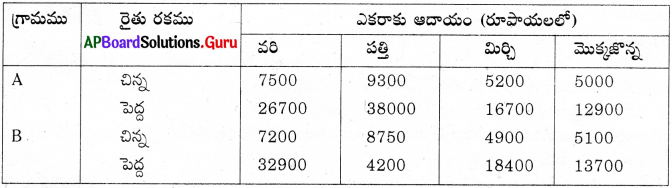
AP 10th Class Biology Important Questions 10th lesson సహజ వనరులు 4
పై పట్టికను పరిశీలించి, క్రింది ప్రశ్నలకు సమాధానాలు ఇవ్వండి.
1) రెండు గ్రామములలో చిన్న రైతులు పండించడానికి అనుకూలమైన పంట ఏది?
జవాబు:
మొక్కజొన్న, వరి.

2) నీవు ఒకవేళ పెద్ద రైతువైతే ఏ పంట పండిస్తావు ?
జవాబు:
మిర్చి, వరి

3) A మరియు B గ్రామముల మధ్య ఏమైన పోలికలను గమనించావా?
జవాబు:
A మరియు B గ్రామాలలో చిన్న పెద్ద రైతు ఒకే రకమైన పంటలు పండిస్తున్నారు. A మరియు B గ్రామాలలో చిన్నకారు రైతు కంటే పెద్దకారు రైతు ఎకరాకు వచ్చే ఆదాయం ఎక్కువగా ఉంది. రెండు గ్రామాలలో పెద్ద రైతు ఎక్కువ ఆదాయాన్ని వరి, మిర్చి, మొక్కజొన్న పంటలలో పొందుతున్నారు.

4) పై పట్టికలో తక్కువ ఆదాయాన్ని ఇచ్చే పంట ఏది?
జవాబు:
పత్తి

5) పంటకు, ఆదాయంనకు ఏమైన సంబంధం ఉన్నదా? వివరించండి.
జవాబు:
ఉంది. పంట దిగుబడి ఎక్కువగా ఉన్నప్పుడు ఆదాయం ఎక్కువగా ఉంటుంది. (లేదా)
ఉండకపోవచ్చు. మార్కెటు అవసరాన్ని బట్టి ఆదాయం ఉంటుంది. వాణిజ్య పంటలకు ఎక్కువ ఆదాయం వస్తుంది.

ప్రశ్న 3.
AR లు అనగానేమి? ఇవి పర్యావరణ సంరక్షణకు ఎలా ఉపయోగపడతాయి?
(లేదా)
పర్యావరణ సంరక్షణకు అవసరమయ్యే 4R సూత్రం వివరించండి.
జవాబు:
పర్యావరణ సంరక్షణకు నాలుగు నియమాలు పాటించాలి. అవి :

తగ్గించడం (Reduce) :
వనరులను తక్కువగా -వృథా చేయకుండా వినియోగించడం, కారుతున్న నల్లాలను, పంపులను సరిచేయడం, స్నానాల గదిలో షవర్ల వాడకం తగ్గించడం ద్వారా నీటి వినియోగాన్ని తగ్గించవచ్చు. అవసరం లేని సమయాల్లో విద్యుద్దీపాలను, ఫ్యాన్లను ఆపివేయడం వలన విద్యుచ్ఛక్తిని పొదుపు చేయవచ్చు.

తిరిగి వాడడం (Reuse) :
పారేయకుండా తిరిగి ఉపయోగించుకోవడం. కాగితాన్ని తిరిగి వాడడం వలన మొక్కలను కాపాడడమే కాకుండా కాలుష్యాన్ని తగ్గించినవారమవుతాము.

AP 10th Class Biology Important Questions 10th lesson సహజ వనరులు 5
పునఃచక్రీయం (Recycle) :
ఇది అన్నిసార్లు సాధ్యం కాకపోవచ్చు. ఉదాహరణకు ప్లాస్టికను పునఃచక్రీయం చేయడమనేది చాలా క్లిష్టమైన, ప్రమాదకరమైన ప్రక్రియ. ప్లాస్టిక్కు గల సంక్లిష్టత వలన ఈ సమస్య ఉత్పన్నమవుతుంది. ప్లాస్టిక్ వలన ఎన్ని ఉపయోగాలు ఉన్నాయో అన్ని రకాల నష్టాలూ ఉన్నాయి. ఒక రకమైన ప్లాస్టికను అదే రకం నుండి పునఃచక్రీయం చేయాలి. కావున, వివిధ రకాల ప్లాస్టిక్ లను పునఃచక్రీయం చేయడానికి పునఃచక్రీయం ముందు వేరుచేయాలి. ఒక్కొక్క దానిని ఒక్కొక్క రకంగా రీసైకిల్ చేయాల్సి ఉంటుంది.

తిరిగి ఏర్పాటుచేయటం (Recover) :
మనం వాడుకొన్న వనరులను, తిరిగి నెలకొల్పటాన్ని తిరిగి ఏర్పాటు చేయటం అంటారు.
ఉదా : కర్మాగారాలు, రోడ్ల నిర్మాణం కోసం చెట్లను కొట్టివేసినపుడు, అడవులను నరికివేసినపుడు ప్రత్యామ్నాయంగా మరొకచోట చెట్లను పెంచటం అవసరం.

ప్రశ్న 4.
ఈ క్రింది పై (Ple) చార్టును విశ్లేషించి, దిగువనీయబడిన ప్రశ్నలకు సమాధానాలు వ్రాయుము.
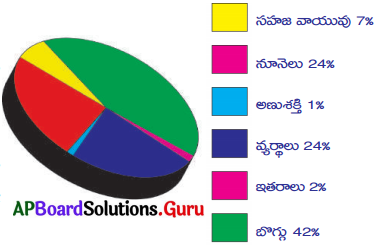
AP 10th Class Biology Important Questions 10th lesson సహజ వనరులు 6
జవాబు:
i) వీటిలో శిలాజ ఇంధనాలను గుర్తించి రాయండి.
జవాబు:
బొగ్గు, సహజవాయువు, నూనెలు.

ii) వ్యర్థాలను ప్రధాన ఇంధన వనరులుగా భవిష్యత్తులో ఎందుకు అభివృద్ధి చేసుకోవాలి?
జవాబు:
భవిష్యత్ లో శిలాజ ఇంధనాలు తరిగిపోవచ్చు కనుక ప్రత్యామ్నాయ ఇంధనముగా వ్యర్థాలను భవిష్యత్తులో ఉపయోగించవచ్చును.

iii) శిలాజ ఇంధనాలపై దీర్ఘకాలం మనం ఎందుకు ఆధారపడలేము?
జవాబు:
శిలాజ ఇంధనాలు పునరుద్దరింపదగని వనరులు కనుక.

iv) శిలాజ ఇంధనాలకు ప్రత్యామ్నాయంగా ఉపయోగించగల ఇంధన వనరులు ఏవి?
జవాబు:
సౌరశక్తి, పవనశక్తి, తరంగశక్తి, అణుశక్తి, వ్యర్థాలు.

AP 10th Class Biology Important Questions 10th lesson సహజ వనరులు

ప్రశ్న 5.
నీటి యాజమాన్యం కొరకు పాటించవలసిన సముదాయ ఆధారిత విధానాలు, రైతు ఆధారిత విధానాలను మరియు వాటి ప్రాధాన్యతను వివరించండి.
జవాబు:
సముదాయ ఆధారిత విధానాలు :
14 నీటిని నిలువ చేసే నిర్మాణాలు, 60 చిన్న ఇంకుడు గుంతలు, డైక్లు, 38 హెక్టార్ల పొలంగట్ల ద్వారా 28 ఎండిన బావులలోకి నీరు చేరేలా చేయడం జరిగింది. వర్షపు నీటిని నీటి వినియోగదారుల సంఘంగా ఏర్పడి సంరక్షించుకోగలిగారు. ఈ నిర్మాణాలలో నిలువ చేయబడిన నీరు భూగర్భజలాల నీటి మట్టాన్ని పెంచుటకు ఉపయోగించబడింది.

రైతు ఆధారిత విధానాలు :
వెడల్పు చాళ్ళు తీయడం, తక్కువ ఎత్తు పెరిగే పంటలను పెంచడం, కాంటూరు సేద్యం చేయడం, గట్ల మీద గెరిసిడియా చెట్లను పెంచడం, సూక్ష్మ సేద్య పద్ధతులు వంటివి వ్యక్తిగతంగా రైతులు వారి వారి పొలాలలో చేయడం జరిగింది. వీటి వలన నేల, వర్షపు నీరు, పోషకాలు దుర్వినియోగం కాకుండా కలుపు నివారణా పద్ధతులు పాటించడం, నైట్రోజన్ నిలువలను పెంచడం జరుగుతుంది.

ప్రశ్న 6.
రైతు ఆధారిత విధానాల గూర్చి రాయండి.
జవాబు:

  1. రైతు ఆధారిత విధానాల ద్వారా నేల, నీటి సంరక్షణ కార్యక్రమాలను అమలు చేశారు. వెడల్పు చాళ్లు తియ్యడం, తక్కువ ఎత్తు పెరిగే పంటలు పెంచడం, కాంటూర్ సేద్యం చేయడం మొదలైన యాజమాన్య పద్ధతులు పాటిస్తూ నేల, నీరు, పోషకాలు దుర్వినియోగం కాకుండా కాపాడుతారు.
  2. కలుపు నివారణ పద్ధతులు పాటించడంతోబాటు 38 హెక్టార్ల పొలాల చుట్టూ దీర్ఘచతురస్రాకారంలో గట్ట కట్టడం, వాలులకు అడ్డంగా కాంటూర్ కందకాలు ఏర్పాటు చేయడం ద్వారా వర్షపు నీటిని సంరక్షించవచ్చు.
  3. గట్లు బలంగా ఉండేందుకు. నేలలో నైట్రోజన్ నిల్వలు పెరిగేందుకు గట్టమీద గ్లైరిసీడియా (లెగ్యూమ్ మొక్క) లను పెంచుతారు. రైతులు ఉమ్మడిగా నీటిని వినియోగించుకోడం, సూక్ష్మ సేద్యం పద్దతులు చేస్తారు.
  4. వెడల్పు చాళ్లు తీయడం, సూక్ష్మసేద్య పద్ధతులు పాటించడం వలన హెక్టారుకు 250 కిలోల పైగా జొన్నలు, 50 కిలోల పైగా మొక్కజొన్నలు అధిక దిగుబడి సాధించవచ్చు.
  5. బిందు సేద్యం అమలు చేయడం వలన 70% నీటిని పొదుపు చేయవచ్చు.

ప్రశ్న 7.
అడవుల నరికివేత వలన కలిగే నష్టాలు ఏమిటి?
జవాబు:

  1. కలప లేదా వ్యవసాయం లేదా అభివృద్ధి పేరిట ప్రజలు అడవులను నరుకుతున్నారు.
  2. ప్రతి సంవత్సరం భూమిపై 36 మిలియన్ల ఎకరాల అడవులు (ఆంధ్రప్రదేశ్ లోని సగభాగం కన్నా ఎక్కువ భాగం) నరికివేయబడుతున్నాయి.
  3. అడవులను నరికివేయడం వలన వన్యజాతుల ఆవాసాలు నాశనమవుతాయి. నేలకోత ఎక్కువవుతుంది.
  4. హరిత గృహ వాయువులు (Green house gases) విడుదలై, భౌగోళిక వెచ్చదనానికి (Global warming) దారితీస్తాయి
  5. ప్రపంచంలో విడుదలయ్యే హరిత గృహ వాయువుల మొత్తంలో 15% వాయువులు అడవులను నరకడం వలననే విడుదలవుతున్నాయి.
  6. అటవీ ఉత్పత్తుల సేకరణ కోసం, వంటచెరకుకు మరియు జీవనోపాధి కోసం, మనుగడ కోసం అడవులపై ఆధారపడి జీవించే ప్రజలు అడవులు నరకడం వలన చాలా నష్టపోతున్నారు.

ప్రశ్న 8.
అడవుల సంరక్షణకు పాటించవలసిన సుస్థిర పద్ధతులు తెలపండి.
జవాబు:
అడవులను కాపాడుకోడానికి సుస్థిర అటవీ పద్దతులు కొన్ని పాటించాలి. ఉదాహరణకు చాలా తక్కువగా చెట్లు నరకడం, సహజంగా చెట్లు తిరిగి ఎదగడానికి అవకాశం కలిగించే పద్ధతులను పాటించడం, ఎత్తయిన చెట్లు, పెద్ద పెద్ద చెట్లను పెద్ద ఎత్తున నరికివేసే విధానాలను నిషేధించడం మొదలైనవి.

పునఃచక్రీయ వలన చెట్లను సంరక్షించవచ్చును. ఉదాహరణకు చైనా మరియు మెక్సికో దేశాల ప్రజలు రాయడానికి మరియు ఇతర అవసరాలకు వాడే కాగితాన్ని, కార్డుబోర్డును తిరిగి వాడడం ద్వారా అడవులను సంరక్షిస్తున్నారు. ప్రపంచంలోని కాగితంలో సగభాగం తిరిగి వాడడం జరిగితే, ప్రపంచంలోని కొత్త కాగితానికి ఉన్న అవసరం తీరడమే కాకుండా భూమి పైనున్న చెట్లను కాపాడినట్లవుతుంది. కొన్ని కలప వస్తువులకు బదులుగా వెదురు వాడవచ్చు.

ప్రశ్న 9.
నేల సంరక్షణ విధానాలు తెలపండి.
జవాబు:

  1. నేలల సంరక్షణా విధానాలలో కాంటూర్ పట్టి పంటల (Contour strip cropping) పద్ధతి ఒకటి. ఈ విధానంలో నేలవాలుకు అడ్డంగా, గాలివీచే దిశకు అడ్డంగా దున్ని ఒక్కొక్క వరుసలో ఒక్కొక్క రకం పంటను వేస్తారు. ఉదాహరణకు ఒక వరుసలో మొక్కజొన్న, మరొక వరుసలో గోధుమ, ఇంకొక వరుసలో క్లోవర్ (పులిచింత) పంటలు పండించడం.
  2. వేరువేరు పంట మొక్కలు వేరువేరు రకాల వేరు వ్యవస్థలను, భిన్న పరిమాణంలో ఆకులను కలిగి ఉంటాయి. కాబట్టి నేలక్రమక్షయం జరగకుండా కాపాడుతాయి.
  3. అలాగే పంటకోసేటపుడు కూడా ఒక్కొక్క మొక్కను లేదా చిన్న గుంపును తీసివేయడం వంటి ఎంపిక వంట పద్దతులు (Selective harvesting) పాటించడం వల్ల మిగిలిన మొక్కలు నేల కొట్టుకుపోకుండా పట్టి ఉంచుతాయి.

ప్రశ్న 10.
వనరుల సంరక్షణకు అంతర్జాతీయ సంస్థలు చూపుతున్న శ్రద్ధను తెలపండి.
జవాబు:
ఎన్నో అంతర్జాతీయ సంస్థలు వనరుల సంరక్షణ పట్ల శ్రద్ధ చూపుతున్నాయి. వర్షారణ్యాలను కాపాడడం, జంతువులు అంతరించిపోకుండా సంరక్షించడం మరియు గాలిని శుభ్రపరచడం వంటి కార్యకలాపాలను సంస్థ సభ్యులు బలపరుస్తున్నారు. 1948లో ప్రభుత్వ, ప్రైవేటు సమూహాల సమ్మేళనం ‘ద ఇంటర్నేషనల్ యూనియన్ ఫర్ ద కన్ఫర్వేషన్ ఆఫ్ నేచర్ (IUCN)’ ఏర్పడింది.

1980లో ఇది ప్రపంచ సంరక్షణా విధానాన్ని ప్రతిపాదించింది. ఎన్నో దేశాల ప్రభుత్వాలు వాటి సంరక్షణా పథకాలను అభివృద్ధి చేసుకోవడంలో IUCN విధానాలనే అనుసరించాయి. అంతేకాకుండా IUCN అనే సంస్థ ప్రమాదం అంచున ఉన్న వన్యజాతులను, జాతీయ ఉద్యానవనాలు, సంరక్షణా కేంద్రాలు, పర్యావరణానికి సంబంధించిన అంశాల స్థాయిని పరిశీలిస్తుంది.

ప్రశ్న 11.
మీ గ్రామంలో బావులు, చెరువులు ఎండిపోయాయి. భూగర్భజలాలు తగ్గిపోయాయి. ఇందుకు గల కారణాలను గుర్తించండి. మీ గ్రామంలోని రైతులందరూ కలిసి పనిచేస్తే నీటి కరవు తీరుతుందా?
జవాబు:
భూగర్భజలాలు తగ్గిపోవడానికి కారణాలు :

  1. ఈ మధ్యకాలములో ఋతుపవనములు సకాలములో రాకపోవడము, వచ్చినా సరిపోయిన మొత్తములో వర్షములు ఇవ్వకపోవడం ప్రధాన కారణంగా భావించవచ్చు.
  2. తక్కువ మొత్తంలో బోరుబావులు తవ్వి సాగునీటి అవసరాల కోసం విచక్షణారహితంగా వినియోగించడం. వీటి ద్వారా ఎక్కువ మొత్తంలో నీటిని ఉపయోగించటం వలన భూగర్భజల మట్టాలు పడిపోవడం జరిగినది.
  3. ఆహార పంటలు ఎక్కువగా పండించుట వలన కూడా నీటి వినియోగం ఎక్కువ కావటం భూగర్భజలమట్టాలు పడిపోవడం జరుగుతుంది.
  4. మా గ్రామంలోని రైతులందరూ ఉమ్మడిగా నీటిని వినియోగిస్తే పంటలకు నీటికొరత ఉండదు. మా ఊరిలో ఉన్న రైతులను నీటి సద్వినియోగం కొరకు ఉమ్మడిగా మరియు సూక్ష్మనీటిపారుదల పద్ధతులను అవలంబించవలసినదిగా సూచించడమైనది.
  5. సూక్ష్మసాగునీటి పద్ధతులయిన బిందుసేద్యం, స్ప్రింక్లర్లు మొదలైనవి వినియోగించడం వలన నీటిని పొదుపుగా వాడటమే కాకుండా ఎక్కువ మొత్తంలో దిగుబడులు సాధించడం జరిగింది.

AP 10th Class Biology Important Questions 10th lesson సహజ వనరులు

ప్రశ్న 12.
మీ గ్రామంలో తాగునీటికి, సాగునీటికి తీవ్రమైన కొరత ఉంది అనుకుందాం. దానిని నివారించడానికి నీవు ఇచ్చే సలహాలు ఏమిటి?
జవాబు:

  1. నీటిని పొదుపుగా వాడుకోవలసిన అవసరాన్ని, సంరక్షించుకోవలసిన విధానాన్ని గురించి ప్రజలకు అవగాహన కల్పిస్తాను.
  2. నీటి వాడకంలో వృథాను అరికట్టే విధంగా ప్రజలను ప్రోత్సహిస్తాను.
  3. భూగర్భ జలమట్టాలను పెంచడానికి రీఛార్జి గుంటలను ఇళ్ళు మరియు పాఠశాల ఆవరణలో నిర్మించే విధంగా ప్రోత్సహిస్తాను.
  4. బీడు భూముల్లో విరివిగా మొక్కలు నాటే కార్యక్రమాన్ని చేపడతాను.
  5. రైతులు సూక్ష్మ నీటి సాగు పద్ధతులైన బిందుసేద్యం, స్ప్రింక్లర్స్ విధానాలను ఆచరించే విధంగా ప్రోత్సహిస్తాను.
  6. అందుబాటులో ఉన్న నీటి వనరులను సామూహికంగా వినియోగించుకునే విధంగా రైతులను ప్రోత్సహిస్తాను.
  7. ఇంకుడు గుంతలు మరియు చెరువులను తవ్వి వృథాగా పోయే వర్షపునీటిని పరిరక్షించి భూగర్భజలమట్టాలను పెంచడానికి ప్రయత్నిస్తాను.
  8. వాటర్ షెడ్ పథకాల అమలును పర్యవేక్షిస్తాను.

ప్రశ్న 13.
సహజ వనరుల సద్వినియోగం దేశ ఆర్థికాభివృద్ధిలో ఎంతో దోహదం చేస్తుందని నీవు ఎలా చెప్పగలవు?
జవాబు:

  1. గాలి, నీరు, నేల, ఖనిజాలు, ఇంధనాలు, మొక్కలు, జంతువులు భూమిపై ఉండే సహజ వనరులు.
  2. వర్తమానంలో మరియు భవిష్యత్తులో జీవులన్నీ లాభం పొందాలంటే సహజ వనరులు సంరక్షించబడాలి.
  3. ప్రజలు చాలా వరకు పునరుద్దరింపదగిన మరియు పునరుద్ధరింపలేని వనరులను నాశనం చేస్తుంటారు. మనుగడ కొనసాగించడమనేది, సహజ వనరులను విచక్షణతో ఉపయోగించడంపై ఆధారపడి ఉంటుంది.
  4. జంతువులు ఇతర ఆవాసాలకు తరలిపోయేలా వాటికి నష్టం చేకూరుస్తూ భవిష్యత్తులో ఉపయోగపడవలసిన వనరులను తరిగిపోయేలా చేస్తూ, నేడు అందుబాటులో ఉన్న వనరులన్నింటినీ నాశనం చేస్తూ మనం అభివృద్ధి యొక్క ప్రయోజనాలను లెక్కిస్తున్నాం.
  5. అభివృద్ధి, సంరక్షణ రెండింటికీ ప్రాధాన్యమిస్తూ మనుగడ సాగించవచ్చును.
  6. భావితరాలకు అవసరమయ్యే సహజవనరులను అందుబాటులో ఉండేవిధంగా మనం పర్యావరణాన్ని ఉపయోగించుకున్నట్లయితే అది సుస్థిరాభివృద్ధి అవుతుంది.
  7. సుస్థిరంగా జీవించాలంటే మనం ఎన్నో రకాల వనరులను జాగ్రత్తగా వినియోగిస్తూ సంరక్షించుకోవాలి.

ప్రశ్న 14.
రైతులకు వ్యవసాయం ఎంపిక విధానంపై అవగాహన కల్పించటానికి నీవు చేపట్టే కార్యక్రమాలేవి?
జవాబు:

  1. వ్యవసాయ సంబంధ మరియు అనుబంధ అంశాలపై రైతులకు అవగాహన కల్పించడానికి రైతు సదస్సులు ఏర్పాటు చేస్తాను.
  2. రసాయనిక ఎరువులు కలిగించే నషాన్ని రైతులకు వివరించి ఆరానిక్ ఎరువులను వాడే విధంగా ప్రోత్సహిసాను.
  3. మృత్తిక యొక్క సహజ స్వరూపాన్ని కాపాడవలసిన అవసరతను రైతులకు వివరిస్తాను. తద్వారా దిగుబడి ఎక్కువ సాధించుటకు రైతులను ప్రోత్సహిస్తాను.
  4. దిగుబడులను పెంచడానికి రైతులు అధిక దిగుబడినిచ్చే వంగడాలను వినియోగించే విధంగా ప్రోత్సహిస్తాను.
  5. మొక్కల సంఖ్యను అధికం చేయడానికి కణజాలవర్గన పద్ధతులను అవలంబించే విధంగా రైతులకు అవగాహన కలిగిస్తాను.
  6. నీటిని పొదుపుగా వాడటానికి సూక్ష్మ సేద్య సాగునీటి పద్దతులైన బిందుసేద్యం మరియు స్ప్రింక్లర్ విధానమును అవలంబించే విధంగా రైతులకు సూచనలిస్తాను.
  7. రెతులు సామూహికంగా నీటిని వినియోగించుకునే విధంగా ప్రణాళికలను రూపొందిస్తాను. తద్వారా పంట సాగుకు అతి తక్కువ మొత్తంలో నీరు వాడే విధంగా చూస్తాను.
  8. వర్షపు నీటిని ఆదాచేయడానికి ఇంకుడు గుంతలు, చెరువులు నిర్మించే విధంగా రైతులను ప్రోత్సహిస్తాను.

10th Class Biology 10th lesson సహజ వనరులు 1 Mark Important Questions and Answers

ఉదాహరణలు ఇవ్వండి

1. బిందు సేద్యం అనేది ఒక రకమైన సూక్ష్మ నీటిపారుదల సాంకేతికత. మరొక ఉదాహరణ ఇవ్వండి.
జవాబు:
స్ప్రింక్లర్

2. భూగర్భ జలాలు లేదా ఎండిన బోర్లను బాగా రీఛార్జ్ చేయడానికి పెర్కొలేషన్ ట్యాంక్ ఉపయోగించబదుతుంది. మరొక ఉదాహరణ ఇవ్వండి.
జవాబు:
ఇంకుడు గుంటలు

3. రైతు ఆధారిత సేద్యానికి బ్రాడ్ బెడ్ ఫర్రో ల్యాండ్ ఫామ్ ఒక ఉదాహరణ. మరొక ఉదాహరణ ఇవ్వండి.
జవాబు:
ఆకృతి నాటడం

4. పొడి ప్రాంతాల్లో పెరగడానికి అనువుగా ఉండే లెగ్యుమినస్ మొక్కకు ఉదాహరణ ఇవ్వండి.
జవాబు:
గ్లైరిసిడియా

5. శిలాజ ఇంధనాలకు పెట్రోలియం మరియు సహజ వాయువు ఉదాహరణలు. మరొక ఉదాహరణ ఇవ్వండి.
జవాబు:
బొగ్గు

6. గోండు ఆంధ్రప్రదేశ్ లో ఒక రకమైన గిరిజనులు. మరొక ఉదాహరణ ఇవ్వండి.
జవాబు:
చెంచు

7. జపాన్ ఆటోమొబైల్స్ తయారీలో రీసైకిల్ ముడి పదార్థాలను వాడుతున్న దేశం. ఇటువంటి దేశానికి మరొక ఉదాహరణ ఇవ్వండి.
జవాబు:
అమెరికా సంయుక్త రాష్ట్రాలు

8. సూర్యకాంతి విద్యుత్ ఉత్పత్తిలో ఉపయోగించే ప్రత్యామ్నాయ వనరు. మరొక ఉదాహరణ ఇవ్వండి.
జవాబు:
పవన శక్తి

9. అడవి అంటే మనం నిర్వహించాల్సిన మరియు పరిరక్షించాల్సిన వనరు. ఇటువంటి మరో ఉదాహరణ ఇవ్వండి.
జవాబు:
నేల / నీరు

10. గ్లైరిసిడియా మొక్కల నేలను సారవంతం చేయటానికి ఉపయోగిస్తారు. ఇటువంటి మొక్కలకు మరో ఉదాహరణ ఇవ్వండి.
జవాబు:
సీతాఫల మొక్కలు

11. కాంటూర్ సేద్యం అనేది నేల సంరక్షణకు ఒక పద్ధతి. మరొక ఉదాహరణ ఇవ్వండి.
జవాబు:
పంట మార్పిడి.

విస్తరించుము

12. ICRISAT ని విస్తరించండి.
జవాబు:
ఇంటర్నేషనల్ క్రాప్ రీసెర్చ్ ఇనిస్టిట్యూట్ ఫర్ సెమీ – అరిడ్ ట్రాపిక్స్

13. T.M.Cని విస్తరించండి.
జవాబు:
వెయ్యి మిలియన్ క్యూబిక్ అడుగులు

14. B.B.F ని విస్తరించండి.
జవాబు:
బ్రాడ్ బెడ్ ఫర్రో

15. MTRని విస్తరించండి.
జవాబు:
మౌంటైన్ టాప్ రిమూవల్

AP 10th Class Biology Important Questions 10th lesson సహజ వనరులు

16. 4Rని విస్తరించండి.
జవాబు:
తగ్గించటం (Reduce), పునర్వినియోగం (Re-use), పునఃచక్రీయము (Recycle), తిరిగి పొందటం (Recover).

17. I.U.C.Nని విస్తరించండి.
జవాబు:
ఇంటర్నేషనల్ యూనియన్ ఫర్ ది కన్జర్వేషన్ ఆఫ్

18. O.N.G.Cని విస్తరించండి.
జవాబు:
ఆయిల్ అండ్ నేచురల్ గ్యాస్ కార్పొరేషన్

19. U.N.D.P ని విస్తరించండి.
జవాబు:
ఐక్యరాజ్యసమితి అభివృద్ధి కార్యక్రమం

20. FAOని విస్తరించండి.
జవాబు:
ఆహార మరియు వ్యవసాయ సంస్థ

దోషాన్ని గుర్తించి, సరిచేసి రాయండి

21. ఉపరితల నీటి పారుదల పద్దతి నీటి వినియోగాన్ని 70% తగ్గిస్తుంది.
జవాబు:
బిందు సేద్యం పద్దతి నీటి వినియోగాన్ని 70% తగ్గిస్తుంది.

22. ప్రతి సంవత్సరం భూమి అటవీ నిర్మూలనకు సుమారు 63 మిలియన్ ఎకరాల అడవిని కోల్పోతుంది.
జవాబు:
ప్రతి సంవత్సరం భూమి అటవీ నిర్మూలనకు సుమారు 36 మిలియన్ ఎకరాల అడవిని కోల్పోతుంది.

23. పులులను రక్షించడానికి చిప్కో ఉద్యమం ముడిపడి ఉంది.
జవాబు:
చెట్లు రక్షించడానికి చిప్కో ఉద్యమం ముడిపడి ఉంది.

24. నదీ జలాల pH 7 పైన ఉంటే నదీ జలాలు ఆమ్ల వ్యర్థాలతో కలుషితమవుతాయని చెబుతారు.
జవాబు:
నదీ జలాల pH 7 పైన ఉంటే నదీ జలాలు క్షార వ్యర్థాలతో కలుషితమవుతాయని చెబుతారు.

ఖాళీలను పూరించండి

25. ఫ్లో చార్టులో ఖాళీని పూరించండి.
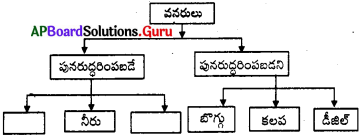
AP 10th Class Biology Important Questions 10th lesson సహజ వనరులు 7
జవాబు:
గాలి, సూర్యరశ్మి

26. అటవీ నిర్మూలన వలన ప్రపంచంలోని గ్రీన్‌హౌస్ గ్యాస్ ఉద్గారాలలో ……….. వెలువడుతుంది.
జవాబు:
15%

27. భూమిపై మంచినీటి శాతం …………
జవాబు:
2.5 – 2.75%

నేను ఎవరు?

28. మేము రాజస్థాన్లో గిరిజనులం. ప్రకృతిని పరిరక్షించదానికి మాకు 29 నియమాల సమితి ఉంది. మేము ఎవరు?
జవాబు:
బిష్ణోలు

29. నా కుమార్తె, మా గ్రామస్తులు మరియు నేను అటవీ స్థలం కోసం రాజు సైనికుడిచే చెట్లను నరికివేయకుండా కాపాడాము. నేను ఎవరు?
జవాబు:
అమృతా దేవి

AP 10th Class Biology Important Questions 10th lesson సహజ వనరులు

30. నేను హిమాలయ లోయలలో అటవీ నిర్మూలనకు వ్యతిరేకంగా పోరాడుతున్నాను. మరియు అటవీ నిర్మూలనకు వ్యతిరేకంగా నా ఉద్యమాన్ని చిప్కో ఉద్యమం అంటారు. నేను ఎవరు?
జవాబు:
సుందర్‌లాల్ బహుగుణ

31. నేను పర్యావరణవేత్తని. నేను నర్మదా నదికి అడ్డంగా అనేక ఆనకట్టలను నిర్మిస్తున్నాను. నేను ఎవరు?
జవాబు:
మేధా పాట్కర్

32. నేను ఒక మొక్కను. నా విత్తనాలను బయోడీజిల్ ఉత్పత్తికి ఉపయోగిస్తారు. నేను ఎవరు?
జవాబు:
జట్రోపా కర్కస్ (అడవి ఆముదం)

33. మీరు గది నుండి బయలుదేరినప్పుడు లైట్ మరియు ఫ్యాన్ ఆపివేయండి. ఇది ఏ రకమైన R?
జవాబు:
తగ్గింపు

జతపరచుట

34. సరిగ్గా సరిపోలినదాన్ని గుర్తించండి.
షవర్ బాత్ మానటం – తగ్గింపు
స్నేహితులతో పుస్తకాలను పంచుకోండి – రీసైకిల్ చేయడం
లీకైన కుళాయిలను రిపేర్ చేయండి – పునర్వినియోగం
జవాబు:
షవర్ బాత్ మానటం – తగ్గింపు

35. సరిగ్గా సరిపోలినదాన్ని గుర్తించండి.
వస్త్ర సంచులను వాడండి – పునర్వినియోగం
పునర్వినియోగపరచదగిన బ్యాటరీలను
ఉపయోగించండి – తగ్గించడం
పెన్ను రీఫిల్ చేయండి – రీసైకిల్ చేయడం
జవాబు:
పునర్వినియోగపరచదగిన బ్యాటరీలను ఉపయోగించండి – తగ్గించడం

36. సరిగ్గా సరిపోలినదాన్ని గుర్తించండి.
జట్రోపా – శిలాజ ఇంధనం
గ్లిరిసిడియా – లెగ్యుమినస్ మొక్క
కస్టర్డ్ ఆపిల్ – జీవ ఇంధన కర్మాగారం
జవాబు:
గ్లిరిసిడియా – లెగ్యుమినస్. మొక్క

37. సరిగ్గా సరిపోలనిదాన్ని గుర్తించండి.
బ్రాడ్ బెడ్ ఫర్రో – రైతు ఆధారిత సేద్యం
వర్షాధార ఆనకట్ట – సమాజ ఆధారిత సేద్యం
పునరుత్పాదక వనరు – బొగ్గు
జవాబు:
పునరుత్పాదక వనరు – బొగ్గు

నినాదాలు

38. ర్యాలీ నిర్వహించడానికి మీ పాఠశాలలో ఈ క్రింది నినాదాలు తయారుచేయబడ్డాయి. ఏ సందర్భంగా ర్యాలీ నిర్వహిస్తారు?
చెట్టును కత్తిరించవద్దు – జీవితాన్ని కత్తిరించవద్దు
చెట్టును పెంచండి – వరదకు దూరంగా ఉండండి.
జవాబు:
జూన్-6 – ప్రపంచ పర్యావరణ దినం.

39. ఈ క్రింది నినాదాల యొక్క ఉద్దేశ్యం ఏమిటి?
నీరు జీవితాధారం.
ప్రతి నీటి చుక్కను లెక్కింపు చేద్దాం.
ఒక చుక్కను దాచండి – భవిష్యత్తును కాపాడండి.
జవాబు:
నీటి పొదుపు

AP 10th Class Biology Important Questions 10th lesson సహజ వనరులు

40. కింది నినాదాల యొక్క ప్రాథమిక భావన ఏమిటి?
నూనె కంటే నేల విలువైనది.
రోజుకు ఒక చెట్టును నాటండి మరియు నేల కోతను దూరంగా ఉంచండి.
జవాబు:
నేల పరిరక్షణ

41. ఓజోన్ యొక్క ప్రాముఖ్యత ఈ క్రింది నినాదాలలో ప్రస్తావించబడింది. ఇది ఏ రకమైన కిరణాల నుండి మనలను రక్షిస్తుంది?
ఓజోన్ లేదు, డెడ్ జోన్ మాత్రమే
ఓజోన్ ప్రకృతి స్వంత సన్
జవాబు:
అతినీలలోహిత కిరణాలు

బొమ్మలపై ప్రశ్నలు

42.

AP 10th Class Biology Important Questions 10th lesson సహజ వనరులు 8
ఈ లోగో దేనిని సూచిస్తుంది?
జవాబు:
సమగ్రాభివృద్ధి

43.
AP 10th Class Biology Important Questions 10th lesson సహజ వనరులు 1
ఈ లోగో దేనిని సూచిస్తుంది?
జవాబు:
పునఃచక్రీయము

44.
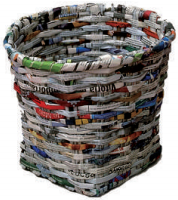
AP 10th Class Biology Important Questions 10th lesson సహజ వనరులు 9
ఈ చిత్రం ఏ 4R ను సూచిస్తుంది?
జవాబు:
తిరిగి వాడడం

10th Class Biology 10th lesson సహజ వనరులు 1 Mark Important Questions and Answers

1. భూగర్భ జలాలు తగ్గటానికి కారణం ………..
A) వర్షం పడకపోవడం
B) అడవుల నరికివేత
C) బోర్ బావుల సంఖ్య ఎక్కువైపోవుట
D) పైవన్నీ
జవాబు:
D) పైవన్నీ

2. తక్కువ నీటి సౌకర్యాలు ఉన్న ప్రాంతాలలో రైతులు అనుసరించదగిన విధానం
i) స్వల్పకాలిక పంటలు పండించడం.
ii) వ్యాపార పంటలు పండించడం.
iii) బిందు సేద్యం చేయడం.
iv) పంట విరామం ప్రకటించడం.
A) (i), (ii)
B) (i), (ii), (iii)
C) (i), (iv)
D) (iii), (iv)
జవాబు:
B) (i), (ii), (iii)

3. ఒక రైతు తన పంటపొలంలో కీటకాలను నివారించేందుకు తొండలను ప్రవేశపెట్టాడు. ఇది ఒక …..
A) పర్యావరణ నైతికత పద్ధతి
B) జైవిక నియంత్రణ పద్ధతి
C) జైవిక వ్యవస్థాపనం
D) జైవిక వృద్ధీకరణము
జవాబు:
B) జైవిక నియంత్రణ పద్ధతి

AP 10th Class Biology Important Questions 10th lesson సహజ వనరులు

4. క్రింది వానిలో పునరుద్ధరింపలేని వనరు
A) నీరు
B) సౌరశక్తి
C) బొగ్గు
D) మృత్తిక
జవాబు:
C) బొగ్గు

5. అడవులను అధికంగా నిర్మూలిస్తే జరిగే పరిణామాన్ని
A) అగ్నిపర్వతాలు బ్రద్దలగుట
B) భూకంపాలు వస్తాయి.
C) భౌగోళిక వెచ్చదనం కలుగును
D) సునామీలు వస్తాయి.
జవాబు:
C) భౌగోళిక వెచ్చదనం కలుగును

6. ఇంధనాన్ని ఆదా చేసే మార్గం ఇది కాదు.
A) సైకిలను ఉపయోగించడం
B) కారుకు బదులు రైలులో ప్రయాణించడం
C) సెల్‌ఫోన్‌ను వాడడం
D) బావి నుండి నీటిని తోడుకోవడం
జవాబు:
C) సెల్‌ఫోన్‌ను వాడడం

7. గాలిని కలుషితం చేసే రేణురూప కలుషితం
A) CO2
B) బూడిద
C) SO2
D) CO
జవాబు:
B) బూడిద

8. క్రింది వృత్త రేఖాచిత్రంలో “నీటి పారుదల సౌకర్యాలు – విస్తీర్ణం” వివరాలు చూపబడ్డాయి. అందు భూగర్భ జల వనరుల శాతం ……………..

AP Board 10th Class Biology Solutions 10th Lesson సహజ వనరులు 8
A) 40%
B) 45%
C) 43%
D) 48%
జవాబు:
C) 43%

9. IUCN యొక్క ప్రధాన విధి
A) వన్య ప్రాణుల ఆవాసాల పరిరక్షణ
B) మెట్ట పంటల అధ్యయనం
C) వైరల్ వ్యాధుల అధ్యయనం
D) నీటి పంటలు (wet land) వ్యవసాయ అధ్యయనం
జవాబు:
A) వన్య ప్రాణుల ఆవాసాల పరిరక్షణ

10. ఇంకుడు గుంట వలన ఉపయోగము ……..
A) వర్షాకాలంలో వచ్చే వరదలను అరికట్టడము
B) వ్యవసాయానికి నీరు అందించుట
C) వర్షపు నీటిని నిల్వచేయడము ,
D) భూగర్భజల మట్టాలను పెంచడము
జవాబు:
C or D

11. AP 10th Class Biology Important Questions 10th lesson సహజ వనరులు 1 ఈ లోగో దీనిని సూచిస్తుంది ……. ఊహించండి.
A) రియూజ్
B) రెడ్యూస్
C) రీసైకిల్
D) అన్నీ
జవాబు:
C) రీసైకిల్

AP 10th Class Biology Important Questions 10th lesson సహజ వనరులు

12. తరిగిపోని ఇంధన వనరుకు ఉదాహరణ
A) సహజవాయువు
B) పెట్రోలు
C) సౌరశక్తి
D) వంటచెరకు
జవాబు:
C) సౌరశక్తి

13. భూగర్భ జల మట్టాలను పెంచాలంటే …………
A) బావులు తవ్వాలి
B) కాలువలు తవ్వాలి
C) రోడ్లను తవ్వాలి
D) ఇంకుడు గుంతలు తవ్వాలి
జవాబు:
D) ఇంకుడు గుంతలు తవ్వాలి

14. నేల సంరక్షణా పదతి
A) కాంటూర్ పద్ధతి
B) గడ్డి మొక్కల పెంపకం
C) పంటమార్పిడి పద్ధతి
D) పైవన్నీ
జవాబు:
D) పైవన్నీ

15. ఓజోన్ పొర వినాశనానికి కారణమైన వాయువు …………………
A) కార్బన్ డై ఆక్సెడ్
B) ఆక్సిజన్
C) క్లోరోఫ్లోరోకార్బన్స్
D) నైట్రోజన్ డై ఆక్సెడ్
జవాబు:
C) క్లోరోఫ్లోరోకార్బన్స్

16. UNDP అనగా……………….
A) United Nations Development Plan
B) United Nations Development Programme
C) United Nations Drought Programme
D) United Nations Dropout Programme
జవాబు:
B) United Nations Development Programme

17. ICRISAT ఉన్న ప్రదేశం
A) బెంగళూరు
B) హైదరాబాద్
C) చెన్నై
D) పుణె
జవాబు:
B) హైదరాబాద్

18. ఈ గుర్తు దేనిని సూచిస్తుంది?
AP 10th Class Biology Important Questions 10th lesson సహజ వనరులు 8
A) UNDP
B) ఇంకుడు గుంతలు
C) సుస్థిర అభివృద్ధి
D) పునః చక్రీయం లోగో
జవాబు:
C) సుస్థిర అభివృద్ధి

19. క్రింది వాక్యా లలో సరియైనది.
a) అభివృద్ధి అవసరం
b) అభివృద్ధి పర్యావరణ స్నేహపూర్వకంగా ఉండాలి.
A) a సరియైనది, b తప్పు
B) a తప్పు, b సరియైనది.
C) a, b రెండూ తప్పు
D) a, b రెండూ సరియైనవి.
జవాబు:
D) a, b రెండూ సరియైనవి.

AP 10th Class Biology Important Questions 10th lesson సహజ వనరులు

20. తక్కువ నీటి సౌకర్యాలు ఉన్న ప్రాంతాలలో రైతులు అనుసరించదగిన విధానం
1) స్వల్పకాలిక పంటలు పండించడం
2) వ్యాపార పంటలు పండించడం
3) బిందు సేద్యం చేయడం
4) పంట విరామం ప్రకటించడం
A) 1, 3
B) 2, 3
C) 1, 4
D) 3, 4
జవాబు:
A) 1, 3

21. దోమల జనాభా పెరుగుటకు కారణం
A) సముద్రపు నీరు
B) నదులలో ప్రవహించే నీరు
C) కాలువలలో ప్రవహించే నీరు
D) నిలకడగా ఉండే నీరు
జవాబు:
D) నిలకడగా ఉండే నీరు

22. సరి అయిన వాక్యాన్ని గుర్తించండి.
A) గ్యాసన్ను ఆదా చేయటానికి ప్రెషర్ కుక్కర్ వాడాలి.
B) ఉడికించటానికి ఎక్కువ నీరు వాడాలి.
C) వండే ముందు పదార్థాలను నానబెట్టకూడదు.
D) అన్ని అమర్చుకోకుండా స్టవ్ వెలిగించాలి.
జవాబు:
A) గ్యాసన్ను ఆదా చేయటానికి ప్రెషర్ కుక్కర్ వాడాలి.

23. అడవులు లేని ఖండం
A) ఆర్కిటిక్
B) ఆసియా
C) ఆస్ట్రేలియా
D) అంటార్కిటికా
జవాబు:
D) అంటార్కిటికా

24. మన ఇంట్లో గ్యాస్ పొదుపు చేసే మార్గం.
A) వంటలో ఎక్కువ నీరు వాడాలి.
B) వండే ముందు పదార్థాలు నానబెట్టాలి.
C) వండే ముందు పదార్థాలు ఫ్రిజ్ లో పెట్టాలి.
D) గ్యాస్పోయ్యికి పెద్ద బర్నర్ వాడాలి
జవాబు:
B) వండే ముందు పదార్థాలు నానబెట్టాలి.

25. ఈ మధ్య జరిపిన పరిశోధనలలో పొద్దుతిరుగుడు పంట దిగుబడి తగ్గడానికి కారణం ఏమని తెలిసింది?
A) పరాగ సంపర్కానికి తోడ్పడే కీటకాల సంఖ్య తగ్గిపోవడం
B) రసాయన ఎరువుల వాడకం వల్ల
C) కరువు పరిస్థితులు
D) పైవేవీ కాదు
జవాబు:
A) పరాగ సంపర్కానికి తోడ్పడే కీటకాల సంఖ్య తగ్గిపోవడం

26. భూగర్భ జలాలు పెంచుటకు చేయవలసినది
A) ఎక్కువ బోరుబావులు తవ్వడం
B) అడవుల నిర్మూలన
C) పట్టణీకరణ
D) ఇంకుడు గుంతల ఏర్పాటు
జవాబు:
D) ఇంకుడు గుంతల ఏర్పాటు

AP 10th Class Biology Important Questions 10th lesson సహజ వనరులు

27. రైతులు గెరిసిడియా పెంచుటకు కారణం
A) కాలుష్యం తగ్గించుటకు
B) నేలలో నైట్రోజన్ నిల్వలు పెరిగేందుకు
C) కలుపు మొక్కల నియంత్రణకు
D) పశుగ్రాసం కొరకు
జవాబు:
B) నేలలో నైట్రోజన్ నిల్వలు పెరిగేందుకు

మీకు తెలుసా?

AP 10th Class Biology Important Questions 10th lesson సహజ వనరులు 2
* నీటి ప్రవాహాలకు అడ్డంగా రాళ్ళ, మట్టితో అడ్డుకట్టలు కట్టి ఏర్పాటు చేసే నీటి నిల్వలను ఇంకుడు చెరువులు, (Percolation tanks) అంటారు. బంకమట్టి, ఇసుక, కంకర, గులకరాళ్ళు మొదలైన వాటిని బాగా కలిపి ఒకదానిపైన ఒకటి వచ్చేటట్లుగా పొరలు పొరలుగా చెరువు నేలను, అంచుల వెంబడి కప్పుతారు. తరువాత దీనిని గట్టిగా కుదురుకునేలా చేస్తారు. వ్యవసాయం కోసం నీటిని సరఫరా చేయడానికి మట్టికట్టకు తూము ఏర్పాటు చేస్తారు. పూర్తి నీటి నిల్వ మట్టానికి అడుగు మట్టానికి మధ్య నాలుగోవంతు ఎత్తులో తూమును ఇంకుడు చెరువు ఏర్పాటు చేస్తారు. అందువల్ల తగినంత నీటిని విడుదల చేసుకోడానికి వీలు కలుగుతుంది.

* గత కొన్ని సంవత్సరాల నుండి ఋతుపవనాల రాకడలో మార్పులు సంభవించడం వలన, భూగర్భజలాల వినియోగంపై ఒత్తిడి పెరిగింది. డ్రిల్లింగ్, లోతైన గొట్టపు బావులు, బోరు బావులను తవ్వడం వంటి చర్యల వలన విచక్షణారహితంగా రాష్ట్రంలోని భూగర్భజలాన్ని వాడడం వలన, ఈ వనరు బాగా తరిగిపోతున్నది. మన రాష్ట్రంలో 1998-2002 మధ్య కాలంలో సరాసరిగా నీటి స్థాయి 3 మీటర్ల దాక తగ్గింది.

* పూర్వం వాటర్‌షెడ్ (రెండు నదులు లేదా కాలువల మధ్య గల భూ ప్రాంతం) ఆధారంగా, నిపుణులైన రైతుల గ్రామ సరిహద్దులను నిర్ణయించేవారు. రెండు గ్రామాల మధ్య గల మురుగు నీటి పారుదల వ్యవస్థ ఆధారంగా, ఈ హద్దులు నిర్ణయించబడేవి. వ్యవస్థలోని సభ్యులందరూ వీటిని సామాజికంగా అంగీకరించేవారు.

AP 10th Class Biology Important Questions 10th lesson సహజ వనరులు 3
* శ్రీరాంసాగర్ ప్రాజెక్టును పోచంపాడు ప్రాజెక్టు అని కూడా అంటారు. ఇది గోదావరి నదిపై ఉన్న ప్రాజెక్టు, తెలంగాణా ప్రాంతంలోని అధిక భాగానికి ఇది జీవనాధారం. కరీంనగర్, వరంగల్, ఆదిలాబాద్, నల్లగొండ, ఖమ్మం జిల్లావాసుల అవసరాలను ఈ ప్రాజెక్టు తీరుస్తుంది. గోదావరి నదిపై ఇతర రాష్ట్రంలో ఆనకట్ట నిర్మించడం వలన, ఎక్కువ శాతం నీరు ఆంధ్రప్రదేశ్ కు చేరకుండానే పై రాష్ట్రాలలో నిలువ చేయబడుతోంది. ఆగస్టు 2013 గణాంకాల ప్రకారం ఈ ప్రాజెక్టు యొక్క అంచనా వేయబడిన నీటి నిలువ సామర్థ్యం 80.66 టి.ఎం.సి.లు.

* ప్రపంచంలోని చాలా ప్రాంతాలలో నీటి వినియోగంపై నిషేధాలు ఉన్నాయి. ఆస్ట్రేలియాలో కరవు వల్ల సంభవించిన తీవ్రమైన నీటి కొరత వలన తోటలకు నీళ్ళు పెట్టడం, వాహనాలు కడగడం, ఈత కొలను నీటితో నింపడం వంటి కార్యకలాపాలు నిషేధించాలని ఉత్తర్వులు జారీ చేశారు. అందువల్ల ప్రజలలో నీటి వినియోగంపై అవగాహన కలిగింది. వృథాను అరికట్టగలిగారు.
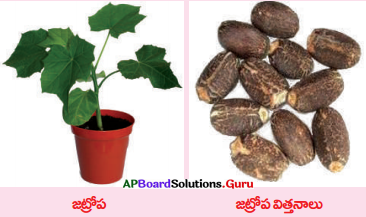
AP 10th Class Biology Important Questions 10th lesson సహజ వనరులు 10
* బయో డీజిల్ ఉత్పత్తికి జట్రోపా కర్కాస్ యొక్క విత్తనాలు వాడడం అనేది శక్తి సుస్లిరత్వాన్ని సాధించడంలో భారతదేశం యొక్క ప్రణాళికలో ముఖ్యమైన ఘట్టం. జట్రోపా మొక్కల పెంపకంపై ఆంధ్రప్రదేశ్ ప్రభుత్వం, రిలయన్స్ కంపెనీతో ఒక ఒప్పందాన్ని చేసుకుంది. జట్రోపా మొక్కలను పెంచి నాణ్యమైన బయో డీజిల్ ను ఉత్పత్తి చేయడానికి ఈ కంపెనీ కాకినాడ వద్ద 200 ఎకరాల స్థలాన్ని సేకరించింది. జీవ ఇంధనాలను తయారుచేసే పద్దతిని బయో ఎస్టరిఫికేషన్ అంటారు.

పునశ్చరణ
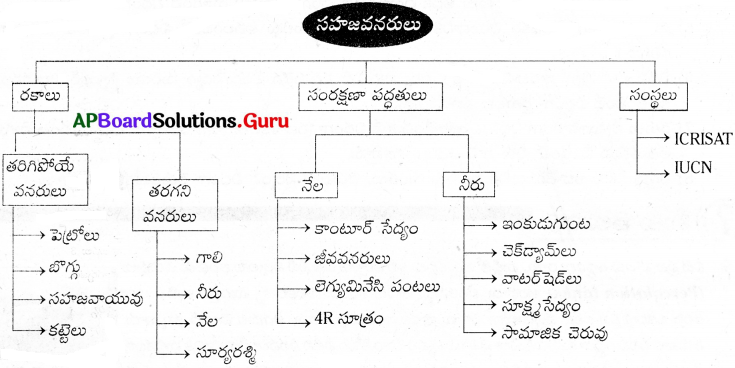
AP 10th Class Biology Important Questions 10th lesson సహజ వనరులు 11

AP Board 10th Class Biology Solutions 10th Lesson సహజ వనరులు 8

AP Board 10th Class Biology Solutions 10th Lesson సహజ వనరులు 9

AP Board 7th Class Social Solutions 5th Lesson Kakatiya Kingdom

SCERT AP 7th Class Social Study Material Pdf 5th Lesson Kakatiya Kingdom Textbook Questions and Answers.

AP State Syllabus 7th Class Social 5th Lesson Questions and Answers Kakatiya Kingdom

7th Class Social 5th Lesson Kakatiya Kingdom Textbook Questions and Answers

Review Of Your Previous Knowledge
AP Board 7th Class Social Solutions 5th Lesson Kakatiya Kingdom

Observe the given Map and respond to the following questions.

Question 1.
Which dynasties do you observe in the given map?
Answer:

  1. Rajput kingdoms
  2. Delhi Sultanate
  3. Eastern Gangas
  4. Kakatiya kingdom
  5. Hoyasalas
  6. Pandyas

Question 2.
According to given map who ruled Andhra region?
Answer:
Kakatiya Kingdom.

AP Board 7th Class Social Solutions 5th Lesson Kakatiya Kingdom

Question 3.
Name the South Indian kingdoms in the given map?
Answer:

  1. Delhi Sultanate
  2. Eastern Gangas
  3. Kakatiya Kingdom
  4. Pandyas.

Improve Your Learning

I. Answer the following questions.

Question 1.
How did the Kakatiyas emerge as independent rulers?
Answer:

  1. Early Kakatiyas served as a feudatories to the Rashtrakutas and the Western Chalukya kings.
  2. They were holding the posts of village heads called Rattadi and through their military skills became army chiefs, Samanthas, etc., and gained control over Ammakonda in Telangana.
  3. The Kakatiyas emerged as independent rulers after the fall of Western Chalukyas.

Question 2.
Explain about the Kakatiya’s Administration.
Answer:
Kakatiya’s Administration :

  1. The administration of the kingdom was organised on a military basis.
  2. The Kakatiyas divided their territories among a number of military chiefs known as Nayankara.
  3. The Nayankara had to maintain a stipulated number of troops for the services of the king.
  4. The village administrative divisions were divided into two main classes, the Sthala and the Nadu.
  5. The Sthala consisted of a group of villages ranging perhaps from 10 to 60 in number.
  6. Nadu formed out of a combination of several Sthalas.
  7. The villages were looked after by village officials called Ayagars.
  8. The village was the basic unit of administration.

Question 3.
Who were Nayankara? Why were they appointed?
Answer:
Nayankara who served as a feudatory to the Kakatiyas obtained grants of lands from the Kakatiya monarchs to enable them to maintain their status.

“The skilled warriors are called Nayankar.”

They were appointed to collect the taxes and the maintain the army.

These Nayankaras were always loyal to the king or queen.

Question 4.
Describe the Kakatiya art and architecture.
Answer:
Art and Architecture of Kakatiyas :

  1. The Thousand pillar temple and Ramappa temple were glorious constructions of the Kakatiya dynasty.
  2. The iconic Kakatiya Toranam was built by Ganapathi Deva.
  3. The scenic Pakhal Lake in Warangal is one of the famous.
  4. The Thousand pillar temple has rock cut elephants and the monolithic dolerlte rock Nandi are the main attractions.
  5. Ramappa temple was built with brick.
  6. The carvings on them depict flowers, creepers, elephants, gandharvas, dancers, epic stories, etc.
  7. Among the statues Yakshini’s and Nagini’s are most attractive.
  8. Some of the pillars of that temple produce Saptaswaras.
  9. Kakatiya temple architecture shows fantastic smooth carving of black-marble stone.
  10. They followed Mandapa, Antaralaya and Garbha griha model with pillar sculptures. This style is called Thrikuta method.
  11. UNESCO recognised this art and architecture as world heritage centres.

AP Board 7th Class Social Solutions 5th Lesson Kakatiya Kingdom

Question 5.
Read Introduction paragraph “During medieval period …………. art and architecture” comment.
Answer:
During the medieval period five important kingdoms are there in South India. Among them Kakatiyas are very famous.

  1. Though they faced so many rampages from other kingdoms the Kakatiya’s did their best to protect their kingdoms.
  2. They put more effort to promote unity among the regions which are under their control.
  3. They encouraged local languages with the help of poets and scholars.
  4. The protect their own architecture with the construction of temples and arches, etc.

Question 6.
Rudrama Devi, Ganapathi Deva, Prola raj II, Mahadev Rudra deva. Following rulers arrange in a chronological order.
Answer:
Kakatiya Rules:

  1. Prola Raju-II : 1115-1157 C.E
  2. Maha Deva : 1195-1199 C.E
  3. Ganapathi Deva : 1199-1262 C.E
  4. Rudramma Devi : 1262-1289 C.E

Question 7.
A European traveller visited Rudrama Devi reign. Who was he and which country did he come from?
Answer:
Marco Polo an Italian traveller visited Rudrama devi’s court.

Question 8.
Write a short note on the Economic and Social life of people in the Kakatiya reign.
Answer:
Economic Social life of people :

  1. Some of the farmers get the land from the king on rent purpose these are called Artha Seeri.
  2. The Kakatiyas brought large tracts of forest land under cultivation.
  3. For the encouragement of agriculture rulers dug many tanks and constructured reservoirs.
  4. During this period trade tax, lllari (house tax), Pullari (forest products), tax upon of flock (Addapatlu Sunkam) were imposed.
  5. The imposed professional tax on artisans.
  6. They appointed officials called Sunkadhikavisfor tax collection.
  7. The Kakatiya kings gave much importance to foreign trade.
  8. They developed Motupalli Port for this purpose.
  9. In this period many women members of royal families made land grants.
  10. Land, tanks, money, cattle, jewellery, etc., were donated to temple’s, brahmins and others.

Question 9.
Which regional dynasties emerged in the south India in Medieval era?
Answer:
During the medieval period five important kingdoms emerged in South India.
They are:

  1. The Chalukyas of Kalyani,
  2. The Yadavas,
  3. The Kakatiyas,
  4. The Hoyasalas and
  5. The Pandyas.

Question 10.
Locate the following places in India map.
a) Godavari river b) Motupalli c) Warangal d) Devagiri
Answer:
AP Board 7th Class Social Solutions 5th Lesson Kakatiya Kingdom 2

II. Choose the correct answer.

1. Founder of the Kakatiya Dynasty was ………….
a) Gundyana
b) Recharla Rudra
c) Ganapathi deva
d) Jayapa
Answer:
a) Gundyana

2. The Kakatiyas worshipped the mother goddess ……………..
a) Ammathalli
b) Kakati
c) Tripurasundari
d) Maisamma
Answer:
b) Kakati

3. Siva tatava saaram was written by ……………..
a) Mallikharjuna Panditharadya
b) Jayapa
c) Palkurki Somanadha
d) Nanne Choda
Answer:
a) Mallikharjuna Panditharadya

4. In every village some land was kept under king’s possession it was …………….
a) Velipolam
b) Rachapolam
c) Thotapolam
d) All the above
Answer:
b) Rachapolam

5. Motupalli inscription was issued by ………………
a) Rudrama Devi
b) Rudra Deva
c) Prataparudra
d) Ganapathi Deva
Answer:
d) Ganapathi Deva

III. Match the following.

Group-AGroup-B
1. Basava puranama) Vidhyanadha
2. Kumara Sambhavamb) Palkurki Somanadha
3. Nrutya Ratnavalic) Nanne Chodudu
4. Pratapa Rudreeyamud) Tikkana
5. Srimadandhra Mahabharatame) Jayapa

Answer:

Group-AGroup-B
1. Basava puranamb) Palkurki Somanadha
2. Kumara Sambhavamc) Nanne Chodudu
3. Nrutya Ratnavalie) Jayapa
4. Pratapa Rudreeyamua) Vidhyanadha
5. Srimadandhra Mahabharatamd) Tikkana

IV. Fill in the blanks with suitable words.

1. Ramappa temple is located at ………………… .
2. Vilasa Grant referred to ………………… Nayaka.
3. Rekhapalli lies in the ………………… river basin.
4. Educational institutions Ghatikas were established by ………………… kingdom.
5. Capital of Yadavas ………………… .
Answer:

  1. Warangal near Palampet village.
  2. Prolaya
  3. Sabari
  4. Chalukyas of Kalyani
  5. Devagiri

Puzzle

Draw boxes with help of given clue words.
AP Board 7th Class Social Solutions 5th Lesson Kakatiya Kingdom 3
1. Early capital of Kakatiya’s (11)
2. Women ruler in Kakatiya’s (11)
3. New capital of Kakatiya’s (8)
4. Prataparudra lost his throne due to the invasion of (9)
5. Nrutya ratnavali written by (6)
6. A fortified building called (4)
7. Women ruler (5)
8. Tax on forest products (7)
9. House tax (6)
10. The place where ships are allowed (4)
11. Founder of Chalukyas (7)
Answer:
AP Board 7th Class Social Solutions 5th Lesson Kakatiya Kingdom 4

  1. Hanukonda
  2. Rudrama Devi
  3. Orugallu
  4. Ulghu Khan
  5. Jayapa
  6. Fort
  7. Queen
  8. Pullari
  9. lllari
  10. Port
  11. Thilapa

7th Class Social 5th Lesson Kakatiya Kingdom InText Questions and Answers

7th Class Social Textbook Page No. 72

Question 1.
Have you heard any news related to ancient excavations and remains of historical monuments? Discuss in class.
Answer:
Yes, I heard some news about excavations in recent times.

Madurai: A granite plough and a tiny terracotta cubical dice have been found during the latest excavations at Keeladi ancient site in Tamilnadu.

R. Sivanatham, Deputy Director of Archaeology, State Archaeological Department, said the cubical dice has numbers one, two, three, four, five and six marked on it with depressions.

The three-sided granite plough is indicative of the fact that the people of Keeladi was indulged in farming according to him.

Think & Respond

7th Class Social Textbook Page No. 68

Question 1.
How do you think Rudrama Devi got those brave adventurous qualities?
Answer:
It was possible because that she was trained well from her childhood in the martial arts as well as in administrative skills.

They helped her to lead large armies and become a good administrator.

AP Board 7th Class Social Solutions 5th Lesson Kakatiya Kingdom

7th Class Social Textbook Page No. 69

Question 2.
Why did the Kakatiya rulers transfer the Nayankaras frequently?
Answer:
Nayankara were given several villages from where they could collect tax, but they did not keep the villages permanently.

They could be transferred at the will of the king to a new place.

7th Class Social Textbook Page No. 71

Question 3.
What aspects do you observe while visiting a temple?
Answer:
I observed the following aspects :

  1. This temple is famous for Vishnu and Siva being combinedly worshipped in the same place.
  2. Temple was built with brick.
  3. The statues of this temple were made of black granite stone.
  4. They used decorative art very beautifully.
  5. The statue of Nandi here is very splendid.
  6. Some of the pillars of that temple produce Saptaswaras.

7th Class Social Textbook Page No. 73

Question 4.
Why did all the local kings form into an alliance?
Answer:
The local kings formed an alliance to protect themselves from Muslim invasions.

Ex : Prolaya Verna Reddy and Prolaya Nayaka had joined efforts to drive the Muslim rule out from their area.

Explore

7th Class Social Textbook Page No. 64

Question 1.
Know the duration of the Medieval period with the help of your teacher.
Answer:
The Medieval period may be divided into two periods.
1. The Early Medieval period which lasted from the 6th to the 13th century and the “Late Medieval period” which lasted from the 13th to 16th century, ending with the start of the Mughal empire in 1526 A.D.

7th Class Social Textbook Page No. 67

Question 2.
Find out more details about Kakatiya Kala Thoranam from the internet.
Answer:

  1. The arch was built around 12th century during the rule of Kakatiya dynasty.
  2. The monument was included in the list of UNESCO World Heritage site.
  3. The Warangal Fort has four Arnamental gates to the destroyed great Shiva temple which are known as Kakatiya Kala Toranam.
  4. These gates or arches in the Warangal Fort are said to have similarities with the gateways of the Sanchi Stupa.

AP Board 7th Class Social Solutions 5th Lesson Kakatiya Kingdom

7th Class Social Textbook Page No. 73

Question 3.
Let us discuss : What do we learn from History?
a) We should know the past and act wisely in future.
b) We should learn the heritage and culture from the past
Now add your opinion ……………………
…………………………………………………..
Answer:

  1. History helps us develop a better understanding of the world.
  2. History teaches a working understanding of change.
  3. History gives us the tools we need to be decent citizens.
  4. History makes us better decision makers.

Project Work

Collect the pictures related to Kakatiya kingdom and prepare photo album.
Answer:

AP Inter 1st Year Botany Study Material Chapter 11 Cell Cycle and Cell Division

Andhra Pradesh BIEAP AP Inter 1st Year Botany Study Material 11th Lesson Cell Cycle and Cell Division Textbook Questions and Answers.

AP Inter 1st Year Botany Study Material 11th Lesson Cell Cycle and Cell Division

Very Short Answer Questions

Question 1.
Between a Prokaryote and a eukaryote, which cell has a shorter cell division time?
Answer:
Prokaryotic cell.

Question 2.
Among Prokaryotes and eukaryotes, which one has a shorter duration of a cell cycle?
Answer:
Prokaryotic cell.

Question 3.
Which of the phases of the cell cycle is of the longest duration?
Answer:
Interphase.

Question 4.
Which tissue of animals and plants exhibits Meiosis?
Answer:
Meiosis occurs in diploid cells.

Question 5.
Given that the average duplication time of E.coli is 20 minutes. How much time will two E.coli cells take to become 32 cells?
Answer:
80 minutes.

Question 6.
Which part of the human body should one use to demonstrate stages in Mitosis?
Answer:
Cells lining the Gut and skin cells.

AP Inter 1st Year Botany Study Material Chapter 11 Cell Cycle and Cell Division

Question 7.
What attributes does a chromatid require to be classified as a chromosome?
Answer:
Each chromosome at Metaphase split and the two daughter chromatids now referred to as chromosoms.

Question 8.
Which of the four chromatids of a bivalent at prophase-I of Meiosis can involve in cross-over?
Answer:
Crossing over occurs between non-sisters chromatids of the homologous chromosomes.

Question 9.
If a tissue has at a given time 1024 cells. How many cycles of Mitosis had the original parental single cell undergone?
Answer:
10 Mitotic divisions.

Question 10.
An anther has 1200 pollen grains. How many pollen mother cells must have been there to produce them?
Answer:
300.

Question 11.
At what stage of cell cycle does DNA synthesis occur?
Answer:
‘S’ phase (synthesis phase).

Question 12.
It is said that one cycle of cell division in human cells, (Eukaryotic cells) take 24 hours. Which phase of the cycle, do you think occupies the maximum part of cell cycle?
Answer:
Interphase.

Question 13.
It is observed that heart cells do not exhibit cell-divisjon. Such cells do not divide further and exit phase to enter an inactive stage called of cell cycle. Fill in the blanks.

AP Inter 1st Year Botany Study Material Chapter 11 Cell Cycle and Cell Division

Question 14.
Identify the sub stages of Prophase n I in Meiosis in which synapse and desynapse are formed?
Answer:
Synthesis occurs in ‘zygotene’ a sub phase of Prophase I of Meiosis -I
Desynapse occurs in ‘diakinesis’ a sub phase of prophase I of Meiosis -I
G1 Phase. Quiescent stage (G0).

Question 15.
Name the stage of Meiosis in which actual reduction in chromosome number occurs.
Answer:
Anaphase – II

Question 16.
Mitochondria and plastids have their own DNA (genetic material). What is their fate during nuclear division like Mitosis?
Answer:
Mitochondria and plastids get distributed between the two daughter cells.

Question 17.
A cell has 32 chromosomes. It undergoes mitotic division. What will be the chromosome number during Metaphase? What would be the DNA content (c) during anaphase?
Answer:
32 chromosomes. The DNA content during anaphase gets doubled.

Question 18.
The following events occur during the various phases of the cell cycle. Fill the blanks with suitable answer against each.
a) Disintegration of Nuclear Membrane
b) Appearance of Nucleolus
c) Division of centromere
d) Replication of DNA
Answer:
a) Prophase
b) Telophase
c) Anaphase
d) S-Phase

Question 19.
While examining the Mitotic stage in a tissue, one finds some cells with 16 chromosomes and some with 32 chromosomes. What possible reasons could you give to this difference in chromosome number ? Do you think cells with 16 chromosomes could have arisen from cells with 32 chromosomes or vice versa?
Answer:
In cells with 16 chromosomes Mitosis is over, in cells with 32 chromosomes, Mitosis is not started. No. Cells with 16 chromosomes have not arisen from the cells with 32 chromosomes.

Question 20.
Two key events take place during S phase in animal cells. DNA replication and duplication of Centriole. In which parts of the cell do these events occur?
Answer:
Nucleus, Cytoplasam.

AP Inter 1st Year Botany Study Material Chapter 11 Cell Cycle and Cell Division

Question 21.
Name a cell that is found arrested in diplotene stage for months and years. Comment in two or three sentences how it complete cell cycle?
Answer:
Oocytes of some vertebrates.

Short Answer Type Questions

Question 1.
In which phase of meiosis are the following formed? Choose the answers from hint points given below,
a) synaptonermal complex
b) Recombination nodules
c) Appearance / activation of a Enzyme recombinase
d) Termination of chliasmata
e) Interkinesis
f) Formation of dyad of cells.
Hints :
1) Zygotene
2) Pachytene
3) Pachytene
4) Diakinesis
5) After Telophase I / before Meiosis II
6) /Telophase I / After Meiosis I
Answer:
a) Synaptonemal complex = Zygotene
b) Recombination nucleus = Pachytene
c) Appearance / activation of = Pachytene Enzyme recombinase
d) Termination of chaismata = Diakinesis
e) Interkinesis = The stage between the two meiotic divisions (After telophase I / before meiosis II)
f) Formation of dyad of cells = Telophase I / After meiosis I.

Question 2.
Mitosis results in producing two cells which are similar to each other. What would be the consequence if each of the following irregularities occurs during Mitosis?
a) Nuclear membrane fails to disintegrate
b) Duplication of DNA does not occurs.
c) Centromeres do not divide
d) Cytokinesis does not occur.
Answer:
a) Nuclear membrane fails to disintegrate : The nuclear divisions takes place.
b) Duplication of DNA does not occurs : Of two daughter cells, one cannot get DNA.
c) Centromers do not divide : Chromosomes are not distributed to daughter cells.
d) Cytokinesis does not occur : Multinucleate condition arises leading to the formation of syneytium (liquid endoplasm of coconut).

Question 2.
Describe the events of prophase – I
Answer:
Meiosis I is longer phase and consists of 5 sub phases namely Leptotene, Zygotene, Pachytene, Diplotene and Diakinesis.
AP Inter 1st Year Botany Study Material Chapter 11 Cell Cycle and Cell Division 1
a) Leptotene :
The nucleus increases in size by absorbing water from the cytoplasm. The chromatin material organises into a constant number of chromosomes. The chromosomes are long, slender and show bead like structures called chromomeres.

AP Inter 1st Year Botany Study Material Chapter 11 Cell Cycle and Cell Division 2
b) Zygotene :
The chromosomes become shorter and thicker. They approach each other and form pairs. This homologous pair is called bivalent and the process of pairing is called synapsis. It is accompanied by the formation of Synaptonemal complex. The synapsis occurs at proterminal point or procentric or random means.

AP Inter 1st Year Botany Study Material Chapter 11 Cell Cycle and Cell Division 3
c) Pachytene :
Bivalent chromosomes now clearly appear as tetrads. This stage is characterised by the presence of recombination modules, the sites of which crossing over occurs between the non-sister chromatids of the homologous chromosomes. Crossing – over is the exchange of genetic material between the two homologous chromosomes. It is also an enzyme mediated process by ‘recombinase’ crossing over leads to recombination of genetic material on the two chromosomes.

AP Inter 1st Year Botany Study Material Chapter 11 Cell Cycle and Cell Division 4
d) Diplotene :
The homologous chromosomes of a bivalent begin to separate from each other except at the sites of cross overs to dissolution of synaptonemal complex. The ‘X’ shaped structures are called chaismata.

AP Inter 1st Year Botany Study Material Chapter 11 Cell Cycle and Cell Division 5
e) Diakinesis :
It is marked by terminalisation of chaismata. In this phase, the chromosomes are fully condensed and the meiotic spindle is assembled to prepare the homologous chromosomes for separation. By the end of this phase, the nuclear membrane breaks down the nucleolus disappears.

The chromatids undergo condensation, contraction and thickening.

Question 4.
Mention the significance of Meiosis.
Answer:

  1. It maintains the same chromosome number in the sexually reproducing organisms.
  2. It restricts the multiplication of chromosome number and maintains the stability of the species.
  3. Maternal and paternal genes get exchanged during crossing over. It results in variations among the offspring.
  4. All the four chromatids of homologous pair of chromosomes seggregate and go over separately to four different daughter cells this leads to variation in the daughter cells genetically.
  5. Variations play an important role in the process of evolution.

AP Inter 1st Year Botany Study Material Chapter 11 Cell Cycle and Cell Division

Question 5.
Which division is necessary to maintain constant chromosome number in all body cell of multicellular organism and why?
Answer:
Mitosis is necessary to maintain constant number of chromosomes in all body cells in multicellular organisms because mitosis results in the production of diploid daughter cells with genetic employment usually identical to that of the parent cell. The growth of multicellular organisms is due to mitosis. Cell growth results in distributing the ratio between the nucleus and cytoplasam.

It therefore essential for the cell division to restore the nucleo-cytoplasamic ratio. A very significant contribution of mitosis is cell repair. Mitotic divisions in the meristametic tissues, the apical and the lateral Meristems, results in a continuous growth of plants throughout their life.

Question 6.
Though redundantly described as a resting phase. Interphase does not really involve rest. Comment.
Answer:
The interphase also called phase of non-apparent division through called the resting phase is the time during which the cell is preparing for division by involving both cell growth and DNA replication. The interphase is divided into three further phases. They are :

i) ‘G1‘ phase :
It corresponds to the internal between mitosis and initiation of DNA replication. In this the cell is metobolically active and continuously grows.

ii) ‘S’ phase :
Synthesis phase marks the period during which DNA synthesis or replication takes place. The amount of DNA per cell doubles. However, there is no increase in the number of chromosomes.

iii) ‘G2‘ phase :
Proteins are synthesized.
AP Inter 1st Year Botany Study Material Chapter 11 Cell Cycle and Cell Division 6

Question 7.
Comment on the statement – Meiosis enables the conservation of specific chromosome number of each species even though the process per se. results in reduction of chromosome number.
Answer:
Meiosis is the mechanism by which conservation of specific chromosome number in each species is achieved across generations in sexually reproducing organisms, even though the process per sec periodically results in the reproduction of chromosome number by half. It also increases the genetic variability in the population of organisms from one generation to the next. Variations are very important for the process of evolution.

Question 8.
How does cytokinesis in plant cells differ from that in animal cells?
Answer:
In animal cells, cytokineis is achieved by the appearence of a furrow in the plasma membrane. The furrow gradually deepens and ultimately joins in the centre dividing the cell cytoplasam into two plant cells, are enclosed by a relatively inextensible cell wall. In plant cells, wall fromation starts in the centre of the cell and grows outward to meet the exiting lateral walls. The formation of the new cell wall begins with the formation of cell plate that represents the middle lamella between the walls of two adjacent cells.

Long Answer Type Questions

Question 1.
Discuss on the statement – Telophase is reverse of prophase.
Answer:
Telophase is the final stage of Mitosis in which the chromosomes that have reached their respective poles decondenses and loose their individuality. Chromosomes cluster at opposite spindle poles and their identity is lost as discrete elements. Nuclear membrane assimilates around the chromosome clusters. Nucleolus, Golgi complex and endoplasmic reticulum reform where as in prophase, chromosomal material condenses and organises to form compact chromosomes. Nuclear membrane, Nucleolus, Golgi complexes. Endoplasmic reticulum disappears. Thats why Telophase is the reverse phase to prophase.

Question 2.
What are the various stages of meiotic prophase – I? Enumerate the chromosomal events during each stage?
Answer:
Meiosis I is longer phase and consists of 5 sub phases namely Leptotene, Zygotene, Pachytene, Diplotene and Diakinesis.

AP Inter 1st Year Botany Study Material Chapter 11 Cell Cycle and Cell Division 1
a) Leptotene :
The nucleus increases in size by absorbing water from the cytoplasm. The chromatin material organises into a constant number of chromosomes. The chromosomes are long, slender and show bead like structures called chromomeres.

AP Inter 1st Year Botany Study Material Chapter 11 Cell Cycle and Cell Division 2
b) Zygotene :
The chromosomes become shorter and thicker. They approach each other and form pairs. This homologous pair is called bivalent and the process of pairing is called synapsis. It is accompanied by the formation of Synaptonemal complex. The synapsis occurs at proterminal point or procentric or random means.

AP Inter 1st Year Botany Study Material Chapter 11 Cell Cycle and Cell Division 3
c) Pachytene :
Bivalent chromosomes now clearly appear as tetrads. This stage is characterised by the presence of recombination modules, the sites of which crossing over occurs between the non-sister chromatids of the homologous chromosomes. Crossing – over is the exchange of genetic material between the two homologous chromosomes. It is also an enzyme mediated process by ‘recombinase’ crossing over leads to recombination of genetic material on the two chromosomes.

AP Inter 1st Year Botany Study Material Chapter 11 Cell Cycle and Cell Division 4
d) Diplotene :
The homologous chromosomes of a bivalent begin to separate from each other except at the sites of cross overs to dissolution of synaptonemal complex. The ‘X’ shaped structures are called chaismata. The chromatids undergo condensation, contraction and thickening.

AP Inter 1st Year Botany Study Material Chapter 11 Cell Cycle and Cell Division 5
e) Diakinesis :
It is marked by terminalisation of chaismata. In this phase, the chromosomes are fully condensed and the meiotic spindle is assembled to prepare the homologous chromosomes for separation. By the end of this phase, the nuclear membrane breaks down the nucleolus disappears.

Question 3.
Differentiate between the events of mitosis and meiosis.
Answer:

MitosisMeiosis
1. It occurs in both haploid and diploid organisms.1. It occurs only in diploid organisms.
2. It occurs in somatic cells.2. It occurs in the reproductive cells.
3. Nucleus divides once.3. Nucleus divides twice.
4. Daughter cells are identical.4. Daughter cells are not identical.
5. Two daughter cells are formed.5. Four daughter cells are formed.
6. Prophase is simple.6. Prophase is complicated and shows five sub-stages.
7. Pairing of chromosomes does not occur.7. Homologous chromosomes pair to form bivalents.
8. Both chaismata and crossing over are absent.8. Crossing over occurs between non¬sister chromatids and chiasmata are formed.
9. Centromeres undergo division in anaphase.9. Centromeres do not divide in anaphase-I, but divide in anaphase-II.
10. Daughter chromosomes move to the opposite poles.10. Bivalents are separated. They move to opposite pies.
11. The chromosome number of daughter nuclei is unchanged.11. The chromosome number of daughter nuclei is reduced to half.
12. Duration of time is less.12. Duration of time is more.

Question 4.
Write brief note on the following :
a) Synaptonemal complex b) Metaphase plate
Answer:
a) Synaptonemal complex :
The homologous chromosomes approach each other and form pairs called Bivalents and the process is called synapsis. The synapsis occurs at the both ends and progresses towards their centromeres called proterminal or the synapsis starts from their centromeres and the pairing progresses towards the end of the chromosomes called procentric or the pairing occurs at various points of homologous chromosomes called Randon synapsis. The paired homologous chromosomes are joined by a thick protein containing frame work called synaptonemal complex (Sc).Sc stabilizes the pairing of the homologous chromosomes and facilitates crossing over and recombination.

b) Metaphase plate :
Metaphase chromosome is made up of two sister chromatids’which were held together by the centromere. Small disc shaped structures at the surface of of the centromeres are called Kinetochores. These serve as the sites of attachment of spindle fibres to the chromosomes that are moved into centre of the cell. Hence all chromosomes lie at the equator with one chromatid of each chromosome connected by its kinetochore to spindle fibres from one pole and its sister chromatid connected by its kinetochore to spindle fibres from the opposite pole. It is called ‘Metaphase Plate’.

AP Inter 1st Year Botany Study Material Chapter 11 Cell Cycle and Cell Division

Question 5.
Write briefly the significance of mitosis and meiosis in multicellular organism.
Answer:
Significance of Mitosis :

  1. Growth in organisms is caused by Mitosis.
  2. The daughter cells formed by Mitosis are identical with the mother cell in characters. Hence it it important in conserving the genetic diversity of the organisms.
  3. In unicellular organisms, Mitosis help in reproduction.
  4. The old dead and decaying cells of body are replaced with the help of Mitosis.
  5. It is useful in regeneration of lost parts and for grafting in vegetative reproduction.

Significance of Meiosis :

  1. Meiosis helps in the maintenance of a constant chromosome number from one generation to the next.
  2. Due to crossing over, genetic recombinations are caused which help in the origin of new species and lead to evolution.
  3. It helps in the formation of gametes and is thus useful in sexual reproduction.

Intext Questions

Question 1.
Name a stain commonly used to colour chromosome.
Answer:
Giemsa strain is used.

Question 2.
Name the patholqgical condition when uncontrolled cell division occurs.
Answer:
Cancer.

Question 3.
An organism has two parts of chromosomes (i.e., chromosome number = 4) Diagra-matically represent the chromosomal arrangement during different phases of Meiosis II.
Answer:
An organism has two pairs of chromosomes (i.e., chromosome number = 4) Diagrammatically represent the chromosomal arrangement during phases of meiosis – II.
AP Inter 1st Year Botany Study Material Chapter 11 Cell Cycle and Cell Division 7

Question 4.
Meiosis has events that lead to both gene recombinations as well as mendelian recombinations. Discuss.
Answer:
An organism often many phenotypic fruits in its body; are determined by at least pair of alleles (or) gener During the events of meiosis – I (crossing over) recombination events occur to pass different combination of chromosomes and consequently different combination of characters in both daughter cells.

The random assortment of the genes is due not only to crossing over but also to the random distribution of the chromosomes in first and second division. How ever, since this separation is a random process, the resulting cells will contain different chromosomal combinations even in the abscence of crossing over.

AP Inter 1st Year Botany Study Material Chapter 11 Cell Cycle and Cell Division

Question 5.
Both unicellular and multicellular organisms undergo mitosis. What are the differences if any observed between the two processes?
Answer:

  1. In unicellulars it is referred as binary fission and in multicellulars it is referred as mitosis.
  2. Mitosis allows unicellular organisms to reproduce and create more (identical) organisms.
  3. In unicellular only one cell undergoes mitosis whereas in multicellular all cells undergo mitosis.

AP Board 6th Class Maths Solutions Chapter 10 Practical Geometry Ex 10.2

AP State Syllabus AP Board 6th Class Maths Solutions Chapter 10 Practical Geometry Ex 10.2 Textbook Questions and Answers.

AP State Syllabus 6th Class Maths Solutions 10th Lesson Practical Geometry Ex 10.2

AP Board 6th Class Maths Solutions Chapter 10 Practical Geometry Ex 10.2

Question 1.
Draw a line segment PQ = 5.8 cm and construct its perpendicular bisector using ruler and compasses.
Solution:
AP Board 6th Class Maths Solutions Chapter 10 Practical Geometry Ex 10.2 1
Steps of construction :

  1. Draw a line segment \(\overline{\mathrm{PQ}}\) = 5.8 cm.
  2. Set the compasses as radius with more than half of the length of \(\overline{\mathrm{PQ}}\).
  3. With P as centre, draw arcs below and above the line segment.
  4. With the same radius and Q as centre draw two arcs above and below the line segment to cut the previous arcs. Name the intersecting points of arcs as X and Y.
  5. Join the points X and Y. So, the line I is the perpendicular bisector of PQ.
    Hence l is required perpendicular bisector of PQ which meets at A.

Question 2.
Ravi made a line segment of length 8.6 cm. He constructed a bisector of AB on C. Find the length of AC and BC.
AP Board 6th Class Maths Solutions Chapter 10 Practical Geometry Ex 10.2 2
Solution:
AP Board 6th Class Maths Solutions Chapter 10 Practical Geometry Ex 10.2 3
As it is a bisector, it divides the line segment into two equal parts.
Each equal part is half of AB (8.6 cm) = \(\frac{\mathrm{AB}}{2}=\frac{8.6}{2}\) = 4.3 cm
∴ AC = BC = 4.3 cm

AP Board 6th Class Maths Solutions Chapter 10 Practical Geometry Ex 10.2

Question 3.
Using ruler and compasses, draw AB = 6.4 cm. Locate its mid point by geometric construction.
Solution:
AP Board 6th Class Maths Solutions Chapter 10 Practical Geometry Ex 10.2 4

  1. Draw a line segment \(\overline{\mathrm{PQ}}\) = 6.4 cm
  2. Set the compasses as radius with more than half of the length of \(\overline{\mathrm{PQ}}\).
  3. With A as centre, draw arcs below and above the line segment.
  4. With the same radius and B as centre draw two arcs above and below the line segment to cut the previous arcs. Name the intersecting points of arcs as X and Y.
  5. Join the points X and Y. So, the line l is the perpendicular bisector of AB.
    Hence l is the required perpendicular bisector of AB which meets at M.

AP Board 6th Class Maths Solutions Chapter 10 Practical Geometry Ex 10.1

AP State Syllabus AP Board 6th Class Maths Solutions Chapter 10 Practical Geometry Ex 10.1 Textbook Questions and Answers.

AP State Syllabus 6th Class Maths Solutions 10th Lesson Practical Geometry Ex 10.1

AP Board 6th Class Maths Solutions Chapter 10 Practical Geometry Ex 10.1

Question 1.
Construct a line segment of length 6.9 cms using ruler and compass.
AP Board 6th Class Maths Solutions Chapter 10 Practical Geometry Ex 10.1 1
Solution:
Steps of construction:

  1. Draw a line l. Mark a point A on the line l.
  2. Place the metal pointer of the compass on the zero mark of the ruler. Open the compass, so that pencil point touches the 6.9 cm mark on the ruler.
  3. Place the pointer at A on the line l and draw an arc to cut the line. Mark the point where the arc cuts the line as B
  4. On the line l, we got the line segment AB of required length.
    AP Board 6th Class Maths Solutions Chapter 10 Practical Geometry Ex 10.1 2

Question 2.
Construct a line segment of length 4.3 cms using ruler.
Solution:
AP Board 6th Class Maths Solutions Chapter 10 Practical Geometry Ex 10.1 3
Steps of construction:

  1. Place the ruler on paper and hold it firmly.
  2. Mark a point with a sharp edged pencil against 0 cm mark on the ruler. Name the point as P.
  3. Mark another point against 3 small divisions just after the 4 cm mark. Name this point as Q.
  4. Join points P and Q along the edge of the ruler.
    Therefore, PQ is the required line segment of length 4.3 cm.

AP Board 6th Class Maths Solutions Chapter 10 Practical Geometry Ex 10.1

Question 3.
Construct a circle with centre M and radius 4 cm.
Solution:
AP Board 6th Class Maths Solutions Chapter 10 Practical Geometry Ex 10.1 4
Steps of construction:

  1. Mark a point M on the paper.
  2. By using compasses take 4 cm as the radius on with the scale.
  3. Place the metal point on M and draw a circle from M.
    Hence required circle is constructed with center M and radius 4 cm.

Question 4.
Draw any circle and mark three points A, B and C such that
(i) A is on the circle
(ii) B is in the interior of the circle
(iii) C is in
Solution:
AP Board 6th Class Maths Solutions Chapter 10 Practical Geometry Ex 10.1 5

AP Board 7th Class English Solutions Chapter 1C The New Blue Dress

AP State Syllabus AP Board 7th Class English Textbook Solutions Chapter 1C The New Blue Dress Textbook Questions and Answers.

AP State Syllabus 7th Class English Solutions Chapter 1C The New Blue Dress

7th Class English Chapter 1C The New Blue Dress Textbook Questions and Answers

I. Answer the following questions.

Question 1.
What kind of street was Gates Avenue at the beginning of the story?
(Or)
What was Gates Avenue ? How was it at the beginning of the story?
Answer:
Gates Avenue was a part of the city of Cleveland. At the beginning of the story, it was dirty and ugly. It had no pavement, no running water facility and no street lighting. It was noisy also because of the nearby railway-track.

AP Board 7th Class English Solutions Chapter 1C The New Blue Dress

Question 2.
What happened to the Gates Avenue by the end of the story?
Answer:
By the end of the story the Gates Avenue had a good pavement, streetlight on the corner and running water facility. The houses were painted’and the surroundings were clean.

Question 3.
Why do you think the teacher gave the blue dress to the little girl?
Answer:
The teacher saw the little girl wearing the same dress over months. She understood that the little girl most probably had no other dress to wear. She was kind and sympathetic. She took pity on the little girl. So she gave her the new blue dress.

Question 4.
What change did the new blue dress bring in the little girl’s house?
Answer:
The little girl’s parents decided to keep the house and the surroundings clean. The girl’s mother put a cloth on the kitchen table. She washed the kitchen floor. Her husband repaired the fence. He made a garden with the help of the members of his family.

AP Board 7th Class English Solutions Chapter 1C The New Blue Dress

Question 5.
How did the change in the little girl’s house influence the neighbours?
Answer:
The neighbours watched the change in the little girl’s house. They too painted their houses and kept them clean.

The New Blue Dress Summary in English

A small good act of a person can make others good. It can change the entire complexion of the surroundings. The present story ‘The New Blue Dress” illustrates this.

Gates Avenue was a short and dirty street in Cleveland. The inhabitants of that street were poor. They never tried to improve their living conditions and better their standard of living. There was no tap water supply in Gates Avenue. There were no street lights. There was also no good pavement.

There was a little girl studying in a school in Gates Avenue. She used to wear the same dress during the spring because she had no other dress to wear. Her parents were too poor to buy a pair of new dress to her.

One day the teacher advised the little girl to keep, at least, her face clean. The girl washed her face clean and came to the class the next morning. She looked more beautiful and tidier. The teacher was pleased. She gave the girl a new blue dress. Her parents saw her in her new blue dress and they were also highly pleased. Since then the members of the family started keeping everything clean and tidy. They washed the floor, repaired the fence and made a garden. The neighbours also followed the same. The surroundings were kept clean. They painted their houses.

After a few days, a young minister of a church passed that way. With his help Gates Avenue got a good pavement, tap-water supply and a street light on the corner.

Within six months Gates Avenue was completely changed. It turned into a neat street where respectable citizens lived.

The new blue dress presented by a teacher to a poor girl could change the entire dirty street into a neat one. So we learn from this incident “A good act shall never go unrewarded”.

AP Board 7th Class English Solutions Chapter 1C The New Blue Dress

The New Blue Dress Glossary

running water: water coming from the main supply when taps are turned on

pavement (n): footpath

excitement (n): strong feeling

amazed (adj): filled with great wonder

decent (adj): respectable

community (n): people living in the same locality who are considered as a unit

organise (v): to arrange/to make preparation

campaigns (n): a series of planned activities to do something

spring (n): the season of flower, tender leaves and fruit

rail road (n): railway line

dirt (n): dust

probably (adv): perhaps

polite (adj): good mannered

untidy (adj): unclean

tidy (adj): neat/good looking

eagerly (adv): anxiously

AP Board 7th Class English Solutions Chapter 1C The New Blue Dress

rushed home: went home quickly

supper (n): night meal

watch: observe keenly

fence (n): the barrier

minister of a church (n): a priest

deserve: worthy to have

AP Board 6th Class Maths Solutions Chapter 4 Integers Unit Exercise

AP State Syllabus AP Board 6th Class Maths Solutions Chapter 4 Integers Unit Exercise Textbook Questions and Answers.

AP State Syllabus 6th Class Maths Solutions 4th Lesson Integers Unit Exercise

Question 1.
Write the integers for the following situations.
i) A kite is flying at a height of 225 m in the sky. ( )
ii) A whale is at a depth of 1250 m in the ocean. ( )
iii) The temperature in Sahara desert is 12°C below freezing temperature. ( )
iv) Ravi withdrawn Rs. 3800 from ATM using his debit card. ( )
Answer:
i) 225 m
ii) – 1250 m
iii) – 12°C
iv) -3800

AP Board 6th Class Maths Solutions Chapter 4 Integers Unit Exercise

Question 2.
Justify the following statements with an example.
i) A positive integer is always greater than a negative integer.
ii) All positive integers are natural numbers.
iii) Zero is greater than a negative integer.
iv) There exist infinite integers in the number system.
v) All whole numbers are integers.
Answer:
i) A positive integer is always greater than a negative integer:
Consider
a) 3, -5 are two integers
3 > -5
b) – 10, 1 are two integers
1 > -10
∴ A positive integer is always greater than a negative integer.

ii) All positive integers are natural numbers:
Positive integers = 1, 2, 3, …..
Natural numbers = 1, 2, 3, …..
So, all positive integers are natural numbers.

iii) Zero is greater than a negative integer:
On a number line, for a given pair of numbers the number on R.H.S is always greater than the number on L.H.S.
All negative integers lie on the L.H.S. of zero, on a number line.
As such all negative numbers are less than zero or zero is greater than all negative integers.

iv) There exist infinite integers in the number system:
If we write integer on a number line, as the line extends on both sides endlessly so as the integers.
(Or)
For every integer there exists another integer which is 1 more than the given integer. Hence the integers are infinite.

v) All whole numbers are integers:
Whole numbers : 0, 1, 2, 3,……
Integers: ……, -3, -2, -1, 0, 1, 2, 3,…..
So, whole number are part of integers.
∴ All whole numbers are integers.

AP Board 6th Class Maths Solutions Chapter 4 Integers Unit Exercise

Question 3.
Represent
i) 3+4
ii) 8+(-3)
iii) -7-2
iv) 6-(5)
v)-5-(-4)
on number line.
Answer:
i) 3 + 4 = +7.
AP Board 6th Class Maths Solutions Chapter 4 Integers Unit Exercise 1
On the number line we first move 3 steps to the right of 0 to reach +3.
Then, we move 4 steps to the right of +3 and reach + 7.

ii) 8 + (-3) = +5.
AP Board 6th Class Maths Solutions Chapter 4 Integers Unit Exercise 2
On the number line we first move 8 steps to the right of 0 to reach +8.
Then, we move 3 steps to the left of +8 and reach +5.

iii) -7 -2 = -9
AP Board 6th Class Maths Solutions Chapter 4 Integers Unit Exercise 3
On the number line we first move 7 steps to the left of 0 to reach -7.
Then we move 2 steps to the left of -7 and reach -9.

iv) 6 – (5) = + 1
AP Board 6th Class Maths Solutions Chapter 4 Integers Unit Exercise 4
On the number line we first move 6 steps to the right of 0 to reach +6.
Then, we move 5 steps to the left of +6 and reach +1.

v) -5 – (-4) = -1
AP Board 6th Class Maths Solutions Chapter 4 Integers Unit Exercise 5
-5 – (-4) = -5 + 4 = -1 (∵ -(-a) = a)
On the number line, we first move 5 steps to the left of 0 to reach -5.
Then, we move 4 steps to the right of -5 and reach -1.

AP Board 6th Class Maths Solutions Chapter 4 Integers Unit Exercise

Question 4.
Write all the integers lying between the given numbers.
i) 7 and 12
ii) -5 and -1
iii) -3 and 3
iv) -6 and 0
Answer:
i) 7 and 12
Integers lying between 7 and 12 are 8, 9, 10, ll.

ii) -5 and -1
Integers lying between -5 and -1 are -2, -3 and -4.

iii) -3 and 3
Integers lying between -3 and 3 are -2, -1, 0, 1, 2.

iv) -6 and 0
Integers lying between -6 and 0 are -5, -4, -3, -2, -1.

Question 5.
Arrange the following integers in ascending order and descending order.
-1000, 10, -1, -100, 0, 1000, 1, -10
Answer:
Given numbers -1000, 10, -1, -100, 0, 1000, 1, -10
Ascending order: – 1000, -100, -10, -1, 0, 1, 10, 1000
Descending order: 1000, 10, 1, 0, -1, -10, -100, -1000

Question 6.
Write a real life situation for each of the following integers.
i) -200 m
ii) +42°C
iii) -4800(cr)
iv) -3.0 kg
Answer:
i) -200 m
In the Singareni coal mines workers will go 200 m below the ground level.
ii) +42°C
In summer average temperature of May month is 42°C.
iii) Rs. 4800 (crores)
Central Government sanctioned Rs. 4800(crores) for education in the Annual Budget.
iv) – 3.0 kg
In a Primary School the ground balance of rice = -3 kg

AP Board 6th Class Maths Solutions Chapter 4 Integers Unit Exercise

Question 7.
Find:
i) (-603) + (603)
ii) (-5281) +(1825)
iii) (-32) + (-2) + (-20) + (-6)
Answer:
i) (-603) + (603)
Sum of a number and its additive number is 0.
Additive inverse of – 603 is 603.
So, -603 + 603 = 0

ii) (-5281) + (1825)
= – 5281 + 1825 = – 3456
AP Board 6th Class Maths Solutions Chapter 4 Integers Unit Exercise 6

iii) (-32) + (-2) + (-20) + (-6)
= -32 – 2 – 20 – 6 = -60

Question 8.
Find:
i)(-2) – (+1)
ii) (-270) – (-270)
iii) (1000) – (-1000)
Answer:
i) -2 – (+1)
= -2 -1 = -3

ii) – 270 – (-270)
= -270 + 270 [∵ -(-a) = a]
= 0 [-a + a = 0]

iii) 1000 – (-1000)
= 1000 + 1000 [∵ -(-a) = a]
= 2000

AP Board 6th Class Maths Solutions Chapter 4 Integers Unit Exercise

Question 9.
In a quiz competition, where negative score for wrong answer is taken,Team A scored +10, -10, 0, -10, 10, -10 and Team B scored 10,10, -10,0,0,10 in 6 rounds successively .Which team wins the competition? How?
Answer:
Score of Team A = (+10), (-10), 0, (-10), 10, (-10)
Total score of Team A = (+10) + (-10) + (0) + (-10) + (10) + (-10)
= +10 – 10 + 0 – 10 + 10 – 10
= +20 – 30 = -10
Score of Team B = 10, 10, -10, 0, 0, 10
Total Score of Team B = (+10) + (+10) + (-10) + 0 + 0 + (+10)
= +10 + 10 – 10 + 10
= + 30 – 10
= + 20
-10 < + 20
Team A < Team B
So, Team B is the winner. Because, Team B got more score than Team A.

Question 10.
An apartment has 10 floors and two cellars for car parking under the basement. A lift is now, at the ground floor. Ravi goes 5 floors up and then 3 floors up, 2 floors down and then 6 floors down and come to lower cellar for taking his car. Count how many floors does Ravi travel all together? Represent the result on a vertical number line.
Answer:
AP Board 6th Class Maths Solutions Chapter 4 Integers Unit Exercise 7
First move:
Ground to 5th floor up = 5
(Can reach 5th floor)
Second move:
5th floor to 3 floors up = 3
(Can reach 8)
Third move:
8th floor to 2 floors down = 2
(Can reach 6th floor)
Fourth move:
6th floor to 6 floors down = 6
(Can reach ground floor)
Final move:
Ground to lower cellar = 2
(Can reach cellar -2)
No. of floors Ravi travelled = 18

AP Board 7th Class English Solutions Chapter 1B The Town Child & The Country Child

AP State Syllabus AP Board 7th Class English Textbook Solutions Chapter 1B The Town Child & The Country Child Textbook Questions and Answers.

AP State Syllabus 7th Class English Solutions Chapter 1B The Town Child & The Country Child

7th Class English Chapter 1B The Town Child & The Country Child Textbook Questions and Answers

I. Answer the following questions.

Question 1.
Where does the town child want to live?
Answer:
The town child wants to live in a country.

Question 2.
Why is there smoke in the towns?
Answer:
There is smoke in the towns because there are buses and motors and trams, plying often.

AP Board 7th Class English Solutions Chapter 1B The Town Child & The Country Child

Question 3.
There is one thing that the town child loves. What is it?
Answer:
The town child loves the sky which is far above.

Question 4.
“There is no one to play with at all”. This sentence means
a) there are no people in villages.
b) there are no players in villages.
c) the villages have lesser population than the towns.
Answer:
b) There are no players in villages.

Question 5.
What is the wish of the country child?
Answer:
The country child’s wish is that he lived in a town.

Question 6.
Which child is able to watch meadows and lambs?
Answer:
The country child is able to watch meadows and iambs.

Question 7.
Why are the lanes in the country so quiet?
Answer:
The lanes in the country are so quiet because they are not crowded with traffic and feet.

Question 8.
Why are nights colourful in towns?
Answer:
Nights are colourful in towns because of the bright and twinkling streets. There are electric lights at night in towns.

Question 9.
Pick out the rhyming words from both the poems.
The first one is done for you.

gorow
hear
bright
blue
hours
near

Answer:
The rhyming words from the poems are:
AP Board 7th Class English Solutions Chapter 1B Town Child & The Country Child 1

AP Board 7th Class English Solutions Chapter 1B The Town Child & The Country Child

Question 10.
If you were given an option to live in a town or a country, where would you prefer to live? Give reasons for your option.
Answer:
I would prefer to live in a country. I like the greenery there. It is a pollution free place. People are innocent and courteous. It is always quiet and calm. Hence I like to live in a village.

Project

Conduct a Survey

Study the following questionnaire and discuss the points in small groups.

Contact people in your School/your locality and put these questions to them. Collect information by ticking in the relevant column.
AP Board 7th Class English Solutions Chapter 1B Town Child & The Country Child 2
Analyse the results in the group and write a brief report on the result of your survey.
Use phrases such as the following:
Most people think that ……………………………….
A few people think that ……………………………….
Hardly anyone thinks that ……………………………….
No one thinks that ……………………………….

THE REPORT

Most people think that home is a place where they feel secure and happy. Some people- not many-think that you can be alone at home if you choose to be. A large number of people feel that they can keep all their things at home. Almost everyone agreed that home is the place where we can bring up a family. A considerable number of persons opine that one can invite friends and relatives to home. Only a very few persons agree to the idea that one can make a noise or do whatever one likes at home. A great part of the participants are of the view that one can be at peace at home. Many people contribute to the point that home is the place where we look after parents and exchange love.

AP Board 7th Class English Solutions Chapter 1B The Town Child & The Country Child

The Town Child & The Country Child Summary in English

The Town Child
The town child lives in a street full of buses, cars, producing a lot of noise and discharging smoke. The boy wishes to have meadows and lambs around. He hates those rows of houses filled with noises. He loves to have woods near. The only thing he loves in the town is the blue sky. He says the sky alone has room for him and lots of clouds.

The Country Child
The country child lives close to a wood. The streets are quiet. The lanes are not crowded. The boy wants players all around. The trees are too tall and the boy feels lonely. He has the company of just birds and flowers. He wishes to have a home in a town. He loves to watch trams all around. He longs to see colourful lights glitter at nights. He prays to have town life.

The Town Child & The Country Child Glossary

feet (n): (here) people who walk in streets

tram (s): an electric vehicle that transports people in cities

meadow (n): a field with grass and often wild flowers

castle (n): a large strong building

lane (n): a narrow road in the countryside or, in a town

twinkling (adj): shining strongly and then weakly

woods (pl.n): an area of trees, smaller than a forest

AP Board 7th Class English Solutions Chapter 1B The Town Child & The Country Child

quiet (adj): silent! peaceful

lonely (adj): unhappy because you have no friends or people to talk to

wood (noun): the hard material that the trunk and branches of a tree are made of.

AP Board 6th Class Maths Solutions Chapter 6 Basic Arithmetic Ex 6.4

AP State Syllabus AP Board 6th Class Maths Solutions Chapter 6 Basic Arithmetic Ex 6.4 Textbook Questions and Answers.

AP State Syllabus 6th Class Maths Solutions 6th Lesson Basic Arithmetic Ex 6.4

Question 1.
Express each of the following percents as fractions in the simplest form,
a) 15%
b) 35%
c) 50%
d) 75%
Answer:
a) Given percent is 15%
= \(\frac{15}{100}\) = \(\frac{3}{20}\) (fraction form) [∵ To express a percentage as a fraction first drop the symbol % and then divide it by 100.]

b) Given percent is 35%
= \(\frac{35}{100}\) = \(\frac{7}{20}\) (fraction form)

c) Given percent is 50%
= \(\frac{50}{100}\) = \(\frac{1}{2}\) (fraction form)

d) Given percent is 75%
= \(\frac{75}{100}\) = \(\frac{3}{4}\) (fraction form)

AP Board 6th Class Maths Solutions Chapter 6 Basic Arithmetic Ex 6.4

Question 2.
Express each of the following fractions as percents.
a) \(\frac{15}{2}\)
b) 8\(\frac{1}{4}\)
c) 5\(\frac{3}{4}\)
d) 3\(\frac{1}{3}\)
Answer:
a) Given number \(\frac{15}{2}\) is in fraction form.
To convert the fraction into percent we have to multiply the fraction by 100%
\(\frac{15}{2}\) = \(\frac{15}{2}\) × 100 = 15 × 50 = 750% (percent form)

b) Given number 8\(\frac{1}{4}\) is in fraction form.
To convert the fraction into percent we have to multiply the fraction by 100%
8\(\frac{1}{4}\) = \(\frac{33}{4}\) = \(\frac{33}{4}\) × 100 = 33 × 25 = 825%,(percent form).

c) Given number 5\(\frac{3}{4}\) is in fraction form.
To convert the fraction into percent we have to multiply the fraction by 100 and assign the percentage symbol %
5\(\frac{3}{4}\) = \(\frac{23}{4}\) × 100 = 23 × 25 = 575% (percent form)

d) Given number is 3\(\frac{1}{3}\) in fraction form.
To convert the fraction into percent we have to multiply the fraction by 100%
3\(\frac{1}{3}\) = \(\frac{10}{3}\) × 100 = \(\frac{1000}{3}\) = 333\(\frac{1}{3}\) % (percent form)

Question 3.
Express each of the following ratios as percents.
(a) 3 : 5 (b) 5 : 8 (c) 2.5 : 55 (d) 4 : 36
Answer:
a) 3 : 5
Given ratio is 3 : 5.
3 : 5 = \(\frac{3}{5}\) (fraction form)
To convert the fraction into percent we have to multiply the fraction by 100%
\(\frac{3}{5}\) = \(\frac{3}{5}\) × 100 = 60% (percent form)

AP Board 6th Class Maths Solutions Chapter 6 Basic Arithmetic Ex 6.4

b) 5 : 8
Given ratio is 5 : 8
5 : 8 = \(\frac{5}{8}\) (fraction form)
To convert the fraction into percent we have to multiply the fraction by 100%
\(\frac{3}{5}\) = \(\frac{3}{5}\) × 100 = 62 \(\frac{1}{2}\) % (percent form)

c) 2.5 : 55
Given ratio is 2.5 : 55
2.5 : 55 = \(\frac{2.5}{55}\)
To convert the fraction into percent we have to multiply the fraction by 100%
AP Board 6th Class Maths Solutions Chapter 6 Basic Arithmetic Ex 6.4 1

d) 4 : 3 6
Given ratio is 4 : 36
4 : 36 = \(\frac{4}{36}\) (fraction form)
To convert the fraction into percent we have to multiply the fraction by 100%
\(\frac{4}{36}\) = \(\frac{4}{36}\) × 100 = \(\frac{100}{9}\) = 11 \(\frac{1}{9}\) % (percent form)

Question 4.
Express each of the following percents as ratios in the simplest form.
(a) 12% (b) 25% (c) 45% (d) 84%
Answer:
a) Given percent is 12%
= \(\frac{12}{100}\) = \(\frac{3}{25}\) (fraction form)
= 3 : 25 (ratio form)

b) Given percent is 25%
= \(\frac{25}{100}\) = \(\frac{1}{4}\) (fraction form)
= 1 : 4 (ratio form)

c) Given percent is 45%
= \(\frac{45}{100}\) = \(\frac{9}{20}\) (fraction form)
= 9 : 20 (ratio form)

d) Given percent is 84%
= \(\frac{84}{100}\) = \(\frac{21}{25}\) (fraction form)
= 21 : 25 (ratio form)

AP Board 6th Class Maths Solutions Chapter 6 Basic Arithmetic Ex 6.4

Question 5.
Express each of the following percents as decimals,
(a) 1% (b) 6% (c) 19% (d) 67%
Answer:
a) Given percent is 1%
= 1% = \(\frac{1}{100}\) (fraction form)
= 0.01 (decimal form)

b) Given percent is 6%
= 6% = \(\frac{6}{100}\) = \(\frac{3}{50}\) (fraction form)
= 0.06 (decimal form)

c) Given percent is 19%
= 19% = \(\frac{19}{100}\) (fraction form)
= 0.19 (decimal form)

d) Given percent is 67%
= 67% = \(\frac{67}{100}\)
= 0.67 (decimal form)

Question 6.
Express each of the following decimals as percent.
(a) 0.04 (b) 0.52 (c) 0.125 (d) 0.0006
Answer:
a) Given decimal number is 0.04.
Convert this into fraction
AP Board 6th Class Maths Solutions Chapter 6 Basic Arithmetic Ex 6.4 2

b) Given decimal number is 0.52.
Convert this into fraction
AP Board 6th Class Maths Solutions Chapter 6 Basic Arithmetic Ex 6.4 3

c) Given decimal number is 0.125.
Convert this into fraction
AP Board 6th Class Maths Solutions Chapter 6 Basic Arithmetic Ex 6.4 4

d) Given decimal number is 0.0006.
Convert this into fraction
AP Board 6th Class Maths Solutions Chapter 6 Basic Arithmetic Ex 6.4 5

AP Board 6th Class Maths Solutions Chapter 6 Basic Arithmetic Ex 6.4

Question 7.
Find the number, which is 12\(\frac{1}{2}\)% of 75.
Answer:
Given 12\(\frac{1}{2}\)% of 75
We know that x% of y = \(\frac{x}{100}\) × y
AP Board 6th Class Maths Solutions Chapter 6 Basic Arithmetic Ex 6.4 6
(OR)
AP Board 6th Class Maths Solutions Chapter 6 Basic Arithmetic Ex 6.4 7

Question 8.
Pavani secured 85% marks in mathematics paper. If maximum marks in the paper are 80, find the marks secured by her in that paper.
Answer:
Given maximum marks of the paper = 80
Percentage of marks secured by Pavani = 85%
Marks secured by Pavani
AP Board 6th Class Maths Solutions Chapter 6 Basic Arithmetic Ex 6.4 8
∴ Marks secured by Pavani = 68

AP Board 6th Class Maths Solutions Chapter 6 Basic Arithmetic Ex 6.4

Question 9.
Siva spends 78% of his monthly income. If he saves Rs. 7,700/- per month, what is his monthly income?
Answer:
Let Siva’s monthly income = Rs. x
Percentage of income spent = 78%
Percentage of income saved = 100% – percentage of spent income
= 100% – 78% = 22%
Saved income = 22% of monthly income = 7700
= 22% of x = 7700
⇒ \(\frac{1}{2}\) × x = 7700
⇒ x = \(\frac{7700×100}{2}\)
⇒ x = Rs. 35000
∴ Siva’s monthly income = Rs. 35000