AP Board 8th Class Physical Science Important Questions Chapter 12 Stars and the Solar System

AP State Syllabus AP Board 8th Class Physical Science Important Questions Chapter 12 Stars and the Solar System

AP State Syllabus 8th Class Physical Science Important Questions 12th Lesson Stars and the Solar System

8th Class Physical Science 12th Lesson Stars and the Solar System 1 Mark Important Questions and Answers

Question 1.
What is Dakshinayanam and Uttarayanam?
Answer:
When the sun looks like travelling towards south of the sky, it is called Dakshinayanam. When the sun looks like travelling towards north of the sky it is called the Uttarayanam.

Question 2.
What is a sundial?
Answer:
A clock based on shadows of an object due to sunlight is called sundial.

AP Board 8th Class Physical Science Important Questions Chapter 12 Stars and the Solar System

Question 3.
What are phases of the moon?
Answer:
The changes in appearance of moon are called phases of the moon.

Question 4.
Why does solar eclipse occurs only on a new moon day?
Answer:
A solar eclipse happens when moon passes between the earth and sun, causing people on earth to be completely or partially unable to see the sun, because the moon is in the way that is possible only on new moon day.

Question 5.
What are the spots on the moon?
Answer:
The black spots on moon are creators of different size which on seeing from earth appear as black spots during full moon day.

Question 6.
What are stars?
Answer:
The self luminous bodies which emit light and heat in the sky are called stars.

Question 7.
What are constellations?
Answer:
The group of stars which appear in the shape of animals or human beings are called constellations.

Question 8.
What is a galaxy? Our sun belongs to which galaxy?
Answer:
A group of stars which contains millions of stars are called galaxy. Our sun belongs to Milky way galaxy.

Question 9.
Which makes our universe?
Answer:
Millions of galaxies together makes our universe.

Question 10.
What is the solar system?
Answer:
The sun and the celestial bodies which revolve around it form the solar system. It consists of large number of bodies such as planets, comets, asteroids and meteors.

AP Board 8th Class Physical Science Important Questions Chapter 12 Stars and the Solar System

Question 11.
Why planets are revolves around the sun?
Answer:
The planets are revolving around sun because of gravitational attraction between the sun and planets.

Question 12.
What is period of revolution? How does it vary?
Answer:
The time taken by a planet to complete one revolution around sun is called period of revolution. As the distance of the planet from the sun increases period of revolution increases.

Question 13.
What is period of rotation?
Answer:
The time taken by a planet to complete one rotation is called period of rotation.

Question 14.
What is satellite? What is natural satellite of earth?
Answer:
Any celestial body revolving around another celestial body is called its satellite.
The natural satellite of earth is moon.

Question 15.
The earth is revolves around the sun. Does it make earth a satellite of the sun?
Answer:
The earth can be said to be a satellite of the sun, though generally we call it a planet of sun. We use the term satellite for the bodies revolving around planets.

Question 16.
What are artificial satellites?
Answer:
There are many man made satellites revolving round the earth. These are called artificial satellites.

Question 17.
Does the sun rise in the east on Venus? If the answer is no what is the reason?
Answer:
No, the reason is Venus rotates from east to west. So, on Venus the sun rises on west.

AP Board 8th Class Physical Science Important Questions Chapter 12 Stars and the Solar System

Question 18.
Why Mars is called red planet?
Answer:
Mars is called red planet because the breakdown of iron rich rocks creates a rusty dust on the planet.

Question 19.
How earth appears from space?
Answer:
The earth appears blue green due to the reflection of light from water and Iandmass on its surface.

Question 20.
What are the planets which revolve from east to west?
Answer:
Venus and Uranus are two planets which revolve from east to west.

Question 21.
What are asteroids? Where does they present?
Answer:
Small objects revolve around the sun are called asteroids. They are present between Mars and Jupiter.

Question 22.
What is Halley? When does it last appear? Can you tell when Halley visible again?
Answer:
Halley is a comet, which is periodically appear for every 76 years. I was last seen in 1986. It will visible once again in the year 2062.

Question 23.
What are the artificial satellites launched by India?
Answer:
Aryabhatta, INSAT, IRS, Kalpana-I, EDUSAT, etc. are some satellites launched by India.

Question 24.
Why Pluto is not consider as a planet?
Answer:
International Astronomical Union (IAU) decided that Pluto was no more a planet because it does not follow the rule of “cleared the neighbourhood.” That means sometimes it is entering into orbit of Neptune.

AP Board 8th Class Physical Science Important Questions Chapter 12 Stars and the Solar System

Question 25.
What is an orbit?
Answer:
A planet has a definite path in which it revolve around the sun. This path is called an orbit.

8th Class Physical Science 12th Lesson Stars and the Solar System 2 Marks Important Questions and Answers

Question 1.
Write briefly about sun.
Answer:

  1. The sun is the nearest star to us.
  2. It is continuously emitting huge amounts of heat and light and other electromagnetic radiations.
  3. The sun is the source of almost all energy on the earth.
  4. In fact, the sun is the main source of heat and light for all planets of our solar system.

Question 2.
What are planets? Why they appear brightly than stars?
Answer:

  1. The big steady bodies shining more brightly than stars in the clear sky are called planets.
  2. They are not self luminous like stars. They appear brightly because they just act like mirrors and reflecting the sun light and heat falling on them.

Question 3.
What are the motions of planets?
Answer:
Every planet has two types of motion.

  1. Revolution motion: Moving around the sun.
  2. Rotation motion: Moving around an axis passing through it.

Question 4.
Why earth is only planet on which life known to exist?
Answer:

  1. Earth is only planet on which life exists in the solar system the reason is some environmental conditions are responsible for the existence and continuation of life on the earth.
  2. These include just the right distance from the sun so that it has right temperature range, the presence of water and suitable atmosphere and a blanket of ozone.

AP Board 8th Class Physical Science Important Questions Chapter 12 Stars and the Solar System

Question 5.
What are comets? Write briefly about comets.
Answer:

  1. Comets are members of our solar system.
  2. They revolve around the sun in highly elliptical orbits.
  3. A comet appears generally as a bright head with a long tail.
  4. The length of the tail grows in size as it approches the sun.
  5. The tail of comet always directed away from the sun.
  6. Their period of revolution round the sun is usually very long. Many comets are known to appear periodically.

Question 6.
Why does pole star seem to be stationary?
Answer:
The Pole Star is situated in the direction of the earth’s axis and that is why it does not appear to move even though all stars appear that they are moving because of the rotation of earth. So the pole star seems to be stationary.

Question 7.
What factors to be taken into consideration to view the pole star at your place?
Answer:
The position of pole star is fixed and does not change.
a) We can locate the pole star with the help of two constellations Great bear and Cassiopeia.
b) If you are able to spot only the Great bear look at the two stars that form the outer side of rectangular head.
c) Extend the imaginary line from these two stars.
d) Pole star will be located on that extended line with a distance about 5 times the distance between the two stars.
e) If only Cassiopeia is visible, the pole star will be located on the line extended from the middle star.

Question 8.
Name the periodic comet. Why is it so called?
Answer:

  1. Halley’s comet is periodic comet. It is called periodic comet because it appears after regular interval of time.
  2. A comet is visible only when it approches the sun because the sun’s rays makes the gas glow.
  3. Halley’s comet has a period of 76 years i.e., it is seen after every 76 years.

Question 9.
What do you mean by remote sensing satellite?
Answer:

  1. It is the acquisition of information about an object or phenomenon without making physical contact with the object.
  2. It is generally the use of aerial sensor technologies to detect and classify objects on the earth by means of propagated signals.

Question 10.
Why are meteors commonly called shooting stars?
Answer:

  1. When meteor enters the atmosphere of the earth at high speeds, these are heated up.
  2. The heat produced is so high and the meteors start glowing and eventually evaporated within a short period of time.
  3. The growing meteor bursts leaving behind a streaks of light. Therefore they are called shooting stars.

AP Board 8th Class Physical Science Important Questions Chapter 12 Stars and the Solar System

Question 11.
How does the motions of a satellite differ from a planet?
Answer:
A satellite revolve around same planet in a fixed orbit while a planet revolves around the sun in a fixed orbit. Planets revolve faster than satellites.

8th Class Physical Science 12th Lesson Stars and the Solar System 4 Marks Important Questions and Answers

Question 1.
When does a solar eclipse occurs? Explain different types of solar eclipse.
Answer:
A solar eclipse occurs when the shadow of the moon falls on the earth. It occurs only on new moon day.
Types of solar eclipse:

  1. Total solar eclipse: It occurs when the moon completely covers the sun, as seen from earth.
  2. Partial solar eclipse: It can be observed when only the partially shaded out region of the shadow cast by moon (Lunar penumbra) touches the earth.
  3. Annular eclipse: It occurs when the moon appears smaller than the sun as it passes centrally across the solar disk and a bright ring, or annulus, of sunlight remains visible during eclipse.
  4. Hybrid eclipses: These are a rare form of solar eclipse, which changes from an annular to a total solar eclipse along its path.

Question 2.
When does a lunar eclipse occurs? Explain different types of lunar eclipses.
Answer: A Lunar eclipse occurs when the shadow of the earth falls on the moon. It occurs only on full moon day.
Types of Lunar Eclipse:

  1. Total lunar eclipse: It occurs when the earth’s shadow (umbra) obscures all of the moon’s visible surface.
  2. Partial lunar eclipse: It can be observed only when part of the moon’s visible surface is obscured by the earth’s shadow.
  3. Penumbral lunar eclipse: It happens when the moon travels through the partially shaded outer region of the shadow cast by the earth (earth’s penumbra).

AP Board 8th Class Physical Science Important Questions Chapter 12 Stars and the Solar System

Question 3.
Write an activity to show how path of sun and moon changes during solar eclipse.
Answer:
Make two discs one white and one black of the size of sun and moon in figure.

AP Board 8th Class Physical Science Important Questions Chapter 11 Some Natural Phenomena 3
We shall now find the centres of the sun and moon at each stage. To do this take the white disc we have made and place it exactly on the white portion of any of the stages of diagram.
Pierce a hole through the centre of white with a pin to mark the spot at the centre of the sun’s position at that stage in the diagram. Remove the white disc and mark the spot with the pencil.
In this way, mark the sun’s centre at every stage of the eclipse in diagram. Join the spots with a line. This line depicts the path of the sun.
To find the moon path, repeat the exercise, but this time use the black disk and mark the centres of the black portions at each stage of the eclipse. Join these spots with a line and we will get the path of moon during the eclipse.

Question 4.
Write briefly about meteors.
Answer:

  1. At night, when the sky is clear and the moon is not visible we may sometimes see bright streaks of the light in the sky.
  2. These are commonly known as shooting stars.
  3. They are not stars, they are meteors.
  4. A meteor is a small object that occasionally enters the earth’s atmosphere.
  5. It has a very high speed.
  6. The friction due to atmosphere heats it up.
  7. It glows and evaporates quickly.
  8. That is why the bright streak lasts for a very short time.
  9. Some meteors are large and so they can reach the earth before they evaporate completely.

AP Board 8th Class Physical Science Important Questions Chapter 12 Stars and the Solar System

Question 5.
How people came to an understanding that earth is spherical?
Answer:
In olden days people felt that earth is flat because it looks flat. However they had a doubt, if it is flat how does the water in ocean remain there, Why does it not spell out of the earth ? To get clarity they assumed fencing around flat earth. After that,

  1. they assumed shape of earth is round by observing the shadow of earth in lunar eclipse. In every eclipse they found the shape of the earth is in round even though there is a chance of getting linear, elliptical shadows by a circular object.
  2. some sailors who started their journey in ocean, reached the same place after travelling large distance in one direction only.
  3. observing ships approaching the port also helped to change their opinion about the shape of the earth, that is, usually they see smoke of the ship first and then top of the ship after that the whole ship.
  4. observations about the movement of stars. Different stars visible from different places on the earth also helped to think about the shape of the earth.
  5. in 1969 when man landed on the moon and observed the earth’s shape from the moon and it is spherical.

Question 6.
How does people came to an understanding that earth rotates on its own axis?
Answer: People from olden days thought that earth is located in the centre of the universe with sun, moon and stars moving around it. They also thought that sun, moon and stars are located on transparent concentric spheres surrounding the earth, because they are not falling down.
The three spheres are rotating on their axis from east to west that is why sun, moon and stars appear to revolve from east to west around the earth. They also assumed that the shpere on which sun is located rotates east to west and oscillate from south to north that is why Uttarayanam and Dakshinayanam are happening.
Because of the uneven movement of some stars (actually they are planets) which they observed, it is very difficult to explain model of universe which required so many transparent spheres around earth. Nicholas Copernicus suggested that sun is at the centre of universe and all other celestial objects are revolving around the sun from west to east. It was assumed that earth rotates on its axis. This model explain the occurence of day and night.
In this way people came to an understanding that earth rotates on its axis.

AP Board 8th Class Physical Science Important Questions Chapter 12 Stars and the Solar System

Question 7.
Conduct an experiment to find out the local noon time of your village/town.
Answer:

  1. Take a stick which is a little over a meter long and fix vertically in the ground.
  2. Make your first observation at nine in the morning. Make a mark with a nail or peg at the point where the tip of the shadow falls on the ground. Measure the length of the shadow.
  3. Then make similar observations for every half an hour throughout the day till four in the evening.
  4. Use a clock to fix the time for making your observations.
  5. Enter the measurements of the length of the shadow and the time of measurement in a table making two columns, one for time and other for length of shadow.
  6. Find the time when the shortest show occurs.
  7. That gives the local noon time at that place.

Question 8.
Collect the information what the Chandrayaan-I brought the information from the Moon through news papers, magazines.
Answer:
Our country launched Chandrayan -1 (Satellite to moon) on 22nd October 2008 to know about the moon.
The objectives of Chandrayan -1 are:

  1. To check the possibility of finding water on the moon.
  2. Finding out the elements of matter on moon.
  3. To search for Helium – 3.
  4. To make 3 – dimensional atlas of the moon.
  5. To study about the evolution of the solar system.

Now India is one of the six countries which have sent satellites to the moon.

Question 9.
What are Asteroids? Name the largest sun asteroid.
Answer:
Asteroids:

  1. There are small lumps of rocks orbiting round the Sun between Jupiter and Mars. They are considered to be remains of a much larger planet which broken up due to gravitational effect of jupiter.
  2. They are small in size.
  3. The size of an asteroid may vary from a kilometer to a few hundred kilometers.
  4. Ceres is the largest known asteroid.
  5. Its diameter is 633 km and it was discovered in 1801.
  6. There are about 1,00,000 asteriods.

AP Board 8th Class Physical Science Important Questions Chapter 12 Stars and the Solar System

Question 10.
What is the difference between meteor and meteorite?
Answer:
a) Meteor: Meteors are stony or metallic bodies of very small size, travelling in interplanetary space and become visible when they travel through the earth’s surface. The meteors are also called shooting stars.
b) Meteorite: While travelling through the earth’s atmosphere, these fast moving bodies (meteors) get heated up to a very high temperature by air friction. The heat produced is so high that the meteor starts glowing and then burnt last. The very large meteors are able to survive from such heat destruction and actually reach the earth’s surface. These meteors are called meteorites.

AP Board 8th Class English Solutions Chapter 2A Oliver Asks for More

AP State Syllabus AP Board 8th Class English Textbook Solutions Chapter 2A Oliver Asks for More Textbook Questions and Answers.

AP State Syllabus 8th Class English Solutions Chapter 2A Oliver Asks for More

8th Class English Chapter 2A Oliver Asks for More Textbook Questions and Answers

Read the saying given below and answer the questions that follow.

Question 1.
What does the sentence mean?
Answer:
Home is the happiest place in the world for all of us. No other place gives us comfort and protection as the home gives us. No other place makes us happy as the home does.

AP Board 8th Class English Solutions Chapter 2A Oliver Asks for More

Question 2.
Do you agree/disagree with the view expressed in it? Why?
Answer:
Yes, I agree with the view expressed in it. To me, the home is the best place to live in. In our home, we find happiness and comfort as we get the company of our parents and siblings. We must be grateful to god for giving us a chance to live with our parents and siblings in our home. Our parents care for us. They can do all they can to make us happy. We get love and warmth of our family members in our home. The other places may make us happy temporarily but the home is the place where we experience all sorts of happiness.

Comprehension

I. Answer the following questions.

Question 1.
How did Oliver feel when he was told to appear before the live board?
Answer:
Oliver Twist did not have any clearly defined notion of what a live board was. So, he was rather astonished by this information and was not quite certain whether he ought to laugh or cry. He had no time to think about the matter.

Question 2.
Why did Oliver tremble and cry in the white-washed room?
Answer:
Mr. Bumble led Oliver into a large white-washed room where eight or ten fat gentlemen were sitting around a table. Oliver was frightened at the sight of so many gentlemen. This made him tremble. The beadle gave him a tap on his back with his cane when he didn’t answer the gentleman’s question and it made him cry.

Question 3.
“What is that, sir?” inquired poor Oliver. What does ‘that’ refer to 111
Answer:
‘That’ refers to ‘orphan’.

AP Board 8th Class English Solutions Chapter 2A Oliver Asks for More

Question 4.
What kind of people were the members of the board? Justify your opinion.
Answer:
The members of the board were very wise and philosophical men. They were unhappy when they came to know that the workhouse was the regular place of public entertainment for the poorer classes. They didn’t have any mercy or sympathy towards the poor. They were shocked when they came to know that it was all play and no work in works house. They were of the opinion that the poor should starve quickly outside the workhouse or gradually inside the house. So, they ordered to restrict the food given to the poor. If anyone demanded (or requested) for more, he would be thrown out.

Question 5.
What main differences do you notice between the children and the master? (Observe the physical appearances, dress, behaviour, etc.) What can you infer from these differences?
Answer:
The children were very thin. They dressed in rags. They were all very frightened of the board, the beadle and the master. They even didn’t have enough food to eat. They had to do some work. The master wore cook’s uniform. He was fat and healthy. He didn’t have any mercy on the children. He was authoritative.

Question 6.
How do you look at Oliver’s request, ‘Please, sir, / want some more!’? What compelled him to say this?
Answer:
Oliver Twist and his companions suffered the tortures of slow starvation. They became wild with hunger. A tall boy of them announced that he would eat the boy who slept next to him unless he had enough food to eat. A council was held and it was decided that Oliver should ask the master for more. That evening after they had eaten the served gruel, Oliver went to the master and requested him for more. Thus, the hunger of the tall boy compelled him to say this. His hunger and misery too compelled him to say this.

AP Board 8th Class English Solutions Chapter 2A Oliver Asks for More

Question 7.
What happened to Oliver at the end of the story?
Answer:
At the end of the story Oliver was ordered into instant confinement. A bill was next morning pasted on the outside of the gate, offering a reward of five pounds to anybody who would take Oliver off the hands of the parish. In other words, five pounds and Oliver Twist were offered to any man or woman who wanted an apprentice to any trade, business or profession.

Question 8.
Do you find children like Oliver around you? How would you help them to live better?
Answer:
Yes. I find one or two boys like Oliver around us. I would help them by giving the clothes, the food, the money as much as I can. I would inform the organisations who take care of orphan children.

Vocabulary

I. Look at the underlined part in the following sentence.

“You have come here to be educated…” said the red-faced gentleman.
The word ‘red-faced’ is called a Compound Adjective.
The phrase ‘red-faced gentleman’ is a short form of ‘a gentleman with a red face’.

Question 1.
Pick out the phrases with Compound Adjectives from the story or elsewhere and write how they can be rewritten to express the same meaning.
a. ———————————
b. ———————————
c. ———————————
Answer:
Phrases with Compound Adjectives and their rewritten form with the same meaning.
(a) gold-laced cuff : a cuff with gold lace
(b) white-washed room: a room that was white-washed
(c) one-eyed man: a man with one eye
(d) long-legged insect: an insect with long legs
(e) fat-bodied woman: a woman with fat body

AP Board 8th Class English Solutions Chapter 2A Oliver Asks for More

Question 2.
Change the underlined parts in the following paragraph into compound adjectives. Rewrite the paragraph in your notebook.
Sachin Tendulkar is a cricketer who is famous all over the world. He is a batsman playing with right hand. He has many world records to his credit which are mind blowing. Besides all these, he is a person with a kind heart. He works with an NGO (Non-Governmental Organization) based in Mumbai to help more than 200 orphans every year.
Answer:
Sachin Tendulkar is a world-famous cricketer. He is a right-handed batsman. He has many mind-blowing world records to his credit. Besides all these, he is a kind-hearted person. He works with a Mumbai-based NGO (Non-Governmental Organization! to help more than 200 orphans every year.

Question 3.
Fill in the blanks with appropriate compound adjectives from the box given below.
AP Board 8th Class English Solutions Chapter 2A Oliver Asks for More 2
Latha is a —-(1)—- girl. She speaks kindly with her classmates. Look at her, she is wearing an —-(2)—- dress. She does not like to wear —-(3)—- dresses. Don’t you think Latha is a —-(4)—- girl?
Answer:
1) soft-spoken
2) old-fashioned
3) brand-new
4) well-mannered

Grammar

I. Look at the following sentence taken from the story.
‘The boy is a fool,’ said the gentleman in the white waistcoat.
As you know, the above underlined expression, can be changed in to a question.
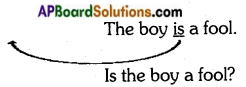
How do we change the above statement into a question? By putting the auxiliary verb before the subject ‘the boy’.
AP Board 8th Class English Solutions Chapter 2A Oliver Asks for More 3

Look at some more sentences.
1. ‘I understand that he asked for more.’
‘Do I understand that he asked for more ?’
2. ‘Oliver asks for more.’
Does Oliver ask for more ?
3. ‘The boys took their places.’
Did the boys take their places?
These sentences are changed into a question by placing ‘do/does/did at the beginning, such questions are called Yes / No questions.
Change the following statements into Yes/No questions.
1. Oliver was frightened at the sight of so many gentlemen.
———————————
2. You are an orphan.
———————————
3. You say your prayers every night.
———————————
4. You will pick oakum tomorrow morning.
———————————
5. Mr. Bumble rushed into the room.
———————————
6. They can devour the big bowl.
———————————
7. Boys have generally excellent appetite.
———————————
Answer:
1. Was Oliver frightened at the sight of so many gentlemen?
2. Are you an orphan?
3. Do you say your prayers every night?
4. Will you pick oakum tomorrow morning?
5. Did Mr. Bumble rush into the room?
6. Can they devour the big bowl?
7. Do boys generally have excellent appetite?

AP Board 8th Class English Solutions Chapter 2A Oliver Asks for More

II. Read the following sentence taken from the story.
“You were brought up by the parish, weren’t you?”
In this sentence ‘weren’t you?’ at the end is called a question tag. Question tags are used to get information or confirmation. The question tags are positive if the statements are negative. And if the statements are positive, questions tags are negative. These tags are short/contracted form of questions. If the statement has an auxiliary, the tag begins with an auxiliary. In case it does not have an auxiliary, it will begin with do/does/did.

Read the following dialogue to understand the usage of question tags.

Ramu: The weather is good today, isn’t it?
Vijay: Indeed, Ramu.
Ramu: How about going out now? Hope you’ll join me, won’t you?
Vijay: I’ve got some important work now, I am afraid.

Read the following dialogue that took place at a party. Add suitable question tags to complete it.

Rohit: Hi, I’ve met you before, —-(1)—-
Suma: No, I don’t think so.
Rohit: But your name is Vani, —-(2)—-
Suma: No, it’s Suma! Anyway, glad to meet you.
Rohit: Me too. This is Rohit. The party seems to be really lively, —-(3)—-
Suma: Yes, definitely. We enjoy ourselves a lot on such occasions, —-(4)—-
Rohit: Yeah, we do.
Answer:
1) haven’t I?
2) isn’t it?
3) doesn’t it?
4) don’t we?

Writing

I. Anne Frank was a Uttle girl of thirteen. She was as lonely as Oliver Twist. When the German army invaded her country, she had to hide in a small building with her family. She suffered a lot. She recorded her feelings and thoughts in her diary.
Friday, 1st October, 1942.
Just for fun, I am going to tell you each person’s first wish, when we are allowed to go out again. Mrs. Van says, ‘If I go out, I’ll eat cream cakes.’ Dussel says, ‘If I am let free, I’ll run to see my wife Lotje.’ Mummy says, ‘I will have a cup of coffee.’ Peter says, ‘I will go to the cinema.’ I long for so many things. But I long for a home of our own.

AP Board 8th Class English Solutions Chapter 2A Oliver Asks for More

1. What did Anne write in her diary?

  • personal feelings/thoughts/reflections
  • events other than routine
  • future plans

2. Did you notice any variety in the sentences?
3. Are all the sentences connected with each other properly?
After facing the live board, Oliver returned to his bed crying. He sat up to write his diary. Now, imagine you are Oliver Twist. Attempt a diary entry with the above
features in mind.
Answer:
Monday, 12th August, 20xx
What a miserable day in my life! Just now I have appeared before the live board. Actually I don’t have any idea about a live board. Mr. Bumble informed me, ‘Today, you have to appear before the live board forthwith”. I was rather surprised. I was not quite certain whether I ought to laugh or cry. I had no time to think about the matter then. Mr. Bumble told me, “Follow me”. So, I followed him into a large white-washed room. There were eight or ten gentlemen sitting round a table. A fat gentleman with a very round, red face sat in an arm chair rather higher than the rest. Bumble said, “Bow to the board”. I brushed away two or three years that were lingering in my eyes. I didn’t find any board. I only saw a table. So I bowed to that. ’Whats your name, boy?’ said the gentleman in the high chair. I was frightened at the sight of so many gentlemen, which made me tremble. As I didn’t answer the question, the beadle gave me a tap on my back with his cane and immediately I started crying, the gentleman in the high chair. I was frightened at the sight of so many gentlemen, which made me tremble. As I didn’t answer the question, the beadle gave me a tap on my back with his cane and immediately I started crying. The gentleman in the high chair asked me “Do you know you’re an orphan?” I didn’t understand his question. So, I asked him ‘What’s that, sir”? The gentleman in the white waistcoat remarked, “The boy is a fool”.
The red-faced gentleman in the high chair said, ‘You have come here to be educated and taught a useful trade”. The gentleman in the white waistcoat added You’ll begin to pick oakum tomorrow morning at six o’clock”. I bowed low and rushed into my room. I sobbed myself to sleep on a rough, hard bed. How disgusting all it is! I don’t want to stay here any more. I certainly will leave it. We don’t have any independence here. They don’t allow us to play, run or jump. Here we are living like slaves. We don’t have enough food either. They don’t show any mercy on us. No, I won’t stay here even a minute more. Now itself I shall start.

AP Board 8th Class English Solutions Chapter 2A Oliver Asks for More

Oliver Asks for More Summary in English

Oliver, an orphan boy, was brought to a children’s home. Mr. Bumble, the beadle, informed Oliver that he had to appear before the board at once. As he did not have any idea of a live board, he was astonished and was not quite certain whether he ought to laugh or cry. Mr. Bumble took him into a large white-washed room where eight or ten fat gentlemen were sitting round a table. Mr. Bumble ordered Oliver to bow to the board. Seeing no board but the table, Oliver bowed to the table. He was frightened at the sight of them and trembled. The beadle tapped on his back with his cane and he cried. The gentleman in the high chair asked Oliver if he knew that he was an orphan. Oliver couldn’t understand his question as he had no idea of an orphan. The gentlemen reminded Oliver that he was brought up by the parish and asked him to pray for them and take care of him like a Christian. The gentleman in the white waistcoat ordered Oliver to begin to pick oakum the following day morning at six o’clock. Oliver made a low bow and hurried away to a large ward sobbing himself to sleep on a rough, hard bed. The members of the board were very wise and philosophical men. They discovered that the workhouse was the regular place of public entertainment for the poorer classes. They opined that the poor should starve quickly outside the workhouse or gradually inside it. They decided the inmates of the workhouse would be issued three meals of thin gruel a day, with an onion twice a week. As a result, the number of workhouse inmates got smaller and they shrank in size. Oliver and his companions suffered the tortures of slow starvation for three months. They became wild with hunger. One day a tall boy announced that he would eat the boy who slept next to him unless he was given extra gruel. A council was held and it was decided that Oliver should ask the master for more. That evening the gruel was served and they ate it up. The boys winked at Oliver and nudged him. Oliver advanced to the master and requested him for more gruel. The master got a rage and aimed a blow at Oliver’s head with the ladle. He reported it to the beadle. Mr. Bumble, the beadle rushed into the gentlemen’s room and reported the same. The gentleman in the white waistcoat opined that the boy would be hung. Nobody contradicted his opinion and Oliver was ordered into instant confinement. The following morning a bill was pasted offering five pounds to those who would take Oliver as an apprentice to any trade, business or profession.

About the author

Charles Dickens (1812-1870) is a well known English novelist. Due to his father’s imprisonment Charles left school and worked in a shoe factory. While he was working as a office boy he launched his writing career. His novels Oliver Twist, Great Expectations, Pickwick Papers, Bleak House, A Tale of Two Cities and David Copperfield brought him name all over the world. He went on lecture tours to America and got literary reputation. He focussed on social issues and human ailments in his works.

Oliver Asks for More Glossary

beadle (n): an official of a church

parish (n): a church committee

oakum (n): loose fibre obtained by untwisting and picking apart old ropes

surly (adj): serious or angry

AP Board 8th Class English Solutions Chapter 2A Oliver Asks for More

gruel (n): a thin liquid food of oats, rice, etc.

devoured (v): ate hungrily or quickly

appetite (n): the desire to eat, hunger

voracious (adj): wanting great quantities of food

stupefied (adj): shocked

paralyzed (v): became motionless

ladle (n): a long handled spoon used to serve liquids

countenance (n): a person’s face or facial expression

confinement (n): putting in a prison or a closed room

apprentice (n): one who works under a skilled person

stride (n): one long step

grasped (v): took a firm hold of something

cuff (n): the bottom of the leg of a pair of trousers/pants that has been folded over on the outside

forthwith (adv): immediately, at once

trotted (v): moved forward at a speed that is faster than a walk

lingering (v): continuing to exist

gruff (adj): deep and rough, and often sounding unfriendly

stammered (v): spoke with difficulty

sobbed (v): cried noisily taking sudden, sharp breaths

starve (v): to suffer or die, because one doesn’t have enough food to eat

winked (v): closed one eye and opened it again quickly, especially as a private signal to somebody

nudged (v): pushed somebody gently with one’s elbow

paralyzed (v): made somebody unable to feel or move all or part of their body

faint (adj): that can’t be clearly seen, heard or smelt

AP Board 8th Class English Solutions Chapter 2A Oliver Asks for More

depicted (v): gave an impression of something

contradicted (v): said that something that somebody else had said was wrong

calling (n): a profession or career

AP Board 8th Class English Solutions Chapter 4C Maestro with a Mission

AP State Syllabus AP Board 8th Class English Textbook Solutions Chapter 4C Maestro with a Mission Textbook Questions and Answers.

AP State Syllabus 8th Class English Solutions Chapter 4C Maestro with a Mission

8th Class English Chapter 4C Maestro with a Mission Textbook Questions and Answers

Comprehension

Answer the following questions.

Question 1.
Vempati Chinna Satyam left his house on a purpose. Do you think he was successful at the end?
Answer:
Yes, Vempati China Satyam was successful at the end. He wanted to elevate the status of Kuchipudi he had learnt from his great gurus. He decided to dedicate his life for the enrichment of that art form. So, he left his house for Madras. He carved a niche in Telugu film industry as a Kuchipudi dance director. He established Kuchipudi Art Academy in 1963 in Madras. He composed and choreographed as many as 180 solo items and 15 dance dramas. All his disciples were distinguished ones such as Shanta Rao, Yamini Krishna Murthy, Vfyjayanthimala Bali, Hema Malini, Manju Bhargavi, Shoba Naidu, Bala Kondala Rao and Daggubati Purandheshwari. He was conferred many awards. All the Telugu speakers identify themselves with ‘Kuchipudi’. The rest of the world looks at Kuchipudi and Dr. Vempati’s stupendous work with reverent eyes. Thus, Dr. Vempati was successful when he elevated the status of Kuchipudi.

AP Board 8th Class English Solutions Chapter 4C Maestro with a Mission

Question 2.
When the stationmaster asked Satyam “Where are you going, dear?,” he kept silent.
Now choose one of the options that is not the reason for the silence.
a. He was determined to achieve something. [  ]
b. He was determined and confident about his destiny. [  ]
c. He was not determined or confident about his destiny. [  ]
Answer:
c. He was not determined or confident about his destiny. [ ✓ ]

Question 3.
If the eighteen year old lad hadn’t left his village, Kuchipudi would not have gained this popularity. Do you agree/disagree? Why?
Answer:
Yes, I agree with this statement. Kuchipudi originated in the village of Kuchipudi and was performed at temples at the time of annual festivals and in streets on the demand of the people. Only the males perform this art in those days. Though great gurus like Vedantam Lakshminarayana, Chinta Krishna Murthy enriched and transformed it completely, it was not much popular. It was not recognized on a par with other classical dances. The eighteen year old lad wanted to elevate the status of Kuchipudi, left his village and finally succeeded. So, if he hadn’t left his village, Kuchipudi wouldn’t have gained this popularity.

AP Board 8th Class English Solutions Chapter 4C Maestro with a Mission

Question 4.
Is it appropriate to call him Dr. Vempati? Do you agree? Why (not)?
Answer:
Yes, it is appropriate to call him Dr. Vempati. Kuchipudi gained the popularity because of him only. He had been passionate about Kuchipudi since his childhood. Though he was not a good performer of Kuchipudi in the early stages, he didn’t lose hopes. He learnt the difficult aspects of Kuchipudi style from Tadepalli Peraiah Sastry and Vedantam Lakshminarayana Sastry. They inspired him very much. Later he did so much to the development and emergence of Kuchipudi to a full-fledged dance form. So it was appropriate to call him Dr. Vempati.

Writing

Based on the details of the famous singer, S.P. Bala Subrahmanyam given below, write a biographical sketch of him.

Full name: Sirpathi Panditaradhyula Balasubrahmanyam
Date of Birth: 4th June 1946
Place of Birth: Konetammapeta, Nellore District
State: Andhra Pradesh
Educational qualifications: Engineering
Entry into film field: 1966
First Film : Sri Sri Sri Maryada Ramanna
Entry into Bollywood: in 1980
Total number of songs sung: About 40.000
Other credits: Noted dubbing artist.
Actor: Acted in a number of Telugu films
TV programmes: Leading many TV programmes.
Awards:

  1. National Film Award for best male playback singer — 6 times
  2. Nandi Awards from Government of Andhra Pradesh — 25 times
  3. State Award from Tamil Nadu
  4. State Award from Karnataka
  5. Padma Shri Award
  6. Padma Bhushan

Answer:
Mr. S.R Bala Subrahmanyam is a famous singer. His full name is Sripathi Panditaradhyala Bala Subrahmanyam. He was born on 4th June, 1946 at Konetammapeta, Nellore district, Andhra Pradesh. He was a graduate in engineering. His entry into film field was made in 1966. He sang for the film Sri Sri Sri Maryada Ramanna for the first time in his life. He entered Bollywood in 1980. He has sung about 40,000 songs in all the languages till now. He is also a noted dubbing artist. He acted in a number of Telugu films. He has already led a number of TV programmes and is leading many of them now. He was rightly conferred the ‘Padma Bhushan’ and ‘Padma Shri’ Awards by our government. He was given ‘Nation Film Award’ for best male play back singer for six times. He received ‘Nandi Awards’ from government of Andhra Pradesh for 25 times. Tamil Nadu and Karnataka honoured him with ‘State Awards’.

AP Board 8th Class English Solutions Chapter 4C Maestro with a Mission

Listening

I. Listen to the news bulletin read by your teacher and answer the following questions.

The News

This is All India Radio, giving you the news. The headlines. The Government of AP all set to declare a new art & cultural policy. A new cultural programme to be launched to show the Government’s commitment to cultural development of the state. Exhibitions and other activities to mark the new programme.
The news in detail…

The Government of AP is all set to declare a new art and cultural policy. The policy is expected to stress the development of arts and crafts of the state. The Chief Minister is expected to announce the policy today at Ravindra Bharati, Hyderabad.

As per the Government sources, a drive under this programme will benefit the artists of Kuchipudi, Burrakatha, Oggukatha and Harikatha. Puppet shows would be made compulsory in all the Government organized programmes, they said.

According to the Handicrafts Minister, 51 new cultural centres would be started to boost the sales of Nirmal, Etikoppaka and Kondapalli toys. He also stated that handloom weaving would be given due importance. Dharmavaram, Pochampalli, Venkatagiri, Mangalagiri, Ponduru weavers would get interest free loans.
The headlines once again. The Government of AP all set to declare a new cultural policy. That’s the end of this news bulletin.

Have a good day!

Answer the following questions.

Question 1.
What are the highlights of the news bulletin?
Answer:
The highlights of the news bulletin are:

  1. The Government of Andhra Pradesh all set to declare a new art and cultural policy.
  2. Exhibitions and other activities will be conducted to mark the new programme.
  3. The artists of Kuchipudi, Burrakatha, Oggu katha and Hari katha will be benefited.
  4. New cultural centres would be started to boost the sales of Nirmal, Etikoppa and Kondapalli toys.
  5. Dharmavaram, Pochampalli, Venkatagiri, Mangalagiri, Ponduru weavers would get interest free loans.

Question 2.
Where is the art and culture polity programme going to be announced? Who is going to be benefited from this policy?
Answer:
The art and culture policy programme is going to be announced at Ravindra Bharathi, Hyderabad. The artists of Kuchipudi, Burrakatha, Oggu katha and Hari katha are going to be benefited from this policy.

AP Board 8th Class English Solutions Chapter 4C Maestro with a Mission

Question 3.
How will the weavers be benefited from this polity?
Answer:
Dharmavaram, Pochampalli, Venkatagiri, Mangalagiri, Ponduru weavers would get interest free loans.

Study Skills

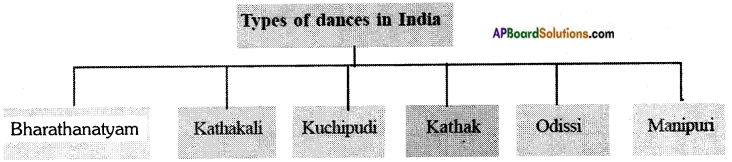
I. India is a land of culture and tradition. One aspect of culture is dance. India has six major types of dances: Bharathanatyam, Kathakali, Kuchipudi, Kathak, Odissi and Manipuri.
The information can be transformed into a tree diagram.
AP Board 8th Class English Solutions Chapter 4C Maestro with a Mission 1
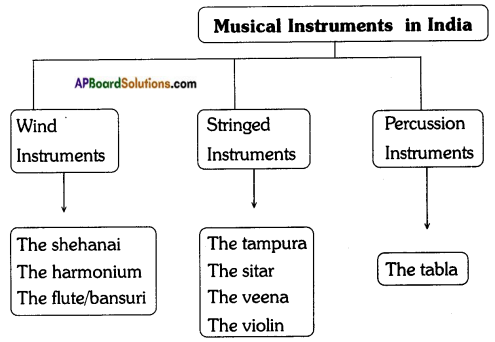
Here is some information about musical instruments in India:
In India, we have some musical instruments. The shehanai is an Indian wind instrument. This is played during auspicious functions. The harmonium is a wind instrument, having its roots in Europe. The sitar is one of the prime musical instruments of Indian music. It is a stringed instrument. The tampura is another stringed instrument. Among the stringed instruments, the veena is the most ancient stringed instrument. The tabla is a percussion instrument. The flute/bansuri is a wind instrument. The violin is a stringed instrument played with a bow.
Now, convert the above information Into a tree diagram.
AP Board 8th Class English Solutions Chapter 4C Maestro with a Mission 2

AP Board 8th Class English Solutions Chapter 4C Maestro with a Mission

Project work

Identify a performing artist like a singer, a dancer or any other artist in your village or town. He/She might not be a famous person. Go to him/her. Collect the details about him/her.
You can take the help of the following questions for interviewing.

  1. Who are your parents?
  2. What is your place of birth?
  3. Who taught you this art?
  4. Are there any specific reasons for taking up this art?
  5. Does the community around you support you?
  6. Does this art make you financially independent?
  7. Would you give any message to the student community?

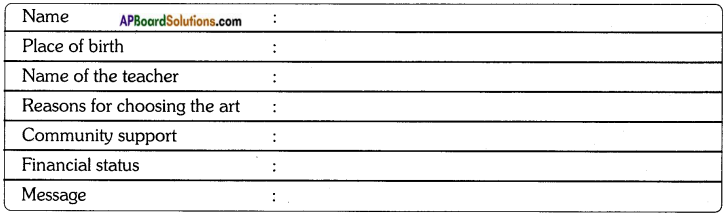
Fill the following table based on the information you have collected.
AP Board 8th Class English Solutions Chapter 4C Maestro with a Mission 4
Prepare a brief profile and exhibit it in your classroom.
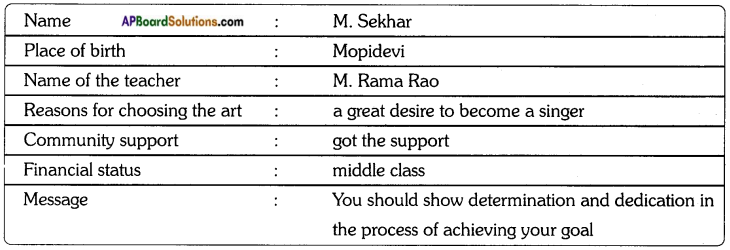
Answer:
AP Board 8th Class English Solutions Chapter 4C Maestro with a Mission 3
Yesterday, I met M. Sekhar, one of the popular singers in our village. His parents are Chaya Devi and Prakash. He was born at Nuziveedu, his grandparents’ place. He has a passion for singing since his childhood. He wanted to become a play back singer in film industry. After completion of his SSC, he left his village for Hyderabad. He learnt the music from M. Rama Rao, a great guru. The community around him gave him much support in the process of becoming a singer. He got chances to sing in two or three Telugu films. He is a regular singer in all kinds of festive occasions. Now, he is leading a middle-class life. His message to all of us is that we should show determination and dedication in the process of achieving our goal.

AP Board 8th Class English Solutions Chapter 4C Maestro with a Mission

Writing an e-mail

Electronic mail, commonly referred to as email or e-mail, is a method of exchanging digital messages from an author to one or more recipients.
In order to send or receive e-mail messages, you need to create an account to access the service. You must need an internet connection for this purpose.
The messages you receive is stored in the mailbox created for your account. You can re-read the message anytime, delete it if you want to or even forward it to others.

  • The address of the recipient is to be typed in the ‘to’ text field.
  • The subject, if any, of the message is typed in the ‘subject’ field.
  • The ‘message’ is to be typed in the message field.
  • If you want to attach any files you can attach to the ‘attachment’ field.
  • Click on the ‘send’ in order to send the message.

Messages sent by e-mail normally reach a recipient’s account within seconds. Through mails you can send pictures, documents in addition to messages.
You can send anything to anywhere in the world.

Maestro with a Mission Summary in English

Dr. Vempati Chinna Satyam was born to Venkata Chalamaiah and Varalakshmi on 15th, October 1929. He was survived by his wife Swarajya Lakshmi, two sons and three daughters. He faced many hardships in his childhood. He had a strong desire to learn Kuchipudi. Though his teacher ridiculed him, he didn’t lose his interest in Kuchipudi. His passionate dream was to elevate the status of an art form he had learnt from his great gurus. He decided to dedicate his life for the enrichment of that art form. So, he left his house for Madras when he was eighteen. He walked all the way to Madras. On his long way, he fed himself on plantains and water.

The Kuchipudi dance form originated in the village of Kuchipudi. The art was performed at temples at the time of annual festivals and in streets for a long time. Though it was transformed by great gurus like Vedantam Lakshminarayana, Chinta Krishna Murthy, it was not much popular. It was not recognised on a par with other classical dances. Dr. Vempati learnt the difficult aspects of Kuchipudi style from Tadepalli Peraiah Sastry and Vedantam Lakshminarayana Sastry. He wanted to popularize Kuchipudi all over the world. He gained reputation as a dance director in Telugu film industry by composing the dance sequences in the films “Narthanasala”, “Devadasu” and “Pandava Vanavasam”. He established Kuchipudi Art Academy in 1963 in Madras. Dr. Vempati composed and choreographed as many as 180 solo items and 15 dance dramas. The distinguished performers Shanta Rao, Yamini Krishna Murthy, Vyjayanthimala Bali, Hema Malini, Manju Bhargavi, Shobha Naidu, Bala Kondala Rao and Daggubati Purandheshwari were all Dr. Vempati’s disciples.

AP Board 8th Class English Solutions Chapter 4C Maestro with a Mission

Dr. Vempati was conferred ‘Padma Bhushan’ by the government of India. Andhra University awarded him an honorary doctorate in 1980 and Sri Venkateswara University honoured him with D. Litt. in 1983. The mayor of Miami, USA presented him ‘Golden Key’ in 1981. He was presented ‘Raja-Lakshmi’ award. The TTD made him the ‘Asthana Natyacharya’ in 1976. He led an illustrious life of 83 years and passed away on 29th July 2012. The rest of the world looks at Kuchipudi and Dr. Vempati’s stupendous work with respectful eyes. He is rightly called “Maestro with a Mission” as he remains the source of inspiration for the people who work for Kuchipudi. He remains at the centre stage of Kuchipudi’s surge as a classical dance form in Modem India.

Maestro with a Mission Glossary

passion (n): strong feeling

choreography (n): art of arranging steps for a dance

ardent (adj): serious

oblivion (n): state of being unnoticed

carve a niche (idm): build reputation

reverent (adj): filled with honour

nuance (n): subtle difference

connoisseur (n): judge of an art

coveted (adj): liked by everyone to have

stupendous (adj): amazingly large

AP Board 8th Class English Solutions Chapter 4C Maestro with a Mission

elevate (v): to give something a higher position

transform (v): to change the form of something

humiliated (v): made somebody feel ashamed or stupid and lose the respect of other people

ridiculed (v): made somebody look silly by laughing at them in an unkind way

rudimentary (adj): dealing with only the most basic matters or ideas

lofty (adj): deserving praise because of its high quality

nostalgic (adj): feeling of sadness mixed with pleasure and affection

laurels (n): honour and praise given to somebody because of something that they have achieved

lay-person (n): a person who doesn’t have expert knowledge of a particular subject

distinguished (adj): very successful and admired by other people

conferred (v): gave somebody an award

AP Board 8th Class English Solutions Chapter 4C Maestro with a Mission

reverent (adj): showing great respect and admiration

illustrious (adj): very famous and much admired, especially because of what one has achieved

AP Board 8th Class Physical Science Important Questions Chapter 11 Some Natural Phenomena

AP State Syllabus AP Board 8th Class Physical Science Important Questions Chapter 11 Some Natural Phenomena

AP State Syllabus 8th Class Physical Science Important Questions 11th Lesson Some Natural Phenomena

8th Class Physical Science 11th Lesson Some Natural Phenomena 1 Mark Important Questions and Answers

Question 1.
What is an electroscope?
Answer:
The device which can be used to test whether an object is carrying charge or not is called electroscope.

Question 2.
What is electrical discharge? Where does electrical discharge takes place?
Answer:
The process of transfer of negative or positive charges is called electrical discharge.
The electrical discharge can occur between two or more clouds, or between clouds and the earth.

AP Board 8th Class Physical Science Important Questions Chapter 11 Some Natural Phenomena

Question 3.
What is the other device at buildings acts as lightning conductor?
Answer:
The metal columns used during construction and water pipes in the buildings also protect us by acting as lightning conductors.

Question 4.
Why water pipes should not be touched during thunder storm?
Answer: During thunder storm there would be a possibility that the charge developed due to lightning may travel through the water pipes. So we should not touch water pipes during thunder storm in order to avoid electric shocks.

Question 5.
What is an earthquake?
Answer:
An earthquake is a sudden shaking or trembling of the earth lasting for a short period of time due to disturbance deep inside the earth’s crust.

Question 6.
What is the cause of most earthquakes?
Answer:
The most earthquakes are caused by the movement of earth’s plates.

AP Board 8th Class Physical Science Important Questions Chapter 11 Some Natural Phenomena

Question 7.
What is a earth’s plate?
Answer:
The outer most layer of the earth is not in one piece. It is fragmented. Each frament is called a earth’s plate.

Question 8.
How do we measure the intensity of the earthquake?
Answer:
The power of an earthquake is expressed in terms of a magnitude on ricter scale.

Question 9.
What is the range of destructive earthquake?
Answer:
The destructive earthquake have magnitude heigher than 7 on the ricter scale.

Question 10.
Whether it is possible to predict when and where the next earthquake might occur?
Answer:
It is not possible to predict when and where the next earthquake might occur. But we can predict that there is a possibility of the earthquake when a volcano erupts, or a meteor hits the earth, or an underground nuclear explosion takes place.

Question 11.
What are seismic waves?
Answer:
The tremors produce waves on the surface of the earth. These are called seismic waves.

AP Board 8th Class Physical Science Important Questions Chapter 11 Some Natural Phenomena

Question 12.
What are the places in Andhra Pradesh which lie in seismic zone?
Answer:
According to seismic hazard map Andhra Pradesh lies in zones II and III. The south eastern districts of Chittoor, YSR Kadapa, Nellore and Krishna and Godavari delta region have been placed in zone III and the city of Hyderabd lies in zone II.

8th Class Physical Science 11th Lesson Some Natural Phenomena 2 Marks Important Questions and Answers

Question 1.
What is earthing? Why does earthing is provided in buildings?
Answer:

  1. The process of transferring of charge from a charged object to the earth is called earthing.
  2. Earthing is provided in building to protect us from electrical shock due to any leakage of electric charge.

Question 2.
Which is safe place during thunder storm?
Answer:

  1. A house or building of low height.
  2. If you are travelling in a bus or in a car, you are safe inside provided that doors and windows are closed.
  3. If you are in a forest taking shelter under shorter trees than a taller tree is a good idea during the thunder storm.

Question 3.
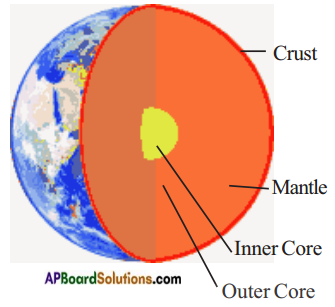
What are different layers of earth? Draw a neat diagram of different layers of earth and label its parts?
Answer:
AP Board 8th Class Physical Science Important Questions Chapter 11 Some Natural Phenomena 1
The different layers of earth are:

  1. Crust: This is upper most layer of the earth.
  2. Mantle: This is middle layer.
  3. Core: This is inner layer of the earth.

Again core is divided into two parts.

  1. Inner core
  2. Outer core

AP Board 8th Class Physical Science Important Questions Chapter 11 Some Natural Phenomena

Question 4.
How does earthquake is formed?
Answer:
The outermost layer of the earth is not in one piece, it is fragmented. Each fragment is called a plate. These plates are in continuous motion.
When they brush past on one another, or a plate goes under another plate due to collision, they cause disturbance in the earth’s crust. It is this disturbance that shows up an earthquake on the surface of the earth.

Question 5.
What are the main instruments used by seismologists ? What are the uses of those instruments?
Answer:
Seismologists use two main devices to measure an earthquake.

  1. Seismograph: The seismograph is an instrument that measures the seismic waves caused by an earthquake.
  2. Seismoscope: The seismoscope is an instrument that measures the occurrence or the time of occurrence of an earthquake. The seismoscope is a simple device which can be used without any technological background.

Question 6.
How does destructive energy related to ricter scale?
Answer:
Ricter scale is not linear. This means that an earthquake of magnitude 6 does not have one and half time of the destructive energy of an earthquake of magnitude 4.
In fact, an increase of 2 in magnitude means 1000 times more destructive energy. For example, an earthquake of magnitude 6 has thousand times more destructive energy than an earthquake of magnitude 4.

Question 7.
Which scale measures the destructive energy released by earth more accurately?
Answer:
The moment magnitude scale which is based on the amount of displacement that occurred along a fault zone rather than the measurement of ground motion at a given point measures more accurately the energy released by earthquake than the ricter scale.
It is the only magnitude scale that adequately measures the size of large earthquake.

Question 8.
Raju watched pictures of earthquake victims on T.V. What are the questions raised in his mind about earthquake ?
Answer:

  1. What is the cause of earthquake?
  2. Why some areas are frequently affected by earthquakes?
  3. What are the indications before a major earthquake takes place?
  4. What are the precautionary method to be followed to avoid excess of loss of human life?
  5. What are the measures we have to take when earthquake occur?

AP Board 8th Class Physical Science Important Questions Chapter 11 Some Natural Phenomena

Question 9.
Which places are not safe during a thunderstorm?
Answer:

  1. Travelling in an open place.
  2. Standing under tall trees in open fields or in a garden/park.
  3. Staying in multi storied building which do not have lightning conductors.
  4. Standing near electric poles or telephone poles.
  5. Speaking on landline telephones.
  6. Using electrical appliances like TV and computer.

Question 10.
Explain how do you determine the intensity of Earthquake.
Answer:

  1. The intensity of Earthquake can be measured on richter scale. Like many other scales, richter scale is not linear. That means increase of 2 in magnitude mean 1000 times more destructive energy.
  2. There is another method of measuring the intensity of earthquake using the moment magnitude scale which is based on the amount of displacement that occurred along a faulty zone.
  3. The moment magnitude measures energy released by the earthquake more accurately than the richter scale. It is the only magnitude scale that adequately measures the size of large earthquakes.

Question 11.
Is there any alternative methods to find the intensity of earthquake ?
Answer:
The main method to find the intensity of earthquake is richter scale.
The alternative methods are:

  1. The moment magnitude scale: Which is based on amount of displacement that occured along a faulty zone.
  2. Mercalli scale: This scale uses the observations of the people who experienced the earthquake to estimate intensity.

Question 12.
We know that the clouds have charges. Can we produce current through these charges?
Answer:
Cloud to ground lightning discharges 30,000 amperes and up to 100 million volts and emits light, X rays, radio waves and even gamma rays.
Plasma temperature in lightning can approach 28000 K and electron densities may exceed 1024/m3.
So it not easy to use this charge as electricity.

AP Board 8th Class Physical Science Important Questions Chapter 11 Some Natural Phenomena

Question 13.
What happens if two objects having same charge brought close to each other?
What happens if two objects having different charges are brought close? Can you give an example for this?
Answer:
Two objects having same charge repel each other and two objects having different charge attract each other.
e.g.: A balloon rubbed with woollen cloth is repelled by another balloon rubbed with woollen cloth because both will acquire same type of charge.
A balloon rubbed with a woollen cloth is attracted by a refill rubbed with a polythene sheet because both will acquire different type of charge.

Question 14.
How do you relate the energy release during the collusion of fault lines during earthquake to the atmospheric variation on the surface of the earth?
Answer:
An earthquake affects the atmosphere by creating amounts of debris and dust which will add to the air that we breathe. Earthquakes can also trigger volcanoes which will release tonnes of ashes and other debris into the atmosphere. This can sometimes cause the blocking out of the sun, air pollution and are increased amount of carbon in the air.

Question 15.
Explain why a charged ballon is repelled by another charged balloon whereas an uncharged balloon is attracted by another charged balloon?
Answer:

  1. We have seen that two balloons with similar charges on them, whether positive or negative, repel each other. Similarly two balloons with dissimilar charge on them attract each other.
  2. So, similar charges repel each other while dissimilar charges attract each other.

8th Class Physical Science 11th Lesson Some Natural Phenomena 4 Marks Important Questions and Answers

Question 1.
Explain how lightning would be formed?
Answer:
The clouds moving in air acquire a charge on their surface due to the friction with particles of air. As the surface area of a cloud is very large, the amount of charge accumulated on its surface is very high.
When a charged cloud comes close to another cloud is induces an opposite charge on the later and the accumulated charge tries to move from one cloud to another cloud.
But the air present between them bring a poor conductors of electricity resists the flow of charge between them.
When the magnitude of the accumulated charges become very large, the air which is normally a poor conductor of electricity, is no longer to able to resist their flow.
Hence discharge takes place between negative and positive charges which produce streaks of bright light and sound. We see streaks as lightning.

AP Board 8th Class Physical Science Important Questions Chapter 11 Some Natural Phenomena

Question 2.
Which is not safe during a thunder storm?
Answer:

  1. Travelling in an open place.
  2. Standing under tall trees in open fields or in a garden/park.
  3. Staying in multi storied building which do not have lightning conductors.
  4. Standing near electric poles or telephone poles.
  5. Speaking on landline telephones.
  6. Using electrical appliances like T.V. and Computer.

Question 3.
What is a lightning conductor ? How does it works during lightning ?
Answer:
Lightning conductor is a device used to protect buildings from the effect of lightning. A metallic rod, taller than the building is installed in the walls of the building during its construction.
One end of the rod is kept out in the air and other is buried deep in the ground. The rod provides an easy route for the transfer of electric charge to the ground.
The projected end of the metal rod is at a height more than the height of the building. Hence it receives the charge first during lightning because it is closer to the cloud than the building.
As it is good conductor of electricity, it allows all the charge to flow through it there by causing no damage to the buildings.

Question 4.
What are seismic zones? Name main seismic zones in India.
Answer:
Earthquakes are caused by the movement of plates, the places at boundaries of the plates are considered as weak zones where earthquakes are more likely to occur. These weak zones are also called as seismic or fault zones.
The main seismic zones in India are Kashmir, Western and Central Himalayas, the whole of North east, Rann of Kutch, Rajasthan, Indogangetic plane and some areas of South India.

Question 5.
Draw a table showing magnitude ricter scale reading and effect of earthquake for that reading?
Answer:

Ricter MagnitudeEarthquake effects
less than 3.5Generally not felt, but recorded
3.5 to 5.4Often felt, but rarely cause damage
5.5 to 6.0At most slight damage to well designed buildings can cause major damage to poorly constructed buildings over small regions.
6.1 to 6.9Can be destructive in areas upto 100 kilometres across where people live.
7.0 to 7.9Major earthquake. Can cause serious damage over larger areas.
8 or greaterGreat earthquake can cause serious damage in areas several hundred kilometers across.

AP Board 8th Class Physical Science Important Questions Chapter 11 Some Natural Phenomena

Question 6.
How do you appreciate the efforts of the scientists to develop a Lightning conductor to protect buildings from the effect of lightning?
Answer:
Lightning conductor is a device used to protect buildings from the effect of lightning.
A metallic rod, taller than the building is installed in the walls of the building during its construction.
One end of the rod is kept out in the air and other is buried deep in the ground. The rod provides an easy route for the transfer of electric charge to the ground.
The projected end pf the metal rod is at a height more than the height of the building. Hence it receives the charge first during lightning because it is closer to the cloud than the building.
As it is good conductor of electricity, it allows all the charge to flow through it there by causing no damage to the buildings. Hence sole of scientists is appreciated.

Question 7.
Find out if there is an organisation in your area which provides relief to those suffering from natural disaster. Enquire about the type of help they render to the victims of earthquakes. Prepare a brief report on the problems of the earthquake victims.
Answer:
In India National Disaster Force provides relief for disaster victims.
Problems of earthquake victims:

  1. Death: Many times, the people who support a family socially and economically dies. This causes most of the other members of the family to either fight their way through, or restart their lives from the bottom of the food chain.
  2. Destroyed Structures: If the members of the family survive, then they could still be short of a home. The earthquake would have caused the destruction of their house and because of that, they would be left homeless.
  3. No food or water: In the aftermath of an earthquake, people see weather all the pipelines, roads, etc. are in good shape or order. If the pipes are broken, then water scarcity begins. If the roads are broken, then food supplies cannot be transported, later causing problems in food scarcity.
  4. Electricity: With inadequate supply of electricity, the debris and rubble will take a lot of time and if people are under it then they may die before the rubble is removed.
  5. Spread of diseases: After the destruction of many buildings, the sewer pipes will also break and open, causing spread of diseases everywhere.

Help rendered by relief organisation:

  1. They minimize the death of people.
  2. They provide drinking water and food for victims.
  3. They provide shelter for earthquake victims.
  4. They provide medical facility for earthquake victims.

AP Board 8th Class Physical Science Important Questions Chapter 11 Some Natural Phenomena

Question 8.
Explain how lightning would be formed.
Answer:
The clouds moving in air acquire a charge on their surface due to the friction with particles of air. As the surface area of a cloud is very large, the amount of charge accumulated on its surface is very high.
When a charged cloud comes close to another cloud is induces an opposite charge on the later and the accumulated charge tries to move from one cloud to another cloud.
But the air present between them bring a poor conductors of electricity resists the flow of charge between them.
When the magnitude of the accumulated charges become very large, the air which is normally a poor conductor of electricity, is no longer to able to resist their flow.
Hence discharge takes place between negative and positive charges which produce streaks of bright light and sound. We see streaks as lightning.

Question 9.
How the power of earthquake estimated? At what strength it becomes destructive?
Answer:

  1. The power of earthquake is expressed in terms of magnitude on scale called Richter scale.
  2. The destructive earthquakes have magnitudes higher than about 7 on richter scale.
  3. Like many other scales, richter scale is not linear. It means that earthquake of magnitude 6 does not have the twice the destructive energy of an earthquake magnitude 3.
  4. Infact, an increase of 2 in magnitude means 1000 times more destructive energy.
  5. For example, an earthquake of magnitude 6 has thousand times more energy than earthquake of magnitude 4.

Question 10.
What suggestions will you give to people living in seismic areas so that the destruction due to earthquake may be minimized?
Answer:

  1. We know that earthquakes cannot be predicted and that they can be highly destructive.
  2. It is therefore important that we have to take necessary precautions to protect ourselves all the time.
  3. Consult qualified architect and structural engineer to build the buildings.
  4. It is better to fix the cup boards and shelves to the walls, so that they do not fall easily.
  5. Be careful where you hang wall clocks, photoframes, water heaters, etc. so that in the event of an earthquake they do not fall on the people.
  6. Some buildings may catch fire due to an earthquake, it is necessary that all buildings have fire fighting equipment installed.

8th Class Physical Science 11th Lesson Some Natural Phenomena Important Questions and Answers

AP Board 8th Class Physical Science Important Questions Chapter 11 Some Natural Phenomena

Question 1.
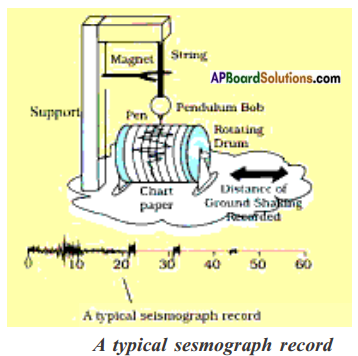
Draw a neat diagram of the instrument used to measure the intensity of earthquake. Name the scale used in this instrument.
Answer:
AP Board 8th Class Physical Science Important Questions Chapter 11 Some Natural Phenomena 2
Richter scale is used in this instrument.

Question 2.
“Earthquakes can cause floods, landslides and tsunamis. A major tsunami occurred in the Indian ocean on 26th December 2004. All the coastal areas around the ocean, suffered huge losses.”
Based on the above information answer the following questions:
i) What is the cause for tsunami?
Answer:
Tsunami is caused by sudden movement of the earth that happens under the sea.

ii) What happens when a major tsunami occurs?
Answer:
When tsunami waves become extremely large in height, they .savagely attack coast lines, causing devastating property damage and loss of life.

iii) Name the instrument which is used to detect an earthquake and what are its major parts.
Answer:
The instrument which is used to detect on earthquake is Seismograph.
Major parts of Seismograph are,
i) rotating drum
ii) chart paper
iii) pen
iv) pendulum bob
v) magnet
vi) string

iv) What is the effect of earthquake, if the scale of magnitude is recorded more than eight?
Answer:
If the scale of magnitude is recorded more than 8, the effect of earthquake is property and life damage in areas several hundred kilometers across and it may be causes tsunami also.

AP SSC 10th Class Maths Notes Chapter 5 Quadratic Equations

Students can go through AP SSC 10th Class Maths Notes Chapter 5 Quadratic Equations to understand and remember the concepts easily.

AP State Syllabus SSC 10th Class Maths Notes Chapter 5 Quadratic Equations

→ The general form of a linear equation in one variable is ax + b = c.

→ Any equation of the form p(x) = 0 where p(x) is a polynomial of degree 2, is a quadratic equation.

AP SSC 10th Class Maths Notes Chapter 5 Quadratic Equations

→ If p(x) = 0 whose degree is 2 is written in descending order of their degrees, then we say that the quadratic equation is written in the standard form.

→ The standard form of a quadratic equation is ax2 + bx + c = 0 where a ≠ 0. We can write it as y = ax2 + bx + c.

→ There are various occasions in which we make use of Q.E. in our day-to-day life.
Eg : The height of a rocket is defined by a Q.E.

→ Let ax2 + bx + c = 0 be a quadratic equation. A real number α is called a root of the Q.E. if aα2 + bα + c = 0. And x = α is called a solution of the Q.E.
(i.e.) the real value of x for which the Q.E ax2 + bx + c = 0 is satisfied is called its solution.

→ Zeroes of the Q.E. ax2 + bx + c = 0 and the roots of the Q.E. ax2 + bx + c = 0 are the same.

→ To factorise a Q.E. ax2 + bx + c = 0, we find p, q ∈ R such that p + q = b and pq = ac. This process is called Factorising a Q.E. by splitting its middle term.
Eg : 12x2 + 13x + 3 = 0
here a = 12; b = 13; c = 3
a.c = 12 × 3 = 36 = 4 × 9 and
b = 4 + 9 here p = 9 and q = 4
Now 12x2 + 13x + 3 = 0
⇒ 12x2 + 9x + 4x + 3 = 0
⇒ 3x(4x + 3) + 1 (4x + 3) = 0
⇒ (4x + 3) (3x + 1) = 0
Here 4x + 3 = 0 or 3x + 1 = 0
⇒ 4x = -3 or 3x = -1
⇒ x = \(\frac{-3}{4}\) or \(\frac{-1}{3}\)
\(\frac{-3}{4}\) and \(\frac{-1}{3}\) are called the roots of the Q.E. 12x2 + 13x + 3 = 0 and x = \(\frac{-3}{4}\) or \(\frac{-1}{3}\) is the solution of the Q.E. 12x2 + 13x + 3 = 0.

AP SSC 10th Class Maths Notes Chapter 5 Quadratic Equations

→ In the above example, (4x + 3) and (3x +1) are called the linear factors of the Q.E. 12x2 + 13x + 3 = 0.

→ We can factorise a Q.E. by adjusting its left side so that it becomes a perfect square.
Eg: x2 + 6x + 8 = 0
⇒ x2 + 2.x.3 + 8 = 0
⇒ x2 + 2.x.3 = -8
The L.H.S. is of the form a2 + 2ab
∴ By adding b2 it becomes a perfect square
∴ x2 + 2.x.3 + 32 = -8 + 32
⇒ (x + 3)2 = -8 + 9
⇒ (x + 3)2 = 1
⇒ x + 3 = ± 1 Now we take x + 3 = 1 or x + 3 = -l
⇒ x = -2 or x = -4

→ Adjusting a Q.E. of the form ax2 + bx + c = 0 so that it becomes a perfect square.
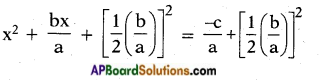
Step – 1 : ax2 + bx + c = 0 ⇒ ax2 + bx = -c ⇒ x2 + \(\frac{b}{a}\)x = \(\frac{-c}{a}\)
Step – 2 :
AP SSC 10th Class Maths Notes Chapter 5 Quadratic Equations 1
Step – 3 :
AP SSC 10th Class Maths Notes Chapter 5 Quadratic Equations 2
Step – 4 : Solve the above.
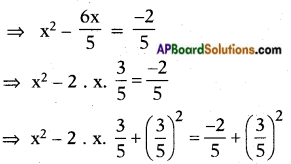
E.g: 5x2 – 6x + 2 = 0
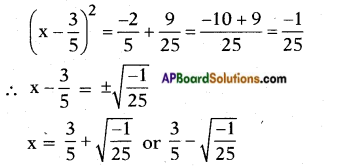
AP SSC 10th Class Maths Notes Chapter 5 Quadratic Equations 5
AP SSC 10th Class Maths Notes Chapter 5 Quadratic Equations 3

AP SSC 10th Class Maths Notes Chapter 5 Quadratic Equations

→ Let ax2 + bx + c = 0 (a ≠ 0) be a Q.E., then b2 – 4ac is called the Discriminant of the Q.E.

→ If b2 – 4ac > 0, then the roots of the Q.E. ax2 + bx + c = 0 are given by
x = \(\frac{-b \pm \sqrt{b^{2}-4 a c}}{2 a}\). This is called quadratic formula to find the roots.

The nature of the roots of a Q.E. can be determined either by its discriminant or its graph.
Q.E.: y = ax2 + bx + c.
AP SSC 10th Class Maths Notes Chapter 5 Quadratic Equations 4

Inter 1st Year Maths 1A Addition of Vectors Solutions Ex 4(a)

Practicing the Intermediate 1st Year Maths 1A Textbook Solutions Inter 1st Year Maths 1A Addition of Vectors Solutions Exercise 4(a) will help students to clear their doubts quickly.

Intermediate 1st Year Maths 1A Addition of Vectors Solutions Exercise 4(a)

I.

Question 1.
ABCD is a Parallelogram. If L and M are the middle points of BC and CD, respectively, then find (i) AL and AM in terms of AB and AD (ii) λ, if AM = λ AD – LM.
Solution:
Inter 1st Year Maths 1A Addition of Vectors Solutions Ex 4(a) I Q1
Inter 1st Year Maths 1A Addition of Vectors Solutions Ex 4(a) I Q1.1
Inter 1st Year Maths 1A Addition of Vectors Solutions Ex 4(a) I Q1.2

Question 2.
In ∆ABC, P, Q, and R are the midpoints of the sides AB, BC, and CA respectively. If D is any point.
(i) then express \(\overline{\mathrm{DA}}+\overline{\mathrm{DB}}+\overline{\mathrm{DC}}\) interms of \(\overline{D P}\), \(\overline{D Q}\) and \(\overline{D R}\).
(ii) If \(\overline{\mathbf{P A}}+\overline{\mathbf{Q B}}+\overline{\mathbf{R C}}=\bar{\alpha}\) then find \(\bar{\alpha}\)
Solution:
Inter 1st Year Maths 1A Addition of Vectors Solutions Ex 4(a) I Q2

Inter 1st Year Maths 1A Addition of Vectors Solutions Ex 4(a)

Question 3.
Let \(\overline{\mathbf{a}}=\overline{\mathbf{i}}+2 \overline{\mathbf{j}}+3 \overline{\mathbf{k}}\) and \(\overline{\mathbf{b}}=\mathbf{3} \overline{\mathbf{i}}+\overline{\mathbf{j}}\). Find the unit vector in the direction of \(\overline{\mathbf{a}}+\overline{\mathbf{b}}\).
Solution:
Inter 1st Year Maths 1A Addition of Vectors Solutions Ex 4(a) I Q3

Question 4.
If the vectors \(-3 \overline{\mathbf{i}}+4 \bar{j}+\lambda \overline{\mathbf{k}}\) and \(\mu \bar{i}+8 \bar{i}+6 \bar{k}\) are coilinear vectors , then find λ and µ.
Solution:
Inter 1st Year Maths 1A Addition of Vectors Solutions Ex 4(a) I Q4

Question 5.
ABCDE is a pentagon. If the sum of the vectors \(\overline{\mathrm{AB}}, \overline{\mathrm{AE}}, \overline{\mathrm{BC}}, \overline{\mathrm{DC}}, \overline{\mathrm{ED}}\) and \(\overline{\mathbf{A C}}\) is λ \(\overline{\mathbf{A C}}\), then find the value of λ.
Solution:
Inter 1st Year Maths 1A Addition of Vectors Solutions Ex 4(a) I Q5
Inter 1st Year Maths 1A Addition of Vectors Solutions Ex 4(a) I Q5.1

Question 6.
If the position vectors of the points A, B and C are \(-2 \overline{\mathbf{i}}+\overline{\mathbf{j}}-\overline{\mathbf{k}},-4 \overline{\mathbf{i}}+2 \overline{\mathbf{j}}+2 \overline{\mathbf{k}}\) and \(6 \bar{i}-3 \bar{j}-13 \bar{k}\) respectively and \(\overline{\mathbf{A B}}=\lambda \overline{\mathrm{AC}}\), then find the value of λ.
Solution:
Inter 1st Year Maths 1A Addition of Vectors Solutions Ex 4(a) I Q6

Question 7.
If \(\overline{\mathrm{OA}}=\overline{\mathbf{i}}+\overline{\mathbf{j}}+\overline{\mathbf{k}}, \overline{\mathrm{AB}}=3 \bar{i}-2 \overline{\mathbf{j}}+\overline{\mathbf{k}}\), \(\overline{B C}=\bar{i}+2 \bar{j}-2 \bar{k}\) and \(\overline{C D}=2 \bar{i}+\bar{j}+3 \bar{k}\), then find the vector \(\overline{O D}\).
Solution:
Inter 1st Year Maths 1A Addition of Vectors Solutions Ex 4(a) I Q7

Inter 1st Year Maths 1A Addition of Vectors Solutions Ex 4(a)

Question 8.
\(\overline{\mathbf{a}}=2 \overline{\mathbf{i}}+5 \overline{\mathbf{j}}+\overline{\mathbf{k}}\) and \(\bar{b}=4 \bar{i}+m \bar{j}+n \bar{k}\) are collinear vectors, then find m and n.
Solution:
Inter 1st Year Maths 1A Addition of Vectors Solutions Ex 4(a) I Q8

Question 9.
Let \(\bar{a}=2 \bar{i}+4 \overline{\mathbf{j}}-5 \overline{\mathbf{k}}, \bar{b}=\hat{i}+\bar{j}+\bar{k}\) and \(\bar{c}=\bar{j}+2 \bar{k}\). Find the unit vector in the opposite direction of \(\overline{\mathbf{a}}+\overline{\mathbf{b}}+\overline{\mathbf{c}}\).
Solution:
Inter 1st Year Maths 1A Addition of Vectors Solutions Ex 4(a) I Q9

Question 10.
Is the triangle formed by the vectors \(3 \bar{i}+5 \bar{j}+2 \bar{k}, 2 \bar{i}-3 \bar{j}-5 \bar{k}\) and \(-5 \bar{i}-2 \bar{j}+3 \bar{k}\) equilateral?
Solution:
Inter 1st Year Maths 1A Addition of Vectors Solutions Ex 4(a) I Q10
Inter 1st Year Maths 1A Addition of Vectors Solutions Ex 4(a) I Q10.1

Question 11.
If α, β and γ be the angles made by the vector \(3 \bar{i}-6 \bar{i}+2 \bar{k}\) with the positive directions of the co-ordinate axes, then find cos α, cos β, cos γ.
Solution:
Unit vectors along the co-ordinate axes are respectively \(\bar{i}, \bar{j}, \bar{k}\).
Inter 1st Year Maths 1A Addition of Vectors Solutions Ex 4(a) I Q11

Question 12.
Find the angles made by the straight line passing through the points (1, -3, 2) and (3, -5, 1) with the co-ordinate axes.
Solution:
Unit vectors along the co-ordinate axes are respectively \(\bar{i}, \bar{j}, \bar{k}\).
Let A(1, -3, 2) and B(3, -5, 1) be two given points.
Let ‘O’ be the origin. Then
Inter 1st Year Maths 1A Addition of Vectors Solutions Ex 4(a) I Q12

II.

Question 1.
If \(\overline{\mathbf{a}}+\overline{\mathbf{b}}+\overline{\mathbf{c}}=\alpha \overline{\mathbf{d}}, \overline{\mathbf{b}}+\overline{\mathbf{c}}+\overline{\mathbf{d}}=\beta \overline{\mathbf{a}}\) and \(\overline{\mathbf{a}}, \overline{\mathbf{b}}, \overline{\mathrm{c}}\) are non-coplanar vectors, then show that \(\overline{\mathbf{a}}+\overline{\mathbf{b}}+\overline{\mathbf{c}}+\overline{\mathbf{d}}=\mathbf{0}\).
Solution:
Inter 1st Year Maths 1A Addition of Vectors Solutions Ex 4(a) II Q1
Inter 1st Year Maths 1A Addition of Vectors Solutions Ex 4(a) II Q1.1

Inter 1st Year Maths 1A Addition of Vectors Solutions Ex 4(a)

Question 2.
\(\overline{\mathbf{a}}, \overline{\mathbf{b}}, \overline{\mathbf{c}}\) are non-coplanar vectors. Prove that the following four points are coplanar.
(i) \(-\overline{\mathbf{a}}+4 \overline{\mathbf{b}}-3 \bar{c}, \quad 3 \bar{a}+2 \bar{b}-5 \bar{c}\), \(-3 \overline{\mathbf{a}}+8 \overline{\mathbf{b}}-5 \overline{\mathbf{c}},-3 \overline{\mathbf{a}}+2 \overline{\mathbf{b}}+\overline{\mathbf{c}}\)
Solution:
Let ‘O’ be the origin and A, B, C, D be the four points.
Inter 1st Year Maths 1A Addition of Vectors Solutions Ex 4(a) II Q2(i)
Inter 1st Year Maths 1A Addition of Vectors Solutions Ex 4(a) II Q2(i).1
4 + 2x + 2y = 0 ……..(1)
-2 – 4x + 2y = 0 ……..(2)
-2 + 2x – 4y = 0 …….(3)
Solve (1) and (3)
6y + 6 = 0 ⇒ y = -1
Substitute in (1)
2x + 2 (-1) + 4 = 0
⇒ 2x + 2 = 0
⇒ x = -1
Substitute x = -1, y = -1 in (2)
-2 – 4(-1) + 2(-1) = -4 + 4 = 0
∴ The vectors \(\overline{\mathrm{AB}}, \overline{\mathrm{AC}}, \overline{\mathrm{AD}}\) are coplanar
⇒ A, B, C, D are coplanar
Hence the given points are coplanar.

(ii) \(6 \bar{a}+2 \bar{b}-\bar{c}, 2 \bar{a}-\bar{b}+3 \bar{c},-\bar{a}+2 \bar{b}-4 \bar{c},\)\(-12 \bar{a}-\bar{b}-3 \bar{c}\)
Solution:
Let O be the origin. Let A, B, C, D be the given points.
Inter 1st Year Maths 1A Addition of Vectors Solutions Ex 4(a) II Q2(ii)
Let us suppose that one vector can be expressed as a linear combination of the other two.
Inter 1st Year Maths 1A Addition of Vectors Solutions Ex 4(a) II Q2(ii).1
∵ \(\bar{a}, \bar{b}, \bar{c}\) are non-coplanar vectors.
7x + 18y – 4 = 0 ………(1)
-3 + 3y = 0 ⇒ y = 1 …….(2)
3x + 2y + 4 = 0 ………(3)
Substitute y =1 in (3)
3x + 2 + 4 = 0 ⇒ x = -2
Substitute x = -2 and y = 1 in (1)
7(-2) + 18(1) – 4 = 0 ⇒ 0 = 0
Hence \(\overline{\mathrm{AB}}, \overline{\mathrm{AC}}\) and \(\overline{\mathrm{AD}}\) are coplanar.
⇒ The points A, B, C, D are coplanar.

Question 3.
If \(\overline{\mathbf{i}}, \overline{\mathbf{j}}, \overline{\mathbf{k}}\) are unit vectors along the positive directions of the coordinate axes, then show that the four points \(4 \overline{\mathbf{i}}+5 \overline{\mathbf{j}}+\overline{\mathbf{k}},-\overline{\mathbf{j}}-\overline{\mathbf{k}}, 3 \overline{\mathbf{i}}+9 \overline{\mathbf{j}}+4 \overline{\mathbf{k}}\) and \(-4 \bar{i}+4 \bar{j}+4 \bar{k}\) are coplanar.
Solution:
Let ‘O’ be the origin and let A, B, C, D be the given points.
Inter 1st Year Maths 1A Addition of Vectors Solutions Ex 4(a) II Q3
Inter 1st Year Maths 1A Addition of Vectors Solutions Ex 4(a) II Q3.1
⇒ The given points A, B, C, D are coplanar.
Second Method:
\(\left[\begin{array}{lll}
\overline{\mathrm{AB}} & \overline{\mathrm{AC}} & \overline{\mathrm{AD}}
\end{array}\right]\) = \(\left|\begin{array}{ccc}
-4 & -6 & -2 \\
-1 & 4 & 3 \\
-8 & -1 & 3
\end{array}\right|\)
= -4(12 + 3) + 6(-3 + 24) – 2(1 + 32)
= -60 + 126 – 66
= 0
Hence the vectors \(\overline{\mathrm{AB}}, \overline{\mathrm{AC}}\) and \(\overline{\mathrm{AD}}\) are coplanar.
⇒ The given points A, B, C, D are coplanar.

Inter 1st Year Maths 1A Addition of Vectors Solutions Ex 4(a)

Question 4.
If a, b, c are non-coplanar vectors, then test for the collinearity of the following points whose position vectors are given by
(i) \(\bar{a}-2 \bar{b}+3 \bar{c}, 2 \bar{a}+3 \bar{b}-4 \bar{c},-7 \bar{b}+10 \bar{c}\)
Solution:
Let ‘O’ be the origin. A, B, C be the given points.
Then \(\overline{\mathrm{OA}}=\overline{\mathrm{a}}-2 \overline{\mathrm{b}}+3 \overline{\mathrm{c}}\)
Inter 1st Year Maths 1A Addition of Vectors Solutions Ex 4(a) II Q4(i)

(ii) \(3 \bar{a}-4 \bar{b}+3 \bar{c}\), \(-4 \bar{a}+5 \bar{b}-6 \bar{c}\), \(4 \overline{\mathbf{a}}-7 \overline{\mathbf{b}}+6 \overline{\mathbf{c}}\)
Solution:
Inter 1st Year Maths 1A Addition of Vectors Solutions Ex 4(a) II Q4(ii)

(iii) \(\begin{aligned}
&2 \bar{a}+5 \bar{b}-4 \bar{c}, \bar{a}+4 \bar{b}-3 \bar{c}, \\
&4 \bar{a}+7 \bar{b}-6 \bar{c}
\end{aligned}\)
Solution:
Let ‘O’ be the origin and A, B, C be the given points.
Then \(\overline{\mathrm{OA}}=2 \overline{\mathrm{a}}+5 \overline{\mathrm{b}}-4 \overline{\mathrm{c}}\), \(\overline{\mathrm{OB}}=\overline{\mathrm{a}}+4 \overline{\mathrm{b}}-3 \overline{\mathrm{c}}\)
Inter 1st Year Maths 1A Addition of Vectors Solutions Ex 4(a) II Q4(iii)
∴ The points A, B, C are collinear.

III.

Question 1.
In the Cartesian plane, O is the origin of the coordinate axes. A person starts at O and walks a distance of 3 units in the NORTH-EAST direction and reaches point P. From P he walks 4 units of distance parallel to NORTH-WEST direction and reaches the point Q. Express the vector \(\overline{\mathbf{O Q}}\) in terms of \(\overline{\mathbf{i}}\) and \(\overline{\mathbf{j}}\) (observe that ∠XOP = 45°)
Solution:
‘O’ the origin of co-ordinate axes.
Inter 1st Year Maths 1A Addition of Vectors Solutions Ex 4(a) III Q1
Inter 1st Year Maths 1A Addition of Vectors Solutions Ex 4(a) III Q1.1

Question 2.
The points O, A, B, X and Y are such that \(\overline{\mathbf{O A}}=\overline{\mathbf{a}}, \overline{\mathbf{O B}}=\overline{\mathbf{b}}, \overline{\mathbf{O X}}=\mathbf{3} \overline{\mathbf{a}}\) and \(\overline{\mathbf{O Y}}=\mathbf{3} \overline{\mathbf{b}}\). Find \(\overline{\mathbf{B X}}\) and \(\overline{\mathbf{A Y}}\) interms of \(\bar{a}\) and \(\bar{b}\). Futher, if the point P divides AY in the ratio 1 : 3, then express \(\overline{\mathrm{BP}}\) interms of \(\bar{a}\) and \(\bar{a}\).
Solution:
Inter 1st Year Maths 1A Addition of Vectors Solutions Ex 4(a) III Q2

Question 3.
If ∆OAB, E is the midpoint of AB and F is a point on OA such that OF = 2(FA). If C is the point of intersection of \(\overline{\mathrm{OE}}\) and \(\overline{\mathrm{BF}}\), then find the ratios OC : CE and BC : CF.
Solution:
Inter 1st Year Maths 1A Addition of Vectors Solutions Ex 4(a) III Q3
Inter 1st Year Maths 1A Addition of Vectors Solutions Ex 4(a) III Q3.1
Inter 1st Year Maths 1A Addition of Vectors Solutions Ex 4(a) III Q3.2

Inter 1st Year Maths 1A Addition of Vectors Solutions Ex 4(a)

Question 4.
Point E divides the segment PQ internally in the ratio 1 : 2 and R is any point not on the line PQ. If F is a point on QR such that QF : FR = 2 : 1, then show that EF is parallel to PR.
Solution:
Inter 1st Year Maths 1A Addition of Vectors Solutions Ex 4(a) III Q4
Inter 1st Year Maths 1A Addition of Vectors Solutions Ex 4(a) III Q4.1

AP Board 8th Class English Solutions Chapter 4B The Earthen Goblet

AP State Syllabus AP Board 8th Class English Textbook Solutions Chapter 4B The Earthen Goblet Textbook Questions and Answers.

AP State Syllabus 8th Class English Solutions Chapter 4B The Earthen Goblet

8th Class English Chapter 4B The Earthen Goblet Textbook Questions and Answers

Question 1.
Who is ‘I’ in the poem? Who is the speaker in the first stanza?
Answer:
‘I’ in the poem is the earthen goblet. The speaker in the first stanza is the poet.

Question 2.
What does the phrase ‘fragrant friendship’ convey about the goblet’s relationship with the flower?
Answer:
The goblet told that it had fragrant friendship with the flower. Before the goblet was given its shape, it was in the form of natural clay. The flower plant sent its roots deep into clay and blossomed a little flower. The clay was attracted to the scent of the flower and made friends with it. Thus the phrase ‘fragrant friendship’ conveys about the goblet’s relationship with the flower.

AP Board 8th Class English Solutions Chapter 4B The Earthen Goblet

Question 3.
The poem has the expression ‘burned so warm’. Does the poet have tender feelings towards the goblet or the earth? What is your opinion?
Answer:
The poet has tender feelings towards the goblet. The earth is very happy in its natural state. One need not show any tender feelings towards the earth. But, when the earth is given the shape of a goblet, it has to be burnt very warm. It causes the goblet a deep distress. Hence, the poet has tender feelings towards the goblet.

Question 4.
The goblet has certain feelings towards its present life and past life. Which life does it like? Why?
Answer:
The goblet likes its past life as it was full of life in its natural form. In its past life, the goblet was in the form of unshapely earth. It had a fragrant friendship of a little flower. The earth was very happy to have its root deep in it. Just one flower was flaming through its breast. The goblet thinks that its present form is nothing but a death.

Question 5.
What common things do you notice between the expression ‘living breath’ of me and ‘natural stage’?
Answer:
Both the expressions ‘living breath’ and ‘natural stage’ have the sense of ‘life’. The earth is full of life in its ‘natural stage’. The earth is very happy in its ‘natural stage’ when it has a fragrant friendship with a little flower. When the earth is given the shape of the goblet, it thinks that it loses its life and the potter draws out its ‘living breath’.

Literary devices

The devices which can be used to recognize or identify the literary text are called literary devices. Literary devices are useful to interpret or analyse the literary texts.

Tone: The implied attitude towards the subject of the poem. Is it hopeful, pessimistic, dreary, worried? A poet conveys tone by combining all of the elements listed above to create a precise impression on the reader.

Genre: A category used to classify literary works, usually by form, technique or content (e.g., prose, poetry).

Satire: A literary tone used to ridicule or make fun of human vice or weakness.

Point of View – pertains to who tells the story and how it is told. The point of view of a story can sometimes indirectly establish the author’s intentions.

AP Board 8th Class English Solutions Chapter 4B The Earthen Goblet

Metaphor vs Simile: A metaphor is direct relationship where one thing is another (e.g. “Juliet is the sun”). A simile, on the other hand, is indirect and usually only likened to be similar to something else.
Similes usually use “like” or “as” (e.g. “Your eyes are like the ocean”).

The Earthen Goblet Summary in English

In this poem the poet conversed with the earthen goblet. The poet tried to bring out the misery that had been faced by the goblet in the process of becoming a goblet. The goblet was red in colour from its top to bottom. The poet expressed his sympathy for the goblet. He asked the goblet how it felt when he was being turned round and round up on the potter’s wheel before the potter made it. The goblet felt a conscious impulse in its clay to break away from the potter’s hand. It burnt so warm that it suffered very much to get into its present form. The goblet became a prisoner on the potter’s wheel and was shaped into his dark red coloured goblet-sleep. It thought that the time when it was on the wheel was most deadly. The goblet had the fragrant friendship of a little flower whose root was buried deep in its heart when it was in the form of clay. The potter drew out the living breath of the clay and gave it the shape of deadly goblet. The goblet thought that its past unshapely natural stage (the clay) was best with just one flower flaming through its breast. The goblet didn’t like its present shape.

The Earthen Goblet Glossary

twirl (v): turn something round and round

fatal (adj): causing death

captive (n): prisoner

goblet (n): a cup

heel (n): the back part of the foot below the ankle

AP Board 8th Class English Solutions Chapter 4B The Earthen Goblet

impulse (n): a sudden strong wish or need to do something without stopping to think

about the results cast (v): to shape

crimson (ad)): dark red in colour

fragrant (ad)): having a pleasant smell

bosom (n): chest


AP Board 8th Class English Solutions Chapter 6C The Dead Rat

AP State Syllabus AP Board 8th Class English Textbook Solutions Chapter 6C The Dead Rat Textbook Questions and Answers.

AP State Syllabus 8th Class English Solutions Chapter 6C The Dead Rat

8th Class English Chapter 6C The Dead Rat Textbook Questions and Answers

Comprehension

Answer the following questions.

Question 1.
What did the mother do to make Madananka normal and settled in life?
Answer:
Madananka’s mother hoped that he would become normal and settle down if he was married. So, she got him married to a girl.

Question 2.
What kind of man was Yakshadatta?
Answer:
Yakshadatta was a well-to-do merchant. He lent money to the poor but capable persons. He was an intelligent person.

AP Board 8th Class English Solutions Chapter 6C The Dead Rat

Question 3.
What did Ratnanka do with the dead rat?
Answer:
Ratnanka made a cup out of a leaf and placed the dead rat in that cup. He carried it through streets crying, A rat for sale !” A merchant purchased that dead rat for feeding his cat and gave him a handful of bengalgram.

Question 4.
How did the firewood which Ratnanka had collected fetch him a hundred gold coins?
Answer:
Ratnanka had collected the firewood from the woodcutters by offering each of them some soaked bengalgram and cold water. Ratnanka sold the firewood away for two rupees in the city. He gave one rupee to his grandmother towards savings and purchased a Kuncham of bengalgram with the other rupee. Out of this he soaked one kilo everyday and sat under the same tree with cold water. He collected many cart-loads of fuel within a month and sold it when there was a scarcity of firewood in the city. Thus the firewood fetched him a hundred gold coins.

Question 5.
How did Ratnanka show his gratitude to Yakshadatta?
Answer:
Ratnanka got a rat made of gold and kept it in a silver tray and carried in a procession with pomp. He led the procession to the residence of Yakshadatta. Ratnanka told Yakshadatta that he became a millionaire by his grace. He also told him that his wise saying and the capital which he borrowed from him made him a rich man. He told Yakshadatta that he had come to repay his debt in the shape of a golden rat and requested him to accept it as a symbol of his gratitude. Thus Ratnanka showed his gratitude to Yakshadatta.

AP Board 8th Class English Solutions Chapter 6C The Dead Rat

Question 6.
How did Ratnanka help the woodcutters?
Answer:
Ratnanka offered each thirsty wood cutter some soaked bengalgram and cold water. The hungry and thirsty woodcutters were pleased with Ratnanka’s service.

Study Skills

Read the biographical write up on Dr. Kotnis again and write the timeline of the events referred to, in your notebook. A few events are shown here.
1. 1910 – Kotnis was born
………..
2. 1938 – Chinese Government built a memorial hall for Dr. Kotnis
Answer:

  1. 1910 – Kotnis was born
  2. 1938 – Chinese Government built a memorial hall for Dr. Kotnis
  3. 1940 – He did operations for 72 hours non-stop without any sleep.
  4. 1941 – He married Guo
  5. 1942 – Hehadason
  6. 1942 – He passed away and was buried in the Heroes Courtyard, Nanquan Village.
  7. 1945 – Dr. Kotnis’ biography “One Who Never Returned” was written by Khwaja Abbas Ahmed.
  8. 1946 – The movie based on Dr. Kotni& life, “Dr. Kotnis Kl Amar Kahani” was screened.
  9. 1976 – Chinese Government built a memorial hail for Dr. Kotnis.
  10. 1982 – China honoured him with stamp.
  11. 1993 – India honoured him with stamp
  12. 2005 – Dr. Kotnis’ grave was covered completely in flowers donated by the Chinese people during the Qingming Festival.

v

AP Board 8th Class English Solutions Chapter 6C The Dead Rat

Project work

There are many old age homes in our society. Visit any one of them and interview any two persons.
Before you conduct an interview, prepare a questionnaire centred around the following items.
1. Name
2. Age
3. Gender
4. Social background
5. Reasons for coming to the old age home
6. Food served
7. Opinion about old age home
8. Other care
9. Improvements suggested
Write a report based on the interview and present it before the class.
Answer:
AP Board 8th Class English Solutions Chapter 6C The Dead Rat 1
AP Board 8th Class English Solutions Chapter 6C The Dead Rat 2
Report:
N. Prakasa Rao, a senior citizen, is a 65 year old person. Though he has a good position in the society, he has come to old age home as he is deserted by his children. He is very much satisfied with the conditions of the old age home. He feels that proper medical facility is also available there. He wants to have some kind of entertainment facility. N. Santha is a 62 year old senior citizen. Though she has been enjoying a good position in the society, she has come to the old age as she is neglected by her children. She feels that the balanced and healthy diet is served there. She feels that it is run very well and she is very happy with the services provided by specially trained persons. She opines that if there is a chance for religious service it would be a lot better.
The main reason for the alienation of the old people is that the young people don’t show them any love and affection. They forget the sacrifices made by their parents and desert them. They don’t care for them. So, the young persons should change their attitude. They should know the importance of human relations and values. They should prevent their parents from going to old age homes by showing them love and affection.

AP Board 8th Class English Solutions Chapter 6C The Dead Rat

The Dead Rat Summary in English

Madananka was a young merchant living in Ujjain. As he lost his father, his mother brought him up with great affection and love. Unfortunately, he turned out to be a vagabond. Hoping he would become normal and settle down, his mother got him married to a girl but he became worse. One day he left his house deserting his mother and pregnant wife. His wife gave birth to a son and he was named Ratnanka. He too was brought up with affection and care and given good education. When he was ten, his grandmother told him to take up some business to earn their living. She advised him to go to Yakshadatta and borrow some money from him. Yakshadatta, a well-to-do merchant living in the neighbouring village, lent money to the poor but capable persons. Ratnanka met Yakshadatta and requested him to lend him some money for business. He promised Yakshadatta that he would repay the amount soon. Yakshadatta pointed towards a dead rat and told Ratnanka that it was the capital he could lend him. He also told that an intelligent man could earn millions with that dead rat. Ratnanka took the dead rat and kept it in a cup made out of a leaf. A merchant purchased it for feeding his cat and gave him a handful of bengalgram. Ratnanka took the bengalgram home and soaked it. Then he added some salt and pepper to the bengalgram. He offered some soaked bengalgram and cold water to the hungry and thirsty woodcutters. They were pleased with his service and gave him two pieces of firewood each. Ratnanka sold the firewood away for two rupees in the city. He gave one rupee to his grandmother towards savings and purchased bengalgram with the other rupee. Again he offered soaked bengalgram and cold water to the woodcutters. In this way he collected many cart-loads of fuel within a month. When there was scarcity of firewood in the city, he sold the firewood and earned a hundred gold coins. He became one of the leading merchants in that city within two years. Then he wanted to show his gratitude to Yakshadatta. He got a rat made of gold and carried it in a procession to the residence of Yakshadatta. Ratnanka told Yakshadatta his success story and requested him to accept the golden rat as repayment of the loan and also as a token of his gratitude. Yakshadatta was pleased with the intelligence and gratitude of Ratnanka.

The Dead Rat Glossary

vagabond (n): a person who has no home and usually no job, and who travels from a particular place

abscond (v): escape; or to go away suddenly and secretly in order to escape from somewhere

stroll (n): a slow relaxed walk

generosity: the nature of giving money, time, gifts, kindness, etc.

eke out (phr.v): earn

menace (v): something that is likely to cause harm

incessant (adj): never stopping, especially in an annoying or unpleasant way

AP Board 8th Class English Solutions Chapter 6C The Dead Rat

grieved (v): felt very sad

approached (v): went near to somebody

deserted (v): left somebody without help or support

capital (n): a large amount of money that is invested or is used to start a business

AP Board 8th Class English Solutions Chapter 6B Be Thankful

AP State Syllabus AP Board 8th Class English Textbook Solutions Chapter 6B Be Thankful Textbook Questions and Answers.

AP State Syllabus 8th Class English Solutions Chapter 6B Be Thankful

8th Class English Chapter 6B Be Thankful Textbook Questions and Answers

Comprehension

Answer the following questions.

Question 1.
The poet depicts different situations/aspects of life where we need to be thankful. What are they?
Answer:
We need to be thankful to the following situations/aspects of life:

  1. When we don’t know something;
  2. When we face difficult times;
  3. When we have certain limitations;
  4. When we face new challenges;
  5. When we make mistakes;
  6. When we are tired and weary;
  7. When we suffer setbacks and
  8. When we face troubles.

AP Board 8th Class English Solutions Chapter 6B Be Thankful

Question 2.
Do you agree to the poet’s idea? Yes/No? Give reasons.
Answer:
Yes, I agree to the poet’s ideas. We need to be thankful that we don’t already have everything we desire. If we get everything we desire, there will be nothing to look forward to do. If we don’t know something, we will try to learn about it. We grow in the difficult times. We try to find out a solution to get rid of our difficulties. When we have limitations, we try to overcome them. In the process of facing the new challenges, we will build our strength and character. Our mistakes will teach us valuable lessons. When we suffer setbacks it will bring out our innate powers. All these things make us perfect ones.

Question 3.
How do the difficulties help us grow? When will the troubles become blessings?
Answer:
The difficulties help us grow. When one faces difficulties, one tries to get rid of them. It makes the person to think in the right way and find the right solution. Thus he is able to get out of his difficulties. When one finds a way to be thankful for one’s troubles, the troubles become blessings.

Be Thankful Summary in English

We need to be thankful that we don’t already have everything we desire. There would be nothing to look forward to do if we get everything we desire. We need to be thankful when we don’t know something for it gives us the opportunity to learn. We need to be grateful when we face the difficult times as we grow during those times. We need to be thankful for our limitations as they give us opportunities for improvement. We need to be grateful for each new challenge as it will build our strength and character. We need to be thankful for our mistakes as they will teach us valuable lessons. We need to be thankful when we are tired and weary as it means we have made a difference. It is easy for all of us to be thankful for the good things. But we need to be thankful even for the setbacks to get a life of rich fulfillment. Gratitude can change a negative into a positive. We need to find a way to be thankful for our troubles as they can become our blessings.

AP Board 8th Class English Solutions Chapter 6B Be Thankful

Be Thankful Glossary

desire (n): a strong wish to have or do something

character (n): all the qualities and features that make a person, groups of people, and places different from others

weary (adj): very tired


AP Board 8th Class English Solutions Chapter 6A Dr. Dwarakanath Kotnis

AP State Syllabus AP Board 8th Class English Textbook Solutions Chapter 6A Dr. Dwarakanath Kotnis Textbook Questions and Answers.

AP State Syllabus 8th Class English Solutions Chapter 6A Dr. Dwarakanath Kotnis

8th Class English Chapter 6A Dr. Dwarakanath Kotnis Textbook Questions and Answers

Read the newspaper headline given below and answer the questions that follow.

International Nurses’ Day : President gives away Florence Nightingale Awards

AP Board 8th Class English Solutions Chapter 6A Dr. Dwarakanath Kotnis 1

President Pratibha Patil giving away Florence Nightingale Award to S. Hoikholhing on 12th May 2012.

Question 1.
Why are the nurses given awards on the name of Florence Nightingale?
Answer:
Florence Nightingale Awards are annually given for excellence in nursing. The main aim of giving these awards to the nurses is to recognize professional nurses for their contributions to direct patient care.

AP Board 8th Class English Solutions Dr. Dwarakanath Kotnis

Question 2.
Do you know the name of any Indian who may have rendered any significant services in another country and is still remembered and honoured by the people there?
Answer:
Yes, I know the name of an Indian who rendered his significant services in another country and is still remembered and honoured by the people there. He is none other than Dr. Dwarakanath Shantaram Kotnis. He was one of the five Indian physicians dispatched to China to provide medical assistance during the second Sino-Japanese War. No other Indians can claim the kind of adulation and respect Dr. Kotnis enjoys in China.

Comprehension

Answer the following questions.

Question 1.
Why was Dr. Kotnis sent to China?
Answer:
In 1937, the communist General Zhu De requested Jawaharlal Nehru to send Indian physicians to China during the Second Sino-Japanese War to help the soldiers. The President of the Indian National Congress, Netaji Subhash Chandra Bose accepted the request and made arrangements to send a team of volunteer doctors. A medical team of five doctors M. Atal, M.Cholkar, D. Kotnis, B.K. Basu and D. Mukeiji was sent as the part of Indian Medical Mission Team in September 1938. Thus Dr. Kotnis was sent to China to help the Chinese soldiers.

Question 2.
What was Dr. Kotnis’ contribution to the Dr. Bethune International Peace Hospital in China?
Answer:
Dr. Kotnis once served as Dr. Bethune International Peace Hospital’s doctor. He took over the post of the first President of the Bethune International Peace Hospital after Dr. Norman Bethune passed away. He worked as a lecturer earlier for sometime in the military area at the Dr. Bethune Hygiene School.

AP Board 8th Class English Solutions Dr. Dwarakanath Kotnis

Question 3.
Why did Dr. Kotnis opt to stay back in China?
Answer:
After the Second Sino-Japanese War, all other doctors except Dr. Kotnis, returned to India. However, Dr. Kotnis decided to serve at the military base. So he opted to stay back in China.

Question 4.
How did the Chinese show their gratitude towards Dr. Kotnis?
Answer:
In order to cherish the memory of Dr. Kotnis, the Chinese government built a memorial hall for him in Shijiazhuang city, Hebei Province in 1976. Along with the Candian Dr. Norman Bethune, he continues to be revered by the Chinese people. In April 2005, both their graves were covered completely in flowers donated by the Chinese people during the Qingming Festival. A small museum there has a hand book which contains words that Kotnis wrote in his “Passage from India to China,” some of the instruments that the surgeon^ used at their time and many photogrpahs of doctors. China has honoured him with stamp in 1982.

Question 5.
Why was Mrs. Kotnis a regular invitee at the Indian Embassy functions in China?
Answer:
Mrs. Kotnis had been an honoured guest at many high-level diplomatic functions between China and India. She was a regular invitee at the Indian Embassy fuctions in China, because
the Chinese wanted to have good relationship with India. Not only that, to respect Dr. Kotnis’ selfless service to the Chinese, she was invited at the Indian Embassy functions in China.

Question 6.
What sort of person, do you think, was Dr. Kotnis? What are your impressions about him?
Answer:
Dr. Kotnis dedicated his entire life working as a battlefront doctor in China and rendered his selfless service to the injured Chinese soldiers during the Second Sino-Japanese War. Dr. Kotnis’ contribution towards humanity will be remembered forever. No single Indian has been more revered by ordinary Chinese than Dr. Kotnis. He was not only a hero but also a loved brother, husband and an adventurous young man.

AP Board 8th Class English Solutions Dr. Dwarakanath Kotnis

II. Read the passage about Dr. Kotnis again and fill in the form given below.

1. Name:
2. Year of birth:
3. Place of birth:
4. Occupation:
5. Nationality:
6. Wife’s name:
7. Places of work and the positions held:
8. Honours given by China and India:
9. Date of death:
Answer:
1. Name Dwarakanath Kotnis
2. Year of birth 1910 (October 10,1910)
3. Place of birth Sholapur, Maharashtra
4. Occupation Doctor
5. Nationality Indian
6. Wife’s name Guo Qinglan
7. Places of work and the positions held:
(a) Yan’an → doctor
(b) Eighth Route Army General Hospital, North China → physician-in-charge
(c) Dr. Bethune Hygiene School → lecturer
(d) The Bethune International Peace Hospital → president
8. Honours given by China and India:
(a) The Chinese government built a memorial hall for him in Shijiazhuang city, Hebei Province in 1976.
(b) In April 2005, his grave was covered completely in flowers donated by the Chinese people during the Qingming Festival.
(c) A small museum there has a hand book which contains words that Kotnis wrote in his “Passage from India to China”.
(d) Both China and India honoured him with stamps in 1982 and 1993 respectively.
9. Date of death: 9th December, 1942.

AP Board 8th Class English Solutions Dr. Dwarakanath Kotnis

Vocabulary

I. Here are some of the words that are related to the word ‘doctor’. In how many ways can you classify the following words?
AP Board 8th Class English Solutions Chapter 6A Dr. Dwarakanath Kotnis 2

professionphysician
specializationneurologist
qualificationMBBS, MD
dress codewhite coat
medicinescrocin
place of workclinic, Hospital
servicetreatment
toolssyringe
related vehicleambulance
target grouppatient

Mapping these meanings through words is called semantic mapping. A set of words related in meaning are said to belong to the same semantic field.
e.g. : bus, driver, conductor, ticket, etc.
Write four words that belong to and that you can associate with the following words.
1. space                 (a)            (b)             (c)             (d)
2. business            (a)             (b)            (c)             (d)
3. occupation        (a)             (b)            (c)             (d)
4. travel                 (a)             (b)            (c)             (d)
Answer:
1. space                 (a) space-shuttle     (b) space travel     (c) space station      (d) spaceship
2. business            (a) selling                 (b) buying             (c) exports               (d) imports
3. occupation        (a) teacher               (b) driver               (c) collector             (d) conductor
4. travel                 (a) road                    (b) rail                   (c) sea travel            (d) air travel

II. Read the sentence given below.
Dr. Kotnis lost his heart to a Chinese woman.
What does the expression ‘lose heart’ in the above sentence mean?
Lost his heart means fell in love.
Here is one more expression using the word heart.
‘Eat your heart out’. (Suffer from envy or jealousy)
e.g.: I am going to New York next week. Eat your heart out!
e.g.: When he hears about your promotion he will eat his heart out.

AP Board 8th Class English Solutions Dr. Dwarakanath Kotnis

III. Match the following.
1. have a heart         ( )      (a) sadness
2. broken heart        ( )      (b) no feelings
3. heavy heart          ( )      (c) a very deep thank you
4. take to heart        ( )      (d) be merciful
5. a heart of stone   ( )      (e) lost love
6. thanks from the bottom of my heart ( ) (f) take seriously
Answer:
ANSWERS
1 – d,
2 – e,
3 – a,
4 – f,
5 – b,
6 – c

Grammar

Coordination is a grammatical process by which two or more words phrases or clauses of the same rank are conjoined.
A conjunction that joins parts of a sentence (words, phrases or clauses) that are grammatically equal or similar in importance and structure is called a Coordinating Conjunction, e.g: and, but, or, nor, for, yet, so.
Coordinating Conjunctions: and, but, or, yet, so, neither… nor, either…. or, not only
but also, both, etc.
Subordinate Conjunctions: when, before, after, since, while, as, till, until, whenever, as long as, as soon as, no sooner….than, then, scarcely, hardly,…. when, wherever, because, in order that, so….that, if, though, even though, whereas, as if, whether …. or, etc.

Compound Sentence and Complex Sentence

Observe the following sentences.
1. Dr. Kotnis was a doctor and Guo, a nurse.
2. I could not stop laughing when he told jokes.

  • What are the main clauses in each sentence?
  • How many subordinate clauses are there in sentences 1 and 2?

Dr. Kotnis was a doctor and Guo, a nurse, (two main clauses)
I could not stop laughing when he told jokes, (one main clause and one subordinate clause) I could not stop laughing’ is a main clause, ‘when he told jokes’ is a subordinate clause.

  • A sentence which consists of two or more main clauses combined with coordinate conjuctions is called a Compound Sentence.
  • A sentence which consists of one main clause and one or more subordinate clauses combined with subordinate conjuctions is called a Complex Sentence.

Read the following sentences. Identify the clauses and say whether they are main clauses or subordinate clauses.
1. John suffers from Asthma but attends school regularly.
2. We like songs but they like games.
3. Japan attacked China in 1937 and wounded many soldiers.
4. If the rain stops, we will go out.
5. She was unhappy or she was upset.
6. The shops were closed because there was a strike.
Answer:
1. John suffers from Asthama but attends school regularly.
Main clause – John suffers from Asthama
Main clause – (he) attends school regularly.

2. We like songs but they like games.
Main clause – We like songs
Main clause – they like games.

3. Japan attacked China in 1937 and wounded many soldiers.
Main clause – Japan attacked China in 1937.
Main clause – (Japan) wounded many soldiers.

4. If the rain stops, we will go out.
Main clause – We will go out.
Subordinate clause – If the rain stops

5. She was unhappy or she was upset.
Main clause – She was unhappy
Main clause – She was upset.

6. The shops were closed because there was a strike.
Main clause – The shops were closed.
Subordinate clause – because there was a strike.

AP Board 8th Class English Solutions Dr. Dwarakanath Kotnis

Writing

Developing Headlines.
When writing a news report for a newspaper, or your school News Board, the headline is the first and foremost impression you make on your reader. Therefore, writing a headline is a critical and creative art. „
Most of the people read only the headlines while reading a newspaper, to get the gist of the news.

  • Headlines often contain a noun phrase with no verb.
  • Headlines may have noun strings (several nouns put together).
  • Various changes are made in the headlines.
  • The simple tense form is used instead of the continuous or perfect form.
  • The infinite form refers to the future.
  • The auxiliary verb is dropped in the passive form.
  • Articles are dropped; full-stops are not placed after headlines.
  • Headlines may contain initials and abbreviations, e.g : Prime Minister’s advice

e.g : Man snatches woman’s chain
e.g : Andhra Pradesh State Board Examination Results Declared
e.g : Hyderabad celebrates kite festival
e.g : Chief Minister to inaugurate Craft Bazars
e.g : Passengers injured seriously in Nellore train accident
e.g : India to host SAARC meet in UP

I. Now write a headline for each of the following news reports. Remember to pick out only the main idea or words from the sentence.
(a) Hyderabad: With an alarming rise in cases of missing people, especially women and children, since 2009, the Andhra Pradesh Police have stepped up measures to trace them in co-ordination with various agencies and police forces.
Answer:
Andhra Pradesh police have stepped up measures to trace missing people

(b) The full moon that rises on this Friday night, August 31,2012, will be a Blue Moon. That’s what it has been dubbed as in modern folklore of the west. But will it actually be blue?
Answer:
A Blue Moon to rise on Friday night, August 31, 2012

(c) “If you look at the last three months, I am really practising well. ! am looking forward to playing my first game after a year.”
Answer:
I am to play my first game after a year

AP Board 8th Class English Solutions Dr. Dwarakanath Kotnis

(d) Next time your cell phone runs out of battery, you can charge it by just holding it in your hands as the scientist claims to have developed a new technology that turns body heat into electricity.
Answer:
A new technology that runs body heat into electricity developed

II. Look at the picture where students are serving in an old age home.
AP Board 8th Class English Solutions Chapter 6A Dr. Dwarakanath Kotnis 3
Discussion Points

  1. Do old people go to old age homes on their own or are they forced to go there?
  2. What are the conditions which make people leave their own homes and go to an old age home?
  3. In what way are the conditions at an old age home different from those at home?
  4. Are there any ways to prevent the old people from going to old age homes?
    Note : Answers for the 4 discussion points given above are given in Q. III.

III. Now write an article based on the following hints.

  • What are old age homes?
  • Why do old people go there?
  • Facilities at the old age homes
  • Compare facilities at home and old age homes

Answer:
The old age homes are intended for senior citizens. Nowadays, most of the old people prefer to live in old age homes. Many factors have contributed to the alienation of the elders. Migration of young couples from the rural areas to the cities in search of better employment opportunities to fend for themselves. Youngsters are sometimes unfair to their parents. They don’t show the old ones any love or affection. Sometimes the old people are not given enough food to eat. The young people don’t provide proper medical facilities for the old people. The young people don’t care for them. Parents take a lot of pain to grow their children and sacrifice a plenty of their happiness: Our culture has it, that it is duty of the child to look after his parents. Unfortunately, it doesn’t happen in our present society. Everyone is in a mad race of earning money. And in the process they don’t take time off to look after their parents. We don’t find good relationships and human values in our present society. Aged parents are like children. They are sensible. Nowadays, India is intensely influenced by the western world where parents live alone or stay at old age homes. The old people don’t go to old age homes on their own. They are forced to go there.
In the old age homes trained staff can assist the old people. They can be kept clean and fed well. Proper medical care is provided. Old age homes have special medical facilities for senior citizens such as mobile health care systems, ambulances, nurses and provision of well-balanced meals. Apart from food, shelter and medical amenities, the entertainment and library facilities are also available for them. These homes create a family like atmosphere among the residents. Senior citizens experience a sense of security and friendship when they share their joys and sorrows with one another. Here, they live peacefully. Old age homes provide them the much needed comfort, solace and companionship. We can prevent the old people from going to old age homes by showing them love and affection. The youngsters should take care of them. They should provide proper medical facilities for them. They should allow their parents to move and talk freely in their homes.

AP Board 8th Class English Solutions Dr. Dwarakanath Kotnis

Listening

Listen to your teacher. She/He will read out an announcement made by the headmaster of a Govt. High School.

An Announcement in a School

Dear students,
I am to inform you that we are going to start an ‘Enrolment Drive Programme’ next week. We will go to the nearby slums in our locality for 3 days and see if there are any children who are not studying in any school. There will be 10 teams each consisting of 6 students. I want all the students and teachers of classes VIII and IX to join this mission. Mr. Rajkumar and Ms. Christina will be joining us in our mission. They will help us in all the aspects related to the programme. Children, now those who volunteer to take the lead in teams should meet their class teachers after the lunch hour.
Now, answer the following questions.
1. What is the announcement about?
Answer:
The announcement is about launching of ’Enrolment Drive Programme.’

2. Who are the special guests joining their mission?
Answer:
Mr. Rajkumar and Ms. Christina are the special guests joining their mission.

3. What are the students asked to do in the programme?
Answer:
The students are asked to go to the nearby slums in their locality for 3 days and see if there are any children who are not studying in any school.

4. Why does the headmaster call it a mission?
Answer:
The headmaster calls it a mission as he thinks that the ‘Enrolment Drive Programme’ is a very important programme.

Oral Activity

If you get an opportunity to propose a ‘Vote of Thanks’ after completing the Enrolment Drive Programme. How would you do it?
Prepare ‘Vote of Thanks’ to thank Mr. Rajkumar, Ms. Christina, and all other participants.
Clues :

  • Introduction of the programme
  • About the participants and the service they offered during the programme.
  • Their role in making the Programme a great success.
  • Thanking each and everyone referring to their role in the programme.
  • Requesting the extension of their service in future.

Answer:
Good evening to all of you. I am proud and lucky to have the opportunity of proposing a ‘Vote of Thanks’ to thank all the participants. As you are all aware that our ‘Enrolment Drive Programme’ has come to an end and it is a great success for all of us recognizing the students who are outside the school and joining them in the school. At first I would like to thank our special guests Mr. Rajkumar and Ms. Christina on behalf of our school and on my behalf for sparing some of their valuable time for us. We are very much thankful to you sir and madam for the service offered by you during the programme and your valuable suggestions. We are hopeful that we will get your extended cooperation and help in the future. Once again I wish to express our sincere thanks to you sir and madam for your role in making this programme a grand success. Now, I would like to thank each and everyone who participate in this programme and make it a grand success. I would like to request all of you to extend your priceless services
in the future.

AP Board 8th Class English Solutions Dr. Dwarakanath Kotnis

Dr. Dwarakanath Kotnis Summary in English

Dr. Dwarakanath Kotnis was born in a lower middle class family on October 10, 1910 in Sholapur, Maharashtra. Coming from a family of doctors, Dr. Kotnis aspired to become a doctor.

After completing his graduation in medicine, he went on to pursue his post-graduation internship. He started his medical expedition in Vietnam, and then, moved on to Singapore and Brunei. The communist General Zhu De requested Jawaharlal Nehru in 1937 to send Indian physicians to China to help the war victims. Dr. Kotnis was one of the five doctors who were sent to China as the part of Indian Medical Mission Team. Though the other doctors returned to India after the war, Dr. Kotnis decided to stay back and serve at the military base. He started his work in Yan’an and then worked in the surgical department of the Eighth Route Army General Hospital as the physician-in-charge. He fell in love with a Chinese nurse, Guo Qinglan and married her in November, 1941. They had a son on August 23, 1942 and he was named Yin Hua. He worked as a lecturer for sometime at the Dr. Bethune Hygiene School. Later he took over the post of the first President of the Bethune International Peace Hospital. He did operations for 72 hours nonstop without any sleep during the long-drawn out battle against Japan. He played a major role in controlling a virulent strain of plague that hit Chinese soldiers. He died of epilepsy on December 9, 1942 at the age 32, and was buried in the Heroes Courtyard, Nanquan Village.

The Chinese government built a memorial hall for him in Shijiazhuang city, Hebei Province in 1976. His grave was covered completely in flowers donated by the Chinese people during the Qingming festival. Both China and India honoured him with stamps in 1982 and 1983 respectively. Later, Kotnis, family visited Kotnis’ grave and Dr. Bethune International Peace Hospital.

After Dr. Kotnis’ death, their son Yin Hua also passed away when he was just 25. Despite the two premature deaths, Mrs. Kotnis maintained her links with the Kotnis family. Mrs. Kotnis had been an honoured guest at many high-level diplomatic functions between China and India. She was a regular invitee at the Indian Embassy functions in China. Dr. Kotnis become famous in his hometown with the publication of “One Who Never Returned” written by Khwaja Abbas Ahmed and the screening of the movie “Dr. Kotnis Ki Amar Kahani,” directed by V. Shantaram. No other Indians can claim the kind of adulation and respect Dr. Dwarakanath Kotnis enjoys in China. Dr. Kotnis’ contribution towards humanity will be remembered for ever.

AP Board 8th Class English Solutions Dr. Dwarakanath Kotnis

Dr. Dwarakanath Kotnis Glossary

adulation (n): admiration; praise

virulent (adj): dangerous

shy away (phr.v): avoid something that you dislike

epilepsy (n): a disease of the nervous system that causes a person to fall unconscious

revered (v): respected or admired deeply

commemorate (v): keep a great person, event etc. in people’s memories

vivacious (adj): cheerful

venerated (v): respected

septuagenarian (n): a person who crossed 70 years

memorabilia (n): objects that are collected in memory of persons and events

render (v): to give somebody something

vivacious (adj): having a lively, attractive personality

pursue (v): to try to achieve something over a period of time

internship (n): a job that an advanced student of medicine, whose training is nearly finished, does in a hospital to get further practical experience

put aside (phr.v): to ignore or forget something, usually a feeling or difference of opinion.

expedition (n) : an organized journey with a particular purpose

lose heart (idiom): to fall in love with somebody

passed away (phr.v): died

AP Board 8th Class English Solutions Dr. Dwarakanath Kotnis

fortnight (n): two weeks

soulmate (n): an intimate associate or companion ; someone with whom you have a special relationship and whom you know and love very much

cherish (v): to love somebody/something very much and want to protect them or it

AP Board 8th Class Physical Science Important Questions Chapter 10 Reflection of Light at Plane Surfaces

AP State Syllabus AP Board 8th Class Physical Science Important Questions Chapter 10 Reflection of Light at Plane Surfaces

AP State Syllabus 8th Class Physical Science Important Questions 10th Lesson Reflection of Light at Plane Surfaces

8th Class Physical Science 10th Lesson Reflection of Light at Plane Surfaces 1 Mark Important Questions and Answers

Question 1.
What is reflection?
Answer:
The light rays falling on a surface are returned into the original medium. This phenomenon is called reflection.

AP Board 8th Class Physical Science Important Questions Chapter 10 Reflection of Light at Plane Surfaces

Question 2.
How Is image appeared with a big hole of pinhole camera?
Answer:
We get blurred image on the screen due to big hole of the camera.

Question 3.
Which path light tends to prefer?
Answer:
Light selects the path which takes least time to travel.

Question 4.
What is meant by lateral inversion?
Answer:
The right appears as left in the image is called lateral inversion.

Question 5.
If an object placed in front of a plane mirror has size 6 cm, then what is size of the image?
Answer:
Size of the object = Size of image.
∴ Size of the image = 6 cm.

Question 6.
What is a real image? What is a virtual image?
Answer:
Real image: The image formed due to convergence of light rays. The real image can be caught on the screen.
Virtual image: The image that we get by extending the rays backwards is called a virtual image. A virtual image cannot be caught on the screen.

Question 7.
What is a reflecting surface?
Answer:
The surface used for reflection is called reflecting surface.

AP Board 8th Class Physical Science Important Questions Chapter 10 Reflection of Light at Plane Surfaces

Question 8.
What is principal axis?
Answer:
The horizontal line which passes through the centre of curvature is called principal axis.

Question 9.
What is meant by converging of light rays?
Answer:
If light rays after reflection meet at a point, then we say the light rays are converging.

Question 10.
Why does our image appear thin or bulged?
Answer:
Due to converging or diverging of light rays from the mirror.

Question 11.
Why is angle of incidence equal to angle of reflection when a light ray reflects from a surface?
Answer:
Because light selects the path that takes least time to cover a distance.

Question 12.
Are angle of reflection and angle of incidence also equal for curved surface?
Answer:
Yes, it is equal for curved surfaces like spherical mirrors.

Question 13.
Why is there right-left inversion (lateral inversion) when we look into mirror?
(OR)
Explain the lateral (righ-left) inversion of the image in plane mirrors through an example.
Answer:

  1. The light rays which come from object get reflected from the plane mirror and reach our eye.
  2. Our brain feels that the ray is coming from the inside of mirror.
  3. So there is right-left inversion.

AP Board 8th Class Physical Science Important Questions Chapter 10 Reflection of Light at Plane Surfaces

Question 14.
What are the minimum conditions to get shadows?
Answer:
The minimum conditions required are a source of light to produce light, an opaque object to obstruct the light and a screen to collect the shadow.

Question 15.
What happens if we increase the size of the hole of the pinhole camera?
Answer:
If the size of the pinhole camera is increased, the image seems to be blurred.

Question 16.
Name some apparatus which can work on the principle of reflection of light.
Answer:
Plane mirror, spherical mirrors, periscope, kaleidoscope.

Question 17.
What is your opinion on elevating buddings with mirrors?
Answer:
The mirrors used in elevating buildings are reinforced, tough and laminated glasses. These mirrors provide safety and make the buildings attractive.

Question 18.
What happens when light falls on an opaque object?
Answer:
Some part of light is reflected back and remaining part is absorbed.

Question 19.
What happens when light is reflected from transparent object?
Answer:
Some part of light is reflected and remaining part is partly transmitted or partly absorbed.

Question 20.
If angle of incidence of light ray on a plane mirror is 40°, then what is the angle between incident ray and reflected ray?
Answer:
The angle between incident ray and reflected ray is 80°.

AP Board 8th Class Physical Science Important Questions Chapter 10 Reflection of Light at Plane Surfaces

Question 21.
From the figure, find angle of reflection.
AP Board 8th Class Physical Science Important Questions Chapter 10 Reflection of Light at Plane Surfaces 1
Answer:
The angle of reflection is 40°.

Question 22.
If distance of plane mirror and object is 10 cm, then what is the distance between object and its image ?
Answer:
Object distance = image distance
∴ Distance between object and image = 10 + 10 = 20 cms.

Question 23.
If the angle between the mirror and incident ray is 40°, then find the angle of reflection.
Answer:
Given that angle between incident ray and mirror = 40°.
AP Board 8th Class Physical Science Important Questions Chapter 10 Reflection of Light at Plane Surfaces 2
Suppose angle of incidence = x.
∴ 40 + x = 90
x = 90 – 40 = 50°.
But we know angle of incidence = angle of reflection
Angle of reflection = 50°.

Question 24.
State Fermat’s principle.
Answer:
Light chooses the path which takes the least time to travel.

AP Board 8th Class Physical Science Important Questions Chapter 10 Reflection of Light at Plane Surfaces

Question 25.
Can a virtual image be photographed by a camera?
Answer:
Yes, virtual image can be photographed by a camera.

8th Class Physical Science 10th Lesson Reflection of Light at Plane Surfaces 2 Marks Important Questions and Answers

Question 1.
What are the characteristics of image formed by a plane mirror?
Answer:
Characteristics of image formed by a plane mirror.

  1. It is a virtual image.
  2. The image is straight.
  3. The image is laterally inverted.
  4. Size of the image is equal to size of the object.
  5. Image distance is equal to object distance.

Question 2.
Can a plane mirror ever form a real image?
Answer:

  1. Real image can only be formed when the reflected rays converge.
  2. For plane mirrors it is not possible.
  3. However if the reflected rays are converged it can form a reed image.
  4. Consider a source of light at infinity (say sun) and plane mirror is very small in size, its reflected image will show a circular bright spot (image of sun) on the screen.

AP Board 8th Class Physical Science Important Questions Chapter 10 Reflection of Light at Plane Surfaces

Question 3.
Frame some questions on the importance of ‘perpendicular’ in the reflection of light.
Answer:

  1. Why do we require perpendicular (normal) to a plane mirror?
  2. If light falls normal to the surface of a plane mirror, what happens?
  3. What is the importance of normal?
  4. In this figure what is angle of reflection?
    AP Board 8th Class Physical Science Important Questions Chapter 10 Reflection of Light at Plane Surfaces 3

Question 4.
How is an image formed by a plane mirror?
Answer:

  1. ‘O’ is a point object. Some rays from O reach the mirror and get reflected.
    AP Board 8th Class Physical Science Important Questions Chapter 10 Reflection of Light at Plane Surfaces 4
  2. When we look into the mirror, the reflected rays seem to be coming from the point I. So point I is the image of point object ‘O’.

Question 5.
Draw the ray diagram of lateral inversion of a letter.
Answer:
AP Board 8th Class Physical Science Important Questions Chapter 10 Reflection of Light at Plane Surfaces 5

Question 6.
Draw the ray diagram showing point object (O). (OR)
Draw the ray diagram showing an object (OO’) by a plane mirror.
Answer:
AP Board 8th Class Physical Science Important Questions Chapter 10 Reflection of Light at Plane Surfaces 6

Question 7.
Observe the given figure. Write the values of angle of incidence and angle of reflection. Complete the figure using these values.
AP Board 8th Class Physical Science Important Questions Chapter 10 Reflection of Light at Plane Surfaces 7
Answer:
The angle of incidence (i) = 90 – 60 = 30°
The angle of reflection (r) = 30°
(∵ angle of incidence = angle of reflection)
AP Board 8th Class Physical Science Important Questions Chapter 10 Reflection of Light at Plane Surfaces 8

AP Board 8th Class Physical Science Important Questions Chapter 10 Reflection of Light at Plane Surfaces

Question 8.
Draw the diagram that explains the formation of an Image by a plane mirror.
Answer:
AP Board 8th Class Physical Science Important Questions Chapter 10 Reflection of Light at Plane Surfaces 9

8th Class Physical Science 10th Lesson Reflection of Light at Plane Surfaces 4 Marks Important Questions and Answers

Question 1.
Write briefly about formation of image by a plane mirror. Write characteristics of image. (OR)
A teacher asked a student which mirror is used by him to see his image at home. Then name that mirror and also give formation of image due to that mirror and characteristic of image formed by that mirror.
Answer:
Image formation for a point sized object:

  1. ‘O’ is a point object. Some rays from ‘O’ reach mirror and get reflected.
  2. When we look into the mirror, the reflected rays seem to be coming from the point I.
  3. So T is the image of point ‘O’.
    AP Board 8th Class Physical Science Important Questions Chapter 10 Reflection of Light at Plane Surfaces 10
    Image formation of an object:
  4. Now place an erect object in front of plane mirror.
  5. Draw some incident rays from the object to the mirror and reflected rays from the mirror using laws of reflection.
  6. The rays coming from the point ‘O’ and reflected from the mirror seem to be coming from point ‘I’.
  7. So I is the image of ‘O’.
  8. The rays coming from the point O1 get reflected from the mirror and seems to be coming from point I1. So I1 is the image of O1.
    AP Board 8th Class Physical Science Important Questions Chapter 10 Reflection of Light at Plane Surfaces 11
  9. The rays coming from the middle part of the O and O1 will form their images between I and I1.
  10. Thus I – I1 is the image of the object O – O1.

Characteristics of image:

  1. The image has same size as object.
  2. The image distance and object distance are same.
  3. The image undergoes right-left inversion (lateral inversion).
  4. The image is virtual and erect.

AP Board 8th Class Physical Science Important Questions Chapter 10 Reflection of Light at Plane Surfaces

Question 2.
Why does the size of the image decrease when you move the object towards your eye?
Answer:

  1. The given figure shows how our eye judges the distance of an object.
  2. The object which is at point ‘O’ looks smaller to the observer 2 than to the observer 1 because the light rays coming from the object 1 makes a smaller angle at the eye of the observer 2 compared to observer 1.
    AP Board 8th Class Physical Science Important Questions Chapter 10 Reflection of Light at Plane Surfaces 12
  3. The angle plays the role in sensing the size of the object.
  4. Similarly, when we move the object from the mirror to our eye, the image in the mirror seems to move back in the mirror.
  5. Then the distance from the image to our eye increases.
  6. The angle formed by image at our eye is smaller than that of angle formed by the object.
  7. That is why the image looks smaller than the object.

Question 3.
Why does a plane mirror act as better reflecting surface when compared with other reflecting surfaces? Why?
Answer:

  1. When light falls on any surface some part of light is reflected by the surface, some other part is transmitted by the surface and remaining part is absorbed by the surface.
  2. However, a reflecting surface like mirror reflects most of the light (nearly 90%) fallen on it.
  3. A plane mirror is made by polishing or silvering one side of plane glass.
  4. The side which is silvered called silvered surface while the other side is called reflecting surface.
  5. The light always reflects from reflecting surface.
  6. To protect the silver polish or silvered surface often it is painted with red or black colours.
  7. This type of arrangement actually increases the reflection up to 90%. So it acts as better reflecting surface.

AP Board 8th Class Physical Science Important Questions Chapter 10 Reflection of Light at Plane Surfaces

Question 4.
The figure shows a plane mirror PQ at distance 20 cm from an object. The mirror is moved 15 cm away from object O to next position. What is the shift in the image of O?
AP Board 8th Class Physical Science Important Questions Chapter 10 Reflection of Light at Plane Surfaces 13
Answer:
Given that at first the object 20 cm from the mirror. So the image is also at a distance of 20 cm from mirror (Since object distance = image distance).
Now the mirror is moved 15 cm away from the object. So the image also moves 15 cm away from actual image distance before. So now the image distance is 35 cm. Therefore the image is 70 cm from the object.

AP Board 8th Class English Solutions Chapter 4A The Story of Ikat

AP State Syllabus AP Board 8th Class English Textbook Solutions Chapter 4A The Story of Ikat Textbook Questions and Answers.

AP State Syllabus 8th Class English Solutions Chapter 4A The Story of Ikat

8th Class English Chapter 4A The Story of Ikat Textbook Questions and Answers

Look at the pictures given and answer the questions that follow.

Question 1.
What do you see in these pictures? Where do you find them?
Answer:
In the first picture we see Kondapalli Bommalu. In the second picture we see the Rudrakshamalas (Chains of beads). In the third picture we see the statues of Vinayaka made with plaster of paris. We generally find these three kinds of handicrafts in stalls, shops, emporiums, exhibitions, etc. In the fourth picture we see Mayuri (Sudha Chandran), a famous Bharatanatyam dancer.

Question 2.
Why did the woman make up herself differently? Do you find anything unique in the make up of the woman in the picture? What could be the occasion for this make up?
Answer:
The woman made herself differently as she wanted to perform something. Yes, I find something unique in the make up of the woman in the picture. Usually women don’t make up themselves in such a way. It must be a special occasion. I think she was going to perform Bharatanatyam.

AP Board 8th Class English Solutions Chapter 4A The Story of Ikat

Question 3.
Are these handicrafts and the make up a part of our culture? Give reasons to your answer.
Answer:
Yes, these handicrafts and the make up are a part of our culture. Handicrafts promote our cultural heritage. They make the younger generations know our ancestry, the richness of culture and traditions. Since old ages, our land is famous for these handicrafts. The art forms such as Kuchipudi, Bharatanatyam etc., need the make up. These art forms originated in our country and there have been so many well known artists in our country. Hence, 1 can say that these handicrafts and make up are a part of our culture.

Comprehension

Answer the following questions.

Question 1.
What is the main theme of the story?
Answer:
The main theme of the story is making the children know the richness of our cultural heritage. The story of Ikat’ presents the present condition of textiles in Andhra Pradesh, the meaning of Ikat, the great skill of weavers behind weaving Ikat, the holiness of tying the knot and our traditions. It sends us a message that we should promote handicrafts and protect artists.

Question 2.
How is chitiki rumal used by different people?
Answer:
‘Chitiki Rumal’ is the favourite headgear of fishermen and other labourers. It is also used by Gujarat traders as the towel on their shoulders.

AP Board 8th Class English Solutions Chapter 4A The Story of Ikat

Question 3.
The teacher became silent when she was discussing handloom. Why?
Answer:
When the teacher was discussing handloom, she became silent because of the present status of it. She thought that we had forgotten our heritage in the race with the machine. So, she became serious in those kinds of thoughts.

Question 4.
Children’s attention was divided between her words and thefabrics as she opened silk patola sari. Why?
Answer:
The teacher used the words such as Chitiki, Patola and Ikat to explain the handloom. Saying these words, she opened a silk patola sari from Patan, Gujarat. It had a red design on a black background with rows of flowers in the border. The simple leaf design repeated across the body and the flowers in the border created a mesmorising effect. So, their attention was divided between her words and fabrics.

Question 5.
The writer described some designs, historical things and the weaving. Which part of the story do you like most?
Answer:
I like the process of weaving the most as it is a complex process. Counting the threads, measuring the distance, calculating when to repeat a pattern and tying the knot seem that it is a complex process.

Vocabulary

I. Read the following sentences.
V.V.S. Lakshman is a top class batsman.
Sruthi is in class VIII.
We have ten minutes left for the show.
The minutes of every official meeting remain an important document.
The words underlined in the above sentences have the same spelling but they differ in meaning. These words are called Homonyms.

AP Board 8th Class English Solutions Chapter 4A The Story of Ikat

Find the meaning of the following homonyms with the help of a dictionary.

1. a) fair (adj): ——————————-
b) fair (noun): ——————————-
2. a) mind (noun): ——————————-
b) mind (verb): ——————————-
3. a) quiet (adj): ——————————-
b) quiet (noun): ——————————-
Answer:
1. a) fair (adj): acceptable and appropriate in a particular situation
b) fair (noun): a large public event where goods are bought and sold; a type of entertainment in a field or park
2. a) mind (noun): the part of a person that makes them able to be aware of things, to think and to feel
b) mind (verb): to be upset, annoyed or worried by something
3. a) quiet (adj): making very little noise
b) quiet (noun): the state of being calm without much noise

II. Use the above homonyms In your own sentences.
Answer:
1. a) He is very fair always.
b) This evening we are going to the fair.
(or)
This evening we will go to the fair.
2. a) She is in a disturbed state of mind,
b) I hope you don’t mind if I leave now.
3. a) All the class is very quiet.
b) He always loves the quiet of his own room.

III. Read the following sentences carefully.
The students have some knowledge about ‘Ikat’.
This sum from chapter III is very tough.
The words underlined in the above sentences have the same pronunciation but differ in spelling and meaning. Such words are called Homophones.
Read the following passage carefully and replace the underlined words with correct homophones.
One day Janaki teacher said to the class, “We all no that the boy in the blew dress has one the best student price for this year.” She added this is the write hour to felicitate him. Here is the gift for the boy but can anyone help me to untie the not of the died ribbon. One boy came forward and helped her. There is a wonderful gift inside the box!
Answer:
One day Janaki teacher said to the class, “We all know that the boy in the blue dress has won the best student prize for this year. ” She added this is the right hour to felicitate him. Here is the gift for the boy but can anyone help me to untie the knot of the dyed ribbon. One boy came forward and helped her. There is a wonderful gift inside the box!

AP Board 8th Class English Solutions Chapter 4A The Story of Ikat

Grammar

I. Read the following pair of sentences taken from the narrative “The Story of Ikat”.
1. Ramya asked, “Are these fabrics from Indonesia?”
2. The teacher said, “What can be the origin of the word?”
a. Who are the speakers?
b. What are the exact words spoken by them?
c. If you want to report the above sentences, how will you do?
Let’s analyse the sentences 1 and 2.
The first part of the sentence ‘Ramya aksed’ has a subject ‘Ramya’ and a verb ‘asked’.
This clause is called the reporting clause. The verb is called reporting verb.
The part within the quotation marks is called reported clause, which gives the exact words spoken by the speaker.
Let’s look at the answer to the question ‘c’.
1. Ramya asked if/whether those fabrics were from Indonesia.
2. The teacher asked what the origin of the word could be.
Let’s look at the changes that have taken place.
You will find the following changes.
a. Change of the pronoun (these – those)
b. Change of the verb in the reported clause (are – were)
c. Change of question to a statement by adding if/whether
All the above changes are made when the reporting verb is in Past tense.
1. Report the following conversation.
Ramya visits a weaver at Pochampally. She asks him a few questions.
Ramya : Uncle, What are you doing?
Weaver: I’m making a sari. Do you like it?
Ramya : Oh! Yes. What is the price?
Weaver : Five hundred rupees. Do you want to buy it?
Ramya : Oh! Yes. Can you pack it for me?
Weaver : Sure, here you are.
Answer:
Ramya asked the weaver what he was doing. He replied that he was making a sari. He asked her if she liked it/that. Ramya replied affirmatively and asked him what the price was. He replied that it was five hundred rupees and asked her if she wanted to buy it/that. Ramya replied affirmatively and asked him if he could pack it/that for her. He replied that he could certainly give it and then offered her the sari she wanted.

Look at the following changes while reporting.
AP Board 8th Class English Solutions Chapter 4A The Story of Ikat 2

AP Board 8th Class English Solutions Chapter 4A The Story of Ikat

WASH AWAY THE GERMS
Washing hands helps prevent the spread of germs, and should be done frequently.

  • Before you eat.
  • Before and after you help a sick person.
  • Before you care for a wound or cut, and again after.
  • After you use the toilet.
  • After you cough, sneeze or blow your nose.
  • After you handle animal waste or an animal or pet treats/food.

The Story of Ikat Summary in English

Janaki was a Social Studies teacher. That day she came a bit late to the class. She brought the brilliant red and black checked rumals, shawls with black and blue geometric patterns with her. That material made the dull class vibrant. She wrote on the blackboard ‘Textiles of India – “Ikat” of Andhra Pradesh and pronounced the word “Ikat”. “Ikat” means “to bind” or “knot”. Then she elicited the name of Nalgonda district from the students. She made them know the name ‘Pochampally’, a village in Nalgonda district in connection with “Ikat”. Every student immediatley connected to the village. A handloom is a hand operated loom which weaves. It has been weaving fabrics for centuries. Now we have forgotten our heritage in race with the machine. After telling this, Janaki began to tell the story of Ikat. It is called ‘Chitiki’ in Telugu, ‘Patola’ in Gujarati and simply ‘Ikat’ in Oriya. She showed them a silk patola sari from Patan, Gujarat which created a mesmerising effect. Then she asked them if they were thinking about ‘Ikat’ or ‘tie and dye’. When no one could answer her, she told them about ‘warp’ and ‘weft’. The threads stretched lengthwise are called ‘warp’ and the threads intersecting them widthwise are called ‘weft’. In ‘Ikat’ the threads are carefully sorted, warp and weft divided into bundles, then tied with the materials like plastic sheets, rubber strips and then dropped into colours. The weavers count the threads, measure the distance, calculate when to repeat a pattern and then tie the knots. They draw patterns on the graphs and copy them on the threads. ‘Chitiki rumal’ was the favourite headgear of fishermen and other labourers. Gujarat traders put them on their shoulders as the towels. In Telugu ‘Chitikedu’ means a small quantity of material. Then the students came to know about the original explanation of Ikat. They understood that the characteristic of Ikat was small and small dots of colour. Once Chitiki fabric was our favourite export item. There are different stories about its origin. Different regions fight about its origin but there is no systematic documentation to resolve this dispute. Tying the knot is sacred in our tradition. Muslim culture influenced the designs in Ikat in parts of Gujarat, Maharashtra and Deccan.

The Story of Ikat Glossary

mandatory (adj): compulsory

wonder (v): wish to know

drab (adj): dull

AP Board 8th Class English Solutions Chapter 4A The Story of Ikat

pelt (v): throw; shoot

giggle (v): laugh in a silly way

babble (n): a talk difficult to understand

pensive (adv): serious

hesitantly (adv): unwillingly/uncertainly

expectantly (adv): hopefuL of something

intersect (v): crossing each other at a point

headgear (n): a piece of cloth worm on head

jubilant (adj): very happy

resolve (v): solve

knot (n): fastening

vibrant (adj): active

compelling (adj): extremely interesting

dashed (v): went somewhere very quickly

partial (adj): showing or feeling too much support for one person, team, idea, etc.

persisted (v): continued

criss-cross (v): to make a pattern on something with many straight lines that cross each other

AP Board 8th Class English Solutions Chapter 4A The Story of Ikat

motif (n): a design or a pattern used as a decoration

sorted (v): arranged things in groups or in groups or in a particular order according to their type

vigorous (adj): very active, determined

origin (n): the point from which something starts