AP Board 7th Class English Solutions Unit 5 The Art of Weaving

SCERT AP 7th Class English Government Textbook Answers 5th Lesson The Art of Weaving Textbook Questions and Answers.

AP State Syllabus 7th Class English Unit 5 Questions and Answers The Art of Weaving

7th Class English Unit 5 The Art of Weaving Textbook Questions and Answers

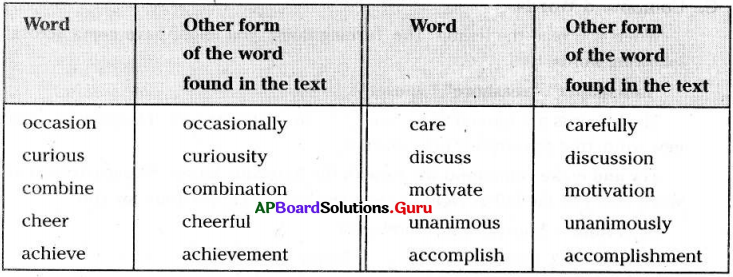
Look at the following picture and answer the questions that follow.
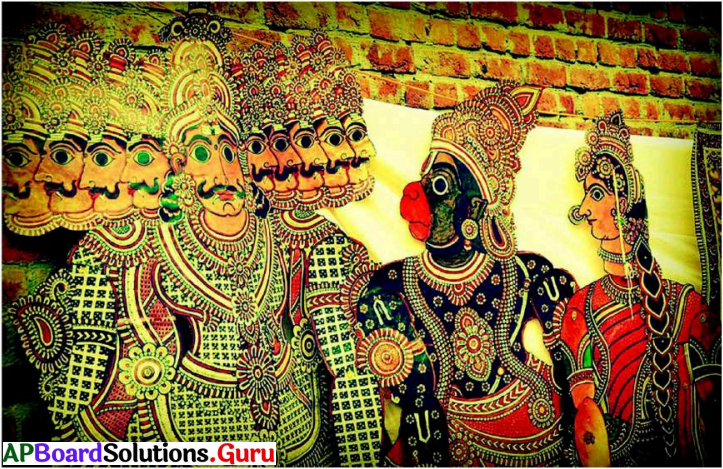
AP Board 7th Class English Solutions Unit 5 The Art of Weaving 1

Question 1.
Have you seen any of these in your locality/place?
Answer:
Yes, I have seen this kind puppets in my primary school.

Question 2.
How do they make these puppets?
Answer:
They make these puppets with sticks, ropes, paper, cardboards, etc.

Question 3.
Have you ever tried any craft?
Answer:
No, I have never tried any craft.

Question 4.
Are there any craftsmen/craftswomen in your village/area?
Answer:
Yes, there are some craftsmen in our village. There are people who work on Embroidery, Knitting, Lace-making, Woodcraft, Pottery, Jewellery, etc.

AP Board 7th Class English Solutions Unit 5 The Art of Weaving

Question 5.
What art/craft do you like the most?
Answer:
I like woodcraft and pottery most.

Reading Comprehension

A. Answer the following questions.

Question 1.
What is the specialty of a Mangalagiri saree?
Answer:
The Nizam design is a unique characteristic feature of Mangalagiri saree. The uniqueness of Mangalgiri cotton is because of its durability. The body and the pallu is embellished with zari or golden thread work with a Nizam border and geometrical and simple designs.

Question 2.
Explain what the warp and the weft are.
Answer:
The warp is the vertical thread and the weft is the horizontal thread.

Question 3.
Why do the weavers perform street-sizing?
Answer:
Street-sizing is the extension of the warp, spraying of starch and brushing followed by drying to get the fabric ready.

Question 4.
What problems do the weavers of Mangalagiri face?
Answer:
The weavers face many problems in the textile industry. They face tough competition, change in fashion, trends, scarcity of raw material and the involvement of middle men.

Question 5.
Are the handloom fabrics expensive? Why?
Answer:
Weaving fabric on a hand loom is more expensive than that of a power loom because the fabric is woven manually.

AP Board 7th Class English Solutions Unit 5 The Art of Weaving

B. Arrange the following sentences in sequential order and write them in the space provided.

1) The yarn is kept in the sunlight for drying.
2) The street sizing process is done to make the thread thick and strong.
3) The yarn is boiled and sent for dyeing.
4) The yarn is rolled on an iron rod and fixed on a loom to weave.
5) The yarn bundles are placed on spinning wheel.
Answer:
3) The yarn is boiled and sent for dyeing.
5) The yarn bundles are placed on spinning wheel.
2) The street sizing process is done to make the thread thick and strong.
1) The yarn is kept in the sunlight for. drying.
4) The yarn is rolled on an iron rod and fixed on a loom to weave.

C. Read the following statements and say whether they are true or false.

1) Power lev ms are more expensive than handlooms. [ ]
2) Warp and weft is an interlacing method of weaving. [ ]
3) Warp refers to horizontal threads on woven cloth. [ ]
4) Nizam border is a unique feature of Mangalagiri saree. [ ]
5) Mangalagiri is a small town in Vijayawada district. [ ]
Answer:

  1. False
  2. True
  3. False
  4. True
  5. False

Correct the false statements and write them here :
1) ……………………………………….
2) ……………………………………….
3) ……………………………………….
4) ……………………………………….
5) ……………………………………….

Correct the false statements and write them here:
1) Handlooms are more expensive than power looms.
3) Warp refers to vertical threads on woven cloth.
5) Mangalagiri is a small town in Guntur district.

Vocabulary

A. Match the following words denoting their profession or trade.

1. A person who makes potsa. tinker
2. A person who weaves fabricb. sculptor
3. A person who goes from place to place to mend pots, pans, etc.c. florist
4. A person who makes furnitured. potter
5. A person who carves stones into idolse. carpenter
6. A person who sells flowersf. weaver

Answer:

1. A person who makes potsd. potter
2. A person who weaves fabricf. weaver
3. A person who goes from place to place to mend pots, pans, etc.a. tinker
4. A person who makes furnituree. carpenter
5. A person who carves stones into idolsb. sculptor
6. A person who sells flowersc. florist

AP Board 7th Class English Solutions Unit 5 The Art of Weaving

B. Read the following:

Today I helped my mom in the kitchen. I carefully cut the vegetables and my mom slowly placed them into a boiling pot of water. Next, mom quickly browned the onions while I patiently peeled off the potatoes. Immediately, my mom deeply fried the potatoes also. 1 eagerly waited for my nqxt job, which was to gently sprinkle spices into the vegetable soup. But I accidentally poured too much cumin. I quietly told my mom my mistake, and she sweetly told me that, initially, we made such mistakes. Gradually, you would be out of confusion.

In the above event, there are many words ending in ly. They are adverbs. They are formed by adding ‘ly’ to adjectives.
Adjective + ly = Adverb

E.g : approximate + ly

Identify the adverbs from the paragraph given above and write them in the space given.

AP Board 7th Class English Solutions Unit 5 The Art of Weaving 2
Answer:
AP Board 7th Class English Solutions Unit 5 The Art of Weaving 6

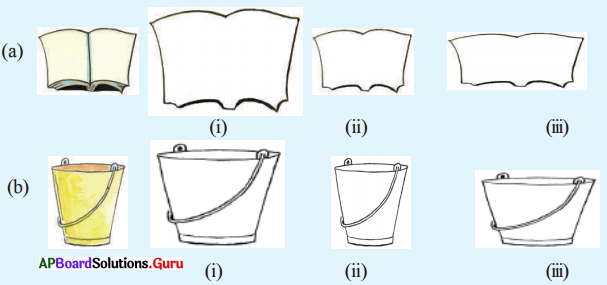
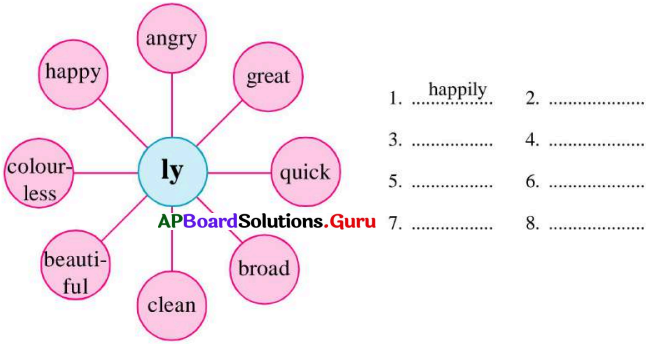
Look at the following image and make adverbs by adding ‘ly’. One is done for you.
AP Board 7th Class English Solutions Unit 5 The Art of Weaving 3
Answer:

  1. happily
  2. angrily
  3. greatly
  4. quickly
  5. broadly
  6. cleanly
  7. beautifully
  8. colourlessly

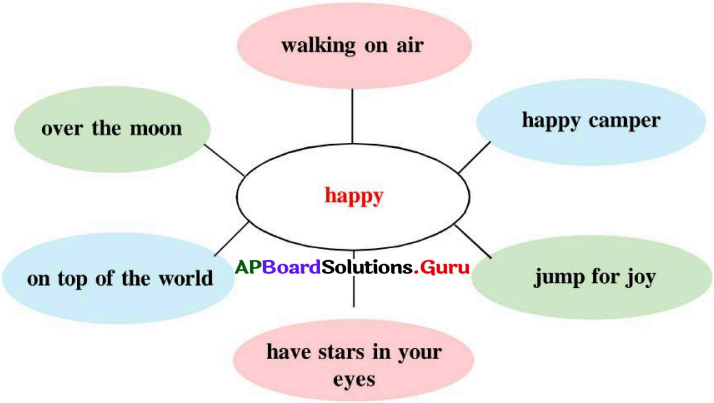
C. Let’s learn some idioms to express ‘happiness’.
AP Board 7th Class English Solutions Unit 5 The Art of Weaving 4

Use these idiomatic expressions in your own sentences. One is done for you.
E.g. I have been over the moon when I got gold medal in the National Athletics.
1. ……………………………………….
2. ……………………………………….
3. ……………………………………….
4. ……………………………………….
5. ……………………………………….
Answer:
1. walking on air:
Answer:
After the delivery of her baby, she was walking on air.

2. happy camper:
Answer:
There are no happy campers after the COVID-19.

3. jump for joy:
Answer:
We exactly jump for joy after our results.

4. have stars in your eyes:
Answer:
When she left the school, she had stars in her eyes.

5. on top of the world:
Answer:
She felt on top of the world when she was elected in the elections.

Grammar

A. Read the following sentences from the text:
One of us enquired, “Sir, what are you doing?”
He replied, “I am weaving a saree on the loom.”

Observe the verb in the sentence. It is in present progressive tense. It denotes the ‘on going’ actions.

Present Continuous tense / Progressive tense :

When Mary visits Kavya’s home to play, Kavya, her brother Naveen, and her neighbour Bibi are working in the garden.

Read the conversation among them.
Mary : Hello! Friends, what are you doing here?
Kavya : I’m digging a pit, Mary.
Naveen : I’m clearing the clay from the pit.
Mary : What are you plucking Bibi ?
Bibi : I’m plucking weeds in the garden.
Mary : Why are you digging the pit?
Kavya : We are planning to grow a rose plant here.
Mary : You are doing a very good job. Keep it up.

You might have noticed the use of present progressive tense in the above conversation.
Look!, Hear!, See!, Watch!, Listen!, etc. are generally used in present continuous tense.

Ex : Look ! I’m drawing.
See ! how the peacock is dancing.
Listen! I’m talking to you.

1. Frame as many sentences as you can from the following table.
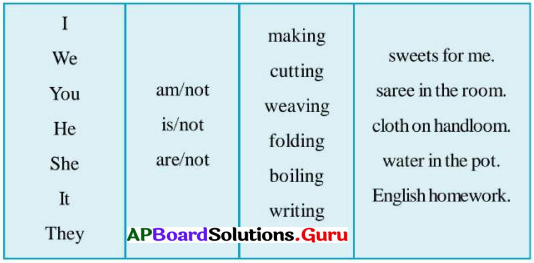
AP Board 7th Class English Solutions Unit 5 The Art of Weaving 5
a) …………………………………………..
b) …………………………………………..
c) …………………………………………..
d) …………………………………………..
e) …………………………………………..
Answer:

  1. I am making sweets for me.
  2. We are writing English homework.
  3. You are not writing English homework.
  4. He is folding cloth on handloom.
  5. She is not weaving sarees in the room.
  6. She is not cutting sweets for me.
  7. They are boiling water in the pot.
  8. I am not boiling water in the pot.
  9. We are not folding cloth on the handloom.
  10. He is not cutting sweets for me.
  11. She is not making sweets for me.
  12. They are writing English homework.
  13. You are boiling water in the pot.
  14. I am not weaving sarees in the room.
  15. We are not making sweets for me.

AP Board 7th Class English Solutions Unit 5 The Art of Weaving

2. Write meaningful sentences using present continuous tense with the sets of words given.
a) butterflies- fly- garden ……………………………………………………
b) dogs – run – street ……………………………………………………
c) baby – crawl- floor ……………………………………………………
d) boy – dance – stage ……………………………………………………
e) girl – paint – picture ……………………………………………………
Answer:
a) Butterflies are flying in the garden,
b) Dogs are running in the street,
c) A baby is crawling on the floor,
d) A boy is dancing on the stage.
e) A girl is painting a picture.

B. Reported Speech

Look at the following sentences from the lesson.
1. Ramaiah, a weaver, greeted with a smile and replied, “We are street-sizing.”
2. He replied, “I am weaving a saree on the loom. ”

The part of the sentence that is kept within the inverted commas is the sentence actually spoken by the speaker. So, the above sentences are said to be in Direct Speech.

When the same sentences are told by someone other than the speaker they are said to be in Indirect speech (Reported Speech).

e.g. 1. Ramaiah, a weaver, greeted with a smile and replied that they were street-sizing.
2. He replied that he was weaving a saree on the loom.

Let’s observe the underlined words in the above sentences.
“that” is used as conjunction.

‘are’ in the sentence (1) has become ‘were’ and ‘am weaving’ in the sentence (2) has become ‘was weaving’.

Pronoun ‘we’ in the sentence (1) has become ‘they’.
‘I’ in the sentence (2) has become ‘he’.

Now, read the following conversation and complete the passage that follows.

The weaver :
Along with 5 persons, I have to work in each stage to weave a saree.

The students :
We are very happy to learn from you.

The weaver told the students ________ along with 5 to 6 persons ________ had to work in each stage to weave a saree and the students replied him _____, ____ were verv hannV to learn from him.
Answer:
The weaver told the students that along with 5 to 6 persons he had to work in each stage to weave a saree and the students replied him that they were very happy to learn from him.

C. Observe the position of the objects/things in the given picture.
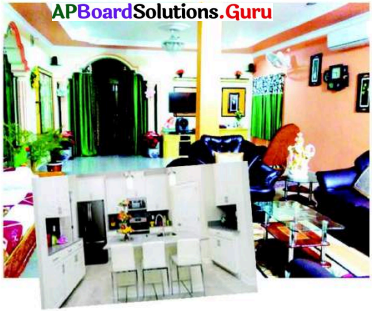
AP Board 7th Class English Solutions Unit 5 The Art of Weaving 7

Now, Read the following sentences. Tick (✓) the suitable preposition.
1. The fridge is in between/among the door and the clock.
2. The clock is before / on the wall.
3. The car is before/under the table.
4. The chair is placed against/before the table.
5. The books are on / in the shelf.
Answer:
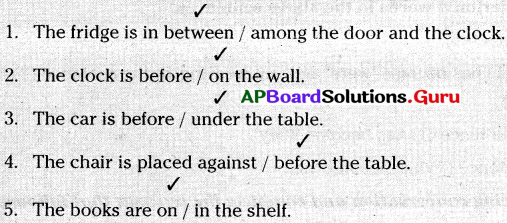
AP Board 7th Class English Solutions Unit 5 The Art of Weaving 8

Writing

Go through the following invitation card.

AP Board 7th Class English Solutions Unit 5 The Art of Weaving 9

Now, prepare an invitation card for a handicraft exhibition cum sale.

(Items of display: handloom fabrics, mats, designing pots, clay dolls, wall hangings etc., – 29-7-2021 -10.00 am to 5.30 p.m. – free entry- District Handloom Cooperative Society-by Homage to Heritage Association, Andhra Pradesh)
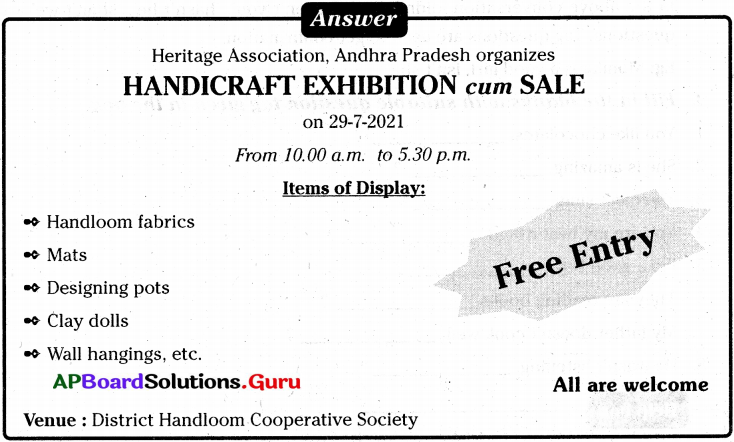
AP Board 7th Class English Solutions Unit 5 The Art of Weaving 10

Talking Time

1. Role-play:
Jaya : Hallo! What are you doing?
Riya : I’m getting ready for the party.
Jaya : Oh! Really, How are you going there? .
Riya : Hmmm! We are going there by car.
Jaya : I see. Are your children coming?
Riya : Yes. They are coming.
Jaya : I am also planning to bring my children.
Riya : Oh! Very nice. Meet you there. Bye.

Language Function :
Here is a conversation between two friends in the classroom.

Raheem : Good morning, Shyam! Are you searching for something?
Shyam : You are right. I am searching for my English notebook.
Raheem : You gave it to our English teacher yesterday, didn’t you?
Shyam : Oh, My goodness! You have also given your notes, haven’t you?
Raheem : Yes, Bobby has given my notes to the teacher, hasn’t he??
Shyam : Okay. We shall collect them from our teacher, shan’t we?

In the above conversation ‘didn’t you’, ‘haven’t you’, ‘hasn’t he’, ‘shan’t we’ are tag questions. Tag questions are used to get confirmation.
Eg: Monika is a good girl, isn’t she?

AP Board 7th Class English Solutions Unit 5 The Art of Weaving

I. Fill in the blanks with suitable question tag given in the box.

1. You like chocolates, _________ ?
2. She is amazing, _________ ?
3. You can’t sing, _________ ?
4. You are my best friend, _________ ?
5. I’m a good boy, _________ ?
6. They are reading books, _________ ?
7. My father doesn’t cook well, _________ ?
8. He wasn’t listening, _________ ?
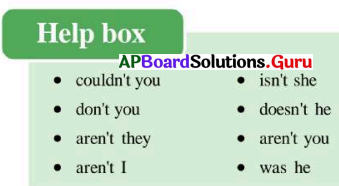
AP Board 7th Class English Solutions Unit 5 The Art of Weaving 11
Answer:

  1. You like chocolates, don’t you?
  2. She is amazing, isn’t she?
  3. You can’t sing, can you?
  4. You are my best friend, aren’t you?
  5. I’m a good boy, aren’t I?
  6. They are reading books, aren’t they?
  7. My father doesn’t cook well, does he?
  8. He wasn’t listening, was he?

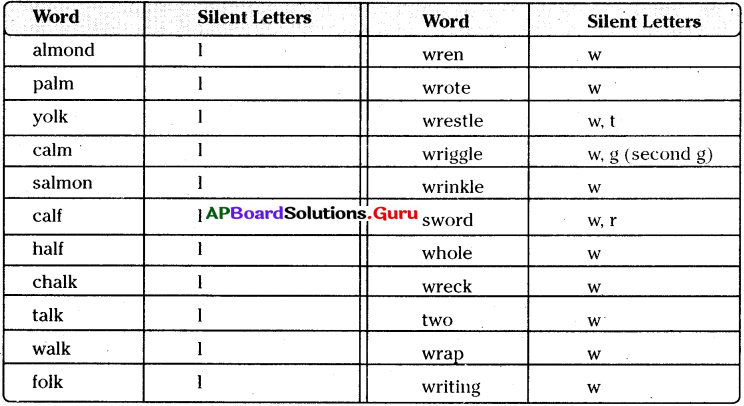
Read the words aloud :
Identify the silent letters in the following words while your teacher is reading them aloud.
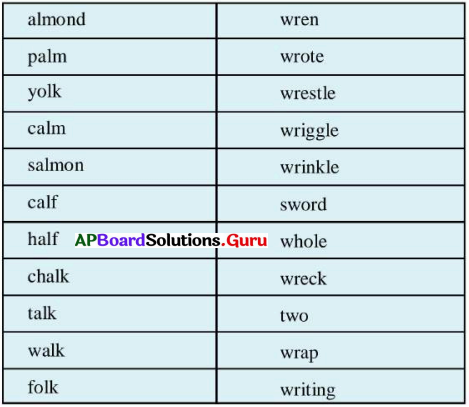
AP Board 7th Class English Solutions Unit 5 The Art of Weaving 12
Answer:
AP Board 7th Class English Solutions Unit 5 The Art of Weaving 13

Study Skill

Read the bar diagram carefully and answer the following questions.
HANDICRAFTS EXPORT
Source : Ministry of Textiles (Rs. in Crores)
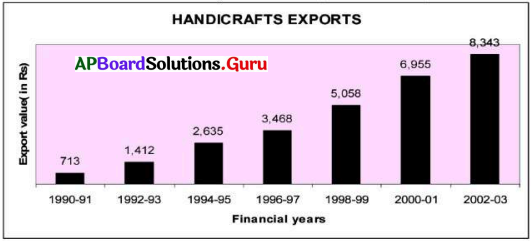
AP Board 7th Class English Solutions Unit 5 The Art of Weaving 14

1. What is the bar diagram about?
Answer:
The bar diagram is about Handicrafts Export.

2. What is the source of the information?
Answer:
Ministry of Textiles.

3. How many financial years are covered?
Answer:
Seven (7)

4. The export value was the highest in ( C )
A) 1990-91
B) 2000-01
C) 2002-03
Answer:
C) 2002-03

5. The observed trend for exports is ( A )
A) always increasing
B) always decreasing
C) neither increasing nor decreasing
Answer:
A) always increasing

Project

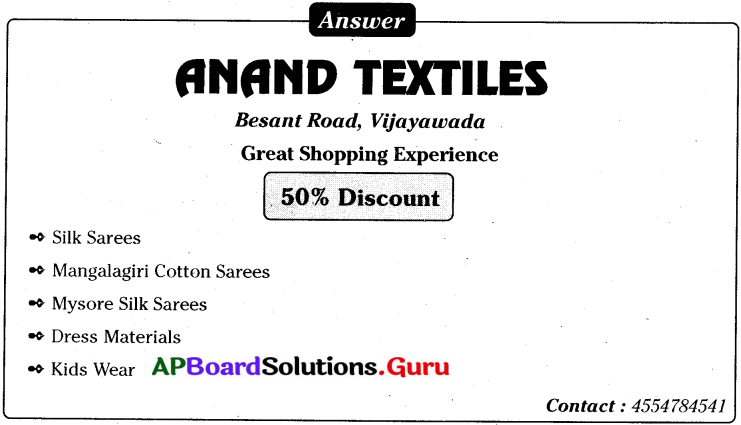
Design an advertisement for a cloth showroom.
Details to be included :
1. Name of the shop.
2. Items sold.
3. Address and contact information.
4. Tag line.
5. Sale offers (Discounts).
Answer:
AP Board 7th Class English Solutions Unit 5 The Art of Weaving 15

Fun Time

Prepare a door-mat using old pieces of cloth, wool, fur, coir, etc. available in your surroundings.
Answer:
Doormat making from old clothes :
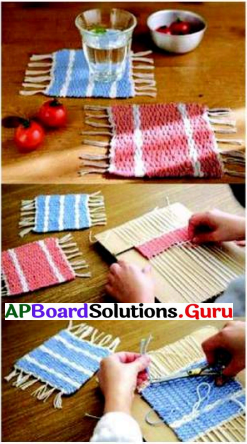
AP Board 7th Class English Solutions Unit 5 The Art of Weaving 16
Step 1 :
First cut and open the Lungi. It will be about 6 ft long after cutting. The width is about 4 ft. Cut 3 inch wide strips from it. You can cut about 12 strips of 6 ft long each from this cloth.

Step 2 :
Take 3 strips in hand and tie them together at one end. Insert all three tied end of strips in the door or window grill.

Step 3 :
Tightly braid the three strips of cloth starting from the tied end. It is same as braiding hair. You can add another strip in the braid when the length of strip being braided reaches the end. After using all 12 strips you will have a 20 ft long braided length of cord.

Step 4 :
Trim the excess length of strip at end. Using the needle and thread, stitch the ends of all three strips in the braid together. Cut the ends tied with window grill and sew those ends also together.

Step 5 :
Start rolling from one end, roll the braided coil in circles to form the mat. Using a needle with dark coloured yarn, stitch the roll continuously with adjacent circle while rolling.

Step 6 : Continue to roll the coil as well. Continue stitching the rolled mat with the adjacent coil. Once you completed rolling of all 20 ft long coil, stitch the end with the mat and finish.

Now, the doormat is ready.

Language Game

Fill in the blanks with suitable spellings. One is done for you.
1. art (creative work, skill)
2. part (portion or piece)
3. chart (used for drawing a big picutre)
4. oxcart (a cart that is drawn by an ox)
5. restart (starting an engine again)
6. outsmart (beat through cleverness)
7. flowchart (process of diagram)
8. sweetheart (dearest to heart)

Listening

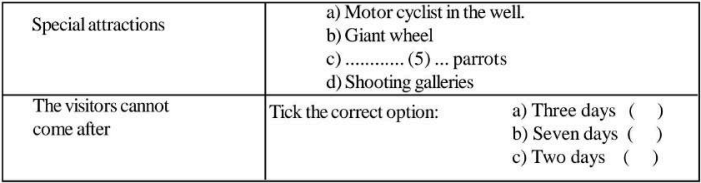
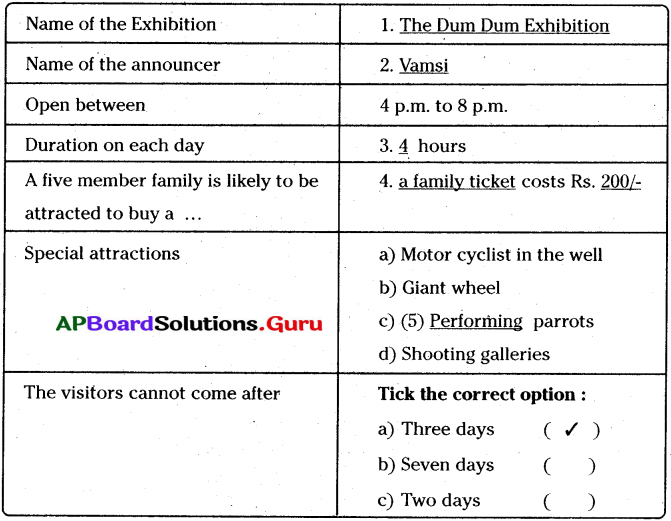
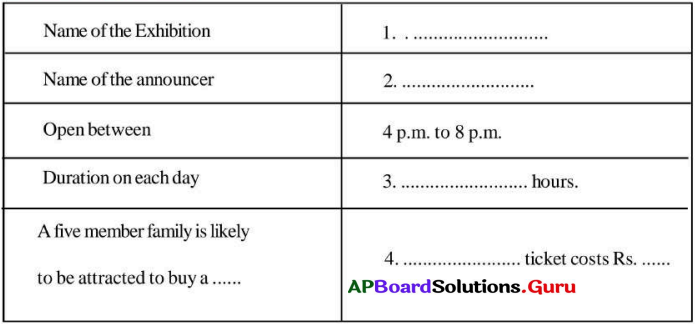
Listen to the following announcement made in an exhibition. Fill in the table given below.

Good evening to everybody. Warm welcome to all of you to this Sunday’s special programme. This is Vamsi welcomes you all to the Dum Dum Exhibition. This exhibition will be open from 4 p.m to 8 p.m. every day.

The visitors are requested to get their tickets from the counter. It is on the right to the Halloween corner. Each ticket costs Rs. 50/- and a family ticket is Rs. 200/-. There is a refreshment stall opposite to the ticket counter.

We have some special attractions : a motor cyclist in the well, a giant wheel, per-forming parrots, shooting galleries, many handicrafts and handloom fabrics. The show will run only for four more days. Request all your friends and relatives to visit this exhibition without fail.

Fill in the table as you listen.
AP Board 7th Class English Solutions Unit 5 The Art of Weaving 17
AP Board 7th Class English Solutions Unit 5 The Art of Weaving 18
Answer:
AP Board 7th Class English Solutions Unit 5 The Art of Weaving 19

The Art of Weaving Summary

One day an English teacher took the class for a case-study to Mangalagiri, a famous town for handicraft weaving in Guntur District. The case-study is about weaving industry.

The students tried to know many things about the weaving industry in Manglagiri with the help of a master weaver named Veeraiah.

Mr. Veeraiah explained to them how they make the yarn suitable for dyeing. After dyeing it is washed, dried at room temperature and brought for the process of spinning. Later yarn spools are made ready for making a fabric.

A weaver named Ramaiah took the students and showed them an open area where the yarn was spread. Another weaver Sambayya explained to them that the uniqueness of Mangalagiri cotton is because of its durability. He said that they weave sarees, dress materials, kurtas, dupattas and shirts. It has a rich appearance. The quality of work done by the weavers and the pain the weavers take for weaving a saree keep the love for our Mangalagiri fabric.

Around 5000 weavers are working in the Mangalagiri textiles industry in a population of eighty thousand. Mangalagiri has a special place in the world textile map because of the handloom sarees and the dress-materials woven here are world famous.

The weavers face many problems in the textile industry. They face tough competition, change in fashion, trends, scarcity of raw material and the involvement of middle men. However the traditional value of handloom fabric is increasing for their uniqueness. Handloom fabric, thus, has a lot of global demand because of its artistic appeal.

Meanings For Difficult Worps

fabric (n.) : cloth or other material
occupation (n.) : a job or profession
migration (n.) : movement from one region to another
hank (n.) : coil or yarn bundle
warp (n.) : vertical thread
radiance (adj.) : glowing brightly or shining
extension (ta.) : stretching out
knotting (v.) : tying
enthusiasm (n.) : keen interest
evidently (adv.) : in a way that is seen or understood
durability (n.) : permanence
geometrical (adj.) : decorated with regular lines or shapes
distinguish (v.) : differentiate or identify
dobby (n.) : a mechanism attached to a loom for weaving small patterns
expensive (adj.) : costly

Indian Weavers Poem

WEAVERS, weaving at break of day,
Why do you weave a garment so gay?…
Blue as the wing of a halcyon wild,
We weave the robes of a new-born child,
Weavers, weaving at fall of night,
Why do you weave a garment so bright?
Like the plumes of a peacock, purple and green,
We weave the marriage- veils of a queen.
Weavers, weaving solemn and still,
What do you weave in the moonlight chill?
White as a feather and white as a cloud,
We weave a dead man’s funeral shroud. – Sarojini Naidu

Appreciation of the poem

I. Match the rhyming words and write them in the blanks given :
1. day – a. queen
2. wild – b. bright
3. night – c. gay
4. green – d. shroud
5. still – e. child
6. cloud – f. chill
Answer:
1. day – (c) gay
2. wild – (e) child
3. night – (b) bright
4. green – (a) queen
5. still – (f) chill
6. cloud – (d) shroud

AP Board 7th Class English Solutions Unit 5 The Art of Weaving

II. Choose the correct answer:
1. What do the weavers weave in the early morning?
a) a bright blue cloth
b) a dull grey cloth
c) a soft white cloth
d) a red coloured cloth
Answer:
a) a bright blue cloth

2. The is purple and green coloured.
a) dress of the weaver
b) dress of the new born child
c) queen’s marriage veil
d) robe of the king
Answer:
c) queen’s marriage veil

3. What do the weavers weave in the chilly moonlight?
a) a garment light as feather
b) a garment meant to cover the dead man
c) a garment to keep away the chill
d) a garment to warp a new born child
Answer:
b) a garment meant to cover the dead man

4. The weavers weave at the fall of night.
a) funeral shroud
b) a garment so bright
c) robes of a new born child
d) a carpet
Answer:
b) a garment so bright

5. The bright garment is compared to
a) the stripes of a tiger
b) the wing of a parrot
c) the feathers of a peacock
d) the rainbow
Answer:
c) the feathers of a peacock

6. Whom does the poetess address in the poem?
a) the children
b) the queen
c) the weavers
d) all the above
Answer:
c) the weavers

III. Answer the following questions.

Question 1.
Why are the weavers solemn and still?
Answer:
The weavers are solemn and still because they are weaving a dead man’s funeral shroud.

Question 2.
What are the three events of life depicted in the poem?
Answer:
Birth, marriage and death are the three events referred to in this poem. These events indicate the three stages of human life – childhood, youth and old age.

Question 3.
Pick out the three types of cloth in the poem.
Answer:
The three types of cloths are (1) cloth for a new-born baby (2) cloth for the veils of a queen and (3) cloth to cover the dead body.

Question 4.
Why is white coloured cloth used for the funeral?
Answer:
The cloth is used to cover the dead body.

Question 5.
What colours do the weavers weave for the queen’s veil?
Answer:
The weavers weave purple and green colours for the queen’s veil.

AP Board 7th Class English Solutions Unit 5 The Art of Weaving

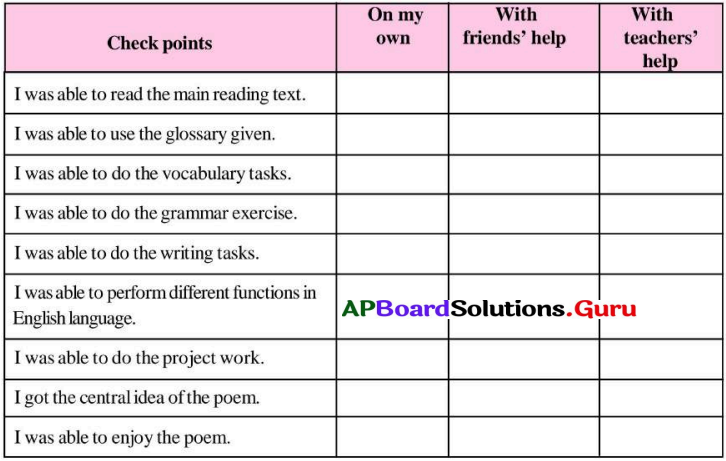
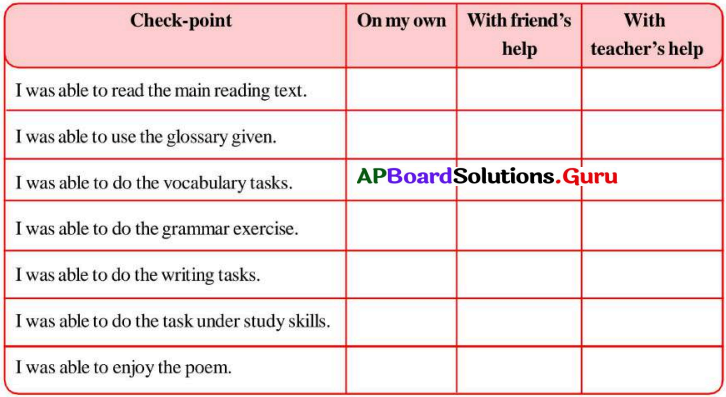
Check Point
AP Board 7th Class English Solutions Unit 5 The Art of Weaving 20

Indian Weavers Summary

Indian Weavers by Sarojini Naidu is a short poem consisting of three stanzas having four lines each.

The poetess talks about three types of dresses that the Indian Weavers weave at three particular times of the day. Metaphorically each time and the dress weaved in that time symbolizes a particular stage of life.

The poetess uses a number of literary devices to express her ideas like simile, metaphor, etc. The poem also consists of a discussion between the poet and the weavers; the poet asks the weavers and the latter reply.

STANZA 1 :
In the first stanza, the poetess questions the weavers that why are they weaving clothes early in the morning that seem to be quite beautiful and charming and of a particular colour. The poetess is curious to know about these clothes as they seem quite special. The weavers reply that the clothes that they are weaying are blue as the wing of a halcyon which is the other name of the kingfisher whose wings are bright blue in colour. The weavers reply that they are weaving the robes of a new-born child who has just come to the world. This stanza describes the first stage of human life which is full of freshness, happiness, beauty and hope and there is no place for sorrow at this stage.

STANZA 2 :
In this stanza, the poetess meets the Indian weavers again during the fall of night and asks why they are weaving a cloth late in the evening which is the time when most of the Indian marriages take place. She also asks why they are weaving a garment so bright like the plumes (feathers) of a peacock, purple and green. The weavers reply that the cloth is bright and richly coloured because they are weaving it for a queen. She will use it to make her marriage veil. This stanza describes the second or adult stage of life when humans quest for a better and prosperous life. The colours purple and green symbolize the ups and downs of the life that makes adulthood bright.

STANZA 3 :
In the final stanza, the poetess finds the weavers quite sorrowful, grieved and silent. They are weaving something weird in the dead of the night which is colourless and lifeless so, rather than asking why are they weav-ing, she asks what are they weaving? The weavers reply that they are weaving shroud which means a cloth used to put on the dead body. This represents the final stage of human life that is death which is lifeless and emotionless just like a white cloud or a feather. However, the white colour also symbolizes eternal peace and calm that comes with death.

The poem sums up human life in three main stages using symbols like clothes and times of the day. The life starts its journey with blue colour representing joy and hap-piness and then come green and purple that represent the ups and downs of life along with happiness and finally comes a single colour – white that represents the last stage of human life when the person dies and with him the emotions that were connected to life die as well.

AP Board 7th Class English Solutions Unit 5 The Art of Weaving

Poectic Devices Used In The Lines

1. Weavers, weaving at break of day.
Alliteration – The sound of letter “w” is repeated- Weavers, weaving
Metaphor – The birth (childhood stage of man) is implicitly compared with a break of day.

2. Why do you weave a garment so gay? …
Alliteration – The sound of letter “g” is repeated- garment so gay

3. Blue as the wing of a halcyon wild.
Alliteration – The sound of letter “w” is repeated- wing of a halcyon wild
Simile – The blue coloured cloth is directly compared with a wing of wild halcyon.

4. We weave the robes of a new-born child.
Alliteration – The sound of letter “w” is repeated- We weave

5. Weavers, weaving at fall of night.
Alliteration – The sound of letter “w” is repeated- Weavers, weaving
Metaphor- Adulthood (young – the second stage of man) is implicitly compared with the fall of night.

6. Why do you weave a garment so bright?
Alliteration – The sound of letter “w” is repeated.

7. Like the plumes of a peacock, purple and green.
Simile – The garment is directly compared with purple and green coloured plumes of peacock.
Alliteration – The sound of letter “p” is repeated- plumes of a peacock, purple

8. We weave the marriage-veils of a queen.
Alliteration – The sotind of letter “w” is repeated- We weave

9. Weavers, weaving solemn and still.
Alliteration – The sounds of letters “w” and “s” are repeated- Weavers, weaving

10. What do you weave in the moonlight chill?
Alliteration – The sound of letter “w” is repeated.
Metaphor – death (old age – the third and last stage of man’s life) is implicitly compared with moonlight.

11. White as a feather and white as a cloud.
Simile – The garment is directly compared with a feather and a cloud.

12. We weave a dead man’s funeral shroud.
Alliteration – The sound of letter “w” is repeated.

13. White as a feather and as a cloud.
We weave a dead man’s funeral shroud.
Simile – funeral shroud is directly compared with a feather and a cloud.

Indian Weavers About the Poet
AP Board 7th Class English Solutions Unit 5 The Art of Weaving 21
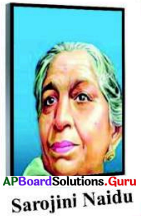
Sarojini Naidu, the Nightingale of India was born on 13th February 1879 in Hyderbad. She is an Indian Independence activist, politician, a renowned orator and accomplished poet. She was elected as the first President of the Indian National Congress. Sarojini Naidu as a poet belongs to an era of struggle, slavery and freedom fighting. The poem Indian Weavers, one of her poems, explains different stages of life.

Meanings For Difficult Words

weaver (n) : a person who weaves fabric
gay (adj) : (here) brightly coloured
halcyon (n) : a tropical Asian and African kingfisher with brightly coloured plumage
break of day (phr.) : early morning
garment (n) : a single item of clothing
robe (n) : a long loose outer garment
fall of night (phr.) : late in the evening
veil (n) : a piece of material owned by a woman to protect face
plume (n) : a long soft feather or arrangement of feathers
solemn (adj) : deeply serious
funeral (n) : a ceremony to honour a deceased person
still (adj) : quiet
shroud (n) : a cloth for the dead
AP Board 7th Class English Solutions Unit 2 The Turning Point

SCERT AP 7th Class English Textbook Answers 2nd Lesson The Turning Point Textbook Questions and Answers.

AP State Syllabus 7th Class English Unit 2 Questions and Answers The Turning Point

7th Class English Unit 2 The Turning Point Textbook Questions and Answers

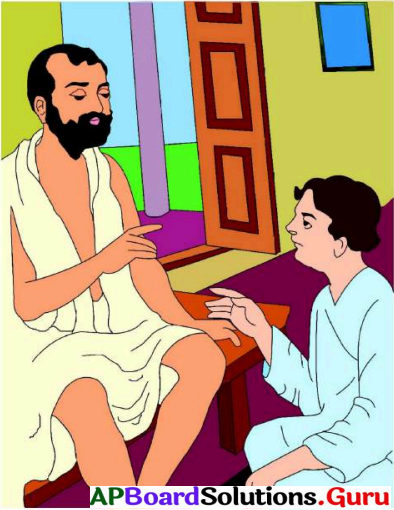
Observe the following picture and respond.
AP Board 7th Class English Solutions Unit 2 The Turning Point 1

Question 1.
Guess the characters in the picture.
Answer:
The characters in the picture are a wise man and common man.

Question 2.
How do you think are they related to each other?
Answer:
The man with beard was a guru and the other man was a disciple.

Question 3.
Why did the young man meet the other person?
Answer:
The young man met the other person to take his advice.

Question 4.
What is the man with a beard saying?
Answer:
The man with a beard is saying something good.

AP Board 7th Class English Solutions Unit 2 The Turning Point

Question 5.
Why do we listen to persons?
Answer:
We listen to persons to get good advice out of their experience.

Questions Given in the Lesson

Possible answers to the questions given in the middle of the lesson :

Question 1.
Who is your favourite teacher? What do you like about him/her? Which topic fascinated you the most in his/her class?
Answer:
Our science teacher is my favourite teacher.! like her way of explaining things and her way of treating the children. Almost all the topics taught by her fascinate me the most.

Question 2.
What do you want to become in your life?
Answer:
I want to become a doctor/an engineer/a teacher in my life.

Question 3.
How do you feel when you see birds flying in groups?
Answer:
It is really a wonderful sight to see. I feel thrilled at the sight of the birds’ flight in groups.

Reading Comprehension

A. Answer the following questions.

Question 1.
Why did Kalam take up the job as a newspaper boy?
Answer:
At the time of the Second World War, all the resources were scarce and the prices were not affordable. So, Kalam took up the job as a newspaper boy.

Question 2.
What was Kalam curious about?
Answer:
Kalam was curious about planes. He wanted to be a pilot himself.

Question 3.
Which topic did Shri Siva Subrahmania Iyer discuss one day in the class?
Answer:
The topic that Shri Siva Subrahmania Iyer discussed one day in the class was ‘how birds fly’.

Question 4.
Where did the teacher take the whole class to explain the concept of bird’s flight?
Answer:
The teacher took the whole class to the seashore to explain the concept of bird’s flight.

Question 5.
What was the turning point in Kalam’s life? Explain.
Answer:
The Kalam teacher’s lesson on bird’s flight was the turning point in his life.

AP Board 7th Class English Solutions Unit 2 The Turning Point

Question 6.
When was Kalam honoured with the Bharat Ratna?
Answer:
In 1997, Kalam was honoured with the highest civilian award the Bharat Ratna.

B. Arrange the following sentences in the order they occurred in the story.

1. Abdul Kalam decided to study aeronautical engineering.
2. The photos of fighter aircrafts and the stories of the Second World War caught my attention.
3. In 2002 he was elected the 11th President of India.
4. Siva Subrahmania Iyer took the whole class to the seashore.
5. Kalam felt what he had learnt that day changed his life.
Answer:
2. The photos of fighter air crafts and the stories of the Second World War caught my attention.
4. Siva Subrahmania Iyer took the whole class to the seashore.
5. Kalam felt what he had learnt that day changed his life.
1. Abdul Kalam decided to study aeronautical engineering.
3. In 2002 he was elected the 11th President of India.

C. Read the following statements. Answer ‘True’ (T) or ‘False’ (F).
1. Sri Siva Subramania Iyer, sowed the seeds of vision.
2. One day Kalam taught about the bird’s flight.
3. Sri Subramania Iyer took the students to the airport to show the flying of aeroplanes.
4. Sri Kalam took up computer engineering at Madras institute of Technology
5. Sri Subramania Iyer ignited young minds.
Answer:

  1. True
    False
  2. False
  3. False
  4. True

Correct the false statements and rewrite them in the space provided.
Answer:
2. One day Kalam was taught about the bird’s flight.
3. Sri Subramania Iyer took the students to the seashore to show the flying of birds.
4. Sri Kalam took up aeronautical engineering at IIT, Madras.

Vocabulary

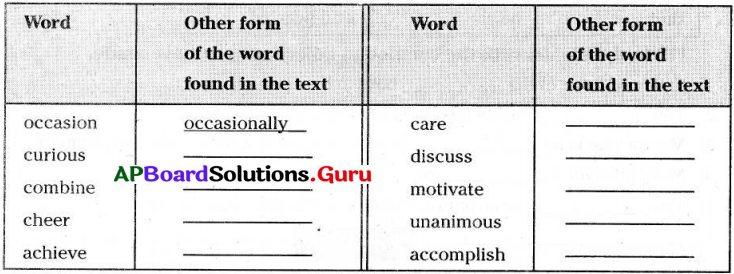
A. Other forms of the words
Read the following sentences from the text.
1. The prices were not affordable.
2. It was usually filled with the photos of fighter aircrafts.
Look at the underlined words in the above sentences. The word ‘affordable’ comes from the root word ‘afford’ and the word ‘usually’ comes from the root word ‘usual.’

Identify’ the other forms of the following words used in the lesson ‘The Turning Point’.
AP Board 7th Class English Solutions Unit 2 The Turning Point 2
Answer:
AP Board 7th Class English Solutions Unit 2 The Turning Point 3

B. Compound Adjectives

Read the following sentences.

My curiosity was fulfilled by a very special teacher when I was a ten-year-old boy in Class V. This was indeed a life-changing event.

In the above sentence the words “ten”, “year” and “old” and “life” and “ changing” are combined using a hyphen (-) and is made into a single adjective called compound adjective. Compound adjectives can be formed by bringing two different words to¬gether with a hyphen.

E.g. five-day, smart-looking, old-fashioned, short-haired

Match the following words in Set -A with Set – B to make coi lpound adjectives and write them in the space given.

Set-ASet-BCompound Adjective
absentagedabsent-minded
middleheartedmiddle-aged
wellbehavedwell-behaved
brandmindedbrand-new
kindnewkind-hearted

Fill in the blanks with the compound adjectives you have made.

1. Kalarn was one of the ………….. boys in his class.
2. The ………… girl helped the old man to cross the road.
3. Mohan who is an ………… person, forgot his wallet at the cash counter.
4. Murali bought a …………. car.
5. The ………… man who is standing at the gate, is my uncle.
Answer:

  1. well-behaved
  2. kind-hearted
  3. absent-minded
  4. brand-new
  5. middle-aged

C. Compound Words

When you read the lesson ‘The Turning Point’ you might have come across the following words.
“newspaper”, “seashore”,” sunset”

These words are formed when two or more words are joined together to create a new word, that has entirely new meaning.
Try and make compound words with the following words. You are free to add a word either to the left or right of the given words. One is done for you.

E.g.: House – housekeeper, storehouse
1. Hand 2. Room 3. Pot 4. Butter 5. Box
Answer:
1) hand : handmade, firsthand, handshake, handprint, handicraft
2) room : roommate, classroom, bedroom .
3) pot : pothole, teapot, inkpot, pothead, potluck
4) butter : buttermilk, butterfish, peanut butter
5) box : gearbox, toolbox, mailbox

Make more compound words and have fun.

AP Board 7th Class English Solutions Unit 2 The Turning Point

Compound Words:
bedroom, airport, anybody, backbone, background, cardboard, commonwealth, daybreak, earthquake, fireproof, grandchildren, headache, inside, jackpot, keyboard, layout, moonlight, newsreader, overcoat, passbook, playground, scarecrow, talebearer, understimate, warehouse, etc.

Fill in the blanks with a suitable word from the help box to make a compound word. One is done for you.
E.g. moon light house
(Moonlight and lighthouse are two different compound words with the same word ‘light’.)

Help Box
light
cover
sugar
fisher
land
paper
1. Cane sugar candy
2. News paper bag
3. Pillow cover story
4. King fisher man
5. Grass land mark
Answer:
1) canesugar, sugarcandy
2) newspaper, paperbag
3) pillowcover, coverstory
4) kingfisher, fisherman
5) grassland, landmark

Grammar

The Present Perfect Tense vs The Simple Past Tense :
Look at the following sentences from the text.
1) That evening he took all of us to the seashore.
2) I chose physics.
3) This was indeed a life-changing event.
4) Kalam dedicated his achievements to all his teachers.

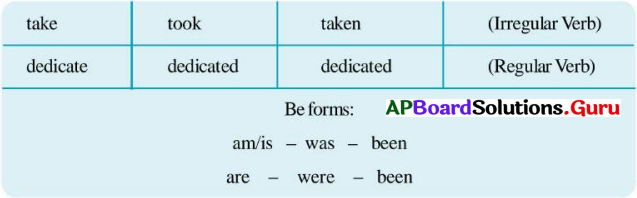
The above sentences denote the actions completed in the past. Hence, the verb is in simple past tense.
AP Board 7th Class English Solutions Unit 2 The Turning Point 4

Identify at least five verb forms used in the simple past tense from the text.
Answer:

  1. caught (Irregular Verb)
  2. manoevured (Regular Verb)
  3. belonged (Regular Verb)
  4. grew (Irregular Verb)
  5. drew (Irregular Verb) 6. explained (Regular Verb)
  6. understood (Irregular Verb)
  7. asked (Regular Verb)
  8. needed (Regular Verb) 10. opted (Regular Verb)

Exercise – 1

Fill in the blanks with past form of the verb given in brackets.

1. Sankar …………… (join) the bank last month.
2. Where …………… (be) you yesterday?
3. Fathima …………… (pass) the intermediate exam in 2016.
4. Indian Cricket team …………… (win) the trophy in 2017.
5. Leena …………… (write) her examinations and …………… (go) home immediately.
Answer:

  1. joined
  2. were
  3. passed
  4. won
  5. wrote, went

Already we have discussed ‘present perfect tense’ in unit-1.

Present perfect tense denotes the action that began in the past and continuous to the present time.

We write present perfect tense with the markers like ‘just, yet, etc. (adverbs of time).

We write past tense with the markers like yesterday, last week/month/…, ago, etc.

AP Board 7th Class English Solutions Unit 2 The Turning Point

Exercise – 2

Adverbs of time used with present perfect tense

AP Board 7th Class English Solutions Unit 2 The Turning Point 5

Fill in the blanks with Adverbs of Time :
1. Is Mr. Ravi at home?
No, he …………… left for work.

2. When does the train to Kakinada arrive?
It has …………… left.

3. The Chief Guest hasn’t arrived …………… .
4. I have lived in Vijayawada …………… a long time.
5. I have lived in Delhi …………… 2004.
6. Have you been to a circus?
Answer:
1. Is Mr. Ravi at home?
No, he already left for work.

2. When does the train to Kakinada arrive?
It has just left.

3. The Chief Guest hasn’t arrived yet.
4. I have lived in Vijayawada for a long time.
5. I have lived in Delhi since 2004.
6. Have you ever been to a circus?

Writing

A. You have read the text ‘The Turning Point’. The stories of the World War and the inspiring teachings of his teacher Sri Siva Subramania Iyer acted as a turning point of Kalam’s life.
Now prepare a script for a speech on the turning point in the life of Abdul Kalam and present it on the Teachers’ Day in your school.
Answer:
Respected Headmaster, teachers and other staff, Happy Teachers’ Day to all of you. It is a great privilege for me to be here to speak about the turning point in Kalam’s life.

A.P.J. Abdul Kalam always used to say he would like to be remembered as a teacher. When he became the President in 2002, he made no compromise on his passion for teaching. He grabbed every opportunity to teach students, especially children, wherever he went.

His curiosity grew in science because of a very special teacher, when he was a ten- year-old boy in Class V. This was indeed a life-changing event. His science teacher’s name was Shri Siva Subramania Iyer. One day the topic of discussion in his class of sixty-five was ‘how birds fly’. He drew a sketch of a bird with a tail, wings and feathers a head on the board and explained how a bird flew.

That evening he took all of them to the seashore. He asked all of them to notice how the birds make a formation in a group and fly. Mr. Iyer also made them notice how the bird is powered to fly by itself.

The flight principle got imprinted in Kalam’s mind and he decided that in the future he would study subjects related to flight. However, as a little boy he needed guidance to pursue that field. The teacher told Kalam to study and explore the field of aviation .science and aeroplanes.

Whatever he had learnt that day changed his life. He was inspired to have an aim. Later he realized how important it was to study physics. He chose physics. He opted for aeronautical engineering at the Indian Institute of Technology, Madras. Then, he became an aeronautical engineer and a space technologist. Mr. Iyer’s class had transformed his life which led him to make a profession out of his passion and his career began in that field.

We have to take Kalam’s life as an inspiration to grow high in our lives.

Thank you very much for giving me this opportunity.

B. Prepare a biographical sketch of Sri APJ Abdul Kalam using the given information.

Birth : 15 Oct 1931 at Dhariushkodi, Rameswaram, Tamil Nadu.

First job : Newspaper vendor

Inspiration : His Science teacher Sri Siva Subramania Iyer’s lecture

Education : Aeronautical Engineering from IIT(M) ( 1960)

Positions : IGMDP, DRDO, ISRO – Chief Advisor and Chairman

Achievements : Project Devil and Project Valiant (1970)
SLV – III, ROHINI, PSLV, PRUTHVI & AGNI Missiles, Nuclear Test. -Pokhran -II

Invented ‘Low Cost Coronary Stent’ and Rugged Tablet Computer with Dr. Soma Raju (1998)

Unanimously elected as the President of India (2002 – 2007) ‘People’s President.
Literary Works : Wrote ‘Wings of Fire’, ‘Ignited Minds,’ etc.

Awards : Honoured with Padma Bhushan (1981), Padma Vibhushan (1990) and Bharath Ratna(1997)
Death : 27 July 2015

Answer:
A.P.J. Abdul Kalam was born on 15th October 1931 at Dhanushkodi, Rameswaram, Tamil Nadu. In his childhood he worked as a newspaper vendor. His Science teacher Shri Siva Subrahmania Iyer’s lecture inspired him a lot. He completed Aeronautical Engineering from IIT(M) ( 1960) He held the position of the Chief Advisor and Chair¬man ot IGMDPV DRDO, ISRO. He was responsible for Project Devil and Project Valiant (1970), SLV – III, ROHINI, PSLV, PRUDVI & AGNI Missiles, Nuclear Test at Pokhran -II. He invented ‘Low Cost Coronary Stent’ and Rugged Tablet Computer with Dr. Soma Raju (1998). He was unanimously elected the presedent of India (2002 – 2007) . He was known as ‘People’s President. He wrote ‘Wings of Fire’ and ‘Ignited Minds. He was honoured with the Padma Bhushan (1981), the Padma Vibhushan (1990) and the Bharath Ratna (1997). He passed away on 27 July 2015.

AP Board 7th Class English Solutions Unit 2 The Turning Point

Fun Time

Try the following riddle.
The three-letter word that reads the same backwards : eye (a part of the body)

Read the following ‘Palindrome’.

  1. Race car
  2. Madam
  3. Don’t nod
  4. Dogma I am God
  5. Never odd or even
  6. Madam I’m Adam
  7. Too bad I hid a boot

Talking Time

A. Making Announcements:

Read the announcements usually made during the school assembly.

Dear Students, I have an announcement to make. We are planning to conduct sports and literary competitions on the occasion of Independence Day. The students those who want to participate in the sports competitions have to give their names to the Physical Director of our school. Those who want to participate in the literary competitions have to give their names to the English teacher.

You are the secretary of your school English Club. Make an announcement for the activities to be planned for the English Day.
Answer:
Dear Students, I have an announcement to make. We are planning to conduct a quiz and literary competitions on the occasion of the English Day. The students those who want to participate in the quiz competition have to give their names to Biology teacher of our school. Those who want to participate in the literary competitions have to give their names to the English teacher.

AP Board 7th Class English Solutions Unit 2 The Turning Point

B. Role-play:

Polite Request : (Could you please / Would you mind)
Srikar : Excuse me, could you please tell me when the Tirumala Express leaves for Vizag?
Enquiry : It starts at 5.05 p.m. every day.
Srikar : Could you please tell me the time of arrival at Vizag ?.
Enquiry : It reaches Vizag at 11 a.m. the next day.
Srikar : Thank you. Would you mind telling me if the tickets are available for tomorrow?
Enquiry : Let me check. Sorry. No tickets are available until next Sunday.
Srikar : OK, thank you, Sir. I’ll plan my journey accordingly.
Enquiry : You are welcome.

Language focus
1. Could you please ………………………
Eg : Could you please give me your pen?

2. Would you mind ……………………..
Eg : Would you mind opening the window? / Could you open the window?

Exercise – A

Underline the correct expression to complete each request.
1. Could you / Would you mind bringing me some milk for my coffee?
2. Could you / Would you mind answering the question?
3. Could you / Would you go to the shop for me?
4. Could you / Would you mind turning off the music?
5. Could you / Would you mind bringing me a glass of banana juice?
Answer:

  1. Could you / Would you mind bringing me some milk for my coffee?
  2. Could you / Would you mind answering the question?
  3. Could you / Would you go to the shop for me?
  4. Could you / Would you mind turning off the music?
  5. Could you / Would you mind bringing me a glass of banana juice?

Exercise – B

Complete the polite requests with the correct forms of the verb in brackets.
1. Could you …………… (bring) me a cup of coffee?
2. Could you …………… (lend) me your pen?
3. Would you mind …………… (call) a taxi for me?
4. Would you mind …………… (close) the door?
5. Could you …………… (get) me a glass of water?
6. Would you mind …………… (carry) these bags for me?
Answers

  1. bring
  2. lend
  3. calling
  4. closing
  5. get
  6. carrying

Listening

Transformation of Vivekananda

The relationship between Sri Ramakrishna and Vivekananda (formerly named as Narendranath) began in November 1881 when they met at the house of Surendranath Mitra. Ramakrishna had asked Narendranath to sing. He was impressed with the sing¬ing talent of Narendranath and invited him to Dakshineswar.

Narendra accepted the invitation. The meeting with Sri Ramakrishna proved to be a turning point in the life of Narendranath. Initially, he did not accept Ramakrishna as his master. But eventually, he became one of the closest disciples of-Ramakrishna who shaped the personality of Narendranath and inspired him to dedicate his life to serve the human.

Inspired by Ramakrishna, Narendranath became a monk and was named Vivekananda and he presented a speech at the Parliament of the World’s Religions held on 23rd September, 1893 in Chicago.

His meeting with Sri Ramakrishna in Dakshineswar was a turning point which re-sulted in the transformation of Vivekananda.

A. Listen to the story and state the following statements are true / false.
1. The meeting with Sri Ramakrishna was the turning point in the life of Vivekananda.
2. Sri Ramakrishna presented a speech in Chicago.
3. Sri Ramakrishna and Vivekananda first met at the house of Surendranath Mitra.
Answer:

  1. True
  2. False
  3. True

Comprehension

1. Why did Ramakrishna invite Narendranath to Dakshineswar?
Answer:
Sri Rafnakrishna was impressed with the singing talent of Narendranath and he invited him to Daksineswar.

2. How did Ramakrishna inspire Narendranath?
Answer:
Ramakrishna inspired Narendranath by his wisdom.

3. Where did Vivekananda present his speech?
Answer:
Vivekananda presented his speech in Chicago.

4. What did Vivekananda dedicate his life to?
Answer:
Vivekananda dedicated his life to serve the human.

5. Do you believe in transformation of yourself?
Answer:
Yes.

Study Skill

Study the following Tree diagram.

Answer the following questions :

1. What is the tree diagram about?
Answer:
The tree diagram is about the things in our sufroundings.

2. What are the two kinds of animals mentioned in the above tree diagram?
Answer:
Living things and Non-living things.

3. Things in our surroundings are categorised into _________ .
a) 3
b) 2
c) 4
Answer:
b) 2

4. ‘Viviparous’ is a category of _________ .
a) Plants
b) Oviparous
c) Animals
Answer:
c) Animals

AP Board 7th Class English Solutions Unit 2 The Turning Point

5. ‘Plants and animals’ come under _________ .
a) Living things
b) Oviparous
c) Non-living things
Answer:
a) Living things

The Turning Point Summary

The Turning Point’, is an edited extract from ‘My Teachers’ by DR A.P.J. ABDUL KALAM. The turning point means- An important change in the life of a person. This is the true story of Abdul Kalam that made a turning point in his life. When he was in class V, one day his teacher Shri Siva Subramania Iyer taught him about a bird’s flight in the class. When the teacher explained in the class about a bird’s flight most of the students including Kalam had not understood the lesson. So the teacher took them all to the seashore of Rameswaram (birthplace of Kalam) to teach them practically. The teacher showed there how a bird flies. He asked the students to look at the tail and the combination of flapping wings and twisting tail. The teacher explained how the birds changed direction, and position could fly in the direction they wanted to. After that all the students understood the lesson of a bird’s flight. For Kalam the lesson was not merely an understanding of how a bird flies. He decided that he wanted to study all he could about the concept of flight. So he took his teacher’s advice about the further study of Science. He became a rocket engineer, an aerospace engineer and a technolo¬gist. But the memory of his teacher encouraging him to become a successful person was up to the end of Kalam’s life.

The Turning About the Author

Avul Pakir Jainulabdeen Abdul Kalam was an Indian aerospace scientist and a politician who had served as the 11th President of India from 2002 to 2007. He was born on the 15th of October, 1931 at Dhanushkodi, Rameswaram, Tamil Nadu. He is popularly known as the Missile Man of India. His book Wings of Fire’ is widely read and is inspiring. This lesson is an extract from his book My Teachers’.

Meanings For Difficult Words

turning point (n) : a time at which an important change takes place
conflict (n) : clash, a serious disagreement
scarce (adj) : rare
affordable (adj) : reasonably priced
defend (v) : protect
manoeuvred (v) : plotted / steered / moved skillfully
curiosity (n) : a strong desire to know
gloomy (adj) : unhappy
flap (v) : move up and down
generate (v) : produce or create
unique (adj) : matchless/special
transform (v) : change
passion (n) : strong desire
indigenous (adj) : native, local
ignite (v) : light, kindle

Give Me Strength Poem

This is my prayer to thee, My Lord – strike,
strike at the root of penury in my heart.
Give me the strength lightly to bear my joys and sorrows.
Give me the strength to make my love fruitful in service.
Give me the strength never to disown the poor or bend my knees before insolent might.

Give me the strength to raise my mind high above daily trifles.
And give me the strength to surrender my strength to thy will with love.
Rabindranath Tagore

Appreciation of The Poem

A. Answer the following questions :

Question 1.
What does the poet pray for?
Answer:
The poet prays to God for giving him strength.

Question 2.
What does the poet want to bear with strength?
Answer:
The poet wants to bear joys and sorrows with strength.

Question 3.
Wteafcitype of service does the poet want to make?
Answer:
He wants to be in the service of humankind with sincerity and humility.

AP Board 7th Class English Solutions Unit 2 The Turning Point

Question 4.
How does the poet want to treat the poor and the mighty?
Answer:
He wants to help the poor and never to bend before rude and disrespectful authority.

Question 5.
What does the poet want to do with the strength finally?
Answer:
He wants to raise his head above petty and ordinary things and surrender his strength before the will of God.

Additional Questions

Question 1.
Why does the poet want God to strike at his heart?
Answer:
The poet implores God to strike at his heart to remove the hardheartedness and remake it with love and compassion. He wants to be a loving and caring human beings.

Question 2.
What does the poet want the strength for?
Answer:
The poet wants strength to bear joys and sorrows. He wants strength to make his love fruitful in service. He needs strength never to disown the poor or bow before a tyrant. Moreover, the poet needs strength to avoid the daily trifles and submit his will to the will of God.

Question 3.
How can love be made meaningful in one’s life?
Answer:
Love is meaningful when it bears fruits of service, service of mankind.

Question 4.
What should be our attitude towards the poor?
Answer:
Our attitude towards the poor should be very sympathetic. We should never disown or neglect them. We should always help the poor and work for their welfare.

Question 5.
What does “bend my knees” signify?
Answer:
The bending of one’s knees means to surrender before a powerful person. Here, the poet prays to God to give him the strength to resist and not to bend the knees before a tyrant.

Question 6.
Why does the poet want to raise his mind high above “daily trifles”?
Answer:
The poet wants to raise his mind high above the daily trifles so that he would not be involved in the issues that fill his heart with malice and prejudice.

Question 7.
Why does the poet ask for strength to surrender his will to God’s will?
Answer:
The poet wants to surrender his will to the will of God in order to live a pure and obedient life. As it is not easy to submit one’s will, the poet prays for the strength to do so.

B. Choose the right option and write it in the brackets given.

1. Strike at the root of _____ in my heart.
a) treasury
b) happiness
c) penury
Answer:
c) penury

2. Give me strength to bear my _____
a) riches and treasures
b) joys and sorrows
c) property
Answer:
b) joys and sorrows

3. Give me strength to make my love _____ in service.
a) fruitful
b) selfish
c) sacrifice
Answer:
a) fruitful

AP Board 7th Class English Solutions Unit 2 The Turning Point

4. Give me strength to raise high above daily _____
a) enjoyment
b) trifles
c) chores
Answer:
b) trifles

5. The poet wants to surrender his strength to _____
a) the mighty
b) God’s will
c) the poor
Answer:
b) God’s will

Check Point

AP Board 7th Class English Solutions Unit 2 The Turning Point 7

Give Me Strength Summary

“Give Me Strength” is an inspirational poem by the versatile Rabindranath Tagore. The poem is in a form of a prayer and the poet is asking the Lord to provide him with strength so that he can overcome all the hurdles in life.

This poem “Give Me Strength” is short but beautiful poem written by Rabindranath Tagore. In this poem, the poet prays to God to strike at the core of his heart and remove the ignorance from there. He prays to God to give him strength so that he bears the joys and sorrows of life in the same spirit. It means that the poet wants to be stoic in his nature. He wants to be in the service of humankind with sincerity and humility. He wants to help the poor and never to bend before rude and disrespectful authority. He also prays for strength to raise his head above petty and ordinary things and surrender his strength before the will of God.

Give Me Strength About the Poet

Rabindranath Tagore (7 May 1861 – 7 August 1941) usually called Gurudev was a learned man from West Bengal from the Indian sub continent. He was a poet, musician and artist. He reshaped Bengali literature and music. He is the author of the Gitanjali, which is a collection of beautiful verse. He was the first Indian to win the Nobel Prize in literature in 1913. Tagore’s poetry is viewed as spiritual and patriotic. He was referred to as ‘the Bard of Bengal’.

Meanings for Difficult Words

Thee (n) : you
strike (v) : hit forcibly
penury (n) : extreme poverty; (here) hardheartedness, lacking love and compassion
fruitful (adj) : bearing abundant fruit; producing results
disown (v) : not own / refuse
insolent (adj) : disrespectful, rude
might (n) : power / impressive power.
trifles (n) : things of little value or significance
surrender (v) : yield; give up.
thy (pron.) : your (old use)

AP Board 7th Class English Solutions Unit 1 My Painted House, Friendly Chicken and Me

SCERT AP 7th Class English Government Textbook Answers Unit 1 My Painted House, Friendly Chicken and Me Textbook Questions and Answers.

AP State Syllabus 7th Class English Unit 1 Questions and Answers My Painted House, Friendly Chicken and Me

7th Class English Unit 1 My Painted House, Friendly Chicken and Me Textbook Questions and Answers

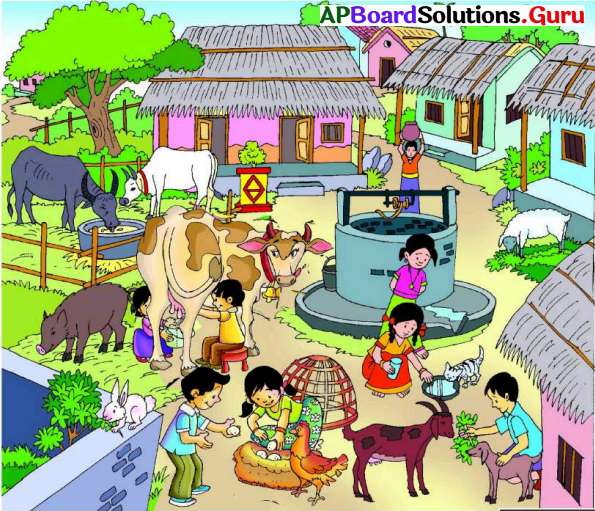
Observe the picture. Discuss and answer the questions.

AP Board 7th Class English Solutions Chapter 1 Painted House, Friendly Chicken and Me 1
Question 1.
Where are the children?
Answer:
The children are near their houses.

Question 2.
Is it a village or a town? Why?
Answer:
It is a village. It is not a town. The houses, the location and the animals reflect a village scene.

Question 3.
What are the boys looking at?
Answer:
The boys are looking at the animals and eggs.

Question 4.
Are the children friendly with the animals? Discuss.
Answer:
Yes, the children are friendly with the animals. They are helping the animals in different ways.

AP Board 7th Class English Solutions Chapter 1 Painted House, Friendly Chicken and Me

Question 5.
What are the children doing?
Answer:
The children are spending their time with the animals and birds.

Questions Given in the Lesson

Possible answers to the questions given in the middle of the lesson and at the end:

Question 1.
What’s in a name?
Find out more about your name. Does it have a special meaning? Share it with your classmates.
Answer:
My name is Nageswara Rao. It has a special meaning. Two Hindu deities are there in my name. ‘Naga’ means ‘Naga Devatha’ and ‘Eswara’ means ‘Lord Parameshwara’.

Question 2.
Can you think of some pictures that can be drawn with a feather?
Answer:
We can draw pictures of birds, moon, stars, sun, sky, all the things related to nature, different designs and a number of other things with a feather.

Question 3.
How are colours used to decorate the houses in villages during festivals?
Answer:
The villagers decora their houses with different colours during festivals. Most of them use dark colours which bring life to the painting. They paint the pictures of deities, some designs, circles, symbols, etc. on the walls of their houses and celebrate the festivals happily.

Question 4.
Where do you see such pictures?
Answer:
I find those pictures in the exhibitions and in the shops located in pilgrimage places.

Question 5.
List out the activities done by Ndebele women.
Answer:
i) They paint their houses with colourful and intricate patterns.
ii) They make good things with beads.
iii) They perform their household chores with love and affection.
iv) They respect their ancestors and follow their tradition strictly.

Question 6.
How do you dress up on your birthday?
Answer:
I wear new dress brought by my father on the occasion of my birthday.

Question 7.
What do you like to wear on special occasions?
Answer:
I would like to wear specially designed clothes of different colours on special occasions.

Question 8.
Describe your village and say about the people living there in your own words.
Answer:
Our village is Machayapalem of Bellamkonda Madal, Guntur district. It is a picturesque village with narrow streets. Greenery is found everywhere. We have all kinds of animals as pets such as cats, dogs, cows, buffaloes, oxen, goats, sheep, hens, cocks, etc. in our village. Most of us live in thatched houses. Our villagers are friendly in nature. Most of them are farmers. Though we lead an ordinary life, we are always happy. We come together and celebrate the festivals. I love to live in my village.

AP Board 7th Class English Solutions Chapter 1 Painted House, Friendly Chicken and Me

Question 9.
Describe your best friend. What characteristics make a good friend?
Answer:
Amith is my best friend. He is honest and a true friend of mine. The characteristics such as reliability, honesty, kindness, individuality, helping nature, patience, generosity, trust, etc. make a person a good friend.

Reading Comprehension

A. Answer the following questions.

Question 1.
Who is Thandi? Who is her best friend?
Answer:
Thandi is a girl who belongs to the tribe of Ndebele from Zimbabwe and north-eastern South Africa. Thandi’s best friend is her chicken.

Question 2.
How does Thandi snatch a feather from her chicken?
Answer:
Thandi snatches a feather very quickly when the chicken is distracted and does not notice.

Question 3.
What are the two hopes of Thandi?
Answer:
The two hopes are : (1) her name which means hope and (2) At the end of the story she can say ‘Good-bye friend’, not ‘Good-bye stranger-friend’.

Question 4.
Why do you think Ndebele people do not call anything beautiful?
Answer:
Because they live in a different world. They live away from common people.

Question 5.
According to Thandi, what are some of the points to be kept in mind while painting?
Answer:
The points to be kept in mind while painting are: (1) You have to have strong eyes to paint well. (2) Your hand must not shake like leaf on a tree (3) You must fill a chicken’s feather with paint and draw a line as straight as a spear. (4) You must have the pattern inside your head, even before you dip the feather into the paint.

Question 6.
Describe the clothing of Ndebele women.
Answer:
The clothing of Ndebele women is made of beads. They shine like stars while dancing.

Question 7.
Why couldn’t Thandi’s brother be friends with chicken?
Answer:
Thandi’s brother could not be friends with a chicken because he was not able to understand animals. He shouts at chickens and they run away from him.

AP Board 7th Class English Solutions Chapter 1 Painted House, Friendly Chicken and Me

Question 8.
What did Thandi say about her best friend, chicken?
Answer:
Thandi says that her best friend is her chicken. The chicken listens to her stories. Her feathers are used as brushes to paint. She always spends her time with Thandi. Thandi takes her in her arms and tells her many things.

B. Say whether the following statements are True/ False:

1. Thandi’s chicken listens to her stories and has other uses.
2. Ndebele people call everything beautiful.
3. All Ndebele women paint their houses.
4. Thandi’s father built them small houses, and her mother painted them.
5. Thandi’s brother is not so mischievous.
Answer:

  1. True
  2. False
  3. True
  4. True
  5. False

C. You have read the story, ‘Painted House, Friendly Chicken and Me’.

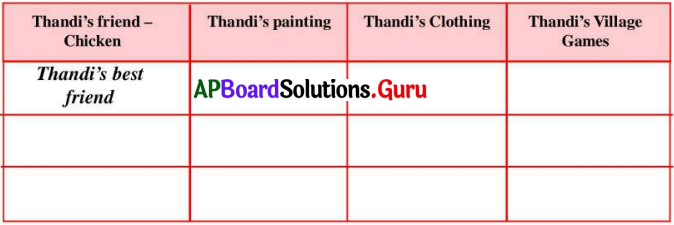
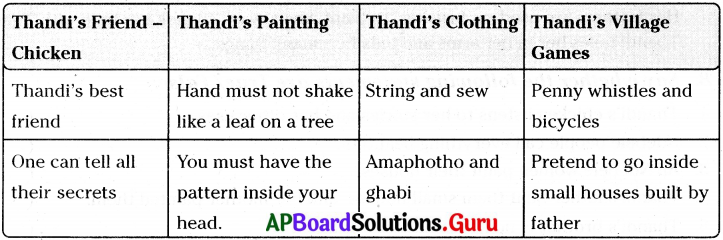
Read the interesting aspects of village life shared by Thandi mentioned in the help box.

Help Box

  • Thandi’s best friend
  • String and sew
  • Penny whistles and bicycles
  • Hand must not shake like a leaf on a tree
  • Amaphotho and ghabi
  • Pretend to go inside small houses built by father
  • You must have the pattern inside your head.
  • One can tell all their secrets

Place the sentences under the right heading. One is done for you.
AP Board 7th Class English Solutions Chapter 1 Painted House, Friendly Chicken and Me 2
Answer:
AP Board 7th Class English Solutions Chapter 1 Painted House, Friendly Chicken and Me 3

Vocabulary

A. VISUALISE – Text to Mind

Read the following sentences taken from the story, locate the phrases that are highlighted /expressions / part.

You must have the pattern inside your head, even before you dip the feather into the paint. Here the highlighted part, ‘have the pattern inside your head’ means one should visualise or have clear picture before any work.

To Visualise means to form a picture of someone or something in your mind, in order to imagine or remember him, her, or it.

Activity : Visualise the text given and draw the picture of it. One is done for you.

Note : Students are advised to do this activity on their own.
AP Board 7th Class English Solutions Chapter 1 Painted House, Friendly Chicken and Me 4

Grammar

A. Read the following sentences from the story.

1. I don’t know why, but Ndebele people do not call anything beautiful.
2. ………… no one’s house is as good as my mother’s.
3. ………. he tries to get into everybody’s business.

The highlighted words use apostrophe (‘). Now guess the use of apostrophe.

Apostrophe ( ‘ ) can be confusing or tricky. However, they aren’t difficult to learn. Sometimes they form possessives and sometimes they form contractions. Here are some tips to remember.

Apostrophe for possessions:
1. For most singular nouns, add apostrophe + s :
The cat’s tail, the student’s book, the manager’s room

2. For most plural nouns, add only an apostrophe :
The cats’ tails (multiple cats), the students’ books (multiple students); the managers’ rooms (multiple managers)

Apostrophe for contractions:
A contraction is a shortened form of a word (or group of words) that omits certain letters or sounds. In a contraction, an apostrophe represents missing letters.
He would = He’d
They are = They’re
I have = I’ve
You cannot = You can’t

Exercise

A) Write the contraction for each pair of words. Example: should not – shouldn’t
1. are not _____
2. he is _____
3. I am _____
4. she will _____
Answer:
1) aren’t
2) he’s
3) I’m
4) she’ll

B) Complete each sentence. Write the possessive forms of the noun given in the brackets.
Eg : The baby’s doll is a new brand one. (baby)
1. This is _____ textbook. (Angel)
2. The _____ blanket is blue, (boy)
Answer:
1) Angel’s
2) boy’s

AP Board 7th Class English Solutions Chapter 1 Painted House, Friendly Chicken and Me

B. Present Perfect Tense :

Let’s consider the following sentences from the text which denote just completed actions.
1. She has started to teach me to paint good, very good designs.
2. I have enjoyed telling you about my village.

These actions are said to be in present perfect tense (have/has + past participle).

Here are some more examples of the present perfect tense (underlined):
1. Bobby has eaten the breakfast.
2. They have called the police.
3. Has she painted the wall?

The Present Perfect Tense is used for unfinished actions with stative verbs and finished actions with focus on present situation.

PositivePositive Short Form (Contracted Form)
I have played.I’ve played.
You have worked.You’ve worked.
He has written.He’s written.
She the has walked.She’s walked.
It has rained.It’s rained.
We ave travelled.We’ve travelled.
They have studied.They’ve studied.
NegativeNegative Short Form (Contracted Form)
I have hot eaten.I haven’t eaten.
You have not been to America.You haven’t been to America.
He has not seen.He hasn’t seen.
She has not played.She hasn’t played.
It has not gone.It hasn’t gone.
We have not danced.We haven’t danced.

Note : Contracted forms are used in spoken form not in written form.

Exercise

Fill in the blanks with the Present Perfect form of the verb. One is done for you.
Eg : I have worked (work) today.

1. I _____ (not/work) today.
2. We _____ (buy) a new lamp.
3. We _____ (not / plan) our holiday yet.
4. Where _____ (be / you) ?
5. He _____ (write) five letters.
6. She _____ (not / see) him for a long time.
7. _____ (be / you) at school ?
8. The school _____ (not / start) yet.
Answer:

  1. have not worked
  2. have bought
  3. have not planned
  4. have you been?
  5. has written
  6. has not seen
  7. Have you been
  8. has not started

Writing

A. Read the passage from the narrative/ story. Write a dialogue.

Hello Stranger-friend,

I am Thandi, an Ndebele girl in South Africa. I am eight years old, and my best friend is a chicken. You may laugh at that, but when I tell my friend secrets, she can talk all she wants… but no one can understand her… except another chicken, of course. My chicken not only listens to my stories; she has other uses. If you play with her and take her mind off what’s going on, you can quickly – very quickly – snatch a feather or two when she is distracted. She doesn’t notice, and the feathers will come in handy later, of course.

Complete the conversation.

Thandi : Hello! Stranger-friend!

Stranger-friend : Hello! What is your name?

Thandi : I am Thandi.

Stranger-friend : Where are you from?

Thandi : I am …………………..

Stranger-friend : …………………………. ?

Thandi : I am eight years old.

Stranger-friend : …………………….. best friend?

Thandi : ………………..

Thandi : Hello Stranger-friend !

Stranger-friend : ……………………. tell …………. ?

Thandi : Secrets.

Stranger-Mend : Can …………. understand your words?

Thandi : Yes, of course.

Stranger-Mend : What else do you do with your chicken?

Thandi : ……………………………………..

Stranger-Mend : How do you snatch her feathers?

Thandi : …………………………..
Answer:
Thandi : Hello! Stranger-friend!

Stranger-Mend : Hello! What is your name?

Thandi : I am Thandi.

Stranger-Mend : Where are you from?

Thandi : I am an Ndebele girl in South Africa.

Stranger-Mend : How old are you?

Thandi : I am eight years old.

Stranger-Mend : Who is your best friend?

Thandi : My best friend is my chicken.

Thandi : Hello Stranger-friend!

Stranger-Mend : What would you tell your chicken (best friend)?

Thandi : Secrets.

Stranger-Mend : Can the chicken understand your words?

Thandi : Yes, of course.

Stranger-Mend : What else do you do with your chicken?

Thandi : I will use her feathers to paint.

Stranger-Mend : How do you snatch her feathers?

Thandi : I snatch her feathers when she does not notice.

B. Letter Writing : (Informal Letter)
Read the letter written to a friend describing the beauty of her1 village and the people living in it.

Gandhipuram.
Feb 01, 2021.
Dear Gayatri,I hope this letter finds you in good health.My village is near Anantapuram. It is about 100 kilometres away from the district headquarters. We have fresh air, water, and a clean environment in my village. My village is beautiful with many green fields, cattle and mango trees. We are the leading producers of mango, coconut and also tamarind. We get pure honey and ghee as well. We play in the sandy beach every evening. My friends and 1 play many Indian games that are forgotten those days like marbles, Kho- Kho, Kabaddi, etc.The villagers are helpful and cooperative to one another. We like to celebrate different occasions. We are peace-loving people. We enjoy holidays with relatives and friends. My village is a land of relations that follows the traditions and culture inherited from our ancestors. Please convey my regards to aunt and uncle. Awaiting your reply.Yours lovingly,
Razia

Now, imagine you are Gayatri and write a reply letter describing the village/ locality you live in.
AP Board 7th Class English Solutions Chapter 1 Painted House, Friendly Chicken and Me 5
Answer:

Reply Letter

Bhaskarnagar.
Feb 7, 2021.

Dear Razia,

I have just got your letter this month. I knew from your letter about your town. Now it is my turn to write about me.

You know that I live at Guntur. It is my hometown. It is one of the wonderful places. There are a lot of historical places. In fact, it is very beautiful, and neat and clean. There are many big shops and you can buy many things you want. The climate is pleasant. This village is famous for rich culture. On every Makara Sankranti, there will be a lot of people because there will have the bullfight. This is one of the traditional cultures. As I know this culture is given by our ancestors for 200 years. A lot of tourists come to see and enjoy. Guntur is famous for fairs. Though it is a city, It is full of greenery, farmland is full of crops and farmers are busy in their fields, trying to produce more, and more crops to be able to feed more and more people. There is no scarcity of pure milk and fresh vegetables. Guntur is famous for red chillies and pickles. People are friendly and very much concerned with each other. I send you a lot of photos of Guntur, You will know all about my town. 1 hope to hear from you soon.

Yours lovingly,
Gayatri.

AP Board 7th Class English Solutions Chapter 1 Painted House, Friendly Chicken and Me

C. Write a letter to Thandi. Describe similarities and differences between yours and her hopes, likes, dislikes and her games so that you may become good \ friends.
Answer

Guntur.
July 5, 2021.
Deatj Thandi,I am Mohana. I became your friend after reading your story. Now I am not your stranger friend. I am your dear friend. I want to share something with you and write this letter. I hope you are doing well.I understand that you want a life with freedom and want to be friends with animals find birds. I also have the same interest. I always spend my time with doves and hens at home. You wear your school uniform when you go to school and in free time, you wear the clothes made of using beads. 1 like the clothes of that kind. But we do not get them here in our town. Here we get dresses with embroidery designs. 1 prefer them a lot. I also go to big cities for shopping along with my mother and father. 1 like your village life. We can be very good friends hereafter.Please write to me describing your feelings.Yours lovingly,
Mohana

Talking Time

A. Language Function : Introducing self, (use the help box)
Hello ! My name is ……………… .
I come from ……………… (name of the place)
I am ……………… years old. (age)
There are ……………… people in my family, (number of family)
I’m a student at ……………… (name of the school)
My favourite subject is ……………… . (favourite subject)
My hobbies are ………………, ………………., and ……………… . (hobby)
In my free time, I also enjoy ……………… . (sports/music)
I like/dislike/hate ……………… . (like/dislike)
My favourite food / drink is ……………… . (favourite food)
I study English because ……………… . (purpose)
I would like to become ……………… in future, (aim in life)
AP Board 7th Class English Solutions Chapter 1 Painted House, Friendly Chicken and Me 6
Answer:
Hello! My name is Pranavi.
I come from Kandukur. (name of the place )
I am thirteen years old. (age)
There are five people in my family, (number of family)
I’m a student at Z.P.High School, Kandukur. (name of the school)
My favourite subject is English. (favourite subject)
My hobbies are playing chess, listening to music, and gardening. (hobby)
In my free time, I also enjoy playing volleyball, (sports/music)
I like spending my time on the beaches. (like / dislike)
My favourite food is vegetable birvani. (favourite food)
My favourite drink is Sprite. (favourite drink)
I study English because I want to go abroad. (purpose)
I would like to become an English teacher in future, (aim in life)

B. Language Function: Introducing others
You have learnt how to introduce yourself. Now introduce your friend to your class using the hints given.
Hello! Friends! This is ……………… .
He/ She is from ……………… .
He/ She is in ……………… .
His / Her favourite subject is ……………… .
…………………………………………………………..
Answer:
Hello! Friends, This is Mokshitha.
She is from Lakshmi Puram. Guntur.
She is in Class Seven.
Her favourite subject is Science.
She wants to become a cardiologist in future.
She likes reading books and playing video games.
Milk is her favourite drink.
She spends her leisure time with pet animals.
She is very much interested in cricket.
She knows how to play the violin.
She is a very good friend of mine.

Listening

Listen to the following story.

UBUNTU
An anthropologist (someone who scientifically studies humans and their customs, beliefs, and relationships) created a game for the African tribal children. He placed a basket of sweets near a tree and made the children stand 100 metres away. Then he announced that whoever reached first would get all the sweets in the basket.

When he said, ready, steady, go!
Do you know what these children did?
They all held each other’s hands, ran together towards the tree, divided the sweets equally among themselves, ate the sweets, and enjoyed it. When the anthropologist asked them why they did so, they answered ‘Ubuntu’.
Which meant…’How can one be happy when the others are sad?’
Ubuntu in their language means – ‘I am because we are!’
Let all of us always have this attitude and spread happiness wherever we go.

Answer the following questions :
1. Who is an ‘anthropologist’?
Answer:
An anthropologist is someone who scientifically studies humans and their customs, beliefs and relationships.

2. What game did the anthropologist plan with the basket of sweets ?
Answer:
The child who reaches the sweet basket first will get all the sweets in it.

3. What instructions did the anthropologist give to the children to do?
Answer:
The anthropologist told them to stand 100 metres away. He placed the basket of sweets near a tree. He announced that whoever reches first would get all the sweets in the basket.

4. What did the children do on hearing the anthropologist’s instructions?
Answer:
They all held each other’s hands, ran together towards the tree, divided the sweets equally among them, ate the sweets and enjoyed.

5. What does the word ‘UBUNTU’ mean in the African tribal language?
Answer:
I am because we are.

Painted House, Friendly Chicken and Me Summary

The writer here adopts the voice of an eight-year-old Ndebele girl of South Africa, who addresses the reader as her “stranger-friend.” Thandi, whose name means Hope, describes some of her favorite things: the chicken to whom she confides her secrets, the intricately painted houses in her village, the beads her mother strings. Thandi’s narration is strong and direct, and provides a lively introduction to a long-neglected people and culture. It attempts to embrace the reader, however, seem somewhat strained (“You may call me friend, and 1 would like to call you friend”), and the use of many sizes and arrangements of type creates some choppiness. The accompanying photographs, on the other hand, do full justice to the brilliant colors of the beadwork, blankets and decorated houses of Thandi’s village, and to the various attitudes of the carefully adorned people in it.

Painted House, Friendly Chicken and Me About the Author

Maya Angelou born Marguerite Annie Johnson; (April 4,1928 – May 28, 2014) was an American poet, memoirist, and civil rights activist. She published seven autobiographies, three books of essays, several books of poetry, and is credited with a list of plays, movies, and television shows spanning over 50 years. She received dozens of awards and more than 50 honorary degrees. The first one I Know Why the Caged Bird Sings (1969); tells of her life up to the age of 17, and brought her international recognition and acclaim. Her famous poems are And Still I Rise’ (1978), ‘Mother, A Cradle to Hold Me’ (2006).

Meanings For Difficult Words

stranger-friend : someone whom you feel as your friend but
Thandi : the name of a girl who belongs to the tribe of Ndebele in South Africa
Ndebele (n) : a tribe from Zimbabwe and north-eastern South Africa and they speak the Bantu language, one of the official languages of South Africa.
chicken (n) : hen
laugh at (jphr.v) : speak something to make somebody seem silly
of course : naturally / certainly
take her mind off (phrase) : to stop her thinking about something
snatch (v) : quickly seize (something) in a rude or abrupt way
feather (n) : soft, light and hairy thing that covers a bird’s body
distracted (adj.) : unable to concentrate / inattentive
come in handy (idiom) : to be useful
later (adv.) : at a time in the future / afterward
hope (n) : a feeling of expectation for a particular thing to happen
pattern (n) : a particular way in which something is done, is organized, or happens
fringed (adj) : having a decorative border of hanging threads for clothing
pretend (v) : to give a false appearance of being, possessing, or performing; pose.
penny whistles (n) : flute like wind instrument
lose themselves (idiom) : give all their attention to something

AP Board 7th Class English Solutions Chapter 1 Painted House, Friendly Chicken and Me

put on (phr. v) : wear
dry (adj) : lacking freshness
wagon (n) : farm cart
mule (n) : an animal that has a horse and a donkey as parents
stare (v) : look fixedly or intently
city folk (n) : city people
mischievous (adj) : causing or showing a fondness for causing trouble in a playful way; naughty way.
tend (v) : care for or look after
get into (phr.v) : enter / interfere
can’t help (idiom) : can’t control
errand (n) : a short journey either to take a message or to take or collect something
squirmy (adj) : to twist about in a wriggling, snake like motion

Tom Paints the Fence

Comprehension

A. Answer the following questions :

Question 1.
What was the name of Tom’s Aunt ? Why was he living with his aunt?
Answer:
Tom’s Aunt was Polly. Tom was living with his Aunt Polly as he lost his mother.

Question 2.
How did Aunt Polly prove that she was strict?
Answer:
Aunt Polly proved that she was strict by asking Tom to whitewash the fence on a Saturday which was a holiday.

Question 3.
What work was assigned to Tom to do?
Answer:
Tom was assigned to paint the fence.

Question 4.
Describe the feelings of Tom when his aunt asked him to paint the fence.
Answer:
He felt that life was a burden. He sighed to do the work.

Question 5.
How did Tom become rich with gifts by the end of the day?
Answer:
Tom made his friends feel to paint the fence. They gave him some gifts to get the opportunity of painting work. Thus he became rich with the gifts by the end of the day.

Question 6.
What does “Spare the rod and Spoil the child” mean?
Answer:
If you do not punish a child when they do something wrong, they will not learn what is right.

B. Choose the correct answer from the options given.

1. What did Tom plan to do on a Saturday?
a) go to school
b) do homework
c) go for swimming
Answer:
c) go for swimming

2. Tom did not want the boys to see him whitewashing because they would
a) make fun of him
b) tell their teacher
c) throw mud at the fence
Answer:
a) make fun of him

AP Board 7th Class English Solutions Chapter 1 Painted House, Friendly Chicken and Me

3. How did Tom make Ben and others paint the fence?
a) by bribing them with money
b) by pretending painting to be fun
c) by threatening them
Answer:
b) by pretending painting to be fun

4. Tom was really in wealth at the end of the day, because……
a) many boys paid him
b) aunt Polly gave him money
c) he sold the paint
Answer:
a) many boys paid him

5. What did aunt Polly give him for painting the fence?
a) a doorknob
b) an apple
c) a new dress
Answer:
b) an apple

Fun Time

1. Teacher : Which one is closer, Sun or Africa?
Boddy : Sun
Teacher : Why?
Boddy : We can see the sun, but can’t see Africa.

2. What day do the chickens hate most?
Answer:
Friday (FRY-day)

Project

You have read the story “Painted House, Friendly Chicken and Me”.You might have understood how Thandi has enjoyed telling you about her village, her hopes, her mother, her brother, the beads, the painted house, and her good friend, the chicken.

Now, collect information regarding your family, friendship, home, village/ locality, traditions and culture, and make a picture gallery with your paintings, art and craft.
Answer:
My family is a joint family. We are ten in our family. I have a grandmother and a grandfather. I have two sisters and a younger brother. My uncle and aunt also live with us. My father is a farmer and my mother is a housewife. My two sisters are studying and my little brother is at play school. Our grandmother always tells us interesting stories. We usually have good time at home. 1 have two friends at my village. I play with my friends and two sisters. My village is surrounded by green fields. We make idols of Lord Ganesha with clay and worship Him. We draw many pictures on walls. We have fresh air and clean water. We celebrate all festivals and follow the old traditions. We wear new clothes on festivals. We spend time together joyfully.

Check Point

AP Board 7th Class English Solutions Chapter 1 Painted House, Friendly Chicken and Me 7

Tom Paints the Fence Summary

Tom Sawyer was an imaginative and mischievous boy. He was living with his Aunt Polly on the banks of the Mississippi. Aunt Polly was strict. She wanted to make Tom work on Saturday. So, she asked him to paint the fence. He unwillingly went near the fence with a brush and paint. He was very disappointed when he remembered his plans for the day, like going for swimming. He was upset with the thought that the boys would ridicule him for having work to do. Then he got a brilliant idea. He took his brush and started his work.

Then a boy named Ben Rogers came that way and told Tom that he had got to work even on a holiday. Tom pretended that he was doing that work willingly because that work would give him pleasure and he was enjoying himself in doing so. Soon, Ben begged Tom that he would help him and offered him an apple. Tom gave him the brush and Ben started painting. As Ben was painting, other boys named Billy and Johnny Miller also begged Tom to allow them too to paint. They presented him a kite and a pair of marbles in return. Thus, Tom turned the punishment into a bit of entertainment and tricked other boys to finish the work for him. The whole fence was whitewashed nicely within afternoon. When Aunt Polly saw the painted fence, she was so amazed that she gave him the best apple and allowed him to play.

Tom Paints the Fence About the Author

Mark Twain (1835-1910) whose real name was Samuel Langhorne Clements, was an American writer. He is best remembered as the man who gave the immortal characters of Tom Sawyer and Huckleberry Finn.

AP Board 7th Class English Solutions Chapter 1 Painted House, Friendly Chicken and Me

Meanings For Difficult Words

fence (n) : a structure that divides two areas of land, similar to a wall but made of wood or wire
pavement (n) : a flat part at the side of a road for people to walk on hollow
hollow (adj) : having a hole or an empty space inside an object
existence (n) : being real or living or of being present
ridicule (v) : make fun of somebody/something or make them look silly; mockery
magnificent (adj) : extremely attractive and impressive; deserving praise; splendid
resume (v) : begins again or continues after being interrupted
dreading (v) : to be very afraid of something; to fear that something bad is going to happen

AP Board 8th Class Maths Solutions Chapter 10 అనులోమ మరియు విలోమ అనుపాతములు InText Questions

AP SCERT 8th Class Maths Textbook Solutions Chapter 10 అనులోమ మరియు విలోమ అనుపాతములు InText Questions and Answers.

AP State Syllabus 8th Class Maths Solutions 10th Lesson అనులోమ మరియు విలోమ అనుపాతములు InText Questions

ఇవి చేయండి

1. ఒక రాశిలోని మార్పు వలన వేరొక రాశిలో కూడా మార్పు వచ్చే ఐదు సందర్భాలను వ్రాయండి. (పేజీ నెం. 231)
సాధన.
ఒక రాశిలో మార్పు వలన వేరొక రాశిలో కూడా మార్పు వచ్చే ఐదు సందర్భాలు:

  1. ఒక కుటుంబంలోని సభ్యుల సంఖ్య పెరిగిన వారు ఉపయోగించు బియ్యం పరిమాణం పెరుగును.
  2. వేగం పెరిగితే, సమయం తగ్గుతుంది.
  3. నీటి వాడకం ఎక్కువైతే భూగర్భజలాలు తగ్గుతాయి.
  4. వ్యక్తులు చేసే పనిసామర్ధ్యం పెరిగితే కాలం తగ్గుతుంది.
  5. తీగ యొక్క మందం పెరిగిన దాని నిరోధం తగ్గుతుంది.

AP Board 8th Class Maths Solutions Chapter 10 అనులోమ మరియు విలోమ అనుపాతములు InText Questions

2. మీరు గమనించిన మూడు అనులోమానుపాత సందర్భాలను రాయండి. (పేజీ నెం. 233)
సాధన.
1. పాఠశాలలో విద్యార్థుల సంఖ్యకు, ఉపాధ్యాయుల సంఖ్యకు మధ్య గల సంబంధం.
2. పశువుల సంఖ్య, అవి మేసే మేత పరిమాణం
3. కూలీల సంఖ్య, కట్టే గోడ పరిమాణం
పై సందర్భాలు అనులోమానుపాతంలో ఉంటాయి.

3. భుజముల పొడవులు 2, 3, 4 మరియు 5 సెం||మీ|| గల చతురస్రాలను తీసుకొని వాటి వైశాల్యాలను లెక్కించి క్రింది పట్టికను నింపండి. (పేజీ నెం. 233)
AP Board 8th Class Maths Solutions Chapter 10 అనులోమ మరియు విలోమ అనుపాతములు InText Questions 1
మీరు ఏమి గమనిస్తారు? చతురస్ర భుజము కొలత మారితే చతురస్ర వైశాల్యంలో ఏమైనా మార్పు వచ్చినదా? ఖచ్చితంగా వస్తుంది కదా. ఇంకా దాని వైశాల్యానికి, భుజము పొడవుకి గల నిష్పత్తిని కనుగొనంది. ఈ నిష్పత్తి సమానంగా వుందా? లేదు కదా. కాబట్టి ఈ మార్పు అనులోమానుపాతం కాదు.
సాధన.

భుజం పొడవువైశాల్యానికి గల నిష్పత్తి
24 —> 2 : 4 = 1 : 2
39 —> 3 : 9 = 1 : 3
416 —> 4 : 16 = 1 : 4
525 —> 5 : 25 = 1 : 5

ఈ నిష్పత్తి సమానంగా లేదు. కాబట్టి ఈ మార్పు అనులోమానుపాతంలో లేదు. చతురస్ర భుజం కొలత మారితే చతురస్ర వైశాల్యం మార్పు వస్తుంది.

AP Board 8th Class Maths Solutions Chapter 10 అనులోమ మరియు విలోమ అనుపాతములు InText Questions

4. ఇక్కడ మీకు గ్రాఫ్ కాగితంపై ఒకే వెడల్పు కలిగిన కొన్ని దీర్ఘ చతురస్రాలు యివ్వబడ్డాయి. ప్రతీ దీర్ఘచతురస్ర వైశాల్యాన్ని కనుగొని క్రింది పట్టికను నింపండి. (పేజీ నెం. 233)
AP Board 8th Class Maths Solutions Chapter 10 అనులోమ మరియు విలోమ అనుపాతములు InText Questions 2
AP Board 8th Class Maths Solutions Chapter 10 అనులోమ మరియు విలోమ అనుపాతములు InText Questions 3
దీర్ఘచతురస్ర వైశాల్యము పొడవుకు అనులోమానుపాతంలో వుందా?
సాధన.
AP Board 8th Class Maths Solutions Chapter 10 అనులోమ మరియు విలోమ అనుపాతములు InText Questions 4
దీర్ఘచతురస్ర వైశాల్యం, పొడవుకు అనులోమానుపాతంలో ఉంది.

5. ఒకగ్రాఫ్ కాగితంపై ఒకే పొడవు వేరువేరు వెడల్పులు గల దీర్ఘచతురస్రాలను గీయండి. ప్రతీ దీర్ఘచతురస్రము వైశాల్యాన్ని కనుగొనండి. వాటి వైశాల్యాలు మరియు వెడల్పుల గురించి మీరు ఏమి చెప్పగలుగుతారు? (పేజీ నెం. 233)
సాధన.
AP Board 8th Class Maths Solutions Chapter 10 అనులోమ మరియు విలోమ అనుపాతములు InText Questions 5
మొదటి దీర్ఘచతురస్ర వైశాల్యం (A1) = 3 × 1 = 3 చ.సెం.మీ.
రెండవ దీర్ఘచతురస్ర వైశాల్యం (A2) = 3 × 2 = 6 చ.సెం.మీ.
∴ దీర్ఘ చతురస్ర వైశాల్యాలు, వాటి వెడల్పులు అనుపాతంలో కలవు. [∵ \(\frac{1}{3}=\frac{2}{6}\)]

6. ఇచ్చిన మ్యాప్ లోని దూరాలను కొలిచి, దాని సహాయంతో (i) విజయవాడ మరియు విశాఖపట్నం (ii) తిరుపతి మరియు విజయవాడల మధ్యగల నిజదూరాలను కనుగొనండి. ఇచ్చిన మ్యాప్ ‘స్కేలు’. (పేజీ నెం. 235)
AP Board 8th Class Maths Solutions Chapter 10 అనులోమ మరియు విలోమ అనుపాతములు InText Questions 6
సాధన.
(i) విజయవాడ మరియు విశాఖపట్నం మధ్యగల దూరం = 2 సెం.మీ.
లెక్కప్రకారం 1 సెం.మీ. = 300 కి.మీ. అయినచో 2 సెం.మీ. = ?
AP Board 8th Class Maths Solutions Chapter 10 అనులోమ మరియు విలోమ అనుపాతములు InText Questions 7
⇒ x + 2 × 300 = 600 కి.మీ.
∴ విజయవాడ, విశాఖపట్నాల మధ్య నిజదూరం = 600 కి.మీ.

(ii) తిరుపతి, విజయవాడల మధ్య దూరం = 3 సెం.మీ.
లెక్క ప్రకారం 1 సెం.మీ. = 300 కి.మీ. అయినచో 3 సెం.మీ. = ?
AP Board 8th Class Maths Solutions Chapter 10 అనులోమ మరియు విలోమ అనుపాతములు InText Questions 8
⇒ x = 3 × 300 = 900 కి.మీ.
∴ తిరుపతి, విజయవాడల మధ్య నిజదూరం = 900 కి.మీ.

AP Board 8th Class Maths Solutions Chapter 10 అనులోమ మరియు విలోమ అనుపాతములు InText Questions

7. మీరు గమనించిన మూడు విలోమానుపాత సందర్భాలను రాయండి. (పేజీ నెం. 238)
సాధన.

  1. కాలము – పనిసామర్థ్యం
  2. దూరం – వేగము
  3. కాలము – వేగం

8. గళ్ళ కాగితంపై ప్రక్క ప్రక్కన ఉండే 12 చదరాలను ఉపయోగించుకుంటూ వివిధ కొలతలు గల దీర్ఘ చతురస్రాలను గీయాలి. ఇలా ఏర్పడిన ప్రతీ దీర్ఘచతురస్రము యొక్క పొడవు, వెడల్పులను కనుగొని, ఆ వచ్చిన విలువలను క్రింది పట్టికలో రాయండి.
AP Board 8th Class Maths Solutions Chapter 10 అనులోమ మరియు విలోమ అనుపాతములు InText Questions 9
మీరు ఏమి గమనిస్తారు? పొడవు పెరిగిన వెడల్పు తగ్గును లేదా వెడల్పు పెరిగిన, పొడవు తగ్గును (వైశాల్యము స్థిరాంకముగా వున్నపుడు) ఒక దీర్ఘచతురస్ర పొడవు, వెడల్పులు విలోమానుపాతంలో వున్నాయా? (పేజీ నెం. 238)
సాధన.
దీర్ఘచతురస్రంలో పొడవు పెరిగిన, వెడల్పు తగ్గును, వెడల్పు పెరిగిన, పొడవు తగ్గును.
∴ దీర్ఘచతురస్రంలో పొడవు, వెడల్పులు విలోమానుపాతంలో ఉన్నాయి.
AP Board 8th Class Maths Solutions Chapter 10 అనులోమ మరియు విలోమ అనుపాతములు InText Questions 10

AP Board 8th Class Maths Solutions Chapter 10 అనులోమ మరియు విలోమ అనుపాతములు InText Questions

ఆలోచించి, చర్చించి వ్రాయండి

1. ప్రతీ మార్పుని మనం అనుపాతంలో వుంది అని చెప్పగలమా? ఒక పుస్తకంలో 100 పేజీలు కలవు. పుస్తకంలో మనము చదివిన పేజీల సంఖ్య, మిగిలిన పేజీల సంఖ్య ఏవిధంగా మారుతాయో గమనించండి. (పేజీ నెం. 239)
AP Board 8th Class Maths Solutions Chapter 10 అనులోమ మరియు విలోమ అనుపాతములు InText Questions 11
మనం చదివిన పేజీల సంఖ్య క్రమంగా పెరుగుతూ ఉన్నపుడు మిగిలిన పేజీల సంఖ్యలో మార్పు రకంగా వస్తోంది? ఆ రెండు రాశులు విలోమానుపాతంలో వుంటాయా? వివరించండి.
సాధన.
ప్రతి సందర్భంలో చదివిన పేజీల సంఖ్య (x), మిగిలిన పేజీల సంఖ్య (y) కు విలోమానుపాతంలో ఉన్నాయి.
∵ చదివిన పేజీల సంఖ్య పెరిగే కొద్దీ, మిగిలిన పేజీల సంఖ్య తగ్గుతుంది.
AP Board 8th Class Maths Solutions Chapter 10 అనులోమ మరియు విలోమ అనుపాతములు InText Questions 12

AP Board 8th Class Maths Solutions Chapter 10 అనులోమ మరియు విలోమ అనుపాతములు Ex 10.4

AP SCERT 8th Class Maths Textbook Solutions Chapter 10 అనులోమ మరియు విలోమ అనుపాతములు Ex 10.4 Textbook Exercise Questions and Answers.

AP State Syllabus 8th Class Maths Solutions 10th Lesson అనులోమ మరియు విలోమ అనుపాతములు Exercise 10.4

ప్రశ్న 1.
8 మందికి 20 రోజులకు కావలసిన బియ్యము వెల ₹ 480, అయిన 12 మందికి 15 రోజులకు కావలసిన బియ్యము వెల ఎంత?
సాధన.
వ్యక్తుల సంఖ్యకు మరియు ప్రతీరోజు వారికి కావలసిన బియ్యం విలోమానుపాతంలో ఉంటాయి.
వ్యక్తుల సంఖ్య (పనివారి సంఖ్య) ∝ \(\frac {1}{(రోజుల సంఖ్య)}\)

వ్యక్తుల సంఖ్యబియ్యం వెల (రూ.లలో)రోజుల సంఖ్య
848020
12x15
8 : 12480 : x —-(1)20 : 15

⇒ 8 : 12 మరియు 20 : 15 ల బహుళ నిష్పత్తి
AP Board 8th Class Maths Solutions Chapter 10 అనులోమ మరియు విలోమ అనుపాతములు Ex 10.4 1
∴ 540 రూపాయలు విలువ చేసే బియ్యం అవసరం.

II వ పద్ధతి :

\(\frac{\mathrm{M}_{1} \mathrm{D}_{1}}{\mathrm{~W}_{1}}=\frac{\mathrm{M}_{2} \mathrm{D}_{2}}{\mathrm{~W}_{2}}\)
M1 = మనుష్యుల సంఖ్య (Men)
D1 = రోజుల సంఖ్య (Days) / గం||లు.
W1 = కట్టిన గోడ పొడవు / వెల / చేసిన పని పరిమాణం
∴ M1 = 8 , M2 = 12
D1 = 20 , D2 = 15
W1 = ₹480 , W2 = ? (x)
AP Board 8th Class Maths Solutions Chapter 10 అనులోమ మరియు విలోమ అనుపాతములు Ex 10.4 2
⇒ x = 45 × 12 = ₹ 540
∴ కావలసిన బియ్యం వెల = ₹ 540/-

AP Board 8th Class Maths Solutions Chapter 10 అనులోమ మరియు విలోమ అనుపాతములు Ex 10.4

ప్రశ్న 2.
10 మంది పనివారు 75 కి.మీ. పొడవు గల రోడ్డును 5 రోజులలో వేయగలరు. అదే పనితనము గల 15 మంది పనివారు 45 కి.మీ. పొడవు గల రోడ్డును ఎన్ని రోజులలో వేయగలరు?
సాధన.
\(\frac{\mathrm{M}_{1} \mathrm{D}_{1}}{\mathrm{~W}_{1}}=\frac{\mathrm{M}_{2} \mathrm{D}_{2}}{\mathrm{~W}_{2}}\)
⇒ M1 = 10 , M2 = 15
D1 = 5 , D2 = ?
W1 = 75 , W2 = 45
AP Board 8th Class Maths Solutions Chapter 10 అనులోమ మరియు విలోమ అనుపాతములు Ex 10.4 3
∴ x = 2
∴ కావలసిన రోజుల సంఖ్య = 2

ప్రశ్న 3.
రోజుకు 8 గంటల వంతున పనిచేస్తూ 24మంది ఒక పనిని 15 రోజులలో చేయగలరు. రోజుకు 9 గంటల వంతున పనిచేస్తూ 20 మంది అదేపనిని ఎన్ని రోజులలో చేస్తారు?
సాధన.
M1D1H1 = M2D2H2
⇒ M1 = 24 , M2 = 20
D1 = 15 రో॥ , D2 = ?
H1 = 8గంటలు , H2 = 9 గం॥లు
⇒ 24 × 15 × 8 = 20 × x × 9
AP Board 8th Class Maths Solutions Chapter 10 అనులోమ మరియు విలోమ అనుపాతములు Ex 10.4 4
∴ కావలసిన రోజుల సంఖ్య = 16
[మనుషుల సంఖ్య, పని గంటలు విలోమానుపాతంలో ఉంటాయి.]

AP Board 8th Class Maths Solutions Chapter 10 అనులోమ మరియు విలోమ అనుపాతములు Ex 10.4

ప్రశ్న 4.
175 మంది పనివారు 36 రోజులలో 3150 మీటర్ల పొడవు గల కాలువను త్రవ్వగలరు అయిన 3900 మీటర్ల పొడవు గల కాలువను 24 రోజులలో తప్పుటకు ఎంత మంది పనివారు కావలెను?
సాధన.
AP Board 8th Class Maths Solutions Chapter 10 అనులోమ మరియు విలోమ అనుపాతములు Ex 10.4 5
∴ కావలసిన పనివారి సంఖ్య = 325

ప్రశ్న 5.
14మంది టైపిస్టు రోజుకు 6 గంటల వంతున పనిచేయుచూ 12 రోజులలో ఒక పుస్తకమును టైప్ చేయగలరు. అయిన అదే పుస్తకమును 4 గురు టైపిస్టు రోజుకు 7 గంటల వంతున పనిచేయుచూ ఎన్ని రోజులలో టైప్ చేయగలరు?
సాధన.
M1D1H1 = M2D2H2
⇒ M1 = 14 : M2 = 4
D1 = 12 , D2 = ?
H1 = 6 , H2 = 7
⇒ 14 × 12 × 6 = 4 × x × 7
AP Board 8th Class Maths Solutions Chapter 10 అనులోమ మరియు విలోమ అనుపాతములు Ex 10.4 6
⇒ x = 36
∴ కావలసిన రోజుల సంఖ్య = 36
[∵ మనుషుల సంఖ్యకు వారుపనిచేసే పనిగంటలు విలోమానుపాతంలో ఉంటాయి..

AP Board 8th Class Maths Solutions Chapter 10 అనులోమ మరియు విలోమ అనుపాతములు Ex 10.3

AP SCERT 8th Class Maths Textbook Solutions Chapter 10 అనులోమ మరియు విలోమ అనుపాతములు Ex 10.3 Textbook Exercise Questions and Answers.

AP State Syllabus 8th Class Maths Solutions 10th Lesson అనులోమ మరియు విలోమ అనుపాతములు Exercise 10.3

ప్రశ్న 1.
సిరి వద్ద, కిలో 8 రూపాయల చొప్పున 5 కిలోల బంగాళ దుంపలు కొనుటకు సరిపడ డబ్బులు కలవు. బంగాళదుంపల వెల కిలో 10 రూపాయలకు పెరిగిన ఆమె వద్ద వున్న సొమ్ముతో ఎన్నికిలోలు కొనగలదు?
సాధన.
బంగాళదుంపల ధర పెరిగిన వాటిని కొను డబ్బు విలువ తగ్గును.
∴ అవి విలోమానుపాతంలో ఉంటాయి.
∴ x1y1 = x2y2
⇒ 8 × 5 = 10 × x
⇒ x = \(\frac{8 \times 5}{10}\) = 4 కిలోలు.
∴ ఆమె కిలో బంగాళదుంపలు ₹ 10 చొప్పున 4 కిలోలు కొనగలదు.

AP Board 8th Class Maths Solutions Chapter 10 అనులోమ మరియు విలోమ అనుపాతములు Ex 10.3

ప్రశ్న 2.
ఒక శిబిరంలో 500 మంది వ్యక్తులకు 70 రోజులకు సరిపడు ఆహార ధాన్యాల నిల్వ కలదు. ఆ శిబిరంలో అదనంగా 200 మంది చేరిన ఆ ఆహారధాన్యాల నిల్వ ఎన్ని రోజుల వరకు సరిపోతుంది?
సాధన.
వ్యక్తుల సంఖ్య, వారికి కావలసిన ఆహార పరిమాణం విలోమానుపాతంలో ఉంటాయి.
∴ x1y1 = x2y2
⇒ 500 × 70 = (500 + 200) × x
AP Board 8th Class Maths Solutions Chapter 10 అనులోమ మరియు విలోమ అనుపాతములు Ex 10.3 1
∴ x = 50 రోజులు

ప్రశ్న 3.
36గురు కూలీలు ఒక పనిని 12 రోజులలో చేయగలరు. అయిన అదే పనిని 9గురు కూలీలు ఎన్ని రోజులలో చేయగలరు?
సాధన.
కూలీల సంఖ్య, వారు పనిచేయు రోజుల సంఖ్య విలోమానుపాతంలో కలవు.
∴ x1y1 = x2y2
⇒ 36 × 12 = 9 × x
AP Board 8th Class Maths Solutions Chapter 10 అనులోమ మరియు విలోమ అనుపాతములు Ex 10.3 2
∴ x = 48 రోజులు

AP Board 8th Class Maths Solutions Chapter 10 అనులోమ మరియు విలోమ అనుపాతములు Ex 10.3

ప్రశ్న 4.
ఒక వ్యక్తి సైకిల్ పై 28 కి.మీ. దూరమును 2 గంటలలో చేరును. అతను అదే వేగముతో ప్రయాణించిన 56 కి.మీ. దూరమును ఎంతకాలములో చేరగలడు?
సాధన.
దూరము – కాలము అనులోమానుపాతంలో ఉంటాయి.
AP Board 8th Class Maths Solutions Chapter 10 అనులోమ మరియు విలోమ అనుపాతములు Ex 10.3 3
∴ x = 4 గం ||లు

ప్రశ్న 5.
ఒక ఓద గంటకు 16 నాటికల్ మైళ్ళ వేగముతో కొంత దూరమును 10 గంటలలో చేరగలదు. అదే దూరము 8 గంటలలో చేరవలెనన్న ఆ ఓడ ఎంత అధిక వేగముతో ప్రయాణము చేయాలి? సముద్రములపై దూరమునకు ప్రమాణము నాటికల్మై ల్ (1 నాటికల్ మైల్ = 1852 మీటర్లు)
సాధన.
వేగము – దూరం విలోమానుపాతంలో ఉంటాయి.
⇒ x1y1 = x2y2
⇒ 16 × 10 = x × 8
AP Board 8th Class Maths Solutions Chapter 10 అనులోమ మరియు విలోమ అనుపాతములు Ex 10.3 4
∴ ఆదనంగా పెంచాల్సిన ఓడ వేగం
= 20 – 16 = 4
= 4నాటికల్ మైళ్ళు

AP Board 8th Class Maths Solutions Chapter 10 అనులోమ మరియు విలోమ అనుపాతములు Ex 10.3

ప్రశ్న 6.
ఒక ట్యాంకును 5 కుళాయిలు 1\(\frac {1}{2}\) గంటల కాలములో సింపును. అదే ట్యాంకును అర్ధగంటలో నింపవలెనన్న అటువంటి కుళాయిలు ఎన్ని కావలెను?
సాధన.
కుళాయిల సంఖ్య, వాటిని నింపే కాలం విలోమాను పాతంలో ఉంటాయి.
AP Board 8th Class Maths Solutions Chapter 10 అనులోమ మరియు విలోమ అనుపాతములు Ex 10.3 5
∴ కావలసిన కుళాయిల సంఖ్య = 15

ప్రశ్న 7.
15 మంది కూలీలు ఒక గోడను 48 గంటలలో కట్టగలరు. అదే గోడను 30 గంటలలోనే కట్టవలెనన్న ఎంతమంది కూలీలు కావలెను?
సాధన.
కూలీల సంఖ్య, కాలానికి విలోమానుపాతంలో ఉంటుంది.
AP Board 8th Class Maths Solutions Chapter 10 అనులోమ మరియు విలోమ అనుపాతములు Ex 10.3 6
∴ కావలసిన కూలీల సంఖ్య = 24

AP Board 8th Class Maths Solutions Chapter 10 అనులోమ మరియు విలోమ అనుపాతములు Ex 10.3

ప్రశ్న 8.
ఒక పాఠశాలలో 45 నిమిషముల కాలవ్యవధితో 8 పీరియడ్లు కలవు. ఒక రోజులో 6 పీరియడ్లు మాత్రమే వుండవలెనన్న ఒక పీరియడు కాలవ్యవధి ఎంత వుండవలెను? (పాఠశాల పనివేళలలో మార్పులేదని భావించుము)
సాధన.
కాలానికి, పీరియడ్ల సంఖ్య విలోమానుపాతంలో ఉంటుంది.
⇒ x1y1 = x2y2
⇒ 45 × 8 = x × 6
AP Board 8th Class Maths Solutions Chapter 10 అనులోమ మరియు విలోమ అనుపాతములు Ex 10.3 7

ప్రశ్న 9.
z అనే రాశి x అనే రాశితో అనులోమానుపాతంలోను, y అనే రాశితో విలోమానుపాతంలోను వుంటుంది. x రాశిలో 12% పెరుగుదల, y రాశిలో 20% తరుగుదల వున్న z రాశిలో వచ్చే పెరుగుదల శాతమును కనుగొనుము.
సాధన.
z ∝ x —————– (1)
z ∝ \(\frac {1}{y}\) ————- (2)
(1), (2) ల నుండి z ∝ \(\frac {x}{y}\)
z = k(\(\frac {x}{y}\))
⇒ k = \(\frac {yz}{x}\)
∴ \(\frac{y_{1} z_{1}}{x_{1}}=\frac{y_{2} z_{2}}{x_{2}}\) —————- (3)
∴ x1 = 100x
x2 = 112x (∵ x లో 12% పెరుగుదల)
y1 = 100y
y2 = 80y (∵ y లో 20% పెరుగుదల)
z1 = 100z z2 = ?
AP Board 8th Class Maths Solutions Chapter 10 అనులోమ మరియు విలోమ అనుపాతములు Ex 10.3 8
⇒ 5z = \(\frac{\mathrm{z}_{2}}{28}\)
⇒ z2 = 140z
∴ z లో పెరుగుదల శాతం = 40%

AP Board 8th Class Maths Solutions Chapter 10 అనులోమ మరియు విలోమ అనుపాతములు Ex 10.3

ప్రశ్న 10.
(x + 1) మంది పనివారు ఒక పనిని (x + 1) రోజులలో చేయగలరు. అయిన అదే పనిని (x + 2) మంది పనివారు ఎన్ని రోజులలో చేయగలరు?
సాధన.
పనివారి సంఖ్య, రోజుల సంఖ్యకు విలోమానుపాతంలో ఉంటుంది.
⇒ x1y1 = x2y2
⇒ (x + 1) (x + 1) = (x + 2) × k
⇒ k = \(\frac{(x+1)(x+1)}{(x+2)}\)
∴ k = \(\frac{(x+1)^{2}}{(x+2)}\) రోజులు

ప్రశ్న 11.
ఒక దీర్ఘచతురస్రము చుట్టుకొలత 24 మీ. దాని చుట్టుకొలతను మార్పుచేయకుండా పొడవును 1 మీ. పెంచినపుడు, దాని వెడల్పు మరియు వైశాల్యములలో మార్పు వచ్చును. క్రింది పట్టికను నింపి ఆ విలువల ఆధారంగా వెడల్పు, వైశాల్యముల విలువలు పొడవు విలువ మార్పు మీద ఏవిధంగా ఆధారపడతాయో గమనించుము. మీరు ఏమి గమనించారు? మీ పరిశీలనను నోట్ పుస్తకములో వ్రాయండి.
AP Board 8th Class Maths Solutions Chapter 10 అనులోమ మరియు విలోమ అనుపాతములు Ex 10.3 9
సాధన.
AP Board 8th Class Maths Solutions Chapter 10 అనులోమ మరియు విలోమ అనుపాతములు Ex 10.3 10

AP Board 8th Class Maths Solutions Chapter 10 అనులోమ మరియు విలోమ అనుపాతములు Ex 10.2

AP SCERT 8th Class Maths Textbook Solutions Chapter 10 అనులోమ మరియు విలోమ అనుపాతములు Ex 10.2 Textbook Exercise Questions and Answers.

AP State Syllabus 8th Class Maths Solutions 10th Lesson అనులోమ మరియు విలోమ అనుపాతములు Exercise 10.2

ప్రశ్న 1.
క్రింది పట్టికలను పరిశీలించండి. ఏ పట్టికలోని చరరాశులు x, y లు విలోమానుపాతంలో వున్నాయో కనుగొనండి.
AP Board 8th Class Maths Solutions Chapter 10 అనులోమ మరియు విలోమ అనుపాతములు Ex 10.2 1
సాధన.
(i)
AP Board 8th Class Maths Solutions Chapter 10 అనులోమ మరియు విలోమ అనుపాతములు Ex 10.2 2
పై పట్టిక నుండి x విలువ తగ్గుతుంటే y విలువ పెరుగుతుంది.
∴ x, yలు విలోమానుపాతంలో కలవు.

(ii)
AP Board 8th Class Maths Solutions Chapter 10 అనులోమ మరియు విలోమ అనుపాతములు Ex 10.2 3
పై పట్టిక నుండి x విలువ పెరుగుతూ ఉంటే y విలువ తగ్గుతూ ఉంది.
∴ x, y లు విలోమానుపాతంలో కలవు.

(iii)
AP Board 8th Class Maths Solutions Chapter 10 అనులోమ మరియు విలోమ అనుపాతములు Ex 10.2 4
∴ x విలువ తగ్గుతూ ఉంటే, y విలువ పెరుగుతూ ఉంది. కావున x, y లు విలోమానుపాతంలో కలవు.

AP Board 8th Class Maths Solutions Chapter 10 అనులోమ మరియు విలోమ అనుపాతములు Ex 10.2

ప్రశ్న 2.
ఒక పాఠశాల వారు పుస్తకాలను కొనడానికి ₹ 6000 ఖర్చు పెట్టదలిచినారు. ఈ సమాచారాన్ని వుపయోగించుకొంటూ క్రింది పట్టికను నింపండి.
AP Board 8th Class Maths Solutions Chapter 10 అనులోమ మరియు విలోమ అనుపాతములు Ex 10.2 5
సాధన.
AP Board 8th Class Maths Solutions Chapter 10 అనులోమ మరియు విలోమ అనుపాతములు Ex 10.2 6

AP Board 8th Class Maths Solutions Chapter 10 అనులోమ మరియు విలోమ అనుపాతములు Ex 10.2

ప్రశ్న 3.
ఒక గళ్ళ కాగితాన్ని తీసుకోండి. 48 చదరపు గడులను క్రింద చూపినట్లు వివిధ వరుసలలో అమర్చండి.
AP Board 8th Class Maths Solutions Chapter 10 అనులోమ మరియు విలోమ అనుపాతములు Ex 10.2 7
AP Board 8th Class Maths Solutions Chapter 10 అనులోమ మరియు విలోమ అనుపాతములు Ex 10.2 8
మీరు ఏమి గమనిస్తారు? R విలువ పెరిగితే, C విలువ తగ్గుతుంది.
(i) R1 : R2 = C2 : C1 అవుతుందా?
(ii) R3 : R4 = C4 : C3 అవుతుందా?
(iii) R మరియు C లు ఒకదానికొకటి విలోమానుపాతంలో వున్నాయా?
(iv) ఇదే కృత్యాన్ని గళ్ళ కాగితంపై 36 చదరపు గడులను తీసుకొని చేయండి.
సాధన.
(i) R1 : R2 = C2 : C1
⇒ 2 : 3 = 16 : 24
AP Board 8th Class Maths Solutions Chapter 10 అనులోమ మరియు విలోమ అనుపాతములు Ex 10.2 9
∴ R1 : R2 = C2 : C1

(ii) R3 : R4 = C4 : C3
⇒ 4 : 6 = 8 : 12
⇒ \(\frac{4}{6}=\frac{8}{12}=\frac{4 \times 2}{6 \times 2}=\frac{4}{6} \Rightarrow \frac{4}{6}=\frac{4}{6}\)
∴ R3 : R4 = C4 : C3

(iii) ∴ R, C లు ఒకదానికొకటి విలోమానుపాతంలో కలవు.
∵ అడ్డువరుసలు పెరిగితే నిలువు వరుసలు తగ్గును.
నిలువు వరుసలు పెరిగితే అడ్డు వరుసలు తగ్గును.

(iv) గళ్ళ కాగితంపై 36 చదరపు గడులను తీసుకొనిన
AP Board 8th Class Maths Solutions Chapter 10 అనులోమ మరియు విలోమ అనుపాతములు Ex 10.2 10
పై పట్టిక నుండి R విలువ పెరిగే కొద్దీ, C విలువ తగ్గును.

AP Board 8th Class Maths Solutions Chapter 10 అనులోమ మరియు విలోమ అనుపాతములు Ex 10.1

AP SCERT 8th Class Maths Textbook Solutions Chapter 10 అనులోమ మరియు విలోమ అనుపాతములు Ex 10.1 Textbook Exercise Questions and Answers.

AP State Syllabus 8th Class Maths Solutions 10th Lesson అనులోమ మరియు విలోమ అనుపాతములు Exercise 10.1

ప్రశ్న 1.
ఒక ప్రత్యేక నాణ్యత గల బట్ట 5 మీటర్ల ఖరీదు ₹210, అయిన (i) 2 మీ. (ii) 4 మీ. (iii) 10 మీ. (iv) 13 మీ. పొడవు గల బట్ట ఖరీదు ఎంతో కనుగొనండి.
సాధన.
ఒక బట్ట 5 మీ॥ల ఖరీదు = ₹ 210
బట్ట ఖరీదు మరియు బట్ట పొడవులు అనులోమాను పాతంలో ఉంటాయి.
AP Board 8th Class Maths Solutions Chapter 10 అనులోమ మరియు విలోమ అనుపాతములు Ex 10.1 1

AP Board 8th Class Maths Solutions Chapter 10 అనులోమ మరియు విలోమ అనుపాతములు Ex 10.1

ప్రశ్న 2.
ఈ కింది పట్టికను నింపండి.
AP Board 8th Class Maths Solutions Chapter 10 అనులోమ మరియు విలోమ అనుపాతములు Ex 10.1 2
సాధన.
AP Board 8th Class Maths Solutions Chapter 10 అనులోమ మరియు విలోమ అనుపాతములు Ex 10.1 3

ప్రశ్న 3.
48 ధాన్యం బస్తాల ఖరీదు ₹16,800 అయిన 36 ధాన్యం బస్తాల ఖరీదు ఎంత?
సాధన.
ధాన్యం బస్తాల సంఖ్య వాటి ఖరీదు అనులోమాను పాతంలో కలవు.
\(\frac{x_{1}}{y_{1}}=\frac{x_{2}}{y_{2}}\) ఇక్కడ x1 = 48, y1 = 16,800
x2 = 36, y2 = ?
AP Board 8th Class Maths Solutions Chapter 10 అనులోమ మరియు విలోమ అనుపాతములు Ex 10.1 4
= 3 × 4200
y2 = ₹ 12,600
∴ 36 ధాన్యం బస్తాల ఖరీదు = ₹ 12,600

AP Board 8th Class Maths Solutions Chapter 10 అనులోమ మరియు విలోమ అనుపాతములు Ex 10.1

ప్రశ్న 4.
నలుగురు సభ్యులు గల ఒక కుటుంబానికి నెలకు అయ్యే సగటు ఖర్చు ₹ 2,800. ముగ్గురు సభ్యులు గల కుటుంబానికి నెలకు అయ్యే సగటు ఖర్చు ఎంతో కనుగొనండి.
సాధన.
కుటుంబ సభ్యుల సంఖ్య, వారికి అయ్యే ఖర్చులు అనులోమానుపాతంలో కలవు.
AP Board 8th Class Maths Solutions Chapter 10 అనులోమ మరియు విలోమ అనుపాతములు Ex 10.1 5
∴ ముగ్గురు సభ్యులకు నెలకు అయ్యే సగటు ఖర్చు = ₹2100

ప్రశ్న 5.
28 మీటర్ల పొడవు గల ఒక ఓడ స్తంభము ఎత్తు 12 మీ. ఆ ఓడ నమూనా తయారీలో ఓడ స్తంభము ఎత్తు 9 సెం.మీ. అయిన ఆ నమూనా ఓడ పొదవు ఎంత?
సాధన.
ఓడ పొడవు, ఓడ స్తంభం పొడవు అనులోమానుపాతంలో కలవు.
\(\frac{x_{1}}{y_{1}}=\frac{x_{2}}{y_{2}}\) ఇక్కడ x1 = 28, y1 = 12
x2 = ?, y2 = 9
AP Board 8th Class Maths Solutions Chapter 10 అనులోమ మరియు విలోమ అనుపాతములు Ex 10.1 6
∴ x2 = 7 × 3 = 21 మీ.
∴ నమూనా ఓడ పొడవు = 21 మీ.

AP Board 8th Class Maths Solutions Chapter 10 అనులోమ మరియు విలోమ అనుపాతములు Ex 10.1

ప్రశ్న 6.
5.6 మీ. ఎత్తు గల ఒక స్తంభము ఏర్పరచు నీడ పొడవు 3.2 మీ. అదే నియమంలో (i) 10.5 మీ. ఎత్తు గల మరొక స్తంభము యొక్క నీడ పొడవు ఎంత? (ii) 5 మీ. నీడను ఏర్పరచు స్తంభము యొక్క పొడవు ఎంత?
సాధన.
స్తంభం ఎత్తు, అది ఏర్పరచు నీడ పొడవులు అనులోమాను పాతంలో కలవు.
∴ \(\frac{x_{1}}{y_{1}}=\frac{x_{2}}{y_{2}}\)
(i) x1 = 5.6 మీ., x2 = 10.5
y1 = 3.2 మీ., y2 = ?
AP Board 8th Class Maths Solutions Chapter 10 అనులోమ మరియు విలోమ అనుపాతములు Ex 10.1 7
∴ 10.5 మీ|| ఎత్తుగల స్తంభం నీడ పొడవు = 6 మీ.

(ii) x1 = 5.6 మీ., x2 = ?
y1 = 3.2 మీ., y2 = 5
AP Board 8th Class Maths Solutions Chapter 10 అనులోమ మరియు విలోమ అనుపాతములు Ex 10.1 8
∴ x2 = 8.75 మీ.

ప్రశ్న 7.
సరుకులతో నింపబడిన ఒక లారీ 14 కి.మీ. దూరము ప్రయాణించుటకు పట్టుకాలం 25 నిమిషములు. ఆ లారీ అదే వేగముతో ప్రయాణించుచున్న 5 గంటల కాలములో అది ప్రయాణించు దూరమెంత?
సాధన.
దూరము, కాలము అనులోమానుపాతంలో ఉంటాయి.
⇒ \(\frac{x_{1}}{y_{1}}=\frac{x_{2}}{y_{2}}\); x1 = 14 కి.మీ., x2 = ?
y1 = 25 ని॥ = \(\frac {25}{60}\) గం॥ = \(\frac {5}{12}\) గం॥
y2 = 5 గం||
AP Board 8th Class Maths Solutions Chapter 10 అనులోమ మరియు విలోమ అనుపాతములు Ex 10.1 9
= 168 కి.మీ.
∴ 5 గం||ల కాలంలో లారీ ప్రయాణించు దూరం
=168కి. మీ.

AP Board 8th Class Maths Solutions Chapter 10 అనులోమ మరియు విలోమ అనుపాతములు Ex 10.1

ప్రశ్న 8.
12 దళసరి కాగితముల బరువు 10 గ్రాములు అయిన అటువంటి ఎన్ని దళసరి కాగితముల బరువు 16\(\frac {2}{3}\) కిలోగ్రాములగును?
సాధన.
కాగితాల సంఖ్య, వాటి బరువు అనులోమానుపాతంలో ఉంటాయి.
⇒ \(\frac{x_{1}}{y_{1}}=\frac{x_{2}}{y_{2}}\); ఇక్కడ x1 = 12, x2 = ? y1 = 40 గ్రా.,
AP Board 8th Class Maths Solutions Chapter 10 అనులోమ మరియు విలోమ అనుపాతములు Ex 10.1 10
కాగితముల సంఖ్య = 5000

9. ఒక రైలు గంటకు 75 కి.మీ. సమవేగంతో ప్రయాణించుచున్నది.

ప్రశ్న (i)
అయిన అది 20 నిమిషాలలో ఎంతదూరము ప్రయాణించును?
సాధన.
రైలు వేగం = 75 కి.మీ/ గం||.
20 ని||లలో అది ప్రయాణించు దూరం
దూరం = వేగము × కాలం [ ∵ s = \(\frac {d}{t}\))
= 75 × \(\frac {20}{60}\)
= 75 × \(\frac {1}{3}\) = 25 కి.మీ.

ప్రశ్న (ii)
250 కి.మీ. దూరమును ప్రయాణించుటకు ఆ రైలుకు ఎంతకాలము పట్టును?
సాధన.
250 కి.మీ. దూరం ప్రయాణించుటకు పట్టుకాలం
కాలం = \(\frac {దూరం}{వేగం}\) [∵ t = \(\frac {d}{s}\)]
= \(\frac {250}{75}\)
కాలం = \(\frac {10}{3}\) గం||లు

ప్రశ్న 10.
ఒక మైక్రోచిప్ పథకం (డిజైన్) యొక్క స్కేలు 40 : 1గా వున్నది. నమూనాలో దాని పొడవు 18 సెం.మీ. అయిన ఆ మైక్రోచిప్ యొక్క నిజమైన పొదవును కనుగొనండి.
సాధన.
మైక్రోచిప్ పథకం యొక్క స్కేలు = 40 : 1
నమూనాలో దాని పొడవు = ?
నమూనాలో పొడవు, నిజమైన పొడవు అనులోమానుపాతంలో ఉంటాయి.
⇒ \(\frac{x_{1}}{y_{1}}=\frac{x_{2}}{y_{2}}\) ఇక్కడ
x1 = 40, x2= 18,
y1 = 1, y2 = ?
AP Board 8th Class Maths Solutions Chapter 10 అనులోమ మరియు విలోమ అనుపాతములు Ex 10.1 11
∴ మైక్రోచిప్ నిజమైన పొడవు = \(\frac {9}{20}\) సెం.మీ.

AP Board 8th Class Maths Solutions Chapter 10 అనులోమ మరియు విలోమ అనుపాతములు Ex 10.1

ప్రశ్న 11.
డాక్టర్లు, లాయర్ల యొక్క సరాసరి వయస్సు ’40’. డాక్టర్ల యొక్క సరాసరి వయస్సు 35, లాయర్ల యొక్క సరాసరి వయస్సు ’50’ అయినచో డాక్టర్ల సంఖ్య, లాయర్ల సంఖ్య కనుగొమము.
సాధన.
AP Board 8th Class Maths Solutions Chapter 10 అనులోమ మరియు విలోమ అనుపాతములు Ex 10.1 12
డాక్టర్ల సరాసరి వయస్సు = 35
⇒ డాక్టర్ల మొత్తం వయస్సు = 35x
లాయర్ల సరాసరి వయస్సు = 50
⇒ లాయర్ల మొత్తం వయస్సు = 50y
∴ \(\frac{35 x+50 y}{x+y}\) = 40
⇒ 35x + 50y = 40x + 40y
⇒ 10y = 5x
⇒ \(\frac{x}{y}=\frac{10}{5}=\frac{2}{1}\) = 2 : 1
∴ డాక్టర్లు, లాయర్ల సంఖ్య 2 : 1 నిష్పత్తిలో ఉండును.

AP Board 8th Class Maths Solutions Chapter 8 జ్యామితీయ పటాల అన్వేషణ InText Questions

SCERT AP 8th Class Maths Solutions Chapter 8 జ్యామితీయ పటాల అన్వేషణ InText Questions and Answers.

AP State Syllabus 8th Class Maths Solutions 8th Lesson జ్యామితీయ పటాల అన్వేషణ InText Questions

ఇవి చేయండి

1. క్రింది పటాలలో సర్వసమాన పటాల జతలను గుర్తించండి. (పేజీ నెం. 184)
AP Board 8th Class Maths Solutions Chapter 8 జ్యామితీయ పటాల అన్వేషణ InText Questions 1
సాధన.
పై పటాలలో సర్వసమాన పటాల జతలు (1, 10), (2, 6, 8), (3, 7), (12, 14), (9, 11).

2. క్రింది పటాల జతలను గమనించండి. అవి సర్వసమానాలేమో తెల్పండి. కారణాలు వివరించండి. పటాలను పేర్లతో చెప్పండి. (పేజీ నెం. 185)
AP Board 8th Class Maths Solutions Chapter 8 జ్యామితీయ పటాల అన్వేషణ InText Questions 2
AP Board 8th Class Maths Solutions Chapter 8 జ్యామితీయ పటాల అన్వేషణ InText Questions 3
సాధన.
i) ΔABC, ΔPQRల నుండి
∠A = ∠Q (కోణాలు సమానాలు)
భుజాలు సమానాలు అని ఇవ్వలేదు. కాని ఆ రెండు పటాలను ఒకదానిపై ఒకటి ఉంచిన అవి ఏకీభవిస్తాయి.
∴ ΔABC ≅ ΔPQR

ii) ΔPLM, ΔQNM ల నుండి
PL = QN (భుజం)
LM = MN (భుజం)
PM = QM (భుజం)
పై రెండు త్రిభుజాలలో అనురూప భుజాలు సమానం.
∴ ΔPLM ≅ ΔQNM

iii) ΔLMN, ΔPQR ల నుండి
NL ≠ PQ, LM ≠ QR, NM ≠ RP
∴ ΔLMN ≠ ΔPQR
(అనురూపకోణాలు ఇవ్వలేదు)

iv) ABCD ఒక సమాంతర చతుర్భుజం,
LMNO ఒక దీర్ఘచతురస్రం
దీర్ఘచతురస్రం మరియు సమాంతర చతుర్భుజం ఎప్పుడూ కూడా సర్వసమానాలు కాదు.
AP Board 8th Class Maths Solutions Chapter 8 జ్యామితీయ పటాల అన్వేషణ InText Questions 4

v) రెండు వృత్తాల నుండి
r1 = r2 = 2 యూ॥
రెండు వృత్తాలు సర్వసమానాలు.

AP Board 8th Class Maths Solutions Chapter 8 జ్యామితీయ పటాల అన్వేషణ InText Questions

3. క్రింది చిత్రాలలో మొదటి రేఖా చిత్రంతో సరూపంగా ఉన్న రేఖాచిత్రాలను గుర్తించండి. (పేజీ నెం. 186)
AP Board 8th Class Maths Solutions Chapter 8 జ్యామితీయ పటాల అన్వేషణ InText Questions 5
సాధన.
a) (ii)
b) (ii)

4. ఒక గ్రాఫ్ కాగితంపై ఒక త్రిభుజాన్ని గీచి సూచీ భిన్నం 3గా గల విస్తరణ పటాన్ని గీయండి. ఆ రెండు పటాలు సరూపాలేనా ? (పేజీ నెం. 191)
సాధన.
సోపానం 1 : ΔPQR ని నిర్మించి, త్రిభుజంపై లేని ఏదేని బిందువు ‘C’ ని విస్తరణ కేంద్రంగా గుర్తించుము. ‘C’ ని త్రిభుజ – శీర్షాలతో కలిపి ముందుకు పొడిగించుము.
AP Board 8th Class Maths Solutions Chapter 8 జ్యామితీయ పటాల అన్వేషణ InText Questions 6

సోపానం 2 : వృత్తలేఖిని సహాయంతో పొడిగింపు రేఖలపై
CP’ = k (CP) = 3 CP
CQ’ = 3 CQ
CR’ = 3 CR
అగునట్లు P’, Q’ మరియు R’ బిందువులను గుర్తించుము.
AP Board 8th Class Maths Solutions Chapter 8 జ్యామితీయ పటాల అన్వేషణ InText Questions 7

సోపానం 3 : P’Q’, Q’R’ మరియు R’P’ లను కలుపుము.
ΔP’Q’R’ ~ ΔPQR అని గమనించవచ్చు.
AP Board 8th Class Maths Solutions Chapter 8 జ్యామితీయ పటాల అన్వేషణ InText Questions 8

5. ఒక చతురస్రాన్ని గీచి సూచీ భిన్నాలు 4, 5 గా గల విస్తరణ పటాలను గీయండి. నీవేమి గమనించితివి ? అలాగే ఏదేని ఒక పటాన్ని పొడిగించండి. (పేజీ నెం. 191)
సాధన.
కొన్నిసార్లు మనం పటాలను వాటి వాస్తవ పరిమాణం కన్నా పెద్దదిగా వేయవలసి ఉంటుంది. ఉదాహరణకు సినిమా కటౌట్ (cut-outs) మీరు చూసి ఉంటారు. మరికొన్ని సార్లు పటాలను చిన్నవిగా గీయవలసి ఉంటుంది. ఉదాహరణకు నమూనాలు గీచే సందర్భంగా అసలు పరిమాణం కన్నా చిన్నవిగా గీస్తాము. అంటే మనం పటాల ఆకారాలను పెద్దవిగా కాని చిన్నవిగా కాని చేయవలసిన అవసరం నిత్యజీవితంలో ఏర్పడుతూ ఉంటుంది. ఈ విధంగా పెద్ద లేదా చిన్న సరూప పటాలు గీసే పద్ధతిని “సరూప విస్తరణం” అంటారు.
AP Board 8th Class Maths Solutions Chapter 8 జ్యామితీయ పటాల అన్వేషణ InText Questions 9
పటంలో ☐ ABCD విస్తరణను గమనించండి. ☐ ABCD ఒక చతురస్రం గ్రాఫ్ కాగితంపై గీయబడినది.
ప్రతి శీర్షాలు A, B, C మరియు D లు ‘O’ నుండి కలుపబడి వాటి 4 రెట్లు దూరాలకు వరుసగా A’, B’, C’ మరియు D’ వరకు పొడిగింపబడినవి. ఇప్పుడు A’, B’, C’,D’ లు కలుపగా ☐ ABCDకు 4 రెట్లు కొలతలు గల చతురస్రమును ఏర్పరచినవి. ఇక్కడ ‘O’ ను విస్తరణ కేంద్రం అని మరియు
\(\frac{\mathrm{OA}^{\prime}}{\mathrm{OA}}=\frac{4}{1}\) = 4 ను సూచీ భిన్నం (scale factor) అని అంటారు.
\(\frac{\mathrm{OA}^{\prime}}{\mathrm{OA}}=\frac{5}{1}\) = 5 ను సూచీ భిన్నం అంటారు.

AP Board 8th Class Maths Solutions Chapter 8 జ్యామితీయ పటాల అన్వేషణ InText Questions

6. క్రింది ఆకారాలకు సాధ్యమైనన్ని సౌష్ఠవరేఖలు గీయండి. (పేజీ నెం. 193)
AP Board 8th Class Maths Solutions Chapter 8 జ్యామితీయ పటాల అన్వేషణ InText Questions 10
సాధన.
AP Board 8th Class Maths Solutions Chapter 8 జ్యామితీయ పటాల అన్వేషణ InText Questions 11

ప్రయత్నించండి

1. చాపిన చేతిలో ఒక స్కేలుని నిలువుగా పట్టుకొని మీ పాఠశాల భవనం ఏకీభవించునట్లు పాఠశాల నుండి దూరంగా జరుగుతూ సరిచేసుకొనుము. దీనికి సరిపడు పటాన్ని గీచి పాఠశాల భవనం ఎత్తుని అంచనా వేయండి. (పేజీ నెం. 189)
సాధన.
ఉదాహరణ ద్వారా వివరణ:
ఒక భవనం నుండి కొంత దూరములో గల బాలిక తనకెదురుగా గల పాఠశాల భవనం వైపు తన చేతిని చాపి ఒక స్కేలు పట్టుకొని నిలచి ఉన్నది. ఆమె తన చేతిలోని స్కేలు భవనముతో ఏకీభవించినట్లు పటంలో చూపినట్లు గమనించింది. ఈ వివరణను పై ఉదాహరణతో పోలిస్తే
AP Board 8th Class Maths Solutions Chapter 8 జ్యామితీయ పటాల అన్వేషణ InText Questions 12
AP Board 8th Class Maths Solutions Chapter 8 జ్యామితీయ పటాల అన్వేషణ InText Questions 13
స్కేలు పొడవు, బాలిక చేతి పొడవు మరియు బాలిక నుండి భవనమునకు గల దూరములను కొలచి భవనం ఎత్తును అంచనా వేయవచ్చు.

2. a) కింది వానిలో బిందు సౌష్ఠవం గల వాటిని గుర్తించండి. (పేజీ నెం. 196)
AP Board 8th Class Maths Solutions Chapter 8 జ్యామితీయ పటాల అన్వేషణ InText Questions 14
సాధన.
బిందు సౌష్ఠవం గల పటాలు (i), (ii), (iii), (v)

b) పై పటాలలో రేఖా సౌష్ఠవాన్ని కలిగిన పటాలు ఏవి ?
సాధన.
రేఖా సౌష్ఠవాన్ని కలిగిన పటాలు (i), (iii), (v)

c) రేఖా సౌష్ఠవమునకు మరియు బిందు సౌష్ఠవానికి మధ్యగల సంబంధమేమి ?
సాధన.
ఒక జ్యామితీయ పటానికి రేఖాసౌష్ఠవ అక్షాల సంఖ్య = బిందు సౌష్ఠవ పరిమాణం.

AP Board 8th Class Maths Solutions Chapter 8 జ్యామితీయ పటాల అన్వేషణ InText Questions

ఆలోచించి, చర్చించి వ్రాయుండి

1. ఒక జ్యామితి పటం యొక్క సౌష్ఠవ అక్షాల సంఖ్యకు మరియు దాని భ్రమణ పరిమాణానికి మధ్యగల సంబంధం ఏమిటి ? (పేజీ నెం. 195)
సాధన.
ఒక పటానికి మధ్యగా ఒక రేఖను గీచిన ఆ రేఖకు ఇరువైపులా గల భాగాలు ఒకే విధంగా ఉండి ఒకదానిని ఒకటి ఏకీభవిస్తే ఆ రేఖ ఆ పటానికి సౌష్ఠవ అక్షం అంటారు. భ్రమణ పరిమాణం అనగా ఎన్నిసార్లు ఒక ఆకారాన్ని భ్రమణం చేసి తిప్పగా అది మళ్ళీ మొదటి ఆకారాన్ని పొందుతుందో ఆ సంఖ్యను భ్రమణ పరిమాణం అంటారు.
AP Board 8th Class Maths Solutions Chapter 8 జ్యామితీయ పటాల అన్వేషణ InText Questions 15
∴ పై పట్టికను అనుసరించి ఒక జ్యామితి పటం యొక్క సౌష్ఠవ రేఖల సంఖ్య = భ్రమణ పరిమాణం అగును.

2. ఒక క్రమ బహుభుజికి గల సౌష్ఠవ అక్షాల సంఖ్య ఎంత ? ఒక క్రమ బహుభుజి భుజాల సంఖ్యకు మరియు దాని భ్రమణ సౌష్ఠవ పరిమాణమునకు మధ్యగల సంబంధమేమి ? (పేజీ నెం. 195)
సాధన.
ఒక క్రమ బహుభుజి యొక్క భుజాల సంఖ్య ‘n’ అయిన దాని సౌష్ఠవాక్షాల సంఖ్య ‘n’ అవుతుంది. అదేవిధంగా దాని భ్రమణ పరిమాణం కూడా ‘n’ అవుతుంది.
AP Board 8th Class Maths Solutions Chapter 8 జ్యామితీయ పటాల అన్వేషణ InText Questions 16

AP Board 8th Class Maths Solutions Chapter 7 పౌనఃపున్య విభాజన పట్టికలు, రేఖాచిత్రములు InText Questions

SCERT AP 8th Class Maths Solutions Chapter 7 పౌనఃపున్య విభాజన పట్టికలు, రేఖాచిత్రములు InText Questions and Answers.

AP State Syllabus 8th Class Maths Solutions 7th Lesson పౌనఃపున్య విభాజన పట్టికలు, రేఖాచిత్రములు InText Questions

ఇవి చేయండి

1. కొందరు భారతీయ క్రికెట్ ఆటగాళ్ళ ఎత్తులు క్రింది పట్టికలో ఇవ్వబడ్డాయి. ఈ దత్తాంశమునకు మధ్యగతమును కనుగొనండి. (పేజీ నెం. 154)

క్రమసంఖ్యఆటగాని పేరుఎత్తు
1.వి.వి.ఎస్. లక్ష్మ ణ్5’11”
2.పార్థివ్ పటేల్5’3″
3.హర్భజన్ సింగ్6’0″
4.సచిన్ టెండూల్కర్5’5″
5.గౌతమ్ గంభీర్5’7″
6.యువరాజ్ సింగ్6’1″
7.రాబిన్ ఊతప్ప5’9″
8.వీరేంద్ర సెహ్వాగ్5’8″
9.జహీర్ ఖాన్6’0″
10.ఎం.ఎస్. ధోనీ5’11”

5’10” అనగా 5 అడుగుల 10 అంగుళాలు
AP Board 8th Class Maths Solutions Chapter 7 పౌనఃపున్య విభాజన పట్టికలు, రేఖాచిత్రములు InText Questions 1
సాధన.
దత్తాంశం యొక్క ఆరోహణ క్రమం : 5’3″, 5’5″, 5’7″, 5’8″, 5’9″, 5’11”, 5’11’, 60″, 60″, 6’1″
క్రీడాకారుల సంఖ్య n = 10 ఒక సరి సంఖ్య కావున మధ్యగతం \(\frac{\mathrm{n}}{2}\) మరియు \(\left(\frac{\mathrm{n}}{2}+1\right)\)ల సరాసరి అవుతుంది.
∴ మధ్యగతం M = \(\frac {10}{2}\), \(\left(\frac{10}{2}+1\right)\) = 5, 6 వ రాశుల సరాసరి
AP Board 8th Class Maths Solutions Chapter 7 పౌనఃపున్య విభాజన పట్టికలు, రేఖాచిత్రములు InText Questions 2

2. ఒక అపార్ట్ మెంట్ భవన సముదాయంలోని 90 మంది వ్యక్తుల వయస్సులు ప్రక్క వర్గీకృత పౌనఃపున్య విభాజనము నందు ఇవ్వబడ్డాయి. (పేజీ నెం. 158)

వయస్సువ్యక్తుల సంఖ్య
1 – 1015
11 – 2014
21 – 3017
31 – 4020
41 – 5018
51 – 604
61 – 702

ఈ దత్తాంశము నుండి క్రింది ప్రశ్నలకు జవాబివ్వండి.
i) దత్తాంశము ఎన్ని తరగతులుగా విభజింపబడినది ?
ii) 21 – 30 తరగతిలో ఎంత మంది కలరు ?
iii) ఏ తరగతి వయస్సు వారు ఎక్కువ మంది కలరు ?
iv) చివరి తరగతిలోని ఇద్దరి వయస్సులు 61, 70 లేదా మరి ఏదైనా వయస్సువారిని చెప్పవచ్చా ?
సాధన.
i) 7 ii) 17 iii) 31 – 40 iv) చెప్పవచ్చు. అవి 62, 63, ……… 69.

AP Board 8th Class Maths Solutions Chapter 7 పౌనఃపున్య విభాజన పట్టికలు, రేఖాచిత్రములు InText Questions

3. ఒక తరగతిలోని 30 మంది విద్యార్థులు దుమికిన దూరాలు ఈ విధంగా ఉన్నవి. (పేజీ నెం. 160)
AP Board 8th Class Maths Solutions Chapter 7 పౌనఃపున్య విభాజన పట్టికలు, రేఖాచిత్రములు InText Questions 3
I. ఇచ్చిన తరగతి అంతరాలు విలీన తరగతి అంతరాలా ? మినహాయింపు తరగతి అంతరాలా ?
II. రెండవ తరగతి అంతరంలో ఎంత మంది విద్యార్థులు కలరు ?
III. 3.01 మీ. లేక అంతకన్నా ఎక్కువ దూరం దుమికిన వారెందరు ?
IV. 4.005 మీ. దూరం దుమికిన విద్యార్థి ఏ తరగతికి చెందుతాడు ?
సాధన.
I. విలీన తరగతులు
II. 7
III. 15 + 3 + 1 = 19
IV. 401 – 500

4. పై దత్తాంశములోని తరగతులకు హద్దులు వ్రాయండి. (పేజీ నెం. 160)
సాధన.
హద్దులు :
100.5 – 200.5
200:5 – 300.5
300.5 – 400.5
400.5 – 500.5
500.5 – 600.5

5. పై దత్తాంశములోని ఒక్కొక్క తరగతి అంతరమెంత ? (పేజీ నెం. 160)
సాధన.
100

AP Board 8th Class Maths Solutions Chapter 7 పౌనఃపున్య విభాజన పట్టికలు, రేఖాచిత్రములు InText Questions

6. క్రింది వర్గీకృత పౌనఃపున్య విభాజనములకు పౌనఃపున్య బహుభుజులు నిర్మించండి. (పేజీ నెం. 174)
i) ఒక తరగతిలోని విద్యార్థుల మధ్య జరిగిన స్నేహపూర్వక క్రికెట్ ఆట నందు వారి పరుగుల వివరాలు
AP Board 8th Class Maths Solutions Chapter 7 పౌనఃపున్య విభాజన పట్టికలు, రేఖాచిత్రములు InText Questions 4
సాధన.

తరగతి అంతరంపౌనఃపున్యంమధ్య విలువలు
10 – 20315
20 – 30525
30 – 40835
40 – 50445
50 – 60255

AP Board 8th Class Maths Solutions Chapter 7 పౌనఃపున్య విభాజన పట్టికలు, రేఖాచిత్రములు InText Questions 5
నిర్మాణ సోపానములు :
సోపానం – 1: తరగతి మధ్య విలువలను గణించవలెను.
సోపానం – 2 : దత్తాంశమునకు సోపాన రేఖా చిత్రమును నిర్మించి ప్రతి సోపానము యొక్క పై వెడల్పుల మధ్య బిందువులు B, C, D, E, F లను గుర్తించి కలుపవలెను.
సోపానం – 3 : తరగతుల యొక్క ముందు తరగతి, తరువాత తరగతులను ఊహించి వాని పౌనఃపున్యములు ‘0’గా తీసుకొని తరగతి మధ్య విలువలు గుర్తించవలెను.
సోపానం – 4 : మొదటి తరగతికి ముందు తరగతిని, చివరి తరగతికి తరువాత తరగతులను ఊహించుకోండి. అంటే 10 – 20 తరగతికి ‘ముందు తరగతిని X – అక్షమునకు ఋణాత్మక దిశలో 0 – 10 గా తీసుకోండి. అదే విధంగా 50 – 60 తరగతికి తరువాత తరగతిని 60 – 70 గా తీసుకోండి. వీటి మధ్య విలువలను A, G లుగా గుర్తించండి.
సోపానం – 5 : ఇప్పుడు B బిందువును Aతోనూ, F బిందువును G తోనూ కలిపితే పౌనఃపున్య బహుభుజి ఏర్పడుతుంది. పౌనఃపున్య బహుభుజి నిర్మించుటకు ప్రతిసారి సోపాన రేఖా చిత్రము నిర్మించనవసరము లేదు. దీనికి బదులుగా తరగతి మధ్య విలువలను, పౌనఃపున్యములను ఉపయోగించి పౌనఃపున్య బహుభుజిని నిర్మించవలెను.

ii). ఒక నాటక ప్రదర్శన కొరకు అమ్మిన టిక్కెట్ల వివరాలు
AP Board 8th Class Maths Solutions Chapter 7 పౌనఃపున్య విభాజన పట్టికలు, రేఖాచిత్రములు InText Questions 6
సాధన.

తరగతి అంతరంపౌనఃపున్యంమధ్య విలువలు
7.5 – 12.55010
12.5 – 17.53015
17.5 – 22.56020
22.5 – 27.53025
27.5 – 32.52030

AP Board 8th Class Maths Solutions Chapter 7 పౌనఃపున్య విభాజన పట్టికలు, రేఖాచిత్రములు InText Questions 7
నిర్మాణ సోపానములు :
సోపానం – 1 : తరగతి మధ్యవిలువలు ఇచ్చియున్నారు. కావున తరగతి అంతరాలు గణించవలెను.
సోపానం – 2 : దత్తాంశానికి సోపాన రేఖా చిత్రం నిర్మించి ప్రతి సోపానం యొక్క వెడల్పుపై మధ్య బిందువులను B, C, D, E, F లుగా గుర్తించవలెను. తద్వారా వాటిని కలుపవలెను.
సోపానం – 3 : తరగతుల యొక్క ముందు తరగతి, తరువాత తరగతిని ఊఊహించి, వాని పౌనఃపున్యాలు ‘0’ గా తీసుకొని తరగతి మధ్య విలువలు ‘0’గా గుర్తించవలెను.
సోపానం – 4 : మొదటి తరగతికి ముందు తరగతిని 2.5 – 7.5 గాను చివరి తరగతికి తరువాత తరగతిని 32.5 – 37.5 గా ఊహించి వీటి మధ్య విలువలను A, G లుగా గుర్తించవలెను.
సోపానం – 5 : ఇప్పుడు A ను B తోను, G ను F తోను కలుపగా ABCDEFG ఒక బహుభుజి ఏర్పడినది.

AP Board 8th Class Maths Solutions Chapter 7 పౌనఃపున్య విభాజన పట్టికలు, రేఖాచిత్రములు InText Questions

ప్రయత్నించండి

1. ఏవైనా మూడు సంఖ్యాత్మక దత్తాంశములను, మూడు వివరణాత్మక దత్తాంశములను వ్రాయండి. (పేజీ నెం. 148)
సాధన.
సంఖ్యాత్మక దత్తాంశం :
AP Board 8th Class Maths Solutions Chapter 7 పౌనఃపున్య విభాజన పట్టికలు, రేఖాచిత్రములు InText Questions 8
వివరణాత్మక దత్తాంశం : అమరరాజా ఆదాయంలో 24% వృద్ధి
AP Board 8th Class Maths Solutions Chapter 7 పౌనఃపున్య విభాజన పట్టికలు, రేఖాచిత్రములు InText Questions 9
అమరరాజా బ్యాటరీస్ ఈ మూడో త్రైమాసికంలో రికార్డు స్థాయి ఆర్థిక ఫలితాలను నమోదు చేసింది. క్రితం ఆర్థిక సంవత్సరం ఇదే కాలంతో పోల్చినప్పుడు ఆదాయం 24 శాతం, నికరలాభం 23 శాతం పెరిగాయి. ఈ మూడో త్రైమాసికంలో రూ. 756. 90 నికర అమ్మకాల ఆదాయాన్ని నమోదు చేసింది. దీనిపై రూ. 80 కోట్ల నికరలాభం ఉంది. క్రితం ఆర్థిక సంవత్సరం ఇదే కాలంలో ఆదాయం రూ. 613 కోట్లు, నికరలాభం రూ. 65 కోట్లు మాత్రమే కావటం గమనార్హం. ఈ ఆర్థిక సంవత్సరం మొదటి 9 నెలల కాలంలో ఆదాయం రూ. 2,162 కోట్లు, రూ. 227 కోట్ల నికరలాభం ఉన్నాయి. క్రితం ఆర్థిక సంవత్సరం ఇదే కాలంలో ఆదాయం రూ. 1697 కోట్లు కాగా, అప్పట్లో నమోదైన నికరలాభం రూ. 157 కోట్లు. 9 నెలల కాలానికి కూడా ఆదాయంలో 27 శాతం, నికరలాభంలో 44 శాతం వృద్ధి కనిపిస్తున్నాయి. ఆటోమోటివ్ బ్యాటరీల విభాగం, పారిశ్రామిక బ్యాటరీల విభాగం ….. రెండూ కూడా రెండంకెల వృద్ధిని నమోదు చేసినట్లు అమరరాజా బ్యాటరీస్ ఎం.డి. జయదేవ్ గల్లా పేర్కొన్నారు.

2. పై సందర్భాలకు ఊహించిన అంక మధ్యమము, విచలనాల పట్టికను తయారు చేయండి. విచలనాల సరాసరి ఊహించిన అంక మధ్యమము మరియు నిజమైన అంకగణిత మధ్యమము విలువలను గమనించండి. ఏమి గమనించారు ? (పేజీ నెం. 151)
(సూచన : విచలనాల సరాసరితో పోల్చి చూడండి.)
సాధన.
AP Board 8th Class Maths Solutions Chapter 7 పౌనఃపున్య విభాజన పట్టికలు, రేఖాచిత్రములు InText Questions 19
∴ అసలు సగటు = \(\frac{\Sigma x_{i}}{N}=\frac{80}{5}\) = 16
∴ విచలనాల సరాసరి = \(\frac {-5}{5}\) = -1
∴ అంకగణిత సగటు = ఊహించిన సగటు + విచలనాల సరాసరి
17 + (-1) = 16
∴ ఊహించిన అంకమధ్యమం, నిజమైన అంకమధ్యమం రెండూ సమానం.

AP Board 8th Class Maths Solutions Chapter 7 పౌనఃపున్య విభాజన పట్టికలు, రేఖాచిత్రములు InText Questions

3. క్రింది దత్తాంశములకు అంకగణిత మధ్యమాలను అంచనావేసి వ్రాయండి. (పేజీ నెం. 153)
i) 17, 25, 28, 35, 40
ii) 5, 6, 7, 8, 8, 10 10, 10, 12, 12, 13, 19, 19, 19, 20
పై సమస్యలను సాధారణ పద్ధతిలో సాధించుట ద్వారా పై సమాధానములను సరిచూడండి.
సాధన.
i) 17, 25, 28, 35, 40
ఊహించిన అంకమధ్యమం = 35
AP Board 8th Class Maths Solutions Chapter 7 పౌనఃపున్య విభాజన పట్టికలు, రేఖాచిత్రములు InText Questions 10

ii) 5, 6, 7, 8, 8, 10, 10, 10, 12, 12, 13, 19, 19, 19, 20
ఊహించిన అంకమధ్యమం = 10
AP Board 8th Class Maths Solutions Chapter 7 పౌనఃపున్య విభాజన పట్టికలు, రేఖాచిత్రములు InText Questions 11
AP Board 8th Class Maths Solutions Chapter 7 పౌనఃపున్య విభాజన పట్టికలు, రేఖాచిత్రములు InText Questions 12

4. 24, 65, 85, 12, 45, 35, 15 ల యొక్క మధ్యగతము కనుగొనండి.
సాధన.
24, 65, 85, 12, 45, 35, 15 ల ఆరోహణ క్రమం = 12, 15, 24, 35, 45, 65, 85
∴ రాశుల సంఖ్య (n) = 7 ఒక బేసి సంఖ్య
∴ మధ్యగతం = \(\frac{\mathrm{n}+1}{2}=\frac{7+1}{2}\) = 4 వ రాశి
∴ మధ్యగతం = 35

5. x, 2x, 4x రాశుల మధ్యగతము 12 అయిన ఆ రాశుల సరాసరి ఎంత ? (పేజీ నెం. 155)
సాధన.
x, 25, 4x రాశుల మధ్యగతం = 2x
∴ 2x = 12 ⇒ x = 6
2x = 2 × 6 = 12
4x = 4 × 6 = 24
6, 12, 24 ల సరాసరి = \(\frac{6+12+24}{3}=\frac{42}{3}\) = 14

AP Board 8th Class Maths Solutions Chapter 7 పౌనఃపున్య విభాజన పట్టికలు, రేఖాచిత్రములు InText Questions

6. 24, 29, 34, 38, X అను దత్తాంశము యొక్క మధ్యగతము 29 అయిన x విలువ (పేజీ నెం. 155)
(i) x > 38 (ii) x < 29 (iii) 29, 34 ల మధ్య (iv) ఏదీకాదు.
సాధన.
24, 29, 34, 38, x ల మధ్యగతం = 29
n = 5 బేసి సంఖ్య
మధ్యగతం = \(\frac{\mathrm{n}+1}{2}=\frac{5+1}{2}\) = 3వ రాశి
∴ 29 కంటే x చిన్నదైనపుడు మాత్రమే 29, 3వ రాశి కాగలదు.
∴ x < 29

7. ఆరోహణ సంచిత పౌనఃపున్యము …………… సంబంధము కలిగి ఉంటుంది. (పేజీ నెం. 165)
సాధన.
ఎగువ హద్దులతో

8. అవరోహణ సంచిత పౌనఃపున్యము …………. సంబంధము కలిగి ఉంటుంది. (పేజీ నెం. 165)
సాధన.
దిగువ హద్దులతో

9. క్రింది దత్తాంశమునకు ఆరోహణ, అవరోహణ సంచిత పౌనఃపున్యాలు వ్రాయండి. (పేజీ నెం. 165)
AP Board 8th Class Maths Solutions Chapter 7 పౌనఃపున్య విభాజన పట్టికలు, రేఖాచిత్రములు InText Questions 13
సాధన.
AP Board 8th Class Maths Solutions Chapter 7 పౌనఃపున్య విభాజన పట్టికలు, రేఖాచిత్రములు InText Questions 14

AP Board 8th Class Maths Solutions Chapter 7 పౌనఃపున్య విభాజన పట్టికలు, రేఖాచిత్రములు InText Questions

10. పై దత్తాంశములో పౌనఃపున్యముల మొత్తం (రాశుల సంఖ్య) ఎంత ? చివరి తరగతి యొక్క ఆరోహణ సంచిత పౌనఃపున్యము ఎంత ? నీవేమి చెప్పగలవు ? (పేజీ నెం. 165)
సాధన.
పై దత్తాంశంలో పౌనఃపున్యాల మొత్తం = 30
చివరి తరగతి యొక్క ఆరోహణ సంచిత పౌనఃపున్యం = 30
∴ రాశుల మొత్తం = చివరి తరగతి ఆరోహణ సంచిత పౌనఃపున్యం

11. ప్రక్క సోపాన రేఖా చిత్రమును పరిశీలించి ప్రశ్నలకు జవాబులివ్వండి. (పేజీ నెం. 169)
i) ఈ సోపాన రేఖా చిత్రము ఏ సమాచారమును సూచిస్తున్నది ?
ii) ఏ తరగతి నందు గరిష్ఠ సంఖ్యలో విద్యార్థులు కలరు ?
iii) ఎంతమంది విద్యార్థులు 5 గంటలు లేక అంతకన్నా ఎక్కువ సమయం T.V. ను వీక్షిస్తున్నారు ?
iv)ఎంత మంది విద్యార్థులపై సర్వే నిర్వహించబడినది ?
సాధన.
i) వివిధ సమయాలలో టి.వి.లు చూసే విద్యార్థుల సంఖ్య.
ii) 5వ తరగతి నందు గరిష్ఠ సంఖ్యలో విద్యార్థులు కలరు.
iii) 35 + 15 + 5 = 55 మంది
iv) సర్వే నిర్వహించబడిన విద్యార్థుల సంఖ్య = 10 + 15 + 20 + 35 + 15 + 5 = 100 మంది

ఆలోచించి, చర్చించి వ్రాయండి

1. ఒక దత్తాంశము యొక్క బాహుళకమునకు సమానమైన రాశులను కొన్నింటిని చేర్చగా దత్తాంశపు బాహుళకము ఎట్లు మారును ? (పేజీ నెం. 155)
సాధన.
ఒక దత్తాంశం యొక్క బాహుళకానికి సమానమైన రాశులను కొన్నింటిని చేర్చినా ఆ దత్తాంశపు బాహుళకంలో ఎటువంటి మార్పు ఉండదు.
ఉదా : 5, 6, 7, 8, 7, 9 ల బాహుళకం = 7
7 నకు 7, 7, 7, 7 లను చేర్చినా బాహుళకంలో మార్పు రాదు.

AP Board 8th Class Maths Solutions Chapter 7 పౌనఃపున్య విభాజన పట్టికలు, రేఖాచిత్రములు InText Questions

2. క్రింది రాశుల దత్తాంశమునకు పౌనఃపున్య విభాజన పట్టికను వ్రాయండి. 1, 2, 2, 3, 3, 3, 3, 3, 4, 4, 4, 4, 4, 4, 4, 4, 4, 5, 5, 6, 5, 6, 5, 5, 6, 6, 6, 6, 7, 7. (పేజీ నెం. 161)
సాధన.
వ్యాప్తి = గరిష్ట విలువ – కనిష్ఠ విలువ = 7 – 1 = 6
తరగతుల సంఖ్య = 7 అయిన
AP Board 8th Class Maths Solutions Chapter 7 పౌనఃపున్య విభాజన పట్టికలు, రేఖాచిత్రములు InText Questions 15
AP Board 8th Class Maths Solutions Chapter 7 పౌనఃపున్య విభాజన పట్టికలు, రేఖాచిత్రములు InText Questions 16

3. క్రింది సంఖ్యల దత్తాంశమునకు పౌనఃపున్య విభాజన పట్టికను వ్రాయండి. (పేజీ నెం. 161)
2, 3, 4, 6, 7, 8, 9, 9, 11, 12, 12, 13, 13, 13, 14, 14, 14, 15, 16, 17, 18, 18, 19, 20, 20, 21, 22, 24, 24, 25. (సూచన : విలీన తరగతులను తీసుకోండి.)
సాధన.
వ్యాప్తి = గరిష్ఠ విలువ – కనిష్ఠ విలువ = 25 – 2 = 23
AP Board 8th Class Maths Solutions Chapter 7 పౌనఃపున్య విభాజన పట్టికలు, రేఖాచిత్రములు InText Questions 17
AP Board 8th Class Maths Solutions Chapter 7 పౌనఃపున్య విభాజన పట్టికలు, రేఖాచిత్రములు InText Questions 18

4. పై రెండు దత్తాంశములలో భేదమేమి ? వాని పౌనఃపున్య విభాజనములను ఏమంటారు ? (పేజీ నెం. 161)
సాధన.
మొదటి పౌనఃపున్య విభాజన పట్టికలోని తరగతులు సంలీన తరగతులు, రెండవ పౌనఃపున్య విభాజన పట్టికలోని తరగతులు విలీన తరగతులు. పై రెండు దత్తాంశాలలో భేదం కేవలం తరగతులలో మాత్రమే కన్పిస్తుంది.

AP Board 8th Class Maths Solutions Chapter 7 పౌనఃపున్య విభాజన పట్టికలు, రేఖాచిత్రములు InText Questions

5. పై సమస్యల యొక్క పౌనఃపున్య విభాజన పట్టికలలో దేని నుండి మరలా దత్తాంశములోని రాశులను విడివిడిగా వ్రాయగలము ? (పేజీ నెం. 161)
సాధన.
తరగతులు

6. ఒక కమ్మీ రేఖా చిత్రములో అన్ని కమ్మీల (పేజీ నెం. 168)
(a) పొడవులు సమానం (b) వెడల్పులు సమానం (c) వైశాల్యములు సమానం (d) విలువలు సమానం
సాధన.
(b) వెడల్పులు సమానం

7. ఒక కమ్మీ రేఖా చిత్రంలో ప్రతి కమ్మీ యొక్క పొడవు మిగిలిన కమ్మీల పొడవుపై ఆధారపడి ఉంటుందా ? (పేజీ నెం. 168)
సాధన.
లేదు

8. ఏదైనా ఒక కమ్మీలో చేసిన మార్పు మిగిలిన కమ్మీలలో మార్పును కలుగజేస్తుందా ? (పేజీ నెం. 168)
సాధన.
లేదు

9. ఏయే సందర్భములలో నిలువు కమ్మీ లేక అడ్డు కమ్మీ రేఖా చిత్రాలను ఉపయోగిస్తాము ? (పేజీ నెం. 168)
సాధన.
సమాన దూరములు కలిగి, సమాన వెడల్పుల, పౌనఃపున్యాలకు అనుపాతంలో గల పొడవులను సూచించుటకు నిలువు లేదా అడ్డు కమ్మీ రేఖా చిత్రాలను ఉపయోగిస్తాం.

AP Board 8th Class Maths Solutions Chapter 7 పౌనఃపున్య విభాజన పట్టికలు, రేఖాచిత్రములు InText Questions

10. సోపాన చిత్రంలో X – అక్షంపై తరగతి యొక్క హద్దులు గుర్తిస్తాం. కాని అవధులు కాదు. ఎందువల్ల ? (పేజీ నెం. 172)
సాధన.
ఒక తరగతి యొక్క ఎగువ, దిగువ హద్దుల భేదం ఆ తరగతి అంతరాన్ని ఇస్తుంది. అందువలన X – అక్షంపై హద్దులు గుర్తిస్తాం.

11. సోపాన చిత్రంలో దీర్ఘచతురస్రాల వెడల్పులను నిర్ణయించు అంశమేది ? (పేజీ నెం. 172)
సాధన.
తరగతి అంతరం

12. అన్ని దీర్ఘచతురస్రాల పొడవుల మొత్తం దేనిని సూచిస్తుంది ? (పేజీ నెం. 172)
సాధన.
పౌనఃపున్యాల మొత్తం.

13. దత్తాంశములోని మొదటి తరగతికి ముందు తరగతి లేనిచో బహుభుజిని ఎట్లు పూరించగలవు ? (పేజీ నెం. 173)
సాధన.
ముందు తరగతి పౌనఃపున్యం ‘0’ గా తీసుకొని దానిచే బిందువును కలుపవలెను.

AP Board 8th Class Maths Solutions Chapter 7 పౌనఃపున్య విభాజన పట్టికలు, రేఖాచిత్రములు InText Questions

14. ఒక దత్తాంశము యొక్క సోపాన రేఖా చిత్రము, పౌనఃపున్య బహుభుజిల వైశాల్యములు సమానము. ఎట్లు ? (పేజీ నెం. 173)
సాధన.
రెండు చిత్రాలు తరగతి మధ్య విలువలపై ఆధారపడి నిర్మించబడతాయి.

15. పౌనఃపున్య బహుభుజి నిర్మాణమునకు ముందుగా సోపాన చిత్రము నిర్మించవలెనా ? (పేజీ నెం. 173)
సాధన.
అవసరం లేదు

16. విభాజిత శ్రేణి/అవర్గీకృత పౌనఃపున్య విభాజనమునకు ‘పౌనఃపున్య బహుభుజి’ని గీయగలమా ? (పేజీ నెం. 173)
సాధన.
గీయలేము.

AP Board 8th Class Maths Solutions Chapter 8 జ్యామితీయ పటాల అన్వేషణ Ex 8.2

SCERT AP 8th Class Maths Solutions Chapter 8 జ్యామితీయ పటాల అన్వేషణ Ex 8.2 Textbook Exercise Questions and Answers.

AP State Syllabus 8th Class Maths Solutions 8th Lesson జ్యామితీయ పటాల అన్వేషణ Exercise 8.2

ప్రశ్న1.
ఆంగ్ల అక్షరమాలలోని పెద్ద అక్షరాలను (capital) కత్తిరించి నోటు పుస్తకంలో అతికించుము. వాటికి సాధ్యమైనన్ని సౌష్ఠవ అక్షాలను గీయండి.
i) రేఖా సౌష్ఠవం లేని అక్షరాలు ఎన్ని ?
ii) ఒకే సౌష్ఠవ అక్షాన్ని కలిగి ఉన్న అక్షరాలు ఎన్ని?
iii) రెండు సౌష్ఠవ అక్షాలను కలిగి ఉన్న అక్షరాలు ఎన్ని?
iv) రెండు కన్నా ఎక్కువ సౌష్ఠవ అక్షాలను కలిగియున్న అక్షరాలు ఎన్ని ?
v) ఏ అక్షరాలు భ్రమణ సౌష్ఠవాన్ని కలిగియున్నాయి?
vi) ఏ అక్షరాలు బిందు సౌష్ఠవాన్ని కలిగియున్నాయి?
సాధన.
AP Board 8th Class Maths Solutions Chapter 8 జ్యామితీయ పటాల అన్వేషణ Ex 8.2 1
AP Board 8th Class Maths Solutions Chapter 8 జ్యామితీయ పటాల అన్వేషణ Ex 8.2 2
సాధన.
i) రేఖా సౌష్ఠవం లేని అక్షరాలు → F, G, J, L, N, P, Q, R, S, Z.
ii) ఒకే సౌష్ఠవ అక్షాన్ని కలిగి ఉన్న అక్షరాలు → A, B, C, D, E, K, M, T, U, V, W, Y.
iii) రెండు సౌష్ఠవ అక్షాలను కలిగి ఉన్న అక్షరాలు → H, I, O, X.
iv) రెండు కన్నా ఎక్కువ సౌష్ఠవాక్షాలు గల అక్షరాలు → O, X.
v) భ్రమణ సౌష్ఠవాన్ని కలిగి ఉన్న అక్షరాలు → B, D, E, H, I, M, O, S, T, W, X, Z.
vi) బిందు సౌష్ఠవాన్ని కలిగి ఉన్న అక్షరాలు → O, X, M, W, H, I, E, D.

AP Board 8th Class Maths Solutions Chapter 8 జ్యామితీయ పటాల అన్వేషణ Ex 8.2

ప్రశ్న2.
క్రింది. పటాలకు సౌష్ఠవ అక్షాలను గీయండి. వానిలో బిందు సౌష్ఠవం కలిగిన పటాలను గుర్తించండి. సౌష్ఠవ అక్షాలకు, బిందుసౌష్ఠవమునకు మధ్య ఏదేని సంబంధం కలదా ?
AP Board 8th Class Maths Solutions Chapter 8 జ్యామితీయ పటాల అన్వేషణ Ex 8.2 3
సాధన.
AP Board 8th Class Maths Solutions Chapter 8 జ్యామితీయ పటాల అన్వేషణ Ex 8.2 4
ఇచ్చిన పటాలన్నియూ బిందు సౌష్ఠవాలను కలిగి ఉన్నాయి. సౌష్ఠవాక్షం కలిగిన ఆకారాలన్నియూ బిందు సౌష్ఠవం కల్గినవే.

ప్రశ్న3.
ప్రకృతిలో కనీసం ఒక సౌష్ఠవ అక్షాన్ని కలిగి ఉండే ముఖాలు గల వస్తువులను కొన్నింటిని పేర్కొనండి.
సాధన.

  1. చందమామ [Moon]
  2. అందంగా ఉండే మనిషి ముఖం
  3. ఆరెంజ్ పండు
  4. తామర పువ్వు
  5. తూనీగ

AP Board 8th Class Maths Solutions Chapter 8 జ్యామితీయ పటాల అన్వేషణ Ex 8.2

ప్రశ్న4.
ఏవేని మూడు టెస్సలేషన్లను గీచి వానిలో ఉపయోగించిన ప్రాథమిక పటాలను తెల్పండి.
సాధన.
ఈ క్రింది టెస్సలేషన్లను గమనించండి. ఈ క్రింది వాటిని ఏర్పరచుటకు ఉపయోగించిన ప్రాథమిక ఆకృతులు :
AP Board 8th Class Maths Solutions Chapter 8 జ్యామితీయ పటాల అన్వేషణ Ex 8.2 5
ఈ అమరికలను ఏర్పరచుటకు పంచభుజాలు, దీర్ఘచతురస్రాలు, చతురస్రాలు మరియు సమబాహు త్రిభుజాలు ఉపయోగించారు. ఏ టెస్సలేషన్ అయినా ఈ ఆకృతుల ద్వారానే రూపొందిస్తారు.

AP Board 8th Class Maths Solutions Chapter 8 జ్యామితీయ పటాల అన్వేషణ Ex 8.1

SCERT AP 8th Class Maths Solutions Chapter 8 జ్యామితీయ పటాల అన్వేషణ Ex 8.1 Textbook Exercise Questions and Answers.

AP State Syllabus 8th Class Maths Solutions 8th Lesson జ్యామితీయ పటాల అన్వేషణ Exercise 8.1

ప్రశ్న1.
నిత్యమూ ఉపయోగించే మూడు జతల సర్వసమాన వస్తువులను పేర్కొనండి.
సాధన.
నిత్యం ఉపయోగించే సర్వసమాన వస్తువులు :
i) చెవి రింగుల జత
ii) సైకిల్ చక్రాలు
iii) భుజాల పొడవులు సమానంగా గల రెండు చతురస్రాకార కేకులు

ప్రశ్న2.
a) రెండు సర్వసమాన పటాలను గీయండి. అవి సరూపాలవుతాయా ? వివరించండి.
b) రెండు సరూప పటాలను’ తీసుకోండి. వాటిని జరిపినా, భ్రమణం చెందించినా లేదా త్రిప్పిన అవి సరూపాలుగానే ఉంటాయా ?
సాధన.
a) ∴ ΔABC ≅ ΔPQR
AP Board 8th Class Maths Solutions Chapter 8 జ్యామితీయ పటాల అన్వేషణ Ex 8.1 1
∴ ΔAB = PQ
AC = PR
BC = QR
∠A = ∠P
∠B = ∠Q
∠C = ∠R
∴ సర్వసమాన త్రిభుజాలు సరూపాలు అగును. కాని సరూప త్రిభుజాలు సర్వసమాన త్రిభుజాలు కావు.
AP Board 8th Class Maths Solutions Chapter 8 జ్యామితీయ పటాల అన్వేషణ Ex 8.1 2
∴ ΔXYZ ~ ΔSTU ల నుండి ఇవి సరూప పటాలు వీటిని భ్రమణం చెందించిన అవి మరలా సరూపాలు గానే ఉంటాయి. (∵ సరూపకత స్థిరత్వం).

AP Board 8th Class Maths Solutions Chapter 8 జ్యామితీయ పటాల అన్వేషణ Ex 8.1

ప్రశ్న3.
ΔABC ≅ ΔNMO అయిన అనురూప భుజాలను, అనురూప కోణాల జతలను తెల్పండి.
సాధన.
AP Board 8th Class Maths Solutions Chapter 8 జ్యామితీయ పటాల అన్వేషణ Ex 8.1 3
ΔABC ≅ ΔNMO సర్వసమాన త్రిభుజాల నుండి
AB = NM
BC = MO
AC = NO
∠A = ∠N
∠B = ∠M
∠C = ∠O

ప్రశ్న4.
క్రింది ప్రవచనాలు సత్యమవుతాయో, లేదో తెల్పండి. కారణాలను వివరించండి.
i) 3 సెం.మీ. భుజాలుగా గల రెండు చతురస్రాలలో ఒకదానిని 45° మేర భ్రమణం చెందించిన, అవి సర్వసమానాలు.
ii) 5 సెం.మీ. కర్ణాలుగా గల రెండు లంబకోణ త్రిభుజాలు సర్వసమానాలు.
iii) 4 సెం.మీ. వ్యాసార్థంగా గల రెండు వృత్తాలు సర్వసమానాలు.
iv) 4 సెం.మీ. భుజంగా గల రెండు సమబాహు – త్రిభుజాలు ΔABC మరియు ΔLHN లు సర్వసమానాలు కావు.
v) ఒక బహుభుజి మరియు దాని ప్రతిబింబములు సర్వసమానాలు.
సాధన.
i) సత్యం, ఒక చతురస్రాన్ని 45° మేర భ్రమణం చెందించిన అది మొదటి చతురస్రం వలె ఉండును. అపుడు అవి సర్వసమానాలు అగును.
ii) సత్యం, రెండు లంబకోణ త్రిభుజాల కర్ణాలు సమానమైన వాని అనురూప భుజాలు, కోణాలు కూడా సమానంగా ఉండును.
∴ రెండు త్రిభుజాలు సర్వసమానంగా ఉండును.
AP Board 8th Class Maths Solutions Chapter 8 జ్యామితీయ పటాల అన్వేషణ Ex 8.1 4
iii) సత్యం, రెండు వృత్త వ్యా సార్ధాలు (r1 = r2 = 4cm) సమానమైన అవి సర్వసమానాలు.
iv) అసత్యం.
AP Board 8th Class Maths Solutions Chapter 8 జ్యామితీయ పటాల అన్వేషణ Ex 8.1 5
ఒక త్రిభుజంలోని రెండు భుజాలు రెండవ త్రిభుజంలోని రెండు అనురూప భుజాలకు సమానమైన మూడవ భుజాలు కూడా అనుపాతంలో ఉంటాయి.
∴ ΔABC ≅ Δ LHN
కాని ΔABC ≠ ΔLHN అని ఇచ్చారు. కావునా ఇది అసత్యం .
v) సత్యం
ఒక బహుభుజి మరియు దాని ప్రతిబింబాలు ఒకదానికొకటి ఏకీభవిస్తాయి కావునా అవి సర్వసమానాలు.

AP Board 8th Class Maths Solutions Chapter 8 జ్యామితీయ పటాల అన్వేషణ Ex 8.1

ప్రశ్న5.
ఒక చతురస్ర బిందు మాపనిపై బహుభుజిని ఒకదానిని గీయండి. మరియు దాని వివిధ దిశలలో సర్వసమాన పటాలు మరియు ప్రతిబింబ పటాన్ని గీయండి.
సాధన.
AP Board 8th Class Maths Solutions Chapter 8 జ్యామితీయ పటాల అన్వేషణ Ex 8.1 6
∴ ABCDEF ~ A’B’C’D’E’F’

ప్రశ్న6.
ఒక గ్రాఫ్ కాగితంపై లేదా చతురస్ర బిందు మాపనిపై ఒక దీర్ఘచతురస్రాన్ని గీయండి. దానికి సరూప పటాన్ని నిర్మించండి. ఈ రెండు పటాల వైశాల్యాలు మరియు చుట్టుకొలతలు కనుగొని వాటి వాటి నిష్పత్తులను దీర్ఘచతురస్రాల భుజాల నిష్పత్తులతో పోల్చండి.
సాధన.
AP Board 8th Class Maths Solutions Chapter 8 జ్యామితీయ పటాల అన్వేషణ Ex 8.1 7
AP Board 8th Class Maths Solutions Chapter 8 జ్యామితీయ పటాల అన్వేషణ Ex 8.1 8

ప్రశ్న7.
ఒక ఇనుప కమ్మీ 7 స్థంభాలపై పటంలో చూపినట్లుగా ఉంచబడింది. ఏ రెండు స్థంభాల మధ్య దూరమైనా 1 మీ.కి సమానం మరియు చివరి స్థంభం ఎత్తు 10.5 మీ. అయిన అన్ని స్థంభాల ఎత్తులను కనుగొనండి.
AP Board 8th Class Maths Solutions Chapter 8 జ్యామితీయ పటాల అన్వేషణ Ex 8.1 9
సాధన.
AP Board 8th Class Maths Solutions Chapter 8 జ్యామితీయ పటాల అన్వేషణ Ex 8.1 10
మొదటి స్థంభం ఎత్తు h1 = \(\frac {1}{7}\) × 10.5 = 1.5 మీ.
2వ స్థంభం ఎత్తు h2 = \(\frac {2}{7}\) × 10.5 = 3 మీ.
3వ స్తంభం ఎత్తు h3 = \(\frac {3}{7}\) × 10.5 = 4.5 మీ.
4వ స్తంభం ఎత్తు h4 = \(\frac {4}{7}\) × 10.5 = 6 మీ.
5వ స్థంభం ఎత్తు h5 = \(\frac {5}{7}\) × 10.5 = 7.5 మీ.
6వ స్థంభం ఎత్తు h6 = \(\frac {6}{7}\) × 10.5 = 9 మీ.

AP Board 8th Class Maths Solutions Chapter 8 జ్యామితీయ పటాల అన్వేషణ Ex 8.1

ప్రశ్న8.
3 మీ. ఎత్తుగల ఒక నిలువు స్థంభం నుండి 5 మీ. దూరంలో నిలబడి, సుధ, ఒక భవనం పైభాగము మరియు స్థంభం పైభాగం ఒకే సరళరేఖలో ఉన్నట్లు గమనించినది. భవనం మరియు స్థంభాల మధ్య దూరం 10 మీ. అయిన భవనం ఎత్తు అంచనా వేయుము. (సుధ ఎత్తును లెక్కలోనికి తీసుకోకుండా)
సాధన.
ΔOAD ~ ΔOCD
రెండు సరూప త్రిభుజాల
అనురూప భుజాలు
అనుపాతంలో ఉంటాయి.
AP Board 8th Class Maths Solutions Chapter 8 జ్యామితీయ పటాల అన్వేషణ Ex 8.1 11
∴ \(\frac{\mathrm{OA}}{\mathrm{OC}}=\frac{\mathrm{AB}}{\mathrm{CD}}\)
⇒ \(\frac{5}{15}=\frac{3}{h}\)
⇒ \(\frac{1}{3}=\frac{3}{h}\)
⇒ h = 3 × 3 = 9
h = భవనం ఎత్తు = 9 మీ.

ప్రశ్న9.
ఏదేని ఒక చతుర్భుజాన్ని గీయండి. సూచీ భిన్నం 3 ఉండునట్లు దాని విస్తరణ పటాన్ని గీయండి. వాటి అనురూప భుజాలను కొలిచి ఆ రెండు పటాలు సరూపాలేమో సరిచూడండి.
సాధన.
AP Board 8th Class Maths Solutions Chapter 8 జ్యామితీయ పటాల అన్వేషణ Ex 8.1 12
పై పటం నుండి ☐ ABCD ఒక చతుర్భుజం గ్రాఫ్ కాగితం పై గీయబడినది.
అన్ని శీర్షాలు A B C D లు 0 నుండి కలుపబడి వాటికి మూడు రెట్ల దూరాలు వరుసగా A’B’C’D’ లకు కలుపగా ☐ ABCD కు 3 రెట్లు కొలతలు గల చతుర్భుజాన్ని ఏర్పరచినవి.
ఇక్కడ ‘0’ ను విస్తరణ కేంద్రం అని
మరియు = \(\frac{\mathrm{OA}^{\prime}}{\mathrm{OA}}=\frac{3}{1}\) = 3 ను సూచీ భిన్నం అని అంటారు.
∴ □ ABCD ~ □ A’B’C’D’
(∵ వాని అనురూప భుజాలు సమానాలు)
\(\frac{\mathrm{AB}}{\mathrm{A}^{\prime} \mathrm{B}^{\prime}}=\frac{\mathrm{BC}}{\mathrm{B}^{\prime} \mathrm{C}^{\prime}}=\frac{\mathrm{CD}}{\mathrm{C}^{\prime} \mathrm{D}^{\prime}}=\frac{\mathrm{DA}}{\mathrm{D}^{\prime} \mathrm{A}^{\prime}}\)