AP SSC 10th Class Maths Notes Chapter 14 Statistics

Students can go through AP SSC 10th Class Maths Notes Chapter 14 Statistics to understand and remember the concepts easily.

AP State Syllabus SSC 10th Class Maths Notes Chapter 14 Statistics

→ Statistics is a branch of mathematics which deals with collection, organisation, presentation, analysis and interpretation of numerical data.

→ Data is a collection of actual information which is used to make logical inferences.

→ Arithmetic Mean of raw data:
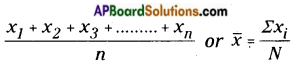
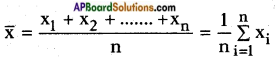
The Arithmetic Mean (A.M.) of a raw data viz. x1, x2, x3, ……., xn is the sum of values of all observations divided by the number of observations.
Arithmetic Mean (A.M.) = AP SSC 10th Class Maths Notes Chapter 14 Statistics 1
Eg.: Sita secured 23, 24, 24, 22 and 20 marks in a test. Her mean marks are
A.M. = \(\frac{23+24+24+22+20}{5}\) = \(\frac{113}{5}\) = 22.6

AP SSC 10th Class Maths Notes Chapter 14 Statistics

→ A.M. by direct method:
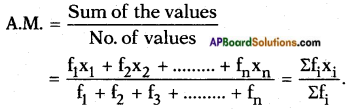
Let x1, x2, x3, ……., xn be observations with respective frequencies f1, f2, ……, fn
i.e., x1 occurs for f1 times, x2 occurs for f2 times, ….., xn occurs for fn times.
AP SSC 10th Class Maths Notes Chapter 14 Statistics 2

→ For a grouped data, it is assumed that the frequency of each class interval is centered around its mid-point and the A.M. is given by A.M. = \(\frac{\Sigma \mathrm{f}_{\mathrm{i}} \mathrm{x}_{\mathrm{i}}}{\Sigma \mathrm{f}_{\mathrm{i}}}\)

→ A.M. by deviation method, \(\overline{\mathbf{x}}=\mathbf{a}+\frac{\Sigma \mathbf{f}_{\mathbf{i}} \mathbf{d}_{\mathbf{i}}}{\Sigma \mathbf{f}_{\mathbf{i}}}\)
where, a – assumed mean
di – deviation = xi – a.
Step – 1: Choose ‘a’ from the central values.
Step – 2: Obtain di by subtracting a from xi.
Step – 3: Multiply fi and di.
Step – 4: Find ∑fidi and ∑fi .
Step – 5: Find \(\overline{\mathbf{x}}=\mathbf{a}+\frac{\Sigma \mathbf{f}_{\mathbf{i}} \mathbf{d}_{\mathbf{i}}}{\Sigma \mathbf{f}_{\mathbf{i}}}\)

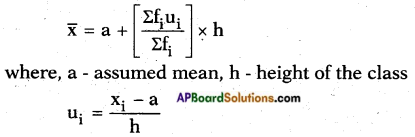
→ A.M. by step-deviation method:
AP SSC 10th Class Maths Notes Chapter 14 Statistics 5
Step – 1: Choose ‘a’ from mid values.
Step – 2: Obtain ui = \(\frac{x_{i}-a}{h}\).
Step – 3: Multiply fi and ui.
Step – 4: Find Efiui and Sfi.
Step – 5: Find \(\overline{\mathrm{x}}=\mathrm{a}+\left(\frac{\Sigma \mathrm{f}_{\mathrm{i}} \mathrm{u}_{\mathrm{i}}}{\Sigma \mathrm{f}_{\mathrm{i}}}\right) \times \mathrm{h}\)

AP SSC 10th Class Maths Notes Chapter 14 Statistics

→ Mode : Mode is the size of variable which occurs most frequently.

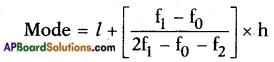
→ Mode of a grouped data:
AP SSC 10th Class Maths Notes Chapter 14 Statistics 3
Where, l – lower boundary of the modal class,
h – size of the modal class interval,
f1 – frequency of modal class.
f0 – frequency of the class preceding the modal class.
f2 – frequency of the class succeeding the modal class.

→ Median: Median is defined as the measure of the central items when they are in descending or ascending order of magnitude.

→ Median for a grouped data:
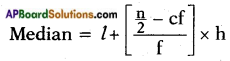
AP SSC 10th Class Maths Notes Chapter 14 Statistics 4
where,
l – lower boundary of median class,
n – number of observations.
cf – cumulative frequency of class preceding the median class.
f – frequency of median class.
h – size of the median class.

→ Cumulative frequency curve or an ogive:
First we prepare the cumulative frequency table, then the cumulative frequencies are plotted against the upper or lower limits of the corresponding class intervals. By joining the points the curve so obtained is called a cumulative frequency or ogive.
Ogives are of two types.

  1. Less than ogive: Plot the points with the upper limits of the classes as abscissa and the corresponding less than cumulative frequencies as ordinates. The points are joined by free hand smooth curve to give less than cumulative frequency curve or the less than ogive. It is a rising curve.
  2. Greater than ogive: Plot the points with the lower limits of the classes as abscissa and the corresponding greater than cumulative frequencies as ordinates. Join the points by a free hand smooth curve to get the greater than ogive. It is a falling curve.

When the points are joined by straight lines, the figure obtained is called cumulative frequency polygon.

AP SSC 10th Class Maths Notes Chapter 14 Statistics

→ Median can be obtained from cumulative frequency curve: From \(\frac{n}{2}\) frequency draw a line parallel to X-axis cutting the curve at a point. From this point draw a perpendicular to the axis. The point at which the perpendicular meets the X – axis determines the median.

Less than type and greater than type curves intersects at a point. From this point of intersection if we draw a perpendicular on the X-axis then this cuts X-axis at some point. This point gives the median.
AP Board 8th Class Maths Notes Chapter 8 Exploring Geometrical Figures

Students can go through AP Board 8th Class Maths Notes Chapter 8 Exploring Geometrical Figures to understand and remember the concepts easily.

AP State Board Syllabus 8th Class Maths Notes Chapter 8 Exploring Geometrical Figures

→ Shapes are said to be congruent if they have same shape and size.

→ Shapes are said to be similar if they have same shapes but in different size.

→ If we flip, slide or turn the congruent/similar shapes their congruence/similarity remain the same.

AP Board 8th Class Maths Notes Chapter 8 Exploring Geometrical Figures

→ Some figures may have more than one line of symmetry.

→ Symmetry is of three types namely line symmetry, rotational symmetry and point symmetry.

→ With rotational symmetry, the figure is rotated around a central point so that it appears two or more times same as original.

→ The number of times for which it appears the same is called the order.

→ The method of drawing enlarged or reduced similar figures is called Dialation.

→ The patterns formed by repeating figures to fill a plane without gaps or overlaps are called tessellations.

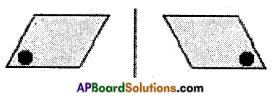
→ Flip: Flip is a transformation in which a plane figure is reflected across a line, creating a mirror image of the original figure.
AP Board 8th Class Maths Notes Chapter 8 Exploring Geometrical Figures 1

→ After a figure is flipped or reflected, the distance between the line of reflection and each point on the original figure is the same as the distance between the line of reflection and the corresponding point on the mirror image.

AP Board 8th Class Maths Notes Chapter 8 Exploring Geometrical Figures

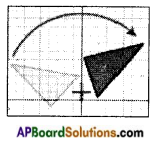
→ Rotation: “Rotation “means turning around a center.
The distance from the center to any point on the shape stays the same. Every point makes a circle around the center.
AP Board 8th Class Maths Notes Chapter 8 Exploring Geometrical Figures 2
There is a central point that stays fixed and everything else moves around that point in a circle.
A “Full Rotation” is 360°.

→ Now observe the following geometrical figures.
AP Board 8th Class Maths Notes Chapter 8 Exploring Geometrical Figures 3
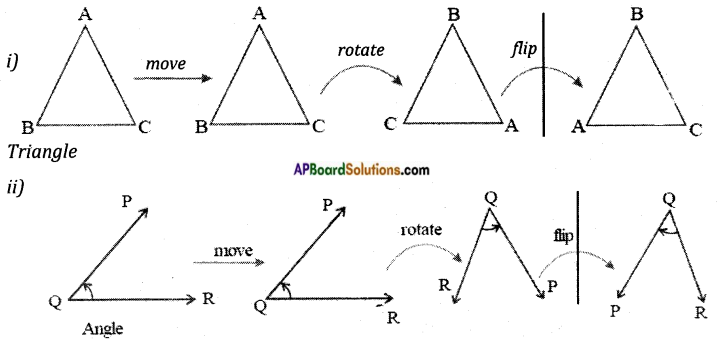
In all the cases if the first figure in the row is moved, rotated and flipped do you find any change in size and shape? No, the figures in every row are congruent they represent the same figure but oriented differently.

AP Board 8th Class Maths Notes Chapter 8 Exploring Geometrical Figures

→ If two shapes are congruent, still they remain congruent if they are moved or rotated. The shapes would also remain congruent if we reflect the shapes by producing their mirror images.

→ We use the symbol ≅ to represent congruency.

AP Board 8th Class Maths Notes Chapter 7 Frequency Distribution Tables and Graphs

Students can go through AP Board 8th Class Maths Notes Chapter 7 Frequency Distribution Tables and Graphs to understand and remember the concepts easily.

AP State Board Syllabus 8th Class Maths Notes Chapter 7 Frequency Distribution Tables and Graphs

→ The Central Tendencies are 3 types. They are

  1. Arithmetic Mean
  2. Median
  3. Mode

→ Information, available in the numerical form or verbal form or graphical form that helps in taking decisions or drawing conclusions is called Data.

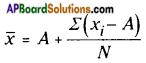
→ Arithmetic mean of the ungrouped data = AP Board 8th Class Maths Notes Chapter 7 Frequency Distribution Tables and Graphs 1 (short representation) where ∑xi represents the sum of all xis, where ‘i’ takes the values from 1 to n.
AP Board 8th Class Maths Notes Chapter 7 Frequency Distribution Tables and Graphs

→ Arithmetic mean = Estimated mean + Average of deviations
AP Board 8th Class Maths Notes Chapter 7 Frequency Distribution Tables and Graphs 2

→ Mean is used in the analysis of numerical data represented by unique value.

→ Median represents the middle value of the distribution arranged in order.

→ The median is used to analyse the numerical data, particularly useful when there are a few observations that are unlike mean, it is not affected by extreme values.

→ Mode is used to analyse both numerical and verbal data.

→ Mode is the most frequent observation of the given data. There may be more than one mode for the given data.

→ Representation of classified distinct observations of the data with frequencies is called ‘Frequency Distribution’ or ‘Distribution Table’.

→ Difference between upper and lower boundaries of a class is called length of the class denoted by ‘C’.

→ In a class the initial value and end value of each class is called the lower limit and upper limit respectively of that class.

AP Board 8th Class Maths Notes Chapter 7 Frequency Distribution Tables and Graphs

→ The average of upper limit of a class and lower limit of successive class is called upper boundary of that class.

→ The average of the lower limit of a class and upper limit of preceding class is called the lower boundary of the class.
The progressive total of frequencies from the last class of the table to the lower boundary of particular class is called Greater than Cumulative Frequency (G.C.F).

→ The progressive total of frequencies from first class to the upper boundary of particular class is called Less than Cumulative Frequency (L.C.F.).

→ Histogram is a graphical representation of frequency distribution of exclusive class intervals. When the class intervals in a grouped frequency distribution are varying we need to construct rectangles in histogram on the basis of frequency density.
Frequency density = \(\frac{\text { Frequency of class }}{\text { Length of that class }}\) × Least class length in the data

→ Frequency polygon is a graphical representation of a frequency distribution (discrete/ continuous).

AP Board 8th Class Maths Notes Chapter 7 Frequency Distribution Tables and Graphs

→ Infrequency polygon or frequency curve, class marks or mid values of the classes are taken on X-axis and the corresponding frequencies on the Y-axis.

→ Area of frequency polygon and histogram drawn for the same data are equal.

→ A graph representing the cumulative frequencies of a grouped frequency distribution against the corresponding lower/upper boundaries of respective class intervals is called Cumulative Frequency Curve or “Ogive Curve”.

AP SSC 10th Class Maths Notes Chapter 13 Probability

Students can go through AP SSC 10th Class Maths Notes Chapter 13 Probability to understand and remember the concepts easily.

AP State Syllabus SSC 10th Class Maths Notes Chapter 13 Probability

→ Theory of probability has its origin date back to 16th century.

→ J. Cardan, an Italian physician and mathematician wrote the first book on probability named “The Book of Games of Chance”.

AP SSC 10th Class Maths Notes Chapter 13 Probability

→ James Bernoulli (1654 – 1705), A.De Moivre (1667 – 1754) and Pierre Simon Laplace (1749 – 1827) made significant contribution to the theory of probability.

→ Experimental or empirical probability : The probability estimated on the basis of results of an actual experiment is called experimental probability of empirical probability.
Eg : An unbiased coin is tossed for 1000 times, head turned up for 455 times and tail turned up 545 times, then the probability or likelyhood of getting a head is = \(\frac{455}{1000}\) = 0.455.

Thus experimental probability = \(\frac{\text { No. of trials in which the event happened }}{\text { Total no. of trials }}\)

→ Classical or Theoretical probability: Classical probability of an event (E) is defined Number as

P(E) = \(\frac{\text { Number of outcomes favourable to E }}{\text { No. of all possible outcomes of the experiment }}\)

This definition was given by ‘Pierre Simon Laplace’.
Eg: The probability of getting a head when a coin is tossed is given by Number of outcomes favourable to this event getting a head = 1 Number of all possible outcomes of this experiment = 2 (Head, Tail)

∴ P(E) = \(\frac{\text { No. of favourable outcomes }}{\text { Total events }}\) = \(\frac{1}{2}\)

Note: If an experiment is conducted for many number of times, then the experimental probability may become closer and closer to theoretical probability.
AP SSC 10th Class Maths Notes Chapter 13 Probability 1

AP SSC 10th Class Maths Notes Chapter 13 Probability

→ The probability of a sure event is 1.

→ The probability of an impossible event is zero.

→ The probability of an event E is a number P(E) such that 0 ≤ P(E) ≤ 1.

→ An event having only one outcome is called an elementary event. The sum of the probabilities of all the elementary events of an experiment is 1.

→ For any event E, P(E) + P(\(\overline{\mathrm{E}}\)) = 1, where E and \(\overline{\mathrm{E}}\) are complementary events.

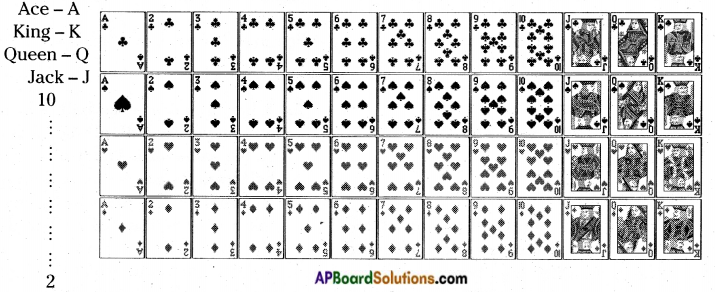
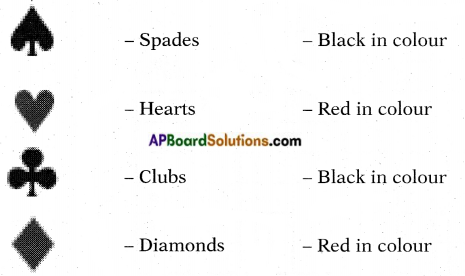
→ Playing cards and their probability : A deck of playing cards consists of 52 cards which are divided into four suits of 13 cards each.
They are:
AP SSC 10th Class Maths Notes Chapter 13 Probability 2

→ The cards in each suit are:
AP SSC 10th Class Maths Notes Chapter 13 Probability 3
Eg : When a card is drawn at random from a deck of cards then

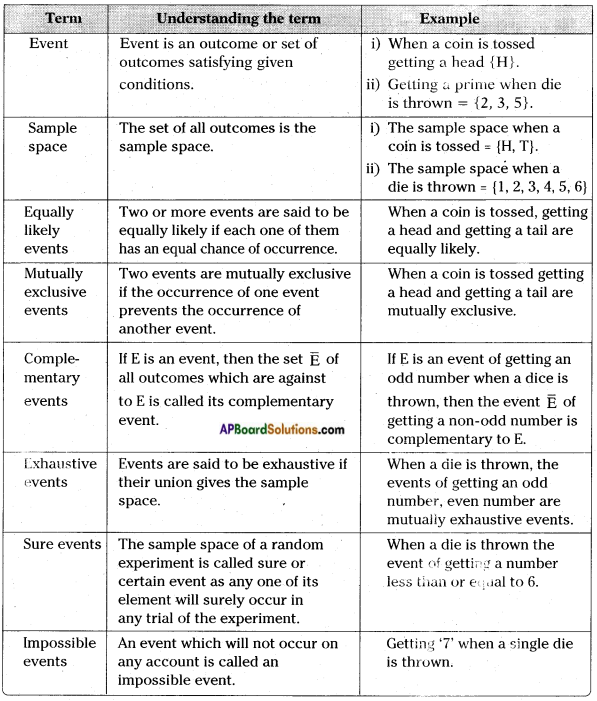
  • Getting a black or red card – equally likely exhaustive events.
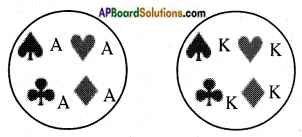
  • Getting an ace or king – mutually exclusive.
    AP SSC 10th Class Maths Notes Chapter 13 Probability 4
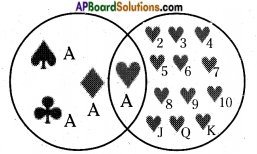
  • Getting an ace or a hearts – not mutually exclusive since the hearts contain an ace.
    AP SSC 10th Class Maths Notes Chapter 13 Probability 5

AP SSC 10th Class Maths Notes Chapter 13 Probability

→ When a coin is tossed, the outcomes are H, T (Head, Tail).

→ When a dice is thrown the outcomes are 1, 2, 3, 4, 5 and 6.

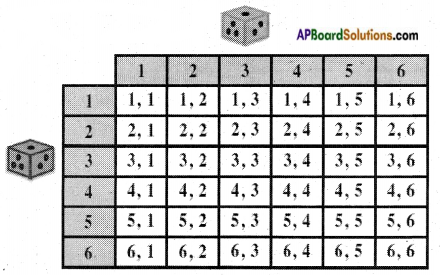
→ When two dice are thrown, the outcomes are
AP SSC 10th Class Maths Notes Chapter 13 Probability 6

→ If a coin is tossed n-times or n – coins are tossed simultaneously, then the number of total outcomes = 2n.
→ If a dice is thrown for n – times or n – dice are thrown simultaneously then the number of total outcomes = 6n.
AP Board 8th Class Maths Notes Chapter 6 Square Roots and Cube Roots

Students can go through AP Board 8th Class Maths Notes Chapter 6 Square Roots and Cube Roots to understand and remember the concepts easily.

AP State Board Syllabus 8th Class Maths Notes Chapter 6 Square Roots and Cube Roots

→ The product of two same numbers is called its square.
Ex: 1) x × x = x2
2) 6 × 6 = 62 = 36

→ The digits in the units place of a square number are 0, 1, 4, 5, 6, 9.

→ If the digits 2,3, 7 or 8 are in the units place of an umber then it is not a perfect square.

AP Board 8th Class Maths Notes Chapter 6 Square Roots and Cube Roots

→ If there are ‘n’ digits in a number then the no.of digits in its square = 2n or (2n -1).

→ Sum of ‘n ‘ consecutive odd numbers = n2

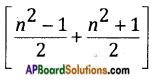
→ The square of any odd number say ‘n’ can be expressed as the sum of two consecutive numbers as
AP Board 8th Class Maths Notes Chapter 6 Square Roots and Cube Roots 1

→ If a, b, c are any three positive integers and a2 + b2 = c2 then a, b, c are called Pythagorean triplets. Ex: (3, 4, 5) (5, 12, 13).

→ If a square number is expressed, as the product of two equal factors, then one of the factors is called the square root of that square number. Thus, the square root of 169 is 13. It can be expressed as √169 = 13 (symbol used for square root is √). Thus it is the inverse operation of squaring.

→ If the same number is multiplied itself by 3 times then it is called a cube of a number. Ex: cube of x = x × x × x = x3

AP Board 8th Class Maths Notes Chapter 6 Square Roots and Cube Roots

→ If a cube number is expressed, as the product of 3 equal factors, then one of he factors is called the cube root of that number.
Symbol for cube root is \(\sqrt[3]{ }\)
Ex: \(\sqrt[3]{64}=\left(4^{3}\right)^{1 / 3}\) = 4


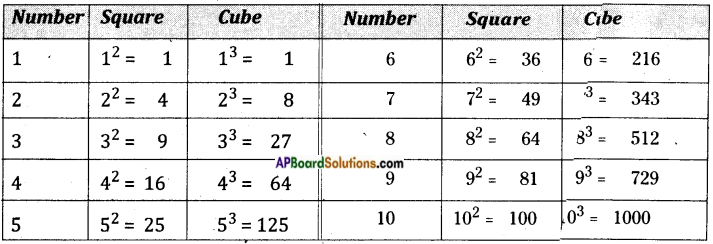
AP Board 8th Class Maths Notes Chapter 6 Square Roots and Cube Roots 2

AP Board 8th Class Maths Notes Chapter 5 Comparing Quantities Using Proportion

Students can go through AP Board 8th Class Maths Notes Chapter 5 Comparing Quantities Using Proportion to understand and remember the concepts easily.

AP State Board Syllabus 8th Class Maths Notes Chapter 5 Comparing Quantities Using Proportion

→ Two simple ratios are expressed like a single ratio as the ratio of product of antecedents to product of consequents and we call it compound ratio of the given two simple ratios.
a : b and c : d are any two ratios, then their compound ratio is \(\frac{a}{b}\) × \(\frac{c}{d}\) = \(\frac{ac}{bd}\) i.e. ac : bd.

→ A percentage(%) compares a number to 100. The word percent means “per every hundred” or “out of every hundred”. 100% = \(\frac{100}{100}\) it is also a fraction with denominator 100.

→ Discount is a decrease percent of marked price. Price reduction is called rebate or discount. It is calculated on marked price or list price.

AP Board 8th Class Maths Notes Chapter 5 Comparing Quantities Using Proportion

→ Profit or loss is always calculated on cost price. Profit is an example of increase percent of cost price and loss is an example of decrease percent of cost price.

→ VAT will be charged on the selling price of an item and will be included in the bill.
VAT is an increase percent on selling price.

→ Simple interest is an increase percent on the principal.

→ Simple interest (I) = \(\frac{P \times T \times R}{100}\)
where P = Principal, T = Time inyears, R = Rate of interest.

→ Amount = Principal + Interest = P + \(\frac{P \times T \times R}{100}\) = P\(\left(1+\frac{T \times R}{100}\right)\)

→ Compound interest allows you to earn interest on interest.

→ Amount at the end of ‘n’ years using compound interest is A = P \(\left(1+\frac{R}{100}\right)^{n}\)

AP Board 8th Class Maths Notes Chapter 5 Comparing Quantities Using Proportion

→ The time period after which interest is added to principal is called conversion period.
When interest is compounded halfyearly, there are two conversion periods in a year, each after 6 months. In such a case, ha If year rate will be half of the annual rate.

→ Note: 1.615 : 1 is called as golden ratio.
In ancient Greece, artists and architects believed there was a particular rectangular shape that looked very pleasing to the eye. For rectangles of this shape, the ratio of long side to the short side is roughly 1.615 : 1. This ratio is very close to what is known as golden ratio.

AP SSC 10th Class Maths Notes Chapter 12 Applications of Trigonometry

Students can go through AP SSC 10th Class Maths Notes Chapter 12 Applications of Trigonometry to understand and remember the concepts easily.

AP State Syllabus SSC 10th Class Maths Notes Chapter 12 Applications of Trigonometry

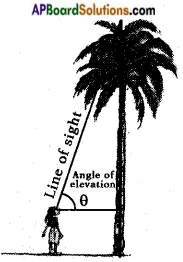
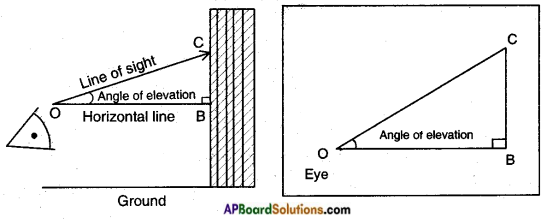
→ If a person is looking at an object then the imaginary line joining the object and the eye of the observer is called the line of sight or ray of view.
AP SSC 10th Class Maths Notes Chapter 12 Applications of Trigonometry 1

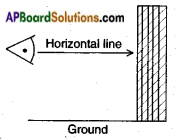
→ An imaginary line parallel to earth surface and passing through the point of observation is called the horizontal.

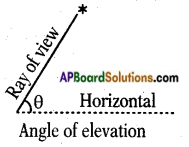
→ If the line of sight is above the horizontal then the angle between them is called “angle of elevation”.
AP SSC 10th Class Maths Notes Chapter 12 Applications of Trigonometry 2

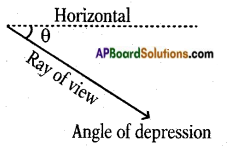
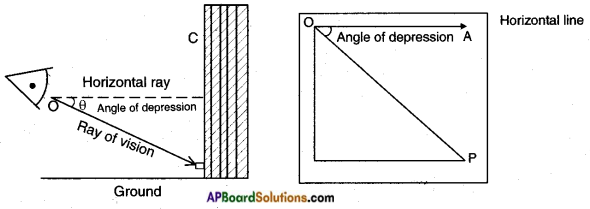
→ If the line of sight is below the horizontal then the angle between them is called the angle of depression.
AP SSC 10th Class Maths Notes Chapter 12 Applications of Trigonometry 3

→ Useful hints to solve the problems:

  1. Draw a neat diagram of a right triangle or a combination of right triangles if necessary.
  2. Represent the data given on the triangle.
  3. Find the relation between known values and unknown values.
  4. Choose appropriate trigonometric ratio and solve for the unknown.

→ The height or length of an object or the distance between two distant objects can be determined with the help of trigonometric ratios.

→ To use this application of trigonometry, we should know the following terms.

→ The terms are Horizontal line, Line of Sight, Angle of Elevation and Angle of Depression.

→ Horizontal line: A line which is parallel to earth from observation point to object is called “horizontal line”.
AP SSC 10th Class Maths Notes Chapter 12 Applications of Trigonometry 4

→ Line of Sight (or) Ray of Vision: The line of sight is the line drawn from the eye of an observer to the point in the object viewed by the observer.

→ Angle of Elevation: The line of sight is above the horizontal line then angle between the line of sight and the horizontal line is called “angle of elevation”.
AP SSC 10th Class Maths Notes Chapter 12 Applications of Trigonometry 5
Note:

  1. If the angle of observer moves towards the perpendicular line (pole/tree/ building), then angle of elevation increases and if the observer moves away from the perpendicular line (pole/tree/building), then angle of elevation decreases.
  2. If height of tower is doubled and the distance between the observer and foot of the tower is also doubled, then the angle of elevation remains same.
  3. If the angle of elevation of sun above a tower decreases, then the length of shadow of a tower increases.

→ Angle of Depression: The line of sight is below the horizontal line then angle between the line of sight and the horizontal line is called angle of depression.
AP SSC 10th Class Maths Notes Chapter 12 Applications of Trigonometry 6
Note:

  1. The angle of elevation and depression are always acute angles.
  2. The angle of elevation of a point P as seen from a point ‘O’ is always equal to the angle of depression of ‘O’ as seen from P.

→ Points to be kept in mind:
I. Trigonometric ratios in a right triangle:
AP SSC 10th Class Maths Notes Chapter 12 Applications of Trigonometry 7
AP SSC 10th Class Maths Notes Chapter 12 Applications of Trigonometry 8

II. Trigonometric ratios of some specific angles:
AP SSC 10th Class Maths Notes Chapter 12 Applications of Trigonometry 9

→ Solving Procedure:
When we want to solve the problems of height and distances, we should consider the following :

  1. All the objects such as tower, trees, buildings, ships, mountains, etc. shall be considered as linear for mathematical convenience.
  2. The angle of elevation or angle of depression is considered with reference to the horizontal line.
  3. The height of the observer is neglected, if it is not given in the problem.
  4. To find heights and distances, we need to draw figures and with the help of these figures we can solve the problems.

AP Board 9th Class Maths Notes Chapter 4 Lines and Angles

Students can go through AP Board 9th Class Maths Notes Chapter 4 Lines and Angles to understand and remember the concepts easily.

AP State Board Syllabus 9th Class Maths Notes Chapter 4 Lines and Angles

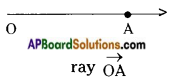
→ A ray is a part of line. It begins at a point and goes on endlessly in a specified direction.
AP Board 9th Class Maths Notes Chapter 4 Lines and Angles 1

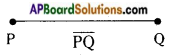
→ A part of a line with two end points is called a line segment.
AP Board 9th Class Maths Notes Chapter 4 Lines and Angles 2

AP Board 9th Class Maths Notes Chapter 4 Lines and Angles

→ Points on the same line are called collinear points.
AP Board 9th Class Maths Notes Chapter 4 Lines and Angles 3

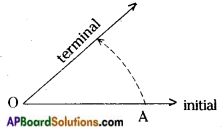
→ The angle is formed by rotating a ray from an initial position to a terminal position.
AP Board 9th Class Maths Notes Chapter 4 Lines and Angles 4

→ One complete rotation makes an angle 360°.

→ Angles are named according to their measure.
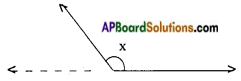
Obtuse angle 90° < x < 180°.
AP Board 9th Class Maths Notes Chapter 4 Lines and Angles 5

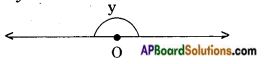
→ Straight angle y = 180°
AP Board 9th Class Maths Notes Chapter 4 Lines and Angles 6

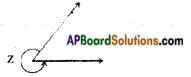
→ Reflex angle 180° < z < 360°
AP Board 9th Class Maths Notes Chapter 4 Lines and Angles 7

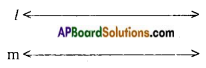
→ If two lines have no common points, they are called parallel lines. In the figure l // m.
AP Board 9th Class Maths Notes Chapter 4 Lines and Angles 8

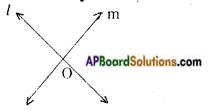
→ If two lines have a common point then they are called intersecting lines.
AP Board 9th Class Maths Notes Chapter 4 Lines and Angles 9

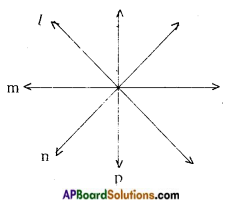
→ Three or more lines meet at a point are called concurrent lines.
AP Board 9th Class Maths Notes Chapter 4 Lines and Angles 10

AP Board 9th Class Maths Notes Chapter 4 Lines and Angles

→ Two angles are said to be supplementary angles if their sum is 180°.
E.g.: (100°, 80°), (110°, 70°), (120°, 60°), (179°, 1°), (90°, 90°) etc.

→ The supplementary angle to x° is given by (180° – x°).

→ Two angles are said to be complementary if their sum is 90°.

→ The complementary angle to x° is (90° – x°).
E.g.: (89°, 1°), (70°, 20°), (60°, 30°) etc.

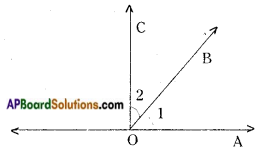
→ Two angles are said to be form a pair of adjacent angles if they have a common arm and lie on the either sides of the common arm.
AP Board 9th Class Maths Notes Chapter 4 Lines and Angles 11
∠1 and ∠2 are a pair of adjacent angles with OB as their common arm.

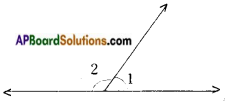
→ A pair of adjacent angles are said to be a linear pair of angles if their sum is 180°. ∠1 + ∠2 = 180°
AP Board 9th Class Maths Notes Chapter 4 Lines and Angles 12

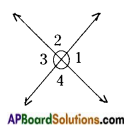
→ When a pair of lines meet at a point, they form four angles. The two pairs of angles which have no common arm are called vertically opposite angles.
In the figure (∠1, ∠3) and (∠2, ∠4) are the pairs of vertically opposite angles.
AP Board 9th Class Maths Notes Chapter 4 Lines and Angles 13

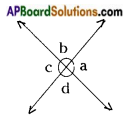
→ When two lines intersect, the pairs of vertically opposite angles thus formed are equal a = c and b = d. (from the figure)
AP Board 9th Class Maths Notes Chapter 4 Lines and Angles 14

AP Board 9th Class Maths Notes Chapter 4 Lines and Angles

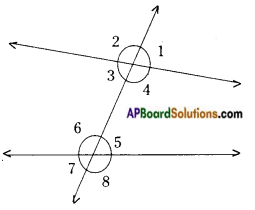
→ When a pair of lines intersected by a transversal, there forms eight angles.
AP Board 9th Class Maths Notes Chapter 4 Lines and Angles 15

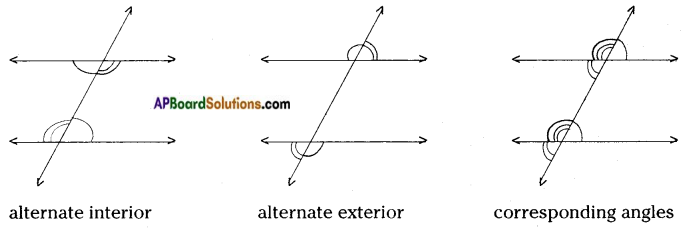
→ When a pair of parallel lines intersected by a transversal the pairs of a) alternate interior angles b) corresponding angles c) alternate exterior angles are equal and the interior / exterior angles on the same side of the transversal are supplementary.
AP Board 9th Class Maths Notes Chapter 4 Lines and Angles 16

→ Lines which are parallel to same line are parallel to each other.

AP Board 9th Class Maths Notes Chapter 4 Lines and Angles

→ The sum of the interior angles of a triangle is 180°.

→ If one side of a triangle is produced, then the exterior angle thus formed is equal to the sum of the two interior opposite angles.

AP SSC 10th Class Maths Notes Chapter 11 Trigonometry

Students can go through AP SSC 10th Class Maths Notes Chapter 11 Trigonometry to understand and remember the concepts easily.

AP State Syllabus SSC 10th Class Maths Notes Chapter 11 Trigonometry

→ In our daily life, we can measure the heights, distances and slopes by using some mathematical techniques.

→ The mathematical techniques which come under a branch of mathematics is called ‘trigonometry’.

→ “Trigonometry” is the study of relationships between the sides and angles of a triangle.

AP SSC 10th Class Maths Notes Chapter 11 Trigonometry

→ Early astronomers used to find out the distances of the stars and planets from the Earth. Even today, most of the technologically advanced methods used in engineering and physical sciences are based on trigonometrical concepts.

→ Naming the sides in a right triangle:
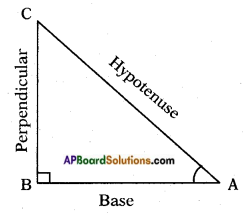
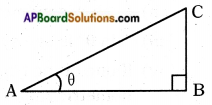
Let’s take a right triangle ABC as shown in the figure.
AP SSC 10th Class Maths Notes Chapter 11 Trigonometry 1
Consider ∠CAB as A where angle ‘A’ is acute.
Since AC is the longest side, it is called “Hypotenuse”.

→ Now observe the position of side BC with respect to angle A. It is opposite to angle ‘A’ and we can call it as “Opposite side of angle A”.

→ And the remaining side AB can be called as “Adjacent side of angle A”.

→ Trigonometric Ratios:
The ratios of the sides of a right angled triangle with respect to its acute angles, are called Trigonometric ratios.

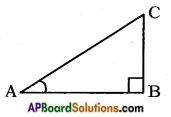
→ Consider a right angled triangle ABC having right angle at B as shown in the given figure.
AP SSC 10th Class Maths Notes Chapter 11 Trigonometry 2
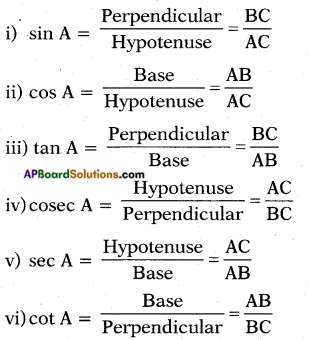
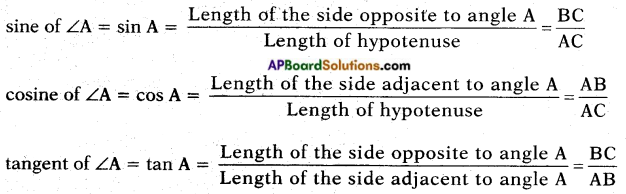
Then, trigonometric ratios of the angle A in right angled triangle ABC are defined as follows:
AP SSC 10th Class Maths Notes Chapter 11 Trigonometry 3

→ There are three more ratios defined in trigonometry which are considered as multiplicative inverse of the above three ratios.

AP SSC 10th Class Maths Notes Chapter 11 Trigonometry

→ Multiplicative inverse of “sine A” is “cosecant A”.
i.e., cosec A = \(\frac{1}{\sin A}\) = \(\frac{\text { Hypotenuse }}{\text { Opposite side of the angle } A}\)

→ Multiplicative inverse of “cosine A” is “secant A”.
i.e., sec A = \(\frac{1}{\cos A}\) = \(\frac{\text { Hypotenuse }}{\text { Adjacent side of the angle } A}\)

→ Multiplicative inverse of “tangent A” is “cot A”.
i.e., cot A = \(\frac{1}{\tan A}\) = \(\frac{\text { Adjacent side of the angle } A}{\text { Opposite side of the angle } A}\)

Note:
i) The values of the trigonometric ratios of an angle do not vary with the lengths of the sides of the triangles, if the angle remains the same.
ii) Each trigonometric ratio is a real number and has no unit.
iii) “sin θ” is one symbol and sin, cos, tan etc., cannot be separated from θ.
iv) If one of the trigonometric ratios of an acute angle is known, the remaining trigonometric ratios of angle can be easily determined.
v)
AP SSC 10th Class Maths Notes Chapter 11 Trigonometry 4

→ Trigonometric ratios of some specific angles:
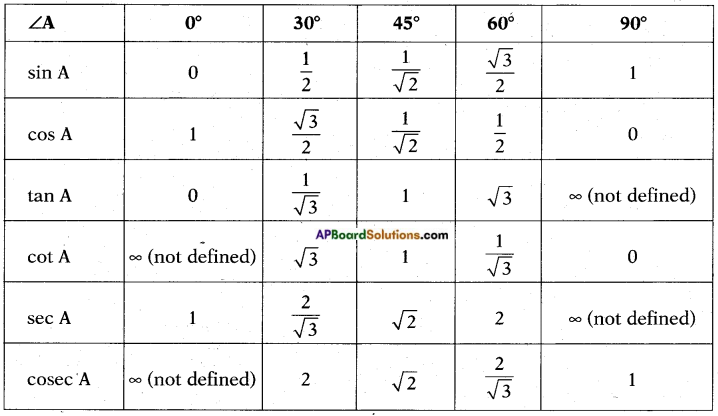
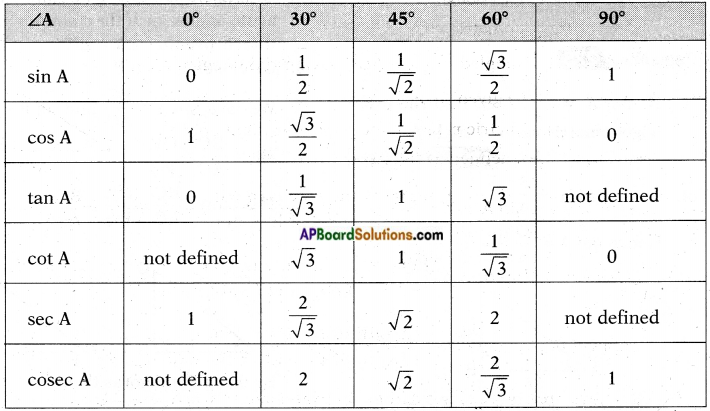
The values of various trigonometric ratios of 0°, 30°, 45°, 60° and 90°.
AP SSC 10th Class Maths Notes Chapter 11 Trigonometry 5
Note:
i) The values of “sin θ” and “cos θ” always lie between ‘0’ and ‘1’.
ii) In the case of tan θ, the values increase from 0 to ∞ (not determinate).
iii) In the case of cot θ, the values decrease from ∞ to 0.
iv) In the case of cosec θ, the values decrease from ∞ to 1.
v) In the case of sec θ, the values increase from 1 to ∞.

AP SSC 10th Class Maths Notes Chapter 11 Trigonometry

→ Trigonometric ratios of complementary angles:
Two angles are said to be complementary, if their sum is equal to 90°.
In a right angled triangle, if ∠B = 90°, then ∠A + ∠C = 90° i.e., ∠A and ∠C form a pair of complementary angles.
If ‘θ’ is an acute angle, then we can prove that
sin (90 – θ) = cos θ
cos (90 – θ) = sin θ
tan (90 – θ) = cot θ
cot (90 – θ) = tan θ
sec (90 – θ) = cosec θ
cosec (90 – θ) = sec θ

→ Trigonometric Identity: An identity equation having trigonometric ratios of an angle is called trigonometric identity. It is true for all the values of the angles involved in it.
We have three major trigonometric identities. They are
i) sin2 A + cos2 A = 1
ii) sec2 A – tan2 A = 1
iii) cosec2 A – cot2 A = 1
Note: sin2 θ = (sin θ)2 but sin θ2 ≠ (sin θ)2

AP Board 9th Class Maths Notes Chapter 3 The Elements of Geometry

Students can go through AP Board 9th Class Maths Notes Chapter 3 The Elements of Geometry to understand and remember the concepts easily.

AP State Board Syllabus 9th Class Maths Notes Chapter 3 The Elements of Geometry

→ Geometry is structured on its building blocks namely point, line and plane.

→ In geometry there are undefined terms like point, plane and line.

→ Angles, circles and triangles are the examples for defined terms.

→ No better entrance exists than Euclid’s time honoured ‘Elements’.

AP Board 9th Class Maths Notes Chapter 3 The Elements of Geometry

→ In ‘The Elements’, Euclid developed a new system of thought which laid the foundation for the advancement of the geometry.

→ Some of the Euclid’s axioms are:

  • Things which are equal to same things are equal to one another.
  • If equals are added to equals, the wholes are equal.
  • If equals are subtracted from equals, the remainders are also equal.
  • Things which coincide with one another are equal to one another.
  • The whole is greater than part.
  • Things which are double of the same things are equal to one another.
  • Things which are halves of the same things are equal to one another.

→ Euclid’s postulates are
Postulate – 1 : To draw a straight line from any point to any point.
Postulate – 2 : A terminated line can be produced indefinitely.
Postulate – 3 : To describe a circle with any centre and radius.
Postulate – 4 : That all right angles are equal to one another.
Postulate – 5 : If a straight line falling on two straight lines makes the interior angles on the same side of it taken together is less than two right angles, then the two straight lines, if produced infinitely, meet on that side on which the sum of the angles is less than two right angles.

AP Board 9th Class Maths Notes Chapter 3 The Elements of Geometry

→ Equivalent versions of Euclid’s fifth postulate:

  • Through a point not on a given line, exactly one parallel line may be drawn to the given line – John Play Fair (1748 – 1819).
  • The sum of angles of any triangle is a constant and is equal to two right angles (Legendre).
  • There exists a pair of lines everywhere equidistant from one another (Posidominus).
  • If a straight line intersects any one of two parallel lines, then it will intersect the other also (Proclus).
  • The statements that were proved to be true are called propositions or theorems.
  • The statements neither proved nor disproved are called conjectures.
  • There are non-Euclidian geometries.

AP SSC 10th Class Maths Notes Chapter 10 Mensuration

Students can go through AP SSC 10th Class Maths Notes Chapter 10 Mensuration to understand and remember the concepts easily.

AP State Syllabus SSC 10th Class Maths Notes Chapter 10 Mensuration

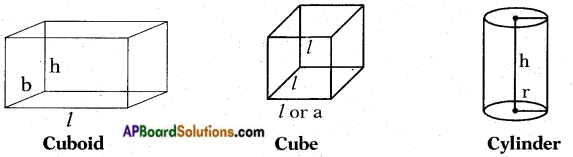
→ A solid is a geometrical shape with three dimensions namely length, breadth and height.
Eg:
AP SSC 10th Class Maths Notes Chapter 10 Mensuration 1

AP SSC 10th Class Maths Notes Chapter 10 Mensuration

→ A solid has two types of area namely,
a) Lateral Surface Area (L.S.A.)
b) Total Surface Area (T.S.A,)

→ In general, L.S.A. of a solid is the product of its base perimeter and height.
Eg : L.S.A. of a cuboid = 2h(l + b)
L.S.A. of a cylinder = 2πrh

→ The T.S.A. of a solid is the sum of L.S.A. and the areas of its top and base.
Eg : T.S.A. of a cylinder = 2πrh + 2πr2
= 2πr(r + h)

→ In general, the volume of a solid is the product of its base area and height.
V = A. h
Eg: Volume of a cube = a2 . a = a3
Volume of a cylinder = πr2 . h = πr2h

AP SSC 10th Class Maths Notes Chapter 10 Mensuration

→ The volume of solid formed by joining two basic solids is the sum of volumes of the constituents.

→ Surface area of the combination of solids: In calculating the surface area of the solid which is a combination of two or more solids, we can’t add the surface areas of all its constituents, because some part of the surface area disappears in the process of joining them.

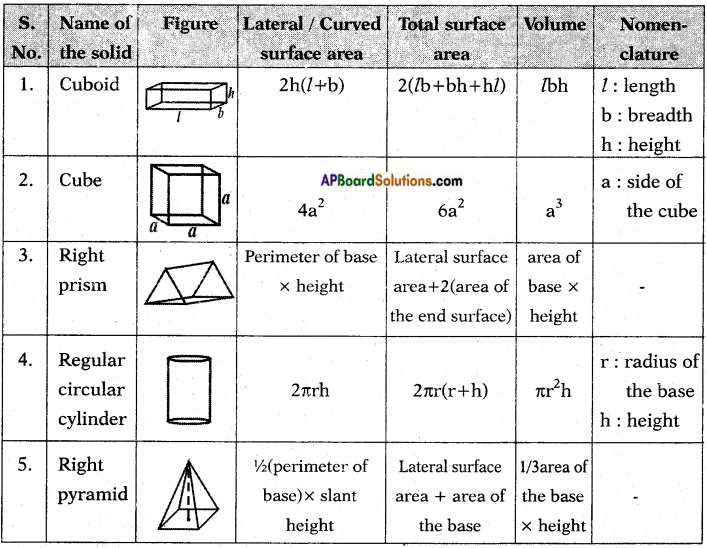
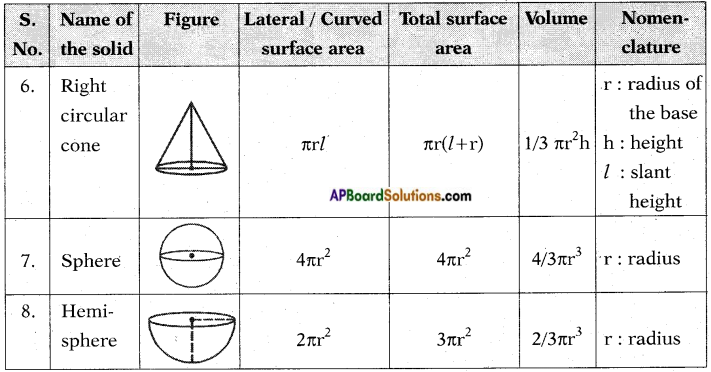
→ Surface areas and volume of different solid shapes:
AP SSC 10th Class Maths Notes Chapter 10 Mensuration 2
AP SSC 10th Class Maths Notes Chapter 10 Mensuration 3

AP SSC 10th Class Maths Notes Chapter 10 Mensuration

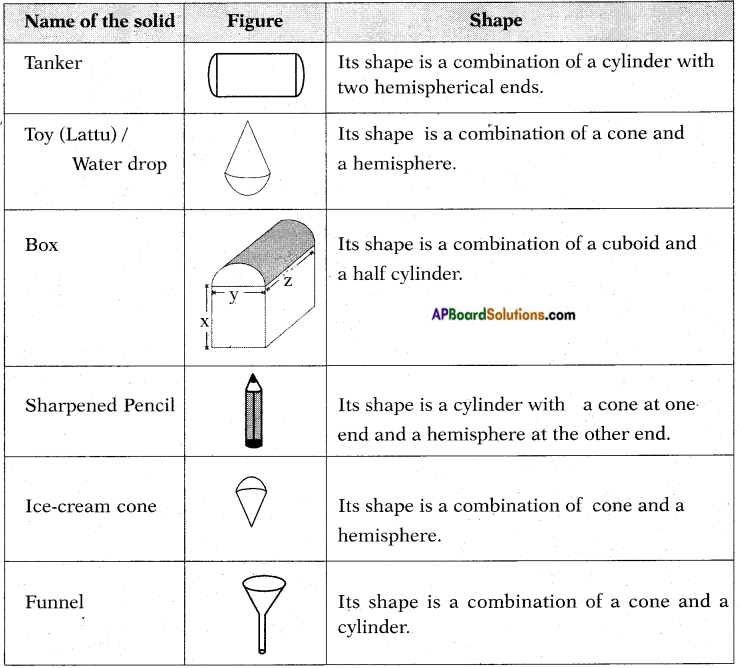
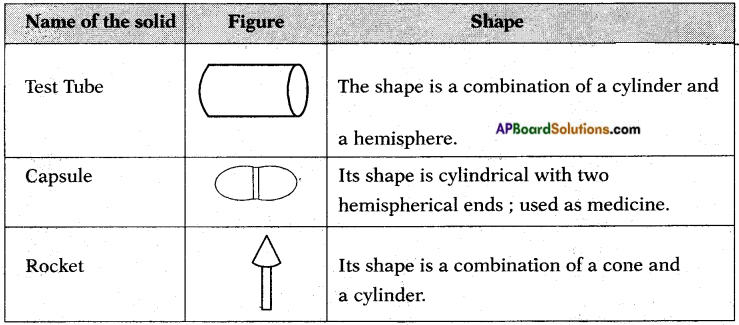
→ Some solid figures and their combination shapes:
AP SSC 10th Class Maths Notes Chapter 10 Mensuration 4
AP SSC 10th Class Maths Notes Chapter 10 Mensuration 5

AP Board 9th Class Maths Notes Chapter 2 Polynomials and Factorisation

Students can go through AP Board 9th Class Maths Notes Chapter 2 Polynomials and Factorisation to understand and remember the concepts easily.

AP State Board Syllabus 9th Class Maths Notes Chapter 2 Polynomials and Factorisation

→ An algebraic expression ¡n which the variables involved have only non-negative integral powers is called a polynomial.
E.g.: 5x3 – 2x + 8

→ Polynomials can be classified as monomials. binomials, trinomials and polynomials based on the number of terms it contains.

→ A polynomial with a single term is a monomial.
E.g.: 2x, -5x2, \(\frac{6}{7}\)x3 etc.

→ A polynomial with two terms is a binomial.
E.g.: 2x + 5y; -3x2 + 5x etc.

→ A polynomial with three terms is a trinomial.
E.g.: 3x2 + 5x – 8; 3x + 2y – 5z etc.

→ In general a polynomial may contain two or more than two terms.
E.g.: 5x + 8x2 – 3x3 + 7

AP Board 9th Class Maths Notes Chapter 2 Polynomials and Factorisation

→ Degree of a polynomial ¡s the heighest degree of its variable terms.
E.g.: Degree of 3x2 + 4xy3 + y2 is 4.

→ Degree of a constant term is considered as zero.
E.g.: Degree of 4 is zero.

→ The general form of a polynomial is a0xn + a1xn-1 + a2xn-2 …….. + an-1x + an where a0, a1, a2,…… an-1, an are constants and a0 ≠ 0. Its degree is ‘n’.

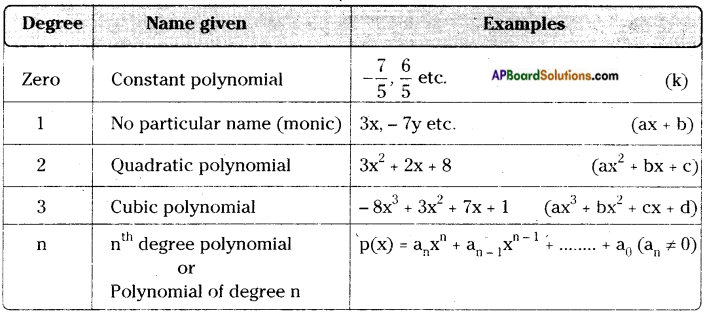
→ Polynomials are again classified based on their degrees.
AP Board 9th Class Maths Notes Chapter 2 Polynomials and Factorisation 1

→ The zero of a polynomial p(x) is the value of x at which p(x) becomes zero (i.e.) p(x) = 0.
E.g.: Zero of 3x – 5 is x = \(\frac{5}{3}\)

→ To find the zero of a polynomial we equate the polynomial to zero and solve for the value of the variable.
E.g.: To find zero of 7x + 8.
7x + 8 = 0
7x = – 8
x = \(\frac{-8}{7}\)

→ Let p(x) be any polynomial of degree greater than or equal to one and let ‘a’ be any real number. If p(x) is divided by the linear polynomial (x – a), then the remainder is p(a). This is called the Remainder theorem.
E.g.: If p(x) = 4x3 + 3x + 8 then the remainder when it is divided by x – 1 is p(1).
i.e., p(1) = 4 + 3 + 8 = 15.

→ If p(x) is a polynomial of degree n ≥ 1 and ‘a’ is any real number, then
(i) (x – a) is a factor of p(x), if p(a) = 0
(ii) and its converse “if (x – a) is a factor of a polynomial p(x) then p(a) = 0. This is called Factor theorem”.
E.g.: Let p(x) = x2 – 5x + 6 and p(2) = 22 – 5(2)+ 6 = 0 and hence (x – 2) is a factor of p(x) conversely; p(x) = x2 + 7x + 10 and (x + 2) is a factor, then p(-2) = 0.

AP Board 9th Class Maths Notes Chapter 2 Polynomials and Factorisation

→ Algebraic identities

  • (x + y)2 = x2 + 2xy + y2
  • (x – y)2 = x2 – 2xy + y2
  • (x + y) (x-y) = x2 – y2
  • (x + a) (x + b) = x2 + (a + b) x + ab
  • (x + y + z)2 = x2 + y2 + z2 + 2xy + 2yz + 2zx
  • (x + y)3 = x3 + y3 + 3xy (x + y)
  • (x – y)3 = x3 – y3 – 3xy (x – y)
  • (x + y + z) (x2 + y2 + z2 – xy – yz – zx) = x3 + y3 + z3 – 3xyz