AP Board 9th Class Maths Notes Chapter 1 Real Numbers

Students can go through AP Board 9th Class Maths Notes Chapter 1 Real Numbers to understand and remember the concepts easily.

AP State Board Syllabus 9th Class Maths Notes Chapter 1 Real Numbers

→ Numbers of the form \(\frac{p}{q}\) where p and q are integers and q ≠ 0 are called rational numbers, represented by ‘Q’.

→ There are infinitely many rational numbers between any two integers.
E.g.: 3 < \(\frac{19}{6}\), \(\frac{20}{6}\), \(\frac{21}{6}\), \(\frac{22}{6}\), \(\frac{23}{6}\), ……. < 4

→ There are infinitely many rational numbers between any two rational numbers.
E.g.: \(\frac{3}{4}\) < \(\frac{29}{8}\) < \(\frac{71}{16}\) < \(\frac{81}{14}\) ……. < \(\frac{13}{2}\)

→ To find the decimal representation of a rational number we divide the numerator of a rational number by its denominator.
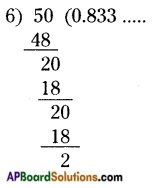
E.g.: The decimal representation of \(\frac{5}{6}\) is
AP Board 9th Class Maths Notes Chapter 1 Real Numbers 1
∴ \(\frac{5}{6}\) = 0.833 …. = 0.8 \(\overline{3}\)

AP Board 9th Class Maths Notes Chapter 1 Real Numbers

→ Every rational number can be expressed as a terminating decimal or as a non-terminating repeating decimal. Conversely every terminating decimal or non¬terminating recurring decimal can be expressed as a rational number.
E.g.: 1.6 \(\overline{2}\) = \(\frac{161}{99}\)

→ A rational number whose denominator consists of only 2’s or 5’s or a combination of 2’s and 5’s can be expressed as a terminating decimal.
E.g. : \(\frac{13}{32}\) can be expressed as a terminating decimal (∵ 32 = 2 × 2 × 2 × 2 × 2)
\(\frac{7}{125}\) can be expressed as a terminating decimal (∵ 125 = 5 × 5 × 5)
\(\frac{24}{40}\) can be expressed as a terminating decimal (∵ 40 = 2 × 2 × 2 × 5)

→ Numbers which can’t written in the form \(\frac{p}{q}\) where p and q are integers and q ≠ 0, are called irrational numbers.
E.g.: √2, √3, √5,….. etc.
The decimal form of an irrational number is neither terminating nor recurring decimal.

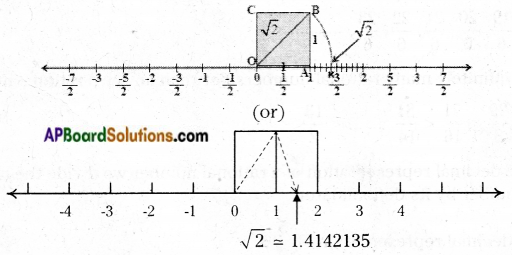
→ Irrational numbers can be represented on a number line using Pythagoras theorem.
E.g.: Represent √2 on a number line.
AP Board 9th Class Maths Notes Chapter 1 Real Numbers 2

→ If ‘n’ is a natural number which is not a perfect square, then √n is always an irrational number.
E.g.: 2, 3, 5, 7, 8, …… etc., are not perfect squares.
∴ √2, √3, √5, √7 and √8 are irrational numbers.

AP Board 9th Class Maths Notes Chapter 1 Real Numbers

→ We often write π as \(\frac{22}{7}\) there by π seems to be a rational number; but π is not a rational number.

→ The collection of rational numbers together with irrational numbers is called set of Real numbers.
R = Q ∪ S

→ If a and b are two positive rational numbers such that ab is not a perfect square, then , √ab is an irrational number between ‘a’ and b’.
E.g.: Consider any two rational numbers 7 and 4.
7 × 4 = 28 is not a perfect square; then √28 lies between 4 and 7.
i.e., 4 < √28 < 1

→ If ‘a’ is a rational number and ‘b’ is arty irrational number then a + b, a – b, a.b or \(\frac{a}{b}\) is an irrational number.
E.g.: Consider 7 and √5 then 7 + √5, 7 – √5, 7√5 and \(\frac{7}{\sqrt{5}}\)= are all irrational numbers.

→ If the product of any two irrational numbers is a rational number, then they are said to be the rationalising factor of each other.
E.g.: Consider any two irrational number 7√3 and 5√3.
7√3 × 5√3 = 7 × 5 × 3 = 105 a rational number.
Also 7√3 × √3 = 21 – a rational number.
5√3 × √3 = 15 – a rational number.
So the rationalising factor of an irrational number is not unique.

→ The general form of rationalising factor (R.F.) of (a ± √b} is (a ∓ √b). They are called conjugates to each other.

→ Laws of exponents:

i) am × an = am+n
e.g.: 54 . 5-3 = 54+(-3) = 51 = 5

ii) (am)n = amn
e.g.: (43)2 = 43×2 = 46

iii)
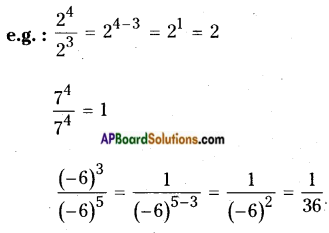
AP Board 9th Class Maths Notes Chapter 1 Real Numbers 4 = am-n if (m > n)
= 1 if m = n
= \(\frac{1}{a^{n-m}}\) if (m < n)
AP Board 9th Class Maths Notes Chapter 1 Real Numbers 3

AP Board 9th Class Maths Notes Chapter 1 Real Numbers

iv) am . bm = (ab)m
e.g.:(-5)3 . (2)3 = (-5 × 2)3 =(-10)3

v) \(\frac{1}{a^{n}}\) = a-n
e.g.: (6)-3 = \(\frac{1}{6^{3}}\) = \(\frac{1}{216}\)

vi) a0 = 1
e.g.: \(\left(\frac{-3}{4}\right)^{0}\) = 1
Where a, b are rationals and m, n are integers.

→ Let a, b be any two rational numbers such that a = bn then b = \(\sqrt[n]{a}\) = \((\mathrm{a})^{1 / \mathrm{n}}\)
Here ‘b’ is called nth root of a.
e.g.: 42 = 16 then \(16^{1 / 2}\) or \(\sqrt[2]{16}\)
34 = 81 then 3 = \(\sqrt[4]{81}\) or \((81)^{1 / 4}\)

→ Let ‘a’ be a positive number and n > 1 then \(\sqrt[n]{a}\) i.e., nth root of a is called a surd.

AP Inter 2nd Year Chemistry Study Material Chapter 12(a) Alcohols, Phenols, and Ethers

Andhra Pradesh BIEAP AP Inter 2nd Year Chemistry Study Material Lesson 12(a) Alcohols, Phenols, and Ethers Textbook Questions and Answers.

AP Inter 2nd Year Chemistry Study Material Lesson 12(a) Alcohols, Phenols, and Ethers

Very Short Answer Questions

Question 1.
Explain why propanol has a higher boiling point than that hydrocarbon-butane.
Answer:
Propanol has a higher boiling point (391 K) than that hydrocarbon butane (309K).

Reason: In propanol, strong intermolecular hydrogen bonding is present between the molecules. But in the case of butane weak van der Waals force of attractions are present.

Question 2.
Alcohols are comparatively more soluble in water than hydrocarbons of comparable molecular masses. Explain this fact.
Answer:
Alcohols are comparatively more soluble in water than hydrocarbons of comparable molecular masses.
Explanation: .

  • Alcohols and water are both polar solvents. Alcohol is dissolves in water, due to formation of hydrogen bonding with water molecules.
  • Hydro carbons are non polar and these dorv.t form hydrogen bonds with water molecules. So alcohols are soluble in water where as hydrocarbons are not soluble in water.

AP Inter 2nd Year Chemistry Study Material Chapter 12(a) Alcohols, Phenols, and Ethers

Question 3.
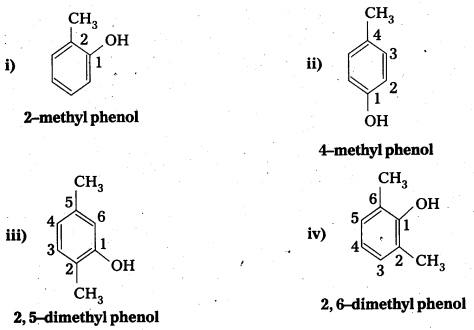
Give the structures and IUPAC names of monohydric phenols of molecular formula, C7H8O.
Answer:
Given molecular formula of monnhydric phenols is C7H8O. The no. of possible isomers with molecular formula C7H8O are three.
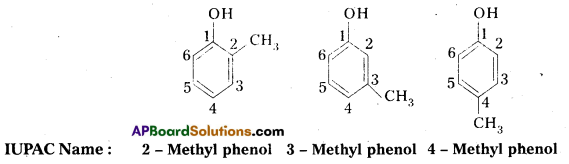
AP Inter 2nd Year Chemistry Study Material Chapter 12(a) Alcohols, Phenols, and Ethers 1

Question 4.
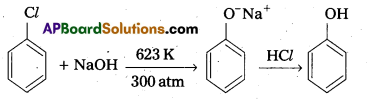
Give the reagents used for the preparation of phenol from chiorobenzene.
Answer:
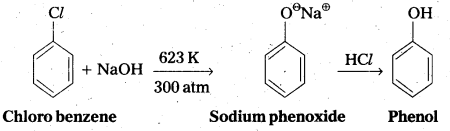
Phenol is prepared from chiorobenzene as follows. Reagents required are

  1. NaOH, 623K, 300 atm
  2. HCl.
    Chemical reaction :
    AP Inter 2nd Year Chemistry Study Material Chapter 12(a) Alcohols, Phenols, and Ethers 2

Question 5.
Preparation of ethers by acid dehydration of secondary or tertiary alcohols is not a suitable method. Give reason.
Answer:
Only 1° – alcohols form Ethers on acid dehydration. But not 2° or 3°-alcohols.

Reason : In case of 2° or 3° alcohols steric hindrance arises. Due to this steric hindrance alkenes are formed but not Ethers.

AP Inter 2nd Year Chemistry Study Material Chapter 12(a) Alcohols, Phenols, and Ethers

Question 6.
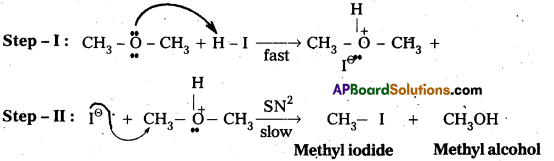
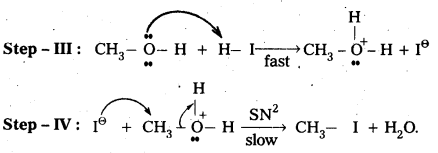
Write the mechanism of the reaction of HI with methoxymethane.
Answer:
Case – I: When methoxy methane reacts with cold.dil. HI then methyl alcohol and methyl iodide are formed.
Mechanisms:
AP Inter 2nd Year Chemistry Study Material Chapter 12(a) Alcohols, Phenols, and Ethers 3
Case – II : When methoxy methane reacts with hot.conc.HI then only methyl iodide is formed.
Mechanisms:
AP Inter 2nd Year Chemistry Study Material Chapter 12(a) Alcohols, Phenols, and Ethers 4

Question 7.
Name the reagents used in the following reactions.

  1. Oxidation of primary alcohol to carboxylic acid
  2. Oxidation of primary alcohol to aldehyde.

Answer:

  1. The reagents used for the oxidation of 1° – alcohols to carboxylicacid are acidified K2Cr2O77 (or) Acidic/alkaline KMnO4 (or) Neutral KMnO4
  2. The reagents used for the oxidation of 1°- alcohols to aldehyde are pyridine chloro chromate (PCC) in CH2Cl2.

Question 8.
Write the equations for the following reactions.
i) Bromination of phenol to 2,4, 6-tribromophenol
ii) Benzyl alcohol to benzoic acid.
Answer:
i) Bromination of phenól to 2, 4, 6 tribromophenol.
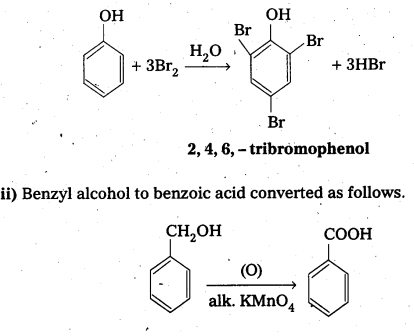
AP Inter 2nd Year Chemistry Study Material Chapter 12(a) Alcohols, Phenols, and Ethers 5

Question 9.
IdentIfy the reactant needed to form t-.butylalcohol from acetone.
Answer:
When acetone reacts with methyl magnesium bromide followed by the hydrolysis forms t-butyl alcohol.
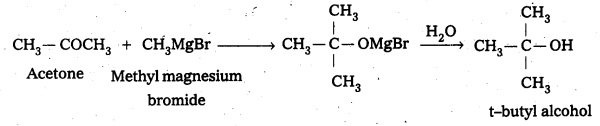
AP Inter 2nd Year Chemistry Study Material Chapter 12(a) Alcohols, Phenols, and Ethers 6

AP Inter 2nd Year Chemistry Study Material Chapter 12(a) Alcohols, Phenols, and Ethers

Question 10.
Write the structures for the following compounds

  1. Ethoxyethane
  2. Ethoxybutane
  3. Phenoxyethane

Answer:

  1. Ethoxyethane → CH3 – CH2 – O – CH2 – CH3
  2. Ethoxybutane → CH3 – CH2 – O – CH2 – CH2 – CH2 – CH3
  3. Phenoxyethane → C6H5 – O – CH2 – CH3

Short Answer Questions

Question 1.
Draw the structures of all isomeric alcohols of molecular formula C5H12O2 and give their IUFAC names and classify them as primary, secondary and tertiary alcohols.
Answer:

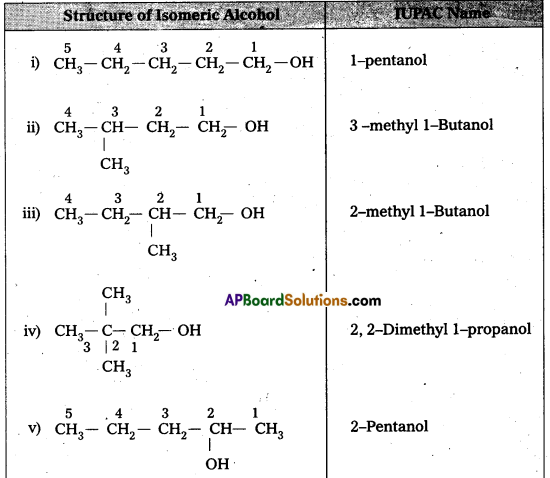
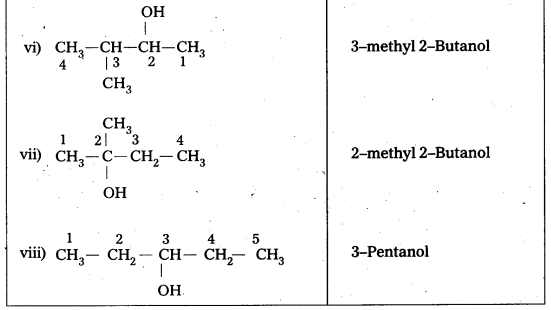
  • Given molecular formula of compound is C5H12O.
  • It has eight isomeric alcohols.
    AP Inter 2nd Year Chemistry Study Material Chapter 12(a) Alcohols, Phenols, and Ethers 7
    AP Inter 2nd Year Chemistry Study Material Chapter 12(a) Alcohols, Phenols, and Ethers 8

In the above isomeric alcohols (i), (ii), (iii), (iv) and 1°-alcohols; (v), (vi) and (viii) are 2°- alcohols, (vii) is 3°-alcohol.

Question 2.
While separating a mixture of ortho and para nitrophenols by steam distillation, name the isomer which will be steam volatile. Give rèason.
Answer:
While separating a mixture of ortho and para nitrophenols by steam distillation, ortho nitrophenol is steam volatile.

Reason: In ortho nitrophenol intra molecular hydrogen bonding is present and in case of para nitrophenol inter molecular hydrogen bonding is present. So O-nitrophenol is steam volatile.
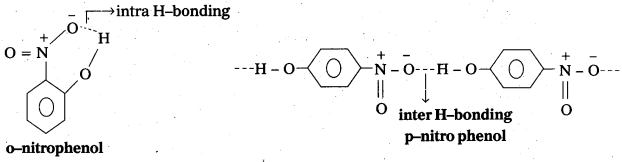
AP Inter 2nd Year Chemistry Study Material Chapter 12(a) Alcohols, Phenols, and Ethers 9

AP Inter 2nd Year Chemistry Study Material Chapter 12(a) Alcohols, Phenols, and Ethers

Question 3.
Give the equations for the preparation of phenol from Cumene. [Mar. 14]
Answer:
Phenol.is prepared from Cumene as follows.

  1. Oxidation of Cumene to Cumene hydroperoxide.
  2. Cumene hydroperoxide on acidic hydrolysis to form phenol.
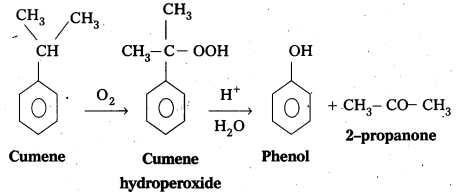
    AP Inter 2nd Year Chemistry Study Material Chapter 12(a) Alcohols, Phenols, and Ethers 10

Question 4.
Write the mechanism of hydration of ethene to yield ethanol.
Answer:
Hydration of Ethene to yield ethanol involves 3—step mechanism.
Step – 1: In step – 1 formation of carbocation takes place by the protonation of ethene.
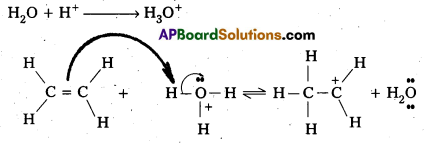
AP Inter 2nd Year Chemistry Study Material Chapter 12(a) Alcohols, Phenols, and Ethers 11
Step – 2 : In step – 2 carbocation formed in the above step attacked by water.
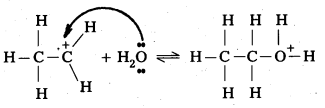
AP Inter 2nd Year Chemistry Study Material Chapter 12(a) Alcohols, Phenols, and Ethers 12
Step – 3 : Ethyl alcohol is formed by he deprotonation in step -3
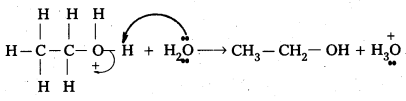
AP Inter 2nd Year Chemistry Study Material Chapter 12(a) Alcohols, Phenols, and Ethers 13

Question 5.
Explain the acidic nature of phenols and compare with that of alcohols.
Answer:
The reaction of phenol with sodium metal and with aq.NaOH indicates the acidic nature of phenol.
i) Phenol reacts with sodium metal to form sodium phenoxide.
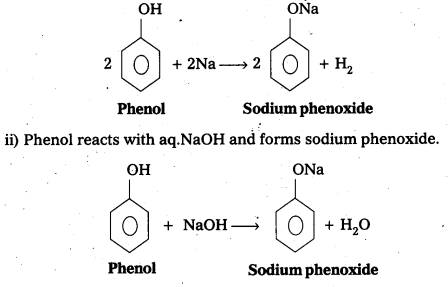
AP Inter 2nd Year Chemistry Study Material Chapter 12(a) Alcohols, Phenols, and Ethers 14

  •  In phenol hydroxyl group is attached to the Sp2 hydridised carbon of benzene ring which acts as electron with drawing group. The formed phenoxide ion from phenol is more stabilised due to delocalisation of negative charge.

Comparison of acidic character of Phenol and Ethanol:

  • The reaction of phenol with aq. NaOH indicates that phenols are stronger acids than alcohols.
  • The hydroxyl group attached to an aromatic ring is more acidic than in hydroxyl group is attached to an alkyl group.
  • Phenol forms stable phenoxide ion stabilised by resonance but ethoxide ion is not.
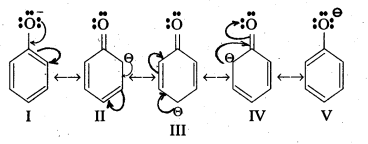
    AP Inter 2nd Year Chemistry Study Material Chapter 12(a) Alcohols, Phenols, and Ethers 15

AP Inter 2nd Year Chemistry Study Material Chapter 12(a) Alcohols, Phenols, and Ethers

Question 6.
Write the products formed by the reduction and oxidation of phenol.
Answer:
a) Reduction of phenol: Phenol undergo reduction in presence of zinc dust to form benzene.
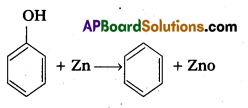
AP Inter 2nd Year Chemistry Study Material Chapter 12(a) Alcohols, Phenols, and Ethers 16
b) Oxidation of phenol : Phenol undergo oxidation with chromicacid and forms a conjugated diketone known as benzoquinone.
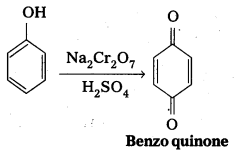
AP Inter 2nd Year Chemistry Study Material Chapter 12(a) Alcohols, Phenols, and Ethers 17

Question 7.
Ethanol with H2SO4, at 443K forms ethene while at 413 K it forms ethoxy ethane. Explain the mechanism.
Answer:
Case – 1: Ethanol reacts with Cone. H2SO4 at 443K forms ethene

AP Inter 2nd Year Chemistry Study Material Chapter 12(a) Alcohols, Phenols, and Ethers 18
Mechanism:
Step – 1: Formation of protonated alcohol
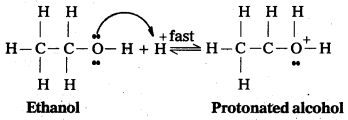
AP Inter 2nd Year Chemistry Study Material Chapter 12(a) Alcohols, Phenols, and Ethers 19
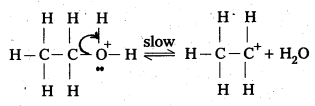
Step 2 : Formation of carbo cation
AP Inter 2nd Year Chemistry Study Material Chapter 12(a) Alcohols, Phenols, and Ethers 20
Step 3 : Formation of ethene by elimination of a proton
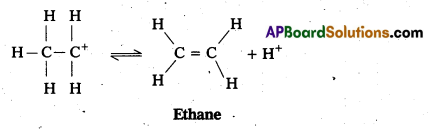
AP Inter 2nd Year Chemistry Study Material Chapter 12(a) Alcohols, Phenols, and Ethers 21
Case – II : Ethanol reacts with Cone. H2SO4 at 413 K to form ethoxy ethane.

AP Inter 2nd Year Chemistry Study Material Chapter 12(a) Alcohols, Phenols, and Ethers 22
Mechanism:
In the above reaction ether formation is a SN reaction. This involve attack of alcohol molecule on a protonated alcohol.
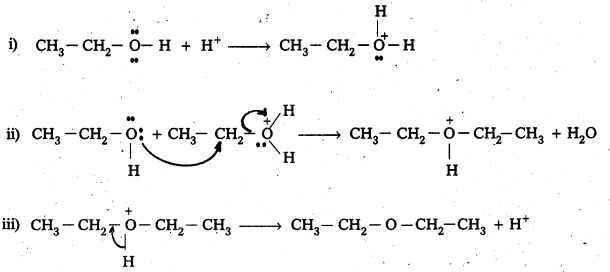
AP Inter 2nd Year Chemistry Study Material Chapter 12(a) Alcohols, Phenols, and Ethers 23

Question 8.
Account for the statement: Alcohols boil at higher temperature than hydrocarbons and ethers of comparable molecular masses.
Answer:
Alcohols boil at higher temperature than hydrocarbons and ethers of comparable molecular masses.

Explanation : Consider ethanol, propane and methoxy methane which are having comparable molecular masses. The boiling points, molecular masses and structures of the above compounds mentioned below.
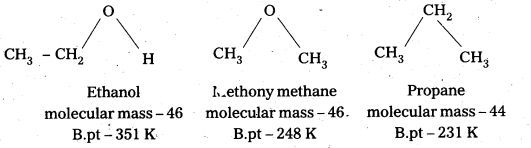
AP Inter 2nd Year Chemistry Study Material Chapter 12(a) Alcohols, Phenols, and Ethers 24
The higher boiling points of alcohols are due to the presence of intermolecular hydrogen bonding in them which is lacking in ethers and hydrocarbons.

AP Inter 2nd Year Chemistry Study Material Chapter 12(a) Alcohols, Phenols, and Ethers

Question 9.
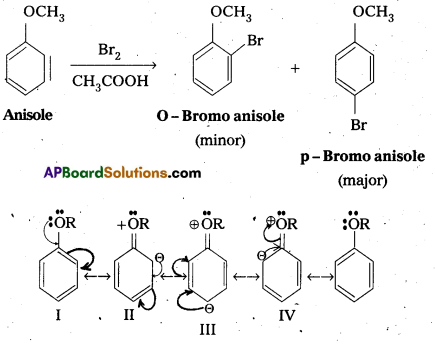
Explain why in anisole electrophilic substitution takes place at ortho and para positions and not at meta position.
Answer:
Anisole is an aryl alkyl ether. In anisole the group -OCH3 influences + R effect. This increases the electron density in the benzene ring and it leads to the activation of benzene ring towards electrophihic substitution reactions.

In Anisole eletron density is more at O-and P-Positions but not at m—position. So 0-and P-products are mainly formed during electrophillic substitution reactions.
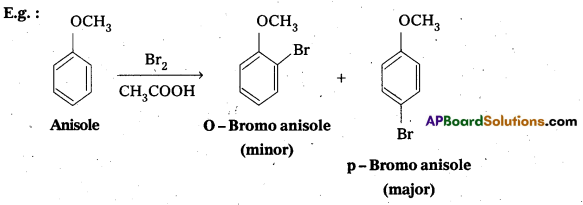
AP Inter 2nd Year Chemistry Study Material Chapter 12(a) Alcohols, Phenols, and Ethers 25

Question 10.
Write the products of the following reactions :

AP Inter 2nd Year Chemistry Study Material Chapter 12(a) Alcohols, Phenols, and Ethers 26
Answer:
AP Inter 2nd Year Chemistry Study Material Chapter 12(a) Alcohols, Phenols, and Ethers 27
AP Inter 2nd Year Chemistry Study Material Chapter 12(a) Alcohols, Phenols, and Ethers 28

Long Answer Questions

Question 1.
Write the IUPAC name of the following compounds :
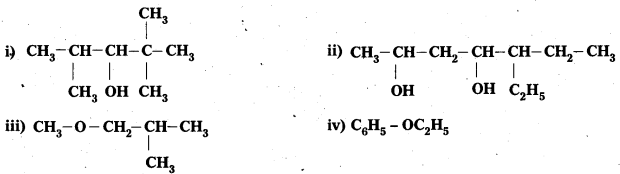
AP Inter 2nd Year Chemistry Study Material Chapter 12(a) Alcohols, Phenols, and Ethers 29
Answer:
AP Inter 2nd Year Chemistry Study Material Chapter 12(a) Alcohols, Phenols, and Ethers 30

Question 2.
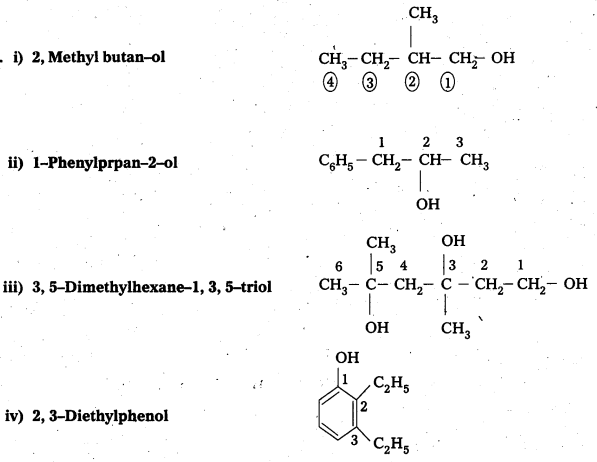
Write structures of the compounds whose IUPAC names are as follows:
i) 2, Methyl butan—ol
ii) 1-Phenylprpan-2-ol
iii) 3, 5-Dhuethylhexane-1, 3, 5-triol
iv) 2, 3-Diethylphenol
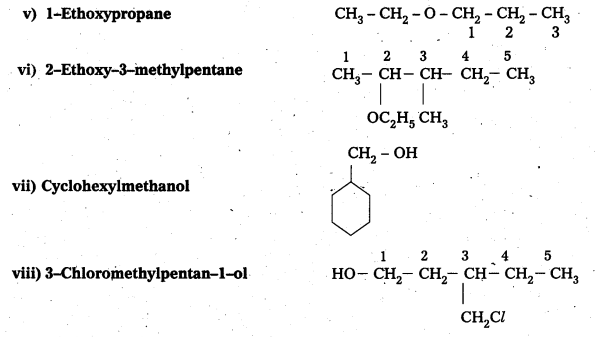
v) 1-Ethoxypropane
vi) 2-Ethoxy-3-methylpentane
vii) Cyclohexylmethanol
viii) 3-Chloromethylpentan-1-ol
Answer:
AP Inter 2nd Year Chemistry Study Material Chapter 12(a) Alcohols, Phenols, and Ethers 31
AP Inter 2nd Year Chemistry Study Material Chapter 12(a) Alcohols, Phenols, and Ethers 32

AP Inter 2nd Year Chemistry Study Material Chapter 12(a) Alcohols, Phenols, and Ethers

Question 3.
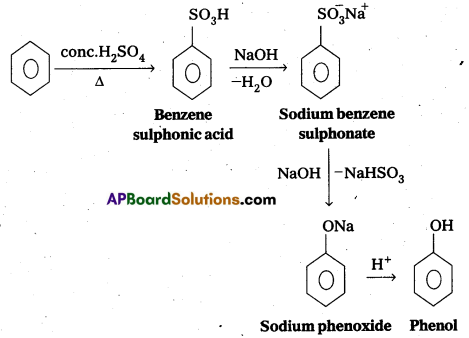
Write the equations for the preparation of phenol using benzene, conc. H2SO4 and NaOH. [Mar. 14]
Answer:
The equations for the preparation of phenol using conc.H2SO4 and NaoH as follows
AP Inter 2nd Year Chemistry Study Material Chapter 12(a) Alcohols, Phenols, and Ethers 33

Question 4.
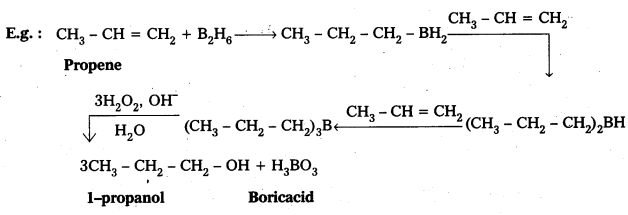
Illustrate hydroboration-oxidation reaction with a suitable example.
Answer:
When alkenes undergo addition reaction with diborane to form tri alkyl boranes. These followed by the oxidation by alkaline H2O2 to form alcohols. This reaction is called as hydroboration-oxidation reaction.
AP Inter 2nd Year Chemistry Study Material Chapter 12(a) Alcohols, Phenols, and Ethers 34

Question 5.
Write the IUPAC name of the following compounds:
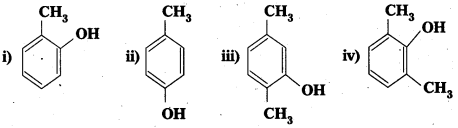
AP Inter 2nd Year Chemistry Study Material Chapter 12(a) Alcohols, Phenols, and Ethers 35
Answer:
AP Inter 2nd Year Chemistry Study Material Chapter 12(a) Alcohols, Phenols, and Ethers 36

AP Inter 2nd Year Chemistry Study Material Chapter 12(a) Alcohols, Phenols, and Ethers

Question 6.
How will you synthesise:
i) 1 – Phenylethanol from a suitable alkene
ii) Cyclohexylmethanol using an alkyl halide by an SN2 reaction.
iii) Pentan-1-ol using a suitable alkyl halide.
Answer:
i) Synthesis of 1-phenylethanol from a suitable alkene : When styrene undergo hydrolysis in presence of dil.H2SO4 to form 1-phenyl ethanol. It is an example of Marknowni koff’s rule.
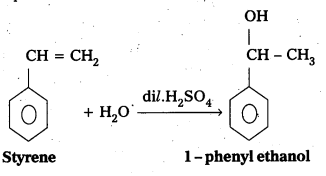
AP Inter 2nd Year Chemistry Study Material Chapter 12(a) Alcohols, Phenols, and Ethers 37
ii) Synthesis of cyclohexyl methanol using an alkyl halide by SN2 reaction : When cyclohexyl methyl bromide reacts with aq. NaOH to form cyclohexyl methanol.
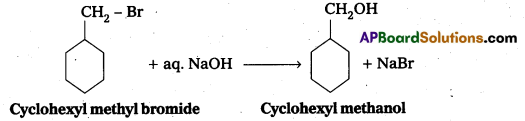
AP Inter 2nd Year Chemistry Study Material Chapter 12(a) Alcohols, Phenols, and Ethers 38
iii) Synthesis of 1-pentanol using a suitable alkyl halide: When 1-Bromo pentane reacts with aq.KOH to form 1-pentanol.

AP Inter 2nd Year Chemistry Study Material Chapter 12(a) Alcohols, Phenols, and Ethers 39

Question 7.
Explain why-
i) Ortho nitrophenol is more acidic than Ortho methoxyphenol.
ii) OH group attached to benzene ring activates it towards electrophilic substitution.
Answer:
i) Ortho nitrophenol is more acidic than Ortho methoxyphenol.
Explanation: .
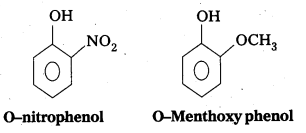
AP Inter 2nd Year Chemistry Study Material Chapter 12(a) Alcohols, Phenols, and Ethers 40

  • -NO2 is an electron withdrawing group and -OCH3 is electron releasing group.
  • By the presence of electron withdrawing group the phenoxide ion is more stabilized. By the presence of electron releasing group the phenoxide ion is less stabilized.
  • Due to high stability of phenoxide ion, acidic nature increases.
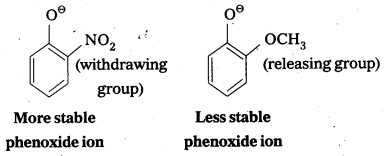
    AP Inter 2nd Year Chemistry Study Material Chapter 12(a) Alcohols, Phenols, and Ethers 41

ii) The -OH group attached to benzene ring activates it towards electrophilic substitution.

Explanation : When an electrophile is attacked, the – OH group exerts +R effect on the benzene ring. So electrodensity in the ring increases at ortho and para positions. When an electrophile attacks, substitution takes place at O and p-positions. So benzene ring activates towards electrophilic substitution.
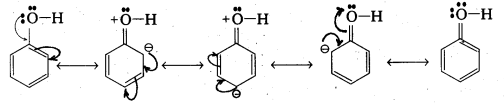
AP Inter 2nd Year Chemistry Study Material Chapter 12(a) Alcohols, Phenols, and Ethers 42

AP Inter 2nd Year Chemistry Study Material Chapter 12(a) Alcohols, Phenols, and Ethers

Question 8.
Wth a suitable example write equations for the following:. [T.S. MAr. 19, 18; A.P. Mar. 18, 16] [A.P. Mar. 16]
i) Kolbe’s reaction
ii) Reimer-Tiemann reaction
iii) Williamsons ether synthesis
Answer:
i) Kolbes reaction: Phenol reacts with sodium hydroxide to form sodium phenoxide. This undergoes electrophilhic substitution with CO2to form salicylic acid.
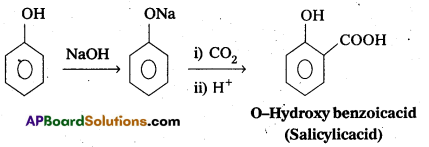
AP Inter 2nd Year Chemistry Study Material Chapter 12(a) Alcohols, Phenols, and Ethers 43

ii) Relmer-Tlemann reactIon : Phenol reacts with chloroform in presence of NaOH to form salicylaldehyde (O-Hydroxy benzaldehyde). This reaction is known as Reimer-Tiemann reaction. .
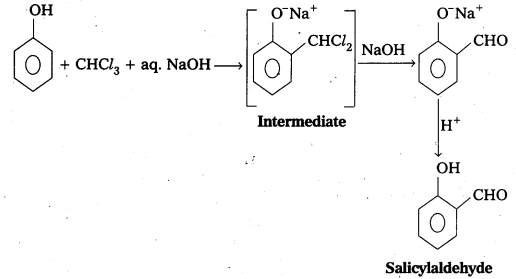
AP Inter 2nd Year Chemistry Study Material Chapter 12(a) Alcohols, Phenols, and Ethers 44

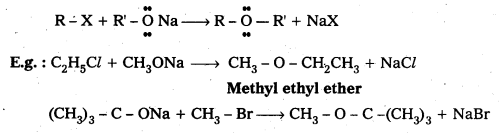
iii) Wilhiamsons ether synthesis:

  • This method is used for the preparation of symmetrical and unsymmetrical ethers.
  • The reaction of an alkyl halide with sodium alkoxide to form ethers is known as Williamsons Synthesis.
    AP Inter 2nd Year Chemistry Study Material Chapter 12(a) Alcohols, Phenols, and Ethers 45

Question 9.
How are the following conversions carried out?
i) Benzyl chloride to Benzyl alcohol
ii) Ethyl magnesium bromide to Propan-1-ol
iii) 2-Butanone to 2-Butanol
Answer:
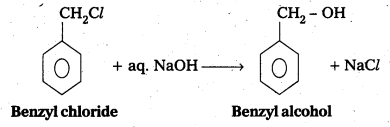
i) Conversion of Benzyl chloride to Benzyl alcohol : Ben.zyl chloride reacts with aq. NaOH to form benzyl alcohol.
AP Inter 2nd Year Chemistry Study Material Chapter 12(a) Alcohols, Phenols, and Ethers 46

ii) Conversion of Ethyl magnesium bromide to Propan-1-ol : Ethyl magnesium bromide reacts with form aldehyde followed by hydrolysis to form 1-propanol.

AP Inter 2nd Year Chemistry Study Material Chapter 12(a) Alcohols, Phenols, and Ethers 47

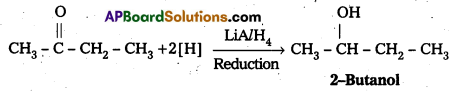
iii) Conversion of 2-Butanone to 2-Butanol: 2-Butanone undergo reduction in presence of LiA/H4 to form 2-Butanol.
AP Inter 2nd Year Chemistry Study Material Chapter 12(a) Alcohols, Phenols, and Ethers 48

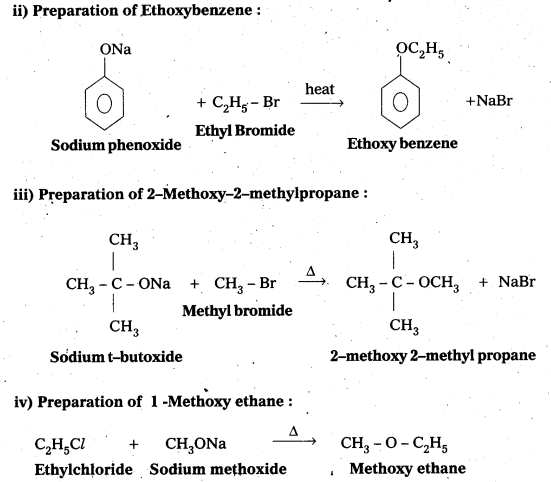
Question 10.
Write the names of the reagents and equations for the preparation of the following ethers by Williamson’s synthesis:
i) 1-Propoxypropane
ii) Ethoxybenzene
iii) 2-Methoxy-2-methylpropane
iv) 1 -Methoxyethane
Answer:
i) Preparation of 1-propoxy propane :

AP Inter 2nd Year Chemistry Study Material Chapter 12(a) Alcohols, Phenols, and Ethers 49
AP Inter 2nd Year Chemistry Study Material Chapter 12(a) Alcohols, Phenols, and Ethers 50

AP Inter 2nd Year Chemistry Study Material Chapter 12(a) Alcohols, Phenols, and Ethers

Question 11.
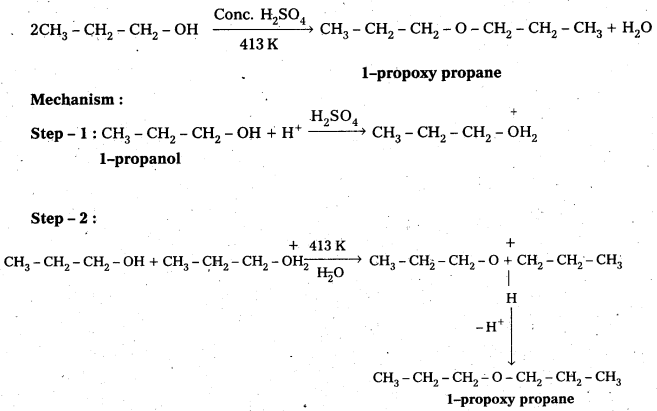
How is 1-propoxypropane synthesized from propan-1-ol ? Write mechanism of this reaction.
Answer:
1 – Proponal reacts with Conc. H2SO4 at 413 K to form 1-propoxy propane.
AP Inter 2nd Year Chemistry Study Material Chapter 12(a) Alcohols, Phenols, and Ethers 51

Question 12.
Explain the fact that in aryl alkyl ethers the alkoxy group activates the benzene ring towards electrophilic substitution.
Answer:
Anisole is an aryl alkyl ether. In anisole the group -OCH3 influences +R effect. This increases the electron density in the benzene ring and it leads to the activation of benzene ring towards electrophillic substitution reactions.

In Anisole eletron density is more at O-and P-Positions but not at m-position. So O-and P-products are mainly formed during electrophillic substitution reactions.
AP Inter 2nd Year Chemistry Study Material Chapter 12(a) Alcohols, Phenols, and Ethers 52

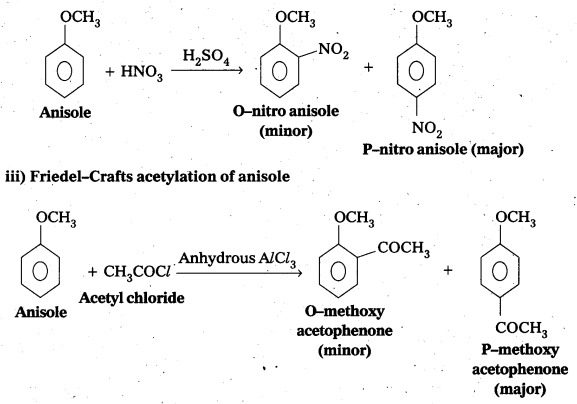
Question 13.
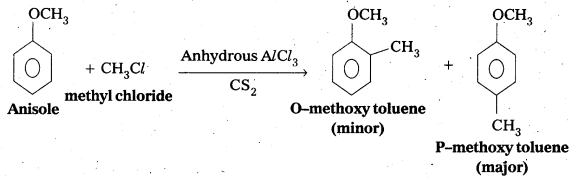
Write equations of the below given reactions:
i) Alkylation of anisole
ii) Nitration of anisole
iii) Friedel-Crafts acetylation of anisole
Answer:
i) Friedel crafts Alkylation of anisole :
AP Inter 2nd Year Chemistry Study Material Chapter 12(a) Alcohols, Phenols, and Ethers 53
ii) Nitration of anisole
AP Inter 2nd Year Chemistry Study Material Chapter 12(a) Alcohols, Phenols, and Ethers 54

AP Inter 2nd Year Chemistry Study Material Chapter 12(a) Alcohols, Phenols, and Ethers

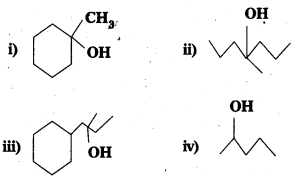
Question 14.
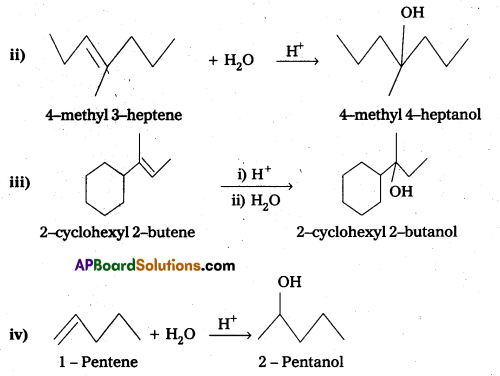
Show how you would synthesize the following alcohols from appropriate alkenes?
AP Inter 2nd Year Chemistry Study Material Chapter 12(a) Alcohols, Phenols, and Ethers 55
Answer:
AP Inter 2nd Year Chemistry Study Material Chapter 12(a) Alcohols, Phenols, and Ethers 56
AP Inter 2nd Year Chemistry Study Material Chapter 12(a) Alcohols, Phenols, and Ethers 57

Question 15.
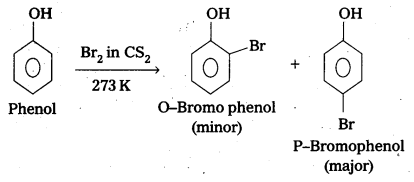
Explain why phenol with bromine water forms 2,4,6-tribromophenol while on reaction with bromine in CS2 at low temperatures forms para-bromophenol as the major product.
Answer:
a) Phenol under goes Bromination in presence of CS2 to form p-bromophenol as major product.
AP Inter 2nd Year Chemistry Study Material Chapter 12(a) Alcohols, Phenols, and Ethers 58
b) Phenol undergoes bromination in aqueous medium form 2,4,6 -tribromo phenol (white ppt).
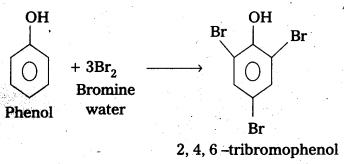
AP Inter 2nd Year Chemistry Study Material Chapter 12(a) Alcohols, Phenols, and Ethers 59
Explanation: In bromination of phenol, the polarisation of Br2 molecule takes place even in the absence of Lewis acid. This is due to the highly activating effect of -OH group attached to the benzene ring.

Textual Examples

Question 1.
Give IUPAC names of the following compounds:
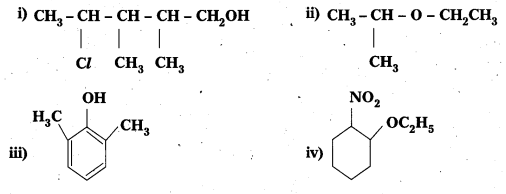
AP Inter 2nd Year Chemistry Study Material Chapter 12(a) Alcohols, Phenols, and Ethers 60
Solution:
i) 4-Chloro-2, 3-dimethylpentan-1-ol
ii) 2-Ethoxypropane
iii) 2, 6-Dimethyiphenol
iv) 1-Ethoxy-2-nitrocyclohexane

Question 2.
Give the structures and IUPAC names of the products expected from the following reactions :
a) Catalytic reduction of butanal.
b) Hydration of propene in the presence of dilute sulphuric acid.
c) Reaction of propanone with methylmagnesium bromide followed by hydrolysis.
Solution:
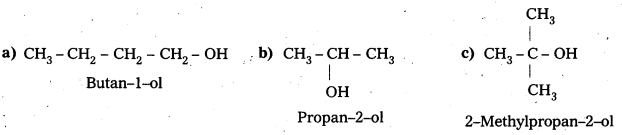
AP Inter 2nd Year Chemistry Study Material Chapter 12(a) Alcohols, Phenols, and Ethers 61

AP Inter 2nd Year Chemistry Study Material Chapter 12(a) Alcohols, Phenols, and Ethers

Question 3.
Arrange the following sets of compounds in order of their increasing boiling points :
a) Pentan-1-ol, butan-1-ol, butan-2-ol, ethanol, propan-1-ol, methanol.
b) Pentan-1-ol, n-butane, pentanal, ethoxyethane.
Solution:
a) Methanol, ethanol, propan-1-ol, butan-2-ol, butan-1-ol, pentan-1-ol.
b) n-Butane, ethoxyethane, pentanal and pentan-1-ol.
AP Inter 2nd Year Chemistry Study Material Chapter 12(a) Alcohols, Phenols, and Ethers 62

Question 4.
Arrange the following compounds in increasing order of their acid strength:
Propan-1-ol, 2, 4, 6-trinitrophenol, 3-nitrophenol, 3, 5-dinitrophenol, phenol, 4-methylphenol.
Solution:
Propan-1-ol, 4-methylphenol, phenol, 3-nitrophenol, 3, 5-dinitrophenol, 2, 4, 6-trinitrophenol.

Question 5.
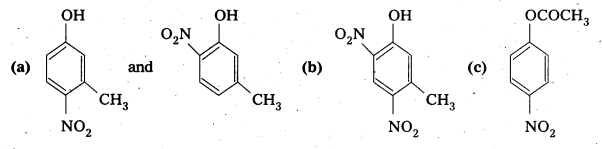
Write the structures of the major products expected from the following reactions:
a) Mononitratlon of 3-methylphenol .
b) Dinitratlon of 3methylphenol
c) Mononitration of phenyl methanoate.
Solution:
The combined influence of -OH and -CH3 groups determine the position of the incoming group.
AP Inter 2nd Year Chemistry Study Material Chapter 12(a) Alcohols, Phenols, and Ethers 63

Question 6.
The following is not an appropriate reaction for the preparation of t-butyl ethyl ether.
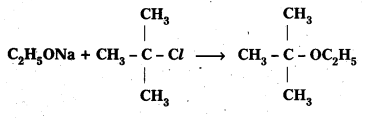
AP Inter 2nd Year Chemistry Study Material Chapter 12(a) Alcohols, Phenols, and Ethers 64
i) What would be the major product of this reaction?
ii) Write a suitable reaction for the preparation of t-butylethyl ether.
Solution:
i) The major product of the given reaction is 2-methylprop-1-ene.
It is because sodium ethoxide is a strong nucleophile as well as a strong base. Thus elimination reaction predominates over substitution.
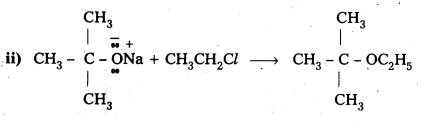
AP Inter 2nd Year Chemistry Study Material Chapter 12(a) Alcohols, Phenols, and Ethers 65

AP Inter 2nd Year Chemistry Study Material Chapter 12(a) Alcohols, Phenols, and Ethers

Question 7.
Give the major products that are formed by heating each of the following ethers with HI.
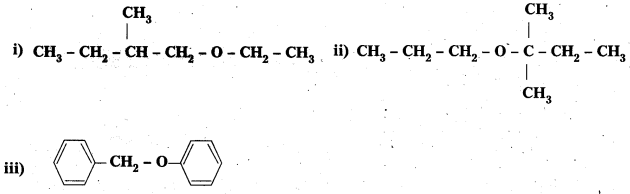
AP Inter 2nd Year Chemistry Study Material Chapter 12(a) Alcohols, Phenols, and Ethers 66
Solution:
AP Inter 2nd Year Chemistry Study Material Chapter 12(a) Alcohols, Phenols, and Ethers 67

Intext Questions

Question 1.
Classify the following as primary, secondary and tertiary alcohols:
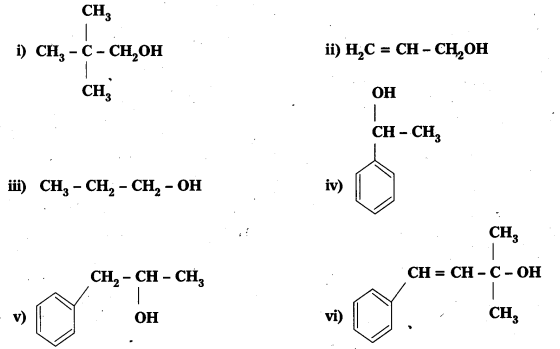
AP Inter 2nd Year Chemistry Study Material Chapter 12(a) Alcohols, Phenols, and Ethers 68
Answer:
Primary alcohols (i), (ii), (iii)
Secondary alcohols (iv) and (y)
Tertiary alcohols (vi)

Question 2.
Identify allylic alcohols in the above examples.
Answer:
Allylic alcohols are (ii) and (vi)

Question 3.
Name the following compounds according to IUPAC system.

AP Inter 2nd Year Chemistry Study Material Chapter 12(a) Alcohols, Phenols, and Ethers 69
AP Inter 2nd Year Chemistry Study Material Chapter 12(a) Alcohols, Phenols, and Ethers 70
Answer:
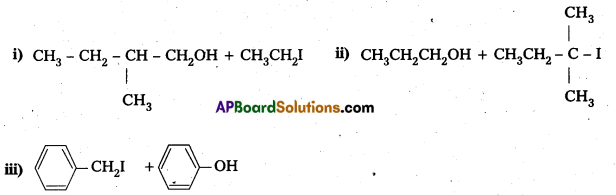
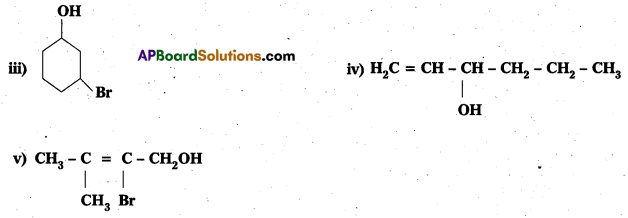
i) 3-Chioremethyl 2-isopropylpentan-1-ol
ii) 2, 5-Dimethylhexane-1, 3-dial
iii) 3-Bromocyclohexanol
iv) Hex-1-en-3-ol
v) 2-Bromo-3-methylbut-2-en-1-ol.

AP Inter 2nd Year Chemistry Study Material Chapter 12(a) Alcohols, Phenols, and Ethers

Question 4.
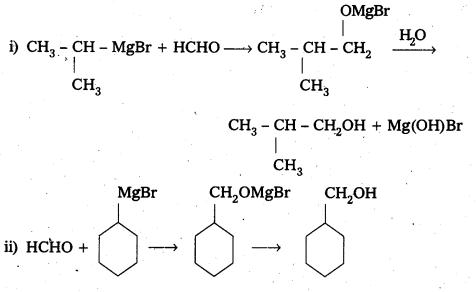
Show how are the following alcohols prepared by the reaction of a suitable Grignard reagent of methanol?
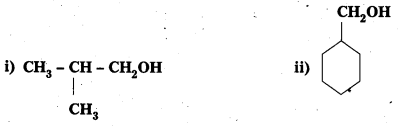
AP Inter 2nd Year Chemistry Study Material Chapter 12(a) Alcohols, Phenols, and Ethers 71
Answer:
AP Inter 2nd Year Chemistry Study Material Chapter 12(a) Alcohols, Phenols, and Ethers 72

Question 5.
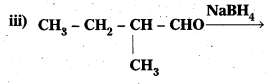
Write structures of the products of the following reactions :

AP Inter 2nd Year Chemistry Study Material Chapter 12(a) Alcohols, Phenols, and Ethers 73
AP Inter 2nd Year Chemistry Study Material Chapter 12(a) Alcohols, Phenols, and Ethers 74
Answer:
AP Inter 2nd Year Chemistry Study Material Chapter 12(a) Alcohols, Phenols, and Ethers 75

Question 6.
Predict the major product of acid catalysed dehydration of

  1. 1-methylcyclohexanol and
  2. butan-1-ol.

Answer:

  1. 1-Methylcyclohexene
  2. A mixture of but-1-ene and but-2-ene. But-1-ene is the major product formed due to rearrangement to give,secondary carbocation.

Question 7.
Write the reactions of Williamson synthesis of 2-ethoxy-3-methylpentane starting from ethanol and 3-methylpentan-2-ol.
Answer:
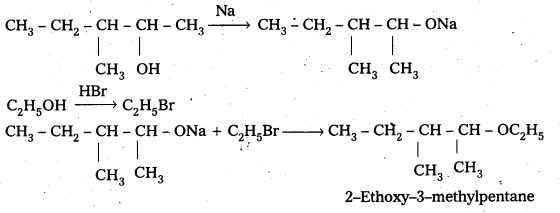
AP Inter 2nd Year Chemistry Study Material Chapter 12(a) Alcohols, Phenols, and Ethers 76

AP Inter 2nd Year Chemistry Study Material Chapter 12(a) Alcohols, Phenols, and Ethers

Question 8.
Predict the products of the following reactions:
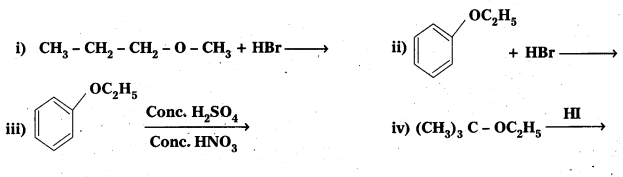
AP Inter 2nd Year Chemistry Study Material Chapter 12(a) Alcohols, Phenols, and Ethers 77
Answer:
AP Inter 2nd Year Chemistry Study Material Chapter 12(a) Alcohols, Phenols, and Ethers 78

AP Board 6th Class Social Studies Solutions Chapter 1 Our Earth in the Solar System

SCERT AP Board 6th Class Social Solutions 1st Lesson Our Earth in the Solar System Textbook Questions and Answers.

AP State Syllabus 6th Class Social Studies Solutions 1st Lesson Our Earth in the Solar System

6th Class Social Studies 1st Lesson Our Earth in the Solar System Textbook Questions and Answers

Improve Your Learning

Question 1.
How does a planet differ from a star?
Answer:
Stars have their own heat and light and planets have to depend on stars for light and heat.

Question 2.
What is meant by the ‘Solar system’?
Answer:
The eight planets which revolve around the sun, satellites, and other celestial bodies are together known as‘Solar System’.

Question 3.
Why is life not possible on all planets?
Answer:
The Earth has all the three components such as lithosphere, hydrosphere, and atmosphere which makes life possible. The remaining planets do not consist of these components. So life is not possible on all planets.

AP Board 6th Class Social Studies Solutions Chapter 1 Our Earth in the Solar System

Question 4.
Why do we always see only one side of the moon?
Answer:
The moon moves around the earth and spin on its own also. So we can see only one side of the moon always.

Question 5.
What is the Universe?
Answer:
Millions of Milkyway galaxies including the solar system together are called the Universe.

Question 6.
Air and water are essential to life on the earth. But now they are being polluted by humans. What happens to the life of humans on this earth if pollution increases further?
Answer:
Pollution contains toxins that adversely impact living creatures within them. Rising pollution will lead to premature aging. Human exposure to toxins will increase to a great extent if pollution is not controlled. This pollution is directly linked to cancer and heart diseases.

Question 7.
Scientists are now trying to explore more about the moon and other planets. Do you think their efforts benefit us?
Answer:
The efforts of scientists in exploring the moon and other planets definitely useful to us. Space exploration alone provides us a significant amount of knowledge which is important for the education of people also about our planet and universe. It increases the knowledge about space and the discovery of distant planets and galaxies and gives us an insight into the beginnings of our universe.

Question 8.
Observe figure 1.4 (text book Page No. 5) and fill in the table.
AP Board 6th Class Social Studies Solutions Chapter 1 Our Earth in the Solar System 2
Answer:

SI. NoName of the PlanetDistance from the Sun in KilometresNo. of Moons
1.Mercury58,000,000
2.Venus108,000,000
3.Earth150,000,0001
4.Mars228,000,0002
5.Jupiter778,000,00079
6.Saturn1,427,000,00082
7.Uranus2,869,000,00027
8.Neptune4,496,000,00014

AP Board 6th Class Social Studies Solutions Chapter 1 Our Earth in the Solar System

Project Work

Prepare a model of the solar system.
Answer:
Student Activity.

Choose the correct answer.
1. Though tremendous heat is emitted by the Sun, why do we receive only limited heat?
A) Sun is very far from the Earth
B) Sun is very small when compared with the Earth
C) Sun is very close to the Earth
D) None of these
Answer:
A) Sun is very far from the Earth

2. The planet is known as the “Earth’s Twin” is
A) Jupiter
B) Saturn
C) Venus
D) Aries
Answer:
C) Venus

3. Which is the third nearest planet to the sun?
A) Venus
B) Earth
C) Mercury
D) Jupiter
Answer:
B) Earth

4. All the planets move around the Sun in a
A) Circular path
B) Rectangular path
C) Elongated path
D) Square path
Answer:
C) Elongated path

5. Asteroids are found in between the orbits of
A) Saturn and Jupiter
B) Mars and Jupiter
C) The Earth and Mars
D) Uranus & Neptune
Answer:
B) Mars and Jupiter

AP Board 6th Class Social Studies Solutions Chapter 1 Our Earth in the Solar System

Match the following:

1. Blue Planet                        [ ]          a) Mars
2. Farthest Planet to Sun       [ ]          b) Neptune
3. Fourth Planet from Sun     [ ]          c) Mercury
4. Nearest Planet to Sun       [ ]          d) Earth
Answer:
1. Blue Planet                            [ D ]          a) Mars
2. Farthest Planet to Sun           [ B ]          b) Neptune
3. Fourth Planet from Sun         [ A ]          c) Mercury
4. Nearest Planet to Sun           [ C ]           d) Earth

Let’s do

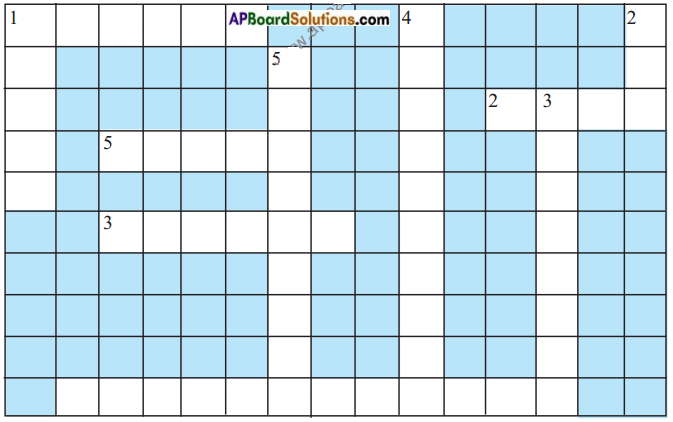
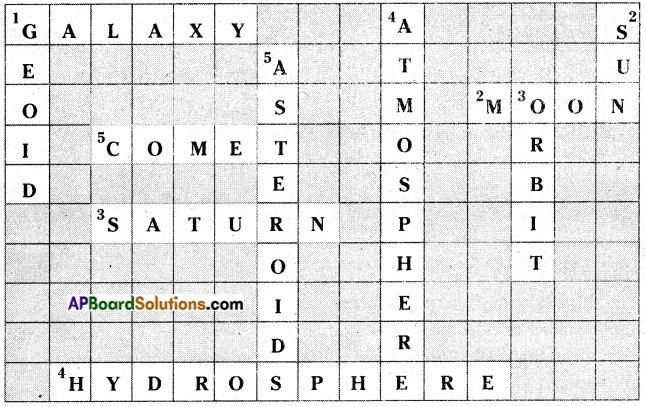
Solve the puzzle with the terms defined in the following statements.

CROSS:

  1. The cluster of millions of Stars. – Galaxy
  2. The natural satellite of the Earth. – Moon
  3. The ringed planet (See figure 1.4). – Saturn
  4. The sphere of water. – Hydrosphere
  5. The celestial object is made up of a head and a tail. – Comet

DOWN:

  1. The shape of the Earth. – Geoid
  2. The closest star to the earth. – Sun
  3. The path of the planets that move around the Sun. – Orbit
  4. The sphere of gases that surrounds the Earth. – Atmosphere
  5. The small pieces of celestial bodies, move around the Sun between Mars and Jupiter.

AP Board 6th Class Social Studies Solutions Chapter 1 Our Earth in the Solar System 1
Answer:

AP Board 6th Class Social Studies Solutions Chapter 1 Our Earth in the Solar System 4

AP Board 6th Class Social Studies Solutions Chapter 1 Our Earth in the Solar System

Let’s do

You might have heard that people make human chains and run for world peace etc. You can also make a Solar system and run for fun by using the following steps.
Step – 1: All children of your class can play this game. Assemble in a big hall or on a playground.
Step – 2: Now draw eight circles on the ground. Draw all circles in the same manner.
Step – 3: Prepare 10 placards. Name them as Sun, Moon, Mercury, Venus, Earth, Mars, Jupiter, Saturn, Uranus, Neptune.
Step – 4: Select 10 children in the following order and give each one of them a placard.
Order of placard distribution

  • The Sun – tallest, The Moon – smallest; Mercury, Mars, Venus, and Earth(almost equal heights); Neptune, Uranus, Saturn, and Jupiter taller than the earlier four Planets but smaller than the Sun.
  • Now ask the children holding placards to take their places with the Sun in the cent rein their orbits. Ask the child holding the Moon placard to keep the hand of the child holding the Earth placard always.
  • Now your Solar system is almost ready to go into action.
  • Now make everybody move slowly in the anti-clockwise direction. Your class has turned into a small human replica of the Solar system.
  • While moving in your orbit you can also turn around. For every celestial body, the spin should be anti-clockwise except for Venus and Uranus who will make the spin in the clockwise direction.

Answer:
Student Activity.

Field Visit

Question 1.
Observe the video of Planetarium in the QR Code. Describe your experiences.
AP Board 6th Class Social Studies Solutions Chapter 1 Our Earth in the Solar System 3
Answer:
Student Activity.

Question 2.
Visit SHAR which is located in SPSR Nellore District.
Answer:
Student Activity.

AP Board 6th Class Social Studies Solutions Chapter 1 Our Earth in the Solar System

6th Class Social Studies 1st Lesson Our Earth in the Solar System InText Questions and Answers

Let’s Do

(Textbook Page No. 3)

Question 1.
To know how days and nights occur
Answer:
Let us observe celestial bodies:
Required material: Torch, a sheet of plain paper, pencil and a needle.
Process:

  1. Place the torch in the centre of the paper with its glass front touching the paper.
  2. Now draw a circle around the torch.
  3. Perforate the paper with the needle within the circled area.
  4. Now place the perforated circle part of the paper on the glass front and wrap the paper around the torch with a rubber band.
  5. In a dark room, stand at some distance facing a plain wall. Switch off all other lights. Now flash the torchlight on the wall. You will see numerous dots of light on the wall, which look like stars at night.
  6. Switch on all the lights in the room. All dots of light will be almost invisible.
  7. You may now compare the situation with what happens to the bright objects of the night sky after the Sun rises in the morning.

Answer:
Student Activity.

Question 2.
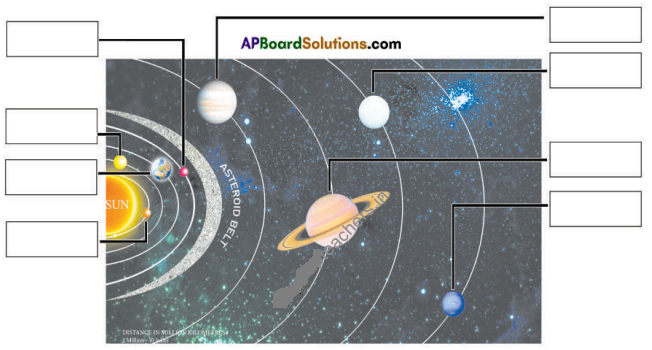
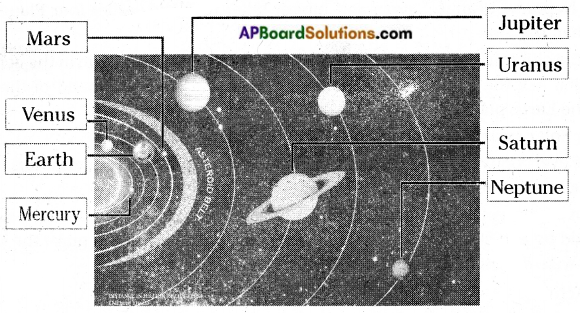
Observe the following picture and name the planets in the boxes given below. (Textbook Page No. 6)
AP Board 6th Class Social Studies Solutions Chapter 1 Our Earth in the Solar System 5
Answer:
AP Board 6th Class Social Studies Solutions Chapter 1 Our Earth in the Solar System 6

AP Board 6th Class Social Studies Solutions Chapter 1 Our Earth in the Solar System

Think and Respond

Question 1.
From ancient times people worship the Sim as God. Give reasons. (Textbook Page No. 4)
Answer:
Sun is glorified in the Vedas of ancient India as an all-seeing god who observes both good and evil victims. The Sun is the source of all life on our planet. Without the Sun we couldn’t be here. Sun is the only natural source of energy. So people in ancient times treated the Sun as a god and we worship him.

Question 2.
What do animals and plants require in order to grow and survive? (Textbook Page No. 6)
Answer:
To grow and survive animals need air, water, food and shelter. To grow and survive plants require air, water, nutrients and light.

Question 3.
How can you say that our earth is a unique planet in the solar system? (Textbook Page No. 7)
Answer:
Earth is a unique planet for many reasons. They are:

  1. Earth is the only planet that supports animal or plants life.
  2. Earth’s location maintains the right temperature which is important for life forms.
  3. Human beings in-universe is found only on the Earth,

AP Board 6th Class Social Studies Solutions Chapter 1 Our Earth in the Solar System

Question 4.
How is man-made satellites useful to mankind? Discuss. (Textbook Page No. 9)
Answer:
A satellite is an object that orbits another object. They are natural and man-made. Moon is a natural satellite of the Earth. Satellites are used for many purposes. They are weather satellites, communication satellites, navigation satellites, astronomy satellites and many other kinds.

  1. They are used for communication purposes.
  2. Carry instruments or passengers to perform experiments in space.
  3. For weather forecasting system.
  4. For global positioning system. (GPS).

Question 5.
Can you relate yourself to the Universe now? You are on the Earth and the Earth is a part of the Solar system. Our Solar system is a part of the Milky Way or Galaxy which is part of the Universe. Think of the fact that the Universe contains millions of such galaxies. How do you fit in the picture? How tiny you are? Think a while. (Textbook Page No. 11)
AP Board 6th Class Social Studies Solutions Chapter 1 Our Earth in the Solar System 7
Answer:
Student Activity.

Explore

Question 1.
Browse the following website and know more about the solar system. (Textbook Page No. 5) https://spaceplace.nasa.gov/menu/solarsystem/.
Answer:
Student Activity.

AP Board 6th Class Social Studies Solutions Chapter 1 Our Earth in the Solar System

Question 2.
Up to 2006, there were 9 planets in our Solar system. But now we have only 8 planets. What was the 9th planet? What happened to it? Find out the reasons with the help of your teacher? (Textbook Page No. 6)
Answer:
Up to 2006, we considered there are 9 planets in our solar system.
They are:

  1. Mercury,
  2. Venus,
  3. Earth,
  4. Mars,
  5. Jupiter,
  6. Saturn,
  7. Uranus,
  8. Neptune,
  9. Pluto.

In 2006 the International Astronomical Union decided that Pluto is not having the technical qualities of a planet and reduced the number of planets from 9 to 8.

Question 3.
Who is the first Indian astronaut to go into space? (Textbook Page No. 8)
Answer:
Rakesh Sharma was the first Indian Astronaut to travel into space. He was part of the Soviet Union’s Soyuz T-11 expedition, which was launched on April 2, 1984.

AP Board 6th Class Social Studies Solutions Chapter 1 Our Earth in the Solar System

Question 4.
Have you heard of Chandrayan-1 and Chandrayan-2? Try to know about them and discuss them in class. (Textbook Page No. 8)
Answer:
Chandrayaan is India’s moon mission. Chandra means the moon and yarn is a vehicle. Chandrayaan means Lunar Space Craft.
Chandrayaan -1 was India’s first moon mission. Chandrayaan -1 was launched in 2008 from Satish Dhawan Space Centre, Sriharikota.
Chandrayaan – 2 is the second moon mission developed by the Indian Space Research Organisation. It was launched in September 2019 from Satish Dhawan Space Centre, Sriharikota.

Inter 1st Year Maths 1B Limits and Continuity Formulas

Use these Inter 1st Year Maths 1B Formulas PDF Chapter 8 Limits and Continuity to solve questions creatively.

Intermediate 1st Year Maths 1B Limits and Continuity Formulas

Right Limit :
Suppose f is defined on (a, b) and Z ∈ R. Given ε < 0 , there exists δ > 0 such that a < x < a + δ => |f(x) – l| < ε, then l is said to be the right limit of’ f’ at ‘a’.
It is denoted by \({Lt}_{x \rightarrow a+} f(x)\)f(x) = l

Left Limit :
Suppose ‘ f’ is defined on (a, b) and Z e R. Given e > 0, there exists δ > 0 such that a – δ < x < a ⇒ |f(x) – l| < ε, then l is said to be the left limit of’ f’ at ’a’ and is denoted by \({Lt}_{x \rightarrow a-} \dot{f(x)}\) = l

Suppose f is defined in a deleted neighbourhood of a and l ∈ R
\({Lt}_{x \rightarrow a} f(x)=l \Leftrightarrow \underset{x \rightarrow a+}{L t} f(x)={Lt}_{x \rightarrow a-} \quad f(x)=l\)

Standard limits:

  • \({Lt}_{x \rightarrow a} \frac{x^{n}-a^{n}}{x-a}\) = nan-1
  • \({Li}_{x \rightarrow 0} \frac{\sin x}{x}\) = 1 (x is in radians)
  • \({Lt}_{x \rightarrow 0} \frac{\tan x}{x}\) = 1
  • \({lt}_{x \rightarrow 0}(1+x)^{1 / x}\) = e
  • \({Lit}_{x \rightarrow 0}\left(1+\frac{1}{x}\right)^{x}\) = e
  • \({Lt}_{x \rightarrow 0}\left(\frac{a^{x}-1}{x}\right)\) = logea
  • \({Lt}_{x \rightarrow a} \frac{x^{n}-a^{n}}{x^{m}-a^{m}}=\frac{n}{m}\)an – m
  • \({Lt}_{x \rightarrow 0} \frac{\sin a x}{x}\) = a(x is in radians)
  • \({Lt}_{x \rightarrow 0} \frac{\tan a x}{x}\) = a(x is in radians)
  • \({Lt}_{x \rightarrow \infty}\left(1+\frac{p}{x}\right)^{Q x}\) = ePQ
  • \({lt}_{x \rightarrow 0} \frac{e^{x}-1}{x}\) = 1
  • \({Lt}_{x \rightarrow 0}(1+p x)^{\frac{Q}{x}}\) = ePQ

Intervals
Definition:
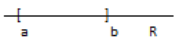
Let a, b ∈ R and a < b. Then the set {x ∈ R: a ≤ x ≤ b} is called a closed interval. It is denoted by [a, b]. Thus
Closed interval [a, b] = {x ∈ R: a ≤ x ≤ b}. It is geometrically represented by
Inter 1st Year Maths 1B Limits and Continuity Formulas 1

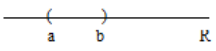
Open interval (a,b) = {x ∈ R: a < x < b} It is geometrically represented by
Inter 1st Year Maths 1B Limits and Continuity Formulas 2

Left open interval
(a, b] = {x ∈ R: a < x ≤ b}. It is geometrically represented by
Inter 1st Year Maths 1B Limits and Continuity Formulas 3

Right open interval
[a, b) = {x ∈ R: a ≤ x < b}. It is geometrically represented by
Inter 1st Year Maths 1B Limits and Continuity Formulas 4

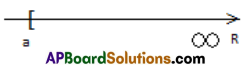
[a, ∞) = {x ∈ R : x ≥ a} = {x ∈ R : a ≤ x < ∞} It is geometrically represented by
Inter 1st Year Maths 1B Limits and Continuity Formulas 5

(a, ∞) = {x ∈ R : x > a} = {x ∈ R : a < x < ∞}
Inter 1st Year Maths 1B Limits and Continuity Formulas 6

(-∞, a] = {x ∈ R : x ≤ a} = {xe R : -∞ < x < a}
Inter 1st Year Maths 1B Limits and Continuity Formulas 7

Neighbourhood of A Point: Definition: Let ae R. If δ > 0 then the open interval (a – δ, a + δ) is called the neighbourhood (δ – nbd) of the point a. It is denoted by Nδ (a) . a is called the centre and δ is called the radius of the neighbourhood .
∴ Nδ(a) = (a – δ, a + δ) = {x ∈ R: a – δ< x < a + δ} = {x ∈ R: |x – a| < δ}

The set Nδ(a) – {a} is called a deleted δ – neighbourhood of the point a.
∴ Nδ(a) – {a} = (a – δ, a) ∪ (a, a + δ) = {x ∈ R :0 < | x – a | < δ}
Note: (a – δ, a) is called left δ -neighbourhood, (a, a + δ) is called right δ – neighbourhood of a

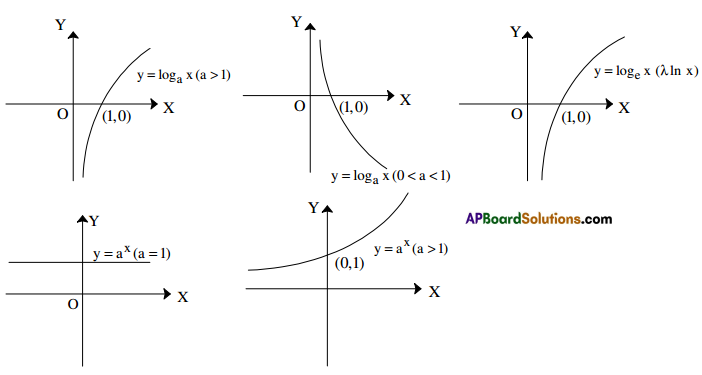
Graph of A Function:
Inter 1st Year Maths 1B Limits and Continuity Formulas 8

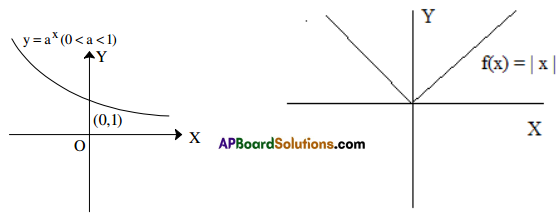
Mod function:
The function f: R-R defined by f(x) = |x| is called the mod function or modulus function or absolute value function.
Dom f R. Range f [0, )
Inter 1st Year Maths 1B Limits and Continuity Formulas 9

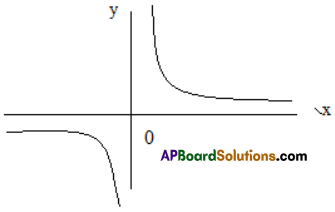
Reciprocal function :
The function f: R – {0} – R defined by
f(x) = \(\frac{1}{x}\) is called the reciprocal function,
Dom f = R – {0}= Range f = R
Inter 1st Year Maths 1B Limits and Continuity Formulas 10

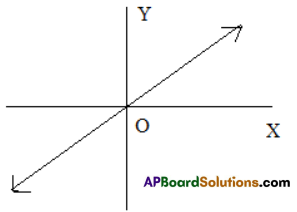
Identity function:
The function f R-R defined by f(x) = x is called the identity
It is denoted by I(x)
Inter 1st Year Maths 1B Limits and Continuity Formulas 11

Limit of A Function
Concept of limit:
Before giving the formal definition of limit consider the following example.
Let f be a function defined by f (x) = \(\frac{x^{2}-4}{x-2}\). clearly, f is not defined at x = 2.
When x ≠ 2, x – 2 ≠ 0 and f(x) = \(\frac{(x-2)(x+2)}{x-2}\) = x + 2

Now consider the values of f(x) when x ≠ 2, but very very close to 2 and <2.
Inter 1st Year Maths 1B Limits and Continuity Formulas 12

It is clear from the above table that as x approaches 2 i.e.,x → 2 through the values less than 2, the value of f(x) approaches 4 i.e., f(x) → 4. We will express this fact by saying that left hand limit of f(x) as x → -2 exists and is equal to 4 and in symbols we shall write \({lt}_{x \rightarrow 2^{-}} f(x)\) = 4

Again we consider the values of f(x) when x ≠ 2, but is very-very close to 2 and x > 2.
Inter 1st Year Maths 1B Limits and Continuity Formulas 13

It is clear from the above table that as x approaches 2 i.e.,x → 2 through the values greater than 2, the value of f(x) approaches 4 i.e., f(x) → 4. We will express this fact by saying that right hand
limit of f(x) as x → 2 exists and is equal to 4 and in symbols we shall write \({lt}_{x \rightarrow 2^{+}} f(x)\) = 4

Thus we see that f(x) is not defined at x = 2 but its left hand and right hand limits as x → 2 exist and are equal.
When \({lt}_{\mathrm{x} \rightarrow \mathrm{a}^{+}} \mathrm{f}(\mathrm{x}), \mathrm{lt}_{\mathrm{x} \rightarrow \mathrm{a}^{-}}^{\mathrm{f}(\mathrm{x})}\) are equal to the same number l, we say that \(\begin{array}{ll}
l_{x \rightarrow a} & f(x)
\end{array}\) exist and equal to 1.

Thus, in above example,
Inter 1st Year Maths 1B Limits and Continuity Formulas 14

One Sided Limits Definition Of Left Hand Limit:
Let f be a function defined on (a – h, a), h > 0. A number l1 is said to be the left hand limit (LHL) or left limit (LL) of f at a if to each
ε >0, ∃ a δ >0 such that, a – δ < x < a ⇒ |f (x) – l1| < ε.
In this case we write \(\underset{x \rightarrow a-}{L t} f(x)\) = l1 (or) \({Lt}_{x \rightarrow a-0} f(x)\) = l1

Definition of Right Limit:
Let f be a function defined on (a, a + h), h > 0. A number l 2is said to the right hand limit (RHL) or right limit (RL) of f at a if to each ε >0, ∃ a δ >0 such that, a – δ < x < a ⇒ |f (x) – l2| < ε.
In this case we write \(\underset{x \rightarrow a+}{L t} f(x)\) = l2 (or) \({Lt}_{x \rightarrow a+0} f(x)\) = l2

Definition of Limit:
Let A ∈ R, a be a limit point of A and
f : A → R. A real number l is said to be the limit of f at a if to each ε > 0, ∃ a δ > 0 such that x ∈ A, 0 < |x – a| < δ ⇒ | f(x) – l| < ε. In this case we write f (x) → 2 (or) \({Lt}_{x \rightarrow a} f(x)\) = l. Note: 1.If a function f is defined on (a – h, a) for some h > 0 and is not defined on (a, a + h) and if \(\underset{x \rightarrow a-}{{Lt}} f(x)\) exists then \({Lt}_{x \rightarrow a} f(x)={Lt}_{x \rightarrow a-} f(x)\).
2. If a function f is defined on (a, a + h) for some h > 0 and is not defined on (a – h, a) and if \(\underset{x \rightarrow a+}{{Lt}} f(x)\) exists then \({Lt}_{x \rightarrow a} f(x)={Lt}_{x \rightarrow a+} f(x)\).

Theorem:
If \({Lt}_{x \rightarrow a} f(x)\) exists then \({Lt}_{x \rightarrow a} f(x)={Lt}_{x \rightarrow 0} f(x+a)={Lt}_{x \rightarrow 0} f(a-x)\)

Theorems on Limits WithOut Proofs
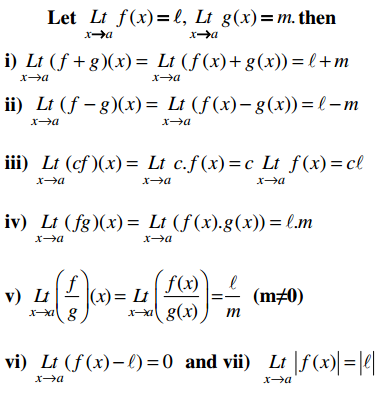
1. If f : R → R defined by f(x) = c, a constant then \({Lt}_{x \rightarrow a} f(x)\) = c for any a ∈ R.

2. If f: R → R defined by f(x) = x, then \({Lt}_{x \rightarrow a} f(x)\) = a i.e., \({Lt}_{x \rightarrow a} f(x)\) = a (a ∈ R)

3. Algebra of limits
Inter 1st Year Maths 1B Limits and Continuity Formulas 15
vii) If f(x) ≤ g(x) in some deleted neighbourhood of a, then \({Lt}_{x \rightarrow a} f(x) \leq {Lt}_{x \rightarrow a} g(x)\)
viii) If f(x) ≤ h(x) < g(x) in a deleted nbd of a and \({Lt}_{x \rightarrow a} f(x)\) = l = \({Lt}_{x \rightarrow a} g(x)\) then \({Lt}_{x \rightarrow a} h(x)\) = l
ix) If \({Lt}_{x \rightarrow a} f(x)\) = 0 and g(x) is a bounded function in a deleted nbd of a then \({Lt}_{x \rightarrow a}\) f(x) g(x) = 0.

Theorem
If n is a positive integer then \({Lt}_{x \rightarrow a} x^{n}\) = an, a ∈ R

Theorem
If f(x) is a polynomial function, then \({Lt}_{x \rightarrow a}\)f(x) = f (a)

Evaluation of Limits:
Evaluation of limits involving algebraic functions.
To evaluate the limits involving algebraic functions we use the following methods:

  • Direct substitution method
  • Factorisation method
  • Rationalisation method
  • Application of the standard limits.

1. Direct substitution method:
This method can be used in the following cases:

  • If f(x) is a polynomial function, then \({Lt}_{x \rightarrow a}\)f(x) = f (a).
  • If f (x) = \(\frac{P(a)}{Q(a)}\) where P(x) and Q(x) are polynomial functions then \({Lt}_{x \rightarrow a}\)f(x) = \(\frac{P(a)}{Q(a)}\) provided Q(a) ≠ 0.

2. Factiorisation Method:
This method is used when \({Lt}_{x \rightarrow a}\)f (x) is taking the indeterminate form of the type 0 by the substitution of x = a.
In such a case the numerator (Nr.) and the denominator (Dr.) are factorized and the common factor (x – a) is cancelled. After eliminating the common factor the substitution x = a gives the limit, if it exists.

3. Rationalisation Method : This method is used when \({Lt}_{x \rightarrow a} \frac{f(x)}{g(x)}\) is a \(\frac{0}{0}\) form and either the Nr. or Dr. consists of expressions involving radical signs.

4. Application of the standard limits.
In order to evaluate the given limits , we reduce the given limits into standard limits form and then we apply the standard limits.

Theorem 1.
If n is a rational number and a > 0 then \({Lt}_{x \rightarrow a} \frac{x^{n}-a^{n}}{x-a}\) = n.an-1

Note:

  • If n is a positive integer, then for any a ∈ R. \({Lt}_{x \rightarrow a} \frac{x^{n}-a^{n}}{x-a}\) = n.an-1
  • If n is a real number and a> 0 then \({Lt}_{x \rightarrow a} \frac{x^{n}-a^{n}}{x-a}\) = n.an-1
  • If m and n are any real numbers and a > 0, then \({Lt}_{x \rightarrow a} \frac{x^{m}-a^{m}}{x^{n}-a^{n}}=\frac{m}{n}\)am-n

Theorem 2.
If 0 < x < \(\frac{\pi}{2}\) then sin x < x < tan x.

Corollary 1:
If – \(\frac{\pi}{2}\) < x < 0 then tan x < x < sin x

Corollary 2:
If 0 < |x| < \(\frac{\pi}{2}\) then |sin x| < |x| < |tan x|

Standard Limits:

  • \({Lt}_{x \rightarrow 0} \frac{\sin x}{x}\) = 1
  • \(\underset{x \rightarrow 0}{L t} \frac{\tan x}{x}\) = 1
  • \({Lt}_{x \rightarrow 0} \frac{e^{x}-1}{x}\) = 1
  • \({Lt}_{x \rightarrow 0} \frac{a^{x}-1}{x}\) = logea
  • \({Lt}_{x \rightarrow 0}(1+x)^{\frac{1}{x}}\) = e
  • \({Lt}_{x \rightarrow \infty}\left(1+\frac{1}{x}\right)^{x}\) = e
  • \({Lt}_{x \rightarrow \infty}\left(1+\frac{1}{x}\right)^{x}\) = e

Limits At Infinity
Definition:
Let f(x) be a function defined on A = (K,).
(i) A real number l is said to be the limit of f(x) at ∞ if to each δ > 0, ∃ , an M > 0 (however large M may be) such that x ∈ A and x > M ⇒ |f (x) – l|< δ.
In this case we write f (x) → l as x → +∞ or \({Lt}_{x \rightarrow \infty} f(x)\) = l.

(ii) A real number l is said to be the limit of f(x) at -∞ if to each δ > 0, ∃ > 0, an M > 0 (however large it may be) such that x ∈ A and x < – M ⇒ |f (x) – l| < δ. In this case, we write f (x) → l as x → -∞ or \({Lt}_{x \rightarrow \infty} f(x)\) = l.

Infinite Limits Definition:
(i) Let f be a function defined is a deleted neighbourhood of D of a. (i) The limit of f at a is said to be ∞ if to each M > 0 (however large it may be) a δ > 0 such that x ∈ D, 0 < |x – a| < δ ⇒ f(x) > M. In this case we write f(x) as x → a or \({Lt}_{x \rightarrow a} f(x)\) = +∞

(ii) The limit of f(x) at a is said be -∞ if to each M > 0 (however large it may be) a δ > 0 such that x ∈ D, 0 < | x – a | < δ ⇒ f(x) < – M. In thise case we write f(x) → -∞ as x → a or \({Lt}_{x \rightarrow a} f(x)\) = -∞

Indeterminate Forms:
While evaluation limits of functions, we often get forms of the type \(\frac{0}{0}, \frac{\infty}{\infty}\), 0 × -∞, 00, 1, ∞0 which are termed as indeterminate forms.

Continuity At A Point:
Let f be a function defined in a neighbourhood of a point a. Then f is said to be continuous at the point a if and only if \({Lt}_{x \rightarrow a} f(x)\) = f (a).
In other words, f is continuous at a iff the limit of f at a is equal to the value of f at a.

Note:

  • If f is not continuous at a it is said to be discontinuous at a, and a is called a point of discontinuity of f.
  • Let f be a function defined in a nbd of a point a. Then f is said to be
    • Left continuous at a iff \({Lt}_{x \rightarrow a-} f(x)\) = f (a).
    • Right continuous at a iff \({Lt}_{x \rightarrow a+} f(x)\) = f (a).
  • f is continuous at a iff f is both left continuous and right continuous at a
    i.e, \({Lt}_{x \rightarrow a} f(x)=f(a) \Leftrightarrow {Lt}_{x \rightarrow a^{-}} f(x)=f(a)={Lt}_{x \rightarrow a+} f(x)\)

Continuity of A Function Over An Interval:
A function f defined on (a, b) is said to be continuous (a,b) if it is continuous at everypoint of (a, b) i.e., if \({Lt}_{x \rightarrow c} f(x)\) =f (c) ∀c ∈ (a, b)
II) A function f defined on [a, b] is said to be continuous on [a, b] if

  • f is continuous on (a, b) i.e., \({Lt}_{x \rightarrow c} f(x)\) = f (c) ∀c ∈(a, b)
  • f is right continuous at a i.e., \({Lt}_{x \rightarrow a+} f(x)\) = f (a)
  • f is left continuous at b i.e., \({Lt}_{x \rightarrow b-} f(x)\) = f (b).

Note :

  • Let the functions f and g be continuous at a and k€R. Then f + g, f – g, kf , kf + lg, f.g are continuous at a and \(\frac{f}{g}\) is continuous at a provided g(a) ≠ 0.
  • All trigonometric functions, Inverse trigonometric functions, hyperbolic functions and inverse hyperbolic functions are continuous in their domains of definition.
  • A constant function is continuous on R
  • The identity function is continuous on R.
  • Every polynomial function is continuous on R.

Inter 1st Year Maths 1B Pair of Straight Lines Formulas

Use these Inter 1st Year Maths 1B Formulas PDF Chapter 4 Pair of Straight Lines to solve questions creatively.

Intermediate 1st Year Maths 1B Pair of Straight Lines Formulas

→ If ax2 + 2hxy + by2 = 0 represents a pair of lines, then the sum of the slopes of lines is \(-\frac{2 h}{b}\) and the product of the slopes of lines is \(\frac{a}{b}\).

→ If ‘θ’ is an angle between the lines represented by ax2 + 2hxy + by2 = 0
then cos θ = \(\frac{a+b}{\sqrt{(a-b)^{2}+4 h^{2}}}\)
tan θ = \(\frac{2 \sqrt{h^{2}-a b}}{a+b}\)
If ‘θ’ is accute, cos θ = \(\frac{|a+b|}{\sqrt{(a-b)^{2}+4 h^{2}}}\); tan θ = \(\frac{2 \sqrt{h^{2}-a b}}{|a+b|}\)

→ If h2 = ab, then ax2 + 2hxy + by2 = 0 represents coincident or parallel lines.

→ ax2 + 2hxy + by2 = 0 represents a pair of ⊥lr lines ⇒ a+ b = 0 i.e., coeft. of x2 + coeff. of y2 = 0.

→ The equation of pair of lines passing through origin and perpendicular to ax2 + 2hxy + by2 = 0 is bx2 – 2hxy + ay2 = 0.

→ The equation of pair of lines passing through (x1, y1) and perpendicular to ax2 + 2hxy + by2 = 0 isb (x – x1)2 – 2h(x – x1) (y – y1) + a(y – y1)2 = 0.

→ The equation of pair of lines passing through (x1, y1) and parallel to ax2 + 2hxy + by2 = 0 is a(x-x,)2 + 2h(x-x1)(y-y1) + b(y – y1)2 = 0.

→ The equations of bisectors of angles between the lines a1x + b1y + c1 = 0, a2x + b2y + c2 = 0, is \(\frac{a_{1} x+b_{1} y+c_{1}}{\sqrt{a_{1}^{2}+b_{1}^{2}}}=\pm \frac{\left(a_{2} x+b_{2} y+c_{2}\right)}{\sqrt{a_{2}^{2}+b_{2}^{2}}}\)

→ The equation to the pair of bisectors of angles between the pair of lines ax2 + 2hxy + by2 = 0 is h(x2 – y2) = (a – b)xy.

Inter 1st Year Maths 1B Pair of Straight Lines Formulas

→ The product of the perpendicular is from (α, β) to the pair of lines ax2 + 2hxy + by2 = 0 is \(\frac{\left|a \alpha^{2}+2 h \alpha \beta+b \beta^{2}\right|}{\sqrt{(a-b)^{2}+4 h^{2}}}\)

→ The area of the triangle formed by ax2 + 2hxy + by2 = 0 and lx + my + n = 0 is \(\frac{n^{2} \sqrt{h^{2}-a b}}{\left|a m^{2}-2 h / m+b\right|^{2} \mid}\)

→ The line ax + by + c = 0 and pair of lines (ax + by)2 – 3(bx – ay)2 =0 form an equilateral triangle and the area is \(\frac{c^{2}}{\sqrt{3}\left(a^{2}+b^{2}\right)}\) sq.units

→ If ax2 + 2hxy + by2 + 2gx + 2fy + c = 0 represents a pair of lines, then

  • abc + 2fgh – af2 – bg2 – ch2 = 0
  • h2 ≥ ab
  • g2 ≥ ac
  • f2 ≥ be

→ If ax2 + 2hxy + by2 + 2gx + 2fy + c = 0 represents a pair of lines and h2 > ab, then the point of intersection of the lines is \(\left(\frac{h f-b g}{a b-h^{2}}, \frac{g h-a f}{a b-h^{2}}\right)\)

→ If ax2 + 2hxy + by2 + 2gx + 2fy + c = 0 represents a pair of parallel lines then h2 = ab and af2 = bg2
The distance between the parallel lines = \(2 \sqrt{\frac{g^{2}-a c}{a(a+b)}}=2 \sqrt{\frac{f^{2}-b c}{b(a+b)}}\)

Pair of Straight Lines:
Let L1 = 0, L2 = 0 be the equations of two straight lines. If P(x1, y1) is a point on L1 then it satisfies the equation L1 = 0. Similarly, if P(x1, y1) is a point on L2 = 0 then it satisfies the equation.

If P(x1, y1) lies on L1 or L2, then P(x1,y1) satisfies the equation L1L2= 0.
L1L2 = 0 represents the pair of straight lines L1 = 0 and L2 = 0 and the joint equation of L1 = 0 and L2 = 0 is given by L1 L2= 0. ……………(1)
On expanding equation (1) we get and equation of the form ax2 + 2hxy + by2 + 2 gx + 2 fy + c = 0 which is a second degree (non – homogeneous) equation in x and y.
Definition: If a, b, h are not all zero,then ax2 + 2hxy + by2 = 0 is the general form of a second degree homogeneous equation in x and y.
Definition: If a, b, h are not all zer, then ax2 + 2hxy + by2 + 2gx + 2 fy + c = 0 is the general form of a second degree non – homogeneous equation in x and y.

Theorem:
If a, b, h are not all zero and h2 ≥ ab then ax2 + 2hxy + by2 = 0 represents a pair of straight lines passing through the origin.
Proof:
Case (i) : Suppose a = 0.
Given equation ax2 + 2hxy + by2 = 0 reduces to 2hxy + by2 = 0 ^ y(2hx + by) = 0 .
Given equation represents two straight lines y = 0 ………..(1) and 2hx + by = 0 ………(2) which pass through the origin.
Case (ii): Suppose a ≠ 0.
Given equation ax2 + 2hxy + by2 = 0
⇒ a2x2 + 2ahxy + aby2 = 0
⇒ (ax)2 + 2(ax)(hy) + (hy)2 – (h2 – ab)y2 = 0
⇒ (ax + hy)2 – (y\(\sqrt{h^{2}-a b}\))2 = 0
[ax + y (h + \(\sqrt{h^{2}-a b}\))][ax + y (h – \(\sqrt{h^{2}-a b}\)] = 0

∴ Given equation represents the two lines
ax + hy + y\(\sqrt{h^{2}-a b}\) = 0, ax + hy – y\(\sqrt{h^{2}-a b}\) = 0 which pass through the origin.

Note 1:

  • If h2 > ab , the two lines are distinct.
  • If h2 = ab , the two lines are coincident.
  • If h2 < ab , the two lines are not real but intersect at a real point (the origin).
  • If the two lines represented by ax2 + 2hxy + by2 = 0 are taken as l1x + m1y = 0 and l2x + m2y = 0 then
    ax2 + 2kxy + by2 = (4 x + m1y) (x + m2y) = 2 x2 + (l1m2 + l2m1) xy + m1m2 y2
  • Equating the coefficients of x2, xy and y2 on both sides, we get l1l2 = a, l1m2 + l2m1 = 2h , m1m2 = b.

Inter 1st Year Maths 1B Pair of Straight Lines Formulas

Theorem:
If ax2 + 2hxy + by2 = 0 represent a pair of straight lines, then the sum of slopes of lines is \(\frac{-2 h}{b}\) product of the slopes is \(\frac{a}{b}\).
Proof:
Let ax2 + 2hxy + by2 = 0 represent the lines l1x + m1y = 0 ………….(1) and l2x + m2y = 0 ………….(2).
Then l1l2 = a, l1m2 + l2m1 = 2h , m1m2 = b.
Slopes of the lines (1) and (2) are –\(\frac{l_{1}}{m_{1}}\) and \(-\frac{l_{2}}{m_{2}}\).
sum of the slopes = \(\frac{-l_{1}}{m_{1}}+\frac{-l_{2}}{m_{2}}=-\frac{l_{1} m_{2}+l_{2} m_{1}}{m_{1} m_{2}}=-\frac{2 h}{b}\)
Product of the slopes = \(\left(\frac{-l_{1}}{m_{1}}\right)\left(-\frac{l_{2}}{m_{2}}\right)=\frac{l_{1} l_{2}}{m_{1} m_{2}}=\frac{a}{b}\)

Angle Between A Pair of Lines:
Theorem :
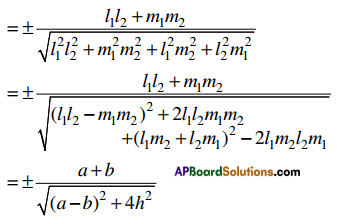
If θ is the angle between the lines represented by ax2 + 2hxy + by2 = 0, then cos θ = ±\(\frac{a+b}{\sqrt{(a-b)^{2}+4 h^{2}}}\)
Proof:
Let ax2 + 2hxy + by2 = 0 represent the lines l1 x + m1 y = 0 ………..(1) and l2x + m2 y = 0 …………..(2).
Then l1l2 = a, l1m2 + l2m1 = 2h , m1m2 = b.

Let θ be the angle between the lines (1) and (2). Then cos θ = ±\(\frac{l_{1} l_{2}+m_{1} m_{2}}{\sqrt{\left(l_{1}^{2}+m_{1}^{2}\right)\left(l_{2}^{2}+m_{2}^{2}\right)}}\)
Inter 1st Year Maths 1B Pair of Straight Lines Formulas 1
Note 1:
If θ is the accute angle between the lines ax2 + 2hxy + by2 = 0 then cos θ = \(\frac{|a+b|}{\sqrt{(a-b)^{2}+4 h^{2}}}\)
If θ is the accute angle between the lines ax2 + 2hxy + by2 = 0 then tan θ = ±\(\frac{2 \sqrt{h^{2}-a b}}{a+b}\) and sin θ = \(\frac{2 \sqrt{h^{2}-a b}}{\sqrt{(a-b)^{2}+4 h^{2}}}\)

Conditions For Perpendicular And Coincident Lines:

  • If the lines ax2 + 2hxy + by2 = 0 are perpendicular to each other then θ = π/ 2 and cos θ = 0 ⇒ a + b = 0 i.e., co-efficient of x2 + coefficient of y2 = 0.
  • If the two lines are parallel to each other then 0 = 0.
    ⇒ The two lines are coincident ⇒ h2 = ab

Bisectors of Angles:
Theorem:
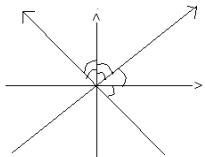
The equations of bisectors of angles between the lines a1 x + b1 y + c1 = 0, a2 x + b2 y + c2 = 0 are \(\frac{a_{1} x+b_{1} y+c_{1}}{\sqrt{a_{1}^{2}+b_{1}^{2}}}\) = ±\(\frac{a_{2} x+b_{2} y+c_{2}}{\sqrt{a_{2}^{2}+b_{2}^{2}}}\)
Inter 1st Year Maths 1B Pair of Straight Lines Formulas 2

Pair of Bisectors of Angles:
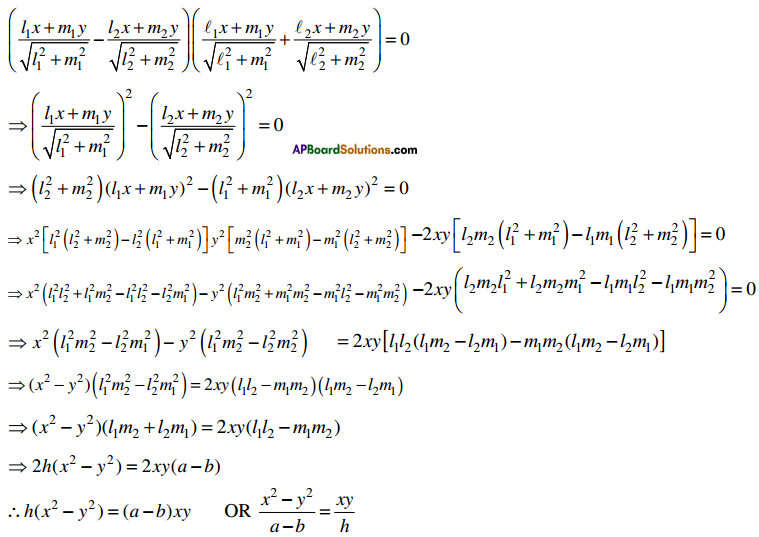
The equation to the pair bisectors of the angle between the pair of lines ax2 + 2hxy + by2 = 0 is h(x2 – y2) = (a – b)xy (or) \(\frac{x^{2}-y^{2}}{a-b}=\frac{x y}{h}\).
Proof:
Let ax2 + 2hxy + by2 = 0 represent the lines l1x + m1y = 0 ……….(1)
and l2x + m2y = 0 ………(2).
Then l1l2 = a, l1m2 + l2m1 = 2h , m1m2 = b.

The equations of bisectors of angles between (1) and (2) are \(\frac{l_{1} x+m_{1} y}{\sqrt{l_{1}^{2}+m_{1}^{2}}}-\frac{l_{2} x+m_{2} y}{\sqrt{l_{2}^{2}+m_{2}^{2}}}\) = 0 and
\(\frac{l_{1} x+m_{1} y}{\sqrt{l_{1}^{2}+m_{1}^{2}}}+\frac{l_{2} x+m_{2} y}{\sqrt{l_{2}^{2}+m_{2}^{2}}}\) = 0

The combined equation of the bisectors is
Inter 1st Year Maths 1B Pair of Straight Lines Formulas 3

Theorem
The equation to the pair of lines passing through (x0, y0) and parallel ax2 + 2hxy + by2 = 0
is a( x – x0)2 + 2h( x – x0)(y – y0) + b( y – y0)2 = 0
Proof:
Let ax2 + 2hxy + by2 = 0 represent the lines l1x + m1y = 0 ……(1) and l2x + m2 y = 0 …….. (2).
Then l1l2 = a, l1m2 + l2m1 = 2h , m1m2 = b.
The equation of line parallel to (1) and passing through (x0, y0) is l2(x – x0) + m2(y – y0) = 0 ………(3)
The equation of line parallel to (2) and passing through (x0, y0) is l2(x – x0) + m2(y – y0) = 0 ………(4)

The combined equation of (3), (4) is
[l1( x – x0) + m1( y – y0)][l2( x – x0) + m2(y – y0)] = 0
⇒ l1l2(x – x0)2 + (l1m2 + l2m1)(x – x0)(y – y0) + m1m2(y – y0)2 = 0
⇒ a( x – x0)2 + 2h( x – x0)( y – y0) + b( y – y0)22 = 0

Theorem:
The equation to the pair of lines passing through the origin and perpendicular to ax2 + 2hxy + by2 = 0 is bx2 – 2hxy + ay2 = 0 .
Proof:
Let ax2 + 2hxy + by2 = 0 represent the lines l1x + m1y = 0 ………(1) and l2x + m2y = 0 ……..(2).
Then l1l2 = a, l1m2 + l2m1 = 2h , m1m2 = b.
The equation of the line perpendicular to (1) and passing through the origin is m1x – l1y = 0 ……….(3)
The equation of the line perpendicular to (2) and passing through the origin is m2 x – l2 y = 0 — (4)
The combined equation of (3) and (4) is
⇒ (m1x – l1 y)(m2 x – l2 y) = 0
⇒ m1m2x – (l1m2 + l2m1 )ny + l1l2 y = 0
bx2 – 2hxy + ay2 = 0

Inter 1st Year Maths 1B Pair of Straight Lines Formulas

Theorem:
The equation to the lines passing through (x0, y0) and Perpendicular to ax2 + 2hxy + by2 = 0 is b(x – x0)2 – 2h(x – x0)(y – y0) + a(y – y0)2 = 0

Area of the triangle:
Theorem:
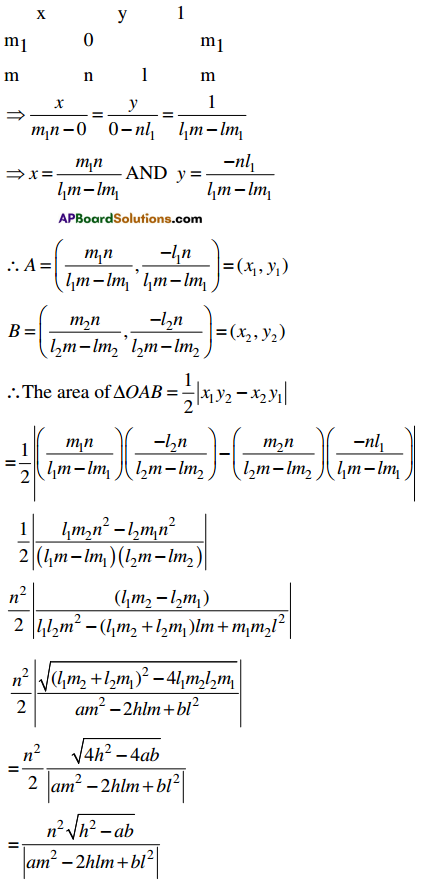
The area of triangle formed by the lines ax2 + 2hxy + by2 = 0 and lx + my + n = 0 is \(\frac{n^{2} \sqrt{h^{2}-a b}}{\left|a m^{2}-2 h \ell m+b \ell^{2}\right|}\)
Proof:
Let ax2 + 2hxy + by2 = 0 represent the lines l1x + m1y = 0 ………(1) and l2x + m2y = 0 ……..(2).
Then l1l2 = a, l1m2 + l2m1 = 2h , m1m2 = b.

The given straight line is lx + my + n = 0 ………(3)
Clearly (1) and (2) intersect at the origin.
Let A be the point of intersection of (1) and (3). Then
Inter 1st Year Maths 1B Pair of Straight Lines Formulas 4

Theorem:
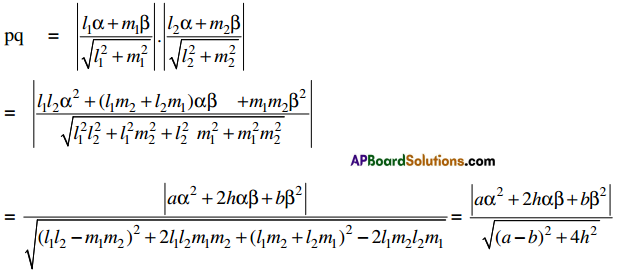
The product of the perpendiculars from (α, β) to the pair of lines ax2 + 2hxy + by2 = 0 is \(\frac{\left|a \alpha^{2}+2 h \alpha \beta+b \beta^{2}\right|}{\sqrt{(a-b)^{2}+4 h^{2}}}\)
Proof:
Let ax2 + 2hxy + by2 = 0 represent the lines l1x + m1y = 0 — (1) and l2x + m2 y = 0 …………..(2).
Then l1l2 = a, l1m2 + l2m1 = 2h , m1m2 = b.
The lengths of perpendiculars from (α, β) to
the line (1) is p = \(\frac{\left|l_{1} \alpha+m_{1} \beta\right|}{\sqrt{l_{1}^{2}+m_{1}^{2}}}\)
and to the line (2) is q = \(\frac{\left|l_{2} \alpha+m_{2} \beta\right|}{\sqrt{l_{2}^{2}+m_{2}^{2}}}\)

∴ The product of perpendiculars is
Inter 1st Year Maths 1B Pair of Straight Lines Formulas 5

Pair of Lines-Second Degree General Equation:
Theorem:
If the equation S ≡ ax2 + 2hxy + by2 + 2 gx + 2 fy + c = 0 represents a pair of straight lines then
(i) Δ ≡ abc + 2fgh – af2 – bg2 – ch2 =0 and
(ii) h2 ≥ ab, g2 ≥ ac, f2 ≥ bc
Proof:
Let the equation S = 0 represent the two lines l1x + m1 y + n1 = 0 and l2 x + m2 y + n2 = 0. Then
ax2 + 2hxy + by2 + 2 gx + 2 fy + c
≡ (l1x + m1y + n1)(l2 x + m2 y + n2) = 0

Equating the co-efficients of like terms, we get
l1l2 = a, l1m2 + l2m1 = 2h , m1m2 = b, and l1n2 + l2n1 = 2g , m1n2 + m2n1 = 2 f , n1n2 = c

(i) Consider the product(2h)(2g)(2f)
= (l1m2 + l2m1)(l1n2 + l2n1)(m1n2 + m2n1)
= l1l2 (m12n2 + m22n12) + m1m2 (l12n22 + l22n12) + n1n2 (l12m22 + l22m12) + 2l1l2m1m2n1n2
= l1l2[(m1n2 + m2n1) – 2m1m2n1n2] + m1m2[(l1n2 + l2n1) – 2l1l2n1n2] + n1n2[(l1m2 + l2m1) – 2l1l2m1m2] + 2l1l2m1m2n1n2
= a(4 f2 – 2bc) + b(4g2 – 2ac) + c(4h2 – 2ab)
8 fgh = 4[af2 + bg2 + ch2 – abc]
abc + 2 fgh – af2 – bg2 – ch2 = 0

(ii) h2 – ab = \(\left(\frac{l_{1} m_{2}+l_{2} m_{1}}{2}\right)^{2}\) – l1l2m1m2 = \(\frac{\left(l_{1} m_{2}+l_{2} m_{1}\right)^{2}-4-l_{1} l_{2} m_{1} m_{2}}{4}\)
= \(\frac{\left(l_{1} m_{2}-l_{2} m_{1}\right)^{2}}{4}\) ≥ 0
Similarly we can prove g2 > ac and f2 ≥ bc

Note :
If A = abc + 2 fgh – af2 – bg2 – ch2 = 0 , h2 ≥ ab, g2 ≥ ac and f2 ≥ bc, then the equation S ≡ ax2 + 2hxy + by2 + 2 gx + 2 fy + c = 0 represents a pair of straight lines

Inter 1st Year Maths 1B Pair of Straight Lines Formulas

Conditions For Parallel Lines-Distance Between Them:
Theorem:
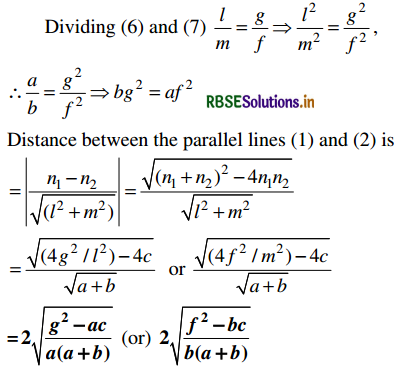
If S = ax2 + 2hxy + by2 + 2 gx + 2 fy + c = 0 represents a pair of parallel lines then h2 = ab and bg2 = af2. Also the distance between the two parallel lines is 2\(\sqrt{\frac{g^{2}-a c}{a(a+b)}}\) (or) 2\(\sqrt{\frac{f^{2}-b c}{b(a+b)}}\)
Proof:
Let the parallel lines represented by S = 0 be
lx + my + n1 = 0 ……….(1) lx + my + n2 = 0 ………..(2)
ax2 + 2hxy + 2gx + 2 fy + c
= (lx + my + n1)(lx + my + n2)

Equating the like terms
l2 = a ………(3)
2lm = 2h …………(4)
m2 = b ………..(5)
l(n1 + n2) = 2g …….(6)
m(n1 + n2) = 2 f ….(7)
n1n2 = c …….(8)

From (3) and (5), l2m2 = ab and from (4) h2 = ab .
Inter 1st Year Maths 1B Pair of Straight Lines Formulas 6

Point of Intersection of Pair of Lines:
Theorem:
The point of intersection of the pair of lines represented by
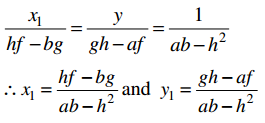
a2 + 2hxy + by2 + 2gx + 2fy + c = 0 when h2 > ab is \(\left(\frac{h f-b g}{a b-h^{2}}, \frac{g h-a f}{a b-h^{2}}\right)\)
Proof:
Let the point of intersection of the given pair of lines be (x1, y1).
Transfer the origin to (x1, y1) without changing the direction of the axes.
Let (X, Y) represent the new coordinates of (x, y). Then x = X + x1 and y = Y + y1.
Now the given equation referred to new axes will be
a( X + x1)2 + 2h( X + x1)(Y + y1) +b(Y + y1)2 + 2 g (X + x1) + 2 f (Y + y1) + c = 0
⇒ aX2 + 2hXY + bY2 + 2 X (ax1 + hy1 + g) + 2Y(hx1 + by1 + f) +(ax12 + 2hx1y1 + by2 + 2 gx1 + 2 fy1 + c) = 0

Since this equation represents a pair of lines passing through the origin it should be a homogeneous second degree equation in X and Y. Hence the first degree terms and the constant term must be zero. Therefore,
ax1 + hy1 + g = 0
hx1 + by1 + f = 0
ax12 + 2hx1 y1 + by12 + 2 gx1 + 2 fyx + c = 0
But (3) can be rearranged as
x1(ax1 + hy + g) + y (hx1 + byx + f) + (gx1 + fq + c) = 0
⇒ gx1 + fy1 + c = 0 ………..(4)

Solving (1) and (2) for x1 and y1
Inter 1st Year Maths 1B Pair of Straight Lines Formulas 7
Hence the point of intersection of the given pair of lines is \(\left(\frac{h f-b g}{a b-h^{2}}, \frac{g h-a f}{a b-h^{2}}\right)\)

Theorem:
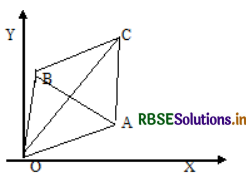
If the pair of lines ax2 + 2hxy + by2 = 0 and the pair of lines ax2 + 2hxy + by2 + 2gx + 2fy + c = 0 form a rhombus then (a – b) fg+h(f2 – g2) = 0.
Proof:
The pair of lines ax2 + 2hxy + by2 = 0 …………(1) is parallel to the lines ax2 + 2hxy + by2 + 2gx + 2fy + c = 0 ……….. (2)
Inter 1st Year Maths 1B Pair of Straight Lines Formulas 8
Now the equation
ax2 + 2hxy + by2 + 2gx + 2 fy + c + λ(ax2 + 2hxy + by2) = 0

Represents a curve passing through the points of intersection of (1) and (2).
Substituting λ = -1, in (3) we obtain 2gx + 2fy + c = 0 …(4)
Equation (4) is a straight line passing through A and B and it is the diagonal \(\overline{A B}\)

The point of intersection of (2) is C = \(\left(\frac{h f-b g}{a b-h^{2}}, \frac{g h-a f}{a b-h^{2}}\right)\)
⇒ Slope of \(\overline{O C}=\frac{g h-a f}{h f-b g}\)
In a rhombus the diagonals are perpendicular ⇒ (Slope of \(\overline{O C}\)) (Slope of \(\overline{A B}\)) = -1
⇒ \(\left(\frac{g h-a f}{h f-b g}\right)\left(-\frac{g}{f}\right)\) = -1
⇒ g2h – afg = hf2 – bfg
⇒ (a – b)fg + h(f2 – g2) = 0
\(\frac{g^{2}-f^{2}}{a-b}=\frac{f g}{h}\)

Inter 1st Year Maths 1B Pair of Straight Lines Formulas

Theorem:
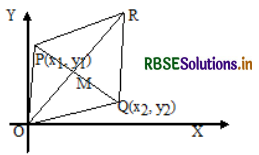
If ax2 + 2hxy + by2 = 0 be two sides of a parallelogram and px + qy = 1 is one diagonal, then the other diagonal is y(bp – hq) = x(aq – hp)
proof:
Let P(x1, y1) and Q(x2, y2) be the points where the digonal
Inter 1st Year Maths 1B Pair of Straight Lines Formulas 9
px + qy = 1 meets the pair of lines.
\(\overline{O R}\) and \(\overline{P Q}\) biset each other at M(α, β)
∴ α = \(\frac{x_{1}+x_{2}}{2}\) and β = \(\frac{y_{1}+y_{2}}{2}\)

Eliminating y from ax2 + 2hxy+by2 = 0
and px + qy = 1 ………..(2)
ax2 + 2hx\(\left(\frac{1-p x}{q}\right)\) + b\(\left(\frac{1-p x}{q}\right)^{2}\) = 0
⇒ x2 (aq2 – 2hpq + bp2) + 2 x(hp – bp) + b = 0

The roots of this quadratic equation are x1 and x2 where
x1 + x2 = \(-\frac{2(h q-b p)}{a q^{2}-2 h p q-b p^{2}}\)
⇒ α = \(\frac{(b p-h q)}{\left(a q^{2}-2 h p q+b p^{2}\right)}\)

Similarly, by eliminating x from (1) and (2) a quadratic equation in y is obtained and y1,
y2 are its roots where
y1 + y2 = \(-\frac{2(h p-a q)}{a q^{2}-2 h p q-n p^{2}}\) ⇒ β = \(\frac{(a q-h p)}{\left(a q^{2}-2 h p q+b p^{2}\right)}\)
Now the equation to the join of O(0, 0) and M(α, β) is (y – 0)(0 – α) = (x – 0)(0 – β)
⇒ αy = βx
Substituting the values of α and β, the equation of the diagonal OR
is y(bp – hq) = x(aq – hp).

AP Board 7th Class Science Important Questions Chapter 1 Food Components

AP State Syllabus AP Board 7th Class Science Important Questions Chapter 1 Food Components

AP State Syllabus 7th Class Science Important Questions 1st Lesson Food Components

7th Class Science 1st Lesson Food Components Important Questions and Answers

Question 1.
What type of food is required to keep us healthy?
Answer:

  1. Generally every food item contains all the components of food.
  2. But some components may be more while some may be less.
  3. We require different quantities of carbohydrates, proteins and fats according to age and need of individuals.
  4. Growing children and adolescents need more protein-containing food like milk, meat, pulses etc.
  5. We also need minute quantities of some other components called vitamins and minerals to keep us healthy.

AP Board 7th Class Science Important Questions Chapter 1 Food Components

Question 2.
What are roughages? In what way are they useful to us?
Answer:

  1. There are some components of food that are necessary for our body called roughages or dietary fibres.
  2. Vegetables like a ribbed gourd, bunch beans, lady’s finger or some boiled sweet potato etc. are called roughages.
  3. Roughages are a kind of carbohydrate that our body fails to digest.
  4. They help in free bowel movement in the digestive tract and prevent constipation.

Question 3.
Mention some sources of roughages.
Answer:
Sources of Roughages:

  1. Bran, shredded wheat, cereals, fruits and vegetables, sweet and plain potato, peas and berries, pumpkins, palak, apples, banana, papaya and many kinds of beans are the sources of roughages.
  2. We must take care to include sufficient fibre foods in our daily diet.

Question 4.
Why should we eat fruits with peels? What should be done before eating them.
Answer:

  1. Generally we have a habit of eating some fruits without peels.
  2. We eat banana without peel but fruits like apples, grapes, sapota are eaten along with peels.
  3. Most of the vegetable are also used along with peels, sometimes we make some special dishes like chutneys etc., with peels.
  4. So don’t peel or discard outer layers of fruits or vegetables.
  5. They are rich in nutrients.
    AP Board 7th Class Science Important Questions Chapter 1 Food Components 1AP Board 7th Class Science Important Questions Chapter 1 Food Components 2
  6. Peel contains fibre which helps in digestion.
  7. But now a days farmers use many pesticides in the fields.
  8. They are very dangerous for our health so we must wash fruits and vegetables with salt water thoroughly.
  9. Then only it becomes safe to eat them along with peels.

AP Board 7th Class Science Important Questions Chapter 1 Food Components

Question 5.
Do fruits and vegetables contain water in them? Give some examples of such fruits.
Answer:

  1. Water is also an essential component needed by our body.
  2. We should drink sufficient water for our body.
  3. We get water from fruits and vegetables also.
    AP Board 7th Class Science Important Questions Chapter 1 Food Components 3a
  4. Most fruits and vegetables contain water.
  5. Cut these fruits and vegetables. We find water in them.
  6. Most vegetables like potatoes, beans, kheera, tomatoes, gourds and fruits like apples, papaya and melons etc., contain water.

Question 6.
Why does our body need water? Explain with an example.
Answer:

  1. Take a piece of sponge and try to move it in a pipe.
  2. It moves with some difficulty. Remove the sponge from the pipe, dip it in water and try to move it again in the pipe.
    AP Board 7th Class Science Important Questions Chapter 1 Food Components 4
  3. It moves freely or smoothly.
  4. Water is food and it also helps the food to move easily in the digestive tract.
  5. Water helps in many other processes in our body as well.
  6. Hence, we must drink plenty of water.

Question 7.
How would you make your diet a balanced one?
Answer:

  1. Taking green salads and vegetables everyday.
  2. Taking foods like cereals, pulses, milk etc., adequately.
  3. Taking a bit of fat (Oil, Ghee, Butter etc.)
  4. Don’t forget to supplement your daily diet with green salads and vegetables.

AP Board 7th Class Science Important Questions Chapter 1 Food Components

Question 8.
Write the history of food and nutrition.
Answer:
History of food and nutrition:

  1. Until about 170 years ago there was little scientific knowledge in the West about nutrition.
  2. The founder of modern science of nutrition was Frenchman named Lavoisier (1743 to 1793) whose contribution paved new ways to nutrition research.
    AP Board 7th Class Science Important Questions Chapter 1 Food Components 5
  3. In the year 1752 James Lind’s discovered “Scurvy” which could be cured or prevented by eating fresh fruits and vegetables.
  4. It was known that diseases could be cured by eating certain kinds of foods.
  5. In 19th century it was known that the body obtains food from three substances namely proteins, fats and carbohydrates.

Question 9.
How do you test the presence of starch in the food item given to you.
Answer:
Test for Starch: N – line Preparation of dilute iodine solution

  1. Take a test tube or a cup and add few drops of Iodine solution to it.
  2. Then dilute it with water till it becomes light yellow / brown in colour.
    AP Board 7th Class Science Important Questions Chapter 1 Food Components 6
  3. Take a sample of food item in the test tube.
  4. Add a few drops of dilute Iodine solution on the sample we have collected.
  5. Observe the change in colour.
  6. If the substance turns dark-blue or black, it contains starch.

Question 10.
Describe how do you test the presence of fats in the food item given to you.
Answer:
Test for fats:

  1. Take a small quantity of each sample.
    AP Board 7th Class Science Important Questions Chapter 1 Food Components 7
  2. Rub it gently on a piece of paper.
  3. If the paper turns translucent the substance contains fats.

AP Board 7th Class Science Important Questions Chapter 1 Food Components

Question 11.
What test do you conduct to detect the presence of proteins in the food item given to you?
Answer:
A) Preparation of solutions:

  1. Preparation of 2% copper sulphate solution: To make 2% copper sulphate solution dissolve 2 gms of copper sulphate in 100 ml. of water.
  2. To make 10% of sodium hydroxide solution: Dissolve 10 gms of sodium hydroxide in 100 ml. of water.

B) Test for proteins:

  1. If the substance to test is a solid, grind it into powder or paste.
  2. Add a little of it in the test tube and add 10 drops of water to the powder and stir well.
  3. Add 10 drops of this solution in a clean test tube. Add 2 drops of copper sulphate solution and 10 drops of sodium hydroxide solution to the test tube and shake well.
  4. Change of colour to violet or purple confirms presence of protein.

Question 12.
What do the above tests confirm?
Answer:

  1. The above tests show the presence of components of food which are usually present in larger amounts as compared to others,
  2. All types of food that we eat contain all the above-mentioned food components.
  3. The quantity of each component varies from type to type.

Question 13.
Collect some food packets like chips, coffee, milk, juice … etc., and put a tick mark if you find the listed food components present in food items.
Answer:
Table: Food items and components
AP Board 7th Class Science Important Questions Chapter 1 Food Components 8

AP Board 7th Class Science Important Questions Chapter 1 Food Components

Question 14.
What are the components found in biscuits?
Answer:
In biscuits the following components are present.

  1. carbohydrates
  2. proteins
  3. fat
  4. sugars
  5. saturated fatty acids
  6. mono unsaturated fatty acids
  7. poly unsaturated fatty acids
  8. trans-fatty acids
  9. cholesterol
  10. calcium
  11. iron
  12. iodine
  13. vitamins.

Question 15.
What components are most common in your list?
Answer:
The common components in the list are

  1. carbohydrates
  2. proteins
  3. fats
  4. sugars
  5. minerals and
  6. vitamins.

Question 16.
Do you find any vitamins and minerals in the biscuits? What are they?
Answer:

  1. I find vitamins and minerals in the biscuits.
  2. They are
    a) Vitamin – D, Vitamins B, B6 and B12
  3. a) Calcium, b) Iron, c) Iodine are the minerals present.

AP Board 7th Class Science Important Questions Chapter 1 Food Components

Question 17.
Where do you write salt and sugar? Why?
Answer:

  1. Salt and sugar are written separately.
  2. These two components are not present in all the food items as common.

Question 18.
Are there any food items with similar components?
Answer:
Many ready made food items packed will have similar components.

Question 19.
What are the essential components of food?
Answer:

  1. Our food consists of carbohydrates, proteins, fats, vitamins and minerals.
  2. Besides these, water and fibres are also present.

Question 20.
Different food items are given in the table below. Find out the type of components in them and fill the information on the basis of your observations.
Answer:
Table: Testing of food items for carbohydrates, proteins, fats
AP Board 7th Class Science Important Questions Chapter 1 Food Components 9

Question 21.
Which foods show the presence of starch?
Answer:

  1. Rice (78.2%)
  2. Potato (22.6%)
  3. Milk (5%)
  4. Curd (3%)
  5. Egg (0%)

AP Board 7th Class Science Important Questions Chapter 1 Food Components

Question 22.
What nutrients are present in milk?
Answer:
In buffalo’s milk

  1. Minerals are present (0.8%)
  2. Calcium (210 mg per 100 g) is present
  3. Phosphorus (130 mg per 100 g) is present
  4. Iron (0.2 mg per 100 g) is present.

Question 23.
Which components of food could you identify in potatoes?
Answer:
The following components are identified in potatoes.
a) (1.6 gm per 100 gm) proteins.
b) (0.1 gm per 100 gm) fat
c) (0.6 gm per 100 gm) minerals
d) (0.4 gm per 100 gm) fibre
e) (22.6 gm per 100 gm) carbohydrates
f) (10 mg per 100 gm) calcium
g) (40 mg per 100 gm) phosphorus
h) (0.48 mg per 100 gm) iron

Question 24.
Which food item contain more fat?
Answer:
Buffalo’s milk contains more fat (6.5 gm / 100 gm)

Question 25.
Which food items contain more protein?
Answer:
a) Rice contains proteins of 6.8 gm / 100 gm
b) Potato contains proteins of 1.6 gm / 100 gm.
c) Milk contains proteins of 4.3 gm / 100 gm
d) Curd contains proteins of 3.1 gm / 100 gm.
e) Egg contains proteins of 13.3 gm / 100 gm.
So egg and milk contain more proteins compared to other food items.

Question 26.
Why should we eat food?
Answer:
We should eat food because food supplies the energy we need to do many tasks in our day to day activities.

AP Board 7th Class Science Important Questions Chapter 1 Food Components

Question 27.
Do we need energy while sleeping?
Answer:

  1. While we are sleeping, we breathe.
  2. The circulation of blood in our body goes on.
  3. So we need energy while we are sleeping.

Question 28.
Suppose you do not get food for lunch how do you feel?
Answer:

  1. If I do not get food for lunch, I shall be very much tired and exhausted with lack of supply of energy at the end of the day.
  2. I shall feel very weak. The hunger will be in an alarming condition.
  3. I shall be ready to eat anything that is available.

Question 29.
If you do not get food for many days what will happen to you?
Answer:

  1. If I do not get food for many days, I shall become very weak and the resistive power of my body decreases very much.
  2. The energy resources in my body will also be exhausted.
  3. There will be a danger to my life.

Question 30.
Mention some food items which keep you healthy.
Answer:
Dry fruits like dates, plums, raisins, cashew nuts, pistachios, etc., also keep us healthy.

Question 31.
Is balanced diet cheap? Explain.
Answer:

  1. Scientists have found out that a balanced diet need not necessarily be costly.
  2. Everyone can afford it, even the poor.
  3. If a person eats dal, rice, rotis, green vegetables, little oil and jaggery all the food requirements of the body are fulfilled.
  4. Just balancing our diet with different kinds of foods is not enough.
  5. It should be cooked in a proper way.

AP Board 7th Class Science Important Questions Chapter 1 Food Components

Question 32.
List the food items eaten by you yesterday from breakfast to dinner.
a) Does your diet contain all necessary components of food in it.
Answer:
Following is the list of the food items eaten by me yesterday.
AP Board 7th Class Science Important Questions Chapter 1 Food Components 10
a) Yes, my food contains all necessary components of food.

Question 33.
Look at the food ‘THAU’ with many food items and list out the food items and food components in it. You need not eat all items as shown in the “THAU” rather you should ensure that your food contains all food components everyday in adequate quantity. For example, a diet containing food items having more of carbohydrates and protein along with a little fat, vitamins and minerals makes a balanced diet.
AP Board 7th Class Science Important Questions Chapter 1 Food Components 11
Answer:

Food ItemsFood Components
RiceCarbohydrates
Red gram dalProteins
ChapathiCarbohydrates
Vegetable curryFats, vitamins, minerals
BananaMinerals
Green saladVitamins & minerals
CurdFat, minerals

Question 34.
How and why the nutrients in the food are lost?
Answer:
You know many nutrients are lost by over cooking, re-heating many times, washing the vegetables after cutting them into small pieces.

Question 35.
Write which foods are to be eaten moderately, adequately, plenty and sparingly.
Answer:

  1. Foods like cereals, pulses, milk etc. should be taken adequately.
  2. Fruits, leafy vegetables and other vegetables should be used in plenty.
  3. Cooking oils and animal foods should be used moderately.
  4. Vanaspathi, Ghee, Butter, Cheese must be used sparingly.

AP Board 7th Class Science Important Questions Chapter 1 Food Components

Question 36.
Why should we avoid Junk foods?
Answer:

  1. If we are eating only pizzas and sandwiches daily.
    AP Board 7th Class Science Important Questions Chapter 1 Food Components 12
  2. Our body is being deprived of other food substances.
  3. Junk food causes damages to our digestive system.
  4. It is better to avoid eating junk food.

Question 37.
On what factors do the food habits of people depend?
Answer:

  1. Food habits of the people depend upon climatic conditions and cultural practices of the particular place.
  2. We eat rice in large quantities but people living in north India eat chapathies as daily food.
  3. Because wheat is grown widely in that region.
  4. The way of cooking and eating food also reflects the cultural practices of people.

Question 38.
Kiran wants to know about nutrients in the milk. He added 2 drops of Copper Sulphate solution and 10 drops of Sodium Hydroxide solution to the Milk. What colour he may have observed in it? Which nutrient does he find in the milk?
Answer:

  1. Take 10 drops of milk in a clean test tube.
  2. Add 2 drops of Copper Sulphate solution and 10 drops of Sodium Hydroxide solution to the test tube and shake well.
  3. We observe the change of colour to violet or purple.
  4. The colour confirms presence of proteins in milk.

Question 39.
Who need the highest proportion of Proteins in their daily diet-a 15 year old boy, a 55 year old female writer and 35 year old male bank officer? Explain why.
Answer:

  1. The boy with an age of 15, requires high quantity of proteins in his diet.
  2. Because proteins are very essential for his physical growth.
  3. The boy is in adolescence, hence he has rapid physical growth. So, he needs high quantity of proteins in his diet.

AP Board 7th Class Science Important Questions Chapter 1 Food Components

Question 40.
We are suffering from various gastro intestinal diseases. What precautions do you take to avoid these diseases?
Answer:

  1. We should take healthy nutritious diet.
  2. We should consume high fibre content food like leafy vegetables. They have roughages. They are very helpful in preventing constipation.
  3. Avoid junk foods completely.
  4. We should cultivate healthy food habits.

Question 41.
You did an experiment in your classroom to test the proteins. In that
i) What apparatus did you use in that experiment?
ii) What are the solutions you prepared?
iii) What change did you observe in the colour?
iv) What precautions did you take in this experiment?
Answer:
a) Test tubes, Dropper.
b) 2% Copper Sulphate solution and 10% Sodium Hydroxide solution.
c) Violet or purple colour.
d) Take care of measuring chemicals while preparing the solutions.

Question 42.
What are the major nutrients found in our food?
Answer:
There are three major nutrients present in our body. They are: 1) Carbohydrates, 2) Proteins and 3) Fats.

AP Board 7th Class Science Important Questions Chapter 1 Food Components

Question 43.
Define the term balanced diet. Which food items are to be eaten moderately, ade¬quately, plenty and sparingly to make our diet a balanced one?
Answer:

  1. The diet that is with all the required nutrients in adequate quantities is called balanced diet.
  2. Energy is required according to the age and nature of work.
  3. Carbohydrates provide energy and are present in cereals, pulses, milk etc. They should be taken adequately.
  4. Vitamins, minerals available in vegetables, fruits and leafy vegetables should be used in plenty.
  5. Fats present in cooking oils and animal foods should be used moderately.
  6. Vanaspati, ghee, butter and cheese must be used sparingly.

Question 44.
Madhavi eats only biryani and chicken daily. Do you think it is a balanced diet? Why? If not, write a few suggestions to make her diet a balanced diet.
Answer:

  1. Madhavi’s diet is not a balanced diet.
  2. We should take a balanced diet containing all the nutrients.
  3. Madhavi can get only carbohydrates, proteins and fats in large quantities through her meal.
  4. This diet leads to obesity in future.
  5. Madhavi should take fruits, vegetables, in order to get vitamins and minerals as well as roughages.

Question 45.
How do you test the presence of starch in the food item given to you? (OR) Write the procedure of test for carbohydrates conducted in your classroom.
Answer:
Test for Starch: N – line Preparation of dilute iodine solution

  1. Take a test tube or a cup and add few drops of Iodine solution to it.
  2. Then dilute it with water till it becomes light yellow/brown in colour.
    AP Board 7th Class Science Important Questions Chapter 1 Food Components 6
  3. Take a sample of food item in the test tube.
  4. Add a few drops of dilute Iodine solution on the sample we have collected.
  5. Observe the change in colour.
  6. If the substance turns dark-blue or black, it contains starch.

AP SSC 10th Class Maths Notes Chapter 9 Tangents and Secants to a Circle

Students can go through AP SSC 10th Class Maths Notes Chapter 9 Tangents and Secants to a Circle to understand and remember the concepts easily.

AP State Syllabus SSC 10th Class Maths Notes Chapter 9 Tangents and Secants to a Circle

→ The locus of points which are joined by a curve and are equidistant from a fixed point is called a circle. The fixed point here is called the centre of the circle.
(or)
A simple closed curve consisting of all points in a plane which are equidistant from a fixed point is called a circle. The fixed point is its centre and the fixed distance is its radius.
AP SSC 10th Class Maths Notes Chapter 9 Tangents and Secants to a Circle 1

AP SSC 10th Class Maths Notes Chapter 9 Tangents and Secants to a Circle

→ The path followed by a circular object is a straight line.
AP SSC 10th Class Maths Notes Chapter 9 Tangents and Secants to a Circle 2

→ The line segment joining any two points on a circle is called a ‘chord’. The longest of all chords of a circle passes through the centre and is called a diameter.
AP SSC 10th Class Maths Notes Chapter 9 Tangents and Secants to a Circle 3
\(\overline{\mathrm{AB}}\) is a chord and \(\overline{\mathrm{PQ}}\) is a diameter.
\(\overline{\mathrm{OP}}\) is the radius of the circle,
diameter = 2 × radius d = 2r
r = \(\frac{d}{2}\)

→ There are three different possibilities for a given line and a circle.
AP SSC 10th Class Maths Notes Chapter 9 Tangents and Secants to a Circle 4
Case (i): The line PQ and the circle have no point in common (or) they do not touch each other.
Case (ii): The line PQ and the circle have two common points (or)
The line PQ intersects the circle at two distinct points A and B. Here the line PQ is a “secant” of the circle.
Case (iii): The line PQ touches the circle at an unique point A (or) there is one and only one point common to both the line and circle.
Here \(\stackrel{\leftrightarrow}{\mathrm{PQ}}\) is called a tangent to the circle at ‘A’.

AP SSC 10th Class Maths Notes Chapter 9 Tangents and Secants to a Circle

→ The word tangent is derived from the Latin word “TANGERE” which means “to touch” and was introduced by Danish mathematician“Thomas Fineke” in 1583.

→ There is only one tangent to the circle at one point.

→ The tangent at any point of a circle is perpendicular to the radius through the point of contact.
AP SSC 10th Class Maths Notes Chapter 9 Tangents and Secants to a Circle 5
The radius OP is perpendicular to \(\stackrel{\leftrightarrow}{\mathrm{AB}}\) at P.
i.e, OP ⊥ AB.

→ Construction of a tangent to a circle:
Draw a circle with centre ‘O’.
Take a point ‘P’ on it. Join OP.
Draw a perpendicular line to OP through ‘P’.
AP SSC 10th Class Maths Notes Chapter 9 Tangents and Secants to a Circle 6
Let it be \(\stackrel{\leftrightarrow}{\mathrm{XY}}\)
XY is the required tangent to the given circle passing through P.

→ Let ‘O’ be the centre of the given circle and \(\overline{\mathrm{AP}}\) is a tangent through A where OA is the radius, then the length of the tangent AP = \(\sqrt{\mathrm{OP}^{2}-\mathrm{OA}^{2}}\).
AP SSC 10th Class Maths Notes Chapter 9 Tangents and Secants to a Circle 7

AP SSC 10th Class Maths Notes Chapter 9 Tangents and Secants to a Circle

→ Two tangents can be drawn to a circle from an external point.

→ Let ‘O’ be the centre of the circle and P is an exterior point. There are exactly two tangents to the circle through P.
\(\overline{\mathrm{PA}}\) and \(\overline{\mathrm{PB}}\) are the tangents.
AP SSC 10th Class Maths Notes Chapter 9 Tangents and Secants to a Circle 8
Here the lengths of the two tangents drawn from the external points are equal.
\(\overline{\mathrm{PA}}\) = \(\overline{\mathrm{PB}}\)

→ Construction of tangents to a circle from an external point:
Step – 1: Draw a circle with centre ‘O’ and with given radius.
Step – 2: Mark a point ‘P’ in the exterior of the circle and join ‘OP’.
Step – 3: Draw the perpendicular bisector \(\stackrel{\leftrightarrow}{\mathrm{XY}}\) to \(\overline{\mathrm{OP}}\), intersecting at M.
Step – 4: Taking M as centre, MP or OM as radius, draw a circle which intersects the given circle at A and B.
AP SSC 10th Class Maths Notes Chapter 9 Tangents and Secants to a Circle 9
Step – 5: Join PA and PB. PA and PB are the required tangents.

→ Consider a circle with centre ‘O’. PA and PB are the tangents from an exterior point ‘P’. Then, the centre of the circle lies on the bisector of the angle between two tangents drawn from the exterior point P.
∠OPA = ∠OPB
AP SSC 10th Class Maths Notes Chapter 9 Tangents and Secants to a Circle 10

AP SSC 10th Class Maths Notes Chapter 9 Tangents and Secants to a Circle

→ Consider two concentric circles with centre ‘O’. Let the chord \(\overline{\mathrm{AB}}\) of the larger/ bigger circle just touches the smaller circle, then it is bisected at the point of contact with the smaller circle.
In the figure, \(\overline{\mathrm{AB}}\) is the chord of bigger circle touching the smaller circle at P then AP = PB.
AP SSC 10th Class Maths Notes Chapter 9 Tangents and Secants to a Circle 11

→ If AP and AQ are two tangents to a circle with centre ‘O’, then ∠PAQ = 2∠OPQ = 2∠OQP.
AP SSC 10th Class Maths Notes Chapter 9 Tangents and Secants to a Circle 12

→ If a circle touches the sides of a quadrilateral ABCD at points P, Q, R and S then AB + CD = BC + DA.
i.e., sum of the opposite sides are equal.
AP SSC 10th Class Maths Notes Chapter 9 Tangents and Secants to a Circle 13

→ The region enclosed by a secant/chord and an arc is called a ‘segment of the circle’.
AP SSC 10th Class Maths Notes Chapter 9 Tangents and Secants to a Circle 14
Case (i): If the arc is a minor arc then the segment is a minor segment.
Case (ii): If the arc is a semi arc then the segment is a semi circle.
Case (iii): If the arc is a major arc then the segment is a major segment.

AP SSC 10th Class Maths Notes Chapter 9 Tangents and Secants to a Circle

→ Area of a segment between the chord AB and whose arc makes an angle ‘x’ at the centre = \(\frac{x}{360}\) × πr2
AP SSC 10th Class Maths Notes Chapter 9 Tangents and Secants to a Circle 15
i.e., Area of the segment APB = (Area of the corresponding sector OAPB) – (Area of the corresponding triangle OAB).

AP SSC 10th Class Maths Notes Chapter 3 Polynomials

Students can go through AP SSC 10th Class Maths Notes Chapter 3 Polynomials to understand and remember the concepts easily.

AP State Syllabus SSC 10th Class Maths Notes Chapter 3 Polynomials

→ Polynomial: An algebraic expression in which the variables involved have only non-negative integer power is called a polynomial.
Ex: 2x + 5, 3x2 + 5x + 6, -5y, x3, etc.

→ Polynomials are constructed using constants and variables.

→ Coefficients operate on variables, which can be raised to various powers of non negative integer exponents.
AP SSC 10th Class Maths Notes Chapter 3 Polynomials 1, etc. are not polynomials.

AP SSC 10th Class Maths Notes Chapter 3 Polynomials

→ General form of a polynomial having nth degree is p(x) = a0xn + a1xn-1 + a2xn-2 …….. + an-1x + an where a0, a1, a2,…… an-1, an are real coefficients and a0 ≠ 0.

→ Degree of a polynomial:
The exponent of the highest degree term in a polynomial is known as its degree.
In other words, the highest power of x in a polynomial f(x) is called the degree of a polynomial f(x).
Example:
i) f(x) = 5x + \(\frac{1}{3}\) is a polynomial in the variable x of degree 1.
ii) g(y) = 3y2 – \(\frac{5}{2}\)y + 7 is a polynomial in the variable y of degree 2.

→ Zero polynomial: A polynomial of degree zero is called zero polynomial that are having only constants.
Ex: f(x) = 8, f(x) = –\(\frac{5}{2}\)

→ Linear polynomial: A polynomial of degree one is called linear polynomial.
Ex: f(x) = 3x + 5, g(y) = 7y – 1, p(z) = 5z – 3.
More generally, any linear polynomial in variable x with real coefficients is of the form f(x) = ax + b, where a and b are real numbers and a ≠ 0.
Note: A linear polynomial may be a monomial or a binomial because linear polynomial f(x) = \(\frac{7}{5}\)x – \(\frac{5}{2}\) is a binomial, whereas the linear polynomial g(x) = \(\frac{2}{5}\) x is a monomial.

→ Quadratic polynomial: A polynomial of degree two is called quadratic polynomial.
Ex: f(x) = 5x2, f(x) = 7x2 – 5x, f(x) = 8x2 + 6x + 5.
More generally, any quadratic polynomial in variable x with real coefficients is of the form f(x) = ax2 + bx + c, where a, b and c are real numbers and a ≠ 0.
Note: A quadratic polynomial may be a monomial or a binomial or a trinomial.
Ex: f(x) = \(\frac{1}{5}\)x2 is a monomial, g(x) = 3x2 – 5 is a binomial and
h(x) = 3x2 – 2x + 5 is a trinomial.

AP SSC 10th Class Maths Notes Chapter 3 Polynomials

→ Cubic polynomial: A polynomial of degree three is called cubic polynomial.
Ex: f(x) = 8x3, f(x) = 9x3 + 5x2
f(y) = 11y3 – 9y2 + 7y,
f(z) = 13z3 – 12z2 + 11z + 5.

→ Polynomial of degree ‘n’ in standard form: A polynomial in one variable x of degree n is an expression of the form f(x) = anxn + an-1xn-1 + …….. + a1x + a0 where a0, a1, a2,…… an, an are constants and an ≠ 0.
In particular, if a0 = a1 = a2 = …… = an = 0 (all the constants are zero; we get the constants zero), we get the zero polynomial which is not defined.

→ Value of a polynomial at a given point: If p(x) is a polynomial in x and α is a real number. Then the value obtained by putting x = a in p(x) is called the value of p(x) at x = α.
Ex : Let p(x) = 5x2 – 4x + 2, then its value at x = 2 is given by
p(2) = 5(2)2 – 4(2) + 2 = 5(4) – 8 + 2 = 20 – 8 + 2 = 14 Thus, the value of p(x) at x = 2 is 14.

→ Graph of a polynomial: In algebraic or in set theory language, the graph of a polynomial f(x) is the collection (or set) of all points (x, y) where y = f(x).
i) Graph of a linear polynomial ax + b is a straight line.
ii) The graph of a quadratic polynomial (ax2 + bx + c) is U – shaped, called parabola.

→ If a > 0 in ax2 + bx + c, the shape of parabola is opening upwards ‘∪’.

AP SSC 10th Class Maths Notes Chapter 3 Polynomials

→ If a < 0 in ax2 + bx + c, the shape of parabola is opening downwards ‘∩’

→ Relationship between the zeroes and the coefficient of a polynomial:
AP SSC 10th Class Maths Notes Chapter 3 Polynomials 2
Note: Formation of a cubic polynomial : Let α, β, and γ be the zeroes of the polynomial.
∴ Required cubic polynomial = (x – α) (x – β) (x – γ).

→ How to make a quadratic polynomial with the given zeroes : Let the zeroes of a quadratic polynomial be α and β.
∴ x = α, x = β
Then, obviously the quadratic polynomial is (x – α) (x – β) i.e., x2 – (α + β)x 4- ap.
i.e., x2 – (sum of the zeroes) x + product of the zeroes.

→ Division Algorithm : If p(x) and g(x) are any two polynomials with g(x) ≠ 0, then we can find polynomials q(x) and r(x) such that, p(x) = g(x) × q(x) + r(x)
i.e., Dividend = Divisor × Quotient + Remainder
where, r(x) = 0 or degree of r(x) < degree of g(x). This result is known as the division algorithm for polynomials.

AP SSC 10th Class Maths Notes Chapter 3 Polynomials

→ Some useful relations:
α2 + β2 = (α + β)2 – 2αp
(α – β)2 = (α + β)2 – 4αβ
α2 – β2 = (α + β) (α – β) = (α + β)\(\sqrt{(\alpha+\beta)^{2}-4 \alpha \beta}\)
α3 + β3 = (α + β)3 – 3αβ(α + β)
α3 – β3 = (α – β)3 + 3αβ(α – β)

AP Board 8th Class English Solutions Chapter 1B My Mother

AP State Syllabus AP Board 8th Class English Textbook Solutions Chapter 1B My Mother Textbook Questions and Answers.

AP State Syllabus 8th Class English Solutions Chapter 1B My Mother

8th Class English Chapter 1B My Mother Textbook Questions and Answers

Comprehension

Answer the following questions.

Question 1.
How does the poet feel the presence of his mother?
Answer:
The poet feels the presence of his mother when he plays with his play things. When he plays with his play things, he seems to be able to hear a tune which reminds him his mother. He also feels the presence of his mother when he smells the fragrance of shiuli flowers in autumn and when he sees the blue sky through this bedroom window.

Question 2.
What do you understand from the statement – ‘I cannot remember my mother’?
Answer:
The poet’s mother passed away when he was still young. Hence, he can’t be able to recall his mother.

AP Board 8th Class English Solutions Chapter 1B My Mother

Question 3.
Does the poem convey sadness? If yes, pick out the suggestive expressions.
Answer:
Yes, this poem conveys some kind of sadness. The expression “I cannot remember my mother”, suggests this. The poet can’t remember his mother because she passed away when he was young.

Question 4.
What imagery do you find in each stanza? How does it appeal to you?
AP Board 8th Class English Solutions Chapter 1B My Mother 1
Answer:

StanzaImagesSense it appeals to
1Mother rocking the cradle and singing a songears (sound)
2The poet smelling the scent of the shiuli flowers which is like the scent of his mother.nose (smell)
3The poet sending his eyes into the blue sky to feel mother’s gaze.eyes (sight)

Question 5.
Read the poem ‘My Mother’ again and complete the table.
AP Board 8th Class English Solutions Chapter 1B My Mother 2
Answer:
AP Board 8th Class English Solutions Chapter 1B My Mother 3a

Question 6.
We all love our mother, don’t we? We love her because of certain qualities. Think and write about her qualities.
Answer:
We love mother as:
i) She gives birth to her children.
ii) She gives her children her love and care.
iii) She understands her children’s needs.
iv) She makes her children ready to live a happy life.
v) She defends her children.
vi) She supports her children’s dreams even when they seem impossible.
vii) She loves her children though they hurt and neglect her.

AP Board 8th Class English Solutions Chapter 1B My Mother

Question 7.
How would you choreograph the first stanza? (Group work)
(a) What settings do you arrange ?
Answer:

StanzaSettings
1Swinging cradle
2Garden, morning service in the temple
3Bedroom – window – sky

(b) What are the characters and their actions ?
Answer:

StanzaCharactersActions
1ChildThe child plays with his playthings listening to the tune of the song sung by his mother.
MotherShe rocks the cradle humming a tune.
2ChildThe child smells the fragrance of shiuli flowers.
MotherThe mother does the morning service in the temple.
3ChildThe child gazes at her mother through the window.
MotherThe mother is spread all over the sky.

(c) What is the sequence of actions ?
Answer:

StanzaAction of the main characterAction of the supporting team/characters
1The child is playing with his play things. He is listening to the tune of some song.The mother is rocking the cradle. She is humming a song.
2The poet (child) is smelling the scent of shiuli flowers.The mother is making morning service in the temple.
3The poet (child) is looking at the blue distant sky through his bedroom.The mother is standing outside the window in some distance.

Each group may choreograph different stanzas of the song.

Figurative language: The use of words to express meaning beyond the literal meaning of the words themselves.
Imagery: Language which describes something in detail, using words to substitute for and create sensory stimulation, including visual imagery and sound imagery, e.g: Mother rocking the cradle. Here child senses with eyes and ears.
Metaphor: The comparison of two unlike things in which no words of comparison (like or as) are used.
e.g: Harry was a lion in the fight.
Simile: A figure of speech involving a comparison between unlike things using like, as, or as though.
e.g: as cool as a cucumber, as white as snow, life is just like an ice-cream. Personification: Giving non-human objects human characteristics, e.g: The moon danced mournfully over the water.

AP Board 8th Class English Solutions Chapter 1B My Mother

My Mother Summary in English

‘My Mother’ is a gentle nostalgic poem written by ‘Guru’ Rabindranath Tagore. He is one of the greatest poets of modern India. His mother passed away when he was young. In this poem, he expresses his inability to recall the face or the features of his mother. When he looks at his playthings, he seems to be able to hear a tune. Perhaps his mother often sang the same song when she moved his cradie gently. In autumn, the shiuli tree blossoms into fragrant tiny flowers. His mother would string the flowers for the morning service in the temple. When he smells the scent of shiuli flowers, he recalls his mother. When he sees from his bedroom window into the blue of the distant sky, he feels the stillness of his mother’s gaze. This poem eloquently reveals the emotional bonding between the poet and his mother. She has a great impact on the poet.

About the Poet

Rabindranath Tagore (1861-1941) is popularly known as Vishwa Kavi and Gurudev. He was the founder of Shantiniketan, an experimental school. He was awarded the Nobel Prize in literature for his ‘Gitanjali’, the Song of Offerings. Each of his poems reflects Indian vision and love towards his Mother Land. He is considered the Voice of Indian Heritage and Spiritualism.

My Mother Glossary

hover (v): remain in the air

shiuli (n): small, white or orange flowers that bloom in autumn

scent (n): perfume/good smell

AP Board 8th Class English Solutions Chapter 1B My Mother

rock (v): move gently

hum (v): sing with closed lips

gaze (v): look fixedly

morning service (n.phr): a religious service

AP Board 8th Class English Solutions Chapter 5C I Can Take Care of Myself

AP State Syllabus AP Board 8th Class English Textbook Solutions Chapter 5C I Can Take Care of Myself Textbook Questions and Answers.

AP State Syllabus 8th Class English Solutions Chapter 5C I Can Take Care of Myself

8th Class English Chapter 5C I Can Take Care of Myself Textbook Questions and Answers

Comprehension

Answer the following questions.

Question 1.
What do you think is the most important thing to learn to live well?
Answer:
The most important thing to learn to live well is that one should not depend upon others. One should take care of oneself. One should stand on one’s own feet.

AP Board 8th Class English Solutions I Can Take Care of Myself

Question 2.
What are the skills or qualities that would help you to be independent in your life?
Answer:
The skills or qualities that would help us to be independent in our life are:

  1. One needs to know how to take care of oneself.
  2. One needs to be able to protect oneself.
  3. One needs to learn to be strong and work hard.
  4. One needs to be powerful oneself.
  5. One needs to stand on one’s own feet.
  6. One needs to learn more about the world and learn to live in it as a good creature.
  7. One needs to depend on the power within oneself to seek the target in one’s life.

Question 3.
Do you agree/disagree with the daughter of the mother rat? Give reasons for your response.
Answer:
I agree with the daughter of the mother rat. Depending on another person’s power, position or prosperity does not promise peace and security in the long run. To be safe, one needn’t get someone married. One should work hard to achieve one’s goal. The married woman, who doesn’t stand on her own feet has to depend upon her husband for everything.

I. Observe the data given in the bar diagrams related to male and female infant mortality rates (IMR) in India over the years 1990 to 2008 and answer the questions given.
AP Board 8th Class English Solutions Chapter 5C I Can Take Care of Myself 1
(Source: Ministry of Statistics and Programme Implementation National Statistical Organisation – Website : www.mospi.gov.in)
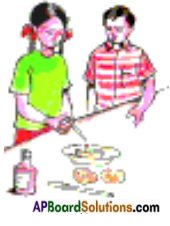
AP Board 8th Class English Solutions I Can Take Care of Myself

Question 1.
In which year is the difference in infant mortality rates between male and female the highest?
Answer:
In the year 2003, the difference in infant mortality rates between male and female is the highest.

Question 2.
In which case and in which year do we find a sudden decrease in the IMR?
Answer:
We find sudden decrease in the case of male IMR in the year 2003.

Question 3.
What will happen if there is a wide gap in IMR between male and female?
Answer:
If there is a wide gap in IMR between male and female, one of them (either male or female) will be left unmarried. There will be an imbalance in the ratio between the male and female.
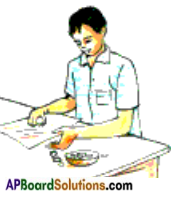
Question 4.
What, according to you, may the reasons be for the female IMR being higher than the male IMR?.
Answer:
I think the reason may be that the parents think that girl children are burdensome. They think it is very difficult to educate them and get them married to the males. They have to give dowry to the males. So, most of the parents don’t want female children. Hence, the female IMR is higher than the male IMR.

Question 5.
What may be the reasons for the decrease in IMR rates over the years?
Answer:
The reasons for the decrease in IMR rates over the years.

  1. The attitude of the parents is changed with the times.
  2. Increasing medical facilities.
  3. Increase in the literacy rate among the girls (women).
  4. Women empowerment.

AP Board 8th Class English Solutions I Can Take Care of Myself

Question 6.
Do you think there could be a further decrease in the IMR after 5 years?
Answer:
Yes. I think there would be a further decrease in the IMR after 5 years.

Question 7.
What, according to you, may the reasons be for the death of more than half of both male and female infants?
Answer:
The reasons for the death of more than half of both male and female infants.

  1. The superstitious beliefs of the parents. (Village parents)
  2. Lack of proper medical facilities.
  3. In some cases the young couples don’t want the children in the earlier days after their marriage. They think that the children will obstruct their privacy.

II. Group Work :
Discuss the above questions in your group and write an analytical report on the Infant Mortality Rates in India.
Answer:
When we observe the bar diagram, there has been a gradual decrease in both the female IMR and the male IMR. There is a sudden fall in the male IMR in 2003. The difference in infant mortality rates between male and female is the highest in 2003. The decrease in the IMR shows us the changed views of the parents with the times. If there is a wide gap in IMR between male and female, one of genders will be left unmarried and there is an imbalance in the family system. The parents think that females are burdensome. They feel it difficult to educate and get them married. They are not in a position to give dowry to the males. So, most of the parents don’t want female children. Hence, the female IMR is higher than the male IMR. The main reason for the decrease in IMR over the years is that the parents have changed their attitude with the times. The advanced medical facilities and the increase in the literacy rate among the girl children are also reasons for it. I think there will be a further decrease in the IMR after 5 years.

AP Board 8th Class English Solutions I Can Take Care of Myself

Oral Activity

Work in pairs and debate on the following proposition.
“Reservation in education, employment and legislature will empower the women.”
Answer:
Argument for the statement:
There is no doubt, surely reservation in education, employment and legislature will empower the women. As all of us know, today most of the women’s lives are confined to the kitchen. They have to depend upon their husbands for everything. They can’t protect themselves. If they have reservation, most of the women get good education and employment. Then they don’t have to beg anyone for anything. They will be able to lead a dignified life. If there is reservation in legislature, there will be more women participation in politics and society. It is expected to create equal opportunities for women along with men with reservation for women. Our society is a male dominated one. Reservation in education, employment and legislature would amount to a positive discrimination. Reservation for women not only empowers them but also helps the society.
Argument against the statement:
Can reservations for women be an effective measure and do the women really require such special treatment and will they be really empowered with reservations ? The intelligent male persons will lose the opportunities if the women are given reservations. Instead of providing any solution to this problem, giving reservations to women may give rise to social, political and psychological tensions. Besides, it is debatable if more women will attend schools, colleges or offices merely because of reservations. Reservation for women can be a temporary sort of relief and it won’t empower them. There should be a broader political, social and economic policy for the upliftment and empowerment of women.

AP Board 8th Class English Solutions I Can Take Care of Myself

Project work

A. Interview some female members in your family and neighbourhood with the following questions.
Would you like the girls in the family to take up a job after they have received education?
If yes, give some reasons.
Yes, I would like the girls in the family to take up a job after they have received education. The girl child is an equal partner in sharing the responsibilities and duties. An educated girl can render financial assistance to the father and later to the husband. The woman can take care of herself if she is employed. She doesn’t need to depend on others. She is able to lead a dignified life. So, the girls should take up a job after they have received education.
If no, give some reasons.
No, I would not like the girls in the family to take up a job after they have received education. The girl child’s primary duty in the later part of life is to look after the family and children. So, she doesn’t need to take up a job. If she takes up a job, she can’t find time to look after the family and children when she gets married.

B. Work on the following items.
Note down whether the woman you have interviewed is educated or uneducated; working/not working; married/unmarried.
AP Board 8th Class English Solutions Chapter 5C I Can Take Care of Myself 2
Answer:
AP Board 8th Class English Solutions Chapter 5C I Can Take Care of Myself 3

C. Based on the above information write a paragraph on ‘Woman Empowerment’.
Answer:
I have interviewed five women. Of them three women are married the rest of the two are unmarried. Three women are employed and the rest of the two are unemployed. All the five women opined that the women should be empowered. The employed women opined that they couldn’t find time to serve their families. The unemployed women want to stand on their feet. They want financial independence. They want jobs to get the stability and share the responsibilities and duties along with men. A woman is dynamic in
many roles she plays. She has to face many challenges and find out practical solutions. She is facing the challenges of economic inequality, gender-based violence, limited leadership and political participation and other issues. So, the women should be provided with more opportunities which could empower them to improve their lives, their rights and their future.

AP Board 8th Class English Solutions I Can Take Care of Myself

Grammar Family

Parts of Speech

There is a family in London whose surname is grammar. There is a couple, Mr. Noun and Mrs. Verb. The couple has three children-one son pronoun and two daughters adverb and adjective. The son (pronoun) has to do all the work of his father in his absence. The two daughters love each other but there is a difference in them. Adjective loves her father and brother and keeps praising them. Adverb loves her mother more she always modifies her when there is a need. There are two servants in the family, preposition and conjunction. The preposition is the chief servant. He is the official servant of his master. He is the family servant and looks after every member of the family. The interjection joins the family in times of joy and sorrow.

I Can Take Care of Myself Summary in English

Once, a mother rat wanted to get her young daughter married to the most powerful being that she could find. She thought that the sun god was the most powerful being on earth. So, she asked the sun god if he was the most powerful being on earth. The sun god smiled and replied that the rain was greater than him as there would be no water on earth or no crop or tree without the rain. So, the mother rat asked the rain god if he was the most powerful being on earth. The rain god smiled and replied that the mountain was greater than him as he would protect the creatures. He blocked the clouds and let the water flow safely. The mother rat asked the mountain god if he was the most powerful being on earth. The mountain god smiled and replied that the worm was greater than him. He also told that the earthworm was the greatest friend of the living beings. The mother rat’s daughter came to her and asked her what she was doing. The mother replied that she was looking for the most powerful being on earth to get her married. She also told her daughter that she would be safe if she married the most powerful being on earth. The daughter replied why she would need to marry to be safe. She also told that she would need to know how to take care of herself if she wanted to be safe. To protect herself, she needed to learn to be strong and work hard. She wanted to be powerful herself, so that she could take care of herself and those that she loved. She wanted to stand on her own feet. She opined that she needed to learn more about the world and learn to live in it as a good creature. She asked for her mother’s help. She wanted her mother’s support. She was not interested in marrying anybody. She didn’t want to depend on others. She wanted to believe her power only.


AP SSC 10th Class Maths Notes Chapter 8 Similar Triangles

Students can go through AP SSC 10th Class Maths Notes Chapter 8 Similar Triangles to understand and remember the concepts easily.

AP State Syllabus SSC 10th Class Maths Notes Chapter 8 Similar Triangles

→ The geometrical figures which have the same shape but are not necessarily of the same size are called similar figures.

→ The heights and distances of distant objects can be found using the principles of similar figures.

→ Two polygons with same number of sides are said to be similar if their corresponding angles are equal and their corresponding sides are in proportion.

→ A polygon in which all sides and all its angles are equal is called a regular polygon. Eg.:
AP SSC 10th Class Maths Notes Chapter 8 Similar Triangles 1

AP SSC 10th Class Maths Notes Chapter 8 Similar Triangles

→ The ratio of the corresponding sides is referred to as scale factor or representative factor.

→ All squares are similar.

→ All circles are similar.

→ All equilateral triangles are similar.

→ Two congruent figures are similar but two similar figures need not be congruent.

→ A square ABCD and a rectangle PQRS are of equal corresponding angles, but their corre¬sponding sides are not in proportion.
AP SSC 10th Class Maths Notes Chapter 8 Similar Triangles 2
∴ The square ABCD and the rectangle PQRS are not similar.

→ The corresponding sides of a square ABCD and a rhombus PQRS are equal but their corresponding angles are not equal. So they are not similar.
AP SSC 10th Class Maths Notes Chapter 8 Similar Triangles 3

→ If a line is drawn parallel to one side of a triangle intersecting the other two sides at two distinct points then the other two sides are divided in the same ratio.
AP SSC 10th Class Maths Notes Chapter 8 Similar Triangles 4
In △ABC; DE // BC then \(\frac{AD}{DB}\) = \(\frac{AE}{EC}\).
This is called Basic proportionality theorem (or) Thale’s theorem.

AP SSC 10th Class Maths Notes Chapter 8 Similar Triangles

→ If a line divides any two sides of a triangle in the same ratio, then the line must be parallel to the third side.
AP SSC 10th Class Maths Notes Chapter 8 Similar Triangles 5
In △ABC, a line ‘l’ intersecting AB in D and AC in E
such that \(\frac{AD}{DB}\) = \(\frac{AE}{EC}\) then l // BC.
This is converse of Thale’s theorem.

→ Two triangles are similar, if
i) their corresponding angles are equal.
ii) their corresponding sides are in the same ratio.

→ If in two triangles, corresponding angles are equal, then their corresponding sides are in the same ratio or proportional and hence the two triangles are similar.
AP SSC 10th Class Maths Notes Chapter 8 Similar Triangles 6
In △ABC, △DEF
∠A = ∠D
∠B = ∠E
∠C = ∠F
⇒ \(\frac{AB}{DE}\) = \(\frac{BC}{EF}\) = \(\frac{AE}{DF}\)
∴ △ABC ~ △DEF (A.A.A)

AP SSC 10th Class Maths Notes Chapter 8 Similar Triangles

→ If in two triangles, sides of one triangle are proportional to the sides of other triangle, then their corresponding angles are equal and hence the two triangles are similar.
AP SSC 10th Class Maths Notes Chapter 8 Similar Triangles 7
In △ABC, △DEF
if \(\frac{AB}{DE}\) = \(\frac{BC}{EF}\) = \(\frac{AE}{DF}\)
⇒ ∠A = ∠D
∠B = ∠E
∠C = ∠F
Hence, △ABC ~ △DEF (S.S.S)

→ If two angles of a triangle are equal to two corresponding angles of another triangle then the two triangles are similar.
AP SSC 10th Class Maths Notes Chapter 8 Similar Triangles 12
In △ABC, △DEF
if ∠A = ∠D
∠B = ∠E
⇒ ∠C = ∠F (By Angle Sum property)
∴ △ABC ~ △DEF (A.A)

→ If one angle of a triangle is equal to one angle of other triangle and the sides including these angles are proportional, then the two triangles are similar.
AP SSC 10th Class Maths Notes Chapter 8 Similar Triangles 13
In △ABC, △DEF if ∠A = ∠D, and
\(\frac{AB}{DE}\) = \(\frac{AC}{DF}\)
⇒ △ABC ~ △DEF (S.A.S)

AP SSC 10th Class Maths Notes Chapter 8 Similar Triangles

→ The ratio of areas of two similar triangles is equal to the ratio corresponding sides.
AP SSC 10th Class Maths Notes Chapter 8 Similar Triangles 14
AP SSC 10th Class Maths Notes Chapter 8 Similar Triangles 15

→ If a perpendicular is drawn from the vertex, containing the right angle of a right angled – triangle to the hypotenuse, then the triangles on each side of perpendicular are similar to one another and to the original triangle. Also the square of the perpendicular is equal to the product of the lengths of the two parts of the hypotenuse.
In △ABC, ∠B = 90°
BD ⊥ AC
AP SSC 10th Class Maths Notes Chapter 8 Similar Triangles 16
Then △ADB ~ △BDC ~ △ABC and
BD2 = AD . DC

→ Pythagoras theorem: In a right angled triangle, the square of hypotenuse is equal to the sum of the squares of other two sides.
AP SSC 10th Class Maths Notes Chapter 8 Similar Triangles 17
In △ABC; ∠A = 90°
AB2 + AC2 = BC2

→ In a triangle, if square of one side is equal to sum of squares of the other two sides, then the angle opposite to the first side is right angle.
AP SSC 10th Class Maths Notes Chapter 8 Similar Triangles 18
In △ABC, if
AC2 = AB2 + BC2 then ∠B = 90°
This is converse of Pythagoras theorem.

AP SSC 10th Class Maths Notes Chapter 8 Similar Triangles

→ Baudhayan Theorem (about 800 BC):
The diagonal of a rectangle produces itself the same area as produced by its both sides (i.e., length and breadth).
In rectangle ABCD,
AP SSC 10th Class Maths Notes Chapter 8 Similar Triangles 19
area produced by the diagonal AC = AC • AC
= AC2
area produced by the length = AB • BA = AB
area produced by the breadth = BC • CB = BC2
Hence, AC2 = AB2 + BC2.

→ A sentence which is either true or false but not both is called a simple statement.

→ A statement formed by combining two or more simple statements is called a compound statement.

→ A compound statement of the form “If …… then ……” is called a Conditional or Implication.

→ A statement obtained by modifying the given statement by ‘NOT’ is called its negation.

AP Board 8th Class English Solutions Chapter 3C The Garden Within

AP State Syllabus AP Board 8th Class English Textbook Solutions Chapter 3C The Garden Within Textbook Questions and Answers.

AP State Syllabus 8th Class English Solutions Chapter 3C The Garden Within

8th Class English Chapter 3C The Garden Within Textbook Questions and Answers

Look at the pictures given and answer the questions that follow.

Comprehension

Question 1.
What is the central idea of the poem?
Answer:
There is a garden in the poet’s heart. She wants to tend it beautifully. She wants to be grateful to achieve her goal. She wants to be good to others. When one is good to others, one will get respect. When one is thankful, one will reach one’s goal.

Question 2.
What features of the garden in the poet’s heart are mentioned in stanza 1?
Answer:
The feature of the garden in the poet’s heart that is mentioned in stanza 1 is that beauty grows in fits and starts.

AP Board 8th Class English Solutions Chapter 3C The Garden Within

Question 3.
What is the mood of the poet? Put a tick (✓) mark,
a. sad b. hopeful c. thankful
Answer:
b) hopeful ( ✓)

Question 4.
Explain the word ‘gratitude’ as used in the poem.
Answer:
‘Gratitude’ means thankfulness. The poetess wants to be thankful to achieve her goal and it will comfort her soul.

Simile, Metaphor and Personification:

Observe the following sentences.

1. Here and there over the grass stood beautiful flowers like stars.
In this sentence “flowers are compared to stars” such a comparison using ‘like’ and ‘as’ is called ‘simile’.
e.g.: a. He roared like a lion.
b. Her face is as white as snow.

2. Life is a journey. Enjoy the ride.
In the above sentence the word ‘journey’ is used to describe/compare the word ‘life’. Such words are called ‘metaphor’. They are used to show that two things have same qualities. They make the description more powerful, e.g.: a. Rudramadevi was a lioness in battle, b. Her home was a prison.

3. Spring has forgotten his garden.
Here, though ‘spring’ is a season, it is represented as a human being and given the qualities of forgetting, etc. Such usage in literature is called ‘personification’, e.g.: a. The stars danced playfully in the moonlit sky.
b. The snow covered up the grass with her great white cloak.

AP Board 8th Class English Solutions Chapter 3C The Garden Within

Project work

Collect a few story books and fill in the table with details and present it before the class.

AP Board 8th Class English Solutions Chapter 3C The Garden Within 1

Answer:
AP Board 8th Class English Solutions Chapter 3C The Garden Within 2

The Garden Within Summary in English

The poetess finds that there is a garden in her heart. Like the gardener who lovingly tends his garden for the pleasures of bloom, the poetess nourishes the memories because they comfort her soul. In the garden of her heart beauty doesn’t grow continuously. She wants to give her smiles to others like the petals of the flowers in the garden of her heart. Then the others will respond in the same way and respect her feelings. There is a good hope in her and it results in good seeds to comfort her spirit. She wants to reach her goal with thankfulness and it will touch her soul. Here the soul of the poetess is compared with beautiful garden.

The Garden Within Glossary

petal (n): a delicate coloured part of a flower

bestowed (v): gave, showed respect

bowers (n): a pleasant place in the shade of tree

AP Board 8th Class English Solutions Chapter 3C The Garden Within

nutritious (adj): good

reaps (v): gives

spirit (n): inner feeling or mood

gratitude (n): thankfulness

goal (n): something that you hope to achieve

in fits and starts (phr): in a sudden and irregular manner