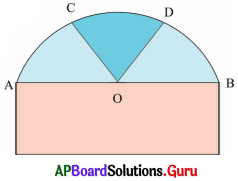
AP Board 7th Class Maths Solutions Chapter 4 Lines and Angles Exercise 4.2

SCERT AP 7th Class Maths Solutions Pdf Chapter 4 Lines and Angles Ex 4.2 Textbook Exercise Questions and Answers.

AP State Syllabus 7th Class Maths Solutions 4th Lesson Lines and Angles Exercise 4.2

Question 1.
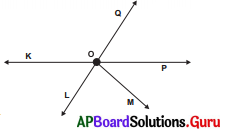
Observe the given figure and write any 2 linear pairs of angles.
AP Board 7th Class Maths Solutions Chapter Chapter 4 Lines and Angles Ex 4.2 1
Answer:
Linear pair of angles :
∠KOQ, ∠QOP
∠KOQ, ∠KOL
∠KOL, ∠LOP
∠QOP, ∠POL
∠KOM, ∠MOP
∠QOM, ∠MOL

Question 2.
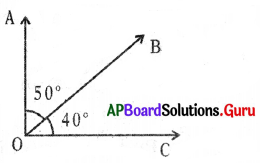
Draw a pair of adjacent angles which are complementary to each other.
Answer:
AP Board 7th Class Maths Solutions Chapter Chapter 4 Lines and Angles Ex 4.2 2
In the figure ∠AOB, ∠BOC are adjacent angles and their sum is complementary.
∴ ∠AOB + ∠BOC = 50° + 40° = 90°

Question 3.
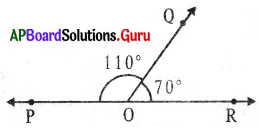
Draw a pair of adjacent angles which are supplementary to each other.
Answer:
AP Board 7th Class Maths Solutions Chapter Chapter 4 Lines and Angles Ex 4.2 3
In the figure ∠POQ, ∠OOR are linear pair and adjacent angles and their sum is supplementary.
∴ ∠POQ + ∠OOR = 110° + 70° = 180°

Question 4.
Give any two examples of adjacent angles in your surroundings.
Answer:
Fan, Bullock cart wheel, Clock, etc.

AP Board 7th Class Maths Solutions Chapter 4 Lines and Angles Exercise 4.2

Question 5.
Observe the figure and write the adjacent angles.
AP Board 7th Class Maths Solutions Chapter Chapter 4 Lines and Angles Ex 4.2 4
Answer:
In the given figure, adjacent angles are
∠AOC, ∠COB
∠AOC, ∠COD
∠COD, ∠DOB
∠AOD, ∠DOB

Question 6.
Is it possible for the following pair of angles to form a linear pair? If yes, draw them. If not, give reason.
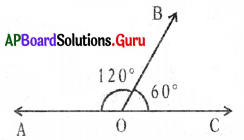
(i) 120°, 60°
Answer:
Yes.
AP Board 7th Class Maths Solutions Chapter Chapter 4 Lines and Angles Ex 4.2 5
120° + 60° = 180°
120°, 60° (Linear pair)

(ii) 98°, 102°
Answer:
No, their sum is not equal to 180°
98° + 102° = 200° > 180°
So, they are not 1irear pair.

Question 7.
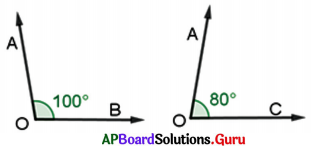
Draw the following angles as linear pair. Write the straight line and common arm.
AP Board 7th Class Maths Solutions Chapter Chapter 4 Lines and Angles Ex 4.2 6
Answer:
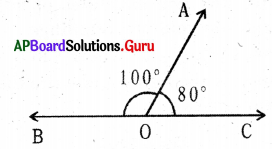
∠BOA + ∠AOC = 180°
AP Board 7th Class Maths Solutions Chapter Chapter 4 Lines and Angles Ex 4.2 7
∴ ∠BOA and ∠AOC are linear pair.
BC is a straight line and OA is an arm.

Question 8.
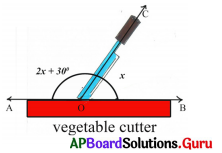
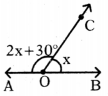
In the given figure, AB is a straight line. O is a point on AB . Find the value of x.
AP Board 7th Class Maths Solutions Chapter Chapter 4 Lines and Angles Ex 4.2 8
Answer:
In the given figure \(\overrightarrow{\mathrm{AB}}\) is a straight line.
∠AOC + ∠COB = 180°
AP Board 7th Class Maths Solutions Chapter Chapter 4 Lines and Angles Ex 4.2 9
⇒ 2x + 30° + x = 180°
⇒ 3x + 30°= 180°
⇒ 3x + 30° – 30°= 180°
⇒ 3x = 150°
⇒ \(\frac{3 x}{3}=\frac{150^{\circ}}{3}\)
⇒ x = 50

AP Board 7th Class Maths Solutions Chapter 4 Lines and Angles Exercise 4.2

Question 9.
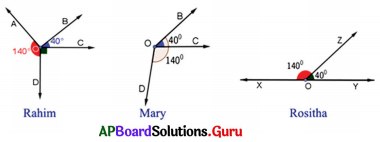
Teacher asked students to check whether 40° and 140° form a linear pair or not by drawing angles. The students have drawn as follows. Who will get correct answer?
AP Board 7th Class Maths Solutions Chapter Chapter 4 Lines and Angles Ex 4.2 10
Answer:
Raheem: ∠AOD = 140°, ∠BOC = 40° they are not adjacent angles and not linear pair.
So, Raheem is not correct.

Mary: ∠COD = 140°, ∠BOC = 40° they are adjacent angles, but they are not linear pair.
So, Mary answer is not correct.

Roshitha: ∠XOZ = 140°, ∠ZOY = 40° they are adjacent angles and linear pair.
So, Roshitha answer is correct.

AP SSC 10th Class Maths Solutions Chapter 10 Mensuration Optional Exercise

AP State Syllabus SSC 10th Class Maths Solutions 10th Lesson Mensuration Optional Exercise

AP State Board Syllabus AP SSC 10th Class Maths Textbook Solutions Chapter 10 Mensuration Optional Exercise Textbook Questions and Answers.

10th Class Maths 10th Lesson Mensuration Optional Exercise Textbook Questions and Answers

Question 1.
A golf ball has diameter equal to 4.1 cm. Its surface has 150 dimples each of radius 2 mm. Calculate total surface area which is exposed to the surroundings. (Assume that the dimples are all hemispherical) [π = \(\frac{22}{7}\)]
Answer:
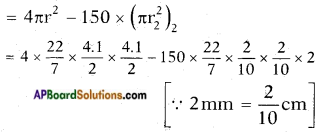
Area exposed = surface area of the ball – total area of 150 hemispherical with radius 2 mm
∴ C.S.A of hemisphere = 2πr2
AP SSC 10th Class Maths Solutions Chapter 10 Mensuration Optional Exercise 1
= 52.831 – 37.71 = 15.12 cm2.

AP SSC 10th Class Maths Solutions Chapter 10 Mensuration Optional Exercise

Question 2.
A cylinder of radius 12 cm. contains water to a depth of 20 cm. A spherical iron ball is dropped into the cylinder and thus the level of water is raised by 6.75 cm. Find the radius of the ball. [π = \(\frac{22}{7}\)]
Answer:
Rise in the water level is seen as a cylinder of radius ‘r’ = 12 cm
Height, h = 6.75 cm.
Volume of the rise = Volume of the spherical iron ball dropped
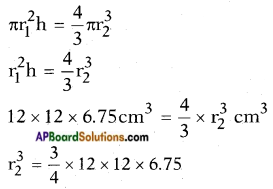
AP SSC 10th Class Maths Solutions Chapter 10 Mensuration Optional Exercise 3
= 9 × 12 × 6.75
= 108 × 6.75
= 729
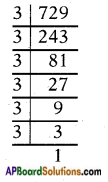
AP SSC 10th Class Maths Solutions Chapter 10 Mensuration Optional Exercise 2
r3 = 9 × 9 × 9
∴ 729 = (3 × 3) × (3 × 3) × (3 × 3)
∴ Radius of the ball r = 9 cm.

AP SSC 10th Class Maths Solutions Chapter 10 Mensuration Optional Exercise

Question 3.
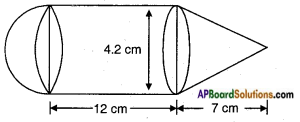
A solid toy is in the form of a right circular cylinder with a hemispheri¬cal shape at one end and a cone at the other end. Their common diameter is 4.2 cm. and height of the cylindrical and conical portion are 12 cm. and 7 cm. respectively. Find the volume of the solid toy. [π = \(\frac{22}{7}\)]
Answer:
AP SSC 10th Class Maths Solutions Chapter 10 Mensuration Optional Exercise 4
Volume of the toy = volume of the hemisphere + volume of the cylinder + volume of the cone.
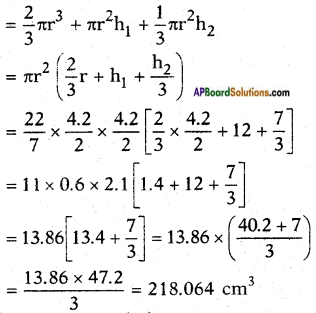
AP SSC 10th Class Maths Solutions Chapter 10 Mensuration Optional Exercise 5
Hemisphere:
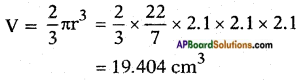
Radius = \(\frac{d}{2}\) = \(\frac{4.2}{2}\) = 2.1 cm
AP SSC 10th Class Maths Solutions Chapter 10 Mensuration Optional Exercise 6
Cylinder:
Radius, r = \(\frac{d}{2}\) = \(\frac{4.2}{2}\) = 2.1 cm
height, h = 12 cm
V = πr2h
= \(\frac{22}{7}\) × 2.1 × 2.1 × 12
= 166.32 cm3
Cone: Radius, r = \(\frac{d}{2}\) = \(\frac{4.2}{2}\) = 2.1 cm
Height, h = 7 cm
Volume = \(\frac{1}{3}\)πr2h
= \(\frac{1}{3}\) × \(\frac{22}{7}\) × 2.1 × 2.1 × 7
= 32.34 cm3
∴ Total volume = 19.404 + 166.32 + 32.34 = 218.064 cm3.

AP SSC 10th Class Maths Solutions Chapter 10 Mensuration Optional Exercise

Question 4.
Three metal cubes with edges 15 cm., 12 cm. and 9 cm. respectively are melted together and formed into a simple cube. Find the diagonal of this cube.
Answer:
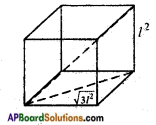
Edges l1 = 15 cm, l2 = 12 cm, l3 = 9 cm.
AP SSC 10th Class Maths Solutions Chapter 10 Mensuration Optional Exercise 7
Volume of the resulting cube = Sum of the volumes of the three given cubes
L3 = l13 + l23 + l33
L3 = 153 + 123 + 93
L3 = 3375 + 1728 + 729
L3 = 5832 = 18 × 18 × 18
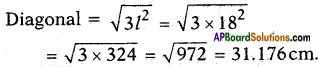
∴ Edge of the new cube l = 18 cm
AP SSC 10th Class Maths Solutions Chapter 10 Mensuration Optional Exercise 9

Question 5.
A hemispherical bowl of internal diameter 36 cm. contains a liquid. This liquid is to be filled in cylindrical bottles of radius 3 cm. and height 6 cm. How many bottles are required to empty the bowl?
Answer:
Let the number of bottles required = n
Then total volume of n bottles = volume of the hemispherical bowl
n. πr12h = πr22h
Bottle:
Radius, r = 3 cm; Height, h = 7 cm
Volume, V = πr2h
= \(\frac{22}{7}\) × 3 × 3 × 7
= 198 cm3
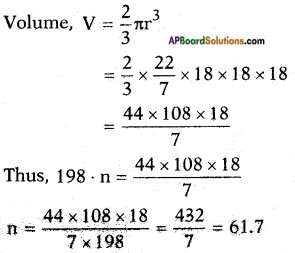
∴ Total volume of n bottles = 198 . n cm3.
Bowl:
Radius, r = \(\frac{d}{2}\) = \(\frac{36}{2}\) = 18 cm
AP SSC 10th Class Maths Solutions Chapter 10 Mensuration Optional Exercise 8
∴ 62 bottles are required to empty the bowl.

AP Board 9th Class Social Solutions Chapter 19 విస్తరిస్తున్న ప్రజాస్వామ్యం

SCERT AP 9th Class Social Studies Guide Pdf 19th Lesson విస్తరిస్తున్న ప్రజాస్వామ్యం Textbook Questions and Answers.

AP State Syllabus 9th Class Social Solutions 19th Lesson విస్తరిస్తున్న ప్రజాస్వామ్యం

9th Class Social Studies 19th Lesson విస్తరిస్తున్న ప్రజాస్వామ్యం Textbook Questions and Answers

Improve your learning (మీ అభ్యసనాన్ని మెరుగుపడుచుకోండి)

పటం 1 : 1900 – 1950లలో ప్రజాస్వామ్య దేశాలు.
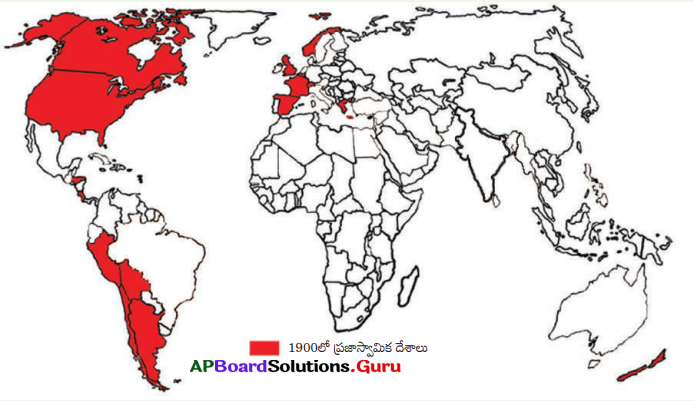
AP Board 9th Class Social Solutions Chapter 19 విస్తరిస్తున్న ప్రజాస్వామ్యం 1
పటం 2 : 2011లో ప్రజాస్వామిక దేశాలు
AP Board 9th Class Social Solutions Chapter 19 విస్తరిస్తున్న ప్రజాస్వామ్యం 2

ప్రశ్న 1.
అ) ఇచ్చిన పటాల ఆధారంగా కింద ఇచ్చిన పట్టికలోని ఖండాలలో ప్రజాస్వామిక దేశాల పేర్లు రాయండి. (AS5)

AP Board 9th Class Social Solutions Chapter 19 విస్తరిస్తున్న ప్రజాస్వామ్యం 3

ఆ) 2011లో ప్రజాస్వామికంగా ఉన్న ఆఫ్రికా దేశాలను గుర్తించండి.
జవాబు:

  1. దక్షిణాఫ్రికా
  2. నమీబియా
  3. బోట్సువానా
  4. మొజాంబిక్
  5. నైజీరియా
  6. జాంబియా
  7. టాంజానియా
  8. కెన్యా
  9. మడగాస్కర్
  10. మాలి
  11. సూడాన్

ఇ) 2011లో ప్రజాస్వామికం లేని పెద్ద దేశాలను గుర్తించండి.
జవాబు:

  1. చైనా
  2. కజకిస్థాన్
  3. సౌదీ అరేబియా
  4. అల్జీరియా
  5. జైరా
  6. అంగోలా
  7. ఇథియోపియా
  8. సోమాలియా

ప్రశ్న 2.
పటాలను అధ్యయనం చేసి కింది విషయాల గురించి ఆలోచించండి. (AS5)
అ) పటాల ఆధారంగా 20వ శతాబ్దం ప్రజాస్వామ్య విస్తరణకు ముఖ్యమైన యుగంగా పేర్కొనవచ్చా?
జవాబు:
అవును

ఆ) 20వ శతాబ్దంలో ప్రజాస్వామ్యం ప్రధానంగా ……………….. ఖండాలలో ఉండింది. ఇంకోవైపు ……………., ………… ఖండాలలో దాదాపుగా ప్రజాస్వామిక దేశాలు లేవు.
జవాబు:
ఉత్తర అమెరికా, ఐరోపా ; ఆఫ్రికా, ఆసియా.

ఇ) ఈనాటికి కూడా ప్రజాస్వామిక ప్రభుత్వాలు లేని …………………… వంటి కొన్ని ప్రాంతాలు ఉన్నాయి.
జవాబు:
నైరుతీ ఆఫ్రికా, ఉత్తర ఆసియా.

AP Board 9th Class Social Solutions Chapter 19 విస్తరిస్తున్న ప్రజాస్వామ్యం

ప్రశ్న 3.
చాలా దేశాలు ఎన్నికలు నిర్వహిస్తూ తాము ప్రజాస్వామిక దేశాలమని పేర్కొంటాయి. ఈ ఎన్నికలు మయన్మార్, లిబియాలలో ఎలా జరిగాయి? (AS1)
జవాబు:
లిబియా వలస పాలన నుండి, రాచరిక పాలన నుండి గఢాఫి, సైనిక నియంతృత్వ పరిపాలన కొనసాగింది. అంచెలంచెలుగా అభివృద్ధి చెంది సామాజిక సంక్షేమంలో లిబియా అత్యున్నత స్థానాన్ని సాధించింది. ప్రజా సంఘాలను ఏర్పాటు చేయటం, కేంద్రంలో ఎన్నికైన ప్రజా శాసనసభ ద్వారా ప్రజా వ్యవహారాలలో సాధారణ ప్రజలు పాలుపంచుకోటాన్ని లిబియాలో ప్రోత్సహించారు. 2010 ద్వితీయార్ధం అరబ్ ప్రపంచంలో ప్రజాస్వామిక ప్రభుత్వాలను ఏర్పాటు చేయటానికి అనేక ఉద్యమాలు చెలరేగాయి. అందులో లిబియా ఒకటి. సైనిక పాలనకు వ్యతిరేకంగా ప్రజలలో ఉద్యమాలు జరుగుతూనే ఉన్నాయి. 2012 నుండి లిబియాలో ప్రజాస్వామ్య పద్ధతులలో ఎన్నికలు జరుగుతున్నాయి.

బర్మాలో ప్రజాస్వామ్య పద్దతిలో ఎన్నికలు నిర్వహించాలని, ప్రజలందరి హక్కులు కాపాడాలని బర్మన్ జాతి నాయకుడు ఆంగ్ సాన్ కృషి చేశాడు. కాని ఆయనను చంపేశారు. తదుపరి బర్మా సైన్యాధిపతి జనరల్ నెవిన్ అధీనంలోకి వెళ్ళిపోయింది. బర్మాలో సంక్షేమం జరగలేదు. సైన్యాధిపతులు హక్కులు ఉల్లంఘించారు. 1988 నుండి బర్మాలో ప్రజాస్వామ్య పద్ధతిలో ఎన్నికలు నిర్వహించడానికి ఆంగ్ సాన్ సూకి కేంద్ర బిందువుగా మారారు. 2011లో ప్రజాస్వామ్య పద్దతిలో ఎన్నికలు జరుగగా 45 పార్లమెంట్ స్థానాలకు గాను 43 సీట్లు ఆంగ్ సాన్ సూకి సారథ్యం గల ఎన్ఎల్ డి గెలుచుకుంది. భవిష్యత్తులో పలు పార్టీలు పోటీచేసే ఎన్నికలు జరుగుతాయని ఆశిద్దాం.

ప్రశ్న 4.
ప్రసార మాధ్యమాల (మీడియా)ను నియంత్రించటానికి పాలకులు ఎందుకు ప్రయత్నించేవాళ్ళు? మీ ప్రాంతంలో ప్రసార మాధ్యమాలపై నియంత్రణ ఏవిధంగా ఉందో మీకు తెలుసా? (AS4)
జవాబు:
ప్రజలను చైతన్యవంతులను చేయడానికి, ప్రజలలో రాజకీయ అవగాహన కల్గించి, విజ్ఞానవంతులను చేయడానికి ప్రసార మాధ్యమాలు ప్రధాన భూమిక పోషిస్తాయి. ప్రసార మాధ్యమాలను పాలకులు తమ అధీనంలో ఉంచుకొని, వాటి ద్వారా ప్రజలను తమ పాలనపై మంచి అభిప్రాయం కలిగేటట్లు కార్యక్రమాలు రూపొందించేవాళ్ళు.

ప్రసార మాధ్యమాలను నియంత్రించకపోతే అవి పాలకుల అవినీతి, నిరంకుశత్వ నిర్ణయాలు, దోపిడీ పరిపాలన, ప్రజలను ఏవిధంగా మోసం చేసి పరిపాలిస్తున్నదీ తెలియజేసి ప్రజలను, ముఖ్యంగా యువత, మహిళలను చైతన్యపరిచినట్లైతే వారు నిరసనలు, ఉద్యమాల ద్వారా పాలకుల పాలనకు చరమగీతం పాడగలరు. చరిత్రలో ఎన్నో సాక్ష్యాలు కలవు. అందుకే ప్రసార మాధ్యమాలను నియంత్రించేవాళ్లు.

మా ప్రాంతంలో రేడియో, దూరదర్శన్లు పూర్తిగా ప్రభుత్వ నియంత్రణలో ఉన్నాయి. ప్రభుత్వ పాలనకు వ్యతిరేకంగా ఈ మాధ్యమాల కార్యక్రమాలు అమలుచేయటానికి వీలులేదు.

ప్రశ్న 5.
తమ దేశాలలోని ప్రజాస్వామ్యం కోసం జరిగిన పోరాటాలు, ఘటనల గురించి లిబియా, మయన్మార్‌కు చెందిన పౌరుల మధ్య సంభాషణను ఊహించి రాయండి. (AS6)
సంభాషణ
జవాబు:
లిబియా పౌరులు : వలస పాలనను ఎదిరించి, రాచరికాన్ని కాదని, సైనిక పాలనను తలదన్ని, మేం స్వాతంత్ర్యం కోసం ప్రాణాలు అర్పించాం…… చరిత్రలో గొప్పవాళ్ళమయ్యాం.

మయన్మార్ పౌరులు : ఆగండి…. ఆగండి… ఏమీ మీ ప్రేలాపనలు. మీదొక పేద దేశం…. తినడానికి తిండి లేని దేశం. ఎడారులలో పశువులతో సంచరిస్తూ గడిపే మీ జీవితం. మీదొక చరిత్ర. ప్రజాస్వామ్యం కోసం పోరాటం…..

లిబియా పౌరులు : మీరు సాధించినది ఏమిటి? మీలో ఐక్యత లేదు. ప్రజలకు హక్కులు లేవు. బానిస బతుకులు వేలాదిమంది చావులు. ప్రజాస్వామ్యానికొక విధానం లేదు.

మయన్మార్ పౌరులు : ప్రజాస్వామ్యం కోసం పరితపించాం. సైనిక పాలనను ఎదిరించాం. ఆంగ్ సాన్ సూకిలాంటి వాళ్ళు తమ జీవితాలనే త్యాగం చేయడానికి, ప్రజాస్వామ్యాన్ని నిలబెట్టడానికి కృషి చేస్తున్నారు.

లిబియా పౌరులు : మా ప్రజాస్వామ్య పోరాటాలకు ప్రపంచ మద్దతు ఉంది. ఐక్యరాజ్య సమితి సైతం మా పోరాటాలకు స్ఫూర్తి నిచ్చింది. ప్రజాస్వామ్య ఎన్నికలు జరుగుతున్నాయి.

మయన్మార్ పౌరులు : మా దేశంలో ఆంగ్ సాన్ సూకీకి నోబెల్ శాంతి బహుమతి లభించింది. ఇదే మా ప్రజాస్వామ్య పోరాట స్ఫూర్తికి నిదర్శనం.

లిబియా పౌరులు : ఎన్నో పోరాటాలు, ఉద్యమాలు చేసి నేడు మేం ప్రజాస్వామ్య సంబరాలకు దగ్గరౌతున్నాం…..

మయన్మార్ పౌరులు : మేము కూడా ఎన్నెన్నో పోరాట పతాకాలు ఎగురవేసి ప్రజాస్వామ్య వేడుకలకు వెళుతున్నాం…….

ప్రశ్న 6.
ప్రజాస్వామ్యం పనిచేయటంలో అక్షరాస్యత, అందరికీ చదువు ఏ విధంగా దోహదం చేస్తాయి? (AS6)
(లేదా)
ప్రజాస్వామ్యం సమర్థవంతంగా పని చేయటంలో అక్షరాస్యత ఏ విధంగా దోహదం చేస్తుంది?
జవాబు:
ఏ దేశంలో అక్షరాస్యత అందరికీ చదువు అందుతుందో, ఆ దేశం ప్రజాస్వామ్యానికి బాటలు వేస్తుంది. ప్రజలు అక్షరాస్యులై విజ్ఞానవంతులైనచో పౌరహక్కుల వినియోగం, పౌరుల బాధ్యతలు సక్రమంగా అమలు జరుగుతాయి. ప్రజలలో పాలకులను ప్రశ్నించే తత్వం అలవడుతుంది. జవాబుదారీ పాలన కనపడుతుంది. అక్షరాస్యత, చదువుకున్న వాళ్ళలో కుటుంబ నిర్వహణ కాకుండా, తమ పనులలో, వృత్తులలో నైపుణ్యం చూపించి, ఆర్థిక, సాంఘిక, రాజకీయ రంగములలో అభివృద్ధి కనపడుతుంది. ప్రజాస్వామ్యంలో ప్రజాసంక్షేమం కోసం అనేక పథకాలు అమలు జరుగుతున్నాయి.. ఇవన్నీ సక్రమ వినియోగం జరగాలంటే ప్రజలు ఖచ్చితంగా అక్షరాస్యులవ్వాలి. మహిళా చట్టాలు, సమన్యాయపాలన, వివక్ష, దోపిడీ పాలన వంటి వాటిని దూరం చేయడానికి అక్షరాస్యత అవసరం. చదువుకున్న, చైతన్యవంతులైన యువత ఉండే ఆ దేశంలో ప్రజాస్వామ్య ఫలాలు పదికాలాలు నిలుస్తాయి.

AP Board 9th Class Social Solutions Chapter 19 విస్తరిస్తున్న ప్రజాస్వామ్యం

ప్రశ్న 7.
ప్రజాస్వామ్యం, నియంతృత్వాల మధ్య తేడాలు ఏమిటి? (AS1)
జవాబు:

ప్రజాస్వామ్యంనియంతృత్వం
1. స్వేచ్ఛా వాతావరణంలో ఎన్నికలుంటాయి.1. రాచరిక, సైనికపాలన ఉంటుంది.
2. పౌరులకు హక్కులు కల్పించబడతాయి.2. పౌరులకు హక్కులు అందించబడవు, నియంత్రించబడతాయి.
3. పత్రికా స్వేచ్ఛ ఉంటుంది.3. పత్రికలపై ఆంక్షలు విధించబడతాయి.
4. ప్రజలే పాలకులు.4. వంశపారంపర్య పాలన గాని, బలవంతంగా ఆక్రమించుకున్న పాలకులు.
5. లౌకిక రాజ్యం అమలులో ఉంటుంది.5. అధికారిక మతం ఉంటుంది.
6. పాలకులకు జవాబుదారీ తనం ఉంటుంది.6. జవాబుదారీ తనం ఉండదు.

ప్రశ్న 8.
మయన్మార్ లో ప్రజాస్వామ్యానికై పోరాడటంలో ఆంగ్ సాన్ సూకి పాత్ర ఏమిటి?
జవాబు:
తన తండ్రిగారైన బర్మన్ జాతి నాయకుడు ఆంగ్ సాన్ ఆశయాలు నిలబెట్టడానికి, బర్మాలో ప్రజాస్వామ్యాన్ని నెలకొల్పటానికి జరుగుతున్న పోరాటాలు, నిరసనలకు ఆ నాటి నుంచి నేటి వరకు ఆంగ్ సాన్ సూకీ కేంద్రబిందువయ్యారు. పౌరహక్కులు విస్తరింపజేయాలని, ప్రజాస్వామిక ప్రభుత్వాన్ని నెలకొల్పాలని, సైనిక ప్రభుత్వంపై ప్రపంచదేశాల ఒత్తిడికి కారణం సూకీ నిరంతర పోరాటదీక్షే. 2008 నుండి బర్మాలో స్వేచ్ఛా వాతావరణంలో ఎన్నికలు జరిపించటానికి, ప్రజాస్వామ్య ప్రభుత్వాన్ని తీసుకురావడానికి సూకీ తన జీవితాన్ని ఫణంగా పెట్టారు. కాని సైనిక ప్రభుత్వం ఆమెను గృహ నిర్బంధంలో ఉంచి, తన కొడుకులను కలుసుకోకుండా, తన భర్త చనిపోయిన సందర్భంలో కూడా ఆమెకు స్వేచ్ఛ కల్పించలేదు.

అయినా ఆమె బర్మాలో స్వేచ్ఛా వాతావరణంలో ఎన్నికలు జరిపించడానికి కృషిచేస్తూ (నేషనల్ లీగ్ ఫర్ డెమోక్రసి) “ జాతీయ ప్రజాస్వామ్య కూటమి” ద్వారా నిరంతరం పరితపిస్తూ, ప్రజాస్వామ్య ఫలాలు అందించడానికి తపిస్తున్నారు. ఈమె కృషికి 1991 లోనే ప్రపంచ శాంతి బహుమతి అందుకుంది.

ప్రశ్న 9.
ఈ అధ్యాయం చివరి పేరా చదివి కింది ప్రశ్నకు సమాధానమివ్వండి.
నూతన ప్రజాస్వామ్యం ఎలా ఉంటుంది? (AS2)
జవాబు:
దేశాలు ఎదుర్కొనే సంక్లిష్ట సమస్యలలో కొన్నింటిని పరిష్కరించటానికి ప్రజలందరి స్వేచ్ఛను, హక్కులను గౌరవించే
ప్రజాస్వామ్యమే సరైన మార్గమని అందరికీ స్పష్టమవుతుంది. అత్యంత పేద ప్రజలు, బలహీన వర్గాలు కూడా తమ గొంతుక వినిపించి ప్రభుత్వ విధానాలను ప్రభావితం చేయగల, అందరికీ న్యాయం, శాంతిని అందించగల నూతన ప్రజాస్వామిక విధానాన్ని రూపొందించటానికి ప్రపంచవ్యాప్తంగా ప్రయత్నం జరుగుతోంది.

9th Class Social Studies 19th Lesson విస్తరిస్తున్న ప్రజాస్వామ్యం InText Questions and Answers

9th Class Social Textbook Page No.235

ప్రశ్న 1.
ప్రజాస్వామ్యాన్ని ఏర్పరచటంలో ఈ రకమైన పరిస్థితులు ఎటువంటి సమస్యలను సృష్టిస్తాయి?
జవాబు:
జాతుల ప్రాబల్యం, సంచారజీవనం, నిరక్షరాస్యత, మహిళలపై ఆంక్షల నేపథ్యంలో ప్రజాస్వామ్యంలో ప్రజలందరూ పాలు పంచుకునేలా చేయటం చాలా కష్టమైన విషయం. ఇటువంటి పరిస్థితులలో ప్రజా సంఘాలను ఏర్పాటుచేయటం, కేంద్రంలో ఎన్నికైన ప్రజా శాసనసభ ద్వారా ప్రజా వ్యవహారాలలో సాధారణ ప్రజలు పాలుపంచుకోవటం చాలా సమస్యతో కూడుకున్న వ్యవహారం.

9th Class Social Textbook Page No.237

ప్రశ్న 2.
గఢాఫి ప్రభుత్వం వల్ల ఎంతో ప్రయోజనం పొందినప్పటికీ దానికి వ్యతిరేకంగా ఎందుకు తిరుగుబాటు చేశారు?
జవాబు:
గఢాఫి ప్రభుత్వం అనేక సంక్షేమ పథకాలు ప్రవేశపెట్టి లిబియాను అన్ని రంగాలలో ముందుంచింది. ఎన్నికైన ప్రజాసంఘాలు ద్వారా పరిపాలనకు మధ్యతరగతి వర్గం ప్రోత్సహించింది. కాని గఢాఫి ప్రజాస్వామ్యాన్ని నమ్మలేదు. గఢాఫి ప్రజా సంఘాలకు సమాంతరంగా విప్లవ సంఘాల నాయకత్వ వ్యవస్థను ఏర్పరిచారు. రాజకీయ ప్రత్యర్థులను చంపటానికి, చిత్రహింసలు పెట్టడానికి, చంపేయటానికి గఢాఫి ప్రభుత్వం సంకల్పించింది. రాజకీయ పార్టీలకు అవకాశం లేదు. పత్రికా స్వేచ్ఛ లేదు. కనుకనే వ్యతిరేకంగా తిరుగుబాటు చేశారు.

AP Board 9th Class Social Solutions Chapter 19 విస్తరిస్తున్న ప్రజాస్వామ్యం

ప్రశ్న 3.
గఢాఫి తనది ప్రజాస్వామిక ప్రభుత్వం అని చెప్పుకున్నప్పటికీ ప్రజాస్వామ్యంలో ఉండవలసిన ఏ అంశాలు అందులో లోపించాయి? ప్రజాస్వామిక ప్రభుత్వంలోని ఏ అంశాలు అందులో ఉన్నాయి?
జవాబు:
గఢాఫి రాచరికాన్ని రద్దుచేసి సైనిక పాలనలో ప్రభుత్వాన్ని ఏర్పరచినప్పటికీ ప్రజాసంక్షేమంకై అనేక సంస్కరణలు, పథకాలు అమలుచేసినప్పటికీ అందులో ప్రధానంగా ప్రజా సంఘాలను నమ్మటానికి సాహసించలేదు. ప్రజాస్వామ్యంలో రాజకీయ పార్టీలు ప్రధానపాత్ర పోషిస్తాయి. కాని గఢాఫి ఏ రాజకీయ పార్టీలకు అవకాశం కల్పించలేదు. కార్మిక సంఘాలు, ఇతర స్వతంత్ర సంఘాలకు ప్రాధాన్యత ఇవ్వలేదు. రాజకీయ ప్రత్యర్థులను హింసించటానికి పూనుకున్నారు. పత్రికలకు స్వేచ్ఛలేదు.

ప్రజాస్వామిక అంశాలు కూడా ఉన్నాయి.

  • అందరికీ విద్య, వైద్య సదుపాయాలు కల్పించారు.
  • వివక్షతను దూరం చేసి మహిళలకు స్వేచ్ఛ, సమాన హెూదా కల్పించటానికి కృషి చేశారు.
  • భూపంపిణీ, భూసంస్కరణలు అమలుచేశారు.
  • సామాజిక సంక్షేమానికి పెద్దపీట వేశారు.

ప్రశ్న 4.
ప్రజాస్వామ్యానికి పౌరహక్కులు ఉండటం ఎందుకు ముఖ్యం? లిబియా అనుభవం నేపథ్యంలో వివరించండి.
జవాబు:
లిబియాలో పౌరహక్కులకు భంగం కలిగించే అనేక అంశాలు గమనించవచ్చు. మహిళలపై అణచివేత దృశ్యాలు, ప్రజల సంక్షేమం కంటే పాలకులకు జాతి సంక్షేమం, గౌరవం ప్రధానంగా ఉండేవి. ప్రభుత్వంపై విమర్శలను, వ్యతిరేకతను సహించే అవకాశం లేదు. పత్రికా స్వేచ్ఛ, సమన్యాయ పాలన లేకపోవడం పౌరహక్కులు ముఖ్యమని వివరించవచ్చు.

ప్రశ్న 5.
పత్రికలు, టివి వంటి ప్రసార సాధనాలను నియంత్రించటానికి నిరంకుశ పాలకులు ప్రయత్నిస్తారు. ప్రజలు తమ ఆలోచనలను, సమాచారాన్ని పంచుకోగల ఇతర మాధ్యమాలు మీకు తెలుసా?
జవాబు:
సమావేశాలు, వారం వారం జరిగే సంతలు, వివిధ జానపద కళారూపాలు, బుర్రకథ, నాటకాలు, బృందగానాలు, జముకుల కథలు, వివిధ కళారూపాలు, ఇంటర్నెట్, మొబైల్ ఫోన్లు, ఫేస్ బుక్కులు వగైరా.

AP Board 9th Class Social Solutions Chapter 19 విస్తరిస్తున్న ప్రజాస్వామ్యం

ప్రశ్న 6.
ఒక వ్యాపారి చనిపోవటంతో ట్యూనీసియా పోరాటం మొదలైంది. అంతర్జాల వేదికలైన “ఫేస్ బుక్” వంటి వాటి ద్వారా ఉద్యమం బలోపేతం అయ్యింది. ప్రభుత్వం ఇటువంటి వాటిని నియంత్రించటం అంత తేలిక ఎందుకు కాదు?
జవాబు:
ఒకప్పుడు ప్రసార మాధ్యమాలు ద్వారానే ప్రజాచైతన్యం, అవగాహన కార్యక్రమాలు, ప్రజా ఉద్యమాలు జరిగేవి. అంతేకాకుండా . వాటి నియంత్రణతో ఎటువంటి చైతన్యం ప్రజలలో వచ్చేది కాదు. కాని కాలగమనంలో వచ్చిన అనేక సాంకేతిక, వైజ్ఞానిక అభివృద్ధితో ప్రజల ఆలోచనలలో చాలా మార్పు వచ్చినది. ఇతరులకు తెలియకుండా, ప్రభుత్వ పరిశీలనకు అందకుండా ఒకరి భావాలు ఒకరు తెలుసుకుని పాలకులపై సమర శంఖం పూరించడానికి అవకాశాలు మెరుగయ్యాయి. ఇటువంటి శాస్త్ర, సాంకేతిక విజ్ఞానాన్ని నియంత్రించడం అంత తేలిక కాదు.

9th Class Social Textbook Page No.240

ప్రశ్న 7.
స్వాతంత్ర్యం తరువాత బర్మాలో ప్రజాస్వామ్యం ఎందుకు నిలదొక్కుకోలేకపోయింది?
జవాబు:
బర్మా మనకు స్వాతంత్ర్యం లభించిన 5 నెలల తరువాత స్వాతంత్ర్యం పొందినప్పటికీ వివిధ జాతులకు తమ హక్కులు, స్వయం నిర్ణయ హక్కుల కొరకు కృషి చేసిన బర్మన్ నాయకుడు ఆంగ్ సాన్ని చంపేశారు. ఆ తదుపరి బర్మా సైన్యం సైనిక బలగంతో పాలన చేజిక్కించుకుంది. బర్మాను పాలించిన సైన్యాధిపతులు మానవహక్కులు కాలరాసారు. ప్రజలు, పిల్లలు అనే తేడా. లేకుండా వెట్టిచాకిరి చేయించారు. ప్రజాస్వామ్యభావాలు, ఉద్యమాలు ప్రజలలోకి వెళ్ళకుండా సైనిక పాలకులు నియంతృత్వ పాలన కొనసాగించడంతో ప్రజాస్వామ్యం నిలదొక్కుకోలేక పోయింది, ప్రజాస్వామ్య పోరాట పటిమ కనపరిచిన ఆంగ్ సాన్ సూకీ లాంటి వారిని గృహ నిర్బంధం చేశారు.

ప్రశ్న 8.
స్వాతంత్ర్యం తరువాత లిబియాలో ప్రజాస్వామ్యం ఎందుకు నిలదొక్కుకోలేకపోయింది?
జవాబు:
1951లో లిబియా స్వాతంత్ర్యం పొందినప్పటికీ పేద దేశం. రాచరికం తరువాత దేశ అభివృద్ధి కొరకు ప్రజల సంక్షేమం కొరకు యువత తీవ్రంగా కృషి చేసింది. 1969 నుండి మువమ్మర్ గఢాఫి రాచరికాన్ని కాదని, సైనిక పాలనలో ప్రజాస్వామ్య కార్యక్రమాలతో లిబియాను అన్ని రంగాలలో ముందుంచాడు. అయితే ప్రజాస్వామ్య పద్దతిలో ఎన్నికైన ప్రజా సంఘాల ఏర్పాటును గఢాఫి నేతృత్వంలో తిరస్కరించారు. ప్రజలకు హక్కులు ఇవ్వక, స్వేచ్చలేక నిరంకుశ పాలనకు పూనుకున్నారు. ఉద్యమాలు, తిరుగుబాట్లు, హింసాత్మక ఘటనలు వలన లిబియాలో ప్రజాస్వామ్యం నిలదొక్కుకోలేకపోయింది.

ప్రశ్న 9.
లిబియా, బర్మాలలో స్వాతంత్ర్యం తీసుకురావటంలో విద్యార్థులు, యువత ప్రముఖ పాత్ర ఎందుకు పోషించారు?
జవాబు:
రెండు దేశాలలో యువత, విద్యార్థులు ప్రముఖ పాత్ర పోషించారు. రెండు దేశాలలో కూడా సైనిక పాలనతో పౌరహక్కులు దూరమై, దేశ సంపదలు కొల్లగొట్టడమే కాకుండా వలస శక్తులు వలన దేశాలు నిర్వీర్యమయ్యాయి. విజ్ఞానవంతులైన యువత తమ దేశంలో గల దుర్భర పరిస్థితులు, బానిసత్వం, స్త్రీలకు గల కట్టుబాట్లు, అణచివేత ధోరణులు, వివిధ జాతుల మధ్య యుద్ధ వాతావరణం నుండి తమ దేశాలను రక్షించడానికి విద్యార్థులు, యువత ముందుకు వచ్చారు. దేశంలో శాంతిని, ఐక్యతను కాపాడి ప్రపంచ దేశములలో అగ్రగామిగా ఉండాలని యువత పూనుకున్నారు.

ప్రశ్న 10.
లిబియా, బర్మా ఘటనలలో ఎటువంటి పోలికలు మీకు కనపడ్డాయి? వీటిని దృష్టిలో ఉంచుకోండి – నాయకత్వం, పోరాట స్వరూపం, మార్పు ప్రక్రియ.
జవాబు:
నాయకత్వం :

  • రెండు దేశాల నాయకులు సైనికపాలనే అమలుచేశారు.
  • స్వేచ్ఛగా భయంలేని వాతావరణంలో జరిగిన ఎన్నికల ద్వారా ఏర్పడే ప్రభుత్వాన్ని రెండుదేశాల ప్రజలు కోరుతున్నారు.
  • గఢాఫి సైనిక పాలనలో ప్రజాస్వామ్య భావాలు అమలుచేయడానికి ప్రయత్నించాడు.
  • ప్రజాస్వామ్య బద్ధంగా ఎన్నికలు, నాయకత్వం కొరకు ఆంగ్ సాన్ సూకీ ప్రయత్నం చేశారు.
  • లిబియా సైన్యాధిపతి గఢాఫి అయితే బర్మా సైన్యాధిపతి జనరల్ నెవిన్ దేశ అధికారాన్ని ఆక్రమించుకున్నారు.
  • రెండు దేశాలను సైన్యం నుంచి ప్రధాన మద్దతు పొందిన వ్యక్తులు పాలించారు.

పోరాట స్వరూపం :

  • లిబియాలో ప్రజాస్వామిక ప్రభుత్వాలను ఏర్పాటు చేయాలని ఉద్యమాలు చెలరేగాయి.
  • బర్మాలో సైనికపాలనకు వ్యతిరేకంగా నిరసనలు ఉద్యమాలు జరిగాయి.
  • లిబియాలో నిరసనకారులు, ఉద్యమకారులపై బెంఘాజి వంటి పట్టణాలలో భద్రతాదళాలు కాల్పులు జరిపి చంపించారు.
  • బర్మాలో సైనిక పాలనకు వ్యతిరేకంగా జరిగిన ఉద్యమాలు నిరసనలో వేలమందిని చంపించారు.

మార్పు ప్రక్రియ :

  • సైనిక ప్రభుత్వ పాలన నుండి రెండు దేశాలు మార్పు కోరుకోవాలి.
  • రెండు దేశాలలో చివరకు ప్రజాస్వామ్య ప్రభుత్వాల ఏర్పాటుకు కారణమైంది.
  • ప్రజలు రెండుదేశాల సైనిక పాలనకు చరమగీతం పాడాలని, దానికి అనుగుణంగా మార్పు జరిగింది.

AP Board 9th Class Social Solutions Chapter 19 విస్తరిస్తున్న ప్రజాస్వామ్యం

ప్రశ్న 11.
ఆ రెండు దేశాలలో ప్రజాస్వామ్యంగా మారే. నేపథ్యంలో ప్రధాన తేడాలు ఏమిటి?
వీటిని దృష్టిలో ఉంచుకోండి. నాయకత్వం, పోరాట స్వరూపం, మార్పు ప్రక్రియ.
జవాబు:
నాయకత్వం :
బర్మా తన ప్రస్థానాన్ని ప్రజాస్వామిక దేశంగా మొదలు పెట్టి సైనికపాలనలోకి మారితే, లిబియా రాచరికాన్ని వదిలించుకుని, సైనికపాలనతో అంతం అయింది. లిబియాలో సైనిక ప్రభుత్వం అనేక సంక్షేమ కార్యక్రమాలు గఢాఫీ నేతృత్వంలో ప్రవేశపెట్టింది.

కాని బర్మాలో పాలకులు ఎటువంటి అభివృద్ధికి అవకాశం ఇవ్వలేదు.

లిబియాలో నాయకులను గృహ నిర్బంధం చేయలేదు. కాని బర్మాలో ప్రజాస్వామ్య పోరాటం కొరకు కృషి చేస్తున్న ఆంగ్ . సాన్ సూకిని గృహ నిర్బంధం చేశారు.

పోరాట స్వరూపం :

  • ప్రజాసంఘాలను వ్యతిరేకిస్తూ గఢాఫి రివల్యూషనరీ కౌన్సిల్ ద్వారా విప్లవసంఘాలను ఏర్పరిచాడు.
  • జాతీయ ప్రజాస్వామ్య కూటమి ద్వారా ప్రజా ఉద్యమాలు.
  • రాజకీయ ప్రత్యర్థులను అరెస్టు చేయటానికి, చిత్రహింసలు పెట్టడానికి, సైనికశక్తిని ఉపయోగించుకుంది లిబియా.
  • బర్మాలో పాలకులు గృహ నిర్బంధంలో ఉంచి పోరాటస్ఫూర్తిని అడ్డగించాలని చూసింది.
  • లిబియా పోరాటంలో. యువత ప్రధాన పాత్ర పోషించగా బర్మాలో విద్యార్థులు ప్రధాన పాత్ర పోషించారు.
  • లిబియా పోరాటానికి, నిరసనలకు, ఐక్యరాజ్యసమితి మద్దతు పలకగా, బర్మా పోరాటానికి ప్రపంచం అంగీకారం తెలిపింది.

మార్పు ప్రక్రియ :

  • లిబియాలో సంక్షేమ ఫలాలు అందించి, తమ ప్రభుత్వ ప్రాబల్యం పెంచుకోడానికి కృషి చేసింది.
  • బర్మాలో సంక్షేమ ఫలాలు అందించకుండా ప్రజలను పేదరికంలోకి నెట్టారు.
  • లిబియాలో మార్పు చాలా ఆలస్యమైంది.
  • బర్మాలో మార్పు కొరకు స్వాతంత్ర్యం పొందినప్పటి నుండి మొదలైంది.
  • బర్మాలో ఎన్నికలు ద్వారా ప్రజాస్వామ్య విధానంలో పార్లమెంట్ సభ్యులను ఎన్నుకోవడం జరిగింది.
  • లిబియాలో రాజకీయ పార్టీలకు ఇంకా అవకాశం ఇవ్వలేదు.
  • లిబియాలో ఇంటర్నెట్, మొబైల్ ఫోన్లు ఉపయోగించుకున్నారు.
  • బర్మాలో ఆ వాతావరణం ఇంకా అభివృద్ధి చెందలేదు.

ప్రశ్న 12.
రెండు దేశాల వివరణలలో రాజకీయ పార్టీలు, ఓటింగ్ కి సంబంధించిన వాక్యాలను గుర్తించండి.
జవాబు:
రెండు దేశాలలో రాజకీయ పార్టీలు రావాలని, ప్రజాస్వామ్య పద్దతిలో ఓటింగ్ జరగాలని వాంఛించాయి. లిబియాలో పార్టీలు ప్రతినిధులను లిబియాలో 200 మందిని ఓటింగ్ ద్వారా ఎన్నుకున్నారు. బర్మాలో కూడా జాతీయ ప్రజాస్వామ్య కూటమి ద్వారా జరిగిన ఓటింగ్ లో 80 శాతం సీట్లు సాధించాయి.

2011లో బర్మాలో 45 పార్లమెంట్ స్థానాలకు 43 స్థానాలు సూకి పార్టీ అయిన ఎన్ఎల్ డి గెలుచుకుంది.

రెండు దేశాలలో రాజకీయపార్టీలు ద్వారా, ఓటింగ్ ప్రక్రియ ద్వారా ప్రజాస్వామ్య భావాలు, పౌరహక్కులు పొందవచ్చని తలంచి ఆ దిశగా పయనిస్తున్నాయి.

AP Board 9th Class Social Solutions Chapter 19 విస్తరిస్తున్న ప్రజాస్వామ్యం

ప్రశ్న 13.
2012 సంవత్సరంలో లిబియా, బర్మాలలో వచ్చిన మార్పులను రాయండి.
జవాబు:
విప్లవం విజయవంతం, గఢాఫి మరణం తరువాత లిబియాలో వంద రాజకీయ పార్టీలు పోటీచేయగా ప్రజలు స్వేచ్చగా ఎన్నికలలో పాల్గొని 200 మంది ప్రతినిధులను ఎన్నుకున్నారు. 2012 నవంబర్ 14న కొత్త ప్రభుత్వం ప్రమాణస్వీకారం చేసింది. ఒక తాత్కాలిక రాజ్యాంగం ఏర్పడింది. భవిష్యత్తులో ప్రజాస్వామ్య మనగలిగి, ప్రజాస్వామిక ప్రభుత్వం ఏర్పడే దారులు కనిపిస్తున్నాయి.

బర్మాలో 2008 నుంచి మార్పులు సంభవించి ప్రజాస్వామిక గణతంత్రంగా మారింది. 2010లో ఐక్యరాజ్యసమితి పరిశీలనలో ఎన్నికలు జరిగాయి. ఆ తదుపరి 2011లో జరిగిన ఎన్నికలలో ఆంగ్ సాన్ సూకి ఎస్ఎల్ విజయవంతంగా విజయం పొందడం ప్రజాస్వామ్యానికి ఆరంభంగా చెప్పవచ్చు. లిబియాలాగా బర్మా కథ ఇంకా పూర్తికాలేదు. దేశం పూర్తి ప్రజాస్వామికంగా మారుతుందని, భవిష్యత్తులో పలు పార్టీలు పోటీచేసే ఎన్నికలు నిర్వహిస్తారని ఆశిస్తున్నారు.

ప్రాజెక్టు

ప్రశ్న 1.
వార్తాపత్రికలు చదివి లిబియా, ఈజిప్టు లేదా ఇతర దేశాలలో ప్రజాస్వామ్యం కోసం జరుగుతున్న ప్రయత్నాలపై వార్తలను కత్తిరించండి. వీటిని కాగితాలపై అంటించి తరగతిలో ప్రదర్శించండి.

పటనైపుణ్యం

ప్రశ్న 1.
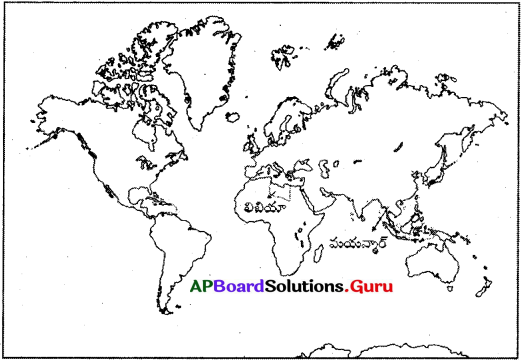
ప్రపంచ పటంలో లిబియా, మయన్మార్ లను గుర్తించండి. అవి ఏ ఖండాలలో ఉన్నాయి?
AP Board 9th Class Social Solutions Chapter 19 విస్తరిస్తున్న ప్రజాస్వామ్యం 4
ఇవి ఆఫ్రికా, ఆగ్నేయాసియా ఖండాలలో ఉన్నాయి.

AP Board 7th Class Maths Solutions Chapter 11 Area of Plane Figures Ex 11.2

SCERT AP 7th Class Maths Solutions Pdf Chapter 11 Area of Plane Figures Ex 11.2 Textbook Exercise Questions and Answers.
AP State Syllabus 7th Class Maths Solutions 11th Lesson Area of Plane Figures Ex 11.2

Question 1.
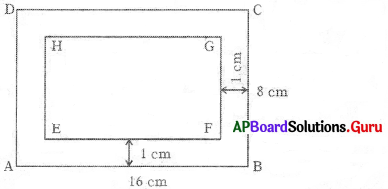
The length and breadth of the tablet are 16 cm, 8 cm respectively. It has an inner side black border of 1 cm width around the screen. Find the area of the black border.
Answer:
Given length of the tablet l = 16 cm
breadth b = 8 cm
Area of the tablet ABCD
= l × b
= 16 × 8
= 128 sq.cm
AP Board 7th Class Maths Solutions Chapter 11 Area of Plane Figures Ex 11.2 1
Width of border = 1 cm
Border running around the screen.
So, length of screen
l = 16 – 2 × width
= 16 – 2 × 1
= 16 – 2 = 14 cm
Breadth of screen
b = 8 – 2 × 1
= 8 – 2 = 6 cm
Area of the screen
= l × b
= 14 × 6
= 84 sq.cm
Area of the border = Area of the tablet – Area of screen
= 128 – 84
= 44 sq.cm
∴ Area of black border = 44 sq.cm.

AP Board 7th Class Maths Solutions Chapter 11 Area of Plane Figures Ex 11.2

Question 2.
Revanth has a rectangular lawn of length 45 m and breadth 20 m in his garden. He wants to do flooring 5 m along out-side the lawn for path. Find out the area of path. Find the cost of flooring at the rate ₹ 100 per sq.m.
Answer:
Given inner length of lawn l = 45 m
breadth b = 20 m
Inner area of lawn = l × b
= 45 × 20
= 900 sq.m
Width of the path = 5 m
Path is outside the lawn.
So, outer length of lawn
L = l + 2 × w
= 45 + 2 × 5
= 45 + 10 = 55 m
Breadth B = b + 2w
= 20 + 2 × 5
= 20 + 10 = 30 m
Outer area of lawn = l × b
= 55 × 30
= 1650 sq.m
Area of the path
= outer area – inner area
= 1650 – 900
= 750 sq.m.
Cost of flooring per sq.m = ₹ 100
∴ Cost of flooring per 750 sq.m
= 750 × 100 = ₹ 75,000/-

AP Board 7th Class Maths Solutions Chapter 11 Area of Plane Figures Ex 11.2

Question 3.
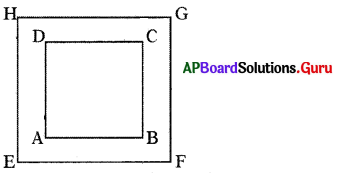
The surface of water pool is in the shape of a square whose side is 450 cm. Its exterior 20 cm width and the edge part is cemented along the side of the square. Find the area of that cemented part. Find cost for cementing if the rate is ₹ 15 per sq.cm.
Answer:
Given inner side of the pool (s) = 450 cm
Inner area of waterptool ABCD = s × s
= 450 × 450
= 202500 sq.cm
Width of the edge = 20 cm
AP Board 7th Class Maths Solutions Chapter 11 Area of Plane Figures Ex 11.2 2
Here path is running outside the pool.
So, outer side of the pool
(s) = s + 2 × w
= 450 + 2 × 20
= 450 + 40 = 490 cm
Outer area of waterpool EFGH
= s × s
= 490 × 490
= 2,40,100 sq.cm
Area of the edge
= Outer area – Inner area
= 240100 – 202500
Area of the path = 37,600 sq.cm
Cost of cementing per sq.cm = ₹ 15
∴ Cost of cementing per 37600 sq.cm
= 37,600 × 15
= ₹ 5,64,000

AP Board 7th Class Maths Solutions Chapter 11 Area of Plane Figures Ex 11.2

Question 4.
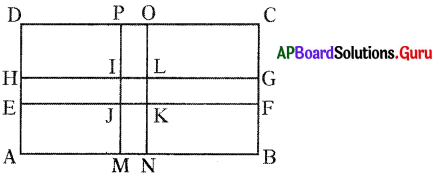
Two pathways parallel to the length and breadth have been constructed in the centre of the rectangular park whose length is 120 m and breadth is 90 m. If the width of each pathway is 15 m, find out expenditure of flooring on the pathway at the rate ₹ 80 per sq.m,
AP Board 7th Class Maths Solutions Chapter 11 Area of Plane Figures Ex 11.2 3
Answer:
In the figure ABCD is a rectangular park.
Length of ABCD = 120 m
Breadth of ABCD = 90 m
Width of path = 15 m
Area of EFGH = length × width
= 120 × 15
= 1800 sq.m
Area of MNOP = breadth × width
= 90 × 15
= 1350 sq.m
Area of common path = width × width
= 15 × 15
= 225 sq.m
AP Board 7th Class Maths Solutions Chapter 11 Area of Plane Figures Ex 11.2 4
Area of IJKL = 225 sq.m is included in both EFGH and MNOP paths. So, we subtract once.
Area of the path = Area of EFGH + Area of MNOP – Area of IJKL .
= 1800 + 1350 – 225
= 2925 sq.m
Cost of flooring per sq.m = ₹ 80
Cost of flooring per 2925 sq.m. = 2925 × 80
∴ Expenditure for path flooring = ₹ 2,34,000.

AP Board 7th Class Maths Solutions Chapter 11 Area of Plane Figures Ex 11.2

Question 5.
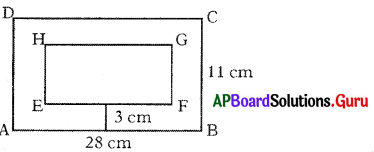
A photo frame of length 28 cm. and breadth 11 cm. has done decoration of 3 cm. along inside shown in the figure. Find the total area of decoration. If the cost of decoration is ₹ 2 per Sq.cm., find total cost of decoration.
Answer:
Given the length of frame ABCD = 28 cm
Breadth = 11 cm
Area of frame ABCD = l × b
= 28 × 11
= 308 sq.cm
Width of the decoration part = 3 cm
Decoration is tying inside the frame.
So, length of EFGH = l – 2 × width
= 28 – 2 × 3
= 28 – 6 = 22 cm
Breadth = b – 2 × width
= 11 – 2 × 3
= 11 – 6 = 5 cm
AP Board 7th Class Maths Solutions Chapter 11 Area of Plane Figures Ex 11.2 5
Area of frame EFGH = l × b
= 22 × 5
= 110 sq.cm
Area of the decoration part
= Area of ABCD – Area of EFGH
= 308 – 110
= 198 sq.cm
Cost of decoration per sq.cm = ₹ 2
Cost of decoration per 198 sq.cm = 198 × 2
∴ Total cost of decoration = ₹ 396.

AP SSC 10th Class Maths Solutions Chapter 12 Applications of Trigonometry Optional Exercise

AP State Syllabus SSC 10th Class Maths Solutions 12th Lesson Applications of Trigonometry Optional Exercise

AP State Board Syllabus AP SSC 10th Class Maths Textbook Solutions Chapter 12 Applications of Trigonometry Optional Exercise Textbook Questions and Answers.

10th Class Maths 12th Lesson Applications of Trigonometry Optional Exercise Textbook Questions and Answers

Question 1.
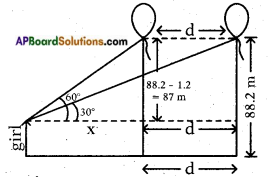
A 1.2 m tall girl spots a balloon moving with the wind in a horizontal line at a height of 88.2 m from the ground. The angle of elevation of the balloon from the eyes of the girl at any instant is 60°. After sometime, the angle of elevation reduces to 30°. Find the distance travelled by the balloon during the interval.
Answer:
Height of the balloon from the ground = 88.2 m
Height of the girl = 1.2 m
Angles of elevations = 60° and 30°
AP SSC 10th Class Maths Solutions Chapter 12 Applications of Trigonometry Optional Exercise 1
Let the distance travelled = dm
From the figure
tan 60° = \(\frac{87}{x}\)
√3 = \(\frac{87}{x}\)
⇒ 87 = √3x …….(1)
⇒ x = \(\frac{87}{\sqrt{3}}\) m
Also tan 30° = \(\frac{87}{x+d}\)
⇒ \(\frac{1}{\sqrt{3}}\) = \(\frac{87}{x+d}\)
⇒ 87 = \(\frac{x+d}{\sqrt{3}}\) ………(2)
From equations (1) and (2)
√3x = \(\frac{x+d}{\sqrt{3}}\)
√3 × √3x = x + d
⇒ 3x = x + d
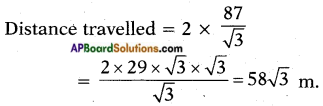
⇒ 2x = d
AP SSC 10th Class Maths Solutions Chapter 12 Applications of Trigonometry Optional Exercise 2

AP SSC 10th Class Maths Solutions Chapter 12 Applications of Trigonometry Optional Exercise

Question 2.
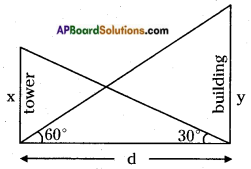
The angle of elevation of the top of a tower from the foot of the building is 30° and the angle of elevation of the top of the building from the foot of the tower is 60°. What is the ratio of heights of tower and building?
Answer:
AP SSC 10th Class Maths Solutions Chapter 12 Applications of Trigonometry Optional Exercise 3
Let the height of the tower = x m
Let the height of the building = y m
Distance between the tower and building = d m.
Angle of elevation of the top of the tower = 30°.
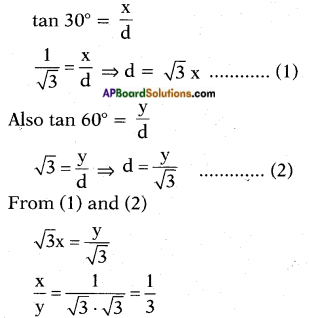
From the figure,
AP SSC 10th Class Maths Solutions Chapter 12 Applications of Trigonometry Optional Exercise 4
∴ x : y = 1 : 3
∴ The ratio of heights of tower and building = 1 : 3.

AP SSC 10th Class Maths Solutions Chapter 12 Applications of Trigonometry Optional Exercise

Question 3.
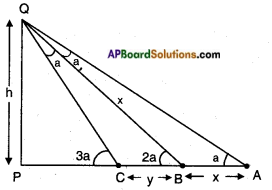
The angles of elevation of the top of a lighthouse from 3 boats A, B and C in a straight line of same side of the light- house are a, 2a, 3a respectively. If the distance between the boats A and B is x meters. Find the height of lighthouse.
Answer:
From the figure,
AP SSC 10th Class Maths Solutions Chapter 12 Applications of Trigonometry Optional Exercise 5
Let PQ be the height of the lighthouse = h m
A = First point of observation
B = Second point of observation
C = Third point of observation Given,
AB = x and BC = y
(Not given in the text)
Exterior angle = Sum of the opposite interior angles
∠PBQ = ∠BQA + ∠BAQ and
∠PCQ = ∠CBQ + ∠CQB
∴ AB = x = OB
By applying the sine rule,
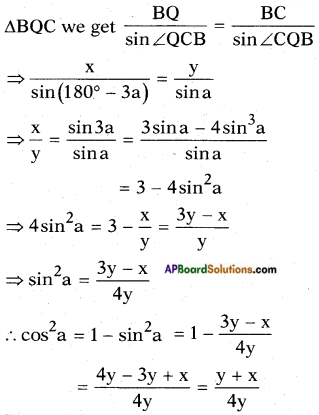
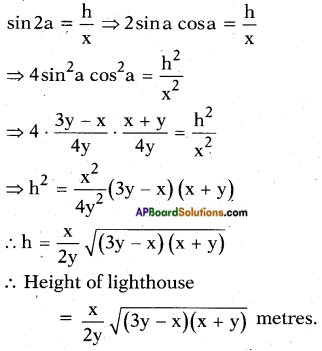
AP SSC 10th Class Maths Solutions Chapter 12 Applications of Trigonometry Optional Exercise 6
From △PBQ
AP SSC 10th Class Maths Solutions Chapter 12 Applications of Trigonometry Optional Exercise 7

AP SSC 10th Class Maths Solutions Chapter 12 Applications of Trigonometry Optional Exercise

Question 4.
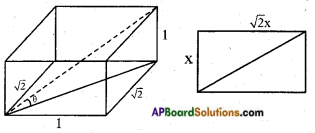
Inner part of a cupboard is in the cuboidical shape with its length, breadth and height in the ratio 1 : √2 : 1. What is the angle made by the longest stick which can be inserted cupboard with its base inside?
Answer:
AP SSC 10th Class Maths Solutions Chapter 12 Applications of Trigonometry Optional Exercise 8
The ratio of the length, breadth and height = 1 : √2 : 1
Let its length be = x
breadth = √2x height = x
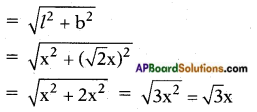
The longest stick that can be placed on the base is along its hypotenuse
AP SSC 10th Class Maths Solutions Chapter 12 Applications of Trigonometry Optional Exercise 9
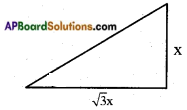
[!! Again, the longest stick that can be inserted in the cup board is along the line join of the bottom corn on with’ its opposite top corner, i.e., along the hypotenuse of the right triangle formed by height of the cup board, hypotenuse of the base and the line join of bottom corner with its opposite top corner.
AP SSC 10th Class Maths Solutions Chapter 12 Applications of Trigonometry Optional Exercise 11
Length of the largest stick = \(\sqrt{(\sqrt{3} x)^{2}+x^{2}}\)
= \(\sqrt{3 x^{2}+x^{2}}\)
= \(\sqrt{4 x^{2}}\) = 2x]
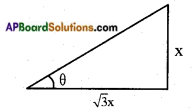
Now the angle made by the largest stick be = θ
AP SSC 10th Class Maths Solutions Chapter 12 Applications of Trigonometry Optional Exercise 10
Then tan θ = \(\frac{\text { opp. side }}{\text { adj. side }}\) = \(\frac{x}{\sqrt{3} x}\) = \(\frac{1}{\sqrt{3}}\)
tan θ = tan 30°
∴ θ = 30°.

AP SSC 10th Class Maths Solutions Chapter 12 Applications of Trigonometry Optional Exercise

Question 5.
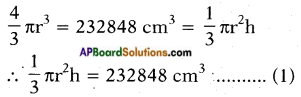
An iron spherical ball of volume 232848 cm3 has been melted and converted into a cone with the vertical angle of 120°. What are its height and base?
Answer:
Volume of the spherical ball = Volume of the cone
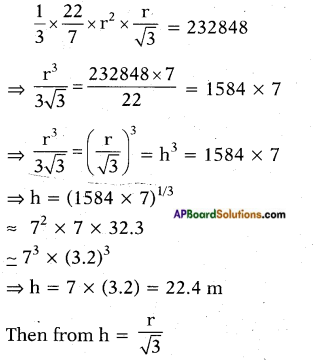
AP SSC 10th Class Maths Solutions Chapter 12 Applications of Trigonometry Optional Exercise 13
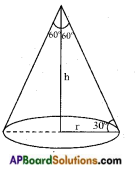
Given that vertical angle = 60°
AP SSC 10th Class Maths Solutions Chapter 12 Applications of Trigonometry Optional Exercise 12
Let its height be h cm. and radius r cm.
From the figure
Also tan 30° = \(\frac{h}{r}\)
⇒ \(\frac{1}{\sqrt{3}}\) = \(\frac{h}{r}\)
∴ h = \(\frac{r}{\sqrt{3}}\)
Substituting h = \(\frac{r}{\sqrt{3}}\) equation (1) we get
AP SSC 10th Class Maths Solutions Chapter 12 Applications of Trigonometry Optional Exercise 14
⇒ r = h√3 = (22.4) (1.732) = 38.79 m
r = 38.79 cm and h = 22.4 cm.

AP SSC 10th Class Maths Solutions Chapter 6 Progressions Optional Exercise

AP State Syllabus SSC 10th Class Maths Solutions 6th Lesson Progressions Optional Exercise

AP State Board Syllabus AP SSC 10th Class Maths Textbook Solutions Chapter 6 Progressions Optional Exercise Textbook Questions and Answers.

10th Class Maths 6th Lesson Progressions Optional Exercise Textbook Questions and Answers

Question 1.
Which term of the AP:
121, 117, 113,…, is the first negative term? [Hint: Find n for an < 0]
Answer:
Given A.P: 121, 117, 113, ……
a = 121 and d = a2 – a1
= 117 – 121 = -4
Let the nth term be the first negative term of the given G.P.
Then, an < 0
⇒ an = a + (n – 1) d < 0
⇒ 121 + (n – 1) (-4) < 0
⇒ 121 – 4n + 4 < 0
⇒ 125 – 4n < 0
⇒ -4n < -125
⇒ 4n >125 125
⇒ n > \(\frac{125}{4}\)
n > 31.25
∴ When n = 32, the term becomes negative, (or)
32 nd term is the first negative term of the given A.P.

AP SSC 10th Class Maths Solutions Chapter 6 Progressions Optional Exercise

Question 2.
The sum of the third and the seventh terms of an AP is 6 and their product is 8. Find the sum of first sixteen terms of the AP.
Answer:
Let the 3rd term of AP = a + 2d
and the 7th term of AP = a + 6d
∴ Sum of 3rd and 7th terms = a + 2d + a + 6d = 6
⇒ 2a + 8d = 6
⇒ a + 4d = 3 …… (1)
Now product of above two terms = (a + 2d) (a + 6d) = 8
we can re-write above terms as following
(a + 4d – 2d) (a + 4d + 2d) = 8
⇒ (3 – 2d) (3 + 2d) = 8
⇒ 9 – 4d2 = 8
⇒ 4d2 = 9 – 8 = 1
∴ d2 = \(\frac{1}{4}\)
⇒ d = ± \(\frac{1}{2}\) ……. (2)
Now putting d = \(\frac{1}{2}\) in eq(1) we get
a + 4d = a + 4(\(\frac{1}{2}\)) = 3 ⇒ a = 1
so a = 1, d = \(\frac{1}{2}\)
(or) now putting d = \(\frac{-1}{2}\), we get
a + 4d = a + 4(\(\frac{-1}{2}\)) = 3
⇒ a – 2 = 3
⇒ a = 5
∴ a = 5, d = \(\frac{-1}{2}\)
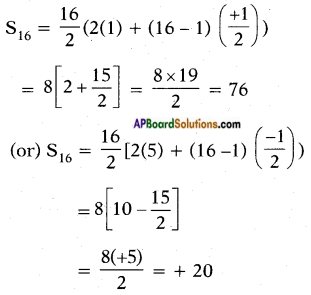
∴ Sum of sixteen terms =
AP SSC 10th Class Maths Solutions Chapter 5 Quadratic Equations Optional Exercise 10
So S16 = 20 or 76

AP SSC 10th Class Maths Solutions Chapter 6 Progressions Optional Exercise

Question 3.
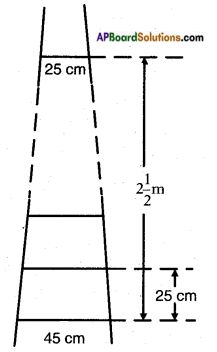
A ladder has rungs 25 cm apart. The rungs decrease uniformly in length from 45 cm at the bottom to 25 cm at the top. If the top and the bottom rungs are 2\(\frac{1}{2}\) m apart, what is the length of the wood required for the rungs. [Hint: Number of rungs = \(\frac{250}{25}\) + 1]
AP SSC 10th Class Maths Solutions Chapter 5 Quadratic Equations Optional Exercise 11
Answer:
Given: A ladder with rungs separated by a distance of 25 cm.
Total distance between the rungs = 2\(\frac{1}{2}\) m = 250 m
∴ Number of rungs = \(\frac{250}{25}\) + 1 = 10 + 1 = 11
Length of the bottom and top rungs = 45 cm and 25 cm
where a = 45; last term l = a11 = 25 and d = 2 cm
∴ Sn = \(\frac{n}{2}\)(a + l)
= \(\frac{11}{2}\)(45 + 25)
= \(\frac{11}{2}\) × 70
= 35 × 11
= 385 cm
∴ Length of wood required for total rungs = 385 cm.

Question 4.
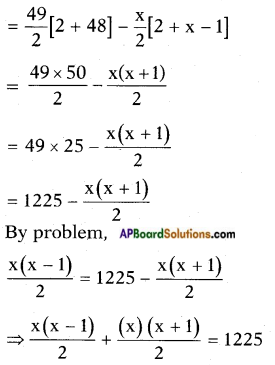
The houses of a row are numbered consecutively from 1 to 49. Show that there is a value of x such that the sum of the numbers of the houses preceding the house numbered x is equal to the sum of the numbers of the houses following it. And find this value of x. [Hint: Sx-1 = S49 – Sx]
Answer:
Given: Houses with numbers from 1 to 49.
x is a number x such that,
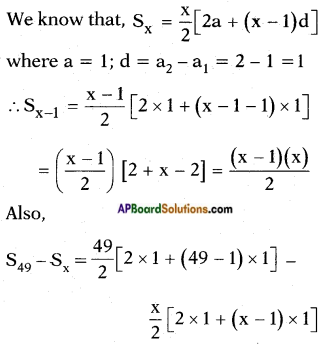
Sx-1 = S49 – Sx
AP SSC 10th Class Maths Solutions Chapter 5 Quadratic Equations Optional Exercise 12
AP SSC 10th Class Maths Solutions Chapter 5 Quadratic Equations Optional Exercise 13
⇒ x(x – 1) + x(x + 1) = 2 × 1225
⇒ x2 – x + x2 + x = 2450
⇒ 2x2 = 2450
⇒ x2 = \(\frac{2450}{2}\) = 1225
⇒ x = √1225 = ±35
∴ x = 35 [∵ x is a counting number]

AP SSC 10th Class Maths Solutions Chapter 6 Progressions Optional Exercise

Question 5.
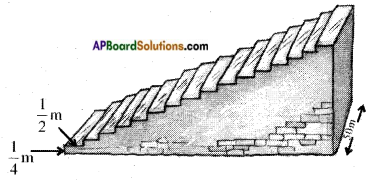
A small terrace at a football ground comprises of 15 steps each of which is 50 m long and built of solid concrete.
Each step has a rise of \(\frac{1}{4}\) m and a tread of \(\frac{1}{2}\) m. (see Fig.).
Calculate the total volume of concrete required to build the terrace.
[Hint: Volume of concrete required to build the first step = \(\frac{1}{4}\) × \(\frac{1}{2}\) × 50 m ]
AP SSC 10th Class Maths Solutions Chapter 5 Quadratic Equations Optional Exercise 14
Answer:
Length of each step = 50 m = l
Rise/height of each step = \(\frac{1}{4}\) m = h
Tread of each step = \(\frac{1}{2}\) m = b
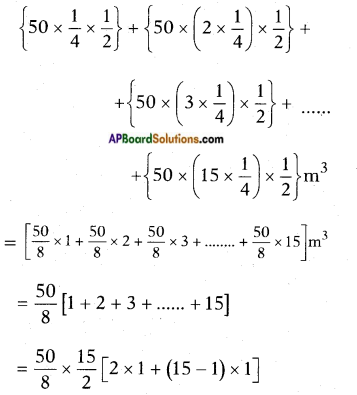
Given volume of concrete required to build the first step = \(\frac{1}{4}\) × \(\frac{1}{2}\) × 50 m3 = lbh
We can compare the shape of each step with a cuboid.
Volume of the cuboid = l . b . h
Volumes of concrete required to build the 15 steps are
AP SSC 10th Class Maths Solutions Chapter 5 Quadratic Equations Optional Exercise 15
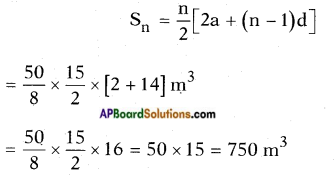
[∵ 1, 2, 3, 15 is in A.P. where a = 1; d = 1, n = 15]
AP SSC 10th Class Maths Solutions Chapter 5 Quadratic Equations Optional Exercise 16
∴ The total volume of concrete required to build the terrace is 750 m3.

AP SSC 10th Class Maths Solutions Chapter 6 Progressions Optional Exercise

Question 6.
150 workers were engaged to finish a piece of work in a certain number of days. Four workers dropped from the work in the second day. Four workers dropped in third day and so on. It took 8 more days to finish the work. Find the number of days in which the work was completed.
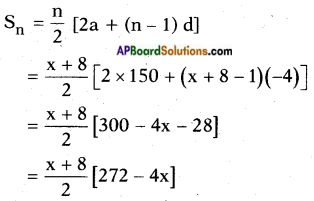
[Let the no.of days to finish the work is ‘x’ then 150x = \(\frac{x+8}{2}\)[2 × 150 + (x + 8 – 1) (-4)]
Answer:
Given: Number of workers engaged initially = 150.
4 workers were dropped each day.
Let the total work was to be completed initially was in x days.
∴ Work done by 150 workers in x days = 150.x.
But due to the dropping of 4 workers each day it took 8 more days.
Work done in this case is
150 × 1 + 146 × 1 + 142 × 1 + …. (x + 8) terms,
AP SSC 10th Class Maths Solutions Chapter 5 Quadratic Equations Optional Exercise 17
= (x + 8) (136 – 2x)
= -2x2 + 136x + 1088 – 16x
= -2x2 + 120x + 1088
∴ 150x = -2x2 + 120x + 1088
⇒ 2x2 + 30x – 1088 = 0
⇒ x2 + 15x – 544 = 0
⇒ x2 + 32x – 17x – 544 =0
⇒ x(x + 32) – 17 (x + 32) = 0
⇒ (x + 32) (x – 17) = 0
⇒ x + 32 = 0 (or) x – 17 = 0
⇒ x = – 32 (or) x = 17
x can’t be negative.
∴ x = 17.
i.e., The total work was completed in x + 8 days = 17 + 8 = 25 days.

AP SSC 10th Class Maths Solutions Chapter 6 Progressions Optional Exercise

Question 7.
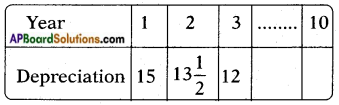
A machine costs Rs. 5,00,000. If the value depreciates 15% in the first year, 13\(\frac{1}{2}\)% in the second year, 12% in the third year and so on. What will be its value at the end of 10 years, when all the percentages will be applied to the original cost?
Answer:
Given: Cost price of a machine = Rs. 5,00,000
Depreciation during the years
AP SSC 10th Class Maths Solutions Chapter 5 Quadratic Equations Optional Exercise 18
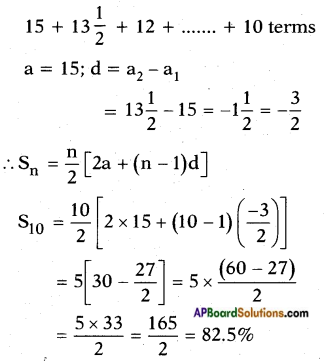
Sum of the depreciations =
AP SSC 10th Class Maths Solutions Chapter 5 Quadratic Equations Optional Exercise 19
∴ Cost after 10 years = (100 – 82.5)% of 5,00,000
= 17.5 % of 5,00,000
= \(\frac{17.5 × 500000}{2}\)
= Rs. 87,500
∴ The value at the end of 10 years will be Rs. 87,500.

AP SSC 10th Class Maths Solutions Chapter 11 Trigonometry Optional Exercise

AP State Syllabus SSC 10th Class Maths Solutions 11th Lesson Trigonometry Optional Exercise

AP State Board Syllabus AP SSC 10th Class Maths Textbook Solutions Chapter 11 Trigonometry Optional Exercise Textbook Questions and Answers.

10th Class Maths 11th Lesson Trigonometry Optional Exercise Textbook Questions and Answers

Question 1.
Prove that
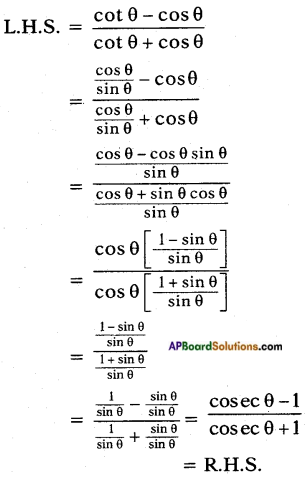
AP SSC 10th Class Maths Solutions Chapter 11 Trigonometry Optional Exercise 2
Answer:
AP SSC 10th Class Maths Solutions Chapter 11 Trigonometry Optional Exercise 1
Hence Proved.

AP SSC 10th Class Maths Solutions Chapter 11 Trigonometry Optional Exercise

Question 2.
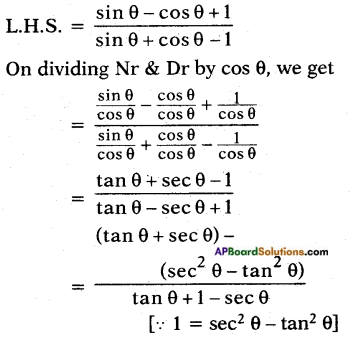
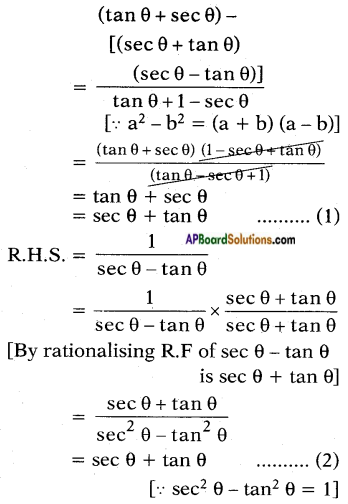
Prove that \(\frac{\sin \theta-\cos \theta+1}{\sin \theta+\cos \theta-1}\) = \(\frac{1}{\sec \theta-\tan \theta}\) using the identity sec2 θ = 1 + tan2 θ.
Answer:
AP SSC 10th Class Maths Solutions Chapter 11 Trigonometry Optional Exercise 3
AP SSC 10th Class Maths Solutions Chapter 11 Trigonometry Optional Exercise 4
From (1) and (2), we get L.H.S. = R.H.S.
Hence Proved.

AP SSC 10th Class Maths Solutions Chapter 11 Trigonometry Optional Exercise

Question 3.
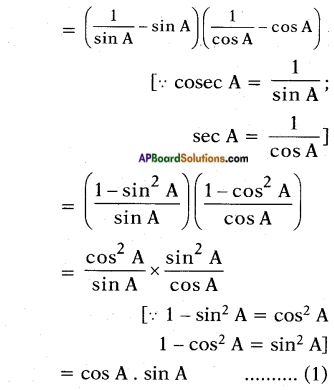
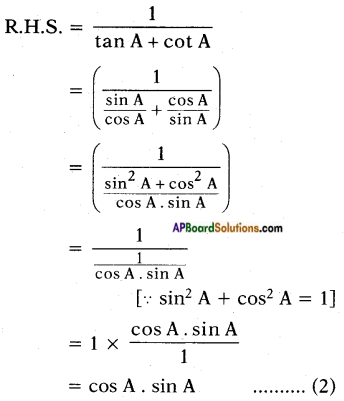
Prove that (cosec A – sin A) (sec A – cos A) = \(\frac{1}{\tan A+\cot A}\)
Answer:
L.H.S. = (cosec A – sin A) (sec A – cos A)
AP SSC 10th Class Maths Solutions Chapter 11 Trigonometry Optional Exercise 5
Now
AP SSC 10th Class Maths Solutions Chapter 11 Trigonometry Optional Exercise 6
From (1) and (2), we get
L.H.S. = R.H.S.
∴ (cosec A – sin A) (sec A – cos A) = \(\frac{1}{\tan A+\cot A}\)

AP SSC 10th Class Maths Solutions Chapter 11 Trigonometry Optional Exercise

Question 4.
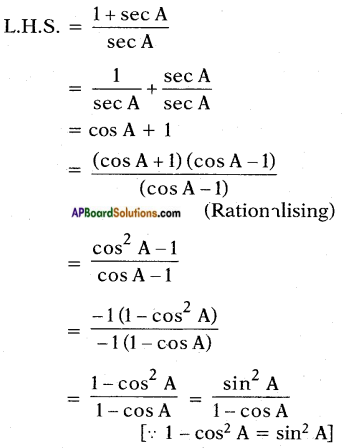
Prove that \(\frac{1+\sec A}{\sec A}\) = \(\frac{\sin ^{2} A}{1-\cos A}\)
Answer:

Question 5.
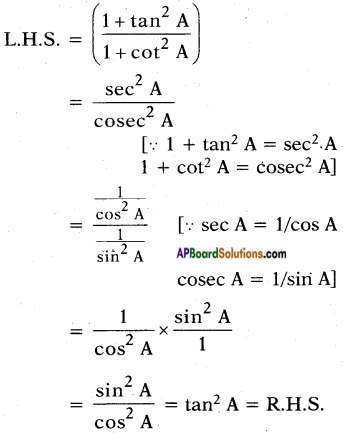
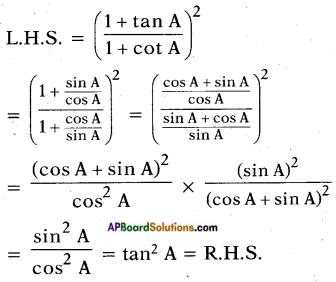
Prove that \(\left(\frac{1+\tan ^{2} A}{1+\cot ^{2} A}\right)\) = \(\left(\frac{1+\tan A}{1+\cot A}\right)^{2}\) = tan2 A
Answer:
AP SSC 10th Class Maths Solutions Chapter 11 Trigonometry Optional Exercise 8
AP SSC 10th Class Maths Solutions Chapter 11 Trigonometry Optional Exercise 9

AP SSC 10th Class Maths Solutions Chapter 11 Trigonometry Optional Exercise

Question 6.
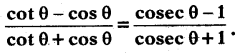
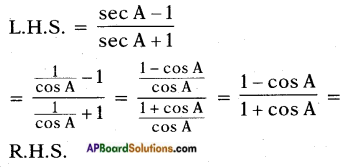
Prove that \(\left(\frac{\sec A-1}{\sec A+1}\right)\) = \(\left(\frac{1-\cos A}{1+\cos A}\right)\)
Answer:
AP SSC 10th Class Maths Solutions Chapter 11 Trigonometry Optional Exercise 10
∴ L.H.S. = R.H.S.

AP SSC 10th Class Maths Solutions Chapter 3 Polynomials InText Questions

AP State Syllabus SSC 10th Class Maths Solutions 3rd Lesson Polynomials InText Questions

AP State Board Syllabus AP SSC 10th Class Maths Textbook Solutions Chapter 3 Polynomials InText Questions and Answers.

10th Class Maths 3rd Lesson Polynomials InText Questions and Answers

Do these

Question 1.
State which of the following are polynomials and which are not? Give reasons.   (Page No. 48)
(i) 2x3
(ii) \(\frac{1}{x-1}\)
(iii) 4z2 + \(\frac{1}{7}\)
(iv) m2 – √2 m + 2
(v) p-2 + 1
Answer:
i) 2x3 is a polynomial.
ii) \(\frac{1}{x-1}\) is not a polynomial because its power is negative integer exponent.
iii) 4z2 + \(\frac{1}{7}\) is a polynomial.
iv) m2 – √2 m + 2 is a polynomial.
v) p-2 + 1 is not a polynomial because its power is negative integer exponent.

AP SSC 10th Class Maths Solutions Chapter 3 Polynomials InText Questions

Question 2.
p(x) = x2 – 5x – 6, find the values of p(l), p(2), p(3), p(0), p(-l), p(-2), p(-3).    (Page No. 49)
Answer:
Given polynomial p(x) = x2 – 5x – 6
p(1) = (1)2 – 5(1) – 6 = 1 – 5 – 6 = – 10
p(2) = (2)2 – 5(2) – 6 = 4 – 10 – 6 = -12
p(3) = 32 – 5(3) – 6 = 9 – 15 – 6 = – 12
p(0) = 02 – 5(0) – 6 = – 6
p(-1) = (-1)2 – 5(-1) – 6 = 1 + 5 – 6 = 0
p(-2) = (-2)2 – 5(-2) – 6 = 4 + 10 – 6 = 8
p(-3) = (-3)2 – 5(-3) – 6 = 9 + 15 – 6 = 18

Question 3.
p(m) = m2 – 3m + 1, find the values of p(1)and p(-1).    (Page No. 49)
Answer:
Given polynomial p(m) = m2 – 3m + 1
p(1) = (1)2 – 3(1) + 1 = 1 – 3 + 1 = 2 – 3 = – 1
p(-1) = (-1)2 – 3(-1) + 1 = 1 + 3 + 1 = 5

Question 4.
Let p(x) = x2 – 4x + 3. Find the values of p(0), p(l), p(2), p(3) and obtain zeroes of the polynomial p(x).   (Page No. 50)
Answer:
Given polynomial p(x) = x2 – 4x + 3
p(0) = (0)2 – 4(0) + 3 = 3
p(1) = (1)2 – 4(1) + 3 = 1 – 4 + 3 = 0
p(2) = (2)2 – 4(2) + 3 = 4 – 8 + 3 = – 1
p(3) = (3)2 – 4(3) + 3 = 9 – 12 + 3 = 0
We see that p(1) and p(3) are zeroes of the polynomial p(x).

AP SSC 10th Class Maths Solutions Chapter 3 Polynomials InText Questions

Question 5.
Check whether -3 and 3 are the zeroes of the polynomial x2 – 9.    (Page No. 50)
Answer:
Given polynomial p(x) = x2 – 9
Zero of the polynomial p(x) = 0
x2 – 9 = 0
⇒ x2 = 9
⇒ x = V9 = ± 3
∴ x = + 3, – 3
∴ Zeroes of the polynomial p(x) are – 3 and 3.

Try these

Question 1.
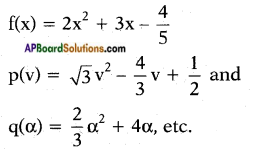
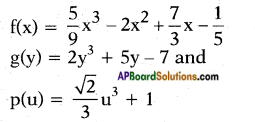
Write 3 different quadratic, cubic and 2 linear polynomials with different number of terms. (Page No. 48)
Answer:
Quadratic polynomials:
AP SSC 10th Class Maths Chapter 3 Polynomials InText Questions 1
Cubic polynomials :
AP SSC 10th Class Maths Chapter 3 Polynomials InText Questions 2
Linear polynomials :
f(t) = √2 t + 5
g(u) = \(\frac{2}{3}\) u – \(\frac{5}{2}\) and
q(y) = 3y
Yes, we can write polynomials of any degree.

Question 2.
Write a quadratic polynomial and a cubic polynomial in variable x in the general form. (Page No. 49)
Answer:
General form of a quadratic polynomial having variable ‘x’ is
f(x) = ax3 + bx2 + c, a ≠ 0
General form of a cubic polynomial having variable ‘x’ is
f(x) = ax3 + bx2 + cx + d, a ≠ 0

AP SSC 10th Class Maths Solutions Chapter 3 Polynomials InText Questions

Question 3.
Write a general polynomial q(z) of degree n with coefficients that are b0…. bn. What are the conditions on b0…. bn. (Page No. 49)
Answer:
q(z) = b0zn + b1zn-1 + b2zn-2 …….. + bn-1z + bn is a polynomial of n degree where b0, b1, b2,…… bn-1, bn are real coefficients and b0 ≠ 0.

Do this

Question 1.
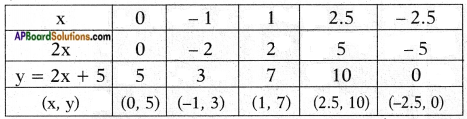
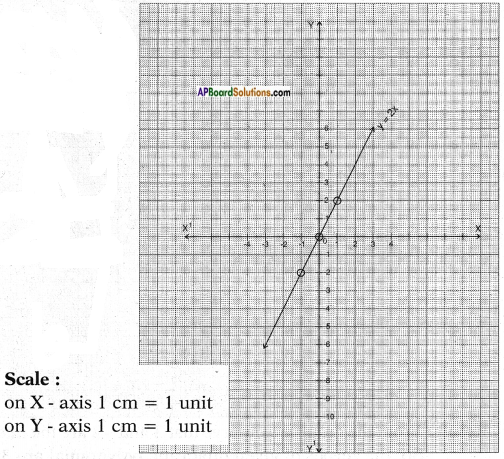
Draw the graph of i) y = 2x + 5, ii) y = 2x – 5, iii) y = 2x and find the point of intersection on X – axis. Is the x-coordinates of these points also the zero of the polynomial?   (Page No. 52)
Answer:
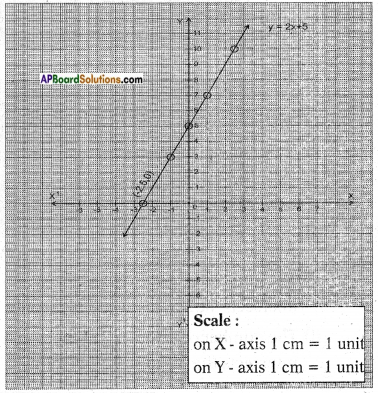
i) Given that y = 2x + 5
AP SSC 10th Class Maths Chapter 3 Polynomials InText Questions 3
AP SSC 10th Class Maths Chapter 3 Polynomials InText Questions 4
Result: The graph y = 2x + 5 cuts the X – axis at the point (-2.5, 0).
Hence, the zeroes of the polynomial is -2.5.

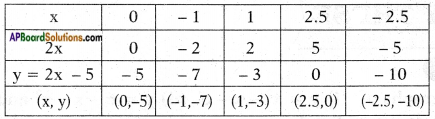
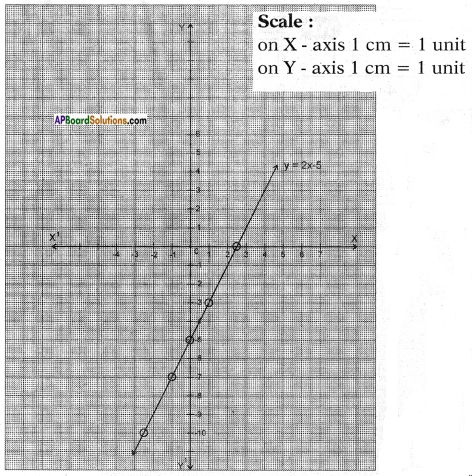
ii) Given that y = 2x – 5
AP SSC 10th Class Maths Chapter 3 Polynomials InText Questions 5
AP SSC 10th Class Maths Chapter 3 Polynomials InText Questions 6
Result: The graph of y = 2x – 5 cuts the X – axis at the point (2.5, 0).
The zeroes of the polynomial is 2.5 = \(\frac{5}{2}\)

AP SSC 10th Class Maths Solutions Chapter 3 Polynomials InText Questions

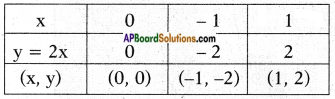
iii) Given that y = 2x
AP SSC 10th Class Maths Chapter 3 Polynomials InText Questions 7
AP SSC 10th Class Maths Chapter 3 Polynomials InText Questions 8
Result: The graph passes through the origin.
So, the zeroes of the polynomial y = 2x is zero.

Try these

Question 1.
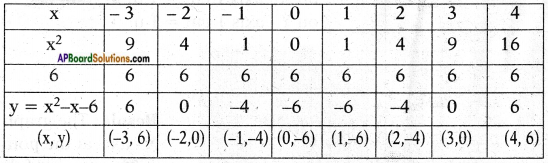
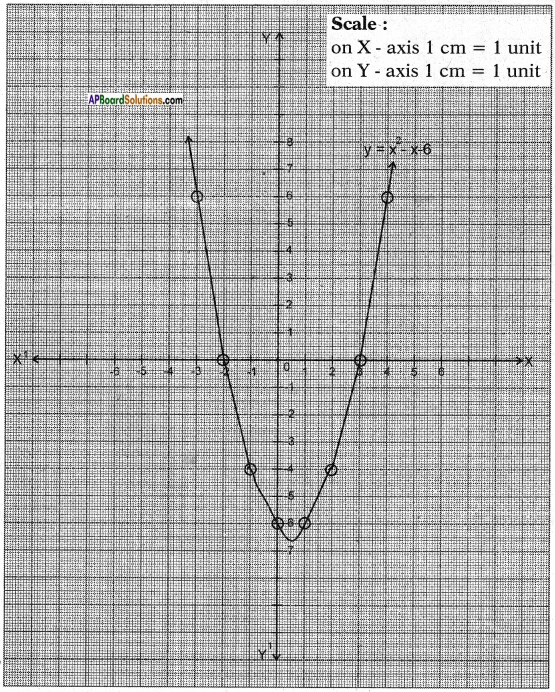
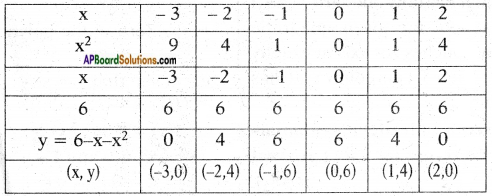
Draw the graphs of (i) y = x2 – x – 6 (ii) y = 6 – x – x2 and find zeroes in each case. What do you notice? (Page No. 53)
Answer:
i) Given that y = x2 – x – 6
AP SSC 10th Class Maths Chapter 3 Polynomials InText Questions 9
AP SSC 10th Class Maths Chapter 3 Polynomials InText Questions 10
Result: From the graph we observe that 3 and -2 are the intersecting points of X – axis.
So, the zeroes of given quadratic polynomial are 3 and -2.

AP SSC 10th Class Maths Solutions Chapter 3 Polynomials InText Questions

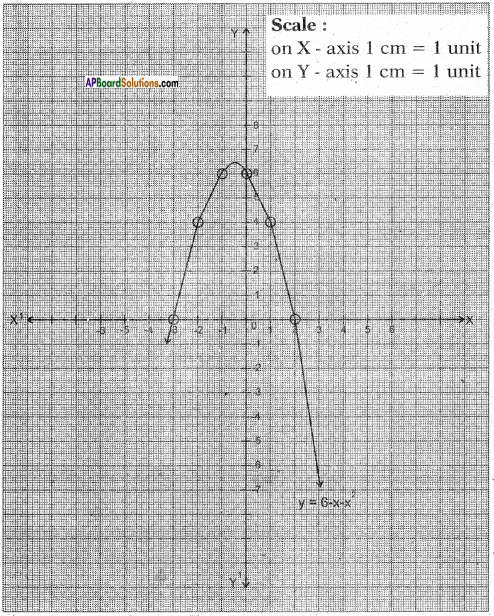
ii) Given that y = 6 – x – x2
AP SSC 10th Class Maths Chapter 3 Polynomials InText Questions 12
AP SSC 10th Class Maths Chapter 3 Polynomials InText Questions 11
Result: From the graph we observe that – 3 and 2 are the intersecting points ol X – axis.
So, the zeroes of given quadratic polynomial are – 3 and 2.

Question 2.
Write three quadratic polynomials that have 2 zeroes each.   (Page No. 55)
Answer:
y = x2 – x – 2 having two zeroes, i.e., (2, 0) and (- 1, 0).
y = 3 – 2x – x2 having two zeroes i.e., (1,0) and (- 3, 0).
y = x2 – 3x – 4 having two zeroes i.e., (-1, 0) and (4, 0)

AP SSC 10th Class Maths Solutions Chapter 3 Polynomials InText Questions

Question 3.
Write one quadratic polynomial that has one zero. (Page No. 55)
Answer:
Quadratic Polynomial y = x2 – 6x + 9 has only one zero i.e., 3.

Question 4.
How will you verify if a quadratic polynomial it has only one zero?  (Page No. 55)
Answer:
If the graph of the given quadratic polynomial touches X – axis at exactly one point, then I can confirm it has only one zero.

Question 5.
Write three quadratic polynomials that have no zeroes for x that are real numbers.  (Page No. 55)
Answer:
The quadratic polynomials y = 2x2 – 4x + 5 and y = – 3x2 + 2x – 1 and y = x2 – 2x + 4 have no zeroes.

Question 6.
Find the zeroes of cubic polynomials
(i) – x3
(ii) x2 – x3
(iii) x3 – 5x2 + 6x
without drawing the graph of the polynomial.  (Page No. 57)
Answer:
i) Given polynomial is y = – x3
f(x) = -x3 ; f(x) = 0
x3 = 0
x = \(\sqrt[3]{0}\) = 0
∴ Zero of the polynomial f(x) is only one i.e., 0.

AP SSC 10th Class Maths Solutions Chapter 3 Polynomials InText Questions

ii) Given that y = x2 – x3
f(x) = x2 (1 – x)
f(x) = 0
⇒ x2 (1 – x) = 0
⇒ x2 = 0 and 1 – x = 0
⇒ x = 0 and x = 1
∴ The zeroes of the polynomial f(x) are two i.e., 0 and 1.

iii) Given that x3 – 5x2 + 6x Let f(x) = x3 – 5x2 + 6x
= x(x2 – 5x + 6)
= x(x2 – 2x – 3x + 6)
= x[x(x – 2) – 3(x – 2)]
= x(x – 2) (x – 3)
∴ The zeroes of the polynomial f(x) are x = 0 and x = 2 and x = 3

Do these

Question 1.
Find the zeroes of the quadratic polynomials given below. Find the sum and product of the zeroes and verify relationship to the coefficients of terms in the polynomial. (Page No. 62)
i) p(x) = x2 – x – 6
ii) p(x) = x2 – 4x + 3
iii) p(x) = x2 – 4
iv) p(x) = x2 + 2x + 1
Answer:
i) Given polynomial p(x) = x2 – x – 6
We have x2 – x – 6 = x2 – 3x + 2x – 6
= x(x – 3) + 2(x – 3)
= (x – 3) (x + 2)
So, the value of x2 – x – 6 is zero when x – 3 = 0 or x + 2 = 0
i.e., x = 3 or x = -2
So, the zeroes of x2 – x – 6 are 3 and – 2.
∴ Sum of the zeroes = 3 – 2 = 1
= – \(\frac{\text { Coefficient of } x}{\text { Coefficient of } x^{2}}\) = \(\frac{-(-1)}{1}\) = 1
And product of the zeroes = 3 × (-2) = -6
= \(\frac{\text { Constant term }}{\text { Coefficient of } x^{2}}\) = \(\frac{-6}{1}\) = -6

ii) p(x) = x2 – 4x + 3
Answer:
Given polynomial p(x) = x2 – 4x + 3
We have, x2 – 4x + 3 = x2 – 3x – x + 3
= x(x – 3) – 1 (x – 3)
= (x – 3) (x – 1)
So, the value of x2 – 4x + 3 is zero when x – 3 = 0 or x – 1 =0, i.e.,
when x = 3 or x = 1 So, the zeroes of x2 – 4x + 3 are 3 and 1
∴ Sum of the zeroes = 3 + 1 = 4
= – \(\frac{\text { Coefficient of } x}{\text { Coefficient of } x^{2}}\) = \(\frac{-(-4)}{1}\) = 4
And product of the zeroes = 3 × 1 = 3
= \(\frac{\text { Constant term }}{\text { Coefficient of } x^{2}}\) = \(\frac{3}{1}\) = 3

AP SSC 10th Class Maths Solutions Chapter 3 Polynomials InText Questions

iii) Given polynomial p(x) = x2 – 4
We have, x2 – 4 = (x – 2) (x + 2)
So, the value of x2 – 4 is zero
when x – 2 = 0 or x + 2 = 0
i.e., x = 2 or x = – 2
So the zeroes of x2 – 4 are 2 and – 2
∴ Sum of the zeroes = 2 + (- 2) = 0
= – \(\frac{\text { Coefficient of } x}{\text { Coefficient of } x^{2}}\) = \(\frac{-0}{1}\) = 0
And product of the zeroes = 2 × (-2) = -4
= \(\frac{\text { Constant term }}{\text { Coefficient of } x^{2}}\) = \(\frac{-4}{1}\) = -4

iv) Given polynomial p(x) = x2 + 2x + 1
We have x2 + 2x + 1 = x2 + x + x + 1
= x(x + 1) + l(x + 1)
= (x + 1) (x + 1)
So, the value of x2 + 2x + 1 is zero
when x + 1 = 0 (or) x + 1 = 0, i.e.,
when x = – 1 or – 1
o, the zeroes of x2 + 2x + 1 are – 1 and – 1.
∴ Sum of the zeroes = (-1) + (-1) = -2
= – \(\frac{\text { Coefficient of } x}{\text { Coefficient of } x^{2}}\) = \(\frac{-2}{1}\) = -2
And product of the zeroes = (-1) × (-1) = 1
= \(\frac{\text { Constant term }}{\text { Coefficient of } x^{2}}\) = \(\frac{1}{1}\) = 1

Question 2.
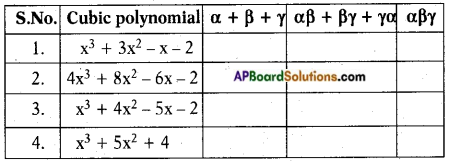
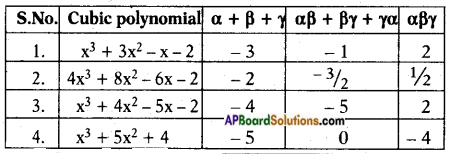
If α, β and γ are the zeroes of the given cubic polynomials, find the values as given in the table. (Page No. 66)
AP SSC 10th Class Maths Solutions Chapter 3 Polynomials Ex 3.3 1
Answer:
l) Given polynomial is x3 + 3x2 – x – 2.
Comparing given polynomial with ax3 + bx2 + cx + d,
the values are a = 1, b = 3, c = -l, d = -2
α + β + γ = \(\frac{-b}{a}\) = \(\frac{-3}{1}\) = -3
αβ + βγ + γα = \(\frac{c}{a}\) = \(\frac{-1}{1}\) = -1
αβγ = \(\frac{-d}{a}\) = \(\frac{-(-2)}{1}\) = 2

AP SSC 10th Class Maths Solutions Chapter 3 Polynomials InText Questions

2) Given polynomial is 4x3 + 8x2 – 6x – 2
Compare the polynomial with ax3 + bx2 + cx + d = 0
Then a = 4, b = 8, c = – 6 and d = – 2
α + β + γ = \(\frac{-b}{a}\) = \(\frac{-8}{4}\) = -2
αβ + βγ + γα = \(\frac{c}{a}\) = \(\frac{-6}{4}\) = \(\frac{-3}{2}\)
αβγ = \(\frac{-d}{a}\) = \(\frac{-(-2)}{4}\) = \(\frac{1}{2}\)

3) Given polynomial is x3 + 4x2 – 5x – 2
Compare the polynomial with ax3 + bx2 + cx + d = 0
Then a = 1, b = 4, c = – 5 and d = – 2
α + β + γ = \(\frac{-b}{a}\) = \(\frac{-4}{1}\) = -4
αβ + βγ + γα = \(\frac{c}{a}\) = \(\frac{-5}{1}\) = -5
αβγ = \(\frac{-d}{a}\) = \(\frac{-(-2)}{1}\) = 2

4) Given polynomial is x3 + 5x2 + 4
Compare the polynomial with ax3 + bx2 + cx + d = 0
Then a = 1, b = 5, c = 0 and d = 4
α + β + γ = \(\frac{-b}{a}\) = \(\frac{-5}{1}\) = -5
αβ + βγ + γα = \(\frac{c}{a}\) = \(\frac{0}{1}\) = 0
αβγ = \(\frac{-d}{a}\) = \(\frac{-4}{1}\) = -4

AP SSC 10th Class Maths Solutions Chapter 3 Polynomials Ex 3.3 3

Try this

Question 1.
i) Find a quadratic polynomial with zeroes -2 and \(\frac{1}{3}\). (Page No. 64)
Answer:
Let the quadratic polynomial be ax2 + bx + c, a ≠ 0 and its zeroes be α and β.
Here α = – 2 and β = \(\frac{1}{3}\)
Sum of the zeroes = α + β
= -2 + \(\frac{1}{3}\) = \(\frac{-5}{3}\)
Product of the zeroes = αβ
= \(\frac{1}{3}\) × (-2) = \(\frac{-2}{3}\)
∴ ax2 + bx + c is [x2 – (α + β)x + αβ]
= [x2 – \(\left(\frac{-5}{3}\right)\)x + \(\left(\frac{-2}{3}\right)\)]
the quadratic polynomial will be 3x2 + 5x – 2.

AP SSC 10th Class Maths Solutions Chapter 3 Polynomials InText Questions

ii) What is the quadratic polynomial whose sum of zeroes is \(\frac{-3}{2}\) and the product of zeroes is -1.
Answer:
Let the quadratic polynomial be ax2 + bx + c and its zeroes be α and β.
Here α + β = \(\frac{-3}{2}\) and αβ = -1
Thus, the polynomial formed = x2 – (α + β)x + αβ
= x2 – \(\left(\frac{-3}{2}\right)\)x + (-1)
= x2 + \(\frac{3x}{2}\) – 1
The other polynomials are (x2 + \(\frac{3x}{2}\) – 1)
then the polynomial is 2x2 + 3x – 2.

AP SSC 10th Class Maths Solutions Chapter 5 Quadratic Equations Optional Exercise

AP State Syllabus SSC 10th Class Maths Solutions 5th Lesson Quadratic Equations Optional Exercise

AP State Board Syllabus AP SSC 10th Class Maths Textbook Solutions Chapter 5 Quadratic Equations Optional Exercise Textbook Questions and Answers.

10th Class Maths 5th Lesson Quadratic Equations Optional Exercise Textbook Questions and Answers

Question 1.
Some points are plotted on a plane. Each point is joined with all remaining points by line segments. Find the number of points if the number of line segments are 10.
Answer:
Number of distinct line segments that can be formed out of n-points = \(\frac{\mathrm{n}(\mathrm{n}-1)}{2}\)
Given: No. of line segments
\(\frac{\mathrm{n}(\mathrm{n}-1)}{2}\) = 10
⇒ n2 – n = 20
⇒ n2 – n – 20 = 0
⇒ n2 – 5n + 4n – 20 = 0
⇒ n(n – 5) + 4(n – 5) = 0
⇒ (n – 5) (n + 4) = 0
⇒ n – 5 = 0 (or) n + 4 = 0
⇒ n = 5 (or) -4
∴ n = 5 [n – can’t be negative]

AP SSC 10th Class Maths Solutions Chapter 5 Quadratic Equations Optional Exercise

Question 2.
A two digit number is such that the product of its digits, is 8. When 18 is added to the number, they interchange their places. Determine the number.
Answer:
Let the digit in the units place = x
Let the digit in the tens place = y
∴ The number = 10y + x
By interchanging the digits the number becomes 10x + y
By problem (10x + y) – (10y + x) = 18
⇒ 9x – 9y = 18
⇒ 9(x – y) =18
⇒ x – y = \(\frac{18}{9}\) = 2
⇒ y = x – 2
(i.e.) digit in the tens place = x – 2
digit in the units place = x
Product of the digits = (x – 2) x
By problem x2 – 2x = 8
x2 – 2x – 8 = 0
⇒ x2 – 4x + 2x – 8 = 0
⇒ x(x – 4) + 2(x – 4) = 0
⇒ (x – 4) (x + 2) = 0
⇒ x – 4 = 0 (or) x + 2 = 0
⇒ x = 4 (or) x = -2
∴ x = 4 [∵ x can’t be negative]
∴ The number is 24.

AP SSC 10th Class Maths Solutions Chapter 5 Quadratic Equations Optional Exercise

Question 3.
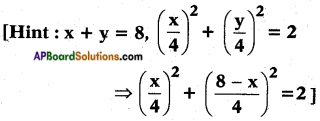
A piece of wire 8m in length is cut into twp pieces and each piece is bent into a square. Where should the cut in the wire be made if the sum of the areas of these squares is to be 2 m2?
AP SSC 10th Class Maths Solutions Chapter 5 Quadratic Equations Optional Exercise 1
Answer:
Let the length of the first peice = x m
Then length of the second piece = 8 – x m
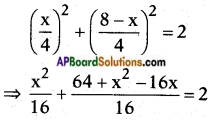
∴ Side of the 1st square = \(\frac{x}{4}\) m and
Side of the second square = \(\frac{8-x}{4}\) m
sum of the areas = 2 m2
AP SSC 10th Class Maths Solutions Chapter 5 Quadratic Equations Optional Exercise 2
⇒ x2 + 64 + x2 – 16x = 16 × 2 = 32
⇒ 2x2 – 16x + 64 = 32
⇒ 2x2 – 16x + 32 = 0
⇒ 2(x2 – 8x + 16)= 0
⇒ x2 – 8x + 16 = 0
⇒ x2 – 4x – 4x + 16 = 0
⇒ x(x – 4) – 4(x – 4) = 0
⇒ (x – 4) (x – 4) = 0
∴ x = 4
∴ The cut should be made at the centre making two equal pieces of length 4 m, 4 m.

Question 4.
Vinay and Praveen working together can paint the exterior of a house in 6 days. Vinay by himself can complete the job in 5 days less than Praveen. How long will it take Vinay to complete the job by himself?
Answer:
Let the time taken by Vinay to complete the job = x days
Then the time taken by Praveen to complete the job = x + 5 days
Both worked for 6 days to complete a job.
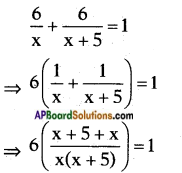
∴ Total Work done by them is
AP SSC 10th Class Maths Solutions Chapter 5 Quadratic Equations Optional Exercise 3
⇒ 6(2x + 5) = x2 + 5x
⇒ x2 – 7x – 30 = 0
⇒ x2 – 10x + 3x – 30 = 0
⇒ x(x – 10) + 3(x – 10) = 0
⇒ (x – 10) (x + 3) = 0
⇒ x – 10 = 0 (or) x + 3 = 0
⇒ x = 10 (or) x = -3
∴ x = 10 (∵ x can’t be negative)
∴ Time taken by Vinay = x = 10 days
Time taken by Praveen = x + 5 = 15 days.

AP SSC 10th Class Maths Solutions Chapter 5 Quadratic Equations Optional Exercise

Question 5.
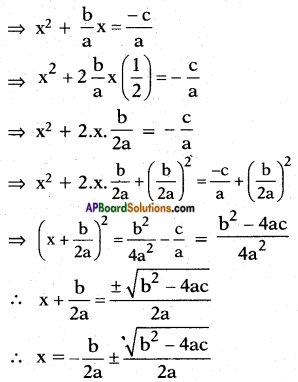
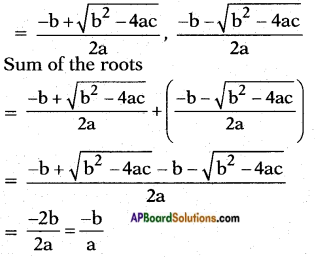
Show that the sum of the roots of a quadratic equation ax2 + bx + c = 0 is \(\frac{-b}{a}\).
Answer:
Let the Q.E. = ax2 + bx + c = 0 (a ≠ 0)
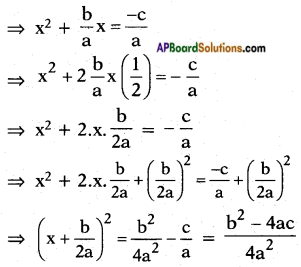
⇒ ax2 + bx = -c
AP SSC 10th Class Maths Solutions Chapter 5 Quadratic Equations Optional Exercise 4
AP SSC 10th Class Maths Solutions Chapter 5 Quadratic Equations Optional Exercise 5
∴ Sum of roots of a Q.E. is \(\frac{-b}{a}\)

Question 6.
Show that the product of the roots of a quadratic equation ax2 + bx + c = 0 is \(\frac{c}{a}\).
Answer:
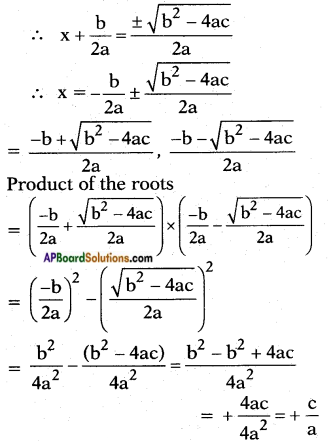
Let the Q.E. = ax2 + bx + c = 0 (a ≠ 0)
⇒ ax2 + bx = -c
AP SSC 10th Class Maths Solutions Chapter 5 Quadratic Equations Optional Exercise 6
AP SSC 10th Class Maths Solutions Chapter 5 Quadratic Equations Optional Exercise 7

AP SSC 10th Class Maths Solutions Chapter 5 Quadratic Equations Optional Exercise

Question 7.
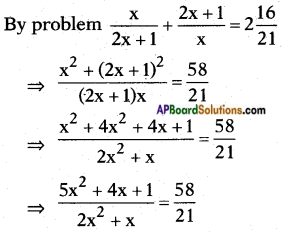
The denominator of a fraction is one more than twice the numerator. If the sum of the fraction and its reciprocal is 2\(\frac{16}{21}\) find the fraction.
Answer:
Let the numerator = x
then denominator = 2x + 1
Then the fraction = \(\frac{x}{2x+1}\)
Its reciprocal = \(\frac{2x+1}{x}\)
AP SSC 10th Class Maths Solutions Chapter 5 Quadratic Equations Optional Exercise 8
105x2 + 84x + 21 = 116x2 + 58x
11x2 – 26x – 21 = 0
11x2 – 33x + 7x – 21 = 0
11x (x – 3) + 7 (x – 3) = 0
(x – 3) (11x + 7) = 0
⇒ x – 3 = 0 (or) 11x + 7 = 0
⇒ x = 3 (or) \(\frac{-7}{11}\)
∴ x = 3
Numerator = 3;
Denominator = 2 × 3 + 1 = 7
Fraction = \(\frac{3}{7}\).

Question 8.
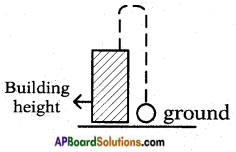
A ball is thrown vertically upwards from the top of a building of height 29.4m and with an initial velocity 24.5m/sec. If the height H of the ball from the ground level is given by H = 29.4 + 24.5t – 4.9t2, then find the time taken by the ball to reach the ground.
Answer:
AP SSC 10th Class Maths Solutions Chapter 5 Quadratic Equations Optional Exercise 9
Initial velocity ‘U’ = 24.5
height of the ball from the ground can be expressed as
H = 29.4 + 24.5 t – 4.9 t2
The ball has to reach the ground in ‘t’ seconds, which means Height from ground H = 0
So 29.4 + 24.5t – 4.9t2 = 0 = H
⇒ 4.9 t2 – 24.5t – 29.4 = 0
⇒ 4.9 [t2 – 5t – 6] = 0
∴ t2 – 5t – 6 = 0
⇒ t2 – 6t + t – 6 = 0
⇒ t(t – 6) + 1 (t – 6) = 0
(t – 6) (t + 1) = 0
⇒ t – 6 = 0
∴ t = 6 or t + 1 = 0
⇒ t = -1 but ‘t’ cannot be negative
So t = 6
it means in 6 seconds of time the ball reaches ground.

AP SSC 10th Class Maths Solutions Chapter 9 Tangents and Secants to a Circle Optional Exercise

AP State Syllabus SSC 10th Class Maths Solutions 9th Lesson Tangents and Secants to a Circle Optional Exercise

AP State Board Syllabus AP SSC 10th Class Maths Textbook Solutions Chapter 9 Tangents and Secants to a Circle Optional Exercise Textbook Questions and Answers.

10th Class Maths 9th Lesson Tangents and Secants to a Circle Optional Exercise Textbook Questions and Answers

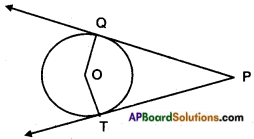
Question 1.
Prove that the angle between the two tangents drawn from an external point to a circle is supplementary to the angle subtended by the line – segment joining the points of contact at the centre.
Answer:
AP SSC 10th Class Maths Solutions Chapter 9 Tangents and Secants to a Circle Optional Exercise 1
Given: A circle with centre ‘O’.
Two tangents \(\overleftrightarrow{\mathrm{PQ}}\) and \(\overleftrightarrow{\mathrm{PT}}\) from an external point P. Let Q, T be the points of contact.
R.T.P: ∠P and ∠QOT are supplementary.
Proof: OQ ⊥ PQ
[∵ radius is perpendicular to the tangent at the point of contact] also OT ⊥ PT
∴ ∠OQP + ∠OTP = 90° + 90° = 180° Nowin oPQOT,
∠OTP + ∠TPQ + ∠PQO + ∠QOT
= 360° (angle sum property)
180° + ∠P + ∠QOT = 360°
∠P + ∠QOT = 360°- 180° = 180° Hence proved. (Q.E.D.)

AP SSC 10th Class Maths Solutions Chapter 9 Tangents and Secants to a Circle Optional Exercise

Question 2.
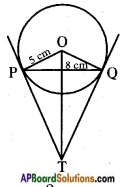
PQ is a chord of length 8 cm of a circle of radius 5 cm. The tangents at P and Q intersect at a point T (See figure). Find the length of TP.
AP SSC 10th Class Maths Solutions Chapter 9 Tangents and Secants to a Circle Optional Exercise 3
Answer:
AP SSC 10th Class Maths Solutions Chapter 9 Tangents and Secants to a Circle Optional Exercise 4
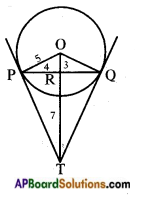
Given: PQ = 8
⇒ PR = 4
⇒ PO2 = PR2 + OR2
⇒ 25 = 16 + OR2
⇒ OR = 3
Now let RT = x and PT in △OPT, ∠P = 90°
∴ OT is hypotenuse.
∴ OT2 = OP2 + PT2
(Pythagoras theorem)
(3 + x)2 = 52 + y2 …….. (1)
and in △PRT, ∠R = 90°
∴ \(\overline{\mathrm{PT}}\) is hypotenuse.
∴ PT2 = PR2 + RT2
y2 = 42 + x2 …….. (2)
Now putting the value of y2 = 42 + x2 in equation (1) we got
(3 + x)2 = 52 + x2 + 42
9 + x2 + 6x = 25 + 16 + x2
6x = 25 + 16 – 9 = 25 + 7 = 32
⇒ x = \(\frac{32}{6}\) = \(\frac{16}{3}\)
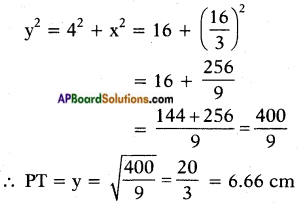
Now from equation (2), we get
AP SSC 10th Class Maths Solutions Chapter 9 Tangents and Secants to a Circle Optional Exercise 5

AP SSC 10th Class Maths Solutions Chapter 9 Tangents and Secants to a Circle Optional Exercise

Question 3.
Prove that opposite sides of a quadrilateral circumscribing a circle subtend supplementary angles at the centre of the circle.
Answer:
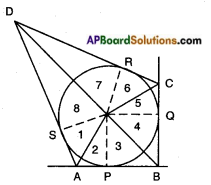
AP SSC 10th Class Maths Solutions Chapter 9 Tangents and Secants to a Circle Optional Exercise 6
Given: Let a circle with centre ‘O’ touches the sides AB, BC, CD and DA of a quadrilateral ABCD at the points P, Q, R and S respectively.
R.T.P: ∠AOB + ∠COD = 180°
∠AOD + ∠BOC = 180°
Construction: Join OP, OQ, OR and OS.
Proof: Since the two tangents drawn from an external point of a circle subtend equal angles.
At the centre,
∴ ∠1 = ∠2
∠3 = ∠4 (from figure)
∠5 = ∠6
∠7 = ∠8
Now, ∠1 + ∠2 + ∠3 + ∠4 + ∠5 + ∠6 + ∠7 + ∠8 = 360°
[∵ Sum of all the angles around a point is 360°]
So, 2 (∠2 + ∠3 + ∠6 + ∠7) = 360°
and 2 (∠1 + ∠8 + ∠4 + ∠5) = 360°
(∠2 + ∠3) + (∠6 + ∠7) = \(\frac{360}{2}\) = 180°
Also, (∠1 + ∠8) + (∠4 + ∠5) = \(\frac{360}{2}\) = 180°
So, ∠AOB + ∠COD = 180°
[∵ ∠2 + ∠3 = ∠AOB;
∠6 + ∠7 = ∠COD
∠1 + ∠8 = ∠AOD
and ∠4 + ∠5 = ∠BOC [from fig.]]
and ∠AOD + ∠BOC = 180°

AP SSC 10th Class Maths Solutions Chapter 9 Tangents and Secants to a Circle Optional Exercise

Question 4.
Draw a line segment AB of length 8 cm. Taking A as centre, draw a circle of radius 4 cm and taking B as centre, draw another circle of radius 3 cm. Construct tangents to each circle from the centre of the other circle.
Answer:
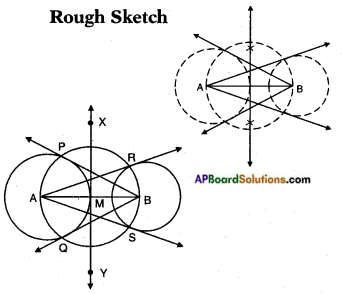
AP SSC 10th Class Maths Solutions Chapter 9 Tangents and Secants to a Circle Optional Exercise 2
Steps of construction:

  1. Draw a line segment AB of length 8 cm.
  2. With A and B as centres and 4 cm, 3 cm as radius draw two circles.
  3. Draw the perpendicular bisectors \(\stackrel{\leftrightarrow}{\mathrm{XY}}\) of AB. Let \(\stackrel{\leftrightarrow}{\mathrm{XY}}\) and AB meet at M.
  4. Taking M as centre and MA or MB as radius draw a circle which cuts the circle with centre A at P and Q and circle with centre B at R, S.
  5. Join BP, BQ and AR, AS.

Question 5.
Let ABC be a right triangle in which AB = 6 cm, BC = 8 cm and ∠B = 90°. BD is the perpendicular from B on AC. The circle through B, C, D is drawn. Construct the tangents from A to this circle.
Answer:
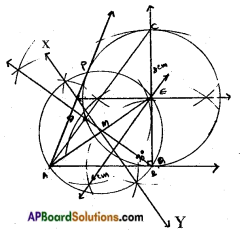
AP SSC 10th Class Maths Solutions Chapter 9 Tangents and Secants to a Circle Optional Exercise 7
Steps of construction:

  1. Draw AABC such that AB = 6 cm; ∠B = 90° and BC – 8 cm.
  2. Drop a perpendicular BD from B on AC.
  3. Draw the circumcircle to ABCD. Let ‘E’ be its centre.
  4. Join AE and draw its perpendicular bisector \(\stackrel{\leftrightarrow}{\mathrm{XY}}\). Let it meet AE at M.
  5. Taking M as centre and MA or ME as radius draw a circle, which’ cuts the circumcircle of △BCD at P and B.
  6. Join AP and extend AB, which are the required tangents.

AP SSC 10th Class Maths Solutions Chapter 9 Tangents and Secants to a Circle Optional Exercise

Question 6.
Find the area of the shaded region in the figure, given in which two circles with centres A and B touch each other at the point C. If AC = 8 cm. and AB = 3 cm.
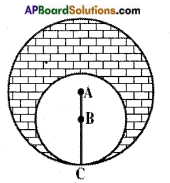
AP SSC 10th Class Maths Solutions Chapter 9 Tangents and Secants to a Circle Optional Exercise 8
Answer:
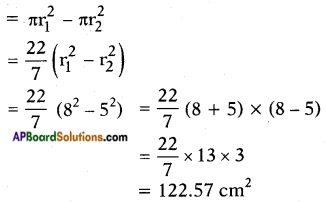
Given: Two circles with centres A and B, whose radii are 8 cm and 5 cm.
[∵ AC = 8 cm, AB = 3 cm ⇒ BC = 8 – 3 = 5 cm]
Area of the shaded region = (Area of the larger circle) – (Area of the smaller circle)
AP SSC 10th Class Maths Solutions Chapter 9 Tangents and Secants to a Circle Optional Exercise 9

Question 7.
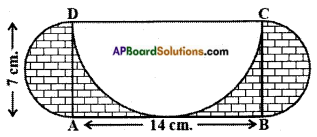
ABCD is a rectangle with AB = 14 cm. and BC = 7 cm. Taking DC, BC and AD as diameters, three semicircles are drawn as shown in the figure. Find the area of the shaded region.
AP SSC 10th Class Maths Solutions Chapter 9 Tangents and Secants to a Circle Optional Exercise 10
Answer:
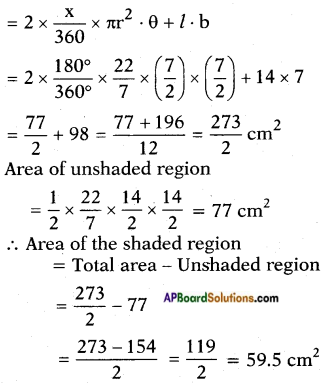
Given AB = 14 cm, AD = BC = 7 cm Area of the shaded and unshaded region
= (2 × Area of the semi-circles with AD as diameter) + Area of the rectangle
AP SSC 10th Class Maths Solutions Chapter 9 Tangents and Secants to a Circle Optional Exercise 11

AP SSC 10th Class Maths Solutions Chapter 4 Pair of Linear Equations in Two Variables Optional Exercise

AP State Board Syllabus AP SSC 10th Class Maths Textbook Solutions Chapter 4 Pair of Linear Equations in Two Variables Optional Exercise Textbook Questions and Answers.

AP State Syllabus SSC 10th Class Maths Solutions 4th Lesson Pair of Linear Equations in Two Variables Optional Exercise

10th Class Maths 4th Lesson Pair of Linear Equations in Two Variables Optional Exercise Textbook Questions and Answers

Question 1.
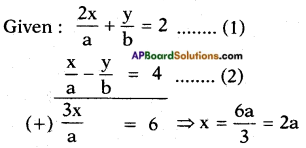
i) \(\frac{2x}{a}\) + \(\frac{y}{b}\) = 2
\(\frac{x}{a}\) – \(\frac{y}{b}\) = 4
Answer:
AP SSC 10th Class Maths Solutions Chapter 4 Pair of Linear Equations in Two Variables Optional Exercise 1
Substituting x = 2a in the equation (1) we get
\(\frac{2}{a}\)(2a) + \(\frac{y}{b}\) = 2
⇒ 4 + \(\frac{y}{b}\) = 2
⇒ \(\frac{y}{b}\) = -2
⇒ y = -2b
∴ The solution (x, y) = (2a, -2b)

AP SSC 10th Class Maths Solutions Chapter 4 Pair of Linear Equations in Two Variables Optional Exercise

ii) \(\frac{x+1}{2}\) + \(\frac{y-1}{3}\) = 8
\(\frac{x-1}{3}\) + \(\frac{y+1}{2}\) = 9
Answer:
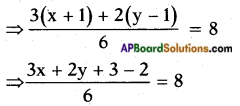
Given: \(\frac{x+1}{2}\) + \(\frac{y-1}{3}\) = 8
AP SSC 10th Class Maths Solutions Chapter 4 Pair of Linear Equations in Two Variables Optional Exercise 2
⇒ 3x + 2y + 1 = 48
⇒ 3x + 2y = 47 …… (1)
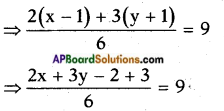
and \(\frac{x-1}{3}\) + \(\frac{y+1}{2}\) = 9
AP SSC 10th Class Maths Solutions Chapter 4 Pair of Linear Equations in Two Variables Optional Exercise 3
⇒ 2x + 3y + 1 = 54
⇒ 2x + 3y = 53 …… (2)
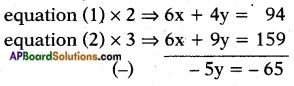
AP SSC 10th Class Maths Solutions Chapter 4 Pair of Linear Equations in Two Variables Optional Exercise 4
⇒ y = \(\frac{-65}{-5}\) = 13
Substituting y = 13 in equation (1) we get
3x + 2(13) = 47
⇒ 3x = 47 – 26
⇒ 3x = 21
⇒ x = \(\frac{21}{3}\) = 7
∴ The solution (x, y) = (7, 13)

iii) \(\frac{x}{7}\) + \(\frac{y}{3}\) = 5
\(\frac{x}{2}\) – \(\frac{y}{9}\) = 6
Answer:
Given: \(\frac{x}{7}\) + \(\frac{y}{3}\) = 5 and \(\frac{x}{2}\) – \(\frac{y}{9}\) = 6
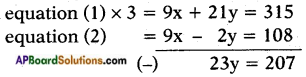
⇒ \(\frac{3x+7y}{21}\) = 5 and \(\frac{9x-2y}{18}\) = 6
⇒ 3x + 7y = 105 …….. (1) and
9x – 2y = 108 …….. (2)
AP SSC 10th Class Maths Solutions Chapter 4 Pair of Linear Equations in Two Variables Optional Exercise 5
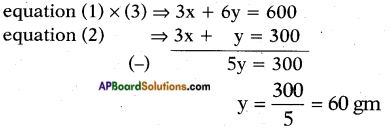
⇒ y = \(\frac{207}{23}\) = 9
Substituting y = 9 in equation (1) we get
3x + 7(9) = 105
⇒ 3x = 105 – 63
⇒ 3x = 42
⇒ x = \(\frac{42}{3}\) = 14
∴ The solution (x, y) = (14, 9)

AP SSC 10th Class Maths Solutions Chapter 4 Pair of Linear Equations in Two Variables Optional Exercise

iv) √3x + √2y = √3
√5x + √3y= √3
Answer:
Given that √3x + √2y = √3 …… (1)
√5x + √3y = √3 …… (2)
By following elimination method
AP SSC 10th Class Maths Solutions Chapter 4 Pair of Linear Equations in Two Variables Optional Exercise 6
Now again following elimination method
AP SSC 10th Class Maths Solutions Chapter 4 Pair of Linear Equations in Two Variables Optional Exercise 7
∴ The solution x = \(\frac{3-\sqrt{6}}{3-\sqrt{10}}\) and y = \(\frac{3-\sqrt{15}}{3-\sqrt{10}}\)

v) \(\frac{ax}{b}\) + \(\frac{by}{a}\) = a + b
ax – by = 2ab
Answer:
Given: \(\frac{ax}{b}\) + \(\frac{by}{a}\) = a + b ……. (1)
ax – by = 2ab …….. (2)
AP SSC 10th Class Maths Solutions Chapter 4 Pair of Linear Equations in Two Variables Optional Exercise 8
Substituting y = – a in equation (2)
we get ax – b(-a) = 2ab
ax + ab = 2ab
ax = 2ab – ab = ab
⇒ x = \(\frac{ab}{a}\) = b
∴ (x, y) = (b, -a)

AP SSC 10th Class Maths Solutions Chapter 4 Pair of Linear Equations in Two Variables Optional Exercise

vi) 2x + 3y = 17
2x+2 – 3y+1 = 5
Answer:
Given: 2x + 3y = 17 and
2x+2 – 3y+1 = 5
Take 2x = a and 3y = b then the given equations reduce to
2x + 3y = 17 ⇒ a + b = 17 …… (1)
2x . 22 – 3y . 3 = 5 ⇒ 4a – 3b = 5 …… (2)
AP SSC 10th Class Maths Solutions Chapter 4 Pair of Linear Equations in Two Variables Optional Exercise 9
Substituting b = 9 in equation (1) we get
a + 9 = 17 ⇒ a = 17 – 9 = 8
But a = 2x – 8 and b = 3y = 9
⇒ 2x = 23 and 3y = 32
⇒ x = 3 and y = 2
∴ The solution (x, y) is (3, 2)

AP SSC 10th Class Maths Solutions Chapter 4 Pair of Linear Equations in Two Variables Optional Exercise

Question 2.
Animals in an experiment are to be kept on a strict diet. Each animal is to receive among other things 20g of protein and 6g of fat. The laboratory technicians purchased two food mixes, A and B. Mix A has 10% protein and 6% fat. Mix B has 20% protein and 2% fat. How many grams of each mix should be used?
Answer:
Let x gms of mix A and y gms of mix B are to be mixed, then
AP SSC 10th Class Maths Solutions Chapter 4 Pair of Linear Equations in Two Variables Optional Exercise 10
AP SSC 10th Class Maths Solutions Chapter 4 Pair of Linear Equations in Two Variables Optional Exercise 11
Substituting y = 60 in equation (1)
we get x + 2 × 60 = 200
⇒ x + 120 = 200
⇒ x = 200 – 120 = 80 gm
∴ Quantity of mix. A = 80 gms.
Quantity of mix. B = 60 gms.

AP SSC 10th Class Maths Solutions Chapter 13 Probability Optional Exercise

AP State Syllabus SSC 10th Class Maths Solutions 13th Lesson Probability Optional Exercise

AP State Board Syllabus AP SSC 10th Class Maths Textbook Solutions Chapter 13 Probability Optional Exercise Textbook Questions and Answers.

10th Class Maths 13th Lesson Probability Optional Exercise Textbook Questions and Answers

Question 1.
Two customers Shyam and Ekta are visiting a particular shop in the same week (Tuesday to Saturday). Each is equally likely to visit the shop on any day as on another day. What is the probability that both will visit the shop on
(i) the same day?
(ii) consecutive days?
(iii) different days?
Answer:
Shyam and Ekta can visit the shop in the following combination:
AP SSC 10th Class Maths Solutions Chapter 13 Probability Optional Exercise 1
(T Tu) (W, Tu) (Th, Tu) (F, Tu) (S, Tu) (Tu, W) (W, W) (Th, W) (F, W) (S, W) (Tu, Th) (W, Th) (Th, F) (F, Th) (S, Th) (Tu, F) (W, F) (Th, S) (F, F) (S, F) (Tu, S) (W, S) (Th, Th) (F, S) (S, S)
∴ Number of total outcomes = 5 × 5 = 52 = 25 [also from the above table]
i) Number of favourable outcomes to that of visiting on the same day
(Tu, Tu), (W, W), (Th, Th), (F, F), (S, S) = 5
∴ Probability of visiting the shop on the same day = \(\frac{\text { No. of favourable outcomes }}{\text { No. of total outcomes }}\) = \(\frac{5}{25}\) = \(\frac{1}{5}\)
ii) Number of outcomes favourable to consecutive days
(Tu, W), (W, Th), (Th, F), (F, S), (W, Tu), (Th, W), (F, Th), (S, F) = 8
∴ Probability of visiting the shop on consecutive days = \(\frac{8}{25}\)
iii) If P(E) is the probability of visiting the shop on the same day,
then P(\(\overline{\mathrm{E}}\)) is the probability of visiting the shop not on the same day.
i.e., P(\(\overline{\mathrm{E}}\)) is the probability of visiting the shop on different days.
Such that P(E) + P(\(\overline{\mathrm{E}}\)) = 1
P(\(\overline{\mathrm{E}}\)) = 1 – P(E) = 1 – \(\frac{1}{5}\) = \(\frac{4}{5}\)

AP SSC 10th Class Maths Solutions Chapter 13 Probability Optional Exercise

Question 2.
A bag contains 5 red balls and some blue balls. If the probability of drawing a blue ball is double that of a red ball, determine the number of blue balls in the bag.
Answer:
Number of red balls in the bag = 5 As the probability of blue balls is double the probability of red balls, we have that number of blue balls is double the number of red balls.
∴ Blue balls = 5 × 2 = 10.
[!! Let the number of blue balls = x
Number of red balls = 5
Total no. of balls = x + 5
Total outcomes in drawing a ball at random = x + 5
Number of outcomes favourable to red ball = 5
∴ P(R) = \(\frac{5}{x+5}\)
from the problem,
P(B) = 2 × \(\frac{5}{x+5}\) = \(\frac{10}{x+5}\)
Also \(\frac{5}{x+5}\) + \(\frac{10}{x+5}\) = 1
[∵ P(E) + P(\(\overline{\mathrm{E}}\)) = 1]
⇒ \(\frac{5+10}{x+5}\) = 1
⇒ \(\frac{15}{x+5}\) = 1
⇒ x + 5 = 15]

Question 3.
A box contains 12 balls out of which x are black. If one ball is drawn at random from the box, what is the probability that it will be a black ball? If 6 more black balls are put in the box, the probability of drawing a black ball is now double of what it was before. Find x.
Answer:
Number of black balls = x
Total number of balls in the box = 12
Probability of drawing a black ball = \(\frac{\text { No. of favourable outcomes }}{\text { No. of total outcomes }}\) = \(\frac{x}{12}\) …….. (1)
When 6 more black balls are placed in the box, number of favourable outcomes to black ball becomes = x + 6.
Total number of balls in the box becomes = 12 + 6 = 18.
Now the probability of drawing a black ball become = \(\frac{x+6}{18}\) …….. (1)
By Problem,
\(\frac{x+6}{18}\) = 2. \(\frac{x}{12}\)
⇒ \(\frac{x+6}{18}\) = \(\frac{x}{6}\)
⇒ 6(x + 6) = 18(x)
⇒ 6x + 36 = 18x
⇒ 18x – 6x = 36
⇒ 12x = 36
⇒ x = \(\frac{36}{12}\) = 3
Check:
AP SSC 10th Class Maths Solutions Chapter 13 Probability Optional Exercise 2
and hence proved.

AP SSC 10th Class Maths Solutions Chapter 13 Probability Optional Exercise

Question 4.
A jar contains 24 marbles, some are green and others are blue. If a marble is drawn at random from the jar, the probability that it is green is 2/3. Find the number of blue marbles in the jar.
Answer:
Total number of marbles in the jar = 24.
Let the number of green marbles = x.
Then number of blue marbles = 24 – x.
Probability of drawing a green marbles = \(\frac{\text { No. of favourable outcomes }}{\text { No. of total outcomes }}\) = \(\frac{x}{24}\)
By problem,
\(\frac{x}{24}\) = \(\frac{2}{3}\)
⇒ 3x = 24 × 2
x = \(\frac{24 \times 2}{3}\) = 16
∴ Number of green marbles = 16
Number of blue marbles = 24 – 1 = 8
∴ Probability of picking blue marble = \(\frac{8}{24}\) = \(\frac{1}{3}\)
(OR)
P(B) = P(E) – P(G) = 1 – \(\frac{2}{3}\) = \(\frac{1}{3}\)
[!! P(G) = \(\frac{2}{3}\)
P(G) + P(B) = 1
∴ P(B) = 1 – P(G) = 1 – \(\frac{2}{3}\) = \(\frac{1}{3}\)
Number of blue marbles in the jar = \(\frac{1}{3}\) × 24 = 8]