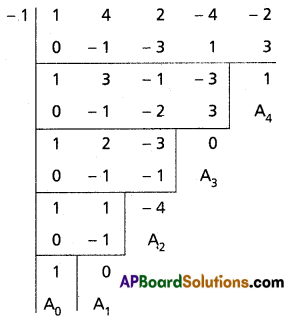
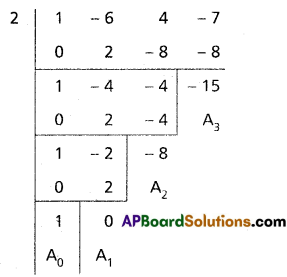
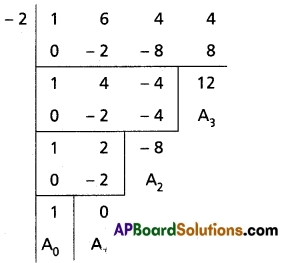
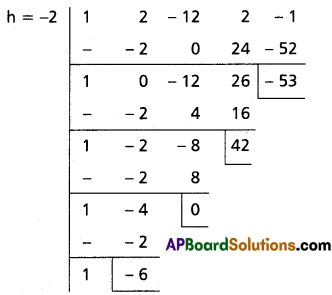
AP Inter 2nd Year Chemistry Important Questions Chapter 9 Biomolecules

Students get through AP Inter 2nd Year Chemistry Important Questions 9th Lesson Biomolecules which are most likely to be asked in the exam.

AP Inter 2nd Year Chemistry Important Questions 9th Lesson Biomolecules

Very Short Answer Questions

Question 1.
Define Carbohydrates.
Answer:
The compounds which are primarily produced by plants and form a very large group of naturally occuring organic compounds are called Carbohydrates.
Eg: Glucose, Fructose, Starch. Carbohydrates are the polyhydroxy aldehydes (or) ketones.

Question 2.
Name the different types of carbohydrates on the basis of their hydrolysis. Give one example for each.
Answer:
On the basis of the hydrolysis, carbohydrates are classified as

  1. Monosaccharides, Eg : Glucose, fructose AP Inter 2nd Year Chemistry Important Questions Chapter 9 Biomolecules 1 No saccharides
  2. Oligosaccharides, Eg : Sucrose, maltose AP Inter 2nd Year Chemistry Important Questions Chapter 9 Biomolecules 1 two monosaccharides
  3. Polysaccharides, Eg : Starch, cellulose AP Inter 2nd Year Chemistry Important Questions Chapter 9 Biomolecules 1 large number of monosaccharides.

AP Inter 2nd Year Chemistry Important Questions Chapter 9 Biomolecules

Question 3.
How is Glucose prepared ? [IPE – 2014]
Answer:
Glucose is prepared by the hydrolysis of starch in presence of a little acid.

AP Inter 2nd Year Chemistry Important Questions Chapter 9 Biomolecules 2

Question 4.
Why are sugars classified as reducing and non-reducing sugars ?
Answer:

  • Carbohydrates that reduce Fehling’s reagent, Tollen’s reagent are called reducing sugars.
    Eg: Glucose.
  • Carbohydrates that doesnot reduce Fehling’s reagent, Tollen’s reagent are called non reducing sugars.
    Eg : Sucrose.

Question 5.
What do you understand by invert sugars ?
Answer:
During the hydrolysis of sucrose there is a change in the sign of rotation, from dextro (+) to laevo (-) and the product is named as invert sugar.

Question 6.
What do you mean by essential amino acids ? Give two examples for non essential amino acids ? [IPE 2014] [T.S. Mar. 16]
Answer:
Essential amino acids : The amino acids which cannot be synthesized in the body and must be obtained through diet are known as essential aminoacids.
Eg : valine, leucine etc.
Examples of non essential amino acids are Alanine, Glycine, Aspartic acid.

AP Inter 2nd Year Chemistry Important Questions Chapter 9 Biomolecules

Question 7.
What is zwitter ion ? Give an example. [IPE 2015 (AP)]
Answer:
Zwitter ion: In aqueous solution of amino acids, the carboxyl group can lose a proton and amino acid can accept that proton to form a dipolar ion. This ion is called as zwitter ion.
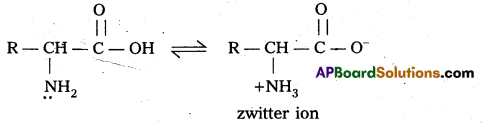
AP Inter 2nd Year Chemistry Important Questions Chapter 9 Biomolecules 3

Question 8.
What are reducing sugars ?
Answer:
Carbohydrates that reduce Fehling’s reagent, Tollen’s reagent are called reducing sugars.
Eg: glucose.

Question 9.
What are proteins ? Give an example.
Answer:
Proteins : A poly peptide with more than hundred amino acid residues, having molecular mass higher than 10,000 units is called a protein.
Eg : keratin, myosin, insulin.

Question 10.
What are the components of a nucleic acid ?
Answer:

  • Nucleic acids are long chain polymers of nucleotides i.e., poly nucleotides.
  • Nucleic acids are constituted by pentose sugar, phosphoric acid, and nitrogenous hetero cyclic base (purine (or) pyrimidine).

AP Inter 2nd Year Chemistry Important Questions Chapter 9 Biomolecules

Question 11.
What are essential and non – essential amino acids ? Give one example for each. [IPE – 2016 (TS)]
Answer:

  • Essential amino acids : The amino acids that cannot be synthesised by the body and must be supplied in the diet are called essential amino acids.
    Eg : valine, leucine, phenyl alanine etc.
  • Non-essential amino acids : Other amino acids synthesised by the tissues of the body are called non-essential amino acids..
    Eg: Glycine, alanine etc.

Question 12.
Differentiate between globular and fibrous proteins.
Answer:
Globular proteins

  1. In this proteins the chains of poly peptides coil around to give a spherical shape.
  2. hese are soluble in water.
  3. Eg : Insulin

Fibrous proteins

  1. In this proteins the poly peptides run parallel and are held together by hydrogens and disulphite – bonding.
  2. These are insoluble in water.
  3. Eg: keratin

Question 13.
Why are vitamin A and vitamin C essential to us ? Give their important sources.
Answer:
Vitamin A and Vitamin C are essential to us.
Explanation :

  • Deficiency of vitamin A causes night blindness, redness in eyes, xerophthalnia.
  • Deficiency of vitamin C causes pernicious anaemia (RBC deficient in haemoglobin).

Sources:

  • Vitamin – A : Fish liver oil, carrots, butter and milk.
  • Vitamin – C : Citrous fruits, amla, green leafy vegetables

AP Inter 2nd Year Chemistry Important Questions Chapter 9 Biomolecules

Question 14.
What do you understand from the names (a) aldo pentose and (b) ketoheptose ?
Answer:
a) Aldo pentose : If a monosaccharide contains 5 carbon atoms with aldehyde group then it is known as aldo pentose.
b) Ketoheptose : If a monosaccharide contain seven carbons with a ketone group then it is called ketoheptose.

Question 15.
What are anomers ?
Answer:
Anomers : The two isomeric structures of a compound which differ in configuratiofi at C-l only are called Anomers.

Question 16.
What are amino acids ? Give two examples.
Answer:
The organic compounds which contain amino (-NH2) functional group and carboxyl (-COOH) functional group are called amino acids.
Eg : Glycine, Alanine etc.

Question 17.
What are fibrous proteins ? Give examples.
Answer:
When the poly peptide chains run parallel and are held together by hydrogen and disulphide bonds then fibre – like structure is formed. These are called fibrous proteins. These are insoluble in water.
Eg : keratin, myosin.

AP Inter 2nd Year Chemistry Important Questions Chapter 9 Biomolecules

Question 18.
What are globular proteins ? Give examples.
Answer:
When the chains of polypeptides coil around to give a spherical shape then globular proteins are formed. These are usually soluble in water.
Eg : insulin and albumins.

Short Answer Questions

Question 1.
Explain the denaturation of proteins.
Answer:
The phenomenon of disorganization of native protein structure is known as denaturation. Denaturation results in the loss of secondary, tertiary and quaternary structure of proteins. This involves a change in physical, chemical and biological properties of protein molecules.
Agents of denaturation:
Physical agents – Heat, violent shaking, X – rays, UV – radiation.
Chemical gents – Acids, alkalies, organic solvents, urea, salts of heavy metals.

Question 2.
What are enzymes ? Give examples ?
Answer:
The group of complex proteinoid organic compounds, elaborated by living organism which catalyse specific organic reactions are called enzymes.
Eg.: Lipases, Rennin, Maltase, Invertase etc. Practically all biological processes such as digestion, respiration etc., are carried on through the agency of enzymes.
Enzymes may be defined as biocatalysts synthesised by living cells.
The functional unit of enzyme is known as holo enzyme made up at apo enzyme (protein part) and co enzyme (non-protein part).

AP Inter 2nd Year Chemistry Important Questions Chapter 9 Biomolecules 4

Question 3.
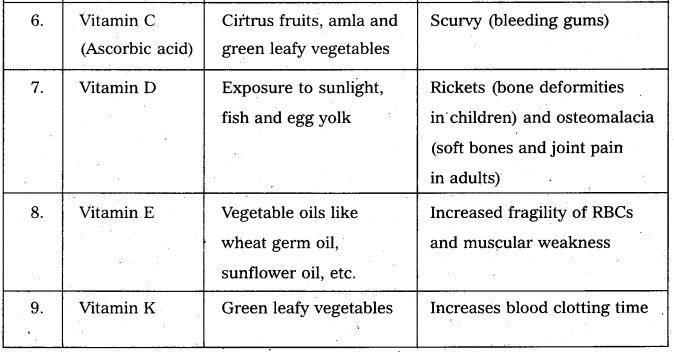
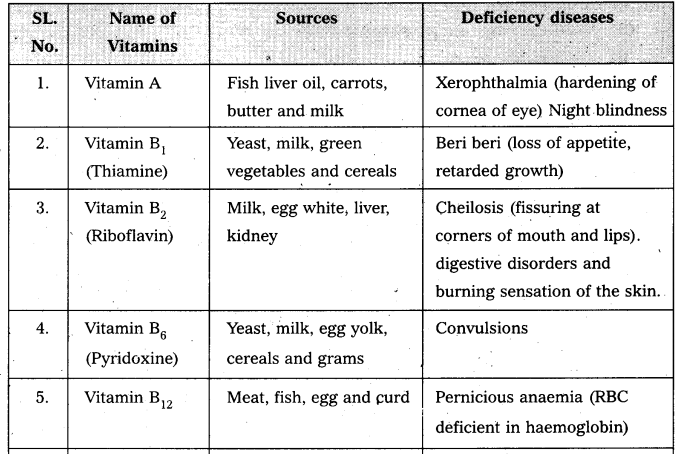
Write notes on vitamins.
Answer:
Vitamin is defined as an “accessory food factor which is essential for growth and healthy maintenance of the body.”
Classification : Vitamins are broadly classified into two major groups.
a) the fat soluble Eg : vitamin A, D, E and K.
b) water soluble Eg : vitamin B – complex and C.
AP Inter 2nd Year Chemistry Important Questions Chapter 9 Biomolecules 5
AP Inter 2nd Year Chemistry Important Questions Chapter 9 Biomolecules 6

AP Inter 2nd Year Chemistry Important Questions Chapter 9 Biomolecules

Question 4.
What are harmones ? Give one example for each. [IPE – 2016 (TS)] [Mar. 14]

  1. steroid hormones
  2. Poly peptide hormones and
  3. amino acid derivatives.

Answer:
Hormones: Hormone is defined as an “organic compound synthesised by the ductless glands of the body and carried by the blood stream to another part of the body for its function”.
Eg : testosterone, oestrogen.

  1. Example for steroid hormones : Testosterone, oestrogen
  2. Example for poly peptide hormones: Insulin
  3. Example for Amino acid derivative : Thyroidal hormones thyroxine.

Question 5.
Write the importance of carbohydrates.
Answer:
Importance of carbohydrates:

  • Carbohydrates are essential for life of plants.
  • Carbohydrates are used as storage molecules as starch in plants.
  • Cell wall of plants is made up of cellulose.
  • Carbohydrates are also essential for life of animals. Carbohydrates are used as storage molecules as glycogen in animals.
  • Carbohydrate source honey is used for a long time as an instant source of energy.

AP Inter 2nd Year Chemistry Important Questions Chapter 9 Biomolecules

Question 6.
Give the sources of the following vitamins and name the diseases caused by their- deficiency [T.S. Mar. 17] [IPE AP & TS (Mar. 15) BMP, 2016 (AP]
(a) A
(b) D
(c) E and
(d) K
Answer:
Vitamin : A
Sources : Fish oils, liver, kidney
Deficiency diseases : Night blindness, Redness in eyes.

Vitamin : D
Sources : Fish oils, butter, milk, egg
Deficiency diseases : Rickets in children, osteomalacia in adults

Vitamin : E
Sources : Wheat germ oil, egg yolk, green vegetables
Deficiency diseases : Sterility

Vitamin : K
Sources : Green vegetables, Intestinal flora.
Deficiency diseases : Blood coagulation is prevented

Question 7.
Write notes on proteins. [IPE – 2016 (TS)]
Answer:
Proteins are polypeptide chains of amino acids.
Classification of Proteins : Proteins can be classified into two types on the basis of their molecular shape.
a) Fibrous Proteins : These are fibre like proteins, the polypeptide chains are parallel which are held together by hydrogen and disulphide bonds. These are insoluble in water.
Ex : Keratin present in hair, wool, silk etc., and myosin present in muscles.

b) Globular proteins: In these proteins, the polypeptide chains coil around to give a spherical shape. These are soluble in water.
Ex : insulin and albumin.

The structure of proteins is explained in four different levels
a) Primary structure
b) Secondary structure
c) Tertiary structure
d) Quaternary structure

Denaturation of proteins : A protein in a biological system with a specific structure and biological activity is called a native protein. The process in which a protein loses its activity when subjected to heating, change in pH, addition of reagents is called denaturation of protein. Denaturation may be reversible or irreversible.
Ex : Coagulation of egg white on boiling is an irresersible denaturation.
Renaturation is the reverse process of denaturation.

AP Inter 2nd Year Chemistry Important Questions Chapter 9 Biomolecules

Question 8.
Write about polysaccharides with starch and cellulose as examples.
Answer:
Polysaccharides : The saccharides which on hydrolysis to form large number of monosaccharides are called polysaccharides.
Eg : Starch and cellulose

Starch :

  • Starch is the most important dietary source for human beings.
  • Vegetables, roots, cereals are important sources of starch.
  • It is a polymer ofα – glucose.
  • It is constituted by two components Amylose and amylopectin.

Amylose :

  • It constitutes 15 – 20% of starch.
  • Amylose is water soluble component.
  • Amylose is a branched chain with 200 – 1000 α – D – glucose units held by C – 1 to C – 4 glycosidic linkage.

Amylopectin :

  • Amylopectin constitutes 80 – 85% of starch.
  • It is a branched chain polymer of a – glucose units in which chain is formed by C. – 1 to C – 4 glycosidic linkage whereas branching occurs by C – 1 to C – 6 glycosidic linkage.

Cellulose :

  • Cellulose occurs in plants and it is the most abundant organic substance.
  • It is a major constituent of cell wall of plant cells.
  • Cellulose is a straight chain polysaccharide composed only of β – D – glucose units . which are joined by glycosidic linkage between C – 1 of one glucose and C – 4 of the next glucose.

Question 9.
Write notes on the functions of different hormones in the body. [IPE 2014]
Answer:
Functions of Hormones:

  • Hormones help to maintain the balance of biological activities in the body.
  • Insulin maintains the blood glucose level within the limit.
  • Growth hormones and sex hormones play role in growth and development.
  • Low level of thyroxine (produced from thyroid gland) causes hypothyroidism. High level of thyroxine causes hyper thyroidism.
  • Gluco corticoids control the carbohydrate metabolism, modulates the inflammatory reactions.
  • The mineralo corticoids control the level of excretion of water and salt by the kidney.
  • Adrenal cortex does not function properly then results in Addison’s disease.
  • Hormones released by gonads are responsible for development of secondary sex characters.
  • Testosterone is responsible for development of secondary sex hormone produced in male.
  • Estradiol is the main female sex hormone responsible for development of secondary female characterstics like control of menstrual cycle.
  • Progesterone is responsible for preparing the uterus for implantation of fertiised egg.

AP Inter 2nd Year Chemistry Important Questions Chapter 9 Biomolecules

Question 10.
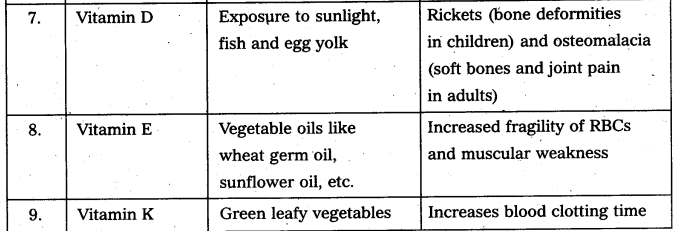
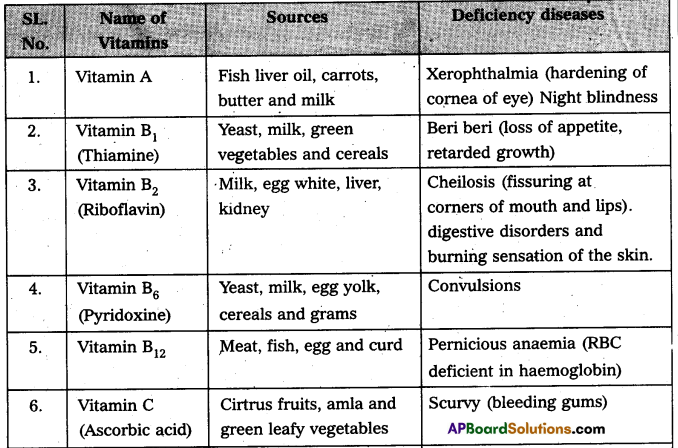
Write the sources of vitamin and diseases due to vitamin deficIency. [AP Mar. 20]
Answer:
AP Inter 2nd Year Chemistry Important Questions Chapter 9 Biomolecules 7
AP Inter 2nd Year Chemistry Important Questions Chapter 9 Biomolecules 8

AP Inter 2nd Year Chemistry Important Questions Chapter 6(d) Group-18 Elements

Students get through AP Inter 2nd Year Chemistry Important Questions Lesson 6(d) Group-18 Elements which are most likely to be asked in the exam.

AP Inter 2nd Year Chemistry Important Questions Lesson 6(d) Group-18 Elements

Very Short Answer Questions

Question 1.
List out the uses of Neon.
Answer:
Uses of Ne:

  1. Ne is used in discharge tubes and fluorescent bulbs for advertisement display purposes.
  2. ‘Ne’ – bulbs are used in botanical gardens and in greenhouses.

Question 2.
Write any two uses of argon.
Answer:
Uses of Ar:

  1. ‘Ar’ is used to create an inert atmosphere in a high-temperature metallurgical process.
  2. ‘Ar’ is used in filling electric bulbs.

AP Inter 2nd Year Chemistry Important Questions Chapter 6(d) Group-18 Elements

Question 3.
In modern diving apparatus, a mixture of He ánd O2 is used – Why? (IPE 2016 (AP))
Answer:
In modem diving apparatus, a mixture of He and O2 is used because He is very low soluble in blood.

Question 4.
Helium is heavier than hydrogen. Yet helium is used (instead of H2) in filling balloons for meteorological observations – Why?
Answer:
‘He’ is a non—inflammable and light gas. Hence it is used in filling balloons for meterological observations.

Question 5.
How is XeO3 prepared? (IPE May – 2015(AP), 2014)
Answer:
XeF6 on hydrolysis produce XeO3.
XeF6 + 3H2O → XeO3 + 6HF

Question 6.
Give the preparation of
a) XeOF4 and
b) XeO2F2. (TS Mar. 17; IPE 2014)
Answer:
Partial hydrolysis of XeF6 gives oxy fluorides XeOF4 and XeO2F2
XeF6 + H2O → XeOF4 + 2HF
XeF6 + 2H2O → XeO2F2 + 4HF

Question 7.
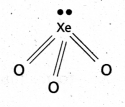
Explain the structure of XeO3. (TS Mar. 17; IPE 16, 15’ 14 (TS))
Answer:
Structure of XeO3:
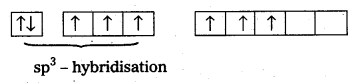
  1. Central atom is Xe’.
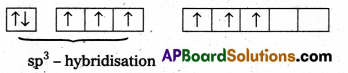
  2. ‘Xe undergoes sp3 hybridisation in 3rd excited state.
    AP Inter 2nd Year Chemistry Important Questions Chapter 6(c) Group-17 Elements 1
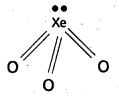
  3. ‘Xe’ forms 3σ-bonds and 3π-bonds with three oxygens.
  4. Shape of molecule is pyramidal with bond angle 103°.
    AP Inter 2nd Year Chemistry Important Questions Chapter 6(c) Group-17 Elements 2

AP Inter 2nd Year Chemistry Important Questions Chapter 6(d) Group-18 Elements

Question 8.
Explain the shape of XeF4 on the basis of VSEPR theory.
Answer:
Shape of XeF4:

  1. Central atom in XeF4 is
    AP Inter 2nd Year Chemistry Important Questions Chapter 6(c) Group-17 Elements 3
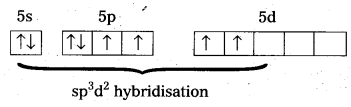
  2. Xe undergoes sp3d2 hybridisation in its 2nd excited state.
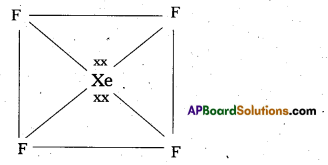
  3. Shape of the molecule is squãre planar with bond angle 90° and bond length 1.95A
    AP Inter 2nd Year Chemistry Important Questions Chapter 6(c) Group-17 Elements 4
  4. Xe – forms four σ-bonds by the overlap of sp3d2 – 2pz(F) orbitals.

Question 9.
Which noble gas is radio active ? How is it formed?
Answer:
Radon (Rn) is radio active noble gas. Radon is obtained as decay product of 86R226.
86Ra22686Rn222 + 2He4

Question 10.
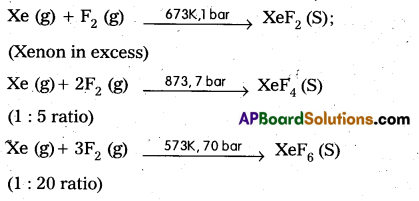
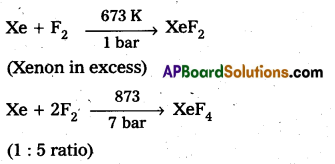
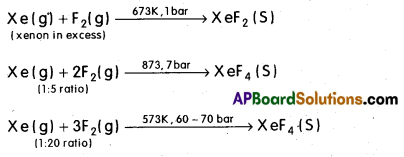
How are XeF2, XeF4, XeF6 prepared? Give equation.
Answer:
AP Inter 2nd Year Chemistry Important Questions Chapter 6(c) Group-17 Elements 5

Question 11.
Noble gases are inert – explain.
Answer:
Noble gases are chemically inert:

  1. Noble gases have stable electronic configuration octet configuration except He.
  2. Noble gases have high Ionisation energy values and have large positive values of electron gain enthalpy.

Question 12.
Write the name and formula of the first noble gas compound prepared by Bertlett.
Answer:
The first noble gas compound prepared by Bertlett is XePtF6. Name of the compound is xenon hexa fluoro platinate.

Question 13.
Why do noble gases form compounds with fluorine and oxygen only?
Answer:
Noble gases form compounds with flourine and oxygen only.
Reason: Oxygen and Fluorine are most electronegative elements.

AP Inter 2nd Year Chemistry Important Questions Chapter 6(d) Group-18 Elements

Short Answer Questions

Question 1.
Explain the structures of
a) XeF2 and
b) XeF4. (AP Mar. ‘17, IPE 16, 15, ‘14 (TS)) (TS Mar. ’14)
Answer:
Xenon forms the binary fluorides XeF2, XeF4, XeF6 as follows. These are formed by direct combination of Xe and F2.
AP Inter 2nd Year Chemistry Important Questions Chapter 6(c) Group-17 Elements 6

Structure of XeF2:
  1. In XeF2 central atom is ‘Xe’.
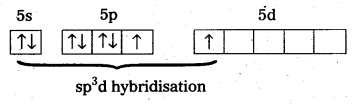
  2. ‘Xe’ undergoes sp3d hybridisation in its 1st excited state.
    AP Inter 2nd Year Chemistry Important Questions Chapter 6(c) Group-17 Elements 7
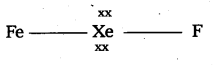
  3. Shape of molecule is linear.
  4. Xe form two σ-bonds with two fluorines.
    AP Inter 2nd Year Chemistry Important Questions Chapter 6(c) Group-17 Elements 8

b) Structure of XeF4:

  1. Central atom in XeF4 is ‘Xe’.
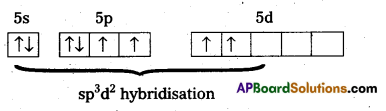
  2. Xe undergoes sp3d2 hybridisation in it’s 2nd excited state.
    AP Inter 2nd Year Chemistry Important Questions Chapter 6(c) Group-17 Elements 9
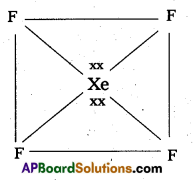
  3. Shape of the molecule is square planar with bond angle 90° and bond length 1.95A
    AP Inter 2nd Year Chemistry Important Questions Chapter 6(c) Group-17 Elements 10
  4. Xe forms four σ-bonds by the overlap of sp3d2 – 2pz (F) orbitals.

Question 2.
Explain the structures of
a) XeF6 and
b) XeOF4 (IPE Mar & May – 2015, 14)
Answer:
Structure òf XeF6 is ‘Xe’.

  1. Central atom in XeF6 is ‘Xe’.
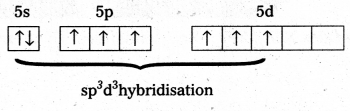
  2. Xe undergoes sp3d3 hybridisation in it’s 3rd excited state.
    AP Inter 2nd Year Chemistry Important Questions Chapter 6(c) Group-17 Elements 11
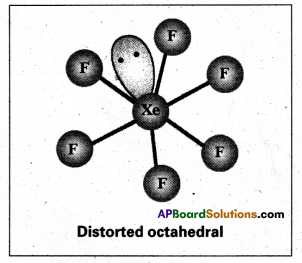
  3. Shape of molecule is distorted octahedral.
    AP Inter 2nd Year Chemistry Important Questions Chapter 6(c) Group-17 Elements 12

b) Structure of XeOF4:

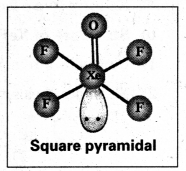
  1. In XeOF4 molecule ‘Xe’ undergoes sp3d2 hybridisation.
  2. Shape of the molecule is square pyramid.
  3. There is one Xe-O double bond containing.
    AP Inter 2nd Year Chemistry Important Questions Chapter 6(c) Group-17 Elements 13
    pπ = dπ overlapping.
    Partial hydrolysis of XeF6 gives XeOF4
    XeF6 + H2O → XeOF4 + 2HF
    XeOF4 is a colourless volatile liquid. It has a square pyramidal shape.

AP Inter 2nd Year Chemistry Important Questions Chapter 6(d) Group-18 Elements

Question 3.
Explain the structure of
a) XeO3 and
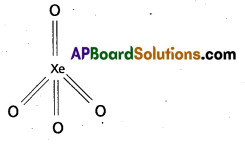
b) XeO4 (T.S. Mar. ‘16)
Answer:
a) Structure of XeO3:

  1. Central atom is ‘Xe’
  2. ‘Xe’ undergoes sp3 hybridisation in 3rd excited state.
    AP Inter 2nd Year Chemistry Important Questions Chapter 6(c) Group-17 Elements 14
  3. ‘Xe forms 3σ-bonds and 3π-bonds with three oxygens.
  4. Shape of molecule is pyramidal with bond angle 103°.
    AP Inter 2nd Year Chemistry Important Questions Chapter 6(c) Group-17 Elements 15

b) Structure of XeO4:
Xe is in sp3 hybridisation four singma bonds and four dπ – pπ bonds. Shape of XeO4 is tetrahedral.
AP Inter 2nd Year Chemistry Important Questions Chapter 6(c) Group-17 Elements 16

Question 4.
Write the preparations of Xenon flourides.
Answer:
Xenon flourides : Xenon forms three binary fluorides, Xe F2, XeF4, and XeF6 by the direct reaction of Xenon with fluorine under suitable conditions.
AP Inter 2nd Year Chemistry Important Questions Chapter 6(c) Group-17 Elements 17
XeF6 can also be prepared by the interaction of XeF4 and O2F2 at 143 K.
XeF4 + O2F2 → XeF6 + O2

Question 5.
Write the preparations of Xenon Oxides.
Answer:
Xenon Oxides: Xenon forms two oxides XeO3 and XeO4 with oxygen.
These oxides are formed by the hydrolysis of xenon fluorides.
6XeF4 + 12 H2O → 4 Xe + 2 XeO3 + 24 HF + 3O2
XeF6 + 3 H2O → XeO3 + 6 HF

Question 6.
Give the formulae and describe the structures of a noble gas species, isostructural with
a) \(\mathrm{ICl}_4^{-}\)
b) \(\mathbf{I B r}_2^{-}\)
c) \(\mathrm{BrO}_3^{-}\)
Answer:
a) \(\mathrm{ICl}_4^{-}\) is also structural with XeF4 and it has square planar shape.
b) \(\mathbf{I B r}_2^{-}\) is also structural with XeF2 and it has linear shape.
c) \(\mathrm{BrO}_3^{-}\) is iso-structural with XeO4 and it has tetrahedral šhape.

AP Inter 2nd Year Chemistry Important Questions Chapter 6(d) Group-18 Elements

Question 7.
Write any two uses of Helium.
Answer:
Uses of Helium:

  1. It is non inflammable and very light gas. Hence it is used in the balloons of Meteorological observations.
  2. It is used in gas cooled nuclear reactors and used as cryogenic agent.
  3. It is used as diluent for oxygen in modern diving apparatus.

Inter 2nd Year Maths 2A Partial Fractions Solutions Ex 7(d)

Practicing the Intermediate 2nd Year Maths 2A Textbook Solutions Inter 2nd Year Maths 2A Partial Fractions Solutions Exercise 7(d) will help students to clear their doubts quickly.

Intermediate 2nd Year Maths 2A Partial Fractions Solutions Exercise 7(d)

Question 1.
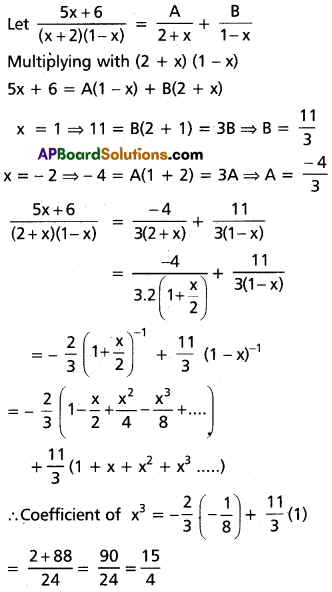
Find the coefficient of x3 in the power series expansion of \(\frac{5 x+6}{(x+2)(1-x)}\) specifying the region in which the expansion is valid.
Solution:
Inter 2nd Year Maths 2A Partial Fractions Solutions Ex 7(d) Q1

Inter 2nd Year Maths 2A Partial Fractions Solutions Ex 7(d)

Question 2.
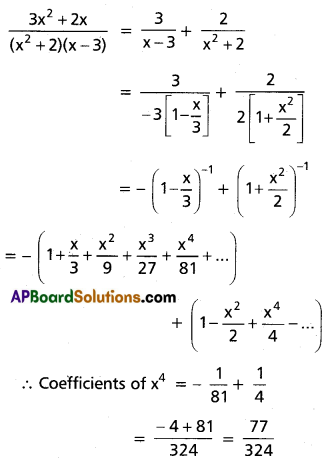
Find is the coefficient of x4 in the power series expansion of \(\frac{3 x^2+2 x}{\left(x^2+2\right)(x-3)}\) specifying the interval in which the expansion is valid.
Solution:
Let \(\frac{3 x^2+2 x}{\left(x^2+2\right)(x-3)}=\frac{A}{x-3}+\frac{B x+C}{x^2+2}\)
Multiplying with (x2 + 2) (x – 3)
3x2 + 2x = A(x2 + 2) + (Bx + C) (x – 3)
x = 3
⇒ 27 + 6 = A(9 + 2)
⇒ 33 = 11A
⇒ A = 3
Equating the coefficients of x2
3 = A + B
⇒ B = 3 – A = 3 – 3 = 0
Equating the constants,
2A – 3C = 0
⇒ 3C = 2A = 6
⇒ C = 2
Inter 2nd Year Maths 2A Partial Fractions Solutions Ex 7(d) Q2

Question 3.
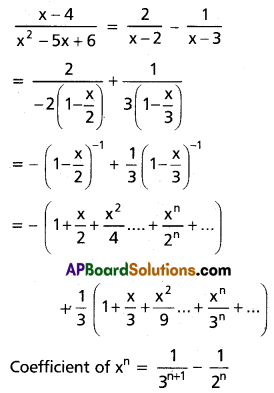
Find the coefficient of xn in the power series expansion of \(\frac{x-4}{x^2-5 x+6}\) specifying the region in which the expansion is valid.
Solution:
Let \(\frac{x-4}{x^2-5 x+6}=\frac{A}{x-2}+\frac{B}{x-3}\)
Multiplying with (x – 2) (x – 3)
x – 4 = A(x – 3) + B(x – 2)
x = 2
⇒ -2 = A(2 – 3) = -A
⇒ A = 2
x = 3
⇒ -1 = B(3 – 2) = B
⇒ B = -1
Inter 2nd Year Maths 2A Partial Fractions Solutions Ex 7(d) Q3

Inter 2nd Year Maths 2A Partial Fractions Solutions Ex 7(d)

Question 4.
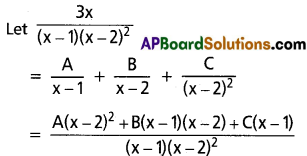
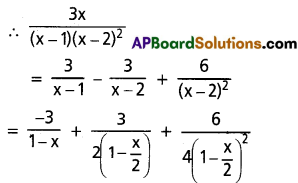
Find the coefficient of xn in the power series expansion of \(\frac{3 x}{(x-1)(x-2)^2}\)
Solution:
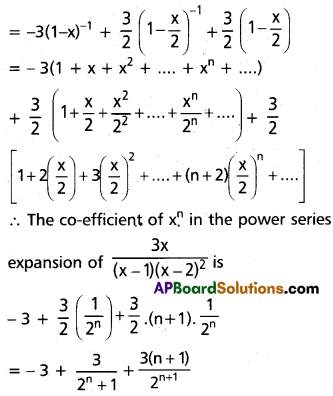
Inter 2nd Year Maths 2A Partial Fractions Solutions Ex 7(d) Q4
∴ 3x = A(x – 2)2 + B(x – 1) (x – 2) + C(x – 1) ……..(1)
putting x = 1,
3 = A(1 – 2)2
⇒ A = 3
putting x = 2,
6 = C(2 – 1)
⇒ C = 6
Now equating the co-efficient of x2 terms in (1)
0 = A + B
⇒ B = -A
⇒ B = -3
Inter 2nd Year Maths 2A Partial Fractions Solutions Ex 7(d) Q4.1
Inter 2nd Year Maths 2A Partial Fractions Solutions Ex 7(d) Q4.2

Inter 2nd Year Maths 2A Partial Fractions Solutions Ex 7(c)

Practicing the Intermediate 2nd Year Maths 2A Textbook Solutions Inter 2nd Year Maths 2A Partial Fractions Solutions Exercise 7(c) will help students to clear their doubts quickly.

Intermediate 2nd Year Maths 2A Partial Fractions Solutions Exercise 7(c)

Resolve the following into partial fractions.

Question 1.
\(\frac{x^2}{(x-1)(x-2)}\)
Solution:
Let \(\frac{x^2}{(x-1)(x-2)}=1+\frac{A}{x-1}+\frac{B}{x-2}\)
Multiplying with (x – 1) (x – 2)
x2 = (x – 1) (x – 2) + A(x – 2) + B(x – 1)
Put x = 1, 1 = A(-1) ⇒ A = -1
Put x = 2, 4 = B(1) ⇒ B = 4
∴ \(\frac{x^2}{(x-1)(x-2)}=1-\frac{1}{x-1}+\frac{4}{x-2}\)

Inter 2nd Year Maths 2A Partial Fractions Solutions Ex 7(c)

Question 2.
\(\frac{x^3}{(x-1)(x+2)}\)
Solution:
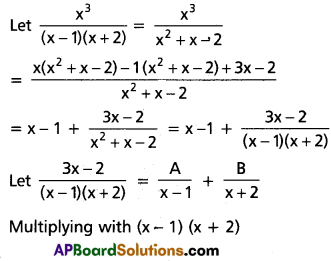
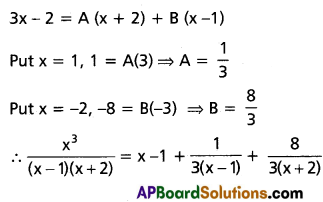
Inter 2nd Year Maths 2A Partial Fractions Solutions Ex 7(c) Q2
Inter 2nd Year Maths 2A Partial Fractions Solutions Ex 7(c) Q2.1

Question 3.
\(\frac{x^3}{(2 x-1)(x-1)^2}\)
Solution:
Let \(\frac{x^3}{(2 x-1)(x-1)^2}\) = \(\frac{1}{2}+\frac{A}{2 x-1}+\frac{B}{x-1}+\frac{C}{(x-1)^2}\)
Multiplying with 2(2x – 1) (x – 1)2
2x3 = (2x – 1) (x – 1)2 + 2A(x – 1)2 + 2B(2x – 1) (x – 1) + 2C(2x – 1)
Put x = \(\frac{1}{2}\),
⇒ 2(\(\frac{1}{8}\)) = 2A(\(\frac{1}{4}\))
⇒ A = \(\frac{1}{2}\)
Put x = 1,
⇒ 2(1) = 2C(1)
⇒ C = 1
Put x = 0,
0 = (-1) (1) + 2A(1) + 2B(-1) (-1) + 2C(-1)
⇒ 2A + 2B – 2C = 1
⇒ 2B = 1 + 2C – 2A
⇒ 2B = 1 + 2 – 1 = 2
⇒ B = 1
∴ \(\frac{x^3}{(2 x-1)(x-1)^2}\) = \(\frac{1}{2}+\frac{1}{2(2 x-1)}+\frac{1}{(x-1)}+\frac{1}{(x-1)^2}\)

Inter 2nd Year Maths 2A Partial Fractions Solutions Ex 7(c)

Question 4.
\(\frac{x^3}{(x-a)(x-b)(x-c)}\)
Solution:
Let \(\frac{x^3}{(x-a)(x-b)(x-c)}\) = \(1+\frac{A}{x-a}+\frac{B}{x-b}+\frac{C}{x-c}\)
Multiplying with (x – a)(x – b) (x – c),
x3 = (x – a)(x – b) (x – c) + A(x – b) (x – c) + B(x – a) (x – c) + C(x – a) (x – b)
Put x = a,
a3 = A(a – b) (a – c)
⇒ A = \(\frac{a^3}{(a-b)(a-c)}\)
Put x = b,
b3 = B(b – a) (b – c)
⇒ B = \(\frac{b^3}{(b-a)(b-c)}\)
Put x = c, c3 = C(c – a) (c – b)
⇒ C = \(\frac{c^3}{(c-a)(c-b)}\)
∴ \(\frac{x^3}{(x-a)(x-b)(x-c)}\) = \(1+\frac{a^3}{(a-b)(a-c)(x-a)}+\frac{b^3}{(b-a)(b-c)(x-b)}\) + \(\frac{c^3}{(c-a)(c-b)(x-c)}\)

Inter 2nd Year Maths 2A Partial Fractions Solutions Ex 7(b)

Practicing the Intermediate 2nd Year Maths 2A Textbook Solutions Inter 2nd Year Maths 2A Partial Fractions Solutions Exercise 7(b) will help students to clear their doubts quickly.

Intermediate 2nd Year Maths 2A Partial Fractions Solutions Exercise 7(b)

Resolve the following into partial fractions.

Question 1.
\(\frac{2 x^2+3 x+4}{(x-1)\left(x^2+2\right)}\)
Solution:
Let \(\frac{2 x^2+3 x+4}{(x-1)\left(x^2+2\right)}=\frac{A}{x-1}+\frac{B x+C}{x^2+2}\)
Multiplying with (x – 1) (x2 + 2)
2x2 + 3x + 4 = A(x2 + 2) + (Bx + C) (x – 1)
x = 1
⇒ 2 + 3 + 4 = A(1 + 2)
⇒ 9 = 3A
⇒ A = 3
Equating the coefficients of x2
2 = A + B
⇒ B = 2 – A = 2 – 3 = -1
Equating constants
4 = 2A – C
⇒ C = 2A – 4 = 6 – 4 = 2
∴ \(\frac{2 x^2+3 x+4}{(x-1)\left(x^2+2\right)}=\frac{3}{x-1}+\frac{-x+2}{x^2+2}\)

Inter 2nd Year Maths 2A Partial Fractions Solutions Ex 7(b)

Question 2.
\(\frac{3 x-1}{\left(1-x+x^2\right)(x+2)}\)
Solution:
Let \(\frac{3 x-1}{\left(1-x+x^2\right)(x+2)}=\frac{A}{2+x}+\frac{B x+C}{1-x+x^2}\)
Multiplying with (2 + x) (1 – x + x2)
3x – 1 = A(1 – x + x2) (Bx + C) (2 + x)
x = -2
⇒ -7 = A(1 + 2 + 4) = 7A
⇒ A = -1
Equating the coefficients of x2
0 = A + B ⇒ B = -A = 1
Equating the constants
-1 = A + 2C
⇒ 2C = -1 – A = -1 + 1 = 0
⇒ C = 0
∴ \(\frac{3 x-1}{\left(1-x+x^2\right)(2+x)}=-\frac{1}{2+x}+\frac{x}{1-x+x^2}\)

Question 3.
\(\frac{x^2-3}{(x+2)\left(x^2+1\right)}\)
Solution:
Let \(\frac{x^2-3}{(x+2)\left(x^2+1\right)}=\frac{A}{x+2}+\frac{B x+C}{x^2+1}\)
Multiplying with (x + 2) (x2 + 1)
x2 – 3 = A(x2 + 1) + (Bx + C) (x + 2)
x = -2
⇒ 4 – 3 = A(4 + 1)
⇒ 1 = 5A
⇒ A = \(\frac{1}{5}\)
Equating the coefficients of x2
1 = A + B
⇒ B = 1 – A = 1 – \(\frac{1}{5}\) = \(\frac{4}{5}\)
Equating the constants
-3 = A + 2C
⇒ 2C = -3 – A
⇒ 2C = -3 – \(\frac{1}{5}\)
⇒ 2C = \(-\frac{16}{5}\)
⇒ C = \(-\frac{8}{5}\)
∴ \(\frac{x^2-3}{(x+2)\left(x^2+1\right)}=\frac{1}{5(x+2)}+\frac{4 x-8}{5\left(x^2+1\right)}\)

Inter 2nd Year Maths 2A Partial Fractions Solutions Ex 7(b)

Question 4.
\(\frac{x^2+1}{\left(x^2+x+1\right)^2}\)
Solution:
Let \(\frac{x^2+1}{\left(x^2+x+1\right)^2}=\frac{A x+B}{x^2+x+1}+\frac{C x+D}{\left(x^2+x+1\right)^2}\)
Multiplying with (x2 + x + 1)2
x2 + 1 = (Ax + B) (x2 + x + 1) + (Cx + D)
Equating the coefficients of x3,
A = 0
Equating the coefficients of x2,
A + B = 1 ⇒ B = 1
Equating the coefficients of x,
A + B + C = 0
⇒ 1 + C = 0
⇒ C = -1
Equating the constants,
B + D = 1
⇒ D = 1 – B = 1 – 1 = 0
∴ Ax + B = 1, Cx + D = -x
∴ \(\frac{x^2+1}{\left(x^2+x+1\right)^2}=\frac{1}{x^2+x+1}-\frac{x}{\left(x^2+x+1\right)^2}\)

Question 5.
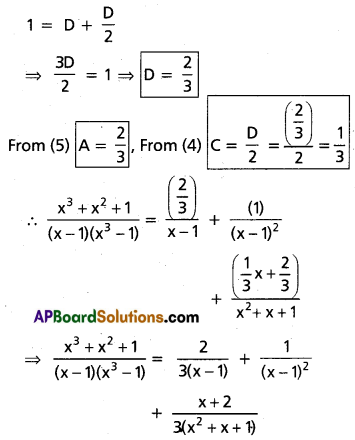
\(\frac{x^3+x^2+1}{(x-1)\left(x^3-1\right)}\)
Solution:
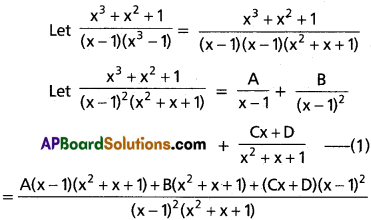
Inter 2nd Year Maths 2A Partial Fractions Solutions Ex 7(b) Q5
∴ x3 + x2 + 1 = A(x – 1) (x2 + x + 1) + B(x2 + x + 1) + (Cx + D) (x – 1)2 …….(2)
Put x = 1 in (2)
1 + 1 + 1 = A(0) + B(1 + 1 + 1) + (C(1) + D) (0)
⇒ 3B = 3
⇒ B = 1
Equating the coefficients of x3 in (2)
1 = A + C ………(3)
Equating the coefficients of x2 in (2)
1 = A(1 – 1) + B(1) + C(-2) + D(1)
⇒ 1 = B – 2C + D
∵ B = 1,
⇒ 1 = 1 – 2C + D
⇒ 2C = D ………(4)
Put x = 0 in (2)
1 = A(-1)(1) + B(1) + D(-1)2
⇒ -A + B + D = 1
⇒ -A + 1 + D = 1
⇒ A = D ………(5)
From (3), (4) and (5)
Inter 2nd Year Maths 2A Partial Fractions Solutions Ex 7(b) Q5.1

Inter 2nd Year Maths 2A Partial Fractions Solutions Ex 7(a)

Practicing the Intermediate 2nd Year Maths 2A Textbook Solutions Inter 2nd Year Maths 2A Partial Fractions Solutions Exercise 7(a) will help students to clear their doubts quickly.

Intermediate 2nd Year Maths 2A Partial Fractions Solutions Exercise 7(a)

Resolve the following into partial fractions.

I.

Question 1.
\(\frac{2 x+3}{(x+1)(x-3)}\)
Solution:
Let \(\frac{2 x+3}{(x+1)(x-3)}=\frac{A}{x+1}+\frac{B}{x-3}\)
Multiplying with (x + 1) (x – 3)
2x + 3 = A(x – 3) + B(x + 1)
x = -1 ⇒ 1 = A(-4) ⇒ A = \(-\frac{1}{4}\)
x = 3 ⇒ 9 = B(4) ⇒ B = \(\frac{9}{4}\)
\(\frac{2 x+3}{(x+1)(x-3)}=\frac{-1}{4(x+1)}+\frac{9}{4(x-3)}\)

Inter 2nd Year Maths 2A Partial Fractions Solutions Ex 7(a)

Question 2.
\(\frac{5 x+6}{(2+x)(1-x)}\)
Solution:
Let \(\frac{5 x+6}{(2+x)(1-x)}=\frac{A}{2+x}+\frac{B}{1-x}\)
Multiplying with (2 + x) (1 – x)
5x + 6 = A(1 – x) + B(2 + x)
Put x = -2,
-10 + 6 = A(1 + 2)
⇒ A = \(-\frac{4}{3}\)
Put x = 1,
5 + 6 = B(2 + 1)
⇒ B = \(\frac{11}{3}\)
∴ \(\frac{5 x+6}{(2+x)(1-x)}=-\frac{4}{3(2+x)}+\frac{11}{3(1-x)}\)

II.

Question 1.
\(\frac{3 x+7}{x^2-3 x+2}\)
Solution:
\(\frac{3 x+7}{x^2-3 x+2}=\frac{3 x+7}{(x-1)(x-2)}=\frac{A}{x-1}+\frac{B}{x-2}\)
Multiplying with x2 – 3x + 2
3x + 7 = A(x – 2) + B(x – 1)
x = 1 ⇒ 10 = -A ⇒ A = -10
x = 2 ⇒ 13 = B ⇒ B = 13
∴ \(\frac{3 x+7}{x^2-3 x+2}=\frac{-10}{x-1}+\frac{13}{x-2}\)

Question 2.
\(\frac{x+4}{\left(x^2-4\right)(x+1)}\)
Solution:
\(\frac{x+4}{\left(x^2-4\right)(x+1)}=\frac{A}{x+1}+\frac{B}{x+2}+\frac{C}{x-2}\)
Multiplying with (x2 – 4) (x + 1)
x + 4 = A(x2 – 4) + B(x + 1) (x – 2) + C(x + 1) (x + 2)
x = -1
⇒ 3 = A(1 – 4)
⇒ 3 = -3A
⇒ A = -1
x = -2
⇒ 2 = B(-2 + 1) (-2 – 2)
⇒ 2 = 4B
⇒ B = \(\frac{1}{2}\)
x = 2
⇒ 6 = C(2 + 1)(2 + 2)
⇒ 6 = 12C
⇒ C = \(\frac{1}{2}\)
∴ \(\frac{x+4}{\left(x^2-4\right)(x+1)}=-\frac{1}{x+1}+\frac{1}{2(x+2)}\) + \(\frac{1}{2(x-2)}\)

Question 3.
\(\frac{2 x^2+2 x+1}{x^3+x^2}\)
Solution:
Let \(\frac{2 x^2+2 x+1}{x^3+x^2}=\frac{2 x^2+2 x+1}{x^2(x+1)}=\frac{A}{x}+\frac{B}{x^2}+\frac{C}{x+1}\)
Multiplying with x2(x + 1)
2x2 + 2x + 1 = Ax(x + 1) + B(x + 1) + Cx2
Put x = 0, 1 = B
Put x = -1, 2 – 2 + 1 = C(1) ⇒ C = 1
Equating the coefficients of x2,
2 = A + C
⇒ A = 2 – C = 2 – 1 = 1
∴ \(\frac{2 x^2+2 x+1}{x^3+x^2}=\frac{1}{x}+\frac{1}{x^2}+\frac{1}{x+1}\)

Inter 2nd Year Maths 2A Partial Fractions Solutions Ex 7(a)

Question 4.
\(\frac{2 x+3}{(x-1)^3}\)
Solution:
\(\frac{2 x+3}{(x-1)^3}\)
Put x – 1 = y ⇒ x = y + 1
⇒ \(\frac{2 x+3}{(x-1)^3}=\frac{2(y+1)+3}{y^3}=\frac{2 y+5}{y^3}\)
⇒ \(\frac{2 x+3}{(x-1)^3}\) = \(\frac{2}{y^2}+\frac{5}{y^3}=\frac{2}{(x-1)^2}+\frac{5}{(x-1)^3}\)
∴ \(\frac{2 x+3}{(x-1)^3}=\frac{2}{(x-1)^2}+\frac{5}{(x-1)^3}\)

Question 5.
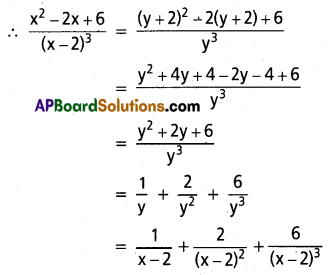
\(\frac{x^2-2 x+6}{(x-2)^3}\)
Solution:
Let x – 2 = y then x = y + 2
Inter 2nd Year Maths 2A Partial Fractions Solutions Ex 7(a) II Q5

III.

Question 1.
\(\frac{x^2-x+1}{(x+1)(x-1)^2}\)
Solution:
Let \(\frac{x^2-x+1}{(x+1)(x-1)^2}=\frac{A}{x+1}+\frac{B}{x-1}+\frac{C}{(x-1)^2}\)
Multiplying with (x + 1) (x – 1)2
x2 – x + 1 = A(x – 1)2 + B(x + 1) (x – 1) + C(x + 1)
Put x = -1,
1 + 1 + 1 = A(4)
⇒ A = \(\frac{3}{4}\)
Put x = 1,
1 – 1 + 1 = C(2)
⇒ C = +\(\frac{1}{2}\)
Equating the coefficients of x2,
A + B = 1
⇒ B = 1 – A
⇒ B = 1 – \(\frac{3}{4}\) = \(\frac{1}{4}\)
∴ \(\frac{x^2-x+1}{(x+1)(x-1)^2}=\frac{3}{4(x+1)}+\frac{1}{4(x-1)}\) + \(\frac{1}{2(x-1)^2}\)

Question 2.
\(\frac{9}{(x-1)(x+2)^2}\)
Solution:
Let \(\frac{9}{(x-1)(x+2)^2}=\frac{A}{x-1}+\frac{B}{x+2}+\frac{C}{(x+2)^2}\)
Multiplying with (x – 1) (x + 2)2
9 = A(x + 2)2 + B(x – 1) (x + 2) + C(x – 1)
x = 1
⇒ 9 = 9A
⇒ A = 1
x = -2
⇒ 9 = -3C
⇒ C = -3
Equating the coefficients of x2
A + B = 0 ⇒ B = -A = -1
∴ \(\frac{9}{(x-1)(x+2)^2}=\frac{1}{x-1}-\frac{1}{x+2}-\frac{3}{(x+2)^2}\)

Question 3.
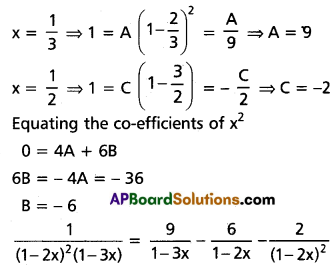
\(\frac{1}{(1-2 x)^2(1-3 x)}\)
Solution:
Let \(\frac{1}{(1-2 x)^2(1-3 x)}=\frac{A}{1-3 x}+\frac{B}{1-2 x}+\frac{C}{(1-2 x)^2}\)
Multiplying with (1 – 2x)2 (1 – 3x)
1 = A(1 – 2x)2 + B(1 – 3x) (1 – 2x) + C(1 – 3x)
Inter 2nd Year Maths 2A Partial Fractions Solutions Ex 7(a) III Q3

Question 4.
\(\frac{1}{x^3(x+a)}\)
Solution:
Let \(\frac{1}{x^3(x+a)}=\frac{A}{x}+\frac{B}{x^2}+\frac{C}{x^3}+\frac{D}{x+a}\) = \(\frac{A \cdot x^2(x+a)+B(x)(x+a)+C(x+a)+D x^3}{x^3(x+a)}\)
∴ 1 = A (x2) (x + a) + Bx (x + a) + C(x + a) + Dx3 ……..(1)
Put x = 0 in (1)
1 = A(0) + B(0) + C(0 + a) + D(0)
⇒ 1 = C(a)
⇒ C = \(\frac{1}{a}\)

Inter 2nd Year Maths 2A Partial Fractions Solutions Ex 7(a)

Question 5.
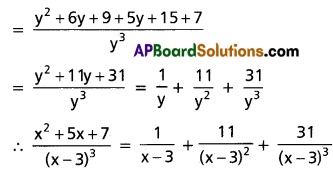
\(\frac{x^2+5 x+7}{(x-3)^3}\)
Solution:
Let x – 3 = y ⇒ x = y + 3
\(\frac{x^2+5 x+7}{(x-3)^3}=\frac{(y+3)^2+5(y+3)+7}{y^3}\)
Inter 2nd Year Maths 2A Partial Fractions Solutions Ex 7(a) III Q5

Question 6.
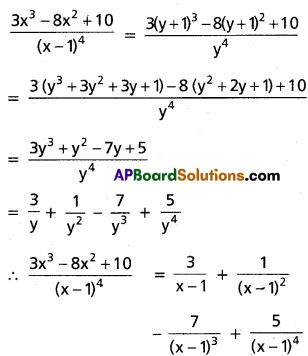
\(\frac{3 x^3-8 x^2+10}{(x-1)^4}\)
Solution:
Put x – 1 = y ⇒ x = y + 1
Inter 2nd Year Maths 2A Partial Fractions Solutions Ex 7(a) III Q6

Inter 2nd Year Maths 2A Binomial Theorem Solutions Ex 6(c)

Practicing the Intermediate 2nd Year Maths 2A Textbook Solutions Inter 2nd Year Maths 2A Binomial Theorem Solutions Exercise 6(c) will help students to clear their doubts quickly.

Intermediate 2nd Year Maths 2A Binomial Theorem Solutions Exercise 6(c)

Question 1.
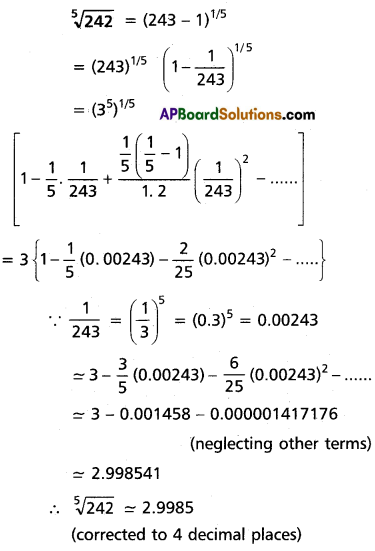
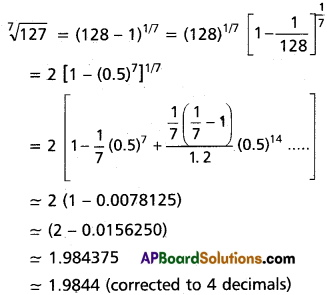
Find an approximate value of the following corrected to 4 decimal places.
(i) \(\sqrt[5]{242}\)
Solution:
Inter 2nd Year Maths 2A Binomial Theorem Solutions Ex 6(c) Q1(i)

(ii) \(\sqrt[7]{127}\)
Solution:
Inter 2nd Year Maths 2A Binomial Theorem Solutions Ex 6(c) Q1(ii)

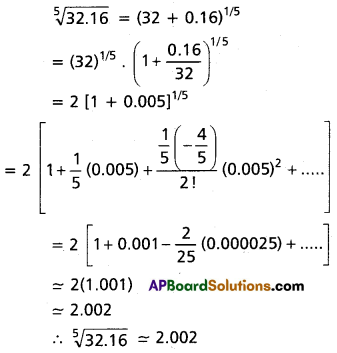
(iii) \(\sqrt[5]{32.16}\)
Solution:
Inter 2nd Year Maths 2A Binomial Theorem Solutions Ex 6(c) Q1(iii)

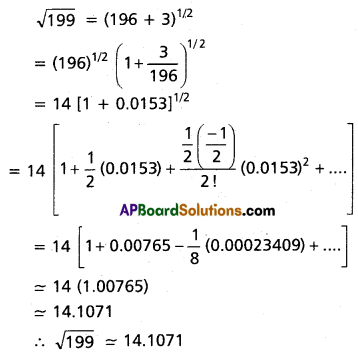
(iv) \(\sqrt{199}\)
Solution:
Inter 2nd Year Maths 2A Binomial Theorem Solutions Ex 6(c) Q1(iv)

Inter 2nd Year Maths 2A Binomial Theorem Solutions Ex 6(c)

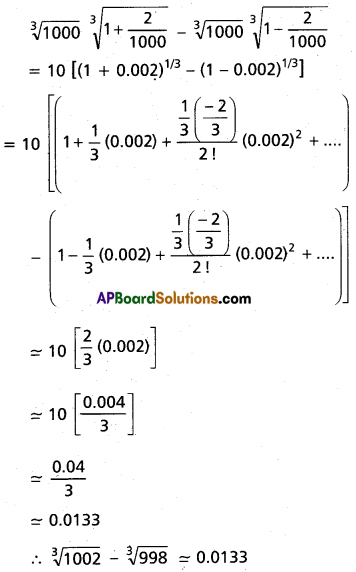
(v) \(\sqrt[3]{1002}-\sqrt[3]{998}\)
Solution:
Inter 2nd Year Maths 2A Binomial Theorem Solutions Ex 6(c) Q1(v)

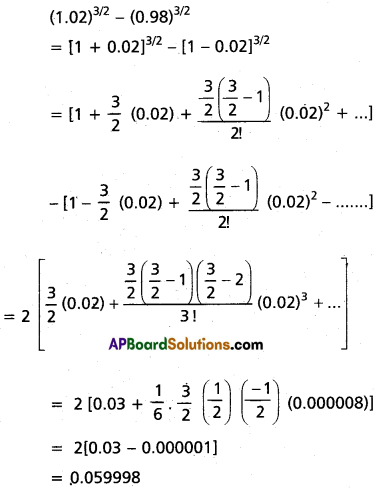
(vi) \((1.02)^{3 / 2}-(0.98)^{3 / 2}\)
Solution:
Inter 2nd Year Maths 2A Binomial Theorem Solutions Ex 6(c) Q1(vi)

Question 2.
If |x| is so small that x2 and higher powers of x may be neglected then find the approximate values of the following.
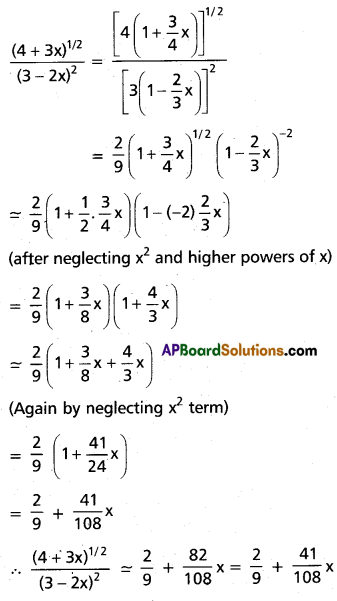
(i) \(\frac{(4+3 x)^{1 / 2}}{(3-2 x)^2}\)
Solution:
Inter 2nd Year Maths 2A Binomial Theorem Solutions Ex 6(c) Q2(i)

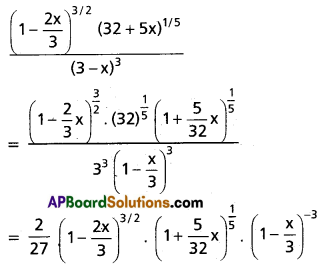
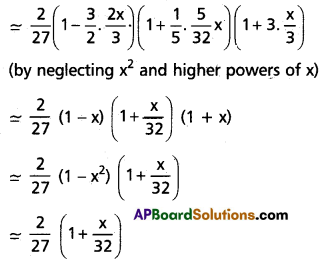
(ii) \(\frac{\left(1-\frac{2 x}{3}\right)^{3 / 2}(32+5 x)^{1 / 5}}{(3-x)^3}\)
Solution:
Inter 2nd Year Maths 2A Binomial Theorem Solutions Ex 6(c) Q2(ii)
Inter 2nd Year Maths 2A Binomial Theorem Solutions Ex 6(c) Q2(ii).1

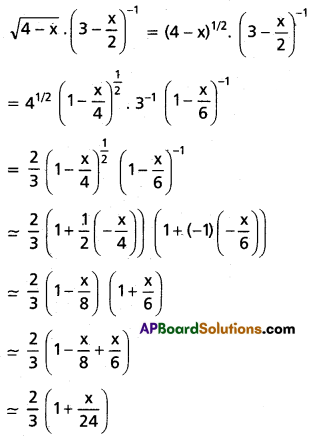
(iii) \(\sqrt{4-x}\left(3-\frac{x}{2}\right)^{-1}\)
Solution:
Inter 2nd Year Maths 2A Binomial Theorem Solutions Ex 6(c) Q2(iii)

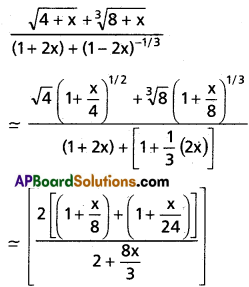
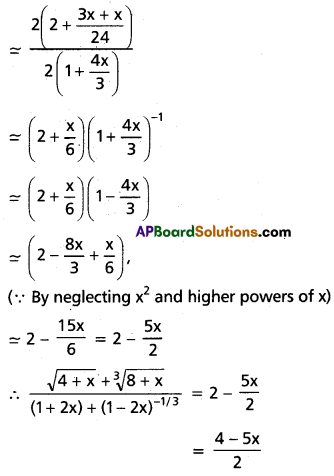
(iv) \(\frac{\sqrt{4+x}+\sqrt[3]{8+x}}{(1+2 x)+(1-2 x)^{-1 / 3}}\)
Solution:
Inter 2nd Year Maths 2A Binomial Theorem Solutions Ex 6(c) Q2(iv)
Inter 2nd Year Maths 2A Binomial Theorem Solutions Ex 6(c) Q2(iv).1

Inter 2nd Year Maths 2A Binomial Theorem Solutions Ex 6(c)

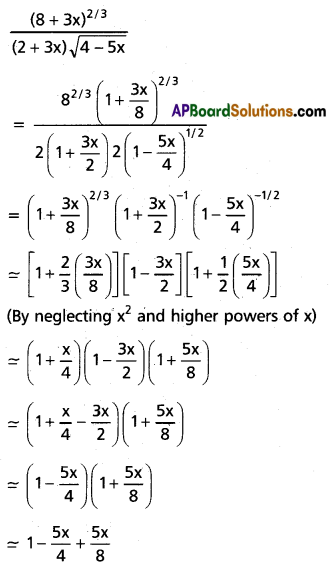
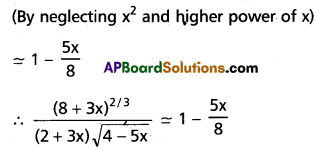
(v) \(\frac{(8+3 x)^{2 / 3}}{(2+3 x) \sqrt{4-5 x}}\)
Solution:
Inter 2nd Year Maths 2A Binomial Theorem Solutions Ex 6(c) Q2(v)
Inter 2nd Year Maths 2A Binomial Theorem Solutions Ex 6(c) Q2(v).1

Question 3.
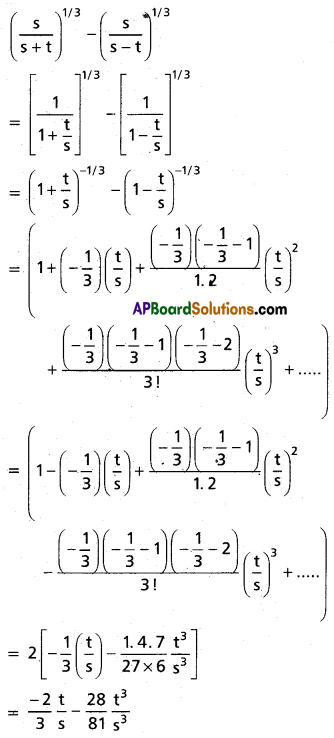
Suppose s and t are positive and t is very small when compared to s. Then find an approximate value of \(\left(\frac{s}{s+t}\right)^{1 / 3}-\left(\frac{s}{s-t}\right)^{1 / 3}\)
Solution:
Since t is very small when compared with s, \(\frac{t}{s}\) is very very small.
Inter 2nd Year Maths 2A Binomial Theorem Solutions Ex 6(c) Q3

Question 4.
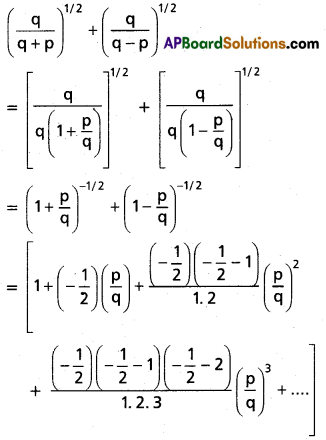
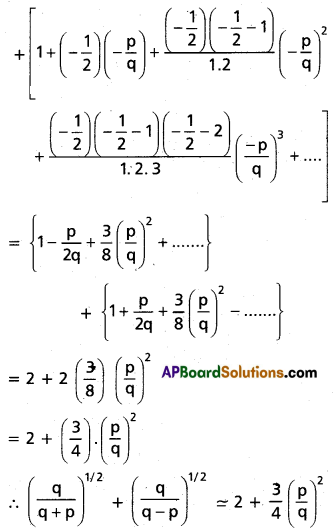
Suppose p, q are positive and p is very small when compared to q. Then find an approximate value of \(\left(\frac{q}{q+p}\right)^{1 / 2}+\left(\frac{q}{q-p}\right)^{1 / 2}\)
Solution:
Inter 2nd Year Maths 2A Binomial Theorem Solutions Ex 6(c) Q4
Inter 2nd Year Maths 2A Binomial Theorem Solutions Ex 6(c) Q4.1

Inter 2nd Year Maths 2A Binomial Theorem Solutions Ex 6(c)

Question 5.
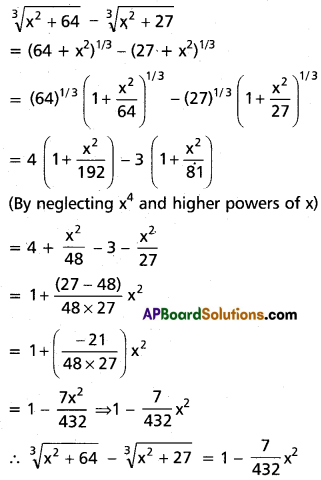
By neglecting x4 and higher powers of x, find an approximate value of \(\sqrt[3]{x^2+64}-\sqrt[3]{x^2+27}\)
Solution:
Inter 2nd Year Maths 2A Binomial Theorem Solutions Ex 6(c) Q5

Question 6.
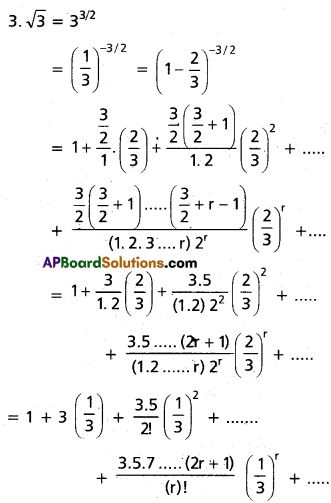
Expand 3√3 in increasing powers of \(\frac{2}{3}\).
Solution:
Inter 2nd Year Maths 2A Binomial Theorem Solutions Ex 6(c) Q6

Inter 2nd Year Maths 2A Binomial Theorem Solutions Ex 6(b)

Practicing the Intermediate 2nd Year Maths 2A Textbook Solutions Inter 2nd Year Maths 2A Binomial Theorem Solutions Exercise 6(b) will help students to clear their doubts quickly.

Intermediate 2nd Year Maths 2A Binomial Theorem Solutions Exercise 6(b)

I.

Question 1.
Find the set of values of x for which the binomial expansions of the following are valid.
(i) (2 + 3x)-2/3
(ii) (5 + x)3/2
(iii) (7 + 3x)-5
(iv) \(\left(4-\frac{x}{3}\right)^{-1 / 2}\)
Solution:
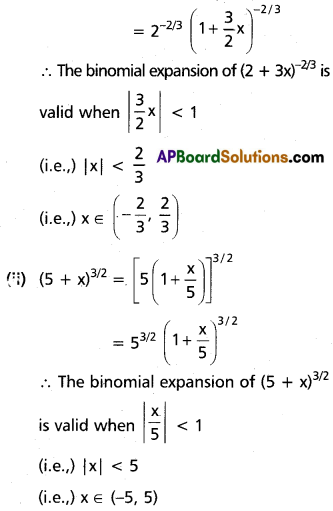
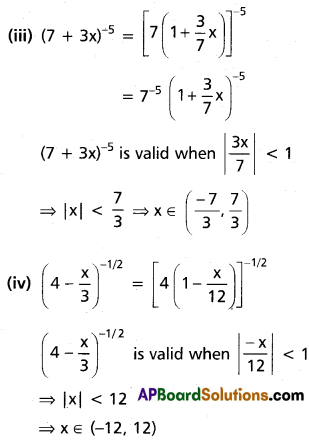
(i) (2 + 3x)-2/3 = \(\left[2\left(1+\frac{3}{2} x\right)\right]^{-2 / 3}\)
Inter 2nd Year Maths 2A Binomial Theorem Solutions Ex 6(b) I Q1
Inter 2nd Year Maths 2A Binomial Theorem Solutions Ex 6(b) I Q1.1

Inter 2nd Year Maths 2A Binomial Theorem Solutions Ex 6(b)

Question 2.
Find the
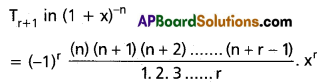
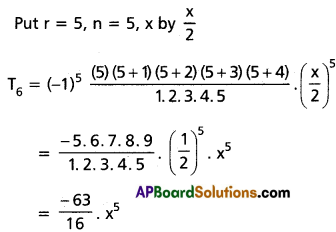
(i) 6th term of \(\left(1+\frac{x}{2}\right)^{-5}\)
Solution:
Inter 2nd Year Maths 2A Binomial Theorem Solutions Ex 6(b) I Q2(i)
Inter 2nd Year Maths 2A Binomial Theorem Solutions Ex 6(b) I Q2(i).1

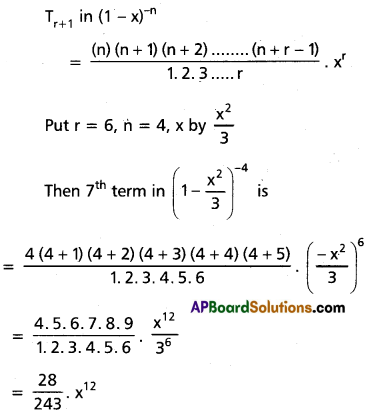
(ii) 7th term of \(\left(1-\frac{x^2}{3}\right)^{-4}\)
Solution:
Inter 2nd Year Maths 2A Binomial Theorem Solutions Ex 6(b) I Q2(ii)

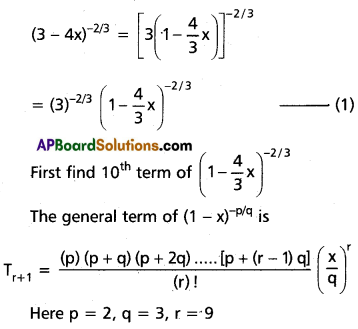
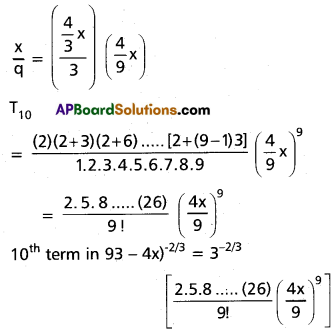
(iii) 10th term of (3 – 4x)-2/3
Solution:
Inter 2nd Year Maths 2A Binomial Theorem Solutions Ex 6(b) I Q2(iii)
Inter 2nd Year Maths 2A Binomial Theorem Solutions Ex 6(b) I Q2(iii).1

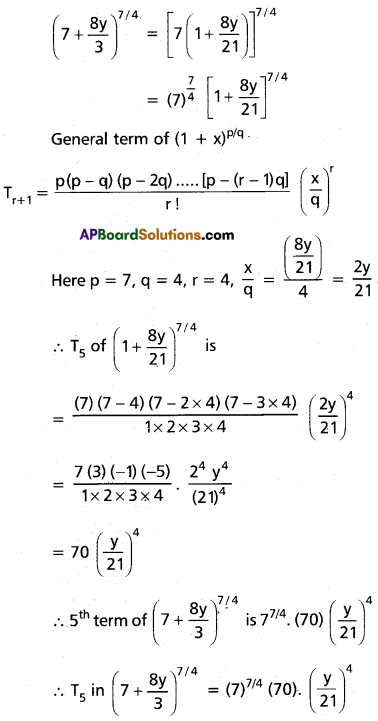
(iv) 5th term of \(\left(7+\frac{8 y}{3}\right)^{7 / 4}\)
Solution:
Inter 2nd Year Maths 2A Binomial Theorem Solutions Ex 6(b) I Q2(iv)

Question 3.
Write down the first 3 terms in the expansion of
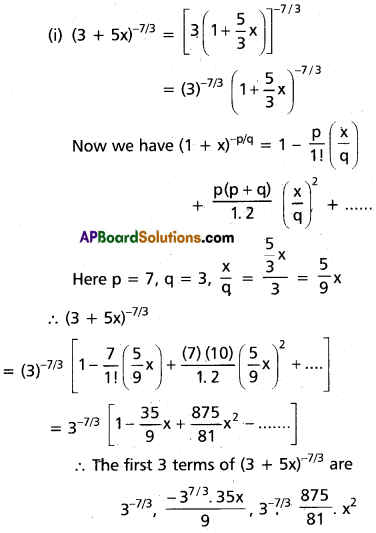
(i) (3 + 5x)-7/3
Solution:
Inter 2nd Year Maths 2A Binomial Theorem Solutions Ex 6(b) I Q3(i)

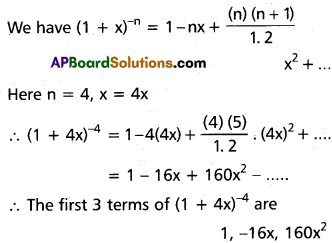
(ii) (1 + 4x)-4
Solution:
Inter 2nd Year Maths 2A Binomial Theorem Solutions Ex 6(b) I Q3(ii)

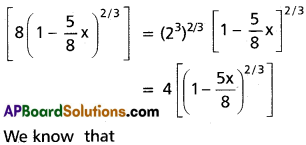
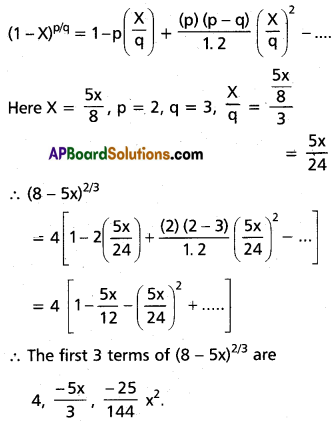
(iii) (8 – 5x)2/3
Solution:
Inter 2nd Year Maths 2A Binomial Theorem Solutions Ex 6(b) I Q3(iii)
Inter 2nd Year Maths 2A Binomial Theorem Solutions Ex 6(b) I Q3(iii).1

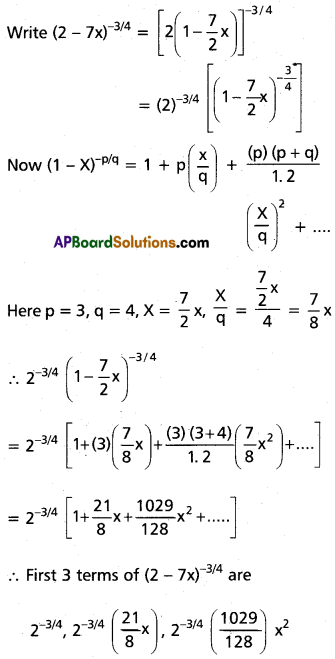
(iv) (2 – 7x)-3/4
Solution:
Inter 2nd Year Maths 2A Binomial Theorem Solutions Ex 6(b) I Q3(iv)

Inter 2nd Year Maths 2A Binomial Theorem Solutions Ex 6(b)

Question 4.
Find the general term (r + 1)th term in the expansion of
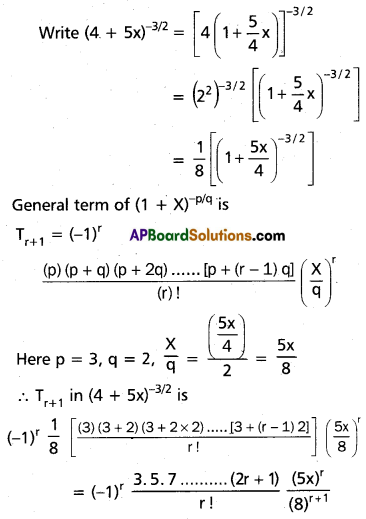
(i) (4 + 5x)-3/2
Solution:
Inter 2nd Year Maths 2A Binomial Theorem Solutions Ex 6(b) I Q4(i)

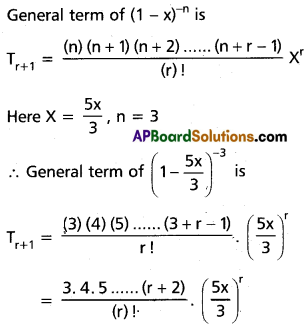
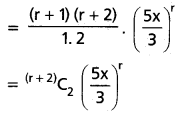
(ii) \(\left(1-\frac{5 x}{3}\right)^{-3}\)
Solution:
Inter 2nd Year Maths 2A Binomial Theorem Solutions Ex 6(b) I Q4(ii)
Inter 2nd Year Maths 2A Binomial Theorem Solutions Ex 6(b) I Q4(ii).1

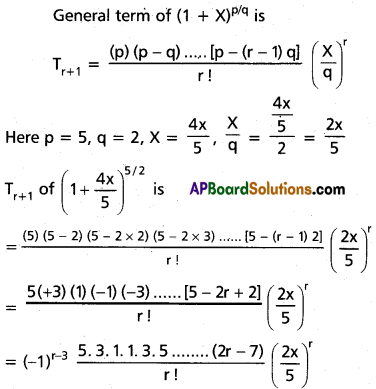
(iii) \(\left(1+\frac{4 x}{5}\right)^{5 / 2}\)
Solution:
Inter 2nd Year Maths 2A Binomial Theorem Solutions Ex 6(b) I Q4(iii)

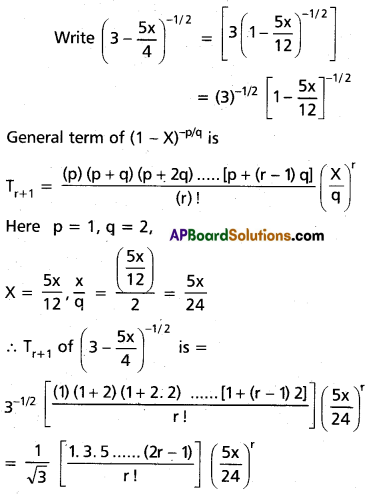
(iv) \(\left(3-\frac{5 x}{4}\right)^{-1 / 2}\)
Solution:
Inter 2nd Year Maths 2A Binomial Theorem Solutions Ex 6(b) I Q4(iv)

II.

Question 1.
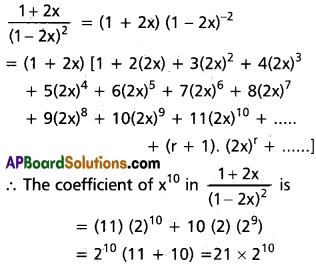
Find the coefficient of x10 in the expansion of \(\frac{1+2 x}{(1-2 x)^2}\)
Solution:
Inter 2nd Year Maths 2A Binomial Theorem Solutions Ex 6(b) II Q1

Question 2.
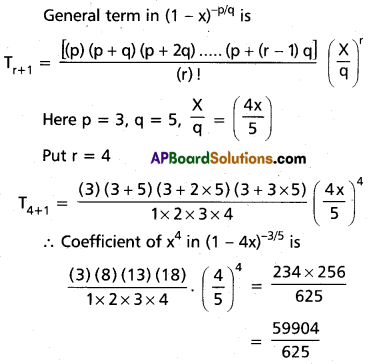
Find the coefficient of x4 in the expansion of (1 – 4x)-3/5
Solution:
Inter 2nd Year Maths 2A Binomial Theorem Solutions Ex 6(b) II Q2

Inter 2nd Year Maths 2A Binomial Theorem Solutions Ex 6(b)

Question 3.
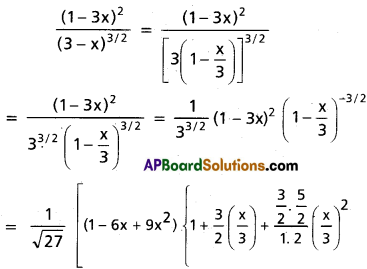
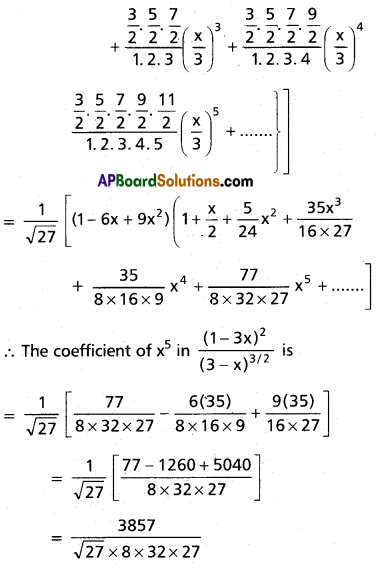
(i) Find the coefficient of x5 in \(\frac{(1-3 x)^2}{(3-x)^{3 / 2}}\)
Solution:
Inter 2nd Year Maths 2A Binomial Theorem Solutions Ex 6(b) II Q3(i)
Inter 2nd Year Maths 2A Binomial Theorem Solutions Ex 6(b) II Q3(i).1

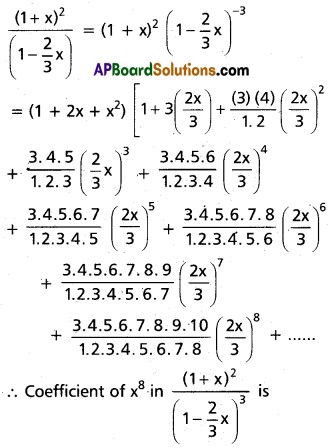
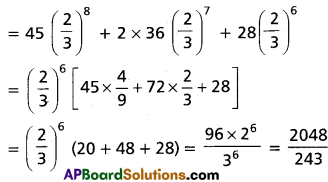
(ii) Find the coefficient of x8 in \(\frac{(1+x)^2}{\left(1-\frac{2}{3} x\right)^3}\)
Solution:
Inter 2nd Year Maths 2A Binomial Theorem Solutions Ex 6(b) II Q3(ii)
Inter 2nd Year Maths 2A Binomial Theorem Solutions Ex 6(b) II Q3(ii).1

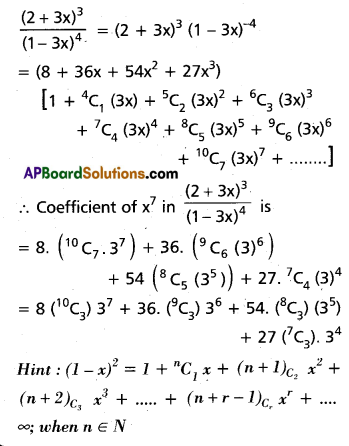
(iii) Find the coefficient of x7 in \(\frac{(2+3 x)^3}{(1-3 x)^4}\)
Solution:
Inter 2nd Year Maths 2A Binomial Theorem Solutions Ex 6(b) II Q3(iii)

Question 4.
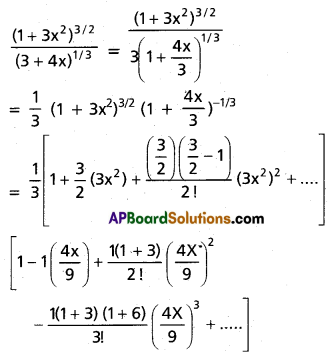
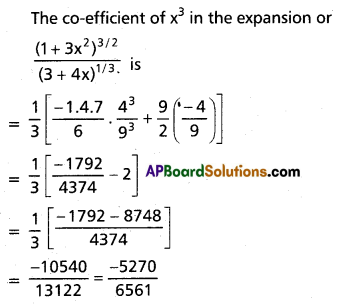
Find the coefficient of x3 in the expansion of \(\frac{\left(1+3 x^2\right)^{3 / 2}}{(3+4 x)^{1 / 3}}\)
Solution:
Inter 2nd Year Maths 2A Binomial Theorem Solutions Ex 6(b) II Q4
Inter 2nd Year Maths 2A Binomial Theorem Solutions Ex 6(b) II Q4.1

III.

Question 1.
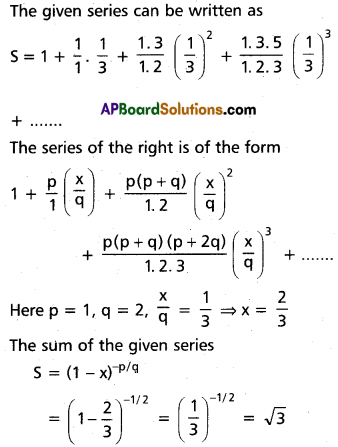
Find the sum of the infinite series
(i) \(1+\frac{1}{3}+\frac{1.3}{3.6}+\frac{1.3 .5}{3.6 .9}+\ldots\)
Solution:
Inter 2nd Year Maths 2A Binomial Theorem Solutions Ex 6(b) III Q1(i)

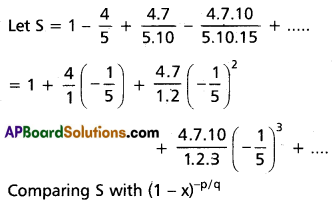
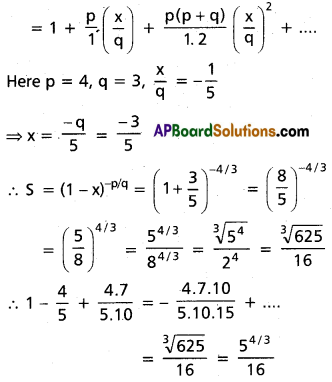
(ii) \(1-\frac{4}{5}+\frac{4.7}{5.10}-\frac{4.7 .10}{5.10 .15}+\ldots \ldots\)
Solution:
Inter 2nd Year Maths 2A Binomial Theorem Solutions Ex 6(b) III Q1(ii)
Inter 2nd Year Maths 2A Binomial Theorem Solutions Ex 6(b) III Q1(ii).1

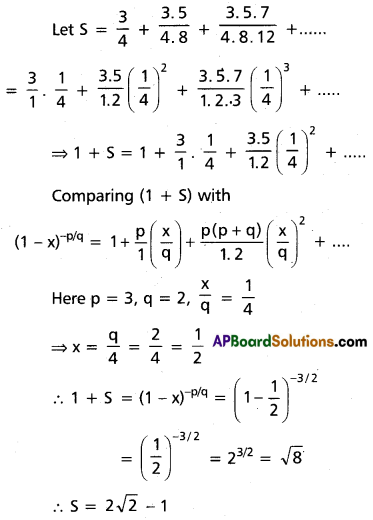
(iii) \(\frac{3}{4}+\frac{3.5}{4.8}+\frac{3.5 .7}{4.8 .12}+\ldots\)
Solution:
Inter 2nd Year Maths 2A Binomial Theorem Solutions Ex 6(b) III Q1(iii)

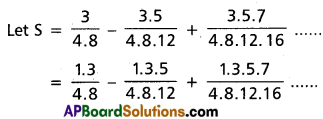
(iv) \(\frac{3}{4.8}-\frac{3.5}{4.8 .12}+\frac{3.5 .7}{4.8 .12 .16}-\ldots \ldots\)
Solution:
Inter 2nd Year Maths 2A Binomial Theorem Solutions Ex 6(b) III Q1(iv)
Inter 2nd Year Maths 2A Binomial Theorem Solutions Ex 6(b) III Q1(iv).1

Inter 2nd Year Maths 2A Binomial Theorem Solutions Ex 6(b)

Question 2.
If t = \(\frac{4}{5}+\frac{4.6}{5.10}+\frac{4.6 .8}{5.10 .15}+\ldots \ldots \ldots \infty\), then prove that 9t = 16.
Solution:
Inter 2nd Year Maths 2A Binomial Theorem Solutions Ex 6(b) III Q2
Inter 2nd Year Maths 2A Binomial Theorem Solutions Ex 6(b) III Q2.1

Question 3.
If x = \(\frac{1.3}{3.6}+\frac{1.3 .5}{3.6 .9}+\frac{1.3 .5 .7}{3.6 .9 .12}+\ldots \ldots\) then prove that 9x2 + 24x = 11.
Solution:
Inter 2nd Year Maths 2A Binomial Theorem Solutions Ex 6(b) III Q3
⇒ 3x + 4 = 3√3
Squaring on both sides
(3x + 4)2 = (3√3)2
⇒ 9x2 + 24x + 16 = 27
⇒ 9x2 + 24x = 11

Question 4.
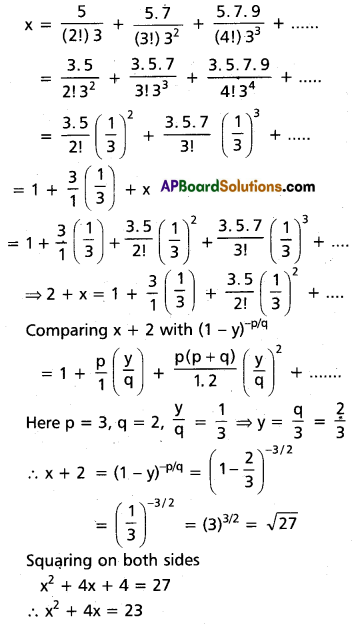
If x = \(\frac{5}{(2 !) \cdot 3}+\frac{5 \cdot 7}{(3 !) \cdot 3^2}+\frac{5 \cdot 7 \cdot 9}{(4 !) \cdot 3^3}+\ldots\) then find the value of x2 + 4x.
Solution:
Inter 2nd Year Maths 2A Binomial Theorem Solutions Ex 6(b) III Q4

Question 5.
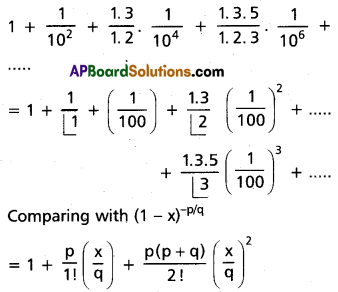
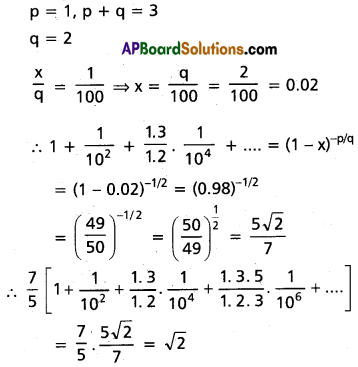
Find the sum of the infinite series \(\frac{7}{5}\left(1+\frac{1}{10^2}+\frac{1.3}{1.2} \cdot \frac{1}{10^4}+\frac{1.3 .5}{1.2 .3} \cdot \frac{1}{10^6}+\ldots .\right)\)
Solution:
Inter 2nd Year Maths 2A Binomial Theorem Solutions Ex 6(b) III Q5
Inter 2nd Year Maths 2A Binomial Theorem Solutions Ex 6(b) III Q5.1

Inter 2nd Year Maths 2A Binomial Theorem Solutions Ex 6(b)

Question 6.
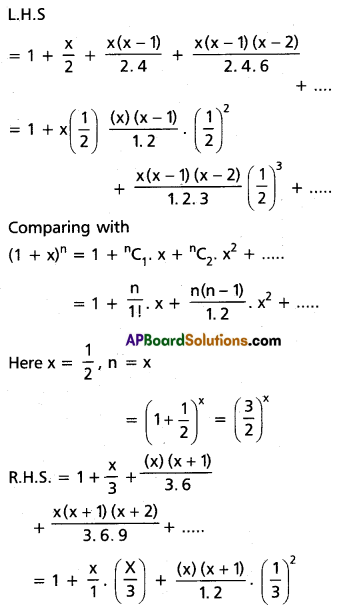
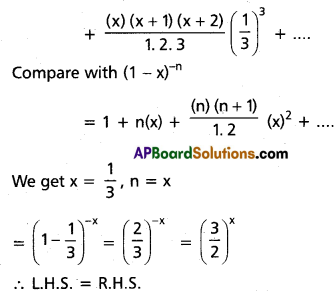
Show that \(1+\frac{x}{2}+\frac{x(x-1)}{2.4}+\frac{x(x-1)(x-2)}{2.4 .6}+\ldots .\) = \(1+\frac{x}{3}+\frac{x(x+1)}{3.6}+\frac{x(x+1)(x+2)}{3.6 .9}+\ldots\)
Solution:
Inter 2nd Year Maths 2A Binomial Theorem Solutions Ex 6(b) III Q6
Inter 2nd Year Maths 2A Binomial Theorem Solutions Ex 6(b) III Q6.1

Inter 2nd Year Maths 2A Binomial Theorem Solutions Ex 6(a)

Practicing the Intermediate 2nd Year Maths 2A Textbook Solutions Inter 2nd Year Maths 2A Binomial Theorem Solutions Exercise 6(a) will help students to clear their doubts quickly.

Intermediate 2nd Year Maths 2A Binomial Theorem Solutions Exercise 6(a)

I.

Question 1.
Expand the following using the binomial theorem.
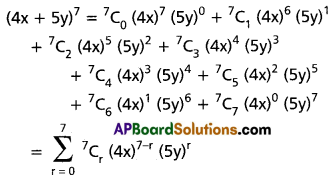
(i) (4x + 5y)7
Solution:
Inter 2nd Year Maths 2A Binomial Theorem Solutions Ex 6(a) I Q1(i)

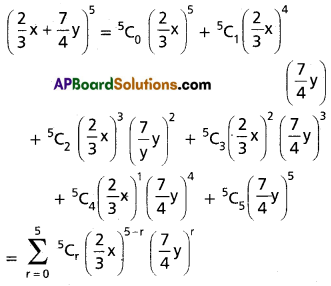
(ii) \(\left(\frac{2}{3} x+\frac{7}{4} y\right)^5\)
Solution:
Inter 2nd Year Maths 2A Binomial Theorem Solutions Ex 6(a) I Q1(ii)

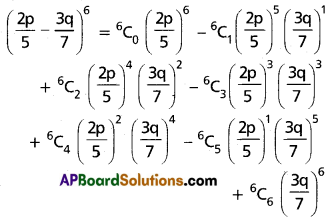
(iii) \(\left(\frac{2 p}{5}-\frac{3 q}{7}\right)^6\)
Solution:
Inter 2nd Year Maths 2A Binomial Theorem Solutions Ex 6(a) I Q1(iii)
\(\sum_{r=0}^6(-1)^{r \cdot 6} C_r\left(\frac{2 p}{5}\right)^{6-r}\left(\frac{3 q}{7}\right)^r\)

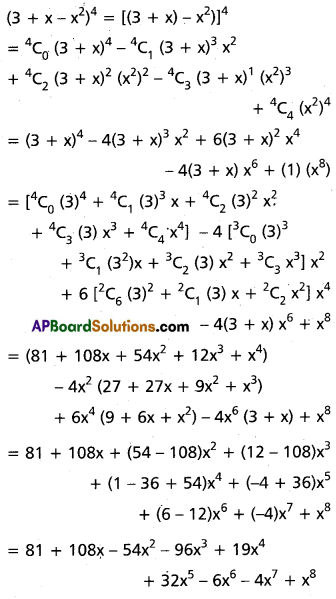
(iv) (3 + x – x2)4
Solution:
Inter 2nd Year Maths 2A Binomial Theorem Solutions Ex 6(a) I Q1(iv)

Inter 2nd Year Maths 2A Binomial Theorem Solutions Ex 6(a)

Question 2.
Write down and simplify
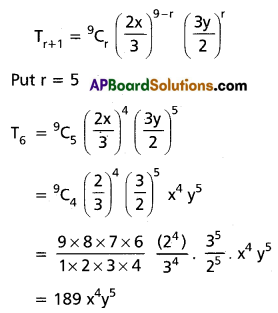
(i) 6th term in \(\left(\frac{2 x}{3}+\frac{3 y}{2}\right)^9\)
Solution:
6th term in \(\left(\frac{2 x}{3}+\frac{3 y}{2}\right)^9\)
The general term in \(\left(\frac{2 x}{3}+\frac{3 y}{2}\right)^9\) is
Inter 2nd Year Maths 2A Binomial Theorem Solutions Ex 6(a) I Q2(i)

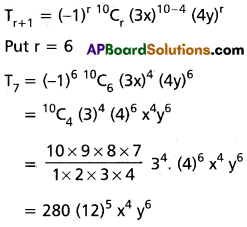
(ii) 7th term in (3x – 4y)10
Solution:
7th term in (3x – 4y)10
The general term in (3x – 4y)10 is
Inter 2nd Year Maths 2A Binomial Theorem Solutions Ex 6(a) I Q2(ii)

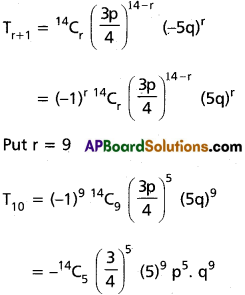
(iii) 10th term in \(\left(\frac{3 p}{4}-5 q\right)^{14}\)
Solution:
10th term in \(\left(\frac{3 p}{4}-5 q\right)^{14}\)
General term in \(\left(\frac{3 p}{4}-5 q\right)^{14}\) is
Inter 2nd Year Maths 2A Binomial Theorem Solutions Ex 6(a) I Q2(iii)
Inter 2nd Year Maths 2A Binomial Theorem Solutions Ex 6(a) I Q2(iii).1

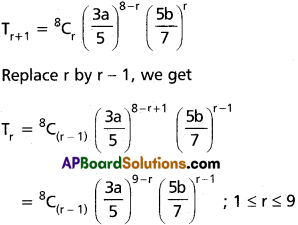
(iv) rth term in \(\left(\frac{3 a}{5}+\frac{5 b}{7}\right)^8\) (1 ≤ r ≤ 9)
Solution:
rth term in \(\left(\frac{3 a}{5}+\frac{5 b}{7}\right)^8\)
The general term in \(\left(\frac{3 a}{5}+\frac{5 b}{7}\right)^8\) is
Inter 2nd Year Maths 2A Binomial Theorem Solutions Ex 6(a) I Q2(iv)

Question 3.
Find the number of terms in the expansion of
(i) \(\left(\frac{3 a}{4}+\frac{b}{2}\right)^9\)
Solution:
The number of terms in (x + a)n is (n + 1), where n is a positive integer.
Hence number of terms in \(\left(\frac{3 a}{4}+\frac{b}{2}\right)^9\) are 9 + 1 = 10

(ii) (3p + 4q)14
Solution:
Number of terms in (3p + 4q)14 are 14 + 1 = 15

(iii) (2x + 3y + z)7
Solution:
Number of terms in (a + b + c)n are \(\frac{(n+1)(n+2)}{2}\), where n is a positive integer.
Hence number of terms in (2x + 3y + z)7 are = \(\frac{(7+1)(7+2)}{2}=\frac{8 \times 9}{2}\) = 36

Inter 2nd Year Maths 2A Binomial Theorem Solutions Ex 6(a)

Question 4.
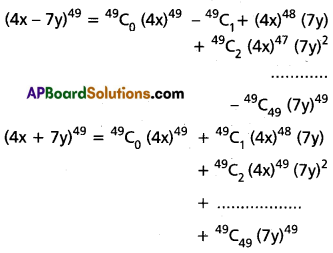
Find the number of terms with non-zero coefficients in (4x – 7y)49 + (4x + 7y)49.
Solution:
Inter 2nd Year Maths 2A Binomial Theorem Solutions Ex 6(a) I Q4
∴ The number of terms with non-zero coefficient in (4x – 7y)49 + (4x + 7y)49 is 25.

Question 5.
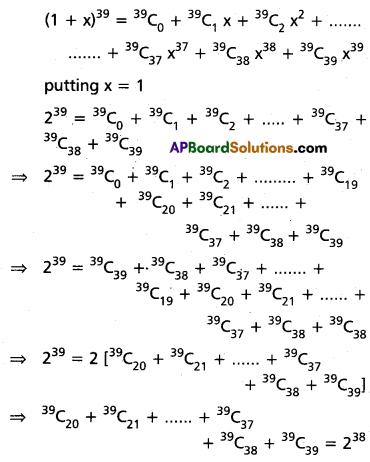
Find the sum of the last 20 coefficients in the expansions of (1 + x)39.
Solution:
Inter 2nd Year Maths 2A Binomial Theorem Solutions Ex 6(a) I Q5
∴ The sum of the last 20 coefficients in the expansion of (1 + x)39 is 238.

Question 6.
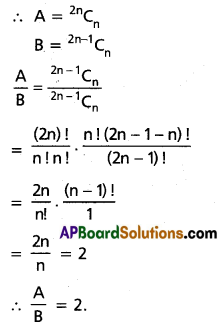
If A and B are coefficients of xn in the expansion of (1 + x)2n and (1 + x)2n-1 respectively, then find the value of \(\frac{A}{B}\)
Solution:
Given A and B are the coefficient of xn in the expansion of (1 + x)2n and (1 + x)2n-1 respectively.
Inter 2nd Year Maths 2A Binomial Theorem Solutions Ex 6(a) I Q6

II.

Question 1.
Find the coefficient of
(i) x-6 in \(\left(3 x-\frac{4}{x}\right)^{10}\)
Solution:
Inter 2nd Year Maths 2A Binomial Theorem Solutions Ex 6(a) II Q1(i)
Inter 2nd Year Maths 2A Binomial Theorem Solutions Ex 6(a) II Q1(i).1

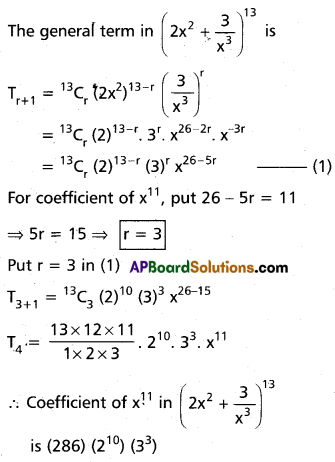
(ii) x11 in \(\left(2 x^2+\frac{3}{x^3}\right)^{13}\)
Solution:
Inter 2nd Year Maths 2A Binomial Theorem Solutions Ex 6(a) II Q1(ii)

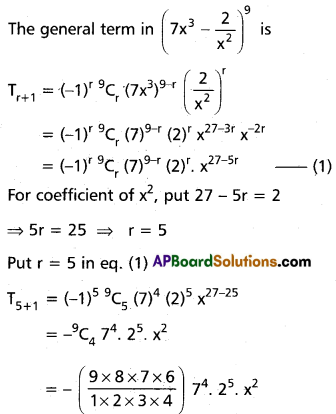
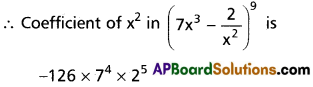
(iii) x2 in \(\left(7 x^3-\frac{2}{x^2}\right)^9\)
Solution:
Inter 2nd Year Maths 2A Binomial Theorem Solutions Ex 6(a) II Q1(iii)
Inter 2nd Year Maths 2A Binomial Theorem Solutions Ex 6(a) II Q1(iii).1

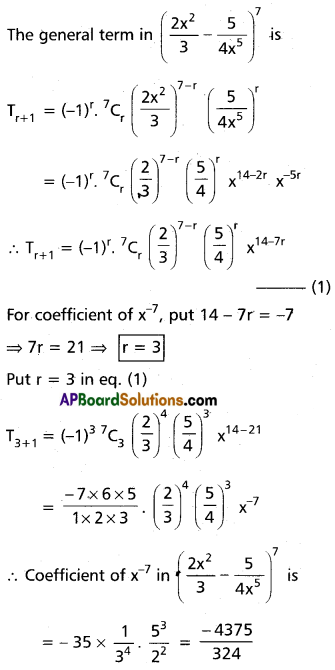
(iv) x-7 in \(\left(\frac{2 x^2}{3}-\frac{5}{4 x^5}\right)^7\)
Solution:
Inter 2nd Year Maths 2A Binomial Theorem Solutions Ex 6(a) II Q1(iv)

Question 2.
Find the term independent of x in the expansion of
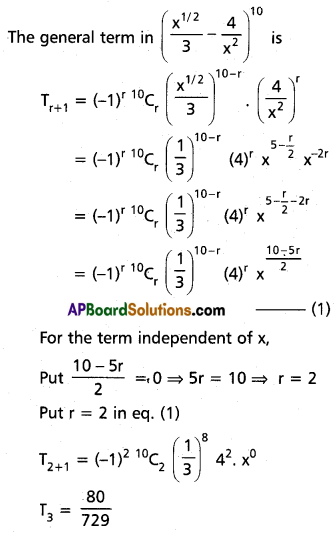
(i) \(\left(\frac{\sqrt{x}}{3}-\frac{4}{x^2}\right)^{10}\)
Solution:
Inter 2nd Year Maths 2A Binomial Theorem Solutions Ex 6(a) II Q2(i)

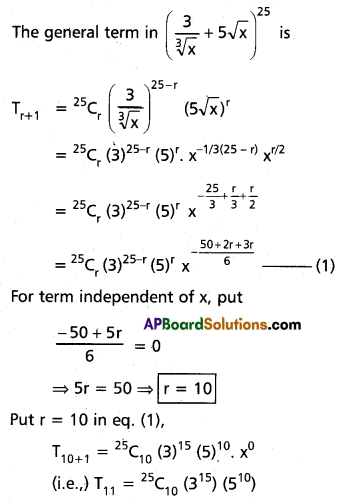
(ii) \(\left(\frac{3}{\sqrt[3]{x}}+5 \sqrt{x}\right)^{25}\)
Solution:
Inter 2nd Year Maths 2A Binomial Theorem Solutions Ex 6(a) II Q2(ii)

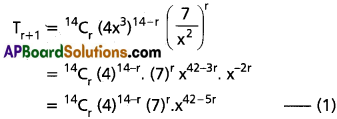
(iii) \(\left(4 x^3+\frac{7}{x^2}\right)^{14}\)
Solution:
The general term in \(\left(4 x^3+\frac{7}{x^2}\right)^{14}\) is
Inter 2nd Year Maths 2A Binomial Theorem Solutions Ex 6(a) II Q2(iii)
For term independent of x,
put 42 – 5r = 0
⇒ r = \(\frac{42}{5}\) which is not an integer.
Hence term independent of x in the given expansion is zero.

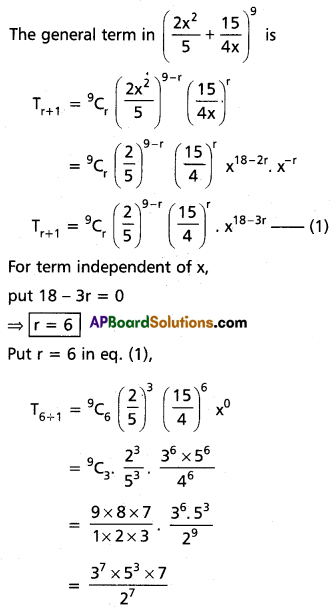
(iv) \(\left(\frac{2 x^2}{5}+\frac{15}{4 x}\right)^9\)
Solution:
Inter 2nd Year Maths 2A Binomial Theorem Solutions Ex 6(a) II Q2(iv)

Inter 2nd Year Maths 2A Binomial Theorem Solutions Ex 6(a)

Question 3.
Find the middle term(s) in the expansion of
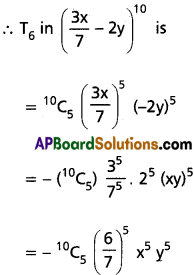
(i) \(\left(\frac{3 x}{7}-2 y\right)^{10}\)
Solution:
The middle term in (x + a)n when n is even and is \(\frac{T_{n+1}}{2}\), when n is odd, we have two middle terms, i.e., \(\frac{T_{n+1}}{2}\) and \(\frac{T_{n+3}}{2}\)
∵ n = 10 is even,
we have only one middle term (i.e.,) \(\frac{10}{2}\) + 1 = 6th term.
Inter 2nd Year Maths 2A Binomial Theorem Solutions Ex 6(a) II Q3(i)

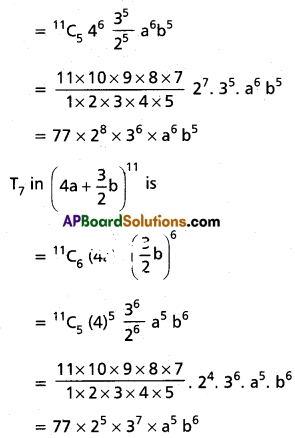
(ii) \(\left(4 a+\frac{3}{2} b\right)^{11}\)
Solution:
Here n = 11 is an odd integer,
we have two middle terms, i.e., \(\frac{n+1}{2}\) and \(\frac{n+3}{2}\) terms
= 6th and 7th terms are middle terms.
T6 in \(\left(4 a+\frac{3}{2} b\right)^{11}\) is \({ }^{11} C_5(4 a)^6\left(\frac{3}{2} b\right)^5\)
Inter 2nd Year Maths 2A Binomial Theorem Solutions Ex 6(a) II Q3(ii)

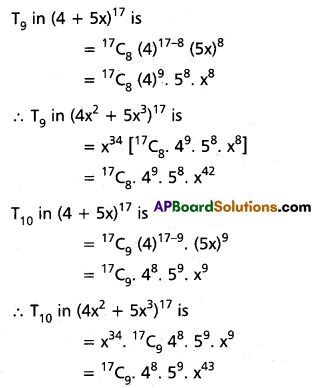
(iii) (4x2 + 5x3)17
Solution:
(4x2 + 5x3)17 = [x2(4 + 5x)]17 = x34(4 + 5x)17 ……..(1)
Consider (4 + 5x)17
∵ n = 17 is an odd positive integer, we have two middle terms.
They are \(\left(\frac{17+1}{2}\right)^{\text {th }}\) and \(\left(\frac{17+3}{2}\right)^{\text {th }}\) (i.e.,) 9th and 10th terms are middle terms.
Inter 2nd Year Maths 2A Binomial Theorem Solutions Ex 6(a) II Q3(iii)

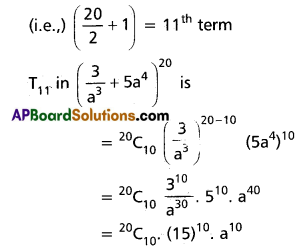
(iv) \(\left(\frac{3}{a^3}+5 a^4\right)^{20}\)
Solution:
Here n = 20 is an even positive integer, we have only one middle term
Inter 2nd Year Maths 2A Binomial Theorem Solutions Ex 6(a) II Q3(iv)

Question 4.
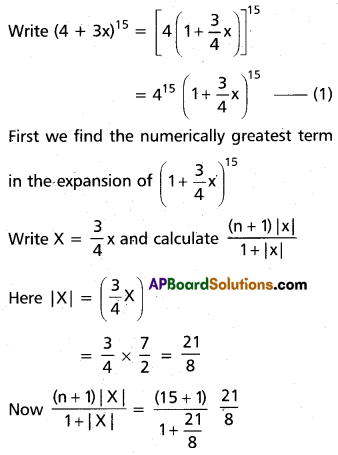
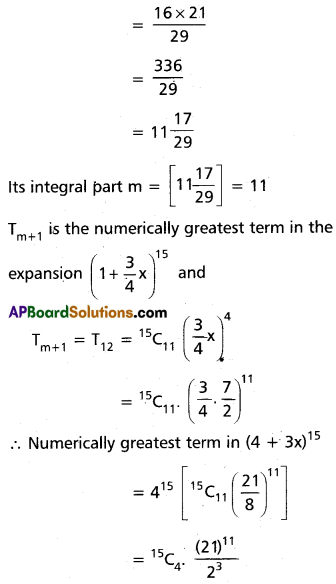
Find the numerically greatest term(s) in the expansion of
(i) (4 + 3x)15 when x = \(\frac{7}{2}\)
Solution:
Inter 2nd Year Maths 2A Binomial Theorem Solutions Ex 6(a) II Q4(i)
Inter 2nd Year Maths 2A Binomial Theorem Solutions Ex 6(a) II Q4(i).1

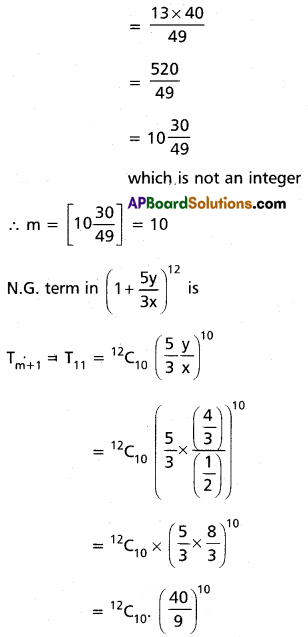
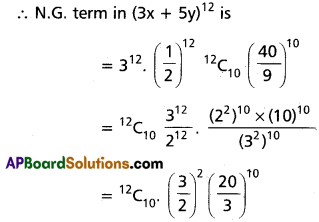
(ii) (3x + 5y)12 when x = \(\frac{1}{2}\), y = \(\frac{4}{3}\)
Solution:
Inter 2nd Year Maths 2A Binomial Theorem Solutions Ex 6(a) II Q4(ii)
Inter 2nd Year Maths 2A Binomial Theorem Solutions Ex 6(a) II Q4(ii).1
Inter 2nd Year Maths 2A Binomial Theorem Solutions Ex 6(a) II Q4(ii).2

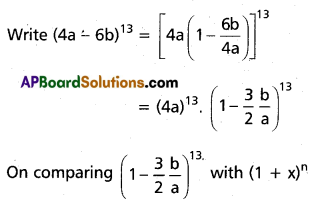
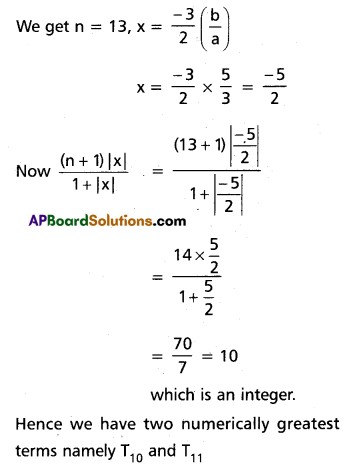
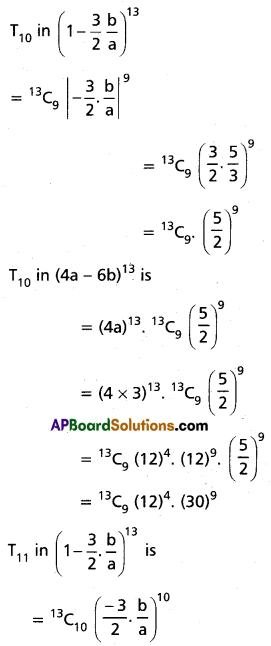
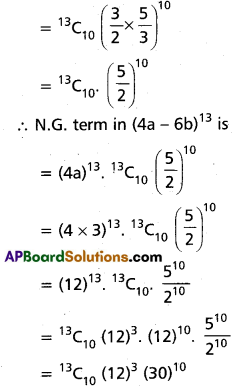
(iii) (4a – 6b)13 when a = 3, b = 5
Solution:
Inter 2nd Year Maths 2A Binomial Theorem Solutions Ex 6(a) II Q4(iii)
Inter 2nd Year Maths 2A Binomial Theorem Solutions Ex 6(a) II Q4(iii).1
Inter 2nd Year Maths 2A Binomial Theorem Solutions Ex 6(a) II Q4(iii).2
Inter 2nd Year Maths 2A Binomial Theorem Solutions Ex 6(a) II Q4(iii).3

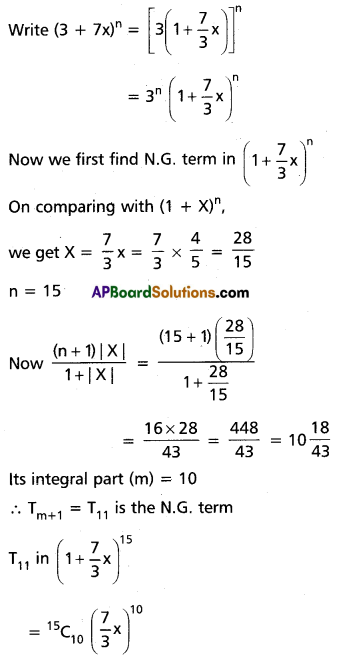
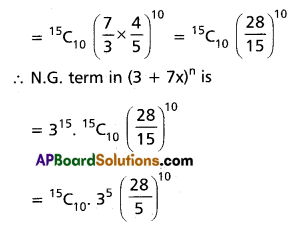
(iv) (3 + 7x)n when x = \(\frac{4}{5}\), n = 15
Solution:
Inter 2nd Year Maths 2A Binomial Theorem Solutions Ex 6(a) II Q4(iv)
Inter 2nd Year Maths 2A Binomial Theorem Solutions Ex 6(a) II Q4(iv).1

Inter 2nd Year Maths 2A Binomial Theorem Solutions Ex 6(a)

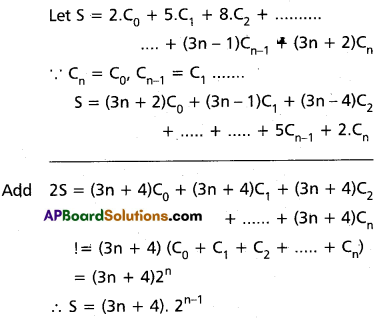
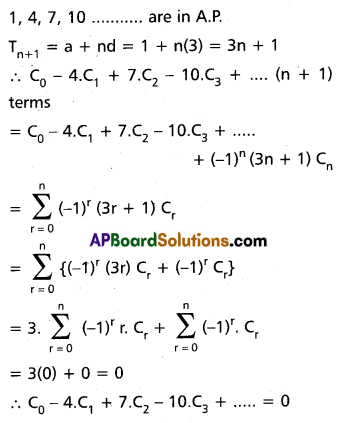
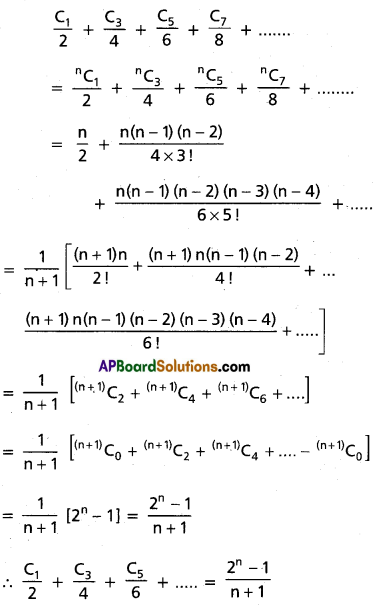
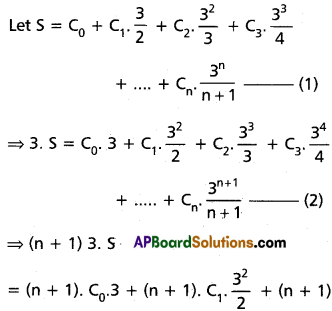
Question 5.
Prove the following.
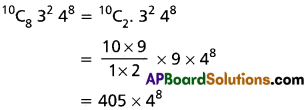
(i) 2 . C0 + 5 . C1 + 8 . C2 + ……… + (3n+2) . Cn = (3n + 4) . 2n-1
Solution:
Inter 2nd Year Maths 2A Binomial Theorem Solutions Ex 6(a) II Q5(i)

(ii) C0 – 4 . C1 + 7 . C2 – 10 . C3 + ……… = 0, if n is an even positive integer.
Solution:
Inter 2nd Year Maths 2A Binomial Theorem Solutions Ex 6(a) II Q5(ii)

(iii) \(\frac{C_1}{2}+\frac{C_3}{4}+\frac{C_5}{6}+\frac{C_7}{8}+\ldots \ldots=\frac{2^n-1}{n+1}\)
Solution:
Inter 2nd Year Maths 2A Binomial Theorem Solutions Ex 6(a) II Q5(iii)

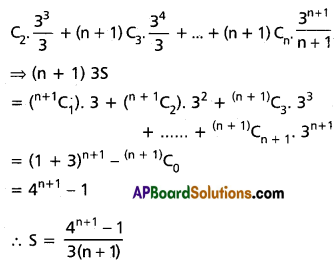
(iv) \(C_0+\frac{3}{2} \cdot C_1+\frac{9}{3} \cdot C_2+\frac{27}{4} \cdot C_3\) + ……… + \(\frac{3^n}{n+1} \cdot C_n=\frac{4^{n+1}-1}{3(n+1)}\)
Solution:
Inter 2nd Year Maths 2A Binomial Theorem Solutions Ex 6(a) II Q5(iv)
Inter 2nd Year Maths 2A Binomial Theorem Solutions Ex 6(a) II Q5(iv).1

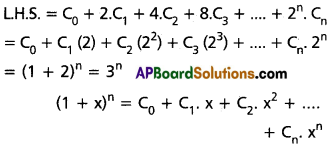
(v) C0 + 2 . C1 + 4 . C2 + 8 . C3 + ….. + 2n . Cn = 3n
Solution:
Inter 2nd Year Maths 2A Binomial Theorem Solutions Ex 6(a) II Q5(v)

Question 6.
Find the sum of the following.
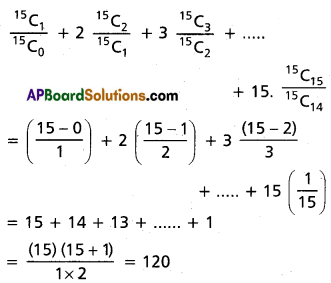
(i) \(\frac{{ }^{15} C_1}{{ }^{15} C_0}+2 \frac{{ }^{15} C_2}{{ }^{15} C_1}+3 \frac{{ }^{15} C_3}{{ }^{15} C_2}\) + …….. + \(15 \frac{{ }^{15} C_{15}}{{ }^{15} C_{14}}\)
Solution:
Inter 2nd Year Maths 2A Binomial Theorem Solutions Ex 6(a) II Q6(i)

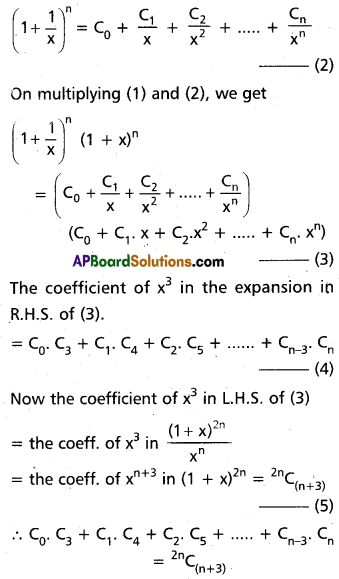
(ii) C0 . C3 + C1 . C4 + C2 . C5 + …….. + Cn-3 . Cn
Solution:
We know that
(1 + x)n = C0 + C1 x + C2 x2 + ……. + Cn . xn ……….(1)
On replacing x by \(\frac{1}{x}\), we get
Inter 2nd Year Maths 2A Binomial Theorem Solutions Ex 6(a) II Q6(ii)

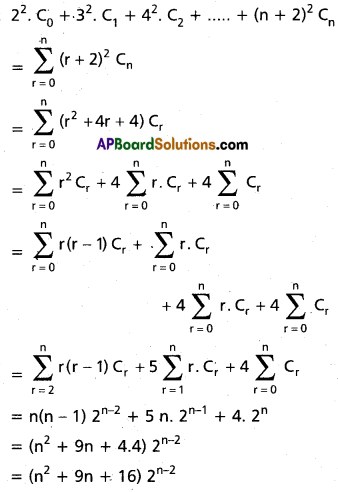
(iii) 22 . C0 + 32 . C1 + 42 . C2 + ……… + (n + 2)2 Cn
Solution:
Inter 2nd Year Maths 2A Binomial Theorem Solutions Ex 6(a) II Q6(iii)

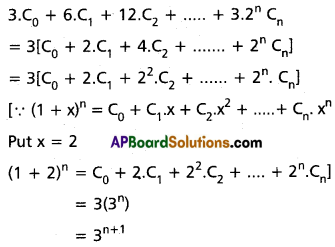
(iv) 3C0 + 6C1 + 12C2 + ……… + 3 . 2n . Cn
Solution:
Inter 2nd Year Maths 2A Binomial Theorem Solutions Ex 6(a) II Q6(iv)

Question 7.
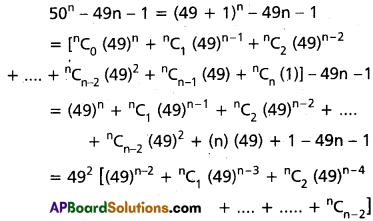
Using the binomial theorem, prove that 50n – 49n – 1 is divisible by 492 for all positive integers n.
Solution:
Inter 2nd Year Maths 2A Binomial Theorem Solutions Ex 6(a) II Q7
= 492 [a positive integer]
Hence 50n – 49n – 1 is divisible by 492 for all positive integers of n.

Question 8.
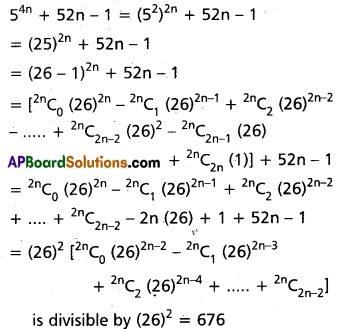
Using the binomial theorem, prove that 54n + 52n – 1 is divisible by 676 for all positive integers n.
Solution:
Inter 2nd Year Maths 2A Binomial Theorem Solutions Ex 6(a) II Q8
∴ 54n + 52n – 1 is divisible by 676, for all positive integers n.

Inter 2nd Year Maths 2A Binomial Theorem Solutions Ex 6(a)

Question 9.
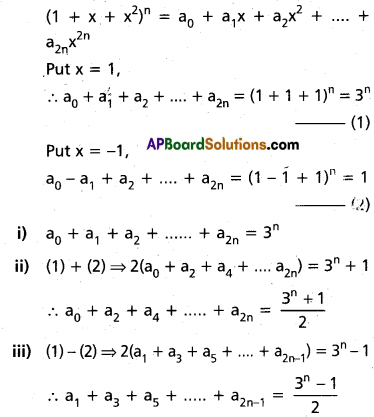
If (1 + x + x2)n = a0 + a1 x + a2 x2 + ……… + a2n x2n, then prove that
(i) a0 + a1 + a2 + ……… + a2n = 3n
(ii) a0 + a2 + a4 + …… + a2n = \(\frac{3^n+1}{2}\)
(iii) a1 + a3 + a5 + ……… + a2n-1 = \(\frac{3^n-1}{2}\)
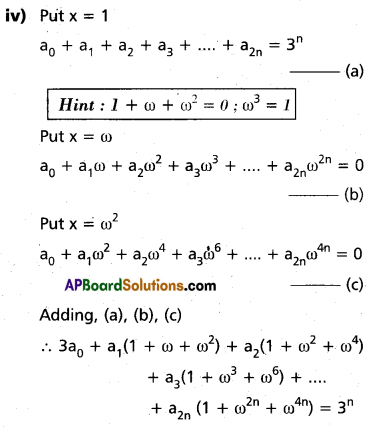
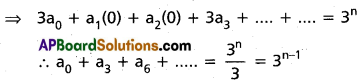
(iv) a0 + a3 + a6 + a9 + ……….. = 3n-1
Solution:
Inter 2nd Year Maths 2A Binomial Theorem Solutions Ex 6(a) II Q9
Inter 2nd Year Maths 2A Binomial Theorem Solutions Ex 6(a) II Q9.1
Inter 2nd Year Maths 2A Binomial Theorem Solutions Ex 6(a) II Q9.2

Question 10.
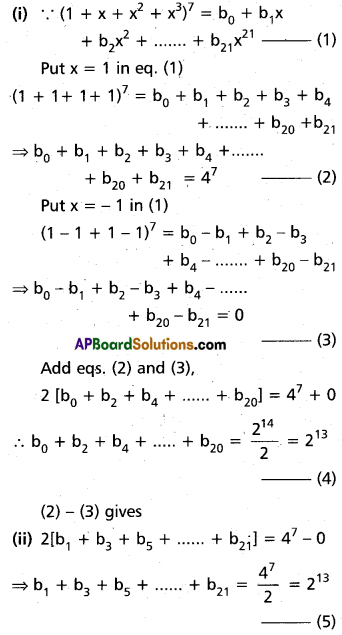
If (1 + x + x2 + x3)7 = b0 + b1x + b2x2 + ………. b21 x21, then find the value of
(i) b0 + b2 + b4 + …….. + b20
(ii) b1 + b3 + b5 + ………. + b21
Solution:
Inter 2nd Year Maths 2A Binomial Theorem Solutions Ex 6(a) II Q10

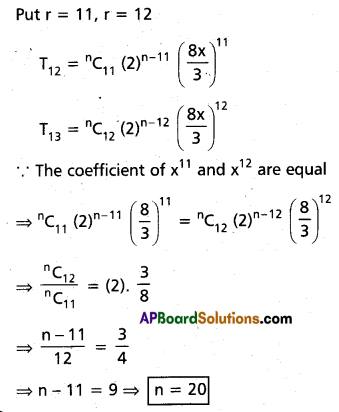
Question 11.
If the coefficient of x11 and x12 in the binomial expansion of \(\left(2+\frac{8 x}{3}\right)^n\) are equal, find n.
Solution:
The general term of \(\left(2+\frac{8 x}{3}\right)^n\) is \(T_{r+1}={ }^n C_r(2)^{n-r}\left(\frac{8 x}{3}\right)^r\)
Inter 2nd Year Maths 2A Binomial Theorem Solutions Ex 6(a) II Q11

Question 12.
Find the remainder when 22013 is divided by 17.
Solution:
We know 24 = 16
The remainder when 24 is divided by 17 is 1
22013 = (24)503 . 21
∴ The remainder when 22013 is divided by 17 is (-1)503 . 2 = (-1) . 2 = -2

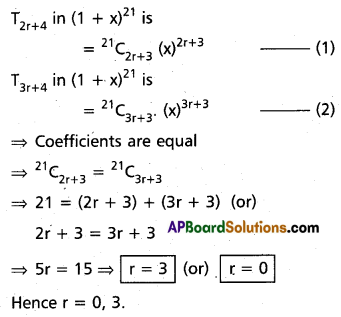
Question 13.
If the coefficients of (2r + 4)th term and (3r + 4)th term in the expansion of (1 + x)21 are equal, find r.
Solution:
Inter 2nd Year Maths 2A Binomial Theorem Solutions Ex 6(a) II Q13

III.

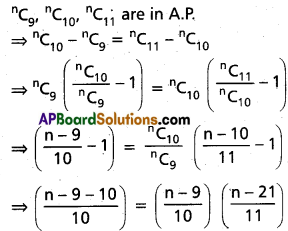
Question 1.
If the coefficients of x9, x10, x11 in the expansion of (1 + x)n are in A.P., then prove that n2 – 41n + 398 = 0.
Solution:
The coefficients of x9, x10, x11 in (1 + x)n are
Inter 2nd Year Maths 2A Binomial Theorem Solutions Ex 6(a) III Q1
⇒ (n – 9) (n – 21) = 11(n – 19)
⇒ n2 – 9n – 21n + 189 = 11n – 209
⇒ n2 – 41n + 398 = 0

Inter 2nd Year Maths 2A Binomial Theorem Solutions Ex 6(a)

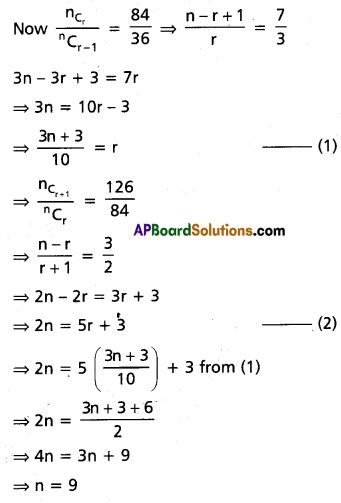
Question 2.
If 36, 84, 126 are three successive binomial coefficients in the expansion of (1 + x)n, find n.
Solution:
Let nCr-1, nCr, nCr+1 are three successive binomial coefficients in (1 + x)n.
Then nCr-1 = 36; nCr = 84 and nCr+1 = 126
Inter 2nd Year Maths 2A Binomial Theorem Solutions Ex 6(a) III Q2

Question 3.
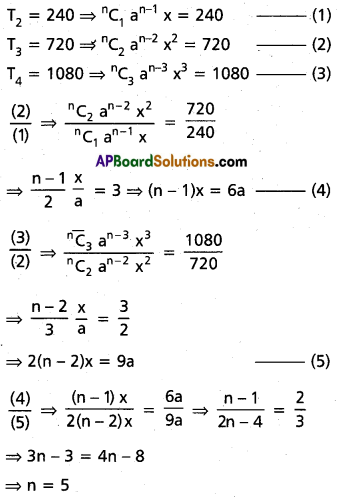
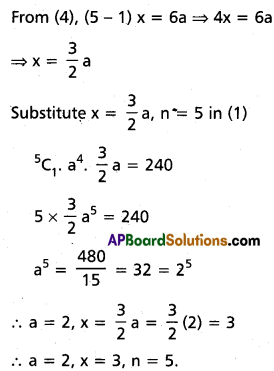
If the 2nd, 3rd and 4th terms in the expansion of (a + x)n are respectively 240, 720, 1080, find a, x, n.
Solution:
Inter 2nd Year Maths 2A Binomial Theorem Solutions Ex 6(a) III Q3
Inter 2nd Year Maths 2A Binomial Theorem Solutions Ex 6(a) III Q3.1

Question 4.
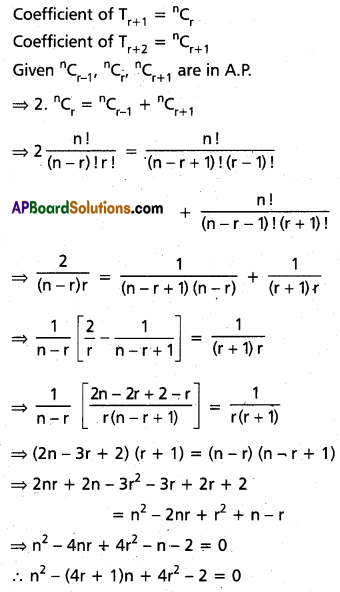
If the coefficients of rth, (r + 1)th and (r + 2)nd terms in the expansion of (1 + x)n are in A.P. then show that n2 – (4r + 1)n + 4r2 – 2 = 0.
Solution:
Coefficient of Tr = nCr-1
Inter 2nd Year Maths 2A Binomial Theorem Solutions Ex 6(a) III Q4

Question 5.
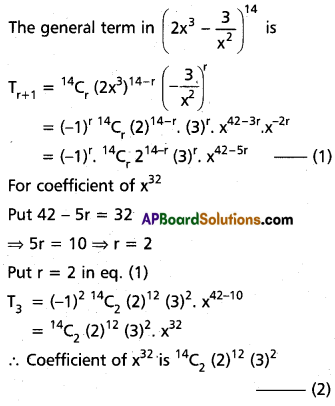
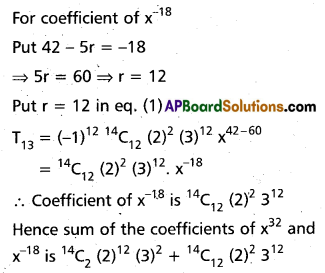
Find the sum of the coefficients of x32 and x-18 in the expansion of \(\left(2 x^3-\frac{3}{x^2}\right)^{14}\)
Solution:
Inter 2nd Year Maths 2A Binomial Theorem Solutions Ex 6(a) III Q5
Inter 2nd Year Maths 2A Binomial Theorem Solutions Ex 6(a) III Q5.1

Question 6.
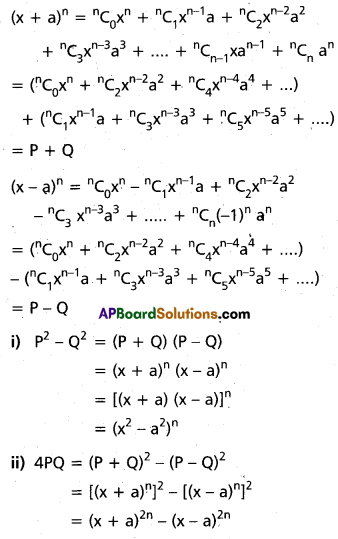
If P and Q are the sums of odd terms and the sum of even terms respectively in the expansion of (x + a)n then prove that
(i) P2 – Q2 = (x2 – a2)n
(ii) 4PQ = (x + a)2n – (x – a)2n
Solution:
Inter 2nd Year Maths 2A Binomial Theorem Solutions Ex 6(a) III Q6

Question 7.
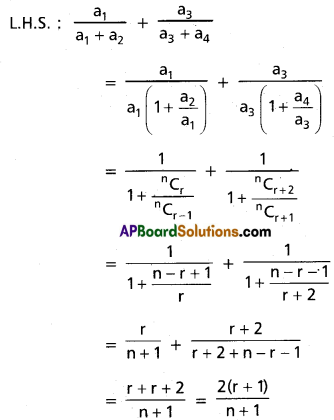
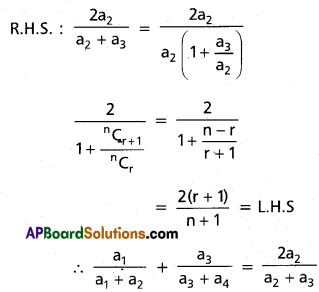
If the coefficients of 4 consecutive terms in the expansion of (1 + x)n are a1, a2, a3, a4 respectively, then show that \(\frac{a_1}{a_1+a_2}+\frac{a_3}{a_3+a_4}=\frac{2 a_2}{a_2+a_3}\)
Solution:
Given a1, a2, a3, a4 are the coefficients of 4 consecutive terms in (1 + x)n respectively.
Let a1 = nCr-1, a2 = nCr, a3 = nCr+1, a4 = nCr+2
Inter 2nd Year Maths 2A Binomial Theorem Solutions Ex 6(a) III Q7
Inter 2nd Year Maths 2A Binomial Theorem Solutions Ex 6(a) III Q7.1

Inter 2nd Year Maths 2A Binomial Theorem Solutions Ex 6(a)

Question 8.
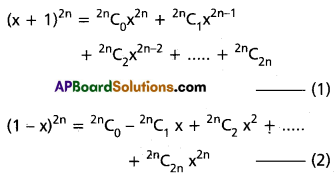
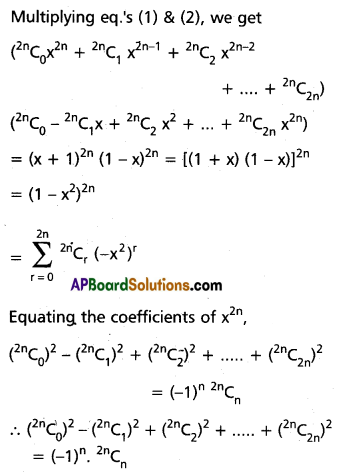
Prove that (2nC0)2 – (2nC1)2 + (2nC2)2 – (2nC3)2 + ……… + (2nC2n)2 = (-1)n 2nCn
Solution:
Inter 2nd Year Maths 2A Binomial Theorem Solutions Ex 6(a) III Q8
Inter 2nd Year Maths 2A Binomial Theorem Solutions Ex 6(a) III Q8.1

Question 9.
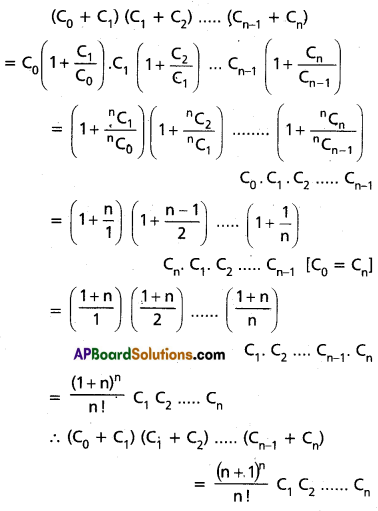
Prove that (C0 + C1)(C1 + C2)(C2 + C3) ………… (Cn-1 + Cn) = \(\frac{(n+1)^n}{n !}\) . C0 . C1 . C2 ……… Cn
Solution:
Inter 2nd Year Maths 2A Binomial Theorem Solutions Ex 6(a) III Q9

Question 10.
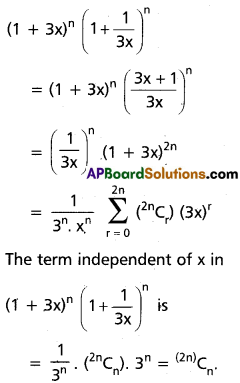
Find the term independent of x in \((1+3 x)^n\left(1+\frac{1}{3 x}\right)^n\)
Solution:
Inter 2nd Year Maths 2A Binomial Theorem Solutions Ex 6(a) III Q10

Question 11.
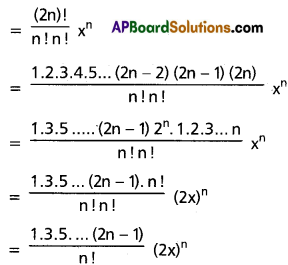
Show that the middle term in the expansion of (1 + x)2n is \(\frac{1.3 .5 \ldots(2 n-1)}{n !}(2 x)^n\)
Solution:
The expansion of (1 + x)2n contains (2n + 1) terms.
middle term = 2nCn xn
Inter 2nd Year Maths 2A Binomial Theorem Solutions Ex 6(a) III Q11

Question 12.
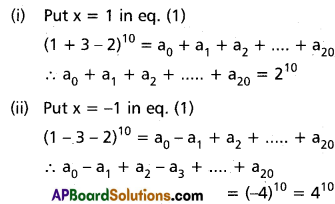
If (1 + 3x – 2x2)10 = a0 + a1x + a2x2 + …….. + a20 x20 then prove that
(i) a0 + a1 + a2 + ……… + a20 = 210
(ii) a0 – a1 + a2 – a3 + ……….. + a20 = 410
Solution:
(1 + 3x – 2x2)10 = a0 + a1x + a2x2 + ……… + a20 x20
Inter 2nd Year Maths 2A Binomial Theorem Solutions Ex 6(a) III Q12

Question 13.
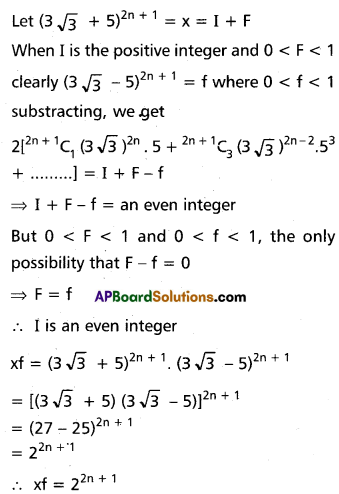
If (3√3 + 5)2n+1 = x and f = x – [x] where ([x] is the integral part of x), find the value of x.f.
Solution:
Inter 2nd Year Maths 2A Binomial Theorem Solutions Ex 6(a) III Q13

Inter 2nd Year Maths 2A Binomial Theorem Solutions Ex 6(a)

Question 14.
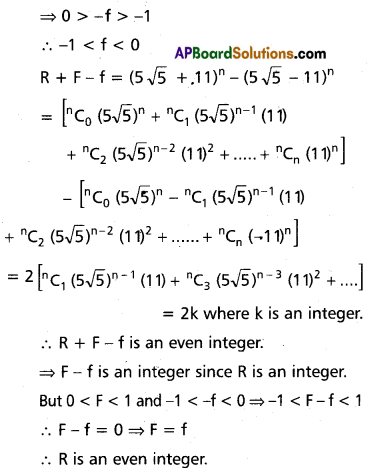
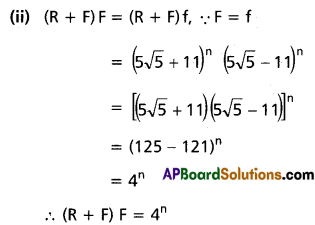
If R, n are positive integers, n is odd, 0 < F < 1 and if (5√5 + 11)n = R + F, then prove that
(i) R is an even integer and
(ii) (R + F) . F = 4n
Solution:
(i) Since R, n are positive integers, 0 < F < 1 and (5√5 + 11)n = R + F
Let (5√5 – 11)n = f
Now, 11 < 5√5 < 12
⇒ 0 < 5√5 – 11 < 1
⇒ 0 < (5√5 – 11)n < 1
⇒ 0 < f < 1
Inter 2nd Year Maths 2A Binomial Theorem Solutions Ex 6(a) III Q14
Inter 2nd Year Maths 2A Binomial Theorem Solutions Ex 6(a) III Q14.1

Question 15.
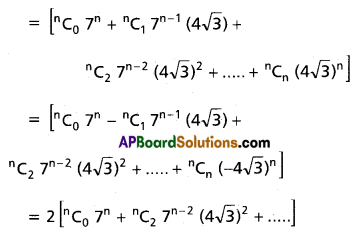
If I, n are positive integers, 0 < f < 1 and if (7 + 4√3 )n = I + f, then show that
(i) I is an odd integer and
(ii) (I + f) (1 – f) = 1
Solution:
Given I, n are positive integers and
(7 + 4√3)n = I + f, 0 < f < 1
Let 7 – 4√3 = F
Now 6 < 4√3 < 7
⇒ -6 > -4√3 > -7
⇒ 1 > 7 – 4√3 > 0
⇒ 0 < (7 – 4√3)n < 1
∴ 0 < F < 1
I + f + F = (7 + 4√3)n + (7 – 4√3)n
Inter 2nd Year Maths 2A Binomial Theorem Solutions Ex 6(a) III Q15
= 2k where k is an integer.
∴ I + f + F is an even integer.
⇒ f + F is an integer since I is an integer.
But 0 < f < 1 and 0 < F < 1
⇒ 0 < f + F < 2
∴ f + F = 1 ………..(1)
⇒ I + 1 is an even integer.
∴ I is an odd integer.
(I + f) (I – f) = (I + f) F …..[By (1)]
= (7 + 4√3)n (7 – 4√3)n
= [(7 + 4√3) (7 – 4√3)]n
= (49 – 48)n
= 1

Inter 2nd Year Maths 2A Binomial Theorem Solutions Ex 6(a)

Question 16.
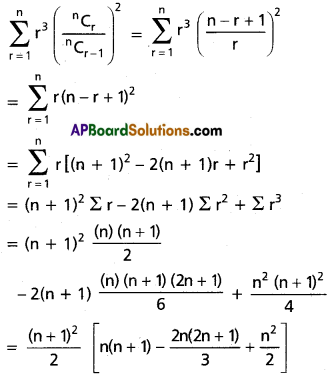
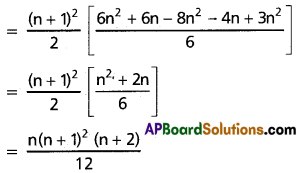
If n is a positive integer, prove that \(\sum_{r=1}^n r^3\left(\frac{{ }^n C_r}{{ }^n C_{r-1}}\right)^2=\frac{(n)(n+1)^2(n+2)}{12}\)
Solution:
Inter 2nd Year Maths 2A Binomial Theorem Solutions Ex 6(a) III Q16
Inter 2nd Year Maths 2A Binomial Theorem Solutions Ex 6(a) III Q16.1

Question 17.
Find the number of irrational terms in the expansion of (51/6 + 21/8)100.
Solution:
General term
Tr+1 = \({ }^{100} C_r\left(5^{1 / 6}\right)^{100-r}\left(2^{1 / 8}\right)^r\) = \({ }^{100} C_r 5^{\frac{100-r}{6}} \cdot 2^{\frac{r}{8}}\)
\(\frac{100-r}{6}\) is an integer in the span
or 0 ≤ r ≤ 100 if r = 4, 10, 16, 22, 28, 34, 40, 46, 52, 58, 64, 70, 76, 82, 88, 94, 100
\(\frac{r}{8}\) is an integer in the span of 0 ≤ r ≤ 100
if r = 8, 16, 24, 32, 40, 48, 56, 64, 72, 80, 88, 96, \(\frac{100-r}{6}\), \(\frac{r}{8}\) both an integers
If r = 16, 40, 64, 88
∴ The number of rational terms in the expansion of (51/6 + 21/8)r is 4.
∴ The number of irrational terms in the expansion of (51/6 + 21/8)r is 101 – 4 = 97 terms.

Inter 2nd Year Maths 2A Permutations and Combinations Solutions Ex 5(c)

Practicing the Intermediate 2nd Year Maths 2A Textbook Solutions Inter 2nd Year Maths 2A Permutations and Combinations Solutions Exercise 5(c) will help students to clear their doubts quickly.

Intermediate 2nd Year Maths 2A Permutations and Combinations Solutions Exercise 5(c)

I.

Question 1.
Find the number of ways of arranging 7 persons around a circle.
Solution:
Number of persons, n = 7
∴ The number of ways of arranging 7 persons around a circle = (n – 1)!
= 6!
= 720
Hint: The no. of circular permutations of n dissimilar things taken all at a time is (n – 1)!

Question 2.
Find the number of ways of arranging the chief minister and 10 cabinet ministers at a circular table so that the chief minister always sits in a particular seat.
Solution:
Total number of persons = 11
The chief minister can be occupied a separate seat in one way and the remaining 10 seats can be occupied by the 10 cabinet ministers in (10)! ways.
∴ The number of required arrangements = (10)! × 1
= (10)!
= 36,28,800

Inter 2nd Year Maths 2A Permutations and Combinations Solutions Ex 5(c)

Question 3.
Find the number of ways to prepare a chain with 6 different coloured beads.
Solution:
Hint: The number of circular permutations like the garlands of flowers, chains of beads, etc., of n things = \(\frac{1}{2}\)(n – 1)!
The number of ways of preparing a chain with 6 different coloured beads = \(\frac{1}{2}\)(6 – 1)!
= \(\frac{1}{2}\) × 5!
= \(\frac{1}{2}\) × 120
= 60

II.

Question 1.
Find the number of ways of arranging 4 boys and 3 girls around a circle so that all the girls sit together.
Solution:
Treat all the 3 girls as one unit. Then we have 4 boys and 1 unit of girls. They can be arranged around a circle in 4! ways. Now, the 3 girls can be arranged among themselves in 3! ways.
∴ The number of required arrangements = 4! × 3!
= 24 × 6
= 144

Question 2.
Find the number of ways of arranging 7 gents and 4 ladies around a circular table if no two ladies wish to sit together.
Solution:
First, arrange the 7 gents around a circular table in 6! ways.
Then we can find 7 gaps between them. The 4 ladies can be arranged in these 7 gaps in 7P4 ways.
Inter 2nd Year Maths 2A Permutations and Combinations Solutions Ex 5(c) II Q2
∴ The number of required arrangements = 6! × 7P4
= 720 × 7 × 6 × 5 × 4
= 6,04,800

Question 3.
Find the number of ways of arranging 7 guests and a host around a circle if 2 particular guests wish to sit on either side of the host.
Solution:
Number of guests = 7
Treat the two particular guests along with the host as one unit. Then we have 5 guests and one unit of 2 particular guests along with the host.
They can be arranged around a circle in 5! ways.
The two particular guests can be arranged on either side of the host in 2! ways.
∴ The number of required arrangements = 5! × 2!
= 120 × 2
= 240

Inter 2nd Year Maths 2A Permutations and Combinations Solutions Ex 5(c)

Question 4.
Find the number of ways of preparing a garland with 3 yellow, 4 white, and 2 red roses of different sizes such that the two red roses come together.
Solution:
Treat that 2nd rose of different sizes as one unit. Then we have 3 yellow, 4 white, and one unit of red roses.
Then they can be arranged in garland form in \(\frac{1}{2}\) (8 – 1)! = \(\frac{1}{2}\) (7!) ways.
Now 2 red roses in one unit can be arranged among themselves in 2! ways.
∴ The number of ways of preparing a garland = \(\frac{1}{2}\) (7!) × (2!)
= \(\frac{1}{2}\) × 5040 × 2
= 5040

III.

Question 1.
Find the number of ways of arranging 6 boys and 6 girls around a circular table so that
(i) all the girls sit together
(ii) no two girls sit together
(iii) boys and girls sit alternately
Solution:
(i) Treat all 5 girls as one unit. Then we have 6 boys and 1 unit of girls. They can be arranged around a circular table in 6! ways.
Now, the 6 girls can be arranged among themselves in 6! ways.
∴ The number of required arrangements = 6! × 6!
= 720 × 720
= 5,18,400

(ii) First arrange the 6 boys around a circular table in 5! ways. Then we can find 6 gaps between them.
The 6 girls can be arranged in these 6 gaps in 6! ways.
Inter 2nd Year Maths 2A Permutations and Combinations Solutions Ex 5(c) III Q1
∴ The number of required arrangements = 5! × 6!
= 120 × 720
= 86,400

(iii) Here the number of girls and number of boys are the same.
Inter 2nd Year Maths 2A Permutations and Combinations Solutions Ex 5(c) III Q1.1
Hence the arrangements of boys and girls sit alternatively in the same as the arrangements of no two girls sitting together or arrangements of no two boys sitting together.
First, arrange the 6 girls around a circular table in 5! ways. Then we can find 6 gaps between them.
The 6 boys can be arranged in these 6 gaps in 6! ways.
∴ The number of required arrangements = 5! × 6!
= 120 × 720
= 86,400

Question 2.
Find the number of ways of arranging 6 red roses and 3 yellow roses of different sizes into a garland. In how many of them
(i) all the yellow roses are together
(ii) no two yellow roses are together
Solution:
Hint: The number of circular permutations like the garlands of flowers, chains of beads, etc., of n things = \(\frac{1}{2}\)(n – 1)!
Total number of roses = 6 + 3 = 9
∴ The number of ways of arranging 6 red roses and 3 yellow roses of different sizes into a garland = \(\frac{1}{2}\)(9 – 1)!
= \(\frac{1}{2}\) × 8!
= \(\frac{1}{2}\) × 40,320
= 20,160
(i) Treat all the 3 yellow roses as one unit. Then we have 6 red roses and one unit of yellow roses. They can be arranged in garland form in (7 – 1)! = 6! ways.
Now, the 3 yellow roses can be arranged among themselves in 3! ways.
But in the case of garlands, clockwise arrangements look alike.
∴ The number of required arrangements = \(\frac{1}{2}\) × 6! × 3!
= \(\frac{1}{2}\) × 720 × 6
= 2160

(ii) First arrange the 6 red roses in garland form in 5! ways. Then we can find 6 gaps between them.
The 3 yellow roses can be arranged in these 6 gaps in 6P3 ways.
But in the case of garlands, clockwise and anti-clockwise arrangements look alike.
∴ The number of required arrangements = \(\frac{1}{2}\) × 5! × 6P3
= \(\frac{1}{2}\) × 120 × 6 × 5 × 4
= 7200

Inter 2nd Year Maths 2A Permutations and Combinations Solutions Ex 5(c)

Question 3.
A round table conference is attended by 3 Indians, 3 Chinese, 3 Canadians, and 2 Americans. Find a number of ways of arranging them at the round table so that the delegates belonging to the same country sit together.
Solution:
Since the delegates belonging to the same country sit together, first arrange the 4 countries in a round table in 3! ways.
Now, 3 Indians can be arranged among themselves in 3! ways,
3 Chinese can be arranged among themselves in 3! ways,
3 Canadians can be arranged among themselves in 3! ways,
and 2 Americans can be arranged among themselves in 2! ways.
∴ The number of required arrangements = 3! × 3! × 3! × 3! × 2!
= 6 × 6 × 6 × 6 × 2
= 2592

Question 4.
A chain of beads is to be prepared using 6 different red coloured beads and 3 different blue coloured beads. In how many ways can this be done so that no two blue-coloured beads come together?
Solution:
First, arrange the 6 red-coloured beads in the form of a chain of beads in (6 – 1)! = 5! ways.
Then there are 6 gaps between them. The 3 blue coloured beads can be arranged in these 6 gaps in 6P3 ways.
Then the total number of circular permutations = 5! × 6P3
But in the case of a chain of beads, clockwise and anti-clockwise arrangements look alike.
∴ The number of required arrangements = \(\frac{1}{2}\) × 5! × 6P3
= \(\frac{1}{2}\) × 120 × 6 × 5 × 4
= 7200

Inter 2nd Year Maths 2A Permutations and Combinations Solutions Ex 5(c)

Question 5.
A family consists of a father, a mother, 2 daughters, and 2 sons. In how many different ways can they sit at a round table if the 2 daughters wish to sit on either side of the father?
Solution:
Total number of persons in a family = 6
Treat the 2 daughters along with a father as one unit. Then we have a mother, 2 sons, and one unit of daughters along with the father in a family.
They can be seated around a table in (4 – 1)! = 3! ways.
The 2 daughters can be arranged on either side of the father in 2! ways.
∴ The number of required arrangements = 3! × 2!
= 6 × 2
= 12

Inter 2nd Year Maths 2A Permutations and Combinations Solutions Ex 5(b)

Practicing the Intermediate 2nd Year Maths 2A Textbook Solutions Inter 2nd Year Maths 2A Permutations and Combinations Solutions Exercise 5(b) will help students to clear their doubts quickly.

Intermediate 2nd Year Maths 2A Permutations and Combinations Solutions Exercise 5(b)

I.

Question 1.
Find the number of 4-digited numbers that can be formed using the digits 1, 2, 4, 5, 7, 8 when repetition is allowed.
Solution:
The number of 4 digited numbers that can be formed using the digits 1, 2, 4, 5, 7, 8 when repetition is allowed = 64 = 1296
Inter 2nd Year Maths 2A Permutations and Combinations Solutions Ex 5(b) I Q1

Question 2.
Find the number of 5-letter words that can be formed using the letters of the word RHYME if each letter can be used any number of times.
Solution:
The number of 5 letter words that can be formed using the letters of the word RHYME if each letter can be used any number of times = 55 = 3125
Inter 2nd Year Maths 2A Permutations and Combinations Solutions Ex 5(b) I Q2

Inter 2nd Year Maths 2A Permutations and Combinations Solutions Ex 5(b)

Question 3.
Find the number of functions from a set A containing 5 elements into a set B containing 4 elements.
Solution:
Set A contains 5 elements.
Set 8 contains 4 elements.
Hint: The total number of functions from set A containing m elements to set B containing n elements is nm.
For the image of each of the 5 elements of the set, A has 4 choices.
∴ The number of functions from set A containing 5 elements into a set B containing 4 elements = 4 × 4 × 4 × 4 × 4 (5 times)
= 45
= 1024

II.

Question 1.
Find the number of palindromes with 6 digits that can be formed using the digits
(i) 0, 2, 4, 6, 8
(iii) 1, 3, 5, 7, 9
Solution:
Palindromes mean first digit, sixth digit and second digit, fifth digit and third digit, and the fourth digit are the same numbers.
That is we have filled the first three digits only and then the remaining digits are the same.
Inter 2nd Year Maths 2A Permutations and Combinations Solutions Ex 5(b) II Q1
(i) Given numbers are 0, 2, 4, 6, 8
For the required 6-digit palindromes first digit can be filled 4 ways except ‘0’.
The second digit can be filled in 5 ways and the third can be filled in 5 ways.
∴ The number of 6-digit palindromes using the digits 0, 2, 4, 6, 8 are 4 × 52 = 100
Inter 2nd Year Maths 2A Permutations and Combinations Solutions Ex 5(b) II Q1.1
(ii) Given numbers are 1, 3, 5, 7, 9
For the required 6-digit palindromes first digit can be filled in 5 ways, the second digit can be filled in 5 ways and the third digit can be filled in 5 ways.
∴ The number of 6-digit palindromes using the digits 1, 3, 5, 7, 9 are 53 = 125

Question 2.
Find the number of 4-digit telephone numbers that can be formed using the digits 1, 2, 3, 4, 5, 6 with atleast one digit repeated.
Solution:
The number of 4 digited numbers formed using the digits 1, 2, 3, 4, 5, 6 when repetition is allowed = 64
The number of 4 digited numbers formed using the digits 1, 2, 3, 4, 5, 6 when repetition is not allowed = 6P4
The number of 4 digited telephone numbers in which atleast one digit is repeated = 646P4
= 64 – 6 × 5 × 4 × 3
= 1296 – 360
= 936

Inter 2nd Year Maths 2A Permutations and Combinations Solutions Ex 5(b)

Question 3.
Find the number of bijections from a set A containing 7 elements onto itself.
Solution:
Hint: The number of bijections from set A with n elements to set B with the same number of elements in A is n!
Let A = [a1, a2, a3, a4, a5, a6, a7]
For a bijection, the element a1 has 7 choices
for its image, the element a2 has 6 choices
for its image, the element a3 has 5 choices
for its image, the element a4 has 4 choices
for its image, the element a5 has 3 choices
for its image, the element a6 has 2 choices
for its image and the element, a7 has 1 choice for its image.
∴ The number of bijections from set A with 7 elements onto itself = 7!
= 7 × 6 × 5 × 4 × 3 × 2 × 1
= 5040

Question 4.
Find the number of ways of arranging ‘r’ things in a line using the given ‘n’ different things in which atleast one thing is repeated.
Solution:
The number of ways of arranging, r things in a line using the given n different things
(i) when repetition is allowed is nr
(ii) when repetition is not allowed is nPr
∴ The number of ways of arranging ‘r’ things in a line using the ‘n1 different things in which atleast one thing is repeated = nrnPr

Question 5.
Find the number of 5-letter words that can be formed using the letters of the word NATURE that begin with N when repetition is allowed.
Solution:
First, we can fill up the first place with N in one way.
Inter 2nd Year Maths 2A Permutations and Combinations Solutions Ex 5(b) II Q5
The remaining 4 places can be filled with any one of the 6 letters in 6 × 6 × 6 × 6 = 64 ways.
∴ The number of 5 letter words that can be formed using the letters of the word NATURE that begin with N when repetition is allowed = 1 × 64 = 1296

Inter 2nd Year Maths 2A Permutations and Combinations Solutions Ex 5(b)

Question 6.
Find the number of 5-digit numbers divisible by 5 that can be formed using the digits 0, 1, 2, 3, 4, 5 when repetition is allowed.
Solution:
The unit place of 5 digited numbers which can be divisible by 5 using the given digits can be filled by either 0 or 5 in two ways.
The first place can be filled in any one of the given digits except ‘0’ in 5 ways.
The remaining 3 places can be filled by any one of the given digits in 6 × 6 × 6 ways (∵ repetition is allowed)
Inter 2nd Year Maths 2A Permutations and Combinations Solutions Ex 5(b) II Q6
∴ The number of 5 digited numbers divisible by 5 that can be formed using the given digits when repetition is allowed = 2 × 5 × 6 × 6 × 6 = 2160 ways.

Question 7.
Find the number of numbers less than 2000 that can be formed using the digits, 1, 2, 3, 4 if repetition is allowed.
Solution:
All the single digited numbers, two digited numbers, three digited numbers and the four digited numbers started with 1 are the numbers less than 2000 using the digits 1, 2, 3, 4.
The number of single digited numbers formed using the given digits = 4
Inter 2nd Year Maths 2A Permutations and Combinations Solutions Ex 5(b) II Q7
The number of two digited numbers formed using the given digits when repetition is allowed = 4 × 4 = 16
Inter 2nd Year Maths 2A Permutations and Combinations Solutions Ex 5(b) II Q7.1
The number of three digited numbers formed using the given digits = 4 × 4 × 4 = 64
Inter 2nd Year Maths 2A Permutations and Combinations Solutions Ex 5(b) II Q7.2
The number of 4 digited numbers started with 1 formed using the given digits = 4 × 4 × 4 = 64
Inter 2nd Year Maths 2A Permutations and Combinations Solutions Ex 5(b) II Q7.3
∴ The total number of numbers less than 2000 that can be formed using the digits 1, 2, 3, 4 if repetition is allowed = 4 + 16 + 64 + 64 = 148

III.

Question 1.
9 different letters of an alphabet are given. Find the number of 4 letter words that can be formed using these 9 letters which have
(i) no letter is repeated
(ii) At atleast one letter is repeated
Solution:
The number of 4 letter words can be formed using the 9 different letters of an alphabet when repetition is allowed = 94
(i) The number of 4 letter words can be formed using the 9 different letters of an alphabet in which no letter is repeated = 9P4
= 9 × 8 × 7 × 6
= 3024
(ii) The number of 4 letter words can be formed using the 9 different letters of an alphabet in which atleast one letter is repeated = 949P4
= 6561 – 3024
= 3537

Inter 2nd Year Maths 2A Permutations and Combinations Solutions Ex 5(b)

Question 2.
Find the number of 4-digit numbers which can be formed using the digits 0, 2, 5, 7, 8 that are divisible by (i) 2 (ii) 4 when repetition is allowed.
Solution:
(i) First place can be filled by either 2 or 5 or 7 or 8 in 4 ways.
Inter 2nd Year Maths 2A Permutations and Combinations Solutions Ex 5(b) III Q2
Second place can be filled by any one of the given digits in 5 ways.
Third place can be filled by any one of the given digits in 5 ways.
Last place (or units place) can be filled by either 0 or 2 or 8 in 3 ways.
∴ The number of 4 digited divisible by 2 numbers that can be formed using the digits 0, 2, 5, 7, 8 when repetition is allowed = 4 × 5 × 5 × 3 = 300
(ii) Since a number is divisible by 4, the last two places should be filled with one of the 00, 08, 20, 28, 52, 72, 80, 88 in 8 ways.
The first place can be filled 4 ways except 0. Second place can be filled in 5 ways.

Question 3.
Find the number of 4-digit numbers that can be formed using the digits 0, 1, 2, 3, 4, 5 which are divisible by 6 when repetition of the digits is allowed.
Solution:
Since a number is divisible by 4, the last two places should be filled with one of the 00, 04, 12, 20, 24, 32, 40, 44 = 8 ways
Inter 2nd Year Maths 2A Permutations and Combinations Solutions Ex 5(b) III Q3
The first place can be filled in any one of the given digits except ‘0’ in 4 ways. The remaining 2 places can be filled by anyone the given digits in 5 × 5 ways.
∴ The number of 5 digited numbers that can be formed using the digits 0, 1, 2, 3, 4 that are divisible by 4 when repetition is allowed = 4 × 52 × 8 = 800

Inter 2nd Year Maths 2A Theory of Equations Solutions Ex 4(d)

Practicing the Intermediate 2nd Year Maths 2A Textbook Solutions Inter 2nd Year Maths 2A Theory of Equations Solutions Exercise 4(d) will help students to clear their doubts quickly.

Intermediate 2nd Year Maths 2A Theory of Equations Solutions Exercise 4(d)

I.

Question 1.
Find the algebraic equation whose roots are 3 times the roots of x3 + 2x2 – 4x + 1 = 0
Solution:
Given equation is f(x) = x3 + 2x2 – 4x + 1 = 0
We require an equation whose roots are 3 times the roots of f(x) = 0
i,e., Required equation is f(\(\frac{x}{3}\)) = 0
⇒ \(\left(\frac{x}{3}\right)^{3}+2\left(\frac{x}{3}\right)^{2}-\frac{4 x}{3}+1=0\)
⇒ \(\frac{x^{3}}{27}+\frac{2}{9} x^{2}-\frac{4}{3} x+1=0\)
Multiplying with 27, required equation is x3 + 6x2 – 36x + 27 = 0

Question 2.
Find the algebraic equation whose roots are 2 times the roots of x5 – 2x4 + 3x3 – 2x2 + 4x + 3 = 0
Solution:
Given equation is f(x) = x5 – 2x4 + 3x3 – 2x2 + 4x + 3 = 0
We require an equation whose roots are 2 times the roots of f(x) = 0
Required equation is f(\(\frac{x}{2}\)) = 0
⇒ \(\left(\frac{x}{2}\right)^{5}-2\left(\frac{x}{2}\right)^{4}+3\left(\frac{x}{2}\right)^{3}-2\left(\frac{x}{2}\right)^{2}+4\left(\frac{x}{2}\right)\) + 3 = 0
⇒ \(\frac{x^{5}}{32}-2 \cdot \frac{x^{4}}{16}+3 \cdot \frac{x^{3}}{8}-2 \cdot \frac{x^{2}}{4}+4 \cdot \frac{x}{2}+3=0\)
Multiplying with 32, the required equation is
⇒ x5 – 4x4 + 12x3 – 16x2 + 64x + 96 = 0

Inter 2nd Year Maths 2A Theory of Equations Solutions Ex 4(d)

Question 3.
Find the transformed equation whose roots are the negative of the roots of x4 + 5x3 + 11x + 3 = 0
Solution:
Given f(x) = x4 + 5x3 + 11x + 3 = 0
We want an equation whose roots are -α1, -α2, -α3, -α4
Required equation f(-x) = 0
⇒ (-x)4 + 5(-x)3 + 11(-x) + 3 = 0
⇒ x4 – 5x3 – 11x + 3 = 0

Question 4.
Find the transformed equation whose roots are the negatives of the roots of x7 + 3x5 + x3 – x2 + 7x + 2 = 0
Solution:
Given f(x) = x7 + 3x5 + x3 – x2 + 7x + 2 = 0
We want an equation whose roots are -α1, -α2, ………., -αn
Required equation is f(-x) = 0
⇒ (-x)7 + 3(-x)5 + (-x)3 – (-x)2 + 7(-x) + 2 = 0
⇒ -x7 – 3x5 – x3 – x2 – 7x + 2 = 0
⇒ x7 + 3x5 + x3 + x2 + 7x – 2 = 0

Question 5.
Find the polynomial equation whose roots are the reciprocals of the roots of x4 – 3x3 + 7x2 + 5x – 2 = 0
Solution:
Given equation is f(x) = x4 – 3x3 + 7x2 + 5x – 2 = 0
Required equation is f(\(\frac{1}{x}\)) = 0
i.e., \(\frac{1}{x^{4}}-\frac{3}{x^{3}}+\frac{7}{x^{2}}+\frac{5}{x}-2=0\)
Multiplying with x4
⇒ 1 – 3x + 7x2 + 5x3 – 2x4 = 0
⇒ 2x4 – 5x3 – 7x2 + 3x – 1 = 0

Question 6.
Find the polynomial equation whose roots are the reciprocals of the roots of x5 + 11x4 + x3 + 4x2 – 13x + 6 = 0
Solution:
Given equation is f(x) = x5 + 11x4 + x3 + 4x2 – 13x + 6 = 0
Required equation is f(\(\frac{1}{x}\)) = 0
\(\frac{1}{x^5}+\frac{11}{x^4}+\frac{1}{x^3}+\frac{4}{x^2}-\frac{13}{x}+6=0\)
Multiplying by x5
⇒ 1 + 11x + x2 + 4x3 – 13x4 + 6x5 = 0
⇒ 6x5 – 13x4 + 4x3 + x2 + 11x + 1 = 0

Inter 2nd Year Maths 2A Theory of Equations Solutions Ex 4(d)

II.

Question 1.
Find the polynomial equation whose roots are the squares of the roots of x4 + x3 + 2x2 + x + 1 = 0
Solution:
Given equation is f(x) = x4 + x3 + 2x2 + x + 1 = 0
Required equation f(√x) = 0
⇒ x2 + x√x + 2x + √x + 1 = 0
⇒ √x(x + 1) = -(x2 + 2x + 1)
Squaring both sides,
⇒ x(x + 1)2 = (x2 + 2x + 1)2
⇒ x(x2 + 2x + 1) = x4 + 4x2 + 1 + 4x3 + 4x + 2x2
⇒ x3 + 2x2 + x = x4 + 4x3 + 6x2 + 4x + 1
⇒ x4 + 3x3 + 4x2 + 3x + 1 = 0

Question 2.
Form the polynomial equation whose roots are the squares of the roots of x3 + 3x2 – 7x + 6 = 0
Solution:
Given equation is f(x) = x3 + 3x2 – 7x + 6 = 0
Required equation is f(√x) = 0
⇒ x√x + 3x – 7√x + 6 = 0
⇒ √x(x – 7) = -(3x + 6)
Squaring on both sides,
⇒ x(x – 7)2 = (3x + 6)2
⇒ x(x2 – 14x + 49) = 9x2 + 36 + 36x
⇒ x3 – 14x2 + 49x – 9x2 – 36x – 36 = 0
⇒ x3 – 23x2 + 13x – 36 = 0

Inter 2nd Year Maths 2A Theory of Equations Solutions Ex 4(d)

Question 3.
Form the polynomial equation whose roots are cubes of the roots of x3 + 3x2 + 2 = 0
Solution:
Given equation is x3 + 3x2 + 2 = 0
Put y = x3 so that x = y1/3
∴ y + 3y2/3 + 2 = 0
∴ 3y2/3 = -(y + 2)
Cubing on both sides,
27y2 = -(y + 2)3 = -(y3 + 6y2 + 12y + 8)
∴ y3 + 6y2 + 12y + 8 = 0
⇒ y3 + 33y2 + 12y + 8 = 0
Required equation is x3 + 33x2 + 12x + 8 = 0

III.

Question 1.
Find the polynomial equation whose roots are the translates of those of the equation x4 – 5x3 + 7x2 – 17x + 11 = 0 by -2.
Solution:
Given equation is f(x) = x4 – 5x3 + 7x2 – 17x + 11 = 0
The required equation is f(x + 2) = 0
(x + 2)4 – 5(x + 2)3 + 7(x + 2)2 – 17(x + 2) + 11 = 0
Inter 2nd Year Maths 2A Theory of Equations Solutions Ex 4(d) III Q1
Required equation is x4 + 3x3 + x2 – 17x – 19 = 0

Question 2.
Find the polynomial equation whose roots are the translates of those of x5 – 4x4 + 3x2 – 4x + 6 = 0 by -3.
Solution:
Given equation is f(x) = x5 – 4x4 + 3x2 – 4x + 6 = 0
Required equation is f(x + 3) = 0
(x + 3)5 – 4(x + 3)4 + 3(x + 3)2
Inter 2nd Year Maths 2A Theory of Equations Solutions Ex 4(d) III Q2
Required equation is x5 + 11x4 + 42x3 + 57x2 – 13x – 60 = 0

Question 3.
Find the polynomial equation whose roots are the translates of the roots of the equation x4 – x3 – 10x2 + 4x + 24 = 0 by 2.
Solution:
Given f(x) = x4 – x3 – 10x2 + 4x + 24 = 0
Required equation is f(x – 2) = 0
(x – 2)4 – (x – 2)3 – 10(x – 2)2 + 4(x – 2) + 24 = 0
Inter 2nd Year Maths 2A Theory of Equations Solutions Ex 4(d) III Q3
Required equation is x4 – 9x3 + 20x2 = 0

Inter 2nd Year Maths 2A Theory of Equations Solutions Ex 4(d)

Question 4.
Find the polynomial equation whose roots are the translates of the equation 3x5 – 5x3 + 7 = 0 by 4.
Solution:
Given f(x) = 3x5 – 5x3 + 7 = 0
Required equation is f(x – 4) = 0
3(x – 4)5 – 5(x – 4)3 + 7 = 0
Inter 2nd Year Maths 2A Theory of Equations Solutions Ex 4(d) III Q4
Required equation is x5 – 60x4 + 475x3 – 1860x2 + 3600x – 2745 = 0

Question 5.
Transform each of the following equations into ones in which of the coefficients of the second highest power of x is zero and also find their transformed equations.
(i) x3 – 6x2 + 10x – 3 = 0
Solution:
Given equation is x3 – 6x2 + 10x – 3 = 0
To remove the second term diminish the roots by \(-\frac{a_1}{n a_0}=\frac{6}{3}=2\)
Inter 2nd Year Maths 2A Theory of Equations Solutions Ex 4(d) III Q5(i)
Required equation is x3 – 2x + 1 = 0

(ii) x4 + 4x3 + 2x2 – 4x – 2 = 0
Solution:
Given equation is x4 + 4x3 + 2x2 – 4x – 2 = 0
Diminishing the roots by \(-\frac{a_1}{n a_0}=\frac{-4}{4}=-1\)
Inter 2nd Year Maths 2A Theory of Equations Solutions Ex 4(d) III Q5(ii)
Required equation is x4 – 4x2 + 1 = 0

(iii) x3 – 6x2 + 4x – 7 = 0
Solution:
Given equation is x3 – 6x2 + 4x – 7 = 0
Diminishing the roots by \(-\frac{a_1}{n a_0}=\frac{6}{3}=2\)
Inter 2nd Year Maths 2A Theory of Equations Solutions Ex 4(d) III Q5(iii)
Required equation is x3 – 8x – 15 = 0

(iv) x3 + 6x2 + 4x + 4 = 0
Solution:
Given equation is x3 + 6x2 + 4x + 4 = 0
To remove the second term diminish the roots by \(\frac{-a_1}{n a_0}=-\frac{6}{3}=-2\)
Inter 2nd Year Maths 2A Theory of Equations Solutions Ex 4(d) III Q5(iv)
Required equation is x3 – 8x + 12 = 0

Inter 2nd Year Maths 2A Theory of Equations Solutions Ex 4(d)

Question 6.
Transform each of the following equations into ones in which the coefficients of the third highest power of x are zero.
Hint: To remove the rth term in an equation f(x) = 0 of degree n diminish the roots by ‘h’ such that \(f^{(n-r+1)}(h)=0\)
(i) x4 + 2x3 – 12x2 + 2x – 1 = 0
Solution:
Let f(x) = x4 + 2x3 – 12x2 + 2x – 1
To remove the 3rd term, diminish the roots by h such that f”(h) = 0
f'(x) = 4x3 + 6x2 – 24x + 2
f”(x) = 12x2 + 12x – 24
f”(h) = 0
⇒ 12h2 + 12h – 24 = 0
⇒ h2 + h – 2 = 0
⇒ (h + 2) (h – 1) = 0
⇒ h = -2 or 1
Case (i):
Inter 2nd Year Maths 2A Theory of Equations Solutions Ex 4(d) III Q6(i)
Transformed equation is x4 – 6x3 + 42x – 53 = 0
Case (ii):
Inter 2nd Year Maths 2A Theory of Equations Solutions Ex 4(d) III Q6(i).1
Transformed equation is x4 – 6x3 – 12x – 8 = 0
∴ The required equation is x4 – 6x3 + 42x – 53 = 0
or x4 + 6x3 – 12x – 8 = 0

(ii) x3 + 2x2 + x + 1 = 0
Solution:
Let f(x) = x3 + 2x2 + x + 1
To remove the 3rd term, diminish the roots by h such that f'(h) = 0, f'(x) = 3x2 + 4x + 1
f'(h) = 0
⇒ 3h2 + 4h + 1 = 0
⇒ (3h + 1) (h + 1)
⇒ h = -1, \(-\frac{1}{3}\)
Case (i):
Inter 2nd Year Maths 2A Theory of Equations Solutions Ex 4(d) III Q6(ii)
Transformed equation is x3 – x2 + 1 = 0
Case (ii):
Inter 2nd Year Maths 2A Theory of Equations Solutions Ex 4(d) III Q6(ii).1
Transformed equation is x3 + x2 + \(\frac{23}{27}\) = 0
⇒ 27x3 + 27x2 + 23 = 0
∴ The required equation is x3 – x2 + 1 = 0 or 27x3 + 27x2 + 23 = 0

Inter 2nd Year Maths 2A Theory of Equations Solutions Ex 4(d)

Question 7.
Solve the following equations.
(i) x4 – 10x3 + 26x2 – 10x + 1 = 0
Solution:
This is a standard reciprocal equation.
Dividing with x2
\(x^2-10 x+26-\frac{10}{x}+\frac{1}{x^2}=0\)
\(\left(x^2+\frac{1}{x^2}\right)-10\left(x+\frac{1}{x}\right)+26=0\) …….(1)
put a = x + \(\frac{1}{x}\)
\(x^2+\frac{1}{x^2}=\left(x+\frac{1}{x}\right)^2-2\) = a2 – 2
Substituting in (1)
a2 – 2 – 10a + 26 = 0
⇒ a2 – 10a + 24 = 0
⇒ (a – 4)(a – 6) = 0
⇒ a = 4 or 6
Case (i): a = 4
x + \(\frac{1}{x}\) = 4
⇒ x2 + 1 = 4x
⇒ x2 – 4x + 1 = 0
⇒ x = \(\frac{4 \pm \sqrt{16-4}}{2}=\frac{4 \pm 2 \sqrt{3}}{2}\)
⇒ x = 2 ± √3
Case (ii): a = 6
x + \(\frac{1}{x}\) = 6
⇒ x2 + 1 = 6x
⇒ x2 – 6x + 1 = 0
⇒ x = \(\frac{6 \pm \sqrt{36-4}}{2}\)
⇒ x = \(\frac{2(3 \pm 2 \sqrt{2)}}{2}\)
⇒ x = 3 ± 2√2
∴ The roots are 3 ± 2√2, 2 ± √3

(ii) 2x5 + x4 – 12x3 – 12x2 + x + 2 = 0
Solution:
Given f(x) = 2x5 + x4 – 12x3 – 12x2 + x + 2 = 0
This is an odd-degree reciprocal equation of the first type.
∴ -1 is a root.
Dividing f(x) with x + 1
Inter 2nd Year Maths 2A Theory of Equations Solutions Ex 4(d) III Q7(ii)
Dividing f(x) by (x + 1), we get
2x4 – x3 – 11x2 – x + 2 = 0
Dividing by x2
\(2 x^2-x-11-\frac{1}{x}+\frac{2}{x^2}=0\)
\(2\left(x^2+\frac{1}{x^2}\right)-\left(x+\frac{1}{x}\right)-11=0\) ……..(1)
Put a = x + \(\frac{1}{x}\) so that
\(x^2+\frac{1}{x^2}=a^2-2\)
Substituting in (1), the required equation is
⇒ 2(a2 – 2) – a – 11 = 0
⇒ 2a2 – 4 – a – 11 = 0
⇒ 2a2 – a – 15 = 0
⇒ (a – 3) (2a + 5) = 0
⇒ a = 3 or \(-\frac{5}{2}\)
Case (i): a = 3
x + \(\frac{1}{x}\) = 3
⇒ x2 + 1 = 3x
⇒ x2 – 3x + 1 = 0
⇒ x = \(\frac{3 \pm \sqrt{9-4}}{2}=\frac{3 \pm \sqrt{5}}{2}\)
Case (ii): a = \(-\frac{5}{2}\)
⇒ \(x+\frac{1}{x}=-\frac{5}{2}\)
⇒ \(\frac{x^2+1}{x}=-\frac{5}{2}\)
⇒ 2x2 + 2 = -5x
⇒ 2x2 + 5x + 2 = 0
⇒ (2x + 1) (x + 2) = 0
⇒ x = \(-\frac{1}{2}\), -2
∴ The roots are -1, \(-\frac{1}{2}\), -2, \(\frac{3 \pm \sqrt{5}}{2}\)