TS 6th Class Social 5th Lesson Questions and Answers Telangana – Penugolu – A Village on the Hills

Telangana SCERT TS 6th Class Social Study Material Pdf 5th Lesson – Penugolu – A Village on the Hills Textbook Questions and Answers.

Penugolu – A Village on the Hills – TS 6th Class Social 5th Lesson Questions and Answers Telangana

Question 1.
What are the various ways in which the Koyas are dependent upon the forests around them ?
Answer:
The forest is a great storehouse of food for the Koyas and they depend upon the forest for its produce throughout the year.

  1. The tribal calendar is marked by various seasons for collecting various edible fruits, tubers, nuts, green leaves and even hunting small animals.
  2. Two important forest products collected by them are honey and bomboo shoots.
  3. The shoots are cooked after the upper covering layers are removed. This is considered a tasty delicacy.
  4. Another important source of food for the families is the juice of Caryota palm (Jilugu), especially in summer.
  5. With the Bamboo they make baskets, winnowing fans, mats, implements like digging sticks, bows and arrows.
  6. They sell all these in weekly markets ie.. “Santha”. With the money they earn by selling their produce, they purchase their daily needs, clothes and other requirements.

TS 6th Class Social 5th Lesson Questions and Answers Telangana - Penugolu – A Village on the Hills

Question 2.
List out various means of living in a hill region.
Answer:

  1. There are various means of living in the hilly region.
  2. Podu cultivation is the main means of living. .
  3. Maintaining kitchen garden is another means of living.
  4. At times poultry like rearing of goats, sheep cattle and dogs is means of living.
  5. Collection of minor forest produce is also an important means of living.
  6. Cutting bamboo, making baskets and winnows, chicken coops, etc. fetches a living in hills.

Question 3.
Why do the Koyas move from one hill to another for growing crops ?
Answer:

  1. Koyas move from one hill to another for growing crops.
  2. Each village has a hill where forest can be cleared for farming.
  3. After growing crops for few years, they leave this patch of hill to allow the forest to grow again.
  4. They move to another hill where they clear-another patch of land to grow crops.

Question 4.
Compare the nature of the fields in the three villages that you studied and bring out their similarities and differences.

Nature of fields
PenamakuruDokurPenugolu
1) Most soils here are alluvial and black soils.1) Half of agricultural land has red soils.1) A patch of hill area is cleared and used for farming. .
2) Nearer to river there are sandy soils.2) Fertile black soils constitute 20%.2) After few years it is left like that to grow forests.
3) If water is available 3 crops can be raised per year.3) Choudu and Garuvu soils are of 30%.3) A new patch of another hill is identified for farming.
4) Borewells with submersible pumps provide irrigation.4) ‘A chain of tanks’ is the feature of water resource here.4) They produce a variety of crops.
5) Various crops, vegetables and orchards are grown.5) Borewells are expensive and risky.5) They dribble seeds digging with sticks.

TS 6th Class Social 5th Lesson Questions and Answers Telangana - Penugolu – A Village on the Hills

Question 5.
Read the various sub-headings in the last three chapters. Fill the following table with information regarding various aspects of the three villages. (Add more rows if necessary – write “no information” if you cannot find similar headings)

Sub headings / HeadingsHill village (Penugolu)Plateau village (Dokur)Plain village (Penamakuru)
1. SoilsNo InformationRed, black, choudu and garusu soils.Alluvial, black and sandy soils.
2. RainfallSeasonal rains. South – West and North – East.Rain is scanty and irregular, leads to droughtRains from June to October. No rains after October.
3. IrrigationNo information‘Chain of tanks’, borewellsCanal water, borewells.
4. Crops & agriculturePodu cultivation, jowar, maize, Brinjal millets, sesamum, etc.Cotton, groundnut, castor, paddy, fruit orchards, etc.Paddy, turmeric, yam, banana, vegetables, fruit orchards, etc.
5. Other activitiesMinor forest products,cattle rearing, carpentry, metal work, rice milling.Animal rearing, basket weaving, poultry, rice mill and pig rearing, etc.

Question 6.
Your village/town is currently located in type of land form. Imagine that your village is located in a different type of land form and write about it.
Answer:

  1. Our village is located in plateau land form.
  2. Here the rain is scanty and irregular.
  3. Soils are not much fertile.
  4. Borewells here are expensive and risky.
  5. Various crops and fruit orchards are grown.
  6. Apart from agriculture other activities like carpentry, metal work and rice mills are here.

Discussion : What will happen, if there are no trees ? Discuse, its effect and our re-sponsibility.

Forests act as giant air filters for the world. Trees purify the air absorbing pollutants such as sulfur dioxide and nitrogen dioxide, reducing pollution. Trees also help prevent topsoil erosion because they break the force of wind and rain on soil their roots bind the soil, and their decayed, falling leaves are absorbed by the earth and enrich the soil. Trees conserve rainwater and reduce water runoff and sediment deposit after storms.

Additionally, trees provide a supply of timber, seeds and fruits. Further, dead trees that fall and get buried in the soil eventually provide fossil fuels such as coal and petroleum products, among other things. Trees can also act as noise filters, Trees muffle urban clamor almost as well as walls do. Trees planted at strategic locations can decrease loud noises from airports and highways.

I. Conceptual Understanding

Question 1.
Describe the cultural activities of these tribes.
Answer:
They worship Gods of Nature and every family has got their Kula devatha i.e., family God/Goddess. They post a long pole in front of the house and tie some neem twigs to it. They call it as Muthyalamma and worship it. Only men of the village go to the forest and offer prayers to their God in the forest. The festivals too represent the changes in the season. The celebrations of the tribals are Kodathala panduga (Peddala panduga) Bhimini panduga (festival of Vippa poovu). They celebrate Kodathala panduga in September and offer vegetables to their deity and eat it as prasadam. During these festivals all members of the tribe get together even if they are living in separate settlements.

TS 6th Class Social 5th Lesson Questions and Answers Telangana - Penugolu – A Village on the Hills

Question 2.
What is Jhum cultivation / Shifting cultivation ?
Answer:
Konda Reddys grow crops in a distinct way called “Podu”. Podu is an ancient practice in the hilly regions. It is also called shifting cultivation or Jhum cultivation. It is practised widely in Chattisgarh and the north eastern states like Arunachal Pradesh.

Question 3.
What forest products do you eat ?
Answer:
The forest is a great storehouse of food for the tribals and they depend upon the forest for its produce through out the year. The tribal calendar is marked by various seasons for collecting various edible fruits, tubers, nuts, green leaves and even hunting animals. Tender bamboo shoots are called “Kari Kommulu”. Another important source of food for the families is the juice of Caryota palm Qilugu) especially in summer. I eat edible fruits tubers, nuts, honey, green leaves, etc.

Question 4.
What are the reasons for the reduction of podu area in recent years ?
Answer:
Podu means shifting cultivation. Now-a-days podu cultivation was reduced because to protect the forest area and maintain ecological balance.Due to podu cultivation the soil erosion will be high, at the same time the percentage of forest area is reduced. Due to this environmental pollution increases highly. Global warming (Temperature) will increase, people suffered with these situations. Rain fall will reduce. Totally environment will be damaged and disturbed.

Question 5.
What is their kitchen garden?
Answer:
The huts are located in a large areAnswer: Around the house they make bamboo fencing. They level the land and add organic matter to make the soil fertile. This is their kitchen garden. This is a major source of their food. In kitchen garden maize, vegetables like beans, gourd, chillies, etc., are grown.

II. Reading the Text (given), Understanding and Interpretation

Question 1.
Write in brief about Bamboo.
Answer:
Bamboos are abundant in the f est. They form part and parcel of the lives of triba s. Apart from using bamboos themselves, they also make baskets, winnows, chicken coops etc and take them to the santhas for sale. In many areas these tribes are approached by Paper Mill’s agents to cut and supply bamboos for the mills. Cash income earned from selling bamboo-ware or from labour is used to buy rice, cloth, utensils etc., from the local market.

Question 2.
The tribal people in Penugolu worship Gods of Nature. The festivals follow the changes in the season. They worship stone idol of Muthyalamma under tamarind Wee. They celebrate Yellanampadarn (bhumi pooja) Kodathala panduga (peddalapanduga), Bhimini panduga (festival as vippa poovu, etc.) Comment on tribal worship and festivals.
Answer:

  1. The tribal people worship gods of nature.
  2. They worship stone idol.
  3. They also worship Burra and Thadu.
  4. They celebrate festivals like Yellanampadarn, Kodathala panduga and Bhimini panduga, etc.

III. Information Skills

1. Read the following passage and answer the following questions.

As we know, bamboo is abundant in the forests. Apart from it being a food source, bamboo is used to build houses, fences, etc. People also make baskets, winnows, chicken coops, etc. with it and sell them in the weekly fairs. Paper Mills also have the right to collect bamboo from the forest. There are agents who employ people in the village to cut and supply bamboo for the mills. This provides some earning opportunities to them. Initially, the wages were very low but they have increased slowly over the last few years. These wage workers go collect for bamboo after the cropping season. The yearn about Rs. 150 per day.

1) Which are abundant in the forest ? :
Answer:
Bamboos are abundant in the forest.
2) What products do they make with bamboos ?
Answer:
They make baskets, chicken coops, etc.

TS 6th Class Social 5th Lesson Questions and Answers Telangana - Penugolu – A Village on the Hills

3) What do the tribes supply to Paper Mill agents ?
Answer:
They supply bamboos to Paper Mill agents.

4) Initially how were the payments ?
Answer:
Their payments were very low. .

5) What do the tribes purchase by selling bamboo – ware ?
Answer:

IV. Reflection on Contemporary Issues and Questioning

Question 1.
Do you think it is important to preserve the life-style of the tribes ? Give reasons.
Answer:
It is very important to preserve the life style of the tribes. Many tribal communities live in the hill tracts of this region. The Koyas are a tribe of the region with their own speciaJ life style. These tribes live in very small habitations. There tribes build machans and guard the fields from wild animals and birds till the harvest is over in December. Each settlement ha§ about seven or eight huts.

There are nearly 10 such settlements on the hill top. The family is very important to these tribes as all members of a family work together on the fields. They worship Gods of nature and every family has got their Kula devatha i.e., family God/ Goddess. The festivals too represent the changes in the season. Yellanampadam is the most important one. In September they celebrate Kodathala panduga, Bhimini Panduga etc. So the Government should give support to them to preserve their life style.

TS 6th Class Social 5th Lesson Questions and Answers Telangana - Penugolu – A Village on the Hills

Question 2.
Why do you think they grow so many crops ?
Answer:
In the Penugolu village it stops raining around November. So, the Koyas use their axes to clear patches of forest in the month of December. They allow the logs of wood to lie and dry on the field for a few months. They set fire to them in April or May just before it rains. By the time the rains come the ground in covered with ashes.

When the rains arrive in June they dibble seeds with the help of digging sticks. Or they sow seeds of many crops t ogether by broadcast method. They do not use plough or hoe nor do they use any fertilizer. One reason for not using plough on the hill slopes is that it will lead to very easy run off of the top soil and make the soil infertile.

Question 3.
What will happen if they have to grow crops on the same field every year ?
Answer:
After cultivating the podu land for 3 or 4 years, they leave it for 3 to 5 years and cultivate another patch of land. By then the forest grows again on the old land and they cultivate it in the same way. They grow mixed crops without any irrigation, depending fully on rains. This normally gives them enough food for six months. If they cultivate every year the same land, they won’t get enough food.

Question 4.
The area of forests is decreasing day by day due to indiscriminate cutting. What measures should be taken to stop this ?
Answer:
We can stop people from cutting down the forests by educating them on the dangers of deforestation and how to prevent it. Some of the solutions of deforestation are recycling paper, cars, glass and plastic, buying organic fruits and vegetables, etc.

TS 6th Class Social 5th Lesson Questions and Answers Telangana - Penugolu – A Village on the Hills

Question 5.
Do wild animals attack farms in your area too? What do people do to protect the crops ?
Answer:
In our (coastal) area also wild animals, and birds attack the fields. Tribes build machans and guard the fields from wild animals and birds till the harvest is over. In coastal area people use electrified fencing, and make different kinds of “Dishti Bommalu” with sticks and pots. To preserve crops, they use rat killers in many areas. In some areas the farmers make “fire” to send away the animals.

V. Mapping Skills

Question 1.
Identify the following from the map.
a) Penugolu
b) River Godavari
c) Badradri Kothagudem District
d) Jayasankar Bhupala palli District
e) Mahabubabad District
f) Wazed
g) Warangal rural District
h) Kannayya Gudem
i) Mulugu
j) Chhattisgarh
Answer:
TS 6th Class Social 5th Lesson Questions and Answers Telangana - Penugolu – A Village on the Hills 2

VI. Appreciation and Sensitivity

Question 1.
How are festivals linked with the life of Koyas in Penugolu ?
Answer:

  1. They celebrate kodathala panduga in September in which they offer vegetables to their deity and then eat them.
  2. Ml major activities like sowing, harvest, collection of fruits from the forest, etc. begin after these festivals.
  3. During these festivals all the members of the tribe gather even if they are living in separate settlements.

TS 6th Class Social 5th Lesson Notes – Penugolu – A Village on the Hills

  • Podu : Shifting cultivation or Jhumming cultivation
  • Tribe : Two or three generations live together in small settlements or villages. Most families are related to one another and groups of such families form a tribe.
  • Bamboo : Wood flow Bamboo trees. Used in basket weaving furniture making etc.
  • Kitchen garden : A part of garden/yard where you grow vegetables and fruit for your own use
  • Forest products : Edible fruits, tubers, nuts, green leaves, jilugu honey, medicinal plants are forest products.
  • Terrain : An area of land used to refer to an area of land when you are mentioning its natural features
  • Dibbling : By the time the rains come the ground is covered with ashes. When the rains arrive in June they dibble seeds with the help of digging sticks.
  • Hill : An area of land that is higher than the land around it, but not as high as mountain.
  • Customs : The government department that collects taxes on goods bought and sold and on goods brought into the country and that checks what is brought in.

Mind Mappnig:
TS 6th Class Social 5th Lesson Questions and Answers Telangana - Penugolu – A Village on the Hills 1


TS 6th Class Social 6th Lesson Questions and Answers Telangana – From Gathering Food to Growing Food – The Earliest People

Telangana SCERT TS 6th Class Social Study Material Pdf 6th Lesson – From Gathering Food to Growing Food – The Earliest People Textbook Questions and Answers.

From Gathering Food to Growing Food – The Earliest People – TS 6th Class Social 6th Lesson Questions and Answers Telangana

Question 1.
Why early humans not wear cotton and woolen clothes ?
Answer:
The early humans not wear cotton and woolen clothes. They wore skins of animals, and leaves. Because thousands of years ago all people lived by collecting fruits, flowers, honey, wild grains and edible tubers and roots that grew naturally in the forest and also hunted birds and animal. They did not grow any crop or rear any animal.

TS 6th Class Social 6th Lesson Questions and Answers Telangana - From Gathering Food to Growing Food – The Earliest People

Question 2.
What tools would you use today for cutting fruits ? What would you do if these tools were not available ?
Answer:
Today we use knives and steel tools. They are cutter, fork, etc. They are used to cut fruits. The earliest people also used tools: but there were made of stones, bones and wood. Initially large stones were given sharp edges by very careful breaking with another stone.

This gave the people a too! which enabled them to cut flesh, dig the earth for tubers and hunt animals. These weapons were used to dig soil, chop the trees for the bark, remove the skins of animals, clean the skins, stitch the clothes out of the skin, cut meat and bones, chop fruits and roots and hunt the animals easily. If the above tools are not available, it is very difficult to live comfortably.

Question 3.
Compare the tools used by the early humans with those of modern times.
Answer:
In modern times we use machines, tractors and tools made of steel, etc. The early humans also used tools: hut these were made of stones, bones and wood. Initially large stones were given sharp edges by very careful breaking with another stone. This gave the people a tool which enabled them to cut flesh, dig the earth for tubers and hunt animals. For example microliths : stone sickle, neolith; axe head fixed to a wood.

Question 4.
Why did the earliest people travel from place to place? In what ways are they similar to / different from the reasons for our travel today ?
Answer:
The earliest people used to live in small groups in the caves or under trees or rocks. They did not build houses. Actually, they led a mobile life, constantly moving from one place to another. People who regularly move from place to place are called “Nomads”. Women and children were more active in food gathering and hunting of small animals. Hunting large animals may have taken many days of tracking to distant places – this was probably done mostly by men. There are at least four reasons why hunter gatherers moved from place to place.

  1. In search of food
  2. In search of animals
  3. In search of seasonal kinds of plants
  4. In search of water.

In search of employment even today the people have to move from one place to another due to shortage of land, raw material, etc.

TS 6th Class Social 6th Lesson Questions and Answers Telangana - From Gathering Food to Growing Food – The Earliest People

Question 5.
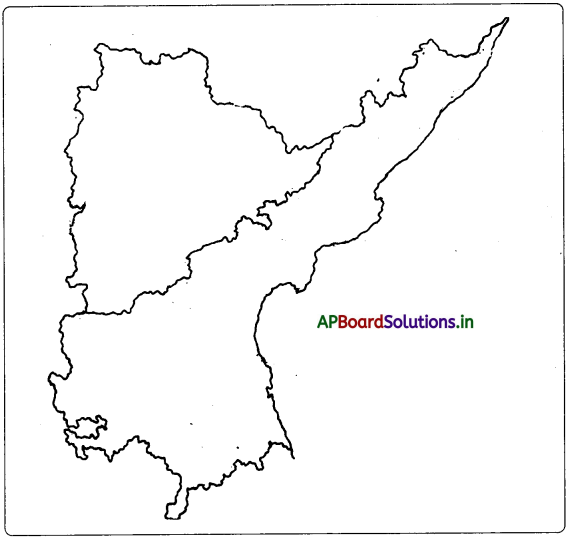
Locate the following Rock Art sites in the map of Telangana :
A) Asifabad
B) Pandavulagutta
C) Kokapet
D) Durgarn
E) Regonda
F) Ramachandrapuram
Answer:
Img-TS 6th Class Social 5th Lesson Questions and Answers Telangana - Penugolu – A Village on the Hills 3

Question 6.
List three ways in which the lives of farmers and herders in present days are different from that of the Neolithic people.
Answer: Difference of:

The present lives of farmers and herdersThe past lives of the Neolithic people
1. They are the successors of neolithics in agriculture.1. They are the inventors of the agriculture.
2. They are enjoying settled life.2. They enjoyed nomadic life.
3. They market the surplus food.3. They shared the food among the group.
4. They receive government help during the time of famines / natural calamities.4. They received no help during the time of famines / natural calamities.
The present lives of farmers and herdersThe past lives of the Neolithic people

Question 7.
Prepare a list of domesticated animals and agricultural products of the early humans and write a few lines about each of them.
Answer:
Domesticated animals: The animals size, temperament, diet, mating patterns and life span were factors in the desire and success in domesticating animals. They domesticated sheep, goats, pigs and cows. Agricultural products of earliest people : They selected breeding of cereal grasses which favour greater caloric returns. Their products in different areas of the world are emmer, einkorn, barley, figs, oats, banana, millets, rice, wheat, oil palm, corn, beans, squash, taro and potatoes.

Question 8.
If there was no stove and no grinding stone, how would it affect our food ?
Answer:
If there is no stove it will be late and difficult into cook food. Firewood will not be sufficient for the present population. If there is no grinding stone some kinds of foods like idli, dosa, vada and chutneys, etc., may not come into wide use.

TS 6th Class Social 6th Lesson Questions and Answers Telangana - From Gathering Food to Growing Food – The Earliest People

Question 9.
Write five questions that you would like to ask an archeologist to know about the present excavations.
Answer:

  1. How will you opt the site for digging ?
  2. What safety measures do you take in collecting remains ?
  3. What steps do you take in exhibiting them in museum ?
  4. How do the remains help in studying the past ?
  5. Can you prove your studies on the past ?

Question 10.
There are many things in the picture given below. Which of them did not belong to the hunter – gatherers? Which things belong to both the ljunter – gatherers and the farmers ? Put different signs to distinguish them.
TS 6th Class Social 5th Lesson Questions and Answers Telangana - Penugolu – A Village on the Hills 4
Answer:
1) Sign for things did not belong to hunting-gathering people – X
2) Sign for the things belonged to both – Θ

Question 11.
How can you say that the lives of earliest people became easier by domesticating animals ?
Answer:

  1. The domestication of animals is based on an ancient contract, with benefits on both sides.
  2. The domestication of animals helped them first in hunting, then in agriculture and ‘ in giving milk. They used them for transportation also.
  3. Domestication of animals create livestock in the form lands of the earliest people. Thus the lives of earliest people because easier.

Question 12.
Read the paragraph under the heading ‘Nomadic life’ on page no. 94 (47) and comment on it.
Answer:
Earliest people lived in groups in caves, under trees or rocks. They led mobile life. They constantly moved from one place to another place. People who regularly moved from place to place are ‘nomads’. Thus earliest people are nomads.

I. Conceptual Understanding

Question 1.
How were the early humans gathering their food?
Answer:

  1. Thousands of years ago all people lived by collecting fruits, flowers, honey and wild grains.
  2. They collected edible tubers and roots that grew naturally in the forests.
  3. They also hunted birds and animals.
  4. They did not grow any crop or rear any animal.

Question 2.
What were called Microliths ?
Answer:
Microliths : The earliest people also used tools; but these were made of stones, bones and wood. Initially large stones were given sharp edges by very careful breaking with another stone. This gave the people a tool which enabled them to cut flesh, dig the earth for tubers and hunt animals. After thousands of years they began to make fine, small pieces from hard stone.

These pieces were called ‘microliths’. They were fixed to a wooden or bone handles which then served as knives, arrows, sickles etc. These weapons were used to dig soil, chop the trees for the bark, remove the skins of animals, clean the skins, stitch the clothes out of the skin, cut meat and bones, chop fruit and roots and hunt the animals easily.

TS 6th Class Social 6th Lesson Questions and Answers Telangana - From Gathering Food to Growing Food – The Earliest People

Question 3.
Who are Nomads ? Explain the Nomadic life of the earliest people.
Answer:
Nomads : People who regularly move from place to place are called Nomads.

Nomadic life :

  1. The earliest people used to live in small groups in the caves or under trees or rocks.
  2. They did not build houses.
  3. Actually they led a mobile life, constantly moving from one place to another.

Question 4.
What is meant by domestication ?
Answer:
Domestication : When people sow selected crops and protect them till they bear fruit or when they allow selected animals to breed and protect them for their owm use. it is called domestication.

Question 5.
What is meant by Neolithic period ?
Answer:
Neolithic period : The early farmers needed to clear forests by cutting trees and branches. They developed a new kind of stone tool which is called neolith by archaeologists. The early farmers selected the right kind of stone which was ground on rock to give it an axe like edge. This axe head was then fixed to a wooden handle and used to cut trees etc. By growing crops with the new tools the early people began a process which changed almost all aspects of their lives in a very fundamental manner. This period of early agriculture is called Neolithic period.

TS 6th Class Social 6th Lesson Questions and Answers Telangana - From Gathering Food to Growing Food – The Earliest People

Question 6.
Who were the hunter-gatherers in our state?
Answer:

  1. Even these days several groups of people live by hunting and gathering food in different parts of the world.
  2. In our own state the Yanadis and Chenchus till very recently lived in this manner.

II. Reading the Text (given), Understanding and Interpretation

Question 1.
Explain the “Shared living” of early people and why were there no poor people among them.
Answer:
Women and men both participated in hunting and food gathering. Women and children were more active in food gathering and hunting of small animals. Hunting large animals may have taken many days of tracking to distant places – this was probably done mostly by men. Hunter gatherers shared the food they collected with all the members of the group.

There wasn’t much scope for storage of food as it consisted mainly of perishable things like meat, fish, fruits, leaves, tubers and small quantities of wild grains. Since they shared all the food and had free access to the resources of the forests, they were all equal and didn’t have any rich or poor among them.

TS 6th Class Social 6th Lesson Questions and Answers Telangana - From Gathering Food to Growing Food – The Earliest People

Question 2.
How do people protect the animals they want to breed ?
Answer:
When they began using the plough and animal manure they did not have to go in search of new fertile lands every few years. This also meant that they had to combine farming with rearing animals which were needed for ploughing, transporting and for manuring the soil.

Like wise, people may have allowed gentle animals to come near their camps and eat grass and other left over food. They may also have protected these animals from other wild animals. In the process the herders got plenty of benefits like regular supply of meat, animal skin and milk. They later on used oxes and donkeys for carrying loads and ploughing the fields.

III. Information Skills

Observe the following table carefully :

MicrolithsNeolithic period
1. After thousands of years, they began to make fine, small pieces from hard stone. These pieces were called mocroliths.1. The early farmers needed to clear forests by cutting trees and branches. They developed a new kind of stone tool which is called neolith by archaelogists.
2. They are tiny tools.2. They are new stones.
3. These weapons are fixed to wooden or bone handles then served as knives, arrows, sickles etc.3. The early farmers selected the right kind of stone which was ground on rock to give it an axe like edge. This axe head was fixed to a wooden handle and used to cut trees.
4. Ex : Stone Sickle.4. Ex : Axe head fixed to a wood.

1) How were microliths used ?
Answer:
After thousands of years they began to make fine, small pieces from hard stone. These pieces were called ‘microliths’. They were fixed to wooden or bone handles which then served as knifes, arrows, sickles etc. These weapons were used to dig soil, chop the trees for the bark, remove the skins of animals, clean the skins, stitch the clothes out of the skin, cut meat and bones.

2) What is the neolith called by archeologists ?
Answer:
The early farmers needed to clear forests by cutting trees and branches. They developed a new kind of stone tool which is called neolith by archaeologists.

IV. Reflection on Contemporary Issues and Questioning

Question 1.
Why could the early humans not store food for a long time ?
Answer:
Hunter-gatherers shared the food they collected with all the members of the group. There was not much scope for storage of food as it consisted mainly of perishable things like meat, fish, fruits, leaves, tubers and small quantities of wild grains. Grains and pulses which we eat today do not perish so quickly. We also have jars and tins to store them for months. But, the earliest people didn’t possess such heavy things as they had to constantly move.

TS 6th Class Social 6th Lesson Questions and Answers Telangana - From Gathering Food to Growing Food – The Earliest People

Question 2.
How did the early humans use fire ?
Answer:
The discovery of fire by the early people brought about great changes in their lives. Probably they made fire by striking two stones or rubbing wood sticks.

  1. Hunter – gatherers used fire as a source of light
  2. They used fire to cook meat or food.
  3. They used fire to scare away animals.
  4. They used fire to keep them warm.

Question 3.
What do we use fire for nowadays ?
Answer:
Nowadays we use fire :

  1. To cook food
  2. To scare away animals in the forest.
  3. To keep warm in winter.

Question 4.
Why were there no poor people among the early humans ?
Answer:
Since the early humans shared all the food and had free access to the resources of the forests, hunter – gatherers did not have any rich or poor among them. They were all equal and treated each other equally.

VI. Appreciation and Sensitivity

Question 1.
How do you think people protect the crops they select to sow ?
Answer:
People usually select those plants and animals that give good yields and are not prone to disease etc. Seeds of such crops are selected and used for sowing in the next season. Or only animals of selected type are allowed to breed. Thus plants and animals tended by people become different from the wild ones. When people sow selected crops and protect them till they bear fruit or when they allow selected animals to breed and protect them for their own use, it is called domestication.

Project:

Find out if there are any rock painting sites near your place and visit them with your class. Write a report on it and present in your class.
Answer:
Student’s Activity

TS 6th Class Social 6th Lesson Notes – From Gathering Food to Growing Food – The Earliest People

  • Hunter gatherer : Several groups of people live by hunting and gathering food in different parts of the world.
  • Stone tools : The earliest people also used tools which were made of stones, bones and wood.
  • Microliths : After thousands of years the earliest people began to make fine, small pieces from hard stone. These pieces were called -‘Microliths’.
  • Nomads : People who regularly move from place to place are called Nomads.
  • Shared living : Hunter gatherers shared the food they collected with all the members of the group.
  • Domestication : When people sow selected crops and protect them till they bear fruit or when they allow selected animals to breed and protect them for their own use, it is called domestication.
  • Herders : The people allowed gentle animals to come near their camps ,and eat grass and other left over food. They may also have protected these animals from other wild animals and got supply of meat, skin and milk.
  • Settled life : When people began growing plants, they had to stay in the same place for a long time looking after plants, watering, weeding, driving away animals and birds.
  • Neolithic : The early farmers developed a new kind of stone tool to clean forests by cutting trees and branches called neolith. This period of early agriculture is called Neolithic period.
  • Archaeologist : A person who studies the cultures of the past and of periods of history by examining the remains of buildings and objects found in the ground.
  • Podu Agriculture : A way of farming in some tropical countries in which farmers use an area of land until it can’t be used for growing plants any more then move to a new area of land.

Mind Mapping:
TS 6th Class Social 5th Lesson Questions and Answers Telangana - Penugolu – A Village on the Hills 5

TS 8th Class English Guide Unit 8B Be Thankful

Telangana SCERT TS 8th Class English Study Material Pdf Unit 8B Be Thankful Textbook Questions and Answers.

TS 8th Class English Guide Unit 8B Be Thankful

Be thankful that you don’t already have everything you desire.
If you did, what would there be to look forward to?
Be thankful when you don’t know something,
for it gives you the opportunity to learn.

Be thankful for the difficult times
During those times you grow
Be thankful for your limitations
because they give you opportunities for improvement
Be thankful for each new challenge,
because it will build your strength and character.

Be thankful for your mistakes
They will teach you valuable lessons
Be thankful when you’re tired and weary
because it means you’ve made a difference
It’s easy to be thankful for the good things.

A life of rich fulfillment comes to those who
are also thankful for the setbacks.

Gratitude can turn a negative into a positive
Find a way to be thankful for your troubles,
and they can become your blessings

Answer the following questions :

Question 1.
The poet depicts the different situations/aspects of life where we need to be thankful. What are they?
Answer :
We should be thankful for not having everything that we desire. We should be thankful for not knowing everything. We should be thankful for difficult times, limitations, challenges and committing mistakes. We should be thankful for our setbacks and troubles which can be transformed into blessings.

TS 8th Class English Guide Unit 8B Be Thankful

Question 2.
Do you agree to the poet’s ideas? Yes / No? Give reasons.
Answer :
Yes, I agree to the poet’s ideas because we can emerge into successful persons only through the setbacks we face in our life. We should remember that even gold is transformed into a beautiful ornament, only when it is burnt in fire.

Question 3.
How do difficulties help us grow? When will troubles become blessings?
Answer :
When we face difficulties in our life, we can understand the meaning of life. From difficulties, we can trace out solutions for them. Troubles become blessings when we face them with positive attitude and make a difference by overcoming them.

Be Thankful Summary in English

The poem “Be Thankful” depicts our (acquiescence) concern towards troubles. The lines in the poem assert that we should be thankful for not having everything we desire because there would be nothing to look forward to if we have everything. And also it says that if we have limitations, they could give us an opportunity for further improvement. The poem again emphasizes that we can grow only in difficult times. Our strength and character is built in facing new challenges. We learn valuable lessons out of our mistakes. We would make out something only through hard work. Finally the poem conveys a message to us that it is easy to be thankful for the good things, but success in life comes out of setbacks only. Again it states that we should find a way to be thankful for our troubles which can be transformed into blessings for us.

TS 8th Class English Guide Unit 8B Be Thankful

Glossary :

1. desire : wish
2. opportunity : chance
3. valuable : important, useful

TS 8th Class English Guide Unit 8A Dr. Dwarakanath Kotnis

Telangana SCERT TS 8th Class English Study Material Pdf Unit 8A Dr. Dwarakanath Kotnis Textbook Questions and Answers.

TS 8th Class English Guide Unit 8A Dr. Dwarakanath Kotnis

PRE-READING (Motivation/Picture Interaction):

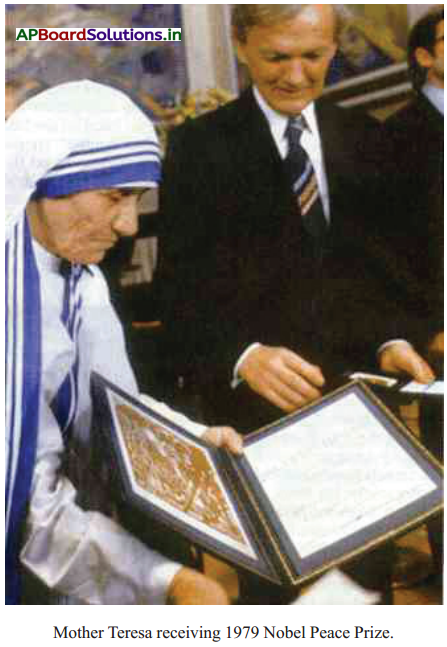
Look at the picture and answer the following questions:

TS 8th Class English Guide Unit 8A Dr. Dwarakanath Kotnis 1

Question 1.
Why do you think Mother Teresa was awarded the Nobel Peace Prize?
Answer :
I think Mother Teresa was awarded the Nobel Peace Prize for her devoted services.

Question 2.
Do you know the name of any Indian who may have rendered any significant services in another country and is still remembered and honoured by the people there?
Answer :
Yes. Sri Yallapragada Subbarao did research in medicine abroad. He is still remembered and honoured by the people there.

TS 8th Class English Guide Unit 8A Dr. Dwarakanath Kotnis

Oral Discourse Talk on – “Mention different ways to express our gratitude towards the people who serve the society.”
Answer :
Different ways to express our gratitude towards the people who serve the society:

  1. honouring with awards
  2. releasing currency notes mints and stamps
  3. building some constructions
  4. installing statues
  5. naming of streets, villages and
  6. observing festivals cities after them

I. Answer the following questions :

Question 1.
Why was Dr. Kotnis sent to China?
Answer :
The communist General Zhu De requested Jawaharlal Nehru to send Indian Physicians to China during the second Sino- Japanese war to help the wounded soldiers. Later Netaji Subhash Chandra Bose sent a team of volunteer doctors and Dr. Kotnis was one among them. Moreover as he came from a family of doctors, he had always dreamt of becoming a physician. When he got the chance to join the medical aid mission to China, he even put aside his post graduation and started to China.

Question 2.
What was Dr. Kotnis’ contribution to the Dr. Bethune International Peace Hospital in China?
Answer :
He worked as a lecturer for sometime in the Military area at the Dr. Bethune Hygiene School. He took over the post of the first president of the Bethune International Peace Hospital after Dr. Norman Bethune passed away. Dr. Kotnis performed operations for 72 hours non-stop without any sleep. He played a major role in controlling a virulent strain of plague that hit Chinese soldiers. He strived hard for trying out a vaccine on himself for the plague.

Question 3.
Why did Dr. Kotnis opt to stay back in China?
Answer :
Dr. Kotnis opted to stay back in China to continue his selfless services to the Chinese soldiers. He might have thought that, he could prove himself in rendering his great service as a physician.

TS 8th Class English Guide Unit 8A Dr. Dwarakanath Kotnis

Question 4.
How did the Chinese show their gratitude towards Dr. Kotnis?
Answer :
In order to cherish the memory of Dr. Kotnis, the Chinese government built a memorial hall for him in Shijiazhuang city, Hebei Province in 1976. Along with Norman Bethune he is revered by them. On Qingming festival, a day used by the Chinese to commemorate their ancestors, they pay their great tribute to Dr. Kotnis. A hand book containing words of Kotnis is kept in the museum as a token of his memory.

Question 5.
Why was Mrs. Kotnis a regular invitee at the Indian Embassy functions in China?
Answer :
Despite the two premature deaths of her husband and son, Mrs. Kotnis never stopped visiting India. She maintained a wonderful rapport with Indian people, particularly with the Kotnis family. Her husband Dr. Kotnis’ remarkable service in China, and her diplomatic approach with the Indian family had made her a regular invitee at the Indian Embassy functions in China.

Question 6.
What sort of person, do you think, was Dr. Kotnis? What is your impression about him?
Answer :
I think Dr. Kotnis was a man of perseverance and selflessness. His selfless service to the Chinese soldiers at the military base reminds us of a saying “A service to human is a service to God”.

Additional Questions :

Question 1.
Where was Dr. Kotnis born? What was his nature?
Answer : Dr. Kotnis was born in a lower middle class family on October 10, 1910 in Sholapur, Mumbai. He was vivacious by nature. He aspired to be a doctor.

Question 2.
Was Dr. Kotnis interested in travelling? Yes / No. Why?
Answer :
Yes, Dr. Kotnis was very much interested in travelling. He wanted to travel round the world and practise medicine in different parts of the globe. He started his medical expedition in Vietnam, and then moved on to Singapore and Brunei. Later he settled in China working at the military base.

TS 8th Class English Guide Unit 8A Dr. Dwarakanath Kotnis

Question 3.
What was Dr. Kotnis’ family life?
Answer :
Dr. Kotnis fell in love with Ms. Guo who was working as a nurse where Dr. Kotnis was working. Later he married Guo and in 1942 they had a son named “Yin Hua”.

II. Read the passage about Dr. Kotnis again and fill in the form given below.

1. Name : Dr. Dwarakanath Kotnis
2. Year of birth : October 10,1910.
3. Place of birth : Sholapur, Mumbai.
4. Occupation : A physician.
5. Nationality : Indian
6. Wife’s name : Mrs. Guo
7. Places of work and the positions held :

1. Physician in Yan’an Surgical Department at anti-Japanese base in North China.
2. Physician-in-charge of the Eighth Route Army General Hospital.
3. Worked as a lecturer in the Military Area, Dr. Bethune Hygiene School.
4. President of the Bethune International Peace Hospital.

8. Honours given by China and India :

1) The Chinese government built a memorial hall in his memory.
2) A hand book with his quotes is exhibited in the museum.
3) He was revered along with Norman Bethune of Canada.
4) His wife Mrs. Guo was honoured being a regular invitee to diplomatic events in China and India.
5) Chinese and Indian governments honoured him, issuing stamps in the name of Dr. Kotnis in the years 1982 and 1993 respectively.

9. Date of death : He died on December 9, 1942.

TS 8th Class English Guide Unit 8A Dr. Dwarakanath Kotnis

Vocabulary :

I. Here are some of the words that are related to the word ‘doctor’. In how many ways can you classify the following words?
TS 8th Class English Guide Unit 8A Dr. Dwarakanath Kotnis 2
Answer :
profession : physician
specialization : neurologist
qualification : MBBS, MD
dress code : white coat
medicines : crocin, ointment
place of work : Clinic, hospital
service : treatment tools : syringe
related vehicle : ambulance.
target group : patient

Mapping these meanings through words is called semantic mapping. A set of words related in meaning are said to belong to the same semantic field.
E.g. bus, driver, conductor, ticket etc.
Write four words that belong to and that you can associate with the following words.
Answers :
1. space
(a) air
(b) atmosphere
(c) stars
(d) planets

2. business
(a) shop
(b) provisions
(c) customers
(d) transaction

3. occupation
(a) clerk
(b) officer
(c) manager
(d) director

4. travel
(a) car
(b) bus
(c) train
(d) plane

TS 8th Class English Guide Unit 8A Dr. Dwarakanath Kotnis

II. Read the sentence given below.

Dr. Kotnis lost his heart to a Chinese woman.
What does the expression ‘lose heart’ mean?
‘Lost his heart’ means ‘fell in love’.
Here are a few more expressions using the word heart.
eg: ‘Eat your heart out’. (suffer from envy or jealousy)
I am going to New York next week. Eat your heart out!
When he hears about your promotion he will eat his heart out.

III. Match the following.

1. have a heart(a) sadness
2. broken heart(b) no feelings
3. heavy heart(c) a very deep thank you
4. take to heart(d) be merciful
5. a heart of stone(e) lost love
6. thanks from the bottom of my heart(f) take seriously

Answer :

1. have a heart(d) be merciful
2. broken heart(e) lost love
3. heavy heart(a) sadness
4. take to heart(f) take seriously
5. a heart of stone(b) no feelings
6. thanks from the bottom of my heart(c) a very deep thank you

TS 8th Class English Guide Unit 8A Dr. Dwarakanath Kotnis

Grammar :

Coordination is a grammatical process by which two or more words, phrases or clauses of the same rank are conjoined.

A conjunction that joins parts of a sentence (words, phrases or clauses) that are grammatically equal or similar in importance and structure is called a Coordinating Conjunction.
e.g: and, but, or, nor, for, yet, so.
Coordinate Conjunctions: and, but, or, yet, so, neither..nor, either..or, not only..but also, both etc.

Subordinate Conjuctions: when, before, after, since, while, as, till, until, whenever, as long as, as soon as, no sooner..than, then, scarcely, hardly, wherever, because, in order that, so..that, if, though, even though, whereas, as if, whether..or etc.

Compound sentence and Complex sentence.
Observe the following sentences.
1. Dr. Kotnis was a doctor and Guo, a nurse.
2. I could not stop laughing when he told jokes.
What are the main clauses in each sentence?
How many subordinate clauses are there in sentences 1 and 2?
Dr. Kotnis was a doctor and Guo, a nurse. (two main clauses)
I could not stop laughing when he told jokes. (one main clause and one subordinate clause)
‘I could not stop laughing’ is a main clause and the subordinate clause is ‘he told jokes’.
A sentence which consists of two or more main clauses combined with coordinate conjuctions is called a Compound Sentence.
A sentence which consists of one main clause and one or more subordinate clauses combined with subordinate conjunctions is called a Complex Sentence.

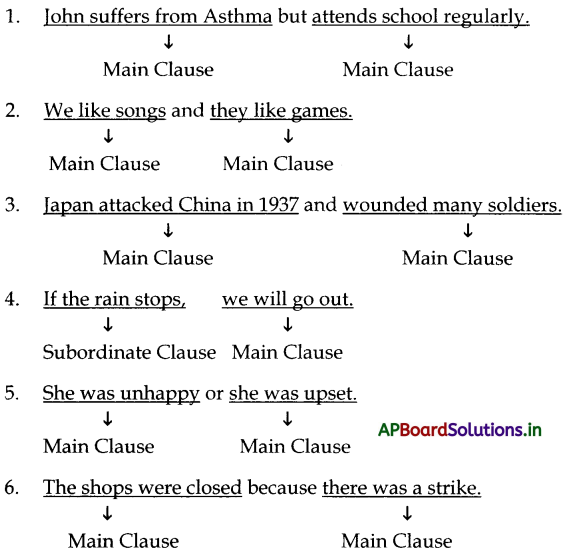
Read the following sentences. Identify the clauses and say whether they are main clauses or subordinate clauses.

TS 8th Class English Guide Unit 8A Dr. Dwarakanath Kotnis 4

Editing :

Read the following passage. Every numbered sentence has an error.Identify and edit it.
(1) Tenali Rama Krishna was not see in the royal court. (2) The king sent guards to search for him and bring him to the court, but they could not find them. (3) They went to the court and reporting this to the king. (4) The king grew worried and asked the guards to search more careful. (5) After some day, the guards found Tenali Rama Krishna.
Answer :
1) was not seen in the royalcourt
2) they could not find him
3) They went to the court and reported
4) to search more carefully
5) After some days

TS 8th Class English Guide Unit 8A Dr. Dwarakanath Kotnis

Writing :

Developing Headlines.
When writing a news report for a newspaper, or your school News Board, the headline is the first and foremost impression you make on your reader. Therefore, writing a headline is a critical and creative art.

Most of the people read only the headlines while reading a newspaper, to get the gist of the news.
1. Headlines often contain a noun phrase with no verb.
e.g: Prime Minster’s advice
2. Head lines may have noun strings (several nouns put together).
e.g: Man snatches woman’s chain
3. Various changes are made in the headlines.
e.g: Telangana State Board Examination Results Declared.
4. The simple tense form is used instead of the continuous or perfect form.
e.g: Hyderabad celebrates kite festival
5. The infinite form refers to the future.
e.g: Chief Minister to inaugurate Craft Bazars
6. The auxiliary verb is dropped in the passive form.
e.g: Passengers injured seriously in Nellore train accident
7. Articles are dropped; full-stops are not placed after headlines.
e.g: India to host SAARC meet in U.P
8. Head lines may contain initials and abbreviations.
e.g: The B.B.C. telecasts the speech of M.P.

I. Now write a headline for each of the following news reports.

Remember to pick out only the main idea or words from the sentence.
Hyderabad : with an alarming rise in cases of missing people, especially women and children, since 2009, the Police have stepped up measures to trace them in co-ordination with various agencies and police forces.
Headline : Measures to trace missing people.
The full moon that rises on this Friday night, August 31,2012, will be a Blue Moon. That’s what it has been dubbed as in modern folklore of the west. But will it actually be blue?
Headline : Once in a blue moon!
“If you look at the last three months, I am really practising well. I am looking forward to playing my first game after a year.
Headline : My first game
Next time your cell phone runs out of battery, you can charge it by just holding it in your hands as the scientist claims to have developed a new technology that turns body heat into electricity.
Headline : Body heat to charge cell

TS 8th Class English Guide Unit 8A Dr. Dwarakanath Kotnis

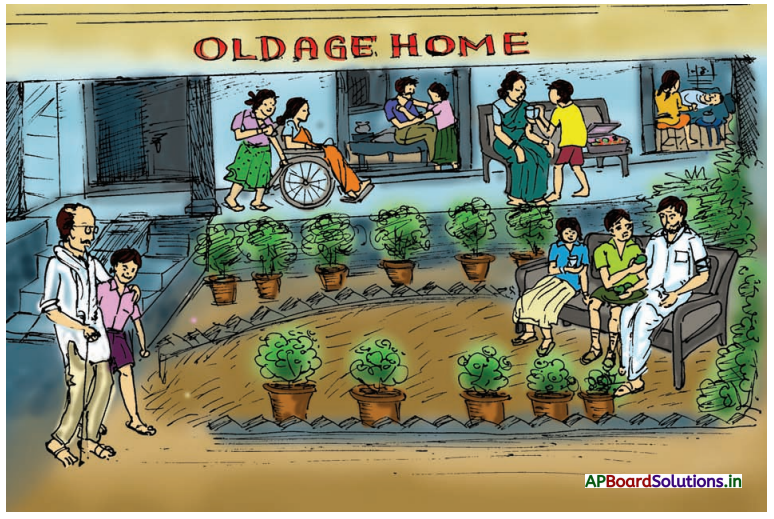
II. Look at the picture where students are serving in an old age home.

TS 8th Class English Guide Unit 8A Dr. Dwarakanath Kotnis 5

Discussion points.

Question 1.
Do old people go to old age homes on their own or are they forced to go there?
Answer :
No, old people don’t go to old age homes on their own. They are forced to go there. In fact, they feel secured and warm if they are with their children at home.

Question 2.
What are the conditions which make people leave their own homes and go to an old age home?
Answer :
Their children may be settled in far away places (i.e. abroad) leaving their home towns. Old people don’t find their children to look after them as their children are busy supporting their nuclear family. There are no supporters to look after them, so they leave their own homes and go to old age homes.

TS 8th Class English Guide Unit 8A Dr. Dwarakanath Kotnis

Question 3.
In what way are the conditions at an old age home different from those at home?
Answer :
Old people get security and warmth from their own children at home. But at old age homes, they are looked after by outsiders who are not directly related to them. They don’t get family affection and atmosphere at an old age home as they have at their own home.

Question 4.
Are there any ways to prevent the old people from going to old age homes?
Answer :
First of all, people shouldn’t become greedy and selfish. They shouldn’t encourage nuclear families. They should be happy and contented. We should have a lot of concern towards old people.

III. Now write an article based on the following hints.

  • What are old age homes?
  • Why do old people go there?
  • Facilities at the old age homes.
  • Compare facilities at home and old age homes.

Answer :

Article on old age homes

Old age homes look after old people. As children settle far away from their home towns, they are forced to keep old people at the old age homes. Old people don’t get the real affection, security and warmth at the old age homes. Though they are provided with all facilities for their needs at old age homes, they don’t like to be away from their children.

Listening Passage :

An Announcement in a School

Dear students,
I am to inform you that we are going to start an ‘Enrolment Drive Programme’ next week. We will go to the nearby slums in our locality for 3 days and see if there are any children who are not studying in a school. There will be 10 teams each consisting of 6 students. I want all the students and teachers of classes VIII and IX to join this mission. Mr. Rajkumar and Ms. Christina will be joining us in our mission. They will help us in all the aspects related to the programme. Children, now those who volunteer to take the lead in teams should meet their class teachers after the lunch hour.

Listen to your teacher. She/he will read out an announcement made by the headmaster of a Govt. High School then answer the following questions.

Question 1.
What is the announcement about?
Answer :
The announcement refers to the Enrolment Drive Programme. The students who volunteer in this programme will enrol the names of the school dropouts in slum areas.

TS 8th Class English Guide Unit 8A Dr. Dwarakanath Kotnis

Question 2.
Who are the special guests joining their mission?
Answer :
The special guests joining their mission are Mr. Rajkumar and Ms. Christina.

Question 3.
What are the students asked to do in the progamme?
Answer :
They are asked to enrol the names of children in nearby slums who are not studying in a school.

Question 4.
Why does the headmaster call it a mission?
Answer :
The headmaster calls it a mission because all the students gather like a team and work unitedly with combined effort. They work with an aim to achieve the task.

Oral Activity :

If you get an opportunity to propose a ‘Vote of Thanks’ after completing the Enrolment Drive Programme how would you do it?
Prepare ‘Vote of Thanks’ to thank Mr. Rajkumar, Mrs. Christina, and all other participants.
Clues:
Introduction of the Programme
About the participants and the service they offered during the Programme.
Their role in making the Programme a great success.
Thanking each and everyone referring to their role in the Programme.
Requesting the extension of their service in future.
Answer :
Dear special guests and participants.
I feel immense pleasure in giving vote of thanks to the people involved in the Enrolment Drive Programme. As you all know pretty well, all the students formed teams and were encouraged to enrol the names of school dropouts in slum areas. All the students rendered their dedicated service in this regard. They could succeed in making their mission a grand success. In this connection I thank Mr.Rajkumar and Ms. Christina for extending their great helping hand. I also thank our honourable headmaster for inspiring us to render this service. I thank all our students, teachers and every individual who has been a part of the mission. I hope that all of you will extend your service even in the future with the same zeal. I thank one and all again for making this mission a great success.

Dr. Dwarakanath Kotnis Summary in English

Dr. Dwarakanath Kotnis was an admirable doctor. He rendered his great selfless service to the injured Chinese soldiers during the second Sino-Japanese war. He was born in a lower middle class family on october 10, 1910 in Sholapur, Mumbai. He completed his graduation in medicine from G.S. medical college, Mumbai. Dr. Kotnis always wanted to travel round the world and practise medicine in different parts of the globe. On the request of the Communist General Zhu De he was sent as a physician to China to help the injured soldiers in the warfront. Subhash Chandra Bose sent a team of volunteer doctors and Dr. Kotnis was one among them. Dr. Kotnis decided to stay there in China to render his service to the soldiers. Dr. Kotnis fell in love with his colleague Ms. Guo who was working as a nurse and married her in 1942 on August 23rd. A son was born who was named Yin Hua.

Dr. Kotnis had become the first president of the Bethune International Peace Hospital after Dr. Norman Bethune passed away. He rendered a laudable service where he could save the lives of many soldiers. He died of epilepsy on December 9, 1942 at the age of 32 . Remembering his great service, the Chinese government built a memorial hall in Shijiazhuang city in Hebei Province in 1976. No single Indian has been more revered by ordinary Chinese than this doctor from a middle class family from Northern India. Both China and India have honoured him with postal stamps in 1982 and 1993 respectively. In exclusive interviews with China Daily in Beijing and Shangai, the family members of Kotnis shared their memories of the doctor showing their reverence and intimacy for him.

Though he was busy in his mission, he had never neglected visiting India many a time. Mrs. Kotnis was an honourable guest at many diplomatic functions between China and India representing her husband’s reverence. Though Mr. Kotnis was revered in China a lot, he couldn’t get the required recognition in his home land. But it was fulfilled when a book was published with the title “One who never returned” written by film journalist, Khawaja Abbas. Director V. Shantharam’s movie on him “Dr. Kotnis ki Amar Kahani”, also added to this.

TS 8th Class English Guide Unit 8A Dr. Dwarakanath Kotnis

Glossary :

1. adulation (n) : admiration; praise
Usage: It is not my adulation, it is my sincere comment.
2. virulent (adj) : dangerous
Usage : These are virulent days for survival.
3. shy away (phr.v) : avoid something that you dislike
4. epilepsy (n) : a disease of the nervous system that causes a person to fall unconscious
5. revered (v) : respected or admired deeply
6. commemorate (v) : keep a great person, event etc. in people’s memories
Usage : Literary meetings were conducted in various places all over Telangana to commemorate the anniversary of “Komaram Bheem”.
7. vivacious (adj) : cheerful
Usage : He looks vivacious after winning the prize money.
8. venerated (v) : respected
Usage : The sacrifice of our great leaders is venerated forever.
9. septuagenarian (n) : a person who crossed 70 years
10. memorabilia (n) : objects that are collected in memory of persons and events

TS 8th Class English Guide Unit 8A Dr. Dwarakanath Kotnis

Additional Meanings :

11. aspired = aimed
12. pursue = to follow
13. expedition = an organised journey with a particular purpose
14. volunteer = to offer to do, give, willing
15. relevant = applicable
16. cherish = nourish, foster
17. renowned = famous
18. despite = inspite of
19. sino-japanese war = war between China and Japan
20. suppress = oppress
21. echoing = resounding

TS 6th Class Social 4th Lesson Questions and Answers Telangana – Dokur – A Village on the Plateau

Telangana SCERT TS 6th Class Social Study Material Pdf 4th Lesson Dokur – A Village on the Plateau Textbook Questions and Answers.

Dokur – A Village on the Plateau – TS 6th Class Social 4th Lesson Questions and Answers Telangana

Question 1.
Compare water availability in the borewells of Krishna delta and the plateaus.
Answer:

  1. Water is available in Krishna delta in the borewells at the depth of 15 to 25 feet whereas in the plateau region. It is 200 to 500 feet.
  2. In the Krishna delta region abundant ground water is available i.e. water table is high whereas the water table in the plateau is very low.
  3. Expenditure on digging borewells is low in the Krishna delta whereas it is expensive and risky in the plateau region.

TS 6th Class Social 4th Lesson Questions and Answers Telangana - Dokur – A Village on the Plateau

Question 2.
Compare the changes in cropping pattern of Dokur and Penamakuru.

Similarities
PenamakuruDokur
1. Paddy is cultivated extensively.1. Paddy is cultivated surrounding chain of tanks.
2. Fruit orchards are grown like guava, sapota and papaya.2. Fruit orchards are grown like mango, orange.
3. There is increased use of ground water through borewells.3. There is increased use of ground water through borewells.

Answer:

Differences
PenamakuruDokur
1. Expenditure on digging borewells is very low.1. Borewells are expensive and risky and all farmers shifted to this system.
2. As water is abundant no drip irrigation is practised.2. Fruit orchards use drip irrigation with sprinklers.
3. Uplands of the village are suitable for vegetables.3. Caster, Bajra, Red grams and pigeon pea are grown here.

Question 3.
Do you think agriculture can be a profitable profession in places like Dokur ?
Answer:

  1. I think agriculture can be a profitable profession in places like Dokur.
  2. Low water consuming crops like groundnut and castor can be practiced.
  3. Orchards like mango and orange can be grown.
  4. Intermittent crops like redgrams and pigeon pea also can be grown.
  5. Paddy is grown where there is availability of water.

Question 4.
What difference would it make to the village, if the rainfall in the region increases ?
Answer:

  1. it would make great difference if the rainfall in the region increased.
  2. The water in the tanks and ponds will increase and groundwater table will also increase.
  3. People may not face drinking water problems even the cattle.
  4. Even in the absence of irrigation facilities agriculture can be carried out.
  5. The village may not face the drought situation.

TS 6th Class Social 4th Lesson Questions and Answers Telangana - Dokur – A Village on the Plateau

Question 5.
What non – agricultural occupations are there in your village ? Get details about one such occupation.
Answer:

  1. There are many non-agricultural occupations in our village.
  2. One among them is carpentry.
  3. There are nearly 10 families in our village who would do this work.
  4. They prepare the doors, windows and roof tops for the construction of house.
  5. They also prepare tools and implements used in households and agricultural works.

Question 6.
Write description in one line for the words given below.
Answer:

ItemIn Dokur
SoilHalf agricultural land is red soil and remaining are black, choudu and garusu soils.
WaterA chain of tanks captures as much water as they could and borewells are important.
CropsFarmers grow cotton, castor, bajra and intermittent crops of redgrams and pigeon pea.
MarketsSeparate markets for paddy and cotton but arbitrary prices are resented.
OccupationsApart from agriculture other occupations include carpentry, metal work and rice milling.

Question 7.
Read the paragraphs in Page no. 64,1st para “Environmentalists ……………… and so on” and write your opinion.
Answer:

  1. For soil fertlity be increased, we need to practice sustainable land use.
  2. So we maintained soil fertlity and the ground water remains recharged.
  3. We should maintain the proper balance between forests, pastures and agricultural land.
  4. Thus we share the produce from pasture land and forests.

I. Conceptual Understanding

Question 1.
Asses the rainfall situation in Dokur.
Answer:

  1. Rain is scanty and irregular here and drought situation develops.
  2. Crops dry and ground water table do not increase.
  3. Drinking water for humans and cattle becomes a major problem.
  4. In the absence of irrigation facilities, it is difficult to carryout agricultural works.

Question 2.
What are the water sources in Dokur ?
Answer:

  1. Pedda Cheruvu is the main water resource in the Dokur village.
  2. A chain of tanks excavated to store rain-water and recharge of groundwater is one source.
  3. As ground water table is low everyone wants rely on borewells.
  4. Ponds are also a considerable source of water.
  5. People stopped digging wells which were not operative even at 40 to’60 feet.

TS 6th Class Social 4th Lesson Questions and Answers Telangana - Dokur – A Village on the Plateau

Question 3.
Name the various crops grow in Dokur.
Answer:

  1. The farmers of Dokur grew cotton, groundnut, castor, paddy, bajra (sajjalu), pigeon pea (alasandalu) and redgram (kandulu).
  2. Some farmers of Dokur own mango and orange orchards.

Question 4.
What are the other sources of livelihood in Dokur ?
Answer:

  1. Cattle rearing is the other source of livelihood in Dokur.
  2. Most often buffaloes are reared for milk and sheep rearing is also common.
  3. Carpentry, metal work and rice milling are some of the other non – farm activities of Dokur.

II. Reading the Text (given), Understanding and Interpretat

Some farmers of Dokur own mango and orange orchards. These crops require less water than paddy and can be grown on the land previously used for groundnut cultivation. They grow some groundnut as an intermittent (in between the trees) crop during rabi season. Large farmers in this area use sprinklers for irrigation.

Answer the following questions based on the above paragraph.

Question 1.
What orchards are owned by Dokur farmers ?
Answer:
Some farmers of Dokur own mango and orange orchards.

Question 2.
Which intermittent crop is grown during rabi season ?
Answer:
Groundnut is intermittent crop grown during the rabi season.

TS 6th Class Social 4th Lesson Questions and Answers Telangana - Dokur – A Village on the Plateau

Question 3.
Who used sprinklers for irrigation ?
Answer:
Large farmers used sprinklers for irrigation.

Question 4.
Which crop requires more water, paddy or orchard ?
Answer:
Paddy requires more water than orchards.

III. Information Skills

No. of FamiliesLandholdingsFarmers Agricultural Labourers
3501/2 to 5 acresFarmers
220–Agricultural labourers.
Total 570––

Answer the following questions based on the above table.

1) How many families are there in total ?
Answer:
There are 570 families in total.

2) How many families can be termed as agricultural labourers.?
Answer:
220 families can be termed as agricultural labourers.

TS 6th Class Social 4th Lesson Questions and Answers Telangana - Dokur – A Village on the Plateau

3) What is the range of landholdings of 350 families ?
Answer:
350 families of landholdings range from 1/2 an acres to 5 acres.

4) How many families are considered as farmers ?
Answer:
350 families are considered as farmers.

IV. Reflection on Contemporary Issues and Questioning

Question 1.
Can you think of some ways to improve the soils in the village ?
Answer:

  1. Groundwater needed to be remained recharged.
  2. There should be one third of the land covered with forests and pastures.
  3. Farmers shall take up contour bunding and use of organic farming.
  4. They should grow diverse crops rather than repeating the same crop.
  5. They should remove silt in the tanks and ponds and let water stored.

VI. Appreciation and Sensitivity

Question 1.
Why is it very expensive to dig borewells in the plateau ?
Answer:

  1. The groundwater table is very low in the plateau region, but everyone wants to rely on borewells.
  2. As everyone is digging borewells the depth at which water available is increasing and now it 200 m at same places and 500 n at the others.
  3. Many borewells become in-operative i.e., i o availability of water from them in no time.
  4. Thus borewells in plateau region is expensive and risky.

Project:

Question 1.
There are two types of land called Metta and Tari. Traditionally, pulses are grown on Metta land without irrigation and paddy is grown on Tari land with irrigation. If you live in a village, find out about the type of soil in your areAnswer:What words are used to describe the land in your village ? How is the soil ? Make a table showing the following feature of soil – water absorption (high/low), water retention (quick/ slow), sand content (high low), colour of the soil from the above village. Compare them with type of soil in your village.
Answer:
Self exercise.

TS 6th Class Social 4th Lesson Notes – Dokur – A Village on the Plateau

  • Plateau : Flat topped table land with steep slopes on one or more sides.
  • Tank : A large storage chamber for liquid (here water).
  • Ground water : The water that obsorbed in the earth.
  • Soil types : Black soijs, red soils, alluvial soils, sandy soils, etc.
  • Sheep rearing : It is an occupation of some farmers in villages.
  • Deccan plateau : West to east sloped high region flanked by Western Ghats on one side and Eastern Ghats on the other side.
  • Daku : Dacoit
  • Drought : A long period of time where there is little or no rain.
  • Red soils (Erra nelalu) : Soils which are not very deep or fertile, lack many nutrients and do not retain much water.
  • (Nalla nelalu) Black Soils : Shallow black soils which are more fertile and retain water for long period.
  • Choudu and Garasu nelalu : Uncultivable and mostly with pebbles are these soils.
  • Chain of tanks : Like a necklace of pearls small tanks are close to main tank make, a chain of tanks.
  • Orchards : Trees of same fruits spread over acres of land, mango orchards, etc.
  • Intermittent Crop : The crop grown in between the trees of orchards during rabi season.
  • Sprinklers : Sprinkling water instead of wetting from canals.
  • Drip irrigation : Using of sprinklers for irrigating fields.
  • Sustainable land use : Use of land in such a way that they remain productive for generations to come.
  • Animal grazing : Taking animals (sheep, buffaloes, cows, etc.) for feeding grass or fodder.
  • Cattle rearing : Upkeep of animals for their produce (milk, meat, skin, etc.)

Mind Mapping
TS 6th Class Social 4th Lesson Questions and Answers Telangana - Dokur – A Village on the Plateau 1

TS 8th Class English Guide Unit 7C I Can Take Care of Myself

Telangana SCERT TS 8th Class English Study Material Pdf Unit 7C I Can Take Care of Myself Textbook Questions and Answers.

TS 8th Class English Guide Unit 7C I Can Take Care of Myself

Answer the following questions.

Question 1.
What do you think is the most important thing to learn to live well ?
Answer :
The most important thing one has to learn to live well is that one has to stand on one’s own feet. He/She should find the work which supports him/her. He /She needs to learn more about the world.

Question 2.
What are the skills or qualities that would help you to be independent in your life?
Answer :
One should take care of oneself and those whom one loves. One should not depend on other person’s power, position and prosperity. The power, position and prosperity of others may not be accessible to one forever. So one has to stand on one’s own feet. One has to depend on the power within oneself to achieve the target in one’s life.

TS 8th Class English Guide Unit 7C I Can Take Care of Myself

Question 3.
Do you agree/ disagree with the daughter of the mother rat? Give reasons for your response.
Answer :
I agree with the daughter of the mother rat, because dependency does not work in the long run. Things would never be the same in our life. The persons on whom we depend may not be with us. The power, position and prosperity may not be accessible to one forever. So one has to stand on one’s own feet. One has to depend on the power within oneself to achieve the target in one’s life.

Additional Questions :

Question 1.
Why did mother rat want her young daughter to get married to the most powerful being?
Answer :
The mother rat wanted her young daughter to get married to the most powerful being because she wanted to keep her daughter in safe hands.

Question 2.
Did the daughter of mother rat accept in being safe after marrying a powerful being? Why?
Answer :
The daughter of the mother rat did not accept in being safe after marrying a powerful being. She was very much aware of the independent life which could make her lead a happy life. She also strongly believed that one has to depend on power within oneself, to seek the target in one’s life. She also opined that there was no powerful being individually. The truly powerful being is the one who can take care of oneself and of those she/he loves.

Study Skills :

I. Observe the data given in the bar diagrams related to male and female infant mortality rates (IMR) in India over the years 1990 to 2008 and answer the questions given.
(Source: Ministry of Statistics and Programme Implementation National Statistical Organisation – Website: www.mospi.gov.in)
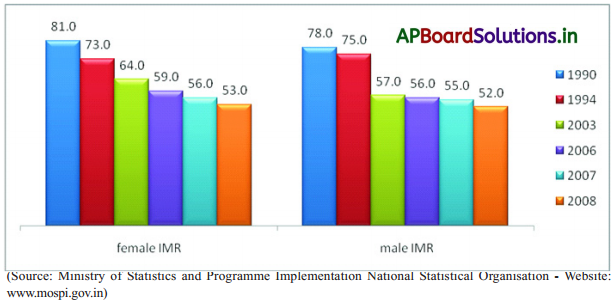
TS 8th Class English Guide Unit 7C I Can Take Care of Myself 1

Question 1.
In which year is the difference in infant mortality rates between male and female the highest?
Answer :
The highest difference in infant mortality rates between male and female is observed in the year 2003 as per the data given in the diagram.

TS 8th Class English Guide Unit 7C I Can Take Care of Myself

Question 2.
In which case and in which year do we find a sudden decrease in the IMR?
Answer :
We find a sudden decrease in the IMR in the case of male in the year 2003.

Question 3.
What will happen if there is a wide gap in IMR between male and female?
Answer :
If there is a wide gap in IMR, the ratio between male and female is imbalanced and it may lead to other complications in the society.

Question 4.
What, according to you, may the reasons be for the female IMR being higher than the male IMR?
Answer :
The female infants are not cared for properly by the parents, due to personal prejudices observed these days. A lot of discrimination is shown between male and female infants. Parents think that females are a burden on them. Because of their negligence in the case of female health conditions, the IMR in the female is higher than the male IMR.

Question 5.
What may the reasons be for the decrease in IMR rates over the years?
Answer :
There is a lot of decrease in IMR rates over the years because of the highly sophisticated technology and the revolutionary developments in the medical field. They might have controlled the death rate. The medicine and the treatment due to high technology may have saved the lives of infants.

Question 6.
Do you think there could be a further decrease in the IMR after 5 years?
Answer :
I think there would be a further decrease in the IMR after 5 years because day to day developments are being observed in medical field. New medicines are invented for the treatment of various dreadful diseases.

TS 8th Class English Guide Unit 7C I Can Take Care of Myself

Question 7.
What, according to you, may the reasons be for the death of more than half of both male and female infants?
Answer :
In my view that was the time when there was no sophisticated technology and medicines to get proper treatment to cure diseases. That might have led to the increase of death rates compared to modern days.

II. Group work :

Discuss the above questions in your group and write an analytical report on the Infant Mortality Rates in India.
Answer :
When we observe the infant mortality rates in India, it was the highest particularly in the year 1990. Lack of medicine and technology in those days might have led to this. There was a drastic down fall in the death rate among the male infants in the year 2003. In the rest of the years the IMR rate had been marginalised and it was observed to be almost the same between the male and female. It was also noticed that the IMR rate of the females was higher than that of the males. A lot of discrimination on the female child by the parents might have led to various complications resulting in the death rate of female infants. Because of the personal prejudices in the society, the female infants were completely neglected when they suffered from diseases.

Oral Activity :

Debate on the following proposition.

“Reservation in education, employment and legislature will empower women.”
Answer :
Group I: There was an age – long prejudice against women. Man has dominated the female. He did not support woman’s education lest they should be humiliated. He made her a servant in the house. So woman had no voice in anything.
Group II : But times have changed. Now woman is educated. She can stand equal to man. She can advise the family.
Group III : If a woman is educated and is holding a job, she can have financial stability. She can meet her ends as well as support the family.
Group II : If she is given a chance to enter assembly, she can argue and improve the status of woman.
Group I, II, III : So woman should be given reservation in education, employment and legislature to improve her condition.

Project Work:

A. Interview some female members in your family and neighbourhood with the following questions.
Would you like the girls in the family to take up a job after they have received education?
If yes, give some reasons.
Answer :
My mother and some of our neighbours. Yes, we would like the girls in the family to take up a job after they have received education. Girls can take up the responsibilities and duties as efficiently as boys. There shouldn’t be any discrimination between girls and boys. It is an outdated prejudice and should no longer continue.

TS 8th Class English Guide Unit 7C I Can Take Care of Myself

B. Work on the following items.

Note down whether the woman you have interviewed educated or uneducated; working / not working; married / unmarried.

TS 8th Class English Guide Unit 7C I Can Take Care of Myself 2
Answer :
TS 8th Class English Guide Unit 7C I Can Take Care of Myself 3

C. Based on the above information write a report on ‘Woman Empowerment’ and present it to the class.
Answer :
Based on the above information I felt that most of the women like their girls to take up jobs after they have received education. The days have changed. Women are proving themselves worthy in various fields and holding many responsibilities and duties. They like to stand on their feet. They want to lead in all walks of life.This is possible only because of the ‘Woman Empowerment.’

I Can Take Care of Myself Summary in English

Once there lived a mother rat. She wanted to get her young daughter married to the most powerful being on the earth. She went in search of the powerful being. She saw the sun god while he was moving across the sky. She asked him if he was the most powerful being on the earth. The sun god replied that he was not the most powerful and told that the rain god was greater than him. The mother rat went to the rain god and posed the same question. The rain god also did not accept it but told that the mountain god was the most powerful being. The mother rat went to the mountain with the same question but the mountain replied that the earthworm was the greatest being on the earth.

Meanwhile her daughter enquired of her mother rat whom she was searching for. The Mother rat explained to her daughter that if she got married to a powerful being, she would be safe in her life. Her daughter laughed at her mother’s words and said that one need not worry to be safe. One had to protect oneself to be safe. She assured her mother that she wouldn’t have to worry about her marriage for keeping her safe. The young rat assured that she would learn to stand on her own feet first. She also said that people who could protect themselves and those they loved would always be safe. Finally the daughter rat emphasized that depending on another’s powers, position and prosperity would never promise peace and security in the long run. She added that one had to depend on the power within oneself to achieve the target in one’s life.

TS 8th Class English Guide Unit 7C I Can Take Care of Myself

Meanings :

1. protection : safety
2. prosperity : wealth
3. security : safety

Section – A : Reading Comprehension :

Read the following passage from ‘Bonsai Life’.

“Don’t think like that, Ammalu. How fortunate you are! Touchwood! You’ve studied well, have a job like a man and are earning very well. You don’t have to beg anyone for anything. You are able to lead a dignified life unlike us who have to depend on our husbands even for a few paise worth of karivepaku,” said Akkayya.

The grass is greener on the other side, I thought to myself. “What’s your daughter doing now?” I asked, changing the topic.

“She’s in her final year at school. If by God’s grace she clears her exams, I am determined to send her to college. Your Baavagaaru doesn’t really like the idea of sending her to the next town and putting her in a hostel. But I don’t like to keep a girl at home without educating her. Isn’t what I’m going through enough? In these times, if a woman doesn’t have a degree, she’ll come to nothing. Without it, she will have to live under her husband’s thumb, like a scorpion under a slipper,” she said.

(Q. 1-5) Now, answer the following questions. Each question has four choices. Choose the correct answer and write (A), (B), (C) or (D) in your answer booklet. 5 × 1 = 5 M

Question 1.
How fortunate ‘you’ are! Who does ‘you’ refer to in this line ?
A) Akkayya
B) Ammalu
C) Father
D) Husband
Answer:
B) Ammalu

TS 8th Class English Guide Unit 7C I Can Take Care of Myself

Question 2.
What is the meaning of the expression ‘The grass is greener on the other side.’?
A) The grass on this side is green.
B) Others are as good as we are.
C) Others are in a better position than us.
D) The garden is filled with greenery.
Answer:
C) Others are in a better position than us.

Question 3.
Akkayya’s daughter was studying ……..
A) Ninth class
B) Top class
C) Eighth class
D) Seventh class
Answer:
B) Top class

Question 4.
Who does not like to put the girl in a hostel ?
A) The narrator
B) The narrator’s sister
C) The narrator’s brother
D) The narrator’s brother-in-law
Answer:
D) The narrator’s brother-in-law

TS 8th Class English Guide Unit 7C I Can Take Care of Myself

Question 5.
According to the above passage, who should have a degree in these times?
A) Everyone
B) Women
C) Sisters
D) Brothers
Answer:
B) Women

(Q.6- 10) Answer the following questions in one or two sentences in your own words. 5 × 2 = 10 M

Question 6.
What were the thoughts of the narrator about her job ?
Answer :
The narrator thought that it was a wretched job. She felt like giving it up.

Question 7.
Why was Akkayya determined to send her daughter to college ?
Answer :
Akkayya was determined to send her daughter to college to get a degree. She did not want her daughter to suffer like her. She wanted her daughter to be strong and independent.

Question 8.
In what way is the narrator more fortunate than her sister ?
Answer :
The narrator was more fortunate than her sister because she was educated and employed. She was financially independent and did nto want to depend on her husband.

TS 8th Class English Guide Unit 7C I Can Take Care of Myself

Question 9.
What is the meaning of ‘like a scorpion under a slipper’ ?
Answer :
The meaning of “like a scorpion under a slipper” is feeling totally suppressed.

Question 10.
Can one be independent without a job or earning ? Justify your answer.
Answer :
No one can be independent without a job or earning. Doing a job is not only for the sake of earning money but also being independent. It helps people to put their education into use.

Read the following story.

A four-year-old boy was in the market with his six-year-old sister. Suddenly the boy found that his sister was lagging behind. He stopped and looked back. His sister was standing in front of a toy shop and watching something with great interest. The boy went back to her and asked, “Do you want something?” The sister pointed at a doll. The boy held her hand and like a responsible elder brother, gave that doll to her. The sister was very happy. The shopkeeper was watching everything and getting amused to see the matured behaviour of the boy.

Now the boy came to the counter and asked the shopkeeper, “What is the price of this doll, sir?” The shopkeeper was a cool man and had experienced the odds of life. So, he asked the boy with lot of love and affection, “Well, what can you pay?” The boy took out all the shells that he had collected from the sea shore, from his pocket and gave them to the shopkeeper. The shopkeeper took the shells and started counting as if he were counting currency.

Then he looked at the boy. The boy asked him worriedly, “Is it less?” The shopkeeper said, “No, No… These are more than the price. So I will return the remaining.” Saying so, he kept only four shells with him and returned the remaining. The boy very happily kept those shells back in his pocket and went away with his sister. A servant in that shop got very surprised watching all this. He asked his master, “Sir! You gave away such a costly doll just four shells?”

The shopkeeper said with a smile, “Well, for us these are mere shells. But for that boy, these shells are very precious. And at this age, he doesn’t understand what money is, but when he grows up, he definitely will. And when he would remember that he purchased a doll with the shells instead of money, he will remember me and think that the world is full of good people. He will develop positive thinking. That’s it.”

(Q. 11- 12) Now, answer the following questions. Each question has four choices. Choose the correct answer and write (A), (B), (C) or (D) in your answer booklet. 2 × 1 = 2 M

Question 11.
Why did the girl lag behind ?
A) Because somebody stopped her.
B) Because the shop attracted her.
C) Because a doll attracted him.
D) Because a doll attracted her.
Answer :
D) Because a doll attracted her.

Question 12.
How many shells did the shopkeeper accept ?
A) All the shells
B) All the remaining shells
C) Forty shells
D) Four shells
Answer :
D) Four shells

TS 8th Class English Guide Unit 7C I Can Take Care of Myself

(Q. 13 – 16) Answer the following questions in one or two sentences in your own words. 4 × 2 = 8 M

Question 13.
Who was standing in front of the shop? Who found her there?
Answer :
The girl was standing in front of the shop. Her younger brother found her there.

Question 14.
What did the shopkeeper do after taking shells from the boy?
Answer :
The shopkeeper took the shells and started counting as if he were counting currency.

Question 15.
What did the servant ask the master ?
Answer :
The servant asked the master why he had given away such a costly doll for just four shells.

Question 16.
Why do you think the shopkeeper sold the doll for just four shells ?
Answer :
I think the shopkeeper sold the doll for just four shells to make the boy remember him and think that the world is full of good people. He would also develop positive thinking.

Section – B : Vocabulary & Grammar :

(Q. 17 – 21) Read the following passage focusing on the parts that are underlined and answer the questions given at the end. Write the answers in your answer booklet. 5 × 1 = 5M

“You’ll (17) get run over by a car,” said Janet. She did not want to leave him there. So, she took her handkerchief out from (18) her pocket, wrapped (19) the toad up in it and carefully put him on the side of the road. She watched him struggling to crawl (20). “I must do something for his leg,” she thought (21). So, she picked him up again in her handkerchief and carried him home.

Question 17.
Write the full form of the underlined word.
A) You will
B) You all
C) You can
D) We will
Answer :
A) You will

TS 8th Class English Guide Unit 7C I Can Take Care of Myself

Question 18.
Replace the underlined word with a suitable preposition.
A) in
B) of
C) with
D) to
Answer :
B) of

Question 19.
Write the antonym of the underlined word.
A) covered
B) unwrapped
C) diswrapped
D) miswrapped
Answer :
B) unwrapped

Question 20.
The underlined word is associated with ……
A) laughing
B) eating
C) movement
D) teaching
Answer :
C) movement

TS 8th Class English Guide Unit 7C I Can Take Care of Myself

Question 21.
Add the ‘ing’ form to the underlined word.
A) thoughting
B) thinksing
C) thinking
D) thoughtsing
Answer :
C) thinking

(Q. 22 – 26) Complete the following passage choosing right words from those given below it. Each blank is numbered, and for each blank four choices (A), (B), (C) and (D) are given. Choose the correct answer from these choices and write (A), (B), (C) or (D) in your answer booklet. 5 × 1 = 5M

The zookeepers opened the door ………. (22) and lifted the child out of the exhibit. The doctors were already there. They checked the boy for signs of life. He was breathing! He was still ……….. (23)! The ambulance ………… (24) him to a nearby hospital. He ………. (25) a serious injury ………… (26) he recovered fully.

Question 22.
A) gentle
B) gentedly
C) gently
D) generatedly
Answer :
C) gently

Question 23.
A) alive
B) dead
C) die
D) death
Answer :
A) alive

TS 8th Class English Guide Unit 7C I Can Take Care of Myself

Question 24.
A) rushes
B) rushing
C) rushed
D) was rushed
Answer :
C) rushed

Question 25.
A) has
B) have
C) having
D) had
Answer :
D) had

Question 26.
A) but
B) and
C) so
D) because
Answer :
A) but

(Q. 27 – 31) Read the following passage. Five sentences are numbered. Each numbered sentence has an error. Find the error and write the correct sentences in your answer booklet. 5 × 2 = 10 M

(27) Once upon a time, there is a mother rat who wanted to get her young daughter married as soon as possible, to the most powerful being that she could find. (28) ‘Who is the most powerful being on the earth?’ she asked herself. She saw the bright sun god travelling across the sky, and thought, ‘Surely, all beings depend on the sun. (29) The sun god is a most powerful being on this earth.’ (30) She asked the sun god, ‘Is you the most powerful being on this earth?'(31) He smiled, ‘No, there is one greater then me to help the creatures – it is the rain. Without the rain, no crop or tree would grow. There would be no water on earth:’
Answer :
27. there was a mother
28. powerful being on earth
29. The sun god is the most powerful being
30. Are you the most powerful being
31. One greater than me.

TS 8th Class English Guide Unit 7C I Can Take Care of Myself

Section – C : Conventions of Writing :

(Q. 32) Read the following passage carefully and supply the punctuation marks (. , ? ” “) and capital letters, wherever necessary. Also correct the spelling of the underlined word. 5M

once a fox was walking throw a forest suddenly, he fell into a well. he held on tightly to some roots at the side of the well. He began to shout for help. A wolf heard the fox. He came and stood at the well Then he asked, Hello, foxy How did you fall into the well.
Answer :
Once, a fox was walking through a forest. Suddenly, he fell into a well. He held on tightly to some roots at the side of the well. He began to shout for help. A wolf heard the fox. He came and stood at the well. Then, he asked, “Hello, Foxy. How did you fall into the well ?”

Section-D : Creative Writing

(Question – 33) : 12M

A) In the lesson “Bonsai Life”, the author, Abburi Chayadevi, elucidates women’s lives and their feelings. Now write an essay on “Women’s Day”.
Answer :

Essay.
WOMEN’S DAY
March 8th is a global day that belongs to someone without the existence of whom no one can imagine our world, someone who is a kind mother, a caring sister, a good friend and a big helper. Yes! It’s she, a woman. Women play the most important and responsible role in a family, society and country’s success. Today women in almost all the societies are not confined to taking care of children, cooking food, cleaning the houses, but also working in big organisations on important posts as managers and business owners.

Women should have equal rights to get education, equal employment opportunities and to have their say in any decision taken for their career or future lives. Contrary to past, in recent years violence against women has increased and we hear incredible and horrible stories of women domestic abuse through news especially in rural areas. Underage and forced marriages are common and a woman’s consent is not thought necessary in a decision that influences her entire life.

Education is one of the key factors to overcome differences. The life of an educated woman is completely different from that of an uneducated woman who is deprived of this universal right. As said by scholars, a child says give me an educated mother, I will give you an educated nation. Thus, it is imperative to understand the importance of women’s education. Only education can break the vicious circle of poverty. Having education and economic independence are the two fundamental factors for women that help in the overall development of the community.

If the society treats women as equally as men, gives them the status they deserve, provides them the opportunity to get education and choose a career for their future and take part in political, social and economic issues of the country, the country will move towards a prosperous

future. Only by celebrating women’s Day and talking about their issues, the problems will not be solved. We need to take action. To make this possible, we need to establish community centres and other awareness programmes in rural areas which can help promote awareness among women of their rights and responsibilities in the society. Government and religious leaders should try to change laws and practices that allow gender discrimination.

Every body wishes to see the nation where men and women work together without any discrimination.

TS 8th Class English Guide Unit 7C I Can Take Care of Myself

(OR)

B) Imagine your sister got married. She has a five-year-old son. You have great love for your infant nephew. Now, write a letter to your sister inviting her to spend the upcoming summer holidays in your village.
Answer :

Letter to Sister

H. No. 2-3 / 2,
Vanasthalipuram,
Hyderabad.
Dt : XX.XX.XXXX

My dear sister,
I’m doing well and hope to hear the same from you. I hope this letter finds you in high spirits. How is Lucky doing?

I write this letter to cordially invite you to spend the upcoming summer holidays with us in Hyderabad. I have heard that Lucky’s exams will get over in a couple of days. I hope he is doing well in the ongoing exams. I am sure that you and Lucky are eager to visit Hyderabad, right after his Annual Exams. He had a wonderful time here with us last time. This time we have bought a mini scooter for him. He will definitely have a more wonderful time. He will enjoy riding the toy scooter. Everybody in the family is eagerly waiting for you and Lucky. I hope you will soon reply to me.
Convey my regards to brother – in – law and give my kisses to Lucky.

With lots of love,
Your loving brother,
XXXXX

Address on the Envelope
To
B. Santhoshni
W/o. B. Ravi,
H.No. 1-5-409,
Beside SBH,
Bethancherla.

TS 8th Class English Guide Unit 7C I Can Take Care of Myself

(Question – 34) : 8M

A) Imagine yourself as an English author. You propose to release a book next week. Now design an invitation card for the ‘Book Releasing Ceremony’. Incorporate the following ideas:

  • Title of the book
  • Chief Guest and Guests of Honour
  • Who will inaugurate the book?
  • Who will receive the first copy?
  • Date & Time
  • Venue

Answer :
TS 8th Class English Guide Unit 7C I Can Take Care of Myself 4

(OR)

B) Imagine that your sister lives in Delhi. Now write a message to your sister about your visit to her place.
Answer :

Message

Dt : X X . X X . X X X X
4: 30 PM
Dear Sister,
You know, I have been selected for a cricket tournament to be held in Delhi. I am really excited about it. The first match is on 20th August. We are all working hard as a team for achieving success in the big tournament. Right after the first match, I will pay a visit to your place, please, convey the same to brother – in – law.
Yours,
XXXX

TS 8th Class English Guide Unit 7C I Can Take Care of Myself

Additional Exercises :

Section – A : Reading Comprehension :

(Questions 1 – 10)

EXERCISE – 1

Read the following passage from ‘Bonsai Life – II’.

“But, Ammalu, what’s this? Why have you planted the turayi and pomegranate trees in these flowerpots? See, how stunted they have become! If, like flower plants, you put these trees in pots instead of letting them grow freely in the backyard, how will they grow?” she asked, surprised, feeling sorry for the trees.I burst in to laughter. Akkayya was perplexed.”I did it on purpose. It’s a special method. It’s called bonsai in Japan.

You can grow even a huge banyan tree in a flower pot. You can grow it even with its roots hanging down from the branches. You have no idea how beautiful a pomegranate tree looks when you keep cutting its branches, changing the pot now and then, trimming it into a small-sized tree and making it bear fruit! Do you know how carefully you have to tend this small tree? Bonsai is a great art” I said.

But it seemed as if Akkayya didn’t appreciate what I said. “I don’t know. You have confined a turayi tree to a flowerpot when it could have grown to the height of a building,” she sighed.

(Q. 1 – 5) Now, answer the following questions. Each question has four choices. Choose the correct answer and write (A), (B), (C) or (D) in your answer booklet. 5 × 1 = 5M

Question 1.
What were planted in the flowerpots ?
A) Plants
B) Flowers
C) Plants and flowers
D) The turayi and pomegranate trees
Answer :
D) The turayi and pomegranate trees

Question 2.
Who felt sorry for the trees?
A) The narrator’s neighbor
B) The narrator
C) The narrator’s mother
D) The narrator’s sister
Answer :
D) The narrator’s sister

TS 8th Class English Guide Unit 7C I Can Take Care of Myself

Question 3.
The narrator plant the trees in the flowerpots
A) simply
B) casually
C) really
D) purposefully
Answer :
D) purposefully

Question 4.
Bonsai is a great ……
A) art
B) painting
C) drawing
D) game
Answer :
A) art

Question 5.
What could have grown to the height of a building?
A) The turayi tree
B) The pomegranate tree
C) The flowerpots
D) The branches
Answer :
A) The turayi tree

TS 8th Class English Guide Unit 7C I Can Take Care of Myself

(Q.6 – 10) Answer the following questions in one or two sentences in your own words. 5 × 2 = 10 M

Question 6.
Why have the trees become stunted in the flowerpots ?
Answer :
The trees have become stunted in the flowerpots because they are not allowed to grow naturally.

Question 7.
Why was Akkayya perplexed ?
Answer :
Akkayya was perplexed because she did not understand how a big tree could grow in a small flowerpot.

Question 8.
How is a bonsai reared ?
Answer :
Bonsai trees are very small in size. They can be grown even in small flowerpots. If they are treated properly, then can bear fruit also. This is the special method of growing trees called bonsai in Japan.

Question 9.
Who did not appreciate the words of the narrator?
Answer :
Akkayya (the narrator’s elder sister) did not appreciate the words of the narrator.

Question 10.
Do you support bonsai ? If yes / no why?
Answer :
No, I never support bonsai because it is not suggested to confine a tree which can grow to the height of a building to a flowerpot.

TS 8th Class English Guide Unit 7C I Can Take Care of Myself

EXERCISE – 2

Read the following passage from ‘Bonsai Life I’.
The moment I see letters waiting for me on the doorstep when I return from work, I can’t contain my excitement. It’s almost as if I’m face to face with my near and dear ones and they are speaking affectionately to me. Instantly the exhaustion of office work vanishes and my heart grows light. Instead of entering the kitchen muttering, ‘0h no, 0 ~h God’-which is what I usually do when I come back tired – I feel like singing a song, humming a tune, making a nice cup of coffee and savouring each sip. What is more, the sight of inland letters or envelopes in a familiar hand gives me the energy and enthusiasm to quickly make and eat some pakodas or bajjis! Even though I am lazy about writing letters I love to receive one from some place or the other, every day.

This is an unexpected letter. If my Akkayya, who doesn’t normally write, went out of her way to write a letter, there has to be a reason. As I open the letter, I am a little apprehensive. I hope it is not some bad news. Actually, when things are fine, no one bothers to write …

Ammalu!
You must be very surprised to receive my letter. You would be even more surprised if I were to tell you that your Baavagaru and I are coming to your place. We have been planning for quite a while to visit Kasi and Haridwar. We have now found the time. I hope you won’t find our visit inconvenient.

(Q. 1 – 5) Now, answer the following questions. Each question has four choices. Choose the correct answer and write (A), (B), (C) or (D) in your answer booklet. 5 × 1 = 5M

Question 1.
The narrator is excited to receive
A) work
B) letters
C) talks
D) guests
Answer :
B) letters

Question 2.
The meaning of the word ‘exhaustion’ is ………..
A) Extreme fatigue
B) Extreme entertainment
C) Extreme anger
D) Extreme rules
Answer :
A) Extreme fatigue

TS 8th Class English Guide Unit 7C I Can Take Care of Myself

Question 3.
What does the narrator feel like sipping ?
A) Songs
B) Tunes
C) Tea
D) Coffee
Answer :
D) Coffee

Question 4.
The narrator loves to receive letters
A) daily
B) weekly
C) monthly
D) yearly
Answer :
A) daily

Question 5.
What are Kasi and Haridwar?
A) Capital cities
B) Hitech cities
C) Holy places
D) Metro Cities
Answer :
C) Holy places

(Q.6 – 10) Answer the following questions in one or two sentences in your own words. 5 × 2 = 10 M

Question 6.
“The moment I see letters can’t contain my excitement.” Why does the narrator get excited ?
Answer :
The narrator gets excited when she sees letters because affectionate letters from her near and dear ones make her feel happy and relaxed.

Question 7.
What gives the narrator the energy and enthusiasm to quickly make and eat junk food?
Answer :
The sight of inland letters or envelopes in a familiar hand gives the narrator the energy and enthusiasm to quickly make and eat junk food.

TS 8th Class English Guide Unit 7C I Can Take Care of Myself

Question 8.
What does the narrator do when she comes back tired?
Answer :
When the narrator comes back tired, she enters the kitchen muttering, ‘ Oh no, Oh God.’

Question 9.
Who wrote the letter to whom ? Why ?
Answer :
The narrator’s elder sister wrote the letter to the narrator about her visit to her sister’s place for the first time since her sister’s marriage.

Question 10.
What did Akkayya hope ?
Answer :
Akkayya hoped that her sister would not find the visit of her brother – in – law and elder sister inconvenient.

EXERCISE – 3

Read the following passage from ‘I Can Take Care of Myself’.

‘But why would you need to work? If you marry someone rich and powerful, he will support you’, said the mother rat.’ ‘Who is rich and powerful, amma?’ asked the daughter. ‘The truly powerful being is one who can take care of oneself and those she loves. One is truly rich, if one is rich in love. I want to be powerful myself, so that I can take care of myself and those that I love.

‘The mother rat was confused. What will you do?’ she asked. ‘I will learn to stand on my own feet. I will find work to do that supports me, and my family. For that, I need to learn more about the world, and learn to live in it as a good creature. Let me first learn to take care of myself.’

‘But don’t you need help?’ asked the mother rat. Yes, from you, amma!’ said the daughter. ‘Help me support myself. I am not interested in marrying anybody, rich or powerful. Depending on another person’s power, position or prosperity does not promise peace and security in the long run.0ne has to depend on the power within oneself to seek the target in one’s life.’

(Q. 1 – 5) Now, answer the following questions. Each question has four choices. Choose the correct answer and write (A), (B), (C) or (D) in your answer booklet. 5 × 1 = 5M

Question 1.
‘But why would you need to work?’ Who said these words to whom ?
A) The daughter said to the mother rat
B) The son said to the mother rat
C) The sun said to the mother rat
D) The mother rat said to the daughter
Answer :
D) The mother rat said to the daughter

TS 8th Class English Guide Unit 7C I Can Take Care of Myself

Question 2.
What will the daughter learn?
A) How to choose a bridegroom
B) How to live dependently
C) How to live independently
D) How to stand properly
Answer :
C) How to live independently

Question 3.
What type of work will the daughter find?
A) The work that supports her
B) The work that supports her family
C) The work that supports the world
D) The work that supports her and her family
Answer :
D) The work that supports her and her family

Question 4.
The daughter needs help from
A) Her mother
B) The sun god
C) You
D) The rain
Answer :
A) Her mother

Question 5.
What type of text is this passage?
A) Speech
B) A detailed report
C) Review
D) Story
Answer :
D) Story

TS 8th Class English Guide Unit 7C I Can Take Care of Myself

(Q.6 – 10) Answer the following questions in one or two sentences in your own words. 5 × 2 = 10 M

Question 6.
What do you think is the most important thing to live well ?
Answer :
The most important thing to live well is learning to depend on one’s own power within oneself to reach the target in one’s life.

Question 7.
What are the skills or qualities that would help you to be independent in your life?
Answer :
The skills or qualities that would help me to be independent in my life are protecting myself, being strong have the ability to work hard, taking care of myself.

Question 8.
Do you agree or disagree with the daughter of the mother rat? Give reasons for your response.
Answer :
Yes, I do agree with the daughter of the mother rat. The daughter represents modern women their strength and individuality.

Question 9.
Why is the daughter of the mother rat not interested in marrying anybody, rich or powerful ?
Answer :
The daughter of the mother rat is not interested in marrying anybody, rich or powerful because her concept is depending on another person’s power, position or prosperity does not promise peace and security in the long run.

TS 8th Class English Guide Unit 7C I Can Take Care of Myself

Question 10.
How can one reach the target in one’s life?
Answer :
One can reach the target in one’s life by depending on the power within oneself.

EXERCISE – 4

Read the following passage from ‘Bonsai Life II.
“What’s so surprising about that?” I asked.
“Not that it is surprising,Ammalu. Look at the bonsai you have tended so lovingly! It looks proper and sweet, like a housewife. But see how delicate it is. You have to tend it very carefully. It can’t even withstand a small dust storm or squall. When it is dependent on someone, how can it provide shelter to anyone? Isn’t it because of the difference in the way one brings up a boy and a girl, that a woman’s life is like that of a bonsai?”

My heart was touched by Akkayya’s words. Just as one frees a bird from a cage to let it fly, I felt the urge to free the bonsai trees from their flower pots.

(Q. 1 – 5) Now, answer the following questions. Each question has four choices. Choose the correct answer and write (A), (B), (C) or (D) in your answer booklet. 5 × 1 = 5M

Question 1.
“What’s so surprising about ‘that’? What does ‘that’ refer to ?
A) The pomegranate tree protecting many people
B) The turayi tree protecting many people
C) The sand storm raising lots of dust
D) The people are suffering from the sun’s heat
Answer :
B) The turayi tree protecting many people

Question 2.
The bonsai tree is compared to
A) A woman
B) A man
C) Humans
D) A homemaker
Answer :
D) A homemaker

TS 8th Class English Guide Unit 7C I Can Take Care of Myself

Question 3.
What is the meaning of the word ‘squall’ ?
A) A heavy rain
B) A strong wind
C) A strong air
D) A blazing flame
Answer :
B) A strong wind

Question 4.
Who changed the mindset of the narrator finally?
A) Herself
B) Her Akkayya
C) Her Ammalu
D) Her husband
Answer :
B) Her Akkayya

Question 5.
What type of text is the above passage ?
A) Essay
B) Speech
C) Conversation
D) Story
Answer :
D) Story

TS 8th Class English Guide Unit 7C I Can Take Care of Myself

(Q.6 – 10) Answer the following questions in one or two sentences in your own words. 5 × 2 = 10M

Question 6.
What similarities do you notice between the bonsai tree and the housewife ?
Answer :
A bonsai tree is well protected and carefully tended. A housewife is also well protected and carefully tended.

Question 7.
What made the narrator feel the urge to free the bonsai ?
Answer :
The narrator understood that a bonsai tree was unable to provide shelter, withstand a strong breeze or a dust storm. Bonsai trees require a lot of care, attention and responsibility in order to make them grow according to the special method.

Question 8.
How does the bonsai look?
Answer :
The bonsai looks proper and sweet, like a house wife.

Question 9.
What can’t withstand a small dust storm or a strong wind ?
Answer :
The bonsai tree reared by the narrator can’t withstand a small dust storm or a strong wind.

Question 10.
What is the central theme of ‘Bonsai Life’?
Answer :
The narrator brings out a contrast of women and bonsai trees. A less educated home maker grows dependently where as an educated and employed woman grows independently.

TS 8th Class English Guide Unit 7C I Can Take Care of Myself

(Questions 11 – 16)

EXERCISE -1

Read the following poem.

The Bangle Sellers

Bangle sellers are we who bear Our shining loads to the temple fair… Who will buy these delicate, bright Rainbow-tinted circles of light? Lustrous tokens of radiant lives, For happy daughters and happy wives. Some are meet for a maiden’s wrist, Silver and blue as the mountain mist, Some are flushed like the buds that dream On the tranquil brow of a woodland stream, Some are aglow wth the bloom that cleaves To the limpid glory of new born leaves.

Some are like fields of sunlit corn, Meet for a bride on her bridal morn, Some, like the flame of her marriage fire, 0 r}, rich with the hue of her heart’s desire, Tinkling, luminous, tender, and clear, Like her bridal laughter and bridal tear.

Some are purple and gold flecked grey For she who has journeyed through life midway, Whose hands have cherished, whose love has blest, And cradled fair sons on her faithful breast, And serves her household in fruitful pride, And worships the gods at her husband’s side.
– Sarojini Naidu

(Q. 11 – 12) Now, answer the following questions. Each question has four choices. Choose the correct answer and write (A), (B), (C) or (D) in your answer booklet. 2 × 1 = 2 M

Question 11.
Who sings the above given poem in the form of a song?
A) Sarojini Naidu
B) Bangle sellers
C) Maidens
D) Happy daughters
Answer :
B) Bangle sellers

TS 8th Class English Guide Unit 7C I Can Take Care of Myself

Question 12.
The bright bangles are the symbol of …….
A) Women
B) Happiness
C) Marriage
D) Brightness
Answer :
B) Happiness

(Q. 13 – 16) Answer the following questions in one or two sentences in your own words. 4 × 2 = 8 M

Question 13.
What coloured bangles are suitable for a bride on bridal morn ?
Answer :
Light yellow coloured (like fields of sunlit corn) bangles are suitable for a bride on a bridal morn.

Question 14.
‘Or rich with the hue of her heart’s desire’ – What do you understand from this line?
Answer :
Bangle sellers possess those coloured bangles which match the wishes of a bride.

Question 15.
Why does a bride laugh and shed tears ?
Answer :
A bride laughs because she is getting married and sheds tears because she is going to leave her parental residence.

TS 8th Class English Guide Unit 7C I Can Take Care of Myself

Question 16.
How many stages of a woman are skillfully linked with the bangles ?
Answer :
Three stages of a woman are skillfully linked with the bangles. They are as follows : i) virgin ii) bride and iii) middle aged woman.

EXERCISE – 2

Observe the pie – chart given below.
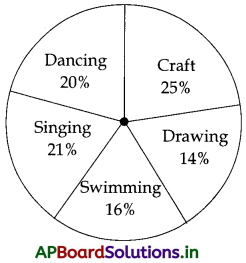
TS 8th Class English Guide Unit 7C I Can Take Care of Myself 5

(Q. 11 – 12) Now, answer the following questions. Each question has four choices. Choose the correct answer and write (A), (B), (C) or (D) in your answer booklet. 2 × 1 = 2 M

Question 11.
How many activities are displayed in the above pie-chart ?
A) 25 activities
B) 16 activities
C) Five activities
D) All activities
Answer :
C) Five activities

Question 12.
What percentage of students enrolled in drawing ?
A) 25 %
B) 21 %
C) 24 %
D) 14 %
Answer :
D) 14 %

TS 8th Class English Guide Unit 7C I Can Take Care of Myself

(Q. 13 – 16) Answer the following questions in one or two sentences in your own words. 4 × 2 = 8 M

Question 13.
What does the above pie-chart display?
Answer :
The above pie-chart displays the percentage of students enrolled in different activites in a school.

Question 14.
Which activity got the highest percentage ?
Answer :
Craft got the highest percentage.

Question 15.
Which activity got more percentage – singing or dancing ?
Answer :
Dancing got more percentage than singing.

Question 16.
Which two activities got the lowest percentage ?
Answer :
Drawing (14 %) and swimming (16%) got the lowest percentage.

EXERCISE – 3

Read the following story.

Krishna was born into a family of five. Early in life, he learnt about the hardships of his life and started helping his father in his work. The scarcity of food and clothes was a part and parcel of his life. He was not ashamed of the sordid poverty in which he had been brought up. Instead, he was extremely proud of his parents who worked day and night to feed the family. His only sorrow was his illiteracy. He could not read or write. It pained him to see other children in the neighbourhood sitting around their homes happily laughing at colourful storybooks and scribbling down stories for their teachers. He felt sad looking at the neatly dressed school-going children. He promised himself

that he would educate himself and free his family from the claws of poverty. In the hope of gaining some knowledge, he used to go to a nearby school and sit outside listening to the teachers. He followed classes in English and Maths and especially enjoyed the story-telling sessions that always seemed to take place on Friday afternoons. He was often asked to leave the school grounds. However, this did not dampen his spirits. It made him bolder and more determined to educate himself.

TS 8th Class English Guide Unit 7C I Can Take Care of Myself

(Q. 11 – 12) Now, answer the following questions. Each question has four choices. Choose the correct answer and write (A), (B), (C) or (D) in your answer booklet. 2 × 1 = 2 M

Question 11.
What type of text is the above passage ?
A) Description
B) Narrative
C) Speech
D) Conversation
Answer :
B) Narrative

Question 12.
How many members were there in the family of Krishna?
A) Five
B) Seven
C) Two
D) Three
Answer :
A) Five

(Q. 13 – 16) Answer the following questions in one or two sentences in your own words. 4 × 2 = 8 M

Question 13.
What did Krishna learn early in his life ?
Answer :
Early in life, Krishna learnt about the hardships of his life and started helping his father in his work.

TS 8th Class English Guide Unit 7C I Can Take Care of Myself

Question 14.
What is the word used to describe ‘poverty’ in the above passage ?
Answer :
In the above passage, the word used to describe ‘poverty’ is ‘sordid’.

Question 15.
What pained Krishna ?
Answer :
Krishna saw other children in the neighbourhood sitting around their homes, happily laughing at colourful story books and scribbling down stories for their teachers. This pained Krishna.

Question 16.
What do you mean by the expression ‘dampen his spirits’ ?
Answer :
The expression ‘dampen his spirits’ means make him give up.

Section – B : Vocabulary and Grammar :

(Questions 17 – 21)

Read the following passages focusing on the underlined parts and answer the questions given at the end. Write the answers in your answer booklet. 5 × 1 = 5 M

EXERCISE – 1

Jim Corbett could read the jungle signs like a (17) open book. He could identify (18) a ripple in the dust of a dry stream bed or blade of grass catched (19) in the act of springing back from a crushed position. When stalking, he could use the wind like predators do, to either conceal (20) or reveal his presence. He could freeze stock-still in mid-stride for any amount of time, just like an animal. He could easily (21) read the sounds of the animals and could imitate them to perfection. Even the call of a tiger! With no assistance apart from his vocal chords, he could lure the animal to face-to-face meeting. Two man-eaters shot by him were cornered using this awesome ability.

Question 17.
Replace the underlined word with a suitable article.
A) an
B) the
C) a and an
D) no article
Answer :
A) an

TS 8th Class English Guide Unit 7C I Can Take Care of Myself

Question 18.
The synonym of the underlined word is ….
A) realise
B) recognise
C) release
D) reality
Answer :
B) recognise

Question 19.
Replace the underlined word with the correct form.
A) catch
B) catching
C) catches
D) caught
Answer :
D) caught

Question 20.
The antonym of the underlined word is …
A) show
B) hide
C) discuss
D) overhear
Answer :
A) show

TS 8th Class English Guide Unit 7C I Can Take Care of Myself

Question 21.
Rewrite the underlined word after removing its suffix.
A) easiest
B) easy
C) easily
D) ease
Answer :
B) easy

EXERCISE – 2

Kiran Bedi has reached a certain stratospheric (17) level, which she denies the intimacy of private life. Her yoga sessions is (18) the only time she shuts up in her world. Her daily schedules are maddening, and her international (19) commitments make her the most travelled (20) police officer in the country. Then she has to tie up her lecture (21) engagements in the country with her police duties.

Question 17.
The meaning of the underlined word is …….
A) At the very lowest level
B) At the very highest level
C) At no level
D) At rest
Answer :
B) At the very highest level

Question 18.
The correct ‘be’ form of the underlined word is ……
A) were
B) are
C) be
D) been
Answer :
B) are

Question 19.
The prefix of the underlined word is ………
A) nation
B) inter
C) al
D) national
Answer :
B) inter

TS 8th Class English Guide Unit 7C I Can Take Care of Myself

Question 20.
The comparative degree of the underlined word is ….
A) more
B) travelled
C) more travelled
D) most
Answer :
C) more travelled

Question 21.
The number of syllables in the underlined word is …..
A) one
B) two
C) three
D) four
Answer :
B) two

EXERCISE – 3

Just then, it began (17) to rain. She thought, “How wonderful (18) the rain is! It makes (19) the whole land green. It makes the rivers flow. Surely, the rain god is the most powerful being on this earth. She asked the rain god, ‘Are you the most powerful being on this earth?’ He smiled (20), ‘No, there is one, greater than me to help the creatures- it is the mountain. Without the mountain, there would being (21) no protection for the creatures on this earth.

Question 17.
The root form of the underlined word is ……
A) begans
B) begin
C) begun
D) beginning
Answer :
B) begin

TS 8th Class English Guide Unit 7C I Can Take Care of Myself

Question 18.
The synonym of the underlined word is ……
A) ugly
B) fantastic
C) shabby
D) unpleasant
Answer :
B) fantastic

Question 19.
The past participle of the underlined word is …..
A) making
B) make
C) made
D) mades
Answer :
C) made

Question 20.
The antonym of the underlined word is …..
A) laughed
B) laughter
C) cried
D) giggle
Answer :
C) cried

Question 21.
The correct form of the underlined word is ……
A) be
B) been
C) am
D) was
Answer :
A) be

TS 8th Class English Guide Unit 7C I Can Take Care of Myself

(Questions 22 – 26)

Complete the following passages choosing right words from those given below them. Each blank is numbered, and for each blank four choices (A), (B), (C) and (D) are given. Choose the correct answer from these choices and write (A), (B), (C) or (D) in your answer booklet. 5 × 1 = 5M

EXERCISE – 1

“So I have a friend
(22) a neighbouring island who has a launch that does thiry-five knots. So we (23) to Komodo and my friend drops there. Three days we (24) dragons. My boat comes (25) and picks me up. Five times we have been chased by the customs launch, but they cannot match our speed. So, poof, dragons for Europe, dragons (26) America.”

Question 22.
A) in
B) on
C) with
D) for
Answer :
B) on

Question 23.
A) are going
B) were going
C) go
D) goes
Answer :
C) go

Question 24.
A) catches
B) catch
C) caught
D) catching
Answer :
B) catch

TS 8th Class English Guide Unit 7C I Can Take Care of Myself

Question 25.
A) forward
B) again
C) back
D) backward
Answer :
C) back

Question 26.
A) for
B) in
C) with
D) from
Answer :
A) for

EXERCISE – 2

Aung San Suu Kyi (22) born on 19 June 1945. Her father, General Aung San, was one of the ‘Thirty (23)’ who spearheaded the Japanese advance into British Burma (24) 1942 during World War – 2, before turning (25) the Japanese and finally negotiating Burma’s independence with the British. Just as he was taking over as the first head of the Burmese state, General Aung san was (26). It was the first national tragedy.

Question 22.
A) am
B) is
C) was
D) were
Answer :
C) was

Question 23.
A) Comrades
B) Comrade
C) Comrader
D) Comraders
Answer :
A) Comrades

TS 8th Class English Guide Unit 7C I Can Take Care of Myself

Question 24.
A) in
B) on
C) at
D) during
Answer :
A) in

Question 25.
A) again
B) back
C) against
D) among
Answer :
C) against

Question 26.
A) dead
B) died
C) assassinated
D) passed away
Answer :
C) assassinated

EXERCISE – 3

We also made ………. (22) small appeal in our neighbourhood newspaper. ………. (23), the appeal was not very effective. We ……….. (24) only Rs. 3, 600. But some of the letters to Vetrivel were so touching ………….. (25) they made all of us very emotional. A little girl sent 10 rupees …….. (26) a cover with a small note, “Dear Vetrivel, I do not know you. But I wish you well. I have only 10 rupees with me. Please get well fast.”

Question 22.
A) a
B) an
C) the
D) no article
Answer :
A) a

Question 23.
A) Fortunate
B) Fotunately
C) Unfortune
D) unfortunately
Answer :
D) unfortunately

TS 8th Class English Guide Unit 7C I Can Take Care of Myself

Question 24.
A) get
B) gets
C) got
D) gotten
Answer :
C) got

Question 25.
A) nor
B) therefore
C) that
D) too
Answer :
C) that

Question 26.
A) with
B) in
C) from
D) to
Answer :
B) in

(Questions 27 – 31)

Read the following passages. Five sentences are numbered. Each numbered sentence has an error. Find the error and write the correct sentences in your answer booklet. 5 × 1 = 5M

EXERCISE – 1

(27) Akkayya or Bavagaru were coming to the city and our home for the first time since my marriage. (28) I had looked forward for their visit all these years.
(29) They had always left their little village to go anywhere. (30) Using children, cattle, cooking etc. , as excuses, they had always avoided to move out. (31) Under such circumstances, imagine their coming to our house and to this big cities.
Answer :
27. Akkayya and Baavagaru
28. looked forward to their visit
29. They had never left their little village
30. always avoided moving out
31. to this big city

TS 8th Class English Guide Unit 7C I Can Take Care of Myself

EXERCISE – 2

(27) Feeling disheartened at being unable to impress Akkayya with my bonsai, I collapsing weakly into a chair. I was most distressed – as if the entire art I had learnt had come to nought. (28) It was like to throw perfume into ash. (29) Suddenly an dust storm began to rage. The sand hit our faces harshly. (30) I caught hold of Akkayya shoulders and dragged her into the room. (31) Then I closed the doors but windows in a hurry.
Answer :
27. I collapsed weakly into a chair
28. It was like throwing perfume
29. Suddenly a dust storm
30. I caught hold of Akkayya’s shoulder
31. doors and windows

EXERCISE – 3

(27) “Why do you said that? You’ve actually brought all the things we wanted! (28) We don’t get this things here. (29) If you Maridi has gongura pulusu, cucumber pappu and drumstick charu he feels as elated as if he has had a sumptuous feast! (30) With my office work, I am unable to made appadams and vadiyams. Even if I have some free time, I am too lazy to do such work. (31) You know me, isn’t it? I said with a laugh.
Answer :
27. why do you say that
28. these things here
29. If your Maridi
30. unable to make appadams
31. You know me, don’t you ?

TS 8th Class English Guide Unit 7C I Can Take Care of Myself

EXERCISE – 4

(27) She looked around, and seen the beautiful blue mountain. (28) She thought, “Why big and strong the mountain is! (29) It withstand all winds and storms. (30) It protects the earth and it’s creatures. Surely, the mountain god is the most powerful being on this earth.’ She asked the mountain god, ‘Are you the most powerful being on his earth?’ (31) He smiled, ‘Yes, there is one greater than me to help the creatures-it is the worm.
Answer :
27. looked around, and saw
28. How big and strong
29. It withstands all winds
30. the earth and its creatures
31. No, there is one greater than me

EXERCISE – 5

(27) From the very start Akkayya had been keen for studying. (28) But Nannagaru didn’t educated her. Because she was not adept at oral arithmetic. (29) Nannagaru had said, “Ah, she’s a girl how will studies get into his head?” and had made her discontinue her lessons concentrating only on Annayya’s education. (30) Because she was uneducated, she gets married to a man from a village, had to look after the cattle, keep the stove clean, draw water from the well… Amma used to be very upset that Akkayya had to go through such drudgery. (31) Realized that Akkayya was upset thinking of the past, and in an attempt to divert her mind, I led her to the balcony saying, “Come, let’s go and sit outside.”
Answer :
27. Akkayya had been keen on studying
28. didn’t educate her
29. Studies get into her head
30. She got married
31. Realizing that Akkayya was upset.

TS 8th Class English Guide Unit 7C I Can Take Care of Myself

Scetion – C : Conventions of Writing

(Question 32)

Read the following passages carefully and supply the punctuation marks (. , ? ” ” “) and capital letters, wherever necessary. Also correct the spellings of the underlined words. 5M

EXERCISE – 1

The government railway hospital was near Indrani’s house. so, we decided to contact that hospital first. No, they would not give any concesion to anyone in the fees charged. It is Rs. 95, 000. Take it or leave it. It is like a railway ticket. Nothing more nothing less, the doctor said unsympathetically.
Answer :
The Government Railway Hospital was near Indrani’s house. So, we decided to contact that hospital first. No, they would not give any concession to anyone in the fees charged. “It is Rs. 95,000. Take it or leave it. It is like a railway ticket. Nothing more, nothing less,” the doctor said unsympathetically.

EXERCISE – 2

Why should he be permitted to do this, doyle demanded, when he is in such a minority To impose an immediate ban would be wrong. Batsmen already playing the game should be allowed to continue, and his ban on left-handers should be delayed for four years for the benefit of upcoming cricketers. But after that no new player batting left-handed should be admited to first-class cricket. In the meantime, lads showing an inclination to bat this way could easily be trained to perform the other way round.
Answer :
“Why should he be permitted to do this,” Doyle demanded, “When he is in such a minority ?” To impose an immediate ban would be wrong. Batsmen already playing the game should be allowed to continue and his ban on left-handers should be delayed for four years for the benefit of upcoming cricketers. But after that no new player batting left-handed should be admitted to first call cricket. In the meantime, lads showing an inclination to bat this way could easily be trained to perform the other way round.

TS 8th Class English Guide Unit 7C I Can Take Care of Myself

EXERCISE – 3

sometimes his wife and one-year-old daughter, azkia ulhaz, went with him on such trips, but Azkia had not slept well the night before, he remembered, and they decided it was better to leave her in bed. It was he said just an ordhinary morning
Answer :
Sometimes his wife and one – year – old daughter, Azkia Ulhaz, went with him on such trips, but Azkia had not slept well the night before, he remembered and they decided it was better to leave her in bed. “It was” he said, “just an ordinary morning.”

Section – D : Creative Writing (Discourses)

(Question – 33) 12M

A) Akkayya wrote a letter to her sister informing her about her visit to the city. The narrator shared this welcome news with her husband. Now, develop a possible conversation between the narrator and her husband.
Answer :
Conversation :
Characters :

  • Wife
  • Husband

Husband : Devi, you look cheerful.
Wife : Yes, There is a very good reason for my happiness.
Husband : What’s it, Devi?
Wife : It’s a very surprising news.
Husband : Break the suspense, Devi.
Wife : Someone who is very special to me is coming to our house.
Husband : Your mother?
Wife : No. It’s my Akkayya!
Husband : How surprising it is!
Wife : She, along with Baavagaru, is coming here. They are planning to visit Kasi and Haridwar. On the way to these places, they will come to our house.
Husband : I am really very delighted to hear such happy news.
Wife : Using children, cattle, cooking etc., as excuses, they have always avoided moving out. Under such circumstances, imagine their coming to our house and to this big city for the first time after our marriage.
Husband : Yes. And we have to welcome them with open arms.
Wife : I think Akkayya will bring some traditional food especially for you.
Husband : Your Akkayya is always particular about food. She is a typical Indian woman unlike you.
Wife : Keep it aside for the present. Let’s plan how to make them feel very comfortable here in our house in this big city.
Husband : I will pick them up at the railway station. You prepare some special dishes.
Wife : That sounds very good. How about taking them to some tourist attractions in this city?
Husband : That’s fine. I’ll make all the arrangments.
Wife : Hope everything will be OK when they come to our house for the first time.
Husband : Let’s hope so.

TS 8th Class English Guide Unit 7C I Can Take Care of Myself

(OR)

B) Communication plays an important role in everybody’s life. Imagine that you are asked to make a speech on ‘The Importance of Good Communication Skills’. Now, write a speech script on the prescribed theme in about 150 words.
Answer :

The importance of good Communication Skills

Esteemed director, honourable headmaster, motivating teachers and my dear brothers and sisters. A very good evening to all of you.

It gives me great pleasure to stand before you and express my views on The Importance of Good Communication Skills. “Effective communication skills are very important in all aspects of life, be it at work or in relationships. People in organisations typically spend a major part of their time in interacting with people. Then it is no surprise to find that at the root of arge number of organisational problems, is poor communication. This is most obvious in crosscultural situations where language is an issue.

But it is also common among people of the same culture. Effective communication is an essential component of organisational success whether it is at the interpersonal, intergroup organisational or external levels. Communication skills are utmost important in developing social relationships. Proper communication skills help people in understanding each other and working together towards the goal.

There are a number of situations when you need to solicit good information from others. These situations include interviewing candidates, solving work problems, seeking to help an employee on work performance and finding out reasons for performance disagreements at work. In society it helps in judging an individual’s ability to communicate with people from diverse backgrounds.

Mixed messages create tension and distrust because the receiver senses that the communicator is hiding something or is being less than open. Thus one must understand that communication skills are not only important to develop an impression on the other person and get the required work done, but also not to create a bad image about themselves in society. Here, I conclude my speech with a golden line “Language is the dress of thoughts”.
Thank you for giving me this opportunity.

TS 8th Class English Guide Unit 7C I Can Take Care of Myself

(Question – 34)

A) Name : Kothapally Jayashankar
Born : 6 August, 1934; at Akkampet, Warangal, Telangana
Other names : Telangana Siddanthakartha, Father of Telangana
Parents : Laxmikantha Rao and Mahalaxmi
Schooling / College : Hanamkonda and B.Ed at Osmania University, Hyderabad.
Occupations : Educator, social activist and Telangana ideologue
Achievements: Instrumental in forming the Telangana Development Forum (TDF, USA) in 1999; founder member of Telangana Aikya Vedika and was on its executive Telangana movement; Chairman of centre for Telangana Studies.
Demise : 21 June 2011 after battling stomach cancer.
Use the following details and write a profile of Kothapally Jayashankar.
Answer :

Kothapalli Jayashankar

Kothapalli Jayashankar, populary known as professor Jayashankar was born on 6th August, 1934 at Akkampet village in Atmakur mandal, Warangal district, Telangana state. People also call him Telangana Siddanthakartha and the Father of Telangana. His parents were Laxmikantha Rao and Mahalaxmi. He did his schooling in Hanamkonda and B.Ed at Osmania University, Hyderabad. He was an educator, social activist and Telangana ideologue. He was instrumental in forming the Telangana Development Forom (TDF, USA) in 1999. He was the founder member of Telangana Aikya Vedika and was on its executive movement. At the time of his death, he was the chairman of centre for Telangana studies. This true Telangana hero passed away on 21st June, 2011 after battling stomach cancer. He did not marry and remained bachelor all his life.

(OR)

TS 8th Class English Guide Unit 7C I Can Take Care of Myself

B) Imagine that your sister’s marriage was performed today. Now, express your happiness in the form of a diary entry. 8M
Answer :

Dairy Entry
Dt: XX.XX.XXXX
10: 00 PM.

Dear Diary,
Today is the most memorable day not only for me but also for my parents. My parents had been worried about my sister’s marriage. Eventually, dad found a suitable bridegroom for my sister and the marriage was perfomed with pomp today. How can I imagine living at home without my sister ? But she should go to her husband’s residence. I hope they both live happily without any misunderstandings or disagreements. I am tired now. Good night.

Yours,
XXXX

TS 6th Class Social 3rd Lesson Questions and Answers Telangana – 3B Penamakuru – A Village in the Krishna Delta

Telangana SCERT TS 6th Class Social Study Material Pdf Lesson 3B Penamakuru – A Village in the Krishna Delta Textbook Questions and Answers.

3B Penamakuru – A Village in the Krishna Delta – TS 6th Class Social 3rd Lesson Questions and Answers Telangana

Question 1.
What kind of changes are taking place in Penamakuru village ?
Answer:

  1. In olden days, the farmers of Penamakuru cultivated red gram, green gram and millets on the uplands.
  2. Nowadays these crops have been replaced with vegetables and sugarcane which require irrigation.
  3. Recently there has been an increasing use of groundwater through the borewells to cultivate the uplands which cannot be easily irrigated with canal water.

Question 2.
How do the poor and the landless earn their livelihood in the plains ?
Answer:
The poor and landless live in nearby hamlets on the banks of the canal and south of village. In the middle of the village, we can also find kirana shops, bank. R.M.P Doctor, medical shops, iron welding shops, hair saloons, tiffin shops etc. The main village is inhabited only by land owning people. On the banks of Bandar canal live 15 – 20 Basket weaving families. The families who don’t have land either lease in the land of the landed farmers or work as labourers on their farms.

Question 3.
What are the difficulties of farming in plain villages like Penamakuru ?
Answer:

  1. Villages like Penamakuru which is on plain also have few difficulties of farming.
  2. As there is no rain in October, it is necessary to irrigate the lands with water either from the canal or the wells or tanks.
  3. The lands towards the western and northern side are on higher elevation and cannot be easily irrigated with canal water.
  4. In such areas farmers use borewells.
  5. At times, flood waters prove very destructive as well as productive.

Question 4.
What will happens if all farmers of the village to grow only sugarcane or turmeric ?
Answer:
Cultivation of commercial crops like sugarcane or turmeric leads to scarcity of foodcrops. If the farmers of the rest of the state feel so, starvation occurs. So the
farmers should feel the responsibility of the state welfare.

Question 5.
Why do plains like the Krishna delta have a very dense settlement ?
Answer:
a) Delt a lands are very fertile and give high yields.
b) The lands are favourable for cultivation of all kinds of crops.
c) Well developed transport facilities help the farmers in shifting the crop returns to mills and Rythu Bazars.
d) The surplus received by the large farmers will be turned as capital and lead to the establishment of new industries. As a result there will be increase in employment opportunities.

Question 6.
Point out different landforms on the map of Telangana and Andhra Pradesh. Colour them as given below.
a) plain – green
b) plateau – yellow
c) mountains – brown
Answer:
Self exercise.
TS 6th Class Social 2nd Lesson Questions and Answers Telangana - Globe - A Model of the Earth 8

Question 7.
How are the people of handicrafts helped by the government ?
Answer:

  1. The people of handicrafts are helped by the government in many ways.
  2. They are provided with tools and implements.
  3. Their produce / production are purchased or marketed by the government.
  4. They are provided with training to improve their skills.
  5. They are assisted by the finance corporations.

Question 8.
Describe the relief features of TelanganAnswer:
Answer:

  1. Telangana is situated on the Deccan plateau.
  2. It covers 114,840 square kilometres.
  3. The region is drained by two major perennial rivers namely Godavari and KrishnAnswer:
  4. It is also drained by several minor rivers.
  5. Telangana is a semi-arid area and has a predominatly hot and dry climate
  6. Summers start in march and reach peak in may
  7. Monsoon arrives in June and lasts until September.
  8. A dry, mild winters starts in November and lasts until early February.

I. Conceptual Understanding

Question 1.
How are the soils formed in Penamakuru region ?
Answer:
A) Alluvial soils : In Penamakuru, the soils are mostly fertile alluvial black soils. The soils deposited by the’river are called alluvial soils or ondru bhumi. Alluvial soils are heavy and have high water holding capacity. They are also rich in nutrients.

B) Black soils: We can find fine and clayey black soils upto a depth of 15 feet. They get very sticky with rain and retain moisture for a long time. When they dry up they tend to crack-this causes what is called self-ploughing and causes fertility.

C) Sandy soils : Some parts of the village nearer to the river on the West and South have sandy soils.

Question 2.
What are the agro industries in Penamakuru ?
Answer:

  1. Poultry and rice mills are based on agriculture and therefore are called agro¬industries.
  2. This is a common feature in the plains.
  3. They get the necessary raw materials and the market for their produce is easily at hand.
  4. So, poultry and rice mills are the agro based industries in Penamakuru.

Question 3.
Where was the Prakasam Barrage constructed ?
Answer:

  1. Vijayawada city is located at the head of the Krishna Delta on its northern bank.
  2. A barrage was built across the river at Vijayawada in 1853 by the British rulers.
  3. It’s now called Prakasam Barrage.
  4. The water is diverted by this barrage into canals and is used to irrigate about twelve lakh acres of land.

Question 4.
What is the relation between moisture level in the soil and crop production ?
Answer:

  1. Alluvial soils are heavy and have high water loading capacity. They are also rich in nutrients. Crops grow well in those moisture levels.
  2. Clayey Black soils get very sticky with rain and retain moisture for a long time. They also retain water for long duration. Cotton is predominantly grown.
  3. Sandy soils are infertile soils. The capacity of these soils to retain moisture is very less. If moisture level increases, crops grow well. If moisture level decreases crops don’t grow well except few crops.

Question 5.
Is the rain adequate for agriculture in your area ?
Answer:
We live in plateau area in Telangana Our region receives rains from June to October. It is sufficient only for commercial crops. Later we depend on canals or borewells. Because in Rabi season, they are not enough rains to grow crops.

Question 6.
How can we minimise the damage done by floods and cyclones?
Answer:

  1. Floods and cyclones are the regular calamities in our state and ours is no excuse for it.
  2. Bunds are constructed along the course of the river so that flood water does not enter the village or town.
  3. Irrigation canals and check dams are constructed to control and regulate the flow of water.

II. Reading the Text (given), Understanding and Interpretation

Question 1.
Write about the different types of crops grown in Penamakuru.
Answer:

  1. Food crops: Paddy is extensively cultivated all over the coastal plains especially in Krishna District. The nursery for the paddy monsoon crop called salva is sown and transplanted in the months of June/July. From the month of December they sow the winter crop called dalvAnswer:
  2. Cash crops: The villagers cultivate turmeric, sugarcane, etc., for sale in the market and are not consumed in the village.
  3. Vegetables : In the low lying lands if water is not sufficient for a second crop of paddy they cultivate vegetables. Usually they cultivate brinjal, lady’s finger, dondakai, ridge gourd and cabbage.
  4. Fruits : On the bank of river Krishna and upland areas of Penamakuru we can see several fruit bearing trees and orchards like guava, sapota, papaya

Question 2.
Mention the animals reared in Penamakuru.
Answer:
All lands in the village are cultivated and there is not much land for grazing cattle. Hence only a few bullocks, cows, buffaloes and sheep are reared for working on the fields and other purposes. The village has a fully mechanised poultry farm. There are about 80,000 hens in this poultry laying about 50,000 eggs each day.

Question 3.
How are the road transport and markets at Penamakuru?
Answer:
The road network in this region is well developed providing connectivity to many towns and cities. This helps in marketing of the produce. The farmers of this village sell sugarcane to nearby sugar factory which is located at Vuyyuru. The vegetables and bananas are supplied to ‘Raithu Bazar’ which is in Vuyyuru and VijayawadAnswer: The paddy is sold in the fields itself through brokers.

Question 4.
Can you think why the floods can be both destructive and productive?
Answer:
I think they are more destructive and less productive.
1. Losses due to floods :
a) Low lying areas are inundated by floods.
b) Agricultural lands and crops are damaged.
c) Villages, towns may be drowned.
d) Roads, and railways, power and telephone lines will be interrupted and heavy losses of wealth and human lives are caused.

2. Gains due to floods :
a) Flood water flow should be regulated and controlled by constructing check dams.
b) Several dams are constructed to store the water and useful for irrigation and power supply.

III. Information Skills

Read the passage and answer the following questions.

There are about 750 families in Penamakuru. Ten of them have 10 acres of land or above. Approximately 150 families have land below 5 acres and the rest have no land. They either take land on lease from the the landlords farmers or work as labourers on their farms.

1) How many families are there in Penamakuru ?
Answer:
There are about 750 families in Penamakuru.

2) How many families have land below five acres ?
Answer:
Approximately 150 families have land below five acres.

3) Do all the families have land ?
Answer:
No, they either lease in the land in the landed farmers or work as labourers on their farms.

4) Who work as labourers on their forms ?
Answer:
The people who are landless work as labourers on their farmers.

5) How many families have 10 acres of land or above ?
Answer:
10 families have 10 acres of land or above.

IV. Reflection on Contemporary Issues and Questioning

Question 1.
Write few lines about Bandar canal.
Answer:
Bandar canal: After travelling about 3 kms from Vuyyuru. the Bandar canal should be crossed to reach Penamakuru. Bandar canal takes off from Krishna river at Prakasam Barrage in VijayawadAnswer: It flows from the North West of the village to the South East direction. Water of this canal is taken to the fields through small field channels. Penamakuru village is situated between the Krishna river and the Bandar canal.

Question 2.
Find out from your elders about the major floods in the past and what happened during those times.
Answer:
Floods are caused by cyclones which bring heavy rains from the sea along with strong winds which uproot trees and cottages. During the worst floods of 1997, 2006 or 2009 our low lying areas got inundated, agricultural lands and crops got damaged. Villages, towns, roads, railways, power supply, telephone lines got destroyed. The affected areas incurred a huge loss of life and property due to the floods.

Question 3.
Write about the mechanised poultry farm in Penamakuru.
Answer:
The village has fully mechanised poultry farm. Water is supplied through nipples and food is supplied by the conveyers. There are about 80,000 hens in this poultry laying about 50,000 eggs each day. These eggs are sent to Vijayawada and other states like Assom and Bihar through agents. The chicken dropping is sold as fish feed to farmers in nearby areAnswer:

VI. Appreciation and Sensitivity

Question 1.
To what extent do you think the changing crops is beneficial to the farmers?
Answer:
In olden days, the farmers of Penamakuru cultivated red gram, green gram and millets on the uplands. These did not require much water. Nowadays, there crops have been replaced with vegetables and sugarcane which require irrigation. There is a shift from growing food grains like millets, paddy and pulses to cash crops like sugarcane, vegetables, fruits and turmeric. This is made possible by the growth of irrigation. The farmers get benefits by them like availability of loans to purchase inputs like seeds and fertilizers. They get more money than food crops.

TS 6th Class Social 3rd Lesson Notes – 3B Penamakuru – A Village in the Krishna Delta

  • Hills : A naturally raised area of land, not as high or craggy as a mountain.
  • Plateau : Plateaus are flat topped table land with steep slopes on one side or more sides.
  • Plain : Plains are large stretches of flat land, not higherthan 200 mts from mean sea level.
  • Coast : The land beside or near to the sea or ocean.
  • Cyclone : A violent tropical storm in which strong winds move in a circle.
  • Flood : A large amount of water covering an area that is usually dry.
  • Orchards : A piece of land normally separated from the surrounding area, in which fruit trees are grown.

Mind Mapping
TS 6th Class Social 2nd Lesson Questions and Answers Telangana - Globe - A Model of the Earth 10


TS 6th Class Social 3rd Lesson Questions and Answers Telangana – 3A Land Forms

Telangana SCERT TS 6th Class Social Study Material Pdf Lesson 3A Land Forms Textbook Questions and Answers.

3A Land Forms – TS 6th Class Social 3rd Lesson Questions and Answers Telangana

I. Conceptual Understanding

Question 1.
What are main kinds of landforms ?
Answer:
There are three main kinds of landforms. They are 1) Mountains 2) Plains 3) Plateau.

Question 2.
Which districts in Telangana state have stretches of hilly terrain ?
Answer:
In Telangana state Adilabad, Nirmal, Jagitial, Vikarabad, Rangareddy, Mahaboobnagar, Nagarkurnool, Peddapalli, Badradri and Jaya Shankar districts have stretches of hilly terrain which we can see as pockets of scattered hills.

TS 6th Class Social 3rd Lesson Questions and Answers Telangana - 3A Land Forms

Question 3.
What do you mean by Relief features ?
Answer:
The physical surface features of the land like mountains, plains, etc. are called ‘Relief features’. Telangana state has varied relief features.

Question 4.
Describe the Telangana Plateau.
Answer:

  1. The upper Telangana plateau is in the west side of Telangana state.
  2. Godavari and Krishna rivers flow eastwards through this plateau.
  3. The remaining area is known as the lower Telangana plateau which also has eastwards slope.
  4. The twin cities, Hyderabad and Secunderabad, Sangareddy, Mahaboobnagar and Nalgonda towns are located on the upper Telangana Plateau.
  5. Warangal and Karimnagar towns are located on the lower Telangana plateau.

TS 6th Class Social 3rd Lesson Questions and Answers Telangana - 3A Land Forms

Question 5.
How is the delta formed ?
Answer:
Before joining the sea, a river divides into a large number of small streams. It deposits a lot of sand and silt in this area which forms the deltAnswer:

Question 6.
Which is the largest plateau in India ?
Answer:
The Deccan plateau is the largest plateau in India

II. Reading the Text (given), Understanding and Interpretation

Our state has Upper Telangana Plateau in the west. Godavari and Krishna rivers flow eastwards through this plateau. The remaining area is known as the Lower Telangana Plateau which also has eastwards slope. The twin cities, Hyderabad and Secunderabad, Sangareddy, Mahaboobnagar and Nalgonda towns are located on the upper Telangana plateau while Warangal and Karimnagar towns are on the Lower Telangana Plateau.

Answer the following questions based on the above paragraph.

1) Which part of Telangana plateau has Warangal and Karimnagar districts ?
Answer:
The lower Telangana plateau has Warangal and Karimnagar districts in it.

2) Towards which direction, the slope of lower Telangana plateau is there ?
Answer:
The slope of lower Telangana plateau is eastward.

TS 6th Class Social 3rd Lesson Questions and Answers Telangana - 3A Land Forms

3) Towards which direction of Telangana state lies the upper Telangana plateau ?
Answer:
Upper Telangana plateau lies on the west side of Telangana state.

4) What are the important towns in the Upper Telangana plateau ?
Answer:
The important towns in the upper Telangana plateau are twin cities, Hyderabad and Secunderabad, Sangareddy, Mahaboobnagar and NalgondAnswer:

III. Misinformation Skills

1. Answer the following questions based on the table given below.

Hill rangesSpread over districts
Satmala DevarakondaAdilabad
Ananthagiri ‘Yadadri Bhuvanagiri Vikarabad
RakhiNizamabad, Kamareddy

1) Name the hills present in Nizamabad & Kamareddy.
Answer:
The hills present in Nizamabad & Kamareddy are Rakhi hills.

2) Which range is present in Adilabad ?
Answer:
The range present in Adilabad is Satmala hills.

3) Name the district where Ananthagiri hills are located.
Answer:
The district where Ananthagiri hills are located is Vikarabad.

4) Name the district where Devarakonda hills are located.
Answer:
The district where Devarakonda hills are located is Yadadri Bhuvanagiri.

Reflection on Contemporary Issues and Questioning

Question 1.
Why is it not possible to construct a large dam in Medak district ?
Answer:
1) It is not possible to construct a large dam in Medak district.
2) Construction of large dam need mountainous supports to block the water.
3) We do not have any hill ranges in Medak.
4) Thus it may not be possible for the construction of a big dam in Medak.

V. Mapping Skills

1. Map Pointing:
TS 6th Class Social 2nd Lesson Questions and Answers Telangana - Globe - A Model of the Earth 6
List the hills you find in the map.
Answer:
I found Satrnala hills, Nirmal hills, Rakhi hills, Ananthagiri hills, Devarakonda hills and Kandikal hills in the map.

TS 6th Class Social 3rd Lesson Questions and Answers Telangana - 3A Land Forms

VI. Appreciation and Sensitivity

1. What is the importance of Telangana Plateau?

  1. The Deccan plateau is the largest plateau in India
  2. It has a high and steep edge (escarpment) on the west known as western ghats.
  3. Telangana plateau itself a part of the Deccan plateau and slopes to the east.
  4. Large portions of Telangana fall in the plateau region, called Telangana plateau.

TS 6th Class Social 3rd Lesson Notes – 3A Land Forms

1. Slope : A surface or piece of land that slopes
2. Ghat : A road or way over or through mountains
3. Delta : ‘D’ An area of land shaped like a triangle, where a river has split into several smaller rivers before entering the sea
4. Bay : A part of the large lake, partly surrounded by a wide curve of the land. Eg: The Bay of Bengal
5. Valley : An area of lowland between hills or mountains often with a river flowing through it; the land that a river flows through
6. Landforms : The three import?nt landforms are mountains, plateaus and plains.

Mind Mapping

TS 6th Class Social 2nd Lesson Questions and Answers Telangana - Globe - A Model of the Earth 7

TS 6th Class Social 2nd Lesson Questions and Answers Telangana – Globe – A Model of the Earth

Telangana SCERT TS 6th Class Social Study Material Pdf 2nd Lesson Globe – A Model of the Earth Textbook Questions and Answers.

Globe – A Model of the Earth – TS 6th Class Social 2nd Lesson Questions and Answers Telangana

Question 1.
There is an outline map of the world on the 28 page. Identify and write the names of continents and oceans. Colour the map using appropriate colours. Draw and write the names of the main latitudes.
Answer:
Self Exercise.

Question 2.
Ramesh says “Earth is flat”. What do you say ?
Answer:
Ramesh says, “Earth is flat.” Some four hundred years ago most people believed that the Earth was flat and that if anyone kept travelling in any direction he would reach the edge of the Earth and from there he would fall off into the sky. Actually the Earth is not like perfect sphere-not perfectly round. It is a little pressed at the two poles in the north and south and bulges slightly in the middle around a line called equator.

TS 6th Class Social 2nd Lesson Questions and Answers Telangana - Globe - A Model of the Earth

Question 3.
Rosy is spinning a bangle like a top. What shape do you see ?
Answer: I saw it is in spheriod shape.

Question 4.
Collect information about explorers like Columbus.
Answer:
Vasco – Da-Gama, Magellan, Captain David Cook are some of explorers like Columbus.

1) Marco PoloItalian1552-1618Exploration of Asia and  China
2) Ferdenand MagellanPortuguese1480-1521First voyage around the world.
3) Christopher ColumbusItalian/Spanish1451-1506Discovery of the new w’orld.
4) Amerigo VespucciItalian/Spanish1454-1512America was named after him.
5) Vasco-Da-GamaPortuguese1469-1524Discovery of Ocean Route from Portuguese to the East.
6) Captain James CookBritish explorer1728-1779Explored Australi

Question 5.
Draw the latitudes and longitudes on the surface of a ball.
Answer:
Student Activity.
TS 6th Class Social 2nd Lesson Questions and Answers Telangana - Globe - A Model of the Earth 1

Question 6.
‘The Sun always rises in the East.” Find out the reasons for this.
Answer:
The earth rotates on its axis from west to east (or the apparent movement of the sun is from east to west). A place that is situated westwards of a given place will experience the overhead sun later and the line of this place will be behind the time of the place situated eastwards of it.

Question 7.
Why do we draw imaginary lines on the globe / map ?
Answer:
We will see many lines crossing on thf g’obe. Some run from the North Pole to the South Pole while others run around ie E . I h from the West to the East. These imaginary lines drawn by map makers help u locate places on the globe and maps.

Question 8.
What is the effort put by scientists and sailors to know about earth ?
Answer:
1) They found and proved the shape of the earth.
2) They calculated the place of the earth in the universe.
3) They estimated the birth and evolut ions of the earth.
4) They drew the imaginary lines on tr e earth. Ex : axis, longitudes, latitudes, etc.
5) They make us to know many things about the earth like revolution, rotation, atmosphere, etc.

TS 6th Class Social 2nd Lesson Questions and Answers Telangana - Globe - A Model of the Earth

Question 9.
Observe the following pictures and fill the boxes with the names of the shaded hemispheres.
Answer:
TS 6th Class Social 2nd Lesson Questions and Answers Telangana - Globe - A Model of the Earth 6

I. Conceptual Understanding

Question 1.
What is a Globe ?
Answer:
Globe is an object shaped like a ball with a map.of the world on its surface, usually on a stand so that it can be turned. It is a model of the Earth. It shows the shape of the earth, land and water, the continents and oceans and the main countries of the world.

Question 2.
What was the interesting thing about the shape of the Earth ?
Answer:
Some four hundred years ago most people believed that the Earth was flat and that if anyone kept travelling in any direction he would reach the edge of the Earth and from there he would fall off into the sky. Around 1400 AD scientists and sea-farers began to figure out that the Earth must be like a belli. That was why Columbus, the Italian explorer set out from Europe in 1485 AD in the western direction with the hope of reaching IndiAnswer: He stopped at the Carribbean islands near AmericAnswer: In case he had travelled on, he might have reached IndiAnswer:

Question 3.
How many continents are there? What are they ?
Answer:
There are seven major continents. They are : 1) Asia 2) Africa 3) North America 4) South America 5) Antarctica 6) Europe 7) AustraliAnswer:

TS 6th Class Social 2nd Lesson Questions and Answers Telangana - Globe - A Model of the Earth

Question 4.
What is meant by ‘Northern Hemisphere’?
Answer:
The area between the Equator and the North Pole is called Northern Hemisphere. It is also known as the area of North of the Equator. There are 90 latitudes in it and Tropic of Cancer (i.e., \(231 / 2^{\circ}\)N) lies in it. The Arctic Circle (i.e.,\(66^{1 / 2^{\circ}}\)N) North latitude also lies in it. –

Question 5.
What is meant by ‘Southern Hemisphere’ ?
Answer:
The area between the Equator and the South Pole is called Southern Hemisphere. It is also known as the area of South of the Equator. There are 90 latitudes in it and Tropic of Capricorn (i.e., 231/$°S) lies in it. The Antarctic Circle (i.e.,6654°S) lies in it.

Question 6.
Write down the names of four great oceans.
Answer:
Most of the Earth surface consists of water in the form of oceans. Seas and oceans stretch for hundreds and thousands of kilometers – just endless water. There are four great oceans- 1. Pacific ocean 2. Atlantic ocean 3. Indian ocean 4. Arctic ocean.

Question 7.
Which is the largest ocean? Which is the smallest ocean?
Answer:
The Pacific ocean is the largest ocean. The Arctic ocean is the smallest ocean.

II. Reading the Text (given), Understanding and Interpretation

Question 1.
What are latitudes ? Explain them with the help of a diagram.
Answer:
Latitudes : These are the imaginery lines that are drawn from the West to the East on the Earth. The largest of these lines is called Equator. It divides the globe into two equal halves. These two halves are called hemispheres. They are also known as parallels. They are only points at the poles. There are 90 latitudes in each of the Northern and Southern hemisphere. All the latitudes are imaginary lines. They are helpful in locating any place on the Earth.
TS 6th Class Social 2nd Lesson Questions and Answers Telangana - Globe - A Model of the Earth 2

Question 2.
What are longitudes ? Explain them with the help of a diagram.
Answer:
Longitudes : The longitudes are imaginary lines. They run from one pole to the other pole. They are drawn across the globe passing through poles intersecting the equator. They are semicircles: There are 360 longitudes at 1° interval over the Earth. Longitudes are also known as meridians. There are two main longitudes – the Greenwich Line which is also called the 0° longitude and the International Date Line. The time at Greenwich is the international standard time.

TS 6th Class Social 2nd Lesson Questions and Answers Telangana - Globe - A Model of the Earth 3

Question 3.
Why are longitudes and latitudes drawn? Longitudes on the giobe
Answer:
Both latitudes and longitudes are imaginary lines. They are drawn to make easy the identifying of countries and knowing the time variation from one place of the Earth to another place.

Question 4.
Explain why the bottom portion of the earth is not visible in this photograph.
Answer:
We can see only that part of the earth which receives sunshine. In this photograph the upper portion of the earth is only receiving the sunshine. So the bottom portion of the earth is not visible.

TS 6th Class Social 2nd Lesson Questions and Answers Telangana - Globe - A Model of the Earth 4

III. Information Skills

LatitudesLongitudes
1. Latitudes are drawn parallel to equator at 1° interval.1. Longitudes are the semicircles drawn passing through the poles intersecting the equator.
2. They are also called parallels.2. They are also known as meridians.
3. There are 90 latitudes in each of the Northern and Southern hemisphere.3. There are 180 longitudes each eastwards and westwards.
4. The 0° latitude is called the equator.4. The 0° longitude is called the Greenwich meridian.

Answer the following questions by reading the above table.
1) Which longitude is called Prime Meridian?
Answer:
Greenwich longitude.

2) How many longitudes are there?
Answer: There are 360 longitudes.

3) What are parallels ?
Answer:
Parallels are latitudes.

4) Which latitude is called equator?
Answer:
0° latitude is called equator.

IV. Reflection on Contemporary Issues and Questioning

Question 1.
Can you see how people can stand on the earth if it is like a ball ? Explain.
Answer:
Place standing figures on different parts of the globe. It may seem that the person at , the lower part is standing upside down or that the person on the middle may just fall down from 4:he earth. We never fall off the Earth because the Earth acts like a very powerful magnet which pulls us towards it. We can only fall on the earth and never off the Earth.

TS 6th Class Social 2nd Lesson Notes – Globe – A Model of the Earth

  • Latitude : Imaginary lines that are drawn from west to east are called latitudes.
  • Longitude : Imaginary lines that run from one pole to the other are called longitudes.
  • International Date Line : 180° North – South Line longitude.
  • Axis : An imaginary line nrough the centre of an object, around which the object turns.
  • Internet : An International compute r network connecting other networks and computers from companies, universities,
  • etc. Poles are the two points on the opposite ends of the earth.
  • Poles : Poles are the two points on the opposite ends of the earth.
  • Apex : The top or highest part of something
  • Hemisphere : A half of the: earth
  • Spherical : Shaped like a sphere, globular
  • The shape of the Earth is : Spherical
  • Equator : Zero degree latitude

Mind Mapping:

TS 6th Class Social 2nd Lesson Questions and Answers Telangana - Globe - A Model of the Earth 5

TS 8th Class English Guide Unit 7B Bonsai Life Part 2

Telangana SCERT TS 8th Class English Study Material Pdf Unit 7B Bonsai Life Part 2 Textbook Questions and Answers.

TS 8th Class English Guide Unit 7B Bonsai Life Part 2

I. Complete the statements giving more than one reason.

Question 1.
Girls should be educated like boys because…
Answer :
a) They should earn their own livelihood like men.
b) They shouldn’t lead a dependent life.
c) They should lead a dignified life without depending on others.

Question 2.
Fully grown trees are more useful because…
Answer :
a) They give shade and shelter to the people who settle under them.
b) They provide food in the form of fruits and seeds.
c) They control pollution.

TS 8th Class English Guide Unit 7B Bonsai Life Part 2

II. Answer the following questions.

Question 1.
Why was Akkayya perplexed?
Answer :
Akkayya was perplexed at the laughter of her sister (the narrator). She questioned her sister (the narrator) why she had planted the turai and pomegranate trees in flower pots. She even felt sorry for the trees. This made the narrator laugh at the ignorance of her sister regarding bonsai (trees) art. The laughter confused (perplexed) her sister.

Question 2.
How is a bonsai reared?
Answer :
Bonsai is reared in flower pot. It has to be tended very carefully. Its branches should be cut often, pots need to be changed now and then. It should be trimmed into a small sized tree. It needs more attention and care.

Question 3.
What similarities do you notice between the Bonsai tree and the house wife ?
Answer :
Bonsai tree is reared in flower pots. House – wives are always confined to their work behind the doors. Bonsai trees can’t bear even the slightest irritation caused by the weather. House – wives are also very sensitive in dealing with problems in their life.

Question 4.
What made the narrator feel the urge to free the Bonsai?
Answer :
The narrator realized the importance of trees in providing shade and shelter to people. She felt that trees should be let to grow freely in the open space. They can fulfil their purpose of creating ecological balance in nature. This feeling urged her to free the Bonsai.

TS 8th Class English Guide Unit 7B Bonsai Life Part 2

Question 5.
What is the central theme of ‘Bonsai Life’?
Answer :
Bonsai life is a restricted life without any freedom. A bonsai is to be tended very carefully without any exposure. There is no dignity in it. This sort of bonsai life is beautifully depicted in the story through the women characters. It focuses the life style of women and how it is suppressed by the prejudices of men and society as well.

III. Make a list of activities done by a homemaker and a working woman.

TS 8th Class English Guide Unit 7A Bonsai Life Part 2

Answer:

HomemakerWorking Woman
1) taking care of cattle.1) taking care of children.
2) taking care of children.2) attending household chores.
3) growing vegetables in the garden.3) meeting the demands of people both at home and at office.
4) attending to all sorts of household chores.4) doing office work.
5) helping family members even in the farms.5) balancing office work and work at home.

TS 8th Class English Guide Unit 7B Bonsai Life Part 2

IV. Put a tick (✓) mark against the most appropriate meaning for the phrases given below.

Question 1.
‘… to keep the washerman’s account’ means
a) to take care of household work.
b) to count clothes and pay money
c) to maintain the washerman’s account.
Answer:
a) to take care of household work. (✓)

Question 2.
‘… uphill task’ means
a) high quality work.
b) a difficult job.
c) working on a hill.
Answer:
b) a difficult job. (✓)

Question 3.
‘…… grass is greener on the other side’ means
a) the grass on this side is green.
b) others are as good as we are.
c) others are in a better position than us.
Answer:
c) others are in a better position than us. (✓)

TS 8th Class English Guide Unit 7B Bonsai Life Part 2

Question 4.
‘…like a scorpion under a slipper’ means
a) killing a scorpion with a slipper.
b) being guided and controlled.
c) feeling totally suppressed.
Answer:
c) feeling totally suppressed. (✓)

Vocabulary :

I. Look at the phrasal verb underlined in the following sentence.
“I feel like giving it up. (give up).

What does it mean?
‘Give’ is a verb and ‘up’ is a preposition. Such combinations are called phrasal verbs. A phrasal verb normally gives a meaning different from the meaning of its parts.
‘Give up’ means ‘to stop doing something’.
Refer to a dictionary and find out the meaning of some more phrasal verbs beginning with ‘give’ and ‘look’.
give in = ________
give out = ________
give away = ________
look after = ________
look up = ________
look into = ________
Answer :
give in = to agree finally after refusing for sometime
give out = stop working, emit
give away = giving without asking
look after = to take care of
look up = to become better
look into = to examine the facts

TS 8th Class English Guide Unit 7B Bonsai Life Part 2

Use the above phrasal verbs in your own sentences.
Answer:
1. At last his father gave in to buying a new bike.
2. After running a few kilometres, his legs gave out.
3. The shop is giving away a sample pack to every customer.
4. Children ought to look after their parents when they grow up.
5. Our financial position is looking up at last.
6. We are looking into your problem. You will get the solution soon.

II. Look at the simile in the following sentence.

Without it, she will have to live under her husband’s thumb ‘like a scorpion under
a slipper’.
The life of a homemaker is compared to a scorpion under a slipper. When we compare two things, we often use the word ‘like’.

Here are a few more examples of similes.

1. He roars like a lion.
2. They eat like wolves.

A. Look at the following similes.
a) bright like a full moon.
b) sleep like a log
c) eat like a bird
d) beautiful like a rose
e) sweet like honey
Now write five sentences using the above similes.
1. Cleopatra’s face looks bright like a full moon.
2. After the heavy meal we shouldn’t sleep like a log.
3. We should eat like a bird to reduce our weight.
4. Her face is beautiful like a rose.
5. Mahima’s words are sweet like honey.

TS 8th Class English Guide Unit 7B Bonsai Life Part 2

III. Make some idioms from the words in boxes and use them in your own sentences, one is done for you.
An idiom is a phrase similar to the phrasal verbs you have learnt in previous class.It is difficult to guess the meaning of an idiom by looking at the individual words.

TS 8th Class English Guide Unit 7A Bonsai Life Part 2 1 TS 8th Class English Guide Unit 7A Bonsai Life Part 2 2
Answer :

IdiomSentence
thorn in fleshThe price rise has been a thorn in flesh for the Government for a couple of years.
sore in back footI cannot win against him. I have a sore in the back foot.
on the top of the workThe members of our team are on top of the world as they won in the finals.
cat on the wallHe never expresses his opinions easily. He always tries to be on safe side. He is a cat on the wall.

Grammar:

I. Read the sentences.

1. TS 8th Class English Guide Unit 7A Bonsai Life Part 2 6grew accustomed to village life.
2. TS 8th Class English Guide Unit 7A Bonsai Life Part 2 7went into the kitchen.
The words in circles are subjects. The words underlined are predicates.

TS 8th Class English Guide Unit 7B Bonsai Life Part 2

II. Circle the subjects and underline the predicates.

1. The girls danced.
2. The dark clouds filled the sky.
3. Shiva drove a silver Toyota.
Answers:
TS 8th Class English Guide Unit 7A Bonsai Life Part 2 3

III. Identify subjects and mark them with ▭ and underline predicates in each of the sentence in the following paragraph.

The narrator felt very happy to receive her sister and brother-in-law, who came to stay with them. They brought many things with them. Akkaya made special dishes for her sister’s husband, which he liked very much. She praised her sister for being employed and making her living. She was very sorry about her position at home. One day the narrator showed her Bonsai plants and explained how they are grown but she did not like it. On a rainy day many people gathered under a tree to take shelter. Showing this, Akkaya made the narrator understand the importance of freedom in one’s life. TS 8th Class English Guide Unit 7A Bonsai Life Part 2 8

Writing :

Look at the following poster.

TS 8th Class English Guide Unit 7A Bonsai Life Part 2 5

List the features of this poster.
E.g. Who has issued the poster? What is it about?
The date, time, the place of the event, layout nature of the sentences.

Features list:

  • The poster has been issued by TS DWACRA, Arunodaya building, Nampally, Hyderabad.
  • The exhibition is from 15 th to 25 th October.
  • Inauguration Time 4 p.m on 15 October.
  • The place of the event is People’s Plaza, Necklace Road, Hyderabad.
  • The heading of the poster is in bold letters.
  • The explanation regarding Exhibition is in italics.
  • Side headings are also in bold letters to focus and to draw the attention.
  • The important points are written in the circle in bold letters to draw the attention of the people.

TS 8th Class English Guide Unit 7B Bonsai Life Part 2

I. Now, make a poster based on the information given below.

1. Issuing authority: Telangana Arts and Crafts Society , Nizamabad.
2. Event: Dance performance by Aarthi.
3. November 14.
4. Chief Guest : Honourable Chief Minister of Telangana.
5. Venue : Rajiv Gandhi Auditorium, Khaleelwadi, Nizamabad.

TS 8th Class English Guide Unit 7A Bonsai Life Part 2 9

Listening Passage :

Education of the Girl Child Is a Burden

Speaker 1: Respected Chairperson, honourable Judges and dear friends, I stand here to express my views for the motion, ‘Education of the girl child is a burden’. I would like to state that the education of the girl child is indeed a burden. In a poor family the main concern for the head of the family is to provide food, clothing and health to all the members. Most of their resources are used for these priorities. Later, when they think of education, the first preference goes to the male child as he would be growing to be the breadwinner of the family, whereas the girl would leave the family one day. So, I feel that educating the girl child is a burden.

Speaker 2: Respected chairperson, honourable Judges and dear friends! My knowledgable opponent is of the opinion that the education of the girl child is a burden. May I ask how education of the girl could be a burden when she is an equal partner in sharing the responsibilities and duties? If given a chance, she will be sharing the burden of the family at least till she gets married. So, I strongly oppose the motion.

Speaker 1 : When my opponent feels that the girl child would leave the family one day after marriage, can’t we agree that it is a waste of money to educate a girl child? Instead, the families can save the money to bear the expenses of her wedding. Yes, surely the girl can reduce the burden not by earning after education but by managing the household work. As her duty in the later part of life is to look after the family and children, she better gets practice in the same. If she is away from home for longer periods, it would be an additional burden on the family.

Speaker 2: My friend said, the future of the girl child is to look after the family and children. Haven’t such traditional gender roles led to inequalities in society? I strongly feel that an educated girl can render financial assistance to the father and later to the husband. My dear friend, it is education that will bring about a change in the attitude of people towards the role of women. Indeed, it is rightly said: ‘If you educate a man, you educate an individual. If you educate a woman, you educate a nation’.

Listen to a debate on the topic’Education of the Girl Child is a Burden’ and answer the questions that follow.
Now, complete the table based on the information you’ve just listened to:

TS 8th Class English Guide Unit 7A Bonsai Life Part 2 4
Answer :
TS 8th Class English Guide Unit 7A Bonsai Life Part 2 10

Bonsai Life (Part – II) Summary in English

The narrator of the story bothered a lot about her sister’s life in the village. She remembered how her father did not allow her sister to continue her studies. When the narrator found her sister was worrying a lot remembering her past, she diverted the topic. She took her to the outside of their house. There her sister noticed the turai and pomegranate trees growing in flower pots. She was surprised and asked the narrator why she unnecessarily stunted the plants keeping them in flower pots. The narrator laughed and explained to her the art of bonsai in which she was an expert. The narrator even gave a brief lecture on bonsai art boasting about herself. But her sister did not appreciate her.

The narrator was distressed as if the entire art she had learnt had come to nought. Suddenly a desert storm began to rage. As it became in-secure, the narrator hurriedly dragged all the bonsai tree pots behind the doors. Looking at the narrator’s activity, her sister laughed. Later she asked the narrator to look through the window. The narrator noticed that there were some people under the shade of turai tree getting shelter there. The narrator’s sister explained the importance of turai tree and how it was providing shelter to the people.

She made the narrator realize that the narrator was unnecessarily taking a lot of care of the bonsai trees keeping them in the flower pots. The narrator understood that trees should be allowed to grow in the open space so as to be useful to people. They shouldn’t be imprisoned in flower pots like birds in cages.

Symbolically the writer explained that the life of woman in the society was like bonsai trees. Finally she concluded that women shouldn’t be brought up like bonsai trees. They should enjoy the freedom of life being respectable persons in the society like men.

Original title: Bonsai Bratukulu by Abburi Chayadevi.
Translated from Telugu by Alladi Uma and M Sridhar.

TS 8th Class English Guide Unit 7B Bonsai Life Part 2

About the Author :

Abburi Chayadevi is a well known feminist writer born in 1933. She has written many short stories and essays. She was awarded the Central Sahitya Akademi in 2005. In her works, she elucidates women’s life and their feelings.

Glossary :

1. adept (adj) : a natural ability to do something skilfully Usage: Sanaa is very adept in writing poetry.
2. drudgery (n) : hard, boring work
3. stunted (v): prevented from growth
4. perplex (v) : confuse
Usage: The student was perplexed at the difficult question put by the teacher.
5. canopy (n) : a cover fixed over something for shelter
6. squall (n) : a strong wind
7. rage (n): come with force
8. respite (n): a short period of rest
Usage : Now-a-days the students are confined to studies without any respite.
9. nought (n) : nothing / zero

TS 8th Class English Guide Unit 7B Bonsai Life Part 2

Additional Meanings :

10. trimming : cutting the branches to bring beauty
11. dragged : move heavily
12. stunned : surprised
13. crept : crawled
14. bowed : bent the head
15. tended : took care of
16. urged : strongly suggested
17. distressed : felt sorry, without hope
18. turayi : a kind of tree
19. disheartened : despaired

TS 8th Class English Guide Unit 7A Bonsai Life Part 1

Telangana SCERT TS 8th Class English Study Material Pdf Unit 7A Bonsai Life Part 1 Textbook Questions and Answers.

TS 8th Class English Guide Unit 7A Bonsai Life Part 1

PRE-READING (Motivation/Picture Interaction):

Observe the pictures and discuss the questions that follow.

TS 8th Class English Guide Unit 7A Bonsai Life Part 1

Question 1.
Who are these people? What do you know about them?
Answer :
The people in the pictures are i) Savitribhai Phule ii) Sarojini Naidu iii) Mother Teresa, iv) Sania Mirza v) Sunita Williams vi) Lata Mangeshkar.

Savitribhai Phule played an important role in improving women’s rights in India during British rule. Sarojini Naidu is known as the Nightingale of India. She was an Indian independence activist and poet. Mother Teresa was a social reformer. Sania Mirza is an Indian professional tennis player who is currently ranked No. 1 in the women’s doubles rankings. Sunitha Williams is an American astronaut. She holds the records for total space walks by a woman and melt most spacewalk time for a woman. Lata Mangeshkar is an Indian playback singer, and ccasional music composer. The other pictures include – (1) A girl acting as a doctor. The doctor helps in curing diseases. (2) A girl acting as a teacher. The teacher imparts knowledge to students. (3) A girl displaying a Karate pose. Karate is used for self defence (4) A girl acting as an advocate. The advocate gives us legal help.

TS 8th Class English Guide Unit 7A Bonsai Life Part 1

Question 2.
What makes a woman to become empowered ?
Answer :
Education makes a woman become empowered.

Oral Discourse :

Debate – Education leads to Empowerment of Women.
Answer :
Education leads to Empowerment of Women
Respected chairperson, honourable judges, teachers and friends.
It’s my privilege to stand before you to speak for the motion. I’m sure you all will agree with me when I present my opinions before you.

I now recollect the words of Pandit Jawaharlal Nehru – “If you educate a man you educate an individual, however, if you educate a woman, you educate a whole family. Women empowerment means that mother India is empowered.” I am sure that you agree with me. Women constitute almost half of the population in the world. How can we imagine this world without 50% literacy rate?

Researches say that India is poised to emerge as one of the most developed nations by 2020, more literate, knowledgeable and economical at the forefront. No doubt, women will play a vital role in contributing to the nation’s development. Women power is crucial to the economic growth of any country. In India, however, this is yet to meet the requirements, despite reforms.

In India, women’s education increased after the country got independence in 1947. The government has taken various measures to provide education to all Indian women. As a result, women’s literacy rate has grown over the six decades and the growth of female literacy, in fact, has been higher than that of male literacy rate. While in 2001 only 54.10% of Indian women were literate, by the end of 2011,65.46% of female population become literate. The growth of female literacy rate is 11.30% as compared to 6.29% of that of male literacy rate.

Women education in India plays a very important role in the overall development of the country. It helps not only in the development of half of the human resources, but also in improving the quality of life at home and outside. Educated women not only tend to promote education to their children but also provide better guidance to their children. Moreover, educated women can have better economic stability and freedom.

Thus, I very strongly say that education leads to women empowerment which is essential for the development of any country.
Thank you.

TS 8th Class English Guide Unit 7A Bonsai Life Part 1

Comprehension :

I. Tick (✓) the statements that are true.

1. The narrator receives letters very frequently. (✓)
2. The letter brought the news of the narrator’s sister and brother-in-law’s arrival. (✓)
3. The narrator’s husband was very happy to hear the news of the visitors. (✓)
4. Akkayya was not interested to continue her studies. (✘)
5. The narrator’s husband likes the traditional food of Andhra Pradesh. (✓)

II. Answer the following questions.

Question 1.
“The moment I see letters….. can’t contain my excitement.” Why does the narrator get excited?
Answer :
The narrator gets excited because she loves to receive letters from some place or the other everyday. She feels as if she is face to face with her near and dear ones. She feels as if they are speaking affectionately to her, while reading a letter. As soon as she sees a letter, she feels that the exhaustion of her office work vanishes and her heart grows light. The very sight of letters gives her the energy and enthusiasm.

Question 2.
What change did the narrator observe in her father’s attitude towards education over a decade?
Answer :
The narrator’s father was of the opinion that there was no use of education for a girl and it was enough if a girl was able to keep the washerman’s accounts. Later he changed his attitude with the times. He did not even hesitate to send his daughter, the narrator to college for higher education.

Question 3.
Why was Akkayya determined to send her daughter to college?
Answer :
Akkayya was determined to send her daughter to college because she did not want her daughter to lead a dependent life like her. She was of the opinion that a woman without proper education would have to live under her husband’s thumb, like a scorpion under a slipper. She was vexed with that sort of life and didn’t want her daughter to be so.

TS 8th Class English Guide Unit 7A Bonsai Life Part 1

Question 4.
In what way is the narrator more fortunate than her sister?
Answer :
The narrator is more fortunate than her sister because she studied well. She had a job like a man. She was earning very well. She didn’t have to beg anyone for anything. She was able to lead a dignified life unlike her sister who was dependent for everything on her husband.

Question 5.
Can one be independent without a job or earning? Justify your answer.
Answer :
One can never be independent without a job or earning. The person who earns need not depend on others for his / her needs. He / she can enjoy the freedom of life.

Additional Questions :

Question 1.
When and why was the narrator a little apprehensive ?
Answer :
The narrator was a little apprehensive when she was about to read the letter received from her sister. She believed that nobody would bother to write letters, when things were fine. She felt that it might contain some bad news.

Question 2.
“I too was driven by the same desire”…. what does “I” refer ? What was the desire?
Answer :
“I” refers to the narrator. The desire of the narrator was to put her education to good use and achieve something in her life. She wanted to lead an independent life doing a job with good earning.

TS 8th Class English Guide Unit 7A Bonsai Life Part 1

Question 3.
What makes a woman lead an independent life in your view, after reading this lesson?
Answer :
Higher education makes a woman lead an independent life.

Bonsai Life (Part – 1) Summary in English

The narrator of the story was a well educated woman and an employee. On her returning home from office she was excited to looking at the letters waiting for her. The letter informed her that her elder sister would be visiting the narrator shortly. The elder sister was not much educated. She settled in a village with her husband. The elder sister brought many provisions. The narrator felt very happy.

The elder sister seemed to have been happy with her village life. She asked the narrator how she was able to manage the work in the office as well as the work at home. Further she appreciated her sister for having been well educated and earning money like a man. She praised the narrator’s independent life. She realised that a woman could lead a happy life when she had her own earnings. She even determined to send her daughter to college for higher education. She did not want her daughter to lead a dependent life as she did.

TS 8th Class English Guide Unit 7A Bonsai Life Part 1

Glossary :

1. exhaustion (n) : extreme tiredness
Usage: He felt ill from exhaustion of working late hours in the office.
2. vanish (v) : disappear
3. mutter (v) : a complaint made privately
4. savour (n) : enjoy eating
5. sumptuous (adj) : grand
Usage: We shouldn’t lead sumptuous life because things will never be flexible.
6. dignified (adj) : deserving respect
7. elated (adj) : very happy, excited
8. wretched (adj) : very unhappy, miserable
9. uphill (adj) : sloping upwards, a difficult job
Additional Meanings
10. humming : making persistent ‘hum’ sound
11. enthusiasm : zeal, passionate interest
12. apprehensive : worried that something bad will happen
13. hesitate : doubt
14. accustomed : habituated or usual
15. console : solace, comfort
16. instantly : immediately
17. decade : ten years
18. achieve : get
19. hesitantly : holdback in doubt
20. giving it up : leaving
21. touchwood : a belief that if you touch wood you don’t lose your luck and remain lucky

TS 8th Class English Guide Unit 6C Maestro with a Mission

Telangana SCERT 8th Class English Study Material Telangana Unit 6C Maestro with a Mission Textbook Questions and Answers.

TS 8th Class English Guide Unit 6C Maestro with a Mission

Answer the following questions :

Question 1.
Vempati Chinna Satyam left his house on a purpose. Do you think he was successful at the end?
Answer :
Yes, Vemapati Chinna Satyam was successful at the end. He emerged as a renowned (well-known) artist and earned great name and fame all over the world as a “Maestro with a Mission” in the art form of Kuchipudi.

Question 2.
When the station master asked Satyam “Where are you going, dear?,” he kept silent.
Answer :
Now choose one of the options that is not the reason for the silence.
a. He was determined to achieve something.
b. He was determined and confident about his destiny.
c. He was not determined or confident about his destiny.

Question 3.
If the eighteen year old lad hadn’t left his village, Kuchipudi would not have gained this popularity. Do you agree / disagree? Why?
Answer :
Yes, I agree with that. Being an eighteen year old lad, if Dr. Vempati Chinna Satyam hadn’t left his village, Kuchipudi would not have gained this much popularity. He was the person who brought great popularity to Kuchipudi dance out of his strong determination, dedication and mastery over Kuchipudi dance.

TS 8th Class English Guide Unit 6C Maestro with a Mission

Question 4.
Is it appropriate to call him Dr. Vempati? Do you agree? Why (not)?
Answer :
Yes, it is appropriate to call him Dr. Vempati because he was the man who brought the Kuchipudi art up and popularized it. The art form of Kuchipudi was confined to only a small village. He introduced that great art to the world drawing rapt attention to it with his mastery over it.

Writing :

Based on the details of the famous singer, S.P. Bala Subrahmanyam given below, write a biographical sketch of him.
Answer :
Full name : Sripathi Panditaradhyula Bala Subrahmanyam
Date of Birth : 4th June 1946
Place of Birth : Konetammapeta, Nellore District.
State : Andhra Pradesh
Educational qualifications : Engineering
Entry into film field : 1966
First Film : Sri Sri Sri Maryada Ramanna
Entry into Bollywood : In 1980
Total number of songs sung : About 40,000
Other credits : Noted dubbing artist.
Actor : Acted in a number of Telugu films
TV programmes : Leading many TV programmes.

Awards :

1. National Film Award for best male playback singer – 6 times
2. Nandi Awards from the Government of Andhra Pradesh -25 times
3. State Award from Tamil Nadu
4. State Award from Karnataka
5. Padma Shri Award
6. Padma Bhushan

The famous singer S.P. Bala Subramanyam’s full name is “Sripathi Panditaradhyula Bala Subramanyam”. He was born in 1946 on June 4th. His birth place is Konetammapeta in Nellore district. He completed his engineering and in 1966 entered film industry as a singer. The first film in which S.P. Bala Subramanyam exhibited his talent as a singer is “Sri Sri Sri Maryada Ramanna”. S.P. made his entry into Bollywood in 1980. He sang about 40,000 songs in his career. He is not only a singer but also a famous dubbing artist.

He even acted in several films and performed well in his acting. He is also leading many TV programmes which are popularized with his great singing performance. He won many awards like National Film Award for best male playback singer. He won this award 6 times. He also won Nandi Awards from the Government of Andhra Pradesh 25 times. He bagged awards like State Award from Tamil Nadu, State Award from Karnataka. He also bagged Padma Shri Award and Padma Bhushan Awards for his mastery over singing as a profession.

TS 8th Class English Guide Unit 6C Maestro with a Mission

Listening Passage :

(T.Page No: 145)

The News
Listen to a news bulletin read by your teacher and answer the following questions.

This is All India Radio, giving you the news. The headlines. The Government of Telangana state set to declare a new art \& cultural policy. A new cultural programme to be launched to show the Government’s commitment to cultural development of the state. Exhibitions and other activities to mark the new programme.
The news in detail
The Government of Telangana state is set to declare a new art and cultural policy. The policy is expected to stress the development of arts and crafts of the state. The Chief Minister is expected to announce the policy today at Ravindra Bharati, Hyderabad.

As per the Government sources, a drive under this programme will benefit the artists of Dimsa, Burrakatha, Oggukatha and Gangireddulu. Puppet shows would be made compulsory in all the Government organized programmes, they said.

According to the Handicrafts Minister, 51 new cultural centres would be started to boost the sales of Nirmal, and Pembarti. He also stated that handloom weaving would be given due importance. Narayanpet, Pochampalli, Kothakota, Gadwala and Siricilla weavers would get interest free loans :

The headlines once again. The Government of TS all all set to declare a new cultural policy.
That’s the end of this news bulletin.
Have a good day!

Question 1.
What are the highlights of news bulletin?
Answer :
Declaration of a new art and cultural policy, launching a new cultural programme by the government to develop the arts and crafts of the state are the highlights of news bulletin.

TS 8th Class English Guide Unit 6C Maestro with a Mission

Question 2.
Where is the art and culture policy programme going to be announced? Who is going to be benefitted from this policy?
Answer :
The art and cultural policy programme is going to be announced at Ravindra Bharathi, Hyderabad. Artists of Dimsa, Burrakatha, Oggukatha, Gangireddulu and puppet shows are going to be benefited from this policy.

Question 3.
How will the weavers be benefitted from this policy?
Answer :
The weavers will be benefitted by this policy by getting interest free loAnswer :

study Skills :

India is a land of culture and tradition. One aspect of culture is dance. India has six major types of dances: Bharthanatyam, Kathakali, Kuchipudi, Kathak, Odissi and Manipuri.
The information can be transformed into a tree diagram.

TS 8th Class English Guide Unit 6C Maestro with a Mission 1

Here is some information about musical instruments in India:

In India, we have some musical instruments. The shehanai is an Indian wind instrument. This is played during auspicious functions. The harmonium is a wind instrument, having its roots in Europe. The sitar is one of the prime musical instruments of Indian music. It is a stringed instrument.The tampura is another stringed instrument. Among the stringed instruments, the veena is the most ancient stringed instrument. The tabla is a percussion instrument. The flute/ bansuri is a wind instrument. The violin is a stringed instrument played with a bow.

Now, convert the above information into a tree diagram.
The above information converted into a tree diagram.

TS 8th Class English Guide Unit 6C Maestro with a Mission 2

Project Work :

Identify a performing artist like a singer, a dancer or any other artist in your village or town. He/She might not be a famous person. Go to him/her. Collect the details about him/her.
You can take the help of the following questions for interviewing.

Question 1.
Who are your parents?
Answer :
Ramanamma and Narasaiah.

Question 2.
What is your place of birth?
Answer :
D. Repaka.

TS 8th Class English Guide Unit 6C Maestro with a Mission

Question 3.
Who taught you this art?
Answer :
Parents.

Question 4.
Are there any specific reasons for taking up this art?
Answer :
No. Only interest.

Question 5.
Does the community around you support you?
Answer :
A little support is given.

Question 6.
Does this art make you financially independent?
Answer :
No. It’s been left over only as a hobby.

Question 7.
Would you give any message to the student community?
Answer :
Innate talent should be uplifted with regular practice and support. Parents should encourage children to develop their in – born talents.

TS 8th Class English Guide Unit 6C Maestro with a Mission

Fill the following table based on the information you have collected

TS 8th Class English Guide Unit 6C Maestro with a Mission 3

Prepare a brief profile and exhibit it in your class room.
Answer :
Name : Satyam
Place of birth : D. Repaka.
Name of the teacher : Parents
Reasons for choosing the art : Interest
Community support : A little
Financial status : Not encouraging
Message : Artist’s talents should be encouraged.
Satyam, a burrakatha artist, was born on 6th, November, 1990 in D. Repaka village. The art of burrakatha is a hereditary tradition in their family. Satyam learnt burrakatha from his parents. Parents did not force him to learn it but he is very much interested in that art. There is neither any support from his community nor any financial back ground. Yet he learnt the art whole heartedly. So it is necessary and the responsibility of everyone to encourage talented artists.

Section – A : Reading Comprehension :

Read the following passage from ‘The Story of Ikat’.

Janaki said, “In ‘Ikat’ the threads are carefully sorted, warp and weft divided into bundles, then tied with locally available water proof materials like plastic sheets, rubber strips from car and bicycle tyres, then dropped into colour. Once you untie the knots, you can see white threads dotted with colour at intervals”. Ravi said, “Teacher, how do they know where to tie the knots?” Janaki smiled, “The ties indicate the design we want. We can look at a design or a motif and a tie.” Ravi looked puzzled, it did not seem simple.

“Ravi, You are absolutely right” the teacher said. “It is not easy. First you count the threads, measure the distance, calculate when to repeat a pattern. Only then you can tie the knots.”
“Teacher, it seems like difficult maths,” Ramya said.
“Correct. Weavers may not be formally educated but have complex calculations at their fingertips. They draw patterns on the graphs and copy them on the threads.” Janaki continued, “Just close youre yes and imagine! Threads stretched out long with dots of different colours shining. I have seen such a sight in villages of Nalgonda.” Someone said, “Teacher, the dots are like raindrops, ‘chukka’, that is how the name ‘chitiki rumal’. This was the favourite headgear of fishermen and other labourers. It was also the towel on the shoulders of traders in Gujarat”.

TS 8th Class English Guide Unit 6C Maestro with a Mission

(Q. 1 – 5) Now, answer the following questions choosing the correct option from (A), (B), (C) or (D) and write the answers in your answer booklet. 5 × 1 = 5 M

Question 1.
Who is Janaki ?
A) A lady teacher
B) A girl student
C) A boy student
D) A male teacher
Answer :
A) A lady teacher

Question 2.
What do the ties indicate?
A) The design we don’t want
B) The threads we want
C) The design we want
D) The threads we don’t want
Answer :
C) The design we want

Question 3.
The above given scene took place in ………
A) Gujarat
B) the classroom
C) the meeting hall
D) Nalgonda
Answer :
B) the classroom

Question 4.
Who looked confused?
A) Janaki
B) Ravi
C) Ramya
D) No one
Answer :
B) Ravi

TS 8th Class English Guide Unit 6C Maestro with a Mission

Question 5.
The meaning of the word ‘headgear’ is ………….
A) A piece of cloth worn around the waist
B) A piece of cloth worn under the head
C) A piece of cloth worn on the head
D) A knot on the head
Answer :
C) A piece of cloth worn on the head

(Q. 6- 10) Answer the following questions in one or two sentences. 5 × 2 = 10 M

Question 6.
What are the threads tied with ?
Answer :
The threads are tied with locally available water proof materials like plastic sheets, rubber strips from car and bicycle tyres.

Question 7.
Name two examples of water proof materials.
Answer :
Plastic sheets and rubber strips are the two examples of water proof materials.

Question 8.
What can we see when we untie the knots ?
Answer :
We can see white threads dotted with colour at intervals when we untie the knots.

Question 9.
How was chitiki rumal used by different people ?
Answer :
Chitiki rumal was used as the favourite headgear of fishermen and other labourers. It was also used as the towel on the shoulders of traders in Gujarat.

TS 8th Class English Guide Unit 6C Maestro with a Mission

Question 10.
When can the knots be tied ?
Answer :
The knots can be tied after counting the threads, measuring the distance and calculating when to repeat a pattern.

Read the following poem.

STOPPING BY WOODS ON A SNOWY EVENING

Whose woods these are I think I know.
His house is in the village though;
He will not see me stopping here
To watch his woods fill up with snow.
My little horse must think it queer
To stop without a farmhouse near
Between the woods and frozen lake
The darkest evening of the year.
He gives his harness bells a shake
To ask if there is some mistake.
The only other sound’s the sweep
of easy wind and downy flake.
The woods are lovely, dark and deep,
But I have promises to keep,
And miles to go before I sleep,
And miles to go before I sleep.

(Q. 11 – 12) Now, answer the following questions. Each question has four choices. Choose the correct answer and write (A), (B), (C) or (D) in your answer booklet. 2 × 1 = 2 M

Question 11.
Why does the narrator stop by the woods ?
A) To see the woods fill up with snow
B) To see the fires burning
C) To hear the harness bells
D) To see the stars twinkling
Answer :
A) To see the woods fill up with snow

Question 12.
Choose the correct pair of rhyming words
A) here – though
B) near – lake
C) deep – keep
D) sweep – year
Answer :
C) deep – keep

(Q. 13-16) Answer the following questions in one or two sentences. 4 × 2 = 8 M

Question 13.
What is the central idea of the poem ?
Answer :
The beauty of woods on a snowy evening is worth watching. The poet stops to watch the beauty of the scene for some time. Everybody is chanted with its beauty.

TS 8th Class English Guide Unit 6C Maestro with a Mission

Question 14.
What are harness bells? Why does the horse shake his harness bells ?
Answer :
Harness bells are tied to leather straps worn by the horse. The horse shakes his harness bells to ask his master if there is some mistake. The horse cannot think of any reason to stop there.

Question 15.
Why can’t the poet wait to enjoy the beauty of the woods ?
Answer :
The poet wants to enjoy the scene of lovely, dark and deep woods. However, he has to travel a long distance. He is in a hurry so he can’t wait there to enjoy the beauty of the woods.

Question 16.
“And miles to go before I sleep, And miles to go before I sleep.” What do these lines imply?
Answer :
These lines imply that the narrator has obligations, responsibilities, and duties in his life which he cannot neglect.

Section – B : Vocabulary & Grammar :

(Q. 17 – 21) Read the following passage focusing on the parts that are underlined and answer the questions given at the end. Write the answers in your booklet. 5 × 1 = 5 M

Praveen aged fourteen works in a coffee hotel at Dilsukhnagar in Hyderabad, where many newspaper distributing offices are situated (17). He supplies coffee, tea and snacks to the nearby offices and collect (18) his money till the night. Around half past six in the morning when all the newspapers are dispatched (19) for distribution and the workers finish their work and return home, Praveen prepares his food and gets ready for his work. He is an orphan who came to Hyderabad from Nalgonda. In fact, Praveen’s father had a shop, but was tricked out of it (20) by his selfish uncle. Despair (21) made him sick and he died of a heartstroke.

Question 17.
The synonym of the underlined word is …………..
A) remained
B) located
C) stayed
D) kept
Answer :
B) located

Question 18.
The right form of the underlined word is ………….
A) collecting
B) collection
C) collected
D)collects
Answer :
D)collects

TS 8th Class English Guide Unit 6C Maestro with a Mission

Question 19.
The meaning of the underlined word is ……………
A) received something from somewhere
B) collected something from somewhere
C) sent something somewhere
D) gathered something from somewhere
Answer :
C) sent something somewhere

Question 20.
The meaning of the underlined expression is …………..
A) tricked someone
B) deceived someone
C) was deceived
D) made a trick
Answer :
C) was deceived

Question 21.
The antonym of the underlined word is ………………
A) hope
B) distress
C) pair
D) happy
Answer :
A) hope

TS 8th Class English Guide Unit 6C Maestro with a Mission

(Q. 22 – 26) Complete the passage choosing right words from those given below it. Each number is blanked, and for each blank four choices (A), (B), (C) and (D) are given. Choose the correct answer from these choices and write (A), (B), (C) or (D) in your answer booklet. 5 × 1 = 5 M

The honey bee is a very unusual kind of insect. Unlike other insects which live alone, the honey bee lives as a member of a community. These bees live …………. (22) in what is known as a bee colony. The head of the colony is called the queen bee. She is larger than the rest of the bees. Her main task …………… (23) the colony is to lay eggs. Most of the other bees are worker bees. These bees ……….. (24) nectar and pollen from flowers. The nectar ……………. (25) is carried away by the worker bees is deposited on the hive and then converted …………… (26) honey.

Question 22.
A) alone
B) together
C) in pair
D) crowdy
Answer :
B) together

Question 23.
A) in
B) of
C) at
D) by
Answer :
A) in

TS 8th Class English Guide Unit 6C Maestro with a Mission

Question 24.
A) gather
B) collect
C) squeeze
D) drink
Answer :
B) collect

Question 25.
A) which
B) this
C) that
D) they
Answer :
C) that

Question 26.
A) into
B) by
C) as
D) in two
Answer :
A) into

(Q. 27 – 31) Read the following passage. Five sentences are numbered. Each numbered sentence has an error. Find the error and write the correct sentences in your answer booklet. 5 × 2 = 10 M

(27) She suddenly think of another explanation. (28) She asked, “Children, when you have to measure a small quantity of a material you see an specific word in Telugu. (29) This time Ramya answered promptly, “chitikedu,” and before she completed, comprehension is written large on every child’s face. (30) “Teacher, chitki means small and small dots of colour which are characteristic of Ikat,” they chorus. The class was jubilant. (31) They could able to come up with an original explanation for a historical phrase.
Answers :
27. She suddenly thought of
28. you use a specific word
29. comprehension was written
30. they chorused
31. They were able to

TS 8th Class English Guide Unit 6C Maestro with a Mission

Section – C : Conventions of Writing :

(Q. 32) Read the following passage carefully and supply the punctuation marks (., ! ? ” “) and capital letters, wherever necessary. Also correct the spelling of the underlined word. 5 M

Komodo dragons I said knowing these, the largest of all lizards, to be stritly protected in their island homes by the Indonesian government
Answer :
“Komodo dragons,” I said, knowing these, the largest of all the lizards, to be strictly protected in their island homes by the Indonesian government.

Section – D : Creative Writing :

(Question – 33) : 12 M

A) Imagine your craft teacher has taught you the preparation of toys, greeting cards, rakhis etc. Write a letter to your friend Gopi about your participation in the exhibition and sale of the handicrafts made by the students in your school.
Answer :

Letter to Friend

H.No, 1-8
New Town,
Mahaboobnagar
Dt : XX.XX.XXXX

My dear Gopi,
It’s a long time since I wrote to you. I hope this letter finds you in the pink of health.
In this letter, I’m pleased to share with you my wonderful experience as a participant in a handicrafts exhibition cum sale. People’s Foundation organised a handicrafts exhibition cum sale in our town just two days ago. Our craft teacher has taught all of us the prepartion of toys greeting cards, rakhis etc. He has encouraged all the students to showcase their skills at the exhibition and prove themselves. With his encouragement, I participated enthusiastically in the exhibition. I made some small wooden toys like village girls, wells, bullock carts with bells. All the products exhibited at the exhibition were innovative and original. My friend made very good sales at the exhibition. Every visitor appreciated our talent. I’m eager to know about your participation in such a thing. Do write to me about the same.
Convey my regards to your parents and best wishes to your brother and sister.
Bye!

With lots of love,
Yours ever,
XXXXX

Address on the Envelope To,
Gopi,
S/o Narayana
H.No. 5 – 3,
Arnoor Rond,
Nizamabad.

TS 8th Class English Guide Unit 6C Maestro with a Mission

(OR

B) You might have observed a potter creating pots from clay. Describe how he works to make such wonderful things.
Answer :

The art of making Pots

Making pots is an art. But the potter makes wonderful things effortlessly of course by hardwork. He makes clear and perfect plans and also executes them extremely well. He collects clay and starts squishing it. Then he smacks it into a round ball. He gets the surface dry. Now he places the clay as close to the middle as he can. He pots the clay down into a cone shape. After that, he starts spinning the wheel and wets the clay. He wets his hands and raises the clay into a cone. At this time, the potter sticks his thumb slowly into the middle until it leaves about $1 / 2$ an inch for the bottom. Then he sticks his fingers into the hole, and slowly pulls out until the hole is about as big as he wants the bottom to be. He places his finger on the edge of the newly widened hole. If he wants to shape the clay, he cups the part of it that he wants to be smaller. If he wants the top to be a bit wider than the neck, he slowly pulls it out a bit. When he is finished, he gets a wire and uses it to cut the bottom of the wheel. The potter heats it at high temperatures in a kiln which removes all the water from the clay. This clay body can be decorated before or after heating. Finally, he dries it in air for about two nights. Thus, the potter makes pots.

Question 34.
Suppose that you are the founder of Satyam Dance Academy. You propose to offer an opportunity to the young classical dancers to showcase their dancing skills. In connection with this, design a poster for a dance competition. 8 M
Answer :
TS 8th Class English Guide Unit 6C Maestro with a Mission 4

(OR)

Imagine that you are the Secretary of the Cultural Club in your school. On the occasion of Children’s Day, a dance competition is going to be organised in your school.

Prepare a notice to display on the School Notice Board. While writing the notice include the following details :
1. Date
2. Venue
3. Occasion
4. Events
5. Last date for registration
6. Contact details
Answer :
Notice Writing.

RAMAN HIGH SCHOOL
NOTICE

Dt: X X . X X . X X X X

DANCE COMPETITION

It would be great pleasure to inform all the students that the school proposes to host a dance competition on the occasion of the upcoming Children’s Day Carnival. Interested students are asked to register their names with the dance master. The last date for registration of names is the 12th of this month. The competition will be held separately for juniors and seniors. Kalyani, a local dancer, will act as the judge.
Date: XX.XX.XXXX
Time : 10: 00 a.m. to 12: 30 p.m.
Venue : Our School Playground
The undersigned may be contacted for further details
Sd/-
Arun
ARUN
(Secretary of Cultural Club)

TS 8th Class English Guide Unit 6C Maestro with a Mission

Additional Exercises :

Section – A : Reading Comprehension
(Questions 1 – 10)

EXERCISE – 1

Read the following passage from “Maestro with a Mission”.
Satyam was too big in his aspiration and too small in his achievements. He faced many hardships in his childhood. He had a strong desire to learn Kuchipudi. In spite of that, he was humiliated by a teacher in his village. The teacher said, “Don’t attempt to learn Kuchipudi again. You are unfit for it”. He made this comment in the presence of his friends! Some ridiculed him. But, some others sympathized with him. And then, died his father. Hehad to feed four sisters and mother. Beyond this Satyam was interested in nothing but his favourite art form with some rudimentary knowledge of it. That is hardly of any use to aperson with a lofty desire!

Tadepalli Peraiah Sastry and Vedantam Lakshminarayana Sastry taught him the difficult aspects of Kuchipudi style and inspired him. Satyam developed a genuine and ardent interest towards the art form. He sometimes sold his meal tickets to watch dance programmes in Chennai. He only wanted to liberate Kuchipudi from the clutches of insignificance and oblivion.

With encouragement from his cousin Vempati Pedda Satyam, Vempati Chinna Satyam tried his luck in Telugu film world. Can the Telugu film lovers forget the dance sequences in “Narthanasala”, “Devadasu”, and “Pandava Vanavasam”? Even now the film admirers become nostalgic when they recollect those sequences. Thus Dr. Vempati has carved a niche in Telugu films as well, as a dance director.

TS 8th Class English Guide Unit 6C Maestro with a Mission

(Q. 1 – 5) Now, answer the following questions. Each question has four choices. Choose the correct answer and write (A), (B), (C) or (D) in your answer booklet. 5 × 1 = 5 M

Question 1.
Who was determined to learn Kuchipudi?
A) Satyam’s friends
B) Satyam’s teacher
C) Satyam’s father
D) Satyam
Answer :
D) Satyam

Question 2.
Who were the sources of inspiration of Satyam?
A) Satyam’s father
B) Tadepalli Peraiah Sastry
C) Vedantam Lakshminarayana Sastry
D) Tadepalli Peraiah Sastry and Vedantam Lakshminarayana Sastry
Answer :
D) Tadepalli Peraiah Sastry and Vedantam Lakshminarayana Sastry

Question 3.
Why did Satyam sell his meal tickets ?
A) To watch movies
B) To learn dance
C) To learn singing
D) To watch dance programmes
Answer :
D) To watch dance programmes

Question 4.
The meaning of the word ‘ardent’ is ……….
A) Urgent
B) Serious
C) Emergency
D) Funny
Answer :
B) Serious

TS 8th Class English Guide Unit 6C Maestro with a Mission

Question 5.
“Carve a niche” is a / an ………..
A) Noun phrase
B) Phrasal verb
C) Proverb
D) Idiom
Answer :
D) Idiom

(Q.6 – 10) Answer the following questions in one or two sentences in your own words. 5 × 2 = 10 M

Question 6.
Why was Satyam too big in his aspiration and too small in his achievements ?
Answer :
Satyam was too big in his aspiration and too small in his achievements because he faced many hardships in his childhood.

Question 7.
What did Satyam want to do ?
Answer :
Satyam wanted to liberate Kuchipudi from the clutches of insignificance and oblivion.

Question 8.
Pick out the names of three old Telugu movies from the above passage.
Answer :
The names of three old Telugu movies given in the above passage are : “Narthanasala”, “Devadasu” and “Panadava Vanavasam”.

Question 9.
Who encouraged Vempati Chinna Satyam to try his luck in Telugu film world ?
Answer :
Vempati Chinna Satyam’s cousin Vempati Pedda Satyam encouraged him to try his luck in Telugu film world.

TS 8th Class English Guide Unit 6C Maestro with a Mission

Question 10.
What is the meaning of the expression ‘carve a niche’ ?
Answer :
The meaning of the expression ‘carve a niche’ is build reputation.

EXERCISE – 2

Read the following excerpt from “The Story of Ikat”.

Bell rang for the next class. The small break before the next class was enough for the children. They moved around and started chatting. The mandatory five minutes was over and the teacher did not come. The Children started wondering. “Ramya! Do you think Janaki teacher is absent? Ramya looking out of the classroom said, “How do I know?”. A few students were grinning. Everyone knew Ramya loved Janaki teacher who taught them Social Studies.

Suddenly they noticed the teacher carrying bundles of cloth walking towards the class. A few of them dashed to help her. They all liked her as she was fair to everyone and was never partial to one student. The brilliant red and black checked rumals, shawls with black and blue geometric patterns caught the attention of the class as the teacher handed over the material to the eager helpers.

She pinned them neatly on the soft board and the drab class suddenly looked vibrant. “Teacher! What are these fabrics? Why did you bring them?”Children pelted her with questions. She smiled and wrote on the blackboard “Textiles of India- “Ikat” of Andhra Pradesh. No one could spell “Ikat”, someone yelled “Ikat!” and a few children giggled. Janaki teacher said it is pronounced. ‘ I ‘ as in it ‘ka’ as in Kamala and ‘t’ as ‘th’ in both. “Ikat” is an Indonesian term meaning “to bind” or “knot”. The class fell silent. Ramya asked, “Teacher! Are these fabrics from Indonesia?” Teacher shook her head and said, “Children! can anyone remember seeing designs like this?” Raghav said, “Teacher, the pattern on the rumal is similar to the one on my mother’s sari, though the colours are not the same.” Janaki was pleased.

(Q. 1 – 5) Now, answer the following questions. Each question has four choices. Choose the correct answer and write (A), (B), (C) or (D) in your answer booklet. 5 × 1 = 5 M

Question 1.
The duration of the short break was of ………
A) Fifty minutes
B) Five seconds
C) Five hours
D) Five minutes
Answer :
D) Five minutes

TS 8th Class English Guide Unit 6C Maestro with a Mission

Question 2.
Who rushed to Janaki ?
A) Everybody
B) Some teachers
C) Some students
D) Nobody
Answer :
C) Some students

Question 3.
The meaning of the word ‘giggle’ is ……….
A) Laugh in a happy way
B) Cry in a silly way
C) Laugh in a silly way
D) Wish to laugh
Answer :
C) Laugh in a silly way

Question 4.
What attracted the children?
A) Janaki
B) Ramya
C) Rumals and shawls
D) Mother’s sari
Answer :
C) Rumals and shawls

Question 5.
“Teacher, the pattern on the rumal is similar not the same.” Who said these words to whom ?
A) Janaki said to Ramya
B) Ramya said to Janaki
C) Raghav said to Janaki
D) Ravi said to himself
Answer :
C) Raghav said to Janaki

TS 8th Class English Guide Unit 6C Maestro with a Mission

(Q.6 – 10) Answer the following questions in one or two sentences in your own words. 5 × 2 = 10 M

Question 6.
What did the students do during the short break?
Answer :
The students moved around and started chatting during the short break.

Question 7.
Was the teacher on leave on that day?
Answer :
The teacher was not on leave on that day.

Question 8.
What kind of teacher do you think Janaki is ?
Answer :
Janaki is a motivating teacher. She is fair to everyone and never partial to anyone.

Question 9.
What is meant by “Ikat” ?
Answer :
“Ikat” means “to bind” or “knot”.

TS 8th Class English Guide Unit 6C Maestro with a Mission

Question 10.
What made the teacher happy?
Answer :
Ravi told the teacher that the pattern on the rumal was similar to the one on his mother’s sari, though the colours were not the same. This made the teacher happy.

EXERCISE – 3

Read the following stanza from “The Earthen Goblet”.

O silent goblet! Red from head to heel,
How did you feel
When you were being twirled
Upon the potter’s wheel
Before the potter gave you to the world?
‘I felt a conscious impulse in my clay
To break away
From the great potter’s hand that burned so warm,
I felt a vast
Feeling of sorrow to be cast
Into my present form.’
‘Before that fatal hour
That saw me captive on the potter’s wheel
And cast into his crimson goblet-sleep,
I used to feelThe fragrant friendship of a little flower
Whose root was in my bosom buried deep.’
‘The Potter has drawn out the living breath of me
And given me a form which is the death of me,
My past unshapely natural state was best
With just one flower flaming through my breast.’
– Harindranath Chattopadhyaya

(Q. 1 – 5) Now, answer the following questions. Each question has four choices. Choose the correct answer and write (A), (B), (C) or (D) in your answer booklet. 5 × 1 = 5 M

Question 1.
Who is ‘you’ in the poem?
A) The poet
B) The potter
C) The goblet
D) The wheel
Answer :
C) The goblet

Question 2.
The goblet is red
A) from neck to waist
B) from top to bottom
C) from head to neck
D) from the potter’s wheel
Answer :
B) from top to bottom

TS 8th Class English Guide Unit 6C Maestro with a Mission

Question 3.
Who made the goblet ?
A) The potter
B) The poet
C) The world
D) The Lord God
Answer :
A) The potter

Question 4.
The present form made the goblet
A) sad
B) friendly
C) happy
D) serious
Answer :
A) sad

Question 5.
Pick out the incorrect pair of rhyming words.
A) Wheel – feel
B) Sleep – deep
C) Clay – away
D) Twirled – heel
Answer :
D) Twirled – heel

(Q.6-10) Answer the following questions in one or two sentences in your own words. 5 × 2 = 10 M

Question 6.
Who is ‘ I ‘ in the poem? Who is the speaker in the first stanza?
Answer :
The Earthen Goblet is ‘I’ in the poem. The poet is the speaker in the first stanza.

Question 7.
What does the phrase ‘fragrant friendship’ convey about the goblet’s relationship with the flower?
Answer :
The phrase ‘fragrent friendship’ conveys the warm and cordial relationship with the flower.

TS 8th Class English Guide Unit 6C Maestro with a Mission

Question 8.
The poem has the expression ‘burned so warm’. Does the poet have tender feelings towards the goblet or the earth? What is your opinion?
Answer :
The poet has tender feelings towards the earth. We know this from the expression ‘conscious impulse in my clay to break away from the great potter’s hand.” The clay wanted to go back to its natural place.

Question 9.
The goblet has certain feelings towards its present life and past life. Which life does it like? Why ?
Answer :
The goblet likes its past life than its present life because it had lots of freedom and had great friendship with the flower.

Question 10.
What common things do you notice between the expression ‘living breath of me and ‘natural state’ ?
Answer :
The common thing we notice between the expression ‘living breath’ and ‘natural stage’ are life, freedom, happiness and fragrant friendship.

EXERCISE – 4

Read the following excerpt from “Maestro With a Mission”.

For all that he has done to the development and emergence of Kuchipudi to a full fledged dance form,Dr. Vempati was rightly conferred the much coveted”Padma Bhushan” title by the Government ofIndia. Andhra University awarded him an honorary doctorate in 1980. Sri Venkateswara University, Tirupati,honoured him with an honorary degree, D.Litt. in 1983.

Dr. Satyam was presented with the ‘Golden Key’ by the mayor of Miami, USA, Step hen P Clark in the year 1981. He was chosen for the Sangeet Natak Academy fellowship and the Raja – Lakshmi Foundation, Madras presented the ‘Raja – Lakshmi’ award. These are only a few to mention. There are so many feathers in his cap. In the year 1976, the TTD made Satyam the ‘AsthanaNatyacharya’.

He was born to Venkatachalamaiah and Varalakshmi on 15th 0ct 1929. He led an illustrious life of 83 years and he breathed his last on 29th July 2012. He was survived by his wife Swarajya Lakshmi, two sons and three daughters.

All the Telugu speakers identify themselves with “Kuchipudi”. The rest of the world looks at Kuchipudi and Dr. Vempati’s stupendous work with reverent eyes. Kuchipudi has established itself on a par with other classical dance forms of India like Bharathanatyam,Kathak and Kathakali. Countless people worked for Kuchipudi, but Dr. Vempati remainsthe source of inspiration to such people and he remains at the centre stage of Kuchipudi’s surge as a classical dance form in Modern India. Hence, he can rightly be called “Maestro with a Mission”.

(1 – 5) Now, answer the following questions. Each question has four choices. Choose the correct answer and write (A), (B), (C) or (D) in your answer booklet. 5 × 1 = 5 M

Question 1.
Who were the parents of Dr. Vempati?
A) Venkatachalamaiah
B) Varalakshmi
C) Venkatachalamaiah and Varalakshmi
D) Laxmi
Answer :
C) Venkatachalamaiah and Varalakshmi

TS 8th Class English Guide Unit 6C Maestro with a Mission

Question 2.
The full form of ‘TTD’ is …………
A) Tirupati Tirumala Devasthanam
B) Tirumala Tirupati Devasthanam
C) Tirupati Devastanam
D) Tirumala Devasthanam
Answer :
B) Tirumala Tirupati Devasthanam

Question 3.
The meaning of the expression ‘feathers in cap’ is ………
A) Struggles
B) Achievements
C) Failures
D) Injuries
Answer :
B) Achievements

Question 4.
Who is called “Maestro with a Mission” ?
A) Telugu speakers
B) Dr. Vempati Chinna Satyam
C) TTD
D) Raja
Answer :
B) Dr. Vempati Chinna Satyam

Question 5.
RLF presented Vempati with
A) Lakshmi – Raja award
B) Lakshmi award
C) Raja award
D) Raja – Lakshmi award
Answer :
D) Raja – Lakshmi award

TS 8th Class English Guide Unit 6C Maestro with a Mission

(6-10) Answer the following questions in one or two sentences in your own words. 5 × 2 = 10 M

Question 6.
Why did the Government of India present “Padma Bhushan” title to Dr. Vempati?
Answer :
The Government of India presented Dr. Vempati the “Padma Bhushan” award for his significant contributions to Kuchipudi.

Question 7.
Name a few classical dances.
Answer :
Bharathanatyam, Kathak, Kathakali and Kuchipudi are a few classical dances.

Question 8.
Who awarded Vemptati an honorary doctorate? When?
Answer :
Andhra University awarded Vempati an honorary doctorate in 1980.

Question 9.
According to the above passage, where is Sri Venkateswara University located ?
Answer :
According to the above passage, Sri Venkateswara University is located in Tirupati.

Question 10.
When did Vempati Chinna Satyam pass away?
Answer :
Vempati Chinna Satyam passed away on 29th July 2012.

(Questions 11 – 16)

EXERCISE – 1

Read the following passage.

William Thomson, the ‘Grand Old Man of Victorian Science’ received a multitude of well-deserved honours during his long and productive scientific career. In 1890 this great scientist was elected President of the Royal Society. Two years later he was made Lord Kelvin of Large. Upon his retirement from University of Glasgow as Professor at the age of seventy-five in 1899, he chose to devote himself to writing and to revising his Johns Hopkins University lectures of 1884 on the wave theory of light. They were published in 1904, three years before his death in 1907. Lord Kelvin now rests with Sir Newton and many of the Great Britain’s other greats in Westminister Abbey.

Despite Kelvin’s strong clear mind, outstanding mathematical techniques, powerful personality and unlimited physical stamina, he narrowly missed attaining the very pinnacle reserved for such immortals as Einstein Maxwell, Bohr and Newton. As author A. E. E. Mackenzie stated, “Lord Kelvin’s weakness was his inability to read the work of others.” He tended to reject the theoretical ideas of his contemporaries and lacked the intuitive gift to see clearly beyond the immediate facts. He once said that he could understand only that of which he could make a model. Nonetheless, his very practical and versatile achievements made an enormous impact upon humanity.

TS 8th Class English Guide Unit 6C Maestro with a Mission

(Q. 11 – 12) Now, answer the following questions. Each question has four choices. Choose the correct answer and write (A), (B), (C) or (D) in your answer booklet. 2 × 1 = 2 M

Question 11.
In which year did William Thomson become Lord Kelvin ?
A) 1884
B) 1890
C) 1892
D) 1899
Answer :
C) 1892

Question 12.
The term ‘weakness’ in the passage refers to
A) Lord Kelvin’s weak physique
B) Lord Kelvin’s continued sickness
C) Lord Kelvin’s inability to write and present his work
D) none of these
Answer :
D) none of these

(Q. 13- 16) Answer the following questions in one or two sentences in your words. 4 × 2 = 8 M

Question 13.
Why did Lord Kelvin start writing and revising his Hopkins University lecture?
Answer :
He chose to write and revise it as he had retired from the university and he must have been free.

Question 14.
Who received a multitude of well-deserved honours ?
Answer :
William Thomson, the ‘Great Old Man of Victorian Science’ received a multitude of welldeserved honours.

TS 8th Class English Guide Unit 6C Maestro with a Mission

Question 15.
What did Lord Kelvin do after his retirement ?
Answer :
After the retirement from University of Glasgow as professor at the age of seventy five in 1899, Lord Kelvin chose to devote himself to writing and to revising his Johns Hopkins University lectures of 1884 on the wave theory of light.

Question 16.
What made an enormous impact upon humanity?
Answer :
William Thomson’s very practical and versatile achievements made an enormous impact upon humanity.

EXERCISE -2

Read the following poem.

ALL THINGS AND BEAUTIFUL

All things bright and beautiful,
All creatures great and small
All things wise and wonderful,
The Lord God made them all.
Each little flower that opens,
Each little bird that sings,
He made their glowing colours,
He made their tiny wings.

The purple headed mountains,
The river running by,
The morning, and the sunset,
That brightens up the sky.
The cold wind in the winter,
The pleasant summer sun,
The ripe fruits in the garden,
He made them every one.

He gave us eyes to see them,
And lips that we might tell,
How great is God Almighty,
Who has made all things well.

(Q. 11 – 12) Now, answer the following questions. Each question has four choices. Choose the correct answer and write (A), (B), (C) or (D) in your answer booklet. 2 × 1 = 2 M

Question 11.
According to the poet, God is
A) Small
B) Great
C) Proud
D) Partial
Answer :
B) Great

TS 8th Class English Guide Unit 6C Maestro with a Mission

Question 12.
The sky is brightened up by
A) The mountain and the river
B) The river and the morning
C) The sunset and the mountain
D) The morning and the sunset
Answer :
D) The morning and the sunset

(Q. 13 – 16) Answer the following questions in one or two sentences. 4 × 2 = 8 M

Question 13.
How are the fruits in the garden?
Answer :
The fruits in the garden are ripe.

Question 14.
What does the Lord God make?
Answer :
The Lord God makes all things bright and beautiful and all creatures wise and wonderful.

Question 15.
How do colours play their role in God’s creation?
Answer :
In God’s creation, colours add beauty to natural things.

TS 8th Class English Guide Unit 6C Maestro with a Mission

Question 16.
Why is the Lord God so great ?
Answer :
The Lord God is so great because He gave us eyes to see and lips to praise His wonderful creation.

EXERCISE – 3

Look carefully at the information provided in the table below
TS 8th Class English Guide Unit 6C Maestro with a Mission 5

(Q. 11 – 12) Now, answer the following questions. Each question has four choices. Choose the correct answer and write (A), (B), (C) or (D) in your answer booklet. 2 × 1 = 2 M

Question 11.
number of people estimated to have seen the Indian movies in 2005.
A) 575 million
B) 3.8 billion
C) 3.8 million
D) 23 billion
Answer :
B) 3.8 billion

Question 12.
What was the total estimated sales of tickets at the box office for the Hollywood movies?
A) 23 billion US
B) 23 million US
C) 3.6 billion US
D) 5.75 million US
Answer :
A) 23 billion US

TS 8th Class English Guide Unit 6C Maestro with a Mission

(Q. 13 – 16) Answer the following questions in or two sentences. 4 × 2 = 8 M

Question 13.
What does the above table compare ?
Answer :
The above table compares the estimated audience and ticket sales of Indian Movies to Hollywood Movies in 2005.

Question 14.
Which movies claimed the better estimated sales of ticket?
Answer :
Hollywood Movies claimed the better estimated sales of tickets.

Question 15.
When were the ticket sales estimated ?
Answer :
The ticket sales were estimated in 2005.

Question 16.
Did more people watch the Indian or Hollywood Movies in 2 0 0 5} ?
Answer :
More people ( 3.8 billion) watched Indian Movies in 2005.

Section – B : Vocabulary and Grammar :

(Questions 17 – 21)

Read the following passages focusing on the underlined parts and answer the questions given at the end. Write the answers in your answer booklet. 5 × 1 = 5 M

EXERCISE – 1

Sowmya went on a picnic with her friends to the zoo. There were many birds and animals. Of all, the peacock was the most attractive (17) and the most beautiful (18) among the birds. The safari was liked by all and it was the most memorable (19) experience. Sowmya didn’t (20) like the staff of the zoo where they pushed them off (21) at the reptile museum as it was too late.

Question 17.
The synonym of the underlined word is ………
A) repel
B) attraction
C) ugly
D) pleasing
Answer :
D) pleasing

TS 8th Class English Guide Unit 6C Maestro with a Mission

Question 18.
The antonym of the underlined word is ……….
A) attractive
B) ugly
C) neat
D) tidy
Answer :
B) ugly

Question 19.
Rewrite the underlined word after removing its suffix ……..
A) memorise
B) mind
C) immoral
D) memory
Answer :
D) memory

Question 20.
The expanded form of the underlined word is ………
A) don’t
B) do not
C) did not
D) does not
Answer :
C) did not

Question 21.
The meaning of the underlined phrasal verb is ………
A) welcomed
B) punished
C) kept aside
D) pushed away
Answer :
D) pushed away

TS 8th Class English Guide Unit 6C Maestro with a Mission

EXERCISE – 2 

Ramu was not a clever boy. He face (17) many problems to complete his studies when he arrived (18) in the capital city in search of job. Wherever he applied, his apply (19) was accepted (20) because his details were correct (21).

Question 17.
The correct form of the underlined word is ………..
A) facing
B) faces
C) faced
D) pasted
Answer :
C) faced

Question 18.
The meaning of the underlined word is ……….
A) departed
B) arrival
C) reached
D) riches
Answer :
C) reached

Question 19.
The correct form of the underlined word is ……….
A) applicaton
B) applying
C) appeal
D) applied
Answer :
A) applicaton

TS 8th Class English Guide Unit 6C Maestro with a Mission

Question 20.
The antonym of the underlined word is ………
A) appointed
B) rejected
C) terminated
D) observed
Answer :
B) rejected

Question 21.
Add a suitable prefix to the underlined word.
A) correctly
B) correctness
C) incorrect
D) wrong
Answer :
C) incorrect

EXERCISE – 3

Lastly, we visited the Radhanagar beach. It was a beauty (17) place with white sand and thick (18) green forests along the coastline. We saw a man riding on the elephant. He offered rides on payment (19). My sister Amala and I enjoyed a jolly ride on the elephant. We tasted delicious (20) Tandoori fish and other sea foods on the islands. My mouth still waters (21) when I remember those moments.

Question 17.
The right form of the underlined word is …………
A) beautifully
B) beauty
C) beautiful
D) beautifies
Answer :
C) beautiful

Question 18.
The antonym of the underlined word is ………
A) heavy
B) thin
C) lean
D) light
Answer :
B) thin

TS 8th Class English Guide Unit 6C Maestro with a Mission

Question 19.
The statement can be otherwise expressed as ……….
A) Rides is offered on payment by him.
B) Rides are offered on payment by him.
C) Payments are offered by rides.
D) Rides were offered on payment by him.
Answer :
D) Rides were offered on payment by him.

Question 20.
The synonym of the underlined word is ………….
A) tasty
B) sweety
C) rusty
D) dirty
Answer :
A) tasty

Question 21.
The meaning of the underlined expression is ………
A) My mouth is full of water
B) Water fills my mouth
C) Feels the taste of something
D) My mouth is overflown with water
Answer :
C) Feels the taste of something

TS 8th Class English Guide Unit 6C Maestro with a Mission

(Questions 22 – 26)

Complete the following passages choosing right words from those given below it. Each blank is numbered, and for each blank four choices (A), (B), (C) and (D) are given. Choose the correct answer from these choices and write (A), (B), (C) or (D) in your answer booklet. 5 × 1 = 5 M

EXERCISE – 1

Children are loved by all human beings. But. ………… (22) this world of human beings, there is no ………… (23) nuisance than a boy of the age of fourteen. He is neither ornamental ………. (24) useful. It is impossible to ………… (25) affection on him as on a little boy and he is always getting in the way. If he talks with a childish lisp, he is called a bay, and if he answers in a grown up way he is called impertinent. Then he is …………… (26) the unattractive, growing age. He grows out of his clothes, with indecent haste. His voice begins to break and loses its childish charm.

Question 22.
A) of
B) on
C) for
D) in
Answer :
D) in

Question 23.
A) worst
B) bad
C) worse
D) better
Answer :
C) worse

Question 24.
A) and
B) or
C) nor
D) so
Answer :
C) nor

Question 25.
A) show
B) shower
C) repose
D) showering
Answer :
B) shower

TS 8th Class English Guide Unit 6C Maestro with a Mission

Question 26.
A) with
B) on
C) of
D) at
Answer :
D) at

EXERCISE – 2

The cities are (22) up and urban unemployment is steadily growing too. Very probably there is an equal measure of (23) in the countryside. The poorest quarter of the population in developing lands suffers being left almost entirely behind in the vast (24) of the modern technological society. The “marginal men” , the brave struggles for survival on the fringes of farm and city, may number more than two billion. Can we (25) any human order surviving with so gross a mass of (26) piling up at its base?

Question 22.
A) filling
B) piling
C) growing
D) enlarging
Answer :
C) growing

Question 23.
A) diversity
B) imbalance
C) shortage
D) worklessness
Answer :
D) worklessness

TS 8th Class English Guide Unit 6C Maestro with a Mission

Question 24.
A) result
B) struggle
C) surface
D) transformation
Answer :
B) struggle

Question 25.
A) argue
B) hope
C) suspect
D) imagine
Answer :
B) hope

Question 26.
A) misery
B) humility
C) generation
D) population
Answer :
D) population

EXERCISE – 3

Scientific psychology recognises a ……… (22) truth that no two individuals are ………. (23) in this world ………. (24) equality is a fostered norm of civil society, the truth is that men ………. (25) unequals in ……….. (26) hues or degrees.

Question 22.
A) clear
B) real
C) simple
D) direct
Answer :
C) simple

Question 23.
A) alike
B) close
C) liked
D) equal
Answer :
A) alike

TS 8th Class English Guide Unit 6C Maestro with a Mission

Question 24.
A) when
B) since
C) as
D) even though
Answer :
D) even though

Question 25.
A) will
B) are
C) is
D) was
Answer :
B) are

Question 26.
A) high
B) total
C) no
D) varying
Answer :
D) varying

(Questions 27 – 31)

Read the following passages. Five sentences are numbered. Each numbered sentence has an error. Find the error and write the correct sentences in your answer booklet. 5 × 2 = 10 M

EXERCISE – 1

(27) The 18 year old lad, a dropout from the school, left his house with just two rupees in order to realized a dream. (28) It was the passion dream he was driven by. (29) He wanted to elevate the status of art form he had learnt from his great gurus. (30) He decided to dedicate her life for the enrichment of that art form. The lad left his house for Madras, now called Chennai about 400 kms away from his place. (31) The place where he started was a village about 50 kms away to Vijayawada in Krishna district.
Answer :
27. in order to realize a dream
28. the passionate dream
29. the status of an art form
30. dedicate his life
31. 50 kms away from Vijayawada

TS 8th Class English Guide Unit 6C Maestro with a Mission

EXERCISE – 2

(27) Before that fatal hours
(28) That saw me captive on the potter wheel
(29) And casted into his crimson goblet-sleep, I used to feel
(30) The fragrant friend of a little flower
(31) Whose root was in my bosom buried deeply.
Answer :
27. Before that fatal hour
28. on the potter’s wheel
29. And cast into
30. The fragrant friendship
31. in my bosom buried deep

EXERCISE – 3

(27) Suddenly they noticed the teacher carried bundles of cloth walking towards the class. (28) A few of them dashed to help him. (29) They all liked her as she was fair for everyone and was never partial to one student. (30) The brilliant red and black checked rumals, shawls with black and blue geometric patterns caught the attention of the class as the teacher handed out the material to the eager helpers.
(31) She pinned them neat on the soft board and the drab class suddenly looked vibrant.
Answer :
27. noticed the teacher carrying bundles
28. dashed to help her
29. she was fair to everyone
30. the teacher handed over the material
31. pinned them neatly on the soft board

TS 8th Class English Guide Unit 6C Maestro with a Mission

EXERCISE – 4

(27) The dance form was originated in the village of Kuchipudi. For a long time, the art was performed at temples at the time of annual festivals and in streets on the demand of the people. (28) Initially, it was a male oriented dance form. Even female roles were played by women. (29) What the surprise! (30) Great gurus liked Vedantam Lakshminarayana, Chinta Krishna Murthy enriched and transformed it and welcomed in to play different roles. (31) They provided many dance dramas and choreographed several solo items.
Answer :
27. The dance form originated
28. Female roles were played by men
29. What a surprise
30. Great gurus like Vedantam Lakshminarayana
31. They produced many

EXERCISE -5

Dr. Vempati was not satisfied with his success in the tinsel world. (27) His desire to popularize Kuchipudi grow stronger. (28) He established Kuchipudi Art Academy for this purpose, in 1963 at Madras. (29) As many as 180 solo items and 15 dance dramas was composed and choreographed by Dr. Vempati. (30) Those have been performed all in the world. He composed his first dance drama ‘Sri Krishna Parijatham’ followed by ‘Ksheera Sagara Madhanam’. (31) Both was received well by the audience all round the world and brought laurels to Vempati.
Answer :
27. to popularize Kuchipudi grew stronger
28. in Madras
29. 15 dance dramas were composed
30. all over the world
31. Both were received

TS 8th Class English Guide Unit 6C Maestro with a Mission

Scetion – C : Conventions of Writing :

(Question 32)

Read the following passages carefully and supply the punctuation marks (. , ! ?” “) and capital letters, wherever necessary. Also correct the spellings of the underlined words. 5 M

EXERCISE – 1

The night receptionist regretfully shrugged his shoulders. It’s all we have available he said. “And at this late hour you won’t find a single anywhere. It’s upto you of course if you want to try other hotels let me tell you, though, even this free bed in a double room will no doubt be gone should you dicide to come back for it later.”
Answer :
The night receptionist regretfully shrugged his shoulders. “It’s all we have available,” he said. “And at this late hour you won’t find a single anywhere. It’s upto you, of course, if you want to try other hotels. Let me tell you, though, even this free bed in a double room will no doubt be gone should you decide to come back for it later.”

TS 8th Class English Guide Unit 6C Maestro with a Mission

EXERCISE – 2

The baby’s dead she cried. “whatever gave you the idea? It’s only that anna’s husband and his family came and took it away. We’re tring to get it back only the circus has moved to mumbai now so it will be a bit difficult. We’re sending Anna off to try though.”
Answer :
“The baby’s dead!” she cried. “Whatever gave you the idea? It’s only that Anna’s husband and his family came and took it away. We’re trying to get it back, only the circus has moved to Mumbai now, so it will be a bit difficult. We’re sending Anna off to try though.”

EXERCISE – 3

“Kick into his muscles” my cousin mourad said. What are you waiting for We’ve got to take him back before everybody in the whorld is up and about.
Answer :
“Kick into his muscles,” my cousin Mourad said. “What are you waiting for? We’ve got to take him back before everybody in the world is up and about.”

Section – D : Creative Writing (Discourses) :

(Question – 33)

A) In the lesson “Maestro with a Mission” you have learnt that Dr. Vempati Chinna Satyam became an ultimate Kuchipudi dancer by determination. Now, imagine yourself as a reporter of a local magazine and write an interview with Dr. Vempati Chinna Satyam.
Answer :

NETI LEADER INTERVIEWS VEMPATI CHINNA SATYAM

Neti Leader : Good morning, Sir
Vempati : Good morning, Sir
Neti Leader : I am Balavardhan from Neti Leader, a monthly magazine. I want to interview you. Please cooperate with me, Sir.
Vempati : With pleasure.
Neti Leader : Please tell the readers about your back ground.
Vempati : I am Vempati Chinna Satyam. My parents are Venkatachalamaiah and Varalakshmi. I hail from Kuchipudi Village. I am a Kuchipudi dancer.
Neti Leader : When did you dream of becoming a Kuchipudi dancer ? Why ?
Vempati : When I was 18 year old, I left my house with just two rupees to realize my passionate dream. I was determined to learn Kuchipudi to elevate the status of the art form I had learnt from my great gurus.
Neti Leader : What were the difficulties faced by you to achieve success ?
Vempati : My teacher humiliated me. Some of my friends made fun of me. These were the bitter experiences I had just as a boy. I had to leave my parents. I had to suffer from hunger. But I had confidence in myself about my success.
Neti Leader : You have become a popular dance director. Who encouraged you ?
Vempati : My cousin, Vempati Pedda Satyam, encouraged me to reach such a great height. I am always grateful to him.
Neti Leader : Who are your inspirations ?
Vempati : My revered gurus like Tadepalli Peraiah Sastry and Vedantam Lakshmi Narayana Sastry are my sources of inspiration. They are my two eyes.
Neti Leader : You must have produced outstanding Kuchipudi dancers.
Vempati : Yes. Now, my disciples are acting in films. Moreover, they are playing their important role in teaching the dance form to a number of Kuchipudi enthusiasts.
Neti Leader : What are your future plans ?
Vempati : To bring greater reputation to Kuchipudi dance. I am already running a dance academy. I will soon extend branches from district to state and finally to the entire world.
Neti Leader : What is your message to the people?
Vempati : Shine and let others shine.
Neti Leader : Thank you for your time, sir.
Vempati : You are welcome.

TS 8th Class English Guide Unit 6C Maestro with a Mission

OR

B. Observe the picture given below. Now, write a story based on the picture.
Use the following points in the story:
1. Suggest a suitable title
2. Express the story in the past tense
3. Divide the story into paragraphs
4. End the story with a moral
Answer :

THE CLEVER FOX

Once there lived a crow. One day he was very hungry. He did not eat for one day. He thought, “If I don’t get anything to eat, I will starve to death.” As the crow was searching for food, his eyes fell on a piece of bread. He quickly swooped down, picked it up and flew off. Far away in a lonely place, he sat on the branch of a tree to enjoy the bread.

Just then a hungry fox saw the crow sitting on the tree holding the bread in his mouth. “Yummy! That bread looks delicious. What I would give to get that piece of bread,” the fox thought. The fox decided to use all his cunning means to get the piece of bread from the mouth of the crow. He sat under the tree. The crow saw him and thought, “I guess this fox wants to eat my bread. I shall hold it carefully.” And he held on to the bread even more tightly.

The clever fox spoke to the crow politely. He said, “Hello, Friend! How are you? But the crow did not say anything. “Crows are such lovely birds. And you are very charming too,” said the fox, flattering the crow. The fox also said, “I have heard that besides being beautiful you also have a sweet voice. Please sing a song for me.” The crow believed the words of the fox and opened his mouth to sing and the bread fell down to the ground from his mouth. The clever fox caught the bread in his mouth and gulped it down his throat. The crow paid a heavy price for his foolishness.
Moral: “Don’t get flattered by other’s words.”

(Question – 34)

A) Imagine your teacher displayed some inspiring video clips of successful personalities. Now, express your feelings in the form of a diary entry. 8 M
Answer :
Dt: X X . X X . X X X X
9 : 30 Pm
Dear Diary,
I am really overjoyed today. Our social studies teacher conducted a projector session today. As a part of it, he displayed some inspiring video clips. Firstly, it started with the Chicago speech of Swamy Vivekananda. His appearance was charming and his voice was dynamic. Then we were shocked to see a disabled man Nick Vujicic doing his activities independently. He has no limbs. But he does everything as a normal person does. Most of my friends and I became his fans. There were some other great personalities. Finally, the teacher displayed a video clip of APJ Abdul Kalam working on the AGNI and the PRITHVI missiles. What a memorable day today is!
Good night!
Yours,
XXXX

TS 8th Class English Guide Unit 6C Maestro with a Mission

OR

B) Imagine that your mother asked you to buy a sari for her when you went to Mysore. But all the shops were closed on that day because of a local festival. Now, write a message to your mother expressing your inability to buy a sari for her.
Answer :
Dt: XX.XX.XXXX
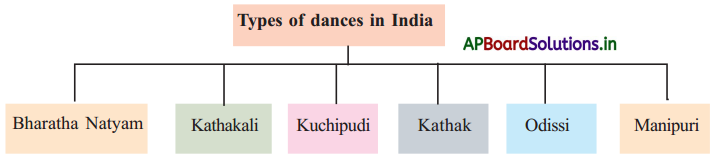
2:00 PM
Dear Mom,
I am really sorry to say that I am unable to buy a sari for you here in Mysore. When I went to a shopping complex, I was amazed because all the shops were closed. Then I enquired of a security personnel and came to know that today is declared a holiday for shops, schools, show rooms etc on the eve of a local festival. I am starting back for our village soon.
Yours,
XXXX