AP Board 6th Class Maths Solutions Chapter 6 Basic Arithmetic Unit Exercise

AP State Syllabus AP Board 6th Class Maths Solutions Chapter 6 Basic Arithmetic Unit Exercise Textbook Questions and Answers.

AP State Syllabus 6th Class Maths Solutions 6th Lesson Basic Arithmetic Unit Exercise

Question 1.
Draw a four sided closed figure and divide it into some number of equal parts. Shade the figure with any colour so that the ratio of shaded parts to unshaded parts is 1 : 3.
Answer:
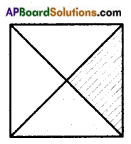
AP Board 6th Class Maths Solutions Chapter 6 Basic Arithmetic Unit Exercise 1
Given ratio of shaded parts: unshaded parts = 1 : 3
Total parts of a closed figure = 1 + 3 = 4
Consider a four sided closed figure square.
Divide it into 4 parts and shade one part.
Now, from the figure, shaded parts : unshaded parts = 1 : 3

AP Board 6th Class Maths Solutions Chapter 6 Basic Arithmetic Unit Exercise

Question 2.
Ramu spent \(\frac{2}{5}\)th of his money on a story book. Find the ratio of money spent to the money with him at present.
Answer:
Given money spent on story book = \(\frac{2}{5}\) th of his money.
That means from total 5 parts of money he spent 2 parts of money on story book. Then, out of 5 parts remaining parts of money with him is 3 parts.
So, ratio of money spent to the money with him at present
= parts of money spent : parts of money at him = 2 : 3

Question 3.
Divide Rs. 72,000 between Kesav and David in the ratio of 5 : 4.
Answer:
Amount to be divided = Rs. 72,000
Ratio of Kesav and David’s Shares = 5 : 4
Total shares = 5 + 4 = 9
Kesav’s share = \(\frac{5}{9}\) of 72000
\(\frac{5}{9}\) × 72,000 = 40,000/-
David’s share = \(\frac{4}{9}\) of 72,000
\(\frac{4}{9}\) × 72,000 = 32,000/-

Question 4.
The income of Kumar for 3 months is Rs. 15,000. If he earns the same amount for a month,
a) How much will he earn in 5 months?
b) In how many months, will he earn Rs. 95,000?
Answer:
Given Kumar’s 3 months income = Rs. 15,000
Kumar’s one month income = 15,000 ÷ 3
= \(\frac{15000}{3}\) = Rs. 5000
a) Kumar’s one month income = Rs. 5000
Kumar’s 5 months income = 5 × 5000 = Rs. 25,000
b) Time taken by Kumar to earn Rs. 5000 = 1 month
Time taken by Kumar to earn Rs. 95,000 = 95,000 ÷ 5000
= \(\frac{15000}{3}\) = 19 months = 1 year 7 months.

AP Board 6th Class Maths Solutions Chapter 6 Basic Arithmetic Unit Exercise

Question 5.
The cost of 16 chairs is Rs. 4,800. Find the number of chairs that can be purchased for Rs. 6,600.
Answer:
Cost of 16 chairs = Rs. 4800
Number of chairs that can be pruchased for Rs. 6600 = x (say)
∴ 16 : 4800 : : x : 6600
So, 16 x 6600 = 4800 x x
x = \(\frac{16 \times 6600}{4800}\) = 22 chairs
(OR)
Given cost of 16 chairs = Rs. 4800
Cost of one chair = 4800 ÷ 16
= \(\frac{4800}{3}\) = Rs. 300
Number of chairs can purchased for Rs. 6600 = 6600 ÷ cost of one chair
= 6600 ÷ 300
= \(\frac{6600}{300}\) = 22 chairs

Question 6.
What percentage of numbers from 1 to 30 has 1 or 9 in the unit’s digit?
Answer:
Total number from 1 to 30 = 30
Numbers ending with 1 or 9 are 1, 9,11, 19, 21, 29 = 6 numbers
Ratio = 6 : 30 = \(\frac{6}{30}\) = \(\frac{1}{5}\)
Percentage = \(\frac{1}{5}\) × 100% = 20%

AP Board 6th Class Maths Solutions Chapter 6 Basic Arithmetic Unit Exercise

Question 7.
In a college, 63% of students are less than 20 years of age. The number of students more than 20 years of age is — of number of students of 20 years of age which is 42. What is the total number of students in the college?
Answer:
Let the total number of students be x.
Then, number of students more than 20 years of age = (100 – 63)% of x
= 37% of x
Then, 37% of x = 42 + \(\frac{2}{3}\) of 48
\(\frac{37}{100}\) × x = 74
∴ x = 74 × \(\frac{100}{37}\) = 200

AP Board 6th Class Maths Solutions Chapter 5 Fractions and Decimals Ex 5.4

AP State Syllabus AP Board 6th Class Maths Solutions Chapter 5 Fractions and Decimals Ex 5.4 Textbook Questions and Answers.

AP State Syllabus 6th Class Maths Solutions 5th Lesson Fractions and Decimals Ex 5.4

Question 1.
Which of the following are unlike decimal fractions ?
i) 5.03, 6.185
ii) 42.7, 7.42
iii) 16.003, 5.301
iv)15.81, 1.36
Answer:
i) 5.03, 6.185
5.3 has 2 decimal places
6.185 has 3 decimal places
Their decimal places are not equal.
So, these decimal fraction are unlike decimal fractions.

ii) 42.7, 7.42
42.7 has one decimal place
7.42 has two decimal places
Their decimal places are not equal.
So, these are unlike decimal fractions.

iii) 16.003, 5.301
16.3 has three decimal places
5.301 has three decimal places
Their decimal places are equal.
So, these are like decimal fractions.

AP Board 6th Class Maths Solutions Chapter 5 Fractions and Decimals Ex 5.4

iv) 15.81, 1.36
15.81 has two decimal places
1.36 has two decimal places
Their decimal places are equal.
So, these are like decimal fractions.

Question 2.
Change the following into like decimal fractions.
i) 0.802, 54.32, 873.274
ii) 4.78, 9.193, 11.3
iii) 16.003, 16.9, 16.19
Answer:
i) 0.802, 54.32, 873.274
Given decimal fractions are 0.802, 54.32, 873.274
The greatest number of decimal places is 3.
So, we convert all of them to equivalent decimals with 3 decimal places by placing sufficient zeroes.
0.802 = 0.802
54.32 = 54.320
873.274 = 873.274
Thus, 0.802, 54.32, 873.274 when converted to like decimals becomes 0.802, 54.320, 873.274.

ii) 4.78, 9.193, 11.3
Given decimal fractions are 4.78, 9.193, 11.3.
So, we convert all of them to equivalent decimals with 3 decimal places.
4.78 = 4.780
9.193 = 9.193
11.3 = 11.300
Thus, 4.78, 9.193, 11.3 when converted to like decimals becomes 4.780, 9.193, 11.300.

iii) 16.003, 16.9, 16.19
Given decimal fractions are 16.003, 16.9, 16.19
So, we convert all of them to equivalent decimals with three decimal places by providing sufficient zeroes.
16.3 = 16.003
16.9 = 16.900
16.19 = 16.190
Thus, 16.003, 16.9, 16.19 when converted to like decimals becomes 16.003, 16.900, 16.190.

AP Board 6th Class Maths Solutions Chapter 5 Fractions and Decimals Ex 5.4

Question 3.
Write the following in ascending order.
a) 7.26, 7.62, 7.2
b) 0.464, 0.644, 0.446, 0.664
c) 30.000, 30.060, 30.30
Answer:
a) 7.26, 7.62, 7.2
Given decimal fractions are 7.26, 7.62, 7.20
First compare the whole numbers.
Here whole numbers are equal. So, compare tenth’s place digits of the decimal fractions.
In 7.26 and 7.20 Tenths places are same.
But 7.62 Tenth place is more than the remaining numbers.
So,7.62 > 7.26 and 7.62 > 7.20
To compare 7.26 and 7.20 we should compare hundredth’s places. Then 7.26 > 7.20
∴ 7.62 > 7.26 > 7.20
(or) 7.20 < 7.26 < 7.62
Ascending order: 7.20; 7.26; 7.62

b) 0.464, 0.644, 0.446, 0.664
Given decimal fractions are 0.464, 0.644, 0.446, 0.664
Then, compare whole numbers.
Here whole numbers are same. Then, compare tenth’s place digits of the decimal fractions.
0.464, 0.446 are less than 0.644 and 0.664.
First make or check the given fraction are all like fractions or not?
Then, compare hundredth’s place digits
∴ 0.464 > 0.446, 0.664 > 0.644
and 0.664 > 0.644 > 0.464 > 0.446
(or) 0.446 < 0.464 < 0.644 < 0.664
Ascending order: 0.446; 0.464; 0.644; 0.664

c) 30.000, 30.060, 30.30
Given decimal fractions are 30.000, 30.060, 30.30
First make or check the given fractions are all like fractions or not?
So, 30.000; 30.060; 30.300 are like fractions.
Then, compare the whole numbers. They are same. So, compare, Tenth’s places of the decimal fractions.
30.300 > 30.060 > 30.000
(or) 30.000 < 30.060 < 30.300
Ascending order: 30.000; 30.060; 30.300

AP Board 6th Class Maths Solutions Chapter 5 Fractions and Decimals Ex 5.4

Question 4.
Arrange these numbers in descending order:
16.96; 16.42; 16.3; 16.03; 16.1; 16.99; 16.01
Answer:
Given decimal fractions are
16.96; 16.42; 16.3; 16.03; 16.1; 16.99; 16.01
First make or check the given fractions are all like fractions or not?
So, 16.96; 16.42; 16.30; 16.03; 16.10; 16.99; 16.01 are like fractions.
Then, compare whole numbers. They are same.
So, compare Tenth’s place digits of the decimal fractions.
16.96 < 16.99; 16.42 > 16.30 > 16.10 > 16.03 > 16.01
Then compare hundredth’s place digits.
So, 16.99 > 16.96 > 16.42 > 16.30 > 16.10 > 16.03 > 16.01 (or)
16.01 < 16.03 < 16.10 < 16.30 < 16.42 < 16.96 < 16.99
Descending order: 16.99; 16.96; 16.42; 16.30; 16.10; 16.03; 16.01.

Question 5.
Fill in the blanks by using appropriate symbols >, < or =.
i) 0.005 …… 0.0005
ii) 4.353 …… 4.2
iii) 58.3 …… 58.30
Answer:
i) 0.005 …… 0.0005
First make like decimal fractions
0.0050 …… 0.0005
By comparing Thousandth’s place digits.
So, 0.0050 > 0.0005

ii) 4.353 …… 4.2
First make like decimal fractions.
4.353 …… 4.200
Compare Tenth’s place digits, if whole numbers are same.
So, 4.353 > 4.200

AP Board 6th Class Maths Solutions Chapter 5 Fractions and Decimals Ex 5.4

iii) 58.3 …… 58.30
First make like decimal fractions.
58.30 …… 58.30
In these whole numbers and decimal place digits are same.
So, 58.30 = 58.30

AP Board 6th Class Maths Solutions Chapter 5 Fractions and Decimals Ex 5.3

AP State Syllabus AP Board 6th Class Maths Solutions Chapter 5 Fractions and Decimals Ex 5.3 Textbook Questions and Answers.

AP State Syllabus 6th Class Maths Solutions 5th Lesson Fractions and Decimals Ex 5.3

Question 1.
Find the reciprocal of each of the following fractions.
i) \(\frac{5}{9}\)
ii) \(\frac{12}{7}\)
iii) 2\(\frac{1}{5}\)
iv) \(\frac{1}{8}\)
v) \(\frac{13}{11}\)
vi) \(\frac{8}{3}\)
Answer:
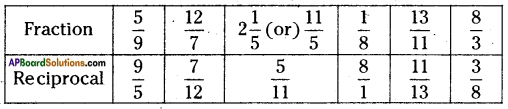
AP Board 6th Class Maths Solutions Chapter 5 Fractions and Decimals Ex 5.3 1
(Reciprocal of a fraction \(\frac{a}{b}\) is \(\frac{b}{a}\)).

AP Board 6th Class Maths Solutions Chapter 5 Fractions and Decimals Ex 5.3

Question 2.
Simplify:
i) 15 ÷ \(\frac{3}{4}\)
ii) 6 ÷ 1\(\frac{4}{7}\)
iii) 3 ÷ 2\(\frac{1}{3}\)
iv) \(\frac{4}{9}\) ÷ 15
v) 4\(\frac{3}{7}\) ÷ 14
Answer:
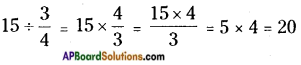
i) 15 ÷ \(\frac{3}{4}\)
While dividing a whole number by a fraction, multiply the whole number with the reciprocal of the fraction.
Thus,
AP Board 6th Class Maths Solutions Chapter 5 Fractions and Decimals Ex 5.3 2

ii) 6 ÷ 1\(\frac{4}{7}\)
While dividing a whole number by a mixed fraction, first convert the mixed fraction into improper fraction and then multiply the whole number with the recipro¬cal of the improper fraction.
Thus,
AP Board 6th Class Maths Solutions Chapter 5 Fractions and Decimals Ex 5.3 3

iii) 3 ÷ 2\(\frac{1}{3}\)
While dividing a whole number by a mixed fraction, first convert the mixed fraction into improper fraction and then multiply the whole number with the reciprocal of the improper fraction.
Thus,
AP Board 6th Class Maths Solutions Chapter 5 Fractions and Decimals Ex 5.3 4

AP Board 6th Class Maths Solutions Chapter 5 Fractions and Decimals Ex 5.3

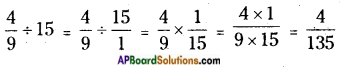
iv) \(\frac{4}{9}\) ÷ 15
While dividing a proper fraction by a whole number, multiply the proper fraction with the reciprocal of a whole number.
Thus,
AP Board 6th Class Maths Solutions Chapter 5 Fractions and Decimals Ex 5.3 5

v) 4\(\frac{3}{7}\) ÷ 14
While dividing mixed fraction by a whole number first convert the mixed fraction into improper fraction and then multiply the improper fraction with the reciprocal of a whole number.
Thus,
AP Board 6th Class Maths Solutions Chapter 5 Fractions and Decimals Ex 5.3 6

Question 3.
Find:
i) \(\frac{4}{9}\) ÷ \(\frac{2}{3}\)
ii) \(\frac{4}{11}\) ÷ \(\frac{8}{11}\)
iii) 2\(\frac{1}{3}\) ÷ \(\frac{3}{5}\)
iv) 5\(\frac{4}{7}\) ÷ 1\(\frac{3}{10}\)
Answer:
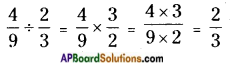
i) \(\frac{4}{9}\) ÷ \(\frac{2}{3}\)
While dividing a proper fraction by a proper fraction, multiply the proper fraction with the reciprocal of the fraction.
Thus,
AP Board 6th Class Maths Solutions Chapter 5 Fractions and Decimals Ex 5.3 7

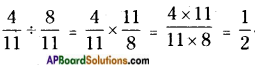
ii) \(\frac{4}{11}\) ÷ \(\frac{8}{11}\)
While dividing a proper fraction by a proper fraction, multiply the proper fraction with the reciprocal of the fraction.
Thus,
AP Board 6th Class Maths Solutions Chapter 5 Fractions and Decimals Ex 5.3 8

iii) 2\(\frac{1}{3}\) ÷ \(\frac{3}{5}\)
While dividing a mixed fraction by a proper fraction, first convert the mixed fraction into improper fraction, then multiply it with the reciprocal of the proper fraction.
Thus,
AP Board 6th Class Maths Solutions Chapter 5 Fractions and Decimals Ex 5.3 9

AP Board 6th Class Maths Solutions Chapter 5 Fractions and Decimals Ex 5.3

iv) 5\(\frac{4}{7}\) ÷ 1\(\frac{3}{10}\)
While dividing a mixed fraction by a mixed fraction first convert the two mixed fraction into improper fraction, then multiply the improper fraction with the reciprocal of the second improper fraction.
Thus,
AP Board 6th Class Maths Solutions Chapter 5 Fractions and Decimals Ex 5.3 10

Question 4.
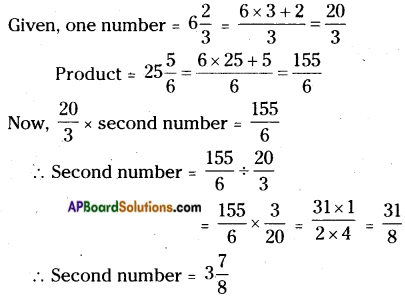
The product of two numbers is 25\(\frac{5}{6}\). If one of the number is 6\(\frac{2}{3}\). Find the other.
Answer:
AP Board 6th Class Maths Solutions Chapter 5 Fractions and Decimals Ex 5.3 11

Question 5.
By what number should 9\(\frac{3}{4}\) be multiplied to get 5\(\frac{2}{3}\)?
Answer:
Given one number = 9\(\frac{3}{4}\) = \(\frac{39}{4}\)
Product = 5\(\frac{2}{3}\) = \(\frac{17}{3}\)
\(\frac{39}{4}\) × Required Number = \(\frac{17}{3}\)
Required Number = \(\frac{17}{3}\) ÷ \(\frac{39}{4}\)
= \(\frac{17}{3}\) × \(\frac{4}{39}\)
= \(\frac{17 \times 4}{3 \times 39}\)
= \(\frac{68}{117}\)
Number to be multiplied = \(\frac{68}{117}\)

Question 6.
A bucket contains 34\(\frac{1}{2}\) litres of water. How many times do you get 1\(\frac{1}{2}\) litres of water?
Answer:
Capacity of Bucket = 34\(\frac{1}{2}\) litres = \(\frac{69}{2}\) litres
Capacity required = 1\(\frac{1}{2}\) = \(\frac{2 \times 1+1}{2}\) =\(\frac{3}{2}\)
Number of times we get = \(\frac{69}{2}\) ÷ \(\frac{3}{2}\) = \(\frac{69}{2}\) × \(\frac{2}{3}\) = 23 times.

AP Board 6th Class Maths Solutions Chapter 5 Fractions and Decimals Ex 5.3

Question 7.
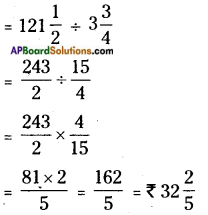
The cost of 3\(\frac{3}{4}\) kg. of sugar is Rs. 121\(\frac{1}{2}\). Find its cost per 1 kg.
Answer:
Cost of 3\(\frac{3}{4}\) kg of sugar = Rs. 121\(\frac{1}{2}\)
Cost of 1kg of sugar
AP Board 6th Class Maths Solutions Chapter 5 Fractions and Decimals Ex 5.3 12
Cost of 1kg of sugar = Rs. 32.40.

Question 8.
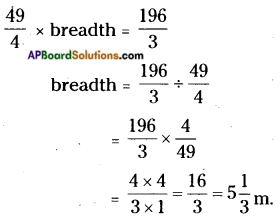
The length of a rectangular field is 12\(\frac{1}{4}\) m. and its area is 65\(\frac{1}{3}\)m2. Find its breadth.
Answer:
Length of a rectangular field = 12\(\frac{1}{4}\) = \(\frac{49}{4}\) m
Breadth of a rectangular field = ?
Area of a rectangular field = 65\(\frac{1}{3}\) = \(\frac{196}{3}\) sq.m
length × breadth = Area of a rectangular
AP Board 6th Class Maths Solutions Chapter 5 Fractions and Decimals Ex 5.3 13
∴ Breadth of a rectangular field = 5\(\frac{1}{3}\) m.

AP Board 6th Class Maths Solutions Chapter 5 Fractions and Decimals Ex 5.1

AP State Syllabus AP Board 6th Class Maths Solutions Chapter 5 Fractions and Decimals Ex 5.1 Textbook Questions and Answers.

AP State Syllabus 6th Class Maths Solutions 5th Lesson Fractions and Decimals Ex 5.1

Question 1.
Classify the fractions as proper, improper and mixed.
\(\frac{3}{4}\), \(\frac{6}{5}\), \(\frac{3}{2}\),\(\frac{4}{1}\), \(\frac{2}{3}\), \(\frac{1}{4}\), \(\frac{18}{13}\), 1\(\frac{5}{7}\),\(\frac{1}{3}\), 11\(\frac{1}{2}\)
Answer:
If in a fraction numerator is less than the denominator, then it is called a proper fraction.
Proper fractions are \(\frac{3}{4}\), \(\frac{2}{3}\), \(\frac{1}{4}\), \(\frac{1}{3}\)
If in a fraction numerator is greater than the denominator, then it is called an improper fraction.
Improper fractions are \(\frac{6}{5}\), \(\frac{3}{2}\), \(\frac{4}{1}\), \(\frac{18}{13}\)
A combination of a whole number and a proper fraction is called a mixed fraction.
Mixed fractions are 1\(\frac{5}{7}\), 11\(\frac{1}{2}\)

AP Board 6th Class Maths Solutions Chapter 5 Fractions and Decimals Ex 5.1

Question 2.
Write the following fractions in an ascending order.
i) \(\frac{3}{4}\), \(\frac{3}{2}\), \(\frac{2}{3}\), \(\frac{1}{5}\), \(\frac{18}{7}\)
ii) \(\frac{2}{7}\), \(\frac{3}{8}\), \(\frac{3}{4}\), \(\frac{5}{7}\), \(\frac{4}{9}\)
Answer:
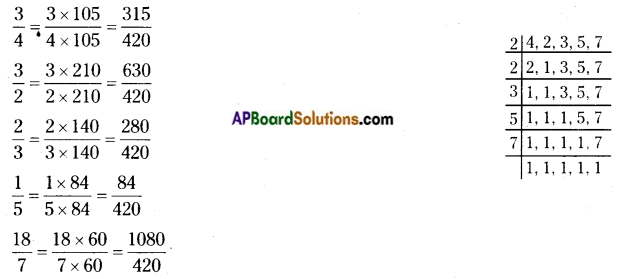
Given fractions are \(\frac{3}{4}\), \(\frac{3}{2}\), \(\frac{2}{3}\), \(\frac{1}{5}\), \(\frac{18}{7}\)
These are unlike fractions.
To arrange the unlike fractions in ascending order / descending order first we have to convert them into equivalent fractions with LCM of their denominators, then compare the like fractions (i.e.,) we convert them to like fractions.
LCM of Denominators = 2 × 2 × 3 × 5 × 7 = 420
AP Board 6th Class Maths Solutions Chapter 5 Fractions and Decimals Ex 5.1 1
\(\frac{315}{420}\), \(\frac{630}{420}\), \(\frac{280}{420}\), \(\frac{84}{420}\), \(\frac{1080}{420}\)
These are like fractions. Now, we can compare them.
\(\frac{84}{420}\)< \(\frac{280}{420}\) < \(\frac{315}{420}\) < \(\frac{630}{420}\) < \(\frac{1080}{420}\)
i.e, \(\frac{1}{5}\) < \(\frac{2}{3}\) < \(\frac{3}{4}\) < \(\frac{3}{2}\) < \(\frac{18}{7}\)
∴ Ascending order: \(\frac{1}{5}\), \(\frac{2}{3}\), \(\frac{3}{4}\), \(\frac{3}{2}\), \(\frac{18}{7}\)
Descending order: \(\frac{18}{7}\), \(\frac{3}{2}\), \(\frac{3}{4}\), \(\frac{2}{3}\), \(\frac{1}{5}\)

AP Board 6th Class Maths Solutions Chapter 5 Fractions and Decimals Ex 5.1

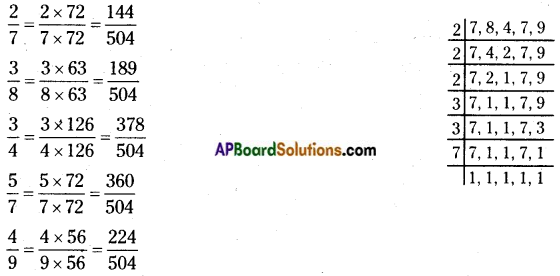
ii) \(\frac{2}{7}\), \(\frac{3}{8}\), \(\frac{3}{4}\), \(\frac{5}{7}\), \(\frac{4}{9}\)
These are unlike fractions.
To arrange the unlike fractions in ascending order / descending order first we have to convert them into equivalent fractions with LCM of their denominators. Then compare the like fractions (i.e.,) we convert them to like fractions.
LCM of denominators = 2 × 2 × 2 × 3 × 3 × 7 = 504
AP Board 6th Class Maths Solutions Chapter 5 Fractions and Decimals Ex 5.1 2
\(\frac{144}{504}\), \(\frac{189}{504}\), \(\frac{378}{504}\), \(\frac{360}{504}\), \(\frac{224}{504}\)
These are like fractions. Now, we can compare them.
\(\frac{144}{504}\) < \(\frac{189}{504}\) < \(\frac{224}{504}\) < \(\frac{360}{504}\) < \(\frac{1080}{420}\)
i.e, \(\frac{2}{7}\) < \(\frac{3}{8}\) < \(\frac{4}{9}\) < \(\frac{5}{7}\) < \(\frac{3}{4}\)
∴ Ascending order: \(\frac{2}{7}\), \(\frac{3}{8}\), \(\frac{4}{9}\), \(\frac{5}{7}\), \(\frac{3}{4}\)
Descending order: \(\frac{3}{4}\), \(\frac{5}{7}\), \(\frac{4}{9}\), \(\frac{3}{8}\), \(\frac{2}{7}\)

AP Board 6th Class Maths Solutions Chapter 5 Fractions and Decimals Ex 5.1

Question 3.
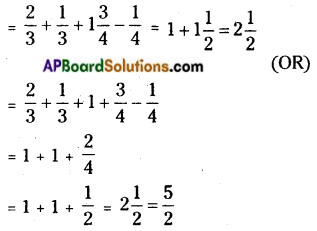
Without doing calculation, find the result \(\frac{2}{3}\) + 1\(\frac{3}{4}\) + \(\frac{1}{3}\) – \(\frac{1}{4}\)
Answer:
Given \(\frac{2}{3}\) + 1\(\frac{3}{4}\) + \(\frac{1}{3}\) – \(\frac{1}{4}\)
AP Board 6th Class Maths Solutions Chapter 5 Fractions and Decimals Ex 5.1 3

Question 4.
Neha bought a cake. She ate \(\frac{7}{15}\) th of the cake immediately add in the afternoon she ate the remaining part. How much part die ate in the afternoon ?
Answer:
Whole cake = 1 = \(\frac{15}{15}\)
Neha divided the cake into 15 parts.
Part of a cake eaten by Neha = \(\frac{7}{15}\)
Remaining part of cake = Whole – eaten part immediately
= \(\frac{1}{1}\) – \(\frac{7}{15}\)
= \(\frac{15}{15}\) – \(\frac{7}{15}\)
= \(\frac{15-7}{15}\)
= \(\frac{8}{15}\)
∴ Part of a cake eaten by Neha in the afternoon = \(\frac{8}{15}\)

AP Board 6th Class Maths Solutions Chapter 5 Fractions and Decimals Ex 5.1

Question 5.
Simplify:
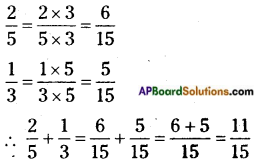
i) \(\frac{2}{5}\) + \(\frac{1}{3}\)
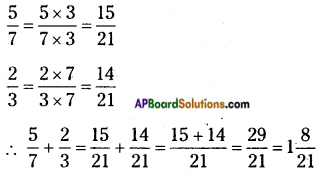
ii) \(\frac{5}{7}\) + \(\frac{2}{3}\)
iii) \(\frac{3}{5}\) – \(\frac{7}{20}\)
iv) \(\frac{17}{20}\) – \(\frac{13}{25}\)
Answer:
i) \(\frac{2}{5}\) + \(\frac{1}{3}\)
LCM of denominators = 3 × 5 = 15
AP Board 6th Class Maths Solutions Chapter 5 Fractions and Decimals Ex 5.1 5
AP Board 6th Class Maths Solutions Chapter 5 Fractions and Decimals Ex 5.1 4

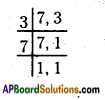
ii) \(\frac{5}{7}\) + \(\frac{2}{3}\)
LCM of denominators = 7 × 3 = 21
AP Board 6th Class Maths Solutions Chapter 5 Fractions and Decimals Ex 5.1 7
AP Board 6th Class Maths Solutions Chapter 5 Fractions and Decimals Ex 5.1 6

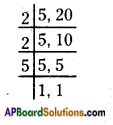
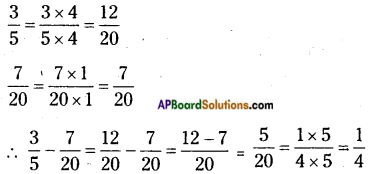
iii) \(\frac{3}{5}\) – \(\frac{7}{20}\)
LCM of denominators = 2 × 2 × 5 = 20
AP Board 6th Class Maths Solutions Chapter 5 Fractions and Decimals Ex 5.1 9
AP Board 6th Class Maths Solutions Chapter 5 Fractions and Decimals Ex 5.1 8

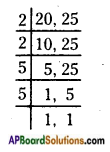
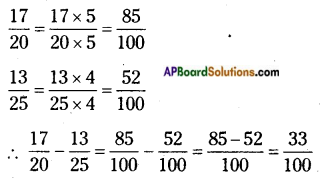
iv) \(\frac{17}{20}\) – \(\frac{13}{25}\)
LCM of denominators = 2 × 2 × 5 × 5 = 100
AP Board 6th Class Maths Solutions Chapter 5 Fractions and Decimals Ex 5.1 11
AP Board 6th Class Maths Solutions Chapter 5 Fractions and Decimals Ex 5.1 10

AP Board 6th Class Maths Solutions Chapter 5 Fractions and Decimals Ex 5.1

Question 6.
Represent \(\frac{16}{5}\) pictorially
Answer:
Given fraction is \(\frac{16}{5}\) (Improper fraction)
\(\frac{16}{5}\) = Mixed fraction is 3\(\frac{1}{5}\)
AP Board 6th Class Maths Solutions Chapter 5 Fractions and Decimals Ex 5.1 12
3 + \(\frac{1}{5}\) = 3\(\frac{1}{5}\)

AP Board 6th Class Maths Solutions Chapter 5 Fractions and Decimals Ex 5.2

AP State Syllabus AP Board 6th Class Maths Solutions Chapter 5 Fractions and Decimals Ex 5.2 Textbook Questions and Answers.

AP State Syllabus 6th Class Maths Solutions 5th Lesson Fractions and Decimals Ex 5.2

Question 1.
Find the product of the following.
i) 3 × \(\frac{5}{12}\)
ii) \(\frac{15}{8}\) × 12
iii) 1\(\frac{3}{4}\) × \(\frac{12}{21}\)
iv) \(\frac{4}{5}\) × \(\frac{12}{7}\)
Answer:
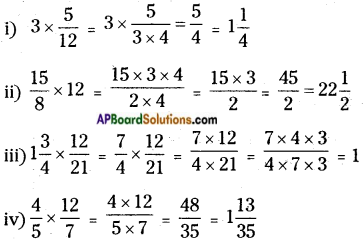
AP Board 6th Class Maths Solutions Chapter 5 Fractions and Decimals Ex 5.2 1

AP Board 6th Class Maths Solutions Chapter 5 Fractions and Decimals Ex 5.2

Question 2.
Which is greater?
i) \(\frac{1}{2}\) of \(\frac{6}{7}\) or \(\frac{2}{3}\) of \(\frac{3}{7}\)
ii) \(\frac{2}{7}\) of \(\frac{3}{4}\) or \(\frac{3}{5}\) of \(\frac{5}{8}\)
Answer:
i) \(\frac{1}{2}\) of \(\frac{6}{7}\) or \(\frac{2}{3}\) of \(\frac{3}{7}\)
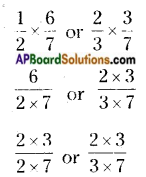
AP Board 6th Class Maths Solutions Chapter 5 Fractions and Decimals Ex 5.2 2
\(\frac{3}{7}\) or \(\frac{2}{7}\)
So, \(\frac{3}{7}\) > \(\frac{2}{7}\)
∴ \(\frac{1}{2}\) of \(\frac{6}{7}\) > \(\frac{2}{3}\) of \(\frac{3}{7}\)

ii) \(\frac{2}{7}\) of \(\frac{3}{4}\) or \(\frac{3}{5}\) of \(\frac{5}{8}\)
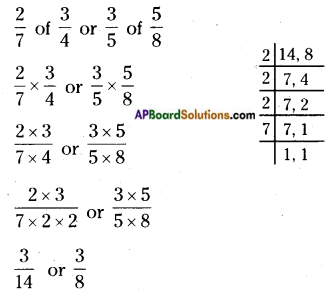
AP Board 6th Class Maths Solutions Chapter 5 Fractions and Decimals Ex 5.2 3
Convert them into like fractions
LCM of denominators = 2 × 2 × 2 × 7 = 56
\(\frac{3 \times 4}{14 \times 4}\) or \(\frac{3 \times 7}{8 \times 7}\)
\(\frac{12}{56}\) or \(\frac{21}{56}\)
So, \(\frac{12}{56}\) < \(\frac{21}{56}\)
∴ \(\frac{2}{7}\) of \(\frac{3}{4}\) < \(\frac{3}{5}\) of \(\frac{5}{8}\)

AP Board 6th Class Maths Solutions Chapter 5 Fractions and Decimals Ex 5.2

Question 3.
Find:
i) \(\frac{7}{11}\) of 330
ii) \(\frac{5}{9}\) of 108
iii) \(\frac{2}{7}\) of 16
iv) \(\frac{1}{7}\) of \(\frac{3}{10}\)
Answer:
i) \(\frac{7}{11}\) of 330
= \(\frac{7}{11}\) × 330
= \(\frac{7}{11}\) × 11 × 30
= 7 × 30 = 210

ii) \(\frac{5}{9}\) of 108
= \(\frac{5}{9}\) × 108
= \(\frac{5}{9}\) × 9 × 12
= 5 × 12 = 60

iii) \(\frac{2}{7}\) of 16
= \(\frac{2}{7}\) × 16
= \(\frac{2×16}{7}\)
= \(\frac{32}{7}\) or 4\(\frac{4}{7}\)

iv) \(\frac{1}{7}\) of \(\frac{3}{10}\)
= \(\frac{1}{7}\) × \(\frac{3}{10}\)
= \(\frac{1 \times 3}{7 \times 10}\)
= \(\frac{3}{70}\)

Question 4.
If the cost of a notebook is Rs. 10\(\frac{3}{4}\). Then, find the cost of 36 books.
Answer:
Cost of each notebook = Rs. 10\(\frac{3}{4}\) (or) \(\frac{43}{4}\)
Cost of 36 notebooks = 36 × 10\(\frac{3}{4}\) = 36 × \(\frac{43}{4}\) = \(\frac{9 \times 4 \times 43}{4}\) = 9 × 43
Cost of 36 notebooks = Rs. 387

AP Board 6th Class Maths Solutions Chapter 5 Fractions and Decimals Ex 5.2

Question 5.
A motor bike runs 52\(\frac{1}{2}\) km using 1 litre of petrol. How much distance will it cover for 2\(\frac{3}{4}\) litres of petrol ?
Answer:
Distance covered by the motor bike 1 litre petrol = 52\(\frac{1}{2}\) km (or) \(\frac{105}{2}\) km
Distance covered by the motor bike for 2\(\frac{3}{4}\) litres of petrol = 2\(\frac{3}{4}\) of 52\(\frac{1}{2}\)
= \(\frac{11}{4}\) × \(\frac{105}{2}\)
= \(\frac{11 \times 105}{4 \times 2}\)
∴ Distance covered by the motor bike for 2\(\frac{3}{4}\) litres of petrol = \(\frac{1155}{8}\) = 144\(\frac{3}{8}\) km.

AP Board 8th Class Biology Solutions Chapter 10 పీల్చలేము – తాగలేము

SCERT AP 8th Class Biology Study Material Pdf 10th Lesson పీల్చలేము – తాగలేము Textbook Questions and Answers.

AP State Syllabus 8th Class Biology 10th Lesson Questions and Answers పీల్చలేము – తాగలేము

8th Class Biology 10th Lesson పీల్చలేము – తాగలేము Textbook Questions and Answers

అభ్యసనాన్ని మెరుగుపరచుకుందాం

ప్రశ్న 1.
గాలి కాలుష్యం నీటి కాలుష్యానికి ఏ విధంగా దారితీస్తుంది ?
జవాబు:
గాలికాలుష్యం నీటి కాలుష్యానికి ఈ క్రింది విధంగా దారితీయును.
1. గాలిలో సల్ఫర్ డై ఆక్సైడ్, నైట్రోజన్ డై ఆక్సెడ్ నీటి ఆవిరిలో కరిగి ఆమ్లాలుగా మారి వర్షం పడినపుడు నీటిలో ఆమ్లం 2. గుణం తెచ్చును.
2. గాలిలో ఉన్న CO2 గ్లోబల్ వార్మింగ్ వలన నీటి ఉష్ణోగ్రత పెరిగి నీటిలో ఆక్సిజన్ శాతం తగ్గి నీటి కాలుష్యం జరుగును.

AP Board 8th Class Biology Solutions Chapter 10 పీల్చలేము - తాగలేము

ప్రశ్న 2.
“పారదర్శకంగా మరియు స్వచ్ఛంగా కనిపించే నీరు త్రాగుటకు అన్నివిధాలా సరిపోతుంది” దానిపై మీ అభిప్రాయంను తెలియచేయండి.
జవాబు:

  1. పారదర్శకంగా మరియు స్వచ్చంగా కనిపించే నీరు త్రాగుటకు అన్నివిధాలా సరిపోదు.
  2. కారణం దానిలో కంటికి కనిపించని సూక్ష్మజీవులు అయిన వైరస్లు, బాక్టీరియాలు, ప్రోటోజోవాలు ఉండవచ్చు.
  3. అంతేకాక నీటి కలుషితాలు కూడా ఉండవచ్చు.

ప్రశ్న 3.
తాజ్ మహల్ వంటి చారిత్రక కట్టడం గాలి కాలుష్య ప్రభావానికి లోనవుతుంది. దానిని రక్షించటానికి నీవు ఇచ్చే సలహాలు ఏమిటి ?
జవాబు:
తాజ్ మహల్ వంటి చారిత్రక కట్టడం గాలి కాలుష్యం నుండి రక్షించడానికి నేను ఇచ్చే సలహాలు :

  1. మోటారు సైకిలు, కార్లు బదులు ఆ ప్రాంతంలో సైకిళ్ళు, గుర్రపు బండ్లు వాడాలి.
  2. వాహనాలలో కాలుష్యం తక్కువ వెదజల్లే CNG, LPG ల వంటి ఇంధనాలు వాడాలి.
  3. సౌరశక్తిని విద్యుత్ శక్తిగా మార్చి దానితో నడిచే వాహనాలను ప్రోత్సహించాలి.
  4. తాజ్ మహల్ పరిసరాలలో సీసం లేని పెట్రోల్ ఉపయోగించే వాహనాలనే వాడాలి.
  5. కాలుష్యాన్ని కలిగించే పరిశ్రమలను ఆగ్రా నగరానికి దూరంగా తరలించాలి
  6. ఆగ్రా నగర చుట్టుప్రక్కల చెట్లు బాగా పెంచాలి.

ప్రశ్న 4.
గాలి కాలుష్యం, నీటి కాలుష్యం నియంత్రించుటకు తీసుకోదగిన చర్యలు ఏవి ?
జవాబు:

  1. గాలి కాలుష్యాన్ని తగ్గించడానికి ఫ్యాక్టరీల మీద పొడవైన చిమ్నీలు ఏర్పాటుచేయాలి.
  2. ఇంటిలో గాని, పరిశ్రమలోగాని ఇంధనాలను పూర్తిగా మండించే పరికరాలను ఉపయోగించాలి.
  3. ఎలక్ట్రోస్టాటిక్ ప్రెసిపిటేటర్స్ (Electrostatic precipitaters) పరిశ్రమల చిమ్నీలలో ఏర్పాటుచేయాలి.
  4. వాహనాల నుండి వెలువడే వాయు కాలుష్యాన్ని తగ్గించడానికి సి.ఎన్.జి (Compressed Natural Gas) ని వాడాలి.
  5. ఇంటిలో వంటకు ఎల్.పి.జి (Liquid Petroleum Gas) ఉపయోగించాలి.
  6. వాహనాలలో వాడే ఇంధనాలు నాణ్యత కలిగి ఉండాలి.
  7. పునరుద్దరింపదగిన శక్తి వనరులైన సౌరశక్తి, పవన శక్తి, అలల శక్తి, జలవిద్యుత్ ను ఉపయోగించాలి.
  8. కాలుష్య నియంత్రణ నియమాల ప్రకారం అన్ని వాహనాలు తప్పకుండా క్రమపద్ధతిలో నిర్వహించాలి.
  9. సీసం లేని పెట్రోల్‌ను ఉపయోగించాలి.
  10. మీ చుట్టూ ఉన్న ఖాళీ ప్రదేశాలలో వీలైనన్ని ఎక్కువ చెట్లను పెంచాలి.

నీటి కాలుష్యం నియంత్రించుటకు తీసుకోదగిన చర్యలు :

  1. పరిశ్రమల నుండి విడుదల అయ్యే వ్యర్థ పదార్థములను రసాయనికంగా శుద్ధి చేయడం లేదా హానికరమైన దార్థములను లేకుండా చేసి నదులలోనికి, సరస్సులలోనికి విడుదల చేయడం.
  2. మురుగునీరు ప్రత్యక్షంగా నదులలోనికి విడుదల చేయకూడదు. ముందుగా శుద్ధి చేసే ప్లాంట్ లో శుద్ధిచేసి వాటిలో ఉండే ఆర్గానిక్ పదార్థాలను తీసివేయాలి.
  3. ఎరువులను, పురుగులను చంపే మందులను ఎక్కువ ఉపయోగించడం తగ్గించాలి.
  4. సింథటిక్ డిటర్జెంట్ల వినియోగం తగ్గించాలి. నీటిలో, నేలలో కలిసిపోయే డిటర్జెంట్లు ఉపయోగించాలి.
  5. చనిపోయిన మానవుల శవాలను మరియు జంతు కళేబరాలను నదులలోనికి విసిరివేయరాదు.
  6. వ్యర్థ పదార్థాలను, జంతువుల విసర్జితాలను బయోగ్యాస్ ప్లాంట్ లో ఇంధనం కోసం ఉపయోగించిన తర్వాత ఎరువుగా వాడుకోవాలి.
  7. నదులు, చెరువులు, కుంటలు, సరస్సులలోని నీరు తప్పకుండా శుభ్రం చేయాలి. ఈ విధానాన్ని పరిశ్రమల యాజమాన్యాలు మరియు ప్రభుత్వం వారు తప్పకుండా చేపట్టాలి. ఉదాహరణకు భారత ప్రభుత్వం వారిచే నిర్వహించబడిన గంగానది ప్రక్షాళన పథకం.
  8. నదుల తీరం వెంబడి చెట్లు, పొదలు తప్పకుండా పెంచాలి.
  9. నీరు కాలుష్యం కాకుండా జాగ్రత్తలు తీసుకోవడం నీటి కాలుష్యం వల్ల కలిగే నష్టాల పట్ల అవగాహన కార్యక్రమాలు తప్పకుండా చేపట్టాలి. ముఖ్యంగా ప్లాస్టిక్, వ్యర్థాలు, కాగితాలు, వ్యర్థ ఆహారపదార్థాలు, మురిగిపోయిన ఆహారపదార్థాలు, . కూరగాయలు మొదలైన వాటిని వీధిలోకి విసిరివేయకుండా చూడాలి.
  10. కాలుష్యాన్ని తగ్గించుటకు 4R (Recycle, Reuse, Recover, Reduce) నియమాలను అమలుపరచి వనరులను పునరుద్ధరించాలి.
  11. తరిగిపోయే ఇంధనాలను ఉపయోగించడం చాలావరకు తగ్గించాలి. ప్రత్యామ్నాయ శక్తి వనరులను వాతావరణానికి హానికరం కాకుండా ఉపయోగించాలి.
  12. ప్రాథమిక ఉద్దేశంతో పదార్థాలను ఉపయోగించినపుడు వాటిలో కొన్నింటిని రెండవసారి కూడా ఉపయోగించాలి (తిరిగివాడుకోవడం).
  13. ఉదా : తెల్ల కాగితానికి ఒకవైపు ప్రింట్ తీసుకోవడం, ఒకే వైపు రాయడం కాకుండా రెండవవైపును కూడా ఉపయోగించినట్లయితే ఎక్కువ కాగితాలు వృథాకాకుండా చూడవచ్చు. ఈ విధంగా చేసినట్లయితే కాగితం కోసం ఎక్కువ చెట్లు నరకడం తగ్గిపోతుంది.
  14. వీలైనన్ని ఎక్కువ పదార్థాలు తిరిగి వినియోగించుకోవడానికి వీలుగా నష్టం జరగనంత వరకు చేస్తూనే ఉండాలి.

AP Board 8th Class Biology Solutions Chapter 10 పీల్చలేము - తాగలేము

ప్రశ్న 5.
నీటిలో పోషకాల స్థాయి పెరగటం వలన నీటి జీవుల మనుగడపై ఏవిధంగా ప్రభావం చూపుతుంది ?
జవాబు:
నీటిలో పోషకాల స్థాయి పెరగడం వలన శైవలాలు, కలుపు మొక్కలు మరియు బాక్టీరియాలు విస్తరించును. నీరు చివరకు ఆకుపచ్చగా, మురికిగా వాసనపట్టిన పెట్టుగా తయారవుతుంది. నీటిలో కుళ్లుతున్న మొక్కలు ఆక్సిజనన్ను ఉపయోగించు కొంటాయి. నీటి జీవులకు సరిపడు ఆక్సిజన్ అందక చివరకు అవి మరణించును. జీవవైవిధ్యం తగ్గును.

ప్రశ్న 6.
రోడ్డుకు ఇరువైపులా ఉన్న మొక్కలు సక్రమంగా పెరగవు. కారణాలు కనుగొని, మీ వాదనను వివరించండి.
జవాబు:

  1. ఎక్కువ వాహనాలు రోడ్డుపై తిరుగుతాయి. వాహనాల నుండి విడుదలగు కాలుష్య పదార్థాలు మొక్కల పెరుగుదల తగ్గిస్తాయి.
  2. జనం ఎక్కువగా ఉండటం వలన పచ్చిగా ఉన్నప్పుడే చెట్లను తుంపుతారు.
  3. మొక్కల ఆకులపై కాలుష్య పదార్థాలు చేరి కిరణజన్య సంయోగక్రియ జరుగుటకు ఆటంకము ఏర్పడును మరియు బాష్పోత్సేకపు రేటు తగ్గును.
  4. హైడ్రోకార్బనులు ఆకులు రాలుటకు సహాయపడును మరియు మొక్కల అనేక భాగాల రంగును కోల్పోయేలా చేయును.
  5. రాత్రిపూట రోడ్లపై ఉన్న ప్రదేశాలలో కార్బన్ డై ఆక్సైడ్ ఎక్కువగా ఉండును. మొక్కలకు రాత్రి సమయంలో సరిపడు ఆక్సిజన్ కూడా అందక పెరుగుదల తక్కువగా ఉండును.
  6. వాటికి నీటి సదుపాయం కూడా సరిగా ఉండకపోవడం వల్ల పెరుగుదల సక్రమంగా ఉండదు.

ప్రశ్న 7.
రసాయనిక పరిశ్రమలో నీవు జనరల్ మేనేజర్ గా ఉంటే నీవు గాలి మరియు నీరు కాలుష్యం కాకుండా తీసుకొను చర్యలు మరియు ముందు జాగ్రత్తలు ఏమి ?
జవాబు:
గాలి మరియు నీరు కాలుష్యం కాకుండా తీసుకొను చర్యలు:

  1. గాలిలో తేలియాడే రేణువులను తొలగించుట స్థిర విద్యుత్ అవక్షేపాలను ఉపయోగించటం చేస్తాను.
  2. లెడ్ లేని పెట్రోల్ ను వాహనాలకు ఉపయోగిస్తాను.
  3. చెట్లను బాగా పెంచుతాను.
  4. మురుగు నీరు నదులలోకి, చెరువులలోకి కలవకుండా చూస్తాను.
  5. ఒకవేళ కలిసే పరిస్థితి వస్తే దానిలోని హానికారక పదార్థాలు తొలగిస్తాను.
  6. పరిశ్రమ నుంచి వచ్చే వేడినీటిని కూలింగ్ టవర్స్ లో చల్లబరచి విడుదల చేస్తాను.

గాలి మరియు నీరు కలుషితం కాకుండా ముందు జాగ్రత్తలు :

  1. విద్యుత్ దుర్వినియోగం లేకుండా ఉంచుతాను. దీని వలన విద్యుత్ ఆదా అగును. అందువలన థర్మల్, అణు విద్యుత్ తయారీ వలన వచ్చే కాలుష్యం తగ్గించవచ్చును.
  2. అందరూ పబ్లిక్ ట్రాన్స్పర్ట్ ఉపయోగించేలా చేస్తాను. దీని వలన చాలా కార్లు మరియు బైకులు ఇతర వాహనాల వినియోగం తగ్గి వాయు కాలుష్యం తగ్గును.
  3. పరిశ్రమలో ఉన్న అంతా సామగ్రి చక్కని నిర్వహణలో ఉంచుతాను. దీని వలన అన్ని యంత్రాలు చక్కగా పనిచేయును. అందువలన కాలుష్య పదార్థాలు గాలిలోకి, నీటిలోకి విడుదల అవ్వవు.

AP Board 8th Class Biology Solutions Chapter 10 పీల్చలేము - తాగలేము

ప్రశ్న 8.
కింది అంశంపై చర్చించండి. కార్బన్ డయాక్సెడ్ కాలుష్యకారకమా ? కాదా ?
జవాబు:
కార్బన్ డై ఆక్సైడ్ వాతావరణంలో 0.03% ఉంటే కాలుష్య కారకము కాదు. కార్బన్ డై ఆక్సైడ్ వాతావరణంలో 0.03% కంటే ఎక్కువ ఉంటే కాలుష్య కారకం అంటారు. కారణం కారకం చేరిక వలన వాతావరణంలో సజీవ, నిర్జీవ అంశాలలో వచ్చే మార్పులను కాలుష్యం అంటారు. కాలుష్యం కలుగజేయు కారకాలను కలుషితాలు అంటారు. CO2 వాతావరణంలో 0.03% కంటే ఎక్కువ ఉంటే భూమి ఉష్ణోగ్రత పెరుగును.

అప్పుడు గ్లోబల్ వార్మింగ్ వచ్చును. CO2 వలన మానవులకు అలసట, చికాకు కలుగును. గ్లోబల్ వార్మింగ్ వలన ధృవ ప్రాంతాలలో మంచు కరిగి భూమిపై పల్లపు ప్రాంతాలను ముంచును. వాతావరణంలో ఏ వాయువు కాని, పదార్థము కాని ఉండవలసిన దానికంటే ఎక్కువ ఉంటే అది కాలుష్య కారకమే.

ప్రశ్న 9.
గాలి, నీరు కాలుష్యంపై క్విజ్ ప్రోగ్రామ్ ను నిర్వహించటానికి ఆలోచన రేకెత్తించే 5 ప్రశ్నలు తయారుచేయండి.
జవాబు:

  1. హీమోగ్లోబిన్ ఆక్సిజన్ కంటే దేనిని తొందరగా అంటిపెట్టుకొనును ?
  2. C.N.G అనగా నేమి?
  3. యూట్రాఫికేషన్ అనేది ఏ కాలుష్యంలో వింటాము ?
  4. ఆమ్ల వర్షమునకు కారణమైన వాయువులు ఏవి ?
  5. భారత పురావస్తుశాఖ ‘నో డ్రైవ్ జోన్”గా ఎక్కడ ప్రకటించినది ?
    గమనిక : ఇంకా చాలా ప్రశ్నలు టీచర్స్ పిల్లల చేత తయారు చేయించవచ్చును.

ప్రశ్న 10.
నీకు దగ్గరలో ఉన్న కాలుష్య నియంత్రణ కేంద్రాన్ని సందర్శించి, వాహనాల కాలుష్యం నిర్ధారించే విధానాన్ని పరిశీలించండి. దిగువ చూపబడిన అంశాలను నమోదు చేయండి. నిర్ణీత సమయములో పరిశీలించిన సరాసరి వాహనాల సంఖ్య, ప్రతి వాహనం తనిఖీ చేయడానికి పట్టు సమయం, ఏయే కాలుష్య కారకాలు తనిఖీ చేశారు ? పరీక్ష పద్ధతి ఏ విధంగా ఉన్నది ?, వివిధ కాలుష్య కారకాలు విడుదల అయ్యే వాటిలో అనుమతించబడిన వాటి పరిధి ఎంత ? విడుదల అయ్యే వాయువుల పరిధి దాటితే తీసుకోవలసిన జాగ్రత్తలు ఏవి ?
జవాబు:

  1. నిర్ణీత సమయంలో. పరిశీలించిన సరాసరి వాహనాల సంఖ్య – 5 లేదా 6 – గంటకు.
  2. ప్రతి వాహనం తనిఖీ చేయటానికి పట్టిన సమయం – 10 నిమిషాలు
  3. ఏయే కాలుష్య కారకాలు తనిఖీ చేశారు – కార్బన్ మోనాక్సైడ్ (CO), హైడ్రోకార్బన్స్ (HC) & CO2
  4. పరీక్ష పద్ధతి – Computer Analysis
  5. వివిధ కాలుష్య కారకాలు విడుదల అయ్యే వాటిలో అనుమతించబడిన వాటి పరిధి – కార్బన్ మోనాక్సైడ్ 2000 సంవత్సరం ముందు వాహనం అయితే 4.5%, 2000 సంవత్సరం తర్వాత అయితే 3.5% ఉండాలి.

హైడ్రోకార్బన్లు 2000 సంవత్సరం ముందు వాహనం అయితే 9,000, 2000 సంవత్సరం దాటిన తర్వాత అయితే 4,500 వరకు ఉండవచ్చు. విడుదల అయ్యే వాయువుల పరిధి దాటితే తీసుకోవలసిన జాగ్రత్తలు :
1. ఇంజన్ సరిగా పనిచేసే విధంగా చూడాలి. దీని వలన ఇంధనం పూర్తిగా మండి CO2 విడుదల అవుతుంది.
2. వాయువులు విడుదల చేసే గొట్టంలో ఎటువంటి అడ్డంకులు లేకుండా చూసుకోవాలి.

ప్రశ్న 11.
మీ గ్రామానికి దగ్గరలో ఉన్న చెరువు / సరస్సు /నది దగ్గరకి మీ టీచరుతో కలసి వెళ్ళండి. కింది అంశాలు పరిశీలించి చర్చించండి. చెరువు / సరస్సు / నది గతచరిత్ర, నది / చెరువు / సరస్సు. కాకుండా వేరే నీటి వనరులు ఉన్నాయా ! సాంస్కృతిక అంశాలు, కాలుష్యానికి కారణాలు, కాలుష్యం జరగటానికి మూలం, నది దగ్గరలో మరియు దూరంగా నివసిస్తున్న వారిపై కాలుష్య ప్రభావం ఎంత వరకు ఉన్నది ?
జవాబు:
1. మా గ్రామానికి దగ్గరగా ఉన్నది కృష్ణానది. ఈ నది అంతా నల్లరేగడి నేలలో ప్రవహించుట వలన కృష్ణానది అని పేరు వచ్చినది (కృష్ణా – నలుపు).
2. వేరే నీటి వనరులు ఉన్నాయి. బావులు, కాలువలు.
3. సాంస్కృతిక అంశాలు : ఈ నదిలో స్నానం చేయుట వలన పుణ్యం వస్తుందని భావిస్తారు. 12 సంవత్సరాలకు ఒకసారి పుష్కరాలు మరియు ప్రతి సంవత్సరం దసరా ఉత్సవాలలో కృష్ణానదిలో కనకదుర్గ అమ్మవారి తెప్పోత్సవం జరుగును.

కాలుష్యానికి కారణాలు : కృష్ణానదిలో పరిశ్రమల కాలుష్యాలు కలవడం, పట్టణ జనాభా వలన కొన్ని కలుషితాలు కృష్ణా నదిలోనికి విడుదలవడం, బట్టలు ఉతకడం, మలమూత్రాల విసర్జన, దహన సంస్కారాలు చేయుట, నదిలో పుణ్య స్నానాలు ఆచరించడం, థర్మల్ పవర్ స్టేషన్లోని కలుషితాలు చేరడం.

కాలుష్యం జరగటానికి మూలం : నది దగ్గరలో పరిశ్రమలు ఉంటే అక్కడి వారిపై కాలుష్య ప్రభావం ఎక్కువగాను, నది ప్రవహించుట వలన దూరంగా నివసిస్తున్న వారిపై కాలుష్య ప్రభావం తక్కువగాను ఉండును.
గమనిక : వారి గ్రామంలో / దగ్గరలో ఉన్న దానిపై పై అంశాలు పరిశీలించి చర్చించండి.

AP Board 8th Class Biology Solutions Chapter 10 పీల్చలేము - తాగలేము

ప్రశ్న 12.
గాలి కాలుష్యం అనగానేమి ? గాలి కాలుష్యానికి కారణాలు దానివల్ల తలెత్తే సమస్యలను, చార్ట్ ను తయారుచేయండి.
జవాబు:
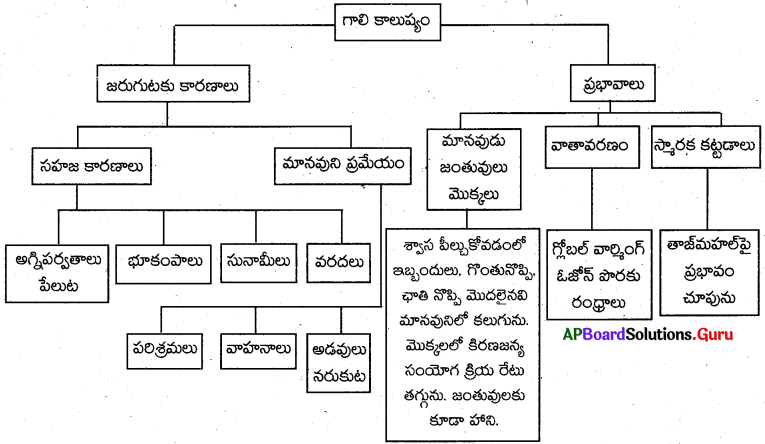
మానవ చర్యల వలన గాని, ప్రకృతిలో జరిగే మార్పుల వలన గాని వాతావరణ సమతుల్యతలో మార్పు సంభవిస్తే దానిని గాలి కాలుష్యం (Air pollution) అంటారు . గాలి కాలుష్యానికి కారణాలు మరియు ప్రభావములతో కూడిన ఫ్లోచార్ట్:
AP Board 8th Class Biology Solutions Chapter 10th Lesson పీల్చలేము - తాగలేము 1

ప్రశ్న 13.
సుధీర్ ట్రాఫిక్ కానిస్టేబుల్. ఇతను ఆరోగ్యవంతంగా ఉండటానికి నీవు ఏమి సూచనలు ఇస్తావు ? ఇతని విధి నిర్వహణలో ఆరోగ్య రక్షణకు నీవు ఇచ్చే సలహాలు ఏమిటి ?
జవాబు:
ఇతను ఆరోగ్యవంతంగా ఉండడానికి నేను ఇచ్చే సూచనలు :
1. ఇంటికి వెళ్ళిన తర్వాత వెంటనే దుమ్ము, ధూళి ఉన్న బట్టలు మార్చుకోవాలి.
2. ఎండలో ఎక్కువసేపు ఉంటాడు కాబట్టి ఎక్కువ నీరు తీసుకోవాలి.
3. ఎక్కువ సేపు నుంచొని ఉండాలి కాబట్టి శక్తిని ఇచ్చే పదార్థాలు తీసుకోవాలి.

ఇతని విధి నిర్వహణలో ఆరోగ్య రక్షణకు నేను ఇచ్చే సలహాలు :
1. దుమ్ము, ధూళి, కాలుష్య పదార్థాలు శరీరంలోనికి ప్రవేశించకుండా మ్కాలు వేసుకోవాలి.
2. తలకు ఉష్ణవాహక పదార్థాలతో తయారుచేయబడిన హెల్మెట్ వాడాలి.
3. ఎండ, వాన నుంచి రక్షణకు అతనికి ఇచ్చిన కాబిలో ఉండాలి.

AP Board 8th Class Biology Solutions Chapter 10 పీల్చలేము - తాగలేము

ప్రశ్న 14.
“బైకులు, కార్లు వద్దు సైకిలే ముద్దు” ఈ నినాదాన్ని శ్రీవాణి తయారుచేసినది. మీరు కూడా కాలుష్యం నియంత్రణపై కొన్ని నినాదాలు తయారుచేయండి.
జవాబు:
బైకులు, కార్లు వద్దు సైకిలే ముద్దు ఈ నినాదాన్ని శ్రీవాణి తయారుచేసింది. నేను కూడా కాలుష్య నియంత్రణపై కొన్ని నినాదాలు తయారుచేశాను. అవి

  1. చెట్లు పెంచు-కాలుష్యాన్ని తగ్గించు.
  2. కాలుష్యాన్ని తగ్గించు-మంచి ఫలితాన్ని పొందు.
  3. మనిషి స్వార్థమే-కాలుష్యానికి మూలం.
  4. గాలి కాలుష్యం తగ్గించు-ప్రకృతిని కాపాడు.
  5. చెట్లు పెంచు-కాలుష్యాన్ని పారద్రోలు.
  6. ఫ్రిజ్ లు తగ్గించు-కుండలు పెంచు.
  7. కాలుష్యాన్ని తగ్గించు-జీవితకాలం పెంచు.
  8. కాలుష్య నివారణకు-అందరూ కృషి చేయాలి.

ప్రశ్న 15.
రేష్మ నేల కాలుష్యంపై వక్తృత్వ పోటీలో పాల్గొనదలచింది. ఆమె కోసం ఒక వ్యాసం రూపొందించండి.
జవాబు:
నేల మనతోపాటు వందలాది జీవులకు జీవనాధారం. కానీ మానవుని విచక్షణా రహిత చర్యల వలన నేల కాలుష్యకోరలలో చిక్కుకొనిపోయింది. నేల తన సహజ స్వభావాన్ని కోల్పోవుట వలన నేలలోని సూక్ష్మజీవుల నుండి, నేలపైన నివసించే వేలాది జీవుల వరకు ఈ ప్రభావాన్ని ఎదుర్కొంటున్నాయి. రసాయనిక ఎరువులు, క్రిమిసంహారాలు, గుల్మనాశకాలు, పరిశ్రమవ్యర్థాలు, భూమిని పాడుచేస్తున్నాయి. ప్లాస్టిక్ వస్తువులు, పాలిథీన్ కవర్లు భూమాత గర్భంలో జీర్ణంకాని పదార్థాలుగా మిగులుతున్నాయి.

పరిస్థితి ఇలాగే కొనసాగితే, నేల తన సహజగుణాన్ని కోల్పోయి నిర్జీవ ఆవాసంగా మారుతుంది. ఇది మనం కూర్చున్న కొమ్మను నరుక్కొన్న రీతి అవుతుంది. ఇప్పటికైనా ఆలస్యం చేయకుండా నేలకాలుష్యం గురించి తీవ్రంగా ఆలోచిద్దాం. కార్యాచరణ ప్రణాళికను రూపొందించి అమలు చేద్దాం. ప్లాస్టిక్స్, పాలిథిన్ కవర్లను నిషేధిద్దాం. మన భూమాతను రక్షించుకుందాం.

ప్రశ్న 16.
కవిత తన మిత్రుడు కౌశిక్ తో “ప్లాస్టర్ ఆఫ్ పారితో తయారుచేసిన వినాయకుని కన్నా మట్టితో చేసిన వినాయకుని పూజించటం వల్ల కాలుష్యాన్ని తగ్గించవచ్చు” అని చెప్పింది. నీవు ఆమెను ఎలా ప్రశంసిస్తావు ?
జవాబు:
మట్టితో చేసిన వినాయకుడు నీటిలో వెంటనే కలిసిపోవును. అందువలన నీటి కాలుష్యం జరగదు. దీని వలన పర్యావరణానికి హాని జరగదు. ప్లాస్టర్ ఆఫ్ పారితో తయారుచేసిన వినాయకుని వలన అనేక నష్టాలు ఉన్నాయి. అవి నీటిలో కరగవు. అంతేకాక వాటిలో ఆస్ బెస్టాస్, ఆంటిమొని, పాదరసం, లెడ్ వంటి హానికరమైన రసాయనాలు ఉంటాయి. దీని వలన ఆ నీరు మరియు ఆ నీటిలో నివసించు జీవులకు హాని కలిగి కొన్నిసార్లు చాలా జీవులు చనిపోవును.

మట్టి వినాయకుని వలన పై నష్టాలు జరుగవు. కాబట్టి కవిత తన మిత్రుడు కౌశిక్ తో “ప్లాస్టర్ ఆఫ్ పారితో తయారుచేసిన వినాయకుని కన్నా మట్టితో చేసిన వినాయకుని పూజించటం వల్ల కాలుష్యాన్ని తగ్గించవచ్చు” అని చెప్పింది.

పై విషయాలు తెలుసుకొని తన మిత్రుడితో చెప్పినందుకు నేను చాలా సంతోషంగా ఫీల్ అవుతాను. అంతేకాకుండా టీచర్ కి చెప్పి స్కూల్లో పిల్లలు అందరికి మట్టి వినాయకుని వలన కలిగే లాభాలు కవిత చేత వివరించి మరియు అసెంబ్లీలో హెడ్ మాష్టారుకి చెప్పి స్కూలు పిల్లల చేత చప్పట్లు కొట్టిస్తాను. 8వ తరగతిలోనే పర్యావరణ పరిరక్షణ గురించి అవగాహన కలిగి ఉండుట మాత్రమేకాక దాన్ని నిజజీవిత పరిస్థితులకు అన్వయించినందుకు కవితను నేను మెచ్చుకుంటాను.

AP Board 8th Class Biology Solutions Chapter 10 పీల్చలేము - తాగలేము

ప్రశ్న 17.
మీ గ్రామంలోని లేదా దగ్గరలో ఉన్న చెరువు ఏవిధంగా కాలుష్యానికి గురి అవుతుందో తెలుసుకొని, కాలుష్యానికి గురి కాకుండా నీవేమి చేస్తావు?
జవాబు:

  1. పశువులను చెరువులో కడుగుట వలన
  2. చెరువులలో మనుషులు స్నానాలు చేయుట వలన , చెరువులో బట్టలు ఉతుకుట వలన
  3. చెరువులో మలమూత్రాలు విసర్జించుట వలన
  4. చెరువులోనికి ఇంట్లో నుంచి వచ్చిన చెత్తా చెదారములను వేయుట వలన
  5. వ్యవసాయదారులు మొక్కలకు ఉపయోగించిన ఎరువులు మరియు శిలీంధ్రనాశకాలను, డబ్బాలను చెరువులలో కడుగుట వలన, చెరువు గట్టుపై నివసించువారు అంట్లు చెరువులో కడుగుట వలన
  6. చెరువు దగ్గరగా పాలిథిన్ కవర్లు, ప్లాస్టిక్ గ్లాస్టు పారవేయుట వలన
  7. చెరువులలో ఇష్టానుసారంగా నీటి మొక్కలు (గుర్రపు డెక్క) పెరుగుట వలన.
    పై కారణాల వలన మా ఊరిలో చెరువు కాలుష్యం అగును.

8th Class Biology 10th Lesson పీల్చలేము – తాగలేము InText Questions and Answers

కృత్యములు

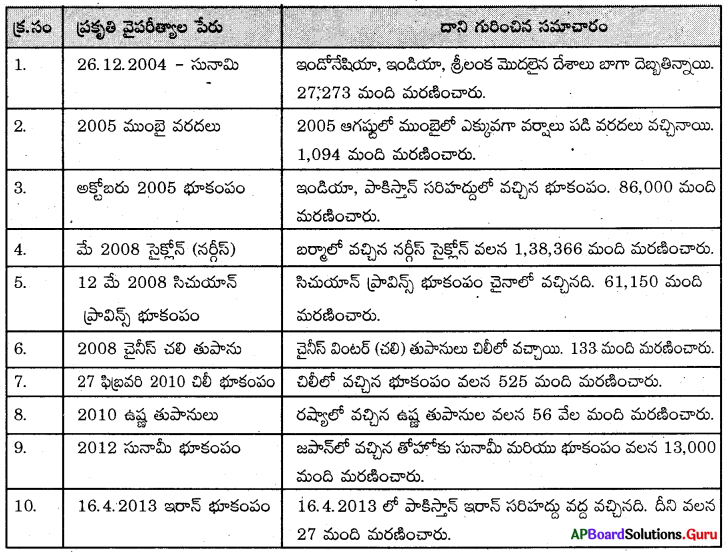
1. ప్రకృతి వైపరీత్యాలు – కాలుష్యం :
మీరు పాఠశాల గ్రంథాలయానికి వెళ్ళి ఈ దశాబ్దంలో ఇప్పటి వరకు ప్రపంచంలో జరిగిన ఈ కింది ప్రకృతి వైపరీత్యాల సమాచారాన్ని జాబితా రాయండి.
జవాబు:
AP Board 8th Class Biology Solutions Chapter 10th Lesson పీల్చలేము - తాగలేము 2

2. నూనె కాగిత ప్రయోగం:
5 × 5 సెం.మీ. కొలతలు గలిగిన చతురస్రాకారపు తెల్లకాగితాలను మూడింటిని తీసుకొని నూనెలో ముంచండి. వీటిని మూడు వేర్వేరు ప్రాంతాలలో వ్రేలాడదీయండి. ఒకదానిని మీ ఇంటి దగ్గర, రెండవదానిని పాఠశాలలో, మూడవదానిని ఉద్యానవనం దగ్గర కాని వాహనాలు నిలిపే స్థలంలో గాని వ్రేలాడదీయండి. వాటిని 30 ని||లు వరకు ఉంచి పరిశీలించండి.

ఎ) నూనెలో ముంచిన తెల్ల కాగితాల మీద మీరు ఏమి గమనించారు ?
జవాబు:
నూనెలో ముంచిన తెల్ల కాగితాల మీద మేము దుమ్ము, ధూళి గమనించాము.

బి) ఈ మూడు ప్రాంతాలలో ఉంచిన కాగితాలపై ఏమైనా మార్పులు ఉన్నాయా ?
జవాబు:
ఈ మూడు ప్రాంతాలలో ఉంచిన కాగితాలపై మార్పులు ఉన్నాయి.

సి) వీటికి జవాబులు తెలుసుకోవడానికి ప్రయత్నించండి. వాటి కారణాలు తెలుసుకోండి.
జవాబు:
1. మా ఇంటి దగ్గర ఉంచిన కాగితంపై దుమ్ము, ధూళి కొంచెం తక్కువగా ఉన్నాయి.
2. పాఠశాలలో ఉంచిన కాగితంపై దుమ్ము, ధూళి కొంచెం ఎక్కువగా ఏర్పడినది. కారణం మా పాఠశాల జనం రద్దీ ఉన్నచోట ఉంటుంది.
3. మూడవదానిని నేను వాహనాలు నిలిపిన స్థలంలో ఉంచాను. కాబట్టి కాగితంపై చాలా ఎక్కువ దుమ్ము, ధూళితో పాటు కొంచెము మసి కూడా గమనించాను. కారణం వాహనాల నుండి పొగ ఎక్కువ వస్తుంది కాబట్టి.

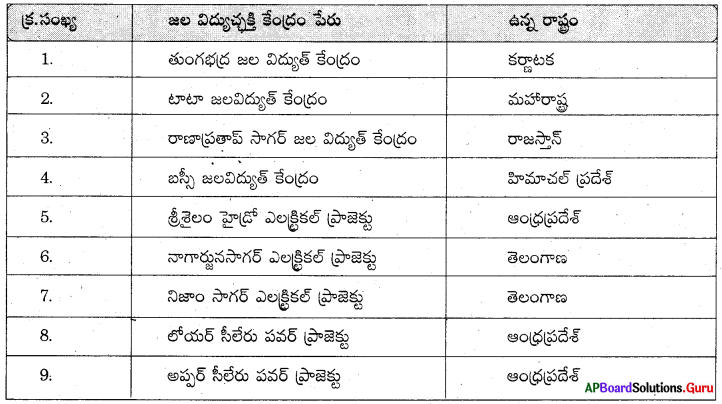
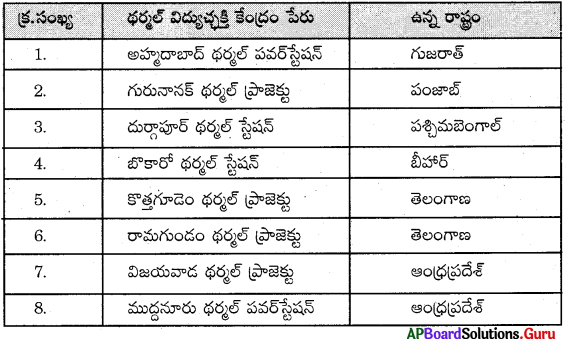
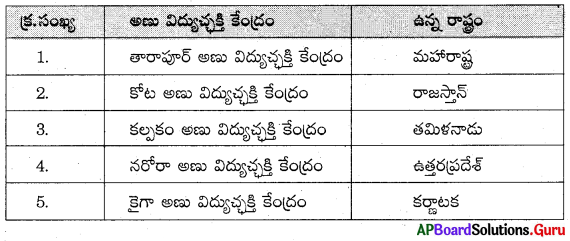
3. విద్యుత్ ఉత్పాదక కేంద్రాల సమాచారము :
విద్యుత్ ఉత్పాదక కేంద్రాల సమాచారం : మీరు పాఠశాల గ్రంథాలయాన్ని సందర్శించి వివిధ రకాల విద్యుత్ ఉత్పత్తి కేంద్రాల సమాచారంతో పట్టికను తయారుచేయండి. ఇంతే కాకుండా మన దేశంలో అనేక తక్కువ స్థాయి విద్యుదుత్పత్తి కేంద్రాలు కూడా కాలుష్య కారకాలను గాలిలోనికి విడుదల చేసి కాలుష్యాన్ని పెంచుతున్నాయి. వాటిపై చర్చించండి.
జవాబు:
విద్యుత్ ఉత్పత్తి కేంద్రాలు ముఖ్యంగా 3 రకాలుగా ఉంటాయి.
1. జలవిద్యుచ్ఛక్తి కేంద్రాలు
2. థర్మల్ విద్యుచ్ఛక్తి కేంద్రాలు
3. అణువిద్యుచ్ఛక్తి కేంద్రాలు.
జలవిద్యుత్ శక్తి కేంద్రాలు :
AP Board 8th Class Biology Solutions Chapter 10th Lesson పీల్చలేము - తాగలేము 3
థర్మల్ విద్యుచ్ఛక్తి కేంద్రాలు :
AP Board 8th Class Biology Solutions Chapter 10th Lesson పీల్చలేము - తాగలేము 4

అణు విద్యుత్ శక్తి కేంద్రాలు :
AP Board 8th Class Biology Solutions Chapter 10th Lesson పీల్చలేము - తాగలేము 5
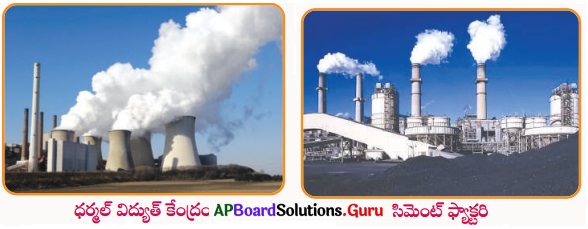
తక్కువ స్థాయి విద్యుదుత్పత్తి కేంద్రాల నుంచి (ముఖ్యంగా థర్మల్ విద్యుత్ కేంద్రాలు) బూడిద, ధూళి, సల్ఫర్ డై ఆక్సైడ్, కార్బన్ డై ఆక్సైడ్ వంటి పదార్థాలు, ఇతర వ్యర్థ పదార్థాల ద్వారా గాలి, నీరు, నేల కాలుష్యం అవుతున్నాయి.

AP Board 8th Class Biology Solutions Chapter 10 పీల్చలేము - తాగలేము

4. క్షేత్రపర్యటన :
క్షేత్రపర్యటన : దగ్గరలో ఉన్న పరిశ్రమను (ఇటుకల తయారీ, బియ్యం మిల్లు, ఆయిల్ మిల్లు, ఆహారపదార్థాలను తయారుచేసేవి మొదలగునవి) సందర్శించి దిగువ పేర్కొన్న అంశాలను పరిశీలించండి.

అ) ఇవి గాలి, నీటిని ఏ విధముగా కలుషితం చేస్తున్నాయి ?
జవాబు:
గాలిలోకి బియ్యపు ఊక విడుదల అవుతుంది. ఊక గాలిలో కలిసి కాలుష్యం చేస్తుంది. ఉప్పుడు బియ్యం తయారుచేయుట, నీటిని ఎక్కువగా ఉపయోగించుట వలన కర్బనిక పదార్థాలు నీటిలోకి చేరి నీటిని పాడు (కాలుష్యం) చేస్తాయి.

ఆ) ఫ్యాక్టరీల చుట్టూ పచ్చదనం ఉందా ? ఉంటే వాటి పేర్లను రాయండి.
జవాబు:
ఫ్యాక్టరీల చుట్టూ పచ్చదనం ఉంది. వాటి పేర్లు : అశోక చెట్లు, తురాయి పూలచెట్లు.

ఇ) కాలుష్యం నివారించడానికి ఏ విధమైన జాగ్రత్తలు తీసుకోవాలి ?
జవాబు:

  1. ఊక నిల్వ చేయు గది నిర్మించాలి. దీని వలన ఊక పరిసరాలలోనికి రాదు.
  2. మిల్లు యొక్క వెంట్లు పైకి ఉండాలి.
  3. మిల్లు యొక్క గదులకు రంధ్రాలు లేకుండా చూసుకోవాలి.
  4. ఉప్పుడు బియ్యం నుంచి వచ్చే నీటి కాలుష్యం నివారించుట, అవాయుగత బాక్టీరియాను ఉపయోగించి బయోగ్యాస్ తయారుచేయాలి.
  5. సరైన పరికరాలు ఉపయోగించి దుమ్ము, ధూళి నివారించాలి.
    గమనిక : ఎవరి దగ్గరలో ఉన్న పరిశ్రమ గురించి వాళ్లు వ్రాయాలి.

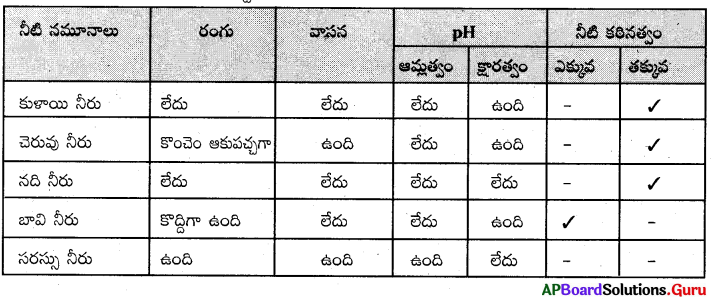
5. ప్రయోగశాల కృత్యం :
స్థానిక నీటి నమూనాలలో కాలుష్య కారకాలను పరిశీలించు ఒక ప్రయోగశాల కృత్యం చేయండి.
జవాబు:
ఉద్దేశం : స్థానికంగా నీటి నమూనాలలో కాలుష్య కారకాలను పరిశీలించుట
కావలసిన పరికరాలు : గాజు బీకర్లు, కుళాయి, బావి, సరస్సు, నది నుండి సేకరించిన నీటి నమూనాలు, నీలం, ఎరుపు లిట్మస్ పేపర్, సబ్బు.
పద్ధతి : వేరు వేరు గాజు బీకరులలో కుళాయి, నది, బావి, సరస్సుల నుండి నీటి నమూనాలను సేకరించాలి. వాటి మధ్య వాసన, రంగు, ఉదజని సూచిక pH మరియు కఠినత్వమును పోల్చాలి.

pH కనుగొనుట : లిట్మస్ పేపరుతో నీటి నమూనాలలో ఉదజని సూచిక pH ను కనుగొనవచ్చును. నీలం రంగు లిట్మస్ పేపరు నీటి నమూనాలో ముంచినప్పుడు ఆ పేపరు ఎరుపుగా మారితే ఆ నీటికి ఆమ్లత్వం కలిగి ఉన్నట్లు ! ఎరుపు లిట్మస్ పేపరు నీలం రంగుగా మారితే ఆ నీటికి క్షారత్వం ఉందని భావించాలి.
కఠినత్వం కనుగొనుట : నీటి కఠినత్వమును సబ్బును ఉపయోగించి కనుగొనవచ్చును. ఆ నీరు ఎక్కువ నురగ వస్తే మంచినీరు, తక్కువ నురగ వస్తే ఆ నీటికి కఠినత్వం ఉందని తెలుసుకోవచ్చును.
పరిశీలనలు : మీ పరిశీలనలు దిగువ పట్టికలో నమోదు చేయండి.
AP Board 8th Class Biology Solutions Chapter 10th Lesson పీల్చలేము - తాగలేము 6

ప్రయోగం నిర్వహించేటపుడు తీసుకోవలసిన జాగ్రత్తలు :

  1. లిట్మస్ పేపరు రంగు మారడాన్ని జాగ్రత్తగా గమనించాలి.
  2. ప్రతిసారి చేతులను శుభ్రం చేసుకోవాలి.
  3. ఏ నీటి నమూనాను రుచి చూడడానికి ప్రయత్నించవద్దు.
  4. ఇంకేమైనా జాగ్రత్తలు తీసుకోవాలని అనుకుంటున్నారా ? మీ నోట్స్ లో రాయండి. .

AP Board 8th Class Biology Solutions Chapter 10 పీల్చలేము - తాగలేము

6. మీ దగ్గరలో ఉన్న చెరువు లేదా నదిని సందర్శించి, అక్కడ చేరుతున్న కాలుష్య పదార్థాలను మరియు దాని వలన కలిగే పరిణామాలను పరిశీలించి ఒక ప్రాజెక్ట్ తయారుచేయండి. దాని ఆత్మకథను రాయండి. పాఠశాల ‘థియేటర్ డే’ లో ప్రదర్శించండి.
జవాబు:
పిల్లలూ బాగున్నారా ? నన్ను గుర్తుపట్టలేదా ? అవునులే నేను ఇప్పుడు పూర్తిగా అనారోగ్యంతో బాధపడుతూ ముసలిదానినై పోయాను. నాలో గతం నాటి ఉత్సాహం లేదు. ఆనందం లేదు. బాధాకరమైన విషయం ఏమిటంటే ఎన్నో విధాలుగా మీకు ఉపయోగపడిన నన్ను మీరే అనారోగ్యం పాలుచేశారు. నేను మీకు జీవనాధారమైన నీరు ఇచ్చాను. తాగటానికి మంచినీరు ఇచ్చాను. పంటపొలాలకు నీరు అందించాను. మీ గ్రామ అవసరాలన్నింటినీ తీర్చాను.

కానీ మీరు మాత్రం, నాలోనికి రకరకాల వ్యర్థాలను వదిలి, నన్ను కలుషితం చేసి పాడుచేశారు. ఇప్పుడు నేను ఎవరికీ పనికిరాని వ్యర్థంగా, మురికి కూపంగా మీకు కనిపిస్తున్నాను. నన్ను ఇంత ఇబ్బంది పెట్టి మీరు సుఖంగా ఉన్నది ఏది ? మీరు నాకన్నా ఎక్కువగా ఇబ్బందిపడుతున్నారు. తాగునీటికి – మైళ్ళదూరం వెళుతున్నారు. పంటలకు నీరు లేక ఎండబెట్టుకొంటున్నారు. మేత లేక పశువులను అమ్ముకొంటున్నారు. ఈ పరిస్థితి ఎందుకు వచ్చిందో ఒకసారి నా గట్టు వద్దకు వచ్చి ఆలోచించండి. కారణం మీకే తెలుస్తుంది. చేసిన తప్పును సరిదిద్దుకోండి. మీ కష్టాలకు మీరే కారణం అని తెలుసుకోండి. సరేనా, ఇంతకూ నన్ను గుర్తుపట్టారా, నేను మీ గ్రామ చెరువును !

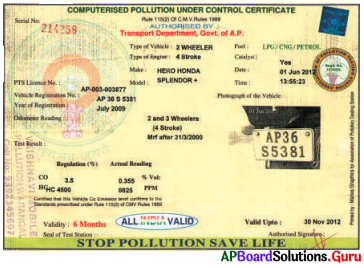
7. మీరు కింద ఇచ్చిన కాలుష్య నియంత్రణ సర్టిఫికేట్ నమూనాను చూడండి. సర్టిఫికేట్ ను పరిశీలించి దిగువ ఇచ్చిన ప్రశ్నలకు సమాధానాలు తెలుసుకునేందుకు ప్రయత్నించండి. (పేజీ.నెం.158)
AP Board 8th Class Biology Solutions Chapter 10th Lesson పీల్చలేము - తాగలేము 7
ఎ) కాలుష్య నియంత్రణ సర్టిఫికెట్ ఏ డిపార్ట్ మెంట్ పారు జారీచేస్తారు ?
జవాబు:
ట్రాన్స్ పోర్ట్ డిపార్టుమెంట్ ఆంధ్రప్రదేశ్ వారు కాలుష్య నియంత్రణ సర్టిఫికేట్ జారీ చేస్తారు.

బి) ఈ సర్టిఫికెట్ కాలపరిమితి ఎంత ?
జవాబు:
ఈ సర్టిఫికెట్ కాలపరిమితి ఆరు నెలలు.

సి) ఏ రకమైన వాహనానికి ఈ సర్టిఫికెట్ జారీచేస్తారు ?
జవాబు:
అన్ని డీజిల్, పెట్రోల్ తో నడిచే వాహనాలకు ఈ సర్టిఫికెట్ జారీ చేస్తారు.

డి) కాలుష్య తనిఖీ కేంద్రాలలో ఏయే వాయువులు పరీక్షిస్తారు ?
జవాబు:
కాలుష్య తనిఖీ కేంద్రాలలో హైడ్రోకార్బన్స్, కార్బన్ మోనాక్సైడ్ వాయువులు పరీక్షిస్తారు.

ఇ) కార్బన్ మోనాక్సైడ్, హైడ్రోకార్బన్స్ అనుమతించబడ్డ పరిమితి కంటే రీడింగ్ ఎక్కువగా ఉంటే ఏమి జరుగుతుంది ?
జవాబు:
కార్బన్ మోనాక్సైడ్ మరియు హైడ్రోకార్బన్స్ అనుమతించబడ్డ పరిమితి కంటే రీడింగ్ ఎక్కువ ఉంటే ఆ వాహనానికి అపరాధ రుసుము విధిస్తారు.

ఎఫ్) పై విషయాలపై తరగతి గదిలో చర్చించండి. కాలుష్య నియంత్రణ సర్టిఫికేట్ ఎందుకు ? ఆలోచించండి. చెప్పండి.
జవాబు:
కాలుష్య నియంత్రణ సర్టిఫికేట్ ఎందుకు అంటే వాహనాల నుంచి పరిమితికి మించి కాలుష్య పదార్థాలు వాతావరణంలోకి విడుదల కాకుండా ఉండుటకు.

AP Board 8th Class Biology Solutions Chapter 10 పీల్చలేము - తాగలేము

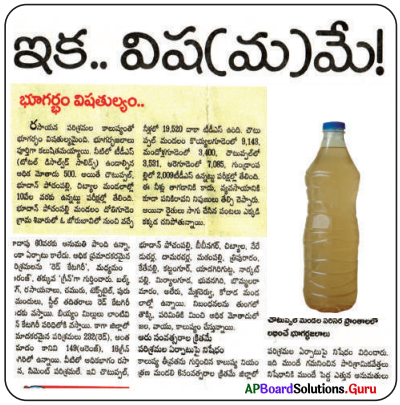
8. కింద ఇచ్చిన వార్తను చదవండి. మీరు అవగాహన చేసుకొన్న దానిని బట్టి వాటి దిగువ ఇచ్చిన ప్రశ్నలకు సమాధానాలు చెప్పండి. (పేజీ.నెం. 167)
AP Board 8th Class Biology Solutions Chapter 10th Lesson పీల్చలేము - తాగలేము 8
ఎ) వార్తాపత్రిక క్లిప్పింగ్ చదివిన తరువాత మీకు అర్థమైన విషయం ఏమిటి ? (పేజీ.నెం. 168)
జవాబు:
కొన్ని పరిశ్రమల వలన భూగర్భజలం విషతుల్యంగా మారుతోంది.

బి) వార్తాపత్రికలో ఏ విషయం గురించి చర్చించారు ?
జవాబు:
రసాయన పరిశ్రమల కాలుష్యంతో భూగర్భజలం విషతుల్యంగా మారి తాగుటకు, వ్యవసాయానికి ఏ విధంగా పనికిరాదో, ఆ కాలుష్య నియంత్రణకు తీసుకొన్న చర్య గురించి చర్చించినారు.

సి) దానికి కారణం ఏమిటి ? దాని ప్రభావం ఏమిటి ?
జవాబు:
దానికి కారణం రసాయనిక పరిశ్రమలు. దాని ప్రభావం మునుషుల పైనేగాక జీవరాశులు అన్నింటిపైనా ఉంది.

డి) సమస్య ఏ విధంగా ఉత్పన్నమైనది ?
జవాబు:
ఇష్టానుసారంగా రసాయనిక పరిశ్రమలు స్థాపించుటకు అనుమతి ఇవ్వడం, వాటి కాలుష్యాలను శుద్ధి చేయకుండా నేల, గాలి, నీటిలోకి విడుదల చేయడం వలన ఈ సమస్య ఉత్పన్నమైనది.

ఇ) మీ ప్రాంతంలో ఈ రకమైన సమస్యను ఎప్పుడైనా ఎదుర్కొన్నారా ? దీనికి వెనుక ఉన్న కారణాలు చెప్పగలరా ?
జవాబు:
ఎదుర్కొనలేదు.
గమనిక : ఎవరికి వారు తమ ప్రాంతంలోని కాలుష్యాలకు గల కారణాలను తెలుసుకొని రాయాలి.

ఆలోచించండి – చర్చించండి

1. టైర్లను, ఎండిపోయిన ఆకులను కాలిస్తే దాని వలన వచ్చే పొగ, బూడిద మొదలైనవన్నీ ఎక్కడికి పోతాయి ? ఏమవుతాయి? (పేజీ.నెం. 160)
జవాబు:
టైర్లను, ఎండిపోయిన ఆకులను కాలిస్తే దాని వలన వచ్చే పొగ, బూడిద మొదలైనవన్నీ వాతావరణం (గాలిలోకి) లో చేరి కాలుష్యం కలుగజేయును.

2. మనం రద్దీగా ఉన్న రోడ్డు పైన సాయంత్రం వేళ పోతున్నప్పుడు చుట్టూ పొగ దట్టంగా ఉంటుంది. మనం రుమాలుతో ముక్కు మూసుకున్నప్పటికీ దగ్గు, చికాకు కలుగుతుంది. ఈ లక్షణాలు ఎందుకు కలుగుతాయో ఆలోచించండి – చర్చించండి. (పేజీ.నెం. 166)
జవాబు:
మనం రద్దీగా ఉన్న రోడ్డు పైన సాయంత్రం వేళ పోతున్నప్పుడు చుట్టూ పొగ దట్టంగా ఉంటుంది. మనం రుమాలుతో ముక్కు మూసుకున్నప్పటికీ దగ్గు, చికాకు కలుగును. కారణం ఆ పొగలో ఉన్న అతి చిన్న కణాలు రుమాలు ద్వారా ముక్కు లోపలికి వెళ్ళి అక్కడ మనకు. ఎలర్జీ కలుగజేయును. దీనినే మనం డస్ట్ ఎలర్జీ అంటాము.

AP Board 8th Class Biology Solutions Chapter 10 పీల్చలేము - తాగలేము

3. ఈ రకమైన లక్షణాలు ఎక్కువకాలం కొనసాగితే ఏమి జరుగుతుంది ? (పేజీ.నెం. 166)
జవాబు:
ఈ రకమైన లక్షణాలు ఎక్కువకాలం కొనసాగితే శ్వాసవ్యవస్థలో ముఖ్యంగా ఊపిరితిత్తులు పాడవుతాయి. ఆస్తమా వంటి వ్యాధులు వస్తాయి.

4. నీటిలో ఉదజని సూచిక pH మరియు కఠినత్వముల మధ్య ఏదైనా సంబంధాన్ని గుర్తించారా ? (పేజీ.నెం. 169)
జవాబు:
నీటిలో ఉదజని సూచిక pH మరియు కఠినత్వముల మధ్య సంబంధాన్ని గుర్తించాను. క్షారత్వం పెరిగేకొలదీ నీటి కఠినత్వం పెరుగును.

5. ఏ నీటి నమూనా రంగు లేకుండా ఉంది ? (పేజీ.నెం. 169)
జవాబు:
కుళాయి నీరు రంగు లేకుండా ఉంది.

6. త్రాగడానికి ఏ నీరు పనికి వస్తుంది ? ఎందుకు ? (పేజీ.నెం. 169)
జవాబు:
తాగడానికి కుళాయి నీరు పనికి వస్తుంది. కారణం కుళాయిలో ఉన్న నీటిని వివిధ దశలలో శుభ్రపరచి పంపిస్తారు. స్వచ్ఛమైన నీటికి రంగు, వాసన ఉండదు.

7. కొన్ని నీటి నమూనాల్లో రంగు, వాసనలో మార్పు రావడానికి గల కారణాలు ఏమిటి ? (పేజీ.నెం. 169)
జవాబు:
కొన్ని నీటి నమూనాల్లో రంగు, వాసనలో మార్పు రావడానికి కారణాలు :
1. నీటిలో ఉన్న బాక్టీరియాలు, శైవలాలు ఇతర సూక్ష్మజీవులు చేరుట వలన
2. నీటిలో కలుషితాలు చేరినప్పుడు కూడా నీటికి రంగు, వాసనలో మార్పు వచ్చును.

8. నీటి నమూనాలో కంటికి కనిపించే కాలుష్య కారకాలు ఏమైనా ఉన్నాయా ? (పేజీ.నెం. 169)
జవాబు:
నీటి నమూనాలో కంటికి కనిపించే కాలుష్య కారకాలు ఏమీ లేవు.

AP Board 8th Class Biology Solutions Chapter 10 పీల్చలేము - తాగలేము

పాఠ్యాంశములోని ప్రశ్నలు

1. హానికరమైన జీవులు లేదా పదార్థాలు మన శరీరంలో ప్రవేశిస్తే ఏమి జరుగుతుంది ? వాటి ఫలితాలు ఏ విధంగా ఉంటాయి ? (పేజీ.నెం. 159)
జవాబు:
హానికరమైన జీవులు లేదా పదార్థాలు మన శరీరంలో ప్రవేశిస్తే మనకు అనారోగ్యం కలుగును.
వాటి ఫలితాలు :
1. చాలామంది ప్రజలు శ్వాసకోశ సంబంధ వ్యాధులతో బాధపడతారు.
2. ఊపిరితిత్తుల క్యాన్సర్, ఆస్తమా రోగుల సంఖ్య రోజు రోజుకూ పెరుగును.
3. హానికరమైన జీవుల వలన రోగాలు (సూక్ష్మజీవ సంబంధ) వచ్చును.

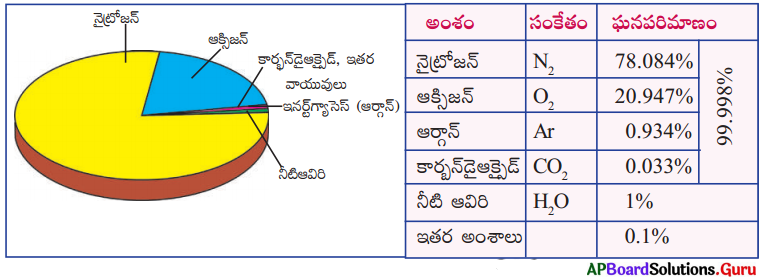
2. గాలిలోని వివిధ వాయువుల జాబితాను తయారుచేయండి. (పేజీ. నెం. 159)
జవాబు:
గాలిలో నైట్రోజన్, ఆక్సిజన్, కార్బన్ డై ఆక్సైడ్, ఆర్గాన్, నీటి ఆవిరి మరియు ఇతర జడవాయువులు ఉంటాయి.
AP Board 8th Class Biology Solutions Chapter 10th Lesson పీల్చలేము - తాగలేము 9

3. కాలుష్య కారకాలు ఎన్ని రకాలు ? అవి ఏవి ? (పేజీ.నెం. 151)
జవాబు:
కాలుష్య కారకాలు ముఖ్యంగా రెండు రకాలు అవి :
1. ప్రాథమిక కాలుష్య కారకాలు
2. ద్వితీయ కాలుష్య కారకాలు

4. సహజ కారణాల వల్ల ఏర్పడే కాలుష్యం వివరింపుము. (పేజీ.నెం.151)
జవాబు:
సహజ కారణాల వల్ల ఏర్పడే కాలుష్యం :
1. అడవుల దహనం వల్ల కర్బన పదార్థాలు (బూడిద) గాలిలో కలిసి కాలుష్య కారకంగా మారుతున్నాయి.
AP Board 8th Class Biology Solutions Chapter 10th Lesson పీల్చలేము - తాగలేము 10
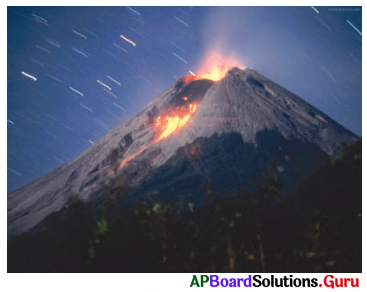
2. అగ్ని పర్వతములు బద్దలై CO2, SO2 వంటి చాలా రకాలైన విషవాయువులు మరియు బూడిద వాతావరణంలో కలిసి కాలుష్యానికి దారితీస్తోంది.
3. కుళ్ళిన వ్యర్థ పదార్థాల నుండి అమ్మోనియా వాయువు విడుదల అయి గాలి కాలుష్యానికి కారణమవుతున్నది.
4. నీటిలో కుళ్ళిన వ్యర్థ పదార్థాల నుండి మీథేన్ వాయువు విడుదలై కాలుష్య కారకంగా మారుతున్నది.
5. మొక్కల పుష్పాల నుండి విడుదల అయ్యే పుప్పొడి రేణువులు కూడా గాలి కాలుష్య కారకాలుగా మారుతున్నాయి.

AP Board 8th Class Biology Solutions Chapter 10 పీల్చలేము - తాగలేము

5. మానవ చర్యల వల్ల ఏర్పడే కాలుష్యం గురించి వివరింపుము. (పేజీ.నెం. 162)
జవాబు:
1. ఇంధనాలు : వీటిని మండించడం ద్వారా కార్బన్‌ మోనాక్సైడ్ (CO), SO2 పొగ, ధూళి మరియు బూడిద వెలువడును.
2. వాహనాలు : మోటారు వాహనాల నుంచి విడుదలయ్యే పొగలో SO2, NO2, CO పూర్తిగా మండని హైడ్రోకార్బన్లు మరియు సీసం సంయోగ పదార్థాలు, మసి ఉంటాయి.
3. పరిశ్రమల నుంచి ముఖ్యంగా గ్రానైట్, సున్నపురాయి, సిమెంట్ పరిశ్రమల నుండి విడుదలయ్యే పొగలో నైట్రస్ ఆక్సెడ్, SO2 క్లోరిన్ బూడిద మరియు దుమ్ము ఉంటాయి.
4. అణుశక్తి విద్యుత్ కేంద్రాలు కాలుష్యానికి కారణం.
5. ఎరువులు – పురుగుల మందులు గాలి, నీరు, నేల కాలుష్యానికి కారణం.
6. అడవుల నరికివేత కూడా కాలుష్యానికి ప్రధాన కారణం.
7. క్లోరోఫ్లోరో కార్బనులు, గనుల నుంచి విడుదలైన పదార్థాలు కాలుష్యానికి కారణం.
AP Board 8th Class Biology Solutions Chapter 10th Lesson పీల్చలేము - తాగలేము 11

6. గ్రామాల్లో, పట్టణాల్లో సాధారణంగా మండించే ఇంధనాల జాబితా రాయండి. (పేజీ.నెం. 162)
జవాబు:
గ్రామాల్లో సాధారణంగా మండించే ఇంధనాలు : కట్టెలు, కిరోసిన్, బయోగ్యాస్, పొట్టు, కంది కంప మొదలైనవి.
పట్టణాల్లో సాధారణంగా మండించే ఇంధనాలు : గ్యాస్, కిరోసిన్.

7. సి.ఎఫ్.సి ల గురించి వ్రాయండి. (పేజీ.నెం. 163)
జవాబు:
రిఫ్రిజిరేటర్స్, ఎ.సి.లు, విమానాల నుండి వెలువడే వ్యర్థ రసాయనాలను సి.ఎఫ్.సి (క్లోరోఫ్లోరో కార్బన్) లు అంటారు. ఇవి గాలిలోకి విడుదలై వాతావరణంలో ఓజోన్ పొరను దెబ్బతీయును. దీని వలన ఓజోన్ పొరలో అక్కడక్కడ రంధ్రాలు ఏర్పడును. దీని వలన అతి ప్రమాదకరమైన అతి నీలలోహిత కిరణాలు భూమి మీద పడును. ఈ విధంగా జరుగుట వలన భూమి పైన జీవకోటికి ప్రమాదం జరుగును.

8. అతినీలలోహిత కిరణాలు మనపై పడటం వల్ల కలిగే నష్టాలు ఏమిటి? (పేజీ.నెం. 163)
జవాబు:
అతినీలలోహిత కిరణాలు శక్తివంతమైనవి. ఇవి మన శరీరంపై పడటం వలన
1. చర్మ కణాలు దెబ్బతింటాయి.
2. చర్మ క్యాన్సర్ వచ్చే ప్రమాదం ఉంది.
3. జన్యు ఉత్పరివర్తనాలను కలిగిస్తాయి.

9. వాయు కాలుష్యం వల్ల జరిగే దుష్ఫలితాలు రాయండి. (పేజీ.నెం. 166) (లేదా) ప్రపంచ ఆరోగ్య సంస్థ నూతన నివేదిక ఆధారంగా ఏడాదికి 4.3 మిలియన్ల మంది గృహం లోపల వాయు కాలుష్యం వలన, 3.7 మిలియన్ల మంది వాయు కాలుష్యం వలన ప్రపంచవ్యాప్తంగా చనిపోతున్నారు. ఇది ఇలాగే కొనసాగితే జరిగే పర్యవసానాలను నాలిగింటిని రాయండి.
జవాబు:
వాయు కాలుష్యం వల్ల జరిగే దుష్ఫలితాలు :
1. వాయుకాలుష్యం వల్ల శ్వాస పీల్చుకోవడంలో ఇబ్బందులు, గొంతు నొప్పి, ఛాతి నొప్పి, ముక్కు దిబ్బడ, ఆస్తమా, బ్రాంకైటిస్, ఊపిరితిత్తుల క్యాన్సర్ వంటి వ్యాధులు కలుగును.
2. వాయు కాలుష్యం వలన హృదయ సంబంధ వ్యాధులు, అధిక రక్త పీడనం లాంటి వ్యాధులకు గురి అగును.
3. దుమ్ము మరియు పొగ ఆకుల మీద పేరుకున్నప్పుడు మొక్కల్లో కిరణజన్య సంయోగక్రియ, బాష్పోత్సేకం మొదలైన జీవక్రియలు ప్రభావితం అగును.
4. హైడ్రోజన్ సల్ఫైడ్ పీల్చడం వలన మానవులకు విపరీతమైన తలనొప్పి వచ్చును.
5. విషపూరితమైన కార్బన్ మోనాక్సైడ్ మన రక్తంలోని హీమోగ్లోబిన్ తో కలవడం వలన స్థిరమైన కార్బాక్సీ హీమోగ్లోబిన్ ఏర్పడి ఆక్సిజన్ శరీర భాగాలకు అందక చనిపోయే ప్రమాదం ఉంది.

AP Board 8th Class Biology Solutions Chapter 10 పీల్చలేము - తాగలేము

10. నీటి కాలుష్యానికి దారితీసే కారణాల జాబితా రాయండి. మీ ప్రాంతంలో జరిగే నీటి కాలుష్యం పోల్చి చూడండి. (పేజీ.నెం. 170)
జవాబు:

  1. పరిశ్రమల వలన జల కాలుష్యం జరుగును.
  2. పరిశ్రమల వలన జలాలలో ఉష్ణ కాలుష్యం.
  3. కబేళా, కోళ్ళ, డెయిరీఫారమ్ ల వలన జల కాలుష్యం జరుగును.
  4. ఎరువులు, క్రిమి సంహారక రసాయనాల వలన జల కాలుష్యం జరుగును.
  5. ముడి చమురు వల్ల సముద్ర జల కాలుష్యం జరుగును.
  6. మానవుని అపరిశుభ్ర అలవాట్ల వల్ల జల కాలుష్యం జరుగును.
    మా ప్రాంతంలో కూడా ఇంచుమించు ఇదే రకంగా జరుగును.

11. మూసీ నది కాలుష్య నియంత్రణకు తీసుకున్న జాగ్రత్తలు ఏమిటి ? (పేజీ. నెం. 170)
జవాబు:

  1. ఘనరూప వ్యర్థాల నియంత్రణ.
  2. మురికినీరు శుద్ధిచేయు ప్లాంట్ ను నెలకొల్పడం.
  3. తక్కువ ఖర్చుతో మురుగునీటి వ్యవస్థ కల్పించడం.
  4. నదీ తీరాన్ని అభివృద్ధి పరచడం.
  5. ప్రజలలో అవగాహన కలిగించుటకు కృషిచేయడం.

12. మీ టీచర్ ను అడిగి వాయుసహిత (ఏరోబిక్) బాక్టీరియాల గురించిన సమాచారాన్ని ఉదాహరణలతో రాయండి. (పేజీ.నెం. 171)
జవాబు:
ఆక్సిజన్ కలిగిన వాతావరణంలో నివసించు బాక్టీరియాలు. ఇవి నీటిలో కరిగి ఉన్న ఆక్సిజన్‌ను ఎక్కువ మోతాదులో వినియోగించుకొంటాయి. అందువలన మిగతా జీవులకు ఆక్సిజన్ అందక మరణిస్తాయి. ఏరోబిక్ బాక్టీరియాలకు
ఉదాహరణ :
1. స్టెఫైలో కోకస్ జాతి
2. స్ట్రెప్టో కోకస్
3. ఎంటరో బాక్టీరియాకాక్
4. మైక్రో బాక్టీరియమ్ ట్యూబర్కోలస్
5. బాసిల్లస్
6. సూడోమోనాస్

13. ఓడ ప్రమాదాల వలన సముద్రం నీటిపై ఏర్పడే నూనెతెట్టు ఏ రకమైన ప్రమాదాన్ని ‘జీవులకు కలుగజేస్తుందో మీకు , తెలుసా ? (పేజీ.నెం. 172)
జవాబు:
ఓడ ప్రమాదాల వలన సముద్రం నీటిపై ఏర్పడిన నూనె తెట్టు వలన నీటి లోపలకు ఆక్సిజన్ వెళ్ళదు. దీని వలన జలచర జీవుల మనుగడ కష్టమై నీటిలో ఉన్న ఆవరణ వ్యవస్థ దెబ్బతినును.

AP Board 8th Class Biology Solutions Chapter 10 పీల్చలేము - తాగలేము

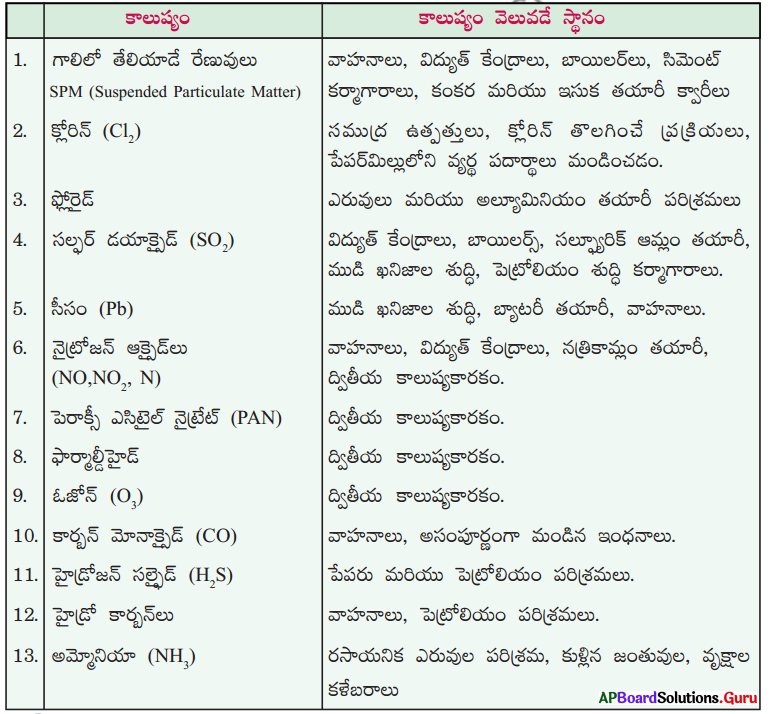
14. వాతావరణంలో కాలుష్య కారకాలు – వాటి మూలాలు తెలుపు ఒక పట్టిక తయారు చేయండి. (పేజీ.నెం. 164)
జవాబు:
AP Board 8th Class Biology Solutions Chapter 10th Lesson పీల్చలేము - తాగలేము 12

15. మీ ఉపాధ్యాయుడిని అడిగి ద్వితీయ కాలుష్య కారకాలు అని వేటిని, ఎందుకు అంటారో తెలుసుకోండి. (పేజీ.నెం. 164)
జవాబు:
ప్రాథమిక కాలుష్య కారకాలు వాతావరణంలోనికి ప్రవేశించి వాతావరణంలోని మూలకాలతో చర్య జరపడం వల్ల ఏర్పడిన పదార్థాలను ద్వితీయ కాలుష్య కారకాలు అంటారు.

AP Board 7th Class Science Solutions 11th Lesson Fibres and Fabrics

SCERT AP 7th Class Science Study Material Pdf 11th Lesson Fibres and Fabrics Textbook Questions and Answers.

AP State Syllabus 7th Class Science 11th Lesson Questions and Answers Fibres and Fabrics

7th Class Science 11th Lesson Fibres and Fabrics Textbook Questions and Answers

Improve Your Learning

I. Fill in the blanks.

1. Fleece pulled through the metal teeth of a machine in order to remove short fibres is known as _______ .
2. Rearing of silkworms to obtain silk is known as _______ .
3. Artificial fibre that resembles silk _______ .
4. Protein present in silk _______ .
5. Inner layer of soft, short, fine hairs of wool yielding animal is known as _______ .
Answer:
1. Shearing
2. Sericulture
3. Rayon
4. Fibroin
5. Fleece

II. Choose the correct answer.

1. Which of the following does not yield wool?
a) Yak
b) Goat
c) Silkmoth
d) Camel
Answer:
c) Silkmoth

2. The silk worm is _______ .
a) Pupa
b) Cocoon
c) Larva
d) Adult
Answer:
c) Larva

3. Shearing means _______ .
a) Selecting fleece basing on its quality
b) Dyeing the fleece
c) Removing wool with a thin outer layer of skin
d) Washing of fleece in hot water
Answer:
c) Removing wool with a thin outer layer of skin

4. Silk production is involved in the cultivation of _______ .
a) Oak trees
b) Sal tree
c) Thellamaddi tree
d) Mulberry tree
Answer:
d) Mulberry tree

AP Board 7th Class Science Solutions 11th Lesson Fibres and Fabrics

5. The most common type of silk produced in India _______ .
a) Eri
b) Tasar
c) Mulberry
d) Muga
Answer:
c) Mulberry

III. Matching.

A) Pupa1. Wool
B) Silk moth2. Goat
C) Animal fibre3. Cocoon
D) Angora4. Wild silk
E) Tasar5. Bombyxmori
6. Rayon

Answer:

A) Pupa3. Cocoon
B) Silk moth5. Bombyxmori
C) Animal fibre1. Wool
D) Angora2. Goat
E) Tasar4. Wild silk

IV. Answer the following questions.

Question 1.
Explain how stifling is done. What is the purpose of stifling of cocoons?
Answer:

  1. When the eggs are hatched the larvae come out, these are kept in chandrikalu.
  2. Chandrikalu are specialized cane structures where mulberry leaves are also kept for larval feeding.
  3. This larva forms the cocoon. These are used for obtaining silk fibres.
  4. After 2 – 3 days cocoons formation, farmers remove them from chandrikalu and treat them under steam for 10 to 15 minutes.
  5. The process of killing larvae inside the cocoon by putting them in steam is called stifling.

Importance of stifling:
The larvae in the cocoons have to be killed by stifling otherwise larvae inside cocoons will come out by breaking open the cocoons.

  1. Hence, we can not derive continuous thread of silk. This will reduce the quality of silk fibre.
  2. Stiffled cocoons can be stored for a long time and can be sold in market.

Question 2.
Differentiate between Animal fibres and Plant fibres based on their properties.
Answer:

Animal fibresPlant fibres
1) They burn slowly but not continuously when compared to plant fibres.1) They burn fast and continuous when compared to animal fibres.
2) These are protein based fibres.2) They contain cellulose. So, they are cellulosic fibres.
3) They can’t absorb more water.3) These fibres absorb more water.
4) Stretching capacity is more.4) Stretching capacity is less.
5) They release fumes emitting the smell of burning hair or meat.5) They release fumes emitting normal, smell of burning paper.
6) The ashes formed are black in colour and appear as beads and can be made as powder.6) The ashes formed are not black in colour and is in the form of powder.
7) They dissolve in sodium hypochlorite (bleach).7) They do not dissolve in sodium hypochlorite (bleach).

Question 3.
Analyse the advantages and disadvantages in usage of clothes made of synthetic fibres. Which type of fabric you prefer to use? Why?
Answer:
I prefer to use jute fabric because it is environmentally friendly.

Advantages of using synthetic fibres :

  1. Synthetic fibres are light, soft and smooth.
  2. They are more durable when compared to natural fibres.
  3. Maintenance of dresses made of synthetic fibres is relatively easier.
  4. These are available at a cheaper price as their production is quite abundant and economical.

Disadvantages of using synthetic fibres :

  1. Except Rayon, all other synthetic fibres are made of chemicals. So, their production leads to Environmental pollution.
  2. Even after their disposal they won’t mix in soils for years and they release harmful chemicals into the soil.

AP Board 7th Class Science Solutions 11th Lesson Fibres and Fabrics

Question 4.
What happens if stifling is not done to silk moth cocoons?
(OR)
What will happen if cocoon is not boileicl?
(OR)
Generally larvae of silk moth are killed by a process of stiffling to collect silk from cocoon. What will happen if cocoon is not boiled?
Answer:

  1. If cocoon is not boiled, the larva inside the cocoon grows and cuts its way out after growing into a moth and spoil the cocoon.
  2. We cannot derive continuous thread of silk.
  3. This will reduce the quality of silk fabric.

Question 5.
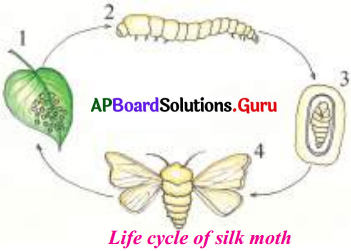
Draw a well labelled diagram to explain life cycle of silk moth. Which stage in life of silk moth is important for making silk? Why?
Answer:
AP Board 7th Class Science Solutions 11th Lesson Fibres and Fabrics 1 AP Board 7th Class Science Solutions 11th Lesson Fibres and Fabrics 2

  1. Among the four stages of silk moth, larva stage is important for obtaining silk.
  2. In this stage, silk worm secrets a ghee like substance containing protein. This protein dries up on exposure to air to form silk fibre.
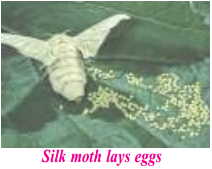
  3. Like this way, silk worm completely covers its body with silk fibre. This looks like a capsule known as cocoon (pattukaya).
  4. After stiffling process we get silk from cocoons.

Question 6.
What precautions do you suggest a shearer to take while shearing an animal to prevent hurting them?
Answer:

  1. Cutters and combs should be sharp and they should be cleaned, resharpened and lubricated after each job of shearing.
  2. The shearing floor should be clean and free of straw and debris.
  3. Sheep must be dry before shearing.
  4. Shearing must be done in shade to prevent heat stress.
  5. Prevent cuts to the animal’s skin by taking time while shearing and carefully clipping the wool so as to not get too close to the sheep’s skin.

Question 7.
Describe your views on preparation of silk by killing the larvae. What ways do you suggest to prevent this activity towards silk moth?
Answer:

  1. I feel very unhappy on the methods used for producing silk by killing the larvae of silk moths.
  2. I feel ashamed as a human being, for killing the innocent larvae in the boiled water for getting silk.
  3. It is better to avoid these practices for getting silk.
  4. We should encourage Ahimsa silk which is obtained in non – violent way. In this method, the pupa of silk worm is allowed to hatch and the left over cocoon is then used to derive silk. This method of silk production is introduced by Kusuma Rajaiah, a handloom technologist and a former employee in AP Handloom department.
  5. We should encourage the trails executing to find sources of silk other than silk worms.
  6. A Manipuri silk inventor named Tongbran Bijay Santhi, introduced to draw silk like threads from Lotus stem. We should welcome this type of inventors to pave new ways for getting silk.

7th Class Science 11th Lesson Fibres and Fabrics InText Questions and Answers

7th Class Science Textbook Page No. 68

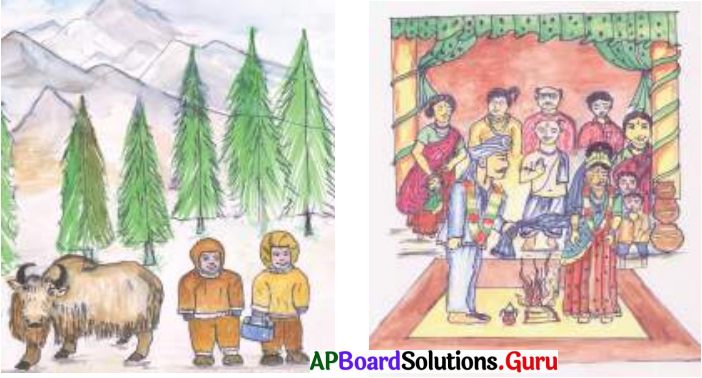
Observe the given figures and answer the following questions.
AP Board 7th Class Science Solutions 11th Lesson Fibres and Fabrics 10

Question 1.
Which clothes do people wear in cold regions?
Answer:
Woolen clothes.

Question 2.
Which fabrics are used to make these clothes?
Answer:
Wool is used to make these woolen fabrics.

AP Board 7th Class Science Solutions 11th Lesson Fibres and Fabrics

Question 3.
Which fabric do you choose to wear in an important celebrations like Sankranthi?
Answer:
I choose silk or cotton fabric to wear in an important celebrations like Sankranthi.

7th Class Science Textbook Page No. 69

Question 4.
Why do people in our area rear sheep and goats in large farms?
Answer:
People in our area rear goats and sheep for meat and wool.

7th Class Science Textbook Page No. 71

Question 5.
Have you seen, Sheep’s hair with dirt and twings attached to them?
Answer:
Yes. As the skin of sheep secrete grease like oily substance, fleece is generally attracted with much dust and dirt.

7th Class Science Textbook Page No. 73

Question 6.
How many stages does the silk moth undergo to complete its life cycle?
Answer:
4 stages.

Question 7.
What are the stages involved in the life cycle of a silk moth?
Answer:
1) Eggs 2) Larvae 3) Pupa 4) Imago

7th Class Science Textbook Page No. 77

Question 8.
With which type of fibres the chunni fabric is made?
Answer:
The chunni is smooth, soft, thin and light weight. Synthetic or artificial fibres are used to make this chunni.

7th Class Science Textbook Page No. 78

Question 9.
Why do we wash clothes?
Answer:
It is necessary to wash clothes every time after wearing them to avoid skin diseases.

7th Class Science Textbook Page No. 79

Question 10.
Think why fabrics made of natural fibres get faded on washing?
Answer:
Natural fibres are mixed with dyes only after they are made as fabrics.

AP Board 7th Class Science Solutions 11th Lesson Fibres and Fabrics

Question 11.
Which cloth looks fine without shrinkage and wrinkles?
Answer:
The cloth that is wrapped around the rod looks fine without shrinkage and wrinkles.

Think & Respond

7th Class Science Textbook Page No. 70

Question 1.
Sharp razor/scissors like tools are used to shear fleece of an animal. Does it hurt tjie animal? Remember how we tonsure our heads. Does it hurt? If the shearer shaves carefully by preventing cuts and bruises, shearing won’t hurt the animal.
Answer:

  1. The shearer should take all precautions before shearing.
  2. Cutters and combs should be sharp enough for clean shearing.
  3. Sheep must be dry before shearing.
  4. Clipping of wool on sheep should be carefully done before shearing in order to avoid cuts and bruises.

7th Class Science Textbook Page No. 77

Question 2.
Think about the dresses we prefer to wear ip winter or when we are going to visit cooler places. Which natural fibre are they made of? Why do we choose woolen dresses like sweaters, shawls, scarfs etc. Wool is a bad conductor of heat. It won’t allow our body to lose heat.
Answer:

  1. Wool is a poor conductor of heat. Air trapped in between the woolen fibres and our body prevents the flow of heat from our body to our surroundings.
  2. So we feel hot and are protected from cold.
  3. Woolen cloth also helps to do use fire.
  4. That is why it is good to wrap a person, who is caught in fire, with a blanket.

7th Class Science Textbook Page No. 78

Question 3.
Parachute ropes are made of silk in olden days. It’s strength and elasticity helps in retaining the weight of a person when he is flying in air. Water resistance capacity included along the characters of silk, made parachute manufacturers use Nylon now a days. What will happen if we use cotton or wool fibres for this purpose?
Answer:

  1. If we use fibres like cotton or wool in the manufacturing of parachutes, accidents will take place while flying.
  2. It is because cotton and wool fibres are not strong enough to carry such huge weight against the wind currents.
  3. More over, they are less tensile, water absorbants and heavy in weight, so, they are not suitable for the manufacturing of parachutes.

Activities and Projects

Question 1.
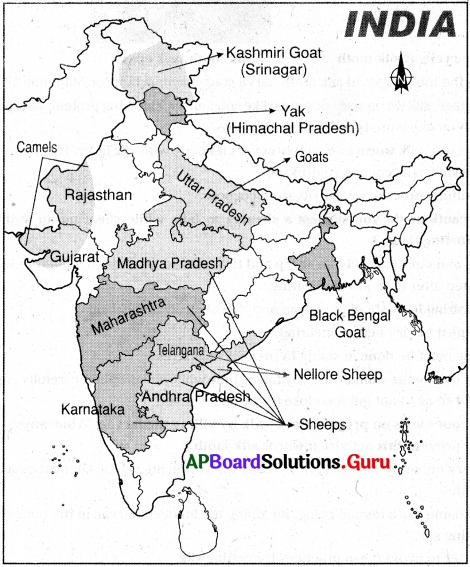
Take an India map and mark the regions where various wool yielding animals are found and mention their names there.
Answer:
AP Board 7th Class Science Solutions 11th Lesson Fibres and Fabrics 3

Question 2.
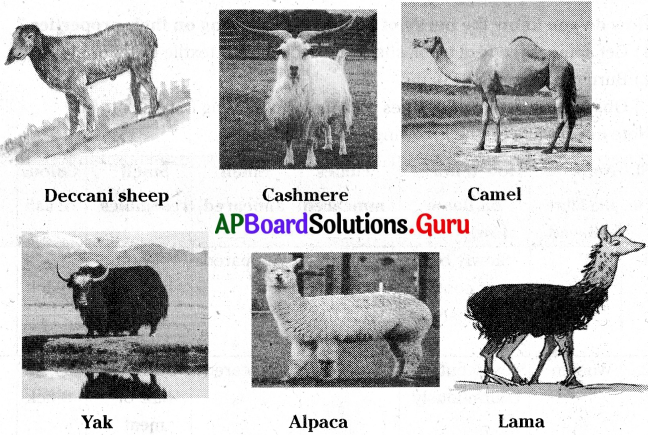
Make a scrap book with various wool yielding animals.
Answer:
AP Board 7th Class Science Solutions 11th Lesson Fibres and Fabrics 4

Activities

Activity – 1

Question 1.
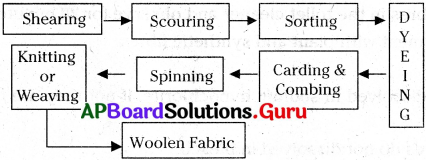
Prepare a flow chart showing stages in the preparation of woolen fabric with the name “From Fibres to woolen fabrics”.
(OR)
Make a flow chart showing various stages of production of woolen fabric.
Answer:
From fibres to woolen fabric :
AP Board 7th Class Science Solutions 11th Lesson Fibres and Fabrics 5

Activity – 2

Question 2.
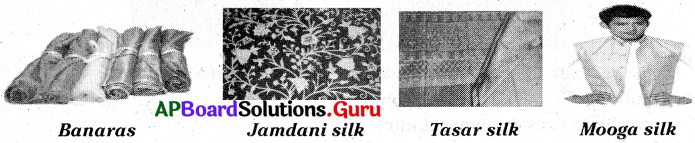
Collect pieces of different types of fabrics and paste them in your scrap book.
Answer:
AP Board 7th Class Science Solutions 11th Lesson Fibres and Fabrics 6

Activity – 3

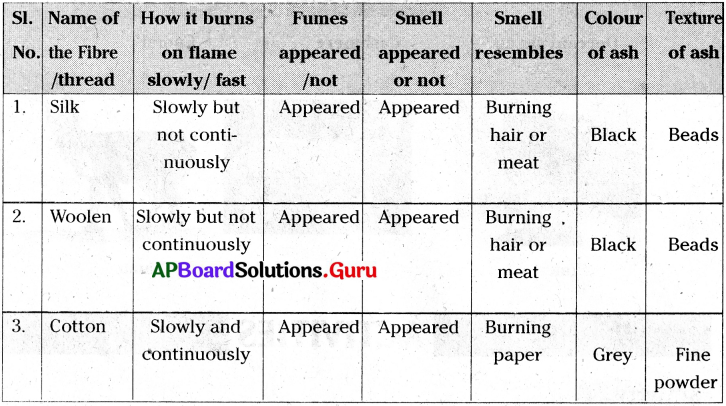
Question 3.
How do you know the purify of animal fibres basing on their properties ?
Answer:

  1. Get some threads of wool, silk and cotton from a textile or tailor shop.
  2. Burn them on candle flame.
  3. Observe the flame and fumes coming from burning fibres.

Note down them in the following table.
AP Board 7th Class Science Solutions 11th Lesson Fibres and Fabrics 7

Activity – 4

Question 4.
How do you prove that animal fibres dissolve in chlorine based bleach?
Answer:

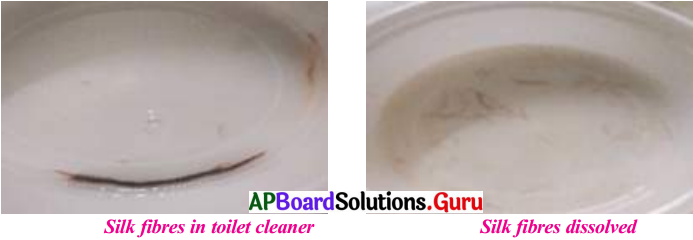
  1. Take some toilet cleaner or disinfectant or cloth whitener containing sodium hypochlorite in a beaker or ceramic bowl.
  2. Keep woolen and silk fibres in the toilet cleaner and observe for 20 minutes.
  3. Repeat the same experiment with plant and synthetic fibres.

Observations :

  1. Woolen and silk fibres dissolved in sodium hypochlorite. If not they are not pure woolen or silk fibres.
  2. Plant and synthetic fibres do not dissolved in bleach.

AP Board 7th Class Science Solutions 11th Lesson Fibres and Fabrics 8

Inference :
Animal fibres dissolve in bleach plant and synthetic fibres do not dissolve in bleach (sodium hypochlorite).

Activity – 5

Question 5.
Observe the manufacturer’s is care label given in the figure and answer the following questions.
AP Board 7th Class Science Solutions 11th Lesson Fibres and Fabrics 9
a. Which garment the dress is made of?
Answer:
Polyester cotton.

b. Which type of wash is suitable for the dress/garment.
Answer:
Hand wash or Machine wash using only cold water, use only mild detergent.

c. What are the measures to be taken for long durability of the garment?
Answer:

  1. Woolen clothes are washed after 4-5 wearings only because frequent washes may loosen the firmness of knitting resulting in loss of shape of fabric.
  2. After washing also woolen clothes should not be squeezed. It is advised to wrap them in a towel to remove extra moisture before drying off.
  3. Mild detergent should be used to wash wool and silk clothes.
  4. Cotton and silk clothes readily shrink on washing. So, starching and ironing of cotton and rolling of silk can unshrink the garments.
  5. Silk and wool clothes should be stored carefully. Because insects attack these clothes to feed on protein substances present in fibres. (Fibroin, Keratin)
  6. Strong fragrance of phenophthalene balls, boric acid, fragrant oils like sandal oil and lavender oils can successfully repel the insects.
  7. By keeping these substances between the clothes, we can protect silk and woolen clothes from insects.
  8. Shrinkage of silk sarees can be removed by a process called “Rolling”.

AP Board 7th Class Science Solutions 11th Lesson Fibres and Fabrics

Activity – 6

Question 6.
How do you removed the wrinkles of silk fabrics?
Answer:

  1. Collect two long pieces of silk fabric of ribbon width from a tailor.
  2. Dip them in water and observe the wrinkles that formed on the clothes.
  3. Dry off one cloth simply and wrap the second one around a wooden or a metal rod tightly without foldings.
  4. Allow it to be dried off in the same state. Observe the two clothes after two to three hours.

Observations:
The cloth that is wrapped around the rod has lost its wrinkles. This process of removal of shrinkage from silk clothes is called rolling.

AP Inter 2nd Year Chemistry Important Questions Chapter 6(c) Group-17 Elements

Students get through AP Inter 2nd Year Chemistry Important Questions Lesson 6(c) Group-17 Elements which are most likely to be asked in the exam.

AP Inter 2nd Year Chemistry Important Questions Lesson 6(c) Group-17 Elements

Very Short Answer Questions

Question 1.
Interhalogen compounds are more reactive than the constituent halogens except fluorine – Explain.
Answer:
Inter halogen compounds are more reactive than halogens. This is because X – X’ bond in interhalogens is weaker than X — X bond in halogens except F – F bond.

Question 2.
What is the use of ClF3?
Answer:
ClF3 is very useful fluorinating agent and it is used for the production of VF6 in the enrichment of U235.
U(s) + 3ClF3(l) → UF6(g) + 3ClF(g)

AP Inter 2nd Year Chemistry Important Questions Chapter 6(c) Group-17 Elements

Question 3.
Why are halogens coloured?
Anšwer:
Halogens are coloured due to the absorption of radiations in visible region which results in the excitation of outer electrons to higher energy level. Halogens absorb different quanta of radiation and display different colours.

Question 4.
Write the reactions of F2 and Cl2 with water. (TS Mar. 17) (IPE Mar. ‘14)
Answer:
Fluorine produces O2 and O3 on passing through water.
3F2 + 3H2O → 6HF + O3
2F2 + 2H2O → 4HF + O2

Question 5.
Electron gain enthalpy of fluorine is less than that of chlorine – explain.
Answer:
The negative electron gain enthalpy of the fluorine is less than that of chlorine. This is due to small size of fluorine atom which results in strong inter electronic repulsions in the relatively small 2p orbitals of fluorine and thus the incoming electron does not experience much attraction.

Question 6.
Bond dissociation enthalpy of F2 is less than that of Cl2 – Explain.
Answer:
Bond dissociation enthalpy of F2 is less than that of Cl2
Explanation:
In F2 molecule electron repulsions are greater among lone pairs because these lone pairs are much closer to each other than in case of Cl2.

Question 7.
Write the formulae of the compounds, in which oxygen has positive oxidation states and mention the oxidation states of oxygen in them.
Answer:
In OF2 and O2F2 oxygen has positive oxidation states.

  • In OF2, oxygen oxidation state is + 2.
  • In O2F2 oxygen oxidation state is + 1.

AP Inter 2nd Year Chemistry Important Questions Chapter 6(c) Group-17 Elements

Question 8.
What is the use of O2F2 and I2O5?
Answer:
Uses of O2F2

  • O2F2 is a fluorinating agent. O2F2 oxidises plutonium to PUF6 and the reaction is used in removing plutonium as PUF6 from spent nuclear fuel.

Use of I2O5:

  • I2O5 is a good oxidising agent and is used in the estimation of carbon monoxide (CO).

Question 9.
Explain the reactions of Cl2 with NaOH. (IPE – 2015 (AP), 2016 (TS), (AP))
Answer:
i) Reaction with cold dilute NaOH: Chlorine reacts with cold dilute NaOH to give sodium hypochlorite and sodium chloride.
AP Inter 2nd Year Chemistry Important Questions Chapter 6(c) Group-17 Elements 18

ii) Reaction with hot concentrated NaOH : Chlorine reacts with hot concentrated NaOH to give sodium chlorate and sodium chloride.
AP Inter 2nd Year Chemistry Important Questions Chapter 6(c) Group-17 Elements 19

Question 10.
What happens when Cl2 reacts with dry slaked lime ? (AP Mar. 17: IPE 16, 15 (AP))
Answer:
Chlorine reacts with dry slaked lime and forms bleaching powder.
Ca(OH)2 + Cl2 → CaOCl2 + H2O.

Question 11.
What is aqua regia ? Write its reaction with gold and platinum.
Answer:
A mixture of 3 parts of conc. HCl and one part of Conc. HNO3 constitutes aqùa regia. It is used for dissolving noble metals.
It’s reaction with gold:
Au + 4H+ + \(\mathrm{NO}_3^{-}\) + 4Cl → \(\mathrm{AuCl}_4^{-}\) + NO + 2 H2O
It’s reaction with Platinum:
3Pt + 16H+ + \(4 \mathrm{NO}_3^{-}\) + 18Cl → 3PtC\(l_6^{-2}\) + 4NO + 8 H2O

AP Inter 2nd Year Chemistry Important Questions Chapter 6(c) Group-17 Elements

Question 12.
How is chlorine manufactured by Deacon’s method? (AP Mar.’ 17: IPE ’16 (TS))
Answer:
Deacon’s process: [n Deacon’s process. Chlorine is obtained by the oxidation of hydrogen chloride gas by atmospheric oxygen in the presence of CuCl2 (catalyst) at 723 K.
AP Inter 2nd Year Chemistry Important Questions Chapter 6(c) Group-17 Elements 20

Question 13.
Why is dry chlorine cannot act as a bleaching agent.
Answer:
Dry chlorine cannot produce nascent oxygen. Hence it cannot act as a bleaching agent.

Question 14.
HF is a liquid while HCl is a gas — explain.
Answer:
HF is a liquid due to the presence of inter molecular hydrogen bonding where as HCl is a gas as there is no such type of bonding in it.

Question 15.
Write two uses of hydrogen chloride.
Answer:
Uses of hydrogen chloride:

  • It is used in medicines and as a laboratory reagent.
  • It is used in the manufacturing of Cl2, NH4Cl and glucose (from corn starch).
  • It is used in extracting glue from bones and purifying bone black.

Question 16.
Chlorine acts as an oxidizing agent – explain with two examples.
Answer:
Chlorine acts as oxidising agent.
Example – 1: Cl2 oxidises Iodine to Iodate.
I2 + 6 H2O + 5 Cl2 → 2HIO3 + 10 HCl

Example – 2: Cl2 oxidises Sodium Sulphite to Sodium Sulphate.
Cl2 + Na2SO3 + H2O → Na2SO4 + 2 HCl

Question 17.
Write the reaction of chlorine with hypo (Na2S2O3). (IPE Mar.2015 (AP, TS), 2016 (TS), (AP))
Answer:
Reaction of chlorine with hypo (Na2S2O3). Na2S2O3 + Cl2 + H2O → Na2SO4 + 2HCl + S. In this reaction hypo acts an “antichlor”.

AP Inter 2nd Year Chemistry Important Questions Chapter 6(c) Group-17 Elements

Question 18.
Give the bond dissociation order of halogens.
Answer:
Bond dissociation order of halogens is, Cl2 > Br2 > F2 > I2.

Question 19.
I2 is more soluble in KI give reason.
Answer:
I2 forms soluble KI3 with KI solution. I2 + KI → KI3.

Question 20.
Chlorine acts as a bleaching agent only in the presence of moisture — explain.
Answer:
Moist chlorine is a powerful bleaching agent. This bleaching property is due to oxidation.
Cl2 + H2O → 2HCl + (O)
Ex: Coloured substance + (0) → colourless substance.

Question 21.
The decreasing order of acidic character among hypohalogen acids is HClO > HBrO > HIO. Give reason.
Answer:
Given the decreasing order of acidic character among hypohalogen acids is
HClO > HBrO > HIO
AP Inter 2nd Year Chemistry Important Questions Chapter 6(c) Group-17 Elements 21
From the above mentioned Ka values the given order of hypohalogen acids – acid strength order is
HClO > HBrO > HIO

Question 22.
fluorine exhibits only-1 oxidation state whereas other halogens exhibit +1, +3, +5 and +7 oxidation states also. Explain.
Solution:
Fluorine is the most electronegative element and cannot exhibit any positive oxidation state. Other halogens have d- orbitais and therefore, can expand their octets and show +1, +3, +5 and +7 oxidation states also.

AP Inter 2nd Year Chemistry Important Questions Chapter 6(c) Group-17 Elements

Question 23.
What are the inter halogen compounds ? Give two examples.
Answer:
The compounds formed between different halogens are called inter halogen compounds.
Ex: ClF3, BrF3, IF7, ICl3.

Short Answer Questions

Question 1.
Explain the structures of
a) BrF5 and
b) IF7.
Answer:
a) Structure of BrF5.

  • Central atom in BrF5 is ‘Br’
  • ‘Br’ undergoes sp3d2 hybridisation in 2nd excited state.
    AP Inter 2nd Year Chemistry Important Questions Chapter 6(c) Group-17 Elements 22
  • Shape of the molecule is octahedral with one position occupied by a lone pair (or) square pyramidal.
    AP Inter 2nd Year Chemistry Important Questions Chapter 6(c) Group-17 Elements 23

b) Structure of IF7:

  • Central atom in IF7 is 1’.
  • ‘I’ undergoes sp3d3 hybridisation iñ 3rd excited state.
    AP Inter 2nd Year Chemistry Important Questions Chapter 6(c) Group-17 Elements 24
  • Shape of the molecule is Pentagonal bipyramid structure.
    AP Inter 2nd Year Chemistry Important Questions Chapter 6(c) Group-17 Elements 25

Question 2.
How is chlorine obtained in the laboratory? How does it react with the following?
a) cold dil. NaOH
b) excess NH3
c) KI (IPE Mar & May – 2015 AP TS), BMP)
Answer:
In the laboratory chlorine is prepared by the oxidation of HCl with MnO2.
4 HCl + MnO2 → MnCl + 2 H2O + Cl2
a) Chlorine reacts with cold dil. NaOH to form sodium hypochlorite.
Cl2 + 2 NaOH → NaCl + NaOCl + H2O
b) Cl2 reacts with excess of NH3, Nitrogen and ammonium chloride are formed.
8 NH3 + 3 Cl2 → 6 NH4Cl + N2
c) Cl2 reacts with KI to liberate iodine.
Cl2 + 2KI → 2KCl + I2

AP Inter 2nd Year Chemistry Important Questions Chapter 6(c) Group-17 Elements

Question 3.
How is ClF3 prepared? How does it react with water? Explain its structure.
Answer:
Preparation of ClF3: Chlorine reacts with excess of fluorine to form ClF3.
AP Inter 2nd Year Chemistry Important Questions Chapter 6(c) Group-17 Elements 26
Reaction with H2O : ClF3 reacts with water explosively and oxidises water to give oxygen or in controlled quantitieš oxygen diflouride (OF2) as well as HF and HCl.
ClF3 + 2 H2O → 3 HF + HCl + O2
ClF3 + H2O → HF + HCl + OF2

Structure of ClF3:

  • Central atom in ClF3 is ‘Cl’
  • Excited state electronic configuration of ‘Cl’ is
    AP Inter 2nd Year Chemistry Important Questions Chapter 6(c) Group-17 Elements 27
  • Cl’ atom undergoes sp3d hybridisation.
  • It is a bent T-shaped molecule (or) trigonal bipyramidal with 2 – positions occupied by lone pairs.
    AP Inter 2nd Year Chemistry Important Questions Chapter 6(c) Group-17 Elements 28

Question 4.
How can you prepare Cl2 from HCl and HCl from Cl2 ? Write the reactions.
Answer:
Preparation of Cl2 from HCl:

  • On heating MnO2 with conc. HCl, Cl2 gas is liberated.
    MnO2 + 4 HCl → MnCl2 + Cl2 + 2 H2O
  • By the oxidation of HCl gas by atmospheric oxygen in presence of CuCl2 catalyst at 723K.
    AP Inter 2nd Year Chemistry Important Questions Chapter 6(c) Group-17 Elements 29
    Preparation of HCl from Cl2:
  • Cl2 when reacted with H2 to form HCl,
    H2(g) + Cl2(g) → 2HCl(g)

Question 5.
How is chlorine prepared by electrolytic method? Explain Its reaction with
a) NaOH and
b) NH3 under different conditions. (IPE Mar & May – 2015 (AP, TS))
Answer:
Preparation of chlorine by electrolytic method: Chlorine is obtained by the electrolysis of brine solutions (Cone. NaCl). Cl2 gas is liberated at anode.
2 NaCl → 2 Na+ + 2Cl
2 H2O + 2e → 2 OH + H2 (cathode)
2 Cl → Cl2 + 2e (anode) .

a)

i)NaOH:
Chlorine reacts with cold dil. NaOH to form sodium hypochlorite.
Cl2 + 2 NaOH → NaCl + NaOCl + H2O
ii) Cl2 reacts with hot conc. NaOH to form sodium chloride and sodium chlorate.
3 Cl2 + 6 NaOH → 5 NaCl + NaClO3 + 3 H2O

b)

i) Cl2 reacts with excess of NH3, Nitrogen and ammonium chlorate are formed.
8 NH3 + 3 Cl2 → 6 NH4Cl + N2
ii) NH3 reacts with excess of Cl2 to form NCl3 and HCl.
AP Inter 2nd Year Chemistry Important Questions Chapter 6(c) Group-17 Elements 30

Question 6.
What are interhalogen compounds? Give some examples to illustrate the definition. How are they classified?
Answer:
The binary diamagnetic compounds of halogens which are formed by the reaction of halogens among themselves are called interhalogen compounds.
E.g.: IF7, ClF3, BrF3, ClF, IF3 etc.
The above examples are binary diamagnetic compounds and formed by combination of halogens only.
Inter halogen compounds are classified into four types.

  1. AX – Týpe :Eg: ClF, BrF
  2. AX3 – Tÿpe : Eg : ClF3, IF3
  3. AX5 – Type : Eg: ClF5, BrF5
  4. AX7 – Type : Eg : IF7
    • ‘A’ is less electronegative halogen.
    • X is more electronegative halogens.

Question 7.
Write the names and formulae of the oxoacids of chlorine. Explain their structures and relative acidic nature.
Answer:
Four oxyacids of chlorine are known. They are
Hypochlorous acid – HOCl
Chlorous acid — HClO2
Chloric acid – HClO3
Perchloric acid – HClO4
Structure of HClO: In this chlorine atom is sp3 hybridised. Outer electronic configuration of Cl in ClO after sp3 hybridisation.
AP Inter 2nd Year Chemistry Important Questions Chapter 6(c) Group-17 Elements 31
Shape is tetrahedral with 3 lone pairs (or) linear
No π — bonds.
Chlorous acid: (HClO2) : Chlorine is in sp3 hybrid state, in first excited state. Shape is tetrahedral with 2 lone pairs (or) angular one πd-p bond is present.
First excited state
AP Inter 2nd Year Chemistry Important Questions Chapter 6(c) Group-17 Elements 32

Chloric acid (HClO3) : The central chlorine atom undergoes sp3 hybridisation in second excited state.
Second excited state
AP Inter 2nd Year Chemistry Important Questions Chapter 6(c) Group-17 Elements 33
Shape is tetrahedral with one lone pair (or) pyramidal.
Two πd-p bonds present.

Perchloric acid (HClO4) : The central chlorine atom undergoes sp3 hybridisation in third excited state.
AP Inter 2nd Year Chemistry Important Questions Chapter 6(c) Group-17 Elements 34
Shape is perfect tetrahedral. No lone pairs.
Three πd-p bonds present.

AP Inter 1st Year Physics Study Material Chapter 10 Mechanical Properties of Solids

Andhra Pradesh BIEAP AP Inter 1st Year Physics Study Material 10th Lesson Mechanical Properties of Solids Textbook Questions and Answers.

AP Inter 1st Year Physics Study Material 10th Lesson Mechanical Properties of Solids

Very Short Answer Questions

Question 1.
State Hooke’s law of elasticity.
Answer:
“Within the elastic limit stress directly proportional to the strain”.
Stress ∝ strain
Stress = k × strain
k = \(\frac{\text { Stress }}{\text { Strain }}\)
Where k is the modulus of elasticity.

Question 2.
State the units and dimensions of stress.
Answer:

  1. Stress = \(\frac{\text { Force }}{\text { Area }}=\frac{F}{A}\)
    S.l units → N/m2 (or) Pascal
  2. Dimensional formula
    Stress = \(\frac{\mathrm{MLT}^{-2}}{\mathrm{~L}^2}\) = [ML-1T-2].

AP Inter 1st Year Physics Study Material Chapter 10 Mechanical Properties of Solids

Question 3.
State the units and dimensions of modulus of elasticity.
Answer:
Modulus of elasticity (k) = \(\frac{\text { Stress }}{\text { Strain }}\)
Units → N/m2 (or) Pascal
Dimensional formula → [ML-1T-2]

Question 4.
State the units and dimensions of Young’s modulus.
Answer:
Young’s modules (y) = \(\frac{\text { LongitudinalStress }}{\text { Longitudinal Strain }}=\frac{\frac{F}{A}}{\frac{e}{L}}\)
Units → N/m2 (or) Pascal
Dimensional formula → [ML-1T-2]

Question 5.
State the units and dimensions of modulus of rigidity.
Answer:
Modulus of rigidity (G) = \(\frac{F}{A \theta}=\frac{\text { Shearing Stress }}{\text { Shearing Strain }}\)
Units → N/m2 (or) Pascal
Dimensional formula → [ML-1T-2].

Question 6.
State the units and dimensions of Bulk modulus.
Answer:
Bulk modulus (B) = \(\frac{\text { Bulk Stress }}{\text { Bulk Strain }}=\frac{-P V}{\Delta V}\)
Units → N/m2 (or) Pascal
Dimensional formula → [ML-1T-2].

AP Inter 1st Year Physics Study Material Chapter 10 Mechanical Properties of Solids

Question 7.
State the examples of nearly perfect elastic and plastic bodies.
Answer:

  • Nearly perfect elastic bodies are quartz fibre.
  • Nearly perfect plastic bodies are dough and day.

Short Answer Questions

Question 1.
Define Hooke’s Law of elasticity, proportionality, permanent set and breaking stress.
Answer:
Hooke’s law : “With in the elastic limit stress is directly proportional to the strain”.
Stress ∝ strain
Stress = k × strain
Where k is modulus of elasticity.
Proportionality limit: The maximum stress developed in a body till it obeys Hookes law is called proportionality limit.
Permanent Set : Permanent deformation produced when a body is stretched beyond its elastic limit.
Breaking stress : The maximum stress a body can bear before it breaks.

Question 2.
Define modulus of elasticity, stress, strain and Poisson’s ratio.
Answer:
Modulus of elasticity : It is the ratio stress applied on a body to the strain produced in the body.
k = \(\frac{\text { Stress }}{\text { Strain }}\)
S.I unit → N/m2 (or) Pascal
Stress : When a body is subjected to an external force, the force per unit area is called stress.
Stress = \(\frac{\text { Force }}{\text { Area }}=\frac{F}{A}\)
S.I unit → N/m2 (or) Pascal
Strain : When deforming forces act on a body, the fractional deformation produced in the body. It has no units

Poisson’s ratio (σ) : The ratio between lateral strain to longitudinal strain of a body is called poisson’s ratio.
σ = \(\frac{\text { Lateral Strain }}{\text { Longitudinal Strain }}=\frac{\frac{-\Delta \mathrm{r}}{\mathrm{r}}}{\frac{\Delta \mathrm{L}}{\mathrm{L}}}\)

AP Inter 1st Year Physics Study Material Chapter 10 Mechanical Properties of Solids

Question 3.
Define Young’s modulus. Bulk modulus and Shear modulus.
Answer:
Young’s modulus (y) : With in the elastic limit, the ratio of longitudinal stress to longitudinal strain is called young’s modulus.
y = \(\frac{\text { Longitudinal Stress }}{\text { Longitudinal Strain }}=\frac{\frac{F}{A}}{\frac{e}{L}}\)
y = \(\frac{\mathrm{FL}}{\mathrm{A} \cdot \mathrm{e}}\)
S.I unit → N/m2 (or) Pascal

Bulk modulus (B) : With in the elastic limit, it is defined as the ratio of Bulk stress to Bulk strain
B = \(\frac{\text { Bulk Stress }}{\text { Bulk Strain }}\)
B = \(\frac{\frac{\mathrm{F}}{\mathrm{A}}}{\frac{-\Delta \mathrm{V}}{\mathrm{V}}}=\frac{-\mathrm{PV}}{\Delta \mathrm{V}}\) (∵ -ve sign indicates volume decreases)
S.I unit → N/m2 (or) Pascal

Rigidity modulus (G) : With in the elastic limit, it is defined as the ratio of shearing stress to shearing strain.
G = \(\frac{\text { Shearing Stress }}{\text { Shearing Strain }}\)
G = \(\frac{\frac{F}{A}}{\theta}=\frac{F}{A \theta}\)
S.I unit → N/m2 (or) Pascal

Question 4.
Define stress and explain the types of stress. [T.S. Mar. 16]
Answer:
Stress : The restoring force per unit area is called stress
∴ Stress = \(\frac{\text { Restoring Force }}{\text { Area }}=\frac{F}{A}\)
Stress is classified into three types.

  1. Longitudinal stress
  2. Volume (or) Bulk stress
  3. Tangential (or) shearing stress

1. Longitudinal stress (or) Linear stress : When a normal stress changes the length of a body, then it is called longitudinal stress.
Longitudinal stress = \(\frac{F}{A}\)

2. Volume (or) Bulk stress : When a normal stresschanges the volume of a body, then it is called volume stress.
Volume stress = \(\frac{\text { Force }}{\text { Area }}\) = pressure.

3. Tangential (or) shearing stress : When the stress is tangential to the surface due to the application of forces parallel to the surface, then the stress is called tangential stress.
Tangential stress = \(\frac{F}{A}\).

AP Inter 1st Year Physics Study Material Chapter 10 Mechanical Properties of Solids

Question 5.
Define strain and explain the types of strain.
Answer:
Strain : It is the ratio of change in dimension to its original dimension.
Strain = \(\frac{\text { Changes in dimension }}{\text { Original dimension }}\)
Strain is of three types.
1. Longitudinal strain : It is the ratio of change in length to its original length.
Longitudinal strain = \(\frac{\text { Changes in length }}{\text { Original length }}=\frac{e}{L}\)

2. Shearing strain (or) Tangential strain : When simultaneous compression and extension in mutually perpendicular direction takes place in a body, the change of shape it under goes, is called shearing strain.
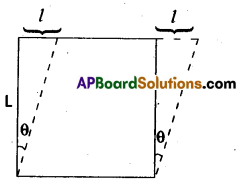
AP Inter 1st Year Physics Study Material Chapter 10 Mechanical Properties of Solids 1
Shearing strain (θ) = \(\frac{1}{L}\)

3. Bulk (or) volume strain : It is the ratio of change in volume to its original volume is called bulk strain. It is called Bulk (or) volume strain.
Bulk strain = \(\frac{\text { Change in Volume }}{\text { Original Volume }}=\frac{\Delta V}{V}\)

Question 6.
Define strain energy and derive the equation for the same. [Mar. 14]
Answer:
The potential energy stored in a body when stretched is called strain energy.
Let us consider a wire of length L and cross – sectional area A. Let x be the change in length of the wire by the application of stretching force F.
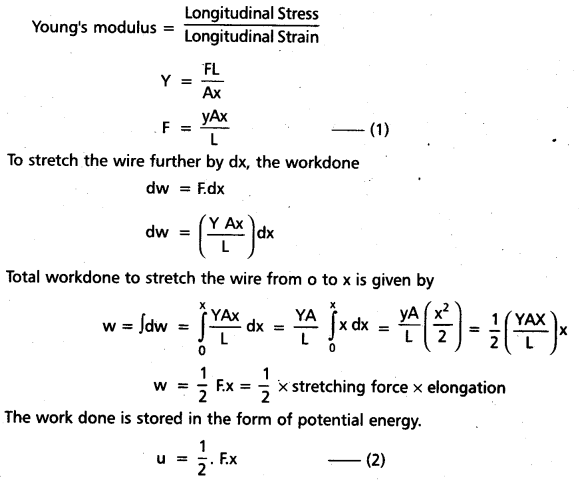
AP Inter 1st Year Physics Study Material Chapter 10 Mechanical Properties of Solids 2
Strain energy per unit volume = \(\frac{1}{2} \times \frac{F}{A} \cdot \frac{x}{L}\)
= \(\frac{1}{2}\) × stress × strain.

AP Inter 1st Year Physics Study Material Chapter 10 Mechanical Properties of Solids

Question 7.
Explain why steel is preferred to copper, brass, aluminium in heavy-duty machines and in structural designs.
Answer:
The elastic behavior of materials plays an important role in everyday life. Designing of buildings, the structural design of the columns, beams and supports require knowledge of strength of material used. The elasticity of the material is due to stress developed with in the body, when extenal force acts on it. A material is of more elastic nature if it develops more stress (or) restoring force. Steel develops more stress than copper, brass, aluminium for same strain. So steel is more elastic.
y = \(\frac{\text { Stress }}{\text { Strain }}\)

Question 8.
Describe the behaviour of a wire under gradually increasing load. [A.P. – Mar. ’18, ’16, ’15; TS – Mar. ’18, ’15, ’13]
Answer:
When the load is increased in steps, a graph is drawn between stress on y-axis and corresponding strain on x-axis.
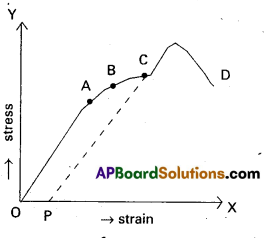
AP Inter 1st Year Physics Study Material Chapter 10 Mechanical Properties of Solids 3
1. Proportionality limit : In the linear position OA, stress is proportional to strain, i.e. Hookes law is obeyed by the wire upto point A. The graph is a straight lint. When ever the stretching force at A is removed, the wire regains its original length.
A is called proportionality limit.

2. Elastic limit : In the graph B is the elastic limit.
Through the wire doesnot obey Hooke’s law at B. The wire regains its original length after removing the stretching force at B. upto point B the wire is under elastic behaviour.

3. Permanent set (or) yield point: In the graph c is the yield point. If the stretching force at c is removed, the wire doesnot regain its original length and the length of the wire changes permanently. In this position the wire flows like a viscous liquid. After the point c, the wire is under plastic behavior, c is called permanent set (or) yield point.

4. Breaking point: When the stress increased, the wire becomes thinner and thinner. When the stress increases to a certain limit the wire breaks. The stress at which the wire breaks is called breaking stress and the point D is called breaking point.

5. Elastic fatigue : The state of temperary loss of elastic nature of a body due to continuous strain is called elastic fatigue. When a body is subjected to continuous strain with in the elastic limit, it appears to have lost Hastic property temporarily to some extent and becomes weak.

AP Inter 1st Year Physics Study Material Chapter 10 Mechanical Properties of Solids

Question 9.
Two identical solid balls, one of ivory and the other of wet-day are dropped from the same height onto the floor. Which one will rise to greater height after striking the floor and why ?
Answer:
Ivory ball rise to greater height after striking the floor. The ivory ball regain its original shape after striking the floor. The elastic property of ivory ball is more. Where as wet-day ball does not regain its original shape after striking the floor.

So wet-day ball acts like plastic body.

Question 10.
While constructing buildings and bridges a pillar with distributed ends is preferred to a pillar with rounded ends. Why ?
Answer:
Use of pillars (or) columns is also very common in buildings and bridges. A pillar with rounded ends supports less load than that with a distributed shape at the ends. The precise design of a bridge (or) a building has to take into account the conditions under which it will function, the cost and long period, reliability of usable materials.
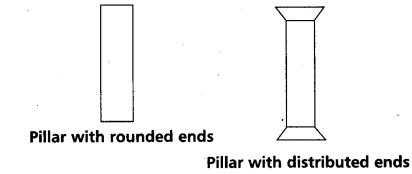
AP Inter 1st Year Physics Study Material Chapter 10 Mechanical Properties of Solids 4

Question 11.
Explain why the maximum height of a mountain on earth is approximately 10 km ?
Answer:
The maximum height of a mountain on earth is 10 km, can also be provided by considering the elastic properties of rocks. A mountain base is not under uniform compression and this provides some shearing stress to rocks under which they can flow. The stress due to all the material on the top should be less than the critical shearing stress at which the rocks flow.

At the bottom of a mountain of height h, the force per unit area due to the weight of the mountain is hρg. Where ρ is the density of the mountain. The material at the bottom experiences this force in the vertical direction and the sides of the mountain are free.
There is a shear component, approximately hρg itself.
Elastic limit for 3 typical rock is 30 × 107 N/m2
hρg = 30 × 107 (ρ = 3 × 10³ kg/m3)
h = \(\frac{30 \times 10^7}{3 \times 10^3 \times 10}\)
h = 10 km.

AP Inter 1st Year Physics Study Material Chapter 10 Mechanical Properties of Solids

Question 12.
Explain the concept of Elastic Potential Energy in a stretched wire and hence obtain the expression for it.
Answer:
“When a wire is put under a tensile stress, work is done against the inter-atomic forces. The work is stored in the wire in the form of elastic potential energy”.

Expression for elastic potential energy : Consider a wire of length L and area of cross section A is subjected to a deforming force F along the length of the wire. Let the length of the wire is elongated by l.
Young’s modulus (y) = \(\frac{\mathrm{FL}}{\mathrm{Al}}\)
F = \(\frac{\mathrm{yAl}}{\mathrm{L}}\) ……………. (1)
Work done due to further elongation of small length dl
Work done (dw) = F × dl = (\(\frac{\mathrm{yAl}}{\mathrm{L}}\))dl ……………… (2)
Total work done in increasing the length of the wire from L to (L + l)
w = \(\int_0^1 \frac{\mathrm{yAl} }{\mathrm{L}} \mathrm{dl}=\frac{\mathrm{yA}}{2} \times \frac{l^2}{\mathrm{~L}}\)
w = \(\frac{1}{2} \times \mathrm{y} \times\left(\frac{l}{\mathrm{~L}}\right)^2 \times \mathrm{Al}\)
= \(\frac{1}{2}\) y × stress2 × volume of the wire
w = \(\frac{1}{2}\) × stress × strain × volume of the wire.
This work is stored in the wire in elastic potential energy (u).

Long Answer Question

Question 1.
Define Hooke’s law of elasticity and describe an experiment to determine the Young’s modulus of the material of a wire.
Answer:
Hooke’s law : With in the elastic limit, stress is directly proportional to the strain.
Stress ∝ strain
Stress = k × strain
Where k is modulus of elasticity.
Determination of young’s modulus of the material of a wire:
AP Inter 1st Year Physics Study Material Chapter 10 Mechanical Properties of Solids 5
Young’s Modulus of the Material of a wire

  1. It consists of two long straight wires of same length and same area of cross-section suspended side by side from a rigid .support.
  2. The wire A (reference wire) carries a metre scale M and a pan to place a weight.
  3. The wire B (experimental wire) carries a pan in which known weights can be placed.
  4. A vernier scale v is attached to a pointer at the bottom of the experimental wire B and the main scale M is fixed to the wire A.
  5. The weights placed in the pan, the elongation of the wire is measured by the vernier arrangement.
  6. The reference wire is used to compensate for any change in length that may occur due to change in room temperature.
  7. Both the reference and experimental wires are given an initial small load to keep the wires straight and the vernier reading is noted.
  8. Now the experimental wire is gradually loaded with more weights, the vernier reading is noted again.
  9. The difference between two vernier readings gives the elongation produced in the wire.
  10. Let r and L be the radius and initial length of the experimental wire. Let M be the mass that produced an elongation ∆L in the wire.
    Young’s modulus of the material of the experimental wire is given by
    y = \(\frac{\text { Longitudinal Stress }}{\text { Longitudinal Strain }}=\frac{\frac{\mathrm{F}}{\mathrm{A}}}{\frac{\Delta \mathrm{L}}{\mathrm{L}}}\)
    y = \(\frac{\mathrm{FL}}{\mathrm{A} \Delta \mathrm{L}}\)
    y = \(\frac{\mathrm{MgL}}{\pi r^2 \times \Delta \mathrm{L}}\)
    From above equation young’s modulus of the material of the wire is determined.

Problems

Question 1.
A copper wire of 1mm diameter is stretched by applying a force of 10 N. Find the stress in the wire.
Solution:
D = 1 m.m = 10-3m, r = \(\frac{D}{2}\) = 0.5 × 10⁻³ m.
F = 10 N
Stress = \(\frac{F}{A}=\frac{F}{\pi r^2}\)
= \(\frac{10}{3.14 \times\left(0.5 \times 10^{-3}\right)^2}\)
= 1.273 × 10⁷ N/m2.

AP Inter 1st Year Physics Study Material Chapter 10 Mechanical Properties of Solids

Question 2.
A tungsten wire of length 20 cm is stretched by 0.1 cm. Find the strain on the wire.
Solution:
L = 20 × 10-2 m, ∆L = 0.1 × 10⁻² m
Strain = \(\frac{\Delta \mathrm{L}}{\mathrm{L}}=\frac{0.1 \times 10^{-2}}{20 \times 10^{-2}}\) = 0.005.

Question 3.
If an iron wire is stretched by 1 %, what is the strain on the Wire ?
Solution:
Strain = \(\frac{\Delta \mathrm{L}}{\mathrm{L}}\) = 1 %
Strain = \(\frac{1}{100}\) = 0.01

Question 4.
A brass wire of diameter 1mm and length 2 m is streched by applying a force of 20N. If the increase in length is 0.51 mm. find
(i) the stress,
(ii) the strain and
(iii) the Young’s modulus of the wire.
Solution:
D = 1 m.m, r = \(\frac{D}{2}\) = 0.5 × 10⁻³ m
L = 2 m, F = 20 N, ∆L = 0.51 m.m = 0.51 × 10⁻³ m
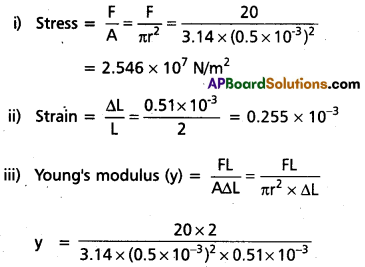
AP Inter 1st Year Physics Study Material Chapter 10 Mechanical Properties of Solids 6
= 9.984 × 10¹⁰ N/m2

Question 5.
A copper wire and an aluminium wire have lengths in the ratio 3 : 2, diameters in the ratio 2 : 3 and forces applied in the ratio 4: 5. Find the ratio of increase in length of the two wires. (Ycu = 1.1 × 10¹¹ Nm-2, YAl = 0.7 × 10¹¹ Nm-2).
Solution:
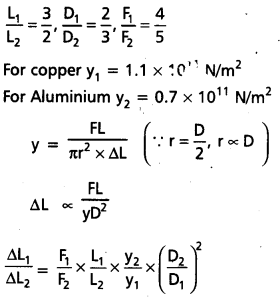
AP Inter 1st Year Physics Study Material Chapter 10 Mechanical Properties of Solids 7
= \(\frac{4}{5} \times \frac{3}{2} \times\left(\frac{0.7 \times 10^{11}}{1.1 \times 10^{11}}\right) \times\left(\frac{3}{2}\right)^2\)
\(\frac{\Delta \mathrm{L}_1}{\Delta \mathrm{L}_2}=\frac{189}{110}\)

AP Inter 1st Year Physics Study Material Chapter 10 Mechanical Properties of Solids

Question 6.
A brass wire of cross-sectional area 2 mm2 is suspended from a rigid support and a body of volume 100 cm3 is attached to its other end. If the decrease in the length of the wire is 0.11 mm, when the body is completely immersed in water, find the natural length of the wire.
(Ybrass = 0.91 × 10¹¹ Nm-2, ρwater = 103 kg m-3).
Solution:
A = πr2 = 2 × 10⁻⁶ m2, V = 100 × 10-6 = 10-4 m3
∆L = 0.11 × 10⁻³ m, yBrass = 0.91 × 10¹¹ N/m2, ρ = 103 kg/m3
y = \(\frac{M g L}{A \times \Delta L}=\frac{v \rho g L}{A \times \Delta L}\)
L = \(\frac{\mathrm{yA} \Delta \mathrm{L}}{\mathrm{v \rho g}}=\frac{0.91 \times 10^{11} \times 2 \times 10^{-6} \times 0.11 \times 10^{-3}}{10^{-4} \times 10^3 \times 9.8}\)
L = 2.04 m.

Question 7.
There are two wires of same material. Their radii and lengths are both in the ratio 1:2. If the extensions produced are equal, what is the ratio of loads ?
Solution:
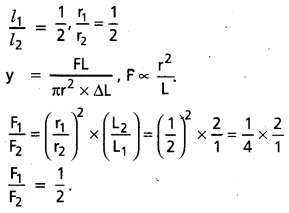
AP Inter 1st Year Physics Study Material Chapter 10 Mechanical Properties of Solids 8

Question 8.
Two wires of different material have same lengths and areas of cross¬section. What is the ratio of their increase in length when forces applied are the same ?
(Y1 = 0.9 × 10¹¹ Nm-2, Y2 = 3.6 × 10¹¹ Nm-2)
Solution:
y1 = 0.9 × 10¹¹ Nm-2
y2 = 3.6 × 10¹¹ Nm-2
y = \(\frac{F L}{A \times \Delta L}\)
∆L ∝ \(\frac{1}{y}\)
\(\frac{(\Delta L)_1}{(\Delta L)_2}=\frac{y_2}{y_1}=\frac{3.6 \times 10^{11}}{0.9 \times 10^{11}}=\frac{4}{1}\)

AP Inter 1st Year Physics Study Material Chapter 10 Mechanical Properties of Solids

Question 9.
A metal wire of length 2.5 m and area of cross-section 1.5 × 10⁻⁶ m2 is stretched through 2 mm. if its Young’s modulus is 1.25 × 10¹¹ N.m2, find the tension in the wire.
Solution:
L = 2.5 m, A = 1.5 × 10⁻⁶ m2
∆L = 2 × 10⁻⁹ m
y = 1.25 × 10¹¹ N.m2
y = \(\frac{\mathrm{FL}}{\mathrm{A} \Delta \mathrm{L}}\)
F = \(\frac{\mathrm{yA} \Delta \mathrm{L}}{\mathrm{L}}\)
= \(\frac{1.25 \times 10^{11} \times 1.5 \times 10^{-6} \times 2 \times 10^{-3}}{2.5}\)
F = 150 N

Question 10.
An aluminium wire and a steel wire of the same length and cross-section are joined end-to-end. The composite wire is hung from a rigid support and a load is suspended from the free end. If the increase in length of the composite wire is 1.35 mm, find the ratio of the
(i) stress in the two wires and
(ii) strain in the two wires.
(YAl = 0.7 × 10¹¹ N.m2, YSteel = 2 × 10¹¹ Nm2).
Solution:
YAl = 0.7 × 10¹¹ N.m2, YSteel = 2 × 10¹¹ Nm2
∆L1 + ∆L2 = 1.35 mm ……………… (1)
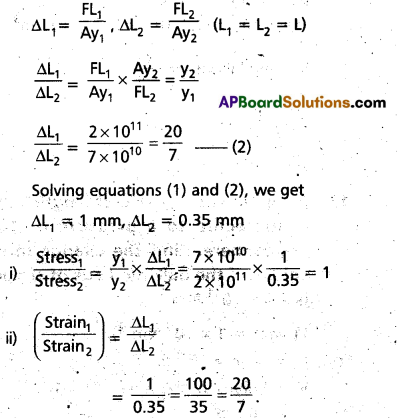
AP Inter 1st Year Physics Study Material Chapter 10 Mechanical Properties of Solids 9

Question 11.
A 2 cm cube of some substance has its upper face displaced by 0.15 cm due to a tangential force of 0.3 N while keeping the lower face fixed, Calculate the rigidity modulus of the substance.
Solution:
L = 2 × 10⁻² m, A = L2 = 4 × 10⁻⁴ m2
∆x = 0.15 × 10⁻² m
F = 0.3 N
G = \(\frac{\frac{F}{A}}{\frac{\Delta x}{L}}=\frac{F L}{A \Delta x}\) (∵ θ = \(\frac{\Delta x}{L}\))
G = \(\frac{0.3 \times 2 \times 10^{-2}}{4 \times 10^{-4} \times 0.15^6 \times 10^{-2}}\)
G = 104 N/m2

AP Inter 1st Year Physics Study Material Chapter 10 Mechanical Properties of Solids

Question 12.
A spherical ball of volume 1000 cm3 is subjected to a pressure of 10 Atmosphere. The change in volume is 10-2 cm3. If the ball is made of iron, find its bulk modulus.
(1 atmosphere = 1 × 10⁵ Nm-2).
Solution:
v = 1000 cm3 = 1000 × 10-6 = 10-3 m3
p = 1 atm = 1 × 105 = 105 N/m2
-∆v = 10-2 cm3 = 10-2 × 10-6 = 10-8 m3
Bulk modulus (B) = \(\frac{-p v}{\Delta v}\)
= \(\frac{10^5 \times 10^{-3}}{10^{-8}}\)
B = 1010 N/m2.

Question 13.
A copper cube of side of length 1 cm is subjected to a pressure of 100 atmosphere. Find the change in its volume if the bulk modulus of copper is 1.4 × 10¹¹ Nm-2. (1 atm = 1 × 10⁵ Nm-2).
Solution:
l = 1 cm = 10-2 m
V = Volume of the cube = l3 = 1cm3
= 10-6 m3
P = 100 atm = 100 × 105 = 107 N/m2
B = 1.4 × 10¹¹ N/m2
B = \(\frac{-P V}{\Delta V}\)
-∆V = \(\frac{P V}{B}=\frac{10^7 \times 10^{-6}}{1.4 \times 10^{11}}\)
-∆V = 0.7143 × 10⁻¹⁰ m3.

Question 14.
Determine the pressure required to reduce the given volume of water by 2%. Bulk modulus of water is 2.2 × 10⁹ Nm-2.
Solution:
\(\frac{-\Delta V}{V}\) = 2 % = \(\frac{2}{100}\)
B = 2.2 × 10⁹ Nm2
B = \(\frac{-P V}{\Delta V}\)
P = -B × \(\frac{\Delta V}{V}\)
= 2.2 × 10⁹ × \(\frac{2}{100}\)
P = 4.4 × 10⁷ N/m2.

AP Inter 1st Year Physics Study Material Chapter 10 Mechanical Properties of Solids

Question 15.
A steel wire of length 20 cm is stretched to increase its length by 0.2 cm. Find the lateral strain in the wire if the Poisson’s ratio for steel is 0.19.
Solution:
L = 20 cm = 20 × 10-2 m
∆L = 0.2 × 10⁻² m
σ = 0.19
σ = \(\frac{\text { Lateral strain }}{\text { Longitudinal strain }\left(\frac{\Delta \mathrm{L}}{\mathrm{L}}\right)}\)
Lateral strain = σ × \(\frac{\Delta L}{L}\)
= \(\frac{0.19 \times 0.2 \times 10^{-2}}{20 \times 10^{-2}}\)
= 0.0019

Additional Problems

Question 1.
A steel wire of length 4.7 m and cross-sectional area 3.0 × 10⁻⁵ m2 stretches by the same amount as a copper wire of length 3.5 m and cross-sectional area of 4.0 × 10⁻⁵ m2,
Solution:
Given, for steel wire, a1 = 3.0 × 10⁻⁵ m2, l1 = 4.7 m, ∆l1 = ∆l, F1 = F
For copper wire, a2 = 4.0 × 10⁻⁵ m2, l2 = 3.5 m, ∆l2 = ∆l, F2 = F .
Let y1, y2 be the young modulus of steel wire and copper wire respectively.
∴ y1 = \(\frac{F_1}{a_1} \times \frac{l_1}{\Delta l_2}=\frac{F}{3.0 \times 10^{-5}} \times \frac{4.7}{\Delta l}\) ………….. (i)
and y2 = \(\frac{F_2 \times l_2}{a_2 \times \Delta l_2}=\frac{F \times 3.2}{4 \times 10^{-5} \times \Delta l}\)
\(\frac{\mathrm{y}_1}{\mathrm{y}_2}=\frac{4.7 \times 4 \times 10^{-5}}{3.5 \times 3.0 \times 10^{-5}}\) = 1.8
Here y1 : y1 = 1.8 : 1.

Question 2.
Figure shows the strain-stress curve for a given material. What are (a) Young’s modulus and (b) approximate yield strength for this material ?
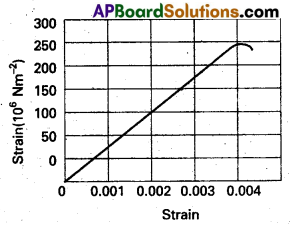
AP Inter 1st Year Physics Study Material Chapter 10 Mechanical Properties of Solids 10
Solution:
a) From graph, for stress = 150 × 106 Nm-2 the corresponding strain = 0.002
young’s modulus y = \(\frac{\text { Stress }}{\text { Strain }}=\frac{150 \times 10^6}{0.002}\)
= 7.5 × 10¹⁰ Nm-2

b) Approximate yeild strength will be equal to the maximum stress it can substain with out crossing the elastic limit. Therefore, the approximate yeild strength
= 300 × 106 Nm-2
= 3 × 10⁸ Nm-2

AP Inter 1st Year Physics Study Material Chapter 10 Mechanical Properties of Solids

Question 3.
The stress-strain graphs for materials A and B are shown in Fig.
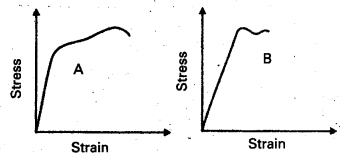
AP Inter 1st Year Physics Study Material Chapter 10 Mechanical Properties of Solids 11
The graphs are drawn to the same scale.
a) Which of the materials has the greater Young’s modulus ?
b) Which of the two is the stronger material ?
Solution:
a) From the two graphs we note that for a given strain, stress for A is more than that of B. Hence young’s modulus (= stress/ strain) is greater for A than that of B.

b) A is stronger than B. Strength of a material is measured by the amount of stress required to cause fracture, corresponding to the point of fracture.

Question 4.
Read the following two statements below carefully and state, with reasons, if it is true or false.
a) The Young’s modulus of rubber is greater than that of steel;
b) The stretching of a coil is determined by its shear modulus.
Solution:
a) False, because for a given stress there is more strain in rubber than steel and modulus of elasticity is inversly proportional to strain.

b) True because the strecting of coil simply changes its shape without any change in the length of the wire used in the coil due to which shear modulus of elasticity is involved.

AP Inter 1st Year Physics Study Material Chapter 10 Mechanical Properties of Solids

Question 5.
Two wires of diameter 0.25 cm, one made of steel and the other made of brass are loaded as shown in Fig. The unloaded length of steel wire is 1.5 m and that of brass Wire is 1.0 m. Compute the elongations of the steel and the brass wires.
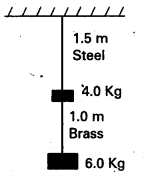
AP Inter 1st Year Physics Study Material Chapter 10 Mechanical Properties of Solids 12
Solution:
For steel wire, total force on steel wire,
F1 = 4 + 6 = 10 kg, f = 10 × 9.8 N
l1 = 1.5 m, ∆l1 = ?, 2r1 = 0.25cm or r1 =(0.25/2)cm = 0.125 × 10⁻² m
y1 = 2.0 × 10¹¹ pa
For brass wire, F2 = 6.0 kg, f = 6 × 9.8 N
2r2 = 0.25 cm or r2 = (0.25/2) cm = 0.125 × 10⁻² m,
y2 = 0.91 × 10¹¹ pa, l2 = 1.0 m, ∆l2 = ?
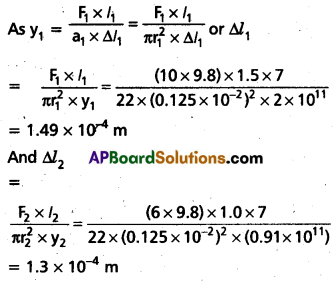
AP Inter 1st Year Physics Study Material Chapter 10 Mechanical Properties of Solids 13

Question 6.
The edge of an aluminium cube is 10 cm long. One face of the cube is firmly fixed to a verticle wall. A mass of 100 kdis then attached to the opposite face of the cube. The shear modulus of aluminium is 25 GPa. What is the vertical deflection of this face?
Solution:
A = 0.10 × 0.10 = 10-2 m2, F = mg = 100 × 10 N
Shearing strain = \(\frac{\Delta \mathrm{L}}{\mathrm{L}}=\frac{\left(\frac{\mathrm{F}}{\mathrm{A}}\right)}{\eta}\)
or ∆L = \(\frac{F L}{A \eta}\)
= \(\frac{(100 \times 10) \times(0.10)}{10^{-2} \times\left(25 \times 10^9\right)}\) = 4 × 10⁻⁷ m.

Question 7.
Four identical hollow cylindrical columns of mild steel support a big structure of mass 50,000 kg. The inner and outer radii of each column are 30 and 60 cm respectively. Assuming the load distribution to be uniform, calculate the corn pressional strain of each column.
Solution:
Load on each column, F = \(\frac{50,000}{4}\) kgwt
= \(\frac{50,000 \times 9.8}{4}\) N
A = π(r22 – r12) = \(\frac{22}{7}\)(0.60)2 – (0.30)2]
= \(\frac{22}{7}\) 0.27 m2
Compression strain = \(\frac{\frac{F}{A}}{y}=\frac{F}{A y}\)
= \(\frac{50,000 \times 9.8}{4 \times\left(\frac{22}{7} \times 0.27\right) \times 2.0 \times 10^{11}}\)
= 7.21 × 10⁻⁷.

AP Inter 1st Year Physics Study Material Chapter 10 Mechanical Properties of Solids

Question 8.
A piece of copper having a rectangular cross-section of 15.2 mm × 19.1 mm is pulled in tension with 44,500 N force, producing only elastic deformation. Calculate the resulting strain?
Solution:
Here, A = 15.2 × 19.2 × 10-6 m2, F = 44,
500 N, η = 42 × 109 Nm-2
Strain = \(\frac{\text { Stress }}{\text { Modulus of elasticity }}\)
= \(\frac{\frac{F}{A}}{\eta}=\frac{F}{A \eta}=\frac{44500}{\left(15.2 \times 19.2 \times 10^{-6}\right) \times 42 \times 10^9}\)
= 3.65 × 10⁻³.

Question 9.
A steel cable with a radius of 1.5 cm supports a chairlift at a ski area. If the maximum stress Is not to exceed 108 N m-2, what is the maximum load the cable can support ?
Solution:
Maximum load macimum stress × area of cross-section
= 108πr2
= 108 × \(\frac{22}{7}\) × (1.5 × 10⁻²)2
= 7.07 × 10⁴ N.

Question 10.
A rigid bar of mass 15 kg is supported symmetrically by three wires each 2.0 m long. Those at each end are of copper and the middle one is of iron. Determine the ratios of their diameters if each is to have the same tension.
Solution:
As each wire has same tension F, so each wire has same extansion due to mass of rigid bar. As each wire is of same length, hence each wire has same strain, if D is the diameter of wire, then
y = \(\frac{4 \mathrm{~F} / \pi \mathrm{D}^2}{\text { Strain }}\) or D2 ∝ 1/y
\(\frac{D_{\mathrm{cu}}}{\mathrm{D}_{\mathrm{iron}}}=\sqrt{\frac{\mathrm{y}_{\mathrm{iron}}}{\mathrm{y}_{\mathrm{cu}}}}\)
= \(\sqrt{\frac{190 \times 10^9}{110 \times 10^9}}=\sqrt{\frac{19}{11}}\) = 1.31.

AP Inter 1st Year Physics Study Material Chapter 10 Mechanical Properties of Solids

Question 11.
A 14.5 kg mass, fastened to the end of a steel wire of unstretched length 1.0 m, is whirled in a vertical circle with an angular velocity of 2 rev/s at the bottom of the circle. The cross-sectional area of the wire is 0.065 cm2. Calculate the elongation of the wire when the mass is at the lowest point of its path.
Solution:
Here, m = 14.5 kg, l = r = 1m, v = 2 rps, A = 0.065 × 10⁻⁴ m2
Total pulling force on mass, when it is at the lowest position of the vertical circle is
F = mg + mrω2
= mg + mr4πv2
= 14.5 × 9.8 + 14.5 × 1 × 4 × (\(\frac{22}{7}\))2 × 22
= 142.1 +2291.6
= 2433.7 N
y = \(\frac{F}{A} \times \frac{l}{\Delta l}\) or ∆l = \(\frac{F l}{A y}\)
= \(\frac{2433.7 \times 1}{\left(0.065 \times 10^{-4}\right) \times\left(2 \times 10^{11}\right)}\)
= 1.87 × 10⁻³ m
= 1.87 mm.

Question 12.
Compute the bulk modulus of water from the following data : Initial volume = 100.0 litre, Pressure increase = 100.0 atm (1 atm = 1.013 × 10⁵ Pa), Final volume = 100.5 litre. Compare the bulk modulus of water with that of air (at constant temperature). Explain in simple terms why the ratio is so large.
Solution:
Here, V = 100 lit = 100 × 10-3 m3, P = 100 atm = 100 × 1.013 × 105 Pa
V + ∆V = 100.5 litre or ∆V= (V + ∆V) – V
= 100.5 – 100
= 0.5 litre = 0.5 × 10⁻³ m3
We known that bulk modulus, B = \(\frac{\mathrm{PV}}{\Delta \mathrm{V}}\)
= \(\frac{100 \times 1.013 \times 10^5 \times 100 \times 10^{-3}}{0.5 \times 10^{-3}}\)
= 2.026 × 10⁹ Pa
Bulk modulus of air = 1.0 × 10⁵ Pa
\(\frac{\text { Bulk modulus of water }}{\text { Bulk modulus of air }}=\frac{2.026 \times 10^9}{1.0 \times 10^5}\)
= 2.026 × 10¹⁴.
It is so because gases are much more compressible than those of liquids. The molecules in gases are very poorly coupled to their neighbours as compared to those of gases.

AP Inter 1st Year Physics Study Material Chapter 10 Mechanical Properties of Solids

Question 13.
What is the density of water at a depth where pressure is 80.0 atm, given that its density at the surface is 1.03 × 10³ kg m-3 ?
Solution:
Here, P = 80.0 atm = 80.0 × 1.013 × 105 pa,
compressibility = \(\left(\frac{1}{B}\right)\) = 45.8 × 10⁻¹¹ pa-1
Density of water at surface,
ρ = 1.03 × 10³ kg m-3
Let p be the density of water at the given depth, if v and v’ are volumes of certain mass M of ocean water at surface and at a given
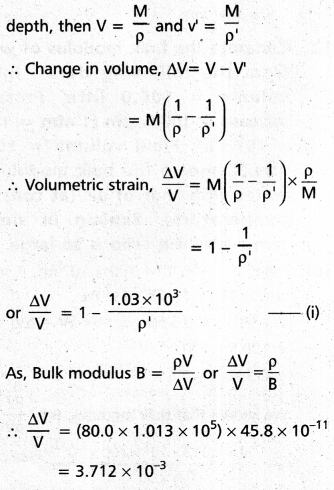
AP Inter 1st Year Physics Study Material Chapter 10 Mechanical Properties of Solids 14
Putting this value in (i) we get
1 – \(\frac{1.03 \times 10^3}{\rho^{\prime}}\) = 3.712 × 10⁻³ or
ρ’ = \(\frac{1.03 \times 10^3}{1-3.712 \times 10^{-3}}\) = 1.034 × 10³ kg m-3.

Question 14.
Compute the fractional change in volume of a glass slab, when subjected to a hydraulic pressure of 10 atm.
Solution:
Here, P = 10 atm = 10 × 1.013 × 105 pa,
B = 37 × 109 Nm-2
Volumetric strain = \(\frac{\Delta V}{V}=\frac{P}{B}\)
= \(\frac{10 \times 1.013 \times 10^5}{37 \times 10^9}\) = 2.74 × 10⁻⁵
∴ Fractional change in volume = \(\frac{\Delta V}{V}\)
= 2.74 × 10⁻⁵

AP Inter 1st Year Physics Study Material Chapter 10 Mechanical Properties of Solids

Question 15.
Determine the volume contraction of a solid copper cube, 10 cm on an edge, when subjected to a hydraulic pressure of 7.0 × 10⁶ Pa.
Solution:
Here, L = 10 cm = 0.10m; P = 7 × 10⁶ pa B = 140 Gpa = 140 × 109 pa
As B = \(\frac{\mathrm{PV}}{\Delta \mathrm{V}}=\frac{\mathrm{Pl}^3}{\Delta \mathrm{V}}\) or ∆V = \(\frac{\mathrm{Pl}^3}{\mathrm{~B}}\)
= \(\frac{\left(7 \times 10^6\right) \times(0.10)^3}{140 \times 10^9}\) = 5 × 10⁻⁸ m3
= 5 × 10⁻² mm3

Question 16.
How much should be pressure on a litre of water be changed to compress it by 0.10% ?
Solution:
Here, V = 1 litre = 10-3m3;
∆V/V = 0,10/100 = 10-3
B = \(\frac{P V}{\Delta V}\) or P = B \(\frac{\Delta V}{V}\)
= (2.2 × 109) × 10-3 = 2.2 × 10⁶pa

Question 17.
Anvils made of single crystals of diamond, with the shape as shown in Fig. are used to investigate behaviour of materials under very high pressures. Flat faces at the narrow end of the anvil have a diameter of 0.50 mm, and the wide ends are subjected to a compressional force of 50,000 N. What is the pressure at the tip of the anvil ?
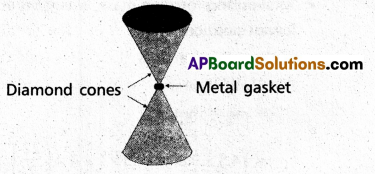
AP Inter 1st Year Physics Study Material Chapter 10 Mechanical Properties of Solids 15
Solution:
Here, D = 0.5 mm = 0.5 × 10⁻³m = 5 × 10⁻⁴m
F = 50,000 N = 5 × 10⁴N
Pressure at the tip of anvil.
P = \(\frac{F}{\pi D^2 / 4}=\frac{4 F}{\pi D^2}\)
P = \(\frac{4 \times\left(5 \times 10^4\right)}{(22 / 7) \times\left(5 \times 10^{-4}\right)^2}\) = 2.5 × 10¹¹pa.

AP Inter 1st Year Physics Study Material Chapter 10 Mechanical Properties of Solids

Question 18.
A rod of length 1.05 m having negligible mass is supported at its end by two wires of steel (wire A) and aluminium (wire B) of equal lengths as shown in Fig. The cross-sectional areas of wires A and B are 1.0 mm2 and 2.0 mm2, respectively. At what point along the rod should a mass m be suspended in order to produce (a) equal stresses and (b) equal strains in both steel and aluminium wires.
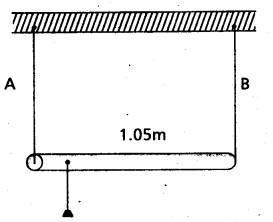
AP Inter 1st Year Physics Study Material Chapter 10 Mechanical Properties of Solids 16
Solution:
For Steel wire A, l1 = l, A1 = 1 mm2
Y1 = 2 × 10¹¹Nm-2
For aluminium wire B, l2 = l;
A2 = 2mm2; y2 = 7 × 10¹⁰ Nm-2
a) Let mass m be suspended from the rod at the distance × from the end where wires A is connected. Let F1 and F2 be the tension in two wires and there is equal stress in two wires, then
\(\frac{F_1}{A_1}=\frac{F_2}{A_2} \text { or } \frac{F_1}{F_2}=\frac{A_1}{A_2}=\frac{1}{2}\) …………………. (i)
Taking moment of forces about the point of suspension of mass from the rod, we have
F1x = F2 (1.05 – x) or \(\frac{1.05-x}{x}=\frac{F_1}{F_2}=\frac{1}{2}\)
or 2.10 – 2x = x or x = 0.70m = 70 cm

b) Let mass m be supended from the rod at distance × from the end where wire A is connected. Let F1 and F2 be the tension in the wires and there is equal strain in the two wires i.e.
\(\frac{F_1}{A_1 Y_1}=\frac{F_2}{A_2 Y_2}\) or \(\frac{F_1}{F_2}=\frac{A_1}{A_2} \frac{Y_1}{Y_2}\)
= \(\frac{1}{2} \times \frac{2 \times 10^{11}}{7 \times 10^{10}}=\frac{10}{7}\)
As the rod is stationary, so F1x = F2(1.05 – x)
or \(\frac{1.05-x}{x}=\frac{F_1}{F_2}=\frac{10}{7}\)
or 10 x = 7.35 – 7x
or x = 0.4324 m
x = 43.2cm.

AP Inter 1st Year Physics Study Material Chapter 10 Mechanical Properties of Solids

Question 19.
A mild steel wire of length 1.0 m and cross-sectional area 0.50 × 10⁻² cm2 is stretched, well within its elastic limit, horizontally between two pillars. A mass of 100 g is suspended from the mid-point of the wire. Calculate the depression at the- mid-point.
Solution:
Refer the figure, let x be the depression at the mid point i.e CD = x
In fig. AC = CB = Z = 0.5m
m = 100g = 0.100 kg
AD = BD = (l2 + x2)1/2
Increase in length, ∆l = AD + DB – AB
= 2 AD – AB
= 2 (l2 + x2)1/2 – 2l
= 2l(1 + \(\frac{x^2}{l^2}\))1/2 – 2l
= 2l (1 + \(\frac{x^2}{2 l^2}\)) – 2l = \(\frac{x^2}{l}\)
Strain = \(\frac{\Delta l}{2 l}=\frac{x^2}{2 l^2}\)
If T is the tension in the wire, then 2T cos θ
= mg or T = \(\frac{\mathrm{mg}}{2 \cos \theta}\)
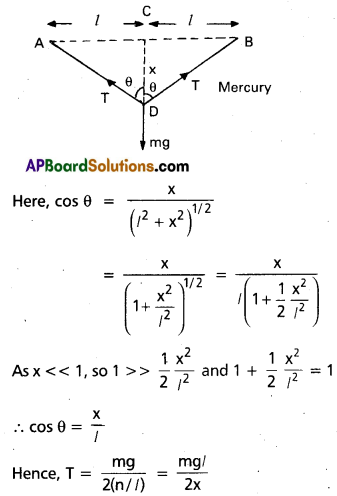
AP Inter 1st Year Physics Study Material Chapter 10 Mechanical Properties of Solids 17
AP Inter 1st Year Physics Study Material Chapter 10 Mechanical Properties of Solids 18

Question 20.
Two strips of metal are riveted together at their ends by four rivets, each of diameter 6.0 mm. What is the maximum tension that can be exerted by the riveted strip if the shearing stress on the rivet is not to exceed 6.9 × 10⁷ Pa ? Assume that each rivet is to carry one quarter of the load.
Solution:
Here, r = 6/2 = 3mm = 3 × 10⁻³ m, max.
stress = 6.9 × 10⁷ Pa
Max . load on a rivet = Max stress × area of cross section
= 6.9 × 107 × (22/7) × (3 × 10-3)2
∴ Maximum tension
= 4 (6.9 × 10⁷ × \(\frac{22}{7}\) × 9 × 10⁻⁶)
= 7.8 × 10³N.

AP Inter 1st Year Physics Study Material Chapter 10 Mechanical Properties of Solids

Question 21.
The Marina trench is located in the Pacific Ocean, and at one place it is nearly eleven km beneath the surface of water. The water pressure at the bottom of the trench is about 1.1 × 10⁸ Pa. A steel ball of initial volume 0.32 m3 is dropped into the ocean and falls to the bottom of the trench. What is the change in the volume of the ball when it reaches to the bottom ?
Solution:
Here, P = 1.1 × 10⁸ Pa, V = 0.32 m3,
B = 16 × 1011Pa
∆V = \(\frac{\mathrm{PV}}{\mathrm{B}}\)
= \(\frac{\left(1.1 \times 10^8\right) \times 0.32}{1.6 \times 10^{11}}\)
= 2.2 × 10⁻⁴m3

Textual Examples

Question 1.
A structural steel rod has a radius of 10 mm and a length of 10 m. A 100 KN force stretches it along its length. Calculate (a) stress, (b) elongation, and (c) strain on the rod. Young’s modulus, of structural steel ¡s 2.0 × 10¹¹ Nm2.
Answer:
a) Given Stress = \(\frac{F}{A}=\frac{F}{\pi r^2}\)
= \(\frac{100 \times 10^3 \mathrm{~N}}{3.14 \times\left(10^{-2} \mathrm{~m}\right)^2}\) = 3.18 × 10⁸ Nm-2

b) The elongation
∆L = \(\frac{(\mathrm{F} / \mathrm{A}) \mathrm{L}}{\mathrm{Y}}\)
= \(\frac{\left(3.18 \times 10^8 \mathrm{Nm}^2\right)(1 \mathrm{~m})}{2 \times 10^{11} \mathrm{Nm}^{-2}}\)
= 1.59 × 10⁻³ m
= 1.59 mm

c) The strain is given by
Strain = ∆L/L = (1.59 × 10⁻³) km
= 1.59 × 10-3 = 0.16%

Question 2.
A copper wire of length 2.2 m and a steel wire of length 1.6 m, both of diameter 3.0 mm, are connected end to end. When stretched by a load, the net elongation is found to be 0.70 mm. Obtain the load applied.
Answer:
From y = \(\frac{\sigma}{\varepsilon}\)
we have stress = strain × Young’s modulus.
W/A = Yc × (∆Lc/Lc) = Ys × (∆Ls/Ls)
where the subscripts c and s refer to copper and stainless steel respectively,
∆Lc/∆Ls = (Ys/Ys) () (Lc/Ls)
Given Lc = 2.2 m, Ls = 1.6 m,
Yc = 1.1 × 10¹¹ N.m-2 and Ys = 2.0 × 10¹¹ N.m-2.
∆Lc/∆Ls = \(\frac{2.0 \times 10^{11}}{1.1 \times 10^{11}}=\frac{2.2}{1.6}\) = 2.5
∆Lc + ∆Ls = 7.0 × 10⁻⁴ m
Solving the above equations,
∆Lc = 5.0 × 10⁻⁴ m and ∆Ls = 2.0 × 10⁻⁴ m.
∴ W = (A × Yc × ∆Lc)Lc
= π(1.5 × 10⁻³)2 × \(\left[\frac{\left(5.0 \times 10^{-4} \times 1.1 \times 10^{11}\right)}{2.2}\right]\) = 1.8 × 10² N.

AP Inter 1st Year Physics Study Material Chapter 10 Mechanical Properties of Solids

Question 3.
In a human pyramid in a circus, the entire weight of the balanced group is supported by the legs of a performer who is lying on his back (as shown in Fig.) The combined mass of all the persons performing the act and the tables, planks etc. involved is 280 kg. The mass of the performer lying on his back at the bottom of the pyramid is 60 kg. Each thighbone (femur) of this performer has a length of 50 cm and an effective radius of 2.0 cm. Determine the amount by which each thighbone gets compressed under the extra load.
AP Inter 1st Year Physics Study Material Chapter 10 Mechanical Properties of Solids 19
Answer:
Total mass of all the performers, tables, plaques = 280 kg
Mass of the performer = 60 kg
Mass supported by the legs of the performer at the bottom of the pyramid = 280 – 60
= 220 kg
Weight of this supported mass = 220 kg wt.
= 220 × 9.8 N = 2156 N
Weight supported by each thighbone of the performer = \(\frac{1}{2}\) (2156) N = 1078 N.
The Young’s modulus for bone is Y = 9.4 × 10⁹ Nm-2 (compressive)
Length of each thighbone L = 0.5 m the radius of thigbone = 2.0 cm
Thus the cross-sectional area of the thighbone
A = π × (2 × 10⁻²)2 m2
= 1.26 × 10⁻³ m2
Using \(\frac{(F \times L)}{(A \times \Delta L)}\) the compression in each thigbone (∆L) can be computed as
∆L = \(\frac{F \times L}{Y \times A}\)
= [(1078 × 0.5)/(9.4 9 × 109 × 1.26 × 10-3)]
= 4.55 × 10⁻⁵ m or 4.55 × 10⁻³ cm.
This is a very small change ! The fractional decrease in the thighbone is ∆L/L = 0.000091 or 0.0091%.

Question 4.
A square slab of side 50 cm and thickness 10 cm is subject to a shearing force (on its narrow face) of 9.0 × 10⁴ N. The lower edge is riveted to the floor. How much will the upper edge be displaced ?
Answer:
The area (A) = 50 cm × 10 cm
= 0.5 m × 0.1 m
= 0.05 m2
Therefore, the stress appIid is
= (9.4 × 10⁴N/0.05 m2)
= 1.80 × 10⁶ N.m2
We know that shearing strain = (∆x/L)
= Stress/G.
Therefore the displacement
∆x = (Stress × L)/G = \(\frac{\left(1.8 \times 10^6 \mathrm{Nm}^{-2} \times 0.5 \mathrm{~m}\right)}{5.6 \times 10^9 \mathrm{Nm}^{-2}}\)
= 1.6 × 10⁻⁴ m = 0.16 mm.

AP Inter 1st Year Physics Study Material Chapter 10 Mechanical Properties of Solids

Question 5.
The average depth of Indian Ocean is about 3000 m. Calculate the fractional compression. ∆V/V, of water at the bottom of the ocean, given that the bulk modulus of water is 2.2 × 10⁹ Nm-2. (Take g = 10 ms-2)
Answer:
The pressure exerted by a 3000 m column of water on the bottom layer
ρ = hρg
= 3000 m × 1000 kg m-3× 10 ms-2
= 3 × 10⁷ Nm-2
Fractional compression ∆V/V, is
∆V/V = stress \(\frac{\left(3 \times 10^7 \mathrm{Nm}^{-2}\right)}{2.2 \times 109 \mathrm{Nm}^{-2}}\)
= 1.36 × 10⁻² or 1.36%

AP Board 7th Class Social Solutions 9th Lesson Indian Constitution – An Introduction

SCERT AP 7th Class Social Study Material Pdf 9th Lesson Indian Constitution – An Introduction Textbook Questions and Answers.

AP State Syllabus 7th Class Social 9th Lesson Questions and Answers Indian Constitution – An Introduction

7th Class Social 9th Lesson Indian Constitution – An Introduction Textbook Questions and Answers

Improve Your Learning

I. Answer the following questions.

Question 1.
Why does a democratic country need a constitution? *
Answer:

  1. The constitution lays out the important guidelines that govern decision-making within the country.
  2. It serves as an asset of rules and principles as the basis by which the country has to be governed.

So a democratic country needs a Constitution.

Question 2.
How many fundamental rights are there in our Indian constitution? What are they?
Answer:
There are six fundamental rights in our Indian constitution.
i) Right to equality,
ii) Right to freedom,
iii) Right against exploitation,
iv) Right to freedom of religion,
v) Cultural and educational rights, and
vi) Right to constitutional remedies.

AP Board 7th Class Social Solutions 9th Lesson Indian Constitution – An Introduction

Question 3.
Give examples for violation of Fundamental Rights.
Answer:

  1. Sexual harassment is a violation of Fundamental Right.
  2. Meetings on Public roads and road margins is violative of fundamental right.
  3. False prosecution.
  4. Without submitting the arrested person keep in the prison more than 24 hrs is a violation of fundamental right,

Question 4.
The fundamental duties enhance patriotism. How?
Answer:

  1. The major intention behind the adoption of fundamental duties under the constitution of India was to make citizens ensure that they own some duties to the community in return for fundamental rights.
  2. Such duties are not merely needed to uphold unity, integrity, and sovereignty but also to remind the citizens about their democratic conduct and manners to maintain social harmony as the rights and duties go hand in hand. ,

Question 5.
Appreciate the role of Dr.B.R Ambedkar in the preparation of the Indian Constitution.
Answer:

  1. The contribution of Dr. B.R. Ambedkar in Indian Democracy is not to be forgotten.
  2. Baba Saheb Ambedkar’s name will be written in golden letters in the history of India as a creator of social justice.
  3. He spent his whole life for the betterment of the poor, exploited, untouchables and troubled classes.
  4. Baba Saheb gave shape to social aspect without exploitation.
  5. Thus, Dr. Ambedkar’s contribution to the Indian Constitution is undoubtedly of the highest order.
  6. Indeed he deserved to be called the “Father of the Chief Architect of the Indian Constitution”.

Question 6.
Write the Fundamental Duties of our Constitution.
Answer:
The fundamental duties noted in the Constitution are as follows:
It shall be the duty of every citizen of India –

  1. To abide by the Constitution and respect its ideals and institutions, the National Flag and the National Anthem;
  2. To cherish and follow the noble ideals which inspired our national struggle for freedom;
  3. To uphold and protect the sovereignty, unity and integrity of India;
  4. To defend the country and render national service when called upon to do so;
  5. To promote harmony and the spirit of common brotherhood amongst all the people of India transcending religious, linguistic and regional or sectional diversities; to renounce practices derogatory to the dignity of women;
  6. To value and preserve the rich heritage of our composite culture;
  7. To protect and improve the natural environment including forests, lakes, rivers, wildlife ‘ and to have compassion for living creatures;
  8. To develop the scientific temper, humanism and the spirit of inquiry and reform;
  9. To safeguard public property and to abjure violence;
  10. To strive towards excellence in all spheres of individual and collective activity so that the nation constantly rises to higher levels of endeavour and achievement;
  11. Who is a parent or guardian, to provide opportunities for education to his child, or as the case may be, ward between the age of six to fourteen years.

Question 7.
“India is a sovereign country” comment.
Answer:

  1. The Preamble to the Indian Constitution declares India to be a Sovereign Republic.
  2. India is free to conduct her internal and external affairs as she deems desirable.
  3. India is no longer under subjugation of any foreign power.
  4. As a sovereign state, India is free from any kind or form of foreign interference in its domestic affairs.
    So India is a sovereign country.

AP Board 7th Class Social Solutions 9th Lesson Indian Constitution – An Introduction

Question 8.
Write the characteristics of a good citizen.
Answer:

  1. Obeys the law / Respects authority.
  2. Contribute to Society and Community/ Performs Civic Duty.
  3. Loves his/her country/Patriotism.
  4. Courtesy and respect for the rights of others.
  5. Trust worthy and Honesty.
  6. Tolerance.
  7. Accountability.
  8. Moral Courage.

II. Choose the correct answers.

1. The Chairman of Constituent Assembly is …………………
a) Dr.B. R. Ambedkar
b) Jawahar Lai Nehru
c) Mahatma Gandhiji
d) Dr. Babu Rajendra Prasad
Answer:
d) Dr. Babu Rajendra Prasad

2. Find the odd one out.
a) Liberty
b) Inequality
c) Justice
d) Fraternity
Answer:
b) Inequality

3. Which Article tells about Right to Education in our Constitution ?
a) 19
b) 20 A
c) 21
d) 21 A
Answer:
d) 21 A

4. Which of the following is a violation of Fundamental Rights?
a) All are equal before law
b) A child below 14 years, working in tea shop
c) A person has a right to follow any religion
d) All
Answer:
b) A child below 14 years, working in tea shop

5. Which Article tells about Fundamental Duties in our Constitution?
a) 51
b) 51 A
c) 21
d) 21 A
Answer:
b) 51 A

6. Who proposed the “objective resolution” of the Indian constitutaion.
a) B.R Ambedkar
b) Sardhar Vallabh bhai Patel
c) Jawaharlal Neheu
d) H.C. Mukharjee
Answer:
c) Jawaharlal Neheu

III. Matching.

Group-AGroup-B
1. 42nd Amendmenta) Fundamental Rights
2. 44th Amendmentb) Fundamental Duties
3. 86th Amendmentc) Deletion of Right to Property
4. Part-IIId) Right to Education
5. Part – IVAe) Socialist, Secular added to Preamble

Answer:

Group-AGroup-B
1. 42nd Amendmente) Socialist, Secular added to Preamble
2. 44th Amendmentc) Deletion of Right to Property
3. 86th Amendmentd) Right to Education
4. Part-IIIa) Fundamental Rights
5. Part – IVAb) Fundamental Duties

Puzzle

Solve the puzzle with the words based on the given hints, takes from the preamble of the constitution.
AP Board 7th Class Social Solutions 9th Lesson Indian Constitution – An Introduction 1
DOWN :
1. People should live like brothers and sisters.
4. Government will not favour any religion.
5. Head of the state is an elected person.

ACROSS:
2. Government by the people
3. Moral obligations of all citizens. Reasonable claims of a person
7. The complete power to take decisions.
Answer:
AP Board 7th Class Social Solutions 9th Lesson Indian Constitution – An Introduction 2

7th Class Social 9th Lesson Indian Constitution – An Introduction InText Questions and Answers

7th Class Social Textbook Page No. 31

Question 1.
Identify any four prominent members of our Constituent Assembly and briefly write about them.
Answer:
AP Board 7th Class Social Solutions 9th Lesson Indian Constitution – An Introduction 4
AP Board 7th Class Social Solutions 9th Lesson Indian Constitution – An Introduction 5
AP Board 7th Class Social Solutions 9th Lesson Indian Constitution – An Introduction 6

7th Class Social Textbook Page No. 38

Question 2.
Identify the statements of fundamental rights and fundamental duties given below, and put a tick mark in the respective box.
Answer:
AP Board 7th Class Social Solutions 9th Lesson Indian Constitution – An Introduction 7

7th Class Social Textbook Page No. 39

Question 3.
Make a role play on the practice of equality and brotherhood in our lives and perform it in the classroom.
Answer:

Think & Respond

7th Class Social Textbook Page No. 28

Question 1.
Our national leaders opposed the acts made by the British government. Why?
Answer:
Our National leaders opposed the acts made by the British government because they implemented Regulating Act 1773, Pitts India Act 1784, Charter Act 1883, etc. which were against to wish of the Indians. Moreover they implemented Divide and Rule policy. So, our National leaders opposed their Acts.

7th Class Social Textbook Page No. 29

Question 2.
Why did the Indian National Congress demanded for a separate Constitution for India. What were the reasons for it?
Answer:

  1. After the elections to Constituent Assembly, the Muslim League refused to cooperate with the Congress and the political situation deteriorated.
  2. Hindu, Muslim riots began, and the Muslim League demanded a separate constituent assembly for Muslims in India. And
  3. The separate Nations of India & Pakistan were announced by Lord Mountbatten.

AP Board 7th Class Social Solutions 9th Lesson Indian Constitution – An Introduction

Question 3.
What is Universal Adult Franchise?
Answer:
The Universal Adult Franchise refers that all citizens who are 18 years and above irrespective of their caste or education, religion, colour, race and economic conditions are free to vote in a democracy.

7th Class Social Textbook Page No. 31

Question 4.
There are only nine women members in the Constituent Assembly. Do you think it would have been better if there had been more female members? Why?
Answer:
Yes. I think it would have been better if there had been more female members. Why because it would have increased the opportunites to women in their fields.

7th Class Social Textbook Page No. 32

Question 5.
Our Constitution was adopted by the Constituent Assembly on 26th November, 1949. But it Came into force on 26th January, 1950. Why was it delayed? Find out the reason with the help of your teacher.
Answer:
The Constitution of India was adopted on 26th November, 1949 and the honourable members appended their signatures to it on 24th January, 1950. In all 284 members actually signed the constitution.

Question 6.
Why do we celebrate Republic day on 26th January?
Answer:
India has been celebrating Republic day every year on January 26th to honour the date on which our constitution came into effect.

7th Class Social Textbook Page No. 33

Read the Preamble of our Constitution very carefully and answer the following questions.
AP Board 7th Class Social Solutions 9th Lesson Indian Constitution – An Introduction 8

Question 7.
The Preamble of our Constitution starts with ‘We the people of India/ What does it mean ?
Answer:
WE, THE PEOPLE OF INDIA, means
The Constitution has been drawn up and enacted by the people through their repre¬sentative, and not handed down to them by a king or any outside powers.

Question 8.
Identify the date which was given in the Preamble and write its importance.
Answer:
Date in the Preamble – 26-11-1949.

The importance is our Constitution was adopted on that day.

Question 9.
Is Preamble a part of the Constitution or not? Try to know that with the help of your teacher.
Answer:
Amendment of the Preamble.
42nd Amendment Act, 1976.
After the judgement of Kesavananda Bharathi case. It was accepted that the Preamble is part of the Constitution.

7th Class Social Textbook Page No. 34

Question 10.
Why is India called a Republic?
Answer:
India is called a Republic, because the head of the nation means President is an elected person.

AP Board 7th Class Social Solutions 9th Lesson Indian Constitution – An Introduction

Question 11.
How can you say that India is a Secular country?
Answer:
Yes, India is a secular country. Because, Indian Government did not give any importance to any religion during the policy decisions (or) making.
There is no state religion in India. Just people of India are followed the religion.

7th Class Social Textbook Page No. 36

Question 12.
Right to Property was deleted from the Fundamental Rights. Why?
Answer:
The word Socialism was incorporated in our Constitution through 42nd Amendment in 1976. Socialism means avoiding the differences between Have’s & Have not’s.

So Right to Property was deleted from fundamental Rights through 44th Amendment in 1978 to reduce the boundaries of rich & poor.

Question 13.
Why do we need right to freedom?
Answer:

  1. Right to freedom generates liberty of expression and speech association, or assembly etc.
  2. It protects us from exploitation.
  3. It provides a chance to us to practice any ocupation or profession.
  4. If protects us from offences against detention and arrest in many cases.
  5. It rainforces of all other human rights, allowing society to develop and progress.

Question 14.
How do the “Right against exploitation” contributes to the development of the children?
Answer:
The fundamental right against exploitation guaranteed to all citizens prohibits child labour in mines, factories, and hazardous conditions.

Question 15.
Try to know, How the Right to Information ensures transparency in government administration?
Answer:
The enactment of Right to Information Act 2005, people are now able to seek information from any government department with a definite time frame.

The Right to Information Act is intended to promote accountability and transparency in government by making the process of government decision making more open.

Question 16.
Have you seen any violation of Fundamental Rights in your surroundings? If so mention some examples.
Answer:
Yes.
Example : A person below 14 years working in tea shop.

7th Class Social Textbook Page No. 37

Question 17.
What are the rights you enjoy and the duties done by you in your school?
Answer:
I enjoyed the following rights.

  1. Right to Equality.
  2. Right to Freedom.
  3. Right to Education and Culture.

I perform the following duties :

  1. Respect to the National Flag and National Anthem.
  2. Protect the Unity and Integrity.
  3. Promote Harmony and brotherhood.
  4. Develop Humanism, etc.

AP Board 7th Class Social Solutions 9th Lesson Indian Constitution – An Introduction

Question 18.
“Rights and duties are the two sides of the same coin”. Discuss.
Answer:

  1. Right and duties are closely related and cannot be separated from one another.
  2. For every right there is a corresponding duty.
  3. The state protects and enforces rights and it is the duty of all citizens to be loyal to the state. Thus, a citizen has both Rights and Duties.

7th Class Social Textbook Page No. 39

Question 19.
What activities you can perform as a responsible citizen?
Answer:
Be honest and trustworthy.
Follow rules and laws.
Respect the rights of others.

Explore

7th Class Social Textbook Page No. 28

Question 1.
Browse the internet or go through the library books and know more about other acts made by the British parliament for ruling India. (If necessary, take the help of your teacher).
Answer:
List of acts passed by British in India. Some important Acts.

  1. Regulating Act of 1773
  2. Charter Acts, – 1793,1813, 1833,1853.
  3. Bengal Sati Regulation Act – 1829.
  4. Hindu Widow’s Remarriage Act – 1829.
  5. Transfer of Property Act -1882.
  6. Minto – Morley Reforms -1909.
  7. Montague – Chemsfofd Reforms -1919.
  8. Rowlatt Act – 19×19.
  9. Government of India Act – 1935.
  10. India Independence Act – 1947, etc.

7th Class Social Textbook Page No. 32

Question 2.
Do you know that all your textbooks have preamble of the constitution, can you identify and read aloud?
Answer:

Project Work

Question 1.
Collect pictures of prominent members of Indian Constituent Asssembly and make an album.
Answer:
AP Board 7th Class Social Solutions 9th Lesson Indian Constitution – An Introduction 3

Question 2.
Prepare a report on how you celebrated Constitution day in your school.
Answer:

Z.P.H School
Celebration of the Constitution Day
26th November, 2018

“The Constitution Day” was celebrated on 26<sup>th</sup> November, 2018 Z.P.H. School.

To spread awareness about the Indian Constitution and to install a sense of patriotism among ourselves.

On that day, the Assembly began with the principal addressing the students from class 2nd to 7th about the significance of the Constitution Day and the importance of being a Sovereign, Socialist, Secular, Democratic and Republic country.

My Principal Sir led the students in taking the pledge by reciting the Preamble of the Constitution.

On that day a special period was taken by the social studies teachers who explained in detail the meaning of the Constitution, the Preamble, the Five Year Plan and the Directive Principles.

The Day ended with the students of VI to IX participating in a Poster Making Competition where they had to reflect their thought on the principle of the preamble.

AP Board 6th Class Maths Solutions Chapter 3 HCF and LCM Ex 3.4

AP State Syllabus AP Board 6th Class Maths Solutions Chapter 3 HCF and LCM Ex 3.4 Textbook Questions and Answers.

AP State Syllabus 6th Class Maths Solutions 3rd Lesson HCF and LCM Ex 3.4

Question 1.
Prepare a factor tree for 90.
Answer:
AP Board 6th Class Maths Solutions Chapter 3 HCF and LCM Ex 3.4 1
Prime factorization of 90 is 2 × 3 × 3 × 5 = 90

AP Board 6th Class Maths Solutions Chapter 3 HCF and LCM Ex 3.4

Question 2.
Factorise 84 by division method.
Answer:
AP Board 6th Class Maths Solutions Chapter 3 HCF and LCM Ex 3.4 2
Prime factorization of 84 is 2 × 2 × 3 × 7 = 84

Question 3.
Write the greatest 4 digit number and express it in the form of its prime factors.
Answer:
The greatest 4 – digit number is 9999.
AP Board 6th Class Maths Solutions Chapter 3 HCF and LCM Ex 3.4 3
Prime factorization of 9999 is 3 × 3 × 11 × 101 = 9999

Question 4.
Write the prime factorization of 96 by factor tree method.
Answer:
AP Board 6th Class Maths Solutions Chapter 3 HCF and LCM Ex 3.4 4
Prime factorization of 96 is 2 × 2 × 3 × 2 × 2 × 2 = 96

AP Board 6th Class Maths Solutions Chapter 3 HCF and LCM Ex 3.4

Question 5.
I am the smallest number, having four different prime factors. Can you find me?
Answer:
The first four primes are 2, 3, 5, 7.
Their product = 2 × 3 × 5 × 7 = 210
So, the smallest number, having four different prime factors is 210.

Question 6.
Write the prime factorization of 28 and 36 through division method. Write the prime factorization of 42 by factor tree method.
Answer:
AP Board 6th Class Maths Solutions Chapter 3 HCF and LCM Ex 3.4 6
Prime factorization of 28 is 2 × 2 × 7 = 28
AP Board 6th Class Maths Solutions Chapter 3 HCF and LCM Ex 3.4 7
Prime factorization of 36 is 2 × 2 × 3 × 3 = 36
AP Board 6th Class Maths Solutions Chapter 3 HCF and LCM Ex 3.4 8
Prime factorization of 42 is 2 × 3 × 7 = 42

AP Board 6th Class Maths Solutions Chapter 3 HCF and LCM Ex 3.3

AP State Syllabus AP Board 6th Class Maths Solutions Chapter 3 HCF and LCM Ex 3.3 Textbook Questions and Answers.

AP State Syllabus 6th Class Maths Solutions 3rd Lesson HCF and LCM Ex 3.3

Question 1.
Write all the factors for the following numbers.
(i) 24   (ii) 56   (iii) 80   (iv) 98
Answer:
i) 24
24 = 1 × 24
24 = 3 × 8
24 = 2 × 12
24 = 4 × 6
Factors of 24 are 1,2, 3, 4, 6, 8, 12 and 24.

ii) 56
56 = 1 × 56
56 = 7 × 8
56 = 2 × 28
56 = 4 × 14
Factors of 56 are 1, 2, 4, 7, 8, 14, 28 and 56.

iii)80
80 = 5 × 16
80 = 2 × 40
80 = 8 × 10
80 = 4 × 20
Factors of 80 are 1, 2, 4, 5, 8, 10, 16, 20, 40 and 80.

AP Board 6th Class Maths Solutions Chapter 3 HCF and LCM Ex 3.3

iv) 98
98 = 7 × 14
98 = 2 × 49
Factors of 98 are 1, 2, 7, 14, 49, 98.

Question 2.
What is the greatest prime number between 50 and 100
Answer:
The greatest prime number between 50 and 100 is 97.

Question 3.
The numbers 13 and 31 are prime numbers. Both these numbers have same digits 1 and 3. Find 2 more such pairs of prime numbers below 100.
Answer:
17 and 71; 37 and 73; 79 and 97.

Question 4.
Express the following numbers as the sum of two odd primes.
(i) 18   (ii) 24    (iii) 36   (iv) 44
Answer:
i) 18 = 7 + 11 = 5 + 13
ii) 24 = 5 + 19 = 7 + 17 = 11 + 13
iii) 36 = 5 + 31 = 7 + 29 = 13 + 23 = 47 + 19
iv) 44 = 3 + 41 = 7 + 37 = 13 + 31

Question 5.
Write seven consecutive composite numbers less than 100.
Answer:
Consecutive composite numbers are 8, 9; 9, 10; 14, 15; 15, 16; 20, 21; 21, 22; 24, 25; 25, 26; 26, 27; 27, 28; 32, 33; 33, 34; 34, 35; 35, 36;…….

Question 6.
Write two prime numbers whose difference is 10.
Answer:
Two prime numbers whose difference is 10 are (7, 17); (13, 23); (31, 41); (43, 53); (61, 71); (79, 89);…….

AP Board 6th Class Maths Solutions Chapter 3 HCF and LCM Ex 3.3

Question 7.
Write three pairs of prime numbers less than 20, whose sum is divisible by 5.
Answer:

Pair of primesSumIs divisible by 5 or not ?
2,32 + 3 = 5Yes
3,73 + 7 = 10Yes
7, 137 + 13 = 20Yes