AP Inter 2nd Year Economics Study Material Chapter 7 Planning and Economic Reforms

Andhra Pradesh BIEAP AP Inter 2nd Year Economics Study Material 7th Lesson Planning and Economic Reforms Textbook Questions and Answers.

AP Inter 2nd Year Economics Study Material 7th Lesson Planning and Economic Reforms

Essay Questions

Question 1.
Define planning and what are the objectives of planning.
Answer:
There is no single opinion among economists with regard to the meaning of planning. From the economic growth point of view, planning stands for the actions taken during a particular period to achieve a targeted growth rate, economic planning implies deliberate control and direction of the economy by a central authority for the purpose of achieving definite targets and objectives within a specified period of time.

Thus planning means the efforts taken to reach the already set goals during a particular time period or directing the economic activities in a systematic way to get the set goals.

General objectives of planning :

  1. To increase the annual growth rate.
  2. Thereby, increasing the per capita income and standard of living of the people in the country.
  3. Speedy industrial development.
  4. Self-sufficiency with respect to the production of food grains.
  5. Removal of regional imbalances.
  6. Eradication of poverty by removing disparities in income and wealth.
  7. To increase the employment opportunities.
  8. To bring steady growth through price stabilisation.

AP Inter 2nd Year Economics Study Material Chapter 7 Planning and Economic Reforms

Question 2.
Explain the objectives of Twelth five year plan. [A.P. Mar. 17, 18]
Answer:
The Government on 4th October approved the 12th five year plan (2012 – 2017) to achieve annual average economic growth rate of 8.2 per cent, down from 9 per cent envisaged earlier, in view of fragile global recovery. According to officials the projected average rate gross capital formation in the 12th plan is 37 per cent of GDP. The projected gross domestic savings rate is 34.2 per cent of GDP.

Main objectives :
The main objectives of twelth five year plan with its central aim faster, sustainable and more inclusive growth are discussed under the following heads.
a) Economic Growth :

  • Real GDP Growth Rate of 8.0 per cent.
  • The per capita income should grow at 6.5 per cent per annum.
  • Agriculture growth rate of 4.0 per cent.
  • 10 percent annual growth rate of manufacturing or industrial sector.
  • Industrial sector growth rate of 7.6 percent.
  • Service sector growth rate of 9.0 per cent.
  • Every state must have a higher average growth rate in the Twelth plan than that achieved in the Eleventh plan.

b) Poverty and Employment:

  • Head – Count ratio of consumption poverty to be reduced by 10 percentage points over the proceeding estimates by the end of twelth five year plan.
  • Generate 50 million new work opportunities in the non-farm sector and provide skill certification to equivalent numbers during the twelth five year plan.

c) Education :

  • Increase in literacy to 85 percent by 2017.
  • Mean years of schoohng to increase to seven years by the end of twelth five year plan.
  • Enhance access to higher education by creating two million additional seats for each age cohort aligned to the skill needs of the economy (RUSA).
  • Eliminate gender and social gap in school enrollment (that is, between girls and boys, and between SCs, STs, Muslims and the rest of population) by the end of the twelth five year plan.

AP Inter 2nd Year Economics Study Material Chapter 7 Planning and Economic Reforms

d) Health :

  • Reduced IMR to 25 and MMR to 1 per 1000 live births, and improve child sex ratio (0-6 years) to 950 by the end of the twelth five year plan.
  • The outlay on health would include increased spending in related areas of drinking water and sanitation.
  • Reduce Total Fertility Rate to 2.1 by the end of Twelth five year plan.
  • Reduce under nutrition among children aged 0-3 yrs to half of the NFHS – 3 levels by the end of the plan.

e) Infrastructure, Including Rural Infrastructure :

  • Increase investment in infrastructure as a percentage of GDP to 9 percent.
  • Increase the Gross Irrigated Area from 90 million hectare to 103 million hectare.
  • Provide electricity to all villages and reduce AT & G losses to 20 percent by the end of twelth five year plan.
  • Connect all villages with all weather roads by the end of twelth five year plan.
  • Upgrade national and state highways to the minimum two – lane standard by the end of twelth five year plan.
  • Complete Eastern and Western Dedicated Freight Corridors by the end of twelth five year plan.
  • Increase rural tele – density to 70 percent.
  • Ensure 50 percent of rural population has access to 55 LPCD piped drinking water supply and 50 percent of gram panchayats achieve the Nirmal Gram Status by the end of plan.

f) Environment and Sustainability:

  • Increase in forest and tree cover to 33 percent.
  • Increase green cover (as measured by satellite imagery) by 1 million hectare eveiy year during the twelth five year plan.
  • Add 30,000 MW of renewable energy capacity in the plan.
  • Reduce emission intensity of GDP in line with the target of 20 percent to 25 percent reduction by 2020 over 2005 levels.
  • Cleaning of all major polluted rivers.

g) Service Delivery:

  • Provide access to banking services to 90 percent Indian households by the end of the plan.
  • Major subsidies and welfare related beneficiary payments to be shifted to a direct cash transfer by the end of the twelth plan, using the Aadhar platform with linked bank accounts.

Question 3.
Briefly review the achievements and failures of Eleven five year plans. [A.P. Mar. 18]
Answer:
Achievements :

  1. India attained self – sufficiency with regard to the food grain production increased from 50.8 million tonnes into 264 million tonnes.
  2. The growth rate in the national income increased from 3.6 percent in First plan to 8.3 percent by the end of 11 plan.
  3. The percapita income increased from ₹ 1.32 lakhs crores in the first plan to ₹ 47.67 lakh crores by the end of 11th plan. A considerable progress in progress in the production of various industries like steel, aluminium etc.
  4. Large scale development took place in infrastructural facilities like transportation irrigation tele communication etc.
  5. India attained commandable progress in science, technology and research.
  6. To control the increasing population, the family planning programme came into force for the first time in the sixth plan.
  7. The industrial growth increased from 32 million tones to 583 million tones by the end of 11th plan.

Failures of the plans: The Indian economy has made significant progress over more than fifty years of planning era. Still there are many weakness which point out towards the failures of Indian plans in many ways.

  1. Despite more than sixty years of planned economic development. Still there exist the problems of poverty and unemployment.
  2. Inspite of the several measures taken under land reforms. Still there exist inequalities with regard ownership of land. There is need for redistribution of land among the landless. So it can be said that the land reforms are not implemented properly.
  3. The plans are hot able to control the volume of black money and corruption.
  4. We are still have to go along way to reach the target of health to all.
  5. Plans are not been able to reduce the economic concentration of income and wealth in the few plans.
  6. Plans failed to achieved balanced regional development.

AP Inter 2nd Year Economics Study Material Chapter 7 Planning and Economic Reforms

Question 4.
Explain the causes of regional imbalance in India. [A.P. Mar 16]
Answer:
Regional imbalances stand in the way of a nation’s integrity, economic growth and development. Before taking the measures to rectify regional imbalances, it is imperative to know the causes of regional imbalances. They are :
a) Geographical reasons : Physical geography controls economic growth in developing countries than the developed countries. For Ex: Himachal Pradesh, Hill districts of UP, Northern Kashmir etc., remained backward mainly because of in accessibility.

b) Climate condition : Climate too plays an important role in the economic development of many regions in India, regions with adverse climatic conditions reflected in low agricultural output and absence of large – scale industries.

c) British rule: Historically, the existence of backward regions started from the British rule in India. The British helped the development of only those regions which are. endowed with conductive facilities to drain Indian wealth to their country like Calcutta, Bombay etc.

d) Concentration of Industries: New investment, in the private sector has a tendency to concentrate in already well developed areas, thus reaping the benefits of external economics. Since, well developed area offers private investors certain basic advantages viz., skilled labour, infrastructure, transport etc.

e) Scarcity of Natural Resources : Certain regions are endowed with natural resources, whereas some regions are not. Those regions with great natural resource endowment are developed faster.

f) Lack of Infrastructural Facilities: Those regions where there are no proper roads, electricity, telecommunication, drinking water, education, medical, technical, training facility, credit facilities etc., they tend to remain underdeveloped.

Question 5.
Explain the measures taken for balanced regional development
Answer:
As the problem of regional imbalance is multidimensional and peculiar one, it is very difficult to bring balanced regional development. Though steps have been launched since second five year plan in this direction, still a lot is required to do. However, following things can be done to attain a balance between different regions.

  • Transfer of funds from the central pool to backward states.
  • Starting of industries by the Government in the backward regions, as private sector having bias towards developed regions.
  • Providing infrastructural facilities like electricity, telecommunications, transport etc., in backward regions.
  • Encouragement to industrial decentralization through regional planning and micro level planning.
  • Formation of Industrial estates in backward areas.
  • Special policies to the regions where frequent floods and drought occur.
  • Central assistance to develop hill and tribal areas.
  • Encouragement to small scale industries.
  • Provision of subsidies, tax concessions, tax holidays etc.

AP Inter 2nd Year Economics Study Material Chapter 7 Planning and Economic Reforms

Question 6.
Explain the role of International Trade in Economic Development.
Answer:
The role of international trade in economic development is significant. In modem days all countries irrespective of their financial status are depending in participating in international trade. Economists found a positive association between country’s participation in international trade and its level of economic growth.

a) Increases output: Due to international trade when a country specializes in the production of few goods and division of labour, it exports the commodities which it produces cheaper in exchange for what others can produce at lower cost. It gains from trade through increased output, national income which is useful to break vicious circle of poverty and promotes development.

b) Expand mairket: Developing countries are hampered by the small size of domestic markets which fail to absorb sufficient volume of output. This leads to low inducement to investment. International trade widens the market arid increases the inducement to invest.

c) Increases Employment : Due to international market opportunities, under – developed countries started exploiting unutilized resources which will reduce unemployment and under employment. As people’s income rises, domestic savings and investments increase. Human resources will be utilized optimally.

d) Increases Internal and External Economies : Expansion of productive activities and expanded market opportunities leads to a number of internal and external economies, and hence to reduction of cost of production. There are the direct gains from international trade.

e) Indirect Benefits : By enlarging the size of the market and the scope of specialization, international trade makes a greater use of machinery, encourages inventions and innovation and raises labour productivity.

f) Import of capital goods against export of staple commodities : International trade helps to exchange domestic goods having low growth potential for the foreign goods with high growth potential.

g) Important Educative Effect : International trade helps in importation of ideas, skills and technical know – how from the developed countries and stimulates technical progress in UDCs. So underdeveloped countries have to change their poor educational, technical, productive systems so as to raise their competitiveness.

h) Basis for importation of foreign capital: Developing countries are capital scarce economies. This condition restricts the economy in all fields to move ahead. If a country actively participates in international trade, the unused capital resources of rich countries will flow and utilized effectively in capital poor countries. Foreign capital not only helps in increasing employment, output and income but also smoothen the adverse balance of payments and inflationary pressures.

AP Inter 2nd Year Economics Study Material Chapter 7 Planning and Economic Reforms

Question 7.
Define Globalization and what are the essential conditions of globalization in India.
Answer:
Globalization is the process of integrating or synchronizing domestic economy with the world economy or in simple words it is the process of opening up of domestic economy doors to the rest of the world.

Essential conditions for Globalization : There are some essential conditions to be satisfied on the domestic economy as well as the firm for successful globalization of the business. They are
a) Business Freedom : There should not be unnecessary government restrictions which come in the way of globalization. Like import restrictions, restrictions on sourcing finance, foreign investment etc. So, Liberalization is the pre condition for globalization.

b) Infrastructure facilities : The extent to which an enterprise and develop globally from home country base depends on the infrastructural facilities like water, transport, electricity, finance etc.

c) Government support : Although unnecessary government interference is a hindrance to globalization. Government support can encourage globalization. Government support may take the form of policy and procedural reforms, development of common facilities like infrastructural facilities.

d) Resources : Resources often decide the ability of a firm to globalize. Resourceful companies may find it easier to thrust ahead in the global market. Resources include finance, technology, R and D capabilities, managerial expertise etc.

e) Competitiveness : The competitive advantage of the company is an important determinant of success in global business. A firm may derive competitive advantage from any of the factors such as low costs and price, product quality, product differentiations, technological superiority etc.

f) Orientation : A global orientation on the part of the business firms and suitable globalization strategies are essential for globalization.

AP Inter 2nd Year Economics Study Material Chapter 7 Planning and Economic Reforms

Question 8.
Explain the impact of globalization on Indian Economy.
Answer:
Globalization is the process of integrating or synchronizing domestic economy with the world economy or in simple words it is the process of opening up of domestic economy doors to the rest of the world.
Impact of Globalisation on Indian Economy :
a) India’s share in the world exports raised from 0.53 percent in 1991 to 1.7 percent by 2013.
b) Foreign currency reserves which were as low as one billion U.S dollars, grow up to 333 billion U.S dollars by the end of February 2015.
c) Exports now finance more than 65 percent of imports.
d) Control over country’s current account deficit is observed.
e) The growing rate of external debt decreased drastically when compared to prereform period. .
f) International confidence in India has been restored.
g) Indian consumers are now enjoying wide variety of quality goods at lower prices.
h) Employment situation worsened in the era of globalization. The growth rate of employment actually declined from 2 percent to 0.98 percent after globalization.
i) The pressure of MNCs, IMF and World Bank force governments to take decisions regarding reforms actually leading to the closure of small and medium enterprises.
j) Globalization also widened the income inequalities among the people and even among regions too.

Short Answer Questions

Question 1.
Types of planning.
Answer:
Economic planning is the main characteristic feature of socialistic and mixed economic systems, which fallow planned development strategy.
Types of planning:
a) Perspective plan : A perspective plan is a macro plan formulated for a period of 15 to 20 years, keeping in view the long term needs and long term objectives.

b) Five year plans: Five year plans are designed for a period of five years. A five year plan is an integral part of perspective plan. After the completion of five years, the achieved targets will be reviewed.

c) Annual plans : Annual plan is part of a five year plan. The targets of five year plans are divided into annual targets and detailed plans will be prepared year – wise.

d) Rolling plans : This concept was introduced by Gunnar Myrdal. This kind of plan does not have a fixed period of time. It has only duration and moves forward, the completed year will be deleted and next year will be added.

AP Inter 2nd Year Economics Study Material Chapter 7 Planning and Economic Reforms

Question 2.
Planning commission.
Answer:
After independence on 1st March, 1950, the planning commission was setup by the Government of India. Planning Commission works independently and as an advisor to the central government. The Prime Minister of the country acts as the chairman and there will be an active deputy chairman and other members in the commission. Montek Singh Ahluwalia was its last Deputy Chairman. The cabinet minister of key portfolios also the ex-officio members. Experts in various fields like economics, industry, science and technology etc., will be appointed as full time members. From 1st January 2015, planning commission replaced by NITI Ayog.

Question 3.
Explain the objectives of planning commission. [A.P. Mar 17]
Answer:
Preparing plans for the most effective and balanced utilization of the country’s man power, physical and capital resources is the obligation of planning commission.
Objectives and functions:

  1. To make an assessment of the material, capital and human resources of the country and to examine whether they are sufficient to meet the nation’s requirement.
  2. To.define the stages, on the basis of priority in which the plan should be carried out and propose the allocation of resources for the due completion of each stage.
  3. To indicate the factors that tend to retard economic development and find feasible ways to overcome these factors.
  4. To determine the conditions for the successful execution of the’ plan.
  5. To determine the nature of the machinery required for securing the successful implementation of each stage of the plan in all its aspects.
  6. To appraise from time to time the progress achieved in the execution of each stage of the plan and to recommend alternative policy measures when they are needed.

AP Inter 2nd Year Economics Study Material Chapter 7 Planning and Economic Reforms

Question 4.
Explain atleast three failures of plans.
Answer:
The Indian economy has made significant progress over more than sixty five years of planning era. Still there are many weaknesses which point out towards the failures of Indian plans in many ways. Some of the failures are presented as under.

a) Despite more than sixty years of planned economic development, still there exist the problems of poverty and unemployment. In 2012 the Indian government stated 21.9 percent of its population is below its official poverty limit. (About 300 million people), like wise the from 1983 till 2011 unemployment rates in India averaged 9 percent reaching an all time low of 3.8 percent in December 2011. The NSS data reveals the number of unemployed to be of the order of 26.58 million during 1999 – 2000 and 28.1 million during 2009-10.

b) Inspite of the several measures taken under land reforms, still there exist inequalities regarding land, income and wealth. Distribution of surplus lands not completed.

c) One of the objectives of Indian Five Years Plans was to establish an egalitarian society. This could not be achieved so far.

d) The plans are not able to control the volume of black money and corruption. In Feb 2012 Central Bureau of Investigation (CBI) said that Indian have $ 500 billion illegal money (Black money) based on a statement made to India’s Supreme Court in July 2011.

e) We still have to go a long way to reach the target of Health to All.

Question 5.
Causes of Regional Imbalances in India. [A.P. Mar. 18, 17]
Answer:
Regional imbalances stand in the way of Nation’s Integrity, economic growth and development.

a) Geographical Reasons : Physical geography controls economic growth in developing countries than the developed countries. For example, Himachal Pradesh, Hill district of UP, Northern Kashmir etc., remained backward mainly because of inaccessibility.

b) Climatic Conditions : Climate too plays an important role in the economic development of many region in India, region with achierse climatic conditions reflected in low agricultural output and absence of large – scale industries.

c) British Rule : Historically the existence of backward regions started from the British rule in India. The British helped the developed of only those regions which are endowed with conducive facilities to drain Indian wealth to their country like Calcutta, Bombay etc.

d) Concentration of Industries: New investment, in the private sector has attendance to concentrate in already well developed areas, thus reaping the benefits of external economic. Since, well developed area offers private investors certain basic advantages viz., skilled labour, infrastructure, transport etc.

e) Scarcity of Natural Resources : Certain regions are endowed with natural resources, where as same regions are not. Those regions with great natural resources endowment are developed faster.

f) Lack of Infrastructural Facilities: Those regions where there are no proper roads, electricity, telecommunication, drinking water, education, medical, technical training facility etc., tend to remain underdeveloped.

AP Inter 2nd Year Economics Study Material Chapter 7 Planning and Economic Reforms

Question 6.
Enumerate 3 points in justification of privatization.
Answer:
1) Improvement in efficiency and performance : The Private sector introduces the profit oriented decision making process in the working of enterprise leading to improved efficiency and performance.

2) Fixing Responsibility is Easier : While personnel in the public enterprises cannot be held responsible for any lapse, the areas of responsibility in the private sector is clearly defined. This makes it possible to take people to task in the private sector units for blunders committed by them, whereas in the public sector units, it is easy to pass the buck.

3) Private units are subject to capital market discipline : Private sector firms are subject to capital market discipline and scrutiny by financial experts. In fact, the ability to raise funds in the capital market is critically dependent on performance, but not so in the case of public enterprises.

Question 7.
Rule of International Trade.
Answer:
The international trade plays avery vital role for the development of economic of the developing countries.
1) Due to international trade when a country specializes in the production of few goods and divisions of labour, it exports the commodities which it produces cheaper in exchange for what others can produce at lower cost.

2) Developing countries are hampered by the small size of domestic markets which fail to absorb sufficient volume of output. This leads to low inducement to investment. International trade widens the market and increases the inducement to invest.

3) Due to international market opportunities, under developed countries started exploiting unutilized resources which will reduce unemployment and under employment.

4) Expansion of productive activities and expanded market opportunities leads to a number of internal and external economics, and hence to reduction of cost of production.

5) By enlarging the size of the market and the scope of specialization, international trade makes a greater, use of machinery, encouraging inventions and innovation and raises labour productivity.

6) International trade helps to exchange domestic goods having low growth potential for the foreign goods with high growth potential.

7) International trade helps in importation of ideas, skills and technical know-how from the developed countries and stimulates technical progress in UDCs.

8) Developing countries are capital scarce economics. If a country actively participates in international trade, the unused capital resources of rich countries will fallow and utilized effectively in capital poor countries.

AP Inter 2nd Year Economics Study Material Chapter 7 Planning and Economic Reforms

Question 8.
Objectives of GATT.
Answer:

  1.  It had no legal status.
  2. It was not created by the governments and legislatures.
  3. It was not an agency of the United Nations Organization.
  4. It has a set of rules and producers relating to multilateral agreements of selective nature. There were separate agreements on on members.
  5. The GATT disputes settlements system was dilatory and not binding on the parties to the disputes
  6. The GATT was a forum where the member countries meet once in a decade to discuss and solve world trade problems.
  7. The GATT rules applied to trade in goods.
  8. It has a small secretariat managed by a Director General.

Question 9.
Objectives of W.T.O
Answer:
a) It aims at raising standard of living, ensuring full employment and large and steady growth, expanding the production and trade in goods and services among the global countries.

b) To allow for the optimal use of the world’s resources in accordance with the objectives of sustainable development. This also considers environmental protection with economic growth.

c) To ensure the developing and least developed countries secure a share in the growth in international trade.

d) To convince the member countries for reciprocal and mutually advantageous arrangements through reduction of tariffs and other trade harries.

e) To develop an integrated, more viable and durable multilateral trading system.

Question 10.
Differences between GATT and WTO.
Answer:
GATT

  1. It had no legal status.
  2. It was not created by the government and legislatures.
  3. It was not an agency of the united nations organization.
  4. It has a set of rules and procedures relating to multilateral agreements of selective nature. There were.separate agreements on separate issues which were not binding on members. Any member could stay out of an agreement. Only could be penalized on default.
  5. The GAIT disputes settlement system was dilatory and not binding on the parties to the disputes.
  6. The GATT was a forum where the member countries met once in a decade to discuss and solve world trade problems.
  7. The GAIT rules applied to trade in goods.
  8. It has a small secretariat managed by a Director General.

WTO

  1. It has legal status.
  2. It has been created by international treaty ratified by the governments and legislatures of the member states.
  3. It has co-operative relationship with the UNO. The agreements which form part of the WTO are permanent and binding on all members.
  4. Action can be taken against any defaulting member by all the member states.
  5. The WTO dispute settlement mechanism is automatic, faster and binding on the parties.
  6. Its properly established rule based World Trade Organisation where decisions on agreements are time bound.
  7. The WTO covers not only trade in goods and services but also trade related aspects of intellectual property rights and number of other agreements.
  8. It has a large secretariat and a huge organizational set-up.

AP Inter 2nd Year Economics Study Material Chapter 7 Planning and Economic Reforms

Question 11.
Functions of W.T.O [A.P. Mar. 18, 16]
Answer:
a) WT.O facilitates the implementation, administration and operation of world trade agreements.
b) It provides the forum for trade negotiations among its member countries.
c) It shall handle trade disputes.
d) It shall monitor national trade policies of member countries.
e) It shall provide technical assistance and training to developing countries.
f) It maintains harmonious and co-operative relationship with IMF and IBRD and its affiliated agencies.

Very Short Answer Questions

Question 1.
Define plan.
Answer:
Plan may be defined as an outline or broad statement of schemes Or programmes designed or evolved to relaise certain pre-determined economic objectives.
(Or)
The efforts taken to reach the already set gains during a particular time period.

Question 2.
What is Rolling plan ?
Answer:
Rolling Plan : This concept was introduced by Yunnar Myrdal. This kind of plan does not have a fixed period of time. It has only duration and moves forward, the completed year will be deleted and next year will be added.

AP Inter 2nd Year Economics Study Material Chapter 7 Planning and Economic Reforms

Question 3.
Concept of plan holiday.
Answer:
The gap that occurred in the planning process. There was official gap was 1966 – 69. A unofficial gap occurred in 1990 – 92 due to economic and political instability in the country.

Question 4.
Define perspective plan.
Answer:
A perspective plan is a macro plan formulated for a period of 15 to 20 years. Keeping in view the long term needs and long term objectives.

Question 5.
What is an Annual plan ? Give an example.
Answer:
Annual plan is a part of five year plan. The targets of five year plans are divided into annual targets and detailed plans will be prepared year – wise.
For example : There was a plan holiday for three years from 1966 – 69 at that time annual plans are implemented by postponing the commencement of 4th plan.

Question 6.
Backward states in India.
Answer:
We can classify the states in India into two categories on the basis of percapita income. Poverty and Human development index. They are 1. Developed states 2. Developing states Backward states are Orissa, Bihar, Utter Pradesh, Madhya Pradesh and Assam.

Question 7.
Define Regional imbalance.
Answer:
The co-existence of relatively developed and economically depressed states and even regions with each country or state is known as regional imbalance. It may be natural or mammal.

AP Inter 2nd Year Economics Study Material Chapter 7 Planning and Economic Reforms

Question 8.
Balanced regional development.
Answer:
It implies the extension of the economic progress to the backward area and widespread diffusion of industry. It does not mean equal development of the different regions in the country. The objective is to raise the standard of living of the people into backward regions.

Question 9.
What is Liberalisation ?
Answer:
It refers to relaxation of previous government restrictions usually in areas of social and economic policies. Thus, when government liberalised trade it means it has removed the tariff, subsidies and other under employment restrictions on the flow of goods and services between the countries.

Question 10.
Explain the concept of privatization.
Answer:
It is the general process of involving the private sector in the ownership or operation of a state owned enterprises. Privatisation is a process the government transfers the producing activity from the public sector to the private sector.

Question 11.
Define Globalisation. [A.P. Mar. 18]
Answer:
It is the process of integrating various economies of the world without creating any hindrance in the free flow of goods and services, technology, capital even labour or human capital.

Question 12.
Concepts of TRIPS.
Answer:
Trips refer to the legal ownership by a person or business of an invention attached to a particular product.

Question 13.
What do you mean by TRIMS ?
Answer:
Trade related investment measures refer to certain condition or restrictions imposed by a Governments is respect of foreign investment in the country. TRIMS were widely employed by developing countries. The agreement or trade. Related investment measures calls for introducing national treatment of foreign investment.

AP Inter 2nd Year Economics Study Material Chapter 7 Planning and Economic Reforms

Question 14.
The clause of MFN. [A.P. Mar. 16]
Answer:
Any concession given to any nation was automatically extended to all the member countries of the GATT. MFN means Most Favoured Nation.

Question 15.
Define Disinvestment.
Answer:
The sale of the public sector equity to the private sector is called disinvestment.

Question 16.
GATT.
Answer:
The general agreement on Tariffs and trade it came into force on 1st January 1948. As the name itself suggests, General Agreement was concerned only with tariffs and trade restrictions and regulated international trade matters. Geneva is the head quarter of GATT.

Question 17.
W.T.O. [A.P. Mar. 17]
Answer:
The WTO Agreement came into force from January 1, 1995. WTO is a new international organisation setup as a permanent body and is designed to play the role of a watch dog in the spheres of trade in goods, trade in services, foreign investment, intellectual property rights etc.

AP Inter 2nd Year Economics Study Material Chapter 7 Planning and Economic Reforms

Question 18.
Uruguay Round.
Answer:
There were 8 rounds of negotiations between participating countries. In GATT in 1947. The 1st six rounds were related to curtailing tariff rates. Seventh-round included non-tariff obstacles. 8th round is different from previous round. Because it included a number of new objects for consideration, this 8th round known as “Uruguay Round’.

Question 19.
F.D.I.
Answer:
Investment in a foreign country where the investor remains control over the investment. FDI means foreign direct investment.
AP Inter 2nd Year Economics Study Material Chapter 5 Industrial Sector

Andhra Pradesh BIEAP AP Inter 2nd Year Economics Study Material 5th Lesson Industrial Sector Textbook Questions and Answers.

AP Inter 2nd Year Economics Study Material 5th Lesson Industrial Sector

Essay Questions

Question 1.
Explain the importance of Industrial Sector in India.
Answer:
Industrialisation is a pre-requisite for any country, in a particular underdeveloped country like India. The major sectors like Agriculture and tertiary sectors depend upon the available production of equipment and machinery at reasonable prices by the industrial sector.

1) Raising Income: The first important role is that industrial development provides a secure basis for rapid growth of income. In industrially developed countries, for example the percapita income is very high where, as for the industrially backward countries is very low. Percapita income in 2012 in Germany was $ 44,010, Japan $ 47,870, U.K. $ 38,250, USA $ 50,120 and India only at $ 1530 per annum.

2) Changing the structure of the Economy: Secondly, in order to develop the economy underdeveloped countries need structural change through industrialization. The benefits of industrialization will ‘trickle down’ to the other sectors of the economy in the form of development of agricultural and service sectors leading to the rise in employment, output and income. In India sectoral contribution to gross domestic product is 13.9 percent from Agriculture, 26.2 percent from Industry and 59.9 percent from Service sector during the year 2013-14. (provisional)

3) Meeting High – Income Demands: Demands of the people are usually for industrial products alone. After having met the needs of food, income of the people is spent mostly on manufactured goods. To meet these demands and increase the economy’s output,’ underdeveloped countries need industialization.

4) Overcoming Deterioration in the terms of India : India need industrialization to free themselves from the adverse effects of fluctuations in the prices of primary products and deterioration in their terms of trade. Such countries mainly export primary products and import manufactured goods. For economic development such countries must shake off dependence on primary products. They should adopt import substituting and export oriented industrialization strategy.

5) Absorption of Surplus labour in Industries: The next advantage is underdeveloped countries like India are characterised by surplus labour and rapidly growing population. To absorb all the surplus labour it is essential to industrialise the country rapidly. It is the establishment of industries alone that can generate employment opportunities on an accelerated rate.

6) Bringing Technological Progress: Another advantage is research and development is associated with the process of industrialization. This results in bringing about an industrial civilization (or) environment for rapid progress which is necessary for any healthy economy.

7) Strengthening the Economy: Finally industrialization of the country can provide the necessary elements for strengthening the economy.

AP Inter 2nd Year Economics Study Material Chapter 5 Industrial Sector

Question 2.
Briefly review the 1948 Industrial Policy Resolution of India.
Answer:
After independence, Government of India issued the first important industrial policy statement on April 6, 1948. This resolution laid the foundation of mixed economy in India. Objectives:

  1. Establishment of a society where equal opportunities and justice to all.
  2. Increase in the standards of living of people.
  3. Removal of inequalities in income and wealth. In order to reach the objectives • mentioned above, the resolution divided the industries into four broad categories.
    1. Industries – where state (Government) had a monopoly.
    2. Mixed sector – Industries in the private sector and Government controls them.
    3. Those industries under the control of Government are the key industries. They are established by the Government. The existing private undertakings were allowed to continue for 10 years. After which Government will think of their Nationalisation.
    4. All over industries which are not included in the above were left open to the private sector. However, the state will have its control over these units. The important features noticed in the 1948 industrial policy resolution are :
      a) Industries are classified into four categories.
      b) The resolution accepted the importance of both private and public sectors in the speedy industrial development of Indian economy.
      c) The 1948 resolution also accepted the importance of small and cottage industries.
      d) The resolution also recognized the role of foreign capital and importance of regularization of its use.
      e) The resolution also mentioned about the Nationlisation of private undertakings in case of unsatisfactory progress.

Question 3.
Discuss the 1956 industrial policy resolution of India.
Answer:
1956 Industrial Policy Resolution: Agriculture sector achieved the desired progress during the first five year plan. Therefore, Government of India shifted the stress to the development of industry in the second five year plan. In the light of the socio-economic changes that took place during the 1st plan and all this necessitated a fresh statement of Industrial policy. As a result the second industrial policy resolutions were adopted in April 30, 1956.

Objectives : Following are the objectives of the 1956 industrial policy resolutions.

  1. Acclerating the rate of growth by speeding up the industrialisation process.
  2. Mutual co-operation between the public and private sectors.
  3. To develop heavy industries and machine making industries by expanding the public sector.
  4. Establishment of the socialistic pattern of society.
  5. To prevent private monopolies and the concentration of wealth and income.
  6. Reducing the regional imbalances.
  7. Encouragement to cottage and small scale industries.
  8. To build up a large and growing co-operative sector.

1956 Industrial policy resolutions gave importance to the establishment of socialistic pattern of society in India with an expanded public sector. In a nut-shall, we can say that this policy modernized the concept of mixed economy.

Important Provisions : The important provisions of the 1956 Industrial Policy Resolutions are :
1) New classification of Industries: The resolutions laid down three categories which bear a close resemblance of the 1948 resolutions.
a) Category A has 17 Industries : Arms of ammunition atomic energy iron and steel, heavy machinery for mining, machine tool manufacturers, heavy electrical, coal, mineral oils, aircrafts, air transports, railways, ship building, telephone, telegraph, wireless equipment, generation and distribution of electricity.

b) Category B includes : 12 Indusries mining industries, aluminium and other non ferrous metals not mentioned in category “A” chemical industry, antibiotics and other essential drugs fertilizers synthetic rubbur, chemicals, road and sea transport, carbonization of coal.

c) Category C includes : Industries which consisted of the rest. These industries and their future development would in general be left to the initiative and enterprise of the private sector.

2) Public and private sectors : This resolution also laid down the importance on the mutual co-operation between the public and private sectors.
The private sector was allowed to operate freely or its help could be obtained if the Government cleaned fit. However, the private sector was to remain subject to various regulations and controls of Government.

3) Cottage and Small scale Industries : The 1956 resolutions recognized the importance of small – scale and cottage industries as the 1948 resolutions.

4) Removing regional disparities ’: It also called for the reduction in regional imbalances and .income inequalities.

5) Role of labour : To provide the technical and training facilities for efficient management that helps for speedy industrialisation.
This resolutions also recognized the importance of industrial peace for the economic growth of the economy.

AP Inter 2nd Year Economics Study Material Chapter 5 Industrial Sector

Question 4.
Critically evaluate the 1991 New Industrial’Policy Resolution of India. [A.P. Mar. 16]
Answer:
Industrial policy statement 1991 brought rapid structural changes in the economy of India. Most of the State owned units were running with huge losses. Government was not interested to run the state owned units. So as part of economic reforms generally known as liberalization, privatization, globalization and a new industrial policy became inevitable.

Objectives :
a) To build on the going already made in the industrial sector.
b) To correct the distortions or weakness that may creep in the pattern of industrial growth.
c) To maintain a sustained growth in productivity and gainful employment and
d) To attain technological dynamism and international competitiveness.
Main features: In order to explore and exploit the industrial potential of the country the following decisions.

a) Delicensing:
i) Industrial licensing will be abolished for all projects except for these which are important for security, strategic, social and envirorimental reasons and items of elite’s consumption. License is not necessary for the items produced in small scale sector. License is required to establish the following industries viz, coal, petroleum, motor cars, alcoholic drugs, cigars, industrial explosives, hazardous chemicals.

ii) Reservation for the public sector: Establishment of key and strategic industries reserved for public sector are arms and ammunition, defense equipment, atomic energy, mineral oils, railway transport.

iii) Automatic clearance of capital goods: The Government permits imports of capital goods like machinery, without any conditions if the foreign exchange needed for the imports is met from foreign equity capital.

iv) Location policy : In locations other than cities of more than one million population, there will be no requirement of obtaining industrial approvals from the Central Government except for industries specified in Annexure II originally. In cities with a population of more than 1 million, industry other than those of a non-polluting in nature, were required to be located outside 25 kilometers of the periphery.

v) Abolition of convertibility clause : The mandatory convertibility clause will no longer be applicable for term loans from the financial institutions for new projects. This has provided them an option of converting part of their loans into equity, if felt, necessary by their management.

b) Foreign investment policy : According to the new industrial policy approval will be given for direct foreign investment up to 51 percent foreign equity in high priority industries. FDI is prohibited only in the following sectors in 1991 industrial resolution.

They are :

  1. Retail trading
  2. Atomic energy
  3. Lottery business
  4. Gambling and betting

c) Foreign technology agreement: Automatic approval for technology agreements in high priority industries should be given. No permission will be necessary for hiring of foreign technicians and foreign testing of indigenously developed technologies.

d) Public sector policy : Public sector will not be barred from entering areas are not specifically reserved for it. Board for Industrial and Financial Reconstruction (BIFR) is constituted to undertake the revival of rick public units and to protect the interest of workers affected by rehabilitation.

e) MRTP ACT: The conditions in the Monopoly Restrictive Grade Practices (MRTP) Act that monoploies should get prior approval of the Government for expansion, for establishment of new undertakings merger, amalgamation, take over and appointment of directors will be removed. The Act will concentrate more on controlling unfair or restrictive trade practices.

AP Inter 2nd Year Economics Study Material Chapter 5 Industrial Sector

Question 5.
Write about National Manufacturing Policy of India.
Answer:
After a long gap there was a major industrial policy initiated by the UPA Government in 2011. India’s manufacturing sector is only about 13% of that of China’s. Government of India brings back industrial policy into focus in the form of National Manufacturing Policy (NMP) on November 4, 2011.

National Manufacturing Polity : This policy envisages simplification of business requlations without diluting their purpose. Recognizing the importance of Small and Medium Enterprises (SMEs) in the country’s economy. These interventions relate primarily to technological up gradation, adoption of environment, friendly technology and equity investments. This policy has been given high priority in the policy through fiscal incentives for private sector and Government schemes. It also provided for on – lands which are degraded and uncultivable.

Objectives:

  1. Increase manufacturing sector growth 12 – 14% over the medium term.
  2. Increase the share of manufacturing in gross domestic product from the present level of about 16.0% to 25% by 2022.
  3. Create 1000 million additional jobs in the manufacturing sector by 2012.
  4. Create appropriate skills among the rural migrant and urban pour for their easy absorption.
  5. Increase domestic value addition and technological depth in manufacturing.
  6. Enchance global competitiveness of Indian manufacturing.

In India 60% of its population in the working age group. The manufacturing sector will have to create gainful employment opportunities for at least half this number.

Features:

  1. The State Government would be responsible for the selection of suitable land having an area of 50Q0 hectares in size.
  2. A Special Purpose Vehicle (SPV) will be constituted to discharge the affairs of NIMZs
  3. The State Government would facilitate the provision of water, power connectivity and other infrastructure and utilities linkages.
  4. The Central Government will bear the cost of master planning.

AP Inter 2nd Year Economics Study Material Chapter 5 Industrial Sector

Question 6.
Explain the disinvestment policy of India.
Answer:
The Government of India in July 1991 initiated the disinvestment progress in India. “In order to raise resources and encourage wide public participation, a part of the Government share holding in the public sector would be offered to mutual funds, financial institutions, general public and employees”. This is a process for disinvestment in the public enterprises.

Salient features of the disinvestment policy are :

  1. Citizens have every right to own part of the shares of public sector undertakings.
  2. Public sector undertakings are the wealth of the Nation and this wealth should rest in the hands of the people.
  3. While pursuing disinvestment, Government has to retain majority shareholding; i.e, at least 51 percent and management control of the public sector undertakings.

Development regarding Disinvestment:
On 5th November 2009, Government approved the following action plan for disinvestment in profit making Government companies.
i) Already listed profitable Central Public Sector Enterprises (CPSEs) (not meeting mandatory shareholding of 10 percent are to.be made compliant by offer for sale by Government (or) by the CPSEs through issue of fresh shares or a combination of both.

ii) Unlisted Central Public Sector Enterprises (CPSEs) with no accumulated losses and having earned net profit in three preceding consecuive years are to be listed.

iii) Follow on public offers would be considered taking into consideration the needs for capital investment of CPSE, on a case by case basis, and Government could simultaneously or independently offer a portion of its equity shareholding.

iv) In all cases of disinvestment, the Government would retain at least 51 percent equity and the managment control.

v) All cases of disinvestment are to be decided on a case by case basis.

Major disinvestment receipts, since 2004 – 05 have come from sale of equity shares of National of Thermal Power Corporation Limited. (NTPC) ? 2684.07 crore, Maruti Udyog Limited (MUL) (Not a CPSU) ₹ 2277.62 crore, Power Grid Corporation of India (PGCI) ₹ 994.82 crore, Oil India limited ₹ 2247.05 crore NMDC limited ₹ 9930.40 crore, Coal India limited ₹ 15,199 crore and Power Finance Corporation (PFQ) ₹ 1144.55 crore upto 30-1-15, the Government of India got ₹ 1,79,625.25 crores through disinvestment process that should be utilized to provide social infrastructure and to undertake other development activities in the country.

Question 7.
Explain the role of foreign Direct Investment in economic development of India.
Answer:
Foreign direct investment is a major source of non financial resources for the economic development of India. Foreign companies invest in India to take advantage of cheaper wages, special investment privileges like tax exemptions etc. The Government has taken many initiatives in recent years such as relaxing FDI norms across sectors such as defense, PSU oil refineries, telecom, power exchange, stock exchange, Auto mobile industries etc.

According to a recent report by global credit rating agency Moody’s, FDI inflows have increased significantly in India in the current fiscal. Net FDI inflow to take of US $ 14.1 billion in the 1st five months of 2014 – 15. Total FDI inflows into India in the period April 2000 – November 2014 touched US $ 350,963 millions.

Government initiatives towards (FDIs): India’s cabinet has cleared a proposal which allows 100% FDI in railway, infrastructure, excluding operations. The Government has notified easier FDI rules for construction sector, where 100% overseas investment is permitted, which will allow overeas investors to exist a project even before its completion.

With the objective of encouraging foreign firms to transfer state of the art technology in defence production, the Government increase the FDI cap for the sector to 74% from 49% at present. The Union Cabinet has cleared a bill to raise the foreign investement ceiling in private insurance companies from 26% to 49%.

The RBI has allowed a number of foreign investors to invest on repatriation basis, in non – convertible preference shares or debentures which are issued by Indian companies. The RBI has established a frame work for investments, which allows foreign port folio investors to take part in open offers, buyback of securities and disinvestment of shares by Central or State Governments.

India will require around US $ 1 trillion in 12th Five Year Plan to fund infrastructure growth covering sectors such as highways, ports and airways. This requires support in terms of FDI. During the year 2013 FDI was dumped into the automobiles, computer software, hardware, power and telecommunications.

AP Inter 2nd Year Economics Study Material Chapter 5 Industrial Sector

Question 8.
Critically examinethe role of Special Economic Zones in Indian economic development.
Anwer:
The Government of India announced Special Economic Zones policy in April 2000. This policy aims at rapid economic growth supported by quality infrastructure complemented by an attractive fiscal package, both at the-Central and State level, with the minimum possible regulations. In India, while passing the SEZ Act in May 2005 and came into effect from February 2006, the following objectives were laid down.

  1. Generation of additional economic activity.
  2. Promotion of exports of goods and services.
  3. Promotion of investment from domestic and foreign sources.
  4. Creation of employment opportunities; and
  5. Development of infrastructure facilities.

Special Economic Zones in India : Upto 2013 number of formal approval Special Economic zones were 577. Number of SEZ notified and functioning are 389 and 170 respectively. The total units approved are 3589 and these units provide employment to 10,74,904 persons (as on March 31,2013). The Special Economic Zones exports are ₹ 4,76,159 crore during the year 2012 – 13. As per the provision of the SEZ Act 2005, 100% Foregin Direct Investment is allowed.

Government Incentives to Special Economic Zones: Government of India offers the following fiscal and incentive packages to Special Economic Zones.

  1. Exemption from custom duties, central excise duties, service tax, central sales tax and securities transactions tax to both the developers and the units.
  2. Tax holidays for 15 years i.e, 100 percent tax exemption for 5 years, 50 percent for the next 5 years and 50 percent of the ploughed back export profits for the next 5 years
  3. 100 percent income tax exemption for 10 years in a block period of 15 years for SEZ devleopers.
  4. Provision of standard factories at low rents with extended lease period.
  5. Provision of infrastructure and utilities.
  6. Single window clearance and simplified procedures.

Advantages of Special Economic Zones : Special Economic Zones are expected to give a big push to exports, employment and investment. In fact, the Government of India has been systematically projecting SEZs as “Carriers of Economic Properity”. The advantages of SEZs are as follows.

  1. Boost economic growth at an extremely fast rate.
  2. Usher in affluence in rural areas.
  3. Provide large number of jobs in manufacturing and other services.
  4. Attract global manufacturing and technological skills. ‘
  5. Bring in private and public sector investment from both home and abroad.
  6. Made Indian firms more competitive and
  7. Help to slow down rural – urban migration.

To conclude, it may be stated that the standing committee report on SEZ in June 2007 is a path breaking document which indicates the direction in which the country must move if it wants to pursue industrialization with a human face.

AP Inter 2nd Year Economics Study Material Chapter 5 Industrial Sector

Question 9.
Mention the various causes for Industrial backwardness in India.
Answer:
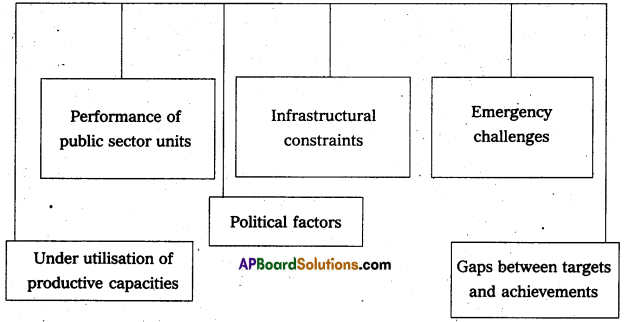
India could not achieve the desired growth rate in the industrial sector even though it is rich in natural resources and has huge working population. Even after completion of eleven Five Year Plans, there is wide gap between targets fixed targets achieved. Rakesh Mohan opines that there is a gap of 20 percent on an average between the targets fixed and targets realized in each plan annually. The reasons for this are as follows.
Reasons for Industrial Backwardness in India
AP Inter 2nd Year Economics Study Material Chapter 5 Industrial Sector 1
1) Under – utilisation of productive capacities: Many of the industrial units failed to utilize the existing productive capacities fully. There are many reasons for this. Among them is raw material scarcity, low technical know-how etc. For example during 2005 – 2006, out of 203 public sector enterprises, the capacity utilization was below 50 percent by nearly 67 percent of the units.

2) Performance of public sector units: Prior to liberalization, there was a phenomenal growth of the public sector. Many of the public sector units were under losses. The number of loss making units decreased from 105 in 1999 – 00 to only 63 in 2011. However, the losses increased from ₹ 10,302 crores in 1999 – 00 to ₹ 27,602 crores in 2011-12.

3) Political factorsIn many situations, political factors influence decision about location of projects not considering feasibility. This approach leads to a considerable wastage of capital resources.

4) Infrastructural constraints: One of the major constraints in industrial development is poor quality and high cost of infrastructure particularly power and transport network. All such infrastructural constraints not only showed adverse effect on industrial growth but also reduced the competitiveness of Indian industries that were, fast emerging in the new global economic environment.

5) Gaps between targets and achievements : In the earlier period of planning achievements were below the targets. Rakesh Mohan has observed. “The average industrial growth rate achieved over thirty – five to forty years has been about 6.2 percent rate to the average of about 8 percent projected”.

6) Emergency challenges : As a founder member of the World Trade Orginization, India has withdrawn all quantitative restrictions on imports. This resulted into the closure of a nuclear of industrial units. Thus, the industrial sector facing so many problems.

Question 10.
What are the merits and demerits of small scale enterprises in Indian economy. [A.P. Mar. 18, 17]
Answer:
The small scale and cottage industries play apvital role in the Indian economy. As ancillary industries, they are contributing to the growth of the agriculture and industrial sectors in a developing country like India.

The recommendations of Abid Hussian Committee, the Government raised the investment limit on plant and machinery for small units and ancillaries to 3 crores and that for tiny units to ₹ 25 lakhs.
Merits:

  1. Expansion of small scale industrial sector and its share in industrial production: The rapid growth of small scale units from 2006 – 07 onwards contributing much to India’s gross domestic product.
  2. Employment opportunities : The small industries are labour intensive they could generate employment opportunities to the tune of 191.4 lakh persons in 1994 – 95, 249.3 lakh persons in 2001 – 02 and it increased to 1012.6 lakh persons in 2011 – 12.
  3. Capital formation: The spreading of industry over the country side would encourage the habits of thrift and investment in the rural areas.
  4. Low capital: The small scale units are best suited to the developing countries like India, which are labour intensive and capital scarce economics. It does not require much capital for the establishment Of these units.
  5. Skill formation : A small scale enterprise does not require any sophisticate skill. But it provide, industrial experience for large number of small scale managers.
  6. Low import intensity: Low import intensity in the capital structure of small scale .enterprises reduces the need for foreign capital.
  7. Decentralized industrial development : Development of small scale industries will bring about decentralization of industries. It will promote the object of balanced regional development.
  8. Equitable distribution : The profits earned by small scale enterprises distributed among large number of enterpreneurs leads to decentralization of income and wealth.
  9. Exports : The contribution of small scale enterprises to earn foreign exchange is very high. The share of exports from the small scale sector represents about 31.1% of total exports in 2006 – 07.

AP Inter 2nd Year Economics Study Material Chapter 5 Industrial Sector

Demerits:

  1. Inefficent human factor: Most of the rural people are illiterates and lack technical know-how in the areas of production, finance, accounting and marketing management.
  2. Lack of credit facilities : The small industrialists are generally poor and there are no facilities of cheap credit either. Thus, they are caught up in the vicious circle of debt trap.
  3. Problem of raw materials : The quantity, quality and regularity of the supply of raw materials are all highly unsatisfactory. According to an estimate, about 40 percent of such units have become sick owing to non – availability of raw materials regularly.
  4. Absence of organized marketing: Since marketing is not properly organized, the helpless artisans are completly at the mercy of middlemen. The small scale units cannot afford to spend lavishly on advertisement to promote their sales.
  5. Lack of machinery and equipment: Small scale untis are facing inadequate modem machines and equipment. This leads to low productivity in small scale units.
  6. Power shortage : In recent years power shortage and frequent power cuts played havoc with small scale industries. More hours of power cut are there in rural areas which affect the growth of small scale units.
  7. Lack of technological up – gradation : It is found that the levels of productivity and technology used by the small scale sector are not globally competitive. Without technological upgradation these units may not serve in a globally integrated economy.
  8. Heavy taxation : Cottage and small scale industries have also to bear a heavy burden of taxation both on raw materials and also on finished goods.

Question 11.
Briefly explain the Indian industrial growth rate during the Five Year Plans.
Answer:
The industrial pattern in India has undergone a marked change as a result of Five Year Pains, especially since the beginning of the Second Five Year Plan (1956 – 61). The number of bigger industrial establishments has multiplied and the proportion of producer goods in the composition of manufacturers has registered a striking is increase. Heavy and basic industries have come to occupy an important place in the industrial structure of India.

I. First Plan (1951 – 56): Owing to the small size of the First Plan, insufficiency of funds and greater urgency or agricultural development, the First Plan did not make any big provision for industrial development. The overall industrial production increased by 39 percent i.e about 8 percent per year.

II. Second Plan (1956 – 61) : The actual investment in the public sector on organized industry was ₹870 crores in the second plan. In comprised 27 percent in the Second Five Year Plan’s total outlay.

III. Third Plan (1961 – 66) : The overall financial outlay in industrial sector during the Thrid Plan was ₹ 3,000 crores, out of which the outlay in the public sector was about 1,700 crores and the private sector was ₹ 1,300 crores. An overall target of 7 per cent increase in industrial production was envisaged in the plan.

IV. Fourth Plan (1969 – 74): During the Fourth Plan on the actual out lay organized industry was ₹ 2,700 crores in the public sector. The private sector investment was around ₹ 2,250 crores. The actual performance during the Fourth Plan in the industrial sector was very disappointing. Its average annual growth rate was hardly 5 per cent as against the plan target of 8 per cent.

V. Fifth Plan (1974 – 79) : The Fifth Plan assigned a very important place to the development of industries with a view to achieving self – reliance and social justice. The public sector outlay on industrial development was around ₹ 9,700 crores. The average rate of industrial growth during the plan was targeted at 8.1 per cent per annum.

VI. Sixth Plan (1980 – 85): The public sector outlay of ₹ 23,000 crores was envisaged during the Sixth Plan period, during the sixth plan reveals that a growth rate of 5.45 percent as against 7 percent was achieved.

VII. Seventh Plan (1985 – 90) : The total investment in the industrial sector was ₹ 22,460 crores or 12.5 percent of the total plan outlay. The Seventh Plan achieved the targeted industrial growth rate of 8.5 per cent. It has been made possible because of adequate infrastructure and liberalization policy of the Government.

VIII. Eighth Plan (1992 – 97) : The Eighth Plan was formulated under a new environment when a number of reforms in industrial, fiscal, trade and foreign investment policies were introduced in the economy.

IX. Ninth Plan (1997 – 2002) : Ninth Plan allocated ₹ 69,972 crores for industry at 1996 – 97 prices. Ninth plan targeted a growth rate of 8% for industry. But it achieved only 5%.

X. Tenth Plan (2002 – 07): In the Tenth Plan public sector outlay was ₹ 44,695 crores at 2001 – 02 prices. Industrial performance in the Tenth plan period improved to 8.9% from very low level of growth rate of 4.3% in ninth plan.

XII. Eleventh Plan (2007 – 12): The total outlay in the Eleventh Plan is estimated at ₹ 36,44,718 crores. During this plan, the targeted growth rate is 10 – 11%. The target rate of growth achived more or less in case of industry.

XII. Twelfth Plan (2012 – 2017) : Twelfth Plan envisages an investment of 50 lakh crores in 5 years. The private sector is expected to provide 25 lakh crores. To achieve industrial growth rate to the tune of 9.5% it would require much faster growth in the manufacturing as well as in electricity, gas and water supply sectors.

AP Inter 2nd Year Economics Study Material Chapter 5 Industrial Sector

Question 12.
Discuss major sources of Industrial Finance in India.
Answer:
Industry needs capital expenditure for the purchase of land, construction of building, installation of machinery etc. Besides this, funds are also required for the purchase of raw materials, for stores, for marketing and for meeting day – to – day requirements of the industry.

The following are the main sources from which the Indian Industry draws finance:
a) Shares
b) Debentures
c) Public deposits
d) Commercial banks
e) Industrial financial institutions

Rapid industrialization needs adequate medium and long term loans. Industrilalization requires lot of funds to start up new units and to modernize existing units. Some of the industrial financial institutions are:
a) Industrial Finance Corporation of India (IFCI)
b) State Financial Corporations (SFC’s)
c) Industrial Credit and Investment Corporation of India (ICICI).
d) The Industrial Development Bank of India (IDBI)
e) Small Industries Devlopment Bank of India (SIDBI)
f) Industrial Investment Bank of India (IIB1)
g) Venture Capital Funds (VCF)
h) UC and GIC.

Short Answer Questions

Question 1.
Industrial Finance Corporation of India.
Answer:
The Government of India set up the Industrial Finance Corporation of India in July 1948 under a special Act. The corporation was authorized to issue bonds and debentures in the open market, accept deposits from the public and also borrow from the R.B.I.

Functions:

  1. It guaranteed loans raised by the industrial concerns in the capital market.
  2. It granted loans and advances to industrial concerns and subscribed to the debentures floated by them.
  3. If under wrote the issues of stocks, shares, bonds and debentures of industrial concerns. The loans sanctioned by IFCI increased from ₹ 210 crores in 1980 – 81 to ₹ 1,860 crores in 2000 – 01.

Question 2.
Industrial credit and Investment corporation of India.
Answer:
It played a role in consolidation in various sectors of the Indian Industry, by financing, mergers and acquisitions. The ICICI, groups financing and banking operations both wholesale and retail.

Functions :

  1. Guaranteed loans from other private Government source.
  2. Provided financial services such as deffered credit, leasing credit, installment sale, asset, credit and venture capital.
  3. It offered long term and medium – term loans, both indian currency arid foreign currency loan.
  4. Participated in equity capital and in debentures and under wrote new issues of shares and debentures.

AP Inter 2nd Year Economics Study Material Chapter 5 Industrial Sector

Question 3.
Industrial Estates.
Answer:
Industrial estates are very useful in the development of small scale industries. An industrial estates refers to an area in which a number of small industries are concentrated. As a number of manufacturing units are located with in the same area, they can have common advantages like good site, electricity, water, communication etc. The production costs of the industrial units decrease as they get all facilities at one place for lesser cost.

Advantages:

  1. It providing and opportunity both rural and semi-urban areas to develop industrially.
  2. Giving scope to use the available local resources.
  3. More scope for regional development.
  4. It makes possible for small industrial units to realise the benefits of economics of scale.
  5. They can become the best ancillary units, when they are situated nearby the large scale industries.
  6. The small scale industrial units can make their production profitable by using the available facilities at one place for a lower cost.

Question 4.
Special Economic zones.
Answer:
Special Economic Zones policy was announced by Government of India in April 2000. This policy aims at rapid economic growth by quality infrastructure complemented by an attractive fiscal package, both at the Central and State level. In India, while passing the SEZ Act in May 2005. It came into effect from February 2006.

Objectives:

  1. Development of infrastructure facilities.
  2. Generation of additional economic activity.
  3. Promotion of exports of goods and services.
  4. Promotion of investment from domestic and foreign sources.
  5. Creation of employment opportunities etc.

Question 5.
Explain the need of Foreign Direct Investment in India.
Answer:
Foreign Direct Investment is a major source of non – debt financial resource for the economic development of India. Foreign companies invest in India to take advantage of cheaperwages, special investment privileges like tax exemption.

  1. Encouraging foreign firms to transfer state – of – the art technology in defence production.
  2. For a country where foreign investments are being made, it also achieving technical know-how and generation of employment.
  3. The continuous inflow of FDI in India, which is allowed across several industries.

AP Inter 2nd Year Economics Study Material Chapter 5 Industrial Sector

Question 6.
National Investment Fund.
Answer:
The Government of India constituted the National Investment Rind (NIF) on 3rd November, 2005. The amount received in the form of Disinvestment will go into the National Investment Rind. The fund was to be maintained outside the consolidated fund of India. The NIF was initialized with the disinvestment proceeds of two CPSE. 1. Power Grid Corporation of India Limited (PGCIL) and Rural Electrification Corporation (REQ amounting to ₹ 1814.45.
Features:

  1. The corpus of the National Investment Rind will be of a permanent nature.
  2. The proceeds from disinvestment of CPSEs will be channelized into the national investment fund, which is to be maintained outside the consolidated fund of India.
  3. The Rind will be professionally managed to provide sustainable returns to the Government.
  4. 75% of annual income of the fund will be used to finance selected social sector schemes, which promote education, health and employment. Ex: Jawaharlal Nehru National Urban Renewal Mission (JNNURM), Rajiv Gandhi Gramin Vidyutikaran Yojana (RGGVY) etc.

Question 7.
Objectives of National Manufacturing Policy. [A.P. Mar. 18]
Answer:
Government of India brings back industrial policy into focus in the form of National manufacturing policy on November 4th 2011.

Objects:

  1. Increase manufacturing sector growth to 12-14% over the medium term.
  2. Create 100 million additional jobs in the manufacturing sector by 2012.
  3. Increase the share of. manufacturing in gross domestic product from 16% to 25% by 2022.
  4. Create appropriate skills among the rural and urban migrant.
  5. Increase domestic value addition and technological depth in manufacturing.
  6. Enhance global competitiveness of Indian manufacturing.

Question 8.
National Investment and Manufacturing Zones.
Answer:

  1. The State Government would be responsible for the selection of suitable land having an area of 5000 hectares in size.
  2. NIMZ’s will be utilised for location of manufacturing units at least 30% of total area proposed.
  3. The State Government would facilitate the provision of water power, connectivity and other infrastructure.
  4. The Central Government will provide financial support in the form of viability gap finding not exceeding J20% of project costs.
  5. The Central Government will bear the cost of master planning and will improve physicial infrastructures like rail, road, airports and telecommunications.

AP Inter 2nd Year Economics Study Material Chapter 5 Industrial Sector

Question 9.
Write briefly about MSMEs.
Answer:
On October 2, 2006, “Micro, Small and Medium Enterprise Development Act” came into force’ MSMEs sector in India constitutes enterprises with investment in plant and machinery less than 10 crore in manufacturing and less than 5 crore in case of service sector. In India MSMEs play a vital role in the industrial economy of the country. The major advantage of the sector is its employment potential of low capital cost.

Question 10.
The Industrial Investment Bank of India. [A.P. Mar. 16]
Answer:
To provide financial, technical and managerial assistance to sick units, Industrial Reconstruction Corporation of India was set up in 1971. The Government of India converted I the IRCI into Industrial Reconstruction Bank of India (IRBI) on March 20,1985. IRBI was reconstituted into full-fledged new financial institution called Industrial Investment Bank ; of India (TIBI) in March 1997.

The financial assistance sanctioned by IIBI in 2003 – 04 was ₹ 2,412 crore while assistance disbursed was ₹ 2,252 crore. As the IIBI was suffering operating losses and also poor financial position. IIBI is in the process of voluntary winding up.

Very Short Answer Questions

Question 1.
SIDBI. [A.P. Mar. 18]
Answer:
Small Industries Development Bank of India with a view to ensure largest flow of financial and non financial assistance to the small scale and cottage industries. The SIDBI Act was passed by the parliment in 1989 and the bank commenced its operation from April 2nd 1990.

AP Inter 2nd Year Economics Study Material Chapter 5 Industrial Sector

Question 2.
IDBI.
Answer:
The Industrial Development Bank of India. The IDBI was set up 1st 1964. The IDBI was initially set up as a wholly owned subsidiary of the R.B.I. In February 16, 1976 the IDBI was made an autonomous’ institution and its ownership passed on from the RBI to the Government of India.

Question 3.
State Finance Corporations.
Answer:
The SFC was set up to offer financial assistance to only large and medium sized undertakings. Therefore the need for separate level development banks which could cater to financial needs of small and medium sized industrial concerns was rightly felt. The 1st SFC setup in punjab in 1953. At present there are 18 SFCs in the country.

Question 4.
Disinvestment.
Answer:
The Government of India in July 1991 initiated the disinvestment process in India. The new industrial policy provides that in order to raise resources and encourage wide public participation, apart of the government share, holding in the public sector would be offered to mutual funds financial institutions, general public and employees.

Question 5.
MRTPAct.
Answer:
Monoploy Restrictive Trade Pratices Act. The Act will concentrate more on controlling unfair or restrictive trade practices.

AP Inter 2nd Year Economics Study Material Chapter 5 Industrial Sector

Question 6.
Special Economic Zones. [A.P. Mar. 17]
Answer:
The Government of India announced Special Economic Zones policy in April 2000. This policy objective is at rapid economic growth supported by quality infrastructure complemented by an attractive fiscal package both at central and state level with minimum possible regulations. This act came into effect from February 2006.

Question 7.
Foreign Direct Investment.
Answer:
Foreign Direct Investment is a major source of non – debt financial resource for the economic development of India. Foreign companies invest in India to take advantage of cheaper wages, special investment privilages like tax exemptions etc.

Question 8.
Industrial Estates.
Answer:
It was established in the year 1955 by small scale industries board for the development of small scale industries. An industrial estate is a group of small scale units constructed on an economic scale in suitable sizes with facilities of water transport, electricity, banks and is provided with special arrangements for technical guidance and common service facilities.

Question 9.
MSMEs.
Answer:
Micro, Small and Medium Enterprises. MSME sector in India constitutes enterprises with investment in plant and machinery less than 10 crore in manufacturing and less than 5 crore in case of service sector. The labour intensity of the MSME sector is much higher than that of the large enterprises.

AP Inter 2nd Year Economics Study Material Chapter 5 Industrial Sector

Question 10.
ICICI.
Answer:
Industrial Credit and Investment Corporation India.
It was set up in January 1955 and it commenced business in March of the same year. It was second all India development financial institution to be established in the country. It was a private sector development financial institution.

Question 11.
IFCI.
Answer:
Industrial Finance Corporation of India. It was set yp in July 1948, under a special Act. It was set up to provide medium and long term credit to industry to start new industries, expansion of old industries and for modernisation.

Question 12.
Globalization.
Answer:
It is the process of integrating various economies of the world without creating and hindrances the free flow of goods and services, technology, capital even labour or human capital.

AP Inter 2nd Year Economics Study Material Chapter 3 National Income

Andhra Pradesh BIEAP AP Inter 2nd Year Economics Study Material 3rd Lesson National Income Textbook Questions and Answers.

AP Inter 2nd Year Economics Study Material 3rd Lesson National Income

Essay Questions

Question 1.
Explain the National income trends in India.
Answer:
National income means the total amount of goods and services produced in a country in a year. In order to understand in impact of planning in India, a study of trends in national income necessary. Therefore better if the trend in national income and changes in the structure of national product are analysed over the last 60 years of planning.
a) The increase in the production in real goods and services.
b) The rise in price.

If the increase in National.income is due to the first factor. It is an indicator of real growth because it implies that more goods and services became available to the people. If it is due to the second factor, it represent and unreal inflation of National income in terms of money. National income figure is deflated at constant prices, therefore, it becomes comparable but it conceals the population effect. To eliminate the effect of growth of population or percapita income is calculated.

C.S.O. has provided a series of National income data of 1999-2000 prices from 195051 to 2013-14. Although this indicates slightly different growth rates for different periods, this was inevitable because of the coverage and change in procedure.
Net National Product at Factor Cost and Per capita NNP
AP Inter 2nd Year Economics Study Material Chapter 3 National Income 1
The growth rates of both Net National Product and Per capita NNP at factor cost from 1950-51 to 2013-14 for a period of more than 6 decades. Per capita NNP at current prices in 1950-51 is ₹ 264, which rose to ₹ 5,621 and in the same period the per capita NNP at 2004-05 prices increased from ₹ 7,114 to ₹ 14,330.

Net National Product at current prices increased to ₹ 91,71,045 crore in 2013-14 from ₹ 4,71,619 crore in 1990-91 & at 2004-05 prices it was 49,20,183 crore and ₹ 12,02,305 crore respectively. Per capita NNP at 2004-05 prices rose to ₹ 74,380 in 2013-14 from ₹ 17,381 in 2000-2001.

AP Inter 2nd Year Economics Study Material Chapter 3 National Income

Question 2.
Briefly explain the sectoral contribution to the National income.
Answer:
Avery important aspect of the national income of a country is its sectoral composition i.e., the contribution made to it by the different sectors of the economy. The development mainly depends upon sectoral contribution. If the contributional from agricultural sector is high, generally a country is said to be underdeveloped one.
1) Contribution of the primary sector to GDP: The share of the primary sector in the Gross Domestic Product has varied from the maximum of 55.4% in 1950-51 to the minimum of 13.9% in 2013-14. The main cause of the decline is a rapid fall in the share of agriculture alone. There is a decline in the share of forestry to GDP. Transport and trade, banking and insurance and other service sectors have grown faster than agriculture still the agricultural’ sector remains an important sector in the Indian economy.

2) Contribution of the secondary sector to GDP: The share of industry which includes mining, quarrying, manufacturing, construction and electricity, gas & water supply has shown a steady increase from 15 percent in 1950-51 to 26.2 in 2013-14. Two major components of industry and manufacturing and construction increased from 8.9 percent in 1950-51 to 14.9 percent in 2013-14. Similarly, the sharerof construction increased from 4.4 percent in 1950-51 to 7.4 percent in 2013-14.

Tertiary sector contribution to GDP: The share of the tertiary sector (trade, transport, financing, insurance, real-estate, banking, social and personal services and business services) indicated a sharp improvement from 29.6 percent in 1950-51 to about 59.9% in 2013-14. There was a significant increase in share of trade, transport & communications from 11.3% in 1950-51 to 26.4% in 2013-14. This shows a good sign which is essential for an under developed country like India.

Question 3.
What are the causes for inequalities in the distribution of income and wealth ?
Answer:
Inequality in the distribution of National Income is one of the major problems which our planning process and economic policies have attempted to tackle. .
1) Inequalities in land ownership : There was concentration of landed property in India during the British period on account of Zamindari system. Minhas, Dandekar and Rath and Bardhan have clearly stated that all agricultural workers and marginal and small farmers with less than 2 hectare holdings are poor. Big and large farmers not only have capacity to save, they also have an access to institutional finance. Naturally, they are attempting to improve the farm techniques. This causes income inequalities.

2) Inflation : Since the mid -1950’s prices have been rising continuously eroding the real income of the working class, while the industrialists, traders and farmers with large marketable surplus have benefited a great deal from this inflationary process. In India, very little has been done to offset this redistributive effect of inflation and as a result, it has greatly accentuated income inequalities.

3) Inequality in credit facilities : In India, there is inequity in credit facilities which accentuates the inequalities arising from an unequal distribution of wealth. Business firms and individuals having an access to the formal capital markets manage to obtain finance on very favourable terms, while vast mass of small and marginal farmer agricultural labourers and artisans depend heavily on money lenders who charge an exorbitant rate of interest and also exploit these poor people in a number of ways.

4) Urban Bias in Private Investment: While 70 percent of the population in India lives in rural areas, about 70 percent of the private investment goes to industries in urban areas. Therefore, there is a distinct “urban bias” in the pattern of Private investment. This urban bias taken the form of highly mechanized projects in which the share of wages in value added is relatively low. This naturally leads to inequality in income distribution.

5) The Role of the Government: The public investment essentially plays a supportive role to private investment. The Govenment is no longer serious about reducing income inequalities.

AP Inter 2nd Year Economics Study Material Chapter 3 National Income

Question 4.
Briefly explain the measures to reduce income inequalities in India.
Answer:
The main objective economic planning is to reduce income inequalities and to maintain social justice. To achieve this the government of India initiated the following measures.
AP Inter 2nd Year Economics Study Material Chapter 3 National Income 2
i) Land reforms: Agricultural land was not property distributed among farmers. Thus, legislative measures were undertaken to abolish landlords and their intermediaries and ceiling on holdings were fixed. The implementation of land reforms in West Bengal states causes 18 percent increase in agricultural output and also reduced the income inequalities.

ii) Control over monopolies and restrictive trade practices : The monopolies and restrictive trade practices Act was passed in December 1969, which came into force on June 1st, 1970. The Act provides for the control of monopolies and for the prohibition of monopolistic and restrictive trade practices.

iii) Cooperative enterprises: Another instrument to balance the undue growth of big business in private sector is the decentralised sector in the farm of cooperative enterprises. This sector works for common good rather than for private and personal gain. Profits earned by cooperative sector are shared by very large number of members. This leads to reduce income inequalities.

iv) Encouragement of new enterprises: Special concessions and incentives provided to the new entrants in an industry can restrict the Concentration of economic power. If the government strictly implements the rule not to give licenses to start industries by the already existing farms, it would definitely reduce concentration of economic power.

v) Social security: The government has repeatedly declared that it aimed at “Growth with social justice”. The government undertook so many social security measures such as workmen’s compensations and maturity benefits, fixation of minimum wages, the employees Provident Fund, security for the old and disabled and family pension scheme for industrial workers and workers in mines and plantations.

vi) Taxation : Indian tax system is progressive and has been designed to prevent concentration of wealth in a few hands.

vii) Control over capital issues: Already the new capital issues are under government control. But it seems the control has not been effective checking monopolistic tendencies. In India many industries with monopolistic power yield huge incomes which are the cause for. income inequalities. As a result of this, the capital Issues Act 1956 was replead in May 1992.

viii) Employment and wage policies : The Government of India started many employment generation programmes to reduce income inequalities. For example, Integrated Rural Development Programme, National Rural Employment Programme etc. The wage rates allowed to the employees working in unorganized sector is very low. Implementation of minimum wages act leads to reduce income inequalities.

AP Inter 2nd Year Economics Study Material Chapter 3 National Income

Question 5.
What are the causes for poverty in India ? [A.P. Mar. 18, 17]
Answer:
Poverty can be defined as a social phenomenon in which a section of the society is unable to fulfill even its basic necessities of life.
There are two types of poverty.

  1. Absolute poverty
  2. Relative poverty

1) Absolute poverty : Absolute poverty of a person means that his income or consumption expenditure is so meager that he lives below the minimum subsistence level.

2) Relative poverty : Relative poverty merely indicates the large inequalities of income. Those who are in the lower income groups receive less than those in the higher income groups.

Causes of poverty: Poverty cannot be attributed to any one single set of causes. It is a complex phenomenon and as such is the outcome of interaction of diverse factors, economic and non-economic.
AP Inter 2nd Year Economics Study Material Chapter 3 National Income 3
1) Underdevelopment: The root cause of poverty is the underdevelopment of Indian economy. Dandekar and Rath have argued that unviable and unprofitable farms with little capacity for capital accumulation have been responsible for rural poverty in India. Small and scattered holdings, lack of adequate inputs, lack of credit facilities and insecure tenancy system are all responsible for backwardness of Indian agriculture which causes rural poverty. Industrial development has failed to make any dent on poverty.

2) Unemployment and low levels of wages: Poverty is caused by under-employment or unemployment coupled with low rates of wages. This is because supply of labour is more than that of demand for labour. Due to shortage of capital, the industrial sector is not in a position to absorb more number of people. This causes poverty.

3) Population explosion : In India population has increased from 361.09 millions in 1951 to 1210.19 millions in 2011. Due to scarce capital and low level of technology, it is not possible to provide sufficient goods services to the fast growing population. Rapid growth of population is another important cause for the prevailing poverty in the country.

4) Inequality in Assets and Income Distribution : The relative poverty is to be attributed to inequality in the distribution of National Income. Most of the agricultural labourers are in a states of poverty because; they have less than one hectares land to cultivate. Likewise, inequality in the ownership of industrial and commercial capital is one of the reasons of urban poverty in India.

5) Low availability of essentials : Another important cause for poverty in India is the low availability of essential commodities. The country is not able to produce sufficient goods and services as needed by the rapid growing population. The consumer goods shortage is responsible for low level of standard of living. There is a wide disparity in the consumption levels of the top rich and the bottom poor.

6) Inflation : Continuous rise in prices is another cause of poverty. When the prices rise, the purchasing power of money falls and it leads to improverishment of the lower middle and poorer sections of the society. Inflation affects the living standards of the people having low incomes.

7) Failure of five year plans: The main objective of the planning is to provide minimum level of living to all its citizens. It was felt that growth rate achieved during the five decades of planning would not be sufficient to remove poverty.

8) Social factors : Economic development depends not only on available resources but also on social factors. Indian people lack initiative and resourcefulness. In short, dogmatic and fatalistic attitude is responsible for inertia, lack of initiative and dynamism. Thus, Indian social institutions and attitudes hamper economic progress and are responsible for perpetuating poverty. The caste system and joint family system and the laws of inheritance are a great obstacle to economic progress.

9) Political Factors : Being under foreign rule, India was exploited under the British regime. Since Independence, the other political factors have adversely affected the economic progress. We have political leaders who have placed self before service and who do not hesitate to enrich themselves at the cost of the country. The Indian administration is known to be corrupt and inefficient. The legislators would not pass laws which may help the poor. Some times they may hit their interest.

10) Institutional factors : There are certain institutional factors operative in rural areas as well as urban area having a strong bearing on ownership, management and work. Semi-feudalism is an institutional factor responsible for rural poverty. The social and political institutions in rural areas have not allowed the land reforms and technological reforms to make a dent on rural poverty. The government is providing agricultural inputs like electricity seeds fertilizers and credit facilities at subsidized prices to be farmers. But these facilities are not catering the needs of poor farmers having small holdings and also the tenants. The institutional rigidities have not allowed equitable sharing of public goods such as education and health.

AP Inter 2nd Year Economics Study Material Chapter 3 National Income

Question 6.
Write about the remedial measures to reduce poverty in India.
Answer:
In recent years, a two-pronged strategy was introduced by the government toward a solution to the problem of poverty in India.

  1. The expansion of sectors which promise higher level absorption and
  2. Empowering the poor with education, skill formation and health, so that they can enter sectors which require higher competence and provide better remuneration which enable the poor to cross the poverty line. The problem solving strategies are :

i) Adoption of a strategy of proper growth instead of emphasizing liberalization and GDP growth : Former Prime Minister Atal Bihari Vajpayee in his Independence Day Message (15th August 2001) stated “The fruits of liberalization have not adequately reached the poor and the people living in rural areas, inequalities have increased. “The government has to pay attention to improve the economic conditions of 92 percent work force employed in unorganised sector. Government should give priority to the removal of unemployment in urorganised sector. “Right to work” should be made a basic human right. In this model emphasise should be laid on development of irrigation and watershed development with peoples participation. Agricultural cooperative should be strengthened.

ii) Stimulation Agricultural Growth: The growth rate of agriculture was 2.7% in the 9th plan and only 1.7% in the 10th plan. To overcome this type of slow growth rate, the Government of India appointed a high power commission under the chairmanship of Dr.M.S.Swaminathan which suggested the following 5 point action plan for the fanners.

  1. To undertake enhancement of soil health programmes.
  2. To promote water-harvesting, conservation and equitable use by empowering panchayats.
  3. To reduce the crop loan interest to 4 percent.
  4. To set up Krishi Vigyan Kendras for training the farmers.
  5. To reduce the gap between what the rural producer gets and the urban consumer pays should be reduced.

iii) Increasing the productivity and job quality of unorganized sector: The National Democratic Alliance Government appointed special group on targeting 10 million employment opportunities under the chairmanship of S.P. Gupta in 2002 to emphasize the growth of unorganized sector as surest method to reduce unemployment and poverty.

iv) Empowerment of the poor through education and skill formation : The development of a huge educational structure of 378 universities and 18,064 colleges, 152 lakh secondary and higher schools and 10.43 lakhs of primary and upper primary schools helps to enrich the human resources that leads to reduce the poverty.

v) Empowerment through provision of Better health : The strong link between poverty and health needs to be recognized. Long term illness and expensive illness can drive even the non-poor into poverty. National Rural Health Mission (NRHM) and National Urban Health Mission (NUHM) are the two major initiatives to help the poor in the availability of health facilities. There is a need to extend health insurance for workers in the unorganized sector, in order to overcome from poverty trap.

vi) Empowering the poor through provision of housing : House is the basic needs for both rural and urban poor. The country must launch a massive programme to provide housing in the form of Indira Aawas Yojana and basic civic amenities in a period of 20 years.

vii) Empowerment through skill formation for expanding IT sector : The development of Information and Technology sector provides number of employment opportunities which enable to reduce the poverty. This will be possible through the following measures.
a) Governments should provide subsidized higher education and vocational training to the poor.
b) Sanction a large number of merit scholarships for the poor.
c) Government should help the educational institutions both financially and infrastructure-wise to provide education to the poor.

viii) National Rural Employment Guarantee scheme : The National Rural Employment Guarantee Act came into force in 2006 in India. For removal of poverty, we need two sets of measures
a) We must accelerate economic growth by increasing substantially our National income.
b) Our efforts of re-distributing National Income in favour of the poor should be more pronounced. Thus, accelerated economic growth and reduction of inequalities are both indispensable for a successful attack on mass poverty.

AP Inter 2nd Year Economics Study Material Chapter 3 National Income

Question 7.
What is the role of Micro Finance in reducing the poverty in India ?
Answer:
Micro Finance institutions in India exist as non-governmental organizations. A section of 25 companies and Non-Banking Financial Companies (NBFC’s) and Commercial banks, Regional Rural banks, Co-operative societies and other large lenders have played an important role in providing refinance facility to Micro Finance Institutions.

“Micro Finance is the provision of Financial services to low income clients or solidarity lending groups including consumers and self-employed, who rationally lack access to banking and related services”. It covers a wide range of services like credit, savings, insurance, remittance and also non-financial services like training and counciling.

Micro Finance and Poverty reduction :
1) As an intervention to allieviate poverty, micro finance is viewed as the practice of extending small loans and other financial services such as savings and insurance to the poor for empowering them to protect themselves from economic setbocks.

2) Poverty can also be understood as vulnerability to downward in income. Such fluctuations may results from unexpected shocks such as crop failure, illness, funeral expenses or loss of assets such as livestock through theft or death. Micro Finance are the promise to reduce such vulnerable and protect livelihoods also reduce poverty.

3) An important dimension of poverty is powerlessness. Powerlessness can be experienced in a variety of situations, within the households, as a result of differences in gender and age and within the community, between socio economic groups, as a result of cost, electricity and wealth. Intervention with micro finance can influence the power relations of the society by fastering salidarity among the vulnerable through its group-based mechanism.

4) In most parts of the country micro finance services are being provided through group based systems that are advantageous of using peer pressure as social collateral.

5) These group-based systems can be broadly classified into two systems. They are Grameen, Group system, pioneered in Bangladesh and Self Help Group (SHG) system, Nurtured in India. Both these systems are widely replicated all over the world.

6) With the globalization and liberalization of the economy, opportunities for the unskilled and illiterate are not increasing fast enough, as compared to the first of the economy. This leeds to a lopsided growth in the economy thus increasing the gap between the rich and poor. It is in this context, the institutions involved in microfinance have a significant role to play to reduce this disparity and poverty.

AP Inter 2nd Year Economics Study Material Chapter 3 National Income

Question 8.
Explain the causes for unemployment and remedial measures to reduce unemployment. [A.P. Mar. 16]
Answer:
A man is willing to work but he is not getting work. Therefore he is called unemployed. Unemployment is too serious an evil to be ignored. Widespread and growing unemployment is not due to any single factor.
AP Inter 2nd Year Economics Study Material Chapter 3 National Income 4
1) Rapid rate of population growth :The most fundamental cause of widespread unemployment in India is the rapid rate of population growth which leads to increase in labour force. The rate of population growth rose to 2.2 percent per annum during the 1960s. As the population increased from 718.2 millions in 1983 to 1227.4 millions in 2011-12, corresponding the labour force also increased from 261.33 millions to 440.4 millions respectively. This is too big a number to be provided gainful employment at the present rate of growth of the economy.

2) Jobless growth : During the first three decades of economic planning, the GDP growth rate was as low as 3.5 percent per annum. In this period, employment increased at a moderate rate of 2 percent per annum. The rate of growth of employment picked up considerably to 2.90 percent per annum during the five year period 1990-00 to 2004-05 but again declined to almost zero present over the next five years i.e., from 2004-05 to 2009-10. Thus, the country could create only one million jobs during 2004-05 to 2009-10.

3) Inappropriate Technology.: In India, while capital is a scarce factor, labour is available in abundant quantity. Under such circumstances, if market forces operate freely and efficiently, the country would have adopted labour – intensive techniques of production.

4) Lack of Rural Industrialization : With regard to large rural unemployment and under employment, the underlying cause is the very heavy pressure of population on land and the backward nature of our farming. As a result, agriculture cannot provide employment opportunities for the far too numerous rural population.

5) Inappropriate Educational system : The educational system in India is defective. According to Gunnar Myrdal, India’s educational policy does not aim at development of human resources. It merely produces clerks and lower cadre executives for the government and private concerns. Any educational system which fails to develop human resources properly will not be able to provide employment to all those who have received it.

6) Lack of Manpower planning: The intake into various courses is not being plannned on the basis of the projections of the demand for skilled manpower in future.

7) Social factors : Since Independence, education among women has changed their attitude towards employment. Many of them now compete with men for jobs in the labour market. The economy has, however failed to respond to these challenges the net result is continuous increase in unemployment backlog.

8) Lack of self-employment opportunities : The rural marginal and landless households continue to remain unemployed (or) underemployed due to lack of self employment. The well educated youth lacking entrepreneurship qualities waiting for years together to get government jobs at meager wages.

9) Decline of cottage industries : In rural India, village (or) cottage industries are the only means of employment particularly of the landless people. They depend directly on various cottage industries for their livelihood. But, now-a-days, these are adversely affected the industrialisation process.

Short Answer Questions

Question 1.
Explain the incidence of unemployment in India.
Answer:
The size of unemployment in any country depends on the level of development. Therefore when a country makes progress and its production expands the employment opportunities grow. In India, during the past six decades production has expanded in all the sectors of the economy. Most of the developing countries face an acute problem of unemployment and underemployment.

The basic reason for this that the rural areas have failed miserably to generate adequate employment opportunities for the rapidly increasing population.

Unemployment as measured by UPs orientation declined from 4.23 percent in 1977-78 to 2.81 percent in 1999-2000, but indicated an increase to 3.06 percent in 2004-05. In 2011-12 unemployment on UPs criterion is estimated to be 2.7 percent.

Unemployment in Current Daily Status (CDS) declined from 8.18 percent in 1977-78 to 6.09 percent in 1987-88, but the declining trend reversed to 8.28 percent in 2004-05, in 2011-12, rate of unemployment on CDS basis is estimated to be 5.6 percent.

AP Inter 2nd Year Economics Study Material Chapter 3 National Income

Question 2.
What are the different concepts of poverty ? [A.P. Mar. 16]
Answer:
Poverty can be defined as a social phenomenon in which a section of the society is unable to fulfill even its basic necessities of life.

When a substantial segment of a society is deprived of minimum level of living and countries at a base subsistence level, that society is said to be played with mass poverty.
Concepts of poverty:
1) Absolute poverty : The population whose level of income or expenditure is below the figure considered to be the absolute poverty or a person whose income or consumption expenditure is so meagre that he lives belows the minimum subsistance level is called absolute poverty.

2) Relative poverty : According to the relative standard, income distribution of the population in different fractile groups is estimated and a comparison of the levels of living of the top 5 to 10 percent with the bottom 5 to 10 percent of the population is called relative poverty, or those who are in the lower income groups receive less than those in the higher income groups.

3) Poverty line : According to the planning commission a person who is not having monthly percapita total expenditure of ? 49.9 in rural area and ? 56.64 in urban area at 1973-74 prices is called as a person living below the poverty line.

Question 3.
What are the different types of unemployment ? [A.P. Mar. 17]
Answer:
Types of unemployment: Unemployment is broadly defined into two types.
A) Unemployment in Urban areas and
B) Unemployment in Rural areas.
AP Inter 2nd Year Economics Study Material Chapter 3 National Income 5
A) Unemployment in Urban areas :
i) Educated unemployment: The large number of educated unemployed shows, “a measurement between the kind of job opportunities that are needed and that are available in the job market”. The defective educational system, with its theoretical base, lack of aptitude and technical qualifications for various types of working among job-seekers and Maladjustments between demand on supply of education workers are some well-known causes of educated unemployment.

ii) Industrial unemployment: In India, the manufacturing sector has indeed expanded and employment in it has steadily increased. One of the reasons for this is the low employment elasticity in the manufacturing sector. As a result, industrial unemployment increased.

B) Unemployment in Rural areas :
i) Seasonal unemployment: If in agriculture is a normal phenomenon in India. In India farmers cultivating approximately 75 percent of their land remain involuntarily unemployed for 3 to 4 months in a year and most of them fail to find some temporary employment in this period. The main reason for its unemployment is lack of irrigation facilities.

ii) Disguised unemployment: Indian agriculture is characterized by the existence of considerable amount of surplus labour. In technological language, it is said that marginal productivity of such labour is zero. The kind of disguised unemployment is also comes underemployment.

Other types of unemployment:
1) Cyclical Unemployment: If unemployment occurs as a result of trade cycles, if it
is called cyclical unemployment. Trade cycles refers to the frequent booms and depression, up swings and low swings. Keynes said that cyclical unemployment is the result of the deficiency in efficient demand. Therefore, if effective demand increased, the level of employment can also be increased.

2) Structural Unemployment: It is one of the main type of unemployment within an economic system. If focuses on the structural unemployment within an economy and inefficiencies in labour markets. Structural unemployment occurs when a labour market is not able to provide jobs for everyone who is seeking unemployment.

3) Under employment: Labour that falls under the underdevelopment classification includes those workers that are highly skilled but working in low paying jobs.

4) Frictional Unemployment: It is another type of unemployment within an economy. It is the time period between jobs when a worker is searching for or transistioning from one job to another. Frictional unemployment is always present to some degree in an economy. It occurs when there is a mismatch between the workers and jobs.

AP Inter 2nd Year Economics Study Material Chapter 3 National Income

Question 4.
Write briefly about employment Guarantee Act.
Answer:
Mahatma Gandhi National Rural Employment Guarantee scheme) This scheme was launched from 2nd October 2009, MGNREGS seeks to provide at least 100 days of guaranteed wage employment in a financial year to at least one number of every rural household whose adult members volunteer to do unskilled manual work. At least 33% of the beneficiaries are to be women under MGNREGS wage disbursement through bank and post office is mandatory. This is to help in ‘financial inclusion” of the poor. It provides a wage rate of ₹ 100/- per day to a worker. The focus of MGNREGS is an workers relating to water conservation, drought proofing, land development, flood control and rural connectivity etc. Panchayats have a key role in planning, implementation and monitoring of MGNREGS. This Act is useful for decentralization and deepening gross root democratic structure.

Question 5.
Explain briefly about Deen Dayal Upadhyaya Grameena Kaushal Yojana. [A.P. Mar. 18]
Answer:
Deen Dayal Upadhaya Grameen Kaushal Yojana was launched on 25th September 2014 in view of 98th birth anniversary of Pandit Deenadayal Upadhyaya. Earlier the Yojana was known as Aajeevika Skills Development Programme (ASDP).

The Rational launching the yojana : The Yojana was launched in light of solving huge problem of unemployment among the rual youth despite the fact that they have merits. In order to correct this match, Union Government decided to launch skill development programme scheme.

Status of skilled workers In India : In India as against 12 million people entering the work force every year during the last 10 years only 1 million youth were trained. Further out of 12 million people, only 10 percent were skilled ones, while the percentage in European Unions is 75 percent and in China 50 percent.

Main features of DDUGKY : The main features of the Deena Dayal Upadhyaya Kaushal Yojana are :

  • The Yojana aims to give training 10 lakh rural youth for jobs in three years, that is by 2017.
  • The minimum age for entry under the Yojana is 15 years compared to 18 years under the Aajeevika skills programme.
  • Skill Development training centre’s to be launched. So as to address the unemployment problem in rural area.
  • The skills imparted under the Yojana will now be bench marked against international standards and will compliment the Prime Minister make in India compaign.

This scheme was launched to enhance the employability of rural youth which is the key to unlocking India’s demographic dividend. A sum of ₹ 1500 crores was allotted for this scheme in the 2015-16 budget.

AP Inter 2nd Year Economics Study Material Chapter 3 National Income

Question 6.
Micro finance .
Answer:
Micro finance is the provision of Financial services to low income clients or solidarity lending groups including consumers and self employed, who rationally lack access to banking and related services”. It covers a wide range of services like credit, savings, insurance, remittance and also non-financial services like training and counseling.
Features of Micro Finance:

  1. Borrowers are from the low income groups.
  2. Loans are of small amount (Micro loans).
  3. Short duration loans.
  4. Loans are offered without collateral securities.
  5. High frequency of re-payments.
  6. Loans are generally taken for income generation purpose.

Need for Micro finance : Micro finance plays a major contributor to provide credit facilities. In the past few decades it has helped out remarkably in eradicating poverty. Reports show that people who have taken Microfinance have been able to increase their income and thereby their standard of living.

Micro finance institutions serve as a supplement to banks and in some sense better one too. These institutions not only offer micro credit but they also provide other financial services like savings, insurance, remittancé and non-financial services like individual counseling, training and support to start own business. But all this comes at a cost and the interest rates charged by these institutions higher than commercial banks and vary widely from 10 to 30 percent.

Question 7.
MGNREGS
Answer:
Mahatma Gandhi National Rural Employment Guarantee scheme) This scheme was launched from 2nd October 2009, MGNREGS seeks to provide at least 100 days of guaranteed wage employment in a financial year to at least one number of every rural household whose adult members voluntar to do unskilled manual work. At least 33% of the beneficiaries are to be women under MGNREGS wage disbursement through bank and post office is mandatory. This is to help in ‘financial inclusion” of the poor. It provides a wage rate of ₹ 100/- per day to a worker. The focus of MGNREGS is an workers relating to water conservation, drought proofing, land development, flood control and rural connectivity etc. Panchayats have a key role in planning, implementation and monitoring of MGNREGS. This Act is useful for decentralization and deepening gross root democratic structure.

Very Short Answer Questions

Question 1.
National Rural Employment Guarantee Scheme
Answer:
The National Rural Employment Guarantee Act came into force in 2006. It helps to reduce the poverty.

AP Inter 2nd Year Economics Study Material Chapter 3 National Income

Question 2.
Relative poverty
Answer:
The people with lower income are relatively poor compared with higher incomes, eventhough they may be living above the minimum level of subsistance is called relative poverty.

Question 3.
Absolute poverty [A.P. Mar. 18]
Answer:
A person whose income or consumption expenditure is so mearge that he lies below the subsistance level they can called absolute poverty.

Question 4.
TRYSEM [A.P. Mar 16]
Answer:
This was initiated in 1979 with the objective of tackling unemployment problem among the rural youth. It aimed at training about 2 lakh rural youth every year to enable to become self employed. The TRYSEM was merged into Swamajayanthi Gram Swarozgar Yojana in April 1999.

Question 5.
Disguised unemployment
Answer:
A person whose marginal productivity is zero or when more people are engaged in a job than actually required.

Question 6.
Poverty Gap Index
Answer:
The poverty gap index is defined by the mean distance below the poverty line expressed as a proportion of that line. The poverty gap index is insensitive to the extent of inequality among the poor. If income is transferred from a person to someone who is poor, the poverty gap index will not change.

Question 7.
Usual status concept of unemployment.
Answer:
This concept is used to measure chronic or long-term unemployment. It measures the activity status i.e., a person who remains unemployed for most of the time in the year. Thus, it appropriately measures open unemployment.

AP Inter 2nd Year Economics Study Material Chapter 3 National Income

Question 8.
Micro Finance [A.P. Mar. 17]
Answer:
The provision of thrift, credit and other financial services and products of very small quantity to the poor in rural, semi-urban and urban areas for enabling them to raise their incomes and improving living standards.

Question 9.
Percapita income
Answer:
It is estimated dividing National income by population of the country as per the formula given below.
Percapita income = \(\frac{\text { National income }}{\text { Population }}\)

AP Inter 2nd Year Economics Study Material Chapter 2 Population and Human Resources Development

Andhra Pradesh BIEAP AP Inter 2nd Year Economics Study Material 2nd Lesson Population and Human Resources Development Textbook Questions and Answers.

AP Inter 2nd Year Economics Study Material 2nd Lesson Population and Human Resources Development

Essay Questions

Question 1.
Explain the theory of Demographic Transition.
Answer:
The theory demographic transition postulates a three stages sequence of birth and death rates as typically associated with economic development.
1. First Stage : According to this theory, death rates are high in the first stage of an agrarian economy on account of poor diets, primitive sanitation and absence of effective medical aid. Birth rates sire also high in this stage as a consequence of widespread prevalence of illiteracy, absence of knowledge about family planning techniques, early age of marriage, social beliefs and customs about the size of the family etc. In this stage, the actual growth rate of population is not high birth rate is balanced by high death rate.

It is a stage of high growth potential but of low actual growth. This stage prevailed in India before 1921.

2. Second Stage : Rise in income levels enables the people to improve their diet. Economic development also brings about an all-around improvement including the improvement in transport which makes the supply of food regular. This stage is characterized by rapid growth of population because the substantial reduction in the death rate as there is no corresponding decline in the birth rate. With the beginning of the process of development, the living standards of the people- improve education expands, medical and health facilities increase and government makes special efforts to check small pox,.malaria, cholera and plague etc. These developments generally bring down the mortality rate. But as long as society remains primarily agrarian and education remains confined to a narrow section of the society, attitude of the society towards the size of family does not change radically and birth rate remains high.

In this situation, population increases at an alarming rate. Economists call it population explosion. This stage has been prevailing in India since 1921.

3. Third Stage : A country can hope to overcome the problem of population explosion if the process of industrialisation accompained by urbanisation grows fast and education becomes wide spread. Only in this situation birth rate shows a tendency to fall. Life in a city is not the same as in village. Industrialisation results overcrowding in cities and the housing problems compel people to revise their attitudes towards size of family. When the process of economic development gets accelerated, women seek all kinds of employment in order to supplement family earnings for working women, up bring of children is not an easy task consequently.

The birth rate declines significantly and thus the rate of population growth remains low.

AP Inter 2nd Year Economics Study Material Chapter 2 Population and Human Resources Development

Question 2.
What are the causes of high birth rate and low death rate in India ?
Answer:
Population increases because of high birth rate, low death rate and immigration. The birth rate has not declined significantly in India during the last five decades because of a number of economic and social factors.
Causes of the high birth rate :
I. Economic factors :
a) Predominance of Agriculture : India is a predominantly agriculture economy. In an agrarian economy, children are considered assets and’ not burdens as they help in agricultural fields and also other sectors.

b) Slow urbanization process and Predominance of villages : The process of urbanization has been slow in this country and it has failed to generate social forces, which usually bring down the birth rate. The social system and family structure of rural life seem to survive transplantation to the town or city quite remarkably. According to sociological studies.

c) High incidence of Poverty : There is high incidence of poverty in India. Poor people tend to have large families as they consider every child as earning hand. In a poor country like India children are considered as an asset of generating income.

II. Social factors:
a) Compulsory Marriage : Marriage is both a religious and social necessity in India. Presently in India by the age of 50 only 5 out of 1000 Indian women remains unmarried. More marriages means more population.

b) Early Marriage : Not only marriages are almost compulsory, they take place at quite young age in India, which provides more time for women to give birth to children.

c) Religious beliefs and Superstitions : Most Indians due to their religious and superstitions desire to have more children having no regard to their economic conditions. Every child is considered as “Gift of God”.

d) Joint family system: Joint family system in India also encourages people to have large families.

e) Illiteracy: Lack of education among people especially among women causes people to have irrational attitudes and hence big families.

Causes of the low death rate :
a) Control over famines : Famines, which were widespread before independence have not occurred on a large scale since independence.

b) Control over epidermics : Cholera and smallpox often resulted in epidemics before independence. Now smallpox is completely eradicated and cholera is very much under control. Similarly there has been decline in the incidence of malaria and tuberculosis. These have resulted in reducing the death rate.

c) Other factors : Other factors which have reduced death rate are :

  • spread of literacy and education.
  • expanded medical facilities and health care awareness.
  • improved supply of safe drinking water.
  • improvement in the nutritional level.
  • improvement in sanitation.
  • agricultural development in terms of HYVR

AP Inter 2nd Year Economics Study Material Chapter 2 Population and Human Resources Development

Question 3.
What are the measures to control population explosion ?
Answer:
Population explosion is one of the obstacles for the development of the economy. Therefore it is not something to be welcomed and praised. Hence an attempt must be made to control population explosion.
Measures:

  1. Economic measures
  2. Social measured
  3. Family planning programmes

1. Economic Measures : The size of population in India is large and it is neither desirable nor possible to reduce it. Under these circumstances, vigorous efforts are to be taken on the economic front. As a matter of fact, only economic measures can ensure a permanent solution to the problem. The following measures are suggested by the economists, to reduce the intensity of population explosion.
i) Expansion of industrial sector : The family size of the people employed in the industrial sector is smaller than that of the people who are employed in the agricultural sector. In the country side any number of people can work on the family farm, through some of them will hardly make any contribution to the output. Most of the operational holdings in India are not economic and can thus provide only subsistence living. Most of the peasants think that the benefits from an additional child is greater than the cost of its upbringing. Industrial workers are aware of the difficulties in getting employment and interested in restricting the size of the family. Moreover, higher productivity in the industrial sector makes industrial worker’s conscious of their standard of living. They realise that in order to raise their standard-of living they must restrict the size of their family.

ii) Creation of employment opportunities in urban areas : Industrialisation in the country, there can be many other factors which contribute to the growth of urban centres. In order to check and reduce the people to migrate from the country side to cities, the Government has to create job opportunities in these places. If this programme is carried out in an effective manner and the migration of rural population to urban areas stops in a big way, it may prove to be a powerful check on the growth of population.

iii) Equitable distribution of income and removal of poverty : Poor people have virtually no interest in limiting the size of family. They have little stakes in their lives and are thus unconcerned about their families. While living in poor conditions, they often lose human qualities and at times get alienated even from themselves. Once the poor people get basic needs of life, they will have no economic compulsion to have more children and their attitude towards the size of family will undergo a change. In the change of situation not only will they become conscious of the number of children they should have, but will also undertake every possible effort to make the life of their children as comfortable as they can.

2. Social Measures : Population explosion is as much as a social problem as much it is a economic problem many of its causes are deep-rooted in the social life of the country. Literacy, superstitions and orthodoxy contribute to population explosion in the country. In order to bring down the birth rate, which is still very high, all the social evils must be removed.
(i) Education: Contribution of education in bringing down the birth rate is significant. Education often changes the attitude of person towards family, marriage and number of children he should have. Most educated people delay their marriage and prefer to have small family. Education, by making a frontal attack on orthodoxy and superstitions, induces people to family planning. When education is wide spread both boys and girls are sent to schools and colleges this automatically delays marriages and thus automatically reduces reproductive span of women.

(ii) Improving the status of women: Although the constitution of India has guranteed equality between men and women, there is discrimination in social life and position and status of women is inferior to that of men both socially and economically. This is perphaps the most important reason education is less among women and its absence, they are quite indifferent to family planning, however the discrimination between the men and women in the society leads to growth in family size. In backward society women are not generally allowed to exercise their discretion in respect of number of children they should have.

(iii) Raising the minimum age of marriage : Since fertility rate depends to a great extent on the age of women at the time of marriage. So it is necessary that every possible social, legal and educative measures in undertaken to raise it. In 1978, the child marriage restraint act was amended to raise the marriage to 21 years for men and 18 years for women, National population policy was amended to raise 21 years for men and 25 years for women with a view to restrict the rate of growth of population.

3. The Family planning programme: Importance of the family planning programme as a device to control population explosion is universally recognized.
(i) Public information programme: Under public information programme, couples in the reproductive age are explained the usefulness of family planning. Hence the Government has decided all media of publicity, including cinema, video, T.V to publicize the importance of family planning.

(ii) Incentives and Disincentives: The Government has introduced various schemes under which incentives are being given to those who accept family planning. The system of cash prizes has given some inducement to the people to go in for sterilization.

(iii) Family planning centres: Establishment of family planning centres is an integral part of any family planning programme. These centres provide various clinical facilities needed for family planning.

AP Inter 2nd Year Economics Study Material Chapter 2 Population and Human Resources Development

Question 4.
Bring out the main elements of population policy, 2000.
Answer:
National population policy : The national population policy, 2000 has outlined immediate, medium term and long-term objectives. The immediate objective is to meet needs of contraception, health infrastructure, personal health and to provide integrated service for basic reproductive and child health care. The medium term objective is to lower down the total fertility rates to the replacement level by 2010. The long term objective is to achieve a stable population by 2045. In this broad frame work, the national population policy, 2000 aims at the following:

  1. Reduce maternal mortality ratio to below 100 per 1 lakh live births.
  2. Reduce infant mortality rate to below 30 per one thousand live births.
  3. Achieve immunization of children against all vaccine preventable diseases.
  4. To achieve 100 percent deliveries in hospitals and dispensaries.
  5. Prevention and control of communicable diseases.
  6. Achieve universal access to information and counseling and services for fertility regularization and contraception with a wide basket of choice.
  7. Facilities for safe abortions to be increased.s
  8. Promote delayed marriage for girls, not .earlier than age 18 and preferably after 20 years of age.
  9. Promote the small family norm to achieve replacement levels of total fertility rates.

In pursuance of the National Population Policy 2000, a National Commission of Population has been set up. The commission will review the implementation of the National Population Policy in due time.

Question 5.
Explain the occupational distribution of population in India.
Answer:
The occupational structure of a country refers to the distribution or division of its population according to the different occupation. We can divided various occupations into three catagories.
1. Primary occupations: Primary occupation also called agriculture sector. Agriculture and allied activities it includes forestry, fishing, animal husbandary, poultry farming etc. Because their products are essential for human existence. They are carried with the help of the nature. In the developing countries a large portion of the population is engaged in these activities.

2. Secondary occupations : Secondary occupation also called industrial sector. It includes mining and quarrying, electricity, gas and water etc. This sector is invariably small in the third world countries and absorbs only a small section of the labor force.

3. Tertiary occupations : Tertiary occupation is also called service sector or third sector. It includes trade and commerce, transport, storage and communications, banking, insurance, real estate, education and health. Tertiary activities help primary and secondary activities in the country.

There is a close relationship between the development of economy and changes in occupational distribution of population.

According to Hans Singer Economic development can be achieved by transforming a 85% agricultural dependent country into a 15% agriculturally dependent country.
AP Inter 2nd Year Economics Study Material Chapter 2 Population and Human Resources Development 1
Trends in occupational structure during 1951 – 2011 : 2011 census reveals that 48.9% of the labour force was employed in the primary sector. It indicates in predominance of agriculture in the economy. Secondary sector in India still remains small inspite of all the attention that heavy industries got under the various plans. In 2011 secondary sector accounted 24.3% of the labour as against 10.7% of labour force employed in the manufacturing sector during planning period. The tertiary sector in India accounts for a little more than one fifth of the labour force.

AP Inter 2nd Year Economics Study Material Chapter 2 Population and Human Resources Development

Question 6.
Define Human Resource Development. How do you improve it ?
Answer:
Many statistical investigations carried out in the western countries have shown that out put increased at a much higher rate than can be explained by an increase in physical inputs like labour and physical capital. This has been consistently improving due to improvement education skills, availability of health services etc. Therefore, along with physical capital formation, human development has also been playing a vital role in economic development.

The term human resource development refers to the “Process of acquiring” an increasing the number of persons who have the skills, education and experience which are critical for economic and political development of a country. Human resource development is thus associated with investment in man and his development as a creative and productive resource. According to Schultz, there are five ways developing human resources.

  1. Health facilities and services, broadly conceived to include all expenditure that effect the life expectancy, strength and stamina and vigor and vitality of the people.
  2. And the job training, including old type apprenticeship organised by firms.
  3. Formally organised education at the elementary, secondary and higher levels.
  4. Study programmes for adults that are not organised by firms, including extension programmes notably in agriculture.
  5. Migration of individuals and families to adjust to changing job opportunities.

Importance of Human resource development: Human resource development plays an important role in economic development. Infact, effective use of physical capital itself is dependent on human resources. This is due to the reason that if there is under investment in human resources the rate at which additional physical capital can be productively utilised will be limited since technical, professional and administrative people required making effective use of material resources. Modem economists in recent years have pointed out that many third world countries have remained underdeveloped on account of under¬development of human resources. Therefore, large scale investment in human resources are needed if physical capital available in these countries is to be exploited more fully and in a more efficient way.

Question 7.
Explain the role of education in economic development.
Answer:
The expenditure on education in India is not considered an investment. Most of the people and particularly the decision makers in government think that education is just a social service and is meant only to improve the quality of mans life. The importance of education in production is rarely recognized.

Role of Education in Economic development:
1. Education and Economic growth : According to Todaro and Smith, education contributes to economic growth in the developed and developing countries in the following way.

  1. It helps in creating a more productive labour force and endowing it with increased knowledge and skills.
  2. It helps in providing wide spread employment and income earning opportunities when more schools, colleges and universities come in to existence.
  3. It helps in providing basic skills and encourages modem attitudes in the diverse segments of the population.

2. Education and Reduction in Income Inequalities : Though the linkages between education and economic growth are very much in evidence in both, developed and developing countries, those between education and reduction in income inequalities and poverty are difficult to establish.

Despite universal education and educational reforms carried out by the Governments, it is rich and middle income groups that have benefited most. This is due to the reason that the institutional and social structure within which the educational system has to function is unegalitarian and perpetuates inequalities. The childhood of the poor children is characterized by poor nutrition and illiterate home environment which has negative mental effect. Even if they are able to complete their education, they find it difficult to procure jobs which are covered by children belonging to the relatively rich classes on account of the better social contacts and influences.

3. Education and Rural Development: Education can contribute significantly to rural development in variety of ways. By widening the horizons of knowledge of the rural people, it can enable them to overcome ignorance and superstitions. Adoption of new agricultural techniques and new methods of production is rendered easier if the farmers are educated. Education can be oriented as to import skills such as health and nutrition, and improvement, family planning and child care etc. In labor surplus economies like India, education can help rural people in acquiring skills to set up cottage industries on their own so that, the disguised unemployed people can be faithfully employed in the villagers themselves.

4. Education and Family planning : Education helps in modernizing and revolutionizing the way of thinking of the people. It enlightens them of the need to improve their standards of living and for purpose to restrict the size of their families. Therefore, education serves as the best method of their families also as more and more women become literate and seek employment, the fertility rates show a tendency to decline because up bring of children is a comparatively a difficult task for working women.

5. Other benefits of Education :

  1. The current spillover income gains to persons other than those who have received extra education.
  2. The spillover income gains to subsequent generations from a better educated present generation.
  3. The supply of convenient mechanism for discovering and cultivating potential talents.
  4. The meeting of the skilled man power requirements of growing economy.
  5. The provisiory of an environment that stimulates research in science and technology.
  6. The tendency encourages lawful behaviour and promotes voluntary responsibility for welfare activities.
  7. The tendency to foster political stability by developing an informed electorate and competent political leadership.
  8. The supply of certain measures of “Social control” by the transmission of common cultural heritage. .
  9. The enhancement of the enjoyment of leisure by widening the intellectual horizons of both the educated and the uneducated.

AP Inter 2nd Year Economics Study Material Chapter 2 Population and Human Resources Development

Question 8.
Explain the importance of health in economic development.
Answer:
Efficiency of workers depends on their health. Workers whose health is not good and who fall sick quite often cannot do their job efficiently and thus there efficiency is bound to remain low and improvement in the health of the workers automatically raises the national output. World development 1993 stated “improved health contributes economic growth in favor of ways.

  1. It reduces production losses caused by worker illness.
  2. It permits the use of natural resources that had been totally or nearly inaccessible because of diseases.
  3. It increase the enrolment of the children in schools and makes them better to learn and it frees for alternative uses of resources that would otherwise have to be spent on treating illness.
  4. The economic gains are relatively greater for poor people who are typically most handicapped by ill health and who stands to gain the most from the development of under utilised natural resources.
    1. Balanced and nutritional food
    2. Medical care

Health goals set by 12th plan 2016 -17:

  1. Reducing Maternal Mortality Rate (MMR) to 75 per 1,00,000 live births.
  2. Reducing Infant Mortality Rato (IMR) to 19 per 1,000 live births.
  3. Reducing Total Fertility Rate (TFR) to 2.1.
  4. Providing safe drinking water to all. ‘
  5. Prevention and reduction of under weight children in under 3 years is expected to be 29 percent by 2015 and 27 percent by 2017.
  6. Reducing anemia among women and girls by 28 percent.
  7. Raising sex ratio of age 0 – 6 years from 914 to 935.

Question 9.
What are the different indexes to measure Human Development ?
Answer:
Human Development Index: In recent years the search for an alternative to GNP as a measure of economic development has led to computation of the Human Development Index (HDI). The United Nations Development Programme (UNDP) introduced the HDI in its first Human Development Report prepared under the able stewardship of Mohbub UI Haq and published in 1990.

The measure has been enlarged and refined over the years and many related indices of human development like Gender Related Development Index (GDI), Gender Empowerment Measure (GEM) and Human Poverty Index (HPI), Gender Inequality Index (GII), Multidimensional Poverty Index (MPI) have been developed in subsequent human development reports published annually by UNDP.

  1. A longevity of life is measured in terms of life expectancy at birth.
  2. Knowledge is measured interms of education.
  3. A standard of living is measured in terms of GDP percapita (PPPUS$).

Human Development Index measures the average achievement in three basic dimensions of Human Development.

Before calculating HDI, an idex for each of three dimensions is calculated. For this purpose, maximum and minimum values are chosen for each indicator.
Maximum and Minimum values for calculation of HDI.
AP Inter 2nd Year Economics Study Material Chapter 2 Population and Human Resources Development 2
Performance in each dimension is expressed as a value between 0 and 1 by applying the following formula.
HDI = \(\frac{\text { Actual value }-\text { Minimum value }}{\text { Maximum value }-\text { Minimum value }}\)
HDI report 2014 has classified the selected countries into four categories.

  1. Countries with the HDI value of 0.8 and above are grouped as the Very High Human Development Countries.
  2. Countries with the HDI value ranging from 0.7 to 0.8 are grouped as High Human Development Countries.
  3. Countries with the HDI value ranging from 0.5 to 0.7 are grouped as Medium Human Development Countries.
  4. Countries with the HDI values of less than 0.5 are in the Low human Development Countries. India has improved its HDI index from 0.42 in 1980 to 0.554 in 2012.
  5. India was ranked among 177 countries improved from 138 in 1994 to 128 in 2005, but now it has declined to 132 in 2007, 134 in 2008, 136 among 187 countries in latest report 2013.

Gender Related Development Index (GDI) : While HDI measures average achievement, the GDI adjusts the average achievement to reflect the inequalities between men and women, the three components used for the purpose are

  1. Female life expectancy.
  2. Female adult literacy and gross enrolment ratio.
  3. Female percapita income.

If gender inequalities did not exists, the value of GDI and HDI would be the same, but if the gender inequality exists, the value of GDI would be lower than that of HDI. The greater the difference between HDI and GDI, the more in the inequality.

Gender Empowerment Measure (GEM) : The Gender Empowerment Measure was also introduced by the human development report 1995. The GEM indicates whether women are able to actively participate in economic and political life. It focuses on participation, measuring gender inequality in key areas of economic and political participation and decision making. There are three components, which are used for measuring GEM.

  1. Participation of women in economic and political activities.
  2. Gender inequality in economic and political participation.
  3. Female empowerment.

Human Poverty Index (HPI) : The human development report 1997 introduced the human poverty index, which concentrates on deprivation in three essential elements of human life already reflected in HDI longevity knowledge and a decent living standard.

AP Inter 2nd Year Economics Study Material Chapter 2 Population and Human Resources Development

Question 10.
What are the advantages and disadvantages of population ?
Answer:
Population of India means the total number of people living in India. Population is very essential for the growth of country.
Advantages of Population :

  1. Population provides work force to produce goods and services.
  2. Population provides market for the products that are produced.
  3. Population promotes innovative ideas.
  4. Population promote division of labour and specialisation.

Disadvantages of Population:

  1. Population put pressure on means of subsistance.
  2. Population leads to unemployment if there are no adequate jobs.
  3. Population put pressure on social overheads like hospitals, schools, roads etc.
  4. Population may result in increased consumption and reduced savings and capital formation.
  5. Population may increase dependency.

Short Answer Questions

Question 1.
Trends of world population.
Answer:
In 1830, the total population of the world was one billion but it was doubled in 1930. By 1960 again population of the world increased by one more billion. By 1974 i.e., in 14 years the population increased 400 crores and it took only 13 years to reach the 500 crores mark in 1987. Therefore, the 12th July is known as World Population Day. In 2011 it was estimated 7.3 billion. Probably within next 3 to 4 decades by 2050 world population expected to be around 9.20 billion. 98% of world population growth will be developing countries.

AP Inter 2nd Year Economics Study Material Chapter 2 Population and Human Resources Development

Question 2.
Top 10 populous countries in the world. [A.P. Mar. 16]
Answer:
The following shows that the list of top 10 populous countries in the world.
AP Inter 2nd Year Economics Study Material Chapter 2 Population and Human Resources Development 3

Question 3.
Causes of high birth rate in India.
Answer:
Population increase because of high birth rate, low death rate and immigration. The birth rate has not declined significantly in India during the last five decades because a number of economic and social factors continue to favour high fertility.

  1. Economic factors :
    1. Predominance of agriculture
    2. low urbanisation process
    3. High incidence of poverty
  2. Social factors :
    1. Compulsory marriage
    2. Early marriage
    3. Religious belies and superstitions
    4. Joint family system
    5. Illiteracy

Question 4.
What are the family planning programmes in India ? [A.P. Mar. 17]
Answer:
Importance of the family planning programme as a device to control population explosion is now universally recognised. In China, the state approved of one child norm and has succeeded in bringing down the birth rate 21.6 per thousand as against 26 per thousand in India in 2012. China is successful in bringing down the birth rate because of wide spread use of contraceptives.

The following aspects of the family planning programme in this country deserve particular mention.
1. Public Information Programme: Under public information programme, couples in the reproductive age are explained the usefulness of adopting family planning. Hence, the Government has decided to use all kinds of publicity, including cinema, radio, television and newspapers to propagate the importance of family planning.

2. Incentives and Disincentives : The Government has introduced various schemes under which incentives are being given to those who accept family planning. The system of cash prizes has given some inducement to the people in it for sterilisation. Family planning is completely voluntary’ in this country, coercive methods have been generally avoided. During the emergency period, forcible sterilisation was done. The Govt, take policy of decision that preference for employment will be given to the people who accept small family norm and those who reject family planning may be denied certain facilities.

3. Family planning centres: Establishment of family planning centres is an integral part of any family planning programme. These centres provide various clinical facilities needed for family planning. In addition to these, clinical centres, a large number of contraceptive distribution centres should also be located in both urban and rural areas.

4. Research : Research in the field of demography, communication action, reproduction biology and fertility control has to be given a high priority in any family planning programme.

AP Inter 2nd Year Economics Study Material Chapter 2 Population and Human Resources Development

Question 5.
Importance of human resource development.
Answer:
Human resource development plays an important role in economic development. In¬fact, effective use of physical capital itself is dependent on human resources. This is due to the reason that if there is under investment in human resources the rate at which additional physical capital can be productively utilised will be limited since technical, professional and administrative people required to make effective use of material resources. Modem economists in recent times have pointed out that many third world countries have remained underdeveloped an account of underdevelopment of human resources.

Therefore, large scale investment in human resources are needed if physical capital available in these countries to be exploited more fully and in a more efficient way. It has also been observed that the development of human resources is intricately related to the process of the economic development. But proceed together and reinforce one another.

Question 6.
What is the role of education in rural development ? [A.P. Mar. ’18]
Answer:
Education can contribute significantly to rural development in a variety of ways. By widening the horizons of knowledge of the rural people, it can enable them to overcome ignorance and superstitions. Adoption of new agricultural techniques and new methods of production is rendered easier if the farmers are educated. Education can be oriented as to import skills and attitudes useful in improving the quality of family life. For example, through education on subjects such as health and nutrition and improvement, family planning and child care etc.

India, education help rural people in acquiring skills to setup cottage industries as their own. So that, the disguised unemployed people can be fruitfully employed in the villagers themselves.

These observations point to the necessity of reorienting the educational system to the requirements of rural population. If such a thing can be accomplished, there is redoubt that education will contributes significantly to the process of rural development in the country.

AP Inter 2nd Year Economics Study Material Chapter 2 Population and Human Resources Development

Question 7.
Explain the education system in India.
Answer:
The expenditure on education in India is not considered an investment most of the people and particularly the decision – makers in the Government think that education is just a social service and is meant only to improve the quality of man’s life. The importance of education in production is rarely recognized.

The present education system in India is not qualitatively different from the one introduced by macauley, a person who introduced British education system in India.

This system of education simply produces Clerks and Junior officers. Since independence this education system has not been changed much and therefore an educated person in India even now is for useful to society than could be. Infact, most of the so called educated people are just literate but are not helping much in improving the productivity.

Recognizing the importance of education, public expenditure on education was increased during the 11th plan. It is 4% of G.D.P. in 2011 -12 about 43% of public expenditure an education was incurred for elementary education, 25% for secondary education and balance 32% for higher education.

Question 8.
Health programmes in India.
Answer:
The Government of India have been making continuous efforts to provide universal access to comprehensive health and family welfare services of acceptable standards of quality human capital.
The family planning programme was started in 1951 as a purely demographic initiative.

  1. National Rural Health Mission (NRHM) was started in 2005 to provide accessible, affordable and quality health services to rural areas. In the rural areas the Government extended National Rural Health Mission (NRHM) to towns as National Urban Health Mission (NUHM) in 2013. By combining NRHM and NUHM Government renamed it as National Health Mission (NHM).
  2. Accredited Social Health Activities (ASHAs) have been selected and trained in health care for various villages.
  3. Janani Suraksha Yojana (JSY) was started to bring down Maternal Mortality Rate (MMR). According to this scheme nearly 3.5 crore women have been covered.
  4. Pradhan Mantri Swasthiya Yojana (PMSY) has been launched with the objectives of correcting regional imbalances in the availability of reliable health care services in the country.
  5. Rogi Kalyan Samitis.
  6. Village Health and Sanitation Committees.
  7. Mobile Medical Units.
  8. Ayurveda Yunani Siddha Homeo (AYUSH) Services.
  9. Janani Sishu Suraksha Karyakramam (JSSK) was launched for mother and child care.

The 12th plan main aim is Universal Health Coverage (UHQ for all in the countiy. UHC broadly means ensuring equitable access to affordable and quality health services to all the people in India. Regardless of Income level, Social status, Gender, Caste or Religion.

AP Inter 2nd Year Economics Study Material Chapter 2 Population and Human Resources Development

Question 9.
Physical Quality of Life Index (PQU).
Answer:
The Physical Quality of Life Index (PQLI) is an attempt to measure the quality of life or well being of a country. The value is the average of three statistics : basic literacy rate, infant mortality and life expectancy at age one, all equally weighted on a 0 to 100 scale. It was developed for the overseas development council, in the mid 1970s by Morris David Morris, as one of a number of a measures created due to dissatisfaction with use of GNP as an indicator of development.

PQU might be regarded as an improvement but shares the general problems of measuring quality of life in an quantitative way. It has also been criticized because there is considerable overlap between infant mortality and life expectancy. The UN Human Development Index is a more widely used means of measuring well-being.

Steps Calculate Physical Quality of Life:

  1. Find percentage of the population that is literate (literacy rate).
  2. Find the infant mortality rate (out of 1000 births)
    Indexed Infant Mortality Rate = (166 – Infant mortality) × 0.625
  3. Find the life expectancy. Indexed Life Expectancy
    (life + MO expectancy – 42) × 2.7
  4. Physical Quality of Life
    = \(\frac{\text { Literacy Rate + Indexed Infant Mortality Rate + Indexed Life Expectancy }}{3}\)

Very Short Answer Questions

Question 1.
Population Explosion. [A.P. Mar. 18, 17, 16]
Answer:
When the birth rate exceeds death rate during particular period of time.

Question 2.
Great dividing year of population.
Answer:
The year 1921 is regarded as great dividing year of population because both birth and death rates were high before 1921, later death rate has been decreasing more rapidly than birth rate in India.

AP Inter 2nd Year Economics Study Material Chapter 2 Population and Human Resources Development

Question 3.
Infant Mortality Rate (IMR).
Answer:
It is calculated at a ratio of the number of death among the 1000 born children in a year.

Question 4.
Maternal Mortality Rate (MMR).
Answer:
It is calculated at a ratio of the number of delivery deaths among the 1,00,000 women in a year.

Question 5.
Birth Rate.
Answer:
It is calculated at a ratio of the number of births among the 1000 population in a year.

Question 6.
Death Rate.
Answer:
It is calculated at a ratio of the number of deaths among the 1000 population in a year.

Question 7.
Urbanisation.
Answer:
The proportion of urban population in India in 2001 was 27.8 percent as against 17.3 percent in 1951. If the economic development is going on people are migrate backward areas to urban areas. So the population density will be increase in urban areas, facing number of problems like high cost living sanitation, drainage, housing problems and high male – female ratio.

Question 8.
Joint family System.
Answer:
Joint family system in India is very much common in rural areas. The joint family system induces young couples to have children since taking care of their bringing up at home is not a problem in a joint family their economic burden is carried and shered by the earning members.

AP Inter 2nd Year Economics Study Material Chapter 2 Population and Human Resources Development

Question 9.
Occupational Distribution of Population.
Answer:
Occupational Distribution of Population refers to the number and ratio work force participation in the total population. The working population of the country is engaged in three different kinds of occupations known as primary occupation, secondary occupation and tertiary occupation.

Question 10.
Primary Sector.
Answer:
The primary occupation include all these essential activities such as agriculture and allied activities like animal husbandry, forestry, fishery, poultry etc., changes in occupational structure are very much associated with economic development.

Question 11.
Tertiary Sector. [A.P. Mar. ’18]
Answer:
Tertiary sector is also called service sector. Trade, transport, communications, banking, insurance, education, health etc., are included in service sector. Tertiary activities help primary and secondary activities in the country.

Question 12.
Human. Resource Development.
Answer:
The term human resource development refers to the process of acquiring and increasing the number of persons who have the skill education and experience. Which are critical for the economic and political development of a country.

AP Inter 2nd Year Economics Study Material Chapter 2 Population and Human Resources Development

Question 13.
Literacy Rate.
Answer:
Literacy Rate = AP Inter 2nd Year Economics Study Material Chapter 2 Population and Human Resources Development 4 × 100

Question 14.
Sarva Siksha Abhiyan (SSA). [A.P. Mar. 18, 17, 16]
Answer:
Sarva Siksha Abhiyan has been introduced during 2001 – 2002. With an aim to provide universal elementary education for all children in the 6 to 14 age group by 2010. SSA has now been renamed as Rajiv Vidya Mission in Andhra Pradesh.

Question 15.
Janani Suraksha Yojana (JSY). [A.P. Mar. 18]
Answer:
The scheme has dual objectives of reducing maternal and infant mortality by promoting institial deliveries. JSY has started in the year 2005 – 2006.

Question 16.
Human Development Index (HDI).
Answer:
Human Development Index measures the average achievement in the three basic dimensions of human development. They are life expectancy adult literary rate and decent standard of living.

AP Inter 2nd Year Economics Study Material Chapter 2 Population and Human Resources Development

Question 17.
Gender Related Index (GDI).
Answer:
Gender related index adjusts the average achievement to reflect the inequalities between men and women. The three components used for the purpose are

  1. Female life expectancy
  2. Female adult literacy
  3. Female percapita income.

Question 18.
Gender Empowerment Measure (GEM).
Answer:
The Gender Empowerment Measure was also introduced by the human development index report 1995. There are three components, which are used for measuring GEM.

  1. Participation of women in economic and political activities.
  2. Gender inequality in economic and political participation.
  3. Female empowerment.

Question 19.
Human Poverty Index (HPI).
Answer:
The Human Development Report 1997 introduced the human poverty index, which concentrates on deprivation in three essential elements of human already reflected in HDI longevity, knowledge and a decent standard of living.

Question 20.
Total Fertility Rate. [A.P. Mar. 17]
Answer:
The number of live births by a woman during the entire reproductive period.

AP Inter 2nd Year Economics Study Material Chapter 1 Economic Growth and Development

Andhra Pradesh BIEAP AP Inter 2nd Year Economics Study Material 1st Lesson Economic Growth and Development Textbook Questions and Answers.

AP Inter 2nd Year Economics Study Material 1st Lesson Economic Growth and Development

Essay Questions

Question 1.
Explain the characteristic features of developed countries.
Answer:
The developed countries are also referred to as high income countries, industrialised countries and advanced countries. USA, UK, France, Germany, Canada, Japan are some of the developed countries.
1) High per capita income: The income per head per year is called per capita income.
The main feature of the developed countries is high per capita income.
The per capita GNI of developed countries is far higher than the per capita GN1 of the developing countries like India and China. In the year 2012 the per capita GNI of U.S.A ($ 50.120) at official exchange rate was nearly 33 times and at purchasing power parity ($ 50.610) was 13 times that of India ($ 1.530). So there are high difference in the per capita incomes of developed and developing countries.

2) Importance of Non-agricultural sectors : The developed economies are non¬agriculture in nature. The industry and service sectors are well developed in these economies. The contribution of these sectors to income and the employment generation is very high when compared to the agriculture sector.
The developed countries are industry and service sector oriented whereas the developing countries still depend on the agriculture sector. In the USA the proportion of people engaged in agriculture sector is just 1.6 percent and its contribution to GDP is 1.3 percent.

3) Abundance of capital and technology : The most important feature of developed countries is high rate of capital formation and wide spread use of modem and sophisticated technology. As the developed countries are high income countries their capacity to save is also very high. The banking system and financial institutions efficiently mobilize the savings.

4) Low level of unemployment: The unemployment in the developed countries is caused by the shortage of effective demand. The unemployment in these economies is cyclical and frictional.
The rate of unemployment is marginal and the skills and mobility of labour are higher in the developed countries.

5) Better quality of life : A better quality of life is ensured in the developed countries due to the effective social security system, better compliance of pollution standards, availability of safe drinking water, well organized health care system and sanitation. The expenditure on education, research, training, skill formation and health is more in these countries.

AP Inter 2nd Year Economics Study Material Chapter 1 Economic Growth and Development

Question 2.
India is a developing country – Discuss.
Answer:
The nature of the Indian economy is underdeveloped before the advent of planning. The pace of development has quickened since 1951. The following facts will prove that Indian economy is passing through a crucial phase of economic development.
1) National income trends : Over the four and half decades of economic planning, the economy registered significant advance. In 1950 – ’51 India’s net national product at factor cost at 1980 – ’81 prices was ₹ 40,454 crores. Since then it had increased to ₹ 91,71,045 crores in 2013 – ’14 from 4,71,619 crores in 1990 – ’91.

2) Rise in per capita income : A rise in per capita income is considered to be a better index of growth than the growth of net national product. In 1950 – ’51 India’s percapita net national product at 1980 – ’81 prices was ₹ 1,127. Since then it has raised by $ 1,070 to $ 1,530 in 2011.

3) Changing sectoral distribution of domestic product : An important index of development is a stealy decline in the contribution of agriculture and allied activities to gross domestic product. In 1950 – ’51 the share of agriculture and allied activites in the gross domestic product was 56.5%. The output of agriculture sector is 13.9%, secondary is 26.2% and tertiary sector is 59.9% in 2013 – ’14.

4) Occupational distribution of population : In India the occupational distribution of population has not changed significancy during plan period. In India where agriculture and allied activities accounted for 68.8% of work force in 1991 as against 72.1% in 1951. It is 48.9% in primary sector 24.3% in industrial sector 26.8% in tertiary sector in 2011.

5) Growth of production : The index of agriculture production increased by 100%. There is now in evidence much larger area under irrigation greater use of fertilisers and of improved agricultural practices. Indian agriculture has been greatly stabilised by the adoption of modem technology in farming.

6) Growth of basic capital goods industries : During British rule the share of basic and capital goods industries in the total industrial production was nearly one-fourth. From 1956, a large number of basic and heavy industries have been set up to make the country’s industrial structure strong.

7) Expansion in social overhead capital: Infrastructural facilities often referred to as economic and social overhead Indian planners were fully aware of the link between infrastructural facilities and general economic development. Their development can also be assured for better human-living. Tremendous amount of. progress achieved in the transport, banking, irrigation, education and communications. There has been a spectacular progress in the field of education and public health. The rate of literacy increased to 52% of population.

8) Science and Technology: For rapid economic progress, the application of science and technology to all economic and non-economic activities has become essential. 1958 the science policy resolution was adopted to provide positive incentives for the development and utilisation of science and technology in nation building activities. Our achievements in nuclear energy and in space technology have put India in the small select company of scientifically most developed countries.

AP Inter 2nd Year Economics Study Material Chapter 1 Economic Growth and Development

Question 3.
Explain the features of developing countries with special reference to India. [A.P. Mar. 18, 17, 16]
Answer:
Developing economies are distinguished from developed economies on the basis of their per capita income. Most of the economies are agarian in nature and their present rate of capital formation is low and inadequate to meet the requirements of their development.

According to United Nations ‘The countries which have real per capita income less than a quarter of the per capita income of the United States are developing countries”.
The following are the characteristic features of developing countries with special reference to India.
1) Low per capita income : One of the basic features of developing countries is low per capita income. The low income and middle income countries combined together are called developing countries.
The per capita G.N.I. of India has increased from $ 1,070 to $ 1,530 (2011) entered into the group of lower middle income countries.

2) Scarcity of capital :,The rate of capital formation is low in most of the developing countries. In the most of developing countries the saving rates range between 15 to 20%.
According to C.S.O estimates the growth of gross domestic saving was 27-9% and capital formation was 24% in the year 2011 – ’12.

3) Unemployment: Wide spread unemployment is one of the important features of developing countries. In India unemployment is due to the deficiency of capital. There is disguised unemployment in rural areas. Around 60% of the population is depending on agriculture for employment. The planning commission estimated that there was a back logo of 37 million unemployed at the beginning of 11th plan and it was expected that 82 million by the end of the plan.

4) Demographic characteristics : The developing countries are facing the problem of heavy population. They are successfully reducing the mortality rates by improving the medical facilities but failed to control the birth rates, this led to population explosion. India is also facing the problem of heavy population. It’s population was 1210 million in 2011 and it increased to 1278 million in 2015.

5) Predominance of agriculture : One of the basic features of developing countries is that they are predominantly agrarian economies. The share of agriculture in G.D.P is between 20 to 30%.

According to Indian economic survey 2013 – 14, 54.6% of the working population is engaged in the agriculture sector and it contributes 13.9% of the G.D.P.

6) High incidence of poverty: The another important feature of developing countries is the prevalence of mass poverty. The people in these countries suffer from low level of income, malnutrition, ill health and illiteracy.

India is also facing the problem of poverty. As per Tendulkar committee reports, the planning commission has updated the poverty line. Based on this; The percentage of population living below the poverty line was 29.8% in 2009 – 10.

7) Income inequalities : The most important feature of developing economies is the disparities in income and wealth. Compared to the developed countries, the income inequalities are larger in the developing countries.

According to 68th round of NSSO for the year 2011 – ’12 the monthly per capita consumption expenditure of the poorest 10% of the rural population rise by 11.5% in 2011 – ’12 compared with the 66th round for the year 2009 – TO. In urban areas, the growth was 17.2% and 30.2% respectively over the same period.

8) High density of population: The density of population is veiy high in the developing countries due to the large size of population. The density of population of the world was 50 per sq.km in 2011. It is in India was 382 per sq.km in 2011, where it was 3 in Australia, 33 in USA, 145 in China etc.

9) Low quality of life : The quality of life in the developing countries is very low in comparison with developed countries. These countries people suffer from malnutrition, high population, safe drinking water and lack of sanitation etc. The life expectancy at birth is below 65 years.

10) Technical backwardness: In the developing countries the production techniques backward due to lack of research and development. These countries use labour intensive technique because high population and capital deficiency.

Indian economy is also technically backward. Modem and traditional techniques are used side by side in different sectors of the economy. It has affected the productivity in the economy.

11) Dual economy: Economists talk of various types of dualism existing in developing economies. They are
(a) Social dualism
(b) Technological dualism
(c) Financial dualism.

Indian economy also characterised by the dualism, the product and factor markets in India are divided with different degree of imperfections. Technological dualism is existed in India. There prevailed two kinds of economic sectors i.e., organised and unorganised sectors. The industrial sector uses the modem technology and agriculture sector still follows old method of production.

12) Price instability : The price instability is also basic feature of the developing countries. In India there is continuous price instability because of shortage of essential commodities and gap between consumption and production.

Short Answer Questions

Question 1.
Differentiate between economic growth and development.
Answer:
The terms of Economic Growth and Economic Development are used synonymously, there exists some differences.

According to C.P. Kindle Berger “Economic growth means more output and economic development implies more output and changes in the technological and institutional arrangements by which it is produced”.

According to United Nations expert committee “Development concerns not only man’s material needs but also the improvement of the social conditions of his life. Development is therefore not only economic growth, but growth plus change social, cultural, institutional and economic”.

The following are the main differences between Economic Growth and Economic Development.

Economic growth

  1. Economic growth refers to an increases in a country real output, of goods and services.
  2. Economic growth is a single dimensional phenomenon.
  3. Economic growth is mainly related to developed countries.
  4. It is a narrow concept.
  5. It does not require governmental intervention.
  6. It denotes quantitative changes in the economy.
  7. Economic growth does not indicate the distribution of income and wealth in the economy.
  8. Economic growth can be compared with the physical growth of a person.
  9. It can be measured.

Economic development

  1. Economic development refers to not only economic growth but also progressive changes in the social economic structure of a country.
  2. Economic development is a multi dimensional phenomenon.
  3. Economic development is generally related to developing countries.
  4. It is a wider concept.
  5. It is not possible to achieve economic development without the intervention of the government.
  6. It denotes qualitative changes in the economy.
  7. Economic development indicates the distribution of income and wealth in the economy.
  8. Economic development is like overall improvement of a person. (Both physical as well as intellectual).
  9. It cannot be measured.

AP Inter 2nd Year Economics Study Material Chapter 1 Economic Growth and Development

Question 2.
Explain the determinants of economic development.
Answer:
Economic development is a complex process. It is influenced by both economic and non-economic factors. Broadly the factors determine economic development are classified as follows.
AP Inter 2nd Year Economics Study Material Chapter 1 Economic Growth and Development 1
1) Natural resources : The development of any country on the availability of natural resources. Jacob Viner, WilliamJ.Baumol and W.A. Lewis attached great importance to natural endowments of a country for its development. The availability of quality and quantity or size of the natural resources can induce the development of agriculture and industrialisation.

2) Economic factors :
(a) Capital formation: Economic development depends on capital formation. Capital formation depends on savings. It enlarges a country’s capacity to produce goods. Capital formation helps the formation of sound infrastructure.

(b) Marketable surplus : Marketable surplus raises the incomes in the rural areas which in turn stimulates the demand for goods and services. So the development of other sectors in an economy depends on the marketable surplus.

(c) Foreign trade : Foreign trade helps the countries to increase the production of goods and services through division of labour and specialisation. It will expand the output and employment in the economy. It also facilitates the developing countries to import capital, technology from the developed countries.

3. Non-economic factors :
(a) Human resources : Population is an important factor in economic development. If a country can manage to use its man power properly. But in case, human resources remain either unutilised or underutilised it will be a burden on the economy.

(b) Technical progress : Technology plays an important role in the economic development. The use of modem and sophisticated, technology enhances the productivity and production is all sectors of the economy. It minimizes the cost of production.

Political freedom : Majority of the developing countries were under the British rule in the past. After they got independence all these countries have initiated planning strategy to achieve faster economic development. Hence political freedom is necessary to take strong and independent decisions regarding the development process.

Social organisation : Development process requires the active participation of all sections of people in a country experiences suggest that the defective social organisation helped the rich to gamer the benefits of development. This has led to wide spread disparities among the people.

Corruption : The rampant corruption at various levels in the developing countries has become a negative factor in the process of development.
The factors like tax evasion, misappropriation of public funds and connivance of the officials are the major hindrances in the way of development.

Desire to develop : The development process in any country depends on the people desire to develop. According to Richard T. Gill “Economic development is not a mechanical process. It is a human enterprise. It’s outcome will depend on the skill, quality and attitudes of the people”.

Very Short Answer Questions

Question 1.
Economic growth.
Answer:
Economic growth refers to an increase in a country’s real output of goods and services. It related to developed countries.

AP Inter 2nd Year Economics Study Material Chapter 1 Economic Growth and Development

Question 2.
Economic development.
Answer:
Economic development refers to not only economic growth but also progressive changes in the socio-economic structure of a countiy.

Question 3.
Per capita income.
Answer:
The income per head per year is called per capita income. It is obtained by dividing the national income with population of the country.
Per capita income = \(\frac{\text { National income }}{\text { Population }}\)

Question 4.
Planning commission’s definition of a developing country.
Answer:
“An under developed economy is characterised by the existence, in greater or lesser degree of unutilised or underutilised man power on the one hand and of unexploited resources on the other”.

Question 5.
Human capital.
Answer:
Expenditure on education, training, skill formation research and improvement in health is called human capital.

AP Inter 2nd Year Economics Study Material Chapter 1 Economic Growth and Development

Question 6.
World Bank’s classification of world countries.
Answer:
The World Bank in its world development report (2014) classified the countries on the basis of Gross National Income (G.N.I) per capita. Countries are divided into

  1. Low income countries : With G.N.I per capita of $ 1.045 and below.
  2. Middle income countries : With G.N.I per capita ranging between $ 1.046 and $ 12.746. The Middle income countries are again divided into
    a) Lower middle income countries with G.N.I per capita ranging between $ 1.046 and $4.125.
    b) Upper middle income countries with G.N.I per capita ranging between $ 4.126 and $ 12.746.
  3. High income countries : With G.N.I per capita of $ 12.747 or more

Question 7.
Dual Economy. [A.P. Mar. 17, 16]
Answer:
An economy where both technically advanced and technically primitive sectors exist side by side is called as dual economy.

AP Inter 1st Year Civics Study Material Chapter 12 Government

Andhra Pradesh BIEAP AP Inter 1st Year Civics Study Material 12th Lesson Government Textbook Questions and Answers.

AP Inter 1st Year Civics Study Material 12th Lesson Government

Long Answer Questions

Question 1.
What is Parliamentary Government and explain its features?
Answer:
Governments are classified into (1) Parliamentary and (2) Presidential on the basis of the relationship between the legislature and the executive. A Parliamentary system of Government is one in which the executive is a part of the legislature and held accountable to it. It is also called ‘Cabinet’ or ‘Responsible form of Government’. It originated first in Britain and later was adopted by many countries including India.

Definition:
Prof. Garner defined Parliamentary Government as “a system in which the real executive-the cabinet or ministry is (i) Immediately and legally responsible to the legislature for its political policies and acts and (ii) Immediately or ultimately responsible to the electorate.”

The main features of Parliamentary Government are :
1) Two types of executives :
There are two types of executives in the Parliamentary Government. They are 1) Nominal executives and 2) Real executives. The nominal executive is the head of the State and the real executive is the head of the Government. The King of Britain and the President of India are nominal executives. Both enjoy a position of glory without any real power. In both countries, the Prime Minister with his council of ministers is the real executive.

2) Membership of the Parliament:
The ministers in this system are the members of the legislature (Parliament). Ministers who are not members of the legislature must become its members within a stipulated period. Otherwise, they have to leave the cabinet.

3) Political homogeneity :
The ministers in this system belong to the same political party. They have similar political views and ideals. They run the Government as a team. In case no party gets an absolute majority, coalition governments are formed.

4) Collective responsibility:
The council of ministers is collectively held responsible to the lower house of Parliament for its decisions, policies, failures, and success. By collective responsibility, we mean that if the lower house rejects the decisions of the cabinet, it has to resign. In the same way, if the lower house passes ho confidence motion, it has to submit its resignation.

5) Indefinite tenure of the real executive :
The tenure of the council of ministers is not definite in this system. The cabinet remains in office as long as it enjoys the confidence of the lower house of Parliament. The council of ministers resigns when it loses its confidence.

6) Leadership of the Prime Minister :
The Prime Minister is central to the life and death of the cabinet in this system. The council of ministers works under his leadership. He chooses his ministers, distributes portfolios to them, and dismisses them. If he resigns, the whole government resigns.

7) Party discipline :
Party discipline is greatly found in a real Parliamentary Government. Every party in this system imposes discipline on its members by asking them to strictly adhere to its ideology, principles, and programmes. Such a policy makes the members both in the party and government fulfill their respective obligations with honesty, impartiality, and sincerity. It ultimately secures political stability in the State.

Question 2.
Explain the merits and demerits of the Presidential Government.
Answer:
A presidential Government is one in which the executive is net responsible to the legislature for its acts. It is also known as single executive government, fixed tenure government and non-responsible government. Under this system a single person, namely, the President exercises all executive powers. The President as well as the legislators assume their office and continue in power for a prescribed tenure as stipulated in the constitution. The President is directly elected by the people who form into an ’electoral college.’ Further the President or the legislators are not responsible to others in exercise of their powers and functions. This system is based on the theory of separation of powers as proposed by Montesquieu. The United States is a classical example of this system.

Definition :
Prof. Garner defined Presidential Government as “one in which the executive is constitutionally independent of legislature in respect of its duration of tenure and political policies”.

Merits of Presidential Government:
The following merits are claimed for the Presidential system over the Parliamentary system.

1) Ensures stable Government:
This system ensures stability because the President is elected for a fixed term. His tenure is not dependent on the support of the legislature.

2) Efficiency in Administration:
Under this system, the President rales with the help of the secretaries and advisers who are experienced and efficient. They are appointed on the basis of their ability and efficiency but not on political considerations. They do not belong to any political party. They do not bother about the problems of their constituencies. They devote their time to administration. This promotes efficiency in administration.

3) Suitable for Emergencies:
This system is more suitable for emergencies. Since all powers are in the hands of the President, he can take any action and face any situation. He administers the country keeping in view the welfare of the people.

4) Suitable for diverse interests :
This system is best suited for countries which are inhabited by different communities with diverse interests. The President can meet the needs of diverse group of people by taking suitable decisions.

5) Consistent Policies:
The president enjoys fixed term of office. He cannot be removed before the end of his term very easily. This enables him to follow continuous and consistent domestic and foreign policies.

Demerits of Presidential Government:
The above merits are counter balanced by the following defects:

1. Scope for Disputes:
This system is based on the theory of separation of powers. Both the legislative and the executive organs are kept apart. Hus leads to frequent deadlocks and disputes between the two organs.

2. No Flexibility :
This system is very rigid. It is difficult to replace the President before the expiry of his term, even though he is weak, corrupt and inefficient.

3. Irresponsible and Autocratic :
This system provides scope for the President to rule irresponsibly and autocratically. It is so because he is independent of the control of the legislature and not accountable it for his actions. He ignores the criticism of the opposition. This makes him to misuse and abuse his powers.

4. Division of Responsibility :
This system leads to division of responsibility which affects the smooth working of government. When the relations between the legislature and the executive are not cordial, each may try to shift the responsibility on the other. This leads to inefficiency and division of responsibility in administration.

5. Public opinion is not reflected:
This system does not promote political consciousness because there is no significance for the legislature. The President and his secretaries are not the members of the legislature. So, they do not participate in its debates and discussions. As a result, the discussions in the legislature become formal and diy. They do not have much significance and reflect public opinion.

Despite the above defects, the Presidential system has been highly successful in the United States of America. It has become very popular with the Americans. In recent years, there has been a debate in India also on its relevance.

AP Inter 1st Year Civics Study Material Chapter 11 Constitutions

Question 3.
Describe the merits and demerits of Unitary Government. [A.P. Mar. 18. A.P. & T.S. Mar. 15]
Answer:
On the basis of distribution of powers between the Centre and the States, Governments are classified into Unitary and Federal. A Unitary Government is one in which all powers are vested in the Centre. For administrative convenience, the country may be divided into regional units which may be called as States. The units are mere agents of the Centre. They have no autonomy. The Centre transfers some of its powers to the units and they can be withdrawn by the centre at any time. Herman Finer defined Unitaiy Government as “a Government in which all authority and power are lodged in a single centre whose will and agents are legally omnipotent over the whole area”. This type of Government exists in Britain, France, China, Japan, Italy etc.

Meaning:
The word ‘Unitaiy1 consists of two words, namely, ‘Uni’ and Taiy, uni means one and tary means ‘rule’. Unitary Government is a single integrated government with all executive powers. The Constitution vests all powers in the Central Government.

Definitions of Unitary Government:
1. A.V. Dicey :
“Unitaiy Government is one in which one central power habitually exercises the supreme legislative authority”.

2. Herman Finer:
“Unitary Government is one in which all powers and authority are lodged with a centre whose will and agents are legally omnipotent over the whole area”.

3. Prof. J.W. Gamer :
“Unitary Government is one in which the whole power of the Government is conferred by the Constitution upon a single central organ or organs from which the local governments derive their authority”.

Merits of Unitary Government:
Unitary Government has many merits. Some of them may be identified in the following lines as below.

1. Powerful Government:
Unitary Government brings uniformity in administrative and legislative matters. As there is only one central government having single legislature, executive and judicial wings, the central government will remain most powerful in its working. So this government provides stable and integrated rule.

2. Efficient Rule :
In a unitary set up all the regional or Provincial Governments strictly.follow the instructions of the Central Government. The Central Government tackles all issues efficiently and effectively. This is due to the concentration of governmental powers in the Central Government.

3. Less expensive and time saving:
These will be only one Government in a Unitary, System. Provincial units may or may not exist. As a result, the formation and maintenance of Unitary Government requires less amount of finances. There will be no duplication of institutions. As a result public money and time are saved in Unitary System.

4. Administrative Uniformity :
In unitary system the entire country is placed under the direct rule and control of the Central Government. As a result there will be uniform laws, rules and regulations throughout the country. This secures uniformity in law-making and administrative process.

5. Quick decisions possible:
Unitary system comprises one government for the entire State. That Government takes decisions quickly and promptly. As a result Unitary Government will tackle any unforeseen events in times of emergency.

6. Single citizenship :
The citizens in a unitary state will have single citizenship. So, there will be no discrimination between them within the four corners of the country. Ultimately, single citizenship promotes national unity, integraty and solidarity among the people.

7. Useful for small countries:
Unitary Government is suitable to the small countries having limited population and geographical area. Moreover, it embodies the element of homogeneity in respect of culture, language, race, religion etc.

Demerits of Unitary Government:
Unitary Government has several demerits. They may be listed out as follows.

1. Scope for Despotism :
As all the powers are vested with the Central Government in a Unitary System, the persons at the helm of affairs may adopt despotic policies thereby affecting the freedoms of individuals.

2. More burden on Central Government:
There will be no distribution of powers between the Central and State Governments in this system. Only the Central Government carries on all the functions. As a result, there will be a scope for more burden on Central Government leading to negligence and delay.

3. Growth of inefficiency :
The local or regional governments do nqt have much autonomy and independence in this system. So the former depend upon the Central Government. People too lose their political initiative at local levels. This leads to the growth of inefficiency in administration.

4. Not suitable for large countries :
Unitary Government is not suitable to large countries having extensive population, vast territory, diverse cultures and religions. So unity in diversity is difficult to achieve in large countries.

5. Irresponsibility:
The Central Government is not responsible to anybody in a unitary set up. The units cannot dictate terms to the Central Government. So there is a scope for the Central Government to behave irresponsibly.

Question 4.
What are the functions of Legislature? [A.P. Mar, 15]
Answer:
Legislature is the law-making branch of the government. Its functions may be discussed under the following heads :
Functions of Legislature:
1) Legislative functions :
The legislature frames new laws, changes or revises or cancels them as per the circumstances. Law-making is the most important activity of legislature.

2) Deliberative functions:
The legislature discusses various matters of public concern and formulates domestic and foreign policies. It ventilates public grievances and offers solutions to different problems of the people.

3) Executive functions :
In a Parliamentary Government, the legislature exercises control on the Council of Ministers through different resolutions and questions. If necessary, it can pull down the Government through a no-confidence motion.

4) Financial functions :
The legislature controls the national finances. It passes the annual budget and allots the funds for various departments. It suggests the ways and means of raising the revenue and spending it.’

5) Judicial functions :
The legislature, especially, the upper house, performs some judicial functions. In Britain, the House of Lords functions as the highest Court of Justice. In America and India the legislatures try cases of impeachment against the Presidents and the Justices of Supreme Court and High Courts.

6) Constitutional functions:
The legislature amends the constitution as per the needs of the country which change from time to time.

7) Electoral functions:
In some countries, the legislatures perform electoral functions also. Ex: The elected members of the Indian Parliament and the State Legislative Assemblies elect the President of India. In Switzerland, the members of Federal Assembly elect the judges of the Federal Tribunal.

8) Other functions :
Besides the above, the Legislature performs functions like accepting or rejecting the ordinances issued by the Head of the State, electing the Speaker and Deputy Speaker, appointing enquiry committees etc.

Question 5.
Discuss the functions of the Executive.
Answer:
Of the three organs of government, the Executive occupies the most important place. Very often it is referred to as the Government. It refers to that branch of government which executes or enforces the laws of the State. It is used in two senses – narrow sense and broader sense. In its broader sence, it denotes all State officials who are concerned with the execution of laws and administration. In its narrow sense it refers to the heads of departments (ministers) who run the machinery of Government.

The President in America and the Prime Minister and other Ministers in India constitute executive in the narrow sense.

Functions of the Executive :
The functions of the executive differ from country to country depending upon the nature of Government and the ideology of the State. Apart from law – execution, it undertakes a number of functions which can be studied under the following heads :

1) Administrative functions :
The entire administration is carried on in the name of the executive. Its functions in this context include: appointment of highest officials, giving directions to different administrative departments, changing the rules and regulations from time to time, enforcing laws, maintaining order and peace etc.

2) Diplomatic functions :
These include functions like conducting foreign affairs, appointing diplomatic personnel to foreign countries and receiving them from other States, concluding treaties and agreements, sending peace missions for promoting friendly ties with other countries, arranging ceremonial welcome and tour programmes to the Heads of the foreign countries etc.

3) Military functions:
These include protecting the territorial integrity of the Country against external invasion, maintaining armed forces, declaring war or concluding treaty of peace with other countries and acting as the Supreme Commander of the Armed Forces.

4) Legislative functions :
Executive enjoys certain legislative powers also. In Parliamentary Government the executive guides the work of legislature. It summons, prorogues and dissolves the legislature, issues ordinances when the legislature is not session; gives approval to the bills passed by the legislature, vetoes any bill or sends it back to the legislature cannot directly participate in legislation. ‘Even then, it influences legislation by exercising veto power, sending messages to it.

5) Financial functions :
The executive prepares the Budget, raises the revenue and spends it on different items. Maintaining financial stability of the State is the responsibility of the executive. Levy or abolition of taxes, provisions of capital funds, reduction of prices etc., come under the purview of executive functions.

6) Judicial functions :
The executive in all countries under takes some judicial functions like appointing the judges to the highest courts of law, removing them on grounds of proved misbehaviour, granting pardons, reprieves and remissions of punishments, implementing the Judgement Qf the Courts of law etc.

7) Other functions :
Apart from the above, the executive also undertakes functions like framing plans for the development of the country; declaring emergency during war; granting titles and awards, implementing welfare programmes etc.

In view of the above functions, the executive is described .as “a multi – functional . organ”. It is the mainspring of the Government. It makes the wheel go round.

AP Inter 1st Year Civics Study Material Chapter 11 Constitutions

Question 6.
Point out the functions of the Judiciary.
Answer:
The Judiciary is the third organ of the government. It refers to those officers of Government whose function is to apply the existing law to individual cases. It consists of the magistrates and judges charged with the duty of administering justice. In brief, it is that branch of the Government which settles disputes and administers justice.

Functions of the Judiciary:
1. Interpretation of Laws:
The primary function of judiciary is interpretation of laws. Judiciary interprets laws and applies them to specific cases that come before it. It applies the elements of customs, statutes and constitutional provisions to specific cases.

Whenever the existing law is inadequate for delivering justice, it applies the principles of justice, equity and morality. As Gettle remarks, “Constitution and laws are always rigid. Flexibility must be given to them by judges”.

2. Custodian of the Constitution :
Judiciary acts as guardian of the Constitution in federal system. It protects the spirit and sanctity of the constitution. Judiciary, in a federation, is empowered to declare a law as unconstitutional if it is inconsistent with the provisions of the Constitution.

3. Guardian of Civil Liberties :
Judiciary acts as guardian of civil liberties of the people. It protects individual liberties by punishing those who encroach upon it. It also protects the people against the arbitrary actions of the government.

For instance, in the case of India, the Constitution under Articles 32 and 226 empowered the Supreme Court and High Courts to act as the guardians of fundamental rights of the citizens. These courts can issue injunctions to prevent the arbitrary acts of some individuals and organisations. Such injunctions include Habeas Corpus, Mandamus, Prohibition, Quo- warranto and Certiorari.

4. Federal equilibrium :
Judiciary plays a key role in the federal system. It solves disputes between the Centre and the State Governments and also between States. It sees that neither the Central Government nor the State Government exceed the constitutional limitations.

5. Advisory Functions:
Judiciary renders advice on the request of the executive or the legislature. For instance the President of India may seek the advice of. the Supreme Court on any question of Constitutional Law. In England, the practice to request a court to give declaratory judgement is very common. The Crown sometimes asks the judicial committee of the Privy Council to give its advisory opinion upon questions of law.

6. Appellate Jurisdiction :
The highest court of justice hears appeals over the judgements of the lower courts. At times, it ratifies the judgements pronounced by the lower courts. Sometimes, it may reverse some of their judgements.

7. Maintenance of records :
Judiciary maintains all the records of the cases along with their judgements. These records will help the advocates and judges in the trial of similar cases that may occur in future.

8. Acting as Head of the State :
In some countries, under certain conditions, the Chief Justice of the highest Court assumes the powers of the acting head of the State in the absence of President and Vice-President in office.

9. Administrative Functions :
The Supreme Court and High Courts are entrusted with some administrative functions. They make suggestions to the executive head in appointing the judges of the lower courts. The higher courts supervise the functioning of the lower courts. For instance the high courts in India are given the obligation of supervising the activities of the subordinate courts in their jurisdiction.

Short Answer Questions

Question 1.
Discuss the traditional form of Governments.
Answer:
The ancient Greek political philosophers like Aristotle held detailed deliberations on the classification of States. The modem political scientists prefer to call such classification as ‘classification of governments’. On the whole, governments are classified into three types namely monarchy, aristocracy and democracy. Some of the traditional and modern classifications are mentioned below.
Aristotle’s classification of Governments

Number of persons having ruling powerEnd of the State
Normal formPerverted form
OneMonarchyTyranny
FewAristocracyOligarchy
ManyPolityDemocracy

Aristotle classified Governments on the basis of two elements, namely, (i) Number of persons holding power and (ii) end of the State. He again classified Governments into normal and perverted forms.

He mentioned monarchy, aristocracy and polity as the normal form of governments. Tyranny, Oligarchy and Democracy are the perverted form of Governments. According to him monarchy is a rule by one person, who exercises powers himself. When that person rules the state with good intensions, such government is known as monarchy. Otherwise it will degenerate into tyranny. Aristocracy is a noble form of government in which few persons by virtue of their birth, talents, status, wealth etc., will act as rulers.

When these persons exercise powers with selfish motivations, such a government is known as oligarchy. Polity is a form of government comprising many persons who have noble qualities such as set honesty impartiality, wisdom etc., on the other hand democracy is a perverted form of government in the sense that the rulers always assign priority to their self interests thereby ignoring popular wishes.

Question 2.
What are the features of Unitary Government? [A.P. 19]
Answer:
Definition :
A.V. Dicey “A Unitary Government is the habitat exercise of supreme legislative authority by one central power”.

Features of Unitary Government:
The basic or essential features are as follows :
1. Single government:
A Unitary government consists of a single Central Government for the entire country. It has all the powers. The concentration of all powers in the Central Government is meant for uniformity and efficiency in administration.

2. Provincial government:
In a Unitary Government, the provisional governments are not created by constitution. They are created by the Central Government for the sake of administrative convenience. The Central Government has the power to destroy the provincial governments. The states are the agents of the Central Government.

3. Transfer of powers :
For the sake of administrative convenience, the Central Government may transfer some of its powers to the provincial governments. These powers can also be taken back by the centre at any time.

4. Constitution :
A Unitary Government may have an unwritten constitution. Ex : Britain has an unwritten constitution. However, all the unitary states do not follow the model of Britain. France, a unitary state has a written constitution.

5. Single citizenship:
In a unitary state, all the citizens will have only one citizenship. No citizen will have the citizenship of the state in which he lives.

6. Unicameral legislature :
A unitary state may also function with a unicameral legislature (one house only). It is possible because, in a unitary state, the states need not have representation in the upper chamber. However, all the unicameral states do not opt for it. Ex: Britain, France, China have bicameral legislatures.

AP Inter 1st Year Civics Study Material Chapter 11 Constitutions

Question 3.
Discuss the features of Federal Government. [A.P. 18]
Answer:
Governments are classified into Federal and Unitary on the basis of the distribution of powers between the Centre and the States. A federal system is one in which the powers of the government are distributed constitutionally between the Centre and the State Governments. Ex : America, Switzerland etc.

Meaning:
The term “Federation” is derived from a Latin word “Foedus” which means “Treaty of Agreement”.

Definitions :
1. A.V. Dicey :
“A federal government is a political contrivance intended to reconcile national unity with the maintenance of State’s rights.

2. J.W.‘Garner:
Federal government is a system in which the totality of governmental power is divided and distributed between the Centre and the States by the National Constitution”.

3. Hamilton :
“Federation is an association of states that forms a new one”.

4. K.C. Wheare :
“A federal government is a method of dividing powers so that the regional and Central Government are each within their sphere, co-ordinate and independent.”

Features, of Federal Government:

Federal Government comprises several features. They may be denoted as follows :
1. Written Constitution:
A Federal Government normally has a Written Constitution. Such a Constitution is considered as the supreme law of the land. It defines, decides and devises powers between the Central and State Governments. Hence, it became a practical necessity of Federal Government.

2. Dual Citizenship :
Federal State provides dual citizenship to the citizens. Accordingly, the citizens will have membership in both the Centre and the. States simultaneously. As a result, they participate in the election of representatives to both the national and provisional bodies.

3. Division of Powers:
In a Federation, the Powers of Government are divided between the Centre and the States. The Central Government exercises control over matters of national importance like defence, external affairs, customs, exports and imports etc. On the other hand, certain matters like education, agriculture, health, irrigation etc., having provincial importance are allocated to the State Governments.

4. Bicameralism :
Bicameralism is another important feature of a federation. In a federal state, we observe two chambers in the union legislature and some of the provincial legislative organisations. The first or lower chamber represents the interests of the people. The second chamber or upper house comprises the members representing the States.

5. Rigidity:
Generally, the Constitution of a federation is very rigid. So it cannot be amended easily. The Concurrence of the Centre and States is required for amending some of the important provisions. So, neither the Centre nor the states unilaterally can amend the constitutional provisions.

6. Independent Judiciary :
Independent judiciary is another essential feature of a Federal Government. Such an organisation will settle disputes between the Centre and the States. The Judges in Judiciary constitutionally enjoy independent position. Once appointed, they could not be removed by any body under normal conditions. They will be there to safeguard the fundamental rights of citizens. They can check the misuse of powers by the executive and legislative authorities.

Question 4.
What are the Merits of Parliamentary Government?
Answer:
Merits :
The merits of the Parliamentaiy Government may be explained as follows :
1) Co-ordination between the Legislature and Executive Organs:
Executive is chosen from the Legislature in this system. Hence, there is greater opportunity for good Co-ordination and harmonious relationship between the legislature and executive organs.

2) No scope for despotism :
All the powers of the State will be equally distributed between the Prime Minister and the Council of Ministers. The executive is responsible to the Parliament and it can be removed by ‘no confidence motion’. Hence, there is no scope for the executive to become despotic in this Government.

3) Scope for distribution of powers :
Parliamentary Government stands for the distribution of political power and administrative authority. The constitutional machinery of this system allocates Governmental powers among several persons who have commitment, commonsense, public spirit etc.

4) Easy to form alternative Government:
Parliamentary Govemmentfenables easy formation of Government. Normally, that party or those parties which securejnajority seats in the lower house of the legislature, during general election, will be able to form the Government. Similarly, changes in governmental policies could be initiated op easy lines. Whenever the party in power resigns or is removed from power, the opposition parties will make efforts to form alternative government.

5) Adequate representation :
Parliamentary Government provides adequate representation to the various sections and regions. The executive and legislative branches in this system comprise members representing various walks of life. No one including the minorities is ignored in this system. As a result, it embodies national spirit and unity among the people.

Question 5.
Explain the Theory of Separation of Powers.
Answer:
Montesquieu is the main proponent of this theory. Montesquieu explained this theory in his book “The Spirit of Laws” (1748). He visited England and made a comparative study of the French despotism and the British Parliamentary democracy He came to the conclusion that the Britishers enjoyed greater liberty because of the separation of powers among the three branches of British Government.

Montesquieu stated that concentration of powers in one person or a body of persons would result in despotism and negate individual liberty. He suggested separation of powers among the three organs of government in a balanced manner. Every organ must check the misuse of powers of other organs. Then only individuals enjoy their liberties without fear from the governmental interference. His theory became the basis of American Constitution. It is aptly said that the American Constitution is an essay on the theory of separation of powers propounded by Montesquieu. The constitutions of many countries including India have incorporated the ideas of Montesquieu.

AP Inter 1st Year Civics Study Material Chapter 11 Constitutions

Question 6.
Discuss any three functions of Legislature.
Answer:
Legislature is the law – making branch of the government. Its functions may be discussed under the following heads :
1) Legislative functions :
The legislature frames new laws, changes or revises or cancels them as per the circumstances. Law-making is the most important activity of legislature.

2) Deliberative functions:
The legislature discusses various matters of public concern and formulates domestic and foreign policies. It ventilates public grievances and offers solutions to different problems of the people.

3) Executive functions :
In a Parliamentary Government, the legislature exercises control on the Council of Ministers through different resolutions and questions. If necessaiy, it can pull down the Government through a no-confidence motion.

Very Short Answer Questions

Question 1.
Define Government.
Answer:
Prof. J.W. Gamer defined “Government as the agency or machinery through which common policies are determined and by which common affairs are regulated and common interests are promoted.”

Question 2.
Write about Aristotle’s classification on Government.
Answer:
Aristotle classified governments on the basis of two elements, namely, i) Number of rulers ii) Aims of the State. He again classified Governments into normal and perverted forms. He says monarchy, aristocracy and polity as the normal form of governments. Tyranny, oligarchy and democracy are the perverted form of Governments.

Question 3.
Write the meaning of Aristocracy. [A.P. 19]
Answer:
Aristocracy is a noble form of Government in which few persons by virtue of their birth, talent, status, wealth etc., will act as rulers. When these persons exercise their powers with selfish motivations, such a Government is known as oligarchy.

Question 4.
Define Democracy. [T.S. Mar, 15]
Answer:
i) Aristotle defines “Democracy as a perverted form of Government of many rulers”.
ii) Abraham Lincoln defines “Democracy is a Government of the people, by the people and for the people.”

Question 5.
What is a Unitary Government?
Answer:
Meaning:
The word ‘Unitary’ consists of two words, namely, ‘Uni’ and Tary’, uni means one and tary means ‘rule’. Unitary Government is a single integrated government with all executive powers. The Constitution vests all powers in the Central Government.

Definition :
A.V. Dicey “A Unitary government is the habital exercise of supreme legislative authority by one central power”.

Question 6.
What do you mean by Federal Government? [A.P. 19]
Answer:
Governments are classified into Federal and Unitary on the basis of the distribution of powers between the Centre and the States. A federal system is one in which the powers* of the government are distributed constitutionally between the Centre and the State Governments. Ex : America, Switzerland etc.

Meaning:
The term “Federation” is derived from a Latin word “Foedus” which means ‘Treaty of Agreement”.

Question 7.
Write briefly about the theory of separation of powers.
Answer:
Theory of separation of powers is propounded by Montesquieu in his5 famous book The Spirit of Laws’. The powers among the three organs of the Government In presidential executive will be distributed on the basis of the theory of separation of powers. Its main feature is ‘Checks and Balance’, which means the three organs of the Government possess equal powers and each organ checks the other two organs from crossing their limits.

Question 8.
How many orgam of government are there? Name them.
Answer:
There are three organs of Government.
They are :

  1. Legislature,
  2. Executive and
  3. Judiciary.

Question 9.
What do you understand by Parliamentary Government?
Answer:
Governments are classified into (1) Parliamentary and (2) Presidential on the basis of the relationship between the legislature and the executive. A Parliamentary system of Government is one in which the executive is a part of the legislature and held accountable to it. It is also called ‘Cabinet’ or ‘Responsible form of Government’. It originated first in Britain and later was adopted by many countries including India. ‘

Definition:
Prof. Gamer defined Parliamentary Government as “a system in which the real executive-the cabinet or ministry – is (i) Immediately and legally responsible to the legislature for its political policies and acts and (8) Immediately or ultimately responsible to the electorate.”

AP Inter 1st Year Civics Study Material Chapter 11 Constitutions

Question 10.
What are the other names of Presidential Government?
Answer:
The other names for Presidential Government are :

  • Single Executive Government,
  • Fixed Tenure Government and
  • Non Responsible Government’

AP Inter 1st Year Civics Study Material Chapter 11 Constitutions

Andhra Pradesh BIEAP AP Inter 1st Year Civics Study Material 11th Lesson Constitutions Textbook Questions and Answers.

AP Inter 1st Year Civics Study Material 11th Lesson Constitutions

Long Answer Questions

Question 1.
Define Constitution and explain its features of the Constitution.
Answer:
Introduction :
The age of Democracy led to political civilisation. Nowadays every civilised state possesses a constitution. A Constitution is a condition of modem state. The constitution is a living text of a political system. It represents the political character of the state and its constituents.

The term constitution implies a written document embodying the provisions relating to the powers and functions of the government organs, the rights and duties of the citizens.

Meaning:
The term constitution is an English word. It was derived from the Latin word “Constitution, which means to Establish”.

Definitions:
1) Aristotle :
“Constitution is the arrangement of offices in a state, especially the highest of all”.

2) Lord Bryce:
“Constitution is a set of established rules embodying and enacting the practice of Government”.

3) Stephen Leacock:
“Constitution is the form of Government”.

4) K.C. Wheare :
“Constitution is that body of rules which regulates the ends for which governmental power is exercised”.

Features of the Constitution:
1) Preamble :
Every Constitution will have a preamble. The preamble denotes the aims and aspirations of the Constitution. It is like the soul of the Constitution. Hence, preamble is considered as an important feature of the Constitution.

2) Clarity:
Clarity is another important feature of the Constitution. The Constitution clearly explains about the different policies and methods of governance. It is written in a simple and clear language.

3) Incorporation of Fundamental Rights :
Every Constitution includes some funda-mental rights. These fundamerital rights are meant for safeguarding the freedoms of the citizens. They enable the citizens to realise their personality in various spheres. They help the citizens for leading a happy and honourable life in the state.

4) Brevity :
Brevity is another feature of a Constitution. Brevity avoids confussion among the individuals in understanding and interpreting provisions. Unnecessary elements are not included in the Constitution. It should be precise. It must not contain large number of clauses.

5) Flexibility:
The Constitution must be flexible for adapting the wishes are aspirations of the people from time to time. There must be a scope of amending the provisions of the Constitution if necessary. Frequent changes in the Constitution tend to weaken the spirit of the Constitution. But, at the same time, the Constitution of a modem state should be adaptable to the progressive changes.

6) Permanence:
Permanence is one more feature of the Constitution. The Constitution must have everlasting values for the welfare of the whole nation. It represents the actual structure of the state and its political institutions. It obliges the customs of the people.

7) Mode of Amendment:
The Constitution specifies the mode of amendment. It will be relevant to the contemporary conditions of the state. It contains a special chapter on the constitutional amendment procedures. Usually the constitutional amendments are of three types, namely (i) Rigid (ii) Flexible and (iii) Half rigid and Half flexible. On the whole, the constitution of every state comprises both rigid and flexible elements.

8) Explanatory:
The Constitution is explanatory in nature. It denotes and discusses almost all elements relating to the People, Government and State. It contains separate provisions on the structure, powers and limitations of state activity.

AP Inter 1st Year Civics Study Material Chapter 11 Constitutions

Question 2.
Define Constitution and point out the differences between Flexible and Rigid Constitutions.
Answer:
Definition :
The age of Democracy led to political civilisation. Now-a-days every civilised state possess a Constitution. A constitution is a condition of modem state. The constitution is a living text of a political system. It represents the political character of the state and its constituents.

Flexible Constitution:
Flexible constitution is one whose provisions can be amended easily. It requires no special procedure for changing its provisions. It can be amended by the authorities by adopting the same procedure of ordinary laws. So we do not find differences between ordinary and constitutional laws. Flexible constitutions were prevalent in the ancient period. Ex : British constitution.

Rigid Constitution :
Rigid constitution is one whose provisions cannot be changed easily. In this system the constitutional amendment methods are different from those of ordinary laws. There will be a special procedure for amending the provisions of the rigid constitution. The rigid constitution will have firmness due to its special procedures of amendment. Ex : United States.

Differences between Flexible and Rigid Constitution

Flexible ConstitutionRigid Constitution
1. Constitutional matters are not clearly mentioned.1. Constitutional matters are clearly written.
2. Not appropriate to a federal state.2. Appropriate for a federal state.
3. Highly unstable.3. Highly stable.
4. Constitution can be easily amended.4. Constitution cannot be easily amended.
5. Provides no scope for judicial review.5. Provides scope for judicial review.
6. Only one type of law is found.6. Two types of laws are found, constitutional and ordinary. Constitutional laws precede ordinary laws.
7. Rights, freedoms and liberties of people may not be safeguarded by the Judiciary.7. Rights, freedoms and liberties of people will be better safeguarded by the Judiciary.
8. No scope for revolutions.8. Scope for revolutions.
9. Possibility of unlimited legislative power.9. Possibility of a limited legislative power.
10. More suitable to the politically advanced states.10. More suitable to the developing nations.
11. It makes no differentiation between constitutional and ordinary laws.11. It makes differentiation between constitutional and ordinary laws.
12. Appropriate to small states.12. Appropriate to large states.

Short Answer Questions

Question 1.
Define Constitution. Explain its features. [A.P. 19]
Answer:
Features of the Constitution:
1) Preamble :
Every Constitution will have a preamble. The preamble denotes the aims and aspirations of the Constitution. It is like the soul of the Constitution. Hence, preamble is considered as an important feature of the Constitution.

2) Clarity:
Clarity is another important feature of the Constitution. The Constitution clearly explains about the different policies and methods of governance. It is written in a simple and clear language.

3) Incorporation of Fundamental Rights :
Every Constitution includes some fundamental rights. These fundamental rights are meant for safeguarding the freedoms of the citizens. They enable the citizens to realise their personality in various spheres. They help the citizens for leading a happy and honourable life in the state.

4) Brevity :
Brevity is another feature of a Constitution. Brevity avoids confession among the individuals in understanding and interpreting provisions. Unnecessary elements are not included inf he Constitution. It should be precise. It must not contain large number of clauses.

5) Flexibility:
The Constitution must be flexible for adapting the wishes are aspirations of the people from time to time. There must be a scope of amending the provisions of the Constitution if necessary. Frequent changes in the Constitution tend to weaken the spirit of the Constitution. But, at the same time, the Constitution of a modem state should be adaptable to the progressive changes.

6) Permanence:
Permanence is one more feature of the Constitution. The Constitution must have everlasting values for the welfare of the whole nation. It represents the actual structure of the state and its political institutions. It obliges the customs of the people.

AP Inter 1st Year Civics Study Material Chapter 11 Constitutions

Question 2.
Explain the various bases of classifying constitutions.
Answer:
Political Scientists classified the constitutions into various types on the basis of (i) Evolution (ii) Nature (iii) Amendment. They are mentioned in the following table.
AP Inter 1st Year Civics Study Material Chapter 11 Constitutions 1

1) Evolution of Constitution:
On the basis of evolution, constitutions are divided into two types, namely (a) Evolved Constitution (b) Enacted Constitution.
a) Evolved Constitution :
Evolved Constitution is also called as Cumulative Constitution. It is the result of evolutionary changes. It may be the product of collected material. It acts as the basis to the political institutions of a country. It is not made as it grows with the roots in the past. Several customs, usages, traditions, principles and judicial decisions etc act as the sources of this consitution. E.g. Britain.

b) Enacted Constitution :
Enacted Constitution is also known as Conventional Constitution. It is consciously made. It is the outcome of the deliberations of the Constituent Assembly specially convened for that purpose. It is promulgated by the sovereign authority – King or Parliament. The provisions of this constitution are incorporated in a document or a series of documents. E.g. United States, India.

2) Nature of Constitution:
Constitutions are classified into two types on the basis of the incorporation of the various provisions. They are
a) Written Constitution and
b) Unwritten Constitution

Question 3.
What are the merits and demerits of a Written Constitution?
Answer:
Written Constitution :
A written constitution is formulated and adopted by a Constituent Assembly or a Convention. It comprises several principles and rules of the Government in a written form or document. The Constitution of India is an example of written constitution. The American Constitution is the first written constitution in the world.

Merits:

  1. A written constitution carries more simplicity. It gives no scope for confusion and ambiguity among the people in understanding the structure and organization of various institutions.
  2. It protects the fundamental rights of the people.
  3. It puts limitations on the powers of the Government.
  4. It renders political stability due to its rigid nature.
  5. It embodies the aspirations of the people. It cautions the Government about the importance of the accomplishment of popular needs.
  6. It maintains equilibrium between the centre and the states by allocating powers in a judicious manner.
  7. It safeguards the sanctity and spirit of a federation.

Demerits:

  1. A written constitution cannot provide a better Government as it impose some . stipulated conditions on the party in power.
  2. It makes the judiciary a predominant one.
  3. Its provisions cannot be changed according to the needs and wishes of the people. So, the progress of the nations lags behind.
  4. Its rigid nature is not helpful to the development of the state.
  5. It gives scope for conflicts among the governmental organs.
  6. It may not be conductive to the formation of a welfare state.

Question 4.
Explain the merits and demerits of Unwritten Constitution.
Answer:
Unwritten Constitution: Unwritten constitution is one whose provisions are not written in a single document. It includes several customs and traditions which are manifested in the form of the laws.

The Constitution of Britain is the best example of unwritten constitution.

Merits:

  1. An unwritten constitution paves the way for progressive legislation. It has development orientation.
  2. It always undergoes the process of evolution as it aims at ‘bettering the best’.
  3. It gives no scope for revolutions and such other agitations. It concedes to the popular demands.
  4. It can be amended according to the popular needs and aspirations.
  5. Its provisions are elastic in nature. So, changes in the constitution are easily made.

Demerits:

  1. An unwritten constitution may be changed frequently by the party in power for its political gains. This affects the political stability of the nation.
  2. It fails to protect the rights and freedoms of people.
  3. It is more informal in nature.
  4. It is also not suitable for federal states.
  5. An unwritten constitution is considered as a play tool of judges. This may lead to judicial manipulations.
  6. It is prone to frequent amendments.
  7. It is not suitable to democratic states.

AP Inter 1st Year Civics Study Material Chapter 11 Constitutions

Question 5.
Distinguish between Written and Unwritten Constitution.
Answer:
Written Constitution :
A written constitution is formulated and adopted by a Constituent Assembly or a Convention. It comprises several principles and rules of the Government in a written form or document. The Constitution of India is an example of written constitution. The American Constitution is the first written constitution in the world.

Unwritten Constitution:
Unwritten constitution is one whose provisions are not written in a single document. It includes several customs and traditions which are manifested in the form of the laws. The Constitution of Britain is the best example of unwritten constitution.

Differences between Written and Unwritten Constitutions

Written ConstitutionUnwritten Constitution
1. Written constitution implies a document or few documents in which the rules regulating the main institutions of Government are written down.1. Unwritten constitution denotes a sum of customs, conventions and usages which have not been systematically documented.
2. All the basic principles of the State are clearly written.2. All the basic principles of the State exist in the form of customs and traditions.
3. Written constitution is framed by a special assembly convened at a particular point of time.3. Unwritten constitution contains some written elements also in the form of enactments of fundamental charters made from time to time.
4. It is suitable to the educated and literate people.4. It is suitable to the uneducated and illiterate people.
5. Courts of law protect the liberties of the citizens.5. Courts of law cannot provide much protection.
6. It is formulated at a particular time.6. It is evolutionary in nature.
7. It provides political stability.7. It could not ensure political stability.
8. It cannot be easily amended.8. It can easily be amended.
9. It is useful to federal states.9. It is advantageous to the unitary states.

Question 6.
Explain the merits and demerits of a Rigid Constitution.
Answer:
Rigid Constitution :
Rigid constitution is one whose provisions cannot be changed easily. In this system the constitutional amendment methods are different from those of ordinary’ laws. There will be a special procedure for amending the provisions of the rigid constitution. The rigid constitution will have firmness due to its special procedures of amendment. The Constitution of the United States is the best example of a rigid constitution.

Merits:

  1. Rigid constitution secures political stability.
  2. It is a product of political experience.
  3. It avoids hasty and ill-considered legislation.
  4. It protects the fundamental rights of the citizens.
  5. It preserves and enhances the interests of the provinces in a federal state.
  6. It is suitable for all kinds of people.

Demerits :

  1. Rigid constitution cannot be easily amended to suit the changing needs.
  2. It may affect the nation’s progress and growth.
  3. It is not suitable for tackling the issues arising during emergencies.

Very Short Answer Questions

Question 1.
What do you mean by Constitution?
Answer:
The term constitution implies a written document embodying the provisions relating to the powers and functions of the Government organs, the rights and duties of the citizens.

AP Inter 1st Year Civics Study Material Chapter 11 Constitutions

Question 2.
What is an Evolved Constitution?
Answer:
Evolved constitution is also called Cumulative constitution. It is the result of evolutionary changes. It may be the product of collected material; It acts as the basis to the political institutions of a country. Several customs, usages, traditions, principles and judicial decisions are the major sources of this Constitution. Ex : British Constitution.

Question 3.
What is an Enacted Constitution?
Answer:
Enacted constitution is also known as Conventional constitution. It is consciously made. It is the outcome of the deliberations of the Constituent Assembly specially constituted for that purpose. It is promulgated by the Sovereign Authority i.e., king or queen or Parliament. Ex: The Constitutions of India and the U.S.A.

Question 4.
Write any three merits and demerits of Flexible Constitution.
Answer:
Merits of Flexible Constitution are :

  1. It is elastic and adaptable in nature. Its provisions can be easily amended from time to time.
  2. It is responsive and responsible to the popular wishes.
  3. It protects the people from the dangers of revolutions.

Demerits of the Flexible Constitution are :

  1. It is not suitable to the federal states, having rigid constitution.
  2. It is not suitable to democratic states.
  3. It is highly unstable.

AP Inter 1st Year Civics Study Material Chapter 11 Constitutions

Question 5.
Mention any two differences between Flexible and Rigid Constitutions.
Answer:
Differences between Flexible and Rigid Constitution

Flexible ConstitutionRigid Constitution
1. Constitutional matters are not clearly mentioned.1. Constitutional matters are clearly written.
2. Constitution can be easily amended.2. Constitution cannot be easily amended.

AP Inter 1st Year Civics Study Material Chapter 10 Secularism

Andhra Pradesh BIEAP AP Inter 1st Year Civics Study Material 10th Lesson Secularism Textbook Questions and Answers.

AP Inter 1st Year Civics Study Material 10th Lesson Secularism

Long Answer Questions

Question 1.
Define Secularism and explain the conceptions of Secularism.
Answer:
Introduction:
Secularism is one of the characteristic feature of a Modem State. Secular State explains the relation between the State and Religion. The concept of secularism was popularised by the state authority to control the religion and religious authority oyer the state affairs.

Meaning:
The term “Secular” in Latin language means “Of this World”. It denotes the meaning “the opposite of Religion”.

Definitions:
1) E.S. Waterhouse :
Secularism is an ideology which provides a theory of life and conduct as against one provided in Religion”.

2) GJ. Holyoake :
“Secularism is an idea of promoting a social order as separate from religion without actively dismissing or criticising religious beliefs”.

Conceptions of Secularism :
Secularism has many conceptions. Some of them may be explained as below:

1. Secularism a humanistic and atheistic philosophy :
Secularism has several personal, cultural, political and social implications. It was humanistic in nature as it seeks the well being of human beings. It assigns importance to the saying that man is the measure of all things. It neither supports nor opposes religion. It allows individuals with the discretion of choosing and following their religion.

2. Political and social dimension :
Secularism has certain political and social dimensions. It stands for the achievement of autonomous political and social order having naturalistic and materialistic perspectives. It allows religious freedom in the matters of family, association and society.

3. Liberty and Secularism:
Secularism serves as a beneficial element of liberty and Secularism. It also acts as the basis of liberal Secularism. It strongly opposes the existence, continuance and survival of authoritarian religious leaders and institutions. It advocated Secularism and decentralisation of governmental powers.

4. Opposition to religion :
Secularism is vehemently opposed to the supporting of religion in public matters. It condemned the presence and domirlance of eclesiastical authorities. It relegated religion to unimportant matters of life. It considered that people could follow their rituals without affecting the peace and order in society. Individuals must carry on their religious activities without causing harm, hatred and ill-will among the followers of other religious denominations. They must consider the noble aims and aspirations of the makers of the constitution.

Question 2.
Describe the meaning and various dimensions of Secularism.
Answer:
Introduction:
Secularism is one of the characteristic feature of a Modem State. Secular State explains the relation between the State and Religion. The concept of secularism was popularised by the state authority to control the religion and religious authority over the state affairs.

Meaning:
The term “Secular” in Latin language means “Of this World”. It denotes the meaning “the opposite of religion”.

Definitions:
1) E.S. Waterhouse :
Secularism is an ideology which provides a theory of life and conduct as against one provided in Religion”.

2) G J. Holyoake :
“Secularism is an idea of promoting a social order as separate from religion without actively dismissing or criticising religious beliefs”.

Dimensions of Secularism: Secularism can be analysed under the following dimensions:
1. Social dimension :
Secularism stands for eschewing or ignoring superstitions in social life. It never allows individuals to think and act in terms of one’s caste, colour, creed etc. It desires individuals to abstain untouchability, bonded labour and other evil practices in their day-to-day activities while dealing with their neighbours. It advises them to treat others on equal and respectable manner. It cautions them against the practice of caste disparities, colour differentiations, racial bigotry etc. At the end, it prescribed harmonious relations between individuals in society.

2. Economic dimension:
Economic dimension of Secularism relates to the freedom of individuals to embrace, practice and propagate an occupation which they like best. It restrains them against the practice of religious discrimination between individuals in utilizing natural, human and economic resources in productive operations. It did not allow the State authorities to observe discretion in sanctioning permits and licenses to the entrepreneurs on religious grounds. It assigns significance to elements like merit, talent, enterprising spirit etc., while allocating industrial licenses and other operations among individuals in the economy.

3. Political dimension:
Secularism has also some political dimensions. It allows the citizens to have complete freedom in political affairs. It believes that politics, administration, legislation and execution of public policies are entirely different from religious matters. Accordingly citizens in a Secular State are conferred several political rights and freedoms in choosing the candidates and exercising their franchise during elections. It gives scope for any citizen to hold any public office within the State irrespective of religious conside¬rations. It will not consider religion as a pre-requisite for granting political rights. It will pave the way for democratic aspirations and freedom of the people. To say in brief political dimension of secularism in synonymous with the democratic functioning of modem state.

AP Inter 1st Year Civics Study Material Chapter 10 Secularism

Question 3.
What do you. know about the meaning and merits of Secularism?
Answer:
Introduction:
Secularism is one of the characteristic feature of a Modem State. Secular State explains the relation between the State and Religion. The concept of secularism was popularised by the state authority to control the religion and religious authority over the State affairs.

Meaning:
The term “Secular” in Latin language means “Of this World”. It denotes the meaning “the opposite of religion”.

Definitions:
1) E.S. Waterhouse :
Secularism is an ideology which provides a theory of life and conduct as against one provided in Religion”.

2) G.J. Holyoake :
“Secularism is an idea of promoting a social order as separate from religion without actively dismissing or criticising religious beliefs”.

Merits of Secularism :
The following are some of the important merits of secularism.

1. Equality:
Secularism forms as the basis of equalitarian society. It treats the people belonging to all religious denominations as equal. It gives no recognition to the man made inequalities and discriminations based on caste, colour, community, region, religion, language, race etc. People will have a strong favourable impression towards the nation.

2. Religious freedom :
Secularism enables the individuals to enjoy their religious freedom to their full extent. The state will not interfere in the religious affairs of individuals. The Constitution and various laws in a Secular State will provide individuals with complete freedom to embrance, profess, practice and propagate any religion as they like.

3. taw and order:
Now a days one can observe unhappy, miserable and pro-religious movements that are organized by different sections of government, state and other department. The maintenance of communal harmony became a challenging task for the state in pacifying the feelings the people belonging to various religious denominations. Secularism avoids communal clashes and religious bigotry and animosities in the society. This is due to the fact that secularism ultimately promotes religious harmony among the people.

4. Rule of law:
Secularism accords recognition to the concept of Rule of Law. A state following secularism will enact laws and implements them keeping in view the interest of not a particular religious denomination, the people belonging to.all religious denomination. It will not take into account the religious dogmas while making laws. Similarly it makes no discrimination between the people on the ground of religion.

5. Tolerance :
Secularism preaches tolerance and kindness. It believes in universal brotherhood of man and fatherhood of God. It professes, propagates and practices the noble principles of charity, kindness, love, magnanimity, non-violence etc. As a result, Secularism is characterized by the peaceful co-existence of people and smooth working of the polity and social institutions in the state.

6. National integration :
Secularism serves as the best means for fostering national unity and integrity feelings among the people. It is also considered as the best device for achieving unity in diversity. It brings unity among the people of various religious beliefs and practices.

7. Protection to the minorities:
Secularism treats all alike. It makes no discrimination between the people of majority and other sections of society. At the same time it extends special facilities to the minority sections for preserving and promoting their interests against the dominance of majority religious group. It teaches the people about the significance of religious tolerance towards minority sections.

8. Alround progress:
The greatest merit of secularism relates to the achievement of alround progress of the people. This is possible due to the prevalence of rule of law, religious tolerance, neutral attitude of the government etc. Especially the government will make all efforts for the development of the people of all religious denominations in all spheres of welfare, social justice, protecting the interests of disadvantages sections etc.

Question 4.
Define Secular State and elaborate the features and importance of Secular State.
Answer:
Introduction :
A State following secular policy in administrative, educational and employment matters is known as Secular State. The government in Secular State follows a neutral policy in religious matters of the people. Ex: India

Definition :
D.E.Smith defined secular state as “none while guaranteeing individual and corporate freedom of religion, which deals with the individual as a citizen irrespective of his religion”.

Features of Secular State :
Secular State comprises the following features.

1. No place for religion:
Secular States does not assign significance to any particular religion. It will not make laws or implement them on religious grounds.

2. Equal status :
Secular State accords equal status to its people. It makes no differentiation between individuals on the grounds of their caste, colour, community, religion, race, region, language etc. As a result, people will have satisfaction and extend co-operation to the government in the implementation of various policies and programmes. They live together with the fellow members of other religious denominations. ‘

3. No state religion :
Secular state does not recognize any particular religion as the state religion. It adopts neutral policy in religious matters. It implements various laws and social welfare measures without basing on the religious feelings of the people. It will not assign special role to any particular religion in public activities. All public places like educational institutions, government offices and judicial organizations will carry on their activities with out aligning to a particular religion.

Importance of Secular State :
The concept of Secular State became more important in recent years. Factors like spread of democratic spirit, science and technology, development of transport and communication facilities, rational thinking, welfarism etc., led to the growing importance of Secular State. On the whole, importance of Secular State may be explained with the following points.

  1. Secular state strengthens the non-religious forces in-different fields in the State.
  2. It drives away the social evils and superstitions from the minds of the people.
  3. It contributes to social reformation by driving away the communal bigotry and religious fundamentalism.
  4. It promotes scientific temper and helps intellectual progress of the people.
  5. It gives priority to reason over faith, logic over magic and fact over fiction.
  6. It provides security and protection to religious minorities.
  7. It accommodates every individual with his personal religious beliefs.

Question 5.
Point out Secularism in Indian context.
Answer:
After independence the Constitution of India provided for Secularism as the basic philosophy underlying the organization and functioning of Indian Republic. Accordingly the constitution of India declared India as a secular state. The governments in India (including tiie union, state, provincial and local authorities) adopt secularism in theory and practice. It should not practice religion in public matters in the matters of legislation, execution and administration of the State. People of India are allowed complete religious freedom for professing, practicing and propagating their respective religious beliefs. The State will be neither irreligious nor anti religious. Instead it adopts a neutral policy in religious matters.

It is not entitled to impose taxes or collect them purely on religious grounds. Admissions into the state or government aided institutions are completely prohibited on religious grounds. Similarly, propagation of religious programmes in public institutions are banned. Hence secularism carries a lot of importance as per the constitutional provisions.

It may be noted that the word ‘Secular’ did not find place at first in the Constitution. The preamble too did not contain any wording of secularism. However, keeping in view the ongoing communal incidents for decades together after independence, the top leaders in the union government felt the need for incorporating the word ‘Secular’ in the Preamble. They wanted to avoid religious tensions and forbid communal clashes between the various religious denominations in India.

The Constitution (Forty Second Amendment) Act, 1976 made a provision for the word Secular’ in the Preamble. Smt. Indira Gandhi, India’s third Prime Minister, at the time of introducing the Constitution (forty second amendment) bill in Parliament stated thus “Secularism is neither favouring nor showing in difference to a religion to religion. It implies equal respect for all religious denominations. There is no future for any nation by adopting mere tolerance. Positive respect by every religious group towards other religious groups is the need of the hour”.

Question 6.
Is India a Secular State? Justify this with some examples.
Answer:
It is asserted that India is a Secular State. The addition of the word Secular’ to our Constitution by 42nd Amendment in 1976 proves this fact. Even from the beginning of the Constitution, India is a Secular State. Several provisions of the Indian Constitution also prove this fact.

  1. Article 15(1) holds that no discrimination shall be observed in the provision of employment opportunities in government. But certain sections of the people may be allowed some special privileges.
  2. Article 17 states that practice of untouchability is a crime and illegal.
  3. According to Article 25, every Indian citizen enjoys the freedom to profess and propagate the religion of his own choice. It also allows them to donate their properties for the religious purposes.
  4. Article 26 guarantees every person to
    1. Establish and maintain religious and charitable institutions.
    2. Manage his/her religious affairs.
    3. Own and acquire moveable and immovable properties and
    4. Maintain such properties in accordance with law.
  5. Article 27 states that state shall hot impose any tax upon the individual for the development of religions. It also implies that state shall not impose taxes on the basis of the religious principles of individuals.
  6. Article 28 forbids the imparting of religious teachings in the educational institutions which are wholly or partly aided tty the government. No religious prayers or discussions shall be conducted in educational institutions.
  7. Articles 28 and 29 mention that no admissions shall be made on religious basis in educational institutions which are financed wholly or partly by the state. No individual on religions grounds shall be denied the right to admission into different academic courses in. educational institutions.
  8. The people belonging to minority communities shall be provided with right to protect and promote their language, culture and script by establishing and maintaining their own educational institutions. From the above points, we may say that India is a Secular State.

AP Inter 1st Year Civics Study Material Chapter 10 Secularism

Question 7.
Suggest measures for making India a Secular State.
Answer:
It is highly essential to wipe out the communal feelings from the minds of people for establishing a real Secular State. In this regard, the following measures have to be adopted by the government, political parties, voluntaiy organizations and people.

  1. The ministers and government officers shall not attend to or participate in the meetings held by religious associations. They shall not adopt any religious methods or poojas at the time of laying foundation or inaugurating the public buildings or programmes and give an impression that they do not favour a particular religion.
  2. Government shall ban all those religious associations which carry on their activities against national or social interests and the constitution.
  3. Government shall not allow the construction of religious structures which may, impede peace and tranquility in a particular locality.
  4. Government shall implement land reforms, family welfare, employment generation and other programmes without any religious bias.
  5. Government shall ban those political parties which use religion for securing votes. Similarly all parties formed on communal basis shall be banned. Use of religious symbols during elections should be banned.
  6. Government shall take steps for publishing text books on secular basis. The text books shall consist of lessons preaching religious tolerance or universal religion.
  7. Efforts shall be made for solving the various social and economic problems on rational and scientific basis without reference to religion.
  8. The various information and communication agencies shall not disseminate information and incidents on religious grounds. They shall not give undue importance to communal riots which may provoke further unrest between the same groups elsewhere.

Short Answer Questions

Question 1.
Write about the origin of Secularism.
Answer:
The ancient Roman emperors denied recognition to the Christian religion. In the medieval period social and religious reformers like Martin Luther and Calvin Zwingle challenged the spiritual monopoly of religious heads. They advocated that religion and spiritual matters are purely personal and private matters. Their speeches marked a break through in religious matters. In modem period, political thinkers like Machiavelli and Jean Bodin emphasized the need for the separation of religion from politics.

John Locke and other liberal thinkers advised the people to follow religious tolerance. In course of time, the writings of the above thinkers influenced the people who began to treat religion as a private and personal affair. In the United States, President Thomas Jafforson explained the real meaning of Secularism by stating that there exists a wall of separation between the State and the Religion.

Question 2.
List out the factors that led to the spread of Secularism.
Answer:
It is believed that the following factors have led to the spread of Secularism in general in many parts of the world.

  • People negative attitude towards superstitions
  • Spread of rationed thinking
  • Spread of democratic values and institutions
  • Advancement in science and technology
  • Awareness about the evils of religion
  • Impact of social legislation
  • Need for secular approach
  • Social and economic betterment of individuals
  • Influence of secular political leadership
  • Importance to international peace and order

The above factors have profoundly influenced secularism in modem period.

Question 3.
Narrate any three conceptions of Secularism.
Answer:
Conceptions of Secularism :
Secularism has many conceptions. Some of them may be explained as below :

1. Secularism a humanistic and atheistic philosophy :
Secularism has several personal, cultural, political and social implications. It was humanistic in nature as it seeks the well being of human beings. It assigns importance to the saying that man is the measure of all things. It neither supports nor opposes religion. It allows individuals with the discretion of choosing and following their religion.

2. Political and social dimension :
Secularism has certain political and social dimensions. It stands for the achievement of autonomous political and social order having naturalistic and materialistic perspectives. It allows religious freedom in the matters of family, association and society.

3. Liberty and Secularism:
Secularism serves as a beneficial element of liberty and Secularism. It also acts as the basis of liberal Secularism. It strongly opposes the existence, continuance and survival of authoritarian religious leaders and institutions. It advocated Secularism and decentralisation of governmental powers.

AP Inter 1st Year Civics Study Material Chapter 10 Secularism

Question 4.
Briefly analyse the dimensions of Secularism.
Answer:
Dimensions of Secularism: Secularism can be analysed under the following dimensions:

1. Social dimension :
Secularism stands for eschewing or ignoring superstitions in social life. It never allows individuals to think and act in terms of one’s caste, colour, creed etc. It desires individuals to abstain untouchability, bonded labour and other evil practices in their day-to-day activities while dealing with their neighbours. It advises them to treat others on equal and respectable manner. It cautions them against the practice of caste disparities, colour differentiations, racial bigotry etc. At the end, it prescribed harmonious relations between individuals in society.

2. Economic dimension:
Economic dimension of Secularism relates to the freedom of individuals to embrace, practice and propagate an occupation which they like best. It restrains them against the practice of religious discrimination between individuals in utilizing natural, human and economic resources in productive operations. It did not allow the State authorities to observe discretion in sanctioning permits and licenses to the entrepreneurs on religious grounds. It assigns significance to elements like merit, talent, enterprising spirit etc., while allocating industrial licenses and other operations among individuals in the economy.

3. Political dimension :
Secularism has also some political dimensions. It allows the citizens to have complete freedom in political affairs. It believes that politics, administration, legislation and execution of public policies are entirely different from religious matters. Accordingly citizens in a Secular State are conferred several political rights and freedoms in choosing the candidates and exercising their franchise during elections. It gives scope for any citizen to hold any public office within the State irrespective of religious considerations. It will not consider religion as a pre-requisite for granting political rights. It will pave the way for democratic aspirations and freedom of the people. To say in brief political dimension of secularism in synonymous with the democratic functioning of modem state.

Question 5.
What do you mean by Theocracy?
Answer:
Theocracy technically means rule by God. In practice, it implies rule by priests. It originated from the theory that all legitimate powers emanate from God. It found expression in the priestly order having the sole right to interpret laws as was the case in Ancient Judiasm and Hinduism. It is also exhibited in the present day Islam. The state having an official religion is called a Theocratic State. In such states all other religions or religious activities are either prohibited or discouraged or highly regulated Or controlled by the State. All the official and important offices of the State are either appointed or elected only those from the official religion.

State officially participates in the religious affairs and rituals. State provides funds to the religious propagation and to the restoration or construction of the places of worship. Religious co-existence and religious tolerance are said to be minimal in these States. The religious teachers and the religious rituals play a pivotal role in State affairs. Religious personal law is predominant in the enactment of laws and in the way of life of the people. Even in food habits and dress, the importance of religions dictates the public life. States like Pakistan, Saudi Arabia and so many other Islamic states are the best examples of a Theocratic State.

Question 6.
Distinguish between Secular State and Theocratic State.
Answer:
Secular state and theocratic state are not same and identical. Eventhough both arise in human political organizations like State, they completely differ from one another in several aspects. These may be demonstrated with the help of the following table.

Secular StateTheocratic State
1. Secular state is based on elements other than religion.1. Theocratic State is based primarily on religious elements.
2. There will he no official religion in a Secular State.2. There will be a particular religion which is declared as official religion in a Theo-cratic State.
3. Citizens belonging to all religions enjoy religious freedom without any dis-crimination.3. Citizens of a particular majority religion will have priority and privileges over those of other religious denominations.
4. Rule of law prevails in a Secular State.4. Religious diktats take precedence over the ordinary laws.
5. Secular State is based on the principle equality of all religions.5. Theocratic State is based on the premise that some men belonging to a particular religion will be more important in pvfblic affairs.
6. Religion is not a criteria or basis for the imposition of taxes.6. Religion will be treated as the basis for imposing taxes or for extending tax concessions.
7. The state will be neither religious nor irreligious.7. The state will be pro-religious by showing special favour to a particular community in several matters.
8. Education is imparted on secular model in the state aided or partially state aided institutions.8. Educational curriculm comprises some pro-religious topics.

AP Inter 1st Year Civics Study Material Chapter 10 Secularism

Question 7.
Explain any four merits of Secularism.
Answer:
Merits of Secularism:
The following are some of the important merits of secularism.

1. Equality:
Secularism forms as the basis of equalitarian society. It treats the people belonging to all religious denominations as equal. It gives no recognition to the man made inequalities and discriminations based on caste, colour, community, region, religion, language, race etc. People will have a strong favourable impression towards the nation.

2. Religious freedom :
Secularism enables the individuals to enjoy their religious freedom to their full extent. The state will not interfere in the religious affairs of individuals. The Constitution and various laws in a Secular State will provide individuals with complete freedom to embrance, profess, practice and propagate any religion as they like.

3. Law and order:
Now a days one can observe unhappy, miserable and pro-religious movements that are organized by different sections of government, state and other department. The maintenance of communal harmony became a challenging task for the state in pacifying the feelings the people belonging to various religious denominations. Secularism avoids communal clashes and religious bigotry and animosities in the society. This is due to the fact that secularism ultimately promotes religious harmony among the people.

4. Rule of law:
Secularism accords recognition to the concept of Rule of Law. A state following secularism will enact laws and implements them keeping in view the interest of not a particular religious denomination, the people belonging to all religious denomination. It will not take into account the religious dogmas while making laws. Similarly it makes no discrimination between the people on the ground of religion. .

Question 8.
What are the features of Secular State?
Answer:
Features of Secular State :
Secular State comprises the following features.
1. No place for religion:
Secular States does not assign significance to any particular religion. It will not make laws or implement them on religious grounds.

2. Equal status :
Secular State accords equal status to its people. It makes no differentiation between individuals on the grounds of their caste, colour, community, religion, race, region, language etc. As a result, people will have satisfaction and extend co-operation to the government in the implementation of various policies and programmes. They live together with the fellow members of Other religious denominations.

3. No state religion :
Secular state does not recognize any particular religion as the state religion. It adopts neutral policy in religious matters. It implements various laws and social welfare measures without basing on the religious feelings of the people. It will not assign special role to any particular religion in public activities. All public places like educational institutions, government offices and judicial organizations will carry on their activities with out aligning to a particular religion.

Question 9.
Write about the importance of Secular State.
Answer:
Importance of Secular State :
The concept of Secular State became more important in recent years. Factors like spread of democratic spirit, science and technology, development of transport and communication facilities, rational thinking, welfarism etc., led to the growing importance of Scular State. On the whole, importance of Secular State may be explained with the following points.

  1. Secular state strengthens the non-religious forces in different fields in the state.
  2. It drives away the social evils and superstitions from the minds of the people.
  3. It contributes to social reformation by driving away the communal bigotry arid religious fundamentalism.
  4. It promotes scientific temper and helps intellectual progress of the people.
  5. It gives priority to reason over faith, logic over magic, and fact over fiction.
  6. It provides security and protection to religious minorities.
  7. It accommodates every individual with his personal religious beliefs.

Very Short Answer Questions

Question 1.
Define Secularism.
Answer:
Meaning:
The term “Secular” in Latin language means “Of this World”. It denotes the meaning “the opposite of Religion”.

Definitions:
1) E.S. Waterhouse :
Secularisrn is an ideology Which provides a theory of life and conduct as against one provided in Religion”.

2) G.J. Holyoake :
“Secularism is ari idea of promoting a social order as separate from religion without actively dismissing or criticising religions beliefs”.

AP Inter 1st Year Civics Study Material Chapter 10 Secularism

Question 2.
What are the types of Secularism?
Answer:
Secularism is of two types, namely, i) Subjective ii) Objective

Subjective Secularism means the gradual separation Of religious feelings from everyday transactions of the people. Objective Secularism implies the elimination of religious rituals and institutions from public life and government activity.

Question 3.
What is D.E. Smith’s definition of Secularism?
Answer:
D.E. Smith stated three connotations of secularism. They are:
a) Liberty and freedom of religion
b) Citizenship and the right to equality, non-discrimination and neutrality
c) Separation of state from religion.

Question 4.
Write about origin of Secularism.
Answer:
The term ’Secular1 in Latin language means ’of this world’. It implies the meaning ’the opposite of religion’. In modem times, the term was used at first by G.J. Holyoake, a British writer in 1851.

Question 5.
Mention any four factors that led to the spread of Secularism.
Answer:
a) People’s native attitude towards superstitions
b) Spreading rational thinking
c) Spreading democratic values and institutions
d) Advancement in science and technology

AP Inter 1st Year Civics Study Material Chapter 10 Secularism

Question 6.
Write about any one conception of Secularism.
Answer:
Secularism has several personal, cultural, political, and social implications. It was humanistic in nature as it seeks the well-being of human beings. It assigns importance to the saying that man is the measure of all things. It neither supports nor opposes religion. It allows individuals with the discretion of choosing and following their religion.

Question 7.
What is the Social dimension of Secularism?
Answer:
Secularism stands for eschewing or ignoring superstitions in social life. It never allows individuals to think and act in terms of one’s caste, colour, creed etc. It desires individuals to abstain untouchability, bonded labour and other evil practices in their day to day activities while dealing with their neighbours. It advises them to treat others on equal and respectable manner.

Question 8.
What do you mean by Theocracy? [A.P. 19, 18, 15; T.S. 15]
Answer:
The state having an official religion is called a Theocratic State. In such states all other religions or religious activities are either prohibited or discouraged or highly regulated or controlled by the state. All the official and important offices of the state are either appointed or elected only those from the official religion. State officially participates in the religious affairs and rituals.

Question 9.
List out any two differences between Secular State and Theocratic State.
Answer:

  • Secular State is based on elements other than religion, whereas theocratic state is based on religious elements.
  • There will be no official religion in a Secular State, whereas there will be a particular religion which is declared as official religion in a theocratic state.

Question 10.
In what way does secularism enable religious freedom to individual?
Answer:
Secularism does not recognize any particular religion as the state religion. Secular state adopts neutral policy in religious matters. It implements various laws and social welfare measures without basing on the religious feelings of the people.

Question 11.
How does rule.of law promotes Secularism?
Answer:
Secularism accords recognition to the concept of Rule of Law. A state following secularism will enact laws and implements them keeping in view the interest of not a particular religious denomination, the people belonging to all religious denominations. It will not take into account the religious dogmas while making laws. Similarly, it makes no discrimination between the people on the grounds of religion in the matters of legislation enforcement and adjudication of laws.

Question 12.
Define Secular State.
Answer:
D.E. Smith defined Secular State as “None while guaranteeing individual and corporate freedom of religion, which deals with the individual as a citizen irrespective of his religion”.

Question 13.
Write about any two features of Secular State. [A.P. Mar, 18]
Answer:
Features of Secular State :
Secular State comprises the following features.

1. No place for religion:
Secular States does not assign significance to any particular religion. It will not make laws or implement them on religious grounds.

2. Equal status :
Secular state accords equal status to its people. It makes no differentiation between individuals on the grounds of their caste, colour, community, religion, race, region, language etc. As a result, people will have satisfaction and extend co-operation to the government in the implementation of various policies and programmes. They live together with the fellow members of other religious denominations.

Question 14.
What is the importance of Secular State?
Answer:
The concept of Secular State became more important in recent years. Factors like spread of democratic spirit, science and technology, development of transport and communication facilities, rational thinking, welfarism etc., led to the growing importance of Secular State.

AP Inter 1st Year Civics Study Material Chapter 10 Secularism

Question 15.
Mention any two elements that justify India as a Secular State.
Answer:

  • The term ‘Secular’ was included in the Indian Constitution in the year 1976 through the 42nd Constitutional Amendment Act.
  • Indian Constitution guarantees six fundamental rights out of which, the most promising right i.e., right to freedom of religion from articles 25 to 28, is enough to justify India as a Secular State.

AP Inter 1st Year Civics Study Material Chapter 9 Democracy

Andhra Pradesh BIEAP AP Inter 1st Year Civics Study Material 9th Lesson Democracy Textbook Questions and Answers.

AP Inter 1st Year Civics Study Material 9th Lesson Democracy

Long Answer Questions

Question 1.
Define Democracy and explain the essential features of democracy.
Answer:
Definitions:
The term ‘Democracy’ is taken from two Greek words ‘Demos’ and ‘Kratos’. ‘Demos’ means people and ‘Kratos’ means rule or authority. Hence, democracy means the rule of the people or the authority of the people. Democracy is defined by different political scientists in different ways.

Those are –

  1. Abraham Lincoln defines “Democracy is a government of the people, by the people and for the people”.
  2. Seeley defines “Democracy is a government in which everyone has a share”.

Features of Democracy:
The features of democracy may be explained as follows.

1) Popular government:
Democracy is basically a government by the people. In democracy people act as the rulers and the ruled. While the voters assume ultimate sovereign authority, their representatives are considered as the immediate masters over the rulers in government. Both the voters and their representatives play a decisive role in public affairs of course with some minor degree of variations.

2) Popular control:
In democracy, citizens will have control over the political affairs. Citizens regulate the affairs of government by expressing their opinion on various policies and programmes of the latter. They support the wise, honest and welfare oriented programmes.

3) Individual’s dignity :
In democracy individual’s dignities are honoured by the government. Even the ordinary persons living in distant and remote places are given various opportunities to express their opinions.

4) Elections :
Democracy and elections are closely related. Democracy gives scope for holding elections at regular intervals as per constitutional norms.

5) Public accountability :
Democracy is characterised by public accountability. The various governments functioning in democracy owe accountability immediately to the legislators and ultimately to the voters at large.

6) Fundamental freedoms :
A noble feature of democracy relates to the enjoyments of fundamental freedoms by the people. Democracy gives scope for civil, political economic, cultural and other freedoms.

7) Independent Judiciary :
Independent Judiciary is another essential feature of democracy. In some states like United States and India the judicial organizations enjoy the power of judicial review.

8) Equality :
Democracy is based on the concept of equality. Equality is the basic postulate of democracy. Democracy allows no special privileges to some thereby affecting others rights. It is based on the equal application of laws and equal provision of opportunities.

Question 2.
Explain the merits and demerits of Democracy.
Answer:
Introduction :
Democracy is an important and most significant form of government. In Democracy the people rule themselves either directly or indirectly through their periodically elected epresentatives.

Meaning :
The term Democracy is derived from two greek words namely, “Demos” and “Kratos”. Demos means people and Kratos mean rule (or) authority.

Definitions:
1. Abraham Lincoln :
“Democracy is a government of the people, by the people and for the people”.

2. Lord Bryce:
“Democracy is that form of government in which the ruling power of the state is vested not in a particular class but in the members of the community as a whole”.

3. J.R. Seely:
“Democracy is a government in which every one has a share”.

Merits :
Democracy has the following merits.

a) Efficient government :
Prof. Garner described democracy as an efficient and effective government. The government in democracy carries all its activities efficiently and effectively both in normal times and emergencies.

b) Upholds individual liberties :
Democracy is the only government that upholds individual liberties. It guarantees certain civil rights to the people thereby providing an opportunity for them to become ideal and responsible citizens.

c) Assures equality:
Democracy assures equality of individuals in political and economic spheres. The people living in democratic nation enjoy all,the political. Civil and economic rights and privileges equally without any discrimination.

d) Educates the masses :
Democracy is described as a laboratory for a large scale experiments in public education. The masses in democracy are educated and enlightened through public meetings, election campaigns, distribution of pamphelts, etc.

e) Promotes patriotism :
The people in a democracy think that the country is their own property. When the country is in difficulties, they come forward to protect the interests of the nation. Therefore democracy develops patriotic spirit in the people.

f) Develops sense of responsibility:
J.S. Mill says that “democracy promotes a better and higher form of national character than any other policy whatever”. Since it is a rule by themselves, the people behave with a great sense of responsibility.

g) Training school for citizenship :
De Tocqueville, a French writer said that democracy serves as a training school for citizenship. Democracy promotes intellectual and moral qualities among the people.

h) A rational government :
Democracy is based on the principle that no man is infallible. It adopts a process of discussion and criticism which serves as necessaiy correctives to the abuse of power. Besides, they safeguard the rational nature of the political system.

Demerits :
Democracy has the following demerits.
a) Rule of Ignorance :
Plato criticised democracy as a rule of ignorance. Aristotle called it a perverted form of government. Anybody can become a ruler in this system and no special qualifications are prescribed for voters or rulers.

b) Favourable to rich :
The ruling political party in democracy depends on the rich people for their financial support at the time of elections. Therefore it becomes an obligation to the party in power to make laws Which are favourable to the rich.

c) Quality is ignored:
The votes in democracy are counted not weighted. Everything is decided according to majority opinion. The quality of majority cannot always be correct. Thus quantity is given greater importance them quality.

d) Methods of representation is not correct:
The present method of representation in democracy is known as territorial representation. It is not suitable to the requirements of the modem society.

e) Principle of equality abused:
In the name of equality, everybody is treated as an equal to the other irrespective of his worth. Ex: Right to vote is given to all without knowing their political ability.

f) No moral values :
In democracy, there is great scope for bribery and corruption. Red tapism, party defections and the role of money in elections are thebest examples of its corrupt nature.

g) Expensive one:
Democracy is an expensive government. In the name of elections, political parties and government spend chuge amounts of public money. Even in developing countries like India, crores and crores of rupees are wasted for elections.

AP Inter 1st Year Civics Study Material Chapter 9 Democracy

Question 3.
Suggest the conditions required for the successful functioning ofDemo-
Answer:
The following conditions are essential for the success of democracy.
1. Sound system of Education:
The success of democracy requires adequate edcation for the citizens. Ignorance, innocence and uneducation prevent them from adopting right attitudes and large-scale reforms. Education sharpens the intellect of individuals. It develops a proper understanding of various things. It makes the citizens vigilant. Besides, this enables them to assess and criticise the policies of government.

2. Enlightened Citizenship:
Enlightened citizens are an asset to the democratic state. They can excise proper vigilance. They can actively participate in public affairs and help their fellow, citizens in the exercise of their rights and discharge of their reponsibilities. They extend co-operation to the government in all its good work.

3. Independent Press:
An independent press is a prerequisite of democracy. It enables the people to receive accurate and unbiased information regarding the activities of the government. It not only keeps the people in touch with government activities but also ventilates their grievances. It strives to promote harmonious relationship between the people and the government.

4. Strong Opposition :
The success of parliamentary democracy depends to a great extent on the strong and effective opposition. Such an opposition will act as a check against the government by pointing out its lapses. In this regard, the role of opposition in some advanced states.

5. Decentralization of powers :
Decentralization of powers and establishment of democratic institutions at the grass roots level is indispensable for the healthy organisation of democratic institutions. The representative bodies at the grass roots level (as known as Panchayat Raj Institutions (PRIs) in India) will act as the mini legislatures. The residents of local areas will be able to know how to exercise their franchise.

6. Absence of economic disparities :
Democracy can not function smoothly when there are economic disparities in a country. When a country comprises a large number of poor people and a few wealthy persons, democracy could not work successfully.

7. Social Equality:
Social equality is another pre-requisite of democracy. Caste, class and racial differences will impede the healthy working of democracy. Such elements encourage of democratic polity. To be successful, democracy must open its doors to everybody on equal basis by providing equal social opportunities to all in social sphere. Social equality must not only be proclaimed but also be practiced.

8. Faith in democracy:
Certain democratic beliefs and values like individual’s worth, need for tolerance of differences, decisions through discussions etc., should be inculcated among the people.

9. Sagacious Leadership :
Sagacious leadership is another essential condition of democracy. Sagacious leaders, by dint’ of their administrative acumen, political propriety, social commitment and economic perspective, will be able to lead the democratic state to greater heights of glory.

10. Honesty and transparency:
Honest persons belonging to various walks life, when entrusted with major responsibilities of the government, will strive for the success of democracy. Similarly transparency in administration also acts as a basic ingredient for the success of democracy.

11. Absence of militarism :
Democracy functions mostly in countries which are relatively free from militarism. In rules out the use of force and believes in the worth of individuals. It provides adequate opportunities to the people basing on worth, ablility and dedication militarism, on the other hand, demands concentration of authority and favours despotism.

Question 4.
What do you mean by Democracy? Write about the direct democratic devices.
Answer:
Meaning :
The term Democracy is derived from two greek words namely, “Demos” and “Kratos”. Demos means people and Kratos mean rule (or) authority.

Definitions:
1. Abraham Lincoln :
“Democracy is a government of the people, by the people and for the people”.

2. Lord Bryce:
“Democracy is that form of government in which the ruling power of the state is vested not in a particular class but in the members of the community as a whole”.

3. J.R. Seely:
“Democracy is a government in which every one has a share”.

Direct Democracy :
Direct Democracy is said to prevail when people themselves directly express their views and participate in the deliberative and administrative affairs of the government. People in direct democracy assume all powers of making laws. They formulate laws at a meeting attended by all the people. Direct Democracy is prevalent in Switzerland. In Switzerland, the citizens living in some small cantons meet together on a Sunday in April or May to elect their representatives and to make laws.

Devices Direct Democracy:
There are four devices prescribed in direct democracies to enable the people to participate directly in the administrative activities of the State. Those are

  1. Referendum
  2. Initiative
  3. Recall and
  4. Plebiscite.

These methods may be explained as follows.
1. Referendum:
It is one of the direct democratic devices. Literally it means, “must be referred to the people”. It is a device where by the electorate may veto a proposed legislation or a bill which the legislature has already passed. In other words, bills passed by the legislature are the voters for their approval or disapproval. If majority of the voters approve them, they become acts. But if they vote against them, they will be given up.

Hence, referendum is known as “Popular Veto”. It is of two types – 1) Compulsory referendum: All the constitutional bills must be sent to the people. 2) Optional Referendum : An ordinary bill passed by the legislative may be or may not be sent to the people. However, even that ordinary bill must be sent to the people, if a definite number of people demand it. Ex : In Switzerland 30,000 people or eight cantons (States) can demand referendum on an ordinary bill.

2. Initiative :
It is another device of direct democracy. It is a method by means of which the people propose legislation i.e.; they can ask the legislature to pass a particular law. For instance, in Switzerland, if 50,000 voters request the legislature to pass a law, then the proposal is submitted to the consideration of the people. If majority of the people (30,000) approve it, then it becomes an act. Unlike referendum, initiative provides a chance to the people to start the making of law. It is of two types : (1) Formulative Initiative : People present a bill to the legislature (2) Unformulative Initivative : People present a demand to the legislature as king it to pass a bill.

3. Recall:
It is another device of Direct Democracy. It means “Calling Back”. According to this method a specific number of voters may call back or dismiss an elected officer or a member of the legislature before the expiry of his term, if he is irresponsible. By means of this, the people can remove a representative or an officer from office when he fails to discharge his duties properly.

4. Plebiscite:
The term ‘Plebiscite” is derived from a French word “Plebiscitum”, which means “decree of the people”. It is used to obtain the opinion of the people on an important political issue or when there is a dispute regarding some territory. The question of accession or secession or territory is generally solved by means of plebiscite. It is not concerned with legislation. It is not apart of legal process. It is only a democratic method of ascertaining the opinion of the people on any political issue of public importance.

Short Answer Questions

Question 1.
What are the different aspects of democracy?
Answer:
Aspects of Democracy:
Democracy has there aspects, namely, 1) Social, 2) Economic and 3) Political. Democracy does not exist if any of the aspects are not prevalent in a society.

1. Social aspect of democracy implies the abolition of all discriminations on the grounds of class, colour, caste, creed, religion, nationality etc. All people irrespective of men or women, rich or poor are treated equally. In other words, democracy in its social aspect, means the prevalence of rule of law, equality of treatment, abolition of discrimination and absence of special privileges.

2. The economic aspect of democracy implies the equal distribution of wealth in society and removal of glaring disparities on the basis of wealth. Economic democracy becomes real through the provision Of right to work, leisure, adequate and fair wages. It implies the workers’ participation in the management of the factories or democracy in industry. Economic democracy also involves the provision of adequate opportunities to all people in economic matters.

3. Lastly, the political aspect of democracy means the provision of rights, namely, right to vote, right to contest elections, right to hold public offices and right to criticism. It also implies the provision or right to freedoms of speech, expression, criticism, associations, assembly, residence and movement.

AP Inter 1st Year Civics Study Material Chapter 9 Democracy

Question 2.
Describe the various types of Democracy. [A.P. Mar, 15]
Answer:
Democracy is mainly classified into two types, Namely 1. Direct or Pure Democracy 2. Indirect or Representative Democract. These two types are explained as below :

1. Direct or Pure Democracy:
Direct Democracy :
Direct Democracy is said to prevail when people themselves directly express their views and participate in the deliberative and administrative affairs of the government. People in direct democracy assume all powers of making laws. They formulate laws at a meeting attended by all the people. Direct Democracy is prevalent in Switzerland. In Switzerland, the citizens living in some small cantons meet together on a Sunday in April or May to elect their representatives and to make laws.

2. Indirect or Representative Democracy :
Indirect democracy is also known as representative democracy. According to J.S. Mill “Representative democracy is one in which the whole people or some numerous portion of them exercise the governing power through deputies periodically elected by themselves”. This type of democracy for the first time, came into vogue in England. Later on, France, Germany, Italy and India adopted this system. At present representative democracy is prevalent in several countries like India, France, Japan, America, Canada, Holland, Sri Lanka etc. Under this System, citizens who attained the age of maturity elect their representatives in times of elections.

These representatives will assume the deliberative and legislative powers of the government on behalf of the people. They formulate different legislative policies in accordance with the wishes and aspirations of the electorate. They are responsible and responsive to the people for their acts. They continue in office only for a definite period of time. They can be removed by the citizens in times of elections when they fail to promote the welfare of the people. Hence in indirect democracy the people rule the country not themselves directly but indirectly through the periodically elected representatives.

Question 3.
Write briefly about Representative Democracy.
Answer:
Indirect democracy is also known as representative democracy. According to J.S. Mill “Representative democracy is one in which the whole people or some numerous portion of them exercise the governing power through deputies periodically elected by themselves”.

This type of democracy for the first time, came into vogue in England. Later on, France, Germany, Italy and India adopted this system. At present representative democracy is prevalent in several countries like India, France, Japan, America, Canada, Holland, Sri Lanka etc. Under this system; Citizens who attained the age of maturity elect their representatives in times of elections. These representatives will assume the deliberative and legislative powers of the government on behalf of the people.

They formulate different legislative policies in accordance with the wishes and aspirations of the electorate. They are responsible and responsive to the people for their acts. They continue in office only for a definite period of time. They can be removed by the citizens in times of elections when they fail to promote the welfare of the people. Hence in indirect democracy the people rule the country not themselves directly but indirectly through the periodically elected representatives.

Respond to public opinion. Indirect or representative democracy is again classified into two types namely. 1. Presidential 2. Parliamentary. In Presidential system all executive powers are exercised by a single executive head. Ex: In USA where there is Presidential system all executive powers are concentrated in the office of the President. On the other hand, in Parliamentary system executive powers are exercised by some ministers under Prime Minister’s leadership and in the name of the President. The ministers along with the Prime Minister are responsible for their acts to the Parliament. Ex : U.K., India, Australia etc.

Question 4.
Briefly and explain about Direct democratic devices.
Answer:
Devices Direct Democracy:
There are four devices prescribed in direct democracies to enable the people to participate directly in the administrative activities of the State. Those are

  1. Referendum
  2. Initiative
  3. Recall and
  4. Plebiscite

These methods may be explained as follows.
1. Referendum:
It is one of the direct democratic devices. Literally it means, “must be referred to the people”. It is a device where by the electorate may veto a proposed legislation or a bill which the legislature has already passed. In other words, bills passed by the legislature are the voters for their approval or disapproval. If majority of the voters approve them, they become acts. But if they vote against them, they will be given up.

Hence, referendum is known as “Popular Veto”. It is of two types – 1) Compulsory referendum: All the constitutional bills must be sent to the people. 2) Optional Referendum : An ordinary bill passed by the legislative may be or may not be sent to the people. However, even that ordinary bill must be sent to the people, if a definite number of people demand it. Ex: In Switzerland 30,000 people or eight cantons (States) can demand referendum on an ordinary bill.

2. Initiative :
It is another device of direct democracy. It is a method by means of which the people propose legislation i.e.; they can ask the legislature to pass a particular law. For instance, in Switzerland, if 50,000 voters request the legislature to pass a law, then the proposal is submitted to the consideration of the people. If majority of the people (30,000) approve it, then it becomes an act. Unlike referendum, initiative provides a chance to the people to start the making of law. It is of two types : (1) Formulative Initiative . People present a bill to the legislature (2) Unformulative Initivative : People present a demand to the legislature as king it to pass a bill.

3. Re Call:
It is another device of Direct Democracy. It means “Calling Back”. According to this method a specific number of voters may call back or dismiss an elected officer or a member of the legislature before the expiry of his term, if he is irresponsible. By means of this, the people can remove a representative or an officer from office when he fails to discharge his duties properly.

4. Plebiscite:
The term ’Plebiscite” is derived from a French word “Plebiscitum”, which means “decree of the people”. It is used to obtain the opinion of the people on an important political issue or when there is a dispute regarding some territory. The question of accession or secession or territory is generally solved by means of plebiscite. It is not concerned with legislation. It is not apart of legal process. It is only a democratic method of ascertaining the opinion of the people on any political issue of public importance.

Question 5.
Define Democracy and explain it’s significance.
Answer:
1. Abraham Lincoln:
“Democracy is a government of the people, by the people and for the people”.

2. Lord Bryce:
“Democracy is that form of government in which the ruling power of the state is. vested not in a particular class but in the members of the community as a whole”.

3. J.R. Seely:
“Democracy is a government in which every one has a share”.

Significance of Democracy :
Democracy is important from the following aspects. Democracy is the modem way of life. It is the only system of government where the personal dignity of individuals is ensured. Though democracy has been continuously adopted since the Greek city states, it became popular only after the occurrence of First and Second World Wars. At present, democracy is considered as an important device in the organisation and management of many institutions like state, government and society.

Above all, many view democracy as a moral, ideal and a noble way of life. It is the only system where the rulers as well as the ruled play a key role. Its greatest significance lies in the fact that commonest of common men and poorest of the poor are adored by the supreme rulers and administrators. The political heads, administrative bosses and the legislators at various levels treat the average citizens with great respect and honour.

Democracy is a convenient form of government at all times. Even at the height of political tensions and social compulsions, it offers peaceful and constitutional solutions.

Democracy creates a congenial atmosphere where the diverse socio-political forces interact harmoniously. In this context Lord Bryce aptly observed that people in democracy are friendly, harmonious and adjust with others irrespective of their wealth and social status. To say in a single sentence democracy provides accommodation even to the dissidents and opponents or negative viewers in arriving at decisions through C4 i.e., Consulation, Conciliation, Compromise and Consensus.

AP Inter 1st Year Civics Study Material Chapter 9 Democracy

Question 6.
Explain any three merits and demerits of Democracy. ^QQBDS
Answer:
Merits :
Democracy has the following merits.

a) Efficient government :
Prof. Gamer described democracy as an efficient and effective government. The government in democracy carries all its activities efficiently and effectively both in normal times and1 emergencies.

b) Upholds individual liberties :
Democracy is the only government that upholds individual liberties. It guarantees certain civil rights to the people thereby providing an opportunity for them to become ideal and responsible citizens.

c) Assures equality :
Democracy assures equality of individuals in political and economic spheres. The people living in democratic nation enjoy all the political. Civil and economic rights and privileges equally without any discrimination.

Demerits :
Democracy has the. following demerits.

a) Rule of Ignorance :
Plato criticised democracy as a rule of ignorance. Aristotle called it a perverted form of government. Anybody can become a ruler in this system and no special qualifications are prescribed for voters or rulers.

b) Favourable to rich :
The ruling political party in democracy depends on the rich people for their financial support at the time of elections. Therefore it becomes an obligation to the party in power to make laws which are favourable to the rich.

c) Quality is ignored:
The votes in democracy are counted not weighted. Everything is decided according to majority opinion. The quality of majority cannot always be correct. Thus quantity is given greater importance than quality.

Question 7.
Define Democracy and explain its merits.
Answer:
Definitions:
1. Abraham Lincoln :
“Democracy is a government of the people, by the people and for the people”.

2. Lord Bryce :
“Democracy is that form of government in which the ruling power of the state is vested not in a ‘particular class but in the members of the community as a whole”.

3. J.R. Seely:
“Democracy is a government in which every one has a share”.

Merits :
Democracy has the following merits.

a) Efficient government :
Prof. Gamer described democracy as an efficient and effective government. The government in democracy carries all its activities efficiently and effectively both in normal times and emergencies.

b) Upholds individual liberties :
Democracy is the only government that upholds individual liberties. It guarantees certain civil rights to the people thereby providing an opportunity for them to become ideal and responsible citizens.

c) Assures equality :
Democracy assures equality of individuals in political and economic spheres. The people living in democratic nation enjoy all the political. Civil and economic rights and privileges equally without any discrimination.

d) Educates the masses:
Democracy is described as a laboratory for a large scale ex-periments in public education. The masses in democracy are educated and enlightened through public meetings, election campaigns, distribution of pamphelts, etc.

e) Promotes patriotism :
The pebple in a democracy think that the country is their own property. When the country is in difficulties, they come forward to protect the interests of the nation. Therefore democracy develops patriotic spirit in the people.

f) Develops sense of responsibility:
J.S. Mill says that “democracy promotes a better and higher form of national character than any other policy whatever”. Since it is a rule by themselves, the people behave with a great sense of responsibility.

g) Training school for citizenship :
De Tocqueville, a French writer said that democracy serves as a training school for citizenship. Democracy promotes intellectual and moral qualities among the people.

h) A rational government:
Democracy is based on the principle that no man is infallible. It adopts a process of discussion and criticism which serves as necessary correctives to the abuse of power. Besides, they safeguard the rational nature of the political system.

Very Short Answer Questions

Question 1.
What is meant by Democracy? Write two definitions. [A.P. 19, 18, 15]
Answer:
Democracy is form of government in which the people rule themselves directly or indirectly through their periodically elected representatives

Definitions:
1. Abraham Lincoln:
“Democracy is a government of the people, by the people and for the people”.

2. J.R. Seely:
“Democracy is a government in which eveiy one has a share”.

Question 2.
What do you know about Direct Democracy?
Answer:
Direct democracy is a system of government in which people directly participate in the activities of the State and the Government. The people directly express their views on the government policies. Direct democratic methods are four. They are Referendum, Plebiscite, Initiative and Recall.

AP Inter 1st Year Civics Study Material Chapter 9 Democracy

Question 3.
What do you understand by Representative Democracy?
Answer:
Indirect democracy is also known as representative democracy. In this type, the people exercise their governing power through their representatives who are periodically elected. The will of the state is expressed through representatives. Indirect democracy was established in Britain in the 17th century. Now-a-days, it is existing in different countries.

Question 4.
What are the features of Democracy?
Answer:
The features of democracy are
a) Popular government.
b) Significance to ordinary man
c) Regular elections
d) Popular responsibility
e) Fundamental rights ,

Question 5.
Write any four conditions that are essential for the success of Democracy. [A.P. 19, 18]
Answer:

  1. Sound system of Education
  2. Independent Press
  3. Strong Opposition
  4. Social Equality

Question 6.
List out the devices of Direct Democracy.
Answer:
The devices of Direct Democracy are :

  1. Referendum
  2. Initiative
  3. Plebiscite
  4. Recall

Question 7.
What do you know about Referendum? [A.P. 15]
Answer:
Referendum means ‘Refer to’. This method is used to ascertain the public opinion on important legislation. In some regions, the public opinion is sought on the problems of constitutional law and ordinary law. This is called referendum. Referendum is of two types. They are i) Compulaory referendum ii) Optional referendum.

Question 8.
What is meant by Initiative? [T.S, Mar, 15]
Answer:
Initiative is a request made by the people to the legislature in framing a law on certain national problem or policy as such. After making the law, the same shall be presented for referendum. In this aspect, people in a specified number present a petition in written form to the legislature proposing a legislation. It is also of two kinds. They are i) Formulative initiative ii) Non-formulative initiative.

Question 9.
What do mean by Plebiscite?
Answer:
Plebiscite means ascertaining public opinion on certain important issues. This is not applicable to the latos and the Constitution. People’s verdict is sought on certain public problems and policies of the government. This method was first used in 1804 by Napoleon in France.

AP Inter 1st Year Civics Study Material Chapter 9 Democracy

Question 10.
What is meant by Recall? [A.P. & T.S. Mar, 15]
Answer:
Recall means To call back. The representatives will be called back by the people in case they are inefficient. Hence, this method helps the representatives in discharging their responsibilities properly for fear of being called back on the grounds of inefficiency.

AP Inter 1st Year Civics Study Material Chapter 8 Citizenship

Andhra Pradesh BIEAP AP Inter 1st Year Civics Study Material 8th Lesson Citizenship Textbook Questions and Answers.

AP Inter 1st Year Civics Study Material 8th Lesson Citizenship

Long Answer Questions

Question 1.
Define citizenship. Describe the methods of acquiring citizenship.
Answer:
Introduction :
Citizenship is a privilege of individual residing in democratic states. People fed that citizenship enables them to lead a happy, honourable and harmonious life in the state. Citizenship instills the feelings of patriotism, sacrifice, broad outlook etc., among the people.

Definitions :
Prof. Laski:
“Citizenship is one’s contribution of instructed judgement to the public good”.

T.H. Marshall:
“Citizenship is a status bestowed on those who are full members of a community. All who possess this status are equal with respect to the rights and duties with which the state is endowed”.

Methods of acquiring citizenship :
There are two methods of acquiring citizenship. They are : i) Natural ii) Naturalization. The two methods may be studied as follows.

i) Natural Citizenship :
Natural Citizenship is one which is acquired by the persons without specific application or request to the authorities. It comprises three elements. They are :

i) Blood relationship (Jus Sanguinis) ii) Soil (Jus Soli) and iii) Mixed principle.

i) Jus Sanguinis – (Kinship or Blood Relationship) :
This type of Citizenship denotes acquiring citizenship by kinship or blood relationship. Under this method birth within the territory of a state entitles a person to have citizenship. Every person is treated as a citizen of the state where he is born. According to Jus Sanguinis, a child acquires the citizenship of the parents irrespective of its place of birth. Here blood relationship alone determines the Citizenship. Ex : A child born to the Indian parents will be treated as Indian citizen irrespective of its place of birth.

ii) Jus Soli (Land or Place of Birth) :
Jus Soli means acquisition of citizenship by the principle of place of birth. According to this method, citizenship is determined by the place of birth and not by parentage. It is the place of birth which determines citizenship. However this method is not more popular in modem times. It was popular in the Middle Ages when citizenship was associated with land. At present, however, this practice is observed exclusively in Argentina.

Mixed Principle :
Under this method citizenship is granted by following either of the two principles of Jus Sanguinis and Jus Soli. Many states adopted both these principles. Ex : In Britain, France, and United States, the above two principles are employed simultaneously. In this context there may arise duplication of citizenship. Ex: A child born to British parents in the United States becomes an american citizen according to the practice of Jus Soli. The same child becomes a citizen of Britain according to the principle of Jus Sanguinis. In such a case, the child is given option to choose one of its citizenship, after becoming a major.

ii) Naturalised Citizenship:
Citizenship may also be acquired through naturalization. According to this method, an alien will become a citizen after fulfilling certain conditions. These conditions vary from state to state. Some of them may be summed up as follows.

1) Residence :
An alien who resides in a state for a prescribed period automatically become its citizen. Residence in any part of the state is a must for an alien. The period of residence varies from state to state. For instance it is 5 years in Britain and United States and 10 years in France respectively.

2) Choice:
The children of alien parents could receive citizenship of the state according to their option and choice.

3) Application :
An alien in a state may apply for the citizenship of that state. Then the government of that state considers his application on its merits. It grants citizenship to him with or without some conditions. These prescribed conditions refer to a minimum period of residence, good moral character, financial capability and knowledge of one of the national languages. Besides, an alien must take an oath of allegiance before he assumes the citizenship of another state.

4) Fixed Assets :
An alien who buys some portion of land or acquires some fixed property can acquire citizenship in a state.

5) Service (Public or Private):
An alien who serves in the government of a state or in a private recognised enterprise could become the citizen of that state. He is entitled for such citizenship if he serves in the public or private authorised departments. He may also be given Citizenship if the renders meritorious service in another state.

6) Marriage :
An alien woman acquires citizenship of a state when she marries the citizen of that state. In some countries when a person marries an alien, Citizenship of either of the husband or wife is acquired. For instance, a British lady will acquire Indian citizenship if she marries an Indian citizen. Japanese women do not lose their citizenship even if they marry persons of alien states. The alien person on the other hand, acquires the citizenship of Japan if he marries a Japanese lady.

In this context it may be noted that an alien who receives the citizenship of the new state, he will have to forego his native citizenship. In other words no one is allowed to have dual citizenships simultaneously.

AP Inter 1st Year Civics Study Material Chapter 8 Citizenship

Question 2.
Explain the various qualities of a good Citizen.
Answer:
According to Aristotle good citizens make good state. This is due to the fact that good citizens imbibe many noble qualities. Lord Bryce cited three qualities of a good citizen, namely, conscience, intelligence, and self control. On the whole, a good citizen will have the following qualities.

1) Good Character :
Good character is essential for a good citizen. A good citizen should be courageous, just, helpful, kind-hearted, sympathetic, truthful and virtuous in letter and spirit.

2) Sound health:
A good citizen should have good health and strength. Healthy citizens make the nation healthy. Only a sound body will have a sound mind. Sound body and mind of a citizen paves the way for the progress of the state in many spheres.

3) Intelligence and education :
Proper education is another quality of a citizen. The citizen should be well-enlightened, fully aware and informed of his rights and responsibilities. He must be intelligent enough to identify good and bad. He will not be emotional in examining the events. In this regard education enables him to play a proper role in the society. An intelligent citizen will be able to understand the problems of the state in a proper way.

4) Self control :
A good citizen will have moderate temperment. He will have self-control in his public activities. Self control and confidence make him to lead a disciplined life. He will not indulge in inhuman activities.

5) Public spirit:
A good citizen should have broad and liberal outlook. He should be ready to take active part in public affairs. He should be intelligent in enjoying his rights and responsibilities. He should have active participation in the social activities. He should have public-spirit and ready to offer his services for the collective welfare of the society.

6) Self-sacrifice:
A good citizen must possess self sacrifice. He must subordinate his self-interest to the interests of the community. He must be imbibed by the spirit of service and devotion to the society, government and state.

7) Honest exercise of franchise:
Honest exercise of one’s franchise is another essential quality of a good citizen. Self interest or sectional interest in terms of class, religion or community act as a hurdle to good citizenship.

8) Sincere performance of obligations :
A good citizen performs his obligations sincerely and faithfully. He extends co-operation to the authorities in the discharge of their obligations. He pays his taxes to the various governmental organizations promptly and properly.

9) Right ordering of loyalties :
A good citizen brings about a right ordering of his loyalties to the family, class, caste, club, trade union, region and nation. He avoids conflicts between various associations by assigning priorities. He sacrifices his self interest for the sake of wider purposes. When there arises a conflict between the interests of the family and the locality, one must sacrifice the interests of the family for the sake of the locality.

Question 3.
Describe the various hindrances to Good Citizenship.
Answer:
There are various hindrances to the growth of good citizenship in a state. These relate to caste system, communalism, ignorance, illiteracy, poverty, social discriminations etc. The main hindrances to good citizenship are discussed as below.

1) Laziness :
Citizens in many states do not prefer to work hard. They remain narrow minded. They have little interest in working for the progress of the nation. They create havoc on many occasions in the state. Many of them are affected by apathy, inactivity, indifference and indolence. Laziness leads to the neglecting of civic duties. Ultimately it makes citizens indifferent in public affairs.

2) Ignorance and Illiteracy :
Ignorance and illiteracy are regarded as the greatest obstacles to the good citizenship. Ignorant and illiterate citizens do not understand their rights and responsibilities properly. Laski rightly stated that citizenship consists in the contribution of one’s instructed judgment to the public good. Ignorant and illiterate persons are unable to make any such contribution. They don’t have an enlightened interest in public affairs in the absence of education. Democracy degenerates into a mob rule in the hands of ignorant and illiterate persons.

3) Poverty:
Poverty is the root cause of all evils. Good citizenship cannot develop in a country where vast inequalities of wealth exist. Poverty leads to apathy and indifference in public life.

4) Ill health:
Ill health is another hindrance to the good citizenship. Because unhealthy citizens cannot carry on their services to the good of the state and society.

5) Narrow Political Interests :
Political parties, which are essential in democracy, play a crucial role in promoting the ideals of good citizenship. But many members of these parties work for the party and not for the society or the nation. Leaders of various parties keep their attention only on capturing power. They show least regard to the promotion of peoples welfare. Some political parties even create rivalries and satisfier among the people. Sometimes interests of the community are sacrificed for the sake of the party.

6) Communalism and Casteism :
Communalism and casteism are two important handicaps in the path of good citizenship. Caste system and class distinctions are especially responsible for bringing out a discord among the people. These distinctions hamper social and political solidarity of the state. .

7) Selfishness :
Selfishness and good citizenship cannot go together. Selfish citizens will confine their thoughts and actions to their own private benefits. They spare no time and energy for the well being of others including their mother land.

8) Indifference:
Indifference is another great obstacle which makes citizens indolent and lazy. Such citizens are least bothered about the contemporary happenings. They do not participate in the dynamics of the state mechanism. They ignore the evil effects of backwardness, dirt, disease and poverty. Lastly, they lack the character of good citizens and suffer from total aversion to public work.

AP Inter 1st Year Civics Study Material Chapter 8 Citizenship

Question 4.
How many types of citizenship are there? Elucidate.
Answer:
There are three types of Citizenship. They are : (i) Single Citizenship (ii) Dual Citizenship and (iii) Global or Universal Citizenship.

i) Single Citizenship:
Single Citizenship implies possession of one type of citizenship, identical rights, privileges, and immunities by the citizens. Citizens enjoy this type of citizenship without any discrimination. It is prevalent in many states in the modem period. For instance the constitution of India provided for single citizenship to every Indian citizen irrespective of his place of birth, residence etc.,

ii) Dual Citizenship :
Dual citizenship means possession of two citizenships in two States. It is in vogue in some developed and developing countries. For instance, children born to American citizens in other states acquire natural citizenship in both the states – one in their parent American State and another in the State where they are born. However, persons having dual citizenship are not entitled to the special privileges. They are subject to the laws of both countries. Dual citizenship applies to the children until they attain adulthood. Later they have to choose citizenship of one of the two States.

iii) Global or Universal Citizenship :
Global or Universal Citizenship is the latest phenomena in the contemporary international and national politics. The dramatic events that took place after 1980s and 1990s created a great awareness among the people all over the world. The advancement in communications, science, technology, and other spheres transformed human life in a miraculous way.

Short Answer Questions

Question 1.
Write about the two methods of acquiring natural citizenship.
Answer:
i) Jus Sanguinis – (Kinship or Blood Relationship):
This type of Citizenship denotes acquiring citizenship by kinship or blood relationship. Under this method birth within the territory of a state entitles a person to have citizenship. Every person is treated as a citizen of the state where he is born. According to Jus Sanguinis, a child acquires the citizenship of the parents irrespective of its place of birth. Here blood relationship alone determines the Citizenship. Ex : A child born to the Indian parents will be treated as Indian citizen irrespective of its place of birth.

ii) Jus Soli (Land or Place of Birth):
Jus Soli means acquisition of citizenship by the principle of place of birth. According to this method, citizenship is determined by the place of birth and not by parentage. It is the place of birth which determines citizenship. However this method is not more popular in modem times. It was popular in the Middle Ages when citizenship was associated with land. At present, however, this practice is observed exclusively in Argentina.

Question 2.
What are the differences between Citizen and Alien?
Answer:
Citizen:
Aristotle defines a Citizen as “One who has a share in the deliberative functions of the state and in the election of its officials.

Alien :
An alien is a person living in a state but owing allegiance to another state.

Differences between Citizen and Alien :

CitizenAlien
1. A citizen resides in a particular State on permanent basis.1. An alien resides in a State on temporary basis.
2. A citizen owes loyalty to the State in which he resides.2. An alien owes allegiance to the State to which he belongs.
3. A citizen is entitled to enjoy civil and political rights.3. An alien will have civil rights only.
4. A citizen can criticize the policies and programmes of the government.4. An alien has no right to criticize the policies and programmes of the government.
5. A citizen will have both the rights and responsibilities.5. An alien has more responsibilities than the rights.

Question 3.
How is naturalised citizenship acquired?
Answer:
Naturalised Citizenship :
Citizenship may also be acquired through naturalization. According to this method, an alien will become a citizen after fulfilling certain conditions. These conditions vary from state to state. Some of them may be summed up as follows.

1) Residence :
An alien who resides in a state for a prescribed period automatically become its citizen. Residence in any part of the state is a must for an alien. The period of residence varies from state to state. For instance it is 5 years in Britain and United States and 10 years in France respectively.

2) Choice:
The children of alien parents could receive citizenship of the state according to their option and choice.

3) Application :
An alien in a state may apply for the citizenship of that state. Then the government of that state considers his application on its merits. It grants citizenship to him with or without some conditions. These prescribed conditions refer to a minimum period of residence, good moral character, financial capability, and knowledge of one of the national languages. Besides, an alien must take an oath of allegiance before he assumes the citizenship of another state.

4) Fixed Assets :
An alien who buys some portion of land or acquires some fixed property can acquire citizenship in a state.

5) Service (Public or Private):
An alien who serves in the government of a state or in a private recognised enterprise could become the citizen of that state. He is entitled for such citizenship if he serves in the public or private authorised departments. He may also be given Citizenship if the renders meritorious service in another state.

6) Marriage :
An alien woman acquires citizenship of a state when she marries the citizen of that state. In some countries when a person marries an alien, Citizenship of either of the husband or wife is acquired. For instance, a British lady will acquire Indian citizenship if she marries an Indian citizen. Japanese women do not lose their citizenship even if they marry persons of alien states. The alien person on the other hand, acquires the citizenship of Japan if he marries a Japanese lady.

AP Inter 1st Year Civics Study Material Chapter 8 Citizenship

Question 4.
How citizenship is lost?
Answer:
Citizens loose their citizenship under the following conditions :
1) Renunciation :
A person is deprived of his citizenship, if he wishes to become the citizen of another state. One will lose the citizenship of one’s parent state and may become the citizen of a foreign state by naturalization. In India, the Constitution prescribes that a person who voluntarily acquires Citizenship of any other state will no longer be an Indian citizen.

2) Marriage :
Generally a woman loses her citizenship when she marries an alien. However some states allow retention of citizenship. For instance in Britain, there is an option to retain British citizenship who marries an alien.

3) Accepting Foreign Service :
A person may lose his citizenship when he enters into the service of another state. If a person accepts a permanent job in the government of a foreign state, he foregoes the citizenship of his native state.

4) Obliging Foreign Decorations or Titles :
When a citizen obliges to receive foreign decorations or titles, it may lead to the forfeiture of his Citizenship.

5) Prolonged Absence :
Prolonged absence in the native state beyond a certain period may lead to the loss of citizenship. In some states like France and Germany citizens who are absent themselves from their native country for more than ten years will loose their citizenship.

6) Treason or Crime :
Involvement of a citizen in a serious crime and subsequent proof of his action will also lead to the loss of citizenship. Especially those persons who directly or indirectly participate or extend assistance to anti-state, anti-social and anti- govemmental activities, will loose their Citizenship by a special notification to that effect.

7) Desertion from Army:
Desertion from army thereby jeopardizing the security of a state leads to the forfeiture of citizenship.

Question 5.
Explain any three conditions for securing naturalized citizenship.
Answer:
1) Residence :
An alien who resides in a state for a prescribed period automatically become its citizen. Residence in any part of the state is a must for an alien. The period of residence varies from state to state. For instance it is 5 years in Britain and United States and 10 years in France respectively.

2) Choice:
The children of alien parents could receive citizenship of the state according to their option and choice.

3) Application :
An alien in a state may apply for the citizenship of that state. Then the government of that state considers his application on its merits. It grants citizenship to him with or without some conditions. These prescribed conditions refer to a minimum period of residence, good moral character, financial capability and knowledge of one of the national languages. Besides, an alien must take an oath of allegiance before he assumes the citizenship of another state.

AP Inter 1st Year Civics Study Material Chapter 8 Citizenship

Question 6.
Briefly describe about the Global or Universal citizenship.
Answer:
Global or Universal Citizenship is the latest phenomena in the contemporary international and national politics. The dramatic events that took place after 1980s and 1990s created a great awareness among the people all over the world. The advancement in communications, science, technology and other spheres transformed human life in a miraculous way.

Liberalization :
Privatization and Globalization (LPG) have become a boon to them. The various governments in both the advanced and Third World States have shifted their priorities ranging from defence to the welfare and well being of common men. As a result, intellectuals belonging to different walks of life have been given encouragement to go abroad and reap ample benefits.

It is in the above circumstances that large number of citizen have gone abroad for educational, commercial and research purposes. Thousands of them have either settled in foreign states or remained there on work permits. They have earned a lot of money. They remain instrumental in bringing their income to the native states. In the process they have been seeking citizenship in their native state and in the states where they are rendering services. Some states have contemplated the idea of conferring dual citizenship to their citizens in other states. Such an idea became a basis of global Citizenship.

Question 7.
Suggest the remedies for removing the hindrances to good citizenship.
(or)
Point out the ways for overcoming the hindrance to good citizenship.
(or)
How to overcome the obstacles (or) Hindrances (or) Hurdles to good citizenship?
Answer:
In order to remove the hindrances of good citizenship, efforts should be made by the parties, people, press and the state. Laski said that good citizenship implies “the contribution of one’s instructed judgement to public good”. The following are some ways to remove hindrances to good citizenship.

1) Solving People’s Grievances :
First of all government should address the basic grievances of the people. Issues of poverty and unemployment should be tackled with great commitment. Good citizenship can’t be realized when people’s basic needs are not satisfied.

2) Education and awareness :
Education, which is the most important need of the hour should be given top priority. Steps should be taken to spread education and awareness among the people. Citizens must be provided with such instructions which make possible the understanding of human life. They must be trained for expressing their wishes and aspirations which they come across in their life.

3) Efforts of Leaders:
Citizens should always feel that government itself cannot provide succour and rescue them on every occasion. The leaders at various levels should come forward and co-operate with the government in promoting good citizenship.

On the whole, Lord Bryce suggested two types of remedies for overcoming the hindrances of good citizenship. They are : 1. Mechanical and 2. Ethical. The first relates to the laws of the state and second relates to the character of the citizens.
Mechanical Remedies improve the machinery of the state to make it more useful to the public. The entire social structure has to be built up on the principles of equality, Citizenship, and democracy. Citizens should be allowed to utilise their civil and political rights to their maximum extent.

Ethical remedies enhance the general character of citizens in the state. Ignorance and narrow party interests must be avoided. On the other hand, honesty and literacy would induce the citizens to take active role in public life.

Very Short Answer Questions

Question 1.
Define citizenship.
Answer:
i) Prof. Laski defines “Citizenship is one’s contribution of instructed judgement to the public good”.

ii) T.H. Marshall defines “Citizenship is a status bestowed on those who are full members of a community. All who possess this status are equal with respect to the rights and duties with which the state is endowed”.

AP Inter 1st Year Civics Study Material Chapter 8 Citizenship

Question 2.
What do you mean by Jus Sanguinis?
Answer:
Acquiring citizenship by kinship or blood relation is called Jus Sanguinis. According to Jus Sanguinis, a child acquires the citizenship of the parents irrespective of its place of birth. Blood relation alone determines the citizenship in Jus Sanguinis method.

Question 3.
What do you mean by ‘Jus Soli’?
Answer:
Jus Soli means acquisition of citizenship by the principle of place of birth. According to this method, a child acquires the citizenship of a State, where it boms. It is the place of birth which determines citizenship. This method is not more popular in modem times. At present, this method is observed exclusively in Argentina.

Question 4.
Who is an alien?
Answer:
An Alien is a person living in a state but owing Allegiance to another State. Aliens are entitled to such rights and obligations which are incorporated in the covenants of the Foreign State. Ex: In America, Aliens must obey the laws and pay taxes just like the American Citizens.

Question 5.
Write about any two conditions for acquiring natural citizenship.
Answer:
The two conditions for acquiring natural citizenship are :
i) Jus Sanguinis (Right of blood) :
According to Jus Sanguinis, A child acquires the citizenship of the parents irrespective of its place of birth.

ii) Jus Soli (Right of Soil) :
According to this method, citizenship is determined by the place of birth and not by parentage.

Question 6.
List out two conditions of loss of citizenship.
Answer:
i) Renunciation :
A person is deprived of his citizenship, if he wishes to become the citizen of any other State.

ii) Marriage :
Generally a woman loses her citizenship when she marries an alien.

Question 7.
Mention any two qualities of a good Citizen. [A.P. Mar, 15]
Answer:
i) Good Character :
Good character is essential for a good citizen. A good citizen should be courageous, just, helpful, kind-hearted, sympathetic, truthful, and virtuous in letter and spirit.

ii) Sound Health :
A good citizen should have good health and strength. Healthy citizens make the nation healthy and wealthy.

Question 8.
Explain the significance of citizenship.
Answer:
Citizenship remains significant when the fundamental rights enshrined in the constitution are available to all the citizens. Further, Citizenship ensures the citizens many political rights. Citizens could exercise their vote in elections to the various representative bodies. They could also contest for membership of legislative bodies. Above all, citizens alone are eligible for appointment to the highest offices in the executive like President, Vice-President, Judges of the Supreme Court and High Courts etc.

Question 9.
In what way do ignorance and illiteracy act as hindrances to good citizenship?
Answer:
Ignorance and illiteracy are regarded as the greatest obstacles to the good citizenship. Ignorant and illiterate citizens do not know their rights and responsibilities properly. They are unable to make any contribution to the State. Democracy degenerates into mob rule in the hands of ignorant and illiterate persons.

Question 10.
What are the suggestions of Lord Bryce for overcoming the hindrances of good citizenship?
Answer:
Lord Bryce suggested two types of remedies for overcoming the hindrances of good j citizenship. They are: i) Mechanical ii) Ethical. Mechanical remedies improve the machinery of the State to make it more useful to the public. Ethical remedies enhance the general character of citizens in the State.

AP Inter 1st Year Civics Study Material Chapter 8 Citizenship

Question 11.
Write short notes on Dual Citizenship.
Answer:
Dual Citizenship means possession of two citizenships in two States. Ex : Children bom to American citizens in other States acquire citizenship in both the States – one in their parent State and the other in the State, where there are born. Dual citizenship applies to the children until they attain adulthood. Later they have to choose citizenship of any one of the two states.

AP Inter 1st Year Civics Study Material Chapter 6 Rights and Responsibilities

Andhra Pradesh BIEAP AP Inter 1st Year Civics Study Material 6th Lesson Rights and Responsibilities Textbook Questions and Answers.

AP Inter 1st Year Civics Study Material 6th Lesson Rights and Responsibilities

Long Answer Questions

Question 1.
Define Rights. Describe the Civil and Political Rights.
Answer:
Introduction:
Rights are the essential conditions for the development of the personality of individuals. They are upheld by the laws of the state. They are regarded as a power or privilege that the law invests in a person. They are treated as the sum total of the opportunities meant for enhancing one’s personality. Individuals can not achieve progress in the absence of rights.

Definitions of Rights :
Political scientists have defined the term ‘Right’ in several ways. Some of their definitions are explained below :

1. Earnest Barker:
“Rights are the external conditions necessary for the development of the capacities of the personality of the individual.”

2. Beni Prasad:
“Rights are nothing more and nothing less than those social conditions which are necessary for the development of personality of individuals.”

3. Bosanquet:
“A right is a claim recognised by the society and enforced by the state.”

4. T.H. Green :
“Rights are those powers claimed and recognized as contributory to the common good.”

5. H.J. Laski :
“Rights are those conditions of social life without which no man can seek in general to be himself at his best.”

Civil Rights :
Civil rights aim at providing basic conditions for individuals to lead a happy and dignified social life. These rights are considered vital for a civilized society. Social life becomes impossible in their absence.

Individuals in a civilized society enjoy the following Civil rights. These are

1) Right to life :
This is the most important civil right. T.H. Green considered it as the most fundamental civil right. This right provides security to the individual’s life. Individuals can not lead their lives in the absence of this right. This right is based on the premise that the life of an individual is valuable not only to himself, but also to the society and the state as a whole. Hence it prescribes at large the state to extend protection to the life of individuals. However, it empowers the state to impose some reasonable restrictions upon the individuals. The state can insist any person to sacrifice his life for the sake of the nation. This right also includes the right of self-defence.

2) Right to liberty:
This right enables individuals to have freedom in various walks of life. It makes their lives worth living. It enables them to develop their personality in various spheres. It includes various freedoms such as freedom of movement, speech, expression, thought, residence etc.

3) Right to equality:
This right implies that individuals are equal before law. It forbids discrimination on the basis of one’s caste, colour, creed, education, region, race, religion, wealth etc. It enables equal treatment to all persons. It provides scope for uniform application of laws. It enables equal opportunities to all persons in social, economic and political fields.

4) Right to property:
This right enables every individual to acquire, enjoy, donate or inherit the property. It is essential to the individual for securing higher standards of living. This right is crucial for the growth of individual’s personality.

5) Right to family :
Family is a fundamental social institution. This right enables individuals to maintain family relations in society. Consequently, individuals will have freedom to marry persons of their choice. They will have choice to procreate children and rear their offspring. However, the state can impose certain restrictions upon this right keeping in view the national interests. For example, until recent times China imposed severe restrictions against their citizens in the size of their families. Recently it has made some amendments in this regard.

6) Right to religion :
This right allows the individuals to have freedom to practice, propagate and profess any religion of their choice. Every individual is at liberty to preach or practice the religious doctrines as they like. The secular states provide religious freedoms to their citizens.

7) Right to contract :
This right provides freedom to every individual to enter into contract or legal arrangements with others regarding his life, property and work. It regulates the two parties in carrying their contracts in letter and spirit. The state recognizes only those contracts which are helpful to the common well being of the people.

8) Right to education :
In the modem era education is regarded as vital to every individual. Uneducated and innocent individuals cannot play an active role in public affairs. Similarly, illiterate persons cannot fully make use of their abilities. Education and literacy enable the people to understand the problems of the society and policies of the government. This right guarantees a minimum level of education to every citizen in democratic states.

9) Right to form associations and unions :
This right enables individuals to form associations and unions for realising some specific objectives. Individuals may join, continue or keep away from the membership of associations according to their will and pleasure. The State is empowered to impose restrictions against those associations which ignore the welfare of the nation.

10) Right to constitutional remedies :
Civil rights are meaningless in the absence of this right. This right is essential to every individual for safeguarding his rights. This right empowers a person (who was deprived of his liberty due to the intervention or manhandling by others including the government) to seek justice and relief from the concerned judicial organizations. The affected individuals are authorised to approach an appropriate court for correcting such imbalance. In this regard the higher judicial organizations issue several writs and effectively check such tendencies. These writs are in the form of Habeas Corpus, Mandamus, Prohibition, Quo-warranto and Certiorari etc.

Political Rights :
Political rights are those rights which enable the individuals to participate in the political affairs of the state.

The following are the important political rights :
1) Right to vote :
Right to vote is the most important political right enjoyed by the citizens in modem democratic states. It serves as a powerful weapon for adult citizens in choosing their representatives to various legislative bodies. It makes them as real sovereign. All the citizens are entitled to this right without any discrimination based on creed, colour, language, race, region, religion, sex etc. However, persons such as aliens and minors are deprived of this right.

2) Right to contest in elections :
This right empowers the citizens to contest as candidates to various legislative bodies in the state. Especially this right enables those, who have political sagacity, enthusiasm and dynamic nature, to actively participate in the political dynamics of the state. As a result, it increases political enthusiasm among the citizens. Such an element is considered as a base of democratic polity.

3) Right to hold public offices :
This right provides opportunities to the citizens to hold various public offices for a definite period. It gives no scope for exclusion of citizens or conferring special privileges to some at the cost of others. This helps the citizens to exercise authority in a dignified manner.

4) Right to petition :
This right enables the citizens to forward petitions denoting their requirements or grievances. It is considered as a vital political right in the modem state. The citizens could be able to find solutions to their immediate or long pending issues by bringing them to the notice of the government through this right. It also helps the public authorities to know the grievances of the people and attend to them properly and promptly.

5) Right to criticism:
This right gives opportunity to the citizens to criticize the various public policies and programmes. It also enables them to highlight the omissions and commissions of the leaders, and administrative personnel at various levels. It also gives scope for the citizens to render positive and constructive criticism about the on goings in the government from time to time. Ultimately it keeps the administrative authorities and policy makers to be vigilant in discharging their obligations.

AP Inter 1st Year Civics Study Material Chapter 6 Rights and Responsibilities

Question 2.
Identify the safeguards of Rights.
Answer:
Introduction: Rights are the essential conditions for the development of the personality of individuals. They are upheld by the laws of the state. Individuals cannot achieve progress in the absence of the Rights.

Definition:
1) T.H. Green :
“Rights are those powers claimed and recognized as contributory to the common good.”

2) H.J. Laski:
“Rights are those conditions of social life without which no man can seek in general to be himself at his best.”

Safeguards of Rights:
Individuals enjoy their rights only when they were fully protected or safeguarded by the State. In this regard, the following elements act as the safeguards of the rights.

1) Democratic Rule :
Democratic rule safeguards the rights of the people to a great extent. People can enjoy their rights perfectly in democratic states only. This system makes constitutional and legal provisions for safeguarding the right of the people.

2) Written and Rigid Constitution:
A written constitution clearly defines the powers and functions of the government. It also explains about the various limitations of governmental authority. Besides, a rigid constitution will guarantee the rights of the people by making it difficult for the rulers and legislators to make amendments on flimsy grounds.

3) Constitutional Incorporation :
Incorporation of fundamental rights in the constitution will prevent the encroachment of individual rights by the government. Such an arrangement protects the rights of the individuals to a great extent.

4) Separation of Powers:
The powers of the government should be separated among the three organs of the government. Such as measure would act as a check against other organ. Ultimately, it serves as a safeguard of individual liberty.

5) Decentralisation of Powers :
Individuals enjoy their rights, when powers are decentralised among the governmental institutions. This involves allocation of powers at various levels – national, provisional, local either on functional or territorial basis.

6) Rule of Law:
Rule of law implies equality before law. It also denotes equal application of laws to the citizens. It gives no scope for discrimination between citizens on the grounds of region, religion, caste, colour, community etc.

7) Independent and Impartial Judiciary :
Independent and impartial judiciary is another safeguard of rights. Judges in higher judicial bodies will deliver judgement with impartial and independent outlook. In the process of delivering justice, they issue certain writs for immediate protection of the rights.

8) Indepedent Press:
Independent and honest press is another essential safeguard of rights of individuals. Such agency will be able to disseminate news and views impartially and without fear or favour to anybody. In this regard the state should not try to threaten and silence the press. Then only individuals enjoy their rights to the maximum extent.

9) Social and Economic Equalities:
Social and economic equalities are necessary for enjoying one’s rights. People will be able to utilize their rights properly and positively when there are social and economic equalities in the state. These equalities include absence of casteism, communalism, linguism, wide spread economic inequalities, exploitation etc.

10) Eternal Vigilance:
Eternal vigilance is said to be the most important safeguard of rights of individuals. Individuals must be vigilant and cautious about the policies of the government. They should oppose the despotic tendencies of the government through democratic and constitutional methods. Under no circumstances they should allow the self seeking politicians to acquire power. Besides several other elements like judicial review, recall, strong opposition etc., are considered as the safeguards of rights.

Question 3.
Write an essay on Human Rights.
Answer:
Introduction :
Human rights are the amenities required for the basic existence of human beings. They are available to all persons irrespective of caste, creed, community, religion, region, language etc. The constitutional and ordinary laws in democratic states recognize these rights. The various governments in democratic states will take appropriate steps for providing human rights to their people.

Definitions:

  1. “Human Rights are freedom to all irrespective of place, sex, religion language etc.” – United Nations Organization (U.N.O)
  2. “The Rights which serve as the protective shield to the individuals whenever the state attempts to interfere with the civil liberties of individuals.” – Ronald Darwin
  3. “Human Rights are the new standards of civilization.” – John Dowski

Origin and Growth of Human Rights :

  1. The credit for showing interest on human rights and their application to human goes to Greek rulers. They recognised the need and importance of health and strength in the development of human personality.
  2. Magna Carta sanctioned by King John of England in 1613 gave life to the Freedoms and independence of the people.
  3. The cultural renaissance which shook the various countries in Europe gave strength and succor to the Civil rights movements.
  4. John Locke of England popularised the doctrine of natural rights as a part of his proposal for the spread of human rights.
  5. Rousseu of Switzerland mentioned several times about the importance of human rights in his concept of social contract. He declared that “Man has bom with free but every where he is in chains.”
  6. John Stuart Mill, a prominent British political philosopher, propounded individualism. He stated that every individual is sovereign over himself, his body and mind and all organizations including the state shall not interfere in the affairs of Individuals.
  7. The writings of above philosophers profoundly influenced the people across the globe. Several freedom movements such as bloodless revolution in England (1688), American declaration of Independence (1776), French Revolution (1789), Russian Revolution (1917). The Indian declaration of Independence (1947) etc., led to the creation of favourable atmosphere for the enjoyment of human rights.
  8. After the establishment of United Nations Organization in 1945, the charter of U.N.O assigned priority and significance to the rights of human beings. The universal declaration of human rights came into force on December 10, 1948. Since then, that day is celebrated as the universal human rights day.

As a result, several covenants like international economic, social and cultural rights, International civil and political rights (1966) came into being. The above covenants made obligatory for the international community to provide favourable conditions for enjoying the various human rights by the people of the world. All the member states of the United Nations gave assurance to have full faith in the human rights. They assured their cooperation for observing and promoting human rights.

Violation of Human Rights:
Today in almost all the countries of the World, everywhere the violation of human rights is happening Poverty, Refugees, Separatist movements etc., are the main causes for violation of human rights.

Protection of Human Rights:
Every nation has the responsibility to protect the human rights. Governments as well as voluntary organizations play a key role in protection of human rights. Amnesty International and Asia watch are playing a prominent role in protecting the human rights.

Question 4.
”Rights and Responsibilities are inter related” Analyse.
Answer:
There is a close relationship between rights and responsibilities. The two are considered as the two sides of a same coin. Rights are incomplete in the absence of responsibilities. Rights imply responsibilities are entitled to rights. The two are inseparable. They are compared to the life and breath of living beings.

Essential conditions of social life :
Many political writers described that rights and responsibilities are the two essential conditions of social life. They are like the shield and soul of the people in the state. Every right will have a corresponding responsibility. Similarly, every responsibility has a corresponding right. The two propositions when put together will help to a great extent the individuals to lead a happy, honourable, harmonious and prosperous life in society. For instance, the right to religion allows every individual to embrace a religion of his choice.

It also enables him to preach, profess and propagate his religious beliefs in society. At the same time that person has a corresponding responsibility in religious matters. He has to avail this right to religion in consonance with the religious beliefs of his fellow citizens. He has the responsibility of not interfering in the religious matters of others under any circumstances.

Social Progress :
It is imperative that everyone should enjoy his rights in such a way that his activities contribute to social progress. He should be aware of his rights and perform his responsibilities in a judicious manner. His actions should always be carried on with the Ultimate aim of promoting social progress.

Another postulate regarding the affinity between rights and responsibilities relates to the order in the State. One should utilize his rights in such a way that his actions should in no way disrupt the peaceful atmosphere in the society. Similarly, he should abide by the rules and regulations imposed and implemented by the government authorities from time to time.

He should always carry as his activities in various spheres of life without affecting the rights of others in society. It implies that he must oblige and respect others in the enjoyment of their rights. He should not interfere in other affairs under any circumstances. This reveals the relationship between rights and responsibilities.

Rights and Responsibilities do not have separate or distinct ends. They are always present together like shadow and man.

One’s right automatically becomes other’s responsibility and vice versa. The two rights and responsibilities – together make a person as a good citizen.

Responsibilities lack meaning in the absence of rights. The reason is that there will be no responsibilities without rights. Similarly, there will be no rights without responsibilities. Hence, rights and responsibilities go hand in hand. Together the two concepts enable the peace, progress and harmony in human society.

AP Inter 1st Year Civics Study Material Chapter 6 Rights and Responsibilities

Question 5.
Write an essay on National Commission on Human Rights.
Answer:
As per the U.N. Declaration of human rights, the government of India too steps for its implementation. In 1993, it appointed National Human Rights Commission and also passed Human Rights Act in 1998.

Composition:
National human rights commission is a multi-member body. It consists of four members, headed by the former chief justice of the supreme court. There will be a supreme court judge (or former Judge). A high court judge (or former high court chief justice) and two other members who actively participated in the human rights activities. The chairman of scheduled castes, scheduled tribes, minorities commission, chairperson of national women commission act as the ex-officio members of the commission. There will be a General Secretary having the status of Secretary general in the commission.

Appointment:
The chairman as well as members of the commission are appointed by the President of India.

Tenure :
The Chairman and members shall hold their office for five years or until the super annuation age of 70 years which ever is earlier.

Functions :
The following are some of the important Junctions of national human rights commission.

  1. The national human rights commission makes enquiry into the cases of violation of human rights by the public authorities.
  2. It enquires into the cases of human rights violation as permitted by the judicial organizations.
  3. It reviews the various legislative measures in regard to the implementation of human rights.
  4. It makes suggestions for averting terrorist operations affecting human rights.
  5. It makes research into the matter of human rights.
  6. It takes steps for creating awareness of human rights among the people.
  7. It gives encouragement to voluntary organizations in the matters of preserving human rights.

Short Answer Questions

Question 1.
What are the features of Rights?
Answer:
Rights are the essential conditions for the development of the personality of individuals. They are upheld by the laws of the state. Individuals cannot achieve progress in the absence of rights.

Definition :
“Rights are those conditions of social life without which no man can seek in general to be himself at his best.”

Features of Rights :
Rights comprise the following features.
1) Rights are possible only in society:
Rights originate in society. They denote human social behaviour. They do not exist outside of the society.

2) Rights are social in nature :
Rights are the claims of individuals. These claims can be established only when the society or the state recognises and maintains them. So they are social in nature.

3) Rights are inherent in nature:
Rights are inherent in the social nature of men. The social contractualists stated that rights are inherent in nature. Their views are accepted to some extent in modem times.

4) Rights are enforced and protected by the state:
Rights are enforced and protected by the state. The various judicial organisations act as the custodians of the rights of individuals. In other words, rights are protected by the courts of law. Individuals enjoy several rights fully only in a democratic state.

5) Rights are not absolute :
Rights are not absolute. Society and state impose some restrictions on the enjoyment of rights by the individuals. These restrictions are meant for maintaining peace and other in the society. Further, rights are meant for contributing social welfare and security.

6) Every right has a corresponding responsibility :
Rights and responsibilities are interdependent. Every right has a corresponding responsibility. It is the responsibility of every individual to see that his neighbours also enjoy the same rights. Rights without responsibilities or responsibilities without rights cannot exist. Both are essential for leading a peaceful social life.

7) Rights are universal :
Rights are universal in nature. They are applicable to all. They are given to all without any discrimination.

8) Rights vary :
Rights vary from time to time according to the needs of the people. They also grow with the changes in time and conditions. Some rights which were not found in the past may exist now. The socio economic, political and cultural conditions will have an influence over the rights.

9) Rights precede the state :
Rights are the products of history. Rights originated in course of time. They were prevalent even before the origin of the state. However, they were guaranteed only after the origin of the state.

10) Rights are meant for common good :
Rights always exist and flourish as long as they are meant for common good. Only those rights which promote common good of the people are recognised by the society and the state. They are essential for leading a prosperous life by the individuals.

Question 2.
Explain Political Rights.
Answer:
Political rights are those rights which enable the individuals to participate in the political affairs of the state.

The following are the important political rights :
1) Right to vote :
Right to vote is the most important political right enjoyed by the citizens in modem democratic states. It serves as a powerful weapon for adult citizens in choosing their representatives to various legislative bodies. It makes them as real sovereign. All the citizens are entitled to this right without any discrimination based on creed, colour, language, race, region, religion, sex etc. However, persons such as aliens and minors are deprived of this right.

2) Right to contest in elections :
This right empowers the citizens to contest as candidates to various legislative bodies in the state. Especially this right enables those, who have political sagacity, enthusiasm and dynamic nature, to actively participate in the political dynamics of the state. As a result, it increases political enthusiasm among the citizens. Such an element is considered as a base of democratic polity.

3) Right to hold public offices :
This right provides opportunities to the citizens to hold various public offices for a definite period. It gives no scope for exclusion of citizens or conferring special privileges to some at the cost of others. This helps the citizens to exercise authority in a dignified manner.

4) Right to petition :
This right enables the citizens to forward petitions denoting their requirements or grievances. It is considered as a vital political right in the modem state. The citizens could be able to find solutions to their immediate or long pending issues by bringing them to the notice of the government through this right. It also helps the public authorities to know the grievances of the people and attend to them properly and promptly.

5) Right to criticism:
This right gives opportunity to the citizens to criticize the various public policies and programmes. It also enables them to highlight the omissions and commissions of the leaders, and administrative personnel at various levels. It also gives scope for the citizens to render positive and constructive criticism about the on goings in the government from time to time. Ultimately it keeps the administrative authorities and policy makers to be vigilant in discharging their obligations.

AP Inter 1st Year Civics Study Material Chapter 6 Rights and Responsibilities

Question 3.
What are the features of Human Rights?
Answer:
Human rights are the amenities required for the basic existence of human beings. They are available to all persons irrespective of caste, creed, community, religion, region, language etc. The constitutional and ordinary laws in democratic states recognize these rights. The various governments in democratic states will take appropriate steps for providing human rights to their people.

Definition :
“Human rights are freedom to all irrespective of place, sex, religion, language etc.” – U.N.O.

Features of human rights :
There are some common features of human rights. They may be mentioned as follows :

  • Human rights are enjoyed by all the people without discrimination.
  • These rights are universal.
  • They treat all people alike.
  • They regard individuals basically as human beings.
  • They encompass some fundamental principles of humanity.
  • They have no geographical limitations.

Almost all members of the united nations organisation have affirmed to follow the human tights in theory.

Question 4.
Write the objectives and classification of Human Rights.
Answer:
Definition of human rights:
“Human Rights are Freedom to all irrespective of place, sex, religion, language etc. – U.N.O.

Objectives of human rights:
The following are the various objectives of human rights.

  1. Provision of independence to the people against discrimination.
  2. Freedom from poverty.
  3. Freedom for availing the latent abilities of individuals.
  4. Freedom from fear.
  5. Freedom of protection.
  6. Freedom from injustice.
  7. Freedom of speech and expression.
  8. Freedom of protection.
  9. Freedom of association.
  10. Freedom for carrying one’s activities on dignified lines.
  11. Freedom against exploitation.

The united nations general assembly declared 1995 – 2005 as the International decade of human rights. The ultimate objective of human rights relates to the provision of human rights to all people of the world.

Classification of human rights:
Human rights are broadly classified into two categories (i) Civil and Political Rights (ii) Economic, social and cultural rights. In the first category, civil rights occupy a prominent position. Civil rights include several rights like right to life, liberty and security of individuals, freedom from slavery and torture, equality before law, protection against arbitrary custody etc.

They also assure the individual for a right to fair trial, right to own property, right to marriage etc. Besides they comprise several freedoms like freedom of speech, expression, association, assembly, movement, residence etc. Political rights include right to vote, right to contest as candidates in elections to various offices, right to assume power, right to criticise, right to petition etc.

The second category of human rights include several economic, social and cultural rights. Economic rights include right to work, right to equal payment of salaries to equal work, right to form and join in trade unions, right to adequate standard of living etc. Social rights include right to education, right to health, right to entertainment etc. Respecting the civilization, arts, culture etc., are included in the category of cultural rights.

Question 5.
Discuss the various types of Responsibilities.
Answr:
Responsibility is an obligation of an individual towards other individuals residing in the society. It is regarded as an obligation or duty towards others. The term ’Responsibility’ denotes what one is bound to do. Every individual must abide by certain rules of behaviour in society for his own good and for the good of others. These include some do’s and don’ts. Responsibilities are both positive and negative in nature.

Everyone in society must perform these responsibilities in the larger interests of society and state. Everyone must behave in such a way that promotes common good and social welfare. Responsibilities in turn contribute to the public good. They establish peace and order in society. Responsibilities always preceed rights.

Types of Responsibilities:
Responsibilities are broadly of two types: Moral and Legal.

i) Moral Responsibilities:
Moral responsibilities are those which bound the individuals together on moral grounds. They may not be upheld and supported by the laws of the state. They are based on the moral beliefs of the people. They are sanctioned by the community basing on some customs, traditions and usages. Any violation of moral responsibilities does not lead to punishment. Helping the needy and the sick is regarded as an example of moral responsibilities.

ii) Legal Responsibilities:
Legal Responsibilities are implemented through the courts and with the support of the statutory laws. They carry statutory significance. They are very clear and precise. They are compulsory and coercive in nature. So those who violate these responsibilities will be punished. Obeying the laws of the state, paying taxes, assisting the administrators in the maintenance of law and order etc., are some of the important legal responsibilities of a citizen.

Legal Responsibilities are further classified into positive and negative.

1) Positive Responsibilities:
When a citizen exercises his responsibilities to strengthen the social progress and welfare, they are known as positive responsibilities. Obedience to the laws of the state, defending the country, paying taxes etc., are some of the examples for positive aspects of legal responsibilities. These responsibilities aim at extending co-operation to the government in realizing the objectives of the state.

2) Negative Responsibilities :
When a citizen abstains from doing an activity as prohibited by the laws, it is said to be an example of negative responsibility. Negative respon-sibilities keep the people from not doing certain activities. The government, on behalf of the state, makes several regulations in this regard.

Question 6.
What are the features of Fundamental Rights?
Answer:
Fundamental rights are very essential for the development of the personality of the individuals. They are by and large incorporated in the constitution. Several factors like (i) democracy (ii) individual freedoms (iii) minority interests (iv) greater emphasis on human life, liberty and properties etc., are responsible for the incorporation of fundamental rights in the constitution.

Characteristics of Fundamental Rights :
Fundamental rights have the following characteristics.

  • Fundamental Rights are definite, clear and specific.
  • They are constitutional and legal in nature.
  • They are coercive in nature.
  • They are given to the citizens only.
  • They vary from state to state.
  • They are not absolute.
  • They can be amended under certain conditions.

Very Short Answer Questions

Question 1.
Define Rights.
Answer:

  1. “Rights are those powers claimed and recognized as contributory to the common good.” – T.H. Green
  2. “Rights are those conditions of social life without which no man can seek in general to be himself at his best.” – H.J. Laski

AP Inter 1st Year Civics Study Material Chapter 6 Rights and Responsibilities

Question 2.
Classify Rights. [A.P. 19, 15; T.S. Mar, 15]
Answer:
Rights are broadly classified into three categories namely, (i) Natural rights (ii) Moral rights and (iii) Legal rights.
Legal Rights intum classified into (i) Civil rights (ii) Political rights and (iii) Economic rights.

Question 3.
What are Civil Rights?
Answer:
Civil rights aim at providing basic conditions for individuals to lead a happy and dignified social life. These rights are considered vital for a civilized society. Social life becomes impossible in their absence. Right to life, Right to liberty, Right to equality etc., are some of the examples of civil rights.

Question 4.
Natural Rights.
Answer:
Natural rights are those rights which are enjoyed by men by birth. Men enjoyed these rights even before the origin of civilised society. The society and the state recognized and respected these rights. John Locke, who propounded the theory of natural rights, claimed that rights are pre-social and pre-political in nature. He cited the right to life, right to liberty and right to property as the basic natural rights. The state cannot deprive men of these rights.

Question 5.
Moral Rights. [A.P. 2018]
Answer:
Moral rights denote claims based on the ‘moral’ code of the community. These rights are morally prescribed to men in the society. The ethical or moral principles in the society act as the basis of the moral rights. Customs, traditions and usages are regarded as the basic source of these rights. Men enjoy these rights in a civil society. These rights are based on the moral conscience of the people. They don’t have legal support. However, they are backed by the society. So violation of these rights is not considered as a crime. Individuals could be punished for their violation. Moral rights are indefinite and vague. But they are popular in nature. The State cannot ignore these rights for a long time.

Question 6.
What are Political Rights?
Answer:
Political rights are those rights which enable the individuals to participate in the political affairs of the state. They help the citizens to manage the political affairs including the organization of the government. They empower the citizens in the political affairs of the state. Citizens can freely participate in the administration of the country. A unique feature of these rights is that they are enjoyed by the citizens only. Aliens do not possess these rights.

Right to vote, right to contest as candidates in elections, right to hold public offices, right to petition, right to criticize the government etc., are some examples of the political rights.

Question 7.
What are the objectives of Human Rights?
Answer:
The following are the various objectives of human rights.

  1. Provision of independence to the people against discrimination.
  2. Freedom from poverty.
  3. Freedom for availing the latent abilities of individuals.
  4. Freedom from fear.
  5. Freedom of protection.
  6. Freedom from injustice.
  7. Freedom of speech and expression.
  8. Freedom of protection.
  9. Freedom of association.
  10. Freedom for carrying one’s activities on dignified lines.
  11. Freedom against exploitation.

Question 8.
How many types of Human Rights are there? Name them.
Answer:
Human rights are broadly classified into two categories :
(i) Civil and political rights (ii) Economic, social and cultural rights.

Question 9.
Significance of Human Rights.
Answer:
The United Nations reaffirmed that the people and governments of every state must strive for respecting individual freedoms and human rights. The concerned authorities and agencies of the United Nations held several international conferences and invited internationally acclaimed intellectuals, jurists and heads of states for eliciting their valuable opinions on extending human rights to every section of human communities throughout the world.

Question 10.
Classification of Responsibilities.
Answer:
Responsibilities are broadly classified into (i) Moral responsibilities (ii) Legal responsibilities. Legal responsibilities are further classified into (i) Positive responsibilities (ii) Negative responsibilities.

Question 11.
Moral Responsibilities.
Answer:
Moral Responsibilities :
Moral responsibilities are those which bound the individuals together on moral grounds. They may not be upheld and supported by the laws of the state. They are based on the moral beliefs of the people. They are sanctioned by the community basing on some customs, traditions and usages. Any violation of moral responsibilities does not lead to punishment. Helping the needy and the sick is regarded as an example of moral responsibilities.


AP Inter 1st Year Civics Study Material Chapter 6 Rights and Responsibilities

Question 12.
Give some examples of Responsibilities.
Answer:
The following are some examples of Responsibilities :

  1. Payment of Taxes
  2. Cooperation in law and order matters
  3. Honest exercise of Franchise etc.

AP Inter 1st Year Civics Study Material Chapter 5 Liberty and Equality

Andhra Pradesh BIEAP AP Inter 1st Year Civics Study Material 5th Lesson Liberty and Equality Textbook Questions and Answers.

AP Inter 1st Year Civics Study Material 5th Lesson Liberty and Equality

Long Answer Questions

Question 1.
Define Liberty and describe various types of Liberty.
Answer:
Introduction :
The concept of Liberty is of great significance in the study of political science. Liberty is an essential condition without which man cannot develop his personality. It became a source of inspiration to the millions of people living all over the world.

Meaning:
The term liberty is derived from the Latin word “LIBER” which means free from restrictions.

Definitions :
Liberty is defined in many ways by different political thinkers. Some of them are cited below :

  1. “Liberty means the absence of restraints”. – J.R. Seeley
  2. “Liberty is the freedom of an individual to express without any external hindrance to his personality”. – G.D.H. Cole
  3. “Liberty means the positive power of doing or enjoying something worth doing or enjoying”. – TH. Green
  4. “Liberty is the eager maintenance of that atmosphere in which men have the opportunity to be at their best selves”. – H.J. Laski

Types of Liberty: Liberty is of different types. Some of them may be described in the following :

  1. Natural liberty
  2. Civil liberty
  3. Economic liberty
  4. Political liberty
  5. National liberty.

1. Natural liberty:
Natural liberty is understood as uncontrolled freedom or absolute freedom. It is believed that natural liberty existed in the pre-social and pre-state human life. According to this concept there were no rules and regulations except the Liberty and Equalitys of nature in the past. All persons were free to do anything according to their will and capacity. But this type of liberty is not possible in civilised society, since liberty is a social condition. True liberty does not inconvenience others. Liberty is not a licence. Natural liberty is equal to anarchy. The weak cannot enjoy liberty without Liberty and Equality. Some writers imagined that this kind of liberty existed before the origin of state.

2. Civil liberty :
Civil liberty is also known as personal liberty. It relates to the individual’s freedom in his life as a member of the social organisation. It is enjoyed by the individuals in the society. Civil liberty is the essential pre-requisite to the existence and survival of human beings. It enables them to lead happy, honourable and civilised life in the state. So it is a must to every one. The state recognises the various freedoms of individuals. In this regard Gettle said thus “Civil liberty is the group of rights recognised and implemented by the state”. The constitution of the America and the India have in corporated civil liberty in the form of fundamental rights. Civil liberty is manifested in several rights. These include A) Right to Life B) Right to Work Q Right to Property D) Right to Religion E) Right to Speech, Expression, Assembly, Movement and Residence etc.

3. Economic liberty :
Economic liberty means the right of everyone to earn his livelihood. Laski described economic liberty as the security and opportunity to find reasonable significance in earning one’s daily bread. Economic liberty ensures everyone freedom from want and feari hunger and starvation, unemployment and insufficiency. Economic liberty denotes freedom from want or insecurity of economic nature. Without economic liberty democracy is meaningless. It will also be secured by adopting the following measures.

  1. Provision of minimum wages.
  2. Guarantee of the right to work.
  3. Protecting the workers from unemployment, sickness and other types of insecurity.
  4. Providing adequate leisure.
  5. Giving representation to the workers in the management of the industries.

4. Political liberty:
Political liberty facilitates the citizens to take part in the political affairs of the state. Laski regarded political liberty as the power to be active in the affairs of the state. Gilchrist considered that political liberty is synonymous with democracy. Leacock described political liberty as constitutional liberty or liberty to choose one’s own government. Political liberty is confined to the citizens alone.

It is positive in nature. Political liberty provides several rights in political matters. These include (i) right to vote, (ii) right to contest as candidates in elections, (iii) right to hold public office, (iv) right to criticism etc. Laski emphasised that political liberty becomes real when there prevails (i) education (ii) honest and impartial press etc. Political liberty will be realized only in a democratic system.

5. National liberty :
National liberty implies the freedom and independence of the state. It also denotes the sovereignty of the state. Every state enjoys this liberty and remains free from the political domination of other states. This liberty is essential for the progress of nation in all spheres. It was manifested in several countries since ancient period; Many countries made efforts for securing this type of liberty.

The Greeks fought a war of independence against the Turks. Similarly the Indian masses under the leadership of Mahatma Gandhi waged a non-violent struggle to secure national freedom from the British rule. National liberty is veiy valuable. Great leaders like Thomas Jefferson emphasised the significance of national liberty.

AP Inter 1st Year Civics Study Material Chapter 5 Liberty and Equality

Question 2.
What do you mean by Liberty? What are the safeguards of Liberty?
Answer:
Introduction:
The concept of Liberty is of great significance in the study of political science. Liberty is an essential condition without which man cannot develop his personality. It became a source of inspiration to the millions of the people living all over the world.

Meaning:
The term liberty is derived from the Latin word” LIBER” which means free from restrictions.

Definition:

  1. “Liberty means the absence of restraints”. – J.R. Seeley
  2. “Liberty means the positive power of doing or enjoying something worth doing or enjoying”. – T.H. Green

Safeguards of liberty:
Liberty is the most cherished ideal of human beings. Hence, it must be safeguarded in the larger interest of the society and state. In this context, the following safeguards of liberty are worth mentioning.

1. Democratic rule :
Democratic rule is considered as a heaven to liberty. Liberty flourishes only in a democratic state. The reason is that democratic state extends protection to individual’s liberties through various Liberty and Equalitys. It creates a conducive atmosphere for the individuals to enjoy their liberties freely and impartially. It makes the people to participate in the government process directly or indirectly.

It makes the people to participate in the governmental process directly or indirectly. It makes the government answerable to the people. It allows the people the right to change the government through public opinion or ballot when the government acts improperly.

2. Written and rigid constitution :
A written and rigid constitution is considered the most important safeguard of individual liberty. Such a constitution incorporates the various freedoms of individuals in several provisions. It acts as a custodian of people’s rights and liberties. It demarcates the spheres of governmental activity.

It mentions about the various measures to be taken in case of people’s freedoms are infringed or confiscated by others including governmental authorities. It also imposes restraints on the political parties by not allowing them to amend the constitutional provisions for furthering their partisan interests.

3. Independent judiciary :
An independent and impartial judiciary is another safeguard of individual liberty. The judiciary will uphold the constitution and keeps the government accountable to the people. It prescribes various safeguards for protecting the fundamental rights of citizens. The judges in higher courts will deliver justice to the people on fair, free and impartial manner. Prof. Laski, while recognizing this safeguard, stated that good governance depends upon the effective functioning of judiciary.

4. Rule of Liberty and Equality :
Rule of Liberty and Equality is another safeguard of liberty. It is prevalent in many states like Britan, India, United States etc. Rule of Liberty and Equality safeguards individual liberties in three ways. Firstly, it treats all individuals as equal. Secondly, it makes arrangement for the application and enforcement of uniform Liberty and Equalitys throughout the state. Thirdly, it exercises restraints on the executive against the use of arbitrary powers.

5. Fundamental rights :
Provision of fundamental rights will safeguard rights to a great extent. Citizens enjoy their liberties without restraints when these rights are enshrined in the constitution. Fundamental rights enable the citizens to develop their talents and realise their personality in various walks of life.

6. Economic equality:
Economic equality too acts as an important safeguard of individual liberties. It implies provision of adequate conditions for the people to come out of the evil j effects of hunger, poverty, and unemployment etc. Liberty becomes real when there exists economic equality. Economic equality presupposes economic justice. It is guaranteed by the state. Absence of glaring inequalities is a pre-condition of safeguarding liberty.

7. Decentralization of powers:
Liberty will be better safeguard through decentralisation of powers. Individuals could enjoy their liberties when the country is free from the centralization of governmental powers and authority. When the powers of the government are allocated among the union, state, and local governments, there arises no scope for despotism and infringement of individual liberties.

8. Freedom of press :
Some regarded freedom of press as a safeguard of individual liberty. Individuals could enjoy their liberties when the various agencies of press and other media have autonomy in their functioning. The press will be able to serve as an important agent for creating, consolidating and expressing public opinion. It, through its impartial editorials and honest presentation of news and views, will be able to safeguard individual liberties.

9. Strong opposition :
A strong opposition is a necessary condition for promoting individual liberty. The opposition will act as a watchdog of individual liberty. Whenever the party in power or persons at higher levels of government try to subvert or circumscribe the freedoms of individuals by their oppressive and despotic acts and activities through legislation and execution, the opposition will strongly resist such attempts. Itr by moving a no-confidence motion in the last resort, will uphold the liberties of the individuals.

10. Eternal vigilance :
The best safeguard to liberty is the spirit of the people. It is rightly said, “Eternal vigilance is the price of liberty”. People must be ready to fight for their liberty. They should have the courage even to rebel against the government whenever their liberty is curbed by it. In the words of Laski, “It is the proud spirit of the citizens, that is their most real safeguard”.

Question 3.
What do you mean by Equality ? What are its types?
Answer:
Meaning and explanation of Equality: The concept of Equality is of great significance in the study of political science. The term Equality’ became an important slogan and inspired the people of France, America, Russia and India during their struggle for freedom and independence.

The term “Equality” implies absolute equality of treatment.

In Political science, the term ‘Equality’ refers to a state which grants its citizens equality before the Liberty and Equality and equal opportunities to develop their personality. But it may be noted that individuals are not equal in many respects. While some of them are strong, some others may be weak. Similarly some are more intelligent than others. In this way, men differ in many respects. Hence, equality of treatment is not possible. In other words, it implies that State should grant to its citizens equality before Liberty and Equality and equal protection by Liberty and Equality.

Definitions :

  1. “Equality means first of all the absence of special privilege. In the second place “It means that adequate opportunities are laid open to all”. – H.J. Laski
  2. “Equality implies equal rights for all the people and abolition of special rights and privileges”. – Barker

Types of Equality :
There are many types of equality. They may be analysed in the following.

1. Natural equality:
This kind of equality existed in the “State of Nature”. It is based on the principle that nature has created everyone as equal. But natural equality exists no where in the world. Nature has not created all people with the same qualities. So by natural equality we generally mean the provision of equal opportunities to all. It implies the abolition of man-made and artificial inequalities.

2. Social equality :
Social equality stands for equality of status and absence of class distinctions and discrimination. It exists when no individual is made to suffer on account of his caste, class, colour, creed, race etc. For instance, the constitution of India does not reconize caste or class distinctions. In fact it has opposed the practice of untouchability. When all citizens enjoy social equality, there will be no discrimination against anyone on the grounds of caste, class, colour, creed, race and place of birth and legal rights. Social equality cannot be achieved only through Liberty and Equalitys. There must prevail a sentiment of equality among individuals. The following elements help in achieving and maintaining social equality.

  1. Special privileges should not be allowed by the state to any citizen.
  2. The government shall adopt and implement a uniform policy in the fields of education, employment, administration and legislation.
  3. People must have a broad outlook with the qualities of tolerance, sacrifice, honesty etc., in social and religious affairs.
  4. Citizens of a state should maintain harmonious relations with their fellow citizens.
  5. People should not use their name of the caste, sect or religion at the time of forwarding petitions.
  6. Inter caste marriages should be encouraged.

3. Economic equality :
This kind of equality is a precondition for the enjoyment of social, and political equalities. Its absence leads to several social and political problems. Economic equality does not mean equal distribution of social wealth among all the people. It only means the elimination of inequalities in wealth, income and property. The basic needs like food, shelter and clothing must be available to all. In the opinion of Laski, “Economic equality means the abolition of unfettered and irresponsible will in the industrial world”. In Barker’s view, “Economic equality is partly a matter of status and partly a matter of property and income”.

4. Political equality:
Political equality is an important kind of equality. It means that all citizens will have equal access to the avenues of authority. All of them possess the same political rights, an equal voice in government and equal right to hold public offices. It may be noted that political equality is enjoyed by the citizens only. It is not given to aliens and foreign nationals living in a state. Citizens have to utilise the opportunities given by political equality with great case, farsighted outlook and broad-mindedness.

Then only political equality brings the required fruits. Then only political equality brings the required fruits. Political equality prevails and flourishes when all citizens were provided with political rights like Right to vote, Right to contest elections, Right to make petitions and Right to criticism. That means political equality flourishes only in democratic countries.

5. International equality:
International equality means that all the states are treated equally irrespective of their geographical, economic or military composition. According to this element all nations of the world are equal whether they are large or small. For instance, the United Nations have extended equal dignity and status to all the nations in its Charter. International Equality reflects the traits of humanism. It emphasizes the peaceful settlement of disputes between the nations. Some cautioned about the occurrence of Third World War in the absence of respect to international Liberty and Equality. They expressed apprehensions thinking that human beings will go back to the stone ages.

Question 4.
Explain the relationship between Liberty and Equality.
Answer:
Liberty and Equality are important concepts in political science. They are closely related to each other. Both of them inspired the people of several countries during their struggle of independence against Foreign Rule.

Political philosophers have expressed two different opinions in regard to the relationship between Liberty and Equality. They agreed that both Liberty and Equality are important concepts in Political Science. However, some advanced the notion of affinity between the two. Others considered that the two are incompatible to each other.

The first school of thought includes political philosophers like Rousseau, Tawney, Laski and G.D.H. Cole. The second school of thought includes Lord Mathew Arnold, Lord Acton, De Toe quavilla and others. Let us analyse the argument of the two in the following paras.

Liberty and Equality are opposite :
The propounders of this school have expressed the view that liberty and equality are opposite in nature. Lord Acton said that the desire to have equality destroyed the possibility of full liberty. Whenever the government passes a Liberty and Equality to bring equality, Liberties of some people are restricted. Similarly, when all individuals are allowed freedom to acquire wealth, only a few talented persons will be able to receive the advantages. This leads to inequalities of wealth. When equality is maintained, liberties of some efficient persons will be curtailed.

Industrial revolution (1760-1840) symbolized this type of exploitation in society. It led to capitalism which is characterized by free and cutthroat competition. On the other hand, Socialist countries forced the people to practice the principles of duty, discipline and devotion towards the State. Such a policy will kill the initiative and incentive of the people. The supporters of this view argued that both the concepts will not go together. Unrestrained liberty will destroy equality. Nations can achieve the goal of either liberty or equality at a time. Both cannot be realized simultaneously. For instance, in communist states people enjoy equality but they were deprived of liberty.

Liberty and Equality are complementary :
It is said that liberty and equality are complementary to each other. The proponents of this school argued that liberty can be enjoyed by the people only with some degree of equality. A large measure of equality is essential for the enjoyment of liberty. Tawney, a support of this school of thought, pointed out that a large measure of equality is essential for the enjoyment of equality.

Polard, another supporter, hinted out that there is only one solution to the issue of liberty; it lies in equality. Indeed both the concepts have a common end, namely, the promotion of human personality and the spontaneous development of one’s capacities to the greatest heights.

It may be noted that the above two arguments are not completely real. The fact lies in between the two. Liberty and Equality are neither completely complementary not antithetical in nature. In this context, the real relationship between the two concepts may be explained as below.

Liberty is essential for equality:
a) Liberty does not mean absolute freedom. It has some limitations. It is available to all for achieving social welfare under certain conditions.

b) Liberty cannot be treated as the monopoly of a person or a group of persons.

c) Enjoyment of liberty by a person does not affect the same of others. If one recognizes this principle, he has to respect the principle of equality. It means that the fruits of liberty are found in the branches of the tree of equality. So, liberty and equality are complementary to each other. When liberty is extended to all the people on the principles of equality, the goal of liberty could be fulfilled in the true sense.

Equality is essential for Liberty: Equality does not mean identical treatment which is impossible in a civil society. It means equality under similar conditions. In a civil society, some persons may not have equal status with others. But it is necessary to provide some conditions and opportunities for the people to develop their status and personality. It may be said that when all people are equal, the fruits of liberty is available to all.

In this way liberty and equality are complementary to each other. These two concepts are so inter related that they have common objective. If liberty disregards equality, it would lead to anarchy and dictatorship. In the same way, if equality keeps itself away from liberty, it would lead to slavery. Both the ideals are essential for the betterment of the individual and the society.

AP Inter 1st Year Civics Study Material Chapter 5 Liberty and Equality

Question 5.
Define the term Equality. Write about Social and Economic Equalities.
Answer:
Meaning and explanation of Equality:
The concept of Equality is of great significance in the study of political science. The term ‘Equality’ became an important slogan and inspired the people of France, America, Russia and India during their struggle for freedom and independence.

The term “Equality” implies absolute equality of treatment.
In Political science, the term ‘Equality’ refers to a state which grants its citizens equality before the Liberty and Equality and equal opportunities to develop the ir personality. But it may be noted that individuals are not equal in many respects. While some of them are strong, some others may be weak. Similarly some are more intelligent than others. In this way, men differ in many respects. Hence, equality of treatment is not possible. In other words, it implies that State should grant to its citizens equality before Liberty and Equality and equal protection by Liberty and Equality.

Definitions:

  1. “Equality means first of all the absence of special privilege. In the second place “It means that adequate opportunities are laid open to all”. – H.J. Laski
  2. “Equality implies equal rights for all the people and abolition of special rights and privileges”. – Barker

Types of Equality :
There are many types of equality. They may be analysed in the following.

1. Social Equality:
Social equality stands for equality of status and absence of class distinctions and discrimination. It exists when no individual is made to suffer on account of his caste, class, colour, creed, race etc. For instance, the constitution of India does not reconize caste or class distinctions. In fact it has opposed the practice of untouchability. When all citizens enjoy social equality, there will be no discrimination against anyone on the grounds of caste, class, colour, creed, race and place of birth and legal rights. Social equality cannot be achieved only through Liberty and Equalitys. There must prevail a sentiment of equality among individuals. The following elements help in achieving and maintaining social equality.

  1. Special privileges should not be allowed by the state to any citizen.
  2. The government shall adopt and implement a uniform policy in the fields of education, employment, administration and legislation.
  3. People must have a broad outlook with the qualities of tolerance, sacrifice, honesty etc., in social and religious affairs.
  4. Citizens of a state should maintain harmonious relations with their fellow citizens.
  5. People should not use their name of the caste, sect or religion at the time of forwarding petitions.
  6. Inter caste marriages should be encouraged.

2. Economic equality :
This kind of equality is a precondition for the enjoyment of social and political equalities. Its absence leads to several social and political problems. Economic equality does not mean equal distribution of social wealth among all the people. It only means the elimination of inequalities in wealth, income, and property. The basic needs like food, shelter and clothing must be available to all. In the opinion of Laski, “Economic equality means the abolition of unfettered and irresponsible will in the industrial world”. In Barker’s view, “Economic equality is partly a matter of status and partly a matter of property and income”.

Short Answer Questions

Question 1.
Define Liberty and describe any three types of Liberty. [A.P. Mar, 18]
Answer:
Introduction :
The concept of Liberty is of great significance in the study of political science. Liberty is an essential condition without which man cannot develop his personality. It became a source of inspiration to the millions of the people living all over the world.

Meaning:
The term liberty is derived from the Latin word “LIBER” which means free from restrictions.

Definitions :
Liberty is defined in many ways by different political thinkers. Some of them are cited below :

  1. “Liberty means the absence of restraints”. – J.R. Seeley
  2. “Liberty is the freedom of an individual to express without any external hindrance to his personality”. – G.D.H. Cole
  3. “Liberty means the positive power of doing or enjoying something worth doing or enjoying”. – TH. Green
  4. “Liberty is the eager maintenance of that atmosphere in which men have the opportunity to be at their best selves”. – H.J. Laski

Types of Liberty:
Liberty is of different types. Some of them may be described in the following :

  1. Natural liberty
  2. Civil liberty
  3. Economic liberty
  4. Political liberty
  5. National liberty.

1. Natural liberty:
Natural liberty is understood as uncontrolled freedom or absolute freedom. It is believed that natural liberty existed in the pre-social and pre-state human life. According to this concept there were no rules and regulations except the Liberty and Equalitys of nature in the past. All persons were free to do anything according to their will and capacity. But this type of liberty is not possible in civilised society, since liberty is a social condition. True liberty does not inconvenience others. Liberty is not a licence. Natural liberty is equal to anarchy. The weak cannot enjoy liberty without Liberty and Equality. Some writers imagined that this kind of liberty existed before the origin of state.

2. Civil liberty :
Civil liberty is also known as personal liberty. It relates to the individual’s freedom in his life as a member of the social organisation. It is enjoyed by the individuals in the society. Civil liberty is the essential pre-requisite to the existence and survival of human beings. It enables them to lead happy, honourable and civilised life in the state. So it is a must to every one. The state recognises the various freedoms of individuals. In this regard Gettle said thus “Civil liberty is the group of rights recognised and implemented by the state”. The constitution of the America and the India have in corporated civil liberty in the form of fundamental rights. Civil liberty is manifested in several rights. These include A) Right to Life B) Right to Work Q Right to Property D) Right to Religion E) Right to Speech, Expression, Assembly, Movement and Residence etc.

3. Economic liberty :
Economic liberty means the right of every one to earn his livelihood. Laski described economic liberty as the security and opportunity to find reasonable significance in earning one’s daily bread. Economic liberty ensures everyone freedom from want and fear, hunger and starvation, unemployment and insufficiency. Economic liberty denotes freedom from want or insecurity of economic nature. Without economic liberty democracy is meaningless. It will also be secured by adopting the following measures.

  1. Provision of minimum wages.
  2. Guarantee of the right to work.
  3. Protecting the workers from unemployment, sickness and other types of insecurity.
  4. Providing adequate leisure.
  5. Giving representation to the workers in the management of the industries.

AP Inter 1st Year Civics Study Material Chapter 5 Liberty and Equality

Question 2.
Explain about any three safeguards of Liberty. [T.S. 2017]
Answer:
Introduction :
The concept of Liberty is of great significance in the study of political science. Liberty is an essential condition without which man cannot develop his personality. It became a source of inspiration to the millions of the people living all over the world.

Meaning:
The term liberty is derived from the Latin word” LIBER” which means free from restrictions.

Definition :

  1. “Liberty means the absence of restraints”. – J.R. Seely
  2. “Liberty means the positive power of doing or enjoying something worth doing or enjoying” – T.H. Green

Safeguards of liberty:
Liberty is the most cherished ideal of human beings. Hence, it must be safeguarded in the larger interest of the society and state. In this context, the following safeguards of liberty are worth mentioning.

1. Democratic rule :
Democratic rule is considered as a heaven to liberty. Liberty flourishes only in a democratic State. The reason is that democratic state extends protection to individual’s liberties through various Liberty and Equalitys. It creates a conducive atmosphere for the individuals to enjoy their liberties freely and impartially. It makes the people to participate in the government process directly or indirectly. It makes the people to participate in the governmental process directly or indirectly. It makes the government answerable to the people. It allows the people the right to change the government through public opinion or ballot when the government acts improperly.

2. Written and rigid constitution :
A written and rigid constitution is considered the most important safeguard of individual liberty. Such a constitution incorporates the various freedoms of individuals in several provisions. It acts as a custodian of people’s rights and liberties. It demarcates the spheres of governmental activity. It mentions about the various measures to be taken in case of people’s freedoms are infringed or confiscated by others including governmental authorities. It also imposes restraints on the political parties by not allowing them to amend the constitutional provisions for furthering their partisan interests.

3. Independent judiciary :
An independent and impartial judiciary is another safeguard of individual liberty. The judiciary will uphold the constitution and keeps the government accountable to the people. It prescribes various safeguards for protecting the fundamental rights of citizens. The judges in higher courts will deliver justice to the people on fair, free and impartial manner. Pro. Laski, while recognizing this safeguard, stated that good governance depends upon the effective functioning of judiciary.

Question 3.
What are the characteristics of Liberty?
Answer:
Meaning:
The term Liberty is derived from the Latin word “LIBER” which means free from restraints.

Definition :
“Liberty means the absence of restraints”. – J.R. Seely

Characteristics of Liberty:
The following are the important characteristics of Liberty.

  1. Liberty is a dynamic concept. Its interpretation varies according to time, place and wishes of the people.
  2. Liberty always opposes political subjugation, imprisonment and slavery.
  3. It always aims at realizing the aspirations of the individuals.
  4. Liberty always means absence of irrational restraints and presence of favourable conditions.
  5. It is the product of rights.
  6. It is essential for the realization of human personalities.
  7. It is found only in democratic states.
  8. It is manifest in the form of rights.
  9. It does not mean license to do whatever a person wants. It is always subject to limitations.

Question 4.
Describe the different aspects of Liberty.
Answer:
Meaning:
The term Liberty is derived’from the Latin word “LIBER” which means free from restraints.

Definition :
“Liberty means the absence of restraints”.

Aspects of Liberty :
Liberty has two aspects – Negative and Positive.

1. Negative aspect:
Liberty, in its negative aspect, implies absence of restrictions. Individuals enjoy freedom only when there are no restraints on their freedoms. However, some considered this aspect as not realistic. They asserted that unrestrained liberty was possible in a pre-social state. It is neither feasible nor practicable for enjoying freedoms by the individuals in modem times.

2. Positive aspect:
Liberty in its positive aspects denotes a situation in which individual is free to do according to his wishes and allowing others the same in his case. To say in other words liberty is the power which should not cause harm to others. T.H. Green, an idealist philosopher, propounded this aspect of liberty. He stated thus “Liberty is the power of doing or enjoying something that is worth doing or worth enjoying in common with others”.

Question 5.
What do you mean by Civil Liberty?
Answer:
Civil liberty is also known as personal liberty. It relates to the individual’s freedom in his life as a member of the social organisation. It is enjoyed by the individuals in the society. Civil liberty is the essential pre-requisite to the existence and survival of human beings. It enables them to lead happy, honourable and civilised life in the state. So it is a must to every one. The state recognises the various freedoms of individuals. In this regard Gettle said thus “Civil liberty is the group of rights recognised and implemented by the state”. The constitution of the America and the India have in corporated civil liberty in the form of fundamental rights. Civil liberty is manifested in several rights. These include A) Right to Life B) Right to Work Q Right to Property D) Right to Religion E) Right to Speech, Expression, Assembly, Movement and Residence etc.

AP Inter 1st Year Civics Study Material Chapter 5 Liberty and Equality

Question 6.
Point out two elements that threaten individual’s Liberties.
Answer:
Liberty is an essential condition without which man cannot develop his personality. Even though the liberty is safeguarded by several ways, there prevails some elements which threatens the Liberty of individuals in modem times. They are as follows :

1. Enhancement of state authority:
The modem democratic state, in the pretext of welfarism has assumed undefinable powers. As a result, it has been intruding into every activity of the people. Even its interference in family matters in the name of population correctives became common. So is the case in the sphere of economy, culture, arts, science etc. All this will lead to the encroachment of state into the public domain. This negated individual liberty to a great extent.

2. Too many Liberty and Equalitys :
In modem times people felt the government should come to their rescue for providing various amenities. This prompted the government to encroach into the sphere of individuals. In the process, too many Liberty and Equalitys have become the order of the day. Extension of Liberty and Equalitys gradually led to the curtailment of individual liberties.

3. Negative attitude :
In democracy, the government informs the people about its policies and responds to the public opinion. In the process there is eveiy possibility of distorting public opinion by the concerned persons on the government. We could notice this tendency in several states of the worlds including India.

4. Tyranny of majority :
Individual liberty is ressed by the tyranny of majority. The party in power, through its majority members support in the legislature, makes Liberty and Equalitys without considering the wishes and aspirations of the people. Such a situation will be dangerous to individual liberties. Citizens must not vote to such a party in power or the opposition as in Indian government in the coming elections.

Question 7.
What is meant by Equality?
Answer:
The concept of Equality is of great significance in the study of political science. The term ‘Equality’ became an important slogan and inspired the people of France, America, Russia and India during their struggle for freedom and independence.

The term “Equality” implies absolute equality of treatment. In political science the term Equality refers to a state which grants its citizens equality before the Liberty and Equality and equal opportunities to develop their personality.

Definitions:

  1. “Equality means first of all the absence of special privilege. In the second place “It means that adequate opportunities are laid open to all”. – H.J. Laski
  2. “Equality implies equal rights for all the people and abolition of special rights and privileges”. – Barker

Question 8.
Describe any three aspects of Equality.
Answer:
The concept of equality has mainly two aspects-Positive and Negative. Equality, in its positive aspect, means the provision of adequate opportunities for all. However, it does not mean simply identical treatment for all. Since individuals differ in their needs and capacities, they require different opportunities for their personal development. Individuals should be given such opportunities which will develop their overall personality. If the state provides adequate opportunities to all for developing the capacities, the concept of equality could be realised in practice.

Equality in its negative sense, means no discrimination on some artificial grounds based on caste, colour, creed, descent, domicile, religion, etc. Everyone should get his due share. He should be in a position to realize his best self. Laski says that “Whatever rights herein in another by virtue of his being a citizen must be herein, and to the same extent in me also”. Everyone should have an equal access to the avenues of their Liberties.

Question 9.
What is Equality? Explain any three types of equality. [A.P. 19, 15]
Answer:
Meaning and explanation of Equality:
The concept of Equality is of great significance in the study of political science. The term ‘Equality’ became an important slogan and inspired the people of France, America, Russia and India during their struggle for freedom and independence.

The term “Equality” implies absolute equality of treatment.

In Political science, the term ‘Equality’ refers to a state which grants its citizens equality before the Liberty and Equality and equal opportunities to develop their personality. But it may be noted that individuals are not equal in many respects. While some of them are strong, some others may be weak. Similarly some are more intelligent than others. In this way, men differ in many respects. Hence, equality of treatment is not possible. In other words, it implies that State should grant to its citizens equality before Liberty and Equality and equal protection by Liberty and Equality.

Definitions:

  1. “Equality means first of all the absence of special privilege. In the second place “It means that adequate opportunities are laid open to all”. – H.J. Laski
  2. “Equality implies equal rights for all the people and abolition of special rights and privileges”. – Barker

Types of equality :
There are many types of equality. They may be analysed in the following.

1. Natural equality:
This kind of equality existed in the “State of Nature”. It is based on the principle that nature has created everyone as equal. But natural equality exists no where in the world. Nature has not created all people with the same qualities. So by natural equality we generally mean the provision of equal opportunities to all. It implies the abolition of man-made and artificial inequalities.

2. Political equality:
Political equality is an important kind of equality. It means that all citizens will have equal access to the avenues of authority. All of them possess the same political rights, an equal voice in government and equal right to hold public offices. It may be noted that political equality is enjoyed by the citizens only. It is not given to aliens and foreign nationals living in a state. Citizens have to utilise the opportunities given by political equality with great case, farsighted outlook and broad-mindedness. Then only political equality brings the required fruits. Then only political equality brings the required fruits. Political equality prevails and flourishes when all citizens were provided with political rights like Right to vote, Right to contest elections, Right to make petitions and Right to criticism. That means political equality flourishes only in democratic countries.

3. International equality:
International equality means that all the states are treated equally irrespective of their geographical, economic or military composition. According to this element all nations of the world are equal whether they are large or small. For instance, the United Nations have extended equal dignity and status to all the nations in its Charter. International Equality reflects the traits of humanism. It emphasizes the peaceful settlement of disputes between the nations. Some cautioned about the occurrence of Third World War in the absence of respect to international Liberty and Equality. They expressed apprehensions thinking that human beings will go back to the stone ages.

AP Inter 1st Year Civics Study Material Chapter 5 Liberty and Equality

Question 10.
Write about Political Equality.
Answer:
Political equality is an important kind of equality. It means that all citizens will have equal access to the avenues of authority. All of them possess the same political rights, an equal voice in government and equal right to hold public offices. It may be noted that political equality is enjoyed by the citizens only. It is not given to aliens and foreign nationals living in a state. Citizens have to utilise the opportunities given by political equality with great case, farsighted outlook and broad-mindedness.

Then only political equality brings the required fruits. Then only political equality brings the required fruits. Political equality prevails and flourishes when all citizens were provided with political rights like Right to vote, Right to contest elections, Right to make petitions and Right to criticism. That means political equality flourishes only in democratic countries.

Question 11.
Discuss the importance of Economic Equality.
Answer:
Economic equality is considered as the basis of social and political equalities. It serves as the main driving force behind all activities in the modern state. Economic equality means the elimination of vast inequalities in income, property and wealth. Earnest Barker viewed thus “Economic equality is purely a matter of status and partially a matter of property and income”. Lord Bryce viewed “Economic Equality” as The attempt to expunge all differences in wealth, allotting every man and women an equal share in the worldly goods”.

Prof. Laski held thus “Economic Equality implies the abolition of unfettered and irresponsible will in the industrial world”. At the same time, economic equality does not mean equal treatment and reward. It stands for opportunity to work and earn their livelihood to improve their economic status. This can be achieved only through individuals and government. Many socialist states have tried and partially succeeded in achieving economic equality.

Very Short Answer Questions

Question 1.
Give any two definitions of Liberty.
Answer:

  1. “Liberty means the absence of restraints”. – J.R. Seeley
  2. “Liberty is the freedom of an individual to express without any external hindrance to his personality”. – G.D.H. Cole

Question 2.
What do you know about positive aspect of Liberty?
Answer:
Positive aspect:
Liberty in its positive aspects denotes a situation in which individual is free to do according to his wishes and allowing others the same in his case. To say in other words liberty is the power which should not cause harm to others. T.H. Green, an idealist philosopher, propounded this aspect of liberty. He stated thus “Liberty is the power of doing or enjoying something that is worth doing or worth enjoying in common with others.

Question 3.
List out any four characteristics of Liberty.
Answer:
Characteristics of Liberty: The following are the important characteristics of Liberty.

  1. Liberty is a dynamic concept. Its interpretation varies according to time, place and wishes of the people.
  2. Liberty always opposes political subjugation, imprisonment and slavery.
  3. It always aims at realizing the aspirations of the individuals.
  4. Liberty always means absence of irrational restraints and presence of favourable conditions.
  5. It is the product of rights.

AP Inter 1st Year Civics Study Material Chapter 5 Liberty and Equality

Question 4.
Mention the names of four types of liberty.
Answer:
Liberty is of in the following types namely :

  1. Natural liberty
  2. Civil liberty
  3. Economic liberty
  4. Political liberty and
  5. National liberty.

Question 5.
What is Civil Liberty?
Answer:
Civil liberty is also known as personal liberty. It is the essential pre requisite to the existence and survival of human beings. It enables them to lead happy, honourable and civilised life in the state. Civil liberty is manifested in several rights like A) Right to Life B) Right to Work C) Right to Property D) Right to Religion E) Right to Speech, Expression, Assembly, Movement and Residence etc.

Question 6.
Write about Political Liberty.
Answer:
Political liberty facilitates the citizens to take part in the political affairs of the state. Political liberty is confined to the citizens alone. Political liberty provides several rights like i) Right to vote ii) Right to contest as candidates in elections iii) Right to hold public offices iv) Right to criticism etc.

Question 7.
Is it possible to achieve complete Economic Liberty?
Answer:
It is possible to achieve complete economic liberty if the following measures are taken.

  1. Provision of minimum wages.
  2. Guarantee of the right to work.
  3. Protecting the workers from unemployment, sickness and other types of insecurity.
  4. Giving representation to the workers in the management of the industries.

Question 8.
What is Economic Liberty? [A.P. & T.S. Mar, 15]
Answer:
Economic liberty means the right of every one to earn his livelihood. Economic liberty ensures everyone freedom from want and fear, hunger and starvation, unemployment and insufficiency. It will be secured by adopting the following measures.

  1. Provision of minimum wages.
  2. Guarantee of the right to work.
  3. Protecting the workers from unemployment, sickness and other types of insecurity.
  4. Providing adequate leisure etc.

Question 9.
What do you know about National Liberty?
Answer:
National Liberty implies the Freedom and Independence of the state. It also denotes the sovereignty of the state. Every state enjoys this liberty and remains free from the political domination of other states. Ex: The Indian masses under the leadership of Mahatma Gandhi waged a non-violent struggle to secure National Freedom from the British Rule.

Question 10.
Mention any four safeguards of Liberty.
Answer:

  1. Democratic rule
  2. Written and rigid constitution
  3. Independent judiciary
  4. Rule of Liberty and Equality
  5. Fundamental rights

Question 11.
Write about Independent-Judiciary as a safeguard of Liberty.
Answer:
Independent judiciary:
An independent and impartial judiciary is another safeguard of individual liberty. The judiciary will uphold the constitution and keeps the government accountable to the people. It prescribes various safeguards for protecting the fundamental rights of citizens. The judges in higher courts will deliver justice to the people on fair, free and impartial manner. Prof. Laski, while recognizing this safeguard, stated that good governance depends upon the effective functioning of judiciary.

AP Inter 1st Year Civics Study Material Chapter 5 Liberty and Equality

Question 12.
What is Equality?
Answer:
According to H.J. Laski “Equality means first of all the absence of special privilege. In the second place “It means that adequate opportunities are laid open to all”.

Question 13.
Mention the different implications of Equality.
Answer:
The following are the major implications of equality. They are :
a) There should not be any special privileges to any individual or a group of individuals.

b) People must be provided with adequate opportunities to develop their personalities.

c) There should not be any discrimination among the people on the grounds of religion, caste, creed, colour, place of birth etc. However, some discrimination may be made on the basis of reasonable grounds i.e., protective discrimination.

Question 14.
What are the aspects of Equality?
Answer:
The concept of equality has mainly two aspects – Positive ad Negative. Equality in its positive aspect, means the provision of adequate opportunities for all. Equality in its negative sense, means no discrimination on some artificial grounds based on caste, colour, creed, descent, domicile, religion etc.

Question 15.
Write about any two features of Equality.
Answer:
The following are the essential features of equality.
1. Equality not given by nature :
Equality is not given by nature. Absolute equality is now here to be found. All individuals are bom in the same circumstances. Human beings are not like standard commodities which are coming out of a factory. Every individual has his own point of strength and weakness peculiar to his personality. No two individuals remain exactly like each other. Practically, individuals are not equal.

2. Equality not absolute:
Equality is not absolute. Absolute equality is neither possible nor desirable. In no movement in the history of the world did individuals claim to have absolute equality. So, equality does not mean uniformity and differences does not mean inequality.

Question 16.
Mention the different forms of Equality.
Answer:
Equality is of the different forms like

  1. Natural equality
  2. Social equality
  3. Economic equality
  4. Political equality and
  5. International equality.

Question 17.
Explain Natural Equality.
Answer:
Natural equality:
This kind of equality existed in the “State of Nature”. It is based on the principle that nature has created everyone as equal. But natural equality exists no where in the world. Nature has not created all people with the same qualities. So by natural equality we generally mean the provision of equal opportunities to all. It implies the abolition of man-made and artificial inequalities.

Question 18.
What do you mean by Social Equality?
Answer:
Social equality stands for equality of status and absence of class distinctions and discriminations. It exists when no individual is made to suffer on account of his caste, class, colour, creed, race etc. In fact it has opposed the practice of untouchability.

Question 19.
What is meant by Political Equality?
Answer:
Political equality implies the provision of adequate conditions for the people in the political affairs of the state. It is enjoyed by the citizens only. It could be achieved by granting various political rights such as

  1. Right to vote
  2. Right to contest in elections
  3. Right to hold public offices
  4. Right to criticise the government etc.

AP Inter 1st Year Civics Study Material Chapter 5 Liberty and Equality

Question 20.
Mention the measures adopted for achieving Economic Equality.
Answer:
The following measures are adopted for achieving Economic Equality.

  1. Provision of adequate means of employment
  2. Implementation of land reforms
  3. Providing housing facilities to the poor
  4. Provision of free education to the poor
  5. Provision of minimum wages etc.