AP 7th Class Hindi Important Questions 7th Lesson कोयल

These AP 7th Class Hindi Important Questions 7th Lesson कोयल will help students prepare well for the exams.

AP Board 7th Class Hindi 7th Lesson Important Questions and Answers कोयल

व्याकरण कार्य

सूचना के अनुसार उत्तर लिखिए।

1. रेखांकित शब्दों के पर्यायवाची शब्द लिखिए।

1. प्यासी धरती पानी माँगती है।
उत्तर:
पृथ्वी, ज़मीन, भूमि

2. कोयल डाली पर बैठी है।
उत्तर:
शाखा

3. कोयल सच बतलाओ।
उत्तर:
सत्य

4. कोयल की बोली मीठी है।
उत्तर:
मधुर

5. मेघों से पानी बरसता है।
उत्तर:
बादल

2. रेखांकित शब्दों के विलोम शब्द लिखिए।

1. प्रकृति की सुंदरता देखने लायक है।
उत्तर:
असुंदरता

2. अभी – अभी सूर्योदय हुआ।
उत्तर:
सूर्यास्त

3. कोयल काली है।
उत्तर:
सफेद

4. मैं सच बतलाता हूँ।
उत्तर:
झूठ

5. आज रविवार है।
उत्तर:
कल

AP 7th Class Hindi Important Questions 7th Lesson कोयल

3. अशुद्ध वर्तनीवाले कोष्ठक में ‘x’ लगाइए।

1. अ) परकृति ( ) आ) वसंत ( ) इ) ऋतु ( ) ई) कोयल ( )
उत्तर:
अ) ×

2. अं) कूक ( ) आ) सूरय ( ) इ) पाठ ( ) ई) देखना ( )
उत्तर:
आ) ×

3. अ) संदेशा ( ) आ) मिसरी ( ) इ) घोली ( ) ई) मीठा ( )
उत्तर:
आ) ×

4. अ) भाद ( ) आ) काली ( ) इ) धरती ( ) ई) मेघ ( )
उत्तर:
अ) ×

5. अ) डाली ( ) आ) सच ( ) इ) देको ( ) ई) मीठी ( )
उत्तर:
इ) ×

4. रेखांकित शब्दों के अर्थ अपनी मात्रुभाषा में लिखिए।

1. वसंत ऋतु में कोयल कूकती है।
उत्तर:
ఋతువు

2. कोयल डाली पर बैठकर कूकती है।
उत्तर:
కొమ్మ

3. प्यासी धरती पानी माँगती है।
उत्तर:
దాహముతోనున్న

4. कोयल संदेश लाई।
उत्तर:
సందేశము

5. कोयल आमों में मिश्री घोली।
उत्तर:
కలిపెను

5. नीचे दिये गये शब्दों को वाक्यों में प्रयोग कीजिए।

1. संदेश : अध्यापक छात्रों को संदेश देता है।
2. कोयल : कोयल काली होती है।
3. कूक : . कोयल की कूक मीठी है।
4. धरती : धरती पानी चाहती है।
5. मेघ : मेघ हमें पानी देते हैं।

6. अंकों को अक्षरों में लिखिए।

1) 15 = पंद्रह
2) 45 = पैंतालीस
3) 25 = पच्चीस
4) 55 = पचपन
5) 35 – पैंतीस
6) 65 = पैंसठ

AP 7th Class Hindi Important Questions 7th Lesson कोयल

7. सही कारक चिह्नों से खाली जगहें भरिए।

1. बहुत दिनों …… बाद आज आई हो।
उत्तर:
के

2. कोयल ने आमों …… मिश्री घोली।
उत्तर:
में

3. धरती मेघों ………. पानी माँगती है।
उत्तर:
से

4. कोयल डाली ………. आई।
उत्तर:
पर

5. हम कोयल …… बारे में पढ़ेंगे।
उत्तर:
के

8. सही क्रिया शब्दों से खाली जगहें भरिए।

1. …….. कोयल काली है। (सुनो/देखो)
उत्तर:
देखो

2. कोयल सच ………। (बतलाना/दिखलाना)
उत्तर:
बतलाना

3. धरती पानी …….। (डालती/माँगती)
उत्तर:
माँगती

4. कोयल किसे …….। (बुलाती/कूकती)
उत्तर:
बुलाती

5. कोयल संदेशा ………. (लाई/लेगई)
उत्तर:
लाई

9. रेखांकित शब्दों की वर्तनी शुद्ध कीजिए।

1. कोयल खुखती है।
उत्तर:
कूकती

2. धरती मेगों से पानी माँगती।
उत्तर:
मेघों

3. कोयल आमों में मिश्री गोली।
उत्तर:
घोली

4. दरती प्यासी है।
उत्तर:
धरती

5. इसकी बोली मीठी है।
उत्तर:
मीठी

10. रेखांकित शब्दों के लिंग बदलकर वाक्य फिर से लिखिए।

1. माताजी रसोईघर में काम करती है।
उत्तर:
पिताजी रसोईघर में काम करता है।

2. दादाजी बाज़ार से आता है।
उत्तर:
दादी जी बाज़ार से आती है।

3. कवि कविता सुनाता है।
उत्तर:
कवयित्री कविता सुनाती है।

4. आज मेरे भाई आएगा।
उत्तर:
आज मेरी बहिन आएगी।

5. पंडित वेद सुनाता है।
उत्तर:
पंडिताइन वेद सुनाती है।

AP 7th Class Hindi Important Questions 7th Lesson कोयल

11. विशेषण शब्दों को पहचानकर लिखिए।

1. कोयल काली है।
उत्तर:
काली

2. कोयल की वाणी मीठी है।
उत्तर:
मीठी

3. सीता सुंदर लडकी है।
उत्तर:
सुंदर

4. गोपाल खूब पढ़ता है।
उत्तर:
खूब

5. वह अच्छा लड़का है।
उत्तर:
अच्छा

12. उचित शब्दों से खाली जगह भरिए।

1. कोयल की बोली …… है। (मीठी/कडुवी)
उत्तर:
मीठी

2. कोयल ने आमों में मिश्री ………… | (गोली/घोली)
उत्तर:
घोली

3. धरती ………. से पानी माँगती। (नदी/मेघों)
उत्तर:
मेघों

4. कोयल …….. है। (सफेद/काली)
उत्तर:
काली

5. बहुत ….. के बाद आज कोयल डाली पर आई। (रातों/दिनों) .
उत्तर:
दिनों

पठित- पद्यांश

निम्न लिखित पद्यांश पढ़कर दिये गये प्रश्नों के उत्तर एक वाक्य में दीजिए।

1. देखो कोयल काली है पर
मीठी है इसकी बोली।
इसने ही तो कूक कूक कर
आमों में मिश्री घोली।
प्रश्न :
1. कोयल कैसी है?
उत्तर:
कोयल काली है।

2. कोयल की बोली कैसी है?
उत्तर:
कोयल की बोली मीठी है।

3. आमों में मिश्री किसने घोली?
उत्तर:
आमों में कोयल ने मिश्री घोली।

4. ‘घोलना’ शब्द का अर्थ क्या है?
उत्तर:
घोलना शब्द का अर्थ है “मिलाना”।

5. उपर्युक्त पद्यांश किस पाठ से दिया गया है?
उत्तर:
उपर्युक्त पद्यांश ‘कोयल’ कविता पाठ से दिया गया है।

AP 7th Class Hindi Important Questions 7th Lesson कोयल

II. कोयल कोयल सच बतलाना
क्या संदेशा लाई हो।
बहुत दिनों के बाद आज फिर
इस डाली पर आई हो।
प्रश्न :
1. ‘डाली’ शब्द का अर्थ क्या है?
उत्तर:
डाली शब्द का अर्थ है – शाखा

2. ‘सच’ शब्द का विलोम शब्द क्या है?
उत्तर:
सच शब्द का विलोम शब्द – झूठ

3. कोयल किस रंग की होती है?
उत्तर:
कोयल काले रंग की होती है।

4. कोयल डाली पर कब आई?
उत्तर:
कोयल डाली पर बहुत दिनों के बाद आज ही आई।

5. उपर्युक्त पद्यांश किस पाठ से दिया गया है?
उत्तर:
उपर्युक्त पद्यांश ‘कोयल’ कविता पाठ से दिया गया है।

III. क्या गाती हो? किसे बुलाती ……………
बतला दो कोयल रानी।
प्यासी धरती देख माँगती
हो क्या मेघों से पानी?
प्रश्न :
1. पानी कौन देता है?
उत्तर:
पानी मेघ देता है।

2. कोयल किससे पानी माँगती है?
उत्तर:
कोयल मेघों से पानी माँगती है।

3. ‘मेघ’ शब्द का पर्यायवाची शब्द क्या है?
उत्तर:
मेघ शब्द का पर्यायवाची शब्द है ‘बादल’।

4. “रानी’ शब्द का पुल्लिंग शब्द क्या है?
उत्तर:
रानी शब्द का पुल्लिंग शब्द है ‘राजा’।

5. इस पद्य में कोयल का संबोधन किससे किया गया है?
उत्तर:
इस पद्य में कोयल का संबोधन ‘कोयल रानी’ शब्द से किया गया है।

अपठित – पद्यांश

निम्न लिखित पद्यांश पढ़कर दिये गये प्रश्नों के उत्तर विकल्पों में से चुनकर लिखिए।

I. सच है विपत्ति जब आती है
कायर को ही दहलाती है,
सूरमा नहीं विचलित होते
क्षण एक नहीं धीरज खोते।
विघ्नों को गले लगाते हैं,
काँटों में राह बनाते हैं।
प्रश्न :
1. विपत्ति इन्हें दहलाती है
A) साहसी
B) कायर
C) स्त्री
D) इन सबको
उत्तर:
B) कायर

2. कौन विचलित नहीं होते?
A) सूरमा
B) कायर
C) दानव
D) जानवर
उत्तर:
A) सूरमा

3. ये विघ्नों को गले लगाते हैं
A) कायर
B) सूरमा
C) दानव
D) राक्षस
उत्तर:
B) सूरमा

4. धीरज वाले कहाँ राह बनाते हैं?
A) पत्थरों में
B) पहाडों में
C) काँटों में
D) सागरों में
उत्तर:
C) काँटों में

5. इस पद्य में क्या रखने के लिए कहा गया है?
A) कायरता
B) धीरज
C) संपत्ति
D) विपत्ति
उत्तर:
B) धीरज

AP 7th Class Hindi Important Questions 7th Lesson कोयल

II. निश्चल आत्मा है अक्षय,
निश्चल मृण्मय तन नश्वर,
यह जीवन चक्र चिरंतन
तू हँस – हँस जी, हँस – हँस मर॥
प्रश्न :
1. निश्चल आत्मा कैसा है?
A) अक्षय
B) क्षय
C) व्यय
D) माया
उत्तर:
A) अक्षय

2. किस प्रकार का तन नश्वर है?
A) निश्चल आत्मा
B) निश्चल मृण्मय तन
C) जीवन चक्र
D) चिरंतन
उत्तर:
B) निश्चल मृण्मय तन

3. यह जीवन चक्र कैसा है?
A) नश्वर
B) शास्वत
C) शुभप्रद
D) चिरंतन
उत्तर:
D) चिरंतन

4. मरना शब्द का विलोम पहचानिए।
A) जीत
B) जीना
C) जलना
D) जागना
उत्तर:
B) जीना

5. इस पद्य में आये पुनरुक्ति शब्द पहचानिए।
A) हँस – हँस
B) आत्मा
C) मुण्मय
D) ये सब
उत्तर:
A) हँस – हँस

III. पुष्कर सोता है निज सर में,
भ्रमर सो रहा है पुष्कर में,
गुंजन सोया कभी भ्रमर में,
सो, मेरे गृह – गुंजन, सो !
सो, मेरे अंचल – धन, सो !
प्रश्न :
1. पुष्कर यहाँ सोता है
A) निज सर में
B) सागर में
C) नाल में
D) झील में
उत्तर:
A) निज सर में

2. कभी भ्रमर में कौन सोया है?
A) भ्रमर
B) पुष्कर
C) गुंजन
D) सर
उत्तर:
C) गुंजन

3. भ्रमर कहाँ सो रहा है?
A) पुष्कर में
B) निज सर में
C) गृह में
D) गुंजन में
उत्तर:
A) पुष्कर में

4. सो, मेरे …… सो। रिक्त स्थान की पूर्ति करो।
A) भ्रमर
B) पुष्कर
C) गुंजन
D) अंचल धन
उत्तर:
D) अंचल धन

5. गृह शब्द का अर्थ पहचानिए।
A) घर
B) वन
C) कमल
D) नयन
उत्तर:
A) घर

बहुविकल्पीय प्रश्न

निम्न लिखित प्रश्नों के सही उत्तर विकल्पों से चुनकर कोष्ठक में लिखिए।

1. वसंत ऋतु में प्रकृति की सुंदरता देखने लायक होती है। (रेखांकित शब्द का पर्यायवाची शब्द पहचानिए।)
A) मौसम
B) वर्षा
C) गर्मी
D) सर्दी
उत्तर:
A) मौसम

AP 7th Class Hindi Important Questions 7th Lesson कोयल

2. कोयल ने आमों में मिश्री घोली। (रेखांकित शब्द का अर्थ पहचानिए।)
A) छोडना
B) तोडना
C) मिलाना
D) फेंकना
उत्तर:
C) मिलाना

3. कोयल की बोली मीठी है। (रेखांकित शब्द का विलोम शब्द पहचानिए।)
A) मधुर
B) कडुवी
C) खारा
D) प्यारा
उत्तर:
B) कडुवी

4. अशुद्ध वर्तनी वाला शब्द पहचानिए।
A) ढाली
B) कोयल
C) मीठा
D) मिश्री
उत्तर:
A) ढाली

5. शुद्ध वर्तनी वाला शब्द पहचानिए।
A) खोयल
B) खूब
C) दरथी
D) मेध
उत्तर:
B) खूब

6. सैंतालीस – अंकों में पहचानिए।
A) 40
B) 47
C) 57
D) 67
उत्तर:
B) 47

7. 66 – इसे अक्षरों में पहचानिए।
A) छियासठ
B) अडसठ
C) पैंसठ
D) उनहत्तर
उत्तर:
A) छियासठ

8. कोयल रानी कूकती है। (रेखांकित शब्द का लिंग बदलकर लिखिए।)
A) बेगम
B) राजा
C) साम्राज्ञी
D) स्त्री
उत्तर:
B) राजा

9. कोयल डाली पर बैठी है। (रेखांकित शब्द का बहुवचन रूप पहचानिए।)
A) डाले
B) डालों
C) डालियाँ
D) डाली
उत्तर:
C) डालियाँ

AP 7th Class Hindi Important Questions 7th Lesson कोयल

10. बेमेल शब्द पहचानिए।
A) पानी
B) दूध
C) घी
D) पेट्रोल
उत्तर:
D) पेट्रोल

11. सही क्रम वाला वाक्य पहचानिए।
A) कोयल डाली पर आई है।
B) डाली पर आई कोयल है।
C) कोयल है आई पर डाली।
D) डाली कोयल आई पर है।
उत्तर:
A) कोयल डाली पर आई है।

12. शुद्ध वाक्य पहचानिए।
A) गौरी फल खाता है।
B) रमेश नाचती है।
C) सीता पढ़ती है।
D) वे जाते हो
उत्तर:
C) सीता पढ़ती है।

13. वह खेल रहा है। (सर्वनाम शब्द को पहचानिए।)
A) खेल
B) रहा
C) है
D) वह
उत्तर:
D) वह

14. कोयल की आवाज़ मीठी है। (व्याकरण की दृष्टि से रेखांकित शब्द क्या है?)
A) विशेषण
B) संज्ञा
C) क्रिया
D) अव्यय
उत्तर:
A) विशेषण

15. धरती प्यासी है। (भाषा भाग की दृष्टि से रेखांकित शब्द क्या है?)
A) सर्वनाम
B) संज्ञा
C) क्रिया
D) विशेषण
उत्तर:
B) संज्ञा

16. कोयल रानी बतला दो। (इस वाक्य में क्रिया शब्द पहचानिए।)
A) कोयल
B) रानी
C) बतला दो
D) ये सब
उत्तर:
C) बतला दो

AP 7th Class Hindi Important Questions 7th Lesson कोयल

17. देखो कोयल ……… है। (उचित शब्द से रिक्त स्थान भरिए।)
A) लाली
B) प्याली
C) पीली
D) काली
उत्तर:
D) काली

18. बेमेल शब्द पहचानिए।
A) रविवार
B) सोमवार
C) अगस्त
D) बुधवार
उत्तर:
C) अगस्त

19. बहुत दिनों …. बाद आज कोयल फिर आयी। (उचित कारक चिह्नों से रिक्त स्थान भरिए।)
A) के
B) को
C) की
D) से
उत्तर:
A) के

20. कोयल मेघों ….. पानी माँगती है। (उचित कारक चिहन से खाली जगह भरिए।)
A) का
B) से
C) को
D) की
उत्तर:
B) से

21. बच्चे गाना गाते हैं। (रेखांकित शब्द का पर्यायवाची शब्द पहचानिए।)
A) संगीत
B) गीत
C) भजन
D) पूजा
उत्तर:
B) गीत

22. आप आम खाइए। (सर्वनाम शब्द को पहचानिए।)
A) आम
B) खाइए
C) आप
D) कोई नहीं
उत्तर:
C) आप

23. कोयल गाती है। (क्रिया शब्द पहचानिए)
A) कोयल
B) गाती
C) कौआ
D) ये सब
उत्तर:
B) गाती

AP 7th Class Hindi Important Questions 7th Lesson कोयल

24. वे सच बोलते हैं। (रेखांकित शब्द का अर्थ पहचानिए।)
A) यथार्थ
B) झूठ
C) असत्य
D) गलत
उत्तर:
A) यथार्थ

25. सही क्रम वाला वाक्य पहचानिए।
A) आदर जगह सब है मिलता।
B) सब जगह आदर मिलता है।
C) मिलता है जगह आदर सब।
D) सब मिलता है जगह आदर।
उत्तर:
B) सब जगह आदर मिलता है।

26. 39 – इसे हिंदी अक्षरों में लिखिए।
A) छियासी
B) अडसठ
C) उनचालीस
D) बयालीस
उत्तर:
C) उनचालीस

27. बहत्तर – इसे अंकों में पहचानिए।
A) 65
B) 72
C) 80
D) 67
उत्तर:
B) 72

28. अशुद्ध वर्तनीवाला शब्द पहचानिए।
A) खोयल
B) हंस
C) बगुला
D) तीर्थ
उत्तर:
A) खोयल

29. शुद्ध वर्तनी वाला शब्द पहचानिए।
A) मिसरी
B) प्यासी
C) दरथी
D) मेग
उत्तर:
B) प्यासी

30. वह कहाँ बैठा है? (सर्वनाम शब्द पहचानिए।)
A) कहाँ
B) बैठा
C) है
D) ये सब
उत्तर:
A) कहाँ

AP 7th Class Hindi Important Questions 7th Lesson कोयल

31. प्यासी धरती के लिए मेघ पानी माँगती है। (रेखांकित शब्द का पर्यायवाची शब्द पहचानिए।)
A) पृथ्वी
B) ज़मीन
C) भूमि
D) ये सब
उत्तर:
D) ये सब

32. कोयल काली है। (काल पहचानिए।)
A) भूत
B) वर्तमान
C) भविष्यत
D) कलिं
उत्तर:
B) वर्तमान

33. कोयल मेघों से पानी माँगती है। (रेखांकित शब्द क्या है?)
A) क्रिया
B) विशेषण
C) संज्ञा
D) सर्वनाम
उत्तर:
C) संज्ञा

34. कोयल …….. लाई है। (उचित शब्द से खाली जगह भरिए।)
A) संदेशा
B) आम
C) मिश्री
D) लड्डू
उत्तर:
A) संदेशा

35. प्यासी धरती पानी माँग रही है। (व्याकरण की चिहन से रिक्त स्थान भरिए।)
A) सर्वनाम
B) क्रिया
C) संज्ञा
D) अव्यय
उत्तर:
C) संज्ञा

36. कोयल कूकती है। (रेखांकित शब्द का अर्थ पहचानिए।)
A) कुहू कुहू आवाज करना
B) सुनाना
C) पढाना
D) आनंदित होना
उत्तर:
A) कुहू कुहू आवाज करना

37. आज रविवार है। (रेखांकित शब्द का विलोम शब्द क्या है?)
A) परसों
B) नरसों
C) दिन
D) कल
उत्तर:
D) कल

38. कोयल का रंग काला है। (व्याकरण की दृष्टि से रेखांकित शब्द क्या है?)
A) संज्ञा
B) विशेषण
C) क्रिया
D) सर्वनाम
उत्तर:
B) विशेषण

39. इस ……… बोली मीठी है। (उचित कारक दृष्टि से रेखांकित शब्द क्या है?)
A) के
B) की
C) को
D) में
उत्तर:
B) की

AP 7th Class Hindi Important Questions 7th Lesson कोयल

40. वह कोयल है। (रेखांकित शब्द क्या है?)
A) संज्ञा
B) सर्वनाम
C) क्रिया
D) विशेषण
उत्तर:
B) सर्वनाम

AP 7th Class Hindi Important Questions 5th Lesson ईमानदारी का फल

These AP 7th Class Hindi Important Questions 5th Lesson ईमानदारी का फल will help students prepare well for the exams.

AP Board 7th Class Hindi 5th Lesson Important Questions and Answers ईमानदारी का फल

व्याकरण कार्य

सूचना के अनुसार उत्तर लिखिए।

1. रेखांकित शब्दों के पर्यायवाची शब्द लिखिए।

1. मानव का जीवन सही मार्ग पर चलता है।
उत्तर:
रास्ता

2. वह नदी के किनारे लकड़ियाँ काटता था।
उत्तर:
तट/तीर

3. उसने देवी को प्रणाम किया।
उत्तर:
नमस्कार

4. खुशी से तीनों कुल्हाडियाँ लेकर चला गया।
उत्तर:
संतोष

5. दया एक नैतिक गुण है।
उत्तर:
कृपा

2. रेखांकित शब्दों के विलोम शब्द लिखिए।

1. दया,परोपकार, विनय आदि नैतिक गुण हैं।
उत्तर:
अनैतिक

2. मानव जीवन सही मार्ग पर चलता है।
उत्तर:
गलत

3. वह लकड़ियाँ बेच कर जीवन बिताता था।
उत्तर:
खरीद

4. मैं तुम्हारी ईमानदारी से बहुत खुश हूँ।
उत्तर:
दुःख

5. हमें सदा उपकार ही करना चाहिए।
उत्तर:
अपकार

AP 7th Class Hindi Important Questions 5th Lesson ईमानदारी का फल

3. रेखांकित शब्दों के अर्थ अपनी मात्रुभाषा में लिखिए।

1. हमें विनय से रहना चाहिए।
उत्तर:
వినయము

2. देवी को उस पर दया आयी।
उत्तर:
దయ

3. देवी ने चाँदी की कुल्हाडी दिखायी।
उत्तर:
వెండి

4. वह जंगल में नही के किनारे लकड़ियाँ काटता था।
उत्तर:
అడవి

5. कुल्हाड़ी नदी में गिर गई।
उत्तर:
గొడ్డలి

4. नीचे दिये गये शब्दों को वाक्यों में प्रयोग कीजिए।

1. किनारा : वे नदी के किनारे पर खेल रहे हैं।
2. लोहा : यह लोहे की कुल्हाडी है।
3. परोपकार : परोपकार एक नैतिक गुण है।
4. ईमानदारी : ईमानदारी का फल मीठा होता है।
5. कुल्हाडी : उसकी कुल्हाड़ी नदी में गिर गई।

5. अंकों को अक्षरों में लिखिए।

1. 28 = अट्ठाईस
2. 61 = इकसठ
3. 44 = चवालीस
4. 88 = अट्टासी
5. 99 = निन्यानवे
6. 66 = छियासठ

6. अशुद्ध वर्तनीवाले कोष्ठक में ‘×’ लगाइए।

1. अ) परणाम ( ) आ) नदी ( ) इ) कुल्हाडी ( ) ई) किनारा ( )
उत्तर:
अ) ×

2. अ) किनारा ( ) आ) देवी ( ) इ) नयतिक ( ) ई) गुण ( )
उत्तर:
इ) ×

3. अ) मीटा ( ) आ) कुल्हाडी ( ) इ) चाँदी ( ) ई) सोना ( )
उत्तर:
अ) ×

4. अ) लकढ़हारा ( ) आ) नदी ( ) इ) बाहर ( ) ई) अंदर ( )
उत्तर:
अ) ×

5. अ) जंगल ( ) आ) मीठा ( ) इ) आदार ( ) ई) खुशी ( )
उत्तर:
इ) ×

AP 7th Class Hindi Important Questions 5th Lesson ईमानदारी का फल

7. अंकों को अक्षरों में लिखिए।

1) 15 (१५) – पंद्रह
2) 29 (२९) – उनतीस
3) 45 (४५) – पैंतालीस
4) 9 (९) – नौ
5) 17 (१७) – सत्रह
6) 36 (३६) – छत्तीस

8. सही कारक चिहनों से खाली जगहें भरिए।

1. ईमानदारी …… फल मीठा होता है।
उत्तर:
का

2. वह नदी …….. किनारे लकड़ियाँ काटता था।
उत्तर:
के

3. नदी की देवी जल ……… बाहर आयी।
उत्तर:
से

4. उसने देवी ……. प्रणाम किया।
उत्तर:
को

5. यह लोहे ……. कुल्हाडी है।
उत्तर:
की

9. सही क्रिया शब्दों से खाली जगहें भरिए।

1. देवी ने लोहे की कुल्हाडी …………..। (दिखाई/सुनाई)
उत्तर:
दिखाई

2. वह लकड़ियाँ ……….. था। (देखता/काटता)
उत्तर:
काटता

3. इसे देख कर वह रोने ………। (लगा/रहा)
उत्तर:
लगा

4. ये तीनों कुल्हाडियाँ ……….। (दे दो/ले लो)
उत्तर:
लेलो

5. कुल्हाडी नदी में ……….. गई। (गिर/चड)
उत्तर:
गिर

10. रेखांकित शब्दों की वर्तनी शुद्ध कीजिए।

1. वह लकड़ियाँ काठथा है।
उत्तर:
काटता

2. इसे देक कर वह रोने लगा।
उत्तर:
देख

3. देवी फिर जल के अंधर गई।
उत्तर:
अंदर

4. कहानी से हमें सीक मिलती है।
उत्तर:
सीख

5. देवी जल से भाहर आई।
उत्तर:
बाहर

11. रेखांकित शब्दों के लिंग बदलकर वाक्य फिर से लिखिए।

1. हाथी जंगल में रहता है।
उत्तर:
हाथिन जंगल में रहती है।

2. शेर जंगल का राजा है।
उत्तर:
शेरनी जंगल की रानी है।

3. वह एक होशियार छात्र है।
उत्तर:
वह एक होशियार छात्रा है।

4. यह बालक अच्छा है।
उत्तर:
यह बालिका अच्छी है।

5. अध्यापक पाठ पढ़ाते हैं।
उत्तर:
अध्यापिका पाठ पढ़ाती हैं।

AP 7th Class Hindi Important Questions 5th Lesson ईमानदारी का फल

12. रेखांकित शब्दों के वचन बदलकर लिखिए।

1. इसका फल महान होता है।
उत्तर:
इसके फल महान होते हैं।

2. उसकी कुल्हाड़ी नदी में गिर गई।
उत्तर:
उसकी कुल्हाड़ी नदी में गिर गई।

3. बच्चे दौड रहे हैं।
उत्तर:
बच्चा दौड रहा है।

4. लडकी गाती है।
उत्तर:
लडकियाँ गाती हैं।

5. वे कहानी पढ़ते हैं।
उत्तर:
वे कहानियाँ पढ़ते हैं।

13. दो वाक्यों को और / कर शब्द से जोडकर एक पाक्य बनाइए।

1) एक खरगोश था । वह पेड के नीचे सो रहा था।
उत्तर:
एक खरगोश था और वह पेड़ के नीचे सो रहा था।

2) खरगोश डर गया । खरगोश भागने लगा।
उत्तर:
खरगोश डरकर भागने लगा।

3) खरगोश चुप रहा । शेर बोल उठा।
उत्तर:
खरगोश चुप रहा और शेर बोल उठा।

4) एक बडा फल गिर पड़ा । खरगोश चौंक गया।
उत्तर:
एक बड़ा फल गिर पड़ा और खरगोश चौंक गया।

14. उचित शब्दों से खाली जगह भरिए।

1. ईमानदारी का ………… मीठा होता है। (फूल/फल)
उत्तर:
फल

2. इसे देखकर वह … लगा। (सोने/रोने)
उत्तर:
रोने

3. अचानक उसकी …… नदी में गिर गई। (कुल्हाडी/तौलिया)
उत्तर:
कुल्हाडी

4. यही मेरे …… का आधार है। (जीवन/जंगल)
उत्तर:
जीवन

5. एक ………. था। (लकडहारा/लडका)
उत्तर:
लकडहारा

AP 7th Class Hindi Important Questions 5th Lesson ईमानदारी का फल

15. व्याकरण की दृष्टि से रेखांकित शब्द क्या है?

1. देवी फिर जल के अंदर गयी।
उत्तर:
संज्ञा

2. वह लकड़ियों को बेचता है।
उत्तर:
सर्वनाम

3. लकडहारे ने देवी को प्रणाम किया।
उत्तर:
संज्ञा

4. देवी ने सोने की कुल्हाडी दिखाई।
उत्तर:
क्रिया

5. यही मेरे जीवन का आधार है।
उत्तर:
सर्वनाम

पठित – गद्यांश

निम्न लिखित गद्यांश पढ़कर दिये गये प्रश्नों के उत्तर एक वाक्य में दीजिए।

I. एक लकड़हारा था। वह जंगल में नदी के किनारे लकड़ियाँ काटता था। वह उन लकड़ियों को बेचकर अपना जीवन बिताता था। एक दिन वह नदी के किनारे लकड़ियाँ काट रहा था। अचानक उसकी कुल्हाड़ी नदी में गिर गई। इसे देखकर वह रोने लगा।
प्रश्न:
1. एक दिन लकडहारा लकडियाँ कहाँ काट रहा था?
उत्तर:
एक दिन लकडहारा एक जंगल में नदी के किनारे लकडियाँ काट रहा था।

2. लकडहारा जीवन कैसे बिताता था?
उत्तर:
लकडहारा लकड़ियाँ काटकर उन्हें बेचकर अपना जीवन बिताता था।

3. अचानक क्या हुआ?
उत्तर:
अचानक उसकी कुल्हाड़ी नदी में गिर गई।

4. लकडहारा क्यों रोने लगा?
उत्तर:
अपनी कुल्हाडी नदी में गिर जाने के कारण लकडहारा रोने लगा।

5. उपर्युक्त गद्यांश किस पाठ से दिया गया है?
उत्तर:
उपर्युक्त गद्यांश “ईमानदारी का फल” नामक पाठ से दिया गया है।

II. लकड़हारे को देखकर नदी की देवी जल से बाहर आयी। देवी ने लकड़हारे से रोने का कारण पूछा। लकड़हारे ने कहा कि – “देवी माँ, मेरी कुल्हाड़ी नदी में गिर गयी। यही मेरे जीवन का आधार है।” देवी को उस पर दया आयी। देवी ने उसको सोने की कुल्हाड़ी दिखाई। लकड़हारे ने कहा कि “यह मेरी नहीं है।”
प्रश्न:
1. जल से बाहर कौन आयी?
उत्तर:
नदी की देवी जल से बाहर आयी।

2. ‘जल’ शब्द का पर्यायवाची शब्द क्या है?
उत्तर:
जल शब्द का पर्यायवाची शब्द है “पानी” नीर।

3. लकडहारे ने देवी से क्या कहा?
उत्तर:
लकडहारा ने देवी से कहा ‘देवी माँ मेरी कुल्हाडी नदी में गिर गयी। यही मेरे जीवन का आधार है।

4. लकडहारे पर किसे दया आयी?
उत्तर:
लकडहारे पर नदी की देवी को दया आयी।

5. देवी ने लकडहारे को क्या दिखाया?
उत्तर:
देवी ने लकडहारे को सोने की कुल्हाडी दिखाई।

AP 7th Class Hindi Important Questions 5th Lesson ईमानदारी का फल

III. देवी फिर जल के अंदर गई। जल से बाहर आकर देवी ने चाँदी की कुल्हाड़ी दिखाई। लकड़हारे ने कहा – “यह भी मेरी नहीं है।” तीसरी बार देवी ने लोहे की कुल्हाड़ी दिखाई। लकड़हारे ने कहा कि “हाँ यही मेरी कुल्हाड़ी है।”
प्रश्न :
1. देवी फिर कहाँ गयी?
उत्तर:
देवी फिर जल के अंदर गयी।

2. जल से बाहर आकर देवी ने किसे दिखाया?
उत्तर:
जल से बाहर आकर देवी ने चाँदी की कुल्हाडी को दिखाया।

3. तीसरी बार देवी ने किसे दिखाया?
उत्तर:
तीसरी बार देवी ने लोहे की कुल्हाडी दिखाई।

4. ‘अंदर’ शब्द का विलोम शब्द क्या है?
उत्तर:
अंदर शब्द का विलोम शब्द है “बाहर”।

5. लकडहारे ने देवी से क्या कहा?
उत्तर:
लकडहारे ने देवी से कहा कि हाँ ! यही मेरी कुल्हाडी है।

IV. देवी ने कहा कि “मैं तुम्हारी ईमानदारी से बहुत खुश हूँ। इसलिए ये तीनों कुल्हाड़ियाँ लेलो।” लकड़हारे ने देवी को प्रणाम किया। खुशी से तीनों कुल्हाडियाँ लेकर चला गया। इस कहानी से यह सीख मिलती है कि – “ईमानदारी का फल मीठा होता है।”
प्रश्न :
1. किसने किसे प्रणाम किया?
उत्तर:
लकडहारे ने देवी को प्रणाम किया।

2. हमें क्या सीख मिलती है?
उत्तर:
हमें यह सीख मिलती है कि “ईमानदारी का फल मीठा होता है।

3. देवी ने खुशी से क्या किया?
उत्तर:
देवी ने खुशी से तीनों कुल्हाड़ियाँ दे दी।

4. लकडहारे से देवी ने क्या कहा?
उत्तर:
लकडहारे से देवी ने कहा कि “मैं तुम्हारी ईमानदारी से बहुत खुश हूँ। ये तीनों कुल्हाडियाँ ले लो।”

5. “मीठा” शब्द का विलोम शब्द क्या है?
उत्तर:
मीठा शब्द का विलोम शब्द है “कडुवा”।

अपठित- गद्यांश

निम्न लिखित गद्यांश पढ़कर दिये गये प्रश्नों के उत्तर विकल्पों में से चुनकर लिखिए।

I. सालारजंग वस्तु संग्रहालय का अपना विशेष स्थान है। एक व्यक्ति द्वारा संग्रह की गयी कलात्मक वस्तुओं का यह भण्डार संसार में सबसे बड़ा है। नवाब यूसुफ अली खाँ ने संसार भर से कलात्मक वस्तुओं को इसमें संगृहीत किया। अब यह संग्रहालय केन्द्रीय सरकार के अधीन है। इसमें हीरे, जवाहरात, रत्न, मणियों से ज़डे तलवार, आभूषण आदि हैं। संगमरमर की कुछ प्रतिमाएँ भी हैं जो किसी दूसरे संग्रहालय में नहीं मिलती।
प्रश्न :
1. संसार में सब से बडा संग्रहालय जो एक व्यक्ति द्वारा संग्रहीत की गयी है, वह क्या है?
A) सालारजंग वस्तु संग्रहालय
B) विक्टोरिया संग्रहालय
C) अली संग्रहालय
D) नवाब संग्रहालय
उत्तर:
A) सालारजंग वस्तु संग्रहालय

2. किस संग्रहालय का अपना विशेष स्थान है?
A) विक्टोरिया संग्रहालय
B) नवाब संग्रहालय
C) सालारजंग वस्तु संग्रहालय
D) B & C
उत्तर:
C) सालारजंग वस्तु संग्रहालय

3. सालारजंग संग्रहालय अब किस सरकार के अधीन में हैं?
A) प्रांतीय सरकार
B) जातीय सरकार
C) राष्ट्र सरकार
D) केंद्रीय सरकार
उत्तर:
D) केंद्रीय सरकार

4. संसार भर के कलात्मक वस्तुओं को किसने सालारजंग वस्तु संग्रहालय में संग्रहीत किया?
A) सालारजंग ने
B) यूसुफ़ ने
C) नवाब यूसुफ़ अली खाँ
D) नवाब खाँ
उत्तर:
C) नवाब यूसुफ़ अली खाँ

5. उपर्युक्त गद्यांश के लिए उचित शीर्षक निकालिए।
A) सालारजंग वस्तु संग्रहालय
B) म्यूज़ियम
C) हीरे, जवाहरात
D) तलवार, आभूषण
उत्तर:
A) सालारजंग वस्तु संग्रहालय

AP 7th Class Hindi Important Questions 5th Lesson ईमानदारी का फल

II. प्रसिद्ध वैज्ञानिक डार्विन ने कहा था कि पहले मनुष्य की पूँछ होती थी। जब वह लंबे समय तक इस्तेमाल नहीं की गई तो धीरे – धीरे गायब हो गई। यह कहा जा सकता है जो चीज़ काम में नहीं लाई जाती वह गायब हो सकती है। एक छोटी सी सोच मनुष्य में नई प्रेरणा, नई आशा, नई शक्ति भर सकती है। एक बार जानवरों की गोष्ठी में पूंछ के बारे में विचार किया गया।
प्रश्न :
1. मनुष्य की पूँछ के बारे में किसने कहा था?
A) कोलंबस
B) डार्विन
C) पावलाव
D) माल्थस
उत्तर:
B) डार्विन

2. मनुष्य की पूँछ धीरे – धीरे क्यों गायब हो गई?
A) अधिक उपयोग करने से
B) काटने से
C) जलने से
D) इस्तेमाल न करने से
उत्तर:
D) इस्तेमाल न करने से

3. किस प्रकार की चीज़ गायब हो सकती है?
A) उपयोग न करने की
B) अधिक उपयोग करने की
C) मत्रोंच्छारण से
D) कई बार धोने से
उत्तर:
A) उपयोग न करने की

4. एक छोटी सी सोच मनुष्य में क्या – क्या भर सकती है?
A) प्रेरणा, आशा, शक्ति
B) लालच, आशा
C) क्षमा, लालच
D) प्रेरणा, क्षमा
उत्तर:
A) प्रेरणा, आशा, शक्ति

5. एक बार पूँछ के बारे में कहाँ विचार किया गया?
A) मनुष्यों की गोष्ठी में
B) जानवरों की गोष्टी. में
C) दरबार में
D) सभा में
उत्तर:
B) जानवरों की गोष्टी. में

III. एक से अधिक भाषाएँ सीखना बहुत अच्छी बात है। भाषा एक दूसरे को मिलाती है। हम को आम लोगों की भाषा सीखनी चाहिए। बोलचाल की भाषा सीखनी चाहिए। यही बहुत उपयोगी है। हिन्दी हमारे देश की राजं भाषा है और राष्ट्र भाषा भी। हिन्दी को लगभग भारत के सभी प्रांतों के लोग समझते हैं। देशवासियों के बीच व्यवहार के लिए हिन्दी भाषा उपयोगी है। सामान्य व्यवहार के लिए हिन्दी सीखने के लिए पत्र – पत्रिकाएँ पढ़नी हैं।
प्रश्न :
1. हमारे देश की राजभाषा क्या है?
A) कन्नड
B) हिन्दी
C) तेलुगु
D) तमिल
उत्तर:
B) हिन्दी

2. सामान्य व्यवहार के लिए हिंदी सीखने के लिए क्या – क्या पढ़नी हैं?
A) पत्र – पत्रिकाएँ
B) कविता
C) कहानी
D) लेख
उत्तर:
A) पत्र – पत्रिकाएँ

3. देशवासियों के बीच व्यवहार के लिए उपयोगी भाषा क्या है?
A) उर्दू
B) फ़ारसी
C) तेलुगु
D) हिन्दी
उत्तर:
D) हिन्दी

4. बहुत अच्छी बात क्या है?
A) कहानी पढना
B) अधिक भाषाएँ सीखना
C) हिन्दी सीखना
D) पत्र पढना
उत्तर:
B) अधिक भाषाएँ सीखना

5. हिंदी को कौन समझते हैं?
A) सभी लोग
B) कुछ लोग
C) हम लोग
D) तुम लोग
उत्तर:
A) सभी लोग

AP 7th Class Hindi Important Questions 5th Lesson ईमानदारी का फल

IV. वल्लभ नाम का एक बालक था। वह गुजरात प्रांत के एक छोटे से गाँव में रहता था। उसे पढ़ने का बहुत शौक था। पाठशाला गाँव से काफी दूर थी। बच्चों को पाठशाला जाने के लिए ऊबड – खाबड रास्ता तय करना पड़ता था। एक दिन वल्लभ अपने साथियों के साथ पाटशाला जाते समय अचानक उसके पैर में रास्ते का पत्थर लगा। पैर के अंगूठे से खून बहने लगा।
प्रश्न :
1. बालक का नाम क्या था?
A) गौरव
B) वल्लभ
C) प्रशांत
D) कुमार
उत्तर:
B) वल्लभ

2. वह कहाँ रहता था?
A) मध्यप्रदेश
B) तेलंगाणा
C) गुजरात
D) अहमदाबाद
उत्तर:
C) गुजरात

3. पाठशाला कहाँ थी?
A) गाँव में
B) गाँव के पास
C) दूसरे गाँव में
D) गाँव से दूर
उत्तर:
D) गाँव से दूर

4. बच्चों को पाठशाला जाने के लिए क्या तय करना पड़ता था?
A) सही रास्ता
B) ऊबड – खाबड रास्ता
C) कांटों का रास्ता
D) पहाडी रास्ता
उत्तर:
B) ऊबड – खाबड रास्ता

5. वल्लभ पाठशाला जाते समय अचानक क्या हुआ?
A) पैर में रास्ते का पत्थर लगा।
B) पैर फिसल गया।
C) अध्यापक से मिला।
D) प्यास लगी
उत्तर:
A) पैर में रास्ते का पत्थर लगा।

V. भारत के झंडे में तीन पट्टियाँ हैं। ऊपर वाली पट्टी केसरिया रंग की है। यह त्याग का चिह्न है। बीच वाली पट्टी सफेद रंग की हैं। सफेद रंग शांति का चिह्न है। नीचे वाली पट्टी हरे रंग की है। हरा रंग सुख शांति का चिह्न है। हमारे झंडे के बीच एक चक्र है। इस चक्र को अशोक चक्र कहते हैं।
प्रश्न :
1. भारत के झंडे में कितनी पट्टियाँ हैं?
A) एक
B) दो
C) तीन
D) चार
उत्तर:
C) तीन

2. ऊपर वाली पट्टी किस रंग की है?
A) केसरिया
B) सफेद
C) हरा
D) नीला
उत्तर:
A) केसरिया

3. सफेद रंग किसका चिहन है?
A) त्याग
B) शांति
C) सुख
D) क्रोध
उत्तर:
B) शांति

4. नीचे वाली पट्टी किस रंग की है?
A) केसरिया
B) सफेद
C) हरा
D) पीला
उत्तर:
C) हरा

5. हमारे झंडे के बीच क्या है?
A) शंख
B) पत्ता
C) फूल
D) चक्र
उत्तर:
D) चक्र

बहुविकल्पीय प्रश्न

निम्न लिखित प्रश्नों के सही उत्तर विकल्पों से चुनकर कोष्ठक में लिखिए।

1. ईमानदारी का फल मीठा होता है। (रेखांकित शब्द का भाषा भाग क्या है?)
A) संज्ञा
B) विशेषण
C) सर्वनाम
D) क्रिया
उत्तर:
B) विशेषण

AP 7th Class Hindi Important Questions 5th Lesson ईमानदारी का फल

2. देवी फिर जल के अंदर गई। (रेखांकित शब्द का भाषा भाग क्या है?)
A) सर्वनाम
B) संज्ञा
C) क्रिया
D) विशेषण
उत्तर:
B) संज्ञा

3. देवी को उस पर दया आयी। (इस वाक्य में क्रिया शब्द को पहचानिए।)
A) देवी
B) उस पर
C) आयी
D) दया
उत्तर:
C) आयी

4. यह मेरी नहीं है। (सर्वनाम शब्द को पहचानिए।)
A) नहीं
B) है
C) यह
D) ये सब
उत्तर:
C) यह

5. देवी फिर जल के ……. गई। (उचित शब्द से रिक्तस्थान भरिए।)
A) बाहर
B) अंदर
C) ऊपर
D) इनमें से कोई नहीं
उत्तर:
B) अंदर

6. वह लकड़ियाँ काटता था। (रेखांकित शब्द का एक वचन रूप पहचानिए।)
A) लडकी
B) लकडी
C) लकडे
D) लकडो
उत्तर:
B) लकडी

7. उसने देवी को प्रणाम किया। (रेखांकित शब्द का अर्थ पहचानिए।)
A) तिरस्कार
B) नमस्कार
C) बहिष्कार
D) संस्कार
उत्तर:
B) नमस्कार

8. ‘नदी’ शब्द का पर्यायवाची शब्द पहचानिए।
A) सरोवर
B) सागर
C) समुद्र
D) मेघ
उत्तर:
A) सरोवर

9. हाँ यह मेरी है। (रेखांकित शब्द का विलोम शब्द पहचानिए।)
A) गलत
B) नहीं
C) ठीक
D) सही
उत्तर:
B) नहीं

AP 7th Class Hindi Important Questions 5th Lesson ईमानदारी का फल

10. देवी को उस पर दया ……. (उचित क्रिया शब्द से रिक्त स्थान भरिए।)
A) नहीं
B) आयी
C) फैली
D) उतारी
उत्तर:
B) आयी

11. उसकी कुल्हाड़ी नदी में गिर गई। (रेखांकित शब्द का बहुवचन रूप पहचानिए।)
A) कुल्हाडे
B) कुल्हाडों
C) कुल्हाड
D) कुल्हाड़ियाँ
उत्तर:
D) कुल्हाड़ियाँ

12. शेर जंगल का राजा है। (रेखांकित शब्द का स्त्री लिंग रूप क्या है?)
A) शेरनी
B) नर शेर
C) शेरा
D) कोई नहीं
उत्तर:
A) शेरनी

13. बेमेल शब्द पहचानिए।
A) जनवरी
B) फरवरी
C) मार्च
D) रविवार
उत्तर:
D) रविवार

14. बेमेल शब्द पहचानिए।
A) घोडा
B) कुत्ता
C) बाध
D) गधा
उत्तर:
C) बाध

15. वर्तनी की दृष्टि से अशुद्ध शब्द पहचानिए।
A) जनगल
B) देवी
C) बाहर
D) जीवन
उत्तर:
A) जनगल

16. वर्तनी की दृष्टि से शद्ध शब्द पहचानिए।
A) अंधर
B) कुल्हाडी
C) ईमान्धार
D) घिर
उत्तर:
B) कुल्हाडी

17. 79 – अक्षरों में पहचानिए।
A) पचहत्तर
B) पच्चीस
C) उन्नासी
D) अट्टासी
उत्तर:
C) उन्नासी

AP 7th Class Hindi Important Questions 5th Lesson ईमानदारी का फल

18. सैंतीस – इसे अंकों में पहचानिए।
A) 39
B) 42
C) 50
D) 37
उत्तर:
D) 37

19. सही क्रम वाला वाक्य पहचानिए।
A) देवी को प्रणाम लकडहारे ने किया।
B) लकडहारे ने देवी को प्रणाम किया।
C) प्रणाम लकडहारे किया को देवी ने
D) देवी प्रणाम लकडहारे किया ने।
उत्तर:
B) लकडहारे ने देवी को प्रणाम किया।

20. शुद्ध वाक्य पहचानिए।
A) मैं मेरा काम करता हूँ।
B) वह फल खाता है।
C) वे पाठ पढ़ता हो।
D) गाय घास चरता है।
उत्तर:
B) वह फल खाता है।

21. इसका फल महान होता है। (रेखांकित क्या है?)
A) सर्वनाम
B) विशेषण
C) संज्ञा
D) क्रिया
उत्तर:
B) विशेषण

22. वह लकड़ी काट रहा है। (रेखांकित शब्द का अर्थ पहचानिए।)
A) काठ
B) बच्चा
C) बच्ची
D) युवक
उत्तर:
A) काठ

23. कुल्हाडी नदी में गिर गया। (रेखांकित शब्द का विलोम शब्द पहचानिए।)
A) पडना
B) उठ
C) बैठ
D) सो
उत्तर:
B) उठ

24. ईमानदारी का फल मीठा होता है। (रेखांकित शब्द का पर्यायवाची शब्द पहचानिए।)
A) कडुवा
B) खट्टा
C) रसीला
D) ठंडा
उत्तर:
C) रसीला

AP 7th Class Hindi Important Questions 5th Lesson ईमानदारी का फल

25. यह मेरी कुल्हाडी है। (संज्ञा शब्द पहचानिए।)
A) यह
B) मेरी
C) है
D) कुल्हाडी
उत्तर:
D) कुल्हाडी

26. मैं तुम्हारी ईमानदारी …… बहुत खुश हूँ। (उचित कारक चिह्न से रिक्त स्थान भरिए)
A) के
B) को
C) में
D) से
उत्तर:
D) से

27. यह मेरी नहीं है। (सर्वनाम शब्द को पहचानिए।)
A) नहीं
B) है
C) यह
D) इनमें से कोई नहीं
उत्तर:
C) यह

28. वह लकड़ियाँ काट रहा था। (इस वाक्य में क्रिया शब्द पहचानिए।)
A) वह
B) काट
C) लकड़ियाँ
D) इनमें से कोई नहीं
उत्तर:
B) काट

29. लकडहारे ने …….. को प्रणाम किया। (उचित शब्द शब्द से खाली जगह भरिए।)
A) देवी
B) राक्षस
C) दानव
D) मानव
उत्तर:
A) देवी

30. सही क्रम वाला वाक्य पहचानिए।
A) होता मीठा फल है।
B) फल मीठा होता है।
C) होता फल है मीठा।
D) मीठा है होता फल।
उत्तर:
B) फल मीठा होता है।

31. हाँ यह मेरी कुल्हाडी है। (काल पहचानिए।)
A) वर्तमान काल
B) भूत काल
C) कलि काले
D) भविष्यत काल
उत्तर:
A) वर्तमान काल

32. शुद्ध वर्तनी वाला शब्द पहचानिए।
A) धेवी
B) मीठा
C) कता
D) ये सब
उत्तर:
B) मीठा

33. अशुद्ध वर्तनी वाला शब्द पहचानिए।
A) झंगल
B) लकडी
C) कुल्हाडी
D) ईमानदार
उत्तर:
A) झंगल

AP 7th Class Hindi Important Questions 5th Lesson ईमानदारी का फल

34. ‘नदी’ शब्द का बहुवचन रूप पहचानिए।
A) नदें
B) नदी
C) नदियाँ
D) नदे
उत्तर:
C) नदियाँ

35. लडका लकडियाँ काटता है। (रेखांकित शब्द का स्त्री लिंग शब्द पहचानिए।)
A) बच्ची
B) बेटी
C) लड़के
D) पुत्री
उत्तर:
C) लड़के

36. बेमेल शब्द पहचानिए।
A) बच्चा
B) लडका
C) बेटी
D) बेटा
उत्तर:
C) बेटी

37. वह लकडियों ……. बेचता था। (उचित कारक चिह्न से रिक्तस्थान भरिए।)
A) को
B) का
C) की
D) से
उत्तर:
A) को

38. शुध्द वाक्य पहचानिए।
A) वह फल खाता है।
B) वे फल खाते हो।
C) वह बाजार जाता हूँ
D) मैं तरकारी खरीदता है।
उत्तर:
A) वह फल खाता है।

39. वह ईमानदार है। (रेखांकित शब्द का विलोम शब्द पहचानिए।)
A) बेईमानदार
B) गुणवाला
C) हिम्मत
D) धैर्य
उत्तर:
A) बेईमानदार

AP 7th Class Hindi Important Questions 5th Lesson ईमानदारी का फल

40. सही क्रम वाला वाक्य पहचानिए।
A) था एक लकडहारा।
B) एक लकडहारा था।
C) एक था लकडहारा।
D) लकडहारा था एक।
उत्तर:
B) एक लकडहारा था।

AP Inter 1st Year Botany Study Material Chapter 12 Histology and Anatomy of Flowering Plants

Andhra Pradesh BIEAP AP Inter 1st Year Botany Study Material 12th Lesson Histology and Anatomy of Flowering Plants Textbook Questions and Answers.

AP Inter 1st Year Botany Study Material 12th Lesson Histology and Anatomy of Flowering Plants

Very Short Answer Questions

Question 1.
The transverse section of a plant material shows the following anatomical features.
a) The vascular bundles are conjoint, scattered, and surrounded by sclerenchyma matous bundle sheaths.
b) Phloem parenchyma is absent. What will you identify it as?
Answer:
Monocot Stem.

Question 2.
Why are xylem and phloem called complex tissues?
Answer:
Xylem and phloem are permanent tissues having more than one type of cells and work together. So-called complex tissues.

Question 3.
How is the study of plant anatomy useful to us?
Answer:
First of all the study of plant Anatomy helps us understand the way a plant functions, carrying out its routine activities like transpiration, photosynthesis, growth and repair. Second, it helps botanists and agriculture scientists to understand the disease and cure for the plants. Anatomy is way to understand the larger system of Ecology on this planet.

Question 4.
Protoxylem is the first formed xylem. If the protoxylem lies rodialy next to pholem what kind of arrangement of xylem would you call it? Where do you find it?
Answer:
Radial vascular Bundle. They are found in Roots.

Question 5.
What is the function of phloem parenchyma?
Answer:
Phloem parenchyma stores food material and other substances like resins, latex and mucilage.

AP Inter 1st Year Botany Study Material Chapter 12 Histology and Anatomy of Flowering Plants

Question 6.
a) What is present on the surface of the leaves which helps the plant to prevent loss of water but is absent in roots?
b) What is the epidermal cell modification in plants which prevents water loss?
Answer:
(a) Cuticle
(b) Trichomes.

Question 7.
Which part of the plant would show the following?
(a) Radical vascular bundle (b) Polyarch xylem (c)Well developed pith (d) Exarch xylem
Answer:
a) Root
b) Monocot Root
c) Monocot Root
d) Roots

Question 8.
What, are the cells that make the leaves curl in plants during water stress? Give an example.
Answer:
Bulliform cells. Ex : Monocot leaf (grass).

Question 9.
What constitutes the Vascular combial ring?
Answer:
Intrafascicular cambium + Interfascicular cambium constitutes cambial ring.

Question 10.
Give one basic functional difference between phellogen and phelloderm.
Answer:
Phellogen is also called cork cambium which appears in cortex and produces cork and phelloderm. The cells in the phellogen are thin walled, rectangular.

Phelloderm :
The cells which are formed towards inside from phellogen constitutes phelloderm or secondary cortex. The cells are parenchymatous.

Question 11.
If one debarks a tree, what parts of the plant are removed?
Answer:
Periderm and secondary phloem.

Short Answer Type Questions

Question 1.
State the location and function of different types of meristems.
Answer:
Based on the position, meristems are classified into three types.
A) Apical Meristems :
The meristems that are present at the tip of the root and at the tip of the stem or branches are called Apical Meristems. They help in the linear growth of the plant body.

B) Intercalary Meristems :
The Meristems that are present in between mature tissues are known as Intercalary Meristems. They occur in grasses. They also contribute to the formation of the primary plant body.

C) Lateral Meristems :
The meristems that occur in the mature regions of roots and shoots of many plants are called lateral meristems. They help in increase in thickness of the plant organs (Root, Stem). Ex : Vascular cambium, cork cambium.

Question 2.
Cut a transverse section of young stem of a plant from your garden and observe it under the microscope. How would you ascertain whether it is a monocot stem or a dicot stem? Give Reasons.
Answer:
The transverse section of a young stem which was observed under Microscope shows some characters to indicate that it is either Monocot or Dicot. They are ;

Dicot stemMonocot Stem
1. Epidermis have trichomes.1. Trichomes are absent.
2. Hypodermis is collenchymatous.2. Hypodermis is sclerenchymatous.
3. General cortex and endodermis are present.3. General cortex and endodermis are absent.
4. Ground tissue is absent.4. Ground tissue present.
5. Vascular bundles are limited in number and are arranged in a ring (Eustele).5. Vascular bundles are numerous, scattered, irregularly in the ground tissue (attactostele).
6. Vascular Bundles are top shaped.6. Vascular bundles are oval shaped.
7. Vascular Bundles are collateral, conjoint, open type.7. Vascular bundles are collateral, conjoint and closed type.
8. Xylem vessels are more.8. Xylem vessels are few.
9. Protoxylem lacuna is absent.9. Protoxylem lacuna is present.
10. Xylem vessels are in a row.10. Xylem vessels are in the form of ‘V’ shape.
11. Medulla, Medullary rays are present.11. Medulla, Medullary rays are absent.
12. Phloem parenchyma is present.12. Phloem parenchyma is absent.

With the above differences. We can observe the stem, whether it belongs to Dicot or Monocot stem.

AP Inter 1st Year Botany Study Material Chapter 12 Histology and Anatomy of Flowering Plants

Question 3.
What is periderm? How does periderm formation take place in the dicot stems?
Answer:
Phellogen, phellem and phelloderm are collectively known as “Periderm”.

Periderm :
Due to the formation secondary vascular tissues inside the stele, a pressure is cortex on the epidermis causing it to rupture. In the mean while, a secondary protective layer is formed called ‘periderm’ from the cortex. The secondary growth in the cortex begins with the appearence of a meristematic layer of cells from the middle part of the cortex.

This is called “Phellogen or cork cambium”. The cells of the phellogen divide periclinally and cuts of new cells on either side. The cells produced towards outside are called cork cells or phellem and the cells produced towards inside are called “secondary cortex cells or phelloderm”. The phellogen (cork cambium), phellum (cork) and phelloderm (secondary cortex) together constitute “periderm”.

Question 4.
A transverse section of the trunk of a tree, shows concentric rings which are known as annual rings. How are these rings formed? What is the significance of these rings?
Answer:
Annual rings :
In temperate regions and cold regions the activity of the cambium is influenced by the seasonal variations. During the favourable season, i.e., in spring, when more leaves and flowers are formed, the plant requires large amounts of water and mineral salts. Hence the wood formed in this period shows more number of xylem vessels with wider lumens.

This is known as spring wood or early wood. The colour of this wood is light. During the unfavourable season i.e., in autumn, the plants are less active and do not require more water and mineral salts. Hence the wood produced in this period shows less number of xylem vessely with narrow lumens. This is known as autumn wood or late wood. It is dark coloured. In this way two types of secondary xylem (wood) are produced in one year. They appear in the form of dark and light coloured circles alternately in a mature tree trunk. These are called annual rings or growth rings or seasonal rings.

By counting the number of annual rings, the approximate age of trees can be estimated. This branch of science is known as “dendrochronology or growth ring analysis”. For Ex : The age of sequoid dendron, presently growing in America, is estimated to be about 3500 years. In tropical countries like India, annual rings do not appear clearly, as the seasonal variations are not sharp. Hence these are called growth marks.

Question 5.
What is the difference between lenticels and stomata?
Answer:

LenticelsStomata
1. Lenticels are portions of the periderm (Bark) with numerous Intercellular spaces.1. Stomata occur in the Epidermis of leaves and younger stems.
2. Lenticels does not have Guard cells.2. Stoma has Guard cells.
3. Lenticels are present on the outer layer of woody or Hard stem.3. Stoma are present on the lower surface of the leaf.
4. They are used for removal of waste.4. They are involved in gaseous exchange, removal of extra water and waste.

Question 6.
Write the precise function of
(a) Sieve tube (b) Interfasicular cambium (c) Collenchyma (d) Sclerenchyma.
Answer:
a) Sieve tube :
They are the more advanced type of conducting cells are and found in phloem of Angiosperms. They are elongated cells, arranged end to end and functioning to conduct food materials through out the plant. They are a nucleate living cells.

b) Interfasicular cambium :
The parenchymatous cells present between vascular Bundles, become meristamatic and form a cambium called Interfascicular cambium.

c) Collenchyma :

  1. It is a living mechanical tissue cellwall is composed of cellulose, hemicellulose and pectin.
  2. Collenchyma cells with chloroplasts perform photosynthesis.
  3. They provide mechanical support to the growing parts of the plants such as young stem and petiole of a leaf.

d) Sclerenchyma :
It is Dead mechanical tissue. Cell wall is made up of lignin. Intercellular spaces are absent.

  1. Fibres are useful in textile and jute industries. ,
  2. Fibres give mechanical support to the plant parts.
  3. Sclerids give mechanical support to the plant parts.

Question 7.
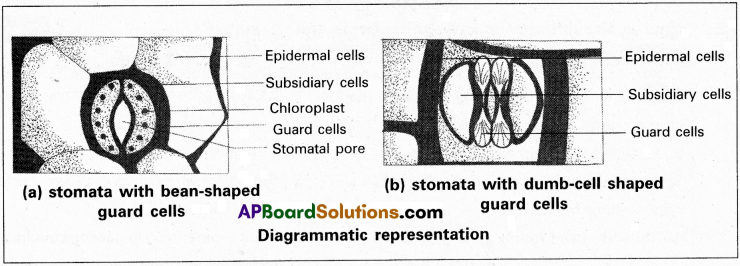
The stomatal pore is guarded by two kidney shaped guard cells. Name the epidermal cells surrounding the guard cells. How does a guard cell differ from an epidermal cell? Use a diagram to illustrate your answer.
Answer:
Stomata are structures present in the epidermis of leaves. Each stomata is composed of two bean shaped cells known as guard cells. The outer walls of guard cells are thin and the inner walls are thick. The guard cells possess chloroplasts and regulate the opening and closing of stomata. Sometimes a few epidermal cells, become specialized in their shape and size are called subsidiary cells. Differences between Guard cell and Epidermal cells.

Guard cellsEpidermal cells
1. They are bean or kidney shaped.1. They are Barrel shaped.
2. They possess chloroplasts.2. They lack chloroplasts.
3. They are smaller.3. They are bigger.
4. Cell walls of Guard cells are not uniform and Thicker.4. Epidermal cells are uniformly thin.

AP Inter 1st Year Botany Study Material Chapter 12 Histology and Anatomy of Flowering Plants 1

Question 8.
Point out the differences in the anatomy of leaf of peepal (Ficus religiosa) and Maize (Zea mays). Draw the diagrams and label the differences.
Answer:

Dicot leafMonocot leaf
1. Stomata are more in the lower epidermis than in the upper epidermis.1. Stomata are equally distributed on both the sides.
2. Bulliform cells are absent.2. Bulliform cells are present in the upper epidermis.
3. Mesophyll is differentiated into palisade and spongy tissue.3. Mesophyll is undifferentiated.
4. Bundle sheath extensions are generally parenchymatous.4. Bundle sheath extensions are generally sclerenchymatous.
5. They are dark green on the upper surface, less green on the lower surface. (Dorsiventral)
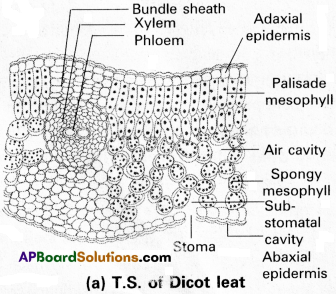
AP Inter 1st Year Botany Study Material Chapter 12 Histology and Anatomy of Flowering Plants 2
5. They are in same colour on both the surfaces. (Isobilateral)
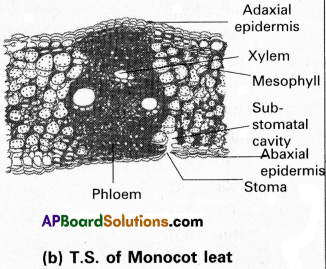
AP Inter 1st Year Botany Study Material Chapter 12 Histology and Anatomy of Flowering Plants 3

Question 9.
Cork cambium forms tissues that form the cork. Do you agree with this statement? Explain.
Answer:
Yes, cork cambium or phellogen is formed during secondary growth of Dicot stem. Cork cambium or phellogen cuts off on both sides. The cells produced towards outerside differentiates into cork or phellem and the inner cells differentiates into secondary cortex or phelloderm. The cork cells are impervious to water due to deposition of suberin in the cell wall.

AP Inter 1st Year Botany Study Material Chapter 12 Histology and Anatomy of Flowering Plants

Question 10.
Name the three basic tissue systems in the flowering plants. Give the tissue names under each system.
Answer:
In flowering plants, there are three tissue systems are present namely.

  1. Epidermal tissue system
  2. Ground tissue system
  3. Vascular tissue system.

1) Epidermal tissue system :
It consists of epidermis, cuticle, stomata, unicellular hairs and Multicellular trichomes.

2) Ground tissue system :
It consists of simple tissues like parenchyma, collenchyma and sclerenchyma. These cells are present in cortex, pericycle, pith, Medullary rays, Hypodermis, Endodermis layers. In leaves, the ground tissue consist of thin walled chloroplast containing cells called Mesophyll.

3) Vascular tissue system :
It consists of complex tissues, the xylem and the phloem.

Long Answer Type Questions

Question 1.
Explain the process of secondary growth in the stems of woody Angiosperms with the help of schematic diagrams. What is its significance?
Answer:
Formation of cambium ring :
In the primary structure of dicto stem, the stele shows vascular bundles in the form of a ring. Each vascular bundle consists of cambium in between the xylem and phloem. This is called Inter fascicular cambium. In between the vascular bundles, there are medullary rays. From the cells of medullary rays intrafascicular cambium is formed. The Inter fascicular and intrafascicular cambia fuse to form a continuous cambial ring called “vascular cambium”.

Activity of the vascular cambial ring :
The cells of vascular cambium divide repeatedly by periclinal method and produce new cells on both the sides. The cells which are produced outside develop into secondary phloem and those produced to the inner side develop into secondary xylem (wood). Generally more secondary xylem is produced than the secondary phloem. The secondary xylem consists of xylem vessels, tracheids, xylem fibres and xylem parenchyma. The secondary phloem consists of sieve tubes, companion cells, phloem fibres and phloem parenchyma.

In the cambium two types of initiating cells are found. They are 1. Fusiform initials and 2. Ray initials. The fusiform initials give rise to the secondary xylem and the secondary phloem. The ray initials produce phloem rays (bast rays) to the outside and xylem rays (wood rays) to the inside. They are helpful in lateral conduction and storage. They are called secondary medullary rays.

Annual rings :
In temperate regions and cold regions the activity of the Cambium is influenced by the seasonal variations. During the favourable season, i.e., in spring, when more leaves and flowers are formed, the plant requires large amounts of water and mineral salts. Hence the wood formed in this period shows more number of xylem vessels with wider lumens. This is known as spring wood or early wood. The colour .of this wood is light during the unfavourable season ie., in autumn, the plants are less active and do not requirfe more water and mineral salts.

Hence the wood produced in the period shows less number of xylem vessels with narrow lumens. This is knwon as Autumn wood or late wood. It is dark coloured. In this way two types of secondary xylem (wood) are produced in one year. They appear in the form of dark and light coloured circles alternately in a mature tree trunk. These are called Annual rings or growth rings or seasonal rings.

By counting the number of annual rings, the approximate age of trees can be estimated. This branch of science is known as “dendrochronology or growth ring analysisFor example the age of sequoid dendron, presently growing in America, is estimated to be about 3500 years, in tropical countries like India, annual rings do not appear clearly, as the seasonal variations are not sharp. Hence these are called growth marks.

Heart wood and sapwood :
With the increase in the age of the tree, the wood undergoes a number of hysical and chemical changes. The older wood gradually loses water and stores food substances and becomes infilterated with various organic compounds such as oils, gums, resins, tannins, colouring agents and aromatic substances. Hence the older xylem present in the centre appears dark in colour. This is called heart wood or duramen.

It is very hard highly durable. Heart wood cannot conduct water and salts because of the growth of tyloses in the lumens of xylem vessels. The heart wood gives mechanical strength to the tree.

The newly formed secondary xylem is found in the peripheral part of the tree trunk. This is called sapwood or alburnum. It is light in colour and is active in conducting water, mineral salts and storage of food materials. As time passes on, the sap wood gradually changes into heart wood. Hence the sap wood remains uniformly thick.

Periderm :
As the secondary xylem and secondary phloem are formed inside the stele, a pressure is exerted on the epidermis, causing its rupture. Mean while a secondary protective layer formed from the middle or inner part of the cortex become meristematic and acts as phellogen or cork cambium. These cells divide periclinally and cuts of new cells towards outside called cork or phellem and towards inside called secondary cortex or phelloderm. The phellogen, phellem and phelloderm together constitute periderm.

At certain regions, the phellogen cuts off closely arranged parenchymatous cells on the outer side instead of cork cells, called complementary cells. These cells soon rupture the epidermis forming a lens-shaped oepnings called lenticels. They permit the exchange of gases between the outer atmosphere and the internal tissues.
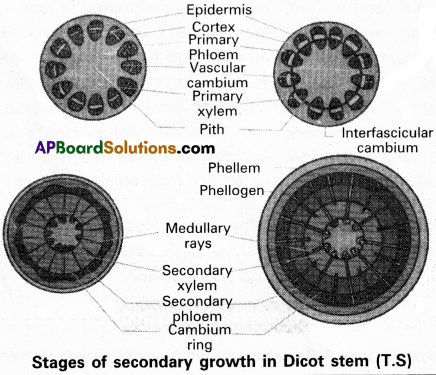
AP Inter 1st Year Botany Study Material Chapter 12 Histology and Anatomy of Flowering Plants 4

Question 2.
Draw illustrations to bring out the anatomical differences between
a) Monocot root and Dicot root
b) Monocot stem and Dicot stem.
Answer:
a) Monocot root and Dicot root

Monocot RootDicot Root
1. Cortex is relatively bigger.1. Cortex is smaller.
2. Pericycle is often multilayered.2. Pericycle is single layered.
3. Pericycle produces only lateral roots.3. Pericycle gives rise to lateral roots and also produces vascular cambium during secondary growth.
4. Vascular bundles are more than six in number.4. Vascular bundles range from two to six in number.
5. Xylem is ployarch.5. Xylem is monarch to tetrarch.
6. Medulla is very big.6. Medulla is very small or absent.
7. Secondary growth is absent.7. Secondary growth occurs.

b) Monocot stem and Dicot stem.

Monocot StemDicot Stem
1. Trichomes are absent.1. Trichomes are present.
2. Hypodermis is made up of sclerenchymatous cells.2. Hypodermis is made up of collenchymatous cells.
3. Endodermis and pericycle are absent.3. Endodermis and pericycle are present.
4. General cortex is absent.4. General cortex is present.
5. Ground tissue is present.5. Ground tissue is absent.
6. Vascular bundles are numerous and arranged in a scattered manner (atactostele).6. Vascular bundles are few in number and arranged as a circular ring (eustele).
7. Vascular bundle is oval in shape.7. Vascular bundle is top shaped or wedge shaped.
8. Vascular bundle is enclosed by fibrous sheath.8. Vascular bundle is not enclosed by firbrous sheath.
9. Vascular bundle is closed.9. Vascular bundle is open.
10. Xylem vessels are few in number.10. Xylem vessels are more in number.
11. Protoxylem lacunae are present.11. Protoxylem lacunae are absent.
12. Medulla and medullary rays are absent.12. Medulla and medullary rays are present.
13. Pith cavities are present.13. Pith cavities are absent.
14. Vessels are in ‘Y’ shape.14. Vessels are in serial order.
15. Phloem parenchyma is absent.15. Phloem parenchyma is present.

AP Inter 1st Year Botany Study Material Chapter 12 Histology and Anatomy of Flowering Plants

Question 3.
What are simple tissues? Describe various types of simple tissues.
Answer:
Tissues which are made up of only one type of cells are called simple tissues. They are of three types. They are parenchyma, Collenchyma and Sclerenchyma.
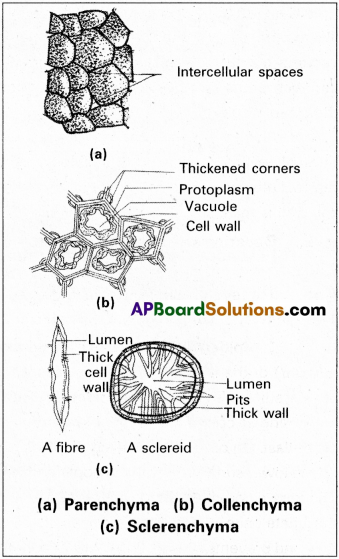
AP Inter 1st Year Botany Study Material Chapter 12 Histology and Anatomy of Flowering Plants 5
1) Parenchyma :
It is living tissue. It occupies the major part of the plant body and the cells are isodiametric. They may be spherical, oval, polygonal or elongated in shape. Their walls are thin and made up of cellulose. They have small intercellular spaces. It performs photosynthesis, storage, secretion, Healing of wounds secretion, Buoyancy by storing air etc.

2) Collenchyma :
It is simple living mechanical tissue, occurs below the epidermis of Dicot plants. It consists of cells which are thickened at the corners due to deposition of cellulose, hemicellulose and pectin. The cells are oval or spherical or polygonal in shape and contain chloroplasts. Intercellular spaces are absent. They may be angular or lacunar or Lemellar type. They help in assimilation and provide mechanical support to young stems and petiole of a leaf.

3) Sclerenchyma :
It is a dead Mechanical tissue, consists of long, narrow cells with thick and lignified cell walls having pits. They are usually dead cells and without protoplasts. Based on the form, structure, it may be either fibres or sclereids. The fibres are thick walled, elongated and pointed cells, gives mechanical support and also used in Jute Industries. The sclereids are spherical, oval or cylindrical, highly thickened dead cells, found in the fruit walls of nuts, pulp of fruits like guava and sapota, seed coats of legumes and leaves of tea. They also provide Mechanical support to organs.

Question 4.
What are complex tissues? Describe various types of complex tissues
Answer:
Tissues which are made up of more than one type of cells and work together as a unit are called complex tissues. They are of two types namely xylem and phloem.
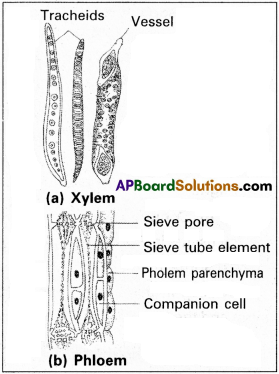
AP Inter 1st Year Botany Study Material Chapter 12 Histology and Anatomy of Flowering Plants 6

Xylem :
It is a conducting tissue, helps in conduction of water and minerals form roots to stem and leaves. It is composed of four elements namely tracheids, vessels, xylem fibres and xylem parenchyma.

Tracheids are elongated or tube like cells with thick and lignified walls and tapered ends. These are dead and are without protoplasm. Vessels are long cylindrical tube like structures, made of many cells with lignified walls and a large central cavity. Vessels are interconnected through perforations in their walls. They are, also dead cells. Both Tracheids and vessels are the main water transporting channels. Xylem fibres are long, with thick walls and narrow lumens, gives mechanial strength, xylem parenchyma cells are living and thin walled cells, made up of cellulose. They store food materials in the form of starch of fat.

Phloem :
It is a complex tissue, helps in conduction of food materials. It is composed of sieve tube elements, companion cells, phloem parenchyma and phloem fibres. Sieve tube elements are long tube like structures and are associated with companion cells. Their end walls are performted in a sieve like manner to form the sieve plates. A mature sieve element shows a peripheral cytoplasm and a large vacuole but lacks a nucleus. The companion cells are specialised parenchymatous cells which are connected to sieve tube by pit fields the companion cells help in maintaining the pressure gradient in the sieve tubes.

Phloem parenchyma is made up of cylindrical cells which have dense cytoplasm and nucleus. The cell wall is composed of cellulose and has pits. It stores food material and other substances like resins, Latex and Mucilage. Phloem fibres are long elongated unbranched cells with pointed apices. The cell wall is thick and is made up of lignin. Phloem fibres of jute flax and hemp are used commerically.

Question 5.
Describe the internal structure of dorsiventral leaf with the help of labelled diagram.
Answer:
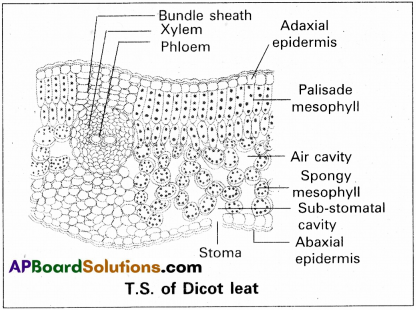
Transverse section of a dorsiventral leaf (dicot leaf) shows 3 important parts. They are

  1. Epidermis,
  2. Mesophyll and
  3. Vascular byndles.

1. Epidermis :
Epidermis is present on the both the upper surface (adaxial) and the lower surface Cabaxial) of the leaf. The epidermis present on the adaxial surface is called upper epidermis and on the abaxial surface is called lower epidermis. The epidermis is made up of one row of barrel shaped cells, which are arranged compactly without intercellular spaces. The cells are filled with vacuolated and nucleated protoplast. On outerside of the epidermis a waxy layer called Cuticle is present.

Stomata are present, more on the lower surface than on the upper surface. Each stoma is surrounded by two kidney shaped guard cells. They are chlorophyllous and regulate the opening and closing of stomata. Epidermis shows multicellular uniseriate hairs. The cells of leaf hairs are filled with water. They protect the inner tissues by absorbing the heat and prevents evaporation of water from the leaf surface. The stomata help in the gaseous exchange and also promote transpiration.

2. Mesophyll :
The ground tissue that extends between the upper and lower epidermal layers is called the mesophyll. It is composed of thin walled parenchyma with chloroplasts. It is chiefly concerned with the synthesis of carbohydrates. In dicot leaves mesophyll is differentiated into two parts namely,
i) Palisade parenchyma and
ii) Spongy parenchyma.

i) Palisade parenchyma :
Part of the mesophyll found beneath the upper epidermis is called ‘palisade tissue’. It shows elongated, columnar cells arranged in 1-3 vertical rows. Narrow intercellular spaces are present between the cells. In these cells, large numbers of chloroplasts are found nearer to the cell wall. Palisade tissue is primarily concerned with the manufacture of carbohydrates in the presence of sunlight.

ii) Spongy parenchyma :
Part of the mesophyll found towards the lower epidermis is called spongy tissue. It shows 3-5 rows of irregular shaped cells that are arranged loosely with large intercellular spaces. Some intercellular spaces present in the vicinity of the stomata are very large, forming air chambers (air cavities). In thise cells, number of chloroplasts is less. That is why the upper surface of leaf is dark green and the lower surface is light green in colour. Spongy tissue has a primary role in gaseous exchange, apart from the synthesis of food materials.

3. Vascular bundles :
Vascular bundles are extended in the mesophyll in the form of veins. They help in supplying water, mineral salts and food materials all over the leaf surface. Veins also provide mechanical strength to the leaf.
AP Inter 1st Year Botany Study Material Chapter 12 Histology and Anatomy of Flowering Plants 7

The vascular bundles are conjoint, collateral and closed. The xylem is present on the upper side and phloem on the lower side. Cambium is absent between them. Xylem shows vessles, tracheids, parenchyma and fibres. Phloem shows sieve tubes companion cells and phloem parenchyma.

Each vascular bundle is surrounded by a layer of specialised mesophyll cells that are arranged closely and compactly without intercellular spaces. This layer is called bundle sheath or border parenchyma. The bundle sheath cells divide and grow towards the upper and lower epidermal layers. These are called bundle sheath extensions. They help in the conduction of food materials form the mesophyll to the vascular bundles.

Question 6.
Describe the internal structure of an isobilateral leaf with the help of labelled diagram.
Answer:
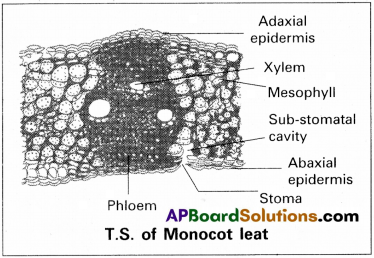
The internal structure of a monocot leaf (isobilateral leaf) shows 3 main parts, namely 1. Epidermis, 2. Mesophyll and 3. Vascular bundles.
AP Inter 1st Year Botany Study Material Chapter 12 Histology and Anatomy of Flowering Plants 8

1) Epidermis :
Epidermis is present on both the upper surface (adaxial) and the lower surface (obaxial) of the leaf. The epidermis is made up of barrel shaped cells which are arranged compactly without intercellular spaces. The cells are filled with vacuolated cytoplasm and possess a single nucleus but chloroplasts are absent. Epidermal hairs are absent. Epidermis is externaly covered by a waxy layer called cuticle. The number of stomata on both the sides is almost equal. In some monocots like grasses some cells of upper epidermis are enlarged and specialised, called Bulliform cells or Motor cells. They are thin walled and are filled with water. They help in rolling and unrolling of the leaf. The epidermis gives protection to the inner tissues, regulates the transpiration and helps in gaseous exchange.

2) Mesophyll :
It is present between the upper and lower epidermal layers. It is made up of several layers of columnar cells or spongy cells, that are loosely arranged showing intercellular spaces. They contain chloroplasts. The mesophyll is the cheief photosynthetic tissue of the leaf.

3) Vascular bundles :
Numerous vascular bundles are present in the mesophyll in the form of veins. The vascular bundles are conjoint, collateral and closed. Xylem is present towards upper side and phloem towards lower side.

Each vascular bundle is enclosed by a layer of specialised mesophyll cells called border parenchyma or bundle sheath. Sometimes, bundle sheath is composed of dead sclerenchymatous tissue. The bundle sheath cells divide and grow towards both the sides of the vascular bundle. They are called bundle sheath extensions. They help in the conduction of materials from the mesophyll to the vascular bundle. They also give mechanical strength to the leaf.

Question 7.
Distinguish between the following :
a) Exarch and endarch condition of protoxylem.
b) Stele and vascular bundle.
c) Protoxylem and metaxylem.
d) Interfasicular cambium and Intrafasicular cambium.
e) Open and closed vascular bundles.
f) Stem hair and root hair.
g) Heat wood and sap wood.
h) Spring wood and Autumn wood.
Answer:
a)

ExarchEndarch
If the protoxylem lies towards periphery and metaxylem lies towards the centre is called Exarch condition.
Ex : Roots.
If the Protoxylem lies towards the centre and metaxylem lies towards periphery is called Endarch condition.
Ex : Stems.

b)

SteleVascular Bundle
Stele is the central part of the Internal structure of stems or Roots constitutes pericycle, vascular Bundles, Medulla.Xylem and phleom are arranged on the same radius or on different radius called vascular Bundle.

c)

ProtoxylemMetaxylem
The first formed xylem with narrow lumen is called protoxylem.The later formed xylem with broader lumen is called Metaxylem.

d)

Interfascicular cambiumIntrafascicular cambium
The cells of medullary rays adjoining intrafascicular cambium become meristematic and form interfascicular cambium.The cambium present between xylem and phloem of a vascular bundle is called Intrafascicular cambium.

e)

Open Vascular BundleClosed Vascular Bundle
If cambium is present between xylem and phloem of vascular bundle then it is called open vascular bundle.
Ex : Dicot stem.
If cambium is absent between xylem and phloem of a vascular bundle, then it is called closed vascular bundle.
Ex : Monocot stem.

f)

Stem HairRoot Hair
1. They are multicellular or unicellular, separated from epidermal cells by walls.1. They are unicellular. They are not separated from epidermal cells by wails
2. They check the rate of transpiration.2. They help in absorption of water from the soil.

g)

Heart woodSap wood
1. The older xylem present in the centre, appears dark in colour is called Heart wood.1. The newly formed xylem found in the peripheral part of the plant, light in colour is called sap wood.
2. It does not conduct water.2. It is active in conducting water.
3. It is highly durable.3. It is less Durable and more permeable.
4. It is older and harder part.4. It is younger and softer part.

h)

Spring woodAutumn wood
1. Xylem formed in springs season and have wider lumes is called spring wood.1. Xylem formed in autumns season with narrow lumen is called Autumn wood.
2. It is light in colour.2. It is dark in colour.
3. Formed early in a year.3. Formed after the early wood.
4. Produced more in amount.4. Produced less in amount.
5. Less dense.5. More dense.

AP Inter 1st Year Botany Study Material Chapter 12 Histology and Anatomy of Flowering Plants

Question 8.
What is stomatal apparatus? Describe the structure of stomata with a labelled diagrams.
Answer:
The stomatal aparture, Guard cells and the subsidiary cells together called “Stomatal apparatus”.

Structure of Stomata :
Stomata are the structures present in the epidermis of leaves. Stomata regulate the process of transpiration and gaseous exchange. Each stoma is composed of two bean-shaped Guard cells. In grasses, the guard cells are dumbbell shaped. The outer walls of guard cells are thin and inner walls are highly thickened.

The guard cells possess chloroplasts and regulate the opening and closing of stomata. Some times, a few epidermal cells become specialised in their shape and size and are known as subsidiary cells. The stomatal aperture, guard cells and the subsidiary cells are together called stomatal apparatus.
AP Inter 1st Year Botany Study Material Chapter 12 Histology and Anatomy of Flowering Plants 1

Question 9.
Describe the T.S of a dicot stem.
Answer:
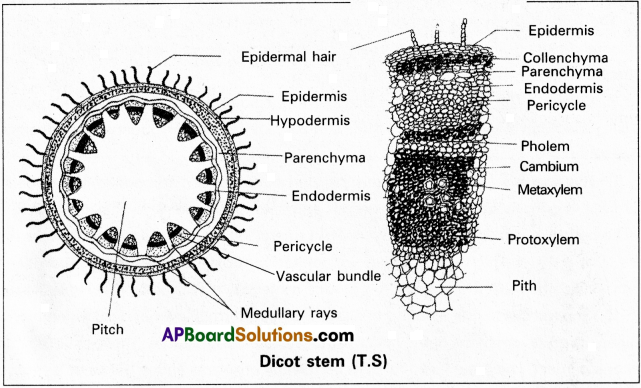
The structure of young dicot stem can be clearly understood by observing the transverse section of stem of Helianthus annus (sunflower). It shows three major zones, namely epidermis, cortex and stele.

1. Epidermis :
It is the outer most layer of rectangular or tubular cells arranged compactly without any intercellular spaces. On outer surface of epidermis, a waxy layer called Cuticle is found. The cuticle is chemically composed of a substance cutin. The cell walls of epidermis also show the presence of cutin. Stomata are present in the epidermis. Multicellular trichomes develop on the epidermis. The cuticle and the trichomes check the evaporation of water and protect the stem from high temperature.

The epidermal layer gives protection to the inner tissues and also prevents the evaporation of water from the plant body. Through stomata, the epidermis allows the exchange of gases and promotes transpiration. Trichomes prevent entry of pathogens.

2. Cortex :
The part extending between the epidermis and the stele is known as cortex. The cortex is smaller than the stele. It shows three sub-zones, namely, i) Hypodermis ii) General Cortex and iii) Endodermis.

i) Hypodermis :
This is the outermost part of cortex and composed of 3-6 rows of collenchy matous cells. It is found beneath the epidermis and helps in providing tensile strength (elasticity) to the stem. The cells are arranged compactly without intercellular spaces and show excessively thickened corners. The cells are filled with active vacuolated cytoplasm possessing chloroplasts. Thus, the hypodermis also helps in the assimilation of food materials. It also gives mechanical strength.

ii) General Cortex :
It is found beneath the hypodermal layer and is made up of 5 – 10 rows of thin walled, living parenchyma cells with or without intercellular spaces. These cells may be isodiametric or oval or spherical. The outer layers of cells contain chloroplasts and in the inner layers leucoplasts are found. The general cortex is primarily concerned with the assimilation and storage of food materials.

iii) Endodermis :
The inner most layer of cortex is called endodermis. The cells are barrel shaped, compactly arranged without intercellular spaces. The endodermis cells contain vacuolated protoplasts and show starch grains. So it is also known as ‘Starch Sheath’.

3) Stele :
The central conducting cylinder is called the ‘Stele’. It occupies a major part of the stem. It Is composed of 4 parts.
i) Pericycle ii) Vascular bundles iii) Pith or Medulla and iv) Medullary rays.
i) Pericycle:
It is present in the form of a discontinuous ring and is made up of 3-5 rows of the thick walled, dead, lignified cells which gives mechanical strength to the stele. It appears as semilunar patches of sclerenchyma above the vascular bundles with intervening masses of parenchyma.

ii) Vascular bundles :
About 15-20 vascular bundles are arranged in the form of a ring. This arrangement is called eustele. Each vascular bundle is wedge or top shaped. In the vascular bundels xylem and phloem are arranged on the same radius. A meristematic layer of cells called cambium is present in between the xylem and phloem. So they are called conjoint, collateral, open vascular bundles. Xylem is at the lower side and phloem at the upper side of the vascular bundle.

Xylem consists of vessels and xylem parenchyma. There may befewtracheidsand xylem fibres. The metaxylem is towards the pericycle and protoxylem towards the pith. This is called endarch xylem. Phloem consists of sieve tubes companion cells and phloem parenchyma. Xylem and phloem are vascular tissues which conduct water, mineral salts and organic solutes respectively.

iii) Medulla :
It is the central part of the stele and filled with thin walled parenchymatous cells, showing intercellular spaces. It is well-developed, extensive and occupies a large part of the stele. The chief function of the medulla is to store food materials.

iv) Medullary rays :
The cells of the medulla extend to the periphery in between the vascular bundles. These cells are horizontal rows of thin walled, living and elongate radially, forming primary medullary rays.

The medullary rays connect the stele with the cortex and are helpful in lateral conduction.
AP Inter 1st Year Botany Study Material Chapter 12 Histology and Anatomy of Flowering Plants 9

Question 10.
Describe the T.S of a Monocot stem.
Answer:
The structure of monocot stem can be understood well by observing the T.S of stem of Zea mays. It shows 4 distinct parts., namely

  1. Epidermis,
  2. Hypodermis,
  3. Ground tissue and
  4. Vascular bundles.

Epidermis :
It is the outermost layer composed of rectangular or tubular living cells arranged closely and compactly without intercellular spaces. The cells contain vacuolated protoplasts with a single nucleus but chloroplasts are absent. A waxy layer called ‘cuticle’ is deposited on the external surface of the epidermis. Cuticle prevents the evaporation of water from the plant body. Trichomes are absent. Numerous stomata are found in the epidermis through which exchange of gases occurs.

Epidermis gives protection to the inner tissues, helps in the exchange of gases and also prevents the evaporation of water.

Hypodermis :
A distinct cortex is absent in Monocot stems. However a thick walled hypodermis is found beneath the epidermis. The cells of hypodermis are sclerenchymatous and are arranged compactly in 3 – 4 rows, without any intercellular spaces. It gives mechanical strength to the stem.

Ground tissue :
A major part of the stem is formed by an extensive soft, parencymatous tissue called the ground tissue. The peripheral layer consists of smaller cells while the inner layers show bigger cells. The cells of peripheral layers are chlorenchymatous and are concerned with assimilation of food

Vascular bundles :
Numerous vascular bundles are found scattered irregularly in the ground tissue. This kind of arrangement is called ‘atactostele1. It is considered an on advanced character. The inner vascular bundles are bigger in size and far apart from one another. The outer vascular bundles are smaller and are close to one another and found In one or two circles.

Each vascular bundle is oval in shape and shows xylem and phloem together on the same radius. There is no cambium between xylem and phloem. Hence the vascular bundles are called conjoint, collateral and closed. Xylem is at the lower side and phloem at the upper side of the vascular bundle. Each vascular bundle is enclosed by a sheath of sclenrenchymatous fibres. Hence it is called fibro vascular bundle.

Xylem consists of tracheids, vessels, fibres and parenchyma. Xylem vessels are few in number (4) and are arranged in “Y” shape. One or two protoxylem cells are crushed forming lysigeneous cavity called protoxylem lacunae which store water phloem consists of sieve tubes and companion cells. Phloem parenchyma is absent Medulla, Medullary rays and pericycle are also absent.
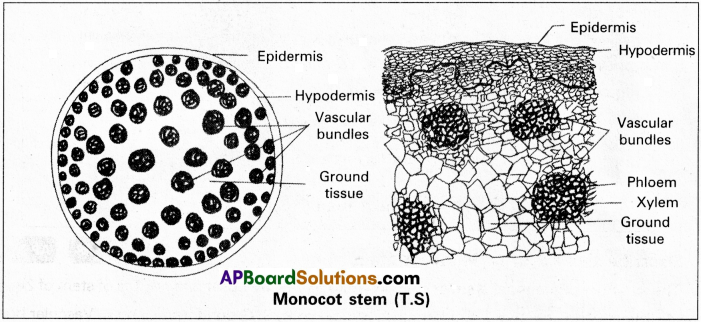
AP Inter 1st Year Botany Study Material Chapter 12 Histology and Anatomy of Flowering Plants 10

Question 11.
Describe the internal structure of a Dicot Root.
Answer:
The transverse section of primary dicto root can be divided into 3 zones. They are : Epidermis, Cortex and Stele.

1) Epidermis :
Epidermis is the outermost layer made up of thin walled, non-cutinised, rectangular living cells. The epidermal cells are arranged compactly without intercellular spaces. The cuticle and stomata are absent. Some epidermal cells produce tubular extensions called root hairs. Due to presence of root hairs the root epidermis is called is as epiblema or rhizodermis or piliferous layer.

The cells that give rise to root hairs are comparatively smaller than the other cells and are called trichoblasts. Root hairs help in the absorption of capillary water. The epidermis gives protection to the inner tissues and plays major role in the absorption.

2) Cortex :
The tissue extended between epidermis and stele is called ‘cortex’. Generally in roots materials. The inner layers of cells are concerned with storage of food materials. In monocot stem endodermis is absent. the cortex is bigger than the stele. Cortex can be differentiated into three parts :

  1. Exodermis,
  2. General cortex and
  3. Endodermis.

i) Exodermis :
It is the outermost layer of cortex and composed of two to three rows of thick walled suberised cells. When the epidermal layer is removed, the exodermis acts as the protective layer. It also prevents the exit of water from the cortex. It can be observed in mature part of the root.

ii) General cortex :
It is present beneath the exodermis and is composed of several rows of thin walled, living parenchyma cells. The cells are round or oval in shape and loosely arranged showing intercellular spaces. They contain leucoplasts which store the food materials. The general cortex helps in the lateral conduction of water from the epidermis to the xylem vessels present in the stele.

iii) Endodermis :
It is the innermost layer of cortex and is made up of a single row of barrel shaped cells. The cells are compactly arranged without having any intercellular spaces. The radial and transverse walls of the endodermal cells show casparian strips that are formed by the deposition of lignin and suberin which prevent the movement of water. Therefore the endodermis acts as a barrier between the cortex and the stele.

In endodermis, some cells situated opposite to the protoxylem elements are thin walled without casparian bands. These cells are called passage cells. They help in the translocation of water and mineral salts from the cortex into the stele.

3) Stele :
The central conducting cylinder is known as ‘stele’. It is smaller than the cortex. The stele is comprised of three parts, viz., pericycle, Vascular bundles and Medulla.
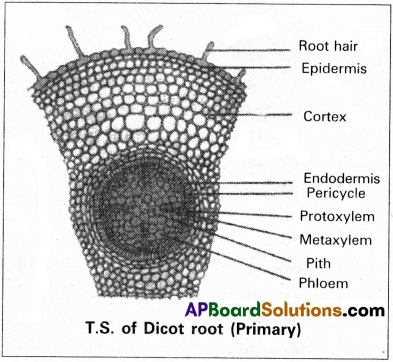
AP Inter 1st Year Botany Study Material Chapter 12 Histology and Anatomy of Flowering Plants 11

i) Pericycle :
The layer of cells surrounding the stele is known as ‘pericycle’. It is usually uniseriate and composed of thin walled, rectangular, living cells which show active cell division. The pericycle gives rise to lateral roots. Some cells of the pericycle can dedifferentiate into secondary cambium which results in the secondary growth of the root.

ii) Vascular bundles :
Standards of primary xylem and phloem are found alternately on separate radii. These are called separate or radial vascular bundles’. Xylem is exarch showing protoxylem elements towards the pericycle and metaxylem elements towards the medulla. The number of vascular bundles is identified in relation to the number of xylem groups. Usually in dicot roots, four xylem bundles alternating with four phloem bundles are found. This is called ‘tetrach condition’.

There is no cambium between the vascular tissues. The ground tissue that extends between the xylem and phloem strands is called conjunctive tissue. It is usually parenchymatous. It helps in the storage of food materials. It porduces secondary cambium during secondary growth.

Medulla or Pith :
In roots, the development of xylem is centripetal and produces metaxylem towards the inner side. Sometimes, as in dicot root these metaxylem elements come closer from all sides and replace the medulla. Hence in dicot roots the medulla is very small or may be completely absent. When present, it is parenchymatous and helps in the storage of food and water.

Question 12.
Describe the internal structure of a Monocot Root.
Answer:
The internal structure of Monocot root shows 3 zones. They are :

  1. Epidermis
  2. Cortex and
  3. Stele.

1) Epidermis :
It is the outermost layer formed by thin walled, rectangular cells, which are compactly arranged without intercellular spaces. Cuticle and stomata are absent. Some epidermal cells (trichoblasts) produce tubular extensions called root hairs. They absorb capillary water from the soil. The epidermis of root is also known as rhizodermis or epiblema or piliferous layer.

2) Cortex :
It is a wide and extensive tissue present between the epidermis and stele. It is bigger than the stele. It can be divided into three sub-zones. They are :
a) Exodermis
b) General cortex and
c) Endodermis.

a) Exodermis :
It is the outer part of the cortex and composed of one to two rows of thick walled, dead, suberised calls. In mature roots, when the outer epidermis is removed, the exodermis acts as a protective layer. It helps in preventing the exit of water from the root tissues.

b) General Cortex :
It is formed below the exodermis layer. It is composed of several rows of thin walled living cells that are arranged loosely showing intercellular spaces. The cells of cortex help in the storage of food materials and lateral conduction of water from the epidermis to the stele.

c) Endodermis :
The innermost layer of cortex and is composed of single layer of barrel shaped cells that are arranged compactly without intercellular spaces. The radical and transverse walls are wrapped by ligno-suberised bands called casparian bands.

Some cells situated opposite to the protoxylem cells are thin walled and without casparian bands. These are known as passage cells which help in the entry of water from the cortex into the stele.

3) Stele :
The central conducting cylinder. It is very prominent and bigger in size. The stele shows Pericycle, Vascular bundles and Medulla.
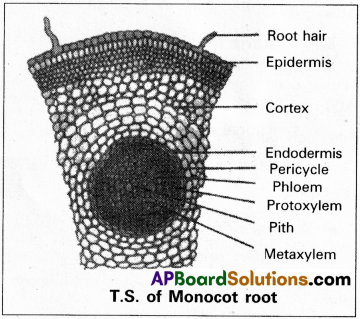
AP Inter 1st Year Botany Study Material Chapter 12 Histology and Anatomy of Flowering Plants 12

i) Pericycle :
The layer of cells found beneath the endodermis is known as pericycle. The cells are thin walled, parenchymatous, rectangular and compact without intercellular spaces. The cells are meristematic and divide actively producing lateral roots. In old and mature roots, the pericycle is sclerenchymatous and gives mechanical strength.

ii) Vascular bundles :
Bundles of xylem and phloem are found separately on different radii, one alternating with the other, at the peripheral boundary of the stele. These are known as radial’ or separate vascular bundles. The xylem is exarch and polyarch. More than six xylem bundles.

The ground tissue formed between the xylem and phloem stands is known as ‘conjunctive tissue’. It is usually parenchymatous. It helps in storage of food materials and provides mechanical strength.

iii) Medulla or Pith :
The wide central part of the stele is called ‘medulla or pith’. It is made up of thin walled parenchyma which primary helps in the storage of food. In some monocot roots, the medulla is composed of thick walled lignified dead cells and helps in giving mechanical strength.

Intext Questions

Question 1.
Name the various kinds of cell layers which constitute the bark.
Answer:
Periderm and secondary phloem.

Question 2.
Every 50 years, for 200 years, a nail was drilled into a tree, to the same depth and at exactly 1m above the soil surface (assuming the ground level has not changed). What will be the pattern of the four nails on the tree? Do you know the reason for your answer? If yes, give the reason?
Answer:
The pattern of four nails depends on the seasonal variations and growth of the tree.

Question 3.
Why is wood made of xylem and not of phloem?
Answer:
The walls of the xylem cells are thickened with lignin, this strengthens the walls and also makes them waterproof. Xylem also contributes greatly to the mechanical strength of the plant. Hence wood is mostly made up of secondary xylem.

AP Inter 1st Year Botany Study Material Chapter 12 Histology and Anatomy of Flowering Plants

Question 4.
A student estimated the age of a tree to be about 300 years. How did he anatomically estimate the age of this tree?
Answer:
By counting the number of annual rings.

Question 5.
Assume that you have removed the duramen part of a tree. Will the tree survive or die?
Answer:
The tree survives even if the duramen part of trunk is removed because of the presence of functional wood called sap wood.

AP 7th Class Science Important Questions 12th Lesson Soil and Water

These AP 7th Class Science Important Questions 12th Lesson Soil and Water will help students prepare well for the exams.

AP Board 7th Class Science 12th Lesson Important Questions and Answers Soil and Water

Question 1.
What are the most important resources for living things?
Answer:

  1. The soil and water are the most important resources for living things.
  2. There is no life without these resources.

Question 2.
What is soil? Name the branch of science that deals with the scientific study of soil?
Answer:

  1. The upper most layer of earth’s crust is known as soil.
  2. The scientific study of soil is called “Pedology”.

Question 3.
Why soil is so important for plants?
Answer:

  1. Soil is a substratum in which plants get nutrients.
  2. Soil is a habitat for plants and many animals.

Question 4.
What is the pleasant smell after rain is known as? Mention the reason for the pleasant smell of soil after rain?
Answer:

  1. The pleasant smell after the rain is known as ‘Petrichor scent’.
  2. It is because of the rising of a substance called geosmin from the soil into the air when it rains.
  3. It is produced by the spores of actinomycetes bacteria.

AP 7th Class Science Important Questions 12th Lesson Soil and Water

Question 5.
Why soil is an important resource?
Answer:

  1. Human beings depend on soil for their basic needs.
  2. It has become an important part of our life.

Question 6.
What is Pedogenesis?
Answer:
The process of formation of soil from the parent rock by the process of weathering is called pedogenesis.

Question 7.
What is humus?
Answer:

  1. Dead and decayed organic matter that mixes with soil is called humus.
  2. Humus levels in the soil indicates the soil fertility.

Question 8.
What are the components of soil?
Answer:
The following are the components of soil.
1) Water , 2) air , 3) organic matter, 4) inorganic matter, 5) living organisms.

Question 9.
What is Edophology? What are edaphic factors?
Answer:

  1. The science dealing with the influence of soil on organisms, especially on plants is called Edophology.
  2. The factors that contribute to soil composition are called edaphic factors.

Question 10.
What is soil profile?
Answer:

  1. The sequence of horizontal and various components, layers of soil at a place is called soil profile.
  2. Each layer has a distinct colour, texture, depth and chemical composition. These layers are called horizons.

Question 11.
What are the crops grown in black soils?
Answer:
Farmers grow paddy, sugarcane and cotton crops in black soils.

Question 12.
Mention the crops grown in loamy soils?
Answer:
Most of the farmers practice aquaculture and grow flowers, vegetables, millets, tobacco and fruits.

Question 13.
What are the crops grown in Sandy soils?
Answer:

  1. Farmers grow groundnuts and castor in some places.
  2. Cotton, red’gram and tomatoes are also grown in sandy soils of Chitoor.

Question 14.
What are the crops grown in black soils with light clay?
Answer:

  1. Farmers mostly grow cotton and chillies in black soils which have light clay.
  2. These soils can be seen in Kadapa.

AP 7th Class Science Important Questions 12th Lesson Soil and Water

Question 15.
What are the crops grown in the loamy soils of Kurnool?
Answer:

  1. Farmers grow paddy, jowar and bengal gram.
  2. These loamy soils of Kurnool consists of sand also.

Question 16.
Name the crops grown in red sandy soils of Visakhapatnam?
Answer:
Farmers grow crops such as cashew, sugafedne arid paddy.

Question 17.
When do we celebrate the world water day?
Answer:
We celebrate the world water day on 22nd of March.

AP 7th Class Science Important Questions 12th Lesson Soil and Water

Question 18.
What is “Water Action Decade”? What is it’s aim?
Answer:

  1. Recognizing the growing challenges of water scarcity UNO launched the Water Action Decade – 2018 to 2028 on 22nd March, 2018.
  2. It’s aim is to mobilize action that will help and transform our views of management of water.

Question 19.
What happens if sewage and water from industries contaminate the water resources?
Answer:

  1. Sewage contains the soluble and insoluble organic and inorganic impurities and disease causing microorganisms.
  2. If this contaminated water mix up with drinking water it causes diseases such as diarrhoea, cholera, dysentery, typhoid and hepatitis.

Question 20.
How can we prevent contamination of water resources?
Answer:
Contamination of water resources can be prevented by treating sewage water properly before releasing it into water resources.

Question 21.
What would happen if same crop is cultivated continuously in the same field?
Answer:

  1. It decreases the soil fertility.
  2. Yield decreases in the next crop.

Question 22.
Write a short note on modern water purifiers?
Answer:

  1. Modern water purifiers have a filtet unit and facilities to let the ultra-violet rays to pass through.
  2. Ultra-violet rays are used instead of chlorine treatment to kill the germs.

Question 23.
Why should we use clay idols instead of idols made of plaster of paris?
Answer:

  1. During festivals like Vinayaka Chavithi we use idols of Ganesh made of plaster of paris and chemical colours which causes severe damage to our environment.
  2. Instead of these chemical idols we should use clay idols and celebrate festivals in an ecofriendly way.

Question 24.
For which purposes are we using fresh water?
Answer:
Fresh water has been the constant and essential companion of human beings throughout history. Water is used in great quantities in agriculture and industries.

Question 25.
Which type of soil is suitable for growing cotton?
Answer:

  1. Black soil is suitable for growing cotton.
  2. Black soil is sticky in nature. It retains water for a long time.
  3. This soil is suitable for the growth of cotton, sugarcane and paddy.

AP 7th Class Science Important Questions 12th Lesson Soil and Water

Question 26.
Which type of soil is generally seen in our state?
Answer:
In our state we see the following types of soils.
а) Black soil b) Red soil c) Red sandy soil d) Alluvial soil e) Loamy Soil

7th Class Science 12th Lesson Soil and Water Short Questions and Answers

Question 1.
Soil is useful for us in many ways. What are they?
Answer:

  1. Soil is needed for agriculture.
  2. It is needed for construction of buildings.
  3. It is needed for extraction of minerals from mines.
  4. oil is very useful for making utensils and pottery.
  5. For making toys and idols soil is useful.
  6. Multani soil is used in making cosmetics.

Question 2.
Mention the different horizons in soil profile?
Answer:

  1. O horizon (Surface litter)
  2. A horizon (Top soil)
  3. B horizon (Sub soil)
  4. C horizon (Regolith)
  5. R horizon (Bedrock)

Question 3.
What types of soils are there in your village?
Answer:

  1. Types of soil differ from village to village.
  2. For guidance a village in Krishna District is identified and details are given here.
  3. There is black soil in the village. This soil can retain water for a long time.
  4. Here farmers grow cotton, sugarcane and paddy.

Question 4.
What is weathering?
Answer:

  1. In nature due to the action of various natural agents such as wind, water, sun and climate the bigger rocks (Parent rock) gradually breakdown and give small particles which forms the soil.
  2. The process of formation of soil due to natural agents like wind, water and sunlight is called weathering.

Question 5.
What are the common soil problems tested at soil testing centres?
Answer:
The common soil problems tested at soil testing centres include :

  1. Low organic matter like carbon
  2. Available minerals in soil – nitrogen, phosphorus and potassium.
  3. Availability of micro nutrient levels
  4. Poor drainage
  5. Soil temperature
  6. Soil moisture
  7. Soil contamination
  8. acidic or basic nature of soil (pH)

AP 7th Class Science Important Questions 12th Lesson Soil and Water

Question 6.
How can you say soil is a precious resource? Give reasons.
Answer:

  1. Soil is a precious resource.
  2. It is the basis for growth of plants.
  3. It is habitat for micro organism, animals, reptiles etc.
  4. Soil is used for various purposes.
  5. Almost all the things in our surroundings directly or indirectly depend on soil.

Question 7.
Why is top soil more useful for us?
Answer:

  1. The top organic layer of soil, made up mostly of leaf litter and humus (decomposed organic matter).
  2. This layer is soft and porus. It contains nutrients which help in the growth of plants.
  3. Top soil is capable of retaining water in it.
  4. It is a good habitat for many living organism.

Question 8.
What do farmers do to preserve the fertility of the soil?
Answer:

  1. It is very important to preserve the fertility of soil.
  2. You know farmers can’t continue the same type of crops in their fields.
  3. They know continuous cultivation of same agriculture crops reduce the soil fertility.
  4. enerally, farmers cultivate pulses after completion of paddy.
  5. This kind of rotation of crops retains soil fertility and productivity.
  6. Conservation of soil is important factor in agriculture.

Question 9.
How is the formation of soil happened why are farmers and Engineers testing the soil?
Answer:
Soil Formation:

  1. Soil is formed slowly as rock (the parent material) erodes into tiny pieces near the Earth’s surface.
  2. Organic matter decays and mixes with inorganic material (rock particles, minerals and water) to form soil.
  3. These days farmers test the soil in the field using soil technologies in order to grow suitable crops in the fields.
  4. Engineers also test the soil profile before constructing multi storied buildings, bridges and dams.

Question 10.
How can the soil erosion be prevented?
Answer:

  1. Our farmers grow big trees around the fields to stop winds.
  2. They don’t keep the lands vacant.
  3. Farmers generally use vacant lands to grow grass and other plants.
  4. These grass plant roots hold the soil particles and prevent soil erosion during heavy rains.

AP 7th Class Science Important Questions 12th Lesson Soil and Water

Question 11.
‘Soil is a good habitat’ Explain the statement.
Answer:

  1. Soil is a good habitat. We depend on it for agricultural and construction purposes, making utensils, toys etc.
  2. We know that plants depend on soil for nutrients like mineral salts and water from the soil
  3. Animal life such as burrows or eggs of insects are found in the soil.

Question 12.
Read the below table and answer the following questions.

Type of SoilCharacter of Soil
Clay Soileasy to roll into a ball
Loamy soilbreaks on bending
Light clayeasy to make a ring
Sandy soilnot easy to roll into a ball

a) What is the character of loam soil?
b) What is the difference between clay soil and sandy soil?
Answer:
a) When you try to make a cylinder, it can break. This is the light loam soil,

b) Clay Soil : It is very easy to roll into a ball.
Sandy Soil: It is not easy to roll into a ball.

Question 13.
What questions you would ask soil scientist to know the nature of soils?
Answer:

  1. Why should we know the nature of soil?
  2. Which type of soil is good for growth of the plants?
  3. Are the soils same through out the world?
  4. If the soil is spoiled, what would happen to plants and animals?

7th Class Science 12th Lesson Soil and Water Long Questions and Answers

Question 1.
How can we conserve the water resources?
Answer:
Conservation of water resources :
Conservation of water can be done using the 4R principle. They include Recharge, Reuse, Revive and Reduce.

Recharge:
The ground water can be recharged by collecting the rain water from the top of the buildings by the process of rainwater harvesting. Percolation tanks, Check dams and Contour trenches cdso help to recharge ground water.

Reuse:
The waste water treated in sewage treatment plants can be used for household activities such as washing vehicles, watering plants and for construction purpose.

Revive:
The practice of reviving the groundwater in drought prone areas is very familiar in olden days. At present the problem of water scarcity can be solved by renovating and reviving the step wells (Digudu Bavulu).

Reduce:
The use and wastage of water can be reduced through different measures. For example we can reduce the wastage of water in agriculture using modern methods of irrigation such as Drip irrigation.

AP 7th Class Science Important Questions 12th Lesson Soil and Water

Question 2.
What are the different stages in purification of water?
Answer:

  1. Water in rivers, reservoirs and lakes may contain many impurities.
  2. Under safe drinking water supply scheme, the water is purified through physical and chemical treatment which includes.
    a) Coagulation : Adding chemicals to bind with impurities in water forming heavy particles.
    b) Sedimentation : Making these heavy particles to settle at the bottom.
    c) Filtration: Passing the upper water through filters to remove remaining undissolved particles.
    d) Disinfection : Adding chlorine or bleaching powder to kill disease causing micro organisms.

Question 3.
What are the different stages involved in sewage water treatment? Explain with the help of a flow chart.
Answer:

  1. Water consisting domestic and industrial wastes is treated at sewage or waste water treatment plant.
  2. It involves 3 stages. They are
    a) Primary treatment (Physical process)
    b) Secondary treatment (Biological process)
    c) Tertiary treatment (Chemical process)
  3. These processes can be explained with the help of the following flow chart.

AP 7th Class Science Important Questions 12th Lesson Soil and Water 1

Question 4.
Fresh water is scarce. What is your contribution to make your family members aware of the need to save water?
Answer:
I shall see that my family members follow the following methods of using water.

  1. Pick up water that is required for drinking. Donot throw away the water left out in the glass.
  2. Water used for cleaning rice and vegetables will be sent to the garden in the backyard.
  3. For bath, required water is to be used
  4. I suggest the members to use mild soaps as the water after bath can be sent to plants in the garden of the house.
  5. No spill out of water from the tap must be seen by every family member.
  6. ‘Think’ before you use every drop of water is the suggestion I put before the family members.

Question 5.
Prepare afleast 5 slogans on “Don’t waste water”.
Answer:
5 slogans on Don’t waste water’.

  1. ‘Water is our currency. Use it with care’
  2. ‘Water is our life. Save it’.
  3. ‘Water is precious. Use it but do not throw it’.
  4. ‘Save water. Never become a partner for its shortage’.
  5. ‘Water is life. Life is not water’.

Question 6.
How can we conserve water? Write some practices that can be adopted.
Answer:
a) 1) We perform many activities in our daiiy life using water.
2) We can conserve water by adopting certain good practices.

b) Some practices that can be adopted:

  1. Water is precious. We should not waste it.
  2. Collect water in a bucket after cleaning rice, dal and vegetables in the kitchen which contains peels of vegetables.
  3. We can use this water for our cattle.
  4. We should not throw solid food remains, tea leaves and oily wastes down the drain.
  5. We must make a channel so that the kitchen and bath room water flows to the coconut and banana plants in our garden.
  6. We should use only mild soaps and detergents so that this water may not harm our plants.
  7. Any leakage of water from any tap must be repaired immediately.

AP 7th Class Science Important Questions 12th Lesson Soil and Water

Question 7.
Give reasons for low percolation rate of clayey soil as compared to sandy soil.
Answer:

  1. Clayey soil mainly contains clay.
  2. Only small percentage of sand and slit are present in the clayey soil.
  3. Humus is also present in this soil.
  4. The components having good percolation capacity are not present in the clayey soil in the desired proportion.
  5. So clayey soil has low percolation rate as compared to sandy soil.

Question 8.
Describe the soil profile.
Answer:
The sequence of horizontal and various components, layers of soil (horizons) at a place is known as Soil profile. Each layer has a distinct colour, texture, depth and chemical composition.These layers are called Horizons.
AP 7th Class Science Important Questions 12th Lesson Soil and Water 2

O Horizon (surface litter) –
is the uppermost, thin horizon, made up of leaf litter and decomposing organic matter.

A Horizon (Top Soil) –
is generally dark consisting dead, decomposed organic matter (humus) mixed with mineral particles. It is soft, porous and retains water hence seeds germinate easily. Plants and many other living organisms get shelter in this fertile layer.

B Horizon (Subsoil) has a lesser amount of humus but consists of clay and more amounts of minerals hence it is harder and more compact. d C

Horizon (Regolith) consists of broken rocks with very little organic matter.

R Horizon (Bedrock) is made up of un weathered rock (bedrock) which is hard and difficult to dig with a spade.

AP Board 7th Class Science 12th Lesson 1 Mark Bits Questions and Answers Soil and Water

I. Multiple Choice Questions

Choose the correct answer and write its letters in the brackets.

1. This is a good habitat for many small organisms.
A) Soil
B) Air
C) Water
D) Fire
Answer:
A) Soil

2. Which of the following soil is used for making utensils and pottery?
A) Shadu soil
B) Multani soil
C) China clay
D) Sandy soil
Answer:
C) China clay

3. Which of the following soil is use in cosmetics?
A) Shadu soil
B) Multani soil
C) Terracotta soil
D) China clay
Answer:
B) Multani soil

4. Which of the following soil is used for making toys and idols?
A) Shadu soil
B) Multani soil
C) Terracotta soil
D) China clay
Answer:
A) Shadu soil

5. The forming process of soil is known as
A) Pedology
B) Weathering
C) Pedogenesis
D) Sedimentation
Answer:
B) Weathering

6. Dead and decayed organic matter that mixes with soil is called …………
A) Soil profile
B) Horizons
C) Humus
D) Particles
Answer:
C) Humus

AP 7th Class Science Important Questions 12th Lesson Soil and Water

7. The sequence of horizontal and various components, layers of soil at a place is known as
A) Soil profile
B) Horizons
C) Humus
D) Particles
Answer:
A) Soil profile

8. This type of soil ball can be easily made into a cylinder and a ring.
A) Sandy soil
B) Loamy soil
C) Clayey soil
D) All of the above
Answer:
C) Clayey soil

9. AP 7th Class Science Important Questions 12th Lesson Soil and Water 3 This figure shows
A) Sandy soil
B) Loamy soil
C) Clayey soil
D) All of the above
Answer:
B) Loamy soil

10. Which of the following soil is well aerated and drains quickly?
A) Deltaic alluvial soil
B) Sandy soil
C) Loamy soil
D) Clayey soil
Answer:
B) Sandy soil

11. Deltaic alluvial soil is found in the following districts.
A) Krishna and Nellore
B) East and West Godavari
C) Prakasam and Kurnool
D) Visakhapatnam and Vijayanagaram
Answer:
B) East and West Godavari

12. Black soil is found in the following districts
A) Krishna and Nellore
B) East and West Godavari
C) Prakasam and Kurnool
D) Visakhapatnam and Vijayanagaram
Answer:
A) Krishna and Nellore

13. The percentage of ground and surface water is
A) 1%
B) 2%
C) 3%
D) 97%
Answer:
A) 1%

AP 7th Class Science Important Questions 12th Lesson Soil and Water

14. The percentage of fresh water is
A) 1%
B) 2%
C) 3%
D) 97%
Answer:
C) 3%

15. The percentage of marine water is
A) 1%
B) 2%
C) 3%
D) 97%
Answer:
D) 97%

16. The process of entry of water into the ground is
A) Ground water
B) Percolation
C) Infiltration
D) Water table
Answer:
C) Infiltration

17. The absorption and downward movement of water through the soil layers is
A) Ground water
B) Percolation
C) Infiltration
D) Water table
Answer:
B) Percolation

18. The wells, tube wells and hand pumps get water present in the
A) Infiltrations
B) Water tables
C) Aquifers
D) Soil profiles
Answer:
C) Aquifers

19. Adding chemicals to bind with impurities in water, forming heavy particles is
A) Coagulation
B) Sedimentation
C) Filtration
D) Disinfection
Answer:
A) Coagulation

20. Adding chlorine or bleaching powder to kill disease causing micro organisms is
A) Coagulation
B) Sedimentation
C) Filtration
D) Disinfection
Answer:
D) Disinfection

AP 7th Class Science Important Questions 12th Lesson Soil and Water

21. Digudu Bavulu is an example for this conservation of water resources.
A) Recharge
B) Reuse
C) Revive
D) Reduce
Answer:
C) Revive

22. Percolation tanks, check dams and contour trenches help to this conservation of water resources
A) Recharge
B) Reuse
C) Revive
D) Reduce
Answer:
C) Revive

23. Drip irrigation is an example for this conservation of water resources.
A) Recharge
B) Reuse
C) Revive
D) Reduce
Answer:
D) Reduce

24. Assertion (A) : Soils can be classified on the basis of proportions of particles of various sizes present in them.
Reason (R) : In loamy soil the proportion of large and fine particles is almost same.
A) Both A’ and ‘R’ are true and ‘R’ is the correct explanation of ‘A’.
B) Both A’ and ‘R’ are true but ‘R’ is not the correct explanation of A’.
C) ‘A’ is true but ‘R’ is false.
D) ’A’ is false but ‘R’ is true.
Answer:
B) Both A’ and ‘R’ are true but ‘R’ is not the correct explanation of A’.

25. Assertion (A) : Soil is formed by weathering of rocks.
Reason (R) : The process of breaking down of rocks by the action of wind, water, sun and climate is called weathering.
A) Both A’ and ’R’ are true and ‘R’ is the correct explanation of ‘A’.
B) Both ‘A’ and ‘R’ are true but ‘R’ is not the correct explanation of ‘A’.
C) ‘A’ is true but ’R’ isdalse.
D) ’A’ is false but ‘R’ is true.
Answer:
A) Both A’ and ’R’ are true and ‘R’ is the correct explanation of ‘A’.

AP 7th Class Science Important Questions 12th Lesson Soil and Water

26. Statement (i) : Paddy and sugar cane grow very well in sandy soil.
Statement (ii) : Capacity to hold water is much in sandy soil than clayey soil.
Statement (iii) : Clayey soil has poor air circulation.
A) Statement (i) and (iii) are incorrect while (ii) is correct.
B) Statement (i) and (ii) are incorrect while (iii) is correct.
C) All statements are correct.
D) All statements are incorrect.
Answer:
B) Statement (i) and (ii) are incorrect while (iii) is correct.

27. Assertion (A) : Cleaning of water is a process of removing pollutants before it enters a water body.
Reason (R) : The process of cleaning of water and removal of pollutants from it is called “sewage treatment”.
A) Both ‘A’ and ‘R’ are true and ‘R’ is the correct explanation of ‘A’.
B) Both A’ and ‘R’ are true but ‘R’ is not the correct explanation of A’.
C) ‘A’ is true but ‘R’ is false.
D) A’ is false but ‘R’ is true.
Answer:
B) Both A’ and ‘R’ are true but ‘R’ is not the correct explanation of A’.

28. World water day is on
A) 22nd March
B) 20th March
C) 22nd April
D) 20th April
Answer:
A) 22nd March

29. Micro organisms in water cause the disease.
A) Cold
B) Fever
C) Body Pains
D) Cholera
Answer:
D) Cholera

30. Chemical used to disinfect water.
A) Oxygen
B) Chlorine
C) Fluorine
D) Nitrogen
Answer:
B) Chlorine

31. Essential for metabolic activity.
A) CO<sub>2</sub>
B) Rain
C) Water
D) Minerals
Answer:
C) Water

32. Chlorine passing into water is called
A) Aeration
B) Chlorination
C) Purification
D) Filteration
Answer:
B) Chlorination

AP 7th Class Science Important Questions 12th Lesson Soil and Water

33. Pumping of water into air for purification is called
A) Chlorination
B) Purification
C) Aeration
D) Filteration
Answer:
C) Aeration

34. Which of the following is the top most layer of soil?
A) “O” Horizon
B) “R” Horizon
C) “A” Horizon
D) “B” Horizon
Answer:
A) “O” Horizon

35. Waste water released by different users are collectively called
A) Mud
B) Sewage
C) Sludge
D) None of these
Answer:
B) Sewage

36. Sewage contain
A) suspended impurities
B) dissolved impurities
C) disease causing bacteria
D) all of these
Answer:
D) all of these

37. The process involved in treatment of sewage water
A) physical process
B) chemical process
C) biological process
D) all of these
Answer:
D) all of these

38. Which gas kills harmful disease causing organisms in waste water?
A) Fluorine
B) Chlorine
C) Oxygen
D) Bromine
Answer:
B) Chlorine

39. How much percentage of precipitated water exist in glaciers?
A) 1%
B) 2%
C) 3%
D) 7%
Answer:
B) 2%

40. Sita collects the water that used after cleaning rice, dal and vegetables in the kitchen and uses it to water the garden. This can be called ___
A) Stagnation of water
B) Reuse of water
C) Storing of water
D) Recovering of water
Answer:
B) Reuse of water

41. Soil is a good
A) habitat
B) material
C) source for plant
D) living place for snails
Answer:
A) habitat

AP 7th Class Science Important Questions 12th Lesson Soil and Water

42. Soil contains
A) Waste material
B) Humidity
C) Rocks
D) Minerals
Answer:
D) Minerals

43. This soil layer is made up of humus
A) R Horizon
B) A Horizon
C) B Horizon
D) C Horizon
Answer:
B) A Horizon

44. Soil is formed from
A) Rocks
B) Sand
C) Clay
D) Pebbles
Answer:
A) Rocks

45. Percolation rate of water is highest in
A) Rocky soil
B) Black soil
C) Sandy soil
D) Clayey soil
Answer:
C) Sandy soil

46. Percolation rate of water is lowest in
A) Black soil
B) Sandy soil
C) Clayey soil
D) All the above
Answer:
C) Clayey soil

47. Water holding capacity of soil depends on
A) Soil type
B) Rain
C) Place
D) None
Answer:
A) Soil type

48. Below the ‘O’ Horizon and above the ‘B’ Horizon this is found
A) B Horizon
B) A Horizon
C) C Horizon
D) R Horizon
Answer:
B) A Horizon

49. Percolation rate is highest in
A) Sandy soil
B) Clayey
C) Loamy
D) All
Answer:
A) Sandy soil

50. Removal of top soil by wind, water is called
A) soil profile
B) soil fertility
C) percolation
D) soil erosion
Answer:
D) soil erosion

AP 7th Class Science Important Questions 12th Lesson Soil and Water

51. Wheat, gram, and paddy are grown In
A) Sandy soil
B) Black soil
C) Clayey and loamy
D) All
Answer:
C) Clayey and loamy

52. This is called regolith
A) R Horizon
B) C Horizon
C) A Horizon
D) O Horizon
Answer:
B) C Horizon

53. This is called sub soil
A) B Horizon
B) C Horizon
C) R Horizon
D) O Horizon
Answer:
A) B Horizon

54. Study of soil is called
A) Morphology
B) Pedology
C) Biology
D) Ecology
Answer:
B) Pedology

55. Cotton is grown in
A) sandy
B) clayey
C) sandy loam
D) heavy loam
Answer:
C) sandy loam

56. The factors responsible for soil erosion
A) wind
B) water
C) deforestation
D) all of these
Answer:
D) all of these

57. It is also called top soil
A) A-horizon
B) B-horizon
C) C-horizon
D) R-horizon
Answer:
A) A-horizon

58. Animals plants and microbes activities are more in this horizon
A) A-horizon
B) R-horizon
C) C-horizon
D) 0-horizon
Answer:
A) A-horizon

59. The right sequence of horizons of the soil from top to bottom is
A) A, B, C, O, R
B) O, A, B, C, R
C) C, A, B, O, R
D) R, C, B, A, O
Answer:
B) O, A, B, C, R

AP 7th Class Science Important Questions 12th Lesson Soil and Water

60. Read the statements:
P : Water percolation rate is more to sandy soil.
Q : Water percolation rate is more to loamy soil.
A) Only P is correct
B) Only Q is correct
C) P & Q are correct
D) P & Q are wrong
Answer:
A) Only P is correct

II. Fill in the mlanks

1. The scientific study of soil is called …………….. .
2. The upper most layer of earth’s crust is …………….. .
3. The pleasant smell after the rain is known as …………….. .
4. The substance responsible for petrichor scent is …………….. .
5. Geosmin is produced by …………….. .
6. The breakdown of parent rock into small particles by the action of wind, water, heat and climate is known as …………….. .
7. The process of formation of soil from weathering is known as …………….. .
8. Natural weathering takes a time period of …………….. .
9. Dead and decayed organic matter that mixes with soil is called …………….. .
10. The factors that contribute to soil composition are called …………….. .
11. The science dealing with the influence of soil on organisms, especially on plants is called …………….. .
12. In soil profile, bed rock is present in …………….. horizon.
13. In soil profile, surface litter is present in …………….. horizon
14. …………….. horizon consists of broken rocks with very little organic matter.
15. …………….. soil is less aerated and water held longer.
16. …………….. soil has good aeration, water held but drains slowly.
17. …………….. soil is well aerated and drains quickly.
18. The ratio of the mass of water held in the soil is called …………….. .
19. Paddy is grown in …………….. soil.
20. Cotton is grown in …………….. soil.
21. Cashew is grown in …………….. soil.
22. …………….. is very useful to the farmers to know about the current health of the farm’s soil and how to improve it.
23. Preventing the degradation of soil is known as …………….. .
24. The loss of fertile top soil due to heavy winds and floods is known as …………….. .
25. Water action decade is …………….. .
26. The process of entry of water into the ground is called …………….. .
27. The upper level at which water stands in the ground is called …………….. .
28. The percentage of water present in seas and oceans is …………….. .
29. The percentage of fresh water present on earth is …………….. .
30. The wells, tube wells and hand pumps get water from …………….. .
31. Indiscriminate digging of bore wells leads to …………….. .
32. During purification of water, …………….. chemicals are used for disinfection.
33. Percolation tanks, check dams and contour trenches are helpful in …………….. .
34. Digudu Bavulu are very helpful in …………….. .
35. Best method to prevent soil erosion is …………….. .
Answer:

  1. Pedology
  2. soil
  3. petrichor scent
  4. geosmin
  5. the spores of Actinomycetes
  6. weathering
  7. Pedogenesis
  8. 500 -1000 years
  9. Humus
  10. edaphic factors
  11. Edaphology
  12. R
  13. O
  14. C
  15. Clayey
  16. Loamy
  17. Sandy
  18. moisture content
  19. clayey
  20. black
  21. sandy
  22. Soil testing
  23. soil conservation
  24. Soil erosion
  25. 2018-2028
  26. infiltration
  27. Water table
  28. 97%
  29. 3% only
  30. Aquifer
  31. depletion of ground water table
  32. chlorine and bleaching powder
  33. recharge ground water
  34. reviving of ground water
  35. planting trees

III. Match the following.

1.

Group – AGroup – B
1. Weatheringa) Pedology
2. Sandy soilb) Water held longer
3. Clayey soilc) Good aeration water drains slowly
4. Loamy soild) Water drains quickly
5. Soil Sciencee) Formation of soil

Answer:

Group – AGroup – B
1. Weatheringe) Formation of soil
2. Sandy soild) Water drains quickly
3. Clayey soilb) Water held longer
4. Loamy soilc) Good aeration water drains slowly
5. Soil Sciencea) Pedology

2.

Group – AGroup – B
1. O Horizona) Bed rock
2. A Horizonb) Regolith zone
3. B Horizonc) Sub soil
4. C Horizond) Top soil
5. R Horizone) Surface litter

Answer:

Group – AGroup – B
1. O Horizone) Surface litter
2. A Horizond) Top soil
3. B Horizonc) Sub soil
4. C Horizonb) Regolith zone
5. R Horizona) Bed rock

3.

Group – AGroup – B
1. Geosmina) Dead and decayed organic matter
2. Check damb) 500 -1000 years
3. Weatheringc) Formation of soil
4. Pedo genesisd) Water Conservation
5. Humuse) Actinomycetes

Answer:

Group – AGroup – B
1. Geosmine) Actinomycetes
2. Check damd) Water Conservation
3. Weatheringb) 500 -1000 years
4. Pedo genesisc) Formation of soil
5. Humusa) Dead and decayed organic matter

4.

Group – AGroup – B
1. Percolationa) Forming heavy particles
2. Soil erosionb) Drop in rainfall
3. Deforestationc) Chlorine, bleaching
4. Disinfectiond) Loss of top soil
5. Coagulatione) Downward movement of water

Answer:

Group – AGroup – B
1. Percolatione) Downward movement of water
2. Soil erosiond) Loss of top soil
3. Deforestationb) Drop in rainfall
4. Disinfectionc) Chlorine, bleaching
5. Coagulationa) Forming heavy particles

5.

Group – AGroup – B
1. Rechargea) Soil health
2. Reuseb) Digudu Bavulu
3. Revivec) Drip irrigation
4. Reduced) Treated sewage
5. Soil testinge) Checkdams and percolation tanks

Answer:

Group – AGroup – B
1. Rechargee) Checkdams and percolation tanks
2. Reused) Treated sewage
3. Reviveb) Digudu Bavulu
4. Reducec) Drip irrigation
5. Soil testinga) Soil health

Do You Know?

→ The pleasant smell ‘after the rain’ is known as petrichor scent. It is due to raising of substance called Geosmin from the soil into the air, when it rains. It is produced by the spores’of by Actinomycetes bacteria.

→ The science dealing with the influence of soil on organisms, especially on plants is called Edaphology. The factors that contribute to soil composition are called edaphic factors.

→ Engineers test the soil profile before constructing multi-storeyed buildings, bridges and dams. They conduct environmental site assessment and make predictions on long term effect of soil on the constructions and give necessary suggestions.

AP 7th Class Science Important Questions 12th Lesson Soil and Water

→ Water action decade 2018-2028 :
The UN General Assembly announced that the world will face 40 percent shortfall in fresh water resources by 2030 coupled with a rising world population the world is rushing towards a global water crisis. Recognizing the growing challenge of water scarcity UNO launched the Water Action Decade ( 2018-2028) on 22 March 2018, to mobilize action that will help and transform our vision of management of water.

→ Do you know how modern water purifiers work? Modern Water purifiers that are used to purify water at home have a filter unit and facilities to let Ultra Violet rays to. pass through. Ultra Violet rays are used instead of chlorine treatment to kill the germs.

AP Inter 1st Year Botany Study Material Chapter 7 Sexual Reproduction in Flowering Plants

Andhra Pradesh BIEAP AP Inter 1st Year Botany Study Material 7th Lesson Sexual Reproduction in Flowering Plants Textbook Questions and Answers.

AP Inter 1st Year Botany Study Material 7th Lesson Sexual Reproduction in Flowering Plants

Very Short Answer Questions

Question 1.
Name the component cells of the “egg apparatus” in an embryo sac.
Answer:
One egg cell and two synergids.

Question 2.
Name the part of gynoecium that determines the compatible nature of pollen grain.
Answer:
Stigma.

Question 3.
Name the common functions that cotyledons and nucellus perform.
Answer:
Cotyledons and nucellus are often fleshy and full of reserve food materials.

Question 4.
Name the parts of pistil which develop into fruit and seeds.
Answer:
Ovary of the pistil develops into fruit and ovule of the pistil develops into seed.

Question 5.
In case of polyembryony, if an embryo develops from the synergid and another from the nucellus which is haploid and which is diploid?
Answer:
In case of polyembryony, the embryo develops from synergid is haploid and the embryo develops from nucellus is Diploid.

AP Inter 1st Year Botany Study Material Chapter 7 Sexual Reproduction in Flowering Plants

Question 6.
Can an unfertilised, apomictic embryo sac give rise to a diploid embryo? If yes, then how?
Answer:
Yes. Unfertilised apomictic embryosac give rise to a diploid embryo. The diploid Egg cell is formed without Meiosis and develop into the embryo without fertilisation.

Question 7.
Which are the three cells found in a pollen grain when it is shed at the three celled stage?
Answer:
Two male gametes and one vegetative cell.

Question 8.
What is self-incompatibility?
Answer:
Incompatibility of pollengrains to germinate on the stigma of the same flower is called self – incompatibility of self sterility.

Question 9.
Name the type of pollination in self incompatible plants.
Answer:
Cross pollination is seen in self-incompatible plants.
Ex : Abutilon.

Question 10.
Draw the diagram of a mature embryo sac and show its 8-nucleate, 7 – celled, nature. Show the following parts : antiopodals, synergids, egg, central cell, polar nuclei.
Answer:
AP Inter 1st Year Botany Study Material Chapter 7 Sexual Reproduction in Flowering Plants 1
(a) Parts of the ovule showing a large megaspore mother cell, a dyad and a tetrad of megaspores.
(b) 2, 4 and 8-nucleate stages of embryo sac and a mature embryo sac
(c) A diagrammatic representation of the mature embryo sac.

Question 11.
Which is the triploid tissue in a fertilized ovule? How is the triploid condition achieved?
Answer:
Endosperm. It is formed by the fusion of 2nd male gamete with Diploid secondary nucleus to form PEN which changes into endosperm.

AP Inter 1st Year Botany Study Material Chapter 7 Sexual Reproduction in Flowering Plants

Question 12.
Are pollination and fertilisation necessary in apomixis? Give reasons.
Answer:
Pollination and fertilization are not necessary in Apomixis. The diploid egg cell is formed without meiosis and develops into embryo without fertilisation. It is an assured reproduction in the absence of pollinators.

Question 13.
How is pollination carried out in water plants?
Answer:
In vallisnaria, pollination occurs on the water surface (Epihydrophily). Inzoostera, pollination occurs under water (Hypohydrophily). In water hyacinth and water lily, the pollination occurs by Insects.

Question 14.
What is the function of the two male gametes produced by each pollen grain in angiosperms.
Answer:
Of the two male gametes produced by each pollen grain, one male gamete fuses with the egg to form Diploid zygote (Syngamy). The second male gamete fuses with the secondary nucleus to form primary endosperm nucleus (Tripple fusion).

Question 15.
Name the parts of an angiosperm flower in which development of male and female gametophyte take place.
Answer:
Microspore develops into Male gametophyte and Megaspore develops into female gametophyte.

Question 16.
What is meant by monosporic development of female gametophyte?
Answer:
The method of embryosac formation from a single Megaspore is called as Monosporic type of Embryo sac.

Question 17.
Mention two strategies evolved to prevent self-pollination in flowers.
Answer:
Herkogamy and Heterostyly strategies evolved to prevent self-pollination in flowers.
1) Herkogamy :
The anther and the stigma are placed at different positions so that anthers cannot come in contact with the stigma of the same flower.
Ex : Hibiscus, Gloriosa

2) Heterostyly :
Styles of the flowers of the same species are in different heights.
Ex : Lythrum

Question 18.
Why do you think the zygote is dormant for some time in a fertilized ovule ?
Answer:
In a fertilised ovule, Endosperm develops before embryo development, the primary endosperm nucleus divides repeatedly and forms a triploid endosperm tissue. The cells of this tissue are filled with reserve food materials and are used for the nutrition of the developing embryo. Thats why, the zygote is dormant for some time.

Question 19.
If one can induce parthenocarpy through the application of growth substances, which fruits would you select to induce parthenocarpy and why?
Answer:
Banana and Grapes are parthenocarpy fruits. These fruits are useful in juice and Jam industries because of more pulp.

Question 20.
What is meant by scutellum? In Which type of seeds is it present?
Answer:
The single cotyledon of a monocot embryo is known as scutellum. It is situated towards one side of the embryonal axjs.
Ex : Grass seeds.

AP Inter 1st Year Botany Study Material Chapter 7 Sexual Reproduction in Flowering Plants

Question 21.
Defien with examples endospermic and non-endospermic seeds.
Answer:

Endospermic seedsNon-endospermic seeds
The mature seeds with endosperm are called as endospermic seeds.
Ex : Castor and coconut.
The mature seeds without endosperm are called as non-endospermic seeds.
Ex : Pea, groundnut, beans.

Short Answer Type Questions

Question 1.
List three strategies that a bisexual chasmogamous flower can evolve to prevent self pollinaltion (autogamy).
Answer:
A) Dichogamy :
“Pollen release and stigma receptivity are not synchronised”. In sunflower, the pollen is released before the stigma becomes receptive (protandry). In Datura, Solanum, the stigma becomes receptive much before the release of pollen (Protogyny) leads to cross pollination.

B) Herkogamy:
The Male (anther) and female (stigma) sex organs are placed at different positions (Hibiscus) or in different directions (Gloriosa), called Herkogamy. In these plants, the pollen can not come in contact with the stigma of the same flower leads to cross pollination.

C) Self-sterility :
It is a genetic mechanism which prevents the self pollen from fertilising the ovules by inhibiting pollen germination or pollen tube growth in the pistil.
E.g. : Abutilon.

Question 2.
Given below are the events that are observed in an artifical hybridization programme. Arrange the in the correct sequential order in which they are followed in the hybridization programme.
a) Re-bagging
b) Selection of parent
c) Bagging
d) Dusting the pollen on stigma
e) Emasculation
f) Collection of pollen from male.
Answer:
a) Selection of parents.
b) Emasculation
c) Bagging
d) Collection of pollen from male
e) Dusting the pollen on stigma
f) Re-bagging.

Question 3.
What is polyembryony and how can it be commercially exploited?
Answer:
Occurrence of more than one embryo in a seed is called polyembryony.

In many citrus and Mango varieties, some of the nucellar cells surrounding the embryo sac start dividing, protrude into the embryosac and develop into embryos. In such species, each ovule contains many embryos.

Polyembryony plays a main role in plant breeding and horticulture. The plantlets obtained from
these embryos are virus free has more vigour.

Hybrid varieties of several food and vegetable crops are being extensively cultivated. Cultivation of Hybrids has tremendously increased productivity.

Question 4.
Are parthenocarpy and apomixis different phenomena? Discuss their benefits.
Answer:
Yes. Apomixis and parthenocarpy are different phenomenon.

Significance of Apomixis :

  1. During Apomixis, chromosomal seggregation and recombinations does not occur. So characters are stable for several generations.
  2. It simplifies commercial Hybridised production because isolation would not be necessary to produce F, or maintain or Multiply parental generation.
  3. Adventive embryony is being used in produced uniform root – Stock and virus free scion material.

Significance of parthenocarpy :

  1. The fruit production without fertilization of the ovary is called parthenocarpy. This phenomenon is applied for the commercial production of seedless fruits.
    E.g. : Banana, Grapes.
  2. This is more useful to juice industries. .

Question 5.
Why does the zygote begin to divide only after the division of Primary endosperm cell (PEC)?
Answer:
The primary endosperm cell divides repeatedly and forms a triploid endosperm tissue. The cells of this tissue are filled with reserve food materials and are used for nutrition of the developing embryo. Embryo develops at the Micropylar end of the embryosac where zygote is situated. Most zygotes divide only after certain amount of endosperm is formed. This is an adaptation to provide assured nutrition to the developing embryo.

Question 6.
The generative cell of two-celled pollen divides in the pollen tube but not in a three-celled pollen. Give reasons.
Answer:
Pollengrain, at maturity divides periclinally and produce two unequal cells. The larger cell is vegetative cell, has abundant food reserve and a large irregularly shaped nucleus. The smaller cell is generative cell and floats in the cytoplasm of vegetative cell which is spindle shaped with dense cytoplasm and a nucleus. In over 60% of angiosperms, pollengrains are shed at this 2‘celied stage. In the remaining, species, the generative cell divides mitotically to give rise to the 2 male gametes before pollen grains are shed (3 celled stage).

The pollen grain germinates on the stigma to produce a pollen tube through one of the germpores. The contents of the pollen grain moves into the pollen tube. Pollen tube grows through the tissues of the stigma and style and reaches the ovary.

In plants, when pollen grains are shed at 2 celled stage, the generative cell divides and forms two male gametes, during the growth of the pollen tube in the stigma.

AP Inter 1st Year Botany Study Material Chapter 7 Sexual Reproduction in Flowering Plants

Question 7.
Discuss the various types of pollen tube entry into ovary with the help of diagrams.
Answer:
Pollen tube enters into the ovule by any one of the three ways.
1) Porogamy :
Pollen tube enters into ovule through Micropyle and then enters into embryosac by destroying one of the synergids.
E.g. : Ottelia, Hibiscus.

2) Chalazagamy :
Pollen tube enters into ovule through chalaza.
E.g. : Casuarina.

3) Mesogamy :
Pollen tube enters into ovule through the integuments.
E.g. : Cucurbita.
AP Inter 1st Year Botany Study Material Chapter 7 Sexual Reproduction in Flowering Plants 2

(a) Entry of Pollen tube through Micropyle
(b) Entry of Pollen tube through Chalaza
(c) Entry of Pollen tube through Integuments.

Question 9.
Differentiate between microsporogenesis and megasporogenesis. Which type of cell division occurs during these events? Name the structures formed at the end of these two events.
Answer:

MicrosporogenesisMegasporogenesis
1. The sporogenous tissue divides Meiotically to form Microspore tetrads is called Microsporogenesis.1. The process of formation of megaspores from the Megaspore Mother cell is called Megasporogenesis.

In both these events Meiosis occurs. At the end of these events. Microspores and Megaspores are formed.

Question 10.
What is bagging technique? How is it useful in a plant breeding programme?
Answer:
Covering the emasculated flower with a bag made of butter paper is called Bagging.

In Artificial hybridisation technique, after the selection of parents, Anthers are to be removed from bisexual flower of a female parent is called Emasculation. After this, these emasculated flowers have to be covered with a bag of suitable size, generally made of butter paper. It is to be done to prevent contamination of the stigma with unwanted pollen. This process is called Bagging. Bagging technique is useful in producing new cultivar.

Question 11.
What is triple fusion? Where and how does it take place? Name the nuclei involved in triple fusion.
Answer:
Fusion of second male gamete with secondary nucleus (fusion of product of two polar nuclei) is called Triple fusion.

It occurs in the embryosac. Pollen tube with two male gametes enters into embryosac by destroying one of the synergids.

The tip of the pollen tube dissolves and releases two male gametes in the vicinity of the egg. In tripple fusion, one male gamete and secondary nucleus (two polar nuclei) are involved.

Question 12.
Differentiate between
a) Hypocotyl and Epicotyl
b) Coleoptile and Coleorhiza
c) Integument and testa
d) Perisperm and Pericarp.
Answer:
a)

HypocotylEpicotyl
1. The cylindrical portion of embryonal axis below the level of cotyledons is called Hypocotyl.1. The portion of embryonal axis above the level of cotyledons is called epicotyl.
2. It is smooth.2. It is covered by tiny hairs.

b)

ColeoptileColeorhiza
The epicotyl has a shoot apex and a few leaf primordia enclosed in a hollow foliar structure called coleoptile.The embryonal axis has the radicle and root cap is enclosed in an undifferentiated sheath called coleorhiza.

c)

IntegumentTesta
Protective envelope around the ovule is called Integument.After fertilization, the outer integument, of the ovule develops into Testa (outer seed coat).

d)

PerispermPericarp
Remmant of nucellus is called perisperm.
Ex : Black pepper.
The outer wall of a fruit is called pericarp.

Question 13.
What is meant by emasculation? When and why does a plant breeder employ this technique?
Answer:
“Removal of Anthers from the bisexual flower of a female parent, when the flower is in Bud condition, with the help of a forceps” is called emasculation. This technique is employed, when only the desired pollengrains are used for pollination arid the stigma is protected from contamination.

AP Inter 1st Year Botany Study Material Chapter 7 Sexual Reproduction in Flowering Plants

Question 14.
What is apomixis? What is its importance?
Answer:
Production of seeds without fertilisation is called Apomixis. It is a form of asexual Reproduction that mimics sexual reproduction. In some species, the diploid egg cell is formed, with out Meiosis and develops into embryo without fertilization. It is an assured reproduction in the absence of pollinators such as in extreme environments.

Importance :

  1. Apomixis do not involve meiosis. Hence reggregation and recombination of chromosomes do not occur. Thus Apomixis help in preserving desirable characters for Indefinite periods.
  2. Apomixis, simplified commercial hybrid seed production.

Question 15.
Describe briefly different types of agents of pollination.
Answer:
The various agencies helpful in pollination can be grouped into two broad categories : biotic and abiotic. Majority of plants use biotic agents for pollination.

I. Abiotic pollinating agents :
It includes non-living agnets like air and water.
a) Anemophily :
Transfer of pollen grains through wind is known as anemophily. It is the most common type of abiotic pollination method. Wind pollinated flowers are small, stigmas are feathery and non-sticky.
Ex : Widn pollination is a quite common in grasses.

b) Hydrophily :
Transfer of pollen grains trhough the agnecy of water is known as hydrophily. It is of two types.

1) Hypohydrophily :
In this type the pollination of flowers occurs below the water level, it is found in submerged plants like Zosterra and sea grasses.

2) Epi-hydrophiiy :
Here, the pollination of flower occurs at the surface of water.
Ex : Vallisneria and Hydrilla.

II. Biotic pollinating agents :
It includes living organisms such as insects, birds, bats and snail.
a) Entomophily :
Pollination thorugh the agncy of insects is known as entomophily.
Ex : Bees, beetles, wasps etc.

b) Ornithophily :
Pollination thorugh the agency of birds is kriown as ornithophily.
Ex : Sun birds and humming birds.

c) Cheiropterophily :
Pollination through the agency of bats is known as Cheiropterophily.

d) Therophily :
Pollination through the agency of squirrels is known as Therophily.

e) Ophiophily :
Pollination through the agency of snakes is known as ophiophily.

Question 16.
Write briefly about the different types of ovules.
Answer:
The ovule is a megasporangium with one or two integuments. In Angiosperms three main types of ovules are present. They are :

1) Orthotropous ovule :
It is traight ovule with micropyle, chalaza and funiculus arranged in one stright line. It is a primitive type of ovule.
Ex : Polygonum, Piperaceae.

2) Anatropous ovule :
It is a inverted type of ovule. Due to unilateral growth of funicle, the whole body of the ovule is inverted through 180°. As a result the micropyle comes close to the base of the funicle. The most common type of ovule found in several families.
Ex : Healianthus, Tridax.

3) Campylotropous ovule : In this type of body of the ovule is bent more or less at right angles to the funicle. The microphyle part of the ovule become curved, without any curvature in the embryosac.
Ex : Fabaceae, Brasicaceae.
AP Inter 1st Year Botany Study Material Chapter 7 Sexual Reproduction in Flowering Plants 3

Question 17.
Vivipary automatically limits the number of offsprings in a litter. How?
Answer:
Vivipary is defined as the seeds germinate while they are still attached to the mother plant. Plants which grows in Marshy places are called Mangrooves. In these plants, seeds when fall on Marshy places, can not germinate because of high salinity and more water conditions. So in those plants, seeds germinate when they are in mother plant to raise their generations. The seeds of Mangrooves can not germinate even on litter because of unfavourable conditions. So the number of offsprings will dicrease.

Question 18.
Does self incompatibility impose any restrictions on autogamy? Give reasons and suggest the method of pollination in such plants.
Answer:
Self Sterility :
In some bisexual flowers, if the pollengrains fall on the stigma of the same flower, germination does not occur. But the same pollen grains germinates when they fall on the stigma of other flowers of the same species. It is a genetic mechanism to prevent self pollination.
E.g. : Abutilon, Passiflora. In these plants cross pollination only occurs. In some plants, the pollen grains become poisonous and make the flower wither if self pollination occurs. E.g. : Orchids.

Question 19.
Explain the role of tapetum in the formation of pollen grain wall.
Answer:
The inner walls of Tapetal layer breaks and releases their protoplasts into the inner space of the Anther. There, they mix with each other and form periplasmodium. It covers the Microspore Mother cells, help in the formation of outer wall (exine) of pollen grain. Moreover, the ubisch bodies of Tapetum chemically made of carotenes and carotenoids which are equallent to sporopollenin of pollengrain.

Long Answer type Questions

Question 1.
Starting with the zygote, draw the diagrams of the different stages of embryo development in a dicot.
Answer:
AP Inter 1st Year Botany Study Material Chapter 7 Sexual Reproduction in Flowering Plants 4

Question 2.
What are the possible types of pollinations in chasmogamous flowers? Give reasons.
Answer:
Chasmogamy :
The pollination that occurs in opened flowers is called chasmogamy. It is the most common type of pollination in all types of flowers. There are two types of chasmagamy.

  1. Self pollination
  2. Cross pollination.

1) Self Pollination :
The transfer of pollengrians from Anther to stigma of the same flower is called autogamy or self-pollination. It is found in both cleistogamous and chasmogamous flowers.

2) Cross pollination Or allogamy :
The transfer of pollengrains from Anther to stigma of another flower is called cross pollination. It is of 2 types,
a) Geitonogamy
b) Xenogamy.

a) Geitonogamy :
The transfer of pollengrains from anther to the stigma of another flower of the same plant. It is functionally Gross pollination involving a pollinating agent, genetically, it is similar to autogamy. Since the pollengrains come from the same plant.

b) Xenogamy :
The transfer of pollengrains from the flower of one plant to the stigma of another plant. This is the only type of pollination which brings genetically different types of pollengrains to the stigma.

Question 3.
With a neat, labelled diagram, describe the parts of a mature angiosperm embryo sac. Mention the role of synergids.
Answer:
Megaspore is the Mothercell for the development of female gametophyte (embryosac). The nucleus of the functional Megaspore divides mitotically to form two nuclei, which move to the opposite poles forming 2 nucleate embryo sac. Two more Mitotic nuclear divisions occur in two nuclei results the formation of 8 nucleate embrayo sac. After this stage, cell walls are laid down leading to the organization of the typical femaie gametophyte or embryo sac.

Six of the eight nuclei are surrounded by cell walls and organised into cells. Three cells present towards the micropylar end grouped together, constitute the egg apparatus. The egg apparatus, inturn consists of two synergids and one egg cell. The synergids have special cellular thickenings at the micropylar tip called filliform apparatus which play an importent role in guiding the pollen tubes into the synergid.

Three cells of the chalazal end are called the antipodals. The large central cell is formed by the fusion of 2 polar nuclei. Thus a typical angiospermic embryosac, at maturity consists of 8 nuclei and 7 cells. This embryosac is formed from the single megaspore, so called Monosporic embryo sac.

Role of synergids :
Filiform apparatus in synergids help in guiding the pollen tubes towards the embryo sac.
AP Inter 1st Year Botany Study Material Chapter 7 Sexual Reproduction in Flowering Plants 5
(a) Parts of the ovule showing a large megaspore mother cell, a dyad and a tetrad of megaspores.
(b) 2, 4 and 8-nucleate stages of embryo sac and a mature embryo sac.
(c) A diagrammatic representation of the mature embryo sac.

AP Inter 1st Year Botany Study Material Chapter 7 Sexual Reproduction in Flowering Plants

Question 4.
Draw the diagram of a microsporangium and label is wall layers. Write briefly about the wall layers.
Answer:
AP Inter 1st Year Botany Study Material Chapter 7 Sexual Reproduction in Flowering Plants 6
(a) Transverse section of a young anther
(b) Enlarged view of one microsporangium showing wall layersl

A typical angiospermic anther is bilobed with each lobe having two theca. The anther is a four sided structure consisting of four microsporangia located at the corners, two in each lobe.

In a transverse section, a typical microsporangium is circular in out line and is surrounded by four wall layers, the
a) epidermis
b) endothecium
c) wall layers
d) tapetum.

a) Epidermis :
The epidermis is one called thick, the cells present between the pollen sacs are the thin walled and their region is called as stomium which is useful for the dehiscence of pollen sacs.

b) Endothecium :
It is present below the epidermis and expands radically with fibrous thickenings, at maturity these cells loose water and contract and help in the dehiscence of pollen sacs.

c) Wall layers :
Beneath the Endothecium, there are thin walled cells, arranged in one to five layers, which also help in dehiscence of Anther.

d) Tapetum :
The innermost wall layer is Tapetum, the cells are large, with thin cell walls, abundant cytoplasm and have more than one nuclei. Tapetum is a nutritive tissue which nourishes the developing pollen grains.

The centre of the microsporengium consists of sporogeneous tissue, which undergo meiotio divisions to form microspore tetrads. This process is known as Microsporogenesis.

Question 5.
Embryo sacs of some apomictic species appear normal but contain diploid cells. Suggest a suitable explanation for the condition.
Answer:
Replacement of the normal sexual reproduction by asexual reproduction without fertilisation is called apomixis. It does not mention Meiosis. Replacement of the seed by a plant, or replacement of the flower by bulbils are types of apomixis. Apomitically produced offsprings are genetically identical to the parent plant. In flowering plants, apomixis is used in a restricted sense to mean aganosperms i.e., asexual reproduction through seeds. In some plant families, apomixis is common.
Ex : Astha ceae, Poaceae.

In some species, the diploid egg cell is formed without reduction division and develops into embryo without fertilisation. It is an asexual reproduction in the absence of pollinators such as in extreme environments. In some species like citrus, some of the nuclear cells surrounding the embryosac start dividing and develop into embryos.

In Allium, Antenraria, the megaspore mother cell does not enter Meiosis and produces diploid embryosac through Mitotic divisions.

In Hieracium species, the Megaspore mother cell undergoes meiosis to form a letraol. At this stage, the nucellar cell at the chalazal end becomes activated and starts developing into aposposons unreduced embryosac which only matures.

Importance :
Apomixis do not involve meiosis. Hence segregation and recombination of chromosomes do not occur. It helps in the pereserving desirable characters for Indefinite periods.

Finally it states that, Embryosacs of some opomitic species appear normal but produce diploid cells.

AP Inter 1st Year Botany Study Material Chapter 7 Sexual Reproduction in Flowering Plants

Question 6.
Describe the process of Fertilization in angiosperms.
Answer:
Fusion of male and female gametes is called Fertilization. In Angiosperms, Female gamete (Egg) is embeded in ovule. Pollengrians are carried upto stigma by some agents, germinate and produce pollentubes. They enter into ovule and releases male gametes near the Egg in Embryo sac.

In Angiosperms, Fertilization completes in 5 steps they are
A) Entry of pollentube into the ovule : Pollentube enter into the ovule by any one of three ways. They are
1) Porogamy :
Pollentube enters into the ovule through micropyle and then into embryo sac by destroying one of the svnergids.
Ex : Ottelia, Hibiscus

2) Chalazogermy :
Pollentube enters in to theo vule through chalaza.
Ex : Casuarina

3) Mesogamy :
pollentube enters into the ovule through the integuments.
Ex : Cucurbita,
AP Inter 1st Year Botany Study Material Chapter 7 Sexual Reproduction in Flowering Plants 2
(a) Entry of Pollen tube through Micropyle
(b) Entry of Pollen tube through Chalaza
(c) Entry of Pollen tube through Integuments.

B) Entry of pollentube into the embryo sac :
After entering into the ovule by anyone of the three methods, pollentube enter into the embryosac by destroying one of the synergids or by space present between the Egg and synergids. Filliform apparatus in synergids helps in entering into the embryo sac.

C) Discharge of Male gametes :
Due to the dissolution of the tip of the pollentube or by pore formed at the tip of the pollentube, two male gametes are released near the Egg in embryo sac.

D) Syngamy :
One male gamete fuses with the Egg forming diploid zysote. It was discovered by strasberger in 1884.

E) Triple Fusion :
Second male gamete fuses with the secondary nucleus forming triploid primary endosperm nucleus. In this, one haploid male gamete fuses with diploid secondary nucleus forming Triploid primary endosperm nucleus. So called Triple fusion. It was first discovered by Nawaschin in hilium and fertilillaria.

AP 7th Class Science Important Questions 10th Lesson Changes Around Us

These AP 7th Class Science Important Questions 10th Lesson Changes Around Us will help students prepare well for the exams.

AP Board 7th Class Science 10th Lesson Important Questions and Answers Changes Around Us

Question 1.
What is a natural change?
Answer:
The change that is brought about by nature itself is called a natural change.

Question 2.
What are man made changes? Give two examples.
Answer:

  1. Changes which are taken place by the involvement of human beings are called man made changes.
  2. Examples for man made changes are cooking of rice, construction of buildings, preparation of laddu.

Question 3.
What are fast changes? Give examples.
Answer:

  1. Changes which occur in short duration of time are called fast changes.
  2. Burning of paper, cutting of piece of cake, firing of crackers, spinning of a top are the examples of fast changes.

Question 4.
What are the slow changes? Give examples.
Answer:

  1. Changes which take longer duration of time to happen are called slow changes.
  2. Examples for slow changes are growing of plant from seed to a tree, developmental changes in the child, rusting of iron, changes of season, formation of mountain etc.

AP 7th Class Science Important Questions 10th Lesson Changes Around Us

Question 5.
What are reversible changes? Give examples.
Answer:

  1. The changes in which the formed substance can be converted into their original substance are called reversible changes.
  2. Example for reversible changes are melting of wax, magnetizing a needle using bar magnet etc.

Question 6.
What are irreversible changes? Give examples.
Answer:

  1. Changes in which we cannot get the original substance by reversing the experimental conditions are called irreversible changes.
  2. Examples are burning of wood, burning of diwali crackers, ripening of fruits, rusting of iron etc.

Question 7.
What are periodic changes? Give examples.
Answer:

  1. The changes which are repeating at regular intervals of time are called as periodic changes.
  2. Formation of the full moon and new moon, occurrence of seasons in every year at regular intervals, the heart beats of human beings are examples for periodic changes.

Question 8.
What are non-periodic changes? Give examples.
Answer:

  1. Changes which do not occur at regular intervals of time and which can not be predicted are called non-periodic changes.
  2. Examples are pattern of rainfall, storms in seas, volcanic erruptions etc.

Question 9.
“In a physical change, the chemical properties of a substance do not change.” Do you agree with this statement? How?
Answer:

  1. Yes, I agree with this statement.
  2. Why because, when a piece of gold is melted, it’s chemical composition remains the same in the solid form and also in the liquid form.

Question 10.
“A physical change is usually temporary and reversible in nature” – Do you agree with this statement? State the reason.
Answer:

  1. I absolutely agree with this statement.
  2. It is because, when water is heated, water vapours are formed. Once water vapours are cooled water can be obtained again.

AP 7th Class Science Important Questions 10th Lesson Changes Around Us

Question 11.
“In a physical change, change in physical properties such as colour, shape and size of a substance may under go a change”. Do you support this statement? Why?
Answer:

  1. I support this statement.
  2. In cutting of vegetables changing physical properties, such as colour, shape and size of a substance.

Question 12.
What is galvanization?
Answer:
The process of deposition of a layer of zinc on iron is called “Galvanization.”

Question 13.
What is a chemical change? Give one example.
Answer:

  1. Changes that occur with the formation of new substance with different chemical composition or transformation of a substance into another substance with the evolution or absorption of heat or light energy are called as chemical changes.
  2. Example when Magnesium burns in the presence of oxygen, it forms magnesium oxide in the form of powdered ash.
    Magnesium + oxygen → Magnesium oxide

Question 14.
What is rusting?
Answer:

  1. When ron reacts with atmospheric oxygen and moisture it forms a new substance called Iron oxide as rust on iron articles made of iron.
  2. This process is known as rusting.
    Iron + oxygen (from air) + water → rust (iron oxide)

Question 15.
What are the reasons for global warming?
Answer:

  1. Global warming is due to drastic increase in the emission of carbondioxide by the burning of fossil fuels.
  2. Deforestation.

Question 16.
What are the reasons for acid rains?
Answer:

  1. When coal and oils are burnt, they release acidic gases like NO2 and SO2.
  2. They mix up with the water vapour and come down as acid rains.

Question 17.
The changes like chicks came out of eggs, blossoming flowers etc. are very pretty to see. List out such changes around you feel happy on observation.
Answer:

  1. Swarming of honeybees
  2. Rainbow formation
  3. Clouds passing across the mountains.
  4. Rows of birds flying in the sky.

Question 18.
Give examples for metals that do not rust.
Answer:

  1. Metals like gold, silver, zinc do not rust even though they are exposed to moist air.
  2. Zinc is used in Galvanization process to prevent rusting of iron articles.

Question 19.
How can you say that rusting is a chemical change?
Answer:

  1. When the metals are exposed to air, they form metal oxides.
  2. Hence, as new substances are formed, rusting is a chemical change.

AP 7th Class Science Important Questions 10th Lesson Changes Around Us

Question 20.
Observe the following changes and decode weather they are physical or chemical changes? Mention the reason, a) Preparation of tea b) Making dough for roti.
Answer:
a) This is a chemical change. Water + Milk + Tea powder + Sugar → Tea Here tea is a new substance. Hence it is a chemical change,

b) Making dough for roti is a physical change as there is no formation of new substance.

Question 21.
How is an iron gate prevented from rusting?
Answer:

  1. Iron gate when exposed to moisture and air gets rusted.
  2. To prevent rusting of Iron gates it should be painted with a paint.

7th Class Science 10th Lesson Changes Around Us Short Questions and Answers

Question 1.
What are the examples for natural changes?
Answer:

  1. Formation of day and night
  2. Changes of weather.
  3. Developmental changes of a child into an adult. ‘
  4. rowth of a seed into a plant.

Question 2.
How can we prevent browning of cut fruits and vegetables?
Answer:

  1. By keeping the cut vegetables in cold water, we can prevent browning of them.
  2. Cold water prevents the outer surface of the potato and brinjal from colouring.
  3. Small quantities of acids like vinegar or lemon juice in water will also prevent browning of vegetables.
  4. We can also rub the surface of cut fruits with juices of citrus fruits like lemon to avoid from browning.
  5. Ascorbic acid can also be used to prevent browning.

Question 3.
What is the reason for browning of vegetables in our daily life?
Answer:

  1. Some fruits and vegetables like potato and brinjal, when they cut react with oxygen in air.
  2. The process of reaction with oxygen is called oxidation.
  3. Due to this oxidation process, brown layer is formed on the surface of fruits and vegetables.

AP 7th Class Science Important Questions 10th Lesson Changes Around Us

Question 4.
What are the harmful physical and chemical changes in environment?
Answer:

  1. Plastic decomposition
  2. Acid rains
  3. Global warming
  4. Oil spills in seas and rivers
  5. Earthquakes and
  6. Floods are some of the harmful physical and chemical changes in environment.

Question 5.
What changes might have we noticed in our daily life?
Answer:

  1. The colour ,of tender leaf changing from red to green.
  2. Hard raw fruit becoming soft ripen fruit.
  3. Colour changes observed in slices of brinjal and apple after being cut.
  4. Change of milk into the curd.
  5. Ash produced on burning paper.
  6. Raw rice becoming soft after cooking etc.

Question 6.
What questions would you pose to your teacher about changes around us?
Answer:

  1. Why changes occur around us?
  2. Why would we depend on changes in the nature?
  3. What would happen if changes do not occur?
  4. How changes in the nature influence us?

Question 7.
AP 7th Class Science Important Questions 10th Lesson Changes Around Us 1
What type of change is it? Is itreversible? If so, how?
Answer:

  1. Ice slowly melts and becomes water.
  2. On further heating water changes to steam.
  3. This is a physical change.
  4. No new substance is formed.
  5. The change is reversible. If we reduce the temperature the water vapour changes back to water when the temperature is further reduced, it changes to ice.
    AP 7th Class Science Important Questions 10th Lesson Changes Around Us 2

Question 8.
What are the characteristics of a physical change?
Answer:

  1. No new substances are formed.
  2. It is usually temporary and reversible in nature.
  3. The chemical properties of a substance do not change.
  4. Change in physical properties such as colour, shape and size of a substance may undergo a change.

Question 9.
What are the characteristics of a chemical change?
Answer:

  1. During chemical change new substance are formed.
  2. It is a permanent change and irreversible in nature.
  3. Chemical composition of the substances changes.
  4. Heat, light may be released or absorbed.
  5. A colour change may take place and sound may be produced.

Question 10.
Where do you see the iron pilar that is not rusted for thousands of years? What are the reasons for that?
Answer:
AP 7th Class Science Important Questions 10th Lesson Changes Around Us 2

  1. We can see an iron pillar at the Qutub complex in Delhi which is not rusted. It is 1600 years old.
  2. It is made by 98% wrought iron, a special type of iron that has 1% of phosphorous.
  3. It don’t have Sulphur and Magnesium.
  4. More over, the pillar is covered by a thin layer of compound called Misawitea.
  5. So, rusting of this iron pillar is too slow and it will take thousands of years to get rusted.

Question 11.
What is so special about Lonar Lake?
Answer:

  1. The Lonar lake in Buldhana district of Maharashtra was created by plummeting meteor about 5200 years ago.
    AP 7th Class Science Important Questions 10th Lesson Changes Around Us
  2. The water of Lonar lake turned into pink colour recently due to Haloarchaea microbes present in the salty water.
  3. But the colour is not permanent.
  4. When the biomass of the microbes settled at the bottom, then the water again becomes transparent.

Questions 12.
Anurag appreciates the changes in ripe mango as “How nice its colour and taste are”? Give some examples of changes that makes you feel happy, or wonder.
Appreciate them in your own words.
Answer:

  1. When mango ripens, the contents present in the fruit gives good taste. The change in colour indicates that the fruit is ripend.
  2. Similar situations we experience with many fruits like banana, guava, papaya, pine apple … etc.
  3. In fact fruits are a gift to human beings as they give instantaneous energy when eaten.
  4. Nature is so kind to us to provide such ready made safe foods.

7th Class Science 10th Lesson Changes Around Us Long Questions and Answers

Question 1.
What is rust and rusting? Why does iron rust? What type of a change is this?
Answer:

  1. When iron nails, iron gates, iron benches or pieces of iron are left is the open ground for a long time, we find a brown layer on the surface of iron articles.
  2. This is called rust’ and process of forming this layer is called rusting.
  3. When iron is exposed to air for a long time, the Oxygen present in air reacts with it in the presence of moist air and forms a new substance called iron oxide as rust on iron articles. This process is known as rusting.
    Iron + Oxygen (from air) + Water → rust (Iron oxide)
  4. As a new substance is formed in this change, we call it a chemical change.

AP 7th Class Science Important Questions 10th Lesson Changes Around Us

Question 2.
Answer the following questions.
The gas we use in kitchen is in the form of liquid in the cylinder. When it comes out from the cylinder it becomes a gas (step-I), then it burns (step-II).
Choose the correct statement from the following.
a. Only step – I is a chemical change.
b. Only step – II is a chemical change.
c. Both steps – I & II are chemical changes.
d. Both steps – I & II are physical changes.
Answer:
a) Step -1 – is a physical change (not a chemical change)
b) Step – II – is a chemical change (It is correct)

c) Both steps I & II – are chemical changes.
This is not correct.
Step – I – Physical change and
Step – II – Chemical Change is correct.

d) Both steps I & II – are physical changes – This is not correct.
Step I – Physical change
Step II – Chemical change.

Question 3.
What are periodic changes? Explain briefly.
Answer:

S.No.Name of the Change
1.Change of day and night
2.Withering of leaves
3.Rising of the pole star
4.Change of Seasons
5.Change of Greenery in the fields of cultivation
6.Changes in lengths of shadows
7.Appearance of Full Moon
  1.  If we observe that every change mentioned is the table repeats after some period of time.
  2. Such changes are known as periodic changes.
  3. The events which repeat at regular intervals of time are called periodic events.

Question 4.
What is Galvanisation? Explain its importance.
Answer:

  1. Some articles made up of iron, don’t get rusted even they are exposed to air.
  2. To prevent iron articles from coming into contact with oxygen in air or water or both, we deposit a layer of a metal like Chromium or Zinc on them.
  3. This process of depositing a layer of zinc or Chromium on Iron is called Galvanisation.
  4. Generally we use Zinc for such type of coatings.
  5. We find in our house that water pipe lines are without rust on them.
  6. If we observe carefully, we notice that there is some metallic coating on these pipes to prevent rusting.
  7. They do not get rusted even after a long time since they are galvanized.
  8. The process of depositing one metal on another metal is called galvanisation.

Question 5.
Write the environmental issues due to physical and chemical changes.
Answer:
Physical and chemical changes occur all around us. These changes are essential parts of our daily lives. However a few of the physical and chemical changes that occur daily are harmful to the environment.

For example

  1. Plastic decomposition, global warming, effects of acid rain and oil spills, earthquakes, floods etc.
  2. Plastic waste is a widely recognised source of pollution. Most plastics are non- biodegradable. They take hundreds of years to decompose. Hence their disposal causes pollution.
  3. Global warming is due to drastic increase in the emission of carbon dioxide by the burning of fossil fuels. The climate change affects not only the atmosphere and living things on land but also creatures of ocean.
  4. Acidic gases are produced when fossil fuels such as coal and oil are burned in power station, factories and homes.
  5. Oil spills occur when liquid petroleum is released into the environment by human interference causing damage to creatures of ocean.
  6. Changes are quite common in nature. Human beings are misusing the natural re-sources for their needs.
  7. But we should take care that our needs should not bring drastic changes that causes harm to the nature and mankind.

AP Board 7th Class Science 10th Lesson 1 Mark Bits Questions and Answers Changes Around Us

I. Multiple Choice Questions

Choose the correct answer and write its letters in the brackets.

1. Change in the shape of balloon is done by bibwing air into it. This is a……
A) manmade change
B) natural change
C) chemical change
D) periodic change.
Answer:
A) manmade change

2. Which of the following is not a man made-change?
A) preparation of bricks
B) making of paper
C) weaving of clothes
D) growing of nails
Answer:
D) growing of nails

AP 7th Class Science Important Questions 10th Lesson Changes Around Us

3. Which of the following is not a fast change?
A) burning of paper
B) firing of crackers
C) making of a cake
D) spinning of a top
Answer:
C) making of a cake

4. The change happens in less time is.
A) slow change
B) fast change
C) periodic change
D) non periodic change.
Answer:
B) fast change

5. Which of the following is not reversible?
A) Weight suspended from a spring
B) Water changed to water vapour
C) Inflating of a balloon
D) Burning of a coal
Answer:
D) Burning of a coal

6. On …………… ice converts to water
A) heating
B) cooling
C) freezing
D) evaporating
Answer:
A) heating

7. some changes we cannot regain the original substance, these are.
A) manmade change
B) natural change
C) irreversible change
D) reversible change
Answer:
C) irreversible change

8. Limewater
A) Calcium Hydroxide
B) Sodium hydroxide
C) Potassium hydroxide
D) Carbonic acid
Answer:
A) Calcium Hydroxide

9. Which of the following is an irreversible change?
A) burning of wood
B) burning of Diwali crackers
C) ripening of fruits
D) all
Answer:
D) all

10. Which gas is released when lemon juice reacts with baking soda?
A) oxygen
B) carbon dioxide
C) nitrogen
D)water vapour
Answer:
B) carbon dioxide

AP 7th Class Science Important Questions 10th Lesson Changes Around Us

11. These changes are repeating at regular intervals of time.
A) slow change
B) fast change
C) periodic change
D) non periodic change.
Answer:
C) periodic change

12. Changes which do not occur at regular intervals of time and which cannot be predicted are called
A) slow change
B) fast change
C) periodic change
D) non periodic change
Answer:
D) non periodic change

13. Crystallization requires
A) heating
B) cooling
C) evaporating
D) A or C
Answer:
A) heating

14. In crystallization….
A) no new substances are formed.
B) new substances are formed.
C) no heating is required
D) none
Answer:
A) no new substances are formed.

15. Crystallization is
A) chemical change
B) physical change
C) periodic change
D) non periodic change
Answer:
B) physical change

16. Choose correct answer.
S: Crystallization is a Physical Change.
R: In crystallization no new substances are formed.
A) S and R are correct.
B) S and R are incorrect.
C) S is correct and R is incorrect.
D) S is incorrect and R is correct.
Answer:
A) S and R are correct.

17. Which change takes place when ice cube melts?
A) colour
B) phase
C) chemical
D) all
Answer:
B) phase

18. When a piece of gold is melted?
A) no new substances are formed.
B) new substances are formed.
C) chemical composition changes
D) none
Answer:
A) no new substances are formed.

AP 7th Class Science Important Questions 10th Lesson Changes Around Us

19. When a piece of gold is melted, its chemical composition in the Solid form and also in the liquid form.
A) changes
B) varies
C) remains same
D) different
Answer:
C) remains same

20. In physical change ……….. changes.
A) shape
B) colour
C) size
D) all
Answer:
D) all

21. It is not a characteristic of a physical change…
A) No new substances are formed
B) Temporary and reversible in nature.
C) The chemical properties of a substance do not change.
D) It is a periodic change.
Answer:
D) It is a periodic change.

22. In curdling of milk is
A) a physical change
B) reversible change
C) chemical change
D) temporary change
Answer:
C) chemical change

23. When magnesium burns in the presence of oxygen, it forms magnesium oxide
A) magnesium oxide
B) magnesium chloride
C) carbon dioxide
D) none
Answer:
A) magnesium oxide

24. Magnesium Hydroxide is…..
A) an acid
B) a base
C) a neutral
D) none
Answer:
B) a base

AP 7th Class Science Important Questions 10th Lesson Changes Around Us

25. Characteristic of a chemical change
A) During chemical change new substances are formed.
B) It is a permanent change and irreversible in nature.
C) Chemical composition of the substance changes.
D) All
Answer:
D) All

26. In chemical change which is not happens.
A) Heat, light may be released or absorbed.
B) A colour change may take place and sound may be produced.
C) Original substances may be formed on reversing the process
D) None
Answer:
C) Original substances may be formed on reversing the process

27. Rusting of iron requires
A) moisture
B) air
C) both
D) none
Answer:
C) both

28. Rust is…
A) iron oxide
B) calcium chloride
C) iron peroxide
D) above all
Answer:
A) iron oxide

29. Oxidization is observed in
A) iron articles
B) apples
C) brinjal
D) none
Answer:
D) none

30. Which of the following is used to prevent browning of the outer surface of the potato and brinjal?
A) cold water
B) lemon juice
C) ascorbic acid
D) above all
Answer:
D) above all

31. Which of the following is used in galvanizing?
A) zinc
B) chromium
C) A & C
D) none
Answer:
C) A & C

32. This process of deposition of a layer of zinc on iron is called
A) oxidation
B) galvanization
C) crystallization
D) none
Answer:
B) galvanization

33. Due to this process of brown layer is formed on the surface of fruits and vegetables.
A) oxidation
B) galvanization
C) crystallization
D) none
Answer:
A) oxidation

34. Which of the following is a useful change?
A) global warming
B) acid rain
C) plastic decomposition
D) fermentation
Answer:
D) fermentation

35. Which of the following occurs due to drastic increase in the emission of carbon dioxide by the burning of fossil fuels
A) global warming
B) floods
C) earth quakes
D) fermentation
Answer:
A) global warming

36. Ice converting to water, water converting to steam are ………. changes.
A) reversible
B) chemical
C) periodic
D) all
Answer:
A) reversible

37. Ripening of fruits is ………….. change.
A) reversible
B) physical
C) periodic
D) irreversible
Answer:
D) irreversible

38. The change occurs only in Size, colour and shape of the substance and no change in chemical composition are called ………….. changes
A) chemical
B) physical
C) periodic
D) irreversible
Answer:
B) physical

39. ………. change occurs with the formation of new substance in different chemical composition.
A) Reversible
B) Physical
C) Periodic
D) Chemical
Answer:
D) Chemical

AP 7th Class Science Important Questions 10th Lesson Changes Around Us

40. The process of depositihg zinc on iron metals is called
A) oxidation
B) galvanization
C) rusting
D) crystallization
Answer:
B) galvanization

II. Fill in the blanks.

1. The changes which were taken place by the involvement of human beings are called ………………. change.
2. Changes which occur in ………………. duration of time are called fast changes.
3. Changes which takes longer duration of time to happen are called ………………. Change.
4. Changing of vegetable to curry : slow reaction:: changing of acid into vapour ………………. .
5. On ………………. water converts to ice.
6. The changes in which the formed substance can be converted into their ………………. are called reversible changes.
7. ………………. changes Limewater into milky white.
8. Vinegar + Baking Soda → Sodium acetate + ………………. + water
9. ………………. + Lime water → Calcium carbonate + water
10. Changes in which we cannot get the original substance by reversing the experimental conditions are called ………………. Changes.
11. ………………. changes are repeating at regular intervals of time .
12. The process of separating a soluble solid from the solution by heating or evaporating is called ………………. .
13. A ………………. is usually temporary and reversible in nature.
14. The substances which undergo change in colour or state or size or shape are ………………. .
15. When a Magnesium ribbon burns it gives ………………. light leaving a powdery substance behind.
16. ………………. + Water → Magnesium Hydroxide
17. Changes that occur with the formation of new substance with different chemical composition or transformation of a substance into another substance with the evolution or absorption of heat or light energy are termed as ………………. .
18. Iron + Oxygen (from air) + Water → ……………….
19. Apply a coat of paint or grease on iron articles. Prevents ………………. .
20. To prevent iron articles from coming contact with oxygen in air and water, a layer of another metal like ………………. is coated on them.
21. The process of deposition of a layer of zinc on iron is called ………………. .
22. Browning is not only observed on iron articles but also on cut fruits and ………………. .
23. Rubbing of the surface of cut fruits with ………………. to avoid from browning.
24. The process of reaction with ………………. is called oxidation.
25. ………………. waste is a widely recognized source of pollution.
26. ………………. gases are produced when fossil fuels such as coal and oil are burned in power station, factories and homes.
27. Oil spills occur when ………………. is released into the environment.
28. Formation of day and night, occurrence of seasons are ………………. changes.
29. Curding of milk : useful changes :: ………………. : harmful change.
Answer:

  1. 1. man-made
  2. short
  3. slow
  4. fast reaction
  5. cooling
  6. original substance
  7. Carbon dioxide
  8. carbon dioxide
  9. Carbon dioxide
  10. irreversible
  11. periodic changes
  12. crystallization
  13. physical change
  14. physical changes
  15. brilliant white dazzling
  16. Magnesium Oxide
  17. chemical change
  18. rust (Iron oxide)
  19. rusting of iron
  20. chromium or zinc
  21. Galvanization
  22. vegetables
  23. juices of citrus fruits
  24. oxygen
  25. Plastic
  26. Acidic
  27. liquid petroleum
  28. periodic
  29. global warming

III. Match the following.

1.

Group – AGroup – B
1) Ripening of fruita) physical change
2) Burning of a dry leafb) chemical change
3) Melting of icec) periodic change
4) Day and nightsd) fast change

Answer:

Group – AGroup – B
1) Ripening of fruitb) chemical change
2) Burning of a dry leafd) fast change
3) Melting of icea) physical change
4) Day and nightsc) periodic change

2.

Group – AGroup – B
1) Carbon dioxidea) galvanizing
2) Oxygenb) crystallization
3) Zincc) global warming
4) sugard) oxidation

Answer:

Group – AGroup – B
1) Carbon dioxidec) global warming
2) Oxygend) oxidation
3) Zinca) galvanizing
4) sugarb) crystallization

3.

Group – AGroup – B
1) browning of vegetablesa) vinegar
2) browning of ironb) dazzling light
3) formation of crystalc) galvanization
4) burning of magnesiumd) crystallization

Answer:

Group – AGroup – B
1) browning of vegetablesa) vinegar
2) browning of ironc) galvanization
3) formation of crystald) crystallization
4) burning of magnesiumb) dazzling light

4.

Group – AGroup – B
1) more timea) physical change
2) less timeb) chemical change
3) time periodc) periodic change
4) reversibled) fast change
5) new substancese) slow change

Answer:

Group – AGroup – B
1) more timee) slow change
2) less timed) fast change
3) time periodb) chemical change
4) reversiblec) periodic change
5) new substancesa) physical change

5.

Group – AGroup – B
1) Zinca) Chemical changes
2) Formation of Magnesium oxideb) Natural changes
3) Belum Cavesc) Periodic changes
4) Changes in seasonsd) Oxidation
5) Photosynthesise) Galvanisation
f) Crystallization

Answer:

Group – AGroup – B
1) Zince) Galvanisation
2) Formation of Magnesium oxided) Oxidation
3) Belum Cavesb) Natural changes
4) Changes in seasonsc) Periodic changes
5) Photosynthesisa) Chemical changes

Do You Know?

→ Belum caves are naturally formed caves located near Kolimigundla mandal of Kurnool district. These are the second largest caves in Indian subcontinent after Meghalaya state caves. The name is derived from Bilum” Sanskrit word for caves. The caves reach its deepest point (120 feet from entrance level) at the point known as “Paathalaganga” only 1.5 km is open to tourists. In 1988 Andhra Pradesh Tourism , Development Corporation (APTDC) declared them protected and developed the caves as a tourist attraction in February 2002. Borra Caves are also famous natural caves located at Visakhapatnam District.

→ The Lonar lake in Buldhana district of Maharashtra was created by plummeting meteor about 5200 years ago. The water of Lonar lake turned into pink colour recently due to Haloarchaea microbes present in the salty water. But the colour is not permanent. When the biomass of the microbes settled at the bottom, then the water again becomes transparent.

AP 7th Class Science Important Questions 10th Lesson Changes Around Us

→ The Iron pillar at Delhi :
Amazingly there is an iron that did not rust! There is an iron pillar at the Qutub complex in Delhi which is more than 1600 years old. Even after such a long period, the iron pillar kept in open space has hot rusted at all. Do you know how? It is made by wrought iron which contains more amounts of phosphorus than usual. The main reason for rust resistance is due to the formation of Iron hydrogen phosphate on its surface. So its takes more time to rest. That’s why still the iron pillar at Delhi did not get rust.

AP 7th Class Science Important Questions 9th Lesson Heat, Temperature and Climate

These AP 7th Class Science Important Questions 9th Lesson Heat, Temperature and Climate will help students prepare well for the exams.

AP Board 7th Class Science 9th Lesson Important Questions and Answers Heat, Temperature and Climate

Question 1.
What is heat?
Answer:
Heat is a form of energy which flows from hotter body (higher energy) to cooler body (lower energy).

Question 2.
How is heat measured?
Answer:
Heat is measured in Joules or calories with calorimeter.

Question 3.
What is temperature?
Answer:
The degree of hotness or coldness is called temperature.

Question 4.
How do we call the variations of hotness, coldness?
Answer:
The variations of hotness, coldness can be termed as degree of hotness and coldness.

AP 7th Class Science Important Questions 9th Lesson Heat, Temperature and Climate

Question 5.
What are the units of temperature?
Answer:
Temperature is measured in degrees of Celsius, degrees of Fahrenheit or Kelvin using a thermometer.

Question 6.
What is the SI unit of temperature?
Answer:
The SI unit of temperature is kelvin (K).

Question 7.
Write the different modes of transfer of heat?
Answer:

  1. Conduction of heat
  2. Convection of heat
  3. Radiation of heat.

Question 8.
What is conduction?
Answer:
The process of transfer of heat from hotter to colder end through the conductor is called conduction.

Question 9.
What is convection of heat?
Answer:
The process of transfer of heat from source of heat to surface by the motion of par¬ticles is called “convection of heat”.

Question 10.
What is radiation of heat?
Answer:
The process of transfer of heat in the form of waves is called radiation.

Question 11.
What is thermal contact?
Answer:
The contact which transfers heat by any mode is called Thermal contact.

AP 7th Class Science Important Questions 9th Lesson Heat, Temperature and Climate

Question 12.
What is the condition for conduction of heat?
(OR)
When does conduction take place?
Answer:
Conduction takes place, only when the conductor is in touch (contact) with the source of heat. The contact which transfers heat by any mode is called Thermal contact. Conduction doesn’t take place without thermal contact.

Question 13.
What are called convectional currents?
Answer:
Heat is transferred by means of currents called convectional currents.

Question 14.
How does heat transfer in liquids and gases?
Answer:
In liquids and gases heat is transmitted by mode of convection of heat.

Question 15.
What is a medium?
Answer:
The material which helps in transfer of heat from one place to another is called a medium. Solid, liquid and gaseous substances act as medium for transfer of heat.

Question 16.
How does heat transfer if there is no medium?
Answer:
Heat transfer, in the form of waves from one place to another. It does not require any medium.

Question 17.
Write one application of radiation of heat.
(OR)
How does a thermal scanner work?
Answer:
The thermal scanner receives the heat in the form of radiation to measure our body temperature.

Question 18.
What happens if we heat and cool a metal?
Answer:
The metal expands on heating and contracts on cooling.

AP 7th Class Science Important Questions 9th Lesson Heat, Temperature and Climate

Question 19.
Which device is used to measure the temperature?
Answer:
Thermometers are used to measure temperature. .

Question 20.
Based on which principle a Thermometer does work?
Answer:
Thermometer works on the expansion of liquids (mercury).

Question 21.
Where the thermometers are used?
Answer:
People use thermometers in homes, hospitals, automobiles, industries and restaurants etc., to measure temperatures of different objects and substances.

Question 22.
Which is essential for our healthy living? (OR) Why should we protect environment?
Answer:
A clean environment is essential for heaithy living. So, we want a concrete plan to protect environment.

Question 23.
Why does alcohol use in thermometer? (OR)How can a alcohol thermometer mea-sures very low temperatures?
Answer:
The freezing point of alcohol is less than -100°C. So, it can be used to measure very low temperatures.

Question 24.
Write the different types of thermometers?
Answer:
The different types of thermometers are Clinical Thermometer, Laboratory Thermometer, Digital Thermometer and Six’s makimum and minimum thermometer.

Question 25.
Which instrument is used to measure the maximum (highest) and minimum (lowest) temperatures of a place in a day?
Answer:
Six’s maximum and minimum thermometer is one of the Meteorological Instruments used to measure maximum (highest) and minimum (lowest) temperatures of a place in a day.

Question 26.
What is the normal temperature of the human body?
Answer:
The normal temperature,of the human body is 37°C or 98.4°F.

Question 27.
Why does smoke and hot air move up?
Answer:
Smoke and hot air moves up because it expands and becomes lighter. . .

Question 28.
What is the use of ventilators in our house?
Answer:
Smoke and hot air moves up because it expands and becomes lighter through ventila¬tors and exhaust fans on the upper parts of the wall.

Question 29.
What happens to the air on heating?
Answer:
On heating, the air expands, occupying more space and becomes lighter.

AP 7th Class Science Important Questions 9th Lesson Heat, Temperature and Climate

Question 30.
What happens when air is compressed?
Answer:
The air pressure becomes more when air is compressed.

7th Class Science 9th Lesson Heat, Temperature and Climate Short Questions and Answers

Question 1.
When do we feel hot and cool?
Answer:

  1. The heat when heat energy flows from hotter body to our body. We feel hot. Here we gain heat energy from the hotter body.
  2. We feel cool, when heat energy flows from our body to colder body. Here, we lose heat energy.

Question 2.
How does heat flow? How do we determine its direction?
Answer:

  1. Heat flows from a body of high temperature to a body of low temperature.
  2. This direction is determined by temperature. ‘

Question 3.
How do we written degree of Celsius, degree of Fahrenheit and Kelvin?
Answer:

  1. Degree Celsius: Celsius is written as °C and read as degree Celsius.
  2. Degree Fahrenheit: Fahrenheit is written as °F and read as degree fahrenheit.
  3. Kelvin is written as K and read as Kelvin.

Question 4.
What is Air pressure? How does it measure? What are the effects of the air pres-sure?
Answer:
Air pressure:
The force applied by air on any surface in contact is called “air pressure”.

Measuring of air pressure:
Air pressure is measured in height of mercury level in centimeters, and it is measured with a barometer. Now a days aneroid barometers are used to measure air pressure.

Effects of air pressure:
The air pressure becomes more when it is compressed. When air expands and rises up it creates low pressure, which drives the air high pressure from surrounding to move and occupy that place.

AP 7th Class Science Important Questions 9th Lesson Heat, Temperature and Climate

Question 5.
Why are cooking utensils made of metals while their handles are made of plastic or wood?
Answer:

  1. Some materials allow heat through them, this property is called conductivity.
  2. We use metals to make cooking vessels because they allow heat through them.
  3. We use material which does not allow heat to pass through as handles.
  4. So, cooking utensils made of metals while their handles are made of plastic or wood.

Question 6.
Write four applications of expansion of metals on heating.
Answer:

  1. The electric power lines (wires) are held loose on poles
  2. Rollers are kept under the beams of metal bridges
  3. Mercury is used in thermometers
  4. Small gaps are left between rails in railway tracks

Question 7.
Write the different modes of transfer of heat?
Answer:
Transfer of heat is in different types of materials. Heat gets transferred in three different modes, They are

  1. Conduction of heat
  2. Convection of heat
  3. Radiation of heat

1) Conduction of heat:
This process of transfer of heat from hotter to colder end through the conductor is called conduction. This mode of transfer of heat happens more in solid conductors.

2) Convection of heat:
This process of transfer of heat from source of heat to surface by the motion of particles is called “convection of heat”. In liquids and gases heat is transmitted by mode of convection of heat.

3) Radiation of heat:
This process of transfer of heat in the form of waves is called radiation. Radiation does not need any material medium. Sun’s heat transfers to earth in the form of radiation.

Question 8.
Write the differences between good conductors and poor conductors?
Answer:

Good conductorsPoor conductors
1) The materials which allow heat to pass through them are called conductors of heat.1) The materials which do not allow heat to pass through them easily are poor conductors of heat.
2) Example: Aluminum, iron and copper etc.2) Example : Water, air, clothes, glass, cork, plastic, wood etc.
3) Heat can pass.3) Heat cannot pass.
4) These are used to prepare cooking cooking vessels.4) These are used to prepare handles of vessels.

Question 9.
How does a thermos flask work?
(OR)
Describe working of a thermos flask.
Answer:

  1. Thermos flaSk has a two layered glass container and the air between these layers is removed to create vacuum.
  2. The inner silver coating protects the contents (tea, coffee, milk) poured in the flask from losing heat through radiation.
  3. As there is no medium between the walls of the flask. Neither conduction nor con-vection of heat takes place.
  4. As a result, heat is not transferred outside the flask so it is retained inside the flask for a few hours.

Question 10.
What is the reason for in the expansion of rails, mercury in thermometer, air inside the puri etc?
Answer:

  1. This is due to increase in the energy of particles present in these substances.
  2. Particles of substances occupy more space when they get heated.
  3. This is the reason for in the expansion of rails, mercury in thermometer, air inside the puri etc.

Question 11.
How does hot air balloon work?
Answer:

  1. Warm air is lighter than cold air.
  2. This property of air is used in flying of hot air balloons,
  3. It contains a bag which is called as envelope, and it is filled with heated air.
  4. There is a basket under the envelope which carries passengers and a source of heat.

AP 7th Class Science Important Questions 9th Lesson Heat, Temperature and Climate

Question 12.
Why mercury is used in thermometers?
Answer:
Mercury is used in thermometers, because it has the best properties to measure temperature.
Those are

  1. It’s expansion is uniform.
  2. It is bpaque and shining.
  3. It does not stick to the sides of glass tube.
  4. It is a good conductor of heat.
  5. It has a high boiling point (357°C) and a low freezing point (-39°C). Hence a wide range of temperatures can be measured using a mercury.

Question 13.
Why alcohol is used in thermometers?
Answer:
Alcohol is used in thermometers, because it has the best properties to measure temperature. Those are

  1. The freezing point of alcohol is less than -100°C.
  2. So, it can be used to measure very low temperatures.
  3. It’s expansion per degree Celsius rise in temperature is very large.
  4. It can be colored brightly and hence is easily visible.

Question 14.
What are the melting point of ice and boiling point of water in different scales?
Answer:
1) Celsius scale :
Melting point of ice is 0°C and boiling point of water is 100°C

2) Fahrenheit scale :
Melting point of ice is 32°F and boiling point of water is 212°F

3) Kelvin scale :
Melting point bf ice is 273K and boiling point of water is 373K

Question 15.
Write the Formulas for temperature conversion 1) Celsius to Fahrenheit 2) Celsius to Kelvin.
Answer:
AP 7th Class Science Important Questions 9th Lesson Heat, Temperature and Climate 1

Question 16.
Explain two applications of transfer of heat.
Answer:
Thermal scanning:
The thermal scanner receives the heat in the form of radiation to measure our body temperature.

Thermos flask:
It has a two layered glass container and the air between these layers is removed to create vacuum. The inner silver coating protects the contents (tea, coffee, milk) poured in the flask from losing heat through radiation. As there is no medium between the walls of the flask. Neither conduction nor convection of heat takes place. As a result, heat is not transferred outside the flask so it is retained inside the flask for a few hours.

Question 17.
Fill in the table with suitable answers.
AP 7th Class Science Important Questions 9th Lesson Heat, Temperature and Climate 2
Answer:
AP 7th Class Science Important Questions 9th Lesson Heat, Temperature and Climate 3

Question 18.
What is the use of a Clinical Thermometer? How it convenient to record the reading?
Answer:

  1. Clinical Thermometer is used in hospitals to measure the temperature of the human body.
  2. It has a kink that prevents the mercury from flowing back into the bulb when it was taken out of the patient’s mouth.
  3. This helps to record the temperature conveniently.

Question 19.
Where a Laboratory Thermometer is used? How it is better than the clinical ther-mometer?
(OR)
Describes laboratory Thermometer.
Answer:

  1. Laboratory Thermometer is used in school labs, industries etc. to measure temperature. It has no kink.
  2. It is made of a long stem and the bulb of mercury, so it can measure higher tempera-tures than clinical thermometer.

Question 20.
How does a Digital Thermometer work?
Answer:

  1. Digital Thermometer works without Mercury.
  2. It has a display which shows readings directly.
  3. It is very easy to use it, we can use it by just pressing on/off button present on it.
  4. Even children can also handle this one.

Question 21.
How do you use a clinical thermometer and a laboratory thermometer?
Answer:
Clinical thermometer

  1. Wash the clinical thermometer properly with an antiseptic solution.
  2. To lower the mercury level, hold the thermometer firmly and give some jerks.
  3. Ensure that it falls below 35°C. Now place the bulb of the thermometer under your tongue.
  4. After one or two minutes, take the thermometer out and note the reading.
  5. This is your body temperature.
  6. Don’t hold the thermometer by the bulb while reading it.

A Laboratory thermometer:

  1. Take cold or hot water in a bowl. Place the mercury bulb of the thermometer in the water so that the bulb immerses in it.
  2. Wait for some time till the mercury level shows a constant reading.
  3. Note down that reading.

AP 7th Class Science Important Questions 9th Lesson Heat, Temperature and Climate

Question 22.
How does sunstroke occur?
(OR)
What happens when humidity increases in the air?
Answer:

  1. Evaporation of sweat from our body makes us cool to maintain our body temperature.
  2. In summer, the humidity of air is high. Due to high humidity and temperature, it becomes difficult to evaporate the sweat from our body to cool It down.
  3. But still our body losses water.
  4. High temperatures, along with humidity sometimes may cause heat stroke or sun¬stroke.

Question 23.
What is the first aid for sunstroke?
Answer:
First Aid for sunstroke :

  1. Call 108 immediately. Move the victim to a cool ventilated place.
  2. Then loosen his dress and remove extra clothing. Put a cold wet towel on his head, back of the neck, on the grain and under the armpits.
  3. Fan air over the patient while wetting their skin with water from a sponge or wet cloth. Give plenty of cool, lightly salted water to drink often but in small sips.
  4. Help the person stay calm without any anxiety.

Question 24.
What is weather of a place? What are its measuring components?
Answer:

  1. The day-to-day variations in the components like temperature, humidity, rainfall, wind speed are called weather.
  2. Maximum and minimum temperature of a day, air pressure, rainfall, wind speed and humidity are called measuring components of weather.

Question 25.
How do Meteorologists decide the climate of the place?
Answer:

  1. Meteorologists (scientists who study and work on weather) record weather every day. .
  2. These records of the weather have been preserved for the past several decades.
  3. They help us to determine the weather pattern of a place.
  4. The average weather pattern taken over a long period, say 25 years or more, is called the climate of the place.

Question 26.
Why does climate affect pur life style? What are its measuring components?
Answer:

  1. Climate of a place remains unchanged for a long period of time. So, it affects our lifestyle.
  2. The measuring components of climate are maximum and minimum temperature of a day, air pressure, rainfall, wind speed and humidity.

Question 27.
What are the differences between weather and climate?
Answer:

WeatherClimate
Weather keeps on changing rapidly.Climate of a place remains unchanged for a long period of time.
It affects our daily life.It affects our life style
Atmospheric conditions in a speciiic area and time.Atmospheric conditions of a place for a long period of time.
It is not constant.It remains constant for 25 years or more.

Question 28.
How weather and climate is effected our life?
Answer:

  1. Daily weather and long-term climatic conditions influence the life style of humans and other living things directly and indirectly.
  2. Some of them are diet, clothing, housing, occupations etc.

Question 29.
Doctor put the thermometer in the mouth of Karthikeya’s sister, Neha. By seeing this Karthikeya got some doubts and asked doctor. What could be those doubts?
Answer:

  1. What is in the thermometer?
  2. How does it show the temperature?
  3. How can you say Neha got the fever?
  4. How much time shall it place in the mouth?

Question 30.
Guess what will happen if we use the clinical thermometer to measure the temperature of the ice cubes or boiling water?
Answer:
We cannot measure too low and too high temperatures by using a clinical thermometer. It is made for clinical use only, so by using this we can measure from 35°C to 42°C only. If we measure temperature of boiling water or ice cubes it will break or it does not work.

Question 31.
Guess what will happen if a low air pressure is formed in your area?
Answer:
If a low air pressure is formed in our area, air blow from high air pressure area to occupy the low air pressure area. Sometimes this wind causes damage to roofs, trees etc.

AP 7th Class Science Important Questions 9th Lesson Heat, Temperature and Climate

Question 32.
Kalyan said that the climate was changed by being seen the dark clouds in the sky. Is the word climate correct in his statement?
Answer:
No. climate is different from weather. The changes occur during the period of some hours is called changing in weather. Climate is average weather conditions of a long period. So he had to use weather instead of climate in his statement.

Question 33.
What will happen, if there is no kink in the clinical thermometer?
Answer:
The kink prevents the mercury from flowing back into the bulb when it was taken out of the patient’s mouth. This helps to record the temperature conveniently. If there is no kink the level of the mercury will fall down in the gap of taking out from the patient and seeing the reading. So, it may show incorrect reading.

Question 34.
What is your observation in the activity of metal spoon with fixed pins and a candle and write the reason.
Answer:
I will observe the dropping of pins one after another from the flame end of the spoon. This is due to the transfer of heat from the end kept in the flame (hotter end) towards your hand (colder end) through a spoon (metal).

Question 35.
What are your observations in the activity of expansion of metal on heating?
Answer:
I will observe movement in the straw. The needle rolls on the second block of wood because of the expansion of the cycle spoke. If we remove the candles the needle rolls back causing movement in the straw opposite to the previous motion.

Question 36.
Read the graph and answer the following questions.
AP 7th Class Science Important Questions 9th Lesson Heat, Temperature and Climate 4
1. Which component was shown in the graph?
Answer:
Temperature

2. On which day the maximum temperatures recorded?
Answer:
On the dates, 1-12-2020 and 2-12-2020 the maximum temperature was recorded.

Question 37.
Take a glass and keep a postcard oh it. Wave your notebook above the post card to displace the air just above the postcard. What is your observation? What is the reason for it?
Answer:
The moving air creates low pressure. Hence the postcard lifts up due to the higher pressure on the card from air inside the glass.

Question 38.
Observe the figure and give answers to the following questions.
1. What mode of transfer of heat is observed in the spoon?
2. What is the source of heat?
3. What will happen after some time?
4. What is the medium here?
AP Board 7th Class Science Solutions 9th Lesson Heat, Temperature and Climate 9
Answer:
1. Conduction of heat is observed in the spoon
2. Candle is the source of heat.
3. All the pins will fall down.
4. Metal in the spoon is the medium (solid)

Question 39.
Fill in the table with suitable answers.

Component in the weatherUnitsDevice to measure
TemperatureKelvin or °C or °F
Air pressureMercury level in centimeters
MillimetersRain gauge
HumidityGrams per cubic meter.

Answer:

Component in the weatherUnitsDevice to measure
TemperatureKelvin or C or °FThermometer
Air pressureMercury level in centimetersBarometer
Rain fallMillimetersRain gauge.
HumidityGrams per cubic meter.Hygrometer

Question 40.
Fill in the table with suitable answers.

PhenomenonExamples
Convection1) Milk 2)…………………. 3) …………………….
Conduction1) Metal spoon 2)………. 3) ………………
Radiation1) Sun to earth 2)………. 3) ……………….
Insulators1) Rubber 2)…………….. 3) ………………
Conductors1) Iron spoke 2)…………. 3) ………………

Answer:

PhenomenonExamples
Convection1) Milk 2) Eater 3)oil
Conduction1) Metal spoon 2)copper vessel 3)nail
Radiation1) Sun to earth 2) flask inner to outer 3) sun to moon
Insulators1) Rubber 2) glass 3) water
Conductors1) Iron spoke 2) vessels 3) copper wire

Question 41.
Draw the diagram of mercury laboratory thermometer.
Answer:
AP 7th Class Science Important Questions 9th Lesson Heat, Temperature and Climate 5

Question 42.
Draw the diagram of alcohol laboratory thermometer.
Answer:
AP 7th Class Science Important Questions 9th Lesson Heat, Temperature and Climate 6

Question 43.
Draw the diagram of a thermos flask and label its inner parts.
Answer:
AP 7th Class Science Important Questions 9th Lesson Heat, Temperature and Climate 7

44. Draw the diagram showing the arrangement of apparatus to show the expansion of liquids on heating?
Answer:
AP Board 7th Class Science Solutions 9th Lesson Heat, Temperature and Climate 12

45. Draw the diagram of Six minimum and maximum temperatures and label the parts.
Answer:
AP 7th Class Science Important Questions 9th Lesson Heat, Temperature and Climate 8

7th Class Science 9th Lesson Heat, Temperature and Climate Long Questions and Answers

Question 1.
Compare different modes of transfer of heat.
Answer:

ConductionConvectionRadiation
1) The process of transfer of heat from hotter to colder end through the conductor is called conduction of heat.The process of transfer of heat from source of heat to surface by the motion of particles is called convection of heat.The process of transfer of heat in the form of waves is called radiation.
2) In solids heat is transmitted by mode of conduction of heat.In liquids and gases heat is transmitted by mode of convection of heat.Radiation does not need any material medium
3) Ex: metalsEx: water, milkEx : Sun’s heat to earth
4) No movement in the particles.Movement in the particles.No movement in the particles
5) It needs thermal contact.It does not need thermal contact.It does not need thermal contact.

Question 2.
Write about different types of thermometers.
Answer:
Clinical thermometer:

  1. Wash the clinical thermometer properly with an antiseptic solution.
  2. To lower the mercury level, hold the thermometer firmly and give some jerks.
  3. Ensure that it falls below 35°C. Now place the bulb of the thermometer under your tongue.
  4. After one or two minutes, take the thermometer out and note the reading.
  5. This is your body temperature.
  6. Don’t hold the thermometer by the bulb while reading it.

Laboratory thermometer:

  1. Take cold or hot water in a bowl. Place the mercury bulb of the thermometer in the water so that the bulb immerses in it.
  2. Wait for some time till the mercury level shows a constant reading.
  3. Note down that reading.

Digital Thermometer:

  1. It works without mercury.
  2. It has a display which shows readings directly.
  3. It is very easy to use it.
  4. We can use it by just pressing on/off button present on it.
  5. Even children can also handle this one.

Six’s maximum and minimum thermometer:

  1. It is one of the Meteorological Instruments used to measure maximum (highest) and minimum (lowest) temperatures of a place in a day.
  2. It has a cylindrical ‘Bulb A’, and ‘Bulb B’ connected through a ‘U-shaped tube’ con¬taining mercury.
  3. Bulb A contains alcohol, and bulb B contains alcohol and its vapours.
  4. When the temperature increases, the alcohol in the bulb A expands and pushes the mercury in the U tube, this makes indicator(M) to move up.
  5. This indicates the maximum temperature of the day.
  6. When the temperature decreases, alcohol in the bulb A contracts and pulls the mercury back.
  7. This makes indicator (N) to move up.
  8. This indicates the minimum temperature of the day.
  9. After taking readings the indicators M and N are brought to their original places by using a magnet.

AP 7th Class Science Important Questions 9th Lesson Heat, Temperature and Climate

Question 3.
What is humidity? How does it measure? How does it affect or body? What is the first aid of sunstroke?
Answer:
HumidityAll the evaporated water from different water bodies go into air. This water vapour present in the air is called humidity.

Measurement of humidity:
Hygrometer is used to measure humidity in air and it is expressed in grams per cubic meter.

Effects of humidity:
Evaporation of sweat from our body makes us cool to maintain our body temperature. In summer, the humidity of air is high. Due to high humidity and temperature, it becomes difficult to evaporate the sweat from our body to cool it down. But, still our body losses water. High temperatures, along with humidity sometimes may cause heat stroke or sunstroke.

First Aid for sunstroke:
Call 108 immediately. Move the person out of the heat. Fan while spraying water to cool him. Let the person drink water to rehydrate.

Question 4.
Read the following table and answer the questions.
AP 7th Class Science Important Questions 9th Lesson Heat, Temperature and Climate 9
i) At what temperature, the ice melts? Express in Celsius.
ii) Which measurements are given in the table?
iii) Convert, 100°C into Fahrenheit and kelvin scale.
iv) What are the SI units of temperature?
Answer:
i) 0°C .
ii) Measurements of temperature are given.
iii) 100°C =212°F =373K
iv) Kelvin

Question 5.
How do you appreciate the weather reports?
Answer:

  1. The day-to-day variations in the components like temperature, humidity, rainfall, , wind speed are called weather.
  2. It keeps on changing and changes are very fast too.
  3. One day it may be dry and sunny and the next day it may rain.
  4. It gives the information about atmospheric conditions in a specific area and time.
  5. We can get details of weather from weather reports and you can see these symbols on television, newspapers and in weather forecasting.
  6. Weather forecasting is the application of science and technology to predict the conditions of the atmosphere using components of weather for a given location and time.
  7. Weather reports are very useful to farmers, fishermen etc.
  8. So I appreciate the weather reports.

Question 6.
How do you appreciate the properties of the mercury and alcohol as they are used in the thermometers?
Answer:
Properties of mercury:

  1. Its expansion is uniform.
  2. It is opaque and shining.
  3. It does not stick to the sides of glass tube.
  4. It is a good conductor of heat.
  5. It has a high boiling point (357°C) and a low freezing point (-39°C).

Hence a wide range of temperatures can be measured using mercury.

Properties of alcohol:

  1. The freezing point of alcohol is less than -100°C. So, it can be used to measure very low temperatures.
  2. It’s expansion per degree Celsius rise in temperature is very large.
  3. It can be coloured brightly and hence is easily visible.

Hence a wide range of temperatures can be measured using alcohol. Clinical ther-mometers, laboratory thermometers, six minimum and maximum thermometers etc. are made with alcohol or mercury or both.

Hence I appreciate the properties of the mercury and alcohol as they are used in the thermometers

AP Board 7th Class Science 9th Lesson 1 Mark Bits Questions and Answers Heat, Temperature and Climate

I. Multiple Choice Questions

Choose the correct answer and write its letters in the brackets.

1. It is a form of energy that flows from a hotter body to a cooler body.
A) Heat
B) Light
C) Sound
D) Electricity
Answer:
A) Heat

2. When heat energy flows from our body to Lassi. Here,
A) Lassi loss Heat energy
B) Body lose heat energy
C) Body gain heat energy
D) A and C
Answer:
B) Body lose heat energy

3. Joules are units of
A) Humidity
B) Climate
C) Heat
D) Air pressure
Answer:
C) Heat

AP 7th Class Science Important Questions 9th Lesson Heat, Temperature and Climate

4. The degree of hotness or coldness is called ………..
A) Humidity
B) Temperature
C) Heat
D) Air pressure
Answer:
D) Air pressure

5. Temperature is measured in…….
A) Degrees of Celsius
B) Degrees of Fahrenheit
C) Kelvin
D) All
Answer:
D) All

6. The SI unit of temperature is ………….
A) Degrees of Celsius
B) Degrees of Fahrenheit
C) Kelvin
D) All
Answer:
C) Kelvin

7. Kelvin is written as
A) °C
B) °F
C) °K
D) K
Answer:
D) K

8. Which is correct?
i) Heat is the degrees of hotness or coldness.
ii) Heat is measured in joules
A) i only
B) ii only
C) both i & ii
D) both are incorrect
Answer:
B) ii only

9. Cooking utensils are made of ………..
A) conductors
B) insulators
C) fuels
D) none of the above
Answer:
A) conductors

10. Handles of cooking vessels are made of …………….
A) conductors
B) insulators
C) fuels
D) none of the above
Answer:
B) insulators

11. A: Metals are used to make cooking vessels.
R: Metals allow heat through them.
Which is correct?
A) A & R are correct and R supports A
B) A & R are correct but R does not support A
C) A is correct but R is wrong
D) R is Correct but A is wrong
Answer:
A) A & R are correct and R supports A

12. The ability of a material to conduct heat is called …………..
A) Thermal conductivity
B) Thermal resistivity
C) Thermometer
D) None
Answer:
A) Thermal conductivity

13. It is not a good conductor.
A) Copper
B) Steel
C) Plastic
D) Cast iron
Answer:
C) Plastic

AP 7th Class Science Important Questions 9th Lesson Heat, Temperature and Climate

14. Insulator is….
A) Water
B) Glass
C) Plastic
D) All
Answer:
D) All

15. Heat cannot pass in the mode of
A) Conduction
B) Convection of heat
C) Radiation of heat
D) None
Answer:
D) None

16. In which heat is transferred from one end to another end by the mode of conduction.
A) Steel spoon
B) Water
C) A and B
D) Sun to earth
Answer:
A) Steel spoon

17. This mode of transfer of heat happens more in solid conductors
A) Conduction
B) Convection of heat
C) Radiation of heat
D) None
Answer:
A) Conduction

18. This process of transfer of heat from source of heat to surface by the motion of particles
A) Conduction
B) Convection of heat
C) Radiation of heat
D) all
Answer:
B) Convection of heat

19. This is not a medium of heat energy.
A) Solid
B) Liquid
C) Gas
D) None
Answer:
D) None

20. This mode of transfer of heat doesn’t require any media.
A) Conduction
B) Convection of heat
C) Radiation of heat
D) All
Answer:
C) Radiation of heat

21. The process of transfer of heat in the form of waves is called
A) Conduction
B) Convection of heat
C) Radiation of heat
D) All
Answer:
C) Radiation of heat

22. Which instrument can control the transfer of heat (loss of heat)?
A) Thermos flask
B) Thermometer
C) Thermal scanner
D) All
Answer:
A) Thermos flask

AP 7th Class Science Important Questions 9th Lesson Heat, Temperature and Climate

23. The flask retains hot inside the flask for
A) a few hours
B) ever
C) never
D) a few weeks.
Answer:
A) a few hours

24. Thermos flask was invented by
A) Sir James cook
B) Sir James Chadwick
C) Sir James Dewar
D) Sir James watts
Answer:
C) Sir James Dewar

25. Which of the following expands on heating and contracts on cooling?
A) Solid
B) Liquid
C) Gas
D) All
Answer:
D) All

26. Air on cooling
A) contracts
B) occupy less space.
C) expand
D) A and B
Answer:
D) A and B

27. Warm air is lighten than cold air. This property of air is used in
A) hot air balloons
B) kites
C) rockets
D) all
Answer:
A) hot air balloons

28. Thermometer contains bulb of
A) mercury
B) alcohol
C) A or B
D) silver
Answer:
C) A or B

29. Mercury is a in room temperature.
A) solid
B) liquid
C) gas
D) all
Answer:
A) solid

30. This is not a property of the mercury .
A) Its expansion is uniform.
B) It is a good conductor of heat.
C) It easily sticks to the sides of glass tube.
D) It has a high boiling point.
Answer:
C) It easily sticks to the sides of glass tube.

AP 7th Class Science Important Questions 9th Lesson Heat, Temperature and Climate

31. The boiling point and a freezing point of the mercury are
A) -39°C and 357°C
B) 357°C and-39°C
C)100°C and 0°C
D) none
Answer:
B) 357°C and-39°C

32. A: The freezing point of alcohol is more than -100°C.
R: Alcohol can be used to measure very low temperatures.
A) A & R are correct and R supports A
B) A & R are correct but R does not support A
C) A is correct but R is wrong
D) R is correct but A is wrong
Answer:
D) R is correct but A is wrong

33. Number of divisions in Fahrenheit scale is
A) 100
B) 212
C) 180
D) 32
Answer:
C) 180

34. Number of divisions in Kelvin scale is
A) 100
B) 212
C) 180
D) 32
Answer:
A) 100

35. Number of divisions in Celsius scale is
A) 100
B) 212
C) 180
D) 32
Answer:
A) 100

36. Which prevents the mercury from flowing back into the bulb in clinical thermometer.
A) Capillary
B) Kink
C) Bulb
D) Magnet
Answer:
B) Kink

37. Laboratory thermometer can measure higher temperatures than clinical thermometer because, it has
A) long bulb
B) long stem
C) short bulb
D) short stem
Answer:
B) long stem

38. This thermometer can work without Mercury.
A) Six max and min thermometer
B) Digital Thermometer
C) Clinical thermometer
D)All
Answer:
B) Digital Thermometer

39. Who invented Six’s maximum and minimum thermometer in 1780?
A) Sir James cook
B) James watt
C) Sir James Dewar
D) James Six
Answer:
D) James Six

AP 7th Class Science Important Questions 9th Lesson Heat, Temperature and Climate

40. The correct order is
i) After one or two minutes, take the thermometer out and note the reading,
ii) Place the bulb of the thermometer under your friend’s tongue.
iii) Wash the clinical thermometer properly with an antiseptic solution.
iv) To lower the mercury level, hold the thermometer firmly and give some jerks.
A) iv, ii, i, iii
B) iv, iii, ii, i
C) iii, iv, ii, i
D) ii, iii, iv, i
Answer:
C) iii, iv, ii, i

41. The normal temperature of the human body is
A) 37°C
B) 98.4°F
C) 310K
D) all
Answer:
D) all

42. Ventilators are working on
A) Air expands on heating
B) Air contracts on heating
C) Metal expands on heating
D) Air contracts on cooling
Answer:
A) Air expands on heating

43. Which is used to measure the air pressure?
A) Hygrometer
B) Thermometer
C) Barometer
D) Rain gauge
Answer:
C) Barometer

44. A: If roofs were weak, they could be lifted and blown away.
R: The moving air creates high pressure.
A) A & R are correct and R supports A
B) A & R are correct but R does not support A
C) A is correct but R is wrong
D) R is correct but A is wrong
Answer:
C) A is correct but R is wrong

45. Rain fall is measured with a
A) hygrometer
B) thermometer
C) barometer
D) rain gauge
Answer:
D) rain gauge

46. This is not a measuring component of weather
A) humidity
B) temperature
C) wind speed
D) none
Answer:
D) none

47. Humidity is measured in
A) g/cubic meter
B) mm/cubic meter
C) °C
D) m/°C
Answer:
A) g/cubic meter

48. In summer, the humidity of air is
A) low
B) high
C) no change
D) zero
Answer:
B) high

49. High temperatures, along with humidity sometimes may cause
A) kwashiorkor
B) beriberi
C) corona
D) sunstroke
Answer:
D) sunstroke

50. It gives the information about atmospheric conditions in a specific area and time.
A) Weather
B) Climate
C) A and B
D) None
Answer:
A) Weather

51. This deals with a long period.
A) Weather
B) Climate
C) A and B
D) None
Answer:
B) Climate

52. It affects our lifestyle
A) Weather
B) Climate
C) A and B
D) None
Answer:
B) Climate

AP 7th Class Science Important Questions 9th Lesson Heat, Temperature and Climate

53. Which phenomenon measures atmospheric conditions in a specific area and time?
A) Weather
B) Climate
C) A and B
D) None
Answer:
A) Weather

II. Fill in the blanks

1. Heat is a form of energy that flows from a ………………. body to a ………………. body.
2. Heat is measured in ………………. with calorimeter
3. Heat flows from a body of high temperature to a body of low temperature. This direction is determined by ………………. .
4. The degree of ………………. is called ‘temperature’.
5. Degree of Celsius is written as ………………. .
6. Degree of Fahrenheit is written as ………………. .
7. Some materials allow heat through them, this property is called ………………. .
8. Water, air, clothes, glass, cork, plastic, wood etc. are some examples of ………………. .
9. This process of transfer of heat from hotter to colder end through the conductor’ is called ………………. .
10. The contact which transfers heat by any mode is called ………………. .
11. Water is a ………………. of heat.
12. Heat is transferred by means of ………………. called convectional currents.
13. The materials which help in transfer of heat from one place to another are called ………………. .
14. Sun’s heat transfers to earth in the form of ………………. .
15. The thermal scanner receives the heat in the form of ………………. to measure our body temperature.
16. The inner ………………. in thermos flask protects the contents (tea, coffee, milk) poured in the flask from losing heat through radiation.
17. As there is ………………. between the walls of the flask; neither conduction nor convection of heat takes place.
18. Particles of substances occupies ………………. space when they get heated.
19. Small gaps left between rails in railway tracks, because metal ………………. on heat
20. ………………. are used to measure temperature.
21. The principle involved in working of a thermometer is ………………. .
22. The melting point of ice is ………………. °C
23. The melting point of ice and boiling point of water in Fahrenheit are ………………. .
24. The melting point of ice and boiling point of water in SI units are ………………. .
25. The formula to convert Celsius to Kelvin is ………………. .
26. The formula to convert Celsius to Fahrenheit is ………………. .
27. ………………. is used in hospitals to measure the temperature of the human body.
28. Clinical Thermometer has a ………………. that prevents the mercury from flowing back into the bulb when it was taken out of the patient’s mouth.
29. After taking readings in six max and min thermometer the indicators I<sub>2</sub> and I<sub>1</sub> are brought to their original places by using ………………. .
30. The normal temperature of the human body is ………………. .
31. Smoke and hot air moves up because it ………………. on heating and becomes lighter.
32. The force applied by air oh any surface in contact is called ………………. .
33. The air pressure becomes ………………. when it is compressed.
34. When air expands and raises up it creates ………………. .
35. ………………. drives the air high pressure from surrounding to move and occupy that place.
36. Air pressure is measured in height of ………………. level in centimeters
37. ………………. is measured in millimeters by using a rain gauge.
38. The water vapour present in the air is called ………………. .
39. ………………. is used to measure humidity in air and it is expressed in grams per cubic meter.
40. Evaporation of ………………. from our body makes us cool to maintain our body temperature.
41. The day-to-day variations in the components like temperature, humidity, rainfall, wind speed are called ………………. .
42. ………………. forecasting is the application of science and technology to predict the conditions of the atmosphere using components of weather for a given location and time.
43. It is easier to know about weather with the help of ………………. than tables.
44. ………………. study and work on weather and record weather every day.
45. The average weather pattern taken over a long period, say 25 years or more, is called the ………………. of the place.
46. Expansion of IMD is ………………. .
47. The abnormal variation in the components of climate is called ………………. .
Answer:

  1. hotter, cooler
  2. Joules or calories
  3. temperature
  4. hotness or coldness
  5. °C
  6. °F
  7. conductivity
  8. insulators
  9. conduction
  10. Thermal contact
  11. poor conductor
  12. currents
  13. medium
  14. radiation
  15. radiation
  16. silver coating
  17. no medium or vacuum
  18. more
  19. expand
  20. Thermometers
  21. expansion of liquids on heating
  22. 0
  23. 32°F, 212°F
  24. 273K, 373K
  25. K °C + 273
  26. AP 7th Class Science Important Questions 9th Lesson Heat, Temperature and Climate 10
  27. Clinical Thermometer
  28. kink
  29. a magnet
  30. 37°C or 98.4°F
  31. expands
  32. air pressure
  33. more
  34. low pressure
  35. Low pressure
  36. mercury
  37. Rainfall
  38. Humidity
  39. Hygrometer
  40. Sweat
  41. weather
  42. Weather
  43. graphs
  44. Meteorologists
  45. Climate
  46. Indian Meteorological Department
  47. climate change

III. Match the following

1.

Group – AGroup – B
1) heata) cm of mercury level
2) temperatureb) Kelvin
3) air pressurec) mm
4) rain falld) Joule

Answer:

Group – AGroup – B
1) heatd) Joule
2) temperatureb) Kelvin
3) air pressurea) cm of mercury level
4) rain fallc) mm

2.

Group – AGroup – B
1) humiditya) barometer
2) temperatureb) hygrometer
3) air pressurec) rain gauge
4) rainfalld) thermometer

Answer:

Group – AGroup – B
1) humidityb) hygrometer
2) temperatured) thermometer
3) air pressurea) barometer
4) rainfallc) rain gauge

3.

Group – AGroup – B
1) watera) radiation
2) heatb) convection
3) metalc) expansion
4) vacuumd) conduction

Answer:

Group – AGroup – B
1) waterb) convection
2) heatc) expansion
3) metald) conduction
4) vacuuma) radiation

4.

Group – AGroup – B
1) naila) clinical thermometer
2) clothb) lab thermometer
3) mercuryc) conductor
4) alcohold) insulator

Answer:

Group – AGroup – B
1) nailc) conductor
2) clothd) insulator
3) mercurya) clinical thermometer
4) alcoholb) lab thermometer

5.

Group – AGroup – B
1) weathera) low pressure
2) climateb) long period
3) windc) water vapour
4) humidityd) rapid change

Answer:

Group – AGroup – B
1) weatherd) rapid change
2) climateb) long period
3) winda) low pressure
4) humidityc) water vapour

6.

Group – AGroup – B
1) gas expansiona) alcohol thermometer
2) liquid expansionb) parachute
3) solid expansionc) railway rails
4) gas contractiond) LPG cylinder

Answer:

Group – AGroup – B
1) gas expansionb) parachute
2) liquid expansiona) alcohol thermometer
3) solid expansionc) railway rails
4) gas contractiond) LPG cylinder

7.

Group – AGroup – B
1) Kelvina) °F
2) Fahrenheitb) K
3) Celsiusc) J
4) Heatd) °c

Answer:

Group – AGroup – B
1) Kelvinb) K
2) Fahrenheita) °F
3) Celsiusd) °c
4) Heatc) J

Do You Know?

→ Heat is measured In Joules or Calories with calorimeter.

→ Warm air is lighter than cold air. This property of air is used in flying of hot air balloons. It contains a bag which is called as envelope, and it is filled with heated air. There is a basket under the envelope which carries passengers and a source of heat.

→ Formulas for temperature conversion

1) Celsius to Fahrenheit AP 7th Class Science Important Questions 9th Lesson Heat, Temperature and Climate 10
2) Celsius to Kelvin C=K – 273

→ Now a days cameras have been developed to detect heat. Those are called thermal- cameras.

AP 7th Class Science Important Questions 9th Lesson Heat, Temperature and Climate

→ The Indian Meteorological Department (IMD) studies climate of our country. 23rd March is celebrated as World Meteorological Day.

AP Inter 1st Year Botany Study Material Chapter 4 Plant Kingdom

Andhra Pradesh BIEAP AP Inter 1st Year Botany Study Material 4th Lesson Plant Kingdom Textbook Questions and Answers.

AP Inter 1st Year Botany Study Material 4th Lesson Plant Kingdom

Very Short Answer Questions

Question 1.
What is the basis for the classification of Algae?
Answer:
The basis for the classification of Algae is pigmentation and type of stored food.

Question 2.
When and where does reduction division take place in the life cycle of a liverwort, a moss, a fern, a gymnosperm and an angiosperm?
Answer:
In liver worts, reduction division occurs in sporophyte as a result spores are produced in the capsule.

In Mpsses, reduction division occurs in sporophyte in spore mother cells.

In ferns :
Reduction division occurs in Macro and Micro sporangia to produce Macrospores and Microspores.

In Gymnosperms – Reduction division occurs in Microsporangia and Megasporangia.

In Angiosperms – Reduction division occurs in Microspore Mother cells (Anther), Megaspore Mother cell (ovule).

Question 3.
Differentiate between syngamy and triple fusion.
Answer:

SyngamyTriple fusion
1. One of the Male gametes released in the embryosac fuses with the egg to form a zygote. This is called syngamy.1. In this, the 2nd male gamete fuses with the diploid secondary nucleus to produce primary endosperm nucleus. This is Triple fusion.
2. It was discovered by strasberger.2. It was discovered by Nawaschin.

Question 4.
Differentiate between antheridium and archegonium.
Answer:

AntheridiumArchegonium
1. It is the male sex organ.1. It is the female sex organ.
2. It is club shaped.2. It is flask shaped.
3. It produces biflagellete Antherozoids.3. It produces a single egg.

Question 5.
What are the two stages found in the gametophyte of mosses? Mention the structure from which these two stages develop?
Answer:
The gametophyte of Mosses consists of two stages namely
a) Juvenile stage, the Protonema and
b) Adult leafy stage, gametophore.

Protonema is developed directly from spore. Gametophore is developed from the protonema as a lateral adventitious bud.

AP Inter 1st Year Botany Study Material Chapter 4 Plant Kingdom

Question 6.
Name the stored food materials found in Phaeophyceae and Rhodophyceae.
Answer:
In Phaeophyceae, the stored food material is Laminarin or Mannitol. The stored food material in Rhodophyceae is floridean starch.

Question 7.
Name the pigments responsible for brown colour of phaeophyceae and red colour of Rhodophyceae.
Answer:
“Fucoxanthin” pigment is responsible for brown colour of phaeophyceae and “r-phycoerythrin” is responsible for red colour of Rhodophyceae.

Question 8.
Name different methods of vegetative reproduction in Bryophytes. [A.P. Mar. 15]
Answer:
In Bryophytes vegetative Reproduction takes place by fragmentation or by Gemmae, or by budding in secondary protonema.

Question 9.
Name the integumehted megasporangium found in Gymnosperms. How many femals gametophytes are generally formed inside the megasporangium?
Answer:
The Integumented Megasporangium found in Gymnosperms is ovule. One multicellular female gametophyte develops inside the megasporangium which bears two or more archegonia.

Question 10.
Name the Gymnosperms which contain mycorrhiza and coralloid roots respectively.
Answer:
The Gynnosperm which contain Mycorrhiza is pinus, and which contain corralloid roots is cycas.

Question 11.
Mention the ploidy of any four of the following.
a. Protonemal cell of a moss.
b. Primary endosperm nucleus in a dicot.
c. Leaf cell of a moss.
d. Prothallus of a fern,
e. Gemma cell in Marchantia
f. Meristem cell of monocot
g. Ovum of a liverwort and
h. Zygote of a fern.
Answer:
a) Haploid
b) Triploid
c) Haploid
d) Haploid
e) Haploid
f) Diploid
g) Haploid
h) Diploid

Question 12.
Name the four classes of pteridophyta with one example each.
Answer:
The four classes of pteridophyta are :
i) Psilopsida Ex : Psilotum
ii) Lycopsida Ex : Lycopodium
iii) Sphenopsida Ex : Equisetum
iv) Pteropsida Ex : Pteris

AP Inter 1st Year Botany Study Material Chapter 4 Plant Kingdom

Question 13.
What are the first organisms to colonise rocks? Give the generic name of the moss which provides peat?
Answer:
The first organisms to colonise rocks are Mosses along with Lichens. Generic name is sphagnum.

Question 14.
Mention the fern characters found in Cycas.
Answer:
Some of the fern characters are :

  1. Circinate vernation of young leaves.
  2. Presence of ramenta.
  3. Multiciliated Male gametes.
  4. Presence of Archegonia.

Question 15.
Why are Bryophytes called the amphibians of the plant Kingdom?
Answer:
They live in moist soil and they depend on water for sexual reproduction. So they are called amphibians of plant Kingdom.

Question 16.
Name an algae which show
a) Haplo – diplontic and b) Diplontic types of life cycles.
Algae which show Haplo – diplontic life cycle is Ectocarpus. Algae that show Diplontic life cycle is Fucus.

Question 17.
Give examples for unicellular, colonial and filamentous algae.
Example are volvox, spirogyra and chara. These are the members of chlorophyceae.

Short Answer Type Questions

Question 1.
Differentiate between red algae and brown algae. [A.P. May. 18, Mar. 14]
Answer:

Red algaeBrown algae
1. Red algae belong to the class Rhodophyceae.1. Brown algae belong to the class Phaeo-phyceae.
2. Majority of them are marine and some are fresh water forms.2. They live in fresh waters, brackish and salt waters.
3. The thallus of Red algae are multicellular.3. The thallus range from simple branched filamentous form to profusely branched forms.
4. The major pigments are Chlorophyll a, d and r-phycoerythrin.4. The major pigments are chlorophyll a, c, carotexnoids and Xanthophylls (Fuco xanthin)
5. Flagella are absent.5. Flagella are 2, unequal lateral.
6. Cell wall is made up of Cellulose, Pectin and Polysulphate esters.6. Cell wall is made up of Cellulose and algin.
7. Food materials are stored in the form of floridean starch.7. Food materials are stored in the form of Mannitol and Laminarin.
8. Asdxual Reporduction is by non-motile spores.8. Asexual Reproduction is by biflagellate zoospores.
9. Sexual reproduction is by non-motile gametes.9. Sexual Reproduction is by motile gametes.
10. Red algae.
Ex : Polysiphonria, Porphyra Gracilaria, Gelidium.
10. Brown algae.
Ex : Ectocarpus, Laminaria, Sargassum, Focus.

AP Inter 1st Year Botany Study Material Chapter 4 Plant Kingdom

Question 2.
Differentiate between liverworts and mosses.
Answer:

LiverwortsMosses
1. Plant body in liverworts is thalloid which is prostrate dorsiventral and closely appressed to the substrate.1. In Mosses the adult stage gametophore consists of upright, slender axis with spirally arranged leaves which gets attached to substratum by Rhizoids.
2. Antheridia (Male) and Archegonia (Female) are sex organs produced on the same or on different thalli.2. Male and female sex organs are produced at the apex of the leafy shoots.
3. Paraphyses are absent.3. Paraphyses are present.
4. Vegetative Reproduction is by fragmentation or by Gemmae.4. Vegetative Reproduction is by fragmen-tation or by Gemmae or by budding on the secondary protonema.
5. The sporophyte is small or reduced.5. The sporophyte in mosses is more elaborate.
6. Elaters are present in the capsule which help in spore dispersal.6. Peristomial teeth are present in capsule which help in spore dispersal.
7. Spores germinate to form free living gameto- phytes.7. Spores germinate to form creeping, green, branched protonema.
8. Ex : Marchantia.8. Ex : Funaria.

Question 3.
What is meant by Homosporous and Heterosporous pteridaphytes? Give two examples. [T.S. May. 18 A.P. Mar. 18, 15, 13]
Answer:
Pteridophytes which produce similar type of spores are called Homosporous pteridophytes.
Ex : Lycopodium, Pteris.

Pteridophytes which produce two types of spores are called Heterosporous Pteriodophytes.
Ex : Selaginella, Saivinia.

Question 4.
What is Heterospory? Briefly comment on its significance. Give two examples. [T.S. Mar, 15]
Answer:
Heterospory refers to the production of different types of spores.

Significance :

  1. Microspores formed from Microspore mother cells are small with 0.015 – 0.05 mp. Megaspores formed from Megaspore Mother cell are big and are with 1.5 mp.
  2. Microspores develop into Male gametophytes and Megaspores develop into female gametophytes which lead to unisexuality.
  3. The female gametophytes are retained on the parent sporophyte for variable periods.
  4. The development of zygote into young embryos takes place within the female gametophytes.
  5. The female gametophyte is with abundant food materials.
    Ex : Selagenella, Saivinia.

Question 5.
Write a note on economic importance of Algae and Bryophytes.
Answer:
Importance of Algae :

  1. At least a half of the carbon dioxide fixation on earth is carried out by Algae through photosynthesis and increases the level of oxygen in the environment.
  2. They are paramount importance as primary producers of energy rich compounds which form the basis of the food cycles of aquatic animals.
  3. Many species of Porphyra, Laminaria and sargassum are used as food.
  4. Some marine Brown and red algae produce large amounts of hydro carbons.
    Ex : A/gin and Carrageen.
  5. Iodine is extracted from kelps like Laminaria.
  6. Chlorella and Spirullina are used as food supplements even by space travellers.

Economic importance of Bryophytes :

  1. Some mosses provide food for herbaceous mammals, birds and other animals.
  2. Species of Sphagnum, a moss provide peat used as fuel and because of its capacity to hold water as packing material for trans – shipment of living material.
  3. Mosses along with lichens are the first organisms to Colonise rocks.
  4. They play significant role in plant succession.
  5. Mosses form dense mats on the soil, thus they reduce the impact of falling rain and prevent soil erosion.

AP Inter 1st Year Botany Study Material Chapter 4 Plant Kingdom

Question 6.
How would you distinguish Monocots from Dicots.
Answer:

MonocotsDicots
1. Monocots contain only one cotyledon in their seeds.1. Dicots contain two cotyledons in their seeds.
2. Fibrous root system is present.2. Tap root system is present
3. Parallel venation is seen in leaves.3. Reticulate venation is seen in leaves.
4. Endosperm is absent.4. Endosperm is present.
5. During germination, seed produce only one leaf.5. During germination, the seed produce two leaves.

Question 7.
Give a brief account of Prothallus.
Answer:
In Pteridophytes, the spores germinate to give rise to Inconspicuous, small but multicellular free living, photosynthetic thalloid gametophytes called Prothalli. They require cool, damp, shady places to grow. Because of this specific requirement and water for fertilization, the spread of living pteridophytes is limited and restricted to narrow geographical regions. The gametophytes bear male and female sex organs, called antheridia and archegonia respectively. The sex organs are multicellular, jacketed and sessile.

Question 8.
Draw labelled diagrams of :
a) Female thallus and Male thallus of a liverwort.
b) Gametophyte and sporophyte of funaria.
Answer:
AP Inter 1st Year Botany Study Material Chapter 4 Plant Kingdom 1

Long Answer Type Questions

Question 1.
Name three groups of plants that bear archegonia. Briefly describe the life cycle of any one of them.
Answer:
Bryophytes, Pteridophytes and Gymnosperms are the three ‘groups of plants that bear archegonia. The plant body in bryophytes is haploid. It produces gametes hence it is called gametophyte. The sex organs are multicellular, Jacketed and stalked. Antheredium, which is the male sex organ produces biflagellate antherozoids. Archegonium, the female sex organ, which is flask shaped, produces a small egg.

The antherozoids are released into water where they come in contact with archegonium. One antherozoid fuses with the egg to produce the zygote. This is called zooidogamous oogamy. Zygote produce a multicellular body called sporophyte. It is attached to the photosynthetic gametophyte and extracts nourishment from it.

Some cells of the sporophyte, called spore mother cells undergo reduction division to produce Haploid spores. These spores germinate to produce gametophyte. Bryophytes show alternation of generations (because garhetophytic and sporophytic bodies are different) and life cycle is Haplo-diplontic type.

AP Inter 1st Year Botany Study Material Chapter 4 Plant Kingdom

Question 2.
Describe the important characteristics of Gymnosperms.
Answer:

  1. Gymnosperms are embryophytic, trachaeophytic, archegoniate phanerogams.
  2. They include medium size trees or tall trees and shrubs.
  3. The root system is tap root system. In some genera roots have fungal association in the form of mycorrhiza (Pinus) and in some Cycas roots have coralloid roots which are associated with Nitrogen fixing Cyanobacteria (Nostbc and Anabaena)
  4. The stems are unbranched (Cycas) or branched (Pinus Cedrus).
  5. The leaves may be simple or compound. In Cycas, the pinnate leaves persists for a years in Cycas.
  6. Anatomically the stem shows eustele. The vascular bundles are conjoint, collateral and open.
  7. Vessels are generally absent in xylem and companion cells are absent in phloem.
  8. Secondary growth occurs in stem and roots.
  9. The Gymnosperms are heterosporous, they produce haploid microspores and megaspores.
  10. The two types of spores are produced in sporangia that are borne on sporophylls which are arranged spirally an aixs to form compact strobili.
  11. The male strobili consists of microsporophylls and Microsporangia which produce Micro-spores.
  12. Microspores or pollen grains develop into Male gametophyte.
  13. The strobili bearing Megasporophylls with ovules are called female strobili.
  14. Micro and Megasporphylls may be borne on the same tree (Pinus) or on different trees (Cycas).
  15. Megaspore develop into female gametophyte. The pollination is direct and anemophilous.
  16. Gymnosperms are divided into three classes namely Cycadopsida, Coniferopsida and Gnetopsida.

Question 3.
Give the sailent features of Pteridophytes.
Answer:

  1. Pteridophytes are used for medicinal purposes and as soil-binders.
  2. These are the first terrestrial plants to possess vascular tissues.
  3. They are embryophytic, archegoniate vascular cryptogams.
  4. They prefer cool, damp and shady places.
  5. The plant body is a sporophyte which is differentiated into true roots, stem and leaves.
  6. The root system is adventitious.
  7. The stele may be protostele or siphonostele or solenostele or’dictyostele.
  8. The leaves are small (selagenella) or large as in ferns.
  9. The sporophytels bear sporangia that are subtended by leaf like sporophylls.
  10. Most of the pteridophytes are homosporous but selaginella and Salvinia shows Heterosporous.
  11. The spores germinate to give rise to Prothalli.
  12. The gametophytes bear male and female sex organs called antheridia and archegonia.
  13. The sex organs are multicellular, jacketed and sessile.
  14. Fusion of Male gamete with the egg present in the archegonium results in the formation of zygote.
  15. Zygote develops into young embryo which produces a multicellular sporophyte.

Question 4.
Give an account of plant life Cycles and alternation of Generations.
Answer:
In plant, both haploid and diploid cells can divide by mitosis which leads to the formation of different plant bodies, haploid and diploid. The haploid plant body produces gametes by mitosis and is called gametophyte. It is followed by fertilization, which results in the formation of zygote which also divides by mitosis to form diploid sporophytic plant body. In this, Meiosis occurs, results in the formation of spores. These spores again divide by mitosis to form a Haploid plant body. Thus during life cycle there is a alternation of generations between gamete producing haploid gametophyte and spore producing diploid sporophyte.

Different plants show different life cycles. For Ex :
1) Many Algae such as Vo/vox, Spirogyra and some species of Chlamydomomas shows Haplontic life cycle. In this, zygote represents the sporophytic stage which divides by meiosis results in the formation of Haploid spores. These spores divide mitotically and form the gametophyte.

2) In some species, the diploid sporophyte is the dominant photosynthetic. Independent phase of the paint. The haploid phase is represented by gametes only. So this lifecycle is called diplontic type. In some pteridophytes, the gametophyte is represented by few celled stage so called diplo-haplontic type. Other exmples are polysiphonia.

3) In Bryophytes, both phases are multicellular with dominant gametophytic phases and dependent sporophytic phage. So this life cycle is called haplo-diplontic type. Other examples for this are Ectocarpus, Laminaria.

AP Inter 1st Year Botany Study Material Chapter 4 Plant Kingdom

Question 5.
Both Gymnospoerms and Angiosperms bear seeds then why are they classified separately?
Answer:

GymnospermsAngiosperms
1. Herbs are absent. Mainly trees.1. Most of the Angiosperms are herbs.
2. Reproductive parts are cones.2. Reproductive parts are flowers.
3. Cones are unisexual.3. Flowers are uni or Bisexual.
4. Ovules are Naked. So called naked seeded plants.4. Ovules are hidden within the Ovary. Seeds are present in the fruit.
5. Pollen grains reach the ovules directly.5. Pollen grains reach the ‘stigma’.
6. Male gametophyte consists of prothallial cells.6. Prothallial cells are absent.
7. Male gametes are Multiciliated.7. Cilia are absent on Male gametes.
8. Fertilization occurs only once.8. Fertilization occurs twice.
9. Archegonia are present.9. Archegonia are absent.
10. Female gametophyte acts on endosperm formed before fertilization which is Haploid.10. Endosperm is formed after fertilization, and is Triploid.
11. During Embryogenesis, free nuclear divisions occurs.11. Free nuclear divisions are absent.
12. Xylem vessels and companion cells are absent.12. Xylem vessels and Companion Cells are present.
13. Vegetative reproduction is rare.13. Vegetative reproduction is common.

AP 7th Class Science Important Questions 8th Lesson Wonders of Light

These AP 7th Class Science Important Questions 8th Lesson Wonders of Light will help students prepare well for the exams.

AP Board 7th Class Science 8th Lesson Important Questions and Answers Wonders of Light

Question 1.
What is the source of light? Give examples.
Answer:
Light comes from different objects called sources, of light. Ex: Sun, candle, tube light.

Question 2.
What are Parallel beams of light rays?
Answer:
Light rays which travel parallel to each other are called Parallel beams of light rays.

Question 3.
What are converging beam of light, rays?
Answer:
Light rays which travel from different directions to meet at a point are called as con¬verging beam of light rays.

Question 4.
What is reflection of light?
Answer:
The process of bouncing back of light rays into the same medium after falling on a smooth or rough surface from the light source is called “reflection of light”.

AP 7th Class Science Important Questions 8th Lesson Wonders of Light

Question 5.
How objects are visible?
Answer:
Objects are visible only when light falls on the objects and bounces back to the eye.

Question 6.
What is angle of incidence?
Answer:
The angle made by incident ray with the normal is called angle of incidence (i).

Question7.
What is angle of reflection?
Answer:
The angle made by the reflected ray with the normal is called the angle of reflection (r).

Question 8.
Write the first law of reflection.
Answer:
The angle of incidence is always equal to angle of reflection.
Angle of incidence = Angle of reflection
This is the first law of reflection.

Question 9.
Write the second law of reflection.
Answer:
The incident ray reflected ray and normal to the surface are present in the same plane and incident, reflected rays are on either side of normal. This is the second law of reflection.

Question 10.
How is the object distance and image distance of a plane mirror?
Answer:
The distance of the object from the mirror is equal to the distance of image from the mirror.

AP 7th Class Science Important Questions 8th Lesson Wonders of Light

Question 11.
What is object distance?
Answer:
The distance of the object from the mirror is called object distance.

Question 12.
What is image distance?
Answer:
The distance of the image from the mirror is called image distance.

Question 13.
We are able to see our image in the mirror. Can we get pur image on screen?
Answer:
We cannot get the image formed by a plane mirror on the screen.

Question 14.
What is a real image?
Answer:
The image which can get on a screen is called real image.

Question 15.
What is a virtual image?
A. The image which cannot get it on screen is called virtual image.

Question 16.
How is the nature of the image formed by a plane mirror?
Answer:
The nature of the image formed by a plane mirror is virtual and erect image.

Question 17.
What is Periscope?
Answer:
Periscope is an instrument used in submarines to see the objects or persons above the water level.

AP 7th Class Science Important Questions 8th Lesson Wonders of Light

Question 18.
What is the use of a Periscope?
Answer:
We can use this to see the objects outside the room through the window while hiding ourself in the room.

Question 19.
What is a convex mirror?
Answer:
The spherical mirror which has reflecting surface bent outward is called convex mirror.

Question 20.
What is a concave mirror?
Answer:
The spherical mirror which has reflecting surface bent inward is called concave mirror.

Question 21.
What is a lens?
Answer:
A piece of glass or any other transparent material with curved sides is called a lens.

Question 22.
What is a convex lens?
Answer:
Lens which is thick in center and thin at the edges is called convex lens.

Question 23.
What is a concave lens?
Answer:
Lens which is thin in the Centre and thick at the edges is called concave lens.

Question 24.
What basic principle is involved in a periscope?
Answer:
Periscope is prepared based on the principle of reflection of light from plane mirrors.

Question 25.
What are the uses of a concave mirror?
Answer:
Concave mirrors are used by dentists, ophthalmologists, ENT doctors and also in head lights of vehicles.

Question 26.
What are the uses of a convex mirror?
Answer:
Convex mirrors are used as rearview mirrors in vehicles and safety mirrors at curved roads.

Question 27.
How white light is composed?
Answer:
White light is composed of seven colours.

AP 7th Class Science Important Questions 8th Lesson Wonders of Light

Question 28.
Why do dentists use a concave mirror?
Answer:
Dentists also use concave mirrors to get a bigger image of the teeth.

7th Class Science 8th Lesson Wonders of Light Short Questions and Answers

Question 1.
What is a beam of light? How many types of beam of lights are there?
Answer:
The bundle of light rays are called beam of light rays. These are three types.

  1. Parallel beam of light rays
  2. Converging beam of light rays
  3. Diverging beam of light rays.

Question 2.
Write the differences between natural and artificial light sources.
Answer:

Natural sources of lightArtificial sources of light
1. Objects that emit light on their own are known as natural sources of light.1. Objects that release light artificially are called man made sources of light or artificial sources of light.
2. Sources like sun, stars are natural sources of light.2. Sources like bulb, torch light, candle artificial sources of light.
3. These emit light on their own.3. These don’t emit light on their own.

Question 3.
What is a ray of light? How does it represent?
Answer:

  1. The direction or path along which light travels is called a ray of light.
  2. It is denoted by a straight line with an AP 7th Class Science Important Questions Chapter 8 కాంతితో అద్భుతాలు 1 arrow mark.
  3. The straight line indicates the path of light and arrow mark indicates the direction of light from the source.

Question 4.
Differentiate between regular and irregular reflections.
Answer:

Regular reflectionIrregular reflection
1. Reflection from a smooth and shiny surface is called regular reflection.1. Reflection from an irregular or uneven surface is called irregular reflection or diffused reflection.
2. Clear images are formed in case of regular reflection.2. Images are not clear or sometimes cannot form the images at all in case of irregular reflection.
3. Plane mirrors, stable water surfaces, polished metals and stones can give regular reflections.3. Rough surfaces, unstable water surfaces, unpolished metals and stones can give irrregular reflections.

Question 5.
What are the characteristics of image by plane mirror?
Answer:
Characteristics of image by plane mirror:

  1. Object distance is equal to image distance.
  2. Size of the object is equal to size of the image.
  3. The image formed is always virtual and erect.
  4. Laterally inverted image is formed, (left and right alternates)

AP 7th Class Science Important Questions 8th Lesson Wonders of Light

Question 6.
When you are eating food with right hand it appears to be eating with left hand in a mirror. Why?
Answer:
When you are eating food with right hand it appears to be eating with left hand in a mirror. Such a shift of lateral side of images in opposite direction is called lateral inversion. Images formed by plane mirrors undergo lateral inversion.

Question 7.
Write the differences between real and virtual images.
Answer:

Real imagesVirtual images
1. The image which can get on a screen is called real image.1. The image which cannot get it on screen is called virtual image.
2. Real image is always inverted.2. Virtual image is always erected.
3. Concave mirrors form real images.3. Plane mirrors form virtual images.
4. We cannot see directly in the mirror.4. We can see directly in the mirror.

Question 8.
Find the number of images will be formed, if the two mirrors are kept at an angle 50° between them?
Answer:
If the two mirrors are kept at an angle 50s between them, then the number of images between them are,
AP 7th Class Science Important Questions 8th Lesson Wonders of Light 1

Seven is the next integer after 6.2.
So, the number of images formed will be seven

Question 9.
Write the differences between a convex mirror and a concave mirror.
Answer:

Convex mirrorConcave mirror
1. The spherical mirror which has Reflecting surface bent outward is called convex mirror.1. The spherical mirror which has Reflecting surface bent inward is called concave mirror.
2. The light is diverged by the convex mirror.2. The light is converged by the concave mirror.
3. It is used in vehicles as rear view mirrors.3. It is used by dentists and ophthal-mologists.
4. A convex mirror always forms virtual, erect, smaller image irrespective of the position of the object.4. A concave mirror forms real and virtual images, erect and inverted images smaller, same size and bigger images depending on the position of object in front of it.

Question 10.
Write the characteristics of image formed by a concave mirror and a convex mirror.
Answer:
1) Characteristics of image formed by a concave mirror :
A concave mirror forms real and virtual images, erect and inverted images, smaller, same size and bigger images depending on the position of object infront of it.

2) Characteristics of image formed by a convex mirror :
A convex mirror always forms virtual, erect, smaller image irrespective of the position of the object.

AP 7th Class Science Important Questions 8th Lesson Wonders of Light

Question 11.
How the ENT doctors are using a concave mirror?
Answer:

  1. Concave mirrors are used by ENT doctors as Head mirrors.
  2. They have this mirror strapped on their head.
  3. Light from the bulb is made to fall on the mirror gets reflect from it.
  4. This reflected light is focused into the throat or ear of the patient. So that the doctor can examine inner parts clearly.

Question 12.
How the ophthalmologists are using a concave mirror?
Answer:

  1. Ophthalmologists use a special instrument called Ophthalmoscope.
  2. It is fitted with a.concave mirror having a small hole near its center.
  3. The concave mirror helps the doctor to direct a beam of light into the patient’s eye and see his/her retina clearly through the hole in the mirror.

Question 13.
Why the surface of reflection in a torch light or a headlight of vehicle is made with a concave mirror, behind the bulb?
Answer:

  1. The surface of reflection in a torch light or a headlight of vehicle is made with a concave mirror, behind the bulb.
  2. Light released from the bulb falls on the concave surface.
  3. After reflection from concave surface, all the light rays travel parallel to each other.
  4. So that we can observe focused light at a distance.

Question 14.
Why do convex mirrors use beside the drivers in vehicles?
Answer:

  1. The convex mirrors which are used beside the drivers in vehicles are called rear view mirrors. .
  2. These mirrors form images of objects spread over a large area.
  3. So, these help the driver to see the traffic behind them.

Question 15.
Write the uses of convex mirrors.
Answer:

  1. Large convex mirrors kept at the corners of curved roads to avoid accidents.
  2. Convex mirrors form images of vehicles on both sides of curved road.
  3. These mirrors are also used at the junctions of roads.
  4. These mirrors used as rear view mirrors in vehicles.

Question 16.
Which colour of light is better to see? Why?
Answer:

  1. Yellow light is better to see.
  2. Yellow light has been proven effective in protecting retina than blue light which causes damage to retina.

Question 17.
What is the rule of 20 – 20 – 20?
Answer:
While watching TV or computer a simple rule 20 – 20 – 20 helps us in protecting eyesight. After 20 minutes of watching TV or computer screen, take 20 seconds break and watch the TV or computer around 20 feet away.

Question 18.
Akshaya got many doubts while her brother is burning a paper with a magnifier. What would be those doubts?
Answer:

  1. How does a magnifier burn the paper?
  2. Why are the sun rays passing through the magnifier, without reflecting back?
  3. What is the shape of the magnifier?
  4. What happens to the sun rays after passing through the magnifier?

Question 19.
Guess, what will happen if a concave mirror or a plane mirror is used as a rear view mirror?
Answer:

  1. Generally convex mirror is used in rear view mirror.
  2. Because these mirrors form images of objects spread over a large area.
  3. The images’formed by the convex mirror have the characteristics like erect, virtual and smaller images.
  4. So, these help the driver to see the traffic behind them.
  5. If we U9e a concave mirror instead of a convex mirror it does not form any images of the rear objects.
  6. If we use a plane mirror instead of a convex mirror we cannot see the images of the rear objects totally.

Question 20.
Ramesh is not able to identify different spherical mirrors. Explain him, the differ-ences between concave and convex mirrors by asking some questions.
Answer:

  1. How the shining surface of the mirrors are bent?
  2. What do we call the mirror, if it has reflecting surface bent inwards?
  3. What do we call the mirror, if it has reflecting surface bent outwards?
  4. How is your image in the both the mirrors?
  5. Which mirror forms smaller image?
  6. Which mirror can form your image on the wall?

AP 7th Class Science Important Questions 8th Lesson Wonders of Light

Question 21.
Guess, why does we cannot see our face on a wall clearly?
Answer:
Light rays coming from the face fall on the wall and suffer irregular reflection, because wall has rough surface. Irregular reflection causes formation of no image on the wall or sometimes not cleared images.

Question 22.
How do you show the parallel light by an activity?
Answer:

  1. Take a plank and cardboard.
  2. Make small slits on cardboard.
  3. Keep the cardboard on the plank perpendicular to it. Keep it in sunlight during afternoon.
  4. The light rays from the sun fall on the cardboard and passed through the slits. We can observe that the light rays are travelling parallel to each other.

Question 23.
How do make your own spherical mirrors?
Answer:

  1. Take a silver paper used for decoration.
  2. Paste the silver paper without folds on a postcard size chart paper.
  3. Allow it to dry by keeping it under some heavy books.
  4. Bend the sheet slightly forward as its shiny surface comes inwards.
  5. It works as a concave mirror.
  6. Now bend the sheet slightly backward as its shiny surface comes out wards.
  7. It works as a convex mirror.

Question 24.
Fill in the table with suitable answer.
AP 7th Class Science Important Questions 8th Lesson Wonders of Light 2
Answer:
AP 7th Class Science Important Questions 8th Lesson Wonders of Light 3

Question 25.
How do you appreciate the role of the spherical mirrors in our daily life?
Answer:

  1. Concave and convex mirrors are spherical mirrors.
  2. Concave mirrors are used by dentists, ophthalmologists, ENT doctors and also in head lights of vehicles.
  3. Convex mirrors are used as rear view mirrors in vehicles and safety mirrors at curved roads.
  4. Hence, I appreciate the role of the spherical mirrors in our daily life.

Question 26.
What precautions do you take to watch a TV?
Answer:
While watching TV or computer a simple rule 20 – 20 – 20 helps us in protecting eyesight. After 20 minutes of watching TV or computer screen, take 20 seconds break and watch the TV or computer around 20 feet away.

Question 27.
Draw the diagrams of regular reflection and diffused reflection.
Answer:
AP Board 7th Class Science Solutions 8th Lesson Wonders of Light 1

Question 28.
Draw the diagram of a source of light.
Answer:
AP 7th Class Science Important Questions 8th Lesson Wonders of Light 4

Question 29.
Draw the diagram showing the reflection of an incident ray.
(OR)
Draw the diagram showing an incident ray, reflected ray and a normal.
Answer:
AP Board 7th Class Science Solutions 8th Lesson Wonders of Light 9

Question 30.
Draw the diagram of a periscope and lable its inner parts.
Answer:
AP 7th Class Science Important Questions 8th Lesson Wonders of Light 5

Question 31.
Draw the diagram of a convex mirror and concave mirror.
Answer:
AP 7th Class Science Important Questions 8th Lesson Wonders of Light 6

Question 32.
Draw the diagram of a light ray.
Answer:
AP 7th Class Science Important Questions 8th Lesson Wonders of Light 7

Question 33.
Draw the diagrams of a convex lens and a concave lens.
Answer:
AP 7th Class Science Important Questions 8th Lesson Wonders of Light 8

Question 34.
Draw the diagram of arrangement of the apparatus in the activity of verifi¬cation of the laws of reflection.
Answer:
AP Board 7th Class Science Solutions 8th Lesson Wonders of Light 8

7th Class Science 8th Lesson Wonders of Light Long Questions and Answers

Question 1.
a) What is reflection of light?
b) How many types of reflection are there? What are they?
c) Write the laws of reflection.
Answer:
a) The process of bouncing back of light rays into the same medium after falling on a smooth or rough surface from the light source is called “reflection of light”.

b) Reflections are of two types :
1. Regular reflection
2. Diffused reflection.

Reflection from a smooth and shiny surface is called regular reflection. Reflection from an irregular or uneven surface is called irregular reflection or diffused reflection.

c) Laws of reflection :
There are two laws of reflection.
1. Angle of incidence is equal to angle of reflection.
2. The incident ray reflected ray and normal to the surface are present in the same plane. Incident and reflected rays are on either side of normal.

Question 2.
Draw the reflected ray to the given incident ray.
AP 7th Class Science Important Questions 8th Lesson Wonders of Light 9
Answer:
AP Board 7th Class Science Solutions 8th Lesson Wonders of Light 9

Question 3.
Answer the following.
1) What is light?
2) What is source of light?
3) How do you classify the light sources?
4) What are the different types of light beams? Explain.
Answer:
1) Light is a form of energy.

2) Light energy releases from different objects called sources of light.

3) Sources which release light energy on their own are called natural sources.
Ex: sun, stars.
Sources which need the human involvement to release light energy are called manmade sources of light.
Ex: torch light, candle, bulb etc.

4) Actually, light is not a single ray, but a bundle of rays. This bundle of light rays are called beam of light rays. These are three types :

i. Parallel beam of light rays :
Light rays which travel parallel to each other are called Parallel beam of light rays.

ii. Converging beam of light rays :
“Light rays which travel from different directions to meet at a point are called as Converging beam of light rays”.

iii. Diverging beam of light rays :
“Light rays which travel from a source moving in different’ directions are called as Diverging beam of light rays.”

AP 7th Class Science Important Questions 8th Lesson Wonders of Light

Question 4.
What precautions do you take while watching TV or modern gadgets? Why?
Answer:

  1. Light plays an important role in the sensation of vision.
  2. Now a day’s people, due to the usage of modern gadgets, like mobile phone, com-puters, televisions through which light enters the eyes.
  3. Watching TV too much or sitting very close to it may make your eyes-tired cause dryness of eyes and gradually lead to headache.
  4. While using computer or TV ensures that your room is well lighted.
  5. While watching TV or computer a simple rule 20 – 20 – 20 helps us in protecting eyesight.
  6. After 20 minutes of watching TV or computer screen, take 20 seconds break and watch the TV or computer around 20 feet away.
  7. Reduce blue light in cell phones and computers are switched on power saving mode during night.
  8. Yellow light has been proven effective in protecting retina than blue light which causes damage to retina.

Question 5.
How do you appreciate the role of the reflection of light in our daily life?
Answer:

  1. The process of bouncing back of light rays into the same medium after falling on a smooth or rough surface from the light source is called “reflection of light”.
  2. When light falls on an object it reflects back. Reflected ray when reaches to our eyes, causes sensation of vision.
  3. If there is no phenomenon of reflection, we cannot see the colourful world.
  4. Periscope is prepared based, on the principle of reflection of light from plane mirrors.
  5. Kaleidoscope is prepared based on the principle of multiple reflection of light from plane mirrors.
  6. The dentists, ophthalmologists, ENT doctors etc. give us treatment by using reflection of light through the concave mirrors.
  7. The drivers of the vehicles observe the rear objects of his vehicles by using reflection of light through the convex mirrors.
  8. Hence, I appreciate the role of the reflection of light in our daily life.

AP Board 7th Class Science 8th Lesson 1 Mark Bits Questions and Answers Wonders of Light

I. Multiple Choice Questions

Choose the correct answer and write its letters in the brackets.

1. This is not a natural sources of light.
A) sun
B) stars
C) moon
D) none
Answer:
C) moon

2. Example to human involvement is needed to release light
A) sun
B) stars
C) candle
D) none
Answer:
C) candle

3. Light rays which travel from a source moving in different directions are called as of light rays.
A) parallel
B) converge
C) diverge
D) B and C
Answer:
C) diverge

4. Which of the following does not give regular reflection?
A) mirror
B) cloth
C) new steel plate
D) polished marble
Answer:
B) cloth

5. In case of irregular reflection images cure
A) not clear
B) cannot form
C) clear
D) A & B
Answer:
D) A & B

AP 7th Class Science Important Questions 8th Lesson Wonders of Light

6. These are in the same plane.
i. The incident ray
ii. normal to the surface
iii. The reflected ray
A) i,ii
B) i,iii
C) ii, iii
D) i,ii,iii
Answer:
D) i,ii,iii

7. Angle between normal and the incident ray
A) angle of incidence
B) angle of reflection
C) angle of vision
D) A & B
Answer:
A) angle of incidence

8. Which of the following is not a characteristic of the image of the plane mirror?
A) Object distance is equal to image distance.
B) Size of the object is equal to size of the image.
C) The image formed is always real and erect.
D) Laterally inverted image is formed.
Answer:
C) The image formed is always real and erect.

9. The distance of the object from the mirror is …………….. the distance of image from the mirror.
A) is equal to
B) is greater than to
C) is less than to
D) A & C
Answer:
A) is equal to

10. The size of image is not equal to that of the object in any situation.
A) plane mirror
B) convex mirror
C) concave mirror
D) none
Answer:
B) convex mirror

11. The distance of the image from the mirror is called
A) Image distance
B) Object distance
C) Normal
D) None
Answer:
A) Image distance

12. This type of image can catch on the screen
A) real
B) virtual
C) both
D) none
Answer:
A) real

AP 7th Class Science Important Questions 8th Lesson Wonders of Light

13. Image formed by a plane mirror
A) erect & real
B) inverted & virtual
C) erect & virtual
D) inverted & real
Answer:
C) erect & virtual

14. No. of images formed when the angle between two plane mirrors is 60°
A) 4
B) 5
C) 6
D) 7
Answer:
B) 5

15. No. of images formed when the angle between two plane mirrors is 90°
A) 4
B) 2
C) 1
D) 3
Answer:
D) 3

16. No. of images formed when the angle between two plane mirrors is 0°
A) infinity
B) 5
C) 6
D) 0
Answer:
A) infinity

17. No. of images formed is 1, then the angle between two plane mirrors is
A) 0°
B) 90°
C) 180°
D) 360°
Answer:
C) 180°

18. The instrument which is used in submarines to see the objects or persons above the water level.
A) microscope
B) telescope
C) kaleidoscope
D) periscope
Answer:
D) periscope

AP 7th Class Science Important Questions 8th Lesson Wonders of Light

19. Angle between two plane mirrors in periscope is
A) 0°
B) 90°
C) 180°
D) 360°
Answer:
A) 0°

20. The steel spoon can act as …
A) plane mirror
B) convex mirror
C) concave mirror
D) B & C
Answer:
D) B & C

21. The mirror forms all types of images
A) plane mirror
B) convex mirror
C) concave mirror
D) B & C
Answer:
C) concave mirror

22. The mirror is used as rear view mirror
A) plane mirror
B) convex mirror
C) concave mirror
D) B & C
Answer:
B) convex mirror

23. Which rule we should follow to protect eyes while watching TV or computer?
A) 20-20-20
B) 40-4-40
C) 10-10-10
D) 12-12-12
Answer:
A) 20-20-20

24. Which light is not dangerous to our eye?
A) yellow
B) red
C) blue
D) violet
Answer:
A) yellow

AP 7th Class Science Important Questions 8th Lesson Wonders of Light

25. Which colour of light is composition of all colours?
A) yellow
B) red
C) blue
D) white
Answer:
D) white

II. Fill in the blanks

1. Light is a form of ………………. that helps us to see all the things around us.
2. Light comes from different objects called ………………. .
3. Objects that emit light are known as ………………. .
4. Sources that release light artificially [with human involvement] are called ………………. sources of light or artificial sources of light.
5. ………………. source emit light on their own.
6. The direction or path along which light travels is called ………………. .
7. The straight line indicates the of light and arrow mark indicates the ………………. of light from the source.
8. A bundle of light rays are called ………………. of light rays.
9. Light rays which travel parallel to each other are called ………………. of light rays.
10. Light rays which travel from different directions to meet at a point are called as ………………. of light rays.
11. Light rays which travel from a source moving in different directions are called as ………………. of light rays.
12. The process of bouncing back of light rays into the same medium after falling on a smooth or rotigh surface from the light source is called ………………. .
13. Objects are visible only when ………………. falls on the objects and bounces back to the eye.
14. Light rays from the sun fall on the mirror and bounced back and formed a spot of light on the wall. It is the image of ………………. .
15. The light rays that fall on the objects are called ………………. .
16. The light rays that bounce back from the objects are called ………………. .
17. Reflection from a ………………. surface is called regular reflection.
18. Reflection from an irregular or uneven surface is called ………………. reflection.
19. Clear images are formed in case of ………………. reflection.
20. Angle of ………………. is equal to Angle of reflection.
21. Incident and reflected rays are on either side of ………………. .
22. The angle made by incident ray with the normal is called ………………. .
23. The angle made by the reflected ray with the ………………. is called the angle of reflection.
24. The distance of the object from the mirror is called ………………. .
25. The distance of the image from the is called image distance.
26. When you are eating food with right hand it appears to be eating with left hand. This characteristic is called ………………. .
27. The image which cannot catch on the screen is called ………………. .
28. Plane mirror forms ………………. image.
29. The relation between number of images formed and the angle between two plane mirrors is ………………. .
30 . ………………. is an instrument used in submarines to see the objects or persons above the water level.
31. ………………. mirror reflect the light in different directions.
32. ………………. mirror reflect the light to one point.
33. A ………………. mirror forms real and virtual images, erect and inverted images, smaller, same size and bigger images depending on the position of object infront of it.
34. Ophthalmoscope is fitted with a ………………. mirror having a small hole near its center.
35. Dentists also use ………………. mirrors to get a bigger image of the teeth.
36. ………………. mirrors are used in head lights of the vehicles.
37. A piece of glass or any other transparent material with curved sides is called ………………. .
38. Lens which is thick in center and thin at the edges is called ………………. lens.
39. Lens which is thin in the centre and thick at the edges is called ………………. lens.
40. ………………. light has been proven effective in protecting retina than blue light which causes damage to retina.
41. Splitting of white light into seven colours is called ………………. .
Answer:

  1. energy
  2. sources of light
  3. sources of light
  4. man made
  5. natural
  6. a ray of light
  7. path, direction
  8. beam
  9. parallel beam
  10. Converging beam
  11. Diverging beam
  12. reflection of light
  13. Light
  14. sun
  15. incident rays
  16. reflected rays
  17. smooth and shiny
  18. irregular or diffused
  19. regular
  20. incidence
  21. normal
  22. angle of incidence
  23. normal
  24. object distance
  25. mirror
  26. lateral inversion
  27. virtual image
  28. virtual
  29. 360°/θ -1
  30. periscope
  31. convex
  32. concave
  33. concave
  34. concave
  35. concave
  36. concave
  37. a lens
  38. convex
  39. concave
  40. Yellow
  41. dispersion

III. Match the following

1.

Group – AGroup – B
1) Natural sourcea. cloth
2) Artificial sourceb. steel plate
3) Regular reflectionc. star
4) Irregular reflectiond. candle

Answer:

Group – AGroup – B
1) Natural sourcec. star
2) Artificial sourced. candle
3) Regular reflectionb. steel plate
4) Irregular reflectiona. cloth

2.

Group – AGroup – B
1) Convex mirrora. make up
2) Concave mirrorb. ENT doctor
3) Plane mirrorc. magnifier
4) Convex lensd. rear view

Answer:

Group – AGroup – B
1) Convex mirrord. rear view
2) Concave mirrorb. ENT doctor
3) Plane mirrora. make up
4) Convex lensc. magnifier

3.

Group – AGroup – B
1) Periscopea. concave mirror
2) Ophthalmoscopeb. convex mirror
3) Road safetyc. convex lens
4) Telescoped. plane mirror

Answer:

Group – AGroup – B
1) Periscoped. plane mirror
2) Ophthalmoscopea. concave mirror
3) Road safetyb. convex mirror
4) Telescopec. convex lens

4.

Group – AGroup – B
1) Convex mirrora. inwards curve
2) Concave mirrorb. outwards curve
3) Plane mirrorc. thick at middle
4) Convex lensd. plane surface
5) Concave lense. thin at middle

Answer:

Group – AGroup – B
1) Convex mirrorb. outwards curve
2) Concave mirrora. inwards curve
3) Plane mirrord. plane surface
4) Convex lensc. thick at middle
5) Concave lense. thin at middle

5.

Group – AGroup – B
1) Virtual imagea. pass through one point
2) Real imageb. bundle of rays
3) Rayc. caught on the screen
4) Beamd. seen in the mirror
5) Converginge. path of light

Answer:

Group – AGroup – B
1) Virtual imaged. seen in the mirror
2) Real imagec. caught on the screen
3) Raye. path of light
4) Beamb. bundle of rays
5) Converginga. pass through one point

6.

Group – AGroup – B
1) Incident anglea. perpendicular line to surface
2) Reflecting angleb. angle of incidence angle of reflection
3) Normalc. angle between normal and reflected ray
4) First law of reflectiond. normal, incident ray, reflected ray are in one plane
5) Second law of reflectione. angle between normal and incident ray

Answer:

Group – AGroup – B
1) Incident anglee. angle between normal and incident ray
2) Reflecting anglec. angle between normal and reflected ray
3) Normala. perpendicular line to surface
4) First law of reflectionb. angle of incidence angle of reflection
5) Second law of reflectiond. normal, incident ray, reflected ray are in one plane

7.

Group – AGroup – B
1) Convex mirrora. converges
2) Concave mirrorb. diverges
3) Plane mirrorc. parallel rays
4) Sund. irregular reflection
5) Thermocol sheete. regular reflection

Answer:

Group – AGroup – B
1) Convex mirrorb. diverges
2) Concave mirrora. converges
3) Plane mirrore. regular reflection
4) Sunc. parallel rays
5) Thermocol sheetd. irregular reflection

Do You Know?

→ We cannot see the real image with our naked eye. But we can catch it on screen. Whereas we can see the virtual image in the mirror with our naked eye. But we cannot catch it on screen.

AP 7th Class Science Important Questions 8th Lesson Wonders of Light

→ In olden days the concave mirrors can also be used as weapons. Archimedes, a Greek scientist used this mirror as weapon, 2000 years ago. When the Romans attacked Syracus, a coastal City – state in Greece, Archimedes arranged concave mirrors. The mirrors could be moved in any direction. They were positioned such that they reflected the sunlight on the Roman soldiers. The soldiers were dazzled by the sunlight. They did not know what was happening. Roman soldiers got confused and returned back.

→ Convex mirrors are used in Automatic Teller Machine (ATM) for security purpose to get a wider background look. This is to avoid others from over looking at your password.

AP 7th Class Science Important Questions 7th Lesson Reproduction in Plants

These AP 7th Class Science Important Questions 7th Lesson Reproduction in Plants will help students prepare well for the exams.

AP Board 7th Class Science 7th Lesson Important Questions and Answers Reproduction in Plants

Question 1.
What is reproduction?
Answer:
The process of giving rise to new ones of their own kind is called Reproduction.

Question 2.
What are the two types of reproduction?
Answer:
Generally, plants reproduce in two ways. They are 1) Sexual Reproduction and 2) Asexual Reproduction.

Question 3.
What is Sexual reproduction?
Answer:
Reproduction in plants with seeds is called Sexual Reproduction.

Question 4.
What is Asexual reproduction?
Answer:
Reproduction in plants without seeds is called Asexual Reproduction.

Question 5.
Give examples for plants reproduce through seeds.
Answer:
Tamarind, drumsticks, mango, neem etc. reproduce through seeds.

AP 7th Class Science Important Questions 7th Lesson Reproduction in Plants

Question 6.
Give examples for plants reproduce without seeds.
Answer:
Jasmine, banana, rose etc. reproduce without seeds.

Question 7.
Give examples for plants reproduce by both with seeds and without seeds.
Answer:
Curry leaf, Coriander etc. can reproduce by both means.

Question 8.
Mention some asexual reproduction methods.
Answer:
Binary fission, budding, fragmentation, spore formation etc.

Question 9.
What are incomplete flowers?
Answer:
Flowers which do not have any one of the four whorls are called Incomplete flowers.

Question 10.
Give examples for complete flowers.
Answer:
Hibiscus, Datura

Question 11.
Give examples for incomplete flowers.
Answer:
Pumpkin, Ridge guard

Question 12.
What are unisexual flowers?
Answer:
In some flowers either androecium or gynoecium is present. Such type of flowers are called unisexual flowers.

AP 7th Class Science Important Questions 7th Lesson Reproduction in Plants

Question 13.
What are bisexual flowers?
Answer:
Generally, both androecium and gynoecium are present in the same flower in most of the plants. This type of flowers are called as bisexual flowers.

Question 14.
What are male flowers?
Answer:
Unisexual flowers that contain only androecium are called male flowers.

Question 15.
What are female flowers?
Answer:
Unisexual flowers that contain only gynoecium are called female flower.

Question 16.
What is the third whorl of a flower?
Answer:
The third whorl of a flower is androecium. This is the male reproductive part of the flower.

Question 17.
What is the 4th whorl of a flower?
Answer:
The fourth whorl of a flower is gynoecium. This is the female reproductive part of the flower.

Question 18.
What are the reproductive parts of a flower?
Answer:
Androecium and Gynoecium are the reproductive parts of a flower.

Question 19.
What is pollination?
Answer:
The process of transferring pollen grains from anther to stigma is called as Pollination.

AP 7th Class Science Important Questions 7th Lesson Reproduction in Plants

Question 20.
What is self-pollination?
Answer:
If the pollen grains are transferred from the anther of a flower to stigma of the same flower, is known as SELF POLLINATION.

Question 21.
What is cross pollination?
Answer:
If the transfer of pollen grains takes place from the anther of one flower to the stigma of another flower, it is called CROSS POLLINATION.

Question 22.
Mention some pollinating agents.
Answer:
Insects, birds, animals, air and water are the pollinating agents.

AP 7th Class Science Important Questions 7th Lesson Reproduction in Plants

Question 23.
Why do plants try to spread their seeds to distant places?
Answer:
All the plants try to spread their seeds to distant places to increase the chance of survival and propagation.

7th Class Science 7th Lesson Reproduction in Plants Short Questions and Answers

Question 1.
What is reproduction? How is it useful to the plants?
Answer:

  1. The process of giving rise to new ones of their own kind is called Reproduction.
  2. Reproduction helps to increase their number and continue their existence.
  3. All plants produce new once like them.
  4. There is no existence for plants without reproduction.

Question 2.
Write the differences between sexual and asexual reproductions in plants.
Answer:

Sexual reproductionAsexual reproduction
1. Reproduction in plants with seeds is called Sexual Reproduction.Reproduction in plants without seeds is called Asexual Reproduction.
2. Pollination takes placePollination does not takes place
3. Fertilization occursThere is no fertilization
4. Occurs in most of the plants like Datura, Mango etc.Occurs in few plants like Bryophyllum, banana etc.

AP 7th Class Science Important Questions 7th Lesson Reproduction in Plants

Question 3.
Write the differences between calyx and corolla.
Answer:

CalyxCorolla
1. First whorl of the flower.Second whorl of the flower.
2. They consisting of sepals.They consisting of petals.
3. They are green in colour.They are in different colours in different plants.
4. They give protection to the inner parts during bud condition.They attract the insects and helps in pollination.

Question 4.
Write the differences between bisexual flowers and unisexual flowers?
Answer:

Bisexual flowersUnisexual flowers
Both androecium and gynoecium are present.Either androecium or gynoecium is present.
Generally, they have four whorls.Generally, they have only three whorls.
They are complete flowers.
Ex: Hibiscus, datura
They are incomplete flowers.
Ex : Ridge gourd, bottle gourd

Question 5.
Differentiate male and female flowers.
Answer:

  1. Unisexual flowers that contain only androecium are called male flowers.
  2. Unisexual flowers that contain only gynoecium are called female flowers.

Question 6.
How can you identify a female flower?
Answer:

  1. Female flowers are not difficult to identify.
  2. Notice the flowers on the variety of gourd creepers we grow around our home.
  3. Commonly below the petals of the flower are just a stalk found in the male flowers, while in the female flowers, a small berry-like form is seen below the flower which is ready to bear fruit in further days.
  4. By observing the presence of that berry-like form, we can identify the female flowers.

Question 7.
Write the differences between self-pollination and cross pollination.
Answer:

Self-pollinationCross pollination
If the pollen grains are transferred from the anther of a flower to stigma of the same flower, is known as SELF POLLINATION.If the transfer of pollen grains takes place from the anther of one flower to the stigma of another flower, it is called CROSS POLLI – NATION.
It is possible only in bisexual flowersIt happens in both unisexual and bisexual flowers.
It may happen even without blooming of the flowerIt happens only after blooming of the flower
Pollinating agents such as insects, air, water etc. may not necessary.Pollinating agents such as insects, air; water etc. are necessary.

Question 8.
How do insects and some birds help in pollination?
Answer:

  1. Insects like butterflies, honeybees, bumble bees, humming birds, bats, ants visit the flowers in search of nectar.
  2. When insects come in contact with a flower, the pollen grains stick to their legs and wings.
  3. When insects visit another flower, the pollen fall on its slimy stigma.
  4. Thus they help in pollination.

AP 7th Class Science Important Questions 7th Lesson Reproduction in Plants

Question 9.
How do fertilization takes place in plants?
Answer:

  1. The pollen grains which fall on the stigma of a flower germinates.
  2. A pollen tube is formed from the pollen grains.
  3. The pollen tube travels from stigma to the ovules in the ovary.
  4. Fertilization and zygote formation occur in ovary.
  5. The zygote develops into an embryo.

Question 10.
What changes will come in the flower after fertilization?
Answer:

  1. After fertilization the ovary ripens and turns into fruit.
  2. The remaining floral parts will fall off.
  3. The ovules become the seeds.

Question 11.
What is seed dispersal? Mention different means of seed dispersal.
Answer:

  1. Spreading of seeds from one place to another place is called seed dispersal.
  2. Seed dispersal may happen through wind, water, animals, birds, man and even through some mechanical processes such as bursting of fruits.

7th Class Science 7th Lesson Reproduction in Plants Long Questions and Answers

Question 1.
What is vegetative propagation? Mention different vegetative propagation methods and their examples.
Answer:
Reproduction in plants through vegetative parts such as stem, root, and leaves is called vegetative propagation.

Vegetative propagation methodPart involvedExample
1. Through suckersStemBanana, Chrysanthemum
2. Through nodesStemMint plant, Sugarcane
3. Through eyes (buds)StemPotato
4. Through Stem cuttingStemSugarcane, Rose, Hibiscus
5. Through root cuttingRootCarrot, Beetroot
6. Leaf budsLeafBryophyllum( Ranapala )
7. LayeringStemJasmine, Jaji, Bougainvillea, Strawberry
8. GraftingStemMango, Rose

Question 2.
Explain the process of ground layering.
Answer:
AP 7th Class Science Important Questions Chapter 7 మొక్కలలో ప్రత్యుత్పత్తి 1
Ground Layering

  1. Layering is done with branches nearer to the ground.
  2. Remove the bark of the stem at one place.
  3. Bend the branch into the ground and cover it with soil.
  4. Within one month roots will develop from that branch.
  5. Separate it from the mother plant and plant it where ever you want.
  6. This method is useful to propagate Jasmine, Jaji, Bougainvillea, Strawberry etc. Plants with creeping stem.

AP 7th Class Science Important Questions 7th Lesson Reproduction in Plants

Question 3.
What is grafting? Explain the method of grafting.
Answer:
Grafting is a technique where two plants are joined so as to continue their growth together. The upper part of the combined plant is called the scion, while the lower part is called the stock.
AP 7th Class Science Important Questions 7th Lesson Reproduction in Plants 1a

Procedure:

  1. Remove the bark of the Stock and Scion plants in such a way that removed portions face each other.
  2. The parts where bark is removed are joined tightly with the help of a jute twine.
  3. Wrap and tie with a polythene paper.
  4. After a month, cut the upper part of Stock and lower part in Scion.
  5. Within an another month the Scion attaches to the Stock and grows.
  6. Now remove the new branches which grow on Stock to facilitate the growth of Scion.

Question 4.
Describe the structure of a flower.
Answer:
Flower is the sexual part of a plant. The green part which connects the flower to stem is called the stalk. The stalk bears a slightly swollen head called Thalamus.

Over the thalamus floral parts are arranged in four whorls.

Calyx:
The green cup shaped leaf like, fused structures that covers the internal parts are Sepals. They are collectively called as Calyx. (Whorl 1)

Corolla:
The white or brightly coloured structures are called Petals. They are collec¬tively called as Corolla. (Whorl 2) .

Androecium:
The soft elongated structures attached to the petals are called Stamens. All the stamens are collectively called Androecium (Whorl 3). This is the male reproductive part of the flower. Each stamen has a swollen structure at the top called Anther.

Gynoecium:
A bulged structure seated on the thalamus is called Ovary which continues into a fine tube like structure Style with a slimy bead like tip called Stigma. These are collectively called the pistil Gynoecium (Whorl 4). This is the female reproductive part of the flower’
AP Board 7th Class Science Solutions 7th Lesson Reproduction in Plants 2

Question 5.
Write the differences between Androecium and Gynoecium.
Answer:

AndroeciumGynoecium
This is the third whorl of the flower.This is the fourth and inner most whorl of the flower.
This is male reproductive part of the flower.This is female reproductive part of the flower.
It consisting of stamens.It consisting of ovary, style and stigma.
Number of stamens are more.In general gynoecium consists of single ovary.
They produce pollen grains.It produce eggs or ova.
Pollen grains are released from stamens for pollinationFertilization occurs in ovary.
Generally they drop off after, fertilizationOvary develop into fruit after fertilization.

AP 7th Class Science Important Questions 7th Lesson Reproduction in Plants

Question 6.
Draw the different whorls of a flower.
Answer:
AP 7th Class Science Important Questions 7th Lesson Reproduction in Plants 2

Question 7.
Do you find any relationship between the weight of the seeds and the dispersal mechanism? Discuss with suitable examples.
Answer:

  1. I find relationship between the weight of the seeds and the dispersal mechanism.
  2. For example : Seeds of calotropis.
    a) These are light and have hairy structure at one end.
    b) So they travel with wind and settle at a suitable place to germinate.
    c) Milk weed, cotton seeds, etc. are all dispersed by wind.
  3. Another example : Coconut fruit
  4. a) The outer covering of the seed has empty spaces filled with air and are fibrous,
    b) The coconut fruit floats on water and reaches the ground some where. There it germinates. Seeds of lotus is another example.
  5. Another example : Neem fruit.
    a) Birds like Bulbuls, Mynahs, crows eat the outer fleshy part gets digested in the food canal and the seed coats of them become tender.
    b) They are then dispersed to other places as bird droppings.
  6. Similarly animals, Human beings carry the seeds to other places.

AP Board 7th Class Science 7th Lesson 1 Mark Bits Questions and Answers Reproduction in Plants

I. Multiple Choice Questions

Choose the correct answer and write its letters in the brackets.

1. Seeds are related to
A) stem
B) root
C) flower
D) leaf
Answer:
C) flower

2. Sugarcane propagates through
A) nodes
B) leaf
C) root
D)suckers
Answer:
A) nodes

3. Ground layering is seen in
A) Jasmine
B) Bougainvillea
C) Strawberry
D) All
Answer:
D) All

4. Which one is formed from layering branch?
A) Roots
B) Leaves
C) Nodes
D) Fruits
Answer:
A) Roots

5. The rooted plant in grafting is called as
A) Scion
B) Stock
C) Node
D) Cutting
Answer:
B) Stock

AP 7th Class Science Important Questions 7th Lesson Reproduction in Plants

6. In grafting which have desirable characters
A) Scion
B) Stock
C) Root
D) Leaf
AnsA) Scionwer:

7. AP 7th Class Science Important Questions 7th Lesson Reproduction in Plants 3 This symbol represents
A) Female
B) Male
C) Both
D) Flower
Answer:
B) Male

8. AP 7th Class Science Important Questions 7th Lesson Reproduction in Plants 4 This symbol represents
A) Male
B) Female
C) Both
D) Pollination
Answer:
B) Female

9. AP 7th Class Science Important Questions 7th Lesson Reproduction in Plants 5 This diagram indicates
A) Pistil
B) Corolla
C) Stamens
D) Sepals
Answer:
A) Pistil

10. How many whorls that the complete flower has
A) 2
B) 3
C) 4
D) 5
Answer:
C) 4

11. Complete flowers also called as
A) Male flower
B) Female flower
C) Unisexual flower
D) Bisexual flower
Answer:
D) Bisexual flower

AP 7th Class Science Important Questions 7th Lesson Reproduction in Plants

12. Ipomea have
A) Unisexual flower
B) Bisexual flower
C) Male flower
D) Female flower
Answer:
B) Bisexual flower

13. The zygote develops into
A) Embryo
B) Fruit
C) Flower
D) Stem
Answer:
A) Embryo

14. Which of the flower colour change after fertilization?
A) Mango
B) Rose
C) Cotton
D) Neam
Answer:
C) Cotton

15. Seeds compitect for
A) Soil
B) water
C) light
D) All
Answer:
D) All

16. Which process makes life immortal?
A) Reproduction
B) Digesion
C) Respiration
D) Circulation
Answer:
A) Reproduction

17. Transfer of pollen to stigma is
A) Pollination
B) Fertilization
C) Germination
D) Growth
Answer:
A) Pollination

18. Assertion (A) : A stamen has 2 parts.
Reason (R) : Filament and anther are parts of a stamen.
A) Both ’A’ and R’ are true and R’ is the correct explanation of ‘A’.
B) Both A’ and ‘R’ are true but ‘R’ is not the correct explanation of ‘A‘.
C) ‘A’ is true but R’ is false.
D) A’ is false but ‘R’ is true.
Answer:
A) Both ’A’ and R’ are true and R’ is the correct explanation of ‘A’.

AP 7th Class Science Important Questions 7th Lesson Reproduction in Plants

19. Assertion (A) : Parts of pistil are anther and filament.
Reason (R) : Bisexual flowers are those which contain both stamen ahd pistil.
A) Both ‘A’ and ‘R’ are true and ‘R’ is the correct explanation of ‘A’.
B) Both ‘A’ and ‘R’ are true but ‘R’ is. not the correct explanation of ‘A’.
C) ‘A’ is true but ‘R’ is false.
D) ‘A’ is false but ‘R’ is true.
Answer:
D) ‘A’ is false but ‘R’ is true.

20. Assertion (A) : A flower may either have a male or a female part.
Reason (R) : A flower having both male and female parts is called bisexual flower.
A) Both A’ and ‘R’ are true and ‘R’ is the correct explanation of ‘A’.
B) Both ‘A’ and ‘R’ are true but ‘R’ is not the correct explanation of ‘A’.
C) ‘A’ is true but ‘R’ is false.
D) ‘A’ is false but ‘R’ is true.
Answer:
B) Both ‘A’ and ‘R’ are true but ‘R’ is not the correct explanation of ‘A’.

21. Statement (I): After fertilization the ovary becomes the fruit and ovules the seeds.
Statement (ii) : Study of pollen grains is called polynology.
A) Statement (i) is correct while statement (ii) is incorrect.
B) Statement (ii is correct while statement (i) is correct.
C) Both statements are correct.
D) Both statements are incorrect.
Answer:
C) Both statements are correct.

22. It is the seat on which the parts of a flower are present.
A) Corolla
B) Thalamus
C) Calyx
D) Androecium
Answer:
B) Thalamus

23. It has funnel shape.
A) Corolla
B) Sepals
C) Calyx
D) Thalamus
Answer:
A) Corolla

24. This is the male part of the flower.
A) Gynoecium
B) Androecium
C) Petals
D) Sepals
Answer:
B) Androecium

25. This is the female part of a flower.
A) Petals
B) Calyx
C) Gynoecium
D) Androecium
Answer:
C) Gynoecium

26. An example for unisexual flower.
A) Bittergourd
B) Datura
C) Ipomea
D) Hibiscus
Answer:
A) Bittergourd

AP 7th Class Science Important Questions 7th Lesson Reproduction in Plants

27. This is a bisexual flower.
A) Papaya
B) Cucumber
C) Bottlegourd
D) Hibiscus
Answer:
D) Hibiscus

28. The fleshy base to which all the floral parts are attached to is
A) Pedicel
B) Sepals
C) Thalamus
D) Petals
Answer:
C) Thalamus

29. The pollen grains are found in
A) Ovule
B) Anthers
C) Ovary
D) Stigma
Answer:
B) Anthers

30. The number of stamens present in Datura :
A) 5
B) 3
C) 6
D) 10
Answer:
A) 5

31. Ovules develop into :
A) flowers
B) plants
C) leaf
D) seeds
Answer:
D) seeds

32. The pollen grains contain
A) male garnets
B) female garnets
C) filaments
D) Stigma
Answer:
A) male garnets

AP 7th Class Science Important Questions 7th Lesson Reproduction in Plants

33. It is a …………… AP 7th Class Science Important Questions 7th Lesson Reproduction in Plants 6
A) Unisexual flower
B) Bisexual flower
C) Female flower
D) Male flower
Answer:
C) Female flower

34. In which type of flower this part is present?
A) Male flower
B) Bisexual flower
C) Both A & B
D) None of these
Answer:
C) Both A & B

35. Identify the part of flower
A) Stamen
B) Pistil
C) Petals
D) Sepals
Answer:
A) Stamen

36. Identify the part of flower.
A) Stamen
B) Pistil
C) Petals
D) Sepals
Answer:
B) Pistil

37. It shows that
A) T.S of flower
B) L.S of flower
C) T.S of stem
D) T.S of root
Answer:
B) L.S of flower

AP 7th Class Science Important Questions 7th Lesson Reproduction in Plants

38. Pollen grains are formed from
A) Stamen
B) Pistil
C) Ovary
D) Sepals
Answer:
A) Stamen

39. In the pollination what is transfer from anther to stigma?
A) Ovule
B) Zygote
C) Seed
D) Pollengrain
Answer:
D) Pollengrain

40. Agents of pollination
A) Birds
B)Insects
C) Air
D) All of these
Answer:
D) All of these

41. New plants grow from the following part of a plant is not a vegetative reproduction
A) Root
B) Stem
C) Leaf
D) Flower
Answer:
D) Flower

42. This develops as fruit.
A) Ovary
B) Ovule
C) Petals
D) Flower
Answer:
A) Ovary

43. Ovules develop into
A) fruit
B) seed
C) flower
D) plant
Answer:
B) seed

44. Dispersal of this seed is by water.
A) Coconut
B) Soap nut
C) Neem
D) Milk weed
Answer:
A) Coconut

45. Dispersal of calotropis is through
A) Water
B) Animals
C) Wind
D) Humans
Answer:
C) Wind

46. These seeds are dispersed by animals.
A) Fleshy fruits
B) Coconut
C) Neem
D) Balsam
Answer:
A) Fleshy fruits

47. Neem seed is dispersed to other places by
A) Animals
B) Human beings
C) Birds
D) Water
Answer:
C) Birds

48. Dispersal by bursting of these fruits is done.
A) Neem
B) Coconut
C) Fleshy fruits
D) Bhendi
Answer:
D) Bhendi

AP 7th Class Science Important Questions 7th Lesson Reproduction in Plants

49. People transferred these seeds across the globe.
A) Coconut
B) Neem
C) Soap nut
D) Sugarcane
Answer:
D) Sugarcane

50. Among the following dispersal of seed occurs through wind in
A) Coconut
B) Lotus
C) Milkweed
D) Mango
Answer:
C) Milkweed

51. Seeds of Lotus travel by
A) Birds
B) Insects
C) Animals
D) Water
Answer:
D) Water

52. These are carried by birds
A) Maple
B) Milkweed
C) Lotus
D) Neem
Answer:
D) Neem

53. On drying the pod explodes releases seeds with great force in
A) Mustard
B) Sugarcane
C) Pears
D) Tomato
Answer:
A) Mustard

54. These seeds are dispersal through
A) Water
B) Wind
C) Animals
D) Birds
Answer:
B) Wind

AP 7th Class Science Important Questions 7th Lesson Reproduction in Plants

55. These seeds are dispersal through
A) Wind
B) Water
C) Animals
D) Birds
Answer:
B) Water

56. Seeds of sweet and fleshy fruits can dispersal through
A) Human beings
B) Birds
C) Animals
D) All of these
Answer:
C) Animals

57. Seed dispersal is essential for survival of
A) Plants
B) Animals
C) Birds
D) Human beings
Answer:
A) Plants

58. Cotton seeds have the following structures
A) Wing like outer growths
B) Hooks
C) Hairy parts
D) Thorns
Answer:
C) Hairy parts

59. The following seeds dispersal through human beings
A) Bhendi
B) Coconut
C) Tomato
D) Cotton
Answer:
C) Tomato

60. Identify the wrong statement.
A) All the seeds of a fruit should be able to germinate
B) Some seeds germinate but plants die before maturation
C) Some seeds never germinate
D) All seeds do not germinate
Answer:
A) All the seeds of a fruit should be able to germinate

61. This seed is dispersed by
A) Water
B) Air
C) Animals
D) Bursting
Answer:
C) Animals

AP 7th Class Science Important Questions 7th Lesson Reproduction in Plants

62. Dispersal of seeds by bursting of fruits happens in
A) Sugarcane
B) Coconut
C) Lotus
D) Ladies finger
Answer:
D) Ladies finger

II. Fill in the blanks.

1. The propagation of Banana is through ………………………. .
2. The propagation of sugarcane is done by planting ………………………. .
3. Mint is propagated through ………………………. .
4. In potatoes, ………………………. are used for propagation.
5. In onions ………………………. are used for propagation.
6. Example for rhizome is ………………………. .
7. Example for corm is ………………………. .
8. Example for stem cutting is ………………………. .
9. Examples for ground layering are ………………………. .
10. Artificial propagation method used for getting plants with desired characters is ………………………. .
11. Sepals of a flower collectively called as ………………………. .
12. Petals of a flower are are collectively known as ………………………. .
13. Calyx is present in ………………………. whorl.
14. Corolla is present in ………………………. whori.
15. The male reproductive part of the flower is ………………………. .
16. The female reproductive part of the flower is ………………………. .
17. Androecium consists of ………………………. .
18. Gynoecium consists of ………………………. .
19. Androecium is present in ………………………. whorl of the flower.
20. Gynoecium is present in ………………………. whorl of the flower.
21. The smooth yellow coloured powder in anther is called ………………………. .
22. Transferring pollen from anther to stigma of the same flower is
23. Transferring of pollen grains from anther of one flower to stigma of another flower is known as ……………….. .
24. When pollen grains fall on stigma is ………………………. formed.
25. The fusion of pollen grains with ovules in ovary is known as ………………………. .
26. Fertilization results in the formation of ………………………. .
27. After fertilization, ovary ripes and turn into a ………………………. .
28. After fertilization, ovules turn into ………………………. .
29. Seeds with wings are carried away by ………………………. .
30. Example for seed dispersal through water is ………………………. .
31. Seeds of calotropis dispersed with the help of ………………………. .
32. Seeds of fleshy fruits are dispersed through ………………………. .
33. Seeds having hooks are dispersed with the help of ………………………. .
34. Neem seeds are dispersed with the help of ………………………. .
35. Seeds having hairs dispersed through ………………………. .
36. Dispersal of seed take place by bursting of fruits can be seen in ………………………. .
37. Lotus seeds are dispersed through ………………………. .
38. In Mustard, seeds dispersal takes place through ………………………. .
39. Seeds dispersed through aeroplanes and ships are ………………………. .
40. Flower shown in the picture is ………………………. .
41. Grafting technique is used in the plants like ………………………. for getting desired characters.
Answer:

  1. suckers
  2. nodes of sugarcane
  3. cut the twigs with nodes and sow them
  4. eyes
  5. Bulb
  6. Ginger
  7. colocasia
  8. rose
  9. Jasmine, Jaji
  10. grafting
  11. Calyx
  12. Corolla
  13. 1st
  14. 2nd
  15. Androecium
  16. Gynoecium
  17. Stamens
  18. Ovary with style and stigma
  19. 3rd
  20. 4th
  21. pollen grains
  22. Self – pollination
  23. cross – pollination
  24. pollen tube
  25. fertilization
  26. zygote
  27. fruit
  28. seeds
  29. wind
  30. coconut, louts
  31. wind
  32. animals, birds and man
  33. animals
  34. birds
  35. wind
  36. bhendi, balsam
  37. water
  38. bursting mechanism
  39. pulses, wheat, paddy
  40. Unisexual flower (or) incomplete flower
  41. mango, guava etc.

III. Match the following

1.

Group – AGroup – B
1. Daturaa) Bursting Mechanism
2. Cucumberb) Gynoecium
3. Papayac) Androecium
4. Stamend) Male and female flowers are on different plants.
5. Pistile) Male and female flowers are on same plant.
f) Complete flower

Answer:

Group – AGroup – B
1. Daturaf) Complete flower
2. Cucumbere) Male and female flowers are on same plant.
3. Papayad) Male and female flowers are on different plants.
4. Stamenc) Androecium
5. Pistilb) Gynoecium

2.

Group – AGroup – B
1. Fertilizationa) Birds
2. Calotropisb) Water dispersal
3. Coconutc) Animals
4. Seeds of grassd) Wind dispersal
5. Neeme) Zygote
f) Bursting mechanism

Answer:

Group – AGroup – B
1. Fertilizatione) Zygote
2. Calotropisd) Wind dispersal
3. Coconutb) Water dispersal
4. Seeds of grassc) Animals
5. Neema) Birds

3.

Group – AGroup – B
1. Ovarya) Wind dispersal
2. Ovulesb) Bursting mechanism
3. Antherc) Nodes
4. Mapled) Pollengrain
5. Balsame) Seeds
f) Fruit

Answer:

Group – AGroup – B
1. Ovaryf) Fruit
2. Ovulese) Seeds
3. Antherd) Pollengrain
4. Maplea) Wind dispersal
5. Balsamb) Bursting mechanism

4.

Group – AGroup – B
1. Suckersa) Nodes
2. Rhizomeb) Colocasia
3. Bulbc) Potato
4. Eyesd) Onion
5. Corme) Ginger
f) Banana

Answer:

Group – AGroup – B
1. Suckersf) Banana
2. Rhizomee) Ginger
3. Bulbd) Onion
4. Eyesc) Potato
5. Cormb) Colocasia

5.

Group – AGroup – B
1. Sugar canea) Suckers
2. Seeds of Drumsticksb) Bursting mechanism
3. Seeds of Xanthiumc) Man
4. Seeds of Custard appled) Animals
5. Seeds of Lady’s fingere) Wind
f) Nodes

Answer:

Group – AGroup – B
1. Sugar canef) Nodes
2. Seeds of Drumstickse) Wind
3. Seeds of Xanthiumd) Animals
4. Seeds of Custard applec) Man
5. Seeds of Lady’s fingerb) Bursting mechanism

6.

Group – AGroup – B
1. Rosea) Buds on leaf
2. Jasmineb) Rhizome
3. Mangoc) Suckers
4. Chrysanthemumd) Grafting
5. Turmerice) Layering
f) Stem cutting

Answer:

Group – AGroup – B
1. Rosef) Stem cutting
2. Jasminee) Layering
3. Mangod) Grafting
4. Chrysanthemumc) Suckers
5. Turmericb) Rhizome

Do You Know?

→ You will be amazed that banana contains seeds. The rose plant also has red fruits with seeds. Do you know that Nandivardhanam and Hibiscus also have seeds* There are nuts and seeds in the rose and banana plants that grow wild without human interference in forests. The rose and banana plants that are found in our surroundings have no seeds. Do you know the reason? Our ancestors grew these plants with seeds of the plants with seeds of the plants that were found in the forest.

With the efforts made over many generations to propagate them as plants with favourable characteristics, they became seedless plants.

AP 7th Class Science Important Questions 7th Lesson Reproduction in Plants

→ Can you imagine a single plant giving 40 types of fruits such as peaches, apricots, plums, cherries, nectarines and so on? Such types of plants can be produced by Grafting.

AP 7th Class Science Important Questions 6th Lesson Electricity

These AP 7th Class Science Important Questions 6th Lesson Electricity will help students prepare well for the exams.

AP Board 7th Class Science 6th Lesson Important Questions and Answers Electricity

Question 1.
How does a bulb glow?
Answer:
When we switched ON the bulb, electricity flows through the wire and makes the bulb glow.

Question 2.
What is a cell?
Answer:
A cell is a device used to generate electricity.

Question 3.
What are the anpde and cathode in a cell?
Answer:

  1. Anode and cathode are the two electrodes in a cell.
  2. The positive electrode is called anode and the negative electrode is called cathode.

Question 4.
What is the electrolyte in a cell?
Answer:
The electrolyte is a chemical component that conducts the electricity.

AP 7th Class Science Important Questions 6th Lesson Electricity

Question 5.
Which parts of the battery function as an anode and a cathode?
Answer:

  1. The container which is made of zinc metal works as the cathode (negative terminal).
  2. A carbon rod with a metal cap works as an anode (positive terminal).

Question 6.
Name the common chemicals present in the dry cell.
Answer:

  1. Carbon powder
  2. Ammonium chloride.

Question 7.
What Is a battery?
Answer:
A group of cells Is called a battery.

Question 8.
Write different types of cells.
Answer:
1) Dry cell, 2) Lithium cell, 3) Button ceils, 4)Alkaline cell

Question 9.
Write one difference between fuse and MCB.
Answer:
There is no need to change the fuse wire in MCB. But fuse wire has to be changed whenever it melts in fuse device.

Question 10.
What precantion do you take while connecting copper wire in the circuit?
Answer:
While connecting copper wire in the circuit, the copper coating at the two ends erf the copper wire should be cleaned or scratched.

AP 7th Class Science Important Questions 6th Lesson Electricity

Question 11.
What is a simple electric circuit?
Answer:
A simple electric circuit consisting of a battery, a bulb, a switch, and connecting wires.

Question 12.
What are circuit diagrams?
Answer:
The diagrams which show the arrangement of electric components in a circuit are called circuit diagrams.

Question 13.
Write the common sequence of components in electric circuit diagram.
Answer:
Positive terminal of the cell → wire → bulb → wire → switch → wire → negative terminal of the cell.

Question 14.
What is the tearing effect of electricity?
Answer:
The production of heat due to the flow of electricity through a wire is called heating effect of electricity.

Question 15.
Name the metal used as a filament in the iron box and buld?
Answer:

  1. Generally, the filament in an iron box is made up of Niehrome.
  2. The filament in a bulb is made of Tungsten.

Question 16.
What is magnetic effect of electricity?
Answer:
The production of magnetic force due to the flow of electricity thrombi a wire is called Magnetic effect of electricity.

Question 17.
What are electromagnets?
Answer:
The devices which act as magnets when electricity passes through them are called electromagnets.

Question18.
On what principle do electric cranes work?
Answer:
Electric cranes are worked on the principle of magnetic effects of electricity.

Question 19.
Answer:

  1. By using repulsion property of a magpet, a magnetic object can levitate.
  2. Electromagnetic train runs on this principle.

Question 20.
How does electricity bill calculated?
Answer:
Generally, electricity bills are calculated on the basis of number of units of electricity consumed.

Question 21.
What is wattage of a bulb? What does it mean?
Answer:

  1. 1) The wattage measures how powerful the electric device is.
  2. The brighter the bulb, the higher its wattage and more the electricity used by it.

AP 7th Class Science Important Questions 6th Lesson Electricity

Question 22.
What is meant by KWH?
Answer:

  1. Wiser? I kilo watt is used per one hour, it Is considered as 1 kilo watt hour (KWH)
  2. 1 KWH = 1 UNIT of electricity.

Question 23.
What is the unit of electricity consumption?
Answer:
Kilo watt hour (or) UNIT.

Question 24.
From where electricity soppiied to owr booses?
Answer:
Electricity supplied to our houses comes ban the power stations and substations.

Question 25.
Where do we use lithium-ion cells and why?
Answer:
Lithium ion cells are rechargeable and are used in mobile phones, laptops etc.

Question 26.
Where do we use button cells?
Answer:
Button cells are used in wrist watches, laser lights. thermometers (electronic), computers etc.

Question 27.
Where is the use of a switch?
Answer:
Switch is used to open or dose a circuit.

Question 28.
Write different types of Im21» which areasedht omr daily life.
Answer:
In our daily life we use different types of bulbs. Some of them are Incandescent bulb, fluorescent both (tube light). CFL (Compact Fluorescent Lamp), LED bulb etc.

Question 29.
What is the use of parallel connection of cells in a circuit?
Answer:
The parallel connection of cells, increases the battery life.

Question 30.
Guess, what happens if one of bulbs is burnt in a series connection?
Answer:
It one of the bulbs is burnt, remaining bulbs also not glow because of circuit is opened.

AP 7th Class Science Important Questions 6th Lesson Electricity

Question 31.
What are the material required to make a cell with lemons?
Answer:
Zinc plate, copper plate, a small bulb, or LED, connecting wires, crocodile dips, and lemons.

Question 32.
Where do you find series and parallel connections of bulbs in your real life?
Answer:

  1. Parallel connections of bulbs are found in houseshold connections.
  2. Series connections of bulbs are found in decorative purpose connections.

Question 33.
What are the risks of electric shock?
Answer:
Explosure to electricity may result in no injury at all or may result in major damage or sometimes lead to death also.

7th Class Science 6th Lesson Electricity Short Questions and Answers

Question 1.
Answer:

  1. A cell is device used to generate electricity.
  2. It contains two elect rides and a chemical.
  3. When electrodes come in contact with electrolyte, a chemical reaction takes place inside the cell to produce electricity.
  4. It converts the chemical energy into electrical energy.
  5. When electrodes and connected to the wires in a circuit, electricity passes through them.

Question 2.
What are the main components of a cell? Explain.
Answer:

  1. A cell is a device used to generate electricity.
  2. It mainly consists of two components.
    i) Electrolyte : This is a chemical component that conducts the electricity.
    ii) Electrodes : There are two electrodes in a cell. One is positive electrode called anode and the other is negative electrode called cathode.

Question 3.
Why and how do we save electricity?
Answer:

  1. Our country faces shortage of electricity.
  2. So, we should use electricity careful! and only when it is needed.

Question 4.
How long a dry cell works?
Answer:

  1. The cell can supply electricity in a circuit for a period of time.
  2. After that, chemicals present in it get exhausted and it cannot produce electricity.

Question 5.
Why should we replace an ordihary bulb with a LED bulb?
Answer:

  1. The ordinary bulb we use gives us light and also heat.
  2. This is not desirable.
  3. This results in the wastage of electricity.
  4. Hence, we should replace an ordinary bulb with a LED bulb.
  5. LED bulbs consume less electricity than ordinary bulb.

AP 7th Class Science Important Questions 6th Lesson Electricity

Question 6.
How do you find an electrical device which consumers less electricity?
Answer:

  1. Now-a-day every electrical device is marked with a power saving guide which contains star symbols.
  2. The number of stars on them indicates the energy efficiency of that device.
  3. The electrical appliance with more stars consumes less electricity.
  4. Hence, it is advised to select electrical appliances with more stars.

Question 7.
How does an electric fuse protect home appliances?
(OR)
How do you appreciate the electric fuse?
Answer:

  1. Electric appliances may get damaged when excess of electricity flows through them.
  2. To protect them from such accidents, a safety device called electric fuse is used.
  3. Electric fuse has a body made of ceramic.
  4. It has two points for connecting the fuse wire.
  5. If there is an overload of electricity in the circuit, the fuse wire melts because of low melting point.
  6. This breaks the circuit and helps in preventing damage to electrical appliances.

Question 8.
How does a MCB work?
(OR)
How do you appreciate the role of MCB in the protection of electrical home appliances?
Answer:

  1. MCB means Miniature Circuit Breaker.
  2. It is being used in place of electric fuses.
  3. There is a switch which automatically turns off when electricity in circuit exceeds the safe limit.
  4. So, the circuit is opened.
  5. We just need to switch ON to resume electric supply.
  6. At present MCB is available with automatically resumed built-in mechanism.
  7. MCB is better than electric fuses.
  8. There is no need to change it often.
  9. But fuse wire has to be changed whenever it melts.
  10. Hence, I appreciate the MCB for protecting home appliances.

Question 9.
What is series connection of devices? What happens if any one of the devices is removed?
Answer:

  1. If the second terminal of the first device is connected to the first end of the second device, such type of connection is called series connection.
  2. In series connection electricity has only one path.
  3. If any of them is removed or not functioning properly, it becomes an open circuit.

Question 10.
What is parallel connection of devices ? What is its advantage?
Answer:

  1. If all the first terminals of all the devices are connected to one point and all the second terminals are connected to another point such type of connection is called parallel connection.
  2. In parallel connection electricity has more than one path.
  3. Even if any one of them is removed the circuit remains closed.

Question 11.
How does the brightness of the bulb changes, if a number of cells are connected 0 in series ii) in parallel?
Answer:
i) If a number of cells are connected in series the brightness of the bulb is enhanced,
ii) If a number of cells are connected in parallel the brightness of the bulb remains same (or) does not change.

Question 12.
Why the batteries in a torch light are connected in series?
Answer:

  1. If we connect batteries/cells in series it enhance the brightness of the bulb, the batteries in a torch light are connected in series.
  2. So, to enhance the brightness of the bulb.

Question 13.
How does the brightness of the bulb change when a number of bulbs are connected in i) series ii) parallel?
Answer:
i) If a number of bulbs are connected in series the brightness of the bulb is reduced.

ii) If the number of bulbs are connected in parallel, the brightness of the bulb remains same.

Question 14.
How does an electric-iron box work?
Answer:

  1. The electric iron box contain a coil of wire, which is generally made up of Nichrofne.
  2. This coil of wire is called a filament, which produce heat, when current is passed through it.

Question 15.
How does a bulb with filament glow?
Answer:

  1. When electric current is passed through the filament (made with Tungsten), it becomes red hot and further becomes bright white.
  2. This bright white glow of the filament gives light.

AP 7th Class Science Important Questions 6th Lesson Electricity

Question 16.
What happens if we pass current through the copper coil around a nail?
Answer:
The nail acts as a magnet, when current is passed through the coil around it.

Question 17.
Are electro-magnets permanent magnets? Justify your answer.
Answer:

  1. Electromagnets are not permanent magnets.
  2. Because, they lose the property of magnetism when the circuit is open.

Question 18.
Write some situations which lead to an electric shock.
Answer:

  1. Operating a switch with a wet hand.
  2. Removing plug pins when the switch is on.
  3. Using wires without insulation.
  4. Changing bulb when the switch is on.
  5. Holding a person with a current shock.

Question 19.
What immediate action should we take to save a person who gets electric shock?
Answer:

  1. When anybody gets an electric shock.
  2. First, cut off the power supply.
  3. If it is not possible, push away the person with a dry stick.
  4. If the shock is severe and the person is unconscious, give mouth to mouth artificial respiration.
  5. Sometimes heart beat ceases, at that time keep your palms on his chest and press down and release until the heartbeat is recovered. This is called Cardio Pulmonary Resuscitation (CPR). Immediately take him to the hospital.

Question 20.
What is ISI? What is its use?
Answer:

  1. ISI means Indian Standards Institution.
  2. It can be observed on the electrical devices.
  3. The ISI mark ensures the quality of appliances and safety of users.

Question 21.
When the power to house cut off, the Saritha noticed that her father was changing the fuse wire. Then she had many doubts. What would be those doubts?
Answer:

  1. What is fuse?
  2. How does it work?
  3. What happens to the fuse, when current is cut off?
  4. What is the use of fuse?

Question 22.
Filament bulbs are hot, but some other bulbs like LED, CFL are cold. Guess, what is the reason?
Answer:

  1. Filament bulbs are made up of Tungsten filaments.
  2. These are working on the principle of heating effect of the electricity.
  3. So, they are hot.
  4. But, other bulbs like CFL and LED are not working on this principle. Hence they are cool.

Question 23.
Guess, what would happen if home appliances were connected in a series connection?
Answer:

  1. If one device is stopped or failed to work, all other devices will also stop.
  2. If one device is switched on the other devices will also works.

Question 24.
Write the procedure of making of our own cell.
Answer:

  1. Take a lemon and insert a zinc plate and a copper plate into it.
  2. These plates acts as electrodes and the juice inside the fruit acts as electrolyte.
  3. Connect two terminals of the bulb to zinc and copper plates using connecting wires.
  4. The bulb will glow.

AP 7th Class Science Important Questions 6th Lesson Electricity

Question 25.
Write the required materials to do an activity to know about heating effect of electric current.
Answer:

  1. Electric cell,
  2. Iron nails – 2,
  3. Wooden board,
  4. Connecting wires,
  5. 10 cm of Nichrome wire etc.

Question 26.
Write the material required to make a electromagnet.
Answer:
Battery, Switch, Iron nail, Insulated copper wire, and small pins.

Question 27.
What happens if the switch is open in the experiment of given picture.
AP Board 7th Class Science Solutions 6th Lesson Electricity 3
Answer:
When we switched off the circuit, immediately all the pins fall from the iron nail.

Question 28.
Observe the diagram and write answers to the given questions.
AP 7th Class Science Important Questions 6th Lesson Electricity 1
1) Which bulb is more power saver?
2) Which bulb has less life span?
3) Which bulb do you suggest for your home?
4) Which bulb works on the principle of heating effect of electricity?
Answer:

  1. LED
  2. Incandescent
  3. LED
  4. Incandescent.

Question 29.
Fill in the table with suitable answers.

Name of the DeviceUse
To give light
Switch
To protect from high voltage
Cell

Answer:

Name of the DeviceUse
BulbTo give light
SwitchTo open or close a circuit
FuseTo protect from high voltage
CellTo given electricity

Question 30.
Observe the following circuit diagrams and answer the question.
AP Board 7th Class Science Solutions 6th Lesson Electricity 17
What difference do you find between diagrams A and B?
Answer:
We observe that the bulb in circuit A is not glowing and in circuit B it is glowing.

We can also see the switch is in OFF mode in circuit diagram A and it is in ON mode in circuit diagram B. Circuit diagram A represents open circuit, where as circuit diagram B represents closed circuit.

Question 31.
Observe the figure and give answers to the questions.
1) How are the cells connected?
2) If one of the cells is disconnected what will happen?
AP Board 7th Class Science Solutions Chapter 6 విద్యుత్ 10
Answer:

  1. Cells are connected in parallel.
  2. The bulb will glow as usual if one of the cells is disconnected.

Question 32.
Draw the given diagram by using symbols instead of realistic components.
Answer:
AP 7th Class Science Important Questions 6th Lesson Electricity 2

Question 33.
Draw the diagram of setup of material in make a cell with lemon.
Answer:
AP Board 7th Class Science Solutions Chapter 6 విద్యుత్ 8

Question 34.
Draw the diagram of a simple circuit.
Answer:
AP 7th Class Science Important Questions 6th Lesson Electricity 3

Question 35.
Draw a circuit diagram showing the parallel connection of the cells.
Answer:
AP Board 7th Class Science Solutions Chapter 6 విద్యుత్ 10

Question 36.
Draw a circuit diagram showing the series connection of the cells.
Answer:
AP 7th Class Science Important Questions 6th Lesson Electricity 4

37. Draw a circuit diagram showing the parallel connection of bulbs.
Answer:
AP 7th Class Science Important Questions 6th Lesson Electricity 5

38. Draw a circuit diagram showing the series connection of bulbs.
Answer:
AP 7th Class Science Important Questions 6th Lesson Electricity 6

39. Draw a device alignment diagram of equipment in the experiment of heating effect of electric current.
Answer:
AP Board 7th Class Science Solutions Chapter 6 విద్యుత్ 17

40. Draw the diagram showing the arrangement of circuit to make an electromagnet.
Answer:
AP Board 7th Class Science Solutions Chapter 6 విద్యుత్ 2

41. Draw the symbol of ISI mark.
Answer:
AP 7th Class Science Important Questions 6th Lesson Electricity 7

42. Where do we use dry cells? What are its advantages?
Answer:

  1. In our daily life we use dry cells in torch lights, wall clocks, radios etc.
  2. Dry cell consists of an electrolyte in dried form.
  3. So, it is easy to move anywhere.

Question 43.
How does a switch work in a circuit?
Answer:

  1. We know that switch Is used to open or dose a circuit
  2. When the switch is ‘off’ position, bulb does not glow, because the circuit Is opened.
  3. If we keep the switch in ‘on’ mode, the circuit is closed and the bulb glows.

Question 44.
How do circuit diagrams help to electricians?
Answer:

  1. A circuit diagrams is a graphic representation of an electric circuit
  2. It shows how the electric components are connected together.
  3. Electricians and engineers draw circuit diagrams to help them design the actual circuits.

Question 45.
What is the first aM few electric shock?
(OR)
How do you perform CPR?
Answer:

  1. It the electric shock is severe and the person is unconscious, given mouth to mouth artificial respiration.
  2. Sometimes heartbeat ceases, at that time keep your palms on his chest and press down and release until the heartbeat is recovered, this is called Cardio Pulmonary Resuscitalion (CPR)

AP 7th Class Science Important Questions 6th Lesson Electricity

Question 46.
How do you check for the good electric appliances?
Answer:
While selecting electric appliances:

  1. Check ISI (Indian Standard institution) mark on all electrical appliances before you buy.
  2. Check for more star rating.

7th Class Science 6th Lesson Electricity Long Questions and Answers

Question 1.
What is a cell? How does it work?
Answer:
A cell is a device used to generate electricity. It mainly consists of two components.

  1. Electrolyte – This is a chemical component that conducts the electricity.
  2. Electrodes – There are two electrodes in a ceiL One is positive electrode called anode and the other is negative electrode called cathode.

When electrodes come in contact with electrolyte, a chemical reaction takes place inside the cell to produce electricity. Thus, it converts the chemical energy into electrical energy When electrodes are connected to the wires in a circuit, electricity passes through them.

Question 2.
What is a both? Write different types of bain How does an Incandescent bulb work? Does if save Are electrical energy?
Answer:

  1. Bulb is an electric device which converts electrical energy into light energy.
  2. There are different types at bulbs. They are 1) incandescent bulb, 2) Fluorescent bulb (Tube light), 3) CFL (Compact Fluorescent Lamp), 4) LED bulb, etc.
  3. Incandescent bulb works on the principle of heating effect of electricity.
  4. Incandescent bulb doesn’t save electrical energy. It consumes more electrical energy compared to CFL and LED lamps.

Question 3.
Write the differences between series and parallel connections of cells.
Answer:

Series connectionParrllel connection
I) If the second terminal of the first device is connected to the first end of the second device such type of  connection is called series connection.1) If all the first terminals of all the devices are connected to one point and all the second terminals are cennected to another point, such type of connection is called of parallel connection.
2) In series connection, electricity has only one path.2) In parallel connection electricity has more than one path.
3) If any one of the cells is removed or not functioning properly it becomes an open circuit.3) Even if anyone of them is removed the circuit remains closed.


4) In series brightness of the bulb is enhanced.4) In parallel connection bulb will glow as usual.
5) We can use series connection of cells in torch lights, toys, remotes, wall clocks etc.5) We can use parallel connection of cells for a long lasting battery life.

AP 7th Class Science Important Questions 6th Lesson Electricity

Question 4.
Write the differences between series and parallel connections of bulbs.
Answer:

Series connection of bulbsParallel connections of bulbs
1) In series connection electricity has only one path.1) In parallel connection electricity has more than one path.
2) If one of the bulbs is removed or broken, the circuit becomes open, and the otter bulbs will not glow.2) If one of tie bulbs is removed or broken, the circuit remains same and the busib will j glow as usual.
3) The brightness of the bciib is reduced in series connection.3) The brightness erf the bulb remains same in parallel connection.
4) Series eettnectioo of btsifes is used for decorative purpose.4) FaraEei coaraeetkm of bulbs is used in household connection.

Question 5.
Explain the following :
a) Heating effects of electric current.
b) Magnetic effects of electric current.
Answer:
a) Heating effects of electric current:

  1. The production of heart due to the flow of electricity through a wire is called heating effects of electricity.
  2. Electric devices like electric stoves, room heaters, iron boxes, electric kettles, electric cookers, heaters, geysers, hair dryers work on the principle of heating effects of electric current.
  3. All these appliances contain a heating element is called a filament.
  4. Generally, a filament is made up of Nichrome in iron boxes and the filaments of an electric bulb is made of Tungsten.

b) Magnetic effects of electric current:

  1. The production of magnetic force due to the flow of electricity through a wire is called magnetic effect of electricity.
  2. The devices which act as magnets when electricity passes through them are called electromagnets.
  3. The electric devices like loudspeakers, fan, bell, motor, mixer grinders, MRI machines, generators, metal detectors, mobile phones work on the principle of magnetic effect of electricity.
  4. Magnetic effects produced in a coil which is wound around a soft iron due to the passing of electricity in the coil.

Question 6.
1) What is an electric shock?
2) Which situations lead to an electric shock?
3) What is the first aid for efectric shock?
4) How does CPR help to the person?
Answer:
1) An electric shock occurs when a person comes into contact with an electrical source. Electricity flows through a portion of the body causing a shock It leads to major damage, sometimes it may cause death.

2) i) Operating a switch with a wet hand.
ii) Removing plug pins when the switch is on.
iii) Using wires without insulation.
iv) Changing bulb when the switch is on.

3) i) When anybody gets an electric shock.
ii) First, cut off the power supply.
iii) If it is not possible, push away the person with a dry stick.
iv) If the shock is severe and the person is unconscious, give mouth-to-mouth artificial respiration.

4) Sometimes heart beat ceases, at that time keep your palms on his chest and press down and release until the heartbeat is recovered. This is called Cardio Pulmonary Resuscitation (CPR). Immediately take him to the hospital.

Question 7.
Fill in the table with suitable answers.
AP 7th Class Science Important Questions 6th Lesson Electricity 8
Answer:
AP 7th Class Science Important Questions 6th Lesson Electricity 9

Question 8.
Observe the given figures and answer the following questions.
Answer:
AP 7th Class Science Important Questions 6th Lesson Electricity 10
1) In which circuit bulbs are connected in parallel?
2) In which circuit electricity passes through only one path?
3) Which circuit represents household connections?
4) What happens if one bulb is damaged in circuit A?
5) In which circuit glow of bulb is enhanced?
Answer:

  1. Circuit B
  2. Circuit A
  3. Circuit B
  4. Circuit will be opened
  5. Circuit A

Question 9.
Fill in the table.

Name of the deviceMagnetic effect of electricityHeating effect of electricity
1. Electric stove✗✓
2. Electric iron box
3. Electric fan
4. Electric bell
5. Metal detector
6. Loud speaker
7. Filament bulb
8. Electric kettle
9. Geyser

Answer:

Name of the deviceMagnetic effect of electricityHeating effect of electricity
1. Electric stove✗✓
2. Electric iron box✗✓
3. Electric fan✓✗
4. Electric bell✓✗
5. Metal detector✓✗
6. Loud speaker✓✗
7. Filament bulb✗✓
8. Electric kettle✗✓
9. Geyser✗✓

Question 10.
Draw the diagram of a dry cell and label the parts.
Answer:
AP Board 7th Class Science Solutions 6th Lesson Electricity 9

Question 11.
Draw the symbols of given electrical components.
1) Cell 2) Battery 3) Bulb 4) Glowing bulb 5) Switch in ‘ON’ mode 6) Switch in ‘OFF’ mode 7) Fuse 8) Connecting wires.
Answer:
AP 7th Class Science Important Questions 6th Lesson Electricity 11

Question 12.
Here a circuit with real components are given. Draw the circuit by using symbols of the components.
Answer:
AP 7th Class Science Important Questions 6th Lesson Electricity 12
Answer:
AP 7th Class Science Important Questions 6th Lesson Electricity 13

Question 13.
Kalyan uses 5 LED bulbs of 9W for 10 hours, 3 fans of 60 W for 8 hours, 1 TV of 100 W for 6 hours in his house per day. Calculate the cost of his consumed electricity for a month at the rate of ₹ 10 per unit.
Answer:
AP 7th Class Science Important Questions 6th Lesson Electricity 14

Problems Given In The Lesson

Exercise – 1

The meter reading in Chandu’s house for the month of December 2020 is 29171 units. The meter reading in the previous month is 29062 units. Calculate how much he has to pay towards electricity bill in December. The unit cost is Rs.3.16.
Answer:

Reading in December29171 units
Reading in previous month29062 units
No. of units of electricity consumed109 units
Cost per unitRs.3.16
Amount to be paid109 x 3.16= Rs.344.44 ( Rs.344 only)

AP 7th Class Science Important Questions 6th Lesson Electricity 15

Exercise – 2

Suppose in a house there are 5 bulbs of 100W each, five of 60 W each, five of 40W each. All of them are used for five hours everyday. How many units of electricity is used in the month of February 2021? How much will they have to pay at Rs.2.80/- per unit?
Answer:
AP 7th Class Science Important Questions 6th Lesson Electricity 16

AP Board 7th Class Science 6th Lesson 1 Mark Bits Questions and Answers Electricity

I. Multiple Choice Questions

1. The positive electrode in a cell is called
A) Electrolyte
B) Anode
C) Cathode
D) Filament
Answer:
B) Anode

2. Which of the following converts chemical energy into electrical energy?
A) Cell
B) Bulb
C) Fan
D) Switch
Answer:
A) Cell

3. The container of a dry cell works as
A) Anode
B) Cathode
C) Electrolyte
D) None
Answer:
B) Cathode

AP 7th Class Science Important Questions 6th Lesson Electricity

4. A carbon rod with a metal cap in a cell works as
A) Anode
B) Cathode
C) Electrolyte
D) None
Answer:
A) Anode

5. Generally the chemical used in a dry cell is
A) Copper sulphate
B) Sodium chloride
C) Ammonium chloride
D) Potassium hydride
Answer:
C) Ammonium chloride

6. The lemon juice in a cell is acts as a
A) Anode
B) Cathode
C) Electrolyte
D) None
Answer:
C) Electrolyte

7. Dry cell is not used in
A) Torch light
B) Wall clock
C) Radio
D) Mobiles
Answer:
D) Mobiles

8. Assertion (A) : Dry cell is easy to move any where.
Reason (R) : Dry cell consists of also electrolyte in dried form.
A) A and R are correct and R is a correct reason to A
B) A and R are correct but R is not a correct reason to A
C) A is correct but R is incorrect
D) A is incorrect but R is correct
Answer:
A) A and R are correct and R is a correct reason to A

9. Generally, button cells are used in
A) Torch lights
B) Mobile phones
C) Wrist watches
D) Vehicles
Answer:
C) Wrist watches

10. 1) When switch is in ‘off position the circuit is a closed.
2) When switch is in’off position the bulb does not glow.
A) 1 is correct
B) 2 is correct
C) 1 and 2 are correct
D) 1 and 2 are wrong
Answer:
B) 2 is correct

AP 7th Class Science Important Questions 6th Lesson Electricity

11. Which of the following consumes more power than others?
A) Incandescent bulb
B) Fluorescent bulb
C) CFL
D) LED
Answer:
A) Incandescent bulb

12. Fuse wire is made of
A) Low melting point wire
B) High melting point wire
C) No melting point wire
D) A or B
Answer:
A) Low melting point wire

13. Which of the follow device prodect the electrical home appliances?
A) Fuse
B) MCB
C) A and B
D) Filament
Answer:
C) A and B

14. A siaifsie decftfc circuit amwBlmg of
A) a battery
B) a bulb
C) a switch
D) above all
Answer:
D) above all

15. AP 7th Class Science Important Questions 6th Lesson Electricity 17 This is the symbol of
A) a cell
B) a battery
C) two switches
D) fuse
Answer:
B) a battery

16. AP Board 7th Class Science Solutions 6th Lesson Electricity 1 This symbol represents
A) a cell
B) an open switch
C) a closed switch
D) an open cell
Answer:
B) an open switch

17. WMADftefofloif mg represents a glowing bulb?
AP 7th Class Science Important Questions 6th Lesson Electricity 18
Answer:
A

18. On series connection has
A) Only two paths
B) Only one path
C) More than one path
D) None
Answer:
B) Only one path

AP 7th Class Science Important Questions 6th Lesson Electricity

19. If a number of cells are connected in series the brightness of the bulb is
A) Enhanced
B) Reduced
C) As usual
D) A or B
Answer:
A) Enhanced

20. If a number of cells are connected in parallel the brightness of the bulb is
A) Enhanced
B) Reduced
C) As usual
D) A or B
Answer:
C) As usual

21. In which connection one of the cells are removed the circuit does not open?
A) Series
B) Parallel
C) A and B
D) None
Answer:
B) Parallel

AP 7th Class Science Important Questions 6th Lesson Electricity

22. If a number of bulbs are connected in series the brightness of the bulb is
A) Enhanced
B) Reduced
C) Sanafe issmre
D) Aor B
Answer:
B) Reduced

23. If a number of bulbs are connected in parallel the brightness of the bulb is
A) Enhanced
B) Reduced
C) Remains same
D)A or B
Answer:
C) Remains same

24. Household devices are connected in
A) Series
B) Parallel
C) A or B
D) None
Answer:
B) Parallel

25. Which of the following gives light by glowing in Bulbs?
A) Nichrome
B) Tungsten
C) Alnico
D) Copper
Answer:
B) Tungsten

26. Generally filament in iron boxes are made up of
A) Nichrome
B) Tungsten
C) Alnico
D) Copper
Answer:
A) Nichrome

27. The devices which acts as magnets when electricity passes through them
A) Electric kettles
B) Electric heaters
C) Electromagnets
D) MCB
Answer:
C) Electromagnets

AP 7th Class Science Important Questions 6th Lesson Electricity

28. Which of the following works on principle of magnetic effect of electricity?
A) Electric rice cooker
B) Thermometer
C) Electric bell
D) Electric bulb
Answer:
C) Electric bell

29. Which of the following is required to make an electromagnet?
A) Coiled copper wire
B) Nail
C) Electricity
D) Above all
Answer:
D) Above all

30. Which of the following property can levitate a magnetic object?
A) Heat effect of electricity
B) light effect of electricity
C) Chemical effect of electricity
D) Magnetic effect erf etedtricity
Answer:
D) Magnetic effect erf etedtricity

31. Electromagnets are
A) permanent magnets
B) temporary msassets
C) not the magnets
D) bad conductors
Answer:
A) permanent magnets

32. 1 kilo watt =
A) 1000 watts
B) 100 watts
C) 1/1000 watts
D) 1/100 watts
Answer:
A) 1000 watts

33. 1 unit of electricity means
A) 1 WH
B) 1 KWH
C) 1000 KWH
D) 1/1000 KWH
Answer:
B) 1 KWH

34. Immediate action to be tacken when an electric shock occurs is
A) pouring erf water
B) danger with the device
C) Cut off power supply
D) Expiry date of the device
Answer:
C) Cut off power supply

AP 7th Class Science Important Questions 6th Lesson Electricity

35. AP 7th Class Science Important Questions 6th Lesson Electricity 7 Indicates
A) Power saving erf the device
B) Danger with the device
C) Quality erf the device
D) Expiry date of the device
Answer:
C) Quality erf the device

II. Fill in the blanks

1. …………………. is a device used to generate electricity
2. The chemical componesrf that conducts electricity is called …………………. .
3. The negative electrode is called …………………. .
4. The …………………. electrode is called anode.
5. A cell converts the …………………. energy into …………………. energy.
6. The positive and negative terminals are called …………………. .
7. A group of …………………. is called a battery.
8. When switch is in ‘ON’ mode, the circuit is …………………. .
9. An ordinary bulb gives …………………. and …………………. .
10. CFL means …………………. .
11. LED means …………………. .
12. The electrical appliance with more stars consumes …………………. electricity.
13. …………………. protects home appliances from the excess of electricity flows through them.
14. Generally, fuse wire made of …………………. melting point.
15. MCB means …………………. .
16. …………………. is better, when compared to electric fuse.
17. A …………………. is a graphical representation of an electrical circuit.
18. The electrical symbol of fuse is …………………. .
19. In …………………. connection of cells life of battery increases.
20. Nichrome wire gets …………………. when electricity passed through it.
21. The production of …………………. due to the flow of electricity through a wire is called heating effect of electricity.
22. Household electricity is measured in …………………. .
23. 1 …………………. = 1000 watts.
24. KWH means …………………. .
25. A …………………. occurs when a person comes into contact with an electrical source.
26. Electricity flows through a portion of the body causing a
27. CPR means …………………. .
28. ISI means …………………. .
29. ISI mark ensures …………………. of the appliances.
Answer:

  1. A cell
  2. Electrolyte
  3. Cathode
  4. positive
  5. chemical, electrical
  6. electrodes
  7. cells
  8. closed
  9. heat, light
  10. Compact Fluorescent Lamp
  11. Light Emitting Diode
  12. less
  13. Fuse
  14. Low
  15. Miniature Circuit Breaker
  16. MCB
  17. circuit diagram
  18. AP 7th Class Science Important Questions 6th Lesson Electricity 19
  19. parallel
  20. heated up
  21. heat
  22. KWH or units
  23. kilo watt
  24. kilo watt hour
  25. Electric
  26. shock
  27. Cardio Pulmonary Resuscitation
  28. Indian Standards Institutions
  29. quality

III. Match the following

1.

Group – AGroup – B
A) Electrolyte1) Copper
B) Electrode2) Nichrome
C) Filament3) Ammonium chloride
D) Connecting wire4) Carbon rod
E) Cell5) Lithium – ion

Answer:

Group – AGroup – B
A) Electrolyte3) Ammonium chloride
B) Electrode4) Carbon rod
C) Filament2) Nichrome
D) Connecting wire1) Copper
E) Cell5) Lithium – ion

2.

Group – AGroup – B
A) Dry cell1) Bikes
B) Lithium cell2) Wrist watches
C) Button cell3) Torches
D) Alkaline cell4) Mobiles

Answer:

Group – AGroup – B
A) Dry cell3) Torches
B) Lithium cell4) Mobiles
C) Button cell2) Wrist watches
D) Alkaline cell1) Bikes

3.

Group – AGroup – B
A) Cell1) Protects home appliances
B) Bulb2) Opens or closes circuits
C) Fuse3) Produces light
D) Switch4) Produces electricity
E) Iron box5) Produces heat
F) Cranes6) Produce magnetism

Answer:

Group – AGroup – B
A) Cell4) Produces electricity
B) Bulb3) Produces light
C) Fuse1) Protects home appliances
D) Switch2) Opens or closes circuits
E) Iron box5) Produces heat
F) Cranes6) Produce magnetism

4.
AP 7th Class Science Important Questions 6th Lesson Electricity 20
Answer:
A – 7, B – 3, C – 1, D – 5, E – 6, F – 2, G – 4.

Do You Know?

→ In 1752, Franklin conducted the kite experiment to show that lightning was also electricity. He flew a kite during a thunderstorm. He tied a metal key to the string of the kite to conduct the electricity.

→ LED (Light Emitting Device) has two legs. Long leg indicates positive(+ve) and short leg indicates negative (-ve). Early LEDs produced only red light, but modern LEDs can produce several different colors, including red, green and blue light. LEDs are used as indicators in mobiles, laptops, T.V remotes etc.

→ A switch can be placed anywhere in the circuit and a cell can be connected in any direction in the electric circuit.

AP 7th Class Science Important Questions 6th Lesson Electricity

→ The scientist Oersted discovered that a magnetic field is produced around a current carrying conductor. Electromagnets are made by using the relationship between electricity and magnetism.

→ Michael Faraday made a magnet to revolve around a coil of wire which produced electricity. He invented electric generator or dynamo and transformer.

AP Inter 1st Year Chemistry Study Material Chapter 4 States of Matter: Gases and Liquids

Andhra Pradesh BIEAP AP Inter 1st Year Chemistry Study Material 4th Lesson States of Matter: Gases and Liquids Textbook Questions and Answers.

AP Inter 1st Year Chemistry Study Material 4th Lesson States of Matter: Gases and Liquids

Very Short Answer Questions

Question 1.
Name the different intermolecular forces experienced by the molecules of a gas.
Answer:
The different intermolecular forces experienced by the molecules of a gas are London (or) dispersion forces, Dipole-Dipole forces, Dipole- induced dipole forces, and hydrogen bond.

Question 2.
State Boyle’s law. Give its mathematical expression.
Answer:
At constant temperature, the pressure of a given mass (fixed amount) of gas varies inversely with it’s volume. This is Boyle’s law.

  • Mathematically it can be written as
    P ∝ \(\frac{1}{v}\) (At constant T and no.of moles (n))
    ⇒ Pv = \(\frac{k}{v}\) (constant).

AP Inter 1st Year Chemistry Study Material Chapter 4 States of Matter: Gases and Liquids

Question 3.
State Charle’s law. Give its mathematical expression.
Answer:
At constant pressure the volume of a fixed mass of a gas is directly proportional to it’s absolute temperature. This is charle’s law.

  • Mathematically it can be written as
    V ∝ T (At constant P and no.of moles (n))
    ⇒ V = kT
    ⇒ \(\frac{V}{T}\) = k (constant).

Question 4.
What are Isotherms?
Answer:
At constant temperature the curves which shows the relationship between variation of volume of a given mass of gas and pressure are called isotherms.

Question 5.
What is Absolute Temperature?
Answer:
It is also called thermodynamic temperature (or) Kelvin temperature. It is a temperature on the absolute (or) kelvin scale in which zero lies at – 273.16°C.
T = (t° C + 273.16) K

Question 6.
What are Isobars?
Answer:
The curves (or) graphs that can be drawn at constant pressure are called Isobars.
Eg : Graph drawn between volume and temperature.

AP Inter 1st Year Chemistry Study Material Chapter 4 States of Matter: Gases and Liquids

Question 7.
What is Absolute Zero?
Answer:
It is the lowest temperature theoretically possible at which volume of a perfect gas is zero.

Question 8.
State Avogadro’s law.
Answer:
Equal volumes of all gases under the same conditions of temperature and pressure contains equal number of molecules
V ∝ n (mathematically)
v = kn

Question 9.
What are Isochores ?
Answer:
At constant volume a line on a graph showing the variation of temperature of a gas with its pressure is called Isochores.

  • It is also called Isoplere.

Question 10.
What are S T P Conditions ?
Answer:
STP means Standard Temperature and Pressure conditions.

  • Standard temperature is 0° C = 273 K
  • Standard pressure is 1 atmosphere = 76 cm = 760 mm. of Hg.

At S.T.P. one mole of any gas occupy 22.4 lit. of volume.

AP Inter 1st Year Chemistry Study Material Chapter 4 States of Matter: Gases and Liquids

Question 11.
What is Gram molar Volume ?
Answer:
The volume occupied by one gram molecular weight (or) one gram mole of an element (or) compound in the gaseous state is called gram molar volume.
(or)

  • At STP one mole of any gas occupy 22.4 lit. of volume This is known as gram molar volume.

Question 12.
What is an Ideal gas ?
Answer:
A gas which obeys gas laws i.e. Boyle’s law, charle’s law and avagadro’s law exactly at all temperatures is called an ideal gas.

Question 13.
Why the gas constant ‘R’ is called Universal gas constant ?
Answer:
Gas constant ‘R’ is called universal gas constant because the value of ‘R‘ is same for all gases.

Question 14.
Why Ideal gas equation is called Equation of State ?
Answer:
Ideal gas equation is a relation between four variables (p, v, n, T) and it describes the state of any gas. Hence it is called equation of state.

Question 15.
Give the values of gas constant in different units.
Answer:
Gas constant ‘R’ has values in different units as follows.
R = 0.0821 lit. atm. k-1 mol-1
= 8.314 J. k-1 mol-1
= 1.987 (or) 2 cal. k-1 mol-1
= 8.314 × 10⁷ ergs. k-1 mol-1.

Question 16.
How are the density and molar mass of a gas related?
Answer:
Pv = n RT
Pv = \(\frac{w}{m}\) RT m
P = \(\left(\frac{w}{v}\right) \frac{R T}{M}\)
Molar mass M = \(\frac{\mathrm{dRT}}{\mathrm{P}}\) [∴ \(\frac{w}{v}\) = density(d)]
P = Pressure of gas
R = Universal gas constant
T = Temperature of gas in kelvins scale.

Question 17.
State Graham’s law of diffusion. (A.P. Mar. ‘16, ’14)
Answer:
The rate of diffusion of a given mass of gas at a given pressure and temperature is inversely proportional to the square root of its density
rate of diffusion r ∝ \(\frac{1}{\sqrt{d}}\).

Question 18.
Which of the gases diffuses faster among N2, O2 and CH4? Why? (T.S. Mar. ‘15)
Answer:
CH4 gas diffuse faster among N2, O2 and CH4.
Reason : CH4 (16) has low molecular weight than N2 (28) and O2 (32).

Question 19.
How many times methane diffuses faster than sulphurdioxide?
Answer:
According to Graham’s law of diffusion.
AP Inter 1st Year Chemistry Study Material Chapter 4 States of Matter Gases and Liquids 1
Hence methane gas diffuses 2 times faster than SO2.

Question 20.
State Dalton’s law of Partial pressures. (Mar. ‘14)
Answer:
The total pressure exerted by a mixture of chemically non – reacting gases at given temperature and volume, is equal to the sum of partial pressures of the component gases.
P = P1 + P2 + P3.

AP Inter 1st Year Chemistry Study Material Chapter 4 States of Matter: Gases and Liquids

Question 21.
Give the relation between the partial pressure of a gas and its mole fraction.
Answer:
Partial pressure of a gas = mole fraction of the gas × Total pressure of the mixture of gases
Eg : Consider A and B in a container which are chemically non reaction.
∴ Partial pressure of A (PA) = XA × PT
Partial pressure of B (PB) = XB × PT
XA = \(\frac{n_A}{n_A+n_B}\), XB = \(\frac{n_B}{n_A+n_B}\)
XA, XB are mole fractions
PT = Total pressure.

Question 22.
What is aqueous tension?
Answer:
The pressure exerted by the water vapour which is equilibrium with liquid water is called aqueous tension.
(or)
The pressure exerted by the saturated water vapour is called aqueous tension.

Question 23.
Give the two assumptions of Kinetic molecular theory of gases that do not hold good in explaining the deviation of real gases from ideal behaviour.
Answer:
The two assumptions of kinetic molecular theory of gases that do not hold good in explaining the deviation of real gases from ideal behaviour are

  1. There is no force of attraction between the molecules of a gas.
  2. Volume of the gas molecules is negligible when compared to the space occupied by the gas.

Question 24.
Give the Kinetic gas equation and write the terms in it.
Answer:
Kinetic gas equation is PV = \(\frac{1}{3} \mathrm{mnu}_{\mathrm{rms}}^2\)
P = Pressure of the gas
V = Volume of the gas
m = Mass of 1 mole of the gas
urms = RMS speed of the gas molecules.

AP Inter 1st Year Chemistry Study Material Chapter 4 States of Matter: Gases and Liquids

Question 25.
Give an equation to calculate the kinetic energy of gas molecules.
Answer:
Kinetic energy for ‘n1 moles of gas is given by
K.E. = \(\frac{3}{2} \mathrm{nRT}\)
R = Universal gas constant
T = absolute temperature.

Question 26.
What is Boltzman’s constant ? Give its value.
Answer:
Boltzman’s constant is the gas constant per molecule.
Boltzman’s constant K = \(\frac{R}{N}\)
= 1.38 × 10⁻¹⁶ erg/k. molecule
= 1.38 × 10⁻²³ J/k. molecule.

Question 27.
What is RMS speed ?
Answer:
The square root of mean of the squares of the speeds of all molecules of a gas is known as RMS speed (uRMS)
AP Inter 1st Year Chemistry Study Material Chapter 4 States of Matter Gases and Liquids 2

Question 28.
What is Average speed ?
Answer:
The arithematic mean of speeds of gas molecules is known as average speed (uav).
AP Inter 1st Year Chemistry Study Material Chapter 4 States of Matter Gases and Liquids 3

Question 29.
What is Most probable speed ?
Answer:
The speed possessed by the maximum number of molecules of the gas is known as most probable sPeed (ump).

Question 30.
What is the effect of temperature on the speeds of the gas molecules ?
Answer:
Temperature and speeds of the gases are directly related.
∴ By the rise of temperature the speeds of the gas molecules also increases.

Question 31.
What is the effect of temperature on the kinetic energy of the gas molecules ?
Answer:
According to the postulates of kinetic molecular theory of gases.
The kinetic energy of gas molecules is directly proportional to the absolute temperature.
K.E. ∝ Tabs

Question 32.
Give the ratio of RMS average and most probable speeds of gas molecules.
Solution:
AP Inter 1st Year Chemistry Study Material Chapter 4 States of Matter Gases and Liquids 4

Question 33.
Why RMS speed is taken in the derivation of Kinetic gas equation ?
Answer:
RMS speed is the mean of squares of speeds of all molecules of gas. Hence RMS speed, is taken into the derivation of kinetic gas equation.
PV = \(\frac{1}{3} m n u_{r m s}^2\)

Question 34.
What is Compressibility factor ?
Answer:
The ratio of the actual molar volume of a gas to the molar volume of a perfect gas under the same conditions is called compressibility factor.
Compressibility factor Z = \(\frac{\mathrm{PV}}{\mathrm{nRT}}\)
For a perfect gas Z = 1.

AP Inter 1st Year Chemistry Study Material Chapter 4 States of Matter: Gases and Liquids

Question 35.
What is Boyle Temperature?
Answer:
The temperatue at which a real gas exibits ideal behaviour for a considerable range of pressure is called Boyle’s temperature.

Question 36.
What is critical temperature ? Give its value for CO2.
Answer:
The temperature above which no gas can be liquified how ever high the pressure may be applied is called critical temperature.

  • Critical temperature of CO2 gas is 31.98° C.

Question 37.
What is critical Volume ?
Answer:
The volume occupied by one mole of gas at critical temperature and critical pressure is known as critical volume.

Question 38.
What is critical Pressure ?
Answer:
The pressure required to liquify a gas at critical temperature is known as critical pressure.

Question 39.
What are critical constants ?
Answer:
Critical temperatue (TC), critical volume (VC) and critical pressure (PC) are called as critical constants.

Question 40.
Define vapour Pressure of a liquid.
Answer:
The pressure exerted by the vapour on the liquid surface. When it is in equilibrium with the liquid at a given temperature is known as vapour pressure of the liquid.

Question 41.
What are normal and standard boiling points ? Give their values for H2O.
Answer:

  • The boiling points at 1 atm. pressure are called normal boiling points.
  • The boiling points at 1 bar pressure are called standard boiling points.
  • For water normal boiling point is 100° C.
  • For water standard boiling point is 99.6° C.

Question 42.
Why pressure Cooker is used for cooking food on hills ?
Answer:
At hill areas pressure cooker is used for cooking food because low atmospheric pressure is observed at high altitudes. At high altitudes liquids boil at low temperature. So water boils at low temperature on hills.

Question 43.
What is surface tension ?
Answer:
The force acting at right angles to the surface of the liquid along unit length of surface is called surface tension.

  • Units : dynes / cm.

Question 44.
What is laminar flow of a liquid ?
Answer:
In liquids a regular gradation of velocity for layers in passing from one layer to the next observed. This flow of liquid is called Laminar flow.

AP Inter 1st Year Chemistry Study Material Chapter 4 States of Matter: Gases and Liquids

Question 45.
What is coefficient of Viscosity ? Give its units.
Answer:
The force of friction required to maintain velocity difference of 1 cm. sec-1 between two parallel layers of a liquid 1 cm. apart and each layer having an area 1cm2 is called coefficient of viscosity.

  • It is denoted by η
  • F = η A \(\frac{\mathrm{du}}{\mathrm{dx}}\)
  • Units : Poise : In CGS system 1 poise = 1g. cm-1 sec-1.

Short Answer Questions

Question 1.
State and explain Boyle’s law.
Answer:
Boyle’s law : At constant temperature, the volume of a given mass of gas is inversely proportional to pressure of the gas.
If ‘V’ is the volume of a given mass of the gas and its pressure, then the law can be written as
V ∝ \(\frac{1}{P}\) at constant temperature
V = \(\frac{k}{P}\)
∴ PV = k
or P1V1 = P2V2 = k.
Boyle’s law may also be stated as, “at constant temperature the product of the’ pressure and volume of a given mass of gas is constant.”

Question 2.
State and explain Charle’s law.
Answer:
Charles’ law : At constant pressure, the volume of a given mass of gas is directly proportional to absolute temperature.
V ∝ T at constant pressure
V = kT
\(\frac{V}{T}\) = k
Where V is the volume and T is the absolute temperature. V1 and V2 are the initial and final volumes of a given mass of the gas at the absolute temperatures T1 and T2 respectively at constant pressure.
\(\frac{V_1}{T_1}\) = k; \(\frac{V_2}{T_2}\) = k
or \(\frac{v_1}{T_1}\) = \(\frac{V_2}{T_2}\) = k

Question 3.
Derive Ideal gas equation. (T.S. Mar. ’16)
Answer:
Ideal gas equation : The combination of the gas laws leads to the development of an equation which relates to the four parameters volume, pressure, absolute temperature and number of moles. This equation is known as ideal gas equation.
In this Boyle’s law and Charles’ law combined together and an equation obtained is called the gas equation.
V ∝ \(\frac{1}{p}\) (Boyle’s law)
V ∝ T (Charles law)
V ∝ n (Avogadro’s law)
Combining above three laws, we can write
V ∝ \(\frac{1}{p}\) ∝ T ∝ n (or) V = R × \(\frac{1}{P}\) × T × n
(Or) PV = nRT
Where V = volume of the gas
P = pressure of the gas
n = no. of moles of gas
T = absolute temperature
R = Universal gas constant.

Question 4.
State and explain Graham’s law of Diffusion. (A.P. Mar.’16) (Mar.’13)
Answer:
Graham’s law of diffusion : At a given temperature and pressure, the rate of diffusion of a gas is inversely proportional to the square root of density, vapour density or molecular weight.
AP Inter 1st Year Chemistry Study Material Chapter 4 States of Matter Gases and Liquids 5
If r1 and r2 are the rates of diffusion of two gases d1 and d2 are their densities respectively, then
\(\frac{r_1}{r_2}\) = \(\sqrt{\frac{d_2}{d_1}}\)
This eqaution can be written as:
AP Inter 1st Year Chemistry Study Material Chapter 4 States of Matter Gases and Liquids 6
Comparison of the volumes of the gases that diffuse in the same time. Let V1 and V2 are the volumes of two gases that diffuse in the same time ‘t’.
AP Inter 1st Year Chemistry Study Material Chapter 4 States of Matter Gases and Liquids 7
When time of flow is same then : \(\frac{\mathrm{r}_1}{\mathrm{r}_2}\) = \(\frac{v_1}{v_2}\)
When volume is the same then : \(\frac{r_1}{r_2}\) = \(\frac{t_2}{t_1}\).

Applications:

  • This principle is used in the separation of isotopes like U235 and U238.
  • Molar mass of unknown gas can be determined by comparing the rate of diffusion of a known gas molecular mass.
  • Ansil’s alarms which are used in coal mines to detect the explosive maršh gas works on the principle of diffusion.

Question 5.
State and explain Dalton’s law of Partial pressures.
Answer:
Dalton’s law of Partial pressures : The total pressure exerted by a mixture of chemically non-reacting gases at given temperature and volume, is equal to the sum of the partial pressures of the component gases.
Explanation: Consider a mixture of three gases ¡n a vessel. Let P1, P2, P3 be the partial pressures of the three gases in the mixture. According to Dalton’s law of partial pressures, the pressure (P) of the gaseous mixture is at the same temperature.
P = P1 + P2 + P3

Let n1, n2, n3 be the number of moles of three gases respectively in the mixture. Let ‘V’ be the volume of the mixture of gases at T K temperature.
According to ideal gas equation,
AP Inter 1st Year Chemistry Study Material Chapter 4 States of Matter Gases and Liquids 8
∴ P1 = x1 P
In a similar way P2 = x2 P and P3 = x3P
∴ Partial pressure = mole fraction × total pressure

AP Inter 1st Year Chemistry Study Material Chapter 4 States of Matter: Gases and Liquids

Question 6.
Deduce
(a) Boyle’s law and
(b) Charle’s law from Kinetic gas equation.
Answer:
a) Deduction of Boyle’s law:
Kinetic gas equation is PV = \(\frac{1}{3} m n u^2\)
PV = \(\frac{1}{3}\) mnu2
= \(\frac{1}{3}\) × \(\frac{2}{2}\) mnu2
= \(\frac{2}{3}\) × \(\frac{1}{2}\) mnu2
PV = \(\frac{2}{3}\) [Kinetic energy (KE)] [∵ KE‘n; moles = \(\frac{1}{2}\) mnu2]
PV = \(\frac{2}{3}\) KT [∵ KE = KT According to kinetic theory]
PV = \(\frac{2}{3}\)KT
According to Boyle’s law T is constant
∴ PV = \(\frac{2}{3}\)(constant)
∴ PV = constant
(or)
P ∝ \(\frac{1}{V}\)
Hence Boyle’s law proved from kinetic gas equation.

b) Deduction of Charle’s law:
Kinetic gas equation is PV = \(\frac{1}{3}\) mnu2
PV = \(\frac{1}{3}\) mnu2
= \(\frac{2}{2}\) × \(\frac{1}{3}\) mnu2
= \(\frac{2}{3}\) × \(\frac{1}{2}\) mnu2
= \(\frac{2}{3}\)(KE) [Kinetic energy (KE) = \(\frac{1}{2}\) mnu2]
PV = \(\frac{2}{3}\)KT [According to kinetic theory KE = KT]
\(\frac{V}{T}\) = \(\frac{2}{3}\) × \(\frac{K}{P}\)
According to Charles law ‘P is constant
∴ \(\frac{V}{T}\) = constant (or) V ∝ T
Hence Charle’s law proved from kinetic gas equation.

Question 7.
Deduce
(a) Graham’s law and
(b) Dalton’s law from Kinetic gas equation.
Answer:
a) Graham’s law: At constant temperature and pressure the rate of diffusion of a gas is inversely proportional to the square root of its density, r ∝ \(\frac{1}{\sqrt{d}}\)
Deduction : Kinetic gas equation is
PV = \(\frac{1}{3}\) mnu2 = \(\frac{1}{3}\) mu2
u2 = \(\frac{3 P V}{M}\) = \(\frac{3}{d}\)
∴ u = \(\sqrt{\frac{3 \mathrm{P}}{d}}\)
At constant pressure u = k. \(\frac{1}{\sqrt{d}}\)
k = constant; or u ∝ \(\frac{1}{\sqrt{d}}\)
∴ The rate of diffusion of gases depends upon the velocity of the gas molecules.
So r ∝ \(\frac{1}{\sqrt{d}}\).
This is Graham’s law.

b) Dalton’s law of partial pressures : The total pressure exerted by a mixture of chemically non-reacting gases at given temperature and volume, is equal to the sum of the partial pressures of the component gases.
Deduction :
Consider a gas present in vessel of volume = V
no. of molecules = n1
mass of each molecule = m1
RMS velocity = u1
According to kinetic gas equation the pressure of the gas. P1 = \(\frac{1}{3} \frac{m_1 n_1 u_1^2}{v}\)
When this gas is replaced by another gas in the same vessel, P2 = \(\frac{1}{3} \frac{m_2 n_2 u_2^2}{V}\)
When these two gases are mixed in the same vessel, the total pressure of the mixture is P = \(\frac{1}{3} \frac{m_1 n_1 u_1^2}{V}+\frac{1}{3} \frac{m_2 n_2 u_2^2}{V}\) = P1 + P2
∴ P = P1 + P2.
This is Dalton’s law of partial pressures.

Question 8.
Derive an expression for Kinetic Energy of gas molecules.
Answer:
Kinetic gas equation is PV = \(\frac{1}{3}\)mnu2
For one mole of gas ‘n’ the no.of molecules will be equal to Avagadro’s number ‘N’.
∴ m × N = ‘M’ (gram molar mass of the gas)
∴ PV = \(\frac{1}{3}\) Mu2
= \(\frac{2}{2}\) × \(\frac{1}{3}\) Mu2
= \(\frac{2}{3}\) × \(\frac{1}{2}\) Mu2
= \(\frac{2}{3}\) (K.E)
Ideal gas equation for 1 mole of gas is PV = RT
∴ \(\frac{2}{3}\) KE = RT
⇒ KE = \(\frac{3}{2}\) RT
For ‘n’ moles KE = \(\frac{3}{2}\) nRT

Question 9.
Define
(a) RMS
(b) average and
(c) most probable speeds of gas molecules. Give their interrelationship.
Answer:
a) RMS speed:
The square root of mean of the squares of the speeds of all molecules of a gas is known as RMS speed (uRMS)
AP Inter 1st Year Chemistry Study Material Chapter 4 States of Matter Gases and Liquids 9
b) Average speed:
The arthematic mean of speeds of gas molecules is known as average speed (uav).
AP Inter 1st Year Chemistry Study Material Chapter 4 States of Matter Gases and Liquids 10
c) Most probable speed:
The speed possessed by the maximum number of molecules of the gas is known as most probable speed (ump).
\(u_{m p} \sqrt{\frac{2 R T}{M}}\) = \(\sqrt{\frac{2 P V}{M}}\) = \(\sqrt{\frac{2 P}{d}}\)

Inter relationships : –

  • ump : uav : urms = \(\sqrt{\frac{2 R T}{M}}\) : \(\sqrt{\frac{8 R T}{\pi M}}\) : \(\sqrt{\frac{3 R T}{M}}\)
    = 1 : 1.128 : 1.224.
  • uav = 0.9213 × urms
  • ump = 0.8166 × urms

Question 10.
Explain the physical significance of Vander Waals paramaters.
Answer:
Vander Waals equation : [P + \(\frac{a n^2}{\mathrm{~V}^2}\)] [V – nb] = nRT
Where P = Pressure of the gas
n = Number of moles of the gas
a, b = Vander Waals parameters (or) empirical parameters
V = Volume of the container
R = Gas constant
T = Absolute temperature
Units of ’a’: – bar lit-2 mole-2
Units of ’b’: – lit. mol-1

Significance : –

  • ‘a’ is the measure of magnitude of inter molecular forces (attractive) with in the gas and is independent of temperature and pressure. If ‘a’ value is high the gas can be easily liquified.
  • ‘b’ is the effective volume of the gas molecule. It indicates the effective size of the gas molecules. If the value of ‘b’ is constant over a long range of temperature and pressure then the gas cannot be compressed easily.

AP Inter 1st Year Chemistry Study Material Chapter 4 States of Matter: Gases and Liquids

Question 11.
What is Surface Tension of liquids ? Explain the effect of temperature on the surface tension of liquids.
Answer:
Surface tension property (γ): ‘It is defined as the force acting along the surface of a liquid at right angles to any line of 1 unit length.”
It is numerically and dimensionally equal to surface energy. It has dimensions kg. s-2 and in SI unit Nm-1.
AP Inter 1st Year Chemistry Study Material Chapter 4 States of Matter Gases and Liquids 11
If we consider a molecule in the bulk of the liquid it experiences equal intermolecular forces in all directions. Hence there is no net force acting on it. But a molecule at the surface has intermolecular forces from inside only. Therefore there is a net attractive force on it towards the interior of the liquid. Due to this the surface area of the liquid tends to minimise. That is the molecules experience a downward force and have more energy than the molecules in the bulk.
Surface tension decreases with increase of temperature because of increase in K,E. of molecules and decrease in intermolecular forces,
e.g.:
AP Inter 1st Year Chemistry Study Material Chapter 4 States of Matter Gases and Liquids 12

Question 12.
What is Vapour Pressure of liquids? How the Vapour Pressure of a liquid is related to its boiling point ?
Answer:
The pressure exerted by vapour of a liquid when it is in equilibrium with liquid is known as vapour pressure.
Effect of temperature : When the temperature of a liquid increased the average kinetic energy of molecules increases. This increase in kinetic energy overcomes the attractive forces between the liquid molecules so that liquid molecules rapidly escape into air. Thus rise in temperature raises the escaping tendency of molecules. Hence the vapour pressure of a liquid increases with increase in temperature.

The vapour pressure of a liquid increases with increase of temperature. This goes on until the critical temperature of the liquid is reached. Above the critical temperature liquid state does not exist when the vapour pressure of the liquid becomes equal to the external (atmospheric) pressure the liquid is said to be boiling and the temperature at which this happens is known as boiling point.

For water the boiling point is 100°C at 1. atm pressure. If the external pressure is reduced, the liquid boils at lower temperature. The boiling point of a liquid can be increased by increasing the external pressure.

Question 13.
Define Viscosity and Coefficient of Viscosity. How does the Viscosity of liquids varies with temperature.
Answer:
Viscosity : Viscosity is a measure of resistance to flow of liquids. This arises due to internal friction between layers of fluids as they slip past one another while liquid flows.

Coefficient of Viscosity:

The force of friction required to maintain velocity difference of 1 cm. sec-1 between two parallel layers of a liquid 1 cm. apart and each layer having an area 1 cm2 is called coefficient of viscosity.

  • It is denoted by η
  • F = ηA\(\frac{d u}{d x}\)
  • Units : Poise : In CGS system 1 poise = 1g. cm-1 sec-1.
  • Viscosity of liquids decrease with increase of temperature due to high kinetic energy of molecules that over come the inter molecular forces.

Long Answer Questions

Question 1.
Write notes on Intermolecular Forces.
Answer:
Intermolecular forces :
a) Ion – Dipole forces : Ion dipole forces are mainly important in aqueous solutions of ionic substances such as NaCl in which dipolar water molecules surround the ions.
AP Inter 1st Year Chemistry Study Material Chapter 4 States of Matter Gases and Liquids 13
Water molecules are polar and in them hydrogen atoms possess partial positive charges and oxygen atoms possess partial negative charges due to electronegativity difference between hydrogen and oxygen atoms. When ionic compounds like NaCl dissolve in water, they dissociate into component ions like Na+ and Cl–. Now the water molecules orient in the presence of ions in such a way that the positive end of the dipole is near an anion and the negative end of the dipole is near a cation.

b) Dipole-Dipole forces : Neutral but polar molecules experience dipole-dipole forces. These are due to the electrical interactions among dipoles on neighbouring molecules. These forces are again attractive between unlike poles and repulsive between like poles and depend on the orientation of the molecules. The net force in a large collection of molecules results from many individual interactions of both types. The forces are generally weak and are significant only when the molecules are in close contact.
AP Inter 1st Year Chemistry Study Material Chapter 4 States of Matter Gases and Liquids 14

c) London dispersion forces : These forces result from the motion of electrons around atoms. Take, for example, atoms of helium. The electron distribution around a helium atom is for averaged over time spherically symmetrical. However, at a given instant the electron distribution in an atom may be unsymmetrical giving the atom a short – lived dipole moment. This instantaneous dipole on one atom can affect the electron distribution is neighbouring atoms and induce temporary dipoles in those neighbours. As a result, weak attractive forces develop known as London forces or dispersion forces. London forces are generally small. Their energies are in the range 1 – 10k J mol-1.
AP Inter 1st Year Chemistry Study Material Chapter 4 States of Matter Gases and Liquids 15

d) Dipole – Induced Dipole forces : These forces are between polar molecules with permanent dipole moments and the molecules with no permanent dipole moment. Permanent dipole of the polar molecule induces dipole on the electrically neutral molecule by deforming into electronic cloud.

Magnitude of these forces depends on the magnitude of the dipole moment of permanent dipole and polarisatricity of neutral molecule. This interaction is proportional to \(\left(\frac{1}{r^2}\right)\), where r = distance between molecules.

AP Inter 1st Year Chemistry Study Material Chapter 4 States of Matter: Gases and Liquids

Question 2.
State Boyle’s law, Charle’s law and Avogadro’s law and derive Ideal gas equation.
Answer:
Boyle’s law : At constant temperature, the volume of a given mass of gas is inversely proportional to pressure of the gas.
If ‘V is the volume of a given mass of the gas and ‘P’ its pressure, then the law can be written as V ∝ \(\frac{1}{P}\) at constant temperature
V = \(\frac{k}{P}\)
∴ PV = k or P1V1 = P2V2 = k

Boyle’s law may also be stated as, “at constant temperature the product of the pressure and volume of a given mass of gas is constant.”

Charles’ law: At constant pressure, the volume of a given mass of gas is directly proportional to absolute temperature.
V ∝ T at constant pressure
V = kT
\(\frac{\mathrm{T}}{\mathrm{T}}\) = k

Where V is the volume and T is the absolute temperature. V1 and V2 are the initial and final volumes of a given mass of the gas at the absolute temperatures T1 and T2 respectively at constant pressure.
\(\frac{V_1}{T_1}\) = k ; \(\frac{V_2}{T_2}\) = k
or \(\frac{V_1}{T_1}\) = \(\frac{V_2}{T_2}\) = k
Avogadro’s law : Equal volumes of all gases contain equal number of moles at constant temperature and pressure.
V ∝ n (pressure and temperature are constant).

Ideal gas equation : The combination of the above gas laws leads to the development of an equation which relates to the four parameters volume, pressure, absolute temperature and number of moles. This equation is known as ideal gas equation.

In this Boyle’s law and Charles’ law combined together and an equation obtained called the gas equation.
V ∝ \(\frac{1}{P}\) (Boyle’s law) ‘
V ∝ T (Charles law)
V ∝ n (Avogadro’s law)

Combining above three laws, we can write
V ∝ \(\frac{1}{P}\) ∝ T ∝ n (or) V = R × \(\frac{1}{P}\) × T × n
(Or) PV = nRT
Where V = volume of the gas
P = pressure of the gas
n = no. of moles of gas
T = absolute temperature
R = Universal gas constant

Question 3.
Write notes on diffusion of Gases.
Answer:
Diffusion : The property of gases to spread and occupy the available space is known as diffusion.

  • It is a non – directional phenomenon.
    Effusion : The escape of a gas from high pressure region into space through a fine hole is called effusion.
  • It is uni directional phenomenon.

Rate of diffusion : No. of molecules diffused per unit time is called rate of diffusion.

Graham’s law of diffusion : At a given temperature and pressure, the rate of diffusion of a gas is inversely proportional to the square root of density, vapour density or molecular weight.
r ∝ \(\frac{1}{\sqrt{d}}\) ; r ∝ \(\frac{1}{\sqrt{V D}}\) ; r ∝ \(\frac{1}{\sqrt{M}}\)
If r1 and r2 are the rates of diffusion of two gases d1 and d2 are their densities respectively, then
\(\frac{r_1}{r_2}\) = \(\sqrt{\frac{\mathrm{d}_2}{\mathrm{~d}_1}}\)
This equation can be written as :
AP Inter 1st Year Chemistry Study Material Chapter 4 States of Matter Gases and Liquids 16
Comparison of the volumes of the gases that diffuse in the same time. Let V1, and V2 are the volumes of two gases that diffuse in the same time t’.
AP Inter 1st Year Chemistry Study Material Chapter 4 States of Matter Gases and Liquids 17
When time of flow is same then \(\frac{r_1}{r_2}\) = \(\frac{V_1}{V_2}\)
When volume is the same then : \(\frac{r_1}{r_2}\) = \(\frac{t_2}{t_1}\)

Applications :

  • This principle is used in the separation of isotopes like U235 and U238.
  • Molar mass of unknown gas can be determined by comparing the rate of diffusion of a known gas molecular mass.
  • Ansil’s alarms which are used in coal mines to detect the explosive marsh gas works on the principle of diffusion.

Question 4.
State and explain Dalton’s law of Partial Pressures.
Answer:
Dalton’s law of Partial pressures : The total pressure exerted by a mixture of chemically non-reacting gases at given temperature and volume, is equal to the sum of the partial pressures of the component gases.

Explanation: Consider a mixture of three gases in a vessel. Let P1, P2, P3 be the partial pressures of the three gases in the mixture. According to Dalton’s law of partial pressures, the pressure (P) of the gaseous mixture is at the same temperature.
P = P1 + P2 + P3
Let n1, n2, n3 be the number of moles of three gases respectively in the mixture. Let V be the volume of the mixture of gases at T K temperature.
According to ideal gas equation,
P1 = \(\frac{n_1 R T}{V}\) ; P2 = \(\frac{\mathrm{n}_2 \mathrm{RT}}{\mathrm{V}}\) ; P3 = \(\frac{\mathrm{n}_3 \mathrm{RT}}{\mathrm{V}}\)
∴ Total pressure of the mixture P = P1 + P2 + P3
P = \(\frac{n_1 R T}{V}\) + \(\frac{n_2 R T}{V}\) + \(\frac{n_3 R T}{V}\)
P = \(\frac{R T}{V}\)(n1 + n2 + n3)
Since nn1 + n2n2 + nn3 = n
AP Inter 1st Year Chemistry Study Material Chapter 4 States of Matter Gases and Liquids 18
∴ P1 = x1 P
In a similar way P2 = x2 P and P3 = x3P
∴ Partial pressure = mole fraction × total pressure

Question 5.
Write the postulates of Kinetic Molecular Theory of Gases.
Answer:
Assumptions:

  1. Gases are composed of minute particles called molecules. All the molecules of a gas are identical.
  2. Gaseous molecules are always, at a random movement. The molecules are moving in all possible directions in straight lines with very high velocities. They keep on colliding against each other and against the walls of the vessel at very small intervals of time.
  3. The actual volume occupied by the molecules is negligible when compared to the total volume occupied by the gas.
  4. There is no appreciable attraction or repulsion between the molecules.
  5. There is no loss of kinetic energy when the molecules collide with each other or with the wall of vessel. This is because the molecules are spherical and perfectly elastic in nature.
  6. The pressure exerted by the gas is due to the bombardment of the molecules of the gas on the walls of the vessel.
  7. The average kinetic energy of the molecules of the gas is directly proportional to the absolute temperature, Average K.E. ∝ T.
  8. The force of gravity has no effect on the speed of gas molecules.

Boyle’s law : According to kinetic theory of gases, the pressure of a gas is due to collisions of gas molecules on the walls of the vessel. At a particular temperature the molecules make definite number of collisions with the walls of the vessel; When the volume of the vessel is reduced the molecules have to travel lesser distance only before making collisions on the walls. As a result the number of collisions per unit increases. The pressure then increases, i.e., the pressure increases when the volume is reduced at constant temperature. This explains Boyle’s law.

Charles’ law : According to kinetic theory of gases, the average kinetic energy of the molecules is directly proportional to the absolute temperature of the gas.
K.E. ∝ T
but K.E. = \(\frac{1}{2}\) mc2

As temperature increases, the velocity of the molecules also increases. As a result the molecules make more number of collisions against the walls of the vessel. This results in an increase of pressure if the volume is kept constant. If the volume is allowed to increase the number of collisions decrease due to the increased distance between the molecules and the walls of the vessel. The pressure then decreases. In other words, with rise of temperature, the volume should increase in order to keep the pressure constant.
V ∝ T at constant pressure.
This is Charles’ law.

Question 6.
Deduce gas laws from Kinetic gas equation.
Answer:
a) Deduction of Boyle’s law :
Kinetic gas equation is PV = \(\frac{1}{3}\) mnu2
PV = \(\frac{1}{3}\) mnu2
= \(\frac{1}{3}\) × \(\frac{2}{2}\) mnu2
= \(\frac{2}{3}\) × \(\frac{1}{2}\) mnu2
PV = \(\frac{2}{3}\)[Kinetic energy (KE)] [∵ KE‘n’ moles = \(\frac{1}{2}\) mnu2]
PV = \(\frac{2}{3}\)KT [∵ KE = KT According to kinetic theory]
PV = \(\frac{2}{3}\)KT
According to Boyle’s law T is constant
∴ PV = \(\frac{2}{3}\)(constant)
∴ PV = constant
(or)
P ∝ \(\frac{1}{V}\)
Hence Boyle’s law proved from kinetic gas equation.

b) Deduction of Chartes law:
Kinetic gas equation is PV = \(\frac{1}{3}\) mnu2
PV = \(\frac{1}{3}\) mnu2
= \(\frac{2}{2}\) × \(\frac{1}{3}\) mnu2
= \(\frac{2}{3}\) × \(\frac{1}{2}\) mnu2
= \(\frac{2}{3}\) (KE) [Kinetic Energy (KE) = \(\frac{1}{2}\) mnu2]
PV = \(\frac{2}{3}\)KT [According to kinetic theory KE = KT]
\(\frac{V}{T}\) = \(\frac{2}{3}\) × \(\frac{K}{P}\)
According to Charles law P’ is constant
∴ \(\frac{V}{T}\) = constant (or) V ∝ T
Hence Charles law proved from kinetic gas equation.

c) Graham’s law: At constant temperature and pressure the rate of diffusion of a gas is inversely proportional to the square root of its density, r ∝ \(\frac{1}{\sqrt{d}}\)
Deduction: Kinetic gas equation is
Pv = \(\frac{1}{3}\) mnu2 = \(\frac{1}{3}\) Mu2
AP Inter 1st Year Chemistry Study Material Chapter 4 States of Matter Gases and Liquids 19
At constant pressure u = k. \(\frac{1}{\sqrt{d}}\)
k = constant; or u ∝ \(\frac{1}{\sqrt{d}}\)
∵ The rate of diffusion of gases depends upon the velocity of the gas molecules.
So r ∝ \(\frac{1}{\sqrt{d}}\)
This is Graham’s law.

d) Dalton’s law of partial pressures : The total pressure exerted by a mixture of chemically non-reacting gases at given temperature and volume, is equal to the sum of the partial pressures of the component gases.

Deduction:
Consider a gas present in vessel of volume = V
no. of molecules = n1
mass of each molecule = m1
RMS velocity = u1

According to kinetic gas equation the pressure of the gas. P1 = \(\frac{1}{3} \frac{m_1 n_1 u_1^2}{V}\)
When this gas is replaced by another gas in the same vessel, p2 = \(\frac{1}{3} \frac{m_2 n_2 \cdot u_2^2}{V}\)
When these two gases are mixed in the same vessel, the total pressure of the mixture is P = \(\frac{1}{3} \frac{m_1 n_1 u_1^2}{v}\) + \(\frac{1}{3} \frac{m_2 n_2 u_2^2}{V}\) = P1 + P2
∴ P = P1 + P2
This is Dalton’s law of partial pressures.

Question 7.
Explain Maxwell-Boltzmann distribution curves of molecular speeds and give the important conclusions. Discuss the effect of temperature on the distribution of molecular speeds.
Answer:
According to kinetic gas equation it was assumed that all the molecules in a gas have the same velocity. But it is not correct. When any two molecules collide exchange of energy takes place and hence their velocities keep on changing. At any instant few molecules may have zero velocity, a few molecules may be at high velocities and some may be with low velocities.

The distribution of speeds between different molecules were worked out by Maxwell by applying probability considerations.

If one plots a graph between fraction of molecules \(\frac{\Delta \mathrm{N}}{\mathrm{N}}\) vs velocity one gets distribution curve of the type.
AP Inter 1st Year Chemistry Study Material Chapter 4 States of Matter Gases and Liquids 20
These curves are shown at different temperatures T1 T2 (T1 < T2)

The graph reveals that

  1. There are no molecules with zero velocity and only very few molecules possess the highest velocity.
  2. The velocities of most of the molecules lie near a mean value.
  3. As the temperature of the gas is increased, the curve becomes more flattened and shifts towards higher velocity. It means that at higher temperature the number of molecules possessing higher velocities is more than at lower temperature.

The peak point corresponds to the most probable velocity. It is the velocity possessed by maximum number of molecules.
The average velocity of the molecules is slightly higher than the most probable velocity. The RMS velocity is slightly higher than the average velocity.

Question 8.
Write notes on the behaviour of real gases and their deviation from ideal behavior.
Answer:
Real gases are also called non – ideal gases; A gas which does not obey ideal gas equation PV = nRT is called Real gas.

  • Real gases show ideal behaviour at low pressure and high temperature.
    The deviation of real gas from ideal behaviour can be measured in terms compressibility factor (Z), which is the ratio of product PV and nRT. (i.e.,) Z = \(\frac{\mathrm{PV}}{\mathrm{nRT}}\)

For ideal gas, Z = 1 at all temperatures and pressures because PV = nRT. The graph of Z Vs P will be a straight line parallel to pressure axis. For gases which deviate from ideality, value of Z deviates from unity. At very low pressures all gases shown Z = 1 and behave as ideal gas. At low pressures, inter molecular forces are negligible hence show ideal behaviour. At high pressures all the gases have Z > 1. These are more difficult to compress. At intermediate pressures, most gases have Z < 1.

Question 9.
Derive the Vander Waals equation of state. Explain the importance of Vander Waal’s gas eqaution.
Answer:
Vander Waal’s equation of state : Vander Waal’s proposed an approximate equation of state which involves the intermolecular interactions that contribute to the deviations of a gas from perfect gas law. It may be explained as follows. The repulsive interactions between two molecules cannot allow them to come closer than a certain distance. Therefore, for the gas molecules the available volume for free travel is not the volume of the container V but reduced to an extent proportional to the number of molecules present and the volume of each exclude.

Therefore, in the perfect gas equation a volume correction is made by changing v to (v – nb). Here, ‘b’ is the proportionality constant between the reduction in volume and the amount of molecules present in the container. P = \(\frac{n R T}{V-n b}\) If pressure is low, the volume is large compared with the volume excluded by the molecules (V > > nb). The nb can be neglected in the denominator and the equation reduces to the perfect gas equation of state.

The effect of attractive interactions between molecules is to reduce the pressure that the gas exerts. The attraction experienced by a given molecule is proportional to the concentration n/V of molecules in that container. As the attractions slow down the molecules, the molecules strike the waals less frequently and strike with a weaker impact. Therefore, we can expect the reduction in pressure to be proportional to the square of the molar-concentration, one factor of n/V showing the reduction in frequency of collisions and the other factor the reduction in the strength of their impulse.

Reduction in pressure ∝ \(\left(\frac{n}{V}\right)^2\)
Reduction in pressure = a. \(\left(\frac{n}{v}\right)^2\),
Where a = the proportionality constant.
Vander Waals equation is
AP Inter 1st Year Chemistry Study Material Chapter 4 States of Matter Gases and Liquids 21
The equation is called Vander Waals equation of state.

The constants ‘a’ and ‘b’ known as Vander Waals parameters (or) empirical parameters. They depend on the nature of the gas independent of temperature.
Significance : –

  • ‘a’ is the measure of magnitude of inter molecular forces (attractive) with in the gas and is independent of temperature and pressure. If ‘a’ value is high the gas can be easily liquified.
  • ‘b’ is the effective volume of the gas molecule. It indicates the effective size of the gas molecules. If the value of ‘b’ is constant over a long range of temperature and pressure then the gas cannot be compressed easily.

Question 10.
Explain the principle underlying the liquefacation of gases.
Answer:
Liquifacation of gases can be done by decreasing the temperature and increasing the pressure.

Liquefaction of gases: Any gas, if it to be liquefied, it must be cooled below its critical temperature. A gas liquefies if it is cooled below its boiling point at given pressure. For example, chlorine at room pressure say 1 atmosphere can be liquefied by cooling it to – 34.0°C in a dry ice bath. For N2 and O2 that have very low boiling points -196°C and -183°C. Such simple technique is not possible. Then, to liquify such type of gases the technique based on intermolecular forces is used. It is as follows. If the velocities of molecules are reduced to such lower values that neighbours can attract each other by their interaction or intermolecular attractions, then the cooled gas will condense to a liquid.
For this, the molecules are allowed to expand into available volume without supplying any heat from outside. In this, the molecules have to overcome the attractions of their neighbours and in doing so, the molecules convert some of their kinetic energy into potential energy and now travel slowly. The average velocity decreases and therefore the temperature of the gas decreases and the gas cools down compared to its temperature before its expansion. For this the gas is allowed to expand through a narrow opening called throttle. This way of cooling of gas by expansion from high pressure side to low pressure is called Joule – Thomson effect.

Question 11.
Write notes on the following properties of liquids
(a) Vapour Pressure
(b) Surface Tension
(c) Viscosity.
Answer:
(a) Vapour Pressure : The pressure exerted by vapour of a liquid when it is in equilibrium with liquid is known as vapour pressure.
Effect of temperature : When the temperature of a liquid increased the average kinetic energy of molecules increases. This increase in kinetic energy overcomes the attractive forces between the liquid molecules so that liquid molecules rapidly escape into air. Thus rise in temperature raises the escaping tendency of molecules. Hence the vapour pressure of a liquid increases with increase in temperature.

The vapour pressure of a liquid increases with increase of temperature. This goes on until the critical temperature of the liquid is reached. Above the critical temperature liquid state does not exist when the vapour pressure of the liquid becomes equal to the external (atmospheric) pressure the liquid is said to be boiling and the temperature at which this happens is known as boiling point.

For water the boiling point is 100°C at 1. aim pressure. If the external pressure is reduced, the liquid boils at lower temperature. The boiling point of a liquid can be increased by increasing the external pressure.

b) Surface tension property (γ) : “It is defined as the force acting along the surface of a liquid at right angles to any line of 1 unit length.”
It is numerically and dimensionally equal to surface energy. It has dimensions kg. s-2 and in SI unit Nm-1
AP Inter 1st Year Chemistry Study Material Chapter 4 States of Matter Gases and Liquids 22

If we consider a molecule in the bulk of the liquid it experiences equal intermolecular forces in all directions. Hence there is no net force acting on it. But a molecule at the surface has intermolecular forces from inside only. Therefore there is a net attractive force on it towards the interior of the liquid. Due to this the surface area of the liquid tends to minimise. That is the molecules experience a downward force and have more energy than the molecules in the bulk.

Surface tension decreases with increase of temperature because of increase in K, E. of molecules and decrease in intermolecular forces.
e.g.:
AP Inter 1st Year Chemistry Study Material Chapter 4 States of Matter Gases and Liquids 23

c) Viscosity : Viscosity is a measure of resistance to flow of liquids. This arises due to internal friction between layers of fluids as they slip past one another while liquid flows.
Coefficient of Viscosity:
The force of friction required to maintain velocity difference of 1cm. sec-1 between two parallel layers of a liquid 1 cm. apart and each layer having an area 1cm2 is called coefficient of viscosity.

  • It is denoted by η
  • F = η A \(\frac{\mathrm{du}}{\mathrm{dx}}\)
  • Units : Poise : In CGS system 1 poise = 1g. cm-1 sec-1.
  • Viscosity of liquids decrease with increase of temperature due to high kinetic energy of molecules that over come the inter molecular forces.

Solved Problems

Question 1.
What will be the minimum pressure required to compress 500 dm3 of air at 1 bar to 200 dm3 at 30°C?
Solution:
Formula:
P1y1 = P2y2
P1 = 1 bar
V1 = 500 dm3
V2 = 200 dm3
P2 = ?
1 × 500 = P2 × 200
P2 = \(\frac{5}{2}\) = 2.5 bar.

Question 2.
A vessel of 120 mL capacity contains a certain amount of gas at 35°C and 1.2 bar pressure. The gas is transferred to another vessel of volume 180 mL at 35 °C. What would be its pressure ?
Solution:
Formula:
P1V1 = P2V2
P1 = 1.2 bar
V1 = 120 ml
V2 = 180 ml
P2 = ?
1.2 × 120 = P2 × 180
P2 = \(\frac{1.2 \times 12}{18}\)
= \(\frac{2.4}{3}\) = 0.8 bar

Question 3.
Using the equation of state pV = nRT; show that at a given temperature density of a gas is proportional to gas pressure p.
Solution:
Consider the equation of state .
PV = nRT
PV = \(\frac{w}{M} R T\)
P = \(\frac{W}{V} \times \frac{R T}{M}\)
P = \(\frac{\mathrm{dRT}}{\mathrm{M}}\) (∵ d = \(\frac{w}{V}\))
From the above relation
P ∝ d

Question 4.
At 0°C, the density of a certain oxide of a gas at 2 bar is same as that of dinitrogen at 5 bar. What is the molecular mass of the oxide?
Solution:

  • Given two gases one is unknown oxide and another one is dinitrogen.
  • Density of two gases is same
    AP Inter 1st Year Chemistry Study Material Chapter 4 States of Matter Gases and Liquids 24

Question 5.
Pressure of 1 gm. of an ideal gas A at 27 °C is found to be 2 bar. When 2 g of another ideal gas B is introduced in the same flask at same temperature the pressure becomes 3 bar. Find a relationship between their molecular masses.
Solution:
Given
Weight of gas A = 1 gm
Weight of gas B = 2 gms
Molecular mass of A = MA
Molecular mass of B = MB
Pressure of A = PA = 2 bar
Given Total pressure = 3 bar (PA + PB)
∴ PB = 3 – 2 = 1 bar
AP Inter 1st Year Chemistry Study Material Chapter 4 States of Matter Gases and Liquids 25

Question 6.
The drain cleaner, Drainex contains small bits of aluminum which react with caustic soda to produce dihydrogen. What volume of dihydrogen at 20°C and one bar will be released when 0.15 g of aluminium reacts?
Solution:
Chemical equation is
2Al + 2 NaOH + 2H2O → 2 NaAlO2 + 3H2
From the above equation
2 gram atom of Al liberates 3 moles of H2 at NTP
2 × 27 gms Al liberates 3 × 22.4 lit.
0.15 gms of Al liberates?
= \(\frac{0.15 \times 3 \times 22.4}{2 \times 27}\)
= 0.1866 li.t = 186.6 ml
P1 = 1.013 bar P2 = 1 bar
V1 = 186.6 ml V2 = ?
T1 = 273 K T2 = 20° C = 293 K
Formulae:
AP Inter 1st Year Chemistry Study Material Chapter 4 States of Matter Gases and Liquids 26

Question 7.
What will be the pressure extracted by a mixture of 3.2 g of methane and 4.4 g of carbon dioxide contained in a 9 dm3 flask at 27 °c?
Solution:
Formula:
Given 3.2 gmš of CH4
no.of moles of CH4 = \(\frac{w t}{\text { GMW }}\) = \(\frac{3.2}{16}\) = 0.2
no.of moles of CO2 = \(\frac{4.4}{44}\) = 0.1
∴ n = \(\mathrm{n}_{\mathrm{CH}_4}\) + \(\mathrm{n}_{\mathrm{CO}_2}\)
= 0.2 + 0.1 = 0.3
R = 8.314
T = 27°C = 300 K
V = 9 dm3
PV = nRT
P = \(\frac{n R T}{V}\)
= \(\frac{0.3 \times 8.314 \times 300}{9}\) = 83.14
= 83.14 × 10³ pa
= 83.14 × 10⁴ pa
∴ P = 8.314 × 10⁴ pa

Question 8.
What will be the pressure of the gaseous mixture when 0.5 L of H2 at 0.8 bar and 2.0 L of dioxygen at 0.7 bar are introduced in a 1 L vessel at 27°C?
Solution:
Case – I
Hydrogen gas
P1 = 0.8 bar
P2 = ?
V1 = 0.5 lit
V2 = 1.0 lit
P1y1 = P2V2
P2 = \(\frac{0.8 \times 0.5}{1}\)
P2 = 0.4 bar
Partial pressure of H2 = 0.4 bar. \(\left[\mathrm{P}_{\mathrm{H}_2}\right]\)

Case-II:
Oxygen gas
P1 = 0.7 bar
V1 = 2 lit
V2 = 1.0 lit
P2 = ?
P1V1 = P2V2
P2 = \(\frac{P_1 V_1}{V_2}=\frac{0.7 \times 2}{1}\)
= 1.4 bar
Partial pressure of O2 = 1.4 bar. \(\left[\mathrm{P}_{\mathrm{O}_2}\right]\)
∴ Total pressure = \(P_{\mathrm{H}_2}\) + \(P_{\mathrm{O}_2}\)
= 0.4 + 1.4 = 1.8 bar

Question 9.
Density of a gas is found to be 5.46 g/dm3 at 27 °c at 2 bar pressure. What will be its density at STP?
Solution:
d1 = 5.46 gm/dm3
T1 = 27° C = 300 K
P1 = 2 bar
P2 = 1.013 bar (STP)
T2 = 273 K(STP)
d2 = ?
AP Inter 1st Year Chemistry Study Material Chapter 4 States of Matter Gases and Liquids 27

Question 10.
34.05 mL of phosphorus vapour weighs 0.0625 g at 546 °c and 0.1 bar pressure. What is the molar mass of phosphorus ?
Solution:
P = 0.1 bar
W = 0.0625 gms
R = 0.083 bar dm3 k-1 mol-1
V = 34.05 × 10⁻³ lit
T = 546°C = 819 K
Formula:
PV = nRT
PV = \(\frac{w}{M} R T\)
0.1 × 34.05 × 10-3 = \(\frac{0.0625}{M}\) × 0.083 × 819
M = \(\frac{0.0625 \times 0.083 \times 819}{0.1 \times 34.05 \times 10^{-3}}\)
= \(\frac{0.0625 \times 83 \times 819}{34.05}\)
= 124.77 gm/mole.

Question 11.
A student forgot to add the reaction mixture to the round bottomed flask at 27 °C but instead he/she placed the flask on the flame. After a lapse of time, he realized his mistake and using a pyrometer he found the temperature of the flask was 477 °C. What fraction of air would have been expelled out ?
Solution:
Formula:
T1 = 27° C – 300 K
T2 = 477° C = 750 K
\(\frac{V_1}{T_1}\) = \(\frac{V_2}{T_2}\)
\(\frac{V_1}{300}\) = \(\frac{V_2}{750}\)
V2 = \(\frac{750 \times \mathrm{V}_1}{300}\)
V2 = 2.5 V1
The volume of air expelled = V2 – V1
= 2.5V1 – V1
= 1.5V1
Fraction of air expelled out
= \(\frac{1.5 \mathrm{~V}_1}{2.5 \mathrm{~V}_1}\) = \(\frac{1.5}{2.5}\) = \(\frac{15}{25}\) = \(\frac{3}{5}\)

Question 12.
Calculate the temperature of 4.0 mol of a gas occupying 5 dm3 at 3.32 bar.
(R = 0.083 bar dm3 k-1 mol-1)
Solution:
Formulae: —
P = 3.32 bar
V = 5 dm3
R = 0.083 bar dm3 k-1 mol-1
n = 4 moles
PV = nRT
T = \(\frac{\mathrm{PV}}{\mathrm{nR}}\)
= \(\frac{3.32 \times 5}{4 \times 0.083}\)
= \(\frac{16.6}{0.332}\)
= 50
∴ T = 50 k

Question 13.
Calculate the total number of electrons present in 1.4 g of dinitrogen gas.
Solution:
14 gms of N2 gas contains
6.023 × 10²³ atoms
1.4 gms of N2 gas contains
6.023 × 10²² atoms
Each ‘N’ atom contains 7 electrons.
∴ Number of electrons present in 1.4 gms of Nitrogen
= 6.023 × 1022 × 7
= 42.161 × 1022
= 4.2161 × 10²³ electrons.

Question 14.
How much time would it take to distribute one Avogadro number of wheat grains, if 1010 grains are distributed each second ?
Solution:
Given that
1010 grains are distributed in each second i.e., one second Avagodro number means 6.023 × 10²³
6.023 × 10²³ grains distributed in ?
X seconds
x = \(\frac{6.023 \times 10^{23}}{10^{10}}\) = 6.023 × 10¹³ seconds
The time taken to distribute the one Avagadro number of grains
= \(\frac{6.023 \times 10^{13}}{60 \times 60 \times 24 \times 365}\)
= \(\frac{6.023 \times 10^{13}}{3.153 \times 10^7}\) = 1.909 × 10⁶ years.

Question 15.
Ammonia gas diffuses through a fine hole at the rate 0.5 lit min-1. Under thé same conditions find the rate of diffusion of chlorine gas.
Solution:
Rate of diffusion of ammonia (r1)
= 0.5 lit min-1
Molecular weight of ammonia (M1) = 17
Rate of diffusion of chlorine (r2) = ?
Molecular weight of chlorine (M2) = 71
According to Graham’s law of diffusion
AP Inter 1st Year Chemistry Study Material Chapter 4 States of Matter Gases and Liquids 28
∴ Rate of diffusion of Cl2 = 0.245 lit/min.

Question 16.
Find the relative rates of diffusion of CO2 and Cl2 gases.
Solution:
AP Inter 1st Year Chemistry Study Material Chapter 4 States of Matter Gases and Liquids 29

Question 17.
If 150 mL carbon monoxide effused in 25 seconds, what volume of methane would diffuse in same time?
Solution:
Rate of diffusion of CO (r1)
AP Inter 1st Year Chemistry Study Material Chapter 4 States of Matter Gases and Liquids 30
Molecular weight of CO (M1) = 28
Rate of diffusion of methane (r2)
AP Inter 1st Year Chemistry Study Material Chapter 4 States of Matter Gases and Liquids 31
Molecular weight of methane (M2) = 16
According to Graham’s law of diffusion
AP Inter 1st Year Chemistry Study Material Chapter 4 States of Matter Gases and Liquids 32

Question 18.
Hydrogen chloride gas is sent into a 1oo metre tube from one end ‘A’ and ammonia gas from the other end ‘B’, under similar conditions. At what distance from ‘A’ will be the two gases meet?
Solution:
AP Inter 1st Year Chemistry Study Material Chapter 4 States of Matter Gases and Liquids 33
The two gases HCl and NH3 diffuse into the pipe from the ends A and B respectively to meet at a point O as indicated by formation of white ring of NH4Cl. If the distance AO is x meters, the distance OB will be (100 – x) metres.
According to Graham’s law of diffusion. Ration of rates of diffusion of HCl and NH3 gas is given by
\(\frac{735 \mathrm{~mm} \times 101.3 \mathrm{kPa}}{1760 \mathrm{~mm}}\) = 98 k Pa
It means that the two gases meet at the point O such that the ratio of the distances from the end A to O and B to O is 0.68 : 1.00
∴ \(\frac{0.68}{1}\) = \(\frac{x}{(100-x)}\)
or 0.68 (100 – x) = x or 68 – 0.68 x = x
or 68 = x + 0.68 x or 68 = x (1 + 0.68)
= 1.68 x
x = \(\frac{68}{1.68}\) = 40.48 metres.
Hence, the two gases meet at a distance of 40.48 metres from the end ‘A’.

Question 19.
Calculate the total pressure in a mixture of 8 g of dioxygen and 4 g of dihydrogen confined in a vessel of 1 dm3 at 27°C. R = 0.083 bar dm3 K-1 mol-1.
Solution:
Formula:
AP Inter 1st Year Chemistry Study Material Chapter 4 States of Matter Gases and Liquids 34

Question 20.
Calculate the total pressure in a mixture of 3.5g of dinitrogen 3.0g of dihydrogen and 8.0g dioxygen confined in vessel of 5 dm3 at 27°C (R = 0. 083 bar dm3 k-1 mol-1)
Solution:
Formula:
V = 5 dm3
AP Inter 1st Year Chemistry Study Material Chapter 4 States of Matter Gases and Liquids 35

Question 21.
Pay load is defined as the difference between the mass of displaced air and the mass of the balloon. Calculate the pay load when a balloon of radius 10m, mass 100 kg is filled with helium at 1.66 bar at 27°C. (Density of air = 1.2 kg m-3 and R = 0.083 bar dm3 k-1 mol-1).
Solution:
Formula :
r = 10 m
m = 100 kg
T = 27° C = 300 K
d = 1.22 kg/m3
Volume of the ballon = \(\frac{4}{3} \pi r^3\)
= \(\frac{4}{3} \times \frac{22}{7} \times 10^3\)
= 4190.5 m3
P = 1.66 bar
T = 300 K
V = 4190.5 m3
R = 0.083 bar dm3 k-1 mol-1
PV = nRT
n = \(\frac{\mathrm{PV}}{\mathrm{RT}}\) = \(\frac{1.66 \times 4190.5}{0.083 \times 10^{-3} \times 300}\)
= 2793.70 moles
= 0.083 × 10⁻³ bar m3k-1mol-1
∴ Weight of 279370 moles of He
= 279390 × \(\frac{4}{1000}\)
= 1117.48 kg
Total weight of balloon = 100 + 1117.48
= 1217.48 kg
Maximum weight of He = V × d
=4190.5 × 1.2
= 5028.6 kg
∴ Payload = 5028.6 – 1219.48
= 3811.12 kg.

Question 22.
Calculate the volume occupied by 8.8 g of CO2 at 31 .1°C and 1 bar pressure. R = 0.083 bar L K-1 mol-1.
Solution:
Formula:
AP Inter 1st Year Chemistry Study Material Chapter 4 States of Matter Gases and Liquids 36

Question 23.
2.9 g of a gas at 95 °C occupied the same volume as 0.184 g of dihydrogen at 17°C, at the same pressure. What is the molar mass of the gas?
Solution:
Given unknown gas and dihydrogen
For unknown gas
V1 = V
n1 = \(\frac{2.9}{\mathrm{~m}}\)
T1 = 95° C = 368 K
P1V1 = n1RT1
P1 = \(\frac{n_1 R T_1}{V_1}\)
= \(\frac{2.9}{m} \times \frac{R \times 368}{V}\)
For dihydrogen
AP Inter 1st Year Chemistry Study Material Chapter 4 States of Matter Gases and Liquids 37

Question 24.
A mixture of dihydrogen and dioxygen at one bar pressure contains 20% by weight of dihydrogen. Calculate the partial pressure of dihydrogen.
Solution:
Given 20% by wt of dihydrogen so 80% oxygen remained for dihydrogen
n = \(\frac{w t}{\text { GMwt }}\) = \(\frac{0.2}{2}\) = 0.1
For dioxygen
n = \(\frac{w t}{\text { GMwt }}\) = \(\frac{0.8}{32}\) = 0.025
mole fraction of H2
= \(\frac{0.1}{0.1+0.025}\) = \(\frac{0.1}{0.125}\) = 0.8
Partial pressure of dihydrogen
= mole fraction of H2 × Ptotal
= 0.8 × 1 = 0.8 bar

Question 25.
What would be the SI unit for the quantity \(\frac{\mathrm{PV}^2 \mathrm{~T}^2}{\mathrm{n}}\)?
Solution:
Given quantity \(\frac{\mathrm{PV}^2 \mathrm{~T}^2}{\mathrm{n}}\) = \(\frac{\mathrm{N} / \mathrm{m}^2\left(\mathrm{~m}^3\right)^2(\mathrm{~K})^2}{\text { mole }}\)
= N × mole-1m4k2
∴ The given quantity has SI units Nm4k2 mole-1.

Question 26.
In terms of Charles’ law explain why — 273°C is the lowest possible temperature.
Solution:
According to Charles law if we put the value of t = -273°C
in the equation Vt = V0 \(\left[\frac{273.15+t}{273.15}\right]\).
In this case the volume of the gas becomes zero.
V0 = Volume at 0° C
Vt = Volume at t° C

  • This means the gas will not exist
  • In fact all gases liquified before this temperature.

Question 27.
Critical temperature for carbon dioxide and methane are 31.1°C and – 81.9°C respectively. Which of these has
stronger intermolecular forces and why?
Solution:
Given Critical temperatures of CO2, CH4
TC (CO2) = 31.1°C
TC (CH4) = -81.9°C

  • The gas with highest critical temperature value can be easily liquified because of high inter molecular forces.
    ∴ TC(CO2) is very high.
    So CO2 gas liquified easily.
  • ‘He’ gas has low T value so it is highly difficult to liquify.

Question 28.
Air is cooled form 25°C to 0°C. Calculate the decrease in rms speed of the molecules.
Solution:
AP Inter 1st Year Chemistry Study Material Chapter 4 States of Matter Gases and Liquids 40

Question 29.
Find the rms, most probable and average speeds of SO2 at 27°c.
Solution:
AP Inter 1st Year Chemistry Study Material Chapter 4 States of Matter Gases and Liquids 41

Question 30.
Find the RMS. average and most probable speeds of O2 at 27°c.
Solution:
AP Inter 1st Year Chemistry Study Material Chapter 4 States of Matter Gases and Liquids 42
uaverage = 0.9213 × urms
= 0.9213 × 4.835 × 104
= 4.455 × 104 cm/sec.
ump = 0.8166 × urms
= 3.948 × 104 cm/sec.

Question 31.
Give the values of Gas constant ‘R’ in different units.
Answer:
R = 0.0821 lit. atm. K-1 .mol-1
= 8.314 J.K-1. mole-1
= 1.987 (or) 2 cal.K-1.mol-1
= 8.314 × 10⁷ erg.K-1.mol-1