AP Inter 1st Year Chemistry Study Material Chapter 2 Classification of Elements and Periodicity in Properties

Andhra Pradesh BIEAP AP Inter 1st Year Chemistry Study Material 2nd Lesson Classification of Elements and Periodicity in Properties Textbook Questions and Answers.

AP Inter 1st Year Chemistry Study Material 2nd Lesson Classification of Elements and Periodicity in Properties

Very Short Answer Questions

Question 1.
What is the difference in the approach between Mendeleev’s periodic law and the modern periodic law?
Answer:

  • According to Mendeleev, elements’ physical and chemical properties are periodic functions of their atomic weights.
  • According to modem periodic law, elements’ physical and chemical properties are periodic functions of their atomic numbers.

Question 2.
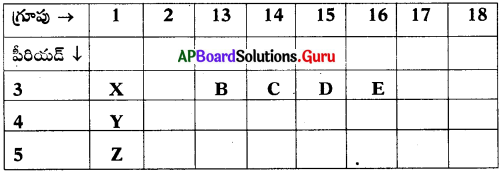
In terms of period and group, where would you locate the element with Z = 114?
Answer:
Element Z = 114 is present in 7th period and IVA group (Group – 14)

AP Inter 1st Year Chemistry Study Material Chapter 2 Classification of Elements and Periodicity in Properties

Question 3.
Write the atomic number of the element, present in the third period and seven¬teenth group of the periodic table.
Answer:
The Element present in 3rd period and Group – 17 (VIIA group) is chlorine (Cl). It’s atomic number is 17.

Question 4.
Which element do you think would have been named by
a) Lawrence Berkeley Laboratory .
b) Seaborg’s group
Answer:
a) Lawrence Berekeley Laboratory – Lanthanide
b) Seaborg’s group – Actinide (Transuranic element).

Question 5.
Why do elements in the same group have similar physical and chemical properties ?
Answer:
Elements in the same group have same no. of valency shell electrons and have similar outer elec¬tronic configuration so these have similar physical and chemical properties.

Question 6.
What are representative elements ? Give their valence shell configuration.
Answer:

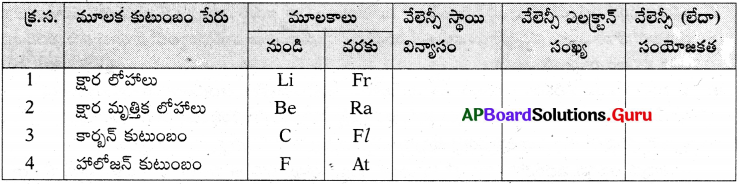
  • Representative elements are s and p-block elements except zero group.
  • These have general electronic configuration ns1-2np1-5.

Question 7.
Justify the position of f-block elements in the periodic table.
Answer:
The two series of elements lanthanides and actinides have been grouped separately and placed at the bottom of the periodic table, though they belong to the sixth and seventh periods of third group (III B).

The justification for assigning one place to these elements has been given on the basis of their similar properties. The properties are so similar that elements from Ce to Lu can be considered as equivalent to one element. In case these elements are assigned different positions (i.e.,) arranged in order of their increasing atomic numbers, the symmetry of the whole arrangement would be disrupted. The same explanation can be given in the case of actinides.

Question 8.
An element ‘X’ has atomic number 34. Give its position in the periodic table.
Answer:
The element X with atomic no (z) = 34 has electronic configuration 1s2 2s2 2p6 3s2 3p6 4s2 3d10 4p4. Hence the element is present in 4,h period and 16th group (VIA group).

Question 9.
What factors impart characteristic properties to the transition elements ?
Answer:
Transition elements exhibits characteristic properties because

  • The differentiating electron enters into penultimate d-subshell
  • These elements have small size.
  • These possess high effective nuclear charge.

Question 10.
Give the outer shells configuration of d-block and f-block elements.
Answer:

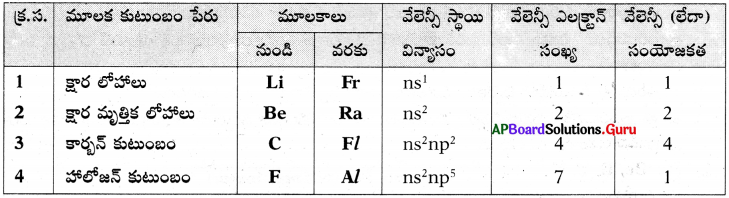
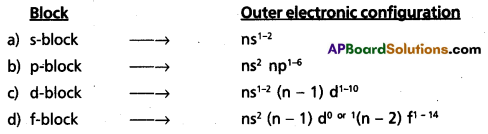
  • The outer shell electronic configuration of d-block – elements is ns1-2 (n-1)d1-10
  • The outer shell electronic configuration of f-block – elements is ns2(n-1)d0 (or) 1 (n – 2) f1-14

AP Inter 1st Year Chemistry Study Material Chapter 2 Classification of Elements and Periodicity in Properties

Question 11.
State and give one example for Dobereiner’s law of triads and Newland’s law of octaves.
Answer:
1) Dobereiner law :

  • According to Dobereiner in a traid (3 – elements) the atomic weight of the middle element is the arithmatic mean of the other two elements.

    AP Inter 1st Year Chemistry Study Material Chapter 2 Classification of Elements and Periodicity in Properties 1

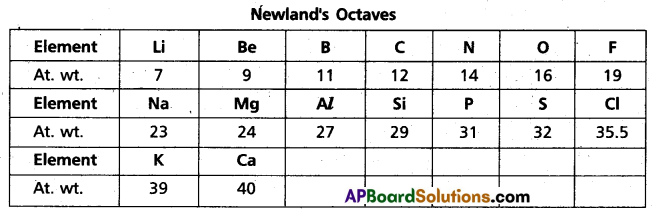
2) Newland’s law of octaves : According to Newlands, the elements arranged in the increasing order of atomic weights noticed that every eight element had properties similar to the first element. This relationship was just like every eight note that resembles the first in octaves of music.
AP Inter 1st Year Chemistry Study Material Chapter 2 Classification of Elements and Periodicity in Properties 2

Question 12.
Name the anomalous pairs of elements in the Mendaleev’s periodic table.
Answer:
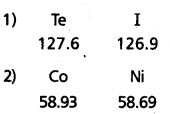
In Mendeleev’s periodic table anamalous pairs are the elements whose atomic weights increasing order is reversed.
Eg:
AP Inter 1st Year Chemistry Study Material Chapter 2 Classification of Elements and Periodicity in Properties 3

Question 13.
How does atomic radius vary in a period and in a group ? How do you explain the variation ?
Answer:
In a period : Atomic radius decreases generally from left to right in a period.
Reason : In periods electrons are entered into same subshells.
In a group : Atomic radius increases generally from top to bottom in a group.
Reason : In groups electrons are entered into new subshells.

Question 14.
Among N-3; O-2, F–, Na+, Mg+2 and Al+3
a. What is common in them ?
b. Arrange them in the increasing ionic radii.
Answer:
Given ions are
N-3, O-2, F–, Na+, Mg+2 and Al+3.
a) The above ions have same number of electrons (All have 10 electrons). So these are called iso electronic species.
b) The increasing order of ionic radii among above ions is
Al+3 < Mg+2 < Na+ < F– < O-2 < N-3
Reason : – In case of iso electronic species as the nuclear charge increases ionic radii decreases.

Question 15.
What is the significance of the term isolated gaseous atom while defining the ionization enthalpy.
Hint: Requirement for comparison.
Answer:

  • Isolated gaseous atom’s ionisation enthalpy is taken as reference value and it is required to compare this values to various ions of this elements and to compare this values with various elements.

Question 16.
Energy of an electron in the ground state of the hydrogen atom is – 2.18 × 10⁻¹⁸J. Calculate the ionization enthalpy of atomic hydrogen in terms of J mol-1.
Answer:
Given that the energy of the electron in the ground state for hydrogen atom = – 2.18 × 10⁻¹⁸ J.
For 1 mole of atoms is given by – 2.18 × 10-18 J × 6.023 × 1023
= -13.13 × 10⁵ J/Mole
∴ Ionisation enthalpy of hydrogen atom = 13.13 × 10⁵ J/Mole.

Question 17.
Ionization enthalpy, (IE1) of O is less than that of N — explain.
Answer:

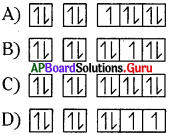
  • Oxygen has electronic configuration 1s2 2s2 2p4
    AP Inter 1st Year Chemistry Study Material Chapter 2 Classification of Elements and Periodicity in Properties 4
  • Nitrogen has electronic configuration 1s2 2s2 2p3
    AP Inter 1st Year Chemistry Study Material Chapter 2 Classification of Elements and Periodicity in Properties 5
  • Nitrogen has half filled shell and is stable so more amount of energy is required to remove an electron, than in oxygen.
    Hence IE, of ‘O’ is less than that of ‘N’.

Question 18.
Which in each pair of elements has a more negative electron gain enthalpy?
a. O or Fb. F or Cl
Answer:
a)
AP Inter 1st Year Chemistry Study Material Chapter 2 Classification of Elements and Periodicity in Properties 6
has more negative electron gain enthalpy than that of
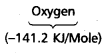
AP Inter 1st Year Chemistry Study Material Chapter 2 Classification of Elements and Periodicity in Properties 7
b)
AP Inter 1st Year Chemistry Study Material Chapter 2 Classification of Elements and Periodicity in Properties 8
has more negative electron gain enthalpy than that of
AP Inter 1st Year Chemistry Study Material Chapter 2 Classification of Elements and Periodicity in Properties 9

AP Inter 1st Year Chemistry Study Material Chapter 2 Classification of Elements and Periodicity in Properties

Question 19.
What are the major differences between metals and non-metals ?
Answer:
Metals

  • These are generally in solid form (Except Hg)
  • These are good conductors of heat and electricity.
  • These have high m.pts and b.pts.
  • Generally these are electropositive.
  • These forms more ionic compounds.

Nón metals

  • These may be solids (or) gases (or) liquids.
  • These are not good conductors of heat and electricity.
  • These have low m.pts and b.pts.
  • Generally these are electronegative.
  • These forms more covalent compounds.

Question 20.
Use the periodic table to identify elements.
a. With 5 electrons in the outer subshell
b. Would tend to lose two electrons
c. Would tend to gain two electrons.
Answer:
a) The elements possessing 5 electrons in the outer most shell are group 15 (VA) elements.

  • General outer electronic configuration is ns2 np3 Eg. : N, P, As………

b) The elements tend to lose two electrons are Group — II elements.

  • General outer electronic configuration is ns2 Eg: Mg, Ca, Sr etc.

c) The elements tend to gain two electrons are Group – VIA elements (16th group).

  • General outer electronic configuration is ns2 np4 Eg : O, S, Se ………

Question 21.
Give the outer electronic configuration of s, p, d and f – block elements.
Answer:
AP Inter 1st Year Chemistry Study Material Chapter 2 Classification of Elements and Periodicity in Properties 10

Question 22.
Write the increasing order of the metallic character among the elements B, Al, Mg and K.
Answer:
Given elements are B, Al, Mg and K
The increasing order of metallic character is

AP Inter 1st Year Chemistry Study Material Chapter 2 Classification of Elements and Periodicity in Properties 11

Question 23.
Write the correct increasing order of non – metallic character for B, C, N, F and Si.
Answer:
Given elements are B, C, N. F and Si
The increasing order of non- metallic character is

AP Inter 1st Year Chemistry Study Material Chapter 2 Classification of Elements and Periodicity in Properties 12

Question 24.
Write the correct increasing order of chemical reactivity in terms of oxidizing property for N, O, Fand Cl.
Answer:
The correct increasing order of chemical reactivity in terms of oxidizing property for N, O, F and Cl is F > 0 > Cl > N.

Question 25.
What is electronegativity ? How is this useful in understanding the nature of elements?
Answer:
Electronegativity : The tendency of an element (or) atom to attract the shared pair of electrons towards itself in a molecule is called electronegativity.

  • On the basis of electronegativity values nature of elements can be predicted. Higher electro-negativity values indicates that element is non metal and lower values indicates that the element is a metal.
  • On the basis of electronegativity values bond nature also predicted (Ionic/covalent).

Question 26.
What is screening effect? How is it related to lE?
Answer:
The decrease of nuclear attraction on outer most shell electrons due to presence of inner energy electrons is called screening effect.

  • As the screening effect increases LE. values decreases.

AP Inter 1st Year Chemistry Study Material Chapter 2 Classification of Elements and Periodicity in Properties

Question 27.
How are electronegativity and metallic & non-metallic characters related?
Answer:

  • Greater the electronegativity values of an element indicates that non metallic nature and low metallic nature of that element.
  • Lower the electronegativity value of an element indicates that low non metallic nature and high metallic nature of that element.

Electronegativity ∝ Non metallic nature
Electronegativity ∝ \(\frac{1}{\text { Metallic Nature }}\)

Question 28.
What is the valency possible to Arsenic with respect to oxygen and hydrogen?
Answer:

  • The valency of Arsenic with respect to hydrogen is ‘3’
    Eg : AsH3
  • The valency of Arsenic with respect to oxygen is ‘5’
    Eg : As2O5

Question 29.
What is an amphoteric oxide? Give the formula of an amphoteric oxide formed by an element of group – 13.
Answer:
The oxide which contains both acidic as well s basic nature is called amphoteric oxide.

  • The oxides reacts with both acids and bases and forms salts.
    Eq : Al2O3 is one of the amphoteric oxide formed by the Group — 13 element Aluminium.

Question 30.
Name the most electronegative element. Is it also having the highest electron gain enthalpy? Why or Why not?
Answer:
The most electronegative element is fluorine (F).

  • It doesnot have high electron gain énthalpy.

Reasons : —

  • Due to small size
  • Due to high inter electronic repulsions.
  • Chlorine has high electron gain enthalpý.

Question 31.
What is diagonal relation? Give one pair of elements, that have this relation.
Answer:
On moving diagonally across the periodic table the elements show certain similarities. An element of group in 2nd period has similar properties with second element of the next higher group in the 3rd period. This type of resemblance is called diagonal relationship. e.g. : (Li, Mg); (Be, Al); (B, Si)

AP Inter 1st Year Chemistry Study Material Chapter 2 Classification of Elements and Periodicity in Properties 13

Question 32.
How does the nature of oxides vary in the third period?
Answer:
In 3rd period from left to right the oxide nature varies from high basic nature to high acidic nature.

  • Basic nature gradually decreases and acidic nature gradually increases.

  • AP Inter 1st Year Chemistry Study Material Chapter 2 Classification of Elements and Periodicity in Properties 14

Question 33.
Radii of iron atom and its ions follow Fe > Fe2+ > Fe3+ – explain.
Answer:
When the positive charge on the ion increases, the effective nuclear charge on the outer electrons increases.
Hence the ionic size decreases in the order Fe > F2+ > F3+.

Question 34.
IE2 > IE1 for a given element — why?
Answer:
IE2 > IE1 for a given element

Reason : —

  • IE1 means minimum amount of energy required to remove an electron from isolated neutral
    gaseous atom.
  • IE2 means minimum amount of energy required to remove an electron from uni positive ion.
  • In case of unipositive ion nuclear attraction increases on outer most electrons than in isolated gaseous atom. So more amount of energy needed to remove an electron from unipositive ion.
    Hence IE2 > → IE1.

Question 35.
What is Ianthanide contraction? Give one of its consequences.
Answer:
Lanthanide contraction : Slow decrease in size of the atoms or ions among the lanthanides is known as lanthanide contraction.

Consequences due to lanthanide contraction:

  1. Due to lanthanide contraction, the crystall structure and other properties of the elements become very closely similar.
  2. Due to this, it becomes difficult to separate lanthanides from a mixture.

AP Inter 1st Year Chemistry Study Material Chapter 2 Classification of Elements and Periodicity in Properties

Question 36.
What is the atomic number of the element, having maximum number of unpaired 2p electrons ? To which group does it belong ?
Answer:

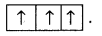
  • The atomic number of the element having maximum no.of unpaired 2p electrons is 7′ (Z = 7)
  • Element is nitrogen.
  • Electronic configuration is 1s2 2s2 2p3 (3 unpaired 2p electrons) AP Inter 1st Year Chemistry Study Material Chapter 2 Classification of Elements and Periodicity in Properties 15
Question 37.
Sodium is strongly metallic, while chlorine is strongly non-metallic – explain.
Answer:
Sodium is an alkali metal and it is present in group – I and it has the ability to lose the valency electron readily.

  • It has high electropositive nature. So it has metallic nature.
  • Chlorine is a halogen and it is placed in Group – 17 and it has the ability to gain the electron readily.
  • It has high electronegative nature. So it has non metallic nature.

Question 38.
Why are zero group elements called noble gases or inert gases ?
Answer:

  • Zero group elements has general outer electronic configuration ns2 np6 (except for He).
  • These contains stable octet configuration. So these are stable and chemically inert. Hence these are called inert gases.
  • These elements neither lose nor gain electrons. Hence these are called ‘noble gases’.

Question 39.
Select in each pair, the one having lower ionization energy and explain the reason,
a. I and I–
b. Br and K
c. Li and Li+
d. Ba and Sr
e. O and S
f. Be and B
g. N and O
Answer:
a) I– has lower ionisation energy than I because of increase of size \(\mathrm{I}^{\ominus}\) ion than ‘I’.
b) K has lower ionisation energy than ‘Br’ because of low electronegative value of K (0.8) than ‘Br’ (2.8).
c) ‘Li” has lower ionisation energy than Li+ because of large size of ‘Li’ than Li+.
d) ‘S’ has lower ionisation energy than ‘O’ because of large size of ‘S’ than ‘O’.
e) ‘B’ has lower ionisation energy than ‘Be’ because ‘Be’ has completely filled electronic configuration (1s2 2s2).
f) ‘O’ has lower ionisation energy than ‘N’ because ‘N’ has half filled electronic configuration (1s2 2s2 2p3).

Question 40.
IE1 of O < IE1 of N but IE2 of O > IE2 of N – Explain.
Answer:

  • ‘N’ has half filled electronic configuration (1s2 2s2 2p3)
    So IE1 of O < IE1 of ‘N’.
  • O+ ion has half filled electronic configuration (1s2 2s2 2p3)
    So IE2 of O > IE1 of N.

Question 41.
Na+ has higher value of ionization energy than Ne, though both have same electronic configuration – Explain.
Answer:
Na+ has higher value of I.E. than Ne, though both have same electronic configuration.

Reason : –

  • Both have electronic configuration 1s2 2s2 2p6
  • In case of Na+ ion effective nuclear charge increases and size decreases than in ‘Ne’.

Question 42.
Which in each pair of elements has a more electronegative gain enthalpy ? Explain.
a. N or O
b. F or Cl
Answer:
a) Oxygen has high electronegative gain enthalpy than Nitrogen because ‘N’ has stable half filled electron configuration.
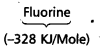
b) Chlorine (- 349 KJ /mole) has high electronegative gain enthalpy than Fluorine (- 328 KJ/mole) because ‘F’ has small size and more inter electronic repulsions.

Question 43.
Electron affinity of chlorine is more than that of fluorine – explain.
Answer:
Chlorine (- 349 KJ / mole) has high electronegative gain enthalpy than Fluorine (- 328 KJ/mole) because ‘F’ has small size and more inter electronic repulsions.

AP Inter 1st Year Chemistry Study Material Chapter 2 Classification of Elements and Periodicity in Properties

Question 44.
Which in each has higher electron affinity ?
a. F or Cl–
b. O or O-
c. Na+ or F
d. F or F–
Answer:
a) Fluorine has high electron affinity than Cl– ion because of inert gas configuration of Cl– ion.
b) Oxygen has high electron affinity than O– because O– has positive of 2nd electron affinity.
c) F has high electron affinity than Na+ because Na+ has inert gas configuration.
d) F has high electron affinity than F– because F– has inert gas configuration.

Question 45.
Arrange the following in order of increasing ionic radius :
a. Cl–, P-3, S-2, F–
b. Al+3, Mg+2, Na+, O-2, F–
c. Na+, Mg+2, K+
Answer:
a) The increasing order of ionic radius is F– < Cl– < S-2 < P-3
b) The increasing order of ionic radius is Al+3 < Mg+2 < Na+ < F– < O-2
c) The increasing order of ionic radius is Mg+2 < Na+ < K+

Question 46.
Mg+2 is smaller than O-2 in size, though both have same electronic configuration –
explain.
Answer:
Mg+2 and O-2 ions are iso electronic species.
In case of iso electronic species nuclear charge increases size of ion decreases. So Mg+2 has small size than O-2.

Question 47.
Among the elements B, Al, C and Si
a. Which has the highest first ionization enthalpy ?
b. Which has the most negative electron gain enthalpy ?
c. Which has the largest atomic radius ?
d. Which has the most metallic character ?
Answer:
a) Highest I.E. is possessed by the element carbon
b) Most negative gain enthalpy is for carbon (- 122 KJ/mole)
c) Large atomic radius is for Al (1.43 A)
d) Most metallic nature having element is ‘Al’.

Question 48.
Consider the elements N, P, O and S and arrange them in order of ;
a. Increasing first ionization enthalpy
b. Increasing negative electron gain enthalpy
c. Increasing non-metallic character
Answer:
a) Increasing first Ionisation energy order is S < P < O < N.
b) Increasing negative electron gain enthalpy order is N < P < O < S. .
c) Increasing non metallic nature order is P < N < S < O.

Question 49.
Arrange in given order :
a. Increasing EA :O, S and Se
b. Increasing IE1 : Na, K and Rb
c. Increasing radius : I–, I+ and I
d. Increasing electronegativity : F, Cl, Br, I
e. Increasing EA : F, Cl, Br, I
f. Increasing radius : Fe, Fe+2, Fe+3
Answer:
a) Increasing order of electron affinity is O < Se < S.
b) Increasing order of IE1 is Rb < K < Na.
c) Increasing order of radius is I+ < I < I–
d) Increasing order of electronegativity is I < Br < F < Cl
e) Increasing order of electron affinity is I < Br < F < Cl
f) Increasing order of radius is Fe+3 < Fe+2 < Fe

AP Inter 1st Year Chemistry Study Material Chapter 2 Classification of Elements and Periodicity in Properties

Question 50.
a. Name the element with highest ionization enthalpy
b. Name the family with highest value of ionization enthalpy.
c. Which element possesses highest electron affinity ?
d. Name unknown elements at the time of Mendeleef
e. Name any two typical elements.
Answer:
a) Highest I.E1 possessing element is ‘Helium’.
b) The family that possess highest values of I.E is Noble gases (or) inert gases.
c) Highest electron affinity element is ‘Chlorine’.
d) Unknown elements at the time of mendeleef are Germanium (Eka silicon). Scandium (Eka Alu-minium), Gallium (Eka Boron).
e) 3rd period elements are called typical elements
Eg : Al, Si, P, Na, Mg etc

Question 51.
a. Name any two bridge elements.
b. Name two pairs showing diagonal relationship.
c. Name two transition elements.
d. Name two rare earths.
e. Name two transuranic elements.
Answer:
a) Bridge elements 2nd period elements are called Bridge elements Eg : Be, B.
b) i) ‘Li’ diagonally relates with ‘Mg’,
ii) ‘Be diagonally relates with ‘Al’.
c) Scandium, Titanium, Vanadium, Chromium, etc., are examples of transition elements.
d) Lanthanides are called rare earths
Eg : Cerium (Ce), Prasodimium (Pr), Promethium (Pm).
e) Neptunium (Np), Californium (Cf), Fermium (Fm) are examples of transuranic elements.

Question 52.
On the basis of quantum numbers, justify that the 6th period of the periodic table should have 32 elements.
Answer:
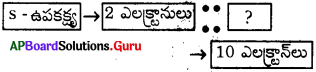
6th period contains the subshells 6s, 4f, 5d, 6p
6s can accomodate two electrons (2 elements)
4f can accomodate 14 electrons (14 elements)
5d can accomodate 10 electrons (10 elements)
6p can accomodate 6 electrons (6 elements)

Total no.of electrons can accomodation 6th period are 2 + 14 + 10 + 6 = 32
∴ 6th period of periodic table contains 32 elements.

AP Inter 1st Year Chemistry Study Material Chapter 2 Classification of Elements and Periodicity in Properties

Question 53.
How did Moseley’s work on atomic numbers show that atomic number is a fundamental property better than atomic weight ?
Answer:
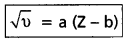
Mosley’s equation is
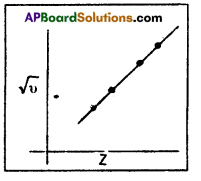
AP Inter 1st Year Chemistry Study Material Chapter 2 Classification of Elements and Periodicity in Properties 16
where v = frequency, Z = atomic number a, b = constants
A plot of \(\sqrt{v}\) against ‘Z’ gives a straight line.
However, no such relationship was obtained when the plot was drawn between frequency and the atomic mass. The atomic number of the elements, according to Mosley, stands for serial numbers of the elements in the periodic table. As the atomic number of the elements increase, the wavelengths of characteristic X – rays decrease. Mosley concluded that there is a fundamental quantity in an atom which increases in regular steps with increasing atomic number. The correlation between X – ray spectra and atomic number indicated that an element is characterized by its atomic number and not by atomic mass.
AP Inter 1st Year Chemistry Study Material Chapter 2 Classification of Elements and Periodicity in Properties 17

Question 54.
State modern periodic law. How many groups and periods are present in the long form of the periodic table ?
Answer:
Modern periodic law : – The physical and chemical properties of elements are periodic functions of their atomic numbers.

  • In modern periodic table 7 periods and 18 groups are present.

Question 55.
Why f-block elements are placed below the main table ?
Answer:
In Lanthanides 4f – orbitals and in Actinides 5f – orbitals are filled. Since these elements have the same electronic configuration in the ultimate and penultimate shells they have similar properties. Hence they were placed at the bottom of the periodic table though they belongs to the sixth and seventh periods of IIIB groups.

Question 56.
Mention the number of elements present in each of the periods in the long form periodic table.
Answer:

AP Inter 1st Year Chemistry Study Material Chapter 2 Classification of Elements and Periodicity in Properties 18

Question 57.
Give the outer orbit general electronic configuration of
a. Noble gases
b. Representative elements
c. Transition elements
d. Inner transition elements
Answer:
Type of elements – General electronic configurations
a) Noble gases – ns2 np6 (except ‘He’ which has 1s2)
b) Representative elements – ns1-2 np0-5
c) Transition elements – (n – 1)d1-10ns1-2
d) Inner transition elements – (n – 2) f1-14(n – 1)d0, 1 ns2

Question 58.
Give any four characteristic properties of transition elements.
Answer:
Characteristic properties of elements:
a) They exhibit more than one oxidation state.
b) Most of the elements and their ions exhibit colour.
c) These elements and their compounds are good catalysis for various chemical processes.
d) They and their ions exhibit paramagnetic properties.
e) They form useful alloys.

Question 59.
What are rare earths and transuranic elements?
Answer:

  1. Lanthanides are rare earths. In these elements the differentiating electron enters into 4f – orbital.
  2. The elements present after Uranium are called Transurariic elements. All of these are radioactive and synthetic elements.

AP Inter 1st Year Chemistry Study Material Chapter 2 Classification of Elements and Periodicity in Properties

Question 60.
What is isoelectronic series? Name a series that will be isoelectronic with each of the following atoms or ions.
a. F–
b. Ar
c. He
d. Rb+
Answer:
The species containing same no.of electrons are called Iso electronic species and this series is called Isoelectronic series.
a) F– relating series
N-3, O-2, F–, Ne, Na+, Mg+2, Al+3
b) Ar relating series P-3, S-2, Cl–, Ar, K+, Ca+2
c) ‘He’ relating series H–, He, Li+, Be+2
d) Rb+ relating series
As-3, Se-2, Br–, Kr, Rb+, Sr+2

Question 61.
Explain why cation is smaller and anion is larger in radii than their parent atoms.
Answer:

  • Cation means a positively charged species which is formed by an atom (or) element when an electron is lost.
    M → M+ + \(\mathrm{e}^\Theta\)
  • Cation has high effective nuclear charge and decrease in size observed.
    Hence cation has smaller radii.
  • Anion means a negatively charged species which is formed by an atom (or) element when an electron is gained.
    M + e– → \(\mathrm{M}^{\Theta}\).
  • Anion has very low effective nuclear charge and increase in size observed.
    Hence anion has larger radii.

Question 62.
Arrange the second period elements in the increasing order of their first ionization enthalpies. Explain why Be has higher IE1 than B.
Answer:
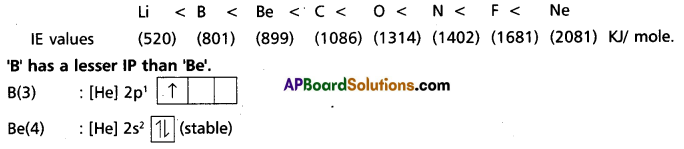
The increasing order of the I.E.s of 2nd period elements are as follows.
AP Inter 1st Year Chemistry Study Material Chapter 2 Classification of Elements and Periodicity in Properties 19

  • Due to presence of incompletely filled p – orbitals in Boron, its IE value is less.
  • Due to presence of completely filled s2 configuration in ‘Be’, it has higher IE value.

Question 63.
IE1 of Na is less than that of Mg but IE2 of Na is higher than that of Mg – explain.
Answer:
IE1 of Na is less than that of ‘Mg’
Reason :-
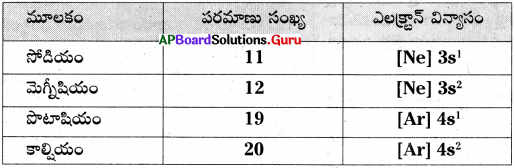
Na — has electronic configuration [Ne] 31
Mg — has electronic configuration [Ne] 3s2
Mg has completely filled configuration so Mg has more IE1 than Na.
IE2 of Na is higher than that of Mg

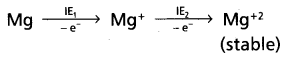
  • AP Inter 1st Year Chemistry Study Material Chapter 2 Classification of Elements and Periodicity in Properties 20
  • Na+ has stable inert gas configuration so IE2 of Na is very high
    AP Inter 1st Year Chemistry Study Material Chapter 2 Classification of Elements and Periodicity in Properties 21
  • By the lose of one electron from Mg+ ion forms Mg+2 ion which is more stable so low amount of energy is required.
    ∴ IE2 of Na is higher than Mg.

Question 64.
What are the various factors due to which the IE of the main group elements tends to decrease down a group ?
Answer:
The factors influencing on IE are

  1. Atomic radius
  2. Nuclear charge
  3. Screening effect
  4. Half filled, completely filled electronic configurations
  5. peretrating power
    • In main group elements in a group IE decrease from top to bottom.

Reason: –
In groups from top to bottom size of elements increases hence IE values decreases.

Question 65.
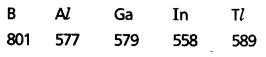
The first ionization enthalpy values (in KJ mol-1) of group 13 elements are :

AP Inter 1st Year Chemistry Study Material Chapter 2 Classification of Elements and Periodicity in Properties 22
How do you explain this deviation from the general trend ?
Answer:
The given IE, values (in KJ / mole) of group 13 are as follow
AP Inter 1st Year Chemistry Study Material Chapter 2 Classification of Elements and Periodicity in Properties 23

  • In genaral in a group IE values decrease down a group but from the above values we observe that there is no smooth decrease down the group.
  • The decrease from B to Al is due to increase of size.
  • The observed discontinuity in the IE values of Al and Ga, and between In and Tl are due to inability of d- and f – electrons, which have low screening effect to compensate the increase in nuclear charge.

AP Inter 1st Year Chemistry Study Material Chapter 2 Classification of Elements and Periodicity in Properties

Question 66.
Would you expect the second electron gain enthalpy of oxygen as positive, more negative or less negative than the first ? Justify.
Answer:
2nd gain enthalpy means energy released when an electron is added to uni negative ion.
O(g) + e– → \(\mathrm{O}_{(g)}^{-}\) + 141 KJ/mole
O(g) + e– → \(O_{(g)}^{-(2)}\) – 780 KJ/mole

  • 2nd gain enthalpy of oxygen is positive because O– ion doesnot accept an electron readily and the entering electron have to over come the repulsive force.

Question 67.
What is the basic difference between the electron gain enthalpy and electropositivity?
Answer:

  • Electron gain enthalpy means energy released when an electron is added to isolated neutral gaseous atom.
  • The tendency to lose the electrons by an element is called electropositivity.
  • Electron gain enthalpy is the measure of electronegativity.
  • Electron gain enthalpy and electropositivity are inversely related.

Question 68.
Would you expect IE1 for two isotopes of the same element to be the same or different ? Justify.
Answer:

  • Isotopes means existance of same elements with different mass no.s
  • The isotope with higher mass no. have low I.E value than the normal isotope.
  • This is due to the less nuclear attraction on valency electrons in case of heavier nuclide.
  • But overall, the IE values of the isotopes are nearly same and the difference in IE values is negligible.

Question 69.
Increasing order of reactivity among group-1 elements is Li < Na < K < Rb < Cs, where as among group-17 elements it is F > Cl > Br > I- explain.
Answer:
a) Increasing order of reactivity among group -1 elements is Li < Na < K < Rb < Cs

Explanation: –

  • Group -1 elements are Alkali metals.
  • Group -1 elements have the tendency to lose the electrons
  • Group -1 elements forms ionic bonds readily by losing electrons
  • Group – 1 elements good reducing agents.
  • Electro positive character increases from top to bottom this is due to increase of size.

b) Increasing order of reactivity among group -17 elements is F > Cl > Br > I

Explanation: –

  • These are halogens (Group – 17)
  • These have high electronegativity due to small size.
  • These have the tendency to gain electrons.
  • In a group from top to bottom electronegativity decrease, due to increase of size.
  • These are oxidising agents and forms ionic bonds by gaining electrons.

Question 70.
Assign the position of the element having outer electronic configuration.
a. ns2np4 for n = 3
b. (n – 1)d2ns2 for n = 4
Answer:
a) ns2np4 for n = 3 .

  • 3s23p4 → element is sulphur
  • Sulphur belongs to VIA group (Group – 16) and 3rd period in periodic table,

b) (n – 1 )d2 ns2 for n = 4
3d2 4s2 → element is Titanium

  • Titanium belongs to IVB group (Group – 4) and 4th period in the periodic table.

Question 71.
Predict the formulae of the stable binary compounds that would be formed by the combination of the following pairs of elements.
a. Li and O
b. Mg and N
c. Al and I
d. Si and O
e. p and Cl,
f. Element with atomic number 30 and Cl
Answer:
a) Stable binary compound formed between Li and O is Li2O (Lithiumoxide).
b) Stable binary compound formed between Mg and N is Mg3N2 (Magnesium nitride).
c) Stable binary compound formed between Al and I is AlI3 (Aluminium Iodide).
d) Stable binary compound formed between Si and I is SiO2 (Silicondioxide).
e) Stable binary compound formed between P and Cl is PCl3 and PCl5 (Phosphorous trichloride and phosphorous pentain chloride).
f) Stable binary compound formed between element with At. NO – 30 and Cl is ZnCl2 (Zinc chloride) [At. No – 30 – (Zn)].

Question 72.
Write a note on the variation of metallic nature in a group or in a period.
Answer:
Metals shows electropositive nature (i.e.,) loss of electrons and form positive ions.
Non – metals shows electronegative nature (i.e.,) gain of electrons and form negative ions.
Periodicity:
a) Down the group : Going down a group of the periodic table, the tendency to form positive ions, increases. That means there is an increase in metallic nature as the size of atom increases down the group.
b) Along a period : From left to right in a period, size of atom decreases. So there is decrease in metallic nature.

Question 73.
How does the covalent radius increase in group- 7 ?
Answer:

  • Covalent radius increases in a group from top to bottom
  • The increase of covalent radius in VIIA group elements as follows.
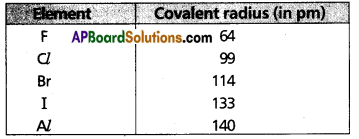
    AP Inter 1st Year Chemistry Study Material Chapter 2 Classification of Elements and Periodicity in Properties 24

Question 74.
Which element of 3rd period has the highest IE1 ? Explain the variation of IE1 in this period.
Answer:

  • In periods IE values increase from left to right
  • Among 3rd period elements Argon (Ar) [Z = 18] possess highest IE,sub>1 value.
  • IE1 values of 3rd period elements given below.
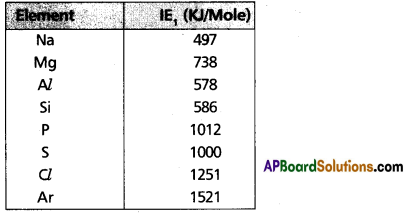
    AP Inter 1st Year Chemistry Study Material Chapter 2 Classification of Elements and Periodicity in Properties 25

Exceptions:

  • IE, of ‘Mg’ is higher than ‘Al’ because ‘Mg’ has completely filled ‘s’ subshells.
  • IE, of ‘p’ is higher than ‘s’ because ‘p’ has half filled ‘p’ subshells.

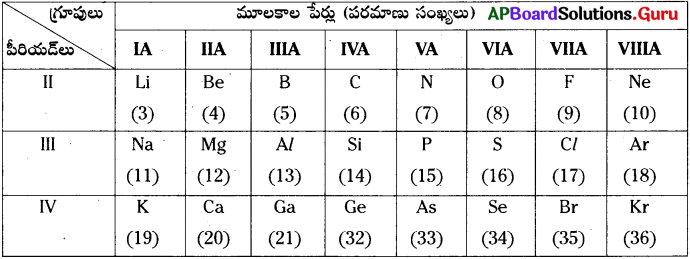
Question 75.
What is valency of an element ? How does it vary with respect to hydrogen in the third period?
Answer:
Valency : The combining capacity of an element with another element is called valency.

The number of hydrogen atoms (or) chlorine atoms (or) double the number of oxygen atoms, with which one atom of the element combine is also called valency.
∴ Valency = no. of hydrogens = no. of chlorine atoms
= 2 × no. of oxygen atoms present in the molecule.
e.g.:
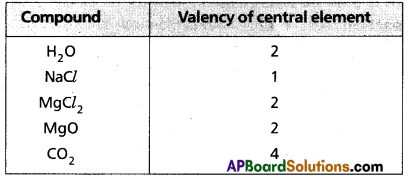
AP Inter 1st Year Chemistry Study Material Chapter 2 Classification of Elements and Periodicity in Properties 26
Periodicity of valency:
1) Each period starts with valency ‘1’ and ends in ‘0’.

AP Inter 1st Year Chemistry Study Material Chapter 2 Classification of Elements and Periodicity in Properties 27

2) In a group valency is either equal to the group number (i.e., upto 4th group) or is equal to (8 – group number) (i.e., from 5th group onwards).
Significance :
Valency of an element is useful in writing the formulae of compounds.

AP Inter 1st Year Chemistry Study Material Chapter 2 Classification of Elements and Periodicity in Properties

Question 76.
What is diagonal relationship ? Give a pair of elements having diagonal relationship. Why do they show this relation ?
Answer:
On moving diagonally across the periodic table the elements show certain similarities. An element of group in 2nd period has similar properties with second element of the next higher group in the 3rd period. This type of resemblance is called diagonal relationship, e.g. : (Li, Mg); (Be, Al); (B, Si)

AP Inter 1st Year Chemistry Study Material Chapter 2 Classification of Elements and Periodicity in Properties 28
Diagonal relationship is due to similar sizes of atoms (or of ions) and similar electronegativities of the representative elements.
Diagonally similar elements posses the same polarizing power.
Polarizing power = \(\frac{\text { (ionic charge) }}{\text { (ionic radius) }^2}\)

Question 77.
What is lanthanide contraction ? What are its consequences ?
Answer:
Lanthanide contraction : Slow decrease in size of the atoms or ions among the lanthanides is known as lanthanide contraction.

Consequences due to lanthanide contraction:

  1. Due to lanthanide contraction, the crystall structure and other properties of the elements become very closely similar.
  2. Due to this, it becomes difficult to separate lanthanides from a mixture.

Question 78.
The first IP of lithium is 5.41 eV and electron affinity of Cl is – 3.61 eV. Calculate ΔH in kJ mol-1 for the reaction : Li(g) + Cl(g) → \(\mathrm{Li}_{(\mathrm{g})}{ }^{+}\) + \(\mathrm{Cl}{ }_{(g)}^{-}\)
Answer:
Given reaction is
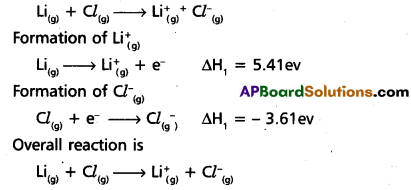
AP Inter 1st Year Chemistry Study Material Chapter 2 Classification of Elements and Periodicity in Properties 29
ΔH = ΔH1 + ΔH2
= 5.41 – 3.61
= 1.8 ev
= 1.8 × 9.65 × 104 J/mole
= 17.37 × 10⁴ J/Mole
= 173.7 KJ/mole

Question 79.
How many Cl atoms can you ionize in the process Cl → Cl+ + e by the energy liberated for the process Cl + e → Cl– for one Avogadro number of atoms. Given IP = 13.0 eV and EA = 3.60 eV. Avogadro number = 6 × 10²³
Answer:
Given
Cl(g) + e– → \(\mathrm{Cl}_{(\mathrm{g})}^{-}\) ΔH = – 3.6ev
1 – atom → Electron affinity = 3.6 ev
6.23 × 10²³ atoms → ?
6.23 × 1023 × 3.6 = 21.6828 × 10²³
∴ For one avagadro no.of Cl atoms electron affinity = 21.6828 × 10²³ eV
Given 13 eV can ionise 1 atom of Cl
21.6828 × 10²³ eV ionise -?
\(\frac{21.6828 \times 10^{23}}{13}\) = 1.667 × 10²³ eV

Question 80.
The electron affinity of chlorine is 3.7 eV. How much energy in kcal is released when 2g of chlorine atoms is completely converted to Cl– ions in the gaseous state ? (1 e V = 23.06 kcal)
Answer:
Given electron affinity of Cl = 3.7 ev
Cl + e– → Cl– ΔH = – 3.7ev
35.5 gms of CZ contains 6.023 × 10²³ atoms
2 gms of Cl contains ?
= \(\frac{2 \times 6.023 \times 10^{23}}{35.5}\) atoms
6.23 × 10²³ atoms can liberate 3.7 eV
\(\frac{2 \times 6.023 \times 10^{23}}{35.5}\) atom can liberate?
= \(\frac{2 \times 6.023 \times 10^{23} \times 3.7}{35.5 \times 6.023 \times 10^{23}}\) = \(\frac{2 \times 3.7}{35.5}\) = \(\frac{7.4}{35.5}\)
= 0.2084 eV
= 0.2084 × 23.06 kcal/mole
= 4.81 k.cal/mole

Long Answer Questions

Question 1.
Discuss the classification of elements by Mendaleev’
Answer:
The periodic classification of elements based on “atomic weights” was done by “Lothar Meyer” and “Mendeleev” independently.
Mendeleev’s periodic law : “The physical and chemical properties of elements and their compounds are a periodic function of their atomic weights”.

Mendeleev arranged the 65 elements in a periodic table. He did not blindly follow the atomic weight but gave more importance to their chemical properties in arranging them in the table.
Explanation of the periodic law : When the elements are arranged in the increasing order of their atomic weights, elements with similar properties appear again and again, at regular intervals. This is called, periodicity of properties.

Mendeleev’s table : Mendeleev introduced a periodic table containing the known 65 elements. In this table, while arranging the elements, he gave importance only to their atomic weights, but also to their physical and chemical properties. This table was defective in some responses. Then he introduced another table, after rectifying the defects of that table. lt is called, “short form of periodic table”. He named the horizontal rows as ‘periods’ and the vertical columns, as ‘groups’. It has in all ‘9’ groups, I to VIII and a ‘O’ group. The first ‘7’ groups were divided into A and B sub groups. There are ‘7’ periods in the table. The VIII group contains three triods, namely, (Fe, Co, Ni), (Ru, Rh, Pd) and (Os, Ir, Pt).

Mendeleev’s observations :

  1. When the elements are arranged according to their atomic weights, they exhibit periodicity of properties.
  2. Elements with similar chemical properties have nearly equal atomic weights: Iron (55.85),. Cobalt (58.94) and Nickel (58.69).
  3. The group number corresponds to the valency of element in that group.
  4. Most widely distributed elements like H,C, O, N, Si, S etc., have relatively low atomic weights.
  5. The atomic weight of an element may be corrected if the atomic weights of the adjacent elements are known. The properties of an element are the average properties of the neighbouring elements.
  6. The atomic weights of beryllium. Indium, Uranium etc. were corrected, based on this observation.

Merits of Mendeleev’s table:

  1. Actually it formed the basis for the development of other modern periodic tables.
  2. Mendeleeffs left some vacant spaces in his periodic table, for the unknown elements. But the predicted the properties of those elements. Later on, when these elements were discovered, they exactly fitted into those vacant places having properties, predicted by Mendeleev.
    Ex : Eka – boron (Scandium), EKa – Silicon (germanium)
    EKa – aluminium (gallium) etc.
  3. ‘O’ group elements were not known at the time of Mendeleeff. Later when they were discovered, they found a proper place in that table under ‘0’ group of elements. Similarly, the radioactive elements.
  4. In case of these pairs of elements Tellurium – Iodine Argon – Potassium and Cobalt – Nickel, there is a reversal of the trend. The first element has higher atomic weight than the second one. These are called anomalous pairs.
    However, based on their atomic numbers, and chemical properties, this arrangement proves quite justified.

Draw-backs of Mendeleev’s periodic table :

  1. Dissimilar elements were placed in the same group.
    Ex : The coinage mentals Cu, Ag and Au are placed along with the alkali metals K, Rb, Cs etc. in the I group. The only common property among them is that they are all univalent (Valency = 1).
  2. The 14 rare earths having different atomic weights are kept in the same place.
  3. Hydrogen could not be given a proper place, as it resembles alkali metals and halogens in its properties.

AP Inter 1st Year Chemistry Study Material Chapter 2 Classification of Elements and Periodicity in Properties

Question 2.
From a study of properties of neighbouring elements, the properties of an unknown element can be predicted – Justify with an example.
Answer:
From a study of adjacent elements and their compounds, it is possible to predict the characteristics of certain elements. These predictions were found to be very accurate. These predicted properties helped the future scientists in the discovery of unknown elements, e.g. : EKa Aluminium (EKa Al) (now known as Gallium); EKa Silicon (EKa Si) (now known as Germanium); EKa Boron (EKa B) (now known as Scandium).

Illustration : Following table shows a comparison of the properties predicted by’Mendeleeff’ for the elements and those found experimentally after their discovery.
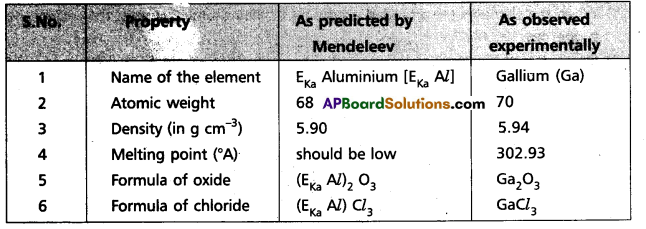
AP Inter 1st Year Chemistry Study Material Chapter 2 Classification of Elements and Periodicity in Properties 30

Question 3.
Discuss the construction of long form periodic table.
Answer:
The elements are arranged in the long form of the periodic table in the increasing order of atomic numbers. ‘Neils Bohr’ constructed the long form of the periodic table based on electronic configuration of elements.
The important features of the long form of the periodic table are :
It consists seven horizontal rows called periods and 18 vertical columns which are classified into 16 groups only.

Periods : Every period starts with an alkali metal and ends with an inert gas. The first period consists of two elements only (H, He) and is called very short period. Second period consists 8 elements (Li to Ne) and is called first short period. The third period consists (Na to Ar) 8 elements and is called second short period.

Fourth period contains 18 elements (K to Kr) and is called first long period. Fifth period is the second long period with 18 elements (Rb to Xe).
Sixth period is the longest period with 32 elements which starts with Cs and ends with Rn. This period includes 14 lanthanides.
Seventh period is an incomplete period with 20 radioactive elements.
Groups : There are 16 groups in the long form of the periodic table (in transition elements three vertical columns are fused and designated as VIII group). These groups are IA, IIA, NIB, IVB, VB, VIB, VIIB, VIII, IB, MB, IMA, IVA, VA, VIA, VIIA and zero group.

The elements of IA, IIA, IIIA, IVA, VA, VIA, VIIA groups are called representative elements or normal elements. Elements of IB, MB, NIB, IVB, VB, VIB, VIIB and VIII groups have their ultimate and penultimate shell incomplete. These are called transition elements. MB elements have (n – 1) d10 ns2 outermost electronic configuration.

Zero group elements have stable electronic configuration. These elements are called inert gases, noble gases. These elements have been grouped at the extreme right of the periodic table.
In this long periods have been expanded and short periods are broken to accommodate the transitional elements in the middle of the long period.

Lanthanides and actinides have been grouped separately and placed at the bottom of the periodic table.
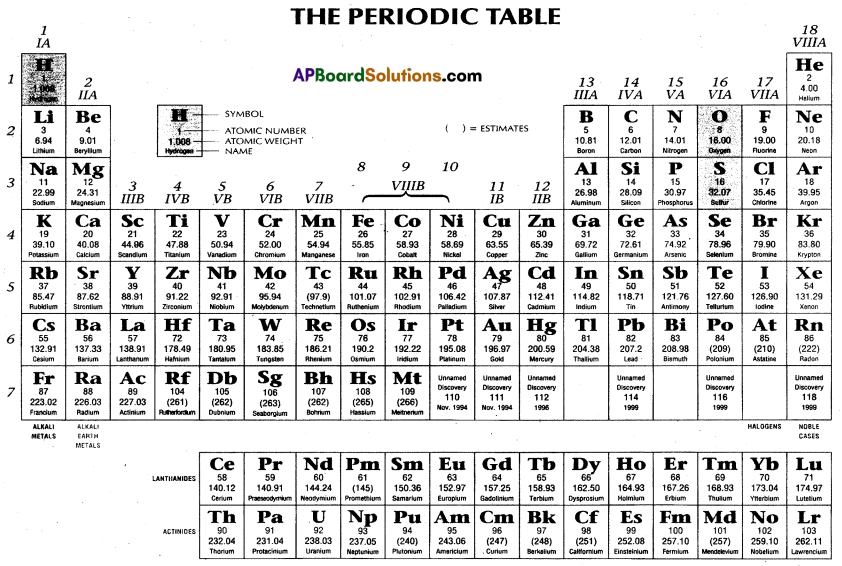
AP Inter 1st Year Chemistry Study Material Chapter 2 Classification of Elements and Periodicity in Properties 31

Question 4.
Discuss the relation between the number of electrons filled into the sub energy levels of an orbit and the maximum number of elements present in a period.
Answer:
Elements have been accommodated in these periods according to the following scheme.
1st period : The first main energy shell (K – shell) is completed. As the maximum capacity of K- shell is of 2 electrons, it consists of only two elements, hydrogen (1s1)and helium (1s2).
2nd period : The second main energy shell is completed (i.e.,) 2s and 2p are completed. It includes eight elements from Li (2s1) to Ne (2s22p6).
3rd period : The 3s and 3p energy shells are completed. It includes also eight elements from Na(3s1) to Ar (3s2 3p6).
4th period : The 4s, 3d and 3p energy shells are completed. It includes 18 elements from K(4s1) to Kr (3d10 4s24p6). It includes two s – block elements, ten d – block elements and six p – block – elements.
5th period : The 5s, 4d and 5p energy shells are completed. It includes 18 elements from Rb (5s) to Xe (4d10 5s1 5p6). 1st also includes two s – block elements, ten d – block elements and six p – block elements.
6th period : The 6s, 4f, 5d and 6p energy shells are completed, (i.e.,) it includes 32 elements from Cs (6s1) to Rn (4f14 5d10 6s26p6). It consists of two s – block elements, ten d – block elements, six p – block elements and fourteen f – block elements.
As this period can accommodate only 18 elements in the table, 14 members of 4f – series are separately accommodated in a horizontal row below the periodic table.
7th period : This period at present consists 26 elements. The 7s, 5f and 6d are completed (i.e.,) twenty six elements. Seven of the elements from atomic numbers 106 to 112 have recently been reported.

AP Inter 1st Year Chemistry Study Material Chapter 2 Classification of Elements and Periodicity in Properties

Question 5.
Write an essay on s, p, d and f block elements .
Answer:
According to the electronic configuration of elements, the elements have been classified into four blocks. The basis for this classification is the entry of the differentiating electron into the subshell. They are classified into s, p, d and f blocks.
‘s’ block elements : If the differentiating electron enters into ‘s’ orbital, the elements belongs to ‘s’ block.
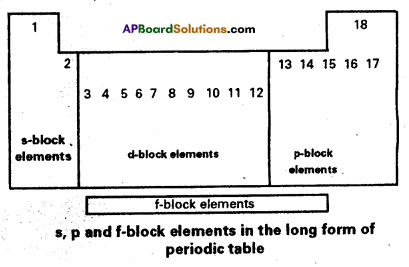
AP Inter 1st Year Chemistry Study Material Chapter 2 Classification of Elements and Periodicity in Properties 32
In every group there are two ‘s’ block elements. As an ‘s’ orbital can have a maximum of two electrons, ‘s’ block has two groups IA and IIA.
‘p‘ block elements : If the differentiating electron enters into ‘p’ orbital, the elements belongs to ‘p’ block.

‘p’ block contains six elements in each period. They are IIIA to VIIA and zero group elements. The electronic configuration of ‘p’ block elements varies from ns2np1 to ns2np6.

‘d‘ block elements : It the differentiating electron enters into (n – 1) d – orbitals the elements belongs to’d’ block. These elements are in between ‘s’ and ‘p’ blocks. These elements are also known as transition elements. In these elements n and (n – 1) shells are incompletely filled. The general electronic configuration of’d’ block elements is (n – 1) d1-10 ns1-2. This block consists of IIIB to VIIB, VIII, IB and IIB groups.

‘f’ block elements : If the differentiating electron enters into ‘f’ orbitals of antipenultimate shell (n – 2) of atoms of the elements belongs to ‘f block. They are in sixth and seventh periods in the form of two series with 14 elements each. They are known as lanthanides and actinides and are arranged at the bottom of the periodic table. The general electronic configuration is (n – 2)f1-14 (n – 1)d0 – 1 ns2.

In these shells the last three shells (ultimate, penultimate and anti penultimate) are incompletely filled. Lanthanides belongs to 4f series. It contains Ce to Lu. Actinides belong to 5f series. It contains Th to Lr.

Advantages of this kind of classification :

As a result of this classification of elements were placed in correct positions in the periodic table. It shows a gradual gradation in physical and chemical properties of elements. The metallic nature gradually decreases and non – metallic nature gradually increases from’s1′ block to ‘p1 block. This classification gave a special place for radioactive elements.

Question 6.
Relate the electronic configuration of elements and their properties in the Classification of elements.
Answer:
The chemical properties of all elements depends upon the electronic configuration. Upon the basis of complete and incomplete electron shells and chemical properties, the elements are classified into four types. (Type -1, Type – II, Type – III and Type – IV).

Type – I(inert gas elements): All the elements with an electronic configuration ns2 np6 including He belongs to this type, nth shell of those elements are completely filled.
The elements show chemical inertness due to completely filled shells and hence they have extra stability. Because of their stability, they are chemically inactive.
e.g. : He, Ne, Ar, Kr, Xe and Rn.

Type – II (Representative elements) : Except inert gases, the remaining elements of s and p – blocks are called representative elements. All the elements with an electronic configuration ns1 to ns2 np5 excluding. He comes under this type. These are atoms in which all except the outermost shells (nth) are complete. Elements of this type enter into chemical combination by loosing, gaining or sharing electrons to get stable inert gas configuration. Many of the metals, all non – metals and metalloids come under this type. Chemically these elements are reactive.

Type – III (Transition elements): All the elements with an electronic configuration (n – 1) d1 – 9 ns1or2 belongs to this type. Atoms in which the two outermost shells are incomplete. These elements show variable oxidation states, form complex ions and coloured ions. The electronic configuration of d – block elements is (n – 1) d1 – 10 ns1 – 2. Small size, high nuclear charge and unpaired’d’ orbitals impart characteristic properties to be transition elements.

Type- IV (Inner transition elements): All the elements with an electronic configuration (n – 2) f1 – 14 (n -1) d0, 1 ns2 belongs to this type. Atoms in which three outermost shells are incomplete. Lanthanides and Actinides belong to this type.

Question 7.
What is a periodic property ? How the following properties vary in a group and in a period ? Explain
a) Atomic radius
b) Electron gain enthalpy.
Answer:
Recurrence of similar properties of elements at definite regular intervals with increasing atomic number i.e., according to their electronic configurations is known as periodicity. Any property which is periodic in nature is called periodic property.
a) Atomic radius : The atomic radius decreases from left to right in a period. With an increase in the atomic number in a period the nuclear charge increases. As a result the effective nuclear charge over the outermost electrons increases, due to this the orbitals are pulled closer to the nucleus causing in a decrease in the atomic radius.

The atomic radius increases from top to the bottom in a group because – with an increase in the atomic number the electrons are added to new shells resulting an increase in the number of inner shells. Hence atomic radius increases from top to bottom in a group.

b) Electron gain enthalpy : Electron gain enthalpy increases in a period from left to right because the size of the atom decreases and the nature of the element changes from metallic to non – metallic nature when we move from left to right in a period.

Electron gain enthalpy decreases from top to bottom in a group because there is an increase in the atomic size. But the second element has greater electron gain enthalpy than the first element.
e.g. : Chlorine has more electron affinity value (- 348 kJ mol-1) than Fluorine (-333 kJ mol-1). It is because fluorine atom is smaller in size than chlorine atom. There is repulsion between the incoming electron and electrons already present in fluorine atom i.e., due to stronger inter electronic repulsions.

Question 8.
What is a periodic property ? How the following properties vary in a group and in a period ?
Explain
a. IE
b. EN
Answer:
a) IE : In groups and periods of the periodic table the ionization enthalpy values are periodically change depend upon the electronic configuration and size of elements.
In a group of elements ionization energy decreases from top to bottom because atomic radius increases.
In general, in a period the atomic size decreases. Because of this, the ionization energy increases across a period.

b) Electro negativity : Electronegativity increases from left to right in a period since the atomic: radii decreases and nuclear attraction increases.
In a group electronegativity decreases from top to bottom due to an increase in atomic radii and a decrease in nuclear attraction.

AP Inter 1st Year Chemistry Study Material Chapter 2 Classification of Elements and Periodicity in Properties

Question 9.
Write a note on
a. Atomic radius
b. Metallic radius
c. Covalent radius
Answer:
a) Crystal Radius (Atomic radius or Metallic radius): The term is used for metal atoms. A metallic crystal contains metal atoms in close packing. These metal atoms are considered spherical. They are supposed to touch each other in the crystal.
The crystal radius is half the internuclear distance between two adjacent atoms.
e.g.: The internuclear distance between two adjacent sodium atoms in a crystal of sodium metal is 3.72 A. So crystal radius of sodium is \(\frac{3.72}{2}\) = 1.86 A
For potassium it is 2.31 A.

b) Covalent radius : It is used generally for non – metals. Covalent radius is half the equilibrium distance between the nuclei of two atoms with a covalent bond.
Covalent radii of two atoms can be added to give internuclear distance between them.
e.g. : Covalent radius of H is 0.37A and for chlorine it is 0.99A. Hence internulear distance between H and Cl in HCl is 1.36A.

c) Vander Waals radius (Collision radius): The Vander Waals radius is half the equilibrium distance between the nuclei of two atoms bound by Vander Waals forces.
It is used for molecular substances in solid state and for inert gases.
e.g. : The Vander Waals radius for hydrogen is 1.2 A and that of chlorine is 1.80 A.
The Vander Waals radius of an atom is 40% larger than its covalent radius.

Question 10.
Define IE1 and IE2. Why is IE2 > IE1 for a given atom? Discuss the factors that effect IE of an element. (A.P. Mar. ’16)(T.S. Mar. ’13)
Answer:
1) Ionization energy is the amount of energy required to remove the most loosely held electron from isolated a neutral gaseous atom to convert it into gaseous ion. It is also known as first ionization energy because it is the energy required to remove the first electron from the atom.
It is denoted as I1, and is expressed in electron volts per atom, kilo calories (or) kilo joules per mole.
M(g) + I1 → \(M_{(g)^{+}}\) + e–
I1 is first ionization potential.

2) The energy required to remove another electron from the unipositive ion is called the second ionization energy. It is denoted as I2.
\(M_{(g)}^{+}\) + I2 → \(\mathrm{M}_{(\mathrm{g})}{ }^{2+}\) + e–

3) The second ionization potential is greater than the first ionization potential. On removing an electron from an atom, the unipositive ion formed will have more effective nuclear charge than the number of electrons. As a result the effective nuclear charge increases over the outermost electrons. Hence more energy is required to remove the second electron. This shows that the second ionization potential is greater than the first ionization potential.
For sodium, I1 is 5.1 eV and I2 is 47.3 eV.
I1 < I2 < I3 ….. In

Factors affecting ionization potential:

1. Atomic radius : As the size of the atom increases the distance between the nucleus and the outermost electrons increases. So the effective nuclear charge on the outermost electrons decreases. In such a case the energy required to remove the electrons also decreases. This shows that with an increase in atomic radius the ionization energy decreases.

2. Nuclear charge : As the positive charge of the nucleus increases its attraction increases over the electrons. So it becomes more difficult to remove the electrons. This shows that the ionization energy increases as the nuclear charge increases.

3. Screening effect or shielding effect: In multielectron atoms, valence electrons are attracted by the nucleus as well as repelled by electrons of inner shells. The electrons present in the inner shells screen the electrons present in the outermost orbit from the nucleus. As the number of electrons in the inner orbits increases, the screening effect increases. This reduces the effective nuclear charge over the outermost electrons. It is called screening or shielding effect. With the increase of screening effect the ionization potential decreases. Screening efficiency of the orbitals falls off in the order s > p > d > f.

(Magnitude of screening effect) ∝ \(\frac{1}{(\text { Ionization enthalpy) }}\)
TREND IN A GROUP : The ionisation potential decreases in a group, gradually from top to bottom as the size of the elements increases down a group.
TREND IN A PERIOD : In a period from left to right I.P. value increases as the size of the elements decreases along the period.

Question 11.
How do the following properties change in group-1 and in the third period ? Explain with example.
a. Atomic radius
b. IE
c. EA
d. Nature of oxides
Answer:
a) Atomic radius

  • In Group – 1 atomic radius from Li to Cs increases
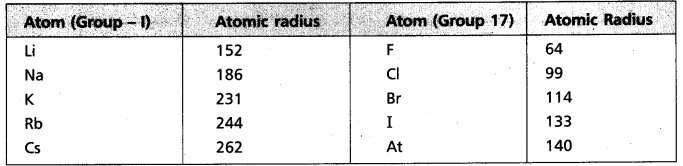
    AP Inter 1st Year Chemistry Study Material Chapter 2 Classification of Elements and Periodicity in Properties 33
    → In 3rd period from Na to Cl atomic radius decreases.
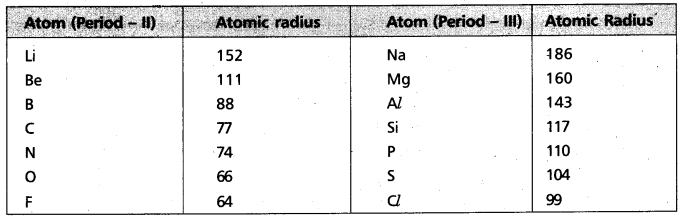
    AP Inter 1st Year Chemistry Study Material Chapter 2 Classification of Elements and Periodicity in Properties 34

b) Ionization energy : In a group ionization energy values decreases with an increase in the size of the atom. In IA group Li is the element with highest ionization potential and Cs is the element with lowest ionization potential.

In third period the ionization potential increases from Na to Mg and then decreases at Al and increases upto P and decreases in case of S and then increases upto argon, i.e., Al has a lower value than Mg and S has a lower value than P, due to stable electronic configurations of Mg and P Among these elements argon has highest ionization potential.

c) Electron affinity :

  • In 3rd period E.A > from ‘Si’ to ‘P’ decreases and P to Cl increases.
    ‘Mg’ and ‘Ar’ has positive values.
  • In 1st group from Li to Cs electron affinity decreases due to increase of size.

d) Nature of oxides of elements : All IA group elements are alkali metals. Their oxides are basic in nature. They dissolve in water to give basic solutions which changes fed litmus blue.
e.g. : Na2O, CaO , MgO etc.
Na2O + H2O → 2 NaOH
CaO + H2O → Ca(OH)2
MgO + H2O → Mg (OH)2
The basic nature of these oxides increases from top to bottom in the group. In a period basic properties decreases and acidic properties increases.
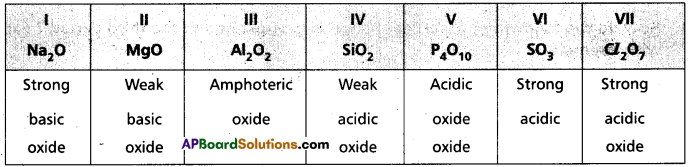
AP Inter 1st Year Chemistry Study Material Chapter 2 Classification of Elements and Periodicity in Properties 35

AP Inter 1st Year Chemistry Study Material Chapter 2 Classification of Elements and Periodicity in Properties

Question 12.
Define electron gain enthalpy. How it varies in a group and in a period? Why is the electron gain enthalpy of O or F is less negative than that of the succeeding element in the group ?
Answer:

  1. Electron affinity is the amount of energy released when an electron is added to a neutral gaseous atom in its ground state. It is known as first Electron affinity EA,sub>1. It has -ve value.
    X(g) + e → \(\mathrm{X}_{(\mathrm{g})}{ }^{-}\) + EA1
  2. Energy can be absorbed when an other electron is added to uni negative ion. It is because to overcome the repulsion between negative ion and electron. Hence second electron affinity, EA2 has +ve value.
    \(X_{(g)}{ }^{-}\) + e → \(X_{(g)}^{2-}\) + EA2
  3. It can be indirectly determined from Born —Haber cycle. Its units are kJ/mole.
  4. Trend in a group : Generally EA decreases down the group. In a group the second element has higher EA value than the first member.
    e.g. : EA of Cl is more than that of F
    Fluorine possess lower EA value than chlorine. It is due to inner electron repulsions in Fluorine.
  5. Trend in a period : Generally EA value increases across a period, but some irregularities can be observed.

a) I A group elements possess low EA values than the corresponding III A elements, e.g. : Be has EA value zero, it is due to completely filled 2s2 orbital.
b) VA elements have low EA values than that of VI A elements.
e.g. : Due to presence of half filled p – orbitals [2s2 2p3], nitrogen has lower EA value than that of oxygen.
c) For inert gases EA value is zero.
d) The element with the highest EA value is chlorine.

  • The electron gain enthalpy of O and F is less negative than the succeeding element in the group because. These have small size and inter electronic repulsions are high in these elements
    O → 141 KJ / mole and S → 200 kJ/Mole
    F → 328 KJ / mole and Cl → 349 kJ/Mole

Question 13.
a. What is electronegativity ?
b. How does it vary in a group and in a period ?
Answer:
a) Electronegativity : ‘The tendency of the atom of an element to attract the shared electron pair(s) more towards itself in a hetronuclear diatomic molecule or in a polar covalent bond.” Measuring electronegativity Pauling scale : Pauling scale is based on the values of bond energy. The bond energy of a compound A – B is the average of bond energies of A – A and B – B molecules.
EA – B = \(\frac{1}{2}\left(E_{A-A}+E_{B-B}\right)\)
But the experimental value of EA – B is found to exceed the theoretical value. The difference is ∆.
∴ ∆ = E’A – B – EA – B
∆ indicates the polarity of the covalent bond. It is measured in k. cal. mol-1.
Pauling gave the relation XA – XB = 0.208 × \(\sqrt{\Delta}\)
In S.l. units XA – XB = 0.1017 \(\sqrt{\Delta}\) where ∆ is measured in kJ/mole
XA and XB are the electronegativities of A and B. Pauling arbitrarily fixed 2.1 as the electronegativity value of Flydrogen and calculated the electronegativities of other elements. On Pauling scale Fluorine has the highest EN value 4.0.

From the values of the electronegativity of elements, the nature of the chemical bond formed can be understood. If two bonded atoms differ by 1.70 or more ion their EN values, the bond between them would be either 50% or more than 50% ionic in nature. Similarly if the difference in the EN values of the atoms is less than 1.70, the bond formed is more than 50% covalent in nature.

b) Variation in a group and period : Electronegativity increases from left to right in a period since the atomic: radii decreases and nuclear attraction increases. In a group electronegativity decreases from top to bottom due to an increase in atomic radii and a decrease in nuclear attraction.

Question 14.
Explain the following
a. Valency
b. Diagonal relation
c. Variation of nature of oxides in the Group -1
Answer:
a) Valency : The combining capacity of an element with another element is called valency. The number of hydrogen atoms (or) chlorine atoms (or) double the number of oxygen atoms, with which one atom of the element combine is also called valency.
∴ Valency = no. of hydrogens
= no. of chlorine atoms
= 2 × no. of oxygen atoms present in the molecule
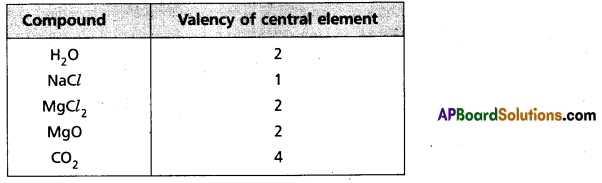
AP Inter 1st Year Chemistry Study Material Chapter 2 Classification of Elements and Periodicity in Properties 36

Periodicity of valency :
1) Each period starts with valency’11 and ends in ‘O’.
e.g.:

AP Inter 1st Year Chemistry Study Material Chapter 2 Classification of Elements and Periodicity in Properties 37

2) In a group valency is either equal to the group number (i.e., upto 4th group) or is equal to (8 – group number) (i.e., from 5th group onwards).
Significance :
Valency of an element is useful in writing the formulae of compounds.

b) Diagonal relation : On moving diagonally across the periodic table the elements show certain similarities. An element of group in 2nd period has similar properties with second element of the next higher group in the 3rd period. This type of resemblance is called diagonal relationship,
e.g. : (Li, Mg); (Be, Al); (B, Si)

AP Inter 1st Year Chemistry Study Material Chapter 2 Classification of Elements and Periodicity in Properties 38
c) Nature of oxides of elements : All IA group elements are alkali metals. Their oxides are basic in nature. They dissolve in water to give basic solutions which changes red litmus blue.
e.g. : Na2O, CaO , MgO etc.
CaO + H2O → Ca(OH)2
MgO + H2O → Mg (OH)2
The basic nature of these oxides increases from top to bottom in the group. In a period basic properties decreases and acidic properties increases.

Solved Problems

Question 1.
What would be the IUPAC name and symbol for the element with atomic number 120?
Solution:
The roots for 1, 2 and 0 are un, bi and nil, respectively. Hence, the symbol and the name respectively are Ubn and unbinilium.

Question 2.
How would you justify the presence of 18 elements in the 5t” period of the Periodic Table ?
Solution:
When n = 5, l = 0, 1, 2, 3. The order in which the energy of the available orbitals 4d, 5s and 5p increases is 5s < 4d < 5p. The total number of orbitals available are 9. The maximum number of electrons that can be accommodated is 18; and therefore 18 elements are there in the 5th period.

AP Inter 1st Year Chemistry Study Material Chapter 2 Classification of Elements and Periodicity in Properties

Question 3.
The elements Z = 117 and 120 have not yet been discovered. In which family / group would you place these elements and also give the electronic configuration in each case.
Solution:
we see from that element with Z = 117, would belong to the halogen family (Group 17) and the electronic configuration would be [Rn] 5f146d107s27p5. The element with Z = 120, will be placed in Group 2 (alkaline earth metals), and will have the electronic configuration [Uuo]8s2

Question 4.
Considering the atomic number and position in the periodic table, arrange the following elements in the increasing order of metallic character: Si, Be, Mg, Na, P.
Solution:
Metallic character increases down a group and decreases along a period as we move from left to right. Hence the order of increasing metallic character is : P < Si < Be < Mg < Na.

Question 5.
Which of the following species will have the largest and the smallest size ?
Mg, Mg2+, Al, Al3+.
Solution:
Atomic radii decrease across a period. Cations are smaller than their parent atoms. Among isoelectronic species, the one with the larger positive nuclear charge will have a smaller radius.
Hence the largest species is Mg; the smallest one is Al3+.

Question 6.
The first ionization enthalpy (∆iH) values of the third period elements, Na, Mg and Si are respectively 496, 737 and 786 kJ mol-1. Predict whether the first ∆iH value for Al will be more close to 575 or 760 kJ mol-1 ? Justify your answer.
Solution:
It will be more close to 575 kJ mol-1. The value for Al should be lower than that of Mg because of effective shielding of 3p electrons from the nucleus by 3s-electrons.

Question 7.
Which of the following will have the most negative electron gain enthalpy and which the least negative ? P, S, Cl, F. Explain your answer.
Solution:
Electron gain enthalpy generally becomes more negative across a period as we move from left to right. Within a group, electron gain enthalpy becomes less negative down a group. However, adding an electron to the 2p-orbital leads to greater repulsion than adding an electron to the larger 3p-orbital. Hence the element with most negative electron gain enthalpy is chlorine; the one with the least negative electron gain enthalpy is phosphorous.

Question 8.
Using the Periodic Table, predict the formulas of compounds which might be formed by the following pairs of elements;
(a) silicon and bromine
(b) aluminium and sulphur.
Solution:
(a) Silicon is group 14 element with a valence of 4; bromine belongs to the halogen family with a valency of 1. Hence the formula of the compound formed would be SiBr4.
(b) Aluminium belongs to group 13 with a valence of 3; sulphur belongs to group 16 elements with a valence of 2. Hence, the formula of the compound formed would be Al2S2.

AP Inter 1st Year Chemistry Study Material Chapter 2 Classification of Elements and Periodicity in Properties

Question 9.
Are the oxidation state and covalency of Al in [AICI(H2O)5]2+ same ?
Solution:
No. The oxidation state of Al is +3 and the covalency is 6.

Question 10.
Show by a chemical reaction with water that Na2O is a basic oxide and Cl2O7 is an acidic oxide.
Solution:
Na2O with water forms a strong base Whereas Cl2O7 forms strong acid.
Na2O + H2O → 2NaOH
Cl2O7 + H2O → 2HClO4
Their basic or acidic nature can be qualitatively tested with litmus paper.

AP SSC 10th Class Maths Solutions Chapter 2 Sets InText Questions

AP State Syllabus SSC 10th Class Maths Solutions 2nd Lesson Sets InText Questions

AP State Board Syllabus AP SSC 10th Class Maths Textbook Solutions Chapter 2 Sets InText Questions and Answers.

10th Class Maths 2nd Lesson Sets InText Questions and Answers

Question 1.
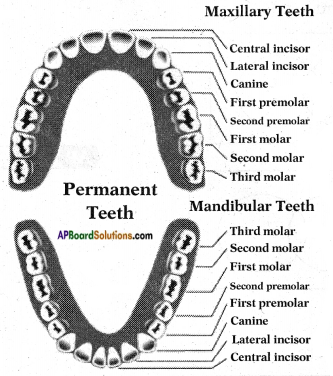
List the teeth under each of the following type (Page No. 25)
AP SSC 10th Class Maths Chapter 2 Sets InText Questions 1
i) Incisors
Answer:
Central incisors = 4
Lateral incisors = 4
Total incisors = 8
ii) Canines
Answer:
Total canines = 4
iii) Pre-molars
Answer:
First premolars = 4
Second premolars = 4
Total premolars = 8
iv) Molars
Answer:
First molars = 4
Second molars = 4
Third molars = 4
Total molars = 12

AP SSC 10th Class Maths Solutions Chapter 2 Sets InText Questions

Question 2.
Identify and write the “common property” of the following collections. (Page No. 26)
1) 2, 4, 6, 8, …….
Answer:
All are even numbers {x : x is even}
2) 2, 3, 5, 7, 11, …….
Answer:
All are prime numbers (x : x is a prime}
3) 1, 4, 9, 16, …….
Answer:
All are perfect squares
(x : x is a perfect square}
4) January, February, March, April,…
Answer:
All are English months
{x : x is a month of the year}
5) Thumb, index finger, middle finger, ring finger, pinky.
Answer:
All are fingers of a hand
{x : x is a finger of a hand}

Question 3.
Write the following sets. (Page No. 27)
1) Set of the first five positive integers.
Answer:
{11, 2, 3, 4, 5}
2) Set of multiples of 5 which are more than 100 and less than 125.
Answer:
{105, 110, 115, 120}
3) Set of first five cubic numbers.
Answer:
{13, 23, 33, 43, 53}
{1, 8, 27, 64, 125}
4) Set of digits in the Ramanujan number.
Answer:
Ramanujan’s number is 1729
{1, 2, 7, 9}

AP SSC 10th Class Maths Solutions Chapter 2 Sets InText Questions

Question 4.
Some numbers are given below. Decide the numbers to which number sets they belong to and does not belong to and express with correct symbols. (Page No. 28)
i) 1
Answer:
1 ∈ N
ii) 0
Answer:
0 ∈ W and 0 ∉ N
iii) -4
Answer:
– 4 ∈ I and – 4 ∉ N
iv) \(\frac{5}{6}\)
Answer:
\(\frac{5}{6}\) ∈ Q and \(\frac{5}{6}\) ∉ Z
v) \(1 . \overline{3}\)
Answer:
\(1 . \overline{3}\) ∉ N and \(1 . \overline{3}\) ∉ Z
vi) √2
Answer:
√2 ∈ S and √2 ∉ Q
vii) log 2
Answer:
log 2 ∉ N
viii) 0.03
Answer:
0.03 ∉ Q
ix) π
Answer:
π ∉ Z
x) \(\sqrt{-4}\)
Answer:
\(\sqrt{-4}\) ∉ Q and \(\sqrt{-4}\) ∈ C

Question 5.
List the elements of the following sets. (Page No. 29)
i) G = {all the factors of 20}
ii) F = {the multiples of 4 between 17 and 61 which are divisible by 7}
iii) S = {x : x is a letter in the word ‘MADAM’}
iv) P = {x : x is a whole number between 3.5 and 6.7}
Answer:
i) G = {1, 2, 4, 5, 10, 20}
ii) Multiples of 4 between 17 and 61
x = {20, 24, 28, 32, 36, 40, 44, 48, 52, 56, 60}
F = {28, 56}
iii) S = {M, D, A}
iv) P = {4, 5, 6}

AP SSC 10th Class Maths Solutions Chapter 2 Sets InText Questions

Question 6.
Write the following sets in the roster form.   (Page No. 29)
i) B is the set of all months in a year having 30 days.
ii) P is the set of all prime numbers smaller than 10.
iii) X is the set of the colours of the rainbow.
Answer:
i) B = {April, June, September, November}
ii) P = {2, 3, 5, 7}
iii) X = {Violet, Indigo, Blue, Green, Yellow, Orange, Red}

Question 7.
A is the set of factors of 12. Which one of the following is not a member of A?   (Page No. 29)
A) 1
B) 4
C) 5
D) 12
Answer:
[C]

Think & Discuss

Question 1.
Observe the following collections and prepare as many as generalized statements you can describing their more properties. (Page No. 26)
i) 2, 4, 6, 8,….
Answer:
a) All even natural numbers
b) All positive even integers
c) Multiples of 2

ii) 1, 4, 9, 16, …..
Answer:
a) Squares of natural numbers
b) All perfect square numbers

Question 2.
Can you write set of rational numbers listing elements in it? (Page No. 28)
Answer:
We can’t list all elements in the set of rational numbers. We know that rational numbers are infinite.

AP SSC 10th Class Maths Solutions Chapter 2 Sets InText Questions

Try this

Question 1.
Write some sets of your choice, involving algebraic and geometrical ideas. (Page No. 29)
Answer:
The set of all natural numbers ‘x’ such that 4x + 9 < 50,
ii) A = {x : x is an integer and -3 ≤ x ≤ 7}
iii) B = {Equilateral triangle, Right angled triangle, Scalene triangle, Obtuse angled triangle, Acute angled triangle)
iv) C = {Rectangle, Square, Parallelogram, Rhombus, Trapezium}

Question 2.
Match roster forms with the set builder form. (Page No. 29)
AP SSC 10th Class Maths Chapter 2 Sets InText Questions 2
Answer:
i) d
ii) c
iii) a
iv) b

Do this

Question 1.
A = {1, 2, 3, 4},
B = {2, 4},
C = {1, 2, 3, 4, 7}, ∅ = { }.
Fill in the blanks with ⊂ or ⊄.  (Page No. 33)
i) A …. B
ii) C …. A
iii) B …. A
iv)A …. C
v) B …. C
vi) ∅ …. B
Answer:
i) A ⊄ B
ii) C ⊄ A
iii) B ⊆ A
iv) A ⊆ C
v) B ⊆ C
vi) ∅ ⊆ B

AP SSC 10th Class Maths Solutions Chapter 2 Sets InText Questions

Question 2.
State which of the following statements are true.    (Page No. 33)
i) { } = ∅
ii) ∅ = 0
iii) 0 = { 0 }
Answer:
i) True (T)
ii) False (F)
iii) False (F)

Question 3.
Let A = {1, 3, 7, 8} and B = [2, 4, 7, 9}.
Find A ∩ B.     (Page No. 37)
Answer:
Given sets A = (1, 3, 7, 8} and B = {2,4, 7,9}
A ∩ B = {1, 3, 7, 8} ∩ (2, 4, 7, 9} = {7}

Question 4.
If A = {6,9,11 }; ∅ = {}, find A ∪ ∅, A ∩ ∅).  (Page No. 37)
Answer:
Given sets
A = {6, 9, 11} and ∅ = { }
A ∪ ∅ = {6, 9, 11} ∪ { }
= {6, 9, 11} = A
∴ A ∪ ∅ = A
A ∩ ∅ = {6,9,11} ∩ { } = { } = ∅
∴ A ∩ ∅ = ∅

Question 5.
A = {1, 2, 3, 4, 5, 6, 7, 8, 9, 10};
B = {2, 3, 5, 7}. Find A ∩ B and show that A ∩ B = B.    (Page No. 37)
Answer:
Given sets
A = {1, 2, 3, 4, 5, 6, 7, 8, 9, 10} and B = {2, 3, 5, 7}
A ∩ B = {1, 2, 3, 4, 5, 6, 7, 8, 9, 10} ∩ {2, 3, 5, 7}
= {2, 3, 5, 7} = B
∴ A ∩ B = B

AP SSC 10th Class Maths Solutions Chapter 2 Sets InText Questions

Question 6.
If A = {4, 5, 6}; B = {7, 8}, then show that A ∪ B = B ∪ A.  (Page No. 37)
Answer:
Given sets are
A = {4, 5, 6} and B = {7, 8}
A ∪ B = {4, 5, 6} ∪ {7, 8}
= {4, 5, 6, 7, 8}.
B ∪ A = {7, 8} ∪ {4, 5, 6}
= {4, 5, 6, 7, 8}
∴ A ∪ B = B ∪ A.

Question 7.
If A = {1, 2, 3, 4, 5 }; B = {4, 5, 6, 7}, then find A – B and B – A. Are they equal?  (Page No. 38)
Answer:
Given sets are
A = {1, 2, 3, 4, 5} and B = {4, 5, 6, 7}
A – B = {1, 2, 3, 4, 5} – {4, 5, 6, 7}
= {1, 2, 3}
B – A = {4, 5, 6, 7} – {1, 2, 3, 4, 5}
= {6, 7}
∴ No, A – B ≠ B – A.

Question 8.
If V = {a, e, i, o, u} and B = {a, i, k, u}, find V – B and B – V.    (Page No. 38)
Answer:
Given sets are
V = {a, e, i, o, u} and B = {a, i, k, u}
V – B = {a, e, i, o, u} – {a, i, k, u}
= {e, o}
B – V = {a, i, k, u} – {a, e, i, o, u}
= {k}.

Try this

Question 1.
A = {set of quadrilaterals},
B = {square, rectangle, trapezium, rhombus}.
State whether A ⊂ B or B ⊂ A. Justify your answer.     (Page No. 33)
Answer:
A = {set of quadrilaterals} means A = {square, rectangle/trapezium, rhombus, parallelogram}
B = {square, rectangle, trapezium, rhombus}
So, B ⊂ A because A’ is having elements more than ‘B’.

AP SSC 10th Class Maths Solutions Chapter 2 Sets InText Questions

Question 2.
If A = {a, b, c, d}. How many subsets does the set A have?    (Page No. 33)
A) 5 B) 6 C) 16 D) 65
Answer:
Given A = {a, b, c, d}
n(A) = 4
Number of subsets for a set, which is having ‘n’ elements is 2n.
So n(A) = 4
Number of subsets for A is 24 = 16.
Answer is [C].

Question 3.
P is the set of factors of 5, Q is the set of factors of 25 and R is the set of factors of 125. Which one of the following is false?    (Page No. 33)
A) P ⊂ Q
B) Q ⊂ R
C) R ⊂ P
D) P ⊂ R
Answer: [C]

Question 4.
A is the set of prime numbers smaller than 10, B is the set of odd numbers < 10 and C is the set of even numbers < 10. How many of the following statements are true?    (Page No. 33)
i) A ⊂ B
ii) B ⊂ A
iii) A ⊂ C
iv) C ⊂ A
v) B ⊂ C
vi) C ⊂ B
Answer:
All the statements are false.

Question 5.
List out some sets A and B and choose their elements such that A and B are disjoint.  (Page No. 37)
Answer:
Consider the disjoint sets
A = {1, 2, 3, 4} and B = {a, b, c}

Question 6.
If A = {2, 3, 5}, find A ∪ ∅ and ∅ ∪ A and compare.    (Page No. 37)
Answer:
Given sets A = {2, 3, 5} and ∅ = { }
A ∪ ∅ = {2,3,5} ∪ { } = {2,3,5}
∅ ∪ A = { } ∪ {2, 3, 5} = {2,3,5}
A ∪ v = ∅ ∪ A = A

Question 7.
If A = {1, 2, 3, 4}; B = {1, 2, 3, 4, 5, 6, 7, 8}, then find A ∪ B, A ∩ B. What do you notice about the result?   (Page No. 37)
Answer:
Given sets are
A = {1, 2, 3, 4} and B = {1, 2, 3, 4, 5, 6, 7, 8}
A ∪ B = {1, 2, 3, 4} ∪ {1, 2, 3, 4, 5, 6, 7, 8} = {1, 2, 3, 4, 5, 6, 7, 8} = B
A ∩ B = {1, 2, 3, 4} ∩ {1, 2, 3, 4, 5, 6, 7, 8} = {1, 2, 3, 4} = A
If A ⊂ B, then A ∪ B = B and A ∩ B = A

AP SSC 10th Class Maths Solutions Chapter 2 Sets InText Questions

Question 8.
A = {1, 2, 3, 4, 5, 6}; B = {2, 4, 6, 8, 10}. Find the intersection of A and B.     (Page No. 37)
Answer:
Given sets are
A = {1, 2, 3, 4, 5, 6} and B = {2, 4, 6, 8, 10}
A ∩ B = {1, 2, 3, 4, 5, 6} ∩ {2, 4, 6, 8, 10} = {2, 4, 6}

Think & Discuss

Question 1.
Is empty set subset to every set?    (Page No. 34)
Answer:
‘Yes’. Empty set is subset to every set
Justify: If A ⊂ B, it means all the elements of set ‘A’ belong to set ‘B’.
In other words we can say no element of ‘A’ missed in set B.
now empty set means which has no elements, now no element of empty set can be missed in any set. So we can write empty set is subset of every set.

Question 2.
Is any set subset to itself?    (Page No. 34)
Answer:
‘Yes’. Every set is subset to itself.
Let ‘A’ is any set.
Now every element of ‘A’ definitely belongs to ‘A’.
So A ⊂ A
Hence every set is a subset to it.

Question 3.
You are given two sets such that a set is not a subset of the other. If you have to prove this, how do you prove?    (Page No. 34)
Answer:
Let the given sets are ‘A’ and ‘B’.
To prove are set (A) is not subset of other (B).
We check if all elements of ‘A’ belong to the set ‘B’ or not.
If any of the element doesn’t belong to ‘B’ then we can say ‘A’ is not subset of ‘B’. So we have to prove at least one element of ‘A’ does not belong to ‘B’.
Hence ‘A’ is not subset of ‘B’.

Question 4.
The intersection of any two disjoint sets is a null set. Justify your answer.    (Page No. 37)
Answer:
Let A and B be any two disjoint sets,
i.e., A and B have no elements in common.
∴ A ∩ B is a null set. (∵ A ∩ B is the set of all elements which are common to both A and B)

AP SSC 10th Class Maths Solutions Chapter 2 Sets InText Questions

Question 5.
The sets A – B, B – A and A ∩ B are mutually disjoint sets. Use examples to observe if this is true.    (Page No. 38)
Answer:
Let the sets are A = {1, 2, 3, 4} and B = {5, 6, 7, 8}
A – B = {1, 2, 3, 4} – {5, 6, 7, 8} = {1, 2, 3, 4}
B – A = {5, 6, 7, 8} – {1, 2, 3, 4} = {5, 6, 7, 8}
A ∩ B = {1, 2, 3, 4} ∩ {5, 6, 7, 8} = { } = ∅
∴ A – B, B – A and A ∩ B are disjoint sets.

Do these

Question 1.
Which of the following are empty sets? Justify your answer.    (Page No. 44)
i) Set of integers which lie between 2 and 3 .
ii) Set of natural numbers that are smaller than 1.
iii) Set of odd numbers that leave remainder zero, when divided by 2.
Answer:
i) This is null set. We know that there is no integer that lie between 2 and 3.
ii) This is also a null set. We know that there is’ no natural number less than ‘1’.
iii) This is a null set. We know that odd numbers do not leave remainder zero when divided by 2.

Question 2.
State which of the following sets are finite and which are infinite. Give reasons for your answer.    (Page No. 44)
i) A = {x : x e N and x < 100}
ii) B = {x : x e N and x ≤ 5}
iii) C = {12 , 22, 32, ……}
iv) D = {1, 2, 3, 4}
v) {x : x is a day of the week}
Answer:
i) A = (1, 2, 3, 4, , 98, 99}
This set is finite, because there are 99 numbers possible to count.
ii) B = {1, 2, 3,  4, 5}
This set is finite because there are 5 numbers possible to count.
iii) C = {12 , 22, 32, ……}
This set is infinite because there are infinite numbers.
iv) D – {1, 2, 3, 4}
This set is finite because there are 4 numbers that are possible to count.
v) E = {Sunday, Monday, Tuesday, Wednesday, Thursday, Friday, Saturday}
This set is finite, because there are 7 days in a week possible to count.

AP SSC 10th Class Maths Solutions Chapter 2 Sets InText Questions

Question 3.
Tick the set which is infinite.      (Page No. 44)
A) The set of whole numbers < 10
B) The set of prime numbers < 10
C) The set of integers < 10
D) The set of factors of 10
Answer:
[C]
The set of integers < 10
{….., -2, -1, 0, 1, 2, 3, 4, 5, 6, 7, 8, 9}

Try this

Question 1.
Which of the following sets are empty sets? Justify your answer.    (Page No. 44)
i) A = {x : x2 = 4 and 3x = 9}.
ii) The set of all triangles in a plane having the sum of their three angles less than 180.
Answer:
i) x2 = 4 ⇒ x = ± 2
3x = 9 ⇒ x = 3
The value of ‘x’ is not same in both cases, so this is a null set.
ii) This is a null set, because the sum of the three angles of a triangle is equal to 180°.

Question 2.
B = {x : x + 5 = 5} is not an empty set. Why?   (Page No. 44)
Answer:
B = {x: x + 5 = 5} is not an empty set
let x ∈ Z or x ∈ W
then for x = 0 ⇒ x + 5 = 0 + 5 = 5
So if x ∈ W, or x ∈ Z then for x = 0,
x + 5 = 5 is true.
Then the set B = {0} which is not an empty set.
Note: But if x ∈ N
We will have no ‘x’ such that x + 5 = 5
then ‘B’ will be an empty set.
But in the textbook it is not given whether x ∈ N (or) x ∈ W (or) x ∈ Z.
Hence we consider first one.

AP SSC 10th Class Maths Solutions Chapter 2 Sets InText Questions

Think & Discuss

Question 1.
An empty set is a finite set. Is this statement true or false? Why?   (Page No. 44)
Answer:
Yes, it is a finite set because there is finite number i.e., ‘0’ elements it consists.

Think & Discuss

Question 1.
What is the relation between n(A), n(B), n(A ∩ B) and n(A ∪ B)?   (Page No. 45)
Answer:
n(A ∪ B) = n(A) + n(B) – n(A ∩ B). This is called Fundamental theorem of sets.

Question 2.
If A and B are disjoint sets, then how can you find n(A ∪ B)?    (Page No. 45)
Answer:
If A and B are disjoint then A ∩ B is a null set.
∴ n(A ∩ B) = 0 and it gives us n(A ∪ B) = n (A) + n(B).

AP SSC 10th Class Maths Solutions Chapter 2 Sets Ex 2.4

AP State Board Syllabus AP SSC 10th Class Maths Textbook Solutions Chapter 2 Sets Ex 2.4 Textbook Questions and Answers.

AP State Syllabus SSC 10th Class Maths Solutions 2nd Lesson Sets Exercise 2.4

10th Class Maths 2nd Lesson Sets Ex 2.4 Textbook Questions and Answers

Question 1.
State which of the following sets are empty and which are not?
i) The set of lines passing through a given point.
ii) Set of odd natural numbers divisible by 2.
iii) {x : x is a natural number, x < 5 and x > 7}
iv) {x: x is a common point to any two parallel lines}
v) Set of even prime numbers.
Answer:
i) Not empty
ii) Empty
iii) Empty
iv) Empty
v) Not empty

AP SSC 10th Class Maths Solutions Chapter 2 Sets Ex 2.4

Question 2.
Which of the following sets are finite or infinite?
i) The set of months in a year.
ii) {1, 2, 3, …, 99, 100}
iii) The set of prime numbers smaller than 99.
Answer:
i) Finite
ii) Finite
iii) Finite

AP SSC 10th Class Maths Solutions Chapter 2 Sets Ex 2.4

Question 3.
State whether each of the following sets is finite or infinite.
i) The set of letters in the English alphabet.
ii) The set of lines which are parallel to the X-axis.
iii) The set of numbers which are multiples of 5.
iv) The set of circles passing through the origin (0, 0).
Answer:
i) Finite
ii) Infinite
iii) Infinite
iv) Infinite

AP SSC 10th Class Maths Solutions Chapter 2 Sets Ex 2.3

AP State Board Syllabus AP SSC 10th Class Maths Textbook Solutions Chapter 2 Sets Ex 2.3 Textbook Questions and Answers.

AP State Syllabus SSC 10th Class Maths Solutions 2nd Lesson Sets Exercise 2.3

10th Class Maths 2nd Lesson Sets Ex 2.3 Textbook Questions and Answers

Question 1.
Which of the following sets are equal?
A = {x : x is a letter in the word FOLLOW}
ii) B = {x : x is a letter in the word FLOW}
iii) C = {x : x is a letter in the word WOLF}
Answer:
i) Elements in set A are {F, L, O, W}
ii) Elements in set B are {F, L, O, W}
iii) Elements in set C are {F, L, O, W} Sets A, B and C have same elements, Hence, they are equal sets.

AP SSC 10th Class Maths Solutions Chapter 2 Sets Ex 2.3

Question 2.
Consider the following sets and fill up the blank in the statement given below with = or ≠ so as to make the statement true.
A = {1, 2, 3};
B = {The first three natural numbers};
C = {a, b, c, d};
D = {d, c, a, b};
E = {a, e, i, o, u};
F = {Set of vowels in English Alphabet}
i) A …. B
ii) A …. E
iii) C …. D
iv) D …. F
v) F …. A
vi) D …. E
vii) F …. B
Answer:
i) A = B
ii) A ≠ E
iii) C = D
iv) D ≠ F
v) F ≠ A
vi) D ≠ E
vii) F ≠ B

Question 3.
In each of the following, state whether A = B or not.
i) A = {a, b, c, d} ; B = {d, c, a, b}
ii) A = {4, 8, 12, 16} ; B = {8, 4, 16, 18}
iii) A = {2, 4, 6, 8, 10}; B = {x : x is a positive even integer and x ≤ 10}
iv) A = {x : x is a multiple of 10}; B = {10, 15, 20, 25, 30, …}
Answer:
i) A = B
ii) A ≠ B
iii) A ≠ B
iv) A ≠ B

AP SSC 10th Class Maths Solutions Chapter 2 Sets Ex 2.3

Question 4.
State the reasons for the following :
i) {1, 2, 3, …., 10} ≠ {x : x ∈ N and 1 < x < 10}
ii) {2, 4, 6, 8, 10} ≠ {x : x = 2n+1 and x ∈ N}
iii) {5, 15, 30, 45} ≠ {x : x is a multiple of 15}
iv) {2, 3, 5, 7, 9} ≠ {x : x is a prime number}
Answer:
i) In R.H.S ‘x’ is greater than 1 and less than 10 but L.H.S is having both 1 and 10.
ii) L.H.S ≠ R.H.S
R.H.S: x = 2n + 1 is definition of odd numbers.
L.H.S: Given set is even numbers set.
iii) x is a multiple of 15.
So 5 does not exist.
iv) x is a prime number but 9 is not a prime number.

AP SSC 10th Class Maths Solutions Chapter 2 Sets Ex 2.3

Question 5.
List all the subsets of the following sets.
i) B = {p, q}
ii) C = {x, y, z}
iii) D = {a, b, c, d}
iv) E = {1, 4, 9, 16}
v) F = {10, 100, 1000}
Answer:
i) Subsets of ‘B’ are {p}, {q}, {p, q}, φ
ii) Subsets of ‘C’ are {x}, {y} {z}, {x, y}, {y, z}, {z, x}, {x, y, z} and φ (23 = 8)
iii) Subsets of ‘D’ are {a}, {b}, {c}, {d}, {a,b}, {b,c}, {c, d}, {a, c}, {a, d}, {b, d}, {a, b, c}, {b, c, d}, {a, b, d}, {a, c, d}, {a, b, c, d} and φ
iv) Subsets of ‘E’ are
φ, {1}, {4}, {9}, {16}, {1,4}, {1,9}, {1, 16}, {4, 9}, {4, 16}, (9, 16}, {1, 4, 9}, {1, 9, 16}, {4, 9, 16}, {1, 4, 16}, {1, 4, 9, 16}
v) Subsets of ‘F’ are
φ, {10}, {100}, {1000}, {10, 100}, {100, 1000}, {10, 1000}, {10, 100, 1000}.

AP SSC 10th Class Maths Solutions Chapter 2 Sets Ex 2.2

AP State Board Syllabus AP SSC 10th Class Maths Textbook Solutions Chapter 2 Sets Ex 2.2 Textbook Questions and Answers.

AP State Syllabus SSC 10th Class Maths Solutions 2nd Lesson Sets Exercise 2.2

10th Class Maths 2nd Lesson Sets Ex 2.2 Textbook Questions and Answers

Question 1.
If A = {1, 2, 3, 4}; B = {1, 2, 3, 5, 6} then find A ∩ B and B ∩ A. Are they equal ?
Answer:
Given sets are A = {1, 2, 3, 4} and B = {1,2,3, 5,6}
A ∩ B = {1,2, 3,4} ∩ {1,2, 3, 5, 6}
= {1,2,3} …… (1)
B ∩ A = {1, 2, 3, 5, 6} ∩ {1, 2, 3, 4}
= {1,2,3} …….(2)
From (1) and (2)
A ∩ B and B ∩ A are same.

Question 2.
A = {0, 2, 4}, find A ∩ φ and A ∩ A. Comment.
Answer:
Given set A = {0, 2, 4} and φ is a null set.
A ∩ φ = {0, 2, 4} ∩ { }
= { } ……. (1)
A ∩ A = {0, 2, 4} ∩ {0, 2, 4}
= {0, 2,4} …….. (2)
From (1) and (2),
We conclude that A ∩ φ = φ and A ∩ A = A

AP SSC 10th Class Maths Solutions Chapter 2 Sets Ex 2.2

Question 3.
If A = {2, 4, 6, 8, 10} and B = {3, 6, 9, 12, 15}, find A – B and B – A.
Answer:
Given sets are
A {2, 4, 6, 8, 10} and B = {3, 6, 9, 12, 15}
A – B = {2, 4, 6, 8, 10} – {3, 6, 9, 12, 15}
= {2, 4, 8, 10} …… (1)
B – A = {3, 6, 9, 12, 15} – {2, 4, 6, 8, 10}
= {3, 9, 12, 15} …… (2)
From (1) and (2), A – B ≠ B – A

Question 4.
If A and B are two sets such that A ⊂ B then, what is A ∪ B?
Answer:
Let us consider A ⊂ B
Set A = {1, 2, 3} and
Set B = {1, 2, 3, 4, 5}
Now A ∪ B = {1, 2, 3} ∪ {1, 2, 3, 4, 5}
= {1, 2, 3, 4, 5} = B
∴ A ∪ B = B

Question 5.
If A = {x : x is a natural number},
B = {x : x is an even natural number},
C = {x : x is an odd natural number} and
D = {x : x is a prime number}
Find A ∩ B, A ∩ C, A ∩ D, B ∩ C, B ∩ D, C ∩ D.
Answer:
Given sets are
A = {1, 2, 3, 4, 5, 6, 7, 8, 9, 10, ……}
B = {2, 4, 6, 8, 10, …….}
C = {1, 3, 5, 7, 9, …….}
D = {2, 3, 5, 7, 11, …….}
A ∩ B = {1, 2, 3, 4, 5, 6, 7, 8, 9, 10, …….} ∩ {2, 4, 6, 8, 10, ……}
= {2, 4, 6, 8, 10, ……}
A ∩ C = {1, 2, 3,4, 5, 6, 7, 8, 9, 10, …} ∩ {1, 3, 5, 7, 9 }
= {1, 3, 5, 7, 9, ……}
A ∩ D = {1, 2, 3, 4, 5, 6, 7, 8, 9, 10, …} ∩ {2, 3, -5, 7, 11,….}
= {2, 3, 5, 7, 11, ……}
B ∩ C = {2, 4, 6, 8, 10, ……} ∩ {1, 3, 5, 7, 9, …….}
= { } = φ
B ∩ D = {2, 4, 6, 8, 10, ……} ∩ {2, 3, 5, 7, 11, ……}
= {2}
C ∩ D = {1, 3, 5, 7, 9, ……} ∩ {2, 3, 5, 7, 11, 13, ……}
= {3, 5, 7, …..}

AP SSC 10th Class Maths Solutions Chapter 2 Sets Ex 2.2

Question 6.
If A = {3, 6, 9, 12, 15, 18, 21}; B = {4, 8, 12, 16, 20}; C = {2, 4, 6, 8, 10, 12, 14, 16}; D = {5, 10, 15, 20} find
(i) A – B
(ii) A – C
(iii) A – D
(iv) B – A
(v) C – A
(vi) D – A
(vii) B – C
(viii) B – D
(ix) C – B
(x) D – B
Answer:
Given sets are A = {3, 6, 9, 12, 15, 18, 21}
B = {4, 8, 12, 16, 20}
C = {2, 4, 6, 8, 10, 12, 14, 16} and
D = {5, 10, 15, 20}
i) A – B = {3, 6, 9, 12, 15, 18, 21} – {4, 8, 12, 16, 20} = {3, 6, 9, 15, 18, 21}
ii) A – C = {3, 6, 9, 12, 15, 18, 21} – {2, 4, 6, 8, 10, 12, 14, 16} = {3,9,15,18,21}
iii) A – D = {3, 6, 9, 12, 15, 18, 21} – {5, 10, 15, 20} = {3,6,9,12,18,21}
iv) B – A = {4, 8, 12, 16, 20} – {3, 6, 9, 12, 15, 18, 21} = {4, 8, 16, 20}
v) C – A = {2, 4, 6, 8, 10, 12, 14, 16} – {3, 6, 9, 12, 15, 18, 21} = {2, 4, 8, 10, 14, 16}
vi) D – A = {5, 10, 15, 20} – {3, 6, 9, 12, 15, 18, 21} = {5, 10, 20}
vii) B – C = {4, 8, 12, 16, 20} – {2, 4, 6, 8, 10, 12, 14, 16} = {20}
viii) B – D = {4, 8, 12, 16,20} – {5, 10, 15, 20} = {4, 8, 12, 16}
ix) C – B = {2, 4, 6, 8, 10, 12, 14, 16} – {4, 8, 12, 16, 20} = {2, 6, 10, 14}
x) D – B = {5, 10, 15, 20} – {4, 8, 12, 16, 20} = {5, 10, 15}

AP SSC 10th Class Maths Solutions Chapter 2 Sets Ex 2.2

Question 7.
State whether each of the following statement is true or false. Justify your answers.
i) {2,3,4,5} and {3,6} are disjoint sets.
ii) {a, e, i, o, u} and {a, b, c, d} are disjoint sets.
iii) {2, 6, 10, 14} and {3, 7, 11, 15} are disjoint sets.
iv) {2, 6, 10} and {3, 7, 11} are disjoint sets.
Answer:
i) Rule: If two sets are disjoint their intersection is null set.
= {2, 3, 4, 5} n {3, 6} = { 3 } ≠ φ
∴ Given statement is False.

ii) Given sets are
{a, e, i, o, u} and {a, b, c, d}
= {a, e, i, o, u} ∩ {a, b, c, d}
= { a } ≠ φ
∴ Given statement is False.

iii) Given sets are
{2, 6, 10, 14} and {3, 7, 11, 15}
= {2, 6, 10, 14} ∩ {3, 7, 11, 15}
= { }
∴ Given statement is True.

iv) Given sets are
{2, 6, 10} and {3, 7, 11}
= {2, 6, 10} ∩ {3, 7, 11} = { }
∴ Given statement is True.

AP SSC 10th Class Maths Solutions Chapter 2 Sets Ex 2.1

AP State Board Syllabus AP SSC 10th Class Maths Textbook Solutions Chapter 2 Sets Ex 2.1 Textbook Questions and Answers.

AP State Syllabus SSC 10th Class Maths Solutions 2nd Lesson Sets Exercise 2.1

10th Class Maths 2nd Lesson Sets Ex 2.1 Textbook Questions and Answers

Question 1.
Which of the following are sets? Justify your answer.
i) The collection of all the months of a year beginning with die letter “J”.
ii) The collection of ten most talented writers of India.
iii) A team of eleven best cricket batsmen of the world.
iv) The collection of all boys in your class.
v) The collection of all even integers.
Answer:
i) There are 3 months as January, June and July beginning with letter ‘J’. Therefore, it is a well defined collection of months and hence it is a set.
ii) The concept of talented writers of India is vague, since there is no rule given for deciding whether a particular writer is talented or not.
Hence, the given collection is not a set.
iii) A team of eleven best cricket batsmen of the world is vague, since there is no rule given for deciding whether a particular batsman is the best.
Hence, the given collection is not a set.
iv) The collection of all boys in my class is well defined. Hence, the given collection is a set.
v) The collection of all even integers i.e., (2, 4, 6, 8, ……) is well defined.
Hence, the given collection is a set.

AP SSC 10th Class Maths Solutions Chapter 2 Sets Ex 2.1

Question 2.
If A = {0, 2, 4, 6}, B = {3, 5, 7} and C = {p, q, r} then fill the appropriate symbol, ∈ or ∉ in the blanks.
i) 0 ….. A
ii) 3 ….. C
iii) 4 ….. B
iv) 8 ….. A
v) p ….. C
vi) 7 ….. B
Answer:
i) ∈
ii) ∉
iii) ∉
iv) ∉
v) ∈
vi) ∈

Question 3.
Express the following statements using symbols.
i) The elements ‘x’ does not belong to ‘A’.
ii) ‘d’ is an element of the set ‘B’.
iii) ‘1’ belongs to the set of Natural numbers N.
iv) ‘8′ does not belong to the set of prime numbers P.
Answer:
i) x ∉ A
ii) d ∈ B
iii) 1 ∈ N
iv) 8 ∉ P

AP SSC 10th Class Maths Solutions Chapter 2 Sets Ex 2.1

Question 4.
State whether the following statements are true or false. Justify your answer.
i) 5 ∉ set of prime numbers
ii) S = {5, 6, 7} implies 8 ∈ S.
iii) -5 ∉ W where ‘W’ is the set of whole numbers.
iv) \(\frac{8}{11}\) ∈ Z
where ‘Z’ is the set of integers.
Answer:
i) False
ii) False
iii) True
iv) False

Question 5.
Write the following sets in roster form.
i) B = {x : x is a natural number smaller than 6}.
ii) C = {x : x is a two-digit natural number such that the sum of its digits is 8}.
iii) D = {x : x is a prime number which is a divisor of 60}.
iv) E = {x : x is an alphabet in BETTER}.
Answer:
i) B = {1, 2, 3, 4, 5}
ii) C = {17, 26, 35, 44, 53, 62, 71}
iii) D = {5, 3}
iv) E = {B, E, T, R}

Question 6.
Write the following sets in the set – builder form.
i) {3, 6, 9, 12}
ii) {2, 4, 8, 16, 32}
iii) {5, 25, 125, 625}
iv) {1, 4, 9, 16, 25, …, 100}
Answer:
i) A = {x : x is multiple of 3 and less than 13}
ii) B = {x : x = 2P, 0 < P < 6, P ∈ N}
iii) C = {x : x = 5P, 0 < P < 5, P ∈ N}
iv) D = {x : x = P2, 0< P < 11, P ∈ W}

AP SSC 10th Class Maths Solutions Chapter 2 Sets Ex 2.1

Question 7.
Write the following sets in roster form.
i) A = {x: x is a natural number greater than 50 but smaller than 100}
ii) B = {x : x is an integer, x2 = 4}
iii) D = {x : x is a letter in the word “LOYAL”}
Answer:
i) A = {51, 52, 53, ……. , 98, 99}
ii) B = {+2, -2}
iii) D = {L, O, Y, A}

Question 8.
Match the roster form with set builder form.
i) {1, 2, 3, 6}                       ( )      a) {x : x is a prime number and a divisor of 6}
ii) {2, 3}                              ( )      b) {x : x is an odd natural number smaller than 10}
iii) {M, A, T, H, E, I, C, S}     ( )      c) {x : x is a natural number and divisor of 6}
iv) {1, 3, 5, 7, 9}                  ( )      d) {x : x is a letter of the word MATHEMATICS}
Answer:
i) c
ii) a
iii) d
iv) b

AP Board 9th Class Maths Notes Chapter 9 Statistics

Students can go through AP Board 9th Class Maths Notes Chapter 9 Statistics to understand and remember the concepts easily.

AP State Board Syllabus 9th Class Maths Notes Chapter 9 Statistics

→ The facts or figures which are numerical or otherwise collected with a definite purpose are called data.

→ Statistics is the branch of mathematics which studies about the data and its meaning.

→ The information collected by the investigator with a definite objective is called primary data.

→ The information collected from a source, which had already been recorded lay from registers is called secondary data.

→ Data exists in raw form.

AP Board 9th Class Maths Notes Chapter 9 Statistics

→ Data is classified into groups to make the study easy.

→ The difference between the minimum and maximum values of a data is called the range of the given data.

→ The table showing the actual observations with their frequencies is called ungrouped frequency distribution table or table of weighted observations.

→ Presenting the data in groups with their frequencies is called a grouped frequency distribution table.

→ Mean, Median and Mode are called the measures of central tendency.
AP Board 9th Class Maths Notes Chapter 9 Statistics 1
(Deviation method: ∑fidi – sum of the deviations, A – assumed mean and ∑fi – sum of the frequencies)
→ Median is the middle observation of a data, when arranged in either ascending/ descending order.

→ When number of observations ‘n’ is odd, the median is \(\left(\frac{n+1}{2}\right)^{th}\) observation.

→ When number of observations ‘n’ is even, the median is \(\left(\frac{n}{2}\right)^{th}\) the average of \(\left(\frac{n}{2}+1\right)^{th}\) observations.

AP Board 9th Class Maths Notes Chapter 9 Statistics

→ Median divides the data into two groups of equal number, one part comprising all values greater and the other comprising all values less than median.

→ Mode is the value of the observation which occurs most frequently, i.e., an observation with the maximum frequency is called mode.

→ If each of the observation is added or multiplied by same quantity, the measure of central tendency also changes accordingly.

AP Board 6th Class Maths Solutions Chapter 1 Numbers All Around us Ex 1.1

AP State Syllabus AP Board 6th Class Maths Solutions Chapter 1 Numbers All Around us Ex 1.1 Textbook Questions and Answers.

AP State Syllabus 6th Class Maths Solutions 1st Lesson Numbers All Around us Exercise 1.1

Question 1.
Identify the greatest and smallest among the following numbers.

S.No.NumbersGreatestSmallest
1.,67456, 76547, 15476, 75460
2.64567, 66000, 78567, 274347
3.

Create Your Own Problem on Block No: 3 and fill the above table.
Answer:

S.No.NumbersGreatestSmallest
1.67456,76547, 15476, 754607654715476
2.64567, 66000, 78567, 27434727434764567
3.95234, 572594, 82630, 83094283094282630

AP Board 6th Class Maths Solutions Chapter 1 Numbers All Around us Ex 1.1

Question 2.
Write the given numbers in ascending and descending order.

S.No.NumbersDescending order
1.75645, 77845, 24625, 85690
2.6790, 27895, 16176, 50000
S.No.NumbersAscending order
1.75645, 77845, 24625, 85690
2.6790, 27895, 16176, 50000

Answer:

S.No.NumbersAscending order
1.75645, 77845, 24625, 8569024625, 75645, 77845, 85690
2.6790, 27895, 16176, 500006790, 16176, 27895, 50000
S.No.NumbersDescending order
1.75645, 77845, 24625, 8569085690, 77845, 75645, 24625
2.6790, 27895, 16176, 5000050000, 27895, 16176, 6790

Question 3.
Write the numbers in word form.

S.No.NumberWord Form
1.73,062
‘2.1,80,565
3.25,45,505
4.

Create Your Own Problem on Block No:4 and fill the above table.
Answer:

S.No.Number
1.73,062Seventy three thousand sixty two
2.1,80,565One lakh eighty thousand five hundred and sixty five
3.25,45,505Twenty five lakhs forty five thousand five hundred and five
4.88,88,888Eighty eight lakhs eighty eight thousand eight hundred and eighty eight

AP Board 6th Class Maths Solutions Chapter 1 Numbers All Around us Ex 1

Question 4.
Write the numbers in figures.

S.No.Word FormNumber
1.Sixty thousand sixty six60,066
2.Seventy eight thousand four hundred and fourteen
3.Nine lakhs ninety six thousand and ninety
4.

Create Your Own Problem on Block No:4 and fill the above table.
Answer:

S.No.Word FormNumber
1.Sixty thousand sixty six60,066
2.Seventy eight thousand four hundred and fourteen78,414
3.Nine lakhs ninety six thousand and ninety9,96,090
4.Fifty eight lakhs sixty seven thousand four hundred and thirty two58,67,432

Question 5.
Write 4 digit numbers is many as possible with 6, 0, 5, 7 digits.
Answer:
5067, 5076, 5706, 5760, 5670, 5607
6057, 6075, 6705, 6750, 6570, 6507
7056, 7065, 7605, 7650, 7506, 7560

Question 6.
Form the greatest and smallest numbers with given digits and find the difference without repetition.
AP Board 6th Class Maths Solutions Chapter 1 Numbers All Around us Ex 1
Answer:
AP Board 6th Class Maths Solutions Chapter 1 Numbers All Around us Ex 2

AP Board 6th Class Maths Solutions Chapter 1 Numbers All Around us Ex 1

Question 7.
Observe the table and fill the empty boxes.
AP Board 6th Class Maths Solutions Chapter 1 Numbers All Around us Ex 3
Answer:
AP Board 6th Class Maths Solutions Chapter 1 Numbers All Around us Ex 4

AP 10th Class Physical Science Important Questions 7th Lesson మూలకాల వర్గీకరణ – ఆవర్తన పట్టిక

These AP 10th Class Physical Science Chapter Wise Important Questions 7th Lesson మూలకాల వర్గీకరణ – ఆవర్తన పట్టిక will help students prepare well for the exams.

AP Board 10th Class Physical Science 7th Lesson Important Questions and Answers మూలకాల వర్గీకరణ – ఆవర్తన పట్టిక

10th Class Physics 7th Lesson మూలకాల వర్గీకరణ – ఆవర్తన పట్టిక 1 Mark Important Questions and Answers

ప్రశ్న 1.
నవీన ఆవర్తన నియమమును వ్రాయుము. (లేదా) మోస్లే ఆవర్తన నియమాన్ని వ్రాయండి.
జవాబు:
మూలకాల భౌతిక, రసాయన ధర్మాలు వాటి ఎలక్ట్రాన్ విన్యాసాల ఆవర్తన ప్రమేయాలు.

ప్రశ్న 2.
కార్బన్ కుటుంబం అని ఏ గ్రూప్ మూలకాలను అంటారు?
జవాబు:
14 (లేదా) IVA గ్రూపు మూలకాలను కార్బన్ కుటుంబం అంటాము.

ప్రశ్న 3.
ఏ మూలకానికైనా మొదటి అయనీకరణ శక్తి కంటే 2వ అయనీకరణ శక్తి విలువ ఎక్కువ. ఎందుకు?
జవాబు:
1) ఏ మూలకమైనా, అయనీకరణ శక్తిని తీసుకొని, ఎలక్ట్రాన ను కోల్పోయి అయాగా మారుతుంది.
M(g) + IE1 → M+(g) + e–
2) ఈ ధనాత్మక అయాన్ కేంద్రకంలో ప్రోటాన్ల సంఖ్య ఎలక్ట్రాన్ల సంఖ్యకన్నా ఎక్కువగా ఉండి, చిట్టచివరి ఆర్బిటాల్ లోని ఎలక్ట్రాన్లను బలంగా ఆకర్షిస్తుంది. దీని వలన అయాన్ పరిమాణం కూడా తగ్గుతుంది.
3) కాబట్టి, మరొక ఎలక్ట్రాను తీయడానికి ఎక్కువ అయనీకరణ శక్తి అవసరం అవుతుంది.
M+(g) + IE2 → M+2(g) + e–
4) కావున మొదటి అయనీకరణ శక్తి కన్నా, రెండవ అయనీకరణ శక్తి ఎక్కువగా ఉంటుంది.

ప్రశ్న 4.
Ne మరియు Ar పరమాణువులలో పరిమాణపరంగా ఏది పెద్దది? ఎందుకు?
AP 10th Class Physical Science Important Questions 7th Lesson మూలకాల వర్గీకరణ – ఆవర్తన పట్టిక 1
జవాబు:
Ne మరియు Ar పరమాణువులలో పరిమాణ పరంగా Ar పెద్దది.
కారణం :
గ్రూప్ లో పై నుండి కిందికి కక్ష్యల సంఖ్య పెరుగుతుంది. అంటే క్రొత్త కక్ష్యలు ఏర్పడుతుంటాయి.

ప్రశ్న 5.
డోబర్‌ నీర్ త్రికంకు ఒక ఉదాహరణ వ్రాయమని ఒక ఉపాధ్యాయుడు అడిగాడు. దానికి రాము “Li, Na, Mg” అని వ్రాసాడు. ఈ మూడింటిలో ఏది ఈ త్రికంలోనిది కాదో గుర్తించండి.
జవాబు:
మెగ్నీషియం లేదా (Mg) త్రికంలో లేదు.

AP 10th Class Physical Science Important Questions 7th Lesson మూలకాల వర్గీకరణ – ఆవర్తన పట్టిక

ప్రశ్న 6.
రాబర్ట్ బాయిల్ నియమం ప్రకారం మూలకమును నిర్వచించుము.
జవాబు:
భౌతిక, రసాయన మార్పుల ద్వారా ఏదైనా పదార్థాన్ని అంతకంటే మరింత సూక్ష్మ పదార్థముగా విభజించలేమో, దానిని మూలకం అంటారు.

ప్రశ్న 7.
డాబరీనర్ త్రికము అనగానేమి?
జవాబు:
ఒకే రసాయన ధర్మాలు కలిగి ఉన్న మూడేసి మూలకాల సమూహంను త్రికము అంటారు.

ప్రశ్న 8.
డాబరీనర్ త్రిక సిద్ధాంతంను వ్రాయుము.
జవాబు:
ప్రతీ త్రికములో మధ్య మూలకపు పరమాణుభారం, మిగిలిన రెండు మూలకాల పరమాణుభారాల సరాసరికి దాదాపు సమానముగా ఉంటుంది. దీనినే ‘డాబరీనర్ త్రిక సిద్ధాంతం’ అని అంటారు.

ప్రశ్న 9.
మెండలీవ్ ఆవర్తన నియమమును వ్రాయుము.
జవాబు:
మూలకాల భౌతిక, రసాయన ధర్మాలు వాటి పరమాణు భారాల ఆవర్తన ప్రమేయాలు.

ప్రశ్న 10.
మెండలీవ్ ఆవర్తన పట్టిక లోపాలను వ్రాయుము.
జవాబు:

  1. అసంగత మూలకాల జతలు.
  2. సారూప్యత లేని మూలకాలను కలిపి ఉంచడం.

ప్రశ్న 11.
మోస్లే ప్రకారము పరమాణు సంఖ్య అంటే ఏమిటి?
జవాబు:
ఒక మూలక పరమాణువులో ఉన్న ధనావేశిత కణాల సంఖ్యను ఆ మూలకం యొక్క పరమాణు సంఖ్య అంటారు.

ప్రశ్న 12.
గ్రూపులంటే ఏమిటి?
జవాబు:
మూలక పరమాణువుల బాహ్య కక్ష్య ఎలక్ట్రాన్ విన్యాసం ఒకేలా ఉండే మూలకాలన్నీ, ఒకే నిలువు వరుసలో అమర్చబడి ఉంటే, వీటిని గ్రూపులు అంటారు.

ప్రశ్న 13.
పీరియడ్లు ఎలా ఏర్పడతాయి?
జవాబు:
కక్ష్యల సంఖ్య సమానంగా గల మూలకాలు ఒకే అడ్డు వరుసలో అమర్చబడి పీరియడ్లు ఏర్పడతాయి.

ప్రశ్న 14.
లాంథనైడులు అని వేటినంటారు?
జవాబు:
4f మూలకాలను లాంథనాయిడ్లు లేదా లాంథనైడ్లు అంటారు. (లేదా) మూలకాలు 58Ce నుండి 71Lu వరకు గల మూలకాలు 57La లక్షణాలను ప్రదర్శిస్తాయి. కనుక వీటిని లాంథనైడులు అంటారు.

ప్రశ్న 15.
ఆక్టినైడులు అంటే ఏమిటి?
జవాబు:
5f మూలకాలను ఆక్టినైడ్లు లేదా ఆక్టినాయిడ్లు అంటారు. (లేదా) మూలకాలు 90Th నుండి 103Lr వరకు గల మూలకాలు 89Ac లక్షణాలను ప్రదర్శిస్తాయి. కనుక వీటిని ఆక్టినైడులు అంటారు.

ప్రశ్న 16.
మూలకాలను లోహాలు మరియు అలోహాలుగా ఎలా వర్గీకరించారు?
జవాబు:
మూలకాలను బాహ్యకక్ష్యలో గల ఎలక్ట్రానుల ఆధారముగా వర్గీకరించారు.
లోహాలు :
బాహ్యకక్ష్యలో మూడు లేదా అంతకన్నా తక్కువ ఎలక్ట్రాన్లు ఉన్న మూలకాలను లోహాలుగా పరిగణించారు.

అలోహాలు :
బాహ్యకక్ష్యలో 5 లేదా అంతకంటే ఎక్కువ ఎలక్ట్రాన్లు ఉన్న మూలకాలను అలోహాలుగా పరిగణించారు.

ప్రశ్న 17.
సంయోజకత అంటే ఏమిటి?
జవాబు:
ఒక మూలకం యొక్క సంయోగ సామర్థ్యాన్ని సంయోజకత అంటారు.

AP 10th Class Physical Science Important Questions 7th Lesson మూలకాల వర్గీకరణ – ఆవర్తన పట్టిక

ప్రశ్న 18.
పరమాణు వ్యాసార్ధము అంటే ఏమిటి?
జవాబు:
ఘన పదార్థంలోని రెండు ప్రక్కప్రక్క పరమాణువుల కేంద్రకాల మధ్య దూరాన్ని పరమాణు వ్యాసార్ధము అంటారు. (లేక) ఒక పరమాణువు యొక్క కేంద్రకం నుండి వేలన్సీ స్థాయి ఎలక్ట్రాన్లకు మధ్య గల దూరంను పరమాణు వ్యాసార్ధమంటారు.

ప్రశ్న 19.
సమయోజనీయ వ్యాసార్ధము అంటే ఏమిటి?
జవాబు:
సమయోజనీయ బంధాన్ని కలిగి ఉన్న అణువులోని పరమాణువుల కేంద్రకాల మధ్య దూరంలో సగాన్ని సమయోజనీయ వ్యాసార్ధము అని అంటారు.

ప్రశ్న 20.
పరమాణు వ్యాసార్ధాన్ని ఏ ప్రమాణంలో కొలుస్తారు?
జవాబు:
పరమాణు వ్యాసార్ధాన్ని పికోమీటర్లలో కొలుస్తారు.
1pm = 10-12 m

ప్రశ్న 21.
అయనీకరణ శక్తి లేదా అయనీకరణ శక్మం అంటే ఏమిటి?
జవాబు:
వాయుస్థితిలో గల ఒంటరి తటస్థ పరమాణువు యొక్క బాహ్యకక్ష్యలో నుండి చివరి ఎలక్ట్రాన్ ను తీయుటకు కావలసిన శక్తిని అయనీకరణ శక్తి లేదా అయనీకరణ శక్మం అంటారు.

ప్రశ్న 22.
ప్రథమ అయనీకరణ శక్తి (IE1) అంటే ఏమిటి?
జవాబు:
వాయుస్థితిలో గల ఒంటరి తటస్థ పరమాణువు యొక్క బాహ్యకక్ష్యలోని చివరి ఒక ఎలక్ట్రాన్ ను తీసివేయుటకు కావలసిన శక్తిని ప్రథమ అయనీకరణ శక్తి (IE1) అంటాము.
M(g) + IE1 → M(g)+ + e–

ప్రశ్న 23.
ద్వితీయ అయనీకరణ శక్తి (IE2) అంటే ఏమిటి?
జవాబు:
ఏకమాత్ర ధనావేశమున్న అయాన్ నుండి ఒక ఎలక్ట్రాన ను తీసివేయడానికి కావలసిన శక్తిని రెండవ అయనీకరణ శక్తి (IE2) అంటాము.
M(g)+ + IE2 → M(g)+2 + e–

ప్రశ్న 24.
ఎలక్ట్రాన్ ఎఫినిటీ అంటే ఏమిటి?
జవాబు:
వాయుస్థితిలో గల ఒంటరి తటస్థ పరమాణువు ఒక ఎలక్ట్రాన్ ను గ్రహిస్తే విడుదలగు శక్తిని ఎలక్ట్రాన్ ఎఫినిటీ అంటారు.

ప్రశ్న 25.
మొదటి, రెండవ ఎలక్ట్రాన్ ఎఫినిటీలను వ్రాయుము.
జవాబు:

  1. వాయుస్థితిలో గల ఒంటరి తటస్థ పరమాణువుకు మొదటి ఎలక్ట్రాన్ ను చేర్చడం వలన విడుదలైన శక్తిని మొదటి ఎలక్ట్రాన్ ఎఫినిటీ అంటారు.
  2. ఏకమాత్ర ఋణావేశమున్న అయాన్ కు మరొక ఎలక్ట్రాన్ ను చేర్చినపుడు విడుదలైన శక్తిని రెండవ ఎలక్ట్రాన్ ఎఫినిటీ అంటారు.

ప్రశ్న 26.
ఋణవిద్యుదాత్మకత అంటే ఏమిటి?
జవాబు:
ఒక మూలక పరమాణువు వేరే మూలక పరమాణువుతో బంధములో ఉన్నపుడు ఎలక్ట్రాన్లను తనవైపు ఆకర్షించే ప్రవృత్తిని ఆ మూలక ఋణవిద్యుదాత్మకత అంటారు.

AP 10th Class Physical Science Important Questions 7th Lesson మూలకాల వర్గీకరణ – ఆవర్తన పట్టిక

ప్రశ్న 27.
ఋణవిద్యుదాత్మకత పరముగా మిల్లికన్ ప్రతిపాదన ఏమిటి?
జవాబు:
ఒక మూలకం యొక్క ఋణవిద్యుదాత్మకత దాని అయనీకరణ శక్తి, ఎలక్ట్రాన్ ఎఫినిటీ విలువల సగటుగా ప్రతిపాదించాడు.
AP 10th Class Physical Science Important Questions 7th Lesson మూలకాల వర్గీకరణ – ఆవర్తన పట్టిక 2

ప్రశ్న 28.
మూలక కుటుంబం అంటే ఏమిటి?
జవాబు:
మూలకాల సమూహమును మూలక కుటుంబం అంటారు.
ఉదా : క్షార లోహాలు (IA గ్రూపు మూలకాలు)
బోరాన్ కుటుంబం (IIIA గ్రూపు మూలకాలు)

ప్రశ్న 29.
అర్దలోహాలు అనగానేమి?
జవాబు:
లోహాల, అలోహాల ధర్మాలకు మధ్యస్థంగా ఉన్న ధర్మాలను కలిగియున్న మూలకాలను అర్ధలోహాలు అంటారు.

ప్రశ్న 30.
ఒక గ్రూపులో ఉన్న మూలకాలు ఒకే రసాయన ధర్మాలను ఎందుకు కలిగి ఉంటాయి?
జవాబు:
మూలకాల భౌతిక రసాయన ధర్మాలు వాటి ఎలక్ట్రాన్ విన్యాసం, ముఖ్యంగా వేలన్నీ ఎలక్ట్రాన్ విన్యాసం ఆధారంగా ఉంటాయి. ఒకే గ్రూపులోని మూలకాల ఎలక్ట్రాన్ విన్యాసం ఒకే విధంగా ఉంటుంది. కాబట్టి ఒకే గ్రూపులోని మూలకాలన్నీ ఒకే రసాయన ధర్మాలను కలిగి ఉంటాయి.

ప్రశ్న 31.
ఒక పీరియడ్ లోని మూలకాలు ఒకే రసాయన ధర్మాలు కలిగి ఉండవు. ఎందుకు?
జవాబు:
పీరియడ్లో ఎడమ నుండి కుడికి పోవుకొలది పరమాణు సంఖ్య ఒక ప్రమాణం పెరుగుతూ ఉంటుంది. అనగా వేలన్సీలో ఒక కొత్త ఎలక్ట్రాన్ వచ్చి చేరుతుంది. అందువల్ల ఏ రెండు మూలకాలూ ఒకే ఎలక్ట్రాన్ విన్యాసాన్ని కలిగి ఉండవు. కావున పీరియడ్లోని మూలకాలన్నీ ఒకే రసాయన ధర్మాలను కలిగి ఉండవు.

ప్రశ్న 32.
ఒక గ్రూపు మరియు పీరియడ్లలో పరమాణు వ్యాసార్ధం ఎలా మారుతుంది?
జవాబు:
గ్రూపులో పైనుండి క్రిందికి పోవుకొలది పరమాణు వ్యాసార్ధం పెరుగుతుంది. పీరియడ్ లో ఎడమ నుండి కుడికి పోవుకొలది పరమాణు వ్యాసార్ధం తగ్గుతుంది.

ప్రశ్న 33.
గ్రూపు మరియు పీరియడ్ లో అయనీకరణ శక్తి ఏ విధంగా మారును?
జవాబు:
అయనీకరణ శక్మం గ్రూపులో పై నుండి క్రిందికి పోవుకొలది తగ్గును మరియు పీరియడ్ లో ఎడమ నుండి కుడికి పోవుకొలది పెరుగును.

ప్రశ్న 34.
గ్రూపు మరియు పీరియలో ఋణవిద్యుదాత్మకత ఎలా మారును?
జవాబు:
గ్రూపు :
గ్రూపులో పై నుండి కిందికి పోవుకొలది ఋణవిద్యుదాత్మకత తగ్గును.

పీరియడ్ :
పీరియడ్లో ఎడమ నుండి కుడికి పోవుకొలది ఋణవిద్యుదాత్మకత పెరుగును.

ప్రశ్న 35.
ఒక బ్లాకులో ఉంచబడిన మూలకాల కోవకు చెందని మూలకాలకొక ఉదాహరణనిమ్ము.
జవాబు:
1) He : 1s² దీనిని. p-బ్లాకులో ఉంచారు.
2) H : 1s¹ దీనికి నిర్దిష్టమైన స్థలాన్ని సూచించలేదు.

ప్రశ్న 36.
స్క్రీనింగ్ ఫలితం అనగానేమి?
జవాబు:
కేంద్రకానికి, వేలన్సీ ఎలక్ట్రాన్లకు మధ్య కక్ష్యల సంఖ్య పెరిగితే అవి తెరల మాదిరిగా పనిచేస్తాయి. అందువల్ల వేలన్సీ ఎలక్ట్రాన్లపై కేంద్రక ఆకర్షణను అడ్డుకుంటాయి. దీనినే స్క్రీనింగ్ ఫలితము అంటారు.

ప్రశ్న 37.
5వ పీరియడ్లో ఎన్ని మూలకాలు ఉంటాయి? కారణమేమిటి?
జవాబు:
5వ పీరియలో 18 మూలకాలు ఉన్నాయి.

కారణం :
5వ పీరియడ్ లోని మూలకాలు 5s తో మొదలై 5p తో ముగుస్తాయి. అనగా 58, 4d, 5p స్థాయిలు నిండుతాయి. వీటిలో నిండే ఎలక్ట్రాన్ల సంఖ్య 18. కావున 18 మూలకాలు ఉంటాయి.

ప్రశ్న 38.
B, N, Be మరియు 0 మూలకాలను వాటి అయనీకరణ శక్మల ఆరోహణ క్రమంలో అమర్చండి.
జవాబు:
B < Be < 0 < N.

10th Class Physics 7th Lesson మూలకాల వర్గీకరణ – ఆవర్తన పట్టిక 2 Marks Important Questions and Answers

ప్రశ్న 1.
జడవాయువుల ప్రత్యేక ప్రవృత్తిని మీరు ఎలా అభినందిస్తారు?
జవాబు:

  1. జడవాయువుల ప్రత్యేక ప్రవృత్తిని నేను అభినందిస్తాను. ఎందుకంటే అవి మిగిలిన అన్ని మూలకాల పరమాణువుల మధ్య రసాయన బంధాల ఏర్పాటును వాటి స్థిరత్వాన్ని వివరించటంలో సహాయపడుతాయి.
  2. జడవాయువులు అష్టక విన్యాసంతో స్థిరత్వం కల్గి ఉంటాయి.

AP 10th Class Physical Science Important Questions 7th Lesson మూలకాల వర్గీకరణ – ఆవర్తన పట్టిక

ప్రశ్న 2.
ఒక మూలకం పరమాణు సంఖ్య 35 ఆవర్తన పట్టికలో దాని స్థానం ఎక్కడ ఉంటుంది? ఎందుకు?
జవాబు:
పరమాణు సంఖ్య 35గా గల మూలకం యొక్క ఎలక్ట్రాన్ విన్యాసం 2, 8, 18,7. ఈ మూలక పరమాణువుకు 7 వేలన్సీ ఎలక్ట్రానులు కలవు. కనుక ఇది 17వ గ్రూపు లేక VII A గ్రూపులో ఉండును. మరియు 4వ పీరియడ్ లోని బ్రోమైన్ మూలకము.

ప్రశ్న 3.
మూలకాలను వర్గీకరించడంలో డాబరీనర్, న్యూలాండ్, మెండలీఫ్ ఎందుకు 100% సఫలీకృతం కాలేకపోయారు? వారి వర్గీకరణం కన్నా నవీన ఆవర్తన పట్టిక సరియైనది, ఎందుకు? కారణాలను ఊహించండి.
జవాబు:

  1. డాబరీనర్ కాలంనాటికి తెలిసిన మూలకాలన్నింటిని త్రికాలుగా అమర్చలేకపోయాడు.
  2. న్యూలాండ్ అష్టక సిద్ధాంతం కేవలం 56 మూలకాలకు మాత్రమే పరిమితమైనది.
  3. మెండలీఫ్ పరమాణుభారం ఆధారంగా మూలకాలను వర్గీకరించాడు. దీనివల్ల ఒకే గ్రూపులో వేరువేరు ధర్మాలున్న మూలకాలు అమర్చవలసి వచ్చింది.
  4. కావున నవీన ఆవర్తన పట్టిక ఎలక్ట్రాన్ విన్యాసం ఆధారంగా. అమర్చడం వలన గ్రూపులు మరియు పీరియడ్స్ అమరిక సరిగా జరిగింది. అంతేగాక భవిష్యత్ లో కనుగొనబోయే మూలకాలకు కూడ స్థానాలు వదిలివేయబడినవి.
    పై కారణాల వల్ల నవీన ఆవర్తన పట్టిక డాబరీనర్, న్యూలాండ్, మెండలీఫ్ల వర్గీకరణల కన్నా సరియైనది.

ప్రశ్న 4.
ఇచ్చిన ఎలక్ట్రాన్ విన్యాసాలను పరిశీలించి, ఆ మూలకాల గ్రూప్ ల మరియు పీరియడ్ల సంఖ్యలను రాయండి.
AP 10th Class Physical Science Important Questions 7th Lesson మూలకాల వర్గీకరణ – ఆవర్తన పట్టిక 3
జవాబు:
a) 3వ పీరియడ్, 1వ గ్రూపు.
b) 3వ పీరియడ్, 15వ గ్రూపు.

ప్రశ్న 5.
క్రింది ఫట్టికలో ఇచ్చిన సమాచారంను పరిశీలించి, పట్టిక క్రింద ఇవ్వబడిన ప్రశ్నలకు సమాధానములు రాయండి.
AP 10th Class Physical Science Important Questions 7th Lesson మూలకాల వర్గీకరణ – ఆవర్తన పట్టిక 4
i) పై పట్టికలో S-బ్లాక్ మూలకాలు ఏవి?
ii) పై పట్టికలోని ‘p’ బ్లాక్ మూలకాలు, ‘d’ బ్లాక్ మూలకాలను రాయండి.
జవాబు:
i) s – బ్లాకు మూలకాలు : Na, Ca
ii) p- బ్లాకు మూలకాలు : C, P
d- బ్లాకు మూలకాలు : Ti, Ni.

ప్రశ్న 6.
ఒక మూలకం పరమాణు సంఖ్య 17. ఆ మూలకం స్థానం ఆవర్తన పట్టికలో ఎక్కడ ఉంటుందని ఊహిస్తున్నావు? ఎందుకు?
జవాబు:

  1. ఇచ్చిన మూలకానికి ఎలక్ట్రాన్ విన్యాసము 1s²2s²2p63s²3p5.
  2. మూలకం 3వ పీరియడ్, 17వ గ్రూప్ కు చెందినది.
  3. 3s² 3p5 వేలన్సీ ఎలక్ట్రాన్ విన్యాసము వల్ల ఇది 17వ గ్రూప్, 3వ పీరియడ్ కు చెందుతుంది.

ప్రశ్న 7.
క్రింది జతలలో ప్రతి దానిలోను దేని పరిమాణం రెండవ దానితో పోలిస్తే పెద్దదో ఊహించండి, వివరించండి.
(X) Na, Al (Y) Na, Mg+2
జవాబు:
(X) : Na పరిమాణం పెద్దదిగా ఉంటుంది.
వివరణ : పీరియడ్ లో ఎడమ నుండి కుడికి పోయే కొద్దీ పరమాణు పరిమాణం తగ్గుతుంది.

(Y) : Na పరిమాణం పెద్దదిగా ఉంటుంది.
వివరణ : Mg కన్నా Na పెద్దది.
Mg+2 కన్నా Mg పెద్దది.
కావున Na, Mg+2 కన్నా పెద్దది.

ప్రశ్న 8.
పట్టికను పరిశీలించి క్రింది ప్రశ్నలకు జవాబులు రాయండి.
AP 10th Class Physical Science Important Questions 7th Lesson మూలకాల వర్గీకరణ – ఆవర్తన పట్టిక 5
1) వ్యాలెన్సీ ‘2’ గల మూలకం పేరు రాయండి.
2) 3వ పీరియడ్, VA గ్రూపుకు చెందిన మూలకం పేరు రాయండి.
జవాబు:

  1. కాల్షియం (లేదా) Ca
  2. పాస్ఫరస్ (లేదా) P

ప్రశ్న 9.
డాబరీనర్ సిద్ధాంతపు పరిమితులను వ్రాయుము.
జవాబు:

  1. డాబరీనర్ కాలం నాటికి తెలిసిన మూలకాలన్నింటినీ త్రికాలుగా అమర్చలేకపోయాడు.
  2. ఈ సిద్ధాంతం అత్యధిక లేదా అత్యల్ప ద్రవ్యరాశులున్న మూలకాలకు వర్తించదు.
  3. పరమాణు ద్రవ్యరాశిని కచ్చితంగా కొలిచే పరికరాలు అభివృద్ధి చెందిన తర్వాత ఈ సిద్ధాంతం కచ్చితమైనదిగా నిలువలేకపోయింది.

ప్రశ్న 10.
న్యూలాండ్స్ అష్టక నియమమును వ్రాయుము.
జవాబు:
మూలకాలను వాటి పరమాణు భారాల ఆరోహణ క్రమములో అమర్చినపుడు వాటి ధర్మాలు నిర్ణీత వ్యవధులలో పున వుతాయి.
(లేదా)
మూలకాలను పరమాణుభారాల ఆరోహణ క్రమములో అమర్చినపుడు ఒక మూలకం నుండి మొదలు పెడితే ప్రతీ ఎనిమిదవ మూలకము ధర్మాలు మొదటి మూలక ధర్మాలను పోలి ఉంటాయి.

AP 10th Class Physical Science Important Questions 7th Lesson మూలకాల వర్గీకరణ – ఆవర్తన పట్టిక

ప్రశ్న 11.
న్యూలాండ్స్ అష్టక నియమపు పరిమితులు వ్రాయుము.
జవాబు:

  1. న్యూలాండ్స్ ఒకే గడిలో రెండు మూలకాలను పొందుపరిచాడు.
    ఉదా : కోబాల్ట్, నికెల్.
  2. పూర్తిగా భిన్నమైన ధర్మాలు కలిగిన కొన్ని మూలకాలను ఒకే గ్రూపులో అమర్చాడు.
  3. కాల్షియం కంటే ఎక్కువ పరమాణు ద్రవ్యరాశి ఉన్న మూలకాలకు ఇది వర్తించదు.
  4. ఈ నియమము 56 మూలకాల వరకు మాత్రమే పరిమితమైనది.

ప్రశ్న 12.
అయనీకరణ శక్తి ఆధారపడు అంశాలను వ్రాయుము.
జవాబు:
అయనీకరణ శక్తి క్రింది అంశాలపై ఆధారపడును.

  1. కేంద్రక ఆవేశం
  2. స్క్రీనింగ్ లేదా షీల్డింగ్ ఫలితము
  3. ఆర్బిటాళ్ళు చొచ్చుకుపోయే స్వభావం
  4. స్థిరమైన ఎలక్ట్రాన్ విన్యాసము
  5. పరమాణు వ్యాసార్ధము

ప్రశ్న 13.
మెండలీఫ్ ఆవర్తన పట్టిక యొక్క పరిమితులేవి?
జవాబు:
అసంగత మూలకాల జతలు :
అధిక పరమాణు ద్రవ్యరాశి గల మూలకాలు, అల్ప పరమాణు ద్రవ్యరాశి గల మూలకాలకు ముందు ఉన్నాయి.

సారూప్యత లేని మూలకాలను కలిపి ఉంచడం :
విభిన్న ధర్మాలు గల మూలకాలను ఒకే గ్రూపులో, ఉపగ్రూపు A మరియు B లలో ఉంచారు.

10th Class Physics 7th Lesson మూలకాల వర్గీకరణ – ఆవర్తన పట్టిక 4 Marks Important Questions and Answers

ప్రశ్న 1.
అయనీకరణ శక్తి అనగానేమి? అయనీకరణ శక్తిని ప్రభావితం చేసిన అంశాలను వివరించండి.
(లేదా)
అయనీకరణ శక్మమును నిర్వచించి, అది ఏఏ అంశాలపై ఆధారపడి ఉంటుందో వివరించండి.
జవాబు:
అయనీకరణ శక్తి (అయనీకరణ శక్మం) :
ఏదైనా మూలక పరమాణువు వాయు స్థితిలో ఒంటరిగా, తటస్థంగా ఉన్నప్పుడు దానికి తగినంత శక్తిని అందజేసి బాహ్యకక్ష్యలో నుండి చివరి ఎలక్ట్రాన్ ను పరమాణువు నుండి తీసివేయడానికి కావలసిన కనీస శక్తిని “అయనీకరణ శక్తి” అంటాం.

అయనీకరణ శక్తిని ప్రభావితం చేసే అంశాలు (ఆధారపడే అంశాలు) :
1) కేంద్రక ఆవేశం :
కేంద్రకంలో ఆవేశం ఎక్కువ ఉన్నప్పుడు అయనీకరణ శక్తి విలువ పెరుగుతుంది.
ఉదా : 11Na, 17Cl లలో సోడియంతో పోల్చినపుడు క్లోరిన్ అయనీకరణ శక్తి ఎక్కువ.

2) స్క్రీనింగ్ లేదా షీల్డింగ్ ఫలితం :
కేంద్రకానికీ, వేలన్సీ ఎలక్ట్రాన్లకు మధ్య కక్ష్యల సంఖ్య పెరిగితే అవి తెరల మాదిరిగా పనిచేస్తాయి. అందువలన వేలన్సీ ఎలక్ట్రాన్ల పై కేంద్రక ఆకర్షణను అడ్డుకుంటాయి. దీనినే “స్క్రీనింగ్ ఫలితం” లేదా “పరివేశిక ప్రభావం” అంటారు.
– ఈ ఫలితం పెరిగితే అయనీకరణ శక్తి విలువలు తగ్గుతాయి.
ఉదా : 3Li తో పోల్చితే 55CS నందు కక్ష్యల సంఖ్య ఎక్కువ కావున, Li కన్నా CS అయనీకరణ శక్తి తక్కువ.

3) ఆర్బిటాల్ చొచ్చుకుపోయే స్వభావం :
ఒకే ప్రధాన కక్ష్యలో ఉండే ఆర్బిటాల్ లో కేంద్రకం వైపుకు చొచ్చుకుపోయే స్వభావం వేర్వేరుగా ఉంటుంది.
ఉదా : నాలుగో క్యలో ఈ స్వభావం 4s>4p>4d>4f కావున. 4s కన్నా 4f నుండి ఎలక్ట్రాన్లను సులభంగా తొలగించవచ్చును.

4) స్థిరమైన ఎలక్ట్రాన్ విన్యాసం :
ఏదైనా పరమాణువులో ఆర్బిటాళ్ళు పూర్తిగా లేదా సగం నిండినట్లయితే వాటి ఎలక్ట్రాన్ విన్యాసాన్ని “స్థిరమైన ఎలక్ట్రాన్ విన్యాసం” అంటాం. ఇలా పూర్తిగా లేదా సగం నిండిన ఆర్బిటాళ్ళు గల పరమాణువుల నుండి ఎలక్ట్రాన్లు తొలగించడానికి అధిక శక్తి అవసరమవుతుంది.
ఉదా : ఆక్సిజన్ ఎలక్ట్రాన్ విన్యాసం (z = 8) : 1s²2s²2p4
నైట్రోజన్ ఎలక్ట్రాన్ విన్యాసం (z = 7) : 1s²2s²2p³

ఆక్సిజన్ తో పోల్చినపుడు, నైట్రోజన్లో సగం నిండిన ఆర్బిటాళ్ళు ఉన్నాయి. కాబట్టి నైట్రోజన్ అయనీకరణ శక్తి విలువ ఎక్కువ.

5) పరమాణు వ్యాసార్ధం :
పరమాణు వ్యాసార్ధం పెరిగే కొద్దీ అయనీకరణ శక్తి విలువలు తగ్గుతాయి.
ఉదా : ఫ్లోరిన్ అయనీకరణ శక్తి విలువ అయోడిన్ కన్నా ఎక్కువ. అలాగే సోడియం అయనీకరణ శక్తి విలువ సీసియం కన్నా ఎక్కువ.

ప్రశ్న 2.
విస్తృత ఆవర్తన పట్టికలోని ఒక సంక్లిష్ట పీరియడ్ కు చెందిన కొన్ని మూలకాలు ఎడమ నుండి కుడివైపుకు క్రమ పద్ధతిలో ఇవ్వబడినాయి.
Li, Be, B, C, N, F, Ne
క్రింది ప్రశ్నలకు జవాబులివ్వండి.
i) పై మూలకాలు ఆవర్తన పట్టికలో ఏ పీరియడ్ కు చెందినవి?
ii) పైన పేర్కొన్న పీరియడ్ లో విస్మరించబడిన మూలకం ఏది? అది ఉండవలసిన స్థానం ఏది?
iii) పై వాటిలో హాలోజన్ కుటుంబానికి చెందిన మూలకం ఏది? దాని ఋణ విద్యుదాత్మకత విలువ ఎంత?
iv)ఈ పీరియడ్ లో లోహ ధర్మం ఎలా మారుచున్నది?
జవాబు:
i) 2వ పీరియడకు చెందినవి
ii) ఆక్సిజన్ (O) అది ఉండవలసిన స్థానం నైట్రోజన్ (N) మరియు ఫ్లోరిన్ (F) ల మధ్యలో ఉండును.
iii) ఫ్లోరిన్ (F) దీని ఋణ విద్యుదాత్మకత : 4.0
iv)పీరియలో ఎడమ నుండి కుడికి లోహ ధర్మం తగ్గును.

ప్రశ్న 3.
క్రింది పట్టికలో 18వ గ్రూపుకు చెందిన మూలకాలలో వివిధ కర్పరాలలో పంపిణీ అయిన ఎలక్ట్రాన్ల సంఖ్య చూపబడినది.
AP 10th Class Physical Science Important Questions 7th Lesson మూలకాల వర్గీకరణ – ఆవర్తన పట్టిక 6
క్రింది ప్రశ్నలకు జవాబులు వ్రాయండి.
i) పై మూలకాల సామాన్య ఎలక్ట్రాన్ విన్యాసం వ్రాయండి. (He తప్ప).
ii) “ఆర్గాన్” యొక్క సంయోజకత ఎంత?
iii) “నియాన్” మూలక పరమాణువును లూయీ చుక్కల నిర్మాణంగా చూపండి.
iv) పై మూలకాలు రసాయన బంధాలను ఏర్పరచవు. ఎందుకు?
జవాబు:
AP 10th Class Physical Science Important Questions 7th Lesson మూలకాల వర్గీకరణ – ఆవర్తన పట్టిక 7
iv) బాహ్య కర్పరంలో ‘8’ ఎలక్ట్రాన్లను కలిగి ఉండుట (He తప్ప) చే స్థిరత్వాన్ని పొందుతాయి.

ప్రశ్న 4.
కింది పట్టికలో కొన్ని మూలక కుటుంబాలకు సంబంధించిన సమాచారం ఇవ్వబడింది. దీని ఆధారంగా మిగిలిన ఖాళీ గడులలో సమాచారాన్ని పూరించండి.
AP 10th Class Physical Science Important Questions 7th Lesson మూలకాల వర్గీకరణ – ఆవర్తన పట్టిక 8
జవాబు:
AP 10th Class Physical Science Important Questions 7th Lesson మూలకాల వర్గీకరణ – ఆవర్తన పట్టిక 9

ప్రశ్న 5.
ఆవర్తన పట్టికలో ఒకే పీరియడ్ కు చెందిన 1వ గ్రూపు మూలకం Y మరియు 2వ గ్రూపు మూలకం Y. కింద తెలిపిన అంశాల పరంగా X, Y మూలకాలను పోల్చండి.
i) బాహ్య కక్ష్యలో ఉండే ఎలక్ట్రాన్ల సంఖ్య
ii) వాటి పరమాణు పరిమాణం మరియు సంయోజకతలు
iii) వాటి అయనీకరణ శక్మం మరియు లోహ లక్షణం
iv) వాటి క్లోరైడ్, సల్ఫేట్ సాంకేతికాలు
జవాబు:
i) X యొక్క బాహ్యకక్ష్యలో ఉండే ఎలక్ట్రాన్ల సంఖ్య = 1
Y యొక్క బాహ్యకక్ష్యలో ఉండే ఎలక్ట్రాన్ల సంఖ్య = 2

ii) X కన్నా Y.పరమాణు పరిమాణం తక్కువ
X యొక్క సంయోజకత = 1
Y యొక్క సంయోజకత = 2

iii) X కన్నా Y యొక్క అయనీకరణం శక్మం విలువ ఎక్కువ
Xకు Y కన్నా లోహ లక్షణం అధికంగా ఉంటుంది.

iv) X యొక్క క్లోరైడ్ …. XCl
Y యొక్క క్లోరైడ్ …. YCl2
X యొక్క సల్ఫేట్…. X2SO4
Y యొక్క సల్ఫేట్ …. YSO4

AP 10th Class Physical Science Important Questions 7th Lesson మూలకాల వర్గీకరణ – ఆవర్తన పట్టిక

ప్రశ్న 6.
ఎలక్ట్రాన్ ఎఫినిటీ (ఎలక్ట్రాన్ స్వీకరణ ఎంథాల్పీ) పై ప్రభావం చూపే అంశాలలో ఏవేని నాలుగింటిని వివరించండి.
జవాబు:
ఎలక్ట్రాన్ ఎఫినిటిపై ప్రభావం చూపే అంశాలు

i. కేంద్రక ఆవేశం :
కేంద్రక ఆవేశం పెరిగితే ఎలక్ట్రాన్ ఎఫినిటి విలువ పెరుగుతుంది. కేంద్రక ఆవేశం తగ్గితే ఎలక్ట్రాన్ ఎఫినిటి విలువ తగ్గుతుంది.

ii. స్క్రీనింగ్ లేదా షీల్డింగ్ ఫలితం :
షీల్డింగ్ ఫలితం విలువ పెరిగితే ఎలక్ట్రాన్ ఎఫినిటి విలువ తగ్గుతుంది. షీల్డింగ్ ఫలితం విలువ తగ్గితే ఎలక్ట్రాన్ ఎఫినిటి విలువ పెరుగుతుంది.

iii. ఆర్బిటాళ్ళు చొచ్చుకు పోయే సామర్థ్యం :
ఆర్బిటాళ్ళు చొచ్చుకుపోయే సామర్థ్యం ఎక్కువ ఉంటే ఎలక్ట్రాన్ ఎఫినిటి విలువ ఎక్కువ చొచ్చుకుపోయే సామర్థ్యం తక్కువ ఉంటే ఎలక్ట్రాన్ ఎఫినిటి విలువ తక్కువ.

iv. సిద్ధమైన ఎలక్ట్రాన్ విన్యాసం :
స్థిరమైన ఎలక్ట్రాన్ విన్యాసం ఉంటే ఎలక్ట్రాన్ ఎఫినిటి విలువ తగ్గుతుంది.

v. పరమాణు వ్యాసార్ధం :
పరమాణు వ్యాసార్ధం పెరిగితే ఎలక్ట్రాన్ ఎఫినిటి విలువ తగ్గుతుంది. వ్యాసార్ధం తగ్గితే ఎలక్రాన్ ఎఫినిటి విలువ పెరుగుతుంది.

vi. లోహ స్వభావం :
లోహ స్వభావం పెరుగుతుంటే ఎలక్ట్రాన్ ఎఫినిటి విలువలు తగ్గుతాయి.

vii. అలోహ స్వభావం :
అలోహ స్వభావం పెరుగుతుంటే ఎలక్ట్రాన్ ఎఫినిటి విలువలు పెరుగుతాయి.

ప్రశ్న 7.
నవీన ఆవర్తన పట్టికలో గ్రూపులు, పీరియడ్ లో మూలకాలను ఎలా అమర్చినారు? ఒకే గ్రూపులోని మూలకాలు వాని ధర్మాలలో సారూప్యతను ప్రదర్శిస్తాయి కానీ ఒకే పీరియడులోని మూలకాలు వాటి ధర్మాలలో సారూప్యతను ప్రదర్శించవు. దీనికి కారణం రాయండి.
జవాబు:

  • నవీన ఆవర్తన పట్టికలో గ్రూపులను, పీరియడ్లను ఎలక్ట్రాన్ విన్యాసాల ఆధారంగా అమర్చడం జరిగింది.
  • మూలకాల భౌతిక రసాయన ధర్మాలు వాటి బాహ్యకక్ష్య విన్యాసముతో సంబంధం కలిగి ఉంటాయి.
  • ఒకే గ్రూపులో ఉన్న మూలక పరమాణువులు ఒకే బాహ్యకక్ష్య ఎలక్ట్రాన్ విన్యాసం కల్గి ఉంటాయి.
  • కావున ఆవర్తన పట్టికలోని గ్రూపులో పై నుండి కిందికి పోయే కొద్ది ఆ మూలకాలన్నీ ఒకే రసాయన ధర్మాలను ప్రదర్శిస్తాయి మరియు వాటి భౌతిక ధర్మాలలో క్రమమైన మార్పు కనిపిస్తుంది.
  • పీరియలలో ఎడమ నుండి కుడికి పోయేకొద్ది మూలకాల పరమాణు సంఖ్య ఒక యూనిట్ చొప్పున పెరుగుతూ ఉంటుంది.
  • అందువల్ల పీరియడ్ లో ఏ రెండు మూలకాల బాహ్యకక్ష్య విన్యాసం ఒకేలా ఉండదు.
  • ఈ కారణం చేత పీరియలో, మూలకాల రసాయన ధర్మాలు వేర్వేరుగా ఉంటాయి. కాని భౌతిక ధర్మాలలో క్రమమైన మార్పు కనిపిస్తుంది.

ప్రశ్న 8.
AP 10th Class Physical Science Important Questions 7th Lesson మూలకాల వర్గీకరణ – ఆవర్తన పట్టిక 10
పై సమాచారం ఆధారంగా కింది ప్రశ్నలకు జవాబులు రాయండి.
i) పై మూలకాలలో పరమాణు పరిమాణం అత్యధికంగా గల మూలకం ఏది?
జవాబు:
పరమాణు పరిమాణం అత్యధికంగా గల మూలకం K (పొటాషియం).

ii) అయానిక బంధం ఏర్పరచగల ఏవేని రెండు మూలకాల జతలను రాయండి.
జవాబు:
Na, Cl; Mg, Cl మొదలగునవి.

iii) వేలన్సీ 2 గా గల రెండు మూలకాల పేర్లు రాయండి.
జవాబు:
వేలన్సీ 2గా గల మూలకాలు : Be, Mg, Ca, O, S, Se.

iv) 1s² 2s² 2p6 ఎలక్ట్రాన్ విన్యాసం గల మూలకం ఏది?
జవాబు:
ఆక్సిజన్.

ప్రశ్న 9.
క్రింది పట్టికలోని సమాచారాన్ని పరిశీలించి ప్రశ్నలకు సమాధానాలు రాయండి.
AP 10th Class Physical Science Important Questions 7th Lesson మూలకాల వర్గీకరణ – ఆవర్తన పట్టిక 11
1) మెగ్నీషియం యొక్క వేలన్సీ ఎంత?
2) అధిక ధన విద్యుదాత్మకత గల మూలకం ఏది?
3) మూడవ పీరియడ్ కు చెందిన మూలకాల పేర్లు రాయండి.
4) ఒకటవ గ్రూపునకు చెందిన మూలకాల పేర్లు రాయండి.
జవాబు:

  1. మెగ్నీషియం యొక్క వేలన్సీ ‘2’.
  2. అధిక ధన విద్యుదాత్మకత గల మూలకం : పొటాషియం (K).
  3. మూడవ పీరియడ్ కు చెందిన మూలకాలు : సోడియం (Na), మెగ్నీషియం (Mg).
  4. ఒకటవ గ్రూపునకు చెందిన మూలకాలు : సోడియం (Na), పొటాషియం (K).

ప్రశ్న 10.
అయనీకరణ శక్మం ఏయే అంశాల మీద ఆధారపడి ఉంటుందో తెలిపి ఏవేని మూడు (3) అంశాలు వివరించండి.
జవాబు:
అయనీకరణ శక్మం ఆధారపడే అంశాలు :
1. కేంద్రక ఆవేశం, 2. స్క్రీనింగ్ లేదా షీల్డింగ్ ఫలితం, 3. ఆర్బిటాళ్ళ చొచ్చుకుపోయే స్వభావం, 4. స్థిరమైన ఎలక్ట్రాన్ విన్యాసం, 5. పరమాణు వ్యాసార్ధం.

1. కేంద్రక ఆవేశం :
కేంద్రకంలో ఆవేశం ఎక్కువగా ఉన్నప్పుడు అయనీకరణ శక్మం విలువ పెరుగుతుంది.

2. స్క్రీనింగ్ లేదా షీల్డింగ్ ఫలితం :
స్క్రీనింగ్ లేదా షీల్డింగ్ ఫలితం పెరిగితే అయనీకరణ శక్మం విలువలు తగ్గుతాయి.

3. ఆర్బిటాళ్ళ చొచ్చుకుపోయే స్వభావం :
ఆర్బిటాళ్ళ చొచ్చుకుపోయే స్వభావం పెరిగితే అయనీకరణ శక్మం విలువలు పెరుగుతాయి.

4. స్థిరమైన ఎలక్ట్రాన్ విన్యాసం :
పరమాణువు స్థిరమైన ఎలక్ట్రాన్ విన్యాసం కలిగి ఉంటే అయనీకరణ శక్మం విలువ ఎక్కువ అవుతుంది.

5. పరమాణు వ్యాసార్థం :
పరమాణు వ్యాసార్థం పెరిగేకొలదీ అయనీకర , శక్మం విలువలు తగ్గుతాయి.

ప్రశ్న 11.
మూలకాల ఆవర్తన పట్టికలో రెండవ పీరియడ్ కు చెందిన కొన్ని మూలకాలు, వాటి పరమాణు వ్యాసార్ధాలు కింద ఇవ్వబడ్డాయి. వాటిని పరిశీలించి సమాధానాలు రాయండి.
AP 10th Class Physical Science Important Questions 7th Lesson మూలకాల వర్గీకరణ – ఆవర్తన పట్టిక 12
అ) పై మూలకాలను పరమాణు వ్యాసార్ధాల ఆరోహణ క్రమంలో రాయండి.
ఆ) 2వ పీరియడ్ లోని మూలకాలలో జడవాయు విన్యాసానికి దగ్గరగా ఉన్న మూలకం ఏది?
ఇ) ఈ మూలకాలన్నింటిలో బాహ్యకక్ష్య ఏమిటి?
ఈ) బెరీలియం, కార్బన్లలో ఏ మూలకపు పరమాణు పరిమాణం ఎక్కువ? ఎందుకు?
జవాబు:
అ) పరమాణు వ్యాసార్ధాల పరముగా మూలకాల యొక్క ఆరోహణ క్రమము O, N, C, B, Be మరియు Li.
ఆ) లిథియంకు జడవాయువైన హీలియం ఎలక్ట్రాన్ విన్యాసంను కల్గి ఉన్నది.
ఇ) ఇవ్వబడిన మూలకాల యొక్క బాహ్య కర్పరము రెండు.
ఈ) బెరీలియంకు కార్బన్ కంటే ఎక్కువ పరమాణు పరిమాణం కలదు. ఎందుకనగా, ఒక పీరియడ్ లో అడ్డముగా పోవుచున్న పరమాణు సంఖ్య పెరుగును. కావున కేంద్రక ఆవేశం పెరుగును. కార్బన్ కంటే బెరీలియంకు పరమాణు పరిమతం ఎక్కువ.

ప్రశ్న 12.
AP 10th Class Physical Science Important Questions 7th Lesson మూలకాల వర్గీకరణ – ఆవర్తన పట్టిక 13
పై ఆవర్తన పట్టిక భాగాన్ని ఉపయోగించి, ఈ కింది ప్రశ్నలకు సమాధానాలివ్వండి.
అ) కనిష్ఠ పరమాణు పరిమాణం కల మూలకం
ఆ) B మరియు E మూలకముల ఎలక్ట్రాన్ విన్యాసాలు రాయండి.
ఇ) Y మూలకం యొక్క భౌతిక, రసాయనిక ధర్మాలతో సారూప్యతను కలిగిన మూలకాలను గుర్తించండి.
ఈ) పట్టికలోని అన్ని మూలకాలను వాటి ఋణ విద్యుదాత్మకత పెరిగే క్రమంలో రాయండి.
జవాబు:
అ) ‘E’ అను మూలకము కనిష్ఠ పరమాణు పరిమాణంను కల్గి ఉన్నది. ఎందుకనగా ఆవర్తన పట్టిక యొక్క పీరియడ్లలో ఎడమ నుండి కుడికి పోయేకొలది పరమాణు పరిమాణం కనిష్ఠము.

ఆ) ‘B’ యొక్క ఎలక్ట్రాన్ విన్యాసము 1s² 2s² 2p63s² 3p¹. కారణమేమనగా ఈ మూలకము 13 వ గ్రూపుకు చెందినది. ఈ గ్రూపు ఎలక్ట్రాన్ విన్యాసము ns² np¹ మరియు ఇది 3 వ పీరియడకు చెందినది. దీని పరమాణు సంఖ్య 13. అదే విధముగా ‘E’ యొక్క ఎలక్ట్రాన్ విన్యాసము 1s² 2s² 2p+ 3s² 3p4 కారణమేమనగా ఈ మూలకం 16వ గ్రూపుకు చెందినది. దీని సాధారణ ఎలక్ట్రాన్ విన్యాసము ns² np4 మరియు 3 వ పీరియడక్కు చెందినది కావున దీని పరమాణు సంఖ్య 16.

ఇ) పట్టికలో Yకు సమాన భౌతిక మరియు రసాయన ధర్మాలు గల మూలకాలు X మరియు Z. కారణమేమనగా ఇవి 1వ గ్రూపుకు చెందిన మూలకాలు. ఒక గ్రూపులోని మూలకాలన్నీ ఒకే భౌతిక మరియు రసాయన ధర్మాలను ప్రదర్శిస్తాయి.

ఈ) Z < Y< X< B < C < D < E.

AP 10th Class Physical Science Important Questions 7th Lesson మూలకాల వర్గీకరణ – ఆవర్తన పట్టిక

ప్రశ్న 13.
ఒక మూలక పరమాణువు A యొక్క ఎలక్ట్రాన్ విన్యాసం 2, 8, 6
అ) A మూలకం యొక్క పరమాణు సంఖ్య ఎంత?
ఆ) మూలకం A యొక్క పరమాణు పరిమాణం, పరమాణుసంఖ్య 14 గా గల మూలకం యొక్క పరమాణు పరిమాణం కంటే ఎక్కువ ఉంటుందా? తక్కువగా ఉంటుందా? తెలపండి. ఎందుకు?
ఇ) A అనే మూలకం C (6), N(7), Ar (18), 0(8) మూలకాలలో దేనితో రసాయనిక ధర్మాల సారూప్యతను కలిగివుంటుంది? ఎందుకు?
ఈ) మూలకం A తన సమీప జడవాయువు విన్యాసాన్ని ఎలా పొందగలదు?
జవాబు:
ఇచ్చిన మూలక పరమాణువు ‘A’ యొక్క ఎలక్ట్రాన్ విన్యాసము 2, 8, 6.
అ) ఇవ్వబడిన మూలకం A యొక్క పరమాణు సంఖ్య 16.
పరమాణు సంఖ్య ’16’ గా గల మూలకము సల్ఫర్.

ఆ) పరమాణు సంఖ్య 14గా గల మూలకం సిలికాన్. సల్ఫర్ మూలకము సిలికాన్ కన్నా తక్కువ పరిమాణంను కల్గి ఉండును. ఎందుకనగా పీరియడ్లలో ఎడమ నుండి కుడికి పోవుకొలది పరమాణు వ్యాసార్ధం తగ్గును.

ఇ) ‘A’ అనే మూలకము ఆక్సిజన్ O(8) తో రసాయనిక ధర్మాల సారూప్యతను కల్గి ఉండును. ఎందుకనగా ఆక్సిజన్ మరియు సల్ఫర్లు ఒకే గ్రూపుకు చెందిన మూలకాలు కాబట్టి.

ఈ) మూలకం ‘A’ తన సమీప జడవాయువైన ఆర్గాన్ యొక్క జడవాయువు విన్యాసమును పొందేందుకు రెండు ఎలక్ట్రాన్లను స్వీకరించాలి.

ప్రశ్న 14.
మెండలీవ్ ఆవర్తన పట్టిక ద్వారా రసాయనశాస్త్ర అధ్యయనానికి కలిగిన లాభాలను వివరించండి.
జవాబు:

  1. మెండలీవ్ పాటించిన అసాధారణ ఆలోచనా విధానం, మిగిలిన రసాయన శాస్త్రవేత్తలందరినీ మెండలీవ్ ఆవర్తన పట్టికను అంగీకరించేలా, గుర్తించేలా సహాయపడింది.
  2. మెండలీవ్ ఆవర్తన పట్టికకు, ఆయన ప్రతిపాదించిన ఆవర్తన నియమానికి గొప్ప గుర్తింపు లభించింది.
  3. మెండలీవ్ తన ఆవర్తన పట్టికను పరిచయం చేసే కాలంలో కనీసం ఎలక్ట్రాన్ కూడా కనుగొనబడలేదు.
  4. చెల్లాచెదురుగా ఉన్న వంటశాల వంటి రసాయన శాస్త్ర అధ్యయనానికి ఒక శాస్త్రీయ ఆధారాన్ని అందించింది.
  5. ఇతని గౌరవార్థం 101వ మూలకమునకు “మెండలీవియం” అని పేరు పెట్టారు.

ప్రశ్న 15.
మెండలీవ్ ఆవర్తన పట్టికలోని ముఖ్యాంశాలను పేర్కొనుము.
జవాబు:
మెండలీవ్ ఆవర్తన పట్టికలోని ముఖ్యాంశాలు :
గ్రూపులు మరియు ఉపగ్రూపులు :
మెండలీవ్ ఆవర్తన పట్టికలో 8 నిలువు వరుసలున్నాయి. వీటిని ‘గ్రూపులు’ అంటారు. వీటిని I నుండి VIII వరకు రోమన్ సంఖ్యలతో సూచిస్తారు. ప్రతి గ్రూపు A మరియు B అనే రెండు ఉపగ్రూపులుగా విభజించబడినది. ఏదైనా ఉపగ్రూపులోని మూలకాలన్నీ ఒకదానికొకటి రసాయన ధర్మాల్లో దగ్గరి సంబంధముంటుంది.

పీరియడ్లు :
మెండలీవ్ ఆవర్తన పట్టికలోని అడ్డు వరుసలను ‘పీరియడ్లు’ అంటారు. వీటిని 1 నుండి 7 వరకు అరబిక్ సంఖ్యలచే సూచిస్తారు. ఒక పీరియడ్ లోనున్న మూలకాలన్నింటిలో ఒకేరకమైన ధర్మాలు పునరావృతమవుతుంటాయి.

అప్పటివరకు తెలియని మూలకాల ధర్మాలను ఊహించడం :
ఆవర్తన పట్టికలో మూలకాల అమరిక ఆధారంగా మెండలీవ్ కొన్ని మూలకాలు లభ్యం కావడం లేదని గుర్తించి, వాటికోసం పట్టికలో నిర్దిష్ట స్థానాలలో ఖాళీ గడులను వదిలాడు.

పరమాణు ద్రవ్యరాశి సరిచేయడం :
మెండలీవ్ ఆవర్తన పట్టికలో మూలకాలను సరైన స్థానంలో ఉంచడం ద్వారా కొన్ని మూలకాల పరమాణు ద్రవ్యరాశిని సరిచేయుటకు వీలు కలిగింది.

అసంగత శ్రేణులు :
టెలూరియం (Te), అయొడిన్ (I) వంటి కొన్ని అసంగత శ్రేణులను మెండలీవ్ పట్టికలో గమనించవచ్చు.

ప్రశ్న 16.
నవీన ఆవర్తన పట్టికలో పీరియడ్ల నిర్మాణాన్ని వివరించండి.
జవాబు:
ఆవర్తన పట్టికలో అడ్డు వరుసలను పీరియడ్లు అంటారు. ఇవి మొత్తం 7 ఉన్నాయి.
1) ఏదైనా మూలకపు పరమాణువులో ఎన్ని ప్రధాన కక్ష్యలున్నాయో ఆ సంఖ్య ఆ మూలకం ఏ పీరియడ్ కు చెందుతుంగో తెలియజేస్తుంది.
ఉదా : H, He లలో ఒకే ప్రధానకక్ష్య (K) ఉంటుంది. కావున ఇవి 1వ పీరియడ్ కు చెందుతాయి.

2) ఒక పీరియడ్లో ఉండే మూలకాల సంఖ్య, మూలక పరమాణువుల యొక్క వివిధ కక్ష్యల్లో ఎలక్ట్రాన్లు నిండే విధానంపై ఆధారపడి ఉంటుంది.
ఉదా : మొదటి కక్ష్య (K) లో ఒకే ఉపకక్ష్య (18) ఉన్నది. దీనిలో రెండు ఎలక్ట్రాన్లు మాత్రమే నింపగలము. కావున మొదటి పీరియడ్లో 2 మూలకాలు మాత్రమే ఉన్నాయి.

3) రెండవ పీరియడ్ రెండవ ప్రధానకక్ష్య (C) తో మొదలవుతుంది. దీనిలో 28, 2p అనే రెండు ఉపకక్ష్యలుంటాయి. వీటిలో 8 ఎలక్ట్రాన్లు నింపవచ్చు. కావున 2వ పీరియడ్లో 8 మూలకాలు ఉంటాయి.

4) ఇదే విధంగా 3, 4, 5 పీరియడ్లలో వరుసగా 8, 18, 18 వంతున మూలకాలు ఉంటాయి.

5) 6వ పీరియడ్ లో 32 మూలకాలు (55Cs నుండి 86Rn) వరకు ఉంటాయి.

6) 7వ పీరియడ్ అసంపూర్తిగా నిండి ఉంటుంది.

7) 6వ పీరియడకు చెందిన ‘4f ‘ మూలకాలను లాంథనైళ్లు అని, 7వ పీరియడ్కు చెందిన ‘5f ‘ మూలకాలను ఆక్టి లు అని అంటారు. వీటిని ఆవర్తన పట్టికలో విడిగా ఉంచారు.

ప్రశ్న 17.
ఆధునిక ఆవర్తన పట్టికలోని మూలకాలను s, p, d, f బ్లాకులుగా ఎలా విభజించారు?
జవాబు:
మూలకం యొక్క పరమాణువులో చిట్టచివరి ఎలక్ట్రాన్ ఏ ఉపకక్ష్యలో చేరుతుందో దానిని ఆధారంగా చేసుకొని మూలకాలను s, p, d, f బ్లాకులుగా వర్గీకరించారు.

  1. సోడియం (Na) ఎలక్ట్రాన్ విన్యాసం : 1s² 2s² 2p6 3s¹ దీనిలో చిట్టచివరి ఎలక్ట్రాన్ ‘S’ ఆర్బిటాల్ లో ఉన్నది. కావున ఇది ‘S’ బ్లాకుకు చెందుతుంది.
  2. అదే విధంగా (AI) ఎలక్ట్రాన్ విన్యాసం : 1s² 2s² 2p6 3s² 3p¹ ఇది ‘p’ బ్లాకుకు చెందుతుంది.
  3. స్కాండియం (SC) ఎలక్ట్రాన్ విన్యాసం : 1s² 2s² 2p6 3s² 3p6 4s² 3d¹. ఇది ‘d’ బ్లాకుకు చెందుతుంది.
  4. సెలెరియం (Ce) ఎలక్ట్రాన్ విన్యాసం : 1s² 2s² 2p6 3s² 3p6 3d10 4s² 4p6 4d10 5s² 5p6 6s² 4f¹. కావున ఇది ‘f ‘ బ్లాకుకు చెందుతుంది.

10th Class Physics 7th Lesson మూలకాల వర్గీకరణ – ఆవర్తన పట్టిక ½ Mark Important Questions and Answers

1. అధిక మరియు అల్ప ఋణవిద్యుదాత్మకత కలిగిన మూలకాలు వరుసగా
A) ఆక్సిజన్, ఫ్లోరిన్
B) ఫ్లోరిన్, ఆక్సిజన్
C) ఫ్లోరిన్, సీజియం
D) కార్బన్, ఫ్లోరిన్
జవాబు:
C) ఫ్లోరిన్, సీజియం

2. ‘భౌతిక, రసాయన మార్పుల ద్వారా ఏదైనా పదార్థాన్ని అంతకంటే మరింత సూక్ష్మ పదార్థంగా విభజించలేమో దానిని మూలకం అంటారు’ అని చెప్పిన వారు ఎవరు?
జవాబు:
రాబర్ట్ బాయిల్

3. మొట్టమొదటగా మూలకాలను వర్గీకరించిన శాస్త్రవేత్త ఎవరు?
జవాబు:
డాబరీనర్

4. డాబర్ నీర్ మూలకాల వర్గీకరణలో ఒక సమూహంలో ఉండే మూలకాలు ఎన్ని?
జవాబు:
మూడు

AP 10th Class Physical Science Important Questions 7th Lesson మూలకాల వర్గీకరణ – ఆవర్తన పట్టిక

5. డాబర్ నీర్ వర్గీకరించిన మూలకాల సమూహాలను ఏమందురు?
జవాబు:
త్రికములు

6. ఊబర్ నీర్ త్రికములకు ఉదాహరణ ఇమ్ము.
జవాబు:

  1. లిథియం-సోడియం-పొటాషియం (Li – Na – K)
  2. కాల్షియం -స్ట్రాన్షియం -బేరియం (Ca – Sr- Ba)
  3. క్లోరిన్-బ్రోమిన్-అయోడిన్ (Cl – Br – I)
  4. సల్ఫర్ – సెలీనియం-టెలూరియం (S – Se – Te)
  5. మాంగనీస్-క్రోమియం -ఇనుము (Mn – Cr – Fe)

7. మూలకాలను త్రికములుగా వర్గీకరించినవారు
A) న్యూలాండ్స్
B) డాబరీనర్
C) బాయిల్
D) మోస్లే
జవాబు:
B) డాబరీనర్

8. డాబరనీర్ త్రికములో మొదటి, చివరి మూలకాల పరమాణు భారాలు వరుసగా 7 మరియు 39 అయిన, మధ్య మూలకం పరమాణు భారం ఎంత వుంటుందో ఊహించండి.
జవాబు:
23

9. మూలకాలకు మొదటిసారిగా పరమాణు సంఖ్యలను కేటాయించిన వారు ఎవరు?
జవాబు:
న్యూలాండ్స్

10. న్యూలాండ్స్ మూలకాల వర్గీకరణలో అనుసరించిన నియమం ఏమిటి?
జవాబు:
అష్టక నియమం

11. అష్టక నియమం ప్రకారం మొదటి మూలకం మరియు ఎన్నవ మూలకం ఒకే ధర్మాలను కలిగి ఉంటాయి?
జవాబు:
ఎనిమిదవ

12. న్యూలాండ్స్ ప్రకారం సమానమైన ధర్మాలు గల రెండు మూలకాలు రాయుము.
జవాబు:
ఫ్లోరిన్, క్లోరిన్ లేదా సోడియం , పొటాషియం

13. అష్టక నియమం ఏ మూలకం వరకు సరిగ్గా వర్తిస్తుంది?
జవాబు:
కాల్షియం (Ca)

14. జతపరచుము.
a) ఒకే గడిలో రెండు మూలకాలు గల పట్టిక i) న్యూలాండ్స్
b) ఖాళీ గడులు గల పట్టిక ii) డాబరనీర్
iii) మెండలీవ్
జవాబు:
a – i, b – iii

15. ఎవరి మూలకాల అమరిక పట్టికలో కోబాల్ట్, నికెలు ఒకే గడిలో ఉంచబడినవి?
జవాబు:
న్యూలాండ్స్

16. సంగీత స్వరాలలో ఆవర్తనంతో పోల్చదగినట్లు ఉన్న మూలకాల వర్గీకరణ
A) న్యూలాండ్స్
B) డాబరీనర్
C) మెండలీవ్
జవాబు:
A) న్యూలాండ్స్

17. మెండలీవ్ ఆవర్తన పట్టికలో నిలువు వరుసలు ఎన్ని?
జవాబు:
‘8’

18. మెండలీవ్ గ్రూపులలో మూలకాల సారూప్యతలను దేని ఆధారంగా వివరించడానికి ప్రయత్నించాడు?
జవాబు:
ఉమ్మడి సంయోజకతను

19. మెండలీవ్ ఆవర్తన నియమం రాయుము.
జవాబు:
మూలకాల భౌతిక, రసాయన ధర్మాలు వాటి పరమాణు భారాల ఆవర్తన ప్రమేయాలు.

20. మెండలీవ్ ఆవర్తన పట్టికలో పీరియడ్లు ఎన్ని?
జవాబు:
‘7’

21. అప్పటి వరకు తెలియని మూలకాల ధర్మాలను ఊహించిన శాస్త్రవేత్త ఎవరు?
A) న్యూలాండ్స్
B) మెండలీవ్
C) మోస్లే
D) పైవారందరూ
జవాబు:
B) మెండలీవ్

22. మెండలీవ్ ప్రకారం జతపరుచుము.
a) గ్రూపు – 1 ( ) i) R2O3
b) గ్రూపు – 2 ( ) ii) R2O
c) గ్రూపు – 3 ( ) iii) RO
జవాబు:
a – ii, b – iii, c – i

AP 10th Class Physical Science Important Questions 7th Lesson మూలకాల వర్గీకరణ – ఆవర్తన పట్టిక

23. క్రింది వానిని జతపరుచుము.
a) ఎకా-బోరాన్ ( ) i) గాలియం
b) ఎకా-అల్యూమినియం ( ) ii) స్కాండియం
c) ఎకా-సిలికాన్ ( ) iii)జెర్మేనియం
జవాబు:
a-i, b – ii, c – iii

24. మెండలీవ్ ఇలా చెప్పాడు “నేను దానిని నా అరచేతిలో పట్టుకుంటే కరిగిపోతుంది”. అది ఏ మూలకమో ఊహించండి.
A) స్కాండియం
B) జెర్మేనియం
C) గాలియం
D) సీజియం
జవాబు:
C) గాలియం

25. మెండలీవ్ ఆవర్తన పట్టికలో మూలకాలను సరియైన స్థానంలో ఉంచడం ద్వారా క్రింది మూలకం యొక్క పరమాణు ద్రవ్యరాశిని సరిచేయడం జరిగింది.
a) బెరీలియం
b) ఇండియం
c) బంగారం
d) పైవన్నీ
జవాబు:
d) పైవన్నీ

26. పరమాణు భారాన్ని కనుగొనుటకు మెండలీవ్ అనుసరించిన సూత్రం రాయండి.
జవాబు:
పరమాణు భారం = తుల్యాంక భారం × సంయోజకత

27. ఒక పరమాణువు తుల్యాంక భారం, సంయోజకతలు వరుసగా 4.5, 2 లు. అయిన దాని పరమాణు భారం ఎంత?
జవాబు:
9 (∵ 4.5 x 2)

28. మెండలీవ్ అసంగతశ్రేణికి ఉదాహరణనిమ్ము.
జవాబు:
టెలూరియంను అయోడిన్ కన్నా ముందు ఉంచడం.

29. మెండలీవ్ పేరుపై ఉన్న మూలకం పరమాణు సంఖ్య ఎంత?
జవాబు:
101 (మెండలీవియం)

30. మెండలీవ్ ఆవర్తన పట్టికలోని ఒక పరిమితిని రాయండి.
జవాబు:

  1. అసంగత మూలకాల జతలు (లేదా)
  2. సారూప్యత లేని మూలకాలను కలిపి ఉంచడం

31. మెండలీవ్ ‘సారూప్యత లేని మూలకాలను కలిపి ఉంచడం’ అనే పరిమితికి ఉదాహరణనిమ్ము.
జవాబు:
VIIA గ్రూపులో క్లోరిన్ అలోహంను ఉంచడం

32. మో` మూలకాల వర్గీకరణకు ప్రతిపాదించిన పరమాణు ధర్మం ఏది?
జవాబు:
పరమాణు సంఖ్య

33. మెండలీవ్ అసంగత మూలకాలు
A) Be – In – Au
B) Te – I
C) A మరియు B
D) రెండూ కావు
జవాబు:
B) Te – I

34. పరమాణువులో ధనావేశిత కణాల సంఖ్యను ఏమంటారు?
జవాబు:
పరమాణు సంఖ్య

35. పరమాణు భారం అనే భావన నుండి పరమాణు సంఖ్య ఆవర్తన నియమంను మార్చిన శాస్త్రవేత్త ఎవరు?
జవాబు:
మోస్లే

36. విస్తృత ఆవర్తన పట్టికను దేని ప్రాతిపదికన నిర్మించారు?
జవాబు:
పరమాణు సంఖ్యలు / ఎలక్ట్రాన్ విన్యాసం

37. విస్తృత ఆవర్తన నియమాన్ని’ రాయుము.
జవాబు:
మూలకాల భౌతిక రసాయన ధర్మాలు, వాటి ఎలక్ట్రాన్ విన్యాసాల ఆవర్తన ప్రమేయాలు.

38. నవీన ఆవర్తన పట్టికలో గ్రూపులు మరియు పీరియడ్ల సంఖ్య ఎంత?
జవాబు:
గ్రూపులు – 18, పీరియడ్లు – 7

39. మూలకాల ప్రధాన క్వాంటం సంఖ్య పెరిగే క్రమంలో అమర్చినవి.
A) పీరియడ్లు
B) గ్రూపులు
C) రెండూ
D) రెండూ కావు
జవాబు:
B) గ్రూపులు

40. a) బాహ్యకక్ష్య ఎలక్ట్రాన్ విన్యాసం గ్రూపులలో ఉన్న మూలకాలకి ఒకేలా ఉంటాయి.
b) ప్రధాన క్వాంటం సంఖ్య పెరిగే క్రమంలో గ్రూపులలో మూలకాలు అమర్చబడ్డాయి.
పై వాక్యంలో ఏది సరియైనది?
జవాబు:
రెండూ (a మరియు b)

41.
D:\AP board\apboardsolutions.guru\VGS CCE Model Question Bank Class 8 Social Science (TM)\Ch 1\AP 8th Class Social Important Questions Chapter 1 పటాల అధ్యయనం – విశ్లేషణ 2.png
ఖాళీ నింపుము.
జవాబు:
d – ఉపకక్ష్య

42. మూలకాల ఆవర్తన పట్టికలో బ్లాలుగా విభజించడానికి ఆధారమైనది
a) పరమాణు పరిమాణం
b) భేదపరిచే ఎలక్ట్రాన్
c) పై రెండూ
d) వేలన్సీ
జవాబు:
b) భేదపరిచే ఎలక్ట్రాన్

43. పీరియాడిక్ టేబుల్ లో గల బ్లాకులు ఎన్ని?
A) 2
B) 4
C) 6
D) 7
జవాబు:
B) 4

AP 10th Class Physical Science Important Questions 7th Lesson మూలకాల వర్గీకరణ – ఆవర్తన పట్టిక

44. క్రింది వానిలో 6 బ్లాక్ మూలకం
A) 11Na
B) 13Al
C) 21SC
D) 58Ce
జవాబు:
A) 11Na

45. 11Na : 1s²2s²2p63s¹. ఈ మూలకం ఏ బ్లాక్ నకు చెందును?
జవాబు:
S – బ్లాక్

46. IUPAC నిర్ణయం ప్రకారం ప్రస్తుతం గ్రూపులను ఎలా సూచిస్తారు?
జవాబు:
1 నుండి 18 (అరబిక్ అంకెలలో)

47. మూలక కుటుంబం అనగానేమి?
జవాబు:
ఒకే గ్రూపులో ఉన్న మూలకాల సమూహం

48. 1(IA) గ్రూపు మూలకాల బాహ్య కక్ష్యలో ఎలక్ట్రాన్ విన్యాసం ఏమిటి?
జవాబు:
ns¹

49. బాహ్యకక్ష్యలో ns² ఎలక్ట్రాన్ విన్యాసం గల మూలకాలను ఏమంటారు?
జవాబు:
క్షారమృత్తిక లోహాల కుటుంబం

50. మూలకాలు Li, Be, B, …… రెండవ పీరియడ్ కు చెందినవి. ఈ మూలకాలలో ఎన్ని ప్రధానకక్ష్యలు ఉంటాయి?
జవాబు:
రెండు (K, L)

51. ఉత్కృష్ట వాయువుల కుటుంబం ఎన్నవ గ్రూపునకు చెందినది?
జవాబు:
18(VIIIA)

52. మొదటి పీరియడ్ లో గల మూలకాలు ఎన్ని? అవి ఏవి?
జవాబు:
2(H, He)

53. మూడవ పీరియడ్ లో ఎన్ని మూలకాలు ఉంటాయి?
జవాబు:
8

54. 3s, 3p, 3d అనే కక్ష్యలు మొదలయ్యే పీరియడ్ సంఖ్య ఎంత?
జవాబు:
3వ పీరియడ్

55. 32 మూలకాలు ఉన్న పీరియడ్ సంఖ్యను ఒకదానిని రాయండి.
జవాబు:
6వ పీరియడ్

56. 4f మరియు 5f మూలకాలను ఏమని పిలుస్తారు?
జవాబు:
4f – లాంథనైడ్లు; 5f – ఆక్టినైన్లు

57. f- బ్లాక్ మూలకాలు ఎన్నవ పీరియలో ఉంటాయి?
జవాబు:
6 మరియు 7వ పీరియడ్లలో

58. ప్రతి పీరియడ్ లో (1 తప్ప) ఎన్ని S – బ్లాక్ మూలకాలు ఉంటాయి?
జవాబు:
‘2’

59. సాధారణంగా లోహ మూలకాలలో బాహ్యకక్ష్యలో ఎన్ని ఎలక్ట్రాన్లు ఉంటాయి?
జవాబు:
1, 2 లేదా 3

60. d- బ్లాక్ మూలకాలను ఏమని పిలుస్తారు?
జవాబు:
పరివర్తన మూలకాలు

61. లాంథనైన్లు, ఆక్టినైళ్లు ఏ గ్రూపునకు చెందుతాయి?
జవాబు:
3(III B)

62. అంతర పరివర్తన మూలకాలని వేనిని అందురు?
జవాబు:
f- బ్లాక్ మూలకాలు (లేదా) లాంథరైలు, ఆక్టినైట్లు.

63. కొన్ని అర్ధలోహాల పేర్లు రాయుము.
జవాబు:
B, Si, As, Ge

64. లోహాలు, అలోహాలు, అర్ధలోహాలు కలిగియున్న బ్లాక్ ఏమిటి?
జవాబు:
‘d’

65. అన్నీ లోహాలు గల బ్లాక్ ఏమిటి?
జవాబు:
S – బ్లాక్

66. A – పీరియడ్ లో ఉన్న మూలకాలన్నీ ఒకే రసాయన ధర్మాలను ప్రదర్శిస్తాయి.
R – ఒకే గ్రూపులో ఉన్న మూలకాలన్నీ ఒకే బాహ్యకక్ష్య ఎలక్ట్రాన్ విన్యాసం కలిగి ఉంటాయి.
A) A, R లు సరైనవి
B) A మాత్రమే సరైనది
C) R మాత్రమే సరైనది
D) A, Rలు సరైనవి కావు
జవాబు:
C) R మాత్రమే సరైనది

67. జతపరుచుము.
a) 58Ce – 71Lu ( ) i) ఆక్టినాయిడ్లు
b) 90Th – 103Lr ( ) ii) లాంథనాయిడ్లు
జవాబు:
a – ii, b – i

68. ఒక మూలకం యొక్క సంయోగ సామర్థ్యాన్ని ఏమంటారు?
జవాబు:
సంయోజకత

69. ఏదైనా ఒక మూలక పరమాణువు ఎన్ని ………… పరమాణువులతో సంయోగం చెందగలదో ఆ సంఖ్యను
ఆ పరమాణువు యొక్క సంయోజకత అంటారు.
A) ఆక్సిజన్
B) హైడ్రోజన్
జవాబు:
B) హైడ్రోజన్

70. NaH లో Na యొక్క వేలన్సీ ఎంత?
జవాబు:
1

71. Ca0 లో Ca యొక్క వేలన్సీ ఎంత?
జవాబు:
2

AP 10th Class Physical Science Important Questions 7th Lesson మూలకాల వర్గీకరణ – ఆవర్తన పట్టిక

72. గ్రూపు సంఖ్య V కన్నా ఎక్కువ ఉండే గ్రూపు మూలకాలకు సంయోజకతను ఎలా లెక్కిస్తారు?
జవాబు:
8 – గ్రూపు సంఖ్య

73. పీరియాడిక్ టేబుల్ లో ప్రతి పీరియడ్ లో మొదటి, చివరి మూలకాల వేలన్సీలను రాయండి.
జవాబు:
మొదటి మూలకం – 1, చివరి మూలకం – 0

74. పరమాణు వ్యాసార్ధాన్ని ఏ ప్రమాణాలలో కొలుస్తారు?
జవాబు:
పికోమీటర్ (pm)

75. 1 pm = ……………..m.
జవాబు:
10-12

76. a) Cu ( ) i) లోహ వ్యాసార్ధం
b) Cl ( ) ii) సమయోజనీయ వ్యాసార్ధం
జవాబు:
a – i, b – ii

77. ఆవర్తన పట్టికలోని గ్రూప్ లో పై నుండి క్రిందికి పోయే కొద్దీ పరమాణు వ్యాసార్ధం ఎలా మారుతుంది?
జవాబు:
పెరుగుతూ వుంటుంది

78. a) ఒక పీరియడ్లో ఎడమ నుండి కుడికి పోయేకొద్దీ పరమాణు సంఖ్యతో పాటు కేంద్రకావేశం పెరుగుతుంది.
b) వీరియలో భేదాత్మకత ఎలక్ట్రాన్లు ఒకే బాహ్యకక్ష్యలో చేరుతాయి.
c) పీరియలో ఎలక్ట్రాన్ కక్ష్యలు మారవు.
d) పీరియలో పరమాణు వ్యాసార్ధం తగ్గుతుంది.
పై వానిలో సరికాని వాక్యం ఏది?
జవాబు:
ఏదీ లేదు.

79. Na మరియు Na+ లలో ఏది ఎక్కువ పరిమాణం గలది?
జవాబు:
Na

80. Na+ బాహ్యకక్ష్య ఎలక్ట్రాన్ విన్యాసం రాయుము.
జవాబు:
2s² 2p6

81. Cl మరియు Cl– లలో ఎక్కువ సైజ్ గలది. ఏది?
జవాబు:
Cl–

82. Cl– మరియు Cl ల మధ్య దేనికి తక్కువ కేంద్రక ఆకర్షణ ఉంటుంది?
జవాబు:
Cl–

83. A : క్లోరిన్ పరిమాణం, క్లోరిన్ ఆనయాన్ పరిమాణం తో పోల్చితే తక్కువగా ఉంటుంది.
R : క్లోరిన్ పరమాణువుతో పోల్చితే క్లోరిన్ అయాన్ లోని ఎలక్ట్రాన్లపై కేంద్రకావేశం తక్కువగా ఉంటుంది.
A) A, R లు సరైనవి, A ని R సమర్థించును.
B) A, R లు సరైనవి, A ని R సమర్ధించదు.
C) A మాత్రమే సరియైనది.
D) R మాత్రమే సరియైనది.
జవాబు:
A) A, R లు సరైనవి, A ని R సమర్థించును.

84. క్లోరిన్ ఎలక్ట్రాన్ విన్యాసం 1s²2s²2p63s² 3p5 అయిన క్లోరిన్ ఆనయాన్ విన్యాసం ఎంత?
జవాబు:
1s²2s²2p63s²3p6

85. మూలకం యొక్క బాహ్యకక్ష్య నుండి ఒక ఎలక్ట్రాన్ తీసివేయడానికి కావల్సిన శక్తిని ఏమందురు?
జవాబు:
అయనీకరణ శక్తి

86. M+(g) + I.E. → M+2(g) + e– దీనిలో I.E
A) మొదటి అయనీకరణ శక్తి
B) రెండవ అయనీకరణ శక్తి
C) A లేదా B
D) ఏదీకాదు
జవాబు:
B) రెండవ అయనీకరణ శక్తి

87. అయనీకరణ శక్తి ఆధారపడని అంశం
A) కేంద్రక ఆవేశం
B) స్క్రీనింగ్ ఫలితం
C) పరమాణు వ్యాసార్ధం
D) ఏదీకాదు
జవాబు:
D) ఏదీకాదు

88. 11Na మరియు 17Cl లలో దేనికి అయనీకరణ శక్తి ఎక్కువ?
జవాబు:
17Cl

89. 11Na మరియు 17Cl లలో దేనికి కేంద్రక ఆకర్షణ శక్తి ఎక్కువ?
జవాబు:
17Cl

90. 4s, Ap, 4d, 4f లలో కేంద్రకం వైపుకు చొచ్చుకుపోయే స్వభావాన్ని అవరోహణ క్రమంలో రాయండి.
జవాబు:
4s > 4p > 4d > 4f

91. A, B అనే మూలకాలు బాహ్యకక్ష్యలలో 2s మరియు 2p అనే ఆర్బిటాళ్ళు కలవు. అయితే A, B లలో దేని యొక్క అయనీకరణ శక్తి తక్కువ?
జవాబు:
‘B’

92. బెరీలియం మరియు బోరాన్లో దేనికి అయనీకరణ శక్తి తక్కువ?
జవాబు:
బోరాన్

93. ఆక్సిజన్ : 1s22s22p4
నైట్రోజన్ : 1s22s22p3
• పై వానిలో దేని యొక్క అయనీకరణ శక్తి తక్కువ?
జవాబు:
ఆక్సిజన్

• పై వానిలో సగం నిండిన ఆర్బిటాల్ దేనిలో ఉంది?
జవాబు:
నైట్రోజన్

94. ఆక్సిజన్ కన్నా నైట్రోజన్ యొక్క అయనీకరణ శక్తి విలువ ఎక్కువ. కారణం
A) కేంద్రక ఆవేశం
B) షీల్డింగ్ ఫలితం
C) ఆర్బిటాల్ చొచ్చుకుపోయే స్వభావం
D) స్థిరమైన ఎలక్ట్రాన్ విన్యాసం
జవాబు:
D) స్థిరమైన ఎలక్ట్రాన్ విన్యాసం

95. అయనీకరణ శక్తికి ప్రమాణం రాయండి.
జవాబు:
KJmol-1 (లేదా) eV atom-1

96. ఏదైనా మూలక పరమాణువు వాయుస్థితిలో ఒంటరిగా తటస్థంగా ఉన్నపుడు అది ఒక ఎలక్ట్రాను గ్రహిస్తే విడుదలయ్యే శక్తిని ఏమంటారు?
జవాబు:
ఎలక్ట్రాన్ ఎఫినిటీ

AP 10th Class Physical Science Important Questions 7th Lesson మూలకాల వర్గీకరణ – ఆవర్తన పట్టిక

97. a) M(g) + e– → M-2 + Q1
b) M(g)+ + Q2 → M+2 + e–
పై వానిలో ఎలక్ట్రాన్ ఎఫినిటీని సూచించేది
A) Q1
B) Q2
C) రెండూ
D) రెండూ కావు
జవాబు:
A) Q1

98. a) లోహాలకు ఎలక్ట్రాన్ ఎఫినిటీ విలువలు ఎక్కువగా ఉంటాయి.
b) ఎలక్ట్రాన్ ఎఫినిటీ విలువలు ఋణాత్మకంగా ఉంటే శక్తి విడుదలవుతుంది.
పై వానిలో సరికాని వాక్యం
జవాబు:
‘a’

99. ఒక మూలక పరమాణువు వేరే మూలక పరమాణువుతో బంధంలో ఉన్నపుడు ఎలక్ట్రాన్లను తనవైపు ఆకర్షించే ప్రవృత్తిని ఆ మూలకం యొక్క …… అంటారు.
A) అయనీకరణ శక్తి
B) ఎలక్ట్రాన్ ఎఫినిటీ
C) ఋణవిద్యుదాత్మకత
D) ధనవిద్యుదాత్మకత
జవాబు:
C) ఋణవిద్యుదాత్మకత

100. మిల్లికన్ ఋణవిద్యుదాత్మకత సూత్రం రాయుము.
జవాబు:
AP 10th Class Physical Science Important Questions 7th Lesson మూలకాల వర్గీకరణ – ఆవర్తన పట్టిక 15

101. బంధశక్తుల ఆధారంగా ఋణవిద్యుదాత్మకతను ప్రతిపాదించినవారు ఎవరు?
జవాబు:
లైనస్ పౌలింగ్

102. హైడ్రోజన్ యొక్క ఋణవిద్యుదాత్మకత ఎంత?
జవాబు:
2.20

103. అత్యధిక ఋణవిద్యుదాత్మకత గల మూలకం ఏది?
జవాబు:
ఫ్లోరిన్

104. అత్యల్ప ఋణవిద్యుదాత్మకత గల స్థిర మూలకం ఏది?
జవాబు:
సీసియం

105. మూడవ పీరియడ్ – Na, Mg, Al, Si, P, S, Cl
1) లోహాలు ఏవి?
జవాబు:
Na, Mg

2) అలోహాలు ఏవి?
జవాబు:
P, S, Cl

3) అర్ధ లోహాలు ఏవి?
జవాబు:
Al, Si

106. IVA (Kosong Swoostev: C, Si, Ge, Sn, Pb
1) లోహాలు ఏవి?
జవాబు:
Sn, Pb

2) అలోహాలు ఏవి?
జవాబు:
C

3) అర్ధలోహాలు ఏవి?
జవాబు:
Si, Ge

107. గ్రూపులలో పై నుండి క్రిందికి పెరిగే ధర్మాలు కొన్నింటిని రాయండి.
జవాబు:
పరమాణు వ్యాసార్ధం, ధన విద్యుదాత్మకత, లోహ స్వభావం

108. పీరియలో ఎడమ నుండి కుడికి తగ్గే మూలక ధర్మాలు రెండింటిని రాయండి.
జవాబు:
పరమాణు వ్యాసార్ధం, ధన విద్యుదాత్మకత, లోహ స్వభావం

109. గ్రూపులలో మారని మూలక ఆవర్తన ధర్మమేది?
జవాబు:
వేలన్సీ

110. A : 1s²2s²
B : 1s²2s²2p63s².
1) A మూలకం ఏ పీరియడ్ కు చెందినది?
జవాబు:
రెండవ

2) B మూలకం ఏ గ్రూపునకు చెందినది?
జవాబు:
రెండవ

3) ‘B’ యొక్క వేలన్సీ ఎంత ?’
జవాబు:
2

111. 2, 8, 7 ఎలక్ట్రాన్ విన్యాసం గల మూలకానికి సారూష్య ధర్మాలు గల ఏదేని మూలకం పేరు రాయుము.
జవాబు:
ఫ్లోరిన్ (Z = 9).

112. 3వ పీరియడ్, 2వ గ్రూపునకు చెందిన మూలక వేలన్సీని ఊహించండి.
జవాబు:
2

10th Class Physics 7th Lesson మూలకాల వర్గీకరణ – ఆవర్తన పట్టిక 1 Mark Bits Questions and Answers

సరియైన సమాధానమును గుర్తించండి.

1. 1వ పీరియడ్ నందు గల మూలకాల సంఖ్య …………..
A) 2
B) 4
C) 6
D) 8
జవాబు:
A) 2

2. అష్టక నియమం పాటింపబడని అణువు …………
A) O2
B) F2
C) BeCl2
D) N2
జవాబు:
C) BeCl2

3. నవీన ఆవర్తన పట్టిక నందు 2వ పీరియడ్ లో గల మూలకాల సంఖ్య
A) 2
B) 18
C) 32
D) 8
జవాబు:
D) 8

AP 10th Class Physical Science Important Questions 7th Lesson మూలకాల వర్గీకరణ – ఆవర్తన పట్టిక

4. క్రింది వానిలో ఏ లోహం అత్యధిక చర్యాశీలత గలది?
A) లిథియం
B) జింక్
C) పొటాషియం
D) రుబీడియం
జవాబు:
D) రుబీడియం

5. గ్రూపులో పై నుండి క్రిందికి వెళ్ళే కొలదీ అయనీకరణ శక్తి విలువ …….
A) పెరుగుతుంది
B) తగ్గుతుంది
C) మారదు
D) చెప్పలేము
జవాబు:
B) తగ్గుతుంది

6. కింది వానిలో అధిక ధనవిద్యుదాత్మకత విలువ గల మూలకం
A) క్లోరిన్
B) కార్బన్
C) ఆక్సిజన్
D) పొటాషియం
జవాబు:
D) పొటాషియం

7. మెండలీవ్ ‘ఏకా-అల్యూమినియం’గా భావించిన మూలకం
A) స్కాండియం
B) గాలియం
C) జెర్మేనియం
D) ఇండియం
జవాబు:
B) గాలియం

8. ఆధునిక ఆవర్తన పట్టికలో నిలువు వరుసల (గ్రూపుల) సంఖ్య (IUPAC విధానంలో)
A) 7
B) 8
C) 10
D) 18
జవాబు:
D) 18

9. కింది వాటిలో డాబరీనర్ త్రికం
A) Cl, Br, I
B) H, He, Li
C) H, Na, Cl
D) C, N, O
జవాబు:
A) Cl, Br, I

10. క్రింది వానిలో డాబరీనర్ త్రికానికి చెందిన పరమాణు భారాల సమూహము
A) 40, 87.5, 120
B) 40, 87.5, 127
C) 40, 77.5, 137
D) 40, 87.5, 137
జవాబు:
D) 40, 87.5, 137

11. క్రింది వాటిలో జడవాయు మూలకపు ఎలక్ట్రాన్ విన్యాసం
AP 10th Class Physical Science Important Questions 7th Lesson మూలకాల వర్గీకరణ – ఆవర్తన పట్టిక 16
జవాబు:
C

12. మెండలీవ్ అసంగతశ్రేణికి ఉదాహరణ
A) టెలూరియం, అయోడిన్
B) సోడియం, పొటాషియం
C) ఎకాబోరాన్, ఎకాసిలికాన్
D) సోడియం, కాల్షియం
జవాబు:
A) టెలూరియం, అయోడిన్

AP 10th Class Physical Science Important Questions 7th Lesson మూలకాల వర్గీకరణ – ఆవర్తన పట్టిక

13. Na, Mg, AI, SI ల పరమాణు సంఖ్యలు వరుసగా 11, 12, 13, 14 అయితే అధిక పరమాణు వ్యాసార్ధం గల మూలకం,
A) Na
B) Mg
C) Al
D) Si
జవాబు:
A) Na

మీకు తెలుసా?

1) మీకు సంగీత స్వరాల గురించి తెలుసా?

భారతీయ సంగీతంలో ఒక స్కేలులో 7 సంగీత స్వరాలుంటాయి. అవి స, రి, గ, మ, ప, ద, ని. పాశ్చాత్య సంగీతంలో do, re, mi, fa, so, la, ti అనే స్వరాలను వాడుతారు. ఒక పాటకు సంగీతంను సమకూర్చడానికి స్వరకర్త (musician) ఈ నోట్లను వాడతాడు. సహజంగా ఈ ‘నోట్’లు పునరావృతమవుతుంటాయి. ప్రతీ ఎనిమిదవ నోట్ మొదటి నోట కు సమానంగా ఉంటుంది. మరియు అక్కడి నుండి కొత్త నోట్ మొదలవుతుంది.

2) ఎకా అల్యూమినియం యొక్క ద్రవీభవనస్థానం గురించి మెండలీవ్ ఇలా చెప్పాడు. “నేను దానిని నా అరచేతిలో పట్టుకుంటే, అది కరిగిపోతుంది.”

ఆ తర్వాత ఎకా అల్యూమినియంగా కనుగొన్న గాలియం యొక్క ద్రవీభవనస్థానం 30.2°C అని కనుగొన్నారు. మన శరీర ఉష్ణోగ్రత 37°C. మెండలీవ్ మూలకాల ధర్మాలను గురించి ఎంత కచ్చితంగా ఊహించాడో కదూ !

3) మెండలీవ్ తన ఆవర్తన పట్టికను పరిచయం చేసే కాలంలో కనీసం ఎలక్ట్రాన్ కూడా కనుగొనబడలేదు. అయినప్పటికీ ఈ ఆవర్తన పట్టిక ఒక చెల్లాచెదురుగా ఉన్న వంటశాల వంటి రసాయనశాస్త్ర అధ్యయనానికి ఒక శాస్త్రీయ ఆధారాన్ని అందించింది. అతని గౌరవార్థం 101వ మూలకానికి ‘మెండలీవియం’ అనే పేరు పెట్టారు.

4. ఆవర్తన పట్టికలో కొన్ని మూలక కుటుంబాలకు ఆ పేరు ఎలా వచ్చిందో మీకు తెలుసా?

1. క్షార లోహాలు :
ఈ కుటుంబంలోని Na, K వంటి మూలకాలను మొక్కల బూడిద నుండి రాబట్టారు. ఆల్కలీ అంటే మొక్కల బూడిద అని అర్థం.

2. చాల్కోజన్లు :
ఈ కుటుంబంలోని అంటే 16 (VI A) వ గ్రూప్ మూలకాలను గనుల. నుండి తవ్వి తీయబడిన లోహాల నుండి రాబట్టారు. చాల్కోజన్లు అంటే ఖనిజ ఉత్పత్తులు అని అర్థం.

3. హాలోజన్లు :
ఈ కుటుంబంలోని అంటే 17 (VII A) గ్రూప్ మూలకాలను సముద్ర లవణాల నుండి రాబట్టారు. ‘హాలోస్’ అంటే సముద్ర లవణం అని అర్థం.

4. ఉతృష్ట వాయువులు :
ఈ కుటుంబంలోని అంటే 18వ (VIII A) వ గ్రూప్ మూలకాలకు రసాయన చర్యాశీలత తక్కువ. దీనికి కారణం బాహ్యకక్ష్యలో పూర్తిగా నిండిన ఆర్బిటాళ్ళు ఉండడమే. వీటిని జడవాయువులు అని కూడా అంటాం.

AP 10th Class Physical Science Important Questions 7th Lesson మూలకాల వర్గీకరణ – ఆవర్తన పట్టిక

5) అయిడ్ (Ide) అనగా సంపద (heir) అని, ఆయిడ్ (Oid) అనగా ‘సమానమైన’ అని అర్థం. ఉదాహరణకు మనం క్లోరిన్ పరమాణువు (Cl)ను క్లోరిన్, దాని అయాన్ Cl– ను క్లోరైడ్ అయాన్ అని పిలుస్తుంటాం కదా! అదే విధంగా లాంథసైడ్స్ (లాంథనమ్ ను పోలినవి), ఆక్టిసైడ్స్ (ఆక్టీనియంను పోలినవి) అనే పేర్లు ప్రాచుర్యం పొందాయి. శాస్త్రవేత్తల్లో కొంతమంది 57La నుండి 70Yb వరకు, మరికొంతమంది 58Ce నుండి 71Lu వరకు ఇంకొందరు 57La నుండి 71Lu వరకు లాంథనైళ్లుగా పరిగణిస్తారు.

21SC మరియు 39Y లను కూడా లాంథనై లుగా పరిగణిస్తున్నారు. ఈ సూచనలన్నీ ఎలక్ట్రాన్ విన్యాసం దృష్ట్యా నిజమైనవే. ఎందుకంటే 21Sc, 39Y మరియు 57La నుండి 71Lu వరకు మూలకాలన్నీ ఒకే బాహ్యకక్ష్య విన్యాసం కలిగి ఉంటాయి. ఆర్టైనైడ్ ల విషయంలో కూడా 90Th నుండి 103Lr వరకు లేదా 98Ac నుండి 102No వరకు లేదా 98Ac నుండి 103Lr వరకు వంటి రకరకాల వాదనలు ఉన్నాయి.

AP Inter 2nd Year Physics Study Material Chapter 10 ఏకాంతర విద్యుత్ ప్రవాహం

Andhra Pradesh BIEAP AP Inter 2nd Year Physics Study Material 10th Lesson ఏకాంతర విద్యుత్ ప్రవాహం Textbook Questions and Answers.

AP Inter 2nd Year Physics Study Material 10th Lesson ఏకాంతర విద్యుత్ ప్రవాహం

అతిస్వల్ప సమాధాన ప్రశ్నలు

ప్రశ్న 1.
10 ప్రాథమిక తీగచుట్లు ఉన్న ఒక పరివర్తకం (transformer) 200 Vac ని 2000 Vac కి మార్చగలిగితే, దాని గౌణ తీగచుట్లను లెక్కించండి. [TS. Mar. 16]
జవాబు:
AP Inter 2nd Year Physics Study Material Chapter 10 ఏకాంతర విద్యుత్ ప్రవాహం 1

ప్రశ్న 2.
6 Vబెడ్ లాంప్ ఎటువంటి పరివర్తకాన్ని ఉపయోగిస్తారు?
జవాబు:
6 V ల బెడ్ంప్ లో అవరోహణ పరివర్తకంను ఉపయోగిస్తారు.

ప్రశ్న 3.
పరివర్తకం పనిచేయడంలో ఏ దృగ్విషయం ఇమిడి ఉంది?
జవాబు:
అన్యోన్య ప్రేరణపై పరివర్తకం పనిచేస్తుంది.

ప్రశ్న 4.
పరివర్తక నిష్పత్తి అంటే ఏమిటి?
జవాబు:
గౌణ వి.చా.బ నికి, ప్రాథమిక వి.చా.బ గల నిష్పత్తిని (లేదా) గౌణ తీగ చుట్టలో సంఖ్యకు, ప్రాథమిక తీగచుట్టలో చుట్ల సంఖ్యకు గల నిష్పత్తిని పరివర్తకం నిష్పత్తి అంటారు.
పరివర్తకం నిష్పత్తి = \(\frac{V_s}{V_p}=\frac{N_s}{N_p}\).

ప్రశ్న 5.
i) ప్రేరకం, ii) క్షమశీలి (కెపాసిటర్) ప్రతిరోధకానికి సమీకరణాలు వ్రాయండి.
జవాబు:
i) ప్రేరకం ప్రతిరోధకం (XL) = ωL,
ii) క్షమశీలి (కెపాసిటర్) ప్రతిరోధకం (Xc) = \(\frac{1}{\omega \mathrm{C}}\)

AP Inter 2nd Year Physics Study Material Chapter 10 ఏకాంతర విద్యుత్ ప్రవాహం

ప్రశ్న 6.
ఏకాంతర విద్యుచ్ఛాలక బలం, విద్యుత్ ప్రవాహాల మధ్య దశాభేదం కింది వాటిలో ఏవిధంగా ఉంటుంది : శుద్ధ నిరోధం, శుద్ధ ప్రేరకం, శుద్ధ కెపాసిటర్.
జవాబు:

  1. శుద్ధ నిరోధములో A.C. వి. బా.బ మరియు విద్యుత్ ప్రవాహం ఒకే దశలో ఉంటాయి.
  2. శుద్ధ (ప్రేరకంలో వి.బా.బ కన్నా విద్యుత్ ప్రవాహం \(\frac{\pi}{2}\) (లేదా) 90°.
  3. శుద్ధ కెపాసిటర్ వి. బా.బ కన్నా విద్యుత్ ప్రవాహం \(\frac{\pi}{2}\) (లేదా) 90° ముందు ఉంటుంది.

ప్రశ్న 7.
సామర్థ్య కారకాన్ని నిర్వచించండి. సామర్థ్య కారకం ఏ కారకాలపై ఆధారపడుతుంది? [TS. Mar. 15]
జవాబు:
నిజ సామర్థ్యానికి, దృశ్య సామర్థ్యానికి (మిథ్యా సామర్థ్యం) గల నిష్పత్తిని సామర్థ్య కారకం అంటారు.
సామర్థ్య కారకంcosΦ) = \(\frac{P}{P_{rms}}\) (∵ Prms = Vrms . Irms)

సామర్థ్య కారకం, r.m.s వోల్టేజి, rm.s విద్యుత్ ప్రవాహం మరియు సగటు సామర్థ్యంపై ఆధారపడుతుంది.

ప్రశ్న 8.
విద్యుత్ ప్రవాహం యొక్క వాట్లెస్ అంశ అంటే అర్థం ఏమిటి? [TS. Mar.’17]
జవాబు:
సగటు సామర్థ్యం (P) = Vrms (Irms sin Φ) cos \(\frac{\pi}{2}\)

విద్యుత్ ప్రవాహం అంశము (Irms sin Φ) వల్ల వలయంలో వినియోగించే సగటు సామర్థ్యం సున్నా. ఈ విద్యుత్ ప్రవాహ అంశాన్ని వాట్లెస్ విద్యుత్ ప్రవాహం అంటారు. ఇక్కడ (Irms sin థ) విద్యుత్ ప్రవాహం యొక్క వాట్లెస్ అంశం అంటారు.

ప్రశ్న 9.
LCR శ్రేణి వలయం కనిష్ఠ అవరోధం ఎప్పుడు కలిగి ఉంటుంది?
జవాబు:
AP Inter 2nd Year Physics Study Material Chapter 10 ఏకాంతర విద్యుత్ ప్రవాహం 2
ఈ పౌనఃపున్యమును అనునాద పౌనఃపున్యము అంటారు.

ప్రశ్న 10.
LCR శ్రేణి వలయం సామర్థ్య కారకం విలువ ఏకాంకం అయినప్పుడు వోల్టేజి, విద్యుత్ ప్రవాహాల మధ్య దశాభేదం ఎంత ఉంటుంది?
జవాబు:
LCR శ్రేణి వలయంలో సామర్థ్య కారకం (cos Φ) = 1
∴ వోల్టేజి మరియు విద్యుత్ ప్రవాహము మధ్య దశాభేదం సున్నా (Φ = 0).

స్వల్ప సమాధాన ప్రశ్నలు

ప్రశ్న 1.
ఏకాంతర విద్యుచ్ఛాలక బలం అనువర్తింపచేసిన ప్రేరకంలోని విద్యుత్ ప్రవాహానికి సమీకరణాన్ని పొందండి.
జవాబు:
వలయంలో శుద్ధ ప్రేరకం యొక్క ప్రేరకత L. దీనికి ac వి.చా.బ V = Vm sin ωt ని అన్వర్తించామనుకొనుము. i అనునది తాత్కాల విద్యుత్ ప్రవాహము.
AP Inter 2nd Year Physics Study Material Chapter 10 ఏకాంతర విద్యుత్ ప్రవాహం 3

ప్రశ్న 2.
ఏకాంతర విద్యుచ్ఛాలక బలం అనువర్తింపచేసిన కెపాసిటర్లోని విద్యుత్ ప్రవాహానికి సమీకరణాన్ని పొందండి.
జవాబు:
AP Inter 2nd Year Physics Study Material Chapter 10 ఏకాంతర విద్యుత్ ప్రవాహం 4
వలయంలో శుద్ధ కెపాసిటర్ యొక్క కెపాసిటీ C. దీనికి A.C వి. చా. బ V = Vm sin ωt ని అన్వర్తించామనుకొనుము. i మరియు q అనునది తాత్కాల విద్యుత్ ప్రవాహము మరియు ఆవేశాలు అనుకొనుము.
కెపాసిటర్ వద్ద పొటెన్షియల్ తేడా = –\(\frac{q}{C}\)
మొత్తం వి.చా. బ = Vm sin ωt – \(\frac{q}{C}\)
ఓమ్ నియమం ప్రకారం ఇది iR = 0 కు సమానం
Vm sin ωt – \(\frac{q}{C}\)= 0
AP Inter 2nd Year Physics Study Material Chapter 10 ఏకాంతర విద్యుత్ ప్రవాహం 5
i0 అనునది శిఖర విద్యుత్ ప్రవాహము. ఇక్కడ విద్యుత్ ప్రవాహము వి.చా. బ కన్నా \(\frac{\pi}{2}\) (లేదా) 90° ముందుంటుంది.

AP Inter 2nd Year Physics Study Material Chapter 10 ఏకాంతర విద్యుత్ ప్రవాహం

ప్రశ్న 3.
పరివర్తకం (ట్రాన్స్ఫార్మర్) ఏ సూత్రంపై ఆధారపడి పనిచేస్తుందో తెలపండి. పరివర్తకం పనిచేసే విధానాన్ని తగిన సిద్ధాంతంతో వర్ణించండి.
జవాబు:
ఎక్కువ వోల్టేజి, తక్కువ విద్యుత్ ప్రవాహమున్న ఏకాంతర విద్యుత్ ప్రవాహంను తక్కువ వోల్టేజి, ఎక్కువ విద్యుత్ ప్రవాహంగా (లేదా) విపర్యంగా మార్చే పరికరాన్ని పరివర్తకం అంటారు.

నియమం :
పరివర్తకం రెండు తీగచుట్ల మధ్య అన్యోన్య ప్రేరణపై ఆధారపడి పనిచేస్తుంది.
AP Inter 2nd Year Physics Study Material Chapter 10 ఏకాంతర విద్యుత్ ప్రవాహం 6

పనిచేయు విధానం :
ఏకాంతర వి. చా. బను ప్రాథమిక తీగచుట్టకు అన్వర్తిస్తే నివేశ వోల్టేజి కాలంతోపాటు మారుతుంది. అందువలన కాలంతో పాటు అయస్కాంత అభివాహం కూడా మారుతుంది.

ఈ మారే అయస్కాంత అభివాహం గౌణ తీగచుట్టలో అనుసంధానం చెంది ఉంటుంది. కావున గౌణ తీగచుట్టలో వి. చా. బ ప్రేమవుతుంది.

సిద్ధాంతం :
N1 మరియు N2 అనునవి ప్రాధమిక మరియు గౌణ తీగచుట్టలలో చుట్ల సంఖ్య అనుకొనుము. VP మరియు VS అనునవి ప్రాథమిక మరియు గౌణ చుట్టలలో విద్యుత్చ్చాలక బలాలు అనుకొనుము.
AP Inter 2nd Year Physics Study Material Chapter 10 ఏకాంతర విద్యుత్ ప్రవాహం 7

దీర్ఘ సమాధాన ప్రశ్నలు

ప్రశ్న 1.
LCR శ్రేణి వలయంలో అవరోధానికి, విద్యుత్ ప్రవాహానికి సమీకరణాన్ని పొందండి. LCR శ్రేణి అనునాద వలయం పౌనఃపున్యానికి సమాసాన్ని రాబట్టండి.
జవాబు:
వలయంలో నిరోధకం యొక్క నిరోధం R, ప్రేరకం యొక్క ప్రేరకత L, కెపాసిటర్ యొక్క కెపాసిటి C లను శ్రేణిలో కలిపి, దానికి V = Vm sin ωt A.C వోల్టేజిని అన్వర్తించామనుకొనుము.

i మరియు q అనునవి తాత్కాల విద్యుత్ ప్రవాహము మరియు ఆవేశము అనుకొనుము.
AP Inter 2nd Year Physics Study Material Chapter 10 ఏకాంతర విద్యుత్ ప్రవాహం 8
AP Inter 2nd Year Physics Study Material Chapter 10 ఏకాంతర విద్యుత్ ప్రవాహం 9

అనునాద పౌనఃపున్యము (f0) :
ఈ పౌనఃపున్యము వద్ద LCR శ్రేణీ వలయంలో అవరోధం కనిష్ఠంగా ఉంటుంది. ఇది R కు సమానం. ఈ పౌనః పున్యము వద్ద విద్యుత్ ప్రవాహం గరిష్ఠం.
AP Inter 2nd Year Physics Study Material Chapter 10 ఏకాంతర విద్యుత్ ప్రవాహం 10

అనునాద పౌనఃపున్యము (f0) వద్ద విద్యుత్ ప్రవాహం గరిష్ఠం. ఈ శ్రేణీ అనునాద వలయాన్ని గ్రహీత వలయం

లెక్కలు Problems

ప్రశ్న 1.
20 mH ప్రేరకత్వం ఉన్న ఒక ఆదర్శ ప్రేరకాన్ని (తీగచుట్ట అంతర్నిరోధం శూన్యం) AC అమ్మీటర్కు శ్రేణిలో కలిపి, దీన్ని విద్యుచ్ఛాలకు బలం e = 20√2 sin(200t + π/3)V ఉన్న AC జనకానికి కలిపారు. ఇక్కడ t సెకనులలో గలదు. అమ్మీటర్ రీడింగును కనుక్కోండి.
సాధన:
L = 20 mH = 20 × 10-3H
AP Inter 2nd Year Physics Study Material Chapter 10 ఏకాంతర విద్యుత్ ప్రవాహం 11

ప్రశ్న 2.
నిరోధకం, ప్రేరకం ఉన్న శ్రేణీవలయం చివరల తాక్షణిక విద్యుత్ ప్రవాహం, వోల్టేజి విలువలు 1 = √2 sin (100t – π/4)A, υ = 40 sin (100t) V అయితే నిరోధాన్ని లెక్కించండి.
సాధన:
i = √2 sin (100t – π/4)A. (∵ i = i0 sin(ωt – Φ)
V = 40 sin(100t) V (∵ V = V0sin(ωt))
AP Inter 2nd Year Physics Study Material Chapter 10 ఏకాంతర విద్యుత్ ప్రవాహం 12

AP Inter 2nd Year Physics Study Material Chapter 10 ఏకాంతర విద్యుత్ ప్రవాహం

ప్రశ్న 3.
ఒక AC వలయంలో ఒక కండెన్సర్, ఒక నిరోధకం, ఒక ప్రేరకంలు ఒక AC జనరేటర్, ఏకాంతరకానికి (alternator) అడ్డంగా శ్రేణిలో కలిపారు. వాటి చివరల వోల్టేజిలు వరసగా 20 V, 35 V, 20 V అయితే ఆల్టర్నేటర్ సరఫరా చేసిన వోల్టేజిని కనుక్కోండి
సాధన:
VC = 20 V, VR = 35 V, VL = 20 V
AP Inter 2nd Year Physics Study Material Chapter 10 ఏకాంతర విద్యుత్ ప్రవాహం 13

ప్రశ్న 4.
ఒక ఏకాంతర విద్యుత్ వలయంలో నిరోధం R, ప్రేరకం L, కెపాసిటెన్స్ C లను శ్రేణిలో స్థిర వోల్టేజి, చర పౌనః పున్యం ఉన్న ఏకాంతరకం కొనల మధ్య కలిపారు. అనునాద పౌనఃపున్యం వద్ద ప్రేరకత్వ ప్రతిరోధం, క్షమత్వ ప్రతిరోధం, నిరోధం సమానం మరియు వలయంలోని విద్యుత్ ప్రవాహం i0 అయితే, అనునాద పౌనఃపున్యానికి రెట్టింపు పౌనఃపున్యం వద్ద వలయంలోని విద్యుత్ ప్రవాహాన్ని కనుక్కోండి.
సాధన:
AP Inter 2nd Year Physics Study Material Chapter 10 ఏకాంతర విద్యుత్ ప్రవాహం 14

ప్రశ్న 5.
ఒక శ్రేణీ అనునాద వలయం L, R,, C లను కలిగి ఉంది. అనునాద పౌనఃపున్యం f. మరొక శ్రేణి అనునాద వలయం Lz, Rz, C, అను కలిగి ఉంది. దీని అనునాద పౌనఃపున్యం కూడా f. ఈ రెండు వలయాలను శ్రేణిలో కలిపితే అనునాద పౌనఃపున్యాన్ని లెక్కించండి.
సాధన:
అనునాద పౌనఃపున్యము (f)
AP Inter 2nd Year Physics Study Material Chapter 10 ఏకాంతర విద్యుత్ ప్రవాహం 15
AP Inter 2nd Year Physics Study Material Chapter 10 ఏకాంతర విద్యుత్ ప్రవాహం 16

ప్రశ్న 6.
ఒక LCR శ్రేణి వలయంలో నిరోధం R = 200 Q, ప్రధాన సరఫరా వోల్టేజి 200V, పౌనఃపున్యం 50 Hz. వలయం నుంచి కెపాసిటెన్స్ను బయటకు తీసినప్పుడు విద్యుత్ ప్రవాహం వోల్టేజి కంటే 45° వెనుకబడి ఉంది. ప్రేరకాన్ని వలయం నుంచి బయటకు తీసినప్పుడు విద్యుత్ ప్రవాహం వోల్టేజి కంటే 45° ముందు ఉంది. అయితే LCR వలయంలో దుర్వ్యయమైన సామర్థ్యాన్ని లెక్కించండి.
సాధన:
AP Inter 2nd Year Physics Study Material Chapter 10 ఏకాంతర విద్యుత్ ప్రవాహం 17

ప్రశ్న 7.
ప్రాథమిక, గౌణ చుట్ల నిష్పత్తి 1:2 ఉన్న ట్రాన్స్ఫార్మర్ ప్రాథమికాన్ని వోల్టేజి 200 ఉన్న ఏకాంతరానికి కలిపారు. ప్రాథమిక తీగచుట్ట ద్వారా 4A విద్యుత్తు ప్రవహిస్తున్నది. ట్రాన్స్ఫార్మర్ ఎటువంటి నష్టాలు కలిగి లేవనుకొన్నట్లయితే గౌణ వోల్టేజి, విద్యుత్ ప్రవాహాలను కనుక్కోండి.
సాధన:
AP Inter 2nd Year Physics Study Material Chapter 10 ఏకాంతర విద్యుత్ ప్రవాహం 18

అభ్యాసాలు Textual Exercises

ప్రశ్న 1.
100Ω నిరోధాన్ని 220V, 50 Hz ఉన్న ac సరఫరాకు కలిపారు.
(a) వలయంలో విద్యుత్ ప్రవాహ వర్గ మధ్యమ ‘మూలం (rms) విలువ ఎంత?
(b) ఒక పూర్తి చక్రంలో వినియోగమైన నికర సామర్థ్యం ఎంత?
సాధన:
నిరోధము R = 100Ω
Vrms = 220V
పౌనఃపున్యము (f) = 50Hz

a) వలయంలో విద్యుత్ ప్రవాహం.
(Irms) = \(\frac{V_{rms}}{R}=\frac{220}{100}\) = 2.2A

b) వినియోగించిన మొత్తం సామర్థ్యం
(P) = Vrms × Irms
= 220 × 2.2
= 484W

AP Inter 2nd Year Physics Study Material Chapter 10 ఏకాంతర విద్యుత్ ప్రవాహం

ప్రశ్న 2.
(a) ఒక ac సరఫరా శిఖర వోల్టేజి 300 V. వర్గ మధ్యమ మూలం వోల్టేజి ఎంత?
(b) ఒక ac వలయంలో విద్యుత్ ప్రవాహ rms విలువ 10 A. శిఖర విద్యుత్ ప్రవాహం ఎంత?
సాధన:
a) గరిష్ఠ వోల్టేజి విలువ (V0) = 300V.
AP Inter 2nd Year Physics Study Material Chapter 10 ఏకాంతర విద్యుత్ ప్రవాహం 19

ప్రశ్న 3.
44 mH ప్రేరకాన్ని 220V, 50 Hz ac సరఫరాకి కలిపారు. వలయంలో విద్యుత్ ప్రవాహ rms విలువను నిర్ధారించండి.
సాధన:
ప్రేరకత (L) = 44 mH = 44 × 10-3H
Vrms = 220 V

పౌనఃపున్యము (f) = 50 Hz
ప్రేరక ప్రతిరోధం (XL) = 2πfL
= 2 × 3.14 × 50 × 44 × 10-3
XL = 13.83Ω
r.m.s విద్యుత్ ప్రవాహం
AP Inter 2nd Year Physics Study Material Chapter 10 ఏకాంతర విద్యుత్ ప్రవాహం 20

ప్రశ్న 4.
110V, 60Hz ఉన్నacసరఫరాకి 60 µF కెపాసిటర్ను కలిపారు. వలయంలో విద్యుత్ ప్రవాహ rms విలువను నిర్ధారించండి.
సాధన:
కెపాసిటర్ యొక్క కెపాసిటి
C = 60 µF = 60 × 10-6F
Vrms = 110 V
పౌనఃపున్యం (f) = 60Hz
క్షమత్వ ప్రతిరోధం
AP Inter 2nd Year Physics Study Material Chapter 10 ఏకాంతర విద్యుత్ ప్రవాహం 21

ప్రశ్న 5.
3, 4 అభ్యాసాలలో ఒక పూర్తి చక్రంలో ప్రతీ వలయం శోషణం చేసుకొనే నికర సామర్థ్యం ఎంత? మీ సమాధానాన్ని వివరించండి.
సాధన:
i) సగటు సామర్థ్యము (P) = Vrms × Irms × cos Φ
P = Vrms × Irms × cos 90° = 0 (∴ Φ = 90°)
P = 0

ii) P = Vrms × Irms × cos Φ
విద్యుత్ ప్రవాహము, వోల్టేజి మధ్య దశాభేదం క్షమత్వంలో 90°
P = Vrms × Irms × cos 90° = 0

ప్రశ్న 6.
L = 2.0H, C = 32 µF, R = 10Ω లు ఉన్న శ్రేణి LCR వలయం అనువాద పౌనఃపున్యం అని పొందండి. ఈ వలయం Q-విలువ ఎంత?
సాధన:
L = 2H, C = 32µF, R = 10Ω
అనునాద కోణీయ పౌనఃపున్యము
AP Inter 2nd Year Physics Study Material Chapter 10 ఏకాంతర విద్యుత్ ప్రవాహం 22

ప్రశ్న 7.
30µF ఉన్న ఆవేశిత కెపాసిటర్ను 27 mH ఉన్న ప్రేరకానికి కలిపారు. వలయం స్వేచ్ఛా డోలనాల కోణీయ పౌనఃపున్యం ఎంత ?
సాధన:
C = 30µF = 30 × 10-6F
ప్రేరకత (L) = 27mH = 27 × 10-3H
అనువాద కోణీయ పౌనఃపున్యము
AP Inter 2nd Year Physics Study Material Chapter 10 ఏకాంతర విద్యుత్ ప్రవాహం 23

ప్రశ్న 8.
ఒకవేళ అభ్యాసం 7 లో కెపాసిటర్ మీద తొలి ఆవేశం 6 mC అనుకోండి.. తొలుత ఆ వలయంలో నిల్వ ఉండే మొత్తం శక్తి ఎంత ? ఆ తరవాత సమయంలో మొత్తం శక్తి ఎంత?
సాధన:
కెపాసిటర్పై ఆవేశం (Q) = 6mC = 6 × 10⁻³C
C = 30µF = 30 × 10-6F
వలయంలో నిల్వయున్న శక్తి
AP Inter 2nd Year Physics Study Material Chapter 10 ఏకాంతర విద్యుత్ ప్రవాహం 24
కొంత సేపటికిLమరియు Cలు శక్తిని పంచుకుంటాయి. కాని మొత్తం శక్తి స్థిరంగా ఉంటుంది. కావున శక్తి నష్టం ఉండదు.

AP Inter 2nd Year Physics Study Material Chapter 10 ఏకాంతర విద్యుత్ ప్రవాహం

ప్రశ్న 9.
R = 20Ω, L = 1.5 H, C = 35µF లు ఉన్న LCR శ్రేణి వలయాన్ని చర పౌనఃపున్యం ఉన్న 200 V ac సరఫరాకు కలిపారు. సరఫరా పౌనఃపున్యం వలయం సహజ పౌనఃపున్యానికి ఎప్పుడు సమానం అవుతుంది? ఒక పూర్తి చక్రంలో వలయానికి బదిలీ అయిన సగటు సామర్థ్యం ఎంత?
సాధన:
నిరోధం (R) = 20Ω,
ప్రేరకత (L) = 1.5H,
కెపాసిటెన్స్ (C) = 35 × 10-6F
Vrms = 200V
అనునాదము వద్ద
Z = R = 20Ω
rms విద్యుత్ ప్రవాహము
Irms = \(\frac{V_{rms}}{Z}=\frac{200}{20}\) = 10A
Φ = 0° (అనునాదం)
ఒక పూర్తి చక్రానికి వలయానికి బదిలీ అయిన సామర్థ్యం
P = Irms × Vrms × cos Φ
= 10 × 200 × cos 0° = 2000 W
P = 2KW

ప్రశ్న 10.
ఒక రేడియో MW (Medium Wave – మధ్యంతర తరంగం) ప్రసార అవధిలోని భాగమైన 800 kHz నుంచి 1200 kHz ఉన్న పౌనఃపున్య అవధికి శృతి చేయగలదు. దాని వలయం 200 µH ప్రభావాత్మక ప్రేరకత్వాన్ని కలిగి ఉంటే, దానిలోని చర కెపాసిటర్ అవధి ఎంత ఉండాలి?
(Hint : శృతి చేయడానికి, సహజ పౌనఃపున్యం, అంటే LC వలయం స్వేచ్ఛా డోలనాల పౌనఃపున్యం, రేడియో తరంగ పౌనఃపున్యానికి సమానం కావాలి.)
సాధన:
కనిష్ఠ పౌనఃపున్యము
f1 = 800KHz = 800 × 10³Hz
ప్రేరకత (L) = 200 µH = 200 × 10-6H
గరిష్ట పౌనఃపున్యము
f2 = 1200 KHz = 1200 × 10³Hz
AP Inter 2nd Year Physics Study Material Chapter 10 ఏకాంతర విద్యుత్ ప్రవాహం 25
కెపాసిటర్ల వ్యాప్తి 87.8pf నుండి 197.7pF వరకు ఉంటుంది.

ప్రశ్న 11.
I = 5.0 H, C = 80µE, R = 40Ω విలువలు ఉన్న శ్రేణి LCR వలయాన్ని చర పౌనఃపున్యం ఉన్న 230 v జనకానికి పటంలో చూపినట్లుగా కలిపారు.
AP Inter 2nd Year Physics Study Material Chapter 10 ఏకాంతర విద్యుత్ ప్రవాహం 26
(a) వలయంలో అనునాదం ఏర్పడాలంటే జనక పౌనఃపున్యం ఎంత ఉండాలి?
(b) అనునాద పౌనఃపున్యం వద్ద వలయం అవరోధం, విద్యుత్ ప్రవాహ కంపనపరిమితిని పొందండి.
(c) వలయంలోని మూడు ఘటకాల కొనల మధ్య ఉండే rms పొటెన్షియల్ను కనుక్కోండి. అనువాద పౌనః పున్యం వద్ద LC సంయోగం కొనల మధ్య ఉండే పొటెన్షియల్ శూన్యం అని చూపండి.
సాధన:
r.m.s వోల్టేజి (Vr.m.s) = 230V
ప్రేరకత (L) = 5H
కెపాసిటెన్స్ C = 80µF = 80 × 10-6F
నిరోధం (R) = 40Ω
a) అనువాద కోణీయ పౌనఃపున్యం
AP Inter 2nd Year Physics Study Material Chapter 10 ఏకాంతర విద్యుత్ ప్రవాహం 27
అనునాద పౌనఃపున్యం
AP Inter 2nd Year Physics Study Material Chapter 10 ఏకాంతర విద్యుత్ ప్రవాహం 28

b) అనునాద పౌనఃపున్యము వద్ద XL = XC
వలయంలో అవరోధం Z = R = 40Ω
r.m.s విద్యుత్ ప్రవాహము
AP Inter 2nd Year Physics Study Material Chapter 10 ఏకాంతర విద్యుత్ ప్రవాహం 29

అదనపు అభ్యాసాలు Additional Exercises

ప్రశ్న 12.
ఒక LC వలయం 20 mH ఉన్న ఒక ప్రేరకం, 10 mC తొలి ఆవేశాన్ని కలిగి ఉన్న 50 µF ఉన్న ఒక కెపాసిటర్ను కలిగి ఉంది. వలయ నిరోధం ఉపేక్షించ దగింది. t = 0 సమయం వద్ద వలయం మూసి ఉందనుకోండి.
(a) తొలుత నిల్వ ఉన్న మొత్తం శక్తి ఎంత? LC డోలనాలు చేసేటప్పుడు ఇది నిత్యత్వమవుతుందా?
(b) వలయం సహజ పౌనఃపున్యం ఎంత?
(c) (i) ఏ సమయం వద్ద నిల్వ ఉన్న శక్తి పూర్తిగా విద్యుత్ శక్తిగా ఉంటుంది. (అంటే కెపాసిటర్లో నిల్వ ఉన్నది), (ii) ఏ సమయం వద్ద నిల్వ ఉన్న శక్తి పూర్తిగా అయస్కాంత శక్తి (అంటే ప్రేరకంలో నిల్వ ఉన్నది) గా ఉంటుంది?
(d) ఏ సమయం వద్ద మొత్తం శక్తి ప్రేరకం, కెపాసిటర్లలో సమానంగా పంచబడుతుంది?
(e) వలయంలో నిరోధాన్ని ఉంచినప్పుడు ఎంత శక్తి ఉష్ణ రూపంలో దుర్వ్యయమవుతుంది?
సాధన:
ప్రేరకత (L) : = 20mH = 20 × 10-3H
కెపాసిటీ C = 50µf = 50 × 10-6 F
కెపాసిటర్ మీద తొలి ఆవేశం
(Q1) = 10mc = 10 × 10³C
a) కెపాసిటర్లో తొలిగా నిల్వయున్న శక్తి (E) = \(\frac{Q^2}{2C}\)
AP Inter 2nd Year Physics Study Material Chapter 10 ఏకాంతర విద్యుత్ ప్రవాహం 30
ఈ శక్తి నిత్యత్వముగా ఉండును.

b) అనునాద పౌనఃపున్యము
AP Inter 2nd Year Physics Study Material Chapter 10 ఏకాంతర విద్యుత్ ప్రవాహం 31
వలయంలో సహజ పౌనఃపున్యము
ω = 2πυ = 2л × 159.2
999.78 ≈ 1000 = 10³rad/s

c) i) కెపాసిటర్ మీద ఆవేశం Q = Q0 cos ωt
Q = Q0 cos \(\frac{2 \pi}{T}\) .t …………. (1)
Q = Q0 అయితే,
cos \(\frac{2 \pi}{T}\)t = ±1 = cos nл (లేదా) t = \(\frac{nT}{2}\)
ఎక్కడ n = 0, 1, 2, 3…………
t = 0, T/2, T, 3T/2, ………….

ii) ఏదైనా కాలం వద్ద, నిల్వయున్న శక్తి పూర్తిగా అయస్కాంత శక్తి
AP Inter 2nd Year Physics Study Material Chapter 10 ఏకాంతర విద్యుత్ ప్రవాహం 32
AP Inter 2nd Year Physics Study Material Chapter 10 ఏకాంతర విద్యుత్ ప్రవాహం 33

e) వలయంలో నిరోధాన్ని చేర్చితే, మొత్తం శక్తి ఉష్ణ రూపంలో కోల్పోతుంది. డోలనాలు అవరుద్ధమైతే, కొంత సేపటికి కోల్పోయిన శక్తి ఉష్ణరూపంలోకి మారుతుంది.

AP Inter 2nd Year Physics Study Material Chapter 10 ఏకాంతర విద్యుత్ ప్రవాహం

ప్రశ్న 13.
0.50 H ప్రేరకత్వం ఉన్న ఒక తీగచుట్ట, 100Ω నిరోధాన్ని 50 Hz పౌనఃపున్యం ఉన్న 240 Vac సరఫరాకు కలిపారు.
a) తీగచుట్టలో గరిష్ఠ విద్యుత్ ప్రవాహం ఎంత?
b) గరిష్ట విద్యుత్ ప్రవాహం, గరిష్ఠ వోల్టేజిల మధ్య కాల విలంబనం (time lag) ఎంత?
సాధన:
ప్రేరకత (L) : = 0.50H
నిరోధము (R) = 100Ω
r.m.s వోల్టేజి Vrms
a) అవరోధము
AP Inter 2nd Year Physics Study Material Chapter 10 ఏకాంతర విద్యుత్ ప్రవాహం 34

ప్రశ్న 14.
అభ్యాసం 13లోని వలయాన్ని అధిక పౌనఃపున్యం ఉన్న సరఫరాకు (240 V, 10kHz) కలిపినప్పుడు (a), (b) లను కనుక్కోండి. అందువల్ల అధిక పౌనఃపున్యం వద్ద వలయంలో ప్రేరకం తెరచిన వలయంలాగా ఉంటుందనే ప్రవచనాన్ని వివరించండి. నిలకడ స్థితి తరవాతdcవలయంలో ప్రేరకం ఏవిధంగా ప్రవర్తిస్తుంది?
సాధన:
పౌనఃపున్యము (f) = 10kHz = 104Hz
r.m.s వోల్టేజి (Vr.m.s) = 240V
నిరోధము R = 100Ω,
ప్రేరకత (L) = 0.5H
AP Inter 2nd Year Physics Study Material Chapter 10 ఏకాంతర విద్యుత్ ప్రవాహం 35

అల్ప పౌనఃపున్యం వద్ద I0 = 1.82A, అధిక పౌనః పున్యం వద్ద I0 = 0.0108 A కావున అధిక పౌనః పున్యము వద్ద ప్రేరకం అధిక నిరోధాన్ని కలిగించి వివృత వలయం అవుతుంది.

వలయంలో ω = 0 అందువలన XL = ωL = 0.

ప్రశ్న 15.
100µF కెపాసిటర్ను 40Ω నిరోధానికి శ్రేణిలో కలిపి 110V, 60 Hz సరఫరాకి కలిపారు.
(a) వలయంలో గరిష్ఠ విద్యుత్ ప్రవాహం ఎంత?
(b) గరిష్ఠ విద్యుత్ ప్రవాహం, గరిష్ఠ వోల్టేజిల మధ్య కాల విలంబనం ఎంత?
సాధన:
కెపాసిటర్ యొక్క కెపాసిటీ
AP Inter 2nd Year Physics Study Material Chapter 10 ఏకాంతర విద్యుత్ ప్రవాహం 36
C = 100µF = 100 × 10-6F
నిరోధము (R) = 40Ω,
Vrms = 110 V
పౌనఃపున్యము (f) = 60 Hz
(a) అవరోధము (Z)
AP Inter 2nd Year Physics Study Material Chapter 10 ఏకాంతర విద్యుత్ ప్రవాహం 37
గరిష్ఠ వోల్టేజి మరియు గరిష్ఠ విద్యుత్ ప్రవాహం మధ్య కాల అవధి = 1.55 × 10⁻³s.

ప్రశ్న 16.
సమస్య 15లోని వలయాన్ని 110 V, 12 kHz సరఫరాకు కలిపినప్పుడు (a), (b) లకు సమాధానాలను కనుక్కోండి. అందువల్ల అధిక పౌనఃపున్యాల వద్ద కెపాసిటర్ ఒక వాహకం లాగా ఉంటుందనే ప్రవచనాన్ని వివరించండి. ఈ ప్రవర్తనను నిలకడ స్థితి తరవాత dc వలయంలో కెపాసిటర్ ప్రవర్తనతో పోల్చండి.
సాధన:
r.m.s వోల్టేజి (Vrms) = 110V.
పౌనఃపున్యము (f) = 12kHz = 12000 Hz.
కెపాసిటీ (C) = 10-4
నిరోధము (R) = 40Ω
క్షమత్వ ప్రతిరోధం
AP Inter 2nd Year Physics Study Material Chapter 10 ఏకాంతర విద్యుత్ ప్రవాహం 38
కావున ఇది వివృత వలయంలాగ పనిచేస్తుంది.

AP Inter 2nd Year Physics Study Material Chapter 10 ఏకాంతర విద్యుత్ ప్రవాహం

ప్రశ్న 17.
LCR శ్రేణి వలయంలోని అనునాద పౌనఃపున్యానికి సమాన పౌనఃపున్యాన్ని జనకానికి ఉంచి, L,C, R మూడు ఘటకాలను సమాంతరంగా అమర్చినప్పుడు ఈ పౌనఃపున్యం వద్ద LCR సమాంతర వలయంలో మొత్తం విద్యుత్ ప్రవాహం కనిష్ఠం అని చూపండి. ఈ పౌనఃపున్యానికి అభ్యాసం 11 వలయంలో నిర్దేశించిన జనకానికి ప్రతి శాఖలో (ఘటకాలకు) విద్యుత్ ప్రవాహ rms విలువలను పొందండి.
సాధన:
సమాంతర సంధానంలో ఉన్నాయి, కాబట్టి
AP Inter 2nd Year Physics Study Material Chapter 10 ఏకాంతర విద్యుత్ ప్రవాహం 39
దీనర్థం \(\frac{1}{Z}\) = కనిష్టం
Z = గరిష్ఠం అయితే, విద్యుత్ ప్రవాహం కనిష్టం.
ప్రేరకం ద్వారా విద్యుత్ ప్రవాహం
AP Inter 2nd Year Physics Study Material Chapter 10 ఏకాంతర విద్యుత్ ప్రవాహం 40

మొత్తం విద్యుత్ ప్రవాహం = Irms
= నిరోధంలో విద్యుత్ ప్రవాహం = 5.75A

ప్రశ్న 18.
ఒక 800mH ప్రేరకం, 60 µF కెపాసిటర్లను శ్రేణిలో 230, 50 Hz సరఫరాకి కలిపారు. వలయం నిరోధం ఉపేక్షించదగినంతగా ఉంది.
(a) విద్యుత్ ప్రవాహ కంపన పరిమితి, rms విలువలను పొందండి.
(b) ప్రతీ మూలకం కొనల మధ్య ఉండే పొటెన్షియల్ భేదం rms విలువలను పొందండి.
(c) ప్రేరకానికి బదిలీ అయ్యే సగటు సామర్థ్యం ఎంత?
(d) కెపాసిటర్కు బదిలీ అయ్యే సగటు సామర్థ్యం ఎంత?
(e) వలయం శోషించుకొనే మొత్తం సగటు సామర్థ్యం ఎంత? (సగటు అంటే ఒక పూర్తి చక్రానికి తీసుకొన్న సగటు).
సాధన:
ప్రేరకత్వం L = 80mH = 80 × 10-3H
కెపాసిటీ C = 60µF = 60 × 10-6F
Vrms = 230V
AP Inter 2nd Year Physics Study Material Chapter 10 ఏకాంతర విద్యుత్ ప్రవాహం 41

పౌనఃపున్యము (f) = 50Hz, నిరోధము (R) = 0
a) వలయం యొక్క అవరోధము
AP Inter 2nd Year Physics Study Material Chapter 10 ఏకాంతర విద్యుత్ ప్రవాహం 42
AP Inter 2nd Year Physics Study Material Chapter 10 ఏకాంతర విద్యుత్ ప్రవాహం 43

c) ప్రేరకానికి బదిలీ అయిన సగటు సామర్థ్యం
(P) = Irms · Vrms· cos Φ
దశాభేదం 90°, కాబట్టి P = 0

d) కెపాసిటర్ బదిలీ అయిన సగటు సామర్థ్యం
(P) = Irms · Vrms . cos Φ
దశాభేదం 90°, P = 0

e) వలయంలోని నిరోధం లేదు కాబట్టి మొత్తం సామర్థ్యం, ప్రేరకం మరియు కెపాసిటర్ సగటు సామర్థ్యాల మొత్తానికి సమానం. కావున వినియోగించిన మొత్తం సామర్ధ్యం శూన్యం.

ప్రశ్న 19.
అభ్యాసం 18లోని వలయం 15Ω నిరోధం కలిగి ఉందనుకోండి. వలయంలో ప్రతి ఘటకానికి బదిలీ అయ్యే సగటు సామర్థ్యాన్ని శోషించుకొనే మొత్తం సామర్థ్యాన్ని పొందండి.
సాధన:
r.m.s వోల్టేజి (Vrms) = 230V
నిరోధము (R) = 15Ω
పౌనఃపున్యము (f) = 50Hz
విద్యుత్ ప్రవాహము వోల్టేజి మధ్య దశాభేదం 90°
మొత్తం సామర్థ్యం (Pav) = Vrms . Irms

AP Inter 2nd Year Physics Study Material Chapter 10 ఏకాంతర విద్యుత్ ప్రవాహం 44

ప్రశ్న 20.
L = 0.12 H, C = 480 nE, R = 23Ω లతో ఉన్న LCR శ్రేణి వలయం 230 V చర పౌనఃపున్యం ఉన్న సరఫరాకి కలిపారు.
a) విద్యుత్ ప్రవాహ కంపనపరిమితి గరిష్ఠమవడానికి జనక పౌనఃపున్యం ఎంత ఉండాలి? ఈ గరిష్ఠ విలువను పొందండి.
b) వలయ శోషణం చేసుకొనే సగటు సామర్థ్యం గరిష్ఠం అవడానికి జనక పౌనఃపున్యం ఎంత ఉండాలి? ఈ గరిష్ఠ సామర్థ్యం విలువ పొందండి.
c) జనకం యొక్క ఏ పౌనఃపున్యాలకు, వలయానికి సరఫరా అయిన సామర్థ్యం అనునాదం వద్ద ఉండే సామర్థ్యంలో సగం ఉంటుంది. ఈ పౌనఃపున్యాల వద్ద విద్యుత్ ప్రవాహ కంపనపరిమితి ఎంత?
d) ఇచ్చిన వలయం Q-కారకం ఎంత?
సాధన:
ప్రేరకత్వం (L) = 0.12H,
కెపాసిటెన్స్ (C) = 480 = 480 × 10-9 F
నిరోధము (R) = 23Ω
Vrms = 230V

a) అనునాదము వద్ద విద్యుత్ ప్రవాహం గరిష్ఠం
Z = R = 23Ω
గరిష్ఠ విద్యుత్ ప్రవాహం
(I0) = √2 Irms = 1.414 × 10 = 14.14A.
సహజ పౌనఃపున్యము వద్ద, విద్యుత్ ప్రవాహ కంపన పరిమితి గరిష్టం
AP Inter 2nd Year Physics Study Material Chapter 10 ఏకాంతర విద్యుత్ ప్రవాహం 45

b) అనునాదం వద్ద సగటు సామర్థ్యం గరిష్టం
Pav = I²rms .R = 10 × 10 × 23 = 2300W.
R = 10 x 10 x 23 = 2300W.

c) బదిలీ అయిన సామర్థ్యం, అనునాదం వద్ద సామర్థ్యంలో సగం ఉంటుంది.
AP Inter 2nd Year Physics Study Material Chapter 10 ఏకాంతర విద్యుత్ ప్రవాహం 46

AP Inter 2nd Year Physics Study Material Chapter 10 ఏకాంతర విద్యుత్ ప్రవాహం

ప్రశ్న 21.
L = 3.0 H, C = 27µE, R = 10. 4Ω లు ఉన్న సాధన. Xc = 2xfc XL = 2xfL LCR శ్రేణి వలయం అనువాద పౌనఃపున్యం మరియు Q-కారకాలను పొందండి. వలయం యొక్క అర్ధ గరిష్ఠం వద్ద మొత్తం వెడల్పు (FWHM) ను తగ్గించడం ద్వారా వలయం అనునాద నైశిత్యాన్ని రెండు రెట్లు మెరుగుపరచాలని ఆశించడమైనది. తగిన విధానాన్ని సూచించండి.
సాదన:
ప్రేరకత్వం (L) = 3H
కెపాసిటీ (C) = 27 × 10-6F
నిరోధము (R) = 7.4Ω
అనునాద పౌనఃపున్యము
AP Inter 2nd Year Physics Study Material Chapter 10 ఏకాంతర విద్యుత్ ప్రవాహం 47
AP Inter 2nd Year Physics Study Material Chapter 10 ఏకాంతర విద్యుత్ ప్రవాహం 48

ప్రశ్న 22.
క్రింది ప్రశ్నలకు సమాధానాలు ఇవ్వండి.
a) ఏదైనా acవలయంలో అనువర్తిత తాక్షణిక వోల్టేజి శ్రేణి వలయంలోని మూలకాల కొనల మధ్య ఉండే వోల్టేజిల బీజీయ మొత్తానికి సమానమవుతుందా? rms వోల్టేజి విషయంలో ఇది నిజమవుతుందా?
సాధన:
అవును. అనువర్తిత వోల్టేజి, వలయంలో శ్రేణిలో కలిపిన మూలకాల తాత్కాల వోల్టేజిల మొత్తానికి సమానం. లేదు r.m.s వోల్టేజికి సంబంధించి సరియైనది. కాదు. అందుకు కారణం వలయంలో మూలకాల వద్ద కొంత దశాభేదం ఉంటుంది.

b) ప్రేరక తీగచుట్ట ప్రాథమిక వలయంలో ఒక కెపాసిటర్ను ఉపయోగించారు.
సాధన:
ప్రేరక తీగచుట్టలో ప్రాథమిక వలయంలో కెపాసిటర్ను కలపాలి. కారణం వలయాన్ని ఛేదించినప్పుడు అధిక ప్రేరిత వోల్టేజి, కెపాసిటర్ను ఆవేశితం చేస్తారు. కాబట్టి ఎలాంటి నష్టం లేకుండా ఉంటుంది.

c) అనువర్తిత వోల్టేజి సంకేతం (సిగ్నల్) dc వోల్టేజి, అధిక పౌనఃపున్యంతో ఉన్న ac వోల్టేజిల అధ్యారోపణంగా ఉంది. వలయంలో ప్రేరకం, కెపాసిటర్లు శ్రేణిలో ఉన్నాయి. కెపాసిటర్ కొనల మధ్య de సంకేతం, ప్రేరకం కొనల మధ్య ac సంకేతం కనిపిస్తుందని చూపండి.
సాధన:
AP Inter 2nd Year Physics Study Material Chapter 10 ఏకాంతర విద్యుత్ ప్రవాహం 49
DC వద్ద కెపాసిటర్ ఆగిపోతుంది. C వద్ద AC ఉంటుంది.
అధిక AC పౌనఃపున్యం వద్ద, XL బాగా అధికం, Xc = 0

d) ఒక బల్బుకు శ్రేణిలో ఉన్న చౌక్ కాయిల్ dc లైనుకు కలిపారు. అప్పుడు బల్బు చాలా ప్రకాశవంతంగా వెలిగినట్లు అనిపించింది. చౌక్ లో ఇనుప కోర్ను ఉంచినప్పుడు బల్బు ప్రకాశవంతతలో ఎటువంటి మార్పు రాలేదు. ఒకవేళ ac లైనుకు కలిపితే అనురూప పరిశీలనలను ఊహించండి.
సాధన:
చోక్ తీగచుట్టకు dc ని కలిపితే, వెలుగులో ఎలాంటి మార్పుండదు.
కారణం f = 0, XL = 0.
Ac చోక్ అవరోధం (X) ను కలిగిస్తుంది. కాబట్టి డిమ్ గా వెలుగుతుంది.
ఇనుప కోర్ను చొప్పిస్తే అయస్కాంత క్షేత్రం పెరుగుతుంది. కాబట్టి ప్రేరకత పెరుగుతుంది.
BA = LI = Φ
L ∝ B
కాబట్టి XL పెరిగి, బల్బు వెలుగు తీవ్రత తగ్గుతుంది.

e) ac మొయిన్స్కు కలిపిన ప్రతిదీప్తి బల్బులలో (fluore- scent bulbs) చౌక్ కాయిల్ బదులుగా సాధారణ నిరోధకాన్ని ఎందుకు ఉపయోగించరాదు?
సాధన:
నిరోధం బదులు చోక్ తీగచుట్టను ఉపయోగిస్తే నిరోధం వద్ద సామర్ధ్యం నష్టం గరిష్ఠం. చోక్ వద్ద సామర్థ్య నష్టం శూన్యం
నిరోధానికి Φ = 0
P = Irms . Vrms . cos 0°
= Irms . Vrms = గరిష్ఠం
ప్రేరకానికి Φ = 90°
P = Irms . Vrms. cos 90° = 0

ప్రశ్న 23.
ఒక విద్యుత్ ప్రసార లైన్ 2300 V వద్ద నివేశ సామర్థ్యాన్ని 4000ప్రాథమిక తీగచుట్లు ఉన్న అవరోహణ పరివర్తకానికి అందిస్తుంది.230Vవద్ద నిర్గమ సామర్థ్యాన్ని పొందడానికి గౌణ తీగచుట్ల సంఖ్య ఎంత ఉండాలి?
సాధన:
ప్రాథమిక వోల్టేజి (VP) = 2300V
NP = 4000 చుట్లు
గౌణ వోల్టేజి (VS) = 230v.
AP Inter 2nd Year Physics Study Material Chapter 10 ఏకాంతర విద్యుత్ ప్రవాహం 50
గౌణ చుట్ల సంఖ్య (NS) = 400

ప్రశ్న 24.
జల విద్యుచ్ఛక్తి కేంద్రంలో నీటి పీడన స్తంభం 300 m ఎత్తులో ఉన్నది. అందుబాటులో ఉన్న నీటి ప్రవాహం 100 m³s-1 గా ఉంది. టర్బైన్ జనరేటర్ దక్షత 60% అయితే కేంద్రం నుంచి అందుబాటులో ఉండే విద్యుత్ సామర్థ్యాన్ని అంచనా వేయండి. (g = 9.8 ms-2).
సాధన:
నీటియొక్క ఎత్తు (h) = 300m
నీటి ప్రవాహ రేటు (V) = 100m³/s
దక్షత η = 60%
g = 9.8m/².
AP Inter 2nd Year Physics Study Material Chapter 10 ఏకాంతర విద్యుత్ ప్రవాహం 51

ప్రశ్న 25.
440 V వద్ద విద్యుచ్ఛక్తిని ఉత్పత్తి చేసే విద్యుదుత్పాదన కేంద్రం నుంచి 15 km దూరంలో ఉన్న చిన్న పట్టణంలో 220 V చొప్పున 800 kW విద్యుచ్ఛక్తి వినియోగ డిమాండ్ ఉన్నది. రెండు తీగలు ఉన్న ప్రసారిత వ్యవస్థ 1kmకి 0.5Ω చొప్పున నిరోధాన్ని కలిగి ఉంది. 4000-220 V అవరోహణ పరివర్తకాన్ని కలిగి ఉన్న ఉపకేంద్రం (సబ్-స్టేషన్) నుంచి తీగల ద్వారా పట్టణానికి విద్యుచ్ఛక్తి సరఫరా అవుతుంది.
(a) తీగలలో ఉష్ణరూపంలో నష్టపోయే శక్తిని అంచనా వేయండి.
(b) లీకేజి వల్ల నష్టం ఉపేక్షించదగినంతగా ఉన్నదనుకొని, విద్యుత్ కేంద్రం ఎంత శక్తిని సరఫరా చేయాల్సి ఉంటుంది?
(c) విద్యుత్ కేంద్రం వద్ద ఆరోహణ పరివర్తకం అభి లక్షణాలను తెలపండి.
సాధన:
విద్యుత్ ప్లాంట్లో జనించిన సామర్థ్యం = 800 kW
V = 220V
= 15km,
జనించిన వోల్టేజి = 440V
నిరోధము/పొడవు = 0.5Ω/km
ప్రాథమిక వోల్టేజి (Vp) = 4000V
గౌణ వోల్టేజి (Vs) = 220V

(a) సామర్థ్యం – Ip . Vp
800 × 1000 = Ip × 4000
Ip = 200A
ఉష్ణరూపంలో కోల్పోయిన సామర్థ్య నష్టం
= (Ip)² × నిరోధం × 2
= (200)² × 0.5 × 15 × 2
= 60 × 104 W = 600KW

(b) లీకేజీ ద్వారా సామర్థ్య నష్టం లేకపోతే
= 800 + 600 = 1400KW

(c) లైన్ వద్ద వోల్టేజి = Ip. R (2 లైన్లు)
= 200 × 0.5 × 15 × 2
= 3000V

ప్రసారం నుండి వోల్టేజి = 3000 + 4000 = 7000
స్టెప్-అప్ ట్రాన్స్ ఫార్మర్ 440 7000 వరకు అవసరం.

AP Inter 2nd Year Physics Study Material Chapter 10 ఏకాంతర విద్యుత్ ప్రవాహం

ప్రశ్న 26.
పైన ఇచ్చిన అభ్యాసంలోని ట్రాన్స్ఫార్మర్ బదులు 40,000-220V అవరోహణ పరివర్తకాన్ని ఉపయోగించి అన్ని అభ్యాసాలను చేయండి. (ఇంతకు ముందు లాగా లీకేజి నష్టాలను ఉపేక్షించండి. లీకేజి నష్టాలను ఉపేక్షించడమనే ఊహన ఇక ఏ మాత్రం మంచిది కాదు. ఎందుకంటే ప్రసారం చాలా అధిక వోల్టేజితో కూడుకొని ఉంది.) అయితే, అధిక వోల్టేజి ప్రసారం ఎందుకు ప్రాధాన్యం గలదో వివరించండి.
సాధన:
ప్రాధమిక వోల్టేజి (VP) = 40,000V
ప్రాథమిక విద్యుత్ ప్రవాహం = Ip
∴ VP . IP = P
800 × 1000 = 40000 × IP
IP = 20A

a) సామర్ధ్య నష్టం = (IP)² × R (2 లైన్లు)
= (20)² × 2 × 0.5 × 15
= 6000W = 6KW

b) సామర్థ్యం = 800 + 6 =806KW
వోల్టేజి = IP.R (2 లైన్లు)
= 20 × 2 × 0.5 × 15
= 300V

ప్రసార వోల్టేజి = 40000 + 300 = 40300V
ప్లాంట్ వద్ద స్టెప్ అప్ ట్రాన్స్ఫార్మర్
= 440 – 40300V అవసరం
= \(\frac{6}{100}\) × 100 = 0.74%

అల్ప వోల్టేజి వద్ద సామర్ధ్య నష్టం
\(\frac{600}{1400}\) × 100 = 42.8%

కాబట్టి అధిక వోల్టేజి వద్ద సామర్ధ్య నష్టం కనిష్టం. అందువలన ప్రసారం చేయుటకు అధిక వోల్టేజికి ప్రాధాన్యం ఇవ్వబడును.

సాధించిన సమస్యలు Textual Examples

ప్రశ్న 1.
220.V సరఫరాకు ఒక విద్యుత్ బల్బు రేటింగ్ 100W అయితే (a) బల్బు నిరోధం, (b) జనక శిఖర వోల్టేజి, (c) బల్బు ద్వారా ప్రవహించే rms విద్యుత్ ప్రవాహాలను చెక్కించండి. AP (Mar. ’15)
సాధన:
P = 100 W, V = 220 V అని ఇచ్చారు.
AP Inter 2nd Year Physics Study Material Chapter 10 ఏకాంతర విద్యుత్ ప్రవాహం 52

ప్రశ్న 2.
25.0mH ప్రేరకత్వం ఉన్న ఒక శుద్ధ ప్రేరకాన్ని 220V ఉన్న జనకానికి కలిపారు. జనకం పౌనఃపున్యం 50Hz అయితే వలయంలో ప్రేరకత్వ ప్రతిరోధం, rms విద్యుత్ ప్రవాహాన్ని కనుక్కోండి.
సాధన:
ప్రేరకత్వ ప్రతిరోధం XL = 2πνL
= 2 × 3.14 × 50 × 25 × 10-3 = 7.85Ω
వలయంలో rms విద్యుత్ ప్రవాహం
AP Inter 2nd Year Physics Study Material Chapter 10 ఏకాంతర విద్యుత్ ప్రవాహం 54

ప్రశ్న 3.
ఒక బల్బును కెపాసిటర్కు శ్రేణిలో కలిపారు. dc, ac సంధానాలకు ఏమిజరుగుతుందో ఆ పరిశీలనను తీసుకోండి. కెపాసిటర్ క్షమత్వాన్ని (కెపాసిటెన్స్) తగ్గించి నప్పుడు ప్రతీ సందర్భంలో ఏమి జరుగుతుంది?
సాధన:
కెపాసిటర్కు dc జనకాన్ని కలిపినప్పుడు కెసాసిటర్ ఆవేశితమవుతుంది. ఆవేశితమయిన తరవాత వలయంలో ఎటువంటి విద్యుత్ ప్రవాహం ఉండదు కాబట్టి బల్బు వెలగదు. క్షమత్వాన్ని తగ్గించినప్పటికీ ఎటువంటి మార్పు ఉండదు. ac జనకానికి కెపాసిటర్ని కలిపినప్పుడు కెపాసిటర్ క్షమత్వ ప్రతిరోధం (1/ωC)ని అందిస్తుంది. అందువల్ల వలయంలో విద్యుత్ ప్రవాహం ఉంటుంది. తద్వారా బల్బు వెలుగుతుంది. కెపాసిటన్స్ C విలువ తగ్గిస్తూ పోయేకొద్దీ ప్రతిరోధం పెరుగుతుంది. అందువల్ల బల్బు ఇంతకుముందు కంటే తక్కువ ప్రకాశవంతంగా వెలుగుతుంది.

ప్రశ్న 4.
220, 50 Hz ఉన్న ఏకాంతర జనకానికి 15.0 µF కెపాసిటర్ను కలిపారు. అయితే వలయంలో క్షమత్వ ప్రతిరోధం rms, శిఖర విద్యుత్ ప్రవాహాలను కనుక్కోండి. పౌనఃపున్యాన్ని రెట్టింపు చేసినట్లైతే క్షమత్వ ప్రతిరోధం, విద్యుత్ ప్రవాహాలు ఏమవుతాయి?
సాధన:
AP Inter 2nd Year Physics Study Material Chapter 10 ఏకాంతర విద్యుత్ ప్రవాహం 55
ఈ విద్యుత్ ప్రవాహం + 1.47A – 1.47 Aల మధ్య డోలనాలు చేస్తూ వోల్టేజి కంటే 7/2 రేడియన్లు ముందు ఉంటుంది.

ఒకవేళ పౌనఃపున్యం రెట్టింపయితే క్షమత్వ ప్రతిరోధం సగం అవుతుంది. తదనుగుణంగా విద్యుత్ ప్రవాహం రెట్టింపు అవుతుంది.

ప్రశ్న 5.
ఒక విద్యుత్ బల్బు, ఒక వివృత తీగచుట్ట ఉన్న ప్రేరకాన్ని కీ ద్వారా ఏకాంతర జనకానికి పటంలో చూపిన విధంగా కలిపారు.
AP Inter 2nd Year Physics Study Material Chapter 10 ఏకాంతర విద్యుత్ ప్రవాహం 56
కీ ని మూసి కొంత సమయం తరవాత ప్రేరకంలోపల ఒక ఇనుప కడ్డీని అమర్చారు. అప్పుడు విద్యుత్ బల్బు దీప్తి (a) పెరుగుతుంది; (b) తగ్గుతుంది; (c) మారదు. తగిన కారణాలతో మీ సమాధానాన్ని ఇవ్వండి.
సాధన:
తీగచుట్టలో ఇనుప కడ్డీని అమర్చగానే తీగచుట్టలోని అయస్కాంతక్షేత్రం ఇనుప కడ్డీని అయస్కాంతీకరిస్తుంది. తద్వారా లోపల అయస్కాంత క్షేత్రం పెరుగుతుంది. అందువల్ల తీగచుట్ట ప్రేరకత్వం పెరుగుతుంది. పర్యవసానంగా తీగచుట్ట ప్రేరకత్వ ప్రతిరోధం పెరుగుతుంది. ఫలితంగా అనువర్తిత ఏకాంతర వోల్టేజిలో అధికభాగం ప్రేరకం కొనల మధ్యే ఉండి వోల్టేజిలోని కొంత భాగం మాత్రమే బల్బుకు అందచేయబడుతుంది. అందువల్ల బల్బు దీప్తి తగ్గుతుంది.

ప్రశ్న 6.
220V, 50 Hz ఏకాంతర వోల్టేజి జనకానికి శ్రేణిలో 200 Ω నిరోధకం, 15.0 µF కెపాసిటర్ను కలిపారు. (a) వలయంలోని విద్యుత్ ప్రవాహాన్ని లెక్కించండి; (b) కెపాసిటర్, నిరోధకాల చివర వోల్టేజి (rms) ని లెక్కించండి. ఈ వోల్టేజిల జీయ మొత్తం జనక వోల్టేజి కంటే ఎక్కువా? అయితే విరోధాభాసాన్ని (paradox) విశ్లేషించండి.
సాధన:
R = 2002. C = 15.0pF = 15.0 × 10⁻⁶F
V = 220V, ν = 50Hz అని ఇచ్చారు.

(a) విద్యుత్ ప్రవాహాన్ని లెక్కించడానికి వలయం అవరోధం తెలుసుకోవాలి.
AP Inter 2nd Year Physics Study Material Chapter 10 ఏకాంతర విద్యుత్ ప్రవాహం 57

(b) వలయం అంతటా విద్యుత్ ప్రవాహం సమానం కాబట్టి,
VR = IR = (0.755 A) (200Ω) = 151V
VC = IXC = (0.755A) (212.3Ω) = 160.3V.

VR, VC ల బీజీయ మొత్తం 311.3 V. ఈ విలువ జనక వోల్టేజి 220 V కంటే ఎక్కువ. ఈ విరోధాభాసాన్ని ఏవిధంగా విశ్లేషణ చేయవచ్చు ? పాఠంలో ఇదివరకు చదివిన ప్రకారం రెండు వోల్టేజిలు 90° తో దశలో విభేధిస్తున్నాయి. రెండు వోల్టేజిలు ఒకే దశలో లేవు కాబట్టి వీటిని సాధారణ సంఖ్యల లాగా కలపలేం. కాబట్టి రెండు వోల్టేజీల మొత్తాన్ని పైథాగరియన్ సిద్ధాంతం ఉపయోగించి పొందవచ్చు.
VR + C = \(\sqrt{\mathrm{V}_{\mathrm{R}}^2+\mathrm{V}_{\mathrm{C}}^2}\) = 220V
కాబట్టి, రెండు వోల్టేజిల మధ్య దశాభేదాన్ని తగినట్లుగా లెక్కలోకి తీసుకొన్నట్లయితే నిరోధకం, కెపాసిటర్ చివరల ఏర్పడే వోల్టేజిల మొత్తం జనక వోల్టేజికి సమానం అవుతుంది.

AP Inter 2nd Year Physics Study Material Chapter 10 ఏకాంతర విద్యుత్ ప్రవాహం

ప్రశ్న 7.
a) విద్యుత్ శక్తిని రవాణా చేయడానికి ఉపయోగించే వలయాలకు తక్కువ సామర్థ్యకారకం ఉంటే ప్రసారంలో సామర్థ్య నష్టం అధికం, వివరించండి.
b) వలయంలో తగిన క్షమత్వం ఉన్న కెపాసిటర్ను ఉపయోగించితరచుగా సామర్థ్యకారకాన్ని మెరుగు చేస్తారు. వివరించండి.
సాధన:
a) P = IV cosΦ అని మనకు తెలుసు. ఇందులో cos ని సామర్థ్యకారకం అంటారు. ఇచ్చిన వోల్టేజి వద్ద సామర్ధ్యాన్ని సరఫరా చేయాలంటే, coso తక్కువగా ఉన్నట్లయితే, దానికి అనుగుణంగా విద్యుత్ ప్రవాహాన్ని పెంచాలి. కాని ఇలా చేయడం వల్ల సరఫరాలో ఎక్కువ సామర్థ్య నష్టం (I²R) జరుగుతుంది.

b) వలయంలో విద్యుత్ ప్రవాహం వోల్టేజి కంటే కోణంతో వెనుకబడి ఉన్నదనుకోండి. అప్పుడు సామర్థ్యకారకం cos Φ = R/Z.

Z ను Rకి సమీపింపచేసి సామర్థ్య కారకాన్ని (1కి సమీపించే విధంగా) మెరుగుపరచవచ్చు. దీన్ని ఏవిధంగా సాధించవచ్చో పటంలో చూపిన ఫేజర్ పటం ఆధారంగా అర్ధం చేసుకోవచ్చు. ఇప్పుడు I ని రెండు అంశాలుగా విభజిద్దాం. ఇందులో IP అనేది అనువర్తిత వోల్టేజి V వెంబడి ఉండే అంశ, Iq అనేది అనువర్తిత వోల్టేజికి లంబదిశలో ఉండే అంశ. 10.7 సెక్షన్ లో చదివిన ప్రకారం Iq ని వాట్ లెస్ అంశ అంటారు. ఎందుకంటే ఈ అంశానికి అనురూపంగా విద్యుత్ ప్రవాహంలో ఎటువంటి సామర్థ్య నష్టం ఉండదు. అనువర్తిత వోల్టేజి IP అంశదిశ ఉండటంవల్ల దీన్ని సామర్థ్య అంశం అంటారు. వలయంలోని సామర్థ్య నష్టాన్ని ఈ అంశ ఇస్తుంది.
AP Inter 2nd Year Physics Study Material Chapter 10 ఏకాంతర విద్యుత్ ప్రవాహం 58

ఈ విశ్లేషణ నుంచి స్పష్టమవుతున్నదేమంటే, సామర్థ్యకారకాన్ని మెరుగు పరచాలంటే వెనుకబడిన వాట్స్ విద్యుత్ ప్రవాహం Iq ని, దీనితో సమానంగా ఉండి, ముందుండే వాట్లెస్ విద్యుత్ ప్రవాహం I’q తో తటస్థపరచాలి. దీనికోసం తగిన విలువ కలిగిన కెపాసిటర్ను సమాంతరంగా ఏర్పాటుచేయడం వల్లIq I’q లు ఒకదానికొకటి రద్దయి ప్రభావాత్మక సామర్థ్యం P విలువ Ip V అవుతుంది.

ప్రశ్న 8.
50 Hz పౌనఃపున్యం, జావక్రీయ శిఖర వోల్టేజి 283V ఉన్న జ్యావక్రీయ వోల్టేజిని R = 3Ω L = 25.48 mH. and C = 796µF విలువ ఉన్న ఒక LCR శ్రేణి వలయానికి అనువర్తించారు. (a) వలయం అవరోధం; (b) జనక వోల్టేజి, విద్యుత్ ప్రవాహాల మధ్య దశాభేదం; (9వలయంలో దుర్వ్యయమయిన సామర్థ్యం: (బి) సామర్ధ్య కారకాలను కనుక్కోండి.
సాధన:
a) వలయం అవరోధాన్ని కనుక్కోవడానికి ముందుగా XL XC లను లెక్కించాలి.
XL = 2πνL
= 2 × 3.14 × 50 × 25.48 × 10-3Ω = 8Ω
AP Inter 2nd Year Physics Study Material Chapter 10 ఏకాంతర విద్యుత్ ప్రవాహం 59

Φ రుణాత్మకం కాబట్టి జనక వోల్టేజి కంటే విద్యుత్ ప్రవాహం వెనుకబడి ఉంటుంది.
(c) వలయంలో దుర్వ్యయమయిన సామర్ధ్యం
AP Inter 2nd Year Physics Study Material Chapter 10 ఏకాంతర విద్యుత్ ప్రవాహం 60
d) సామర్థ్య కారకం = cos o = cos 53.1° = 0.6.

ప్రశ్న 9.
ఇంతకు ముందు సమస్యలో జనక పౌనఃపున్యాన్ని మార్చగలిగినట్లయితే (a) అనునాదం సంభవించాలంటే “జనక పౌనఃపున్యం ఎంత ఉండాలి? (b) అనునాద నిబంధన వద్ద అవరోధం, విద్యుత్ ప్రవాహం, దుర్వ్యయమైన సామర్థ్యాన్ని లెక్కించండి.
సాధన:
(a) అనునాదం జరిగే పౌనఃపున్యం
AP Inter 2nd Year Physics Study Material Chapter 10 ఏకాంతర విద్యుత్ ప్రవాహం 61

b) అనునాద నిబంధన వద్ద అవరోధం, నిరోధానికి సమానం. అంటే Z = R = 3Ω
అనునాదం వద్ద rms విద్యుత్ ప్రవాహం
AP Inter 2nd Year Physics Study Material Chapter 10 ఏకాంతర విద్యుత్ ప్రవాహం 62

అనునాదం వద్ద దుర్వ్యయమైన సామర్థ్యం
P = I² × R = (66.7)² × 3 = 13.35 kW
ఉదాహరణ 8లో కంటే ఈ సందర్భంలో ఎక్కువ సామర్థ్యం దుర్వ్యయం అవడాన్ని మీరు గమనించగలరు.

ప్రశ్న 10.
ఒక విమానాశ్రయంలో భద్రతా కారణాల దృష్ట్యా ఒక మనిషిని లోహ శోధక (metal detector) ద్వారంలో నుంచి నడిచేట్లు చేస్తారు. ఒకవేళ అతడు/ఆమె ఏదైనా లోహంతో తయారైన వస్తువులను కలిగి ఉన్నట్లయితే. లోహ శోధకం శబ్దాన్ని ఉద్గారం చేస్తుంది. లోహ శోధకం ఏ సూత్రంపై ఆధారపడి పనిచేస్తుంది?
సాధన:
ఏకాంతర వలయాల్లో అనునాదం అనే సూత్రంపై ఆధారపడి లోహ శోధకం పనిచేస్తుంది మీరు ఒక లోహ శోధకం ద్వారా నడుస్తున్నారంటే నిజానికి మీరు అనేక చుట్లు ఉన్న తీగచుట్టలో నుంచి నడుస్తున్నారని అర్థం. ఈ తీగచుట్ట ఒక కెపాసిటర్కు కలపబడి ఉంటుంది.

కాబట్టి వలయం అనునాదంలో ఉంటుంది. మీ జేబులో లోహాన్ని కలిగి లోహ శోధక ద్వారంలో నుంచి నచినట్లయితే వలయం అవరోధం మారడంవల్ల వలయంలోని విద్యుత్ ప్రవాహంలో చెప్పుకోదగినంత మార్పు కలుగుతుంది. విద్యుత్ ప్రవాహంలోని ఈ మార్పు గుర్తించబడి వలయం ఒక శబ్దాన్ని అలారం లాగా ఉద్గారం చేసేలా చేస్తుంది.

AP Inter 2nd Year Physics Study Material Chapter 10 ఏకాంతర విద్యుత్ ప్రవాహం

ప్రశ్న 11.
LC వలయంలోని స్వేచ్ఛా డోలనాలలో ఒక సమయం వద్ద కెపాసిటర్, ప్రేరకాలలో నిల్వ ఉండే శక్తుల మొత్తం స్థిరం అని చూపండి.
సాధన:
కెపాసిటర్పై తొలి ఆవేశం q0 అనుకోండి. ఆవేశిత కెపాసిటర్ L ప్రేరకత్వం ఉన్న ప్రేరకానికి కలిపా మనుకోండి. సెక్షన్ 8లో చదివిన విధంగా ఈ LC వలయం ω(2πν = \(\frac{1}{\sqrt{LC}}\)) పౌనఃపున్యంతో కలపనాలు కొనసాగిస్తుంది.

ఏదైనా సమయం t వద్ద కెపాసిటర్పై ఉన్న ఆవేశం q విద్యుత్ ప్రవాహం లను
q(t) = q0 cos ωt,
i(t) = -q0 sin ωt గా రాయవచ్చు.
t సమయంవద్ద కెపాసిటర్లో నిల్వ ఉండే శక్తి,
AP Inter 2nd Year Physics Study Material Chapter 10 ఏకాంతర విద్యుత్ ప్రవాహం 63

q0, Cలు కాలంపై ఆధారపడవు కాబట్టి మొత్తం శక్తి స్థిరం. ఈ విలువ కెపాసిటర్ తొలి శక్తికి సమానం అని గమనించగలరు. ఎందుకిలా అవుతుంది? ఆలోచించండి.

AP 6th Class Social Important Questions Chapter 10 Local Self-Government

These AP 6th Class Social Important Questions 10th Lesson Local Self-Government will help students prepare well for the exams.

AP State Syllabus 6th Class Social Important Questions 10th Lesson Local Self-Government

Question 1.
From what sources does the Panchayat receive funds?
Answer:
The Panchayat receives funds from these sources:

  1. Collection of taxes on houses, marketplaces, etc.
  2. Government scheme funds are received through various departments of the government – through the Janapad and Zilla Panchayats.
  3. Donations for community works etc.

Question 2.
What various works does a Gram Panchayat do?
Answer:
A Gram Panchayat does various works. These works include:

  1. The construction and maintenance of water sources, roads, drainage, school buildings, and other common property resources.
  2. Levying and collecting local taxes.
  3. Executing government schemes related to generating employment in the village.

AP Board 6th Class Social Studies Important Questions Chapter 10 Local Self-Government

Question 3.
Describe the functions of the Gram Sabha.
Answer:
The Gram Sabha performs various tasks :

  1. It keeps control of the Gram Panchayat. It makes the Gram Panchayat play its role and be responsible.
  2. It is the place where all plans for the work of the Gram Panchayat are placed before the people.
  3. The Gram Sabha prevents the Panchayat from doing wrong things which may include misusing funds or favoring certain people.

Question 4.
What is BLO?
Answer:
Booth Level Officer.

Question 5.
What is the duty of the booth level officer?
Answer:
The Booth level officer visits every house to check whether there are any changes in the voter’s list.

Question 6.
What is a ward? Explain in detail.
Answer:
A village is usually divided into a few ‘wards’ in such a way that all the wards have an almost an equal number of voters. Each ward elects one member to the village panchayat, called ‘Ward Member’. This ensures that people from all localities of the. village are represented. A person who attains 21 years of age or above can contest the election.

Question 7.
Write about the reservations in Gram Panchayats.
Answer:
Earlier it was difficult for women to get elected as ward members or a sarpanch. There is no representation for women even though they are 50% of the population. In parliament, it was decided that at least 1/3rd of all panchayat ward members and sarpanches will be reserved for them. Only women have to contest for those seats. In our state reservation to women extended to 50%.
Similarly, reservations are provided for SC/ST/BCs also. Panchayats function as a representative institutions of all people in the rural areas.

AP Board 6th Class Social Studies Important Questions Chapter 10 Local Self-Government

Question 8.
Write about elections to the panchayat.
Answer:
Elections to Gram Panchayats take place once in every five years. During these elections, every voter casts two votes- one to elect the ward member and another to elect the sarpanch. The person who gets the maximum votes is declared elected.

Question 9.
Write about sarpanch.
Answer:
The sarpanch is the head of the Gram Panchayat. He implements all the decisions of Panchayat. He looks day to day working of Panchayat. He is also responsible for the income and expenditure of the Panchayat.

Question 10.
Who is upa-sarpanch?
Answer:
Sarpanch and ward members elect one of the ward members as the deputy or upa- sarpanch through the indirect election. The upa-sarpanch acts in the absence of the sarpanch.

Question 11.
Write about Grama Sachivaiayam?
Answer:
Grama Sachivaiayam was started on October 2nd, 2019 in Andhra Pradesh. The main aim of Grama Sachivaiayam is to provide government services to the public effectively, transparently, and with accountability. There will be 11 employees of all sections. They will know the problems of the village and solve them immediately. It is a good move of the Government because the villagers need not go to the Panchayat office repeatedly to get the problem solved.

AP Board 6th Class Social Studies Important Questions Chapter 10 Local Self-Government

Question 12.
Write about Grama Volunteer.
Answer:
The grama Volunteer system was started on August 15th, 2019. One Grama Volunteer will be appointed for every 50 houses. If any problem in government services comes to the notice of the volunteer, he will report to the Grama Sachivaiayam immediately and the problem will get solved. It is one of the best services of the government. The person who faces the problem need not go to the Grama Sachivaiayam Office. Grama volunteer will solve the problem. So, 1 can say it is one of the best organisations started by the Government of Andhra Pradesh.

Question 13.
Briefly explain Mandal and Zilla Parishad.
Answer:
20-40 grama panchayats come under a Mandal Parishad. All the Mandal Parishads in the district come under the Zilla Parishad. The members of the Mandal Parishad are elected directly by the voters. Some members of Mandal Parishad are nominated.
The members of Mandal Parishad elect one member as Mandal President and another member as Vice President through the indirect election.
The Zilla Parishad members are elected by voters directly. Some members of Zilla Parishad are nominated. The Zilla Parishad members elect one member among them as Chairman and another member as Vice – Chairman in the indirect election.
The Zilla Parishad and the Mandal Parishad coordinate the activities of the Panchayats in the district and the Mandal, approve their plans, and coordinate the allocation of funds.

Question 14.
How many kinds of Municipal bodies are there? What are they?
Answer:
There are 3 kinds of Municipal bodies. They are classified according to the population.

  1. Nagar Panchayat: It consists of a 20,000 to 40,000 population.
  2. Municipal Council: It consists of 40,000 to 3,00,000 population.
  3. Municipal Corporation: It consists of more than 3,00,000 people.

AP Board 6th Class Social Studies Important Questions Chapter 10 Local Self-Government

Question 15.
Explain Nagar Panchayat.
Answer:
Nagar Panchayat has a committee consisting of a Chairman and Ward Councillors. Membership consists of a minimum of ten elected ward members and three nominated members. The Councillors or Ward members are chosen in the direct election from wards and their term is 5 years.

Question 16.
Write about Municipal Council.
Answer:
Each Municipality has Municipal Council with elected members who are known as “Councillors” and nominated members. The area of the Municipality is divided into wards and divisions. The Ward Councillors are elected directly every five years. These Councillors and the other members of the council together choose the Municipal Chairman indirectly.

Question 17.
Locate the following municipalities in Andhra Pradesh.

  1. Rajamahendravaram
  2. Kakinada
  3. Guntur
  4. Ongole
  5. Nellore

Answer:
AP Board 6th Class Social Studies Important Questions Chapter 10 Local Self-Government 1

Question 18.
Write about Municipal Corporation.
Answer:
Municipal Corporation consists of elected members known as “Corporators” and nominated members. The area of Municipal Corporation is divided into wards and divisions. The Ward Corporators are elected directly every five years. These Corporators and the other nominated members of the corporation together choose the Mayor of the Municipal Corporation indirectly.

Question 19.
How do the urban local bodies work?
Answer:
The Municipalities have a lot of tasks to perform. Besides Councillors or Corporators, these municipalities employ a large number of workers, officers, clerks, and accountants. Each Municipality has a number of departments each headed by an officer who is responsible for that department. Councilors or Corporators keep in touch with the people of the ward and understand their needs and problems and discuss them in municipal meetings.

AP Board 6th Class Social Studies Important Questions Chapter 10 Local Self-Government

Question 20.
What is the oldest municipality in Andhra Pradesh?
Answer:
Bheemunipatnam was the oldest municipality in Andhra Pradesh. It was established in 1861.

Question 21.
Write the main aims of the Grama Sachivalayam system and Grama Volunteers.
Answer:
The main aim of Grama Sachivalayam is to provide government services to the public effectively, transparently, and with accountability.
The main aim of Grama Volunteer is to deliver government services at the doorstep of all eligible households irrespective of caste/creed/religion/gender and political affiliation.

Question 22.
Mention the names of the functionaries in Grama Sachivalayam.
Answer:
There are 11 village secretariat functionaries in each Grama Sachivalayam.
They are:

  1. Panchayat Secretary (Convenor/DDO).
  2. VRO (Village Revenue Officer).
  3. Survey Assistant.
  4. ANM (Auxiliary Nurse and Midwife)
  5. Veterinary/Fisheries.
  6. Mahila Police and Women & Child Welfare Assistant
  7. Engineering Assistant.
  8. Energy Assistant.
  9. Agriculture/Horticulture MPEOs.
  10. Digital Assistant.
  11. Welfare and Education Assistant.

AP Board 6th Class Social Studies Important Questions Chapter 10 Local Self-Government

Question 23.
Visit any nearby Grama Sachivalayam. Observe the work of Village Secretariat Functionaries. Numbers are assigned to different village secretariat functionaries. Write the duties of the functionaries in their respective boxes.
AP Board 6th Class Social Studies Important Questions Chapter 10 Local Self-Government 2
Answer:

  1. Panchayat Secretary collects taxes, arranges Panchayat meetings, coordinates all the employees in village secretariat, responsible for total sanitation. Co-ordinate panchayat and village secretariat.
  2. Village Revenue Officer (VRO): Administrative / Revenue Duties, Police functions, Community and development.
  3. Village Surveyor: Survey officer for all purposes in a survey-related matter and maintain survey registers, instruments.
  4. Nurse (ANM): Mother and child care. Educates women on Health issues. Looks about vaccination and helps the medical officer.
  5. Animal Husbandry Assistant / Fisheries: Veterinary services / Animal Nutrition. Advise farmers in enhancing income.
  6. Energy Assistant: Power connections to the poor. Power supply problems, street lights / Maintenance of transformers.
  7. Engineering Assistant: Basic level performing technical officer. Roads/tanks / Drainage / Water supply and other engineering work.
  8. Malila Police and Women & Child Welfare Assistant: Mahila Police duties, women and children care, protection and welfare programmes, counseling sessions.
  9. Agriculture / Horticulture MPEOS: Monitor Agricultural activities, Monitor weather forecast, Agricultural production.
  10. Digital Assistant: Monitors the village in a single-window system.
  11. Welfare and Education Assistants: For SW/Tribal Welfare / BC welfare, pensions, insurance / Educational activities.

AP Board 6th Class Social Studies Important Questions Chapter 10 Local Self-Government

Question 24.
Read the paragraph under the heading ‘Grama Sachivalayam’ and comment on it.
The system of Grama Sachivalayam was started on October 2nd, 2019 in our state. One Grama Sachivalayam is established per2000people. There are 11 Village Secretariat Functionaries (employees) in every Grama Sachivalayam. The main aim of grama sachivalayam is to provide government services to the public effectively, transparently, and with accountability.
Answer:
Grama Sachivalayam was started on October 2nd, 2019 in Andhra Pradesh. Main aim of Grama Sachivalayam is to provide government services to the public effectively, transparently, and with accountability. Grama Sachivalayam was started on 2nd October 2019. There will be 11 employees of all sections. They will know the problems of the village if any and they will solve the problem immediately It is a good move of the Government because the villagers need not go to the Panchayat office repeatedly to get the problem solved.

Question 25.
Read the paragraph and comment on it.
The system of Grama Volunteers was started on August 15th, 2019 in our state. One Grama Volunteer is appointed per every 50 households. The duty of Grama Volunteer is to identify the problems being faced by anybody in his jurisdiction and bring them to the notice of Grama Panchayat and then get them resolved. The main aim of deploying Grama Volunteer is for delivering government services at the doorstep of all eligible households irrespective of caste/ creed/ religion and gender.
Answer:
The grama Volunteer system was started on August 15th, 2019. One grama volunteer will be appointed for every 50 houses. If any problem in government services comes to the notice of the volunteer, he will report to the Grama Sachivalayam immediately and the problem will get solved. It is one of the best services of the government. The person who faces the problem need not go to the grama sachivalayam office. The problem will get solved. So, I can say it is one of the best organizations started by the Government of Andhra Pradesh.

AP Board 6th Class Social Studies Solutions Chapter 12 Towards Equality

SCERT AP Board 6th Class Social Solutions 12th Lesson Towards Equality Textbook Questions and Answers.

AP State Syllabus 6th Class Social Studies Solutions 12th Lesson Towards Equality

6th Class Social Studies 12th Lesson Towards Equality Textbook Questions and Answers

Improve Your Learning

Question 1.
Observe the given sentences and write True/False in the given brackets.
Answer:
i. One of the more common forms of inequality in India is the caste system. (True)
ii. Every person should not be treated with dignity. (False)
iii. Establishing equality in a democratic society is a continuous struggle. (True)

AP Board 6th Class Social Studies Solutions Chapter 12 Towards Equality

Question 2.
How you will use these numbers when you or others are in trouble?
AP Board 6th Class Social Studies Solutions Chapter 12 Towards Equality 1
Answer:
Eve teasing -1091: Whenever I find boys teasing the girls I will call 1091. Police will arrive immediately and arrest the teasers. With this service, girls will be protected.
Children abuse – 1098: When I find any child getting abused I will call 1098 and the child will get protected.
100,112 and 181 are meant for special protection for women.

Question 3.
Why does the caste system remain such a controversial issue today?
Answer:
The caste system is the most dominant reason for inequality and discrimination in India. Dr. B.R. Ambedkar fought actively for equality among the citizens of India. The government policy of reservation has helped in enhancing the education and economic status of the Schedule caste and Schedule Tribe. “But despite, the above efforts, still there is a long way to go as in rural areas caste-based identities are still prevalent.

Question 4.
What were the different reasons people had for not sending girls to school before freedom?
Answer:
Before freedom, the status of women within the country was in a deprived state. There was male dominance. Due to this the position of women was undermined. Child marriage was in practice at that time. The parents might be in opinion that getting married is better than sending them to school. The girls have to perform all the household activities. So the elder people are of the opinion that it is better than girls were not sent to the school.

AP Board 6th Class Social Studies Solutions Chapter 12 Towards Equality

Question 5.
What are the common forms of inequality that exist in India?
Answer:

  1. Social inequality,
  2. Political inequality,
  3. Economic inequality and
  4. Gender inequality are the common forms of inequality that exist in India.

Question 6.
Write a short note on equality in Indian democracy.
Answer:
Equality means “the state of being equal”. All the people in the society have the same status in all respects, including civil rights, freedom of speech, property rights, and equal access to certain social goods and social services. All are equal before Law Importance has been given to achieve equality in the Indian Constitution. Untouchability was abolished by Law. People are free to choose the kind of work they wish to do. Government jobs are open to all people. All people got equal importance.

Question 7.
Give suggestions to remove inequality and discrimination in Indian society.
Answer:
The remedial measures to be taken to remove inequality and discrimination are:

  1. Quality basic services like healthcare and education are to be provided.
  2. Reservations for women are to be provided.
  3. Children have to know about other religions also.
  4. Importance has to be given to moral values. We have a great culture.

AP Board 6th Class Social Studies Solutions Chapter 12 Towards Equality

Question 8.
Differentiate between inequality and discrimination.
Answer:
Inequality means differences in treatment. The different forms of inequalities are social inequality, political inequality, and economic inequalities.
Discrimination is being negative towards other people. Discrimination can happen on the basis of color, class, religion, and gender.

Project Work

Question 1.
Split the class into small groups, discuss with your peer group on discrimination and write a report on it.
Answer:

  • What is discrimination?
    A Group: Discrimination is the demonstration of negative actions towards people.
  • What can be considered discrimination?
    B Group: When someone is treated unfairly or differently based on color, class, religion and gender, it will be considered as discrimination.
  • What are the kinds of discrimination, we observe?
    C Group: Discrimination of Gender, disability, race, religion, region, caste are some kinds of discrimination we usually observe.
  • How this discrimination can be checked?
  • By educating people and children in the school level and children educating the uneducated parents we can resolve the discrimination to some extent.

Question 2.
Collect information about any two famous personalities who faced prejudice and discrimination.
Answer:

  • Nelson Mandela: He brought peace to a racially divided country. He was successful in resolving discrimination on grounds of race. He led the fight for human rights around the world.
  • Though he spent 27 years in prison he did not stop the fight against discrimination.
  • Sindhutai: Sindhutai was born in 1948. She faced gender discrimination in her family itself. Though her father was keen to educate her, she was sent to school under the pretext of cattle grazing. She was married at the age of nine. She was beaten badly and left to die by her Husband. She came back to her mother’s house, but her mother refused to shelter her. Though she was alone, she realized that there were so many children abandoned by their parents. She adopted and gave shelter to 1200 orphans. and won 750 awards. The President of India honored her with Nari Shakti Puraskar. In spite of poverty, child marriage, gender discrimination, and being abandoned by her family, yet nothing stopped her. It shows that for a committed individual nothing is impossible.

AP Board 6th Class Social Studies Solutions Chapter 12 Towards Equality

Question 3.
How can you fight against inequality and discrimination in your village?
Answer:

  • With the help of my friends, I will arrange meetings regularly and educate the villagers.
  • I will convince them that all are equal.
  • I will quote the words from our books that all are equal before God.

6th Class Social Studies 12th Lesson Towards Equality InText Questions and Answers

Let’s Do

Question 1.
What have you observed here? Discuss with the help of your teacher. (Textbook Page No. 141)
AP Board 6th Class Social Studies Solutions Chapter 12 Towards Equality 2AP Board 6th Class Social Studies Solutions Chapter 12 Towards Equality 3
Answer:
We observe gender discrimination, racial discrimination, and regional discrimination in the above picture.

AP Board 6th Class Social Studies Solutions Chapter 12 Towards Equality

Question 2.
Prepare a poster that illustrates discrimination. Hang your posters around the school to encourage schoolmates to take action against discrimination. We have a preamble in our textbook. Find where it is? Read it carefully. What you observed and understood about equality, discuss in your classroom. (Textbook Page No. 144)
Answer:
AP Board 6th Class Social Studies Solutions Chapter 12 Towards Equality 4

  • All are equal. All people should get equal importance.
  • Our constitution provided provisions to achieve equality.
  • Our preamble provided equality of status and opportunity to all the people of the country.

Think and Respond

(Textbook Page No. 137)

Question 1.
In what ways are the women experiencing discrimination in the present society?
Answer:
Even today in some rural areas a girl is not allowed to go to college after finishing her schooling. Most of the girls are not allowed to select a career of their choice. They are forced to choose marriage instead of taking up a job. After marriage, she has to give up the job to raise children and to look after the family.

Question 2.
Have you ever attended any other religious place? What good things have you observed there? What similarities did you notice?
Answer:
I had been to church and mosque also. In both these places, they pray together like in temples. On festival days they all meet together and participate in prayer together.

AP Board 6th Class Social Studies Solutions Chapter 12 Towards Equality

(Textbook Page No. 139)

Question 3.
Do you support gender discrimination? Discuss in the classroom.
Answer:
I don’t support gender discrimination. In school, we play together, discuss in the classrooms together, and eat lunch together. We will compete with each other in our studies. We support them to compete with us in all aspects. As mentioned in the pledge we move like brothers and sisters.

(Textbook Page No. 140)

Question 4.
Write your opinion on this (Racial discrimination faced by Gandhi in South Africa) incident.
Answer:
The discrimination which Gandhiji faced is racial discrimination. In South Africa, only white people are allowed to travel in first-class compartments in those days. Gandhiji also purchased a first-class ticket. Yet he was not allowed to travel in that class. On the complaint of a white man, he was thrown out of the train. Nowadays we don’t find this type of incident.

Question 5.
What type of discrimination is it? Discuss in the classroom.
Answer:
The discrimination mentioned here is racial discrimination. In the olden days there existed racial discrimination mostly in America and South Africa. But now there is no racial discrimination. All are being treated equally. In India also all the races people are treated equally.

Question 6.
Have you ever faced any kind of discrimination? How did it make you feel?
Answer:
I haven’t faced any kind of discrimination. If I face any discrimination it will make me sad.

AP Board 6th Class Social Studies Solutions Chapter 12 Towards Equality

Question 7.
Have you observed any changes from past to present? How did the changes come about? (Textbook Page No. 141)
Answer:
We can observe a lot of changes in society when compared to the past.

  1. Girls are coming to schools in large numbers. They are competing with the boys equally. In some examinations we find girls dominating boys. Women are participating in games. Women are doing jobs. .
  2. We don’t find untouchability.
  3. People can attend religious functions according to their wishes.
  4. Government jobs are open to all. Anyone can achieve a government job. All the people are enjoying equal status.

Question 8.
The government introduced many programs like mid-day meals, Free textbooks. Free distribution of school uniforms, shoes, etc. Discuss how these are helpful in achieving equality? (Textbook Page No. 144)
Answer:
The mid-day meals program is very much useful because all the children will meet at one place and they have their meeds in the group by having discussions. Oneness feeling will develop with these types of programs.
With other programs like free textbooks, uniforms, and shoes all the students look alike and the feeling “all are equal”, is seen and felt. So all these programs are helpful to achieve equality.